A “Prosperous” Endeavor: Reconstructing the Life of Yehuda Matzliach (Leon Prospero) Padova, an Eighteenth-Century Jewish Physician-Poet and “Nipote” of Rabbi Yehuda Matzliach Padova
A “Prosperous” Endeavor: Reconstructing the Life of Yehuda Matzliach (Leon Prospero) Padova, an Eighteenth-Century Jewish Physician-Poet and “Nipote” of Rabbi Yehuda Matzliach Padova
Rabbi Edward Reichman, MD
The name Rabbi Yehuda Matzliach Padova (henceforth Rabbi Yehuda) may resonate with those familiar with the history of Italian Jewry in the early modern period.[1] A Talmudist, kabbalist, halakhist, and poet, he was a prominent rabbinic personality in early eighteenth-century Modena. Upon his death, he was eulogized by the great rabbinic figures of his generation, including Rabbi Moshe Hayyim Luzzatto (Ramchal).[2] The subject of the present study is his namesake, with whom he has at times been confused.
Numerous historical sources across four centuries mention an early modern physician of the mid-eighteenth century by the name of Yehuda Matzliach Padova[3] (AKA Leon Prospero Padova, henceforth Doctor Yehuda). Although little known, he has nonetheless attracted the attention of prominent scholars in Jewish studies including Soave,[4] Steinschneider,[5] Benayahu,[6] Salah,[7] and Bregoli.[8] Yet despite their collective contributions, even the basic contours of Doctor Yehuda’s biography remain elusive. He was overlooked by Neubauer,[9] and even Friedenwald,[10] the Jewish medical historian, relegates Doctor Yehuda to only one brief footnote.
While a full-figure portrait of our physician may yet remain out of reach, here, by correcting errors and omissions, and marshalling much new material, we provide a far more accurate sketch of the life of Doctor Yehuda. Doctor Yehuda’s biography illustrates the importance of looking beyond traditional Jewish literary and biographical sources to reconstruct the lives of early modern Jewish physicians. University archives and ecclesiastical records preserve information that is often absent from Jewish historical literature, while poetry and manuscripts provide evidence of personal relationships and cultural activities otherwise lost to history. What emerges not only fills the lacunae in the biography of this noteworthy individual, the only physician from his illustrious family, it sheds new light on early modern Italian Jewish medical history.
Doctor Yehuda: Genealogy
Rabbi Yehuda, the son of Avraham Rafael Padova, died in 1728 (according some 1725).[11] He had two sons, Menachem Azarya and Menashe Yehoshua, both accomplished Talmudic scholars in their own right, and a daughter whose name remains unknown. The latter was the mother of the kabbalist Shimshon Chaim Nachmani, author of Zera Shimshon. It is in this book that we find an extraordinary promise by the author to those who learn the work.[12]
The precise familial relationship between Doctor Yehuda and his namesake, Rabbi Yehuda, as well as his connection to other known members of the Padova family, has thus far remained elusive.
There exists one document that explicitly connects Doctor Yehuda to Rabbi Yehuda. The Bibliotheca Estense in Modena possesses a manuscript of a prayer song for the eve of Hoshana Rabbah, written to be sung in the family synagogue of the sons of Usiglio in Modena.[13] This manuscript is comprised of parallel sections- a Hebrew song composed by Rabbi Yehuda, and a later added poetic translation into Italian verse by Doctor Yehuda.[14] In their descriptions of this manuscript, some scholars identify Doctor Yehuda as the grandson of Rabbi Yehuda, the Hebrew song’s author,[15] while others identify him as the nephew.[16] Why the confusion?
Consultation with the original manuscript unambiguously reveals the ambiguity reflected in the sources. The source of the filial identification is the Italian colophon of the manuscript:
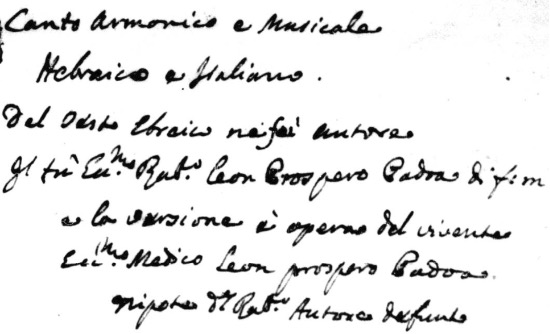
Harmonious and Musical Song in Hebrew and Italian. The Hebrew text was composed by the late distinguished Rabbi Leon Prospero Padoa, of blessed memory, and the translation is the work of the living distinguished physician Leon Prospero Padoa, “nipote” of the deceased rabbi who authored it.
Leon Prospero is the Latin correlate of Yehuda Matzliach. We revisit the importance of this alternate name below. In the last line of the colophon, Doctor Yehuda is described as the “nipote del Rabbino autore defunto,” the “nipote” of the deceased rabbi who authored the work. The unique term used to identify Doctor Yehuda’s relationship to Rabbi Yehuda is “nipote,” which I leave untranslated. Lamentably, this Italian term can mean either a grandchild or a nephew/niece, hence the conflicting citations. If we had additional context, or other sources to corroborate the relationship of Rabbi Yehuda and his namesake, this interesting, if not disturbing, linguistic fact would be of little relevance here. But regretfully we do not.
A crucial piece of information for establishing Doctor Yehuda’s familial relationship to Rabbi Yehuda is the identity of the physician’s father. This key genealogical detail appears to have escaped the attention of scholars of Jewish history.
The renowned Jewish scholar Meir Benayahu, seemingly unaware of the Modena manuscript, was independently convinced that Doctor Yehuda was the grandson of Rabbi Yehuda, but for entirely different reasons. He published a previously unknown series of poems in a manuscript authored by Menachem Azaria, son of Rabbi Yehuda.[17] From internal textual evidence it is clear that these poems were written in honor of the medical graduation of a student named Yehuda Matzliach. (We address these poems and their medical historical significance below.)
After quickly dismissing the better-known elder Rabbi Yehudah Matzliach as the poems’ recipient, as there is no indication that the esteemed rabbi was also a physician, Benayahu offers another suggestion. He provides compelling circumstantial, though not dispositive, evidence that Doctor Yehuda was the son of the poems’ author, Menachem Azaria Padova. This would make Doctor Yehuda the grandson of Rabbi Yehuda.
This identification is problematic for a number of reasons. First, nowhere in the poems does the author, Menachem Azaria Padova, state explicitly or even allude to the fact that the recipient is his son. This omission alone would not disprove paternity. However, in one verse he addresses the recipient as “yedidi” (“my [dear] friend”), a term of endearment to be sure, but not one typically reserved for a child. If indeed the recipient were his son, one would have expected the author use the term “beni,” my son, or perhaps “ahuvi,” my beloved, instead.
While Benayahu endeavored to identify Doctor Yehuda’s father, other Jewish sources are simply silent on this matter. Another archival source, however, one rarely consulted by Jewish historians, easily fills this gap and establishes the identity of Doctor Yehuda’s father beyond doubt.
Doctor Yehuda was a physician, and although not all physicians of this period received university training, such education had become increasingly common in eighteenth-century Italy. University matriculation and graduation records typically, though not invariably, identify a student’s father and place of origin. These records, together with university dissertations and congratulatory poetry, constitute a rich yet underutilized resource for Jewish historical research.[18] In Doctor Yehuda’s case, we are fortunate to possess records from two different universities. We examine these documents more fully in our discussion of his medical education, but our immediate concern is the genealogical information they preserve.
The archives from the University of Padua have been extensively mined by Jewish historians due to the outsized role this university played in Jewish (medical) history. A catalogue of the Jewish graduates from 1617-1816, along with a partial record of matriculants, was published in 1967.[19] The records of other Italian institutions, however, where far fewer Jews attended, if at all, have received scant and inconsistent treatment. These records are not as easily accessible, even today. Pisa was one of these institutions.
Doctor Yehuda graduated from the University of Pisa in 1754, where his name is recorded in the university archives as Leon Prospero di Biniamin Guardadio Padoa di Modena.[20] The practice of Jews bearing both Hebrew and secular names, familiar to us today, has a history extending back centuries. Jewish students at European universities were generally identified in official records by their secular or Latinized names. It is unclear whether these names were adopted specifically upon matriculation or had been used previously. One can imagine that some Jewish students, particularly those arriving from relatively insular Jewish communities, may have entered university having previously been known exclusively by their Hebrew names. In the present case, Leon Prospero di Biniamin Guardadio Padova corresponds to Yehuda Matzliach, son of Binyamin Shemarya (or Shemaryahu).
After his graduation from Pisa, it appears that Doctor Yehuda matriculated for one additional term at the University of Padua in 1755. Here is the archival entry, where his name appears on the fourth line:
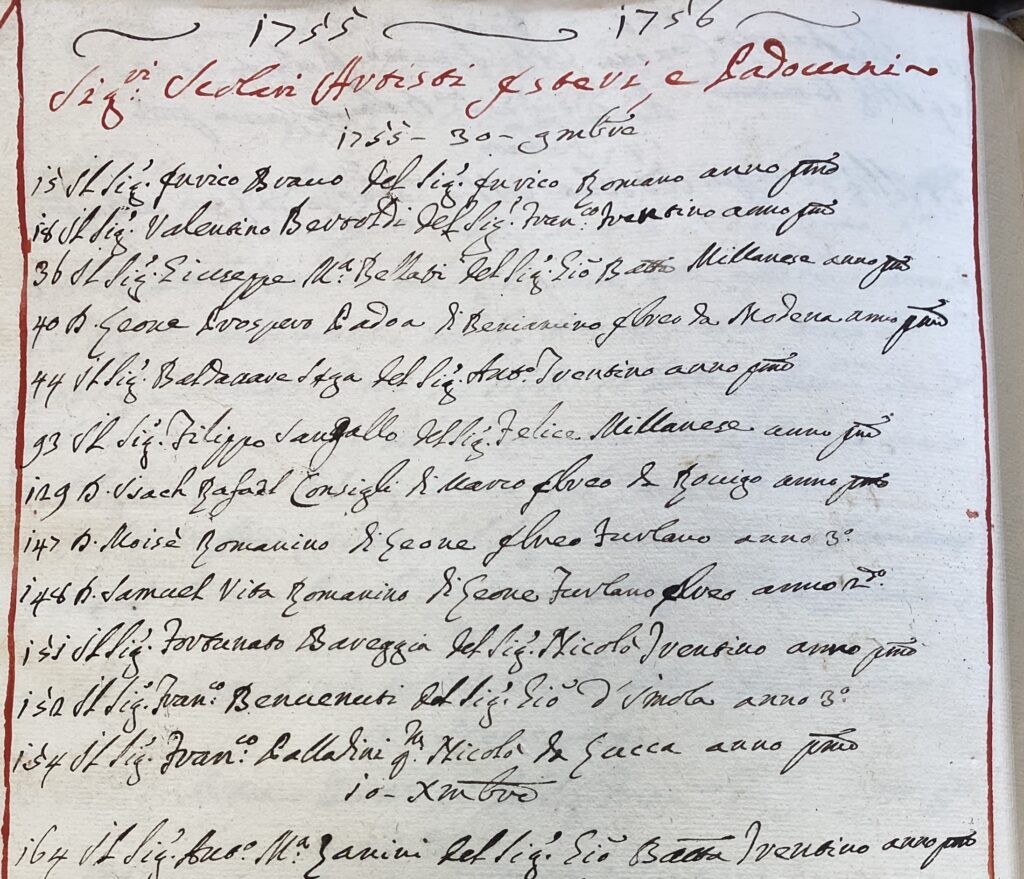
Here too, Doctor Yehuda’s father’s name and place of origin are recorded- Leone Prospero Padoa di Beniamino ebreo da Modena- though his father’s middle name is omitted.
I have yet to find reference in the Jewish historical record of this period to anyone with the name combination of Binyamin Shemarya(hu), though I have found mention of a Binyamin Padova. The historian Moses Shulvass published the contents of the first ledger of the chessed ve’emet confraternity of the city of Reggio (Emilia), which was founded in 1742,[21] and provided charity for the poor as well as burial shrouds for families in need. Binyamin Padova was one of the founders of this confraternity and is mentioned numerous times in the ledger. Reggio is only a few kilometers from Modena, and this record would align both geographically and chronologically with the father of Doctor Yehuda.
Incidentally, the name of Ovadia HaKohen, a co-founder of the same confraternity, appears repeatedly alongside that of Binyamin Padova throughout the ledger. Their association seems eventually to have developed into a familial bond, as the Hebrew Union College Library preserves three eighteenth century manuscript poems composed in honor of the marriage of Gentilla, daughter of Binyamin Padova, to Binyamin Avraham, son of Ovadia HaKohen.[22] It would follow then that Gentilla would have been the sister of Doctor Yehuda.
While we have successfully identified Doctor Yehuda’s father, Binyamin, it still remains for us to connect Binyamin to the family tree of Rabbi Yehuda. We have no record of a son of Rabbi Yehuda Matzliach Padova named Binyamin. Could Binyamin possibly be a son or brother of Rabbi Yehuda who escaped historical notice? This would make Doctor Yehuda a nephew or grandson of Rabbi Yehuda.
Fortunately, in the introduction to the Reggio ledger appears the full names of the confraternity founders:
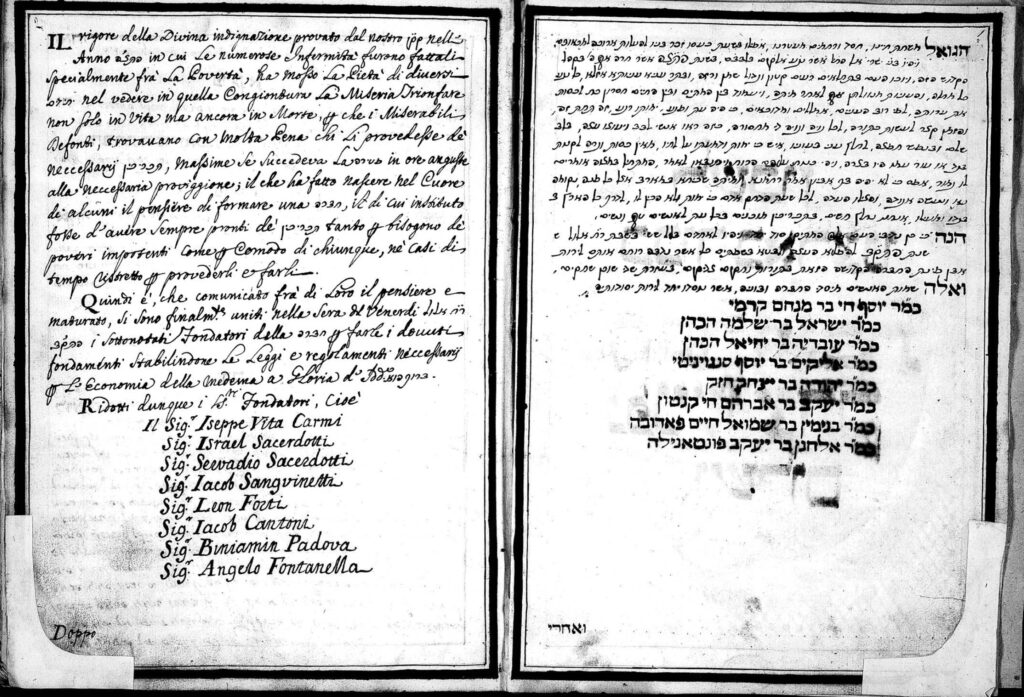
In the Italian text, second name from the bottom, we find the name Biniamin Padova, with no paternal reference, but in the Hebrew version it is revealed that Biniamin was the son of Shmuel Hayyim Padova.[23] Consulting the original manuscript of the ledger provides additional reward as here we find the signatures of the founders, which includes the Italian and Hebrew signatures of Doctor Yehuda’s father, Biniamin.[24]
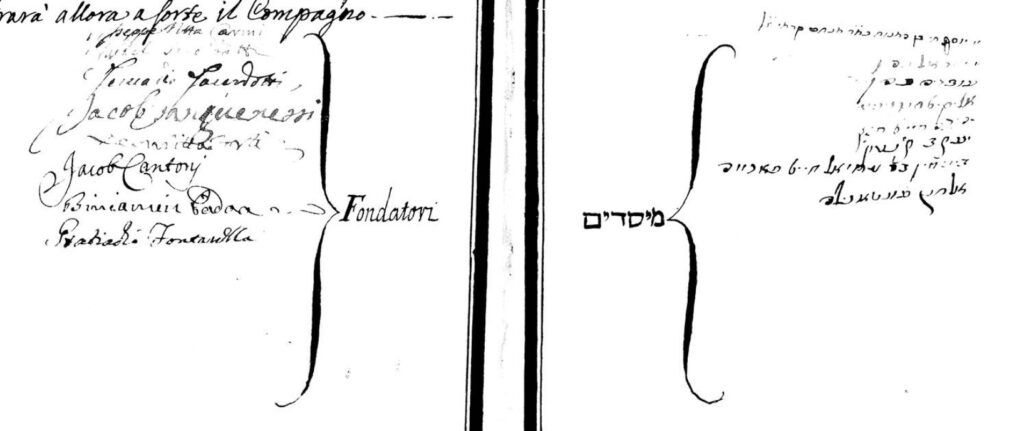
The name Shmuel Hayyim Padova is not otherwise referenced in historical literature. It thus appears that Doctor Yehuda was neither the nephew nor grandson of Rabbi Yehuda. Nor was he even a direct descendant of his. Doctor Yehuda did not belong to the immediate family of Rabbi Yehuda Matzliach Padova, as previously assumed. Rather, he descended from a separate, though evidently related, branch of the Padova family, whose precise connection to the rabbi remains undetermined. The two family trees are below:
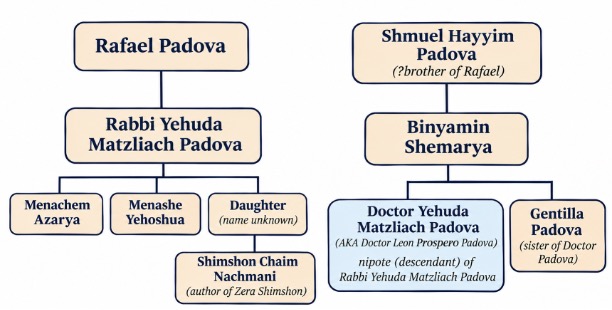
How are we now to contend with the “nipote” designation in the Modena manuscript colophon? Upon further research, I discovered that in eighteenth-century Italy the term “nipote” could mean not only a specific relative, such as a nephew or grandson, but more generally, descendant or younger relative, depending on context. I therefore conclude that the use of the term “nipote” in this case bears this very meaning and was not intended to specify any exact familial relationship. Doctor Yehuda is simply identified as a living relative of the deceased Rabbi Yehuda. Thus, the bibliographers of the Modena manuscript inadvertently erred in their genealogical assumptions, resulting in misinformation perpetuated in the historical record.
Regarding the congratulatory poems discussed by Benayahu, it is now understood why no reference appears to a paternal relationship between the author and the recipient, as none existed. Menachem Azarya was related enough to Doctor Yehuda to serve as an impetus to compose poems in his honor, but distant enough to identify him just as a “yedid,” as opposed to a specific relation.
Congratulatory Poems for Doctor Yehuda: For Padova but Not from Padova
The composition of congratulatory poetry upon medical school graduation was a prominent and consistent feature of Jewish medical student culture in Padua for some two centuries.[25] While the Jewish medical historian Professor Joshua Liebowitz, writing in 1971, had only encountered one single example of a congratulatory poem for a Jewish medical graduate,[26] I have identified well over one hundred examples of this genre. This literary practice flourished in Padua, for whose graduates the vast majority of extant poems were written. While this Paduan literary legacy carried over to the Netherlands and Germany once Jewish students were allowed university entry in these locations, there is little if any remaining evidence of its practice at other Italian academic institutions.
In 1976, Meir Benayahu published his discovery of four poems in a manuscript of collected prayers and poetry authored by Menachem Azaria Padova, the son of Rabbi Yehuda.[27] This manuscript is housed in the Bodleian,[28] though these specific poems, as Benayahu himself notes, were overlooked by Neubauer, the renowned bibliographer, in his iconic catalogue of Hebrew manuscripts in this institution.[29] Without Benayahu we would not know of their existence.
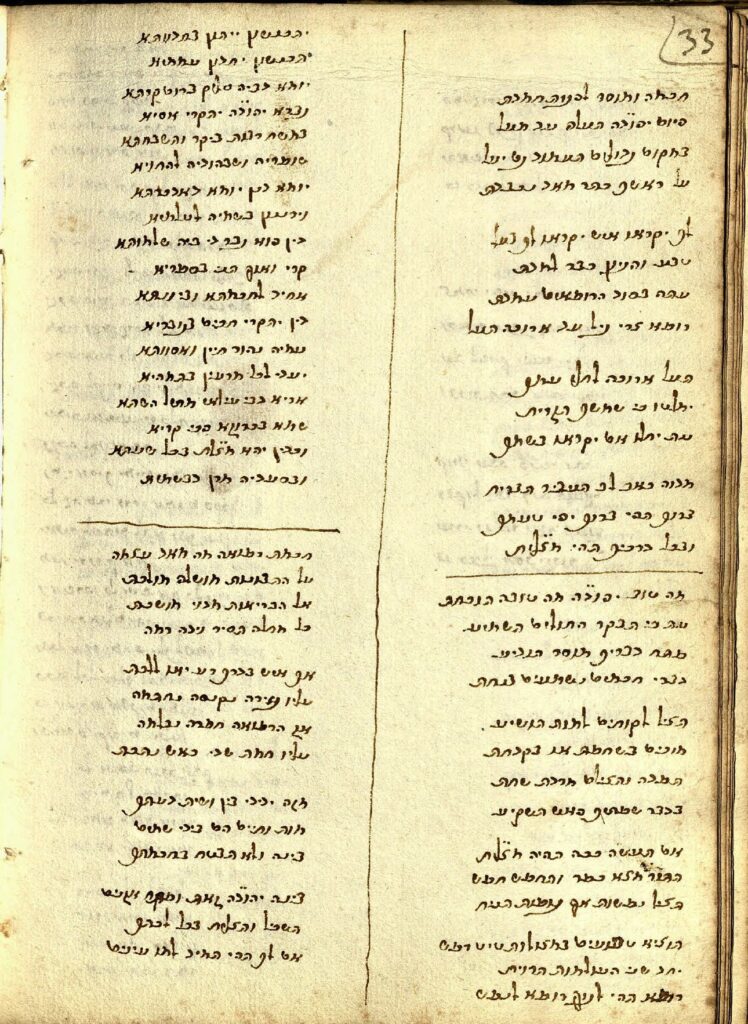
All four poems appear on one page and Benayahu provides a transcription and annotation of their content. The internal evidence from the text of all four sonnets identifies the graduate and recipient of the poems to be a student named Yehuda Matzliach. This is evident from the fact that the words both “Yehuda” and “Matzliach” appear in the poems, and they are accompanied with a special notation above the word (two dots) to highlight their significance. Here is one example:
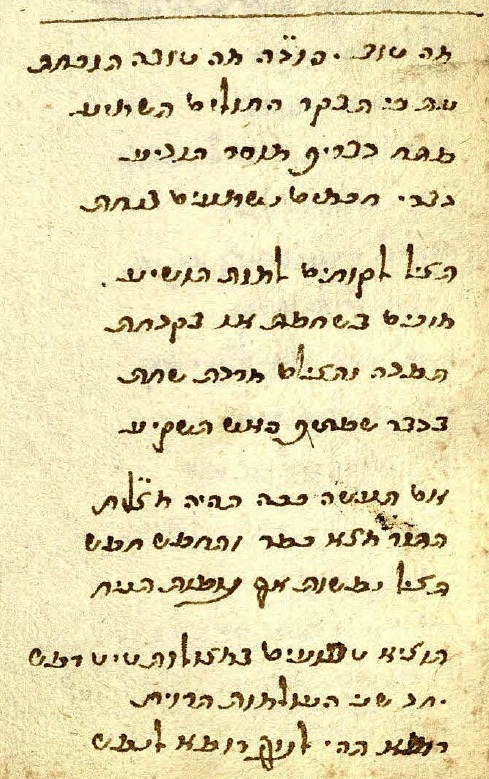
No family name or medical institution is mentioned. As the author’s father was named Yehuda Matzliach (Padova), Benayahu briefly considered him to be the recipient, though he quickly dismissed the idea in absence of any proof he was a physician. However, Benayahu reasonably assumes the recipient to be a relative. We have decisively refuted Benayahu’s conjecture that Doctor Yehuda was the author’s son. We now turn our attention to the historical context of these poems and the university from which Doctor Yehuda received his medical degree.
Benayahu was familiar with the recently published catalogue of Jewish medical students at the University of Padua compiled by Modena and Morpurgo and noted its record of the matriculation of a Leon Prospero Padova in 1755. The name would seem to correspond precisely to that of the recipient of Menachem Azaria’s poems. However, because the catalogue contained only a matriculation record, with no corresponding record of graduation, Benayahu dismissed this individual as the intended recipient.
I would be less inclined to dismiss this possibility so readily. The absence of a graduation record does not necessarily indicate that a student failed to complete his studies. University archives have not always survived intact, and I have encountered other instances in which independent documentation establishes a graduation for which no corresponding university record survives. One such example is Moses Crespino, whose matriculation at Padua on February 1, 1647, is recorded in the university archives, but whose graduation is not. Nevertheless, his original medical graduation diploma from Padua survives in the Isaac Wallich Collection at the National Library of Israel. [30]
As it turns out, Benayahu was partially correct. Leon Prospero (Doctor Yehuda) indeed did not graduate from the University of Padua, but he was nonetheless the recipient of Menachem Azaria’s congratulatory graduation poems. Prior to his brief enrollment at Padua, Leon Prospero had studied medicine and received his degree from the University of Pisa (see below). The poems thus commemorate the graduation of a Jewish medical student from an Italian university other than Padua, making them an exceedingly rare example of this literary genre. Indeed, they may represent not only the only known congratulatory graduation poems composed for a Jewish medical graduate of Pisa, but possibly the only known examples honoring a Jewish medical graduate of any Italian university outside of Padua.
While these poems in the Bodleian manuscript are for Padova (i.e., written in honor of Yehuda Matzliach Padova), they are however not from Padova. We now turn to a comparative examination of these poems alongside the extant corpus of congratulatory poetry celebrating graduates of the University of Padua. To find a graduate contemporary with Doctor Yehuda for whom such poems were written, we need only look three lines down in Doctor Yehuda’s University of Padua matriculation record.
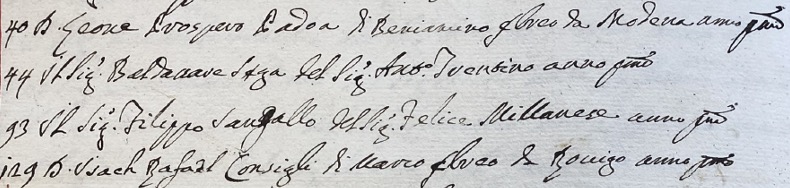
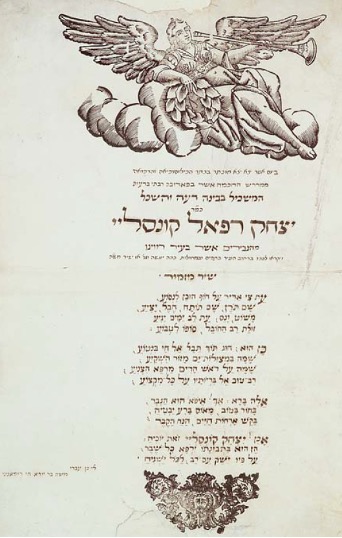
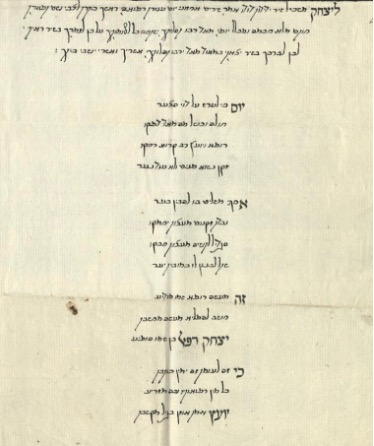
Matriculating together with Doctor Yehuda on the very same day in 1755 was a student named Isack Rafael Consigli di Marco ebreo from Rovigo. Note the graduate’s father’s name and place of origin are recorded. Consigli graduated in 1757, and we possess three extant congratulatory poems written for his commencement, two in Hebrew and one in Italian.
Graduate: CONSIGLI, Isacco (Raffael) (Yitzḥak Raphael)[31]
1) Author: ROMANIN, Moshe b. Yuda Chai
Location: This poem was sold at the Tajan Judaica Auction in Paris (June 27, 2006).
2) Author: Unknown
Location: Kaufmann Collection in the Library of the Hungarian Academy of Sciences[32]
3) Author: M.D.L.R.
Location: JTS Library[33]
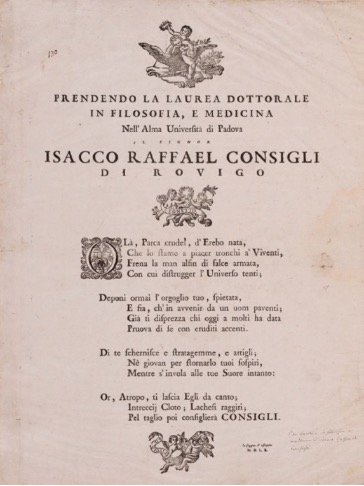
These three poems all share the following textual features: 1) The literary structure for both the Hebrew and Italian poems is ABBA/BAAB/CDC/DCD. While the style of the Padua collection of poems can vary significantly, this style was the among the most common. 2) They possess an introduction identifying both the occasion of the poem- a medical graduation- and the name of the poem’s recipient. In two instances, the University of Padua is explicitly mentioned as the graduate’s alma mater. Though not the case in these examples, the introduction can include other family names or important historical information not found elsewhere. Thus, the congratulatory poem, similar to the university archives, is an underappreciated source of Jewish history. 3) They include reference to the name of the graduate in the text of the poem itself.
The poems written by Menachem Azaria for Doctor Yehuda share two of these features but lack the introductory text. The Padua poems were most often produced as broadsides for distribution at the graduation festivities. Poetry was commonly disseminated in this format in Early Modern Italy, and whether for weddings, eulogies or graduations, typically included an introduction. Even the manuscript versions of the poems, as in this case, included the introductions, as they served as a template for the printed broadsides. Perhaps the poems for Doctor Yehuda were not intended for broadside reproduction. Indeed, I have yet to find a printed broadside congratulatory medical poem for any non-Padua graduate.
The language of the congratulatory poems was almost exclusively Hebrew, with only a handful of examples composed in other languages, including Italian, Latin, and Spanish.
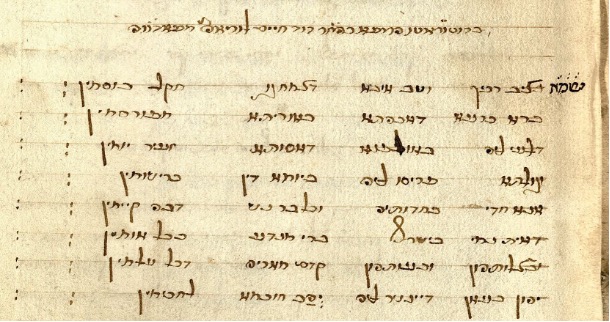
Menachem Azaria wrote one of his four poems for Doctor Yehuda in Aramaic. I have previously encountered only one other example of a congratulatory medical poem composed in Aramaic, written by Rabbi Yehuda Aryeh Modena in honor of David Loria’s graduation from Padua in 1623. Perhaps not coincidentally, these two poems rest just meters apart on the historic shelves of Oxford’s Bodleian Library.
Graduate: LORIA, David[34]
Author: MODENA, Yehuda Aryeh
Location: Oxford Bodleian Library[35]
It is also uncommon for an author/poet to write more than one poem for a particular student’s graduation. Two examples are Yitzḥak Shabbetai Urbino (British Library[36]), who wrote two poems for the graduation of Solomon Lustro, and Solomon Lustro, who wrote two poems for his fellow classmate Avraham haKohen.[37]
Doctor Yehuda the Poet
In letter XIV of his serialized bibliographic letters in the Italian journal Il Vessillo Israelitico, Moshe Soave discusses a poem from his private collection written for the wedding of Stella Trieste and Abram Coen in the mid eighteenth century. Like much of Soave’s private collection, this poem now resides in the JTS Library.[38]
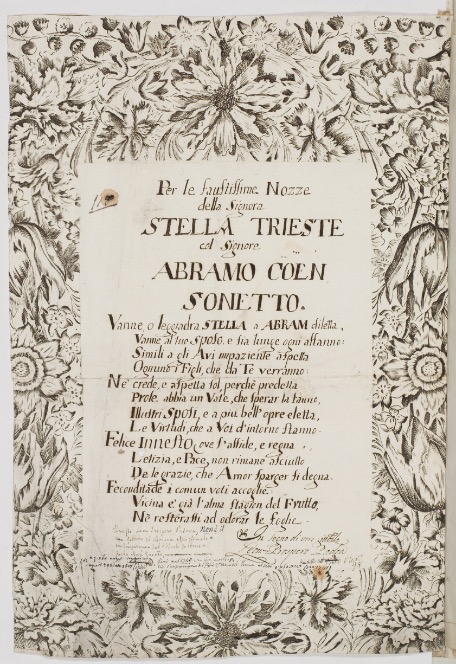
The author’s name is legibly signed- Leon Prospero Padoa.

Though initially convinced the author was the prominent Modenese rabbi and poet, Rabbi Yehuda, deeper investigation led Soave to the inescapable conclusion that Rabbi Yehuda had died long before the poem was composed. Soave made no further attempt to establish the identity of the poet, Leon Prospero Padova, suggesting only, “ma potrebbe essere un suo nipote” (“but he might have been his ‘nipote’”). It seems that we cannot evade this genealogically evasive term. We however can identify this poet is our Doctor Yehuda, of whom we now know considerably more than Soave did.
Lest we think this wedding poem to be a one-off literary exercise by Doctor Yehuda for his friend’s marriage, we are reminded of the source of our knowledge that Doctor Yehuda was related to Rabbi Yehuda. The “nipote” colophon is for a manuscript co-authored by Rabbi Yehuda and Doctor Yehuda, albeit at different historical periods. Rabbi Yehuda contributed the original Hebrew verse, a song for the eve of Hashana Raba to be accompanied by instruments; Doctor Yehuda rendered the text into a rhymed Italian verse, no small feat. Moreover, as opposed to congratulatory poetry, which arguably had a limited readership both numerically and chronologically, the Hoshana Raba song appears to have earned a firm place in the liturgy of Modena after Rabbi Yehuda’s passing[39] and this would likely have been read and recited annually.
There is yet another possible literary work we can possibly attribute to Doctor Yehuda. At the conclusion of the Modena manuscript appears an anonymous Italian sonnet praising the author of the original Hebrew composition.
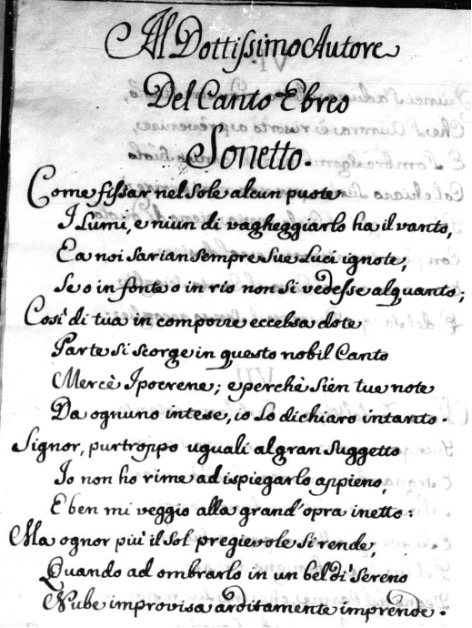
Giuseppe Laras, who discussed the Modena manuscript in detail in 1970, suggested that the sonnet may have been composed by the younger Leon Prospero Padova, the physician responsible for the Italian translation, but offered no substantive evidence for this attribution.[40] I would suggest that several additional considerations lend support to Laras’s conjecture and strengthen the case for recognizing the sonnet as another literary contribution of Doctor Yehuda Matzliach Padova:
1) A comparison of this sonnet with the wedding poem discussed by Soave reveals that both employ celestial imagery and related poetic themes. Although these similarities do not constitute conclusive evidence of common authorship, they are consistent with the attribution of both compositions to Doctor Yehuda Matzliach Padova.
2) A signature omission for the poem in my opinion strengthens the authorship identification as Doctor Yehuda. As the author of all the Italian content of the manuscript, it is logical for him to offer a concluding sonnet, which, given no other possibilities, would be assumed by the reader to have been written by him. If a third author contributed the sonnet, there is no compelling reason for this poet to omit attribution.
3) Specific verses in the poem reflect that its author was also the work’s translator.
E perché sien tue note, Da ognuno intese, io lo dichiaro intanto.
“And so that your notes may be understood by everyone, I shall explain it.”
The poet describes himself as undertaking precisely the kind of explanatory work the translator would perform. Additional lines reinforce this idea:
Signor, purtroppo uguali al gran Soggetto Io non ho rime ad ispiegarlo appieno, E ben mi veggio alla grand’opra inetto.
“Sir, unfortunately, I have no verses equal to so great a subject with which to explain it fully, and I recognize myself as unequal to this great undertaking.”
These lines can be read as the translator modestly acknowledging the inadequacy of his poetic abilities to convey the brilliance of the Hebrew original.
There is another poem we may wish to add to Doctor Yehuda’s portfolio which may yet surface in the future. I suspect he would have written a poem for his sister Gentilla’s wedding.
I think we can comfortably position Doctor Yehuda as one of the physician-poets of this period. This hyphenated model was not uncommon in Italian Jewish history. Scholars including Benayahu[41] and Soave have studied them.
Doctor Yehuda’s Medical Education
The history of Jews and medicine in early modern Italy has largely focused on the University of Padua, the first institution to officially offer medical degrees to Jewish students. While it is here that the majority of aspiring Jewish physicians desiring academic education flocked to train, dozens of Jewish students sporadically attended other Italian institutions during this period (e.g., Bologna, Ferrara, Naples, Pavia, Perugia, Pisa, Rome, Siena) through papal of informal permission.
Doctor Yehuda belonged to the latter group and procured his medical training at the University of Pisa, where he graduated on August 30, 1754. Only fifteen Jewish students graduated from the University of Pisa in the eighteenth century, in contrast to the 162 from Padua.[42] Padua is well known for its longstanding tradition of tolerance toward Jewish students and its willingness to accommodate their religious needs, dating back to the sixteenth century. But how did Pisa compare in this regard? Though lesser known and appreciated, Pisa in fact offered remarkably similar accommodations to its Jewish graduates, albeit considerably later than its more celebrated academic counterpart. The following modifications to the graduation ceremony were formally approved to accommodate Jewish medical students at the University of Pisa:[43]
- The Provost of the College of Philosophers and Physicians replaced the archbishop’s representative in conferring the degree.
- The graduation took place in the university’s main hall, the Scuola Magna of the Sapienza, rather than the episcopal palace.
- The Catholic oath/profession of faith was omitted.
- Jewish graduates swore their oath upon the Pentateuch, rather than upon Christian scripture.
These changes, virtually identical to those implemented at Padua, were formally codified and ratified by the university in 1755.[44] Doctor Yehuda may not have personally benefitted from these accommodations, as he graduated just one year earlier. In addition, the few Jewish students of Pisa also enjoyed positive academic relationships with the university faculty members, including research collaboration.[45] Parenthetically, there no mention in any sources I have found of a practice to compose congratulatory poems for the Jewish medical graduates of Pisa. Thus, Menachem Azaria’s poetic offerings for his relative Doctor Yehuda were likely Padua inspired.
There is an additional element of Doctor Yehuda’s medical education at Pisa which merits at least brief mention- his tuition fees. After the name Leon Prospero Padoa in the university archives appears the phrase, “pagò doppio,” “he paid double.” The same phrase appears in association with the other Jewish students[46] in Pisa. This was certainly not unique to Pisa. Jews, even if deemed worthy of medical school admission, were treated as a distinct inferior class, and were typically assessed higher university fees. (I do not differentiate here between the different types of university fees- matriculation, books, exams, graduate, diploma, etc.- assessed during the educational experience.) Even Padua, considered the most tolerant of the universities, not only imposed higher fees on its Jewish students, but it also added additional financial obligations, sometimes upon the entire Jewish community. Examples include the requirement for the student to deliver 170 pounds of confections for the students and faculty prior to graduation; a tax to be paid upon the first snow of the season; financial support for an annual university feast.[47] Cecil Roth notes that these discriminatory practices were not uncommon in Italian academic culture:[48]
In Italy, it was a universal student prerogative to bombard the Jews with snowballs on the occasion of the first snowfall of the year—a right which was compounded at Turin by an annual payment of twenty-five ducats, and at Mantua by a heavy ransom of confectionery and writing paper. At Padua, besides paying a tribute of confetti on this occasion, the Jews had to give a number of fat capons, or the equivalent, on St. Martin’s Day.
It appears that despite its tolerance in some respects, Pisa also imbibed this cultural phenomenon and employed similar practices towards the Jewish community. Roth’s passage continues:
At Pisa, down to the beginning of the nineteenth century, it was customary for the students to weigh the fattest Jew they could find each year on the day of St. Catherine (November 25th—the official beginning of winter), and to exact his weight in sweetmeats from the rest of the community as a ransom.
Regarding the exact nature of the tuition increase, Pisa, requiring double, was not the worst offender. Below is a copy of the Statutes of the University of Sapienza Rome from 1676:
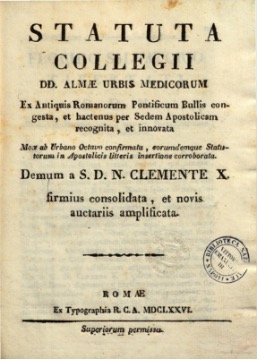
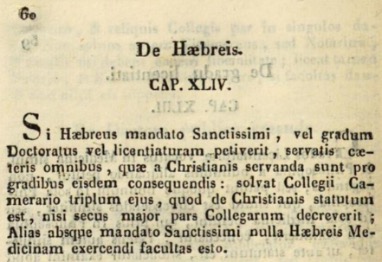
If a Hebrew, by the mandate of the Most Holy, seeks either the degree of Doctorate or Licentiate, observing all other things that must be observed by Christians, he shall pay to the Chamberlain of the College three times that which is established for Christians, unless otherwise decided by a majority of the College members. Otherwise, without the mandate of the Most Holy, there shall be no right for Hebrews to practice Medicine.
Rome demanded thrice the standard tuition of its Jewish students.
What may distinguish Pisa from other universities, however, is not the imposition of higher fees on Jewish medical students, a practice encountered elsewhere, but rather a concerted effort to abolish this discriminatory policy. This was not merely an appeal by an individual student seeking relief from an onerous financial burden. Instead, it represented a broader initiative, spearheaded by a Jewish student with the support of members of the university faculty, to eliminate the practice altogether.[49] Moreover, the events transpired during the tenure of Doctor Yehuda at the university. To my knowledge, no comparable initiative has been documented elsewhere in the history of Jewish medical education.
Angelo De Soria, a Jewish medical student at Pisa, spearheaded a campaign, with the collaboration of Professor Gaspare Cerati, to overturn the university’s longstanding policy of charging Jewish students double the customary graduation fees.[50] De Soria and Doctor Yehuda were classmates and shared the same doctoral advisor, Cristoforo Teodoro Verzani. Verzani also played a supporting role in this undertaking. Though there is no indication of Doctor Yehuda’s involvement in this endeavor, which evolved years before its passage in 1755, he was assumedly privy to its development. De Soria and Cerati’s efforts culminated in the adoption of new regulations governing the treatment of Jewish students, including the following provision:
Fourth: After careful consideration, it is determined that the expenses incurred by Jewish students shall be the same as those ordinarily paid by Catholic students receiving doctorates in philosophy and medicine.[51]
Although this reform proved short-lived, the episode represents a remarkable chapter in the history of Jewish medical education. It illustrates how Jewish students, despite their status as religious outsiders within the university, could work within its institutional structures, cultivate alliances with sympathetic faculty members, and advocate for meaningful changes in the conditions under which they pursued their medical education.
Shortly after receiving his medical degree from the University of Pisa on August 30, 1754, we find a record of Doctor Yehuda matriculating at the University of Padua. In 1755 he registered for one term. Though Modena and Morpurgo do not list an exact date, it appears in the original archival record above:

1755 – 30 – 9mbre (the standard abbreviation for November), i.e., November 30, 1755. There are no additional records of his attendance at Padua. In the Netherlands and Germany, it was commonplace for Jewish students to train at multiple institutions prior to obtaining their degree. In fact, students often presented to an institution only to obtain their degree after having completed their training elsewhere. They would offer a dissertation, defend theses, and undergo an oral exam. All that remained was the transfer of large sums of money to the degree granting institution, typically more prestigious than its predecessors, after which the diploma would be transferred to the student. I have not encountered this practice in Italian Jewish medical history. Doctor Yehuda’s case however is entirely unusual. To matriculate at one university after graduated from another seems superfluous, though perhaps explained by the student’s continued pursuit of the best medical knowledge available.
Doctor Yehuda’s Medical Practice
We have precious little documentation of Doctor Yehuda’s medical practice following his graduation from Pisa. Ironically, the surviving evidence comes not from his patients, colleagues, or professional activities, but exclusively from the records of the Catholic Inquisition. These documents reveal little about the medicine he practiced, but much about the religious and institutional restrictions under which he practiced it. The Inquisition maintained detailed records concerning the circumstances under which Jewish physicians could treat Christian patients, including requests for permission, exemptions, and alleged violations of ecclesiastical prohibitions.
Perugini published a summary inventory of several volumes of Papal documents concerning the Jews and the circumstances imposed upon them in the Papal States. It largely deals with requests by either Christian patients, including Catholic priests, to receive permission to be treated by Jewish physicians or the reciprocal Jewish physicians to obtain permission to treat Christian patients. Here we find the following entry: [52]
MODENA. 1751. — Leone Prospero Padova, a Jew from Modena, requests permission to practice the medical profession, including among Christians. He has already obtained authorization from the government. The Roman Inquisition grants permission, subject to certain reservations.
The date of the request presents an intriguing chronological puzzle, as Doctor Yehuda only graduated Pisa in 1754. If he trained in Padua after his graduation from Pisa, might he also have studied elsewhere before attending Pisa. Alternatively, he acquired medical training through apprenticeship and obtained a medical license even before receiving a formal university degree. Another possibility is that the date reflects a transcription error, with 1751 mistakenly recorded in place of 1754. While one could suggest that this refers to another Doctor Leon Prospero Padova entirely, I think this highly unlikely.
Whatever the explanation, this entry indicates that governmental authorization alone was insufficient for a Jewish physician to practice among Christians. Additional permission from the Roman Inquisitor was required, and even then, restrictions were imposed.
The difficulties confronting Doctor Yehuda, a Jewish physician, are further illustrated by Bregoli’s account of Doctor Yehuda’s encounters with the local Inquisition in Modena. While the Roman Inquisitor had granted Doctor Yehuda’s request to treat Christians, his local Modenese Inquisitor was less inclined to do so. Bregoli records[53] that he was repeatedly denied treating Christians by the Holy Office and the local inquisitor, although he had secured a license from the duke. Disregarding the ecclesiastical prohibition, Doctor Yehuda continued to visit Catholic patients. As a last resort, the Modenese inquisitor asked all local priests to remind their parishioners that relying on a Jewish physician was a sin. The timeline of this record in relation to the granting of the papal permission above is unclear and perhaps it preceded the above.
Doctor Yehuda’s name resurfaces again in 1760 in the records of the Inquisition Tribunal of Modena,[54] although the archival inventory provides insufficient information to establish the precise nature of this encounter.
The surviving record of Doctor Yehuda’s medical practice, comprised exclusively of Christian Inquisition records, would give the impression that the struggle to obtain permission to treat Christian patients occupied much of his time and effort. This may not in fact be so far from the truth. According to the age-old doctrine of the Catholic Church, essentially reaffirmed by Pope after Pope, Jewish physicians, irrespective of their training or university, were prohibited from treating Christian patients and restricted to treating members of the Jewish community, though enforcement varied widely. These restrictions on treating Christian patients could impose substantial professional and financial limitations, prompting Jewish physicians to seek authorization from both secular and ecclesiastical authorities. This process served as the bane of Jewish physicians’ existence and is indeed accurately reflected in the remaining archival record, albeit scant, of Doctor Yehuda.
Sadly, we know virtually nothing about the patients he treated, the diseases he encountered, or the therapies he prescribed. Instead, the historical record preserves a peripheral element of his medical life, his efforts to secure permission to practice his profession. Although these documents cannot establish how much of his professional life was consumed by such struggles, they offer a valuable glimpse into the obstacles confronting Jewish physicians of this period, many of whom sought to practice medicine beyond the boundaries of their own communities.
Conclusion
Doctor Yehuda Matzliach Padova has long been overshadowed by his illustrious rabbinic namesake, Rabbi Yehuda Matzliach Padova. The scattered references to the physician in Jewish historical literature have yielded an incomplete and, in some respects, misleading biographical portrait. By bringing together evidence from university archives, communal records, Hebrew manuscripts, Italian poetry, and inquisitorial inventories, we can now begin to distinguish the physician from his prominent relative and reconstruct the contours of his life with greater precision. We have corrected several longstanding biographical assumptions and poem misattributions and have brought to light previously unrecognized aspects of his life.
These discoveries extend beyond the biography of a single physician. Examining his time at the University of Pisa expands our view of Jewish medical education beyond the familiar context of Padua, uncovering striking and unexpected parallels. His encounters with Inquisitorial authorities, a less utilized source of Jewish medical history, reveal the ongoing challenges of Jewish physicians confronting religious restrictions in their medical practice. His own poetic compositions, meanwhile, reflect the participation of Jewish physicians in the broader intellectual, religious and literary culture of eighteenth-century Italy.
Although a complete portrait of Doctor Yehuda remains elusive, the surviving fragments reveal far more than previously appreciated. They also underscore a broader historical lesson: the lives of early modern Jewish physicians cannot be fully understood through the traditional sources of Jewish history alone. Jewish historians have not always appreciated the wealth of information preserved in university archives, while medical historians have often lacked familiarity with, or access to, the rich corpus of Hebrew and rabbinic literature. Bridging this disciplinary divide is not merely a methodological preference but a historical necessity. Jewish physicians inhabited two worlds that often remained distinct, navigating the intellectual, religious, and professional cultures of both. To reconstruct a fuller portrait of their lives, historians must likewise inhabit both worlds of historical scholarship, bringing together sources and traditions that have too often remained separate.
Notes
- Asher Salah, La Republique des Lettres: Rabbins, Ecrivains et Medecins, Juifs en Italie au XVIIIe Siecle, (Leiden, 2007), 502-503; Hananel Neppi and Mordechai Ghirondi, Toldot Gedolei Yiśraʼel u-geʼonei Itạlyah [History of the Great Sages of Israel and the Rabbinic Leaders of Italy] (Trieste, 1853), 163, 172, 239. ↩
- Isaiah Sonne and Matitiahu Tsevat, “Some Luzzatto Manuscripts,” Studies in Bibliography and Booklore 2:4 (December, 1956), 156-159. ↩
- There are variant spellings of the name in Hebrew, English, Italian and Latin. We use Padova here but some of the sources we cite use different spellings. ↩
- Moses Soave, “Lettera XIV”, Vessillo Israelitico, 28 (1880), 119-120. ↩
- Moritz Steinschneider, “Jüdische Aerzte,” Zeitschrift für Hebräische Bibliographie 18, nos. 1-3 (January-June, 1915), 32. ↩
- Meir Benayahu, “Poems for the Graduation of the Physician Yehuda Matzliaḥ Padua,” (Hebrew) Korot 7, nos. 1-2 (April, 1976), 39-49. ↩
- Salah, op. cit., 503-504. ↩
- Francesca Bregoli, Mediterranean Enlightenment: Livornese Jews, Tuscan Culture, and Eighteenth-Century Reform (Stanford: Stanford University Press, 2014), 107. ↩
- See discussion of congratulatory poems below. ↩
- Harry Friedenwald, The Jews and Medicine (Baltimore: Johns Hopkins Press, 1944), 602. ↩
- Salah, op. cit., 502. Salah conflates somes of the biographical details of Doctor Yehuda with Rabbi Yehuda. Neppi and Ghirondi, op. cit. ↩
- “…and you will see children, and children’s children, like olive shoots around your tables, wise and discerning, and homes filled with everything good, and wealth and honor…” Jews across the world have turned to the segulah of the Zera Shimshon—seeking shidduchim, yearning for children, or facing financial hardship. ↩
- Biblioteca Estense (Modena) Oriental Manuscript Collection, a.W.2.10 (also known as OR.55). A digital copy is also available at NLI, System n. 990001777700205171. For detailed description of this manuscript, as well as the history of the Usiglio family synagogue and other private synagogues in Modena at that time, see Giuseppe Laras “Un componimento poetico di Jehudà Mazliach Padoa,” La Rassegna Mensile di Israel, 3rd ser., 36, nos. 7-9 (July-September 1970),193-203. ↩
- A manuscript of just the original Hebrew song of Rabbi Yehuda, without the accompanying Italian verse, was completed in 1768. See JTS Library, Ms. 1414. The introduction states that the song is to be sung with the accompaniment of stringed instruments and percussion, kinnorim ve-tziltzelim. ↩
- See, for example, S. Jona, “Catalog der ebräischen Handschriften der kgl. Bibliothek in Modena,” Das Jüdische Centralblatt 2, no. 7 (May 1, 1883), 66-68. ↩
- Salah, op. cit., 502. ↩
- Benayahu, “Yehuda Matzliach Padova,” op. cit. ↩
- Edward Reichman, “The Mystery of the Medical Training of the Many Isaac Wallichs: Amsterdam (1675), Leiden (1675), Padua (1683), Halle (1703),” Hakirah 31 (Winter 2022), 313-330. ↩
- Abdelkader Modena and Edgardo Morpurgo (with editing and additions done posthumously by Aldo Luzzatto, Ladislao Munster and Vittore Colorni), Medici E Chirurghi Ebrei Dottorati E Licenziati Nell Universita Di Padova dal 1617 al 1816 (Bologna, 1967). ↩
- I thank the archivist at the University of Pisa for this information and await copies of the original record. ↩
- Moses Shulvass, “The First Ledger (Pinkas) of the Chessed ve-Emet Confraternity in Reggio,” (Hebrew) Reshumot (new series) 4 (1947), 98-130, later published in his, Bi-Ẓevat ha-Dorot: Mi-Yeme ha-Benayim la-Zemanim Ḥadashim 2 vols. (Jerusalem/Tel Aviv, 1960). ↩
- These poems are also in the NLI catalogue system # 990001085830205171 and # 990001085910205171 ↩
- Shulvass, op. cit. ↩
- NLI system n. 990000421820205171. ↩
- See Edward Reichman, Catalogue of Congratulatory Poetry for University of Padua Medical Graduates, forthcoming. ↩
- Joshua Leibowitz, “An 18th Century Manuscript Poem by I. Belinfante Honouring a Medical Graduate,” Koroth, 5:7-8 (1971), 427-434 (Hebrew) and LI-LIV (English). ↩
- Benayahu, “Yehuda Matzliaḥ Padua” op. cit. ↩
- Bodleian Library Oxford, Ms. Mich. Add. 28, folio 54b. ↩
- Adolf Neubauer, Catalogue of the Hebrew Manuscripts in the Bodleian Library and in the College Libraries of Oxford. Vol. 1. (Oxford: Clarendon Press, 1886). ↩
- Edward Reichman, “The Medical Diploma of Moses Crespino from the University of Padua (1647): The Only ‘Jewish’ Medical Diploma in History,” Tradition Online (July 24, 2022). ↩
- Modena and Morpurgo, n. 267. ↩
- NLI, system n. 990001920200205171, folio 25r. ↩
- JTS Library, Ms. 9027 V5:25. ↩
- Modena and Morpurgo, n. 13. ↩
- Ms. Michael 528, 60 recto, number 341. See Simon Bernstein, Divan of Rabbi Yehuda Arye MiModena (Hebrew) (Philadelphia, 1932), n. 79; The divan of Leon de Modena, a collection of his Hebrew poetical works, was edited from this unique manuscript in the Bodleian Library. I thank Sam Sales, Superintendent, Special Collections Reading Rooms, Bodleian Library for his assistance and graciousness in locating and providing copies of all the manuscripts in this collection that come from this library. ↩
- British Library Or 9166, 41v. The two Urbino poems presented here are nestled within a lengthy manuscript, and I would have not known of their existence had Ahuvia Goren not brought them to my attention. ↩
- On Lustro, see Edward Reichman “Enhancing the Luster of the Solomon Lustro, an Illustrative Graduate of the University of Padua,” Korot 28 (2025), 51-83. ↩
- JTS Library, Ms. 9027 V2:6, Wedding Poem for Abraham Israel Hai (Abramo Israel Vita) ben Samuel Katz (Coen) and Stella (Esther) bat Moses Trieste. ↩
- The original Hebrew song of Rabbi Yehuda for Hoshana Raba was recopied in 1768 and in the introduction it states that the song was also previously printed (JTS Library, Ms. 1414). The date of Dr. Yehuda’s translation is unknown. ↩
- Laras, op. cit. ↩
- Meir Benayahu, “Rabbi Avraham Ha-Kohen of Zanti and his Group of Physician Poets in Padua,” (Hebrew), Ha-Sifrut, 26 (1978), 108-40. ↩
- See Barbara Marangoni, “Minoranze religiose nello Studio di Pisa: Le lauree degli acattolici (1737-1799),” (Italian) Bollettino Storico Pisano 64 (1995), 147-192, who lists the names of the fifteen students. See also Bregoli, op. cit. ↩
- Marangoni, op. cit., transcribes the formal university approval records of these changes. ↩
- Marangoni, op. cit. ↩
- Bregoli, op. cit. ↩
- The additional fees applied to the non-Catholic students as well, such as Protestants. ↩
- A. Ciscato, The Jews in Padua (1300–1800) (Italian) [Gli Ebrei in Padova (1300–1800)] (Bologna, 1901). 200-220. ↩
- Cecil Roth, “The Medieval University and the Jew,” Menorah Journal, 19:2 (1930), 128-41. ↩
- This chapter has been well documented by Marangoni and Bregoli. ↩
- Bregoli, op. cit., 107. ↩
- Marangoni, op. cit. ↩
- See Perugini, “L’Inquisition Romaine et les Israélites: Documenti del S. Uffizio,” Revue des Études Juives 3 (1881), 94-108, esp. 105. ↩
- Bergoli, op. cit., 113. ↩
- Paolo Prodi, Angelo Spaggiari, Giuseppe Trenti, I processi del tribunale dell’inquisizione di Modena inventario generale analitico : 1489-1874 [i.e. 1784], (Archivio di Stato di Modena, 2003). ↩
- The “Doctored” Medical Diploma of Samuel, the Son of Menasseh Ben Israel: Forgery or “For Jewry”?
- The Anatomy of an Auction: A Previously Undissected Body of Literature on the History of the Jews and Postmortem Dissection
- In Search of Memory:Towards an Understanding of Baladhur
- A Little-Known Rabbi Doctor and his Exceedingly Rare Medical Diploma Leon Cantarini- AKA Yehuda HaKohen Katz Me-HaHazzanim (University of Padua, 1623)