The Vanishing Note: Devorah, Women Dayanim, and a Missing הערה in Hilchos Dayyanus
The Vanishing Note: Devorah, Women Dayanim, and a Missing הערה in Hilchos Dayyanus
by: Naftali Goldberg
Whilst learning siman ז of Choshen Mishpat with my chavrusa, we found ourselves reading two different books. We were each using the Machon Yerushalayim edition of the Tur, we were on the same page, and we were looking at the same footnote — note ל״ב of the הגהות והערות. But my chavrusa’s note said almost nothing, and mine went on for some length. A comparison of title pages explained the discrepancy: I was working from the edition of תשנ”ג (1992/93), my chavrusa from the “מהדורה מתוקנת ומחודשת” of תשע”ב (2011/12).
What had been “corrected and renewed,” in this instance, was a deletion. And the material that had quietly disappeared is, I think, worth putting on the record.
The Edition
The Shirat Devorah edition of the Tur, published by Machon Yerushalayim, is now the standard text for anyone learning halachah seriously. It corrects a great many errors that had settled into the Vilna edition of the Tur, and it adds a numbering system that lets the reader trace each halachah through to its home in the Shulchan Aruch. The Beis Yosef is printed with a helpful apparatus of letters cross-referencing the relevant passages in the Shulchan Aruch. The Bach, Derishah and Perishah are included, as are several sets of הערות not usually printed in the early editions.
The most recent of these, which is the only one composed by the edition’s own editors, is the ״הגהות והערות״ printed at the foot of the page. It is, in other words, the one section of the book that is fully in Machon Yerushalayim’s hands. It is also the one section that seemingly can be revised between printings without anybody noticing.
The Problem of Devorah
The halachah in siman ז is that women are ineligible to serve as dayanim/dayanos in a beis din. This has always sat awkwardly beside the episode of Devorah qualifying as a “shofet.” Various Rishonim and Acharonim attempt to reconcile the prohibition with the historical record.
The Tur’s answer, in siman ז is that Devorah “did not judge but taught the judges of Israel.” The source appears to be Tosafos in Yevamos, 45b, s.v. “mi” who state plainly: ודבורה לא היתה דנה אלא מלמדת להן שידונו. However, the Beis Yosef quotes Tosafos’ other reconciliation: על פי הדיבור שאני. That makes Devorah’s position a הוראת שעה licensed by prophecy and not available as precedent.
Tosafos in Bava Kama, 15a, s.v. “asher,” take a different road: שמא היו מקבלים אותה עליהם משום שכינה. Devorah’s authority, on this reading, rested on the people’s acceptance of her because she was a prophetess (which is one of the explicit reasons mentioned in Tosafos Shavous 29b s.v. shavuas ha-eydus). That acceptance could override her formal disqualification in the same way that relatives, ordinarily pesulim, may nonetheless be appointed as dayanim where both parties agree.[1]
These are not interchangeable answers, and the נפקא מינות between them are considerable. If Devorah’s status was a הוראת שעה, it can only ever be justified by recourse to prophecy, and the case is sealed off from us entirely. If, however, the mechanism was simply that the litigants accepted her notwithstanding the halachic פסול, as they may accept a relative, then there is no obvious reason the same mechanism could not operate today. This provides a precedent for the involvement of women at the highest level of halachic discussion. This is all in the realm of Rishonim and quoted by the Beis Yosef, so it is harder to remove from the text even if someone would be rending their garments over the expression of such ideas. However, the amendment of note 32 proved a much easier task.
Note ל״ב, Then and Now
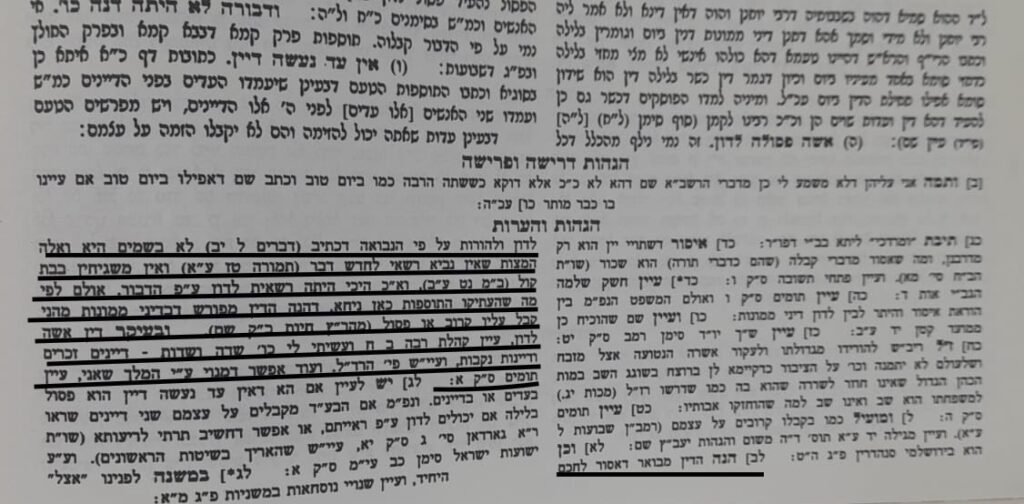
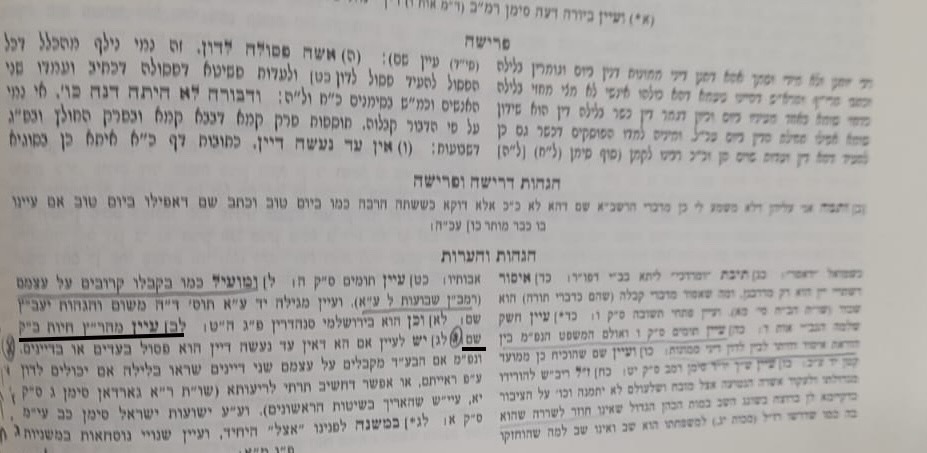
Here is the note in the 2012 מהדורה מתוקנת ומחודשת:
לב] ע’ מהרי”ץ חיות ב”ק שם.
This hardly raises any eyebrows. But, when compared to the earlier note, there is a substantial difference.
Here is what stood in its place in the original 1993 edition:
לב] הנה הדין מבואר דאסור לחכם לדון ולהורות על פי הנבואה דכתיב (דברים ל יב) לא בשמים היא ואלה המצות שאין נביא רשאי לחדש דבר (תמורה טז ע״א) ואין משגיחין בבת קול (ב״מ נט ע״ב), וא״כ היכי היתה רשאית לדון ע״פ הדבור. אולם לפי מה שהעתיקו התוספות כאן ניחא, דהנה הדין מפורש דבדיני ממונות מהני קבל עליו קרוב או פסול (מהר״ץ חיות ב״ק שם). ובעיקר הדין אשה לדון, עיין קהלת רבה ב ח ועשיתי לי כו׳ שדה ושדות – דיינים זכרים ודיינות נקבות, ועיי״ש פי׳ הרד״ל. ועוד אפשר דמנוי ע״י מלך שאני, עיין תומים ס״ק א.
The original note quotes the Maharatz Chajes in full rather than merely citing him. He is troubled by the answer that Devorah judged על פי הדיבור, on the grounds that a dayan may not pasken on the strength of נבואה. He is, however, well pleased with Tosafos’ framing of the issue, as he understands that they merely equate Devorah’s authority to judge with the ordinary case of קבלת קרוב או פסול, a mechanism with ample halachic precedent in monetary law. (I humbly submit to the reader that I do not understand the difficulty in the first place, as the term על פי הדיבור could simply be referring to a divine authorization to appoint Devorah as judge, rather than the halachic methodology that she may have used to pasken.)
This was evidently too much to be expressed in full for the מהדורה מתוקנת ומחדשת. But it gets worse. The original note does not stop there. It continues with a citation from Koheles Rabbah on 2:8:
ובעיקר הדין אשה לדון, עיין קהלת רבה ב ח ועשיתי לי כו׳ שדה ושדות – דיינים זכרים ודיינות נקבות, ועיי״ש פי׳ הרד״ל. ועוד אפשר דמנוי ע״י מלך שאני, עיין תומים ס״ק א.
Koheles Rabba identifies both male judges and female judges. The note then points us to the commentary of the רד”ל, who in fact offers a very conventional explanation of the Midrash (but still not enough to dilute the material for the מהדורה מתוקנת ומחודשת) and adds:
ועוד אפשר דמינוי על ידי מלך שאני.
That an appointment made by the king is treated differently. Which is to say: the royal prerogative may override the prohibition of appointing women as judges. If we understand the present government of Israel as carrying some status of מלכות, the suggestion is potentially explosive.
The Who and Why
I confess to being dumbfounded by this particular act of self-censorship, and not because I cannot imagine an editor being nervous. I cannot work out what he, or they, was nervous about, or when.
The מהדורה מתוקנת ומחודשת, appeared in תשע”ב (2011/12), before women sitting the Israeli Rabbanut’s semichah examinations became a public controversy. Whatever prompted the deletion, it was not that. So the questions remain: Who wrote the original note? Who removed it, and at whose instruction? Was the deletion made in תשע”ב specifically, or in some intermediate printing between תשנ”ג and תשע”ב that I have not seen? And what, exactly, changed between 1993 and 2012 to make three sources that had been perfectly printable suddenly unprintable?
Notes
[1] The Ramban (Shavuos 30a) defines Devorah’s authority also as being based on a the acceptance of the people, and that the wordשופטה , judged means in this context מנהגת , leads but adds fascinatingly:
שעל פיה ובעצתה היו נוהגה זה עם זה כדין מלכה, ואע”ג דאמרינן בספרי ,שום תשים עליך מלך ולא מלכה, נוהגין היו בה כדין מלכה, אי נמי מקבלין היו דבריה ברצונם
The final answer is somewhat ambiguous as it unclear whether the Ramban is qualifying in what sense Devorah could be considered a ‘queen’, something specifically outlawed by the Sifre, or whether he is providing a new understanding of שופטת\מנהגת. In any event, her authority derived from the acceptance of the people.
Epilogue: The Editors’ Own Chidush
Dan Rabinowitz
I would like to suggest an answer to the last of Goldberg’s four questions: what changed between 1993 and 2012. It is admittedly only a possibility, though one that could be verified easily enough if the editors were to come forward with some details. As is so often the case with censorship, that is unlikely to happen.
The Real Issue with the Deleted Section
Two preliminaries. First, a search of WorldCat and of the National Library of Israel catalogue confirms that there were no editions printed between the first in 1992/1993 and the second 2011/2012. And it is worth focusing on the last of the deletions Goldberg identifies — the passage from the Midrash together with ועוד אפשר דמנוי ע״י מלך שאני, which is a novel interpretation offered by the editors of this edition and which I have not found in any earlier commentary.
What Survived, and What Did Not
Goldberg is right that the full quotation from the Maharatz Chajes was reduced to a bare citation, “ע׳ מהרי”ץ חיות ב”ק שם.” But it survived, even in truncated form. We do not know what drove the editors to shorten it, and that, in itself is unremarkable; it could have any number of legitimate explanations, including design or the constraints of the page that emerged with the new edition unrelated to our discussion or some other technical reason. Indeed, in the first edition this page’s notes extend below what appears on the facing page reducing the bottom margin, while the revised edition’s spacing is consistent with its neighbor.
What was removed without trace is everything from the Midrash onward. So the Midrash and the discussion that follows it are where the issue lies. One could argue that the Midrash itself was the problem. But, in all likelihood it was the editorial reconciliation, which has no basis in any earlier source I have found, and which is extraordinary when considered in context.
Consider the direction of it. The Radal’s reading limits the applicability of Midrash.
ודיינות נקבות: לאו דווקא דיינות דאשה פסולה לדון. אלא שופטת להשגיח שלא ישלטו הנשים בעולתה איש לרעותה את ידה.
“Not dayanos at all, since a woman is disqualified from judging, but as a shofetes in the sense of overseeing serving the role to supervise that the women do no violence to one another.”
This is similar to how the Tur dealt with Devorah, that the title is denied its judicial sense and a different function is put in its place. The substitutions differ. In the Tur it is teaching and in the Radal keeping order among women, but the methodologies echo one another. On the Radal’s reading the Midrash raises nothing found either in the siman has not already dealt with.
The editors, however, supplied a third, and one running in the opposite direction from both: it takes the Midrash at its word, concedes that women judged, and supplies the ground on which their judging was lawful. That is not the resolution of a difficulty. It is a validation of the practice with a mechanism attached, and nothing compelled it.
The Tumim is Not About Women
The editorial note rests on a comment of R. Yonasan Eybeschutz in his Tumim. But that comment does not address the passage about women at all. It belongs to an earlier halachah, the first of this siman, where he takes up a different collision between law and historical practice: the question raised by the Knesses HaGedolah, how Shmaya and Avtalyon, full converts on the Rambam’s account in his introduction to Sefer HaMada, could have sat as Nasi and Av Beis Din. The Knesses HaGedolah answered that the community had accepted them. The Tumim finds that answer insufficient for capital cases, and offers instead that they were appointed at the direction of the king, which supplied the exemption:
ולכן צ״ל או דמלך שאני כיון דרשות ביד מלך להמית ולהרוג לתקון מדינה… אף הוא אם רואה אדם גדול בתורה ומדע יכול למנותו לראש לדון אפי׳ ד״נ.
He grounds this in חוק המלך, the king’s power to put to death for the good order of the realm. He then offers an alternative answer altogether, that Shmaya and Avtalyon were never appointed for capital cases in the first place, (the same explanation offered by Mahritz Heyos here that limited women’s appointments to monetary and not capital cases). The Tumim closes that he is unsure of the validity of his approach: “ve-tzarich iyyun.”
There is not one word about women anywhere in the seif katan, and even there the conclusion is tzarich iyun.
What the Note is Actually Answering
Even accepting the answer, it cannot be applied to Devorah, because there was no king. And Eybeschutz’s own comment on the halachah that disqualifies women makes no attempt to carry his royal theory across to it. Only the editors transposed this approach to women. R. Eybeschutz, commenting on the halachah that disqualifies women, never raises any dispensation, let alone a royal one. Nor could he easily have done. The Rambam bars a woman from מלכות and, beyond it, from כל משימות שבישראל:
אין מעמידין אשה במלכות שנאמר עליך מלך ולא מלכה. וכן כל משימות שבישראל אין ממנים בהם אלא איש.
What the Tumim’s mechanism produces is an officer holding authority as the king’s agent, שררה, under royal warrant, which is precisely the category from which she is excluded. Converting a Torah appointment into a royal one rescues a convert, whose defect is lineage. Applied to a woman it delivers her into the teeth of the very halachah she needed to escape.
What Everyone Else did with the Midrash
In 2010, Sara Hurwitz received semicha from Rabbi Avi Weiss and appointed her an assistant rabbi at his synagogue. While this engendered a discussion among those pro and con, none appear to have cited this Midrash. On March 25, 2012, Marc Shapiro, in a follow up to a February 9, 2012, Seforim blog post discussing women and dayanus, surveyed the treatments of exactly this Midrash, noting that it had gone unmentioned in the controversy over Sara Hurwitz’s ordination. The Etz Yosef confines the women to judging other women. The Radal, as we have seen, makes them supervisory officers rather than dayanos. R. Avraham Horowitz (Kinyan Torah ba-Halakhah, vol. 1, no. 8:3), who sat on the beis din of the Edah HaChareidis, rejects the Radal and holds that they were appointed רק לפסוק הוראה ולא לדון — to rule on halachah but not to sit in judgment — concluding אין לזלזל בסמכות אשה כשירה. R. Yisrael Be’eri (HaMidrash ka-Halakhah, p. 317) takes the Midrash at its word and proposes female and even mixed batei din. And R. Chaim David HaLevi (Aseh Lecha Rav, vol. 8, pp. 247–248) offers two answers: first that the Midrash simply assumes there is no difficulty with women dayanim at all, and only then, as an alternative, that Shlomo and his council accepted their authority — וקבלת גדולי הקהל מספיקה.
Not one of them is royal appointment. And the way they divide is instructive. Those who deflate the Midrash do it with the Devorah toolkit: the Radal by the Tur’s own maneuver limiting the term shofet, Horowitz by something very close to the Tur’s own answer. Those who take it at face value, Be’eri, and HaLevi in his first answer, feel no need of a dispensation at all, because on their reading nothing is being overridden. And HaLevi’s alternative is Tosafos’ kabbalah, again the same we saw in the case of Devorah.
Horowitz comes nearest to the editors, since he too has these women נתמנו ע״י שלמה, appointed by Shlomo. But he has Shlomo appointing them to something a woman may lawfully do. The editors of the Tur have the king appointing her to something she may not.
The Date of the Deletion
Shapiro’s discussion did not go unnoticed. The Midrash, and specifically Shapiro’s posts would later be cited by Rabbi Daniel Sperber among the sources that accept women as judges in his comprehensive work, Rabba, Maharat, Rabbanit, Rebbetzin: Women with Leadership Authority According to Halacha. Sperber references “Shapiro’s very learned discussion” regarding the Midrash and includes it in an extended footnote explicating the implication of the Midrash (p. 26n3). In another footnote Sperber cites Shapiro’s earlier February post (p. 27n.4).
Shapiro’s post appeared on 25 March 2012, within the year of the edition that dropped the passage. Which suggests a possible explanation for the deletion: a widely read essay on female dayanim, working the same Midrash, published while the volume was going through the press.
I cannot prove the two facts are connected, and I will not pretend otherwise. But the coincidence is close enough that it bears mentioning as a possibility, and it is testable. If the editors of the Tur will give us the date of the deletion, we can determine whether it predated Shapiro’s post. If it did, the coincidence dissolves and I withdraw the suggestion. Though in that case they might also tell us why they deleted the comment.
2 thoughts on “The Vanishing Note: Devorah, Women Dayanim, and a Missing הערה in Hilchos Dayyanus”
. (I humbly submit to the reader that I do not understand the difficulty in the first place, as the term על פי הדיבור could simply be referring to a divine authorization to appoint Devorah as judge, rather than the halachic methodology that she may have used to pasken.)
=============================
That was my initial thought but one could say the authorization of an otherwise not eligible class (or individual) of dayanim (dayan)על פי הדיבו is by itself a violation of the no navi psak rule.
KVCT
Why would that be different than any other instance of “eylav tishma’un”?