The Seforim of R. Yaakov Koppel Schwartz
The Seforim of R. Yaakov Koppel Schwartz
Marc B. Shapiro
R. Yaakov Koppel Schwartz is one of the most fascinating talmidei hakhamim and writers among us. Unfortunately, his writings are not as well known as they deserve to be, and many of his works are not available on Otzar ha-Chochma.
Born in Cluj (Klausenburg), Romania, R. Schwartz was still a boy when his family was able to make aliyah in 1951. They first settled in Safed and later moved to Bnei Brak. R. Schwartz initially studied in a Satmar yeshiva there, and subsequently in Ponovezh, where he was a student of R. Shmuel Rozovsky. He later studied in the kollel of R. Shaul Breish in Bnei Brak.
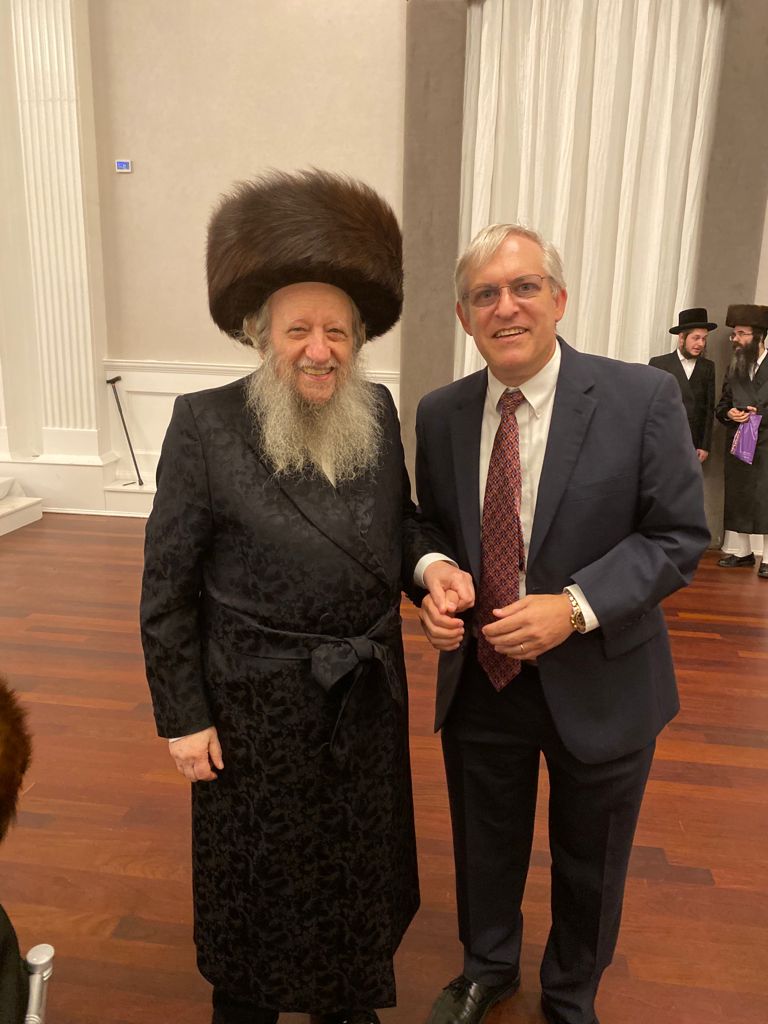
Here is a picture of R. Schwartz and me.
Most of R. Schwartz’s books bear the title Yekev Efraim. Among them are works devoted to talmudic and halakhic themes, including on the Jewish holidays and Shemitah. These books are valuable, and anyone who examines them will find them filled with insights. They are very much what one would expect from a great talmudist. It is in R. Schwartz’s other books, however, that we see the breadth of his learning and appreciate why he is so unusual among today’s great Torah scholars.
R. Schwartz has published three volumes of super-commentary on Nahmanides’ commentary on the Torah. He has also published editions of Nahmanides’ piyyutim in Yeshurun 2 (1997) and Sinai 122 (1998). In Yeshurun 6 (1999) he published Nahmanides’ prayer in Jerusalem, together with a detailed commentary. In 2025, R. Schwartz published his commentary on the Passover Haggadah, which, perhaps surprisingly, also includes kabbalistic interpretations.
There is a good deal that can be said about all of these writings, but I want to turn to his five-volume work, Yekev Efraim: Mikhtavim (hereafter, Yekev Efraim), and his ten-volume Likutei Diburim, which consists of derashot on the weekly Torah portions.
Yekev Efraim contains letters that R. Schwartz wrote on virtually every aspect of Torah. Before noting some of the interesting ideas found in these letters, another point should be stressed. Although R. Schwartz is part of the broader Satmar community, he believes that, when it comes to Torah, “political” disagreements should be set aside.[1] Thus, in this volume he engages in Torah correspondence with a wide range of figures, including academics and Religious Zionist rabbis. His contributions can also be found in the Religious Zionist journals Ha-Ma’yan and Or ha-Mizrah. In an era when people are often disqualified merely because of their positions on issues such as Zionism, it is refreshing to see how R. Schwartz rises above such divisions.
What amazes me most about R. Schwartz’s writings is the boldness with which he presents original ideas. For example, in Yekev Efraim, vol. 5, p. 201, R. Schwartz discusses a story told in Sotah 49a:
Rav Aḥa bar Ya’akov took care of Rav Ya’akov, the son of his daughter [who was an orphan]. When [the grandchild] grew up, [Rav Aha] said to him: Give me water to drink. He said to him: I am not your son, [and I am not obligated in your honor as a son must honor his father. The Gemara comments:] This [explains the folk saying] that people say: Raise, raise [your grandchild, but in the end he will retort:] I am the son of your daughter, [and I do not have to take care of you].
R. Schwartz says this this is a strange Aggadah: אגדה זו ודאי זרה ותמוהה מאד לעניותי
Can anyone honestly say that they disagree? As R. Schwartz writes, even if we say that Rav Yaakov was not obligated by halakhah to respect his grandfather, nevertheless, his grandfather was certainly no less deserving of respect than a random elderly person who asked him for a drink of water. In such a case, no one would respond that because the old man was not his father, there was no reason for him to fetch the water.
When confronted with a text like this, there are different approaches one can take. R. Schwartz’s response is straightforward: We must say that “we do not learn from this Aggadah,” and that it is, at best, a singular opinion that does not bind us. He compares this to what Maimonides writes in his letter on astrology: “It is not proper to abandon matters of reason that have already been verified by proofs, shake loose of them, and depend on the words of a single one of the Sages from whom possibly the matter was hidden.”
Maimonides teaches us that we do not abandon what we know to be true simply because we encounter a talmudic sage who mistakenly believed that astrology was an authentic science.[2] Similarly, R. Schwartz tells us, we do not abandon what we know to be proper behavior based on the totality of rabbinic literature merely because of a strange story in the Talmud. What is noteworthy is that he does not feel compelled to explain the story in a way that conforms to what we regard as proper behavior. It is enough for him to say that this represents an approach that we do not accept, much as Maimonides treats rabbinic views about astrology.
This is a striking example of R. Schwartz’s intellectual independence. Rather than forcing a difficult passage into conformity with a preconceived understanding, he is willing to acknowledge that the passage represents a position that, for whatever reason, we do not accept.[3]
After making this point, as a show of respect, R. Schwartz writes the following
אמנם ודאי שדבריי בטילים ומבוטלים נגד דעת קודש מרן ז”ל [החת”ס] וכל האחרונים שהביאו מגמרא זו. ולא באתי אלא לדון בקרקע לפני אור פניהם החביבות
Yet these words do not take away from his fundamental point.
Let me also add a significant insight from R. Schwartz’s recently published commentary on the Haggadah (p. 90). Ezekiel 20:7-8 states:
And I said to them: Every man cast away the despicable idols from before his eyes and pollute not yourselves with the idols of Egypt; I am the Lord your God. But they rebelled against Me and would not consent to hearken to Me; they did not cast away, every man, the despicable idols from before their eyes, neither did they forsake the idols of Egypt; and I said to pour out My wrath over them, to give My anger full rein over them, in the midst of the land of Egypt.
What we see from this is that the Israelites worshipped idolatry in Egypt before the Exodus. Maimonides, Mishneh Torah, Hilkhot Avodah Zarah 1:3, also mentions that the Israelites in Egypt worshipped the stars and describes the redemption from Egypt as a redemption to the true belief in God. “When the Jews extended their stay in Egypt, however, they learned from the [Egyptians’] deeds and began worshiping the stars as they did, with the exception of the tribe of Levi, who clung to the mitzvot of the patriarchs — the tribe of Levi never served false gods.”
The question R. Schwartz raises is why is this not mentioned in the Haggadah? All we see is the following:
In the beginning our forefathers served idols,[4] but now the Omnipresent One has brought us close to His service, as it is said: “Joshua said to all the people: Thus said the Lord, the God of Israel, your fathers used to live on the other side of the river, Terach, the father of Abraham and the father of Nachor, and they served other gods.”
Why, then, does the Haggadah speak only about the physical Exodus? What about the spiritual Exodus, when the Israelites moved from idolatry to true belief in God? As R. Schwartz notes, this is not merely an issue with the Haggadah, because the Torah itself does not state this explicitly, offering only hints to the matter.
He explains that the night of Passover has a specific purpose, and it would therefore be inappropriate to emphasize that even in Egypt the Israelites were idolaters. He sees this as an example of the principle expressed in Proverbs 10:12: “Love covers up all transgressions.” The night of Passover is not the time to recall the ways in which the Israelites themselves had failed, and that aspect of the story is therefore left unmentioned.
Each year, R. Schwartz’s shul holds a melaveh malkah at which his derashot from the preceding year are distributed in a volume entitled Likutei Diburim. There are many interesting ideas in these derashot, and I would like to share just a few.
In Likutei Diburim, vol. 10, pp. 182ff., he discusses why R. Gershom would ban polygamy when the Torah explicitly permits it. R. Schwartz argues that R. Gershom derived from the Torah itself, in the very passage that discusses polygamy, that it needed to be prohibited. Deuteronomy 21:15–17 states:
If a man have two wives, the one beloved, and the other hated, and they have borne him children, both the beloved and the hated; and if the first-born son be hers that was hated; then it shall be, in the day that he causeth his sons to inherit that which he hath, that he may not make the son of the beloved the first-born before the son of the hated, who is the first-born. But he shall acknowledge the first-born, the son of the hated, by giving him a double portion of all that he hath; for he is the first-fruits of his strength, the right of the first-born is his.
R. Schwartz asks why the Torah presents this case as involving two sons born to two different women. The law would be the same if it concerned two sons of the same wife, or two sons born to a second wife after the death of the first. The Torah need only have established that the inheritance of the firstborn cannot be taken away from him, and we would understand that the rule applies in all circumstances, even when the mother is the “hated” wife.
R. Schwartz explains that “the Torah is teaching us an important lesson: When one marries two women, this is what will happen in the end—that one will be loved and the other hated.” As R. Schwartz sees it, for whatever reason—presumably because polygamy was a widespread practice at the time—God does not prohibit having more than one wife. But He leaves it to the sages to do so in the future: “It is as if I am waiting for one of the sages of Israel to complete the matter and forbid marrying two wives.”
Thus, one cannot ask how R. Gershom could prohibit something that the Torah permits. In R. Schwartz’s understanding, the Torah itself indicates that having more than one wife is ultimately not a good thing. R. Gershom merely recognized and acted upon this underlying message. As R. Schwartz puts it, R. Gershom understood what the “desire of the Torah” (ratzon ha-Torah) is.[5]
In vol. 10, p. 177, R. Schwartz makes another fascinating point. Maimonides, Mishneh Torah, Hilkhot Matnot Aniyim 7:7, writes: “We provide sustenance and clothing for the poor of the gentiles together with the poor of the Jewish people as an expression of the ways of peace (darkhei shalom).” Many have explained Maimonides final words, darkhei shalom, as meaning that we want to prevent hatred from the non-Jews. Therefore, if there was no chance of this, there would not be an obligation to provide charity to the non-Jews. R. Schwartz rejects this reading, as R. Isser Yehudah Unterman famously did years before.[6] R. Schwartz’s originality is seen in the proof he brings. In Hilkhot Megillah ve-Hanukkah 4:14, Maimonides writes: “Peace is great, for the entire Torah was given to bring about peace within the world, as it states: Its ways are pleasant ways and all its paths are peace. (Prov. 3:17.)” What we see from this is that the “ways of peace” are indeed the “ways of the Torah”. R. Schwartz explains that there are things that are not stated explicitly in the Torah, but when we know that the ways of the Torah are ways of peace we can understand what is the way of the Torah and what we are supposed to do. Thus, when the Sages tell us to do something because of “the ways of peace” this means that this is “the way of the Torah,” not a mere utilitarian action.
In Likutei Diburim, vol. 7, pp. 51ff. R. Schwartz offers another fascinating explanation. He cites Rashi, Gen. 32:23, which quotes the Midrash which explains why Dinah is not mentioned when recording Jacob’s crossing the ford of Jabbok:
And his eleven children: But where was Dinah? [Benjamin was not yet born, but Dinah should have been counted.] He put her into a chest and locked her in, so that Esau should not set eyes on her. Therefore, Jacob was punished for withholding her from his brother – [because had he married her,] perhaps she would cause him to improve his ways – and she fell into the hands of Shechem.
Many have discussed this passage, since the notion that Jacob should have wanted Dinah to marry Esau in order to improve him is surprising and hardly consistent with the way Jews have traditionally approached the selection of marriage partners for their children. R. Schwartz also discusses how this passage can be reconciled with the talmudic statement in Pesahim 49b: “Anyone who marries off his daughter to an ignoramus is considered as though he binds her and places her before a lion.” But I want to call attention to another point he makes.
Although the Midrash quoted by Rashi says that Jacob was worried that Esau would set his eyes on Dinah and want her, R. Schwartz suggests that the Midrash deliberately changed the language out of concern for Dinah’s honor. What it really meant, he argues, is that Jacob was worried that Dinah herself would want to go with Esau. He therefore placed her in the box to prevent her from seeing Esau and becoming impressed by him.
R. Schwartz uses this interpretation as a springboard for a discussion of the proper way to educate children. One should not be overly protective of them, he argues, because excessive protection can produce the very opposite of the result one intends. In this regard, he comments:
מן הזהירות שלא להזהר ביותר
It is difficult to accept his claim that the Midrash was actually referring to Jacob’s attempt to prevent Dinah from “going off the derech” with Esau. Nevertheless, the broader message he develops is one that, I think, everyone can embrace.
Many readers are probably aware of Charlie Kirk’s “observance” of the Sabbath. Joseph Lieberman also wrote a book, The Gift of Rest: Rediscovering the Beauty of the Sabbath. The publisher describes Lieberman’s message as follows: “Senator Joe Lieberman shows how ceasing all activity for a weekly Sabbath observance has profound benefit—including health, relationships, and even career advancement—for people of all religions.”
I think many traditional Jews instinctively reject Lieberman’s point, or at least are troubled by the notion that there is any place for non-Jews when it comes to the Sabbath, which is, after all, a uniquely Jewish institution. R. Schwartz, in Likutei Diburim, vol. 4, p. 25, drawing on a comment by Maimonides in the Guide of the Perplexed, offers a suggestion that he himself acknowledges is questionable.
He distinguishes between two aspects of Shabbat. Resting on Shabbat is connected to the memory of our slavery in Egypt and God’s redemption of us. In this respect, there is no place for non-Jews, and they are even forbidden from observing Shabbat.[7] However, honoring and sanctifying the Sabbath, which is connected to belief in the Creation, is also relevant to non-Jews. They are therefore not precluded from honoring and enjoying Shabbat within this framework.[8]
Likutei Diburim, vol. 5, pp. 29ff, is a fascinating derashah on Parashat Va-Yera. He discusses Berakhot 54b, which says that if you see Lot’s wife’s pillar, you recite the blessing Dayan ha-Emet. This is recorded in Shulhan Arukh, Orah Hayyim, 218:8.
On this halakhah, the Chafetz Chaim raises a problem.[9]
ולא ידענא לפי מה שמבואר לקמן ברכ”ה ס”ט דברכת דיין האמת הוא דוקא כשמצטער על הענין ע”ש דלפיכך לא מברכינן על עו”ג והיא בודאי איננה ישראלית
He notes that the Shulhan Arukh later rules that Dayan Ha-Emet is recited only when something causes you distress. Accordingly, one would not recite Dayan Ha-Emet over the death of a non-Jew. How, then, can we be instructed to recite Dayan Ha-Emet over Lot’s wife?
R. Schwartz writes that he has no doubt that the “Holy Chafetz Chaim” did not write these words. I wonder whether this is another example of a writer using such a formulation not because he genuinely doubts the authenticity of a passage, but rather as a respectful way of expressing strong disagreement with it.[10] As I have mentioned on a number of occasions, this is how R. Moshe Feinstein’s rejection of the authenticity of numerous passages in the rishonim has been explained. It is not that he necessarily believed that the rishon did not write those words, but rather that this was a respectful way of rejecting what the rishon was saying. Perhaps the same is true in this case.
R. Schwartz explains that, in general, it is true that one does not feel the same pain over the loss of someone who is not “from our brothers, the children of Israel.” This, he says, is simply human nature: People naturally feel the greatest pain for those to whom they are closest. There are, however, certainly exceptions. A person can be close to a non-Jew and feel genuine grief over his death. Indeed, R. Schwartz argues that it is entirely appropriate to feel such pain when one had a meaningful connection with the non-Jew and the non-Jew had treated him well.
יתכן שהיה זה הגוי קרוב אליו שעשה לו טובות וכו’, ומצטער עליו. ונכון הוא שיצטער עליו
He then explains that the prophets of Israel were concerned not only with the Children of Israel but with all of humanity. Anyone familiar with Hasidic literature knows how unusual—and, I would say, impressive—these words are.
R. Schwartz next raises a genuine difficulty: How can one feel pain over the death of Lot’s wife when so many centuries have passed since her death? Even if she was a righteous Jewish woman, one cannot experience genuine grief over someone who died so long ago. What, then, is the meaning of reciting the blessing Dayan ha-Emet in this context?
He suggests that the blessing is not really about Lot’s wife herself, but about the entire episode, including the destruction of Sodom and Gomorrah. In this sense, the blessing responds to Abraham’s challenge (Gen. 18:25): “Far be it from You to do such a thing, to slay the righteous with the wicked, so that the righteous should be as the wicked; far be it from You; shall not the Judge of all the earth do justly?”
For R. Schwartz, the blessing is really an affirmation that God is a shofet emet, a true and just Judge. That, he suggests, would actually be the more precise formulation of the blessing. The Sages, however, chose the standard formulation, Dayan ha-Emet.
He then makes an important point: Our Sages were not archaeologists. They were not concerned with determining whether the pillar of salt that people identified as Lot’s wife was actually her. It was enough that this was the tradition and that the pillar served as a means of remembering Lot’s wife and the events surrounding her. R. Schwartz adds that he believes this principle applies to all the examples mentioned in Berakhot 54a, where one is instructed to recite a blessing in order to commemorate a miracle:
One who sees the crossings of the [Red] Sea, [where Israel crossed]; and the crossings of the Jordan; and the crossings of the streams of Arnon; the hailstones of Elgavish on the descent of Beit Ḥoron; the rock that Og, King of Bashan, sought to hurl upon Israel; and the rock upon which Moses sat when Joshua waged war against Amalek; and Lot’s wife; and the wall of Jericho that was swallowed up in its place. On all of these [miracles] one must give thanks and [offer] praise before God.
R. Schwartz writes:
ונראה לי כי גם שאר הדברים שאמרו שם בברייתא שמברכים עליהם ברכת הנסים, כגון הרואה מעברות הים או הרואה אבן שישב עליה משה רבינו – חכמי הברייתא לא נתנו עליהם חותמת האמת, לומר שאמנם מכירים הם מקומות אלו והם הם המקומות שהיו בשעתם. אלא שלא איכפת להם דבר זה
In other words, the Sages do not require you to see the actual rock upon which Moses sat. It is enough that there is a tradition, or that people believe, that it is the rock, because the blessing is not recited over the rock itself but over the miracle. As long as the object serves to recall the miracle, that is sufficient to warrant the blessing.
R. Schwartz also notes that Maimonides does not mention anything about the blessing recited over Lot’s wife. One possible explanation is that he omitted it because, by his time, no one knew where the pillar was located. R. Schwartz, however, is not satisfied with this answer and offers a fascinating alternative.
The Talmud, Berakhot 54b, states: “We understand [why this blessing should be said over] all the others, because they are miracles, but the transformation of Lot’s wife was a punishment –פורענותא הוא. One should say on seeing it, Blessed be the true Judge (Dayan ha-Emet).”
According to R. Schwartz, in what I would describe as an academic approach, Maimonides thought that the Gemara’s question, פורענותא הוא, is a strong question and he does not accept the answer given in the Gemara that the blessing recited is Dayan ha-Emet, because why would one recite this blessing over an event that happened so long ago when no one today feels any pain? This is the reason why Maimonides omits this from the Mishneh Torah.
ונראה לי כי הרמב”ם סובר כי הקושיא שהקשו בתחילה על ברייתא זו שמנו את הרואה אשתו של לוט שהוא מברך ומשבח – “הא פורענות היא”, היא קושיא חזקה, והתירוץ שאמרו שמברך ברוך דיין האמת, אינו נשמע לו – לא להעמיסו בברייתא, ולא מצד עצמו. כי מה טעם לברך ברכה זו על דבר שהיה לפני זמן רב ואין האדם מצטער כנ”ל. ועל כן אומר הרמב”ם מכח קושית הגמרא – סמי מכאן אשת לוט
We see another example of what we might call R. Schwartz’s humanism in Likutei Diburim, vol. 8, p. 106. He notes that when Elijah ordered the prophets of Ba’al to be killed (1 Kings 18), he did not order the masses to be killed; indeed, the people subsequently repented. He sees a similar pattern in the episode of the Golden Calf (Ex. 32), where Moses commanded the Levites to kill those who had led the people astray, while the masses abandoned the Golden Calf once they saw that Moses had returned.
R. Schwartz applies this principle—that those responsible for leading others into terrible sins are the ones subject to punishment, rather than the masses who follow them—to his understanding of Maimonides’ statement in Mishneh Torah, Hilkhot Rotzeah 4:1 (also Hilkhot Mamrim 3:2), that it is a mitzvah to kill Jewish idolaters and heretics. According to R. Schwartz, it is a mistake to understand Maimonides as applying this to every individual who worships idols or does not accept basic Jewish beliefs.
To understand Maimonides’ intent, he argues, one must examine Hilkhot Avodah Zarah 10:1, where Maimonides writes: “It is a mitzvah to eradicate mosrim, minim, and epikorsim, and to cause them to descend to the pit of destruction, since they cause difficulty to the Jews and sway the people away from God.” Here we see that these people are to be killed not because of their beliefs per se, but because of the effect they have on others. Their defining characteristic is that they lead people away from God.
Thus, R. Schwartz establishes a striking principle: Maimonides’ statements that are often understood as extremely harsh are not directed at what we might call “private heretics,” but rather at those who actively seek to lead others away from proper belief.
Although R. Schwartz does not mention this, his interpretation also accords with Maimonides’ words in Hilkhot Teshuvah 3:7–8, where he defines a heretic as one who “says”—that is, publicly declares—his heresy. Maimonides could have defined a heretic, with all the communal consequences that follow, as someone who merely holds a heretical belief. Instead, his language places the emphasis on one who articulates and publicizes such beliefs, thereby making himself a danger to the community at large.[11]
R. Schwartz’s keen insight is also seen in how he explains another passage in Maimonides (Likutei Diburim, vol. 2, p. 30). Hilkhot Avel 1:10 states:
We do not conduct mourning rites for all those who deviate from the path of the community, i.e., people who throw off the yoke of the mitzvot from their necks and do not join together with the Jewish people in the observance of the mitzvot, the honoring of the festivals, or the attendance of synagogues and houses of study. Instead, they are like free and independent people like the other nations. Similarly, we do not mourn for heretics, apostates, and people who inform on Jews to the gentiles.
Instead, their brothers and their other relatives wear white clothes, robe themselves in white, eat, drink, and celebrate for the enemies of the Holy One, blessed be He, have perished. Concerning them, Psalms 139:21 states: Those who hate You, o God, will I hate.
R. Schwartz notes that Maimonides states that “their brothers and other relatives” celebrate the death of these heretics. However, for fathers and mothers there is no such expectation. That is because the Torah does not demand things that are against human nature which God has instilled in people, such as a parent’s love for a child. No matter how bad a child is, the parent will always love and want the best for him, and R. Schwartz notes, we see that with Abraham and Ishmael and Isaac and Esau.[12]
Maimonides states (Hilkhot Avadim 9:8):
It is permissible to have a Canaanite slave perform excruciating labor. Although this is the law, the attribute of piety (midat hasidut) and the ways of wisdom is for a person to be merciful and to pursue justice, not to make his slaves carry a heavy yoke, nor cause them distress. He should allow them to partake of all the food and drink he serves.
In Likutei Diburim, vol. 8, pp. 141–142, R. Schwartz comments that some people believe that even in a matter such as this, it is sufficient to follow the letter of the law and that there is no need to go beyond it through acts of hasidut. R. Schwartz calls this a “very great error.”
When it comes to matters between one person and another, R. Schwartz argues, “hasidut is the basic halakhah, how one is supposed to behave.” When Maimonides writes, “Although this is the law,” he does not, “Heaven forbid,” mean that one is permitted to behave in this manner. Rather, he means only that a beit din cannot compel a person to do more than the strict requirements of the law. But someone who behaves in such a manner voluntarily, when the circumstances call for more, is acting improperly.
In support of this approach, R. Schwartz cites Bava Metzia 30b, which teaches that Jerusalem was destroyed because the courts adjudicated their cases strictly according to Torah law (din Torah). From this, he concludes that Jerusalem was destroyed because people failed to practice hasidut. There are therefore times when hasidut, although technically categorized as lifnim mi-shurat ha-din, is nevertheless the standard of behavior that a person is actually expected to follow.
R. Schwartz points to the concluding words of Maimonides:
Cruelty and arrogance are found only among idol-worshipping gentiles. By contrast, the descendants of Abraham our patriarch, i.e., the Jews whom the Holy One, blessed be He, granted the goodness of the Torah and commanded to observe righteous statutes and judgments, are merciful to all.
We see from this that midat hasidut is identified with the Torah and “righteous statutes and judgments”.
What does Maimonides refer to at the beginning of the halakhah when he speaks of “the attribute of piety (midat hasidut) and the ways of wisdom is for a person to be merciful and to pursue justice”? R. Schwartz says that midat hasidut refers to the Torah approach and “the ways of wisdom” refers to philosophy. He illustrates this by pointing to Hilkhot Teshuvah 5:5 where Maimonides says that we know man has free will even with God’s foreknowledge: “This matter is known, not only as a tradition of faith, but also, through clear proofs from the words of wisdom.” It is clear from this formulation that when Maimonides speaks of “words of wisdom” that he is referring to philosophy, which is listed together with “a tradition of faith,” which refers to Torah tradition. R. Schwartz also calls attention to the words at the very beginning of the Mishneh Torah: “The foundation of all foundations and the pillar of wisdom.” Here, too, the word “wisdom” refers to philosophy.
Finally, with regard to the issue of slavery, R. Schwartz, Likutei Diburim, vol. 8, p. 142, states that slavery was an acceptable institution only in a world in which there were no machines to perform the necessary agricultural labor. Today, however, when machines can perform this work, slavery is certainly an injustice.
In Likutei Diburim, vol. 5, pp. 58ff., R. Schwartz explains why Purim was established as a time of “feasting and joy,” while Hanukkah was established as a time to “thank and praise” God, with no requirement of feasting. R. Schwartz suggests that until the Anshei Kenesset ha-Gedolah in the Second Temple period, people understood simhah to mean rejoicing through a meal accompanied by wine. This was the common understanding, and the prophets left the matter as it was understood by the people. Alternatively, R. Schwartz even suggests that it is possible that the prophets themselves shared this conception.
It was the Anshei Kenesset ha-Gedolah, or even later sages, who established a more profound understanding: Whenever we speak of simhah, the true meaning is to thank and praise God. This conception of simhah is obviously more advanced than that of earlier generations. As mentioned, R. Schwartz suggests that the prophets themselves may have held the more primitive conception. Yet he says that this should not trouble us, and he derives from Yoma 69b that it is possible that the Anshei Kenesset ha-Gedolah possessed a deeper understanding of the matter than even the prophets, as well as Mordechai and Esther who instituted the Purim celebration as a feast accompanied by wine.
Once Mordechai and Esther established this form of simhah for Purim, however, a later beit din could not alter it, and the joy of Purim therefore had to remain associated with wine and feasting. When the Anshei Kenesset ha-Gedolah instituted Hanukkah, by contrast, they understood that the true form of simhah is not the enjoyment of wine but thanksgiving and praise to God.
In Likutei Diburim, vol. 10, p. 170, R. Schwartz explains that in order for the Third Temple, which will be the most perfect Temple, to be built, it was obviously necessary for the Second Temple to be destroyed. He cites R. Moshe Sofer who makes a similar point about the Mishkan: had Shiloh not been destroyed by the Philistines,[13] the Israelites would have had to destroy it themselves. This means that even with the destruction of the Temple, which we mourn, it is not all bad. There is also a positive element, in that through its destruction a greater and more perfect Temple can ultimately be built.
Reading these words reminded me of how R. Joseph Elijah Henkin explains that the days of the Messiah “began” with the destruction of the Temple. This, he says, is the meaning of the Sages’ statement that on Tisha be-Av the Messiah was born. The point is that at this time Israel began to accept the Torah not because they were forced to do so, but out of free will.
R. Henkin further notes that with the exile of the Sanhedrin, the death penalty ceased to be imposed, and with the later end of semikhah, courts could no longer impose monetary fines.[14] R. Henkin sees this development as perhaps having been brought about by God as a preparation for the messianic era. Just as the desire to worship idols has disappeared, so too the desire to murder will ultimately disappear, and there will therefore be no need for the death penalty (or for the various monetary penalties imposed by the courts).
What we see from this is that even with the destruction of the Temple, not everything is negative. Its destruction ushered in a different era, one that could only come about without the Temple and the system of judicial authority that existed when the Temple stood. This is the sort of provocative idea that we are accustomed to encountering in R. Kook, and it is fascinating that both R. Schwartz and R. Henkin express themselves in a similar vein.
What I have presented here is only a small sample of R. Schwartz’s novel ideas and explanations, and to those who wish to know more I say זיל גמור (go and study).[15]
Appendix
Maimonides’ words about killing heretics—which derive directly from Avodah Zarah 26b—will obviously be problematic for people with modern sensibilities. In fact, Maimonides’ formulation came up during my recent Torah in Motion trip to Portugal, where we discussed the Inquisition at length. Many readers will no doubt be familiar with statements by Rav Kook and the Hazon Ish explaining why Maimonides’ ruling is no longer applicable.
An earlier attempt at this was made by R. Benjamin Zev Viller of Jaroslaw, Galicia, who was known as a very open-minded individual.[16] He is the author of the three-volume work, Binyamin Ze’ev Aharon. Here is the title page of volume 1.
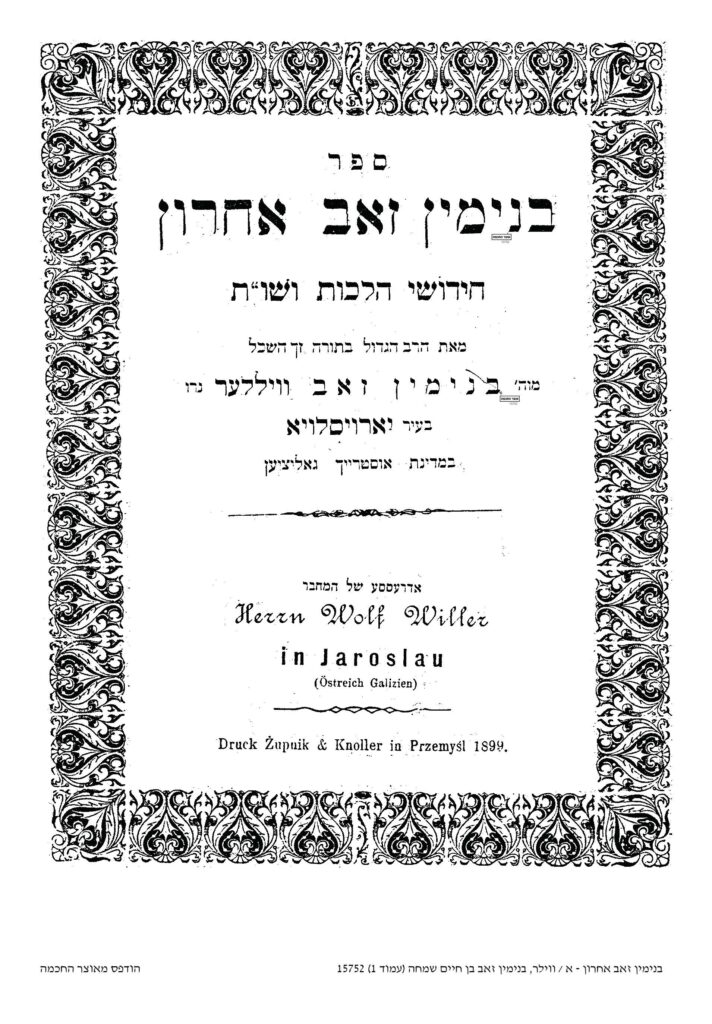
This volume, no. 75, contains one of the earliest discussions of the halakhic status of the international dateline.
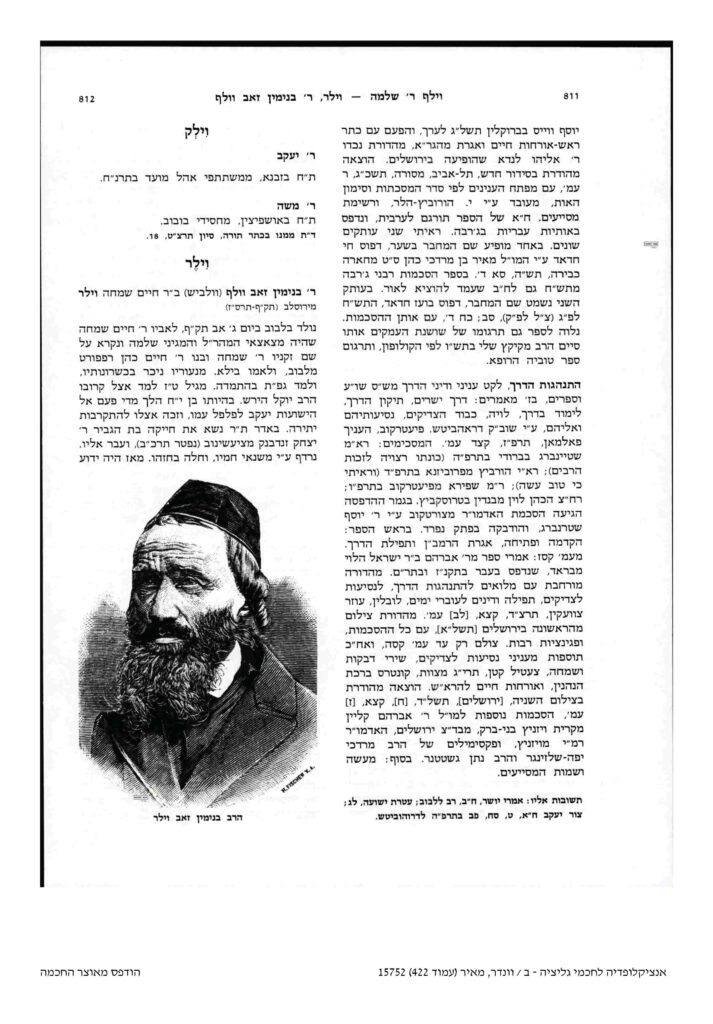
Here is his picture which appears in Entzykopedia le-Hakhmei Galicia, vol. 2, col. 812.
According to R. Viller, the passage in Avodah Zarah 26b that one is to kill heretics (and also informers and apostates) is an aggadic passage from which one does not derive practical halakhah. It was intended only for an era when the heretics oppressed the believing Jews.
והמאמר הנ”ל בע”ז כו’ הוא בעיני כאחד מכמה מאמרי אגדה שאין למדין ממנו כנודע (עיין תוס’ יו”ט משניות ברכות פ’ ה’ מ”ד, ובנו”ב תנינא חלק יו”ד ס’ קס”א) ואמרוהו חז”ל רק לשעתם בדרך גוזמא והפלגה, לאשר נרדפו מאד והיו להם צרות הרבה מהמינים והאפיקורסים, לא שנקבע הלכה זו לדורות
This leads R. Viller to express his astonishment that Maimonides, in the Mishneh Torah, recorded the passage in Avodah Zarah as a binding halakhah. He further notes that if this was indeed the halakhah, why did the Sages not kill the heretic Elisha ben Avuyah? Furthermore, the Yerushalmi, Hagigah 2:1, describes how R. Meir even visited Elisha on his deathbed. R. Viller also notes that Sanhedrin 99b defines an epikoros as one who treats a Torah scholar with contempt. Thus, according to Maimonides, it is a mitzvah to kill any such person. R. Viller points out, however, that according to the Talmud, the punishment for degrading a sage is not death, but rather a monetary fine or being placed in herem.
ובסנהדרין צ”ט אמרינן בגמ’ דאפיקורוס הוא המבזה תלמיד חכם (וכמו שפירש הר”ן שם בע”ז כו’ על הרי”ף) וא”כ להרמב”ם יהיה מצוה להרוג את כל מבזה ת”ח וכל הש”ס מלא כי מבזה ת”ח נועשין אותו בממון או בנידוי, ולא שנמיתו ונורידו לבאר שחת. גם קשה לי דאיך צוה להרוג אותם אנשים בזמן הזה והא אין דנין דיני נפשות בזמן הזה
R. Viller then states that Maimonides clarified his intent in Hilkhot Avodah Zarah 10:1—the same passage cited by R. Schwartz—where he explains that heretics are killed because “they cause difficulty to the Jews and sway the people away from God.” In other words, Maimonides is not speaking of killing all heretics, but only those particular heretics who cause problems for the Jewish community. R. Viller concludes that it is certainly forbidden to harm a heretic who does not cause difficulties for others, whom we might a “private heretic.”
במינים ואפיקורסים שהולכים בדרך הישר ואינם עושים רע לאדם, בודאי אסור לעשות להם רע וחלילה להרגם
R. Viller then notes that R. Joseph Karo was not sufficiently careful in Shulhan Arukh, Yoreh Deah 158:2, where he mentions killing heretics without including Maimonides’ clarification that this applies because of the difficulties they cause the Jewish community. In other words, R. Karo appears to sanction the killing even of “private heretics.” R. Viller finds this difficult, since R. Karo is effectively condemning to death people who have sinned only through their intellect, and inadvertently (bi-shegagah), rather than through any action. I assume that R. Viller refers to this as “inadvertent” because one does not consciously choose to adopt a heretical belief. Rather, it is something that one comes to believe through one’s reading or life experience. This differs from intentionally (be-mezid) disobeying God by performing an action, such as eating on Yom Kippur.
Amazingly, R. Viller continues by stating that it was this formulation in the Shulhan Arukh that led some people to want to kill the “great philosopher” Spinoza. (I do not know whether anyone in Amsterdam actually intended to do so.) He adds that R. Karo’s words also led people “in our day to kill a well-known preacher, thereby causing the name of Israel to be disgraced among the nations.” He concludes that we do not wish to kill anyone. Rather, our desire is to bring such people back to correct beliefs, as Beruriah famously taught that we should pray not for sinners to die, but for their sins to cease (Berakhot 10a).
והרב בית יוסף לא נשמר בדברי’ שהוא לא העתיק טעמו של הרמב”ם וכתב סתם בשו”ע יו”ד ס’ קנ”ח סע’ ב’ האפיקורסים שכופרים בתורה ונביאים מצוה להרגם, וזה תמוה כי צוה להרוג אנשים שחטאו בשכלם בשגגה ולא במעשה, וכמה אנשים טעו אחריו, שרצו להרוג את הפילוסף הגדול שפ’, והרגו בדורנו את המטיף הידוע ונתחלל שם ישראל בין האומות, ואנחנו נאמר כי אסור להרגם ונשתדל להשיבם לדעות הטובות וכמו שאמרה ברוריה אשת ר”מ (ברכות דף יוד) מי כתיב יתמו חוטאים יתמו חטאים כתיב
The preacher who was (allegedly) murdered by an Orthodox Jew refers to Rabbi Abraham Kohn, the Reform rabbi of Lemberg. This story is the subject of Michael Stanislawski’s book, A Murder in Lemberg.
Notes
- Unfortunately, there are some in Satmar who have a different approach, and their disgusting indoctrination of children can only be described as antisemitic. See e.g., this video where the Zionists are blamed for World War II. See also this video, where Satmar children are encouraged to throw eggs at a car they are told is carrying Netanyahu. I am sure Mamdani would derive a lot of chizzuk from seeing these videos.
There is a relevant passage in R. Moshe Feinstein, Mesorat Moshe, vol. 1, p. 591:
ורבינו קרא בעיתון של חוגי הקנאים שכותבים, כדרכם, שחב”ד אפיקורסים מצד שלא חוששים לענין של הג’ שבועות, שלא לעלות בחומה וכדומה. ואמר רבינו שזה פליאה איך שאנשים משתמשים בשם “אפיקורס” כ”כ בקלות. הלא אם מישהו שומר המצוות ושומר להשקפות שמוזכר שמעכבים, מה שייך לקרותו אפיקורס בשביל דבר כזה! ובכלל מה שייך לעשות עסק גדול על דבר כזה, שמוזכר רק בגמרא, בשו”ע לא מוזכר, ואפילו רוב הראשונים לא מזכירים אותו, רואים שאינו מעיקרי היהדות, ובכלל זה דבר שאפשר לפרשו כמו שרוצים, ומה שייך לעשות אפיקורס בשביל זה!
One should not assume that it has only been Satmar which views the so-called Three Oaths as significant. For example, R. Samson Raphael Hirsch also assumed that they are binding. See Horeb, ch. 608. See also Aviezer Ravitzky, Ha-Ketz ha-Meguleh u-Medinat ha-Yehudim (Tel Aviv, 1993), pp. 277-305, for many examples of how the Three Oaths have been taken very seriously throughout Jewish history.
Based on a slavish attachment to the Oaths, R. Abraham Lowenstamm, in his anti-Reform polemic Tzeror ha-Hayyim (Amsterdam 1820), pp. 74b-75a, arrives at a ridiculous, and anti-halakhic, conclusion. He claims that when Ahasueras approved Haman’s order to kill the Jews, the Jews were forbidden to defend themselves, since doing so would violate the oath not to rebel. Only after Mordechai wrote to them, as described in Esther, chapter 8, informing them that the king had never forbidden them to defend themselves did they take up arms.
R. Lowenstamm’s words are a good example of how authentic Jewish values were distorted in the long years of exile.
השבועה שאמרנו למעלה שהשביע ד’ את ישראל בלי שום תנאי, שלא ימרודו באומות בכל עת גלותם, היא אשר אסרה את ידם לבלתי ירימו יד או רגל למרוד במצות המלך. ואם חמת מלך מלאכי מות. ולפי שבאו ספרי המן בשם המלך ונחתם בטבעת המלך, לא היו רשאים להוציא חרב מתערה להציל את עצמם ולסמוך על הנס, כי אז הוסיפו חמת ד’ עליהם בעברם על השבועה אשר השביעום, והיא לא תצלח. לכן היו טומנים ידיהם בצלחת לבלתי ימרודו במצות המלך, ולא הי’ כחם אלא בפה, להרבות בתשובות וצומות ולבקש מד’ שירבה להשיב אפו, והוא יגאלם מיד צריהם . . . היהודים היו יראים מחטוא לד’ בהרימם יד נגד מצות המלך, ולכן לא הכינו את עצמם למלחמה כלל. על זה כתב מרדכי בפירוש בשם המלך ונחתם בטבעת המלך, שהוא, ר”ל המלך, מרשה את היהודים להקהל ולעמוד על נפשם להשמיד וכו’ את כל חיל עם ומדינה הצרים אותם; וכיון שנתנה להם רשות מאת המלך לעמוד על נפשם . . . שבו ונתעוררו הלבבות הנרדמות, וילבשו חיל ויאזרו גבורה
This passage reminded me of another interesting idea. R. Reuven Reicher claims that one can only violate Shabbat to save one’s life if there is a possibility that you can succeed. Therefore, if a large group of people are coming at you to kill you, and your death is certain, he claims that it would be forbidden to violate Shabbat to fight them off. Rather, you should simply stand there and allow them to kill you. He uses this approach to explain the story in I Maccabees, ch. 2, that the Jews refused to fight the Greeks on Shabbat, even though it led to their deaths. See Ha-Pisgah 4 (1897), p. 28. R. Isaac Halevy, Dorot ha-Rishonim, vol. 1, p. 171b, also explains the story in I Maccabees this way.
Another example of how Jewish values were distorted in the Exile is seen in a speech on patriotism given by R. Salomon Breuer at the 1912 Agudat Israel founding conference in Kattowitz, Germany. He stressed that Jews are to be patriotic to the government despite all persecution—even if they are given a Jewish mark to wear and even if they are murdered!
ובשם אלקים הננו נאמנים לכל ממלכה, לכל מדינה, אפילו אם דמנו נשפך שם כמים, גם אם תו של קלון יושם בה על גבנו, גם אם מוקדי-אש יערכו לנו שם
This text is quoted by Yaacov Sassoon in Hakirah 26 (Spring 2019), p. 18 (Hebrew section).
This is just a more extreme development of an idea earlier stated by Breuer’s father-in-law, R. Samson Raphael Hirsch. Speaking of the obligation of Jewish loyalty to the non-Jewish rulers, he writes (Horeb, p. 462 [ch. 96]):
This duty is an unconditional duty and not dependent upon whether the State is kindly intentioned towards you or is hard. Even should they deny your right to be a human being and to develop a lawful human life upon the soil which bore you, you shall not neglect your duty. . . . Loyalty towards king and country and the promotion of welfare wherever and however you can.
In reading what R. Hirsch and especially R. Breuer wrote, I can’t help but think of R. Moses Avigdor Amiel’s comments, which I think perfectly capture the problem (Derashot El Ami, vol. 3, p. 36):
הגלות למדה אותנו שמותר להחניף לרשעים בעוה”ז, שנאמר “כי על כן ראיתי פניך כראות פני אלקים”, אכן גם זה היה תחילתו באונס וסופו ברצון ונתרגלנו בחנופה גם לצורך וגם שלא לצורך, והעברה לשמה נעשה לעברה פשוטה ומלאכה הצריכה לגופה ↩
- Are there examples paralleling this in halakhic matters? One that comes to mind was noted by R. Yehudah Seiwald in Hitzei Giborim 9 (2016), p. 494. He cites a case where R. Hananel rejects what Samuel says because R. Hananel sees it as contradicted by a principle found throughout the Talmud. On p. 496 n. 19, Seiwald writes:
שבעצם רבנו חננאל חולק על גמרא מפורשת על פי טענה שהגמרא נוגדת כלל מוסכם בכל הש”ס
R. Isaiah of Trani states that sometimes you cannot rely on what an amora states in a halakhic matter as he was not speaking in a serious halakhic fashion. See Sefer ha-Makhria, ed. Wertheimer, col. 425:
שמה שמתרצים האמוראים שם עוקרים שלשה פסקי הלכות, ואין לסמוך עליהם, שאינם אלא חידודים בעלמא ופלפולים שהיו עושין האמוראים ↩
- His approach is also in line with medieval Sephardic approaches to Aggadah, about which much has been written. I recently came across Radak to 1 Kings 2:19, which is also in this category, as he refers to a talmudic Aggadah as רחוק מאד. That is his way of saying that he does not accept it. In Radak’s commentary to 1 Sam. 28:24, he quotes R. Samuel Ben Hofni that aggadot should not be accepted when they contradict reason. ↩
- One question that many have discussed is if this also includes Abraham among those who worshipped idols. R. Schwartz assumes that it only refers to those who preceded Abraham. ↩
- R. Jehiel Jacob Weinberg uses this notion of ratzon ha-Torah in a similar way. He says that even though there is no explicit Torah prohibition against cannibalism, it is certainly against the ratzon ha-Torah. See Seridei Esh, vol. 3, p. 342:
ודוגמא לדבר אכילת בשר אדם, דבודאי הוא נגד רצון התורה בלי שום ספק, ומ”מ כיון שלא נכתב בתורה לאו מפורש יש מן הראשונים שסוברים שאיסור זה אינו אלא דרבנן ולהרמב”ם ז”ל אינו אלא אזהרת עשה ↩
- See Unterman, Shevet mi-Yehudah, vol. 3, no. 70. ↩
- See Sanhedrin 58b: “Resh Lakish also said: A heathen who keeps a day of rest, deserves death, for it is written, And a day and a night they shall not rest (Gen. 8:22) . . . Ravina said: Even if he rested on a Monday.” R. Elijah David Rabinowitz-Teomim suggests –in opposition to Rashi’s explanation—that our talmudic text here is censored. He thinks it is obvious that the original read: “Ravina said: Even if he rested on a Sunday.” See Mikavtze’el 37 (5771), p. 92. ↩
- According to R. Jehiel Jacob Weinberg, Seridei Esh, vol. 2, no. 92, the prohibition of non-Jews observing Shabbat is only when they intend on doing so as an actual new commandment for them, but not if they simply wish to rest on that day.
בשבת האיסור הוא רק אם רוצה לקיים מצות שבת ולהוסיף על דתו ↩
- Sha’ar ha-Tziyon, 218:22. ↩
- This relates to a point which really needs to be explored, namely, how and why the Mishnah Berurah assumed what can only be called canonical status. I presume R. Eitam Henkin was planning on examining this point in his dissertation on the Chafetz Chaim had he not been murdered. The Chazon Ish spoke very strongly about the Mishnah Berurah as a having an authority above all other modern works. R. Aaron Kotler also was very attached to the sefer and often carried it with him. On the other hand, R. Joseph Elijah Henkin and R. Moshe Feinstein viewed the Arukh ha-Shulhan as more authoritative than the Mishnah Berurah. For R. Henkin’s view, see R. Yehuda Herzl Henkin, Bnei Vanim, vol. 2, p. 209. For R. Feinstein’s view, see R. Michel Shurkin, Meged Givot Olam, vol. 2, p. 83.
In fact, in Mesorat Moshe, vol. 2, p. 417, R. Moshe is quoted as saying that the Mishnah Berurah was not intended to serve as a definitive halakhic authority for the Jewish people, but rather was written for the masses so that they would know how to conduct themselves.
אבל המשנה ברורה בעצמו היה נכתב בעיקר לא לפסקי הלכות לכלל ישראל, אלא לעמי הארצות, שמאחר שלא שכיח להם הספרים והיכולת לשאול, ואלו דברים שנוגעים תמיד, היה צורך שיהיה להם ספר שבו מבורר בכלליות. ואף שזה היה עיקר התכליתה, לפעמים מוסיף המ”ב קצת אריכות בלומדות, כשרצה לחדש משהו
This is not how R. Moshe would categorize the Arukh ha-Shulhan. Still, I don’t know if the introduction to the Mishnah Berurah, where the Chafetz Chaim explains what led him to write the book, leads to R. Moshe’s conclusion. For an attempt to push back against the Mishnah Berurah’s canonical status, see the video of R. Hershel Schachter here (called to my attention by R. Mordechai Berger).
The increasing significance of the Mishnah Berurah is also reflected in a story recorded in David Page, Rav Gustman: The Youngest Dayan of Vilna and Illustrious Rosh Yeshivah in New York and Yerushalayim (New York, 2017), pp. 149-150:
When R’ Gustman entered the room, the Tchebiner Rav was seated at his table learning from a sefer that he quickly placed on his lap, it appeared as if due to embarrassment. He then reconsidered and lifted the sefer back up to the tabletop. The sefer was the Mishnah Berurah. He said, “We don’t have to hide something like that anymore.” Before the war, there were great Torah scholars, and each had his own approach in deciding halachah. After the war, there was a much greater reliance on the Chofetz Chaim’s illustrious sefer.
Regarding the notion that books that are now regarded as standard halakhic texts were in earlier times viewed as intended for the masses, R. Judah Mintz (d. 1508) mentions that there are rabbis who do not study the Tur, Orah Hayyim because that is what the masses study. See She’elot u-Teshuvot Mahari Mintz, no. 15:
ויש מהרבנים שאינם רוצים אפילו לקרות בטור או”ח ונותנין טעם שהבעלי בתים לומדים אותו ↩
- See Appendix. ↩
- Since I deal with R. Benjamin Zev Viller in the appendix, I should mention that he disagrees with R. Schwartz’s point here. See Binyamin Ze’ev Aharon, vol. 2, p. 17b, where he states that since Rebekka, unlike Isaac, knew that Esau was evil, she did not love him. He also implies that had Isaac known the truth about Esau, he would not have loved him either.
ויצחק שהי’ סומא חשב כי בכל מעשיו ישר הוא לכן אהב אותו ורקבה שהיתה יודעת כי רשע הוא לא אהבה אותו ↩
- See Akiva Males, “The Destruction of the Tabernacle of Shiloh,” Jewish Bible Quarterly 44:1 (2016), available here. ↩
- Kitvei ha-Gaon Rabbi Joseph Eliyahu Henkin, vol. 2, p. 227. ↩
- These words are from the famous story of Hillel, Shammai, and the convert in Shabbat 31a.
שוב מעשה בנכרי אחד שבא לפני שמאי א”ל גיירני ע”מ שתלמדני כל התורה כולה כשאני עומד על רגל אחת דחפו באמת הבנין שבידו בא לפני הלל גייריה אמר לו דעלך סני לחברך לא תעביד זו היא כל התורה כולה ואידך פירושה הוא זיל גמור
Jacob Reifman, Ruah Hadashah (Pressurg, 1885), p. 15, claims that the word גמור makes no sense and the text should be emended to read זיל גייר. For such an emendation to work, the word גייריה (“He converted him”) that appears earlier in the text must be deleted or be understood to be referring to Hillel converting him after telling him, “Go and convert.” R. Baruch Epstein, as was his wont, mentioned this emendation without acknowledging that he had taken it from Reifman. See Torah Temimah, Deut. Ch. 33, note 13, Barukh she-Amar: Haggadah shel Pesah (Tel Aviv, 1965), p. 30. R. Elijah David Rabinowitz-Teomim liked Reifman’s emendation, but he was not sure if it was in line with accepted halakhah. See Mikavtze’el 37 (5771), p. 92. ↩
- See Ha-Magid, Nov. 13, 1878, p. 383, from where all the Hebrew texts I have cited appear. ↩