Azariah’s Choice: Scribal Identity, Egypt, and the Jewish Cosmopolitan Temptation
Azariah’s Choice: Scribal Identity, Egypt, and the Jewish Cosmopolitan Temptation
Aton M. Holzer
The chaotic aftermath of the Babylonian destruction of Jerusalem in 586 BCE is depicted in Jeremiah chapters 40-44. The Babylonians installed Gedaliah ben Ahikam as governor over the remaining Judahite population, hoping to maintain some form of governance. However, Gedaliah’s political naïveté leads to his assassination by Ishmael ben Nethaniah, a royal scion with unclear motives who also murders many others and takes captives. Johanan ben Kareah and other military leaders seek Jeremiah’s divine guidance on whether to stay in Judah or flee to Egypt. Jeremiah receives no communication from God for ten days. When it does come, the message is unequivocal: the people are to stay. The people reject this prophecy and flee to Egypt, taking Jeremiah with them.
Recent work by William Schniedewind has posited different scribal communities at work in ancient Judah. These included guilds of royal-historical scribes, administrative scribes, refugee scribes from Samaria, military scribes, temple/priestly scribes, landed-elite (am ha-aretz) scribes, and prophetic scribes, among others.[1] Each group had its own scribal curriculum, which likely included biblical passages, or even entire books that were most relevant to their particular guild.[2] In a recent article,[3] the present author has argued that the story can be read such that each of the key figures in the story represents a different scribal tradition, and part of the tragedy of chapters 40-44 stems from different protagonists reading the situation from one particular perspective, without the benefit of the entirety of the Biblical canon, or most crucially, Sefer Melakhim, which would be composed – per Hazal, by none other than Jeremiah – only later. For three of the protagonists, it seems possible to make a tentative identification of their tradition:
- Gedaliah ben Ahikam
- Scribal Tradition: Shafanide bureaucrats
- Background: From a family heavily involved in Temple-state administration, closely connected to Jeremiah and his prophecies, with relatives involved in Temple reforms and protection of Jeremiah. Gedaliah’s preferred texts likely included an early or draft version of the Book of Jeremiah itself.
- Ishmael ben Nethaniah
- Scribal Tradition: Scribal royals
- Background: Presumed grandson of Elishama, Jehoiakim’s chief scribe. Ishmael appears to follow the tradition of the Book of Samuel, reflecting the royal court’s scribal curriculum. His actions echo narratives from the Saul-David conflict in Samuel.
- Johanan ben Kareah
- Scribal Tradition: Northern military scribes
- Background: Military commander likely associated with a scribal curriculum centered on the Book of Joshua and military logistics. His actions and concerns reflect themes from Joshua’s biography, emphasizing military leadership and fealty to God’s law.
The response to Jeremiah is difficult to fit into Johanan’s “Joshuaic” profile – leaving the Land is its diametric opposite. But in fact, a new key figure appears here: the lead role in embracing exile is actually taken by one Azariah ben Hoshaiah.
Azariah son of Hoshaiah and Johanan son of Kareah and all the arrogant men said to Jeremiah, “You are lying! The Eternal our God did not send you to say, ‘Don’t go to Egypt and sojourn there’! It is Baruch son of Neriah who is inciting you against us, so that we will be delivered into the hands of the Chaldeans to be killed or to be exiled to Babylon!”
This Azariah seems to have been the key actor in the move that, in Jeremiah’s telling, extinguished the glowing ember of Judahite political life in the First Commonwealth. But his identity and background are a mystery; neither this Azariah nor his father can be securely identified elsewhere in the biblical text.
Is it possible to reconstruct some sort of profile for the family based upon external sources?
Hoshaiahs are represented in the material record – perhaps too amply; three examples have been found, and we cannot know whether they represent the same individual. Since archaeological findings cannot supply anything close to a complete picture, a reconstruction of Azariah based on these findings remains entirely speculative.
But the speculation is tantalizing, and perhaps worthwhile as at least a thought exercise, since the text does see fit to drop his name. If the father of Azariah matches any of the three Hoshaiahs in the archaeological record, his son rounds out the assemblage in Jeremiah 40-44 with the addition of one last scribal group: literate non-elites, the am ha-aretz.
- One bit of evidence is an ostracon from a small agricultural fortress a bit north of modern-day Yavne, known to archaeologists as Meṣad Ḥashavyahu, from Josiah’s reign. Hoshaiah here seems to be a government-appointed agricultural administrator overseeing reapers. He emerges as something of a villain by explicitly violating Exodus 22:25-26 and Deuteronomy 24:12-13, taking possession of a poor subordinate day laborer’s garment and failing to return it the same day. Schniedewind identifies this text as belonging to an originally rural social group, the am ha-aretz scribal community, distinct from the scribes of the royal, temple and military elite.[4] He translates it as follows:
May my lord, the Commander, hear the report of his servant. Your servant was harvesting. Your servant was in Ḥaṣer ʾAsam, and your servant harvested and finished. Now he had stored the grain some days ago before the Sabbath. When your servant had finished [the] harvest and had stored the grain, some days ago, then Hoshaiah, the son of Shobai, came and took your servant’s garment! When I had finished my harvest – this very day – he took your servant’s garment! And all my companions will testify for me, those who were harvesting with me in the heat of the sun. My companions will testify for me. Truly, I am innocent of any gu[ilt. Come, let him return] my garment. Surely the power belongs to the official to retur[n the garment of your] serva[nt. May you hav]e mer[cy] on him [and return the garment of your se]rvant and not remain silent [. . .]
- A Hoshaiah also appears in another text, the Lachish letters – ostraca found in Lachish dating from the decade before the destruction. Hoshaiah, a lower-ranking officer, takes great offense at the accusation by the Lachish commander of illiteracy. He also makes mention of military collaboration with Egypt and the caution of a prophet, which appears to dovetail with the narrative of Jeremiah.[5]
Your servant Hoshaiah sends to report to my lord Yaush: May YHWH cause my lord to hear a good report.
And now please explain to your servant the meaning of the letter that you sent to your servant yesterday. For your servant has been sick at heart ever since you sent it to your servant. And, because my lord said, “Don’t you know how to read a letter?” As YHWH lives, no one has ever tried to read me a letter! And also, any letter comes to me, I can read it. And moreover, I can recount everything in it.
And, as for your servant, it has been reported, saying, “The Commander of the Army Koniah son of Elnatan has moved south in order to enter Egypt.” He has sent (messengers) to fetch Hodaviah son of Ahiah and his men from here.
And, as for the letter of Tobiah, servant of the king, which came to Shallum son of Yadaʿ, from the prophet saying, “Beware,” your servant has sent it to my lord.[6]
Here too is someone apparently outside the upper military scribal elite – but nonetheless literate, probably connected to the rural scribal world, and indignant at the accusation of illiteracy – caught up in the drama of the ḥurban.
- Most interesting is a recent find at the northern extent of the City of David: a seal inscribed with the name Yeho’ezer ben Hosh’ayahu (Jehoezer ben Hoshaiah), which uniquely bears the image of a Neo-Assyrian winged genie, generally used to depict the Mesopotamian mythical apkallū, the seven antediluvian sages—half-man, half-fish or bird demigods—responsible for imparting wisdom to humankind. The resemblance between the names Yeho’ezer and Azariah, coupled with the shared patronymic, tantalizingly raises the possibility of kinship, though hardly enough to establish it. The name is inscribed in a slapdash manner, suggestive of someone outside the bureaucratic, royal or priestly elite.
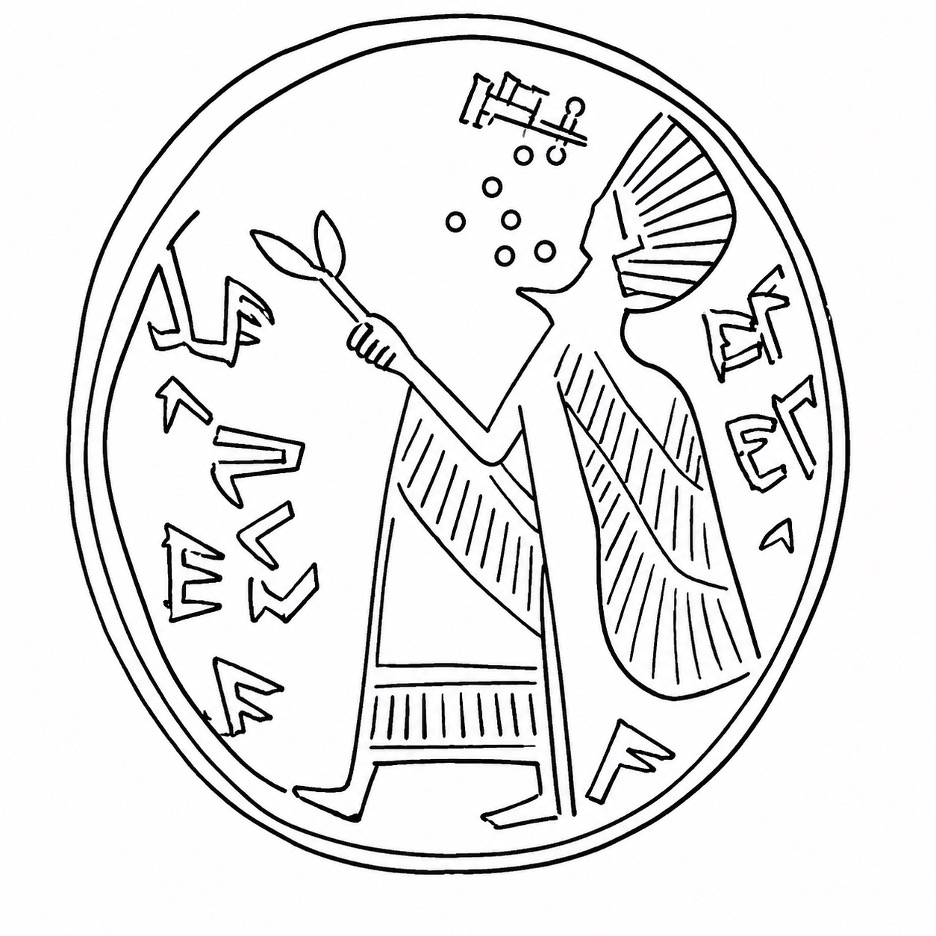
In general, as the originators of knowledge, apkallu were popular among scribes, and a good ‘default’ symbol for scribes with no other particular distinction.
In Seleucid Uruk, the apkallu were employed for the personal emblems of scribal families, and upon reaching full status in the temple hierarchy, a scribe would assume the use of an apkallu seal.[7] There was a temple there said to be founded by Adapa, the first of the seven, who is associated with revelation of language and ascent to heaven. Adapa was indeed the most popular among Mesopotamian scribes. The scribe-king Ashurbanipal boasts of having “…learnt the lore of the wise sage Adapa, the hidden secret of all scribal art.”[8]
Recent work suggests that Adapa is the model for the figure of Enoch, an antediluvian ancestor who became an angel, as he is portrayed in Aramaic Second Temple literature. Enoch is said to have brought astronomy, cosmology, meteorology, history, angelology and demonology – essentially, medicine – to mankind; this knowledge was preserved, despite the subsequent flood, through an unbroken chain of Jewish scribal succession tracing itself back through Abraham, through Noah, to this primordial father.
Competing views of the origins of human knowledge were published in the early years of the Hellenistic period: the account of apkallū in the Babyloniaca of Berossus, the tracing of Egyptian rulers back to the gods in the Aegyptiaca of Manetho, and the tale of Enoch and the Watchers in the Enoch literature that emerged in Judea. Recent work suggests that the recorded myths are actually ancient, and thus more likely emerged from ethnic rivalries between settler groups that predated Hellenistic hegemony than as responses to the pressure of Greek paideia.[9]
But how ancient? Despite Enoch’s cameo appearance in the Pentateuch (Genesis 5:21-24), and the evidence of profound Neo-Assyrian influence – and thus apkallū – in the material culture of Judah from the time of Ahaz forward,[10] there is no evidence that the Enoch traditions that came to be recorded in 1 Enoch had existed in pre-Exilic Judah, and so it would be too much to identify Yeho’ezer’s scribal-seal winged genie with Adapa’s (later) Judean alter ego Enoch.
However, before the Hurban, apkallū might have been identified with a different Biblical figure: the forefather Abraham.
The existence of ‘progenitor-of-knowledge’ traditions among the masses of remnant Judahites about Abraham – whom the early Egyptian Jewish historian Artapanus of Alexandria records as having travelled to Egypt to teach its king “astrology,” regarding which he is said to have been a foremost expert in Chaldea – may already be referenced in the biblical text, both for condemnation (Ezekiel 33:24) and endorsement (Isaiah 41:8-9, 63:16, and particularly 51:2). He became a particular symbol of hope as an individual who came to possess the land – with an everlasting, unbreakable covenant – after the destruction of Judahite civilization and all its institutions.[11] These traditions were democratic, available to anyone, perfectly geared toward the am ha-aretz. As Adapa was the father of all scribes, Abraham was the father of all of Israel (Malachi 2:10).
At a minimum, the Adapa-like figure on the seal attests this Hoshaiah household’s familiarity with the Neo-Assyrian iconographic repertoire; if its connection to Azariah’s family is admitted, it may further suggest an antiquarian interest and rootedness in a “democratic,” perhaps cosmopolitan, universal scribal tradition. The logic of Judahite ancient history is then clear: if Bereishit could have Abraham, the father of Israel, temporarily sojourn to Egypt (la-gur) with Divine sanction and thereby contribute to – according to legend – or at least thrive in, according to the text, that great civilization, the Jewish remnant could do the same. On this reconstruction, Jeremiah’s negativity could only have appeared to Azariah politically motivated, influenced by Baruch, whom he dismissed as a rabidly pro-Babylonian political hack.
Conclusion
“R. Eleazar said: One must not join company with an am ha-aretz on the road…” (bPesahim 49b)
Regarding the rabbinic attribution of the Book of Kings to Jeremiah: that work supplies precisely what Azariah’s reading lacks. Egypt was far from a goldene medinah; within Kings’ historical reckoning, it had been a bad actor and negative influence at every stage in Judah’s history—unreliable, disappointing and even subversive—from the very start of Jewish sovereignty. It begins with the pernicious sway of Pharaoh’s daughter on Solomon himself; continues, in Solomon’s own lifetime, with Egypt’s harboring his enemies; and, in his son Rehoboam’s reign, with its raiding of the Temple—and so forth down the ages, concluding with the reigning Pharaoh’s killing of Josiah and removal of Jehoahaz, and finally, Apries’ betrayal of his Judahite ally in the final conflict with Nebuchadnezzar. In this canonical reckoning, Jews would not, could not flourish there, at least not until the Persians overtook the Pharaohs. Azariah might have intuited the structural problems in the Egyptian economic culture had he learned a bit more humash than sefer bereshit, but the Hosaiaides apparently missed that lesson, evidenced by their violation of one of a whole raft of regulations against ruthless and predatory business practices that conclude with the warning “Remember that you were a slave in Egypt and that the Eternal your God redeemed you from there; therefore do I enjoin you to observe this commandment.” (Deuteronomy 24:18)
Ezekiel was right: the renewal of Judah and the future of the Jewish people would come not from the old kingdom in the South, to which God had commanded Jews never to return (Deuteronomy 17:16), but would instead be vouchsafed through the new civilization arising from the East and the “messiah” God would appoint to lead it to victory (Isaiah 45:1).
Azariah’s choice has a contemporary afterlife.
Benjamin Balthaser’s Citizens of the Whole World[12] recovers and commends an anti-Zionist American Jewish diasporism for which exile is not a deficiency to be repaired but a political and cultural vocation: the Jew’s place is everywhere, and precisely nowhere exclusively her own. He traces this phenomenon, today quite au courant, to the early twentieth century.
But in some sense, its history may date much further. Azariah was no anti-Zionist avant la lettre; the shattered polity from which he fled cannot simply be identified with the nation-state rejected by Balthaser and his protagonists. Yet his appeal to Abraham permits us to glimpse an ancient form of the same temptation: to convert dispersion from a condition imposed upon Jews into a principle that Jews are uniquely obliged to embrace.
Azariah thus supplies a type familiar to us today. He is an am ha-aretz twice over: conjecturally in Schniedewind’s social sense and, in the later Rabbinic idiom, in a more polemical one. His contemporary heir is typically reared in a setting not steeped in Rabbinic sensibilities, yet is highly literate, overeducated and, “As A Jew,” strongly convinced of the irrelevance of Place in Jewish tradition. He is enamored of Jewish continuity without territorial fixity: the idea that one may be Abraham’s child and a “citizen of the whole world.” He is the internationalist cosmopolitan who is aware of broken, beleaguered brethren in the Promised Land and nonetheless insists, against the prophet’s adjurations, upon diasporism, upon doikayt, upon “making it” in Egypt. This figure is having his moment now — rather perversely, after the seventh of October — in the writings of leading lights of Jewish American academia.
For Azariah’s contemporary heirs, the nation-state itself is oppressive. The Jew ought to belong everywhere, and her story ought to belong to all peoples.
This is, perhaps, admirable.
Its corollary is not. Once territorial particularity is admitted only as domination, the desperate, huddled masses of brethren – hounded out of or exterminated in every nation-state in which they found a modicum of shelter, and therefore clinging to a particular, familiar, warm, accepting place, won in wars they did not seek – even the Communists among them, are seen with the most jaundiced eye, as irredeemably racist, fascist and imperialist. Jewish vulnerability is redescribed as culpability; violence against Jews is aestheticized, excused or absorbed into an emancipatory narrative.
If the Hoshaiah of Meṣad Ḥashavyahu belongs anywhere near Azariah’s family, the ostracon supplies an image too exact to ignore. These people, toiling all day in the heat of the sun, have but one garment, and the comparatively privileged Hoshaiah has taken it. His latter-day heirs take it again whenever the Jews for whom territorial refuge is not an abstraction are written off as so much human detritus. The garment here is metaphorical; the deprivation is not. That is disqualifying – and worse, unforgivable.
In Tanakh, among the colorful cast of characters in the Gedaliah story, paleo-Bundist Azariah is the lone figure whose story is not told. Azariah ben Hoshaiah is a hapax legomenon.
His appearance remains but a cameo. Tempting as it has proven to subsequent generations, especially ours, his version of the Jewish story remains buried under two millennia of debris. For all Jeremiah’s Jeremiads, for all his temptation to abandon his ‘adulterous,’ unfaithful people (Jeremiah 9:1), the navi loved his brethren. With all his heart. And even Jeremiah insisted that his people – wretched as they may then have become – remained precious, and vastly preferable to those who sought their annihilation or replacement;[13] and that, even despite themselves, they would one day, like Abraham, find their way home. Ve-shavu banim le-gevulam (31:16).
Notes
- William M. Schniedewind, Who Really Wrote the Bible: The Story of the Scribes (Princeton University Press, 2024). ↩
- William M. Schniedewind, The Finger of the Scribe: How Scribes Learned to Write the Bible (Oxford University Press, 2019). ↩
- Aton M. Holzer, “Texts From a Prophet: How Jeremiah Saved Prophecy By Writing it Off,” Jewish Bible Quarterly 54:3 (2026), 171–183. ↩
- Schniedewind, Who Really Wrote, 147–152. ↩
- Precisely how it does so is the subject of scholarly debate. The first to address the question was Harry Torcyzner (Naftali Herz Tur Sinai) in his Lachish I: The Lachish Letters (Oxford University Press, 1938), 66. ↩
- Schniedewind, The Finger, 109. ↩
- Seth L. Sanders, From Adapa to Enoch: Scribal Culture and Religious Vision in Judah and Babylonia (Mohr Siebeck, 2017), 74. ↩
- Translation in Silvie Zamazalová, “The Education of Neo-Assyrian Princes,” in The Oxford Handbook of Cuneiform Culture (Oxford University Press, 2011), 313–330, p. 315. ↩
- Philip A. Harland, “Subject Peoples and Civilizational Priority: Competition among Babylonians, Egyptians, and Judahites in the Hellenistic Era,” Harvard Theological Review 116:3 (2023), 317–339. ↩
- Oded Lipschits, “The Long Seventh Century BCE: Archaeological and Historical Perspectives,” The Last Century in the History of Judah: The Seventh Century BCE in Archaeological, Historical, and Biblical Perspectives (SBL Press, 2019), 9–44. ↩
- Lena-Sofia Tiemeyer, “Abraham, a Judahite Prerogative,” Zeitschrift für die Alttestamentliche Wissenschaft 120:1 (2008), 49–66. ↩
- Benjamin Balthaser, Citizens of the Whole World: Anti-Zionism and the Cultures of the American Jewish Left (London: Verso, 2025), 18–23, 40–41. Balthaser treats diasporism as a rejection of Zionism’s “negation of exile” and invokes the “citizen of the whole world” as an emblem of Jewish internationalism and nonterritorial belonging. ↩
- As the traditional author of Lamentations, in 4:21-22 Jeremiah references Edom’s land grab of southern Judah – that is explicit in Obadiah 1:10–20, Ezekiel 35:10–15, and Psalm 137:7. ↩