More on “New Notes Added in the Koren Talmud”

More on “New Notes Added in the Koren Talmud”

Shalom Z. Berger

In what seems like another lifetime but was just over a year ago, the Jewish world celebrated the 13th Daf Yomi Siyum HaShas. The beginning of the 14th cycle led to a revisiting of the Koren Talmud Bavli that had appeared in print for the first time in concert with the previous cycle. In a Seforim Blog post, Chaim Katz pointed out that the new English edition included some additional notes based on Rav Kook’s Ein Aya, and I responded with a post that offered some background on the efforts put into adding (and, occasionally, subtracting) notes, how it was done and to what purpose.

As I wrote in that earlier post, “Our assumption was that the audience for the new English Talmud would be less familiar with concepts and personalities appearing in the Gemara than Hebrew speakers, so we aimed to make sure that when new concepts or personalities appeared, they would receive a background or personality note.” This was done by creating a database of existing translated notes from the Hebrew Steinsaltz volumes, and inserting them as appropriate.

In a response to my post, Chaim Katz graciously acknowledged the contribution that these additional notes make in the new edition, writing: “But for English speakers that aren’t going to learn the language, or learn Tanach, or Mishna first, the “English” section of your edition is almost perfect. In any case the difficulty for students of the Talmud is not the language; it’s the missing concepts, circumstances, realia and all the other background information that the Koren Edition includes. Ashrekhem and Yasher Kohakhem!”

With that background, I would like to share two examples of additional notes, the first of which appears towards the end of Massekhet Pesahim, which, I hope, makes this a timely contribution. As we are in the midst of the year-long mourning period for Rav Steinsaltz, perhaps this could also serve as a tribute to his memory.

Presenting this on the Seforim Blog will also give me the opportunity to publicly thank individuals who helped me develop the new notes and to acknowledge sources that do not appear in the Koren Talmud Bavli itself. In doing so, I am emulating Rav Steinsaltz in his Gemarot, where, from Massekhet Hagiga until the beginning of Seder Kodashim, there often appears a page at the very end of the volume acknowledging individuals who made contributions to a given volume in various fields. In the first few volumes where this appears, it is a concise paragraph thanking his team of editors, graphics people and those who prepared the indices. Beginning with Massekhet Nedarim, he begins to thank medical doctors who helped him with medical issues in the massekhet (as an example, Prof. Jacob Steinberg of the Einstein Medical School gets a shout-out at the end of Nazir). Baba Kamma has additional thanks to those who helped him with questions of geography, while Sanhedrin mentions by name people who assisted in such areas as climate, botanica, zoology, medicine, geography, Rashi’s use of Old French and more.

Beginning with Massekhet Zevahim these pages ceased to appear, which may be connected with the appointment of senior editors in that volume, as now Rav Steinsaltz is listed as “Editor-in-Chief,” with Yonatan Eliav serving as editor. (I will note that each volume of the Koren Talmud Bavli lists editors, translators, copy editors, language consultants, etc., and the team grew in number as we moved though Shas.) Yonatan Eliav tells me that Rav Steinsaltz was “interested in everything,” that he had a large number of reference works at his disposal that he frequently turned to. It would appear that as time went on and the project became larger and larger – and Rav Steinsaltz became involved in more and more things – that he came to rely on experts in various areas of knowledge for the original Hebrew notes and commentary.

Yonatan Eliav also shared that Rav Steinsaltz was not necessarily interested in making use of the background material in order to explain the Gemara, rather his natural curiosity led him to include edifying information about the topic at hand in the Gemara even if it was not essential to understand the sugya. While I did include some material like that in Massekhet Berakhot, it was no longer a priority for my team as we moved forward. Still, there were a number of occasions when understanding the realia was essential for understanding the Gemara, as exhibited in the two examples below.

Pesahim 75a – Lead from its source

One of the editors, Micky Siev, reached out to me just before Massekhet Pesahim was finalized with the following question: In discussing how the Korban Pesah had to be roasted, the Gemara segues to a discussion about how the punishment of execution by burning was to be conducted. The translated text of the Steinsaltz Gemara originally read:

The Gemara asks: Once there is the reason of Rav Naḥman, why do I need the verbal analogy derived from the sons of Aaron? Even without it, Rav Naḥman’s ruling would require the court to carry out the execution with molten lead, which provides an easier death. They say in answer to this question: If not for the verbal analogy, I would have said that burning the soul while the body remains is not considered burning. And if it were just due to the statement of Rav Naḥman that one must select a kind death, we should add many bundles of branches so that she would die quickly. It therefore teaches us through the verbal analogy that executing with molten lead is considered burning. But if this is so, that the verse says: She shall be burned, to include all methods of burning, for what do I need the expression: In fire? The Gemara answers: To exclude lead from its source; when lead is extracted from the ground it is burning hot and this burning lead cannot be used for executions because its heat does not come from fire.

The original text of the Talmud reads לאפוקי אבר מעיקרו, which is translated here as “To exclude lead from its source.” The underlined sentence at the end is a direct translation of the Hebrew Steinsaltz, which is based on Rashi.

Siev asked me the following question:

The underlined section is the Gemara as explained by Rashi. The question is simply that lead is mined from the ground, and as far as we are aware, is not burning hot when it is extracted from the ground.”

My first reaction was to turn to the Steinsaltz Gemara itself. A parallel sugya appears in Hullin 8a, and the Hebrew Steinsaltz Gemara has a note there that explains how it may be possible for lead that is newly mined to be molten hot, and I suggested translating that note for this sugya, as well. But Siev would have none of that. He insisted that to the best of his knowledge and research, lead is never molten when it is freshly mined.

I am not sure that this question would gain much traction in a traditional bet midrash setting, but it certainly was appropriate to ask in the context of the Steinsaltz effort that puts significant emphasis on questions of realia (in fact, at a family wedding that I attended at the time, a relative who gives shiur at one of the prominent one-year Israel programs and is a serious talmid hakham asked me “what are you learning these days?” I shared this question with him and his reaction was “this is learning?!” But surely, if it appears in the Gemara, תורה היא וללמוד אני צריך).

None of the usual sources offered me anything, so I tried to be creative. I called a neighbor who is a geologist. What I learned was that although both he and his wife studied geology, they studied in Israel, which has no lead deposits, so they could not be of any help. Recognizing that I needed to broaden my search, I posted the question on H-Judaic, a listserv for Jewish studies academics (full disclosure – today, as a measure of hakarat hatov, I serve as one of the volunteer editors at H-Judaic). Within a day Prof. Gerrit Bos, Chair of the Martin-Buber-Institut at Cologne University wrote to me simply “Dan Levene and Beno Rothenberg deal with this problematic issue extensively in their: A Metallurgical Gemara: Metals in the Jewish Sources, London: 2007, pp. 101-107.”

While I could not locate the volume in a search of academic libraries in Israel, the Yeshiva University library had a copy, and my sister, Shulamith Berger, who heads their special collections, had a scan for me in a few hours. All this networking led to the removal of the underlined explanation of “lead from its source,” and its replacement with the following note:

This is an opportunity for me to thank Prof. Bos for the reference, acknowledge that the suggestion appears in the book by Dan Levene and Beno Rothenberg, and thank my sister, Shulamith, for making their work accessible to me.

~~~

Shevuot 23a – Pressed figs from Ke’ila…honey or milk

I mentioned this case in my last post, but would like to come back to it in order, again, to acknowledge the assistance of others in the research I did when developing the note that ultimately appeared in the Koren Talmud Bavli volume.

In this case, I believe that the editor involved was Jonathan Mishkin, who pointed out that the Gemara takes for granted that someone who ate pressed figs from Ke’ila or drank honey or milk could not perform the Temple service because they were likely to be intoxicated.

The Gemara challenges: But perhaps the intoxicating substance referred to in the verse is pressed figs from Ke’ila, as it is taught in a baraita: A priest who ate pressed figs from Ke’ila or drank honey or milk and then entered the Temple and performed the sacrificial rites is liable for violating the prohibition against conducting the Temple service while intoxicated.

The Hebrew Steinsaltz Gemara offers a laconic explanation in a note suggesting that figs from Ke’ila have a high sugar content, which may lead to fermentation, but it says nothing about the other substances that appear to be even more problematic. The page in the Koren Talmud Bavli appears as follows:

The first thing to catch your eye has to be the illustrations – none of which appear in the original Hebrew Steinsaltz Gemara – but there is more. The Background note about the prohibition to enter the Temple when intoxicated is taken from the Steinsaltz Reference Guide to the Talmud, which served as the source for many of the additional notes aimed at giving context to a discussion in the Gemara.

The note on “Pressed figs from Ke’ila…honey or milk” expands on the original Steinsaltz note that figs may ferment. The real challenge is why milk should be considered intoxicating (the story of Yael and Sisera in Judges 4:19 notwithstanding). The two suggestions raised in the note are that milk, too, can ferment and become alcoholic, or that “milk” in this context refers to white date wine, the latter suggestion attributed to Rav Menachem Kasher’s Torah Temimah.

Both of those suggestions, again, came from responses that I received on the H-Judaic list. While the Torah Shelemah is credited with the idea that “milk” may be white date wine (Vol. 28 pp. 273-274 in the milu’im), I would like to acknowledge that I was directed to this source by Prof. Admiel Kosman, who serves as professor of Talmud and Rabbinic Literature at Potsdam University.

After a time, I began to turn to both Bos and Kosman directly with questions like these, as they both proved to be invaluable resources in questions of realia. My public thanks to both.

In closing I would like to reiterate my thanks to Rav Steinsaltz zekher tzaddik li’vrakha and yibadel le’hayyim tovim, Meni Even Yisrael for allowing me to play a role in this project that aims to spread Torah among all Jews. A friend recently sent me a still photo taken from an interview with Amar’e Stoudemire that shows the Koren Talmud Bavi on the shelf behind him. The power of Rav Steinsaltz’ vision to make the library of Sifrei Kodesh available to all Jews who desire to learn is a powerful legacy that is now being fulfilled.

Rabbi Dr. Shalom Berger szberger@gmail.com served as Senior Content Editor for the Koren Talmud Bavli project. He is now involved in developing English language educational programming for Herzog College’s Tanakh department.


Of Twice-Told Tales and Ockham’s Razor: A Response to R. Moshe Haberman

Of Twice-Told Tales and Ockham’s Razor: A Response to R. Moshe Haberman

By Elli Fischer

Elli Fischer is an independent writer, translator, and rabbi.  He is editor of Rabbi Eliezer Melamed’s Peninei Halakha series in English and cofounder of HaMapah, a project that applies quantitative analysis to rabbinic literature. He is a founding editor of The Lehrhaus, a web magazine of contemporary Jewish thought, and his writing has appeared in numerous Jewish publications. He holds degrees from Yeshiva University, rabbinical ordination from Israel’s Chief Rabbinate, and is working toward a doctorate in Jewish History at Tel Aviv University.

R. Moshe Haberman’s fascinating recent post on the Seforim Blog, “The Twice-Told Tale of R. Yonason Eybeshutz and the Porger,” traces the provenance of a single copy of the first edition of R. Eybeschutz’s כרתי ופלתי in order to resolve an old and puzzling question about a reference to an apparently nonexistent view of the Semag. The answer – that the reference to Semag (סמג) in the printed edition is a typo and should actually be סהנ, or Sefer Ha-Nikur – was first suggested in 1930 by Rabbi Solomon M. Neches and further clarified by Prof. Shnayer Leiman. Rabbi Neches claimed that this typo was corrected by R. Eybeschutz himself, as the author’s copy of the work was extant, owned by R. Neches, and contained the handwritten emendation. The case seemed to be closed.

However, upon inspection, it seemed that the book was not owned by the author, but by a different R. Yonason Eybeschutz. The conclusion of R. Haberman’s article is that this copy of the 1763 edition of כרתי ופלתי was owned by two different (and unrelated) people named Rabbi Yonasan Eybeschutz.

The post also states that Rabbi Neches, a leading rabbi in Los Angeles (and, as Fred MacDowell discovered, mesader kiddushin at the wedding of Elaine Ackerman to Jerome L. Horowitz, a.k.a “Curly” of the Three Stooges) from the 1920s until his death in 1954, who claimed to have the book in his possession in 1930, did not really have it in Los Angeles in 1930. Rather, he had seen it in his youth in Ottoman Palestine. The copy remained in Eretz Yisrael until 1963, when it was purchased by UCLA through sponsorship of the Cummings family and sent with tens of thousands of other items to Los Angeles. In other words, rather than take R. Neches at his word, that he possessed the book in Los Angeles in 1930, and presumably kept it until his death in 1954, whereupon his personal library was dispersed, R. Haberman posits that the book never reached American shores, let alone R. Neches’s shelves, during his lifetime, yet arrived in the city where he served within a decade of his passing.

The story thus contains two owners who coincidentally shared the name Rabbi Yonason Eybeschutz (RYE), and there is no connection between the fact that it was a Los Angeles rabbi who first mentioned this very item in 1930 and the fact that the item itself was in Los Angeles in 1963. Rather, the book made its way from Europe to Ottoman Palestine some time before 1910 (while its prior owner, the second RYE, was still alive in Poland). There it was viewed by a teenage R. Neches, who remembered, 20 years later, a marginal gloss he found therein. Meanwhile, the book itself falls off the grid for half a century before resurfacing in 1963, in an auction.

After reading the post, I decided that such a great story, filled with the most unlikely coincidences, deserved a Footprint. As I started documenting the copy’s provenance, however, the narrative began to unravel. As I will show, there is a much simpler narrative of the book’s provenance.

R. Haberman determines that two different RYEs owned the book because one signature specifies ownership by “Rabbi Yonasan Halevi Eybeshutz of Leshitz” and another signature bears resemblance to the signature of the original, 18th century RYE, author of כרתי ופלתי. Thus, it must have been owned by both RYE of Leshitz and RYE the author. Since R. Neches owned at least one book by RYE of Leshitz, namely, שער יהונתן, he, too, must have discovered that two distinct RYEs owned the book.

The problem with this theory is that there is no “Rabbi Yonasan Halevi Eybeshutz of Leshitz”. Rather, in the early 20th century, there were two RYEs. One was the rabbi of Kock (Kotzk) and later of Łosice (Leshitz), Poland and author of תפארת יהונתן. He was not a Levi, and he passed away in c. 1915. The second (or third) RYE, who was indeed a Levi, lived in the Praga district of Warsaw and perished in 1943. He was the author of שער יהונתן among other works, and on the title page that appears in Appendix B of R. Haberman’s post, you can see that the author is listed as living in Warsaw, and there is no mention of Leshitz/Łosice.

The pictures that accompany R. Haberman’s post show clearly that the RYE who owned this copy of כרתי ופלתי was from Łosice, but he does not sign that he was a Levi – because he wasn’t. With this in mind, we can now revisit the question: Is there any indication that the original RYE owned the book as well, or can we attribute everything to the non-Levi RYE of Leshitz?

After a bit of searching, I found an item related to RYE of Łosice on an auction site. This item, a copy of R. Eliyahu Mizrahi’s ספר מים עמוקים (Berlin, 5538/1778), contains both the stamp and signature of RYE of Kotzk (before his arrival in Leshitz). Here his signature is immediately to the left of the word ספר.

And here is his stamp (the smaller one):

The auctioneers also included a picture of a marginal note that the owner inscribed in the book, in the name of one Rabbi Isaac of Leszno (Lissa), son of the rabbi of Mezrich (presumably Międzyrzecz, Poland, in Prussia, close to both Leszno and Lozice, and not Mezhyrichi, Ukraine, home of the famed Maggid, or Międzyrzec Podlaski, in eastern Poland):

(Here is another item that contains RYE of Leshitz’s handwriting.)

Moreover, I am no graphologist, but the two RYE signatures that R. Haberman compares in his post seem far from identical. In the signature of the 18th-century RYE, the leg of the ה is more curved, the bottom of the נ does not extend very far below the line, the ת has a shorter leg, and the top of the ן begins at the same level as the tops of all the other letters. Sure, there is some superficial similarity, but it seems very far from dispositive.

Rather, Ockham’s Razor would encourage us to adopt the simpler explanation, namely, that copy of כרתי ופלתי was owned by only one Rabbi Yonason Eybeschutz: the rabbi of Kotzk and then Leshitz, who died in the early 20th century. It was he who wrote the gloss referring to ספר הניקור – an answer that has the ring of truth and which there seems to be no reason to reject, even if the answer was not provided by the author himself. If anything, RYE of Leshitz deserves his due as the one who resolved this question.

Let us now turn to the question of where the book was at various points. Here, the suggestion that R. Neches viewed the book in Eretz Yisrael prior to 1910, when he emigrated to the US, seemed impossible, as the previous owner – whether RYE of Leshitz or RYE Halevi of Warsaw – lived in Europe. When, why, and how would the book have made its way to Ottoman Palestine without its owner? Moreover, R. Neches’s language seemed to indicate quite clearly that the book was in his possession, in Los Angeles, in 1930. This received further confirmation from commenter Ben Sommerfield, who notes that in another article, from 1951, R. Neches again mentioned that the copy of כרתי ופלתי is in his possession and even includes a facsimile of the page with the marginal note. We can thus conclude that the book was in possession of R. Neches in Los Angeles from 1930 to 1951.

In order to have been included in the Cummings Collection, then, the book would have had to get from Los Angeles to Israel and back to Los Angeles in a span of 12 years – 9 years if we presume that R. Neches kept it until his death in 1954. While not impossible, here again, another explanation seems far more likely.

In an article in HaMa’ayan (56:1 [215], Tishrei 5776, pp. 101-2), R. Yaakov Yitzchak Miller, who located the copy of כרתי ופלתי together with R. Haberman (they thank one another in their respective articles), correctly identifies the previous owner of the copy as RYE of Leshitz (even comparing the signature in the copy to the signature in other auctioned items – in which there are likewise marginalia) and thus dismisses R. Neches’s claim that this was the author’s copy. R. Miller also notes (n. 2 ad loc.) that much of R. Neches’s library was donated to UCLA. It would seem far more likely that this copy of כרתי ופלתי was donated to UCLA from R. Neches’s estate than that it was sent to Israel, appended to a much larger collection, and then purchased by UCLA several years later.

So what are we to make of Prof. Arnold Band’s confirmation that כרתי ופלתי was part of the collection whose purchase he orchestrated in 1963, and of the fact that the book is listed in the UCLA catalog as part of the Cummings collection? In my view, the likely answer is that the 1963 purchase indeed included a copy of כרתי ופלתי – perhaps UCLA’s copy of the Vienna 1819 edition. It takes nothing away from Prof. Band and his efforts to secure this collection to suggest that it seems highly unlikely that he remembers, after 57 years, a detail that he never mentioned before about a signature in one specific book out of 30,000. Perhaps he remembered that the purchase included a copy of כרתי ופלתי, even an old one. Or perhaps he mixed up the 1819 copy with the 1763 copy after the former’s arrival in Los Angeles, resulting in the library miscataloging R. Neches’s 1763 copy. Either way, a cataloging error seems more likely than the scenario suggested by R. Haberman.

The final timeline would then look something like this: The copy was owned by RYE of Leshitz until his death in 1915. At some point between 1915 and 1930, R. Neches purchased it – perhaps from a dealer who obtained items from the estate of RYE of Leshitz and convinced buyers that they had been owned by the far more famous 18th century RYE. It remained in R. Neches’s possession until his death in 1954, whereupon it was donated to UCLA and miscataloged.


Response to Criticism, Part 3

Response to Criticism, Part 3

Marc B. Shapiro

Continued from here.

Let me continue with Rabbi Herschel Grossman’s review. [1] This post will complete my response to around a quarter of his review, so we still have a long way to go.

Grossman writes (p. 42)

According to Shapiro, “Maimonides would be surprised that . . . later generations of Jews . . . latched onto his earlier work;” and it “is certainly one of the great ironies of Jewish history that the Thirteen Principles became the standard by which orthodoxy was judged.” Finally, “the characteristic that gave them their afterlife . . . is precisely their outer form . . . Had Maimonides listed a different number of principles in the Mishneh Torah . . . these would have become the Principles of Judaism.” In other words, after postulating that Rambam innovated these obligatory beliefs, Shapiro concludes that it was the popular acceptance of these Principles that established halachic practice.

If you look at the quotations from my book that Grossman has cited, you can see ellipses. The problem here, and this would be unknown to the average reader who does not bother to see what I actually wrote, is that the complete sentences without the ellipses mean something very different than what Grossman wants the readers to think they say. Here is the complete first sentence that he cites (from p. 7 in my book): “Presumably, Maimonides would be surprised that in seeking to define the essentials of Judaism, later generations of Jews, both scholars and masses, had latched onto his earlier work rather than his more detailed formulation in the Mishneh Torah.” I think all readers will agree that the part of the sentence that Grossman quotes, with strategic ellipses, does not give the reader the true sense of the sentence. I can’t say whether this is a result of bad faith or careless writing.

Here is the complete second sentence that Grossman cites (from p. 15 in my book): “It is certainly one of the ironies of Jewish history that the Thirteen Principles became the standard by which orthodoxy was judged, for, as is well known, Maimonides himself was attacked for supposedly holding heretical views, at odds with his very own Principles.” Again, we see that by use of a strategic ellipsis, Grossman give the reader a false impression of what I wrote.

Here is the complete third selection that Grossman cites (from p. 14 in my book).

Returning to the Thirteen Principles, the characteristic that gave them their afterlife and caused them to become the formulation of the Jewish creed is precisely their outer form, that is, the fact that they were formulated as a catechism with all the Principles listed together. Had Maimonides listed a different number of Principles in the Mishneh Torah (e.g., twelve or fourteen), these would have become the principles of Judaism. But he did not, and thus the Thirteen Principles stuck.

In this case, the use of ellipses does not distort what I said.

Grossman states that I postulated that “Rambam innovated these obligatory beliefs.” We have already seen that this is complete nonsense. I never said that Maimonides invented the “obligatory beliefs,” as this would mean that before Maimonides there was no conception of traditional Jewish beliefs, which is a ridiculous notion.

In his final sentence, Grossman states that I concluded “that it was popular acceptance of these Principles that established halachic practice.” This is indeed my opinion, but I would also add that it obviously took time for the Principles to achieve widespread acceptance. Nothing I have said here is unusual or radical, and it is also opinion of many others who have written on the subject. Here, for example, is what R. Meir Orian writes in his book on the Rambam (published by Mossad ha-Rav Kook).[2]

ראינו כי בעצם ערר רבנו משה התנגדות בכל חיבור שכתב . . . גם קביעתם של שלשה עשר העיקרים של היהדות – שבמרוצת השנים נתקדשו בקדושת התורה והאומה – לא היתה לפי רוח גדולי הדור שבזמנו

There were other competing systems of dogma, but I state that none of them could compete with Maimonides’ formulation, both because of Maimonides’ supreme authority and also because popular piety prefers more dogmas to fewer. It is no accident that there are almost a hundred different poetic versions of the Principles, of which Yigdal is only the most famous. These are reflections of the popular attachment to the Principles, not to any rabbinic decision in favor of Maimonides. So if we conclude that the Principles establish halakhic practice, then yes, it was popular acceptance of these Principles that established the halakhic practice, much like popular acceptance and rejection of halakhic rulings throughout history has established halakhic practice.

Had the religious masses accepted an alternative formulation of Jewish dogma, then this would have become the standard. The rabbis can give rulings, but from talmudic times to the present it is the masses of religious Jews that determine if a halakhic ruling is accepted or not. Even with regard to the greatest poskim, you find that for some of their rulings the religious masses simply refused to accept them (perhaps because they found them too difficult and were already accustomed to do things in a different way, e.g., R. Moshe Feinstein and time clocks on Shabbat). I am not sure what Grossman’s problem is with the notion that popular acceptance can determine halakhic practice. Maybe he thinks that halakhah is only about the posek issuing a ruling. However, especially when speaking historically, we must also take into account that the religious masses (the “olam”) also have a crucial role to play in how halakhah develops.

This important notion is elaborated upon in the recent book by R. Ronen Neuwirth, The Narrow Halakhic Bridge, pp. 293ff. Here is one passage from R. Kook that R. Neuwirth quotes (from Eder he-Yekar, p. 39): “All of the mitzvot of the rabbis that we fulfill – their main foundation is the acceptance of ‘the entire nation’ which is the honor of the nation.”

Grossman, pp. 42-43, quotes the following sentence from my book (p. 17, mistakenly omitting a few words in his citation):

It seems that there is even halakhic significance to the Principles, as seen in the fact that R. Israel Meir Hakohen [Mishnah Berurah 126:2] records that one who denies the divinity of the Torah, reward and punishment, the future redemption, and the resurrection cannot serve as a prayer leader. Had Maimonides not included these Principles in his list, it is unlikely that denial of the last two, which are not necessarily of prime importance to a religious life, would disqualify one in this way.

Grossman writes:

Contrary to Shapiro’s hasty assumption, the Rambam is not the source for this Halacha. The source is the Talmud Yerushalmi, cited by the Tur [Orah Hayyim 126] as follows: “A prayer leader who skips two or three words does not have to go back to say them, except for one who does not mention ‘the Resurrection of the Dead,’ for perhaps he is a disbeliever [kofer] in the Resurrection of the Dead, and [the blessing] ‘Who rebuilds Jerusalem,’ for perhaps he does not believe in the Coming of the Mashiach.” Obviously, the ruling of the Mishnah Berurah is not an “invention” based on the Rambam.

Grossman’s translation is not exact as אין מחזירין אותו does not mean “does not have to go back”, and the translation also omits the words ומכניע זדים שמא מין הוא, but for our purposes this is not crucial.

The first thing to note is that I never said that the Mishnah Berurah’s source for his ruling is the Rambam’s Principles. What I said is that had the Rambam not included the Messianic era and Resurrection among his principles, denial of them would not have been enough to affect a Jew’s status (so that he couldn’t be a prayer leader, etc.). I will explain what I mean, as Grossman has once again completely misunderstood my point.

Let us take Resurrection, which is mentioned in the Mishnah as an obligatory belief. Nevertheless, the Rambam was suspected by both opponents and supporters as not really believing in it literally. In response to this suspicion, he wrote his famous Letter on Resurrection, which affirms the literalness of Resurrection and tells us that when he included it in his Principles he really meant it. Imagine if Maimonides, in his Letter on Resurrection, had not affirmed literal Resurrection, but instead defended the notion that it is to be understood metaphorically, as referring to the World to Come. Had that occurred, then the Rambam’s great authority would have ensured that belief in Resurrection would not be required.

My point is therefore simple: If the Rambam had declared that belief in Resurrection is not required, I do not believe that the Mishnah Berurah would have regarded this approach as heretical and thus invalidated a hazzan who held such a view, despite what other rishonim might have held. Similarly, had the Rambam not included the Messianic Era as a Principles of Faith, I do not believe that it would have been regarded as an obligatory belief, denial of which is heresy. It might have been a “recommended” belief, but not a generally accepted “obligatory” belief. In my opinion, this shows the great significance of the Rambam from both a theological and a halakhic perspective.

If you look at Jewish history, you will find that while many have asserted that certain beliefs are obligatory (e.g., gilgul, existence of demons, Divine Providence encompassing the animal kingdom, Daas Torah, R. Shimon Ben Yohai authored the Zohar, the Sages were infallible in matters of science), these beliefs have never become generally accepted to the extent that those who do not share them are regarded by the wider Orthodox world as outside the fold. Only Maimonides’s Principles were able to do such a thing. This explains what I mean when I say that had Maimonides not regarded the Messianic Era or Resurrection as obligatory beliefs, that “it is unlikely that denial” of them would have been enough to place the stamp of heresy on such a person, and thus to disqualify him from being a hazzan.

On p. 44 of his article, Grossman returns to the matter that I (and others) raised, that the Thirteen Principles are not mentioned in the Mishneh Torah. I also suggested that in his later works Maimonides was not attached to his earlier formulation of thirteen principles, as he presents a more detailed formulation of required beliefs in the Mishneh Torah.

In response to my point that one would have expected the Thirteen Principles to be listed in Hilkhot Yesodei ha-Torah, Grossman writes (p. 44)

Here, too, Shapiro indicates that he is unaware of the structure of the Mishneh Torah. The entire work is an expansion of the 613 Mitzvos: The entire work is introduced by Rambam’s Sefer haMitzvos which lists all 613 Mitzvos, and each of the sections (Halachos) has a listing of the Mitzvos included therein. Consequently, there is no place to highlight the Thirteen Principles in Hilchos Yesodey haTorah, since there are explicit Mitzvos for only three of them—emunah, yichud and avodah zarah, which he in fact does list in the introduction to this section. He could not have listed all the rest since they are not Mitzvos.

I reject this paragraph. There is a good deal in Hilkhot Yesodei ha-Torah that has nothing to do with “explicit Mitzvos.” For that matter, there is a good deal in the Mishneh Torah as a whole that is not related to “explicit Mitzvos.” In addition to what I mentioned in my last post, one can also add the last two chapters of Hilkhot Melakhim, which are about the messianic era and have nothing to do with mitzvot. The Rambam included these chapters because he felt that this material is important, and he did not limit himself in the Mishneh Torah to only matters that derive from ‘explicit Mitzvos”. Therefore, there is nothing about the “structure of the Mishneh Torah” that would have prevented him from listing the Thirteen Principles as a unit in Hilkhot Yesodei ha-Torah or elsewhere. In fact, most of the Principles are already listed in Hilkhot Yesodei ha-Torah, but just not together as a unit (which was my point), which shows that he had no problem listing them even though “they are not Mitzvos.”[3]

As for my wondering why the Principles are not listed together as a unit, which Grossman sees as an illustration of how I am unaware of the structure of the Mishneh Torah, let me begin by repeating what I wrote in my last post: R. Yaakov Nissan Rosenthal, on the very first page of his commentary Mishnat Yaakov to Sefer ha-Madda, also wonders about the point I made, that the Thirteen Principles as a unit are never mentioned in the Mishneh Torah. (Had I known this when I wrote my book, I certainly would have cited it.)[4]

ותימא למה לא הביא הרמב“ם בספרו ה”יד החזקה” את הענין הזה של י“ג עיקרי האמונה, וצ”ע

R. Avraham Menahem Hochman writes:[5]

. . .מאחר וכל כך חמורה הכפירה, וגדולה החובה לדעת את י”ג העיקרים, כיצד זה השמיטם מספרו ה”יד החזקה”, ולא כתבם כפי שסדרם בפירוש המשנה

והנה אחר שהתבאר שהאמונה בי”ג העיקרים היא בסיס לתורה נשוב לשאלה הרביעית (בסוף פרק ה’) אשר לכאורה היא פליאה עצומה מדוע השמיט הרמב”ם ביד החזקה את החובה הגדולה להאמין בי”ג עיקרים, באופן חיובי, ולא סדרם כי”ג יסודי האמונה שחובה להאמין בהם

R. Hochman goes on to explain that most of the Principles are indeed mentioned in Hilkhot Yesodei ha-Torahin a positive sense (even if not as a unit of Thirteen Principles). He also notes the following important point, that when principles of faith are mentioned in the Talmud, they are never listed in a positive sense, that one must believe X. Rather, they are listed in a negative sense, that one who denies X has no share in the World to Come. Why Maimonides, in his Commentary on the Mishnah, chose to formulate the Principles in a positive sense and require active belief as a necessity for all Jews—something the Talmud never explicitly required—is an interesting point which we will come back to. Regarding some of the Principles the difference is clear. For example, according to the Talmud, denial of Resurrection is heresy, but one who has never heard of the Resurrection and thus does not deny it, or affirm it, is a Jew in good standing. For Maimonides, however, the doctrine of Resurrection must be positively affirmed. In a future post we can come back to which Principles even the Talmud implicitly requires positive affirmation of (obviously number 1, belief in God, but there could be others as well).

Even when it comes to other basic ideas of Maimonides, which are not included as part of the Thirteen Principles, we find that scholars wondered why Maimonides did not include them in Hilkhot Yesodei ha-Torah. For example, R. Joseph Ibn Caspi writes:[6]

.הנה תמהתי על כבודו בספרי המכונה ספר הסוד, כי [אם] כן עשה הוא דעת תורתנו ויסוד הדת למה לא מנה זה בהלכות יסוד [!] התורה בתחלת מנותו היסודות

With regard to the Thirteen Principles themselves, in R. Jacob Yitzhaki’s popular Sephardic Mahzor Oholei Yaakov: Rosh ha-Shanah, p. 59b, he states:

.ובאמת גם הרמב”ם ז”ל לא זכר מהעיקרים הללו לא בספרו הגדול משנה תורה ולא בס’ המורה שחבר אחריו בזקנותו. ואם היה עודנו מחזיק בם היה לו להזכירם בס’ המדע והמורה, כי שם מקומם, ורק נזכרו בפי’ המשנה שחבר בבחרותו כידוע

R. Yitzhaki agrees with my point that it is significant that the Thirteen Principles as a unit are not mentioned in the Mishneh Torah(or in the Guide of the Perplexed; he is obviously aware that the individual principles appear in various places in the Mishneh Torah). His words, ואם היה עודנו מחזיק בם היה לו להזכירם, show that he, too, is not certain that the notion of Thirteen Principles was still something the Rambam held to when he wrote the Mishneh Torahand Guide of the Perplexed. Grossman can reject R. Yitzhaki’s point the same way he rejects what I wrote, but readers can see that what we have written is not something completely ignorant, as Grossman would have people believe.

On pp. 44-45, in response to my suggestion that in his later years the Rambam did not feel bound to the Thirteen Principles as the ultimate summation of Judaism, Grossman refers to a passage in the Rambam’s Letter on Resurrection. Here the Rambam mentions that in his commentary to Sanhedrin he expounded on fundamentals of Judaism, and he mentions that he did likewise in the Introduction to the Mishnah and the Mishneh Torah. I myself refer to this source in Limits, p. 6, as one of the few times the Rambam mentions the Principles subsequent to his the Commentary on the Mishnah. This does not change the fact that the Rambam does not refer to the Principles as a unit in the Mishneh Torah or the Guide, and the understanding of Judaism found in these latter works is not always the same as what we see in the Principles. I would assume that it is in the Rambam’s later, and indeed greater, works that we should look in order to identify his final statements on matters of Jewish belief.

The real problem is that again, Grossman simply does not understand what I am saying. He concludes this section of his criticisms by stating that, “Clearly the Rambam has not retracted his opinion that there are Principles, or roots – lacking belief in which, one is missing the fundamentals of Judaism.” Of course, I never said that in his later years the Rambam did not believe that there are Principles of Judaism. Even if we never had his Thirteen Principles, you can look at the Mishneh Torah and see that there are beliefs that if you deny them, you are missing the fundamentals of Judaism. My point about the Rambam not being tied to the Thirteen Principles has nothing to do with this. It thus makes no sense for Grossman, p. 46, to write that in the Guide the Rambam refers to the fundamentals of faith, and then to cite chapters from this work that require belief in God’s incorporeality, as if this has anything to do with what we are talking about. Let us not forget that it was the Rambam who chose thirteen principles.[7] He did not find this in the Torah or in the Talmud. When you examine the Mishneh Torah you see that he could just as easily have chosen fourteen principles, or even more (and later writers indeed added additional principles).

There is no need to belabor this any longer, but let me call attention to an error Grossman makes on pp. 46-47. He states that R. Joseph Albo refers to the Guide of the Perplexed “in explicating Rambam’s Principles.” He then cites Albo’s Sefer ha-Ikarim 1:3: “And why did he not include the dogma of creation, which everyone professing a divine law is obliged to believe, as Maimonides himself explains in the twenty-fifth chapter of the second part of the Guide of the Perplexed?” This is not an example of Albo using the Guide to explicate the Rambam’s Principles. In this chapter of Sefer ha-Ikarim, Albo asks why the Rambam does not include creation as one of the Thirteen Principles. He cites the Guide not to explicate the Principles but to show that the Rambam regarded creation as an essential doctrine, and therefore it should have appeared in the Principles. (Albo was unaware that later in life the Rambam added to the Fourth Principle the belief in creation ex nihilo.)

One point that Grossman is adamant about is that it is improper to suggest that the Rambam changed his mind when it comes to the Principles. That is because, Grossman states, the Rambam revised his Commentary on the Mishnah throughout his life, so if he did not change what he wrote in the Principles, it is “an indisputable indication” (p. 46) that it remained his opinion. The reader of Grossman’s essay will not realize that it is not a major point of my book to argue that the Rambam changed his mind about his formulations in the Principles. What I do suggest is that the Thirteen Principles as a unit is not his final statement of dogma, because he does not mention it in the Mishneh Torah or the Guide, and in those works you find other doctrines that are regarded as principles of faith which are not included in the Thirteen Principles. Furthermore, as we shall see in future posts, the Rambam has different emphases and even outright contradictions to the Thirteen Principles in his later works, so we are left with assuming that either he changed his mind or that his formulations in the Thirteen Principles were intended for a certain audience, but did not represent his true view, which would only later be revealed in the Guide – and perhaps even in the Mishneh Torah – to the spiritual and intellectual elites. I will deal with this in greater detail in a future installment of my response to Grossman. For now I just want to note that the approach that he regards as ignorant as well as apparently blasphemous, that the Rambam changed his views about certain matters in the Principles, is not unknown even among rabbinic figures.

In Limits, p. 148, I noted that R. Meir Don Plotzki claimed that while in the Twelfth Principle the Rambam requires that the Messiah be descended from Solomon, he does not mention this in the Mishneh Torah. For R. Plotzki, this shows that the Rambam retracted his earlier view (even though he never corrected what he wrote about this principle in the Commentary on the Mishnah).[8] This again illustrates the problem with so many of Grossman’s criticisms of me. He points to things I wrote that he thinks are absurd and ignorant, but what happens when I show that great rabbinic figures have said the same thing? Obviously, Grossman would not criticize them in the same way. Is this an example of the old “they could say it but you can’t”?

R. Eliyahu Meir Feivelson notes that in the Sefer ha-Mitzvot, Positive Commandment, no. 4, the Rambam includes as part of “fear of God,” fear of punishment. However, when he describes this mitzvah in the Mishneh Torah, Hilkhot Yesodei ha-Torah2:1-2, there is no mention of fear of punishment, only what is called יראת הרוממות. R. Feivelson writes[9]:

ויש להעיר עוד, שאולי יותר נכון לומר בדעת הרמב”ם, שהוא חזר בו מדבריו בספר המצוות, ולכן בספר משנה תורה נקט את יראת הרוממות. ורגליים לדבר, שהרי בהקדמתו לפרק חלק מנה הרמב”ם את האמונה בשכר ועונש, וכאחד מי”ג עיקרי אמונה. ואילו בהלכות תשובה (פ”ג הל, ו’-ח’) מנה את כל עיקרי האמונה פעם נוספת (ותחת זה מנה שם את האמונה בתורה שבכתב ושבע”פ לשני עיקרים), ולא הזכיר שם את האמונה בשכר ועונש, ושמא זה מוכיח על שינוי דעתו בענין זה

R. Feivelson mentions that in the Mishneh Torah, Hilkhot Teshuvah3:6-8, when the Rambam lists the different types of heretical beliefs, there is nothing about Reward and Punishment. He therefore suggests that the Rambam changed his mind and no longer regarded this as a Principle.

If Grossman would read R. Feivelson like he reads me, he would protest that it is outrageous to suggest that the Rambam stopped believing in, or requiring belief in, Reward and Punishment. But this would be a mistake. R. Feivelson knows full well that Reward and Punishment is an important Jewish belief. He also knows that Hilkhot Teshuvah, chapter 8, is all about Reward and Punishment. All he is suggesting is that the Rambam ceased to regard this as one of the Principles of Judaism, denial of which is heresy, and which everyone must also positively affirm to be regarded as part of the Jewish community. Or perhaps he only means to say that the Rambam removed Reward and Punishment from the Principles so people would not focus on this as a motivation to observe of the Torah. If R. Feivelson is correct, then Reward and Punishment is no different than other true beliefs which the Rambam didn’t see fit to include in the Thirteen Principles.[10]

R. Feivelson’s basic idea, that the Rambam changed his mind about including Reward and Punishment as one of the Principles, was actually earlier suggested by R. Solomon of Chelm in his classic commentary Mirkevet ha-Mishneh, Hilkhot Teshuvah3:8:

(. . .וזה מכוון נגד י”ג עיקרים שבפירוש המשנה אלא שבחדא יש חזרה, ושם מונה שכר ועונש, וכאן בחיבורו השמיטו (לפי דמצוה לעבוד שלא ע”מ לקבל פרס מאהבה

Let me turn to one other place where it is possible that the Rambam changed his mind in a matter of dogma. There are a number of discussions of the Rambam’s view of the Messiah, and it is typically stated that he believes that the Messiah will be a prophet. Since R. Alter Hilewitz was recently mentioned in the Seforim Blog here, let me cite him.[11]

שהמלך המשיח בעצמו יהיה נביא, ולא סתם נביא, אלא נביא יותר גדול מכל הנביאים פרט למשה

That the Messiah will be a prophet is often stated as part of the dogma of belief in the Messiah, yet there is nothing in the Twelfth Principle about the Messiah being a prophet. Why then do so many assume that this is part of the Rambam’s Principle? I think the answer is because in the Mishneh TorahHilkhot Teshuvah 9:2, the Rambam states that the Messiah will be a great prophet, close to the level of Moses. He also mentions this in his Letter to Yemen.[12]

As mentioned, there is nothing in the Twelfth Principle about the Messiah being a prophet. Does this mean that the Rambam changed his mind? I don’t think we can say for sure. Yet it is noteworthy that in the Mishneh Torah, Hilkhot Melakhim, ch. 11, when the Rambam speaks about the Messiah, he also does not mention anything about the Messiah being a prophet. In fact, in Hilkhot Melakhim 11:3 he tells us that R. Akiva thought that Bar Kokhba was the Messiah. Since Bar Kokhba was not a prophet, this is a proof that the Messiah does not need to be a prophet. Another relevant point is that in Hilkhot Melakhim 12:3 the Rambam speaks of the Messiah as having ruah ha-kodesh, which is a lower level than prophecy. Thus, it appears clear that according to Hilkhot Melakhim the Messiah will not be a prophet, or at least does not need to be a prophet.[13]

How to explain the fact that in Hilkhot Teshuvah the Rambam says that the Messiah will be a great prophet, while in Hilkhot Melakhim he does not mention this at all, and he refers to Bar Kokhba, thus showing that the Messiah does not need to be a prophet? R. Joseph Kafih states that the Rambam changed his mind on this matter. When writing his Letter to Yemen and Hilkhot Teshuvah the Rambam thought that the Messiah needed to be a prophet, however, his later position is reflected in Hilkhot Melakhim.[14] R. Kafih makes this claim even though there is no evidence that the Rambam ever altered what he wrote in Hilkhot Teshuvah. My point in mentioning this is not to claim that R. Kafih is correct in his assumption, only to show, in opposition to Grossman, that great commentators have indeed been prepared to state that the Rambam changed his mind, even if we have no evidence that he later corrected his earlier works.[15]

Regarding prophecy, R. Shlomo Aviner cites R. Kook that Adam was a greater prophet than Moses. I found this formulation noteworthy, as it contradicts Maimonides’ principle that Moses was the greatest prophet. In response to my question, R. Aviner replied to me that Adam is not to be included in regular history, and was thus not the among the prophets Maimonides was referring to.[16]

אדם הראשון הוא מחוץ לחשבון ההסטורי הרגיל ולפניו, ושורש כל בני האדם

R. Aviner cited as his source Orot ha-Kodesh, vol. 1, p. 280, which refers toזיהרא עילאה דאדה”ר. In fact, I found a more apt source in Shemonah Kevatzim3:66, where R. Kook puts the matter very clearly:

זיהרא עילאה דאדם הראשון היא כוללת מדה עליונה זו העולה עד למעלה מהאספקלריא המאירה של נבואת משה רבנו

The concept of Adam’s זיהרא עילאה is found throughout kabbalistic literature (which also states that Enoch would later receive this זיהרא עליאה). I had never understood it as also including prophecy, as opposed to simply greatness, but after investigating the matter I do not think that R. Kook is saying anything out of the ordinary by excluding Adam from the Rambam’s Principle. I think that this is also the sense you get from R. Hayyim of Volozhin when he discusses Adam.[17] In Nefesh ha-Hayyim 1:20, he also stresses the greatness of the Messiah, and he cites a rabbinic text that the Messiah will surpass Abraham, Moses, and Adam.[18] R. Hayyim adds that he will only surpass Adam after the Sin, but not before.

Regarding Adam before the Sin, R. Solomon Elyashiv writes:[19]

השגת אדה”ר קודם החטא שהשיג אז את כל האצילות הנה היה במדרגת האצילות של אז שהיה גבוה ונעלה מאד . . . כי מציאת אדה”ר שקודם הטא היה למעלה לגמרי מכל חק סוג אנושי אשר מאחר החטא ולהלאה

R. Isaiah Horowitz discusses Adam from a kabbalistic perspective on a few occasions. In Shenei Luhot ha-Berit[20], sectionToldot Adam: Beit Yisrael (p. 9a in the first printing, Amsterdam 1749; no. 104 in the newer printings), he writes:

והנה אדם עולה במספר קטן ט’ כי אדם לא בא בסוד יחידה מצד כתר המעלה העליונה עשירית, וזהו “אדם אחד מאלף לא מצאתי” א”ל [אל תקרי] אֶלֶף בסגול אלא אַלף שהיה חסר

This is exactly how the text appears in the first printing including the vowels. R. Horowitz cites Ecclesiastes 7:28, however the verse actually states: אדם אחד מאלף מצאתי. Only later in the verse does it say: ואשה מכל אלה לא מצאתי. It seems clear that this is simply a mistake and that R. Horowitz was citing from memory.[21] We find the same verse misquoted later in the Shelah, where the derash seems to be clearly based on the mistake:[22]

חותמו של הקב”ה אמת רומז על אה”יה אשר אהיה כי אהיה פעמי’ אה”יה עולה כמנין אמת. אדם הוא מעשר אמת כי ד”ם מעשר מ”ת ומהאלף לא שייך מעשר וזה רמז אדם אחד מאלף לא מצאתי כלומר אחד מאלף לא נמצא מעשר

This is all quite strange as using Otzar ha-Chochma I found two other places in the Shelah where the verse is cited correctly.[23]

Regarding Moses’ prophetic level, in Limits, p. 89, I cited authorities who understand Midrash Tanhuma’s statement that the Messiah will be “more exalted than Moses” to mean that he would be a greater prophet than Moses. Subsequent to the book’s publication, I found that the Lubavitcher Rebbe also leaves this as a possibility,[24] for in his Sefer Sihot: 5751, vol. 2, p. 789, he writes:

ובתנחומא (ס”פ תולדות) משמע שהוא נביא גדול ממשה – ראה לקו”ש ח”ו עמ’ 254 – ועצ”ע

Here is one additional point which is I think of interest. Although Judah David Eisenstein was not a religious authority, he was an Orthodox Jew and his works became quite popular in Orthodox homes.[25] It is noteworthy, therefore, that in his Otzar Dinim u-Minhagim, p. 325, he writes as follows, completely rejecting the Rambam’s system of dogma:

ואיך יעלה על הדעת לומר כי היהודי שאינו מאמין בלבו באיזה מן הי”ג עקרים חוץ מאמונת ה’ לבדו כי הוא יוצא מכלל ישראל. בפרט כי דת ישראל לא נוסדה על מחשבות ורעיונות רק על המעשה, מצות עשה ומצות לא תעשה, והיהודי המקיים כל המצוות הוא בודאי יהודי כשר אע”פ שאינו מאמין בלבו ברוב העקרים שמנה הרמב”ם

He then suggests that the Rambam retracted his understanding of ikkarim.

ונראה כי גם הרמב”ם חזר מעקריו אלה שכתב בערבית לפירוש המשניות, כי בספרו היד החזקה שכתב בעברית להלכה למשה [למעשה] הורה בגר שבא להתגייר, מודיעין אותו עקרי הדת שהוא ייחוד השם ואיסור ע”ז, ומאריכין בדבר הזה, ומודיעין אותו מקצת מצות קלות ומקצת מצות חמורות ואין מאריכין בדבר זה

Notice how Eisenstein requires belief in God, without which one is not part of Israel. But this takes us back to the question of what actually is belief in God. For the Rambam, someone who believes in a corporeal God is not really believing in God at all, and is thus a heretic, while Rabad disagrees. In Limits and in subsequent writings I have cited a number of authorities who agree with Rabad, which shows that the Rambam’s’ approach in this matter was not universally accepted. While it is true that Rabad and the others I cite believe that God is incorporeal, they do not accept that one who errs in this matter is to be regarded as a heretic, which is a major break with the Rambam as it means that denial of one of the Principles does not equal heresy.[26]

Here is another source that we can add to the list. The Hasidic master R. Meir Horowitz of Zhikov states that one who has a defect in his belief in God – which I assume can also include believing in God’s corporeality – but is part of a Hasidic community and accepts a rebbe, is not to be regarded as wicked. This is because by being devoted to the rebbe he will eventually be brought to a proper belief in God. What he is saying, if I am interpreting him correctly, is that you can have members of the Orthodox community whose beliefs might be incorrect, even heretical, but they should not be regarded as wicked because their very belonging to the community and acceptance of its rabbinic leadership is itself significant. I don’t know how many would agree with R. Meir, but what he says is quite fascinating.[27]

וכמו כן יש בנמצא בני אדם אשר יש להם חסרון באמונת הבורא כביכול, ועם כל זה יש להם אמונת צדיקים, ומקבלים עול הצדיק על עצמם . . . וגם אנשים כאלו אינם בכלל רשעים, יען כי על ידי אמונת צדיקים בודאי יבוא אחר כך לאמונת הבורא, כי על ידי התקשרות לצדיק במשך הזמן יזכה גם לאמונה גמורה. וכמו שפירשו בספרים הלואי אותי עזבו ואת תורתי שמרו היינו לשמור מה שהתורה מרבה בתיבת את ד’ א-להיך לרבות תלמידי חכמים

Finally, let me call attention to another unconventional view of R. Michael Abraham. R. Abraham states that since it impossible to force people to believe, the Thirteen Principles of Faith of the Rambam must be understood as only a suggestion which people are free to reject, not an obligation, as only behavior can be legislated, but not thought.[28]

באופן מהותי אי אפשר לצוות על אנשים להאמין דווקא בדבר מסוים. אתה יכול לצוות על אנשים שיתנהגו באופן מסוים, אבל אי אפשר להכתיב להם מה לחשוב, וגם איך תדע שהם חושבים אחרת מכפי שצוו. אז גם 13 עיקרי האמונה של הרמב”ם הם לא הלכה, אלא הצעה של הרמב”ם, ובהחלט אפשר גם לחשוב אחרת.

* * * * * * * *

[1] Regarding Grossman’s review, it is apt to cite the words of R. Yissachar Tamar, Alei Tamar, Shabbat, p. 6 (referred to by R. Neriah Guttel, Or Yekarot [Elkana, 2016], p. 290):

ומכאן אזהרה חמורה למבקרי ספרים שיעיינו הדק היטב עד שחורצים משפטם על ערך הספר וחשיבותו

In a future post I hope to also discuss another critique of my book, that of Seth Kadish. While I have argued that the Thirteen Principles reflect a conservative approach sometimes at odds with Maimonides’ other works, Kadish, in his very interesting and significant article, offers an alternative, I would even say revisionist, perspective. Here is some of what appears in the summary at the beginning of the article.

Such an attitude assumes that Maimonides’ famous list of the “thirteen foundations of the Torah” reflects a conservative stance (regardless of his wider agenda). This paper argues, to the contrary, that his dogma is best read in context as a natural reflection of radical formulations found in his pre-Guide rabbinic writings. It further argues that the great Iberian critics of Maimonidean dogma understood it in exactly this way and rejected it as such, offering meaningful alternatives in its place. They designed their alternative systems to reflect their views about the nature and substance of the Torah, not just to address the semantics of dogma.

Seth (Avi) Kadish, “Jewish Dogma after Maimonides: Semantics or Substance,” Hebrew Union College Annual 85 (2015), pp. 195-263.
[2] Ha-Moreh le-Dorot (Jerusalem, 1956), p. 92 (emphasis added).
[3] See R. Isaac Abarbanel, Rosh Amanah, ch. 19; Menachem Kellner, Dogma in Medieval Jewish Thought (Oxford, 1986) p. 228 n. 60; R. Dovid Yitzhaki’s essay in R. Jacob Emden, Luah Eresh (Toronto, 2001), p. 466. R. Yehezkel Sarne, Beit Yehezkel: Hiddushim u-Veurim be-Inyanim Shonim (Jerusalem, 1995), p. 242, has an interesting perspective:

.יסודי התורה אינו ענין לעיקרי התורה או עיקרי האמונה שהרי לא כלל הרמב”ם כאן כל העיקרים שאם אינו מאמין בהם נעשה כופר על ידן. אלא יסודי התורה היינו שהתורה עומדת עליהם ומי שאין לו היסודות גם תורה אין לו

Earlier in this note, I refer to R. Emden’s work לוח ארש. This is sometimes written as Luah Eres, yet this is a mistake. The second word is Eresh, as in the word ארשת (see Ps. 21:3) which has the connotation of “speech”. This is explained by R. Dovid Yitzhaki in his edition of Luah Eresh (referred to above), p. 3 n. 1 (second pagination).

In Shaharit of Yom Kippur, we recite the piyyut אדר יקר, the first line of which reads: אחוה בְּאֶרֶשׁ מלולי.

R. Aaron Samuel Katz’s commentary on Midrash Rabbah has the title Kore me-Rosh(Berdichev, 1811). It is divided into two sections, one of which is called ארש רבה. This is obviously a play on ארץ רבה (Ps. 110:6), and ארש also contains letters from the names אהרן שמואל.

Sephardic melitzah often uses the word ארש, such as in the expression ותשקוט הארש (sometimes written as האר’ש). Its meaning is that all speech or utterance should cease, that is, there is no need for any more discussion or argument about the issue. Another melitzah is באתי אל הארש (a play on Deut. 26:3), which means “this is what I have to say”.

There is also a melitzah ארש קדם (a play on Gen. 25:6) which means “words of introduction”.

Here is the beginning of R. David Pipano’s Avnei ha-Efod, vol. 1 (Sofia, 1913).

On pp. 24a and 171a R. Pipano uses another melitzah that I love, and which you can occasionally find in other Sephardic works: ובחפשון יצאתי (a play on Deut. 16:3). This means that he searched in rabbinic literature.

The title of R. Emden’s book, לוח ארש, is a play on לוח ארז that appears in Song of Songs 8:9. In the Bible, ארז is vocalized אׇרֶז as it comes at the end of a sentence. Does that mean that seforim with the title לוח ארז should also be vocalized Arez, and לוח ארש should be Aresh? The answer is no, because when we cite the title we are not quoting a biblical verse. Similarly, with R. Isser Zalman Meltzer’s book אבן האזל, just because in I Sam. 20:19 we read האבן הַאׇזֶל does not mean that when citing the name of the book, where it is not the end of a sentence, that we should write Even ha-Azel. Rather, the title is Even ha-Ezel. (The information in this paragraph has been confirmed with R. Dovid Yitzchaki.)
[4] Regarding R. Rosenthal, I think it is noteworthy that he held that at least in certain cases, such as with women who are unable to get married, it is permissible for single women to be artificially inseminated, and he ruled this way in practice. See R. Yehudah Berakhah, Birkat Yehudah, vol. 7, p. 267. R. Aharon Lichtenstein also held this position. See R. Shmuel David, “Teshuvot Ba’al Peh shel ha-Rav Aharon Lichtenstein,” Tzohar 40 (2016), p. 32:

?שאלהרווקה מבוגרת, כבת 41, מבקשת היתר לקבל תרומת זרע מגוי כדי לזכות להיות אם, האם ניתן להתיר לה

תשובה: אנחנו איננו ששים למצב שילד יגדל בלא אב, אך אי אפשר לראות את דמעתה ולחשות, ולכן כיוון שאין כאן איסור, הרי שמותר לה לקבל תרומת זרע מגוי, ורופא יזריק אותו, כמו שעושים לזוג נשוי

I believe that this is now the accepted position in the Modern Orthodox world, for the simple reason that strictly speaking there is no halakhic prohibition. In the haredi world, rabbis often forbid things for communal reasons, even though there is no real halakhic prohibition. But these types of rulings do not carry as much weight in the Modern Orthodox community.

It is also of note that before the creation of the State of Israel, R. Rosenthal went on the Temple Mount, as there was a tradition where it is permissible to go. However, he agreed that in contemporary times this should not be allowed. See the interview with his student, R. Shlomo Amar, here.
[5] Ha-Emunah ve-Yud Gimmel Ikareha (Jerusalem, 2005), pp. 84, 103-104.
[6]Amudei Kesef u-Maskiyot Kesef (Frankfurt, 1848), p. 113. See also ibid., p. 101:

למה לא מנה זה הדעת בהלכות יסודי התורה עם הייחוס בא-ל

[7] See R. Shimshon Dovid Pincus, Nefesh Shimsohn: Be-Inyanei Emunah (Jerusalem, 2005), p. 99:

הרמב”ם היה הראשון שמנה את י”ג העיקרים . . . מה הרמב”ם חיפש כשהוא יסד את אותם “עיקרים”, ובכלל מה הם “עיקרים”? . . . הרמב”ם פסק את י”ג העיקרים להלכה, וכנראה שקבלנו את שיטתו

[8] Hemdat Yisrael (Petrokov, 1927), vol. 1, p. 14a (final numbering; in Limits I referred to this as p. 14b, as it is found on the second column). Interestingly, on the very next page, p. 14b, R. Plotzki writes:

בשיעור שלמדתי בישיבת ר’ יצחק אלחנן ז”ל בפה ניויארק יום ב’ ט”ז תמוז באספת כל גדולי מורי הישיבה והרבה מגדולי הרבנים בנויארק

This shiur at Yeshivat R. Yitzchak Elchonon took place in 1926, during a fundraising visit to the United States.
[9] Va-Yavinu be-Mikra: Va-Yikra, p. 175 (emphasis added).
[10] Regarding R. Feivelson, see the recent news report here about how two young men from the extremist Peleg group took out a knife and threatened R. Feivelson that he stop giving shiurim or else suffer the consequences. In a future post, I hope to discuss why there has been strong opposition in some quarters to R. Feivelson’s approach.
[11] “Yemot ha-Mashiah be-Mishnato shel ha-Rambam,” Sinai 41 (1957), p. 17.
[12] Iggerot ha-Rambam, ed. Shilat, vol. 1, p. 106 (Arabic), pp. 154-155 (Hebrew). This is in line with the Rambam’s Seventh Principle which states that other prophets cannot reach Moses’ level of prophecy. In Limits, ch. 6, I discuss those who disagreed with this principle. I subsequently found what seems to be another example of disagreement with the Rambam in this matter. In speaking of the prophets in the Messianic era, R. David Kimhi, commentary to Joel 3:1, writes:

וכן יהיו בהם [הנביאים] מעלות זה למעלה מזה כמו שהיו בנביאים שעברו עד שאולי יקים בהם כמשה רבינו עה

In his final words he offers the possibility that future prophets will be as great as Moses.
[13] R. Hananel Sari writes as follows with reference to Maimonides’ description of the Messiah in Hilkhot Melakhim:

כאן המלך המשיח נמדד רק במידת הצלחתו להקים מחדש את הממלכה לפי חוקי התורה. כלומר, מבחן התוצאה בעניין זה בלבד, ואינו צריך להיות נביא, ובוודאי שאינו צריך להיות נביא גדול!

“Tekufatenu vi-Yemot ha-Mashiah be-Mishnat ha-Rav Kafih,” Masorah le-Yosef 7 (2012), p. 97.
[14] Commentary to Hilkhot Teshuvah, p. 650 n. 21. See also R. Kafih’s note to his edition of Iggerot ha-Rambam, p. 50 n. 26.
[15] Regarding Maimonides not correcting the Mishneh Torah to bring all of the halakhot in line, see my Studies in Maimonides and His Interpreters, pp. 6, 68 n. 275.
[16] See my Iggerot Malkhei Rabbanan, no. 120. Copies of this work are available here.
[17] Nefesh ha-Hayyim 2:17, 4:28.
[18] The rabbinic text R. Hayyim refers to is a Midrash, but he was apparently citing from memory, as the Midrash does not mention anything about Adam but instead mentions Abraham, Moses, and the angels. This Midrash is usually quoted from Midrash Tanhuma, ed. Buber, vol. 1, p. 70a, but this edition was not yet published in R. Hayyim’s lifetime, so he would have known the Midrash from Yalkut Shimoni, Zechariah, no. 571.
[19] Leshem Shevo ve-Ahlamah: Sefer ha-Deah (Petrokov, 1912), vol. 1, p. 85b. Following this passage, on the same page, R. Elyashiv says something noteworthy (and difficult to accept). He cites the following from Shemot Rabbah 41:6:

Another explanation of And He gave unto Moses (Ex. 31:18). R. Abbahu said: All the forty days that Moses was on high, he kept on forgetting the Torah he learned. He then said: “Lord of the Universe, I have spent forty days, yet I know nothing,” What did God do? At the end of the forty days, He gave him the Torah as a gift, for it says, And He gave unto Moses. Could then Moses have learned the whole Torah? Of the Torah it says: The measure thereof is longer than the earth, and broader than the sea (Job 9:9): could then Moses have learned it all in forty days? No, but it was the principles (kelalim) thereof which God taught Moses.

R. Elyashiv believes that the entire text just cited was stated by R. Abbahu, but it appears to me that the words beginning “Could then Moses have learned” were not said by R. Abbahu. Be that as it may, R. Elyashiv has a difficulty with the midrashic statement, which he attributes to R. Abbahu, that Moses was only taught the principles of the Torah, as this contradicts other aggadic statements that Moses was taught all the details as well. He therefore concludes that R. Abbahu did not really believe what he said, but his statement was only directed towards the heretics, whom he would sometimes dispute (see Avodah Zarah4a).

I find this quite difficult, since if his statement was directed towards the heretics, why does it appear in the Midrash without any such indication. This is quite apart from what many will regard as a more fundamental difficulty, namely, the assertion that a sage’s words in a classic rabbinic text are to be understood as a false statement designed to merely “shut up” the heretics. Here is what R. Elyashiv writes:

אך העיקר נראה לי כי ר’ אבהו לא אמר זה אלא כנגד המינין כי הוא היה רגיל להתווכח עם המינין. וכמ”ש בעבו”ז דף ד’ ע”א. וכדי שלא ליתן פתחון פה למינים להעיז נגד קבלת חז”ל אמר כמה דברים גם מה שהוא נגד דעתו, ע”ד שאמרו חולין כ”ז ב’ לאויבי דחיתי בקש. וע”ד ששינוי [!] הע”ב זקנים כמה דברים בתורה בהעתקתם לתלמי המלך כמ”ש במגילה ט’ ע”א . . . וכן הוא בענינינו כי מה שאמר ר’ אבהו בשמו”ר פ’ מ”א סי’ ו’ הנז’ שלא למדה משה רק כללים לא אמר זה אלא כנגד המינים וכדי לסכור את פיהם אבל הוא עצמו ודאי סובר ככל המאמרים הנז’ שלמד הקב”ה למשה כל דקדוקי תורה ודקדוקי סופרים

In Changing the Immutable, ch. 8, I discuss some who make the same claim as R. Elyashiv regarding other texts. Recently, I found that R. Judah Leib Landesberg also makes this point. In his Hikrei Lev (Satmar, 1905), vol. 1, p. 57, he discusses R. Judah’s statement in Sanhedrin 92b that Ezekiel’s vision of the Dry Bones coming to life was not something that happened in reality, but was only a parable (mashal). R. Landesberg cannot accept that R. Judah really meant this. He assumes that the point of his statement was polemical, and directed against the early Christians who spoke about the resurrection of Jesus and were strengthened in their false belief by the story of the resurrection of the Dry Bones.

מפני הוראת שעה ופריצת הדור החדש אשר על יסוד זה חפץ לבנות בנין שקר וכזב, מותר לומר שכל התחיה בימי יחזקאל היה “רק משל”, למען לא תתגבר ותתחזק האמונה הבדויה, שחנוך והתלוי קמו חיים ועלו השמים

On p. 66, he adopts the same approach regarding R. Hillel’s statement in Sanhedrin 99a: “There shall be no Messiah for Israel, because they have already enjoyed him in the days of Hezekiah.” As R. Landesberg sees it, R. Hillel did not believe what he said, but his statement was directed against those Jews who were being influenced by the followers of Jesus who claimed that the Messiah had arrived. R. Hillel was telling these people that Jesus could not be the Messiah, as there will be no Messiah since the prophecies were already fulfilled in the days of Hezekiah. According to R. Landesberg, R. Hillel’s false statement was justified as a “hora’at sha’ah”, an emergency measure to save Jewish souls from going astray. He also identifies R. Hillel with the Nasi Hillel II, and suggests that the Roman government required him to make the statement that there would be no Messiah.

ולא לבד העכו”ם גם רבים מהיהודים מתנצרים וטענותם והתנצלותם הי’ “כי משיח כבר בא” ע”כ היה הנשיא הילל מוכרח במעשה מטעם הממשלה, ומפני “הוראת שעה” לפרסם בישראל שלא יאמינו ברע ולא יבטחו בו ובשלוחיו, וחלילה להאמין כי הוא המשיח המקוה לישראל ע”כ גזר ואמר “אין משיח לישראל”! ונבואת ישעי’ כבר נתמלאה בימי חזקיה

[20] See R. Herschel Schachter, Divrei ha-Rav, p. 184, in the name of R. Joseph B. Soloveitchik, that the practice developed of calling this work the Shelah ha-Kadosh rather than its actual title, Shenei Luhot ha-Berit, because people thought that Shenei Luhot ha-Berit as a title was a bit “over the top”.
[21] See Eliezer Zweifel in Ha-Karmel, March 13, 1866, p. 249.
[22] P. 178b in the first printing. In more recent printings see section Masekhet Pesahim, no. 524.
[23] First printing, p. 348b, in more recent printings see section Bamidbar, no. 27; first printing, p. 409b, in more recent printings see section Torah she-Be’al Peh, no. 384.
[24] See the discussion of the Rebbe’s words by Aharon Meir Felder in Tamim be-Hukekha (Brooklyn, 2008), pp. 26ff.
[25] Regarding Eisenstein, see Robert L. Samuels, “The Life and Work of Judah David Eisenstein as Reflected Primarily in His Memoirs” (unpublished masters dissertation, Hebrew Union College-Jewish Institute of Religion, 1960), available here.

R. Binyamin Lau, Mi-Maran ad Maran (Tel Aviv, 2005), pp. 137ff., discusses R. Ovadiah Yosef’s attitude towards Eisenstein’s Hebrew encyclopedia, Otzar Yisrael. He first notes that in a responsum about the permissibility of using the secular calendar, R. Ovadiah cites Otzar Yisraelas a source that the secular year is not to be traced to Jesus’ birth, since he was actually born before the beginning of the Common Era. See Yabia Omer, vol. 3, Yoreh Deah, no. 9. R. Lau notes that R. Ovadiah is not consistent in how he relates to this encyclopedia. In R. Ovadiah’s responsum dealing with the halakhic status of the Ethiopian Jews, he refers to R. Eliezer Waldenberg’s reliance on Otzar Yisrael to demonstrate that they are not descended from Jews, and harshly attacks R. Waldenberg for relying on this work “which contains some matters of heresy.” Yabia Omer, vol. 8, Even ha-Ezer, no. 11:3.

R. Lau is content to note the inconsistency without probing further if perhaps this can be explained as R. Ovadiah delegitimizingOtzar Yisraelbecause it stood in opposition to his halakhic conclusion that the Ethiopians are Jewish. It appears likely that the delegitimization was ad hoc polemical rather than substantive, and thus able to be used when R. Ovadiah felt warranted. For another negative comment about Otzar Yisrael, see Yalkut Yosef, Orah Hayyim 131, p. 415.

In 1993, R. Hayyim Kanievsky’s notes to Eisenstein’s Otzar Midrashim were published. I received a copy of the pamphlet from David Farkas, who informs me that it was included with the recent reprint of Otzar Midrashim, obviously in order to make the book more “kosher”. It is interesting to examine what R. Kanievsky states should be deleted from Otzar Midrashim, as it is not merely references to academic scholars but also phrases that most will see as quite innocuous. Even Eisenstein’s comment that some scholars regard Eldad ha-Dani as a charlatan is to be deleted (R. Kanievsky’s note to p. 19), perhaps because this would reflect poorly on the rabbis who were taken in by him. (Shimon Steinmetz suggests that the reason is actually the reverse, that including this information would reflect poorly on those who were skeptical of Eldad.)

R. Kanievsky also says to delete any references to non-Jewish influence on these so-called Midrashim. To give one example, Eisenstein, p. 251, writes as follows about the medieval Midrash known as Sefer ha-Yashar:

.כנראה נתחבר ספר הישר במאה התשיעית או העשירית בזמן הגאונים. המקורים שמהם שאב המחבר הם מדרשות חז”ל ספר יוסיפון, והגדות הערביים

R. Kanievsky says to delete the words והגדות הערביים. I don’t understand why R. Kanievsky feels this way. I could just as easily imagine a great Torah scholar going through Eisenstein’s book and showing the problems with many of these Midrashim, precisely because of the questionable material in them, which would explain why they were never “accepted”. Even with regard to Sefer Zerubavel (Otzar Midrashim, pp. 158ff.), which is a seventh-century apocalypse that has no religious authority in traditional Judaism and is full of strange passages, R. Kanievsky objects to Eisenstein’s historical comments. Again, I don’t see why R. Kanievsky sees this as a religious imperative when dealing with such a work as Sefer Zerubavel, and am frankly surprised that he did not recommend deleting this entire “Midrash,” as he did with other “Midrashim” included by Eisenstein that he did not regard as authentic (see his notes to pp. 371, 372, and see also his notes to pp. 35, 400, where he expresses doubt that these “Midrashim” are from the Sages). Regarding Sefer Zerubavel, see David Berger, Cultures in Collision and Conversation(Boston, 2011), pp. 268ff.

Also of interest is the following passage from Otzar Midrashim, p. 583, about Midrash Tanhuma. I have underlined the word that R. Kanievsky said to remove:

.אמנם הוא [ר’ תנחומא] לא מחבר המדרש הזה ולא מסדרו, רק הבאים אחריו קבצו רוב דרשותיו וספחו אליהם דרשות מבעלי אגדה זולתו, וקראוהו על שמו מפני שהיה דרשן מצוין בזמנו

I do not know why R. Kanievsky was bothered by Eisenstein declaring that R. Tanhuma was a great darshan. Is it because this might imply that other sages were not such great darshanim? But how is this any different than saying, for example, that R. Akiva was a great Torah scholar, a statement that no one would object to?

Finally, R. Kanievsky (notes to p. 214) appears to be defending the so-called letter of R. Yohanan Ben Zakai. This is an obvious forgery, and according to Moshe Hillel was written in Poland in the eighteenth century. See Hillel, Megilot Cochin (Jerusalem, 2018), pp. 259ff. See also pp. 190ff., where Hillel discusses other scholars’ views about the matter
[26] Regarding the Rambam and Rabad, there is a very strange passage in R. Isaac of Komarno, Shulhan ha-Tahor, 167:3. I shudder to think what a Lithuanian rosh yeshiva would say if you mentioned to him the explanation offered for Rabad’s words.

אבל המצוה שיהיה מלח על השולחן ובפרט מי שהוא משורש קין יזהר מאד, מרן האר”י, ובזה תבין דברי הרמב”ם [הל’ חמץ ומצה ח, לח] שפסק לאכול מצה בחרוסת, הוא הטעם כיון שיש לפניו דבר שהוא משובח מן המלח מחוייב לאכול פרוסת הבציעה בדבר שמשובח כיון שעומד לפניו הכרח שיטבול בו את הבציעה המצה כי חרוסת שלהם הי’ מפירות יקרים הרבה מוטעם ביותר וכתב עליו הראב”ד זה הבל ותמהו עליו למה לו לההביל את הדבר שהוא מוזכר אצל הגאונים הראשונים עיין שם, אבל באמת כוונת רבינו רוח הקודש שלו הי’ זה הבל מי ששורשו הבל א”צ למלח ודי בלפתן אבל מי שהוא משורש קין בהכרח שיטבל במלח ולא בחרוסת והוא ענין נפלא

R. Nahum Abraham writes that it is forbidden to print this explanation, as it is so bizarre. See Darkhei ha-Ma’amarim, p. 13 (first pagination).
[27] Imrei Noam (Brooklyn, 2003), vol. 1, p. 225 (to Ex. 4:8-9). See Mendel Piekarz, Ha-Hanhagah ha-Hasidit (Jerusalem, 1999), p. 37.
[28] See here.


Reuven Elitzur, Saul Lieberman, and Response to Criticism, part 2

Reuven Elitzur, Saul Lieberman, and Response to Criticism, part 2

Marc B. Shapiro

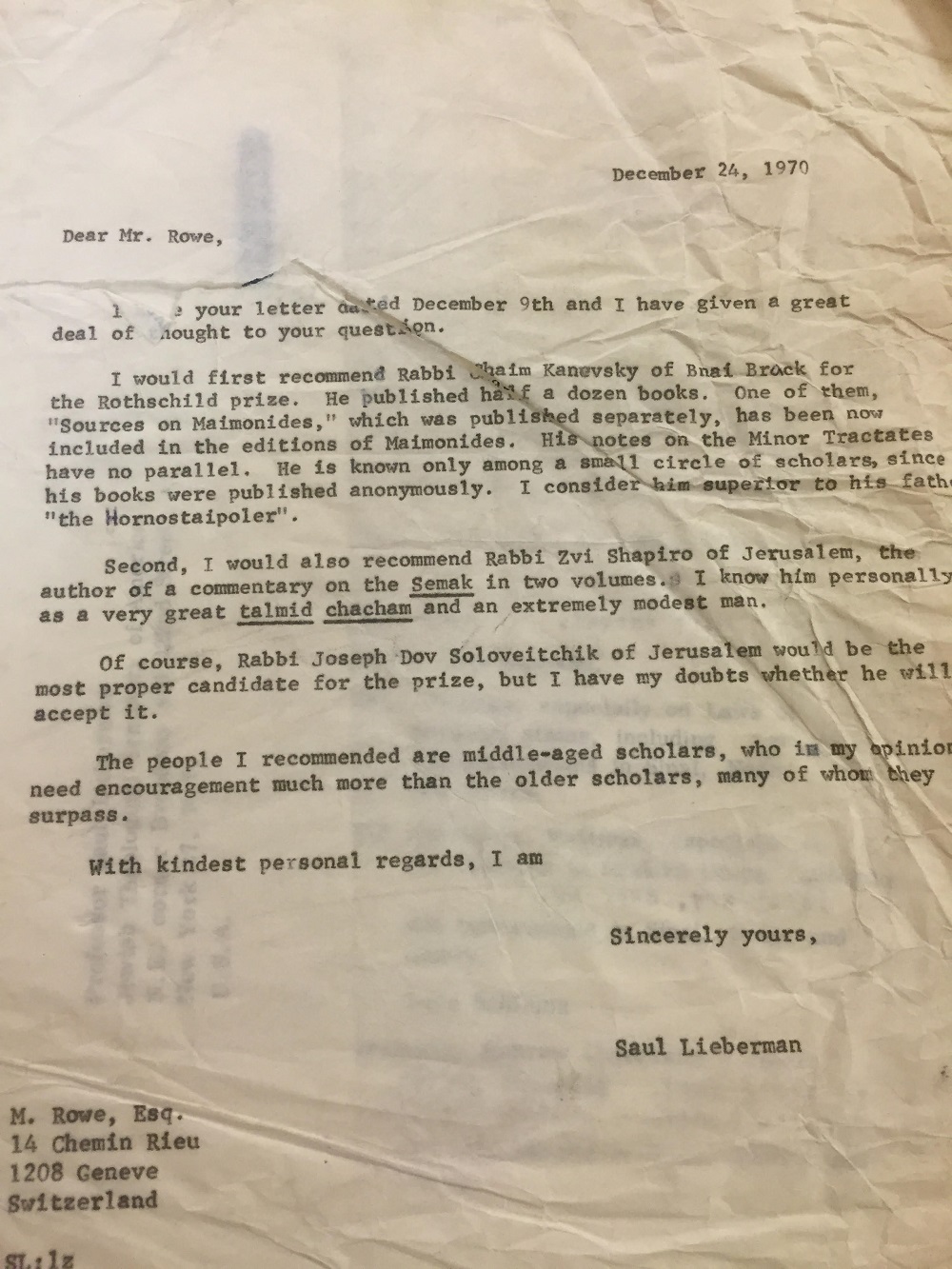
Since I mentioned R. Reuven Elitzur in my post here, let me note two other interesting items from his posthumously published book, Degel Mahaneh Reuven. On pp. 304-305 we learn that when Elitzur studied in Ponovezh, one of the students joined the Irgun. When some other students found out about this, they grabbed the Irgun student one night, covered his head with a blanket, and beat him terribly. The result of this was that the student not only left the yeshiva, but abandoned religion entirely. Only many years later, due to Elitzur’s influence, did he begin to again observe Shabbat.

I also found this story, on page 311, of interest.


We see that Elitzur was in the United States at the time of the great fire at the Jewish Theological Seminary library in April 1966. From the passage we see that he would eat his breakfast at JTS.[1] It could mean that he brought his own breakfast with him, or it could also mean that he ate the breakfast in the Seminary cafeteria. If the latter, it could mean that he only ate the cornflakes or that he even ate cooked items. It is interesting that a text with such ambiguity, and thus liable to create “problems,” appeared in a haredi work. I therefore assume that the grandchildren who put the book together did not understand the significance of where the fire had taken place, namely, that it is not an Orthodox institution.[2]

Regarding Orthodox rabbis visiting the Jewish Theological Seminary, in R. Aharon Rakeffet-Rothkoff’s memoir, he tells the following story about R. Moshe Bick:

Meeting such a figure [R. Bick] in the Seminary library made me feel awkward. Utilizing the rabbinic aphorism, I asked the good rabbi: “What is a kohein doing in a cemetery?” . . . With a kindly smile embracing his face, the Bronx spiritual leader immediately responded: “If the Seminary possesses rare and invaluable rabbinic texts, they must also be available to all Torah scholars. The Seminary cannot withhold these treasures from Klal Yisrael.”[3]

In R. Pinchas Lifshitz, Peninei Hen (Monsey, 2000), pp. 99-100, there is a 1929 letter from R. Shimon Shkop to Cyrus Adler, Chancellor of the Jewish Theological Seminary. In this letter, R. Shkop mentions meeting Adler at his Seminary office, at which time he spoke to him about the difficult financial situation of his yeshiva, Sha’ar ha-Torah in Grodna.

Regarding the Seminary, Nochum Shmaryohu Zajac called my attention to this video. In his discussion with Dr. Dov Zlotnick, we see the Lubavitcher Rebbe’s positive attitude towards Saul Lieberman (which I already mentioned in Saul Lieberman and the Orthodox).[4] It appears, however, that the Rebbe was confusing Lieberman and Louis Finkelstein when he referred to Lieberman’s connection to Torat Kohanim, and that he wrote he’arot and mar’eh mekomot to it. Torat Kohanim, otherwise known as the Sifra, was in fact Finkelstein’s great project.[5]

Another teacher at JTS was R. Abraham Sofer, who published the Meiri. A number of letters from the Lubavitcher Rebbe to him are included in Menahem Meshiv Nafshi (Jerusalem, 2012).

Here is vol. 2, p. 608.

I am quite surprised that R. Sofer is described as a “maggid shiur” at בית מדרש לרבנים. Is it possible that the editors did not realize that בית מדרש לרבנים is not an Orthodox institution?

Returning to Lieberman, in my post here I noted that Genazim u-She’elot u-Teshuvot Hazon Ish, vol. 2, published a lengthy letter from Lieberman to the Hazon Ish. Subsequent to that post, volume 3 of this series appeared, and beginning on page 319 we have two lengthy letters from the Hazon Ish responding to what Lieberman wrote. He begins with the following words which present a traditional perspective in opposition to the academic approach of Lieberman.

אם אמנם הבלשנות ותרגום המילים נוטל חלק בתורה שבעפ לאחר שנתנה לכתובאבל הרצים אחריה מדה ואינה מדהואין התורה מצוי‘ בין אלה שעושים את מלאכתם קבע ואת עיון העמוק עראית או אינם מתעמלים בו כללולאלה שעמלים בתורה אין פרי עבודתם של חוקרי הלשון מועיל רק לעיתים רחוקותובדברים קלי ערךומגמת המתעמל להתוכן ולא לתרגום המלה שהוא בבחינת תיק

I think readers will also find interesting a letter in the Lieberman archives at the Jewish Theological Seminary of America. I was alerted to this by Ariel Fuss.[6] Max Rowe represented the Rothschild Trust which awarded four monetary gifts to outstanding rabbinic scholars. Rowe turned to Lieberman for his recommendations on who should receive the awards. Although today everyone knows about the greatness of R. Hayyim Kanievsky, we see that Lieberman was aware of this fifty years ago, and recommended him for the grant. He even regarded R. Hayyim as greater than his father, the Steipler. Of all the significant figures Lieberman could have suggested, it is fascinating to see whom he chose.

I still have a good deal to write about Lieberman, as I have collected a lot of new material since the publication of Saul Lieberman and the Orthodox. For now, here is a picture of a young Lieberman and his wife, Judith, that has never before appeared in print or online. I thank Professor Meir Bar-Ilan for sending it to me.

* * * * * *

Continued from hereLet us resume with Grossman’s review, going page by page. First, I must thank everyone who wrote to me offering support. Many of these people are in the haredi world and have been reading my material for years, and others have listened to my Torah in Motion classes. They all knew that I had never mocked rishonim and aharonim,[7] an accusation I referred to as “slander”.[8] A number of people asked me how to explain why Grossman so mischaracterized my book, as it certainly wasn’t intentional. My response to them was that if you come to a task with a preconceived negative view, on a mission of destruction, then you will not be able to judge a book fairly. You won’t even realize how you are not being fair, and this in turn will lead to all sorts of mistakes. In the introduction to the Guide of the Perplexed, the Rambam addresses readers of his book:

If anything in it [the Guide], according to his way of thinking appears to be in some way harmful, he should interpret it, even if in a far-fetched way, in order to pass a favorable judgment. For as we are enjoined to act in this way toward our vulgar ones, all the more should this be so with respect to our erudite ones and the sages of our Law who are trying to help us to the truth as they apprehend it.

What the Rambam is saying is that readers should give authors the benefit of the doubt, and only if an author is clearly incorrect should one then feel comfortable expressing criticism. He says that we should act this way even “toward our vulgar ones,” the category that I and so many others would best be placed in, rather than in the category of the “erudite” and “sages of our Law.”

Unfortunately, Grossman was not careful in the way he wrote. R. Yair Hayyim Bacharach already warned us about the problems that arise from this, with a nice witticism:[9]

ואפילו בכתבי הדיוט אומרים בעלי הלצה השמר פן [פען הוא בלשון יהודי פולין שם לקולמספעדערוהוא מלשון רומית Penna. הערת המולכי אא לפרש דבריו או להתנצל בהם עי חסר או יתור או חלוף מלה כמו שעשה יעשה באמרי פיו.

Another relevant witticism is mentioned by Samson Bloch [10], that the word מבקר (reviewer or critic) stands for מתכבד בקלון רעהו.  

On pp. 38-39, Grossman quotes me as saying that the Rambam’s conception of Ikkarim was an innovation, and that this is not just something mentioned by academics but is also found in traditional writings. There is nothing controversial in this statement, and as many readers know, Rambam was criticized for having too many Principles (R. Joseph Albo) or for having too few (R. Isaac Abarbanel).

Grossman writes (p. 39):

Shapiro writes this despite the fact that an array of classic scholars, among them Alshich, R. Moshe Chagiz, Beney Yisoschar and Mabit believe otherwise. The latter, in a section of his Beys Elokim devoted to the Principles, begins his discussion with this comment. “All the main Principles of the Torah and its beliefs are either explicit or hinted at in Torah, Prophets, the Hagiographa, and in the words of Chazal received from a tradition; in particular, the three Principles which include them all.”

All this is completely irrelevant to what I have said. The issue is not whether the Rambam’s Principles can find support in the Torah, Prophets, Hagiography, or Chazal. Of course Rambam can find support for his Principles in earlier sources. What I and everyone else (rishonimaharonim, and academic scholars) are speaking about is something entirely different. It is whether the Rambam’s specific conception of Principles of Faith – that belief in the Principles, despite all other sins, are enough to ensure a share in the World to Come, and denial or doubt of a Principle, despite one’s piety and halakhic punctiliousness, will prevent one from having a share in the World to Come  is found in any other source before the Rambam. I also stated that no one before the Rambam had picked thirteen specific Principles as the basis of Judaism. As far as I know, every single rishon who wrote about the Principles agrees with this point. Unfortunately, Grossman once again completely misunderstands what I have stated.

Grossman writes (pp. 39-40):

Nothing shows more clearly that the Rambam based his Principles upon the Talmud than the fact that in Hilchos Teshuvah [3:6-8], he lists the various heretics under three classifications: min, apikores and kofer baTorah, all of whom lose their share in the World to Come. Obviously, each group violates a particular fundamental of faith, or else why would they be listed separately? Shapiro explains this by saying: “For his own conceptual reasons which have no talmudic basis, Maimonides distinguishes between the epikorus, the min and the kofer batorah.” [Limits of Orthodox Theology, p. 8 n. 27] But these terms are not, as Shapiro would have them, the Rambam’s inventions. They are taken from an explicit passage of the Talmud in Rosh ha-Shanah 17a which lists these three classes of heretics as those who lose their portion in the World to Come. They are obviously not a product of Rambam’s ‘conceptual reasons.’”

Every reader should be able to see Grossman’s error. Contrary to what Grossman attributes to me, I did not say that the terms epikorus, min, and kofer ba-Torah are the Rambam’s inventions based on his “conceptual reasons.” (He must think I am really ignorant as he assumes that I do not know that the terms epikorus and min are found in the Talmud.) What I said was that the way the Rambam distinguishes between these categories is based on his own conceptual reasons. In other words, why do certain heresies fall into the category of epikorus, others into the category of min, and others into kofer ba-Torah. For some heresies, we can see that the Talmud refers to the holders of these views as minim, but for others, it is the Rambam who determined the divisions, and we cannot find a talmudic basis. There is also no consistency in the Rambam’s own writings for what is included in the category of min.[11]

R. Nachum Rabinovitch writes as follows in his Yad Peshutah to Hilkhot Teshuvah 3:8, in discussing how the Rambam determined who is placed in the category of epikorus (as opposed to say, kofer ba-Torah). What I have underlined is particularly important. Is Grossman now going to be attacking R. Rabinovitch?

כאן שרצה רבינו לחלק בין כופרים שונים לפי מושגים יסודייםלפיכך השתמש במונח אפיקורוס לא כפי הוראתו הרחבה בדברי חזל שהשווהו למלה ארמית אשר שרשה פקראלא כפי מובנו בתולדות הפילוסופיהדהיינומן הכת של הוגה הדעות היווני אפיקורוס . . . על כן הגביל את המונה אפיקורוס למי שכופר בהשגחהזאת אומרתמכחיש שד‘ יודעוממילא כופר גם באפשרות שה‘ מודיע לבני אדם ובתוכם גם משה רבינונמצא שהמונח מין מיוחד לאמונות כוזבות על הבורא עצמוואפיקורס מיוחד לדעות נפסדות על יחס הבורא לאדם


I refer to R. Rabinovitch’s commentary in Limits, p. 9 n. 27, right after the passage cited by Grossman which he misunderstood and found so objectionable. Had he examined what R. Rabinovitch wrote, he might not have misunderstood what I was saying.

In this note I also refer to Menachem Kellner, Dogma in Medieval Jewish Thought, pp. 20-21. On p. 21, Kellner writes: “Maimonides does not carefully distinguish among the terms sectarian, epikoros, and denier.”

I also refer to R. Yitzhak Shilat, who in his note in Iggerot ha-Rambam, vol. 1, pp. 38-39, after discussing the different ways the Rambam refers to heretics in his various works, writes as follows with reference to the term min:

ונראה שהסבר הדבר הואשבהלכות תשובה נכנס הרמבם לחלוקה תיאורטית של סוגי הכפירה השוניםושם הוא מייחד את המונח מין” לסוג מסוים של כפירהדהיינו לכפירה באחד מעיקרי אמונת האלהותאך במובן יותר מעשי ורחב הוא משתמש במונח מינות” לכל כפירה באחד מיסודי האמונה (ובהפניה מהל‘ שחיטה להל‘ תשובה התכוון לכל סוגי הכופרים המנויים שם)

.ואכןהרחבת מושג המינות” והחלתו על כל כפירה באחד מיסידי האמונהמפורשת בדברי הרמבם במקומות אחדים . . . הרחבה נוספת של השימוש במונח מין” אנו מוצאים בהמשך דברי הרמבם

נמצאנו למדים שהרמבם משתמש במונח מינות” לא פחות מאשר בשלושה מובניםזה רחב מזהאכפירה ביסודי האמונה השייכים למציאות ה‘. בכפירה באחד מכל יסודי האמונהגכפירה בתורה שבעל פה


As the reader can see, R. Shilat explains how when it came to categorizing heresy, the Rambam used “his own conceptual reasons.”

In my note in Limits (p. 9 n. 27) I did not refer to R. Kafih’s commentary to Hilkhot Teshuvah 3:7, but it is also important regarding this matter. After mentioning those who questioned why the Rambam included what he did in the category of epikorus, seeing that various talmudic passages define an epikorus differently, R. Kafih states that this matter is easily explained, namely, the Rambam is not using the term epikorus the way it is used in the Talmud. Rather, he is using the Greek term, and placing into this category those heresies that can be identified with Epicurean philosophy.

ולפיכך כל מה שמקשים על דברי רבנו כאן מאפיקורוסים שונים שנאמרו בשסלקמכי שם מדובר בהטית המלה העברית הפקר בלבושה הארמי אפקירותאוכאן מדובר במלה שמקורה יוני עש אפיקורוס

R. Kafih explains further in his commentary to Mishneh Torah, Sefer Nezikin, p. 594:

שכל שבוש תעיה וכפירה השייכים לאלהות נקרא מיןוכל תעייה שבוש וסטייה השייכים לנבואה נקרא אפיקורוסובנדפס טרפו וערבבום יחד

R. Judah Albotini does not even think that we should pay the distinctions the Rambam gives to the different types of heretics much mind, as the different terms are “lav davka”.[12]

ואפילו הרב זל בעצמו משנה דבריו בהם כי פה כתב שהמינים הם אלו הה‘ שמות (ובס‘) [ובהלכותרוצח שהמין הוא העובד עז או האוכל נבלות להכעיס ובה‘ עירובין קרא לישראל העובד עז שהוא כגוי ולא קראו מין וקרא מינים לצדוק ובייתוס וכל הכופרים בתורה שבעל פה ולאלו קרא בכאן כופרים הרי לך שכל אלה השמות לאו דוקא קאמר אלא עד העברה

The most detailed discussion of how the Rambam categorizes the various types of heretics is found in Hannah Kasher, Al ha-Minim, Ha-Apikorsim, ve-ha-Kofrim be-Mishnat ha-Rambam. This book appeared in 2011, too late to be mentioned in Limits. On p. 15 she writes (emphasis added):

הרמבם לעתים הציע הגדרה מכוננת למונחיםוקבע כיצד לטעמו יש להשתמש בהם מעתה ואילך. . . הרמבם המיר לעתים באופן רדיקלי את משמעותו של המונח המסורתי ויצק לתוכו תוכן שונה.

On pp. 40-42, Grossman deals with my suggestion that the Rambam abandoned his Thirteen Principles of Faith as the summation of Jewish dogma in favor of his more detailed formulation in the Mishneh Torah. In support of this suggestion I point out that not only does the Rambam pretty much ignore the Thirteen Principles in his later works, but in discussing what to teach a convert, he also does not mention the Thirteen Principles. (Regarding converts, he only states that they should be instructed in the oneness of God and the prohibition of idolatry.) I also note that both R. Joseph Schwartz and R. Shlomo Goren argued that in his later years the Rambam no longer felt tied to his early formulation of the Thirteen Principles. Readers should examine Limits for more details. My thoughts in this matter were in the way of a suggestion, not an absolute conclusion, that I thought worthy of bringing to the attention of readers.

In response to my point that when evaluating the significance of the Thirteen Principles for the Rambam it is noteworthy that he does not require a future convert to be taught these Principles, Grossman states that the Rambam derived his ruling, that the convert is instructed in the oneness of God and prohibition of idolatry (but not other Principles), from the talmudic recounting (Yevamot 47b) of the dialogue between Naomi and Ruth: Naomi says that Jews are prohibited to serve idolatry, and Ruth replies “Your God is my God.”

The Rambam understands this discussion as referring to the Principles of idolatry and God’s unity. Apparently, adopting these two Principles is the essence of conversion to Judaism. These might be a mere sample of other laws and ideas that we also mention—as implied by the Rambam’s concluding phrase [Hilkhot Issurei Biah 14:2], “and we elaborate (u-ma’arichin) on this.” The Rambam is codifying that which the Talmud prescribes as integral to the conversion process, thus, one cannot ask why the Rambam did not mention other Principles of faith—which is a different topic entirely.

This is a perfect example of how Grossman’s review could have been written, namely, present my points and then explain why he reads the texts differently and why my reading is forced, inconsistent with what the Rambam says elsewhere or with the Rambam’s sources, or just flat out wrong because I misread a text. In this case, I would only note that I still believe that my point about the Rambam not returning to the Thirteen Principles in his later works, even when he discusses the fundamentals of faith, is more than a little curious and leads to my original suggestion that at the time he wrote the Mishneh Torah he had adopted a more detailed list of required beliefs.

As for the matter of conversion, what about the Third Principle? For the Rambam, belief in divine corporeality is a denial of God’s existence, since a corporeal god is not God. Therefore, according to the Rambam, this is something that everyone, from childhood, needs to be instructed in.[13] Belief in divine corporeality usually turns into a form of idolatry, since one who worships a corporeal god is worshipping something other than God.[14] Thus, it is obvious that according to the Rambam instruction about God’s incorporeality would be part of the instruction about the unity of God. However, Principles 4-13 are not included in a convert’s instruction, even though in his Commentary to the Mishnah, when he lists the Thirteen Principles, the Rambam states that all the Principles are obligatory beliefs. It is these missing Principles of faith that I have wondered about, and asked why the Rambam did not require a convert to be instructed in them. Grossman’s explanation for this is that since the only theological matters the Talmud requires instructing a convert in are God’s unity and the prohibition of idolatry, the Rambam would not add to this on his own.

Grossman continues by stating that I am operating under

a misconception of the structure of the Rambam’s work. The Rambam himself states explicitly in his letters—and so it is axiomatic to Torah scholars—that he never made a statement in his Mishneh Torah which did not have a source in the Talmud. Whenever he records his personal opinion, he prefaces it with the words, yeyra’eh li—“it would appear to me.” Anything in his Mishneh Torah that seems different from the Talmud is due to the Rambam’s unique interpretation of the particular passage of Talmud. Thus, the question, “If the Rambam added to the Talmudic prescription, why did he not add the other Principles?” is not applicable. . . . The Rambam is codifying that which the Talmud prescribes as integral to the conversion process, thus, one cannot ask why the Rambam did not mention other Principles of faith—which is a different subject entirely. (pp. 41-42)

Before getting to Grossman’s major criticism, let’s clear up some inaccuracies. The Rambam does not say in his letter to R. Pinhas ha-Dayan, referred to by Grossman (Iggerot ha-Rambam, ed. Shilat, vol. 2, p. 443), that everything in the Mishneh Torah comes from the Talmud. He mentions the Talmud, but he also mentions halakhic Midrash and Tosefta. He then says that if something comes from the Geonim, he indicates so. Furthermore, and this is a very important point, the Rambam is speaking about halakhic matters, that for these there is always a prior rabbinic source.[15]

To say, as Grossman does without further clarification, that the Rambam “never made a statement in his Mishneh Torah” that has no talmudic source is simply incorrect. There are a number of statements in the Mishneh Torah dealing with science and philosophy for which there are no talmudic sources, a point that has been noted by the traditional commentaries. At the end of Hilkhot Kiddush ha-Hodesh, ch. 17, the Rambam tells us that the astronomical information he provides comes from Greek texts, as the Jewish writings on these matters were lost. Many who have studied this section of the Mishneh Torah have wondered if this is to be regarded as Torah study? R. Hayyim Kanievsky cites the Hazon Ish who is quoted as saying that despite the Greek origin of this information, once the Rambam included it in his book it became Torah.[16]

ואמרו בשם מרן החזוא זצל שאעפ שהרמבם העתיק החשבונות שבפרקים האחרונים של קהח מהגוים כמשכ בספיז ממ אחר שהרמבם כתבם נעשה תורה ממש והלומדם לומד תורה

R. Jacob Kamenetsky states[17] that most of what appears in the first four chapters of Hilkhot Yesodei ha-Torah, which the Rambam viewed as basic to Judaism, is not to be regarded as Torah but as פילוסופיא בעלמא.

ובעל כרחנו אנו צריכין לומר שמה שמסר לנו הרמבם בפרקים אלו אין זה לא מעשה מרכבה ולא מעשה בראשיתאלא כתב כל הד‘ פרקים אלה מדעתו הרחבה מתוך ידיעות בחכמות חיצוניותכלומר שלא מחכמת התורהאלא הרי זה פילוסופיא בעלמא – ונאמר שכבר השיג עליו הגרא ביוד סי‘ קע”ט סקיג שהפילוסופיא הטתו ברוב לקחה ועיישוהרמבם כתב פרקים אלו רק בתור הקדמה לספר יד החזקהועיקר הספר מתחיל מפרק ה‘: כל בית ישראל מצווין על קידוש השם וכו‘, ואין לדמות טעויות בהלכות אלו לטעיות בהלכות שבת וכדומה


R. Tzadok ha-Kohen even states that some of the historical information that the Rambam provides at the beginning of the Mishneh Torah is not based on earlier rabbinic sources, but is the Rambam’s own suppositions.[18]

וראיתי להרמב”ם בהקדמת ספר היד מנה סדר הקבלה ממרע”ה עד עזרא כ”ב דורות . . . ואם קבלה נקבל אבל כמדומני כי מסברא והשערת הלב לבד הוא שאמר זה שהרי בהקדמתו לפירוש המשניות כתב רק עד ירמי’ . . . הנה לא הי’ נודע לו עדיין סדר מבואר רק שבעת שחיבר ספר היד המציא מנפשו לכוין סדר מ’ דור מימות משרע”ה עד רב אשי והמציא סדר קבלה מנפשו וכתבו סתם כאלו קבלה היא בידו, אבל באמת יש להשיב ולטעון הרבה על דבריו

Let us now return to Grossman’s main point, which is to discount my question as to why the Rambam does not mention the Thirteen Principles when it comes to converts. He states that there is no talmudic source requiring this, and that if I understood what the Mishneh Torah is about I never would have had this question.[19]

The problem with the way Grossman writes about this is that although he wants people to see that my question shows that I am an amateur, in so doing he ends up disrespecting many great Torah scholars. When I wrote my book, I did not know of anyone else who raised this question, so it looks like it is original to me (and Grossman can therefore use it as part of his attack). However, subsequent to the book’s publication, I have found a number of others who wonder the same thing I did. While I might not understand how the Mishneh Torah works, is Grossman comfortable saying the same thing about the Torah scholars I shall now mention?

R. Hayyim Sofer writes as follows, with reference to the issue of conversion:[20]

והדבר נפלא הלא יש י”ג עיקרי הדת והי’ לו לב”ד להאריך בכל השרשים

R. Yaakov Nissan Rosenthal, author of the multi-volume commentary on the Mishneh TorahMishnat Yaakov, writes as follows in his comment on Hilkhot Issurei Biah 14:2.

צע למה כתב הרמבם עיקרי הדת שהוא ייחוד השם ואיסור עכוםולמה לא כתב כל היג עיקרים שכתבן בפירוש במשניות בפי דסנהדריןוזלשעיקרי דתנו ויסודותיה שלשה עשר יסודותוראה שם בהמשך הדבריםולמה כתב כאןעיקרי הדת שהוא ייחוד השם ואיסור עכוםוצעג

R. Rosenthal sees it as a real difficulty that the Principles are not mentioned. I am sure he would not be bothered, as I am not, by what the Rambam writes in his letter to R. Pinhas ha-Dayan, for we are not dealing here with a technical halakhic matter, but with the basis of Jewish faith, and it is not at all an ignorant question to wonder why the Rambam did not include the Principles. On the very first page of his commentary to Sefer ha-Madda, R. Rosenthal also notes the point I made, that the Thirteen Principles as a unit are never mentioned in the Mishneh Torah, something that surely cries out for explanation.

ותימא למה לא הביא הרמבם בספרו היד החזקה” את הענין הזה של יג עיקרי האמונהוצע

R. Hayyim Amsalem also feels the need to explain why the Rambam does not require instructing converts in the Thirteen Principles:[21]

ולכן לא הצריך גם הרמבם יג עיקרים כולם שאם מודיעים לו איסור עז ויחוד השם די בהודעה הזו עם מה שבא להסתפח בנחלת ה‘ ובשם ישראל יכנהואין מקום לפשפש יותר מדי בעניינים האלו כמו ענייני האמונה אשר מי יאמר זכיתי לבבי

R. Iddo Pachter writes:[22]

בהלכות איסורי ביאה ידבכשהרמבם מציב את העיקרים כראש וכעיקר הנושאים המלמדים את הגרהוא אומר: “ומודיעין אותו עיקרי הדתשהוא ייחוד השם ואיסורי עכוםומאריכין בדבר הזה.” ואילו את העיקרים אחרים של התורה והגמול אין הרמבם מזכיר כללונשאלת השאלהלמה השמיט במקום מרכזי זה של כניסה לכלל ישראל את שאר הדוגמות המהוות תנאי לכניסה

Grossman can still argue that all of these sources are misguided in even raising the issue of why converts are not instructed in the Thirteen Principles. Yet I think we should all agree that this is a matter that reasonable people can disagree about, and it should not be used an example to show the world that I am clueless about the Mishneh Torah. Grossman might not think it is a big deal, but many readers will agree with me that the fact that the Rambam would allow someone to convert without being taught all Thirteen Principles is quite noteworthy.

R. Yisrael Meir writes:[23]

הרי שבשעת גירות איצ לדעת כל היג עיקריןאבל אחכ אם יכפור הז אין לו חלק לעוהב.

Just as the convert does not know all the halakhot, and on the very first Shabbat might make mistakes, so too, according to the Rambam’s instructions about conversion, he will not know all the Principles of Faith. There are endless halakhot and it is not feasible to have a convert become an expert in every area of halakhah. Yet the Principles of Faith are not that many, and contrary to Grossman, I reject the notion that the Rambam would have needed an explicit talmudic text to require this, as he viewed it as basic to Judaism.[24]

Relevant to what we have been discussing, R. Dovid Cohen writes as follows in the seventh volume of his book of questions, Ve-Im Tomar, p. 14, no. 216.[25]


When the questions are not his own, R. Cohen is always careful to record his source. This is a very admirable trait that we should all take to heart. Here is p. 77 no. 216, where he provides the source of the question.


While I am honored to be mentioned, I think that R. Cohen wrote this from memory. I say this since in the book I ask why the Rambam does not mention anything about teaching a prospective convert the Thirteen Principles. I don’t ask this question about talmudic sages.[26]

Before concluding this section of my reply, I want to return to a point I made in the book (p. 7), that the Rambam’s formulation that a convert be instructed in theological matters is something the Rambam added on his own without a specific talmudic source. Grossman rejects this and notes that the Vilna Gaon and others see the Rambam’s source as Yevamot 47b, where Naomi is recorded as telling Ruth that Jews are prohibited in idolatry, and Ruth responded that “your God is my God”.

The first thing I would say is that I am not certain if in this case the Vilna Gaon sees this as the source for the Rambam, or if he is simply citing a source that can be brought in support of what the Rambam, followed by the Shulhan Arukh, write. Chaim Tchernowitz writes about the Gaon’s commentary:[27]

לפעמים הוא מוצא לדין השוע סמך או רמז בכתוב עצמודבר שלא עלה על דעת שום איש ואף לא על דעת אותו המחבר בעצמואחד מן האחרוניםשהמציא את הדין או המנהג ההוא על דעת עצמועל סמך דיוק בגמרא או באיזה ראשון שהמציא בפלפולווהגרא מראה לדין זה מקור מן התורהמן הנביאים או מן הכתובים או מתרגומים עתיקים על פי רמז דק מן הדק


Let me illustrate this question by one example. If you look at Shulhan Arukh, Orah Hayyim 1:1, R. Moses Isserles is citing the Guide of the Perplexed. The Vilna Gaon, who knew the Guide and thus knew the basis of R. Isserles’ formulation, still cites talmudic passages as the source for R. Isserles, or perhaps we should say, as the the source for the Rambam. Does this mean that the Gaon is telling us that the Rambam’s statement in the Guide is actually based on the talmudic passages the Gaon cites? 

Nevertheless, even if the Gaon is not citing Yevamot 47b as the actual source of the Rambam’s requirement for theological instruction for a convert (and I am not sure about this), there are indeed others who do cite this text, so Grossman’s point is well taken.

My response to this is that there are also authorities who do not identify Yevamot 47b as the Rambam’s source, and who instead see the Rambam’s mention of the necessity of instruction of converts in theological truths as something the Rambam added on his own, and not based on any talmudic text. Rather, they believe that the Rambam regarded the necessity of theological instruction as so basic and implicit that there does not need to be a specific talmudic text as a source. This is a dispute among the commentators, so it makes no sense to criticize me for advocating one side of this debate. Before citing some traditional authorities, let me first mention what my teacher, Professor Isadore Twersky, said about this matter. I realize that Grossman, who is not positively inclined to academic scholars, does not need to accept Twersky’s opinion any more than mine, but at least readers will see that nothing I have said is from left field, as it were.

In his Introduction to the Code of Maimonides, pp. 474-475 (and note 293), Twersky states that the notion that “every phrase and nuance of the MT is explicit in some source” is “misleading. It fails to acknowledge the interpretative-derivative aspects of the MT.

Twersky also rejects the notion that the instructions in theology given to a convert are based on a particular talmudic passage (the very point on which Grossman criticized me):

Maimonides’ description of the procedure of conversion to Judaism vividly reflects his uniform insistence upon the indispensability of knowledge of the theoretical bases and theological premises of religion. A potential convert must be carefully informed about Judaism and instructed in its ritualistic patterns and, most emphatically, its metaphysics, its dogmatic principles—Maimonides emphasizes that the latter must be presented at great length. Now the need to expatiate concerning the theological foundations, in contradistinction to the ritual commandments, is not mentioned in the Talmud. Some scholars were inclined to assume that Maimonides found these details in his text of the tractate Gerim, inasmuch as a few other variants can be traced to this source, but this seems to be a gratuitous assumption. Given the Maimonidean stance, this emphasis is a logical corollary or even a self-evident component of the underlying text, which stipulates that the convert be informed about “some commandments.” . . . As a matter of fact, the entire presentation bristles with suggestive Maimonidean novelties which should not be glossed over and obscured.[28]

It is easy to say that I have a “misconception of the structure of the Rambam’s work.” Will Grossman say the same thing about Twersky?[29]

R. Baruch Rabinovich, Heishev Nevonim, ed. R. Nosson Dovid Rabinowich, pp. 13-14 (emphasis added), explicitly rejects Yevamot 47b as the Rambam’s source, and makes the exact same point I did about the Rambam not needing an explicit talmudic source for his statement that a convert is given theological instruction.

בביאור הגרא (שםמציין כמקור לדברי הרמבם אלו ליבמות (מז: ) לדרשת רבי אלעזר מאי קראה וכו‘ שאמרה נעמי לרות אסיר לן עז” ועל זה השיבה רות ואלוקיך אלקי (רות פא פטז) – אבל אין הכרח לומר שמשם לומד הרמבם דין זה אלא שהרמבם מסברא דנפשי‘ פסק כךכמושכל ראשוןשאין גרות ואין שייכות ליהדותכל עוד אין אמונה בייחוד ה‘, והסתייגות מעזוכן דעת ההמבכל אופן מש ומאריכין עמו דבר הזה“, אין זה המקור [!] אלא מסברא דנפשי.

Grossman can reject R. Rabinovich’s statement, but he cannot say that R. Rabinovich did not understand “the structure of the Rambam’s work.”

A commentary on the Mishneh Torah that I often turn to is R. Asher Feuchtwanger’s Asher la-Melekh. He writes as follows in his comment to Hilkhot Issurei Biah 14:2 (emphasis added):

רוב דברי רבנו בפרק הזה מתחלתו עד הלכה ו‘ ועד בכללמקורן בברייתא המובאת יבמות מזאך הודעת עיקרי היהדות לא הוזכרה כללואכ מנל לרבנו לקבוע כן


R. Feuchtwanger goes on to offer an original solution. Does this mean that he too did not recognize the structure of the Mishneh Torah?

In fact, we don’t need to look at twentieth-century commentaries on the Mishneh Torah to make this point. Right on the page, the Maggid Mishneh states:

ומאריכין בדבר זהבייחוד השם ובאיסור עז שאינו מבואר שם שיאריכו עמו בזה אבל הדבר פשוט שכיון שאלו הם עיקרי הדת והאמונה צריך להודיעם בברור ולהאריך עמם בזה שהוא עיקר היהדות והגירות

On the Rambam’s words, Hilkhot Issurei Biah 14:2, that we instruct the convert in basic theology, R. Masud Hai Rakah, Ma’aseh Rakah, ad loc., writes: זה לא הוזכר בברייתא.

In R. Shlomo Tzadok’s commentary to Hilkhot Issurei Biah 14:2, he writes:

ומודיעין אותו עיקרי הדתאף שהודעה זו לא נזכרה בשסרבינו סבור שיסוד ועיקר זההוא דבר המובן מאליו שצריך להודיעו תחלה

Even after all we have seen, it is possible that Grossman is correct, and all the sources I have cited are mistaken. My only point in citing them is to show that nothing I have said in this matter should be regarded as far-fetched or ignorant, as I offered a reasonable approach to an often-discussed text.

To be continued

Notes

[1] Regarding the Seminary library (or any other Conservative institution), R. Moshe Feinstein was asked if one must return books to them, even if the books will not be used at the institution and the person who has them will learn from them. He replied that “it is forbidden for us to permit gezeilah or geneivah.” See Yad Moshe, p. 86. See, however, R. Menasheh Klein, Mishneh Halakhot 17:155, who writes:

ומיהו היכא דשאל ספר מספריה שהם רשעים ואפיקורסים ויכול עי איזה ערמה לעשות שלא להחזיר יש לעיין בדברדבסדעת זקנים מבעלי התוספות עהת פ‘ תולדות עהפ ויבז עשו את הבכורה כתבו וזלפי‘ מכבר היה מבזה אותה ועל כן לקחה יעקב ממנוונמצא בספר ר‘ יהודה החסיד מכאן אתה למד שאם יש ביד רשע סת או מצוה אחרת דמותר לצדיק לרמותו וליטלו ממנו עכולפז היכא דישנם ספרים ביד רשעים ואפיקורסים מותר לרמאותםולפז כש שאם לוה ולא החזיר בזמנו ויכול לרמותו דלא מיבעיא דלא נפסל לעדות אלא מותר לעשות כן לכתחילהולדינא צע


[2] In the days before hebrewbooks.org and Otzar ha-Hokhmah, I often visited the JTS library. It was common to see Orthodox Jews with impeccable standards of kashrut, who would not eat food served in a Conservative synagogue, eating in the Seminary cafeteria.
[3] From Washington Avenue to Washington Street (Jerusalem, 2011), pp. 67-68. I personally was in the Seminary rare book room together with the late R. Ephraim Fishel Hershkowitz.
[4]  Regarding Lieberman and Chabad, see here p. 38, where we see that in 1982 Lieberman sent a check for $1000 to Chabad’s Merkos Leinyanei Chinuch. On p. 39, a section of his will  is published which shows that he left $10,000 for this same charity. This was called to my attention by Nochum Shmaryohu Zajac.

Zlotnick’s loyalty to his rebbe, Lieberman, was legendary. Unfortunately, this led to a slightly unpleasant experience for me, which I think is worth recording for it shows how sensitive Zlotnick was to the memory of Lieberman. Here is page 23 of Saul Lieberman and the Orthodox; look at note 83.

Not long after the publication of Saul Lieberman and the Orthodox, I was at a wedding and someone came over to me to say that Professor Zlotnick would like to speak to me. I had never before met him and someone had obviously told him that I was there. Upon meeting Zlotnick, and with a few others surrounding us, he very firmly told me that it was a big mistake to include the quotation from Wenger in the book, as it mentions that “many faculty members” have questioned if Lieberman wrote a responsum against women’s ordination. I could not understand what he was talking about. I replied that I cited this passage so as to show that it was mistaken. He did not accept my reply, and insisted that to cite such falsehood, even if to show that it is mistaken, was to give it a legitimacy that it did not deserve. He felt that obviously false statements should simply not be dignified with a refutation. Only after he got this point off his chest, which had obviously been bothering him, were we able to have a nice conversation. For months after the conversation, I occasionally wondered if perhaps Zlotnick was correct.
[5]  In Mesorat Moshe, vol. 3, p. 389, R. Moshe Feinstein is recorded as stating that there is no problem using Lieberman’s edition of the Tosefta. R. Moshe adds that since he is religious: אינו חשוד שיזייף את התוספתא.
[6] Document provided courtesy of the Saul Lieberman Archives (ARC 76/8) of the Jewish Theological Seminary Library.
[7] When R. Hayyim Capusi (died 1631) was accused of speaking improperly about the gedolim, he responded as follows (Mikabtze’el 37 [5771] p. 581):

ומה שהוציא דבה עלי שדברתי נגד הגדוליםחלילה לי מרשעוחס ליה לזרעיה דאבא לבוא בגבורות נגד רבותינו זל


[8] Nachum commented to the last post that “‘slander’ is spoken and ‘libel’ is printed (or news, etc.).” While that is the technical definition, all you have to do is google “slanderous article” and you will see that “slander” is also generally used for printed material. Incidentally, when it comes to the word דִבׇּה, which means “slander” in biblical Hebrew, it has a very different meaning in medieval texts. “As Jacob Klatzkin [in his Thesaurus] notes, dibbah in medieval Hebrew does not mean ‘slander,’ but rather a false claim, nonsense, or absurdity.” Y. Tzvi Langermann, Rabbi Yosef Qafih’s Modern Medieval Translation of the Guide,” in Josef Stern, et al., eds., Maimonides’ Guide of the Perplexed in Translation(Chicago, 2019), p. 268.

In the last post I discussed the use of the word “strange” in describing earlier opinions. On p. 270, Langermann mentions how in translating a particular word from the Arabic, which the Rambam used with reference to certain aggadic opinions, while Pines uses “incongruous” and Ibn Tibbon uses “megunneh”, R. Kafih uses “muzar”. Here is the section from Guide2:30 in R. Kafih’s translation:

אבל מה שתמצא לשונות מקצת החכמים בקביעת זמן מצוי קודם בריאת העולם הוא תמוה מאדכי זוהי השקפת ארסטו אשר בארתי לך שהוא סבור כי אין לתאר לזמן התחלהוזה מוזר . . . אמר רבי יהודה בר סימון מכאן שהיה סדר זמנים קודם לכןאמר ר‘ אבהו מכאן שהיה הקבה בורא עולמות ומחריבןוזה יותר מוזר מן הראשון

R. Kafih himself uses this word in describing views of his predecessors. See his commentary to Hilkhot Shabbat 16:17, note 29, where after mentioning how virtually all prior commentaries understand a passage in the Rambam, he writes:

וזה מוזר ומופלא ביותר

Abarbanel often uses the words זר and even זר מאד when discussing earlier interpretations. He also speaks this way when referring to talmudic and midrashic passages. See e.g., Yeshuot Meshiho, vol. 2, ch. 5 (p. 108 in Oran Golan’s 2018 edition):

ואמנם מה שאמר רבי חנינא . . .  הוא מאמר זר מאד

See also his commentary to Joshua 24:25:

ובדברי חז”ל (מכות פ”ב דף י”א ע”א) בספר תורת הא-להים, ר’ יהודה ור’ נחמיה, חד אמר אלו שמונה פסוקים שבתורה, וחד אמר אלו ערי מקלט, ושניהם דעות זרות מאד

I could cite many more such examples. See also Eric Lawee, Isaac Abarbanel’s Stance Toward Tradition (Albany, 2001), p. 95.
[9] Bikkurim 1 (1864), p. 16.
[10] Introduction to his translation of Leopold Zunz, Toldot Rashi (Lemberg, 1840), p. 12 (unnumbered; the first word on the page is שרשי). In the Jewish Encylopedia entry on Bloch, it says as follows about this work:

Besides the above-mentioned works, Bloch also translated into Hebrew Zunz’s biography of Rashi, to which he wrote an introduction and many notes (Lemberg, 1840). This work bears unmistakable traces of decadence, both in style and virility.

I have no idea what this last sentence is supposed to mean.
[11] Grossman writes that the terms “are taken from an explicit passage of the Talmud in Rosh ha-Shanah 17a which lists these three classes of heretics as those who lose their portion in the World to Come”. Here is the talmudic passage:

אבל המינין והמסורות והאפיקורסים שכפרו בתורה ושכפרו בתחיית המתים . . . יורדין לגיהנם ונידונין בה לדורי דורות

Contrary to Grossman, from the language of the Talmud in the standard Vilna edition it would seem that what we have here are not three categories of theological heretics, but two: מינין and אפיקורסים. The Talmud defines אפיקורסים as those who deny the Torah and the Resurrection. See R. Abraham Abba Hertzl, Siftei Hakhamim, ad loc.

מדנקט השס שכפרו“, ולא נקט ושכפרו” בתורהכמו שנקט באחרינא משמע קצת דבחד מנה להווהאפיקורסים שכפרו בתורה


The Rambam, Hilkhot Teshuvah 3:6, sees אפיקורסים as separate from the two types of kofrim, rather than seeing kofrim as explaining what an epikorus is. Presumably, the Rambam’s version of the Talmud read like the Munich manuscript: והאפיקורסין ושכפרו. In other words, this version explicitly distinguishes between the epikorsim and the kofrim, creating separate categories. This distinction is noted in the Soncino translation of the Talmud. R. Raphael Rabbinovics, Dikdukei Soferim, ad loc., notes that the Munich version is found in Ein Yaakov and all rishonim, and is the correct text. (I wonder if indeed all rishonim have ושכפרו)

The Koren edition, while keeping the standard text of the Talmud – והאפיקורסים שכפרו בתורה – provides this incorrect translation: “But the heretics; and the informers; and the apostates [apikorsim]; and those who denied the Torah; and those who denied the resurrection of the dead.” If Koren is translating in accordance with the Munich manuscript, then this should have been noted, as והאפיקורסים שכפרו בתורה cannot be translated as: “and the apostates; and those who denied the Torah,” as if we are dealing with two separate categories. I also do not like the translation of epikorus as “apostate,” as today, most people understand “apostate” to mean an actual meshumad, but this is not what we are dealing with.

ArtScroll also translates incorrectly: “But the sectarians, the informers, the Apikorsim, those who denied the divinity of the Torah, those who denied the resurrection of the dead.”

Steinsaltz translates the passage properly:

והאפיקורסים המזלזלים בתורה ובחכמיה שכפרו בתורה

[12] Yesod Mishneh Torah, Sefer Madda, p. 242.
[13]  See Guide 1:35.
[14]  See Iggerot ha-Rambam, ed. Shilat, vol 2, p. 578:

ושם אלהים אחרים לא תזכירו וכו‘, כי אשר לו קומה הוא אלהים אחרים בלא ספק

[15] Despite the Rambam’s statement in this letter, we know that even with regard to halakhic matters, the Rambam’s originality far exceeds the numerous instances where he mentions that he is offering his own opinion. See my Studies in Maimonides and His Interpreters (Scranton, 2008), pp. 79ff.
[16] R. Kanievsky, Shekel ha-Kodesh, introduction.

[17] Emet le-Ya’akov al ha-Torah, p. 16. The following appears in a note, ibid., and is designed to soften what R. Kamenetsky wrote:

בשיחה פרטית הסביר רבינו כוונתו שעל פי ידיעותיו בפילוסופיא למד כן בחזל”.

Yet this explanation is entirely at odds with what R. Kamenetsky wrote in Emet le-Ya’akov, that what appears in the first four chapters of Hilkhot Yesodei ha-Torah is not based on Torah sources.
[18] Published in Sinai 11 (Nisan-Elul 5707), pp. 11-12 (called to my attention by R. Chaim Rapoport). In Sefer ha-Zikhronot (Har Bracha, 2003), p. 288, R. Tzadok writes:

ולא היה ראוי לו לקבוע ידיעת עניינים כאלה בהלכות יסודי התורה שלו כללדברים שאינם צריכים למאמיני התורה לידיעתםוכל שכן שהרבה מדבריו אינם אמת כפי דעת חכמיהם היוםוהכללמה לדברי חכמי אומות העולם עם דברי התורה שמן השמיםלעשות דבריהם יסודות לתורהוכל מה שאסף שם הם מדברי חכמי אומות העולם


[19] Even though the Rambam does not mention instructing future converts in the Thirteen Principles, this is what is done nowadays. Yet what happens if someone converted while holding a belief that violates one of the Principles? Is the conversion valid? This interesting question is discussed by R. Eliezer Ben Porat, who claims that when it comes to most of the Principles—the ones not dealing with God’s essence—even the Rambam would regard the conversion as valid ex post facto. See “Ger she-Ta’ah be-Ehad me-Ikarei ha-Emunah,” Kol ha-Torah 67 (Nisan 5769), pp. 313-316.
[20] Mahaneh Hayyim, Yoreh Deah 2, no. 25 (p. 139).
[21]  “Inyanei Gerut,” Or Torah, Adar 5770, p. 540.
[22] “’Ein Lo Helek’: Matarat ha-Rambam bi-Keviat Yud Gimmel Ikarei ha-Emunah,” Masorah le-Yosef 8 (2014), p. 490.
[23] Torat ha-Emek 12 (5764), p. 42. See also Pachter, “Ein Lo Helek,” p. 497:

מטקס קבלת הגר המפורט בהלכות איסורי ביאה, שהבאנו לעיל, שמוכח ממנו שאין צורך בקבלת כל י”ג העיקרים כדי להכנס לכלל ישראל

[24]  Ex post facto, if the future convert was not instructed even in the basic principles required by the Rambam, it seems that the conversion would still be valid. See R. Moshe Feinstein, Iggerot Moshe, Yoreh Deah 3, no. 106:

וגם מצינו עוד יותר שאף שלא ידע הגר שום מצווה הוא גרדהא מפורש בשבת דף סח עב גר שנתגייר בין הנכרים חייב חטאת אחת על כל מלאכות של כל השבתות ועל הדם אחת ועל החלב אחת ועל עבודה זרה אחתהרי נמצא שלא הודיעוהו שום מצווה אף לא עיקרי האמונה ומכל מקום הוא גר

[25]  R. Moshe Maimon called my attention to this.
[26] R. Cohen has also published Ha-Emunah ha-Ne’emanah (Brooklyn, 2012). It is obvious that at times in this book he is responding to what I wrote in Limits (and he also deals with many of the sources I cite). While I am not mentioned by name, I am apparently included among the משמאילים referred to on p. 5 (see Limits, pp. 7-8)
[27] Toldot ha-Poskim, vol. 3, p. 212 (emphasis added).
[28] R. Mayer Twersky, in his discussion of the Hilkhot Issurei Biah 14:2, states that the Rambam’s source is Yevamot 47b, and adds: אם כי הרמבם הרחיב את הדברים. See “Im Benei Noah Nitztavu be-Mitzvat Emunah o Lo,” Beit Yitzhak 37 (5765), p. 529. In the continuation of the article, R. Twersky makes the argument, which he acknowledges that at first glance is מאד מחודש, that for the Rambam non-Jews are also obligated to believe in the Thirteen Principles. In Limits, p. 22, I cited R. Zvi Hirsch Broide as saying the same thing.
[29] Regarding the Rambam’s instructions for a convert, see most recently Menachem Kellner, “The Convert as the Most Jewish of Jews? On the Centrality of Belief (the Opposite of Heresy) in Maimonidean Judaism,” in Jewish Thought 1 (2019), pp. 37ff.


Cemeteries and Response to Criticism

Cemeteries and Response to Criticism

Marc B. Shapiro

In my last post here I said that when it is safe, I will go to Baghdad to visit the grave of the Ben Ish Hai. I cannot find a picture of the Ben Ish Hai’s grave online, but you can see it in R. Yaakov Moshe Hillel’s beautifully produced recent book, Ben Ish Hai, p. 337. However, this is from the old cemetery in Baghdad, and because of a government order the remains in this cemetery were moved in the early 1960s. So it remains to be seen if the grave can now be located.[1] R. Hillel, p. 336 n. 480, claims that the precise location cannot be identified.

כיום, לא ניתן לזהות את קבריהם, בשל תנאי אקלים קשים השוררים בבבל אשר גרמו להתפוררות המצבות, ומחוסר רישום מדוייק של חלקות הקבורה.

Yet until we can go in and actually examine the spot, we cannot be certain if this is the case. There have been other examples of graves thought to have been lost, which have then been found. The best-known example is the grave of R. Israel Salanter, which was only located twenty years ago.[2]

While there is no doubt that the Ben Ish Hai was buried in Baghdad, there is also a tombstone for him on the Mount of Olives in Jerusalem.

According to a famous story, which is also told on the tombstone, the Ben Ish Hai’s body was not only magically transferred to Jerusalem on the day he died, but the grave-digger testified to burying him on the Mount of Olives and wanted payment for his labor.[3] I guess we can say that the Ben Ish Hai was buried three times: twice in Baghdad and once in Jerusalem.

It is hard to know whether the entire story of the burial in Jerusalem is a legend, or if there actually was a grave digger who figured out a way to make some money and invented the story to get paid for digging the grave. Assuming the latter is the case, the grave digger must have known his crowd, that not only would they be inclined to believe such a story, but that they would also not think of actually confirming the story by digging up the grave. Truth be told, it would have to be a very fearless grave digger to leave the grave empty, because one never knows if it will be opened, so it is possible that some unknown person is actually found beneath the tombstone. It is also possible that the grave digger did not have any bad intent, but just had a very vivid imagination. In any case, it is fascinating that such a tombstone exists in the most special Jewish cemetery, and even more incredible that there are people who actually believe that the Ben Ish Hai is buried there.

Supposedly, the Ben Ish Hai’s tombstone on the Mount of Olives is the only one that is standing upright, as all others are horizontal. (Maybe someone in Jerusalem can confirm this.) It is worth noting that R. Yitzhak Kaduri paid the grave in Jerusalem no mind, and even joked about it.[4] R. Shmuel Eliyahu has stated that while the Ben Ish Hai is buried in Baghdad, his spirit came to Jerusalem.[5]

Similar to the story with the Ben Ish Hai’s burial place, R. Abraham Joshua of Apt is buried in Medzhybizh, near the Baal Shem Tov’s grave, but there is a legend that angels carried his body to Tiberias, and there is a stone marking his grave there as well.[6]

This last summer I was in Marrakech, Morocco. In the local Jewish cemetery, R. Jacob Timsut is buried. Yet, “one month after the deceased rabbi was buried in Marrakech, a letter arrived from Jerusalem announcing the marvelous appearance of a tombstone with the name of Rabbi Ya’aqov Timsut in the well-known cemetery on the Mount of Olives.”[7] So once again, you can visit the tzaddik’s grave in its original spot or in Jerusalem.

Regarding tombstones even though the deceased is not buried there, I must call attention to the fascinating comments of R. Hayyim Nathan Dembitzer (1820-1892). R. Dembitzer was a dayan in Cracow and author of the responsa volume Torat Hen. Yet his claim to fame is his historical writings. As a real historian, he was prepared to accept the truth from where it came, and it is significant that in his work Mikhtevei Bikoret (Cracow, 1892), he included correspondence with Heinrich Graetz. Here is the title page and the first two pages of this book.


Look at how respectfully he refers to Graetz, which is the sort of thing that would have driven R. Samson Raphael Hirsch and R. Esriel Hildesheimer crazy.

Dembitzer’s respectful scholarly interactions with Graetz, in which he did not let religious differences interfere, is parallel to how certain important rabbinic figures related respectfully to Louis Ginzberg. I dealt with this matter in Saul Lieberman and the Orthodox, and it has also recently been discussed by R. Moshe Maimon.[8] Interestingly, in Mikhtevei Bikoret R. Dembitzer also includes correspondence with Nachum Sokolow.

Dembitzer’s two-volume Kelilat Yofi is focused on the rabbis of Lvov as well as other Polish rabbis, and is essential for anyone doing research on the Polish rabbinate. In this work, vol. 1 p. 41a, he mentions that Elyakim Carmoly had written that in earlier years in Lvov they would place tombstones in the cemetery for the deceased scholars of the city even if they had died and were buried elsewhere.

Dembitzer does not give an exact reference for Carmoly, only mentioning that his comment is in Ha-Karmel. Fortunately, I was able to find Carmoly’s article and it appears in Ha-Karmel, April 17, 1867, p. 302. Carmoly’s has two proofs for his contention. The first proof is that in R. Gavriel ben Naftali Hertz’s Matzevat Kodesh (Lemberg 1864), vol. 2, in the second half of the book (there is no pagination here), we find the following tombstone for R. Elijah Kalmankash, who served as rav of Lvov.

The tombstone explicitly states:

.וישכב עם אבותיו ויקבר במקום קבר אביו ולא ידע איש את קבורתו עד היום הזה

This is a clear proof that at least for this rabbi, a tombstone was placed in the ground even though he was not buried there.

Carmoly also notes, as his second proof, that in Matzevat Kodesh, vol. 2, p. 22a, it records, from the Lvov cemetery the text of the tombstone of R. Petahiah, son of R. David Lida who was rav of Amsterdam. His date of death is given as 1721. Here is the text of the tombstone as recorded in Matzevat Kodesh.

(Following R. Petahiah’s tombstone, Matzevat Kodesh records the tombstones of another son and son-in-law of R. Lida.) However, Carmoly tells us that we know that R. Petahiah died and was buried in Frankfurt. R. Markus Horowitz in his Avnei Zikaron (Frankfurt, 1901), p. 290 (no. 2712), published many years after Carmoly’s article, records the text of his tombstone as follows.

As you can see, the date of death is 1751, thirty years later than the date given on the tombstone in Lvov. In other similar cases, I would say that we are dealing with two different people, but the specificity of the tombstone texts makes it hard to deny that they are both for the same person (and Petahiah was hardly a common name).[9] Carmoly’s conclusion is that the community of Lvov put up a tombstone for R. Petahiah to memorialize him, even though he was buried in Frankfurt. Neither Carmoly nor R. Dembitzer offer an explanation as to why the Lvov tombstone places his death thirty years too soon, but they would probably view this as just a simple error.

Dembitzer not only agrees with Carmoly in the case of R. Petahiah, but offers another example of this phenomenon. R. Zvi Hirsch ben Zekhariah Mendel had served as rav in Lvov, but later he was rav in Lublin and died there around 1700. However, there was a tombstone for him in Lvov which gave his date of death at 1655. R. Dembitzer does not explain the discrepancy of the dates of death, and presumably he would say that when the tombstone was put up in Lvov to honor the deceased former rav of the city (who was not buried there), they simply got the date of death wrong. Interestingly, Shlomo Tal accepted the statements of Carmoly and R. Dembitzer, and in summarizing their position speaks of “many fictitious tombstones.”[10]

Dembitzer also makes the astounding assertion that there are graves in the Lvov cemetery for rabbis who never existed! His proof is that there is a tombstone for a Rabbi Eliezer ben Moshe ha-Kohen Proops (פרופס), who is said to have been av beit din in Amsterdam before he came to Lvov. Yet R. Dembitzer states that no such person was av beit din in Amsterdam, and we thus see that the people who made the tombstones did so for rabbis who never existed![11]

כי גם זאת לפנים בלבוב, להקים ג”כ מצבות אבנים ולחקוק עליהם שמות חכמי ישראל אשר לא מתו ולא נקברו לא בלבוב, וגם לא במקומות אחרים, יען כי לא היו ולא נבראו ולא באו עוד לעולם . . . ומי לידינו יתקע אם לא עשו זכרונות במצבות אבנים כאלה גם לשאר גאונים אשר בדו מלבם וקראו בשמותם עלי אדמה, וקבעו גם כן זמן לפטירתם

This is a very strange assertion, and even if it is correct, it refers to one case only, while R. Dembitzer uses it to make a generalization. The only one I know who took note of R. Dembitzer’s assertions was R. Hayyim Eleazar Shapira in a letter to R. Leopold Greenwald.[12] R. Shapira rejects R. Dembitzer’s claim in a very sharp tone.

ולא יאומן כי יסופר כי מרב גדול בתורה יצאו דברי הבל כאלו אשר כל השומע ויודע יצחק להם, ליתן מצבות ומקום בעד אותן שאינם נקברים שם ולכתוב שקר גמור “פ”נ” על להד”ם ולהשחית הקרקע שלא נקברו שם אין כדאי להטפל בדברי ריק כאלו. ואם בשביל קושיות שמצאו כמו ב’ מצבות כמו שני יוסף בן שמעון בשתי עיירות כלומר בתי קברות הנה שערי תירוצים לא ננעלו ונמצאו באמת שנים ששמותיהן שוות או לא העתיקו המצבות במקום אחד כראוי

Shapira makes the obvious point that two people with the same name can be buried in different cemeteries without them being the same person. However, this does not explain how there can be two tombstones for R. Petahiah, the son of R. David Lida, or how there can be a tombstone for another rabbi in the Lvov cemetery when we know that he was buried elsewhere.

Regarding what we have discussed, I would only add that in the new Jewish cemetery in Vienna (the same one that R. Israel Friedman, the Chortkover Rebbe, is buried in), there is a tombstone for three members of the Chevra Kadisha who perished in the Holocaust. While it looks like a normal grave, none of the three men mentioned on the tombstone are actually buried there.[13] Here is the tombstone.

I owe this information and the picture to Dr. Tim Corbett, whose book on the Jewish cemeteries of Vienna will hopefully soon be published.

Since I just mentioned R. Hayyim Eleazar Shapira, let me mention something else he says that is fascinating. In the past two posts I discussed apostate rabbis. It is bad enough when an average person apostatizes, but for a rabbi to do so could have had terrible consequences on the community in that it could lead to many weak of heart to follow. Can anyone imagine, however, someone apostatizing as an act of teshuvah? It sounds crazy, but R. Shapira reported that he had it by tradition that such an incident happened in medieval times.[14]

The story he tells is that there was a popular preacher who in his public talks inserted all sorts of heretical ideas. After he was rebuked by one of the rabbis for preaching his heresies, the man confessed his sins and asked what he should do to repent. The rabbi told him that his repentance would not help, as for years he has gone from place to place spreading his heresy. How could he possibly repent for this? The rabbi said that what he must do is convert to Christianity. The Jewish world would then hear about this and this would remove the legitimacy from any of his sermons, as people would assume that even before his apostasy he was a heretic. Only by doing this could he destroy the impact he made with his earlier sermons.

Let me mention one final responsum for now. In the eighteenth century, R. Elijah Israel of Rhodes dealt with the case of someone who converted to Islam in Izmir, and then wished to come to Rhodes in order to return to Judaism.[15] Practicing Judaism after converting to Islam was illegal, and could endanger everyone in the community. The man was therefore warned not to come to Rhodes, where Muslim merchants might recognize him, but he ignored this warning. Making matters worse, the man had already once before converted to Islam and reverted to Judaism, meaning that there was no way that the Jewish community could have any dealings with him.

Israel permitted letting the authorities know about this man, as he was regarded as a danger to the community. The punishment for his “crime” of leaving Islam would have been severe and could even have included the death penalty, but R. Israel allowed informing the authorities as the man had the status of a rodef. He writes:

מי שמסכן רבים כגון שעוסק בזיופים במקום שהמלכיות מקפידות דינו כרודף ומותר למוסרו למלכות ע”כ וכ”ש וק”ו במי שהמיר דת ורוצה לחזור לדתו שההקפדה היא גדולה שהוא בזוי גדול לדעתם פן תצא כאש חמתם ח”ו ובערם ואין מכבה שמותר למוסרו כדי להציל את ישראל

* * * * * *

In the most recent issue of Dialogue 8 (2019), pp. 35-83, Rabbi Herschel Grossman published a lengthy review of my Limits of Orthodox Theology.[16] Normally I, like any author, would be very happy that so many years after a book’s appearance people are still interested in examining it and engaging with its arguments. Unfortunately, that is not the case with the present review which, it must be said, is nothing less than slanderous. Had the author taken issue with my interpretation of texts and shown why I am mistaken, this would have been a fine way to approach the book. It could be that I would even acknowledge that in some cases his understanding is preferable to mine. As readers of this blog know, I am perfectly willing to acknowledge when I have erred and am happy to credit those who called my attention to these errors. This is how scholarship is supposed to work, and anyone who writes, especially someone who writes a great deal using lots of different sources, will sometimes make a mistake. I myself have called attention to my own errors, without anyone prompting me, as I think it is important for all of us to be as exacting as we can.

However, this is not what the review is about, or, I should say, not what it is mainly about. In future posts I will come to the issue about how to interpret specific texts (and I will defend my readings), but first I must explain why I said that the review is slanderous. It is because Grossman accuses me of saying things that I never said, and throughout he misunderstands the purpose of the book, and of academic Jewish studies as a whole. In general, it is obvious from the review that although Grossman has never met me or even spoken to me, and I have never done him any wrong, he sees me as an enemy that he has to destroy.[17] With such a preconceived notion, it is no wonder that he comes to such incorrect conclusions as to what I am trying to say, and can write a review that is so mean-spirited and dripping with contempt. Based on e-mail correspondence with readers, I do not believe that anyone who has read the book will be taken in by the review’s distortions. However, those who haven’t read the book will probably come away with a false understanding, so it is important to clear this matter up before getting to any arguments over how to interpret particular sources.

Before going through the article itself, let’s look at the end where Grossman says that the book “falls short of its promise to prove that the Rambam was wrong in presenting his Principles as central to Judaism” (p. 83). I think everyone who has read the book knows that of all the things I try to do, one thing I do not do, and indeed it would have been incomprehensible to even imagine such a task, is attempt to prove that the Rambam was wrong. Even if I were a theologian, which I am not, I could not imagine myself ever trying to prove the Rambam (or R. Bahya, R. Saadiah, Ibn Ezra, etc. etc.) wrong. This is simply not how I operate.

The notion that I attempted to prove the Rambam wrong is so far from what I was trying to do in the book, that as mentioned, I don’t believe that anyone who actually read the book, or any of the other reviews, would have concluded as such. What they would have seen is that I try to show that the Rambam’s principles were disputed by others, and thus did not receive complete acceptance. I try to prove this point, but this is very different than trying to “prove that the Rambam was wrong.”

I don’t even know how one would be able to prove the Rambam, or any other Jewish thinker, “right or wrong” on theological matters. Is it possible to “prove” that creation was ex nihilo or from pre-existent matter, or can we ever “prove” that prayers should not be addressed to angels? Today, unlike in medieval times, most of us assume that by their very nature, theological discussions are not subject to “proof”. The most one can do is try to show which position makes more logical sense and is in line with biblical and rabbinic teachings.[18]

In his conclusion, Grossman also writes, in opposition to my supposed error, “that the Rambam’s Principles of Judaism remain the correct affirmation of Jewish belief.” Again, this sentence has nothing to do with my book, as it assumes that I claimed that the Rambam’s principles are incorrect. Had he understood what the book is about, and he wished to dispute with me, he would instead have written “that the Rambam’s Principles of Judaism are the generally accepted [or: halakhically binding, or: rabbinically sanctioned, etc.] affirmation of Jewish belief.”

Let us now start at the beginning. Grossman begins his review—and I will be going through it page by page responding to his attacks—by stating that “the academic approach to matters of Torah learning is radically different from that of the talmid chochom” (p. 36). This is an incorrect statement, as many followers of the academic approach are themselves talmidei hakhamim. What Grossman should have written is that the academic approach is different than the traditional approach. With regard to academic works, Grossman states: “Many of the conclusions of these works are at variance with accepted Torah teachings” (p. 35). No doubt that this is a true statement, but of course, the issue we will have to get into is what is the definition of “accepted Torah teachings.” As all readers of this blog are aware, R. Natan Slifkin’s books were banned because they were seen to be at variance with “accepted Torah teachings,” so the fundamental issue will be which teachings are supposedly accepted.

Grossman writes as follows in explaining the difference between a traditional Torah scholar and an academic scholar:

[For] the talmid chochom, a difficulty in the words of the authority creates a challenge for him to discover the true meaning of the authority. For many academics, a difficulty is proof that the authority is wrong (p. 36).

Grossman identifies me as one of the academics who try to show that an authority is wrong, so let us see whether this is indeed the case. He begins by stating about my book: “Its thrust is that the Rambam erred in codifying these Principles.” We have already seen this unbelievable distortion in his conclusion, as if one of my goals was to show that the Rambam was mistaken.

Grossman further states that “while some earlier scholars have disputed whether some of the Principles deserve to be listed as basic to Judaism . . . all have conceded that the tenets expressed by the Principles are correct” (p. 36). This statement is grossly inaccurate, as virtually every page of my book demonstrates (and in various blog posts I have also cited numerous authorities who disagree with certain of Maimonides’ principles).[19] Even if all of Grossman’s criticisms of particular points of mine are correct (and I will come back to this), it still leaves loads of sources at odds with the Rambam. The sentence is nothing less than shocking, since rather than acknowledging that other authorities disagreed with certain Principles of the Rambam, but claiming that these authorities’ views are to be rejected for one reason for another, Grossman states that “all have conceded” that the Rambam’s views are correct. It is hard to know how to reply to such a statement that completely disregards the truth that everyone can see with their own eyes.

In Limits, p. 26, I quoted the following from R. Bezalel Naor, who was repeating what he heard from R. Shlomo Fisher: “The truth, known to Torah scholars, is that Maimonides’ formulation of the tenets of Jewish belief is far from universally accepted.” R. Naor informed me that R. Fisher made this statement in explaining R. Judah he-Hasid’s view about post-Mosaic additions to the Torah. In other words, R. Judah he-Hasid’s view is not in line with Maimonides’ Principles, but this is not the only such example of Torah sages diverging from the Principles.

Grossman continues by stating that I conclude “that the Rambam’s formulation of the underlying beliefs of Judaism was his own innovation” (pp. 36-37). What does this sentence mean? Apparently, he wants the reader to think that I said that the Rambam just invented his Principles out of thin air, which is of course incorrect as I never said this. If the meaning is that the very notion of a list of doctrines formulated as Principles of Faith, with all that this entails, was the Rambam’s innovation, there is nothing controversial about this at all, and I discuss whether the Rambam was the first to do this and what led him to do so.

Grossman continues: “Even such basic tenets as the belief in God’s unity, or in God’s non-corporeality, says Shapiro, are the Rambam’s own assertions and subject to dispute, with no firm basis in the Torah or in Chazal” (p. 37). I never say that these tenets are the Rambam’s own assertion without any prior basis (as if the Rambam invented these ideas). When it comes to the belief in God’s unity, I state explicitly that no Jewish teacher has ever disputed this (although how they understood God’s “unity” was subject to dispute). As for God’s incorporeality, I will come back to this in greater detail in a later post, where I will also deal with R. Isaiah ben Elijah of Trani’s claim that divine incorporeality is not a principle of faith, as well as Maimonides’ view that in its simple meaning (but only in its simple meaning), the Torah itself teaches God’s corporeality (for the benefit of those people who at the beginning of their studies are not able to understand the profound concept of a deity without form). Since I will then analyze this matter in great detail, I do not want to get into it here. For now, I will simply say that in the book I discussed whether divine incorporeality was accepted by all Jews at all times, and if corporeal views of God can be found in the Talmud (as was stated by R. Isaiah ben Elijah of Trani).

On p. 37 Grossman writes:

Shapiro, who mocks the opinions of Rabbeynu Nissim, R. Moshe Feinstein, Chazon Ish, Arizal, and R. Ya’akov Emden, among others, goes one step beyond Kellner in his belief that he, Shapiro, is better able than Rambam to interpret explicit verses of the Torah (as we shall see below).

This is nothing less than slander since I never, not even once, mock the opinions of any of these great rabbis or anyone else. When I read this sentence, I had no clue what he was talking about, as this is not how I operate, and was shocked when I went to the sources he refers to. Let us look at what Grossman regards as “mocking”.

For my mocking of R. Nissim, he refers the reader to p. 84 in my book where I write that R. Nissim “puts forth the strange and original position that there is one particular angel before whom prostration is permitted.” This is mocking?[20]

For my “mocking” of R. Moshe Feinstein’s opinions he provides three sources.

On p. 101 n. 73, I discuss R. Moshe’s rejection of the authenticity of a passage in Avot de-Rabbi Nathan. I write that R. Moshe’s “rejection of the authenticity of this passage should be viewed as part of his pattern of discarding sources that do not fit in with his understanding. He does so even when the sources are neither contradicted by other writings of the authors involved nor by other versions of the text in question.” Where is the mocking?

On p. 157, I write: “Although R. Moses Feinstein was the greatest posek of his time, he seems to have had no knowledge of Maimonidean philosophy. He was therefore able to state that Maimonides believed in the protective power of holy names and the names of angels, as used in amulets.” Where is the mocking?[21]

The last source where I am said to be mocking R. Moshe’s opinion is p. 159 of my book. Here is the page.

All I do here is cite R. Moshe’s comment about those who oppose kollels by citing the Rambam. I have also seen R. Moshe quoted as saying that it is noteworthy that those who oppose kollels based on the Rambam only adopt this one “humra” of the Rambam. The Rambam has lots of other humrot, yet people don’t adopt these stringencies. They only want to be “mahmir” in accordance with the Rambam so as not to support kollels. To say that I am mocking R. Moshe’s opinion is not only slander, it is completely incomprehensible.

Regarding the Hazon Ish, Grossman refers to p. 17. On this page I mention the views of many who held that the Thirteen Principles are the fundamentals of Judaism, and I include a passage from the Hazon Ish. I don’t see any mocking.[22] He also refers to p. 65 n. 124, where I mention a number of sages, including the Hazon Ish, who say that the Rambam’s view that belief in divine corporeality is heresy (Hilkhot Teshuvah 3:7) does not refer to someone who does not know any better, and thus the Rambam is not in dispute with Rabad who criticizes the Rambam on precisely this point. In response to those authorities who made this argument, I wrote: “They obviously never saw Guide I, 36, cited above, p. 48.” In this source, Maimonides specifically rejects the notion argued by the Hazon Ish and others that Maimonides is not speaking of the person who does not know any better. In fact, R. Kafih goes so far as to say, in his commentary to Hilkhot Teshuvah 3:7, that Maimonides saw Rabad’s comment and Guide 1:36 was written specifically in response to it, in order that people not assume that Rabad’s position can be regarded as theologically sound.

Regarding R. Isaac Luria, Grossman points to p. 90, where I write:

Finally, I must mention R. Isaac Luria’s view that Moses’ understanding of divine matters was inferior to that of certain kabbalists (including himself!). This notion is elaborated upon by R. Shneur Zalman of Lyady (1745-1813), who asks, “’How did Rabbi Isaac Luria, of blessed memory, apprehend more than he, and expound many themes dealing with the highest and most profound levels [penimiyut], even of many Sefirot.”

Again, I don’t know where there is any mocking. Incidentally, a reader has made a very good case that I am incorrect, and R. Isaac Luria and R. Shneur Zalman should not be cited as opposing Maimonides’ principle. In a future post, I will present this argument, which R. Chaim Rapoport told me he agrees with.

Regarding R. Emden, Grossman refers the reader to p. 16 n. 63. Nowhere in this note do I mock an opinion of R. Emden. What I do say is that his sexuality was complex. In retrospect, I regret including this comment, since it is not really relevant to the matter at hand. Yet there is no question that when it comes to sexual matters, there is something very much out of the ordinary, especially for rabbinic greats, in how R. Emden writes about these things. This is something that I believe is acknowledged by everyone who has studied R. Emden’s writings, including the most haredi among us, even if they won’t put such statements in writing. Mortimer Cohen, in his book on R. Emden, famously pointed to sexuality to explain how R. Emden could have attacked R. Eybeschütz the way he did, with such outrageous accusations. Still, I believe that Jacob J. Schacter is correct when he states: “[W]hile it is clear that Emden had a complex and contentious personality, all this emphasis on his sexuality is really irrelevant to his attack on Eybeschütz.”[23] I for one am not comfortable with psychological interpretations, even if in this case such an interpretation can be used as a limud zekhut for some of the shocking things R. Emden says, and if I was writing the book now I would leave out the passage mentioned above. Yet where is the mocking? The only mocking I see is how Grossman continuously mocks me.

Grossman writes: “Shapiro does not refrain from adducing explicit Talmudic passages as contradictions to the Rambam, presuming that the Rambam overlooked or ignored them, something which innumerable Talmudic scholars in past centuries have considered inconceivable” (pp. 37-38). In the book I never say that the Rambam overlooked talmudic passages. I do say that he did not accept the outlook of every talmudic passage (which Grossman terms, “ignored them”). The Rambam famously held that not every passage in the non-halakhic sections of the Talmud is binding.

Grossman continues:

Shapiro is unimpressed by all these arguments; nor is he averse to dismissing Rambam’s opinion based on his, Shapiro’s, own reading of a Talmudic passage, even where there is no doubt that the Rambam had a different reading for it. An academic, he obviously feels, is privileged to interpret the Talmud better than the Rambam was [!], even where this presumption leads to bizarre conclusions (p. 38).

The only thing that is bizarre here is Grossman’s statement, for I can assure everyone that in the book I do not engage in talmudic debate with the Rambam, dismiss the Rambam’s opinion, and think that I am able to interpret the Talmud better than the Rambam. If someone offers, say, a new interpretation of a talmudic passage, does this mean he thinks he can interpret the Talmud better than Rashi or the Rambam?

Another false statement is found on p. 38 where Grossman states: “Although he is to be commended for the amount of research he has invested into his work—the citations he has amassed are voluminous—it seems that many of the references were culled from secondary sources without examining the originals.” I can state with absolute certainty—and other than Grossman, I don’t think anyone else has ever raised such an accusation of scholarly malpractice—that I have examined every original source cited in the book. Not only that, but I have examined every source in every book I have published and in every blog post. I have never cited a source that I have not examined “inside” unless I indicate so. This does not mean that I have never misinterpreted a source, and in subsequent posts I will examine some examples where Grossman offers a different reading. But for now, suffice it to say that it is nothing less than slander to state that I included sources in the book that I did not examine myself (and this, by the way, was before the existence of the various digital databases. Librarians at JTS and YU can remember me as I was constantly there during the time I was writing the book.)

The final point for now is Grossman’s conclusion of the first part of his review:

To analyze the errors in this book would require a book in itself, nor is this the purpose of this article. The purpose is to show the lack of basis for Shapiro’s assertions (1) that the Rambam’s Principles have no basis in Talmudic literature; (2) that he created these Principles either to advance his philosophic conclusions or for polemic purposes; and (3) that many authorities thought the Principles “were wrong, pure and simple” (p. 38).

Point 1 is incorrect. I never state that the Rambam’s Principles have no basis in talmudic literature. Every single one of the Principles can find support in the Talmud (even if others might disagree with how to interpret the talmudic passages), and I cite examples of this in the book. What I do say is that the concept of Principles of Faith put forth by Maimonides, that one can commit endless sins but if he believes in the Principles he is still a Jew in good standing (albeit a sinning Jew) with a share in the World to Come, and if he denies or doubts even one of the Principles, even if he did not know any better and even if he fulfilled all the mitzvot, he does not have a share in the World to Come, such a concept is not found in talmudic literature. I am hardly the first to say this. Many of the Rambam’s rabbinic critics made this point, and as far as I know, all of the academic scholars who have studied the Rambam have said likewise. Furthermore, even if there are talmudic sources for the substance of Rambam’s Principles, this does not mean that there is compelling talmudic sources to explain why the Rambam categorized these particular beliefs as Principles, denial of which is heresy. Often, we must look to his philosophical assumptions, which he regarded as part and parcel of Torah, to explain why he raised certain beliefs to the level of Principles while others did not. We must also look to his philosophical assumptions to understand why he read certain talmudic passages the way he did, and was thus led to formulate his Principles in a certain fashion.

I would also like readers to examine the following statement by the rabbinic scholar, R. Reuven Amar.[24] Based on what Grossman writes, I assume that he will regard this as equally blasphemous to anything I have written.

דאם כי ודאי אין חכמת הרמב”ם ז”ל כשאר בעלי החכמה ובעלי הדעה וגדולה חכמתו ושיעור קומתו ולבו רחב כאולם בכל חכמה ומדע מ”מ בעיקרי האמונה אין דבריו כמפי הגבורה אחר שלא קיבלם איש מפי איש עד משה רבינו ע”ה כי אם משיקול דעתו ובינתו וכפי שהודה וכתב בעצמו בהקדמת ח”ג מהמורה נבוכים, בענין מעשה המרכבה ומעשה בראשית ועיין בזה במגדל עוז פ”א מיסודי התורה ה”י וכן ראיתי בספר שומר אמונים (להרב ר’ יוסף אירגס זצ”ל) בויכוח ראשון סעיף ח’ ט’ שהתבסס על זה

Regarding point 2, Grossman sees it as problematic to say that the Rambam created the Principles to advance his philosophical conclusions. Yet this is a perfectly reasonable approach. After all, wouldn’t the Rambam want the Jewish people to hold philosophical truths, and what better way to achieve this than to put these truths in the form of Principles of Faith that everyone has to know? This approach is commonly held among scholars of the Rambam. As for the accusation that I say that the Rambam created the Principles for polemical purposes, I never say that with regard to the Principles as a whole. I do say this about aspects of two of the Principles, and I will return to this in a future post. The fact that I am being attacked on this matter is ironic, as my approach is actually more conservative than what is found in almost all works of modern scholarship on the Rambam.

As for point 3, I do not say that “many authorities thought the Principles” were wrong. What I do say is that many authorities thought that individual Principles were mistaken. By writing “the Principles,” Grossman leads readers to think that I said that many authorities rejected the Principles in their entirety, but all readers of my book know that this is not the case.[25]

I want to conclude with the following from R. Mordechai Willig, which has some relevance to my discussion and which I think readers will find of interest.[26] R. Willig’s entire shiur is worth listening to, but for the purpose of this post I only want to cite one small section.

As we know, not all the Ikrei Emunah were etched in stone without any dispute from the beginning of time. . . . Are in fact the Rambam’s Thirteen Principles accepted le-halakhah for the last X hundred of years and you can’t go against it, or perhaps not? There are those therefore who are trying to get around certain of his Ikrim. The Sefer of Albo himself who wrote the Sefer Ikrim didn’t accept all the Thirteen of the Rambam. One might argue that we don’t really find anywhere to my knowledge significant dispute about the other Ikrim of the Rambam, but perhaps not all Thirteen were accepted, but we’ll call [it] Twelve and a Half. The first part of Ikkar number 5 was accepted, and the second part which is so complex, perhaps it never really was accepted. So there are Thirteen Principles but one of them, number 5, we only accept part of the Principle, not the entirety of the Principle. . . . It’s against the Rambam, but this half of that Principle was never accepted. But the rest was accepted.

In the next post I will continue with my response (and it looks like it will take many posts before I am finished, unless I first tire of this endeavor).


[1] Sipurim me-ha-Hayyim: Kitzur Shivhei ha-Ben Ish Hai (Jerusalem, 2009), p. 47.
[2] See here.
[3] See e.g., here.
[4] See R. Kaduri, Divrei Yitzhak, pp. 173-174.
[5] See here.
[6] See here.
[7] Yorma Bilu, Saints’ Impresarios: Dreamers, Healers, and Holy Men in Israel’s Urban Periphery, trans. Haim Watzman (Brighton, MA, 2010), p. 65.
[8] “Perek be-Hithavut ha-‘Olam ha-Torah’ be-Artzot ha-Berit le-Ahar ha-Milhamah,” Hakirah 26 (2019), pp. 31-52.
[9] See, however, Solomon Buber, Anshei Shem (Crakow, 1895), pp. 28-29, who is skeptical.
[10] Peri Hayyim (Tel Aviv, 1983), p. 149.
[11] Kelilat Yofi, pp. 41a-b. See also Buber, Anshei Shem, p. 32.
[12] Greenwald, Otzar Nehmad, p. 117.
[13] There is also a section of this cemetery where hundreds of Christians are buried. The Nazis refused to allow these people to be buried elsewhere as under the Nuremberg Laws they were regarded as Jewish (and halakhically, some of these people would indeed have been Jewish).
[14] Shapira, Divrei Torah, vol. 5, no. 27.
[15] Ugat Eliyahu (Livorno, 1730), no. 22
[16] Limits appeared in 2004. I wonder if it is only very negative reviews that come out so long after a book’s appearance. Another example is Haym Soloveitchik’s review of Isadore Twersky’s revised edition of Rabad of Posquiéres. The book appeared in 1980 and the review appeared in 1991. See Soloveitchik, “History of Halakhah – Methodological Issues: A Review essay of I. Twersky’s Rabad of Posquiéres,” Jewish History 5 (Spring 1991), pp. 75-124.
[17] Grossman did correspond with me and ask me questions which I tried to the best of my ability to answer. He also challenged some of what I said in his emails to me. Yet I have to say that I am quite hurt that he was not honest with me in this correspondence. On July 16, 2018, he began his correspondence with me by telling me that he was writing an article on the Thirteen Principles. In this email he also said that my book was well-written. (Buttering me up, I guess.) On July 17 he wrote to me: “Thank you for your communication! You are helping me tremendously.” I guess I was helping him to bury me. Also on this day he wrote to me about his article: “maybe you can help me with the writing!” I am sorry to see now that this was all part of a grand deception on his part.

In his email to me of October 11, 2018, Grossman wrote that he completed his article on the Thirteen Principles, “and have cited you in a few places.” Is this how an honest scholar operates, by deceiving the person he has been emailing with? I responded to his questions and explained how I view things, as I do with anyone who contacts me. I would have done the same thing had he been honest with me and told me that he was writing an article devoted to disputing my ideas. His friendly demeanor in his emails led me to assume that we were engaged in a form of scholarly collaboration in trying to understand important texts and ideas. So imagine my surprise to see that contrary to what he wrote to me that he cited me “in a few places,” the entire review is an attempt to tear me down. Furthermore, Grossman has been telling people that he wants his article to destroy my reputation as a scholar. What type of person treats his fellow Jew in this fashion?
[18] In a wide-ranging article which deals among other things with R. Kook’s view of heresy, the important scholar R Yoel Bin-Nun explains why R. Kook rejected the Rambam’s approach to heresy. R. Bin Nun also states that if you take what the Rambam says seriously, the Rambam himself, if he were alive today and saw how theological matters are no longer regarded as subject to conclusive proofs, would not regard people who disagreed with his Principles as heretics. In R. Bin Nun’s words (emphasis added):

שיטת הרמב”ם ברורה: יסוד שתלוי באמונה, ואין בו הוכחה שכלית, וכל החכמים מתווכים עליו, אי אפשר להגדיר את מי שאינו מאמין בו כ”כופר” או כ”מין”. עצם העובדה שהדבר נתון בוויכוח שכלי בין החכמים מאפשר ומחייב לבנות את עולם האמונה, אך אינו מאפשר לשפוט ולדון את הכופרים. רק ודאות שכלית מוחלטת מאפשרת לדון אדם כמזיד בשאלות של אמונה וידיעה

“Kahal Shogeg u-Mi she-Hezkato Shogeg o To’eh: Hiloniyim ve-Hiloniyut be-Halakhah,” Akdamot 10 (2000), p. 263.

In other words, according to R. Bin-Nun, based on the Rambam himself there is no justification today for calling people heretics because they reject one (or more) of the Thirteen Principles. (When he refers to hakhamim disputing matters, he is not referring to Torah scholars, but the general scientific-intellectual world.) Whether R. Bin Nun is correct in his analysis of the Rambam is not my purpose at present (and I do not find his position compelling). I only wish to show that this outstanding scholar presents a very tolerant view, one that rejects the Thirteen Principles as determining who is a heretic. I wonder, though, how far he would take this. Lots of scientists and philosophers argue for atheism, and there is no absolute proof for God’s existence. Does this mean that now even atheists are not to be regarded as heretics?
[19] For one example, R. Pinhas Lintop, see here. I write as follows in this post:

Naor calls attention to R. Lintop’s view of Maimonides’ Thirteen Principles. Unfortunately, I did not know of this when I wrote my book on the subject. R. Lintop is no fan of Maimonides’ concept of dogma or of Maimonides’ intellectualism in general. He rejects the notion that otherwise pious Jews can be condemned as heretics merely because they don’t accept Maimonides’ principles. He even makes the incredible statement that of the great rabbis, virtually all of them have, at the very least, been in doubt about one fundamental principle.

הנה לא הניח בן לאברהם . . . כמעט אין אחד מראשי חכמינו, החכמים הצדיקים כו’ כו’, אשר לא יטעה או יסתפק באחד משרשי הדת

Are we to regard them all as heretics? Obviously not, which in R. Lintop’s mind shows the futility of Maimonides’ theological exercise, which not only turned Judaism into a religion of catechism, but also indoctrinated people to believe that one who does not affirm certain dogmas is to be persecuted. According to R. Lintop, this is a complete divergence from the talmudic perspective.

Lintop further states that there is no point in dealing with supposed principles of faith that are not explicit in the Talmud.

הגידה נא, אחי, בלא משוא פנים, היש לנו עוד פנים לדון על דבר עקרים ויסודות את אשר לא נזכרו לנו בהדיא במשנה וגמרא?

As for Maimonides’ view that one who is mistaken when it comes to principles of faith is worse than one who actually commits even the worst sins, R. Lintop declares that “this view is very foreign to the spirit of the sages of the Talmud, who did not know philosophy.” As is to be expected, he also cites Rabad’s comment that people greater than Maimonides were mistaken when it came to the matter of God’s incorporeality.

[20] In R. Meir Mazuz’s recent Bayit Ne’eman, no. 196 (13 Shevat 5780), p. 2, he writes about the Ralbag:

וזו הסיבה שרלב”ג פירש דברים מוזרים

Does this mean that R. Mazuz was mocking Ralbag? R. Joseph Zechariah Stern writes (Zekher Yehosef, Even ha-Ezer, no. 61, p. 237):

ועיקר דברי חוט השני הוא נגד סוגיא דעלמא . . . ואשר בכלל דבריו זרים

Was R. Stern mocking anyone?

Eliezer Waldenberg writes about R. Abraham Halevi, author of Ginat Veradim (Tzitz Eliezer, vol. 8, no. 15, p. 80):

כי בתוך דברי התשובה שם וכן בתוך דברי התשובה שלפניה יש שם ג”כ דבריו [!] מוזרים מאד שכמעט קשה לשומעם

Was R. Waldenberg mocking anyone? And what about when rabbis use even harsher language, saying things like אינו נכון כלל? Does this mean that they are mocking the view they are rejecting? Everyone who studies rabbinic literature knows that nothing could be further from the truth. Stating that a view is strange or unusual, and even rejecting a view in harsh terms, has nothing to do with mocking.
[21] That rabbinic scholars often do not study Maimonides’ philosophy is nothing new. R. Jacob Emden noted that if the rabbinic scholars knew philosophy, they would have protested Maimonides’ proof for God’s existence in Mishneh Torah, Hilkhot Yesodei ha-Torah 1:5, as it is based on the eternity of the world. See Birat Migdal Oz (Warsaw, 1912), p. 20a:

כי הנה המופת הראשון שעשה ע”ז הדרוש בח”ב מס’ [מספרו] הנ”ל מתנועה נצחית תדיר’ (והיא שמצאה חן בעיניו והציגה לבדה עמנו פה בס’ המדע) לקוחה מאריסטו מניח הקדמות, לא יודה בה בעל הדת שהיא בנויה על פנת החדוש. לו ידעו הרבנים התלמודיים בפילוסיפיא לא היו שותקים לו בכאן

[22] Perhaps the “mocking” he sees is the beginning of the paragraph where I write:

To return to the point already mentioned above, if there is one thing Orthodox Jews the world over acknowledge, it is that Maimonides’ Thirteen Principles are the fundamentals of Jewish faith. The common knee-jerk reaction is that there is room for debate in matters of faith, as long as one does not contradict any of these principles.

I then cite a number of great figures who speak of the centrality of the Thirteen Principles (including the Hazon Ish). I used the expression “knee-jerk” as synonymous with “instinctive,” but even stronger, in that the reaction to any divergence from the Principles is strong and immediate, coming from a place of feeling which is prior to any intellectual reaction. Needless to say, there is no mocking.

Regarding statements about the centrality of the Thirteen Principles, let me repeat what I have said elsewhere, and which I will return to in future posts, that the expression “the Thirteen Principles” is more of a shorthand statement about correct belief rather than an affirmation of the Principles themselves in all of their particulars. To give an example of what I mean, it is easy to find statements of rabbis stating that one should not engage with ideas or texts that diverge from the Thirteen Principles. This is a shorthand way of saying that you should not study heresy. However, when the rabbis say that you should not study matters that diverge from the Principles, do any of them mean that you should not study Rashi’s commentary to Deuteronomy 34:5, as it presents a talmudic view about the authorship of the final verses of the Torah that is in opposition to Maimonides’ Eighth Principle? Certainly not, which shows that what Torah scholars mean when they speak of the “Thirteen Principles” is not necessarily what the masses understand by this.
[23] “Rabbi Jacob Emden: Life and Major Works” (unpublished doctoral dissertation, Harvard University, 1988)), p. 409.
[24] Re’ah Besamim, p. 40, appendix to his edition of Besamim Rosh (Jerusalem, 1984). Among R. Amar’s other works, mention should be made of his five volume Minhagei ha-Hida.
[25] In Limits, p. 4, I refer to “those scholars who thought that Maimonides’ Principles were wrong.” While in the context of the book, everyone knew that I meant “certain of Maimonides’ Principles” (namely, the ones I discuss), now that I see how the sentence could be misused by being quoted out of context, I wish that I had been more exacting in my language.
[26] See his shiur, “Selichos: Halacha, Hashkafa and Teshuva,” available here, at minute 45:30.


Response to the Recent Discussion Relating to the Emden-Eibeschuetz Controversy

Response to the Recent Discussion Relating to the Emden-Eibeschuetz Controversy

By Shnayer Leiman

Whatever else the world may require, it certainly doesn’t need more bans emanating from the Emden-Eibeschuetz controversy. No one is insulted and no apologies are necessary.

All sober comments and criticisms are most welcome – איזהו חכם הלומד מכל אדם. I try to learn from everyone. I’m also a card-carrying member of the class of כל אדם, and I am a teacher, and pray that  at least on occasion – the passage in Pirkei Avos licenses others to learn from me.

Time constraints, and lack of knowledge on my part, make it impossible for me to respond to all the comments, which for the most part addressed everything except the specific focus of my essay: the פני יהושע and his alleged blindness during the Emden-Eibeschuetz controversy.

In general, scholars and amateurs have written extensively on R. Jonathan Eibeschuetz and R. Jacob Emden, often without having read all, or even most, of their works. It is commonplace to write on R. Jonathan Eibeschuetz, with great confidence, without having read a single word of his אורים ותומים or כרתי ופלתי. Indeed, some of the scholars who have written much about him, were – and are  not capable of reading a word of his חידושי תורה. Similarly, everyone feels free to comment on R. Jacob Emden, never having read a word of his ויקם עדות ביעקב, or בית יהונתן הסופר, or ספר התאבקות, or מגלת ספר. Such selective reading of the primary sources can only lead to a one-dimensional and skewed view of history.

I shall respond directly to only one of the comments. After citing a line from the opening of the essay (which reads: “Emden…surely felt that he should have been appointed to succeed them [i.e., his father and grandfather (szl)] in the rabbinate…”), the commentator raises the following question: “Are we talking about the same R. Yaakov Emden who writes in several places of his gratitude to Hashem שלא עשני אבד?”

Citing a famous passage from the writings of R. Yaakov Emden, the commentator feels comfortable that he has captured Emden’s true feelings about the subject and nothing more needs to be, or can be, said. Unfortunately, the commentator chose not to mention the following:

1. R. Yaakov Emden served as Chief Rabbi (אב בית דין) of Emden from 1728 to 1733. One wonders if he recited the blessing on the day he was informed of, and accepted, his appointment as Chief Rabbi?

2. R. Yaakov Emden was one of the 7 finalists among the many candidates who applied to succeed R. Yechezkel Katznellenbogen (d. 1749) as Chief Rabbi of Altona, Hamburg, Wandsbeck. The finalists who lost were: R. Aryeh Leib b. R. Saul, Chief Rabbi of Amsterdam; R. David Frankel, Chief Rabbi of Berlin; R. David Strauss, Chief Rabbi of Fürth; R. Samuel Helman Heilprin, Chief Rabbi of Mannheim; R. Moshe Segal Polak, Chief Rabbi of Mainz; and R. Yaakov Emden of Altona. The finalist who won was R. Jonathan Eibeschuetz. See Zinz, גדולת יהונתן (Piotrkow-Warsaw, 1930), vol. 1, p. 28.

3. Addressing the propriety of R. Jonathan Eibeschuetz’ acceptance of the offer to become Chief Rabbi of Altona, Hamburg, and Wandsbeck, R. Yaakov Emden had this to say in בית יהונתן הסופר (Altona, 1763), p. 7a [authored entirely by R. Yaakov Emden, who, as in several volumes authored by him, created an imaginary narrator who speaks in the third person about him]:

ואולם חי אני כי גם מזה אות ומופת על מיעוט יראתו של המין הלזכי אם היה לו רק איזה רושם של יראת שמיםוכבוד
ת
חהיה לו למנוע מזהואפילו אם היו מבקשים אותו ומחלים פניו להיות לרב בגקהיה מחויב לסרב מפני כבוד מו
.שהוא שוכן שם
ושמו הטוב ומעשיו נודעים בשעריםויש לו חזקת אבות שלשה דורותומובטח שלא תופסק תורה מזרעו

4. Addressing why he was removed from the list of candidates (who would succeed R. Jonathan Eibeschuetz as Chief Rabbi of Altona, Hamburg, and Wandsbeck) in 1765, R. Yaakov Emden writes in מגלת ספר (Warsaw,1897), p. 209:

 שנת תקכ”ה] בשבט התועדו ג”ק על אודות מינוי רב חדש, והיו רבים חפצים להשיבני לנחלת אבותי, וכשעמדו למנין לעשות
רשימה מהראוים לאצטלא זו, נעשית מריבה ביניהם על אודותי, וכמעט היה הרוב על צדי, וכך
היה בודאי אם היו עושים דבר זה בגלוי, לא היה אדם אחר עולה להתמנות רב בג”ק בפעם הזאת. אכן
.התחכמו שלשה מאויבי [פושעי ישראל]…ועשו כן והצליח בידם מה שרצו לסלקני מן מנין הראוים

5. Among the many historians who state specifically that R. Yaakov Emden felt strongly that he should have been appointed to succeed his ancestors as Chief Rabbi of Altona, Hamburg, and Wandsbeck are Yechezkel Duckesz (אבל מתחילה חרה לו מאד וקנאה ושנאה בוערת בו על שלא בחרו אותו הגק לאבד) and David Leib Zinz (גם מספריו נראה שחרה לו על רבינו [ר‘ יהונתןשישב על כסא הרבנות דגק המגיע לו מנחלת אבות). Both were distinguished תלמידי חכמים. Duckesz was a מוסמך of the Pressburg Yeshiva and spent 50 years as rabbi of the “Kloiz” (founded by the חכם צבי) in Altona. Zinz was a Galitzianer whose biographies of R. Jonathan Eibeschuetz, R. Jacob Joshua Falk, and R. Nesanel Weil are frequently reprinted. For the Duckesz passage, see חכמי אהו (Hamburg, 1908), p. 56; for the Zinz passage, see גדולת יהונתן (Piotrkow-Warsaw, 1930), vol. 1, p. 29.

In sum, the commentator is free to explain away all this evidence (and there is more), dismiss it as irrelevant, and claim that the blessing recited every day by R. Yaakov Emden – שלא עשני אבד  captures the essence of his belief and practice throughout his life. What he cannot do is claim that anyone who reads this material differently than he does is creating a second R. Yaakov Emden. There was only one R. Yaakov Emden, and he was far more complex and sophisticated than the commentator makes him out to be.