Reading Over the Brisker Rav’s Shoulder
The Jewish Review of Books recently published its Fall issue, which features several excellent articles, including a discussion of the recently published Chaim Grade novel. Below is a reprint of an article from their Summer issue, “Golden Ledgers” by Dan Rabinowitz, with a short postscript.
Seforim Blog readers can get a 50% discount on a subscription to the Jewish Review of Books by using this link.
Golden Ledgers
by: Dan Rabinowitz
To get to the Judaica Research Centre archives in the Martynas Mažvydas National Library of Lithuania, you have to navigate through a series of passageways, across dark, empty rooms, and step over high thresholds. As your eyes adjust to the light, you are welcomed by rows of metal shelves filled with stacks of thousands of documents and dozens of bankers boxes overflowing with papers.
I was there again last summer looking for new material about Vilna’s Strashun Bibliotek, the first Jewish public library. I wrote a book about the Strashun Library a few years ago, but I was sure that there was more to learn. Lara Lempertiene, the director of Judaica, had set aside some correspondence related to the library for me, along with four large volumes. There didn’t seem to be much in the letters, so I turned to the books. They were ledgers, really, two of which bore some kind of Russian governmental red wax seal on the title page. The other two were water stained, and the cover of one was severely warped. My hands quickly blackened with dust and dirt accumulated over decades as I turned the books’ pages. They appeared to record a partial listing of the Strashun Library’s holdings, which had begun with a bequest from an erudite, idiosyncratic Torah scholar named Mattityahu Strashun. At first glance, these lists were interesting in the variety of books listed but didn’t seem to yield anything new.
By then, it was almost time for my lunch date with Andrius Romanovskis at the Neringa Hotel, a recently restored midcentury modern building from the Soviet era (and a one-time favorite of the KGB). Andrius runs a lobbying firm, and his glamorous wife, Irina Rybakova, works in the fashion industry. Between the two of them, they seem to know everyone who is anyone in the city. Whenever we sit down for coffee, the acquaintances stop by our table—Lithuania’s former interim president; a TV broadcaster; a hipster couple; a photographer; the curator of MO, Vilnius’s museum of modern art; a government studies student; and a leading professor of modern propaganda. But Andrius, who comes from a Turkish Karaite family (the community has been in Lithuania since the fourteenth century), is deeply interested in Lithuania’s Jews, and after lunch we decided to walk back to the center.

I introduced Andrius to Lara, but, of course, they were already acquainted. We opened one of the large black books with the dramatic wax seals. On the title page was a handwritten Cyrillic inscription, which Andrius quickly translated as “A Ledger to Record All Printed Works, Without Exception, Issued for Reading from the Library of the Reading Room Located in the Building of the Vilna Main Synagogue.” When he did so, we suddenly realized what we actually had before us. These ledgers did not record the books on the shelves. Their thousands of pages were a daily record of every patron at the Strashun Library and the books they had requested for the day. What we had discovered was not a catalog of books; it was a lost catalog of Jewish intellectual culture in action.
In 1895, Russian government censors began monitoring library reading rooms throughout the empire for subversive literature. When the Strashun Library opened to the public in 1902, it was no exception. The wax seals I had seen on the title page of the volumes were from the censor’s office. Librarians were required to maintain a ledger documenting every patron and the books they read in the library’s reading room; it wasn’t a lending library—all books had to be read at one of two long tables, with chairs available on a democratic first-come-first-served basis. Even after the fall of the Russian Empire, the librarians maintained the ledger system.

(From the Archives and Library of the YIVO Institute for Jewish Research, New York.)
The library opened its doors on November 14, 1902. According to the ledger, the first book requested was Otzar Lashon Hakodesh by Julius Fürst, a German Jewish Hebraist who had studied with Hegel and Gesenius. A patron named Aaron Spiro requested the book, which was from Strashun’s original collection and probably could not have been found anywhere else in the city, certainly not in any Vilna yeshiva or beit midrash. The fifty-six other books requested that day included kabbalistic works by Chaim Vital, Heinrich Graetz’s History of the Jews, and the Hebrew writer Abraham Mapu’s second novel.

In 1902, only a few women came to the library, but their numbers steadily grew. By January 17, 1934, the third ledger records forty-five women among the 150 patrons. A woman named Shayna checked out Jabotinsky’s historical novel Samson, Zipporah studied Dubnow’s History of the Jews in Yiddish, and Shoshana read Max Nordau’s play about intermarriage. Two women, Gita and Rivkah, took out Yiddish translations of novels by the Norwegian Nobel Prize winner Knut Hamsun.
In September 1939, following the Nazis’ invasion of Poland from the west and the Soviet Union’s invasion from the east, the Soviets briefly occupied Vilna. However, a few months later, they withdrew, and Vilna became the capital of an independent Lithuania. Tens of thousands of Jews from Poland, Lithuania, and Russia fled there, hoping to eventually escape the continent entirely. Briefly, improbably, Jewish life flourished.
Yitzhak Ze’ev Soloveitchik, known as Reb Velvel or the Brisker Rov, was one of those refugees and one of many new scholars in the library. His father, Chaim, had revolutionized Talmud study with his method of conceptual analysis, brilliantly exemplified in his commentary on Maimonides’s Mishneh Torah, and Reb Velvel had followed in his analytical path. On the afternoon of October 1, 1940, Reb Velvel came to the Strashun Library with his teenage son Raphael. Raphael checked out Iggeret Ha-Shemad, Maimonides’s impassioned defense of his fellow Spanish Jews who had been forced to convert to Islam. This is the kind of book one might expect Reb Chaim Brisker’s grandson to borrow at that particularly fraught time—a deeply relevant Maimonidean work that one couldn’t find on the shelves of a beit midrash. His father’s reading for the day was more surprising: I. L. Peretz’s short stories about Hasidim, perhaps the most famous of which was Oyb nisht nokh hekher (If Not Higher), which depicts a skeptical Litvak who comes to appreciate a Hasidic rebbe but also mocks Hasidic miracles. From the yeshivish hagiographies that were later written about Reb Velvel, one would never guess that the Litvak rosh yeshiva would read fiction by a radical secularist about the virtues of Hasidim. But the history of actual human lives is always more interesting than hagiography.
The Brisker Rov sat at the reading room table with his Peretz stories alongside the mixed multitude of Jewish readers that day. Two of them were a couple, Hayim and Hanna, who were reading Tolstoy’s Anna Karenina in Yiddish. Another was Dovid, who was studying the Minhat Hinukh, a commentary on a classic exposition of the commandments. A fourth reader had Graetz’s History. A few months later, Reb Velvel and his son succeeded in escaping Europe for Palestine. He founded the Brisk Yeshivah in Jerusalem and was never seen again in the company of such a diverse group.
The final book ledger concludes on October 31, 1940, with 128 books requested, including Shakespeare’s Complete Dramatic Works in English, several dozen rabbinic books—among them Chaim Soloveitchik’s Chidushei Rav Chaim ha-Levi, a Yiddish translation of Tolstoy’s Resurrection, Yosef Klausner’s Hebrew biography of Jesus, and a handful of Hebrew newspapers.

The last book—the 35,844th, borrowed in 1940—was a Yiddish biography of Joseph Stalin. It was borrowed by Zalman Raynus (Reinus). All of Raynus’s numerous previous requests were for traditional rabbinic works. Did he choose to read about Stalin to understand what was coming? Whatever the reason behind Raynus’s reading of Stalin’s biography, the dictator’s policies led to the shuttering of the Strashun Library. I know of no other historical trace of Zalman Raynus. He does not appear in any state archival or genealogical records, nor is he listed among the murdered Jews.
When the Nazis entered Vilna the following summer of 1941, they murdered most of Vilna’s Jews in the Ponary massacre and pillaged the library. But even as Nazis tore through the library and the community, courageous Jews hid thousands of books in secret spots, basements, and makeshift bunkers throughout the Vilna Ghetto. Among these were the ledgers that, improbably, now sat before us.

A ledger that did not survive the Gestapo’s brutal purge of the library was a VIP guest log called the Golden Book (Sefer ha-zahav). Among those who had signed it over the years were the writers Chaim Nachman Bialik, Chaim Grade, and Abraham Sutzkever (who was among the heroes who saved and recovered some of the Strashun’s holdings); artist Marc Chagall; the “Chofetz Chaim” Rabbi Israel Meir Kagan; Berl Katznelson, the founder of the Labor movement; and many, many others. But these ledgers, records of the reading habits of ordinary Jews across a broad cross section of Ashkenazi society, are even more valuable. They preserve actual data from an otherwise lost history of Jewish culture and raise a host of fascinating questions, which are now being investigated by a working group, the Strashun Library Ledger Project, which includes scholars and librarians from the National Library of Lithuania, Yale University, Haifa University’s e-Lijah Lab for Digital Humanities, and elsewhere. Most of the ledgers are still missing, although a small ledger from 1920 was recently found. It seems unlikely that we’ll discover the rest, but who knows what treasures may be hidden in bankers boxes and yellowing stacks of paper.
In her memoir of her visit to Vilna in 1938, the historian Lucy Dawidowicz described the Strashun Library:
On any day you could see, seated at the two long tables in the reading room, venerable long-bearded men, wearing hats, studying Talmudic texts, elbow to elbow with bareheaded young men and even young women, bare-armed sometimes on warm days, studying their texts.
Each of the thousands of pages of the library’s ledgers is a data-rich snapshot of such a scene—and one in which the actual reading choices of those venerable rabbis, bareheaded young men, and bare-armed young women may well surprise us.
Postscript:
One account of the Brisker Rav’s time in Vilna alludes to his time at the Strashun Library. As yeshiva leaders debated whether to flee to the United States or to Palestine, supporters of the former emphasized how far removed they were from the Hitlerian threat, compared to Palestine, where Rommel was rapidly approaching. The Brisker Rav, however, argued in favor of Palestine as a place better suited for the full practice of Judaism. He based his view on Maimonides’ Ma’amar Kiddush Hashem (included with Iggeret ha-SheMad), the same work Raphael had requested from the library. The report notes that he “relied upon the Rambam that he held in his hands (she’amad ne’ged eynav).” See R Shimon Yosef Miller, Uvdot ve-Hanhagot le-Bet Brisk (Jerusalem, 1999), vol. 1, 27. Although the ledgers only record that he read Peretz, it is reasonable to assume he also consulted Raphael’s selection. (For additional information regarding the exodus to Vilna and the debate about a final destination, see Ben-Tsiyon Klibansky, The Golden Age of the Lithuanian Yeshivas (Bloomington, 2022), 265-289.)
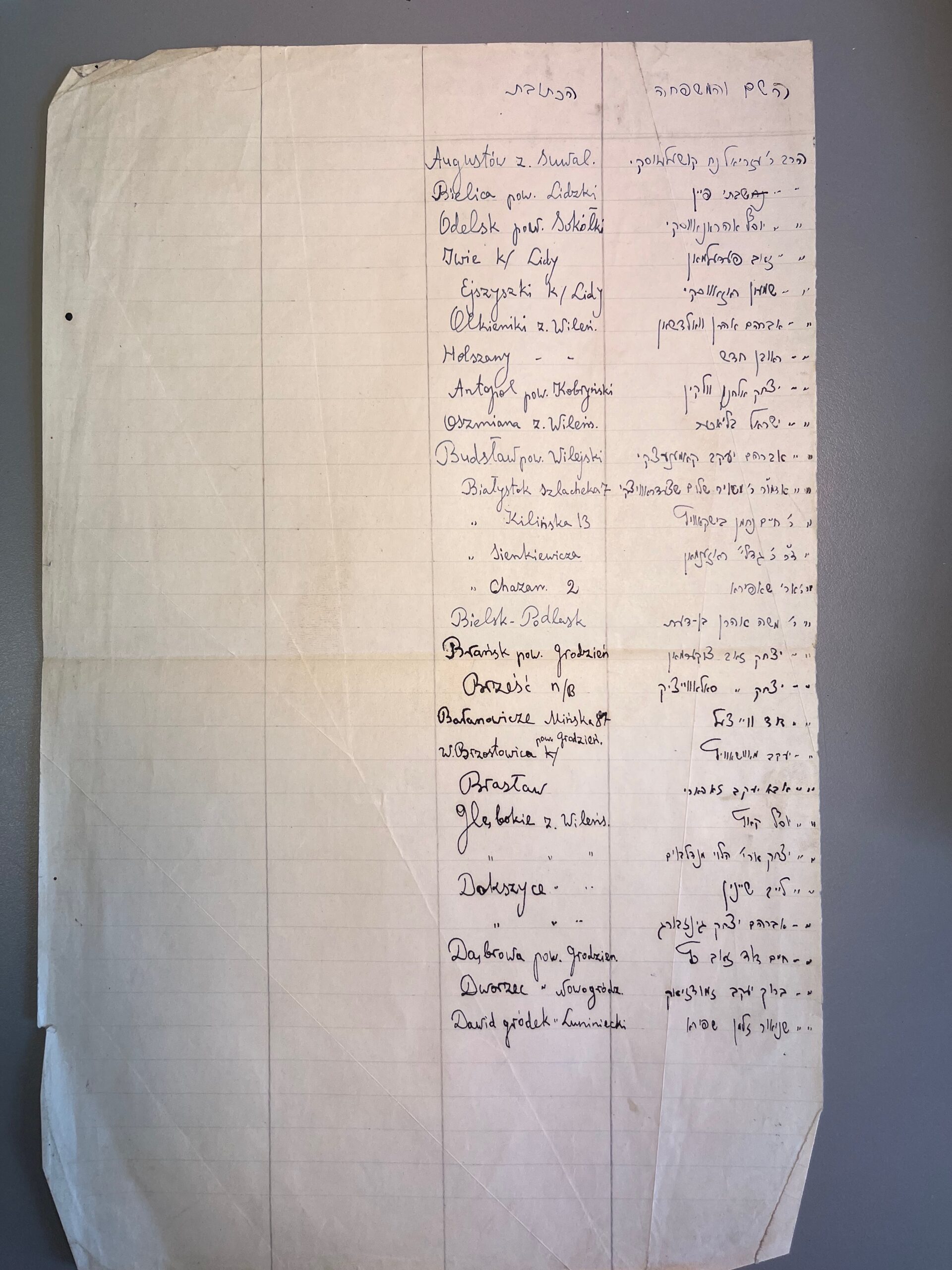
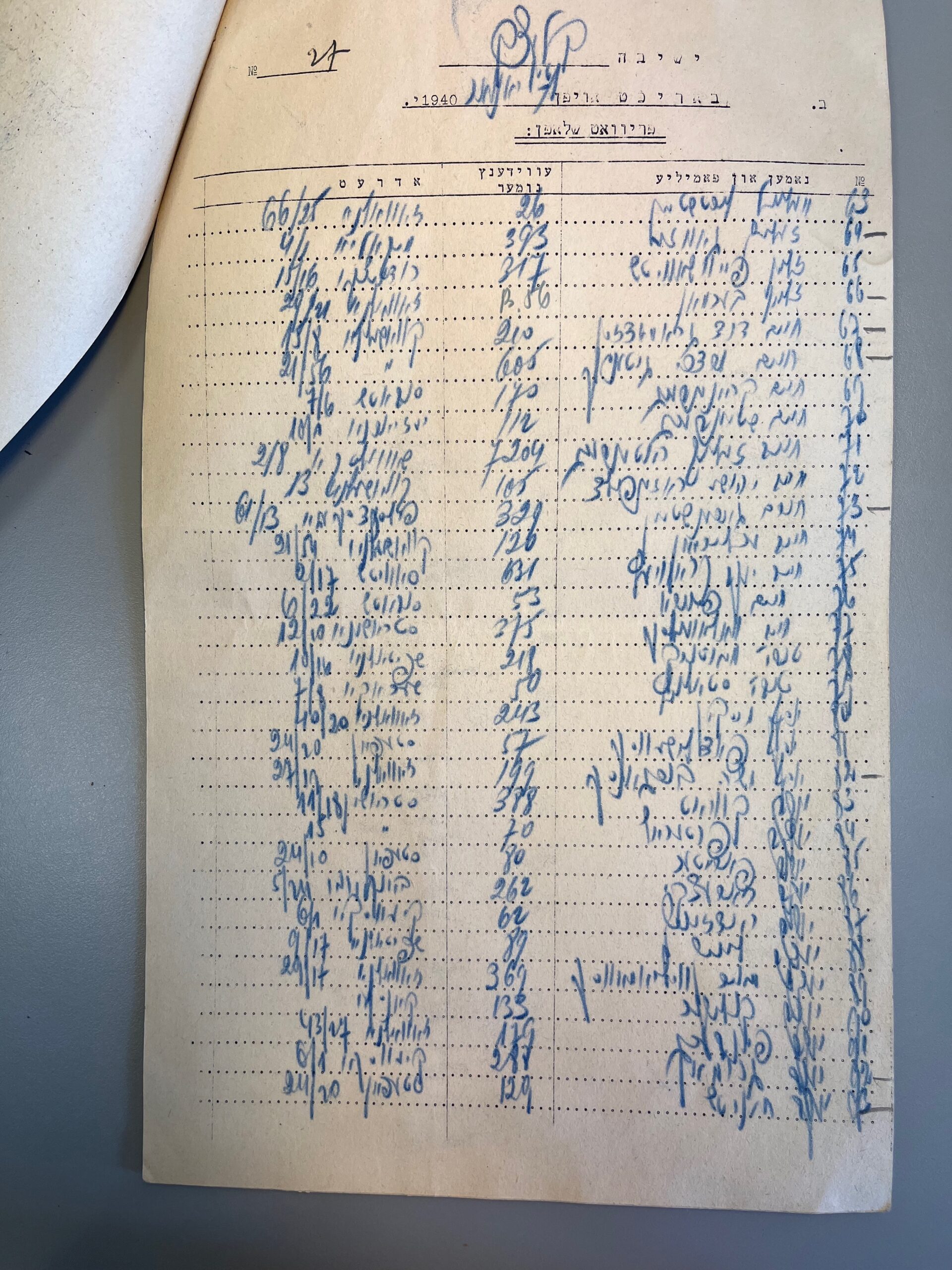
When refugees from Yeshivas arrived in Vilna in late 1939 and 1940, they were cared for by the Va’ad HaYeshivos. Many of the lists of those students and families are preserved in the same archive as the Strashun Ledgers at the Lithuanian National Library. Below are two documents from that archive. The first is a document that lists some of the most important rabbis, including the Brisker Rav, and their addresses in Vilna. The second document is a page from the list of students from Keltsk.



30 thoughts on “Reading Over the Brisker Rav’s Shoulder”
I don’t know why the author doesn’t point out that the Brisker Rav only took out the book after two readers prior to him took out a different book by the same author. It would seem obvious that he came to the library seeking the Igeres Hashmad and only took out the Peretz book after noting that the other two readers had a book by Peretz. Still, very interesting to guess what he was hoping to find there. worth noting that another sefer that had been checked out was Divrei Eliyahu, which contains the decidedly un-chassidish story in which the Vilna Gaon chose to learn rather than meet with his long lost sister. One wonders if this possibly apocryphal story is referenced in Pertz’s works. (Of course, a boring conclusion might be that he just checked it out as a favor for one of the Peretz aficionados in the room)
In the postscript, “Moshe” should be replaced with “Rephael.”
The most logical conclusion is similar to what AI writes at the end. He probably came to the library with his son to see Igeres Hashmad. He probably sat without a sefer, and someone took the opportunity to check out Peretz’s books on his name, and another person. It is highy improbable that three strangers suddenly checked out books written by Peretz one after the other.
You don’t know that the other two parties were strangers to one another; they may have had a chavrusashaft in Peretz.
And come on, you know how easily Reb Velvel went along with the crowd, bending to peer pressure… 🙂
A proof to what I wrote is that one sees from all the pictures of thae Brisker Rov that his children always walked flanking him like bodyguards. If so, the name of the Brisker Rov should have been adjacent to his son’s. It isn’t. The logical reason is that he sat down next to his son and did not take out a book. Only later, someone registered a book under his name.
I had the same suspicion that Al had, but my conclusion was slightly different. From all that I have heard and read of the Rav’s careful, nervous (even slightly paranoid?) personality, it seems to me highly probable that he went to the Shtrashun library to look up the wording of the Igeres HaShmad (on which he based his momentous decision, as highlighted by the author), but was reticent of leaving a paper trail on a government document detailing that he, as a very visible Jewish personality, was equating this with a Sha’as HaShmad. After all, this was a very delicate political enviroment. Therefore, he had his son check out the Rambam, while he himself just chose some innocuous title, copying previous entries.
I would like to hear if anyone who learnt in Brisk, with perhaps a richer insight into the Rav’s psychology, agrees with my theory.
I had the exact same thought. “When in Rome, do as the Romans do.” He noticed other patrons taking out Peretz, so he thought he would do the same, and blend in with the others.
Someone previously sent me a link to this article when it was published in the JRoB, and I looked into it a bit.
IMO the key detail that Dan Rabinowitz overlooked is that the particular Peretz book that the BR read had a story in it called (in the Hebrew version) בין שני הרים. This story has as its anti-hero the rabbi/gaon of Brisk (the hero being the Rebbe of Biala).
So I think it’s likely that the BR had heard of this story specifically which depicted the “rav of Brisk” negatively and was interested to see whether and to what extent this character was based on his father or grandfather. So the implication that he was in general a connoisseur of secular Yiddish literature is baseless.
In general, the BR’s life and outlook are extremely well documented, and IMO dismissing the weight of all that’s known about him as “hagiography” based on a tiny snippet of information which lacks any context is academic hubris.
The alternative explanations here may or may not be true, but I’d hardly call citation of an actual written source as meaning exactly what it says as “hubris.” Methinks the burden of proof is on those who would argue *otherwise* based on “what we know is true” only.
Excellent article as always. Thank you very much. One comment: “As yeshiva leaders debated whether to flee to the United States or to Palestine, supporters of the former emphasized how far removed they were from the Hitlerian threat, compared to Palestine, where Rommel was rapidly approaching.” The debate likely took place, but it certainly had nothing to do with Rommel’s advance. Rommel arrived in North Africa in February 1941, and began his offensive in March-April. The Brisker Rav arrived in Palestine in February, so the debate about which destination was preferable took place long before that. In fact by March-April 1941 there was little to no escaping from Soviet Lithuania, and the Nazis invaded in June, so by the time there was a real danger posed by Rommel’s advance towards Palestine, 90% of Lithuanian Jewry was already killed in the Holocaust that summer of 1941. So perhaps there was a rabbinical debate about whether Palestine or the United States was a preferred destination, but it had nothing to do with Rommel and the advancing German army which took place only much later. Thank you.
I repeated what is in Uvdot ve-Hanhagot without checking the dates. In Uvdot ve-Hanhagot, it states that the Germans were in Egypt. But you are right, the dates don’t match reality.
The Italians bombed Haifa in July 1940 and Tel Aviv in in September 1940. (Tel Aviv was also attacked in June 1941.) These were the only war deaths in Palestine during the war, and were not carried out because the targets were Jewish but rather because they were British. but it’s not unlikely Jews in Lithuania heard of them and were concerned.
And regardless, the US is of course further from Europe than Israel and was not yet involved in the war.
“Two of them were a couple, Hayim and Hanna, who were reading Tolstoy’s Anna Karenina in Yiddish.”
How do you know they were a couple? The ledger lists them as Chaim Weissman and Chana Kagan.
Speaking of Anna Karenina, my FIL was in RY Kaminetsky’s shiur in YTV and he (RYK) mentioned Anna Karenina, and then expressed great surprise at the quizzical looks from the talmidim. He said in the European yeshivos all the talmidim (or perhaps he said any talmid who wasn’t a “batlan”) knew all the “classics”.
Of course, RYK and the BR were very different people.
I am absolutely convinced that the Brisker Rav did not then—nor at any other time in his adult life since or prior—have any interest in reading Peretz. His teenage son Rephael (later a famous zealot in his own right), on the other hand, may have harbored an interest in the Peretz book (perhaps for the reason suggested above by F-P). I don’t think one needs to stretch the imagination too much to imagine a scenario whereby a harried librarian mixed up the books being checked out by the two Soloveitchiks, though I can also see the merits of the cloak-and-dagger hypothesis put forth above by Binyamin whereby the Briskers deliberately switched their books in an attempt to conceal their intellectual scent and throw government operatives for a loop…
The idea that the Brisker Rav was worried about being discovered by the government has no real basis. Although the ledger was originally used to monitor and control the Jewish community, that ended with the fall of the Russian Empire in the early 20th century. By 1940, the ledgers were used solely for internal purposes and were not subject to government review. Also, the Lithuanian government, which was quickly trying to move its seat from Kovno to Vilna as Vilna officially became part of Lithuania, did not have “operatives” watching for sedition. That was more likely under the Soviets.
Old suspicions die hard. I doubt anyone, then or now, would just naively believe someone’s assurance that a required written record of people’s names and reading material would no longer be used against them.
And to Nachum’s response above – the burden of proof lies on the party seeking to upend the traditional understanding of the Brisker Rav, as set forth in all those “yeshivishe hagiographies”, and portray him instead as someone who “read fiction by a radical secularist about the virtues of Hasidim.” This single ledger entry, while interesting, comes nowhere even remotely close to refuting the traditional understanding of the Brisker Rav.
No, I’m sorry. We’ve seen over and over the defense of “He couldn’t have done it because we know he couldn’t have done it” while at the same time knowing that many, many gedolim- even the most “extreme”- were a lot more broad than we often think. And Peretz is hardly the most extreme he could have gotten.
Agreed 100% that many Gedolim are far broader than some people think. [This is actually true of regular people, too. Many who appear to outsiders as nothing more than black and white, when one actually speaks with them, prove to have many shades and colors.] Even so, this one ledger entry, if it is anything at all, is not nearly enough to overturn everything we know, and have seen, and have heard, from the Brisker Rav.
DF is right, and besides, Brisker Rav is not merely another gadol about whom hagiographies are spun from hearsay and legends and based on limited anecdotes told with the admiring spin of well-meaning followers. The biographical record of the Brisker Rav, on the other hand, was an iconic figure whose opinions and conduct were subjected to meticulous, continuous scrutiny by his children and followers, many of whom who patterned their lives after his. This is represented in works like Meller’s עובדות והנהגות לבית בריסק, which is essentially an archive of behavioral data and metadata—far beyond typical hagiography. (That work, in particular, details the very stressful period of time the Rav spent in Vilna most of which was spent desperately trying to obtain visas and passage for his family—including his wife and small children left behind in Brisk, and needless to say it is not a depiction which jives well with the blissful image of him happily engrossed in a secular book in a public space.)
The only comparable figure is the Lubavitcher Rebbe, whose public life was also intensely documented. (The critical distinction? The Brisker Rav’s family life and Beit Midrash were one and the same to a large extent, and a lot of what we know about him comes from family members who lived with him, thereby providing us with a holistic view of his private & public self. The Rebbe’s home, by contrast, was a private sanctuary to which very few were privy.)
This is why I feel that taking this ledger entry at face value—knowing what we know of the Rav’s intense disdain for secularism as well as his isolationist and iconoclastic tendencies—is tantamount to accepting as fact an entry in someone’s diary mentioning his having dined with the Lubavitcher Rebbe while on vacation in Hawaii.
I guess facts don’t matter, only unicorns and conspiracy theories. Not surprising, but disappointing nonetheless. The author never suggested that from this ledger entry we can extrapolate what the Brisker Rav’s bookcase looked like or what he read later. It seems that he is merely calling attention to an objective record, created for no other reason than to keep track of borrowing patterns, not by anti-Haredi or nefarious governmental officials. Yet, even this one entry is too much for some to handle. It’s no wonder that it is nearly impossible to find any literature consciously created within the Orthodox milieu that is entirely objective or comprehensive. Even the Seforim blog has a constituency of pearl-clutching readers.
But that’s the whole point: This *isn’t* a random diary entry; this is an entry in an ledger that is masiach l’fi tumo, so to speak: Whoever wrote it had no agenda. Now, you can challenge it however you want, but it is there and it says what it says.
And no, people can do all sorts of things. You never know.
The other day I stopped at the library with my 10 year old to pick up books. Future historians will one day say I was influenced by the Diary of a Wimpy Kid.
That is exactly the difference between the Strashun Library and others, and why the ledgers better indicate reading habits. Unlike a lending library where books could be borrowed by anyone, the Strashun Library was a reading room only library, so one could be sure that the book requested was the one actually read.
Family is hardly an objective source of historical information. In fact, it is families who often fight to prevent historically accurate biographies of their illustrious forebearers from being released.
50% discount link is broken
It seems to work for me. The regular price is $40 per year, and the link should let you subscribe for $20 per year.
See here: https://yated.com/ufortzu-chomos-migdolai-vetimu-kol-hashmanim/
I’m in complete agreement that is beyond unthinkable that the Brisker Rav would have gone to a library the day before Rosh Hashana for the leisure reading of a IL Peretz. That said the Yated article seems to have two inaccuracies, (1) The Brisker Rav came to Vilna in 1939 not 1938 so he had been there for one year not two at the time. (2)Of more importance the claim the Brisker Rav was completely secluded in Vilna and only left his house twice does not seem true. According to the book about Rav Refoel Solovachick mentioned here, he went to Rav Chaim Ozer’s levayah, went to bake matzahs and was called in once by the NKVD. There were possibly other times he left his house but I haven’t read that book in over twenty years. There is no mention that he stayed home.
I wonder if, in his wanderings through Jewish lore and history, the author ever discovered a sugya called שני יוסף בן שמעון.
How did he jump to the definitive conclusion that the person referred to as Yitzchak Soloveitchik was the Brisker Rav? Wikipedia has a number of about 65,000 Jews living in Vilna at the time and the Soloveichik family was a large one.
The reason this story is unlikely is because we have a large body of knowledge about the Brisker Rav and he had a distinct personality. The reason he would not have read a book of frivolous short stories by Peretz is not just because of his Yiras Shamayim or antipathy towards Haskala. He was not a curious person by those standards. Nobody who knew him describes him as such. If you would tell me that the Lubavitcher Rebbe, who also hated Haskala, read these books, I could believe it. If you told me that Reb Chaim Ozer relaxed by reading these books, it would not diminish his yiras shamayim one iota. We know that he read a daily newspaper, and probably more than one. We know that the Brisker Rav did not read any newspapers. When the Brisker Rav relaxed, he sat in the Swiss mountains and slowed his life down, he went for walks with a companion and discussed his opinions on the stories occupying the religious world. We have countless testimonies about this, both reliable ones and less so. The gullibility necessary to believe this story, based on the flimsiest of sources, is off the charts