Pesach, Haggadah, Art & Sundry Matters: A Recap of Important Seforimblog Articles

Pesach, Haggadah, Art & Sundry Matters: A Recap of Important Seforimblog Articles

Among the more interesting aspects of the history of Haggados, is the inclusion of illustrations. This practice dates back to the Medieval period and, with the introduction of printing, was incorporated into that medium. Marc Michael Epstein’s excellent book regarding four seminal Haggadah manuscripts, The Medieval Haggadah: Art, Narrative & Religious Imagination, was reviewed here, and a number of those illustrations, were analyzed in “Everything is Illuminated: Mining the Art of IllustratedHaggadah Manuscripts for Meaning.” Epstein edited and wrote an introduction to the recently published facsimile edition of the Brother Haggadah, which resides in the British Library. This is the first reproduction in full color of this important manuscript. Another recent reproduction of a manuscript Haggadah is Joel ben Simon’s Washington Haggadah. This Haggadah is particularly relevant this year, as it contains an alternative text for  Eruv Tavshilin blessing. Whether or not this was deliberate was the subject of some controversy, see “Eruv Tavshilin: A Scribal Error or Deliberate Reformation?

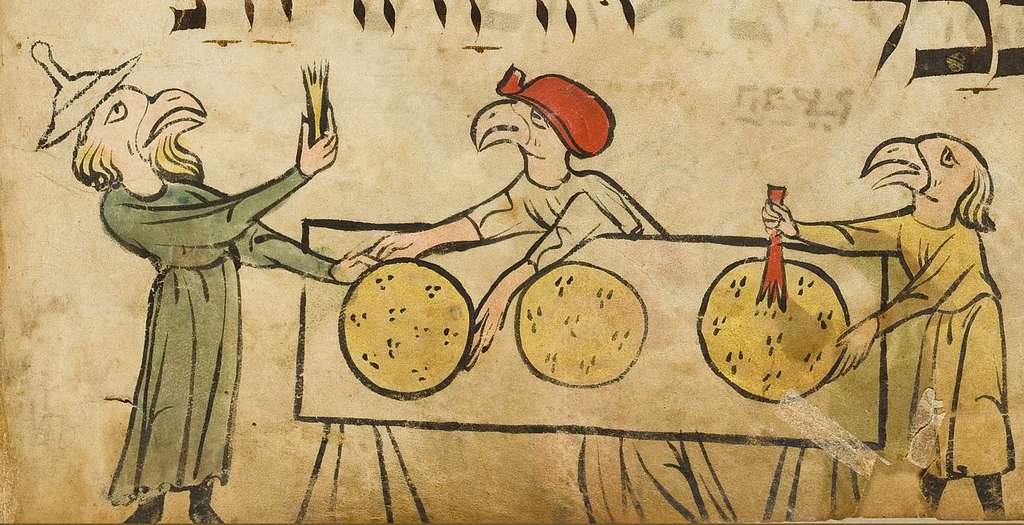
The first illustrated printed Haggadah, Prague, 1526, introduced new illustrations and recycled and referenced some of the common ones in manuscripts (see here for a brief discussion and here for Eliezer Brodt’s longer treatment). That edition would serve as a model for many subsequent illustrated Haggados but also contains surprising elements, at least in some religious circles, regarding the depiction of women, and was subsequently censored to conform with the revisionist approach to Jewish art. See, “A Few Comments Regarding The First Woodcut Border Accompanying The Prague 1526 Haggadah,” and Elliot Horowitz’s response, “Borders, Breasts, and Bibliography.” The Schecter Haggadah: Art, History and Commentary, a contemporary treatment of the art and the Haggadah, (for Elli Fischer’s review, see here), that unintentionally reproduced a version of one of the censored images in the first edition. It was restored in subsequent editions. Women appear in other contexts in illustrated Haggados. The most infamous example is the “custom” that implies a connection between one’s spouse and marror (discussed here), but our article, “Haggadah and the Mingling of the Sexes” documents more positive and inclusive examples of women’s participation in the various Passover rituals in printed Haggados.  Similarly, the c. 1300 Birds Head Haggadah has an image of female figures in snoods preparing the matza and a woman at the center of Seder table.

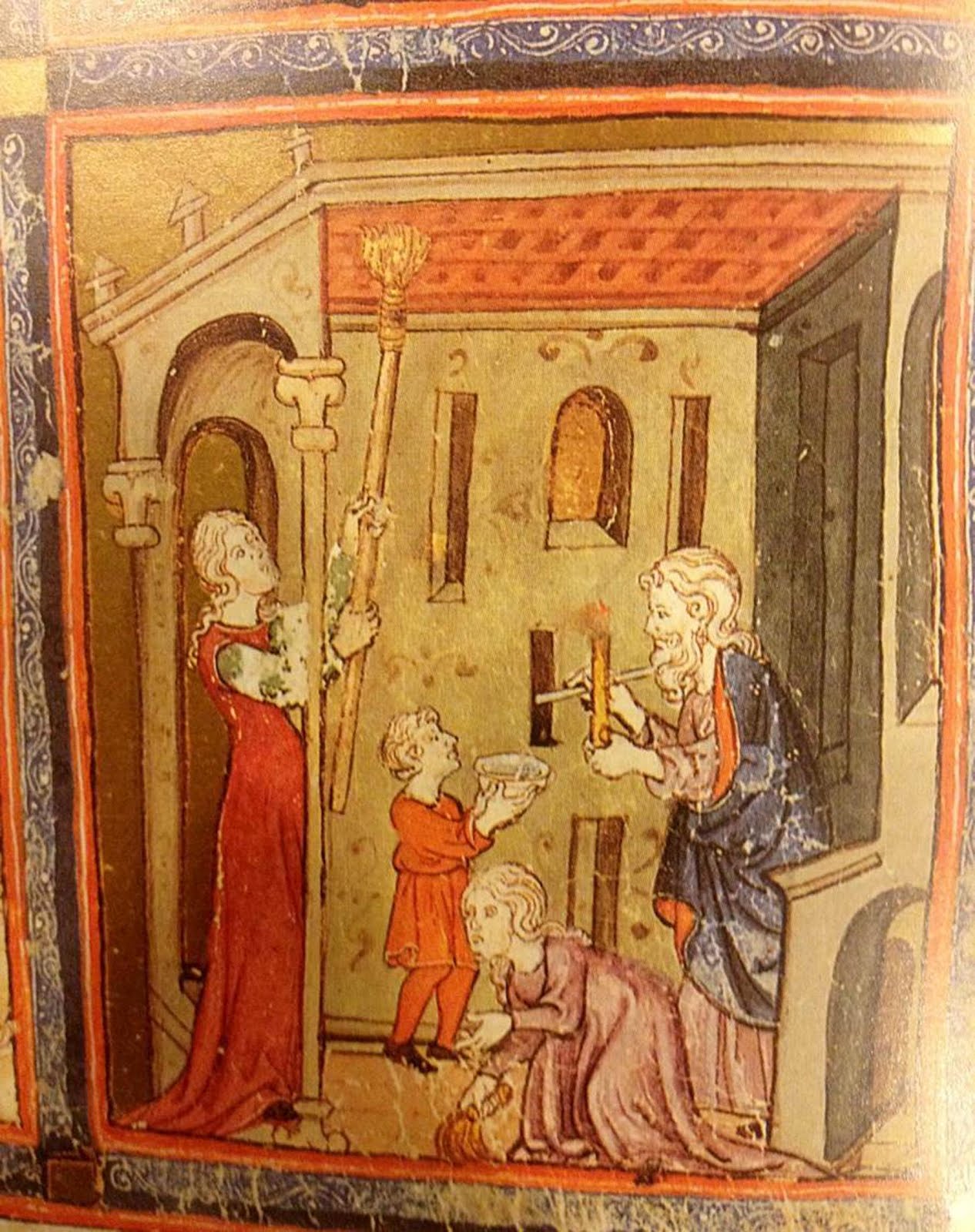
As detailed in chapter 8 of Epstein’s Medieval Haggadah, the early 14th Century Golden Haggadah is perhaps the most female-centric Haggadah and may have been commissioned for a woman. That manuscript emphasizes the unique, positive, and critical role women played in the Exodus narrative. Although it also depicts the practice of overzealous cleaning with a woman sweeping the ceiling. The 1430 Darmstadt Haggadah has a full-page illumination of women teachers, but its connection to the text is opaque. Finally, we argue that one printed Haggadah uses a subtle element in explicating the midrashic understanding of the separation of couples as part of the Egyptian experience.

Sweeping the Ceiling, Golden Haggadah


One of the most creative contemporary Haggados was produced by the artist, David Moss. Moss was commissioned by David Levy to create a Haggadah, on vellum in the tradition of Medieval Jewish manuscripts. Moss worked for years on the project the result surely equals, if not surpasses, many of the well-known Medieval haggados, both artistically and its ability to bring deeper meaning to the text. The manuscript is adorned with gold and silver leaf and contains many paper-cuts (technically vellum-cuts).  One of the most striking examples of the silver decoration is the mirrors that accompany the passage that “in each and every  generation one is obligated to regard himself as though he personally came out of Egypt.” The mirrors appear on facing pages, interspersed with one with male and the other with female figures in historically accurate attire from Egypt to the modern period. Because the portraits are staggered when the page opens, each image is reflected on the opposite page, and when it is completely opened, the reader’s reflection literally appears in the Haggadah — a physical manifestation of the requirement to insert oneself into the story. The page is available as a separate print.

After completing the Haggadah, Moss was asked to reproduce it, and, with Levy’s permission, produced, what the former Librarian of Congress, Daniel Bornstein, described as one of the greatest examples of 20th-century printing. The reproduction, on vellum, nearly perfectly replicates the handmade one. This edition was limited to 500 copies, all of which were sold. From time to time, these copies appear at auction and are offered by private dealers, a recent copy sold for $35,000. President Regan presented one of these copies to the former President of Israel, Chaim Herzog, when he visited the White House in 1987. While that is out of reach for many, this version is housed at many libraries, and if one is in Israel, one can visit Moss at his workshop in the artist colony in Jerusalem, where he continues to produce exceptional works of Judaica and view the reproduction.  There is also a highly accurate reproduction, on paper that is available (deluxe edition) and retains the many papercuts and some of the other original elements, that is still available. This edition also contains a separate commentary volume, in Hebrew and English. (There is also one other available version that simply reproduces the pages, but lacks the papercuts.)

While the entire Moss Haggadah is worth study, a few examples. One paper-cut is comprised of eight panels, each depicting the process of brick making, the verso, using the same cuttings, depicts the matza baking process, literally transforming bricks into matza. The first panel of the matza baking is taken from Nuremberg II Haggadah, which we previously discussed here, and demonstrated that it preserves the Ashkenazi practice of only requiring supervision from the time of milling and not when the wheat was cut.

The illustration accompanying the section of Shefokh, reuses the illustrations of Eliyahu from the Prague 1526 and the Mantua 1528 Haggados to great effect. In the original and vellum reproduction, the cup of Eliyahu physically turns without any visible connection to the page — an extraordinary technical achievement. This section and the illustrations were discussed by Eliezer Brodt in “The Cup of the Visitor: What Lies Behind the Kos Shel Eliyahu, and, in this post, he identified an otherwise unknown work relating to the topic, for another article on the topic, see Tal Goiten’s “The Pouring of Elijah’s Cup (Hebrew).”  Eliezer revisited the topic in (here) his conversations with Rabbi Moshe Schwed, in the series, Al Ha-Daf. In last year’s conversation, he discussed a number of other elements of the history of the Haggadah, and three years ago the controversy surrounding machine produced matza. (All of the episodes are also streaming on Apple Podcasts, Spotify & 24Six.) Additionally, he authored “An Initial Bibliography of Important Haggadah Literature,” and two articles related to newly published Haggados, “Elazar Fleckeles’s Haggadah Maaseh BR’ Elazar ” and XXI. Rabbi Eliezer Brodt on Haggadah shel Pesach: Reflections on the Past and Present ,” regarding Rabbi Yedidya Tia Weil’s (the son of R. Rabbi Netanel Weil author of “Korban Netanel”) edition, and a review of David Henshke’s monumental work, Mah Nistanna. 

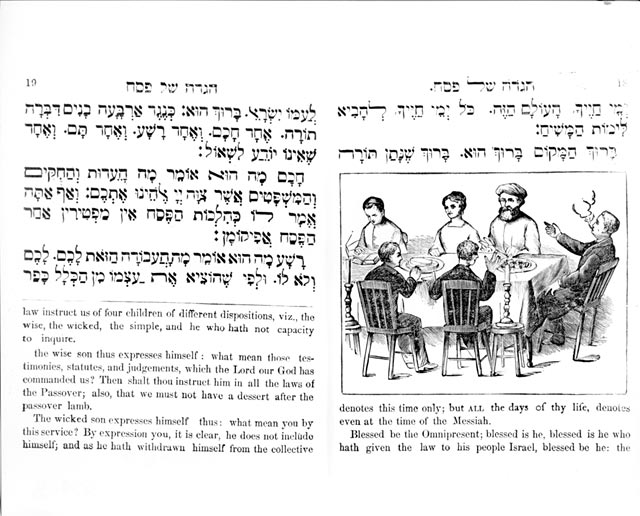
In one of the first haggadot printed in the United State published in 1886 Haggadah contains a depiction of the four sons.  Depicting the four sons is very common in the illustrated manuscripts and printed haggadot. In this instance, the wicked son’s disdain for the seder proceedings shows him leaning back on his chair and smoking a cigarette. According to many halakhic authorities, smoking is permitted on Yom Tov, nonetheless, the illustration demonstrates that at least in the late 19th-century smoking was not an acceptable practice in formal settings. (For a discussion of smoking on Yom Tov, see R. Shlomo Yosef Zevin, Mo’adim be-Halakha (Jerusalem:  Mechon Talmud Hayisraeli, 1983), 7-8).

The cup of Eliyahu is but one of many Passover food-related elements. The identification of Marror with the artichoke in Medieval Haggados, is debated by Dan Rabinowitz and Leor Jacobi , while Susan Weingarten provides an overview of the vegetable, in “The Not-So-Humble Artichoke in Ancient Jewish Sources.” Jacobi also discusses the fifth cup in his article, “Mysteries of the Magical Fifth Passover Cup II, The Great Disappearing Act and this printed article.  The history of the restriction of Kitniyot and the development of the practice of selling hametz is discussed in our article, “Kitniyot and Mechirat Chametz: Paradoxical Approaches to the Chametz Prohibition,” and was revisited on Rabbi Drew Kaplan’s Jewish Drinking podcast (and in an audio version on apple podcasts and spotify). Another guest was Marc Epstein, discussing his book on Medieval Haggados, and Dr. Jontahan Sarna where he gives an overview of the use of raisin wine for the kiddush and the four cups, based on his article, “Passover Raisin Wine,” as was the frequent contributor to the Seforimblog, Dr. Marc Shapiro. His interview, like many of his posts and his book, Changing the Immutable, discusses censorship and, in particular, the censored resposum of R. Moshe Isserles regarding taboo wine (also briefly touched upon in Changing the Immutable, 81-82, and for a more comprehensive discussion of the responsum, see Daniel Sperber, Nitevot Pesikah, 104-113).  For another wine related post, see Isaiah Cox’s article, “Wine Strength and Dilution.” The history of Jewish drinking and Kiddush Clubs was briefly discussed here.

Whether coffee, marijuana and other stimulants falls within the Kitniyot category appears here. Marc Shapiro’s article, “R. Shlomo Yosef Zevin, Kitniyot, R. Judah Mintz, and More,” regarding Artscroll’s manipulation of R. Zevin’s Moadim be-Halakha regarding kitniyot. Another coffee related article explores the history and commercial relationship between the Maxwell House Haggadah.  Finally, the last (pun intended) food discussion centers on the custom of stealing the afikoman.

The Amsterdam 1695 Haggadah was an important milestone in the history of printed illustrated Haggados, it was the first to employ copperplates rather than woodcuts. This new technique enabled much sharper and elaborate illustrations than in past Haggados. While some of the images can be traced to earlier Jewish Haggados, many were taken from the Christian illustrator, Mathis Marin. It also was the first to include a map. As we demonstrated that map, however, is sourced from a work that was a early and egregious example of forgery of Hebrew texts. For an Pesach related plagiarism, see “Pesach Journals, Had Gadyah, Plagiarism & Bibliographical Errors.” Kedem’s upcoming auction of the Gross Family collection includes, with an estimate of $80,00-$100,000, one of the rarest, beautiful, and expensive illustrations of Had Gadya by El Lissitzky published by Kultur Lige, Kiev, 1919. Eli Genauer reviews another number related edition, not in price, but convention, “The Gematriya Haggadah.”

There are two articles regarding the Haggadah text, David Farkes’ “A New Perspective on the Story of R. Eliezer in the Haggadah Shel Pesach,” and Mitchell First’s “Some Observations Regarding the Mah Nishtannah.” First’s other article, “The Date of Exodus: A Guide to the Orthodox Perplexed,” is also timely.
Finally, Shaul Seidler-Feller’s translation of Eli Wiesel’s article, “Passover with Apostates: A Concert in Spain and a Seder in the Middle of the Ocean,” tells the story of an unusual Pesach seder. Siedler-Feller most recently collaborated on the two most recent Sotheby’s Judaica catalogs of the Halpern collection.

Chag kasher ve-sameach!


The Longest Masechta is …

The Longest Masechta is …

By Ari Z. Zivotofsky

As Jews, we are often intrigued with trivia about our holy books, and the more esoteric and harder to verify, the better. An example of such trivia is the longest masechta in shas. While it is relatively easy to verify that the longest masechta in terms of pages in the Vilna Shas is Bava Batra, with 176 pages,[1] until modern times it was much more difficult to determine which is the largest masechta in terms of words or characters. Once something is difficult to measure, rumors abound, and this topic is no different. To cite just three examples. Meorot haDaf Yomi on 23 Shvat 5770 (vol. 559), stated (in Hebrew) that if not for the lengthy commentary of Rashbam, Bava Batra would have considerably fewer pages and that the Gra had said that really the longest masechta in terms of words is Berachot, although it is only 64 pages. Rabbi Yaakov Klass in the Jewish Press (20 Tammuz 5777 / July 13, 2017) wrote: “as the Vilna Gaon observes, Berachos is actually the longest tractate”. Rabbi Aaron Perry in his “The Complete Idiot’s Guide to the Talmud” (2004) states in a section “the least you need to know” (p. 57): “Brachot (Blessings) is the longest tractate in words”.

As often happens with urban legends. once an assertion is accepted as “fact”, it is then claimed to have been verified. In the journal Ohr Torah (Sivan 5766 [465], p. 719) the claim is made that a computer check was performed and it was found that the largest masechet based on words is Berachot. But alas, it ain’t so and in the next issue of Ohr Hatorah (Tammuz 5766, p. 784) the error was pointed out.

In actuality, and before presenting the results from a computer count, it is worth noting that ambiguity regarding sizes of masechtot only arose when commentaries began to be put on the same page as the text of the gemara. In other words, until the era of the printing press there was no ambiguity as to which masechta was the longest. Prof. Yaakov Shmuel Spiegel (Amudim B’toldot ha’Sefer ha’Ivri: Hagahot u’magihim [Chapters in the History of the Jewish Book: Scholars and Annotations], 2005, 105-106) credits Prof. Shlomo Zalman Havlin in his monumental “Talmud” entry in the Encyclopedia HaIvrit with the idea that the relative size of tractates can be determined based on the number of pages they occupy in the Munich manuscript. This unique manuscript, completed in 1342, was transcribed by one individual and had the entire Bavli in one 577 page volume. Simply comparing the number of pages of the various tractates provides the relative length in terms of characters/words. This ranking may be more accurate that a computer count of the words or letters as the single author may have been more consistent in terms of abbreviations and other factors that can influence the count.

Using the Munich ms, the rank ordering is similar, but not identical to that obtained from a computer count, although in all cases it is clear that Berachot is far from the largest. Using the Munich ms, the top five (with number of pages) are:

Shabbat (55.5)
Hullin (51)
Yevamot (47)
Sanhedrin (45.5)
Bava Kamma (45)

..

Berachot (36) is number 11.

A similar system can be used to estimate the size of masechtot using the monumental one-volume shas edited by Zvi Preisler (Ketuvim Publishers, Jerusalem, 1998). It is straight text of Talmud with no commentaries of Rashi or Tosafot and is a uniform font. References to biblical verses are included and thus sections with more aggadatah might appear slightly longer. The text is arranged in three columns per page. Counting pages in this volume, the longest mesechtot (and number of pages) are:

Shabbat (77⅓)
Sanhedrin (66⅓)
Hullin (58⅙)
Bava Batra (56½)
Pesachim (55⅓)
Yevamot (55⅙)

..

Berachot (47⅓ pages)

The simplest way to answer this question today is with a computer count of the number of words. Using the Bar Ilan Responsa project for this, the number of words in all of shas is about 1.865 million. And the 5 largest tractates are:

Shabbat (118k)
Sanhedrin (107k)
Hullin (90k)
Bava Batra (89k)
Bava Metzia (86.5k)

……

Berachot (73k) is in 11th place

The 5 smallest tractates are Chagigah (19k), Makot (18k), Horayoat (13k), Me’ilah 8k), and Tamid (5k). Other computerized calculations yield slightly different counts, but they do not significantly alter the rankings.

So why might one have been (mis)led to think that Berachot is the largest? It is easy to understand because Berachot does indeed win the prize in one category – words/daf. Berachot is king, with over 1115 words/daf. The next 5 are: Krisos (975), Horayot (972), Megilla (934), Sanhedrin (932 – the last perek probably plays a big role in raising this number!), Taanit (890). What might interest some daf yomi learners are the bottom 5, and those are (from bottom up): Nedarim (383), Meilah (384), Nazir (431), Baba Batra (509), Tamid (512).

The rumor is that the Gra stated that Berachot is the longest tractate, and it is hard to abandon such a tradition. A noble effort was recently made to vindicate that tradition. The book Mitzvah V’oseh (Shmuel David Hakohen Friedman, 2015, ch. 44, p. 564) quotes the famous statement that the Gra said Berachot is the longest in words, corrects this by pointing out that Shabbat is longer, and then gives a clever reinterpretation – the Gra was referring to Yerushalmi. And in the Yerushalmi, the author avers, Berachot is indeed the longest tractate by words. In a collection[1] of “trivia” that Rav Chaim Kanievsky was wont to discuss with his grandchildren, it is quoted that he said Berachot is the longest mesechta in Yerushalmi. That assertion is indeed much closer to being accurate but is still not correct.

In the Bar Ilan responsa project there are two versions of the Yerushalmi, the Vilna edition with almost 795k words and the Venice edition with almost 815k words, both considerably shorter than the Bavli.

In the Vilna edition of the Yerushalmi, the four largest tractates with their word count are:

Shabbat (47,685)
Yevamot (44,369)
Sanhedrin (40,008)
Berachot (39,478).

Using the Venice edition, the top four are:

Shabbat (49,161)
Yevamot (45,293)
Berachot (41,030)
Sanhedrin (41,004)

In the Yerushalmi too, one can use the monumental one-volume Yerushalmi edited by Zvi Preisler (Ketuvim Publishers, Jerusalem, 2006) to estimate the size of masechtot. Counting pages in this volume, the longest masechtot (and number of pages) are: Shabbat (37) and Yevamot (32 ⅔). This is followed by Brachot (30), Sanhedrin (29 7/9) and Pesachim (26 ⅔).

While these numbers are clearly influenced by many extrinsic factors such as which ms text used, abbreviations opened or closed, etc, they demonstrate that although Berachot is much closer to being the largest tractate in the Yerushalmi than it is in the Bavli, it is still behind the unquestioned largest in Bavli and Yerushalmi, Shabbat, and behind Yevamot.

Did the Gra actually make such a statement about what is the largest tractate in shas? There are no early records of it and I have not been able to find any mention of such a claim earlier than the late 20th century. Irrespective, the rumor that he stated that Berachot is the largest is fairly “common knowledge”. Yet it is clear using both counting ms pages and computer tabulated results, Berachot is far from being the largest in either the Bavli or Yerushalmi. Berachot does have one claim to fame in regard to size; it is by far the most words/pages.

[1] It is actually 175 pages; it goes up to page 176, but like all masechtot it starts on daf bet. But that would ruin the beautiful symmetry that the longest parsha in the Torah is naso with 176 pesukim and the longest chapter in Tanach is Tehillim chapter 119 with 176 verses.
[2]
In Gedalia Honigsberg, “HaSeforim”, 5777, ch. 10 is “tests” Rav Kanievsky would give and pages 199-201 is trivia for the grandchildren. On p. 200 it states that the largest mesechta in Bavli is Bava Batra followed by Shabbat. It then quotes in the name of the Gra about Berachot being largest in terms of words but that it is unlikely he said that because in reality Shabbat is larger. It then says that in the Yerushalmi the largest mesechta is Berachot.


New Book Announcement

New Book Announcement

Eliezer Brodt

The Minchas Chinuch on Pesach Volume One, A deeper perspective on the Mitzvos of Leil Haseder (31+268 pp.)

The Minchas Chinuch on Pesach volume Two, A deeper perspective on the Mitzvos of Chametz (34+283 pp.)

I would like to announce the release of two new volumes from Rabbi Moshe Hubner series devoted to the the Minchas Chinuch, in English.

The first volume, released right before Pesach last year, is devoted to the mitzvos of leil haseder, including the mitzvah of matzah and sippur yetzias Mitzrayim.

The second volume which was just published is devoted to the mitzvos of chametz. Topics include eliminating chametz; the prohibition of finding and/or seeing chametz in our domain (bal yira’eh, bal yimatzeh); the prohibition of eating chametz; the prohibition of eating chametz erev Pesach; the prohibition of chametz-mixtures; and the brachah of Shehechiyanu upon the arrival of Pesach.

One of the most famous and popular sefarim of the Torah world is R’ Yoseph Babad’s Minchas Chinuch, first published in 1869. Since then, numerous editions were published, including annotations of many Gedolei Yisrael alongside full-length works on the sefer. It is famous for bringing a whole level of depth to the sugya at hand.

Now, for the first time ever, the English-reading audience can appreciate the greatness and uniqueness of the Minchas Chinuch! 

This new work is not a simple translation of the Minchas Chinuch, but rather an in-depth presentation. It incorporates all the background information necessary to understand the Minchas Chinuch in a clear, concise manner. It also includes numerous, beautifully designed charts (produced by Mechon Aleh Zayis) to help one follow the deep, “lamdushe” discussions.

In addition, many of the commentaries who analyze the Minchas Chinuch’s words (at times offering rebuttals or proofs) have been quoted, (collected from a few hundred sefarim, listed in a detailed bibliography) and scrutinized carefully.

It’s a crash course in lomdus within each page!

Currently, there is nothing similar available for the English-reading audience. High school students to post-kollel yungeleit can all enjoy the Yom Tov on another level with these groundbreaking new volumes.

For samples of the seforim email Eliezerbrodt@gmail.com

One can listen to a podcast interview with Nachi Weinstein on Seforim Chatter with R’ Moshe Hubner discussing his English adaptions of Minchas Chinuch on Pesach [here].

Copies of the work can be purchased at Mizrachi books via these links (here and here) or by sending him an email at bluebirds15@yahoo.com

Here is a Table contents of each work.

Volume 1:

Volume II:


Special Italian Haftarah for the “Shabbat Kallah”

Special Italian Haftarah for the “Shabbat Kallah”[1]

By Eli Duker

Many communities in Europe and beyond had the practice of reciting a special haftarah from Isaiah 61–62 in honor of a groom on the Shabbat following the wedding.[2] Ashkenazi communities began the haftarah with 61:10 and read until 63:9,[3] which is also the 7th of the haftarot of consolation, which is which was read in most communities on the Sabbath before Rosh Hashanah, and in some others on the Shabbat between Yom Kippur and Sukkot in the event that there was one in a given year.[4]

As the practice to read the seven haftarot of consolation was universal outside in Italy in the late Medieval period, humashim and haftarah books had no reason to cite this practice, as the special haftarah for a groom was read during the calendrical cycle, and was in any event included in the humash for that purpose.

Italy is the exception. The practice in Italy was, and is, not to read special haftarot for the entire three-week period before Tisha B’Av or on the seven Shabbatot between Tisha B’Av and Rosh Hashanah.[5] Rather, a special haftarah is read on the Sabbath before Tisha B’Av and haftarot of consolation are read on the three remaining Sabbaths of the month of Av. The normal haftarah for Pinhas, a rarity in most communities, is read in Italy every year. Matot, Masei, Shoftim, Ki Tetze, Ki Tavo, and Nitzavim all have their own haftarot, which are found in the Cairo Geniza, Siddur R’ Shelomo B’Rabbi Nattan,[6] and in the list of haftarot in the Seder Tefillot of the Rambam.

The result is that in Italy, the haftarah from Isaiah is read only in honor of a groom. Out of the twenty-five Italian humashim and haftarah books in manuscript that I checked, the haftarah for the groom appears in twenty-three of them.[7] Out of the remaining two, one is missing pages at the end and likely had it in the original.

All twenty-three manuscripts have Isaiah 61:9 as the start of the haftarah. In all manuscripts besides one, the haftarah ends at 62:9, which is similar to the practice today in Italian communities, while in one manuscript it ends at 62:12.

One manuscript sticks out: Paris, National Library of France, Ms. hebr. 102. This is a book of haftarot and all of Ketuvim that was copied by Aryeh ben Eliezer Halfon for Rafael ben Yitzhak Malmassa of Voghera in northern Italy and completed on the 11th of Marheshvan 5242 (corresponding to October 4, 1481 in the Julian calendar).

The haftarot are similar to other manuscripts that follow the Italian rite (Jeremiah 1:1–19 for Shemot, Isaiah 18:7–19:24 for Bo, regular haftarot for the two weeks following the fast of 17 Tammuz and for the month of Elul, and the haftarah for the Sabbath of Hol Hamo’ed Sukkot is Ezekiel 38:1–23). There are slight differences concerning the haftarot for the parshiyot of Mishpatim,[8] Vayikra,[9] Tzav,[10] and Metzora.[11]

Interestingly, there is a note before the groom’s haftarah that reads, L’Shabbat Lifnei Hilula, indicating that the haftarah was read not during the “Sheva Brachot” week following the wedding, but before the wedding.[12]

What is unique is yet another nuptial haftarah. Afterward, a haftarah from Isaiah 60:1–19 appears, which is the same haftarah read in non-Italian communities on the sixth Sabbath of consolation, on the Sabbath of Parashat Ki Tavo. Beforehand there a note that reads “Lifnei HaKallah Koddem Hakiddushin.” Although there is no mention of the Sabbath here, the verse from Isaiah 47:4 appears at the end, which according to the practice in Italy was read after the reading of every haftarah. It is therefore clear that it is a haftarah, and highly unlikely that it was read on a weekday.

Evidently, two haftarot were read in honor of the nuptials, one before the “kiddushin” and the other before the “hilula,” as it is highly unlikely that the copyist here used two different phrases for the same event. Moreover, it does not seem likely that the marrying couple were in different synagogues on the Sabbath before the wedding, as towns generally had only one, and travel between different places took time.

The reason for the two haftarot has to do with yet another unique Italian practice. R’ Yosef Colon cites the practice of the native Italian Jews to perform an initial kiddushin privately in front of two witnesses “because they fear witchcraft.”[13] Later, at the nissuin, the kiddushin was performed again in the presence of a quorum of ten men.[14] This seems to be what the word hilula here means (the celebaration of the Nessuin along with the second Kiddushin) Presumably, the reason why Isaiah 60 was chosen to be read before the bride prior to the kiddushin is either that the haftarah addresses Jerusalem in the feminine form. Alternatively, we can suggest that the kiddushin, unlike nissuin, primarily affects the bride, as she is now forbidden as a married woman to all beside her betrothed husband while they would continue to live apart, with the mutual obligations of married life coming into place only after the nissuin, which was created by the “Hillula.

Bibliography

Genizah Fragments (All Cambridge TS B)

14.2, 14.65, 14.74 14.90, 14.105 14.119 16.5, 16.9, 20.1, 20.3, 20.4, 20.5, 20.6, 20.8, ,20.9 20.11

Manuscripts

Library of the Alliance Israélite Universelle, Paris, France Ms. 11

The Bodleian Libraries, University of Oxford, Oxford, England Ms. Can. Or. 75 Borja Library, Sant Cugat del Vallès, Spain Ms. C-I-1

Casanatense Library, Rome, Italy Ms. 2898

Casanatense Library, Rome, Italy Ms. 2919

The British Library, London, England Add. 4709

The British Library, London, England Harley 7621

The Jewish Theological Seminary of America, New York, NY, USA Ms. 571 The National Library of France, Paris, France Ms. hebr. 42

The National Library of France, Paris, France Ms. hebr. 50

The National Library of France, Paris, France Ms. hebr. 102

The National Library of France, Paris, France Ms. hebr. 104

The Palatina Library, Parma, Italy Cod. Parm. 1840

The Palatina Library, Parma, Italy Cod. Parm. 2015

The Palatina Library, Parma, Italy Cod. Parm. 2024

The Palatina Library, Parma, Italy Cod. Parm. 2127

The Palatina Library, Parma, Italy Cod. Parm. 2169

The Palatina Library, Parma, Italy Cod. Parm 2171

The Palatina Library, Parma, Italy Cod. Parm 2538

The Palatina Library, Parma, Italy Cod. Parm 2171

The Palatina Library, Parma, Italy Cod. Parm 2538

The Palatina Library, Parma, Italy Cod. Parm 2690

The Palatina Library, Parma, Italy Cod. Parm 2822

The Palatina Library, Parma, Italy Cod. Parm 2856

The Palatina Library, Parma, Italy Cod. Parm 2894

Trinity College Library, Cambridge, England Ms. F 12 107

Vatican Library, Vatican City, Vatican City State Ms. Ross. 478

Printed Books

(חמשה חומשי תורה. (תקב מנטובה

מהרי”ל. מנהגים (תשמ”ט ירושלים: מכון ירושלים)

משנה תורה לרמב”ם–יד החזקה. (תשל”ד ירושלים)

סידור רבינו שלמה ברבי נתן הסיג’ילמסי. ערוך ומתרגם מערבית. שמואל חגי. (תשנ”ה ירושלים)

פיוטי ר’ יהודה בירבי בנימן / יוצאים לאור בצירוף מבוא, חילופי נוסח וביאורים בידי שולמית אליצור. (תשמ”ט ירושלים: מקיצי נרדמים)

שו”ת מהרי”ק. (תש”ל ירושלים)

אנצקלופדיה תלמודית–כרך עשירי. (תשנ”ב ירושלים: מכון האנציקלופדיה התלמודית)

 ברית כהונה. משה הכהן. (תש”א ג’רבא)

נישואין נוסח איטליה: על יהודי איטליה בראשות העת החדשה. ויינשטיין, ר. (תשס”ז)

עולם כמנהגו נוהג: פרקים בתולדות המנהגים הלכותיהם וגלגוליהם. יצחק (אריק) זימר. (תשעט ירושלים: מרכז זלמן שזר לחקר תולדות העם היהודי)

(סדר קידושין אחרי חתימת התלמוד: מחקר היסטורי דוגמתי בתולדות ישראל. פרימן, א. (תשכ”הירושלים: מוסד הרב קוק

Weinstein, R. (2004) Marriage Rituals Italian Style: A Historical Anthropological Perspective on Early Modern Italian Jews. Leiden: Brill.

Notes

[1] This article is written in honor of the upcoming wedding of my niece Chana Duker to Aryeh Mateh and in order to show the boundless gratitude I have to Chana and the entire family of my brother and sister-in-law R. Yehoshua and Shayna Duker for the devotion and loving care of our beloved Bubby Selma A”H in her last year. I would like to further thank my brother R. Yehoshua for editing this article, as well as R. Elli Fischer, Dr. Gabriel Wasserman, R. Prof. Jeffrey Woolf, Dr. Ezra Chwat and the staff of the National Library of Israel for their assistance.
[2] See S. Elitzur’s introduction to “Piyyutei R’ Yehudah Biribi Binyamin” p. 60, regarding the haftarah apparently appearing in piyyut of R’ Yehudah, who (according to Elitzur pp. 72–77) lived in the east (most likely Bavel) sometime between the mid-9th century and the end of the 10th century. 3 For a discussion of the medieval Ashkenazi practices concerning this haftarah and its relative importance in Western vs Eastern Ashkenaz, see E. Zimmer “Society and Its Customs” (Hebrew) vol. 2. pp. 273–280. The haftarah was read, along with the various piyyutim recited, on the Sabbath following the wedding. This is more reasonable, as that is during the period of the celebration mandated by the Talmud, while beforehand is prior to the kiddushin (outside of Italy, as will be discussed later on), making liturgical changes unlikely. The manuscript presented here is a clear exception to this.

The reading of the groom’s haftarah on the Sabbath following the wedding is explicit in the Maharil (Minhagim: Four Parshiot 7, p. 417), where it is stated that if wedding takes place during the week of Shabbat Shirah, one reads the normal haftarah.
[4] See Talmudic Encyclopedia (Hebrew) Vol X., p. 22 and footnote 367–378א.
[5] Unlike the Nusah Hatefillah, where Italian Jewry retained more of the nusah of Eretz Yisrael, when it comes to haftarot they are more in line with the haftarot listed in the Babylonian Genizah fragments than any other community. Outside of the four special haftarot that they read between Devarim and Re’eh, the only non Babylonian Haftarah they read is for Shemot, when they read from Jeremiah, as opposed to the original Ezekiel 16.
[6] Pp. 201-202
[7] This haftarah, with the length according the standard Italian rite (Isaiah 61:9-62:10), is cited in the Mantua humash from 1742.
[8] The haftarah finishes at the end of Jeremiah 34, while in the standard Italian rite it continues until 35:11. The shorter haftarah also appears in Ms. Paris BN 42.
[9] The haftarah is Isaiah 43:6–44:23, similar to most other communities today. In other Mss. and printed humashim with the Italian rite, the haftarah ends at 44:6, which is the ending of the haftarah in most Genizah fragments I have seen, as well in the Seder HaTefillot that appears in the Rambam and is the practice in Yemenite communities. Talmudic Encyclopedia (vol.10, pp. 447–448) cites Brit Kehuna, which claims that the Djerban practice is to read this as well, but in Brit Kehuna (p. 33) the standard haftarah until 44:23 is brought.
[10] The main part of the haftarah concludes at 7:31 and then continues with 9:22–23. I have found this haftarah in eight Sephardic humashim in manuscript. It also appears in the Mahzor Vitry, and I have found it in over forty Ashkenazi humashim and haftarah books in manuscript. In other manuscripts and humashim with the Italian rite, the haftarah is from Jeremiah 7:21–28 and then continues at 10:6–7.
[11]
The haftarah begins at Kings II 7:1 (similar to other humashim and haftarah books in the Italian rite), and finishes at 8:2 (probably in order to avoid concluding with the death of the official at the conclusion of chapter 7). This haftarah appears in the Ashkenazi Ms. Parma 2005. The standard Italian haftarah (found in all other manuscripts I have seen) skips from the end of chapter 7 and ends with 13:23. This is the haftarah in the Seder HaTefillot in the Rambam and in most Geniza fragments that I have seen.
[12]
The earliest mention of a celebration on the Sabbath prior to the wedding is in Maharil (Hilchot Shiva Asar BeTammuz VeTisha B’Av), concerning the possible suspension of the practice to refrain from wearing Sabbath clothing on the Sabbath before Tisha B’Av for a groom and his father due to the “Shpinholz” celebration the Sabbath before the wedding.
[13] Translation from R. Weinstein, “Marriage Ritual Italian Style” p. 163. His translation of the following words are “I am told they then repeat the ceremony in the presence of ten people and in company, and then recite the engagement blessing [again]. I believe that the words “I am told” are part of the previous sentence (regarding the initial kiddushin) as Maharik, as a rabbi and rosh yeshiva in the French/Ashkenaz community, would not likely be a witness in an extremely private ceremony, as opposed to at the subsequent kiddushin where many would attend, and no reason why he would have to rely on hearsay. Moreover, as the vast majority of communities would have kiddushin together with the nissuin at every wedding, a kiddushin at a wedding is not the type of matter that he would mention as having heard from others, as opposed to a rather strange obscure practice in another community.

For an overview of the Italian kiddushin during the time of the copying of our humash and afterward see ibid. chapter 3. For a general overview of the combination of the kiddushin and nissuin acts in general, see A. Freiman, Seder Kiddushin Aharei Hatimat HaTalmud, pp. 28–31. See ibid. 127–131 concerning Italy in general, where the approach is that by the 16th century Italians had combined the kiddushin and nissuin (as opposed to Marriage Ritual, which claims that separating the two was quite normative through the 17th century). This is beyond the scope of this article, which addresses a late 15th century book. Therefore, Maharik’s testimony concerning the Italian practice suffices, and accords with the custom of the two wedding haftarot.
[14]
See Maharik for a justification of this presumably strange practice


When Rabbi Meir Kahane’s Father Translated the Torah

When Rabbi Meir Kahane’s Father Translated the Torah

By Yosef Lindell

Yosef Lindell is a lawyer, writer, and lecturer living in Silver Spring, MD. He has a JD from NYU Law and an MA in Jewish history from Yeshiva University. He is one of the editors of the Lehrhaus and has published more than 30 articles on Jewish history and thought in a variety of venues. His website is yoseflindell.wordpress.com.

In 1962, the Jewish Publication Society published a new translation of the Torah. The product of nearly a decade of work, the new edition was the first major English translation to cast off the shackles of the 1611 King James Bible. Dr. Harry Orlinsky, the primary force behind the new translation and a professor of Bible at the merged Reform Hebrew Union College and Jewish Institute of Religion, explained that even JPS’ celebrated 1917 translation was merely a King James lookalike, a modest revision of the Revised Standard Version that “did not exceed more than a very few percent of the whole.”[1] This new edition was different. As the editors wrote in the preface, the King James not only “had an archaic flavor,” but it rendered the Hebrew “word for word rather than idiomatically,” resulting in “quaintness or awkwardness and not infrequently in obscurity.”[2] Now, for the first time, the editors translated wholly anew, jettisoning literalism for maximum intelligibility. More than sixty years later, JPS’ work remains one of the definitive English translations of the Torah.

The new JPS may have left the King James behind, but it didn’t satisfy everyone. In addition to making the Torah more intelligible, the editors incorporated the insights of modern biblical scholarship, both from “biblical archeology and in the recovery of the languages and civilizations of the peoples among whom the Israelites lived and whose modes of living and thinking they largely shared.”[3] So when asked by Rabbi Theodore Adams, the president of the Rabbinical Council of America, whether the RCA could accept an invitation from Dr. Solomon Grayzel, JPS’ publisher, to participate in the new translation, Rabbi Joseph B. Soloveitchik demurred. He wrote in a 1953 letter to Adams, “I am afraid that the purpose of this undertaking is not to infuse the spirit of Torah she-be-al peh into the new English version but, on the contrary, … to satisfy the so-called modern ‘scientific’ demands for a more exact rendition in accordance with the latest archeological and philological discoveries.”[4]

Just one year after JPS released its volume, in 1963, R. Soloveitchik’s wish for a more “Torah-true” translation was answered, but likely not in the way he expected. The two-volume Torah Yesharah published by Rabbi Charles Kahane (1905-1978) relies heavily on traditional Jewish commentary in its translation.[5] But as we’ll explore, because of its lack of fidelity to the Hebrew text, it can hardly be called a translation at all.

Here is the title page (courtesy of the Internet Archive):

The strategically placed dots on the title page indicate that Yesharah is an acronym for the author’s Hebrew name—Yechezkel Shraga Hakohen. R. Charles Kahane was born in Safed and received semichah from the Pressburg Yeshiva in Hungary. After immigrating to the United States in 1925 and receiving a second semichah from Yeshiva University’s Rabbi Isaac Elchanan Theological Seminary, he served as rabbi of Congregation Shaarei Tefiloh in Brooklyn for most of his professional career, a shul which drew over 2,000 worshippers for the High Holidays.[6] He was a founding member of the Vaad Harabbanim of Flatbush and helped Rabbi Avraham Kalmanowitz re-establish the Mir Yeshiva in Brooklyn. Today, however, he is known as the father of Meir Kahane, the radical and controversial Jewish power activist and politician who needs no further introduction. The father does not seem to have been directly involved in his son’s activities, but he took pride in Meir’s accomplishments and was a staunch supporter of the Irgun in Palestine, Ze’ev Jabotinsky’s Revisionist Zionist movement, and Jabotinsky’s youth group, Betar.[7]

R. Kahane told the New York Times that Torah Yesharah was inspired by Bible classes he gave to his adult congregants where many people did not understand the text even in translation.[8] (Recall that the new JPS translation was not yet available, and other English translations relied on the archaic King James.) He wanted to rectify this problem; indeed, the title page states that the work is a “traditional interpretive translation,” suggesting that it was intended to be more user-friendly. But calling it user-friendly does not do justice to what Kahane did. Here is most of Bereishit 22—the passage of Akedat Yitzchak:

Most translators try to approximate the meaning of the Hebrew. Not so R. Kahane. Nearly every single English verse here contains significant additions not found in the original. The first verse, for example, which states that the Akedah was meant to punish Avraham for making a treaty with Avimelech, follows the opinion of the medieval commentator Rashbam, who, notes that the words “and it was after these things” connect the Akedah to the previous episode—the treaty with Avimelech (Rashbam, Bereishit 22:1). But it’s hard to imagine that Rashbam, famous for his devotion to peshat—plain meaning—would have been comfortable with his explanation being substituted for the translation itself. Many other verses on this page provide additions from Rashi and other commentators. 

Pretty much every page of R. Kahane’s translation looks similar: Hebrew on one side and an expansive interpretive translation drawn from the classical commentators on the other. Kahane makes no effort to distinguish between the literal meaning of the Hebrew and his interpretive gloss.[9] Dr. Philip Birnbaum, the famed siddur and machzor translator, criticizes this aspect of the work in his (Hebrew) review, noting that Kahane’s interpretations are written “as if they are an inseparable part of the Hebrew source, and the simple reader who doesn’t know the Holy Tongue will end up mistakenly thinking that everything written in ‘Torah Yesharah’ is written in ‘Torat Moshe.’”[10]

To be fair, R. Kahane cites sources for his interpretations, but only at the back of each book of the Torah and only in Hebrew shorthand:

Thus, a reader not already fluent in Hebrew and the traditional commentaries would have little idea where Kahane was drawing his “translation” from and might not grasp how much the translation departed from the Hebrew original.[11]

Yet perhaps this was the point. R. Kahane considered literal translation to be illegitimate. In the preface to Torah Yesharah, Kahane contrasts Targum Onkelos, which is celebrated by the Sages, with the Septuagint translation of the Torah into Greek, which the Sages mourned. Kahane suggests that a Targum, which is an interpretation or commentary, is superior to a direct translation. Targum Onkelos, he writes, was composed under the guidance of the Sages and based on the Oral Law, and therefore it was “sanctified.” According to Kahane, “The Torah cannot and must never be translated literally, without following the Oral interpretation as given to Moses on Sinai. … It is in this spirit that the present translation-interpretation has been written.”[12]

Kahane was not the only Orthodox rabbi of his time to criticize translation unfaithful to rabbinic interpretation. We’ve already noted R. Soloveitchik’s concerns about the new JPS.[13] Similarly, the encyclopedist Rabbi Judah David Eisenstein reported that in 1913, when JPS was preparing its initial translation, Rabbi Chaim Hirschenson of Hoboken, NJ, convinced the Agudath Harabbanim to protest JPS’ efforts so the new work should not become the “official” translation of English-speaking Jewry the way the King James had become the official translation of the Church of England. The Agudath Harabbanim noted the Sages’ disapproval of the Septuagint and explained that only Targum Onkelos and traditional commentators that based themselves on the Talmud were officially sanctioned.[14]

R. Kahane’s approach also harks back to a series of articles in Jewish Forum composed in 1928 by Rabbi Samuel Gerstenfeld, a rosh yeshiva at RIETS (a young Rabbi Gerstenfeld is pictured below), attacking the original 1917 JPS translation. Gerstenfeld labeled the JPS translation Conservative and sought to demonstrate its departure from Orthodoxy by comprehensively cataloging all the places where the translation departed from the halakhic understanding of the verse. So, for example, he criticizes JPS for translating the tachash skins used in the construction of the Mishkan as “seal skins,” because according to halachic authorities, non-kosher animal hides cannot be used for a sacred purpose.[15] He believed that the word tachash should be transliterated, but not translated.[16] Gerstenfeld concludes that the JPS translators “missed a Moses—a Rabbi well versed in Talmud and Posekim, who would have been vigilant against violence to the Oral Law.”[17]

Still, R. Kahane’s interpretive translation with additions goes far beyond what R. Gerstenfeld was suggesting. To give one example: Gerstenfeld quibbles with JPS’ translation of the words ve-yarka befanav in the chalitzah ceremony (Devarim 25:9). The 1917 JPS translates that the woman should “spit in his face” (referring to the man who refuses to perform yibbum). Gerstenfeld notes that rabbinic tradition unanimously holds that the woman spits on the ground. He suggests that “and spit in his presence” would be a better translation.[18] Gerstenfeld’s suggestion is reasonably elegant—it gives space for the rabbinic reading without negating the meaning of the Hebrew. Kahane makes no such attempt to be literal, instead translating that she will “spit on the ground in front of his face.”[19] As we’ve seen, Kahane had no compunctions about adding words.

Thus, there is no English-language precedent for Torah Yesharah of which I am aware. As the preface suggests, R. Kahane was inspired by the Aramaic targumim, but it would seem more by Targum Yonatan Ben Uziel than Targum Onkelos. Onkelos translates word-for-word in most circumstances, typically departing from the Hebrew’s literal meaning to address theological concerns, such as a discomfort with anthropomorphism. Targum Yonatan, on the other hand, seamlessly weaves many midrashic additions into its translation and looks more like Torah Yesharah. For example, at the beginning of the Akedah passage, Targum Yonatan goes on a lengthy excursus suggesting that God’s command to sacrifice Yitzchak was in response to a debate between Yitzchak and Yishmael where Yitzchak boasted that he would be willing to offer himself to God. This digression is akin to Kahane’s addition of the Rashbam into his translation. If anything, Targum Yonatan is more expansive than Torah Yesharah.

Torah Yesharah received a fair amount of press upon its publication. It was even reviewed by the New York Times, which called it “[a] new and unusual translation” that was intended to make the Torah “more meaningful to Americans.” The article quoted Rabbi Dr. Immanuel Jakobovits, then the rabbi of the Fifth Avenue Synagogue in Manhattan (before he became Chief Rabbi of the United Kingdom), as calling it “an original enterprise” and “a most specifically Jewish rendering of the Torah.” While the Times was noncommittal about the work, a critical review in the Detroit Jewish News found Kahane’s language confusing and inferior to the new JPS translation published the prior year.[20] As for Dr. Birnbaum, he praised Torah Yesharah’s reliance on traditional Jewish interpretations and lamented the fact that most other biblical translations “were borrowed from the Christians from the time of Shakespeare,” but criticized the format (as noted above) and some of Kahane’s more tendentious translations.[21]

Despite the interest Torah Yesharah generated, its unique approach was not replicated. One might see echoes of R. Kahane in a better known translation—ArtScroll’s 1993 Stone Edition Chumash. As its editors explained in its preface, the “volume attempts to render the text as our Sages understood it.”[22] To this end, ArtScroll famously follows Rashi when translating “because the study of Chumash has been synonymous with Chumash-Rashi for nine centuries,”[23] even when Rashi is at variance with more straightforward readings of the text. Thus, for example, ArtScroll translates az huchal likro be-shem hashem (Genesis 4:26) based on Rashi as, “Then to call in the name of Hashem became profaned”—a reference to the beginnings of idol worship.[24] However, a more literal translation would run, “Then people began to call in the name of God,” which sounds like a reference to sincere prayer—the opposite of idolatry. It’s also well-known that ArtScroll declines to translate Shir Ha-Shirim literally, adapting Rashi’s allegorical commentary in place of translation.

On the other hand, ArtScroll’s overall approach is different than Torah Yesharah’s. ArtScroll is typically quite literal, translating word-for-word even when the syntax of the verse suffers as a result. An example from the Akedah is again relevant: va-yar ve-hinei ayil achar ne’echaz ba-sevach be-karnav (Genesis 22:13). ArtScroll’s translation, that Abraham “saw—behold, a ram!—afterwards, caught in the thicket,”[25] is awkward, but it preserves the word achar in the precise location that it appears in the Hebrew. When ArtScroll wants to highlight more traditional interpretations of the text in line with Chazal and others, it does so in the commentary, not in the translation itself.[26]

Two recent works—the Koren Steinsaltz Humash (2018) and the Chabad Kehot Chumash (2015)—are much closer to Torah Yesharah in that they insert commentary directly into the English translation. But they still differ in an important respect. Both the Steinsaltz—which is a translation of a Hebrew Humash based on the classes of Rabbi Adin Steinsaltz—and the Kehot “interpolate” a good deal of commentary into the translation (the former is more peshat based and the latter leans more on Rashi and Midrash). Nevertheless, they distinguish between what’s literal and what’s added by using bold font for the literal translation. This approach still has its downsides, as it can still be hard to read the English cleanly without the added gloss getting in the way of the literal meaning.[27] But it’s preferable to Torah Yesharah, where R. Kahane did not provide the reader any means of distinguishing between the text and his additions.

Today, Torah Yesharah is but a historical curiosity. Yet its existence highlights the fact that some mid-20th century Orthodox Jews felt a real need for a translation that followed in the footsteps of Chazal and other traditional commentators. To them, JPS’ translation did not embrace an authentic Torah approach. Before ArtScroll came on the scene, Torah Yesharah filled that niche for a time, but its unusual format blurred the line between the Word of God and the words of His interpreters.

Yosef Lindell is a lawyer, writer, and lecturer living in Silver Spring, MD. He has a JD from NYU Law and an MA in Jewish history from Yeshiva University. He is one of the editors of the Lehrhaus and has published more than 30 articles on Jewish history and thought in a variety of venues. His website is yoseflindell.wordpress.com.

[1] Harry M. Orlinsky, “The New Jewish Version of the Torah: Toward a New Philosophy of Bible Translation,” Journal of Biblical Literature 82:3 (1963): 251.
[2] The Torah: The Five Books of Moses (The Jewish Publication Society, 1962), Preface.
[3] Ibid.
[4]
Joseph B. Soloveitchik, Community, Covenant, and Commitment: Selected Letters and Communications (Nathaniel Helfgot, ed., KTAV, 2005), 110.
[5] Charles Kahane, ed., Torah Yesharah (Torah Yesharah Publication: Solomon Rabinowitz Book Concern, NY, 1963).
[6]
To the New York Times, Kahane described the shul as “progressive Orthodox,” and it likely lacked a mechitzah. See Robert I. Friedman, The False Prophet: Rabbi Meir Kahane (Lawrence Hill Books, 1990), 20. That, however, was not unusual for those times.
[7] The biographical information in this paragraph is drawn from Friedman (see previous note) and Libby Kahane, Rabbi Meir Kahane: His Life and Thought (Institute for the Publication of the Writings of Rabbi Meir Kahane, 2008).
[8] Richard F. Shepard, “Rabbi Publishes New Bible Study; Works on Early Scholars Are Reinterpreted,” New York Times (June 21, 1964), 88.
[9] Here is another example of a large interpretive insertion concerning God’s decision that Moshe and Aharon would not lead the people into Israel because of their sin regarding the rock (Bamidbar 20:12):

That’s quite a few more words than are found in the Hebrew!
[10] Paltiel Birnbaum, “Targum Angli be-Ruah ha-Masoret,” in Pleitat Sofrim: Iyyunim ve-Ha’arakhot be-Hakhmat Yisrael ve-Safrutah (Mossad Harav Kook, 1971), 75.
[11] Of note, Kahane’s translation is available on Sefaria, but with modifications that obscure its radicalness. For one, the format is different: the Hebrew and English are not juxtaposed in the same way. Second, the sources for each verse are cited directly below the translation in parentheses. This is not the way Kahane presented his sources in the original.
[12] Torah Yesharah, xviii-ix.
[13] Among the most intriguing critics of the new JPS was Avram Davidson, who wrote in Jewish Life in 1957 that because the translation was being prepared by non-Orthodox scholars who intended to depart occasionally from the Masoretic text in light of new archaeological discoveries, it was not “being prepared on the Torah’s terms” and was unacceptable. A.A. Davidson, “A ‘Modern’ Bible Translation,” Orthodox Jewish Life 24:5 (1957): 7-11. Davidson later became a science fiction writer of some renown but by the end of his life had become enamored with a modern Japanese religion called Tenrikyo.
[14] J.D. Eisenstein, ed., Otzar Yisrael vol. 10 (New York, 1913), 309. See also the criticism of the 1962 JPS translation and the discussion of Eisenstein and R. Gerstenfeld’s article in Sidney B. Hoenig, “Notes on the New Translation of the Torah – A Preliminary Inquiry,” Tradition 5:2 (1963): 172-205.
[15] Samuel Gerstenfeld, “The Conservative Halacha,” The Jewish Forum 11:10 (Oct. 1928): 533.
[16] Indeed, ArtScroll’s Stone Chumash leaves tachash untranslated. Interestingly, R. Kahane just translates “sealskins” like JPS.
[17] Samuel Gerstenfeld, “The Conservative Halacha,” The Jewish Forum 11:11 (Nov. 1928): 576.
[18] Ibid., 575-76.
[19] Torah Yesharah, 331.
[20] Philip Slomovitz, “Purely Commentary,” Detroit Jewish News (Aug. 21, 1964), 2.
[21] Birnbaum, 76. It’s interesting that Birnbaum was far more critical of non-literal translations of the siddur. When the RCA incorporated the poetic translations of the British novelist Israel Zangwill into its 1960 siddur edited by Rabbi Dr. David de Sola Pool, Birnbaum wrote a scathing review in Hadoar, accusing Zangwill’s efforts as being “free imitations,” not translations, and of having Christian influence. Paltiel Birnbaum, “Siddur Chadash Ba le-Medinah,” Hadoar 40:6 (Dec. 9, 1960): 85. Birnbaum may have been jealous of the RCA’s siddur, which was a direct competitor to his 1949 edition. Also, he was unimpressed with Zangwill in particular, who had married a non-Jew and was not halakhically observant. For more about this, see my article in Lehrhaus here.
[22] Nosson Scherman, ed., The Stone Edition Chumash (Mesorah Publications, 1993), xvi.
[23] Ibid.
[24] Ibid., 23.
[25] Ibid., 103.
[26] Rabbi Aryeh Kaplan’s 1981 Living Torah translation also bears some resemblance to Torah Yesharah in its tendency to follow Chazal, but it too, despite its exceedingly colloquial approach to translation, does not insert large interpretive glosses into the text.
[27] R. Steinsaltz calls the commentary “transparent” and “one whose explanations should go almost unnoticed and serve only to give the reader and student the sense that there is no barrier between him or her and the text,” but I am not sure I agree. See The Steinsaltz Humash (Koren Publishers, 2015), ix. 


“Milta De’Bedichuta”: Some Playful Parodies of the Talmud in the Modern Period

Milta De’Bedichuta”: Some Playful Parodies of the Talmud in the Modern Period

By Ezra Brand

6-Mar-23

Ezra Brand is an independent researcher based in Tel Aviv. He has an MA from Revel Graduate School at Yeshiva University in Medieval Jewish History, where he focused his research on 13th and 14th century sefirotic Kabbalah. He is interested in using digital and computational tools in historical research. He has contributed a number of times previously to the Seforim Blog (tag), and a selection of his research can be found at his Academia.edu profile. He can be reached at ezrabrand@gmail.com; any and all feedback is greatly appreciated.

Intro

The origins of Jewish humor are debated, with some linking it to Eastern Europe and others to a more distant time and place. Recognition of Jewish humor as first-rate gained popularity at the end of the 19th century.[1]

I previously wrote on the Seforim Blog about humor in the Talmud.[2] In this piece, my focus will be on parodies of the Gemara written for Purim, known as “Purim Dafs”. Roni Cohen, at the beginning of his 2021 dissertation on Medieval Parodies for Purim, describes the earliest known parodies on the Talmud written for the holiday of Purim:

The first, Massekhet Purim (Purim tractate), is a parody of the Talmud written by the Provençal translator, philosopher, and writer Kalonymos ben Kalonymos, during the period he lived in Rome, between 1324 – 1328. The other two – Megilat Setarim (esoteric scroll), a parody on the Talmud and Sefer Habakbuk (the book of Habakbuk), a parody of the Hebrew Bible – were both written by the Provençal philosopher, astronomer, and bible commentator Rabbi Levi ben Gerson (Gersonides) in 1332.[3]

When written for Purim, the Talmud parodies are often known as “Purim Dafs”. This is something I tried my hand at when I was in yeshiva.[4]

In this piece I’d like to give a number of examples of modern parodies of the Talmud, collected from various locations on the web, listed in chronological order of date first published.[5]


מסכת פורים: מן תלמוד שכורים (1814) 6

A satirical discussion of the laws of drinking on Purim.

מסכת עניות מן תלמוד רש עלמא (1878)7

A satirical halachic discussion of laws of poverty.

מסכת עמיריקא: מן תלמוד ינקאי (1892) 8

A satirical halachic discussion of living in America.

מסכת שטרות (1894) 9

A satirical halachic discussion of who can sign contracts.

מסכת דרך ארץ החדשה: מתלמודא דארעא חדתא (1898)10[10]

A satirical halachic discussion of living in America.

מסכת סוחרים (1900)[11]

A satirical halachic discussion of the laws of merchants.

מסכת אדמונים מן תלמוד בולשבי (1923)[12]

A satirical discussion of the trivial differences between the socialist Bolsheviks (“red”) and the monarchic Mensheviks (“white”) in the Russian Civil War, which started in 1917.


מסכת פרוהבישן מן תלמוד בטלי (1929)[13]

A satirical halachic discussion of the laws of drinking alcohol during the period of Prohibition in the United States, which started in 1920.

מסכת פורים תו שין טית וו (1955)[14]

A satirical halachic and aggadic discussion of Israeli elections.

מסכת המן (1975)[15]

A satirical halachic discussion regarding Haman.

מסכת אב”כ שומע קול צופר (1991)[16]

A satirical halachic discussion of wearing of gas masks during the Iraqi rocket attacks on Israel during First Gulf War in 1991.

הדאנאלד (2016)[17]

A satirical discussion of the Trump wall.

מסכת קורונא פרק ב’ (2021)[18]

This parody is a satirical halachic and aggadic discussion surrounding coronavirus, during the COVID-19 pandemic.

[1] See Avner Ziv, “Psycho-Social Aspects of Jewish Humor in Israel and in the Diaspora”, in Jewish Humor (ed. A. Ziv), p. 48:

“Many of those engaged in research related to Jewish humor point to Eastern Europe as the place where it first developed and flourished. Other researchers claim that its origins are much further removed, both in time and in place […] Others […] are of the opinion that Jewish sources are not replete with humor [….] [W]ith the exception of the customs connected with the Purim holiday, the Jewish religion regards humor with suspicion […] [V]ery little attention was paid to Jewish humor until the end of the 19th century, so little in fact that the chief rabbi of London, Herman Adler, wrote an article (1893) in which he spoke out against the charge that Jews have no sense of humor […] From the end of the last century, Jewish humor became widely recognized as superlative humor […]”.

[2] Available also on my Academia.edu profile, a small bibliographic update in Sep-2021: https://www.academia.edu/51817737/Talmudic_Humor_and_Its_Discontents
[3] Cohen, “‘Carnival and Canon: Medieval Parodies for Purim’. PhD Dissertation, Tel-Aviv University, 2021 (Abstract)”. See also Cohen’s many other publications on his Academia.edu profile on other historical aspects of parodic Purim literature.

See also the National Library of Israel catalog comment on an entry of a scan of a book containing Megilat Setarim and Massekhet Purim:

” “מסכת פורים” (ובה ארבעה פרקים), שתיהן חיקוי למסכת מן התלמוד. ו”ספר חבקבוק”, שהוא חיקוי לנביא חבקוק. דוידזון Israel Davidson, Parody in Jewish literature, New York 1907 p. 115-118. מייחס “מגילת סתרים” ו”ספר חבקבוק” לר’ לוי בן גרשון (רלב”ג). עיין גם: א”מ הברמן, “מסכת פורים מהדורותיה ודפוסיה”, ארשת, ה, תשל”ב, עמודים 136-138. “מסכת פורים” היא מאת ר’ קלונימוס בן קלונימוס.”

[4] Replete with inside jokes: “Purim Daf (דף פורים), Yeshiva Shaar Hatorah 2011”.
[5] Dates are taken from the National Library of Israel online catalog. Some of the dates are noted there as uncertain. The availability and links to book scans online are often noted in that catalog.

Out of scope are the afore-mentioned Masekhet Purim . See also the מילי דבדיחותא לימי חנוכה, published in 1577, scan available at National Library of Israel website here, discussed by Davidson, Parody in Jewish literature, pp. 39-40.

Compare also the list here: פרודיות לפוריםויקיפדיה
[6] Scan available at the National Library of Israel website here. According to the NLI webpage, although the date of publication stated on the title page is 1914, it was in fact published in 1814.
[7] Scan available at National Library of Israel website here. Also at Google Books here.
[8] Scan of 1894 Vilna edition available at the National Library of Israel website here. Scan of 1892 edition there as well, here. Mentioned in Davidson, Parody, pp. 100, 103.
[9] Scan available at the National Library of Israel website here.
[10] This parody is a satirical halachic discussion of living in America. Scan available at the National Library of Israel website here.
[11] High quality scan at Internet Archive here. Lower quality scan at HebrewBooks here.
[12] Scan available at HebrewBooks here, and Otzar HaHochma here.
[13] High quality scan at Otzar HaHochma here. Lower quality scan at HebrewBooks here. In Halacha Brura index of works of humor, the title is mistakenly given with one letter different: “בבלי”, which the title is of course a play on. (For a meta-index of Halacha Brura’s incredible index of scanned Jewish book, see my work here. I also discuss this index in my “Guide to Online Resources for Scholarly Jewish Study and Research – 2022”, p. 21 and throughout.)
[14] Scan available at Otzar HaHochma here. The title is the Hebrew date spelled out – תשט”ו.
[15] Scan available at Otzar HaHochma here.
[16] Scan available at National Library of Israel website here.
[17] Scan here. Linked to and discussed here:

ישראל כהן, “דף גמרא היתולי לפורים: “שיערו המתפרץ של הדאנאלד, כיכר השבת, 16 מרץ 2016.

[18] Scan available at the Facebook page of “ דפי גמרא הומוריסטיים “ here.


New Books & Book sale 2023

New Books & Book sale 2023

By Eliezer Brodt

The post hopes to serve a few purposes. The first section lists some new interesting seforim and thereby making the Seforim Blog readership aware of their recent publication.

Second, to make these works available for purchase for those interested.

Third, the second part of the list are some harder to find books, for sale. (This is a continuation of this post.)

Part of the proceeds will be going to support the efforts of the Seforim Blog.

Contact me at Eliezerbrodt@gmail.com for more information about purchasing or for sample pages of some of these new works.

Part one

  1. אוצר הגאונים, עבודה זרה, שבועות, מכות, הוריות, בעריכת ירחמיאל ברודי ואחרים, 398 עמודים
  2. מנחם כהנא, דרש המזהיר ותרומתו למחקר ספרי דברים ומכילתא דברים
  3. תלמוד מסכת נזיר, א, מכון תלמוד ישראלי
  4. מעגל טוב, להחיד”א, מהדורת הרב מנדלבוים [ניתן לקבל דפי דוגמא]
  5. נעימת כהנים, מהדיר פרופ’ יעקב שפיגל [ניתן לקבל הקדמה ודפי דוגמא]
  6. מן הגנזים, כרך טז, כולל ‘יומן החלומות של רבי יהודה פתייא’ מאת ר’ משה הלל
  7.   זכור לאברהם, תשפ”ג, בעניני ספר תורה [כרך חדש]
  8. ר’ בלס, מנופת צוף עיונים במורה הנבוכים, כרך ג, [על מורה נבוכים חלק ג]
  9. אברהם וסרמן, מסילה חדשה רב קוק ואתגרי חינוך
  10. ארץ-ישראל בשלהי העת העתיקה, ב’ חלקים, 1300 עמודים [ניתן לקבל תוכן]
  11. ירושתנו חלק יב [ניתן לקבל תוכן]
  12. ישראל רובין, כפירותיו של הרמב”ם
  13. ר’ אמזוג, אם למקרא, ב’ חלקים, בראשית-ויקרא
  14. ר’ אשר דוד מייערס, מלאכת המשכן וכליו, תקעו עמודים
  15. ר’ שלמה הלוי, לב אבות על אבות, אהבת שלום
  16.    עקיבא שטרנברג, ארץ לא נודעת \ התמודדות בעלי ההלכה עם אתגרי ההגירה לצפון אמריקה 1850-1924
  17.   אבן עזרא איש האשכולות, קובץ מאמרים בעריכת דב שוורץ
  18. ר’ אליהו דינר, מגילת סוטה, ביאורים ועינוים בעניני סוטה, תתקע עמודים
  19. ר’ שלמה כהנא, שו”ת נחמת שלמה, מכון ירושלים
  20. על פי ספר דרכי התלמוד לר’ יצחק קנפאנטון, שער דרכי התלמוד
  21. ר’ זאב וגנר, אוצר רש”י, ליקוט ביאורי המילים במקרא ובתלמוד מכל פירושי רש”י והמיוחסים לו
  22.   מבוא למשנה, משנת ארץ ישראל, ספראי
  23. שות מנחת זכרון, ר רפאל שלמה הבדלה זל, מכון אהבת שלום
  24.   ר”י מלוניל, תעניות וסוכה, מכון תלמוד ישראלי
  25.   ר’ חנוך גרוסברג, חזון הארץ, [המעשה והתרומה, תורת השמיטה, חוקת שדה, נטע הלולים]
  26. ספרא דצניעותא עם ביאור הגר”א, עם ביאור מר’ יצחק הוטנר
  27. הרב עוז בלומן, איש משורש נביא, הממד האתי בבקשת האלוהים של הלל צייטלין [ניתן לקבל תוכן והקדמה]
  28. ר’ אורי הולצמן, להתהלך, לפני אלקים באור החיים, על חומש שמות
  29. ר’ ישעיה לוי, מקרא אני דורש, על חומש שמות [ניתן לקבל דפי דוגמא]
  30. ר’ חיים פאלאג’י, מועד לכל חי, מכון שובי נפשי
  31. ר’ צבי פסח פרנק, הר צבי על מסכת סנהדרין, מכות
  32. ר’ שלמה וואלעס, תורת בית כנסת, עיוני ובירורי הלכה בעניני בית הכנסת, תרפח עמודים
  33. אגרת ר’ שרירא גאון, בעריכת ר’ נתן דוד רבינוביץ [מהדורה חדשה]
  34. ר’ יוסף פאק, ואני אברכם, כל דיני ומנהגיי נשיאת כפים, השייכים לבית המקדש ולזמן הזה
  35. ר’ שמואל מאטאלון, שו”ת עבודת השם, מכון הכתב
  36. רבנו גרשום, מסכת בבא בתרא, עם פירוש משפחת הגרשוני
  37. שו”ת רבי שלמה ברוך [מכתב יד] משנות ה’ש’
  38. ר’ אריה ליב ברעסלא, שו”ת פני אריה [מהדורה שנייה]
  39.   פני מזרח,  בהירות שיטת הגאונים ומנהג ארץ ישראל [זמנים]
  40.   ר’ יהודה ן’ שמואל אבן עבאס, מקור חיים \ יאיר נתיב [על פי כתב יד]
  41. פירוש רבניו סעיד ן’ דוד אלעדני, ספר אהבה
  42. יהודית הנשקה, המשנה בביזנטיון: מסורת הלשון של כתב יד קיימברידג’ למשנה

Part two

  1. סיפור מעשי שבתי צבי, נדיר, $60
  2. לקוטי קדמוניות לתולדות הקראים וספרותם, פינסקר, $26
  3. משה צוקר, פירושי רס”ג לבראשית, $66
  4. סדר ברכת המזון עם פירוש ר’ נתן שפירא, כולל סדר זמירות להמהרש”ל, $24
  5. מחזור גולדשמידט, ר”ה-יו”כ, $110
  6. מחזור גודלשמידט, סוכות, $28
  7. ספר חסידים מקיצי נרדמים, במצבו, $30 כולל המבוא
  8. מחכם באשי לרב ראשי, הרב יעקב מאיר 1939-1856, $25
  9. משה הלברטל, הולדת הספק, $22
  10. הכתב והמכתב חלק ב, $23
  11. ר’ יעקב ר’ יעקב ששפורטש, ציצת נובל צבי, מהדורות ישעיהו תשבי, $75
  12. מאיר בניהו, התנועה השבתאית ביוון, $75
  13. ספר מלמד התלמידים, מקור, $38 [מצוין]
  14. שערי תורת בבל, $40 [מצוין]
  15. אוצר מפרשי התורה, כמה חיבורים: קטורת המים באור לתרגומים, מרגליות טובה, שלשה פירושים על אבן עזרא, מבין חידות פיר’ על המסורות, $34
  16. סופה וסערה א, $21
  17. סופה וסערה ב, $21
  18. סופה וסערה ד, $21
  19. יצחק לנדיס, ברכת העבודה בתפילת העמידה, $24
  20. שבחי הבעש”ט, מהדיר: אברהם רובינשטיין, $28
  21. משה סמט, חדש אסור מן התורה, $65
  22. קובץ ספרי טעמי המסורה, $40
  23. דרשות אגדות אזוב, $25
  24. פירוש הגאונים לסדר טהרות, $30
  25. מדרשי הגאולה, $26
  26. שמעון שלם, ר’ משה אלשיך, $27
  27. בראשית זוטא, מוסד הרב קוק, $26
  28. ספר המקנה ר’ יוסף רוסהיים (מקיצי נרדמים), $26
  29. יוסף המקנה, מקיצי נרדמים, $25
  30. סידור רבינו שלמה ברבי נתן ע”פ הגאונים, $24
  31. ר’ משה אביגדור עמנואל, לנבוכי התקופה, $18
  32. ר’ יצחק ברויאר, הכוזרי החדש, $26
  33. שמואל ורסס ויונתן מאיר, ראשית חכמה, $28
  34. ר’ דוד זריצקי, זכרם לברכה, גאוני הדורות ואישי סגולה, $26
  35. מסילת ישרים, מהד’ אופק, כולל מבוא והערות של ר’ יוסף אביב”י, $34
  36. אברהם ווייס, על היצירה הספרותית של האמוראים, $25
  37. אבן עזרא, פליישר, שמות, $25
  38. מחקרים ומבואות לתלמוד: כולל ד’ חיבורים, מבוא התלמוד, לחקר סדר התלמוד, תולדות המשנה, אסמכתא, $26
  39. יוסף היינימן ,התפילה בתקופת התנאים כריכה רכה, $23
  40. מכלכל חיים בחסד, שני חלקים [ הזכרת גשם סגול \ יהי רצון שבין תקיעות], $25
  41. הגדה של פסח, תורת חיים, מוסד הרב קוק, $22
  42. משנת יעקב, ר’ יעקב שור, [ברכות, בעי חיי על רבנו בחיים, נר ערוך על ספר הערוך], $25
  43. דבר אברהם, חלק הדרוש, $25
  44. מדרש דניאל ומדרש עזרא, מקיצי נרדמים, $24
  45. קונטרס טוהר הלשון, $10
  46. חיים גרטנר, הרב העיר הגדולה, [מצוין], $24
  47. קובץ מאמרים, ר’ יחזקאל אברמסקי, $24
  48. דרשות גבעת שאול, הרב שאול הלוי מורטירה [מצוין], $28
  49. ישראל וינשטוק, במעגלי הנגלה והנסתר, $24
  50. הרב שלמה גורן, אוטוביוגרפיה, בעריכת אבי רט, כריכה רכה $17
  51. אגרות סופרים, מכתבים של רע”א, חתם סופר, וכתב סופר, $16
  52. יוסף דן, תולדות תורת הסוד חלק יג, $28
  53. הגאון החסיד מוילנא, ר’ בצלאל לנדוי, $19
  54. נחום לאם, תורה לשמה, $24
  55. ר’ יוסף הלל, ביאורים על פ’ רש”י, ב’ חלקים, $42
  56. מגנזי ישראל בוואטיקאן, קוק, $23
  57. התקנות בישראל חלק ד, $15
  58. ר’ משה שפירא, ר’ משה שמואל ודורו, [מצוין] $26
  59. אגרות בעל דורות הראשונים, $18
  60. אברהם ברור, זכרונות אב ובנו, $25
  61. אביגדור אפטוביצר, מבוא הראבי”ה, $25
  62. ר’ נתן דוד רבינוביץ, בינו שנות דור ודור, $25
  63. ר’ נח מינדס, פרפראות לחכמה\ נפלאות חדשות, $24
  64. יצחק רפאל, ראשונים ואחרונים, $24
  65. כל בו אבילות, חלק ב, $15
  66. אברהם יערי, שלוחי ארץ ישראל, $36
  67. ר’ יחיאל גולדהבר, קונדיטון, $20
  68. מעוז כהנא, מהנודע ביהודה לחתם סופר, הלכה והגות לנוכח אתגרי הזמן,[מצוין] $28
  69. יחזקאל קוטיק, זכרונות ב’ חלקים, [מצוין], $45
  70. משה בר אשר, פרקי עיון בעברית החדשה ובעשייה בה, $24
  71. אגודת אז”ב, ר’ אפרים זלמן מרגליות, מכתבים, $24
  72. חיים שלם, אי של אפשר על בנימין מינץ, $24
  73. נפתלי בן מנחם, ענייני אבן עזרא, $40
  74. יעקב אלבוים, פתיחות והסתגרות, $25
  75. פישל שניאורסון, חיים גראביצר, $28
  76. ים מרגליות, אוסף מאמרים של ר’ ראובן מרגליות, $20
  77. ר’ ראובן מרגליות, תולדות מהרש”א, תולדות אור החיים הק’ תולדות רב יהודה הנשיא, הרמב”ם והזוהר, $28
  78. מאיר הרשקוביץ, שני כרובים על הקצות ותוס’ יום טוב, $28
  79. בן ציון קליבנסקי, כצור חלמיש, $25
  80. יואל אליצור, מקום בפרשה, [מצוין], $25
  81. יעקב שפיגל, עמודים בתולדות ספר העברי, תלמוד ערוך, [מצוין] $28
  82. לבנת הספיר, ר’ דוד ב”ר יהודה החסיד, $24
  83. ירושתנו חלק ב, $20
  84. Daniel Sperber, The Jewish Life Cycle Lore and Iconography Jewish Customs from the Cradle to the Grave, $60
  85. Israel Barzilay, Manasseh Of Ilyah, $25


The Etymology of “Onah”

The Etymology of “Onah”

by Mitchell First (MFirstAtty@aol.com)

I thought it would be useful if everyone would have a better understanding of how the root ענה, occurring at Exodus 21:10 in the form “onatah,” can refer to the sexual obligation. I will offer several possibilities.

First I must provide a brief overview of this widely occurring root. It is typically viewed as having four meanings as a verb: 1) respond, 2) sing, 3) afflict, and 4) occupy oneself with.

It is hard to unify all these meanings. But it is easy to see that perhaps the first and second meanings have a common origin.

As to the third meaning, the word ענו, a submissive, humble individual, probably derives from this meaning and the word עני, a poor individual, also probably derives from this meaning.

The fourth meaning is a rare one in Tanakh. It is only found in the book of Kohelet.

It is also possible that ענה has a “time-related” meaning in Tanakh. We will discuss this below.

—–

Exodus 21:10 reads: “If he marries another, he must not diminish her food, her clothing, or ‘onatah’ (=her onah).” The person being protected is the Israelite slave who was the first wife.

The Mishnah at Ketuvot 5:6 understands “onah” (without any discussion) as referring to the man’s sexual obligation to his wife,[1] and then proceeds to delineate the obligation for various occupations.

Our first question is whether we can fit this meaning of “onah” into any of the first four meanings above. Note that Rashi on our verse explains the word as “tashmish” but does not provide any explanation.

We could connect our word with the “response” meaning above and suggest that “onatah” means “a response to her request for intimacy.” But it is hard to imagine that such an important obligation would be phrased in such a vague way.[2]

Here are a few better approaches:

1. There is a word מעון and other words related to it that appear many times in Tanakh and mean “dwelling.” Presumably, their root would have been עון. If the root of our “onatah” (which has no vav) would be עון with its “dwelling” meaning, we can interpret the word “dwelling” as symbolizing a main activity that goes on in a dwelling, i.e., sexual relations.[3] Our verse would be referring to sexual relations but doing it euphemistically. As a parallel, in English the word “cohabit” typically now has a sexual meaning, even though the word originated with a “habitation” meaning.

Of course, we can alternatively interpret our verse to be stating that a man may not diminish the living quarters of his wife and that the verse has nothing to do with sexual relations. Rashbam and Cassuto are among the many who take this approach.[4] But obviously we would like to avoid this interpretation.

2. It has been argued that Ayin-Nun-Heh has a meaning related to “time” in Tanakh. We know that it has such a meaning in early Rabbinic Hebrew. See, e.g., Mishnah Peah 4:8: “onat ha-ma’aserot.”[5]

If there was a root Ayin-Nun-Heh (or Ayin-Nun-Tav) with a time-related meaning in the era of Tanakh, “onatah” could be referring to a husband’s obligation to provide relations to his spouse at certain time intervals. R. Saadiah Gaon and Ibn Ezra are among the many who follow this approach. Daat Mikra offers it as its second interpretation.

But this is still not a simple way of reading the verse. As Luzzatto observes: “It does not stand to reason that the Torah would designate a man’s relations with his wife by the term ‘set time,’[6] besides the fact that nowhere in the Torah is there any timetable for this matter.”[7]

There is an alternative way of obtaining the relations meaning based on the “time” meaning of “onah.” We can say that “onah” means “her time,” and in the case of two competing women, as is the case here, it means “her turn.”[8]

——

We still have to address the issue of whether Ayin-Nun-Heh or Ayin-Nun-Tav really did have a time-related meaning in Tanakh.

There are three arguments to support this.

First, the word עת means “time” many times in Tanakh. Many believe this derives from a root [9]ענת, but many disagree with this etymology.[10]

Second, עונן and מעונן refer to one who engages in divination. Many understand this word as deriving from Ayin-Nun-Heh with a “time” meaning. I.e., perhaps these individuals made predictions as to what is a good time to do things. But others interpret these words with a different etymology altogether. E.g., perhaps these individuals made predictions by looking at cloud formations. Many other possibilities have been suggested for the etymology of עונן and מעונן. But the time-related etymology is a real possibility.

– Third, the fact that our word appears in early Rabbinic Hebrew with a time-related meaning is some evidence that this meaning already existed in Biblical Hebrew.

3. A third approach observes that there are many instances in Tanakh where Ayin-Nun-Heh occurs in the piel construct in a context of a man forcing a woman to have intercourse. See, e.g., Gen. 34:2 (Dinah), and Deut. 21:14 (woman captured in war).[11] We are used to translating these piel verbs with an “afflict sorrow or pain” meaning, or perhaps a “humbled” meaning.12 But perhaps Ayin-Nun-Heh in the piel in all or some of these cases is better understood as “rape.”[13] If Ayin-Nun–Heh in the piel construct can mean “rape,” that same root in the kal construct can mean “consensual relations.” Then we could utilize this meaning for our word at Ex. 21:10.[14]

To complete our discussion, I must mention two other Tannaitic passages about “onah”: one in the Mekhilta, and the other: a baraita in the Talmud.

As I mentioned at the outset, the Mishnah at Ketuvot 5:6 assumes that the “onah” of our verse means “relations” and does not offer any alternative view or any derivation.

The Mekhilta in Mishpatim offers three different interpretations of “onah.” The first is “relations” (“derech eretz”). This view is brought in the name of R. Yoshiah. The prooftext he cites is Gen. 34:2 (regarding Dinah): “va-yishkav otah va-ye’aneha.” This citation is surprising because it is usually assumed that “va-ye’aneha” here has the “afflict” or ”humbled” meaning. (This citation fits loosely with our third approach.)

A second view (in the name of R. Yonatan) interprets “onah” to be a reference to giving clothing that is appropriate to the season. A third view (in the name of Rebbi) interprets “onah” as food (giving a strange prooftext, Deut. 8:3). This third view interprets a different word in verse 21:10, one from the root שׁאר, as referring to “relations.”

At Ketubot 47b, there is a baraita very similar to the Mekhilta (although with different Tannaim) that also gives the above three views. In the view of the tanna kamma, the verse cited for the “relations” meaning is a statement of Lavan at 31:50: “If you will ‘ta’aneh’ my daughters and/or take other wives besides my daughters…” Yet in this verse, our root clearly means “afflict” and does not mean “relations.”[15]

——

To sum up, if one wants to interpret “onah” as “relations,” one approach is to relate it to the word מעון and its meaning “dwelling.” “Dwelling” can symbolize a main activity that goes on in a dwelling. Alternatively, the approach that “onah” simply refers to “her time” (=her turn) sounds plausible as well. Finally, we have the suggestion that Ayin-Nun-Heh in the kal construct may refer to consensual relations.


[1] The Mishnah does not cite our verse but is implicitly referring to it. Admittedly there are other interpretations of “onah” among the Tannaitic Sages. I will discuss them at the end of this article.
[2] Nevertheless, S.D. Luzzatto is willing to adopt something like this approach. S. Mandelkern takes it seriously as well. The Brown-Driver-Briggs lexicon mentions it as a possibility. In more modern times, M.Z. Kaddari, Millon Ha-Ivrit Ha-Mikrait (2006), p. 815, adopts it without any discussion.

For more on the view of Luzzatto and on this entire topic, see the article by Marty Lockshin from Jan. 27, 2022 on thetorah.com: “Onah: A Husband’s Conjugal Duties?”

Lockshin points out that Targum Onkelos merely renders the Hebrew term with an Aramaic equivalent, so we cannot determine how it was understood in this translation. He also discusses the views of the other early Aramaic translations. He also mentions the view of the Septuagint. It has “homilian,” which literally means “company” or “conversation,” but which many scholars think is being used euphemistically here for “relations.”
[3] Daat Mikra adopts something like this as the first of its two interpretations. Luzzatto mentions some who take this approach, even though he disagrees with it.

The scholars who view there to have been a root Ayin-Vav-Nun (=to dwell) view the vav as being vocalized with a shuruk. See, e.g., Brown-Driver-Briggs, p. 732 and Theological Dictionary of the Old Testament (2000), vol. 11, p. 229. If the underlying meaning was “dwell,” then one can argue that our word should have been vocalized as “unatah.” Even if this is correct, probably most of us could live with the idea that there was an error in the vocalization of the vav by the post-Talmudic Masoretes.
[4] More recently, it is adopted in Theological Dictionary of the Old Testament, vol. 11, p. 229. Prior to Rashbam, it was one of two interpretations offered by Menahem Ibn Saruq (10th cent.). It was also offered by Karaites.
[5] See also the baraita at Ketuvot 48a (view of the tanna R. Eliezer b. Yaakov) and the Mekhilta, Mishpatim (view of the tanna R. Yonatan). Other aspects of these passages are discussed at the end of this article.
[6] For further elaboration on this point, see Lockshin’s article. The passage itself is ambiguous as to what Luzzatto’s reasoning was.
[7] Translation from D. Klein’s edition.
[8] This view is mentioned in the Anchor Bible in the name of Arnold Ehrlich (d. 1919). It is one of many views mentioned in the long and very speculative discussion there.
[9] See Ernest Klein, A Comprehensive Etymological Dictionary of the Hebrew Language for Readers of English (1987) p. 489-90. See also Ibn Ezra to Ex. 21:10 and to Ecc. 9:11. See also the similar words at the end of Ezra 4:10, 4:11, and 4:17.
[10] See Theological Dictionary of the Old Testament, vol. 11, p. 229 and p. 437.
[11] The additional occasions are: Deut. 22:24 and 22:29, Judges 19:24 and 20:5, 2 Sam. 13: 12,14,22, and 32, Ezekiel 22:11, and Lam. 5:11.
[12] When you “humble” someone, you make them submit to your authority. This is a different meaning than “afflicting” them, even though the two meanings are related. The 1917 Jewish Publication Society of America translation uses “humbled” often in these sexual contexts. See also their translation of God’s statement to Pharaoh at Ex. 10:3: “How long wilt thou refuse to humble thyself (לענת) before Me?.”
[13] What if we can argue compellingly that the piel of Ayin-Nun-Heh does not mean “rape” in at least one of these cases? For example, at Gen. 34:2, we have “va-yishkav otah va-ye’aneha.” Since we are already told “va-yishkav otah,”perhaps the next word has the “afflict” or “humble” meaning. Of course, this is not a strong question. Moreover, even if we can argue compellingly that, in one or more of the verses with the piel construct, ענה does not mean “rape,” that does not mean that it cannot mean “rape” in some of the others.
[14] I have seen this suggestion made by Ariella Deem. See her “The Goddess Anath and Some Biblical Hebrew Cruces,” Journal of Semitic Studies 23 (1978), pp. 25-30. This suggestion was probably made by others prior to this. Deem like this interpretation because she uses it to give a new meaning to the name of the ancient goddess “Anat” (a “sexual love” meaning). Deem also uses this idea to explain the third “anot” at Ex. 32:18. She suggests: “the sound of an orgy.”
[15] One can claim that the meaning is “afflict my daughters by withholding relations,” but this would not be a proper prooftext that the root Ayin-Nun-Heh meant “relations.”


New book Announcement

New book Announcement

After being out of print for several years, a new edition of Rav Yehuda Herzl Henkin z”l’s Shu”t Bnei Banim Vol. 1 was just published.

The volume remains as relevant, original, and significant as when written, 4 decades ago; and has haskamot from a first-rank lineup of gedolim: R. Gedalia Felder, R. Moshe Feinstein, R. Eliezer Waldenberg, R. Menashe Klein, R. Ovadia Yosef, R. Avram Shapira, and R. Mordechai Eliahu, all ztz”l.  The new edition is annotated and punctuated, making it even more accessible.  

Copies can be purchased in the US at Israel Mizrahi’s incredible book store via this link or via his email address bluebirds15@yahoo.com.

For information how to purchase copies in Israel contact Eliezerbrodt@gmail.com.

To see sample pages of the new edition, send an email to Eliezerbrodt@gmail.com.

For some recent write ups about R. Henkin: See here for an article from a close talmid of his and here for an article from Rabbi Shlomo Zuckier. Here is a link to a video presentation about his very productive life and legacy from December 30, 2020.


Shemot 2:1 – Did Rashi Include Miriam’s Advice to Her Father?

Shemot 2:1 – Did Rashi Include Miriam’s Advice to Her Father?

Eli Genauer

“Rashi’s choice of citations from the voluminous material of the Sages is in itself a commentary for those who understand the reasons he selected one or two opinions out of many”

Publisher’s Preface to the Artscroll Sapirstein Rashi on Shemos, (Brooklyn 1994) page ix

One of the most famous Medrashim in Sefer Shemot tells how six-year-old Miriam convinced her father Amram to re-marry her mother Yocheved. After the decree that all baby boys born would be thrown into the Nile, Amram separated himself from Yocheved, not wanting to have her give birth to a boy who would be killed immediately. Miriam confronted her father and said “Your action is worse than Pharoah’s. He only decreed against boys, and your action also includes the girls.” Amram agreed with Miriam and re-married Yocheved.

In many Chumashim, this story is included in the first Rashi of the 2nd chapter. It is in parentheses, starting with the words ״וחזר ולקחה״ and is ascribed to a “Rashi Yashan”.

This is how it is presented in the Oz VeHadar Chumash Beit HaKeneset (Jerusalem 2014)

It is also presented this way in the Artscroll Stone Chumash and the Artscroll Sapirstein Rashi.

But on the website Sefaria, the portion in parentheses is missing

ויקח את בת לוי. פָּרוּשׁ הָיָה מִמֶּנָּה מִפְּנֵי גְּזֵרַת פַּרְעֹה, וְהֶחֱזִירָהּ וְעָשָׂה בָהּ לִקּוּחִין שְׁנִיִּים, וְאַף הִיא נֶהֶפְכָה לִהְיוֹת נַעֲרָה; וּבַת קל שָׁנָה הָיְתָה, שֶׁנּוֹלְדָה בְּבוֹאָם לְמִצְרַיִם בֵּין הַחוֹמוֹת, וּמָאתַיִם וָעֶשֶׂר נִשְׁתַּהוּ שָׁם, וּכְשֶׁיָּצְאוּ הָיָה מֹשֶׁה בֶּן שְׁמוֹנִים שָׁנָה, אִם כֵּן כְּשֶׁנִּתְעַבְּרָה מִמֶּנּוּ הָיְתָה בַּת מֵאָה וּשְׁלוֹשִׁים וְקוֹרֵא אוֹתָהּ בַּת לֵוִי (עיּ סוטה יב, בבא בתרא קיט ושמות רבה):

Linguistically, the flow of the words in Sefaria makes more sense: פָּרוּשׁ הָיָה מִמֶּנָּה מִפְּנֵי גְּזֵרַת פַּרְעֹה, וְהֶחֱזִירָהּ וְעָשָׂה בָהּ לִקּוּחִין שְׁנִיִּים. Adding the words ״וחזר ולקחה״ duplicates the statement after the parentheses וְהֶחֱזִירָהּ וְעָשָׂה בָהּ לִקּוּחִין שְׁנִיִּים, and overall, the episode with Miriam seems to be an interruption in the words of Rashi.

It is therefore important to see whether this story appears in any of the manuscripts of Rashi that we have, and in the early printed editions. It would also be important to track down the source of the “Rashi Yashan.”

As far as Rashi manuscripts, I first checked one known as Leipzig 1, which to many scholars is the most accurate.[1] Here is how it is presented, and as you can see, it is missing the Miriam story

https://media.alhatorah.org/Parshanim/Rashi%20Leipzig/97.pdf

Transcribed it looks like this.

ויקח את בת לוי – פרוש היה ממנה מפני גזירת פרעה וחזר והחזירה ועשה בה ליקוחין שניים…..

The manuscript known as Oxford CCC 165 (Neubauer 2440) is also considered important because it may be the oldest Rashi manuscript we have (circa 1194). The Miriam story does not appear there either.

Munich 5, which contains the text of Rashi supplemented by other Medrashic comments, is considered important by some scholars because of its age.[2] The story is missing from from the actual text of Rashi פָּרוּשׁ הָיָה מִמֶּנָּה מִפְּנֵי גְּזֵרַת פַּרְעֹה, וְהֶחֱזִירָהּ וְעָשָׂה בָהּ לִקּוּחִין שְׁנִיִּים

It is recorded later on giving another viewpoint as to Miriam’s advice, i.e. that Miriam encouraged her father to re-marry because she had a prophetic vision that Yocheved would give birth to the redeemer of Israel.

There are many other manuscripts available on the internet. Al HaTorah includes links to over 60 manuscripts from the 12th century to the 15th century. https://alhatorah.org/Commentators:Online_Rashi_Manuscripts

They are known usually by the holding library. Aside from the ones shown above, they are known for example as Hamburg 13, Oxford-Bodley Opp. 34, London 26917, Berlin 1221, Berlin Qu 514, Florence Plut.III.03, Vatican Urbinati 1, Paris 155, Parma 2708, Parma 2868, and Parma 3081.

None of the over 40 manuscripts I checked includes this comment.

Rashi incunabula also do not contain the Miriam story, nor did I find it in any Chumash with Rashi in the 1500’s.[3]

Here are the texts in three incunabula[4]

Guadalajara Alkabetz 1476, Reggio di Calabria, 1475 Rome 1470

I have found Hijar 1490 to differ with other incunabula, but not here.

Here are some examples of the text of Rashi in printed editions of the 1500’s.

Here is the influential Sabionetta printed edition of Rashi of 1557

I have found Venice 1567 Cristoforo Zanetti to differ in places with other Chumashim, but not here.

There is also no comment on the text of Rashi including the Miriam story in any early of the Meforshai Rashi such as Riva, Rav Eliyahu Mizrahi and Gur Aryeh.[5]

I found the first reference to it in Yosef Da’at (Prague 1609), and it is ascribed to a “Rashi Klaf”:

Avraham Berliner leaves it out in both editions of Zechor L’Avraham (1868 and 1905) even though by 1905 he stated that he had seen 100 Rashi manuscripts.[6]

It was added later on into the text of Rashi albeit in parentheses and was ascribed to a Rashi Yashan. This is Hanau 1611-14. I do not know with certainty if its source was Yosef Da’at or a previously printed edition of Rashi.

It was not included in the Basel Mikraot Gedolot of 1618.

Afterwards we do find it in Menasseh ben Israel’s edition of Chumash of 1635:

But not in Benveniste’s 1644 Amsterdam edition of Rashi:

It was included in the first edition of Siftei Chachamim Amsterdam 1670. After that it was included in most printed editions, although not in all.

What is the source of this Drasha? Its main source is a Gemara in Sotah 12a

וַיֵּלֶךְ אִישׁ מִבֵּית לֵוִי לְהֵיכָן הָלַךְ אָמַר רַב יְהוּדָה בַּר זְבִינָא שֶׁהָלַךְ בַּעֲצַת בִּתּוֹ תָּנָא עַמְרָם גְּדוֹל הַדּוֹר הָיָה כֵּיוָן שֶׁרָאָה שֶׁאָמַר פַּרְעֹה הָרָשָׁע כׇּל הַבֵּן הַיִּלּוֹד הַיְאֹרָה תַּשְׁלִיכֻהוּ אָמַר לַשָּׁוְא אָנוּ עֲמֵלִין עָמַד וְגֵירַשׁ אֶת אִשְׁתּוֹ עָמְדוּ כּוּלָּן וְגֵירְשׁוּ אֶת נְשׁוֹתֵיהֶן אָמְרָה לוֹ בִּתּוֹ אַבָּא קָשָׁה גְּזֵירָתְךָ יוֹתֵר מִשֶּׁל פַּרְעֹה שֶׁפַּרְעֹה לֹא גָּזַר אֶלָּא עַל הַזְּכָרִים וְאַתָּה גָּזַרְתָּ עַל הַזְּכָרִים וְעַל הַנְּקֵיבוֹת ….. עָמַד וְהֶחְזִיר אֶת אִשְׁתּוֹ עָמְדוּ כּוּלָּן וְהֶחְזִירוּ אֶת נְשׁוֹתֵיהֶן וַיִּקַּח וַיַּחְזִור[7]

A similar idea is found in Medrash Rabbah 1:19

מדרש רבה על שמות א: יט.

וַיֵּלֶךְ אִישׁ מִבֵּית לֵוִי להיכן הלך אמר רבי יהודה בר רבי זבינא שהלך בעצת בתו תניא עמרם גדול הדור היה וכוּ’ וַיִּקַּח אֶת בַּת לֵוִי והחזיר לא נאמר אלא ויקח אמר רבי יהודה בר רבי זבינא שעשה לה מעשה לקוחים

In terms of scholarly editions, Rashi HaShalem Mechon Ariel (1992) does not include it. [8] Rashi HaShalem even goes out of its way to argue against including the Miriam story by writing “It appears to me that Rashi Davka did not cite the Drashot in Gemara Sotah…. because he only included items that are proven from ‘P’shat Ha’Katuv’”

Conclusion

It is important to know which sources Rashi chose not to include in his commentary. I believe that Rashi did not include the Miriam story in his commentary on Shemot 2:1. It was first cited by the Sefer Yosef Da’at which was written in 1609, who ascribed it to a Rashi Klaf which he had. Clearly it was there, but since it was unique among manuscripts or printed editions, I believe his manuscript had this story added to it sometime after Rashi. All scholarly editions today do not include it.

[1] From the Website Al HaTorah

https://alhatorah.org/Commentators:Rashi_Leipzig_1/1/en

The popularity of Rashi’s Torah commentary and the tendency of medieval scholars and copyists to add to it their marginal glosses combined to create enormous variation between different manuscripts and editions of the commentary…. On this backdrop, the importance of the Leipzig 1 (Universitätsbibliothek Leipzig, B.H.1) manuscript of Rashi can hardly be overstated. This manuscript was written in the 13th century by R. Makhir b. Karshavyah, who states that he produced it from a copy of the commentary transcribed and annotated by Rashi’s own secretary, R. Shemayah… MS Leipzig 1 is, thus, an extremely valuable textual witness which comes tantalizingly close to the original source….
[2] From the KTIV website in its description of Munich 5כמו כן מביא הרבה ממדרשי חזל והרבה מאד מתרגום יונתן
[3] Aside from the two editions shown below, I checked the following Rashi texts from the 1500’s and did not find the Miriam story

Bomberg Mikraot Gedolot 1518, Rashi Bomberg 1522, Rimini 1525, Bomberg Mikraot Gedolot 1524-26, Augsburg 1534, Rashi Bomberg 1538, Venice Giustiani 1548, Riva di Trento 1561, Venice Juan Di Gara 1567, Cracow 1587, Venice 1590

[4] Rashi HaMevuar (2016) confirms that the words are missing from other incunabula by writing בכל הדפוסים ליתא לתיבות אלה.”

[5] It is clear from Riva that the story was not included in Rashi because he quotes Rashi, and then adds the quotation from Sotah:
ויקח את בת לוי. פרשי פרוש היה ממנה מפני גזרת פרעה והחזירה וכבר הוא מפורש בפק דסוטה למה החזירה דאיתא התם וזל תנא עמרם גדול הדור היהb
[6] Berliner often includes text which he saw in Yosef Da’at from a Ktav Yad Yosef Miklosh had from 1293

עוד ספחתי אל ההערות את הנוסחאות אשר הביא בעל יוסף דעת מכי אחד אשר היה לפניו משנת נג לאלף הששי

The author of Yosef Da’at writes about a Klaf Yashan Noshan as follows”

ובפרט רשי קלף ישן נושןלערך שלוש מאות שנה ויותר שמצא בלובלין

[7] It is interesting to note that although Amram is described as a “Gadol HaDor,” Chazal were not hesitant to ascribe the winning argument to Miriam.
[8] Roedelheim 1860 does not contain the story in Rashi

Mosad HaRav Kook’s Torat Chaim in 2005 also does not include the story of Miriam nor does it make any reference to it in the footnotes. Yosef Hallel (Brooklyn 1987) does not comment on this Pasuk

The Mikraot Gedolot of Shlomo Zalman Netter (Vienna 1859) does include it in parentheses and since it was an influential edition, it was then probably included in many subsequent editions.


Chanukah books and Etymology, Miracles (?), Dreidel, Cards and Christmas: A Roundup of Previous Posts

Zerachya Licht, “חז״ל ופולמס חנוכה,” and Marc Shapiro, “The Hanukkah Miracle,” discuss the 19th-century controversy regarding the polyglot, Chaim Zelig Slonimsky, and the connection, or lack thereof, the miracle of the candles burning for eight days. Licht discusses Slonimsky in more depth in a two-part post, “Chaim Zelig Slonimsky and the Diskin Family,” part 1 and part 2.   Marc also discusses a potential Maccabean Psalm in his article here.

Mitchell First traces the history and spelling of two terms associated with Chanukah,  “The Identity and Meaning of the Chashmonai,” “The Meaning of the Name Maccabee,” for an earlier post by Dan Rabinowitz, on the latter term, see here.  First recently published his latest book, Words for the Wise: Sixty-Two Insights on Hebrew, Holidays, History and Liturgy.

A recurring theme of articles in the secular and Jewish presses is whether playing dreidel has any sources and if it is even fun. For example, Howard Jacobson, who won the 2010 Man Booker prize in a New York Times editorial, isn’t a fan. “How many years did I feign excitement when this nothing of a toy was produced? The dreidel would appear, and the whole family would fall into some horrible imitation of shtetl simplicity, spinning the dreidel and pretending to care which character was uppermost when it landed. Who did we think we were – the Polish equivalent of the Flintstones?” Marc Tracy, in Tablet Magazine, expressed his sentiment in his post, “The Unbearable Dumbness of Dreidel.” Although this year, two articles in Tablet, “Adapt, Adopt, Subvert, Survive” and “The Miracle of the Dreidel,” argue for the contemporary relevance of the custom.  For our discussion, see “Chanukah Customs and Sources.” For another discussion regarding dreidel and other Chanukah customs, see “The Customs Associated with Joy and their More Obscure Sources.” Another form of Chanukah gameplay, cards, is dealt with in “The Custom of Playing Cards on Chanukah.” The post highlights an important, often overlooked, source for Jewish customs, the memoir of Pauline Wengeroff, Rememberings: The World of a Russian-Jewish Women in the Nineteenth-Century.

Eliezer Brodt tackles the missing tractate for Chanukah in “The Chanukah Omission,” and with an update in his recent talk, available here.  (And a discussion of the other lesser known tractate that implicates Chanukah and an example of censorship.)The Seforimblog, in 2006, published his first post, “A Forgotten Work on Chanukah, חנוכת הבית,” discusses an obscure Chanukah-related work, Chanukas ha-Bayis, cited by Magen Avraham. Subsequently, Eliezer wrote dozens of articles for the Seforimblog and his Ph.D. dissertation on the Magen Avraham. The serious deficiencies of another work on Chanukah, Mitzva Ner Ish u-Beyoto, are highlighted in a review by Akiva Shamesh.  Shamesh deals with the “famous” question of Bet Yosef, why there are eight and not seven nights of Chanukah, in another book review, “Yemi Shemonah.

Finally, the subject of Greek Wisdom is apprised in Eliyahu Krakowski’s article, “How much Greek in ‘Greek Wisdom.'”

This year, as many, Chanukah coincides with Christmas. For our original bibliography on the topic of the Jewish response to Christmas, otherwise referred to as Nitel, see here. That post should be updated to include Rebecca Scharbach, “The Ghost in the Privy: On the Origins of Nittel Nacht and Modes of Cultural Exchange,” Jewish Studies Quarterly 20 (2013), pp. 340-373. Marc Shapiro’s lecture on the topic is available on YouTube. And for an interesting Christmas card by Edmund Wilson, see Elliot Horowitz’s post, “Edmund Wilson, Hebrew, Christma, and the Talmud.” Horowitz’s other posts include one on Bugs Bunny, Isaiah Berlin on Meir Berlin (Bar-Ilan) and Saul Lieberman, non-Jewish reactions to the synagogue, a discussion of the historical application of Amalek, and regarding reading Biblical books to children.


New Books by Rabbi Mandelbaum

New Books by Rabbi Mandelbaum

By Eliezer Brodt

This post serves a dual purpose; first, to describe some new seforim, thereby making the Seforim Blog readership aware of their recent publication. Second, to make some of these works available for purchase for those interested.

Part of the proceeds will be going to support the efforts of the Seforim Blog.

Earlier this year I wrote about two new editions of the Chida’s famous travel diary. A few weeks ago, a third edition of this diary was published (533 pp.). This edition is the complete travels in one volume. Here too, the editor has two sections of notes. One is devoted to deciphering all of the Chida’s melitzos מליצות. The second deals with the people whom he met, what he saw and much more.

The editor of this new edition is the legendary & prolific Rabbi Dovid Avrohom Mandelbaum of Bnei Brak. Both sections of notes are very valuable for those interested in the Chida.

As I have mentioned in the past about this travel diary:

On a personal note (for whatever that is worth) this work that has a special place in my heart as I have, to date, authored five articles about Ma’agal Tov and hope to IYH publish more.

I hope to write about the various new editions of this work in the future IYH. [Listen to this interview on Seforim Chatter about them].

Rabbi Mandelbaum’s edition is a very limited one, with only a small run of copies, as there are already a few other editions on the market.

Contact me at Eliezerbrodt@gmail.com for more information about purchasing or for sample pages of this new work.

For those not as familiar with Rabbi Mandelbaum’s work. [See here for a recent interview with him]. I will just highlight briefly some of the older ones and some of the newer ones.

Rabbi Mandelbaum has collected, edited and published numerous works, especially those related to Polish Jewry. At times, the material is from manuscript, others it’s from a wide range of sources that he gathers. He has been doing this for many years, long before the various computer programs have come out. Lots of his work focusses on collecting the Torah of a particular Godol, at times he publishes historical works about a particular Godol. He is famous for his work on Yeshivat Chachmei Lublin in general, especially for his work on R’ Meir Schapiro, including collecting all of R’ Schapiro’s Torah on Chumash and Halacha. He has also written extensively about the History of Daf Yomi, tracing everything about it from its inception.

In recent years he has also republished R’ Schapiro’s grandfather’s work Shut Minchat Shay.

One of his most famous works is his completion of the magnificent work on Chumash Pardes Yosef which, due to the author’s death in the Holocaust, was never completed (or if it was, it was lost). He first republished the 3 volumes of the work (with more thorough indexes) and then completed Chumash Bamidbar and Divarim in a similar style.

Another person Rabbi Mandelbaum has spent lots of time working on is Rav Aryeh Tzvi Frommer HY”D, Rosh Yeshiva of Yeshivat Chachmei Lublin [See this earlier post on the seforim blog all about R’ Frommer]. He reissued R’ Frommer’s Eretz Tzvi, and his Siach Ha-Sadeh with notes and indexes. In recent years he has reissued R’ Frommer’s work on Chumash and Mo’adim in two volumes (great material).

A few months ago, R’ Mandelbaum released a beautiful biography on R’ Frommer (447 pp.) Toldot Baal Eretz Tzvi Zal HYD, which I highly recommend.

Another work of R’ Mandelbaum which he published a few months ago from manuscript was from R’ Shimshon Wertheimer (484 pp. plus a 32 pp. index), titled Chidushei Upirushei Rabbenu Shimshon Wertheimer TZ”L Mi-vien:

A recent project of his has been documenting (with illustrations) the Mesirat Nefesh of Jews during the Holocaust. The first volume was devoted to learning during the Holocaust, including learning Daf Yomi. The next volume in the series (454 pp.) was devoted to all aspects of Mesirat Nefesh in trying to observe Chanukah during the Holocaust. There are also chapters devoted to Jews trying to observe it in Spain during the Spanish Inquisition era and more recently to Jews in Soviet Russia. The Hebrew version sold out right away.

This year he has released it in English titled Jewish Heroism: Lighting Candles in Troubled Time.

One last item of Rabbi Mandelbaum related to Chanukah and the Chida is his work Pardes Hachida which is a collection of everything the Chida wrote related to Chanukah (345 pp.). This work just came out a few weeks ago. This is another one of the many seforim related to the Chida published in recent years.

Sample pages are available upon request.


Jews, Medicine and the University of Padua A Behind the Scenes Tour of a New Exhibit at the Jewish Museum of Padua November 2, 2022- December 31, 2022

Jews, Medicine and the University of Padua: A Behind the Scenes Tour of a New Exhibit at the Jewish Museum of Padua
November 2, 2022- December 31, 2022
By Rabbi Edward Reichman, MD

The city of Padua (or Padova), just twenty-five miles southwest of Venice, has a rich and expansive Jewish history, though it is not typically on the itinerary of the Jewish traveler to Italy. One might perhaps recognize the city name as the penultimate stop on the train from Florence to Venice. The likes of Rabbi Yehuda Minz (Mahari Minz- 15th century), Rabbi Meir Katzenellenbogen (Maharam Padua- 16th century), and Rabbi Moshe ayyim Luzzatto (Ramḥal- 18th century) all lived and taught there, as did many other great personalities in Jewish history.

One of the centerpieces of the city is the University of Padua, one of the oldest universities in the world, which is celebrating its 800th anniversary this year. To this day, it remains one of the premier universities in Europe. The Jewish history of this city is very much intertwined with the university. One remarkable connection between the two is geographical. As divine providence would have it, the Ghetto of Padua was established literally meters away from the university campus. A casual stroll from Palazza Bo, the iconic architectural center of the University of Padua, to the Ashkenazi Synagogue in the Ghetto, now home to the Jewish Museum in Padua, takes less than five minutes.

A new exhibit at the Jewish Museum of Padua, in collaboration with the University of Padua, explores the unique relationship between the university and the Jewish community in the pre-modern era, with particular focus on the medical training of Jewish students. The exhibit commemorates a key role the university played in Jewish medical history, beginning in the fifteenth century, as the first university to officially allow Jews to gain formal training in the field of medicine. Since the formation of the earliest universities,[1] Jews were officially barred by papal decree from attending, as the universities were by and large under the auspices of the Catholic Church. In the pages of this blog, we have drawn attention to the role the University of Padua played in Jewish medical education.[2] Most recently we focused on a rare genre of poems written in honor of Jewish medical graduates of this institution from the 16th-18th centuries.[3]

I am now delighted to inform you of a new exhibit at the Jewish Museum of Padua- Jews, Medicine and the University of Padua– which will run through December 31, 2022. The exhibit was inaugurated with an event on November 2, 2022. Introductions by representatives of the museum, the Jewish community of Padua and the University of Padua were followed by a recorded video address by Chief Rabbi Dr. Riccardo Di Segni of Rome, himself a prominent physician, on Judaism and medicine. The program concluded with my presentation about the training of Jewish medical students in Padua.[4]

The archival material occupies a large display case[5] and reflects three centuries of history through rare documents, including community and city archives, which have never been on public display. With the exception of the work of Vesalius, all the items are unica.

In addition, displayed throughout the exhibit hall are portraits of Jewish physicians from Padua from the Benvenesti Collection of the Museo d’Arte of Padua, and a slideshow of diplomas and congratulatory poems appears on the big screen.

Please join me for a behind the scenes virtual tour of some of the highlights of the exhibit.

I. Anatomy, Vesalius, and the Jewish Medical Students of Padua

Andreas Vesalius
De Humani Corporis Fabrica (1543)

Library of the University of Padua

On the lower left shelf of the case, we find an early edition of Andreas Vesalius’ De Humani Corporis Fabrica, open to the frontispiece. It is no exaggeration that the field of modern anatomy was born at the University of Padua under the vision of the famed professor of anatomy, Andreas Vesalius (1514–1564).[6] You may wonder why a copy of this volume, one of the most famous works in the history of medicine and anatomy, is part of an exhibit on Jewish medical history.

This monumental development in the history of medicine interfaced with the Jewish community of Padua in a number of ways. Much like this one anatomy book reveals the structures of the entire body, so too, this one book provides a window into a complex chapter of the experience of the Jewish medical student in Padua with respect to anatomy.

Hebrew Anatomical Terms

The anatomical terms detailed in the works of Vesalius – the Tabulae Anatomicae and De Humani Corporis Fabrica – are presented in multiple languages. One of those languages is Hebrew.[7] The reason for this is not specifically related to the Jewish medical students of Padua per se, but rather to the role the Jews played in the translation of medical works and the transmission of classical medical teaching from antiquity to the Middle Ages and Renaissance.[8]

Exactly who is responsible for the Hebrew translations in the Tabulae Anatomicae is unknown. Vesalius may have attended lectures on the Hebrew language by Joannes van Campen at the Pedagogium Trilingue in Louvain.[9] With the Hebrew terminology for the Fabrica, however, Vesalius duly acknowledges some assistance:

I have decided to give in the index principally a simple list of the names of the bones, first presenting those I use in the text; then the Greek; then, any others in Latin taken from authoritative writers, and all that in such way that it may have value. After these will follow the Hebrew, but also some Arabic, almost all taken from the Hebrew translation of Avicenna[10] through the efforts of Lazarus de Frigeis, a distinguished Jewish physician and close friend with whom I have been accustomed to translate Avicenna.[11]

The reference to Avicenna, the eleventh century Persian physician and polymath, refers to the Canon of Avicenna, one of the more influential medical works of that time. A magnificent, illustrated Hebrew manuscript translation of the Canon, which dates from the mid fifteenth century, is found in the University of Bologna,12] and the work was printed later in the fifteenth century. The Hebrew terminology in Vesalius, and its relationship to the Hebrew medical terminology of the Canon, has been studied by both historian and linguist alike.[13] Some have been less than complimentary.[14]

Vesalius credits Lazarus de Frigeis, “a distinguished Jewish physician and close friend,” with assisting him with the Hebrew translation in the Fabrica.[15] While some evidence has come to light about this friend, his exact identity still eludes scholars.[16] De Frigeis is believed to be depicted in the classic illustration on the frontispiece of the Fabrica, visible in the exhibit showcase, wearing characteristically Jewish garb.[17]

Vesalius and the Jewish Medical Students of Padua

Another relationship between Vesalius and the Jews[18] is inferred from his tenure as a lecturer at the University of Padua.[19] As Padua[20] was one of the only institutions of higher learning in the medieval and Renaissance periods to admit Jews,[21] Jews from across Europe flocked to attend.[22] These students however were not versed in either Italian or Latin, the academic language of discourse. They sometimes required translation for their studies. This is evidenced by the existence of a rare manuscript of the Fabrica in Yiddish dating from the late 1500s.[23]

One could imagine a group of German Jewish medical students sitting in the back of Vesalius’s lecture hall hunched over this very manuscript trying to keep pace with the day’s lesson.

Vesalius’s work also formalized and expanded the teaching of human anatomy at the University of Padua, as well as at medical schools throughout the world. The supply of cadavers was a perennial challenge for the medical school and each community which sent medical students for training at the university was required to provide bodies for the dissection table. This presented a unique problem for the Jewish students, as Jewish law forbids the dissection of the body after death. The Jewish medical students and Jewish community went to great lengths to gain exemption from this requirement. This is reflected in the Jewish community archives of this period.[24] There was also fear of grave robbing from the Jewish cemeteries.[25] Indeed, one scholar has suggested that one of the illustrated letters in the Fabrica depicts a scene of the grave robbing of a body from a Jewish cemetery.[26]

The “o” on the flag held by the putti was the symbol Jews were required to wear on their clothing.

In one case in 1676, a Jewish body was stolen before burial by medical students and brought to the anatomy table for dissection. Riots ensued and a compromise was ultimately reached. Isaac Cantarini wrote about this in his Paad Yitzak (1684). Roth recounts a case where disgruntled students kidnapped an etrog that was being transferred between communities on Sukkot and held it ransom in exchange for providing Jewish bodies for dissection.[27]

II. History of Degree Granting for Jewish Medical Students before 1615- Counts Palatine

Padua City Archives (1469-1470)
ASPd, Notarile, vol. 1946
Archivio di Stato di Padova

The oldest and rarest item of the exhibit (bottom left section- front) is a volume of the Padua city archives from the late 15th century. The pages on display document the medical degree-granting process for Jewish students during this period.

In the early centuries of the University of Padua Medical School, doctoral degrees were granted by the Sacred College of Philosophers and Physicians in a Catholic religious ceremony. As such, this pathway to a medical degree was not a viable option for a religious Jew. However, non-Catholics, including Jews, could obtain medical degrees through a different pathway outside of the university walls, granted by specific individuals known as Counts Palatine, who received their authority from the Holy Roman Emperor. These ceremonies were held privately before a notary and witnesses.[28]

On display is a remarkable archival record from February 21, 1469, reflecting this degree-granting process. The passage recounts that the Holy Roman Emperor Frederick III, while visiting Italy, bestowed upon Judah Messer Leon[29] a double doctorate in medicine and liberal arts, in addition to the title of Counts Palatine, granting him the right to confer doctorates upon other Jews of proven worthiness.

Judah Messer Leon was an accomplished physician, professor, and Torah scholar who later taught at the University of Padua Medical School. His work Nofet Tzufim (Abraham Conat: Mantua, 1475), known to this blog audience as the first Hebrew book to be printed in the lifetime of its author,[31]is a treatise on rhetoric, utilizing the classical literary devices of the ancient discipline of rhetoric applied to the Torah. One of the uses for this work was to prepare the Jewish students who matriculated from foreign countries to the medical schools in Italy. Indeed, Messer Leon is purported to have organized a yeshiva where students could receive a comprehensive Jewish education while training in the secular disciplines necessary for higher studies in the humanities, philosophy, and medicine.[31]

In the same archival record, we learn that it would be just one year later that Messer Leon would exercise his privilege as a Counts Palatine. In Padua, on 27 February 1470, Rabbi Dr. Judah Messer Leon bestowed a medical degree upon the Jew Yoanan Alemanno in a private ceremony at his home. Alemanno was a prominent Italian rabbi, philosopher and Kabbalist who also apparently taught Hebrew to the likes of Pico Mirandola. The nature of the ceremony was similar to the conventional Padua University procedure and included presenting the new doctor with a signed book, placing a gold ring on his finger, a wreath on his head, tying a red silk thread around his waist, and kissing him on the cheek.[32] However, while the invocation to the ceremony for the typical Christian student was “In Christi Nomini,” Messer Leon’s invocation for Alemanno was In Dei omnipotentis nomine amen” (in the name of the Omnipotent God, Amen).[33]

This was the precursor to the invocation which would be used for the formal diplomas of Jewish students in the following centuries, “In Dei Aeterni Nomine Amen.” Messer Leon exercised this extraordinary privilege a number of times during his lifetime.

Messer Leon was involved in a Jewish legal dispute regarding the permissibility of wearing academic robes. Issues relating to these robes included the obligation to wear tzitzit, as well as the concern that they might contain sha’atnez.[34]

In 1615, the Collegio Veneto was established to serve the purpose of granting degrees to non-Catholic students and essentially replaced the Counts Palatine. The diplomas on display in this exhibit are from the period of the Collegio Veneto.

III. Diplomas of Jewish Medical Graduates of the University of Padua

Diplomas of Padua Jewish medical graduates are exceedingly scarce. While there have been a few sold at auction over the last few decades,[35] such diplomas are rarely displayed in public. I have thus far identified a total of nineteen extant diplomas of Jewish Padua medical graduates. Only three examples are found in Italy, and all of them are on display at this exhibit. An additional diploma was reproduced for display,[36] and images of others appear on the screen in the exhibit hall. Below I describe the diplomas on display, accompanied by a brief bio of their (original) bearers.

1) Medical Diploma of Moise di Pellegrino (Moshe ben Gershon) Tilche[37]
University of Padua- 1687
Gross Family Collection (Tel Aviv, Israel)

The invocation for the diploma for the typical Padua graduate was “In Christi Nomini.” For Jewish students, such as Tilche, the invocation was typically amended to “In Dei Aeterni Nomini.” Tilche is identified as “Hebreus” in the diploma, which was common for most Jewish students.

This is one of only a few Jewish medical diplomas from Padua that bear the graduate’s portrait, and the only such example displayed in this exhibit. Below the portrait are putti holding a laurel wreath, a book, a ring, and a hat.

This is a remarkable and unique depiction of the features of the Padua graduation ceremony. In addition to placing the wreath and hat on the graduate, a ring was placed on his finger, and books were symbolically opened and closed to represent the transmission of knowledge. This is similar to the ceremony described above performed by Messer Leon. This is the only known such illustration found on any Padua diploma.

The year is listed as “currente anno” instead of the typical term with Christian reference, such as Anno Domini, Anno a Christi Nativitate, or Anno Christiano.

Witnesses: The two witnesses for Tilche’s diploma were the Jewish physician, and graduate of Padua, Isaac Vita Cantarini (AKA Yitsḥak Ḥayyim Cantarini) and the Jew Samuele Pace. A branch of the Pace family was established in Padua by the 17th century. A member of the family, Solomon, received his medical degree from Padua in 1647.[38] Cantarini was a rabbi as well as a physician and was a prominent figure in the Padua Jewish community.[39] Cantarini was both the author and recipient of poems dedicated in honor of Padua medical graduates.

Moshe ben Gershon Tilche signed a letter published in the Jewish legal responsa of Sanson Morpurgo, another medical Padua graduate (1700),[41] about the custom of donning tefillin on ḥol ha-mo‘ed (intermediate days of the holiday).[41]

2) Medical Diploma of Samuele Coen[42]
University of Padua- 1702
University of Padua Archives Raccolta Diplomi, 33 (n. 3841)

There were sixteen medical graduates from the University of Padua from the seventeenth and eighteenth centuries with the last name of Coen, though they were not all related. Samuele was part of the sphere of Rabbi Moshe ayyim Luzzatto (Ramal). It was a common custom for students’ mentors, fellow Padua students or alumni, or family members to compose congratulatory poems, mostly in Hebrew, to celebrate the student’s graduation. There are three students I have identified for whom we possess an extant copy of both a diploma and a congratulatory poem. Coen is one. Coen’s brother Moise, also a Padua medical alumnus (1675), composed a broadside poem in honor of Samuele’s graduation.[43]

Moise served as a witness for the graduation diploma of another Jewish student, Emanuel Colli, whose diploma is housed in the Magnes Collection in California.

In 1741, Coen’s daughter married another graduate of Padua’s medical school, Jacob ben Moses Alpron.[44] Rabbi Moshe ayyim Luzzatto (Ramal) wrote a poem in honor of Alpron’s graduation.

It was not uncommon for the typical Padua medical diploma to include an illustration of the family coat of arms for the graduate. Coen’s diploma is one of a few examples of coats of arms found in diplomas of Jewish students, and the only example in our exhibit. The coat of arms includes the symbol of the Kohen tribe, two hands in the formation used for the priestly blessing. Above the hands appears a crown, and below it appears a raven.

Samuel Coen was clearly a member of the kohen tribe, as were a number of Padua medical graduates including Tuviyah haKohen Rofeh and Isaac Cantarini, for example. Given the introduction of systematic anatomical dissection into the medical school curriculum in the 16th century, I have long wondered why there is no reference in the halakhic literature of this time to the issue of dissection for a Kohen, let alone for a Yisrael. The first references to dissection are in the late 1700s with the famous responsa of the Nodah biYehuda and Rav Yaakov Emden, though they contain no discussion about Kohanim. This is perhaps because the format of anatomy teaching involved the professor alone performing the dissection and teaching over the body. This is reflected in the design of anatomical theater of Padua. Students did not perform hands-on dissection; thus, the only potential issue would be tumat ohel, which at least according to some authorities is not generated by a non-Jewish corpse. However, as the original theater had a retractable roof to eliminate the foul odors during dissection, perhaps even tumat ohel may have been a non-issue.

Returning to the diploma, there are two sets of books on a table under the medallion, all of them labeled with the names of secular authors who were part of the standard curriculum at that time, including Plato, Aristotle, Hippocrates, Galen, and Avicenna.

I had hoped the name Maimonides might have appeared on the spine of one of the books.

Coen is identified as “Hebreus” in the diploma, which was the norm for Jewish students.

The year is listed as “currente anno” instead of the typical term with Christian reference, such as Anno Domini, Anno a Christi Nativitate, or Anno Christiano.

3) Medical Diploma of Moise Valle[45]
University of Padua – 1713
Biblioteca Statale del Monumento Nazionale di Praglia, Fondo Ebraico, 156

Moshe David Valle (1697-1777), one of the more well-known graduates of Padua, was an Italian Rabbi, physician, and kabbalist. He lectured for the Padua confraternity Mevakshei HaShem (seekers of God). He was a prolific author and teacher, as well as student, of Rabbi Moshe Ḥayyim Luzzatto (known as Ramḥal). He authored commentaries on the Torah and Prophets as well as works on Kabbalah.[46]  He is responsible for disseminating the teachings of Ramḥal. Ephraim Luzzatto, physician, poet and fellow graduate of the University of Padua, authored a poem praising Valle’s lectures.[47]

Ramḥal and the University of Padua

As we are discussing Valle, we would be remiss if we did not at least briefly mention the relationship of Ramḥal to the university and its students. Though not part of this exhibit, the relationship of Ramḥal with the students of the university has been explored.[48] It had long been debated as to whether Ramḥal actually attended the university, as evidence was elusive. Debra Glassberg Gail has recently discovered records of his matriculation,[49] though not graduation. I obtained copies of these records confirming the matriculation of Moise Vita Luzzatto at the universitas artistarum,[50] amongst the students of philosophy and medicine.

Matriculation Records of 1723

Moise Vita Luzzato di Giacob ebreo

Matriculation Records of 1725

Moise Vita Luzato di Giacob ebreo

Matriculation Records of 1726

Moise Vita Luzato di Giac ebreo

The Luzzatto family had a long and productive relationship with the university as described below regarding the diploma of Raffaele, which is on display. Some of Ramḥal’s most cherished students, including Yekutiel Gordon and Moshe David Valle, studied medicine in Padua, and I have identified at least eight medical students for whom Ramḥal wrote congratulatory poems upon their graduation.[51]

Returning to the diploma, Valle, as well as the other students represented in this exhibit, had the invocation amended to “In Dei Aeterni Nomini.” Valle is identified as “Hebreus” as well. The year is listed as “currente anno,” devoid of any Christian reference.

Valle was promoted by Bernardino Ramazzini, who was in contact with some of the Christian Hebraists of that time.[52]Ramazzini is also considered the founder of occupational medicine, and in his classic work on diseases of the tradesman he discusses the increased prevalence of scabies among the Jewish population.[53]

Valle is buried in the Jewish cemetery of Padua.

The Diploma Medallion

The Padua diploma typically contains a medallion on the front page, which was designed and intended for the inclusion of a portrait. However, as this option required an additional fee, it was not exercised by all students. As the basic structure of the diploma was templated, for those who refused the portrait option, the medallion nonetheless remained. In these cases, one thus finds the medallion left bare, or filled with text. The three aforementioned diplomas in our exhibit reflect the three possible options. While Tilche chose the premium package, his fellow graduates did not.

4) Medical Diploma of Raffaele Luzzatto[54]
University of Padua 1797
Centro per la Storia dell’Università di Padova

The latest diploma in our exhibit is likewise noteworthy, though not because of its artistic value. Raffaele was a member of the famous Luzzatto family, many of whom graduated the University of Padua Medical School.[55]Raffaele was from the town of San Daniele in the northeastern region of Italy, Friuli.[56] From the end of the 17th to the early 19th century, numerous members of the San Daniele Luzzatto family graduated from the Padua medical school.[57]In fact, Raffaele was in a direct, unbroken line of what would ultimately be six generations of Luzzatto physicians, many of them named Raffaele.[58]

Samuel David Luzzatto (1800–1865), the great scholar and bibliophile, known as Shadal, reports that on a visit to his uncle Isaac in San Daniele, he was shown the medical diploma of Isaac’s father, Raphael.[59] Shadal then commented, “We learn that the poet Isaac was preceded by a Raphael and an Isaac, and was followed by a Raphael and an Isaac, all of them doctors.” This diploma on display may be the very diploma Shadal saw on his visit.

This is a simple unilluminated diploma comprised solely of calligraphic text. The invocation reads “In Dei Nomine,” similar but not identical to the invocations of the other diplomas in this exhibit.

Close inspection reveals that the word “Dei” is written over erased text of a longer word. There are a few additional erasures, including the words under the granting authority of the degree, which reflect the possibility that this diploma was templated for a Christian student, and originally read, “In Christi Nomine.”

Further proof for this theory is that the invocation for the Jewish student usually read, “In Dei Aeterni Nomine,” with the word “Aeterni” added. This is not the case here, as given the limited space of the templated invocation, it would not have been possible to add the additional word. Of note, Luzzatto’s graduation record in the Padua University Archives actually bears the invocation, “in Christi Nomine.”

There are a number of cases where the archival record for Jewish students bears the standard Christian invocation, while the student diploma does not. The archival scribe may have simply followed the usual formula without much thought, and the student would likely never have known otherwise. The diploma, however, was given to the student to possess in perpetuity and therefore the emendation to “in Dei Aeterni Nomine” would have been preferred for a Jewish student.

Luzzatto is also not identified as a hebreus in either the archives or in the diploma. Furthermore, while the diplomas of Tilche, Coen and Valle amended the format for the date to remove any Christian reference, this diploma retains the conventional Christian dating, “Anno a xti Nativ” (shorthand for Anno a Christi Nativitate).” All the aforementioned observations support the suggestion that this diploma was originally templated for a Christian student.

IV. Benvenisti Collection of Portraits of Physicians

Padua’s Museo d’Arte contains the Benvenisti collection of portraits of physicians. Displayed are reproductions of portraits of some Jewish physicians,[60] some of whom graduated from the University of Padua. I highlight two examples below.

1) Sabbato Vita Marini (1662-1748)

Marini’s famous portrait is used for the museum exhibit advertising.

Shabtai Ḥayyim Marini graduated from Padua in 1685[62] and was a close friend and possible teacher of Rabbi Moshe Ḥayyim Luzzatto (Ramḥal).[62] In addition, he translated into Hebrew the first three books of Ovid’s Metamorphoses from the Italian translation of Giovanni Andrea dell’Anguillara.[63] Joseph Almanzi composed an ode to Marini in his Nezem Zahav:

2) Samuele Medoro (1788-1854)

Samuel Medoro (1788-1854), received his training in the University of Padua, served as surgeon in the La Confraternità Israelitica “Sovvegno” di Padova, which endowed medical assistance to Jews throughout Italy, and published many medical articles. He was an active participant in the debate about the requirement for oral suction as part of the circumcision procedure. His handwritten lectures on cicumcision were sold at auction in 2013 by Kedem Auction House in Jerusalem.[64]

Conclusion

If you happen to be in Italy before the end of the year it may just be worth the detour from Venice to catch a rare glimpse of a little-known chapter at the crossroads of Jewish, Italian, medical and academic history. While there, make sure to book a tour with the museum, which includes the synagogue and cemeteries. In the old cemetery are buried Rabbi Meir Katzenellenbogen, who was a teacher and mentor to the Jewish medical students of Padua;[65] Abraham Catalano, physician and author of the work Olam Hafukh[66] on the 1631 plague (a reproduction of which is on display at the exhibit); and Moshe David Valle, who was a staunch supporter of Ramḥal and whose diploma is on display. If you have even the remotest interest in the history of medicine or anatomy, the University of Padua is home to the first and longest standing permanent anatomical theater in the world, completed in 1595, just steps away from the exhibit. In fact, the theater benches were not only occupied by many Jewish medical students over the centuries, there is also a record of Jews from the community (non-students) attending dissections when the theater was first built.[67] It is thus evident that you do not need to be a doctor (or health care provider) to appreciate this medically related exhibit.

I conclude with the following serious offer (though my wife Sara might describe it otherwise). If you make it to the exhibit in person, feel free to contact me, and I would be delighted to give you a tour while you are there- time and time zone permitting. (I have already done it once.)

Appendix- Jews, Medicine and the University of Padua: The Uncut Version

Below are a number of sections I had hoped to include in the exhibit, but for a variety of reasons did not make the cut.

Seforim/Books related to the Graduates

The original exhibit proposal included a section of first or early edition books/seforim related to or composed by Padua medical graduates. Included in this selective list are:

  • Paad Yitzak by Isaac ayyim Cantarini (Padua- 1664), which includes an account of a Jewish body kidnapped for the purpose of dissection by the non-Jewish medical students of Padua.

  • The ubiquitous Ma’aseh Tuviyah by Tuviyah HaRofeh (Padua-1683), one of the most famous graduates from Padua.[68]

  • Mateh Dan by David Nieto (Padua- 1687), patterned after the Kuzari.

  • Paad Yitzak, the first halakhic encyclopedia, by Isaac Lampronti (Padua- 1696).

  • Shemesh Tzedakah, responsa by Shimshon Morpurgo (Padua- 1700).

I also happened upon an article by Professor Joanna Weinberg about the collection of Hebrew printed works in the Antoniana Library of Padua.[69] A number of the items in this collection, all of which were printed before 1663, would be perfect for an exhibit on Jews and Medicine in Padua:

  • Cannon of Avicenna:[70] One of two Hebrew incunabula in this library, it is the only known Hebrew medical incunabula. Could Lazarus de Frigeis have used this copy when assisting Vesalius with the Hebrew terms of the Fabrica? Speculative to be sure, but certainly not out of the realm of possibility. Perhaps marginalia are present in the copy to shed light.

  • Shiltei ha Gibborim by Abraham Portelone:[71] Though neither medical in content nor written by a Padua graduate, it is nonetheless authored by one of the most famous Jewish medical personilites of that time and would certainly have been known to and possibly owned by the Jewish medical students in Padua. In addition, his son was a medical graduate of Padua and was promoted by none other than Galileo.

  • Pesakim from R. Yehuda Mintz and R. Meir Katzenellenbogen:[72] These two Torah giants were leaders of the Padua Jewish community in their day and certainly interacted and taught the Jewish medical students.[73]

  • Sefer Elim by Yosef Shlomo Delmedigo:[74] Delmedigo is one of the greatest alumni of Padua and amongst other things was known for his relationship with Galileo.[75]

In addition to the content of these books, their provenance was also relevant to our exhibit. Many of the Hebrew books held in the Antoniana Library originally belonged to Paduan Jews, evidenced by the family names inscribed on the title pages. I do not think it unreasonable to imagine that some of these works were actually used by Jewish medical students in Padua. Furthermore, I discovered that Pontificia Biblioteca Antoniana was a mere 750 meters from the Jewish Museum and Ghetto. It seemed too good to be true… and it was. The library requested exorbitant restoration fees for the items prior to transfer and regretfully financial constraints precluded this option. Alas, it was not meant be. I had also hoped to obtain Messer Leon’s Nofet Tzufim from the Vatican Library, but not unsurprisingly, was met with the same response and result.

Congratulatory Poems for the Jewish Medical Graduates of Padua

After having researched and written extensively about the congratulatory poems for the Jewish medical graduates of Padua, you might expect to find at least one hard copy of such a poem as part of the exhibit. However, for financial, legal and insurance reasons, the exhibit was limited to items found in Italy, primarily in the environs of Padua. Remarkably, of the over one hundred Hebrew congratulatory poems I have identified, not one is found in Italy. They are primarily found in Israel, America, England and Hungary. There is one single poem in the university archives written in Italian in honor of Samuele Coen,[76] whose diploma appears in the exhibit. The author is one of the University of Padua staff diploma illustrators, and I have yet to determine the story behind its composition. It does not in any way represent the genre of this poetry. In lieu of the physical poems, a slideshow of examples of congratulatory poems, along with examples of additional diplomas, is projected on the screen of the exhibition hall.

Padua Medical Graduates as Mohelim, Performing Circumcision on the Children of Their Fellow Graduates and Mentors

Identifying physicians of Jewish lineage is of great interest to some historians, but my interest lies at the intersection of medical practice and religious observance. The practice of circumcision by physicians is one such interface, and the physician-Mohel combination is not that common even today (with the exclusion of urologists). While this topic merits its own broader study, I have identified a number of Padua medical graduates who were also mohelim. Remarkably, in two cases, the pinkas mohel, or circumcision registry, is still extant, revealing another “medical” connection.

1) David Loria

Loria graduated Padua in 1623. Upon his graduation, Rabbi Yehuda Aryeh Modena composed a poem in his honor which now resides in the Oxford Bodleian Library.[77]

This poem is unique amongst the medical student poems, as it is one of only two medical student poems written in Aramaic.[78]

Loria and Modena maintained connection long after Loria’s graduation from medical school.[79] Indeed, Modena offered to bestow rabbinic ordination upon David Loria, though the latter declined for unknown reasons.[80] Loria was also a mohel and performed the rite for Modena’s grandson, Avtalion, in March 1636.[81] Though a physician in the Ghetto of Padua, Loria Fled Padua during the plague of 1631. However, he made extensive arrangements to provide for the needy.[82]

2) Salomon Lampronti[83]

Salomon was the son of the famous Isaac Lampronti, physician, rabbi, and author of Paḥad Yitzḥak. Isaac (Padua, 1696) and his son Salomon (Padua, 1734) were alumni of Padua’s medical school. Salomon was a mohel and his pinkas survived the ravages of time. Though I was unable to access the entire work, the passage shown in the Kedem auction catalogue[84] happened to include the record of Lampronti’s circumcision of the son of the physician Solomon Zamorani,[85] a Padua graduate of 1753.[86] Zamorani was also a student of the younger Lampronti. I suspect there are children of other Padua medical graduates included in this ledger.

3) Menahem Navarra[87]

Navarra completed his medical studies in 1740, and the poem below was written in honor of his graduation by Isaiah Romanin.[88]

Navarra was a mohel and, like Lampronti, his pinkas mohel has survived. Among those for whom he performed the rite were the children of Jacob Grassin Basilea and Raffael Ferrarese, both Padua medical graduates.[89] Below are examples of some of the entries:

March 27, 1757, son of Yaakov Gershon Basilea (Padua, 1735)[90] 

On December 2, 1769 Navarra circumcised the second son of Raffael Ferrarese (Padua, 1762), one of twins. The milah was performed one month after birth. Note he is called an “uman” (i.e., rofeh uman), which may possibly refer specifically to a university-trained physician.

There is a pinkas Milah housed in the University of Pennsylvania Library[91] which belonged to a member of the Fermi (or possibly Fermo/Firmo) family,[92] though the specific family member remains unknown. The entries run from 1705 to 1736. Therein are multiple references to Shimshon Morpurgo, a rabbi/physician graduate of Padua (1700).[93]

While the dates of the pinkas would align perfectly with the Padua medical graduate Moshe Yaakov son of David Fermo (Padua, 1701), I have no evidence to support his identification as the work’s author.[94] Furthermore, the spine of the work is stamped in gold with the words, Pinḳas mohel leha-R. Firmo. While the “R” typically refers to Rav, perhaps in this case the “R” stands for rofeh, though I admit this is unlikely.

[1] Bologna, founded in 1088, is considered the oldest university in the world.
[2] E. Reichman, “The ‘Doctored’ Medical Diploma of Samuel, the Son of Menaseh ben Israel: Forgery of ‘For Jewry’,” Seforim Blog (here), March 23, 2021; idem, “The Illustrated Life of an Illustrious Renaissance Jew: Rabbi Dr. Shimshon Morpurgo (1681-1740),” Seforim Blog (here), June 22, 2021.
[3] E. Reichman, “How Jews of Yesteryear Celebrated Graduation from Medical School: Congratulatory Poems for Jewish Medical Graduates in the 17th and 18th Centuries- An Unrecognized Genre,” Seforim Blog (here), May 29, 2022.
[4] Three additional lectures accompany the exhibit. For a list of the lectures, including zoom info and recordings, see here.
[5] The exhibit was limited to items found in Padua and its environs.
[6] On Vesalius, see O’Malley, Andreas Vesalius of Brussels. The classic bibliography of works about Vesalius by Harvey Cushing is continuously updated by Dr. Maurits Biesbrouck, Vesaliana: An Updated Vesalius Bibliography here.
[7] On the use of Hebrew in medical literature throughout history, see the excellent survey of H. Friedenwald, “The Use of the Hebrew Language in Medical Literature,” Bulletin of the History of Medicine 2(1934), pp. 77–111. See also J. J. Barcia Goyanes, “Medieval Hebrew Anatomical Names: A Contribution to Their History,” Koroth 8:11–12 (1985), pp. 192–201; A. Goldstein, “Historical Development of Hebrew Medical Terminology,” Koroth 3:11–12 (May 1966); Goldstein, 4:1–2 (December 1966), p. 122; 4:5–7 (December 1967), p. 452; 4:11–12 (December 1968), p. 773. On the use of Hebrew in universities during this period, see, for example, Z. Y. Flashkas, “The Hebrew Language in the Universities of the Middle Ages,” Koroth 2:910 (May 1961), pp. 494495.
[8] On this topic, see, for example, the works Gerrit Bos, Gad Freudenthal, Resianne Fontaine, Lola Ferre, and Maud Kozody.
[9] O’Malley, Vesalius of Brussels, p. 33. For a list of professors of the Hebrew language at the Collegium Trilingue (University of Leuven) during Vesalius’s stay there, see Valerius Andreas, Fasti Academici Studii Generalis Lovaniensis (List of the Academics of the University of Louvain) (Lovanii, apud Hieronymum Nempaeum, 1650), p. 284. I thank Dr. Maurits Biesbrouck for graciously providing me with a copy of the relevant passage in this reference.
[10] On Avicenna (aka Ibn Sina) in Hebrew, see J. O. Leibowitz, “The Preface of Nathan Ha-Meati to his Hebrew Translation (1279) of Ibn-Sina’s Canon,” Koroth 7:1–2 (April 1976), pp. 1–7; Leibowitz, “Ibn Sina in Hebrew,” Koroth 8:1–2 (June 1981), p. 3; B. Richler, “Manuscripts of Avicenna’s Canon in Hebrew Translation: A Revised and Up-to-Date List,” Koroth 8:3–4 (August 1982), pp. 145–168; S. Kottek, “The Hebrew Manuscript of Avicenna’s Canon” (French), Medicina Nei Secoli 8:1 (1996), pp. 13–29; Gad Freudenthal and Mauro Zonta, “Avicenna Among Medieval Jews: The Reception of Avicenna’s Philosophical, Scientific and Medical Writings in Jewish Cultures, East and West,” Arabic Sciences and Philosophy 22 (2010), 217–287.
[11] De Humani Corporis Fabrica (1543), p. 166, translated in O’Malley, Vesalius of Brussels, p. 120.
[12] Mauro Perani and Giacomo Corazzol, Nuovo Catalogo dei Manoscritti Ebraici della Biblioteca Universitaria di Bologna (Minerva Edizioni, 2013), 35-38.
[13] M. Etziony, “The Hebrew-Aramaic Element in Vesalius’s Tabulae Anatomicae Sex,” Bulletin of the History of Medicine 18(1945), 413–424; Etziony, “The Hebrew-Aramaic Element in Vesalius: A Critical Analysis,” Bulletin of the History of Medicine 20 (1946), pp. 36–57; Jacques Pines, “La nomenclature Hebraique dans le oeuvres anatomiques d’Andre Vesale,” Le Scalpel 118 (1965), 8592; Juan Jose Barcia Goyanes, “Los terminos osteologicos de la ‘Fabrica’ y la evolucion del lenguaje anatomico Hebreo en la Edad Media,” Sefarad 42 (1982), 299–326.
[14] Etziony, “Hebrew-Aramaic Element in Vesalius,” 36.
[15] For unclear reasons, the phrase “distinguished Jewish physician” was omitted from the second edition of the Fabrica. See O’Malley, Vesalius of Brussels, p. 120.
[16] S. Franco, “Ricerche su Lazzaro ebreo de Frigeis, medico insigne ed amico di Andre Vesal,” La Rassegna Mensile di Israel 15 (1949), 495–515; J. Pines, “Lazarus Hebraeus of Frigeis, Collaborator and Close Friend of Andreas Vesalius” (French), Le Scalpel 117(January, 1964), 512; Balazs Bugyi, “Rilievi critici sul medico traduttore di Vesalio, Lazarus de Frigeis,” Acta Medicae Historiae Patavinae 11 (1964–1965), 203–205; B. Bugyi, “Critical Notes about Lazarus de Frigeis: Vesalius’s Advisor in Hebrew Terminology,” Koroth 3:11–12 (May 1966), 613–615; Francesco Piovan, “Nuovo documenti sul medico ebreo Lazzaro ‘De Frigeis’ collaboratore di Andrea Vesalio,” Quaderni per la Storia Dell’Universita di Padova 21 (1988), pp. 67–74; D. Carpi, “Alcune nuove considerazione su Lazzaro di Raphael ‘de Frigiis’,” Quaderni per la Storia Dell’Universita di Padova 30 (1997), pp. 218–226. For more of the identity and history of De Frigies, see M. Nevins, “A Face in the Crowd: Vesalius’ Jewish Friend,” Korot 23(2015-2016), 237-256.
[17] See O’Malley, Vesalius of Brussels, 142.
[18] Vesalius also addresses a midrashic tradition that an indestructible luz bone will be the nidus, or origin, of the resurrection of the body in Messianic times. He attributes this notion to an Arabic or magical tradition. He rejects this belief as neither verifiable nor consistent with anatomical observation. See E. Reichman and F. Rosner, “The Bone Called Luz,” Journal of the History of Medicine and Allied Sciences 51:1 (January, 1996), 52–65.
[19] See O’Malley, Vesalius of Brussels, 73–110.
[20] On the University of Padua in general, see, for example, H. Rashdall, The Universities of Europe in the Middle Ages, 3 vols. (Oxford University Press, reissued 1987); L. Rosetti, The University of Padua: An Outline of Its History, trans. Alice W. Maladorno Hargraves (Edizioni Lint, 1987).
[21] On the Jews and the University of Padua, see A. Ciscato, Gli Ebrei in Padova (13001800) (Arnaldo Forni Editore, 1901); Cecil Roth, “The Medieval University and the Jew,” Menora 9:2 (1930), 128–141; S. Dubnov, “Jewish Students at the University of Padua,” Sefer Hashanah: American Hebrew Yearbook (1931), 216219; Jacob Shatzky, “On Jewish Medical Students of Padua,” Journal of the History of Medicine 5 (1950), 444447; Cecil Roth, “The Qualification of Jewish Physicians in the Middle Ages,” Speculum 28 (1953), 834–843; David B. Ruderman, “The Impact of Science on Jewish Culture and Society in Venice (with Special Reference to Jewish Graduates of Padua’s Medical School),” in Gli Ebrei e Venezia, Secoli xivxviii (Atti del Convegno Internationale Organizzato D’all’lnstituto di Storia della Sociata e della Stato Veneziano dell a Fondatione Giorgio Cini, Venezia, 1983), 417–448, reprinted in Ruderman, Jewish Thought and Scientific Discovery in Early Modern Europe (New Haven, 1995); S. Massry et al., “Jewish Medicine and the University of Padua: Contribution of the Padua Graduate Toviah Cohen to Nephrology,” American Journal of Nephrology 19:2 (1999), 213–221; S. M. Shasha and S. G. Massry, “The Medical School of Padua and Its Jewish Graduates” (Hebrew), Harefuah 141:4 (April 2002), 388394; E. Reichman, “The Valmadonna Trust Broadsides: A Virtual Reunion of the Jewish Medical Students of the University of Padua,” Verapo Yerapei: The Journal of Torah and Medicine of the Albert Einstein College of Medicine Synagogue 7 (2017), 55- 76.
[22] For a list of Jewish graduates from the University of Padua medical school in past centuries, see Abdelkader Modena and Edgardo Morpugo, Medici E Chirurghi Ebrei Dottorati E Licenziati Nell’Universita Di Padova dal 1617 al 1816 (Bologna, 1967); E. V. Ceseracciu, “Ebrei laureate a Padova nel cinquecento,” Quaderni per la storia dell’Universita di Padova 13 (1980), 151–168.
[23] This extremely rare manuscript of a unique and unpublished Yiddish translation of Vesalius’s work on anatomy is one of only fifty surviving Yiddish manuscripts predating 1600, of which only five address medical subjects. The manuscript was gifted to the University of Pennsylvania (Rare Book & Manuscript Library LJS 485) in 2015 and is available in digital format online.
[24] See Daniel Carpi, Minutes Book of the Council of the Jewish Community of Padua Volume Two: 1603-1630 (Israel Academy of Sciences and Humanities, 1979), parti 545 and parti 616.
[25] Carpi, op. cit., parti 616, discusses a request to delay burial during the season of anatomy at the medical school to preclude grave robbing.
[26] Jeffrey Levine, “Jewish History in Vesalius’s Fabrica,” September 17, 2014 (here).
[27] For more on the history of anatomy and graverobbing in rabbinic literature, see Edward Reichman, The Anatomy of Jewish Law (Maggid/OU/YU Press, 2022).
[28] Benjamin Ravid, “In Defense of the Jewish Doctors of Venice, ca. 1670,” in M. Perani, ed., Una Manna Buona per Mantova: Man Tov le-Man Tovah: Studi in onore Vittodire Colorni per il suo 92 compleanno. (Leo S. Olschki: Florence, 2004), 479-506, esp. 480. On the Counts Palatine, see also, Debra Glasberg Gail, Scientific Authority and Jewish Law in Early Modern Italy, Ph.D Dissertation, Columbia University (2016), Chapter 3; Andreas Rehberg, “Le Lauree Conferite dai ContiP di Nomina Papale: Prime Indagini,” in Anna Esposito and Umberto Longo, eds., Lauree Università e Gradi Accademici in Italia nel Mmedioevo e Nella Prima età Moderna (Cooperativa Libraria Universitaria Editrice: Bologna, 2013), 47-76.
[29] On Messer Leon and his work, see Isaac Rabinowitz, The Book of the Honeycomb’s Flow by Judah Messer Leon: A Critical Edition and Translation (Cornell University Press, 1983); Daniel Carpi, “Rabbi Yehuda Messer Leon and his Work as a Physician” (Hebrew), Michael 1 (1972), 276-301; idem, “Notes on the Life of Rabbi Judah Messer Leon,” in E. Toaff, ed., Studi sull’Ebraismo Italiano: In Memoria di Cecil Roth (Rome: Barulli, 1974), 39-62.
[30] Marc Shapiro, “Talmud Batra, R. Yudel Rosenberg, R. Mordechai Elefant, and Sexual Abuse,” The Seforim Blog (March 24, 2022).
[31] Rabinowitz, op. cit., xxiii. For more on this yeshiva and other programs throughout history that combined the study of Torah and medicine, see E. Reichman, “The Yeshiva Medical School: The Evolution of Educational Programs Combining Jewish Studies and Medical Training,” Tradition 51:3 (Summer 2019), 41-56.
[32] Carpi, op. cit., “Notes,” 51-52. See also, E. Reichman, “The Yeshiva Medical School,” op. cit.
[33] Daniel Carpi, “Notes on the Life of Rabbi Judah Messer Leon,” in E. Toaff, ed., Studi sull’Ebraismo Italiano: In Memoria di Cecil Roth (Rome: Barulli, 1974), 39-62, esp. 51 and 56-58.
[34] Responsa Maharik, n. 88. See J. David Bleich, “Clerical Robes: Distinction of Dishonor,” Tradition 50:1 (2017), 9-34. For another halakhic chapter involving Messer Leon, see Elliott Horowitz, “Don’t Mess with Messer Leon: Halakhah and Humanism in Fifteenth Century Italy,” in Richard Cohen, et. al., eds., Jewish Culture in Early Modern Europe, Essays in honor of David B. Ruderman (Hebrew Union College Press: Cincinnati, 2014).
[35] The diploma of Israel Olmo (Padua, 1755) was sold at Sotheby’s Important Judaica Auction (November 24, 2009), lot n. 160, and is now part of the Braginsky Collection in Zurich. The diploma of Emanuel Delmedigo De Dattolis (Padua, 1686) was sold by Kestenbaum Auction House Fine Judaica (July 21, 2020), and is now in a private collection .
[36] The diploma of Moises Tilche (Padua, 1687) was reproduced for the exhibit.
[37] Tilche is listed in the work of Abdelkader Modena and Edgardo Morpurgo, Medici E Chirurghi Ebrei Dottorati E Licenziati Nell Universita Di Padova dal 1617 al 1816 (Bologna, 1967), n. 25, p. 46.
[38] See M and M, n. 50.
[39] For extensive bibliography on Cantarini, see, Asher Salah, La Republique des Lettres: Rabbins, Ecrivains et Medecins, Juifs en Italie au XVIIIe Siecle (Brill: Leiden, 2007), 120-124. See additional bibliography in the poem section.
[40] This letter is appended in Shemesh Tzedaka (Venice, 1743) to n. 14, 28a. The pagination is confusing as the headings of the lengthy responsum n. 14 are sometimes labeled as n. 4 (omitting the yod) and sometimes mislabeled as n. 15. See also Salah, Le Republique des Lettres, 630.
[41] For further discussion of this particular controversy, which involved a number of prominent rabbinic authorities of the time, as well as for broader treatment of the clash of Ashkenazi and Sephardi customs in history, see B. S. Hamburger, Gedole ha-Dorot ‘al Mishmar Minhag Ashkenaz, 2nd ed. (Bnei Brak: Makhon Moreshet Ashkenaz, 5754), esp. 4344.
[42] Coen is listed in the work of Abdelkader Modena and Edgardo Morpurgo, Medici E Chirurghi Ebrei Dottorati E Licenziati Nell Universita Di Padova dal 1617 al 1816 (Bologna, 1967). This diploma is also included in a spectacular volume of reproductions of Padua diplomas from 1504 to 1806 issued by the University of Padua in 1998. See G. Baldissin Molli, L. Sitran Rea, and E. Veronese Ceseracciu, Diplomi di Laurea all’Università di Padova (15041806) (Padova: Università degli studi di Padova, 1998).
[43] Jewish Theological Seminary Library Ms. 9027 V5:7. JTS lists the year as 1700, though Modena and Morpurgo, list his graduation year as 1702. The original diploma confirms the date of 1702.
[44] See Modena and Morpurgo, n. 154, p. 65 and n. 211, p. 81.
[45] Valle is listed in Modena and Morpurgo, n. 184, p. 73.
[46] For a list of his works, see here.
[47] Meir Letteris, ed., Ephraim Luzzatto, Eleh Bene ha-Ne’urim (Druck und Verlag des Franz Edlen von Schmid: Wien, 1839), 69-70, n. 50.
[48] On the relationship between Luzzatto and the medical students of Padua, see, for example, Morris Hoffman, trans., Isaiah Tishby, Messianic Mysticism: Moses Hayim Luzzatto and the Padua School (Oxford: The Littman Library, 2008).
[49] Debra Glasberg Gail, Scientific Authority and Jewish Law in Early Modern Italy, Ph.D Dissertation, Columbia University (2016), 127, n. 56.
[50] ASUPd, ms. 233, f. 168; ASUPd, ms. 233, f. 180; ASUPd, ms. 233, f. 187.
[51] Elia Consigli (1723), Emanuele Calvo (1724), Elia Cesana (1727), Jacob Alpron (1727), Marco Coen (1728), Yekutiel Gordon (1732), Israel Gedalya Cases (1733), and Salomon Lampronti, (1734). Most of these poems are not extant. Some are listed in Y. Zemora, Rabi Moshe Ḥayyim Luzzatto, Sefer HaShirim (Mosad HaRav Kook: Jerusalem, 5710).
[52] See David Malkiel, “Christian Hebraism in a Contemporary Key: The Search for Hebrew Epitaph Poetry in Seventeenth Century Italy,” Jewish Quarterly Review 96:1 (Winter 2006), 123-146.
[53] Bernardino Ramazzini, A Treatise of the Diseases of the Tradesman (Andrew Bell: London, 1705), 196-197, cited in Robert Jutte, The Jewish Body (University of Pennsylvania Press: Philadelphia, 2021), 177.
[54] Luzzatto is listed in Modena and Morpurgo, n. 305, p. 107.
[55] See Modena and Morpurgo, and Reichman, “The Valmadonna Trust Broadsides.”
[56] See the website of the Museo del Territorio on San Daniele del Friuli here. The site lists four of this graduates ancestors but does not mention him. He would be the fifth.
[57] See Modena and Morpurgo, 76. There is a misprint showing Luzzatto graduating in 1794. In a note on his relative, Isacco del Raffael, the authors correctly state the year of graduation as 1797.
[58] Cited in D. Mirsky, The Life and Work of Ephraim Luzzatto (New York: Ktav Publishers, 1987), 8.
[59] See Mirsky, Ephraim Luzzatto, op. cit, 8.
[60] Sabbato Vita Marini (1662-1748), Benedetto Frizzi (1756-1844), Medoro Samuele (1788-1854), Amedeo Conegliano (1767–1851), Donato Benvenisti (1787–1835).
[61] For reference to Marini’s graduation from Padua, see Modena and Morpurgo, 41, n. 100. Modena and Morpurgo confuse the two Marinis and reference Friedenwald’s mention of Marini as witness for Pictor’s diploma in association with Shabtai Aharon instead of Shabtai Ḥayyim.
[62] See here. The author of the On the Main Line blog may have confused Shabtai Aḥaron Ḥayim Marini (1685–1762) with Shabtai Ḥayim Marini (1662–1748). The blog cites a passage from the Ḥida’s Ma‘agal Tov (p. 82) that mentions in passing that Chida attended a lecture/sermon of Marini, after which they shared a meal together. A manuscript draft of one of Marini’s sermons was auctioned in November 26, 2013. See here). In the notes for the auction, it states that “many letters written to him (Marini) are featured in the book ‘Iggrot Ramḥal’. The Ramḥal mentions him tens of times in his letters. He was the one who convinced the Ramḥal to leave Europe and immigrate to Eretz Yisrael.”
[63] This translation was published many times between 1500 and 1700, with the last edition in 1832. Marini also adapted Pirke Avot into verses and composed occasional poems for weddings. See Laura Roumani’s critical edition of Marini’s work, “Le Metamorfosi di Ovidio nella traduzione ebraica di Shabbetay Ḥayyim Marini di Padova” [Ovid’s Metamorphoses translated into Hebrew by Shabtai Ḥayyim Marini from Padua] (PhD diss., University of Turin, 1992). See also L. Roumani, “The Legend of Daphne and Apollo in Ovid’s Metamorphoses Translated into Hebrew by Shabbetay Ḥayyim Marini” [in Italian], Henoch (Turin University) 13 (1991): 319–335. See the small volume by Jacob Goldenthal, Rieti und Marini: Dante und Ovid in Hebräischer Umkleidung (Vienna: Gerold, 1851).
[64] https://www.kedem-auctions.com/en/content/handwritten-lectures-dr-samuel-medoro-circumcision-copy-letters-italian-scholars-and
[65] See Reichman, “Yeshiva Medical School,” op. cit.
[66] A rare Italian version of this work is found in Padua and a page is reproduced for the exhibit. It was added in light of our recent experience with Covid-19. There are a number of extant Hebrew manuscript versions of this work, and it was only published in the 20th century by Cecil Roth. See Cecil Roth, ed., Abraham Catalano, “Olam Hafukh,” Kovetz al Yad 4:14 (1946), 67–101.
[67] Cynthia Klestinec, “A History of Anatomy Theaters in Sixteenth Century Padua,” Journal of the History of Medicine and Allied Sciences 59:3 (2004), n. 74.
[68] Much has been written on Tuviyah. For the most recent contribution, see Kenneth Collins and Samuel Kottek, eds., Ma’ase Tuviya (Venice, 1708): Tuviya Cohen on Medicine and Science (Jerusalem: Muriel and Philip Berman Medical Library of the Hebrew University of Jerusalem, 2021).
[69] Joanna Weinberg, “The Collection of Hebrew Printed Books in the Antoniana Library of Padua,” Il Santo 14:3 (September-December 1974): 271-303.
[70] Weinberg, #134.
[71] #121 Weinberg. I discussed this work briefly in two other Seforim Blog entries, E. Reichman, “The Discovery of a Hidden Treasure in the Vatican and the Correction of a Centuries-Old Error,” Seforim Blog (here), January 11, 2022; idem, “Samuel Vita Della Volta (1772-1853): An Underappreciated Bibliophile and his Medical ‘Diploma’tic Journey,” Seforim Blog (here), November 5, 2021.
 [72] #10 Weinberg
[73] In #15 R. Minz addresses the issue of wearing masks (masquerade?) on Purim for both men and women (masquerade?). Maharam Padua (#86) discusses whether a student has to pay a tutor if the tutor flees during a plague.
[74] #12 Weinberg
[75] See the creative essay by Stefano Gulizia, “The Paduan Rebbi: A Note on Galileo’s Household and Mediterranean Science in the Seventeenth Century,” Philosophical Readings VII:3 (2015), 43-52.
[76] Padua University Archives, Raccolta Diplomi, 33. This poem was found folded in the same file as Coen’s diploma and has gone previously unnoticed. For further discussion, see Edward Reichman, Congratulatory Poems for the Jewish Medical Graduates of the University of Padua (University of Padua Press, forthcoming).
[77] MS. Michael 528, 60 recto, number 341. See Simon Bernstein, Divan of Rabbi Yehuda Arye MiModena (Hebrew) (Philadelphia, 1932), n. 79.
[78] I thank Dr. Susan Einbinder and Dr. Richard Steiner for assistance in interpreting this poem. Bernstein omits a letter in the second word of the third line and it should read “b’ulpana d’asuta” i. e., medical school. The other poem in Aramaic was written for Yehudah Matzliaḥ Padova. See Meir Benayahu, “Poems for the Graduation of the Physician Yehuda Matzliaḥ Padua,” (Hebrew) Koroth 7:1-2 (Nisan, 5736), 39-49.
[79] Modena wrote a poem for the birth of Loria’s son Shimon in August 1633. See Bernstein, Divan, op. cit., n. 80. A copy of this poem is in the British Library, The Oriental and India Office Collections, Shelfmark 1978.f.5.


[80] See S. Simonsohn, Zikne Yehudah (Mosad HaRav Kook: Jerusalem, 5716), 46.
[81] See Mark R. Cohen, trans. and ed., The Autobiography of a Seventeenth-Century Venetian Rabbi: Leon Modena’s Life of Judah (Princeton University Press, 1989), 142.
[82] See E. Reichman, “From Graduation to Contagion: Jewish Physicians Facing Plague in Padua, 1631” The Lehrhaus (here), September 8, 2020.
[83] On Lampronti, see Asher Salah, La République des Lettres: Rabbins, écrivains et medecins, juifs en Italie au XVIIIe siècle (Brill: Leiden, 2007), n. 516.
[84] Kedem Auction #22 Catalogue (May 8, 2012), Lot 217.
[85] Entry n. 169, 1774.
[86] Modena and Morpurgo, 95. Zamorani, from Ferrara, was also a student of Solomon Lampronti. See Nepi Ghirondi, Toldot Gedolei Yisrael, p. 133.
[87] On Navarra, see Cecil Roth, “Rabbi Menahem Navarra: His Life and Time 1717-1777. A Chapter in the History of the Jews of Verona,” Jewish Quarterly Review 15:4 (April, 1925), 427-466.
[88] Kaufmann Collection in the Hungarian Academy of Sciences Library in Budapest, Hungary (580, 20). There is also a copy in the British Library (Oriental and India Office Collections, Shelfmark 1978.f.3).
[89] See Navarra’s circumcision ledger (1745-1783) at NLI system n. 990001857430205171. The original ledger is housed in the University of Leeds in the Cecil Roth Collection (MS Roth/208). The children of Basilea are listed at numbers 41 and 91, and the children of Ferrarese at numbers 116, 130 and 148.
[90] M and M p. 87.
[91] CAJS Rar Ms 503. I thank Chaim Meiselman for bringing this to my attention.
[92] Fermi and Fermo were different family names.
[93] The catalogue notes references to Morpurgo on pages 16r and 24r. There is an additional mention of Morpurgo on page 32v (item 167), which is pictured here. The name Morpurgo spans across two lines. On Morpurgo, see E. Reichman, “The Illustrated Life of an Illustrious Renaissance Jew: Rabbi Dr. Shimshon Morpurgo (1681-1740),” Seforim Blog (here), June 22, 2021.
[94] The catalogue identifies references by the author to his family members, but I was unable to find any corroborated genealogical information elsewhere.


The Unusual Word Tzafufim in Pirkei Avos

The Unusual Word Tzafufim in Pirkei Avos|
עומדים צפופים ומשתחווים רווחים

David S. Farkas*

On a recent Shabbos afternoon I was learning the Yerushalmi to Peah when my thoughts turned – for reasons described below – to the famous passage in Pirkei Avos (5:5) עומדים צפופים ומשתחווים רווחים.

Every schoolboy is familiar with the phrase. The Mishna sets forth ten miracles regularly experienced in the times of the Temple. The eighth of these, as set forth above, is that though the people stood crowded in the Temple courtyard, they were nevertheless able to bow with sufficient space around them. The word צפופים, accordingly, means crowded.

This much is evident from the Mishna itself. But where does this word צפוף come from? Thinking about it further, I could recall no similar examples of the word elsewhere. Indeed, a check of the Concordance (Even-Shoshan) confirmed that no such word exists in all of Tanach.

No matter. There are many words in the Mishna that do not exist in Tanach. Perhaps the word is Mishnaic Hebrew, rather than Biblical. Yet here too, investigation showed no other examples of the word צפוף appearing in the Mishna. At this point we had the makings of a problem. It seems strange for such a familiar word to appear neither in Tanach, nor anywhere else in the Mishna. And yet it does not appear to be a foreign loan word either, with none of the hallmarks of Greek or Roman influence, or that of any other language. Where did it come from?

This is why I mentioned what I had been learning when my thoughts were turned in this direction. For in Peah (3:1, 26a in the excellent Oz Vi-Hadar edition) we find a debate among the two schools of Shammai and Hillel, in a case where numerous small patches of grain were planted between the trees of an orchard. The question is whether, for purposes of leaving Peah, they are to be treated as a single field or as many. The Gemara narrows the inquiry: אם במורווחין אף בש מודים שהוא נותן פיאה אחת על הכל. אם ברצופין אף בה מודים שהוא נותן פיאה מכל אחד ואחד.. If the trees are spread out, even B. Shammai would agree that the patches are treated as single field (i.e., the trees are not seen as intervening) and a single Peah should suffice. If the trees are close together, they are treated as an intervening separation, and even B. Hillel would agree that Peah should be taken from every patch. The Gemara concludes, אלא כי אנן קיימין בנטועין מטע עשר לבית סאה בש עובדי להון כרצופין ובה עובדי להון כמורווחין.. The case must be of trees planted in a certain density (ten per beis se’ah), and the point at issue is whether or not this density is enough to cause the fields to be considered spread out.

Of course, what jumps out to the reader, just as did to me that Shabbos afternoon, is the contrast between רווחין and רצופין. This is the exact same contrast employed in the Mishna in Avos, yet here the word used is רצופין, not צפופים.

Nor is this the only case where such a contrast is used with this exact same pair of words. In Yerushalmi Moed Kattan 1:3 4a (also found in Sheviis 2:7 18a) R. Eliezer ben Yaakov permits diverting pooled water via a channel from tree to tree on Yom Tov, but does not allow an entire field to be irrigated. The Rabbis disagree, and the Gemara again narrows the field of inquiry, observing that if the trees were “spread apart”, all would agree irrigation is prohibited because one is watering more than he needs. If the trees were packed close together, on the other hand, all would agree watering is necessary to keep them from drying out. Thus, the Gemara concludes that the field in question was planted with the standard density mentioned above, ten trees per beis se’ah, and the point at issue between R. Eliezer ben Yaakov and the Rabbis is only whether this density is considered “spaced” or “packed”. מה אנן קיימין? אם במרווחין, דברי הכל אסור. אם ברצופין, דברי הכל מותר. אלא כי נן קיימין בנטועין מטע עשר לבית סאה: רבי ליעזר בן יעקב עבד לון כמרווחין, ורבנן עבדין לון כרצופין. Once again, we see the word רווחין contrasted with רצופין.

Finally, for a third example, see Yerushalmi Nazir 9:3 51b (also found in Kilayim 5:2 48a) We find there a debate as to whether vines planted at 4-cubit intervals are considered a vineyard, or merely a group of individual vines. R. Shimon bar Ba posits that the same question applies to a group of corpses found closely together, and whether or not they constitute a שכונת קברים, a burial ground. (Both questions have halachic import not relevant here.) R. Yose, however, says the two are not comparable: אמר רבי יוסי ולא דמייא. תמן מרווחין ורצפן במחלוקת, רצופין וריווחן דברי הכל. ברם הכא מהו פליגין בשבא ומצאן רצופין. In the case of the vines, even if they were properly spaced when planted and later crowded by adding vines, it would still be a matter of debate. And if they were initially crowded but later spaced by uprooting vines, all would agree it is a vineyard. But with respect to a burial ground, the whole question is when they were found close together, and one does not know how they were originally buried. (See Artscroll translation.) Again, for our purposes, the key point is only the wording. Here again, we see the word רווחין contrasted with רצופין.

All these three examples are from the Yerushalmi – that is to say, from Eretz Yisrael, where the Mishna was written. I have cited them because they show a clear contrast between רצופים and רווחים. These are clearly two parallel technical terms, one the opposite of the other. Thus, while we have not yet formally laid out a case, the reader can already anticipate the closing arguments: Can the real reading of the celebrated Mishna in Avos actually be רצופים, rather than צפופים?

Before pronouncing judgment, let us return to צפופים. We have already stated that no such word appears either in Tanach or anywhere else in the Mishna. If so, where does it come from?

Rashi, in Yoma 21a, where the Mishna in Avos is quoted, says it comes from the word צף, floating. As he explains, it was so tightly packed that people’s feet would actually come off the ground. Bartenura adds, in following Rashi, that their feet remained suspended in mid-air. However, we might wish to interpret Rashi to mean that their feet would rest on their neighbors’ feet packed in next to them. צף in the sense of both floating or being elevated upon something does appear in rabbinic literature, see Sotah 45a (and arguably in Tanach as well, see Eicha 3:54). However understood though, one gets the sense that Rashi was forced to devise this picturesque understanding of צפופים only because of the absence of any comparable words elsewhere. In Zevachim 15b, for example, the Mishna discusses the law of one Kohen standing on the foot of another (and whether it constitutes an interposition) and neither there nor in the ensuing Gemara is there any reference to צף. Further, if this was the true source of the word, shouldn’t the phrase, in fact, simply be צף, as in Sotah 44b צף על פני מים (cited by Bartenura) or צפים, as used in Mikvaos 2:8 אם היו המים צפים על גביו כל שהוא ישבר? This does not explain how we get the unusual word צפופים.

Aruch says it simply means “crowded” (דחוקים) as we translated it above. He brings two other examples in Rabbinic literature of the word צפוף in this sense, which, if not exactly a verse or a Mishna, would still be supportive. Yet neither of these examples are actually extant. The first is from Menachos 85b פעם אחת נצטפצפו אנשי לדקיא לשמן which we are apparently to read as, “it once happened that the people of Laodicea were hard-pressed for oil.” But this would only be a borrowed sense of the term, using “hard-pressed” for “pressed”, and from thence to “crowded”. Further, this too, is not the word צפוף for which we are looking, but only a variation thereof. And more fundamentally, none of our editions today even have such a word, instead reading פעם אחת נצרכו להן אנשי לודקיא לשמן

The Aruch’s other example is from Midrash Yelamdenu, which he quotes in connection with the second set of tablets, ראו האיך עומדין המלאכים צפופין ומרתתין לפני See how the angels are crowded and tremble before me. Yet we do not have the Midrash Yelamdenu, and Midrash Tanchuma – which is sometimes said to be identical with Yelamdenu – also does not have any such phrase.1 We therefore cannot examine this Midrash closely, because it has been lost to us. Indeed, the use of the word “crowded” in the context of this snippet seems strange and out of place. In fact, simply by reading this solitary citation, one wonders if the word really should be כפופין (“bent in submission”) rather than צפופין. We cannot tell.2

A. Kohut, in Aruch Ha-Shalem, fares no better, simply citing other cases where theעומדים צפופים phrase is cited. He also cites possibilities where words similar to צפוף might theoretically be interpreted to mean דחוקים. However, all these examples are rather דוחק. For example, he cites Rosh Hashana 16b, where Jews in the middle category of merits and demerits are described descending to hell. Afterwards, they are מצפצפין ועולין. Rashi explains “they cry out”, and the Aruch says it means “they float out”, but Kohut conjectures it to mean “they are pushed out”, thus a kind of doubtful proof to the usage of צפוף in the sense of “crowded”. A few other similarly doubtful possibilities are put forward, none of which actually use the word צפוף in this form. (Interestingly, Kohut precedes these examples with the curious word אתפלפל – by which, I interpret it to mean, he intended to engage in pilpul for etymologists.)

The case is far different when we come to רצופין. The meaning of the word is “connected” or “contiguous”, and appears in the Bible on multiple occasions in the context of the flooring in the Temple (or in Esther 1:6, the King’s court). These floors – the source of the common word רצפה – were made out of hundreds of connected stones or tiles, from whence the word is easily applied to a large grouping of anything close together, be it people, graves, trees, or anything else.

Three different examples of the word רצופים used specifically in contrast with the word רווחים were cited above from the Yerushalmi. However, when used by itself a crowded field of examples can be shown in the Bavli as well. See Moed Kattan 9a מה יום כולו רצוף אף עשתי עשר כולן רצופין (Rashi – מה יום רצוף שאין בו הפסק אף כולהו יא יום רצוף דליכא הפסק בינתיים); Bava Basra 37b אכלן רצופין אין לו חזקה (Rashi – כגון שנטועין יותר מיבבית סאה); Negaim 11:9 רבי שמעון אומר, השתי אם היה רצוף, מיטמא. (Rash שהחוטים רצופים זה אצל זה כעין רצפה שסמוכים זה אצל זה) The word is also found in the closely related meaning of “consecutive”, as in the requirement for adverse possession of land to be שלוש שנים רצופות three consecutive years, see Bava Basra 29b and Gittin 82a. Many more examples are cited both in the Aruch itself and by Kohut.

Thus, we arrive at the conclusion. In answer to the question posed above, there is good reason to suspect the original phrase was actually עומדים רצופים ומשתחווים רווחים. These two technical terms were often used in parallel contrast with each other in Eretz Yisrael. (That the two words together appear only in the relatively little-known Yerushalmi may, in part, be a reason why this point appears to have escaped notice thus far.) The word רצוף in the sense of crowded or contiguous is well documented throughout chazal, in both the Mishna and the Gemara, and even has a Biblical pedigree. The word צפוף, on the other hand, does not appear anywhere else that we can verify, is not found in Tanach or the Mishna, and can only be explained via questionable or creative etymology. The two words sound very similar and use essentially the same letters, and by a simple metathesis צפוף could easily and early on have arisen from רצוף.

Whether the jury is convinced or not, I am very far from “campaigning” to change a well-known word that Rashi and the Aruch were comfortable using. There is certainly no absolute proof that the reading I suggest is correct, and no manuscript evidence I am aware of to suggest there ever was a different reading. As I have had occasion to write in this space before, there is a perennial balancing act between the freedom of inquiry afforded by the principle of מקום הניחו לנו להתגדר, and actually suggesting change to established rule and precedent. Our thoughts must thus remain within the realm of conjecture. Only this, and nothing more.

* Mr. Farkas is a practicing labor attorney in Cleveland, Ohio, and received his rabbinic ordination from Ner Israel Rabbinical College in 1999. He can be reached at davidsfarkas at gmail.com

[1] Indeed, it is precisely through examples like this that the great 19th century scholars – titans like Zunz, Buber, and others – made their case as to whether or not these two midrashim were identical with each other. The literature on the Yelamednu/Tanchuma topic is extensive, and not the subject of this brief note.
[2]
The word also appears in Midrash Shmuel 9:2 האילה הזו אבריה צפופים והיא מתקשה לילד, ומה הקבה עושה, ממציא לה נחש והוא נושכה ואבריה מתרפים The limbs of the deer are dense and it has difficulty giving birth, so the Lord causes a snake to bite it and loosen the limbs. However, Midrash Shmuel is a late work, and cannot be a source for a word appearing in a Mishna. In fact, it is more likely the opposite is true, that Midrash Shmuel took the word from Avos. Indeed, variations of the theme it mentions (concerning the difficult birth of the deer) appear in the older Beraishis Rabbah (12:9) and Bava Basra (16a), and neither use the expression found in Midrash Shmuel.


The Enigma of Abraham Rosenberg, R. Yitzchak Scheiner, Mordecai Kaplan, and Prof. Marvin Fox

The Enigma of Abraham Rosenberg, R. Yitzchak Scheiner, Mordecai Kaplan, and Prof. Marvin Fox


Marc B. Shapiro

Abraham Rosenberg made his first appearance during the dispute over Solomon Friedlaender’s forged Yerushalmi Kodashim. He portrayed himself as a student of Friedlaender. Here is the title page of his booklet Aneh Khesil in which he defends Friedlaender from the attacks of his critics.


Rosenberg also wrote some other things in defense of Friedlaender, including an article in the Frankfurt Orthodox paper Der Israelit and letters to various figures who were involved in the dispute over the Yerushalmi Kodashim.

Who was Rosenberg? Discussion of this will be found in R. Baruch Oberlander’s forthcoming book on the forged Yerushalmi Kodashim, a work which is sure to be a tour de force of scholarship. (The Hungarian version of the book has already appeared.) Based on what R. Oberlander documents, I don’t think there can be any doubt that Rosenberg was not a real person but was a creation of Friedlaender. Even the city that Rosenberg claimed to be rabbi of does not exist. In the meantime, for those who want to learn about this fascinating story, I recommend this video from R. Oberlander.

The story becomes even stranger, as beginning some fifteen years after Rosenberg’s first appearance in the Yerushalmi Kodashim controversy, a few articles written by an otherwise unknown “A. Rosenberg” appeared in 1923 and 1924. Friedlaender died in January 1924, so in theory it is possible to argue that he is the author of these articles that appeared in the Hebrew section of the German Orthodox journal Jeschurun.[1] Yet it is much more likely that the articles were written by someone else who took the pseudonym. Two of the articles in Jeschurun focus on the Jerusalem Talmud. The other article deals with how biblical verses are cited with variations in the Babylonian and Jerusalem Talmuds, and Rosenberg argues against the notion that these quotations are evidence of biblical readings at variance with what is found in the so-called Masoretic text. In addition to these articles, Oberlander also refers to A. Rosenberg’s Al Devar Tikunei Nushaot bi-Yerushalmi, which was published in Lodz, 1928 (so at least it says on the book’s title page). This is four years after Friedlaender’s death, so he could not have been the author.


If you look at Rosenberg’s book, you can’t help but be impressed that the author knows the Jerusalem Talmud and rishonim, and he is also on top of modern scholarship. At first glance, it seems that were very few people in the world at that time who were able to write such a work, which has led to speculation about who the author could be. Oberlander, in his forthcoming book, writes as follows:

מהרב פרופ’ ש”ז הבלין שמעתי את ההשערה ש”א. רוזנברג” מירושלים אינו אלא פרופ’ שאול ליברמן (1898-1983), שידוע כמי שאהב מעשה קונדס כאלו (ראה גם י”ש שפיגל: ’עמודים בתולדות הספר העברי – בשערי הדפוס ‘עמ’ 46 הערה 151, 48 הערה 161). אמנם פרופ’ מלך (מרק) שפירא במכתבו אלי דוחה השערה זו, שהרי עד שנת 1928, כשהתחיל ללמוד באוניברסיטה העברית בירושלים, לא היה לו לליברמן שום ידע מדעי ולא השתמש בשיטות מדעיות בלימודים שלו. ראה Elijah J. Schochet and Solomon Spiro, Saul Lieberman – The Man and His Work, New York, 2005, p. 7-8

Oberlander cites Prof. Shlomo Zalman Havlin who speculates that A. Rosenberg is none other than Saul Lieberman. Indeed, a cursory examination of Rosenberg’s book shows great similarity with Lieberman’s works on the Yerushalmi and Tosefta. Yet when R. Oberlander asked me about this, I told him that Lieberman could not have written Al Devar Tikunei Nushaot bi-Yerushalmi. On p. 106 we see that the book, which shows great awareness of modern scholarship, was completed erev Yom Kippur 1926. Rosenberg’s articles in Jeschurun from a few years before also show an awareness of modern scholarship. Yet until Lieberman began studying at the Hebrew University in 1928, he had not been introduced to academic scholarship on the Talmud,[2] and he certainly was not writing anything about this in the early 1920s.

If Lieberman is the author of Al Devar Tikunei Nushaot bi-Yerushalmi we must assume that there are three A. Rosenbergs. 1. Friedlaender, 2. the author of the Jeschurun articles, 3. Lieberman. Even if Lieberman has nothing to do with the book, it is still possible that the author of Al Devar Tikunei Nushaot bi-Yerushalmi took the name “A. Rosenberg” in imitation of the earlier author in Jeschurun, but they are not the same person.

I asked Havlin what led him to conclude that Lieberman is the author. He replied by noting that we cannot learn anything from the name “A. Rosenberg”, and he added that even the year and place of publication (Lodz) are not certain. In other words, it is possible that the book actually appeared after 1928 and was published in Palestine.

Havlin noted a few other considerations that led him to his conclusion: The book appeared at the same general time as Lieberman’s Al ha-Yerushalmi (Jerusalem, 1929), the improbability of attributing such a work to anyone else during this period, Lieberman’s relationship with J.N. Epstein (see below), and that Lieberman had a mischievous streak that could have led him to publish the book anonymously. Havlin also noted that he heard the following from Prof. Yaakov Sussman. Sussman asked Lieberman about Al Devar Tikunei Nushaot bi-Yerushalmi, and Lieberman responded: “Sheigetz, how did you come to this book?” By refusing to discuss the book with Sussman, or even to comment about who authored it, it is obvious that Lieberman was hiding something. Furthermore, I would add, isn’t it strange that Lieberman never refers to this book in any of his writings on the Yerushalmi? Here is a book with the exact sort of research that Lieberman was doing and yet he doesn’t mention it. דבר זה אומר דרשני.

Havlin also noted the following: On p. 19 n. 31 the author refers to a book of his in manuscript with the title המדע התלמודי וצרכיו. This is actually the title of a 1925 lecture delivered by J.N. Epstein upon assuming his position at the Hebrew University. The lecture was later published in Yediot ha-Makhon le-Madaei ha-Yahadut 2 (1925), pp. 5-22. Clearly the author was having some fun here, and we know that Lieberman had an interesting relationship with Epstein. Another personal comment is found on p. 91 where the author refers to R. Chaim Heller as “my friend”.

Returning to the quote above from R. Oberlander, he cites Yaakov Spiegel who gives two examples of Lieberman being a bit unconventional in some of his writings. In his book Amudim be-Toldot ha-Sefer ha-Ivri: Be-Sha’arei ha-Defus,[3] Spiegel notes that in the preface to the 1970 publication of the first volume of R. David Pardo’s Hasdei David on Taharot, which was edited by Lieberman (as were the next two volumes on Taharot), Lieberman signs his name in the preface as .ש.ל. Spiegel adds:

יש אומרים שחתם את שמו בראשי תיבות ולא בשמו המלא, מפני שרצה שהספר יכנס לבית המדרש, והמבין יבין

Yet this is incorrect, as Lieberman always ended the prefaces to his books with his initials. We see this beginning with his first book, Al ha-Yerushalmi, published in Jerusalem, 1929, long before he ever thought of joining the JTS faculty.


So his use of initials has nothing to do with covering up who he was, and on the very first page of the preface to Hasdei David he refers to what he wrote in Tosefta ki-Feshutah. However, it is noteworthy that Lieberman’s name does not appear on the title page of the book as you can see here.

This, perhaps, was due to a desire to have the book accepted in yeshivot. It is one thing to have references to Tosefta ki-Feshutah inside the book, and something else entirely to have Lieberman’s name on the title page, which might have prevented yeshivot from purchasing Hasdei David.

Spiegel also notes that Louis Finkelstein is referred to in the preface to Hasdei David as ר’ אליעזר אריה נר”ו בהרב ר’ שמעון הלוי ז”ל, without his last name. Spiegel sees this as a way of hiding Finkelstein’s identity, just as Lieberman did with the others mentioned in the preface. One of the people Lieberman refers to is הרב ר’ יהושע נר”ו בהרב ר’ יהודה ליב who discovered the manuscript of R. Pardo. (This is R. Yehoshua Hutner.) Lieberman also mentions two other people, one who transcribed the manuscript and another who proofread the book. It is possible that one or more of these individuals did not want to be mentioned by name as helping Lieberman, and this explains why Lieberman abridged all the names, including Finkelstein’s. But I repeat, Lieberman’s name in the preface is not in code, as .ש.ל is how he always signed the end of the prefaces of his books.

Spiegel[4] also notes that in Sinai 85 (1979), p. 199, the following short piece is signed בלי שם.

It is known, Spiegel tells us, that this was written by Lieberman. He also mentions that there is a hint to Lieberman’s authorship in that all the letters in בלי שם are found in Saul Lieberman’s name. This is indeed significant, as it shows us that for whatever reason, Lieberman was not averse to writing anonymously. In fact, in 1932 Lieberman used the pseudonym .ל.ל when he published a note in Tarbiz.[5] In 1936 he again published a note with this pseudonym.[6]

When I first examined Al Devar Tikunei Nushaot bi-Yerushalmi, I too thought that Lieberman must have written it, for the reasons already mentioned. What stood out most to me, as I have mentioned already, is that Lieberman in his many writings, including those that focus on the Jerusalem Talmud, never referred to the book even though it does the same thing what he was doing in Ha-Yerushalmi ki-Feshuto. I assumed that had anyone other than Lieberman written the book he certainly would have mentioned it, at least in the introduction to Ha-Yerushalmi ki-Feshuto, even if only to express his disagreement about certain matters. Obviously, Lieberman had a reason for not referring to this book, and I assumed it was because he did not want to associate his later scholarship with it.

Yet when I looked carefully at Al Devar Tikunei Nushaot bi-Yerushalmi and compared it to other writings of Lieberman on the very same sugyot, I was not able to find any parallels. This is so even though the book is written in the same style as Lieberman’s writings. Just when you would have expected some repetition from Al Devar Tikunei Nushaot bi-Yerushalmi in Yerushalmi ki-Feshuto and Tosefta ki-Feshutah, you find nothing.

I also noticed that there is a good deal of fraudulence in Al Devar Tikunei Nushaot bi-Yerushalmi, and it is impossible to imagine that Lieberman, in his alter ego “Rosenberg,” would have been a part of this. For example, on p. 5 in the note he cites Solomon Buber from Ha-Levanon, Sep. 18, 1872, as stating that there is a Yerushalmi Kodashim in the Vatican. Yet if you look at Buber’s article you find that he says the exact opposite, that there is no such manuscript there. Buber further states that he doesn’t believe that there ever was a Yerushalmi Kodashim. What is the point of “Rosenberg” providing such misinformation other than to play games with the readers? On p. 30 n. 37, “Rosenberg” actually states that he thinks that portions of the Yerushalmi Kodashim published by Friedlaender are authentic. This makes no sense, as there was no manuscript to which Friedlaender could have added his own material.[7] All academic scholars in the 1920s knew this, so what kind of fraudulence is “Rosenberg” peddling here? Interestingly, on pages 3 and 8 “Rosenberg” also refers to the earlier work by the other Rosenberg (i.e., Friedlaender), the booklet Aneh Khesil. This must be seen as an inside joke, especially since the page number given is 36 but the booklet doesn’t have this many pages.

Only after I had gone through Al Devar Tikunei Nushaot bi-Yerushalmi did I learn that the entire book is a series of plagiarisms from earlier authors, as has been noted by Elyashiv Cherlow[8] and an anonymous commenter here. Cherlow also points out that “Rosenberg” quotes a Geniza text that he invented from thin air. I too found an example of the author’s plagiarism that is not noted by Cherlow or the anonymous commenter: The lengthy passage, with numerous sources, found on pp. 71-72 n. 57, is lifted word for word from Avigdor Aptowitzer’s article in Ha-Tzofeh le-Hokhmat Yisrael 1 (1911), pp. 87-88.

There are some other strange things in Al Devar Tikunei Nushaot bi-Yerushalmi. For example, what is one to make of the dedication to the Jewish communal leader Louis Marshall?

Since this post has dealt with Lieberman, even if only to reject the notion that he is the author of Al Devar Tikunei Nushaot bi-Yerushalmi, let me add a couple of more points about him. From 1918-1962 there was an Orthodox publication called the Jewish Forum.[9] In the January 1961 issue there appeared an article by “Dayyan al-Yahud” sharply criticizing Conservative Judaism. In this article the author also took aim at Lieberman, referring to him as a “careerist”. He writes:

We ask, in all sincerity, where is the steadfastness of principle and consistent loyalty to Torah-Tradition on the part of the same Professor? This “guiding spirit” of the new kethubah, who only a few years ago, when the Agudath Harabbanim of the United States and Canada had declared Dr. Mordecai M. Kaplan under “herem” (anathema), himself recognized the “herem” as binding upon all Traditional Jews and refused to be in Kaplan’s company, as evidenced, in our presence, by his demonstrably stepping out of the Seminary elevator at the very entrance to the main building of the Seminary, no sooner than Dr. Kaplan had stepped in.

Such incongruous and compromising practices on the part of the Seminary’s present “scion” of Halakhah must of necessity lead to lack of reverence for time-honored traditions by its student body and graduates. No wonder that the latter, with few exceptions, are now groping in darkness and exhibit vacillation and uncertainty in their respective ministries.

Quite apart from the criticism of Lieberman, the passage is significant because the author testifies to having personally seen that Lieberman had previously observed the herem against Kaplan and refused to be in his presence.[10]

Who is Dayyan al Yahud? If you google the name, you will find that he also wrote articles critical of Kaplan and Heschel, yet none of the American authors who refer to Dayyan al Yahud identify who he is. He also wrote a number of articles under this pseudonym in Or ha-Mizrah. Yet his identity was never really a secret and is none other than the noted scholar Israel Elfenbein (1891-1964). The author of many works, Elfenbein is most known for his scholarly edition of Teshuvot Rashi (New York, 1943), which incidentally also includes notes from Louis Ginzberg. Elfenbein became a significant figure in American Orthodoxy, serving as editor of Or ha-Mizrah and education director of Religious Zionists of America. He was also honored with a Jubilee Volume (Jerusalem, 1963), which in addition to articles from various academic scholars, also has contributions from R. Eliezer Silver, R. Yehudah Gershuni, R. Nissan Telushkin, R. Leo Jung, and R. Menahem M. Kasher. Elfenbein also engaged in polemics against Conservative leaders. Yet one would not have expected his prominence in Orthodoxy, as in his early years Elfenbein received semikhah from the Jewish Theological Seminary and served as rabbi of the Conservative congregation Adath Israel in Nashville from 1915-1916.[11] 

In truth, Elfenbein’s identification with Orthodoxy was a return to his youth, as before he came to America he had studied in Pressburg and had received semikhah from R. Shalom Mordechai Schwadron. That at least is the story told by his relative, Y. N. Adler,[[12] but being that Elfenbein came to America when he was fifteen years old, is it really possible that he received semikhah at such a young age?[13] Upon arriving in New York in 1906 he entered Yeshivas Rabbeinu Yitzchok Elchonon (where his classmate was Bernard Revel, who himself had received semikhah at age 16).[14] With such a background in traditional Torah learning, how did Elfenbein end up at JTS?

Adler tells a fascinating story, different versions of which we know from other sources as well, although as far as I can tell, only the Rabinowitz article (see note 15) mention Elfenbein’s name. During Elfenbein’s time at RIETS—from other sources we know that the year was 1908—he and some friends wanted to study at a university (Yeshiva College did not yet exist). They therefore took the regents exam which allowed them to apply to institutes of higher learning. According to Adler, among the students who were part of this group, and who later became quite distinguished, were Rabbi Baruch Shapiro, who later served as rav in Seattle, Rabbi Louis Epstein, Rabbi Yehiel Kaplan, Dr. Israel Efros, Rabbi Solomon Goldman of Chicago, and Dr. Abraham Neuman.

This action, Adler tells us, greatly upset the rabbinic leadership of RIETS. In response to this, Elfenbein and his friends stopped learning at RIETS and set up a beit midrash, which they called Beit ha-Midrash ha-Elyon, in the Adass Bnei Yisrael synagogue of R. Solomon Elhanan Jaffe. (Other sources record the name as “Yeshivah le-Rabbanim”.) This beit midrash did not last long, and most of the students, including Elfenbein, transferred to JTS.[15]

Returning to Lieberman, there is another interesting comment in R. Dov Cohen’s Va-Yelkhu Shneiheim Yahdav, p. 168. He mentions how in Jerusalem Lieberman was treated with great respect at the Chevron Yeshiva, even after he had gone to the university. As for his going to JTS, Cohen recalls a biting hasidic comment about mitnagdim, that for Torah study a Litvak would even enter a church!

האיש היוה דוגמא למה שהיו החסידים טוענים על המתנגדים, כי התורה בליטא התקדשה עד כדי כך שעבורה היה מוכן הליטאי להכנס לכנסיה. . . [הנקודות במקור] אחר שהתגורר כמה שנים בירושלים, נמלך בדעתו כי מוטב שילמד באין מפריע. מאחר שהציעו לו משרה חשובה בסמינר קונסרבטיבי באמריקה, נסע שם וקיבלה. הוא לא שיתף עמם פעולה בסיוע לדרכיהם הנלוזות, חלילה. גם שם היה יושב בחדרו ועוסק בגמרא וכן בחיבור ספריו על התוספתא. זכורני שבכינוס של אגודת הרבנים באמריקה, בו השתתפתי, התייחסו אליו כאל “אחד משלנו” שיכול לעזור ולסייע, אף שהוא “אצלם”. גם הרב אברמסקי, התקיף והלוחם, קיבלו בכבוד גדול. שמעתי גם כן, שהוא החזיק מכספו כמה וכמה בני תורה בירושלים.

Regarding Lieberman, I have one final point to make. In Saul Lieberman and the Orthodox, p. 7, I mentioned a November 1930 letter from Lieberman to Louis Ginzberg in which Lieberman writes that he began working on a great project on the Jerusalem Talmud, but had to stop because one cannot work on Berakhot without knowing all of the Yerushalmi. Only when he finished the entire Jerusalem Talmud did he pick up the project again. I added that the project Lieberman refers to must be Ha-Yerushalmi ki-Feshuto, which appeared in 1935.

Here is the relevant section of Lieberman’s letter:

 התחלתי ג”כ בעבודה גדולה על שדה הירושלמי אבל הוכרחתי לעזוב אותה מפני שאי איפשר [!] לעבוד ב”ברכות” כל זמן שאינם יודעים [!] את כל הירושלמי עד “נדה” ורק בקיץ זה אחרי גמר הירושלמי שבתי עוד הפעם לברכות

The problem with my assumption that Lieberman’s project was Ha-Yerushalmi ki-Feshuto is that this book includes his commentary on ShabbatEruvin, and Pesahim, and in his letter he speaks of returning to Berakhot. Yet I didn’t know of anything else that could fit the description of a great project on the Yerushalmi during this time period. 

Dan Rabinowitz has, I think, provided the answer. He called my attention to Tovia Preschel’s article in Ma’amrei Tuviah, vol. 2, pp. 155-156. Preschel recounts that not long after Lieberman settled in Jerusalem in 1928, he was asked by R. Michel Rabinowitz to assist him in translating the Yerushalmi into Hebrew. Lieberman replied that he had never studied the Yerushalmi and he can’t translate a work that he doesn’t know. He asked for time to immerse himself in it, and for the next year and a half he completed the Yerushalmi a few times. In the end, the Hebrew translation did not appear, but I have to agree with Dan that it is this project that Lieberman is referring to in his letter to Ginzberg, not Ha-Yerushalmi ki-Feshuto.

2. Since I mentioned RIETS earlier in this post, let me add the following. In 2022 the ArtScroll biography of R. Yitzchok Scheiner appeared, authored by Nachman Seltzer.[16] This book tells how R. Scheiner was living in Pittsburgh and was intending to attend a local university. However, a fundraiser for RIETS (i.e., Yeshiva College) was in Pittsburgh and convinced R. Scheiner’s parents to send him there. Seltzer, p. 30, includes all of one paragraph dealing with R. Scheiner’s time at Yeshiva College. I quote it here, followed by the two subsequent paragraphs.

The winter that Yitzchok Scheiner enrolled at Yeshivas Rabbeinu Yitzchok Elchonon was cold, dark, and dreary. Though he had been raised in Pittsburgh and was no stranger to the grayness and never-ending winter months, the young man came down with the kind of cold that turned into something more serious and that he couldn’t seem to shake.

The illness that plagued him for so many months would turn out to be a blessing in disguise, because it forced him to find a place to convalesce.

In those early years, Jewish camps suitable for yeshivah bachurim were few and far between, which is why, come summertime, Yitzchok Scheiner found himself on a bus headed up to the mountains, to the one and only Camp Mesivta, founded by the legendary R. Shraga Feivel Mendlowitz. It was a summer that would change his life.

Seltzer continues by describing how at camp R. Scheiner was influenced to enroll in Torah Vodaath at the end of the summer. Interestingly, the book never refers to Yeshiva College, only Yeshivas Rabbeinu Yitzchok Elchonon, but R. Scheiner was enrolled in the college, in addition to studying in the yeshiva.

According to Seltzer, R. Scheiner was only at Yeshiva College for less than one academic year, for he tells us that he enrolled in the winter. As far as I know, this is incorrect, and he was at Yeshiva College the entire academic year 1939-1940. In fact, he was on the chess team and was even chosen as the captain.

This page from the Yeshiva College yearbook, Masmid 1940, can be seen here.

What complicates matters is that R. Scheiner himself said that he was at Yeshiva College for two years (and this was after a semester at the University of Pittsburgh, a point which is not mentioned by Seltzer).[17] According to the records of the University of Pittsburgh, Office of the University Registrar, Isadore Leon Scheiner attended the University of Pittsburgh for a semester in 1938-1939, during which time he took seven classes (I presume that the semester ended in January.) Even if R. Scheiner entered Yeshiva College for the spring 1939 semester, his time there would have been three semesters, not two years, so presumably when he said “two years” he was not being exact. By fall 1940 R. Scheiner – who was on track to graduate in 1942 – had left Yeshiva College. We know this because the Sep. 18, 1940 issue of the Yeshiva College Commentator mentions that he is no longer there.[18]

In discussing his time at Yeshiva College, R. Scheiner states: “When I got there, I discovered that the other students did not take Torah learning as seriously as I wanted to or as seriously as some of the rabbeim wanted them to, so I left.”[19]

Interestingly, in an interview that appeared on Matzav.com here, R. Scheiner does not mention that he attended Yeshiva College, or perhaps this was censored by Matzav.com:

Where did the Rosh Yeshiva learn in his youth?

HaRav Scheiner: I learned in the United States, in Yeshivas Torah Vodaas, from Rav Reuven Grozovsky zt’l, Rav Boruch Ber’s son-in-law and from Rav Shlomo Heiman zt’l. There was a group of students who would go to Lakewood to hear Rav Aharon Kotler’s shiurim and I sometimes joined them. Some of them stayed on afterwards to learn there permanently, among them HaRav Elya Svei. The Rosh Yeshiva, Rav Reuven Grozovsky, made my shidduch.

R. Scheiner would later teach at the Etz Chaim Yeshiva in Montreux, Switzerland, where he developed a close relationship with R. Jehiel Jacob Weinberg who lived in the town. For R. Scheiner, it was a great privilege to be in such close proximity to one of the gedolei Yisrael, and they spent much time together “talking in learning.” When R. Scheiner moved to Jerusalem, they continued their relationship by mail, with many Torah letters going from one to the other.

Here is a never-before publicized picture of R. Weinberg, together with R. Scheiner. The man in the middle who is speaking is R. Meir Just of Amsterdam. I thank Israel Bollag for sending it to me. (In a future post I will include more unknown pictures of R. Weinberg, including some in color.)

Unfortunately, the only mention of R. Weinberg in Seltzer’s book is in the following paragraph (p. 81).

There were other great Torah scholars teaching at the yeshivah in Montreux alongside Rav Yitzchok. One of them was R’ Betzalal Rakow, who would later be appointed rav of Gatesehad, England. R’ Yechiel Yaakov Weinberg, also known as the Seridei Eish, also spent time in the yeshivah.

R. Weinberg never officially taught at the yeshiva, although he would sometimes give the opening shiur of the semester. I assume this is what Seltzer means by “spent time in the yeshivah.” The real problem with the paragraph is that it makes it seem as if these three figures were colleagues, and at the same level. The truth is that both R. Scheiner and R. Rakow regarded R. Weinberg as a rebbe of sorts, which is understandable, especially as he was decades older than them.

3. In my last post here, I linked to a lecture from Professor Isadore Twersky that I found at the University of Scranton. Dr. Marc Herman called my attention to another video here in which Prof. Twersky appears. Unlike the video I posted, in this video you can hear Prof. Twersky very clearly. I was at Harvard when this presentation took place, yet I had no idea that Twersky was ever on this panel.[20] I think people will find it interesting that the moderator is none other than Alvin Bragg, the current Manhattan District Attorney. Prof. Harvey Mansfield also appears and is provocative as always (this time saying that grade inflation came about because of Affirmative Action).

4. Earlier in the post I mentioned Mordecai Kaplan, so here is a good place to add another point about him. Kaplan’s father, R. Israel, was close to R. Isaac Jacob Reines. (Mordecai Kaplan was actually born in Svencionys, where R. Reines had served as rav.) This explains why Kaplan, who had already been ordained by the Jewish Theological Seminary, turned to R. Reines when he wished to acquire a semikhah from a well-known rabbi. Everyone who writes on this matter refers to Kaplan traveling to Europe on his honeymoon after his June 2, 1908 wedding, at which time he also received semikhah from R. Reines who was then serving as rav in Lida.[21] People have generally assumed that he traveled to Lida to receive the semikhah.

In 1994 Jacob J. Schacter published a picture of R. Reines’ semikhah, dated 28 Elul, 5668 (Sep. 24, 1908). From this document we see that Kaplan actually met R. Reines in Frankfurt, and that is where they “spoke” in learning, following which R. Reines gave him semikhah. Schacter writes: “While traveling through Frankfurt he met his father’s old friend, Rabbi Yizhak Reines, spent some time with him, and received rabbinic ordination from him.”[22] This is based on Kaplan’s own recollection where he writes: “I had the opportunity to meet the late Rav Yitzhak Reines in Frankfort-on-the-Main and to obtain the requisite Hatarat Hora’ah from him.”[23]

Did Kaplan just happen to be passing through Frankfurt while on his honeymoon? The answer is no, and I’m happy to share something that is completely unknown: Kaplan was actually in attendance, together with R. Reines, at the 1908 Frankfurt Mizrachi conference. Here is the report of the conference in the Sep. 4, 1908 issue of the Cracow newspaper Ha-Mitzpeh. Kaplan is mentioned in the first paragraph.

5. In Hakirah 32 (2022), I published a number of letters from R. Joseph B. Soloveitchik. One of them was sent to Professor Marvin Fox who had asked the Rav about the synagogue he attended, Agudas Achim of Columbus, Ohio. The synagogue had recently built a new building and instituted mixed seating.[25] Fox also turned to R. Mordechai Gifter. Here is R. Gifter’s letter to Fox.

Here is a draft of a Hebrew letter from Fox to the Rav.

It is not known if Fox ever sent the Hebrew letter, or if he sent an English one. I would presume the latter, as the Rav’s reply, that appears in Hakirah, is in English. 

Fox’s archive also contains the following English letter. In the Rav’s June 1955 letter in Hakirah, he is responding to Fox’s 1955 question about praying in a synagogue without a mechitzah (i.e., Agudas Achim). The letter below is from a later period and asks about praying in the synagogue’s beit midrash, in which no women are present. (As Fox’s son Avi informed me, Fox was at Harvard during much of 1956; this letter to the Rav is from when he returned to Columbus after his time in Boston.)  Fox’s archive does not contain a reply to this letter.

Here is the letter that Fox sent to Rabbi Samuel Rubenstein, the rabbi of Agudas Achim.


Fox’s reference in the Hebrew letter concerning the synagogue of R. Leopold Greenwald—of Kol Bo al Avelut fame—as not having a regular mehitzah is of interest. R. Greenwald was a strong opponent of anything smacking of reform. He himself spoke strongly against mixed seating in the synagogue and would never enter a synagogue with such an arrangement. Yet his own synagogue, Beth Jacob, against his wishes also decided to remove the mehitzah. Since it still kept separate seating, R. Greenwald felt that he could remain as rabbi even though he was not happy with the situation.[25]

While Beth Jacob remained in the Orthodox fold, and would later reinstall a regular mehitzah, in 2004 Agudas Achim decided to affiliate with the Conservative movement.

All the letters published above are found in the Marvin Fox Papers, Box 11 and Box 29, Brandeis University, and appear here courtesy of the Robert D. Farber University Archives and Special Collections Department, Brandeis University.

Since in this post I mention both R. Bernard Revel and R. Mordechai Gifter, let me add one more point regarding them. In 2011 Milei de-Igrot, vol. 2, appeared. This contains the letters between R. Gifter and his rebbe at RIETS, R. Moshe Aharon Poleyeff.

In addition to all the Torah the volume contains, it also offers us insights regarding both of these rabbis’ personalities and the history of Orthodoxy in the U.S. and Lithuania. Here is p. 168.


In addition to describing the incredible effect that Telz had upon him, R. Gifter also levels strong criticism against the אדמון running Yeshiva College who is destroying young people by exposing them to heresy. This refers to R. Revel who had a red beard. In fact, R. Aharon Rakeffet informed me that the opponents of R. Revel used to refer to him in a disgusting way as the “reiter hunt”.

6. In my last post I had the following quiz questions:

1. Which Hebrew book was the first one to use footnotes (and the footnotes even used Arabic numerals)?

2. Point to a halakhah on Pesach that the Shulhan Arukh decides in accord with the Rosh, while the Rama records the practice in accord with the Rif and the Rambam.

The answer to no. 1 is R. Noah Hayyim Zvi Hirsch Berlin, Ma’yan ha-Hokhmah (Rodelheim, 1804).[26] No one answered this question.


The answer to no. 2, which a few people answered correctly, is found in Shulhan Arukh, Orah Hayyim 474. Here R. Joseph Karo rules like R. Asher ben Jehiel, cited in Arba’ah Turim, Orah Hayyim 474, that there is no blessing on the second and fourth cups of wine at the Passover seder. R. Moses Isserles rules like the Rif, Pesahim 24a in the Alfasi pages, and the Rambam, Mishneh Torah, Hilkhot Hametz u-Matzah 8:5, 10, that one recites the blessing on all four cups.

*********

[1] “Pesukei Mikra she-be-Talmud,” Jeschurun 4 (1923), pp. 43-47, available here,“Le-Heker ha-Talmud ha-Yerushalmi,” ibid., pp. 109-112, available here, ibid., 5 (1924), pp. 18-20, available here.

[2] See Elijah J. Schochet and Solomon Spiro, Saul Lieberman: The Man and His Work (New York, 2005), p. 8.

[3] (Jerusalem, 2014), p. 46 n. 151.

[4] Amudim be-Toldot ha-Sefer ha-Ivri: Be-Sha’arei ha-Defus, p. 48, n. 161.

[5] “Od ‘le-Tikunei Girsaot be-Sifrei,’” Tarbiz 3 (1932), p. 466.

[6] See B. M. Lewin, ed., Alumah (1936), p. 156. This source and the prior one are listed in Tovia Preschel’s bibliography of Lieberman’s writings here. While this is a very complete bibliography, it omits one source that is completely unknown, and which fans of Lieberman will certainly want to examine. Here is a short article by Lieberman that appeared in Otzar ha-Hayyim 10 (1934), pp. 83-84.


[7] In the article in Jeschurun, “Le-Heker ha-Talmud ha-Yerushalmi,” p. 110, “A. Rosenberg”  states that the Jerusalem Talmud to Kodashim is lost, and he does not mention Friedlaender. Regarding the Yerushalmi Kodashim, I recently found that R. Mordechai Vorhand, Be’er Mordechai, p. 152, states that he is not going to take a stand regarding its authenticity. This is quite strange as Be’er Mordechai appeared in 1927 and the forgery had already been established for a number of years. Even stranger is that R. Menahem Mendel Kirschbaum, Menahem Meshiv, vol. 2, p. 8, also cites the Yerushalmi Kodashim. His responsum is from 1933 and Menahem Meshiv, vol. 2, was published in 1938. How could anyone at this late date still cite the Yerushalmi Kodashim? Interestingly enough, R. Kirschbaum disputes “the commentator’s” (i.e., Friedlander’s) understanding of the passage he is dealing with. Of course, “the commentator” is none other than the author (forger) of this passage, who presumably knows what he himself intended. This point is made by R. Shlomo Yosef Zevin, Soferim u-Sefarim, vol. 1, p. 307. In Menahem Meshiv, vol. 1, p. 163 (published in 1936), R. Kirschbaum shows that he is aware of the forgery, so he must have assumed that despite the forgery, some of the Yerushalmi Kodashim published by Friedlander is authentic. This explains how in Menahem Meshiv, vol. 1, pp. 70, 234, he cites Yerushalmi Bekhorot as authentic. R. Yeruham Fishel Perla states that portions of the Yerushalmi Kodashim are indeed authentic, while Friedlander forged the rest. See his edition of R. Eshtori ha-Parhi, Kaftor va-Ferah, p. 145b.

[8] “Toldot ha-Nusah shel ha-Talmud ha-Yerushalmi: Iyunim be-Kit’ei ha-Genizah,” Tarbiz 87 (2020), p. 610 n. 70.

[9] See Ira Robinson and Maxine Jacobson, “When Orthodoxy was not as Chic as it is Today”: The Jewish Forum and American Modern Orthodoxy,” Modern Judaism 31 (Oct. 2011), pp. 285-313.

[10] Regarding Lieberman and the herem against Kaplan, see my Saul Lieberman and the Orthodox, pp. 19-20. See my post here for the text of the herem against Kaplan. Here is a tidbit that is not generally known: As late as 1945, when Kaplan’s theological views were public knowledge, he was still a member of the Rabbinical Assembly’s Committee on Jewish Law. See David Golinkin, ed., Proceedings of the Committee on Jewish Law and Standards of the Conservative Movement 1927-1970 (Jerusalem, 1997), vol. 1, p. 155.


[11] See herehere, and here.

[12] See Adler’s article in the Elfenbein Jubilee Volume, pp. 9-14. Adler twice says that Elfenbein studied nine years at RIETS, but this is an obvious mistake, and is contradicted by the dates in Adler’s own article.

[13] For an earlier post in which I deal with young rabbis, see here. R. Ovadya Hoffman called my attention to another young rabbi (I also mention Hoffman in the post just linked as he noted an additional young rabbi): It is reported R. Yitzhak Isaac Katz (1753-1787) was thirteen years old at his marriage and was also appointed rabbi of Koretz at this time. His Wikipedia entry is here. The information about him becoming rav at age thirteen in found here in the biographical introduction to his Zikhron Kehunah (Lvov, 1863). I don’t know of any other examples of a thirteen-year-old who served as the official rav of a community. In the Encyclopaedia Judaica entry on R. Meshullam Roth (called “Rath” in the EJ), written by R. Mordechai Hacohen, it states that he was ordained at the age of 12 by R. Isaac Shmelkes and R. Jacob Teomim. This detail is not found in any of the sources listed in the bibliography so it is hard to know where R. Hacohen came to this information. One of the descendants of R. Roth told me that he never heard that R. Meshullam received semikhah at age 12.

[14] Aaron Rakeffet-Rothkoff, Bernard Revel: Builder of American Jewish Orthodoxy (Jerusalem/New York, 1981), p. 30.

[15] For more on student restlessness at RIETS and the 1908 student strike, see Gilbert Klaperman, The Story of Yeshiva University (London, 1969), chs. 5-7 (on pp. 115ff. he discusses the Elfenbein group); Hayyim Reuven Rabinowitz, “60 Shanah li-Shevitot bi-Yeshivat R. Yitzhak Elhanan,” Ha-Doar, June 14, 1968, pp. 552-554. See also Eli Genauer’s Seforim Blog post here which includes R. Baruch Shapiro’s recollections of the 1908 student strike.

[16] Nachman Seltzer, Rav Yitzchok Scheiner: The Life and Leadership of the Kamenitzer Rosh Yeshivah (Brooklyn, 2022).

[17] See the Pittsburgh Post-Gazette, May 1, 1998, p. A-14; Samuel Heilman, Defenders of the Faith (Berkeley and Los Angeles, 1992), p. 262. Chapter 17 in Heilman’s book is an interview with R. Scheiner, and as Heilman informed me, R. Scheiner told him that was at Yeshiva College for two years. He must have also provided this information to the Pittsburgh Post-Gazette. See also here.

[18] This page from the Commentator was posted by Dovi Safier here.

[19] Heilman, Defenders of the Faith, p. 262. I have corrected Heilman’s spelling of “rabbaim” to “rabbeim”.

[20] Regarding Twersky, I found it interesting that in a recent article Levi Cooper refers to him as a “noted academic and hasidic master.” See Cooper, “Jewish Law in the Beit Midrash of Hasidism,” Dine Israel 34 (2020), p. 63.

[21] See e.g., Mel Scult, Judaism Faces the Twentieth Century: A Biography of Mordecai Kaplan (Detroit, 1993), pp. 26, 96.

[22] Jacob J. Schacter, “Mordecai M. Kaplan’s Orthodox Ordination,” American Jewish Archives 56 (1994), p. 6.

[23] Ibid., p. 7. Schacter , ibid., also writes that R. Reines did not rigorously examine Kaplan, and therefore the semikhah should not be “considered an indication of any advanced talmudic scholarship on Kaplan’s part.” This reminded me of something interesting regarding the name “Mordechai”. According to Tosafot, Menahot 46b, s.v. amar, the name Mordechai was a second name given to those who showed great intellect and knowledge: בקיאים בעלי שכל ומדע. See also Tosafot, Bava Kamma 82b, s.v. ve-al:

דכל אותן שהיו בקיאים ברמזים ובלשונות היו נקראים על שם מרדכי לפי שהוא היה ראש וחכם להכיר

In Italy, people with the Hebrew name Mordechai were often named Angelo in Italian. This is likely because of the rabbinic identification of the biblical Mordechai with the prophet Malachi (and Malachi is akin to מלאך, i.e., “angel”). See Megillah 15a; Moshe David Cassuto, Ha-Yehudim be-Firentzi bi-Tekufat ha-Renesans, trans. Menahem Hartom (Jerusalem, 1967). p. 183.


[24] According to Marc Lee Raphael, Jews and Judaism in a Midwestern Community: Columbus Ohio, 1840-1975 (Columbus, 1979), p. 348, the synagogue also had mixed seating even before the new building, but as we see from Fox’s letter this was not the case.

[25] See Raphael, Jews and Judaism in a Midwestern Community, p. 348; Adam S. Ferziger, Beyond Sectarianism: The Realignment of American Orthodox Judaism (Detroit, 2015), p. 26; Rivka Schiller’s article on Greenwald here.

[26] This is noted by R. Binyamin Shlomo Hamburger, Ha-Yeshivah ha-Ramah be-Fiorda (Bnei Brak, 2010), vol. 2, p. 115. How is the first word of the sefer, מעין, to be pronounced? It has become common in modern Hebrew to pronounce it as “ma’ayan”. Yet this is not how it appears in the Bible. There the word has a shewa under the ayin, מַעְיׇן, so the word is to be pronounced ma’yan. The change in pronunciation of this word is noted by Joshua Blau, “Al ha-Mivneh ha-Murkav shel ha-Ivrit ha-Hadashah le-Umat ha-Ivrit she-ba-Mikra,” Leshonenu 54 (1990), p. 106. The plural of מעין is מַעְיָנוֺת, as seen in Is. 41:18, Prov. 8:24, II Chron. 32:4 (Ps. 104:10 has מַעְיָנִים). Therefore, it is unfortunate that the popular Bergen County, N.J. girls’ school has as its name “Ma’ayanot,” instead of the correct word, “Ma’yanot”. Yet in conversation, it appears that pretty much everyone seems to pronounce it correctly as Ma’yanot.