Quiz Answers; Response to Criticism; Rav Schwab Writes to the Rogochover

Quiz Answers; Response to Criticism; Rav Schwab Writes to the Rogochover

Marc B. Shapiro

1. Let me begin with the riddles from my last post here.

A. Where do we find that Shammai not only disagrees with Beit Shammai, but also agrees with Beit Hillel?

B. In the days of the tannaim a certain item was unquestionably muktzeh. However, in the post-talmudic period, some hold that this item is no longer muktzeh. What item am I referring to? Provide the actual source in the Talmud and later authorities to justify your answer.

The answer for number 1 that I intended is found in Orlah 2:4-5. Mike Wiessenberg, David, Shimi, and Sam got this right.

Yet Moshe Schwartz offered a different answer which I think is also correct. He wrote:

From the baraisa brought down in Beitzah 20a, it could be suggested that only Beis Shammai held that one can’t bring an olah on Yom Tov, but from the fact that Bava Ben Buta said the halacha is in accordance with Hillel, it can be inferred that he is testifying to Shammai’s opinion as well. Especially since the Gemara in Shabbos 15a doesn’t ask from the machlokes of olah on Yom Yov when it says that there was only three times that Hillel and Shammai argued.  So, all this suggests to me that here Shammai was in agreement with Beis Hillel and Hillel himself that you can bring an olah on Yom Tov. See also Tosafos in Chagigah 7b.

For number 2, no one gave the answer I intended: In the days of the tannaim a get was muktzeh. That was because you could not do anything with it on Shabbat. You could not even use it to learn the halakhot of writing a get since Torah learning was to be entirely oral. Yet after the Oral Law was written, R Moshe Isserles states, Even ha-Ezer 136:7, that according to some it is now permitted to handle a get on Shabbat as it is not muktzeh. In other words, since you can learn various halakhot by examining the get, one is now permitted to do so on Shabbat. That this is what R. Isserles means is made clear by his comment in Darkhei Moshe, ibid.:

בזמן הזה שנתנה תורה שבע”פ לכתוב לכ”ע מותר לטלטל גט שהרי אדם יכול ללמוד ממנו כמה הלכות גטין

It is interesting to note that while in Darkhei Moshe R. Isserles says that everyone agrees with this opinion, in the Shulhan Arukh he writes “some say”.

The Beit Yosef, Even ha-Ezer 136, also says that everyone agrees that today it is permitted to carry a get, but in the Bedek ha-Bayit he questions this permission.

As mentioned, during the era when the Oral Law was not written all agree that a get was muktzeh (and the same law would apply to a ketubah) since all learning had to be oral. What I don’t understand, and maybe some of our learned readers can enlighten me, is what are we to make of what the Talmud refers to as megilat setarim. These were private notebooks that the Sages had during the period when the Oral Law could not be written down for the public. In order not to forget what they were taught, the Sages wrote things down. Rashi, Shabbat 6b and Bava Metzia 92a, tells us that these notebooks had to be hidden. However, Maimonides, in his introduction to the Mishneh Torah, also notes that the Sages recorded both what they were taught and their own independent Torah insights. Yet, unlike Rashi, he does not mention that they hid their notebooks. Furthermore, unlike Rashi, Maimonides does not view the permission to write down Torah thoughts as intended solely to prevent forgetting. For him, Torah she-be-al Peh signifies that Torah is transmitted orally rather than through written means. Nevertheless, it was never forbidden to write down the Oral Torah for personal use; it was kept hidden only to prevent its use for public teaching.[1]

According to Rashi, in the era of Torah she-be-al Peh one was not allowed to study the Oral Law from a written text. Writing it down was permitted only as an emergency measure, to prevent forgetting, but under normal circumstances it was forbidden. On this view, it makes sense that a get would be considered muktzeh. However, according to Maimonides, it was never forbidden to write down the Oral Law for private use. Since, in his opinion, one could study the Oral Law privately from written texts, why should a get be muktzeh? How is it different from a private notebook used for study? If anyone has an answer to this, I would be interested to hear it.

R. Meir Mazuz offers another interesting example of how halakhah has evolved in response to changing realities. Shulhan Arukh, Orah Hayyim 320:6, states: “One is permitted to squeeze lemons [on Shabbat].” R. Mazuz explains that this ruling is not mentioned by the Geonim or by Maimonides because, in their time, lemons were only primarily for medicinal purposes rather than as a food. Consequently, squeezing them for drinking would have been considered forbidden on Shabbat. This is in line with the halakhah recorded in Shulhan Arukh, Orah Hayyim 328:37: “Anything that is not eaten or drunk by healthy people is forbidden to be eaten or drunk for medicinal purposes [on Shabbat].”

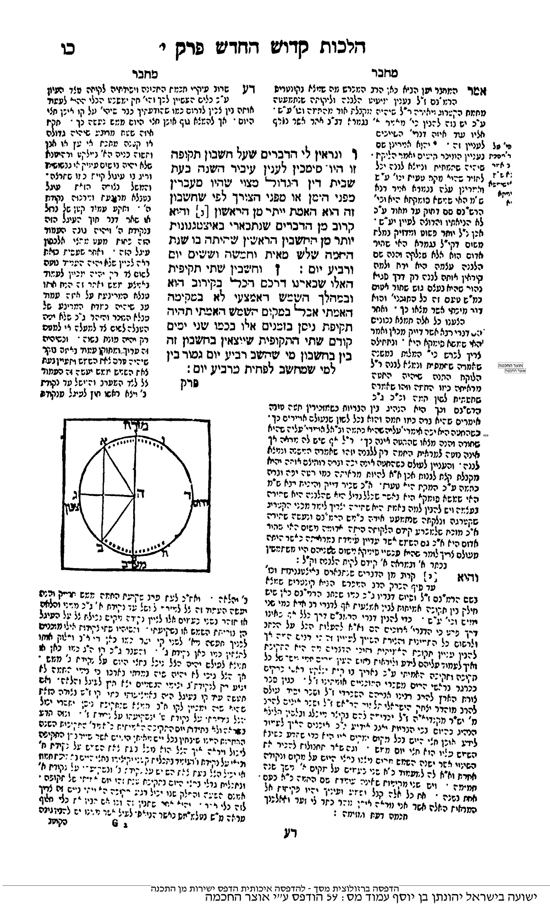
2. In my article “The Brisker Method Reconsidered” and also in my book Studies in Maimonides and His Interpreters, I refer to how R. Hayyim Soloveitchik ignored Maimonides’ own explanation to the sages of Lunel of Mishneh Torah, Hilkhot Nizkei Mamon 4:4.[2] Maimonides informed them that their text of the Mishneh Torah was incorrect and supplied the proper reading. However, R. Hayyim, in his commentary, disregarded Maimonides’ correction, illustrating how the Mishneh Torah had taken on a life of its own such that there was no perceived need to follow even Maimonides’ own assertion that the text was mistaken.[3]

In a recent article, Rabbi Elisha Friedman takes issue with my point:[4]

To correct the record it is worth pointing out one error in Shapiro’s overall excellent discussion of this subject. One of his central proofs for his approach, which he repeats in his Studies in Maimonides and His Interpreters (University of Scranton Press, 2008), 55, refers to R. Hayyim’s explanation in Hilkhot Nizkei Mamon 4:4. The problem is that Rambam, in a letter, revised the text of this halakha, as R. Yosef Karo in his commentary Kesef Mishneh, ad loc., cites. R. Hayyim completely omits any mention of this revision in his discussion, which leads Shapiro into a reflection of how to view halakhic works which are based on faulty texts. This point is made even more emphatically in the book he is reviewing, Norman Solomon, The Analytic Movement: Hayyim Soloveitchik and His Circle (Scholars Press, 1993), 219. While the overall point—that R. Hayyim is impervious to such textual matters—is undoubtedly correct and can be proven from other explanations in his work,[5] Solomon and Shapiro’s example is in fact not one of them. The piece is unrelated to the words Rambam changed in his letter; it works according to all versions. R. Hayyim proves that Rambam must be referring to an animal which pays damages from its own value and then wonders why this halakha appears in the context of the watchman’s larger responsibility for damages. Quoting Rambam’s responsum might have been proper scholarly etiquette for the sake of accuracy, but it would not have changed the overall trajectory.

Let us examine this case. Maimonides writes as follows in Hilkhot Nizkei Mamon 4:4:

When a person entrusts his animal to an unpaid watchman, a paid watchman, a renter or a borrower, these individuals assume the owner’s responsibilities. If the animal causes damages, the watchman is held liable. When does the above apply? When they did not guard the animal at all. If, however, they guarded the animal in an excellent manner, as they should, and it got loose and caused damage, the watchmen are not liable, and the owners are liable.

The problem with this halakhah is that if the watchman guarded the animal properly, and it still got out, why should the owner be liable? Maimonides was asked about this by the Sages of Lunel and he told them that they should correct their texts to read: “If, however, they guarded the animal in an excellent manner, as they should, and it got loose and caused damage, the watchmen are not liable. If the watchmen guarded the animal in an inferior manner, they are not liable if they are unpaid. Instead, the owners are liable, even if the animal kills a person. The watchman is liable if he is paid, a renter, or a borrower.”

What I said—and what Friedman criticizes—is that R. Hayyim offered an analysis of the mistaken text. Looking again at R. Hayyim, I see no reason to retract what I wrote, and I don’t understand how Friedman can criticize me. The issue isn’t whether one of R. Hayyim’s hiddushim works with both the mistaken text and the corrected text. The issue is, as I said, that R. Hayyim analyzes and explains the mistaken text. He does not pay attention to Maimonides’ correction, which he knew as it is mentioned in the Kesef Mishneh. Thus, right at the beginning of R. Hayyim’s commentary to Nizkei Mamon 4:4 he writes:

וא”כ הא קשה רישא שכתב הרמב”ם שבשמירה מעולה הבעלים חייבין, ואמאי חייבין כיון דעיקר הנגיחה הויא נגיחה של פטור

Yet in the corrected text of the Mishneh Torah, it never states that the owners are liable. R. Hayyim continues discussing the uncorrected text, leading the Hazon Ish in his comment on this passage to write: וכבר כתב הכ”מ בשם הר”מ בעצמו שהוא ט”ס

In R. Hayyim’s commentary to Nizkei Mamon 4:11, which I additionally mention in Studies in Maimonides and His Interpreters, his analysis also ignores the corrected text. He cites the uncorrected text and states:

הרי דדעת הרמב”ם דרק בזמן שהשומרין פטורין הוא דהבעלים חייבין

He also writes:

ולפ”ז הרי לכאורה יש למידק מדנקט הכא הרמב”ם הך דינא דהבעלים חייבין

Yet as we have seen, in his responsum to the sages of Lunel, Maimonides says that the underlined words are a mistake, meaning that R. Hayyim’s presentation of Maimonides’ view is not in accord with his corrected text.

In response to what we have just seen from R. Hayyim, the Hazon Ish writes:

צ”ע למה לא נקבל מש”כ הכ”מ בשם רבו בתשובתו לחכמי לוניל

In other words, the Hazon Ish calls attention to the fact that R. Hayyim, in his explanation, operates on the assumption that the printed text is correct, while ignoring Maimonides’ responsum in which he states that the text is mistaken.

In Studies in Maimonides and His Interpreters, p. 55 n. 232, I refer to R. Eliyahu Soloveitchik’s note to an article by Prof. Shlomo Zalman Havlin.[6] Let me cite his words, stated with regard to Nizkei Mamon 4:4, as I think they explain well the phenomenon we are discussing and are in line with my approach.

אמנם עיון בספר חידושי רבנו חיים הלוי מראה (וזוהי גם רוח הדברים בבית מדרשו) שכשהוא נפגש עם שינויי גירסה מסוימים בגמרא או ברמב”ם, אין הוא דן בשאלה “מה יצא מתחת קולמוסו של מר בר רב אשי או של רבנו משה בן מימון”, הוא גם לא דן בשאלה הכללית יותר “מהו הנוסח הנכון”. רבי חיים מתייחס לשינויי גירסה אצל הקדמונים כאל כל מחלוקת אחרת בפשט הסוגיה, שלומדים את שתי הדעות בשווה ואלו ואלו דברי אלקים חיים. מבחינה פרשנית אפשר לומר שרבי חיים קידש את אשר היה לפניו והרחיק את עצמו מכל דיון בשאלות עובדתיות היסטוריות, ובמקומו עסק בחקר התבונה הטהורה של תורתינו הקדושה . . . ומאחר שאין ענייננו “בירור הנוסח” אלא לומדים אנו את הנוסחאות השונות, לכן גם כשהרמב”ם בתשובה מגיה את דברי עצמו, ומנמק את הנוסח הנפוץ בטעות מעתיקים, העובדה שלפני המגיד משנה היה נוסח מסויים ברמב”ם (הנוסח הנפוץ) דיה היא כדי לקבוע שהנוסח הזה תורה הוא, ויש להתייגע על פירושו.

The very point I made, and which Friedman criticizes, is also made by R. Yehoshua Inbal.[7] He writes:

והרי הגר”ח קיצוני בדבר עוד הרבה יותר מהחזו”א, וכנודע גם במקום שהרמב”ם עצמו הסביר את דבריו, והובאו הדברים בנו”כ, וגם במקום שהרמב”ם שלפנינו ט”ס לפי עדות הרמב”ם עצמו המובאת בנו”כ, התעלם מכך הגר”ח.

In his note to this passage, he refers to Nizkei Mamon 4:4 and Maimonides’ correction of the text, and then states:

אבל הגר”ח לא קיבל גילוי זה ומיישב הג’ הישנה ובסו”ד כותב שזה גם ד’ הרמב”ם

I realize that Friedman can criticize Inbal just as he criticized me, but I feel comfortable knowing that I am in such good company.[8]

Turning to a related issue, the Hazon Ish is often cited as one who was opposed to the Brisker approach. However, the most famous opponent was R. Jacob David Wilovsky, the Ridbaz. I have discussed his opposition to what he called “chemistry” (which includes the Brisker method) in earlier posts here, and here. In my earlier writing about the Ridbaz, I was unaware of another example of his criticism of the analytic approach. This appears in his Nimukei Ridbaz, Parashat Terumah, p. 24a:

שבעו”ה נתפרצה במדינות ליטא וביחוד בזאמוט ע”י איזה רבנים לימוד בדרך הכאמי או הגיון והוא לא רוח התורה אך רוח זרה באה מבחוץ והכניסו בעו”ה להתורה שבע”פ ונתפשטה לימוד הזה אצל בחורים בעו”ה עד שהתורה לבשה צורה אחרת בעו”ה והמבינים מועטים והוא רחום יכפר עון

Regarding the Hazon Ish’s critique of R. Hayyim’s hiddushim, R. Elyakim Schlesinger reports that this was not intended for public consumption, meaning that it never should have been published.[9]

R. Hayyim Dov Ber Gulevsky, the grandson of R. Simcha Zelig Reguer, also claimed that the critique of the Hazon Ish was published against the wishes of the Hazon Ish’s family.[10]

והנה בשלהי קיץ שנת תשל”ה, שמוע שמעתי שיצאו אנשים בלתי הגונים, ולא שמעו לקול הורים ומורים, ולמשפחת הגאון החסיד צדיק יסוד עולם בעל החזון איש. והוציאו במרמה נגד רצונם את ההשגות שהחסיד הנ”ל רשם על ספר חדושי רבינו חיים הלוי. והדפיסו את זה יחד עם הספר חדושי רבינו חיים הלוי

R. Hayyim Kanievsky also reported that his father, the Steipler, was unhappy that the Hazon Ish’s critique had been printed, though not because he feared it would be seen as disrespectful. Rather, his concern was that among the Hazon Ish’s comments were some weak proofs. Readers might mistakenly assume that these weak arguments formed the basis of the Hazon Ish’s position, when in fact they were merely supplementary points that did not affect his fundamental argument.[11]

3. In Renewing the Old, Sanctifying the New, I discuss R. Kook’s view about the substitution of vegetarian sacrifices in place of animals. I also refer to what the Nazir—who unlike R. Kook was a vegetarian—says about this. Unfortunately, I overlooked an important passage from the Nazir that appears in Elchanan Shilo, Yahadut Kiyumit (Tel Aviv, 2017), p. 199. This text, written after the Six Day war, was published by Shilo from manuscript:

כל רוחי מתקומם לזביחת זבחים ולהזאת דמם. הן אנו מנוזרים מבשר בהמות ועופות, אני בערך ששים שנה, ובני ביתנו כל ימי חייהם. וכיצד תהי עבודת הקודש והמקדש בזביחת בעלי חיים והזאת דמם
אמנם זה רוח טהור, כמו רוח הקודש, המתקומם נגד זה. אבל זאת היא חוקת התורה, חוקה חקקתי, גזרת התורה, ואין לנו רשות להרהר אחריה
אמנם כבר קדמו חכמינו ז”ל ואמרו בגלוי, עתידים כל הקורבנות שיתבטלו, חוץ מתודה. וכן בשערי אורה. ואולי מתקרב ובא העתיד לבא. ומשום זה מן השמים המניעות והמכשולים, לעכב שלא תתחדש עבודת המקדש בזבחים, כמו קרבן פסח. אמנם יכולה להתחדש העבודה במקדש, בהקרבת המנחות

The Nazir wonders if the future time when there will be no animal sacrifices is almost upon us. This would explain why we are precluded from rebuilding the Temple at present, so as to prevent us from having to offer animal sacrifices. In other words, the Temple will only be rebuilt after we have forsaken animal sacrifices and have moved into the era when only vegetarian sacrifices will be acceptable to God.

4. In a nice post on the Seforim Blog here, R. Shmuel Lesher dealt with aspects of R. Shimon Schwab’s approach to R. Samson Raphael Hirsch. I would like to add a few points.

Lesher deals with the famous letter from R. Schwab to the East European gedolim asking about the validity of the Hirschian approach. Lesher writes: “There seems to be some discrepancies among those who record the story. Marc B. Shapiro dates the letter to 1933, whereas Jacob J. Schacter says it was 1934. Most surprising is R. Dr. Norman Lamm’s assertion that the question was posed from America.”

The letter was sent in 1933. I know this because R. Joseph Rozin’s reply has been published in Leo Levi’s Sha’arei Talmud Torah, p. 348. It is dated 25 Adar, 5693 which corresponds to March 23, 1933. In fact, a copy of R. Schwab’s original letter, which identifies him as assistant rabbi in Darmstadt— the senior rabbi was R. Yonah Merzbach—survives in the R. Joseph Rozin archives at Yeshiva University. It is dated Erev Shabbat, Parashat Ki Tisa, 5693. This corresponds to March 17, 1933. Based on the replies that R. Schwab received, I believe that the identical letter was sent to all the rabbis R. Schwab turned to in 1933.

Leo Levi at one time mistakenly assumed that R. Schwab wrote the letters when he was a yeshiva student in Lithuania.[12] Lesher correctly writes: “Contrary to what Dr. Levi writes that R. Schwab was still a student in a Lithuanian yeshiva when he posed the question, R. Schwab had already left the Mir Yeshiva by 1931.”

But then, Lesher also writes:

Nevertheless, there is reason to believe that Dr. Levi’s record of the story should be the most accurate. In addition to publishing the four responses to R. Schwab, Dr. Levi writes in his Torah Study: A Survey of Classic Sources on Timely Issues (New York: Feldheim, 2002), 363n13, available here, that R. Schwab himself shared R. Yosef Rozen’s response with him personally. It is unlikely that Dr. Levi would not have gotten the context of the letters accurately from R. Schwab. Perhaps one can suggest in Dr. Levi’s defense, that R. Schwab may have posed the question at least twice. Once when he was a yeshiva student in Lithuania and then again in writing later when opening a yeshiva in Bavaria.

Yet this is needless speculation, as there is no question that in the text referred to in note 12 Levi was mistaken about the context of the letters. (As we shall soon see, Levi would get something wrong much more significant than this). In fact, in a later article, Levi correctly writes that R. Schwab sent the letter to the gedolim when he was a young rabbi in Germany, but he was wrong is stating that R. Schwab wrote it when it was rabbi in Ichenhausen.[13] As mentioned, he actually sent it before this, when he was assistant rabbi in Darmstadt.

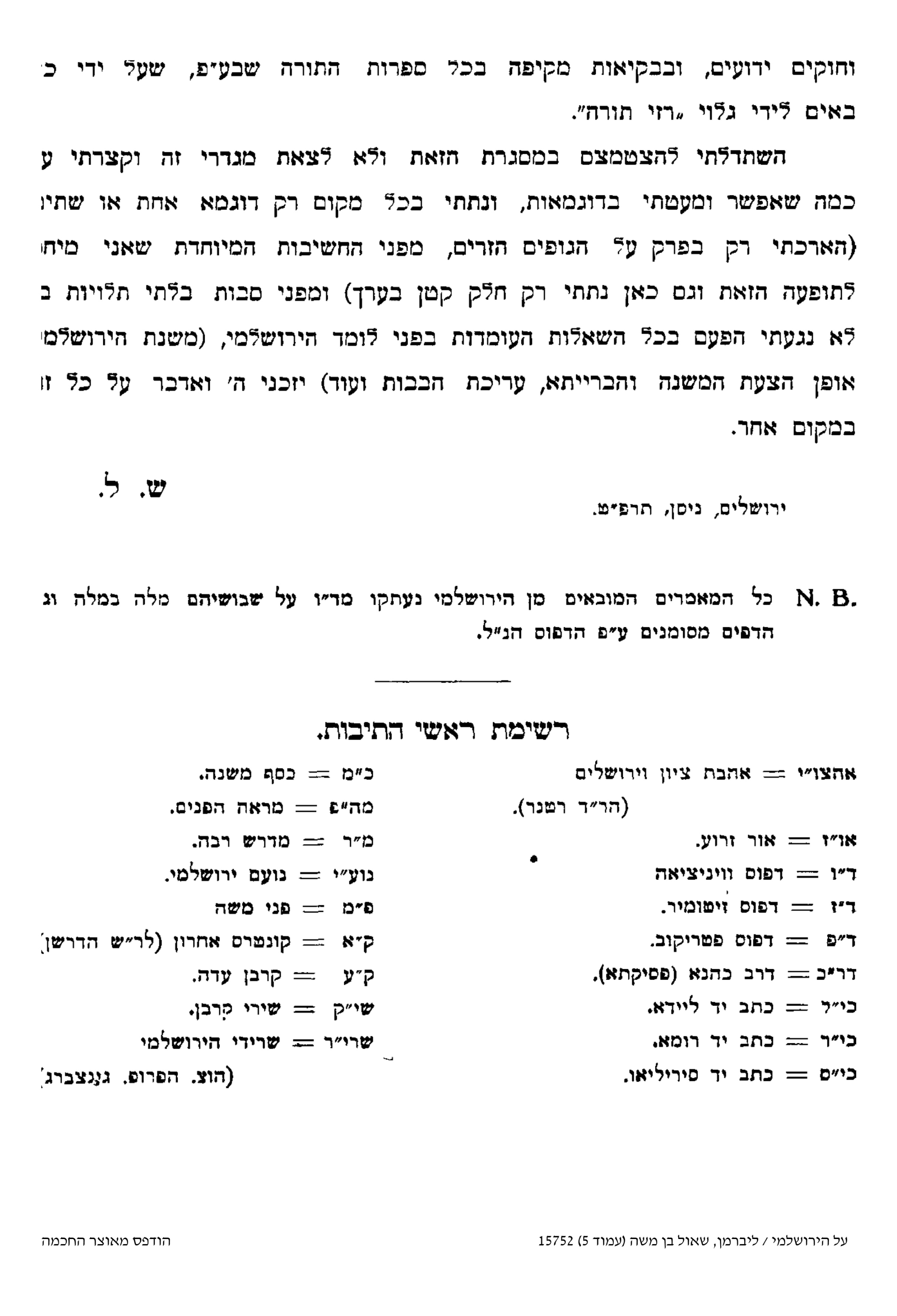
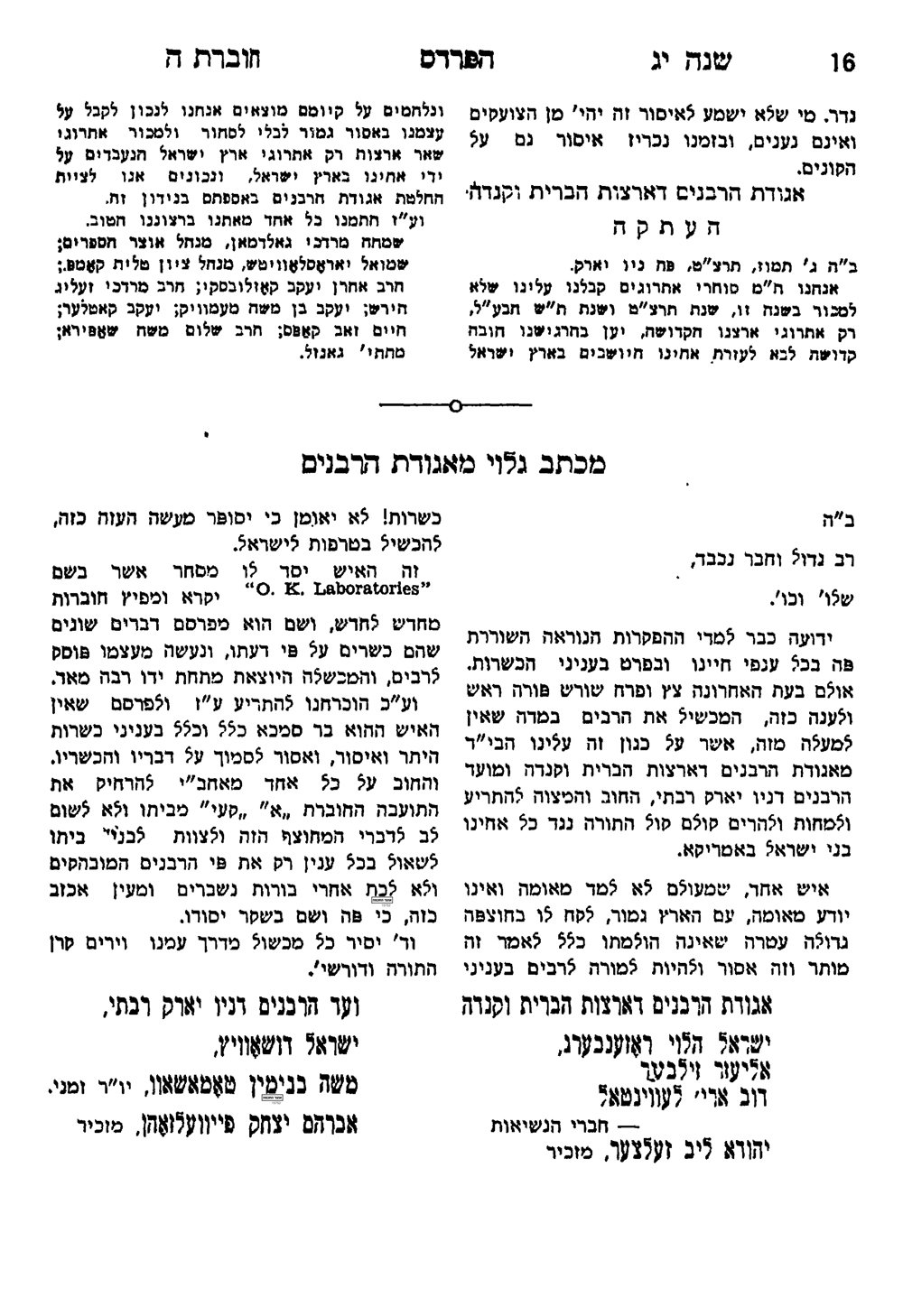
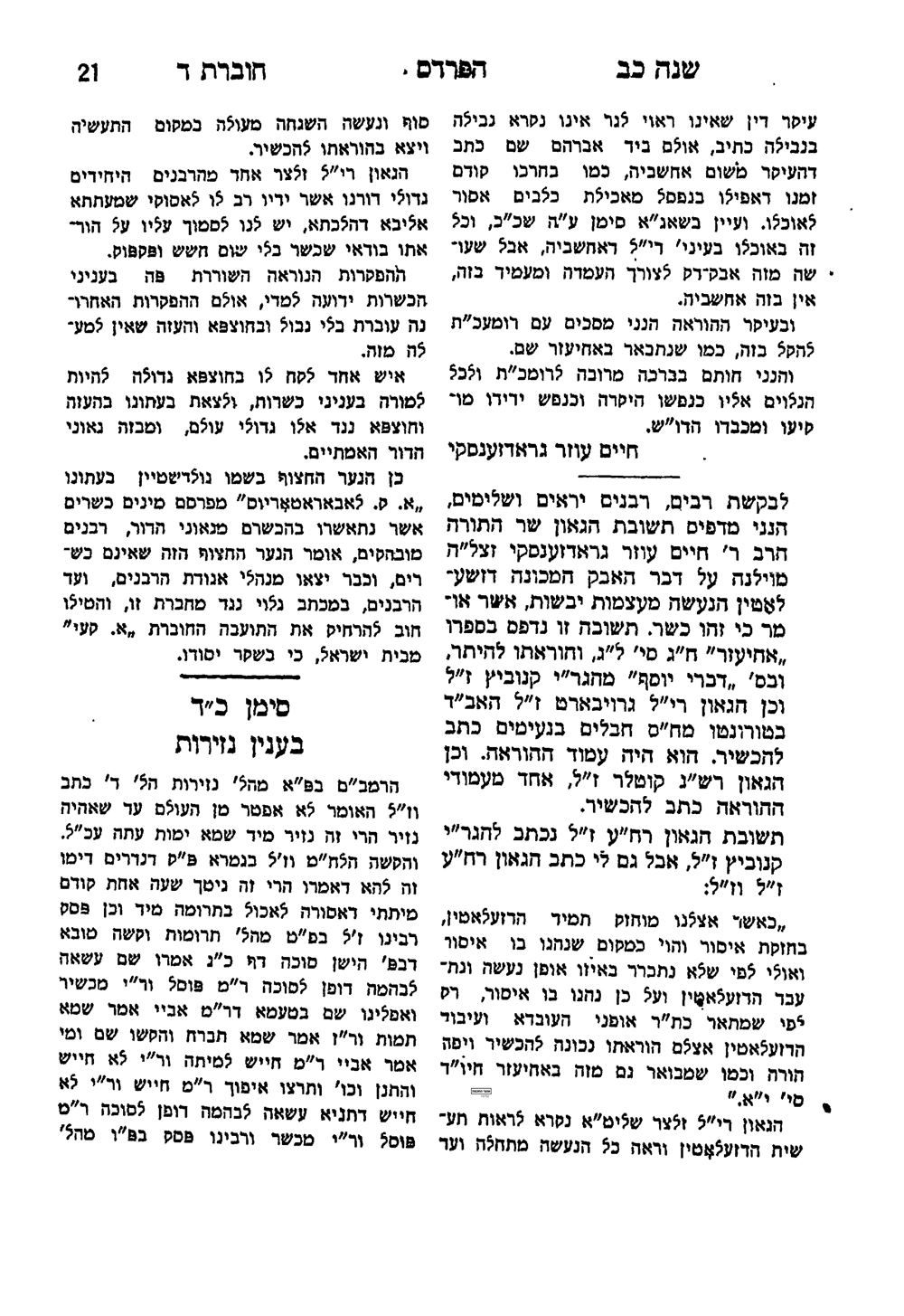
In Ha-Pardes, December 1939, R. Schwab published what he later said was the letter he sent to the gedolim.[14] Yet this is not correct. The article in Ha-Pardes only includes his halakhic discussion about secular studies, which was the main part of the letter.[15] Missing from Ha-Pardes is the introduction to the letter, which is itself a fascinating historical document that illustrates R. Schwab’s disillusionment with the German Orthodox Torah im Derekh Eretz approach. It is published here for the first time, and in the transcription I have added paragraphs for ease of reading:[16]

מו”צ דק”ק דארמשטאדט והגליל

Rabbin. Ass. S. Schwab

Darmstadt

בעה”י דארמשטאדט עש”ק פ’ כי תשא תרצ”ג לפ”ק
החיים הברכה והשלו’ יחולו על מרום פסגת ראש הר קדש ה”ה עטרת תפארת גאון יעקב מחמד עינינו נשיא ישראל שר התורה קדוש וטהור יאמר להוכקשת”ר רשכבה”ג אדמו”ר מרן הגאון האדיר מו”ר הג”ר יוסף ראזין שליט”א ראב”ד דק”ק דווינסק יע”א

אחרי קידה והשתחוי’ מול הדרת קדשו ופ”ש כנכון!

בזה אגיש נגד פני כקשת”ר שליט”א שאלה חשובה למעשה בבקשה שטוחה שכשת”ר ימחל נא בטובו להשיבני דבר ולהודיעני שמעתתא אליבא דהלכתא בענין דלקמן וכוונתי ללבן ולברר האמת לאמיתו בשאלה זו ואציעה שאלתי ובקשתי בזה רק לידע הלכתא בקושטא ותורה היא וללמוד אני צריך ומעומק מקור חכמת תורתו ידלה נא כשת”ר לי מים חיים ויורני דרך הישר ואורח מישור אלך בה בס”ד

הנה בודאי ידוע להוכקשת”ר שיטת רוב יהודי אשכנז החרידים [!] על דבר ד’ ומקורם הטהור הוא הגרש”ר הירש זצ”ל בענין התחברות חכמת התורה עם חכמות אומות העולם וסברתם היא שכך פירוש המשנה באבות: “יפה תלמוד תורה עם דרך ארץ”, כלומר ללמוד חכמת התורה ביחד עם חכמות חצוניות ויסדו מכאן שיטתם שכל מה שרוח האדם פועל טוב בעולם – ר”ל כל מה שקוראין בלשון אשכנז קולטור ה”ה התרבות האנושית וכל מה שסופריהם וחכמיהם של האומות מפרסמים ומודיעים ומלמדים בעולם – שכל זה נובע ממקור חכמתו של הקבה”ו החונן לאדם דעת ולכן ראוי להגות בכל החכמות ולהתעסק עמן ובכלל להיות “געבילדעט” ככל הגוים אשר סביבותינו ואומרים שגם בדורות הראשונים היתה השיטה הזאת מקובלת בקרב עם ישראל כמו במדינות ספרד שגם שם היו לאנשים היותר חשובים שבכלל ישראל עסק עם כל חלקי החכמה והיתה להם יד בפילוסופיא, ברפואה, בתבונה, ובהנדסה ובשאר המדעות ומציאות זו משמשה לאחבנ”י כאן במדינותינו לראי’ חזקה לתמוך שיטתם. (ובפרט שחושבים הם שע”י התגשמותה של השיטה הזאת תהא להם אפשרות להראות לאפקורסים שיכול אדם להיות בעל תורה ויראה וגם בעל תרבות ומדע. ואין אחת מפרעת חברתה אלא אדרבא יחדיו תהיינה תואמות בשלמות.)

כך שיטתו של הגרש”ר הירש זצ”ל והבאים אחריו המשיכו מזה להתיר לעצמם כל מיני עניני החיצוניות, ועל פי שיטתם הזאת מותר בעיניהם ללמוד כל מיני ספרים חצונים בין ספרי טבע ופילוסופיא בין ספרי אפיקורסים ומינים וכופרים וגם ספרי משוררים שונים ואף ספרי “ראָמאַנעֶן” שבהן נכרכו דברי חכמה ומדע עם דברי חשק וספורי אהבת נשים – ושבר אל שבר יחדיו ידובקו – וגם מותר לגמרי בעיניהם לבקר באוניברסיטאות ששם מתעסקים בקביעות בכל מיני חכמה ומדע ואף הרבה פעמים בתוכן עניני מינות ממש, וגם הבקור בבתי טיאטראות כהיתר גמור נחשב להם שאומרים שבל ישגיחו בדברי עגבים שבהן אך ורק ימצאו ענין בחכמת אומנות – הבימה ובחכמת מעשה הציורים והתוארים שישנם שם – ולא אדבר עוד לא על אדות ענין לימודי החול שילמדו את בניהם עפ”י חוקי הממשלה וגזירת המלכות ואפשר שג”כ יש קצת היתר משום אומנות שכמעט א”א למצא פרוטה מספקה במדינות אלו מבלי איזה ידיעות באותן החכמות וגם בזה לא אדע בעניי עד עתה יסוד חזק של היתר ודאין. אולם לא על זאת עיקר שאלתי שכעת לפ[עמים] אפשר נדונים כמוכרחים עפ”י דינא דמלכותא ללמוד קצת חכמות כלליות בבתי ספר עממיים של כל אתר ואתר אך בראש וראשון אדאג איך למצא היתר לאותם שלומדים בלי הכרח רק מחפץ לבם חכמות אחרות מלבד תלמוד תורה בפרט בבתי הגימנסיות וכדומה

וגם אבקש לידע בבירור פירוש המשנה “יפה ת”ת עם ד”א” אם אפשר בעולם לפרשה על אופן שפרשו תלמידי הג’ רש”ר הירש זצ”ל להתאם תורה וחכמות אחרות יחד, כי כמדומה שהיתה בזמנם אז הוראת שעה אך אין להביא ראי’ מש”ס ופוסקים ליסד הוראת שעה שאין הלכה כמותה בשאר העתים ולפי כל הנ”ל לא היתה מעולם לבי שלמה עם בעלי השטה הנזכרת

R. Schwab lays out the case as follows: Most German Orthodox follow the path of R. Samson Raphael Hirsch regarding joining Torah with worldly wisdom, and they think that this is the meaning of the passage in Avot, “Yafeh Torah im Derekh Eretz”. They believe that culture and literature arise from the wisdom that God grants to humanity, and therefore one should engage in these pursuits in order to become cultured, just like non-Jews. They also maintain that this reflects how Jews lived in medieval Spain, where they were involved in philosophy, medicine, astronomy, and other sciences. Furthermore, they argue that this approach best demonstrates to heretics that one can be a pious and learned Jew while also being cultured and educated. In this way, the different aspects of one’s personality coexist harmoniously rather than creating tension.

R. Schwab states forthrightly that this was the approach of Hirsch, and that those who followed him continued in this path, permitting for themselves all sorts of “external things.” Thus, they studied all kinds of books in science and philosophy, including works written by heretics, as well as poetry and novels in which insights of wisdom and science were interwoven with erotic themes. In their view, it is entirely permissible to attend universities, even though one may encounter heretical ideas. They likewise regard going to the theatre as permissible, advising that any erotic elements simply be ignored.

R. Schwab explains that his question does not concern young people who study secular subjects, since this may be considered obligatory due to government requirements. Moreover, such study may be permitted because it is virtually impossible to earn a livelihood without some secular education. His concern, rather, is with those who engage in secular studies not out of necessity, but out of a desire to immerse themselves in Western culture. He also wants to know if the Mishnah’s expression, “Yafeh Talmud Torah im Derekh Eretz,” can really be understood in accord with the approach of Hirsch’s students, that one should join Torah together with secular studies. He assumes that Hirsch’s approach was a hora’at sha’ah but you cannot apply a hora’at sha’ah to other times. R. Schwab confesses that because of the considerations he lays out, he was never comfortable with the German Orthodox approach to Torah im Derekh Eretz. (In his 1966 work, These and Those, R. Schwab recognized that his earlier understanding, that Torah im Derekh Eretz was intended by Hirsch as a hora’at sha’ah, was a mistake.)

This is the introduction to his letter which is followed by the halakhic section of the letter, and it is this section which was published in Ha-Pardes.

Interestingly, a year after R. Schwab sent his letter to the gedolim of Europe, he sent a shorter but similar letter to R. Kook, together with the halakhic section that had been sent to the other gedolim and would later appear in Ha-Pardes. This letter to R. Kook was first published by Levi.[17] It is striking that R. Schwab, who is identified with the Hirschian separatist ideology, nevertheless included R. Kook among the gedolim he consulted. He also addressed R. Kook with exalted titles:

הגאון הנפלא בצדקתו ובחכמת תורתו מרן הגרא”י הכהן קוק

There is no record of Rav Kook replying to R. Schwab.

One point that Levi does not note is that in the halakhic section sent to R. Kook, R. Schwab added a paragraph that is not found in the original article sent to the gedolim, in which he again expresses his view that Hirsch’s approach was a hora’at sha’ah.

האף למ”ד כי שיטת הגרש”ר הירש זצוק”ל שיש חיוב בלימוד כל חכמות האומות בכדי להתאים התרבות האנושית עם חכמת התורה, בתכלית להיות “געבילדעט” ככל הגוים אשר סביבותנו, כי שיטה זאת שאינה מורה היתר בתנאים המובאים הנ”ל רק מלמד גם חיוב – זו היתה רק ואך הוראת שעה בזמנו ועתו, ויש לחקור אם ההוראה חלה ג”כ בזמננו אנו. עיין געזאמעלטע שריפטען צד 449, 456 חוברת ב’ ועוד מקומות [ועי’ בעל חתם סופר בספרו “תורת משה” פרשת שמות ופרשת בשלח]

Let us now return to Levi, who is cited in Lesher’s post. Although Levi considered himself an advocate of Hirschian Torah im Derekh Eretz, his understanding represents a very restricted version of Hirsch’s ideas. Indeed, his conception of the content of Torah im Derekh Eretz appears to be largely identical to that of R. Schwab. If you examine Levi’s Sha’arei Talmud Torah or his article “Torah im Derekh Erets in Our Time”,[18] the advocacy of secular studies is in order that one is able to make a living—Torah im Parnasah—as through work we join with God in perfecting the world. Levi also regards knowledge of science as an integral part of Derekh Eretz, and he further maintains that art and music, when used in the service of God, are also included within Derekh Eretz.

Yet the humanities, the bedrock of Western Civilization, are completely absent from Levi’s understanding of Torah im Derekh Eretz. Despite the fact that he writes that according to Hirsch, “the Torah affirms all that is true in modern culture,”[19] his presentation of Hirsch’s views completely ignores what modern culture means. He even claims that “it may be argued that it [Hirsch’s Torah im Derekh Eretz educational system] was a hora-at sha’ah, a temporary measure.”[20] Since the notion of Torah im Derekh Eretz as a temporary measure stands in fundamental opposition to Hirsch’s own understanding, Levi’s acknowledgment that this might indeed reflect Hirsch’s view highlights the problematic nature of his approach. I say this even though, after mentioning the point about hora’at sha’ah, Levi adds: “though even if we grant this [that the Torah im Derekh Eretz educational system was a hora’at sha’ah], there may be good reason to maintain that its time has not yet passed.”[21] His footnote to this last sentence is itself enlightening as to how Levi understood Torah im Derekh Eretz.

Today science and technology play an increasingly pervasive role, as we rely more and more on technological devices for our daily needs. Hence all that our sages have said about the importance of scientific knowledge applies today with even greater force.

It would therefore seem that R. Hirsch’s hora-at sha’ah, issued 150 years ago, is no less applicable now. However, any decision on this issue must be made by those rabbinic leaders who are shouldering the responsibility for the community’s spiritual welfare.

Here we see that the Torah im Derekh Eretz educational system is unequivocally regarded as a hora’at sha’ah, unlike in the earlier text, where he presents this as a debatable point.[22] He portrays Torah im Derekh Eretz as focused on science and technology. Finally, Hirsch’s imprimatur is not reason enough for it to be regarded as a valid approach, but contemporary rabbinic leaders must decide on the matter.

In a later article, Levi also notes how Hirsch not only advocated the study of science but also history. He then states:[23]

He encourages the study of nature, of the nature of man (through psychology and anthropology), and of history—but not the study of the humanities, which deal with the meaning of the world, man’s place in the world, aspirations and values, goals and ideas. Even when, on one occasion, dictates of good manners compelled him to eulogize a gentile poet, he praised that poet for having absorbed many lofty Jewish teachings, and for having enriched the gentile world by clothing those teachings in an inspiring form. Nowhere, however, in an address of fourteen pages, did he imply that we, as Jews, should—or need to—absorb ideas from a Gentile.

Levi is referring to Hirsch’s famous speech on Schiller, delivered on the hundredth anniversary of his birth. He is saying that Hirsch felt forced to deliver his speech in order that his school not be seen as departing from what was proper. Elsewhere, he makes the outlandish assertion that Hirsch only “permitted” reading German literature in order to learn the language, but not in order to know the content! [23b]

Contrary to Levi, the issue for Hirsch was not whether Jews need to absorb ideas from non-Jews, but if there is value in non-Jewish wisdom. The notion that Hirsch did not encourage the study of humanities is completely false. He, and his followers, believed strongly that great works of literature can often teach lessons fully compatible with authentic Torah teachings, and these writings are therefore to be included in “Derekh Eretz”. In his Schiller speech he explicitly states that “our forefathers in their wisdom have taught us to look among the ‘wise men of all nations’ for the ‘spirit of wisdom imparted by God to mortals.’”[24] Will anyone be surprised to learn that the study of German literature was included in the curriculum of Hirsch’s school. This was to remain a distinctive feature of Hirschian philosophy. I discuss this at greater length in my article “Rabbi Samson Raphael Hirsch and Friedrich von Schiller,” available here.

Naomi Schwab Schendowich has recently written that Hirsch’s intention in instituting Torah im Derekh Eretz in his school “was that the pupils should have intensive Torah studies as well as a wide secular education in preparation for earning a livelihood.”[25] Yet listen to what Hirsch himself says, completely rejecting the notion that Torah im Derekh Eretz is exclusively about earning a livelihood.

A good secular education can give our young people substantial new insights, added dimensions that will enrich their religious training. . . . Any supporter of education and culture should deplore the fact that when these secular studies are evaluated in terms of their usefulness to the young, too much stress is often placed on so-called practical utility and necessity. Under such circumstances the young are in danger of losing the pure joy of acquiring knowledge for its own sake, so that they will no longer take pleasure in the moral and spiritual benefits to be obtained from study.[26]

* * * * * * * *

[1] See R. Bezalel Zolty, Mishnat Yaavetz, Orah Hayyim, p. 95.

[2] For a recent academic article that deals with R. Hayyim, see Sergey Dolgopolski, “Constructed and Denied: ‘The Talmud’ from the Brisker Rav to the Mishneh Torah” in  James A. Diamond and Aaron W. Hughes, eds., Encountering the Medieval in Modern Jewish Thought (Leiden, 2012), pp. 177-200. Despite the title referring to the Brisker Rav, the article is about R. Hayyim. This reminded me of something interesting. I know someone who delivered a Daf Yomi shiur to a Hasidic audience. Unsure how they would react if he quoted Joseph B. Soloveitchik by name, he instead referred to him as the Brisker Rav.

[3] Here are two other points of note regarding R. Hayyim’s commentary.

1. At the end of the introduction the sons include a four-line remembrance of their mother.
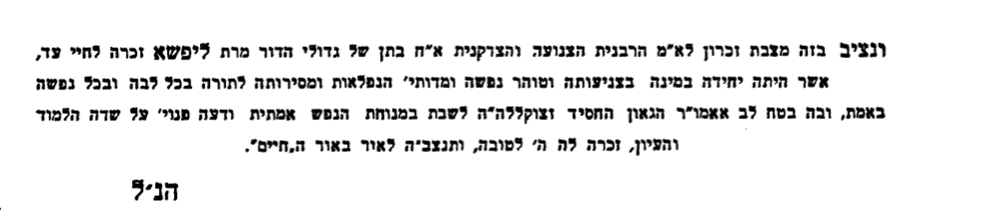
2. It is reported that when R. Hayyim’s commentary was published in 1936, R. Baruch Ber Leibowitz had a ceremony whereby the book was brought into the beit midrash together with music, just as if it were a new Sefer Torah. Students even danced with the book from R. Baruch Ber’s house until the yeshiva. See R. Dov Eliakh, Be-Sod Siah, p. 212.

[4] “Rambam of Brisk: R. Hayyim Soloveitchik’s Relationship with Mishneh Torah,” Tradition 5 (Summer, 2024), p. 2 n. 2.

[5] Friedman, however, points to one example where R. Hayyim suggests that the text of the Mishneh Torah is in error. See Hiddushei R. Hayyim HaleviEdut 21:9. R. Hayyim supports his suggestion by claiming that his preferred reading appears in an old manuscript. However, this raises the question of where he obtained this information, since the Frankel edition of the Mishneh Torah reports that no manuscripts preserve an alternate reading. See Hiddushei R. Hayyim HaleviEdut 21:9 and Friedman, “Kelalei Ha-Gaon Rabbi Hayyim mi-Brisk be-Veur ha-Rambam,” Alumot 1 (2026), pp. 390-391.

[6] “Ha-Yahas li-She’elat Nusah be-Sifrei Hazal,” in Yoel Catane and Eliyahu Soloveitchik, eds., Beit ha-Va’ad (Jerusalem, 2003), pp. 27-28, n. 28.

[7] “Yesodot ve-Ekronot Parshanut ha-Talmud,” Ha-Otzar 6 (Av 5777), p. 266.

[8] See also R. Raphael Amihai Hadad in the recently published Ha-Mashbir, vol. 12 (2026), p. 126:

ושמעתי בשם הגרב”ש דויטש זצ”ל שאף שהגר”ח בחידושו הידוע על “שומר שמסר לשומר” (הלכות נזקי ממון פ”ד ה”ד), בונה מערכת שלמה ליישב ולהסביר דברי הרמב”ם בעוד שהרמב”ם עצמו בתשובתו לחכמי לוניל (הובא במעשה רוקח שם) תולה את זה בטעות סופר, “דומה, כי גם אילו היה הגר”ח יודע את תשובת הרמב”ם, לה היה חוזר בו”

This volume of Ha-Mashbir, edited by the indefatigable Rabbis Yissachar Dov Hoffman and Ovadya Hoffman, is as usual a fascinating publication. It includes a previously unpublished commentary by R. Ovadiah Yosef on Tehillim. It also includes letters I received from R. Meir Mazuz in the years after the publication of Iggerot Malkhei Rabbanan. You can see the letters here.

[9] Ha-Dor ve-ha-Tekufah, p. 48. Truth be told, I am hesitant to quote anything from this book. I say this because the following passage (p. 32), citing R. Isaac Zev Soloveitchik in explaining why R. Kook came to London, is so historically uninformed that it raises questions about the reliability of the entire book. There is no way that R. Isaac Zev could have said what he is quoted as saying.

פעם שאל אותי אם יודע אני איך הגיע רב קוק ללונדון, וסיפר לי כי הוא הורחק מישיבת וואלוז’ין לפי שהי’ קייליקער, ועסק בלימודי השכלה, ואח”כ התחתן וחפש רבנות, כשמוע הגר”ח ז”ל שהוא מחפש רבנות, חרה לו ז”ל מאוד, אמרו לו הלא כבר עשה תשובה, אמר להם וכי ממנים בעל תשובה להיות רב, וכתב הגר”ח לכל העירות שבליטא שלא יקבלוהו לרב, ולכן הוכרח לברוח ללונדון

The statement that we would not appoint a baal teshuvah as rav of a community, which was widely accepted throughout the generations, refers to the classic baal teshuvah, namely, someone who “went off the derekh” and then repented. It does not refer to a “tinok she-nishbah,” i.e., someone born into a non-religious family—either a Converso family or a modern non-Orthodox family—who later in life became religious. The same can be said about a hazzan, concerning which Ta’anit 16b states that he must not have had a bad reputation in his youth. See R. Moshe Sternbuch, Teshuvot ve-Hanhagot, vol. 1, no. 99; R. Netanel Meoded, Mizrah Shemesh, vol. 4, no. 1. See also R. Sternbuch, Teshuvot ve-Hanhagot, vol. 2, no. 462, who sees value in having a baal teshuvah as a darshan. R. Avraham Shapiro has a different perspective; see his Rosh Devarkha (Jerusalem, 2010), p. 565:

כאשר ראה הסבא מסלובודקה זצ”ל שכל הישיבה שלו הלכה לשמוע את הרצאתו של החוזר בתשובה – הרב בירנבוים זצ”ל – הוא אמר: אני הייתי רגיל שבעל תשובה יושב בפינה ובוכה, והיום, יושב על במה ונותן הרצאות

I would only make two points about this passage. The first is that Nathan Birnbaum was a classic baal teshuvah in that he abandoned Orthodoxy before later returning, so his situation is not comparable to current baalei teshuvah who grew up irreligious. Second, Birnbaum was not a rabbi, a mistake that can be attributed to the editor of the book, as R. Shapiro would never have referred to him with the rabbinic title. In R. Shapiro’s Siah Ish, attached to his Hag ha-Sukkot (Jerusalem, 2012), p. 96, R. Shapiro’s comment about Birnbaum also appears. Yet here he refers to “Dr. Nathan Birnbaum,” which is what R. Shapiro would have said.

[10] Gulevsky, Lahat ha-Herev ha-Mithapehet, pp. 5-6.

[11] Kanievsky, Orhot Rabbenu (new ed.), vol. 4, p. 169.

[12] See Levi, “Rabbi Samson Raphael Hirsch – Myth and Fact,” Tradition 31 (Spring 1997), p. 11, called to my attention by Lesher.

[13] Ha-Ma’yan 48 (Nisan 5768), p. 37.

[14] See Jacob J. Schacter, “Torah u-Madda Revisited: The Editor’s Introduction,” Torah u-Madda Journal 1 (1989), p. 15, n. 1.

[15] There are also a few minor differences between the original letter and what appears in Ha-Pardes. The following sentence is only found in Ha-Pardes.

ואם אסור מן הדין בודאי גם כן משום פרנסה אסור ובפרט אם יכול האדם למצא אומנות אחרת נקיה וקלה אף גם שאינו מרויח כך כך

[16] The letter is found in the R. Joseph Rozin Collection, Yeshiva University Archives, MS. no. 1142. I thank Yeshiva University for permission to publish the letter. You can see the original letter here.

[17] Ha-Ma’yan 48 (Nisan 5768), pp. 38-39.

[18] Tradition 28 (Fall 1993), pp. 46-81.

[19] “Torah im Derekh Eretz in Our Time,” p. 68.

[20] Ibid.

[21] Ibid.

[22] When Levi reprinted R. Schwab’s article on Torah im Derekh Eretz in Ha-Ma’yan 48 (Nisan 5768), pp. 38-39, he is clear that Hirsch did not regard Torah im Derekh Eretz as a hora’at sha’ah. See ibid., p. 37.

[23] “Rabbi Samson Raphael Hirsch – Myth and Fact,” pp. 7-8.

[23b] Ha-Ma’yan 48 (Nisan 5768), p. 38 n. 12.

[24] Hirsch, Collected Writings, vol. 9, p. 146.

[25] Schendowich, Hermann Schwab: Historian of German Jewry, His Life and Shorter Works (Jerusalem, 2022), p. 79 n. 24.

[26] Hirsch, Collected Writings, vol. 7, p. 88.


Saul Lieberman and his Ketubah, Driving on Shabbat, an Unusual Marriage Practice, Girls born on Friday, and More

Saul Lieberman and his Ketubah, Driving on Shabbat, an Unusual Marriage Practice, Girls born on Friday, and More

Marc B. Shapiro

For a long time, I have had an interest in Saul Lieberman. It has been almost twenty years since my book Saul Lieberman and the Orthodox appeared.[1] I have also dealt with Lieberman in many Seforim Blog posts. A few years ago, I did a series of eighteen classes on Lieberman on Torah in Motion. You can watch the classes on Youtube here or listen to the podcasts here. A letter from Lieberman that has recently come into my hands allows me to turn to Lieberman again. Yet before doing so, I must note at the same time that I was researching, writing, and teaching about Lieberman, Aviad Hacohen also published a number of works on Lieberman. His latest is a lengthy article on Lieberman and the Lithuanian Torah world that appeared in the recently published Rabbi David Golinkin Jubilee volume titled Shir ha-Ma’alot Le-David. It can be read here. In his article, Hacohen includes this nice photograph of Lieberman speaking with R. Aharon Lichtenstein.

We can also look forward to Hacohen’s forthcoming volume of Lieberman’s letters which will be vital for any future scholarship on Lieberman.

While Lieberman was always careful not to do anything that would be at odds with the Orthodox rabbis, there was one exception to this, and that was his ketubah. In order to help solve the Agunah problem, Lieberman proposed including in the ketubah a clause that the husband and wife authorize the beit din to award compensation if either party refuses to come to the beit din to halakhically end the marriage. For those married under Conservative auspices, the beit din mentioned in the ketubah would be the newly formed beit din of the Rabbinical Assembly and the Jewish Theological Seminary.[2]

A lengthy letter from Lieberman to R. Isaac Herzog, dated November 22, 1954, was recently placed at auction, available here. I thank a student who purchased the letter and sent it to me, enabling me to see page 4 which is missing from the auction site. After this post appears, I will present the letter to a suitable archive for safekeeping. This letter is of great significance, as Lieberman explains what motivated him to develop his addition to the traditional ketubah. We are also given insight into how he viewed the Orthodox and Conservative rabbis. Those who wish can see the complete letter in one PDF here.

In the letter, Lieberman begins by saying that he had not written to R. Herzog—who was a very close friend[3]—because he did not want to create difficulties for R. Herzog by bringing him into the controversy swirling around his proposed ketubah. He explains that certain non-Orthodox rabbis had begun to perform marriages for women who were only divorced civilly. This led people to think that the obligation of a get was not a serious matter. Lieberman notes that in circumstances where the husband does not want to give a get, it is usually possible to convince him to do so. The problem is that these “menuvalim” demand so much money to issue the get, that the women are unable to pay this: ואין מי שיתבע את עלבון העלובות

Lieberman then turns to what in his time was a well-known agunah case. I do not wish to go into details but only mention that the woman involved was the famous Trude Weiss-Rosmarin, who after her experience became a critic of the Orthodox approach in Jewish marriage and divorce law. In Lawrence Grossman’s great new book, Living in Both Worlds: Modern Orthodox Judaism in the United States, 1945-2025, p. 204, he writes that Weiss-Rosmarin was “perhaps the first woman from an Orthodox background to publicly demand the wholesale revision of the system [of Jewish divorce law].” In Weiss-Rosmarin’s 1953 article, “Wanted: Equality for Jewish Women,”[4] and in her later article “The Agony of the Agunah,”[5] she called for batei din to assume the authority of issuing divorces instead of husbands. She further claimed that “Jewish law is male-made and inevitably the male prerogatives are protected at the expense of the rights of women. While Jewish law is chivalrous in certain areas, ‘chivalry’ is not enough for the modern woman.”[6] Because of her strong stand in the matter of agunah, Weiss-Rosmarin has even been called the “the first feminist Jew and the first Jewish feminist.”[7] You can read about her here.

Lieberman says that when he saw how the rabbis did not do anything to help Weiss-Rosmarin, that he came to the conclusion that he must do something. His answer to the agunah problem was his ketubah. If the beit din orders payments based on the ketubah, he believed that this would be upheld by the secular court. Lieberman states that originally he wanted the beit din that would be in charge of this to have: רבנים יראי שמים ובקיאים בדיני גיטין וקדושין. He even reveals that R. Abraham Price of Toronto agreed to serve on this beit din, which means that R. Price accepted the halakhic legitimacy of Lieberman’s ketubah. However, the Rabbinical Council of America threatened to put the Orthodox rabbis in herem if they joined Lieberman’s proposed beit din.[8] Lieberman adds that since the RCA did not allow for Orthodox rabbis to join this beit din, there was no longer any possibility that the beit din would be able to write gittin. Rather, its only role would be to compel the man who refused to give a get to do so. He tells R. Herzog that he reformulated the ketubah, so that any recognized beit din can compel the man to issue a divorce and also require monetary payments.

Lieberman adds that the Orthodox assertion that Conservative rabbis wish to involve themselve in matters of gittin is laughable. It is of interest how Lieberman distinguishes between Orthodox and Conservative rabbis, something that only comes across in the Hebrew words he uses for “rabbi”:

כל הצעקה של הרבנים שהרבייס הקונסרבטיביים רוצים להכנס לענייני גיטין היא מצחיקה

Lieberman continues that the Conservative rabbis have no need for the income they could get from doing gittin, and they can make more money from other things. They have not gotten involved in kashrut, which is less complicated than gittin and has much more money in it. Lieberman adds that the fact that the Conservative rabbis accepted his proposal is a very positive thing, since if any of them now perform a wedding before the woman has received a get, they will be expelled from the Rabbinical Assembly. All Conservative rabbis are therefore forced to explain to their communities that civil divorce is meaningless and the woman is still regarded as married.

Lieberman then tells about the “young rabbis” who were in an uproar about his proposal. By this he means the rabbis of the Rabbinical Council of America. He says that they were claiming that it is forbidden to alter any of the formulations used in the ketubah, and that this is based on the fact that it is also forbidden to alter the text of a get from what the Sages have decreed.[9] Lieberman notes that he did not pay them any mind, and was happy to let them show their ignorance in public. He adds that the RCA rabbis have now begun screaming that the beit din of the Conservative rabbis has permitted kohanim to marry divorced women and to drive to synagogue on Shabbat.[10] Lieberman says that this is completely false. To begin with, they do not have a beit din. What this apparently means is that the Conservative movement does not have a national beit din that could issue rulings for the movement. Lieberman adds that a number of Conservative rabbis, mostly his students, demanded that any rabbi who performs a wedding between a kohen and a divorced woman, or permits his congregants to drive on Shabbat, should be expelled from the Rabbinical Assembly. Yet at the convention of the Rabbinical Assembly this proposal was rejected.

Already in 1952 the Committee on Jewish Law and Standards permitted Conservative rabbis to perform weddings between kohanim and divorced women.[11] As for driving on Shabbat, the famous responsum that permitted driving to synagogue, and only to synagogue, on Shabbat, was authored by Rabbis Morris Adler, Jacob Agus, and Theodore Friedman. It was reprinted in Mordecai Waxman, ed., Tradition and Change: The Development of Conservative Judaism (New York, 1958). Here is part of the preface to the responsum from which you see background:

The responsum printed below is the collective effort of three men who prepared it for the approval of the Law Committee of the Rabbinical Assembly. It secured the support of a majority of the Law Committee and it was subsequently presented at a convention of the Rabbinical Assembly (1950). However, in conformity with the policy of the Assembly not to give approval to legal provisions which have not been unanimously approved by the Law Committee, it was not voted upon. It thus remains as the opinion of a group of men, but has no official status.[12]

Although the responsum did not have official status as a ruling of the Conservative Movement, because of the support it received on the Committee on Jewish Law and Standards—the new name of the Law Committee beginning in 1948—it was regarded by the Conservative Movement as a halakhically acceptable option.[13] The way the Committee worked is that “a unanimous opinion is recorded as such and becomes binding upon every member of the Rabbinical Assembly. Where there is a difference of opinion, the opinion which dissents from the majority becomes a minority opinion, and the minority opinion also may be followed by the members of the Rabbinical Assembly.”[14]

In a 2023 article that appeared on the Rabbinical Assembly website here, it states that the responsum “was approved by the Law Committee,” which must mean “approved” as an acceptable option.

The halakhic position advocated by Adler, Agus, and Friedman is summed up in this paragraph from the responsum:

Refraining from the use of a motor vehicle is an important aid in the maintenance of the Sabbath spirit of repose. Such restraint aids, moreover, in keeping the members of the family together on the Sabbath. However, where a family resides beyond reasonable walking distance from the synagogue, the use of a motor vehicle for the purpose of synagogue attendance shall in no wise be construed as a violation of the Sabbath but, on the contrary, such attendance shall be deemed an expression of loyalty to our faith.[15]

Since we are dealing with a halakhic teshuvah, they also had to come up with a way to permit driving to synagogue that could be in line with halakhic sources. The way they did this was by asserting that driving a car is only a rabbinic prohibition. When it comes to the electricity that the car uses, that was not a difficult point to argue, but how could they assert that combustion of gasoline to produce power is also only a rabbinic prohibition? Their solution is to claim that burning is only a Torah-prohibited act when used for the purposes that the Sages recorded, such as cooking, heating, or lighting. “Burning for the sake of power was not included in this list” (p. 369). They also claim that any heat produced by the car’s combustion of gas is not intended or desired so it is a pesik reisha de-lo niha leh “which is permitted by the latest authorities” (p. 369). For good measure they add that the combustion is a melakhah she-einah tzerichah le-gufah according to the opinion of Tosafot, since the combustion is not for the purpose of burning but in order to cause the car to move.

After concluding that driving a car on Shabbat is only a rabbinic prohibition, they then claim that rabbinic prohibitions can be set aside when they prevent the fulfillment of a mitzvah, in this case the mitzvah being attendance at synagogue which is “indispensable to the preservation of the religious life of American Jewry.”[16] It is important to remember that the permission to drive on Shabbat was only for the purpose of attending synagogue. In 1961 Friedman clarified that the permission to drive on Shabbat was only intended to apply to the synagogue one normally attends, not to allow people to drive to a bar mitzvah at another synagogue. This outlook was affirmed in a statement adopted by the Committee on Jewish Law and Standards.[17]

It continues to amaze me that the majority of the Committee on Jewish Law and Standards, and no doubt the overwhelming majority of all Conservative rabbis, supported the Adler, Agus, and Friedman responsum. In the responsum it states: “To continue unmodified the traditional interdiction of riding on the Sabbath is tantamount to rendering attendance at the synagogue on the Sabbath physically impossible for an increasing number of our people.” This was always a foolish argument. In the 1950s there were plenty of Orthodox synagogues that had members who drove to synagogue on Shabbat. There were even Orthodox synagogues that left the parking lot open. But they never officially said that this was permissible. They just looked the other way, and many of the children of those who drove to synagogue became completely observant. In fact, over time, a number of those who drove to an Orthodox synagogue also became observant, precisely because they were never told that it was OK to drive on Shabbat and instead were given a religious goal—Shabbat observance—to strive for. This is the exact model today of Chabad synagogues.

In Rabbi Robert Gordis’ dissenting opinion from the majority of the Committee on Jewish Law and Standards, he wrote: “All experience teaches that the task of winning back the erring and the estranged, heartrendingly difficult as it is, is more often successfully achieved by traditional religion than by its non-traditional forms.”[18] Gordis also states: “To modify Jewish law in order to bring it into conformity with their [Sabbath violators’] way of life is tantamount to amending the Constitution of the United States so as to harmonize it with the viewpoint of an anarchist. . . . Had there been a large number of Elisha ben Abuyas or general Sabbath violators in their day, the Rabbis would not have consulted them as to how Sabbath observance should be conceived of.”[19]

Why couldn’t the Conservative movement simply ignore the fact that people in the synagogue had driven there on Shabbat instead of seeking to offer halakhic justification? Were they afraid that if congregants felt that the rabbi viewed them as sinning by driving to synagogue, that the congregants would be inclined to join a Reform temple where they wouldn’t be judged? Did they really think that people would stop coming to synagogue if they did not permit driving on Shabbat? The authors of the responsum were certainly aware that the people who drove to synagogue on Shabbat did not restrict themselves to only driving there, but they also drove throughout the Sabbath to wherever they wanted to go. So, what in the end did they think would be accomplished by this responsum? How did they not see that once the permission was granted, that even rabbis and cantors would avail themselves of it rather than moving within walking distance of their synagogues?[20] In 2003 Rabbi Ismar Schorsch, chancellor of the Jewish Theological Seminary, said that the decision to allow driving to the synagogue on Shabbat was a mistake,[21] but by this time, there were hardly any Conservative rabbis in the United States who would agree with him.[22]

Returning to Lieberman’s letter, he notes that “the rabbi from Boston,” by which he means R. Joseph B. Soloveitchik, also attacked him—without mentioning Lieberman by name—regarding the proposed addition to the ketubah. This is interesting, as I am unaware of any public communication from the Rav in which he attacked Lieberman. However, in 1954 R. Emanuel Rackman, working “with the direction of” R. Soloveitchik, expressed opposition to the Lieberman Ketubah. Rackman would later claim that the Rav’s opposition was “mild” and that the Rav admitted that he would have been able to work out a mutually satisfactory version of the ketubah with Lieberman.[23] Also of note is that in 1959, R. Norman Lamm published a critique of the Lieberman Ketubah.[24] Knowing Lamm’s connection to R. Soloveitchik, it is hard to believe that he would have published this article without the Rav’s approval. It is noteworthy that at this point in the letter Lieberman also refers negatively to musmakhim of RIETS as רבייס.

Lieberman continues that he would never change a text established by the Sages, but there is no problem changing the ketubah’s language. He cites R. Simeon ben Zemah Duran that one is even allowed “to lie” in the ketubah (the quotation marks are found in the letter). The case of R. Duran is about a young woman who was not a virgin but they wrote “virgin” in the ketubah, and R. Duran says that there is no problem in doing this.[25][26]

Lieberman adds that the Rabbinical Council of America has an ally in their opposition to Lieberman’s ketubah, namely, Professor Mordechai Kaplan, who viewed Lieberman as more dangerous than all the Orthodox rabbis.

Lieberman concludes the main part of the letter that he is prepared to accept the ruling of a beit din in Israel. His condition is that the beit din be composed of R. Herzog, R. Isaac Zev Soloveitchik (the Brisker Rav), and a third rabbi that they would agree on. If they rule that his ketubah is forbidden, he will abandon it. Since the ketubah he prepared was for the Conservative movement, it mentioned that the parties have to come to the Conservative beit din. However, Lieberman says that one can insert the name of any beit din in the ketubah, “as longs as it is a beit din that does not accept bribery.”

The remainder of the letter contains comments on a Torah article of R. Herzog.

It is noteworthy that R. Herzog dealt with the Lieberman ketubah at a meeting of the Moetzet ha-Rabbanut ha-Rashit on March 10, 1955.[29]

In attendance at the meeting, representing the Rabbinical Council of America, were Rabbis David Hollander and Herschel Schacter. At the meeting, R. Herzog said that although Lieberman is a great Torah scholar, he is not a gadol ba-Torah that we are all obligated to listen to. He adds that he does not see Lieberman’s addition to the ketubah as halakhically problematic. However, he has strongly protested the notion that a Conservative beit din will have any involvement in this matter. In 1953 R. Herzog wrote to British Chief Rabbi Israel Brodie and mentioned that years before he had already suggested a proposal similar to that of Lieberman.

See also this 1953 letter to South Africa Chief Rabbi Louis I. Rabinowitz where he repeats what he told R. Brodie.

We see from both these letters that R. Herzog had no objection to Lieberman’s ketubah and even wondered if Lieberman’s proposal based on his own prior suggestion.[30]

Great Torah scholar that he was, the ability to stand up to voices on his right was not one of R. Herzog’s strengths. As such, it was not long before he was dragged into a strong condemnation of the Lieberman Ketubah. Here is how Amihai Radzyner sums up what happened:

It appears that Rabbi Herzog was not at all sure that the new clause in the ketubah posed a halakhic problem (unlike the Conservative rabbinical court issue) and therefore decided that the Rabbinate would discuss the matter further and consider issuing an official protest. Later, Rabbi Herzog formulated a relatively moderate objection, in which he expressed doubt regarding the halakhic claim that the new clause would inevitably lead to coerced (and thus invalid) divorce (גט מעושה). Herzog drafted a statement to this effect, which he sent to members of the Chief Rabbinate Council. The moderate nature of the statement did not please Rabbi Reuven Katz, who insisted that would “assist criminals, God forbid.” He demanded a stronger wording that would express solid opposition to this “serious matter.” His demands seem to have been heeded: the Rabbinate ultimately would issue a statement in which Rabbi Herzog would warn congregations in the U.S. of the grave danger posed by the Conservative ketubah, in accordance with the wishes of the American Orthodox leadership. This statement – an appeal to rabbis of the United States signed by Israel’s two Chief Rabbis – refers to the Conservative ketubah as the “defiant ketubah” (כתובה חוצפנית) and states that the amendment will not solve the problem of “chained women,” and also warns that the new language, in conjunction with the new rabbinical court, could lead to a rift within the Jewish people.[31]

Here is the statement of the Chief Rabbinate, which includes the attack on the Lieberman ketubah, that Radzyner refers to.

It would be great to see how R. Herzog explained to his good friend Lieberman why he was forced to issue the condemnation, complete with its derogatory description of the Lieberman Ketubah. Unfortunately, no such letter exists in the archive, but Lieberman well understood the pressures R. Herzog was under.

Here are some additional points relevant to my Saul Lieberman and the Orthodox.

1. Mesorat Moshe, vol. 3, p. 389: Someone asked R. Moshe Feinstein if you can rely on Lieberman’s Tosefta. R. Moshe replied that Lieberman is a religious Jew so there is no fear that he would alter the text of the Tosefta.

2. In September 2025 Legacy Judaica, see here, put this letter up for auction from R. Chaim Kanievsky.

He replies that there is no prohibition to use the works of Lieberman. Asked about purchasing works published by JTS, he replies that he does not know. See here where I published the letter from Lieberman recommending that R. Kanievsky receive the Rothschild Prize, and see also here.

See also R. Meir Mazuz, Makor Ne’eman, vol. 3, no. 1337, who permits use of Tosefta ki-Feshutah.

3. See Ha-Ma’yan64 (Tamuz 5784), p. 119 n. 27, that R. Amos Tabanchik reports that R. Elazer Shakh gave R. Noah Shimanovitz a copy of Tosefta ki-Feshutah as a present. Also of note is that the ArtScroll English translation of Mishnah, Kilayim 8:4 cites Tosefta ki-Feshutah.

4. In Saul Lieberman and the Orthodox, I mentioned that R. Shemaya Grunbaum, a Satmar hasid, published a letter from Lieberman in his book,Siyata di-Shemaya al Masekhet Shabbat (Jerusalem, 1970), pp. 159-160. He does not refer to Lieberman by name, but as “hakham ehad”. However, Lieberman’s identity is only slightly veiled, as R. Grunbaum leaves in the letter’s reference to Ha-Yerushalmi ki-Feshuto. He obviously intended that those “in the know” would recognize with whom he was corresponding.

After R. Grunbaum’s book appeared, he sent it to Lieberman and asked Lieberman to send him his recently published Sifrei Zuta/Talmudah shel Kesarin. R. Grunbaum also apologized that due to reasons beyond his control, he could not mention Lieberman by name and thus referred to him as “hakham ehad”.[32]

5. In Ha-Mashbir5 (2025), I published a few letters from Lieberman to Heschel. See here. In one of the letters, Lieberman offers some notes to Heschel’s Torah min ha-Shamayim. Here is Heschel’s reply to Lieberman’s letter.[33]

6. I am writing this right before Thanksgiving, so it reminded me that it is reported that Lieberman did not saytahanunon Thanksgiving. Shearith Israel in Manhattan also does not say tahanun on Thanksgiving. In fact, they say a partial Hallel, from הללו את ה’ כל גוים until the final הודו לה’ כי טוב.[34]

7. David Sarna reports that Lieberman did not accept the Manhattan eruv and that he would not allow a bat mitzvah girl to address the congregation at the JTS synagogue.[35]

* * * * * * * *

I want to call Seforim Blog readers’ attention to the wonderful Youtube channel of Kerem: Bein Torah le-Hokhmah here. The main feature is R. Yonason Marton’s daily daf yomi and other shiurim. While his shiurim are in Yiddish, the summaries available in the show notes on Youtube are in Hebrew. R. Marton’s shiurim are a unique combination of traditional lomdus and academic scholarship. In addition, Kerem has hosted numerous academic scholars whose videos are also on the Youtube channel. Kerem is a unique institution led by special people, and I wish it much success as it continues to grow.

Appendix

We routinely use the word “virgin” in the ketubah, together with the applicable monetary amount, unless the woman has been previously married. We even do so if the couple is living together. As mentioned, this is allowed because as long as the future husband knows the truth, it does not matter what is written in the ketubah. That this is the law has been affirmed in modern times by R. Moshe Feinstein[36] and many others. In fact, this is so well established that I think it is a “known truth” that before marriage the husband needs to know if his future wife is a virgin, and that the ketubah is invalid if he gets married without knowing the truth. Indeed, how could it be any different, as we see from Ketubot 11b that if the man marries a woman thinking she is a virgin and she is not, that it is a mekah taut?

It will therefore come as a surprise for many that this view is not accepted by all. For instance, R. Shalom Mordechai Schwadron[37] deals with a case of an orphan woman who not only was not a virgin, but who had a child out of wedlock. She later got engaged to a man who did not know about her past. R. Schwadron ruled that in the interests of peace they could write “virgin” in the ketubah and keep the husband in the dark. As for the incorrect monetary amount, R. Schwadron has a few suggestions on how to deal with this as well, including having the woman sign a document foregoing the extra ketubah money due a virgin. This document would have to be kept with the beit din as the husband would not be aware of it.

I think people will also be surprised by the following, not merely the ruling of R. Joseph Hayyim but the entire situation he describes, as it is so foreign from our experience. I apologize if what follows is a little too explicit, but everything comes directly from Rav Pealim, vol. 1, Even ha-Ezer, no. 2.[38] R. Joseph Hayyim describes the following case. A man betrothed a woman on the assumption that she was a virgin. At the time, her father, mother and all her relatives “knew” that she was a virgin. However, between the betrothal and the marriage her parents learned that she had been intimate a few times with another man.

The practice in Baghdad was that on the night of the wedding, after the bride and groom went into their room, female relatives of the bride and groom would sit outside the door. In addition, a few male relatives and friends of the groom would also be there. They were all waiting to see the dam betulim. After the husband finished his marital duty, he would get dressed, open the door, and leave.[39] The women would then come in to see the dam betulim. If they saw it, they would make the loud celebratory sound we have all heard from women from Arab countries, which is called zaghrouta. If they did not see the dam betulim, that meant the groom did not do his job properly, and he would come back to try again.[40]

In the particular case of the responsum, the parents of the woman came up with a trick to spare her embarrassment: The bride put blood on the sheet, but it was not her blood. However, someone who was close to the family of the bride knew the truth and was worried that the marriage was not halakhically binding. After all, the man married her under false pretenses as he thought she was a virgin, and so it was written in the ketubah.

R. Joseph Hayyim replies that the marriage is binding and the husband should not be told that he was fooled, as this will lead to great shame for the bride and her family. As for the matter of the ketubah, R. Joseph Hayyim says that the bride and her relatives must be told that in the event of her being able to collect the ketubah money, she can only claim that which a non-virgin is entitled to.

Both R. Schwadron and R. Joseph Hayyim are cited by R. Netanel Meoded in his own responsum where he concludes that one should not inform a man that the woman he is marrying, whom he thinks is a virgin, was sexually active before their engagement. See Mizrah Shemesh, vol. 2, no. 31.

R. Joel Roth, writing from a Conservative perspective, argues for removing the word betulta from the ketubah. See Roth, Hakol Kol Yaakov, ed. David Golinkin (Jerusalem, 2023), pp. 361ff.

Let me now turn to another strange thing. In previous centuries there was a belief among some that a girl who was born on Friday did not have betulim. Quite apart from the absurdity of the belief, the halakhic problem it would create is obvious, since as R. Abraham Zvi Klein notes, it would mean that with any woman whose birthday is unknown, there would be no ta’anat betulim because perhaps she was born on Friday. To this I would add, since there is no mention of this “medical” point in the Talmud or rishonim, it is shocking that anyone took it seriously. In R. Eliyahu Bar Shalom’s standard work, Mishpat ha-Ketubah,[42] he feels it necessary to write:

גם לנולדת ביום ששי יש כתובת בתולה ככל שאר הנישאות, אף שיש שמועה שאין לה בתולים

What is the origin of this belief? The first reference I found is in R. Isaac Lampronte of Ferrara’s (1679-1756) halakhic encyclopedia Pahad Yitzhak. R. Lampronte was also a doctor, so his recording of this medical legend is itself noteworthy.

In Pahad Yitzhak, s.v. na’arah, R. Lampronte mentions that in Italy the practice is that if a girl is born on Friday this fact is recorded, precisely in order to deal with the halakhic issue already mentioned. That is, if the husband will later assert that there was no dam betulim, this would not be regarded as a valid claim. R. Lampronte states that despite the Italian practice, he did not find any mention of the unique nature of girls born on Friday either in the Talmud or poskim, and that there is also no mention of it in scientific or medical works. He therefore claims that the assumption that girls born on Friday lack betulim should not be relied upon, as on the contrary, sometimes girls born on Friday indeed have belutim.

R. Hayyim Joseph David Azulai, who lived in Italy, also mentions the belief that girls born on Friday lack betulim. He says that he was told about this from distinguished people in Italy and Amsterdam. He also cites from the then unpublished section of Pahad Yitzhak just mentioned. As with R. Lampronte, R. Azulai is surprised by this biological assumption, because if it is true, the Sages would have mentioned something about it.[43]

Many people have cited the Pahad Yitzhak and Hida, however, the story does not end there. There was another great rabbi in Italy, R. Daniel Tierni of Florence (died 1814), author of the commentary on the Shulhan ArukhIkarei ha-Dat (הד”ט – playing on the abbreviation of his name). In his commentary to Yoreh Deah 21:10, he tells us that he saw additions that R. Lampronte made to the Pahad Yitzhak. These additions have not appeared in print, so we must be grateful for what R. Tierni preserved. Here R. Lampronte states that the entire matter is a complete falsehood, sheker gamur.[44] Yet R. Tierni adds that everywhere in Italy where he has lived, they are careful to record in the communal record whenever a baby girl is born on Friday to avoid problems when she later gets married. He notes that the non-Jews also do this. As for why there are girls born on Friday who have betulim, he explains this through astrology, and suggests that it depends when on Friday they are born, since only certain hours on Friday are under the rule of Venus.

As late as 1902, R. Isaac Raphael Ashkenazi (1826-1908), the rav of Ancona, writes that the practice of his city is to record the girls who are born on Friday, and he thinks this is what other communities should do as well.[45]

Riddles

It has been a long time since I included a riddle, and I now have a bunch of books that I can give away to those who get the right answers. If you have the answers, email them to me at shapirom2 at scranton.edu

1. Where do we find that Shammai not only disagrees with Beit Shammai, but also agrees with Beit Hillel?

2. In the days of the tannaim a certain item was unquestionablymuktzeh. However, in the post-talmudic period, some hold that this item is no longermuktzeh. What item am I referring to? Provide the actual source in the Talmud and later authorities to justify your answer.

I asked ChatGPT this question but the answer it provided was phony, complete with a non-existent citation from R. Moshe Isserles. I am sure ChatGPT will provide other answers, and perhaps one of them might be correct

* * * * * *

[1] This book began as an invited lecture in memory of Lieberman sponsored the Union of Traditional Judaism. One of the organizers of the event was Rabbi Ronald Price. I mention this because R. Price is the author of the newly published book, Divrei Halev: Thoughts of Rabbi Professor David Weiss Halivni on the Weekly Torah Portion. Here is part of the book’s description on Amazon:

Divrei Halev is the result of a multi-year collaboration between Rabbi Ronald D. Price and his teacher, the world-renowned Talmudic scholar Rabbi Professor David Weiss Halivni, of blessed memory. Nearly every week from 2008 to 2012, Rav Halivni shared a thought with Rabbi Price on the weekly Torah portion, which the student faithfully recorded. Divrei Halev includes over two hundred brief divrei Torah spread across all fifty-four parashiyot.

I was one of those privileged to write a blurb for the book, together with Professors Gershon Bacon Reuven Kimelman, David Novak, and Dr. Elana Stein Hain. In the interests of space, my blurb was edited, so here is a good opportunity to record my unabridged blurb.

Rabbi Halivni’s greatest contribution was of course his groundbreaking talmudic scholarship. Yet anyone who had the pleasure of davening with Rabbi Halivni on Shabbat, as I did in the late 1990s and early 2000s, saw a different side of him, that of a rav of a kehillah, a spiritual leader, whose spoken word on Shabbat was able to both enlighten and inspire. Those of us who were able to experience this, and those who never had the opportunity, owe a great debt to Rabbi Ronald Price for bringing the words of our teacher to life.

Regarding Halivni, see also what I wrote here.

Let me now share another story about Halivni. On Erev Pesah 2001 or 2002 I was walking to shul on the Upper West Side and I saw Halivni coming down the street. I asked what brought him to my neighborhood, as I knew he did not live in the area. He told me that he wanted to find a minyan that said Hallel after maariv. I took him to Ohab Zedek and was told that they do not say maariv. We started out in search of another shul and came upon the Chabad minyan on the Upper West Side, where we davened. I remember being very impressed by two things at this minyan. First, that the Chabad rabbi and at least a couple of other Chabad attendees knew who Halivni was. Second, how they treated him with the greatest respect.

[2] Subsequent to publication of my Saul Lieberman and the Orthodox, Monique Susskind Goldberg discussed Lieberman’s Ketubah in id. and Diana Villa, Za’akat Dalot: Pitronot Hilkhati’yim le-Be’ayat ha-Agunot bi-Zemanenu (Jerusalem, 2006), pp. 104ff. On p. 112, she also discusses a proposed adjustment to the ketubah by R. She’ar Yashuv Cohen.

Whether the Lieberman Ketubah could be civilly enforced was at the center of the famous 1980s N.Y. case, Avitzur vs. Avitzur. See here and here. Contrary to all the naysayers, the court upheld the legitimacy of the Lieberman Ketubah from the standpoint of American law. The National Jewish Commission on Law and Public Affairs, an Orthodox organization, got involved with the case together with the Jewish Theological Seminary to support the plaintiff whose husband had refused to appear before the beth din of JTS and the Rabbinical Assembly in order to give her a get. Nathan Lewin told me that R. Moshe Sherer, the head of Agudat Israel, asked Lewin to become involved with the case. Even though it did not focus on the Orthodox community, Sherer—and the Agudah rabbinic leadership he must have consulted—thought it was important that the principle that the government could, in certain circumstances, require people to go to beit din be upheld.

[3] According to Chaim Herzog, Lieberman was his parents’ closest friend. See Elijah J. Schochet and Solomon Spiro, Saul Lieberman: The Man and His Work (New York, 2005), p. 53. On this page, Schochet and Spiro write that “Lieberman enjoyed the respect of R. Yosef Shalom Eliashiv, the av beit din of Jerusalem.” If one consults the source they offer for this sentence, Yitzhak Raphael’s eulogy for Lieberman in Sinai 93 (Nisan-Iyar 5783), p. 91, one finds that Raphael’s actually refers to R. Elyashiv’s grandfather, the kabbalist R. Solomon Elyashiv.

[4] Congress Weekly, Aug. 17, 1953, cited in Regina Stein, “The Boundaries of Gender: The Role of Gender Issues in Forming American Jewish Denominational Identity, 1913-1963” (unpublished doctoral dissertation, Jewish Theological Seminary, 1998), p. 319.

[5] Conservative Judaism 20 (Fall 1965), pp. 51-54.

[6] Stein, “The Boundaries of Gender, p. 320.

[7] See Naomi Salfati, “On Feminist Judaism, Jewish Feminism and the Advancement of Women’s Roles in Jewish Tradition” (unpublished master’s dissertation, Hebrew University, 2014), p. 16, available here. Salfati discusses Weiss-Rosmarin’s article, “The Unfreedom of Jewish Women,” which also deals with the “unfairness of Jewish marriage laws to divorced and abandoned women.”

Weiss-Rosmarin is also known for her book Judaism and Christianity The Differences. In Alan Brill’s newly published A Jewish Trinity: Contemporary Christian Theology through Jewish Eyes, Weiss-Rosmarin’s approach, which is the “standard” view Jews are taught, is specifically rejected throughout the book. In the very first paragraph of A Jewish Trinity, Brill writes: “For many Jews and Christians, Weiss-Rosmarin’s basic unbridgeable theological divide between the religions remains a truism. This book rejects Weiss-Rosmarin’s simple zero-sum declaration by asking whether the Jewish theological vision and the Christian theological vision are fundamentally irreconcilable, or can the positions be conceptually bridged.”

[8] In a December 3, 1954, statement, the RCA and the Rabbinical Alliance of America condemned the Lieberman ketubah, stating that it had “the gravest implications to the sanctity of Jewish family life and represents the most disastrous disavowal of the principles of Jewish law.” See Benjamin Steiner’s important article, “The Lieberman Clause Revisited,” American Jewish Archives 69 (2017), p. 54.

[9] For criticism of the Lieberman Ketubah from another angle, see R. Eliezer Waldenberg, Tzitz Eliezer, vol. 5, pp. 23ff., vol. 21, no. 62. See also R. Joseph Elijah Henkin, “Tikun o Harisah,” Ha-Pardes, Shevat 5755, pp. 20-22. R. Isaac Herzog responded to this article, see Tehukah le-Yisrael al Pi ha-Torah, vol. 3, pp. 208-209.

At a 1953 gathering of Conservative rabbis and JTS faculty, Lieberman discussed his proposal, which he referred to as a takkanah. He said as follows, clearly exasperated with the American Orthodox rabbinate.

I saw that some of you were accused of being frightened by the Orthodox rabbis. I want to tell you that I am not frightened by them at all.

I want, therefore, to give you a point of information. In truth, they were frightened, and I want you to know why they were frightened. They weren’t afraid that the בית דין would issue some תקנות. No, not at all. They were afraid that the בית דין will issue תקנות in accordance with the law.

As a matter of fact, one of the very important members of the Orthodox rabbis said so in so many words: If this בית דין of the Rabbinical Assembly will issue a תקנה, that will be תקנתו קלקתו. It will be a great misfortune because they will get authority and that is the reason why they oppose this. Many of them think that that בית דין will begin to move in this line, the movement can become strong and it will affect them.

Now about this תקנה. I would like to tell you that this תקנה has nothing to do with the בית דין that will be established—and I hope it will be established soon; but this I would like to see you adopt immediately because it has a tremendous practical value.

David Golinkin ed., Proceedings of the Committee on Jewish Law and Standards of the Conservative Movement 1927-1970 (Jerusalem, 1997), vol. 2, pp. 810-811.

[10] These two points are mentioned by Rabbi Hollander at the meeting with the Moetzet Ha-Rabbanut ha-Rashit. See below. Hollander refers to Conservative rabbis permitting these matters, not a Conservative beit din.

[11] See here. The basis for the Committee on Jewish Law and Standard’s ruling was the responsum of Rabbis Ben Zion Bokser and Theodore Friedman published in Proceedings of the Committee on Jewish Law and Standards of the Conservative Movement 1927-1970, vol. 3, pp. 1459-1462.

[12] Waxman, Tradition and Change, p. 351.

[13] Regarding the change of name from Law Committee to Committee on Jewish Law and Standards, see here.

It is of interest that in 1992 the Conservative movement in Israel, known as Masorti, issued a ruling forbidding travel to synagogue by car on Shabbat in Israel. See here. See also Rabbi David Golinkin’s responsum on this matter here.

[14] Formulation of Rabbi Aaron Blumenthal in Proceedings of the Committee on Jewish Law and Standards of the Conservative Movement 1927-1970, vol. 3, p. 1464.

[15] Waxman, Tradition and Change, p. 361.

[16] Waxman, Tradition and Change, p. 370.

[17] Proceedings of the Committee on Jewish Law and Standards of the Conservative Movement 1927-1970, vol. 3, pp. 1186-1188.

[18] Waxman, Tradition and Change, p. 390.

[19] Waxman, Tradition and Change, p. 390. See also ibid., pp. 392ff. for Rabbi Ben Zion Bokser’s rejection of the permission to drive on Shabbat

[20] For the recent debate of the Committee on Jewish Law and Standards regarding use of an electric car on Shabbat, see here. In this article, Rabbi Danny Nevins is quoted: “Those who accept the 1950 CJLS minority position permitting people to drive to synagogue in a gas-powered car would be justified extending this permission to electric cars.” Yet as mentioned above, the 1950 CJLS position permitting people to drive to synagogue on Shabbat was the majority position, not the minority.

[21] See here.

[22] Regarding driving to synagogue on Shabbat, I think many will be surprised by some of the lenient views that have been expressed. Following this paragraph is a responsum from Kollel Eretz Hemdah’s Be-Mareh ha-Bazak, vol. 3, no. 38, in which they rule that it is permitted for a non-Jew to drive a Jew to synagogue on Shabbat if this is vital to keep the person connected to Judaism. They also state that this should not be done every week. According to what is stated at the beginning of the volume, all responsa published in the book were approved by R. Shaul Yisraeli.

R. J. Simcha Cohen suggested that for people who could not walk to synagogue in Century Village in West Palm Beach, that they could get on the bus that transports people along set routes within the community’s confines. This would only apply if the driver was not Jewish. See Cohen,Shabbat: The Right Way(Jerusalem, 2009), pp 181ff. He also includes R. Moshe Dovid Tendler’s letter opposing this leniency. R. Tendler writes: “The heter would destroy the sanctity of the Shabbos. It would be extended to other ‘good deeds’ like visiting parents, hospital patients, attending rallies and even earning money on Shabbos to pay yeshiva tuition.” R. Yosef Carmell, the head of Eretz Hemdah, also replied, and he followed the approach already approved by R. Yisraeli.

If the bus is clearly labeled as a ‘Shabbat bus,’ is announced as appropriate only for those too weak to walk on their own, and even then only to be used for transportation to and from shul, it could be positive, provided that someone familiar with the community feels it would be necessary. (One must, of course, verify that only non-Jewish drivers are used.) However, we would recommend monitoring public impression (not only before implementation but also after) so as to gauge whether people view this as either a religious farce or a sweeping abrogation of hilchot Shabbat (in which case the service should be discontinued).

We would also like to suggest the aforementioned ruling of Rav Yisrael, zt”l (Be-mareh ha-bazak IIII:38) of having the Shabbat bus run only occasionally (or perhaps alternate weeks, etc.) so as to stress that we are dealing with a she’at ha-dechak.

R. Carmell understood R. Cohen to be referring to a special Shabbat bus run by the Jewish community. But what he was referring to was the already existing bus that transports people, free of charge, to different places within Century Village.

Significantly, when asked by the community of Century Village, Boca Raton, R. Hershel Schachter gave his permission for people who can’t easily walk to take the communal bus to synagogue. See here.

See also R. Schachter, Nefesh ha-Rav, p. 233, that R. Soloveitchik opposed having a “Shabbat bus”. The Rav noted that although this could be justified halakhically, since driving to synagogue on Shabbat had become a symbol of the Reform and Conservative movements, this means that even driving to synagogue in a halakhically permissible manner is now forbidden.

R. Ben Zion Uziel earlier gave permission for Jews to use public transportation to go to synagogue, but only in a place where the majority of riders are non-Jewish. SeeMishpetei Uziel, vol. 1,Orah Hayyim, no. 9, Mahadura Tinyana, vol. 1, Orah Hayyim, no. 32.

At the end of his book, R. Cohen offers a different suggestion, namely, a rickshaw attached to a bicycle. He writes:

Accordingly, a rickshaw bicycle driven by a non-Jew would also not be prohibited because of the concern that he might repair the bicycle on Shabbat, since a Gentile may repair anything he wishes on Shabbat. . . Using all the methods mentioned above, one could arrange, well within the bounds of Halacha, for a bicycle rickshaw to transport Jews who are unable to walk to and from the synagogue on Shabbat. This would involve no Biblical violations at all.

In Hakirah 37 (2025), Avi Kadish published a memoir which describes how he became religious. He reports that R. Moshe Feinstein permitted him to ride to synagogue on Shabbat in the car driven by his father. This only happened twice, as Kadish’s father realized that his son was uncomfortable using the car. From then on, every Shabbat they walked the two hours fifteen minutes each way to synagogue. What makes R. Feinstein’s ruling so interesting, is that Kadish was over bar mitzvah age. (Kadish notes that R. Avraham Pam had also given such a ruling with regard to a katan.) Kadish publishes the following comment from R. Shabbetai Rapoport:

I see no halakhic novelty here. If your father was going to shul anyway, why should there be any reason to forbid you to go with him? Rav Moshe’s opinion was that there is no difference between partnership with a Sabbath violator and partnership with a gentile. The ḥumra that a passenger in a car causes more fuel to be burned is mentioned in his writing, but only as a ḥumra. Therefore, this ruling fits his halakhic methodology quite well. The [real] novelty is that he did not fear any criticism that might have arisen, and this is indeed characteristic and correct [of Rav Moshe].

I don’t understand R. Rapoport’s point. The novelty is that Kadish was receiving benefit from a melakhah done on Shabbat by a Jew.

R. Shlomo Zalman Auerbach has an interesting pesak in Minhat Shlomo, Orah Hayyim, no. 3 (end). He rules that one who accepts Shabbat early is able to be driven by a non-Jew, and in a “tzorekh gadol” can also be driven by a Jew. He says that there is no ziluta de-Shabbat involved.

הואיל וליכא בכה”ג זילותא דשבתא שהרי אצל כולם עדיין הוא חול

R. Yitzhak Yosef states that for someone who drives to synagogue on Shabbat, it is better that he arrange to be taken by a non-Jew, unless this will lead to communal problems (e.g., others who are currently walking to synagogue might now feel that it is OK to have a non-Jew take them). Thus, he requires a local rav who knows the situation to make such a decision. SeeYalkut Yosef, Hilkhot Shabbat, vol. 5, p. 61.

Regarding using an autonomous taxi on Shabbat, see R. Eitan Kupietzky in Ha-Ma’yan, Tevet 5784, pp. 35-42. According to R. Aharon Goldberg, R. Shlomo Zalman Auerbach’s grandson, R. Auerbach had no objection to use of a car on Shabbat if there are no halakhic violations with this car, and that this could actually enhance Shabbat observance. In response to the objection that use of such a car would destroy Shabbat as we know it, a concern that was at the center of the Hazon Ish’s approach to use of electricity on Shabbat, he replied:

ההלכה היא לא איך שנראה לנו, אלא אם זה מותר אז מותר!

See Aryeh Edrei and Amir Mashiah, “Arba Amot shel Halakhah: Ha-Rav Shlomo Zalman Auerbach,” in Binyamin Brown and Nissim Leon, eds. Ha-Gedolim (Jerusalem, 2017), pp. 720-721. Along these lines, a new pesak has recently appeared from R. Menachem Perl, the head of the Tzomet Institute. According to him, one can make use of an iRobot vacuum on Shabbat as long as it is activated before Shabbat. See here.

Because the world is changing so much when it comes to technology, I think that due to pressing circumstances the future will bring a number of lenient rulings regarding Shabbat. For example, the day is not far off when in major cities one will not be able to enter an apartment building, or even a private apartment in such a building, without using an electronic keypad or key card. It is hard to imagine that poskim will rule that Jews are not allowed to live in these buildings, as that would mean the end of Orthodox communities in many places.

[23] Stein, “The Boundaries of Gender,” pp. 331, 338.

[24] Norman Lamm, “Recent Additions to the Ketubah,” Tradition 2 (Fall, 1959), pp. 93-118.

[25] The case R. Duran discusses is of a girl who might not have even been twelve years old. She was kidnapped by non-Jews and brought to Tunis where she was redeemed (“bought”) by a Jewish man who proceeded to have sex with her. Another man then removed her from Tunis—he must have paid the first man—to bring her to her father. On the way he married her, and that is when the ketubah was written stating that the young woman was a virgin. By this time, she was checked by women and showed signs of physical maturity, and the halakhic significance of this is discussed by R. Duran. The fact that the girl was raped by her first “redeemer” is not even discussed as it is not relevant to the halakhic issue R. Duran focuses on.

In general, when one sees responsa that refer to sexual relations with young girls, one need not assume that we are dealing with a case of rape, as it is possible that the husband was also very young. See e.g., Teshuvot Hakhmei Tzarfat ve-Lotir, no. 14:

בועל בעילת מצוה ופורש בתנוקת מפני צחצוחי זיבה

See also ibid., no. 52.

[26] See Appendix.

[27] See Saul Lieberman and the Orthodox, p. 20, where I discuss Lieberman’s relationship with Kaplan, and that it seems that after the Agudas ha-Rabbonim put Kaplan in herem, Lieberman observed the herem. See also my earlier post here. See also here where I discuss the burning of Kaplan’s siddur and show that contrary to what has often been said, this was not sanctioned by Agudas ha-Rabbonim.

[28] Regarding Lieberman and the Brisker Rav, see the passage from R. Mordechai Elefant’s memoir I posted here.

[29] Israel State Archives, Chief Rabbinate files, 15796/2-גל, new file locator: 000ier0.

[30] The letters to Brodie and Rabinowitz are found in Israel State Archives, Herzog files 4255/11-פ, new file locator: 000bvq8. There is another letter to Brodie in Herzog, Tehukah, vol. 3, pp. 201-202. See also Herzog, Tehukah, vol. 3, p. 201, from a 1954 letter to Haim Cohn, where he again mentions Lieberman’s ketubah with reference to his own suggestion. This last reference and the manuscript letter to Brodie published here are mentioned in Amihai Radzyner, “Reform or Necessary Change: The Attempt to Translate the Ketubah into Hebrew and the Reactions to It,” Hebrew Union College Annual 93 (2022), p. 176 n. 111. However, he does not mention R. Herzog’s letter to Rabinowitz.

[31] Radzyner, “Reform or Necessary Change,” p. 176.

[32] This letter is found in the Saul Lieberman Archives, Arc. 76/6, Library of the Jewish Theological Seminary of America. I thank the Library for permission to publish this letter as well as the letter from Heschel to Lieberman below.

[33] This letter is found in the Saul Lieberman Archives, Arc. 76/6, Library of the Jewish Theological Seminary of America.

[34] This was confirmed by Zachary Edinger, Ritual Director at Shearith Israel.

[35] Sarna, Growing up Conservadox, pp. 30, 32.

[36] Iggerot Moshe, Orah Hayyim, vol. 4, no. 118.

[37] Teshuvot Maharsham, vol. 7, no. 152.

[38] In some communities there was even a practice after the wedding night of a public recitation of a blessing known as birkat betulim. Maimonides, however, saw this as a disgraceful breach of modesty as well as a berakhah le-vatalah. See Ezra Brand’s post here.

[39] He would leave and not return to her, because the practice in Baghdad was that husband and wife did not sleep alone in the same room until after she had gone to the mikveh. This was also the practice in Djerba (it no longer is), and there is a source for this in the rishonim. See R. Meir Mazuz, Asaf ha-Mazkir, pp. 299-300.

Regarding the Baghdad practice described by R. Joseph Hayyim, see Ketubot 12a:

In Judea, at first they would appoint for them two groomsmen [shushvinin], one for him and one for her, in order to examine the groom and the bride at the time of their entry into the wedding canopy [and thereafter, to ensure that neither would engage in deception with regard to the presence or absence of blood from the rupture of the hymen]. . . . In Judea, at first the groomsmen would sleep in the house in which the groom and bride sleep, [in order to examine the sheet on which the marriage was consummated immediately following intercourse].

[40] See Tosafot, Kiddushin 12b. s.v. mishum, that according to R. Tam, this custom is to be regarded as peritzut.

דהיינו פריצותא לפי שצריך או עדי ביאה או עדי יחוד ודבר מכוער שמעמיד עדים על כך

[41] See Roth, Hakol Kol Yaakov, ed. David Golinkin (Jerusalem, 2023), pp. 361ff.

[42] Vol. 3, p. 124.

[43] Ayin Zokher, ma’arekhet bet, no. 3.

[44] See, similarly, R. Joshua Solomon Ardit, Hina ve-Hisda, vol. 1, p. 164a. I saw this reference in Zev Wolf Zicherman, Otzar Pelaot ha-Torah, vol. 3, p. 926.

[45] Va-Ya’an Yitzhak, Even ha-Ezer, no. 8.


The Aderet (part 2); Sonya Diskin and R. Yitzhak Yeruham Diskin; Zvi Glatt; and a New Letter from R. Herzog

The Aderet (part 2); Sonya Diskin and R. Yitzhak Yeruham Diskin; Zvi Glatt; and a New Letter from R. Herzog

Marc B. Shapiro

Continued from here

1. Regarding R. Kook and the Aderet (R. Eliyahu Rabinowitz-Teomim), we find that R. Kook omitted something that the Aderet wrote. I don’t know if, strictly speaking, we can call this censorship, but R. Kook definitely omitted something that he was not comfortable with. Here is the Aderet speaking about himself in Nefesh David, p. 113, published by a leading student of R. Kook, R. Moshe Zvi Neriah (and printed together with the Aderet’s autobiography, Seder Eliyahu.[1a]).

Look at the second paragraph of section 5 and section 6. The Aderet first speaks of his great love for Torah scholars. In the next paragraph, the first one of section 6, he speaks of his hatred for sinners. Finally, in the second paragraph of section 6, he says that he has no ill feelings toward non-Jews who do not hate Jews, and that he only hates those whom the Sages commanded us to hate.

Now, look at R. Kook’s Eder ha-Yekar, published in 1906, beginning with the last line on p. 71 and continuing to the end of the paragraph on p. 72.


If you compare this to Nefesh David, sections 5-6, you will find that R. Kook leaves out the three paragraphs I mention above. I can see why he would leave out the second paragraph, about sinners, as it would not be in line with his own understanding of the irreligious in the Land of Israel. But why also leave out the first and third paragraphs? The only explanation I can think of is that he figured that by removing the entire section—where the Aderet speaks of his love for Torah scholars, hatred for sinners, and his lack of negative feelings toward non-Jews—this would not be regarded as censorship, as he is removing the whole section, even the non-objectionable parts. If anyone has a better idea, I would love to hear it.

Speaking of the Aderet and censorship, see the article by Yaakov Fuchs here which shows how the Aderet’s strong criticism of the Rogochover was censored. Fuchs has also found that when the Aderet’s book Shema Eliyahu was published (under the title Over Orah [Jerusalem, 2003]) there was also censorship of the Aderet’s negative judgment of the Rogochover, whom he saw as disrespecting great sages of the past. The original manuscript of the Aderet can be seen here, and below is a transcription of the missing passages as prepared by Fuchs, which can be compared with the censored version that appears in Over Orah, pp. 43-44.

The Aderet’s words are very sharp and align with how he spoke about other rabbis whom, for one reason or another, he had a negative view of. Regarding the Rogochover, while recognizing his unbelievable knowledge, the Aderet could not accept what he saw as the Rogochover’s disregard for the accepted conventions of halakhic procedure and his disrespect for prior sages. He goes so far as to state that if we lived in a time of great rabbis—rabbis who had real authority—they would not allow the Rogochover to issue halakhic rulings.

Eliezer Brodt called my attention to another sharp comment by the Aderet against the Rogochover, found in Shmuel Kol, Ehad be-Doro, vol. 1, p. 202. Brodt also noted that this was censored when reprinted in a footnote in the Mossad ha-Rav Kook edition of the Aderet’s Seder Eliyahu, p. 122, and the Rogochover’s name was omitted when the passage was included in an article in Etz Hayyim 19 (5773), p. 55.

The Aderet, who was older than the Rogochover, can be forgiven for speaking the way he did, and he was not the only contemporary of the Rogochover who had these feelings.[1b] But just as we can find negative statements by great rabbis about other rabbis who were their contemporaries, and now we can see how misguided these negative statements were,[2] I think it is the same with regard to the Aderet and the Rogochover. The rabbis of the generation after the Aderet all related to the Rogochover with enormous respect, even if they did not accept his halakhic rulings.

Regarding the Aderet’s book Shema Eliyahu, one thing that was not censored when it was published appears on p. 223, and I thank Yosef Ginsberg for calling it to my attention.

We see that the Aderet and his interlocutor, R. Getzel Horowitz, assumed that the concept of Tikkunei Soferim is to be taken literally, meaning that the text of the Torah was changed from its original version given to Moses. The Aderet suggests that the Tikkunei Soferim are actually halakhah le-Moshe mi-Sinai.

For more concerning the Aderet and censorship, or rather non-censorship, I must recall my very first post on the Seforim Blog, from January 25, 2007, found here. It is titled “Uncensored Books”. I provide two examples where I state that had the publishers known who was being spoken of, they would have censored the text. Regarding the Aderet, I wrote as follows:

Recently many books by the Gaon R. Eliyahu Rabinowitz-Teomim (the Aderet) have appeared, by publishers with very different hashkafot. The volume of teshuvotMa’aneh Eliyahu, was published by Yeshivat Or Etzion in Israel, whose Rosh Yeshivah is R. Hayyim Druckman. It is obvious that the editors have no knowledge of American Jewish history, otherwise, the words I quote (from p. 352) would never have been allowed to appear. The editors no doubt assumed that the Aderet was attacking some phony. The name Jacob Joseph [called Jacob Harif by the Aderet] means nothing to them.

וידענו היטב היטב את האיש ואת שיחו תהלוכותוי ותחבולותיו מתחילה ועד סוף . . . ואותו הרב ה’ יעקב, שלא שמש תלמידי, חכמים ומלך מעצמו, ע”פ תבונתו כי פקח גדול הוא אינו מגיע לקרסולי תלמידי תלמידיו של הגאון חתם סופר ז”ל, לא בתורה ולא במעשים טובים, והרי לפנינו שעזב עיר ווילנא תפארת ליטא, והלך לנוע אל ארצות אמעריקא להיות שם רב ראשון בנויארק כחלומו אשר חלם. והרואה דברי הר”מ פ”ו ה”א מדיעות, יעוי’ שם היטב בלשונו, יראה עד כמה מלאה לבו יראת שמים לעשות כן

He goes on demeaning the Chief Rabbi of New York, but you get the picture.[3]

Ad kan what I wrote in the post. After the post’s appearance it was pointed out to me that the index to Ma’aneh Eliyahu properly identifies R. Jacob Joseph (Harif). So perhaps I was mistaken, or it is also possible that the people who put the sefer together did not know who R. Jacob Joseph was, and the person who put together the index was someone else entirely.

Returning to haskamot, let me mention another interesting point. Someone recently sent me a picture of a haskamah to the newly published book by the late R. Dov Yaffe, Ha-Va’adim shel Motzaei Shabbat.

What makes the haskamah (mikhtav berakhah) so significant is that it is by a woman, namely, his widow. I was also surprised that she is identified by her first name, something not always seen in haredi circles in Israel.

This is actually not the first published letter of this sort by a woman. R. Yehoshua Zev Zissenwein’s Tzir Ne’eman was published in Jerusalem at the end of the nineteenth century.[4]

After a group of haskamot from a wide range of rabbis whom he got to know in his work as a meshulah (including R. Jacob Joseph and R. Hillel Klein of New York and R. Abraham Abba Werner of London), comes what is called Mikhtevei Tehillah. This is a list of people who signed up to receive the book and positive comments they made. On the last page the names of three women are given, including Sonya (Sarah) Diskin,[5] the widow of R. Joshua Leib Diskin.[6]

Sonya Diskin was a very influential person in the Old Yishuv community of Jerusalem, because she had a great deal of influence on her husband. After her passing, the following letter appeared in Eliezer Ben Yehuda’s newspaper Hashkafah,[7] signed by someone who called himself a student of the Brisker Rebbetzin (i.e., Sonya Diskin, whose husband was rav of Brisk before moving to Jerusalem).[8]

There is a lengthy and fascinating Wikipedia entry on Sonya Diskin here, from which I learned that her marriage to R. Diskin, which was a second marriage for both and did not produce any children, even made its way into an Agnon story. For other stories told about her, see Yitzchak’s Seforim Blog post here, and the כבר היה לעולמים blog here. You can definitely say she “made it”, as she had a pashkevil directed against her in Jerusalem, which I am certain makes her the first woman to be given this honor. Also of note is that the pashkevil dates from when her husband was still alive. (In later years, Golda Meir and Aliza Bloch, the mayor of Beit Shemesh, also had paskevilim directed at them.)

The pashkevil is found in Binyamin Kluger, Min ha-Makor, vol. 3, p. 46, and in what it regards as fake piety, it refers to how Sonya Diskin wore tzitzit and that she put socks on her cat, so that the cat would not move crumbs of hametz from room to room. (Elsewhere it is reported that she did this on Passover and her fear was that the cat would bring in hametz from the street on its feet.[9] According to Pesahim 9a we need not be concerned for this.) Regarding Passover, it is also reported that Sonya Diskin told her husband, after he scolded her for her humrot, “If I rely on you and your Shulhan Arukh, we’ll be eating chametz on Passover.”[10]

The latter story is very similar to a story told about Mrs. Tonya Soloveitchik, the wife of R. Joseph B. Soloveitchik. The way I heard the story, in the name of Prof. Haym Soloveitchik, is that when Mrs. Soloveitchik came home from the hospital and saw milk and meat plates in the sink, she started rebuking her husband. The Rav defended himself: “According to the Shulhan Arukh, this is OK.” To this, Mrs. Soloveitchik replied: “Your Shulhan Arukh is going to treif up my kitchen.”

After seeing what Sonya Diskin told her husband, I found it too much of a coincidence that two great rebbitzens would have expressed themselves in the same fashion. I turned to Prof. Soloveitchik, presented him the story with his mother as I heard it, and asked if it is true. He replied as follows: “The story is half-true. My mother said: ‘You are making my kitchen treif.’ My father said nothing and neither did I. People have prettied-up the story by fusing it with the well-known story of Sonya the rebbetzin, the wife of R. Yehoshua Leib Diskin.”

There is another Passover story told about Sonya and her husband: R. Diskin saw Sonya working very hard to clean the house of hametz. Exasperated, he jokingly said to her that the only hametz in the house is her. To this, she replied bitingly: “Don’t worry about me. A long time ago my father sold me to a goy [i.e., R. Diskin].”[11] This is actually an old Yiddish joke, see here, that was apocryphally connected to Sonya.

Returning to Zissenwein’s book, the introduction is noteworthy as it reveals that Zissenwein was one of the founders of the early settlement Yesud ha-Ma’ala, and that this was done at the direction of R. Diskin.

Regarding R. Diskin, it is notable that R. Jacob Moses Harlap wrote to R. Kook about a dream he had in which R. Diskin requested that R. Harlap ask R. Kook not to hold anything against his son, R. Yitzhak Yeruham, and not to degrade him. R. Diskin explained that his son is his only child, and his mistake did not come from a bad place.[12] What this alludes to is that R. Yitzhak Yeruham was opposed to R. Kook being appointed rav of Jerusalem. In fact, there is a letter from R. Zvi Pesah Frank to R. Kook explaining that R. Yitzhak Yeruham wanted to be appointed rav himself, and he was upset with R. Frank for not supporting him in this matter.[13] (R. Frank was a big backer of R. Kook.[14])

Innocent mistake or not, in later years, R. Yitzhak Yeruham, together with R. Joseph Hayyim Sonnefeld, would give cover to those who continuously degraded R. Kook in the most objectionable ways imaginable. Yet for the sake of the Yishuv in Eretz Yisrael, R. Kook told R. Diskin and R. Sonnenfeld that he forgave everyone who attacked him and wanted to work together with R. Diskin and R. Sonnenfeld. Here is his open letter in Iggerot ha-Re’iyah, vol. 4, no. 274, where he is very direct in telling R. Yitzhak Yeruham and R. Sonnenfeld that they have not behaved in a manner befitting Torah scholars.


See also this letter in Iggerot ha-Re’iyah, vol. 4, no. 201, where R. Kook mentions that R. Yitzhak wanted to be appointed rav of Jerusalem, and that out of respect for him and his late father, R. Diskin, R. Kook delayed accepting the offer to become rav of Jerusalem.


Regarding R. Yitzhak Yeruham, it is worth noting that when he was still in Europe, he was regarded as a very modern person who dressed in European fashion, knew French, and valued secular studies. It is even reported that he identified as a Zionist. This all changed when he came to Eretz Yisrael.[15]

Since this post has dealt with the Aderet as well as various women, it is a good place to note that R. Baruch Epstein mentions that the sister of the Aderet was quite learned and that a comment of hers was published in the Odessa Torah journal Yagdil Torah.[16] I searched Yagdil Torah on Otzar ha-Hokhmah but could not find what Epstein referenced. I thank Eliezer Brodt for solving this mystery, as he called my attention to where the Aderet mentions his sister, in Yagdil Torah, vol. 9, no. 128. This issue is not found on Otzar ha-Hokhmah, and must be what Epstein was referring to.

Brodt also mentioned to me that in his Zekhor le-David, pp. 69-71, the Aderet has a list of learned women mentioned in rabbinic literature.

2. In the prior post I mentioned that, while studying in Israel, the first sefer I read was written by R. Moshe Zuriel. Not that anyone is wondering, but the second book I read was Zvi Glatt’s posthumously published Me-Afar Kumi.

This book focuses on the importance of living in Eretz Yisrael and is divided into halakhic and aggadic sections. For those who don’t know, Glatt, who was a student at Merkaz ha-Rav, was killed in a terrorist attack in Chevron. Of particular interest is the chapter where Glatt takes issue with R. Moshe Feinstein’s position that living in Israel is a mitzvah kiyumit rather than an obligatory mitzvah. R. Moshe wrote a haskamah to Me-Afar Kumi and responds to Glatt’s discussion, stating that he thinks that Glatt went too far (הפריז על המדה) and that he sees no reason to retract his view.

Also of note are the approbations from R. Avraham Shapiro and R. Shaul Yisraeli, roshei yeshiva at Merkaz ha-Rav. R. Yisraeli notes that Glatt, who could have studied at great yeshivot in the U.S., chose to come to Israel. Glatt could not understand why religious Jews in the Diaspora, by and large, choose to ignore the very important mitzvah of settling the Land of Israel, and it was this focus on Eretz Yisrael that led him to write the sefer.

From a halakhic perspective, the most important aspect of the sefer is the appendix by R. Avraham Shapiro, in which he takes issue with R. Moshe’s opinion. According to R. Shapiro, when it comes to mitzvot mentioned in the Torah, there is no concept of a mitzvah kiyumit as advocated by R. Moshe (namely, that there is no obligation to live in Eretz Yisrael, but if you do, you fulfill a mitzvah and receive reward). Some have compared R. Moshe’s view to the wearing of tzitzit, where there is no obligation to wear them unless you choose to wear a four-cornered garment. Yet R. Shapiro states that tzitzit is absolutely a mitzvah hiyuvit (an obligatory mitzvah). True, one can choose whether to wear a four-cornered garment, but once one puts it on, tzitzit is now an obligation. My question to the learned readers is: Is R. Shapiro correct in saying that there is no concept of a mitzvah kiyumit about one of the 613 mitzvot? Isn’t shehitah an example of a mitzvah kiyumit? You don’t have to eat meat, but if you choose to, you can fulfill the mitzvah of shehitah. Furthermore, in criticizing R. Moshe’s position, R. Shapiro refers to the mitzvah of living in Eretz Yisrael as one of the 613 mitzvot, which makes the concept of it being a mitzvah kiyumit problematic. Yet there is no reason to think that R. Moshe regarded living in Eretz Yisrael as one of the 613 mitzvot, and that is precisely why it could be regarded as a mitzvah kiyumit.

It appears that the Vilna Gaon has the concept of mitzvah kiyumit in mind when he speaks of eating matzah on all days of Passover as a mitzvah but not an obligation, as only on the first night is there an obligation. It seems that he regards the eating of matzah after the first night as a mitzvah kiyumit. Here is how his view is described in Ma’aseh Rav, no. 185:

“שבעת ימים תאכל מצות”, כל שבעה מצוה, ואינו קורא לה רשות אלא לגבי לילה ראשונה שהיא חובה, ומצוה לגבי חובה רשות קרי לה. אעפ”כ מצוה מדאורייתא הוא

Hizkuni makes a similar point in his commentary to Ex. 12:18:

יש לך דברים שמקבלין שכר בעשייתן ועונש כשאין עושין אותן, כגון מצה בלילה הראשון, ויש לך דברים שאין מקבלין שכר בעשייתן ועונש כשאין עושין אותן, כגון מצה מליל ראשון ואילך, ומ”מ מצות תאכלו שבעת ימים כתיב, כלומר אם אכל מצה כל שבעת הימים מכל מקום קיים הוא הפסוק זה של: שבעת ימים מצות תאכלו

3. In my new book on Rav Kook, available here, I discuss how R. Isaac Herzog struggles with the conflict between the biblical record of how long humanity has been on earth and the historical record accepted in the academic world. I cite several of his letters on this topic, in which he suggests that it could be that the Torah’s “history” at the beginning of Genesis is not meant to be regarded as factual.

Only after the book was already near publication did I find another letter from R. Herzog on this very issue, which I share with you now.[17]

The original letter, which R. Herzog would have signed, was sent to R. Zev Gold and is dated December 30, 1952. R. Herzog made copies of the letter, which he must have also distributed, and that is how it made its way to R. Moshe Zvi Neriah, where I found it among his papers.

R. Herzog focuses on his often-discussed—but never realized—plan to write a modernGuide of the Perplexed, addressing new intellectual problems that have arisen for traditional Jews. Without a proper response to these issues, people might be led to deny the doctrine of Torah from heaven. R. Herzog tells R. Gold that his approach in dealing with conflicts between what appears in the Torah and the historical record as established in the academic world is based on two principles:

  1. The Torah speaks in the language of man. What this means is that the Torah can describe matters in the way they were generally understood by people at the time the Torah was given, even if this is not strictly factual. In Renewing the Old, Sanctifying the New, I cite a letter from R. Herzog to Aron Barth where he makes the same point.
  2. Maimonides’ statement in Guide for the Perplexed 2:25, where he asserts that he would be able to explain the Torah in accord with the doctrine of the eternity of the world, should this idea be proven.[18] In other words, if there is a proven fact in contradiction to the Torah’s simple meaning, then the Torah needs to be reinterpreted.

R. Herzog tells us that the most pressing intellectual challenge to Jewish traditional faith comes from archaeology. So, for instance, if we know from archaeology that there were communities of humans 10,000 or 100,000 years ago, and this is a fact—not just a theory—then, in line with Maimonides’ guidance, we would have to reinterpret the Torah’s chronology which puts humanity on earth for under 6000 years. While in R. Herzog’s time, people in the religious world were focused on the scientific view of a universe billions of years old versus the Torah’s record of when creation occurred, or what to do with dinosaurs that predate the Torah’s account of creation, R. Herzog was focused on a more problematic matter which, for some reason, did not get the same attention: If the historical record shows that people have been living continuously all over the world for a lot longer than 6000 years, what are we to do with the biblical record that places humanity in the world for less than 6000 years? What are we to make of the biblical idea that everyone is descended from Adam and Eve, and also descended from Noah? How are we to understand the stories of the Flood and Tower of Babel?

These are issues that cannot be answered with the famous Midrash that God created worlds and destroyed them, because R. Herzog is concerned with the current world and how long humanity has been part of it. He recognizes that there are passages in the Torah that might need to be reinterpreted in a non-literal fashion. What he is struggling with is what the religious boundaries are, beyond which one cannot go. In other words, when can you interpret the Torah in a non-literal fashion, and when not? Or, to put the matter differently, beginning with which chapter in Genesis must we assume that the Torah is speaking historically and, therefore, non-literal interpretation is not permitted? This was to be a major focus in R. Herzog’s planned work, which, to our great misfortune, was never authored.

He adds that philosophy will also have to be a part of this book. Knowing that this was not one of his many areas of specialty, he points to R. Joseph B. Soloveitchik as the only person in the generation who could make a vital contribution to his project from the philosophical side. While R. Herzog would focus on the historical problems I have just mentioned, R. Soloveitchik would provide a Jewish response to philosophical challenges.

2. In the last post I noted how the Chafetz Chaim wondered how he could eat at inns if the owners did not tovel their dishes. He did not question the kashrut of the food, and we see both then, and today, that one can be regarded as strict in matters of kashrut while not toveling one’s dishes, which for some reason has not always been regarded by all as an important halakhah.[19] We also find regarding other halakhic matters that people who are strict in one sphere do not necessarily lose their halakhic reliability if in a different area their halakhic observance leaves something to be desired.[20]

Based on this notion, we can understand the following 1955 letter from R. David Grunwald, rav of Santiago, to R. Jehiel Jacob Weinberg.[21]

R. Grunwald wanted to know whether one can rely on the kashrut of the owner of an inn if the man also serves non-kosher wine to the guests. Today, people would find the question incomprehensible, but it wasn’t that long ago when many otherwise observant Jews were not careful about kosher wine.[22] It is also important to note that R. Grunwald was referring to the old type of inns where people ate there because they trusted the kashrut of the owner. These establishments did not have any official hashgachah.

R. Grunwald refers to a famous responsum of R. Akiva Eiger, no. 96, where R. Eiger notes that Jews who shave with a razor are still able to be accepted as witnesses in a beit din. This is because shaving with a razor was so common in the Orthodox world, that people who did so did not realize how serious the prohibition is.

י”ל דהשחתה בתער דנתפשט בעו”ה אצל הרבה לא חשב שזהו איסור כ”כ דלא משמע להו לאינשי דאסור, וכאשר באמת נזכר בג”ע דהשיב להמוכיח שהרבה אנשים חשובים עושים כן, וכיון דבאמת פשתה המספחת בזמנינו גם לאותן הנזהרים בשאר דברים נדמה להם דאינו איסור כ”כ

If R. Eiger adopted this approach with the Torah prohibition of shaving with a razor, all the more so, R. Grunwald suggests, that it should apply to the rabbinic prohibition of non-kosher wine. This would mean that religious Jews could stay at the inn in question, enjoy the food, and simply avoid the non-kosher wine. Yet not willing to make this decision on his own. R. Grunwald turned to R. Weinberg, and unfortunately we do not know if R. Weinberg replied.[23]

Related to R. Grunwald’s question, I was told that in its final years, Grossinger’s hotel offered non-kosher wine in the dining room. I don’t know if this was after R. Chavel’s passing in 1982. (The hotel continued until 1986). There used to be a restaurant in a major European city that was kosher, but the bar in the restaurant served non-kosher wine. The philosophy of the hashgachah (which was not a weak hashgachah) was that they are giving a hashgachah on the food. What happens at the bar is not their concern, and if someone brings a glass of non-kosher wine to the table that also is not their concern. This is not something that would ever be allowed by mainstream hashgachot in America, but in places without large observant Jewish populations, sometimes the rabbis feel they have to adopt a different approach in order to enable a kosher restaurant to be viable. Some years ago, there was a kosher Indian restaurant under the hashgachah of the late R. Yaakov Spivak. This restaurant allowed people to bring their own bottles of wine (maybe because it didn’t have a liquor license and thus couldn’t provide kosher wine). I asked R. Spivak why he allowed this, and he replied simply that there is no halakhic issue if people bring their own non-kosher wine. Again, this is not something that a mainstream U.S. hashgachah would allow.

Returning to the Aderet’s report of the Chafetz Chaim asking about eating in kosher inns where the dishes were not toveled, when I read that I thought of something similar. In the past, I have written about various kosher establishments that were not under hashgachah, but people ate there because they trusted the owners. Perhaps the most famous of these places was Sam Schechter’s and Leo Gartenberg’s Pioneer Country Club in Greenfield, N.Y. The kashrut there was trusted by all, and Agudath Israel held its annual conventions there. Here is a picture I published some years ago.[24]

The picture was taken at the wedding of R. Moshe Dovid Tendler’s daughter, Rivka, to R. Shabtai Rappaport. The man on the left is R. Isaac Tendler, R. Moshe Dovid’s father. The wedding took place at the Pioneer on June 17, 1971. I thank Jack Prince who was at the wedding for allowing me to make a copy of the picture in his possession.

Regarding the Pioneer Country Club, I think the younger readers will have a hard time understanding not only how even the most religious would stay at a hotel without a hashgachah, but the Pioneer also had mixed swimming and evening entertainment, including mixed dancing and women singers. (I wonder if out of respect, these things did not take place during the Agudah conventions.) It was a different era and people of different religious levels were happy to stay together in one resort.[25] I am sure many readers from my generation and older remember Grossinger’s which was the same sort of place, although, as mentioned, Grossinger’s was under R. Chavel’s hashgachah.

I bring all this up because of a fascinating tape of R. Fabian Schonfeld discussing R. Aharon Kotler available here. At minute 22:25 he tells how R. Aharon was at the Torah u-Mesorah convention which was held at the Pioneer. R. Aharon learned that the kitchen was not careful with having a Jew light the pilot light. R. Aharon explained to Gartenberg what the halakhah required in this matter. and he trusted Gartenberg that from that point on there would be no bishul akum issues. Today, such a scene would be unimaginable, as the mashgiach would be careful about this matter, but as mentioned already, we are talking about a different era.

I wonder if the general practice among Orthodox Jews in America in those days was to rely on either the view of R. Abraham ben David that there is no bishul akum when a non-Jew cooks in a Jew’s home, or the view held by others that there is no bishul akum with hired help.[26] According to R. Moses Isserles, although the halakhah is not in accord with R. Abraham ben David’s view, bediavad, food cooked by a non-Jew in a Jew’s home can be eaten. He then adds the following which might explain how a more lenient approach to bishul akum developed than what is standard today:

ואפילו לכתחלה נוהגין להקל בבית ישראל שהשפחות והעבדים מבשלים בבית ישראל כי אי אפשר שלא יחתה אחד מבני הבית מעט

See also here where R. Schonfeld recollects about the early history of Jewish Kew Gardens Hills. He recounts that the only halakhically reliable kosher butcher was the Main Street Kosher Meat Market owned by Mr. Herman. This was not under hashgachah, but since, R. Schonfeld tells us, Mr. Herman was known as a pious Jew, “this was the only one [butcher] at that time that we could tell people you can buy [from]”

* * * * * * *

[1a] Regarding censorship of Seder Eliyahu, see Dan’s earlier post here and also the discussion here.
[1b] See R. Raphael Mordechai Barishansky, Mikhtavim Mehutavim, pp. 167ff., where he responds to the Rogochover’s demeaning comment about the Vilna Gaon. I published the Rogochover’s interview, which so upset Barishansky, in the Jewish Review of Books, Summer 2017, available here.
[2] Readers will probably be thinking about how great rabbis spoke of the early hasidic leaders, R. Moses Hayyim Luzzatto, and R. Jonathan Eybschuetz. Another example is how great rabbis spoke about the leaders of the Mussar movement. My 19-part series on the Mussar Dispute is available on youtube here.
[3] Interestingly, in R. Jacob Joseph’s haskamah to R. Shalom Israelson, Neveh Shalom (Chicago, 1905), he refers to the Aderet as his friend. This point is also mentioned here.
[4] The first title page has the year 1897, but the second title page has 1898. Rabbi Mendel Moinster’s haskamah is dated Nov. 28, 1898, so it is possible that the book was only published in 1899.
[5] Regarding her, see most recently Menachem Keren-Kratz and Motti Inbari, “The Sociological Model of Haredi Rebbetzins: ‘Two-Person Single Career’ vs. ‘Parallel-Life Family,’” AJS Review 46 (2022), pp. 270-290.
[6] I have not been able to determine when the name “Moses” was added to his first names.
[7] Nov. 2, 1906, p. 3 (Issue 8:10). See also the eulogy for her in Hashkafah, Oct. 19, 1906, pp. 2-3 (Issue 8:6). There is something very unusual about this paper. Here is the first page of the November 2, 1906, issue.

Look at the date: 14 Heshvan 1838. Rather than using the date from Creation, Ben Yehuda used the years since the destruction of the Temple, which he assumed to be the year 68.
[8] In this regard, I would like to call attention to another interesting reference to a woman that I learned about from R. Dov Katz, Tenuat ha-Mussar, vol. 2, pp. 107–108. In 1938, R. Moshe Rosenstein, the mashgiach of the Lomza Yeshiva, published the second volume of his work Yesodei ha-Da’at. In the introduction, he mentions three teachers to whom he owes so much: R. Zvi Braude, R. Yerucham Levovitz, and R. Shimon Shkop. He then refers to his fourth “teacher,” Nechama Liba, the daughter of R. Simhah Zissel of Kelm, describing her as a great student of her father and emphasizing how much he learned from her.

Such a description would never appear in haredi literature today. First of all, the very notion that a yeshiva leader mentions learning so many things from a woman—והרבה הרבה למדנו ממנה— would not be allowed to appear in print. Also, look at his description of how he observed her wisdom and piety:

והיה לי ההזדמנות להתבונן על דרכיה ומנהגיה ותהלוכתיה בחכמה ויראת ה’ ומעשיה הטובים

I believe that today such a description would be regarded as lacking in tzeniut, as it showed that he paid attention to the actions of a woman.
[9] See Margalit Shilo, Princess or Prisoner, trans. David Louvish (Waltham, 2005), p. 78, and here.
[10] Elimelekh Weissblum, Havai Tzefat (Tel Aviv, 1969), p. 34, translated in Shilo, Princess or Prisoner, p. 78. See also here.
[11] See R. Michael Abraham’s post here. Regarding women cleaning for Passover, in a comment to Abraham’s post, a reader referred to the following fascinating passages in R. Moses Sofer’s responsa.

She’elot u-Teshuvot Hatam Sofer, vol. 1, Orah Hayyim, no. 136:

והיותי חוץ לחדר לימודי כי גרשוני נשים צדקניות המכבדים ליום טוב של פסח על כן לא יכולתי להאריך ככל הצורך

She’elot u-Teshuvot Hatam Sofer, vol. 6, no. 30:

יקרת מכתבו הגיעני בימים האלו ימי טלטולא דגברא דהני נשי דידן מפנים חפצים מזוית לזוית אפילו ספרים אינם מוכנים לי לעיין

[12] Harlap, Hed Harim (Elon Moreh, 1997), pp. 94-95.
[13] Kook, Iggerot ha-Re’iyah, vol. 3, p. 306.
[14] See R. Frank’s letter in R. Hayyim Hirschensohn, Malki ba-Kodesh, vol. 4, pp. 22-23, where he explains the situation in Jerusalem, and how the extremists controlled Rabbis Sonnenfeld and Yitzhak Yeruham Diskin.
[15] See Menahem Mendel Porush, Be-Tokh ha-Homot (Jerusalem, 1948), pp. 199ff., Or Hadash 17 (2012), pp. 68ff. R. Yitzhak Yeruham’s father, R. Diskin, was also more open-minded before he moved to Eretz Yisrael. See the valuable post by Zerachya Licht here and his earlier post here.
[16] Mekor Barukh, vol. 4, pp. 1957-1958.
[17] The letter is found in the Moshe Zvi Neriah Archive, Israel National Library, ARC.4*21300411.
[18] For my understanding of Maimonides, which diverges from that of R. Herzog and what seems to be the standard approach, see my Seforim Blog post here. I argue that Maimonides was only prepared to accept Plato’s view of eternal matter, but not Aristotle’s view of the eternity of the universe, though Maimonides acknowledges that the biblical verses can be read in accord with Aristotle’s approach.
[19] Perhaps there is a limud zekhut for these people in that the Rogochover held that utensils produced by non-Jews for commercial purposes do not require tevilah. See Tzafnat Paneah, Ma’akhalot Asurot 17:3 (called to my attention by Rabbi Sholom Berger). R. Abraham Price reacted with shock at this radical ruling which completely abolishes the whole concept of tevilat kelim in the modern world. See his edition of the Sefer Mitzvot Gadol, vol. 2, p. 444:

ונדהמתי לראות דברים כאלו כתובים מידי גאון אדיר, כי לפי דבריו בזמנינו בטל כל דין של טבילת כלים, שיש הרבה ראשונים הסוברים שהוא דאורייתא כדלעיל. שהרי כמעט כולנו קונים רק כלים הנעשים בבית תוצרות של נכרים ואין אחד מן רבבה שיקנה כלים ממה שהנכרי עשה בשביל עצמו. ודברים הנ”ל של הצ”פ הם כנגד דברי הש”ע וכנגד כל הראשונים

R. Price says that the Rogochover’s view is against “all therishonim.” Yet see R. Yehoshua Ben-Meir,Mi-Pekudekha Etbonen, pp. 276-277, who argues that the Rogochover’s view is also held by Rashi, Rashba, and Ritva.

See also R. Menasheh Klein, Mishneh Halakhot, vol 5, no. 110 (end), who mentions the Rogochover’s view and is not prepared to accept it. However, he raises the question about utensils that are produced by machine, and all the non-Jew does it touch a button. R. Klein think that it is possible that in such a case tevilah is not required, although he does not rule this way in practice.

Even as we continue to tovel dishes produced by non-Jews for commercial purposes and also by use of machine, I wonder if the doubts that have been raised mean that all toveling should be done without a berakhah. I have not seen any posek make this point.
[20] See R. Shmuel Khoshkerman’s responsum in Sefer Zikaron Penei Moshe, pp. 289ff., where he permits a man who is careful about Shabbat, kashrut and tefillah, but does not observe taharat ha-mishpahah, to serve as a kashrut mashgiach. Among the sources he cites is Shulhan Arukh, Yoreh Deah 2:7: מומר לערלות דינו כמומר לעבירה אחת

He also cites Yoreh Deah 119:7:

מי שהוא מפורסם בא’ מעבירות שבתורה חוץ מעבודת כוכבים וחלול שבת בפרהסיא או שאינו מאמין בדברי רבותינו ז”ל נאמן בשאר איסורים ובשל אחרים נאמן אפילו על אותו דבר לומר מותר הוא

He further cites R. Yitzhak Zilberstein, Hashukei Hemed, Bekhorot 30b, who thinks that someone who does not wash before eating bread is not to be disqualified from serving as a mashgiach. This is because his personal sins do not affect his feeling of responsibility to the community, and there is no reason to think that he would allow others to eat non-kosher just because he is not careful with netilat yadayim. R. Zilberstein does, however, cite his brother-in-law R. Chaim Kanievsky, who disagreed.

R. Khoshkerman explains his own lenient view:

והנה עינינו הרואות שהרבה אנשים זהירים בכשרות יותר מטהרת המשפחה, כיון שהוא יודע שאם הוא לא יהיה זהיר בכשרות הוא חוטא ומחטיא את הרבים, אבל בדיני טהרת המשפחה רק הוא חוטא. לפיכך נראה שיכולים לסמוך עליו. ועוד שאינם יודעים גודל חומרת האיסור של טהרת המשפחה, אבל על כשרות המטבח הם מקפידים, וכן על מצוות אחרות כגון שבת טלית ותפילין

R. Khoshkerman concludes:

המורם מכל האמור: שאדם שחשוד על טהרת המשפחה, אינו חשוד על כשרות, ולכן יכולים לסמוך עליו בתור משגיח כשרות. אבל רק בתנאי שהוא שומר מצוות אחרות כמו תפלה, טלית ותפילין ושבת, ורק על ענין טהרת המשפחה הוא עובר, או מפני שאינו יודע שזה דבר חמור, או מסיבות אחרות

R. Shalom Mordechai Schwadron, She’elot u-Teshuvot Maharsham, vol. 2, no. 62, already wrote as follows (and R. Khoshkerman will no doubt see this as support for his conclusion):

 די”ל שמ”מ לאינשי חמיר טפי איסורי מאכלות ועינינו רואות בכמה נשים שאין טובלות לנדתן ועוד כהנה ובכ”ז נזהרין מאיסורי מאכלות

I would also add that R. Moses Isserles’s words in Yoreh Deah 119:7 are relevant:

מי שהוא חשוד בדבר דלא משמע לאינשי שהוא עבירה לא מקרי חשוד

[21] The letter is found in Ganzach Kiddush ha-Shem in Bnei Brak.
[22] R. Aharon Rakeffet has often told about his shock in discovering, soon after being hired in 1961, that congregants at the Lower Merion Synagogue, his first rabbinic pulpit, drank non-kosher wine. He would have found the same thing at Modern Orthodox synagogues across the country. Rakeffet has also recorded his story in From Washington Avenue to Washington Street (Jerusalem, 2011), pp. 167-168. I discuss Jews drinking non-kosher wine in Changing the Immutable, and will return to it in a future post
[23] Jews shaving with a razor is also mentioned by R. Ezekiel Landau, Noda bi-Yehudah, Orah Hayyim Tinyana, no. 101, and R. Moses Sofer, She’elot u-Teshuvot Hatam Sofer, Orah Hayyim, no. 154: בעו”ה רבו המשחיתים בעם בתער

This was a such a problem among otherwise observant Jews in early twentieth-century America that R. Hayyim Hirschensohn tried to come up with a heter for shaving with the modern T-shaped razors. See Hiddushei Ha-Rav Hayyim Hirschensohn, vol. 3, no. 12. R. Hirschensohn’s position is discussed by R. Nachum Rabinovitch, Melumdei Milhamah, pp. 283-284.
[24] For stories of R. Moshe Feinstein and the Pioneer Country Club, see R. Yaakov Heftler (Leo Gartenberg’s son-in-law), “Zikhronot,” Kol ha-Torah 54 (2003), pp. 67ff. One story Hetfler describes is how his father passed away on the Shabbat of his aufruf, which took place at the Pioneer with some 250 guests in attendance. The wedding was supposed to be on Sunday. However, R. Moshe Feinstein, who was at the hotel in honor of the simhah, ruled that the funeral should be postponed to Monday and the wedding should take place on Sunday, when Heftler was an onen.

Here is the report about the wedding in Ha-Pardes, Tishrei 5720, p. 47.

[25] There was a well-known askan named Julius Steinfeld. You can read about him here. He did amazing things during the Holocaust and was responsible for saving thousands of Jews. I mention him here because he was very upset that the Agudah had their convention at the Pioneer and wrote a very sharp letter of protest. He even rejects the entire concept of a convention in which both men and women are in attendance.

[26] See Tosafot, Avodah Zarah 38a, s.v. Ela mi-de-Rabbanan, and the wide discussion of R. Ovadiah Yosef, Yehaveh Da’at, vol. 5, no. 54.


R. Moshe Zuriel, the Aderet, Sonya Diskin, and ChatGPT

 R. Moshe Zuriel, the Aderet, Sonya Diskin, and ChatGPT

Marc B. Shapiro

1. It is hard to believe that more than a year and a half has passed since R. Moshe Zuriel was taken from us. At the time of his passing, I intended to write a lengthy appreciation of him, but I was never able to get around to it. Still, I feel compelled to say something about R. Zuriel, if only to express my hakarat ha-tov for all that I learned from him. Although we never met, we exchanged numerous emails. It reached the point where, whenever I had a question about a passage in R. Kook, I would turn to him. I was also happy to arrange for three of his posts to appear on the Seforim Blog—see here.

Although R. Zuriel was my senior both in age and certainly in wisdom, he honored me by treating me like an old friend. Here is just one sample from an email he sent to me.

Your reference to Rabbi Hirsch’s praises for Schiller’s writings is a Godsend for me. I am elated at his words.

I myself was born in Frankfort am-Main, and consider myself an avid follower of his teachings, which strike a chord in my heart. The expressions in this Memorial Speech are something fabulous. Thank you again for bringing this to my attention. Rav Kook too speaks many a time about Universal Values, which are evident here and there in the Gentile Communities. We must have a link to our fellow humans.

Before we started communicating by email, we sent old fashioned letters. Here is one letter from December 2003. R. Zuriel followed Rav Kook’s approach—discussed by me in The Old Will be Renewed, the New Will be Sanctified—that the Sanhedrin will be able to actualize new moral and religious insights that have become apparent. These moral and religious insights should be viewed as Torah truths that were revealed gradually over time, meaning that we have advanced from the morality at the time of the giving of the Torah. The Sanhedrin will have the final say as to when we are dealing with authentic Torah values vs. non-Jewish values that people are trying to insert into Jewish life.


Here are two other letters from R. Zuriel where you can see his strong religious spirit.

Here is the final part of another letter he wrote me.

I first heard of R. Zuriel when I was a student at Beit Midrash le-Torah (BMT) in 1984–1985. I happened to find his sefer, Beit Yehezkel: Hilkhot Deot, on the shelf. I knew nothing about the author but found the book interesting and began to go through it. I never told R. Zuriel that this was the first sefer I ever went through. In school, we studied Chumash and Gemara, but I had never before picked up an independent sefer and tried to work through it on my own.

One day, while I was learning the sefer, someone noticed and mentioned that there was something controversial in it—namely, that R. Zuriel praises kippot serugot. Even then, I was interested in controversial texts, and I carefully combed through the book, unsuccessfully trying to find the page where he offered this praise. I later heard this story on other occasions as well, so I assumed that the volume I had been using had been censored and that the provocative passage had been removed. That was undoubtedly my first experience with what I thought was a censored text. Maybe that moment planted the seeds that would only come to fruition decades later in Changing the Immutable.

It was only many years later that I learned R. Zuriel had published two books under the title Beit Yehezkel, and lo and behold, I eventually found the passage about kippot serugot on p. 194 of the first edition.

Incidentally, I think many will be surprised to learn that R. Zvi Yehudah Kook—whose yeshiva and followers became such an important force in the kippah serugah world—actually preferred a black kippah over a kippah serugah, not just for himself but for everyone. It is true that he did not make a big deal about it, but we need to be honest about his opinion. Even when presented with two students, one wearing a small black kippah and the other a large kippah serugah, he expressed his preference for the black kippah.[1]

In fact, R. Zvi Yehudah would have even preferred that students at Merkaz ha-Rav wear a hat and jacket, though he never made an issue of it. He did, however, tell at least some of his students who became rabbis that they should wear rabbinic garb—which today generally means a black suit and hat. He wasn’t entirely consistent in this regard, and I suppose that explains the varied styles of dress among his rabbinic students: some look no different than haredi rabbis, others wear a kippah serugah along with a hat, and still others wear a kippah serugah without a hat.[2]

For those who want to learn more about R. Zuriel, his website can be found here. It is truly remarkable to see the vast array of books he published, covering so many different areas of Torah.[3] You will also find there the three volumes of writings by Naftali Hirz Wessely, including material from manuscript, which R. Zuriel published. Interestingly, his name does not appear in these volumes as the one who prepared them for publication. Instead, he used pseudonyms—likely to avoid becoming embroiled in controversy. Yet it is worth noting that, in the years before his death, he began writing about Wessely under his own name and openly defended his decision to publish Wessely’s works. See here.

Missing from his website is his first edition of Wessely’s Sefer ha-Midot, which was published in 2002. The site only includes the later edition, which incorporates previously unpublished material. Yet the first edition is extremely valuable and deserves to be uploaded as well. This is because it contains a lengthy introduction that establishes the religious acceptability of Wessely, citing numerous great rabbis who referenced him positively. (For examples of censorship involving Wessely in the reprinted works of R. Moses Schick and R. Samson Raphael Hirsch, see my post here.) This introduction is significantly different from the one that appears in the second edition. While most of it is also found in the introduction to R. Zuriel’s edition of Wessely’s Yein Levanon (written under the pseudonym Yaakov Segal), for some reason, the version of Yein ha-Levanon on the website omits this entire introduction. Also missing is R. Hayyim Druckman’s haskamah and a letter from Wessely that originally appeared in the first publication of Yein Levanon (Berlin, 1775).

What is particularly noteworthy is that the first edition of Sefer ha-Midot includes a haskamah from R. Zuriel himself, in which he seeks to establish the legitimacy of Wessely. I don’t know—and unfortunately never asked R. Zuriel—why, if he was willing to write a haskamah for Wessely’s book, he wasn’t also willing to identify himself as the editor. The haskamah is formally addressed to “Rabbi Hayyim Lifshitz,” the supposed editor of the book—but Lifshitz is a fictional figure, and the lengthy introduction attributed to him was, in fact, written by R. Zuriel.

When it comes to an author providing a haskamah to his own work published anonymously or under a pseudonym, we do have precedent. R. EliyahuDavid Rabinowitz-Teomim (the Aderet) did this with the only two, of his over 120 works, that were published in his lifetime. In 1889 he published Zekher la-Mikdash (on Hakhel). Here is the title page from the first printing (later printings include the Aderet’s name). In his autobiography, the Aderet mentions writing the book.[4]

On the title page, instead of an author’s name, it states: חובר מאת פלאי. This is clearly intended to evoke Judges 13:18, where the angel says to Manoah, “Wherefore askest thou after my name, seeing it is hidden (פלאי)?” What’s puzzling is that the title page spells it as פלאי—with an apostrophe between the last two letters—rather than the more straightforward פלאי. It has been suggested that the final three letters allude to the author’s name, “Elijah” (אלי), and that the פ stands for Pinhas, since Pinhas is traditionally identified with Elijah.[5] But to me, this interpretation feels far-fetched.

Here is the haskamah which is followed by the Aderet’s many notes to the book, as if he is commenting on someone else’s sefer.

In 1893 the Aderet anonymously published Aharit ha-Shanim (on the law of Vidui Ma’aser). Here is the title page of the first printing (subsequent printings include the Aderet’s name).

This book is also mentioned in the Aderet’s autobiography.[6] Unlike in Zekher la-Mikdash, in Aharit ha-Shanim there is a hint in the Aderet’s introduction to his authorship (emphasis added):

עכ העלמתי שמי והליטותי פני באדרתי לבל ישאו פני

Furthermore, anyone who looks up the biblical verse which is the origin of the expression והליטותי פני באדרתי will find that it is in 1 Kings 19:13 and describes Elijah wrapping his face in his mantle. The Aderet’s first name is Elijah, so this is obviously also an allusion to the author’s identity.

Here is the Aderet’s haskamah to this book. As with Zekher la-Mikdash, the haskamah is followed by many pages of notes to the book, under the heading Devar Eliyahu.

I assume the Aderet must have felt somewhat awkward referring to himself as ha-ma’or ha-gadol (המאוהג), yet everyone understands that such honorifics are expected in haskamot. In fact, had he not used this kind of language, he might well have been accused of failing to show proper respect for the author—since people did not know that he himself was the author.

In 2005, Aharit ha-Shanim was reprinted by Ahavat Shalom, and they were fortunate to have access to the Aderet’s own copy, which contains many additional marginal notes. These were included in the new edition.

I found another case where the author wrote a haskamah to his own book, but as you can see, the haskamah is not a typical haskamah.

Here is the title page of R. Yaakov Goldman’s Peret ve-Olelot (Jerusalem, 1930).

Here is the haskamah.

Speaking of the Aderet and haskamot, here is a chance to deal with a report that has assumed legendary status in the Merkaz ha-Rav world. R. Zvi Yehudah Kook claimed that the lengthy haskamah of the Aderet for the Chafetz Chaim’s Likutei Halakhot was actually written by R. Kook.

Here is the haskamah:


The story told by R. Zvi Yehudah and recorded by R. Moshe Zvi Neriah in Sihot ha-Re’iyah, pp. 123-124, is as follows: R. Kook visited his former father-in-law, the Aderet, while the Aderet was serving as the rav of the city of Mir. During this visit, a letter arrived from the Chafetz Chaim requesting a haskamah for his new book, Likutei Halakhot. He wished to have the haskamah sent as soon as possible, even on the very day his letter arrived, and included some portions of the book. The Aderet was very impressed and showed R. Kook what the Chafetz Chaim had sent. Due to his busy schedule, the Aderet was unable to write the haskamah that day, so he asked R. Kook to write it. R. Kook wrote the impressive haskamah that was later printed.

After R. Kook wrote the haskamah, the Aderet read it over and was ready to sign it. However, he stated that he could not take credit for a Torah explanation suggested by R. Kook, so he altered the text of the haskamah, attributing the explanation to R. Kook, the rav of Bausk. This haskamah is the very first one in Haskamot ha-Re’iyah (Jerusalem, 2017).

It is a very nice story, but is it true? Let me present a source that seems to contradict what R. Zvi Yehudah reported. In the Aderet’s autobiography, Seder Eliyahu, p. 100, the Aderet recounts how, due to a dispute in his city, the Chafetz Chaim came there to try to make peace. The Aderet then writes that a couple of weeks later he wrote the haskamah for Likutei Halakhot.

אז נתתי הסכמתי על ס‘ לקוטי הלכות להגהצ בעל חח שליטא

Presumably, it was when the Chafetz Chaim visited the city that he gave the Aderet his work. If R. Kook had written the haskamah, wouldn’t the Aderet have mentioned it in his memoir? Furthermore, in R. Kook’s Eder ha-Yekar, p. 47, he says the following about his father-in-law:

כל הספרים הרבים שנתן עליהם הסכמתועבר עליהם מראשית עד אחרית וברוב העיר עליהם הערות

According to R. Kook, the Aderet would not give a haskamah unless he had read the entire book. However, the story as told by R. Zvi Yehudah suggests that the Aderet gave a haskamah without having gone through the book.

Based on the two points I have mentioned, I think it is legitimate to raise questions about the story told by R. Zvi Yehudah. It would make more sense to assume that the Aderet wrote the haskamah while R. Kook was in Mir and that the Aderet discussed the haskamah with R. Kook (which would explain the mention of R. Kook in the haskamah). But it is hard to reconcile R. Zvi Yehudah’s story with the Aderet’s own testimony in his memoir or with R. Kook’s description of how the Aderet would study a book before giving his haskamah.

A completely different version of the story involving the Aderet, R. Kook, and the haskamah was told by R. Kook’s nephew, R. Refael Kook. In his version, the haskamah was written by R. Kook for another book by the Chafetz Chaim, Nidhei Yisrael. Here is the story as found in Simcha Raz’s An Angel Among Men.[7]

When the Chafetz Chayim zt”l finished writing Nidchei Yisrael, he came to the Aderet (R. Eliyahu David Rabinowitz-Te’omim) to receive a letter of approbation for the book.

The Aderet kept the book’s proof sheets in order to look through them before writing his approbation. Unfortunately, however, he came down with pneumonia and was quite ill for several weeks. During that time, the Chafetz Chaim came back to receive the approbation he so anxiously waited for. The Aderet’s doctor, however, forbade him to exert himself in any way; so he was unable to write the letter.

The Chafetz Chayim was very disappointed, having made the trip just for the approbation. Don’t worry,” said the Aderet. “I just married off my daughter to R. Avraham Yitzchak HaKohen Kook, who is greater than me in many areas. He will write the letter, and I will sign it.”

And so it was: The Rav wrote an approbation for Nidchei Yisrael and the Aderet signed it, thus forging a strong bond of friendship between the Chafetz Chayim and Rav Kook.

In this version, the Aderet says that R. Kook had just married his daughter. This is obviously incorrect as the Aderet’s haskamah to Nidhei Yisrael is dated 1894. Yet R. Kook married his daughter in 1886 and she passed away in 1889. In 1894 R. Kook was married to the niece of the Aderet, the daughter of his twin brother, R. Zvi Yehudah Rabinowitz-Teomim.

Here is the haskamah to Nidhei Yisrael.

In the Torah journal Me-Avnei ha-Makom 15 (2003), pp. 15-17, a section from the Aderet’s still unpublished 1878 work Oznei David appears. The Aderet notes that the Chafetz Chaim spent Shabbat with him and records some of their Torah conversations. One of the points he mentions is that the Chafetz Chaim asked him how one could eat at various Jewish inns, which were places where Jews would stay while traveling. The issue for the Chafetz Chaim wasn’t kashrut. In those days, people trusted other religious Jews, and the notion that an outside hashgachah was required in such circumstances had not yet been introduced.

What concerned the Chafetz Chaim was that most of the owners of these inns did not tovel their utensils. How then could people eat there? The Aderet explained—and he sees this as a novel view—that it is only forbidden for the owner to use utensils that have not been toveled. Yet there is no problem for others to make use of these utensils. What is of particular historical interest here is that we see that laxity regarding the toveling of utensils is not a recent phenomenon, but was even seen among religious Jews in nineteenth-century Lithuania.

Regarding the Chafetz Chaim and the Aderet, the tradition is that when the Chafetz Chaim writes, והעירני א‘ מחכמי הזמן, in his discussion about Birkat Kohanim in the Diaspora[8], the unnamed scholar he refers to the Aderet.[9] With one exception, the Chafetz Chaim never mentions contemporary scholars by name in the Mishnah Berurah. In Orah Hayyim 585, in Beur Halakhah s.v ve-tov, he refers to R. Meir Simhah of Dvinsk. The story here is that they had a dispute at a rabbinic conference and the Chafetz Chaim thought that his language was perhaps too sharp.[10] As an apology of sorts, he broke with his convention and mentioned R. Meir Simhah by name.

It is widely reported how the Chafetz Chaim admired Rav Kook and refused to allow anyone to speak negatively about him.[11] Among the various sources cited in all the discussions I have seen, no one has referred to R. Yosef Zussman, Mi-Behirei Tzadikaya, pp. 168, 176, that when R. Zvi Yehudah Kook was together with the Chafetz Chaim he was afraid to mention who his father was, out of fear that the Chafetz Chaim would express some criticism of Rav Kook. In the end, his fear was unfounded, and the Chafetz Chaim, upon finding out who he was, told R. Zvi Yehudah that R. Kook was a good friend of his.[12] This anecdote was included in two separate letters from R. Zussman to R. Moshe Zvi Neriah. While R. Neriah used other information from these letters in his own writings, he did not include the detail of R. Zvi Yehudah being worried that the Chafetz Chaim would criticize his father.

I know that it is difficult for opponents of R. Kook to deal with the fact that the Chafetz Chaim had such positive feelings for him. I wonder if they would adopt the approach of the Brisker Rav, R. Isaac Zev Soloveitchik. When asked why the Chafetz Chaim showed respect for a certain Zionist rabbi (not R. Kook), the Brisker Rav replied with the following critical comment: “This is what happens when you don’t listen to lashon hara!”[13] In other words, sometimes it is important to be aware of negative reports about certain individuals so you know how to properly relate to them.[14]

2. I recently played around with ChatGPT and found some incredible things. First, its translation ability is at a very high level. I put in some sentences from nineteenth-century Haskalah literature and the translations that came back are excellent. There are times that ChatGPT gets it wrong, and you always need to carefully review its translations. Yet it seems that we have entered a new era when it comes to translations. Going forward, should translators just insert Hebrew texts into ChatGPT and then check for accuracy and edit the translation? Perhaps this is already being done, which would be a major development.

I also became aware that you can put an article, even a PDF, into ChatGPT and it will give you a summary. Look what happened when I put Haym Soloveitchik’s “Rupture and Reconstruction” in and asked for a summary.

Summary of “Rupture and Reconstruction” by Haym Soloveitchik

Thesis & Central Argument:

Soloveitchik examines the transformation of Orthodox Jewish life in the modern era, particularly the shift from a mimetic (lived, experiential) tradition to a text-based halakhic culture. This shift, he argues, resulted from the sociocultural disruptions caused by the Holocaust and modernization.

I. The Loss of Mimetic Tradition

Traditionally, Jewish practice was absorbed through daily life rather than studied in texts. Children learned religious conduct by watching their parents and community rather than through legalistic study. However, this mimetic tradition began to break down due to several historical forces:

Modernity and Migration:

Jews who emigrated from Eastern Europe to America and Israel found themselves in new environments where religious life was no longer reinforced by communal structures.

In America, the pressures of assimilation and middle-class life further eroded informal religious transmission.

The Holocaust’s Impact:

The Holocaust annihilated the communities and individuals who had embodied and passed down the mimetic tradition.

The post-Holocaust Orthodox world was largely composed of religious survivors and their children, who lacked an organic religious upbringing.

As a result, Jews turned increasingly to written texts to reconstruct religious life, rather than continuing a naturally transmitted tradition.

II. The Rise of Text-Based Religious Life

With the breakdown of mimetic tradition, Orthodox Jews sought religious guidance in texts rather than communal precedent. Several key shifts occurred:

Stringency (Chumra) and “Maximum Position Compliance”:

Halakhic observance became more rigid, as Orthodox Jews increasingly sought the “most correct” way to perform rituals based on written sources rather than communal norms.

Practices that had previously been instinctual or lenient were now analyzed and subject to stricter interpretations.

Proliferation of Halakhic Literature:

The 20th century saw an explosion of halakhic texts, guiding every aspect of Jewish observance in meticulous detail.

Religious practice became more standardized and universalized across communities, rather than based on local custom.

The “Ritualization” of Daily Life:

Previously intuitive religious behaviors, like eating matzah at the Passover seder, were now measured and standardized (e.g., precise “shiurim” for halakhic measurements).

This shift emphasized precision and rule-following over natural, community-based observance.

III. Broader Sociological Implications

Soloveitchik argues that this shift reflects a broader pattern in Jewish history:

A Response to Cultural Erosion:

The disappearance of traditional Jewish life and the rise of middle-class acculturation created a need for stricter religious boundaries.

As Jewish life became more indistinguishable from non-Jewish life, Orthodoxy sought to reinforce distinctiveness through increased textual rigor.

The Influence of the Holocaust on Jewish Memory:

The Holocaust left Orthodox Jews without direct cultural transmission from past generations.

In response, they “reconstructed” an idealized version of pre-Holocaust Jewish life, one that was more rigidly text-based and uniform than the reality of Eastern European Judaism.

The Decline of Jewish Asceticism:

Historically, Jewish tradition included a strong ascetic streak, which emphasized self-denial and wariness of physical pleasures.

However, as Orthodox Jews became more integrated into middle-class life, this asceticism waned, replaced by an emphasis on ritual precision rather than self-denial.

Conclusion:

Soloveitchik describes a fundamental transformation in contemporary Orthodox Judaism: the replacement of an organic, mimetic tradition with a text-driven, rule-oriented religious culture. This shift has led to increased religious stringency, a focus on halakhic literature, and a reconstruction of Jewish memory that aligns with contemporary Orthodox practice rather than historical reality.

* * * * * * *

[1] R. Zvi Yehudah Kook, Piskei Rabbenu, ed. Aviner, Orah Hayyim, p. 31. R. Shlomo Aviner recently published a book titled Pesikah ke-Halakhah. It consists of “strange pesakim” by unnamed rabbis, and R. Aviner’s response. On p. 169 the “strange pesak” he records is that someone who goes to movies should do so in another city, not where he lives, and replace his black kippah with a kippah serugah. This “pesak” is obviously based on Moed Katan 17a: “If a person sees that his evil inclination is gaining control over him, then he should go to a place where he is not known. He should wear black, wrap his head in black, and do as his heart desires [in private] and not desecrate the name of Heaven in public.”

There are those, such as R. Chaim Kanievsky, who have ruled that it is preferable to pray by oneself with a jacket and hat, than pray with a minyan without these items. (E.g., if you are in a situation where if you run home to get your jacket and hat you won’t be able to pray with a minyan.) See R. Yair Yanai, Nekiut ve-Kavod bi-Tefillah, p. 208. Yet see ibid., p. 98, that R. Shlomo Zalman Auerbach and R. Yosef Shalom Elyashiv ruled that prayer with a minyan is more important than wearing a jacket and hat. See similarly R. Meir Mazuz, Makor Ne’eman, vol. 3, no. 151 and R. Yitzhak Ratzaby, Olat Yitzhak, vol. 3, Orah Hayyim, no. 36. See also here at minute 18 where R. Reuven Feinstein strongly rejects the idea that it is better to pray by oneself with a hat than pray with a minyan without a hat. The entire video is noteworthy. Following the exchange about praying with a hat, R. Reuven is asked at what age should a boy be taught to wear his tzitzit out. He responds, “at no age”, and elaborates on why there is no reason to wear tzitzit out. See also at 34:55 where the questioner wants to know what to do about students who are brought up with an ideology that leads them to want to join the IDF. R. Reuven replies that if they want to join that is fine, and the army will probably turn them into a mensch.
[2] See R. Zvi Yehudah Kook, Piskei Rabbenu, ed. Aviner, Orah Hayyim, pp. 31-32.
[3] I remember how surprised I was when R. Zuriel published his Masoret Seyag la-Torah. My surprise was due to how R. Zuriel chose to deny that Jacob ben Hayyim Ibn Adonijah, the masoretic scholar and editor of the first Mikraot Gedolot, later apostatized. See my Limits of Orthodox Theology, p. 93 n. 14, where I write that it is remarkable that a book could be published in modern times referring to Jacob ben Hayyim as one of the great scholars of Israel. For R. Mordechai Breuer’s harsh review of the R. Zuriel’s book, see Megadim 20 (Tamuz 5753), pp. 91-96, available here.
[4] Seder Eliyahu (Jerusalem, 1983), p. 82. On p. 106 he mentions it among the books he wrote. Moshe Reines on his own figured out that the Aderet was the author. See his Mivhar Ketavim, ed. Eliezer Brodt (Ramat Beit Shemesh, 2018), pp. 31, 605. I thank R. Eliezer Brodt for calling this to my attention. He also pointed out that R. Yisrael Dandrovitz discusses the Aderet’s haskamot in his book Hayu Devarim Me-Olam, vol. 2, ch. 22. The chapter is titled: מחברי ספרים שהסתתרו כמסכימים
[5] Akivah ben Ezra, Minhagei Hagim (Tel Aviv, 1963), p. 314 n. 7, cited in R. Yehudah Zoldan, Malkhut Yehudah ve-Yisrael, p. 451 n. 17. I write “Akivah” because the author spelled his name עקיבה. The standard way of spelling the name is עקיבא, yet Maimonides always spelled it עקיבה.
[6] Seder Eliyahu, pp. 102, 106 (including it among the books he wrote).
[7] Trans. Moshe D. Lichtman (Jerusalem, 2003), pp. 368-369.
[8] Mishnah BerurahSha’ar ha-TziyunOrah Hayyim 128 (following no. 136).
[9] See e.g., here.
[10] One version of the story is found in R. Elazar Shakh, Shimushah shel Torah, p. 159. In a future post I will discuss this incident.
[11] See e.g., here. Here is a letter from the Chafetz Chaim’s son-in-law, R. Aaron Cohen, which appears in Iggerot la-Re’iyah, pp. 565-566.

[12] More than thirty years ago I spent Shabbat at the home of the late R. Zev Neuman, who was a very close student of R. Zvi Yehudah and involved in the publication of writings of R. Kook and R. Zvi Yehudah. (See here for various articles about Neuman.) At one of the Shabbat meals, Neuman took out a manuscript of one of R. Zvi Yehudah’s talks and read it to us. R. Zvi Yehudah described how he stayed at the Chafetz Chaim’s home and the Chafetz Chaim personally set up the bed for him. This passage, which made such an impression on me that I still remember it vividly so many years later, has unfortunately not yet appeared in print.
[13] Zvi Yavrov, Ma’aseh Ish, vol. 2, p. 85. See R. Michel Zalman Shurkin, Meged Givot Olam, vol. 2, p. 78, who quotes his father that near Radin lived a great talmid hakham who was a member of Mizrachi. The Chafetz Chaim stood up for this rabbi even though he also spoke very strongly against Mizrachi. The city of Radin is close to Lida, so I wonder if the unnamed Mizrachi rabbi was R. Isaac Jacob Reines, who actually founded Mizrachi.

It is of interest that the Chafetz Chaim’s son, R. Aryeh Leib, who assisted him in writing the Mishnah Berurah and later became the rav of Radin, publicly supported the Mizrachi. This fact is never mentioned by Haredi writers. Yet it is also noteworthy that although R. Aryeh Leib was a member of the secret Hovevei Tziyon society in Volozhin, his public identification with Mizrachi only occurred after the death of the Chafetz Chaim. It seems clear that, out of respect for his father, he refrained from publicly identifying with Mizrachi during his father’s lifetime. See Entzyklopedia shel ha-Tziyonut ha-Datit, vol. 4, cols. 273ff.

See R. Michel Zalman Shurkin,, Meged Givot Olam, vol. 1, pp. 48-49, that R. Mendel Zaks, the son-in-law of the Chafetz Chaim, preferred the biography of the Chafetz Chaim written by R. Meir Moshe Yosher over the volume written by R. Zaks brother-in-law, R. Aryeh Leib. He explained that Yosher’s volume just gives the facts, while R. Aryeh Leib also gives reasons for various actions and practices of the Chafetz Chaim, “and we do not have permission to give reasons for the actions of gedolei Yisrael.”
[14] See also Yavrov, Ma’aseh Ish, vol. 7, p. 94, that the Chafetz Chaim wrote that there is no enjoyment from telling lashon hara, and the Hazon Ish commented that apparently the Chafetz Chaim never told lashon hara, or he would have seen that one can indeed get pleasure from this.

Regarding lashon hara, see also Yavrov, Ma’aseh Ish, vol. 5, p. 31, where the Hazon Ish is quoted as saying that it is not lashon hara to say that someone does not know how to learn, as we need to know who is learned and who is not. Since there is a purpose in knowing who is a gadol be-Torah, therefore it is permitted to say that someone is not a gadol. This approach explains how it is not uncommon to hear people saying about various rabbis that they are “not so great in learning”. But I assume that the Hazon Ish was referring to rabbis making these judgments about other rabbis, not that laypeople would offer such comments. See also ibid, vol. 7, p. 94, where it records that on Kol Nidrei night the Hazon Ish told the students that we will now speak “kosher lashon hara.” He proceeded to speak about a rabbi who imagined that the Hebrew University was the Third Temple. He then turned to heaven and declared:

נורבונו של עולםמספיק בשבילו מה שכבר קלקל עד כאן!

This can only refer to R. Kook, but as is well known, the notion that R. Kook compared the Hebrew University to the Temple, or that he applied to it the biblical verse, כי מציון תצא תורה, are complete fabrications by the enemies of R. Kook which misled even many great Torah scholars. See Moshe Alharar, Likhvodah shel Torah (Jerusalem, 1988), which is devoted to the slander directed against R. Kook.


Two Books by R. Bezalel Naor, R. Meir Simhah of Dvinsk, Michael Lerner, and More

Two Books by R. Bezalel Naor, R. Meir Simhah of Dvinsk, Michael Lerner, and More

by Marc B. Shapiro

1. R. Bezalel Naor is well known for his enormous contributions to what we can call “Rav Kook Studies”. His outstanding translations and analysis have cemented his reputation as one of the leading interpreters of Rav Kook, as well as the most prolific writer on Rav Kook in English. I personally owe a great debt to Naor, as can seen in my forthcoming book on Rav Kook (though I suspect he will reject some of my readings).

Yet many are unaware of Naor’s numerous writings that are not focused on Rav Kook and that go back decades. (Unfortunately, they are not all available on Otzar Hachochma.) In fact, my first exposure to Naor was as a graduate student when I came across his 1984 edition and commentary on Rabad’s hasagot to Mishneh TorahSefer Ha-Madda and Sefer Ahavah. As with all of Naor’s writings, he discusses a variety of matters that arise from the text he is commenting on. (In Naor’s Ma’amar al Yishmael, he published the letter sent to him by Prof. Isadore Twersky upon receiving Naor’s edition of Rabad’s hasagot.)

In this post, I would like to focus on two books from Naor that deal with Maimonides’ Mishneh Torah. The first is Shod Melakhim,[1] published in 2018, and the second is Ya’akov mi-le-Var Moshe mi-le-Gav,[2] published in 2024. These and other books written by Naor can be purchased here.

Shod Melakhim contains studies of Naor on aspects of the Mishneh Torah, such as the mitzvah of knowing God, Maimonides and Sefer Yetzirah (including Naor’s suggestion that a halakhah in the Mishneh Torah was influenced by Sefer Yetzirah[3]), and analysis of R. Hayyim Soloveitchik’s commentary on various halakhot of the Mishneh Torah. He also brings into his discussions works by R. Abraham Abulafia, R. Isaac Arama, R. Moses Hayyim Luzzatto, Solomon Maimon (including a work still in manuscript), Rav Kook, R. Joseph B. Soloveitchik, and so many others. The book also contains a piece by the late R. Joshua Hoffman, reworked by Naor, together with a short memorial to this scholar who unfortunately was taken too soon from us.

Shod Melakhim is so rich, and its learning so profound, that it would require a very lengthy review, if not an actual book, to satisfactorily treat all the important issues Naor raises. In the interests of space, let me offer a few points that came to mind as I went through the book.

Pp. 50ff. Naor cites examples where earlier authorities mention that Maimonides derives halakhot from the Torah,[4] and he notes the dispute about whether medieval Ashkenazic sages independently came up with derashot to derive halakhot. In a recent issue of Ha-Ma’yan, R. Yisrael Reisher published an interesting article in which he discusses when and why post-talmudic sages stopped using independent derashot to derive halakhot.[5] Let me give an example of what I originally thought was a derashah by R. David Abudarham. He lived in the fourteenth century, so it would be significant if someone this late was still independently coming up with derashot. Last summer I brought a group to Spain on my Torah in Motion tour, and one of the places we visited was Seville.[6] That gave me the opportunity to speak about Abudarham as he too was from Seville.

Abudarham, Seder Tefilot ha-Ta’aniyot, says that if the fast of the Tenth of Tevet falls out on Shabbat, that we fast. Now it is true that according to our calendar this can never happen, but if we were proclaiming the new moon with witnesses it could fall out on Shabbat, and Abudarham says that we would fast, something we do not do even with Tisha be-Av. In fact, there are times, like this year, when the Tenth of Tevet falls out on Friday. (With our calendar, Tisha be-Av cannot fall out on Friday.[7]) When we fast on Friday-Tenth of Tevet, the fast is only over at darkness on Friday night. In other words, the fast continues into Shabbat.

R. Meir Mazuz explains Abudarham’s position that we fast when the Tenth of Tevet falls out on Shabbat by saying that he derived it from a derashah.[8] Here is the passage from Abudarham:

ואפילו[9] היה חל בשבת לא היו יכולים לדחותו ליום אחר, מפני שנאמר בו (יחזקאל כד, ב) בעצם היום הזה, כמו ביום הכפורים

Regarding the Tenth of Tevet, Ezekiel 24:1-2 states: “And the word of the Lord came unto me in the ninth year, in the tenth month, in the tenth day of the month, saying: ‘Son of man, write thee the name of the day, even of this selfsame day; this selfsame (בעצם) day the king of Babylon hath invested Jerusalem.” When the Torah speaks of Yom Kippur in Lev. 23:28 it also uses the expression בעצם היום הזה. R. Mazuz thinks that Abudarham made his own derashah, that just as these words are used regarding Yom Kippur and we fast on Shabbat Yom Kippur, so too the same applies to the Tenth of Tevet. However, if you look at the new, heavily annotated, 2015 Kerem Re’em edition of Abudarham, vol. 2, p. 357, you find that there were others before Abudarham who had the same position. Thus, I think it is obvious that rather than coming up with his own derashah, from which the halakhah was derived, Abudarham is simply trying to offer an ex-post facto explanation for the practice of fasting on the Tenth of Tevet that falls on Shabbat. He presumably saw this as a long-standing tradition and was offering a possible explanation for why earlier generations, including perhaps the talmudic sages, adopted this viewpoint.

P. 73 n. 95. Naor points to two views of Nahmanides in his commentary on the Torah that Naor identifies as having their origin in Ibn Ezra. In the second example, dealing with how Jacob married two sisters and Amram married his aunt, Nahmanides does not mention Ibn Ezra, and in the first example, although he cites Ibn Ezra, one could equally well argue that the citation does not mean that this is his source, but rather an opinion he cites that agrees with him. In general, I would like Naor to elaborate on how one is to know in cases like this that we are dealing with real influence from one thinker on another. (See also pp. 97ff. where he identifies clearer evidence of geonic influence on Maimonides.)

P. 125 note, p. 129 note, Naor refers to R. Meir Simhah of Dvinsk’s Torah commentary asמש”ך חכמה. Yet this is a mistake. The first word does not have a double apostrophe and is simply written asמשך, as seen on the title page of the first edition of the work. The title is derived from Job 28:18: “the price of wisdom”, and the letters of the word משך obviously allude to the name Meir Simhah. Incidentally, R. Meir Simhah is known both as the “Meshekh Hokhmah” and the “Or Sameah”. Other than R. Israel Meir ha-Kohen, who is known as the “Mishnah Berurah” and the “Hafetz Hayyim”, are there any others who are also known by two separate book titles?

Pp. 129ff. Naor probes how the king has the power to kill people even if there is no halakhic testimony or they have not been warned. He refers to Maimonides, Mishneh Torah, Hilkhot Rotzeah u-Shmirat ha-Nefesh 2:4:

When a Jewish king desires to slay any of these murderers and the like – who are not liable for execution by the court – by virtue of his regal authority, in order to perfect society, he has the license. Similarly, if the court desires to execute them as a hora’at sha’ah, because this was required at the time, they have the license to do as they see fit.

We see from this that in order to improve society the king is not bound by normal halakhic restrictions when it comes to punishing evildoers. Naor also refers to Mishneh Torah, Hilkhot Melakhim 3:10, which has the same message:

A murderer against whom the evidence is not totally conclusive, or who was not warned before he slew his victim, or even one who was observed by only one witness, and similarly, an enemy who inadvertently killed one of his foes – the king is granted license to execute them and to improve society according to the needs of the time. He may execute many on one day, hang them, and leave them hanging for many days in order to cast fear into the hearts and destroy the power of the wicked of the earth.

Finally, Naor refers to Guide of the Perplexed 3:40, where Maimonides writes: “Even if a court does not execute him [the murderer], the ruler can, since he can execute on circumstantial evidence.”[10]

Following this, Naor cites R. Meir Simhah of Dvinsk who compares the Law of the King with Noahide laws, as both of them have the same goal, namely, establishing a functioning society. As such, when it comes to judicial matters, the Law of the King is equal to that of the power given to non-Jewish courts. Since non-Jewish courts can kill a criminal based on a single witness, so too the king can do so.

Naor then expands on this and makes a fascinating suggestion, that the law of ben sorer u-moreh is an example of an emergency measure where the beit din functions by using the Noahide laws. As with Noahide law, the ben sorer u-moreh does not need to be warned about his action. Naor connects this to Yerushalmi Peah 1:1 that with non-Jews: מחשבה רעה הקב”ה מצרפה למעשה. This would explain why a ben sorer u-moreh is punished for something that will happen in the future, as punishment in the Noahide code can be decreed even for just having an intention.

Pp. 157ff. Naor deals with this passage of Maimonides in the Guide 3:45:

He [Abraham] specified due west as the direction to face in prayer, the Holy of Holies lying to the west. That is what the Sages mean by saying, “God’s Shekhinah is to the west” [Bava Batra 25a]. They explain in tractate Yoma that in prayer, we face the Holy of Holies, the direction that Father Abraham[11] set.

The problem is where in Yoma do we find that Abraham set the direction of prayer? This is an old problem and Naor offers a new solution which strikes me as far-fetched, and he himself refers to it as a חידוש נורא. He suggests that Maimonides is referring to Yoma 28b which in our text states: קיים אברהם אבינו אפילו עירובי תבשילין. Naor suggests that Maimonides’ text had עירוב תפילה (or maybe the abbreviation ע”ת) instead of עירובי תבשלין, and elaborates on how that could be understood to mean “west”. Even with all of Naor’s great learning, his solution is still not satisfying to me.

Let me now turn to Ya’akov mi-le-Var. The first part of it contains newly published comments on Maimonides’ Mishneh Torah by the 17th-18th century Jerusalem sage, R. Jacob Molho. Naor adds his own explanations and elaborations to these comments. The second part of the book is Naor’s Torah insights on a range of matters with his typical originality and breadth.

Pp. 69ff., Naor discusses R. Nissim of Gerona’s famous idea of Torah law and Law of the King. R. Nissim acknowledges that other systems of law work more efficiently in society than certain aspects of Torah law (e.g., how difficult it is to convict criminals according to Torah law). R. Nissim does not see this as a problem as the king will legislate in these areas. For R. Nissim, this is not an ad hoc approach to make the system run smoothly, but this is part of the Torah system given at Sinai, that there is both Torah law and also the Law of the King that work in tandem. Naor suggests that R. Nissim might have been influenced by Nahmanides’ famous notion of a scoundrel with the permission of the Torah, which is how he interprets the verse Kedoshim Tihyu (Lev. 19:1). Just like there is an individual who can be a scoundrel and the general laws of the Torah do not protect against him, thus we need a special law of Kedoshim Tihyu, so too when the written laws of the Torah do not suffice, according to R. Nissim we need the Law of the King.

Naor goes even further and connects R. Nissim’s idea with R. Mordechai Joseph Leiner of Izhbitz[12] and other Polish hasidic figures who have a conception not of Torah law and Law of the King, but of the law of God and the will of God, which are not always in tandem. In this section, Naor shows his great learning in hasidic literature.

P. 141. Naor cites R. Jacob Emden in his note toNiddah22b that not everyone assumes that one needs to receive a gezerah shavah by tradition, meaning that one can create his own gezerah shavah. Naor notes that this is a שיטה יחידאה. Does the notion that one need to receive a gezerah shavah by tradition mean that it must go back to the beit din ha-gadol, as Naor quotes one source as saying? I think not, and to give one example, R. Gedaliah Nadel writes that it is enough for a gezerah shavah to have come to us by tradition, and if previous generations of great scholars, who understood the nuances of Hebrew, accepted a gezerah shavah, we can rely on them.[13] In terms of scholarly studies on the gezerah shavah, to the sources cited by Naor I would also add Michael Chernick, Midat “Gezerah Shaṿah”: Tzuroteha ba-Midrashim u-va-Talmudim (Lod, 1994) and Yitzhak Gilat, Perakim be-Hishtalshelut ha-Halakhah (Ramat Gan, 1992), pp. 365ff.

2. As I mentioned R. Meir Simhah of Dvinsk earlier in this post, let me add a few more points relevant to him.

I find it of interest that in 1925 R. Jehiel Jacob Weinberg stated that R. Meir Simhah was “truly the gadol ha-dor”.[14]

As to why the kiruv yeshiva was named Or Somayach,[15] Yonoson Rosenbloom writes:

The immediate impetus for the change in name was a powerful shmuess given in the beis midrash by Rabbi Shlomo Freifeld. Rabbi Freifeld quoted the hesped given for Rabbi Meir Simcha by the Rogachover Gaon, his contemporary Torah giant in Dvinsk. The Rogatchover said of Rav Meir Simcha that he learned with the intensity of one who felt flames raging all around and that only his learning could extinguish them.[16]

In 1919 there was a false report that R. Meir Simhah had been murdered in a pogrom. This event was covered by newspapers around the world.[17] Here is a poster that was hung up after the false information arrived in Eretz Yisrael. (The information that appears at the bottom indicating that this poster is from 1926 is incorrect. 1926 was the year of his actual death.)[18]

In response to the false report, there were a number of eulogies given. R. Yisrael Abba Citron, rav of Petah Tikvah, delivered a hesped which was later published.[19]

Are there any other examples of giving a hesped for a great rabbi who was not actually dead?

Speaking of the death of R. Meir Simhah, we are fortunate that he was not killed on another occasion. Yoel Hirsch called my attention to something that is not mentioned in all the discussions of R. Meir Simhah. As is well known, R. Meir Simhah only had one daughter, and she was mentally ill. According to R. Israel Dusowitz in Ha-Mesilah 1:5-6 (Sivan-Tamuz 5696), p. 6, R. Meir Simhah’s daughter tried to kill her father, stabbing him in the neck. Miraculously, he survived.

3. Earlier in this post I mentioned how Naor cites R. Meir Simhah’s notion that a king can execute certain people even though this would not be permitted under Torah law, since his power functions in accord with Noahide law which has a much wider range of possibility to punish than Torah law. R. Meir Simhah was referring to executing people based on lesser standards of evidence, not killing innocent people. Yet I would like to make a few comments about the latter point, as it is precisely with regard to the power of a king to kill innocent people that we see a change in how the generations have regarded certain moral issues.

Contemporary moral judgments are sometimes far removed from those of previous generations, even when dealing with great sages. For instance, R. Levi Ben Gershom recommends that if you are holding a prisoner who has been a constant enemy of the Jewish people, he should be executed.[20] R. Zvi Hirsch Chajes claims that a king has the right to kill the innocent children of someone who rebels, because of tikun olam,[21] and the Hatam Sofer, in a letter to Chajes, find this a reasonable position.[22] The purpose of this killing would be to put fear into others, who while they may be willing to risk their own lives in rebellion, would be deterred if their children were to be wiped out. This is certainly not what pretty much anyone today would regard as “Jewish values.” But I find it fascinating that in previous years, among some great Torah scholars, this was regarded as acceptable, even if only in a theoretical discussion. Naor, p. 136, provides additional sources for this matter, and I would add that R. Kook was also inclined to think that in extreme circumstances it would be permissible to execute innocent people such as children of an evil doer.[23] Let me stress again that all the discussions mentioned in this paragraph were theoretical, no different than so many other theoretical discussions found in rabbinic literature, and I wonder if they could have ever decided this way in a real-life case.

Regarding the power of the king, R. Jacob Kamenetsky has an unusual passage in his Emet le-Yaakov, 1 Kings 3:28. He says that in the story of Solomon and the two harlots, where Solomon said to cut the baby in half, if the real mother had not spoken up, they would have actually cut the baby in half, as the king has the authority to order this.[24]

ונראה לומר, דהנה מה היה קורה אם האמא האמיתית היתה מסכימה שיחתכו את הולד לשנים, בבחינת “תמות נפשי עם פלשתים”. הרי בפשטות מבינים ששלמה המלך היה חוזר בו מיד ואומר, “לא התכוונתי ברצינות שיהרגו את הילד”. אבל זה אינו, כי ביד המלך סמכות מסויימת על חיי נתיניו, כמו שיכול לשלוח אותם למלחמה אף על פי שנהרגים שם, אף כאן מאחר שציוה לחתוך, כאילו שיש כאן דין של ממון המוטל בספק חולקים, היו חותכים משום כבוד המלכות, שהרי אצל מלך אין חרטה

I don’t know why R. Kamenetsky finds the common understanding, that Solomon never really intended his words to be implemented in practice, to be mistaken. Certainly, killing an innocent child does not bring any honor to the king. Even if R. Kamenetsky is correct with regard to Solomon, speaking from our 21st-century perspective, the Jewish people, with their current moral sense, would never accept something like this, and I feel confident that a future Sanhedrin would never countenance it.

It must also be noted that Sforno, Netziv, and Meshekh Hokhmah, in their commentaries to Deut. 24:16 (“Children shall not be put to death for the fathers”), specifically reject the possibility that the king could kill the children of one who rebels, with Sforno noting how this was a typical Gentile practice that the Torah is legislating against.[25] In areas of controversy such as this, I think we should follow the guidance of R. Jehiel Jacob Weinberg who believed that if there is a dispute among halakhic authorities, the poskim must reject the view that will bring the Torah into disrepute in people’s eyes:[26]

ואגלה להדר”ג [הגרא”י אונטרמן] מה שבלבי: שמקום שיש מחלוקת הראשונים צריכים הרבנים להכריע נגד אותה הדעה, שהיא רחוקה מדעת הבריות וגורמת לזלזול וללעג נגד תוה”ק

R. Shlomo Aviner has the same approach. He notes that conceptions of morality change over time and not every decision of a posek is an eternal decision. Today, when we have different standards of morality than in previous years, if there is a dispute among the authorities, we should adopt the position that we regard as more moral.[27]

וברור שבהלכה פנים לכאן ולכאן. לכן כיוון שנתיבים אלה הם נתיבים מוסריים יותר, עלינו להכריע על פיהם. לפעמים ההלכה מוכרעת, בגלל שעת הדחק, ולפעמים ההלכה מוכרעת כי כך המנהג. אם כן, בימינו ‘המנהג’ הוא להיות מוסרי . . . יש גם מושגים מוסריים המשתנים על פי המציאות. אב הסוטר לבנו הקטן, אינו דומה לאב הסוטר לבנו בן השמונה עשרה. האם סטירת לחי לבנו היא מעשה מוסרי או לא מוסרי? תלוי בנסיבות. לא כל הכרעות הפוסקים הן הכרעות נצחיות . . . במצבנו כיום ישנם שיקולים מוסריים שמצטרפים להכרעותינו ההלכתיות

R. Yuval Sherlo acknowledges moral advancement and concludes: “Despite all the hypocrisy and cynicism there is moral progress in the area of human rights. True religious people believe that this is the will of God.”[28]

3. Michael Lerner recently passed away. I mention this because I recently found a letter from Lerner’s mother, Bea Lerner, who served as chairwoman of the New Jersey Democratic Party.[29] The letter is undated, but was obviously written in 1970 at the time that Lerner was on trial as part of the “Seattle Seven”, charged with having incited a riot. I found the letter in the Heschel archives[30] which I assume means that Mrs. Lerner had sent it to Heschel—who knew Michael Lerner from the Jewish Theological Seminary—and others as part of a request that they submit letters to the court testifying to Lerner’s non-violent nature. I had intended to send the letter to Lerner, but alas, this was not to be. I think the letter, which will be valuable to Lerner’s future biographer, is a wonderful example of parents’ unconditional love for their son, even if he chooses a path that they do not understand or agree with.

Since I just mentioned Heschel, and in honor of Rabbi Dr. Yechiel Leiter, Scranton native and new ambassador from Israel to the United States, let me also include this letter from Leiter’s grandfather, R. Moshe Leiter, to Heschel.[31]

R. Moshe Leiter authored a number of seforim, and in the letter above he is offering condolences about the passing of Heschel’s brother in London, R. Jacob Heshel. Interestingly enough, he is not entirely sure if people had informed Heschel of his brother’s passing, and we know that in the past people did withhold such news. R. Jacob Heshel was the rabbi of the Edgeware Adath Yisroel Congregation, and this is a picture of him with his family that I found here.

4. In my post here I presented some liberal views of euthanasia, views that for some reason are not part of the discourse in Orthodox circles. I forgot to include the following letter from R. Joseph Elijah Henkin which is found in the memorial volume Ner Shaul, p. 502.

See nos. 2, 3, 5, 8. While R. Henkin does not offer any firm rulings, you can see that he does not reject the liberal perspective and might even be inclined to it. No. 4 is also fascinating, for if we accept his suggestion it would mean that even if we assume that brain death is not halakhic death, it would still be permitted to remove a heart from a brain-dead person to save another’s life (as it appears reasonable to assume that a brain-dead person is a goses).

5. In my last post here I raised the question of whether Neturei Karta allies of Hamas can be counted in a minyan, whether their businesses should be boycotted, etc. Someone commented to me that however evil their actions, the Neturei Karta are still Jewish and Torah observant and thus they need to be treated as part of kelal Yisrael. This is a specious argument. Even a cursory familiarity with Jewish history shows that by means of the herem religiously observant people were removed from the community for all sorts of reasons. Because the herem was so successful, these removals only needed to be temporary as the excommunicated people inevitably felt compelled to ask the community leaders for forgiveness.

Yet I want to focus on the point that the Neturei Karta are still Jewish with the implication that since this is their birthright, it cannot be removed from them. (Despite what some people have claimed, from everything I have seen they are indeed halakhically observant and have not violated Shabbat by speaking on microphones, carrying signs where there is no eruv, etc.)

R. Moses Sofer, in his comment to Shulhan Arukh, Orah Hayyim no. 39, has a fascinating idea that has been discussed by many.

ועיין בתוספות יום טוב משנה ד’ פרק ז’ דנדה דתמה על כותים אי גירי אמת הן איך עשאום כנכרים לטהר נדות ואהלות שלהם. ונראה לפענ”ד שיש כח בכלל ישראל להוציא המורדים מכלל האומה ויחזרו לגוים גמורים אף להקל . . . והם נמנו וגמרו להוציאם מברית ישראל לגמרי

According to the Hatam Sofer, “Kelal Yisrael”, which I assume is represented by the rabbinic leaders, has the ability to remove someone from the Jewish people and turn him into a complete non-Jew. This would mean that you can lend money to him on interest, if he marries a woman it does not take effect, and even if he is already married the woman would not need a get. So we can leave it to the gedolim if they wish to go this route with the Neturei Karta.

As mentioned, the Hatam Sofer’s novel position—R. Asher Weiss[32] terms it a חידוש עצום—is discussed by many. However, while everyone tries to understand the basis of the Hatam Sofer’s view and its implications, there is one exception, namely, R. Moshe Feinstein.[33] R. Feinstein comes at the matter from a completely different perspective. Finding the Hatam Sofer’s words incomprehensible, he writes:

וברור ופשוט שא”א דבר כזה בעולם . . . וברור שאין זה מדברי החת”ס

R. Feinstein denies that the Hatam Sofer could have written what is found in his commentary. In a number of previous posts I have discussed this tendency of R. Feinstein to reject the authenticity of texts that he sees as completely mistaken. At certain times I think R. Feinstein really means what he says, that the text is not authentic. Yet on other occasions, and the example of the Hatam Sofer’s commentary would be such a case, I agree with R. Betzalel Deblitsky[34] that when R. Feinstein said that the text is not authentic, he did not mean it literally. Rather, this was his way of respectfully registering his strong disagreement. R. Deblitsky compares this to the rabbinic expressionכי ניים ושכיב אמרה, “When he was sleepy and lying down [to rest] he said this halakhah.” Everyone knows that this is just a figure of speech, and it would make no sense for one to reply that on the contrary, when the rabbi issued the ruling he had just finished his coffee and was completely sharp. In fact, R. Samuel Ibn Tibbon even uses this expression about the man he idolized most, Maimonides.[35]

6. My forthcoming book on Rav Kook is now available for purchase on Amazon (although it won’t appear for another couple of months). Once the book reaches America, I will be doing an event at Mizrahi Book Store so stay tuned for that.

* * * * * * * * *

[1] The title is taken from Isaiah 60:16.
[2] For the meaning of this kabbalistic expression, see Yosef Kalner, Milon ha-Re’iyah, vol. 2, p. 199.
[3] See also p. 21 n. 22 where Naor mentions his discussion in this regard with Prof. Abraham Joshua Heschel.
[4] In Kol Torah, Av-Elul 5728, p. 20, R. Nahum Drazin mentions what he heard from R. Moshe Soloveitchik, how R. Hayyim explained a position of Maimonides as arising directly from the verses in the Torah. As this appears to be completely unknown, here is the page.

[5] “Al Perek ‘Ein Dorshin’”, Ha-Ma’yan, Nisan 5784, pp. 93-104. Regarding derashot to establish, or at least support, minhagim, see e.g., Tur, Orah Hayyim 493, regarding women not working after sunset during the period of the Omer:

ונהגו הנשים שלא לעשות מלאכה משתשקע החמה . . . וכתיב שבע שבתות תמימות תהיינה, מלשון שבות ולשון שמיטה שבע שבתות . . . מה שנת השמיטה אסור במלאכה אף זמן ספירת העומר דהיינו לאחר שקיעת החמה אסור במלאכה

R. Eliyahu Zini, Etz Erez, vol. 2, p. 224,  is troubled by this derashah:

ויש לשאול: ממתי רבותינו הראשונים דורשים פסוקי תורה להוציא מהן הלכות, יהיו אלה אפילו מנהגים בלבד

[6] For my 2025 summer Torah in Motion tours, see here.
[7] Mishnah, Ta’anit 4:7 deals with a case where Tisha be-Av falls out on Friday.
[8] Bayit Ne’eman, 16 Tevet 5777, p. 1.
[9] The word אפילו is supposed to be recited with the accent on the final syllable. But does anyone, even Sephardim, pronounce it this way?
[10] The English is taken from the brand-new translation of the Guide by Lenn E. Goodman and Phillip I. Lieberman. This work is a wonderful achievement. It should give Goodman and Lieberman great pride to know that, from this point on, anyone who studies Maimonides will have to turn to their translation, which by the way also contains valuable notes. As a companion volume to the translation of the Guide, Goodman has also just published A Guide to the Guide to the Perplexed.
[11] The translation is from the Goodman and Lieberman edition. Pines has “Abraham our Father” which I think people will be more comfortable with, as “Father Abraham” sounds Catholic.
[12] Again, I do not know why Naor records the name of R. Leiner’s book as מ”י השילוח. The title is מי השלוח without any apostrophes.
[13] Mi-Torato shel R. Gedalyah, p. 25. Regarding gezerah shavah, see the brand new book by Moshe Sokolow, Pursuing Peshat: Takakh, Parshanut, and Talmud Torah, pp. 85-86, where he calls attention to R. Meir Simhah of Dvinsk, Meshekh Hokhmah, Num. 30:10, where he creates his own gezerah shavah. In justification of this step, R. Meir Simhah cites the Jerusalem Talmud, Pesahim 6:1: “A man may initiate his own gezerah shavah in order to sustain his study.” R. Yehudah Copperman, in his edition of the Meshekh Hokhmah, notes the originality of R. Meir Simhah in this example:

הפירוש המקובל לאמרה זו (וכך אמנם משתמע מסוגית הירושלמי) היא לפי בעל קרבן העדה: לקיים תלמודו שקיבל מרבו, דאין הפסד בדבר, שהרי בלאו הכי הדין כן, ואין גזירה שוה זו אלא לסמוך בעלמא (עכ”ל). לעומת זאת מושך רבינו את הכלל אף להלכה שלא קיבל מרבו אלא שחידש הוא בבית מדרשו! ועיין בהרחבה בפרקי מבוא פרק יד, כי זה חידוש גדול בבית מדרשו

[14] Kitvei ha-Gaon Rabbi Jehiel Jacob Weinberg, vol. 2, p. 235.
[15] Regarding the word שמח, I transliterated Sameah, but the official name of the yeshiva is Ohr Somayach. So which pronunciation is correct? It turns out that both are correct, as some grammarians claim that before the furtive patah in שמח there is an aleph sound, and others think that there is a yod sound. The same thing would be with the word ריח, which can be pronounced either as רֵיאַח or רֵייַח, or the word פענח which can be pronounced פענֵאַח or פענֵיַח. See R. Benzion Cohen, Sefat Emet, pp. 59-60; R. Adir Amrutzi, Dikdukei Abiah, p. 19.
[16] Rosenbloom, Rav Noach Weinberg: Torah Revolutionary (Jerusalem, 2020), p. 72 n. 1.
[17] See details here.
[18] The poster is taken from here.
[19] See Zev Aryeh Rabiner, Maran Rabbenu Meir Simhah Kohen (Tel Aviv, 1967), pp. 232-233. For another published eulogy, by R. Ben Zion Cuenca, see Mekabtze’el 39 (2013), pp. 739ff.
[20] Commentary to 1 Kings, ch. 22, Toelet 34.
[21] Torat ha-Nevi’im, ch. 7.
[22] She’elot u-Teshuvot Hatam Sofer, Orah Hayyim no. 108 (end).
[23] See Da’at Kohen, no. 193.
[24] Regarding the Solomon story, a real-life version of this is reported to have occurred in the early twentieth century. A woman who was nursing the baby boy of the rabbi mistakenly slept on the boy, killing him. Fearful of what would happen, she gave her own son to the rabbi’s wife, and this boy was then raised as the child of the rabbi. The matter was only discovered years later. When the woman’s husband died, the dead husband appeared a number of times in the rabbi’s son’s dreams asking why he was not saying kaddish for him. Here is R. Eliezer Deutsch’s description of the case in Va-Yelaket Yosef, vol. 10:20 (1908), no. 194.

The story is also told in R. Zvi Hirsch Friedling, Hayyim ha-Nitzhiyim, p. 54, as an illustration of the importance of kaddish.
[25] See Encyclopedia Talmudit, vol. 33, s.v. לא יומתו אבות על בנים, col. 947; R. Shimon Krasner, “Ishiyuto u-Feulotav shel Shaul ha-Melekh,” Yeshurun 11 (2002), pp. 779-780.
[26] Kitvei ha-Gaon Rabbi Jehiel Jacob Weinberg, vol. 1, p. 60.
[27] Am ve-Artzo, vol. 2, pp. 436-437.
[28] Reshut ha-Rabim, p. 102.
[29] See David Horowitz, Radical Son (New York, 1997), p. 175.
[30] Heschel Archives, Duke University, Box 8, Folder 1.
[31] Heschel Archives, Duke University, Box 17, Correspondence 1970-1971.
[32] See R. Asher Weiss’ weekly shiur, Toldot 5785, p. 11, called to my attention by Baruch from Monsey.
[33] Iggerot Moshe, vol. 9, p. 162 (Yoreh Deah 5:41)
[34] Beit Aharon ve-Yisrael 122 (Kislev-Tevet 5766), p. 170.
[35] See Carlos Frankel, Min ha-Rambam li-Shmuel Ibn Tibbon (Jerusalem, 2008), p. 300:

כי ניים ושכיב רבינו ז”ל אמר זה הדבר


Neturei Karta; ArtScroll, Arius, and Orangutans; Suicide and the Law of Rodef

 Neturei Karta; ArtScroll, Arius, and Orangutans; Suicide and the Law of Rodef

Marc B. Shapiro

1. We have recently seen behavior by so-called religious Jews that is vile. I refer to the actions of Neturei Karta. Of course, we have all seen their antics in the past, but I think most of us looked at them as clowns and sick people that maybe we should feel sorry for. This is no longer the case. Now they are marching in support of the murderers of Jews, aligning themselves with the enemy, and attempting to destroy the State of Israel. They are doing this at the very time that Jews are being killed at war. It is true that in the past as well they openly aligned themselves with the PLO,[1] and R. Moshe Feinstein already in the late 1970s referred to Neturei Karta as reshaim.[2] But to be allied during wartime with Iran and Hamas is I think beyond what we have seen before.

Here you can see a video of a Neturei Karta delegation that went to Iran to pay respects after the death of President Raisi. Here a different delegation visits the Iranian ambassador to the U.N. to pay respects. Here they are in Qatar at the funeral of Ismail Haniyeh whose death they mourned in a public statement here. It is hard to imagine anything more obscene than this. What we have seen from Neturei Karta since October 7 goes way beyond making a hillul ha-shem.[3]

Until his death, the spiritual leader of this group was Rabbi Moshe Beck (1934-2021). Here you can see him showing his affection for the Iranian leader Ahmadenijad. In the ultimate obscenity, in his book Derekh ha-Hatzalah (Monsey, 2002), pp. 40ff., Beck actually explains why it is halakhically appropriate to congratulate terrorists on a “successful” operation, namely, when they murder Jews. Thus, it is entirely in line with Neturei Karta ideology for them to praise the October 7 “resistance.” Here is his outrageous conclusion (p. 44):

מותר לומר להפאלעסטינים יפה עשיתם שהרגתםכיון שעי דיבורים אלו יצמח הצלה להרבה מישראל המתנגדים לציונות

And what about the fact that even pious Jews will be hurt if Neturei Karta’s propaganda is successful and U.S. government aid to Israel is cut? Beck explains that this is not a problem, as the Zionists cannot be helped, even if the pious also would benefit (p. 41):

ועל אחת כמה וכמה לענין מורדים בה‘ וכופרים ומחטיאים כמו הציונים וכל כתותיהםשבודאי נאסר הסיוע להם בכל אופןאפילו שלא בענין העבירהואפילו יוצא תועלת מסיוע זה לצדיקים ועובדי ה

Over thirty years ago I was naive and thought that I might be able to have a productive correspondence with Beck. Here are three letters I received from him.


Regarding the third letter, I am not sure why he wrote that I “disguised” myself in my first two letters. I simply wrote to him with questions and never said or implied that I agreed with him in any way. In my second letter I actually strongly protested how he referred to Rav Kook. In his response to this letter he also answers my question how he could cite from R. Reuven Margaliyot’s commentary on Sefer Hasidim when R. Margaliyot was a religious Zionist whose book was published by Mossad ha-Rav Kook. (I never said that he was a maskil). In my third letter I attacked him for degrading great Torah scholars and I mentioned that R. Aharon Kotler supported the State of Israel. I never said he was a Zionist. My point was that once the State of Israel was declared, with the lives of millions of Jews depending on it, anti-Zionism in the sense of opposing the creation of a Jewish state was now no longer relevant. Once the State of Israel was created, anti-Zionism came to mean working to destroy the Jewish state, and thus putting millions of Jewish lives at risk. Satmar anti-Zionism is religiously based but remains entirely theoretical, even eschatological, and Satmar has always been absolutely opposed to allying with anti-Semites and terrorists and their supporters.)

See also here where a number of years ago I wrote the next few paragraphs (now updated slightly).

Readers should examine the following document, which is found in the Central Zionist Archives S25/4752

It is a copy of a letter sent to the Supreme Muslim Council in Jerusalem from Aryeh Leib Weissfish. Weissfish was later to become famous as one of the leaders of the Neturei Karta, and strangely enough he was also a great fan of Nietzsche. You can read about his colorful career here, where it mentions how he illegally entered Jordan in 1951 to bring a message from the Neturei Karta that Jordan should invade Jerusalem and the Neturei Karta would be its ally in this. When he was deported to Israel he was put on trial and sentenced to six months in prison.

In view of the fact that during World War II there was a fear that Germany would invade the Land of Israel and that this would also lead to the Arabs persecuting Jews, Weissfish wrote to the local Muslim leaders to let them know that the Old Yishuv type of Jews that he is speaking about are not involved in politics and that they oppose the Zionists. They have always treated the Arabs with respect and he therefore requests that these Jews be protected. He also offers to provide the names of the families who should be given this special treatment. As you can see from Yitzhak Ben-Zvi’s handwritten note at the bottom of the letter, Ben-Zvi copied it from the original letter which he found in the Supreme Muslim Council’s archives.

R. Shlomo Brody has recently published a fabulous book, with a great title, which is unfortunately very timely: Ethics of Our Fighters: A Jewish View on War and Morality. While I am sure I will have more to say about this book at a future time, I would for now just wish to add that when it comes to Neturei Karta and those of a similar mindset, I was wondering about some halakhic and ethical issues that Brody does not discuss. (In general, he does not discuss the home front.) For example, can such people be counted to a minyan? Are you allowed to give charity to them, and if not, how about the children who will suffer through no fault of their own? Can the children of such a family be kicked out of a yeshiva? If these people have businesses, should we boycott them, again, causing the children to suffer for the sins of their fathers? Or should we just ignore these people entirely? These questions are not only relevant when it comes to Neturei Karta, for as we have seen since October 7 there are many other enemies of Israel and the Jewish people. Some of them who support Hamas are themselves Jewish. As far as I know, there has not yet appeared an analysis of how such traitors are to be regarded in Jewish law.

2. A couple of people sent me something that was going around the internet asking what I thought, so I figured I would elaborate on the blog. Rashi, Deut. 1:12, quotes the Sifrei, Devarim, no. 13, that אריוס asked Rabbi Yose a question. In the ArtScroll translation of Rashi by R. Yisrael Isser Zvi Herczeg there is the following note on this passage: “Nothing other than what is mentioned here is known about this person. His name appears nowhere else in Torah literature.”

This is not exactly correct. As Louis Finkelstein points out in his edition of the Sifrei (p. 22), Tosefta Bava Metzia 3:11, records a question Arius asked the Sages. This is what appears in the important Erfurt manuscript of the Tosefta used by Zuckermandel in his edition, but Arius’ name does not appear in the Tosefta published in the back of the Talmud.[4]

In the updated version of the ArtScroll Rashi translation, they explain who Arius was (R. Herczeg had nothing to do with this update): “A 4th century C.E. Christian theologian whose views on religion clashed with standard church teachings; his followers are called Arians. (An analysis of his question to R’ Yose appears in Likkutei Sichos, Vol. 34, p. 15.)


I do not know why someone working at ArtScroll decided it was important to add this information. I also do not know why the person who added the information did not see the immediate problem. Arius, who at most was only in the Land of Israel for a short time, was a fourth-century theologian in the period of the amoraim. How then could he be asking questions of the tanna R. Yose or any of the other tannaitic sages? This alone should have been enough to show that the Arius mentioned by the Sifrei is not the Christian theologian Arius. When the ArtScroll Rashi is next reprinted, the updated note should be deleted as it is clearly in error, and the original note should be reinserted. I have to say that I find it of interest that the updated note has a reference to the Likutei Sihot of the Lubavitcher Rebbe, a figure who does not appear often in ArtScroll publications. This reference should definitely remain.

Where did ArtScroll get the information in the new note? Perhaps from the entry on Arius in the Otzar Yisrael encyclopedia (vol. 2, pp. 192-193). The Otzar Yisrael entry states, without any evidence, that the R. Yose mentioned in the Sifrei is one of the amoraim named R. Yose, not the tanna. But there is no reason to assume this to be the case, and lots of reasons to assume it is not so. We are fortunate that the Otzar Yisrael entry has a bibliography and we are thus able to see where they got their information from: R. Elijah Benamozegh’s Em la-Mikra to Deut. 1:13, which goes on for many pages.

I have great respect for R. Benamozegh and have given a number of classes on him.[5] Yet as mentioned already, there is no reason to think that the R. Yose mentioned in the Sifrei is an amora as R. Benamozegh claims. We should assume that he is the second-century R. Yose ben Halafta for this is how the tanna R. Yose is mentioned in rabinic literature, namely, without his father’s name. I would also note that the Talmud records a number of R. Yose ben Halafta’s conversations with non-Jews. Therefore, his interaction with Arius makes perfect sense

As for Arius, Moshe David Herr believes that he must have been a convert to Judaism. Referring to his mention in Tosefta, Bava Metzia 3:11, Herr writes “This question, which manifests expert knowledge of the halakhah on the part of the inquirer, proves that he was a Jew.”[6]

Returning to R. Benamozegh, it needs to be mentioned that his commentary on the Torah suffers from the same problem as many others, in that as one who was up to date in modern historical scholarship and science, he tries to explain the Torah in the light of this knowledge. Yet mid-19th century understandings in these areas has usually been rejected and thus cannot speak to 21st century readers. On occasion, what he says will be found offensive by modern readers, such as his discussion of the curse of Canaan in his Em la-Mikra to Genesis 9:25. Here it is from R. Eliyahu Zini’s wonderful new edition.

Although it could be that R. Benamozegh himself held the liberal view of Tiedemann, the even-handed way he discusses the matter does not make for comfortable reading today.

R. Israel Lifshitz, the author of Tiferet Yisrael on the Mishnah, also liked to connect modern scientific discoveries with Torah and rabbinic texts. Unfortunately, not all of his information  was correct. Since R. Benamozegh mentions orangutans, let me tell you what R. Lifshitz has to say about them, which he must have read in some book or newspaper. In his commentary to Kil’ayim[7] 8:5, he states that in Africa orangutans are taught to chop trees and draw water, to wear human clothes and to sit at a table and eat with silverward. (In truth, orangatuns are not found in Africa but are native to parts of Asia.) And in case people were wondering, he also adds that despite the orangutan’s near-human characteristics, when it dies it is regarded like every other animal and does not create ritual impurity as do dead humans.[8]

Although, as mentioned, R. Lifshitz must have acquired his incorrect information about orangutans from some book or newspaper, I should note that the Talmud discusses how monkeys are capable of performing various tasks for humans and this might have influenced R. Lifshitz in assuming the same to be true of orangutans. The expression מעשה קוף is well known, and this page gives a number of talmudic references to actions of monkeys. However, the list is not complete and it omits Bava Kamma 101a which mentions a monkey dying wool with a particular dye. It also omits Yadayim 1:8 which refers to a monkey pouring water over a person’s hands. For those interested in the topic, R. Baruch Plotchek wrote an article on monkeys in the Bible and Talmud.[9] One of the interesting things he points out is that Kohelet Rabbah comments on Eccl. 6:11: כִּי יֵשׁדְּבָרִים הַרְבֵּהמַרְבִּים הָבֶל, that included in the “vanity” is the raising of monkeys. This shows that when this Midrash was written, people, presumably including Jews, kept monkeys as pets. Also of interest is that Plotchek identifies what we can term proto-Darwinian ideas in some rabbinic statements. As far as I know, he was the first to make this point, which was later picked up by others trying to reconcile Torah and evolution.

3. In the last post I pointed to an interesting explanation of R. Chaim Heller that solved a textual problem. Here is another one he offered: Piskei Tosafot (at the back of the Vilna Shas), Shabbat, no. 130, states that in a city that has pigs, the buildings in it are exempt from the law of mezuzah: עיר שיש בה חזירים פטורה מן המזוזה

There is no talmudic source for this passage and on its face it is astounding, as why should the presence of pigs mean that Jews don’t need a mezuzah? If followed in practice, this text would mean that no city in the Christian world needs mezuzot. (In fact, from statements of Ashkenazic rishonim we know that in medieval Ashkenaz many people did not affix mezuzot, and perhaps this laxity arose from the view recorded in Piskei Tosafot.[10])


R. Heller suggested that there was a scribal error and that instead of עיר שיש בה חזירים the text should read דיר שיש בה חזירים, that is, a pigsty does not need a mezuzah.[11] I don’t think this emendation is found in any of R. Heller’s writings, but it is mentioned in his name by Dr. Tibor Juda, the late son-in-law of R. Pinchas Hirschprung,[12] in this video about R. Abraham Price, beginning at 36:38. R. Price was a student of R. Heller in Berlin before he came to Toronto. Not surprising, Abraham Rosenberg, whom I discussed in previous posts here and here, also mentions this emendation which he must have heard from R. Heller.[13]

This emendation is actually mentioned previously by R. Meir Soloveitchik in his Ha-Meir la-Aretz, p. 64a.[14] Here is the title page of the book.

R. Soloveitchik, after mentioning the emendation, offers his own alternative emendation:

ועוד נל יותר טוב להגיהעיר שאין בה חזירים כו‘, דטנופת הרבה מצוי בה והול כמקום שהתינוקות מצוין בה

Before people start trying to figure out how this R. Soloveitchik is related to R. Chaim, let me note that there was at least one other Soloveitchik family in Europe, and this family was not levi’im like the more famous Soloveitchik family. R. Meir Soloveitchik came from the less distinguished Soloveitchiks.[15]

4. In my last post I dealt with euthanasia and suicide, and in response to that Ariel Fuss sent me something that I found truly astounding. If you had described it to me without me seeing it “inside”, I would have thought it was Purim Torah, or perhaps a halakhic paradox of the sort I have written about.[16] But no, we are talking about a real piece of rabbinic learning. Here is R. Mordechai Shlomo Carlebach, Havatzelet ha-Sharon, Vayikra (2), pp. 476-477.

R. Carlebach assumes that suicide falls under the prohibition of murder. While there are those who disagree (see Encyclopedia Talmudit, s. v. me’abed atzmo le-da’at), the majority opinion is that suicide is a form of murder, and this seems to be Maimonides’ opinion as well. R. Carlebach raises the issue of what to do if you see someone about to commit suicide. When someone is about to murder another, there is an obligation to kill the rodef. If suicide is a form of murder, R. Carlebach reasons that one who is going to kill himself is to be regarded as a rodef (of himself) and according to the halakhah you would be obligated to kill the man before he killed himself.

At first glance this seems crazy, since what sense does it make to kill a man because he is going to kill himself? But as R. Carlebach points out, by killing the man before he kills himself, you prevent him from violating the prohibition against murder, which will be a great benefit to him in the World to Come. R. Carlebach notes that when he presented this idea to R. Shlomo Zalman Auerbach, R. Auerbach liked what he said. Of course, it is impossible for us to know whether R. Auerbach really took the argument seriously or just smiled because it is such an interesting and counterintuitive approach.

When I shared this text with R. Moshe Maimon, and wondered whether R. Carlebach meant what he wrote seriously, he replied:

I think he means it seriously, though in a Talmudic sense, not in a practical sense. RSZA similarly approved it from a pilpulistic standpoint, knowing that R. Carlebach was in no way insinuating that this should dictate practical Halachah. To the halachic mind it is a form of mercy killing, since you are saving him from the sin of murder. Of course, practically, it could never be implemented since the modern sensibilities (at least from the Besamim Rosh and on!) dictate that one committing suicide be viewed as a victim rather than a perpetrator.

Speaking of the laws of rodef, there is another astounding passage in R. Shimon Sofer, Hitorerut Teshuvah, vol. 2, no. 157:2. R. Sofer states that if you see a cat chasing after a chicken to kill it, if the only way you can save the chicken is by killing the cat, then there is a mitzvah to kill the cat. He actually compares this to the law of rodef with a human. (At the end of the responsum he also mentions hashavat avedah and tza’ar baalei hayyim.)

See, however, R. Netanel Meoded of Hong Kong, Mizrah Shemesh, vol. 2, p. 287 n. 195, that R. Shlomo Zalman Auerbach rejected the notion that there is a concept of rodef with regard to animals.

Regarding R. Sofer’s Hitorerut Teshuvah, the volumes are unusual as right at the top of each page it tell the reader not to rely on the halakhic conclusions in practice. I don’t know of any other responsa volume that does such a thing. In a future post I will cite sources that say that one does not need to pay attention when an author tells us not to rely on his rulings in practice.

5. Continuing with the new pictures of R. Jehiel Jacob Weinberg, here is one of him and Chief Rabbi Isaac Herzog.[17] It is from R. Herzog’s visit to Montreux in the summer of 1950.

Here is R. Weinberg in conversation with R. Bezalel Rakow, at the time a rebbe in the Montreux yeshiva and later the rav of Gateshead.

Here is R. Weinberg with Robert and Francisca Goldschmidt at the wedding of their daughter Reine to Schmuel Höchster. The Goldschmidts owned a kosher pension in Montreux and their grandson is the famous R. Pinchas Goldschmidt.

Here is R. Weinberg with Mr. Yechezkel Rand and his wife. Rand was a leader of the Montreux Jewish community.

Here is R. Weinberg with his student R. Yaakov Fink. R. Fink was able to leave Germany and make his way to Argentina in 1939. He would later serve as chief rabbi of Brazil and later of Argentina before becoming av beit din in Haifa.

The story of his aliyah is of interest. Already in 1950 he discussed moving to Israel with the Hazon Ish. He was concerned about whether this was proper since he felt a responsibility to his community in Argentina. The Hazon Ish told him without hesitation that he should come to Israel. He thought that the education of R. Fink’s children, which was problematic in the Diaspora, came before all other concerns, and therefore he – and anyone else – who could come on aliyah should do so.

Interestingly, on returning home he first traveled to the United States where he also discussed the matter of his aliyah with R. Aharon Kotler. R. Kotler had the opposite approach, telling him that he must not abandon his community. Perhaps to let him know that he should not give up all hope of aliyah, R. Kotler added that when he himself goes to Israel, then R. Fink can also come.

Years later R. Fink decided to move to Israel, after being chosen as av beit din of Haifa. He had obviously decided not to follow R. Kotler’s opinion in this matter. Yet an amazing thing was to happen. R. Fink flew to Europe with his family and spent a few weeks in Montreux with R. Weinberg, whom he had not seen since before World War II. The pictures above and below are from that visit. He then went to Paris from where he was to fly to Israel. When he boarded the plane, and saw more religious travelers than usual, he inquired what the occasion was. It was then that he learned of the passing of R. Aharon Kotler and that his coffin was being brought to Israel on that very plane. So in the end it happened just as R. Kotler told him years before, that when he would go to Israel then R. Fink could also go![18]

Here is a picture of R. Weinberg with R. Fink on the left. On the right is R. Joseph Blumenfeld who held the position of av beit din in Tel Aviv. He also lived in the United States during the 1950s and while there he printed his edition and commentary of the medieval work Kaftor va-Ferah by R. Ishtori ha-Parhi.

Here is the title page as it appears on Otzar ha-Chochmah.

Notice how the original place and date is missing and ניו יורק תשיח has been added to the title page. That should raise everyone’s suspicions. If you look at the version on hebrewbooks.org you can see why the original place and date were removed.

On the title page R. Blumenfeld wrote שנה עשירית למדינת ישראל. This can still be read on the copy found on hebrewbooks.org, although someone crossed this out, not liking R. Blumenfeld’s Zionist sentiments. 

Here is another example of the title page that I copied many years ago in the library of the Jewish Theological Seminary.

While in the United States, R. Blumenfeld obviously got to know Louis Finkelstein. When his work appeared he sent him a copy with a nice inscription and Finkelstein donated it to the library. The inscription might imply that Finkelstein assisted him financially in publishing the work.

Regarding R. Fink, although R. Weinberg thought very highly of him,[19] there was one time when R. Fink disappointed him. In 1952 when he was appointed chief rabbi in Brazil there was an article on this in Ha-Pardes.[20] Although the article is signed by someone else, R. Weinberg believed that the biographical information in it was provided by R. Fink. In describing R. Fink’s background it states:

תלמיד מובהק של הרב הגאון ה‘ אברהם שטיינברג מברודישאצלו למד בשעה שישב בעיר הבירה וינהבשנות המלחמה הראשונה ואז שמש גם את הגאון העצום ר‘ יוסף אנגל וגדולי ישראל אחריםמשומעי שעוריו של הרב יחיאל וינברגהעילוי מסלובודקה בסמינר הרבנים בברלין

R. Weinberg wrote to R. Joseph Apfel, R. Fink’s classmate at the Berlin Rabbinical Seminary, with his annoyance at the above formulation. He assumed that R. Fink, having moved into more haredi circles, was embarrassed to acknowledge that he had been an actual registered student at the Berlin Rabbinical Seminary, and therefore wrote that he just attended R. Weinberg’s shiurim at the Seminary.[21] In an earlier post on the Seforim Blog here, Menachem Butler notes that when R. Yosef Zvi Dunner passed away, the obituary in Ha-Modia wrote:

At 19 he wanted to study in the yeshivos of Lithuania, but his father felt that due to the shortage of Rabbanim in Germany, it would be better for him to remain in the country and study in the beis medrash of Harav Yechiel Yaakov Weinberg, zt”l, author of Seridei Eish. For four years, the young Rav Yosef Tzvi studied in this beis medrash, where he was awarded semichah at a young age after astounding those testing him with his penetrating understanding of all four sections of the Shulchan Aruch. He was granted the title yoreh, yadin.

Instead of writing that R. Dunner studied at the Berlin Rabbinical Seminary, Ha-Modia invented a new institution, the beis medrash of R. Weinberg.

This is a phenomenon we have sometimes seen with people who studied at Yeshiva University and/or RIETS but in later years did not want to acknowledge this. At most they would say that they heard shiurim from the Rav, without noting that they were actually registered students in YU or RIETS.

Returning to the pictures, here is a one of R. Weinberg’s father.

Here is his mother.

Here is R. Weinberg’s mother and other members of his family at his father’s grave in Ciechanowiec, Poland.

6. In the latest Hakirah (vol. 35, Summer 2024), R. Shmuel Lesher mentions Chaim Bloch’s Passover Haggadah forgery. Bloch claimed to have had a 1521 manuscript where instead of “Pour out your wrath on the nations that do not know you”, the mansucript had, “Pour out your love on the nations that know you”. This is such an obvious forgery, from a person whose forgeries have become legendary (see my post here, R. Jonathan Sacks included this forged text in his own Haggadah.

On p. 286 n. 12 Lesher states that assuming Bloch’s Haggadah passage is a forgery, the motivation for the forgery remains unclear. Let me first state that there is no reason for “assuming” it is a forgery, as there is no doubt whatsoever. As for the motivation, this too is clear. Bloch was very interested in apologetics and softening anti-Gentile passages that appear in the Talmud and later rabbinic literature. He even devoted an entire (very dishonest) book to this topic, Ve-Da Mah She-Tashiv (New York, 1962). In my post here I include a page from Bloch’s Heikhal le-Divrei Hazal u-Fitgameihem (New York, 1948), p. 9. Here Bloch invents an entire story about how before the war there was a collection of letters in Vienna dealing with the sections of the Talmud that were removed by non-Jewish censors. He tells us that R. Elazar Horowitz wrote a letter to R. Judah Aszod stating that R. Moses Sofer did not wish to print a Talmud with the censored sections. The reason R. Sofer supposedly gave was that it was divine providence that these passages were removed, and once they have been removed they should not be put back. Based on additional imaginary letters, Bloch tells us more fairy tales about other nineteenth-century rabbinic leaders who agreed that the censored passages should remain out, because of the antisemitism that could be generated by them.

Bloch’s forgery of the Gentile-friendly “Pour out your love” passage is no different than his other forgeries dealing with rabbinic texts that present a negative view of non-Jews and that were often cited in non-Jewish attacks on the Talmud and rabbinic literature.

* * * * * *

[1] See Menachem Keren-Kratz, “Satmar and Neturei Karta: Jews Against Zionism,” Modern Judaism 43 (Feb., 2023), pp. 66ff.
[2] Mesorat Moshe, vol. 2, p. 432.
[3] It could be that my language, implying that their current behavior is worse than a hillul ha-shem, is inappropriate, as in some respects hillul ha-shem is the worst imaginable sin. See Yoma 86a that unlike other sins, only death can atone for hillul ha-shem. The Hazon Ish pointed out that the three great sins for which one must martyr oneself rather than violate could indeed be pushed aside (i.e., violated) in order to prevent a hillul ha-shem. (Obviously, this type of decision is only something that the greatest rabbinic leaders could rule on.) See Shlomo Cohen, Pe’er ha-Dor, vol. 3, p. 185.

R. Samuel Mohilever writes:

חלול ה‘ היותר גדול המאריך גלותנו והמעכב גאולתנו ופדות נפשנו הוא אשר על ידי רוע מעשינו יחולל כבוד אומתנו בגוים לאמרראו מעשה העם הזהאשר לפי דעתו הוא הנבחר מכל גויי הארצות להיות לעם סגולה עליון על כלומעשיו גרועים ואבדה חכמת חכמיו ודעתו שפלה וגם באמונתו ערב אמונות שוא וטפל ועוד הגדיל כי עשה את הטפל לעיקר

Mohilever, Berit ha-Ahavah ve-ha-Shalom, ed. Munitz (Jerusalem, 2023), p. 210.

Here is one way hillul ha-shem was dealt with in years past: R. Hayyim Joseph David Azulai, Ma’agal Tov ha-Shalem, ed. Freimann (Jerusalem, 1934) p. 88, mentions how the leaders of the Jewish community in Modena, Italy cut off the beard of a rabbi who created a hillul ha-shem. See the explanation of the passage in R. Meir Mazuz, Mi-Gedolei Yisrael, vol 1, p. 218. As R. Mazuz notes, punishing someone by cutting off his hair is mentioned in Beit Yosef, Even ha-Ezer 16, s.v. כתוב and Shulhan Arukh, Even ha-Ezer 16:4. I do not know if this only means hair of the head or if it also includes the beard. Aaron Chorin, who would later become a leading advocate of religious reform, was also threatened with having his beard cut off. See R. Nosson Dovid Rabinowich, Safra ve-Sayfa (Jerusalem, 2013), pp. 139 n. 37, 171.

Hillul ha-shem is sometimes written as hillul ha-Shem or hillul Hashem. Yet this is a mistake. It is not Hashem (with a capital “H”, implying “God, or ha-Shem), but hashem, (or ha-shem). That is, it is not a desecration of God but of His name. Thus, one should not write ‘חילול ה but rather חילול השם. See Lev. 22:32: ולא תחללו את שם קדשי. Nissim Dana titled his 1989 translation of one of R. Abraham Maimonides’ works ספר המספיק לעובדי השם. Yet the last two words should be לעובדי ה.

Regarding the use of “Hashem”, I found something very confusing in the ArtScroll Stone Chumash. In place of the Tetragrammaton, ArtScroll does not use the word “Lord” but “HASHEM”, as this is how people pronounce the Tetragrammaton. While ArtScroll is the first translation to adopt this approach, it does have a certain logic. However, this logic breaks down a few times on p. 319 when the ArtScroll commentary attempts to explain what occurs at the beginning of parashat Va-Era. For example, “Or Ha-Chaim comments that God’s essence is represented by the name HASHEM.” This makes no sense, as there is no name HASHEM. The commentary should have written that “God’s essence is represented by the four letter name of God.”

Here is what Maimonides says about one who separates himself from the community, and it certainly applies to Neturei Karta (Mishneh Torah, Hilkhot Teshuvah 3:11):

A person who separates himself from the community even though he has not transgressed any sins, but has separated himself from the congregation of Israel and does not fulfill mitzvot together with them, does not take part in their hardships or join in their [communal] fasts, but rather goes on his own individual path as if he is from another nation and not one of them [the Jewish people], does not have a portion in the world to come

[4] The version that appears in Midrash Tannaim, Devarim, ed. Hoffmann, p. 7, has the name as ארווס. However, as R. David Zvi Hoffmann points out, this is an error for אריוס. See ibid., pp. 250, 253. The version that appears in the medieval Bereshit Rabbati of R. Moses ha-Darshan, ed. Albeck, p. 201, has the name אריסטו. I think it is obvious that not recognizing the name Arius, someone changed it to Aristotle, without realizing that Aristotle (fourth century BCE) lived hundreds of years before R. Yose (second century CE). See also here.

Regarding Aristotle, while some traditional Jewish sources speak highly of his learning, others refer to him in all sorts of negative ways. R. Joseph Solomon Delmedigo, in his praise of R. Elijah Mizrahi, actually compares his intellect to that of Aristotle. I do not know of any other such passage in rabbinic literature in which a rabbi is praised by comparing him to Aristotle. See Delmedigo, Novelot ha-Hokhmah, p. 32b:

ששכל הראם רם ונשא . . . כשכל ארסטוט בדקות ועומק ויושר

See also R. Meir Mazuz’s comment on this passage, Mi-Gedolei Yisrael, vol. 1, p. 359 n. 27.

[5]  See here and here (the first of three parts).
[6] “The Historical Significance of the Dialogues between Jewish Sages and Roman Dignitaries,” Scripta Hierosolymitana 22 (1971), p. 149.
[7] The word is pronounced kil’ayim and not kilayim, as there is a sheva under the ל. People sometimes mispronounce it as kilaim, as if there is a patah under the ל and a hirik under the א of כלאים. This reminds me of another common mistake. If you google you will find that many refer to the concept of “shomer pesaim (petaim).” Yet this is a mistake. The verse in Psalms 116:6 reads: שֹׁמֵר פְּתָאיִם. The second word is pronounced pesayim (petayim), as the א is silent. Another example where the א is silent and many people make a mistake is with the name דניאל. Even people who have this name often pronounce it in Hebrew as Doniel (or Doniellah for women). Yet the name is properly pronounced Doniyel: דָּנִיֵּאל. This is unlike the name אֲרִיאֵל where the tzere is under the א and the word is pronounced Ariel. Another common mistake is that people often refer to sidelocks at peyot, but it should be pe’ot, as there is no yud in the word.
[8] In 1876 R. Abraham Bick published Yesod Ohel Moed. I cannot tell you where the book appeared, as there are two title pages, one for Pressburg and one for Lemberg.

The language on the title page is very unusual in its detail of what the book contains. On p. 53b he rejects R. Lifshitz’s identification of the orangutan with a creature mentioned in the Jerusalem Talmud, stating that he has seen an orangutan at the Hamburg zoo and it does not match the talmudic description. He then makes the following statement, affirming the truth of the Sages’ scientific statements even if modern man has trouble accepting them:

וקבלת חזל נאמנה מאוד ולא ראינו אינה ראי‘ ונודע שחוקרי הארץ לא יכלו לתור תיכונית אפריקא וגם במציאות בני אדם באמעריקא נוכח כפות רגלינו הכחישו כולם עד שנודע שידיעתם הבל וגם פה חזל ידעו הכל בסוד ה‘ ליראיו

[9] Ha-Mitzpeh, Oct. 25, 1912, pp. 4-5, Nov. 1, 1912, pp. 4-5, Nov. 15, 1912, p. 5, Nov. 22, 1912, p. 5.
[10]
See R. Mordechai Menahem Honig’s learned note in Yerushatenu 1 (2007), p. 213 n. 43, which provides all the relevant information about the Piskei Tosafot passage and how this idea is also cited from the ירושלמי. See also Saul Lieberman, Ha-Yerushalmi ki-Feshuto, Introduction, pp. 26-27; Daniel Sperber, Minhagei Yisrael, vol. 8, pp. 97-98, n. 6.

Regarding laxity with mezuzot and the notion that a city with pigs is exempt, see R. Aaron ha-Kohen of Lunel, Orhot Hayyim, ed. Schlesinger (Berlin, 1902), vol. 2, p. 195:

השתא שאין העולם נזהרין משום האי טעמא דסמכינן אהא דאמרינן עיר שיש בה חזירים פטורה מן המזוזהוכתב הרי מקורבל שאין זה נמצא בשום מקום לא בתלמוד ולא בירושלמי

[11] R. Eliezer Waldenberg, Tzitz Eliezer, vol. 5, no. 18, suggests another emendation: שער instead of עיר. See also R. Ovadiah Yosef, Yabia Omer, vol. 3, Yoreh Deah, no. 16.
[12] 
I treasure the conversations I had with Dr. Juda when I visited Toronto and he honored me by attending various talks I delivered. In one conversation he told me of the high esteem R. Hirschprung had for Rav Kook, and how R. Hirschprung noted that while R. Joseph Hayyim Sonnenfeld was certainly a great talmid chacham, in no way is he to be regarded as on the same level as R. Kook. Regarding R. Hirschprung, let me also record what I heard from R. Shlomo Goren in 1985, when he spoke at Beit Midrash le-Torah (BMT) in Jerusalem, that R. Hirschprung was the only one alive who knew the entire Talmud by heart.
[13] Tikunei Nushaot bi-Yerushalmi, last page of the book (unnumbered; called to my attention by Moshe Dembitzer).
[14] Moshe Dembitzer informed me that R. Moses Shimon Sivitz, Ha-Mashbiah, vol. 3, p. 53b, also suggests this emendation. R. Baruch Epstein, Barukh She-Amar, p. 75, likewise suggests this.
[15] See here. There was another famous Soloveitchik, Max Soloveitchik from Kovno, who wrote perhaps the earliest Hebrew book on biblical criticism and was a government minister in Lithuania. See here. I don’t know which Soloveitchik family he was from.
[16] See here.
[17] The pictures in this post are found in Ganzach Kiddush ha-Shem in Bnei Brak. I thank R. Abraham Abba Weingort for his help with identifying some of the people in the pictures from Montreux.
[18] Fink, Tiferet Yaakov, pp. 49, 56 (first pagination).
[19] See for instance R. Weinberg’s letter in Fink, Tiferet Yaakov, p. 348.
[20] November 1952, pp. 28-29.
[21] See R. Weinberg’s letter in Ha-Ma’yan 32 (Tamuz 5752), pp. 16-17. For a picture of R. Fink’s Berlin Rabbinical Seminary semikhah, see Fink, Tiferet Yaakov, p. 339. The semikhah is signed by R. Weinberg, R. Samuel Gruenberg, and R. Alexander (Shimon Zvi) Altmann.


Franciscans and More; “Repulsive” Practices; Saul Lieberman, Abraham Joshua Heschel, and R. Jehiel Jacob Weinberg

Franciscans and More; “Repulsive” Practices; Saul Lieberman, Abraham Joshua Heschel, and R. Jehiel Jacob Weinberg

Marc B. Shapiro

1. Following up on what I wrote here and here about the term צעירים (Franciscans) and other expressions used with reference to Catholic religious orders, Brian Schwartz called my attention to a couple of relevant sources. In Milhemet Hovah (Constantinople, 1710), p. 14a, R. David Kimhi mentions a theological argument he had with one of the חכמי הצעירים. In Ginzei Nistarot (1868), vol. 2, p. 10, R. Jacob of Venice in his anti-Christian polemic mentions the צעירים and the דורשים (Dominicans). I also found a mention in the text of the Tortosa Disputation, ibid., p. 47. R. David Kimhi refers to the צעירים and the דורשים in his letter about the Maimonidean controversy found in Kovetz Teshuvot ha-Rambam ve-Igrotav, sec. 3 (Iggerot Kanaut), p. 4.[1]

There are no doubt many other such references in medieval texts and there is no need to elaborate any further. However, there is one other point worth noting. In the version of Nahmanides’ Disputation printed in Judah Eisenstein, Otzar Vikukhim, p. 89, it reads: וחכמי הצעירים והדורשים והחובלים. The last word, החובלים, is not found in the version published in Chavel’s edition. What does החובלים mean?

In his note Eisenstein tells us that החובלים are Cordeliers, which is how the Franciscans were called in France.[2] In fact, the Cordeliers were only one branch of the larger Franciscan order. The word cordelier refers to the rope that Franciscans wore around their waist.

חובלים, together with Cordeliers, appears in R. Avigdor Tzarfati’s Torah commentary:[3]

מכאן רמזה תורה אותן החובלים קירדליי”ש והייקופינ”ט ההולכים יחפים שעתידין להכעיס את ישראל

In this text we also have a new word, הייקופינ”ט. This is just an alternate spelling of the word יקופש. In Da’at Zekenim mi-Ba’alei ha-Tosafot, Deut. 32:21, it refers to החובלים ויקופש as people who bring trouble upon the Jews. So what does this word יקופש mean? In R. Aharon Yehoshua Pessin’s Midah ke-Neged Midah [4] he knows that החובלים refers to Franciscans and suggests that יקופש means “Capuchin.” However, the Capuchin order, which is a branch of the Franciscans, was only founded in the sixteenth century, so the Tosafists could not have mentioned it. יקופש actually refers to the Jacobins,[5] which is how the Dominicans were called in medieval France.

2. Readers might recall that in my post here I mentioned the late Dr. Shlomo Sprecher’s characterization of two segulot as “repulsive.”[6] I then cited another example of a segulah which I believe falls into this category (and see also my post here). However, the obvious point, which I mention here, is that what our generation regards as repulsive was not always regarded so in a different generation and culture.

Following the post in which I discussed Dr. Sprecher’s article, a few people sent me examples of things that were accepted in previous generations but today would be regarded as repulsive. Many of these examples are from general society and relate to standards of hygiene, food, etc., but a few came from Jewish texts as well. One reader sent me this interesting post by Tomer Persico that deals with the matter. He mentions, among other things, the following shocking remedy recorded in R. Hayyim Vital, Sefer ha-Peulot, p. 321, that appears to recommend a blatant halakhic violation. (It is doubly shocking when one remembers how seriously this sin is viewed in Lurianic Kabbalah, and this fact alone should perhaps lead us to reject the authenticity of the comment.)

לנכפה [לריפוי אדם הסובל ממחלת הנפילה], יקחו נער א’ [אחד] שמימיו לא ראה קרי ויוציאו ממנו שכבת זרע, ואותו הקרי ושכבת הזרע ימשחו בו שפתותיו של החולה ומעולם לא יחזור החולי ההוא

Jeremy Brown, in his recent National Jewish Book award winning volume, The Eleventh Plague: Jews and Pandemics from the Bible to COVID-19 (Oxford, 2023), p. 77, mentions another recommendation, this time to avoid bubonic plague. Among the ingredients to be consumed are “a little of the first urine” produced in the morning and “a small quantity of dried human feces, dissolved in wine or rose water, to be taken while fasting.”[7]

In the post here referred to above, I dealt with metzitzah ba-peh. Subsequently, I found that R. Leon Modena, in his response to the heretic Uriel da Costa, rejects the latter’s claim that metzitzah ba-peh is disgusting because the mouth speaks the word of God while the sexual organ is impure.[8] The medieval anti-Jewish polemicist, Raymond Martini, had earlier attacked metzitzah ba-peh as an “abominable act.”[9]

R. Moshe Mordechai Epstein has a perspective at odds with many other Lithuanian sages in seeing metzitzah as essential to the mitzvah of circumcision, not simply a medical procedure.[10] He also sees metzitzah ba-peh as crucial to the fulfilment of this mitzvah, again, in opposition to what was the standard approach in Lithuania (as opposed to among the Hasidim). As he puts it, if metzitzah ba-peh is not a basic part of the mitzvah, no one would have ever advocated such an action that, in any other circumstance, would be regarded as utterly repulsive.

אשאל שאלה מאלה האומרים כי מציצה היא רק משום סכנה, וע”כ די ברטית סמרטוטין, מאותם אשאל, נשער נא בנפשינו, אילו לא הי’ מצוה ולא הי’ נהוג אצלינו לעשות המציצה, ואחד הי’ רוצה לעשות המציצה בפה, בודאי היינו קוראים אחריו מלא כי אין לך מתועב יותר מזה ליקח אבר פצוע לתוך הפה. ומה גם אותו האבר. ולא עוד אלא למצוץ הדם, הלא הדבר גועל נפש ממש חלילה (אם אינה מצוה) . . . מי זה חסר לב יאמר כי הנהיגו דבר כזה בלי מצוה . . . בענין המציצה כאשר היא מצוה קדושה לתקן הנפש, אין בה גיעול ח”ו, קדושה וטהורה היא המצוה, אהובה וחביבה מרוממת רוחניות הנפש, אבל אילו לא הי’ מצוה רק הכשר כדי שלא יסתכן הולד מהדם, איך נוכל לומר שיהי’ נהוג בישראל ענין מתועב כזה, חלילה וחלילה. הלא האמת ברור לכל, כי המציצה היא מצוה קדושה בעצמה דוקא באופן הזה למצוץ דוקא בפה

3. In my last post here I spoke about Saul Lieberman, so let me add a few more points. In Tovia Preschel’s Ma’amrei Tuvyah, vol. 6, p. 231, he discusses Lieberman’s investigations into obscure words in rabbinic literature, and is reminded of how Sherlock Holmes can always find the answer:

כשאתה רואה אותו מצרף קו לקו ותג ותג להוכחה ברורה ומוריד מעל המלים את המסווה שמאחוריו מתחבאת משמעותן האמיתית – עולה בלבך המחשבה: הרי זה שרלוק הולמס, האמן-הבלש, של שפתנו

ואמנם נקראים כמה ממחקריו בענייני לשון כסיפורים של סר ארתור קונן דויל. דומה עליך שהנך רואה את שרלוק הולמס מרצה לידידו ועוזרו ואטסון כיצד סימנים ועקבות קטנים ובלתי-ברורים מוליכים אותו לפענוחו של תעלומות גדולות

ר’ שאול ליברמן – תורה למד בישיבות, חכמה קנה באוניברסיטאות – אך אמנות הבלשות מנין לו

Preschel then notes that in the little free time that Jabotinsky had, he liked to read detective stories. Preschel wonders, does Lieberman also do so? He adds that he was never brazen enough to ask Lieberman about this.

לפעמים אני הוגה בלבי: אולי גם ר’ שאול בין קוראי ספרות זו, עת הוא נח מעמלה של תורה, בשעה שאינה לא יום ולא לילה? אך עדיין לא העזתי לשאול אותו כל כך

Preschel’s insight is amazing. In Lieberman’s letter to Gershom Scholem, dated July 31, 1947,[11] Lieberman writes about how during the summer vacation, when he is away from New York and has free time, he reads detective stories![12]

ומכיוון שבכפר אני מתיר לעצמי לבטל קצת את הזמן הריני קורא לפעמים ספרות בלשית. וכשבא מאמרך לידי נמשכתי אחריו באותה מתיחות ממש כאילו אני קורא a detective story


Earlier in Ma’amrei Tuvyah, vol. 6, pp. 229-230, Preschel provides the answer to something I had thought about. If you look at a number of the title pages of Lieberman’s books you see that his name is in smaller print than that of his father.

Other than in Lieberman’s books, I don’t recall ever seeing this on a title page. Fortunately, Preschel asked Lieberman about this and Lieberman explained that this is “minhag Yisrael”. Lieberman showed Preschel what R. Hayyim Benveniste writes in Sheyarei Kenesset ha-GedolahTur, Yoreh Deah 240:8, that when one signs his name together with that of his father, yesh nohagim that the father’s name is written above as a sign of respect. What this means is that the father’s name written with bigger letters so that it stretches above the son’s name.

Here is the page in R. Benveniste’s work where he also provides an example.

Preschel concludes:

“פותח שערים” אני. אצבעותי מישמשו בהרבה ספרים. שערים רבים ראיתי. צא ובדוק אם תמצא מחברים שנהגו מנהג רם ונשגב זה בשערי ספריהם. ואם תמצא – מעטים הם, נער יספרם

Since we have been speaking about Lieberman, here is a treat for all the Lieberman fans: A letter from Lieberman to Abraham Joshua Heschel in which we see a bit of Lieberman’s mischievous humor.[13]

And while mentioning Heschel, here is another letter to him from R. Pinchas Biberfeld.[14]  

From this letter we learn something that until now was completely unknown, namely, that Heschel attended lectures of R. Jakob Freimann at the Berlin Rabbinical Seminary. In Edward Kaplan’s book on Heschel, Prophetic Witness, pp. 106, 256, he mentions that Heschel would frequently eat at Freimann’s house on Shabbat, and that Heschel contributed an article — his first academic publication — to the Freimann Festschrift.

R. Pinchas Biberfeld was the son of the legendary physician-rabbi Eduard Biberfeld, and he received semikhah from the Berlin Rabbinical Seminary. Here is a copy of his semikhah.[15]

The semikhah, dated Feb. 7, 1939, is signed by R. Jehiel Jacob Weinberg and R. Samuel Gruenberg. R. Weinberg was forced to leave Germany not long after this, and R. Gruenberg  and R. Biberfeld were fortunate to also get out and immigrate to Eretz Yisrael. While in Israel R. Biberfeld edited the Torah journal Ha-Ne’eman. You can read about him here on Wikipedia, and here is an interview he gave.

Biberfeld’s German name was Paul, and he was named after Paul von Hindenburg![16] People today often don’t realize how integrated into German society the German Orthodox were, and the naming of Paul Biberfeld is a great example of this.[17] In some ways, the German Orthodox were even more attached to their non-Jewish surroundings than today’s American Modern Orthodox, whose Americanness is usually expressed in a shared low culture with non-Jewish society (e.g., television, music, and sports), rather than in high culture and patriotism, both of which were part of the German Orthodox ethos.

R. Immanuel Jakobovits’s father was a well-known German rabbi, Julius Jakobovits, and yet he was comfortable naming his son after Immanuel Kant.[18] (R. Jakobovits’s Hebrew name was Yisrael.) In Michael Shashar, Lord Jakobovits in Conversation, pp. 10-11, Jakobovits explains (and it is obvious that he did not know the story of Paul Biberfeld’s name):

I may be the only rabbi in the world named after a non-Jew – Immanuel Kant, who was a native of Koenigsberg [where Jakobovits was born] and never left it.[19] The city was also known as “Kantstadt” [the city of Kant]. My father was one of Kant’s admirers, and when I was born he wanted to call me Israel, after one of his uncles, but at that time in Germany it was not acceptable to call a Jewish child Israel. Accordingly, he searched for a name beginning with I and ending with L, and so he gave me Kant’s name, Immanuel.

I don’t know why it was not acceptable in 1920s Germany for a Jewish child’s “secular” name to be Israel. 

Returning to Heschel, when he first came to the United States he was teaching at the Reform Hebrew Union College in Cincinnati. Here is a letter from Louis Ginzberg to Heschel that provides information that until now has not been known.[20]

From this letter, we see that Heschel was in discussions about a job at Dropsie College. Ginzberg urges him to accept this position if offered, and notes that the atmosphere at HUC was not in line with Heschel’s outlook. This never came to be, and Heschel accepted a position at the Jewish Theological Seminary in 1946 where he spent the rest of his life.

I think readers will find the next two letters of interest, as we see that Heschel was in discussions to teach at Yeshiva College and its Bernard Revel Graduate School.[21]

There are two other documents from the Heschel Archives that I would like to call attention to as they are of great historical interest. Unfortunately, they were not available to me when I wrote Between the Yeshiva World and Modern Orthodoxy. First, I must note that a few months ago the Jewish Historical Institute of Warsaw published a wartime list of rabbis in the Warsaw Ghetto. You can see it here. The list is not complete. For one, it does not mention R. Jehiel Jacob Weinberg, whom as I discuss in Between the Yeshiva World and Modern Orthodoxy was very involved in the Warsaw ghetto rabbinate and also served as the head of a committee to assist rabbis and yeshiva students. Also not mentioned in the Hebrew document is R. Kalonymous Kalman Shapiro, the Piaseczno Rebbe.

In a letter dated May 25, 1941, R. Weinberg wrote to Heschel from the Warsaw Ghetto.[22] Here is the envelope that R. Weinberg used. I include both sides of the envelope. As you can see, Heschel was living at Henry Street on the Lower East Side. Also note R. Weinberg’s address on the reverse as well as the Nazi stamp.

Here is the letter in which R. Weinberg asks Heschel for assistance with the emigration of rabbis in the ghetto. Because of German censorship, R. Weinberg’s letter had to be written in German. (We have other letters from R. Weinberg sent from the Ghetto and they too are written in German.)


It is interesting to see how R. Weinberg’s letter divides the rabbis between the truly outstanding and the others who, while also praised, are placed on a lower level. (R. Kalonymous Kalman Shapiro does not appear on the list.) While in the end, none of the rabbis were permitted to emigrate, the letter is clearly making a distinction between the rabbis. It is saying that if only limited opportunities to emigrate are available, that the order should be the rabbis in list 1, followed by list 2, and then list 3 and 4. This is a clear case where the greater rabbis were going to be saved first.[23]

The letter we have just seen, which is not addressed to a particular individual, and also the letter below, were sent to a number of people, not specifically to Heschel. You can see this in the letter below by how Heschel’s name is inserted at the beginning. Yet I have never seen other copies, which is why we have to be grateful that Heschel saved everything.

In a letter dated June 15, 1941, R. Weinberg again wrote to Heschel from the Warsaw Ghetto. Here are both sides of the envelope, followed by the letter, and this time R. Weinberg spelled the street name “Henry” correctly.


In this letter, R. Weinberg speaks about American Jewish assistance in sending money and food, and helping with emigration from Warsaw. The letter is accompanied by two lists, lengthier than what we saw in the first letter, divided again into what may be the more important figures and the others. But I am not certain if this is the significance of the division here, as there are some differences in how the names are divided in the two letters. 

On the first list here you can see R. Kalonymus Kalman Shapiro at no. 20, with his address — that we know from other sources as well — 5 Dzielna. Other than R. Weinberg, did any of the rabbis on the two lists survive?

* * * * * * *

[1] This letter is difficult to read, as the sage he degrades for informing on Maimonides to the Church may be R. Jonah Gerondi.
[2] See also Ben Yehudah’s dictionary, s.v. חובל; Dov Yarden, “Hovel Nazir Franciscani,” Leshonenu 18 (1953), pp. 179-180.
[3] Perushim u-Fesakim le-Rabbenu Avigdor ha-Tzarfati (Jerusalem, 1996), p. 445.
[4] (Jerusalem, 2009), p. 157 n. 20.
[5] See Leopold Zunz, 
Zur Geschichte und Literature (Berlin, 1845), p. 181.
[6] One of these 
segulot is that barren women should swallow the foreskin of newly circumcised boys in order to help them conceive a male child. For more sources on this practice, see Zev Wolf Zicherman, Otzar Pelaot ha-Torah, vol. 4, pp. 486-487. R. Yehoshua Mamon, Emek Yehoshua, vol. 1, Yoreh Deah, nos. 31-32, argues that this practice is forbidden according to Torah law. Regarding mohalim being buried with the foreskins they cut off, as a form of protection after death, see R. Joseph Messas, Otzar ha-Mikhtavim, vol. 2, no 986. Regarding women consuming the placenta, see R. Mordechai Lebhar, Menuhat Mordechai, no. 38.
[7] Regarding eating portions of a corpse and ground-up skull of non-Jews, and why rabbis permitted this, see my post here. Repulsive language is also noteworthy. R. Uri Feivish Hamburger, 
Urim ve-Tumim (London, 1707), p. 8a, first word of line 3, is the only example I know where a certain inappropriate word appears in a sefer. According to this source, even in the early eighteenth century the word was regarded as taboo.

It could be that this word is no longer really regarded as repulsive, only a little unseemly. It even appears in the title of eminent philosopher Harry G. Frankfurt’s #1 New York Times bestselling book, published by Princeton University Press. See here.

While Jews are obligated to speak in a dignified manner, there is an exception when it comes to speaking about idolatry. See Megillah 25b, where among other things it states: “It is permitted for a Jew to say to a gentile: Take your idol and put it in your shin tav [i.e., shet, buttocks].” This is the Koren translation and Soncino and Artscroll translate similarly. Yet I was very surprised to find that in Shabbat 41a Soncino twice translates כנגד פניו של מטה as “near his buttocks”, when it is obvious that the proper translation is “over his genitals”.
[8] 
Magen ve-Tzinah, p. 6b. Let me take this opportunity to correct a common error. R. Leon Modena called himself Yehudah Aryeh mi-Modena. But in Italian he called himself Leon Modena (not Leon de Modena). Modena himself tells us this. See Hayyei Yehudah, ed. Daniel Carpi (Tel Aviv, 1985), p. 33:

אני חותם עצמי בנוצרי ליאון מודינא דה ויניציאה‘, ולא דה מודינא‘, כי נשארה לנו העיר לכנוי ולא לארץ מולדתנווכן תמצא בחבורַי הנוצרים בדפוס

[9] See Lawrence Osborne, Poisoned Embrace: A Brief History of Sexual Pessimism (New York, 1993), p. 128. Regarding Martini, see Richard S. Harvey, “Raymundus Martini and the Pugio Fidei: A Survey of the Life and Works of a Medieval Controversialist” (unpublished masters dissertation, University College London), available here. Shimon Steinmetz pointed out to me that the famous non-Jewish Hebraist Johann Buxtorf (1564-1629), in his discussion of metzitzah, does not express any revulsion. He merely notes that this was not commanded by Moses. See hereIt would be interesting to examine how other Christian scholars and Jewish apostates of previous centuries described metzitzah.
[10] She’elot u-Teshuvot Levush Mordechai, no. 30. The expression he uses in the passage, קוראים אחריו מלא, comes from Jer. 12:6.
[11] The letter was published by Aviad Hacohen, “Ha-Tanna mi-New York,” Madaei ha-Yahadut 42 (5763-5764), p. 298.
[12] After I wrote this, I learned that R. Yitchak Roness made the exact same point. See here.
[13] The original is found in the Heschel Archives, Duke University, Box 2, Folder 2.
[14] The original is found in the Heschel Archives, Duke University, Box 10, Folder 3.
[15] The original is found in the Leo Baeck Institute; see here.
[16] See Mordechai Breuer, Modernity Within Tradition (New York, 1992), p. 480 n. 124. Breuer also mentions that a hasidic synagogue in Leipzig was renamed the “Hindenburg Synagogue.”
[17] See Jacob H. Sinason, The Rebbe : The Story of Rabbi Esriel Glei-Hildesheimer (New York, 1996), p. 128:

[Dr. Eduard Biberfeld] looked at the war against the Czar’s Russian empire as a kind of holy war against the dark forces responsible for the systematic persecution of Jews. He named one of his sons after the victorious German general, just as the Jews in Hellenistic times had called their children after Alexander the great. (Even to the extent of adopting Alexander as the Shem Hakodesh.)

The last sentence means that people with the name Alexander would be called up to the Torah with this name, as they would not have a corresponding Hebrew name as was often the case with German Orthodox Jews who had both a “secular” name and also a Hebrew name.
[18] Regarding Kant, Dr. Isaac Breuer had a picture of him on his wall, together with R. Samson Raphael Hirsch. I asked Breuer’s son, Prof. Mordechai Breuer, if the Holocaust had any effect on how he viewed Kant, who was, after all, an important part of German culture. As I expected, his answer was “no,” and even after the Holocaust the picture of Kant was not taken down.

The pictures on one’s walls obviously reflect an outlook. Alexander Altmann writes as follows about his father, R. Adolf Altmann, Rabbi of Trier:

Significantly, five pictures adorned his study, those of the “Hatam Sofer”, S.R. Hirsch, Graetz, Herzl and Mendelssohn, representing the orthodox tradition, old and new, Jewish History, the Zionist dream, and the philosophical quest respectively. These images had been the formative influences of his youth, and they continued to guide him.

Adolf Altmann (1879-1944), A Filial Memoir,” Leo Baeck Institute Year Book 26 (1981), p. 160.
[19] Although often repeated, this is actually incorrect. We know that Kant did leave Koenigsberg on a few occasions, including for his father’s funeral, but he never was more than 30 miles or so from his home. I mentioned this in one of my classes on R. Elijah Benamozegh, see here, while referring to the report the latter only left Livorno twice in his life.
[20] The original is found in the Heschel Archives, Duke University, Box 20, Folder 2.
[21] The originals are found in the Heschel Archives, Duke University, Box 22, Folder 2. These letters are referred to in Edward K. Kaplan, 
Spiritual Radical: Abraham Joshua Heschel in America, 1940-1972 (New Haven, 2007), pp. 61, 65.
[22] The Weinberg letters in are found in the Heschel Archives, Duke University, Box 22, Folder 2.
[23] For another example where rabbis (and their families) were chosen to be saved before others, see Steven Lapidus, “Memoirs of a Refugee: The Travels and Travails of Rabbi Pinchas Hirschprung,” Canadian Jewish Studies 27 (2019), pp. 73-74. Lapidus quotes from a letter from R. Oscar Fasman, at that time in Ottawa:

Here we are not dealing with only seventy individuals. These seventy embody a wealth of Jewish sacred learning, the like of which can no longer be duplicated, now that the European Yeshivoth are closed. In these people we have that intensive tradition of Torah which buoyed up the spirit of Israel. Thus, we are saving not merely people, but a holy culture which cannot be otherwise preserved. When the U.S. admitted Einstein, and not a million other very honest and good people who asked for admission, the principle was the same. It is certainly horrible to save only a few, but when one is faced with a problem of so ghastly a nature, he must find the courage to rescue what is more irreplaceable.


Abraham Rosenberg, R. Chaim Heller, R. Shlomo Zalman Auerbach on Conversion, Abortion, Mercy Killings, and new pictures and videos of R. Jehiel Jacob Weinberg

Abraham Rosenberg, R. Chaim Heller, R. Shlomo Zalman Auerbach on Conversion, Abortion, Mercy Killings, and new pictures and videos of R. Jehiel Jacob Weinberg

Marc B. Shapiro

1. In my post here I discussed the enigmatic plagiarizer Abraham Rosenberg. As we saw, in 1923 and 1924 Rosenberg published articles on the Jerusalem Talmud in the Orthodox journal Jeschurun, and he later published Al Devar Tikunei Nushaot bi-Yerushalmi. In this last work, Rosenberg refers to R. Chaim Heller as his friend. I and so many others assumed that “Rosenberg” was a pseudonym, but Moshe Dembitzer, the expert on everything related to R. Heller, has pointed out to me that this appears not to be the case. Here is a letter Dembitzer found in the JDC archives from R. Heller to Cyrus Adler. As you can see, R. Heller mentions A. Rosenberg—the letter that is unclear must be an “A”—and one of his essays on the Jerusalem Talmud. He also mentions that Rosenberg “is considered only one of the ordinary students.”

Dembitzer also found another connection between R. Heller and Rosenberg. Here is a note from R. Charles B. Chavel’s edition of Hizkuni’s commentary on the Torah, p. 525.

Here is Rosenberg’s Al Devar Tikunei Nushaot bi-Yerushalmi, p. 102, where he cites the same explanation that Chavel cited in the name of R. Heller (but Rosenberg takes credit for it himself).

Regarding the plagiarisms of Rosenberg, I must also thank Gershon Klapper who alerted me to other examples. He wrote to me:

Rosenberg’s first article (לחקר תלמוד הירושלמי) opens אין מן הצורך לשנות את הידוע כי תלמוד הבבלי שנחתם לא זזה ידם של חכמי ישראל ממנו, very similar to how R. Heller’s ע”ד מסורת הש”ס בירושלמי begins, אין מן הצורך לשנות את הידוע כי תלמוד הירושלמי הוא עדין כשדה שאין עובד בו. But the next part of his introduction to that article is taken, slightly rearranged, from Steinschneider’s ספרות ישראל vol. 2, p. 103 (it reappears at the beginning of ע”ד תקוני נוסחאות בירושלמי, which includes most of this article’s content), as is the line beginning פעולתם של הגאונים. He does paraphrase some other language from R. Heller in the introduction, but again it isn’t word-for-word.

His second article (פסוקי המקרא שבתלמוד) opens

כי חכמי התלמוד היו בקיאים בכל ספרי התנ”ך עד להפליא, – דבר זה ידוע לכל מי שלמד גמרא, ואפילו למי שהצליף בה סקירה שטחית. כמעט מכל דף ודף שבתלמוד נראה, כי פסוקי התנ”ך, ואפילו המקראות “האובדים והנדחים” שברשימות השמות בעזרא ובדברי הימים היו שגורים על פי התנאים והאמוראים בתכלית הדיוק. בעלי התוספות (ב”ב ד’ קי”ג בד”ה תרוייהו) לא חששו להחליט, שהאמוראים פעמים שלא היו בקיאים בפסוקים. אבל כבר הודו שם בעלי התוס’ עצמם שאין החלטה זו מוכרחת וכמו שכתב הרשב”ם שם. וגם הראיה שהביאו מדברי ר’ חייא בר אבא, שאינו יודע אם נאמר בי’ הדברות טוב או לא (ב”ק נה.) אינה מוכרחת שהרי ברור הדבר, כי דברי רחב”א, אינם אלא דברי בדיחותא, כדי לדחות את השואל.

Almost every word of this comes from an article of the same title by Yisrael Chaim Tawiow which appeared in HaShiloach 29 (July-Dec. 1913). The rest of the second article is taken from Baer Ratner, סדר עולם רבא pp. 103ff. and Samuel Rosenfeld, משפחת סופרים pp. 98, 100, 105, etc.

Klapper also called my attention to Rosenberg’s plagiarism of part of a paragraph in R. Heller’s article that appears in Le-David Zvi (David Zvi Hoffmann Jubilee Volume, Hebrew section). Compare p. 56 there with Rosenberg, Al Devar Tikunei Nushaot bi-Yerushalmi, p. 11. As Klapper notes, it is quite ironic that Rosenberg leaves out the following sentence from R. Heller that occurs in the middle of the passage he plagiarizes:

ויש שיועיל לנו הציון לברוח מן העבירה ולעשות מצוה לאמר דבר בשם אומרו

While on the topic of R. Chaim Heller, first let me share this wonderful picture from R. Ahron Soloveichik’s wedding in which one can see the Rav, R. Heller and R. Yaakov Kamenetsky. As far as I know, this picture has never appeared online. I thank Yoel Hirsch for providing me with the picture.

From R. Kamenetsky’s recently published Emet le-Yaakov al Nakh, vol. 1, p. 185 n. 2, we learn that in 1937 R. Kamenetsky visited Boston to discuss with R. Soloveitchik opening a yeshiva together.

In 1924 R. Heller published his study of the Samaritan version of the Torah, Ha-Nusah ha-Shomroni shel ha-Torah (Berlin, 1924). In 1972 Makor, which published so many valuable reprints of old seforim, decided to also reprint R. Heller’s Ha-Nusah ha-Shomroni. The problem was that R. Heller had an heir, and she was the only one with the legal right to reprint his books. This led to the following letters sent by Miriam Heller’s attorney (the letters are found in the Israel State Archives, 14924/3, available here [before the recent cyber attack on the archives], pp. 35ff.). From these letters, we learn that there were other unauthorized reprints of R. Heller’s works.

One final point about R. Heller is the following: In 1912 he was appointed rav of the city of Lomza. Here is a report on his appointment from the newspaper Ha-Mitzpeh, March 29, 1912.

The writer is simply amazed that a Polish city, full of Hasidim, would hire as its rav a “Rabbi Dr.” Of course, R. Heller was a very unique “Rabbi Dr.”

2. Because I discussed conversion in the last post, I would like to call attention to R. Yoel Amital’s discovery of how R. Shlomo Zalman Auerbach’s view on the matter has been presented.[1] The issue R. Amital focuses on is whether a conversion for someone who does not observe mitzvot takes effect. I am referring to one who tells the beit din at the time of conversion that he accepts the mitzvot, but we see later that this was not the case.

In his letter in R. Zvi Cohen’s Tevilat Kelim (1975), R. Auerbach is clear that ex post facto such a conversion is still valid.

The crucial words are:

בכגון דא נלענ”ד שכל המסייעים לגירות כזו, אף שבדיעבד הם גרים גמורים, אפי”ה המגיירים אותם עוברים בלאו של לפני עור וגו’

According to R. Auerbach, because be-diavad such converts are Jewish, to convert them is a violation of lifnei iver. As R. Auerbach explains, before conversion, these people could work on Shabbat and eat non-kosher, but now that they are Jewish they are forbidden to do so. By converting people who will be committing these and other sins, the beit din has violated the prohibition of lifnei iver.

As R. Amital shows, in subsequent printings of R. Cohen’s book, R. Auerbach’s letter is printed with a significant addition (here underlined):

בכגון דא נלענ”ד שכל המסייעים לגירות כזו, אף שהם טועים לחשוב שבדיעבד הם גרים גמורים, אפי”ה המגיירים אותם עוברים בלאו של לפני עור וגו’

And

בכגון דא נלענ”ד שכל המסייעים לגירות כזו, אף אם הם טועים לחשוב שבדיעבד הם גרים גמורים, אפי”ה המגיירים אותם עוברים בלאו של לפני עור וגו’

When this letter was printed in R. Auerbach’s Minhat Shlomo, vol. 1, no. 35:3, the wording was altered further:

בכגון דא נלענ”ד שכל המסייעים לגירות כזו, אף דהם טועים לחשוב שהם גרים גמורים, אפי”ה גם לשטתם המגיירים אותם עוברים בלאו של לפני עור וגו’

In Ha-Ma’yan 56 (Nisan 5776), p. 89, in response to R. Amital’s article, R. Aharon Goldberg, a grandson of R. Shlomo Zalman, published a picture of R. Auerbach’s original letter. The wording is identical to what appears in the first edition of R. Cohen’s book. So how to explain the later additions? R. Goldberg states that it is possible that the later changes were made with the consent of R. Auerbach. Although there is no evidence of this, I find it unlikely that R. Cohen would have altered R. Auerbach’s letter while R. Auerbach was still alive. A general rule of censorship and alteration of texts is that it is done after the author is no longer alive.

Leaving aside the updated version of the letter, there is still a problem that R. Amital confronts. According to R. Auerbach’s original letter, those who convert but do not become religious, their conversion is still valid. However, R. Auerbach also signed a public letter together with the Steipler, R. Shakh, and R. Elyashiv, which states that such a conversion has no validity. So which is it?

R. Mordechai Halpern has shown that R. Auerbach sometimes presented a “public” halakhah that was stricter than his true opinion, but which for some reason he did not wish to publicize.[2] R. Amital suggests that in this case we have a similar example where R. Auerbach publicly advocated a “strict” position regarding conversion that was not in line with his true opinion. (I put “strict” in quotes because while this position is strict in not regarding a conversion as valid, it is also “lenient” in that it tells someone who converted and did not intend to become religious that she can leave her husband without a get, does not need to fast on Yom Kippur, etc.)

R. Amital also claims, implausibly in my opinion, that the public letter R. Auerbach signed does not really stand in contradiction to the letter he sent to R. Cohen. How so? The public letter speaks of people who convert without accepting to observe mitzvot, while R. Auerbach in his letter to R. Cohen is referring to people who in front of the beit din do accept to observe mitzvot, but in their inner heart do not really have such an intention.

Contrary to R. Amital, this is clearly not what the public letter means. It is referring to people who converted in a beit din, but never intended to follow halakhah. It is simply impossible to read this public letter as referring to, in the words of R. Amital: גרים שלא קיבלו עליהם כלל בבית דין לקיים תורה ומצוות. There is no beit din in the world that does not require converts to accept Torah observance. The issue the letter was addressing is converts who, despite their verbal acceptance of mitzvot, do not follow through in practice. According to the letter, such a conversion is not valid. This is so obvious that one wonders how R. Amital could have ever offered his suggestion to explain the contradiction.

R. Halpern himself notes that he knows that R. Auerbach never backed away from his earlier position, as seen in his letter to R. Cohen, that someone who was converted by a proper beit din, but did not intend to observe mitzvot, ex post facto the conversion is still valid. Yet he states that R. Auerbach later concluded that this liberal approach should not be publicized.[3]

Even with the initial two “corrected” versions of R. Auerbach’s letter, R. Auerbach mentions that rabbis who convert people who have no intention of observing Torah violate the prohibition of putting a stumbling block before the blind. R. Auerbach states that until now the person converting violated Shabbat and ate non-kosher food and these were not sins. But now, after the conversion, he is violating the Torah. R. Auerbach concludes his letter as follows:

נמצא שכל המגיירים והמסייעים לכך הו”ל כגדול המחטיאו, ועוברים בלאו של ולפני עור לא תתן מכשול

The implication of this is that ex post facto the conversion is indeed valid, as otherwise there would be no sin committed by the convert and there would be no issue of putting a stumbling block before the blind. In the words of R. Yisrael Rozen:[4]

למדנו מדבריו שהגירות חלה, דאי לאו הכי אין כאן מכשול, שהרי נשאר בגיותו

In fact, we find many poskim who say that we should not convert people who do not intend on observing mitzvot, because then they will be punished for their sins. This shows that these poskim regard a conversion without intent to observe mitzvot as valid ex post facto. In a previous post here I cited a number of examples of this, and here is one more.

R. Raphael Shapiro, Torat Refael, vol. 3, no. 42, has a short responsum about whether to convert a woman who will not be observant. It was sent to R. Mordechai Klatchko of Volozhin, who would later come to the U.S. and serve as a rav in Boston.[5] R. Klatchko was clearly a fine talmid hakham, as can be seen from the two volumes of his Tekhelet Mordekhai. R. Klatchko wrote to R. Shapiro arguing that the woman should be converted even if she was not going to be observant so that her intended husband (or perhaps current husband) could fulfill the mitzvah of procreation (which he could not do if his children would not be halakhically Jewish). R. Shapiro disagrees and states that it is forbidden to convert her, as she will certainly not observe the niddah laws, and this will cause them both to violate a Torah prohibition.

What is important for our purposes is that both R. Klatchko and R. Shapiro assume that one who converts without intending to observe Jewish law is regarded as a valid convert. As long as the person goes through a halakhically proper conversion ceremony, that is what activates the conversion. It is hard for people today to understand how R. Shapiro never even raises the possibility that a conversion is invalid if the person converting intends to routinely violate fundamental Jewish laws by living an irreligious lifestyle. But as can be seen in so many different examples, a widespread view in prior generations—I don’t know if it was the majority view or not—was that as long as the conversion is carried out properly, what happens later, and what is in the convert’s heart at the time of the conversion ceremony, have no legal significance.[6]

Here is one further example of this approach, Be-Mar’eh ha-Bazak, vol. 4, no. 96.[7]

As you can see, the approach of Kollel Eretz Hemdah is that there is no possibility of voiding a conversion carried out by a proper beit din, even if the people converting had no intention of observing mitzvot. At the beginning of the volume, it states that the responsa were reviewed by R. Zalman Nehemiah Goldberg, R. Nachum Rabinovitch, and R. Yisrael Rozen, all significant figures in their own right.

Finally, it is also worth noting that no less a figure than R. Isaac Jacob Weiss refused to void a conversion even though the woman who converted never observed mitzvot. See Minhat Yitzhak, vol. 1, nos. 121-123.

I have a good deal more to say about conversion, but in the interest of space, let me just call attention to a couple of interesting things I recently saw. The first is that R. Moses Sofer states that non-Jews are rewarded in this world if they convert to Judaism.[8] I do not know of anyone else who says that there is a divinely ordained reward for one who converts.

The second interesting discussion about conversion I recently saw is R. Aviad Sar Shalom Basilea, Emunat Hakhamim, ch. 24 (pp. 264-265 in the Jerusalem, 2016 edition). Adopting the type of anachronistic explanation that some commentators have been fond of, R. Basilea assumes that Mahlon converted Ruth and married her with huppah and kiddushin. But this creates a problem, because if Ruth was Jewish, why did Naomi push her away? R. Basilea offers a possible answer: Naomi held like the Rif and the Rambam that since Ruth’s immersion in the mikveh was not before three men, it was invalid even be-diavad. However, Mahlon held like the other poskim that be-diavad, tevilah by oneself if valid.

והנה נעמי היתה סוברת כרי”ף והרמב”ם שאפילו בדיעבד אינה גיורת ולכן השתדלה להרחיקה, ומחלון היה סבור כאותם הפוסקים הסוברים כי גיורת גמורה היתה ולכן נשאה

Does anyone, even from the most traditional communities, still offer explanations along these lines? Here is what R. Shimon Shkop wrote in a different context, and you can see that he was not a fan of this type of explanation.[9]

ודבר זה מביא לידי גיחוך, כעין הפלפולים אם פרעה היה סובר שעבודא דאורייתא

Some time ago I was looking at Abba Appelbaum’s book Rabbi Azariah Figo (Drohobycz, 1907), and he offers the following examples of anachronistic explanations (p. 54):[10]

R. Gershon Ashkenazi (1618-1693), one of the greatest halakhists of his day, also wrote a work of homiletics, Tiferet ha-Gershuni. In his derashah for parashat Mas’ei (p. 236 in the 2009 edition) he portrays the daughters of Zelophehad as arguing from halakhic logic.

In his derashah for parashat Va-Yera (p. 48), in discussing the descendants of Ishmael, R. Ashkenazi suggests that they held that the law of ketubah is rabbinic.

אם כן בני ישמעאל היו סבורים כתובה מדרבנן

Appelbaum also calls attention to R. Meir Schiff’s elaboration at the end of his commentary to Bava Kamma (found in the Vilna Shas). He portrays the incident of Esau selling his firstborn status from a halakhic angle. As such, Jacob’s thoughts were no different than those of a later halakhic scholar:

ונסתפק יעקב באומרו כיום מחמת שני דברים, שגריעותא דבכורה מחמת דבר שלא בא לעולם ומחמת אונאה . . . ויעקב נתיירא או למד הפשט כרש”י ולזה אמר ויאמר השבע לי כמ”ש בח”מ סי ר”ט ס”ד בהגה”ה

Another example, not mentioned by Applebaum, is R. Samuel Edels (Maharsha) in his aggadic commentary to Sanhedrin 57b. R. Edels wonders why Pharoah commanded the Hebrew midwives to kill the newborn Hebrew children, as it would have made much more sense to have Egyptian midwives do this. He explains that the children were to be killed before birth and for non-Jews this would be regarded as murder, which Pharoah wanted to avoid.[11] He thus turned to Hebrew midwives as for them it is not murder to kill an unborn child.

Quite apart from the far-fetched nature of the explanation, as well as its assumption that even before the giving of the Torah the Israelites were bound by Jewish law, not Noahide law, I don’t think any reader of the biblical story would find it reasonable that Pharoah was concerned about anyone violating the commandment against murder. However, the passage is also of interest in seeing how Maharsha regarded the prohibition against abortion.[12] He even portrays Pharoah as thinking that there is no prohibition for Jews to abort a fetus, including right before birth.

דודאי פרעה לא שאל מהם להרוג הזכרים בידים דבן נח מוזהר על שפיכות דמים ולכך לא אמר כן למילדות המצריות שהוזהרו על שפיכות דמים אפילו בעוברים אבל למילדות העבריות אמר שהותר לכם להרוג עובר במעי אמו וראיתם על האבנים קודם שיצא לאויר העולם אם בן הוא וגו’ וכיון שאי אפשר בהם לפטור משפיכות דמים רק בתחילת יציאת הולד קודם שיצא ראשו או רובו הוצרך לתת להם סימנין כמו שכתוב בפרק קמא דסוטה [יא ע”ב]

There has been a good deal of discussion as to how to understand the Maharsha’s words שהותר לכם. Some assume that he meant that Pharoah was in error in thinking that there is no prohibition for Jews to abort a fetus.[13] It is also possible to explain that the prohibition against abortion for Jews is only rabbinic,[14] so at that period of time there was no prohibition. R. Yaakov Farbstein states flatly:[15]

ומבואר במהרש”א דאין איסור לישראל בהריגת העוברים

This notion, that the Maharsha is saying that there is no prohibition for Jews to abort a fetus, is not in line with the overwhelming majority view beginning with the rishonim. However, in one Tosafot, Niddah 44a-b, s.v. ihu, it does state that abortion is permitted for Jews, and it does not mention that there needs to be a good reason for this or provide a timeline after which abortion is not allowed.

וא”ת אם תמצי לומר דמותר להורגו בבטן . . . וי”ל דמכל מקום משום פקוח נפש מחללין עליו את השבת אף ע”ג דמותר להרגו

Pretty much every halakhist who deals with abortion struggles with this Tosafot, as they have found it very hard to accept that any rishon could permit abortion without restrictions. One approach offered is that Tosafot is saying that there is no Torah prohibition, but there would still be a rabbinic prohibition.[16]

R. Moshe Feinstein, in his classic responsum on abortion, claims that there is a mistake in Tosafot, and instead of the two appearances of דמותר it should instead say דפטור ההורגו in both places.[17] This is in line with the phenomenon I have discussed on a few occasions, where R. Moshe is prepared to deny the authenticity of problematic texts. R. Eliezer Waldenberg offered a strong rejoinder to R. Moshe.[18]

והנה עם כל הכבוד, לא אדוני, לא זו הדרך, וחיים אנו עפ”ד גאוני הדורות, והמה טרחו כל אחד ואחד לפי דרכו לבאר ולהעמיד כוונת דברי התוס’ בנדה וליישבם, ואף אחד מהם לא עלה על דעתו הדרך הקלה והפשוטה ביותר לומר שיש ט”ס בדברי התוס’ ובמקום מותר צריך להיות אסור [צ”ל פטור]

While no other authorities agree with R. Moshe that the Tosafot contains a mistaken text, many regard the language of Tosafot as not exact.[19]

Returning to R. Shlomo Zalman Auerbach, I know of another example where he did not want a view of his to be widely shared. R. Amit Kula discusses R. Avigdor Nebenzahl’s argument that according to a variety of sources one who is suffering greatly is allowed to commit suicide. He further adds that it would be permitted to kill another in this circumstance (active euthanasia), for if you are allowed to kill yourself for a good purpose, you can do it to another as well. R. Nebenzahl adds that some of what he says comes from R. Shlomo Zalman Auerbach. He also quotes R. Auerbach that one can take medicine to reduce pain even if it will shorten one’s life.[20]

This information, which appeared in the first edition of R. Nebenzahl’s Be-Yitzhak Yikare, is not found in subsequent editions. R. Kula tells us that in these editions R. Nebenzahl inserted a note that the section was removed at the instruction of an unnamed scholar, and R. Mordechai Halpern quotes R. Nebenzahl that this scholar was none other than R. Auerbach.[21]

I find this of interest because if there is one thing that everyone knows, it is that Judaism does not allow active euthanasia (mercy killing). As is usually the case, matters are more complicated as has recently been shown by R. Yitzchak Roness in an article in Ha-Ma’yan.[22] He notes that R. Moshe Sternbuch does not believe that there is any prohibition for non-Jews to engage in mercy killing, since it is carried out for a good purpose. R. Yitzhak Zilberstein also inclines towards this position, and R. Moshe Feinstein suggests this as well, writing:[23]

אפשר שבן נח אינו אסור ברציחה שהוא לטובת הנרצח ושאני בזה האיסור לישראל מהאיסור לבן נח

R. Moshe and others specifically have in mind a non-Jew engaging in mercy killing of a Jew. The proof brought is the famous story of the death of R. Hanina ben Teradyon (Avodah Zarah 18a) where R. Hanina permits the executioner to raise the flame and remove the wool from his heart, thus actively hastening his death. R. Shaul Yisraeli goes the furthest, and for someone suffering greatly, and near death, he thinks that active euthanasia is permitted even if performed by a Jew.

R. Roness then notes that there is a dispute if one suffering great pain is allowed to commit suicide. For the side that permits this, R. Zilberstein adds that if it is permitted for the suffering individual, it will also be permitted for another to assist (active euthanasia). R. Roness also cites R. Hershel Schachter who states that active euthanasia, with the agreement of the patient, is not to be regarded as murder. He even suggests that for one suffering greatly, active euthanasia should be permitted:[24]

ההורג את חברו ברשותו יש לומר דאין בו לאו דרציחה אלא רק לאו דאך את דמכם, דלא גרע הורג חברו ברשותו מההורג את עצמו . . . ולמנוע א”ע מלסבול ייסורים דינו כפקו”נ, וכמשמעות התוס’ הנ”ל. ואם באמת כ”ה גדר היתר זה, א”כ אף בחולה הסובל יסורים קשים ומתחנן לאחרים ליטול את נפשו, אם נאמר כנ”ל, דבכה”ג אין לומר דבטלה דעתו וכו’, ג”כ הי’ צ”ל מותר מטעם פקו”נ ועיין בזה

And finally, here is what R. Chaim Kanievsky responded when asked if a Jewish patient near death could allow a non-Jew to end his life. R. Chaim does not say this is murder. On the contrary, he is inclined to permit it.[25]

אם שוהה אדם בבית חולים דעכו”ם ויש לו יסורים רבים במחלתו האנושה, ורוצה הרופא לחסוך לו היסורים ולקרב מותו ושואל ממנו רשות, האם מותר לו להסכים לזאת. והשיב רבנו שליט”א “יתכן שיש ללמוד זה ממעשה דרחב”ת” . . . והיאך הסכים רחב”ת שהעכו”ם יקרב מותו, והשיב רבנו: “איפה שהחולה מרגיש שזה טובתו יתכן שמותר כמו שמותר להתפלל עליו שימות.”

My question is, how come the “liberal” views I have mentioned are not better known?

7. In my last post here I included the first-ever color pictures of R. Jehiel Jacob Weinberg. These went around the world very quickly, and as is the nature of the internet, where the pictures came from was soon forgotten. In fact, within 24 hours someone who does not read the Seforim Blog sent them to me as a great new discovery. When I told him that I am the one who published the pictures he was at first incredulous, stating that he just got them from his cousin.

Here are two more pictures of R. Weinberg that he sent to his family. They are from before World War II when he was still in Germany. In the picture where he is lying the ground, I do not know who the couple next to R. Weinberg is.[26]


And for an extra treat, here are the only known videos of R. Weinberg, and one of them is in color. I thank Noam Cohn for putting this together, at my request, from his family’s collection. The first part has R. Weinberg with R. Arthur Ephraim Weil, the rav of Basel, and R. Leo Adler who succeeded Weil as rav of Basel in 1956. The second video, in which you can see R. Weinberg in color together with R. Samuel Brom, the rav of Lucerne, is from winter 1958-1959 at the Silberhorn kosher hotel in Grindelwald. The hotel had just inaugurated its new mikveh, and it was important to the family who owned the hotel that R. Weinberg give his approval to the mikveh.[27] At 1:12 and 3:20 you can also see the famed educator and student of R. Weinberg, Dr. Gabriel H. Cohn. Here is a picture from the event and you can see R. Brom and Dr. Cohn standing next to R. Weinberg.

Regarding R. Adler, before coming to Basel he studied ten years at the Mir Yeshiva, including in Shanghai. After the war he was in New York where he taught Torah at Yeshiva University.[28]

8. In my last post here I had the following quiz questions.

Please identify the following and email me your answers:

1. There are two se’ifim in the Shulhan Arukh that only contain two words.

2. There is one siman in the Shulhan Arukh whose number is the gematria of the subject of the siman.

The answer to no. 1 is Yoreh Deah 65:6: נוהג בכוי, and Even ha-Ezer 126:42: מותרת בויו

The answer to no. 2 is Orah Hayyim no. 586. This is the laws of shofar, and the gematria of shofar is 586. This was noted by R. Jacob Emden and I mentioned this in my article “‘Truth’ and Authorial Intent in the Study of Torah,” available here.

A number of people provided the correct answers for no. 1 and no. 2, but no one got both of my intended answers. However, Moshe Schwartz got no. 2 right with a different answer than I was thinking of (meaning he answered both questions correctly). He noted that Yoreh Deah 107 speaks about cooking eggs, and the gematria of ביצה is 107.[29] Also, shortly before this post was completed, Sol Reich provided another example: Yoreh Deah 334 is about הלכות נידוי וחרם and the gematria of נידוי וחרם is 334.

9. Information about my summer tours with Torah in Motion to Central Europe and Spain is available here.

* * * * * * *

[1] “Ha-Im Giyuram shel Gerim she-Einam Shomrim Mizvot Hal Be-Diavad? Berur Da’at ha-Gaon Rabbi Shlomo Zalman Auerbach ZTL,” Ha-Ma’yan 56 (Tishrei 5776), pp. 43-46.
[2] Halpern, Refuah, Metziut ve-Halakhah (Jerusalem, 2011), pp. 35ff.
[3] Amital, “Ha-Im Giyuram,” p. 45.
[4] Ve-Ohev Ger (Alon Shvut, 2010), p. 161 n. 1.
[5] See R. Hayyim Fischel Epstein, Teshuvah Shelemah, vol. 2, Even ha-Ezer, nos. 29-30, and R. Elijah Klatzkin, Hibbat ha-Kodesh, no. 11, where they respond to R. Klatchko’s question about a get written in Roxbury (a neighborhood in Boston), but the get only mentioned “Boston”. This is mentioned by Hayyim Karlinsky, Rabbi Hayyim Fischel Epstein (New York, 1963), pp. 26-27.

This R. Klatchko should not be confused with an earlier R. Mordechai Klatchko of Lida who also wrote a book titled Tekhelet Mordekhai. It is noteworthy that R. Klatchko of Lida wrote a lengthy haskamah for the Mishnah Berurah. Regarding R. Klatchko of Lida, see here.[6] For another example, see R. Dov Cohen, Va-Yelkhu Sheneihem Yahdav (Jerusalem, 2009), pp. 333-334. Here R. Cohen describes how, at the direction of R. Isser Yehudah Unterman, he converted a woman intent on marrying a completely irreligious Jew. This is the sort of conversion that today would not be allowed in Israel or in any of the batei din recognized by the Israeli Chief Rabbinate. See also R. Avraham Shapiro, Kuntres Aharon in his edition of R. Isaac Jacob Rabinowitz, Zekher Yitzhak (Jerusalem, 1990), p. 396, who suggests that according to Maimonides, when it comes to conversion and acceptance of mitzvot,  כיון שקבל בפה אין דבריו שבלב דברים.

For a convert who is not observant, there is one halakhic consequence, at least according to many authorities: When they divorce the get should not say ben (or batAvraham avinu, but ploni ha-ger. See R. Shimon Yakobi, Bitul Giyur Ekev Hoser Kenut be-Kabbalat ha-Mitzvot (Jerusalem, 2009), pp. 103ff. (This is an official publication of the Israel rabbinical courts.) See also ibid., p. 105, for the shocking statistic that from 1996-2008, 97% of converts who divorced in the State of Israel were irreligious. There is no reason to doubt that the number of non-divorced converts who are irreligious is similar. If only 3% of converts in Israel are religious, then, as Yakobi rightly notes, it raises serious concerns about the conversion process.
[7] A similar responsum dealing with the same case appears in Be-Mar’eh ha-Bazak, vol 3, no. 89.
[8] Derashot Hatam Sofer, vol. 2, p. 301c. s.v. yeshalem.
[9] Hiddushei Rabbi Shimon ha-Kohen (Jerusalem, 2011), vol. 4, p. 324 (Kuntres Likutim, no. 5).
[10] I can’t say whether there is any plagiarism in this book, but another publication of Appelbaum was plagiarized from Abraham Berliner. See Nehemiah Leibowitz, “Al Devar ha-Takanah be-Venetzia,” Ha-Tzofeh le-Hokhmat Yisrael 13 (1929), p. 90.

Regarding anachronistic explanations, I think most would also include in this category R. Moses Sofer’s statement that Joseph wished to pray with a minyan rather than pray vatikin by himself. See Hatam Sofer al ha-Torah, vol. 1, p. 227.
[11] The same approach is independently suggested by R. Judah Rosanes, Parashat Derakhim, Derush 17, and R. Pinhas Horowitz, Panim Yafot, Ex. 1:15.

R. Ishmael holds that abortion is treated as murder for non-Jews (Sanhedrin57b) and Maimonides rules this way (Mishneh Torah, Hilkhot Melakhim9:4). This halakhah has often been cited as proof that the crime of abortion is stricter for non-Jews than Jews, and that public policy should be in line with this. Yet in Sanhedrin 57b the Tanna Kamma disagrees with R. Ishmael and does not regard abortion as murder. In fact, according to the Tanna Kamma, abortion would seem to be permissible for non-Jews. R. Jeremy Wieder has raised the question, which I would like someone to offer a serious reply to, that while Maimonides and other authorities accept R. Ishmael as the binding decision, who says that non-Jews have to accept this? Why can’t non-Jews “poskin” like the Tanna Kamma? See here at minute 35:30.

R. Shneur Zalman Fradkin,Torat Hesed, Even ha-Ezer, no. 42:5 (in the note), suggests that Tosafot,Niddah 44a, that I discuss in the text, adopts the Tanna Kamma’s position, not the view of R. Ishmael. See Tzitz Eliezer, vol. 14, p. 184. The implications of this with regard to non-Jews are obviously significant.

See also R. Jacob Emden, Em la-Binah (Jerusalem, 2020), p. 197:

בילדכן את העבריות: לא גזר על שפיכות דמים אלא על העוברים

R. Emden seems to be saying that abortion is not regarded as murder for non-Jews. Perhaps relevant to this, it is worth noting that R. Meir Mazuz states that one should encourage a non-Jewish woman pregnant by a Jewish man to have an abortion. SeeMakor Ne’eman, vol. 3, no. 1509. See also R. Hanan Aflalo,Asher Hanan, vol. 8, no. 74. R. Joseph Babad, Minhat Hinnukh, 296:7, states that abortion is not murder for non-Jews, and therefore there is no law of rodef when it comes to a non-Jew seeking to kill a fetus. (Since later in this post I mention suicide, it is worth noting that R. Babad also states that non-Jews are not prohibited from committing suicide. See Minhat Hinnukh 34:8.)

Regarding abortion for Jews, R. Hershel Schachter has an interesting shiur here. His approach is, I think, the most lenient among contemporary poskim, as he states that for the health of the mother abortion is permitted up until the end of pregnancy, which is long after the time that the fetus is viable.

R. Schachter’s approach might be identical with the very lenient perspective of R. Abraham Isaac Bloch. See R. Mordechai Gifter,Milei de-Iggerot, vol. 7, p. 341:

בגדר האיסור דהריגת עוברין בישראל, שמעתי מאדמו”ר הגאב”ד ור”מ דטלז ז”ל הי”ד, שהוא מגדר בל תשחית, אשר לפי”ז כל שהוא לצורך רפואה או פגם משפחה, אין בזה גדר האיסור דהשחתה

[12] I would have thought that the Maharsha’s words could have halakhic significance, but R. Nahman Yehiel Michel Steinmetz states otherwise, noting אין לומדים הלכה מדברי הגדה. See Meshiv Nevonim, vol. 6, p. 250. See also R. Weinberg’s comments regarding the Maharsha in Seridei Esh, vol. 3, no. 126.
[13] See e.g., Siftei Maharsha: Shemot, pp. 16-17.
[14] For opinions that the prohibition against abortion is only rabbinic, see R. Yishai Yitzhak Shraga, Torat ha-Ubar (Jerusalem, 2017), pp. 72ff.
[15] Ohalei Yaakov: Shemot, p. 1.
[16] See R. Eliezer Waldenberg, Tzitz Eliezer, vol. 9, p. 231, vol. 14, p. 184.
[17] Iggerot Moshe, Hoshen Mishpat 2, p. 295. There are a couple of strange things in this responsum, which first appeared in the R. Yehezkel Abramsky Memorial Volume. For example, see p. 298 how R. Moshe describes R. Joseph Hayyim’s responsum in Rav Pealim. (The word שהחכם in the bottom line right column should be שהתחכם, as it appears in the R. Abramsky Memorial Volume.) Yet as R. Waldenberg points out, Tzitz Eliezer, vol. 14, p. 186, R. Moshe’s summary of Rav Pealim is inaccurate and he also does not show much regard for R. Joseph Hayyim, leading R. Waldenberg to write: והוא פלאי, ושרי ליה מריה בזה. See Tzitz Eliezer, vol. 14, p. 186. (R. Moshe actually ends his own responsum by saying ושרי ליה מריה בזה about R. Waldenberg.)

R. David M. Feldman wrote to R. Waldenberg that R. Moshe did not write the responsum on abortion, and that could explain what he saw as various problems in this responsum. SeeTzitz Eliezer, vol. 20, p. 140.

I find this approach completely untenable, although in conversation with me R. Feldman insisted on it. Some might suggest that others were involved in writing the responsum, and that explains the passage dealing with Rav Pealim. I find this impossible to accept, and would prefer to assume that at least with regard to the inaccurate Rav Pealim description, that R. Moshe did not have the text in front of him and was citing from memory from what had earlier been shown to him. As such, it is easy to imagine how he could have forgotten the details, as we have all had similar experiences. For more on this responsum, see my post here.
[18] Tzitz Eliezer, vol. 14, p. 183.
[19] See R. Zvi Ryzman, Ratz ke-Tzvi, vol. 2, p. 295.
[20] Tehumin 37 (2017), p. 124.
[21] Refuah, Metziut, ve-Halakhah, p. 28.
[22] “Ha-Im Muteret ‘Hamatat Hesed’ al Yedei Amirah le-Goy,” Ha-Ma’yan 62 (Tamuz 5782), pp. 54-64.
[23] Iggerot Moshe, Hoshen Mishpat 2, p. 313.
[24] Ginat Egoz, p. 74.
[25] R. Yosef Aryeh Lorintz, Mishnat Pikuah Nefesh, p. 26.
[26] The pictures in this post are now kept at Ganzach Kiddush Hashem in Bnei Brak.
[27] All the big rabbis stayed and ate at the Silberhorn hotel, and yet until 1975 it had no hashgachah. People knew the family that owned it to be absolutely reliable in matters of kashrut, and like the other kosher hotels in Switzerland, the kashrut was trusted without any hashgachah. In 1974 the Swiss rabbinate informed the various kosher hotels that they would need to acquire a hashgachah, thus ending the era of religious owners’ kashrut being trusted without any outside supervision. (Thanks to Dr. Joshua Sternbuch who passed on this information from the family who owned the Silberhorn hotel.)

Regarding R. Weil of Basel, R. Weinberg thought very highly of him. In one letter to R. Joseph Apfel (the date is unclear), R. Weinberg writes:
 
הרב ד”ר ווייל הוא אדם מצוין מאד בהשכלתו ובמדותי’. הוא מתלמידי בית מדרשנו מזמנו של הגרע”ה והגרד”ה ז”ל
In R. Weinberg’s letter to R. Apfel, March 16, 1952, he writes:
 
הרב דשם ד”ר ווייל (מתלמידי בית מדרשנו) הוא אדם תרבותי ובעל מדות

[28] Letter from Adler to Weinberg, Aug. 31, 1954.
[29] Already in elementary school I heard this word, as the name of the talmudic tractate, pronounced “beah”. I never understood why, and the rebbe probably wouldn’t have explained it if I asked. R. Solomon Luria states that we avoid the word beitzah as it also has a crude meaning (testicle), and therefore we use another word in its place. Yet it is reported that both the Vilna Gaon and the Hatam Sofer, as well as many others, did not accept this idea and used the word “beitzah”. See Otzrot ha-Sofer 18 (5768), pp. 82-83; R. Aharon Maged, Beit Aharon, vol. 11, pp. 254ff., R. Mordechai Tziyon, She’elot ha-Shoel, vol. 2, pp 350ff. (for many modern authorities).

Regarding the pious practice of eating eggs at seudah shelishit, see Kaf ha-Hayyim 289:12.


Comments on recent books by R. Benji Levy and R. Eitam Henkin; R. Joseph B. Soloveitchik; and the first color photographs of R. Jehiel Jacob Weinberg.

Comments on recent books by R. Benji Levy and R. Eitam Henkin; R. Joseph B. Soloveitchik; and the first color photographs of R. Jehiel Jacob Weinberg

Marc B. Shapiro

1. Benji Levy, Covenant and the Jewish Conversion Question: Extending the Thought of Rabbi Joseph B. Soloveitchik (Cham, Switzerland, 2021)

The last few decades have seen a lot of discussion regarding conversion, and what is and is not required before someone is accepted into the Jewish community. This is obviously a halakhic matter, as conversion is a halakhic procedure and the rabbis supervise it and are the ones to decide who is to be accepted for conversion. The issue also has a sociological component and in the State of Israel it has national and political significance as well. The fact that halakhic conversion standards in the last generation have become stricter, and conversions have even been revoked, shows that we are dealing with a matter that is far from simple. As most are aware, this has led to a good deal of tension in Orthodoxy.

Rabbi Joseph B. Soloveitchik (1903-1993) was the leading Orthodox thinker in the post-World War II era. Combine this with his standing as a great talmudist and it is obvious that he will have important insights in the matter of conversion. It is to this that R. Benji Levy turns his attention in this valuable new book which analyzes the Rav’s halakhic thinking together with his philosophical perspectives. It is a book which all students of the Rav’s thought will want to examine.

Before his discussion of the Rav’s position, Levy deals extensively with earlier rabbinic views on the status of an apostate. This is helpful in and of itself, but also in terms of seeing the novelty of the approach advocated by the Rav. Bringing the Rav’s notions of Covenant of Fate and Covenant of Destiny into the halakhic arena, Levy argues the Rav arrived at his position by positing that holiness is not inherent, something one is born into. As such, one can lose this holiness. For the Rav, this is not only stated with regard to people, as he also that he felt that there is no such thing as holiness “inherent in an object.” Rather, holiness is “born out of man’s actions and experiences” (Levy, pp. 58-59, quoting from the Rav, Family Redeemed, p. 64). As is well known, R. Meir Simcha of Dvinsk had the same perspective. The Rav also offers this perspective when it comes to niddah. See Nathaniel Helfgot, ed., Community, Covenant and Commitment, pp. 325-326: “The entire concept of tum’at niddah, ritual impurity of the menstruant, is not an inherent description, but rather a relational one, for the niddah herself is not ritually impure at all. The ritual impurity expresses itself only in relation to the other.” This is definitely not the mainstream perspective in rabbinic literature.

In chapter 5, Levy gives us a good summary of the different halakhic positions regarding conversion. In the popular mind, this is often reduced to strict or lenient positions. But this is not really accurate, as the fundamental issue under dispute is what exactly does kabbalat ha-mitzvot means. It is often unclear which side is lenient and which is strict. For instance, if a rabbi voids a conversion because someone is thought to have converted without proper acceptance of mitzvot, this can be seen as strict when it comes to conversion. But the voiding of the conversion means that this individual does not need to fast on Yom Kippur, and if he is married he can leave his wife without giving her a get. So from this perspective, the voiding of the conversion is “lenient.”

Levy also calls attention to a fascinating “hiddush” of the Rav when it comes to conversion. According to the Rav, not only does a convert need to accept all the mitzvot, but he must also commit to a life of study of Torah. “A convert who wants to enter the congregation and accept upon himself the yoke of mitsvot, but is unprepared to toil in Torah, this is lacking in their conversion” (pp. 134-135). As Levy notes, this position is in line with the Rav’s stress on serious learning as opposed to the “sentimentality of ceremonialism” (p. 135). Levy adds that this stress on study “achieves a radicalization of the overall conversion process” (p. 135). I wonder, though, is this something that the Rav actually insisted on, or was this simply a point he mentioned in shiur like so many other ideas that sound appealing but are without practical significance? In fact, do we have any evidence that the Rav ever supervised conversions? If so, it would be fascinating to know what he required from future converts and how he guided them.[1]

Levy claims that R. Aharon Lichtenstein’s position in his famous article, “Brother Daniel and the Jewish Fraternity,” is not identical with the Rav’s outlook. This was surprising to me, as it is generally understood that R. Lichtenstein’s 1963 article was an attempt to explain the Rav’s approach in the wake of the Brother Daniel episode. Levy, p. 84, quotes the Rav as saying that “however much an irreligious Jew attempts to cast off his faith, he is fated to be unsuccessful.”[2] He contrasts this with R. Lichtenstein’s statement that there is “a point beyond which the apostate cannot go and yet remain a Jew” (p. 84). Yet these statements are not in opposition. The Rav is referring to an irreligious Jew, not an apostate. A document I recently published which quotes the Rav’s explanation of his position makes this very clear.[3] It also shows that R. Lichtenstein’s points are directly in line with those of the Rav, and knowing their relationship, the article itself must have been written under the close guidance of the Rav.

Usually people think of Jewish identity as an inherent part of someone, an inheritance that cannot be given up. Yet the Rav departs from the usual approach and considers Jewish identity as something that can be lost, but only in extreme circumstances. One who is not religious does not lose his halakhic standing as a Jew. However, one who actually converts to another religion is regarded by the Rav as having severed his connection to the Jewish people, and for most intents and purposes would no longer be regarded as Jewish. (I do not know how he would regard the child of an apostate woman.)

As such, I must also reject Levy’s conclusion that for the Rav a Jew may lose his individual holiness, but his “holiness qua member of the Jewish collective is unshakeable.” It is this point that I believe to be mistaken, and as noted already, I assume that the Rav’s settled position is as explained by R. Lichtenstein. I also believe that we need not be concerned that in shiur the Rav offered a different reading of a text, as what he said in shiur was often provisional, an exploration of different possibilities.[4] In the case at hand we have more than one testimony that R. Lichtenstein’s description, that in many ways an apostate is not to be regarded as Jewish, is exactly in line with the Rav’s position. With this in mind, we also need to review Levy’s discussion of the Brother Daniel controversy (pp. 186f.). To say that the Rav supported the ruling of the Israel Supreme Court and leave it at that creates a misinterpretation. Yes, the Rav agreed with the Supreme Court that Brother Daniel was not to be regarded as Jewish. Yet the Court’s assumption was that halakhah would regard him as Jewish. However, since the Law of Return is a secular law, the Court had to decide based on how the law was understood by “the ordinary simple Jew,” and such a Jew would never regard a Catholic religious figure as being part of the Jewish people. The Rav could not be more adamant that the Court was in error, as in his view, even from a purely halakhic perspective, Brother Daniel could not be regarded as Jewish.[5]

One final point: Levy deals with authorities who have seen circumcision or immersion as conveying what can be termed “limited sanctity” or “partial conversion.” There is another source that should be added to this discussion. R. Hershel Schachter records the Rav’s understanding that the Patriarchs had moved beyond the status of benei Noah, but had not yet achieved the full status of kedushat Yisrael. Nevertheless, they still had some kedushat Yisrael.[6] This puts them somewhere between non-Jews and Jews, a “partial Jew” if one might use the term.

2. Eitam Henkin, Studies in Halakhah and Rabbinic History (Jerusalem, 2021).

It has been eight years since the murder of R. Eitam Henkin, and the deep sadness over what was taken from us remains. A glance at what Henkin was able to accomplish in his short life— three books and numerous articles, all of the highest caliber—shows us what the future would have held for him in both rabbinic and academic scholarship. As Eliezer Brodt puts it in his introduction to Henkin’s Studies in Halakhah and Rabbinic History: “He was a unique combination of an outstanding talmid hakham and historian who was also blessed with exceptional research and writing skills.” Fortunately, in his short years R. Eitam left us with much to treasure.

Studies in Halakhah and Rabbinic History, published through the great efforts of Seforim Blog editor Eliezer Brodt, is a treat for anyone who values Torah and Jewish scholarship. All of us are in great debt to Brodt for this labor of love, which began immediately after Henkin’s murder, when Brodt was the prime mover behind the publication of Ta’arokh Lefanai Shulhan, Henkin’s posthumously published book on R. Jehiel Mikhel Epstein and the Arukh ha-Shulhan. The essays in the current volume are translations of many of Henkin’s important Hebrew articles, and the translators, volunteers all, also deserve our great thanks.

The first section of the book focuses on halakhah. R. Eitam deals with the kosher status of strawberries, modern utensils and absorption of taste, the sale of land in Eretz Yisrael to non-Jews, and other topics. The second section, which has more than 250 pages, deals with the girls’ dance on the 15th of Av, the famous (or infamous) Bruriah story, the Shemitah controversy, the Novardok yeshiva, haredi revisionism when it comes to Rav Kook, and a number of other topics. The final section focuses on R. Joseph Elijah Henkin, offering a general survey of his life and significance, and a second article dealing with his statements about R. Shlomo Goren and the Langer Affair.

There is so much that can be said about this this rich book, but in the interests of space I will only offer a few comments. I am certain that in future posts I will have the opportunity to come back to it.

In chapter 2, Henkin discusses the fascinating issue of absorption of taste in modern utensils. If the halakhic concept of beliah is based on actual absorption, then when dealing with stainless steel, which does not absorb, the halakhic issues should disappear. Following this line of thinking, it could still be appropriate, for a variety of reasons, to have separate meat and dairy stainless steel utensils. But if one mistakenly cooked dairy in a meat stainless steel pot that had been used with meat in the last day, bediavad the food should be OK to eat and the pot should not need to be kashered. If one were to follow this approach, stainless steel would be treated just as Sephardim treat glass, which can be used for milk and meat as the glass does not absorb.

In response to such a claim about stainless steel, Henkin puts forth the original argument that the real issue is not the new type of materials we use for utensils, but that our ability to perceive taste is not what it used to be. In other words, if our taste buds have deteriorated, then we can no longer use them as the basis of determining if there are beliot.

To prove that our sense of taste has weakened compared to the days of the Sages, Henkin did an experiment:

I took a wooden spoon (an old one, like utensils in the average kitchen) and for about half a minute I used it to stir milk that had been boiled in a glass cup. I then washed the spoon well, and then stirred with it, also for a half minute, about half a cup of tea which had been boiled in a small metal pot (a cezve). At the same time, I stirred the same amount of tea using a new metal spoon. I tasted it myself and gave it to my family to taste (as mesihim lefi tumam, without knowledge of the experiment) and no one could discern any difference in taste between the cups. Even when the family members were asked to guess which of the two cups was “dairy,” the success of the guesses wavered as expected at around 50% (pp. 25-26).

The results he obtained led Henkin to conclude that our sense of taste has weakened. This is because it is clear from the talmudic sages that milk leaves a taste in wooden spoons, and yet in reality we see that this is not the case.

This is a very interesting point that I will leave to scientists to discuss, but I do not think it fundamentally changes the problem. Even if our sense of taste has weakened, and we cannot taste what in previous generations we would have been able to, the fact is that stainless steel by definition does not absorb taste. So even if in the days of the Sages they could sense the flavors absorbed in wood, they would not have been able to taste anything had they used stainless steel. Thus, we return to the question of whether there should be a halakhic concept of beliot when it comes to stainless steel.

I must also mention that Henkin’s teacher, R. Dov Lior, specifically states that one can use stainless steel for both meat and dairy (although in practice he requests that two other poskim agree with this position). [7] I find it hard to believe that this will ever become an accepted practice, but is there any halakhic reason why not, or is it only be a matter of continuing what we have done in the past even if there is no strict halakhic reason to do so? Must we assume, as stated by R. Yaakov Ariel, that the entire concept of beliah is a halakhic notion, which like other halakhot operates according to its own rules that are not tied to scientific facts?[8]

Finally, I must note that unfortunately when the essays were translated no attention was paid to Henkin’s website here. On occasion, Henkin corrected his essays, and when the essays were translated R. Eitam’s corrections should have been included. For example, in chapter 24 he discusses R. Shlomo Goren and the Langer affair. On p. 413 n. 17, he mentions various rabbis who were identified as having been on R. Goren’s special beit din that concluded that the Langer children were not mamzerim. Yet on his website here he notes that two of the names he mentioned are not correct. There are other articles of his where he added more material on the website, so readers who want the most up-to-date scholarship of Henkin are recommended to check there.

3. At the end of my last post I mentioned that the next post would include an unknown article by R. Joseph B. Soloveitchik. I was mistaken, for not only is the article not unknown, but it is also included in R. Nathaniel Helfgot’s collection of the Rav’s letters and public statements, Community, Covenant and Commitment, pp. 263-265. Helfgot tells us that the article appeared in the Rabbinical Council Record (no date is given). I thought it was unknown because I found it in Jewish Horizon, Sep.-Oct. 1964, and didn’t at first realize that it was also reprinted in Helfgot’s book. What accompanies the Rav’s article is another article that is pretty much unknown. Although it is recorded in the bibliography of R. Lichtenstein’s writings found hereI have never seen anyone refer to it. While new material from the Rav is obviously very exciting, the same can be said for anything from R. Lichtenstein’s pen.

Since I promised something new from the Rav, how about the following which I believe is the first time that the Rav’s name ever appeared in print. It is from the German Orthodox paper Der Israelit, February 7, 1929, and mentions the shiurim for advanced students that the Rav delivered at an Ezra youth movement gathering in Berlin.

In my Torah in Motion classes on the Rav’s letters, available here, I also discussed the Rav’s reason for rejecting numerous pleas that he put forth his candidacy for the Israeli Chief Rabbinate after the 1959 death of R. Isaac Herzog. A lot has been written about this episode.[9] However, we also have the Rav’s testimony from the 1970s that he was again approached about becoming Chief Rabbi.[10] And there is even one other testimony about the Rav and the Chief Rabbinate, but this time I am referring to the Chief Rabbinate of the United Kingdom. Bernard Homa, Footprints on the Sands of Time (Gloucester, 1990), p. 127, writes as follows about the discussion of who would succeed Chief Rabbi Joseph Hertz:

I was one of the representatives of the Federation on the London Board for Shehita, where I served as Vice-President from 1946 to 1948. I also represented the Federation in 1947 on the committee, under the Chairmanship of Sir Robert Waley Cohen, dealing with the appointment of a successor to Dr. Hertz, who had passed away in 1946. I recall two items worthy of mention. Among the several names that came up was that of the famous Rabbi Joseph Ber Soloveitchik of Boston. There was no discussion as to his merits but he was quickly excluded from consideration for a very silly reason. The Chairman reported that he had been informed that he did not know how to use a knife and fork properly.[11] His informant was clearly unaware that in the U.S.A. table customs are different from those in this country and the allegation against him was thus not only trivial, but entirely without foundation.[12]

In my article in Hakirah 32 (2022), I published a number of letters from the Rav. Let me share an additional letter, to R. Irwin Haut, which was originally supposed to be included in my article. Unfortunately, I only have the first page. (The family also only has the first page. If any reader has the complete letter, please be in touch.) I thank Professor Haym Soloveitchik for granting me permission to publish it.

יג אדר השניתשיט
March 23, 1959

Dear Rabbi Haut:

Acknowledge receipt of your letter. 

1. Liquids which were cooked or boiled before the Sabbath and remained on the covered gas range during the בין השמשות period may be put back, after being removed for the night to the refrigerator, on the covered flame on Saturday morning, provided that the liquid foods do not reach the temperature of יד סולדת. If, however, the liquids are kept near the flame so that their temperature remains above the house temperature, we do not have to concern ourselves with the aspect of יד סולדת

2. I would advise you to put a a [!] tin or tin-foil cover on the [next page missing]

The issue here is heating up liquids on Shabbat, and the position of the Rav is more liberal than the standard Orthodox approach today which is not to allow any reheating of liquids (other than Yemenite Jews who follow Maimonides’ opinion). To understand the Rav’s position, we must first note that this was actually the opinion of his mother, Rebbetzin Pesha, who was a scholar in her own right. In this case, I think we can say that the Rav was simply following his family tradition.

This is what appears in Yeled Sha’ashuim, p. 30, a book devoted to R. Ahron Soloveichik[13]:

Rebbitzen Pesha would place cold soup on the hot Shabbos blech and be careful to remove the soup before it became יד סולדת בו. She was not concerned about the איסור חזרה because the psak of the Rama is that if the food was on the Shabbos blech for the duration of בין השמשות on Friday night and was later removed from the Shabbos blech, then there is no איסור חזרה. The only question then is whether there it is forbidden from the standpoint of the איסור בישול. Rebbitzen Pesha reasoned that it is permitted to do this on the basis of ספק ספיקא. First of all, there is a מחלוקת ראשונים as to whether in דבר לח we say אין בישול אחר בישול. The view of חכמי ספרד is that even in דבר לח we say אין בישול אחר בישול. But, in this case, one removes the soup from the Shabbos blech before it reaches the heat of בישול. The soup becomes only lukewarm. There is a מחלוקת רשי ותוספות whether this is permitted or it is אסור מדרבנן גזירה שמא ישכח וזה יגיע לידי בישול. The question in this case revolves only around an איסור דרבנן. Rebbitzen Pesha, therefore, reasoned that it is permitted on the basis of ספק ספיקא.  

Quite apart from the specific issue of liquids, the Rav’s position allowing food on the blech or even in the oven during bein ha-shemashot to be placed in the refrigerator and returned to the blech or oven the next morning is well known and has been discussed by many. This leniency can be traced to R. Nissim of Gerona who derives it from the Jerusalem Talmud.[14] Let me, however, me add two points. The first is that R. Ahron Soloveichik told me that I could adopt this position in practice. (I only asked about food, not liquids). The second point is that the Rav’s position has been portrayed as only referring to foods, not liquids. Yet we see from his letter to Haut that he, together with his mother, also held this position with regard to liquids.

Having said this, I think people will find the Rav’s instructions to caterers at the Maimonides school of interest. I thank Steven DuBois for calling my attention to this document, which is found here.

In one of these instructions I think it is obvious that the Rav was adopting a more stringent approach because he was dealing with caterers, who will not be as careful in these matters as individuals at home.  As you can see, the Rav only mentions removing solid foods from the refrigerator, but nothing about liquids. I think the reason is clear. An individual at home can be careful that liquids not reach the level of yad soledet bo, but this is not something the Rav was willing to entrust to a caterer who while busily preparing the Shabbat meal will often not be so careful to make sure that the liquid does not reach yad soledet bo.

We only have the first page of the Rav’s letter to Haut, but it is clear that the Rav’s second point is his advice to put a tin or tin foil cover over the stove knobs in addition to the blech. He does not state this as an absolute requirement but as a preferable procedure. However, in his instructions to caterers, this is listed as a requirement.

Let me share some more things related to the Rav, the first one of which comes courtesy of Ovadya Hoffman. In 1993 R. Yitzhak Hershkowitz published the first volume of his responsa Divrei Or. The second section of this volume includes responsa from the sixteenth-century scholar R. Abraham Shtang. In the introduction we find the following sentence:

אחדים מתשובות אלו נדפס ביובל עי ר‘ יצחק זימער

This is a very strange sentence, because what does נדפס ביובל mean? It actually refers to the 1984 Sefer Yovel for R. Joseph B. Soloveitchik where Yitzhak (Eric) Zimmer’s article appears (and Zimmer himself spells his name זימר). As Hoffman notes, this is a sort of “the wise will understand” reference. The editor did not feel that his readership could “handle” the actual title of the book, so instead he refers to it in code.

Growing up, maybe the first thing I knew about practices of the Rav was that he stood up with his feet together for the entire repetition of the Amidah. I recall how certain YU students would imitate this practice of the Rav, which sometimes created problems when people would try to exit the row while the students were standing with their feet together. Regarding the Rav’s practice, see R. Schachter, Nefesh ha-Rav, pp. 123-124, and here.

Maimonides, Mishneh Torah, Hilkhot Tefillah 9:3, actually explicitly states: “Everyone – both those who did not fulfill their obligation [to pray] and those who fulfilled their obligation – stands, listens, and recites ‘Amen’ after each and every blessing.” You cannot be much clearer than this, but nevertheless, there are those who offer a different interpretation of Maimonides. According to them, when Maimonides writes והכל עומדין ושומעין it does not mean literally to stand. Rather, עומדין ושומעין means to be quiet and listen. This argument is made by R. Ovadyah Hadaya[15] and R. Isaac Liebes,[16] and they both make the same point in support of their position. R. Moses Isserles, Shulhan ArukhOrah Hayyim 124:4, writes: “There are those who say that the entire congregation should stand when the prayer leader repeats the prayer. (Hagahot Minhagim).” Both R. Hadaya and R. Liebes note that R. Isserles could have cited Maimonides to support the view that the congregation should stand for the repetition of the Amidah. The fact that he instead cites Hagahot Minhagim shows that R. Isserles also did not understand Maimonides to literally mean that the congregation stands.

The problem with this is that R. Hadaya and R. Liebes were unaware that the reference to Hagahot Minhagim, and all similar references to books in parenthesis, does not originate with R. Isserles. It was added by a later editor, and thus the point made by R. Hadaya and R. Liebes has no relevance to R. Isserles’ opinion.

Two more points about the Rav: I do not think it is widely known that one of the first publications of the Rav—based on notes of a listener—appeared in a Habad publication in 1942. Here is the title page which on Otzar haChochma is called מאמרי קודש פון כק אדמור שליטא.

Here is the first page of the Rav’s article.

In a few of my online classes I dealt with the Rav’s opinion that even in contemporary times the hazakah of tav le-meitav tan du mi-le-meitav armelu (that a woman prefers almost any husband to being single) remains applicable. Here is what appears in R. Elyashiv’s Kovetz Teshuvot, vol. 4, no. 117. It sure seems like R. Elyashiv is rejecting the approach of the Rav.

4. In my post here I stated that Saul Lieberman began his studies at the Hebrew University in 1928. This information is based on Elijah J. Schochet and Solomon Spiro, Saul Lieberman: The Man and His Work, p. 8. However, a reader points out that in the August 16, 1927 entry of the unpublished diary of R. Mitchel Eskolsky, who was studying in Jerusalem at Yeshivat Merkaz ha-Rav, he speaks of meeting Saul Lieberman who was at that time a student at Hebrew University.

Regarding Lieberman, I thank Aron Rowe who called my attention to the fact that JTS has put some talks of Lieberman online. Before this, I had never heard Lieberman’s voice. See herehere, and here.

For those interested in Lieberman, I recently did eighteen classes on him. You can find them on Youtube here, and they are also currently being turned into podcasts which are on Spotify and other platforms. One interesting point about Lieberman which I did not mention is found in his letter to Gershom Scholem, dated July 10, 1967. (Lieberman’s letters to Scholem are found at the National Library of Israel.) Here he states that he was upset that he was not in Israel during the Six Day War, which would have enabled him to suffer together with Israel’s inhabitants. He comforted himself with the knowledge that he was able to have more of a positive impact in the U.S. than his presence would have had in Israel. He tells us what he has in mind, namely, that he permitted collecting money for Israel on the holiday. As Dr. Aviad Hacohen has pointed out to me, this must be referring to Passover, when tensions between Israel and its neighbors were already at a high level, rather than Shavuot, which came out after the war was over. Here are Lieberman’s words:

הצטערתי מאד שלא הייתי בארץ לפני פרוץ המלחמה ובפריצתה ולא זכיתי להצטער עם הציבור במקום הדאגה והצערונֶחׇׇמׇתי היא שהבאתי תועלת כאן הרבה יותר מאשר מציאותי בארץהתרתי כאן לאסוף כספים ביוטוהרבנים שלנו פחדו לעשות כן בפומביופסקתי להם שיטילו את כל האחריות עלימעניין שהרבנים האורטודוקסיים שהתנגדו לכך לא פצו אחז את פיהם למחות נגדיאני מכיר יפה את אמריקה ואת ההתלהבות הגדולה שהיא גם עלול להצטנן קצת במשך שעות

We see that his pesak was for the Conservative movement, and when he says “our rabbis,” he means the Conservative rabbis, which he distinguishes from the Orthodox rabbis.

When people think of Lieberman they often think about another instructor in Talmud at JTS, namely, Rabbi David Halivni. I think readers will enjoy two recent publication by Zvi Leshem that record all sorts of interesting stories about Halivni, much like similar collections have been put together about so many great rabbis. See here and here.

Regarding Halivni, the following is also of interest. In 2006 a two-volume book about R. Menahem Mendel Hager of Visheva was published, Ha-Gaon ha-Kadosh mi-Visheva. Here is the title page.

R. Menahem Mendel was the grandfather of Halivni’s wife, and in the second volume there is a dedication from Halivni and his sons in memory of her. Notice how Halivni is referred to as Ha-Gaon and shlita.

5. Unlike today where there are thousands of color pictures of the current gedolim, in the past pictures of great rabbis were uncommon. Just think of the few that are available of for each gadol who lived before the Second World War. When it comes to R. Jehiel Jacob Weinberg, who died in 1966, we have a good number of pictures of him. However, until now no color pictures of R. Weinberg have ever appeared. I am happy to present the only color pictures of R. Weinberg that I have ever seen. They were taken by R. Weinberg’s nephew, Dr. David Corn, on a visit to Montreux in 1958 or 1959. I thank the Corn family for granting me permission to publish these pictures. The originals are now kept at Ganzach Kiddush Hashem in Bnei Brak.

In this picture we see a young R. Yitzhak Scheiner and a young R. Aviezer Wolfson on the right. Thanks to R. Jeremy Rosen for the identification of R. Wolfson.

Here is Dr. Corn with R. Weinberg.

Here are the remaining pictures he took.

6. In July 2023 I led what I was told was the first ever kosher tour to Tunisia, courtesy of Torah in Motion. Seeing this unique Jewish community up close was an amazing experience for all. 

Here is a beautiful picture from last summer’s trip to Tunisia. The photographer is Alan Messner and it was taken in Djerba. (I encourage everyone who studies Talmud Yerushalmi to check out Alan’s valuable index here.)

Quiz

Please identify the following and email me your answers:

1. There are two se’ifim in the Shulhan Arukh that only contain two words.

2. There is one siman in the Shulhan Arukh whose number is the gematria of the subject of the siman.

Coming next: More on Saul Lieberman, and R. Moshe Zuriel: A Great Teacher in Israel

* * * * * * *

[1] Regarding the Rav and converts, in R. Chaim Jachter’s fascinating new book, Gray Matter, vol. 5, p. 163, he mentions that in a 1985 shiur the Rav stated that non-Jews have a “right to convert.” R. Jachter elaborates on the halakhic implications of this notion.
[2] David Holzer, ed., The Rav Thinking Aloud (Miami Beach, 2009), p. 319.
[3] “Letters from the Rav,” Hakirah 32 (2022), p. 152. Here the Rav is quoted as attributing his position to his father, R. Moses. However, in Reshimot Shiurim: Yevamot (ed. Reichman), p. 211 (to Yevamot 17a), it is attributed to his grandfather, R. Hayyim. After mentioning R. Hayyim’s position that descendants of Jews in Spain who identify as Christians are to be regarded as non-Jews both le-humra and le-kula (meaning their children are also not halakhically Jewish), he adds: והוא חידוש נורא. Levy, p. 82, refers to this page in Reshimot Shiurim, but he focuses on the first possible explanation that the Rav offers, rather than the explanation of R. Hayyim which in practice was what the Rav adopted.

I have to say, however, that the Rav seems to have contradicted himself in a 1965 interview with Ha-Aretz (printed in Community, Covenant and Commitment, pp. 220-221). He stated:

During the “Brother Daniel” episode, I wrote to the Chief Rabbis urging that they should stop attempting to decide this issue according to [formal] Halakhah and decide it based on their emotions. Acccording to [formal] Halakhah, Brother Daniel is a Jew. . . . I prayed that the Justices would not follow the Halakhah.

I must also note that during the Brother Daniel episode in the early 1960s there was only one chief rabbi, R. Isaac Nissim.
[4] It might be an interesting project for someone who listened to many of the Rav’s online shiurim to put together a list of ideas he expressed that are not found in his writings or that are in contradiction to what he wrote. I am sure that there are plenty of examples where the Rav offers an idea that he is not sure about and never would have included in a published work. This is obviously relevant to how much weight we give passages in the series of books The Rav Thinking Aloud.

I thought of this when I read the summary of the Rav’s YU graduate school lecture from the late 1940s published in Hakirah 27 (2019), p. 51:

The commandment of lo tirtzah was not [meant to be] self-evident to the intellect. It is also a hok, as is the eating of hazir. The only difference is that it fits into our moral concept of thinking, whereas hazir doesn’t. [It is not obvious] reasoning that I should not murder someone who stands in my way.

Was this really the Rav’s settled opinion, or was he just trying to be provocative with the students, in order to bring out a point? I do not see how the Rav could have really thought that lo tirzah is a hok, and I do not know of anyone who has made such a claim. After all, the prohibition of murder is one of the Noahide Laws, none of which are hukkim

In Community, Covenant and Commitment, p. 333, the Rav accepts that there are “rational laws.” He adds that when the Jews were commanded about rational laws, “an internal-natural instinct was transformed into a Divinely revealed command.” Furthermore, “the normative field of operation was expanded and deepened and reached the depths and farthest boundaries of idealism, which are unknown to the psychological instincts and predilections.”

In Shiurei Harav, ed. Joseph Epstein (Hoboken, 1974), p. 114, the Rav includes lo tirtzah among the mishpatim, but here too he seems to be denying what we can call a natural law prohibition against murder according to R. Akiva. If one were to follow this approach, I do not see how the prohibition against murder can be regarded as a mishpat.

R. Akiva is saying that since you said “Do not murder,” we don’t murder; but if you did not say it, we might do it. R. Ishmael says that even without God, man would know better. For R. Akiva, a man is capable of murder and is stopped only because of God.

Today, not much proof is needed of R. Akiva’s point of view. There is some devil in man; some satan who can suddenly come to the fore. To prevent this, we need the word of God. For R. Akiva, the mishpatim, those rules for which we think we know the reason should be done on the same basis as the hukim, for which we do not know the reason.

Some might wish to bring proof that the prohibition against murder can be seen as natural law since God judged Cain guilty of murder and this was before the giving of the Torah. Yet this is not a strong point because according to Bereishit Rabbah 16:6, and see also Mishneh Torah, Hilkhot Melakhim 9:1, Adam was already commanded against murder. Yet the fact remains that non-Jews are forbidden to murder, and are called to account for violation of this command. This applies even if they had never heard of God’s revelation to Noah or Moses. Doesn’t this mean that this law is in principle knowable by reason?

Marvin Fox has a different approach.

Ye shall keep my statutes (Lev., 18:5). This refers to those commandments which if they had not been written in Scripture, should by right have been written. These include the prohibitions against idolatry, adultery, bloodshed, robbery and blasphemy [Yoma 67b].” There is no suggestion here that human reason could have known by itself that these acts are evil, nor is it suggested that they are not consistent with man’s nature. What is asserted is only that, having been commanded to avoid these prohibited acts, we can now see, after the fact, that these prohibitions are useful and desirable.

Fox. Interpreting Maimonides (Chicago and London), p. 127. When it comes to Maimonides, the crux of the problem revolves around Guide 2:33 where he categorizes murder (and the other final seven commandments of the Ten Commandments) as belonging to the “class of generally accepted opinions,” as opposed to the first two commandments which are rational, “knowable by human speculation alone.” For the most recent discussion of Maimonides and Natural Law, see Shalom Sadik, Maimonides: A Radical Religious Philosopher (Piscataway, N.J., 2023), ch. 4.

In the Hakirah article mentioned earlier in this note, the Rav also states as follows:

Those who possess greater knowledge and skill possess also the higher ranks in society. Yet Judaism tried to equate the dignity of every individual regardless of his possession of knowledge. [It differentiated] only in regard to his intellectual drive. Where Judaism gave preference to the hakham over the am ha’aretz, it was not with regard to his accumulation of wisdom but simply because he was engaged in this great ethical drive. If a man tries and fails, he is not condemned. [Rather] he receives equal respect [to that] of the hakham.

These are nice sentiments, but the Rav knew full well that this was never how Jewish society functioned. The am ha’aretz, even one who tried, and failed, to become learned in Torah, was never given equal respect to the hakham.

In reading over this note, I see that I have another point to add. I wrote: “After all, the prohibition of murder is one of the Noahide Laws, none of which are hukkim.” I do, however, know of one source that disagrees with my statement. R. David Kimhi, Commentary to Gen. 26:5, writes:

גם יש בשבע מצות שנצטוו בני נח שאין טעמם נגלה אלא לחכמים והם הרבעת בהמה והרכבת האילן ואבר מן החי לפיכך אמרחקותיואמרמצותיכלל לכל המצות השכליות בין בלבבין ביד ובין בפה מצות עשה ולא תעשה

This is a problematic passage. Leaving aside his assumption that ever min ha-hai is a hok, the other two examples he gives, mixed breeding of animals and grafting of trees, are not included in the Seven Noahide Laws. There is a dispute among the rishonim if these actions are forbidden for non-Jews. Those who hold they are forbidden see these as additional prohibitions separate from the Seven Noahide Laws.

In a future post I will deal with the issue of positive commandments that non-Jews might be obligated in. These are also not included in the Seven Noahide Laws which are only negative commandments.
[5] See my “Letters from the Rav,” p. 151.
[6] Eretz ha-Tzvi, p. 140. This is noted by R. Chaim Jachter, Gray Matter, vol. 5, p. 188.
[7] See p. 25 n. 7, where Henkin tells us that after presenting his approach to R. Lior the latter agreed that one should also perform a comparative analysis with stainless steel and other materials. It does not appear that this would have any impact on his halakhic decision, and he has not publicized a retraction. I would say to R. Eitam, and I regret that I did not have the opportunity to do so in his lifetime, that if scientifically it has been shown that there is no absorption in stainless steel, then as I mentioned in the text, I do not see why the comparative study he suggests accomplishes anything.
[8] See his letter in Ha-Ma’yan 53 (Tevet 5773), pp. 90-93. See also the discussion in Nadav Shnerb, Keren Zavit (Tel Aviv, 2014), pp. 314-322.
[9] See Jeffrey Saks, “Rabbi Joseph B. Soloveitchik and the Israeli Chief Rabbinate,” B.D.D 17 (2006), pp. 45-67. See also the lengthy new article by Aviad Hacohen which focuses on the 1935 candidacy of the Rav for chief rabbi of Tel Aviv, but also discusses the period after R. Herzog’s death, “Ki mi-Neged Tir’eh et ha-Aretz ve-Eleha lo Tavo,” in Dov Schwartz, ed., Tziyonut Datit 9 (2023), pp. 153-222.
[10] See David Holzer, ed., The Rav Thinking Aloud (n.p., 2009), p. 143.
[11] R. Meir Mazuz, Mi-Gedolei Yisrael, vol. 1, pp. 197-198, points out that in the first printing of R. Hayyim Joseph David Azulai (Hida), Ma’agal Tov (Livorno, 1879), the printer omitted the details that the Hida recorded about the way Jews in Tunis ate, which their coreligionists in Europe would have viewed as distasteful. This was restored in the Freimann edition, Ma’agal Tov ha-Shalem (Jerusalem, 1934). One of the things the Hida mentions is that in Tunis they ate with their hands, and you can see how uncomfortable it made him (p. 56):

ואוכלים בידיהם ורגליהם וכל שמנונית מלא חפניהם והיה מגביה הגביר חתיכת שומן בעודה בכפו יבלענה ומנקה ידו במטפחת שעל ברכיו והמטפחת נעשה כבית המטבחיים

And they eat with their hands and with their feet, and with all the fat are their hands filled: the g’vir would lift up a piece of fatty meat and, while holding it in his hand, would he swallow it and then wipe his hands on a towel on his knees; and this towel would become like a butcher’s shop.”

The Diary of Rabbi Ha’im Yosef David Azulai, trans. Benjamin Cymerman (Jerusalem, 2006), Part 2, p. 20.

R. Yisrael Dandrovitz has a fascinating article devoted to the issue of eating with silverware, including the dispute over whether the sages of the Talmud ate with silverware or with their hands. He also deals with the practice of many hasidic rebbes to eat with their hands (some only eat fish with their hands). See “Al Ketzeh ha-Mazleg” Etz Hayyim 21 (5774), pp. 238-269.
[12] I was skeptical about this report of the Rav being considered, and wondered if Homa had remembered correctly. But R. Abraham Lieberman called my attention to Meir Persoff, Hats in the Ring: Choosing Britain’s Chief Rabbis from Adler to Sacks (Boston, 2013), p. 116, where we see that the Rav was indeed one of proposed candidates. The documentary evidence provided by Persoff contains nothing about the Rav’s table manners as a reason for him not being invited to interview for the position of Chief Rabbi.
[13] See also R. Bezalel Naor’s letter in Or ha-Mizrah, Nisan 5766, p. 192 n. 1. R. Naor, who is nothing less than a treasure in the world of Jewish scholarship, continues to amaze with his many contributions. His most recent book is Souls of the World of Chaos, which while focused on Rav Kook also encompasses the entire range of Jewish thinkers.
[14] Shabbat 17b in the Rif pages, s.v. u-mihu.
[15] Yaskil Avdi, vol. 2, no. 2.
[16] Beit Avi, vol. 3, no. 115:6.


Final Response

 Final Response

By Marc B. Shapiro

In response to Rabbi Herschel Grossman’s strong criticisms of my Limits of Orthodox Theology, I wrote four responses on the Seforim Blog. You can view them hereherehere, and here. I then stopped responding even though there are still many criticisms I could have commented on. Readers can compare Grossman’s arguments with my replies and draw their own judgment. Grossman has recently responded to my posts and offered further criticisms in an article published in Dialogue. See here.

I do not wish to respond to all of his points in his new article, but I feel I need to make some comments and then I will leave this matter and let the readers decide which side is more compelling. Because Grossman complains in his article that “the merits of the arguments are easily lost in the loose internet format and enthusiastic cheering of his online supporters,” I have decided not to allow comments to this post. I can only express my regret at the style that Grossman chose to adopt in his articles. Had he written in an appropriate fashion then it would have been possible to have had a constructive discussion and debate.

P. 161: “DIALOGUE editors offered the author, Dr. Marc Shapiro, an opportunity to respond directly in these pages. He chose instead to issue a response on his own blog, where he wrote a number of lengthy posts in his defense.”

Dialogue never offered me an opportunity to respond in the journal. The Seforim Blog is not my own blog. I am a writer on it like lots of others.

P. 162: “In his [Shapiro’s] view, the tenets of belief are Rambam’s innovations and are therefore disputable.” The word “innovation” implies that the Rambam invented the doctrines he includes in his principles. I never said such a thing.

P. 163: In giving examples of supposed distortions in my book, Grossman writes: “One example is when Shapiro cites Rivash in support of the statement that Christians believe in a three-part God while the Kabbalists believe in a ten-part God – a clear rejection of the Second Principle. A quick glance at Rivash reveals that he does indeed say such a thing as a quote from a philosopher, which he then proceeds to debunk.”

I would like readers to take a look at the relevant page of my book (p. 40) and see if what Grossman says is correct, that I cited Rivash in support of the statement that Kabbalists believe in a ten-part God.

Pp. 166-167. Readers should see my discussion here. I cite a number of sources that support what I say, and thus contrary to what Grossman states, I do not just insist on my right to offer an interpretation. In note 21 Grossman writes: “Dr. Shapiro attempts to salvage his theory by speculating that the Vilna Gaon may not have really meant what he wrote.” Readers can turn to my discussion here and will see that I never said that.

p. 173. We see here an example of how Grossman just talks past me, leading to nothing productive. I had questioned why in the Mishneh Torah the Rambam did not require that the convert be instructed in the Thirteen Principles. In his original essay, Grossman criticized this question which he said showed lack of understanding of the method of the Mishneh Torah. In my response here I cite rabbinic authorities who deal with this very question, thus showing that it is not an ignorant point, as Grossman portrayed it. One of those I cite is R. Chaim Sofer who writes [1]:

והדבר נפלא הלא יש י”ג עיקרי הדת והי’ לו לב”ד להאריך בכל השרשים

Grossman replies that while I quote R. Sofer, I neglect “to apprise [my] readers of R. Sofer’s subsequent words ‘Rambam didn’t add to the talmudic formula,’ exactly as I had written and directly in contradiction to Dr. Shapiro’s position.”

Here is the paragraph from R. Sofer.

R. Sofer says exactly what I quote him as saying. The final passage in the paragraph, which is mistranslated by Grossman, has nothing to do with my point and does not refute it in any way.

I would also note that in his fascinating Ha-Emunah ha-Ne’emanah, p. 142, R. Dovid Cohen offers an explanation as to why אין לומדים כל י”ג עקרים טרם שיתגייר הגר

P. 174. In Limits I discuss different approaches to the phenomenon of tikkun soferim. While the generally accepted approach is that tikkun soferim is not to be taken literally, I cite a number of authorities who did take it literally and assumed that Ezra or the Anshei Keneset ha-Gedolah made changes to biblical texts (including the Torah). In a later post here (which has nothing to do with Grossman), I cited some other examples of sources that understood tikkun soferim literally. One of those I mentioned is R. Pesach Finfer.[2] He states as follows:

ראוי הי‘ עזרא שתנתן התורה על ידו . . . והוא ונחמי‘ עשו תיקון סופרים וכינויי סופרים

Grossman says that it is unclear what I see in this line. What I see is that R. Finfer states that Ezra and Nehemiah were responsible for tikkunei soferim. This is the same language that is used in other sources that take the notion of tikkun soferim literally. For those who don’t take it literally, Ezra has nothing to do with tikkun soferim. Following the sentence I quoted from R. Finfer, he refers in parenthesis to Radbaz’s comment which offers a different perspective, that tikkun soferim is halakhah le-Moshe mi-Sinai. Here is the page.

While on the topic of tikkun soferim, let me share something else that is relevant. In Limits I mentioned that the evidence points to Rashi understanding tikkun soferim literally, namely, that the biblical text was changed by the Scribes. There was some pushback to this assertion by those could not accept that Rashi would ever hold such a position. Yet subsequent to my book, Yeshayahu Maori also came to the conclusion that Rashi understood tikkun soferim literally.[3] Furthermore, R. Avraham Pessin also explains that Rashi understands tikkun soferim literally.[4] He states that according to Rashi the Anshei Keneset ha-Gedolah had the authority to alter the text of the Torah:

ומבואר ברש”י שניתן הכח לאנשי כנסת הגדולה לשנות גם תורה שבכתב

I find this significant, because although one can point to numerous statements that such an approach in unacceptable, R. Pessin sees it as the clear meaning of Rashi (and among traditional interpreters he is not alone in this understanding[5]). Here are the pages from R. Pessin’s sefer.

Speaking of tikkun soferim, the most famous of which is Gen. 18:22: ‘ואברהם עודנו עומד לפני ה, I found something in R. Solomon Algazi’s Yavin Shemuah (Venice, 1639), p. 15a, which is fascinating and, as far as I know, unique in rabbinic literature. It is also in opposition to Maimonides’ Eighth Principle which establishes that the Torah in its entirety was delivered by God to Moses. In discussing ‘ואברהם עודנו עמוד לפני ה, R. Algazi claims that when God dictated the Torah to Moses, He said that God was standing before Abraham. But Moses on his own, out of respect for God, changed the verse to read that Abraham was standing before God. I guess we can say that this falls between the traditional view that the verse was never changed and the view that the Scribes altered the verse out of respect for God. For R. Algazi it was Moses who made the alteration, but as far as Maimonides is concerned, this is just as problematic as viewing tikkun soferim as an alteration of the Scribes. Here is R. Algazi’s surprising interpretation.

כיון דהב”ה היה אומר לו על כל מלה כתוב א”כ ודאי דהב”ה אמר לו וה’ עודנו עומד דלא איש אל ויכזב ומשה היה משנה על דרך כבוד וכותב ואברהם עודנו עומד א”כ מה שייך בזה הלכה למשה מסיני והוא על דרך המשל שדוד המלך יאמר לסופר מהי’ [מהיר] כתוב שדוד מצוה לפלוני והסופר משנה על דרך כבוד וכותב המלך דוד אבל המלך בעצמו אינו אומר כתוב המלך מצוה כך הב”ה יתעל’ לא אמר למשה שהיה סופר כתוב ואברהם עודנו עומד שהוא דרך כבוד אלא אמר לו האמת וה’ עודנו עומד ומשה שינה על דרך תיקון סופרים

Pp. 175-176. I wrote here: “Even when it comes to other basic ideas of Maimonides, which are not included as part of the Thirteen Principles, we find that scholars wondered why Maimonides did not include them in Hilkhot Yesodei ha-Torah.” I then cited Joseph Ibn Caspi in support of this statement. Here is the page from Amudei Kesef u-Maskiyot Kesef (Frankfurt, 1848), p. 113.

What I would add here is the interesting point that Ibn Caspi, Commentary on Guide 2:32, actually concludes that the Mishneh Torah’s formulation is in line with Maimonides’ true view, namely, that prophecy is a completely natural phenomenon which will of necessity occur if someone has both the ability and training. On the hand, he thinks that the view expressed in Guide 2:32 as being the “opinion of our Law and foundation of our doctrine”, namely, that God might prevent a prophet from prophesying, is not Maimonides’ true opinion, but is an example of the famous “seventh contradiction”.

Grossman is also mistaken when he writes, “In Moreh Nevuchim [2:32], Rambam argues—in opposition to the philosophers—that prophecy is only activated proactively by God, even if the requisite conditions are met.” Maimonides actually says the exact opposite of this. He states that the Torah view of prophecy is identical to the philosophic view except that God can choose, if He wishes, to prevent someone from prophesying even though according to nature he would be a prophet. This is the opposite of what Grossman states, that “prophecy is only activated proactively by God.”

Pp. 176-177: I stated that the notion that Maimonides changed his mind about including Reward and Punishment among the Principles was suggested by R. Solomon of Chelm. To this Grossman replies that Maimonides did not withdraw his belief in Reward and Punishment. It is just that in the Mishneh Torah he classified things differently. Again, Grossman misunderstands. I never said that Maimonides rejected the idea of Reward and Punishment. I was only referring to whether it should be included as part of the Thirteen Principles. As R. Solomon of Chelm explains, Maimonides’ later understanding is that Reward and Punishment is included as part of other principles and thus does not need to be listed separately.

Pp. 177-178. Grossman claims that I cite R. Avraham Hochman in an improper way, and in response R. Hochman states that the entire theme of his sefer “is to show that Rambam’s Principles are absolute and that he derived all of the Thirteen Principles from the Talmud.” He also is quoted as saying, “Academics often quote a question and forget that for the wise, the question is half the answer. But the professors stick to the question and don’t wait around for the answer.” Grossman then speaks of my “brazenness of citing a recognized authority to promote a position that the author himself openly rejects.”

I don’t know if R. Hochman reads English, and could see what I actually wrote, or if he only is responding to what Grossman told him. Either way, his letter, published at the end of Grossman’s article, is a complete distortion of my position. Leaving aside the particular examples that people can see, look at this characterization:

ולפי הבנה מוטעית זו שפך חמתו על הרמבם מנין לו לחדש הלכה שאינה במשנה . . .

Talk about describing a writer inaccurately!

And what is one to make of this statement from him?

אין שום חולק על עיקר מיסודי הדת אלא שנחלקו על מספר העיקרים

It is precisely against such a false view that I wrote my book in the first place. A typical response to the book has been that the opinions in opposition to Maimonides are “not accepted.” But here he denies that anyone actually disagrees with any of Maimonides’ principles. With such an outlook, we can’t even begin to have a dialogue.

The following paragraphs are what I quoted from R. Hochman. Nothing I quote here has any connection to what Grossman states or what R. Hochman writes in his letter responding to my supposed incorrect conclusions that I derived from his words. As the reader can see, contrary to what R. Hochman states, I mention not just his question but his answer as well. Of all of Grossman’s criticisms this one is very difficult to understand, because there is nothing at all controversial in what I write, and my summary of R. Hochman is accurate.

As for my wondering why the Principles are not listed together as a unit, which Grossman sees as an illustration of how I am unaware of the structure of the Mishneh Torah, let me begin by repeating what I wrote in my last post: R. Yaakov Nissan Rosenthal, on the very first page of his commentary Mishnat Yaakov to Sefer ha-Madda, also wonders about the point I made, that the Thirteen Principles as a unit are never mentioned in the Mishneh Torah. (Had I known this when I wrote my book, I certainly would have cited it.)

ותימא למה לא הביא הרמב“ם בספרו ה”יד החזקה” את הענין הזה של י“ג עיקרי האמונה, וצ”ע

R. Avraham Menahem Hochman writes:

מאחר וכל כך חמורה הכפירה, וגדולה החובה לדעת את י”ג העיקרים, כיצד זה השמיטם מספרו ה”יד החזקה”, ולא כתבם כפי שסדרם בפירוש המשנה

והנה אחר שהתבאר שהאמונה בי”ג העיקרים היא בסיס לתורה נשוב לשאלה הרביעית (בסוף פרק ה’) אשר לכאורה היא פליאה עצומה מדוע השמיט הרמב”ם ביד החזקה את החובה הגדולה להאמין בי”ג עיקרים, באופן חיובי, ולא סדרם כי”ג יסודי האמונה שחובה להאמין בהם

R. Hochman goes on to explain that most of the Principles are indeed mentioned in Hilkhot Yesodei ha-Torah in a positive sense (even if not as a unit of Thirteen Principles). He also notes the following important point, that when principles of faith are mentioned in the Talmud, they are never listed in a positive sense, that one must believe X. Rather, they are listed in a negative sense, that one who denies X has no share in the World to Come. Why Maimonides, in his Commentary on the Mishnah, chose to formulate the Principles in a positive sense and require active belief as a necessity for all Jews—something the Talmud never explicitly required—is an interesting point which we will come back to. Regarding some of the Principles the difference is clear. For example, according to the Talmud, denial of Resurrection is heresy, but one who has never heard of the Resurrection and thus does not deny it, or affirm it, is a Jew in good standing. For Maimonides, however, the doctrine of Resurrection must be positively affirmed. In a future post we can come back to which Principles even the Talmud implicitly requires positive affirmation of (obviously number 1, belief in God, but there could be others as well).

After reading these paragraphs, please look at Grossman’s article, pp. 177-178, and R. Hochman’s letter, pp. 188-191, and you will see that nothing there has any connection to what I actually say when referring to R. Hochman. I simply cite him to show that the question I asked is not an ignorant one, as Grossman stated. I also cite R. Hochman’s answer. So Grossman’s seizing on this and printing a lengthy letter from R. Hochman is nothing short of bizarre.

Pp. 178-179. Grossman writes:

Things really start to go “off the rails” when we examine Shapiro’s claim in the name of R. Shlomo Fisher, zatzal, that one need not accept Mosaic authorship, that the Rambam abandoned his principles, and that “Rambam’s formulation of the tenets of Jewish belief was far from universally accepted.”

Grossman responds that he found these attributions questionable so he checked with the family and students, and “they were horrified that anyone would be using R. Fisher’s name in this way.”

What exactly did I say that Grossman finds so objectionable? In Limits of Orthodox Theology, p, 126, I quote the following sentence from R. Bezalel Naor, Post-Sabbatian Sabbatianism (Spring Valley, 1999), p. 8: “The truth, known to Torah scholars, is that Maimonides’ formulation of the tenets of Jewish belief is far from universally accepted.” R. Naor tells us that he heard this insight from his teacher, R. Shlomo Fisher. (Anyone needing any indication of the high regard that R. Fisher held R. Naor in can examine their published correspondence.)

Grossman sees this as a radical statement whose authenticity he cannot accept. I don’t think readers of this blog will find it radical at all. In fact, I have elsewhere mentioned that R. Fisher made this statement in discussing R. Judah he-Hasid’s view on the authorship of the Torah, which diverges from Maimonides’ Eighth Principle. Contrary to Grossman, in none of my posts did I quote R. Fisher as saying that one need not accept Mosaic authorship. I simply cited his view about R. Judah he-Hasid. I also quoted his opinion that medieval Ashkenazic authorities had a different view on the matter of complete Mosaic authorship than Maimonides in that they did not regard the assumption that there are post-Mosaic verses in the Torah as heretical (a view also argued by Prof. Haym Soloveitchik, see here). Grossman claims that R. Fisher could not have said this, even though students can testify to him having said it. In fact, I can state right here that I too heard him make this distinction.

The final point that Grossman can’t accept is what I mentioned in 2007 here, from a student who attended R. Fisher’s weekly shiur on Avnei Miluim. “Interestingly enough, he reported to me that a few weeks ago R. Fisher declared that he believes the Rambam abandoned his system of 13 Principles, the proof being that they are never mentioned as a unit in the Mishneh Torah. In my book, I noted that R. Shlomo Goren held the same view.” Grossman summarizes my statement as “the Rambam abandoned his principles,” which would lead the reader to think that I was saying that the Rambam no longer accepted the truth of his 13 Principles, which would indeed be a radical position. But what I was really talking about, and I refer to this approach in my book, is the notion that the Rambam no longer accepted a system of 13 Principles. This would mean that he adopted another model to categorize the essential dogmas of Judaism, or as R. Goren suggested, maybe he later advocated a conception of Jewish theology like that held by Abarbanel, that one should not distinguish between so-called principles of Judaism and other aspects of the religion, since all must be regarded as equal.

When all is said and done, nothing I have attributed to R. Fisher is strange, radical, or unbelievable. Why Grossman would be horrified by what I wrote is anyone’s guess.

Grossman quotes from a 2018 letter put out by R. Fisher (some might say, put out by his family). In the letter, R. Fisher writes that no one is to quote anything he said in matters of Aggadah and hashkafah without the approval of his sons. This was because in the past he had been misquoted. We all know that misquoting of gedolim is nothing new. There are numerous examples of particular great rabbis being quoted as saying contradictory things, and of these rabbis stating that no one should believe anything they hear in their names unless they hear it directly from the rabbi. Yet this has never stopped people from quoting the gedolim and never will. This is simply the nature of the world. 

R. Fisher gave thousands of shiurim (a tiny percentage of them are online) and there are thousands of students who heard words of Torah from him. As with all students, they have repeated, and will continue to repeat, that which they heard from the rav, just like all students do. They have been doing this for at least fifty years. If R. Fisher’s letter means what it says, that no one is to repeat things that R. Fisher said, then this is simply an impossible request, and it also seems unprecedented in Torah history. It would mean that one who listens to a shiur from him dealing with non-halakhic matters, e.g., this one here, is not allowed to repeat any insights he heard. It would also mean that much of what was mentioned at the many eulogies, where people recalled things R. Fisher said, or on sites such as this and this, is inappropriate. It would mean that students are not allowed to repeat that which they heard from their rebbe. I don’t see how this is possible.

P. 179. Here is something that is really comical. Take a look at this page.

Grossman states that I mention that Shadal (Samuel David Luzzatto) claims that Ibn Ezra believed in post-Mosaic additions to the Torah. He writes: “Upon checking the source, we find yet another instance of Dr. Shapiro citing an author as believing something he actually vociferously denies. As Shadal points out, the primary source for this take on Ibn Ezra was the noted heretic Baruch Spinoza.”

I say this is comical since Grossman doesn’t have a clue as to what is going on here. The only way I can explain this is that Grossman merely skimmed the passage and thus misread it.

Shadal rejects Spinoza who (intentionally?) misunderstood Ibn Ezra to be hinting to the notion that Moses was not the author of the Torah.[6] This misinterpretation of Ibn Ezra is what Shadal rejects (and this is not mentioned in my book because it has nothing to do with what I was discussing). However, exactly as I said, Shadal also states that Ibn Ezra believed in certain post-Mosaic additions to the Torah. Here is the page in Shadal that I cited (as well as the subsequent page) so everyone can see it with their own eyes.

Shadal’s outlook in this matter is no secret, and he repeats this point elsewhere. See e.g., Mehkerei ha-Yahadut, vol. 2, p. 195:

מה שכתב ראב”ע ברמז, היות בתורה מקראות שנוספו בה אחר כמה דורות

In Iggerot Shadal, vol. 2, p. 246, he writes:

כי סברתו שיש בתורה מקראות נוספים קשה מדעת זולתו שקצת מלות מוטעות

In my book and subsequent posts I have identified around forty medieval and more recent authorities who share Shadal’s viewpoint in this matter.[7] Incidentally, R. Joseph Kafih, in his first work written when he was seventeen years old, attacks Shadal for attributing this view to Ibn Ezra. See Sihat Dekalim (Jerusalem, 2005), p. 90.

I must also note that Grossman does not simply miss Shadal’s meaning, but he also compares me to Spinoza in trying to ensnare the unsuspecting masses. If this wasn’t so comical, I might actually take offense. But I think readers should wonder how an author could say such a thing, and how a journal could publish it. It is simply beyond belief, made all the more absurd since Grossman is so mistaken about what Shadal actually states.

Incidentally, since we are talking about Shadal, it is worth noting that R. Elijah Benamozegh, whose commentaries on the Torah continuously dispute with Shadal, when it comes to Ibn Ezra and post-Mosaic additions, Benamozegh has the same position as Shadal. Here is what he writes in Ha-Levanon, July 3, 1872, p. 351, now easily available in the new edition of Em la-Mikra: Bereshit (Haifa, 2021), p. 114:

בראש ספר דברים ובמקומות אחרים רומז בעיניו מולל באצבעותיו ועל דלתות השער יתאו לרמוז שיש דברים בתורה נוספים ולא משה כתבם רק נביאים וצופים. ואני הפרתי את עצתו וקלקלתי את מחשבתו

P. 181. “Shapiro’s weakest scholarship appears when discussing kabbalistic matters.” I agree, which is why I try not to discuss these matters. If I do have to deal with them, I only rely on what recognized authorities have said,

P. 182. I wrote that according to Maimonides’ Seventh Principle, Moses was the greatest prophet who ever lived and there will never be a prophet as great as him in the future. Grossman says that I am mistaken, and that Maimonides does not declare that Moses was the greatest prophet, only that he was the “father of all prophets.” This statement is astounding. There are hundreds of discussions of the Seventh Principle in traditional rabbinic literature, and as far as I know they all agree with what I have written. The entire basis of the Seventh Principle is that Moses was greater than all other prophets. Maimonides states explicitly in the principle that “All are below him in rank . . . He reached a greater understanding of God than any man who ever existed or will ever exist.” This is so obvious that I do not want to spend any more time on it. It is only a mystery how Grossman could say something so wrong, and I do not know of anyone else who has ever written on this principle and made such a mistake (which Maimonides regards as heresy). Did no one from the editorial board of Dialogue read the article before publication? It is nothing short of incredible that an issue of Dialogue includes the false claim that there is no principle of faith to believe that Moses was the greatest prophet in Jewish history.

In addition to his explicit assertion that Moses was the greatest prophet, Maimonides does have an interesting formulation, stating that Moses is the father of all the prophets who preceded him and all who came after him. How can one be the “father” of those who came before him? R. Hayyim Dov Moshe Halpern explains it well[8]:

“אב” הכונה במעלה ולכן שייך לומר שהוא אב גם למי שקדם לו

Here are some passages from other authors whose books are found in my library. They all explain the principle correctly.

R. Yochanan Meir Bechhoffer writes[9]:

רבינו השווה את האמונה בעליונות משה רבינו על הנביאים הקודמים לו, לאמונה בעליונותו של הבאים אחריו. ואף כי אמת היא, שכך נחתמת התורה, לא קם כמשה וגו’, מ”מ יש לעיין מה הצורך בזה. נהי דהמאמין שאחר משה בא נביא גדול ממנו שיכול לבטל דבריו, כפר בנבואת משה, אך מה הסתירה לנבואת משה בחשבה שמי שקדם לו היתה גדול ממנו, הלוא הנביא הקדום לא יחדש דבר על פני משה

R. Ben Zion Epstein writes[10]:

ולכן נתנה למשה דוקא, כי היה דבוק כולו באין סוף ב”ה. ולכן היתה מדרגת נבואתו גדולה מכל הנביאים, ושכינה מדברת מתוך גרונו.

R. Avraham Menachem Hochman’s heading to his discussion of the Seventh Principle reads[11]:

להאמין בנבואת משה רבינו שהוא למעלה מכל הנביאים שהיו לפניו ולאחריו

And to mention one classic text (I could mention many more), R. Elchanan Wasserman writes[12]:

והנה בעיקרי הדת שמנה הרמב”ם בפירוש המשניות (פרק חלק) מנה שם עיקר אחד שכל דברי נביאים אמת, ועוד עיקר אחר שנבואת מהרע”ה היתה למעלה מנבואת כל הנביאים

R. Yaakov Weinberg in his Fundamentals and Faith, pp. 73ff. elaborates on Moses’ “prophetic superiority” (p. 81)

And finally, R. Yehudah Meir Keilson’s new edition of Kisvei ha-Rambam (which I encourage everyone to acquire), affirms my point (which as mentioned, is simply what Maimonides himself explicitly says, so it is not a question of how to interpret him).

Keilson, p. 82: “The Seventh Principle teaches that the nature of Moshe’s prophecy is unparalleled. . . . Rambam elaborates on Moshe’s prophetic superiority, which was the result of his moral and intellectual perfection.”

Keilson, p. 82 n. 1. “The title ‘father of all the prophets’ . . . Rambam takes this to refer to Moshe’s superiority in prophecy to that of all other prophets.”

Keilson, p. 154: “Rambam uses the expression that Moshe was the ‘father of all prophets’ to signify that he was the greatest of all prophets – that the level of his prophecy was superior to that of any prophet who ever was or who ever will be.”

Pp. 184-185. None of this makes any sense, and what Prof. Menachem Kellner writes has no relevance what I was referring to. I asked a simple question, which I later found that others asked as well (see here): Why does the Rambam not specify that future converts are to be instructed in the 13 Principles?

Coming next: Reviews of books by Benji Levy and Eitam Henkin, and an unknown article by R. Joseph B. Soloveitchik.

* * * * * * *

[1] Mahaneh Hayyim, Yoreh Deah 2, no. 25 (p. 139).
[2] Masoret ha-Torah ve-ha-Nevi’im (Vilna, 1906), p. 6. Regarding tikkun soferim as seen in the Genizah, see Joseph Ginsberg’s post here.
[3] “‘Tikkun Soferim’ ve-‘Kinah ha-Katuv’ be-Ferush Rashi la-Mikra,” in Yaakov Elman, et al., eds. Neti’ot le-David (Jerusalem, 2004), pp. 99-108.
[4] See his Temurat Ayil, Megillah, vol. 2 , pp. 93-95.
[5] In addition to the sources I have cited in Limits and here, see R. Petahyah Berdugo, Pituhei Hotam (Jerusalem, 1980), p. 187.
[6] Regarding Spinoza’s interpretation of Ibn Ezra, see Warren Zev Harvey, “Spinoza on Ibn Ezra’s “secret of the twelve,” in Yitzhak Y. Melamed and Michael A. Rosenthal, eds., Spinoza’s Theological-Political Treatise: A Critical Guide (Cambridge, 2010), pp. 41-55. See also Bezalel Naor, Ma’amar al Yishmael (Spring Valley, 1998), pp. 23-24.
[7] Shadal’s negative view of Ibn Ezra (and Maimonides) is well known. R. Jacob Bacharach’s poem in this regard is apt; Ishtadlut im Shadal (Warsaw, 1896), vol. 1, p. 19b:

הוא האיש אשר שם את הרמב”ם סיר רחצו, ועל הראב”ע השליך נעלו

[8] Hemdah Tovah (Lakewood, 2012), p. 131 n. 1.
[9] Even Shetiyah (Ramat Beit Shemesh, 2005), p. 74.
[10] Yud Gimmel Ikkarim (Jerusalem, 2009), p. 95.
[11] Ha-Emunah ve-Yud Gimmel Ikkareha (Jerusalem, 2004), p. 46.
[12] Kovetz Ma’amarim ve-Iggerot (Jerusalem, 2006), vol. 1, p. 57.


The Enigma of Abraham Rosenberg, R. Yitzchak Scheiner, Mordecai Kaplan, and Prof. Marvin Fox

The Enigma of Abraham Rosenberg, R. Yitzchak Scheiner, Mordecai Kaplan, and Prof. Marvin Fox


Marc B. Shapiro

Abraham Rosenberg made his first appearance during the dispute over Solomon Friedlaender’s forged Yerushalmi Kodashim. He portrayed himself as a student of Friedlaender. Here is the title page of his booklet Aneh Khesil in which he defends Friedlaender from the attacks of his critics.


Rosenberg also wrote some other things in defense of Friedlaender, including an article in the Frankfurt Orthodox paper Der Israelit and letters to various figures who were involved in the dispute over the Yerushalmi Kodashim.

Who was Rosenberg? Discussion of this will be found in R. Baruch Oberlander’s forthcoming book on the forged Yerushalmi Kodashim, a work which is sure to be a tour de force of scholarship. (The Hungarian version of the book has already appeared.) Based on what R. Oberlander documents, I don’t think there can be any doubt that Rosenberg was not a real person but was a creation of Friedlaender. Even the city that Rosenberg claimed to be rabbi of does not exist. In the meantime, for those who want to learn about this fascinating story, I recommend this video from R. Oberlander.

The story becomes even stranger, as beginning some fifteen years after Rosenberg’s first appearance in the Yerushalmi Kodashim controversy, a few articles written by an otherwise unknown “A. Rosenberg” appeared in 1923 and 1924. Friedlaender died in January 1924, so in theory it is possible to argue that he is the author of these articles that appeared in the Hebrew section of the German Orthodox journal Jeschurun.[1] Yet it is much more likely that the articles were written by someone else who took the pseudonym. Two of the articles in Jeschurun focus on the Jerusalem Talmud. The other article deals with how biblical verses are cited with variations in the Babylonian and Jerusalem Talmuds, and Rosenberg argues against the notion that these quotations are evidence of biblical readings at variance with what is found in the so-called Masoretic text. In addition to these articles, Oberlander also refers to A. Rosenberg’s Al Devar Tikunei Nushaot bi-Yerushalmi, which was published in Lodz, 1928 (so at least it says on the book’s title page). This is four years after Friedlaender’s death, so he could not have been the author.


If you look at Rosenberg’s book, you can’t help but be impressed that the author knows the Jerusalem Talmud and rishonim, and he is also on top of modern scholarship. At first glance, it seems that were very few people in the world at that time who were able to write such a work, which has led to speculation about who the author could be. Oberlander, in his forthcoming book, writes as follows:

מהרב פרופ’ ש”ז הבלין שמעתי את ההשערה ש”א. רוזנברג” מירושלים אינו אלא פרופ’ שאול ליברמן (1898-1983), שידוע כמי שאהב מעשה קונדס כאלו (ראה גם י”ש שפיגל: ’עמודים בתולדות הספר העברי – בשערי הדפוס ‘עמ’ 46 הערה 151, 48 הערה 161). אמנם פרופ’ מלך (מרק) שפירא במכתבו אלי דוחה השערה זו, שהרי עד שנת 1928, כשהתחיל ללמוד באוניברסיטה העברית בירושלים, לא היה לו לליברמן שום ידע מדעי ולא השתמש בשיטות מדעיות בלימודים שלו. ראה Elijah J. Schochet and Solomon Spiro, Saul Lieberman – The Man and His Work, New York, 2005, p. 7-8

Oberlander cites Prof. Shlomo Zalman Havlin who speculates that A. Rosenberg is none other than Saul Lieberman. Indeed, a cursory examination of Rosenberg’s book shows great similarity with Lieberman’s works on the Yerushalmi and Tosefta. Yet when R. Oberlander asked me about this, I told him that Lieberman could not have written Al Devar Tikunei Nushaot bi-Yerushalmi. On p. 106 we see that the book, which shows great awareness of modern scholarship, was completed erev Yom Kippur 1926. Rosenberg’s articles in Jeschurun from a few years before also show an awareness of modern scholarship. Yet until Lieberman began studying at the Hebrew University in 1928, he had not been introduced to academic scholarship on the Talmud,[2] and he certainly was not writing anything about this in the early 1920s.

If Lieberman is the author of Al Devar Tikunei Nushaot bi-Yerushalmi we must assume that there are three A. Rosenbergs. 1. Friedlaender, 2. the author of the Jeschurun articles, 3. Lieberman. Even if Lieberman has nothing to do with the book, it is still possible that the author of Al Devar Tikunei Nushaot bi-Yerushalmi took the name “A. Rosenberg” in imitation of the earlier author in Jeschurun, but they are not the same person.

I asked Havlin what led him to conclude that Lieberman is the author. He replied by noting that we cannot learn anything from the name “A. Rosenberg”, and he added that even the year and place of publication (Lodz) are not certain. In other words, it is possible that the book actually appeared after 1928 and was published in Palestine.

Havlin noted a few other considerations that led him to his conclusion: The book appeared at the same general time as Lieberman’s Al ha-Yerushalmi (Jerusalem, 1929), the improbability of attributing such a work to anyone else during this period, Lieberman’s relationship with J.N. Epstein (see below), and that Lieberman had a mischievous streak that could have led him to publish the book anonymously. Havlin also noted that he heard the following from Prof. Yaakov Sussman. Sussman asked Lieberman about Al Devar Tikunei Nushaot bi-Yerushalmi, and Lieberman responded: “Sheigetz, how did you come to this book?” By refusing to discuss the book with Sussman, or even to comment about who authored it, it is obvious that Lieberman was hiding something. Furthermore, I would add, isn’t it strange that Lieberman never refers to this book in any of his writings on the Yerushalmi? Here is a book with the exact sort of research that Lieberman was doing and yet he doesn’t mention it. דבר זה אומר דרשני.

Havlin also noted the following: On p. 19 n. 31 the author refers to a book of his in manuscript with the title המדע התלמודי וצרכיו. This is actually the title of a 1925 lecture delivered by J.N. Epstein upon assuming his position at the Hebrew University. The lecture was later published in Yediot ha-Makhon le-Madaei ha-Yahadut 2 (1925), pp. 5-22. Clearly the author was having some fun here, and we know that Lieberman had an interesting relationship with Epstein. Another personal comment is found on p. 91 where the author refers to R. Chaim Heller as “my friend”.

Returning to the quote above from R. Oberlander, he cites Yaakov Spiegel who gives two examples of Lieberman being a bit unconventional in some of his writings. In his book Amudim be-Toldot ha-Sefer ha-Ivri: Be-Sha’arei ha-Defus,[3] Spiegel notes that in the preface to the 1970 publication of the first volume of R. David Pardo’s Hasdei David on Taharot, which was edited by Lieberman (as were the next two volumes on Taharot), Lieberman signs his name in the preface as .ש.ל. Spiegel adds:

יש אומרים שחתם את שמו בראשי תיבות ולא בשמו המלא, מפני שרצה שהספר יכנס לבית המדרש, והמבין יבין

Yet this is incorrect, as Lieberman always ended the prefaces to his books with his initials. We see this beginning with his first book, Al ha-Yerushalmi, published in Jerusalem, 1929, long before he ever thought of joining the JTS faculty.


So his use of initials has nothing to do with covering up who he was, and on the very first page of the preface to Hasdei David he refers to what he wrote in Tosefta ki-Feshutah. However, it is noteworthy that Lieberman’s name does not appear on the title page of the book as you can see here.

This, perhaps, was due to a desire to have the book accepted in yeshivot. It is one thing to have references to Tosefta ki-Feshutah inside the book, and something else entirely to have Lieberman’s name on the title page, which might have prevented yeshivot from purchasing Hasdei David.

Spiegel also notes that Louis Finkelstein is referred to in the preface to Hasdei David as ר’ אליעזר אריה נר”ו בהרב ר’ שמעון הלוי ז”ל, without his last name. Spiegel sees this as a way of hiding Finkelstein’s identity, just as Lieberman did with the others mentioned in the preface. One of the people Lieberman refers to is הרב ר’ יהושע נר”ו בהרב ר’ יהודה ליב who discovered the manuscript of R. Pardo. (This is R. Yehoshua Hutner.) Lieberman also mentions two other people, one who transcribed the manuscript and another who proofread the book. It is possible that one or more of these individuals did not want to be mentioned by name as helping Lieberman, and this explains why Lieberman abridged all the names, including Finkelstein’s. But I repeat, Lieberman’s name in the preface is not in code, as .ש.ל is how he always signed the end of the prefaces of his books.

Spiegel[4] also notes that in Sinai 85 (1979), p. 199, the following short piece is signed בלי שם.

It is known, Spiegel tells us, that this was written by Lieberman. He also mentions that there is a hint to Lieberman’s authorship in that all the letters in בלי שם are found in Saul Lieberman’s name. This is indeed significant, as it shows us that for whatever reason, Lieberman was not averse to writing anonymously. In fact, in 1932 Lieberman used the pseudonym .ל.ל when he published a note in Tarbiz.[5] In 1936 he again published a note with this pseudonym.[6]

When I first examined Al Devar Tikunei Nushaot bi-Yerushalmi, I too thought that Lieberman must have written it, for the reasons already mentioned. What stood out most to me, as I have mentioned already, is that Lieberman in his many writings, including those that focus on the Jerusalem Talmud, never referred to the book even though it does the same thing what he was doing in Ha-Yerushalmi ki-Feshuto. I assumed that had anyone other than Lieberman written the book he certainly would have mentioned it, at least in the introduction to Ha-Yerushalmi ki-Feshuto, even if only to express his disagreement about certain matters. Obviously, Lieberman had a reason for not referring to this book, and I assumed it was because he did not want to associate his later scholarship with it.

Yet when I looked carefully at Al Devar Tikunei Nushaot bi-Yerushalmi and compared it to other writings of Lieberman on the very same sugyot, I was not able to find any parallels. This is so even though the book is written in the same style as Lieberman’s writings. Just when you would have expected some repetition from Al Devar Tikunei Nushaot bi-Yerushalmi in Yerushalmi ki-Feshuto and Tosefta ki-Feshutah, you find nothing.

I also noticed that there is a good deal of fraudulence in Al Devar Tikunei Nushaot bi-Yerushalmi, and it is impossible to imagine that Lieberman, in his alter ego “Rosenberg,” would have been a part of this. For example, on p. 5 in the note he cites Solomon Buber from Ha-Levanon, Sep. 18, 1872, as stating that there is a Yerushalmi Kodashim in the Vatican. Yet if you look at Buber’s article you find that he says the exact opposite, that there is no such manuscript there. Buber further states that he doesn’t believe that there ever was a Yerushalmi Kodashim. What is the point of “Rosenberg” providing such misinformation other than to play games with the readers? On p. 30 n. 37, “Rosenberg” actually states that he thinks that portions of the Yerushalmi Kodashim published by Friedlaender are authentic. This makes no sense, as there was no manuscript to which Friedlaender could have added his own material.[7] All academic scholars in the 1920s knew this, so what kind of fraudulence is “Rosenberg” peddling here? Interestingly, on pages 3 and 8 “Rosenberg” also refers to the earlier work by the other Rosenberg (i.e., Friedlaender), the booklet Aneh Khesil. This must be seen as an inside joke, especially since the page number given is 36 but the booklet doesn’t have this many pages.

Only after I had gone through Al Devar Tikunei Nushaot bi-Yerushalmi did I learn that the entire book is a series of plagiarisms from earlier authors, as has been noted by Elyashiv Cherlow[8] and an anonymous commenter here. Cherlow also points out that “Rosenberg” quotes a Geniza text that he invented from thin air. I too found an example of the author’s plagiarism that is not noted by Cherlow or the anonymous commenter: The lengthy passage, with numerous sources, found on pp. 71-72 n. 57, is lifted word for word from Avigdor Aptowitzer’s article in Ha-Tzofeh le-Hokhmat Yisrael 1 (1911), pp. 87-88.

There are some other strange things in Al Devar Tikunei Nushaot bi-Yerushalmi. For example, what is one to make of the dedication to the Jewish communal leader Louis Marshall?

Since this post has dealt with Lieberman, even if only to reject the notion that he is the author of Al Devar Tikunei Nushaot bi-Yerushalmi, let me add a couple of more points about him. From 1918-1962 there was an Orthodox publication called the Jewish Forum.[9] In the January 1961 issue there appeared an article by “Dayyan al-Yahud” sharply criticizing Conservative Judaism. In this article the author also took aim at Lieberman, referring to him as a “careerist”. He writes:

We ask, in all sincerity, where is the steadfastness of principle and consistent loyalty to Torah-Tradition on the part of the same Professor? This “guiding spirit” of the new kethubah, who only a few years ago, when the Agudath Harabbanim of the United States and Canada had declared Dr. Mordecai M. Kaplan under “herem” (anathema), himself recognized the “herem” as binding upon all Traditional Jews and refused to be in Kaplan’s company, as evidenced, in our presence, by his demonstrably stepping out of the Seminary elevator at the very entrance to the main building of the Seminary, no sooner than Dr. Kaplan had stepped in.

Such incongruous and compromising practices on the part of the Seminary’s present “scion” of Halakhah must of necessity lead to lack of reverence for time-honored traditions by its student body and graduates. No wonder that the latter, with few exceptions, are now groping in darkness and exhibit vacillation and uncertainty in their respective ministries.

Quite apart from the criticism of Lieberman, the passage is significant because the author testifies to having personally seen that Lieberman had previously observed the herem against Kaplan and refused to be in his presence.[10]

Who is Dayyan al Yahud? If you google the name, you will find that he also wrote articles critical of Kaplan and Heschel, yet none of the American authors who refer to Dayyan al Yahud identify who he is. He also wrote a number of articles under this pseudonym in Or ha-Mizrah. Yet his identity was never really a secret and is none other than the noted scholar Israel Elfenbein (1891-1964). The author of many works, Elfenbein is most known for his scholarly edition of Teshuvot Rashi (New York, 1943), which incidentally also includes notes from Louis Ginzberg. Elfenbein became a significant figure in American Orthodoxy, serving as editor of Or ha-Mizrah and education director of Religious Zionists of America. He was also honored with a Jubilee Volume (Jerusalem, 1963), which in addition to articles from various academic scholars, also has contributions from R. Eliezer Silver, R. Yehudah Gershuni, R. Nissan Telushkin, R. Leo Jung, and R. Menahem M. Kasher. Elfenbein also engaged in polemics against Conservative leaders. Yet one would not have expected his prominence in Orthodoxy, as in his early years Elfenbein received semikhah from the Jewish Theological Seminary and served as rabbi of the Conservative congregation Adath Israel in Nashville from 1915-1916.[11] 

In truth, Elfenbein’s identification with Orthodoxy was a return to his youth, as before he came to America he had studied in Pressburg and had received semikhah from R. Shalom Mordechai Schwadron. That at least is the story told by his relative, Y. N. Adler,[[12] but being that Elfenbein came to America when he was fifteen years old, is it really possible that he received semikhah at such a young age?[13] Upon arriving in New York in 1906 he entered Yeshivas Rabbeinu Yitzchok Elchonon (where his classmate was Bernard Revel, who himself had received semikhah at age 16).[14] With such a background in traditional Torah learning, how did Elfenbein end up at JTS?

Adler tells a fascinating story, different versions of which we know from other sources as well, although as far as I can tell, only the Rabinowitz article (see note 15) mention Elfenbein’s name. During Elfenbein’s time at RIETS—from other sources we know that the year was 1908—he and some friends wanted to study at a university (Yeshiva College did not yet exist). They therefore took the regents exam which allowed them to apply to institutes of higher learning. According to Adler, among the students who were part of this group, and who later became quite distinguished, were Rabbi Baruch Shapiro, who later served as rav in Seattle, Rabbi Louis Epstein, Rabbi Yehiel Kaplan, Dr. Israel Efros, Rabbi Solomon Goldman of Chicago, and Dr. Abraham Neuman.

This action, Adler tells us, greatly upset the rabbinic leadership of RIETS. In response to this, Elfenbein and his friends stopped learning at RIETS and set up a beit midrash, which they called Beit ha-Midrash ha-Elyon, in the Adass Bnei Yisrael synagogue of R. Solomon Elhanan Jaffe. (Other sources record the name as “Yeshivah le-Rabbanim”.) This beit midrash did not last long, and most of the students, including Elfenbein, transferred to JTS.[15]

Returning to Lieberman, there is another interesting comment in R. Dov Cohen’s Va-Yelkhu Shneiheim Yahdav, p. 168. He mentions how in Jerusalem Lieberman was treated with great respect at the Chevron Yeshiva, even after he had gone to the university. As for his going to JTS, Cohen recalls a biting hasidic comment about mitnagdim, that for Torah study a Litvak would even enter a church!

האיש היוה דוגמא למה שהיו החסידים טוענים על המתנגדים, כי התורה בליטא התקדשה עד כדי כך שעבורה היה מוכן הליטאי להכנס לכנסיה. . . [הנקודות במקור] אחר שהתגורר כמה שנים בירושלים, נמלך בדעתו כי מוטב שילמד באין מפריע. מאחר שהציעו לו משרה חשובה בסמינר קונסרבטיבי באמריקה, נסע שם וקיבלה. הוא לא שיתף עמם פעולה בסיוע לדרכיהם הנלוזות, חלילה. גם שם היה יושב בחדרו ועוסק בגמרא וכן בחיבור ספריו על התוספתא. זכורני שבכינוס של אגודת הרבנים באמריקה, בו השתתפתי, התייחסו אליו כאל “אחד משלנו” שיכול לעזור ולסייע, אף שהוא “אצלם”. גם הרב אברמסקי, התקיף והלוחם, קיבלו בכבוד גדול. שמעתי גם כן, שהוא החזיק מכספו כמה וכמה בני תורה בירושלים.

Regarding Lieberman, I have one final point to make. In Saul Lieberman and the Orthodox, p. 7, I mentioned a November 1930 letter from Lieberman to Louis Ginzberg in which Lieberman writes that he began working on a great project on the Jerusalem Talmud, but had to stop because one cannot work on Berakhot without knowing all of the Yerushalmi. Only when he finished the entire Jerusalem Talmud did he pick up the project again. I added that the project Lieberman refers to must be Ha-Yerushalmi ki-Feshuto, which appeared in 1935.

Here is the relevant section of Lieberman’s letter:

 התחלתי ג”כ בעבודה גדולה על שדה הירושלמי אבל הוכרחתי לעזוב אותה מפני שאי איפשר [!] לעבוד ב”ברכות” כל זמן שאינם יודעים [!] את כל הירושלמי עד “נדה” ורק בקיץ זה אחרי גמר הירושלמי שבתי עוד הפעם לברכות

The problem with my assumption that Lieberman’s project was Ha-Yerushalmi ki-Feshuto is that this book includes his commentary on ShabbatEruvin, and Pesahim, and in his letter he speaks of returning to Berakhot. Yet I didn’t know of anything else that could fit the description of a great project on the Yerushalmi during this time period. 

Dan Rabinowitz has, I think, provided the answer. He called my attention to Tovia Preschel’s article in Ma’amrei Tuviah, vol. 2, pp. 155-156. Preschel recounts that not long after Lieberman settled in Jerusalem in 1928, he was asked by R. Michel Rabinowitz to assist him in translating the Yerushalmi into Hebrew. Lieberman replied that he had never studied the Yerushalmi and he can’t translate a work that he doesn’t know. He asked for time to immerse himself in it, and for the next year and a half he completed the Yerushalmi a few times. In the end, the Hebrew translation did not appear, but I have to agree with Dan that it is this project that Lieberman is referring to in his letter to Ginzberg, not Ha-Yerushalmi ki-Feshuto.

2. Since I mentioned RIETS earlier in this post, let me add the following. In 2022 the ArtScroll biography of R. Yitzchok Scheiner appeared, authored by Nachman Seltzer.[16] This book tells how R. Scheiner was living in Pittsburgh and was intending to attend a local university. However, a fundraiser for RIETS (i.e., Yeshiva College) was in Pittsburgh and convinced R. Scheiner’s parents to send him there. Seltzer, p. 30, includes all of one paragraph dealing with R. Scheiner’s time at Yeshiva College. I quote it here, followed by the two subsequent paragraphs.

The winter that Yitzchok Scheiner enrolled at Yeshivas Rabbeinu Yitzchok Elchonon was cold, dark, and dreary. Though he had been raised in Pittsburgh and was no stranger to the grayness and never-ending winter months, the young man came down with the kind of cold that turned into something more serious and that he couldn’t seem to shake.

The illness that plagued him for so many months would turn out to be a blessing in disguise, because it forced him to find a place to convalesce.

In those early years, Jewish camps suitable for yeshivah bachurim were few and far between, which is why, come summertime, Yitzchok Scheiner found himself on a bus headed up to the mountains, to the one and only Camp Mesivta, founded by the legendary R. Shraga Feivel Mendlowitz. It was a summer that would change his life.

Seltzer continues by describing how at camp R. Scheiner was influenced to enroll in Torah Vodaath at the end of the summer. Interestingly, the book never refers to Yeshiva College, only Yeshivas Rabbeinu Yitzchok Elchonon, but R. Scheiner was enrolled in the college, in addition to studying in the yeshiva.

According to Seltzer, R. Scheiner was only at Yeshiva College for less than one academic year, for he tells us that he enrolled in the winter. As far as I know, this is incorrect, and he was at Yeshiva College the entire academic year 1939-1940. In fact, he was on the chess team and was even chosen as the captain.

This page from the Yeshiva College yearbook, Masmid 1940, can be seen here.

What complicates matters is that R. Scheiner himself said that he was at Yeshiva College for two years (and this was after a semester at the University of Pittsburgh, a point which is not mentioned by Seltzer).[17] According to the records of the University of Pittsburgh, Office of the University Registrar, Isadore Leon Scheiner attended the University of Pittsburgh for a semester in 1938-1939, during which time he took seven classes (I presume that the semester ended in January.) Even if R. Scheiner entered Yeshiva College for the spring 1939 semester, his time there would have been three semesters, not two years, so presumably when he said “two years” he was not being exact. By fall 1940 R. Scheiner – who was on track to graduate in 1942 – had left Yeshiva College. We know this because the Sep. 18, 1940 issue of the Yeshiva College Commentator mentions that he is no longer there.[18]

In discussing his time at Yeshiva College, R. Scheiner states: “When I got there, I discovered that the other students did not take Torah learning as seriously as I wanted to or as seriously as some of the rabbeim wanted them to, so I left.”[19]

Interestingly, in an interview that appeared on Matzav.com here, R. Scheiner does not mention that he attended Yeshiva College, or perhaps this was censored by Matzav.com:

Where did the Rosh Yeshiva learn in his youth?

HaRav Scheiner: I learned in the United States, in Yeshivas Torah Vodaas, from Rav Reuven Grozovsky zt’l, Rav Boruch Ber’s son-in-law and from Rav Shlomo Heiman zt’l. There was a group of students who would go to Lakewood to hear Rav Aharon Kotler’s shiurim and I sometimes joined them. Some of them stayed on afterwards to learn there permanently, among them HaRav Elya Svei. The Rosh Yeshiva, Rav Reuven Grozovsky, made my shidduch.

R. Scheiner would later teach at the Etz Chaim Yeshiva in Montreux, Switzerland, where he developed a close relationship with R. Jehiel Jacob Weinberg who lived in the town. For R. Scheiner, it was a great privilege to be in such close proximity to one of the gedolei Yisrael, and they spent much time together “talking in learning.” When R. Scheiner moved to Jerusalem, they continued their relationship by mail, with many Torah letters going from one to the other.

Here is a never-before publicized picture of R. Weinberg, together with R. Scheiner. The man in the middle who is speaking is R. Meir Just of Amsterdam. I thank Israel Bollag for sending it to me. (In a future post I will include more unknown pictures of R. Weinberg, including some in color.)

Unfortunately, the only mention of R. Weinberg in Seltzer’s book is in the following paragraph (p. 81).

There were other great Torah scholars teaching at the yeshivah in Montreux alongside Rav Yitzchok. One of them was R’ Betzalal Rakow, who would later be appointed rav of Gatesehad, England. R’ Yechiel Yaakov Weinberg, also known as the Seridei Eish, also spent time in the yeshivah.

R. Weinberg never officially taught at the yeshiva, although he would sometimes give the opening shiur of the semester. I assume this is what Seltzer means by “spent time in the yeshivah.” The real problem with the paragraph is that it makes it seem as if these three figures were colleagues, and at the same level. The truth is that both R. Scheiner and R. Rakow regarded R. Weinberg as a rebbe of sorts, which is understandable, especially as he was decades older than them.

3. In my last post here, I linked to a lecture from Professor Isadore Twersky that I found at the University of Scranton. Dr. Marc Herman called my attention to another video here in which Prof. Twersky appears. Unlike the video I posted, in this video you can hear Prof. Twersky very clearly. I was at Harvard when this presentation took place, yet I had no idea that Twersky was ever on this panel.[20] I think people will find it interesting that the moderator is none other than Alvin Bragg, the current Manhattan District Attorney. Prof. Harvey Mansfield also appears and is provocative as always (this time saying that grade inflation came about because of Affirmative Action).

4. Earlier in the post I mentioned Mordecai Kaplan, so here is a good place to add another point about him. Kaplan’s father, R. Israel, was close to R. Isaac Jacob Reines. (Mordecai Kaplan was actually born in Svencionys, where R. Reines had served as rav.) This explains why Kaplan, who had already been ordained by the Jewish Theological Seminary, turned to R. Reines when he wished to acquire a semikhah from a well-known rabbi. Everyone who writes on this matter refers to Kaplan traveling to Europe on his honeymoon after his June 2, 1908 wedding, at which time he also received semikhah from R. Reines who was then serving as rav in Lida.[21] People have generally assumed that he traveled to Lida to receive the semikhah.

In 1994 Jacob J. Schacter published a picture of R. Reines’ semikhah, dated 28 Elul, 5668 (Sep. 24, 1908). From this document we see that Kaplan actually met R. Reines in Frankfurt, and that is where they “spoke” in learning, following which R. Reines gave him semikhah. Schacter writes: “While traveling through Frankfurt he met his father’s old friend, Rabbi Yizhak Reines, spent some time with him, and received rabbinic ordination from him.”[22] This is based on Kaplan’s own recollection where he writes: “I had the opportunity to meet the late Rav Yitzhak Reines in Frankfort-on-the-Main and to obtain the requisite Hatarat Hora’ah from him.”[23]

Did Kaplan just happen to be passing through Frankfurt while on his honeymoon? The answer is no, and I’m happy to share something that is completely unknown: Kaplan was actually in attendance, together with R. Reines, at the 1908 Frankfurt Mizrachi conference. Here is the report of the conference in the Sep. 4, 1908 issue of the Cracow newspaper Ha-Mitzpeh. Kaplan is mentioned in the first paragraph.

5. In Hakirah 32 (2022), I published a number of letters from R. Joseph B. Soloveitchik. One of them was sent to Professor Marvin Fox who had asked the Rav about the synagogue he attended, Agudas Achim of Columbus, Ohio. The synagogue had recently built a new building and instituted mixed seating.[25] Fox also turned to R. Mordechai Gifter. Here is R. Gifter’s letter to Fox.

Here is a draft of a Hebrew letter from Fox to the Rav.

It is not known if Fox ever sent the Hebrew letter, or if he sent an English one. I would presume the latter, as the Rav’s reply, that appears in Hakirah, is in English. 

Fox’s archive also contains the following English letter. In the Rav’s June 1955 letter in Hakirah, he is responding to Fox’s 1955 question about praying in a synagogue without a mechitzah (i.e., Agudas Achim). The letter below is from a later period and asks about praying in the synagogue’s beit midrash, in which no women are present. (As Fox’s son Avi informed me, Fox was at Harvard during much of 1956; this letter to the Rav is from when he returned to Columbus after his time in Boston.)  Fox’s archive does not contain a reply to this letter.

Here is the letter that Fox sent to Rabbi Samuel Rubenstein, the rabbi of Agudas Achim.


Fox’s reference in the Hebrew letter concerning the synagogue of R. Leopold Greenwald—of Kol Bo al Avelut fame—as not having a regular mehitzah is of interest. R. Greenwald was a strong opponent of anything smacking of reform. He himself spoke strongly against mixed seating in the synagogue and would never enter a synagogue with such an arrangement. Yet his own synagogue, Beth Jacob, against his wishes also decided to remove the mehitzah. Since it still kept separate seating, R. Greenwald felt that he could remain as rabbi even though he was not happy with the situation.[25]

While Beth Jacob remained in the Orthodox fold, and would later reinstall a regular mehitzah, in 2004 Agudas Achim decided to affiliate with the Conservative movement.

All the letters published above are found in the Marvin Fox Papers, Box 11 and Box 29, Brandeis University, and appear here courtesy of the Robert D. Farber University Archives and Special Collections Department, Brandeis University.

Since in this post I mention both R. Bernard Revel and R. Mordechai Gifter, let me add one more point regarding them. In 2011 Milei de-Igrot, vol. 2, appeared. This contains the letters between R. Gifter and his rebbe at RIETS, R. Moshe Aharon Poleyeff.

In addition to all the Torah the volume contains, it also offers us insights regarding both of these rabbis’ personalities and the history of Orthodoxy in the U.S. and Lithuania. Here is p. 168.


In addition to describing the incredible effect that Telz had upon him, R. Gifter also levels strong criticism against the אדמון running Yeshiva College who is destroying young people by exposing them to heresy. This refers to R. Revel who had a red beard. In fact, R. Aharon Rakeffet informed me that the opponents of R. Revel used to refer to him in a disgusting way as the “reiter hunt”.

6. In my last post I had the following quiz questions:

1. Which Hebrew book was the first one to use footnotes (and the footnotes even used Arabic numerals)?

2. Point to a halakhah on Pesach that the Shulhan Arukh decides in accord with the Rosh, while the Rama records the practice in accord with the Rif and the Rambam.

The answer to no. 1 is R. Noah Hayyim Zvi Hirsch Berlin, Ma’yan ha-Hokhmah (Rodelheim, 1804).[26] No one answered this question.


The answer to no. 2, which a few people answered correctly, is found in Shulhan Arukh, Orah Hayyim 474. Here R. Joseph Karo rules like R. Asher ben Jehiel, cited in Arba’ah Turim, Orah Hayyim 474, that there is no blessing on the second and fourth cups of wine at the Passover seder. R. Moses Isserles rules like the Rif, Pesahim 24a in the Alfasi pages, and the Rambam, Mishneh Torah, Hilkhot Hametz u-Matzah 8:5, 10, that one recites the blessing on all four cups.

*********

[1] “Pesukei Mikra she-be-Talmud,” Jeschurun 4 (1923), pp. 43-47, available here,“Le-Heker ha-Talmud ha-Yerushalmi,” ibid., pp. 109-112, available here, ibid., 5 (1924), pp. 18-20, available here.

[2] See Elijah J. Schochet and Solomon Spiro, Saul Lieberman: The Man and His Work (New York, 2005), p. 8.

[3] (Jerusalem, 2014), p. 46 n. 151.

[4] Amudim be-Toldot ha-Sefer ha-Ivri: Be-Sha’arei ha-Defus, p. 48, n. 161.

[5] “Od ‘le-Tikunei Girsaot be-Sifrei,’” Tarbiz 3 (1932), p. 466.

[6] See B. M. Lewin, ed., Alumah (1936), p. 156. This source and the prior one are listed in Tovia Preschel’s bibliography of Lieberman’s writings here. While this is a very complete bibliography, it omits one source that is completely unknown, and which fans of Lieberman will certainly want to examine. Here is a short article by Lieberman that appeared in Otzar ha-Hayyim 10 (1934), pp. 83-84.


[7] In the article in Jeschurun, “Le-Heker ha-Talmud ha-Yerushalmi,” p. 110, “A. Rosenberg”  states that the Jerusalem Talmud to Kodashim is lost, and he does not mention Friedlaender. Regarding the Yerushalmi Kodashim, I recently found that R. Mordechai Vorhand, Be’er Mordechai, p. 152, states that he is not going to take a stand regarding its authenticity. This is quite strange as Be’er Mordechai appeared in 1927 and the forgery had already been established for a number of years. Even stranger is that R. Menahem Mendel Kirschbaum, Menahem Meshiv, vol. 2, p. 8, also cites the Yerushalmi Kodashim. His responsum is from 1933 and Menahem Meshiv, vol. 2, was published in 1938. How could anyone at this late date still cite the Yerushalmi Kodashim? Interestingly enough, R. Kirschbaum disputes “the commentator’s” (i.e., Friedlander’s) understanding of the passage he is dealing with. Of course, “the commentator” is none other than the author (forger) of this passage, who presumably knows what he himself intended. This point is made by R. Shlomo Yosef Zevin, Soferim u-Sefarim, vol. 1, p. 307. In Menahem Meshiv, vol. 1, p. 163 (published in 1936), R. Kirschbaum shows that he is aware of the forgery, so he must have assumed that despite the forgery, some of the Yerushalmi Kodashim published by Friedlander is authentic. This explains how in Menahem Meshiv, vol. 1, pp. 70, 234, he cites Yerushalmi Bekhorot as authentic. R. Yeruham Fishel Perla states that portions of the Yerushalmi Kodashim are indeed authentic, while Friedlander forged the rest. See his edition of R. Eshtori ha-Parhi, Kaftor va-Ferah, p. 145b.

[8] “Toldot ha-Nusah shel ha-Talmud ha-Yerushalmi: Iyunim be-Kit’ei ha-Genizah,” Tarbiz 87 (2020), p. 610 n. 70.

[9] See Ira Robinson and Maxine Jacobson, “When Orthodoxy was not as Chic as it is Today”: The Jewish Forum and American Modern Orthodoxy,” Modern Judaism 31 (Oct. 2011), pp. 285-313.

[10] Regarding Lieberman and the herem against Kaplan, see my Saul Lieberman and the Orthodox, pp. 19-20. See my post here for the text of the herem against Kaplan. Here is a tidbit that is not generally known: As late as 1945, when Kaplan’s theological views were public knowledge, he was still a member of the Rabbinical Assembly’s Committee on Jewish Law. See David Golinkin, ed., Proceedings of the Committee on Jewish Law and Standards of the Conservative Movement 1927-1970 (Jerusalem, 1997), vol. 1, p. 155.


[11] See herehere, and here.

[12] See Adler’s article in the Elfenbein Jubilee Volume, pp. 9-14. Adler twice says that Elfenbein studied nine years at RIETS, but this is an obvious mistake, and is contradicted by the dates in Adler’s own article.

[13] For an earlier post in which I deal with young rabbis, see here. R. Ovadya Hoffman called my attention to another young rabbi (I also mention Hoffman in the post just linked as he noted an additional young rabbi): It is reported R. Yitzhak Isaac Katz (1753-1787) was thirteen years old at his marriage and was also appointed rabbi of Koretz at this time. His Wikipedia entry is here. The information about him becoming rav at age thirteen in found here in the biographical introduction to his Zikhron Kehunah (Lvov, 1863). I don’t know of any other examples of a thirteen-year-old who served as the official rav of a community. In the Encyclopaedia Judaica entry on R. Meshullam Roth (called “Rath” in the EJ), written by R. Mordechai Hacohen, it states that he was ordained at the age of 12 by R. Isaac Shmelkes and R. Jacob Teomim. This detail is not found in any of the sources listed in the bibliography so it is hard to know where R. Hacohen came to this information. One of the descendants of R. Roth told me that he never heard that R. Meshullam received semikhah at age 12.

[14] Aaron Rakeffet-Rothkoff, Bernard Revel: Builder of American Jewish Orthodoxy (Jerusalem/New York, 1981), p. 30.

[15] For more on student restlessness at RIETS and the 1908 student strike, see Gilbert Klaperman, The Story of Yeshiva University (London, 1969), chs. 5-7 (on pp. 115ff. he discusses the Elfenbein group); Hayyim Reuven Rabinowitz, “60 Shanah li-Shevitot bi-Yeshivat R. Yitzhak Elhanan,” Ha-Doar, June 14, 1968, pp. 552-554. See also Eli Genauer’s Seforim Blog post here which includes R. Baruch Shapiro’s recollections of the 1908 student strike.

[16] Nachman Seltzer, Rav Yitzchok Scheiner: The Life and Leadership of the Kamenitzer Rosh Yeshivah (Brooklyn, 2022).

[17] See the Pittsburgh Post-Gazette, May 1, 1998, p. A-14; Samuel Heilman, Defenders of the Faith (Berkeley and Los Angeles, 1992), p. 262. Chapter 17 in Heilman’s book is an interview with R. Scheiner, and as Heilman informed me, R. Scheiner told him that was at Yeshiva College for two years. He must have also provided this information to the Pittsburgh Post-Gazette. See also here.

[18] This page from the Commentator was posted by Dovi Safier here.

[19] Heilman, Defenders of the Faith, p. 262. I have corrected Heilman’s spelling of “rabbaim” to “rabbeim”.

[20] Regarding Twersky, I found it interesting that in a recent article Levi Cooper refers to him as a “noted academic and hasidic master.” See Cooper, “Jewish Law in the Beit Midrash of Hasidism,” Dine Israel 34 (2020), p. 63.

[21] See e.g., Mel Scult, Judaism Faces the Twentieth Century: A Biography of Mordecai Kaplan (Detroit, 1993), pp. 26, 96.

[22] Jacob J. Schacter, “Mordecai M. Kaplan’s Orthodox Ordination,” American Jewish Archives 56 (1994), p. 6.

[23] Ibid., p. 7. Schacter , ibid., also writes that R. Reines did not rigorously examine Kaplan, and therefore the semikhah should not be “considered an indication of any advanced talmudic scholarship on Kaplan’s part.” This reminded me of something interesting regarding the name “Mordechai”. According to Tosafot, Menahot 46b, s.v. amar, the name Mordechai was a second name given to those who showed great intellect and knowledge: בקיאים בעלי שכל ומדע. See also Tosafot, Bava Kamma 82b, s.v. ve-al:

דכל אותן שהיו בקיאים ברמזים ובלשונות היו נקראים על שם מרדכי לפי שהוא היה ראש וחכם להכיר

In Italy, people with the Hebrew name Mordechai were often named Angelo in Italian. This is likely because of the rabbinic identification of the biblical Mordechai with the prophet Malachi (and Malachi is akin to מלאך, i.e., “angel”). See Megillah 15a; Moshe David Cassuto, Ha-Yehudim be-Firentzi bi-Tekufat ha-Renesans, trans. Menahem Hartom (Jerusalem, 1967). p. 183.


[24] According to Marc Lee Raphael, Jews and Judaism in a Midwestern Community: Columbus Ohio, 1840-1975 (Columbus, 1979), p. 348, the synagogue also had mixed seating even before the new building, but as we see from Fox’s letter this was not the case.

[25] See Raphael, Jews and Judaism in a Midwestern Community, p. 348; Adam S. Ferziger, Beyond Sectarianism: The Realignment of American Orthodox Judaism (Detroit, 2015), p. 26; Rivka Schiller’s article on Greenwald here.

[26] This is noted by R. Binyamin Shlomo Hamburger, Ha-Yeshivah ha-Ramah be-Fiorda (Bnei Brak, 2010), vol. 2, p. 115. How is the first word of the sefer, מעין, to be pronounced? It has become common in modern Hebrew to pronounce it as “ma’ayan”. Yet this is not how it appears in the Bible. There the word has a shewa under the ayin, מַעְיׇן, so the word is to be pronounced ma’yan. The change in pronunciation of this word is noted by Joshua Blau, “Al ha-Mivneh ha-Murkav shel ha-Ivrit ha-Hadashah le-Umat ha-Ivrit she-ba-Mikra,” Leshonenu 54 (1990), p. 106. The plural of מעין is מַעְיָנוֺת, as seen in Is. 41:18, Prov. 8:24, II Chron. 32:4 (Ps. 104:10 has מַעְיָנִים). Therefore, it is unfortunate that the popular Bergen County, N.J. girls’ school has as its name “Ma’ayanot,” instead of the correct word, “Ma’yanot”. Yet in conversation, it appears that pretty much everyone seems to pronounce it correctly as Ma’yanot.


R. Yudel Rosenberg, R. Mordechai Elefant, and Sexual

R. Yudel Rosenberg, R. Mordechai Elefant, and Sexual Abuse

Marc B. Shapiro

1. Many readers of the Seforim Blog are aware of R. Yudel Rosenberg, the fascinating talmid chacham and posek who for some reason was also drawn to forgeries. Ira Robinson has recently authored a complete biography of Rosenberg, A Kabbalist in Montreal: The Life and Times of Rabbi Yudel Rosenberg. This wonderful book is certainly deserving of a complete review on the Seforim Blog, but here I would just like to comment on a criticism of me.

On p. 219 Robinson discusses the letter of R. Hayyim Hezekiah Medini that Rosenberg included in his Sha’arei Zohar Torah.

The letter of Rabbi Medini as published by Yudel Rosenberg has been challenged as a forgery by Rabbi Yaakov Hayyim Sofer, David Zvi Hillman, and Marc B. Shapiro on the grounds that some linguistic elements of the letter are foreign to Rabbi Medini’s style and may well have come from the pen of Rabbi Rosenberg.

In the note to this passage, Robinson refers to my Seforim Blog post here, where in addition to mentioning the points made by R. Sofer,[1] I write:

Let me also add that the way Medini (=Rosenberg) concludes the forged haskamah is not like any of his other letters, which are included in Iggerot Sedei Hemed (Bnei Brak, 2006). In the authentic letters, before his name Medini always adds הצב”י or הצעיר, which he does not do in the forged haskamah. In his authentic letters, he also never closes them by adding to his name רב ומו”ץ בעיר הקדש חברון. Therefore, there can be no doubt that the letter of approbation sent by Medini to Rosenberg is simply another one of the latter’s forgeries.

Robinson states (p. 219 n. 25):

On one of his points Shapiro is mistaken. He wrote in his blog: “In the authentic letters, before his name Medini always adds ha-tsa’ir, which he does not do in the forged haskamah.” In Yudel Rosenberg’s work, the Medini letter does close with yedido ha-tsair.

Here is the haskamah, and indeed Robinson is correct that הצעיר appears. I can’t explain why I wrote otherwise.[2]

Since we are discussing the forged haskamah, let me add two additional points relating to the final lines. I looked through all the letters in Iggerot Sedei Hemed and in none of them does this expression appear:

כנפשו הטהורה וכנפש ידידו

Furthermore, R. Medini always adds היו or less commonly סט after his name. Both of these are missing here.

While on the topic of forgeries, let me mention something else. In my post here I deal with the notorious forger, Chaim Bloch. One of the forgeries I mention is his creation of an alternate version of שפוך חמתך in the Passover Haggadah. In Bloch’s forgery, instead of “Pour out Your rage upon the nations that do not know You,” followed by more lines beseeching God to destroy the wicked ones, a more universalist formulation is found that begins with שפוך אהבתך. This forgery, which Bloch claims is from a 1561 Worms manuscript, reads as follows:

Pour out Your love on the nations who have known You and on the kingdoms who call upon Your name. For they show loving-kindness to the seed of Jacob, and they defend Your people Israel from those Who would devour them alive. May they live to see the sukkah of peace spread over Your chosen ones, and to participate in the joy of Your nations.

This translation is taken from R. Jonathan Sacks’ Haggadah (The Applebaum Edition), p. 120. Unfortunately, Sacks did not know about the history of Bloch and thought he was dealing with an authentic text. Sacks introduces the phony prayer as follows:

In one manuscript from Worms, 1521, there is a unique addition to the Haggada alongside “Pour out Your rage.” It is a prayer of thanks for the righteous gentiles throughout history who, rather than persecuting Jews, befriended them and protected them at times of danger.

3. Readers of the Seforim Blog might recall that on a few occasions I cited passages from the memoir of the late R. Mordechai Elefant, Rosh Yeshiva of Itri and builder of a vast Torah empire. These were the first times that passages from the memoir that he dictated appeared in print. I was then one of the few people who had a copy of the memoir, and a number of readers can attest that I did not agree to share it with them because I did not have permission from the person who gave it to me. Subsequently, Mishpacha got a copy of it and published some selected (and “touched up”) portions.[3]

In September 2019, R. Pini Dunner[4] published the memoir and you can view it here (Although this site says May 1, 2013, in reality Dunner only uploaded it in 2019.)

Dunner writes:

Rabbi Elefant’s candid memoirs are startling, not just because they reveal much that one would hardly have expected from a top-tier Rosh Yeshiva, but even more because of the very frank revelations he willingly shared regarding the background to his extraordinary life.

I distinctly recall his many sardonic observations about life and people; he was a true iconoclast who had clearly never read the memo about how senior public servants should express themselves, and particularly rabbis. At the same time, he was an extraordinary scholar, who could lecture on any Talmudic topic, without prior warning, to discerning peers and students, dazzling them with both his vast knowledge and his keen intellect.

Those who examine the Elefant memoir will come away shocked that the author was a leading rosh yeshiva. R. Aharon Rakeffet’s response after completing the memoir was that R. Elefant was “fifty percent gadol, fifty percent gangster.”[5] One thing is sure: R. Elefant was one of the most fascinating Torah scholars in recent memory, and there really was no one like him.

Anyone who reads the memoir must wonder why R. Elefant would have wanted himself to be remembered in the way the memoir describes. Certainly, no one whose only exposure to R. Elefant is through his Torah works could imagine the author’s colorful life. In fact, in R. Elefant’s posthumously published Mi-Zahav Mordechai he is described on the title page as שר התורה הגאון האמיתי.

R. Elefant was obviously an unusual person, and as with other writers of memoirs in rabbinic history (e.g., R. Leon Modena, R. Jacob Emden, R. Elijah David Rabinowitz-Teomim), he was an independent thinker who did not believe in following the herd. R. Elefant, as with all memoir writers, wanted us to learn about his experiences and views, things we would not know about if we only looked at his yeshiva persona.

I asked R. Nathan Kamenetsky about R. Elefant after I read the memoir, and I gave R. Kamenetsky a copy of it. (R. Kamenetsky worked closely with R. Elefant in Itri). But I did not know R. Elefant, so anything I suggest will be speculation.

When I finished reading the memoir, and was wondering why R. Elefant would want all this unusual information made public, I thought of two possible reasons. The first is pride, to show that one can be a talmudic scholar—and R. Elefant was an authentically great one—and at the same time be “with it”, that is, to be able to travel around the world and have relationships with all sorts of unusual people. Looking at matters this way, the memoir can perhaps be seen as subversive, in that although R. Elefant lived in one world, and had great respect for the rabbis of that world, he also happily lived in another world and wanted to show people how he did it.

The other possibility I thought of is that R. Elefant actually felt guilty about how he lived his life, and the memoir was his way of making matters right, as it were. He was a rosh yeshiva and was therefore given great respect. He was also close to a number of gedolei Yisrael. Perhaps R. Elefant felt uncomfortable in his role, where he was regarded as a שר התורה and a גאון אמיתי, since unlike the other roshei yeshiva and gedolim, his life was not one of “only Torah.” Is it possible that R. Elefant was putting it all out there to set the record straight, that is, to let people know who he really was, because in the end he felt guilty that he was placed in the same category as other roshei yeshiva? Could it be that R. Elefant, who had so many interests and couldn’t be happy spending his life entirely in the beit midrash, felt guilty being compared to the roshei yeshiva and gedolim whose entire lives were focused only on Torah study and spiritual improvement? I can’t help but think that if R. Elefant had children, and was busy raising them, he wouldn’t have had his wanderlust and need for adventure.

R. Elefant himself tells us that in addition to his “lamdan side,” he also has a “shaygetz (irreligious) side” (p. 40). I cannot imagine any other rosh yeshiva saying such a thing about himself. R. Elefant’s “shaygetz side” was not something that most would have known about had he not revealed it, and it is this side of him that people have found shocking. Obviously, R. Elefant knew they would find it shocking, yet he still wished to make it public. My sense is that he was a man of truth, and did not want to pretend. He wanted people to know what he was about, with all of his complexity.

I think it is very telling that after mentioning his “shaygetz side,” R. Elefant adds, “Thank G-d that side of me didn’t manifest itself in my students.” This line shows that, at the end of the day, R. Elefant was not very proud of this side of him, which I think lends credence to my suggestion that the memoir was his way of setting the record straight so that the world not think of him as someone he was not. (A close student of R. Elefant told me he liked this suggestion.) Also noteworthy is that right at the beginning of the memoir, R. Elefant states: “But I don’t kid myself. I know I’m not a spiritual model for my students, nor do I ever make out that I am.” 

Even if I am wrong in discerning R. Elefant’s ultimate motivation, memoirs by their nature provoke thoughts in the reader, and the two suggestions I mention are what the memoir brought to my mind.

There are those who knew R. Elefant who believe that one must distinguish between his younger days, when he was completely engrossed in Torah study, and later in life when he realized that he had a knack for raising money. It was then that he started traveling the world and hanging out with celebrities, politicians, and other colorful characters. Some will regard this as a limud zekhut for the entire bizarre and eye-opening memoir. Others will probably say that while R. Elefant raised a lot of money and built a Torah empire, the toll it took on him, as seen in how he chose to portray himself in his own memoir, shows that it was not worth it.

The copy of the memoir that Dunner placed online has become internationally famous, and you have to love the title he gave it: “An Elephant Never Forgets”. Yet Dunner’s copy is missing the first page, so let me provide it now.

In Dunner’s copy the handwriting on p. 59 can’t be read. Here are pages 58-59 from my copy so you can see the passage in its entirety.

The first thing to note is that R. Elefant’s claim that Saul Lieberman felt that he should have been made chief rabbi, and because he didn’t get this he went to JTS, is completely mistaken (as is much else in the memoir). R. Kook died in 1935 when Lieberman was 37 years old. At that young age he certainly never had any thoughts of becoming chief rabbi. The language “first chief rabbi of Israel” also doesn’t make any sense, as Lieberman left Israel for JTS when it was still Palestine.

Lieberman was actually a big supporter of his friend R. Isaac Herzog’s candidacy for the Chief Rabbinate. (Even when he was in Ireland, R. Herzog was a member of the advisory board of the Harry Fischel Institute which Lieberman headed at the time of R. Kook’s death.[6]) Chaim Herzog writes that his grandfather, R. Samuel Isaac Hillman, and Lieberman “organized a small campaign staff” to support R. Herzog’s election.[7] When R. Herzog was chosen, Lieberman was one of the signatories on the document proclaiming him Chief Rabbi. (I thank the late R. Eitam Henkin for sending me this.)[8]

R. Elefant then refers to R. Avraham Yisrael Moshe Solomon as a noted talmid chacham. Yet he was never a rav in Shanghai and he was not the father of Rabbi Baruch Shimon Solomon of Petah Tikvah. The story dealing with R. Kook, which is a famous one, is also mixed up. What was said to the Brisker Rav—and there are different versions concerning who said it—is that in R. Kook’s eyes all Jews are like family, and that is why he is so friendly with them. The version R. Elefant offers makes no sense, as R. Solomon’s comment to the Brisker Rav does not follow from what the Brisker Rav told him. In the note on the left side of the page, someone added [9]: “By R’ Kook every Yid is מבשרך אל תשעלם.

The story at the bottom of the second page is unfortunate and does not make R. Elefant look good, as we see that he did not know of the view that one can cook in a keli sheni. This was obviously what Lieberman held, and this was also the view of R. Chaim Soloveitchik and R. Joseph B. Soloveitchik. R. Hershel Schachter writes as follows in Nefesh ha-Rav, p. 170:

במשנה ברורה (סי‘ שיח סק לטהביא דעת כמה מן האחרונים להחמיר שלא לעשות תהאפילו בכלי שניורבנו אמר בזה הלשון – שהסבא שלו היה מדקדק במצוותוהיה משתמש בשקיות תה בכלי שניואף הוא היה נוהג אחריו להקל בזה גכ

The story is also unfortunate as all R. Elefant had to do was ask Lieberman why he was using the tea bag in a keli sheni, and he would have been given the answer. Although one can criticize Lieberman’s association with the Jewish Theological Seminary, it is not every day that one is in the presence of someone with indescribable knowledge of Bavli, Yerushalmi, Tosefta, and Midrash. I would have assumed that R. Elefant would have taken advantage of the time he was with Lieberman for something more constructive than rebuking him.

4. In his recent Seforim Blog post here, Edward Reichman mentions R. Judah Messer Leon and his book Nofet Tzufim which was published in 1475. He also mentions that Nofet Tzufim was the answer to one of my earlier quizzes, where I asked what was the first Hebrew book published in the lifetime of its author. See here. In his post, Reichman discusses another fascinating book, R. Abraham Portaleone’s Shiltei ha-Giborim (Mantua, 1612 [Reichman mistakenly gives the date as 1607]). This book also has the honor of being “a first,” for it was the first Hebrew book to use European punctuation, including the question mark.[10]

5. The Chaim Walder affair has once again brought the issue of sexual abuse to the limelight. It also looks like the fallout from this event, unlike earlier scandals, will have a real impact in the haredi world, as many rabbis really are taking the issue seriously. What is needed is a scholarly study of how rabbis over the years have responded to the issue of sexual abuse. I am not referring to a work designed to condemn the rabbis for not doing enough, but to an academic study that would show how responses have changed over the years, how some rabbis took the matter seriously and other did not, and how with more understanding of the effects of sexual abuse rabbinic attitudes began to change.

One example of the sort of sources that would be used in such a study is R. Elijah Rabinowitz-Teomim (Aderet), Ma’aneh Eliyahu, no. 32. The Aderet deals with a case where a girl was raped by two young Jewish men. Her family wanted to report this to the police so that the rapists would receive a fitting punishment. However, the Aderet tells us that he convinced the family not to make a public issue of the matter, so as to prevent a hillul ha-shem, and to avoid confrontation with dangerous people.

דברתי אל לבם להשקיט הדברלבל יתחלל שם ישראל בעמים מהפקרות ופריצות צעירי הנעריםלאנוס ולנאוף ולחלל שבת ולרצוחוגם יש סכנה בדבר לריב עם עזי פנים כמותםושמעו אלי

The first reason, avoidance of hillul ha-shem, certainly remains a significant factor today in the desire to keep matters of sexual abuse from being publicly aired.

Another relevant ruling, which shows how matters were handled in the past by a truly great figure, is found in R. Menachem Mendel Schneersohn (the third Lubavitcher Rebbe), Tzemah Tzedek, Yoreh Deah, no. 237. R. Schneersohn was asked the following question: A rabbi was playing with a נער on Purim and stuck his hands into the pants of the youth. The rabbi claimed that he did so because he (the rabbi) was unable to perform sexually. He thought that this was due to his small testicles, and he wanted to see if he was unusual in this regard. In other words, the rabbi was conducting a medical examination on the youth, and one can only wonder how many other boys were also subjected to this rabbi’s examinations. R. Schneersohn decided that the rabbi should not be removed from his position, as he provided a good explanation for his behavior.

What we see from these responsa (and others can be mentioned) is how much attitudes have changed in modern times. Our response would be very different than that of the Tzemach Tzedek, and I think we all would find the “justification” the abusive rabbi offered to be ludicrous, but that is only because we have been exposed to many things, including crimes perpetrated by trusted religious figures, that people in the Tzemach Tzedek’s day could never have imagined.[10]

6. As this post has discussed forgeries, I must call attention to a bombshell new book with wide-ranging implications by R. Moshe Hillel. It is titled חזון טברימון and makes a strong case that R. Yaakov Moshe Toledano created many forged documents. Often we think of forgers as shady characters, however R. Toledano was a respected rav who held a number of important positions, including Chief Rabbi of Tel Aviv. In the election for Sephardic Chief Rabbi of the State of Israel, he lost to R. Isaac Nissim. R. Toledano was also a posek who authored the responsa volume Yam ha-Gadol.

It is beyond depressing to think that such a distinguished person could have been responsible for numerous forgeries. If Hillel’s claim is found to be accurate, a good of deal of scholarship, which relies on documents published by Toledano, has to be thrown out. This is every scholar’s nightmare, that the conclusions he or she reaches are based on fraudulent information.

Hillel also argues that the location of R. Moses Hayyim Luzzatto’s grave in Tiberias, which has become a popular pilgrimage site, is an invention of R. Toledano who created a phony “tradition”. For some initial discussion of Hillel’s book, see here where you can also download the book. Those interesting in purchasing a copy should contact Eliezer Brodt.

7. This summer my Torah in Motion trips resume. You can find information about them here.

8. For those interested in my Iggerot Malkhei Rabbanan, copies are still available at Mizrahi Book Store here.

9. Some years ago, I discovered at the University of Scranton a VHS tape of a 1985 lecture from Prof. Isadore Twersky. (I had already known of this lecture, as when I arrived in Scranton one of my colleagues mentioned to me how unusual it was that Twersky sat for his presentation.) I turned the VHS into a DVD, and a few weeks ago I had the tech people at Scranton turn it into a digital file and upload it to the University of Scranton’s YouTube channel. You can see the video here. This is the only video of a Twersky lecture to be found on the internet, and I am sorry that the sound is not so good. I don’t know whose idea it was to set up an Israeli flag next to Twersky as he spoke. If you look at the beginning of the video you can see that Twersky was actually sitting right in front of a cross, so maybe someone thought that a Jewish star was also needed. I know of only one other video where you can hear Twersky speaking, and that is found here where he introduces Chaim Grade.

Quiz

1. In section 4 I mentioned some bibliographical firsts, so for a quiz question I ask the following: Which Hebrew book was the first one to use footnotes (and the footnotes even used Arabic numerals)?

2. For those who would like a different sort of quiz question: Soon it will be Pesach, so please point to a halakhah on Pesach that the Shulhan Arukh decides in accord with the Rosh, while the Rama records the practice in accord with the Rambam and the Rif.

Answers should be sent to me at shapirom2 at scranton.edu 

***********

[1] I did not refer to R. David Zvi Hillman’s letter which appears in Etz Hayyim 10 (5770), p. 379.
[2] As mentioned, Robinson’s book deserves an extensive review, but here is one bibliographical point. On pp. 134ff., Robinson discusses R. Shlomo Zalman Auerbach’s correspondence with Rosenberg concerning the halakhic status of electricity. Robinson states that R. Auerbach’s Jan. 8, 1935 letter that strongly criticizes Rosenberg’s approach is unpublished. Yet the letter actually appears in R. Auerbach’s Meorei Esh ha-Shalem (Jerusalem, 5770), pp. 368ff.
[3] Mishpacha, Dec. 18, 2013.
[4] See here. Even before Dunner published the memoir, his copy was circulating and was placed online in June 2019. See here.
[5] Listen here at minute 72.
[6] See Sefer ha-Yovel for Harry Fischel (Jerusalem, 1935), Hebrew section, pp. 11, 20, English section, p. 8.
[7] Chaim Herzog, Living History (New York, 1996), p. 28 (called to my attention by Rabbi Jacob Yellin). According to Chaim Herzog, Lieberman would become his parents’ closest friend. See Elijah J. Schochet and Solomon Spiro, Saul Lieberman: The Man and His Work (New York, 2005), p. 52.
[8] In 1935 R. Herzog was a candidate for the chief rabbinate of Tel Aviv. The other candidates were R. Joseph B. Soloveitchik and R. Moshe Avigdor Amiel. It is of interest that the Hazon Ish supported R. Herzog’s candidacy. See Dov Eliach, Be-Sod Siah (Jerusalem, 2018), pp. 258-259. One might have expected R. Meir Berlin (Bar-Ilan), the great Mizrachi leader (and Lieberman’s father-in-law), to have supported R. Herzog or R. Amiel as they were both leading figures in Mizrachi, while R. Soloveitchik had no Mizrachi connections at this time. Yet because of his familial connection to R. Soloveitchik, Berlin put his support behind him. In a Nov. 10, 1935, letter from R. Herzog to Lieberman, R. Herzog writes as follows regarding the lack of support from Berlin, whom he calls מנהיגנו הנערץ והאהוב:


אין בלבי שום תרעומות עליו כי סוף סוף הרב הנל הוא קרובו ובל תדין את חבירך וכו‘, ועוד כי בודאי עשה מה שעשה בלב שלם וטהור מתוך הכרתו הפנימית

You can see the letter here where a number of letters from the Lieberman archive have been uploaded. The source of these letters is not indicated, which means that they were not uploaded in accordance with the regulations of the Jewish Theological Seminary Library.
[9] תשעלם should be written תתעלם, and the passage comes from Isaiah 58:7. The verse actually has לא instead of אל. Yet a number of early rabbinic sources cite the verse with the word אל, so this was probably found in their texts. Indeed, critical editions of the book of Isaiah (Kittel, C.D. Ginsburg) report that many manuscripts have אל. Yet it is interesting that even though the verse appears with לא in every Tanakh printed today, rabbinic authors continue to cite the verse with אל. In fact, the Tolna Rebbe makes a big deal about how the first letters of מבשרך אל תתעלם spell אמת. See Tanḥumekha Yesha’ash’u Nafshi: Tolna (Jerusalem, 2004), pp. 235, 405, 506, 698.
[10] See Cecil Roth, The Jews in the Renaissance (Philadelphia, 1959), p. 315.
[11] R. Solomon ben Adret, She’elot u-Teshuvot ha-Rashba, vol. 1, no. 571(b), deals with a case where a woman accused her husband, who was also a rabbi, of: 1. sexually abusing their son, 2. having sexual relations with his slave, 3. being a heretic. However, in this case it is not clear that the woman was to be believed, as she made the accusations as part of her dispute with her husband. Things got so bad that she hired a non-Jew to bring her accusations before the government, knowing that if she was believed her husband would be burned. (She clearly wanted to get rid of him for good.) This case is discussed by Norman Roth, Jews, Visigoths and Muslims in Medieval Spain (Leiden, 1994), pp. 195-196.


Gelatin, Abraham Goldstein, R. Moses Isserles, and More, Part 2

 Gelatin, Abraham Goldstein, R. Moses Isserles, and More

Marc B. Shapiro

Continued from here

Among the matters I discussed in the previous post were gelatin and consumption of the human body as part of a medical cure. Believe it or not, consumption of human parts not in the context of medicine is mentioned in a short responsum of R. Joseph Kafih. R. Kafih was asked if it permissible to drink various non-Jewish milk products and also gelatin produced from non-kosher animals. He is strict when it comes to milk—and apparently unaware of the widespread rabbinic approval in the United States for regular milk—but lenient regarding gelatin.[1] Incredibly, he assumes that some gelatin comes from human bones, and he believes that it is halakhically preferable to consume this instead of gelatin from animals (although the latter is kosher as well).

Here is an image of the letter sent to R. Kafih and his reply, followed by a transcription of the relevant sections.

האם מותר לאכול כיום:

חלב עכוםאבקת חלב עכוםחמאת עכוםגלטין המיוצר מנבלות וטרפות (במיוחד במוצרים המיובאים מחול בהשגחת הרבנות הראשית)?

חלב גוים נאסר במניןואין להתירואמנם רבני אמעריקא התירו אבקת חלב בשעתווהרבנות כאן סמכה על כך בזמנואך אין להתיר חלב גוי על סמך התר זהחמאת גוים מותרת כמש הרמבם מפני שכבר הלכו צחצוחי חלב שבה. ”ג”לטין‟ לדעתי אין להחמיר בובפרט העשוי מעצמות אדםכי בשר האדם עצמו בעשה להרמבםולאחרים אפלו מצות ”פרוש‟ אין בווכל שכן עצמותיו.

In the comments to the last post, two people referred to the responsa of R. Nahum Zvi Kornmehl as a source regarding gelatin. In the first part of R. Kornmehl’s Tiferet Tzvi, vol. 1, there is a long discussion about gelatin, and it is here that R. Aharon Kotler’s responsum on the topic first appeared. R. Kotler’s letter and other letters found in the sefer also deal with a “kosher gelatin” that was produced by Barton’s candy. R. Kornmehl was the mashgiach of Barton’s so it makes sense that he would be involved in this halakhic issue. What many people might not realize is that R. Kornmehl’s brother-in-law was Stephen Klein, the owner of Barton’s. (Everyone over 50 can certainly remember Barton’s, especially on Passover. Many children, myself included, went house to house taking Barton’s Passover orders. Depending on how much you sold, there were all sorts of great prizes.)

While it was obviously perfectly acceptable for R. Kornmehl to involve himself in the halakhic research regarding Barton’s gelatin, would any of our rabbis today accept a situation where the mashgiach of a factory is a close relative of the owner? I think they would say that this defeats the entire purpose of a mashgiach, whose job is to ensure that kashrut standards are at the highest level, and he is therefore not supposed to have any close personal connections with the owner.

Here is a picture of R. Kornmehl at the Barton’s factory, from Rabbi A. Leib Scheinbaum, The World that Was America 1900-1945 (Brooklyn, 2004), p. 415.

Returning to Abraham Goldstein, one can imagine what he would have said had he been told about R. Moses Isserles’ responsum, no. 54. Here R. Isserles states that there is no halakhic problem consuming olive oil that was stored in containers in which they used pig lard to smooth the surface. (He later notes that there is even stronger support for this ruling if there is only a suspicion, but no certainty, that they used lard on a particular barrel). This ruling by R. Isserles is the exact sort of thing that today we would be told is absolutely forbidden, and Goldstein certainly would have attacked any hashgachah that followed the Rama in this matter.

Interestingly, R. Hanokh Henoch Meyer of Sassov could not accept that the Rama would allow us to eat something that might have pork residue, and he therefore adopted the old approach when confronted with “problematic” texts, namely, asserting that this responsum was not written by R. Isserles. Rather, some student must have been responsible for it, as it is impossible for R. Meyer to believe that R. Isserles would write something that in his mind is so obviously incorrect.[2] R. Judah Leib Landau, in his well-known work Yad Yehudah, Yoreh Deah 103:20 (Perush ha-Arokh), also has his doubts that R. Isserles could have written the responsum:

ובאמת הדבר הוא לפלא מאוד אם יצאו כלל דברים אלו מפי קדשו של הרמא זל

This is the exact approach that was adopted by some in explaining another responsum of R. Isserles, where he justified those in his day who drank non-Jewish wine.[3] There is also another difficult and controversial responsum of R. Moses Isserles—see the discussion on the Seforim Blog here—and in this case R. Yitzhak Hutner also denies that the responsum was written by R. Isserles.[4]

R. Isserles’ opinion in responsum no. 54 is based on the fact that any pork residue would be less than 60, and also that the pork taste is to be regarded as something detrimental to the dish (noten ta’am lifgam). This is indeed a difficult point to understand, as why should pork be noten ta’am lifgam? You can look around and see that lots of people enjoy it. R. Shimon Grunfeld goes so far as to say that it was only because of R. Isserles’ great holiness, which caused him to view pork with such disgust, that he could make the error of seeing pork as noten ta’am lifgam.[5]

עוד דבר אחד חידוש פלא שכתב ששומן חזיר הוא פוגם בכל דבר כמו נבלה מוסרחת עיין שםוהיא תמיה גדולה שהרי אנו רואין כל העכום וכל השרים אוכלים אותו והוא עולה על שלחן מלכיםהן אמת שנפש איש ישראל קצה באכילת חזיר אבל הוא רק משום איסורי של תוהק שאסרה אותו ולכן כל איש ישראל כשרואה חזיר הוא מואס אותו אבל בשביל זה לא חשוב נטלפג דנטלפג היינו שמצד עצם הדבר הוא פוגם . . . ופשוט דאין לסמוך בזה על התשו‘ הנלובודאי שומן חזיר אוסר עד ס‘ או יותר כפי הרגשת הטעםוהרמא זל ברוב קדושתו מחמת איסור התורה על בשר חזיר הי‘ קצה ממנו ככ עד שפלטה קולמסו לכתוב שאינו אוסר משום שהוא פוגם

In his discussion about how pork is noten ta’am lifgam, R. Isserles also says something which I found strange. He writes:

דשאני חזיר דדבר מאוס הוא ביותר מכל שרצים שבעולםעד שאמרו לא יאמר אדם אי אפשי בבשר חזיר וכו‘ ולא אמרו שאר שרציםשמ דזה גרע טפי

R. Isserles cites a passage from Sifra, Kedoshim 9:10, which is quoted in Rashi, Leviticus 20:26, that one should not say that he is repulsed by pork, and that is why he doesn’t eat it, but rather he doesn’t eat it because of the Torah’s command. (Rashi’s version is different than what is found in our versions of the Sifra, and also what is quoted by R. Isserles, but the point is the same.) R. Isserles sees it as significant that of all the non-kosher foods that could have been cited, it is pork that is used as an example, which he believes shows that it is the most repulsive of the non-kosher foods.

The reason I find R. Isserles’ point strange is that R. Isserles’ understanding is the exact opposite of how the passages in Sifra and Rashi are usually understood. The common way of understanding, and I don’t know of anyone who has a different approach, is that you should not say that you are disgusted by pork, and that is why you are not eating it. On the contrary, there is nothing wrong with pork and it is undoubtedly quite tasty. However, we do not eat it because God commanded us not to. This reading appears explicitly in both the Sifra and Rashi, Here is what Rashi states:

רבי אלעזר בן עזריה אומר מנין שלא יאמר אדם נפשי קצה בבשר חזיראי אפשי ללבוש כלאיםאבל יאמר אפשיומה אעשה ואבי שבשמים גזר עלי

This is very different than R. Isserles’ understanding that the rabbinic teaching reinforces the point that we should have a natural aversion to pork, even though the reason for abstaining from it is due to God’s command.

After mentioning how we don’t eat pork, the passage continues in Rashi (and this is also how it is quoted in the Rambam, Shemonah Perakim, ch. 6, but not in our version of the Sifra) that the same lesson is applied to the wearing of sha’atnez. We shouldn’t say that we have no desire to wear it, but on the contrary, we should feel that it would be nice to wear it but we cannot because of the divine command. The Sifra also adds the same point about sexual relations, that we do not avoid it because we are repulsed. Rather, we would enjoy this but abstain because of the divine command. Since the passage cites both pork, sha’atnez, and forbidden sexual relations to teach the same lesson, and there is no natural aversion to sha’atnez and sexual relations, it is clear that just as we might wish to wear sha’atnez and have forbidden relations but avoid them because of the mitzvah, so too one should assume that eating pork would be enjoyable. However, we avoid it because of the mitzvah.

The Rambam elaborates on this point in Shemonah Perakim, ch. 6, and he specifically cites the rabbinic passage we have been discussing. He goes so far as to say “that a man needs to let his soul remain attracted to them [pork, sexual relations, etc.] and not place any obstacle before them other than the Law.” What this means in practice is next time you see lobster in the supermarket, don’t be repulsed by it and think it is disgusting. The Rambam, following the Sages, is telling us that we should say “wow, that looks good. I would really enjoy eating it but the Torah says I can’t.” Easier said than done, I realize, but that is what the Sages and the Rambam have told us.

Returning to R. Moses Isserles, the Taz, Yoreh Deah 108:4, quotes another ruling of his that today would not be regarded as acceptable. R. Isserles testifies that the practice was to buy certain food items cooked by non-Jews in their non-kosher pots (Torat ha-Hatat 35:1):[6]

המנהג להקל לקנות מן הגוים דברים המבושלים בכליהם שאין בהם משום בישול גוים (הוא) [הואילוסתם כליהם אינן בני יומןואעפ דנותן טעם לפגם אסור לכתחלהמכל מקום לא חשבינן הקנייה לכתחלהלכן נוהגים היתר פה קראקא לקנות האגוזים של מים שמבשלים הגויםאו שאר דברים

Regarding other leniencies of R. Isserles, R. Zerach Eidlitz[7] is quoted as saying that it would have been OK for R. Isserles to have omitted all the humrot he records if he also omitted two particular kulot: non-glatt meat (Yoreh Deah 39:13) and that it is permitted to eat worms found in cheese (Yoreh Deah 84:16):

נוהגים בתולעים של גבינה לאכלן אעפ שקופצין הנה והנה על הגבינה אבל אם פירשו לגמרי אוסרין אותן

Returning to Goldstein, he would have been outraged by other halakhic leniencies mentioned by outstanding poskim, but again, he approached matters using logic and intuitive feelings, while the halakhic rules do not always fall into line with this. For example, R. David Ibn Zimra, She’elot u-Teshuvot ha-Radbaz, no. 1032, defends eating meat together with sugar that was cooked with milk. He states that this is permissible because the milk is batel. R. Hayyim Vital testifies that R. Isaac Luria would himself eat such sugar with meat.[8] Not only would Goldstein have protested against this leniency, but to my knowledge there is no kashrut agency today that would give a hashgachah to a meat product that includes sugar cooked with milk.

Another famous responsum which Goldstein would not have been able to accept—and I know that many Orthodox Jews today also would not be able to accept it—is Noda bi-Yehudah, Yoreh Deah, tinyana,[9] no. 56. Here R. Yehezkel Landau permits a drink produced by non-Jews that included a small amount of non-kosher meat (assuming the meat is 1/60 or less). The meat did not add a taste, and R. Landau ruled that it was batel, meaning that the drink was kosher. I could go on with other such examples but I think you get the point, which is that when it comes to kashrut, great halakhic authorities have come to conclusions that are far from what the average Orthodox Jew would regard as acceptable.

The phenomenon of the masses sometimes having stricter views than the rabbis is an old story. In fact, I once spoke to R. Aharon Felder about kitniyot. At the time, R. Felder was the halakhic authority for the KOF-K. As is well known, kitniyot is batel be-rov (see e.g., Mishnah Berurah 453:9), so I asked him why the KOF-K does not put a hashgachah on products with corn syrup since it is batel. He replied: “The people don’t want it.” In other words, the people will not accept that something with kitniyot can be kosher for Passover, even if it is batel be-rov.[10]

R. Felder also told me that if he was asked he would tell people that there is no problem eating a product with kitniyot if it is batel be-rov. According to this approach, one is permitted to drink regular Coke on Passover, and this is indeed the pesak of R. Yitzhak Abadi. (The other issue that comes up with regular Coke is whether kitniyot derivatives are forbidden on Passover.) I realize that if you extrapolate the “halakhot” of kitniyot from Yoreh Deah halakhic principles about when bitul can be applied, there are sources that would be strict in dealing with kitniyot (as the kitniyot is put in as part of production, rather than accidentally falling in). But what is interesting, I think, is that pretty much all the rabbis I have asked about this have replied in the same way. Rather than explain why we don’t follow the principle that kitniyot is batel be-rov, they have stated simply that when it comes to Passover we are extra strict. (R. Hershel Schachter is an exception, and he told me that kitniyot intentionally put in the product is not to be regarded as batel.)

This issue was raised by R. Alfred Cohen a number of years ago:

With this in mind, we should take another look at the furor which in the past few years has arisen concerning chocolate and candy manufactured in Israel under the supervision of the Rabbinate. Many candies contain corn syrup as the sweetener: Should this be considered a problem for Ashkenazic Jews? Based on the principle that if kitniyot are less than half of the total the food may be eaten, many people see no reason why such candy should be avoided.[11]

Returning to the gelatin issue, we saw in the previous post that R. Yehuda Gershuni was one of the rabbis who gave the hashgachah on Jello. This is noteworthy, as in 1952 he wrote a lengthy article in support of the position of his father-in-law, R. Eliezer Silver, that gelatin is forbidden.[12] Either he later changed his mind or perhaps he never really thought gelatin was forbidden, but it was only out of respect for his father-in-law that wrote his lengthy article. It seems that only after his father-in-law died in 1968 did R. Gershuni publicly express his lenient opinion about gelatin. In addition to his hashgachah on Jello, R. Gershuni also gave the hashgachah to Hormel gelatin.[13]

Incidentally, I found another example where R. Gershuni significantly changed his position. In Ha-Pardes, June and August, 1957, R. Gershuni discusses Yom ha-Atzmaut. Surprisingly, knowing how Zionist he was, in these articles he is not very positive about Yom ha-Atzmaut. He even says that according to Nahmanides establishing this holiday is a violation of bal tosif. As for saying Hallel on Yom ha-Atzmaut, R. Gershuni brings a variety of sources according to which this is improper. Yet in 1961 he published an article with the exact opposite perspective, in which he writes of the great significance of Yom ha-Atzmaut and that Hallel should be recited on this day.[14]

Those who wish to see a video of R. Gershuni can view it here. As far as I can tell, this is the only video of him available online. It is from the 1990 Yom Yerushalayim celebration at Merkaz ha-Rav. You can also see R. Shlomo Fisher in attendance.

In addition to gelatin, my previous post dealt with some of the history of hashgachot in America in the 1930s. In those days, no one could have imagined all the different hashgachot we currently have, as well as the various products that are under kosher supervision. In previous posts here I already mentioned how you can now get toilet bowl cleaner with a hashgachah. Here is an American hashgachah.

And for those who live in Israel, here is one with an Israeli hashgachah (thanks to Stanley Emerson for the picture).

I also noted how in Israel you can buy lettuce with no less than six different hashgachot. See here. But it gets even better, as Shimon Steinmetz sent me this image which shows that you can now get romaine lettuce with seven different hashgachot. Do I hear eight . . . ?

Yet I don’t think Israel has what we have, namely, ant and roach killer under hashgachah. (It is pareve.)

(For those who are wondering, the date on upper right of the OU letters is the date that you view the document, not when the contract was signed.)

You can even get enzyme replacement injections under OU supervision. See here.

According to the OU, when they are “approached by companies whose products would not inherently need a hechsher, the OU tells them that certification is not necessary. But some companies request kosher certification because that will make Orthodox Jews more likely to buy them.”[15]

Interestingly, since today we take it for granted that all sorts of unnecessary hashgachot are found on various non-food items, in previous years this was seen in a very different light. In 1896 the New York newspaper Ha-Ivri, in an attack on the rabbinical board headed by R. Bernard Drachman, noted how the board had given hashgachot to salt, soap for washing clothes, and stove polish.[16] This scandalous charge was denied by R. Drachman, who noted that these hashgachot were given by a private individual, not his organization. R. Drachman writes as follows, and look how he describes the unnecessary hashgachot:[17]

ההכשרים המוזרים והמעוררים שחוק אשר רמזת עליהם לא מעשי הועד המה כי אם מעשי ידי איש יחיד

While we are on the subject of hashgachot, I think readers will find it of interest that the OU did not accept all the products certified by R. Soloveitchik in Boston, as his hashgachah did not always meet OU standards which had been established by R. Alexander Rosenberg. R. Berel Wein, who succeeded R. Rosenberg as rabbinic administrator of OU Kashrut, reports that he was constantly criticized for this as people thought it very disrespectful to the Rav that the OU did not accept his hashgachah in all matters. R. Wein, however, explains as follow:

In all my meetings with the Rav. I never discussed this sensitive matter with him. However, he once said to me, “As the rabbi of Boston, it is my duty to grant kashrut certification to products that are kosher, even if they don’t necessarily reach the highest standards of kashrut. I know you have to operate under a different set of rules. Don’t be troubled that the OU doesn’t use certain products I certify. I’m not troubled by it.” I never revealed that conversation to the Kashrut Committee, nor did I change OU policy.[18]

However, my question would be, how is the role of OU kashrut different than what the Rav was trying to do? Isn’t the goal of the OU also to ensure kashrut for all types of Jews? How is the role of a communal rabbi in giving a hashgachah for his community different than that of the OU, which is a nonprofit organization that exists to serve the larger Jewish community?

Since part 1 of this post discussed the OK hashgachah, it should be noted that at one time there were actually two hashgachot identified with the OK symbol. Here is an early OK symbol used by R. Harold Sharfman’s Kosher Overseers Association of America. (A different looking OK symbol was actually first used by his father, R. Hyman Sharfman, in 1927.)[19]

It later developed into what was called the Half-Moon K, surrounded by a circle.

This led to a lawsuit by the OK in the 1990s, with the result that the Half Moon K had to appear without the circle.[20] (I don’t know why, as we have seen on other occasions as well, a dispute between Orthodox rabbis was decided in a secular court instead of in a beit din.) After Rabbi Sharfman’s death, the Half-Moon K was taken over by the OU and its symbol was retired.

Sharfman authored a few interesting works focusing on American Jewish history. He also wrote the book, Global Guide to Kosher Foods and Restaurants (Malibu, 1990), from which the above pictures of the OK symbol were taken. The book’s title is not going to interest many, although the subtitle is more intriguing: “An Illustrated History of Kashruth in 20th Century United States.” This is a very rare book and I recently was able to acquire a copy. I was surprised to find that it is really a fascinating work with some great pictures. Because it is so rare I have made a PDF of the book which you can see here.

When it comes to kashrut supervision in the United States, Roger Horowitz mentions an interesting point that in the 1950s there were rabbis who opposed supermarkets selling kosher meat as they claimed that it was forbidden for the meat to be sold on Shabbat.[21] The real reason for the opposition was presumably to protect the kosher butchers from competition, but the argument was not framed in this fashion. I think most will be surprised by such a stringent approach. After all, we don’t want Sabbath violators to also consume non-kosher meat, so why prevent them from buying kosher if they are in the supermarket on Saturday? Yet when asked by R. Yitzhak Zilberstein, R. Elyashiv ruled that if people are going on a trip on Shabbat, and want to order kosher food from a caterer for the trip, that the caterer should not provide them with the food even though this means they will eat non-kosher.[22]

Another surprising development in the kashrut world is that the OU has recently refused to give a hashgachah to a vegetarian product called Impossible Pork. See the Yeshiva World article here, and see also the Wall Street Journal article here. As the Yeshiva World reports, “[Rabbi Menachem] Genack clarified that although [the] OU certifies items related to pork such as Trader Joe’s ‘spicy porkless plant-based snack rinds,’ the agency decided that certifying a product called ‘pork’ was a red line they aren’t willing to cross right now.” 

In the Wall Street Journal article Rabbi Genack is quoted as follows: “The decision was based on the emotional reaction some kosher eaters have had to kosher-certified pork-related products in the past that also had no actual pork in them.” So now company kashrut decisions are based on people’s emotional reactions? Sounds crazy to me. The article continues: “Rabbi Genack of OU Kosher says he suspects that doubters might one day come around and allow faux pork to be certified as kosher.” I don’t understand this at all. Since when does the OU have to get approval from “doubters” to put a hashgachah on a product? Furthermore, I must note, there are already OU certified products that have the name “bacon” in them and are said to taste like the real thing. This includes Bacos (see here), Bacon Flavored Bits (see here), and even a product called Bacon Bits Milk Chocolate (see here). And of course, the Talmud, Hullin 109b, talks about the shibuta fish whose brain tastes like pork.[23]

Since we have been speaking about kashrut in America, let me make one final point about this. Many people are under the impression that it was Jewish emigration to America that led people to give up kashrut, I must therefore call attention to a fascinating article by Asaf Kaniel that shows that in the years 1937-1939 only one third of the Jews of Warsaw bought kosher meat. Granted, this was a very difficult period for the Jews of Warsaw, and had economic circumstances been different I have no doubt that most of these people would have been buying kosher. However, from the large number who abandoned kashrut, we can get a sense as to how tenuous their attachment to this mitzvah was, as it is always the case that during difficult times the ones who are not so attached to something are the first to give it up.[24] (Kaniel also has another valuable article that shows the growth of irreligiosity in Vilna in the early twentieth century.[25])

I know people will be shocked by hearing this, about Warsaw of all places. So let me note that in a 1937 interview given when he was in the United States, R. Elhanan Wasserman stated that religious life in Poland was worse than in America.[26]

2. In my last post I cited something from R. Shmaryahu Shulman who unfortunately recently passed away. In 1951 R. Shulman published his Be’er Sarim which contains hiddushim on the Talmud.

In R. Yitzhak Ruderman’s approbation he states that this is the first book of hiddushim on Shas published by an American-born author. Is this true? I am not aware of anything earlier. As far as I know, the first traditional rabbinic sefer (not hiddushim on Shas) published by an American-born author is R. Eliezer Zvi Revel’s Otzar ha-Sotah (New York, 1941).

R. Eliezer Zvi was the son of R. Bernard Revel.

Is there an even earlier sefer published by an American-born author? There is another sefer that I am aware of, but as it is not an original sefer, I gave Revel the honors. The other sefer was published by R. Bernard Drachman, who was born in New York in 1861. In 1907 he published an edition of Divrei ha-Rivot by R. Zerahiah ha-Levi and R. Abraham ben David, together with his commentary.

Who was the first American-born author to publish a book in Hebrew? This would appear to be Reuven Grossman (1905-1974; he later took the last name Avinoam). Born in Chicago, Grossman spoke Hebrew as his first language. His first book, Mi-Pi Olel (New York, 1915), containing essays, poetry, and the beginnings of a commentary on the Torah, appeared when he was ten years old. As far as I know, this makes him the youngest published Jewish author in history. One of the essays in the book was earlier published in a newspaper when Grossman was only eight years old. (I wonder how much help he had from his father who was a Hebraist.) You can find Mi-Pi Olel here.

The book contains a picture of the young author .

His next book, Ibim (New York, 1918), appeared when Grossman was thirteen years old. You can find it here.

Ibim also includes a picture of Grossman.

You can learn more about Grossman here and here, and in Yosef Goldman, Hebrew Printing in America (Brooklyn, 2006), p. 325.

3. In my last post, I gave a link to my Torah in Motion classes on Saul Lieberman. I also did a 53-part series on the sefer I published, Iggerot Malkhei Rabbanan. You can see it here. My four-part series on the escape of the Mir Yeshiva can be viewed here. My class on Torah study on Christmas eve is here; my class on kitniyot is here; my discussion of the Hazon Ish and R. Zvi Yehuda is here.

4. I can’t end the post without calling attention to an important new publication by Seforim Blog contributor, R. Bezalel Naor. Navigating Worlds is a collection of Naor’s essays that appeared from 2006-2020, including those that appeared on the Seforim Blog. As is to be expected, there are essays on R. Kook, further solidifying Naor’s standing as the leading expositor of R. Kook’s thought in English. There are also essays on a wide range of other topics including Maimonides, Kabbalah, and Hasidism, as well as discussions of passages in the Torah and Talmud, and book reviews.

In addition to the broad themes discussed, Navigating Worlds is full of individual items of historical and bibliographical interest. To mention just one of the many things I learned from the book, on p. 554 Naor cites a report from R. Uri Moinester in the name of R. Joseph Alexander, that R. Hayyim Soloveitchik told the latter that it had taken him two years to study Maimonides’ Guide.[27] This source should be added to what I mentioned in a previous post  here about R. Hayyim’s study of the Guide.[28]

* * * * * *

[1] In reply to a question from Tamir Ratzon, R. Kafih said that one should only eat a product with gelatin if there was no non-gelatin alternative. See Teshuvot ha-Rav Yosef Kafih le-Talmido Tamir Ratzon, ed. Itamar Cohen (Kiryat Ono, 2019) p. 306. This reply is more stringent than R. Kafih’s letter published in this post.
[2] Yad Hanokh, no. 23.
[3] See my Changing the Immutable, pp. 80ff., 95.
[4] See Sefer ha-Zikaron le-Maran Ba’al “Pahad Yitzhak, p. 334.
[5] She’elot u-Teshuvot Maharshag, vol. 1, Yoreh Deah, no. 68. This source and the two prior sources I mentioned, Yad Hanokh and Yad Yehudah, are noted by R. Yaakov Hayyim Sofer, Zikhron Moshe, vol. 3, no. 38.
[6] See R. Hayyim Oberlander’s article in Or Yisrael 56 (Tamuz 5769), pp. 58-59.
[7] See Literaturblatt des Orients, August 12, 1848 (no. 33), p. 525.
[8] Sha’ar ha-Mitzvot, parashat Mishpatim (end).
[9] In this context, where it means “second,” the word תנינא is pronounced tinyana. See Daniel 7:5 where the word appears. In the Talmud, the word appears as תניינא so the pronunciation is obvious. Onkelos, Gen. 1:8, has תנין, and all the editions I checked vocalize it correctly as tinyan. Yet if you google “Orah Hayyim Tanina” or “Yoreh Deah Tanina” you will find lots of examples where the word תנינא is written as “tanina”. Yet this is an error as tanina is a completely different word and means serpent or sea monster.
[10] I heard a shiur from R. Asher Weiss, and in explaining why things became so strict with kitniyot, he quoted R. Shlomo Zalman Auerbach who once gave a heter that the people did not want to accept. R. Auerbach joked that it was a kula she-ein ha-tzibbur yakhol la’amod bah. In speaking about the standards of the Triangle K hashgachah, Timothy D. Lytton quotes one kashrut professional as follows: “It’s permissible under Jewish law, but it’s a standard that many people are not willing to accept.” Kosher: Private Regulation in the Age of Industrial Food (Cambridge, MA, 2013), p. 83. In speaking of how the Jewish masses will not listen to the greatest rabbis if they tell them to stop observing even a small custom, R. Reuven Katz refers to the German expression that the rabbi is a rabbi, but the regular Jew is a chief rabbi (Oberrabbiner, lit. “above the rabbi”). “Der Rabbiner ist ein Rabbiner, aber der Jude ist ein Oberrabbiner.” Dudaei Reuven, vol. 1, p. 32a, and see also R. Katz’s letter published in R. Avraham Yudelevitz, Hiddushei Beit Av (New York-Jerusalem, 2012), pp. 18-19.
[11] “Kitniyot,” Journal of Halacha and Contemporary Society 6 (Fall 1983), p. 71.
[12] See his article in Kerem, Tishrei 5713, pp. 9ff.
[13] In my prior post I published a responsum on gelatin by R. David Telsner. As Menachem pointed out in his comment to the post, this responsum (with some changes at the end) was mistakenly included in R. Gershuni’s Hokhmat Gershon, pp. 405ff., as if it were written by R. Gershuni. As the editor notes in the preface, because of R. Gershuni’s ill health he was not able to review the book before publication, and this explains how the Telsner responsum could end up in the book (a phenomenon we also know from other books of responsa).
[14] “She’elat Yom ha-Atzmaut,” in R. Shimon Federbush, ed., Torah u-Melukhah (Jerusalem, 1961), pp. 180-192.
[15] Kenneth Lasson, Sacred Cows, Holy Wars (Durham, 2017), pp. 135-136. Lasson also writes (p. 113): “The OU requires that at a minimum all of its mashgichim have Orthodox ordination (semicha) from a recognized rabbinic individual or institution and pray only in Orthodox synagogues.” Yet I know of people in out of the way places who have checked on factories for the OU and they are not rabbis.
[16] See Ha-Ivri, Sep. 11, 1896, p. 1; Harold Gastwirt, Fraud, Corruption and Holiness (Port Washington, N.Y., 1974), pp. 82-83. I once had a rebbetzin insist to me that laundry detergent requires a hashgachah as we put tablecloths in the wash.
[17] Ha-Ivri, Oct. 23, 1896, p. 1.
[18] Wein, Teach Them Dilgently (New Milford, CT, 2014), pp. 97-98. R. Wein also mentions that R. Moshe Feinstein sometimes favored the immigrant rabbis who offered private hashgachot—which was an important source of income for them—over the OU’s more “practical and progressive directions in kashrut” (p. 99).

In earlier years, there were Agudas ha-Rabbonim rabbis who criticized the OU’s hashgachah because there were many synagogues in the OU that did not have mehitzot. These rabbis claimed that you cannot trust an organization that allows non-mehitzah shuls to be part of it. In the 1930s the Agudas ha-Rabbonim rejected the kashrut reliability of the OU after it agreed to work with representatives of the Conservative movement in establishing reliable kashrut in America. See Gastwirt, Fraud, Corruption, and Holiness, pp. 166-167. As for Agudas ha-Rabbonim rabbis, there were those who gave hashgachot—this was how they made a living— but they personally did not eat from all the food under their hashgachah. (Growing up there was a rabbi in my town who told my father not to buy from a certain butcher, even though this butcher was under his hashgachah. The rabbi’s attitude was that the butcher was good enough for non-Orthodox Jews, but Orthodox Jews should not shop there, as he was not able to visit the store as much as he would have liked.) R. Nachum Eliezer Rabinovitch, Siah Nahum, p. 171, completely rejects such an approach.

ברור שאם הרב אינו אוכל מן המאכלים שהוא אמור להשגיח עליהםדבר זה יגרום לזלזול וחילול השם חו

[19] See Harold Sharfman, Global Guide to Kosher Foods and Restaurants (Malibu, 1990), p. 68.
[20] For the lawsuit, see here. Another example of the OK involved in controversy was when it put in a bid to control the proposed “dot-kosher” suffix for Web addresses. The OU, Star K, CRC, and KOF-K opposed the OK’s bid, with the OU stating: “We think that if the term kosher, which has important meaning in the Jewish religion, is commercialized, it will do a disservice to how religion in general should be treated and will harm the kosher public specifically.” See here, and Lasson, Sacred Cows, Holy Wars, pp. 146-147.
[21] Kosher USA (New York, 2016), pp. 190-191.
[22] Zilberstein, Avnei Esh, pp. 892-893.
[23] See here for Ari Zivotofsky and Zohar Amar’s attempt to identify this fish.
[24] Kaniel, “Bein Hilonim Mesorati’im ve-Ortodoksim: Shemirat Mitzvot bi-Re’i ha-Hitmodedut im Gezerat ha-Kashrut,” Gal Ed 22 (2010), pp. 75-106.
[25] “Al Milhamah u-Shemirat ha-Mitzvot: Vilna 1914-1922,” Gal Ed 24 (2015), pp. 37-74. Regarding Kashrut in Vilna, Kaniel notes that due to the difficult economic circumstances, there were occasions when the rabbis permitted butchers to sell non-kosher meat to non-Jews, as long as they were careful to keep the kosher meat separate from that which was non-kosher. See ibid., p. 61.
[26] See R. Wasserman’s Morgen Zhurnal interview included in Mi-Pihem shel Rabbotenu (Bnei Brak, 2008), p. 345.
[27] Moinster, Karnei Re’em (New York, 1951), p. 104 n. 1.
[28] Another source that should be added is Shulamith Soloveitchik Meiselman, The Soloveitchik Heritage: A Daughter’s Memoir (Hoboken, 1995), pp. 109-110, where in addition to discussing R. Hayyim’s interest in the Guide, she also mentions that he had R. Moses Soloveitchik promise never to read this work. “Even years later, when his children were attending the university and the book was part of the family library, Father never touched it. Father always kept a promise” (p. 110).


Gelatin, Supposed Retractions, and Abraham Goldstein, Part 1

Gelatin, Supposed Retractions, and Abraham Goldstein, Part 1

Marc B. Shapiro

In my last post I quoted something from Mesorat Moshe and wondered whether R. Moshe Feinstein could have actually said that which is attributed to him. While the Mesorat Moshe series is quite valuable, whenever one deals with “table talk” there is always going to be the issue of how much authority do you give to such reports, especially compared with written texts of R. Moshe. Here is an example of what I am talking about.

In the new Mesorat Moshe, vol. 4, p. 191-192, R. Moshe Feinstein is asked why gelatin is forbidden, and he replies that it is because gelatin tastes good. Unfortunately, R. Moshe was given false information, as gelatin has no taste whatsoever. If this was all we had, then I think we could assume that R. Moshe should not be regarded as strict in this matter (since the strict ruling was based on an error). Yet in R. Moshe’s responsum forbidding gelatin, Iggerot Moshe, Yoreh Deah 2, no. 23, there is no mention of gelatin having a taste, so clearly this was not an important consideration for him in coming to a stringent decision. In other words, one whose only source of information in this matter comes from Mesorat Moshe will be misled. (In Iggerot Moshe, Yoreh Deah 2, no. 27, we see that R. Moshe did not know if gelatin has a taste.)

The gelatin issue has long been an interest of mine, both the halakhic and also the sociological angles. Those interested in how the gelatin controversy played out in the United States should examine Roger Horowitz’s wonderful book, Kosher USA. Chapter 3 is titled “The Great Jell-O Controversy”. The hashgachah on Jell-O was first given by Rabbis Samuel Baskin and Shimon Winograd. They later removed the hashgachah after being pressured by R. Eliezer Silver and other members of Agudas ha-Rabbonim. See R. Baskin and R. Winograd’s public statement here.

By the 1960s R. David Telsner was giving the hashgachah, and he was later joined by R. Yehuda Gershuni. (Incidentally, R. Telsner was the one who translated R. Soloveitchik’s Hamesh Derashot into Hebrew.) Here is a letter from 1975 in which these rabbis affirm that Jell-O is kosher.

Here is R. Telsner’s responsum permitting gelatin. This was printed by R. Telsner and distributed to those who wanted to know the basis for his permission. As far as I know, this responsum never appeared in any publication and it is not found on the internet.

When it comes to gelatin, there were great rabbis on both sides of the issue, and those who permitted it were able to point to the lenient position of R. Hayyim Ozer Grodzenski. Even among those rabbis who were lenient, there were disputes as to whether all gelatin is OK, including from pigskins, or only gelatin made from bones or hides of kosher animals. Not so well known is the report that R. Kook permitted gelatin.[1] Also of note is that in 1952 R. Simhah Elberg testified to the wide acceptance of gelatin in the Orthodox community:[2]

שכבר נתפשט היתר והותר ע”י גדולי וגאוני ארץ

R. Noah Sheinkopf has prepared the following list of poskim who permitted bovine gelatin. (I have not checked the sources.)

1) Rabbi Dovid Tzvi Hoffmann, Melamed L’Hoil, Y.D., #24 and #35 (By Inference)

2) Rabbi Mordechai Leib Winkler, Levushei Mordechai, Yoreh Deah Tineyna, #60

3) Rabbi Yehuda Leib Tzirelson, Lev Yehuda #39

4) Rabbi Ze’ev Bidnovitz, Divrei Ze’ev, vol. 18. #12

5) Rabbi Y.L. Graubart, Chavalim Baneimim, vol. 4. #23; (See also HaPardes, Aug. 1942, p. 19)

6) Rabbi Shmuel Pardes, Avnei Shmuel, Berurei Halacha, #19

7) Rabbi Yosef Konvitz, Divrei Yosef, vol. 1, p. 172

8) Rabbi Hayyim Ozer Grodzenski, Achiezer, vol. 3, #33, sec. 5; see also Avnei Shmuel, pp. 10-11

9) Rabbi Simcha Zelig Regeur (Brisker Dayan), printed in Kovetz Moriah, issue 400-402, p. 76-77

10) Rabbi Yitzchak Burstein, Mataamei Yitzchak, vol. 2, chap. 24-25

11) Rabbi Yosef Eliyahu Henkin, HaPardes, July 1952; Edus L’Yisrael, p. 177

12) Rabbi Yehuda Leib Seltzer, HaPardes, July 1952; Vezos L’Yehuda, O.C. #26

13) Rabbi Simcha Elberg, HaPardes, July 1952; HaPardes, October 1952 

14) Rabbi Nissen Telushkin (Chabad), Taharas HaMayim, vol. 1, chap. 54

15) Rabbi Nachum Weidenfeld, Chazon Nachum, #61

16) Rabbi Tzvi Pesach Frank, Har Tzvi, Y.D., #83

17) Rabbi Yechezkel Abramskyintroduction to Tzitz Eliezer, vol. 4; Chazon Yechezkel, Zevachim, Sh“ut #6

18) Rabbi Eliezer Waldenberg, introduction to Tzitz Eliezer, vol. 4; Tzitz Eliezer, vol. 20, #33

19) Rabbi Koppel Kahana, Teshuva B’Inyan Gelatin, 1966 (By Inference)

20) Rabbi Moshe Nosson Nota Lemberger, Ateres Moshe, vol. 1, Y.D., # 42-43

21) Rabbi Yitzchak Glickman, Kol Torah, Shana 13, Choveret 4

22) Rabbi Yosef Shalom Elyashiv, Kovetz Teshuvos, #73, sec. 3 (In terms of practical halakhah, for R. Elyashiv the crucial point is if some taste remains, but as long as it is rendered completely tasteless, then he identifies with the R. Hayyim Ozer Grodzenski’s lenient decision.)

23) Rabbi Ovadya Yosef, Yabia Omer, vol. 8, Y.D., #11

24) Rabbi Ben Tzion Abba Shaul, Ohr L’Tzion, vol. 5, #32, sec. 6 (By Inference)

25) Rabbi Shlomo Amar, Shema Shlomo, vol. 5, Y.D., #12

26) Rabbi Yechezkel Roth, Emek HaTeshuva, vol. 3, #67 (By Inference)

27) Rabbi Yisroel Yaakov Fisher, Even Yisroel, vol. 8, #56

28) Rabbi Yirmiyahu Menachem Kohen, V’Heirim Kohen, vol. 2, Y.D., #31; vol. 4, Y.D., #40

29) Rabbi Moshe Levi, Tefilla L“MosheY.D., #4

30) Rabbi Almog Levi, Avnay Levi, Y.D., #1

31) Rabbi Yitzchak Mekayis and Rabbi Yaakov Mekayis, Ohr HaHalacha, Kuntres #3

32) Rabbi Amit Chadad, Pri Eitz Chaim, p. 529

33) Rabbi Moshe Dan Sheinkopf, a Vice President of the Agudas HaRabbonim, who certified Kojel until the late 1970s.

To this list from R. Sheinkopf, we can add R. Yaakov Ariel, Be-Oholah shel Torah, vol. 5, pp. 76-77, R. Eliezer Melamed, Peninei Halakhah: Likutim 3, pp. 352-353, R. Shlomo Aviner (see here) and R. Yitzhak Abadi (as seen on learn.oheltorah.com and prior to this on the old site, kashrut.org). R. Abadi’s view is particularly interesting as his teacher, R. Aharon Kotler, was one of the major forces behind the general rejection of gelatin in the United States. It is also noteworthy that for a short time in the 1950s the OU also approved of gelatin.[3] R. Avraham Vilner, in an earlier post at the Seforim Blog here, provides evidence that the Hazon Ish felt that one could rely on R. Hayyim Ozer Grodzenski’s heter for gelatin.

כשאמרתי למו”ר [הרב שמריה שולמאן] שראיתי הרבה חולקים על פסקו של רבי חיים עוזר בענין הג’אלאטין, וגם אלו שבדרך כלל לא היו פוסקים נגדו כמו הרב אליעזר סיבלר, בזה פסקו אחרית ממנו, אמר לי שהראש ישיבה הרב רודערמאן זצ”ל אמר לו, שהחזון איש אמר שעל כל פסקי רבי חיים עוזר אפשר לסמוך בלי שום פקפוק, חוץ ממה שהתיר לשמש במוך היכא שהסיבה לשימוש במוך הוא מצד האיש, שבזה א”א לסמוך

Ironically, it was Conservative Rabbi Louis Ginzberg who was mahmir, writing with great certainty:

I am convinced that no rabbinical scholar who is in a position to comprehend a problem in chemistry would ever permit the use of gelatin. . . . The late Rabbi Chaim Ozer Grodzinski was well known to me personally; as a matter of fact, his wife was a close relation to me, and I would certainly attach great weight to any decision by him on Jewish Law, but not in a case for which some knowledge of chemistry or physiology is necessary.[4]

On the other hand, Conservative Rabbi Isaac Klein, who was one of only three people to receive private semikhah from Ginzberg—the other two being Louis Finkelstein and Boaz Cohen—permitted gelatin.[5]

Returning to Mesorat Moshe and the problems with oral reports, I saw something relevant in R. Yehuda Spitz’s comprehensive new book, Food: A Halachic Analysis. The matter under discussion is whether one can use the same dishwasher for meat and milk utensils. R. Moshe has a number of responsa where he says that this is permissible as long as you have separate dish racks. His first responsum on the topic appears in Iggerot Moshe, Orah Hayyim 1, no. 104, and is from early 1957. It is the second part of one of his famous responsa on bat mitzvah, and was sent to R. Baruch Aharon Poupka of Pittsburgh. (For some reason, the heading of the responsum only mentions bat mitzvah, not the dishwasher question). R. Moshe’s answer is short and to the point:

ובדבר הכלי החדשה [!] לרחץ את הכלים שנקרא בשם “דיש וואשער” אם יכולין לרחוץ שם כלי בשר וכלי חלב זה אחר זה. הנה צריך שמה שבתוכו שהוא על מה שמניחין הכלים, שיהיה לכלי בשר אחרים ולכלי חלב אחרים, ועצם הדיש וואשער שמשימין בתוכו הדבר שמניחין עליו הכלים שהוא רק הדפנות שסביבותם יכולין להשתמש בו לשניהם בזה אחר זה

This is a very simple reply, and it is not possible to misunderstand what R. Moshe is saying. R. Moshe later sent two other responsa where he explains his reason for requiring separate dish racks (Iggerot Moshe, Yoreh Deah 2, nos. 28, 29). In the latter responsum, he mentions that different water should be used for the milk and meat washings. (In the earliest dishwashers you could use the same water more than once.) He states that he did not mention this point in the original responsum because in any event those who have a dishwasher change the water between cycles. He specifically tells us that he is referring to householders, not that anyone would have any doubt about this.

ובפרט שזמן גדול בהרבה שעות יש לכל בעהב מרחיצת כלי חלב עד רחיצת כלי בשר ולא ישאירו שם המים סרוחין זמן כזה

In this responsum, R. Moshe also recommends running an empty rinse cycle between milk and meat dishes. R. Moshe repeats his basic position in a couple of other responsa,[6] and a simple internet source will reveal that lots of people have discussed R. Moshe’s view and there is no room for misunderstanding.

R. Spitz, Food: A Halachic Analysis, p. 70, quotes someone who spoke to R. Moshe about his “dishwasher leniency.” According to this person, R. Moshe explained that everyone misunderstood what he wrote, and his view that one can use the same dishwasher with separate racks was only stated regardingcommercial dishwashers. However, when it comes to the home, one cannot use the same dishwasher, even with separate racks. Based on this report, R. Spitz writes, “If so, there is ample reason to be stringent, certainly lechatchilla, regarding using the same dishwasher for both milk and meat dishes.”

I have to say that testimony such as this has absolutely no halakhic significance. There is indeed reason to be stringent, based on the views of other poskim (and most people do not seem to follow R. Moshe’s heter of two dish racks). However, if all we had was this report, it would not lead us to ignore R. Moshe’s explicit position in his responsa.

We have many examples of such statements, where a posek supposedly said something privately that completely contradicts what he said in print. In such cases, one cannot rely on these supposed retractions or statements of clarification, except in very rare cases where the author makes his opinion widely known or the person reporting the retraction is a universally recognized Torah scholar[7] (although even in the latter case we cannot always rely on the scholar reporting the supposed retraction).[8] I have no way of knowing what the man R. Spitz quotes was told by R. Moshe. It could be that he completely misunderstood what R. Moshe said. It could also be that R. Moshe had a reason for telling this person what he did, as perhaps R. Moshe thought that this man should hold to a higher level. But it is simply incorrect to suggest that R. Moshe was not referring to a home dishwasher when all can see that he certainly was. R. Spitz himself, p. 71 n. 23, recognizes that R. Moshe was referring to home dishwashers. He also cites R. Baruch Moskowitz, Ve-Dibarta Bam, vol. 2, no. 244, that R. Dovid Feinstein also explained his father’s position as referring to home dishwashers. You can also listen to R. Shmuel Fuerst, a leading student of R. Moshe, explain the matter here.

Quite apart from my point just mentioned, that reports of private conversations that contradict a posek’s written opinion do not have halakhic significance, I must again stress the larger problem raised by books like Mesorat Moshe which is how much significance we should give to works that report oral teachings of great rabbis. Since we have so many examples of contradictory reports and incorrect statements in such texts, I think it is obvious that even such a wonderful work as Mesorat Moshe has to be used carefully, and in no way can it be seen as rising to the level of authority of what R. Moshe himself wrote.

Returning to the gelatin issue, Horowitz tells the story of Abraham Goldstein (1861-1944), who really should be given the title of originator of industrial hashgachot in the United States. Here is his picture.[9]

It was Goldstein who was behind the OU’s kosher certification program and who established the agreements with the early companies. He was also the OU’s “chemical expert,” yet as Horowitz notes, he has been completely erased from the OU’s institutional memory.[10]

In 1935 he broke with the OU and founded the OK Laboratories. This would be sold in 1969 to Rabbi Berel Levy, and would then become a universally recognized hashgachah. However, this was not the case when Goldstein was in charge, and it is when Goldstein founded the OK that the controversial period of his life begins. This was because Goldstein, who was not a rabbi and had no expertise in Jewish law, set out to determine what was kosher and what was not. He made it clear that in determining what was kosher, chemists (such as himself) were a more reliable source than rabbis, as the latter did not understand food technology and were mistakenly giving approval to non-kosher food items. Goldstein had a very simple approach to the matter: If a product had any non-kosher element in it, it was treif and forbidden to be eaten. The notions of bitul or that the non-kosher food had so changed its form were not considerations he paid any attention to.[11] He also did not rely on rabbis whom he felt were not careful in such matters. Thus, he refused to accept the hashgachot issued on Coke by R. Samuel Pardes, editor of Ha-Pardes, and later by R. Tuvia Geffen.[12]

As Horowitz notes, R. Geffen was not happy with R. Pardes’ hashgachah on Coke because the drink included 0.09 percent glycerin from a non-kosher source. This is a very tiny amount—less than 1 in 1000—which according to halakhah is batel, and thus of no halakhic significance. Yet there are some fundamental questions involved here. One is if the tiny amount of non-kosher is put in as part of production, rather than accidentally falling in, do we still say that it is batel? Most authorities assume yes, so from this angle R. Pardes would have been on firm ground to declare the drink kosher. However, there is another issue, and that is can you officially give a hashgachah to an item relying on bitul, especially when the company will then be advertising the product as kosher? This can certainly be seen as distasteful and perhaps even bringing us to a situation of ein mevatelin issur lekhathilah (as the kashrut organization is now involved with the company).

R. Geffen believed that Coke should not be given a hashgachah as long as the non-kosher glycerin was not replaced with a kosher alternative. In fact, as far as I can see, R. Pardes himself never argued that it is acceptable to rely on bitul in issuing a hashgachah, since he flatly declared—mistakenly it turns out—that there were no non-kosher ingredients in Coke (that is, he was not saying that the non-kosher ingredients were of no halakhic significance).[13]

Goldstein had nothing but contempt for the way the old-time rabbis went about issuing hashgachot, and R. Pardes’ hashgachah on Coke was just another illustration of this. In speaking of R. Pardes, Goldstein wrote that “such men undermine the very foundation of our religion” and “there is no room for such scoundrels in decent company.” To reiterate, this was not a dispute between two rabbis but rather a layperson with no yeshiva training declaring that a learned rabbi did not understand the basic laws of kashrut. As far as the rabbis were concerned, the chutzpah here was unbelievable, and this was doubled by the fact that Goldstein’s Kosher Food Guide, which included all sorts of important information about kosher food together with Goldstein’s attacks on various rabbis, had a circulation of 150,000.[14] Significantly, Goldstein refused the OU’s demand that his publication be reviewed by rabbinic scholars.[15] Goldstein believed that when it came to modern food technology, he should be the one telling the rabbis what was kosher, not the reverse.

As Horowitz describes, Goldstein ratcheted up his attacks on R. Pardes after the latter gave a hashgachah to Junket, a product that was used to make a custardlike desert but which contained rennet that came from calves that were not ritually slaughtered. R. Pardes also received the backing of the OU for both his Junket hashgachah and his hashgachah on gelatin. (In 1952, after R. Eliezer Silver’s expressed a stringent opinion regarding gelatin, the OU removed its endorsement.[16])

Here is an ad from Ha-Pardes, April 1938, for Junket, with R. Pardes’ hashgachah.

Here is an ad from Ha-Pardes, April 1943, for Carmel gelatin, with R. Pardes’ hashgachah.

Here is an ad from Ha-Pardes, April 1943, for Kojel gelatin, with R. Judah Leib Seltzer’s hashgachah.

In Goldstein’s opinion, the fact that the OU would support R. Pardes when it came to Junket—he was no longer alive when the OU approved of gelatin—only showed how low his former organization had fallen and how little it understood of food technology. For Goldstein, it was not only a sign of ignorance on the part of R. Pardes and the OU, as he also wondered if there was financial corruption involved. Addressing R. Pardes, Goldstein asked, “How much money has been paid for this false Hekhsher.” Turning to the OU, he asked if any them “participated in the division of this money.”[17] When it came to the issue of gelatin—which had great rabbis on both sides of the issue—Goldstein expressed his ire over Jello-O advertisements in the Jewish press, stating that these advertisements “are not only deplorable from a Jewish religious standpoint,” but were “an outrageous attempt to smuggle an absolutely trefa article into Jewish homes.”[18] He later repeated his warning regarding other brands of gelatin: “Neither Carmel, Emes, or Kojel gelatines can be used in Orthodox homes. They are trefa gelatines, despite the Rabbinical Heckshers.”[19] So here we have a layperson declaring that a product endorsed by leading American rabbis was “absolutely trefa.”

It was one thing for a rabbi who opposed the kashrut of gelatin to say such a thing, but to have a halakhically unlearned layperson setting himself up as the arbiter of what is, and is not, kosher was too much for the rabbinic leadership in the United States. Now it was no longer a question about the kashrut of Junket and gelatin—both of which R. Eliezer Silver himself would later reject—but respect due to talmidei hakhamim. As far as the rabbis were concerned, it simply was unacceptable for a layperson to establish himself as an authority when it came to kashrut. The most that he could do was supply information to the rabbis so they could make the proper halakhic decisions, but to publicly challenge the rabbis about their scientific facts and halakhic interpretations went over the line, and it was time for the rabbis to put Goldstein in his place. Here is the public statement issued by Agudas ha-Rabbonim and the Rabbinical Board of Greater N.Y.[20]

This is the English translation of the following Hebrew proclamation that appeared in Ha-Pardes, August 1939, p. 16.[21]

Almost ten years later it was Goldstein’s son, George, who was running the OK after the death of his father. He too was causing problems for R. Pardes. In Ha-Pardes, January 1948, p. 21, R. Pardes attacked the younger Goldstein, referring to him as הנער החצוף.

Despite the virtual herem on Abraham Goldstein, I agree with Horowitz[22] that at least to some extent Goldstein was posthumously vindicated. While the notion that a layperson could challenge learned rabbis in halakhic matters was never countenanced (and this is presumably the reason why Goldstein is completely absent from the OU’s institutional memory), Goldstein’s other point, that knowledge of chemistry and food technology is vital for kosher supervisors, has been accepted by all the mainstream hashgachot. Furthermore, despite the opposition of the rabbis to Goldstein’s OK, it remained a popular hashgachah with a wide following. In fact, until the mid-1950s, the OK supervised more products than the OU.[23]

One can only imagine Goldstein’s reaction had he heard of a pesak of the famed R. Ishmael ha-Kohen of Modena (1723-1811) in his Zera Emet, vol. 2, no. 48. The question is as follows:

נשאלתי מהו ליתן רפואה לחולה שאין בו סכנה חתיכות עגולים קטנים שקורין בוקונ”י בלע”ז מרוקחים בהרבה מינים ובכללם יש ג”כ עצם גולגלות אדם שרוף וכתות

R. Ishmael was asked about using a medicine for someone who was sick but not in serious danger. The issue was that the medicine contained pieces of a ground up human skull. This is what has been called “powdered skull,” and was a common medicine in the eighteenth century.[24] R. Ishmael permits one to consume this “medicine”.

A few centuries earlier, R. David Ibn Zimra was also asked about medicine that was made from flesh of non-Jewish dead bodies (מומ”יא — mummies).[25] R. Ibn Zimra focuses his responsum on the issue of benefiting from a dead body, since when it comes to eating the flesh, he sees no problem at all in this, as its form has been entirely changed:

איסור אכילה לא הוצרכת לשאול דודאי מותר באכילה שהרי נשתנה צורתו וחזר להיות עפר בעלמא וכ”ש ע”י סמים שהרי המומי”א היא בשר החנוטין שחונטין אותם בכמה מיני סמים כדי להעמיד צורתו וגופו וחזר להיות כעין זפת ואין בו איסור אכילה

For those interested in learning more about the subject of “corpse medicine”—which included much more than the skull—and if your stomach can handle it, I recommend Richard Sugg, Mummies, Cannibals and Vampires: The History of Corpse Medicine from the Renaissance to the Victorians (London and New York, 2016). What passed for medical cures in pre-modern times is shocking, and often downright disgusting.

As late as 1907, the Adeni Rabbi Samuel Yeshuah[26] discusses sick people who consume “mummy medicine,” what he refers to as

 רפואת ההבל שנתפשט בין העם . . . באמת המומיא הזו לא יועיל ולא יציל והיה כלא היה

I assume many readers will be shocked to learn that great poskim permitted what I have just described. Today, of course, it would turn our stomachs to even think about consuming part of a corpse, much like Goldstein was outraged that anyone could think that it is permissible to consume something from a non-kosher animal, even from a pig no less. Yet this revulsion does not arise from halakhah. Speaking personally, I can’t imagine that anyone I know would eat a piece of meat from a pile if he knew that a non-kosher piece had fallen into the group of kosher pieces, despite what the halakhah says; all the more so if a piece of pork fell into a kosher dish even if it was nullified by 60. Again, our revulsion has its origin in feelings that have little to do with pure halakhah. In fact, some authorities feel that to be strict in such cases is akin to heresy, as it is in practice (but not in theory) a denial of the halakhic principle of bitul.[27]

If I could have spoken to Goldstein, I would have tried to explain to him that the halakhic system does not work in accord with what has been called “da’at baalei batim,” and those who forbid gelatin also acknowledge that not everything from a non-kosher animal is forbidden. The gelatin dispute concerns the role of gelatin in the finished food product, not with the existence of non-kosher per se. Thus, even one who is strict in the matter of gelatin would not start screaming if he saw his son standing in right field chewing on his non-shechted leather baseball mitt.

To be continued

*************

My Torah in Motion trips are starting again. I am leading a group to Morocco in January, and there is a full line-up for next summer. You can see details here.

*************

I am currently doing a series of classes for Torah in Motion on R. Saul Lieberman. You can see them here on YouTube. Here are some pictures that were taken at the Jewish Theological Seminary minyan in Unterberg Auditorium on Hoshana Rabba 1971. (At this minyan there was separate seating but no mechitzah.) The pictures were taken by Joel Mandelbaum, son of R. Bernard Mandelbaum who held many positions at the Seminary, including serving as president from 1966-1973 under Chancellor Louis Finkelstein.

Here is Lieberman.

Here is Lieberman and Louis Finkelstein. Abraham Joshua Heschel is standing between them and Bernard Mandelbaum is on the far right.

In front of Lieberman, leading the procession, is Moshe Zucker. Behind Lieberman is Simon Greenberg.

*************

[1] See Ha-Pardes, August 1942, p. 19. It also states here that R. Shlomo Natan Kotler permitted gelatin.

[2] Ha-Pardes, October 1952, p. 31.

[3] See Horowitz, Kosher USA (New York, 2016), pp. 59-60.

[4] The Responsa of Professor Louis Ginzberg, ed. David Golinkin (New York and Jerusalem, 1996), p. 152.

[5] Responsa and Halakhic Studies (n.p., 1975), ch. 7.

[6] Iggerot Moshe, Yoreh Deah 3, nos. 10, 11.

[7] For example, the Shulhan Arukh, Yoreh Deah 201:75, famously forbids heated mikvaot. (R. Karo cites the stringent view as יש מי שאוסר and he does not offer a lenient alternative). However, R. Eliezer ben Arha of Hebron (died 1691) reported that R. Karo abandoned this stringency and permitted the heating of a mikveh.

ואפילו בזמן הרב מוהרי”ק זלה”ה עשה מעשה נגד מה שפסק שחשש וכתב סברת האוסר, כי רבים מבני עליה הם המתירין, ועלייהו קא סמכינן

See She’elot u-Teshuvot Rabbenu Eliezer ben Arha (Jerusalem, 1978), no. 18, and see note 1 for the impact of this reported change in R. Karo’s position.

Another interesting phenomenon, which I will not discuss in this post, is when a posek refuses to put a leniency into writing. How authoritative is this posek’s oral ruling? A classic example of this is R. Moshe Feinstein’s opinion about turning off the flame of a gas stove on Yom Tov. In Iggerot Moshe, Orah Hayyim I, no. 128, R. Moshe writes that he doesn’t wish to put his opinion in writing, but it is known that he permitted this.

[8] See e.g., here where I discuss the false claim that R. Ezekiel Landau retracted his view that sturgeon is kosher. For the claim that R. Joseph Hayyim retracted his permission to ride a bicycle on Shabbat where there is an eruv (Rav Pealim, vol. 1, Orah Hayyim, no. 25), see R. Ovadiah Hadaya, Yaskil Avdi, vol. 3, Orah Hayim, no. 12:5:4, vol. 5, Orah Hayyim, no. 40. For a rejection of this claim, see R. Ovadiah Yosef, Yabia Omer, vol. 9, Orah Hayyim, no. 108:189. See also here where R. Doniel Neustadt writes: “Several sources report that the Chafetz Chayim eventually changed his ruling and exempted cooked fruits served for dessert from a blessing; see Orchos Rabbeinu 66 and Vezos ha-Berachah, pg. 78. Others dispute that the Chafetz Chayim changed his ruling.” The forger Chaim Bloch, Ha-Maor, Dec. 1951, p. 7, who was himself opposed to the gelatin heter, claims to have discussed the matter with R. Hayyim Ozer Grodzenski. Not surprisingly, Bloch records that R. Grodzenski told him that he never actually gave a ruling on the question of gelatin. Rather, he was only stating that his opinion inclined in this direction. For a rejection of Bloch’s false testimony, see R. Samuel Baskin and R. Shimon Winograd in Ha-Maor, Aug. 1952, pp. 7-8. Here is some of what they write:

אם הגאון רח”ע באמת חזר מתשובתו ומהיתרו על תוצרת הנ”ל, איך לא הודיע זאת ברבים, כדי שלא יכשלו ח”ו ויסמכו על פסקו ותשובתו בשו”ת אחיעזר, ויעשו מעשה לכתחילה בדבר שלא נתן הגאון הנ”ל היתר מוחלט, ועוד אם הגאון רח”ע ז”ל דיבר עם הרב ח”ב בשנת תרצ”ה כאשר כותב בהירחון “המאור”, איך כתב הרב הגאון רח”ע ז”ל להרב הגאון ר’ יוסף קאנוויץ ז”ל בחודש אייר שנת תרצ”ו שנה או יותר לאחר שיחתו עם הרב ח”ב, שמסכים עמו על היתרו בדבר הכשר הז’לטין

[9] The picture is found here and comes from the Ezra and Monica Friedman collection.

[10] Kosher USA, p. 26.

[11] See Spitz, Food: A Halachic Analysis, p. 459: “Dr. Goldstein . . . publicly maintained that any food item whose origins lie in a non-kosher source may not be considered kosher, no matter how “changed” it may currently appear.”

[12] Horowitz, Kosher USA, pp. 33ff.

[13] See Adam Mintz, “Is Coca-Cola Kosher?” in Rafael Medoff, ed., Rav Chesed: Essays in Honor of Rabbi Dr. Haskel Lookstein (Jersey City, 2009), vol. 2, p. 80; Horowitz, Kosher USA, p. 36.

[14] Horowitz, Kosher USA, pp. 29, 37.

[15] Horowitz, Kosher USA, p. 41.

[16] Horowitz, Kosher USA, p. 64.

[17] Horowitz, Kosher USA, pp. 38, 41.

[18] Horowitz, Kosher USA, p. 50.

[19] Horowitz, Kosher USA, pp. 54-55. Kojel is no longer is made with problematic gelatin and is currently under the OU hashgachah.

[20] Document provided courtesy of the Israel Rosenberg Archive, The Library of the Jewish Theological Seminary, New York, NY, ARC 98, Box 6, Folder 23.

[21] This proclamation was reprinted in Ha-Pardes, October 1939, p. 29. For other attacks on Goldstein see Ha-Pardes, August 1942, p. 17; Ha-Mesilah, Adar 5702, p. 20, sections ב, ה.

[22] Horowitz, Kosher USA, p. 42.

[23] See here.

[24] See here.

[25] She’elot u-Teshuvot ha-Radbaz, vol. 3, no. 548.

[26] Nahalat Yosef (Jerusalem, 1907), pp. 15a-b.

[27] For one discussion, see here.


Which Direction is North?, Geographical Mistakes, and our Woke Universities

Which Direction is North?, Geographical Mistakes, and our Woke Universities

Marc B. Shapiro

1. Numbers 34:15 states: “Two and a half tribes have taken their inheritance on the side of the Jordan by Jericho, to the front, eastward.”

Rashi comments:

קדמה מזרחהאל פני העולם שהם במזרחשרוח מזרחית קרויה פנים ומערביות קרויה אחור לפיכך דרום לימין וצפון לשמאל

This passage is translated as follows in ArtScroll’s Sapirstein edition:

To the Front, Eastward: This means to the front of the world, which is in the east, for the eastern direction is called “face” and the western direction is called “back.” This is why the south is to the right and the north is to the left.

What does the “front of the world” mean? Furthermore, how could Rashi say that south is to the right? Anyone who looks at a map can see that south is not to the right and north is not to the left. Rather east is to the right and west is to the left.

ArtScroll begins its explanation by referring to Psalms 89:13: צָפוֹן וְיָמִין אַתָּה בְרָאתָם

The north and the south [right], Thou hast created them.” What we see from this verse is that “right” is used synonymously with “south”, which means that “north” also signifies “left”. But what does this mean, that “south” is “right” and “north” is “left”?

See also Genesis 13:9: אִםהַשְּׂמֹאל וְאֵימִנָה וְאִםהַיָּמִין וְאַשְׂמְאִילָה

Onkelos and Ps.-Jonathan translate: אם את לצפונא אנא לדרומא ואם את לדרומא אנא לצפונה

As you can see, the Targumim also understand “right” to mean south and “left” to mean north.

Genesis 14:15 states: וַיִּרְדְּפֵם עַדחוֹבָה אֲשֶׁר מִשְּׂמֹאל לְדַמָּשֶׂק

Old JPS translates: “[He] pursued them unto Hobah, which is on the left hand of Damascus.” But this is incorrect. The word משמאל here means “to the north”, and this is how it appears in the new JPS (and also in ArtScroll). See also Ezekiel 16:46 where again the words “right” and “left” refer to south and north.[1]

In its commentary to Rashi, Numbers 34:15, ArtScroll provides examples of other places where Rashi explains “south” to mean “right”. For example, Ezekiel 10:3 states: וְהַכְּרֻבִים עֹמְדִים מִימִין לַבַּיִת בְּבֹאוֹ הָאִישׁ. “Now the cherubim stood on the right side of the house, when the man went in.” Rashi comments:

מימין לביתבדרום

On the right side of the house: In the south [of the Temple].

ArtScroll does not mention Rashi, Genesis 35:18, where he explains the name בנימין as meaning “of the south”, that is, the only son who was born in the south.

Returning to Rashi’s comment in Numbers 34:15, where he says that south is to the right and north is to the left, ArtScroll explains as follows: “When one faces east, his right is to the south, his left is to the north, and his back is to the west.” This explanation is earlier found in the Silbermann translation of Rashi, Exodus, p. 261: “In reality these terms describe the points of the compass relative to one who is facing the place of sun-rise (מזרח) so that ימין, the right, is the South and שמאל, the left, is the North.” Neither ArtScroll nor Silbermann mention that this explanation is already found in Nahmanides, Exodus 26:18.

Now let us look at two passages in Maimonides. In Mishneh Torah, Hilkhot Terumot 1:9, Maimonides states:

איזו היא סוריהמארץ ישראל ולמטה כנגד ארם נהריים וארם צובה כל יד פרת עד בבל כגון דמשק ואחלב וחרן ומגבת וכיוצא בהן עד שנער וצהר הרי היא כסוריה

What constitutes Syria? From Eretz Yisrael and below parallel to Aram Naharaim and Aram Tzovah, the entire region of the Euphrates until Babylonia, e.g., Damascus, Achalev, Charan, Minbag, and the like until Shinar and Tzahar. These are considered like Syria.

I have underlined the problematic word. How can Maimonides say that Aram Naharaim etc. are below the Land of Israel? As R. Mordechai Emanuel notes, the Rambam is placing Damascus south of the Land of Israel which is clearly mistaken.[2] Here is the map, and if we inserted all the places places Maimonides mentions we would find them north of Israel.

R. Isaac Klein writes as follows in his translation in the Yale Judaica Series (p. 436):

Outward” – literally “below.” The term is due to the belief that the Land of Israel was situated higher than all other lands, hence all other countries were considered below it. In modern Hebrew he who immigrates into Israel is termed oleh, “he who has ascended,” while he who leaves Israel is called yored, “he who has descended.

The Touger edition of the Mishneh Torah comments:

The term “below” in this context is problematic. It does not mean “south,” because significant portions of Syria are more northerly than Eretz Yisrael. Some commentaries understand it as meaning in height, because as Kiddushin 69b states, Eretz Yisrael is higher than other lands.

Rambam le-Am states that the word “below” should be understood as meaning “outside of”, which is how Klein also translated the passage:

כלומרמחוצה להוכתב למטה” לפי שארץ ישראל גבוהה מכל הארצות – קידושין סט:

Yet this doesn’t make much sense. Maimonides is giving the borders of Syria so saying מארץ ישראל ולמטה cannot possibly mean “outside Eretz Yisrael”. The fact that Eretz Yisrael is higher than the surrounding lands is also not relevant. In other words, the three editions of the Mishneh Torah we have just mentioned don’t have a clue as to why Maimonides writes למטה, when anyone looking at a map would conclude that he should have written למעלה.

The same problem can be seen in Hilkhot Kiddush ha-Hodesh 11:17 where Maimonides states that Jerusalem is found below the equator.

מתחת הקו השוה המסבב באמצע העולם

Both Solomon Gandz in the Yale Judaica Series and the Touger edition translate this as “north of the equator” without explaining how מתחת can mean north. Again, anyone can look at a map and see that Jerusalem is above the equator, so what is going on here?

The answer to the questions I have asked is that maps in the Islamic world were generally oriented with south at the top. I can do no better than cite Jerry Brotton’s wonderful bookת A History of the World in Twelve Maps (London, 2012), pp. 58-59:

Most of the communities who converted to Islam in its early phase of rapid international expansion in the seventh and eighth centuries lived directly north of Mecca, leading them to regard the qibla as due south. As a result, most Muslim world maps, including al-Idrisi’s, were oriented with south at the top. This also neatly established continuity with the tradition of the recently conquered Zoroastrian communities in Persia, which regarded south as sacred.

This orientation would have appeared on the maps that Maimonides was familiar with, and thus it makes sense for him to describe Aram Naharaim, etc. as below Israel, or Jerusalem as below the equator, as that is what he saw when he looked at a map.[3] Here is an example of such a map by the famed twelfth-century cartographer Muhammad al-Idrisi. This map is known as Tabula Rogeriana as it was made for King Roger II of Sicily.[4]

As you can see, Saudi Arabia is on top. Here is a twentieth-century map which also puts south on the top.[5]

We have other examples of maps in Jewish sources that show the directions differently than what we are used to. For example, here is Gittin 7b and the maps in Rashi show west on top.

We also have maps in medieval manuscripts of Rashi’s commentaries that show east on top, as well as north on top.[6]

Here is Maharsha, Gittin 7b, which shows west on top. Below this you can see the map in R. Meir of Lublin’s commentary that has east on top.

Here is Maharsha, Berakhot 61b, and east is on top.

Here is a page from R. Jonathan ben Joseph’s Yeshuah be-Yisrael, a 1720 commentary on Maimonides’ Hilkhot Kiddush ha-Hodesh (ch. 10), and you can see again that east is on top.

Many people probably assume that what we have seen are printers’ mistakes, but that is not the case. European cartographers regularly put east on top, as Jerusalem was in the east relative to Europe, and the top was often regarded as the most important place on a map.[7] We also have examples from Europe with the west on top, although this is much rarer.[8] The important point is that our current maps that have north on top are not any more correct than these other maps. It is simply a matter of convention which direction should be on top, and interested readers are referred to Brotton’s book mentioned already.

As we have been discussing maps, here are some examples of what appear to be geographical mistakes in rabbinic literature, in no particular order. (In a future post I will deal with rabbinic views about whether the earth is round or flat, and why they thought there was no human habitation in the southern hemisphere.)

Rashi, Shabbat 65b, s.v סהדא, and Kiddushin 71b s.v. עד נהר, states that the Euphrates flows from the Land of Israel to Babylonia.[9] The Talmud, Shabbat 65b, quotes Rav that when the water rises in the Euphrates this is a sign that there has been rain in the Holy Land.[10] I believe the simple explanation of this passage, contrary to Rashi, is that there was an assumption that if there was significant rain in Babylonia then there was also rain in Eretz Yisrael. Presumably, this is also the meaning of pseudo-Rashi to Nedarim 40a s.v. סהדא (this commentary is not by Rashi):

כשנהר פרת גדול הוי עדות לגשמים שיורדין לאי דאי גבוה מכל הארצות ובאין גשמים ונופלין בפרת ומתגדל מהן

Rashi, however, had a different approach, and believed that the Euphrates flows all the way from the Land of Israel to Babylonia, so when the level of the Euphrates is raised this is proof that in the Land Israel it rained. Yet this is incorrect as the Euphrates does not flow from the Land of Israel to Babylonia. See also Tosafot, Shabbat 65b s.v. סהדא, who also think that the Euphrates is found in the Land of Israel, but reject Rashi’s understanding since Tosafot claims that rivers only flow from east to west (so the Euphrates must flow from Babylonia to the Land of Israel).[11]

However, R. Samuel Strashun, note to Shabbat 65b, tells us that he looked at a map and saw that the Euphrates indeed flows from west to east. He further notes that the Danube River also flows from west to east, meaning that Tosafot’s reason for rejecting Rashi is incorrect. We know that the Tosafot on different tractates do not necessarily come from the same school, and Tosafot, Bekhorot 44a, s. v. לא, and 55b, s.v. מיטרא, mention Rashi’s idea that the Euphrates flows from the Land of Israel to Babylonia.

Returning to Rashi, many have wondered how Rashi could describe the Euphrates as flowing from the Land of Israel, although I don’t see what is so difficult, since without accurate maps how could one expect Rashi to have perfect knowledge of the geography of the Middle East?[12] Nahmanides famously records in his commentary to Genesis 35:16 that only when he came to the Land of Israel and could see the geography did he realize that an explanation he had offered was incorrect. Interestingly, Nahmanides never updated his commentary to Genesis 35:18 where he criticizes Rashi for his supposed geographic error regarding Aram Naharaim. Yet most would say that it is Ramban who is mistaken when he writes that “Aram is southeast of the Land of Israel, and the Land of Israel is to its north.”[13]

R. Strashun calls attention to what he thinks is another geographical mistake in Rashi. In his note to Sukkah 36a he mentions that Rashi is mistaken (היפך המציאות) about where Kush is located, as R. Strashun tells us that Kush is Ethiopia. However, as R. Yaakov Hayyim Sofer has noted, Rashi routinely explains Kush as being identical with הינדואה, not Ethiopia. Presumably, Rashi understands הינדואה as India, which means that Hodu, mentioned in Esther 1:1, is a different place. While most people have understood Esther 1:1 to mean “from India[14] unto Ethiopia,” Rashi on Esther 1:1 tells us that Kush and Hodu are next to each other (which is one talmudic opinion in Megillah 11a).

Leaving aside Rashi’s identification of Kush as הינדואה, the real problem is Rashi’s understanding of הינדואה as a different place than Hodu. Interested readers can examine my earlier post here where I discuss this issue and explain why הדו has a dagesh in the dalet.[15] As for Kush, there is no uniformity of opinion as to what it refers to, and it is possible that the different biblical references do not all refer to the same place.[16] In agreement with Rashi, Tosafot, Bava Batra 84a s.v. בצפרא, mention that the Midrash places Kush in the east. R. Jacob Emden, who knew his geography, states that in addition to Ethiopia there was another land near India that was called Kush.[17] No less a figure than R. Abraham Maimonides confesses that he does not know where the Kush mentioned in Genesis 2:13 is to be found.[18]

There is actually a long mountain range called Hindu Kush that passes through Pakistan, which until the second half of the twentieth century was included in the territory called India.[19] Since the term “Hindu Kush” has been in existence for over a thousand years, it was obviously not incorrect for medieval writers to speak of a Kush near India. In my earlier post I also cited P. S. Alexander who writes: “It was a common view in ancient geography, shared by Ptolemy and probably also the author of the book of Jubilees . . . that Ethiopia was joined to India in the east. It is this idea that lies behind the [talmudic] statement that Cush and Hodu are adjacent.”[20] He also notes that the Indians’ dark skin was a reason for the identification. Furthermore, Alexander tell us, there was an ancient belief that there was a land connection between Ethiopia and India south of the Indian Ocean.

Speaking of geographical inaccuracies, Rabbi Natan Slifkin writes as follows in his new book Rationalism vs. Mysticism, p. 517:

The Zohar makes many statements about places in the Land of Israel which are incorrect, but which would be perfectly understandable if they were authored by someone living in Spain. For example, in multiple places the Kinneret is described as being in the territory of Zevulun, and as being the source of the chilazon that produces techelet, even though it was actually derived from the Mediterranean. Lod is described as being situated in the Galilee, and Cappadocia is described as a village near Sepphoris rather than as a province in Asia Minor.[21]

Avraham Korman called attention to a passage in Yalkut Shimoni, Joshua, remez 15.[22] The Midrash is commenting on the verse in Joshua 3:16:

וַיַּעַמְדוּ הַמַּיִם הַיֹּרְדִים מִלְמַעְלָה קָמוּ נֵדאֶחָדהַרְחֵק מְאֹד באדם (מֵאָדָםהָעִיר אֲשֶׁר מִצַּד צָרְתָן

The waters which came down from above stood, and rose up in one heap, a great way off from Adam, the city that is beside Zarethan

The Midrash states:

שמעת מימיך עיר נקראת אדםאלא על אברהם נאמר והאדם הגדול בעקים” (יהושע ידטו)

Korman believes this Midrash was authored by someone who did not know the Land of Israel, and thus could not believe that there was actually a city named Adam. Therefore, the sage offered a midrashic understanding of “Adam”. Yet there was indeed such a city, and it is mentioned in Yerushalmi, Sotah 7:5. It was later called Damiyeh by the Arabs.[23] However, Korman’s notion that the author of the Midrash did not know any of this, and the passage should be read as a denial of the literal existence of the city of Adam, strikes me as complete nonsense.

R. Ovadiah Bartenura in his commentary to Genesis 12:6 strangely does not realize that Hebron is in the south of biblical Eretz Yisrael.[24] R. Ovadiah would eventually journey to the Land of Israel, so this comment must have been made before his arrival there.

R. Moses Sofer, She’elot u-Teshuvot Hatam Sofer, Even ha-Ezer II no. 49, cites Deuteronomy 11:24, which refers to the boundaries of “Greater Israel.”

כָּלהַמָּקוֹם אֲשֶׁר תִּדְרֹךְ כַּףרַגְלְכֶם בּוֹ לָכֶם יִהְיֶה מִןהַמִּדְבָּר וְהַלְּבָנוֹן מִןהַנָּהָר נְהַרפְּרָתוְעַד הַיָּם הָאַחֲרוֹן יִהְיֶהגְּבֻלְכֶם

Every place whereon the sole of your foot shall tread shall be yours: from the wilderness, and Lebanon, from the river, the river Euphrates, even unto the Western Sea shall be your border.”

R. Sofer wonders about the words מן המדבר והלבנון, as these are both in the south, so how could this establish borders when what the verse should have is a site in the north together with a site in the south?

ויש לי מקום עיון בלשון הקרא . . . שלכאורה אין לו שחר כי המדבר והלבנון הוא גבול דרומית לאי שבין צפון ים סוף לדרום אי

This passage is surprising, to say the least, as how could R. Sofer say that Lebanon is in the south of Israel? Ever since this passage appeared in print it has mystified readers and many have simply thrown up their hands without any explanation, as it is impossible to imagine that R. Sofer did not know that Lebanon is located to the north of Israel. R. Sofer was attacked on this point by Leopold Loew in his Hungarian periodical Ben Chananja.[25] R. Joseph Natonek in a German booklet offered an explanation of R. Sofer, but I confess to not understanding his point. Here is how R. Natonek’s position is summarized by Shmuel Weingarten.[26]

הרב נטונק מוכיח איפוא שהאתנחתא” בדברי החתס צריכה להיות אחרי המלים שבין צפון” והוו של והלבנון אינה ו‘ החבור (konjunktiv) אלא ו‘ הפרוד (disjunktiv) . . . דברי החתס ברורים איפוא: “כי המדבר והלבנון הוא גבול דרומית לאי שבין צפון” מן המדבר שבדרום עד הלבנון שבצפון וכו

R. Sofer made his comment regarding Deuteronomy 11:24, and he sees the words מן המדבר והלבנון as indicating that the wilderness and Lebanon are in the same place. The same words are found in Joshua 1:4:

מהמדבר והלבנון הזה ועד הנהר הגדול נהר פרת

From the wilderness, and this Lebanon, even unto the great river, the river Euphrates.”

Here, too, if we didn’t already know where Lebanon is we would assume that the wilderness and Lebanon are together, as that is the simplest way to read the text. It is so obvious, in fact, that Metzudat Tziyon is forced to explain “Lebanon” as referring to the name of a forest. The Vilna Gaon, in his commentary printed in the Mikraot Gedolot, also does not regard this “Lebanon” as referring to the Lebanon we know but a different Lebanon in the southeast of Israel.[27] So we see that R. Sofer was not alone in his understanding.

Avraham Moshe Luntz, who wrote much about the geography of the Land of Israel, also argues that the “Lebanon” referred to here is not the Lebanon we know.[28] He thinks the verse is referring to the borders of a future Greater Israel and the Lebanon mentioned is actually Wadi al-Abyad in the south, in the Land of Edom. (Abyad=white, which is also the root of the word Lebanon.) However, I don’t know which place he is referring to, as while there is a Wadi al-Abyad in Jordan it is not in the south but on the east of Jerusalem.

Here is how Luntz connects what he says with the Vilna Gaon’s comment (p. 83):

והנה כל הדברים האלה אף כי חדשים הם לא שערום הראשונים בכל זאת הרגיש בהם הגרא זל מטעם סוד ה‘ ליראיו אם כי לא שמע מעולם מן ועדאלאביאט ורק מרוח הקודש אשר הופיע בבית מדרשו כתב בבאורו על הגבולין דיהושע והלבנון זה מזרחו של ארץ ישראל הקרוב לצד דרום ולכן אמר הזה” ששם היו עומדים והרב בעל תבואות הארץ כתב עליו נפלאים בעיני דבריו“. אמנםלא נפלאים ולא רחוקים המהרק נפלאת היא בעניניו רוח קדשו של הגרא זל אשר מאת ה‘ נתנה לו.

In Mesorat Moshe, vol. 2, pp. 158-159, R. Moshe Feinstein discusses Venice and Shushan Purim.[29] In the note the following appears:

ואחר כך הזכיר רבינו שונציה שנזכר בפיוטים הוא חלק מרוסיהפעם היה שם רב אליהו פרושנעראבל אפשר שונציה שמוזכר בשער דף של ספריםלמקום הדפוסמכוין ל-Venice [ונציה], שמוצאים זה על ספרים עתיקותבשנים שברוסיה וכו‘ לא היו בתי דפוסואפשר שבאיטליה כן היה.

R. Moshe says that the Venice that is mentioned in piyutim is not Venice, Italy, but a place in Russia. He must have had in mind the town of Vinnitsa – וויניצא – which you can read about here. He also says that R. Elijah Feinstein (of Pruzhan) was there, which appears to mean that he served as a rabbi in Vinnitsa (although this appears to be inaccurate). As for the first point about Venice being mentioned in piyutim, I have never heard of this and if it is the case, it could only refer to Venice, Italy. Perhaps R. Moshe was referring to something like this book of Yotzrot which on the title page says it was published in Venice, and refers to Venice, Italy.

The note in Mesorat Moshe continues that R. Moshe was aware of the name Venice on the title page of seforim, and thought it is “possible” that this refers to Venice, Italy. This is all very strange, and despite what the note says I find it impossible to believe that R. Moshe did not know that Venice was a center for Jewish printing, even if he did not know the extent of this printing. (Venice was where the first Mikraot Gedolot[30] Bible, as well as the first complete Babylonian and Jerusalem Talmuds were printed.) I am inclined to assume that this note does not accurately inform us of what R. Moshe’s point was.

Regarding Venice, Rashi has an interesting passage in his commentary to Isaiah 42:10:

ומלואוהקבועים בים ולא באיים אלא בתוך המים שופכים עפר כל אחד ואחד כדי בית והולכים מבית לבית בספינה כגון עיר ווניצייא

[Those who go down to the sea and] those therein: Those whose permanent residence is in the sea and not in the islands, but in the midst of the water they spill earth, each one of them, enough for a house, and go from house to house by boat, like the city of Venice.


Rashi mistakenly thought that the islands of Venice–of which there are 118—were man-made. He also seems to have thought that there was only one house on each island and you travel from house to house by boat. Incidentally, as Yitzhak Baer has noted, other than Venice the only other contemporary (European) city Rashi mentions by name is Rome.[31] For the reference to Rome, Baer refers to Rashi’s commentary to Isaiah 33:23, but he neglects to note that Rashi also mentions Rome in his commentary to Micah 7:8. Furthermore, in Bomberg’s 1525 Venice Mikraot Gedolot, Rashi to Zechariah 13:7 reads: את מלך רומי הרשעה. Yet in the standard Mikraot Gedolot the following appears: את מלך בבל.

Manfred Lehmann[32] thought that there was something else related to Venice in Rashi’s commentary to Nehemiah 7:3 where in manuscripts, but not in the Mikraot Gedolot printed version, Rashi explains the word משמרות (watches) as: גיטא בלעז. Lehmann states that this is the first time the word “Ghetto” appears in Jewish literature, and that the word originates in Venice. Lehmann then states that he doubts that there was already a ghetto in Venice in the days of Rashi. I don’t understand this at all, because if Lehmann (correctly) doubts that there was a ghetto in medieval Venice, then how could he not realize that the word גיטא cannot refer to “ghetto”. (The Venice ghetto was established in 1516.) This is quite apart from the fact that the word “ghetto” would not make sense in the verse. If you want to know what גיטא means, the place to look is Moshe Katan, Otzar Loazei Rashi (Jerusalem, 1990), p. 88, where he provides the Hebrew translation of the old French word: תצפיותמארבים. I must also note that the commentary to Nehemiah attributed to Rashi was not actually written by him.[33]

In the first draft of this post I wrote that I didn’t understand how R. Hayyim Joseph David Azulai, Shem ha-Gedolimma’arekhet gedolim, s.v. ע no. 2, could write that R. Ovadiah of Bertinoro came from a town in “Romania.” R. Azulai refers to Romania in Shem ha-Gedolimma’arekhet gedolim, s.v. א no. 169, and ma’arekhet seforim, s.v. ח no. 15, and it means  Byzantium. I didn’t think it was possible that R. Azulai was unaware that Bertinoro is a town in Italy, some 200 miles from his home in Livorno. Furthermore, I have no doubt that every Torah scholar who lived in Italy in R. Azulai’s day would have known and been proud of the fact that R. Ovadiah came from Italy. So I didn’t know what to make of R. Azulai’s comment. Shimon Steinmetz enlightened me that when R. Azulai refers to Bertinoro as being in Romania, he actually has in mind the Italian historical region called Romagna. In an era before there was a country named Italy, it makes sense that R. Azulai would refer to the region that R. Ovadiah of Bertinoro came from.

Let me offer one final example where the mistake is not made by the medieval authority, in this case Maimonides, but by his critic, R. Jacob Emden. In the Mishneh Torah, Hilkhot Tzitzit 2:2, Maimonides writes about how tekhelet is produced: “A chilazon is a fish whose color is like the color of the sea and whose blood is black like ink. It is found in the ים המלח.” We all know that ים המלח means the Dead Sea, and the Dead Sea is referred to as such numerous times in the Bible. R. Jacob Emden is shocked that Maimonides makes the error of thinking that fish could live in the Dead Sea.[3] He ends his comment with the strong words: לכן שיבוש גמור הוא זה לרמ זל. A number of later commentators also call attention to Maimonides’ “problematic” words, and some refer to R. Emden’s comment.

Yet the mistake here is not by Maimonides but by R. Emden, who didn’t realize that when Maimonides referred to the “salt sea” he meant the Mediterranean.[35] Maimonides was just translating into Hebrew the Arabic term used to designate the Mediterranean[36]אלבחר אלמאלח. At the end of his Commentary on the Mishnah, Maimonides mentions that he wrote this work while on אלבחר אלמאלח, and in his commentary to Kelim 15:1 he speaks of ships that that go from the Land of Israel to Alexandria by way of אלבחר אלמאלח. In the Mishneh Torah, Hilkhot Arakhim ve-Haramim 8:8, the best texts have: ישליכן לים הגדול ים המלח כדי לאבדן, thus explicitly identifying what he means by “salt sea”. When Maimonides refers to the Dead Sea in Mishneh Torah, Hilkhot Shabbat 21:29, he calls it ים סדום [37]. This is not his own term as Bava Batra 74b refers to ימה של סדום. Yerushalmi, Shabbat 14:3 refers to the Dead Sea as מי סדום. Interestingly, Yerushalmi, Kil’ayim 9:3 refers to it as ימא דמילחא [38]

2. In a number of posts I have documented how material from an archive at Bar-Ilan University ended up in various auctions. I was quite surprised that no one in any position of authority at Bar-Ilan seemed to care at all about what I had discovered. R. Elli Fischer recently discovered something similar, but with a much more expensive manuscript from the Jewish Theological Seminary. The story in this case is that the manuscript was sold by JTS. See the report hereMaybe the story with the archive from Bar-Ilan is similar to what happened with JTS, and it was actually Bar-Ilan which sold the archive. This would explain why they expressed no interest in finding out how the archive ended up at auction.

* * * * * * * *

Some years ago Rabbi Jonathan Sacks told me that in addition to writing scholarship I should also write for the larger world. He specifically mentioned that I should write for the Wall Street Journal. I finally took up his suggestion a few months ago and submitted an opinion piece to the Journal. They get hundreds of submissions a day, so I was not very surprised when they turned it down. Maybe the message in this is that I should stick to what I do best instead of involving myself in the culture wars. Rather than having the piece go to waste, I present it to you here.

Is it all Bad News at Our Universities?

For many people, the campus seems like a scary place these days. One can read about social justice warriors running roughshod over anyone who crosses the latest woke standards. Professors have been raked over the coals, and worse, for even mildly crossing the new woke thought police. We have also been treated to the spectacle of professors confessing their sins and promising to do better in the future, in scenes that look like they came out of Chinese Cultural Revolution re-education camps.

While I don’t wish to downplay any of this, and there have indeed been shocking violations of free speech at some of the top universities, I think that many Americans are getting a warped sense of what takes place at the typical university. I am sometimes asked by people if my university is anything like what they have been reading about, to which I can happily reply that no, I have never had the misfortune to experience that. To begin with, the various excesses are almost always centered in a few departments in the humanities. As one who teaches in a Theology/Religious Studies Department at a Catholic university—which, it bears noting, had in-person classes this academic year unlike so many other institutions—it is hard to see how the woke mentality and cancel culture would play out. Are we to remove the Bible, Augustine, and Aquinas because passages in these works are not in line with twenty-first century woke values?

This clearly is a non-starter, but just as important is that there has never been a push for this from students, who often are the ones behind the most damaging of campus controversies. I daresay that my experience is no different than my colleagues at hundreds of other colleges and universities in the country, institutions that are not what is commonly called “elite” institutions of learning, but which do a wonderful job in educating a student body that reflects middle-class America. Yes, we have liberal and even progressive students, but what we don’t have in any numbers—or at least I have not come across them—are students who speak woke and know all the Marxist lingo, who can go on and on about intersectionality, white supremacist capitalism, and America as the center of evil in the world, and who get outraged (or pretend to be outraged) at things that even a couple of years ago no one would have batted an eye at.

It is certainly possible that things will change in the future, and the wokeness and cancel culture currently infecting the “elite” universities, as well as so many other aspects of elite society, will filter down to the rest of the country including my university. If this happens, it might be a good time to think of retirement, as I wonder—to give an example from one of my courses—how I could teach about ethics under a woke regime. Could we actually have a unit on Affirmative Action where together with Ronald Dworkin’s spirited defense of racial preferences we also read those who see any discrimination on the basis of race, even if it is called “equity,” as deeply immoral? Could we do the unit on capital punishment where we examine whether our criminal justice system is “systemically racist,” instead of assuming that as a given? Could we focus on abortion, where we examine if women really do have a “right” to choose to terminate a pregnancy? Then there are the student presentations where all subjects are open for discussion, including such hot-button matters as immigration, war, sexual ethics, and transgender issues. Never once has a student tried to shut down the freewheeling class debate or complained that another’s point of view makes them feel “unsafe.” That is the way it should be, and I am confident that is how matters will remain in the vast majority of our colleges and universities. For those who are worried that higher education is leading us into the abyss, I can only say that from where I am standing, it is actually higher education that is succeeding where the “elite” universities have often failed.

* * * * * * * *

[1] Rashi, quoting Midrash Tanhuma, identifies Hobah with Dan. Yet as R. Meir Mazuz notes, it is hard to know what to make of this, as Hobah is described as north of Damascus which is not where the territory of Dan was. See Bayit Ne’eman: Bereshit 14:15.

[2] “Gevulot Eretz Yisrael (2),” Ha-Ma’yan 33 (Tevet 5753), p. 15.

[3] This is noted by R. Yisrael Ariel, Otzar Eretz Yisrael (Jerusalem, 2012), vol. 4, p. 13. I have checked numerous editions of the Mishneh Torah and the only one to explain this point is the Makbili edition, Terumot 1:9. Here is the relevant page which also includes a map found in manuscripts which also has south on top.


[4] See here from where I took the map.

[5] This map is found here.

[6] See Portraying the Land: Hebrew Maps of the Land of Israel from Rashi to the Early 20th Century (Berlin, 2018), ch. 1, available here.

[7] They also placed Jerusalem in the center of the known world. There is a commentary attributed to Maimonides on Tractate Rosh ha-Shanah. According to this commentary, the Land of Israel is to be regarded as on the western part of the world. Where then is Europe to be placed? 

 
Here is “Maimonides” comment, Hiddushei ha-Rambam le-Talmud, ed. Zaks (Jerusalem, 1963), p. 79:

צריך אתה לידע שארץ ישראל סמוכה למערבו של עולם הרבה מכל הארצות

[8] See here. See also here. How pre-modern people imagined the world, which was based on the maps they saw, has relevance to the question of where to place the halakhic dateline. See e.g., the important articles, complete with historical maps in color, by R. Dovid Yitzchoki and R. Efraim Buckwold in Tevunot 2 (2018), pp. 969-1095.

[9] See also Rashi, Shabbat 145b s.v. הני. In the Soncino translation to Shabbat 65b the following note appears: “Obermeyer, p. 45 and n. 2 rejects this [Rashi’s opinion] on hydrographical grounds, and explains that in most cases the rains in northern Mesopotamia in the Taurus range, where the Euphrates has its source, are the precursors of rain in Palestine.” The book by Jacob Obermeyer referred to is Die Landschaft Babylonien im Zeitalter des Talmuds und des Gaonats: Geographie und Geschichte nach talmudischen, arabischen und andern Quellen (Frankfurt, 1929).

[10] The term “Holy Land” with reference to the Land of Israel is actually not mentioned in the Bible, the Talmud, or the geonic writings. According to Hayyim Asher Berman, who has investigated the matter, the term in its Hebrew version first appears in the medieval period. Berman also notes that the Zohar uses the term ארעא קדישא hundreds of times. Berman claims that it is actually due to the Zohar’s use of this term that the Hebrew version became so popular. See Ha-Ma’yan 61 (Tevet 5781), pp. 102-103. (Understandably, others will see this as another sign that the Zohar was written in the medieval period.) Berman’s investigation was spurred by R. Shaul Yisraeli’s rejection of the term “Holy Land,” which he saw as a Christian invention in opposition to the term “Land of Israel.” R. Yisraeli noted that unlike ארץ הקודש, the term אדמת קודש is a Jewish expression and relates to the many mitzvot relevant to the Land of Israel. See R. Meir Schlesinger, “Hirhurim al Hibat ha-Aretz,” Ha-Ma’yan 60 (Tamuz 5780), p. 50. R. Yisraeli was obviously aware that the term“Holy Land” was often used by Jews for the last thousand years. However, I believe his intention was about the present, not the past. Today you can find Christians who speak of visiting the Holy Land and are careful to never actually mention the name “Israel.” This has to be seen for what it is, an anti-Zionist delegitimization of the existence of the State of Israel.

[11] See also Tosafot, Kiddushin 71b. s.v. עד.

[12] See R. Jacob Emden’s note to Arakhin 15a where he criticizes Tosafot for a geographical mistake that was also due to not having a reliable map:

ואמנם כל מש תוס‘ כאן אינו נכון גם ציור הארצות והים הוא מתנגד למציאות

To this I would add R. Meir Mazuz’s melitzahאין אחר המציאות כלום (The expression is based on Bava Batra 152b [end]: אין אחר קנין כלום)

[13] See e.g., R. Elijah Mizrahi, Commentary to Genesis 32:2. In his super-commentary to Nahmanides, Gen. 38:18, R. Menahem Zvi Eisenstadt writes:

הדברים קשים להולמם, שהרי צדקו דברי רש”י שא”י בדרום ארם היא, והדבר ידוע

[14] The Soncino translation says as follows: “The Hebrew Hoddu is really ‘Indus,” and refers to the north-western portion of the Indian peninsula which was drained by the Indus. This territory was added to the Persian Empire by Darius.”

[15] To the sources listed there, see also Tosafot Yom Tov, Yoma 3:7, who does not make the connection between the נ in הינדואה and the dagesh in the ד of הדו.

[16] See Avodah Berurah, Sukkah, vol. 2, p. 128.

[17] See his note to Megillah 11a.

[18] Perush ha-Torah le-Rabbenu Avraham ben ha-Rambam, ed. Moshe Maimon, vol. 1, p. 150.

[19] See here.

[20] “Toponomy of the Targumim,” (unpublished doctoral dissertation, Oxford University, 1974), p. 134.

[21] The issue of the Zohar’s knowledge of the Land of Israel has been discussed for a long time. Gershom Scholem, in his article on the Zohar in the Encyclopaedia Judaica, writes as follows:

The Palestinian setting of the book is also fictional, and, in the main, has no basis in fact. The Zohar relies on geographical and topographical ideas about Palestine taken from older literature. Sometimes the author did not understand his sources, and created places which never existed, e.g., Kapotkeya, as the name of a village near Sepphoris, on the basis of a statement in the Jerusalem Talmud (Shev. 9:5), which he combined with another statement in the Tosefta, Yevamot 4. He produces a village in Galilee by the name of Kefar Tarshi, which he identifies with Mata Meḥasya, and tells in this connection of the rite of circumcision which is based on material quoted in geonic literature with regard to Mata Meḥasya in Babylonia. Occasionally a place-name is based on a corrupt text in a medieval manuscript of the Talmud, e.g., Migdal Ẓor at the beginning of Sava de-Mishpatim. In the matter of scene and characters there are very close links between the main body of the Zohar and the stratum of the Midrash ha-Ne’lam, which follows the same path of mentioning places which do not actually exist. In this section Simeon b. Yoḥai and his companions already constitute a most important community of mystics, but other groups are mentioned as well, and particularly later amoraim or scholars with fictitious names who do not reappear in the Zohar. In recent times, several attempts have been made to explain the geographical difficulties, and to give a non-literal interpretation of statements in the Talmud and the Midrashim in order to make them fit the Zohar, but they have not been convincing.

Scholem’s point about Kapotkeya is rejected by R. Reuven Margaliyot, Peninim u-Margaliyot (Jerusalem, 2006), pp. 212ff.

[22] Ha-Adam ve-Tiv’o be-Mada u-ve-Yahadut (Tel Aviv, no date), p. 28.

[23] See Encylopaedia Judaica , s.v. Adam.

[24] See his commentary printed in Ba’alei ha-Tosafot al Hamishah Humshei Torah (Warsaw, 1876), p. 10b. This example is noted by R. Avraham ha-Kohen, Kiryat Arba, p. 237.

[25] See Shmuel Weingarten, Ha-Rav Yosef Natonek (Jerusalem, 1943), pp. 18ff. For another Haskalah attack on R. Sofer, see the anonymous author in Kerem Hemed 9 (1856), Letter 14. In a mocking fashion, the author deals with a number of matters, one of which is that in She’elot u-Teshuvot Hatam Sofer, Orah Hayyim, no. 16, R. Sofer states that R. Amram Gaon is buried in Mainz and he saw the grave. R. Sofer also mentions this in She’elot u-Teshuvot Hatam Sofer ha-Hadashot (Jerusalem, 1989), no. 11. This cannot be correct, and one can only assume that R. Sofer was shown the grave of someone else named R. Amram and given the false information that this R. Amram was R. Amram Gaon. For a possible identification of the R. Amram whose grave R. Sofer saw, see R. Naftali Yaakov ha-Kohen, Otzar ha-Gedolim, vol. 7, p. 332, and the sources cited in R. Nosson David Rabinowich, Safra ve-Saifa (Jerusalem, 2013), pp. 280ff.

[26] Ibid., p. 22 n. 17.

[27] See here for the suggestion that the Vilna Gaon’s comment is a printer’s error and it really should say “north” instead of “south.”

[28] Yerushalayim 7 (1907), pp. 81ff. It has recently been suggested that there are actually two separate biblical places named “Eilat”. See R. Yehudah Berakhah, Birkat Yehudah (Jerusalem, 2021), vol. 8, p. 417.

[29] We refer to the day as Shushan Purim due to the influence of Yiddish. In Hebrew—and this is how Sephardic writers refer to the day—it is called Purim Shushan. R. Elijah Feinstein, who R. Moshe refers to, was actually the shadkhan of R. David Feinstein, R. Moshe’s father. See Iggerot Moshe, vol. 8, Introduction, p. 6. Contrary to what many people think, even though they shared a last name, R. Moshe Feinstein’s family was not related to R. Elijah Feinstein (R. Moshe was a yisrael and R. Elijah was a levi). R. Moshe’s mother was the one who was related to R. Elijah, as she was his sister-in-law. See ibid.

[30] The word מקרא is masculine so it should be Mikraot GedolimMikraot Gedolot” is a mistake invented by printers which soon became an accepted form. See R. Yehudah Ben Lavi, Shevet mi-Yehudah, vol. 2, p. 226.

[31] See Baer, “Rashi ve-ha-Metziut ha-Historit shel Zemano,” in Yehudah Leib Maimon, ed., Sefer Rashi (Jerusalem, 1956), p. 501.

[32] “Iyunim be-Ferush Rashi al ha-Tanakh,” Sinai 107 (5751), p. 84.

[33] See Mayer Gruber, Rashi’s Commentary on Psalms (Philadelphia, 2007), pp. 69ff.

[34] Mitphahat Sefarim, ch. 4, p. 29 in the Jerusalem, 1995 edition.

[35] See e.g., R. Baruch Epstein, Torah Temimah, Numbers ch. 15, n. 118, which, as noted by R. Yaakov Hayyim Sofer, is taken from an earlier writer’s comment. See Sofer in Beit Aharon ve-Yisrael 97 (2002), p. 131.

[36] See R. Kafih’s commentary to Hilkhot Tzitzit 2:2.

[37] See R. Yaakov Hayyim Sofer in Beit Aharon ve-Yisrael 97 (2002), p. 131.

[38] See R. Solomon Judah Rapoport, Ha-Magid, Nov. 26, 1873, p. 421. The word is pronounced kil’ayim and not kilayim, as there is a sheva under the ל. People sometimes mispronounce it as kilaim, as if there is a hirik under the א of כלאים. This reminds me of another common mistake. If you google you will find that many refer to the concept of “shomer pesaim (petaim).” Yet this is a mistake. The verse in Psalms 116:6 reads: שֹׁמֵר פְּתָאיִם. The second word is pronounced pesayim (petayim), as the א is silent. Another example where the א is silent and many people make a mistake is with the name דניאל. Even people who have this name often pronounce it in Hebrew as Doniel (or Doniellah for women). Yet the name is properly pronounced Doniyel: דָּנִיֵּאל. This is unlike the name אריאל where the tzere is under the א and the word is pronounced Ariel.