Were the Ba’alei Tosafos Familiar with Aesop or Buddhism?
Were the Ba’alei Tosafos Familiar with Aesop or Buddhism?
I – The European Cheder Rebbi and the Ba’alei Tosafos[1]
While completing my Kollel studies in the early 2000’s, I took part in a well-run teacher’s training program. During one session, a noted Jewish educator shared the following first-hand experience: In speaking with an old-school European cheder rebbi years earlier, he asked that rebbi how he shared positive reinforcement with his young charges. The rebbi was confused by the question, so our instructor re-phrased it. This time, he asked the older rebbi how he dealt with students who misbehaved. With a heavily-accented Yiddish he responded matter-of-factly, “I give patsh”. A bit taken aback, our instructor followed up by asking that rebbi what he did when his students had done something right. Surprised by the question, the older man responded, “I don’t give patsh.”[2]
The lesson conveyed to our group of aspiring young educators was that a lack of punishment should never be seen as a replacement for rewarding good behavior. I fondly recalled that humorous incident as I prepared my Shabbos Derasha for Parshas Toldos 5786 / 2025. While looking over that week’s Torah portion, I chanced upon a remarkable explanation offered by the Da’as Zekeinim mi-Ba’alei Tosafos[3] which seemed to mirror the remarks of that old-school cheder rebbi.
In Bereishis 26:26, we find that not long after having expelled Yitzchak Avinu from his locale (Ibid. 26:16-17), Avimelech – king of the Pelishtim – had a change of heart. Together with his military leadership, he approached Yitzchak interested in entering into a peace treaty. Taken aback by Avimelech’s offer, Yitzchak expressed his surprise. In explaining himself, Avimelech commented (Ibid. 26:29) on how nicely he and his people had previously treated Yitzchak: “וכאשר עשינו עמך רק טוב ונשלחך בשלום – and as we have done with you only good, and we sent you away in peace”.
Avimelech’s words are startling. By all measures, Yitzchak had been terribly mistreated by Avimelech and the Pelishtim. After his people destroyed the vital wells which had been previously dug by Yitzchak’s father Avraham, Avimelech himself ordered the expulsion of Yitzchak and his family from his lands (Ibid. 26:15-16). How could such actions be described as, “we have done with you only good, and we sent you away in peace”?!
In order to explain Avimelech’s seemingly bizarre statement, the Da’as Zekeinim mi-Ba’alei Tosafos (Ibid. 26:29) offers a wonderful parable:
משל לארי שהיה לו עצם בגרונו. אמר כל מי שיבא ויטלנו יעשרנו המלך עושר גדול. בא עוף אחד ששמו אגרון שצוארו ארוך. אמר, אני אטלנו. הכניס העוף ראשו בגרון הארי והוציא העצם. לאחר שהוציאו שאל שכרו. אמר לו הארי, לא דייך ששלחתיך בשלום ולא אכלתיך כשהכנסת ראשך בגרוני, אלא שעדיין אתה שואל שכר?! כך אמר לו אבימלך ליצחק, חסד גדול עשינו ממה ששלחנוך בשלום, כי דרכנו להזיק כל הבא.
A parable can be made to a lion who had a bone stuck in his throat. He proclaimed, “Anyone who comes and removes it will be greatly enriched by the king!” Along came a bird named Agron[4] that had a long neck and said, “I will extract it.” The bird inserted its head into the throat of the lion and removed the bone. After he extracted it he asked for his reward. The lion responded, ‘Is it not enough that I sent you off in peace, and I did not eat you when you placed your head in my throat? Now you still ask for a reward?!’ This is what Avimelech said to Yitzchak, “We behaved with great kindness by sending you away in peace – as we normally harm all who enter our locale.”
According to the Ba’alei Tosafos, Avimelech truly felt that he had behaved compassionately with Yitzchak. How so? He normally treated foreign visitors in a more brutal fashion. Thus, in Avimelech‘s mind expelling Yitzchak – in a way which did not hurt him – qualified as having acted in a manner that was “only good”, and that he had in fact sent Yitzchak away in peace. I grinned as I thought of the old-school cheder rebbi who confused his “not giving patsh” with actively rewarding his students for their good behavior.
II – Aesop’s Fables and Buddhist Texts
It soon hit me that there was something about the Ba’alei Tosafos’ parable which I recognized. The more I thought about it, the story of a long-necked bird who plucked a bone out of the throat of an ungrateful predator seemed familiar to me. Where had I seen / heard this story before?
After conducting some online research, I was shocked to discover a tale in Aesop’s Fables[5] entitled, “The Wolf and the Crane.” Here is that short story as translated by George Fyler Townsend:[6]
A Wolf who had a bone stuck in his throat hired a Crane, for a large sum, to put her head into his mouth and draw out the bone. When the Crane had extracted the bone and demanded the promised payment, the Wolf, grinning and grinding his teeth, exclaimed: “Why, you have surely already had a sufficient recompense, in having been permitted to draw out your head in safety from the mouth and jaws of a wolf.”
The moral of the story according to Townsend: “In serving the wicked, expect no reward, and be thankful if you escape injury for your pains.”[7]
The striking similarities between the parable of the medieval Baalei Tosafos and that of Aesop left me quite confused. After all, Aesop told his stories in ancient Greece nearly 1,800 years earlier than the Ba’alei Tosafos had flourished in France. In order to explain a difficult passage in Parshas Toldos, had the Ba’alei Tosafos borrowed this tale from Aesop?
I paused to better understand what troubled me. After all, Jewish tradition encourages us to accept wisdom from outside sources. For example, our Sages taught in Pirkei Avos (4:1): “איזהו חכם? הלומד מכל אדם – Who is wise? One who learns from all men.” The Sages again taught in Midrash Eicha Rabbah (2:13): אם יאמר לך אדם יש חכמה בגוים תאמין” – Should someone say to you that there is wisdom among the nations, believe him.” Finally, in his introduction to his Shemoneh Perakim, Rambam – who was well known for his openness to Greek wisdom – famously expressed: “שמע האמת ממי שאמרה – Listen to the truth from whoever said it.”
Nonetheless, I had a hard time believing that the Ba’alei Tosafos had applied those aphorisms to use one of Aesop’s parables in their commentary to Parshas Toldos. After all, were the Ba’alei Tosafos known to be as comfortable as Rambam in employing ancient Greek wisdom in service of their Torah learning? Even if they were, to my knowledge, Aesop the storyteller was never grouped together with the famous philosophers, scientists, and naturalists of classical Greece. Is there any indication that Aesop’s Fables were viewed by our Rishonim as an important font of wisdom?
While I considered all this, my research soon revealed that a nearly analogous version of this same parable exists in Far Eastern traditions. I learned of a work in Buddhist literature known as the Jataka Tales. That text is a collection of stories – each containing a moral lesson – of what the Buddha said he experienced in previous lives. I was surprised to discover one of those stories known as the ‘Javasakuna Jataka’. In that tale, the Bodhisatta (i.e. the one who would eventually become the Buddha) was a woodpecker. It reads as follows:[8]
The Bodhisatta was once a woodpecker. One day he saw a lion suffering and asked what ailed it. The lion answered that a bone was stuck in his throat, causing him pain and preventing him from eating anything. After the lion promised not to eat him, the Bodhisatta agreed to help. But not entirely trusting the lion, he propped his mouth open with a stick for added safety before poking his head in to dislodge the bone. Then he kicked out the stick and flew away into a tree without a word of thanks from the lion.
Sometime later, the Bodhisatta saw the lion eating a wild buffalo. He flew onto a tree branch nearby and asked if he could get something for saving the lion’s life. The lion told him that not eating him when he had the chance was sufficient reward.
I now felt completely flummoxed. How was one to make sense of the Ba’alei Tosafos proposing a parable to explain a difficult verse in Parshas Toldos – when that parable was nearly identical to a much earlier Buddhist teaching? (After all, Buddhism can be traced back to the sixth or fifth century BCE[9] – which would make Aesop and the Buddah almost contemporaries.) Putting aside the question of using Aesop’s Fables, it seemed entirely unreasonable to imagine that the medieval French Ba’alei Tosafos had any familiarity with Far Eastern Buddhist texts.
Additionally, I had discovered three nearly identical versions of the same parable. Considering the numerous startling similarities they each shared, it seemed too unlikely for them to be unrelated. However, considering the vast distances in geography, culture, and time which separated all three, how could their commonality be explained?
III – The Jewish Origins of the Ba’alei Tosafos’ Parable: Two Possibilities
After some more research I became confident that the source of the Ba’alei Tosafos’ parable was found on the shelves of their own Beis Medrash. At least two Jewish texts contain the same parable employed by the Ba’alei Tosafos. Of those two sources, one was contemporaneous and the other was of much older vintage.
Berechiah ben Natronai ha-Nakdan[10] (Hebrew: ברכיה בן נטרונאי הנקדן) was an acclaimed Jewish writer, grammarian, translator, poet, and philosopher. Scholars believe he lived in 12th or 13th century England or France (or both). He is best-known for his work entitled Mishlei Shu’alim (“Fox Fables”).[11]
Although it is now little-known, Mishlei Shua’lim was once quite popular. According to Dr. Anchi Ho (a program specialist in the African and Middle Eastern Division of the Library of Congress):
Fox fables were a popular genre in his day, and scholars have noted that Berechiah could have drawn his fables from any number of existing collections, including the Aesop’s Fables then circulating in various vernaculars or the French fox fables written closer to his own time by Marie de France. Berechiah did not so much make up his stories as render them in Hebrew for a Jewish audience.[12]
In his introduction, Berachiah readily states that he collected many valuable parables from other cultures and languages. After adding Jewish themes, rhymes, and poems to those parables he produced a unique work filled with ethical and moral lessons. Though the makeup of his book seems rather unusual for his era and locale, until modern times, Berachiah’s Mishlei Shua’lim was readily found in Jewish libraries and homes throughout Europe.
Parable number eight in Mishlei Shu’alim is entitled: זאב ועגור / The Wolf and the Crane – the exact same appellation used by Aesop for his fable involving identical creatures. While Berachiah’s version of that parable is far more verbose than Aesop’s (it is nearly four times longer), it shares the very same story and moral lesson. As such, it seems clear that Aesop – who preceded Berachiah by over 1,500 years, was the source for the eighth parable found in Mishlei Shu’alim.
One could posit that when commenting on Avimelech’s strange choice of words in Parshas Toldos, the Ba’alei Toasafos readily recalled the parable of the wolf and the crane found in Mishlei Shu’alim. Realizing that story could beautifully explain the verses in question, they employed Berechiah ha-Nakdan’s parable. Unfamiliar as they may have been with Aesop’s Fables, by making use of Mishlei Shu’alim, the Ba’alei Toasafos unknowingly enshrined one of Aesop’s tales into their commentary to the Torah.
However, there is a second – and much older – authentically Jewish text where the Ba’alei Toasafos’ parable can be found. See Midrash Bereishis Rabbah (64:10), where it is recorded that the Sages – living over a thousand years earlier than the Ba’alei Tosafos – utilized that very story, and even connected it to the same Biblical verses in Parshas Toldos.
Before we see the parable as recorded in the Midrash, the context in which it was taught is crucial for our discussion. According to that Midrash, at some point following their destruction of the second Beis HaMikdash, the Roman Empire had a change of heart, and granted the Jews permission to rebuild their temple in Jerusalem. Upon hearing this news, our ancestors in the Holy Land were ecstatic. They quickly began making great preparations to accommodate the anticipated return of their exiled brethren.
Soon, however, the Samaritans – who had long caused problems for their Jewish neighbors – strongly petitioned the Roman government to cancel their earlier allowance. The Romans sided with the Samaritans and reneged on their short-lived permissive proclamation.
With their hopes now dashed, the Jewish people were understandably devastated. In their frustration, some began talking of rebelling against the Romans once again. Knowing what the terrible outcome of such an effort would certainly be, the Sages sought to calm the Jewish zealots who were considering this uprising.
The Midrash reports that the Sages felt that the great Rav Yehoshua ben Chananya was capable of speaking to and calming his aggrieved countrymen before it was too late. He was dispatched on this crucial mission, and he shared the perfect message with the people who most needed to hear it. Rav Yehoshua succeeded by means of the following parable:
ארי טרף טרף ועמד עצם בגרונו. אמר כל דאתי מפיק ליה אנא יהיב ליה אגריה. אתא הדין קורא מצראה דמוקרה אריך, יהיב מוקריה ואפקיה. אמר ליה הב לי אגרי. אמר לו זיל תהא מלגלג ואומר דעלת לפומא דאריה בשלם ונפקת בשלם. כך דינו שנכנסנו לאמה זו בשלום ויצאנו בשלום.
A lion tore its prey and a bone became stuck in its throat. He said: “Anyone who extracts it, I will give him a payment.” An Egyptian koray [bird] with a long neck[13] came, inserted its neck, and removed it. It said to him [the lion]: “Give me my payment.” He [the lion] said to it: “Go, boast, and say that you entered the mouth of a lion in peace and emerged in peace.” Likewise, it is sufficient that we entered into dealings with this nation in peace, and departed in peace.[14]
Using this parable, Rav Yehoshua ben Chananya successfully calmed his kinsmen. He validated their feelings of immense frustration and expressed his agreement that they were in fact owed recompense by the Roman Empire. At the same time, he reminded them of their opponent’s brutal nature. Considering that track record, it would be wise to take note of their well-being and view that as compensation of sorts.
The Midrash states that this parable can be used to explain Avimelech’s seemingly strange statement in Bereishis 26:29. Based on his normally violent behavior, in a sense, he really had done good for Yitzchak when he sent him away in peace.
One could argue that after taking note of Avimelech’s odd choice of words in Parshas Toldos, the Ba’alei Toasafos recalled the Midrash’s parable of the lion and the long-necked bird. Realizing that tale could perfectly explain the verses in question, they made use of it as well. If Rav Yehoshua ben Chananya’s teaching from the Midrash was the source of the Ba’alei Toasafos’ parable, it follows that nothing from Aesop’s Fables was inadvertently included in their Torah commentary.
IV – Which Jewish Text Was the Most Likely Candidate?
We have seen two Jewish texts from which the Ba’alei Tosafos could have sourced of their parable. For the following four reasons, I believe that the Ba’alei Tosafos’ parable was based on the Midrash Rabbah and not on Mishlei Shu’alim:
- Length and style of the parable: The Midrash’s version of this parable is only forty-nine words long. It is concise and to the point. Similarly, the length of the story recorded by the Ba’alei Tosafos is just sixty-nine words. Like the tale found in the Midrash, the Ba’alei Tosafos’ parable is also written in a straightforward fashion. In stark contrast, with a word count of two hundred and ninety-four (not including an additional poetic moral lesson), the parable found in Mishlei Shu’alim is extremely verbose. Furthermore, unlike the Ba’alei Tosafos’ parable, Berachiah’s tale is a winding elaborately rhyming poem.
- The animals involved: The parable taught by Rav Yehoshua ben Chananya in the Midrash Rabbah involved a lion and a long-necked bird. It was precisely those same two animals which were the key figures in the Ba’alei Tosafos’ version of the story.However, the predatory animal in Mishlei Shu’alim’s parable was a wolf – not a lion. In fact, the two animals involved in Berachiah’s tale were a wolf and a crane – the very same creatures in Aesop’s version of the story.
- Use as Biblical commentary: Midrash Rabbah serves as a running commentary on the Torah. Rav Yehoshua ben Chananya‘s parable of the lion and the long-necked bird was specifically cited by the Midrash to explain Shemos 26:29. In order to make sense of Avimelech’s strange choice of words, the Ba’alei Tosafos used that same tale in their commentary to that very verse. Mishlei Shu’alim, however, shares that parable completely unconnected to any Biblical narrative. It is not used in the context of offering any commentary on the Torah.
- Likelihood of familiarity: Mishlei Shu’alim was penned by a contemporary of the Ba’alei Tosafos. With the advent of the printing press still a few hundred years away[15], that work was only available in manuscript form. Copying such texts by hand was a laborious process. As such, it would take time for handwritten editions of Mishlei Shu’alim to spread across Europe. One can imagine that during the period of the Ba’alei Tosafos, they were far more familiar with a classical Jewish text – such as the Midrash Rabbah – than they were with an unusual new work like Mishlei Shu’alim.
Thus, the Ba’alei Tosafos’ parable seems to have been based on a lesson they knew from the Midrash Rabbah rather than on a tale in Mishlei Shu’alim. As such, it was Rav Yehoshua ben Chananya’s teaching in the Midrash – and not Aesop or a Buddhist text – that was the basis of the Ba’alei Tosafos’ parable.
V – The Need for Further Clarity
I now felt confident that the Ba’alei Tosafos had drawn their parable from a much earlier – and authentically – Jewish source. I realized, however, that I had only kicked the proverbial can down the road. After all, Rav Yehoshua ben Chananya’s parable – as found in the Midrash Rabbah – was taught to quell a would-be-rebellion against Rome after the destruction of the second Beis HaMikdash. That places his teaching of this parable at some point after the year 70 CE.
However, as we have seen, that same parable was shared by both Aesop and Buddhism some 500-600 years before the incident recorded in our Midrash. That being the case, I wondered about the originality of what Rav Yehoshua ben Chananya taught. In the spirit of the Sages’ earlier cited teachings in Pirkei Avos and Midrash Eicha Rabbah about being open to foreign wisdom, might he have borrowed his parable from the works of Aesop or Buddhism? On the other hand, based on what I shared in Part II regarding the Ba’alei Tosafos, it seems just as unreasonable to claim that Rav Yehoshua ben Chananya had based his parable on either of those earlier sources.
VI – The Spread of Jewish Teachings in the Ancient World – Approach A
I would like to present two approaches which can explain how this parable is of authentic Jewish vintage.
In 1995, I had the good fortune of spending close to six months furthering my Yeshiva studies in Jerusalem. While there, I discovered that Ohr Somayach – a nearby Yeshiva catering to English speaking men beginning their Jewish journeys – had an extensive Torah tape cassette lending library. While looking through their offerings, I was pleasantly surprised to find several tapes of question-and-answer sessions that had been led by Rabbi Simcha Wasserman, zt”l.[16] I borrowed them and quickly discovered that they contained a treasure trove of information.[17]
During one of those recorded sessions, a recent arrival to the Yeshiva posed the following question to Rabbi Wasserman: Prior to exploring his Jewish identity and finding his way to Israel, he had spent a significant amount of time in the Far East. While there, he immersed himself in the culture and study of various Eastern religions. The young man expressed his surprise at the similarity between several of the moral lessons he had imbibed in the Far East and some of the ancient Jewish wisdom he was now studying in Jerusalem. He found this occasional confluence of ideas confusing, and he asked Rabbi Wasserman for help making sense of those unexpected commonalities.
I remember being struck by Rabbi Wasserman’s response, and how I rewound the tape to listen to it a few times. Rabbi Wasserman began by validating that sincere student’s query. He stated that he too had thought about that question and then shared an approach that he had found helpful.
Rabbi Wasserman referred to the end of Parshas Chayei Sarah (Bereishis 25:6), which states:
ולבני הפילגשים אשר לאברהם נתן אברהם מתנת וישלחם מעל יצחק בנו בעודנו חי קדמה אל ארץ קדם.
“And to the sons of Avraham’s concubines, Avraham gave gifts, and he sent them away from his son Yitzchak while he [Avraham] was still alive, eastward to the land of the East.”
The Torah clearly states that Avraham had children other than Yitzchak whom he had raised and (one can assume) educated. In order to ensure that there would be no doubts as to Yitzchak being the sole heir to his legacy, Avraham sent those other children away before his passing. Where were those children sent? The Torah tells us they were sent “קדמה אל ארץ קדם – eastward to the land of the East.” That double expression, suggested Rabbi Wasserman, may indicate that they were sent not just east of Israel, but very east – i.e. the Far East.
It would make sense that those children of Avraham took many of his teachings with them to their new locales. With time, those children – and the Abrahamic teachings they had brought with them – fully assimilated into their new societies. Rabbi Wasserman posited that this could explain why some ideas contained in ancient Far Eastern cultures / religions bore strong similarities to several of Judaism’s ancient teachings. Those particular Far Eastern concepts may have originated with Avraham. However, due to the vast number of miles and years, their Jewish origins had been forgotten.
In the years since hearing Rabbi Wasserman’s novel (and ever so practical) theory, I thought of an additional way to support and expand on it. The Torah tells us that accompanying Avraham and Sarah to the land of Canaan were the “נפש אשר עשו בחרן – the souls whom they had made in Charan” (Bereishis 12:5). Rashi quotes the Midrash which explains that the verse refers to the students whom Avraham and Sarah had shared their unique monotheistic teachings with. According to Rambam (Mishneh Torah, Hilchos Avodas Kochavim 1:3), Avraham amassed a following of tens of thousands of students – and composed texts of religious instructions for them as well (see also tractate Avoda Zarah 14b). Rambam adds that both Yitzchak and Yaakov continued teaching others – outside of their immediate family.
As such, there were thousands of people who had been exposed to – and learned directly from Avraham, Yitzchak, and Yaakov. In time, those multitudes of devotees parted ways with the Jewish people and charted their own destinies. Despite the eventual assimilation of those one-time-students of the Jewish patriarchs (and matriarchs), some of what they had learned surely stuck with them, and would align with what would eventually become known as Jewish teachings.
VII – The Spread of Jewish Teachings in the Ancient World – Approach B
Tanach provides us with another clear avenue to explain how Jewish teachings spread throughout the ancient world. In I Melachim 3 we find that Shlomo HaMelech asked Hashem to bless him with wisdom – and that his wish was granted. In I Melachim 5:11-12 we read that Shlomo’s wisdom exceeded that of all other men, and that he composed thousands of parables and songs. As word of his incredible wisdom gained renown, many traveled from around the world to meet Shlomo and bask in his wisdom (Ibid. 5:14).
It follows that after spending time learning from Shlomo HaMelech in Jerusalem, those visitors returned to their homelands and shared some of what they had learned with their countrymen. As such, much of Shlomo’s teachings (including his parables) would have been introduced to many ancient nations and religions quite distant from Israel and Judaism. With time, and a lack of recorded history, the origins of that imported wisdom were forgotten as it was subsumed by the nations whose ancestors had imported it.
VIII – The Jewish Origin of Lion and Bird Parable
Based on either of the above-mentioned approaches, it makes perfect sense why occasional similarities are found between the age-old teachings of Judaism and those of other ancient cultures / religions. One can argue that those ideas from extraneous sources which mirror Jewish teachings may have originated with the earlier teachings of either Avraham Avinu or Shlomo HaMelech. As we have seen, each of those foundational pillars of the Jewish people shared their knowledge and wisdom with a vast number of foreign pupils eager to learn from them. Those students, in turn, took what they had learned with them when they returned to their home countries – both near and far.
We can propose that the Midrash’s parable of the ungrateful lion that required a bird to dislodge a bone from its throat was absolutely Jewish in origin. It was a creative lesson first taught by either Avraham or Shlomo to those who had gathered around them to partake of their knowledge. Those who appreciated the lesson of that parable brought it back home (along with other teachings) and shared it with their students, families, and friends. Thus, a teaching which had originated with either Avraham Avinu or Shlomo HaMelech was later taught and recorded with a few minor tweaks (which perhaps reflect the wildlife found in each locale) by both Aesop and Buddhist scribes.[18] [19]
IX – Rav Yehoshua ben Chananya’s Role
In order for this theory to function, there is one final detail which must be ironed out. As pointed out in Parts III and V, Rav Yehoshua ben Chananya’s taught this parable in order to quell a would-be-rebellion against Rome. This incident occurred in the aftermath of the destruction of the second Beis HaMikdash.
However, we proposed that this parable was authentically Jewish, and originated with either Avraham Avinu or Shlomo HaMelech. That being the case, how are we to make sense of the Midrash attributing this parable to Rav Yehoshua ben Chananya – who lived after 70 CE?
I would posit that the Midrash never stated that Rav Yehoshua ben Chananya created this parable. Instead, the Midrash taught us that he transmitted that parable. I would further suggest that this was an ancient Jewish parable – developed by either Avraham Avinu or Shlomo HaMelech – that Rav Yehoshua shared with an audience who needed to hear it.
At a time when Torah she-Ba’al Peh – Judaism’s oral teachings – was not yet written down, only the great Sages and their students were knowledgeable of the full corpus of Jewish wisdom. The Sages saw Rav Yehoshua ben Chananya as a walking repository of the Torah she-Ba’al Peh. They felt confident he could recall the perfect homiletic teaching that would convince the zealots to end their saber rattling.
This understanding fits perfectly with the words of the Midrash. In selecting Rav Yehoshua ben Chananya for this role, the Midrash stated: “אמרין יעול חד בר נש חכימא וישדך צבורא. אמרין יעול רבי יהושע בן חנניא דהוא אסכולסטקיא דאורייתא. – They [the Sages] said, ‘One wise man should go and pacify the community.’ They said, ‘Rabbi Yeshoshua ben Chananya should go, for he is the master scholar of the Torah.’”[20] The commentaries[21] to the Midrash suggest the term “אסכולסטקיא דאורייתא – the master scholar of the Torah”, connotes one who is fully proficient in the traditional Jewish homiletic teachings which calm the hearts of those who know them.[22]
According to the Midrash, our Sages acted wisely in selecting Rav Yehoshua ben Chananya for this task. At that fateful moment in Jewish history, he was able to recall the perfect ancient parable – first taught by either Avraham Avinu or Shlomo HaMelech. That parable contained the precise lesson which successfully averted a disastrous rebellion against Rome.[23]
X – Conclusion
Not all of us will spend time immersed in the cultures of the Far East. Nonetheless, it is quite likely that we will one day find ourselves just as perplexed as that sincere young man in Jerusalem who turned to Rabbi Simcha Wasserman for a lifeline. While studying Torah, we are bound to stumble upon instances where age-old Jewish wisdom and a teaching or two from ancient foreign cultures seem to mirror one another. Being able to point to Avraham Avinu or Shlomo HaMelech to explain how some of our people’s venerable teachings may have spread far beyond Israel is an extremely useful tool to have in our toolkits. One never knows when it might even prove invaluable.
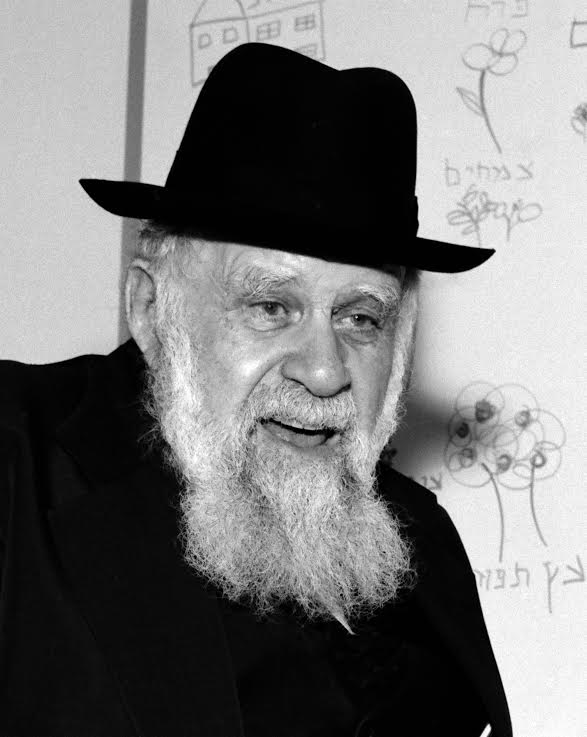
Photo of Rabbi Simcha Wasserman by Harry Green, c. 1986, South Bend, IN harrygreenphoto@gmail.com
- I thank Rabbi Yitzchok Shapiro (Boca Raton, Florida) and Rabbi Dr. Eliezer Brodt (Ramat Beit Shemesh, Israel) for their important comments to an earlier version of this article. I thank my father, Mr. U. Harold Males (Jerusalem, Israel) for his editorial assistance. ↑
- In a humorous Forward article linked below, the author turned to an expert who proposed these definitions for the following Yiddish words: “A zets is a strong punch. A patsh is a common slap, whereas a frask is a sharp, stinging one, given with a vengeance.” See: https://forward.com/news/547/martial-arts-in-yiddish/ . After reading this, I felt relieved that the older cheder rebbi had only made use of a patsh – and not a zets or a frask. ↑
- The Da’as Zekeinim mi-Ba’alei Tosafos is a Torah commentary compiled from the writings of French and German Tosafists who lived in the 12th and 13th centuries. ↑
- I was unable to find information about a bird named אגרון / Agron. However, the Hebrew word for the crane is עגור / Agur (see Isaiah 38:14 and Jeremiah 8:7). A crane is a long-necked bird which certainly matches the winged creature in the Ba’alei Tosafos‘ parable. ↑
- Aesop (c. 620–564 BCE) was a Greek storyteller credited with a number of tales which are collectively known as ‘Aesop’s Fables’. See: https://en.wikipedia.org/wiki/Aesop ↑
- See: https://classics.mit.edu/Aesop/fab.1.1.html ↑
- I have no recollection of ever reading Aesop’s Fables as an adult. Did my parents or older siblings read a children’s book of Aesop’s Fables to me when I was young? Had I read such a book to my nieces / nephews when they were little? ↑
- See: https://thejatakatales.com/javasakuna-jataka-308/ ↑
- See: https://en.wikipedia.org/wiki/Buddhism ↑
- See: https://en.wikipedia.org/wiki/Berechiah_ha-Nakdan and https://en.wikipedia.org/wiki/Mishl%C3%A8_Shu%27alim ↑
- The term Mishlei Shua’lim is clearly taken from Sanhedrin 38b where we learn ג’ מאות משלות שועלים היו לו לרבי מאיר ואנו אין לנו אלא שלש – Rabbi Meir had composed 300 fox fables (i.e. parables involving animals – the fox being chief among them), but we are only left with three of them. ↑
- https://blogs.loc.gov/international-collections/2021/09/a-fox-fable-goes-digital-bialiks-classic-hebrew-story-for-children-finds-new-life-at-the-library-of-congress/ ↑
- Eitz Yosef quotes Aruch who translates מוקרה as ‘its neck.’ It should be noted, however, that Rashi translates מוקרה as ‘its beak.’ ↑
- I initially wondered if this Midrash might also be the basis for the lyrics “פרוק ית ענך מפום אריותא – save Your flock from the mouths of the lions” in the Shabbos song ‘Kah Ribon’. However, a little research revealed that the term “פום אריותא – the mouths of the lions” is a clear reference to Daniel 6:23. ↑
- See: https://en.wikipedia.org/wiki/Printing_press ↑
- Rabbi Elazar Simcha Wasserman (1898 – 1992) was a son of the storied Rabbi Elchonon Wasserman, zt”l (1874 – 1941) – head of the pre-WWII Yeshiva in Baranovich, Poland. Prior to the Holocaust, Rabbi Wasserman (the son) immigrated to the United States where he played important roles in Jewish education and outreach (particularly in California). He and his wife moved to Israel in 1979, where they spent the final and ever-productive chapters of their lives in Jerusalem. I vividly recall attending the funerals of both Rabbi Simcha and Rebbetzin Faiga Rochel Wasserman (sadly, she passed away just after observing Shiva for her late husband) while first studying in Jerusalem in 1992. On November 5, 1992, the Los Angeles Times published an obituary for Rabbi Wasserman. See: https://www.latimes.com/archives/la-xpm-1992-11-05-we-1397-story.html . For a book-length biography, see: Fox, Dovid (1995) Greatness in Our Midst: The Life of Rav Simcha Wasserman. Jerusalem: Feldheim Publishers. For a more recent article on Rabbi Wasserman, see Eytan Kobre, “Building Worlds.”, Mishpacha, November 14, 2023. https://mishpacha.com/building-worlds/. ↑
- Some of Rabbi Wasserman’s presentations have been digitized and are posted on Ohr Somayach’s website. However, among those that are available, I was unable to find the question-and-answer session cited in this article. See: https://audio.ohr.edu/showperson/id=20 ↑
- At this point, I believe an important disclaimer is in order. By suggesting that this parable is of ancient Jewish vintage, I am not claiming that that it was stolen from Jewish sources and plagiarized by foreigners. (Neither was that what Rabbi Wasserman had suggested.) A long tradition of such claims seems to go back to Philo (c. 20 BCE – 50 CE), and Josephus (c. 37 CE – 100 CE). For a scholarly treatment of such assertions, see Norman Roth, “The ‛Theft of Philosophy’ by the Greeks from the Jews,” Classical Folia, vol. 32, no. 1 (1978): 52-6. For some important rabbinic sources on such claims, see Rabbi Moshe Isserless’ Toras Ha’olah 1:11 (end of the chapter) and Metzudos Dovid to I Melachim 5:12. For a more recent rabbinic source see Rabbi Joseph B. Soloveitchik’s commentary to Tisha B’Av Kina 37 on page 574 in Posner, Simon. 2010. The Koren Mesorat Harav Kinot: The Lookstein Edition: Tefilla for Tisha B’Av, Kinot, Eikha. New York: OU Press; Jerusalem. (See footnote 19 for additional sources on this theme.) ↑
- See the link below for a series of five thorough articles (with extensive footnotes) published in the Ohr Yisroel journal (Monsey, NY) by Rabbi Yaakov Yisroel Stahl: (10) מקור חכמת אומות העולם מעם ישראל In these articles, Rabbi Stahl cites an incredible amount of material on the theme of ancient Jewish wisdom making its way into the teachings of the nations of the world. I thank Rabbi Dr. Eliezer Brodt for bringing these articles to my attention. ↑
- I credit Artscroll / Mesorah’s Kleinman Edition of Midrash Rabbah (2010) for the translation of this passage. ↑
- See Matnos Kehuna, and Eitz Yosef Ibid. ↑
- Both Rashi and the Eitz Yosef (Ibid.) note the clearly Latin roots (i.e. scholastic) of the word אסכולסטקיא. ↑
- As demonstrated above in Part IV, this Midrash was the source of the parable shared by the Ba’alei Tosafos. ↑
19 thoughts on “Were the Ba’alei Tosafos Familiar with Aesop or Buddhism?”
IMHO, the entire premise of this post – and others like it – is mistaken. There’s no reason at all to assume that this parable came to the baalei hatosfos from any of these sources, and by extension no reason to assume they were familiar with any of them. The way these things work is that stories and lessons float around and become part of the culture, without anyone doing the research to figure out where they came from. People just know they heard them somewhere, and in the case of something innocuous and useful like this parable, that’s all they need.
There’s no way at all to know where the baal tosfos who used this story got it from. Perhaps from one of these sources, or perhaps from his rebbe in cheder when he was a kid, or maybe his “pirchei” leader, or some pal of his, or a goy that he met once, or whatever. Or maybe one of these sources. He wouldn’t necessarily have known or cared. It’s a good story and illustrates the point. That’s all.
For that matter, there’s no particular reason to assume that “Aesop” (assuming he was an actual person) was the original author of the various fables. These things float around.
BTW, much of the core research here is readily available, and covered at: https://jewishencyclopedia.com/articles/874-aesop-s-fables-among-the-jews
Last and least, “patch” is singular. “I give patch” means “I give smack”. That rebbe would have use the plural “I give petch”. (It should perhaps also be noted that there are those who believe that the pendulum has swung much too far in the direction of positive reinforcement these days, and it’s possible that this rebbe is being blamed unfairly.)
The title of this post is misleading. Lots of fables and epigrams are common to many peoples, it is usually impossible to say who took from who. They all circulated freely before printing, even afterwards. And regardless, this one example would not be evidence that the Ballei Tosfos (the hundreds of them) were “familiar” with Aesop’s fables (to the extent they were even identified exclusively with him then) much less Buddhism.
FP, thank you for reading my article and for your thoughtful comments.
Please excuse my brevity.
A) One could choose to chalk up the similarities between the parables to mere coincidence. However, with so many striking points of similarity between each of these parables (i.e. the Ba’alei Tosafos’, Aesop’s, the Buddhist text’s, Mishlei Shua’lim’s, and the Midrash Rabbah’s), one could also argue that they share a common source. The reader can decide which approach they’d like to go with.
B) I don’t think the Jewish Encyclopedia article considered the points I raised in section VI and VII of this article. Those are the points I wished to contribute to this discussion.
C) Re; Patsh vs. Petsh, I chose to go with the Forward article in footnote 2. Of course, Petsh could be the correct term though.
I did not suggest that the similarities between the various parables were coincidental. You appear to have misunderstood my comments.
You also misunderstood the Forward article that you linked. The Forward were using the singular form of the word, which is “patch”, as I wrote (really “potch” is a better spelling, but why quibble). But you used it in plural form, which should be “petch”.
I seem to recall that while learning the aggadata in Succah 28a, about Rabi Yochanan ben Zakkai knowing meshalot shualim that there was a footnote in the Otzar HaGeonim that referenced the fables of Bidpai. More about that here: https://en.wikipedia.org/wiki/Panchatantra
I’m sorry but R Shaul Lieberman already showed clearly that chazal were familiar with and drew on Greek and Roman literature. There is no need for apologetics to show that we were first. See the relevant chapters in Greek and Hellenism in Jewish Palestine.
Yep, exactly. In general, there’s a huge amount of scholarship on rabbinic borrowing from Greek (and Roman) sources. As well as on rabbinic usage of Aesop’s fables in particular.
See for example the extensive discussion, with extensive bibliography, in Shamma Friedman’s article 2003 JSIJ article:
הפתגם ושברו
עיון בתרבות המשל בספרות התלמודית
שמא יהודה פרידמן
https://jewish-faculty.biu.ac.il/sites/jewish-faculty/files/shared/JSIJ2/friedman.pdf
“A bit taken aback, our instructor followed up by asking that rebbi what he did when his students had done something right. Surprised by the question, the older man responded, “I don’t give patsh.”[2]
The lesson conveyed to our group of aspiring young educators was that a lack of punishment should never be seen as a replacement for rewarding good behavior”
How is that the lesson conveyed? The rebbi said that lack of punishment IS the reward.
“A bit taken aback, our instructor followed up by asking that rebbi what he did when his students had done something right. Surprised by the question, the older man responded, “I don’t give patsh.”[2]
The lesson conveyed to our group of aspiring young educators was that a lack of punishment should never be seen as a replacement for rewarding good behavior”
The rebbi’s response is the opposite of what you say is the lesson conveyed.
Anon, thank you for reaching out.
Please re-read the first paragraph.
Our instructor (a master Jewish educator) was sharing with us a surprising interaction he had years earlier with an old-school European Cheder Rebbi.
He told the episode to us as a cautionary tale.
I thank those who have read my article.
It seems that footnote 18 addresses many of the comments received.
Thank you Rabbi Males for shaing your personal anectodes (which are always interesting!) and Rabbi Wasserman’s theory. As numerous prior commentators have already raised, the appearance of this Meshal in the works of Chazal through the Baalei Hatosfos( and beyond) can reasonably be explained by cultural diffusion. While Rabbi Wasserman’s theory is intriguing, it seems rather tenous (at least to me) to assert this was the source of these parables that didn’t reappear in any Jewish writing for thousands of years.
Rabbi Yonason Rosman, in his work חכמה בגויים תאמין (available at https://hebrewbooks.org/68559 ) collects many of these examples and the literature that addresses them.
While I understand the urge to point to our tradition as a source for various pieces of wisdom or intelligence. I think what Chazal, Tanach, and the rest of our corpus offer that is clearly ours is more then enought to justify our lifestyle and believes.
And to quote two authentic proverbs of חכמינו:
תפסת מרובה לא תפסת and חכמה בגויים תאמין
Thank you SG — good points, and I agree with much of what you shared.
It seems that I should have been more clear.
This article is not trying to claim that Jewish teachings are the basis of all the world’s wisdom.
(Footnotes 18 and 19 share some interesting sources on both sides of that issue.)
Here is what this article is suggesting:
Certainly, there are cases where it can be proven that external sources made their way into Jewish teachings.
That’s fine — as we both pointed out חכמה בגויים תאמין.
However, there are other times where that’s less conclusive, so there’s no need to make such assumptions.
In fact, it stands to reason that in some cases one can suggest that Jewish wisdom made its way into the teachings of others.
Always? I don’t think so.
However, can we sometimes suggest this?
That seems quite plausible — especially considering what the Gemara and Rambam taught about Avraham Avinu sharing his knowledge with so many (Part VI), and what the Navi tells us about people flocking to the land of Israel to learn from Shlomo HaMelech in I Melachim (Part VII).
Assigning Jewish origination to wise teachings can work in some instances.
This article shares two approaches for us to logically take ownership of חכמה in cases where it makes sense to do so.
However, in other cases it seems more logical to assume that חכמה came from elsewhere
This article was demonstrating how those approaches can be applied to this one case.
It also suggested that these tools can be applied elsewhere — only in cases where that makes sense though.
Best wishes for a restful Shabbos,
AM
Fascinating article and great depth of research on this parable!
Thank you for the well written and thoughtful post.
I see two general avenues of historic possibility. The first is that Avraham (or Shlomo) authored the story of The Fox and the Crane, and the story passed separately but virtually identically for tens of generations in three separate traditions, reemerging roughly around the same time during the Axial Age in all three traditions; following which in both the Buddhist and Greek traditions the story was appended to two separate collections of similar animal stories the rest of both of which came from non-Abrahamic sources, while in the Jewish tradition the story re-emerged as a single story told alone (or alternatively all of the animal stories originated from Avraham or Shlomo, but each of the two other traditions lost different sets of stories while Judaism lost all of them except for the Fox and the Crane and a couple of other ones like the Fox and the Grapes which is also mentioned in a late midrash).
A second possibility is that the story of the Fox and the Crane emerged in the Axial age outside of Judaism along with many other similar stories, and somehow made its way into Judaism through an unknown avenue, and we can venture a plethora of highly plausible conjectures as to what that avenue might have been.
“While studying Torah, we are bound to stumble upon instances where age-old Jewish wisdom and a teaching or two from ancient foreign cultures seem to mirror one another. Being able to point to Avraham Avinu or Shlomo HaMelech to explain how some of our people’s venerable teachings may have spread far beyond Israel is an extremely useful tool to have in our toolkits.”
Yet there is no reason to assume that is the case – yesh chachmah bagoyim. If non-Jewish scientists can explore the outer reaches of quantum physics, I’m fairly certain they can come up with witty aphorisms as well.
TiD,
Thank you for reading my article.
Please see my comment above.
AM
Thanks. Interesting article though : )
Beautiful article. I would also point out that Rav Zalman Sorotskin in his Chut shel Chessed on Megillas Esther 6:3 explains that לא נעשה עמו דבר means that the fact that Mordechai did not have to suffer like his fellow Jews was itself the biggest kindness to him!