S.Y. Agnon’s Forgotten Purim Parody
S.Y. Agnon’s Forgotten Purim Parody
A humorous tale published by the teenage S.Y. Agnon, using the penname “Mazal Tov,” appeared in a Purim supplement to a Kraków newspaper in 1908 but was not later included in his collected works — translated for the first time from Hebrew by Jeffrey Saks.
“Those Who Err All Their Days, and One Man Who Erred Not At All”—A Tale in Honor of Purim
They were both mistaken in a matter of halakhah.
Such is the way of the world: shrewd men commonly have ugly wives, while the wives of fools are fair. When the husband looked at his wife and saw how repulsive a creature she was—how ugly her countenance, how displeasing her face—he said in his heart: this proves that there is no wiser man in the world than I. And when his wife looked at him and saw what a fool he was, she supposed that there was none more lovely than herself. Through error they raised daughters instead of sons, and in error they married off one of those daughters.
They imagined that the young man they had chosen for her was truly a great gem, the like of which does not exist: a prodigious scholar, God‑fearing, and possessed of many other virtues. But they looked into it and soon found that he had nothing in this world but his folly. He read heretical books, burying his head in them all day long, and his heresy preceded his fear of Heaven. Not only this, but he was a coarse and lustful fellow—may the Merciful One save us—running after temptation and indulging in crass talk. And they found proof for their estimation when they saw erotic poetry falling from his lap.
When they realized this, it would have better suited them had he never been born rather than see what had come of him. He could forgo a few drops of his blood, but not these drops of ink with which his poems had been written. How beautiful this poem was in his eyes! How excellent it was! How he delighted in it! Each time he recited it he sounded the rhymes into his own ears with real feeling:
Oy! Oy! Oy! Hadassah!
So beautiful, so very fair.
My love for you has not ceased,
Entangled in the thicket’s snare.
Great is my love for you,
Hadassah—forever and a day.
For your sake even my lawfully married wife,
I shall divorce at once and without delay…
The words were still upon his lips when his wife flung herself upon him. All ten of her fingernails were sunk into him, raking the skin of his face. She struck him, and a voice burst forth from her throat, crying: “Just who do you say you’ll divorce? Take care lest I ‘divorce’ your soul from your body, you sinful scoundrel! Who is this whose heart drives him to chase foreign women? First I’ll bash in your skull—and the skull of your beauty as well!” Nor did her fury subside until she seized the page on which the poem was written, bundled it together with his pile of other papers lying before her, tore them to bits, and treated them with every manner of disgrace.
In vain did the husband seek to argue in his own defense: that he never chased after women, that he had no connection whatsoever with another, and that it was not his intention—God forbid—to divorce his wife. Rather, this poem spoke of none other than Queen Esther—she who is called Hadassah.
He then began telling her how much labor he had invested in this work, and how he had nearly completed a stage-play for the Yiddish theater, in which the beautiful tale would be told: how a certain man fell in love with Esther before King Ahasuerus had taken her to wife, but she, in her modesty, paid the man no heed. On account of his great heartbreak the man cast himself into the sea, where a great fish happened by and swallowed him whole. And for the banquet that King Ahasuerus made on the day he married Esther, fishermen hooked this great fish and hauled it up. As King Ahasuerus sat with his new queen, making merry together, a dish full of fish was set before them. When Esther stabbed her fork into one of them, a heavenly voice rang out, and a man leapt forth—the very man who had drowned himself in the sea because Esther had not yielded to him. A scandal ensued, and here began those fine and fascinating matters.
In the end, the poet’s wife was appeased. When she saw that her husband was innocent, she regretted her earlier deeds. She had been a fool, and she had erred in thinking that this Hadassah over whom her husband strayed in thought was an actual woman of flesh and blood.
But the husband could not be consoled. It pained him to see his hard work go down the drain. Had he produced his play for the Yiddish stage, his renown would have gone out into the world and his name would have been sung in praise. This, indeed, is a matter in which there is no error…
—Mazal Tov
Afterword by Jeffrey Saks
Shmuel Yosef Czaczkes (1887–1970)—later, Nobel laureate S.Y. Agnon—began his literary career in the newspapers of his native Galicia. Starting in 1904, dozens of short stories, poems, and even brief journalistic reports on events in his town of Buczacz flowed from his adolescent pen in Yiddish and Hebrew. Agnon signed his writings under various literary names: “One of the Townsmen,” “A Galician,” “A Zionist,” at times with initials: Sh. Y. Cz., or—as in the story presented here—“Mazal Tov.” Almost none of these writings were later anthologized in editions of Agnon’s collected works. The mature author apparently regarded them as “unripe fruit” and did not attempt to refine or restore them in his later writings.
This story appeared in the Kraków Hebrew newspaper, HaMitzpeh (March 13, 1908), pp. 4–5, in a special Purim parody supplement playfully titled HaChutzpah. It bears several features characteristic of Purim‑spiel literature: the element of turn-about and reversal, double identity and mistaken recognition, and fish (of the Pisces season at that time of year)—here in a variation upon the Book of Jonah and the well‑known Talmudic legend of “Joseph Who Honors the Sabbath” (Shabbat 119a). This early tale also shows Agnon’s penchant for intertextuality, weaving in allusions to the biblical and rabbinic texts. In keeping with the Purim genre, there is also a light whiff of provocation—bold, playful, and faintly erotic. Is Hadassah the husband’s lover? Or is Hadassah in fact his fictional stand-in for the biblical Queen Esther?
Beyond the glimpse it affords of the raw talent of a tyro artist, the significance of this story lies in the fact that it was the last to be published while Agnon still dwelled in Europe. A few weeks after Purim 1908, the young Galician Czaczkes left his land, his birthplace, and his town, and set sail upon the heart of the seas on his way to become “Agnon” in the Land of Israel.
Rabbi Jeffrey Saks, Director of ATID and its WebYeshiva.org program, is Director of Research at Agnon House in Jerusalem and editor of the journal Tradition.
 |
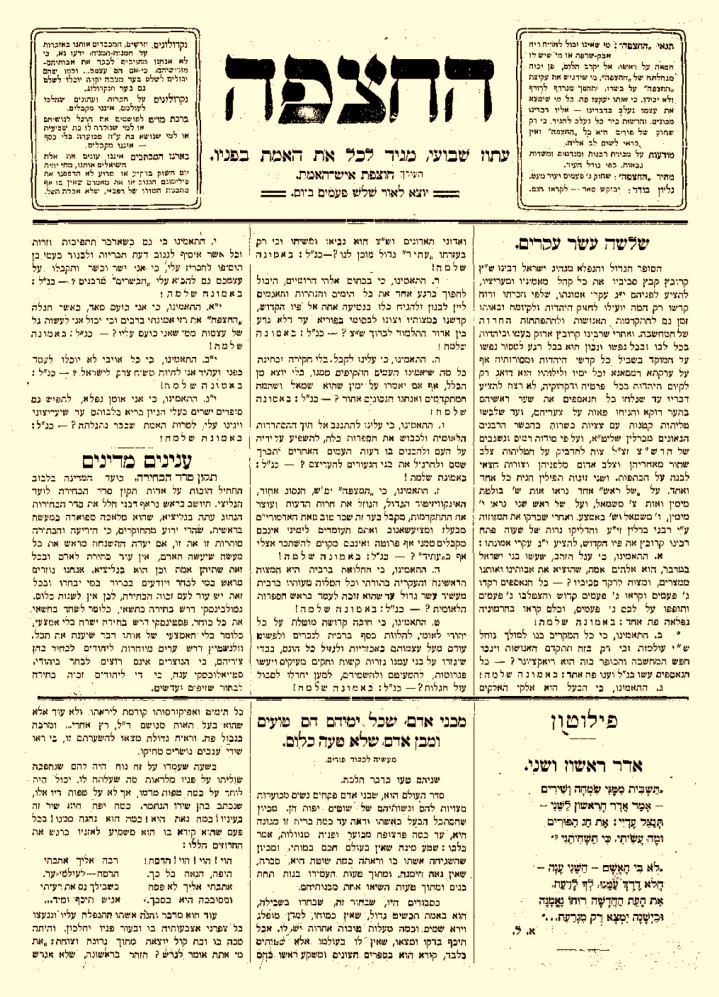 |
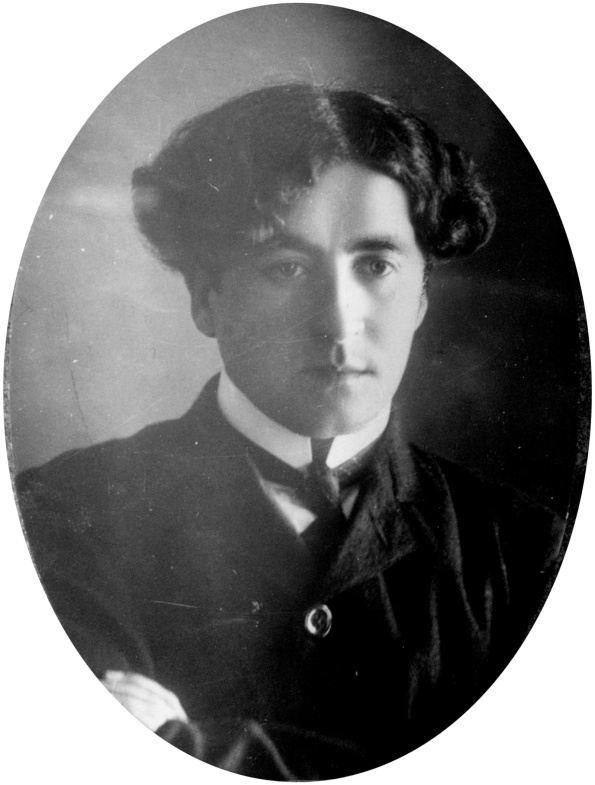
| S.Y. Agnon, né Czaczkes, around 1908. | Purim supplement to HaMitzpeh newspaper (Kraków, March 13, 1908): Agnon’s story begins at bottom. |
One thought on “S.Y. Agnon’s Forgotten Purim Parody”
SEE – https://notebooklm.google.com/notebook/30aa9774-0d73-4774-8a2b-02819588973a?artifactId=2ecc362b-0983-4978-a4ec-5da6c5f165a6