Between Authority and Inquiry: Beyond the Masthead of the Beys Yaakov Journal, 1923-1980 – Part 1
Between Authority and Inquiry:
Beyond the Masthead of the Beys Yaakov Journal, 1923-1980 – Part 1
by Dan Rabinowitz
In December 1961, the Israeli edition of Beys Yaakov, the educational journal of the Agudath Israel–affiliated school system, published an article that sits uneasily with standard accounts of Agudath Israel’s twentieth-century intellectual posture.[1] Issue 6 of its second year reprinted in full a study on the archaeological and halakhic problems surrounding the base of the Temple menorah.[2] The identity of the author is therefore institutionally consequential. Rabbi Dr. Yitzhak Isaac Halevi Herzog served as the Ashkenazi Chief Rabbi of Israel at the head of a state-established rabbinate whose claim to centralized religious authority Agudath Israel did not recognize, locating binding rabbinic authority instead in its own Moetset Gedolei HaTorah.[3] The unabridged publication of his work in an Agudah-affiliated journal thus draws attention to the editorial criteria and intellectual assumptions operative within Beys Yaakov. This decision was not anomalous. From its founding in interwar Poland through its postwar continuation in Israel, Beys Yaakov repeatedly engaged materials, methods, and voices that lay beyond the formal boundaries of Agudath Israel’s institutional authority.[4] The journal maintained clear Orthodox commitments, but it did not construe those commitments as requiring insulation from external scholarship or the suppression of internal disagreement.
Examining Beys Yaakov between 1923 and 1980 permits a reconstruction of an Orthodox public discourse that does not conform to models centered on withdrawal or uniform ideological consolidation.[5] Across decades and editorial regimes, the journal published women’s reflective writing, printed criticism of decisions taken by Agudath Israel’s own rabbinic leadership, and, in later years, employed scholarly analysis to interrogate elements of the modern State of Israel’s symbolic repertoire.[6] These practices were not episodic but structural, pointing to a sustained editorial orientation in which intellectual engagement operated as a constitutive element of Orthodox self-definition rather than as a deviation from it. While recent scholarship has rightly emphasized Agudath Israel’s institutional boundary maintenance and political separatism, as well as the culturally mediating role of the Beys Yaakov movement, attention to the Beys Yaakov Journal redirects analysis from ideology and leadership to editorial practice as a central site of Orthodox intellectual life.[7]
Polish Origins: Sara Schenirer and the Educational Crisis
Before World War I, Orthodox Jewish girls in much of Eastern Europe received little formal Jewish schooling.[8] Although rabbinic attitudes toward women’s Torah study had varied across periods and locales, prevailing practice in Polish Orthodox communities restricted instruction largely to domestic settings and to the transmission of basic laws, customs, and religious dispositions.[9]At the same time, access to secular schooling expanded steadily and was widely taken up. Girls often acquired fluency in Polish language and culture while lacking the textual and conceptual resources necessary to interpret or articulate their own religious tradition. By the interwar period, this asymmetry contributed to significant patterns of religious disengagement among Orthodox young women. Sara Schenirer understood this constellation of pressures from personal experience.
Born in 1883 into a Hasidic family in Kraków, Schenirer was exposed to modern culture while remaining committed to religious life. She concluded that Orthodox women required systematic Jewish education not as enrichment but as a condition of religious continuity. In her view, inherited modes of informal instruction no longer sufficed in a social environment shaped by compulsory schooling, expanding public culture, and women’s economic participation. Early efforts to address the problem through youth circles and informal study groups proved inadequate. In 1917, Schenirer therefore turned to formal education, beginning with a small class for girls in her apartment. The initiative expanded rapidly. By 1923, the Agudath Israel movement formally adopted the schools, recognizing both the scale of the educational crisis and the effectiveness of Schenirer’s response. What began as a local experiment thus became an institutional project with transnational reach.[10]
Orthodox anxieties surrounding girls’ education crystallized around the erosion of communal control over women’s intellectual trajectories, particularly with respect to access to higher education. The emergence of Beys Yaakov must therefore be understood not only as an educational response to religious disengagement, but also as part of a broader effort to redirect female intellectual aspiration into institutionally supervised and religiously authorized forms.[11]
From the outset, the Beys Yaakov system was conceived not merely as a network of schools but as a cultural intervention. It aimed to reshape how Orthodox girls understood their position within Jewish life, public society, and the transmission of religious knowledge. This ambition required not only curricula and classrooms but also a medium capable of addressing students beyond the school setting and articulating a shared intellectual and moral framework. That medium soon took the form of a journal.
Friedenson and the Power of Print
Eliezer Gershon Friedenson understood that the success of the Beys Yaakov project depended not only on the establishment of schools but on the creation of a discursive environment capable of sustaining religious commitment amid rapid social change. From his first encounter with Sara Schenirer in 1923, Friedenson recognized that girls’ education required a medium that could operate beyond the classroom, address readers as reflective subjects, and articulate a shared intellectual vocabulary for Orthodox womanhood. The Beys Yaakov Journal, first published in June 1923, was conceived to meet precisely this need.[12] Recent scholarship has emphasized that the institutionalization of Beys Yaakov under Agudath Israel after 1923 marked a decisive transformation of the movement.[13] This period coincided with the professionalization and rapid expansion of the school network under the direction of Dr. Leo (Samuel) Deutschländer, whose training and pedagogical outlook drew on German Neo-Orthodox models that emphasized professional instruction, curricular coherence, and engagement with general culture. It also marked the movement’s absorption into Agudath Israel’s organizational framework, without full capitulation to its separatist educational norms.[14] Friedenson’s journal should be understood as part of this same process. It functioned as a centralizing instrument that helped standardize pedagogical assumptions, circulate ideological norms, and integrate disparate local initiatives into a coherent movement culture.[15]

The Beys Yaakov journal’s masthead articulated its mission succinctly: an Orthodox periodical devoted to religious thought among Jewish women and girls and to the question of girls’ education in the spirit of Torah and tradition. Its choice of Yiddish situated the journal within established Orthodox linguistic practice while also enabling broad accessibility across regional and social boundaries.[16] At the same time, its format, regular publication schedule, and thematic range reflected contemporary print culture rather than traditional rabbinic genres. Schenirer herself repeatedly underscored the journal’s importance, urging that it circulate “in every corner in which a heart beats,” a formulation that framed readership not as passive consumption but as emotional and moral participation in a shared undertaking. Naomi Seidman has characterized Beys Yaakov as a “revolution in the name of tradition,” in which innovation was articulated as preservation rather than rupture.[17] The journal exemplified this logic. While anchored in Orthodox commitments, it systematically adopted literary and discursive forms – essays, poetry, autobiographical reflection, and historical narrative – that had little precedent in traditional frameworks of women’s religious instruction. These genres did not function merely as stylistic embellishments or pedagogical supplements; they reconfigured the educational encounter itself. By foregrounding narrative voice, affective experience, and historical self-placement, the journal addressed its readers as reflective subjects whose relationship to Jewish tradition was neither automatic nor self-evident, but required deliberate cultivation. In this way, Beys Yaakov treated Orthodox girls not simply as future wives and mothers charged with transmission, but as moral and intellectual agents whose commitment depended on sustained engagement, interpretation, and identification with the tradition they were being asked to inhabit.
From its earliest issues, the journal’s contents extended well beyond internal school news or institutional announcements, indicating that it was not conceived merely as an administrative organ of the school system. It published essays on Jewish women in history, profiles of literary and cultural figures, poetry, and original creative writing, genres that invited readers to situate themselves within broader historical and cultural narratives. Sara Schenirer’s own Torah commentaries appeared regularly and were incorporated into classroom instruction, further collapsing the distinction between pedagogical text and public religious discourse. In this way, the journal functioned simultaneously as a curricular supplement and an autonomous intellectual forum, shaping religious sensibility less through formal instruction or prescriptive norms than through sustained exposure, interpretive engagement, and processes of identification.
The journal’s use of literary, historical, and reflective genres was not an idiosyncratic editorial choice but emerged from the ideological landscape in which Beys Yaakov took shape. Interwar Orthodoxy in Poland was marked by unresolved tensions between Neo-Orthodox educational models, particularly Torah im derekh erets, and increasingly separatist ultra-Orthodox positions that emphasized cultural insulation. The Beys Yaakov movement developed at the intersection of these currents, selectively appropriating Neo-Orthodox pedagogical forms while operating under the institutional aegis of Agudath Israel.[18] Although the school system ultimately aligned with Agudath Israel’s organizational framework, the journal retained elements of this hybrid inheritance. Its openness to cultural reference, historical inquiry, and literary expression parallels developments in other Orthodox women’s initiatives, most notably the Lithuanian Bet Jakob, which likewise employed periodicals to cultivate modern Orthodox female subjectivity within a religious framework rather than to enforce ideological retrenchment.
Friedenson’s achievement lay not simply in founding a journal, but in identifying print culture as a form of religious infrastructure capable of sustaining Orthodox life under modern conditions. The Beys Yaakov Journal did not merely disseminate information about the movement; it produced a shared intellectual space in which Orthodox women encountered tradition as an object of study, interpretation, and appropriation rather than as an unexamined inheritance. By habituating readers to engagement through narrative, reflection, and cultural reference, the journal established patterns of reading and response that later enabled it, under different editors and in changing historical contexts, to address contested questions, incorporate external scholarship, and even publish internal critique without relinquishing institutional loyalty or doctrinal commitment.
Surveying the Inner Lives of Orthodox Girls
One of the most consequential features of the Beys Yaakov journal was its adoption of empirical and introspective methods to inform educational practice. In 1926, for example, the editors published an “urgent appeal” arguing that effective religious education required systematic knowledge of students’ personalities, aspirations, and emotional lives.[19] Rather than relying on teacher reports or ideological presuppositions, the journal solicited responses directly from its readership and published them verbatim, deferring editorial interpretation to subsequent issues.

The 1926 survey posed five questions:
- What does the child want to be when they grow up?
- Whom does the child love more, their father or their mother?
- Which subjects does the child most enjoy studying (for example, languages or history)?
- What does the child most enjoy reading?
- In which language does the child prefer to read?
These questions reflect a distinct set of pedagogical assumptions. They treated future orientation, emotional preference, and cultural consumption as legitimate objects of educational inquiry rather than as private or extraneous matters. The first question acknowledged that girls might imagine futures extending beyond domestic roles. The second redirected attention from normative family hierarchy to affective relationships. The remaining questions presupposed familiarity with secular subjects, varied reading practices, and multilingual environments, thereby situating Orthodox girls within the broader cultural landscape of interwar Poland rather than insulating them from it.
A second survey, published in 1931, expanded both the scope and the stakes of this inquiry.[20] It asked whether girls were satisfied with their education; what professions they hoped to pursue; whether they anticipated wage labor or exclusive domestic responsibility; how they related to nonreligious Jews, including within ideologically divided families; and whom they regarded as confidants, parents or peers. Additional questions addressed leisure practices and aesthetic interests, including music, art, and dance. Taken together, these questions treated social integration, emotional authority, and cultural participation as variables relevant to religious education.

Respondents were permitted to answer under their own names or under pseudonyms. The journal printed their responses in full,[21] without prior selection or accompanying commentary. The range of answers was wide. Some affirmed conventional expectations, while others articulated positions that departed from them. One respondent endorsed women’s economic independence, arguing that “a woman must be concerned with her own destiny exactly as a man is.”[22] Others reported greater trust in peers than in parents, explaining that “parents today don’t understand their children.”[23] Several described attending concerts or cultivating artistic interests. The editor praised the responses as evidence of the respondents’ intelligence and noted that some articulated “brilliant ideas.” The editor explicitly rejected claims made in “a long letter” asserting that polls were meaningless and that social questions should not be discussed publicly. By contrast, the editor’s only regret was the limited number of responses received.[24]


This procedure marked a significant departure from prevailing Orthodox educational discourse. Female students were addressed not as objects of instruction but as sources of knowledge about their own religious and social experience. Their voices were presented without mediation by teachers, administrators, or male authorities. The journal thus treated subjective experience as data relevant to institutional decision-making. Even in secular Yiddish educational and research circles, which acknowledged the importance of understanding Jewish youth, gender was rarely treated as an analytic category, and women’s experiences were largely subsumed under male norms.[25] While comparable survey-based approaches to women’s lives would later become common in mid-twentieth-century social research, Beys Yaakov employed them within an Orthodox framework decades earlier, integrating empirical attention to women’s inner lives into a religious educational project rather than positioning such inquiry in opposition to it.
Challenging Authority: The Palestine Certificate Controversy
The journal’s willingness to engage contested questions extended beyond pedagogy to matters of institutional authority. This is evident in its response to the distribution of immigration certificates to Palestine in 1934. When Agudath Israel secured a limited allotment of certificates and allocated them exclusively to men, the Beys Yaakov journal devoted its front page to a critical response under the headline drawn from the biblical verse “Tenu La’anu Achuzah!” (“Grant Us Our Rightful Portion!”; Num. 27:4).[26]
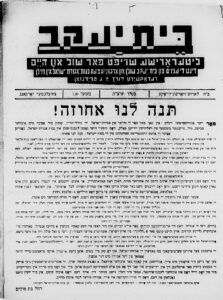
The significance of this intervention lies not only in its substance but in its institutional setting. The Beys Yaakov schools operated under Agudath Israel’s auspices, and the movement’s leadership exercised formal control over the journal’s publisher. Publishing a front-page critique of a policy associated with the Gerrer Rebbe, one of the central rabbinic authorities within Agudath Israel, placed the journal in direct tension with the leadership structures on which it depended. This episode contrasts sharply with the centralized and crisis-driven leadership culture described by Yossef Fund in his study of Agudath Israel during the Holocaust years.[27]
The article, signed by Rochel Bas Tovim, likely a pseudonym,[28] did not frame its claims in the language of contemporary feminist movements, which it explicitly rejected as incompatible with Judaism. Instead, it grounded its argument in canonical sources, invoking the biblical daughters of Tzelofchad, who appealed for inheritance rights within the framework of Torah law. The author contended that women’s exclusion from the allocation of certificates represented not a preservation of tradition but a departure from it, insofar as it denied women claims recognized within the scriptural tradition itself. The critique thus operated on two levels. Substantively, it challenged a concrete policy decision with immediate consequences for women’s lives. Formally, it modeled a mode of argument in which institutional authority could be questioned through textual reasoning rather than ideological opposition. The article neither denied rabbinic authority nor asserted autonomous rights external to halakhic discourse. Its challenge was internal, drawing on shared sources and categories to dispute the manner in which authority had been exercised.
This episode illustrates the journal’s broader editorial posture. It did not treat institutional loyalty as incompatible with critique, nor did it equate obedience with silence. By providing space for a reasoned challenge to Agudath Israel’s own leadership, framed entirely within traditional discourse, the Beys Yaakov Journal demonstrated that boundary crossing could occur not only in relation to secular culture or academic knowledge but also within Orthodoxy’s own structures of authority.
Israeli Resurrection: Moshe Prager and Postwar Transformation
The destruction of the Polish Beys Yaakov system during the Holocaust brought the journal’s original trajectory to an end. Eliezer Gershon Friedenson was murdered, and the institutional network that had sustained the movement in Eastern Europe ceased to exist. When the Beys Yaakov journal reappeared in Israel after the war, it did so under markedly different conditions and new editorial leadership. The journal was revived by Moshe Prager, a journalist and historian whose work focused on Orthodox life during the Shoah and its aftermath.[29] Under Prager’s editorship, Beys Yaakov retained its formal affiliation with the movement while undergoing a redefinition of scope and audience. It no longer addressed girls and women exclusively. Men increasingly appeared among both contributors and intended readers, and the range of subjects expanded to include Holocaust memory, Orthodox historiography, and contemporary Israeli society. These shifts reflected both the altered demographic realities of postwar Orthodoxy and Prager’s own intellectual preoccupations.
At the same time, the journal’s engagement with sources and methods beyond Agudath Israel’s institutional boundaries became more explicit and systematic. Issues from this period regularly included discussions of secular scholarship, historical research, archaeology, and European culture. Such materials were not presented as authoritative in themselves but were framed through editorial commentary that situated them in relation to Orthodox commitments. The result was neither rejection nor uncritical adoption, but sustained engagement shaped by religious criteria. A review of surviving issues from Prager’s tenure indicates that this orientation was not confined to isolated contributions; rather, it structured the journal’s content across genres, including essays, book reviews, historical reflections, and responses to contemporary events. The editorial stance was consistent: readers were introduced to ideas and figures beyond the Agudah orbit, while the journal retained control over framing and evaluation.
Under Prager’s leadership, Beys Yaakov was thus transformed from a movement-centered educational periodical into a broader Orthodox intellectual forum, without severing its institutional ties or abandoning its religious orientation. Although the postwar journal differed markedly from its Polish predecessor in subject matter and audience, it continued to operate according to an editorial logic already present in the interwar period: engagement with the surrounding intellectual world as a component of Orthodox self-understanding rather than as a concession to external authority.
Art, Archaeology, and Cultural Engagement
The journal’s engagement with material beyond conventional religious genres extended to the domain of visual art, where aesthetic production was treated as a legitimate object of religious interpretation rather than as a neutral cultural sphere. In 1969, Beys Yaakov devoted an entire issue to Rembrandt on the three-hundredth anniversary of his death, placing one of his paintings on the cover and asserting the Jewish identity of the figure depicted.[30] The editor described Rembrandt as among the hasidei ummot ha-olam and argued that his work captured the tzurah ha-Yehudit (Jewish character).[31] This framing did not present Rembrandt as a canonical figure of European high culture to be admired at a distance, nor as an external influence to be resisted. Rather, the journal appropriated his work into a Jewish interpretive framework, reading it as part of a historical and religious conversation to which Orthodox readers could lay claim. In doing so, Beys Yaakov treated visual art not as a threat to religious integrity but as a site in which meaning could be evaluated, contested, and re-situated within Jewish historical consciousness.

Archaeology received similar treatment. In a public exchange with Yigael Yadin, Prager engaged archaeological scholarship directly, acknowledging findings that reinforced halakhic continuity while contesting Yadin’s symbolic and practical interpretation of Masada, particularly where it entailed the desacralization of the site and the normalization of Sabbath violation.[32] These responses neither rejected archaeological inquiry nor deferred to it as an independent authority. Instead, archaeological evidence was incorporated selectively and evaluated in relation to textual tradition and halakhic categories.
Such treatments assumed an audience capable of engaging visual and historical material critically rather than passively. Cultural artifacts and scholarly claims were presented as objects of analysis and judgment, not as threats requiring avoidance. In this respect, the journal extended to art and archaeology the same editorial logic evident elsewhere: engagement framed by religious criteria, with interpretive authority retained by the journal rather than ceded to external disciplines.
The Herzog Article in Context
Read against the journal’s established editorial practice, the 1961 publication of Chief Rabbi Dr. Yitzhak Isaac Halevi Herzog’s article on the Temple menorah appears not as an exception but as a coherent extension of its editorial logic.[33] Herzog’s training combined advanced rabbinic learning with formal academic methods, a mode of scholarship that Beys Yaakov had repeatedly presented to its readership as an object of analysis rather than emulation. The article was neither commissioned for the journal nor modified to conform to its institutional priorities. It was reproduced in full from an academic festschrift honoring Sally Mayer, an Italian Jewish communal leader, philanthropist, and Zionist activist rather than a rabbinic authority. The volume focused on Italian Jewish history and culture and brought together contributors from across denominational lines in recognition of civic and intellectual contribution rather than religious office.
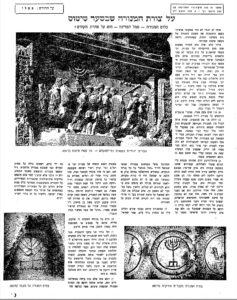
The subject of Herzog’s study further clarifies its original placement. The menorah depicted on the Arch of Titus in Rome occupies a central position in the historical memory of Roman and Italian Jewry, standing at the intersection of archaeological evidence, rabbinic tradition, and the symbolic legacy of exile. Herzog addressed this object through close comparison of textual and material sources, treating their divergence as a problem for interpretation rather than as grounds for dismissal. Such an approach aligns with the commemorative orientation of the Mayer volume, which foregrounded Jewish cultural and historical life beyond rabbinic authority structures. By reprinting the article without alteration and preserving its original scholarly context, the Beys Yaakov Journal framed academic Jewish scholarship as a legitimate object of Orthodox engagement while retaining control over its evaluation.
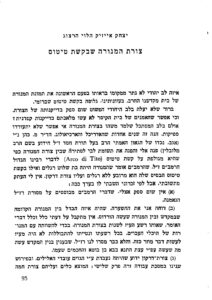
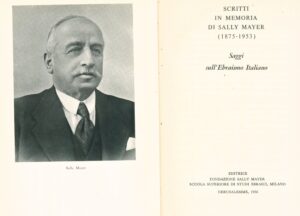
Prager’s editorial handling of the article maintained its scholarly form without incorporating it into the journal’s institutional voice. The text was reproduced in full, without excerpting or interpretive gloss, and its original scholarly setting was left intact rather than explicitly affirmed or disavowed. In this way, academic Jewish scholarship was presented as material available for Orthodox consideration, while the institutional and ideological frameworks in which it had been produced were neither adopted nor contested.
Herzog’s study addressed a problem long recognized in both rabbinic and scholarly literature: the divergence between classical rabbinic descriptions of the Temple menorah and its representation on the Arch of Titus. The Roman relief depicts the menorah resting on a solid, multi-sided base adorned with ornamental motifs, whereas rabbinic sources describe a three-legged stand and explicitly exclude foreign imagery. Herzog did not resolve this discrepancy by dismissing the archaeological evidence as polemical, nor by subordinating it automatically to textual tradition. Instead, he treated the divergence itself as the object of analysis, placing halakhic sources and material evidence into direct comparison in order to account for their coexistence while preserving the distinct authority of each. This approach neither insulated tradition from external evidence nor deferred to archaeological reconstruction as determinative.
The article’s presentation was shaped as much by editorial framing as by its scholarly argument. The cover reproduced the menorah from the Arch of Titus beneath the caption “The Menorah, a Symbol of Jewish Eternity,” and the editors appended a subtitle that posed a pointed question: “Is the menorah, the symbol of the state, sacred?” These visual and textual elements placed Herzog’s study within a contemporary Israeli symbolic register, directing readers to consider its implications for modern political and religious meaning rather than treating it solely as a technical or antiquarian inquiry.
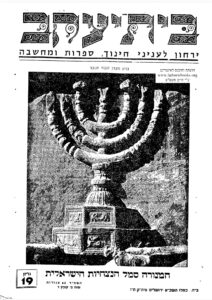
By 1961, the State of Israel had adopted the Arch of Titus menorah as its official emblem, reappropriating a Roman triumphal image associated with destruction and exile as a marker of national sovereignty. As Steven Fine has shown, this choice reflected a form of civic symbolism that drew on ancient material culture to construct a shared national iconography while bracketing explicit theological commitments.[34] By foregrounding Herzog’s study under the subtitle “Is the menorah, the symbol of the state, sacred?”, the Beys Yaakov Journal explicitly juxtaposed this civic appropriation with rabbinic conceptions of the Temple menorah. What might otherwise have remained a discussion of archaeological form and halakhic sources was thereby reframed as an inquiry into the religious status of a state symbol. In doing so, the journal subjected Israel’s central emblem to halakhic and historical evaluation, engaging civil iconography as an object of scrutiny rather than affirmation and declining to concede interpretive authority over Jewish symbols to the secular state.[35]
The journal further marked institutional boundaries through its use of honorifics. Chief Rabbi Herzog, who died in 1959, was designated ז״ל (zikhrono livrakha), the conventional formula for the deceased, rather than זצ״ל (zekher tzaddik livrakha), which in Orthodox usage signals recognized rabbinic authority. This choice acknowledged Herzog’s scholarly standing while withholding the modes of recognition through which the journal conferred religious authority, thereby separating the act of reprinting his article from any affirmation of the Chief Rabbinate he represented.[36]
Considered together, the visual reproduction of the Arch of Titus menorah, the explicit questioning of state symbolism, and the calibrated use of honorific language make visible the journal’s editorial procedure. Beys Yaakov crossed cultural and institutional boundaries while retaining control over framing and evaluation. Attention to such devices is therefore necessary for understanding how the journal accommodated intellectual engagement without erasing its own institutional distinctions.
Conclusion
The history of the Beys Yaakov journal complicates historiographical models that describe twentieth-century Orthodoxy primarily in terms of withdrawal, boundary consolidation, or epistemic closure. Without minimizing Orthodox resistance to secularization or the expansion of separatist institutions, this study has identified a parallel mode of Orthodox self-articulation in which engagement with external knowledge, cultural forms, and even rival institutions functioned as a means of maintaining religious authority rather than undermining it. The journal did not treat engagement as a value in itself or as a concession to modernity, but as a regulated practice embedded within Orthodox commitments. Attention to editorial procedure, rather than ideological declaration alone, makes visible how Orthodoxy could preserve institutional coherence while remaining responsive to changing social and cultural conditions.
Across its Polish and Israeli phases, Beys Yaakov operated according to a consistent editorial logic that cut across differences of context, audience, and leadership. In interwar Poland, the journal treated the subjective experiences of Orthodox girls as legitimate sources of knowledge, employing surveys and verbatim publication to inform educational practice and to recalibrate assumptions about women’s religious lives. It provided space for critique of Agudath Israel’s own leadership while grounding dissent in canonical texts and shared interpretive categories. In postwar Israel, the journal incorporated academic scholarship, archaeology, European art, and historiography into its pages, neither excluding these domains nor conceding interpretive authority to them. The unabridged publication of Herzog’s study of the Temple menorah – framed through visual cues, honorific distinctions, and explicit questioning of state symbolism – represents the most explicit articulation of this approach: engagement that expanded the scope of inquiry while retaining Orthodox criteria of judgment.
These practices do not support an interpretation of Beys Yaakov as a covertly liberal or proto-modernizing institution. The journal consistently reaffirmed halakhic authority, institutional loyalty, and skepticism toward secular ideologies and state claims to religious legitimacy. Its significance lies instead in the forms of engagement it authorized: empirical attention to women’s lives, critique conducted within Orthodox institutional structures, and sustained interaction with scholarly and cultural materials under religious supervision. In this respect, the journal’s trajectory parallels patterns identified by Ada Gebel in her study of Agudath-affiliated workers’ institutions, even as it complicates the political narrative of Orthodox separatism emphasized by Daniel Mahla. More broadly, the case of Beys Yaakov underscores the importance of women’s education as a site of Orthodox intellectual experimentation. Positioned outside the structures of male rabbinic authority yet committed to religious continuity, the movement developed pedagogical and editorial practices unavailable within yeshiva contexts. Taken together, these findings call for a more differentiated account of Orthodox intellectual history – one attentive to genre, audience, and institutional location, and resistant to reducing diverse Orthodox responses to modernity to a single trajectory. Rather than asking whether Orthodoxy engaged modernity, the evidence points to a more precise question: under what institutional conditions, and through which mediating forms, was engagement understood as a means of sustaining tradition?
* I would like to thank Menachem Butler for his editorial assistance and plethora of sources.
- See, inter alia, Daniel Mahla, Orthodox Judaism and the Politics of Religion: From Prewar Europe to the State of Israel (Cambridge: Cambridge University Press, 2020), esp. chapters 1-3; and Yossef Fund, A Movement in Ruins: Agudat Israel’s Leadership Confronting the Holocaust (Jerusalem: Magnes Press, 2008; Hebrew). For a contrasting emphasis on cultural mediation within the Beys Yaakov movement, see Naomi Seidman, Sarah Schenirer and the Bais Yaakov Movement: A Revolution in the Name of Tradition (London: Littman Library, 2019).
For prior analyses of the Journal, see Joanna Lisek, “Orthodox Yiddishism in Beys Yakov Magazine in the Context of Religious Jewish Feminism in Poland,” in Andrzej Katny, Izabela Olszewska, Aleksandra Twardowska, eds., Ashkenazim and Sephardim: A European Perspective (Frankfurt am Main: Peter Lang, 2013), 127-154; Abraham Atkin, “The Beth Jacob Movement in Poland (1917-1939),” (PhD Dissertation, Yeshiva University, 1959), esp. 99-111; Seidman, Sarah Schenirer, passim.
Nearly all extant issues of the Beys Yaakov Journal are accessible in digital reproduction. Issues published in interwar Poland are available through The Beys Yaakov Project at the University of Toronto, while postwar Israeli issues are available via Hebrewbooks.org. The availability of these materials in searchable digital format has enabled systematic analysis across decades of publication, including comparison of editorial practices, thematic emphases, and modes of engagement under differing institutional and historical conditions. On behalf of the readers of the Seforim blog, the author gratefully acknowledges the individuals and institutions whose efforts made these digital resources possible. ↑ - Yitzhak Isaac Halevi Herzog, “On the Form of the Menorah on the Arch of Titus: Is the Menorah, the Symbol of the State, Sacred?” Beys Yaakov, vol. 2, no. 6 (December 1961): 3 (Hebrew), reprinted from Yitzhak Isaac Halevi Herzog, “The Menorah of the Arch of Titus,” in Umberto Nahon, ed., Scritti in memoria di Sally Mayer (Jerusalem: Sally Mayer Foundation, 1956), 95-98 (Hebrew). ↑
- On Herzog’s conception of the Chief Rabbinate as a centralized locus of religious and legal authority, and on the principled rejection of this claim by non-Zionist Orthodoxy, see Alexander Kaye, “Modernizing the Chief Rabbinate,” in The Invention of Jewish Theocracy: The Struggle for Legal Authority in Modern Israel (Oxford: Oxford University Press, 2020), 99-121, 205-211, who shows that Agudath Israel consistently refused to recognize the Chief Rabbinate – both in Mandatory Palestine and after 1948 – as a legitimate arbiter of binding rabbinic authority, maintaining instead that such authority resided in independent rabbinic councils, above all its own Moetset Gedolei HaTorah. For the broader political and institutional consequences of this stance within early Israeli Orthodoxy, see also Daniel Mahla, “Emerging Israeli Milieus,” in Orthodox Judaism and the Politics of Religion: From Prewar Europe to the State of Israel (Cambridge: Cambridge University Press, 2020), 159-185, 252-259. ↑
- For the interwar journal’s scope and editorial practices, see Seidman, Sarah Schenirer, esp. chap. 5. ↑
- For historiographical models emphasizing Orthodox withdrawal, ideological consolidation, and boundary hardening in the modern period, see Jacob Katz, Tradition and Crisis: Jewish Society at the End of the Middle Ages, trans. Bernard Dov Cooperman (New York: NYU Press, 1993); Aviezer Ravitzky, Messianism, Zionism, and Jewish Religious Radicalism, trans. Michael Swirsky and Jonathan Chipman (Chicago: University of Chicago Press, 1996), esp. chaps. 1-2; and Daniel Mahla, Orthodox Judaism and the Politics of Religion: From Prewar Europe to the State of Israel (Cambridge: Cambridge University Press, 2020). ↑
- On women’s reflective writing and surveys, see below, “Surveying the Inner Lives of Orthodox Girls”; on critique of Agudath Israel’s leadership, see below, “Challenging Authority: The Palestine Certificate Controversy”; on engagement with state symbolism and scholarship, see below, “The Herzog Article in Context.” ↑
- On Agudath Israel’s political separatism and institutional boundary maintenance, see Mahla, Orthodox Judaism and the Politics of Religion. On the Beys Yaakov movement as a site of cultural mediation within Orthodoxy, see Seidman, Sarah Schenirer. For contrasting evidence of flexibility within Agudath-affiliated institutions, see Ada Gebel, The Agudat Yisrael Workers Movement in Eretz Israel, 1933-1939 (Jerusalem: Yad Izhak Ben-Zvi, 2017; Hebrew). ↑
- Shaul Stampfer emphasizes the distinction between formal schooling and overall levels of education, cautioning against equating the relative absence of institutional frameworks for girls with intellectual illiteracy or lack of religious knowledge. See Shaul Stampfer, “Gender Differentiation and the Education of Jewish Women,” in Families, Rabbis and Education: Traditional Jewish Society in Nineteenth-Century Eastern Europe (Oxford: Littman Library, 2014), 167-190. On the persistence of the stereotype of female educational deprivation and its historiographical consequences, see also Iris Parush, Reading Jewish Women: Marginality and Modernization in Nineteenth-Century Eastern European Jewish Society (Waltham, MA: Brandeis University Press, 2004). ↑
- On the history of the controversy over girls’ education, see Rachel Manekin, “Something Totally New: The Development of the Idea of Religious Education for Girls in the Modern Period,” Massekhet, vol. 2 (2004): 63-85 (Hebrew), available here; Rachel Manekin, “Torah Education for Girls in the Interwar Bais Yaakov School System: A Re-Examination,” Zion, vol. 88, no. 2 (2023): 219-262 (Hebrew), available here; and see also Rachel Manekin and Charles (Bezalel) Manekin, “The Hafetz Hayyim’s Statement on Teaching Torah to Girls in Likutei Halakhot: Literary and Historical Context,” The Seforim Blog (27 May 2020), available here. ↑
- For a recent biography, see Naomi Seidman, Sarah Schenirer and the Bais Yaakov Movement: A Revolution in the Name of Tradition (London: Littman Library, 2019). ↑
- Rachel Manekin, “From Anna Kluger to Sarah Schenirer: Women’s Education in Kraków and Its Discontents,” Jewish History, vol. 33, no. 1-2 (March 2020): 29-59, available here; and see also Rachel Manekin, “The Cracow Bais Yaakov Teachers’ Seminary and Sarah Schenirer: A View from a Seminarian’s Diary,” Jewish Quarterly Review, vol. 112, no. 3 (Summer 2022): 546-588, available here. ↑
- Friedenson self-published a single preliminary issue in June 1923, which included contributions by Sara Schenirer and Yehudah Leib Orlean; see Abraham Atkin, “The Beth Jacob Movement in Poland (1917-1939),” (PhD Dissertation, Yeshiva University, 1959), 100; Joanna Lisek, “Orthodox Yiddishism in Beys Yakov Magazine in the Context of Religious Jewish Feminism in Poland,” 133. The journal’s official publication, however, began with the issue of Tishrei 5684 (September 1923); see Seidman, Sarah Schenirer, 111. ↑
- See Seidman, Sarah Schenirer, 111-112; Mahla, Orthodox Judaism and the Politics of Religion. ↑
- On the post-1923 institutional consolidation of Beys Yaakov under Agudath Israel, the central role of professional educators such as Leo (Samuel) Deutschländer, and the movement’s mediation between German Neo-Orthodox pedagogical models and the separatist educational norms of East European ultra-Orthodoxy, see Iris Brown (Hoizman), “At the Centre of Two Revolutions: Beit Ya’akov in Poland between Neo-Orthodoxy and Ultra-Orthodoxy,” in François Guesnet, et al., eds., Jewish Religious Life in Poland since 1750 [=Polin, vol. 33] (London: Littman Library, 2021), 339-369, available here. ↑
- See Seidman, Sarah Schenirer, 112-204. ↑
- See Joanna Lisek, “Orthodox Yiddishism in Beys Yakov Magazine in the Context of Religious Jewish Feminism in Poland,” 147-152; and Naomi Seidman, Sarah Schenirer, 181-185. From issue 3 through 1929, the journal included a Polish-language supplement titled Wschód, which was later discontinued. On the factors contributing to the supplement’s demise, see Lisek, “Orthodox Yiddishism,” 133-134. A single additional Polish-language supplement appeared in 1936, devoted to combating rising antisemitism and addressing prevailing anti-Jewish stereotypes; see ibid., 134. ↑
- For an extended analysis of the use of modern print culture, literary genres, and affective address in the formation of Orthodox female subjectivity within the Beys Yaakov movement, see Naomi Seidman, Sarah Schenirer and the Bais Yaakov Movement: A Revolution in the Name of Tradition (London: Littman Library, 2019). Seidman analyzes journals, letters, autobiographical writing, and didactic essays as media that positioned girls and women as interpretive and ethical agents, capable of reflection, identification, and disciplined self-understanding. A central element of her argument is that Beys Yaakov articulated pedagogical and institutional change through idioms of continuity, presenting new educational forms and media practices as legitimate extensions of inherited religious norms rather than as departures from them. This analytic framework is essential for understanding how the movement integrated print, emotional discourse, and modes of self-articulation into an Orthodox educational setting. ↑
- On the educational and ideological legacies of Torah im derekh erets within Polish Orthodox women’s education, and the selective adaptation of Neo-Orthodox pedagogical forms within Agudath Israel-affiliated institutions, see Iris Brown (Hoizman), “At the Centre of Two Revolutions: Beit Ya’akov in Poland between Neo-Orthodoxy and Ultra-Orthodoxy,” in François Guesnet, et al., eds., Jewish Religious Life in Poland since 1750 [=Polin, vol. 33] (London: Littman Library, 2021), 339-369, available here. On the role of journals and print culture in shaping Orthodox female identity, aspirations, and religious agency within Lithuanian Bet Jakob, see Tzipora Weinberg, “Toward a Modern Conception of Orthodox Womanhood: The Case of Lithuanian Bet Jakob,” in Marcin Wodziński, Shaul Stampfer, and Lara Lempertienė, eds., Jewish Religious Life in Lithuania in the 18th-20th Centuries (Leiden: Brill, 2025), 146-174. ↑
- Beys Yaakov, no. 3 (June 1926): 84-85 (Yiddish), available here. Seideman incorrectly references this issue as appearing in 1924. Seidman, Sarah Schenirer, 122 and “Bibliography,” 409. ↑
- Beys Yaakov, no. 77 (October 1931): 1 (Yiddish), available here. Despite the 1926 survey, Journal refers to the 1931 as the first. Seidman, Sarah Schenirer, 122. ↑
- Beys Yaakov, no. 81 (January 1932): 16-17 (Yiddish), available here; and Beys Yaakov, no. 83 (March 1932): 13 (Yiddish), available here. ↑
- Beys Yaakov, no. 83 (March 1932): 13 (Yiddish), available here. ↑
- Beys Yaakov, no. 81 (January 1932): 17 (Yiddish), available here. ↑
- Beys Yaakov, no. 83 (March 1932): 13 (Yiddish), available here. ↑
- See Gershon Bacon, “Woman? Youth? Jew? – The Search for Identity of Jewish Young Women in Interwar Poland,” in Judith Tydor Baumel and Tova Cohen, eds., Gender, Place and Memory in the Modern Jewish Experience (London: Vallentine Mitchell, 2003), 3-28, esp. 4, available here; Gershon Bacon, “The Missing 52 Percent: Research on Jewish Women in Interwar Poland and Its Implications for Holocaust Studies,” in Dalia Ofer and Lenore J. Weitzman, eds., Women in the Holocaust (New Haven: Yale University Press, 1999), 55-67, available here. As Bacon demonstrates, even pioneering secular Yiddish research initiatives, including the YIVO youth autobiography collections and Max Weinreich’s sociological studies, recognized the importance of understanding Jewish youth while largely treating male experience as normative and leaving women’s voices analytically unthematized. Women appear in these corpora primarily as raw material rather than as a category of inquiry in their own right. Against this backdrop, the Beys Yaakov journal’s solicitation and verbatim publication of girls’ self-reports represents an unusual case in which women’s subjective experience was not merely documented but operationalized within an institutional educational framework. ↑
- Beys Yaakov, no. 120 (November 1934): 1 (Yiddish), available here. See Seidman, Sarah Schenirer, 177-179. ↑
- Yossef Fund, A Movement in Ruins: Agudat Israel’s Leadership Confronting the Holocaust (Jerusalem: Magnes Press, 2008; Hebrew). ↑
- See Seidman, Sarah Schenirer, 178n90. ↑
- Moshe Prager was a leading Orthodox journalist and historian whose work focused on the destruction of European Orthodoxy during the Shoah and the religious meaning of catastrophe in its aftermath. His writing combined documentary impulse with commemorative and theological reflection. For a collection of essays and memorial writings on the destruction of Polish Jewry and the spiritual legacy of Hasidic and yeshiva worlds, see Moshe Prager, Min ha-Meitzar Karati (Jerusalem: Mosad ha-Rav Kook, 1959; Hebrew), especially the introductory essays on Orthodox Holocaust memory; and for a selection in English translation in Moshe Prager, Sparks of Glory (Jerusalem, 1974), 210-213; and for his role on the Orthodox press in interwar Poland, see Moshe Prager, “When Hasidism of Ger Became Newsmen,” in Lucy S. Dawidowicz, ed., The Golden Tradition: Jewish Life and Thought in Eastern Europe (New York: Holt, Rinehart and Winston, 1967), 210-213, and for an account of Prager’s journalistic career and editorial leadership, see Tovia Preschel, “Profile of Moshe Prager,” The Jewish Press (21 April 1972): 41, translated and reprinted in Tovia Preschel, Ma’amarei Tovia, vol. 8 (Jerusalem: Mosad ha-Rav Kook, 2025), 528-530. ↑
- Beys Yaakov, no. 117 (January 1969; Hebrew), available here. ↑
- “Editor’s Note,” Beys Yaakov, no. 117 (January 1969): 2 (Hebrew). One article in the same issue concludes with a poem explicitly praising Rembrandt for capturing the depth and inwardness of the Jewish gaze (ibid., 17). This mode of Jewish cultural appropriation of Rembrandt belongs to a longer interpretive genealogy, ranging from nineteenth-century apologetic readings to late-twentieth- and twenty-first-century art-historical and museological reassessments. For recent synthetic treatments, see Mirjam Knotter and Gary Schwartz, eds., Rembrandt Seen Through Jewish Eyes: The Artist’s Meaning to Jews from His Time to Ours (Amsterdam: Amsterdam University Press, 2024); and the earlier demythologizing intervention in Mirjam Alexander-Knotter, Jasper Hillegers, and Edward van Voolen, The Jewish Rembrandt: The Myth Unravelled (Amsterdam: Jewish Historical Museum, 2006).An illuminating intermediate case appears in the work of the sculptor and novelist Avram Melnikoff (1892-1960), a former Jewish Legion officer and later a London-based portrait sculptor, whose writings offer a rare glimpse into an early Zionist-spiritual reception of Rembrandt. In a 1935 essay published in The London Jewish Chronicle following the death of Rabbi Abraham Isaac Kook, Melnikoff recounts a conversation that took place during Rav Kook’s wartime exile in London during World War I. The exchange was prompted by Melnikoff’s professional unease with the biblical prohibition against “graven images,” which he understood as having profoundly shaped the historical limits and possibilities of Jewish art. Melnikoff thus approached Rav Kook with a halakhic query as to whether rabbinic tradition permitted, under any conditions, the practice of sculpture by Jews. Rav Kook replied by citing a rabbinic principle according to which image-making is permitted when the work is deliberately imperfect or maimed. Melnikoff responded with irony, remarking that his own sculpture must therefore be kosher precisely because it fell so far short of perfection, a comment that, he recalls, elicited Rav Kook’s warm laughter. It is at this point that Melnikoff introduces Rembrandt. Rav Kook told him:
“When I lived in London I used to visit the National Gallery, and my favourite pictures were those of Rembrandt. I really think that Rembrandt was a tzaddik. Do you know that when I first saw Rembrandt’s works, they reminded me of the legend about the creation of light? We are told that when God created light, it was so strong and pellucid that one could see from one end of the world to the other, but God was afraid that the wicked might abuse it. What did He do? He reserved that light for the righteous when the Messiah should come. But now and then there are great men who are blessed and privileged to see it. I think that Rembrandt was one of them, and the light in his pictures is the very light that was originally created by God Almighty.”
This intuitive and homiletic reading of Rav Kook’s attitude toward art was subsequently taken up and given systematic halakhic and philosophical form by Rabbi David Avraham Spektor (1955-2013), a Dutch-born rabbi educated at Yeshivat Merkaz Harav and among the first religious-Zionist thinkers to treat art as a sustained field of halakhic inquiry. In Art in the Teachings of Rav Kook (Jerusalem: Ministry of Education, Culture and Sport, Religious Education Administration, 2001; Hebrew), Spektor reconstructs Rav Kook’s scattered remarks on art, aesthetics, creativity, and imagination across responsa, letters, notebooks, and published essays, arguing that Rav Kook understood artistic creation as a legitimate and even necessary expression of the divine image in humanity, so long as it remained oriented toward spiritual elevation rather than aesthetic autonomy for its own sake. He further shows that Rav Kook did not regard art merely as a tolerated concession to modernity, but as a domain through which latent spiritual forces within the nation could be revealed and disciplined. This interpretive framework was later translated into practical halakhic categories in Rabbi David Avraham Spektor, Shuʾt Omanut: Responsa and Abridged Halakhic Rulings in the Fields of Art, Graphic Design, and Computers (Jerusalem: Erez, 2003; Hebrew), which addresses concrete questions concerning sculpture, figurative representation, theater, visual media, and digital technologies. Taken together, Rabbi Spektor’s works mark a decisive shift from Rav Kook’s lyrical and metaphysical idiom to a jurisprudential effort to normalize artistic production within halakhic discourse. For further discussion, see Dan Rabinowitz and Menachem Butler, “The Halakhic Status of Illustrated Sifrei Kodesh: History, Practice, and Methodology,” forthcoming at The Seforim Blog. ↑
- See Moshe Prager, “What Is Masada: An Archaeological Site or a Symbol for the Jewish Tradition?” Beys Yaakov, no. 135-136 (February 1971): 7-10 (Hebrew), available here, a published open letter addressed to Prof. Yigael Yadin responding to his archaeological and public policies regarding Masada, including the operation of the cable car on Shabbat. Prager accepts the evidentiary value of Yadin’s archaeological discoveries – especially where they corroborate halakhic continuity – while rejecting the transformation of Masada into a desacralized national monument detached from religious norms. See also Haim Zalman Dimitrovsky, “Masada,” Conservative Judaism, vol. 22, no. 2 (Winter 1968): 36-47, available here; and Nachman Ben Yehuda, The Masada Myth: Collective Memory and Mythmaking in Israel (Madison: University of Wisconsin Press, 1995). ↑
- Yitzhak Isaac Halevi Herzog, “On the Form of the Menorah on the Arch of Titus: Is the Menorah, the Symbol of the State, Sacred?” Beys Yaakov, vol. 2, no. 6 (December 1961): 3 (Hebrew), reprinted from Yitzhak Isaac Halevi Herzog, “The Menorah of the Arch of Titus,” in Umberto Nahon, ed., Scritti in memoria di Sally Mayer (Jerusalem: Sally Mayer Foundation, 1956), 95-98 (Hebrew). ↑
- On the emergence of the menorah as a central Zionist visual symbol, see Alec Mishory, Lo and Behold: Zionist Icons and Visual Symbols in Israeli Culture (Tel Aviv: Am Oved, 2000), 138-164 (Hebrew); and on the deliberations surrounding the adoption of the Arch of Titus menorah for the state emblem, see Alec Mishory, “The Menorah and the Olive Branches: The Design Process of the National Emblem of the State of Israel,” in Yael Israeli, ed., In the Light of the Menorah: Story of a Symbol (Jerusalem: The Israel Museum, 1999), 16-23; and, more recently, for a longue-durée analysis of the menorah’s transformation from Temple object to Roman trophy to modern Israeli national symbol, see Steven Fine, The Menorah: From the Bible to Modern Israel (Cambridge, MA: Harvard University Press, 2016). ↑
- On the adoption of the Arch of Titus menorah as the emblem of the State of Israel and its role in the construction of Israeli civil iconography, see Steven Fine, “Creating a National Symbol,” in The Menorah: From the Bible to Modern Israel (Cambridge, MA: Harvard University Press, 2016), 134-162, 242, who situates the choice of the Arch menorah within a broader process of state formation, in which ancient material culture was redeployed to produce a shared civic symbol that could command wide consensus while bracketing explicit theological claims. He also documents contemporary aesthetic, cultural, and rabbinic objections to the emblem, including Herzog’s sustained critique of the menorah’s base and iconography, and analyzes the menorah’s function as a state symbol that invokes Jewish tradition while re-signifying it in secular-national terms. ↑
- On the Chief Rabbinate as a contested locus of religious authority, and on Agudath Israel’s principled refusal to recognize its claims to centralized rabbinic legitimacy, see Alexander Kaye, “Modernizing the Chief Rabbinate,” in The Invention of Jewish Theocracy: The Struggle for Legal Authority in Modern Israel (Oxford: Oxford University Press, 2020), 99-121, 205-211. As Kaye shows, Agudath Israel consistently treated the Chief Rabbinate not merely as a rival institution but as an illegitimate reconfiguration of rabbinic authority grounded in state power rather than communal consent or halakhic hierarchy. The journal’s calibrated use of honorifics should be read against this background, as a micro-level editorial practice that registers non-recognition of the Rabbinate’s authority without polemical confrontation ↑



10 thoughts on “Between Authority and Inquiry: Beyond the Masthead of the Beys Yaakov Journal, 1923-1980 – Part 1”
I am surprised that the author does not dwell on the continuation of Eliezer Gershon Friedensohn’ s work by his very talented son. Reb Yosef Friedensohn was greatly influenced by his father and the time he spent in Yeshivas Chachmai Lublin. A talented writer he wrote and edited Dos Yiddishe Vort for decades in New York City
He lamented to those he trusted that “powers that be” within Aguda sometimes limited his freedom.to publish articles of importance regardless of political correctness. He spoke movingly of his father’s goals and plans and dedication to providing appropriate textbooks for Beys Yaakov.
Mention should also be made that interwar Poland had mandatory secular educatiom which required standards to be maintained for state recognition. Where these standards were not met Jewish children.had to attend government schools.
“The Menorah, a Symbol of Jewish Eternity”
This appears on the cover, but it actually says “The Menorah, a Symbol of Israeli Eternity”. I think the choice of words may be significant.
“…the editors appended a subtitle that posed a pointed question: “Is the menorah, the symbol of the state, sacred?”
This is the subtitle to the article itself, not the cover, under R’ Herzog’s original title that has been slightly change. It actually says “כלום המנורה- סמל המדינה- הוא על טהרת הקודש?” probably therefore meaning, “Is the Menorah *as depicted on the State Symbol* at all a holy symbol?”
Forgive my cynicism, but it seems to me, especially from that subtitle, that the choice to reproduce this piece in this journal arose from an anti-Zionist desire to “knock down” the State’s symbol as not being “authentically” Jewish. (The actual topic and history has been much discussed; suffice to say the answer is not a clear “no.”) As icing on the cake, it was written by the Chief Rabbi himself, so they can say, “See? Even an agent of the Zionist State says they messed up, ha ha!” (Again, that’s taking R’ Herzog out of context, but it’s sufficient if one is looking for an excuse.) I say this because these efforts have continued over the years. Although, to be fair, even mentioning the point would probably not be allowed in contemporary journals.
Can you summarize? Granted the Hasmonean dynasty had detractors, and granted there is a question of whether the branches were curved or straight – but can anyone say the Menorah is not authentically a Jewish symbol?
This has nothing to do with the Hasmoneans (who were long gone by the time of Titus), nor with the shape of the arms. (Until exactly 1982 virtually no one thought the Menorah had straight arms, and no one but Chabad believes it today.)
The question here is whether the Menorah *specifically as depicted on the Symbol of the State of Israel*- which is the Menorah depicted on the Arch of Titus- is an “authentic Jewish symbol.” Even more specifically, whether a Menorah with *that base* is authentically Jewish. R’ Herzog points out that the base has at least some Roman influence (probably due to Herod’s rebuilding of the Mikdash and the kelim), and may be entirely Roman (that is, the Romans replaced the original base).
Here’s the thing: The State *deliberately* chose the Titus version- they actually changed from the original proposal, where the base of the Menorah was much more in keeping with Chazal’s view (and that of archaeology) to make the point that with the creation of Israel the Menorah was “coming home” in at least a symbolic way. (There were other similar steps at the time; for example, the government of Israel issued a revised “Judea Capta” coin.) They weren’t saying the Titus Menorah was necessarily wrong, and indeed might have believed it was correct. (And there are at least a few reasons to suggest that it might indeed be correct.) They were saying it *didn’t matter*- they wanted the symbolism of the Menorah as depicted on the Arch, and that’s perfectly legitimate.
I’m suggesting that the motivation behind *this* journal reprinting the piece may at least have been partially motivated not by a pure search for knowledge but at getting a “shtuch” in at Israel, saying that its own symbol was “goyish,” and saying that if the Zionist Chief Rabbi says so (which he’s not really saying in any event) it *must* be true. (I’ve seen similar articles in the charedi press trying to tear down the flag of Israel, the national anthem, and so on, in different ways.)
FTR, I did not read this entire post, but I did notice the Menorah part.
Both the blogger’s post and Nachum’s comment above are mistaken in their translation of the phrase “על טהרת הקודש”. This does not mean either “sacred” or “holy”.
This is, in its origin, a common Mishnaic/Talmudic phrase referring to the level of ritual purity which is appropriate for someone who is dealing with holy things. There are also lesser levels of ritual purity such as “על טהרת תרומה” and “על טהרת חולין”. However, “על טהרת הקודש” is generally the highest level of purity (other than פרה אדומה).
In contemporary usage, the phrase is used to mean – derived from the above – something which is pure and unadulterated, and free of foreign influences. (It’s commonly used to refer to education without secular studies.)
In context, what R’ Herzog was suggesting was that the form of the menorah as adopted by the state was not “על טהרת הקודש” in that it was corrupted by the influence of Roman sculpture and diverged from the religious tradition.
That is all. Nothing about being sacred or holy.
Right, my mistake. But if anything, it makes my point stronger. They’re saying the State chose a foreign symbol.
I think that the author would have benfitted considerably from Mali Eisenberg’s book on Praeger, and Amos Goldberg’s article on the Beit Yaakov Journal’s grapples with the Holocaust, I think both are unmentioned, but might have very well missed out.
This more open approach and the nature of the articles appearing in the Bais Yaakov journal is not at all surprising to anyone who knew frum jews who lived in the pre-war and post-war periods. Yes, orthodox jewry and its leadership was working to affirm orthodoxy, and religious primacy, and to counter non-observant influences, but the general vibe and way of thinking was much more prevalently nuanced and sophisticated and less ‘black-and-white’ and reflexively reactionary than the style of thinking that characterizes charedi society of today. We can speculate about the reasons why (maybe it’s simply a reflection of the more ‘black and white’ way of thinking that characterizes American society in general as compared to European society), but it’s undoubtedly the case.
For some reason, the photos of the Bais Yakov journal pages posted with this article are too small for the text in them to be legible. Would it be possible to post higher-resolution photos so that we can read the articles and survey responses on those pages in the journal?
Hey there, I was wondering if you took guest posts on seforimblog.com? If so, how would I go about getting one on your site? If there is a fee, let me know.
Also, if you have any other sites you can get me a post on please list them.
Thanks
Justin