Megilat Rut: The night of Boaz and Rut Revisited

Megilat Rut[1]:
The night of Boaz and Rut Revisited
 By Chaim Sunitsky
In a well known story of Megilat
Rut, Naomi tells Ruth to bathe herself, put on her [best] clothes and go down
at night to where Boaz is sleeping. Boaz then will “tell her” what to do. The
simple implication of this story is that Ruth would be sent to make a marriage
proposal to Boaz who could simply consummate the marriage immediately.[2]
It has been already noted[3]
that the story of Boaz and Ruth contains many elements of “yibum” procedure and
therefore it was concluded that at that time “yibum” was practiced by other
close relatives, not just the brother of the deceased.[4]
In theory Boaz could have relations with Ruth and thus do yibum immediately
that night, but since there was a closer kin[5]
he did not touch Ruth but waited until the morning. When in the presence of the
elders Boaz offered the closer relative to redeem the fields left for Ruth, he
was willing to do this, but when Boaz stipulated that he would have to marry
Ruth as well he refused saying: פֶּן אַשְׁחִית אֶת נַחֲלָתִי (lest I destroy
my “inheritance”). Hazal[6]
understand him to argue with Boaz’s opinion that a female from Moav is
permitted to “enter the congregation of Israel” i.e. marry a regular Jew. The
word “inheritance” is thus taken to mean descendants who will not be kosher
Jews and won’t be able to marry others in the Jewish nation[7]. 
Before we go on it’s important to
understand a related issue: in the laws of yibum, what is the meaning of
(Devarim 25:6): “The first child born shall stand up in memory of the deceased
brother.” Hazal understand this not to mean the actual name of the person but
rather to be talking about inheritance belonging to the deceased brother.
However they explain[8]
that this inheritance is transferred to the brother that did the yibum.
According to Shadal[9] this
explanation was needed in order to encourage[10]
the brother to want to do yibum, but the original meaning of the Torah was
actually that yibum caused financial loss to the brother doing it as he would
not partake of the inheritance[11]
as it would all belong to the son born[12].
Another important point we need
to discuss before we continue is the issue of “kri” and “ketiv”: “written” and
“read” forms of words. It is well known that certain words in Tanach are not
read the same way as they are written. The Talmud[13]
assumes that this is part of “halacha leMoshe miSinai[14]”
– part of oral traditions stemming from Moshe who received them at Mt. Sinai.
The difficulty with this is that many of these “kri” and “ketiv” forms are in
Neviim and Ketuvim – prophetic works written long after Moshe. R. Reuven
Margolies therefore concludes[15]  that the expression “halacha leMoshe
miSinai” can mean a decision in some generation by the Great Sanhedrin[16].
Another explanation of “kri” and “ketiv” is offered by Radak[17]
and others: the two are preserved in some of the cases when different
manuscripts[18] had
different version of the word(s). Another possibility[19]
is that “kri” can be a kind of correction to the “ketiv” that the “Men of Great
Assembly” made for various reasons. Many of the “kri” and “ketiv” cases in fact
support this last opinion[20].
Some of the “kri” and “ketiv” differ only in that one of them reads as two
words what the other reads as one word. For example, the “ketiv” in “Devarim
39:2 is “Eshadot” but the “kri” is “Esh” “Dat” – fire of religion. Shadal[21]
writes that Dat is a Persian word and therefore the original meaning must have
been according to the “ketiv[22]”.
Coming back to the story of Ruth,
the key verse (4:5) has a “written” and “read” form:
 וַיֹּאמֶר בֹּעַז בְּיוֹם קְנוֹתְךָ הַשָּׂדֶה מִיַּד נָעֳמִי
וּמֵאֵת רוּת הַמּוֹאֲבִיָּה אֵשֶׁת הַמֵּת קָנִיתָה לְהָקִים שֵׁם הַמֵּת
עַל נַחֲלָתוֹ
The key word is written קניתי but is read as קָנִיתָה. It has been noted by modern scholarship[23]
that according to the ketiv (the written form) an opposite[24]
from traditional understanding immerges. According to “ketiv” Boaz did
consummate the marriage and when talking to the kinsman he says that Ruth is
already his wife. If he will later have a child from Ruth, the child will
inherit her husband’s property and the money the other relative paid to redeem
the field will go to waste.[25]
This then is the meaning of the other relative’s rejection of the offer (4:6):
לֹא אוּכַל
<לגאול> לִגְאָל לִי פֶּן אַשְׁחִית אֶת נַחֲלָתִי גְּאַל לְךָ אַתָּה אֶת
גְּאֻלָּתִי כִּי לֹא אוּכַל לִגְאֹל:
“I will not redeem lest I harm my inheritance”, literally
meaning he would lose the field he would purchase.
[1] Many reasons are offered as to why we read Megilat
Ruth on Shavuot, the simplest being that the main action takes place when
gathering barley and wheat crop, around the time of Shavuot.
[2] While most commentators try to avoid this obvious
interpretation, this is implied by Rut Rabbah 7:4. See also Taz, Yore Deah
192:1 who assumes this and discusses why the gezeira of seven days due to “dam
chimud” did not apply.
[3] See for instance Malbim (Ruth 3:4), see also Ramban,
Devarim 25:6.
[4] Boaz was a cousin of Ruth’s husband Machlon (Baba
Batra 91a).
[5] Referred to as “ploni almoni”, he was Machlon’s
uncle.
[6] Ruth Rabbah 7:7.
[7] The simple meaning may be that he did not want to
marry Ruth since he already had another wife (see Targum ad loc) or so that his
older children won’t have to split the inheritance with his children from her
(see similarly Rema, Even Haezer 1:8).
[8] Rashi in the name of Yevamot 40a.
[9] Ad loc.
[10] Similarly later when Ashkenazi Jews encouraged
halitzah, a financial incentive was used for this too, see Rema, Even Haezer
163:2.
[11] Maybe this is the reason Yehudah’s son Onan did not
want Tamar to have children.
[12] The Ramban hints that this son will have the soul of
the deceased thus the inheritance coming back to the original owner.
[13] Nedarim 37b although it might be this is not the only
opinion in this sugia, see also Orach Chaim 141:8.
[14] Presumably this implies that both kri and ketiv have
meaning. Various propositions have been offered regarding the relationship
between the two.
[15] Yesod Hamishna Vearichata, chapter 2 in
berurim (page 36).
[16] The Rishonim already noticed that at least some of
“halacha leMoshe miSinai” statements should not be taken literally see for
instance Rosh in the beginning of Mikvaot, see also Pesachim 110b.
[17] See his introduction to the prophets; see also R.
Marc Shapiro, Limits of Orthodox Theology, page 101 who brings other
Rishonim that follow the same opinion. In one place in his commentary Radak
goes a step further and notices that Targum Yonatan seems to have a reading
where a letter is moved from the beginning of the word to the end of previous
word (Melachim 1:20:33, see also our next note).
[18] We know that there were variant manuscripts of Tanach
in the times of Second Temple and probably before that as well. There are many
examples of this, see for instance Tosafot s.v. Maavirim and R. Akiva
Eiger, Shabbat 55b. One of the famous examples seems to be the well known
drasha in the Agada that criticizes the “wicked” son for excluding himself from
other participants: “lachem velo lo”. The obvious difficulty is that the wise son
also says: “etchem” (to you). Now we know that in some manuscripts the verse in
Devarim 6:20 indeed uses the expression “otanu” (us), see also Yerushalmi
Pesachim 10:4 (70b), Mechilta, end of Bo (chapter 18 in some editions,
paragraph 125 in others). Note also that many of the variants can be learned by
studying the old Torah translations, for instance Septuagint. It seems that
some of “deliberate changes” mentioned in Megila 9a-b were actually based on
variant manuscripts. In case of “naarei bnei yisrael”, we actually learn from
Masechet Sofrim 6:4 and parallel sources that there were variant manuscripts.
Additional examples can include “hamor” – “hemed” and “bekirba” – “bekroveah”,
where the words are very similar. R. Reuven Margolies in his “Hamikra Vahamesora”,
chapter 17 brings some interesting examples of translations that were based on
variant manuscripts. Without knowing this we can’t understand some words of
Hazal correctly. Just to bring two examples here, the question of how to read
“dodecha” in Shir Hashirim 1:2 (see Avoda Zara 29b) can be understood in light
of Septuagint translation as “breasts” (from the word “dad”; this also explains
why this particular question was asked when discussing the prohibition of
non-Jewish cheese; the verses describe that the Jewish nation’s wine, oil, and
breasts, i.e. milk are the best, and we should not use any of these products
made by non-Jews). In this example the difference with Masoretic text is only
in the vowels that are not written in the scrolls (see another example in
Mishley 12:28 that has in our Masoretic text “al mavet” – “not death” but
according to the Aramaic Targum the verse seems to read “el mavet” – “towards
death”). Another example with a real textual difference in consonants is in the
verse of Bereshit 26:32. The Bereshit Rabbah (end of 64) seems to at first not
be sure whether they found water or not. R. Reuven Margolies claims that the
uncertainty was whether the correct reading is “we did NOT find water” (based
on Septuagint translation) or “we found water” (as it is in our Masoretic
text). The difference is whether the word “Lo” should be with “Vav” (they said
to him) or with Aleph (they said: “we didn’t”, see however Rashash ad loc who
thinks that even according to the Masoretic text there is a possibility to
understand Lo with Vav as “not”).
[19] A similar idea is brought in Abarbanel’s introduction
to Yirmiyahu. This may be related to a similar question of what is “tikun
sofrim
”, see R. Marc Shapiro, Limits of Orthodox Theology, starting
with page 98 and R. Saul Lieberman “Hellenism in Jewish Palestine
starting with page 28.  Indeed in
Midrash Tanchuma (Beshalach 16) the tradition is brought that tikun
sofrim is an actual change made by Anshey Kneset Hagedola.
[20] This might be especially true when the “kri” is a
synonym of “ketiv” but the expression used is a softer form, when the “ketiv”
is too crude, see Devarim 28:27 and 28:30, see also Talmud Bavli Megilah 25b.
[21] Ad loc.
[22] In general some of the commentators sometimes follow
the “ketiv” but most explain the meaning of verses according to the “kri”.
[23] Professor Cyrus Gordon “Forgotten Scripts
1982, page 171. He additionally writes based on discoveries in Ebla that ומאת is to be
understood not as “and from” but rather “but”. For Hazal’s understanding of
this “kri” and “ketiv” see Ruth Rabbah 7:10.
[24] It’s actually quite unusual that kri and ketiv would
offer the exact opposite understanding.
[25] Apparently this is the field that Ruth was selling.
It seems that according to the practice of the time a widow of a person was
able to enjoy some of the rights to his property or possibly make decision as
to which of the relatives takes possession of it.


The Princess and I: Academic Kabbalists/Kabbalist Academics

ב”ה
The Princess and I[1]
Academic
Kabbalists/Kabbalist Academics
לכב’ יומא דהילולא דרשב”י ל”ג בעומר
by Josh Rosenfeld
Josh Rosenfeld is the
Assistant Rabbi at Lincoln Square Synagogue and on the Judaic Studies Faculty
at SAR High School.
This is his second
contribution to the Seforim blog. His
first essay, on “The Nazir in New York,” is available (here).
The last few decades
have witnessed the veritable explosion of “new perspectives” and
horizons in the academic study of Kabbalah and Jewish Mysticism. From the
pioneering work of the late Professor Gershom Scholem, and the establishment of
the study of Jewish Mysticism as a legitimate scholarly pursuit, we witness a
scene nowadays populated by men and women, Jews and non-Jews, who have
challenged, (re)constructed, and expanded upon Scholem’s work.[2]
 These men and women themselves have been
variously praised and criticized themselves for sometimes blurring the lines
between academician and practitioner of Kabbalah and mysticism.[3]
Professor Boaz Huss of the Ben-Gurion University of the Negev has done
extensive work in this area.[4]
One of the most impressive examples of this fusion of identities is Professor
Yehuda Liebes (Jerusalem, 1947-) of Hebrew University, who completed his
doctoral studies under Scholem, and rose to prominence himself by challenging
scholarly orthodoxies established by his mentor.
On a personal note, the
initial encounter between so-called ‘traditional’ notions of Kabbalah and
academic scholarship was a jarring one, calling into question aspects of faith
and fealty to long-held beliefs.[5]
In a moment of presumption, I would imagine that this same process is part and
parcel of many peoples’ paths to a more mature and nuanced conception of Torah
and tradition, having undergone the same experience. The discovery of
scholar/practitioners like Prof. Liebes, and the fusion of mysticism and
scholarship in their constructive (rather than de-constructive) work has served
to help transcend and erase the tired dichotomies and conflicts that previously
wracked the traditional readers’ mind.[6]
It is in this sense, and
in honor of the 33rd of the ‘Omer
the Rosh ha-Shana of The Zohar and
Jewish Mysticism that I present here an expanded and annotated translation of
Rabbi Menachem Hai Shalom Froman’s poem and pean to his teacher, Professor
Yehuda Liebes.[7]
Study of the unprecedented relationship between the two, and other
traditional/academic academic/traditional Torah relationships remains a
scholarly/traditional desideratum.[8]
Rabbi Menachem Froman
was born in 1945, in Kfar Hasidim, Israel, 
and served as the town rabbi of Teko’a in the West Bank of Israel.
During his military service, served as an IDF paratrooper and was one of the
first to reach the Western Wall.. He was a student of R. Zvi Yehuda Kook at
Yeshivat Merkaz ha-Rav and also studied Jewish Thought at the Hebrew University
of Jerusalem. A founder of Gush Emunim, R. Froman was the founder of Erets Shalom and advocate of
interfaith-based peace negotiation and reconciliation with Muslim Arabs. As a
result of his long-developed personal friendships, R. Froman served as a
negotiator with leaders from both the PLO and Hamas. He has been called a
“maverick Rabbi,” likened to an “Old Testament seer,”[9]
and summed him up as “a very esoteric kind of guy.”[10]
Others have pointed to R. Froman’s expansive and sophisticated religious
imagination; at the same time conveying impressions of ‘madness’ that some of
R. Froman’s outward appearances, mannerisms, and public activities may have
engendered amongst some observers.[11] He passed
away in 2013.
R. Froman was not known
for his written output, although recently a volume collecting some of his
programmatic and public writing has appeared, Sahaki ‘Aretz (Jerusalem: Yediot and Ruben Mass Publishers: 2014).[12]
I hope to treat the book and its fascinating material in a future post at the Seforim blog. [13]
The Princess and I
Menachem Froman
Translated and Annotated
by Josh Rosenfeld
II Samuel 6:12-23
And she saw him, dancing
and leaping[14]
amongst lambs and goats
it troubled her[15]
and she despised
him in her heart that
had opened to love
she had com/passion
and she sought from her
father to be his wife[16]
And she saw him, dancing
and leaping
with her in the ways of
men amidst the longing of doves[17]
 it troubled her
and she despised
him in her heart at the
moment of intimacy
she had com/passion
upon him like the
embrace of parting moment[18]
And she saw him, dancing
and leaping
amongst foreign matrons
 it troubled her
and she despised
him in her heart that he
had left her in pain
and she resorted to the
honor of her father and the garb of royals
He saw her, and he leapt
and he danced
in the presence of the
glory of his God
he was troubled
and he despised
in his heart conceiving
the troubles in hers
he had com/passion
yet still returned
to his flocks and his
herds
to the dancing and
leaping he loved
______
            It is through this poem, written many years ago, that I
wish to join with those who are honoring my teacher and Rebbe Muvhak [ =longtime teacher] Professor Yehuda Liebes, shlit”a [ =may he merit long life]
(or, as my own students in the Yeshiva are used to hearing during my lectures, Rebbe u’Mori ‘Yudele’ who disguises himself
as Professor Liebes
…).
This poem (at least
according to its authorial intent), describes the ambivalent relationship
between two poles; between Mikhal, the daughter of Saul, who is connected to
the world of kingship and royalty, organized and honorable – and David, the
wild shepherd, a Judean ‘Hilltop Youth’ [ =no’ar
gev’aot
]. Why did I find (and it pleases me to add: with the advice of my
wife) that the description of the complex relationship between Mikhal, who
comes from a yekkishe family, and
David, who comes from a Polish hasidishe  family, is connected to [Prof.] Yehuda
[Liebes]? (By the way, Yehuda’s family on his father’s side comes from a city
which is of doubtful Polish or German sovereignty). Because it may be proper,
to attempt to reveal the secret of Yehuda – how it is possible to bifurcate his
creativity into the following two ingredients: the responsible, circumspect (medu-yekke)
scientific foundation, and the basic value of lightness and freedom.
Seriousness and mirth
(as he analyzes with intensity in his essay “Zohar and Eros”[19]),
formality and excess (as he explains in his book, “The Doctrine of
Creation according to Sefer Yetsirah“[20]),
contraction and expansion, saying and the unsaid, straightness ( =shura)
and song ( =shira). Words that stumble in the dark, seek in the murky mist,
for there lies the divine secret. Maimonides favors the words: wisdom and will;
and in the Zohar, Yehuda’s book, coupling and pairs are of course, quite
central: left as opposed to right, might ( =gevura)
as opposed to lovingkindness ( =hesed),
and also masculinity as opposed to the feminine amongst others. I too, will
also try: the foundation of intellectualism and the foundation of sensualism
found by Yehuda.
Do these two fundamental
aspects of Yehuda’s creativity mesh together to form a unity? This poem, which
I have dedicated to Yehuda, follows in the simple meaning of the biblical story
of the love between Mikhal and David, and it does not have a ‘happy ending’;
they separate from each other – and their love does not bear fruit. Here is
also the fitting place to point out that our Yehuda also merited much criticism
from within the academic community, and not all find in his oeuvre a unified
whole or scientific coherence of value. But perhaps this is to be instead found
by his students! I am used to suggesting in my lectures my own interpretation
of ‘esotericism’/secret: that which is impossible to [fully] understand, that
which is ultimately not logically or rationally acceptable.
I will conclude with a
story ‘in praise of Liebes’ (Yehuda explained to me that he assumes the meaning
of his family name is: one who is related to a woman named Liba or, in the changing of a name, one who is related to an Ahuva/loved one). As is well known, in
the past few years, Yehuda has the custom of ascending ( =‘aliya le-regel)[21]
on La”g b’Omer to the
celebration ( =hilula) of
RaShb”I[22]
in Meron. Is there anyone who can comprehend – including Yehuda himself – how a
university professor, whose entire study of Zohar is permeated with the notion
that the Zohar is a book from the thirteenth- century (and himself composed an
entire monograph: “How the Zohar Was Written?”[23]), can be
emotionally invested along with the masses of the Jewish people from all walks
of life, in the celebration of RaShb”I, the author of the Holy Zohar?
Four years ago, Yehuda
asked me to join him on this pilgrimage to Meron, and I responded to him with
the following point: when I stay put, I deliver a long lecture on the Zohar to
many students on La”g b’Omer,
and perhaps this is more than going to the grave of RaShb”I.[24]
Yehuda bested me, and roared like a lion: “All year long – Zohar, but on La”g b’Omer – RaShb”I!”
            God’s secret is with/in those who fear him, and his
covenant makes it known.[25]


[1] I wish to thank yedidi R’ Menachem Butler for his patient guidance and assistance in the preparation of this short essay. His expertise and erudition is something worthy of true admiration. Thanks, as well, is also due to the other editors at the Seforim Blog for their consideration of this piece, and for providing such a remarkable, long-running platform for the dissemination, discussion, and study of Jewish culture and thought
[2] It is no understatement to say that there is a vast literature on the late Professor Gershom Scholem and for an important guide, see Daniel Abrams, Kabbalistic Manuscripts and Textual Theory: Methodologies of Textual Scholarship and Editorial Practice in the Study of Jewish Mysticism, second edition (Jerusalem: Magnes Press, 2014). See also Gershom Scholem’s Major Trends in Jewish Mysticism 50 Years After: Proceedings of the Sixth International Conference on the History of Jewish Mysticism, eds. Joseph Dan and Peter Schafer (Tübingen: Mohr Siebeck, 1993), 1-15 (“Introduction by the Editors”); Essential Papers on Kabbalah, ed. Lawrence Fine (New York: NYU Press, 1995); Mysticism, Magic, and Kabbalah in Ashkenazi Judaism, eds. Karl Erich Grozinger and Joseph Dan (Berlin: De Gruyter, 1995); Kabbalah and Modernity: Interpretations, Transformations, Adaptations, eds. Boaz Huss, Marco Pasi and Kocku von Stuckrad (Leiden: Brill, 2010), among other fine works of academic scholarship.

For a unique example of a non-apologetic traditional engagement with Scholem’s work, see R. Shimon Gershon Rosenberg (ShaGaR), Nehalekh be-Regesh (Efrat: Mahon Kitve ha-Rav Shagar, 2010), 75-97, especially 77-78 (Hebrew), which I hope to explore in a future essay at the Seforim blog.

[3] While representing a
range of academic approaches, these scholars can be said to have typified a
distinct phenomenological approach to the academic study of Kabbalah and what
is called “Jewish Mysticism.” See Boaz Huss, “The Mystification
of Kabbalah and the Myth of Jewish Mysticism,” Peamim 110 (2007): 9-30 (Hebrew), which has been shortened into
English adaptations in Boaz Huss, “The Mystification of the Kabbalah and
the Modern Construction of Jewish Mysticism,” BGU Review 2 (2008), available online (here);
and Boaz Huss, “Jewish Mysticism in the University: Academic Study or
Theological Practice?” Zeek (December 2006), available online (here).

[4] See Boaz Huss,
“Spirituality: The Emergence of a New Cultural Category and its Challenge
to the Religious and the Secular,” Journal
of Contemporary Religion
29:1 (January 2014): 47-60; see further in Boaz
Huss, “The Theologies of Kabbalah Research,” Modern Judaism 34:1 (February 2014): 3-26; and Boaz Huss,
“Authorized Guardians: The Polemics Of Academic Scholars Of Jewish Mysticism
Against Kabbalah Practitioners,” in Olav Hammer and Kocku von Stuckrad,
eds., Polemical Encounters: Esoteric
Discourse and Its Others
(Leiden: Brill, 2007), 85-104. On the difficulty
of pinning down just what is meant by the word ‘mysticism’ here, see Ron
Margolin, “Jewish Mysticism in the 20th Century: Between Scholarship and
Thought,” in Haviva Pedaya and Ephraim Meir, eds., Judaism: Topics, Fragments, Facets, and Identities – Sefer Rivkah
(=Rivka Horwitz Jubilee Volume) (Be’er Sheva: Ben Gurion University, 2007;
Hebrew), 225-276; see also the introduction to Peter Schäfer, The Origins of Jewish Mysticism
(Tübingen: Mohr Siebeck, 2009), 1-31, especially 10-19, where Schäfer attempts
to give a precis of the field and the various definitions of what he terms
“a provocative title.”  See
Boaz Huss, “Spirituality: The Emergence of a New Cultural Category and its
Challenge to the Religious and the Secular,” Journal of Contemporary
Religion 29:1 (January 2014): 47-60; see further in Boaz Huss, “The
Theologies of Kabbalah Research,” Modern Judaism 34:1 (February 2014):
3-26; and Boaz Huss, “Authorized Guardians: The Polemics Of Academic
Scholars Of Jewish Mysticism Against Kabbalah Practitioners,” in Olav
Hammer and Kocku von Stuckrad, eds., Polemical Encounters: Esoteric Discourse
and Its Others (Leiden: Brill, 2007), 85-104.
On the difficulty of
pinning down just what is meant by the word ‘mysticism’ here, see Ron Margolin,
“Jewish Mysticism in the 20th Century: Between Scholarship and
Thought,” in Haviva Pedaya and Ephraim Meir, eds., Judaism: Topics,
Fragments, Facets, and Identities – Sefer Rivkah (=Rivka Horwitz Jubilee
Volume) (Be’er Sheva: Ben Gurion University, 2007; Hebrew), 225-276; see also
the introduction to Peter Schäfer, The
Origins of Jewish Mysticism
(Tübingen: Mohr Siebeck, 2009), 1-31,
especially 10-19, where Schäfer attempts to give a precis of the field and the
various definitions of what he terms “a provocative title,” as well
earlier in Peter Schäfer, Gershom Scholem
Reconsidered: The Aim and Purpose of Early Jewish Mysticism
(Oxford, U.K.:
Oxford Centre for Postgraduate Hebrew Studies, 1986).
[5] For an example of the
sometimes fraught encounter and oppositional traditional stance regarding the
academic study of Kabbalah, see Jonatan Meir, “The Boundaries of the
Kabbalah: R. Yaakov Moshe Hillel and the Kabbalah in Jerusalem,” in Boaz
Huss, ed., Kabbalah and Contemporary
Spiritual Revival
(Be’er Sheva: Ben Gurion University Press, 2011),
176-177. Inter alia, Meir discusses
the adoption of publishing houses like R. Hillel’s Hevrat Ahavat Shalom of “safe” academic practices such as
examining Ms. for textual accuracy when printing traditional Kabbalistic works.
See also R. Yaakov Hillel, “Understanding Kabbalah,” in Ascending Jacob’s Ladder (Brooklyn:
Ahavat Shalom Publications, 2007), 213-240; and the broader discussion in
Daniel Abrams, “Textual Fixity and Textual Fluidity: Kabbalistic
Textuality and the Hypertexualism of Kabbalah Scholarship,” in Kabbalistic Manuscripts and Textual Theory:
Methodologies of Textual Scholarship and Editorial Practice in the Study of
Jewish Mysticism
, second edition (Jerusalem: Magnes Press, 2014), 664-722.
[6] For a scholarly
overview of Liebes’ work, see Jonathan Garb, “Yehuda Liebes’ Way in the
Study of the Jewish Religion,” in Maren R. Niehoff, Ronit Meroz, and
Jonathan Garb, eds., ve-Zot le-Yehuda –
And This Is For Yehuda: Yehuda Liebes Jubilee Volume
(Jerusalem: Mosad
Bialik, 2012), 11-17 (Hebrew); and for an example of a popular treatment of
Liebes, see Dahlia Karpel, “Lonely Scholar,” Ha’aretz (12 March 2009), available online here
(http://www.haaretz.com/lonely-scholar-1.271914).
[7] The poem and essay were
first published in Menachem Froman, “The King’s Daughter and I,” in
Maren R. Niehoff, Ronit Meroz, and Jonathan Garb, eds., ve-Zot le-Yehuda – And This Is For Yehuda: Yehuda Liebes Jubilee Volume
(Jerusalem: Mosad Bialik, 2012), 34-35 (Hebrew). The translation and
annotation of this essay at the Seforim
blog
has been prepared by Josh Rosenfeld.

[8] For
a sketch of the (non)interactions of traditional and academic scholarship in
the case of Gershom Scholem, see Boaz Huss, “Ask No Questions: Gershom
Scholem and the Study of Contemporary Jewish Mysticism,” Modern Judaism 25:2 (May 2005) 141-158. See also Shaul Magid, “Mysticism,
History, and a ‘New’ Kabbalah: Gershom Scholem and the Contemporary
Scene,” Jewish Quarterly Review
101:4 (Fall 2011): 511-525; and Shaul Magid, “‘The King Is Dead [and has
been for three decades], Long Live the King’: Contemporary Kabbalah and
Scholem’s Shadow,” Jewish Quarterly
Review
102:1 (Winter 2012): 131-153.

[9] See
the obituary in Douglas Martin, “Menachem Froman, Rabbi Seeking Peace,
Dies at 68,” The New York Times (9 March 2013), available online  (here).
Speaking to a member of the Israeli media at R. Froman’s funeral, the author
and journalist Yossi Klein Halevi described “Rav Menachem” as
“somebody who, as a Jew, loved his people, loved his land, loved humanity
– without making distinctions, he was a man of the messianic age, he saw
something of the redemption and tried to bring it into an unredeemed
reality,” available online here (here).

[10] R. Froman’s mystical
political theology permeated his own personal existence. Even on what was to
become his deathbed, he related in interviews how he conceived of his illness
in terms of his political vision: “How do you feel?” “You are
coming to me after a very difficult night, there were great miracles. It is
forbidden to fight with these pains, we must flow with them, otherwise the pain
just grows and overcomes us. This is what there is, this is the reality that we
must live with. Such is the political
reality, and so too with the disease
.” (Interview with Yehoshua
Breiner, Walla! News Org.; 3/4/13, emphasis mine)

[11] See, for example, the
short, incisive treatment of Noah Feldman, “Is a Jew Meshuga for Wanting
to Live in Palestine?” Bloomberg
News
(7 March 2013), available online (here),
who concisely presents the obvious paradox of “The Settler Rabbi” who
nevertheless advocates for a Palestinian State, and outlines the central
challenges to R. Froman’s “peace theology” from practical security
concerns for Jews living in such a state to the challenges of unrealistic
idealism in R. Froman’s thought.

[12] A presentation of some
of the first translations of some of Sahaki
‘Aretz’
fascinating material, can be seen online (here).
[13] A preliminary scholarly
overview of R. Froman’s literary output and sui generis personality is the
forthcoming essay by Professor Shaul Magid, “(Re)­Thinking American Jewish
Zionist Identity: A Case for Post­Zionism in the Diaspora.” To the best of
my knowledge, Professor Magid’s currently unpublished essay is the first
scholarly treatment of R. Froman’s writings in Sahaki ‘Aretz, although see the brief review by Ariel Seri-Levi,
“The Vision of the Prophet Menachem, Rebbe Menachem Froman,” Ha’aretz Literary Supplement (9 February
2015; Hebrew). I would like to thank Menachem Butler for introducing me to
Professor Magid.
[14] King David is at times
referred to as the badhana d’malka,
or “Jester of the King” (see Zohar, II:107a); Liebes treats the
subject at length in Yehuda Liebes, “The Book of Zohar and Eros,” Alpayim 9 (1994): 67-119 (Hebrew).
[15] Gen. 41:8
[16] For an outlining of the
parallel, sometimes oppositional, and rarely unified relationships between the
two royal lineages of Joseph and Judah, see the remarkable presentation of R.
Mordechai Yosef Leiner of Izbica (1801-1854), Mei ha-Shiloah, vol. 1, pp. 47-48, 54-56. On these passages, see
Shaul Magid, Hasidism on the Margin:
Reconciliation, Antinomianism, and Messianism in Izbica/Radzin Hasidism

(Madison: University of Wisconsin Press, 2003), 120, 147, 154, et al. The
marriage of David to Mikhal, daughter of Saul, represented an attempted
mystical fusion of the two houses and their perhaps complementary spiritual
roots, as R. Froman alludes to later in his essay.
[17] Song of Songs 2:14,
5:2. See, most recently, Michael Fishbane, The
JPS Bible Commentary: Song of Songs
(Philadelphia: Jewish Publication
Society, 2015), 75-76, 133-135.
[18] 1 Kings 7:36, see also
b. Yoma 54b with commentary of Rashi.
[19] Yehuda Liebes,
“The Book of Zohar and Eros,” Alpayim
9 (1994): 67-119 (Hebrew)
[20] Yehuda Liebes, Ars
Poetica in Sefer Yetzirah
(Jerusalem:
Schocken, 2000; Hebrew) and see the important review by Elliot R. Wolfson, “Text,
Context, and Pretext: Review Essay of Yehuda Liebes’s Ars Poetica in Sefer Yetsira,” Studia Philonica Annual 16 (2004): 218-228.
[21] See the start of this
essay, where we defined Lag ba-Omer in
the sense of the Kabbalistic/Mystical Rosh ha-Shana. For an overview of Lag ba-Omer and it’s unique connection
to the study of the Zohar, see Naftali Toker, “Lag ba-Omer: A Small Holiday of Great Meaning and Deep
Secrets,” Shana beShana (2003):
57-78 (Hebrew), available online (here).
[22] See Boaz Huss,
“Holy Place, Holy Time, Holy Book: The Influence of the Zohar on
Pilgrimage Rituals to Meron and the Lag ba-Omer Festival,” Kabbalah 7 (2002): 237-256 (Hebrew).
[23] Yehuda Liebes,
“How the Zohar Was Written,” in Studies
in the Zohar
(Albany: SUNY Press, 1993), 85-139. For an exhaustive survey
of all of the scholarship on the authorship of the Zohar, see Daniel Abrams,
“The Invention of the Zohar as a Book” in Kabbalistic Manuscripts and Textual Theory: Methodologies of Textual
Scholarship and Editorial Practice in the Study of Jewish Mysticism
, second
edition (Jerusalem: Magnes Press, 2014), 224-438.
[24] Towards the end of his
life, R. Froman delivered extended meditations/learning of Zohar and works of
the Hasidic masters in a caravan at the edge of the Teko’a settlement in Gush
Etzion. These ‘arvei shirah ve-Torah
were usually joined by famous Israeli musicians, such as the Banai family and
Barry Sakharov. One particular evening was graced with Professor Liebes’
presence, whereupon Liebes and Froman proceeded to jointly teach from the
Zohar. It is available online (here).
[25] Ps. 25:14; See Tikkunei Zohar 17b, 65a; For the
connection of this verse with the 33rd of the ‘Omer, see R. Elimelekh of Dinov, B’nei Yissachar: Ma’amarei
Hodesh Iyyar
, 3:2. For an exhaustive discussion of the 33rd day of the
‘Omer and its connection with Rashbi, see R. Asher Zelig Margaliot (1893-1969),
Hilula d’Rashbi (Jerusalem: 1941),
available online (here), On R. Asher
Zelig Margaliot, see Paul B. Fenton, “Asher Zelig Margaliot, An Ultra
Orthodox Fundamentalist,” in Raphael Patai and Emanuel S. Goldsmith, eds.,
Thinkers and Teachers of Modern Judaism (New York: Paragon House, 1994), 17-25;
and see also Yehuda Liebes, “The Ultra-Orthodox Community and the Dead Sea
Scrolls,” Jerusalem Studies in
Jewish Thought
3 (1982): 137-152 (Hebrew), cited in Adiel Schremer,
“‘[T]he[y] Did Not Read in the Sealed Book’: Qumran Halakhic Revolution
and the Emergence of Torah Study in Second Temple Judaism,” in David
Goodblatt, Avital Pinnick, and Daniel R. Schwartz, eds., Historical Perspectives from the Hasmoneans to Bar Kokhba in Light of
the Dead Sea Scrolls
(Leiden: Brill, 2001), 105-126. R. Asher Zelig
Margaliot’s Hilula d’Rashbi is
printed in an abridged form in the back of Eshkol Publishing’s edition of R.
Avraham Yitzhak Sperling’s Ta’amei
ha-Minhagim u’Mekorei ha-Dinim
and for sources and translations relating to
the connection of RaShb”I and the pilgrimage (yoma d’pagra) to his grave in Meron, see (here).


Elliott Horowitz responds to David Kaufmann on Bugs Bunny

In response to the recent article by Dr. David Kaufmann in The Forward questioning Bugs Bunny’s purported Jewish identity, Bar Ilan University professor and Jewish Studies Quarterly (new series) co-editor Dr. Elliott Horowitz has written a letter to The Forward, available below to readers of the Seforim blog. (It has not yet appeared in The Forward.)

As noted in the letter below, Prof. Elliott Horowitz has written two articles on the very question that Kaufmann discusses. See his “Odd Couples: The Eagle and the Hare, the Lion and the Unicorn” Jewish Studies Quarterly 11:3 (August 2004): 243-258, and “The People of the Image,” The New Republic 223:13 (September 25, 2000): 41-49.

This is Prof. Horowitz’s first contribution to the Seforim blog. We hope that you enjoy.

Dear Sirs:

The subtitle of David Kaufmann’s entertaining essay (“Carrot and Shtick,” Aug, 10, 2007) provocatively asks: “Can we claim Bugs Bunny as Jewish?” I would like to point out that I have already made that claim more than once; first in a review essay in The New Republic (“The People of the Image,” Sept. 25, 2000), and more recently, fortified with footnotes, in the Jewish Studies Quarterly (vol. 11, 2004). In both essays I sought to trace the Bugs vs. Elmer rivalry, reminiscent of that in the Bible between wily Jacob and Esau the hunter, visually back to the hares pursued by hounds in sixteenth-century Ashkenazi illustrated Hagadot, such as those of Prague and Augsburg.

Kaufmann is correct to stress that “the ‘Looney Tunes’ shorts in which Bugs appears are always structured around extinction and endurance, the two great poles of Jewish thought and dream,” but he might have done a bit more with the Holocaust and post-Holocaust context of Bugs Bunny, who premiered in the 1940 animated film Wild Hare. Five years later Warner Brothers released Herr Meets Hare, in which “Buggsenheimer Rabbit” is pitted against Herr Hermann Goering, and in 1946 they brought out Hare Remover (my personal favorite), in which Elmer Fudd is cast as a chemist seeking (unsuccessfully) to perform scientific experiments on Bugs. Soon afterwards, like other American survivors, Bugs began to speak more candidly about his origins and childhood. In a Hare Grows in Manhattan (1947), he returned to his childhood on the Lower East Side, where constant hounding by the neighborhood dogs sharpened his survival instincts, and in What’s Up, Doc (1950), he talked about the piano and music lessons he took as a youngster, and the bit parts he played on Broadway until he was discovered by Warner Brothers.

As Kaufmann points out, neither Chuck Jones nor Tex Avery or any of the other writers or directors who created the Bugs Bunny cartoons were themselves Jewish, but as their contemporary Claude Levi-Strauss, who himself only narrowly escaped the fate of Buggsenheimer Rabbit, might have said, Jews were “good to think with.” Not only was the rabbit’s voice assigned to Mel Blanc, who combined, as he later explained, equal parts of Brooklyn and the Bronx, but by making Bugs a New York native who toiled in obscurity until he was discovered by the Warner Brothers, those sly gentiles may have poked fun at their famously self-hating employers, who had earlier rejected George Jessel for the lead role in The Jazz Singer (1927) on the grounds that he was “too Jewish.”

Elliott Horowitz
New York


Pesach, Haggadah, Art & Sundry Matters: A Recap of Important Seforimblog Articles

Pesach, Haggadah, Art & Sundry Matters: A Recap of Important Seforimblog Articles

Among the more interesting aspects of the history of Haggados, is the inclusion of illustrations. This practice dates back to the Medieval period and, with the introduction of printing, was incorporated into that medium. Marc Michael Epstein’s excellent book regarding four seminal Haggadah manuscripts, The Medieval Haggadah: Art, Narrative & Religious Imagination, was reviewed here, and a number of those illustrations, were analyzed in “Everything is Illuminated: Mining the Art of IllustratedHaggadah Manuscripts for Meaning.” Epstein edited and wrote an introduction to the recently published facsimile edition of the Brother Haggadah, which resides in the British Library. This is the first reproduction in full color of this important manuscript. Another recent reproduction of a manuscript Haggadah is Joel ben Simon’s Washington Haggadah. This Haggadah is particularly relevant this year, as it contains an alternative text for  Eruv Tavshilin blessing. Whether or not this was deliberate was the subject of some controversy, see “Eruv Tavshilin: A Scribal Error or Deliberate Reformation?

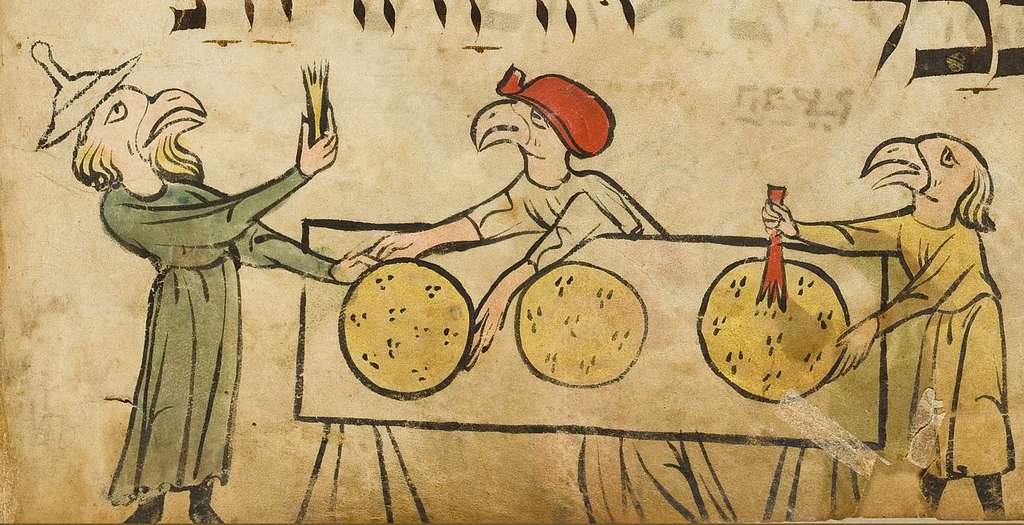
The first illustrated printed Haggadah, Prague, 1526, introduced new illustrations and recycled and referenced some of the common ones in manuscripts (see here for a brief discussion and here for Eliezer Brodt’s longer treatment). That edition would serve as a model for many subsequent illustrated Haggados but also contains surprising elements, at least in some religious circles, regarding the depiction of women, and was subsequently censored to conform with the revisionist approach to Jewish art. See, “A Few Comments Regarding The First Woodcut Border Accompanying The Prague 1526 Haggadah,” and Elliot Horowitz’s response, “Borders, Breasts, and Bibliography.” The Schecter Haggadah: Art, History and Commentary, a contemporary treatment of the art and the Haggadah, (for Elli Fischer’s review, see here), that unintentionally reproduced a version of one of the censored images in the first edition. It was restored in subsequent editions. Women appear in other contexts in illustrated Haggados. The most infamous example is the “custom” that implies a connection between one’s spouse and marror (discussed here), but our article, “Haggadah and the Mingling of the Sexes” documents more positive and inclusive examples of women’s participation in the various Passover rituals in printed Haggados.  Similarly, the c. 1300 Birds Head Haggadah has an image of female figures in snoods preparing the matza and a woman at the center of Seder table.

As detailed in chapter 8 of Epstein’s Medieval Haggadah, the early 14th Century Golden Haggadah is perhaps the most female-centric Haggadah and may have been commissioned for a woman. That manuscript emphasizes the unique, positive, and critical role women played in the Exodus narrative. Although it also depicts the practice of overzealous cleaning with a woman sweeping the ceiling. The 1430 Darmstadt Haggadah has a full-page illumination of women teachers, but its connection to the text is opaque. Finally, we argue that one printed Haggadah uses a subtle element in explicating the midrashic understanding of the separation of couples as part of the Egyptian experience.
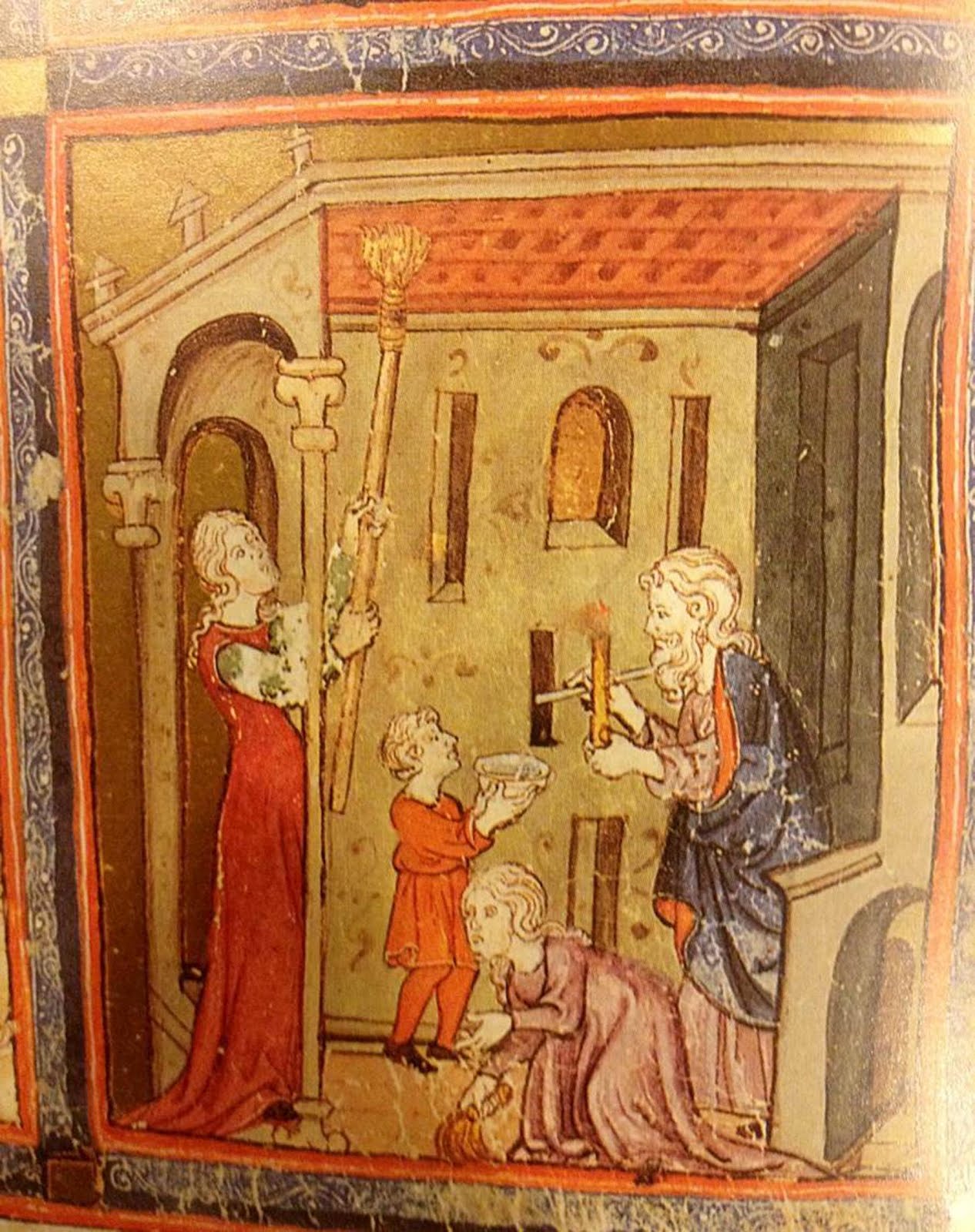
Sweeping the Ceiling, Golden Haggadah


One of the most creative contemporary Haggados was produced by the artist, David Moss. Moss was commissioned by David Levy to create a Haggadah, on vellum in the tradition of Medieval Jewish manuscripts. Moss worked for years on the project the result surely equals, if not surpasses, many of the well-known Medieval haggados, both artistically and its ability to bring deeper meaning to the text. The manuscript is adorned with gold and silver leaf and contains many paper-cuts (technically vellum-cuts).  One of the most striking examples of the silver decoration is the mirrors that accompany the passage that “in each and every  generation one is obligated to regard himself as though he personally came out of Egypt.” The mirrors appear on facing pages, interspersed with one with male and the other with female figures in historically accurate attire from Egypt to the modern period. Because the portraits are staggered when the page opens, each image is reflected on the opposite page, and when it is completely opened, the reader’s reflection literally appears in the Haggadah — a physical manifestation of the requirement to insert oneself into the story. The page is available as a separate print.

After completing the Haggadah, Moss was asked to reproduce it, and, with Levy’s permission, produced, what the former Librarian of Congress, Daniel Bornstein, described as one of the greatest examples of 20th-century printing. The reproduction, on vellum, nearly perfectly replicates the handmade one. This edition was limited to 500 copies, all of which were sold. From time to time, these copies appear at auction and are offered by private dealers, a recent copy sold for $35,000. President Regan presented one of these copies to the former President of Israel, Chaim Herzog, when he visited the White House in 1987. While that is out of reach for many, this version is housed at many libraries, and if one is in Israel, one can visit Moss at his workshop in the artist colony in Jerusalem, where he continues to produce exceptional works of Judaica and view the reproduction.  There is also a highly accurate reproduction, on paper that is available (deluxe edition) and retains the many papercuts and some of the other original elements, that is still available. This edition also contains a separate commentary volume, in Hebrew and English. (There is also one other available version that simply reproduces the pages, but lacks the papercuts.)
While the entire Moss Haggadah is worth study, a few examples. One paper-cut is comprised of eight panels, each depicting the process of brick making, the verso, using the same cuttings, depicts the matza baking process, literally transforming bricks into matza. The first panel of the matza baking is taken from Nuremberg II Haggadah, which we previously discussed here, and demonstrated that it preserves the Ashkenazi practice of only requiring supervision from the time of milling and not when the wheat was cut.

The illustration accompanying the section of Shefokh, reuses the illustrations of Eliyahu from the Prague 1526 and the Mantua 1528 Haggados to great effect. In the original and vellum reproduction, the cup of Eliyahu physically turns without any visible connection to the page — an extraordinary technical achievement. This section and the illustrations were discussed by Eliezer Brodt in “The Cup of the Visitor: What Lies Behind the Kos Shel Eliyahu, and, in this post, he identified an otherwise unknown work relating to the topic, for another article on the topic, see Tal Goiten’s “The Pouring of Elijah’s Cup (Hebrew).”  Eliezer revisited the topic in (here) his conversations with Rabbi Moshe Schwed, in the series, Al Ha-Daf. In last year’s conversation, he discussed a number of other elements of the history of the Haggadah, and three years ago the controversy surrounding machine produced matza. (All of the episodes are also streaming on Apple Podcasts, Spotify & 24Six.) Additionally, he authored “An Initial Bibliography of Important Haggadah Literature,” and two articles related to newly published Haggados, “Elazar Fleckeles’s Haggadah Maaseh BR’ Elazar ” and XXI. Rabbi Eliezer Brodt on Haggadah shel Pesach: Reflections on the Past and Present ,” regarding Rabbi Yedidya Tia Weil’s (the son of R. Rabbi Netanel Weil author of “Korban Netanel”) edition, and a review of David Henshke’s monumental work, Mah Nistanna. 

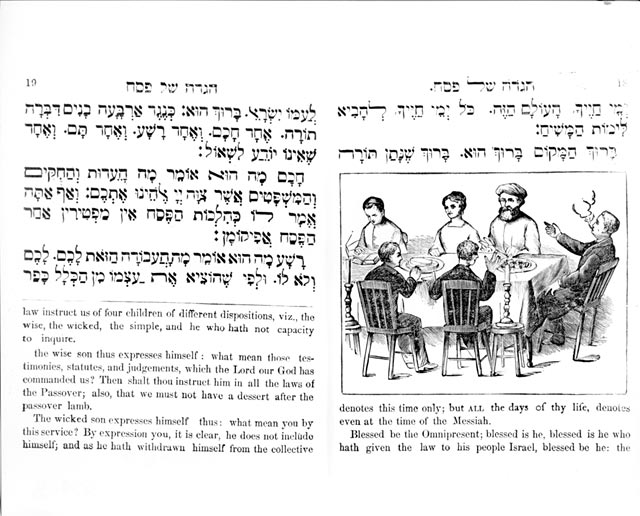
In one of the first haggadot printed in the United State published in 1886 Haggadah contains a depiction of the four sons.  Depicting the four sons is very common in the illustrated manuscripts and printed haggadot. In this instance, the wicked son’s disdain for the seder proceedings shows him leaning back on his chair and smoking a cigarette. According to many halakhic authorities, smoking is permitted on Yom Tov, nonetheless, the illustration demonstrates that at least in the late 19th-century smoking was not an acceptable practice in formal settings. (For a discussion of smoking on Yom Tov, see R. Shlomo Yosef Zevin, Mo’adim be-Halakha (Jerusalem:  Mechon Talmud Hayisraeli, 1983), 7-8).

The cup of Eliyahu is but one of many Passover food-related elements. The identification of Marror with the artichoke in Medieval Haggados, is debated by Dan Rabinowitz and Leor Jacobi , while Susan Weingarten provides an overview of the vegetable, in “The Not-So-Humble Artichoke in Ancient Jewish Sources.” Jacobi also discusses the fifth cup in his article, “Mysteries of the Magical Fifth Passover Cup II, The Great Disappearing Act and this printed article.  The history of the restriction of Kitniyot and the development of the practice of selling hametz is discussed in our article, “Kitniyot and Mechirat Chametz: Paradoxical Approaches to the Chametz Prohibition,” and was revisited on Rabbi Drew Kaplan’s Jewish Drinking podcast (and in an audio version on apple podcasts and spotify). Another guest was Marc Epstein, discussing his book on Medieval Haggados, and Dr. Jontahan Sarna where he gives an overview of the use of raisin wine for the kiddush and the four cups, based on his article, “Passover Raisin Wine,” as was the frequent contributor to the Seforimblog, Dr. Marc Shapiro. His interview, like many of his posts and his book, Changing the Immutable, discusses censorship and, in particular, the censored resposum of R. Moshe Isserles regarding taboo wine (also briefly touched upon in Changing the Immutable, 81-82, and for a more comprehensive discussion of the responsum, see Daniel Sperber, Nitevot Pesikah, 104-113).  For another wine related post, see Isaiah Cox’s article, “Wine Strength and Dilution.” The history of Jewish drinking and Kiddush Clubs was briefly discussed here.

Whether coffee, marijuana and other stimulants falls within the Kitniyot category appears here. Marc Shapiro’s article, “R. Shlomo Yosef Zevin, Kitniyot, R. Judah Mintz, and More,” regarding Artscroll’s manipulation of R. Zevin’s Moadim be-Halakha regarding kitniyot. Another coffee related article explores the history and commercial relationship between the Maxwell House Haggadah.  Finally, the last (pun intended) food discussion centers on the custom of stealing the afikoman.

The Amsterdam 1695 Haggadah was an important milestone in the history of printed illustrated Haggados, it was the first to employ copperplates rather than woodcuts. This new technique enabled much sharper and elaborate illustrations than in past Haggados. While some of the images can be traced to earlier Jewish Haggados, many were taken from the Christian illustrator, Mathis Marin. It also was the first to include a map. As we demonstrated that map, however, is sourced from a work that was a early and egregious example of forgery of Hebrew texts. For an Pesach related plagiarism, see “Pesach Journals, Had Gadyah, Plagiarism & Bibliographical Errors.” Kedem’s upcoming auction of the Gross Family collection includes, with an estimate of $80,00-$100,000, one of the rarest, beautiful, and expensive illustrations of Had Gadya by El Lissitzky published by Kultur Lige, Kiev, 1919. Eli Genauer reviews another number related edition, not in price, but convention, “The Gematriya Haggadah.”

There are two articles regarding the Haggadah text, David Farkes’ “A New Perspective on the Story of R. Eliezer in the Haggadah Shel Pesach,” and Mitchell First’s “Some Observations Regarding the Mah Nishtannah.” First’s other article, “The Date of Exodus: A Guide to the Orthodox Perplexed,” is also timely.
Finally, Shaul Seidler-Feller’s translation of Eli Wiesel’s article, “Passover with Apostates: A Concert in Spain and a Seder in the Middle of the Ocean,” tells the story of an unusual Pesach seder. Siedler-Feller most recently collaborated on the two most recent Sotheby’s Judaica catalogs of the Halpern collection.

Chag kasher ve-sameach!


New Sefer Announcement – פירוש התורה לרבינו אברהם בן הרמב”ם, ספר שמות

New Sefer Announcement

By: Eliezer Brodt

פירוש התורה לרבינו אברהם בן הרמבם, ספר בראשת, תרעח עמודים

פירוש התורה לרבינו אברהם בן הרמבם, ספר שמות, תתלב עמודים

מאמר על הדרשות ועל האגדות לרבינו אברהם בן הרמבם, מעיתיק השמועה, [בירורים בתולדות חכמי התלמוד] צז+צ עמודים

Recently the second volume of R. Avraham b. HaRambam’s perush on Chumash Shemot was released (832 pp.). This new edition was edited by Rabbi Moshe Maimon and was published in a beautiful edition by Machon Aleh Zayis.

Last Year Rabbi Maimon published the first volume (678 pp.) and the volume on R. Avraham’s Ma’amar Al Ha-Derashot.

What follows is a short description of the work. IY”H I hope to very shortly publish on the Seforim Blog an interview with the author where he describes more at length his work on R. Avraham b. HaRambam and his new edition of the Perush.

The Perush of R. Avraham b. HaRambam was first rescued from centuries of obscurity in 1958, when Dr. Ephraim Weisenberg of London translated into Hebrew the centuries-old manuscript owned by Oxford University, from its original Arabic. Weisenberg’s edition included the original Arabic along with a translation and commentary, accompanied with footnotes incorporating comments of other biblical commentators as well as works of the Rambam.

It has never been reprinted in full, and although the translated (but un-annotated) text has in fact been reprinted and marketed several times, these editions are also out of print and have long been unavailable to the public.

Among the highlights of this new edition of R. Maimon is that he has retranslated many hundreds of difficult words and passages from the original Arabic, utilizing advances made in the field by leading Judeo-Arabic experts.

In addition, since the initial publication of the commentary, amazing strides have been made in Genizah research which have transformed the field of Judeo-Arabic studies in general, and the Geonic-Andalusian tradition in particular. Many of the sources employed by R. Avraham in his writing of the commentary are now being made available in the form of critical editions of the works of R. Saadia and R. Shmuel b. Chofni Gaon. The result has been the identification of many obscure sources referenced by R. Avraham, as well as the clarification of untold number of passages in his commentary.

Both volumes are enhanced with essay length introductions (and copious and erudite footnotes) that trace the history of R. Avraham’s Perush, his commentarial style, and his particular contribution to the Maimonidean strain of the Andalusian tradition so prominently on display in his Perush. This new edition is a welcome addition to any serious student of Biblical commentary, and, together with the annotated edition of R. Avraham’s Ma’amar Al Ha-Derashot (Essay on Rabbinic Homilies) released by Rabbi Maimon last year, are a great contribution to Rabbinic studies in general and Maimonidean studies in particular.

Email me at Eliezerbrodt@gmail.com for parts of the introduction and some sample pages of this special new work.

Copies are available for purchase at Beigeleisen (Brooklyn), Judaica Plaza (Lakewood), and Tuvia’s (Monsey) as well as through many other fine retailers.

On can purchase it online through Mizrahi’s Bookstore at this link.

In Eretz Yisrael, if you’re interested in purchasing copies contact me at Eliezerbrodt@gmail.com


A Short Note Regarding an Illustrated Title Page and A Possible Unicum

A Short Note Regarding an Illustrated Title Page and A Possible Unicum


There are a series of books, Seder ha-haʻarakhah ve-haHanhagah, that record the tax law and taxes paid by the Mantuan community and were published in Mantua. [1] The taxes were calculated by communally elected assessment formulators.  The taxes were used to support the entire communal infrastructure, including the administration of communal organizations and funds for the poor.  As today, each person would provide an accounting of their funds reducing their taxable income based upon recognized deductions and certain exempted property. The formulators were wholly responsible for the determination of the specific levied taxes and could reject suspect ax filings and impose fines.

The first edition was published in 1651 and each edition covers three years, of which the National Library has 17 editions. The British Library holds 12, seven that are not in the National Library’s collection. Vinograd lists 22 editions, six in neither library. [2] (A full bibliography appears below)

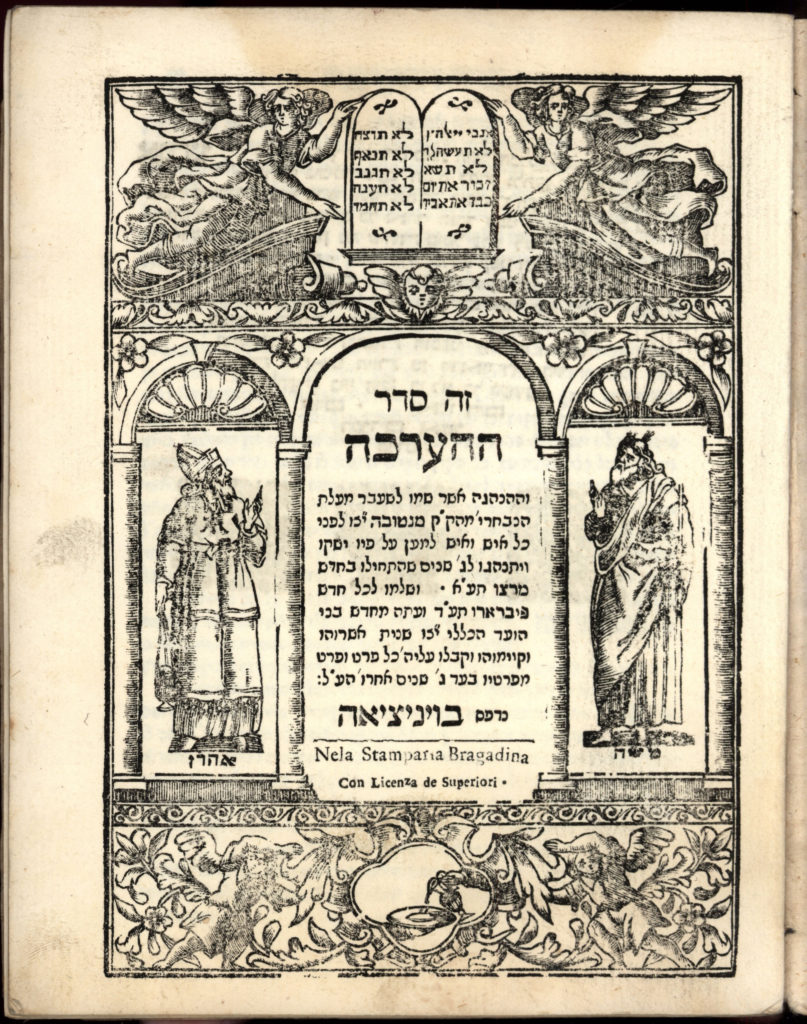
There is, however, at least one edition in the series that was not published in Mantua, the most logical location, but in Venice by Bragadin in 1711.  The likely reason for the change in venue is that from 1707-1712, there were no books printed in Mantua. [3] Nonetheless, these records were so important that the community went to Venice to publish the records.


Steinschneider, based upon Wolf’s bibliography, does identify this edition of the work. [4] But the book is not extant in the Bodleian Library.[5]  Nonetheless, no modern bibliography, e.g. Vinograd or Friedberg, records the Venice edition nor does the National Library or any other library I can identify (based on a search of WorldCat) own a copy of the book.  There is one copy, however, in the Gross Family Collection in Tel Aviv, and is possibly a unicum – the only extant copy.  Although as Judge Meyer Sulzberger, himself an avid book collector, noted that caution is necessary when identifying a unica, because “that the great weakness about a unicum is that presently one or two other people are found to have the book, and instead of contently agreeing that each of them has a unicum, each feels the value of his possession has been materially impaired.”  To this we can add that without concrete evidence of the book’s singularity, there may be private collections or public ones whose holdings are insufficiently cataloged to make a confident identification regarding the rarity of any book.  Indeed, Sulzberger provides many examples of books thought to unica, only to be identified as “merely” rare.[6]

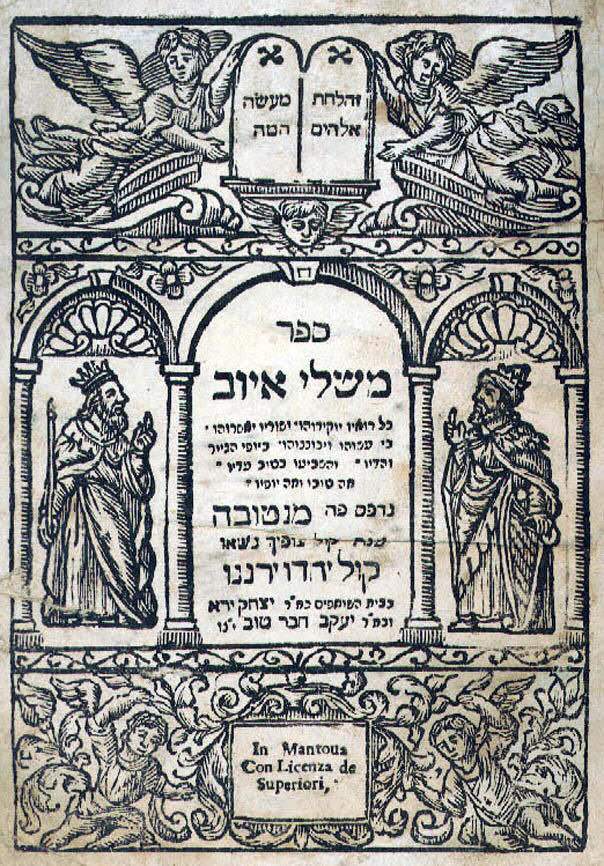
I should also note that the Venice copy has a nice title page with Moses and Aaron. (For a discussion of depictions of Moses and Aaron on Hebrew title pages see our earlier post here.)   A very similar title page appears on a later book printed in Mantua, 1720, Mishlei ve-Eiov, although in this instance it is David and Solomon who flank the title.

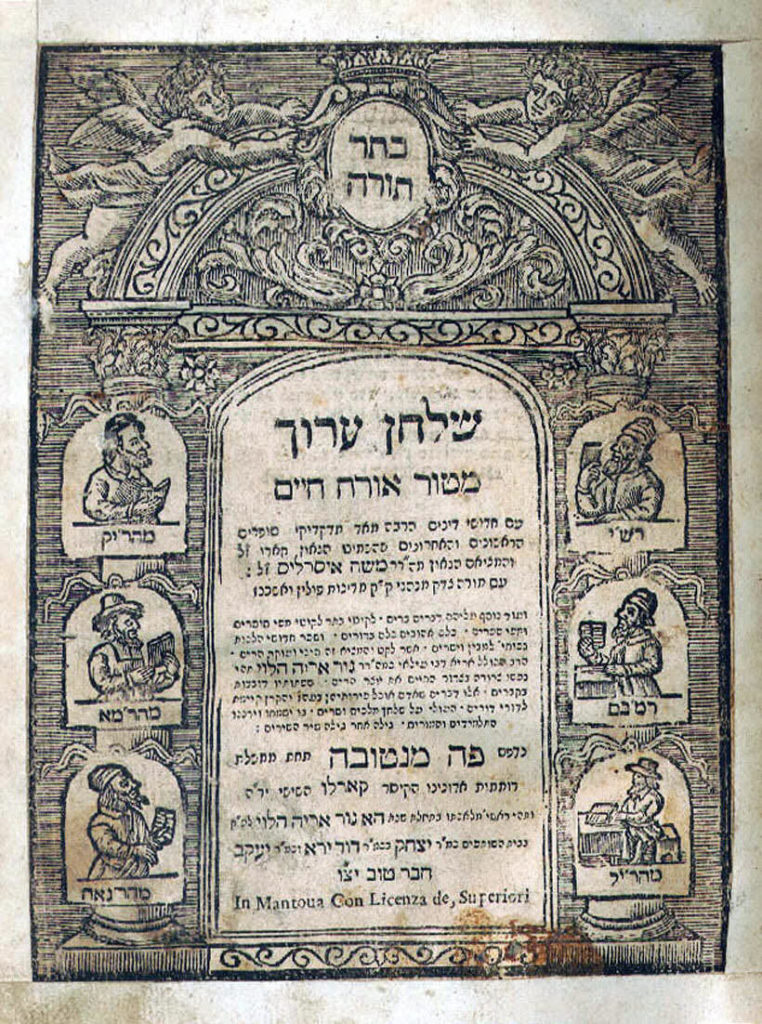
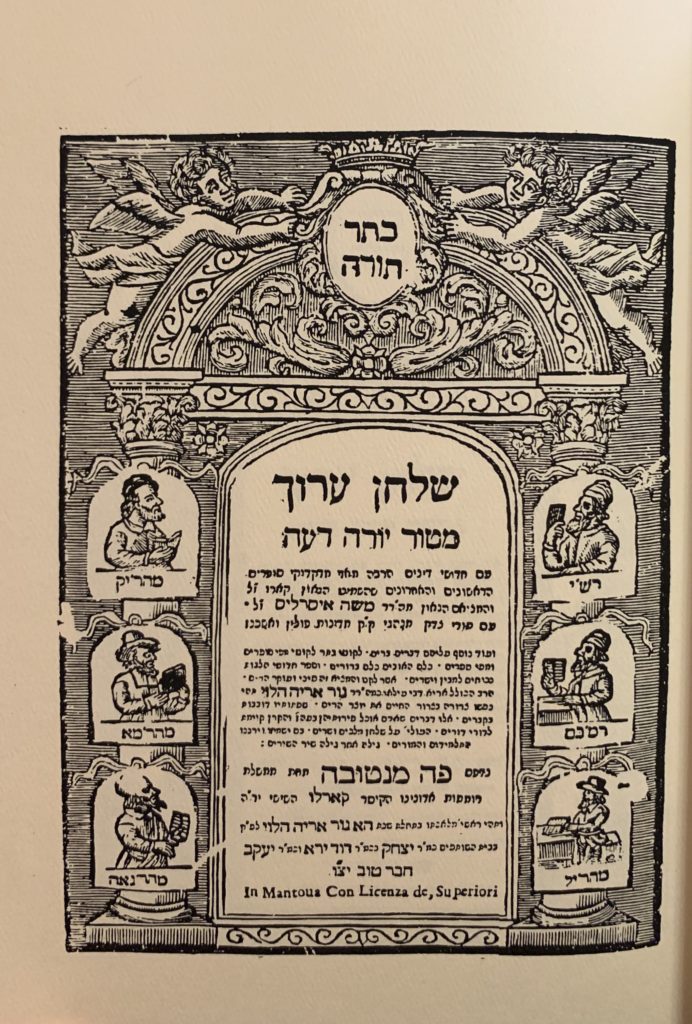
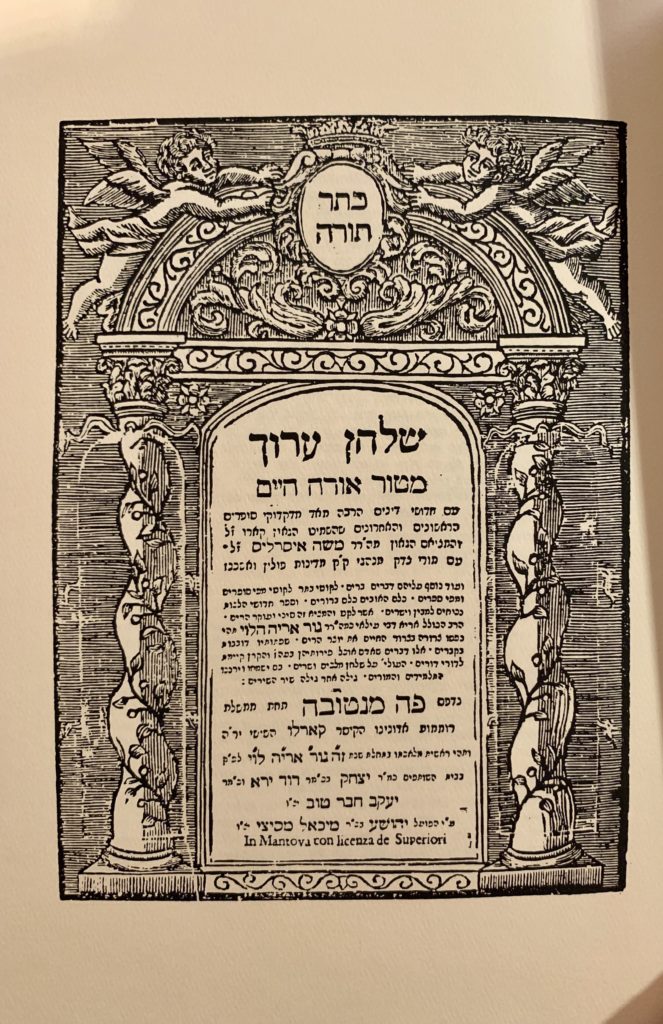
Additionally, the depiction of the Moses, Aaron, Solomon and David are similar to the ones that appear – Rambam, Rashi, R Yosef Karo, Rama, and the author – on the Gur Areyeh, a commentary on Shulkhan Orakh, Mantua, 1722.

There are two editions of this book printed within a year of one another.  The second printing lacks the images entirely and the first they only appear in Orakh Hayyim, and, although not noted in bibliographies or articles regarding the book, in at least one example the title pictorial title pages also appears in Yoreh Deah.

The remaining three (or two) volumes do not contain the images.  This led some to speculate that the images were deliberately removed, and that page was ripped out at the behest of the Mantua rabbinate and a variety of theories are offered, ranging from concern over reproducing human image to the inclusion of the author among such a distinguished group was egotistical, that the Rambam lack ed peyot, or that the portraits are just not flattering. [7]


But, both the claim of censorship and the rationale are unsupported.  Most extant copies include that page and there are many earlier examples of books containing human images including of biblical figures, many without peyot, or not dressed in flattering clothing.  There is no independent evidence to suggest anything other than a benign reason, perhaps the woodcuts wore out.  This aligns with the fact that the printer was known for crude lettering so much so that it nearly lost its ability to print at all and only survived because another party stepped in. Thus it is unlikely the lack of the portraits in the later volumes is an instance of censorship.[8]


* The identification of the Gross edition as a unicum is only preliminary and still a work in progress.  The author encourages anyone with additional information regarding this edition to comment or send an email to seforimblog@gmail.com

[1] See Shlomo Simonshon, Tolodot ha-Yehudim be-Duhosot Mantua, vol. 1 (Jerusalem, 1963), 274-86; see also Marvin J. Heller, The Seventeenth Century Hebrew Book: An Abridged Thesaurus, vol. 2 (Leiden: Brill, 2011), 957.

[2] For the NLI listing see here;   Diana Rowland Smith, Second Supplementary Catalog of Hebrew Books in the British Library 1893-1960, vol. 2 (London:  British Library, 1994), 599; Joseph Zedner, Catloglouge of the Hebrew Books in the Library of the British Museum (London, 1867), 510 recording Mantua 1759; Yeshayahu Vinograd, Otsar ha-Sefer ha-Ivri (Jerusalem:  Machon Lebibliograhia Memuhshevet, 1994).

[3] See Ch. B. Freidberg, Tolodot ha-Defus ha-Ivri be-Italia:  Be-Midenot Italiah, Aspnyah-Portugal, ve-Turgemah she-Melfenim (Tel Aviv:  Bar-Yeda, 1956), 20.  Friedberg does not explain the cause of the stoppage.

[4] Moritz Steinschneider, Catalogus Librorum Hebraeorum in Bibliotheca Bodleiana (Berollini:  Ad. Friedlander, 1852-1860) columns 625-66; Johann Christoph Wolf, Bibliothecae Hebraeae, vol. 3 (Hamburg:  Christoph Felgineri Viduam, 1827), 1207-08 (Steinschneider’s citation to Wolf should be corrected to read vol. 3 and not vol. 2).

[5] See A.E. Cowley, A Concise Catalogue of the Hebrew Printed Books in the Bodleian Library (Oxford:  Clarendon Press, 1929), 410 (listing only Mantua).

[6] Meyer Sulzberger, “Books and Bookmen,” Menorah XXXVI (Jan. 1904), 38-40. For other Hebrew unica see Marvin J. Heller, “Unicum, Fragments, and Other Hebrew Book Rarities,” Judaica Librarianship 18 (2014), 130-53.

[7] See Shmuel Weiner, Daat Kedoshim:  Pesak Herem:  Mazkeret Rabanei Italiah (Petroberg: Berman Press, 1897), 38**; Aviad Cohen, “Diuknot Hakhamim:  Bein Halkha le-Maashe,” Mahnayim 10 (1995). See Mifal ha-Bibliographia ha-Ivrei entry Gur Areyeh .

One scholar viewed the selection of personages to grace the title page as an indication of their imporatance.  Specifically the inclusion of the Mahril was used to demonstrate his unique contribution to the formation of the Shulchan Orakh.  See Yisrael Peles, Mevo ve-Hosafot le-Sefer Mahril (Jerusalem:  Machon Yerushalim, 2016), 258. (Thanks to Eliezer Brodt for providing this source).

[8] Friedberg, Tolodot ha-Defus ha-Ivri, 20-21. For another example of spurious reasons for a change to the title page, see Dan Rabinowitz, “Sheti ha-Girsot shel Shu”t ha-Bakh, Mahadurot Frankfort TN”Z:  Totsot shel Shikul Tsniut, Sha’arim be Shut ha-Bach,” Alei Sefer  21(2010), 99-112.


Bibliography of Seder ha-Ha’arakhah


Mantua, 1651(BL)

Mantua, 1656 (NLI)

Mantua, 1670 (V)

Mantua, 1675 (BL)

Mantua, 1679 (NLI)

Mantua, 1682 (V)

Mantua, 1685 (V)

Venice, 1711 (Gross)

Venice, 1714 (Wolf)

Venice, 1717 (Wolf)

Mantua, 1722 (BL)

Mantua, 1722 (BL) (& a variant)

Mantua, 1726 (NLI)

Mantua, 1729 (V)

Mantua, 1732 (NLI)

Mantua, 1735 (NLI)

Mantua 1737 (BL)

Mantua, 1739 (NLI)

Mantua, 1743 (BL)

Mantua, 1747 (NLI)

Mantua, 1750 (NLI)

Mantua, 1753 (NLI)

Mantua, 1756 (NLI)

Mantua, 1759 (NLI)

Mantua, 1773 (BL)

Mantua, 1777 (NLI)

Mantua, 1780 (NLI)
Mantua, 1783 (V)

Mantua, 1786 (NLI)

Mantua, 1789 (NLI)

Mantua, 1793 (V)

Mantua, 1795 (NLI)

Mantua, 1798 (NLI)