Marc Shapiro: R. Kook on Sacrifices & Other Assorted Comments

R. Kook on Sacrifices and Other Assorted Comments
by: Marc B. Shapiro

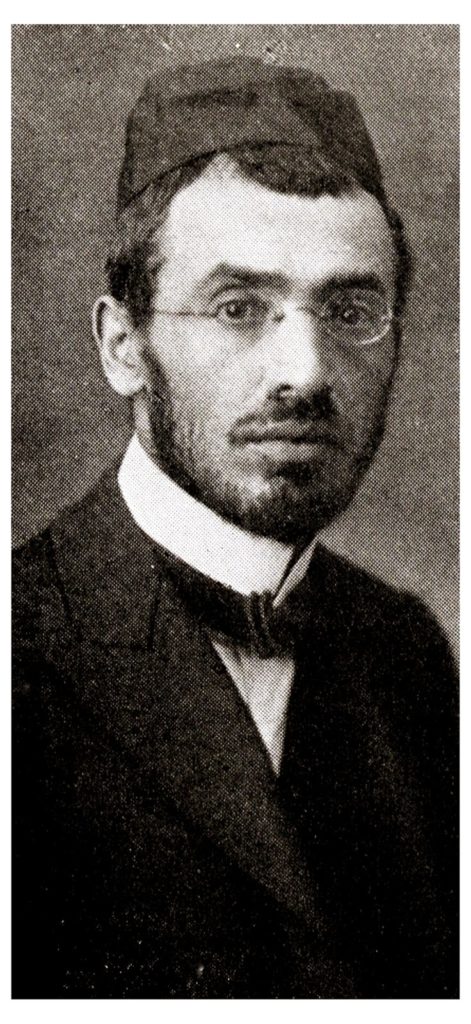
1. At the beginning of my previous post (the Gurock review) I mentioned R. Solomon Isaac Scheinfeld (1860-1943). The source of the comment I quote is his Olam ha-Sheker (Milwaukee, 1936), p. 77.1 Scheinfeld was the unofficial chief rabbi in Milwaukee, arriving there in 1902 and serving until his death in 1943. Here is his picture.

He had a traditional education, having studied for three years in the Kovno Kollel under R. Isaac Elhanan Spektor, from whom he received semikhah.2 He also had a very original mind, and wrote a number of books and essays. One of his most fascinating works is the article he published under the pseudonym Even Shayish. In this article he argued that since sacrifices will never be revived, they are now irrelevant to Judaism and all references to them should be removed from the prayer book.
R. Jehiel Jacob Weinberg has a lengthy essay in which he critiques Scheinfeld’s position. A Hebrew translation of this essay appears in volume 2 of Kitvei R. Weinberg. Yet Weinberg himself leaves open the possibility that there won’t be a return to sacrifices (p. 255):
אין דנים כאן על עצם הרעיון היסודי של הקרבנות. לו היתה היום קיימת אצלנו שאלה כזאת והיא דורשת פתרון דחוף – אין מספר מצומצם של יהודים בארץ אחת בני סמכות להכריע בענין זה, וכל שכן כאשר הם אינם מייצגים את כלל ישראל. שאלה זאת חייבים להביא לפני הבית דין של כלל ישראל. רק לבית דין כזה הרשות לקבוע אם להשאיר טקס מקודש בעם בתוקפו או לבטלו. היום שאין לנו ארץ ולא בית המקדש ולא כהנים הרי זה מגוחך ומצער כאחת להעלות תביעה לבטל עבודת קרבנות!
Weinberg doesn’t mention Maimonides, but this is usually to where people turn when seeking to argue against a revival of sacrifices. According to the Guide 3:32, Maimonides thought that sacrifices were a concession to the masses’ primitive religious notions, developed in an idolatrous society. While Maimonides is explicit in the Mishneh Torah that there will be a return of the sacrificial order, his reason for sacrifices offered in the Guide led some people to assume that his true opinion was that there will not be sacrifices in the future. One example is R. Simhah Paltrovitch, Simhat Avot (New York, 1917), pp. 7-8, who offers a mystical approach:
אמנם מה נעשה במה שדברי מורנו ורבנו הרמב”ם ז”ל שהוא בסברתו מתנגד לאלה הדברים, ואומר כי בימים הבאים עת קץ משיחנו, יבוטל עבודה בקרבנות ולא יהיה עוד . . . להעולם הזה נתנו הפשט והדרוש, ובעולם השני יקויים הרמז והסוד . . .וכן ממש הוא טעם של הרמב”ם ז”ל שיבוטל הקרבנות, כי אז יהי’ התורה על צד הרמז וסוד כמו שארי המצוות המבוארות בתורה, כי יתחלפון מן הפשט לרמז וסוד שמשונים מן הפשט.
R. Joseph Messas also cites Maimonides’ reason for sacrifices and concludes that there will be no return of the sacrificial order (Otzar ha-Mikhtavim, vol. 2, no. 1305).
לפי”ז יתבטלו לעתיד כל הקרבנות כי זה אלפי שנים משנעקרה ע”ז מישראל, וישראל גוי אחד, עובדים רק לאל אחד ועל ידי ישראל בגלותם נעקרה ע”ז גם מכל האומות.
What about the problem that the abolition of sacrifices would mean a change in Torah law, which is a point that R. Kook will also deal with? Messas answers simply:
ואין בזה שנוי בתורה חלילה, דזיל בתר טעמא
What this means, I think, is that from the beginning sacrifices were only intended to be offered in a society in which people were attached to primitive religious notions associated with idolatry, and the animal sacrifices that went along with this. However, once this era has passed from the scene, then there will no longer be any obligation for sacrifices.

A really shocking comment against sacrfices appears in a supposed letter from R. Yaakov of Lissa to R. Zvi Hirsch Kalischer (published in Ha-Posek, Kislev 5712). Responding to Kalischer’s advocacy of renewing sacrifices even before the coming of the Messiah, R. Yaakov claims that to do so would cause Jews to be a subject of mockery by the Gentiles and the non-religious Jews.

לבי נוקף ונפשי מלא רטט ורעד כי אם ישמעו הגויים והקלים בישראל שאנחנו מקריבים קרבנות ימלאו שחוק פיהם ונהיה 
ח”ו ללעג ולקלס וה’ יודע כמה צרות וקלקולים יצמחו מזה

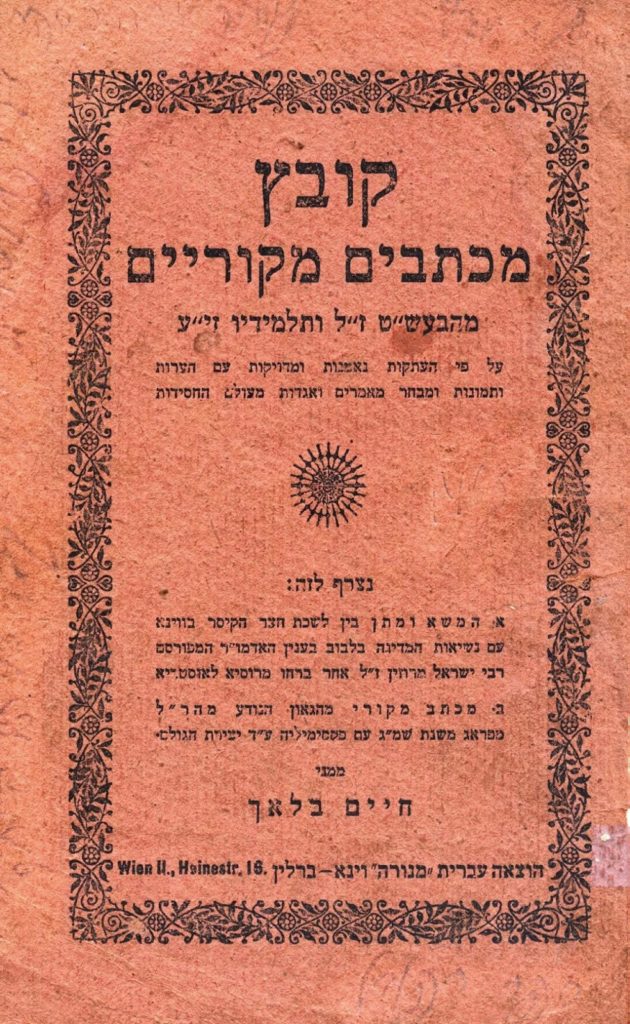
It is very unlikely, to put it mildly, that a gadol be-Yisrael would give this as his reason for not fulfilling a mitzvah. When one realizes that the person who published this letter was the famous forger Chaim Bloch, then all doubts are removed: The letter, like so much else published by Bloch, is a complete forgery. Apparently Bloch had some negative feelings about sacrifices and transferred them to R. Yaakov. Interestingly, when this letter was republished in Dovev Siftei Yeshenim, vol. 1, Bloch made a subtle change in the letter, which as far as I know, no one has yet pointed out. The letter’s authenticity had been attacked by Zvi Harkavy in Kol Torah (Nisan-Iyar 5712), and one of the things he pointed to was this line, and that R. Yaakov could never have written it. So when Bloch republished the letter, in an attempt to bolster its authenticity, he altered it to read as follows (I have underlined the newly added words):

כי אם ישמעו הגויים והקלים בישראל שאנחנו מקריבים קרבנות בזמן הזה לפני ביאת משיח צדקנו ובטרם עומד בית מקדשנו 
על מכונו, ימלאו שחוק פיהם ונהיה ח”ו ללעג ולקלס

Had he been smart enough to have added these extra words in the first edition of his forgery, it would have been more believable. Now R. Yaakov is not speaking of the non-Jews and the non-religious mocking the offering of sacrifices, but only mocking the offering of them before the coming of the Messiah and the building of the Temple.

Michael Friedlaender’s The Jewish Religion (London, 1891), was for many years regarded as a standard work of Orthodox belief. As far as I know, it was the first of its kind in English and can still hold its own against many more recently published books. You can see it here. On pages 162-163, 417-418, he speaks of the return of the sacrificial order in Messianic days, and how we should look forward to this, even if it is contrary to our taste. He says that we should not model Divine Law according to our liking, but rather model our liking according to the will of God. Yet despite these strong statements, he was also sensitive to those who were not comfortable with sacrifices. He writes as follows (p. 452):

References to the Sacrificial Service, and especially prayers for its restoration, are disliked by some, who think such restoration undesirable. Let no one pray for a thing against his will; let him whose heart is not with his fellow-worshippers in any of their supplications silently substitute his own prayers for them; but let him not interfere with the devotion of those to whom “the statues of the Lord are right, rejoicing the heart” . . . and who yearn for the opportunity of fulfilling Divine commandments which they cannot observe at present.

This passage is quoted by British Chief Rabbi Joseph Hertz in his Authorised Daily Prayer Book, p. 532. Upon seeing this, R. Yerucham Leiner, then living in London, wrote a letter to the Jewish Chronicle (Dec. 17, 1943; I learnt of this from Louis Jacobs, Tree of Life, second ed., p. xxix). Before quoting from his letter, let me reproduce what Wikipedia says about this most incredible figure.

Grand Rabbi Yerucham Leiner of Radzin, son of Likutei Divrei Torah, author of Tiferes Yerucham, Zikaron LaRishonim, Mipi Hashmua, Zohar HaRakiya. Moved from Chelm to London to America. Continuation of the Radziner line in America, and one of the last direct descendants of the Leiner family. After the war, he did not reinstitute the wearing of techeiles as other branches of Radzin did, even though his father, Grand Rabbi Avraham Yehoshua Heschel Leiner of Radzin-Chelm, wore them, as he was a chosid of his older brother, the Orchos Chayim, who had reinstituted the wearing of techeiles. Reb Yerucham believed that the original formula of his uncle was lost during the war. This is the reason that his family doesn’t wear techeiles today, only pairs that were left from pre-war Europe. Reb Yerucham was an expert in all areas of Torah and scholarship. There existed very few admorim/tzaddikim since the beginning of Chassidus who were also lamdanim in both the Polish and Lithuanian styles of learning, bibliographers, Jewish historians, very learned in Kabbalah works, philologists, and masters of both the Babylonian and Jerusalem Talmuds. Reb Yerucham was very close with the Satmar Rebbe, Rabbi Yoelish Teitelbaum ZTVK”L. He always made sure to spend a few weeks vacationing with the him, specifically learning Midrashei Chazal, of which they were both masters. He studied and visited with Rabbi Yitzchok Hutner, and they were good friends in later life. They always treated one another with special respect. He established the Radziner shtiebel in Boro Park. Died 20 Av 5724 (1964). Buried in Beth Israel Cemetery, Woodbridge, New Jersey

Responding to the quote from Friedlaender, Leiner wrote: “This opinion was put forward by the founders of Reform Judaism, Holdheim and Geiger. But it is hardly in accord with Orthodox traditions of Judaism.” The editor of the Jewish Chronicle responsed: “The words quoted with regard to the Musaph are those of the great and sainted scholar, Dr. Michael Friedlander, for 42 years Principal of Jews College: and it is certainly strange to class him with Holdheim and Geiger.”

The most famous of our sages to speak of a Messianic era without animal sacrifices is, of course, R. Kook, who envisions vegetable sacrifices. He writes this in his commentary to the siddur, Olat ha-Reiyah, vol. 1, p. 292. In the preface R. Zvi Yehudah tells us that he began writing this commentary during World War I. I don’t need to go into any detail on this, as I have done so already in The Limits of Orthodox Theology, where I also mention passages in R. Kook’s writings that offer a different approach. The notion that there will only be vegetable sacrifices in Messianic days is, of course, a radical position, and many who don’t know R. Kook’s writings find it impossible to accept that he could have said this. This is what happened when R. Yosef Kanefsky of Los Angeles published an essay in which he mentioned R. Kook’s view.3 He was attacked by some prominent rabbis since they found it impossible to believe that R. Kook could say what was attributed to him. Yet it was Kanefsky who was right, not his opponents.

In my book I dealt with R. Kook’s position on sacrifices, because positing that there will be no sacrifices in the future would seem to be in contradiction to Maimonides’ Principle that the commandments of the Torah are eternal. That consideration is precisely what makes his position so radical. A couple of years ago one of R. Kook’s notebooks dating from his time as rabbi in Bausk, which lasted until 1904, was published. We actually have two publications of this, one by Boaz Ofen called Kevatzim mi-Ketav Yad Kodsho, vol. 2 (Jerusalem, 2008), and the other, which comes out of the world of Merkaz ha-Rav, called Pinkesei ha-Reiyah (Jerusalem, 2008).

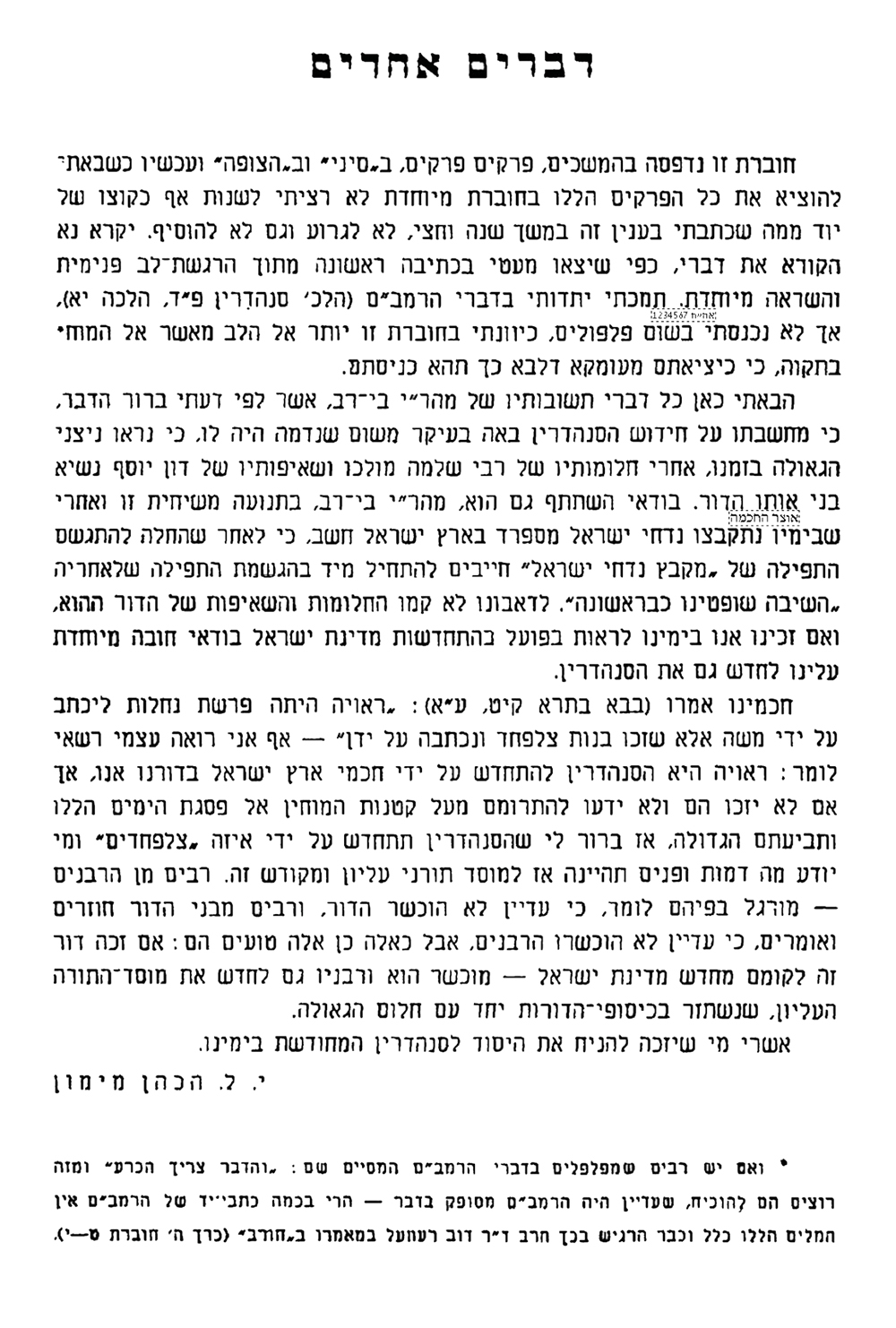
This is not the first competing publications of the same material by these people, and as I will show in my forthcoming book, the Merkaz editions are tainted by censorship in that “problematic” passages are removed.4 Those who claim to be the greatest adherents of R. Kook have once again taken it upon themselves to save their master from himself, as it were, and decided which writings of R. Kook should appear and which should not. Yet in the passage I am interested in now (no. 8 in the Ofen edition and no. 6 in the Merkaz edition), the two books are identical. The passage is very significant since it shows you that even in his earlier years R. Kook had the same notion later expressed in Olat ha-Reiyah, that the future would only know vegetable sacrifices. (In case people are wondering, R. Kook was not a vegetarian. Yet he did see vegetarianism as part of the eschatological future. His great student, the Nazir, was a vegetarian, as was Nazir’s son-in-law, R. Shlomo Goren, and as is his son, R. Shear Yashuv Cohen.5)

This passage gives us new insight into R. Kook’s view of sacrifices, and how things will change in the future era. He begins by speaking of the abandonment of meat-eating in the Messianic era, since this will not be something that people desire. Recall that in speaking of eating meat, the Torah writes (Deut. 12:6): כי תאוה נפשך לאכל בשר, which means “when thy soul desires to eat meat.” The Messianic era is not a time when people will have this desire, as R. Kook also explains in his famous essay on vegetarianism, “Afikim ba-Negev”.

What about the sacrifices that are required by the Torah? R. Kook offers a few possibilities. One is that sacrifices will still be necessary. Yet he also speculates that perhaps certain animals will be so spiritually advanced that they will on their own offer themselves as sacrifices, in acknowledgment of the great benefit that will come to them and the world through their actions.6 This solves the problem of people deliberately killing animals, which goes against his conception of the eschaton.

What is most interesting for our purpose is another suggestion by R. Kook, namely, that the Sanhedrin will use its power to uproot a matter from the Torah in order to abolish obligatory animal sacrifices. Their reason for doing this will be that the killing of animals will no longer be part of the culture in Messianic days. R. Kook even shows how the Rabbis will be able to find support for this step from the Torah. What he is doing, I think, is imagining himself as part of the future Sanhedrin that abolishes sacrifices, and informing us of the derashah that will be used to support this. This is related to what I wrote in an earlier post, see here, and I repeat it now:

As to the general problem of laws that trouble the ethical sense of people, we find that it is R. Kook who takes the bull by the horns and suggests a radical approach. The issue was much more vexing for R. Kook than for other sages, as in these types of matters he could not simply tell people that their consciences were leading them astray and that they should submerge their inherent feelings of right and wrong. It is R. Kook, after all, who famously says that fear of heaven cannot push aside one’s natural morality (Shemonah Kevatzim 1:75):

אסור ליראת שמים שתדחק את המוסר הטבעי של האדם, כי אז אינה עוד יראת שמים טהורה. סימן ליראת שמים טהורה הוא, כשהמוסר הטבעי, הנטוע בטבע הישר של האדם, הולך ועולה על פיה במעלות יותר גבוהות ממה שהוא עומד מבלעדיה. אבל אם תצוייר יראת שמים בתכונה כזאת, שבלא השפעתה על החיים היו החיים יותר נוטים לפעול טוב, ולהוציא אל הפועל דברים מועילים לפרט ולכלל, ועל פי השפעתה מתמעט כח הפועל ההוא, יראת שמים כזאת היא יראה פסולה.

These are incredible words. R. Kook was also “confident that if a particular moral intuition reflecting the divine will achieves widespread popularity, it will no doubt enable the halakhic authorities to find genuine textual basis for their new understanding.” R. Kook formulates his idea as follows (Iggerot ha-Reiyah, vol. 1, p. 103):

ואם תפול שאלה על איזה משפט שבתורה, שלפי מושגי המוסר יהיה נראה שצריך להיות מובן באופן אחר, אז אם באמת ע”פ ב”ד הגדול יוחלט שזה המשפט לא נאמר כ”א באותם התנאים שכבר אינם, ודאי ימצא ע”ז מקור בתורה.

R. Kook is not speaking about apologetics here, but a revealing of Torah truth that was previously hidden. The truth is latent, and with the development of moral ideas, which is driven by God, the new insight in the Torah becomes apparent.

Ad kan leshoni in the previous post.

In other words, R. Kook sees the Sanhedrin as able to actualize new moral and religious insights that have become apparent. That is why it is important for the Sanhedrin to use derashot when dealing with these matters, as this shows that the idea is not something new that has been developed, but something that was latent in the Torah, and only now has become apparent.

So what derashah can be used to justify an abolishment of animal sacrifices? R. Kook points to Num 28:2: את קרבני לחמי לאשי . This is usually translated as “My food which is presented to Me for offerings made by fire”. Yet the word לחמי actually means “my bread.” Right after this, in discussing the particulars of the sacrifice, the Torah states: “The one lamb thou shalt offer in the morning.” R. Kook’s proposed messianic derashah is: “Whenever animals are killed for personal consumption, you should use them for sacrifices, but when they are not killed for personal use, make sacrifices of bread.”

I don’t think I am exaggerating in saying that this is one of the most provocative and radical texts in R. Kook’s writings. I say this not because of his advocacy of abolishing sacrifices, which I don’t think to be that significant in the larger scheme, but due to how he is envisioning the process by which the Rabbis will actually use derashot to create a Messianic Judaism.

The Rambam, Hilkhot Mamrim 2:1, speaks of laws derived from the hermeneutical principles that can be altered by a future beit din ha-gadol (even one not as great as the one that established the original law). This was the great fear of the opponents of a reconstituted Sanhedrin, that the Mizrachi rabbis would take upon themselves to do precisely this. Since so many of our laws are based on derashot, Judaism as we practice it can be entirely reworked. R. Kook is showing us how this can be done, but he is going further than anything Maimonides envisioned, since sacrifices are not matters that have been established based on a rabbinic derashah but are commanded by explicit biblical verses.

Basically, what R. Kook is doing is recreating the world of the Pharisees, before Judaism was bound to codes (beginning with the Mishnah). It was a time when Jewish law was developing and the biblical verses could be read—some would say “read”— in all sorts of ways. In the days of the Pharisees much of the halakhah as we know it was created, and to a large extent that can be done again in the Messianic era.
Here are R. Kook’s words (note also his exegesis with ריח ניחוח) :

שהסנהדרין אז ימצאו לנכון, ע”פ הכח שיש להם לעקור דבר מה”ת בשוא”ת, לפטור מקרבנות החובה של מין החי, כיון שכבר חדלה הריגת החי מן המנהג של תשמישי הרשות והמקרא מסייע, שקרא הכתוב לקרבן לחם, “את קרבני לחמי לאשי”, ואח”כ אומר “את הכבש אחד”, הא כיצד? כל זמן שבע”ח קרבים לתשמיש הרשות, עשה בע”ח לגבוה, אבל כשבע”ח אינם קרבים לרשות, עשה הקרבנות מלחם, ועל זה רמזו חז”ל: “כל הקרבנות בטלין וקרבן תודה אינה בטלה” שיש בה לחם . . . רק כעת עד זמן ההשלמה תאמר להם שיקריבו כבשים, ומותנה תמיד לריח ניחוח, וכיון שיבורר בזמן ההשלמה שהריגת הבע”ח [אינה ראויה] אי אפשר שתהיה לריח ניחוח.

R. Kook then cites the proof he mentions in Olat ha-Reiyah and in his essay “Afikim ba-Negev” (Otzarot ha-Reiyah [Rishon le-Tziyon, 2002], vol. 2, p. 103), that Malachi 3:4 writes: וערבה לה’ מנחת יהודה וירושלים כימי עולם וכשנים קדמוניות . This verse, in speaking of a sacrificial offering in Messianic days, mentions the minhah sacrifice, which is not an animal offering.

As mentioned, the passage from R. Kook is so interesting because it shows that he was not merely thinking about the Messianic era, but also the actual functioning of the future Sanhedrin. He was imagining the derashot that could be used to “update” Judaism. I am unaware if this aspect of R. Kook’s thought was known before the publication of this latest volume. I also don’t know if any scholars have taken note of it even subsequent to the publication. However, in “Afikim ba-Negev” (Otzarot ha-Reiyah, vol. 2, p. 103), R. Kook also, in an offhand sentence, provides a possible derashah to justify the abolishment of sacrifices. He doesn’t develop the idea, but just puts it out there. Here is the sentence:

והגביל “לרצונכם תזבחהו” (ויקרא יט, ה) שיהיה אפשר וראוי לומר “רוצה אני”. (רש”י על ויקרא א, ג).

The Talmud, Rosh ha-Shanah 6a, which is quoted by Rashi, Lev, 1:3, states that one cannot bring a sacrifice unless it arises from one’s free will. Now the Talmud, which is speaking of one particular sacrifice, actually says that we force him to bring it until he agrees, and this means that he is “willing.” But R. Kook is using this passage to hint at a different matter. In future times, when sacrifices will be so far from human sentiment, it will be impossible to do it willingly. The derashah, לרצונכם תזבחהו , will then come into play. Since this teaches that one can only bring a sacrifice when one is willing, at a time when animal sacrifices are not considered acceptable, and thus not something people “want” to do, animal sacrifices will no longer be a requirement. Remember, R. Kook describes this future era as one in which the animals will be far advanced of what they are now. It is only when the animals are at the low state that they currently are, that we can offer them as sacrifices and eat them. He writes (Otzarot ha-Reiyah, vol. 2, p. 101), in a passage in which animals are compared to one’s children:

מי לא יבין שאי אפשר להעלות על הדעת שיקח האדם את בניו, ברוח אשר יטפחם וירבה אותם להיטיב ולהשכיל, ויזבחם וישפך דמם?

The texts we have seen are important in explaining how his viewpoint of the abolishment of sacrifices relates to the Ninth Principle of Maimonides. As mentioned, in my book I listed R. Kook’s view as being in opposition to the Principle. R. Kook is certainly great enough to disagree with Maimonides in this matter had he chosen to. Yet we see from his newly published writings that he would not have regarded himself in disagreement, because he understands the abolishment of sacrifices to be carried out in a purely halakhic fashion. Since the Rabbis have the exegetical authority to do such things, an authority given to them by the Torah, we are not speaking of a revision of Torah law. This case is then no different than any of the other examples where the Sages interpret Torah law different that the peshat of the verse.

Returning to the newly published text, R. Kook’s imagination continues to run, and he doesn’t stop with sacrifices. In my book I called attention to R. Hayyim Halberstam’s view that in Messianic days the first born will take the place of the kohanim. R. Kook must have been attracted to this view for kabbalistic reasons, and here he provides a possible basis for how this too can be justified by the Rabbis. He also notes that since the change can be justified, “it is not uprooting a Torah matter, but rather fulfilling the Torah.”! In other words, built into the Torah is the notion that the kohanim would only be temporarily in charge of the divine worship. R. Kook argues that since the First Born were removed from their role because of the sin of the Golden Calf, it is impossible for the effects of this sin to last forever, as repentance is a more powerful force. Therefore, when the sin of the Golden Calf is atoned for there will no longer any reason for the First Born to be kept from the Avodah, and it will return to them.

Following this, R. Kook offers another way of explaining why his view of sacrifices should not be seen as a “reform” or as evidence of the Torah changing (he obviously was sensitive to this point). He says ויש לדרוש, in other words, he is once again providing the halakhic justification that can be used by a future Sanhedrin in abolishing sacrifices. His new exegetical reasoning goes as follows: The obligation of animal sacrifices was only intended for an era when the kohanim were in charge of the Avodah. This is how one is to understand the verse (Lev. 11:1) ושחט אותו על ירך המזבח . . . וזרקו בני אהרן הכהנים את דמו. In other words, it is only to the descendants of Aaron that animal sacrifice is commanded,

אבל כשיהיו כשרים ג”כ בכורות, אז מטעם העילוי של בע”ח וכלל המציאות אין הבע”ח נהוגים כ”א לחם ומנחה . . . וכך הוא המדה בכל מקום שנמצא פסוק בתורה וסברא ישרה שיש כח ביד ב”ד הגדול, מכש”כ כבצירוף הנביאים לפסוק הוראת גדולות כאלה.

Note that R. Kook ties together a verse in the Torah with logic. When both are present, then the Beit Din ha-Gadol is able to act in order to make adjustments to Torah law. In this matter, the “sevarah yesharah” is the sense that animal sacrifices will not suitable for the future eschatological era, and the verses in the Torah that he cites give “cover” to the sevarah yesharah. That is, they provide the exegetical justification. (I wonder though, is R. Kook really correct when he implies that the only time the Sages could uproot a commandment was when they also had a biblical verse to justify this?)

R. Kook concludes that all that he is speaking about is a long way off, and it is possible that the Resurrection will come before this and then all sorts of things will change. Yet all his prior ruminations here are about a pre-Resurrection era, when the Beit Din ha-Gadol is functioning and adjusting Torah law by means of derashot and sevarah yesharah. This is not the sort of thing that will be taking place post-Resurrection.7

Finally, lest anyone start using R. Kook’s thoughts in an antinomian fashion, he throws in the following for good measure:

וזה היה מקור תרבות והרע ד”אחר”, שחזי שהמצות יש להן יחש מוגבל ותכליתי, חשב שבאמת אפשר להתעלות למעלה מהמעשים, גם בלא עת, ובאמת הכל אחדות יחיד היה הוה ויהיה, וכל עת וזמן את חובותיה נשמור, בלא נדנוד צל פקפוק.

Earlier in this post, I referred to the implications of R. Kook’s ideas with regard to Jewish law being adjusted because of new moral insights. In fact, I think it is R. Kook who provides the most comprehensive and satisfying approach to this issue. I don’t want to get into that subject at present, as I plan on returning to it, especially as a number of people have written to me about R. Kook’s views. In my future post I will illustrate my point by citing a number of examples of rulings and statements by mainstream halakhists from earlier centuries which could never be made today. The only way to explain this, I will argue, is that there has been a change in societal norms and this has made certain approaches not just practically impossible but simply wrong for our times. (See here where I cite in this regard R. Weinberg and R. Aviner.) However, I promised someone that I would give one example in this post, so here it is. R. Hayyim Benveniste, Keneset ha-Gedolah, Even ha-Ezer 154, Hagahot Beit Yosef no. 59, in discussing when we can force a husband to give a divorce, writes as follows:

ובעל משפט צדק ח”א סי’ נ”ט כתב דאפי’ רודף אחריה בסכין להכותה אין כופין אותו לגרש ואפי’ לו’ לו שחייב להוציא.

Can anyone imagine a posek, from even the most right-wing community, advocating such a viewpoint? I assume the logic behind this position is that even if the man is running after her with the knife, we don’t assume that he will actually kill her. He must just be doing it to scare her, and that is not enough of a reason to force him to divorce her. And if we are wrong, and he really does kill her? I guess the reply would be that this isn’t anything we could have anticipated even if we saw the knife in his hand, sort of like all those who have let pedophiles run loose in the yeshivot, presumably on the assumption that just because a man abused children in the past, that doesn’t mean that he will continue to do so.8

Notes

1 Among other interesting passages in this book, see p. 24, where he objects to people who write “ethical wills.” Quite apart from the frauds who wrote them, in order to show that they were really great people when they were in fact far from it, many tzadikim also wrote these wills. Yet Scheinfeld says that this was a mistake, since many of their children, and even more their grandchildren, assimilated among the Gentiles. He continues by lamenting how much worse things have gotten in his day:

ובימינו אלה בודאי אינו מהראוי לכתוב צוואות, כמעט כל הבנים מתרחקים והולכים מדרכי אביהם, אינם רוצים ואינם יכולים ללכת בדרכיהם: “וכשם שמצוה לאמר דבר הנשמע, כך מצוה שלא לאמר דבר שאינו נשמע.”

On pp. 82-83 he criticizes the “inflation” with regard to rabbinic titles that he saw in his day, and which has increased a great deal more since his time. Here is a very good example of this “inflation,” from responsa written by R. Moshe Malka, Ve-Heshiv Moshe, nos. 34-35. In this case I can guarantee you that the recipient is not deserving of the titles he has been given.


For another example of such exalted titles with regard to a non-rabbinic figure, see R. Michel Shurkin, Meged Givot Olam (Jerusalem, 2005), vol. 2, p. 5, who is speaking of Prof. Samuel Soloveitchik:

כיוצא בזה ראיתי מעשה, כשבשנת תשכ”ז נפטרו במשך תקופה קצרה אחיו של הגרי”ב זצ”ל, הגאון ר’ שמואל זצ”ל . . .

In R. Weinberg’s letter to Samuel Atlas, published in Torah u-Madda Journal 7 (1997), pp. 107-108, he writes: “’Geonim’ sprout up there as grass in the field. Those who were emissaries of the yeshivot and unimportant mashgihim have overnight become outstanding geonim.”

For more on the nonsense of elaborate titles of praise, see the many sources quoted by R. Pinchas Meyers, Nahalat Pinchas (Jerusalem, 1995), vol., 2, no. 41. See also R. Chaim Hirschensohn, Malki ba-Kodesh, vol. 1, p. 90, vol. 6, pp. 198, 200, 237-238.

Returning to Scheinfeld, here is what he has to say on the topic (pp. 82-83):

לרב פשוט מתארים “הרב הגאון”. לרב גדול בתורה באמת מתארים “מאור הגולה, בקי בכל חדרי התורה”. באמעריקא, ארץ החנופה והשקר, מתארים לכל דרשן פטפטן “הרב המטיף הגדול, פה מפיק מרגליות” ועוד. מגוזמים, מגוחכים עוד יותר תוארי-הכבוד של רביי החסידים: “אד”מור, סבא קדישא, בוצינא קדישא, צדיק יסוד עולם, בנן של קדושים, פרי צדיק, גזע ישישים, פטיש החזק, עמוד הימיני” ועוד ועוד. בעולם הקולטורי נוהגים: כשכותבים מכתב לאדם שקבל התואר Ph.D. מאיזה בית מדעים, מתארים אותו בתואר דר. ודי בזה. אפילו כשכותבים לדר. איינשטיין, לא היה שום אדם כותב: “כבוד הדר. החוזה בכוכבים, נהירין לו שבילי דרקיע” ועוד, דברים שהם ראויים לייחס לו באמת.

After seeing what the term “Gaon” has become in our time, it is worth recalling what appears in R. Malachi ha-Kohen, Yad Malachi, Kelalei ha-Geonim 1. If we use the following definition of Gaon, you can count the living geonim on one hand, and perhaps still have some fingers not counted:

ושמעתי אומרים שתנאי הגאון היה לידע ש”ס על פה גמ’ ומשניות.

The Hatam Sofer states (Sheelot u-Teshuvot Hatam Sofer ha-Hadashot, Yoreh Deah no. 33):

ידע מעלתו מיום שהורגלו בני מדינתו בתואר “גאון אמיתי”, גילו ופרסמו שסתם גאון אינו אמיתי, אבל חוששני שגם אמיתי אינו אמת.

The exaggerated titles are most often found in haskamot, and with this in mind see the haskamah published by Jacob Goldman in his book Peret ve-Olelot (Jerusalem, 1930).

This is not the only example of an author giving himself a haskamah (the Aderet comes to mind), but I think it is the only example of an author giving himself a haskamah which tells the world how unqualified he is.
2 See Louis J. Swichkow and Lloyd P. Gartner, The History of the Jews of Milwaukee (Philadelphia, 1963), p. 209.
3 “Willingness to Sacrifice,” Jewish Journal, available here
4 Speaking of editions, I don’t understand why people continue to cite works such as Orot and Orot ha-Kodesh. Now that we are fortunate to have the Shemonah Kevatzim, and can cite R. Kook from the source, why would anyone continue to refer to writings that have been edited, and touched up, by R. Zvi Yehudah and the Nazir?
5 In an earlier post I called attention to Joseph Ibn Caspi’s incredible comments about how we are to treat animals, wherein he notes that “we are very close to them and we both have one father”!

See here.

Elsewhere in Caspi’s writings we see ambivalence towards eating meat. There too he explains that that an animal is אחינו בן אבינו החי

He also writes

עיקר הכוונה שלא נאכל בשר, כי יספיקו לנו הצמחים. ולכן בבראשית לא הותר לנו רק עשב השדה, ואחר המבול נתפשט אכילת בעלי החיים שהוא כאילו נאכל אבינו [!] כי הוא סוגנו [סוג שלנו] הקרוב

Both of these sources, from Caspi’s Gevia Kesef, p. 31, and Metzaref le-Kesef, p. 294, are cited in Hannah Kasher, “‘Eikh Yetzavenu ha-Shem La’asot Toevah ka-Zot:’ Bikoret Akedat Yitzhak al pi R. Yosef Ibn Caspi,” Et ha-Daat 1 (1997), p. 41.

For an opposing viewpoint to that of Caspi, see R. Gershon Ashkenazi, Avodat ha-Gershuni, no. 13:
צער בעלי חיים לא שייך אלא בבעל חיים כשהוא בחיים חיותו . . . מי שנוחר את הבהמה במקום שיוכל לשחטה אין בזה משום צער בעלי חיים, וכי הבהמה אחינו הוא לברור לה מיתה יפה.

R. Zvi Yehudah Kook, Or li-Netivati, pp. 245-246, expresses himself similarly to Caspi:

בהשקפת האחדות השלמה לא נראה את עצמנו בתור דבר פרטי מיוחד בפני עצמו, וכן לא את כל אחד ואחד מכל יצורי עולם, לא את החי, לא את הצומח ולא את הדומם, אלא כולם וכולנו דבר אחד ממש . . . לא זה אוכל את זה כי אם הכל אוכל את הכל.

For the view, expressed by a couple of rishonim as well as the Aderet, that before his sin Adam was permitted to eat meat, see R. Bezalel Naor, Maamar al Yishmael (Spring Valley, 2008), pp. 52ff. (first pagination; there is an enormous amount of learning in this book. In addition, it opens with a Hebrew letter to Naor from Prof. Isadore Twersky.).
.
6 In the following section (no. 9 in the Ofen edition and censored from the Merkaz edition for reasons unclear), he offers another possible reason for the continuation of sacrifices:

יתכן שימשכו הקורבנות גם בזמן התקופה של השלמת הבעלי חיים רק בתור עזר לתקן הנפשות המגולגלות בבהמות, וכפי המעלה הגדולה של הדעת אז תהי’ הדעת ברורה מי יבוחר לקרבן.
7 Regarding the authority of the Court to uproot a mitzvah from the Torah, see the interesting observation of R. Hayyim Hirschensohn, Commentary to Horayot, vol. 1, p. 3b (Hirschensohn’s numbering):

אמר ר’ יוסי לא שהורו מותר לאכל חלב יודעין היו שאסור לאכול חלב והתורה נתנה רשות לב”ד להורות, וזה לא נקרא לדעת הירושלמי עקירת כל הגוף, שטעו שיש כח לב”ד לעקור דבר מן התורה אפילו בקום ועשה, וזה נקרא הגוף קים רק עקירת מקצת, לאמר שאין נצחיות ח”ו לחוקי התורה שיוכל הב”ד לעקרם כרצונם, כדעת רבני הרפארים היום החושבים שמפני צורך הזמן יכולים להתר איסורים מפורשים וקבועים בתורה, ולא נקראים בזה כופרים בעיקר, רק ב”ד טועים ולו הי’ בהם שאר תנאי פר העלם דבר היו חייבים עדת הראפרים בפר העלם דבר.

8 There is another theory as to why the sectarian hasidic world in particular has had so many cases of covering up and defending child sex abusers. It is that they simply do not regard these people as so terrible. The evidence for this appears obvious, in that in case of after case we see that they continue to allow sex abusers to teach and refuse to turn them over to the authorities and warn the parent body. Had they caught the rebbe eating at McDonald’s, you can be sure he would have been fired, but not so when it comes to fooling around with kids. The question is why do they have this outlook, and how come they don’t regard child sex abusers as so terrible? Here is a possible answer (which a wise person suggested). Look at where these societies get their information about human nature, the information that they regard as authentic and true. It does not come from modern psychology, but from Torah sources and folk beliefs. If you look only at traditional rabbinic literature, you won’t conclude that child sex abuse is as terrible as modern society views it. Yes, it is a sin and the person who commits it must repent as he must do with all sins, but there is nothing in the traditional literature that speaks to the great trauma suffered by the victim. How do we know about this trauma? Only from modern psychology and the testimony of the victims. Yet this type of evidence does not have much significance in the insular hasidic world (unless it is your own child who has been abused). Certainly modern psychology, which is often attacked by figures in that community, is not given much credence, especially not when they are confronted with an issur of mesirah. This theory makes a lot of sense to me and I am curious to hear what others have to say.


Some Observations Regarding the Mah Nishtannah

Some Observations Regarding the Mah Nishtannah[1]
by: Mitchell First

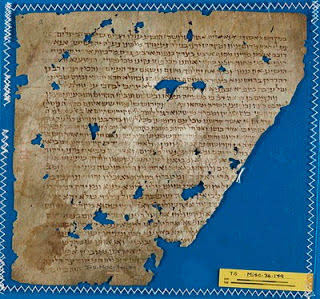
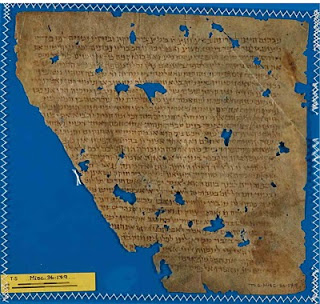
1. It is well-known that the Mishnah in the tenth chapter of Pesachim includes a set of mah nishtannah. But if one opens a standard printed Babylonian Talmud (Pes. 116a), one sees four questions[2] in the text of the Mishnah (matzah, maror, roast, and dipping), while if one opens a standard printed Jerusalem Talmud, one sees three (dipping, matzah and roast). Is this an instance of a disagreement between the text of the Mishnah preserved in Babylonia and the text of the Mishnah preserved in Palestine? There are such disagreements,[3] but this is not one of them. Here, the manuscript evidence points overwhelmingly to the conclusion that the original text of the Mishnah recorded only the questions of dipping, matzah and roast.[4] Moreover, if one opens up a standard Masechet Pesachim of the Babylonian Talmud and looks at the text of the Mishnah recorded in the Rif and the Rosh, one sees that they too record a Mishnah which included only the questions of dipping, matzah and roast. Also, Rambam utilized a text of the Mishnah which included only these three questions.[5] Let us see how the Encyclopaedia Judaica in its original and new editions deal with this issue. When Daniel Goldschmidt published his classic work on the Haggadah in 1960, after earlier German and Hebrew versions,[6] he clearly took the position that the original text of the Mishnah included only three questions.[7] It was therefore somewhat surprising when the “Mah Nishtannah” entry in the original Encyclopaedia Judaica (published in 1972 and written by the anonymous editors) stated that “[t]he Mishnah enumerates four questions.” In its bibliography, this entry had cited only Goldschmidt’s 1960 work, and one other less scholarly source.[8] We are now in the 21st century. There is now a widespread consensus among scholars that the original text of the Mishnah included only three questions.[9] But when one looks at the new edition of the Encyclopaedia Judaica, one finds only a reprint of the original entry![10] —— 2. A widely quoted explanation of the Vilna Gaon takes the positions that there were always four questions, and that, after the churban, the roast question was substituted by the reclining question.[11] We have already seen that the first of these positions is incorrect. The Haggadah fragments found in the Cairo Genizah show that the second of these positions is incorrect as well. Genizah material generally dates from the 10th through the 13th centuries.[12] It is reasonable to assume that this is roughly the period of the Haggadah fragments from the Genizah.[13] Of course, not all of the Haggadah fragments from the Genizah span the mah nishtannah section. But of those that do, many include the roast question.[14] (The survival of the roast question for 1000 years, post-churban, has been implicitly acknowledged in the Haggadah shel Pesach, Torat Chayim, published by Mossad ha-Rav Kook, at p. 29, n. 59.) [15] Furthermore, although most of the mah nishtannah Haggadah fragments found in the Genizah record four questions the way they are asked today,[16] we also find the following:[17] -Several record three questions: matzah, dipping, and roast,[18] just like the original text of the Mishnah. Most likely, the fragments with these three questions reflect the original Palestinian tradition of the Haggadah,[19] which followed the text of the Mishnah, and the fragments with four questions reflect the Babylonian tradition,[20] which gradually penetrated into Palestine and its surrounding areas.[21] -One records the following three questions: dipping, matzah and reclining.[22] -One records five questions: dipping, matzah, roast, maror, and reclining.[23] (See the photograph in M. Kasher, Haggadah Shelemah, p. 93.) In this fragment, the roast question is phrased:… צלי כולו המקדש בבית אוכלים היינו הזה והלילה. This is the only fragment in which the roast question is phrased with such a qualification. [24] -Two record only the questions of dipping and roast.[25] (But there does not appear to be any reason why the matzah question would have been intentionally discontinued. Perhaps the matzah question was accidentally dropped by a scribe in one source, and further copies were later made from that source. It would have been easy for a scribe to accidentally turn his eye to the wrong mah nishtannah line in the source he was copying from, and thereby omit a question.) – One records only the questions of dipping and matzah. I would like to focus on this last source, which is not actually a Haggadah fragment, but is a section of an anonymous Geonic responsum which includes an outline of the procedures at the seder. It can be deduced that the responsum was composed in Babylonia because it includes avadim hayyinu, which was not a part of the Palestinian seder ritual in this period.[26] This responsum was published by Louis Ginzberg, in his Ginzey Schechter, vol. 2, pp. 258-260. [27] Theoretically, it is possible to argue that the author of this responsum gave only an abbreviated version of the mah nishtannah, and listed only the first two questions, even though his practice was four. This seems to be the understanding of Ginzberg, who writes (p. 259, n. 1): הראשונות השאלות ‘ב אלא כאן נאמרו ולא נתקצר נשתנה מה נוסח. B.M. Lewin included this responsum in his Otzar ha-Geonim, Pesachim (pp. 154-55), and he seems to agree with Ginzberg. (See p. 154, n. 13: נתקצר נשתנה מה נוסח.) But this interpretation seems very unlikely. The whole purpose of the responsum was to spell out the procedures and text of the seder. Abbrevation here would have defeated its purpose. The Safrais take a different approach to this responsum in their monumental work, Haggadat Hazal. They write (p. 64, n. 53) that the third and fourth questions are העמוד בסוף חסרות, implying that these questions were originally included in this responsum but were cut off. Moreover, in their chart on p. 266, they put brackets over a supposed area of the third and fourth questions in this responsum, implying that these questions were once there. They take this approach so that the set of questions in our responsum could then parallel the set of questions found in the other known Babylonian Geonic sources of the Haggadah text: Seder R. Amram Gaon, Siddur R. Saadiah Gaon, and the Haggadah text published in 1984 by M. Lehman.[28] All these sources record the standard four questions: dipping, matzah, maror, and reclining.[29] But I was able to view an image of the responsum (T-S Misc.36.179), and with the kind permission of the Cambridge University Library, have included this image at the end of this article. It is clear that the third and fourth questions were never there. The first side of the fragment ends with the last words of the matzah question (the last three words of this question were written below the last regular line), and the next side continues immediately with avadim hayyinu. It is clear from the image that there are no missing lines in between. Assuming we reject the unlikely interpretation of Ginzberg, this source records a two-question set in Babylonia.[30] The idea that we have now been able to “excavate” such a set, evidence of a period before four questions became the universal practice there, is truly remarkable. An issue remains whether the responsum dates to the period before the maror and reclining questions were added in any Babylonian communities, or whether it dates to a period after they were added, but was composed in a community which did not add them. The latter seems more likely. (The responsum does have at least one other unique aspect.[31] It includes the statement: חורים בני היום[ו] עבדים היינו אתמול. The Safrais discuss this statement at p. 111 and do not mention any other fragments from the Genizah with this language.[32] On the image at the end of this article, this statement is found on the first page, six lines above the last full line.) Regarding the issue of when the maror and reclining questions were added, the following are some reasonable observations that have been made by scholars to date: ◦ The reclining question was probably the last question to be added.[33] Unlike the maror question, it did not make its way into in any manuscripts of the Mishnah,[34] and in all communities, it is the last question of the set.[35] ◦ The maror question probably did not arise until after the text of the dipping question was changed in Babylonia (see Pes. 116a[36]) and the dipping question lost its connotation as a maror question. Once the dipping question lost this connotation, it was probably viewed as necessary to add a question relating to maror.[37] ◦ The reclining question probably originated in Babylonia as well.[38] It was probably added, after the maror question, due to a desire to fix the number of questions at four, parallel to the themes of four cups of wine and four sons.[39] Aside from Haggadah fragments found in the Genizah, the earliest sources which include the reclining question are: Seder R. Amram Gaon,[40] Siddur R. Saadiah Gaon,[41] and the Geonic Haggadah text published by Lehman in 1984. (With regard to Seder R. Amram Gaon, it is accepted that many additions and changes were made to it in the centuries after R. Amram’s death, c. 875. The three surviving manuscripts of the work are only from the 14th-16th centuries. See D. Goldschmidt, Seder R. Amram Gaon, pp. 11-13. With regard to the Siddur R. Saadiah Gaon, the material in our possession has traditionally been viewed as representing a generally reliable version of the original 10th century work by R. Saadiah.[42] With regard to the Geonic Haggadah text published by Lehman, see above, n. 28.) —— 3. A main issue of debate among scholars has been whether the mah nishtannah set of the Mishnah reflects questions from Temple times. If we focus on the roast question ( הלילה הזה כולו צלי ), a reasonable initial assumption is that this question is referring to the pesach sacrifice, since the pesach sacrifice was something that was required to be roasted. This would suggest that this question, and hence perhaps all the questions, were composed during Temple times. But many scholars argue that the roast question is not referring to the pesach sacrifice and that this question was composed after the churban (and hence, the other questions probably were as well.) They make the following arguments: 1. A practice arose after the churban, approved (or perhaps initiated) by Rabban Gamliel of Yavneh, of eating a gedi mekulas as a method of commemorating the pesach sacrifice.[43] See Betzah 2:6-7 and Eduyyot 3:10-11. (Although these two sources do not specify that the Rabban Gamliel they are referring to is Rabban Gamliel of Yavneh, it seems fairly clear, for a variety of reasons, that this is the case here.[44]) The meaning of the term mekulas is subject to debate.[45] Nevertheless, it is clear that the gedi mekulas was not designated as a pesach sacrifice, but was arranged on the spit during the roasting process in the same manner as a pesach sacrifice, and was roasted in its entirety just like a pesach sacrifice. See Tosef. Betzah 2:11 (איזהו גדי מקולס? כולו צלי ראשו וכרעיו וקרבו ) and Pes. 74a.[46] The Sages prohibited the gedi mekulas,[47] but it is possible that a large section of Jewry followed the leniency of Rabban Gamliel and engaged in this practice.[48] The roast question could have been composed post-churban in an area which followed this practice and could be referring to this practice.[49] 2. The Mishnah at Pesachim 4:4 records:מקום שנהגו לאכול צלי בלילי פסחים, אוכלים; מקום שנהגו שלא לאכול, אינן אוכלין. It is possible that this Mishnah was composed during Temple times and is referring to a practice of eating roast meat on the seder night outside the Temple. But just as likely, this Mishnah was composed after the churban and is referring to a post-churban practice of eating roast meat[50] as a commemoration of the pesach sacrifice. It is possible to understand the roast question in the Mishnah as composed, post-churban, in an area which followed this practice and as referring to this practice.[51] But (as pointed out to me by my friend Sam Borodach) the precise phrasing of the roast question does not support either of these interpretations. When read in light of the parallel matzah question, the roast question implies that the question is about a required behavior of the evening. While there were areas which had a custom on this evening, post-churban, to eat a gedi mekulas or to eat roast meat, these were not required behaviors. It is hard to imagine the roast question phrased the way it was by someone composing it with the above optional commemorative behaviors in mind. The language of the roast question, read in light of the parallel matzah question, fits the pesach sacrifice best.[52] Does it follow from this interpretation that the roast question was composed during Temple times? Not necessarily. Even if the roast question is referring to the pesach sacrifice, it very possibly could have been composed after the churban, as a simulation of a question that might have been asked during Temple times. Once the idea for a mah nishtannah question about matzah took hold, it would be have been natural and instructive to create a parallel question covering such an important commandment as the pesach sacrifice, even if the pesach sacrifice was no longer being offered. (All the more so if practices commemorating the pesach sacrifice were ongoing!) (It is also possible to understand the roast question as having been composed post-churban if the pesach sacrifice itself continued after the churban.[53] But the evidence for this is weak.[54]) The Mishnah that concerns us, Pesachim 10:4, is found in the last chapter of this masechet. This suggests that this Mishnah was composed after the churban, since it is reasonable to presume that mishnayot that are presented in the early parts of a masechet were composed first and that mishnayot that are presented later were composed later.[55] Moreover, there is specific evidence suggesting that this particular chapter was composed after the churban. Mishnah 10:3 includes the statement:ובמקדש מביאין לפניו גופו של פסח. This statement suggests that the normative statements in this chapter describe only post-churban practice.[56] Of course, the questions themselves could still reflect questions from earlier times, which were recorded in a chapter composed after the churban. Based on recent scholarly developments, a new argument can be made to support the idea that the questions were composed post-churban. The mah nishtannah is not included in the tenth chapter of the Tosefta. This chapter includes much material parallel to the tenth chapter of the Mishnah. In his Tosefta Atikta, published in 2002, Shamma Friedman studied the relationship between the Mishnah and Tosefta of Pesachim in the first four chapters and in the tenth chapter.[57] He came to the conclusion that the material in the Tosefta in these chapters seems to have originated earlier.[58] If Friedman is correct, this also tends to support a post-churban origin for the mah nishtannah. So far, I have not discussed the precise role that the mah nishtannah serve in the Mishnah. But most likely, the mah nishtannah of the Mishnah was not a mandated piece of liturgy to be recited by the father or a typical son. Rather, it was what the child who lacks understanding is taught to ask (…מה נשתנה אביו מלמדו, אם אין דעת בבן).[59] This also perhaps implies that the mah nishtannah text was a later development. ——– Note finally that the Talmud, at Pes. 70a, records and accepts a statement by R. Hisda that the roast question was authored by Ben Tema. Ben Tema took the position that the chagigah too had to be roasted. In the view of R. Hisda, the language of the roast question, הלילה הזה כולו צלי, fit the position of Ben Tema only. Ben Tema is only mentioned at Pes. 70a and Yoma 83a and there is not enough information to determine if he lived during Temple times. (Some suggest that he is to be identified with R. Judah Ben Tema, who probably dates to the second century C.E,[60] but this identification is only conjecture.) The above statement of R. Hisda is not recorded again at Pes. 116a, where one would expect it.[61] R. Hisda’s statement is also surprising, because it takes an overly literal approach to the roast question. There is also no statement in the Jerusalem Talmud expressing the view that the roast question was authored by Ben Tema.[62] ———- To summarize, it is possible that the mah nishtannah was composed during Temple times, but it also possible that it was composed post-churban. In support of the latter is that the mah nishtannah is found in the last chapter of the masechet, and in a chapter whose normative language suggests that it was composed post-churban. The inclusion of a question about roast meat is not inconsistent with this approach. This question could have been composed post-churban in an area which followed the post-churban practice of preparing a gedi mekulas or in an area which followed the post-churban practice of eating roast meat. More likely, if the question was composed post-churban, it is referring to the pesach sacrifice and was composed for educational purposes, as a simulation of a question that might have been asked during Temple times. The fact that the mah nishtannah is not included in the Tosefta may also support a post-churban origin for it. ——— Cambridge University Library T-S Misc.36.179 (reproduced by kind permission of the Syndics of Cambridge University Library)

[1] I would like to acknowledge Dr. Jay Rovner, Rabbi Mordy Friedman, and Sam Borodach for their thoughts and assistance. The views expressed are solely my own. Several sources will be cited throughout: -D. Goldschmidt, Haggadah shel Pesach (1960), cited as “Goldschmidt.” -M. Kasher, Haggadah Shelemah (third ed., 1967), cited as “Kasher.” -Y. Tabory, Pesach Dorot (1996), cited as “Tabory.” -S. and Z. Safrai, Haggadat Chazal (1998), cited as “Safrai.” -S. Friedman, Tosefta Atikta: Masechet Pesach Rishon (2002), cited as “Friedman.” -R. Steiner, “On the Original Structure and Meaning of Mah Nishtannah and the History of Its Reinterpretation,” JSIJ 7 (2008), pp. 1-41, cited as “Steiner.”[2] I will call them questions, even though some have argued that they are best understood, in the context of Mishnah 10:4, as explanations or exclamations. See, e.g., Safrai, pp. 31 and 206, and the sources cited by Steiner, pp. 21-22. Steiner strongly defends the traditional understanding of the mah nishtannah as questions (actually, as one long question). He points out that the Talmud (Pes. 116a) includes the following passage:ת”ר חכם בנו שואלו ואם אינו חכם אשתו שואלתו ואם לאו הוא שואל לעצמו ואפילו שני תלמידי חכמים שיודעין בהלכות הפסח שואלין זה לזה מה נשתנה הלילה הזה מכל הלילות שבכל הלילות אנו מטבילין פעם אחת הלילה הזה שתי פעמים:(Although the printed editions have punctuation between שואלין זה לזה and מה נשתנה, this punctuation is only a later addition. See Steiner, p. 26, n. 95, and Kasher, p. 35. But see Goldschmidt, p. 11, and Safrai, p. 112, for a different approach to the above text.) Steiner argues that the Mishnah is most properly understood as intending only one (long) question, i.e., “what special characteristic of this night is causing us to depart from our normal routine in so many ways?” He shows that R. Saadiah Gaon and every early medieval source understood the mah nishtannah as only one long question. It was not until the 13th century that a medieval source first referred to them asשאלות (plural). A study of the the mah nishtannah inevitably raises other issues. Is the mah nishtannah to be recited by the child only if he cannot formulate his own questions? Is it perhaps to be recited by the father? On these issues, see, e.g., Goldschmidt, pp. 10-11, Kasher, pp. רד-רב, Safrai, p. 31, ArtScroll Mishnah Series, comm. to Pes. 10:4, p. 210, and J. Kulp and D. Golinkin, The Schechter Haggadah: Art, History, and Commentary, p. 196. Most likely, the correct understanding of Mishnah 10:4 is that the mah nishtannah is what the child who lacks understanding is taught to ask. See Steiner, pp. 26, and 33-36. (Steiner suggests that we should read the beginning of Mishnah 10:4 elliptically as if it includes the words לשאל after בבן דעת אין, and again after אביו מלמדו.) It was only sometime in the post-Talmudic period that the mah nishtannah began to be treated as a mandated piece of liturgy.[3] A well-known example is the first Mishnah in the fourth chapter of Bava Metzia. On this topic generally, see M. Schacter, “Babylonian-Palestinian Variations in the Mishnah,” JQR 42 (1951-52), pp. 1-35. [4] This is what the earliest and most reliable Mishnah manuscripts record. See Safrai, p. 26 and Tabory, pp. 260, 262, and 361.With regard to the order of these three questions, almost all of the early sources which record the mah nishtannah as dipping, matzah and roast, record them in that precise order. See Tabory, p. 262. Kasher, p. 113, n. 6, refers to eight manuscripts of the Babylonian Talmud to Pesachim which include the Mishnah. All but one include only the above three questions in their text of the Mishnah (in the order dipping, matzah, and roast). (In this note, Kasher did not cite the Munich 95 manuscript of the Talmud, which also includes only these three questions, because it includes them in a different order.) Almost certainly, it was the familiarity of later copyists with the maror question from the texts of their Haggadah that led them to insert it into texts of the Mishnah. See H. Guggenheimer, The Scholar’s Haggadah, p. 250. Now that it has been established that Mishnah 10:4 includes only three questions, many scholars claim that the three explanations of R. Gamliel at Mishnah 10:5 (pesach, matzah, maror) are the answers to the mah nishtannah. But this approach must be rejected. As Steiner explains (pp. 32-33), although the topics of the mah nishtannah match the topics of the three explanations (the dipping question was the maror question of the time), the “explanations” given do not specifically answer the questions posed. Moreover, the mah nishtannah is most properly understood as only one long question, i.e., “what special characteristic of this night is causing us to depart from our normal routine in so many ways?” If so, what we should be looking for in an answer is one fundamental answer and not three piecemeal ones. According to Steiner, כל הפרשה … מתחיל בגנות is the answer expressed in the Mishnah to the mah nishtannah. (The prevalent view among the Rishonim was that avadim hayyinu was the answer to the mah nishtannah. See Steiner, p. 31. But avadim hayyinu is not found in the Mishnah, and was not even included in the Palestinian seder ritual. See Steiner, p. 32 and below, n. 26.)[5] See the edition of the Rambam’s commentary on the Mishnah published by Y. Kafah. Rambam copied a text of the Mishnah (presumably one that he felt was authoritative) and wrote his commentary on that text. For most of the sedarim of the Mishnah (including Pesachim), we have this text of the Mishnah and the Rambam’s commentary, all written in the Rambam’s own hand. This text of the Mishnah with the Rambam’s commentary was published by Kafah. The edition of the Rambam’s commentary on the Mishnah included in a standard Talmud volume does not include a text of the Mishnah.[6] The German version was published in 1936. The earlier Hebrew version was published in 1947.[7] Goldschmidt, pp. 11-12. He also clearly took this position in the 1947 version (pp. 9-10, and p. 29). I have not seen the 1936 version.[8] The other source cited was: “J. Levy, A Guide to Passover (1958).” There is a typographical error here, as the author’s name was Isaac Levy. This was not a work which compared in any way with the level of scholarship reflected in Goldschmidt’s 1960 Haggadah. At p. 27, Levy assumed, without any discussion, that the Mishnah enumerated the matzah, maror, roast, and dipping questions.[9] E.g., Safrai, p. 26, Tabory, pp. 260, 262 and 361, Steiner, p. 32, and Kulp and Golinkin, pp. 198-99.[10] It includes no new bibliographical references either, unlike many of the other entries.[11] The Gaon’s explanation is printed at Kasher, at p. 115. According to this explanation, reclining at the seder would not have been a shinui prior to the churban, since it was the practice to eat while reclining all year round. Only after the Temple was destroyed did reclining at the seder become something unusual. At the same time, the pesach sacrifice ceased. The Gaon’s explanations to the Haggadah were first published in 1805 (a few years after his death) by his student R. Menachem Mendel of Shklov. The Encylopaedia Judaica entry “Mah Nishtannah” also essentially follows the approach of the Gaon. Another widely quoted view is that of the Rambam, who writes that there were originally five questions before the question about roast meat was dropped. The Rambam writes (Hilchot Chametz u-Matzah 8:3): בזמן הזה אינו אומר והלילה הזה כולו צלי שאין לנו קרבן. [12] R. Brody, The Geonim of Babylonia and the Shaping of Medieval Jewish Culture, p. 32.[13] For a listing of the Haggadah fragments from the Genizah, see Safrai, pp. 293-301. Most of these have not been published.[14] For some published examples, see: 1) I. Abrahams, “Some Egyptian Fragments of the Passover Haggadah,” J.Q.R. (O.S.) 10 (1898), pp. 41-51, fragments # 2, 7,8 and 10; 2) the Haggadah manuscript first described briefly in an article by J.H. Greenstone in 1911, and later published in full by Goldschmidt; 3) the Haggadah manuscript published by Jay Rovner, “An Early Passover Haggadah According to the Palestinian Rite,” J.Q.R. 90 (2000), pp. 337-396, and 4) MS Cambridge T-S H2.152 (photograph at Kasher, p. 93). There are other such fragments as well. For example, see Safrai, p. 53, n. 21 and p. 114, nn. 9 and 11. (The manuscript published by Rovner is probably, but not certainly, from the Genizah.). In only one of these texts (T-S H2.152) was the text of the question amended to צלי כולו המקדש בבית אוכלים היינו. With one exception (see below), the roast question is found only among sets of mah nishtannah which are based on the three questions included in the Mishnah. These sets either follow the set of three included in the Mishnah, or have a modified version of the set which leaves out the matzah question (perhaps erroneously, see the discussion in the text). (But not all of the fragments which include the roast question include a complete set of questions, so the above conclusions are not absolute.) The exception is T-S H2.152 which includes the roast question along with four other questions. One text from the Genizah (Abrahams, fragment #5) includes the following blessing immediately after ha-motzi: מרורים מצות לאכל אבותינו את צוה אשר העולם מלך … ‘ה ‘א ‘ב הברית זוכר ‘ה ‘א ‘ב גבורותיו את להזכיר אש צלי בשר(The Safrais quote this text at p. 30, but erroneously leave out the words אבותינו את.) Whatever community was using this text was almost certainly eating roast meat at their meal, although Tabory (p. 103) raises the possibility that they may have only been partaking a small, symbolic amount. A similar blessing is found in a different Genizah fragment printed by the Safrais at p. 289. There, however, the blessing is included before the blessing for washing and ha-motzi, so it is less clear that the blessing was meant to precede the actual eating of roast meat. Regarding the concluding blessing הברית זוכר, there are other fragments from the Genizah which include such a blessing in this section of the Haggadah (without reference to אש צלי בשר ). See, e.g, the Greenstone-Goldschmidt manuscript (Goldschmidt, p. 83), and Abrahams, fragment #7. For further discussion of this concluding blessing, see Goldschmidt, p. 60, n. 10.

[15] The passage reads:
זו שאלה גם גורסים הגדות שבמספר י עמ׳ שלמה הגדה עי׳.

[16] Safrai, p. 113. (I am not concerned with variation in the order of these four questions.)[17] In this section, I am only including fragments whose total number of questions in their mah nishtannah set can be determined. Therefore, I am not including fragments such as Abrahams #7 and Abrahams #8, which include mah nishtannah questions but which are cut off mid-set. For example, Abrahams fragment #7 starts with the roast question, but is cut off before it. Abrahams fragment #8 starts in the middle of the matzah question. [18] See, e.g., Abrahams, fragments #2 and #10. See also our discussion below of the Greenstone-Goldschmidt fragment. Safrai writes (p. 65) that ניכר מספר of the Haggadah fragments from the Genizah are of this type. [19] Safrai, pp. 26, 64 and 113. But a few fragments which include the roast question follow the Babylonian rite in other essential respects. See Safrai, p. 30, n. 55, and p. 114, n. 9.[20] Safrai, pp. 113 and 206.[21] We know from many other contexts that Babylonian customs gradually penetrated into Palestine and its surrounding areas and became the majority custom. See, e.g., Brody, The Geonim of Babylonia and the Shaping of Medieval Jewish Culture, pp. 111, 115, and 117. (An example is the practice of reciting kedushah in the daily amidah. The letter of Pirkoi ben Baboi, early 9th cent., describes how Babylonian Jews moved to Palestine and forced Palestinian Jews to adopt the Babylonian practice of reciting kedushah daily.) See also I. Ta-Shema, Ha-Tefillah ha-Ashkenazit ha-Kedumah, p. 7. [22] See Kasher, p. 113, n. 11. Kasher calls this manuscript “21ק.” It is MS Cambridge T-S H2.145. It is possible that this is not a legitimate variant and that the maror question was omitted in error by the scribe who copied this fragment. As explained in the text, the reclining question was almost certainly the last question added and there was little reason for a community to have dropped the maror question. We also have evidence of a mah nishtannah set of dipping, matzah, and maror. This does not come from the Genizah, but from additions inscribed at the end of a certain siddur. The siddur was authored by a rabbinic authority from Morocco, who lived in the 11th or 12th century. The additions, inscribed by the owner of the siddur, describe various local rites, and include a mah nishtannah set of dipping, matzah and maror. See Rovner, p. 351, n. 57.[23] T-S H2.152. [24] Safrai, p. 53. This set is so aberrant that it may not reflect an actual rite. Possibly, the set was created by a lone scribe who combined the various questions that he knew of into one set. Since this set records the language of the roast question in a manner found nowhere else, this is evidence that the scribe who copied this fragment may have been a creative one.[25] The Haggadah manuscript published by Rovner clearly records only these two questions. The Greenstone-Goldschmidt manuscript initially recorded only these two questions, but a later scribe inserted the matzah question. See the last line of fragment א/ד and the first line of fragment ב/ד, in the photos at Goldschmidt, p. ii. These photos show that these lines are in a different handwriting. (The Safrais also print a text of the Goldstone-Goldschmidt manuscript. But they print it as if it included all three questions initially. See Safrai, pp. 286-89.) [26] Safrai, p. 50. See also the responsum of R. Natronai Gaon quoted, for example, at Kasher, pp. 27-28, Goldschmidt, p. 73, and Safrai, pp. 56-57. (In this responsum, R. Natronai criticizes an alternative Haggadah ritual for many reasons, one of which was the ritual’s omission of avadim hayyinu. R. Natronai thought it was a sectarian Haggadah ritual. It turns out that he was criticizing the Palestinian Haggadah ritual. See Goldschmidt, p. 74, Safrai, pp. 56-59, and Brody, p. 96.)[27] It is cited in Kasher, p. 113, n. 11 with the symbol ש. The responsum is not devoted solely to the seder. The first few lines of the responsum, whose beginning is cut off, deal with the hoshanot of Sukkot.[28] M. Lehman, Seder ve-Haggadah Shel Pesach le-Rav Natronai Gaon Al Pi Ketav-Yad Kadmon, in Sefer Yovel li-Chevod Morenu ha-Gaon Rabi Yosef Dov ha-Levi Soloveitchik Shelita, ed. S. Israeli, vol. 2, pp. 976-993, at p. 986. The title of Lehman’s article is unfortunate. The text of the article does not even claim that the Geonic Haggadah text published there served as the Haggadah of R. Natronai Gaon. Lehman composed the article initially based on a manuscript which spanned three sections, one of which was a Haggadah text. The first section of the manuscript included a caption stating that the material in that section (a long paytanic version of kiddush for Passover, and a long paytanic version of the blessing before drinking the second cup) was enacted and arranged by R. Natronai. The Haggadah section had its own caption which stated that what followed was the text of the Haggadah accepted by the Talmud and the Geonim (with no mention of R. Natronai). Three Passover-related responsa followed, without any caption. Later, Lehman acquired another page from the same manuscript. He writes that the body of his article was already in final form by this time, but he was able to add his discussion of the new page at the end of the article. The new page included three anonymous responsa, one of which is recorded elsewhere in the name of R. Hai Gaon. This made Lehman realize (p. 991) that his pages were part of a collection of material from various Geonim, and not material that may all have had some connection to R. Natronai. Probably, the article was given its title (by Lehman or perhaps by someone else) before Lehman acquired the additional page. But even before Lehman acquired the additional page, the title was unjustified, as the Haggadah section had its own caption which did not connect it to R. Natronai. (Despite its caption, even the material in the first section of the manuscript may not have been composed by R. Natronai.) It is unfortunate that the Safrais refer to Lehman’s text throughout their work as the “Haggadah of R. Natronai Gaon.” It is evident fom their discussion of this text (p. 261) that all they were really willing to accept is that the text reflected a Haggadah from the time of the Geonim in general.[29] See Safrai, pp. 261 and 266.[30] See Kasher, p. 42, J. Rovner, “An Early Passover Haggadah: Corrigenda,” JQR 91 (2001), p. 429 (correcting p. 351, n. 59 in his original article), and J. Kulp and D. Golinkin, The Schechter Haggadah: Art, History, and Commentary, p. 199. Note that the Rif quotes a text of M. Pesachim 10:4 which includes only the questions of dipping, matzah and roast, and then remarks פסחא לן דלית צלי בשר לימא לא והשתא. It can be argued based on this that, in his community, the mah nishtannah at the seder may have only included dipping and matzah.[31] Perhaps close examination of the responsum will reveal other unique aspects. The responsum follows an alternative nusach for kiddush, but this nusach is widely attested to. See, e.g., Siddur R. Saadiah Gaon, pp. 141-142, Kasher, pp. 183-85 and ג-ב, Safrai, p. 61, and Lehman, pp. 977-980 and 982-83. The responsum records the Sages in Bnei Brak as having been מסיחין about yitziat mitzrayim all night. But there is other evidence for this reading or its equivalent: משיחין. See Safrai, p. 208.[32] But this language is recorded in the haggadot of Djerba (which also include the standard language that we are now slaves and will be free next year). See Kasher, p. 201, and Safrai, p. 111, n. 6. (Djerba is an island off the coast of Tunisia. The Jewish community there has ancient roots. ) R. Shlomo Goren saw fit to to include the above Geonic language (along with the standard language) in the haggadah he composed for the use of the Israeli army. See, e.g., Kasher, p. 201, citing the 1956 edition of the Haggadah Shel Pesach published by הראשית הצבאית הרבנות. Many editions of this haggadah were published and I saw this language in later editions as well. Kasher discusses the Geonic language at pp. 198-201 and attempts to provide a rationale for it.[33] Tabory, p. 260.[34] The maror question made its way into some, but not the earliest, texts of the Mishnah. See Tabory, p. 261.[35] Tabori, p. 261, n. 36.[36] In Amoraic Babylonia, there was no practice of dipping throughout the year. This led the Babylonian Amoraim to rephrase the question. Based on the statements by the Babylonian Amoraim expressed at Pes. 116a, the text of the dipping question was changed in many Mishnah manuscripts. Various forms of the question developed. See Safrai, p. 27, and Goldschmidt, p. 77.[37] Tabory, pp. 261-262. Almost certainly, the original formulation of this question described the herb as מרורים. See Siddur R. Saadiah Gaon, p. 137, Goldschmidt, p. 12, Kasher, pp. 113-14 and pp. יא-י (variant readings), and Tabory, p. 261. See also Rambam, Hilchot Chametz u-Matzah 8:2. (In the nusach ha-haggadah included in the standard printed Mishnah Torah, the reading is מרור. But the Frankel edition points out that some versions read מרורים here.) מרורים is the phrase used in the Bible (Ex. 12:8 and Num. 9:11). Moreover, the singular מרור refers to only one of the five herbs with which one can fulfill one’s obligation. See M. Pes. 2:6.[38] In suggesting that both the maror and reclining questions arose in Babylonia, I am following the approach of the Safrais. The Safrais believe that even though the majority of the mah nishtannah Haggadah fragments from the Genizah include dipping, matzah, maror and reclining, these fragments do not reflect the original Palestinian custom. These fragments only show that the Babylonian custom became the majority custom in Palestine and its surrounding areas. [39] Guggenheimer, p. 250. [40] P. 113 (ed. Goldschmidt).[41] P. 137.[42] But N. Cohen has noted several contradictions between the instructions provided by R. Saadiah and the liturgical texts, and between parallel prayer texts in different sections. According to Cohen, some of the liturgical texts included in the Siddur may have been supplied by later copyists, or at least changed by them. See Cohen, le-Ofiyyo ha-Mekori shel Siddur Rav Saadiah Gaon, Sinai 95 (1983/84), pp. 249-67. Cohen does not address the mah nishtannah in her study.[43] A gedi (=young goat) was one of the animals permitted for the pesach sacrifice. Ex. 12:5 states that the pesach sacrifice must come מן הכבשים ומן העזים (=from a lamb or a goat). [44] One such reason is that plain references to Rabban Gamliel (i.e., without the description “ha-Zaken”) are almost always references to Rabban Gamliel of Yavneh. See Safrai, p. 28, n. 50, E. Schurer, The History of the Jewish People in the Age of Jesus Christ, ed. Vermes, Millar and Black, vol. 2, p. 368, n. 48, and Tos. Niddah 6b, s.v. בשפחתו. A story referring to a practice of preparing a gedi mekulas among Roman Jewry, and the objection of the Sages of Palestine, is found in many sources. See, e.g., Pes. 53a: תודוס איש רומי הנהיג את בני רומי לאכול גדיים מקולסין בלילי פסחים שלחו לו אלמלא תודוס אתה גזרנו עליך נדוי שאתה מאכיל את ישראל קדשים בחוץ … See also Ber. 19a, Bezah 23a, and in the Jerusalem Talmud: Pes. 7:1, Bezah 2:7, and Mo’ed Katan 3:1. Most scholars believe that Todos lived after the churban. See Tabory, p. 98. But there are some scholars who believe that Todos lived during Temple times. See Safrai, p. 28, n. 52. Even if it can shown that there was a practice outside of Palestine of preparing a gedi mekulas during Temple times, this does not mean that there was such a practice in Palestine, where going to Jerusalem and participating in an actual pesach sacrifice was largely possible. (The version of the above story in the standard printed edition of the Talmud at Ber. 19a states that the message to Todos was sent by Simeon b. Shetach. But this is an erroneous reading. See Tabory, p. 98.) Aside from being recorded in both Talmuds, the above story is also recorded in the Tosefta (Bezah 2:11). But the Tosefta has a slightly different reading:תודוס איש רומי הנהיג את בני רומי ליקח טלאים בלילי פסחים ועושין אותן מקולסין… טלא is the Aramaic term for שה, a broader term than גדי . Regarding the significance of this reading, see S. Lieberman, Tosefta ki-Feshutah, 5, p. 959.[45] See the following note.[46] Tosef. Betzah 2:11:איזהו גדי מקולס? כולו צלי, ראשו וכרעיו וקרבו. בישל ממנו כל שהוא שלק ממנו כל שהוא אין זה גדי מקולס … Pes. 74a: איזהו גדי מקולס דאסור לאכול בלילי פסח בזמן הזה כל שצלאו כולו כאחד .נחתך ממנו אבר נשלק ממנו אבר אין זה גדי מקולס (Perhaps it was only the preparation of a gedi mekulas that was forbidden by the Sages, or perhaps the preparation of any kind of מקולס שה was forbidden as well. See the version of the story involving Todos recorded in Tosef. Betzah 2:11 and Lieberman, Tosefta ki-Feshutah, 5, p. 959.) There was a dispute as to the proper manner of positioning the legs and entrails of the pesach sacrifice while it was being roasted. See M. Pesachim 7:1. The view of R. Akiva was that they are hung outside it. This perhaps sheds light on the meaning of the difficult term mekulas. Mekulas in Aramaic can be interpreted as wearing a helmet (see the similar word at Targum Pseudo-Jonathan to I Sam. 17:5). According to Rashi, comm. to Pes. 74a, when R. Akiva expressed the view that the legs and entrails were roasted outside the animal, he meant that they were placed above its head. This made the goat look like it was wearing a helmet. Mekulas would therefore be another way of describing the method of positioning according to R. Akiva. (Rashi elsewhere give a slightly different interpretation of how the term mekulas accords with the view of R. Akiva. See Rashi, comm. to Pes. 53a and Betzah 22b.) An alternative approach is to understand mekulas as meaning “beautiful” or “praised.” See, e.g., Rambam, comm. to Mishnah, Betzah, 2nd chap. The root קלס often has the meaning “to beautify” or “to praise” in rabbinic literature, derived from the Greek word καλος (beautiful). See also J. Gereboff, Rabbi Tarfon: The Tradition, the Man, and Early Rabbinic Judaism, p. 70, where two other Greek derivations for mekulas are suggested: καλως, an animal led on a string, and κολος, a hornless animal. Gereboff also cites S. Krauss for the view that χαυλος in Greek means “helmeted.” See also Tabory, p. 97, n. 248.[47] No reason is given in the Mishnah for the Sages’ prohibition. But in the response to Todos, a reason is given. If the practice of preparing a gedi mekulas is permitted, people will think that kodshim can be eaten outside of the azarah, because the practice was to refer to the gedi mekulas as if it were a pesach offering. Probably, Palestinian Jewry as well as Roman Jewry referred to the gedi mekulas as if it were a pesach offering. See below, n. 54.[48] There would be evidence of this if the custom referred to at M. Pesachim 4:4 is the custom to prepare and eat a gedi mekulas. [49] The Safrais (p. 28), for example, take this approach, as does Friedman (p. 92).[50] Some scholars argue that the custom being referred to in this Mishnah is simply the custom to prepare and eat a gedi mekulas. See, e.g., Safrai, pp. 27-28. But this is not the plain sense of the Mishnah.[51] Scholars who take this approach include G. Allon, The Jews in their Land in the Talmudic Age, pp. 264-65, and Goldschmidt, p. 12. In this approach, the roast question arose in connection with what was perhaps the practice of a large section of Jewry. By contrast, the custom to prepare a gedi mekulas may not have been a widespread custom. [52] A response to this would be that the roast question was phrased the way it was so it could be parallel to the matzah question, even though the phrasing did not exactly fit the concept of an optional commemorative practice.[53] There are those who suggest that the pesach sacrifice (and other sacrifices as well) continued after the churban (perhaps outside the makom ha-mikdash and without the permission of the Sages). See, e.g., J. Brand, “Korban Pesach le-Achar Churban Bayit Sheni,” Ha-Hed 12/6 (1937) and 13/7 (1938), and the references at D. Bleich, Contemporary Halakhic Problems, vol. 1, pp. 247-48. See also Tabory, Moadey Yisrael be-Tekufat ha-Mishnah ve-ha-Talmud, p. 99, n. 65.[54] For example, M. Pesachim 7:2 records a story in which Rabban Gamliel told his slave Tavi to go out and roast “the pesach” on the roasting tray. (The Rabban Gamliel who had a slave named Tavi was Rabban Gamliel of Yavneh. See Safrai, p. 28.) But this story can easily be interpreted as involving only the preparation of a gedi mekulas, post-churban, with the term “pesach” being used only loosely. For similar probable loose usages of the term “pesach,” see Tosef. Ohalot 3:9 and 18:18, and J. Talmud Meg. 1:11. See also Tabory, p. 100-101. The argument that the pesach sacrifice continued after the churban has also been made based on a passage in Josephus’ Antiquities. Josephus writes (II, 313): “to this day we keep this sacrifice in the same customary manner, calling the feast Pascha…” Josephus tells us (XX, 267) that he completed this work in the 13th year of the reign of Domitian (= 93-94 C.E). (The precise year that book II was written is unknown.) But Josephus was writing in Rome, not Palestine, and almost certainly all he meant is that the pesach sacrifice has been kept throughout the centuries through approximately his time. See also B. Bokser, The Origins of the Seder, p. 106. The historian Procopius, describing events in Palestine in the 6th century, wrote: [W]henever in their calendar Passover came before the Christian Easter, [Justinian] forbade the Jews to celebrate it on their proper day, to make then any sacrifices to God or perform any of their customs. Many of them were heavily fined by the magistrates for eating lamb at such times… In the late 4th or early 5th century, the church father Jerome wrote: Take any Jew you please who has been converted to Christianity, and you will see that he practices the rite of circumcision on his newborn son, keeps the Sabbath, abstains from forbidden food, and brings a lamb as an offering on the 14th of Nissan. See Secret History of Procopius, ed. R. Atwater, pp. 260-261 and S. Krauss, “The Jews in the Works of the Church Fathers,” JQR (OS) 6 (1893/1894), p. 237. But almost certainly, these passages are only referring to the practice of slaughtering a gedi mekulas. See Safrai, p. 30, n. 55. (Obviously, the references to “sacrifices” and “offering” in the above passages are only translations.)

There is evidence that the practice of preparing a gedi mekulas on the seder night continued in Palestine through at least the 7th century. This is seen from the Palestinian work Sefer ha-Maasim which dates from this time and includes the following passage:
… קרבו על כרעיו ראשו על שלם ניצלה זה מקולס גדי .

See T. Rabinovitz, “Sefer ha-Maasim le-Vnei Eretz Yisrael:Seridim Hadashim,” Tarbitz 41 (1972), p. 284. Sefer ha-Maasim is a work whose purpose seems to have been to record decisions of halachah applicable in its time. Safrai p. 30, and Rabinovitz, p. 280.[55] Actually, the matter of the order of the chapters in Mishnah Pesachim is not so simple. Some manuscripts of the Talmud and commentaries by Rishonim follow an arrangement in which the tenth chapter follows the first four chapters. All these chapters together are called Masechet Pesach Rishon and the other chapters are called Masechet Pesach Sheni. R. Menachem Meiri writes that this alternative arrangement dates from the time of the Geonim or later. See Safrai, p. 19, n. 1. But some scholars, such as Shamma Friedman, believe that this alternative arrangement has a more ancient origin. See Friedman, p. 12, n. 5. If this alternative arrangement was the original arrangement, it is a mistake to view the tenth chapter as if it were the last of ten chapters.[56] Also, the names of the Sages included in the tenth chapter are: R. Tarfon, R. Akiva, R. Yose, R. Yishmael, Rabban Gamliel, and R. Eliezer b. R. Tzadok. (References to “Rabban Gamliel” in the Mishnah, without the description “ha-Zaken,” are almost always references to Rabban Gamliel of Yavneh. As to R. Eliezer b. R. Tzadok, he was active both before and after the churban.) M. Pesachim 10:6 records that R. Akiva included a prayer for the rebuilding of Jerusalem at his seder. The introductory statement ערבי פסחים סמוך למנחה לא יאכל אדם עד שתחשך and the detailed instructions governing the drinking of wine also give the impression of a chapter composed after the churban, detailing how an individual was obligated to conduct himself in his home. See Friedman, p. 409. Two arguments between Bet Hillel and Bet Shammai are also included in this chapter. In general, these reflect arguments from Temple times. But the author or editor of chapter 10 could simply have inserted this earlier material into a chapter composed after the churban. See Safrai, p. 19. Many printed editions of Mishnah 10:3 read: ובמקדש היו מביאין לפניו גופו של פסח. But היו is a later addition. (See Safrai, p. 25 and Friedman, pp. 89 and 430.) Some have argued that the absence of היו provides a basis for dating this section of the Mishnah, and by implication, the rest of the chapter, to Temple times. In this interpretation, the Mishnah first states the practice in the גבולין in its time (…הביאו לפניו), and then continues with the practice in theמקדש in its time (…ובמקדש מביאין). But as Safrai (p. 25) and Friedman (pp. 89, 430-32 and 438) point out, such an interpretation is very unlikely, and the addition of היו does not change the meaning of the phrase but correctly clarifies the original meaning. The debate about whether the tenth chapter was composed before or after the churban is summarized nicely by Friedman (see, e.g., pp. 88-92, 430-432, and 437-38). Friedman strongly advocates the position that the chapter was composed after the churban.[57] With regard to why these particular chapters were chosen, see above, n. 55.[58] The precise relationship between the Mishnah and the Tosefta has always been an issue. See, e.g., the entry “Tosefta” in the original Encyclopaedia Judaica and the revised entry in the new edition.[59] Steiner, pp. 26, and 33-36. Steiner suggests that we should read this statement elliptically as if it includes the words לשאל after בבן דעת אין, and again after מלמדו אביו.[60] See EJ 10:354 and S. Friedman, le-Ofiyyan shel ha-Beraitot be-Talmud ha-Bavli: Ben Tema u-Ben Dortai, in Netiot le-David: Sefer ha-Yovel le-David Halivni, pp. 248-255.[61] But see Tos., s.v. כולו.[62] Many authorities seem to disregard the statement of R. Hisda. For example, the Rif writes that the chagigah is to be commemorated at the seder by an item that is mevushal. Yet he implies in a different passage that the roast question was a normative question during Temple times. Similarly, the Rambam does not follow the position of Ben Tema (see Hilchot Karban Pesach 10:13), but at the same time, he includes the roast question in his list of mah nishtannah from Temple times. See Hilchot Chametz u-Matzah 8:2 (and Lechem Mishneh there). Note that R. Joseph Caro, OH 473, takes the position that the egg that commemorates the chagigah should be מבושלת. Compare Tos. Pes. 114b, s.v. שני (the halachah follows Ben Tema), and R. Moses Isserles, OH 473 (the egg that commemorates the chagigah must be roasted). Friedman, in his Tosefta Atikta: Masechet Pesach Rishon (2002), pp. 91-92, accepts the essence of the interpretation of R. Hisda, but believes that the roast question must have been composed in accordance with a majority view. This leads him to conclude that the roast question must have been composed after the churban. (In Temple times, a chagigah offering was brought, and according to the majority view, it was not roasted. Since the roast question includes the phrase הלילה הזה כולו צלי, it could not have been composed in accordance with the majority view in Temple times.) In a later article, le-Ofiyyan shel ha-Beraitot be-Talmud ha-Bavli: Ben Tema u-Ben Dortai, pp. 195-274, in Netiot le-David: Sefer ha-Yovel le-David Halivni (2004), Friedman discusses the Ben Tema passage extensively, and takes a different approach.


Final Response

 Final Response

By Marc B. Shapiro

In response to Rabbi Herschel Grossman’s strong criticisms of my Limits of Orthodox Theology, I wrote four responses on the Seforim Blog. You can view them hereherehere, and here. I then stopped responding even though there are still many criticisms I could have commented on. Readers can compare Grossman’s arguments with my replies and draw their own judgment. Grossman has recently responded to my posts and offered further criticisms in an article published in Dialogue. See here.

I do not wish to respond to all of his points in his new article, but I feel I need to make some comments and then I will leave this matter and let the readers decide which side is more compelling. Because Grossman complains in his article that “the merits of the arguments are easily lost in the loose internet format and enthusiastic cheering of his online supporters,” I have decided not to allow comments to this post. I can only express my regret at the style that Grossman chose to adopt in his articles. Had he written in an appropriate fashion then it would have been possible to have had a constructive discussion and debate.

P. 161: “DIALOGUE editors offered the author, Dr. Marc Shapiro, an opportunity to respond directly in these pages. He chose instead to issue a response on his own blog, where he wrote a number of lengthy posts in his defense.”

Dialogue never offered me an opportunity to respond in the journal. The Seforim Blog is not my own blog. I am a writer on it like lots of others.

P. 162: “In his [Shapiro’s] view, the tenets of belief are Rambam’s innovations and are therefore disputable.” The word “innovation” implies that the Rambam invented the doctrines he includes in his principles. I never said such a thing.

P. 163: In giving examples of supposed distortions in my book, Grossman writes: “One example is when Shapiro cites Rivash in support of the statement that Christians believe in a three-part God while the Kabbalists believe in a ten-part God – a clear rejection of the Second Principle. A quick glance at Rivash reveals that he does indeed say such a thing as a quote from a philosopher, which he then proceeds to debunk.”

I would like readers to take a look at the relevant page of my book (p. 40) and see if what Grossman says is correct, that I cited Rivash in support of the statement that Kabbalists believe in a ten-part God.

Pp. 166-167. Readers should see my discussion here. I cite a number of sources that support what I say, and thus contrary to what Grossman states, I do not just insist on my right to offer an interpretation. In note 21 Grossman writes: “Dr. Shapiro attempts to salvage his theory by speculating that the Vilna Gaon may not have really meant what he wrote.” Readers can turn to my discussion here and will see that I never said that.

p. 173. We see here an example of how Grossman just talks past me, leading to nothing productive. I had questioned why in the Mishneh Torah the Rambam did not require that the convert be instructed in the Thirteen Principles. In his original essay, Grossman criticized this question which he said showed lack of understanding of the method of the Mishneh Torah. In my response here I cite rabbinic authorities who deal with this very question, thus showing that it is not an ignorant point, as Grossman portrayed it. One of those I cite is R. Chaim Sofer who writes [1]:

והדבר נפלא הלא יש י”ג עיקרי הדת והי’ לו לב”ד להאריך בכל השרשים

Grossman replies that while I quote R. Sofer, I neglect “to apprise [my] readers of R. Sofer’s subsequent words ‘Rambam didn’t add to the talmudic formula,’ exactly as I had written and directly in contradiction to Dr. Shapiro’s position.”

Here is the paragraph from R. Sofer.

R. Sofer says exactly what I quote him as saying. The final passage in the paragraph, which is mistranslated by Grossman, has nothing to do with my point and does not refute it in any way.

I would also note that in his fascinating Ha-Emunah ha-Ne’emanah, p. 142, R. Dovid Cohen offers an explanation as to why אין לומדים כל י”ג עקרים טרם שיתגייר הגר

P. 174. In Limits I discuss different approaches to the phenomenon of tikkun soferim. While the generally accepted approach is that tikkun soferim is not to be taken literally, I cite a number of authorities who did take it literally and assumed that Ezra or the Anshei Keneset ha-Gedolah made changes to biblical texts (including the Torah). In a later post here (which has nothing to do with Grossman), I cited some other examples of sources that understood tikkun soferim literally. One of those I mentioned is R. Pesach Finfer.[2] He states as follows:

ראוי הי‘ עזרא שתנתן התורה על ידו . . . והוא ונחמי‘ עשו תיקון סופרים וכינויי סופרים

Grossman says that it is unclear what I see in this line. What I see is that R. Finfer states that Ezra and Nehemiah were responsible for tikkunei soferim. This is the same language that is used in other sources that take the notion of tikkun soferim literally. For those who don’t take it literally, Ezra has nothing to do with tikkun soferim. Following the sentence I quoted from R. Finfer, he refers in parenthesis to Radbaz’s comment which offers a different perspective, that tikkun soferim is halakhah le-Moshe mi-Sinai. Here is the page.

While on the topic of tikkun soferim, let me share something else that is relevant. In Limits I mentioned that the evidence points to Rashi understanding tikkun soferim literally, namely, that the biblical text was changed by the Scribes. There was some pushback to this assertion by those could not accept that Rashi would ever hold such a position. Yet subsequent to my book, Yeshayahu Maori also came to the conclusion that Rashi understood tikkun soferim literally.[3] Furthermore, R. Avraham Pessin also explains that Rashi understands tikkun soferim literally.[4] He states that according to Rashi the Anshei Keneset ha-Gedolah had the authority to alter the text of the Torah:

ומבואר ברש”י שניתן הכח לאנשי כנסת הגדולה לשנות גם תורה שבכתב

I find this significant, because although one can point to numerous statements that such an approach in unacceptable, R. Pessin sees it as the clear meaning of Rashi (and among traditional interpreters he is not alone in this understanding[5]). Here are the pages from R. Pessin’s sefer.

Speaking of tikkun soferim, the most famous of which is Gen. 18:22: ‘ואברהם עודנו עומד לפני ה, I found something in R. Solomon Algazi’s Yavin Shemuah (Venice, 1639), p. 15a, which is fascinating and, as far as I know, unique in rabbinic literature. It is also in opposition to Maimonides’ Eighth Principle which establishes that the Torah in its entirety was delivered by God to Moses. In discussing ‘ואברהם עודנו עמוד לפני ה, R. Algazi claims that when God dictated the Torah to Moses, He said that God was standing before Abraham. But Moses on his own, out of respect for God, changed the verse to read that Abraham was standing before God. I guess we can say that this falls between the traditional view that the verse was never changed and the view that the Scribes altered the verse out of respect for God. For R. Algazi it was Moses who made the alteration, but as far as Maimonides is concerned, this is just as problematic as viewing tikkun soferim as an alteration of the Scribes. Here is R. Algazi’s surprising interpretation.

כיון דהב”ה היה אומר לו על כל מלה כתוב א”כ ודאי דהב”ה אמר לו וה’ עודנו עומד דלא איש אל ויכזב ומשה היה משנה על דרך כבוד וכותב ואברהם עודנו עומד א”כ מה שייך בזה הלכה למשה מסיני והוא על דרך המשל שדוד המלך יאמר לסופר מהי’ [מהיר] כתוב שדוד מצוה לפלוני והסופר משנה על דרך כבוד וכותב המלך דוד אבל המלך בעצמו אינו אומר כתוב המלך מצוה כך הב”ה יתעל’ לא אמר למשה שהיה סופר כתוב ואברהם עודנו עומד שהוא דרך כבוד אלא אמר לו האמת וה’ עודנו עומד ומשה שינה על דרך תיקון סופרים

Pp. 175-176. I wrote here: “Even when it comes to other basic ideas of Maimonides, which are not included as part of the Thirteen Principles, we find that scholars wondered why Maimonides did not include them in Hilkhot Yesodei ha-Torah.” I then cited Joseph Ibn Caspi in support of this statement. Here is the page from Amudei Kesef u-Maskiyot Kesef (Frankfurt, 1848), p. 113.

What I would add here is the interesting point that Ibn Caspi, Commentary on Guide 2:32, actually concludes that the Mishneh Torah’s formulation is in line with Maimonides’ true view, namely, that prophecy is a completely natural phenomenon which will of necessity occur if someone has both the ability and training. On the hand, he thinks that the view expressed in Guide 2:32 as being the “opinion of our Law and foundation of our doctrine”, namely, that God might prevent a prophet from prophesying, is not Maimonides’ true opinion, but is an example of the famous “seventh contradiction”.

Grossman is also mistaken when he writes, “In Moreh Nevuchim [2:32], Rambam argues—in opposition to the philosophers—that prophecy is only activated proactively by God, even if the requisite conditions are met.” Maimonides actually says the exact opposite of this. He states that the Torah view of prophecy is identical to the philosophic view except that God can choose, if He wishes, to prevent someone from prophesying even though according to nature he would be a prophet. This is the opposite of what Grossman states, that “prophecy is only activated proactively by God.”

Pp. 176-177: I stated that the notion that Maimonides changed his mind about including Reward and Punishment among the Principles was suggested by R. Solomon of Chelm. To this Grossman replies that Maimonides did not withdraw his belief in Reward and Punishment. It is just that in the Mishneh Torah he classified things differently. Again, Grossman misunderstands. I never said that Maimonides rejected the idea of Reward and Punishment. I was only referring to whether it should be included as part of the Thirteen Principles. As R. Solomon of Chelm explains, Maimonides’ later understanding is that Reward and Punishment is included as part of other principles and thus does not need to be listed separately.

Pp. 177-178. Grossman claims that I cite R. Avraham Hochman in an improper way, and in response R. Hochman states that the entire theme of his sefer “is to show that Rambam’s Principles are absolute and that he derived all of the Thirteen Principles from the Talmud.” He also is quoted as saying, “Academics often quote a question and forget that for the wise, the question is half the answer. But the professors stick to the question and don’t wait around for the answer.” Grossman then speaks of my “brazenness of citing a recognized authority to promote a position that the author himself openly rejects.”

I don’t know if R. Hochman reads English, and could see what I actually wrote, or if he only is responding to what Grossman told him. Either way, his letter, published at the end of Grossman’s article, is a complete distortion of my position. Leaving aside the particular examples that people can see, look at this characterization:

ולפי הבנה מוטעית זו שפך חמתו על הרמבם מנין לו לחדש הלכה שאינה במשנה . . .

Talk about describing a writer inaccurately!

And what is one to make of this statement from him?

אין שום חולק על עיקר מיסודי הדת אלא שנחלקו על מספר העיקרים

It is precisely against such a false view that I wrote my book in the first place. A typical response to the book has been that the opinions in opposition to Maimonides are “not accepted.” But here he denies that anyone actually disagrees with any of Maimonides’ principles. With such an outlook, we can’t even begin to have a dialogue.

The following paragraphs are what I quoted from R. Hochman. Nothing I quote here has any connection to what Grossman states or what R. Hochman writes in his letter responding to my supposed incorrect conclusions that I derived from his words. As the reader can see, contrary to what R. Hochman states, I mention not just his question but his answer as well. Of all of Grossman’s criticisms this one is very difficult to understand, because there is nothing at all controversial in what I write, and my summary of R. Hochman is accurate.

As for my wondering why the Principles are not listed together as a unit, which Grossman sees as an illustration of how I am unaware of the structure of the Mishneh Torah, let me begin by repeating what I wrote in my last post: R. Yaakov Nissan Rosenthal, on the very first page of his commentary Mishnat Yaakov to Sefer ha-Madda, also wonders about the point I made, that the Thirteen Principles as a unit are never mentioned in the Mishneh Torah. (Had I known this when I wrote my book, I certainly would have cited it.)

ותימא למה לא הביא הרמב“ם בספרו ה”יד החזקה” את הענין הזה של י“ג עיקרי האמונה, וצ”ע

R. Avraham Menahem Hochman writes:

מאחר וכל כך חמורה הכפירה, וגדולה החובה לדעת את י”ג העיקרים, כיצד זה השמיטם מספרו ה”יד החזקה”, ולא כתבם כפי שסדרם בפירוש המשנה

והנה אחר שהתבאר שהאמונה בי”ג העיקרים היא בסיס לתורה נשוב לשאלה הרביעית (בסוף פרק ה’) אשר לכאורה היא פליאה עצומה מדוע השמיט הרמב”ם ביד החזקה את החובה הגדולה להאמין בי”ג עיקרים, באופן חיובי, ולא סדרם כי”ג יסודי האמונה שחובה להאמין בהם

R. Hochman goes on to explain that most of the Principles are indeed mentioned in Hilkhot Yesodei ha-Torah in a positive sense (even if not as a unit of Thirteen Principles). He also notes the following important point, that when principles of faith are mentioned in the Talmud, they are never listed in a positive sense, that one must believe X. Rather, they are listed in a negative sense, that one who denies X has no share in the World to Come. Why Maimonides, in his Commentary on the Mishnah, chose to formulate the Principles in a positive sense and require active belief as a necessity for all Jews—something the Talmud never explicitly required—is an interesting point which we will come back to. Regarding some of the Principles the difference is clear. For example, according to the Talmud, denial of Resurrection is heresy, but one who has never heard of the Resurrection and thus does not deny it, or affirm it, is a Jew in good standing. For Maimonides, however, the doctrine of Resurrection must be positively affirmed. In a future post we can come back to which Principles even the Talmud implicitly requires positive affirmation of (obviously number 1, belief in God, but there could be others as well).

After reading these paragraphs, please look at Grossman’s article, pp. 177-178, and R. Hochman’s letter, pp. 188-191, and you will see that nothing there has any connection to what I actually say when referring to R. Hochman. I simply cite him to show that the question I asked is not an ignorant one, as Grossman stated. I also cite R. Hochman’s answer. So Grossman’s seizing on this and printing a lengthy letter from R. Hochman is nothing short of bizarre.

Pp. 178-179. Grossman writes:

Things really start to go “off the rails” when we examine Shapiro’s claim in the name of R. Shlomo Fisher, zatzal, that one need not accept Mosaic authorship, that the Rambam abandoned his principles, and that “Rambam’s formulation of the tenets of Jewish belief was far from universally accepted.”

Grossman responds that he found these attributions questionable so he checked with the family and students, and “they were horrified that anyone would be using R. Fisher’s name in this way.”

What exactly did I say that Grossman finds so objectionable? In Limits of Orthodox Theology, p, 126, I quote the following sentence from R. Bezalel Naor, Post-Sabbatian Sabbatianism (Spring Valley, 1999), p. 8: “The truth, known to Torah scholars, is that Maimonides’ formulation of the tenets of Jewish belief is far from universally accepted.” R. Naor tells us that he heard this insight from his teacher, R. Shlomo Fisher. (Anyone needing any indication of the high regard that R. Fisher held R. Naor in can examine their published correspondence.)

Grossman sees this as a radical statement whose authenticity he cannot accept. I don’t think readers of this blog will find it radical at all. In fact, I have elsewhere mentioned that R. Fisher made this statement in discussing R. Judah he-Hasid’s view on the authorship of the Torah, which diverges from Maimonides’ Eighth Principle. Contrary to Grossman, in none of my posts did I quote R. Fisher as saying that one need not accept Mosaic authorship. I simply cited his view about R. Judah he-Hasid. I also quoted his opinion that medieval Ashkenazic authorities had a different view on the matter of complete Mosaic authorship than Maimonides in that they did not regard the assumption that there are post-Mosaic verses in the Torah as heretical (a view also argued by Prof. Haym Soloveitchik, see here). Grossman claims that R. Fisher could not have said this, even though students can testify to him having said it. In fact, I can state right here that I too heard him make this distinction.

The final point that Grossman can’t accept is what I mentioned in 2007 here, from a student who attended R. Fisher’s weekly shiur on Avnei Miluim. “Interestingly enough, he reported to me that a few weeks ago R. Fisher declared that he believes the Rambam abandoned his system of 13 Principles, the proof being that they are never mentioned as a unit in the Mishneh Torah. In my book, I noted that R. Shlomo Goren held the same view.” Grossman summarizes my statement as “the Rambam abandoned his principles,” which would lead the reader to think that I was saying that the Rambam no longer accepted the truth of his 13 Principles, which would indeed be a radical position. But what I was really talking about, and I refer to this approach in my book, is the notion that the Rambam no longer accepted a system of 13 Principles. This would mean that he adopted another model to categorize the essential dogmas of Judaism, or as R. Goren suggested, maybe he later advocated a conception of Jewish theology like that held by Abarbanel, that one should not distinguish between so-called principles of Judaism and other aspects of the religion, since all must be regarded as equal.

When all is said and done, nothing I have attributed to R. Fisher is strange, radical, or unbelievable. Why Grossman would be horrified by what I wrote is anyone’s guess.

Grossman quotes from a 2018 letter put out by R. Fisher (some might say, put out by his family). In the letter, R. Fisher writes that no one is to quote anything he said in matters of Aggadah and hashkafah without the approval of his sons. This was because in the past he had been misquoted. We all know that misquoting of gedolim is nothing new. There are numerous examples of particular great rabbis being quoted as saying contradictory things, and of these rabbis stating that no one should believe anything they hear in their names unless they hear it directly from the rabbi. Yet this has never stopped people from quoting the gedolim and never will. This is simply the nature of the world. 

R. Fisher gave thousands of shiurim (a tiny percentage of them are online) and there are thousands of students who heard words of Torah from him. As with all students, they have repeated, and will continue to repeat, that which they heard from the rav, just like all students do. They have been doing this for at least fifty years. If R. Fisher’s letter means what it says, that no one is to repeat things that R. Fisher said, then this is simply an impossible request, and it also seems unprecedented in Torah history. It would mean that one who listens to a shiur from him dealing with non-halakhic matters, e.g., this one here, is not allowed to repeat any insights he heard. It would also mean that much of what was mentioned at the many eulogies, where people recalled things R. Fisher said, or on sites such as this and this, is inappropriate. It would mean that students are not allowed to repeat that which they heard from their rebbe. I don’t see how this is possible.

P. 179. Here is something that is really comical. Take a look at this page.

Grossman states that I mention that Shadal (Samuel David Luzzatto) claims that Ibn Ezra believed in post-Mosaic additions to the Torah. He writes: “Upon checking the source, we find yet another instance of Dr. Shapiro citing an author as believing something he actually vociferously denies. As Shadal points out, the primary source for this take on Ibn Ezra was the noted heretic Baruch Spinoza.”

I say this is comical since Grossman doesn’t have a clue as to what is going on here. The only way I can explain this is that Grossman merely skimmed the passage and thus misread it.

Shadal rejects Spinoza who (intentionally?) misunderstood Ibn Ezra to be hinting to the notion that Moses was not the author of the Torah.[6] This misinterpretation of Ibn Ezra is what Shadal rejects (and this is not mentioned in my book because it has nothing to do with what I was discussing). However, exactly as I said, Shadal also states that Ibn Ezra believed in certain post-Mosaic additions to the Torah. Here is the page in Shadal that I cited (as well as the subsequent page) so everyone can see it with their own eyes.

Shadal’s outlook in this matter is no secret, and he repeats this point elsewhere. See e.g., Mehkerei ha-Yahadut, vol. 2, p. 195:

מה שכתב ראב”ע ברמז, היות בתורה מקראות שנוספו בה אחר כמה דורות

In Iggerot Shadal, vol. 2, p. 246, he writes:

כי סברתו שיש בתורה מקראות נוספים קשה מדעת זולתו שקצת מלות מוטעות

In my book and subsequent posts I have identified around forty medieval and more recent authorities who share Shadal’s viewpoint in this matter.[7] Incidentally, R. Joseph Kafih, in his first work written when he was seventeen years old, attacks Shadal for attributing this view to Ibn Ezra. See Sihat Dekalim (Jerusalem, 2005), p. 90.

I must also note that Grossman does not simply miss Shadal’s meaning, but he also compares me to Spinoza in trying to ensnare the unsuspecting masses. If this wasn’t so comical, I might actually take offense. But I think readers should wonder how an author could say such a thing, and how a journal could publish it. It is simply beyond belief, made all the more absurd since Grossman is so mistaken about what Shadal actually states.

Incidentally, since we are talking about Shadal, it is worth noting that R. Elijah Benamozegh, whose commentaries on the Torah continuously dispute with Shadal, when it comes to Ibn Ezra and post-Mosaic additions, Benamozegh has the same position as Shadal. Here is what he writes in Ha-Levanon, July 3, 1872, p. 351, now easily available in the new edition of Em la-Mikra: Bereshit (Haifa, 2021), p. 114:

בראש ספר דברים ובמקומות אחרים רומז בעיניו מולל באצבעותיו ועל דלתות השער יתאו לרמוז שיש דברים בתורה נוספים ולא משה כתבם רק נביאים וצופים. ואני הפרתי את עצתו וקלקלתי את מחשבתו

P. 181. “Shapiro’s weakest scholarship appears when discussing kabbalistic matters.” I agree, which is why I try not to discuss these matters. If I do have to deal with them, I only rely on what recognized authorities have said,

P. 182. I wrote that according to Maimonides’ Seventh Principle, Moses was the greatest prophet who ever lived and there will never be a prophet as great as him in the future. Grossman says that I am mistaken, and that Maimonides does not declare that Moses was the greatest prophet, only that he was the “father of all prophets.” This statement is astounding. There are hundreds of discussions of the Seventh Principle in traditional rabbinic literature, and as far as I know they all agree with what I have written. The entire basis of the Seventh Principle is that Moses was greater than all other prophets. Maimonides states explicitly in the principle that “All are below him in rank . . . He reached a greater understanding of God than any man who ever existed or will ever exist.” This is so obvious that I do not want to spend any more time on it. It is only a mystery how Grossman could say something so wrong, and I do not know of anyone else who has ever written on this principle and made such a mistake (which Maimonides regards as heresy). Did no one from the editorial board of Dialogue read the article before publication? It is nothing short of incredible that an issue of Dialogue includes the false claim that there is no principle of faith to believe that Moses was the greatest prophet in Jewish history.

In addition to his explicit assertion that Moses was the greatest prophet, Maimonides does have an interesting formulation, stating that Moses is the father of all the prophets who preceded him and all who came after him. How can one be the “father” of those who came before him? R. Hayyim Dov Moshe Halpern explains it well[8]:

“אב” הכונה במעלה ולכן שייך לומר שהוא אב גם למי שקדם לו

Here are some passages from other authors whose books are found in my library. They all explain the principle correctly.

R. Yochanan Meir Bechhoffer writes[9]:

רבינו השווה את האמונה בעליונות משה רבינו על הנביאים הקודמים לו, לאמונה בעליונותו של הבאים אחריו. ואף כי אמת היא, שכך נחתמת התורה, לא קם כמשה וגו’, מ”מ יש לעיין מה הצורך בזה. נהי דהמאמין שאחר משה בא נביא גדול ממנו שיכול לבטל דבריו, כפר בנבואת משה, אך מה הסתירה לנבואת משה בחשבה שמי שקדם לו היתה גדול ממנו, הלוא הנביא הקדום לא יחדש דבר על פני משה

R. Ben Zion Epstein writes[10]:

ולכן נתנה למשה דוקא, כי היה דבוק כולו באין סוף ב”ה. ולכן היתה מדרגת נבואתו גדולה מכל הנביאים, ושכינה מדברת מתוך גרונו.

R. Avraham Menachem Hochman’s heading to his discussion of the Seventh Principle reads[11]:

להאמין בנבואת משה רבינו שהוא למעלה מכל הנביאים שהיו לפניו ולאחריו

And to mention one classic text (I could mention many more), R. Elchanan Wasserman writes[12]:

והנה בעיקרי הדת שמנה הרמב”ם בפירוש המשניות (פרק חלק) מנה שם עיקר אחד שכל דברי נביאים אמת, ועוד עיקר אחר שנבואת מהרע”ה היתה למעלה מנבואת כל הנביאים

R. Yaakov Weinberg in his Fundamentals and Faith, pp. 73ff. elaborates on Moses’ “prophetic superiority” (p. 81)

And finally, R. Yehudah Meir Keilson’s new edition of Kisvei ha-Rambam (which I encourage everyone to acquire), affirms my point (which as mentioned, is simply what Maimonides himself explicitly says, so it is not a question of how to interpret him).

Keilson, p. 82: “The Seventh Principle teaches that the nature of Moshe’s prophecy is unparalleled. . . . Rambam elaborates on Moshe’s prophetic superiority, which was the result of his moral and intellectual perfection.”

Keilson, p. 82 n. 1. “The title ‘father of all the prophets’ . . . Rambam takes this to refer to Moshe’s superiority in prophecy to that of all other prophets.”

Keilson, p. 154: “Rambam uses the expression that Moshe was the ‘father of all prophets’ to signify that he was the greatest of all prophets – that the level of his prophecy was superior to that of any prophet who ever was or who ever will be.”

Pp. 184-185. None of this makes any sense, and what Prof. Menachem Kellner writes has no relevance what I was referring to. I asked a simple question, which I later found that others asked as well (see here): Why does the Rambam not specify that future converts are to be instructed in the 13 Principles?

Coming next: Reviews of books by Benji Levy and Eitam Henkin, and an unknown article by R. Joseph B. Soloveitchik.

* * * * * * *

[1] Mahaneh Hayyim, Yoreh Deah 2, no. 25 (p. 139).
[2] Masoret ha-Torah ve-ha-Nevi’im (Vilna, 1906), p. 6. Regarding tikkun soferim as seen in the Genizah, see Joseph Ginsberg’s post here.
[3] “‘Tikkun Soferim’ ve-‘Kinah ha-Katuv’ be-Ferush Rashi la-Mikra,” in Yaakov Elman, et al., eds. Neti’ot le-David (Jerusalem, 2004), pp. 99-108.
[4] See his Temurat Ayil, Megillah, vol. 2 , pp. 93-95.
[5] In addition to the sources I have cited in Limits and here, see R. Petahyah Berdugo, Pituhei Hotam (Jerusalem, 1980), p. 187.
[6] Regarding Spinoza’s interpretation of Ibn Ezra, see Warren Zev Harvey, “Spinoza on Ibn Ezra’s “secret of the twelve,” in Yitzhak Y. Melamed and Michael A. Rosenthal, eds., Spinoza’s Theological-Political Treatise: A Critical Guide (Cambridge, 2010), pp. 41-55. See also Bezalel Naor, Ma’amar al Yishmael (Spring Valley, 1998), pp. 23-24.
[7] Shadal’s negative view of Ibn Ezra (and Maimonides) is well known. R. Jacob Bacharach’s poem in this regard is apt; Ishtadlut im Shadal (Warsaw, 1896), vol. 1, p. 19b:

הוא האיש אשר שם את הרמב”ם סיר רחצו, ועל הראב”ע השליך נעלו

[8] Hemdah Tovah (Lakewood, 2012), p. 131 n. 1.
[9] Even Shetiyah (Ramat Beit Shemesh, 2005), p. 74.
[10] Yud Gimmel Ikkarim (Jerusalem, 2009), p. 95.
[11] Ha-Emunah ve-Yud Gimmel Ikkareha (Jerusalem, 2004), p. 46.
[12] Kovetz Ma’amarim ve-Iggerot (Jerusalem, 2006), vol. 1, p. 57.


Moshe Idel — Kabbalistic Manuscripts in the Vatican Library

Professor Moshe Idel is Max Cooper Professor in Jewish Thought, Department of Jewish Thought at Hebrew University, Jerusalem, and Senior Researcher at the Shalom Hartman Institute.

This post at the Seforim blog by Prof. Moshe Idel, about Kabbalah manuscripts kept in the Biblioteca Apostolica Vaticana (Vatican Library), is an expansion of remarks delivered at the February 2009 symposium hosted at the National Library of Israel, in Jerusalem, to honor the publication of the catalog by Benjamin Richler, ed., Hebrew Manuscripts in the Vatican Library (Città del Vaticano, Biblioteca Apostolica Vaticana, 2008); 791 pages, available here.

This is his first contribution to the Seforim blog.


On Some Unique Kabbalistic Manuscripts in the Vatican Library and Their Contribution to the Scholarship of Kabbalah in Jerusalem

Prof. Moshe Idel
The Hebrew University, Jerusalem

I. The Beginnings of Christian Kabbalah and the Vatican Library

In the summer of 1280, Abraham Abulafia (1240- c. 1291), a Kabbalist who founded the special prophetic or ecstatic version of the Kabbalah, attempted to meet Pope Nicholaus III in Rome. This special effort came as the result of a revelation he had ten years earlier in Barcelona, which presumably consisted in a command to go to Rome at the eve of the Jewish New Year, in a mission reminiscent of Moses’ encounter with Pharaoh: namely to discuss issues related to redemption. From the scant information we have, it seems that though Abulafia was not shy to compare himself to Moses, he was more interested in discussing his belief about the nature of authentic Judaism with the Pope, than in the national rescue of the Jews from the burden of Christendom, or in an attempt to convert the Pope, as some scholars have claimed.  He believed Judaism to be a mystical religiosity based on pronouncing divine names in order to reach a mystical experience, understood in spiritual redemptive terms. He took a spiritualized Judaism — constituted by inner experiences which are achieved by a mystical technique – to be a higher form of religion than any of the three monotheistic religions. The Pope was reluctant to see the Kabbalist and retreated for a rest to the beautiful family castle of Soriano nel Cimini, north of Rome. The stubborn Abulafia, who was informed he would be burned if he insisted on following the Pope, nevertheless arrived at the castle, only to learn that the Pope had died of apoplexy that same day.     This non-encounter of a Kabbalist actually eager to see the Pope, and a Pope who otherwise took a keen interest in the spiritual Franciscan faction known as the Minorites, is however not the end of this story. After two weeks of arrest in the house of the Minorites in Rome, Abulafia was released and made his way to Messina, Sicily, then part of the kingdom of Aragon. There he remained active for more than a decade, writing a variety of Kabbalistic books and teaching several Jewish intellectuals, and probably also some Christians, his Kabbalah. This openness by a Kabbalist, who deliberately ignored the interdiction against revealing the Kabbalah even to most Jews, is an important development that should be taken seriously when discussing Jewish esotericism and its vicissitudes. The prophetic Kabbalistic trend remained part and parcel of the Jewish mystical literature in Italy, and a significant component of the nascent Christian Kabbalah in late 15th century Florence.       The translation of some of Abulafia’s writings from Hebrew to Latin by Flavius Mithridates was one of the most important factors in the impact of ecstatic Kabbalah on the Italian Renaissance. Mithridates, who called himself inter alia also Guillelmus Raimundo Moncada, was a convert to Christianity, who delivered a lecture in the presence of Pope Sixtus IV. Of Sicilian extraction, Mithridates, the son of a Syrian Jew called Nissim Abul- Faraj, presumably studied Abulafia’s Kabbalah in his youth in the island. The special place the ecstatic Kabbalah enjoys in his Latin translations must have something to do with his ability to fathom the rather difficult Hebrew treatises he so skillfully translated. However, his concentration on Latin translations of books of Kabbalah started in a later period of his life — in 1486 in Florence, years after he left Rome — and after his visit to the Holy See. Those translations are the fountainhead of the first most important piece of Christian Kabbalah, Giovanni Pico della Mirandola’s Conclusiones, which include dozens of theses based on Kabbalistic views. Those 900 Conclusiones were condemned immediately by the Pope, and the young count had to flee Italy.  He returned to Florence only when the next Pope, related to the Medici family, was elected. However, most of Flavius Mithridates’s Latin manuscripts, which played such an important role in the emergence of Christian Kabbalah, and thus Abulafia’s Kabbalistic treatises (in Latin and in a slightly Christianized form)  have found their way to the Vatican Library, arriving more than two centuries after their composition. Today they are catalogued as MSS 189-191, together with the Hebrew manuscripts, and a fourth one, as Vatican, Cod. Chigi A. VI.190.      Those are unique manuscripts, autographs of Mithridates. They testify to his sophisticated translations, mistranslations and deliberate glosses and interventions which sometimes change the intention of the Hebrew original, in order to look closer at Christian tenets. They remained there for more than four centuries, before a serious study of their content and an analysis of their impact on Giovanni Pico was undertaken by Prof. Chaim Wirszubski, of the Hebrew University in Jerusalem. His groundbreaking inquiry, Pico della Mirandola’s Encounter with Jewish Mysticism (Harvard University Press  1987), opens the way for a much more profound understanding of the precise sources of some important aspects of Pico’s thought. Wirszubski’s fine scholarship (done in Jerusalem under the auspices of the Israeli Academy for Sciences and Humanities) brought some of Abulafia’s Kabbalistic visions as mediated by Mitridathes to the attention of the scholarly community. In fact he discovered in the Latin translation an Abulafia work, that had been preserved only in a poor and quite fragmentary form in the original Hebrew.     Let me point out that in addition to the rich material belonging to Mithridates’s Latin translations from Abraham Abulafia and his circle, the Vatican collection contains several important treatises of this Kabbalist in their original Hebrew (e.g., Sefer ’Or ha-Sekhel, Sefer ha-’Ot, Sefer Hayyei ha-‘Olam ha-Ba’). Even more importantly, the collection houses the lengthiest extant part of one of Abulafia’s earliest books, Sefer Mafteah ha-Re‘ayon, (Heb. 291), a book not found in this form in any other manuscript. This fragment, written originally in 1273, is quite important for understanding the earliest phase of the thought of this ecstatic Kabbalist.  In this sense it is similar to the above-mentioned Latin translation that preserved another book of Abulafia’s written in the same year.  If we add to the presence of these manuscripts in the Vatican Library the fact that Abulafia’s prophetic books, (some containing quite enigmatic forms of spiritual apocalypses, found in very few manuscripts) are found in the Angelica library – which is outside the scope of Benjamin Richler, ed., Hebrew Manuscripts of the Vatican Library (Città del Vaticano: Biblioteca Apostolica Vaticana, 2008) – it seems that the written voice of Abulafia’s Kabbalah found its way to the Vatican libraries in quite an impressive manner. The recent project of a critical edition of those translations, undertaken by Giulio Busi and Saverio Campanini among others, brings scholarly attention to the basic sources of early Christian Kabbalah.

II. Vatican MS Heb. 202 and the Beginning of Jewish Kabbalah

The Vatican collection contains an important and unique manuscript compiled sometime in the 14th century and copied in a Spanish hand. This manuscript contains a variety of Kabbalistic material stemming from several schools: Provencal, Catalonian, and Castilian forms of Kabbalah. Some of the traditions found there are related to the beginnings of some historical phases of Kabbalah (especially in early decades of the thirteenth century) and served as building stones for the scholarly edifice regarding this period by Prof. Gershom Scholem of the Hebrew University, the famed pioneer of the study of Kabbalah. In this codex Scholem discovered quite early in his career an epistle that was the most important single document supporting his reconstruction of the relations between the Provencal school as represented by Rabbi Isaac Sagi-Nahor, the so-called “father of Kabbalah,” and two important younger Rabbis, active in the Catalan city of Gerona, Rabbi Moses ben Nahman (Nahmanides) and his cousin Rabbi Jonah Gerondi. The exchanges between these rabbis concern the disclosure of Kabbalistic issues by other Kabbalists; and the scant data found in the epistle are indispensable testimonies in any attempt to describe the dissemination of Kabbalah from Provence to Catalonia and from there to Castile. This epistle exists in a unique manuscript, and since its publication by Scholem in the thirties and its more detailed analyses in the forties and sixties —  especially in his Origins of the Kabbalah, trans. R.J. Zwi Werblowsky (Princeton University Press, 1989) — no other similar manuscript of this epistle has been identified. As in the case of the beginning of Christian Kabbalah, here too our understanding of the beginning of the Jewish Kabbalah owes much to unique Vatican manuscripts.

III. Rabbi David ben Yehudah he-Hasid’s Hebrew Translations of the Zohar

The most important documents of Kabbalistic literature are indubitably the Zoharic literature. The Zoharic literature, which was written between the late seventies of the 13th century and the early decades of the 14th century in Castile, mostly in Aramaic, was immediately canonized and became the cornerstone for a variety of Kabbalistic schools, especially the mid-16th century Kabbalists who were active in Safed. The processes involved in the emergence of this literature, its authors, its canonization and its various kinds of reception still need extensive research. The Hebrew manuscripts found in the Vatican library may help illuminate some aspects of those processes. Let me offer a major example in this direction.     Two anonymous manuscripts in the Vatican collection, Heb. 62 and 168, contain a Hebrew translation of some Aramaic parts of the Zoharic commentaries on the Pentateuch.  Though similar in many ways, each the two manuscripts is also unique. An analysis of the style of the translation and a comparison to segments of other Hebrew translations of Zoharic passages found in the Hebrew writings of Rabbi David ben Yehudah he-Hasid, led me to identify the anonymous translator as this Kabbalist. A late 13th or early 14th century Kabbalist, Rabbi David may well be not only one of the first commentators on this book, but quite plausibly its first translator ever. This means that these two codices can aid us to conjecture about the Aramaic versions underlying the translation. We thus have here the earliest extensive testimonies about the nature of the text of the third most important book in Judaism. Moreover, in some cases in those two manuscripts, the version of the Hebrew translation is accompanied by lengthy Aramaic passages, which may constitute the earliest extensive excerpts from the Zoharic literature to have reached us in the original language. Though some short quotes from this Hebrew translation are found in 16th century Kabbalists, it is only in the two above-mentioned manuscripts that dozens of pages are found.     However, let me point out that there are also other codices in the Vatican collection which may turn into a mine of important information related to the history of the text of the Zohar. Two examples are the anonymous Hebrew translation of the Zohar in Heb. 226 and the texts found in the first part of MS Heb. 203.  Both of these deserve special attention by the scholars of the Zohar.

IV. The Byzantine Kabbalah in the Vatican Library      

We mentioned above the main Kabbalistic codices in the Vatican that represent developments that in Sicily, Italy, and the Western Europe. However, several important manuscripts found in this library, may contribute to a future history of a rather neglected center of Kabbalistic literature, the Byzantine one. Compared to the Provencal and the Spanish centers, the Byzantine Empire was a relatively late center; and, from the mid-14th century a different form of Kabbalah emerged there.. Its precise conceptual contours, as well as the treatises that were written there, slowly emerge as the scholarship of Kabbalah is advancing. It has become more and more plausible in the last decades that important Kabbalistic treatises were written in the Empire, rather than in Spain or Italy as scholars previously believed. This is the case of some classics of Kabbalah like Sefer ha-Temunah, Sefer ha-Peliyah and Sefer ha-Qanah but there is a plethora of related smaller treatises that were also written in the Byzantine Empire. The Vatican holds several important manuscripts that may fruitfully serve as the starting point for a study of this Kabbalistic center. MSS Heb. 188, 194, 195, 218, 220, 223, are outstanding examples of the arrival of all the major pieces of Byzantine Kabbalah to Italy and the impact this arrival on the nature of Italian Kabbalah during the late 15th century, and also of the Christian Kabbalah since the beginning of the 16th century.      In this context, let me mention two other unique Kabbalistic manuscripts. These relate to a dispute regarding the belief in metempsychosis that took place in the city of Candia, in Crete in the second part of the 15th century. Two lengthy codices, MSS 105 and 254, contain the documents listing the pros and cons of this belief and against it, as reflecting the views of, respectively, Rabbi Michael ha-Kohen Balbo and Rabbi Moshe Ashkenazi. The vast majority of the arguments in this sharp controversy are unknown from any other manuscript. Thus only the Vatican manuscripts may enable a reconstruction of the various debates related to this important type of Kabbalistic belief. This reconstruction was done by a third important Hebrew University scholar, Prof. Efraim Gottlieb. It has been continued more recently in a Ph. D. thesis of Dr. Brian Ogren at The Hebrew University of Jerusalem.

We may conclude that the variety of the various manuscripts found in the Vatican collections reflects the variety of Kabbalistic literature since its inception up to its peak in the mid-16th century. In short, I offered above several examples for the indisputable contributions the Kabbalistic manuscripts found in the Vatican collection did contribute in the past for understanding major phases in the history of Kabbalah. The present Catalogue, an excellent example of what a catalogue of Hebrew manuscripts should be, will certainly facilitate the study of additional manuscripts and will enrich our understanding of the evolution of the various forms of this vast literature. We may hope, in an era less interested in philological studies than earlier, that the tradition of close reading of manuscripts in a serious manner, which was a vital part of scholarship at the Hebrew University, will remain a vital component of the future studies of Kabbalah; and the Vatican codices will continue to yield new findings for a better understanding of a vital aspect of medieval Judaism.

V. Thanks for the Free Access  

Let me turn to another dimension of the Vatican collection, which is not related to the content of manuscripts but with the politics of access to the Hebrew manuscripts found in this library. When the Institute of Hebrew Manuscripts — whose researchers were the main contributors to the Catalogue that is celebrated here — was founded at the Jewish National and University Library in Jerusalem, many libraries over the world agreed to have their manuscripts microfilmed and consulted free by scholars. However, most of them required researchers to request permission in writing before allowing their manuscripts to be copies or published. Only three libraries out of dozens — the Vatican in Rome, the Escorial in Spain, and the Cambridge University Library in England — were ready to give scholars free automatic permission to microfilm, photocopy or publish their manuscripts. For persons acquainted with the inevitable vicissitudes involved in correspondence with libraries in general, (including to be sure the Italian ones), this automatic permission constituted a special act of encouragement to engage these manuscripts. This kind renouncement of the legitimate rights of these libraries facilitated a much easier access to some Kabbalistic manuscripts.  That in turn was especially helpful for scholars who — like myself in the initial stages of my study of Kabbalistic manuscripts — did not live in Jerusalem,. This explains why in some of my writings I relied upon Vatican manuscripts, even when there are also other manuscripts containing a certain Kabbalistic treatise. Abulafia’s major treatise Sefer ’Or ha-Sekhel, found in the Vatican Library Heb. 233 is one case in point. I take this opportunity to thank the Vatican Library, late as these thanks may be, for the generosity that contributed not only my modest studies of the Kabbalistic material, but also of many other scholars, who also benefited from the liberal approach of the directors of the that Library.


The Letter of the Maharal on the Creation of the Golem

The Letter of the Maharal on the Creation of the Golem: A Modern Forgery
By: Shnayer Leiman
For a related post by Dr. Leiman see “Did a Disciple of the Maharal Create a Golem.”


I. Introduction
    In 1923, Chaim Bloch (1881-1973), noted author and polemicist,1published a letter of the Maharal (d. 1609) that was previously unknown to all of Jewish literature.2 The letter, dated 1582 (or more precisely: Tuesday of parshat va-yera, [5]343), was addressed to R. Jacob Günzberg (d. 1615), Chief Rabbi of Friedberg in Hesse.3 Rich in content, the letter provides a lengthy and detailed account of why it was necessary for the Maharal to create a Golem, how he went about doing it, and the precise spiritual, psychological, and halakhic status of the created Golem. Bloch assured his readers that the letter was published from an original copy in his possession. In order to quell any doubts, he reproduced a facsimile of the Maharal’s autograph, as it appeared on the original letter.4
    Bloch did not provide much detail about the letter’s whereabouts for the more than 300 years it apparently had been withdrawn from circulation and unknown. He thanks Rabbi Samuel Neuwirth of Vienna for his efforts in acquiring the letter and handing it over to Bloch for publication. Given that it was published together with a series of hasidic documents (including letters of the Baal Shem Tov), allegedly recovered from East European archives that had been plundered during World War I and its aftermath, the impression one has is that the Maharal letter belonged to these archives as well – though this is never explicitly stated by Bloch.5

    In 1931, R. Yitzchok Eizik Weiss (d. 1944), the Spinka Rebbe,6 published the very same letter of the Maharal (without any mention of the prior Bloch publication) based upon — what he believed to be — an original manuscript in his possession. He appended it to the posthumous publication of his father’s אמרי יוסף על המועדים7 .  Although he gave no indication as to when or how the letter came into his hands, two witnesses provide us with some interesting detail.


    The first witness, R. Yitzchok Weiss (d. 1942), Chief Rabbi of Kadelburg,8 in his אלף כתב, a book written primarily between 1927 and 1939 but published posthumously in 1997, includes the following entry:
The Gaon and Zaddik of Spinka informed me on Monday of [parshat] Hukkat-Balak, 7 Tammuz, 5682 [= 1922], that a manuscript written by the hand of the Maharal of Prague came into his possession. In it, he responded to R. Jacob Günzberg about the making of the Golem, how and why it was done, and whether the Golem will be included in the resurrection of the dead.9

Thus, we know that the letter reached the Spinka Rebbe no later than the beginning of July in 1922.

    The second witness, R. Samuel Weingarten (d. 1987), noted scholar of Hungarian Jewry and religious Zionist,10 reported that he was present at the home of R. Hayyim Eleazar Shapira (d. 1937), the Munkatcher Rebbe, circa 1922-23, when two of the sons of the Spinka Rebbe [R. Yitzchok Eizik Weiss], R. Naftoli and R. Yisrael Hayyim, approached  the Munkatcher Rebbe with a query. They carefully removed a manuscript from a large envelope and asked the Rebbe to examine it. It was a handwritten letter signed by the Maharal of Prague and it dealt with the creation of the Golem. They explained that a soldier who had been taken captive at the Russian front during the World War, and who had participated in the looting of government archives during the Russian revolution, had brought the letter to their father and was prepared to sell it to him for a stiff price. Since the Spinka Rebbe was not expert in Hebrew manuscripts, he sought the advice of the Munkatcher Rebbe. The latter examined the manuscript carefully for some fifteen minutes. He then asked that a magnifying glass be brought and he re-examined the manuscript. He concluded that it was worthless; it was a forgery. The sons thanked the rabbi and went on their way with the manuscript.11


    In 1969, the very same letter of the Maharal was published once again by R. Zvi Elimelech Kalush of Bnei Brak.12 The title page of the volume assures the reader that the text of the letter was copied from the “original handwritten holy manuscript” penned by the Maharal of Prague himself. Kalush admits that he is simply reprinting the text published by the Spinka Rebbe in his father’s אמרי יוסף. Indeed, Kalush’s text incorporates all the misreadings and printers’ errors of the text as it appeared in the אמרי יוסף and, as often happens when type is reset, adds several new printers’ errors as well.13


              Since the letter is often reprinted and quoted as an authentic letter of the Maharal, it is probably useful to list some of the reasons that led the Munkatcher Rebbe and others14 to declare that it is a forgery. In order to facilitate discussion of the evidence, the full text of the letter is printed below, with each line identified by number.


II. Letter of the Maharal15


III. Evidence of Forgery16


p. 86, l. 2:  ושלום     The 1931 edition reads correctly: והשלום. As an epistolary formula, the phrase חיים שלום וברכה (and its variations) does not appear in Jewish literature prior to the eighteenth century.
 אל כבוד יד”נ   As an epistolary formula, the phrase  אל כבוד יד”נ does not occur in Jewish literature prior to the eighteenth century.


כקש”ת  This abbreviation for כבוד קדושת שם תפארתו first appears in Jewish literature in the eighteenth century.


p. 87, l. 6:   בשנת השלום (בו?) לפ”ק The 1931 edition reads correctly: בשנת ה’ של”ב לפ”ג. Thus, according to the Letter, Maharal was appointed Rabbi of Prague in 1572.  According to the historical sources, the Maharal was appointed Rosh Yeshiva of Prague in 1573.  His appointment as Rabbi of Prague came many years later.


p. 87, l. 8:    The Maharal is depicted throughout the letter as devoting all his energies to countering the blood libel in Prague. There is no historical evidence – Jewish or Christian – of a charge of blood libel in Prague during the lifetime of the Maharal.


p. 87, l. 12:  Cardinal Johann Sylvester is described here as the leading Christian authority in Prague. No cardinal by that name served in Prague or, for that matter, anywhere else in Christian Europe. For a list of the cardinals who functioned in Prague, see Hierarchia Catholica Medii Aevi 3(1920), pp. 297-354; 4(1935), p. 288; and 5(1952), p. 323; and cf. A. Frind, Die Geschichte der Bischoefe und Erzbischoefe von Prag, Prague, 1873, pp. 178-249.


p. 87, l. 27:  An anti-Semitic priest and rogue in sixteenth century Prague by the name of Thaddeus is unknown to all of Jewish and Christian literature prior to the twentieth century.


p. 87, l. 28:  יהודים חשוכים בדעתם, used here in the sense of “unenlightened Jews,” is a usage found only in modern Hebrew literature. 


p. 88, l. 4: Rudolph II is described here as serving as King of Bohemia in 1572-3. In fact, Maximilian II served as King of Bohemia and Holy Roman Emperor in 1572-3. It is surprising that the Maharal confused these two kings with each other.


p. 88, l. 6: The Maharal reports that he was summoned for an audience with King Rudolph in 1573. Aside from the fact that Rudolph was not in office at the time, the Maharal met with Rudolph only once – in 1592. See the testimony of the Maharal’s disciple, R. David Gans, צמח דוד, ed. M. Breuer, Jerusalem, 1983, p. 145. Since this letter was allegedly written and sent to R. Jacob Günzberg in 1583, the confusion here is astonishing.


p. 89, l. 7:    מולדווקא refers to the Moldau River, today the Vltava River. It is surprising that the Maharal was unaware of the correct spelling for this river in Hebrew – an essential ingredient for the writing of legally valid divorce documents. In the commentaries to the standard editions of the שלחן ערוך it is always spelled מולטא17. It is even more surprising that the Maharal was unaware of the fact that the Moldau flows through the center of the city of Prague, and not on the “outskirts of the city” (see line 6).
p. 90, I. 21-22: Maharal here refers to the permutations and combinations of the Hebrew letters that enable one to create a Golem, as they appear in the printed editions of Sefer Yetzirah. Alas, no such permutations and combinations appeared in any of the printed editions of Sefer Yetzirah until 1883 (פירוש הר”א גרמיזא על ספר יצירה, Przemysl, 1883).18


p. 91, l. 20:   כלי המ”ש = כלי המורה שעות, a watch or clock. This term first entered  Hebrew in the nineteenth century.
p. 91, l. 25:  מכונה  in the sense of “machine” entered Hebrew in the modern period.


p. 94, l. 9: The signature reads: Judah, dubbed Leib, son of R. Bezalel. In fact, the Maharal never signed his name in this manner. See A. Gottesdiener, המהר”ל מפראג: חייו תקופתו ותורתו, Jerusalem, 1976, pp. 19 and 29. 


IV.  Comments
    We have hardly exhausted the evidence – historical and linguistic – that can be adduced in order to prove that Bloch’s Letter of the Maharal is a forgery. The cumulative evidence is sufficiently overwhelming that there is really no point in adducing more of the same. Suffice to say that anyone familiar with the syntax and vocabulary of the authentic, published writings of the Maharal will recognize instantly that the Letter of the Maharal is a crude forgery. What remains to be investigated is the identity of the forger. Who forged the letter of the Maharal? When was it forged? Why was it forged? While we cannot provide answers to these questions (due to our ignorance), the following comments may prove useful for others who wish to do so.
1. Much of the material in the Letter of the Maharal was borrowed directly from R. Yudel Rosenberg’s נפלאות מהר”ל, Piotrkow, 1909.19 Clearly, the Letter of the Maharal is dependent upon נפלאות מהר”ל. It is unclear whether both documents came from the same hand, or whether the Letter of Maharal was an independent work. Either way, the Letter of the Maharal may have been a forgery done in order to “prove” the authenticity of נפלאות מהר”ל by providing the original manuscript of the Letter, together with the signature of the Maharal. It would have been much too cumbersome to provide a forged manuscript of the entire text of Rosenberg’s נפלאות מהר”ל 20.
2. It is noteworthy that the Letter of the Maharal was not included in, or even mentioned by, Chaim Bloch in his reworking and expansion of R. Yudel Rosenberg’s נפלאות מהר”ל18 This suggests that the Letter first reached Bloch sometime after 1919, i.e. after he had published his final version of the Golem stories.
3. I am not aware of any evidence that either suggests or proves that Bloch – despite his predilection for forgery21 – forged the Letter of the Maharal. It is perhaps more likely that the forger of the Kherson Geniza (see note 5) was responsible for the forged Letter of the Maharal.


One matter, however, deserves further attention. Bloch, after all, published a facsimile of the Maharal’s signature. Precisely for that reason the publishers of the later editions, misled by the signature, stress the fact that the Letter of the Maharal was written בכתב יד קדשו. In 2009, the four hundredth yahrzeit of the Maharal was commemorated throughout the world. Those commemorations have yielded a remarkable volume, recently published in Prague. Entitled Path of Life: Rabbi Judah Loew ben Bezalel, the opening pages include a genuine facsimile of the Maharal’s signature.22
Here is the Maharal’s signature as published by Bloch:


Here is the Maharal’s signature in the recently published Path of Life:23

Quod erat demonstrandum!


In sum, the Letter of the Maharal is a modern forgery. It should not and cannot be cited as evidence relating to the Maharal, the Golem, or any of the events that occurred in the sixteenth century. It is a twentieth century document that was probably forged sometime between 1909 and 1922. At best, it sheds light (or: darkness) on what Jewish forgers were thinking and doing during the first quarter of the twentieth century.
NOTES


 See the entries on Bloch in G. Bader, מדינה וחכמיה, Vienna-New York, 1934, p. 40; I. Landman, ed., Universal Jewish Encyclopedia, New York, 1940, vol. 2, p. 396; and M. Wunder, מאורי גליציה, Jerusalem, 1978, vol. 1, cols. 502-506 (and vol. 6, col. 213). It is unconscionable that no entry on Bloch appears in either edition of the Encyclopaedia Judaica. Bloch was a prolific author and an astute polemicist who contributed significantly to a variety of Jewish topics, including folklore, apologetics, and anti-Zionist sentiment. A biography and intellectual history of Bloch remains a scholarly desideratum.
2 קובץ מכתבים מקוריים מהבעש”ט ותלמידיו זי”ע, Vienna, 1923, pp. 86-94.
On R. Jacob Günzberg, see D. Maggid, תולדות משפחות גינצבורג, St. Petersburg, 1899, pp. 12-13. It is unclear when Günzberg was appointed Rabbi of Friedberg. R. Man Todros Spira served as Rabbi of Friedberg until circa 1582. He was succeeded by R. Samuel b. Eliezer, who was succeeded by Günzberg. See A. Kober, “Documents Selected From the Pinkas of Friedberg, a Former City in Western Germany,” PAAJR 17(1947), pp. 28-29.
See below for the facsimile of the signature. In fairness to Bloch, it should be noted that he equivocated somewhat as to whether the document was an original or a copy. On the title page of the volume, and under the facsimile of the signature itself, he clearly implied that the letter and the signature were originals, not copies. Toward the end of the Introduction to the volume, however, Bloch describes the manuscript as ancient, difficult to read, and “ascribed to the Maharal.” Indeed, he invites his scholarly audience to determine whether or not the autograph is authentic.
5  The hasidic documents allegedly recovered from East European archives are known in scholarly circles as the Kherson Geniza. The Kherson Geniza has generated a rich literature, too cumbersome to be listed here. Some of the more important discussions are: D.Z. Hilman, אגרות בעל התניא ובני דורו, Jerusalem, 1953, pp. 240-272; Y. Raphael, “גניזת חרסון,” Sinai 81(1977), pp. 129-150; B. Schwartz, “די כערסאנער גניזה,” Der Yid , November 2 – December 28, 1984; A. Rapoport-Albert, “Hagiography with Footnotes,” History and Theory 27(1988), pp. 119-159; H. Liberman, “הוי גוי חוטא,” in ספר הזכרון לרבי משה ליפשיץ, New York, 1996, pp. 139-140; and M. Rosman, Founder of Hasidism, Berkeley, 1996, pp. 123-125.
6  See Tzvi M. Rabinowicz, Encyclopedia of Hasidism, Northvale, 1996, pp. 534-535.
7 אמרי יוסף על המועדים, חלק ב׳, Vranov, 1931 (reissued: New York, 1969 and 1990).
8  Kadelburg, also known as Karlburg, Oroszvar, and Rusovce, was some 11 kilometers southeast of Pressburg (= Bratislava). On Weiss, see Y.Y. Cohen, חכמי הונגריה, Jerusalem, 1997, pp. 460-461.
9  אלף כתב, Bnei Brak, 1997, vol. 2, p. 47.
10  See the entry on him in אנציקלופדיה של הציונות הדתית, Jerusalem, 2000, vol. 6, columns 391-393.
11 Samuel Weingarten, “האדמו”ר ממונקטש רבי חיים אלעזר שפירא: בעל תחושה בקרתית” Shanah be-Shanah, 1980, pp. 447-449.
12 שלוש קדושות, Bnei Brak, 1969, pp. 127-135.
13 See, e.g., the last line of the letter, where Kalush (p. 135) mistakenly reads מתפורר, whereas Bloch and the Spinka Rebbe read correctly מתגורר.
 14  See below, note 16.
15 The text is taken from קובץ מכתבים מקוריים, pp. 86-94.
16  The evidence of forgery is culled from G. Scholem’s review of Bloch’s קובץ מכתבים מקוריים in Kiyrat Sefer 1 (1924-5), pp. 104-106; the Munkatcher Rebbe’s comments as recorded by Weingarten (see above, note 11); and my own reading of the text.
17 See also R. Ephraim Zalman Margolioth, טיב גיטין, Lemberg, 1859, p. 52a,  section on the spellings of towns and rivers.
18 For the correct year of publication of R. Eleazar of Worms commentary on Sefer Yetzirah, see S. Ashkenazi’s note in Tzefunot 1(1989), n. 4, p. 122.
19  נפלאות מהר”ל, ascribed to Maharal’s son-in-law, is itself a literary hoax. See S.Z. Leiman, “The Adventure of the Maharal of Prague in London,” Judaic Studies 3(2004), pp. 1-43.
20 Chaim Bloch, Der Prager Golem: von seiner Geburt bis zu seinem Tod, Vienna, 1919. An English version, The Golem: Legends of the Ghetto of Prague, Vienna, 1925, became a best seller, and is often reprinted. Bloch’s version of the Golem stories first appeared in serial form in 1917 in the Viennese periodical Oesterreichen Wochenschrift. For a comparative study of the Bloch and Rosenberg versions of the Golem stories, see A. L. Goldsmith, The Golem Remembered, 1909-1080, Detroit, 1981, pp. 51-72. Unfortunately, much of Goldsmith’s analysis is flawed due to the fact that he read Bloch and Rosenberg in translation, rather than consulting the original texts.
21 See S. Weingarten, מכתבים מזוייפים נגד הציונות, Jerusalem, 1981. Cf. G. Elkoshi, “ספיחי פולמוס,” Moznayim 42(1976), pp. 212-215.
22 A. Putik, ed., Path of Life: Rabbi Judah Loew ben Bezalel, Prague, 2009. The signature, recorded in 1597, appears on the frontispiece and at p. 37. Cf. pp. 73-74. 
23 The ז”ל ה”ה at the end of the signature stands for: זכרונו לחיי העולם הבא .  Cf. the Maharal’s signatures with the very same endings in his הסכמה to R. Samuel b. Joseph’s לחם רב, Prague, 1609 (reissued: Jerusalem, 2003), p. 5, and in the document cited by Gottesdiener, op. cit., p. 29.


Gems from Rav Herzog’s Archive (Part 2): Sanhedrin, Dateline, the Rav on Kahane, and More

Gems from Rav Herzog’s Archive (Part 2):
Sanhedrin, Dateline, the Rav on Kahane, and More
By Yaacov Sasson
EDIT Please see this post for a crucial correction – it is the conclusion of the Rav’s family that the letter  in the Herzog Archive about Kahane is a forgery.
This post continues from Part 1, here.
V Renewal of Sanhedrin
Another important file in Rav Herzog’s archive is his file on the renewal of Semicha and the Sanhedrin.[1] Among other letters, the file contains an unpublished letter from Rav Herzog to R’ Yehuda Leib Maimon regarding the issue. R’ Maimon was a well-known Mizrachi leader, the first Minister of Religion of the State of Israel, and the most vocal advocate of renewing the Sanhedrin. To that end, he wrote a series of articles on the topic in Ha-Tzofeh and Sinai, which he collected into a book in 1950, entitled Chidush Ha-Sanhedrin BeMedinateinu Hamechudeshet. Renewal of Semicha and Sanhedrin was of course not without opponents. Rav Herzog instructs R’ Maimon to proceed slowly and with caution, as there are a number of unresolved issues regarding renewal of Semicha which require great care and deliberation.
There were two main halachic objections to the renewal of Semicha. The first (not mentioned here by Rav Herzog) is based on the language of the Rambam in Sanhedrin 4:11, the very same halacha in which he suggests the possibility of the renewal of Semicha. The Rambam writes there:
נראין לי הדברים שאם הסכימו כל החכמים שבארץ ישראל למנות דיינין ולסמוך אותן הרי אלו סמוכין ויש להן לדון דיני קנסות ויש להן לסמוך לאחרים אם כן למה היו החכמים מצטערין על הסמיכה כדי שלא ייבטלו דיני קנסות מישראל לפי שישראל מפוזרין ואי אפשר שיסכימו כולן ואם היה שם סמוך מפי סמוך אינו צריך דעת כולן אלא דן דיני קנסות לכל שהרי נסמך מפי בית דין והדבר צריך הכרע.
The intention of the Rambam in his concluding words, Ve-hadavar tzarich hechrea, has been the subject of dispute for hundreds of years, going back to the dispute of the Mahari Beirav and the Ralbach, with some authorities believing that the Rambam was mesupak whether Semicha could in fact be renewed. A novel approach to the issue was suggested by Dr. Bernard Revel in an article in Chorev, Volume 5 (1939). Dr. Revel suggested the possibility that the final three words, Ve-hadavar tzarich hechrea, are not be the words of the Rambam himself, but were added later by another person who disagreed with the Rambam’s innovation.[2] Dr. Revel cited statements of other rishonim which he believed supported his theory. R’ Maimon addressed this issue in the introduction to his book, in the footnote, writing that the three words, Ve-hadavar tzarich hechrea, do not appear in “kama kitvei yad” (several manuscripts), thus supporting Dr. Revel’s hypothesis.
 
However, there is no evidence that any such manuscripts actually exist. The Frankel edition of the Rambam does not cite any alternate nusach that excludes these three words. Additionally, Professor Eliav Schochetman[3] wrote nearly 30 years ago that he found no evidence of any such manuscript in the numerous manuscripts that he consulted from across the world.


There are two potential explanations to what happened here. One potential explanation is that R’ Maimon simply lied about the existence of these kitvei yad in order to advance his agenda of renewing the Sanhedrin. Alternatively, Rabbi Eliyahu Krakowski has suggested a limud zchut – perhaps R’ Maimon forgot what Dr. Revel had written and mistakenly believed that Dr. Revel had uncovered manuscripts supporting his thesis[4], or he never saw it himself and was misinformed as to what Dr. Revel wrote, in which case R’ Maimon would be guilty of carelessness rather than dishonesty.
The second major halachic objection to the renewal of Semicha is the issue of the Samuch’s qualifications. The Rambam in Sanhedrin 4:8 writes that a Samuch must be rauy lehorot be-chol hatorah kula, capable of ruling on the entire Torah. Rav Herzog mentions in this letter to R’ Maimon that the Ralbach objected to renewal of Semicha on the grounds that no one is rauy lehorot be-chol hatorah kula. (This was also the position of the Radvaz, in his commentary on Sanhedrin 4:11.) Rav Herzog adds that if he said so in his generation, anan aniyey de-aniyey mah na’ane abatrei? Rav Herzog then makes a somewhat novel suggestion, one with halachic ramifications for the issue of renewal of Semicha. Rav Herzog suggests that rauy lehorot be-chol hatorah kula does not mean that the Samuch must literally know by heart all the relevant halachic sources. A similar approach was also suggested by the Rav[5] and the Steipler.[6] In the language of the Rav, the Samuch need not possess “universal knowledge”, rather a “universal orientation.” While this approach would certainly remove this barrier to renewal of Semicha, Rav Herzog concludes, however, that the matter requires extensive clarification and discussion, and as long as this point has not been clarified, there can be no possibility of renewing the Sanhedrin.


There are a number of talmidei chachamim in the last century who have deemed others to be rauy lehorot be-chol hatorah kula, in contrast to the position of the Ralbach and the RadvazFor example, in his 1935 recommendation letter for the Rav regarding the Chief Rabbinate in Tel Aviv, publicized by Dr. Manfred Lehmann[7], Rav Moshe Soloveichik wrote that the Rav is rauy lehorot veladun be-chol dinei hatorah like the mufla on the Sanhedrin. In Rav Moshe Mordechai, the biography of Rav Moshe Mordechai Shulsinger (page 275), it is related that the Chazon Ish listed to his student Rav Shlomo Cohen (Rav Shulsinger’s father-in-law) the names of 32 Rabbis whom he believed to be rauy lehorot be-chol hatorah kula and worthy of sitting in the Sanhedrin, among them the Chafetz Chaim and Rav Meir Simcha. It would appear that Rav Moshe Soloveichik and the Chazon Ish also assumed the more lenient definition of rauy lehorot be-chol hatorah kula, in line with the position of Rav Herzog, the Rav and the Steipler.
VI Halachic Dateline
The archive contains an entire file dedicated to the question of the Halachic Dateline.[8] Rav Herzog was of course involved in the Dateline controversy in 1941. At that time, some members of the Mir Yeshiva, among other Jews, were located in Japan for Yom Kippur and they sent a telegram to Rabbis Mishkovsky, Alter, Herzog, Soloveichik, Finkel and Meltzer asking for guidance. Rav Herzog convened a meeting of a number of Rabbis to decide how to proceed, and sent a telegram back to Japan with their instructions. The file contains copies of the telegrams, much of Rav Herzog’s correspondence on the issue, as well as a kuntres on the topic prepared by Rav Tukachinsky that was distributed in advance of the meeting. Most of the significant material in this file has already been published in Kovetz Chitzei Giborim – Pleitat Sofrim Volume 8, in an extensive article by Rav Avraham Yissachar Konig, which was previously reviewed on the Seforim Blog by Dr. Marc Shapiro.[9]
Rav Konig’s most significant contribution is showing that Rav Herzog’s letter as published in Rav Menachem Kasher’s Kav Ha-taarich Ha-yisraeli has been altered from Rav Herzog’s actual letter. Here is Rav Herzog’s letter to Rav Kasher as it appears in the archive:
And this is the letter as printed at the beginning of Rav Kasher’s Kav Ha-taarich Ha-yisraeli:
 
There are three sentences that have been omitted from Rav Herzog’s letter as presented at the beginning of Rav Kasher’s volume. (I would add the following point that Rav Konig failed to mention – Rav Kasher wrote explicitly on page 248 that he presented the letters at the beginning of the volume in full.) The following sentences have been omitted from Rav Herzog’s letter:
הנני להודיע עכשיו שבדיעה זו אני ממשיך ומחזיק היום. אני תפלה שיזכני הקב”ה לעיין בעצם שאלת קו התאריך ולבדוק את כל הדיעות ולהגיע לידי דיעה עצמית. אולם לעת עתה אינני נוקט שום עמדה בהן.
This omission creates the impression that Rav Herzog had a definitive position on the question of the Dateline. However, this is obviously not the case; Rav Herzog never came to any conclusion on the issue of the Dateline, as is clear from the omitted sentences, as well as from a number of other letters in the file. In fact, Rav Konig has shown that in Rav Kasher’s response to this letter, he actually complained to Rav Herzog about these specific sentences for this reason. From Rav Herzog’s original letters, it appears that his position on the question of Japan was one of hanhaga bemakom safek (i.e. instruction on how to act in absence of a clear conclusion on the location of the Dateline) not a definitive hachraa. (Rav Konig elaborates on Rav Herzog’s position at length.) The first sentence above, that Rav Herzog stands by the position of the Rabbinic meeting, in conjunction with Rav Herzog’s statement that he has no definitive opinion on the matter of the Dateline, also implies that the position of the Rabbinic meeting convened by Rav Herzog was also one of hanhaga bemakom safek. (This point is also clear from Rav Herzog’s letter to Dr. Yishurun, also in the file, that the Dateline matter remained unresolved, and the meeting of Rabbis came to no definitive conclusion on the location of the Dateline. They issued their instructions to Japan based on the majority of opinions regarding location of the Dateline, with no consensus on the issue itself.) The altered version of Rav Herzog’s letter creates the false impression that Rav Herzog had a definitive opinion on the Dateline question.
However, I must take issue with one point made by Rav Konig. In his footnote 54, he criticizes Rav Herzog for his language in the telegram sent to Japan. Rav Konig writes that the language of the telegram is misleading, and creates the false impression that the telegram represents the position of the six rabbis (Rabbis Mishkovsky, Alter, Herzog, Soloveichik, Finkel and Meltzer) to whom the telegram from Japan was addressed. This is Rav Konig’s critique, in footnote 54:
Unfortunately, Rav Konig has been misled by an inaccurate translation of Rav Herzog’s telegram. Rav Herzog’s original telegram was written in English, and Rav Konig tells us (footnote 55) that he has relied on the translation to Hebrew as it appears in the Encyclopeida Talmudit, in the addendum to the entry on “Yom”, (coincidentally also in footnote 55.) That translation is taken from Rav Kasher’s Kav Ha-taarich Ha-yisraeli on page 246. This is the telegram sent by Rav Herzog, as it appears in the archive:
An accurate translation to Hebrew would be as follows:
בתשובה למברק שלכם מיום 12.9, אספת רבנים בנשיאותי החליטה שתצומו ליום כיפור ביום רביעי לפי חשבון הנהוג ביפן וכו’
This is the mistranslation in Rav Kasher’s Kav Ha-taarich Ha-yisraeli:
Translated accurately, Rav Herzog’s telegram does not imply that the six Rabbis to whom the question was addressed are providing the answer. The main difference is a subtle, but significant one. Rav Herzog wrote “meeting rabbis my presidency”, which Rav Kasher mistranslated to Asifat Ha-rabbanim, “meeting of the rabbis”, and he neglected to translate “my presidency” at all. As noted by Rav Konig, Asifat Ha-rabbanim (with the hey ha-yedia) implies the known Rabbis, i.e. the Rabbis to whom the question was addressed. Correctly translated, however, Asifat Rabbanim be-nesiuti, “a meeting of Rabbis under my presidency” (without the hey ha-yedia) does not imply that Rabbis Mishkovsky, Alter, Soloveichik, Finkel and Meltzer were involved in the decision. Rav Konig was unfortunately misled by Rav Kasher’s mistranslation, which was also repeated by Encyclopeida Talmudit. The attack on Rav Herzog’s integrity is entirely unwarranted.
There appears to be a second very subtle error in Rav Kasher’s translation. Rav Kasher’s translation states flatly that the Taanit of Yom Kippur is on Wednesday, implying a definitive hachraa. Rav Herzog’s telegram actually says that the decision was that they should fast on Wednesday for Yom Kippur, language which is consistent with a hanhaga bemakom safek. This would also fit with Rav Herzog’s personal addendum, that the Jews in Japan ought to keep Thursday as a fast day as well while eating leshiurim. Given Rav Kasher’s apparently less-than-honest presentation of Rav Herzog’s letter, as noted above, one might surmise that this “error” was also a willfull misrepresentation of the contents of the telegram, intended to advance Rav Kasher’s preferred narrative of a definitive hachraa, in accordance with his own position.
VII Yibum B’zman Hazeh
In addition to the documents related to Rav Herzog’s tenure as Chief Rabbi of Israel, there are also a number of files from his tenure as Chief Rabbi of Ireland. Among his correspondence from his time is Ireland is a fascinating teshuva, written by Rav Kasher in 1936, regarding the issue of Yibum B’zman Hazeh.[10] The background to the question: an Ashkenazi Yavam and Yevama living in Israel want to marry via Yibum, rather than doing Chalitza. Must the beit din protest, or can the beit din allow the Yibum? This teshuva was printed by Rav Kasher in the inaugural volume of Talpiot[11] (1944), and also appears in his Divrei Menachem Volume 1, Teshuva 31. Interestingly, Rav Kasher’s conclusion in the original teshuva differs significantly from the conclusion in the teshuva that he eventually published in Talpiot and Divrei Menachem.
Here is the conclusion of the teshuva as it appears in Rav Herzog’s archive, at the end of page 11 continuing to page 12:


Here is the conclusion of the teshuva as it appears in Divrei Menachem:
 
Originally, Rav Kasher concluded that the beit din should try to convince the couple to do chalitza, but if beit din is unsuccessful, and if the couple is religious, then beit din should teach them to have kavana l’shem mitzvah and need not protest the yibum. The concluding sentences were removed from Rav Kasher’s published teshuva, and the ending simply states that beit din try to convince them to do chalitza. (The teshuva as published is actually quite awkward, as it is clearly building towards the conclusion that they may do yibum, yet ends abruptly without stating this conclusion.) Apparently, Rav Kasher censored his own conclusion. He does stipulate at the end of the original teshuva that he is writing le-halacha ve-lo le-maase until the Gedolei Ha-Rabbanim in Israel agree to permit the yibum. It is possible that Rav Kasher did not receive such approval, and subsequently decided to censor his own conclusion when he published the teshuva.
VIII The Rav on Rabbi Meir Kahane
In addition to the archives of Chief Rabbi Herzog, the archives of his son, President Chaim Herzog, have also been scanned and are available. A very intriguing file in his archive is the file dedicated to Rabbi Meir Kahane.[12] A fascinating document in that file is a letter about Kahane written to Herzog by the Rav in the summer of 1984. The background to the letter: in 1984, Kahane became a member of the Knesset, representing the Kach party. Traditionally, during the process of building a coalition, the president would invite every party to take part in coalition negotiations. Herzog, however, snubbed Kahane and refused to invite him.[13] It was in response to this snub that the Rav wrote the letter below to Herzog, which is surprisingly supportive of Kahane:
 
The Rav starts by mentioning his close relationship with Rav Herzog, and that Chaim Herzog was actually named for his grandfather, the great Rav Chaim Soloveichik of Brisk.[14] The Rav says that he cannot understand how Herzog could invite the representatives of Arafat, but did not invite Kahane. The Rav adds that Kahane is “ktzat talmid chacham” despite his shigonot, and that he is a yarei shamayim who fights for the Torah and kvod shamayim. The Rav says that someone as energetic as Kahane should be moderated and he could contribute.
(Other sources have portrayed the Rav’s view of Kahane far more negatively, claiming that the Rav regarded Kahane’s “selective citation of Jewish sources as a distortion and desecration of Torah.”[15] Additionally, it is related that, at some point in the 1980s[16], the Rav told others that Kahane should not be given a platform to speak at YU.[17] I am not sure how to reconcile this portrayal of the Rav’s view of Kahane with the Rav’s own letter to Herzog that was rather supportive and praising of Kahane.)
The Rav then gives Herzog some gentle mussar for being irreligious and encourages him to keep mitzvot while in public as a Kiddush Hashem. Herzog’s response to the Rav also appears in the same file.
Kahane and Herzog had quite a contentious (non-)relationship, extending far beyond the coalition snub, as is evidenced by the rest of Herzog’s file on Kahane. This is a scathing column that Kahane wrote for the Jewish Press, also found in Herzog’s archive, in which Kahane dubs Herzog “vinegar son of wine”, among other insults:
 
Additionally, Kahane’s Kach party presented Herzog with the inaugural Pras Idud Ha-hitbolelut – “Award for the Encouragement of Assimilation” 5745, as appears below:
 
The above is a sampling of the important and interesting documents contained in the archives. As mentioned, there is certainly much more fascinating material to be found. In the meanwhile, אנו יושבים ומצפים לגאולה שלמה, ייתי ונחמיניה.
[2] http://www.hebrewbooks.org/pdfpager.aspx?req=23218&st=&pgnum=16. See also Rav Chaim David Regensburg’s criticism of this thesis in Kerem Volume 1, pages 93-94 (also reprinted in his Mishmeret Chaim), and the comments of Rav Hershel Schachter brought in Shiurei Ha-rav (Sanhedrin), page 37, footnote 35.
[3] Shenaton Ha-Mishpat Ha-Ivri 14-15, page 235, footnote 77
[4] Dr. Revel did cite statements of other rishonim that he believed supported his view. Perhaps R’ Maimon mistakenly thought that Dr. Revel had supported his view with manuscripts of the Rambam, rather than other rishonim.
[5]  Nefesh Ha-rav page 18 footnote 22 , Shiurei Ha-rav (Sanhedrin) page 27. See also Leaves of Faith (volume 1) pages 121 and 134, where Rav Lichtenstein attributes this approach to Rav Moshe Soloveichik. From the other sources, it would seem that this approach was the Rav’s own. However, the recommendation letter that Rav Moshe wrote might imply that Rav Moshe also followed this approach.
[6] Kitvei Kehillot Yaakov Ha-chadashim, Sanhedrin, page 187.
[7] Sefer Yovel for Rav Yosef Dov Soloveitchik, jointly published by Mosad HaRav Kook and Yeshiva University, at the end of Volume 1 (unpaginated). The transcription, along with an image, is also available here.
Lehmann’s transcription of Rav Moshe’s letter appears to be mostly accurate, with one exception. Towards the end of the letter, Lehmann’s transcription reads as follows:
וגם הם בדור עשירי לעזרא איכא בי’ מכל צד וצד…
This meaningless sentence is obviously an error in transcription. The transcription should read:
וגם הך דדור עשירי לעזרא איכא בי’ מכל צד וצד…
meaning that the Rav has illustrious lineage and zchut avot on both his father’s and mother’s side. (See Brachot 27b for the source of this expression.) It is also clear from Lehmann’s translation that he misunderstood this line entirely and did not realize that it was referring to the Rav and his lineage. See the translation here.
[13] “Rabbi Kahane was the only party leader in the Parliament whom President Herzog refused to see in the consultations that led to the President’s asking Shimon Peres, the Labor Party leader, to form a government.” (New York Times, August 14, 1984)
[14] Herzog himself mentions this in his memoir, Derech Chaim, although it does not appear in the English translation, Living History. Rav Chaim passed away on July 30, 1918, and Herzog was born on September 17, 1918.
[16] The Rav’s last shiur at YU/RIETS was in 1985 (The Rav, Volume 1, page 43), at which point he withdrew from public life due to his illness. Presumably, this incident must have occurred at some point before then.