Using the works of Shadal and R. N. H. Wessely

Using the works of Shadal and R. N. H. Wessely

By Eliezer Brodt

This post is a continuation of my review of Rabbi Posen’s Parshegen, here. Many thanks to S. of On the Main Line for help with certain points.
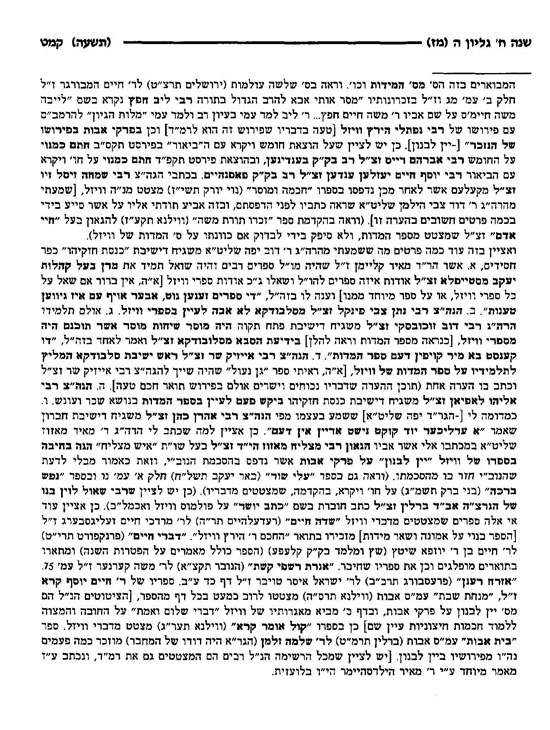
In the beginning of Parshegen, when listing the important works on Targum Onkelos (TO), Rabbi Posen notes that one of the most crucial works ever written on the topic is Shadal’s Ohev Ger (Vienna 1830; rpt. Cracow 1895). He mentions in a footnote that today most Charedi works on TO do not use him, or do not mention it if they did. He notes that in the first generations after Shadal wrote Ohev Ger everyone used it. He refers his article in Italia 19, (2009) (pp. 104-109) on the topic of Shadal as a Parshan of the Targum, where he has a few pages dealing with Charedi works that use him, including the Minchas Yitzchak. Posen notes that the Maharatz Chajes quotes him respectfully, but what is important about this is that the Maharatz Chajes did not see eye to eye with Shadal on other issues[1] and even wrote an essay attacking his criticisms of the Rambam (link). Posen notes that R. D.Z. Hoffman uses him in his Shu”t Melamed Lehoel. I would add (something Posen is certainly well aware of) that R. Hoffman also uses him many times in his works on Chumash[2].
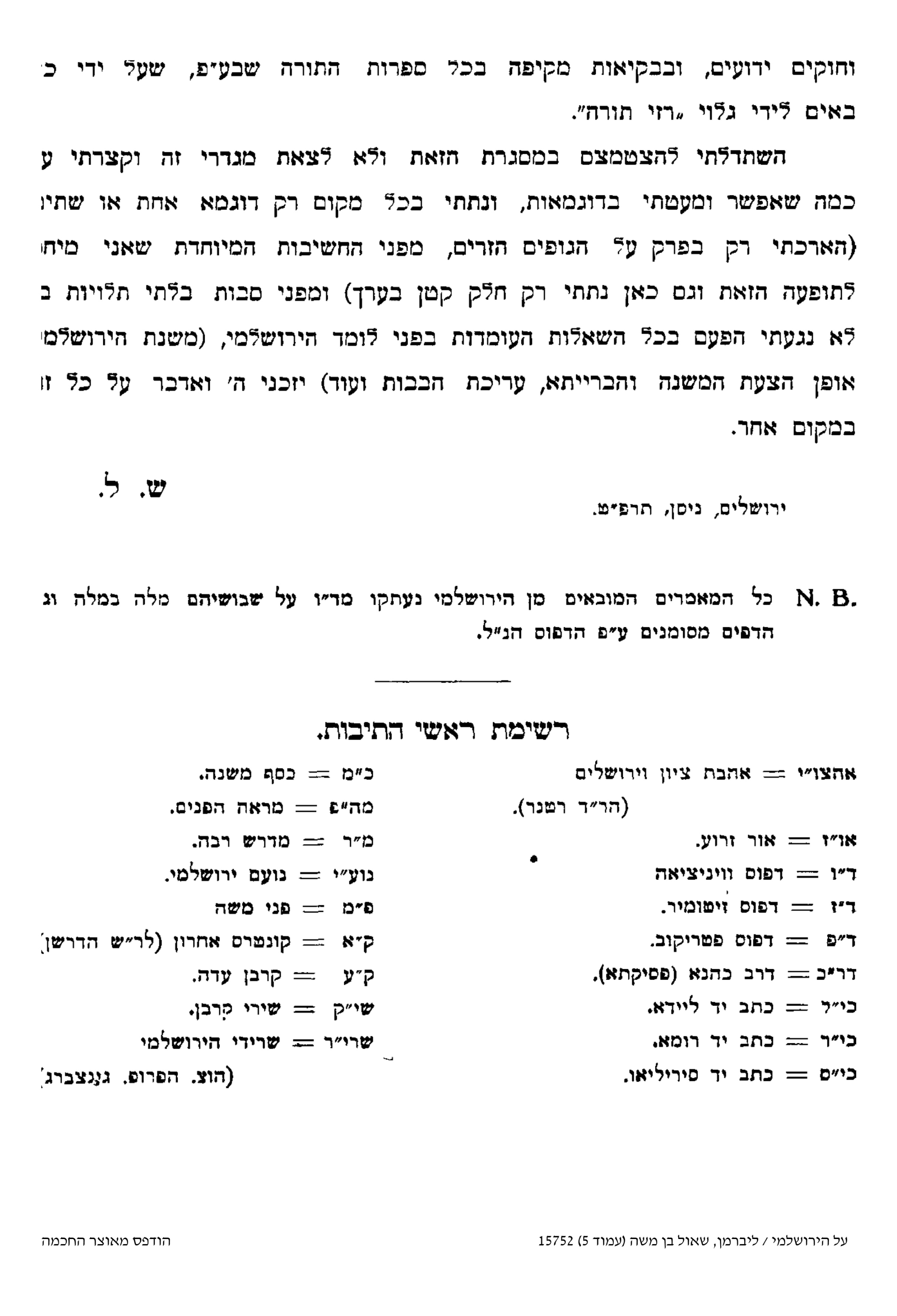
I would like to add a few more names toRabbi Posen’s list of people who used Shadal. Shoel Umeshiv[3], R. Yosef Zechariah Stern[4], R. Pesach Finfer[5], Dikdukei Sofrim[6], Seridei Eish[7], R. Chaim Heller[8], R. Kalman Kahana[9], R. Wolf Leiter[10] andR Dovid Tzvi Hillman[11]. S. of On the Main Line informs me that he has many more such references and is working on an extensive piece about Shadal in the eyes of talmidei chachomim through the ages.
I also found in the list of works recommended by the great Galician posek R. Meshulam Roth for students to learn in a proposed new school system, at the request ofR. Meir Shapiro, among the many interesting things he wanted talmidim to read when learning Targum Onkelos was Ohev Ger.[12]

When talking about this topic of the usage of Shadal in Charedi and Charedi-acceptable circles, Posen cites the introduction of Rabbi Yaakov Zvi Mecklenburg (1785-1865) to his Ha-Kesav Ve-ha-Kabbalah, printed only in the first edition of the work in 1839[13]. In this introduction he quotes a lengthy letter from Shadal[14] and clearly mentions that one of the works that he used when writing his sefer was from Shadal (which we would know anyway, because Shadal is cited by name many times in the commentary). Posen points out that in all subsequent editions this introduction has been removed. Posen suggests that the son-in-law who reprinted this work after he died (1880) removed it, and perhaps he did so due to the list of people that he used, especially theway he refers to Shadal, perhaps then no longer politically correct. Now, to be a little more accurate, the second edition of the work was printed in 1852 while Rabbi Mecklenburg was quite alive, and there a different version of the introduction appears. In this shorter version of the introduction it includes some of the works he used but there is no longer a specific mention of Shadal, neither in regard to using his work, or the lengthy letter of Shadal, which is now missing. In all subsequent editions printed after he died no introduction was printed. Thus we can see the son-in-law had nothing to do with it, but since it could hardly have been coincidental perhaps it did have to with Shadal’s image in some way, as Posen suggests. In his excellent article on the topic[15] Edward Breuer points out that there were differences between the two introductions, but he only notes that Julius Fuerst, whose name was mentioned in the first version of the introduction, was removed in the second version. Breuer did not note that Shadal’s name was also omitted.
Compare the introductions:

Mecklenburg – Haksav vehakabbalah 1839

Mecklenburg – Haksav vehakabbalah 1852

Since many of the controversial aspects of Shadal’s intellectual profile where already well-known by 1839 (e.g., proposing textual emendations of Nakh, fierce criticisms of the Rambam, assigning an author other than Shlomo to Koheles, etc.)[15b] my tentative suggestion as to why Shadal’s name and his letter were omitted by Rabbi Mecklenburg in the second edition could be because 1852 saw the printing of Shadal’s anti-Kabbalah work, the Vikuach Al Chochmas Ha- Kabbalah[16] (subtitled al Kadmus Sefer Ha-zohar). In addition, perhaps the advent of this work explains why later many did not use Ohev Ger on TO, feeling that they could not quote someone who was so anti-Zohar and anti-Kabbalah, even where he is not problematic and writes worthy ideas.
In Matzav Hayashar, R. Shneur Duber after quoting from Shadal’s work Vikuach Al Chochmas Ha- Kabbalah writes:

וה’ שד”ל בספרו ויכוח על חכמת הקבלה… וכל אלו הספרים הנההיראים החרדים לדבר ה’ נזהרים מאוד מלאחזיקם בביתם ומכש”כ מלעיין בהם משוםשהמה מהפכים את הלב האדם הקורא בהם ועושים רושם גמור בלבו רק לי התירו כמה גדולירבנים גדולים משום דאיתא במסכת אבות (פ”ב משנה יד) ודע מה שתשיב…”(מצבהישר, ב עמ’ 66].

It is also possible that R. Yaakov Kamenetsky was referring to the Vikuach in a sort of hidden way in Emes Leyaakov (p. 399). R. Yaakov records that he was asked by someone why is the Yom Tov of Hoshana Rabbah hidden and only found in Kabbalah literature? Before giving an answer R. Yaakov remarks he suspected there was a bit of cynicism in this question against the Zohar. It could be that he was hinting to the opening debate (before it spring boards in to other topics) in Shadal’s Vikuach Al Chochmas Ha-Kabbalah which takes place on Hoshana Rabbah and it is about where is the source for this Yom Tov.[17]
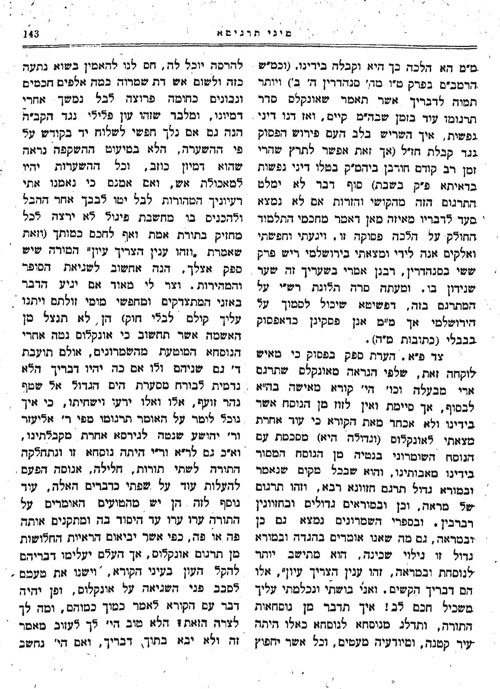
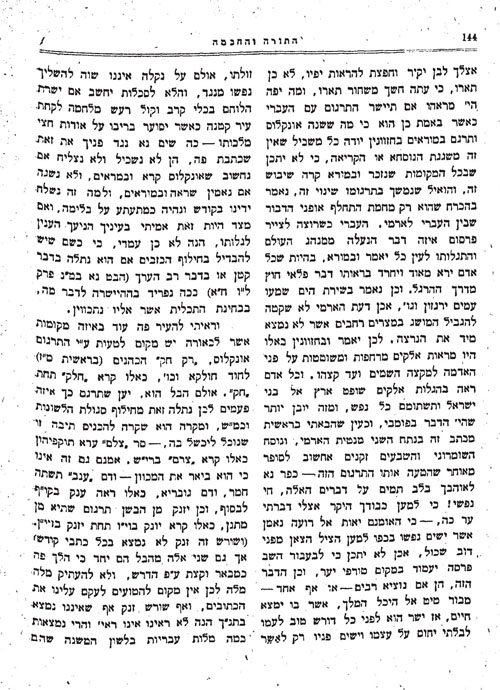
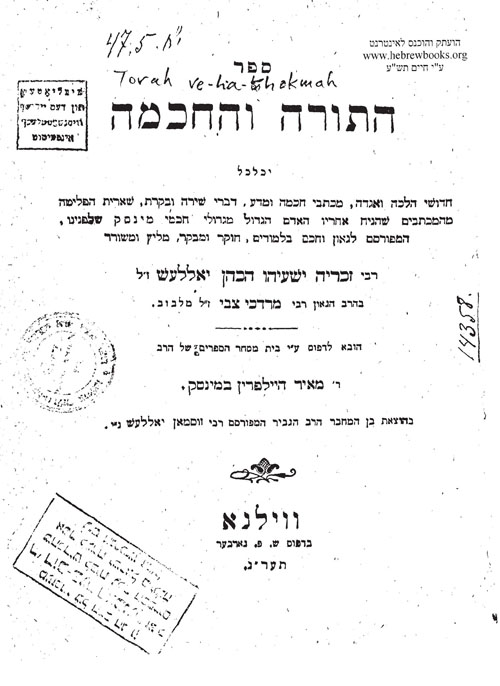
Another possible explanation as to why many did not use the works of Shadal could be understood with the complaints of R. Z. Y. Yolles in Hatorah VeHachochma. R Z. Y. Yolles sent Shadal a nice long letter related to TO in general and some comments on the Ohev Ger[18] in particular, which he liked a lot. He then writes:

ואין לזוז מן הנוסח אשר בידינו… כי עוד אחרת מצאתי לאונקלוס…מסכמת עם הנוסח השומרוני בנטיה מן הנוסח המסור בידינו מאבותינו,… וזהו ענין הצריך עיון… אלו הם דבריך הקשים [19],ואני בושתי ונכלמתי עליך משכיל חכם לב איך תדבר מן נוסחאות התורה, ותדלג מנוסח אל נוסחא כאלו היתה עיר קטנה, ומיודעיה מעטים וכל אשר יחפוץ להרסה יוכל לה, חס לנול האמין בשוא נתעה כזה ולשום אש דת שמרוה כמה אלפים חכמים ונבונים כחומה פרוצה לבל נמשך אחר דמינו, ומלבד שזהו עון פליפי נגד הקב”ה הנה גם אם נלך חפשי לשלוח יד בקודש על פי ההשערה, הלא במיעוט השקפה נראה שהוא דמיון כוזב, וכל ההשערות יהיו למאכולת אש, ואם אמנם כי נאמנו אתי רעיוניך הטהורות לבל יטו לבבך אחר ההבל ולהכניס בומחשבת פיגול… וזאת שאמרת וזהו ענין הצריך עיון המורה שיש ספק אצלך הנה אחשוב לשגיאת הסופר והמהירות וצרי לי מאוד אם יגיע הדבר באזני המתצדים ומחפשי מומי זולתם ויתנו עליך קולם לבלי חוק… הלא טוב הי’ לך לעזוב מאמר זה ולא יבא בתוך דבריך…

Here are Yolles and Shadal:
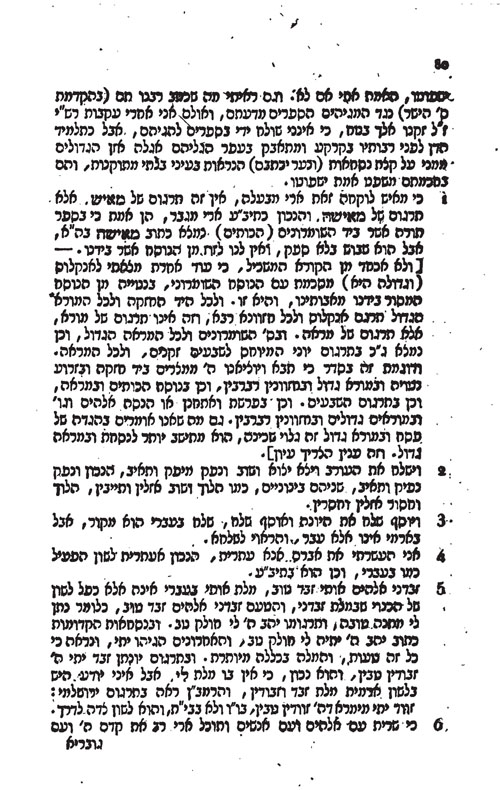
Here is the page from Ohev Ger with which the letter is concerned:
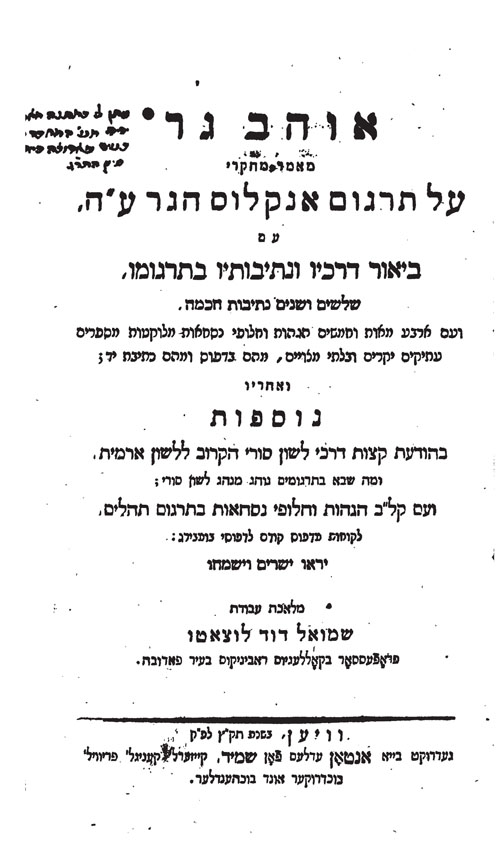
Although Shadal was very opposed to changing any texts in the Torah[20] and in a sense could be seen as standing in the breech, it could be that even such comments scared people away from his works.
Returning to the introduction of Rabbi Yaakov Mecklenburg to his Ha-Kesav Ve-ha-Kabbalah; It is of interest to me how he refers to R. Naftali Hirz Wessely (Weisel). He not only includes Wessely in the list of works he used, but in thebeginning of the introduction he says that Wessely is the only good work on Toras Kohanim which ties Torah Shebekhesav to Torah Shebaal Peh. This piece is also not found in the second edition of the introduction and is not noted by Breuer in his aforementioned article. A careful reading of the Ha-KesavVe-ha-Kabbalah shows that he used Wessely’s work numerous times throughout the work. Naturally no new views of Wessely’s were revealed between 1839 and 1852 to make Wessely more controversial.
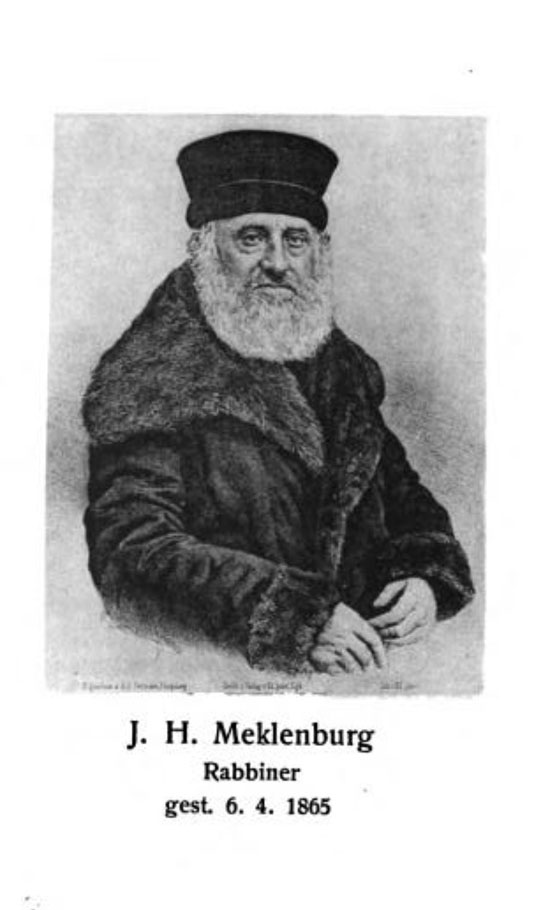
Incidentally, here is a beautiful portrait of R. Mecklenburg as printed in the Festschrift zum 200 jährigen Bestehen des israelitischen Vereins für Königsberg (1904):

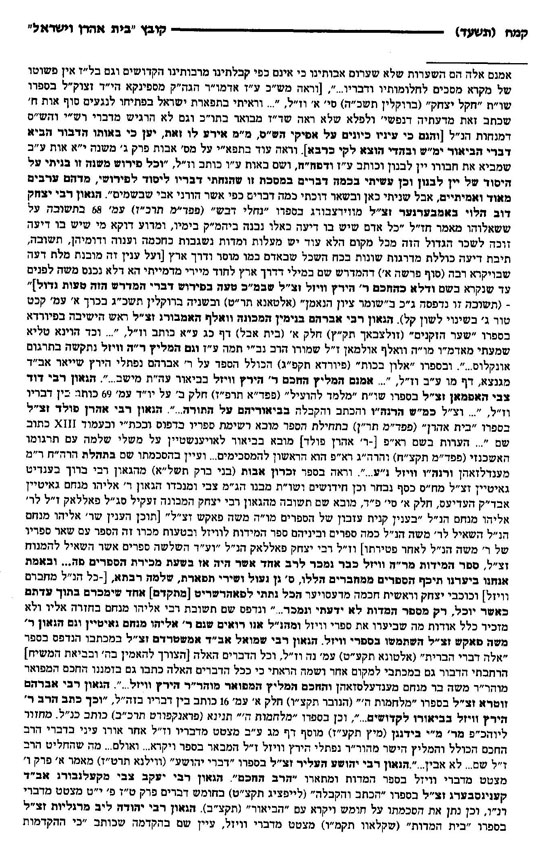
A few years ago in the pages of the excellent journal Ha-maayan, a controversy took place in relation to how to cite various works of people considered questionable (here). In the course of the controversy it turned to quoting Mendelssohn and Wessely, and their stories. Rabbi Posen mentioned that there was nothing wrong with Wessely, to which others argued. This controversy in regard to Wessely was not a new one[21], a few years before in the Kovetz Beis Aharon VeYisroel there was a series of articles based on various manuscripts showing how the gedolim at the time were very against Wessely. Towards the end of the series the author did a strange thing – he collected many citations of big name gedolim who did use Wessely’s work even after the controversy (here). Almost all of these gedolim were well aware of the controversy over Wessely’s Divrei Shalom ve-Emes in which his maskilic program for educational reform was outlined, and they came after the outcry of those early gedolim. So obviously disagreed with them (or were at least willing to accept him as a source to be used and cited by name). To me this was strange, as he undermined his own research – he wound up showing that there was a big controversy with many big people on both sides, so how in the world did he reach his conclusion that Wessely was bad according to everyone? Also of note, י”שר appears after Wessely’s name only in the first piece in the series. Perhaps in the course of his research the author realized that te matter was not as black-and-white as it first seemed.[22]
Nor did the modern controversy about Wessely end there, as a few years later two works of Wessely’s were reprinted; his Sefer Hammidos (2002), and his Yeyn Levanon (2003). In the introduction of both works there are lists of great people who used Wessely’s works. To be sure the kannoim did not remain quiet about this. That same year (2003) in the introduction to the Tomer Devorah reprinted by the Mishar publishing house, an introduction was printed about the evil works of Wessely recently reprinted. A few months ago the Kovetz Eitz Chaim (15, 2011, pp. 13-30) printed another manuscript on the controversy against Wessely, including some letters of various contemporary gedolim against the evil Wessely. In the recent work on R. Elyashiv Shlita, Hashakdan (2, pp. 136-137) they also mention how he was against the reprinting of the works of Wessely. The problem to me is how do they explain all the great Gedolim who did use his works? There is no clear answer.

To add to the lists of Gedolim who used Wessely’s works or quoted him in a positive light see; R. Eleazer Fleckeles[23], R.Moshe Kramer[24], Netziv[25], R. Mordechai Gimpel Yaffe[26], R. Yosef Zechariah Stern[27], R. Eliyahu Feivelson[28], R. Ezriel Hildsheimer[29], Dikdukei Sofrim[30], R. Y. Haberman[31], R. Chaim Bachrach[32], R. Y. Heller[33], R. Shneur Duber[34], R. Lazer Gordon[35], and R. Dovid Tzvi Hoffman[36]. Also see R. Moshe Mendelssohn (a maternal uncle of R Hirsch)[37] for many interesting remarks on Wessely. See also these great posts here and here in regard to Wessley.
I am sure many more sources for usages of both Shadal and Wessley can be found by searching Google Books, Hebrew Books and Otzar Hachochmah and just plain old learning, but I did not have a chance to do that yet.

I would liketo conclude with the following dream: just as R. Shlomo Dubno was vindicated in the past few years by R. Dovid Kamentsky,[38] it is my hope that Wessely too will be vindicated from all false charges against him and people will realize there is nothing wrong with his fine writings which are filled with chochma and yirah.

[1] See M. Hershkowitz, Maharatz Chajes,pp. 314-323. See also R. Toresh, Shivah Kochevei Leches, p. 8. Of course it will be argued that he is controversial too. However, this is only the case in some Torah circles. Where he is considered a perfectly reputable talmid chochom his use of Shadal could be considered notable.
[2] e.g., in Bereshis, p. 132. Shemos, p.287, 290, 351, 355. In Chumash Vayikra in his introduction he writes: הערות מצוינות אשפר למצוא… ובהמשתדל לש. ד. לוצטו.
[3] See Shem Me-shimon, (1965), p. 29, where it is related that he had a question related to Hilchos Gittin and he borrowed Shadal’s work on targum to help him. See M. Hershkowitz, MaharatzChajes, p. 445.
[4] Haggadah Shel Pesach, p. 7a.
[5] Mesoras Hatorah Vehaneviyim, p.6, 8, 14, 40, 42, 64.
[6] See his notes to Shem Hagedolim, (Yeshurun 23, p. 240, 289.) A look at the list of his working library in Ohel Avraham shows that he had all his seforim in this collection, including his work Vikuach Al Chochmas Ha- Kabbalah. The library belonged to his patron Abraham Merzbacher, but in many letters he refers to it as his library.
Dikdukei Sofrim quotes Shadal in Maamar al Hadfasas Ha-talmud p. 42 and numerous other places . He usually calls him רשד”ל. See this recent amazing post at On the Main Line for some general stuff about the Dikdukei Sofrim.
[7] Mechkarim Betalmud, p. 51, 60. See also Kesvei Sredei Eish 2, p. 323.
[8] Al Targum Yerushalmi, p. 36; Al Targum Hashivim, p. 36.
[9] Cheker Veiyun, p. 142. This is an incredible piece where he deals with a piece of R. Menashe Me-Ilya has on how to translate the wordהרעי where he says an original pshat that the Shoel Umeshiv attacks. See also M. Hershkowitz, Maharatz Chajes, pp. 449-451.
[10] Me-Torason Shel Rishonim, (p.102). [This is in regard to the topic of אמרי לה כדי that Rashi is supposed to say כדי is a name of a chacham. This source is not cited in the excellent essay on the topic in R. M. Friemann, Pores Mapah, pp. 61-94. See also Mar Kishisha, p. 121; D. Halivni, Mavos Limekorot Umesorot, pp. 34-35]. Shu”t Zion Lenefesh Chayah, Siman 109 [This is the famous Teshuvah where he attacks R. Reuven Margolios for plagiarism in his work Nefesh Chayah. He claims that he stole a particular piece from R. Meir Arik in his Tal Torah. He then goes on to note that Shadal has a piece on the topic. While I hope to return to this teshuvah to see what the exact claims of plagiarism are, in this case I do not see why R. Leiter assumes he stole this from R. Arik]. Note that R. Leiter thanks Alexander Marx and Boaz Cohen of the JTS in the English Foreward, and prays,” Remember this unto them, O G-d, for good.” See also the introduction to S. Freehof The Responsa Literature, where he thanks R. Leiter.
[11] In the Sefer Hazichron for the Seridei Eish, p. 109, 113. R. Hillman was known for not being a big liberal.
[12] This list is found in back of his Mevaser Ezra on Ibn Ezra p. 175. To be sure R. Roth was not a liberal, as is well known with the incident when he was supposed to receive the Kook prize with Saul Lieberman and he refused it. See: Iggeros of R. M. Roth recently printed; Marc B. Shapiro, Saul Lieberman and the Orthodox, pp.27-36.
[13] For a listing of all printings of the Ha-Kesav Ve-ha-Kabbalah see N. Ben Menachem, ‘Shtei Iggrot R. Yaakov Tzvi Meklenburg’, Sinai 65 (1969), pp. 327-332. For more on Rabbi Yaakov Mecklenburg and his Ha-Kesav Ve-ha-Kabbalah See: D. Druck, “Ha-Gaon Rabbi Jacob Zvi Mecklenburg,” Chorev4:1-2 (March – September 1937): 171-179 (Hebrew); C. Rabinowitz,’ R. Yaakov Tzvi Mecklenburg’, Sinai 57, pp. 68-75; Jay M. Harris, How Do We Know This? Midrash and the Modern Fragmentation of Judaism (Albany: SUNY Press, 1995), 212-220; Michal Dell – Orthodox Biblical Exegesis in an Age of Change – Polemics in the Torah Commentaries of R. J.Z. Mecklenburg and Malbim, PhD, Bar-Ilan University, 2008; Hebrew.
[14] Edward Breuer writes that he was unable to locate the source of this letter from Shadal (p. 271 fn. 39). I would like to suggest that as later in that article (p. 272) Breuer notes that the only published works of Shadal that Rabbi Yaakov Mecklenburg could have seen at this point was OhevGer and various articles in journals and that he corresponded with Shadal about his Ha-Kesav Ve-ha-Kabbalah (Igros Shadal, 5, pp. 647-648), so perhaps this too was a letter from Shadal written to Rabbi Yaakov Z. Mecklenburg. But S. of On the Main Line informed me that the letter is printed in Bikure Ha-ittim 7 (Vienna 1826) pg. 183 (link), under the title “המלות גזרת ענין (Etymologia),” and therefore was not specifically sent to Mecklenburg.
[16] See Breuer, p. 282. As an aside, Breuer points out (p. 281) that in the second edition Rabbi Yaakov Mecklenburg added a bunch of pieces from the Zohar, and also omitted a small number of comments from Shadal, Wessely and R. Shlomo Pappenheim. Note that many references to Shadal and Wessely remain in the commentary and are in all the editions to this day. Also note that the Latin title page in the 1839 edition, where it is named “Scriptura Ac Traditio,” was changed to German in the later editions, where it is titled “Schrift und Tradition.”
For more on Shadal’s work see, J. Penkower, ‘S. D. Luzzatto, Vowels and Accents and the Date ofthe Zohar’, Italia: Conference Supplement Series 2, Samuel David Luzzatto: The Bi-Centennial of His Birth, Magnes 2004, 79 – 13 [= Al Zeman Chiburim Shel Sefer HaZohar Vesefer HaBahir, 2011, pp. 75-116]; B. Huss, Kezohar Harekiyah, pp. 346-347
[17] See here for an English translation of this part ofthe Vikuach, and here for the entire translation by R. Josh Waxman of Parshablog. On the general question, see R. Shlomo Zalman Auerbach Halichos Shlomo, Moadim , 1 pp. 428-434.
[18] Hatorah VeHachochma, pp. 135- 153. The part I am quoting is on p. 143. See Shadal’s Response in Hatorah VeHachochma, pp. 148-149.
[19] Ohev Ger, p. 86.
[20] See: Z. Shazar, MePardes HaTanach,pp. 179-183; M. Margolies, Samuel David Luzzatto: His life and works, pp. 120-123; S. Vargon, Shadal Kecholetz Chokrei Hamikrah Hayehudim, Iyuni Mikra, 6, pp. 71-148; S. Vargon Yechasu shel Shadal le-farshanut ha-halakkah shel Chazal JSIS @ (2003) ; E. Chamiel, author of “Life in Two Worlds, ‘The Middle Way’: Religious Responses to Modernity in the Philosophy of Z.H. Chajes, S.R. Hirsch and S.D.Luzzatto,” (Hebrew; unpublished dissertation, Hebrew University ofJerusalem, 2006).
On the general topic of Shadal here, regarding targumim and our Mesorah, see R. Chaim Heller, Al Targum Hashivim; Seridei Eish, Mechkarim Betalmud, pp. 145-146; M. Shapiro, Between the Yeshiva World and Modern Orthodoxy, pp. 169-170. Also see M. Shapiro, ‘On Targum and Tradition: J.J. Weinberg, Paul Kahle and Exodus 4:22’, Henoch Vol. XIX, 1997, pp. 215-232.
[21] Much has been written on this controversy. See, e.g., M. Samet, Chodosh Assur Min Hatorah, pp. 67-92. But a full treatment in a doctorate is still needed. See also
S. Feiner מהפכת הנאורות pp. 16-187.
[22] The list of gedolim who appreciated Wessely’s commentary to Vayikra is not small. See here for the reported attitude of the Steipler and his son R. Chaim Shlit”a. The Vilna Gaon too is reported by Kalman Schulmann to have really admired this commentary. Schulmann gives as his source R. Meir Raseiner, a talmid of the Gra, who personally told him this. The gist of all the admiration is thatWessely did an excellent job tying together peshuto shel mikra and the halakhic interpretation of Chazal. In this he was a pioneer and precursor to Mecklenburg and Malbim.
These are the pages in Kovets Beis Aharon ve-Yisrael which list many who used the works of Wessely:
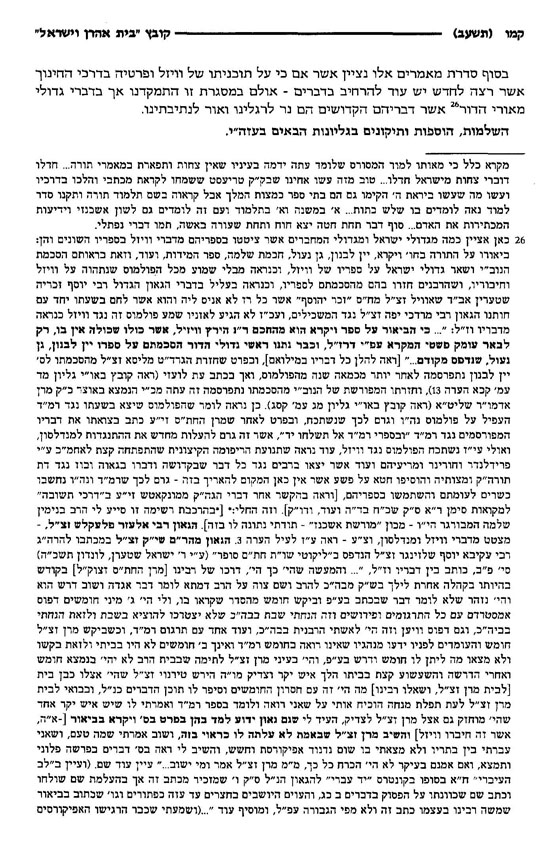
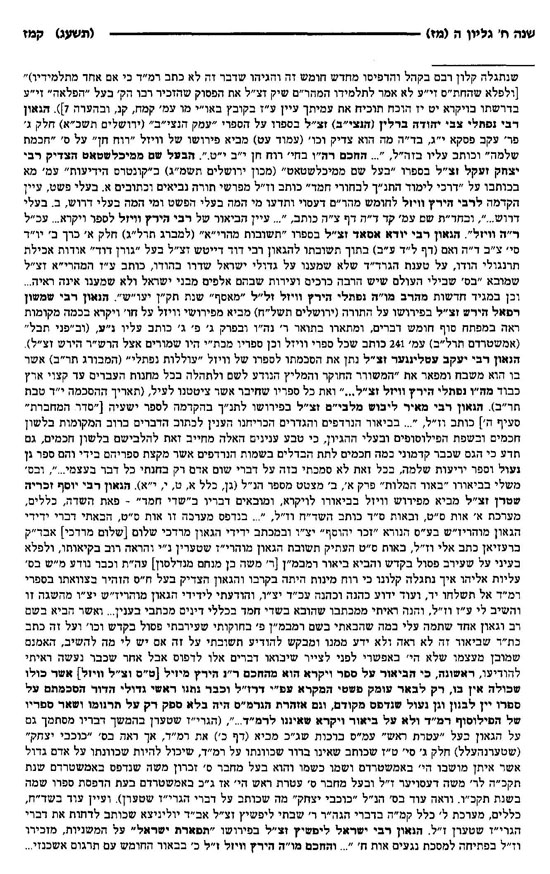
[23] Ahavat David, Introduction, see here and here. Not surprisingly it was edited out of some versions of the sefer.
[24] Zera Kodesh, p. 16b, 17b, Igres Rishpei Kodesh, p. 41.
[25] See Gil Perl, Emekha-Neziv A Window into the Intellectual Universe of Rabbi Naftali Zvi Yehudah Berlin, PhD dissertation, Harvard University (2006), p. 143.
[26] Haggadah shel Pesach, Beis Mordechai, p. 67.
[27] Haggadah Shel Pesach, p. 24, 52; Maamor Talachos Haagaddos, p. 9
[28] Netzach Yisroel, p. 166 but see ibid. p. 52, 22.
[29] Shut, O.C. p. 467.
[30] He had all his works in his collection, see Ohel Avraham, and above, note 6.
[31] Shearis Yakov, p. 14a.
[32] Zichron Chaim, p. 8a.
[33] See Y. Mark, Be-mechitzasom Shel Gedolei Hador, p. 54.
[34] Matzav Hayashar, 2, p. 94.
[35] See Pirkei Zichronos (p. 255) where Ben-Tzion Dinur writes that he used to quote it often and praise it. See also S. Stampfer, The Lithuanian Yeshiva, heb., p. 354.
[36] Introduction to Chumash Vayikra, p. 14: כמו כן ידוע הביאור המצוייןלתורת כהנים מאת נפתלי הירץ ויזל
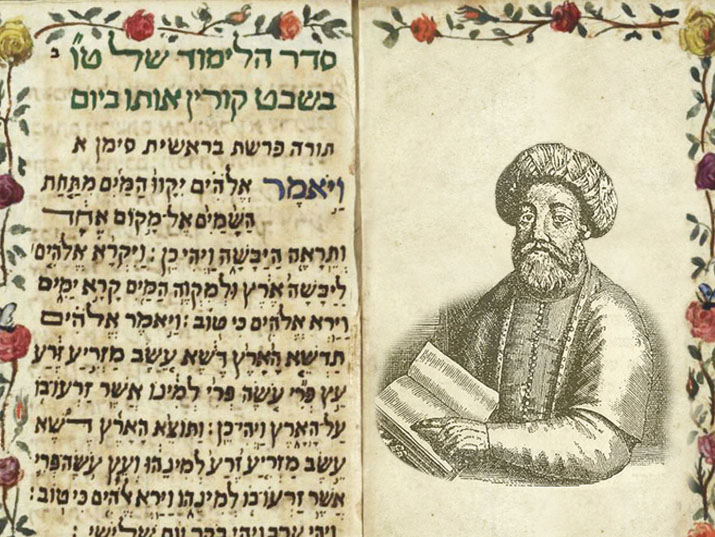
[37] Pnei Tevel, pp. 239-241. About him see here and here.
[38] See Kamenetsky’s pieces in Yeshurun 8, 9 and 10 and Y. Mondshein in Or Yisrael 16. On this matter, see here.


Is there a rotten apple in the Tu-BeShevat Fruit Basket?

Is there a rotten apple in the Tu-BeShevat Fruit Basket?

By Dan Rabinowitz and Eliezer Brodt

[This post is heavily updated from an earlier Seforim Blog post – here]

Some claim that the origins of the custom to celebrate Tu-beShevat as a holiday that includes eating fruits and other rituals, is Sabbatean. In the main, this assertion is based upon identifying  the work Hemdat Yamim as the source for Tu-beShevat as a holiday and eating fruit and other rituals.  Thus, an article in Ha’aretz trumpets, “The New Year for the Trees, Isn’t it for Sabbatai Zvi.” And the National Library of Israel’s blog includes a post “The Holiday of Tu-beShevat is an Auspicious Time to Pray for the Only (?!) Jewish False Messiah.”  They even include this photoshopped image.

However, a closer look at the history reveals, that although some of the customs on Tu-beShevat can be traced to Hemdat Yamim the actual celebration dates much earlier. Contrary to the popular song, Tu-beShevat hegihu hag ha-ilannot, the 15th of Shevat was not a “chag” of the trees.  Instead, the earliest discussions regarding Tu-beShevat do not mention any holiday associated with the day.  The first Mishna in Rosh Hashana, identifies the 15th of Shevat as the new year for trees.  This designation merely defines how to calculate annualized tithes and is otherwise silent as to the significance of the date.  One can’t tithe fruits from one year using a different year’s fruits. Thus the 15th of Shevat is the cut-off point. [For other contemporaneous examples see Safrai, Mishnat Erets Yisrael, Mesekhet Rosh HaShana (Jerusalem:  Mehlelet Lifshitz, 2011), 305-06]. It was not until R. Gershom’s time that there were any of the traditional holiday markers, but only that fasting is prohibited.

The first mention of the custom to eat fruit and other holiday rituals appears in 16th century Machzor, published between 1548 and 1550. 

That Machzor follows the Ashkenazi rite and includes a discussion of customs according to that rite and the commentary of R. Benyamin ha-Levi Ashkenazi, Ma’aglei Tzedek. He was the rabbi of the Ashkenazi community in Saloniki (of contemporary interest is that he records the death of four of his sons during a plague).   This source, however, was not well-known, and, historically, a different, later, source is identified.  For example, Avraham Ya’ari in his otherwise comprehensive article claims that R. Issachar ibn Susan (c. 1510-1580) is the first mention.  Susan, in his Ibur Shanim, published in 1578, provides that “the Ashkenazim have the custom [on Tu-beShevat] to eat many fruits in honor of the day,” confirming the custom recorded in the Machzor.  1578 was the first authorized printing of R. Susan’s work but not the first time this custom is associated with him.  In 1564, Shlomo Rie published Susan’s Tikkun Yissachar.  (Ibur Shanim 48b and Tikkun Yissachar 62a).  Susan, in Ibur Shanim, accuses Rie of publishing an unauthorized edition, one that contains errors and unacknowledged additions by Rie. Ibur Shanim includes a corrected and otherwise only slightly modified version of Tikkun Yissachar.  [See Susan’s introduction; see also Yaakov Shmuel Spiegal, Amudim be-Tolodot Sefer ha-Ivri: Hadar Mechaber (Jerusalem, 2018), 321-22.]

Mention of this custom also appeared in a Judeo-German Minhagim book first published in 1590. “The custom is to eat many fruits as it is the New Year of the trees.”

Venice, 1593 edition


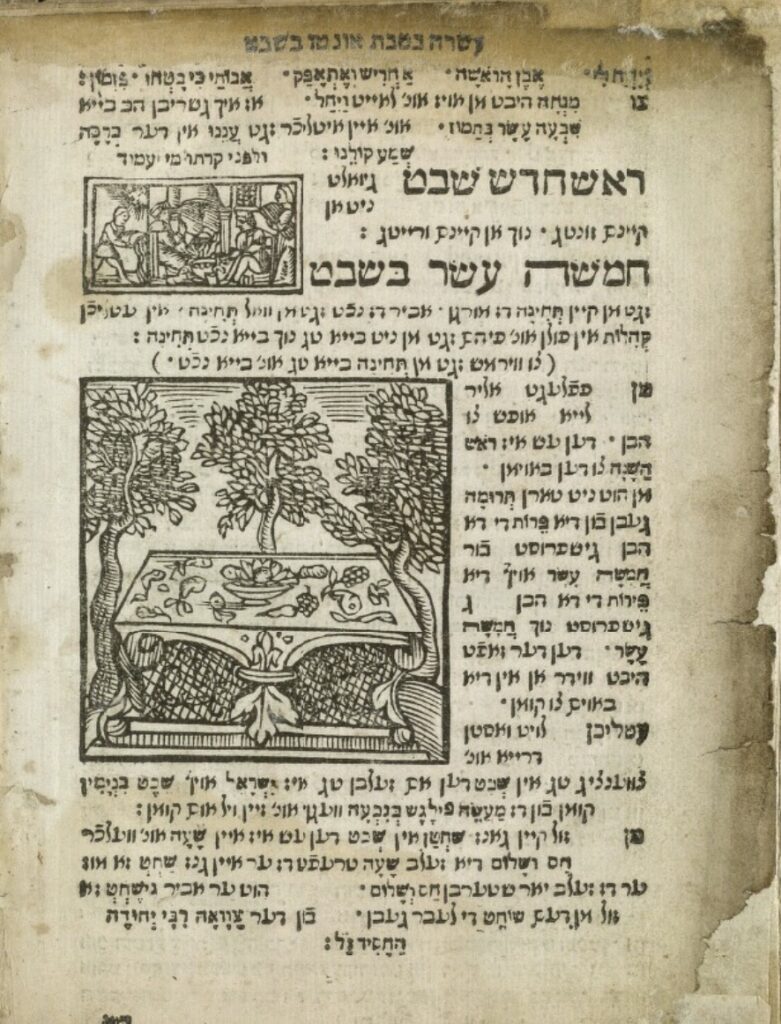
In the community of Worms, there was a rather interesting variation of the custom. As R. Jousep Schammes (1604-1678) in his custom-book states:

On Purim and the 15 of Av and Shevat these were vacation days for the Rabbis, . . . [on the 15th of Shevat] one says tehina even during the morning prayer. It is a vacation day for the students and the teachers, especially the younger students, it is a day of feasting and joy for or the teachers and their students. The custom is for the teachers to distribute whiskey to the students and make merry with them.”  Minhagei [de-Kehilah Kedosha] Vermisai le-Rebi Joszpa Shamesh (Jerusalem:  Machon Yerushalim, 1988), 249-50, no. 211.

The first mention of Tu-beShevat in a Sefardic source appears in R. Hayyim Benveniste’s (1603-1673) Kenneset ha-Gedolah, first published in Livorno in 1658, where he quotes Susan from the Tikkun Yissachar.  Although Benveniste would later be associated with the Sabbatian movement, his inclusion of this custom in 1658, long pre-dates the movement. Benveniste’s source does not include a seder, nor does it testify to any adoption amongst Sefardim.

Kabbalah first enters the picture in 1728 with a somewhat obscure source. In 1728, Eliyahu Malhlenov published, Birkat Eliyahu, his commentary on the Talmud.  Amongst his papers,, he had a few pages of materials from R. Moshe Hagiz and appended those to Birkat Eliyahu. These materials include responsa and discussions regarding customs.  Hagiz records a custom from his grandfather, R. Moshe Galante.  R. Galante was also Hagiz’s teacher as his father died when Hagiz was a boy.  According to Hagiz, his grandfather had “the custom that on the 15th of Shevat he would eat many fruits that required many blessings and prayed to God that he should decree for us and them a good year. He ate the following 15 fruits, and on each one would recite … a chapter of Mishna…”  Hagiz then provides the order to eat the fruits.

Hagiz might technically be the first to describe a specific ceremony associated with eating fruits, but the source that popularized Tu-beShevat amongst Sefardim, and that incorporated a seder is Hemdat Yamim. Hemdat Yamim, first published in 1732 anonymously has the entire seder for Tu-beShevat. This includes passages from the Bible as well as specific foods. This in turn was popularized to a greater degree when it was included in the book Pri Etz Hadar first published in 1753 and republished an additional 29 times by 1959, and now digitized on Sefaria.

National Library of Israel

The author of Hemdat Yamim concedes that this is not a custom that originated with the Ari or his students.  Nonetheless, the author provides his own kabbalistic ideas and wrote his own kabbalistic prayers for the occasion, and a specific order to the ceremony.  According to many scholars, Hemdat Yamim is not reflective of the kabbalah of the Ari but that of Sabbatai Tzvi and his disciples.  Indeed, Boaz Huss has identified specific prayers in the Hemdat Yamim Tu-beShevat liturgy that allude to Sabbatai Tzvi. Whether or not this assertion is correct, because we can trace this custom, that of eating fruits, to over 100 years prior to the Sabbatian movement as already a pre-existing custom, it is likely unrelated to Sabbatian theology or custom.

Plagiarism

Avraham Ya’ari, the noted bibliographer, wrote a comprehensive article tracing the history of Tu-beShevat.  That article appeared in Machanim and is available at Daat.  This article, at times entire paragraphs, are reprinted verbatim, without any attribution, in a recent book ostensibly authored by Tuvia Freund, Moadim le-Simchah.  Published in six volumes between 1998-2010, this work is replete with such examples of plagiarism.  Here, however, Freund did something arguably even more egregious.  In the pages of materials he steals, Freund cites Yaari and his article by name.  Not for the fact that all the above material comes from there but a small tangential item, the number of times a book was printed.  Indeed, Freund is so unwilling to give Yaari any credit in a paragraph lifted word for word from Yaari, the work Hemdet Yamim is discussed.  Freund provides in a footnote, “see the long discussion regarding this work in Sefer Talmumot Sefer page 134 and on.”  Freund doesn’t reveal the author of Talmumot Sefer, who is none other than Yaari.  Freund doubly removed Yaari from the picture.


Magen Avraham

The Magen Avraham cites the Tikkun Yissachar as the earliest source for the custom to eat fruits on the 15th of Shevat.  This, despite the fact that he had accessed, and indeed quotes on many occasions, the Machzor with the Maageli Tzedek commentary. See, e.g.,

נה:יז, פח:ג, קלא:י, תכז:א, תלא:ה, תלז:יז, תכז:א, תנ:יב, תנג:יא, תקפא:ד, תקפא:ז, תקפא:ח, תקפב:ח, תקפג:ב תקפד:ג, תקפט:ד, תרכד:ז, תרכט:ה, תרנא:יט, תרנא:כא, תרנח:יב, תרסא:, תרע:ב [2X], תרעב:ה, תרעג:ז, תרפא:א, תרפח:יא, תרצ:יט, תרצא:ח

While he had access to the Machzor, he did not have access to the Tikkun Yissachar.  The Magen Avraham quotes the Tikkun Yissachar on a few occasions, but always via a secondary source. See Brodt Halachic Commentaries to the Shulchan Aruch on Orach Chayim from Ashkenaz and Poland in the Seventeenth Century (PHD Bar Ilan 2015), pp. 68-69. The Mekor Chaim in O.C. 686:1 is the first to point to the Machzor for this minhag.

The halachot in the Machzor were collected by  Yitzhak Hershkowitz ed., Maglei Tzedek (Jerusalem, 2000), pp. 156-157.  Regarding R. Benyamin see Y.S. Emmanuel, Matsavos Saloniki, vol. 1 (Jerusalem, 1973), 36, 68-69; Meir Benayahu, “Rebi Shmuel Yaffa Ashkenazi,” in Tarbiz, 42 (1973), 423-24 and note 37; M.S. Molcho, Matsevot Bet ha-Olamin she Yehudi Saloniki (Tel Aviv, 1975), 59-60; Yitzhak Rivkin, “Dikdukei Soferim,” in Kiryat Sefer 4 (1927), 278 no. 32; Daniel Goldschmidt, Mehkerei Tefillah u-Piyyut, 252-65, Meir Benayahu, Defus ha-Ivri be-Kremonah (Jerusalem, 1971), 141-78. About Knesset Hagedolah and being a Sabbatean see Brodt, Halachic Commentaries to the Shulchan Aruch on Orach Chayim from Ashkenaz and Poland in the Seventeenth Century, pp. 56; Brodt, Yeshurun 35 ( 2016 )p. 775; See also the recent work, R. Shmuel Ashkenazi, Igrot Shmuel (2021)-, 1, pp. 4-5. 

R. Shmuel Ashkenazi

As the Seforim Blog just published Iggrot Shmuel from R. Shmuel Ashkenazi (see here and here) we reprint two letters from his collection, one discussing the origins of the holiday of the 15th of Shevat and the other Hemdat Yamim.


Notes:

Additional sources discussing the 15th of Shevat, see  Meir Rafeld, Netivi Meir, (2013), 185-189; R Mandelbaum, Tehilah Ledovid (Jerusalem, 1993);  Guttman, Otzar TuBeshvat.

Tikkun Yissachar was republished in 1988 with an excellent introduction from R. Betzalel Landau.  Most recently, in 2019, it was reprinted and re-typeset, with additional notes. This edition also includes R Landau’s introduction and another introduction of material about the work. See also Elisheva Carlebach, Palaces of Time: Jewish Calendar and Culture in Early Modern Europe (London: Belknap, 2011),  51-58; יוסף הקר, ‘יששכר אבן סוסאן עליית כוהנים לתורה בשמחת חתנים’, בתוך: ‘מנחה למנחם’, קובץ מאמרים לכבוד ר’ מנחם כהן, בעריכת חנה עמית, אביעד כהן וחיים באר, ירושלים תשס”ח, עמ’ 79-97

Regarding Hagiz, see Elisheva Carlebach, The Pursuit of Heresy (New York: Columbia University Press, 1990).

After the Birkat Eliyahu was published it was attacked by some rabbis.  See Meir Benayahu, “Sefarim she-Hiburum R. Moshe Hagiz she-Hotsyim le-Or,” in Ali Sefer 4 (1977), 143, 150-52; see also Shlomo Yaakovovitch, “Sefer Shehitot u-Bedikot le-R’ Yaakov Weil,” in Tsefunot 4 (1989), 112; Carlebach, Pursuit of Heresy, 247-49. Regarding R. Eliyahu see Y. Halpern, Pinkas Vaad Arba Arotsot (Jerusalem, 1990) 362; Tzvi Horowitz, Le-Tolodot ha-Kehilot be-Polin (Jerusalem, 1989), 1.

The literature on Hemdat Yamim is substantial and we hope to return to the work in an upcoming post.  For the most recent discussion see Y. Goldhaber, “Le-Birur Zehuto shel Mehaber Hemdat Yamim,” in  Sefer Zikhoron le-Professor Meir Benayahu, vol. 2 (Jerusalem: Karmel, 2019), 873-908.

Huss’s article appears as Boaz Huss, “Ha-Ets ha-Nehmad ben Yishi Hayi al ha-Adama: al Mekoro ha-Sabbatai shel Seder 15 Shevat,” in Sefer Zikhoron le-Professor Meir Benayahu, vol. 2 (Jerusalem: Karmel, 2019), 909-20.


Pesach, Haggadah, Art & Sundry Matters: A Recap of Important Seforimblog Articles

Pesach, Haggadah, Art & Sundry Matters: A Recap of Important Seforimblog Articles

Among the more interesting aspects of the history of Haggados, is the inclusion of illustrations. This practice dates back to the Medieval period and, with the introduction of printing, was incorporated into that medium. Marc Michael Epstein’s excellent book regarding four seminal Haggadah manuscripts, The Medieval Haggadah: Art, Narrative & Religious Imagination, was reviewed here, and a number of those illustrations, were analyzed in “Everything is Illuminated: Mining the Art of IllustratedHaggadah Manuscripts for Meaning.” Epstein edited and wrote an introduction to the recently published facsimile edition of the Brother Haggadah, which resides in the British Library. This is the first reproduction in full color of this important manuscript. Another recent reproduction of a manuscript Haggadah is Joel ben Simon’s Washington Haggadah. This Haggadah is particularly relevant this year, as it contains an alternative text for  Eruv Tavshilin blessing. Whether or not this was deliberate was the subject of some controversy, see “Eruv Tavshilin: A Scribal Error or Deliberate Reformation?

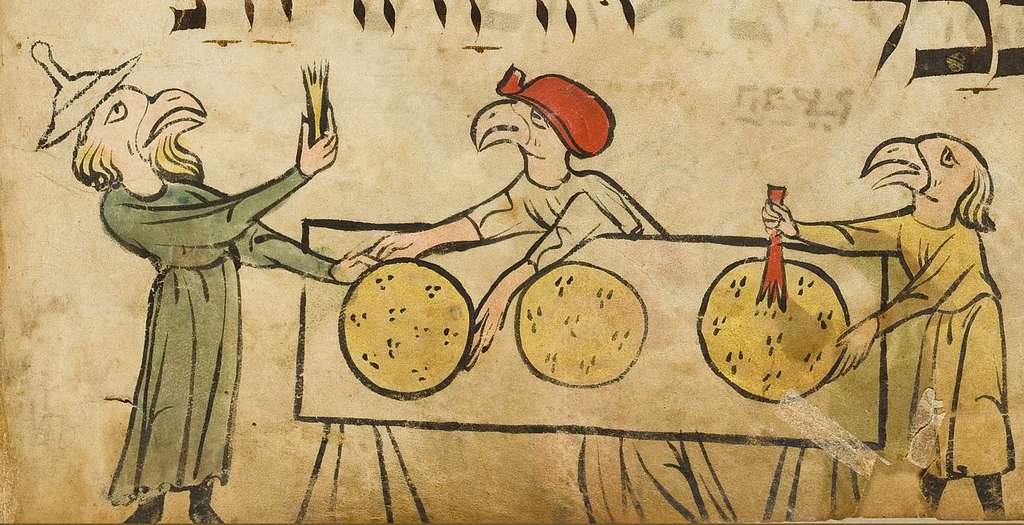
The first illustrated printed Haggadah, Prague, 1526, introduced new illustrations and recycled and referenced some of the common ones in manuscripts (see here for a brief discussion and here for Eliezer Brodt’s longer treatment). That edition would serve as a model for many subsequent illustrated Haggados but also contains surprising elements, at least in some religious circles, regarding the depiction of women, and was subsequently censored to conform with the revisionist approach to Jewish art. See, “A Few Comments Regarding The First Woodcut Border Accompanying The Prague 1526 Haggadah,” and Elliot Horowitz’s response, “Borders, Breasts, and Bibliography.” The Schecter Haggadah: Art, History and Commentary, a contemporary treatment of the art and the Haggadah, (for Elli Fischer’s review, see here), that unintentionally reproduced a version of one of the censored images in the first edition. It was restored in subsequent editions. Women appear in other contexts in illustrated Haggados. The most infamous example is the “custom” that implies a connection between one’s spouse and marror (discussed here), but our article, “Haggadah and the Mingling of the Sexes” documents more positive and inclusive examples of women’s participation in the various Passover rituals in printed Haggados.  Similarly, the c. 1300 Birds Head Haggadah has an image of female figures in snoods preparing the matza and a woman at the center of Seder table.

As detailed in chapter 8 of Epstein’s Medieval Haggadah, the early 14th Century Golden Haggadah is perhaps the most female-centric Haggadah and may have been commissioned for a woman. That manuscript emphasizes the unique, positive, and critical role women played in the Exodus narrative. Although it also depicts the practice of overzealous cleaning with a woman sweeping the ceiling. The 1430 Darmstadt Haggadah has a full-page illumination of women teachers, but its connection to the text is opaque. Finally, we argue that one printed Haggadah uses a subtle element in explicating the midrashic understanding of the separation of couples as part of the Egyptian experience.
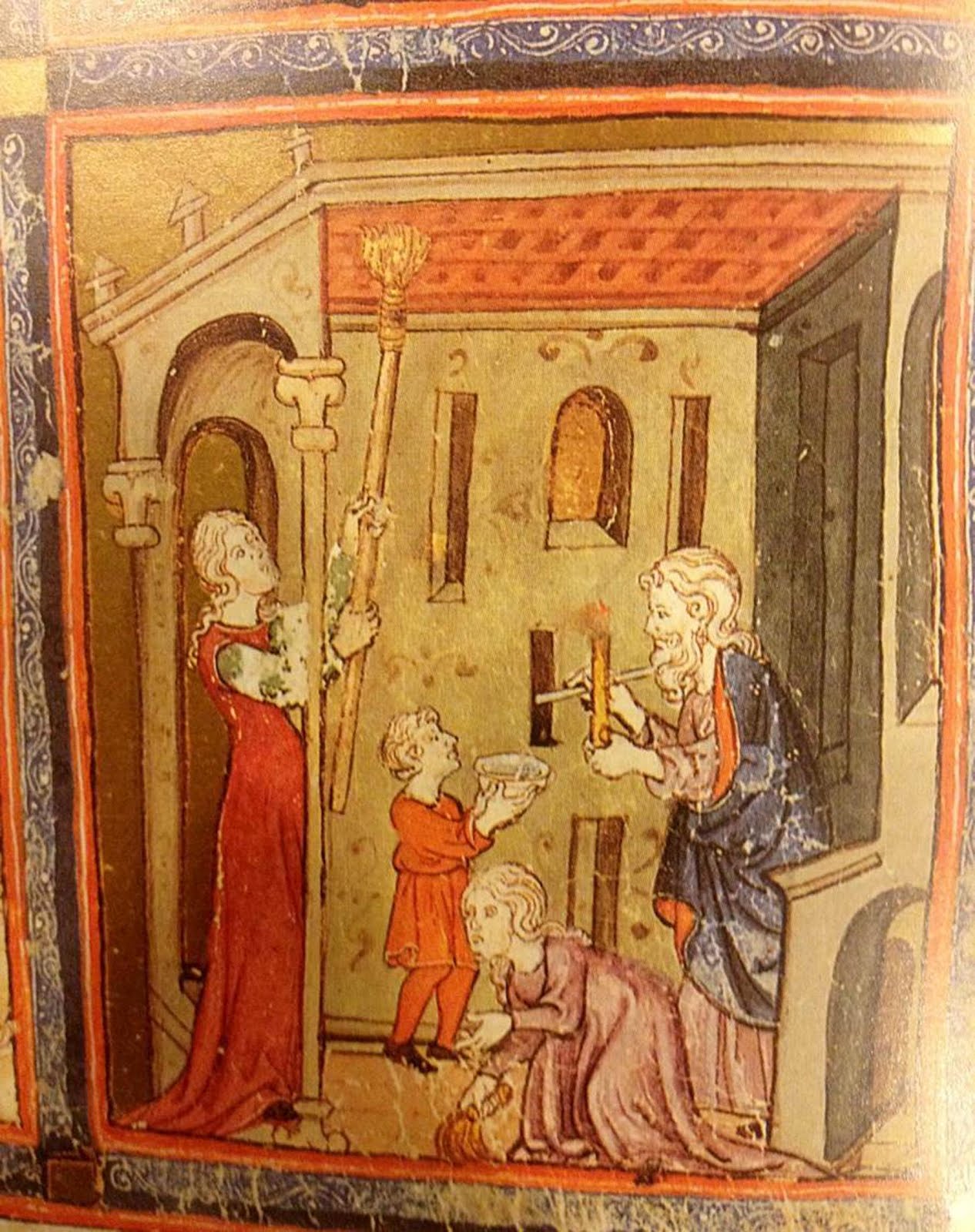
Sweeping the Ceiling, Golden Haggadah


One of the most creative contemporary Haggados was produced by the artist, David Moss. Moss was commissioned by David Levy to create a Haggadah, on vellum in the tradition of Medieval Jewish manuscripts. Moss worked for years on the project the result surely equals, if not surpasses, many of the well-known Medieval haggados, both artistically and its ability to bring deeper meaning to the text. The manuscript is adorned with gold and silver leaf and contains many paper-cuts (technically vellum-cuts).  One of the most striking examples of the silver decoration is the mirrors that accompany the passage that “in each and every  generation one is obligated to regard himself as though he personally came out of Egypt.” The mirrors appear on facing pages, interspersed with one with male and the other with female figures in historically accurate attire from Egypt to the modern period. Because the portraits are staggered when the page opens, each image is reflected on the opposite page, and when it is completely opened, the reader’s reflection literally appears in the Haggadah — a physical manifestation of the requirement to insert oneself into the story. The page is available as a separate print.

After completing the Haggadah, Moss was asked to reproduce it, and, with Levy’s permission, produced, what the former Librarian of Congress, Daniel Bornstein, described as one of the greatest examples of 20th-century printing. The reproduction, on vellum, nearly perfectly replicates the handmade one. This edition was limited to 500 copies, all of which were sold. From time to time, these copies appear at auction and are offered by private dealers, a recent copy sold for $35,000. President Regan presented one of these copies to the former President of Israel, Chaim Herzog, when he visited the White House in 1987. While that is out of reach for many, this version is housed at many libraries, and if one is in Israel, one can visit Moss at his workshop in the artist colony in Jerusalem, where he continues to produce exceptional works of Judaica and view the reproduction.  There is also a highly accurate reproduction, on paper that is available (deluxe edition) and retains the many papercuts and some of the other original elements, that is still available. This edition also contains a separate commentary volume, in Hebrew and English. (There is also one other available version that simply reproduces the pages, but lacks the papercuts.)
While the entire Moss Haggadah is worth study, a few examples. One paper-cut is comprised of eight panels, each depicting the process of brick making, the verso, using the same cuttings, depicts the matza baking process, literally transforming bricks into matza. The first panel of the matza baking is taken from Nuremberg II Haggadah, which we previously discussed here, and demonstrated that it preserves the Ashkenazi practice of only requiring supervision from the time of milling and not when the wheat was cut.

The illustration accompanying the section of Shefokh, reuses the illustrations of Eliyahu from the Prague 1526 and the Mantua 1528 Haggados to great effect. In the original and vellum reproduction, the cup of Eliyahu physically turns without any visible connection to the page — an extraordinary technical achievement. This section and the illustrations were discussed by Eliezer Brodt in “The Cup of the Visitor: What Lies Behind the Kos Shel Eliyahu, and, in this post, he identified an otherwise unknown work relating to the topic, for another article on the topic, see Tal Goiten’s “The Pouring of Elijah’s Cup (Hebrew).”  Eliezer revisited the topic in (here) his conversations with Rabbi Moshe Schwed, in the series, Al Ha-Daf. In last year’s conversation, he discussed a number of other elements of the history of the Haggadah, and three years ago the controversy surrounding machine produced matza. (All of the episodes are also streaming on Apple Podcasts, Spotify & 24Six.) Additionally, he authored “An Initial Bibliography of Important Haggadah Literature,” and two articles related to newly published Haggados, “Elazar Fleckeles’s Haggadah Maaseh BR’ Elazar ” and XXI. Rabbi Eliezer Brodt on Haggadah shel Pesach: Reflections on the Past and Present ,” regarding Rabbi Yedidya Tia Weil’s (the son of R. Rabbi Netanel Weil author of “Korban Netanel”) edition, and a review of David Henshke’s monumental work, Mah Nistanna. 

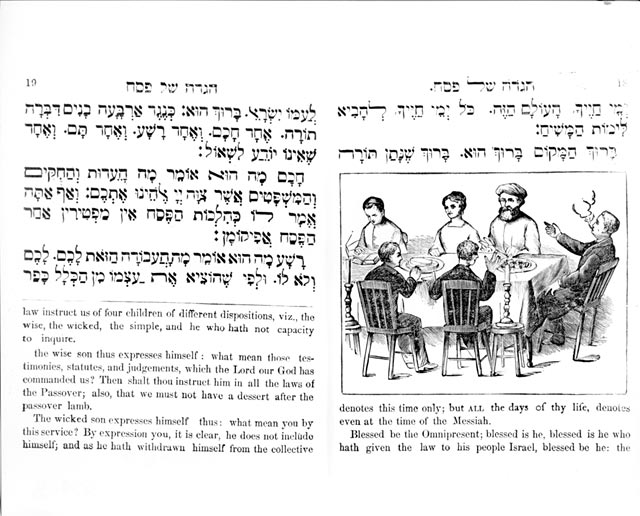
In one of the first haggadot printed in the United State published in 1886 Haggadah contains a depiction of the four sons.  Depicting the four sons is very common in the illustrated manuscripts and printed haggadot. In this instance, the wicked son’s disdain for the seder proceedings shows him leaning back on his chair and smoking a cigarette. According to many halakhic authorities, smoking is permitted on Yom Tov, nonetheless, the illustration demonstrates that at least in the late 19th-century smoking was not an acceptable practice in formal settings. (For a discussion of smoking on Yom Tov, see R. Shlomo Yosef Zevin, Mo’adim be-Halakha (Jerusalem:  Mechon Talmud Hayisraeli, 1983), 7-8).

The cup of Eliyahu is but one of many Passover food-related elements. The identification of Marror with the artichoke in Medieval Haggados, is debated by Dan Rabinowitz and Leor Jacobi , while Susan Weingarten provides an overview of the vegetable, in “The Not-So-Humble Artichoke in Ancient Jewish Sources.” Jacobi also discusses the fifth cup in his article, “Mysteries of the Magical Fifth Passover Cup II, The Great Disappearing Act and this printed article.  The history of the restriction of Kitniyot and the development of the practice of selling hametz is discussed in our article, “Kitniyot and Mechirat Chametz: Paradoxical Approaches to the Chametz Prohibition,” and was revisited on Rabbi Drew Kaplan’s Jewish Drinking podcast (and in an audio version on apple podcasts and spotify). Another guest was Marc Epstein, discussing his book on Medieval Haggados, and Dr. Jontahan Sarna where he gives an overview of the use of raisin wine for the kiddush and the four cups, based on his article, “Passover Raisin Wine,” as was the frequent contributor to the Seforimblog, Dr. Marc Shapiro. His interview, like many of his posts and his book, Changing the Immutable, discusses censorship and, in particular, the censored resposum of R. Moshe Isserles regarding taboo wine (also briefly touched upon in Changing the Immutable, 81-82, and for a more comprehensive discussion of the responsum, see Daniel Sperber, Nitevot Pesikah, 104-113).  For another wine related post, see Isaiah Cox’s article, “Wine Strength and Dilution.” The history of Jewish drinking and Kiddush Clubs was briefly discussed here.

Whether coffee, marijuana and other stimulants falls within the Kitniyot category appears here. Marc Shapiro’s article, “R. Shlomo Yosef Zevin, Kitniyot, R. Judah Mintz, and More,” regarding Artscroll’s manipulation of R. Zevin’s Moadim be-Halakha regarding kitniyot. Another coffee related article explores the history and commercial relationship between the Maxwell House Haggadah.  Finally, the last (pun intended) food discussion centers on the custom of stealing the afikoman.

The Amsterdam 1695 Haggadah was an important milestone in the history of printed illustrated Haggados, it was the first to employ copperplates rather than woodcuts. This new technique enabled much sharper and elaborate illustrations than in past Haggados. While some of the images can be traced to earlier Jewish Haggados, many were taken from the Christian illustrator, Mathis Marin. It also was the first to include a map. As we demonstrated that map, however, is sourced from a work that was a early and egregious example of forgery of Hebrew texts. For an Pesach related plagiarism, see “Pesach Journals, Had Gadyah, Plagiarism & Bibliographical Errors.” Kedem’s upcoming auction of the Gross Family collection includes, with an estimate of $80,00-$100,000, one of the rarest, beautiful, and expensive illustrations of Had Gadya by El Lissitzky published by Kultur Lige, Kiev, 1919. Eli Genauer reviews another number related edition, not in price, but convention, “The Gematriya Haggadah.”

There are two articles regarding the Haggadah text, David Farkes’ “A New Perspective on the Story of R. Eliezer in the Haggadah Shel Pesach,” and Mitchell First’s “Some Observations Regarding the Mah Nishtannah.” First’s other article, “The Date of Exodus: A Guide to the Orthodox Perplexed,” is also timely.
Finally, Shaul Seidler-Feller’s translation of Eli Wiesel’s article, “Passover with Apostates: A Concert in Spain and a Seder in the Middle of the Ocean,” tells the story of an unusual Pesach seder. Siedler-Feller most recently collaborated on the two most recent Sotheby’s Judaica catalogs of the Halpern collection.

Chag kasher ve-sameach!


Some More Assorted Comments, part 1

Some More Assorted Comments, part 1
by: Marc B. Shapiro
1. Following my last post, a number of people have corresponded with me about the issue of anti-Semitism and how it it sometimes self-inflicted because of Jewish actions that cause a hillul ha-Shem, meaning that we can’t always claim ידינו לא שפכו את הדם הזה. As many readers know, R. Jehiel Jacob Weinberg already pointed out that some anti-Semitism arises for precisely this reason. He was not the first. R. Israel Moses Hazan (Kerakh shel Romi, p. 4a), speaks of the bad impression given non-Jews by Jewish texts (and obviously also Jewish behavior):
שאנחנו מצד אמונתנו אנחנו מחוייבים להיות משחיתים הקיבוץ המדיני
See also the words of R. Solomon Alami, Iggeret ha-Mussar, ed. Haberman (Jerusalem, 1946), pp. 11-12:
עם היותנו עבדים נכבשים להם התלנו בם וחיללנו שם קודש א-להינו בקרבם כי הלכנו אתם באונאה ובמרמה וקבענו אותם בחוקים לא טובים בערמה עד אשר מאסונו והחזיקונו כגנבים ורמאים מנאפים עצרת בוגדים.
See also Maharsha to Ketubot 67a, which so accurately describes what we often face[1]:
ורבים בדור הזה שמקבצין עושר שלהם שלא באמונה ובחילול השם כגזילת עכו”ם ואח”כ מתנדבים מאותו ממון להיות להם כבוד בכל שנה ולתת להם ברכת מי שברך להיות להם שם ותפארת, ואין זה אלא מצוה הבאה בעבירה, ואין לעושר הזה מלח וקיום
(To understand the last words, see Ketubot 66b: מלח ממון חסר)
But there are limits to what we can do, and even if we were all complete tzadikim, it would not mean the end of anti-Semitism. Yet listen to a youthful passage recorded by Gershom Scholem in his diary in 1913. It is certainly an exaggeration, but in speaking of Jews living in the modern world (as opposed to the Shtetl) there is also some truth to it: “If Judaism were as Samson Raphael Hirsch thinks it should be, there wouldn’t be any such thing as anti-Semitism.”[2] As Hirsch taught, it is incumbent on us to show that we are a great benefit to society, and we cannot behave as if the rules, and the consequences of violating these rules, only apply to everyone else. ודי בזה.
2.  In my review of Gurock’s book (see here)  I referred to Aish HaTorah honoring intermarried people at its events. In fact, they were not the first Orthodox organization to do so, as one can see from R. Avraham Weinfeld’s Lev Avraham, no. 134, which dates from the early 1970’s.

If anyone knows which institution he is referring to, please share it. For some earlier comments of mine with regard to Orthodox views of intermarriage, see here.
In general, there have been some real changes in how Orthodoxy deals with the non-Orthodox, and Adam Ferziger has recently published a valuable article on the topic.[3] In reading the article, I was surprised to learn how even  haredi Orthodoxy has begun to expand the boundaries in dealing with non-Orthodox movements and institutions. It appears that the Reinman-Hirsch book was only one aspect of this change. Here is some of what Ferziger reports:
ASK [Atlanta Scholars Kollel], however, has demonstrated a willingness to meet its constituency on its own terms by running a biweekly introductory prayer service in one of Atlanta’s largest Reform houses of worship, Temple Sinai of Sandy Springs. To be sure, the meetings take place in a social hall rather than in the synagogue sanctuary, but this is a clear departure from the guidelines set down by Feinstein. Similarly, members of the Phoenix Community Kollel have taught classes at the community sponsored Hebrew High that is housed at the Reform Temple Chai. . . . [T]he head of Pittsburgh’s Kollel Jewish Learning Center, Rabbi Aaron Kagan, meets on a regular basis with his local rabbinic colleagues from Reform and Conservative synagogues to study Torah together. . . . Based in Palo Alto, California, the Jewish Study Network—one of the most dynamic and rapidly expanding of these kiruv kollels—does not limit its interdenominational contacts to private study. Its fellows work together with Conservative and Reform representatives to create new Jewish learning initiatives throughout the Bay Area and to offer their own programming in non-Orthodox synagogues. Rabbi Joey Felsen, head of the Jewish Study Network and a veteran of five years of full-time Torah study at Jerusalem’s venerable Mir yeshivah, made clear that he was not opposed to presenting Torah lectures in a non-Orthodox synagogue sanctuary, although he preferred to teach in the social hall. Indeed, according to Rabbi Yerachmiel Fried, leader of the highly successful Dallas Area Torah Association (DATA) Kollel and a well-respected halakhist, insofar as Jewish religious institutions were concerned the only boundary that remained hermetically sealed was his unwillingness to teach in a gay synagogue. . . . 
3. Here is the link to my recent article in Milin Havivin in which I published R. Eliezer Berkovits’ responsum permitting one to enter churches.[4] (R. Jeremy Rosen agrees with Berkovits. See here.)

In addition to the figures I mentioned who are known to have entered churches, the young scholar Chaim Landerer called my attention to the famed bibliophile, Judah David Eisenstein, who in his autobiography, Otzar Zikhronotai, testifies to entering churches on a few different occasions. These are mentioned by R. David Zvi Hillman in his article in the most recent Yerushatenu 4 (2010) as part of his effort to delegitimize Eisenstein, both from a scholarly as well as from a religious standpoint.[5] The article is actually twenty pages of excerpts from Eisenstein’s writings designed to accomplish this objective.
There is no question that Hillman accomplishes at least one of his goals, which is to show that Eisenstein often misinterpreted rabbinic texts. Yet for the life of me I can’t figure out what possible objection Hillman could find in some of what he records. For example, what is wrong with Eisenstein mentioning, in his autobiography, that as a young man he served on a jury (בית דין של שנים עשר), learnt to play the piano, to ride a horse, to swim [!], to sail, to fence and to play billiards? What does Hillman expect, that Eisenstein is supposed to say that his entire life was spent in a beit midrash, never once venturing out to enjoy what the world has to offer? Hillman also finds objectionable that Eisenstein mentions that he played chess on Shabbat and Yom Tov and that in general he liked sports as they strengthened his body. Hillman even notes that Eisenstein tells the reader how much he weighed at various times of his life, and here too, I can’t figure out what the sin. In my opinion, the craziest of Hillman’s criticisms focuses on the following passage in Eisenstein’s autobiography:
בשנת 1886 הייתי בין הראשונים שעלו במדרגות לראש פסל החרות ובשנת 1928 עליתי שם ע”י המכונה נושאת אנשים עד הראש ועד מאתים מדרגות עד הלפיד של החשמל שהוא גדול בכמות רבבות אלפים נרות.
Is it possible that Hillman has never heard of the Statue of Liberty and instead thinks that Eisenstein made a pilgrimage to some pagan temple?
Here is another of the passages Hillman strangely cites in order to criticize Eisenstein:
תרפ”ב ברלין. ציר ארה”ב ואשתו הושיטו ידם לי לברכני
But if you really want to see Hillman’s extremism, look at the following passage which he finds objectionable:
עין חרוד בעמק והוא מקום הטומאה לחיי המשפחה . . . שאכלו חמץ בפסח להכעיס . . . אנחנו מקוים כי גם החלוצים יטיבו את דרכם במשך הזמן ובפרט כי הורגלו לדבר עברית ויש בכח הלשון הקדש ובמאור שבה לבדה להחזירם תחת כנפי השכינה
There is no question that Eisenstein was naive in his hope that the Hebrew language would help bring people back to religion, but does this make him a bad person? Citing this passage to disqualify Eisenstein says more about Hillman than it does about Eisenstein. (I will return to Hillman in a future post.)
Here is another of Hillman’s criticisms, but this time of a scholarly nature:
“חוה”מ נקרא מועד קטן”. היש לזה מקור הוא [!] שהוא סברת כרסו של בעל האוצר?
We all know that Tractate Moed Katan deals with Hol ha-Moed. The reason the tractate is called such is presumably to distinguish it from the Order Moed. In fact, there is evidence that the original name of the tractate was Moed “and throughout this tractate the intermediate days are referred to as Mo’ed and not as hol ha-mo’ed.”[6]  It is because of this that Hillman is so dismissive of Eisenstein’s suggestion that Moed Katan can be understood as the “lesser holiday” and refer to hol ha-moed.
Yet Hillman spoke too fast in this case, because the great R. Aryeh Zvi Frommer, Eretz Zvi (Bnei Brak, 1988), pp 351ff, also assumes that hol ha-moed is referred to as Moed Katan. Here are two pages from his derashah.


Here is an article in R. Eliyahu Schlesinger’s Areshet Sefatenu (Jerusalem, 2005), vol. 1, pp. 16-17.


It is obvious that Schlesinger’s piece is taken from Frommer. In the introduction to Areshet Sefatenu, he tells the reader that he is going to be quoting ideas found in other sources, and that he is careful to acknowledge them, but if on occasion he forgets to do so we should excuse him. This doesn’t sit well with me. How can one copy another person’s words, include them in his book, and then forget to mention where he got it from? We are not talking about a source or two that someone saw in another’s book (and about which we can debate if one needs to cite the book that led him to these sources). Here we are talking about copying another rav’s hiddush.[7]
Returning to Eisenstein, he mentions how he was a member of the Freemasons. Hillman, of course, points to this as another of Eisenstein’s religious defects. Yet the issue of Freemasonry and traditional Judaism needs to be examined carefully to see if there is any conflict between the two. (To this day, the Church forbids all Catholics from becoming Masons.)  Interestingly, Chief Rabbi Israel Brodie of the United Kingdom was a well-known Mason (as was an unnamed nineteenth-century Orthodox rabbi in New York, who was even head of a lodge[8]). Rabbi Louis Jacobs told me about the time Brodie visited Manchester, where Jacobs was then the young rabbi of the city’s Central Synagogue. Jacobs and some of the other rabbis decided to play some mischief on Brodie. They told Rabbi Isaac Jacob Weiss, who was then serving as a dayan in Manchester (later he headed the Edah ha-Haredit), all about the strange practices of the Masons that Brodie took part in. Weiss was understandably shocked, and Jacobs told me how they later watched Weiss quiz Brodie about this, and how Brodie was put on the defensive and forced to explain how all the various Masonic practices were symbolic and had nothing to do with Avodah Zarah.
There is actually a responsum about Freemasonry in R. Isaac Akrish, Kiryat Arba (Jerusalem, 1876), no. 14. He only has negative things to say about it and sees it as “complete idolatry.” He also believes that the special terms used by the Masons are משמות הטומאה מהסט”א.
Akrish himself was quite an interesting character. Although we are not used to seeing real religious fanaticism in the Sephardic world, he was an exception. When someone in Constantinople opened a school that also had secular studies, Akrish burst into his house and, accompanied by shofar blasts, placed the man under herem. Understandably, this created enormous controversy, and led to the chief rabbi R. Chaim Palache placing Akrish in herem. This forced Akrish to leave the city and travel to the Land of Israel.[9]
If people today were aware of this story, I think it could help defuse the current controversy taking place in Israel. As I am sure all are aware, we have a situation where some Ashkenazic haredi schools are reluctant to accept Sephardim.[10] But the case of Akrish shows that there is no need for this discrimination, as we see from here that Sephardim can also be extreme and intolerant. If these schools would allow the Sephardim to enter, and if they are given the proper education, one can assume that they too can be properly molded. Many of them would even become real Sephardic Uncle Toms (to use the expression coined by one of my friends). You know the type, the ones who are so embarrassed by their heritage that they that can’t wait to speak Yiddish with Moroccan accents and to change their last names, the ones who instruct their sons not to wear a tallit until they are married, the ones who insist on having a yichud room at their wedding, and the list goes on. They have been recently referred to as “anusei Sefarad shel yameinu.”[11]
The truth is, and anyone who examines the writings of young Sephardic rabbis can testify to this, that there already is a great deal of extremism out there. For every R. Hayyim Amsalem, who tries to preserve the old Sephardic approach,[12] there are rabbis who write as if they are part of the Edah Haredit. To give just one example of many, here is the title page of a recent responsa volume by R. Eleazar Raz, Mi-Tziyon Orah (Jerusalem, 2007).

In Even-ha-Ezer no. 2, Raz discusses if a woman is permitted to attend parents’ night at her son’s school. In case people are wondering why she would have any interest in doing so, well, she is a mother and normally mothers want to know how their children are doing. The problem, of course, is that by attending she would be forcing the teacher to look at her, and unlike other poskim, Rabbi Raz holds that
דמצד עיקר ההלכה הסתכלות אסורה אפילו שאין מתכוין להנות ואין לו שום הרהור
In other words, only a quick glance at a woman is permitted, but not actually looking at her.[13] But Raz is even uncomfortable with this heter:
מיהו אעפ”כ אין ראוי לאדם לראות פני אשה “כלל”. והמחמיר במקום שאפשר ולא מקל אפילו בראיה בעלמא, “קדוש” יאמר לו. ובפרט שלדעת איזה פוסקים אסור אף ראיה בדרך העברה
With this type of attitude, there isn’t much hope that he will permit a mother to come to parents’ night. Here is his conclusion:
זאת תורת העולה, שנכון מאוד למנוע הנשים שלא תבאנה ל”אסיפת הורים”. וכבר יפה עשו ויפה נהגו בכמה ת”ת וביה”ס, ששירטו וביקשו: ש”לא יבואו אלא האבות”
Raz’s book was added to hebrewbooks.org in a recent update. Coincidentally, another of the books added at this time was Livyat Hen by Rabanit [14] Hena Kossowski. Here is the title page.
  

This book records her Torah thoughts. What interests me at present is the preface which mentions how she spoke before a large gathering in Volozhin at the establishment of a girl’s school. We are told that she was congratulated after her talk by one of the rabbis. In other words, she was not only speaking before the women. The preface also records that R. Joseph Kahaneman, Rosh Yeshiva of Ponovezh, liked to talk Torah with her. He even said “that he enjoys speaking with her in Torah matters more than with many well-known rabbis.”
I find this all very interesting: Raz doesn’t think that a mother is permitted to briefly speak to her son’s teacher to see how he is doing in school, while R. Kahaneman enjoyed his many conversations with Rabanit Kossowski. Haredi Orthodoxy has two directions in front of it when it comes to how women will be treated. Which way will it go?[15]
In reading Raz I wondered why he doesn’t suggest a simple solution, namely, to allow the mother to have a telephone conference.[16] Perhaps he also views this as forbidden. If so, he could have cited one of my favorite commentators, Joseph Ibn Caspi. (Are there any Twersky students who didn’t fall in love with Ibn Caspi?) In Mishneh Kesef, part 2, p. 55 (to Gen. 18:13), Ibn Caspi raises the question why the verse says that God spoke to Abraham and not to Sarah. He replies: “It is not proper for one who is exalted and holy to speak to women.” Perhaps we can identify a little medieval misogyny here, but what I find most fascinating about this passage is what comes directly after this: “And therefore, I have guarded myself from this all my life.”
Before anyone starts associating Ibn Caspi with the Vaad le-Tzeniut, let me disabuse you of this notion. Ibn Caspi avoiding women has nothing to do with halakhic humrot, but with a desire to remove himself from the “matter” that women represent, so that he can concentrate on the spiritual realm. As I have often explained, there is a reason why the Torah had to command procreation. Some people find this a strange commandment because certainly people would have done so without a specific mitzvah. Yet this commandment was not given for the average person but for those like Ibn Caspi, and I daresay Maimonides. Had it not been for the commandment then Judaism would also have developed an elitist class that thought, much like in Christianity and Buddhism, that avoidance of physical pleasures and the burden of parenthood is the way to get close to God. The philosophy of Ibn Caspi (and Maimonides) leads directly to at least the first assumption, and perhaps also the second. Therefore, by making procreation a commandment, the Torah ensures that even those who would choose to remove themselves from physicality so as to be bound to the spiritual, they too are still forced to be part of the physical world. The Torah is making sure that there is no spiritual caste system in Judaism, between those who succumb to the weakness of the flesh and marry, and those who are more “holy” and devote themselves only to spiritual things. For us, the spiritual can only be found together with the physical.
Nevertheless, where there is a will, there is a way, and Jews have a lot of ingenuity. Judaism therefore saw the development of its own form of asceticism which acknowledged that procreation had to be fulfilled, yet once the husband had fathered children the door was left open for real asceticism.[17] And if you are wondering, well doesn’t the husband have to satisfy his wife sexually? The answer given is that this is not applicable if the woman is agreeable to ending sexual life, in part or even in whole. As you can imagine, this opened up the door for all sorts of ascetic practices (think of Gerrer hasidim) on the assumption that the wives don’t mind, and when they married they agreed to this. Those who have read Gandhi’s autobiography will find this all familiar, and as with Gandhi’s wife, I can’t imagine that the wife of one of these Jewish men who chooses to live an ascetic life really has much of a say in the matter. After all, are they supposed to complain and by doing so show how selfish and lustful they are, while their husbands are trying to reach great spiritual heights?[18] The pressure on them to support their husbands in their spiritual path is enormous. It is precisely because of this that the Steipler had to write his famous letter on this matter, as he saw the contemporary ascetics as completely undermining Jewish sexual values and selfishly seeking to raise themselves in holiness at the expense of their wives.[19]

R. Yitzhak Abadi’s new sefer, Or Yitzhak vol. 2, has just appeared, and he too deals with this issue. (For those who know Abadi’s brilliance and originality, they will not be disappointed. I think the most radical responsum in the book is Orah Hayyim no. 166, where he permits one who forgot to turn off the refrigerator light before Shabbat to open and close it throughout Shabbat without doing anything special, not even a shinui.) Abadi is hardly a liberal when it comes to relations between the sexes. He does not even believe it is permitted to kiss an adopted child of the opposite sex (Or Yitzhak, vol. 1 Even ha-Ezer no. 4). In this responsum he also says that one can’t make a yeshiva dinner in which there will be mixed seating and you also cannot go to someone’s house for Shabbat if the wife and daughters sing zemirot. In his new volume, p. 250, he states that it is not permitted for a male photographer to take pictures of the women dancing at a wedding, and you must make sure to have a women photographer do that. He also tells us, vol. 2 p. 253, that he asked the Hazon Ish about shaking a woman’s hand. The Hazon Ish told him that it is yehareg ve-al ya’avor, and this is the viewpoint Abadi adopts.

Yet Abadi is also sensitive to the problems of intimacy for modern people. As he states, this was the motivating factor for his famous and controversial responsum in which he declares that today very few newlyweds need concern themselves with the issue of dam betulim (Or Yitzhak, vol. 1, Yoreh Deah no. 33. Abadi’s conclusion is rejected by R. Yehudah Herzl Henkin, Bnei Vanim, vol. 4 no. 14, in a responsum addressed to a חוקר אחד). So it is not surprising to see him deal with this in his new volume, Orah Hayyim no. 95. Here he shows that he is opposed to any sort of asceticism in marriage and asks why the modern day ascetics have to be more pious than the rabbis of the Talmud. As he states elsewhere in this responsum: איפה היא שמחת העונה. Most fascinating is the end of the responsum where he rejects the common view that the reason for washing one’s hands after sex is to get rid of the ruah ra’ah. Such a conception, which itself leads to a negative view of sex, is, as Abadi shows, a fairly recent development.

Despite Abadi’s efforts, we must admit that asceticism has a long tradition in Judaism. In a future post I will cite many more examples of it, as well as examples from the non-ascetic tradition. One that falls into the latter category is the story told in R. Shlomo of Karlin, Shema Shlomo (Jerusalem, 1956), no. 58 (p. 96). Here we read of a pious young hasidic man who as part of his conditions for marriage tells the woman suggested to him by the Maggid of Koznitz that he needed to have sex every day:

שהוא צריך תמיד בכל יום לאשה ואינו פרוש להמתין משבת לשבת

Needless to say, the woman was shocked, and all who are interested can consult the book to see how the Maggid convinced her that despite the man’s unusual demand, she should nevertheless agree to the match.
  
3. JOFA recently published Women and Men in Communal Prayer. This contains a complete translation of Daniel Sperber’s book on the subject, as well as the famous article of  Mendel Shapiro and the responses of Eliav Shochetman and Shlomo Riskin. On p. 322, Shochetman writes:
Among other sources R. M. Shapiro finds a basis for permitting women’s aliyyot outside the synagogue in an anonymous opinion quoted in Sefer ha-Batim. . . . Indeed, here we find a clear statement that one opinion considers women’s aliyyot problematic only in the context of public reading in a synagogue, whereas when a group prays at home, women may receive aliyyot.
In fact, there is also another source that permits women’s aliyot if done in a private minyan, yet none of the scholars who have dealt with the issue have mentioned it. Here is what the sixteenth-century R. Samuel Portaleone writes (Asupot 3, p. 199-200):
ולא נהגו היתר בינינו באשה כלל משום כבוד הצבור והצניעות, דלא אכשור דרי עכשו כבתחילה. ונערה שאין מקפידין להביאה לב”ה של אנשים, מותר להעלותה לס”ת ולהפטיר, אלא שלא נהגו כן. נפקא מינא בב”ה של יחידים שמותר. ואולי גם בזה לא נהגו משום שעכשו הנשים אינן נזהרות בכל מילי דצניעותא שהיה להן ליזהר, ומרבות שיחה עם האנשים, וסייג יש בדבר. לכן המקל יהיה מן המתמיהין.
Despite his final words, he leaves no doubt that women are permitted to receive an aliyah and read the haftarah.
I was happy to write a blurb for this book, but it was not included in its entirety. So here it is.
The proper role of women in the synagogue is an issue that Modern Orthodoxy has been struggling with for over forty years. While everyone agrees that halakhah has to guide all changes in synagogue practice, women’s changing self-perception and religious sentiment must be central to any discussion of synagogue life. In recent decades many avenues for Modern Orthodox women have been opened, and have achieved widespread communal support. Yet when it comes to a fuller participation in public prayer and reading of the Torah great conflict has ensued. In this provocative book, Rabbi Prof. Daniel Sperber, using his characteristic erudition, makes the case that in the twenty-first century it is time for women to be given their halakhic right, and be permitted to read from the Torah. Together with the responses of Rabbi Shlomo Riskin and Prof. Eliav Schochetman, this book is Torah study on the highest level, by scholars who thankfully choose to be engaged in an important issue affecting the Modern Orthodox world.[20]
4. In a previous post I quoted from the recently published writings of R. Kook. In the next post (or maybe the one after that), I will deal with more of these writings, and also discuss in detail R. Kook’s Li-Nevokhei ha-Dor. A number of people were curious as to how much from R. Kook still remains in manuscript. That is a great question, and I don’t have any definitive answer. Some years ago R. Avraham Shapiro spoke of 200,000 pages that hadn’t appeared in print. I am certain that this was a great exaggeration on R. Shapiro’s part, but hopefully not. For a long time the people who were in charge of R. Kook’s writings were able to stop publication of some of the most provocative material, as they held the position of the Gaon R. Yaakov Ben-Nichol that the people couldn’t handle the truth.[21] Thankfully, in recent years the embargo has been broken.
In the next post on R. Kook  I hope to also respond to some comments I was sent about R. Kook and sacrifices. For now, however, let me just say that when it comes to R. Kook’s ideas on vegetable sacrifices and vegetarianism in general, some of the most opposed to R. Kook’s views expressed themselves very similarly to the Daas Torah of R. Avraham Bunker.[22] I am sure this will make them very happy.
For those for whom every word from R. Kook is precious, you must get a hold of R. Moshe Tsuriel’s recently published Peninei ha-Rav, especially as it contains excerpts from an unpublished book of the Rav (which is how R. Kook is referred to in Israel). Tsuriel’s book is almost 800 pages long and is full of important material, in particular his hundreds of pages of articles (and there are also great pictures). I know I am going out on a limb to say this, and some might object and offer the name of Rabbi X or Professor Y, but I don’t think that there is anyone else in the world who knows the works of R. Kook as well as Tsuriel. I am not commenting here on his interpretations of R. Kook and comparing him in this regard to other scholars. I am only speaking of sheer mastery of the Rav’s works.  Tsuriel  has also published more of R. Kook’s writings than anyone else in our time. If that was all that Rav Tsuriel worked on, it would be an incredible achievement, but there is so much more. His other writings will, however, have to wait for a future post.
5. In a previous post (see here), I dealt with the “inflation” that is often seen in rabbinic titles. Among the sources I mentioned in this regard, I neglected to call attention to R. Yehudah Herzl Henkin’s Bnei Vanim, vol. 2, no. 35. While there are many sources that discuss the phenomenon, Henkin’s responsum is noteworthy for it has a practical aspect that concerns Jewish books, the focus of this blog. But before getting to that, Henkin points out that there is a distinction between הג”ר and הרה”ג in that the former is reserved for someone whose essence is that of a gaon, while the latter is for one whose essence is that of a rav. In other words, everyone gets הרה”ג but only a few get הג”ר. While not actually adhered to by all authors, if you pay attention you will find that this is indeed a common practice. In fact, I first noticed this years ago in the responsa of R. Ovadiah Yosef. When R. Ovadiah gives someone the title הרה”ג, it is a sign that he does not regard him as one of the outstanding authorities. R. Yitzhak Ratsaby also picked up on this. In Ner Yom Tov, p. 76, he writes:
ותמהני טובא נמי על הרב הטוען שליט”א, שכתב על בעל שושנת המלך הרב הגאון מלא, ועל מהרי”ץ בראשי תיבות הרה”ג, ואין ספק בעיני המבין והיודע, שאין זה במקרה. וכי יציבא בארעא וגיורא בשמי שמיא.
Returning to Rabbi Henkin’s responsum, he says that while it is understandable in writing to someone to use all sorts of exalted descriptions, even if undeserved, writing this way for publication is improper and causes people to regard someone as much greater than he really is. Henkin even states that this sort of exaggeration sometimes causes financial loss, since if a rabbi is described as a great gaon people will be led to buy his books. [23] In other words, this is false advertising, no different than if Toyota would tell the world that they make the safest cars. If I go out and buy a book because I am told that the author is a great scholar, and then I find out that the book is nothing special, who is going to reimburse me for the wasted money? It will certainly not be the person who passed out the high praise, and obviously not the publisher (as we saw when Rav Tzair tried to return a flawed book, see here).
In fact, long before Rav Tzair tried this, we are told that R. Eizel Harif (died 1873) stated that after he died he was going to take R. Ezekiel Landau to a heavenly beit din for causing him  monetary loss. It turns out that in his responsa(Noda bi-Yehudah, Even ha-Ezer, I, no. 74) R. Ezekiel gives all sorts of exalted titles to R. Isaac ben David of Constantinople, the author of a work entitled Divrei Emet. Here is its title page.

Upon reading what the Noda bi-Yehudah wrote, R. Eizel bought the book. Yet after examining it a bit, he realized that he had wasted his money, as there was nothing of value in this work. R. Hayyim Soloveitchik, however, pointed out that in one responsum the author made a valuable point, and that R. Eizel therefore had no case against R. Ezekiel.[24] This reminds me of something said by Jacob Neusner, when he was responding to attacks that he published too much and that in some of his books there was nothing of value. He replied that in every one of his books there was at least one significant thought. There might not be more than that, but there was at least one. In other words, if you learn even one thing from a book it has some value. Rare indeed are the books from which there is literally nothing to be learnt (but sometimes we come across these books also).
6. In a previous post, see here, I discussed the way some in the haredi world try to cover up R. Yerucham Gorelik’s association with YU, where he was a Rosh Yeshiva for so many years.[25] We recently saw another example of this. R. Yerucham’s son unfortunately passed away recently, and here is the way his death was reported on the haredi website Matzav.
It is with great sadness that we report the petirah of Rav Tzvi Abba Gorelick zt”l, rosh yeshiva of Yeshiva Gedolah Zichron Moshe of South Fallsburg, NY. Rav Gorelick’s most noted accomplishment was his leadership of Yeshiva Gedolah Zichron Moshe of South Fallsburg, where thousands of bochurim and yungeleit have grown in Torah and yiras Shomayim. The yeshiva was founded in 1969 in the Bronx and later relocated to South Fallsburg. Rav Gorelick was a son of Rav Yeruchom Gorelick zt”l, a talmid of the Brisker Rov zt”l who founded an elementary boys school and later a girls school, Bais Miriam, in the Bronx, and combined had an enrollment of over 800 students. The boys’ school was named Zichron Moshe after Moshe Alexander Gross z”l, a young man who was drafted into the Navy during World War II and whose ship sank during the D-Day invasion in 1944. As the neighborhood began to decline, Rav Gorelick looked for other places to move. The Laurel Park Hotel in South Fallsburg, NY, was available and Rav Gorelick decided to buy the property with money that he had from the yeshiva. In 1970, Rav Elya Ber Wachtfogel, a friend of Rav Gorelick, joined the hanhalla as rosh yeshiva. The rest is history, as the yeshiva grew and grew, becoming one of the most respected yeshivos in the world. To this day, bochurim from across the globe come to learn at Yeshiva Zichron Moshe. The yeshiva’s mosdos, under the direction of Rav Gorelick, burgeoned and currently consist of the yeshiva gedolah and mesivta, a premier kollel, as well as a cheder and Bais Yaakov elementary school. The passing of Rav Gorelick is a blow to the entire South Fallsburg Torah community and the greater Olam Hatorah. The levaya will be held tomorrow at 11 a.m. at Yeshiva Gedolah Zichron Moshe, located at 84 Laurel Park Road in South Fallsburg, NY. The aron will leave South Fallsburg at approximately 1:30 p.m. to JFK Airport, where the levaya will continue (exact time to be determined). Kevurah will take place in Eretz Yisroel.
In omitting any mention of R. Yerucham’s primary activity throughout his life, that of Rosh Yeshiva at RIETS, we have another example of the Big Lie seen so often in the haredi press. As with all such lies, if you repeat it enough times, eventually some people will begin to accept it. Unfortunately, there are many examples that can be brought to show that the Big Lie has been quite successful in the creation and popularization of numerous haredi myths, especially when it comes to issues relating to Zionism, the State of Israel, and especially R. Kook.

Here is a picture of R. Yerucham from his youth. It has appeared in a number of places. (I also thank David Eisen for sending me a copy of it.) The rabbi in the middle is R. Baruch Ber Leibowitz and the one on the right is R. Hanoch Eiges, the Marheshet.

[1] These last two sources are cited in H. Z. Reines, “Yahas ha-Yehudim le-Nokhrim,” Sura 4 (1964), p. 197.
[2] Lamentations of Youth (Cambridge, 2007), p. 25. See the index to locate other positive references to Hirsch. In later years Scholem had a much more negative view of Hirsch’s philosophy, referring to it as a “ghastly accomodation theology.” See The Messianic Idea in Judaism (New York, 1971), p. 329.
[3] “From Demonic Deviant to Drowning Brother: Reform Judaism in the Eyes of American Orthodoxy,” Jewish Social Studies 15 (Spring/Summer 2009), pp. 56–88.
[4] For my article from this journal on pilagshim, see here. For my article on the Frankfurt rabbinical dispute, see here.
[5] I will deal with R. Chaim Kanievsky’s criticisms of Eisenstein in the next post.
[6] Encyclopedia Judaica, s.v. Moed Katan.
[7] In a future post I will deal extensively with the phenomenon of plagiarism in seforim, an issue that goes back to medieval times. In the meantime, see this hilarious example of plagiarism from the internet age (called to my attention by David Assaf).
[8] See Yosef Goldman, Hebrew Printing, no. 1115. The book referred to by Goldman is David Moses Hermalin, Ha-Yehudim ve-ha-Bonim ha-Hofshim (New York, 1899).
[9] The story is briefly recounted in Shmuel Glick, Kuntres ha-Teshuvot he-Hadash (Jerusalem, 2007), vol. 2, no. 3482, who also provides references. This is not the only time that Palache came to the aid of one who was persecuted by extremists. After the rabbis of Aleppo burnt R. Elijah Benamozegh’s commentary on the Torah, Palache wrote to Benamozegh offering his support. See Ha-Levanon, July 3, 1872, p. 351. Interestingly, on this page in Ha-Levanon, Benamozegh states that according to Ibn Ezra there are post-Mosaic additions to the Torah, and he strongly rejects this viewpoint. I mention this because every now and then I get an e-mail from someone citing his rosh yeshiva or some other talmid chacham that it is impossible, and even laughable, to assert that Ibn Ezra believed this. For some of them, even to suggest this approaches heresy. If these people would simply disagree with the widespread assumption that Ibn Ezra held these radical views, that is fine, and I would very much like to hear their arguments. But generally, the people claiming as such have no idea what the issue is and make it seem like only an idiot (or a heretic) could accuse the great Rabbi Ibn Ezra of such an assumption. I already discussed how this is R. Yosef Reinman’s tactic. See here.

At the risk of being repetitive, let me say again that to assert that no one with any Torah knowledge could conclude that Ibn Ezra had these “critical” views not only shows an ignorance of the relevant literature, but also degrades numerous great Torah scholars. In Limits of Orthodox Theology I cite 26 rishonim and aharonim who understand Ibn Ezra as advocating a “critical” position, and we can now add Benamozegh to the list. There can also be little doubt R. Ezra of Gerona is referring to Ibn Ezra when he writes (Kitvei Ramban, p. 548):
והנה השמר על נפשך להיות מין, לאמור כי עזרא הסופר הוסיף בה בלבו [מלבו] בהעתקתו כמו והכנעני אז בארץ, והנה ערשו ערש ברזל כי זו היא כפירה גמורה
This passage was brought to my attention by Bezalel Naor, Ma’amar al Yishmael (Spring, Valley, 2008), p. 26. Another source that can be added to the list is R. Judah Halawa (fourteenth century), for he too identifies Ibn Ezra as holiding critical views. See his Imrei Shefer, ed. Hershler (Jerusalem, 1993), p. 335. Halawa doesn’t agree with Ibn Ezra in this matter, and writes:
וזה הדעת רחוק מדעת רבותינו שדעתם שכל התורה כלה מפי הש”י למשה
See also R. Solomon Judah Rapoport, Iggerot Shir (Przemysl, 1885), pp. 25-26.
While on the topic of Benamozegh, and since a recent post of mine dealt with Maimonides’ view of sacrifices, readers might find the way Benamozegh characterizes Maimonides’ approach interesting (Eimat Mafgia, vol. 1, p. 11a):
והטעם המדומה והמגונה לעבודת הקרבנות
[10] R. Yaakov Yosef was at the forefront of this issue, and encouraged the Sephardi parents to take their case to the secular courts. For a relevant video, see here
See also here for a video taken on June 23, 2010, which shows R. Yaakov’s supporters. At this event, one of the Sephardic rabbis from Emanuel appeared together with R. Yaakov. He attacked the Slonimer hasidim and said that there was no choice but to take the case to the Supreme court. According to one source, see here, he even stated that the Slonimers are worse than the Nazis! R. Yaakov how now (June 25, 2010) given his first radio interview explaining his position. See here.
[11] See Ha-Absurd: Al ha-Absurd ha-Gadol she-be-Yahasei Sefaradim ve-Ashkenazim u-Mah she-Beinehem  (Ashkelon, n.d.), p. 16.
[12] For Amsalem’s latest “bombshell,”, this time in opposition to “Torah only” as a lifestyle choice, see here.
In R. Meir Mazuz’ just published Arim Nisi: Gittin, p. 109 (first pagination), we see that he agrees with his student Amsalem.

כן מ”ש הרמב”ם שצריך להיות לת”ח מלאכה המפרנסת, אילו שמעו בקולו כמה צער היה נחסך לאברכים בזמננו, המצפים בכל חודש למילגה עלובה של נערי האוצר

It was only a matter of time before the haredi gedolim attacked Amsalem, and this has now come. Here is the placard that went up against him, and relates to his new book Zera Yisrael which argues for a more liberal approach to the concept of kabbalat mitzvot in conversion.

See here for the report in Yated Neeman, which even removes the title “rabbi” from Amsalem. See here where R Binyamin Lau argues that if R. Ovadiah Yosef sacks Amsalem, it will be the end of the Shas party and R. Ovadiah’s Sephardic revolution. For Amsalem’s website, see here.

Zera Yisrael appeared with haskamot from, among others, Rabbis Meir Mazuz (whom I regard as the gadol ha-dor), Zalman Nehemiah Goldberg, Shlomo Dichovsky, Shear Yashuv Cohen, Dov Lior, Yaakov Ariel, and Nachum Eliezer Rabinovitch. I am certain that the rabbis who condemned Amsalem have never seen his book, the second volume of which contains numerous responsa from great sages who, according to the placard, have the status of eino bar hora’ah. Unfortunately, the attack on Amsalem is just the latest example of haredi verbal assaults—others will call it bullying—on those who don’t “toe the line.” These attacks have become very popular in recent years, and the list of those targeted is already quite long. Since, to mention only Sephardic gedolim, R. Mazuz, R. Amar, R. Bakshi-Doron and even R. Ovadiah have been subjected to this, the attack on Amsalem was certainly not unexpected.
[13] Regarding looking at women, I think most people will be surprised by what Maimonides writes in his Commentary to Sanhedrin 7:4
ואשה שאינה נשואה מותר למי שאינה ערוה עליו ליהנות בהסתכלות בצורתה, ואין איסור בכך אלא בדרך הצניעות והפרישות מן המותר כדי שלא יכשל באסור
[14] This is how she is described on the title page. Incidentally, R. Hayyim Joseph David Azulai has an entry for “rabbanit” in his Shem ha-Gedolim. He lists there a few learned women. When Azulai uses the term rabbanit, it does not mean “rebbetzin” but “female rabbi”. I am sure that there are those who would object to Hida that these women were never “ordained”. Yet Hida also includes many others who were not ordained, but I don’t think anyone would take the title of “rabbi” away from them. One such figure was Moses ben Maimon.
I know that some in the Modern Orthodox world do not like the modern title “rabbanit” or “rebbetzin.” It bothers them that rebbetzins have a title which comes to them only by virtue of whom they married, and yet learned women who are not married to rabbis are not given any title. However, the practice of calling a woman by her husband’s title actually has biblical precedent. See Isaiah 8:3: “And I was intimate with the prophetess and she conceived.” Here Isaiah is speaking about his wife. As Radak and Ibn Ezra point out, the wife of a prophet is called a prophetess even if she herself never received prophecy. (Rashi, Is. 7:14, disagrees, but I think the peshat is in accord with Radak and Ibn Ezra.) Also, let us not forget the notion that אשת חבר כחבר, which in modern times I assume works in reverse as well. (As to why there is no obligation to stand up for a rebbetzin, as is done with her husband, see R. Yitzhak Yosef’s recent Shulhan ha-Maarekhet, vol. 2, p. 248, ma’arekhet heh no. 17. Here R. Yosef states that all agree that standing up for an אשת חבר is only midat hasidut and that there is no halakhic obligation. He also quotes that Hida that after the death of a rebbetzin’s husband, it might not even rise to midat hasidut. Yet in his Kitzur Shulhan Arukh 242:19, R. Yosef states the exact opposite: מצוה לקום מפני אשת חבר, ואפילו אחר מות בעלה מצוה לקום מפניה)
Would it be so hard for Modern Orthodoxy to come up with a title recognizing those women who are talmidot hakhamim? I am not referring to a title that has anything to do with the practicing rabbinate, as we have seen how divisive that is, but simply a way to acknowledge achievement (which would also bring the recipients certain practical benefits).
The RCA has recently reaffirmed its support for women’s Torah study: “In light of the opportunity created by advanced women’s learning, the Rabbinical Council of America encourages a diversity of halakhically and communally appropriate professional opportunities for learned, committed women, in the service of our collective mission to preserve and transmit our heritage.”
I am curious as to how this will work in the real world. Before this statement was issued, I was told by a learned woman that a Modern Orthodox high school refused to hire her to teach Talmud. They told her that they thought these positions should only be held by men. I wonder, would the typical Modern Orthodox high school, where girls are taught Talmud and halakhah by men, ever hire a woman to do this as well? And if yes, would she ever be allowed to teach these subjects to boys or to a co-ed class? If the answer is no, I think that this should be made very clear. It is not fair to encourage all these women to study advanced Talmud and halakhah if at the end of their studies they find that there is a glass ceiling. If it is true that there will be no jobs for them, then they should be told this up front.
The RCA should also explain what positions are “communally appropriate”. Is it ever appropriate for a woman to give a shiur in Humash to the community (men and women)? If yes, what about a shiur in Talmud or halakhah? If yes, can such a woman answer halakhic questions? The purpose of the advanced Talmud study programs for women at Stern and elsewhere should also be explained. Are they only Torah li-Shemah, or is there some expectation that these women will be given the opportunity to make use of their knowledge in the Jewish community? (For R. Nachum Eliezer Rabinovitch’s recent defense of the Yoatzot Halakah, see his Siah Nahum, no. 60. He even has no problem with the Yoatzot actually “poskining” she’elot)
Basically, Modern Orthodoxy opened up a can of worms when it sanctioned advanced Jewish education for women. It has not yet found the way to make this work without creating controversy on the one side and dashing expectations on the other.
               
[15] For sources on the permissibility of hearing a woman lecture, see the outstanding young scholar R. Yonatan Rosman’s Taher Libenu (Staten Island, 2009), pp. 138-139. Hardal Orthodoxy has many of the same issues as the haredim. I was surprised to see that R. Shmuel Eliyahu, Chief Rabbi of Safed and one of the leaders of the hardalim, who is extremely stringent in matters of tzeniut (to the extent that he holds that women’s pictures should not be published), actually sang before hundreds of young women. He did this during sefirah no less. Even though the event took place on Rosh Hodesh Iyar, since when does Rosh Hodesh affect the sefirah restrictions? Presumably, the heter was for kiruv purposes. See his performance here.
[16] He also doesn’t deal with Moed Katan 3:9, which shows that in Mishnaic days a woman led the wailing: “The woman speaks up and all respond after her.” Along these lines, it is very interesting to see how haredi and hardal authors deal with Ta’anit 4:8, which describes how young women in search of husbands would dance in front of the young men. (In a future post I will discuss whether they did so also on Yom Kippur or only on the 15th of Av.) Many assume that this didn’t raise any tzeniut problems, because in the days of the Second Temple the young men were at a much higher level than today. They could be trusted not to set their eyes on beauty but on spiritual traits, which were somehow best conveyed through the women’s dancing . . .
According to R. Shimon Schwab, in ancient days the women danced in circles, which was more modest than what occurs today. It was therefore permitted for the men to gaze upon them. See R. Yitzhak Abadi, Or Yitzhak, vol. 2, p. 251. You can be sure that today, no matter how modest the dancing, it would be regarded as a violation of tzeniut for the men to watch the women.
[17] To give just one example, see R. Hayyim Eleazar Wachs, Shem ve-She’erit le-Nefesh Hayah, no. 13, who discusses a “holy man” who was completely celibate with his wife for the last fifteen years of her life.
[18] Regarding how women were viewed as lustful, the Shulhan Arukh, Even ha-Ezer 22:18, states:
אלמנה אסורה לגדל כלב מפני החשד
Rashi, Avodah Zarah 22b s.v. lo,  explains the underlying Talmudic passage: שמא תתאוה ותרביענו עליה
This is, to put it mildly, not a very sympathetic view of woman’s nature, and I daresay that of the mentally deranged people who are into this stuff, a much higher percentage are men (as seems to be the case with all such perversions). Tosafot, Bava Metzia 71a s.v. lo, completely disregards Rashi’s reason, and assumes that there is no actual prohibition. According to Tosafot, there is a concern not with what the woman will actually do, but what people will say about her. From our perspective, this too is strange. We assume, with good reason, that when it comes to matters of sexual morality, the generations have declined, and yet today no one would ever dream of insinuating anything improper about someone who has a dog, even if the person is regarded as completely dissolute. I also can’t imagine any rabbi suggesting to a widow that she get rid of her dog, because what woman wouldn’t be insulted by such a request? Hundreds of years ago, R. Yitzhak Lampronte already noted that this law of the Shulhan Arukh was ignored. See Pahad Yitzhak, s.v. almanah, p. 73a:
והאידנא לא ראיתי מוחים באלמנה מלגדל כלב, אולי דעתה לא נחשדו ישראל על כך
Yet see R. Haggai Levy, Ginat ha-Egoz, no. 79, who rejects Lampronte, and states that even a female divorcee is forbidden to have a dog. I am curious, however, why there is no distinction made between owning a male or female dog.
[19] The letter is found in Orhot Rabbenu, vol. 5 pp. 29-31. Portions of it first appeared in print in R. Nathan Drazin’s 1989 book, Zivug min ha-Shamayim, pp. 110-111. Since Drazin is trying to present what he regards as a healthy attitude towards sex, it is understandable that he quotes the Steipler’s letter. Yet Drazin’s discussion is not entirely accurate. For example, in dealing with the somewhat ascetic approach of the Kitzur Shulhan Arukh, Drazin states that is directed towards
גדולי תורה אשר הגיעו לדרגה גבוהה ויכולים למצוא את סיפוקם במישור הרוחני, וכל זה בהסמכתה המלאה של האשה ובמחילה בלב שלם אך לא לאנשים בינוניים.
When confronted with the approach of the Kitzur Shulhan Arukh, the proper answer by Drazin should have been that this work represents a tradition that is not suitable for modern people, or that other gedolim disagree. But to state that something in the Kitzur Shulhan Arukh is directed towards gedolei Torah and not the masses is simply a distortion. The Kitzur Shulhan Arukh is the halakhic work for the masses par excellence, and has been printed hundreds of times in various languages. If there is any work which is not directed towards the gedolim, it is the Kitzur Shulhan Arukh.
With regard to the Kitzur, we can see a reflection of the decline in Jewish learning in that abridgements of the Abridged Shulhan Arukh were published. One such example is R. Israel Kanovitz, Hayyei ha-Yehudi (New York, 1929. This book describes itself as:  תמצית הס’ קצור ש”ע מהר”ש גנצפריד
In fact, this book was itself abridged. See Ve-Hai ba-Hem (Montevideo, 1956).
[20] Since it is a shame for anything written to go to waste, here is what I wrote in 2003 for the website hebrewbooks.org when it was still in its infancy. In those days the site only focused on American rabbis. Shortly after writing the letter, the focus of the website changed, meaning  my piece was no longer suitable. I publish it here for the sake of posterity
The history of Orthodox Judaism in the United States in the years before World War II still awaits careful study. Many, in fact, are under the misconception that until the 1930’s the United States lacked great Torah scholars. The truth is that already at the turn of the twentieth century, there were many outstanding Torah scholars who had settled here. Had they remained in Europe it is likely that some of them would now be well known in the Torah world. 
For a variety of reasons these rabbis were forced to leave Russia and Europe and travel to a new land. They ended up in communities throughout the country. Although it is hard to imagine it today, there were world-renowned scholars in such places as Omaha, Nebraska, Burlington, Vermont, and Hoboken, New Jersey. These were men who lived in the wrong place at the wrong time, and their communities did not appreciate the greatness that dwelled within them. The challenges of the new land were indeed difficult and unfortunately, many of these rabbis’ children did not follow the path of their fathers. 
The works of these rabbis, in addition to being major contributions to Torah literature, are also priceless historical documents. They reflect a time, unlike today, when Orthodoxy was on the defensive, appearing to many to be on its way out. After their deaths, these rabbis were forgotten as were their books. Thanks to the miracles of modern technology, and the indefatigable efforts of Chaim Rosenberg, this situation is being rectified. The Torah writings of these forgotten American rabbis are now being made available. Those who peruse these works will see the learning and dedication of our American sages. They will see how these rabbis grappled with challenging halakhic problems, and how they attempted to offer religious inspiration to their congregants. It is they, the “Gedolei America,” who laid the groundwork for Orthodoxy in the United States, and for this we are all grateful.
[21] See here.
[22] See here.
[23] For R. Yuval Sherlo’s recent pesak (which should have been obvious to anyone) that it is not regarded as lashon hara to negatively review a book, see here.
[24] See R. Zvi Schachter, Nefesh ha-Rav, pp. 234-235.
[25] In this post I quoted R. Mark Urkowitz’ recollection of how R. Gorelik viewed the importance of YU. Subsequently, Urkowitz wrote to me that he recalls just about verbatim the language of Gorelik. R. Yerucham prefaced the remark with something to the effect that he always makes negative comments about YU. He then added:
אבער איר זאלט וויסען אז דאס איז די איין אונד איין איינזיגער מקום תורה אין אמריקא ווייל נאר פון דא גייען די בחורים ארוים צו זעהן אז עס זאל בלייבען ידישקייט אין די לאנד


Bibliography, Why It’s Important

In Professor Daniel Sperber’s latest book, Netivot Pesikah (Jerusalem, Reuven Mass, 2008), one of the areas he discusses the importance of having an awareness of is bibliography. As Eliezer Brodt noted in his review at the Seforim blog, Sperber provides examples where people have gone wrong due to their lack of bibliographical knowledge. Of course, long before Sperber, the importance of Jewish bibliography was already noted by R. Shabbatai Bass, most well-known for his super-commentary on Rashi, Siftei Hakahmim, but also the author of the earliest Jewish bibliography, Siftei Yeshanim.[1] In the introduction to Siftei Yeshanim, Bass discusses generally why bibliography is important. Then, in Ben-Jacob’s bibliography of Hebrew books, Otzar haSeforim, R. Shlomo haKohen of Vilna in his approbation lists numerous examples where people erred due to lack of bibliographical knowledge.

A particularly illustrative example was the republication of the work on the laws of Shabbat, Madanei Asher. A kollel had a group of people working on to study the book and then republish it. Although they studied the book in depth they failed to look up the bibliographical information on the book. Had they done so, they would have discovered that the book is plagiarised from another book, Shulhan Shitim by R. Shlomo Chelm, the author of the Merkevet HaMishnah. Instead, they invested considerable time and effort in ensuring that the wider public has access to a plagiarized work.[2]

Another such example of an egregious error due to lack of bibliographical information can be found in the Machon Yerushalayim edition of the Shulhan Arukh. Included in this edition is the commentary of R. Menachem Mendel Auerbach, Ateret Zekeinim. In Orah Hayyim, no. 54, R. Auerbach discusses whether the word “Hai” – het, yud – should be punctuated with a patach or a tzeri.[3].R. Auerbach states “one should have a tzeri under the letter het . . . and this in accord with what R. Shabbatai writes in his siddur, however, the Maharal of Prague says to use a patach.” Now, when R. Auerbach references R. Shabbatai and his siddur, the Machon Yerushalayim edition includes an explanatory note “Siddur haArizal in the Barukh She’amar prayer.” Thus, according to Machon Yerushalayim, R. Auerbach is quoting the Siddur haArizal compiled by R. Shabbatai Rashkover. That, in and of itself, is a bit odd as this Siddur is more interested – as the title implies – in the Ari and his kabbalistic ideas, rather than on grammar. Therefore, to use it in a discussion of grammar, which the quote in question is dealing with, is a bit odd! Setting that aside, there is a more fundamental mistake here, as the Siddur compiled by R. Rashkover was only published for the first time in Koretz in 1795. R. Auerbach lived from 1620-1689. Thus, he was dead for over 100 years prior to the publication of the Siddur of R. Rashkover. Moreover, the Ateres Zekeinim was first published in 1702 in Amsterdam, also long before the Siddur in question was ever published. The Rashkover’s Siddur was only first written in 1755 and not published until 1797.[4] What is particularly striking about this example is that if one actually examines Rashkover’s siddur, he doesn’t even have a tzeri in the word in question!

Instead, the siddur in question from “R. Shabbatai” is that of R. Shabbatai Sofer, the well-known grammarian. As this R. Shabbatai is a grammarian, and his siddur was written specifically to correct and highlight the proper grammatical readings, – see the lengthy introduction to this siddur, where R. Shabbatai bemoans the carelessness of people towards proper grammar – it makes perfect sense to quote this siddur from this “R. Shabbatai.” This is not the only place R. Auerbach quotes R. Shabbatai, one quote in particular is important as it dispels who the “R. Shabbatai” Auerbach is referring to. In Orah Hayyim, no. 122, Auerbach gives R. Shabbatai’s full name in another discussion about proper grammar. Auerbach refers to “I also saw this in the Siddur of R. Shabbatai of Przemysl.” R. Shabbati of Przemysl is otherwise known as R. Shabbatai Sofer (1565-1635)[5] and that is who is referred to earlier as well.

In conclusion, it is worthwhile noting that the text in question – the correct pronunciation of the word het yud – how R. Sofer actually pronounced that is unclear. There are two versions, but for the details of that one should see the edition of R. Sofer’s Siddur (Baltimore, 1994), vol. 2, p. 56.

Notes:
[1] First printed in Amsterdam in 1680 and in an expanded edition in 1806.

[2] This was pointed on by Y. Tosher in Moriah 7:83-84 (1978): 79. This claim of plagiarism was examined by Yonah Burstein, “Shulhan ‘Arukh by R. Shlomo Chelm (Review),” Ali Sefer 16 (1990):177-179.

[3] See the work Yashresh Ya’akov where he has a very comprehensive discussion about the this word and its punctuation.

[4] See Pinchas Giller, “Between Poland and Jerusalem: Kabbalistic Prayer in Early Modernity,” in Modern Judaism 24:3 (2004): 230, and see Geller’s general discussion regarding the importance of Rashkover’s edition for the development of Lurianic kabbalah on the siddur.

[5] On R. Sofer see Stefan C. Reif, Shabbethai Sofer and His Prayer-Book (Cambridge & New York: Cambridge University Press, 1979).


The Enigma of Abraham Rosenberg, R. Yitzchak Scheiner, Mordecai Kaplan, and Prof. Marvin Fox

The Enigma of Abraham Rosenberg, R. Yitzchak Scheiner, Mordecai Kaplan, and Prof. Marvin Fox


Marc B. Shapiro

Abraham Rosenberg made his first appearance during the dispute over Solomon Friedlaender’s forged Yerushalmi Kodashim. He portrayed himself as a student of Friedlaender. Here is the title page of his booklet Aneh Khesil in which he defends Friedlaender from the attacks of his critics.


Rosenberg also wrote some other things in defense of Friedlaender, including an article in the Frankfurt Orthodox paper Der Israelit and letters to various figures who were involved in the dispute over the Yerushalmi Kodashim.

Who was Rosenberg? Discussion of this will be found in R. Baruch Oberlander’s forthcoming book on the forged Yerushalmi Kodashim, a work which is sure to be a tour de force of scholarship. (The Hungarian version of the book has already appeared.) Based on what R. Oberlander documents, I don’t think there can be any doubt that Rosenberg was not a real person but was a creation of Friedlaender. Even the city that Rosenberg claimed to be rabbi of does not exist. In the meantime, for those who want to learn about this fascinating story, I recommend this video from R. Oberlander.

The story becomes even stranger, as beginning some fifteen years after Rosenberg’s first appearance in the Yerushalmi Kodashim controversy, a few articles written by an otherwise unknown “A. Rosenberg” appeared in 1923 and 1924. Friedlaender died in January 1924, so in theory it is possible to argue that he is the author of these articles that appeared in the Hebrew section of the German Orthodox journal Jeschurun.[1] Yet it is much more likely that the articles were written by someone else who took the pseudonym. Two of the articles in Jeschurun focus on the Jerusalem Talmud. The other article deals with how biblical verses are cited with variations in the Babylonian and Jerusalem Talmuds, and Rosenberg argues against the notion that these quotations are evidence of biblical readings at variance with what is found in the so-called Masoretic text. In addition to these articles, Oberlander also refers to A. Rosenberg’s Al Devar Tikunei Nushaot bi-Yerushalmi, which was published in Lodz, 1928 (so at least it says on the book’s title page). This is four years after Friedlaender’s death, so he could not have been the author.


If you look at Rosenberg’s book, you can’t help but be impressed that the author knows the Jerusalem Talmud and rishonim, and he is also on top of modern scholarship. At first glance, it seems that were very few people in the world at that time who were able to write such a work, which has led to speculation about who the author could be. Oberlander, in his forthcoming book, writes as follows:

מהרב פרופ’ ש”ז הבלין שמעתי את ההשערה ש”א. רוזנברג” מירושלים אינו אלא פרופ’ שאול ליברמן (1898-1983), שידוע כמי שאהב מעשה קונדס כאלו (ראה גם י”ש שפיגל: ’עמודים בתולדות הספר העברי – בשערי הדפוס ‘עמ’ 46 הערה 151, 48 הערה 161). אמנם פרופ’ מלך (מרק) שפירא במכתבו אלי דוחה השערה זו, שהרי עד שנת 1928, כשהתחיל ללמוד באוניברסיטה העברית בירושלים, לא היה לו לליברמן שום ידע מדעי ולא השתמש בשיטות מדעיות בלימודים שלו. ראה Elijah J. Schochet and Solomon Spiro, Saul Lieberman – The Man and His Work, New York, 2005, p. 7-8

Oberlander cites Prof. Shlomo Zalman Havlin who speculates that A. Rosenberg is none other than Saul Lieberman. Indeed, a cursory examination of Rosenberg’s book shows great similarity with Lieberman’s works on the Yerushalmi and Tosefta. Yet when R. Oberlander asked me about this, I told him that Lieberman could not have written Al Devar Tikunei Nushaot bi-Yerushalmi. On p. 106 we see that the book, which shows great awareness of modern scholarship, was completed erev Yom Kippur 1926. Rosenberg’s articles in Jeschurun from a few years before also show an awareness of modern scholarship. Yet until Lieberman began studying at the Hebrew University in 1928, he had not been introduced to academic scholarship on the Talmud,[2] and he certainly was not writing anything about this in the early 1920s.

If Lieberman is the author of Al Devar Tikunei Nushaot bi-Yerushalmi we must assume that there are three A. Rosenbergs. 1. Friedlaender, 2. the author of the Jeschurun articles, 3. Lieberman. Even if Lieberman has nothing to do with the book, it is still possible that the author of Al Devar Tikunei Nushaot bi-Yerushalmi took the name “A. Rosenberg” in imitation of the earlier author in Jeschurun, but they are not the same person.

I asked Havlin what led him to conclude that Lieberman is the author. He replied by noting that we cannot learn anything from the name “A. Rosenberg”, and he added that even the year and place of publication (Lodz) are not certain. In other words, it is possible that the book actually appeared after 1928 and was published in Palestine.

Havlin noted a few other considerations that led him to his conclusion: The book appeared at the same general time as Lieberman’s Al ha-Yerushalmi (Jerusalem, 1929), the improbability of attributing such a work to anyone else during this period, Lieberman’s relationship with J.N. Epstein (see below), and that Lieberman had a mischievous streak that could have led him to publish the book anonymously. Havlin also noted that he heard the following from Prof. Yaakov Sussman. Sussman asked Lieberman about Al Devar Tikunei Nushaot bi-Yerushalmi, and Lieberman responded: “Sheigetz, how did you come to this book?” By refusing to discuss the book with Sussman, or even to comment about who authored it, it is obvious that Lieberman was hiding something. Furthermore, I would add, isn’t it strange that Lieberman never refers to this book in any of his writings on the Yerushalmi? Here is a book with the exact sort of research that Lieberman was doing and yet he doesn’t mention it. דבר זה אומר דרשני.

Havlin also noted the following: On p. 19 n. 31 the author refers to a book of his in manuscript with the title המדע התלמודי וצרכיו. This is actually the title of a 1925 lecture delivered by J.N. Epstein upon assuming his position at the Hebrew University. The lecture was later published in Yediot ha-Makhon le-Madaei ha-Yahadut 2 (1925), pp. 5-22. Clearly the author was having some fun here, and we know that Lieberman had an interesting relationship with Epstein. Another personal comment is found on p. 91 where the author refers to R. Chaim Heller as “my friend”.

Returning to the quote above from R. Oberlander, he cites Yaakov Spiegel who gives two examples of Lieberman being a bit unconventional in some of his writings. In his book Amudim be-Toldot ha-Sefer ha-Ivri: Be-Sha’arei ha-Defus,[3] Spiegel notes that in the preface to the 1970 publication of the first volume of R. David Pardo’s Hasdei David on Taharot, which was edited by Lieberman (as were the next two volumes on Taharot), Lieberman signs his name in the preface as .ש.ל. Spiegel adds:

יש אומרים שחתם את שמו בראשי תיבות ולא בשמו המלא, מפני שרצה שהספר יכנס לבית המדרש, והמבין יבין

Yet this is incorrect, as Lieberman always ended the prefaces to his books with his initials. We see this beginning with his first book, Al ha-Yerushalmi, published in Jerusalem, 1929, long before he ever thought of joining the JTS faculty.


So his use of initials has nothing to do with covering up who he was, and on the very first page of the preface to Hasdei David he refers to what he wrote in Tosefta ki-Feshutah. However, it is noteworthy that Lieberman’s name does not appear on the title page of the book as you can see here.

This, perhaps, was due to a desire to have the book accepted in yeshivot. It is one thing to have references to Tosefta ki-Feshutah inside the book, and something else entirely to have Lieberman’s name on the title page, which might have prevented yeshivot from purchasing Hasdei David.

Spiegel also notes that Louis Finkelstein is referred to in the preface to Hasdei David as ר’ אליעזר אריה נר”ו בהרב ר’ שמעון הלוי ז”ל, without his last name. Spiegel sees this as a way of hiding Finkelstein’s identity, just as Lieberman did with the others mentioned in the preface. One of the people Lieberman refers to is הרב ר’ יהושע נר”ו בהרב ר’ יהודה ליב who discovered the manuscript of R. Pardo. (This is R. Yehoshua Hutner.) Lieberman also mentions two other people, one who transcribed the manuscript and another who proofread the book. It is possible that one or more of these individuals did not want to be mentioned by name as helping Lieberman, and this explains why Lieberman abridged all the names, including Finkelstein’s. But I repeat, Lieberman’s name in the preface is not in code, as .ש.ל is how he always signed the end of the prefaces of his books.

Spiegel[4] also notes that in Sinai 85 (1979), p. 199, the following short piece is signed בלי שם.

It is known, Spiegel tells us, that this was written by Lieberman. He also mentions that there is a hint to Lieberman’s authorship in that all the letters in בלי שם are found in Saul Lieberman’s name. This is indeed significant, as it shows us that for whatever reason, Lieberman was not averse to writing anonymously. In fact, in 1932 Lieberman used the pseudonym .ל.ל when he published a note in Tarbiz.[5] In 1936 he again published a note with this pseudonym.[6]

When I first examined Al Devar Tikunei Nushaot bi-Yerushalmi, I too thought that Lieberman must have written it, for the reasons already mentioned. What stood out most to me, as I have mentioned already, is that Lieberman in his many writings, including those that focus on the Jerusalem Talmud, never referred to the book even though it does the same thing what he was doing in Ha-Yerushalmi ki-Feshuto. I assumed that had anyone other than Lieberman written the book he certainly would have mentioned it, at least in the introduction to Ha-Yerushalmi ki-Feshuto, even if only to express his disagreement about certain matters. Obviously, Lieberman had a reason for not referring to this book, and I assumed it was because he did not want to associate his later scholarship with it.

Yet when I looked carefully at Al Devar Tikunei Nushaot bi-Yerushalmi and compared it to other writings of Lieberman on the very same sugyot, I was not able to find any parallels. This is so even though the book is written in the same style as Lieberman’s writings. Just when you would have expected some repetition from Al Devar Tikunei Nushaot bi-Yerushalmi in Yerushalmi ki-Feshuto and Tosefta ki-Feshutah, you find nothing.

I also noticed that there is a good deal of fraudulence in Al Devar Tikunei Nushaot bi-Yerushalmi, and it is impossible to imagine that Lieberman, in his alter ego “Rosenberg,” would have been a part of this. For example, on p. 5 in the note he cites Solomon Buber from Ha-Levanon, Sep. 18, 1872, as stating that there is a Yerushalmi Kodashim in the Vatican. Yet if you look at Buber’s article you find that he says the exact opposite, that there is no such manuscript there. Buber further states that he doesn’t believe that there ever was a Yerushalmi Kodashim. What is the point of “Rosenberg” providing such misinformation other than to play games with the readers? On p. 30 n. 37, “Rosenberg” actually states that he thinks that portions of the Yerushalmi Kodashim published by Friedlaender are authentic. This makes no sense, as there was no manuscript to which Friedlaender could have added his own material.[7] All academic scholars in the 1920s knew this, so what kind of fraudulence is “Rosenberg” peddling here? Interestingly, on pages 3 and 8 “Rosenberg” also refers to the earlier work by the other Rosenberg (i.e., Friedlaender), the booklet Aneh Khesil. This must be seen as an inside joke, especially since the page number given is 36 but the booklet doesn’t have this many pages.

Only after I had gone through Al Devar Tikunei Nushaot bi-Yerushalmi did I learn that the entire book is a series of plagiarisms from earlier authors, as has been noted by Elyashiv Cherlow[8] and an anonymous commenter here. Cherlow also points out that “Rosenberg” quotes a Geniza text that he invented from thin air. I too found an example of the author’s plagiarism that is not noted by Cherlow or the anonymous commenter: The lengthy passage, with numerous sources, found on pp. 71-72 n. 57, is lifted word for word from Avigdor Aptowitzer’s article in Ha-Tzofeh le-Hokhmat Yisrael 1 (1911), pp. 87-88.

There are some other strange things in Al Devar Tikunei Nushaot bi-Yerushalmi. For example, what is one to make of the dedication to the Jewish communal leader Louis Marshall?

Since this post has dealt with Lieberman, even if only to reject the notion that he is the author of Al Devar Tikunei Nushaot bi-Yerushalmi, let me add a couple of more points about him. From 1918-1962 there was an Orthodox publication called the Jewish Forum.[9] In the January 1961 issue there appeared an article by “Dayyan al-Yahud” sharply criticizing Conservative Judaism. In this article the author also took aim at Lieberman, referring to him as a “careerist”. He writes:

We ask, in all sincerity, where is the steadfastness of principle and consistent loyalty to Torah-Tradition on the part of the same Professor? This “guiding spirit” of the new kethubah, who only a few years ago, when the Agudath Harabbanim of the United States and Canada had declared Dr. Mordecai M. Kaplan under “herem” (anathema), himself recognized the “herem” as binding upon all Traditional Jews and refused to be in Kaplan’s company, as evidenced, in our presence, by his demonstrably stepping out of the Seminary elevator at the very entrance to the main building of the Seminary, no sooner than Dr. Kaplan had stepped in.

Such incongruous and compromising practices on the part of the Seminary’s present “scion” of Halakhah must of necessity lead to lack of reverence for time-honored traditions by its student body and graduates. No wonder that the latter, with few exceptions, are now groping in darkness and exhibit vacillation and uncertainty in their respective ministries.

Quite apart from the criticism of Lieberman, the passage is significant because the author testifies to having personally seen that Lieberman had previously observed the herem against Kaplan and refused to be in his presence.[10]

Who is Dayyan al Yahud? If you google the name, you will find that he also wrote articles critical of Kaplan and Heschel, yet none of the American authors who refer to Dayyan al Yahud identify who he is. He also wrote a number of articles under this pseudonym in Or ha-Mizrah. Yet his identity was never really a secret and is none other than the noted scholar Israel Elfenbein (1891-1964). The author of many works, Elfenbein is most known for his scholarly edition of Teshuvot Rashi (New York, 1943), which incidentally also includes notes from Louis Ginzberg. Elfenbein became a significant figure in American Orthodoxy, serving as editor of Or ha-Mizrah and education director of Religious Zionists of America. He was also honored with a Jubilee Volume (Jerusalem, 1963), which in addition to articles from various academic scholars, also has contributions from R. Eliezer Silver, R. Yehudah Gershuni, R. Nissan Telushkin, R. Leo Jung, and R. Menahem M. Kasher. Elfenbein also engaged in polemics against Conservative leaders. Yet one would not have expected his prominence in Orthodoxy, as in his early years Elfenbein received semikhah from the Jewish Theological Seminary and served as rabbi of the Conservative congregation Adath Israel in Nashville from 1915-1916.[11] 

In truth, Elfenbein’s identification with Orthodoxy was a return to his youth, as before he came to America he had studied in Pressburg and had received semikhah from R. Shalom Mordechai Schwadron. That at least is the story told by his relative, Y. N. Adler,[[12] but being that Elfenbein came to America when he was fifteen years old, is it really possible that he received semikhah at such a young age?[13] Upon arriving in New York in 1906 he entered Yeshivas Rabbeinu Yitzchok Elchonon (where his classmate was Bernard Revel, who himself had received semikhah at age 16).[14] With such a background in traditional Torah learning, how did Elfenbein end up at JTS?

Adler tells a fascinating story, different versions of which we know from other sources as well, although as far as I can tell, only the Rabinowitz article (see note 15) mention Elfenbein’s name. During Elfenbein’s time at RIETS—from other sources we know that the year was 1908—he and some friends wanted to study at a university (Yeshiva College did not yet exist). They therefore took the regents exam which allowed them to apply to institutes of higher learning. According to Adler, among the students who were part of this group, and who later became quite distinguished, were Rabbi Baruch Shapiro, who later served as rav in Seattle, Rabbi Louis Epstein, Rabbi Yehiel Kaplan, Dr. Israel Efros, Rabbi Solomon Goldman of Chicago, and Dr. Abraham Neuman.

This action, Adler tells us, greatly upset the rabbinic leadership of RIETS. In response to this, Elfenbein and his friends stopped learning at RIETS and set up a beit midrash, which they called Beit ha-Midrash ha-Elyon, in the Adass Bnei Yisrael synagogue of R. Solomon Elhanan Jaffe. (Other sources record the name as “Yeshivah le-Rabbanim”.) This beit midrash did not last long, and most of the students, including Elfenbein, transferred to JTS.[15]

Returning to Lieberman, there is another interesting comment in R. Dov Cohen’s Va-Yelkhu Shneiheim Yahdav, p. 168. He mentions how in Jerusalem Lieberman was treated with great respect at the Chevron Yeshiva, even after he had gone to the university. As for his going to JTS, Cohen recalls a biting hasidic comment about mitnagdim, that for Torah study a Litvak would even enter a church!

האיש היוה דוגמא למה שהיו החסידים טוענים על המתנגדים, כי התורה בליטא התקדשה עד כדי כך שעבורה היה מוכן הליטאי להכנס לכנסיה. . . [הנקודות במקור] אחר שהתגורר כמה שנים בירושלים, נמלך בדעתו כי מוטב שילמד באין מפריע. מאחר שהציעו לו משרה חשובה בסמינר קונסרבטיבי באמריקה, נסע שם וקיבלה. הוא לא שיתף עמם פעולה בסיוע לדרכיהם הנלוזות, חלילה. גם שם היה יושב בחדרו ועוסק בגמרא וכן בחיבור ספריו על התוספתא. זכורני שבכינוס של אגודת הרבנים באמריקה, בו השתתפתי, התייחסו אליו כאל “אחד משלנו” שיכול לעזור ולסייע, אף שהוא “אצלם”. גם הרב אברמסקי, התקיף והלוחם, קיבלו בכבוד גדול. שמעתי גם כן, שהוא החזיק מכספו כמה וכמה בני תורה בירושלים.

Regarding Lieberman, I have one final point to make. In Saul Lieberman and the Orthodox, p. 7, I mentioned a November 1930 letter from Lieberman to Louis Ginzberg in which Lieberman writes that he began working on a great project on the Jerusalem Talmud, but had to stop because one cannot work on Berakhot without knowing all of the Yerushalmi. Only when he finished the entire Jerusalem Talmud did he pick up the project again. I added that the project Lieberman refers to must be Ha-Yerushalmi ki-Feshuto, which appeared in 1935.

Here is the relevant section of Lieberman’s letter:

 התחלתי ג”כ בעבודה גדולה על שדה הירושלמי אבל הוכרחתי לעזוב אותה מפני שאי איפשר [!] לעבוד ב”ברכות” כל זמן שאינם יודעים [!] את כל הירושלמי עד “נדה” ורק בקיץ זה אחרי גמר הירושלמי שבתי עוד הפעם לברכות

The problem with my assumption that Lieberman’s project was Ha-Yerushalmi ki-Feshuto is that this book includes his commentary on ShabbatEruvin, and Pesahim, and in his letter he speaks of returning to Berakhot. Yet I didn’t know of anything else that could fit the description of a great project on the Yerushalmi during this time period. 

Dan Rabinowitz has, I think, provided the answer. He called my attention to Tovia Preschel’s article in Ma’amrei Tuviah, vol. 2, pp. 155-156. Preschel recounts that not long after Lieberman settled in Jerusalem in 1928, he was asked by R. Michel Rabinowitz to assist him in translating the Yerushalmi into Hebrew. Lieberman replied that he had never studied the Yerushalmi and he can’t translate a work that he doesn’t know. He asked for time to immerse himself in it, and for the next year and a half he completed the Yerushalmi a few times. In the end, the Hebrew translation did not appear, but I have to agree with Dan that it is this project that Lieberman is referring to in his letter to Ginzberg, not Ha-Yerushalmi ki-Feshuto.

2. Since I mentioned RIETS earlier in this post, let me add the following. In 2022 the ArtScroll biography of R. Yitzchok Scheiner appeared, authored by Nachman Seltzer.[16] This book tells how R. Scheiner was living in Pittsburgh and was intending to attend a local university. However, a fundraiser for RIETS (i.e., Yeshiva College) was in Pittsburgh and convinced R. Scheiner’s parents to send him there. Seltzer, p. 30, includes all of one paragraph dealing with R. Scheiner’s time at Yeshiva College. I quote it here, followed by the two subsequent paragraphs.

The winter that Yitzchok Scheiner enrolled at Yeshivas Rabbeinu Yitzchok Elchonon was cold, dark, and dreary. Though he had been raised in Pittsburgh and was no stranger to the grayness and never-ending winter months, the young man came down with the kind of cold that turned into something more serious and that he couldn’t seem to shake.

The illness that plagued him for so many months would turn out to be a blessing in disguise, because it forced him to find a place to convalesce.

In those early years, Jewish camps suitable for yeshivah bachurim were few and far between, which is why, come summertime, Yitzchok Scheiner found himself on a bus headed up to the mountains, to the one and only Camp Mesivta, founded by the legendary R. Shraga Feivel Mendlowitz. It was a summer that would change his life.

Seltzer continues by describing how at camp R. Scheiner was influenced to enroll in Torah Vodaath at the end of the summer. Interestingly, the book never refers to Yeshiva College, only Yeshivas Rabbeinu Yitzchok Elchonon, but R. Scheiner was enrolled in the college, in addition to studying in the yeshiva.

According to Seltzer, R. Scheiner was only at Yeshiva College for less than one academic year, for he tells us that he enrolled in the winter. As far as I know, this is incorrect, and he was at Yeshiva College the entire academic year 1939-1940. In fact, he was on the chess team and was even chosen as the captain.

This page from the Yeshiva College yearbook, Masmid 1940, can be seen here.

What complicates matters is that R. Scheiner himself said that he was at Yeshiva College for two years (and this was after a semester at the University of Pittsburgh, a point which is not mentioned by Seltzer).[17] According to the records of the University of Pittsburgh, Office of the University Registrar, Isadore Leon Scheiner attended the University of Pittsburgh for a semester in 1938-1939, during which time he took seven classes (I presume that the semester ended in January.) Even if R. Scheiner entered Yeshiva College for the spring 1939 semester, his time there would have been three semesters, not two years, so presumably when he said “two years” he was not being exact. By fall 1940 R. Scheiner – who was on track to graduate in 1942 – had left Yeshiva College. We know this because the Sep. 18, 1940 issue of the Yeshiva College Commentator mentions that he is no longer there.[18]

In discussing his time at Yeshiva College, R. Scheiner states: “When I got there, I discovered that the other students did not take Torah learning as seriously as I wanted to or as seriously as some of the rabbeim wanted them to, so I left.”[19]

Interestingly, in an interview that appeared on Matzav.com here, R. Scheiner does not mention that he attended Yeshiva College, or perhaps this was censored by Matzav.com:

Where did the Rosh Yeshiva learn in his youth?

HaRav Scheiner: I learned in the United States, in Yeshivas Torah Vodaas, from Rav Reuven Grozovsky zt’l, Rav Boruch Ber’s son-in-law and from Rav Shlomo Heiman zt’l. There was a group of students who would go to Lakewood to hear Rav Aharon Kotler’s shiurim and I sometimes joined them. Some of them stayed on afterwards to learn there permanently, among them HaRav Elya Svei. The Rosh Yeshiva, Rav Reuven Grozovsky, made my shidduch.

R. Scheiner would later teach at the Etz Chaim Yeshiva in Montreux, Switzerland, where he developed a close relationship with R. Jehiel Jacob Weinberg who lived in the town. For R. Scheiner, it was a great privilege to be in such close proximity to one of the gedolei Yisrael, and they spent much time together “talking in learning.” When R. Scheiner moved to Jerusalem, they continued their relationship by mail, with many Torah letters going from one to the other.

Here is a never-before publicized picture of R. Weinberg, together with R. Scheiner. The man in the middle who is speaking is R. Meir Just of Amsterdam. I thank Israel Bollag for sending it to me. (In a future post I will include more unknown pictures of R. Weinberg, including some in color.)

Unfortunately, the only mention of R. Weinberg in Seltzer’s book is in the following paragraph (p. 81).

There were other great Torah scholars teaching at the yeshivah in Montreux alongside Rav Yitzchok. One of them was R’ Betzalal Rakow, who would later be appointed rav of Gatesehad, England. R’ Yechiel Yaakov Weinberg, also known as the Seridei Eish, also spent time in the yeshivah.

R. Weinberg never officially taught at the yeshiva, although he would sometimes give the opening shiur of the semester. I assume this is what Seltzer means by “spent time in the yeshivah.” The real problem with the paragraph is that it makes it seem as if these three figures were colleagues, and at the same level. The truth is that both R. Scheiner and R. Rakow regarded R. Weinberg as a rebbe of sorts, which is understandable, especially as he was decades older than them.

3. In my last post here, I linked to a lecture from Professor Isadore Twersky that I found at the University of Scranton. Dr. Marc Herman called my attention to another video here in which Prof. Twersky appears. Unlike the video I posted, in this video you can hear Prof. Twersky very clearly. I was at Harvard when this presentation took place, yet I had no idea that Twersky was ever on this panel.[20] I think people will find it interesting that the moderator is none other than Alvin Bragg, the current Manhattan District Attorney. Prof. Harvey Mansfield also appears and is provocative as always (this time saying that grade inflation came about because of Affirmative Action).

4. Earlier in the post I mentioned Mordecai Kaplan, so here is a good place to add another point about him. Kaplan’s father, R. Israel, was close to R. Isaac Jacob Reines. (Mordecai Kaplan was actually born in Svencionys, where R. Reines had served as rav.) This explains why Kaplan, who had already been ordained by the Jewish Theological Seminary, turned to R. Reines when he wished to acquire a semikhah from a well-known rabbi. Everyone who writes on this matter refers to Kaplan traveling to Europe on his honeymoon after his June 2, 1908 wedding, at which time he also received semikhah from R. Reines who was then serving as rav in Lida.[21] People have generally assumed that he traveled to Lida to receive the semikhah.

In 1994 Jacob J. Schacter published a picture of R. Reines’ semikhah, dated 28 Elul, 5668 (Sep. 24, 1908). From this document we see that Kaplan actually met R. Reines in Frankfurt, and that is where they “spoke” in learning, following which R. Reines gave him semikhah. Schacter writes: “While traveling through Frankfurt he met his father’s old friend, Rabbi Yizhak Reines, spent some time with him, and received rabbinic ordination from him.”[22] This is based on Kaplan’s own recollection where he writes: “I had the opportunity to meet the late Rav Yitzhak Reines in Frankfort-on-the-Main and to obtain the requisite Hatarat Hora’ah from him.”[23]

Did Kaplan just happen to be passing through Frankfurt while on his honeymoon? The answer is no, and I’m happy to share something that is completely unknown: Kaplan was actually in attendance, together with R. Reines, at the 1908 Frankfurt Mizrachi conference. Here is the report of the conference in the Sep. 4, 1908 issue of the Cracow newspaper Ha-Mitzpeh. Kaplan is mentioned in the first paragraph.

5. In Hakirah 32 (2022), I published a number of letters from R. Joseph B. Soloveitchik. One of them was sent to Professor Marvin Fox who had asked the Rav about the synagogue he attended, Agudas Achim of Columbus, Ohio. The synagogue had recently built a new building and instituted mixed seating.[25] Fox also turned to R. Mordechai Gifter. Here is R. Gifter’s letter to Fox.

Here is a draft of a Hebrew letter from Fox to the Rav.

It is not known if Fox ever sent the Hebrew letter, or if he sent an English one. I would presume the latter, as the Rav’s reply, that appears in Hakirah, is in English. 

Fox’s archive also contains the following English letter. In the Rav’s June 1955 letter in Hakirah, he is responding to Fox’s 1955 question about praying in a synagogue without a mechitzah (i.e., Agudas Achim). The letter below is from a later period and asks about praying in the synagogue’s beit midrash, in which no women are present. (As Fox’s son Avi informed me, Fox was at Harvard during much of 1956; this letter to the Rav is from when he returned to Columbus after his time in Boston.)  Fox’s archive does not contain a reply to this letter.

Here is the letter that Fox sent to Rabbi Samuel Rubenstein, the rabbi of Agudas Achim.


Fox’s reference in the Hebrew letter concerning the synagogue of R. Leopold Greenwald—of Kol Bo al Avelut fame—as not having a regular mehitzah is of interest. R. Greenwald was a strong opponent of anything smacking of reform. He himself spoke strongly against mixed seating in the synagogue and would never enter a synagogue with such an arrangement. Yet his own synagogue, Beth Jacob, against his wishes also decided to remove the mehitzah. Since it still kept separate seating, R. Greenwald felt that he could remain as rabbi even though he was not happy with the situation.[25]

While Beth Jacob remained in the Orthodox fold, and would later reinstall a regular mehitzah, in 2004 Agudas Achim decided to affiliate with the Conservative movement.

All the letters published above are found in the Marvin Fox Papers, Box 11 and Box 29, Brandeis University, and appear here courtesy of the Robert D. Farber University Archives and Special Collections Department, Brandeis University.

Since in this post I mention both R. Bernard Revel and R. Mordechai Gifter, let me add one more point regarding them. In 2011 Milei de-Igrot, vol. 2, appeared. This contains the letters between R. Gifter and his rebbe at RIETS, R. Moshe Aharon Poleyeff.

In addition to all the Torah the volume contains, it also offers us insights regarding both of these rabbis’ personalities and the history of Orthodoxy in the U.S. and Lithuania. Here is p. 168.


In addition to describing the incredible effect that Telz had upon him, R. Gifter also levels strong criticism against the אדמון running Yeshiva College who is destroying young people by exposing them to heresy. This refers to R. Revel who had a red beard. In fact, R. Aharon Rakeffet informed me that the opponents of R. Revel used to refer to him in a disgusting way as the “reiter hunt”.

6. In my last post I had the following quiz questions:

1. Which Hebrew book was the first one to use footnotes (and the footnotes even used Arabic numerals)?

2. Point to a halakhah on Pesach that the Shulhan Arukh decides in accord with the Rosh, while the Rama records the practice in accord with the Rif and the Rambam.

The answer to no. 1 is R. Noah Hayyim Zvi Hirsch Berlin, Ma’yan ha-Hokhmah (Rodelheim, 1804).[26] No one answered this question.


The answer to no. 2, which a few people answered correctly, is found in Shulhan Arukh, Orah Hayyim 474. Here R. Joseph Karo rules like R. Asher ben Jehiel, cited in Arba’ah Turim, Orah Hayyim 474, that there is no blessing on the second and fourth cups of wine at the Passover seder. R. Moses Isserles rules like the Rif, Pesahim 24a in the Alfasi pages, and the Rambam, Mishneh Torah, Hilkhot Hametz u-Matzah 8:5, 10, that one recites the blessing on all four cups.

*********

[1] “Pesukei Mikra she-be-Talmud,” Jeschurun 4 (1923), pp. 43-47, available here,“Le-Heker ha-Talmud ha-Yerushalmi,” ibid., pp. 109-112, available here, ibid., 5 (1924), pp. 18-20, available here.

[2] See Elijah J. Schochet and Solomon Spiro, Saul Lieberman: The Man and His Work (New York, 2005), p. 8.

[3] (Jerusalem, 2014), p. 46 n. 151.

[4] Amudim be-Toldot ha-Sefer ha-Ivri: Be-Sha’arei ha-Defus, p. 48, n. 161.

[5] “Od ‘le-Tikunei Girsaot be-Sifrei,’” Tarbiz 3 (1932), p. 466.

[6] See B. M. Lewin, ed., Alumah (1936), p. 156. This source and the prior one are listed in Tovia Preschel’s bibliography of Lieberman’s writings here. While this is a very complete bibliography, it omits one source that is completely unknown, and which fans of Lieberman will certainly want to examine. Here is a short article by Lieberman that appeared in Otzar ha-Hayyim 10 (1934), pp. 83-84.


[7] In the article in Jeschurun, “Le-Heker ha-Talmud ha-Yerushalmi,” p. 110, “A. Rosenberg”  states that the Jerusalem Talmud to Kodashim is lost, and he does not mention Friedlaender. Regarding the Yerushalmi Kodashim, I recently found that R. Mordechai Vorhand, Be’er Mordechai, p. 152, states that he is not going to take a stand regarding its authenticity. This is quite strange as Be’er Mordechai appeared in 1927 and the forgery had already been established for a number of years. Even stranger is that R. Menahem Mendel Kirschbaum, Menahem Meshiv, vol. 2, p. 8, also cites the Yerushalmi Kodashim. His responsum is from 1933 and Menahem Meshiv, vol. 2, was published in 1938. How could anyone at this late date still cite the Yerushalmi Kodashim? Interestingly enough, R. Kirschbaum disputes “the commentator’s” (i.e., Friedlander’s) understanding of the passage he is dealing with. Of course, “the commentator” is none other than the author (forger) of this passage, who presumably knows what he himself intended. This point is made by R. Shlomo Yosef Zevin, Soferim u-Sefarim, vol. 1, p. 307. In Menahem Meshiv, vol. 1, p. 163 (published in 1936), R. Kirschbaum shows that he is aware of the forgery, so he must have assumed that despite the forgery, some of the Yerushalmi Kodashim published by Friedlander is authentic. This explains how in Menahem Meshiv, vol. 1, pp. 70, 234, he cites Yerushalmi Bekhorot as authentic. R. Yeruham Fishel Perla states that portions of the Yerushalmi Kodashim are indeed authentic, while Friedlander forged the rest. See his edition of R. Eshtori ha-Parhi, Kaftor va-Ferah, p. 145b.

[8] “Toldot ha-Nusah shel ha-Talmud ha-Yerushalmi: Iyunim be-Kit’ei ha-Genizah,” Tarbiz 87 (2020), p. 610 n. 70.

[9] See Ira Robinson and Maxine Jacobson, “When Orthodoxy was not as Chic as it is Today”: The Jewish Forum and American Modern Orthodoxy,” Modern Judaism 31 (Oct. 2011), pp. 285-313.

[10] Regarding Lieberman and the herem against Kaplan, see my Saul Lieberman and the Orthodox, pp. 19-20. See my post here for the text of the herem against Kaplan. Here is a tidbit that is not generally known: As late as 1945, when Kaplan’s theological views were public knowledge, he was still a member of the Rabbinical Assembly’s Committee on Jewish Law. See David Golinkin, ed., Proceedings of the Committee on Jewish Law and Standards of the Conservative Movement 1927-1970 (Jerusalem, 1997), vol. 1, p. 155.


[11] See herehere, and here.

[12] See Adler’s article in the Elfenbein Jubilee Volume, pp. 9-14. Adler twice says that Elfenbein studied nine years at RIETS, but this is an obvious mistake, and is contradicted by the dates in Adler’s own article.

[13] For an earlier post in which I deal with young rabbis, see here. R. Ovadya Hoffman called my attention to another young rabbi (I also mention Hoffman in the post just linked as he noted an additional young rabbi): It is reported R. Yitzhak Isaac Katz (1753-1787) was thirteen years old at his marriage and was also appointed rabbi of Koretz at this time. His Wikipedia entry is here. The information about him becoming rav at age thirteen in found here in the biographical introduction to his Zikhron Kehunah (Lvov, 1863). I don’t know of any other examples of a thirteen-year-old who served as the official rav of a community. In the Encyclopaedia Judaica entry on R. Meshullam Roth (called “Rath” in the EJ), written by R. Mordechai Hacohen, it states that he was ordained at the age of 12 by R. Isaac Shmelkes and R. Jacob Teomim. This detail is not found in any of the sources listed in the bibliography so it is hard to know where R. Hacohen came to this information. One of the descendants of R. Roth told me that he never heard that R. Meshullam received semikhah at age 12.

[14] Aaron Rakeffet-Rothkoff, Bernard Revel: Builder of American Jewish Orthodoxy (Jerusalem/New York, 1981), p. 30.

[15] For more on student restlessness at RIETS and the 1908 student strike, see Gilbert Klaperman, The Story of Yeshiva University (London, 1969), chs. 5-7 (on pp. 115ff. he discusses the Elfenbein group); Hayyim Reuven Rabinowitz, “60 Shanah li-Shevitot bi-Yeshivat R. Yitzhak Elhanan,” Ha-Doar, June 14, 1968, pp. 552-554. See also Eli Genauer’s Seforim Blog post here which includes R. Baruch Shapiro’s recollections of the 1908 student strike.

[16] Nachman Seltzer, Rav Yitzchok Scheiner: The Life and Leadership of the Kamenitzer Rosh Yeshivah (Brooklyn, 2022).

[17] See the Pittsburgh Post-Gazette, May 1, 1998, p. A-14; Samuel Heilman, Defenders of the Faith (Berkeley and Los Angeles, 1992), p. 262. Chapter 17 in Heilman’s book is an interview with R. Scheiner, and as Heilman informed me, R. Scheiner told him that was at Yeshiva College for two years. He must have also provided this information to the Pittsburgh Post-Gazette. See also here.

[18] This page from the Commentator was posted by Dovi Safier here.

[19] Heilman, Defenders of the Faith, p. 262. I have corrected Heilman’s spelling of “rabbaim” to “rabbeim”.

[20] Regarding Twersky, I found it interesting that in a recent article Levi Cooper refers to him as a “noted academic and hasidic master.” See Cooper, “Jewish Law in the Beit Midrash of Hasidism,” Dine Israel 34 (2020), p. 63.

[21] See e.g., Mel Scult, Judaism Faces the Twentieth Century: A Biography of Mordecai Kaplan (Detroit, 1993), pp. 26, 96.

[22] Jacob J. Schacter, “Mordecai M. Kaplan’s Orthodox Ordination,” American Jewish Archives 56 (1994), p. 6.

[23] Ibid., p. 7. Schacter , ibid., also writes that R. Reines did not rigorously examine Kaplan, and therefore the semikhah should not be “considered an indication of any advanced talmudic scholarship on Kaplan’s part.” This reminded me of something interesting regarding the name “Mordechai”. According to Tosafot, Menahot 46b, s.v. amar, the name Mordechai was a second name given to those who showed great intellect and knowledge: בקיאים בעלי שכל ומדע. See also Tosafot, Bava Kamma 82b, s.v. ve-al:

דכל אותן שהיו בקיאים ברמזים ובלשונות היו נקראים על שם מרדכי לפי שהוא היה ראש וחכם להכיר

In Italy, people with the Hebrew name Mordechai were often named Angelo in Italian. This is likely because of the rabbinic identification of the biblical Mordechai with the prophet Malachi (and Malachi is akin to מלאך, i.e., “angel”). See Megillah 15a; Moshe David Cassuto, Ha-Yehudim be-Firentzi bi-Tekufat ha-Renesans, trans. Menahem Hartom (Jerusalem, 1967). p. 183.


[24] According to Marc Lee Raphael, Jews and Judaism in a Midwestern Community: Columbus Ohio, 1840-1975 (Columbus, 1979), p. 348, the synagogue also had mixed seating even before the new building, but as we see from Fox’s letter this was not the case.

[25] See Raphael, Jews and Judaism in a Midwestern Community, p. 348; Adam S. Ferziger, Beyond Sectarianism: The Realignment of American Orthodox Judaism (Detroit, 2015), p. 26; Rivka Schiller’s article on Greenwald here.

[26] This is noted by R. Binyamin Shlomo Hamburger, Ha-Yeshivah ha-Ramah be-Fiorda (Bnei Brak, 2010), vol. 2, p. 115. How is the first word of the sefer, מעין, to be pronounced? It has become common in modern Hebrew to pronounce it as “ma’ayan”. Yet this is not how it appears in the Bible. There the word has a shewa under the ayin, מַעְיׇן, so the word is to be pronounced ma’yan. The change in pronunciation of this word is noted by Joshua Blau, “Al ha-Mivneh ha-Murkav shel ha-Ivrit ha-Hadashah le-Umat ha-Ivrit she-ba-Mikra,” Leshonenu 54 (1990), p. 106. The plural of מעין is מַעְיָנוֺת, as seen in Is. 41:18, Prov. 8:24, II Chron. 32:4 (Ps. 104:10 has מַעְיָנִים). Therefore, it is unfortunate that the popular Bergen County, N.J. girls’ school has as its name “Ma’ayanot,” instead of the correct word, “Ma’yanot”. Yet in conversation, it appears that pretty much everyone seems to pronounce it correctly as Ma’yanot.