Tzevi Hirsch of Nadworna’s Sefer Alpha Beta

Tzevi Hirsch of Nadworna’s Sefer Alpha Beta

by Marvin J. Heller[1]

By the riches of the sea they will be nourished, and by the treasures concealed in the sand. (Deuteronomy 33:19).
Sefer Alpha Beta (1799) Nowy Dwor
Courtesy of the National Library of Israel

A primary component of the corpus of Hebrew literature is ethical works. The Torah is replete with examples of virtuous deeds, such as the patriarch Abraham’s numerous acts of kindness, and moral principles and commandments are a primary component of the taryag (613) mitzvot. Subsequent ethical works are innumerable, among the earliest and undisputedly the most popular being Pirkei Avot

Pirkei Avot, the last tractate of Mishnayot in Seder Nezikin, was redacted in the third century C. E. It has since been copied, studied regularly, and been the frequent subject of commentaries. First printed in the incunabular period, it continues to be reprinted to the present-day. The popularity of Avot is attested to by the number of editions, both independently and together with either Mishnayot or prayer books. Dr. Steven Weiss records, in his authoritative bibliography on Avot, from the first printing through 2015, 1,503 such editions.[2]

Among the many other frequently reprinted ethical works are such classics as R. Bahya ben Joseph ibn Paquda’s (second half of 11th century) Ḥovot ha-Levavot; R. Jonah ben Abraham Gerondi’s (Rabbeinu Yonah, c. 1200–1263) multiple ethical works, Iggeret ha-Teshuvah, Sha’arei Teshuvah, and Sefer ha-Yir’ah; R. Hayyim ben Bezalel’s (c.1520-1588) Sefer ha-Ḥayyim; the anonymous Orhot Zaddikim (Prague, 1581), written in Germany in the 15th century, preceded by an abbreviated Yiddish edition as Sefer ha-Middot (Isny, 1542); R. Moses Hayyim Luzzatto’s (Ramhal, 1707–1746) Mesillat Yesharim; and more recently and most notably R. Israel Meir ha-Kohen’s (Kagan, 1838-1933) Hafetz Hayyim, who is referred to today by that title.

Among the many other ethical works of value but less well known, is a small book, booklet really, by R. Tzevi Hirsch ben Shalom Zelig of Nadworna (d. 1801), entitled Sefer Alpha Beta, aphorisms based on hassidic works arranged alphabetically. Zevi Hirsch was a student (disciple) of R. Dov Baer, the Maggid of Mezhirech (d. 1772) but his primary influence was R. Jehiel Michal of Zloczow (c. 1731–1786), both among the early and foremost proponents of the Hassidic movement. Zevi Hirsch was a preacher in Dolina and afterwards was av bet din in Nadworna (Nadvornaya), in the Ivano-Frankovski section of Galicia, his name being associated with the latter community. According to R. Efraim Zalman Margulies of Brody, Zevi Hirsch “turned many sinners to repentance.” He had several illustrious talmidim (students) among them R. Menahem Mendel of Kosov, R. Tzevi Hirsch of Zydaczov, R. Abraham David of Buczacz, R. Tzevi Hirsch of Dilatin, and R. Isaac Landman of Visnitz.[3]

1818, Sefer Tsemah ha-Shem la-Tzevi, Berdichev
Courtesy of the National Library of Israel

Tzevi Hirsch was the author of several other titles in addition to Alpha Beta, well received and reprinted several times. Yitzhak Alfasi writes that Tzevi Hirsch was unusual for Hassidic rabbis, for, in contrast to other Hassidic leaders whose words were written by others, Tzevi Hirsch wrote his own books. That his father was a prolific author is attested to by R. David Aryeh Leib, Tzevi Hirsch’s son, in the introduction to Sefer Tsemah ha-Shem la-Tzevi (above), hassidic homilies on the weekly Torah readings (Berdichev, 1818), printed between two pages of approbations.[4]

1910, Haggadah shel Pesah, Saigat
Courtesy of Hebrewbooks.org

“This is the blessing which” (Deuteronomy 33:1) I found in his treasured files, a detailed listing of his holy writings, in his actual script, on the Torah, on the Prophets, and on many of the sayings of our sages on the Talmud and Aggadah, “founded on the holy mountains” (cf. Psalms 87:1) according to pardes (literal, allusive, discursive, and esoteric interpretations of Torah), mussar, and insight. All written by the hand of the Lord that guided him. If I brought them as they were to a press, hundreds of pages would be insufficient. . . .

Another of Tzevi Hirsch’s works is Sifte Kedoshim (Lemberg, 1873) also homilies on the weekly Torah readings and Psalms, and Haggadah shel Pesah, described on the title-page as having been concealed from the light for more than a hundred years.

We turn now to our subject book, Alpha Beta. That work, according to Ze’ev Gries, reflects the influence of the Maggid of Mezhirech.5 Initially printed as Otiyyot Mahkimot (Instructive Letters) Alpha Beta consists, as noted above, of ethical maxims arranged according to the letters of the alphabet based on Hassidic works. The date of printing is unclear, bibliographic sources giving conflicting dates and places of publication. The Bet Eked Sefarim dates the first edition to Breznitz (1796), followed soon after by Nowy Dwor (1799) and Berdichev (1817) editions. The Thesaurus of the Hebrew Book records a Russia-Poland (1790) edition followed by Ostrog (1793), Zolkiew (1794), Podberezce (1796), Nowy Dwor (1799), Lemberg (1800), Russia-Poland ([1800]), and then the Berdichev (1818) edition.[6] Among the early imprints of Alpha Beta in The National Library of Israel, which has a large collection of that work, are Ostrog (1794), Nowy Dwor (1799), Poland (c. 1800), and Berdichev (1810).

Among the earliest printings of Alpha Beta is the c. 1794/1800 edition, published in octavo (80: [12] ff.) format. The title-page of that edition does not record the date or the place of printing, thus accounting for the dating variances in the bibliographic records. The Library of Agudas Chassidei Chabad Ohel Yosef Yitzhak records it as a 1794 imprint and the press as Zolkiew. In contrast the National Library of Israel records the same edition as c. 1800, place of publication Poland. The title-pages states that it is,
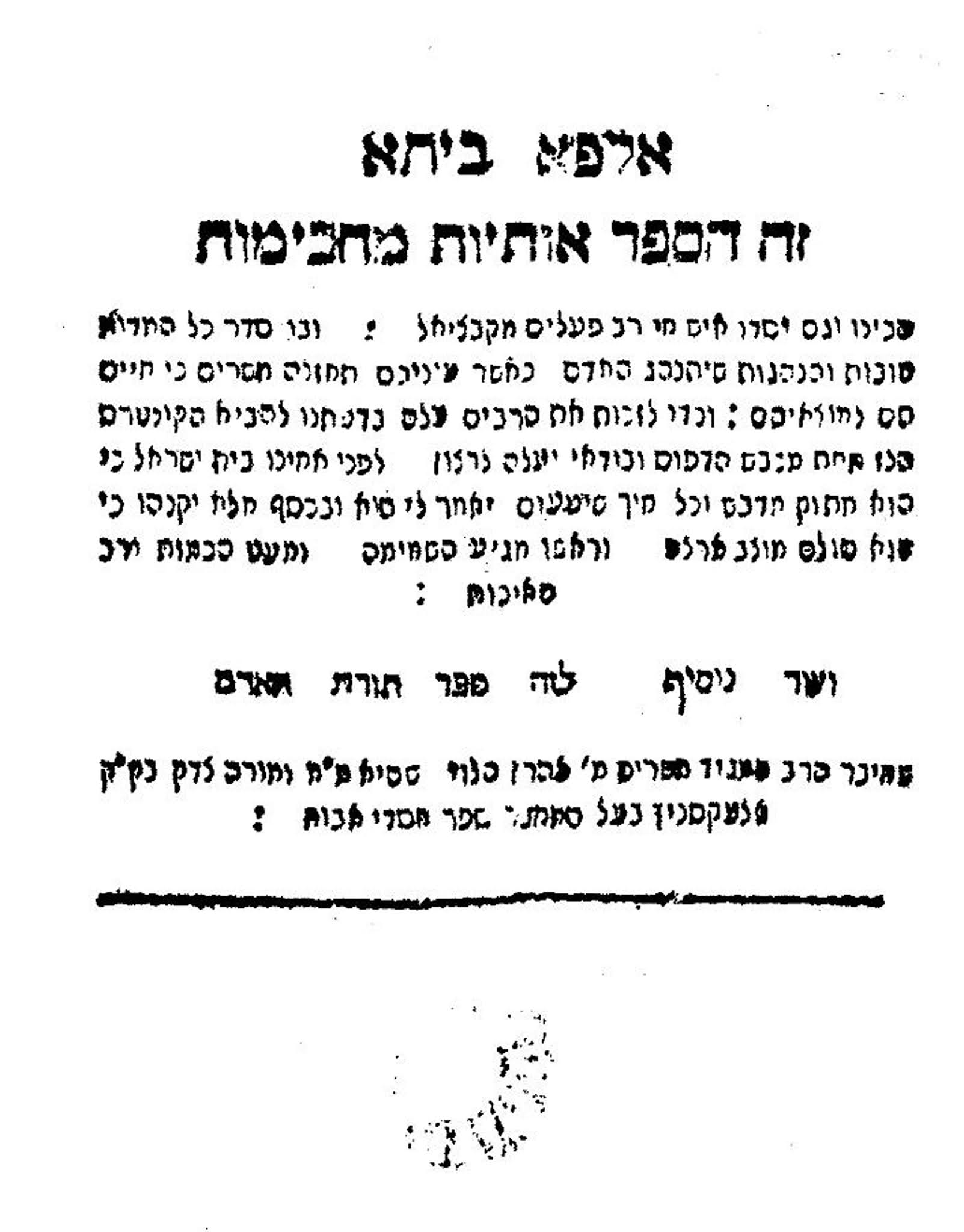
1794/ 1800, Alpha Beta
Courtesy of The Library of Agudas Chassidei Chabad Ohel Yosef Yitzhak

Alpha Beta
This is the book Otiyyot Mahkimot

“A valiant man of many achievements from Kabzeel” (II Samuel 23:20, I Chronicles 11:22). In it are the order of all the middot tovot (good virtues) and the manner in which one should conduct himself as your eyes can see, “for they are life to him who finds them” (Proverbs 4:22). For the public good we have brought this booklet to press. Certainly, it will be pleasing to our brothers the children of Israel for it is “sweeter than honey” (Judges 14:18; cf. Psalms 19:11). All of your days you will taste of it and say for me it “was acquired at the full price (Genesis 23:9, I Chronicles 21:22, 24)” for it is “a ladder set earthward and its reaching heavenward] (Genesis 28:12).” Small in size but of great value.

Furthermore, we have added to this the sefer Torat ha-Adam.

Written by the rav, ha-Maggid R. Aaron ha-Levi, who is the moreh zedek (righteous teacher) in the [holy community] of Zaksanin and author of the sefer Hasdei Avot,

Tzevi Hirsch’s name does not appear on the title-page. The text follows immediately after the title-page, beginning with the phrase “‘these are the words’ (Deuteronomy 1:1) which a man shall carry out and live by them’ (Leviticus 18:5, Ezekiel 20:11, 13, 21), everlasting life, and whomever fulfills these words will assuredly be a great zaddik.” Below this opening phrase is the text, comprised of entries in alphabetic order.

Examples of the subject matter are אות א (letter alef) emet (truth); א ahavah (love): letter ב bet; bracha (blessing): ג gimmel; gemilat hesed (acts of loving kindness): ד daled, no entry; ה heh; hihor (thoughts); ו vav; ve-tikvah (and hope), ז zayin; zahiros, (caution); and concluding with ר resh ratzon (will); ש shin shtikah (silence); and ת tav: teshuvah (repentance). Entries vary in length. Examples of brief entries are:

חבר ח (friend). It is good for a person to have a friend to speak with concerning serving the Lord and to maintain distance from a bad companion, fulfilling “my sin is before me constantly” (Psalms 51:5) and seek from the Holy One, blessed be He, with a broken heart that I should not repeat these sinful deeds nor anything that is not according to the will of the Holy One, blessed be He. It is a mitzvah to very much strengthen oneself with great zeal to arise at chaztot lilah (middle of the night).7

טהרה ט (purity) A person should be pure at all times by immersing his body [in a mikvah, ritual bath) and be careful to wash his hands immediately afterwards so that there should absolutely not be any defilement on them and if possible so as to not go even daled amos. All the more when washing one’s hands in the morning one is responsible for his life (literally subject to death). Purity of his garments, as it is written “cleanse yourself and change your garments” (Genesis 35:2)and all your utensils , cups and plates shall be [ritually] clean for this arouses purity of the soul.

קדושה ק (holiness). A person should sanctify himself in all the ways that hazal (rabbinic sages) has cautioned him and as what is written, one should be very careful to sanctify all his limbs and senses.

The text of Alpha Beta is followed by Torat ha-Adam written by R. Aaron ben Judah ha-Leṿi (18th cent.), also author of Hasdei Avot.8 Torat ha-Adam is also a collection of moral maxims, concluding with a brief alphabetical list of dictums, a few a bit strange, such as כ “all your companions and your brothers will betray you: and even those who lie in your bosom will forsake you”9 and, more customary, ת “give thanks to the Lord your God and then you may go in safety on your way.”
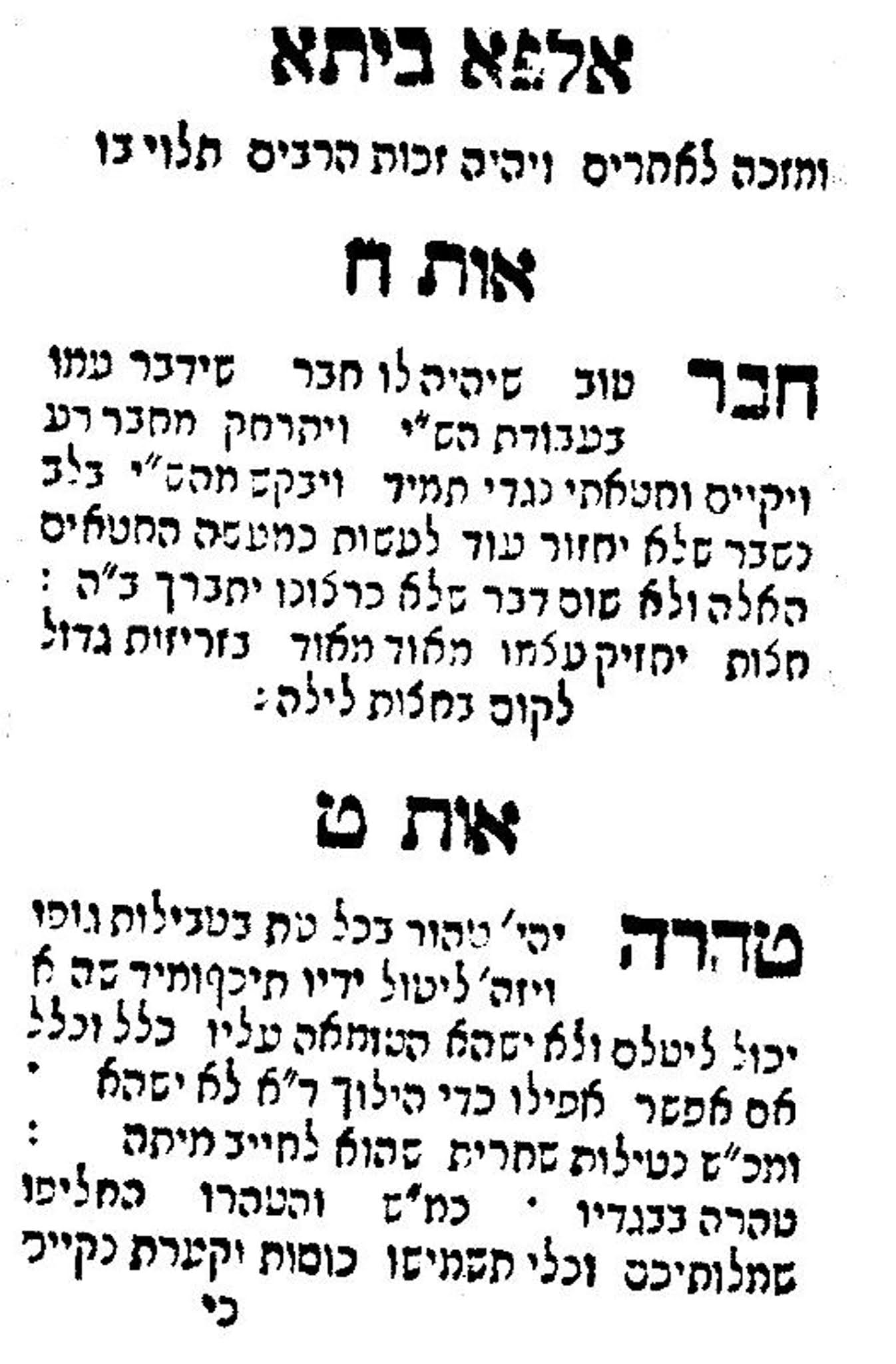

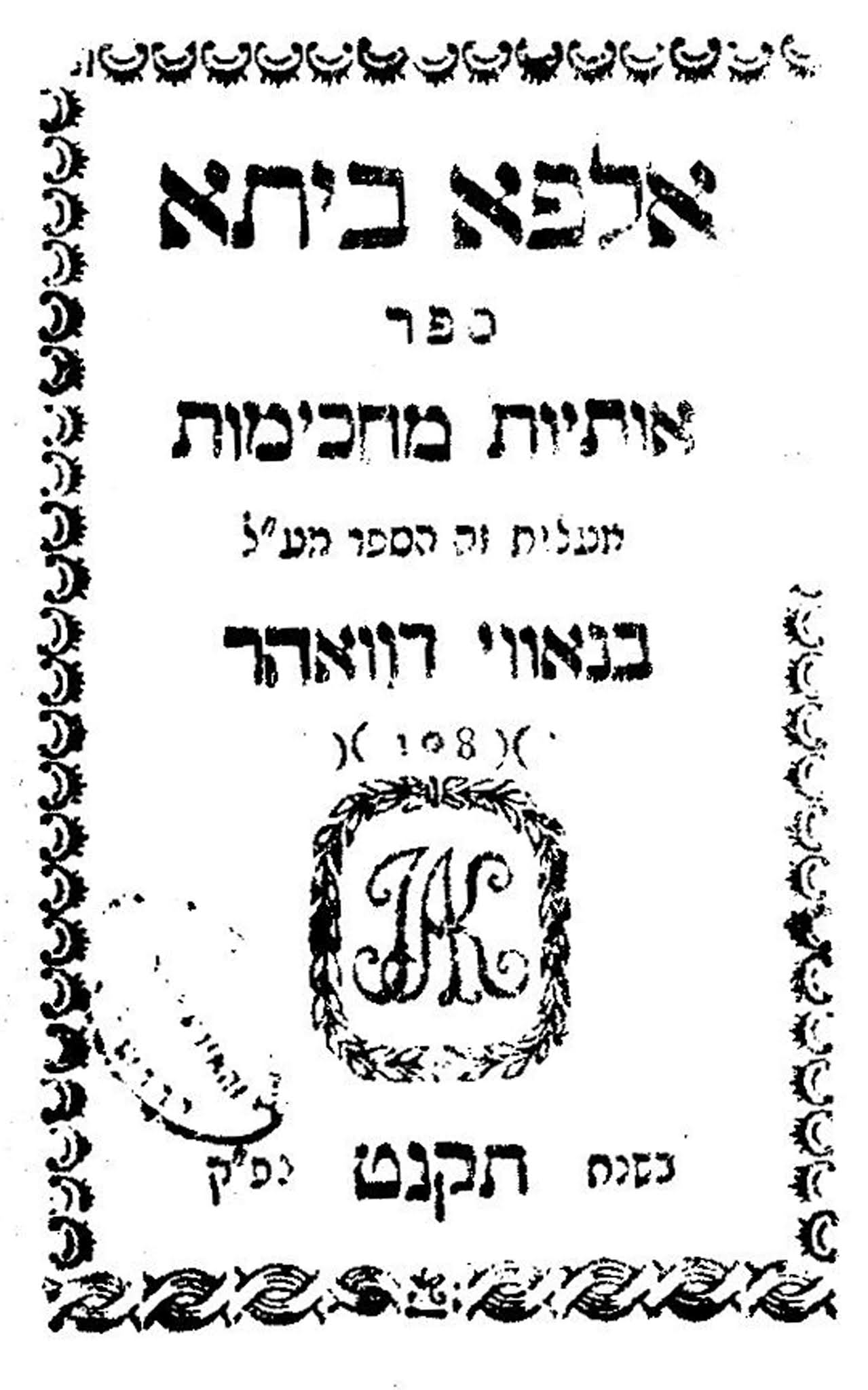
Sefer Alpha Beta (c. 1799) Nowy Dwor
Courtesy of the National Library of Israel

Shortly after the first printing of Alpha Beta several other editions of Alpha Beta were published. Among them is a clearly dated תקנט (559 = 1799) Nowy Dwor edition (title-page above). Nowy Dwor, located in east-central Poland, thirty-one kilometers from Warsaw, was published at the press of Anton Krieger (Krüger), a Christian German cloth merchant.10 The title-page has a brief text, simply stating that it is Alpha Beta, Sefer Otiyyot Mahkimot and giving the place of printing. Here too Tzevi Hirsch’s name is omitted. The volume begins with a brief preface praising the work and then an introduction by Tzevi Hirsch’s son stating that it was previously printed as Otiyyot Maḥkimot, undated and without the place of publication. This edition, more complete, has added material, among it the following entry,

דיבור ד speech. Speech is very precious and should not be used in vain, and all the more to anger or for dispute, G-d forbid, derogatory speech, talebearing, disparaging speech, mockery, or falsehood . . .

Some letters are amplified, that is they are enlarged subheadings within entries, such as א ahavah (love) has been expanded to highlight אמת (truth), followed by ahavah (love), and then אכילה (eating), but this is infrequent. The text of Alpha Beta is followed by Be-Ezer ha-Zur, an alphabetical listing of concise aphorisms, for example,

ו One should be careful to not go daled amos (approximately 6 feet) without netilat yadaim (washing one’s hands).

ז One should be careful to join day and night times with Torah or tefillah (prayers).

יג One should not look at any animal, wild beast, or bird at the time they are occupied one with the other.

יד One should not look at any idol or graven image for his prayers will not be accepted for forty days, G-d forbid.

כד One should be careful not to embarrass anybody.
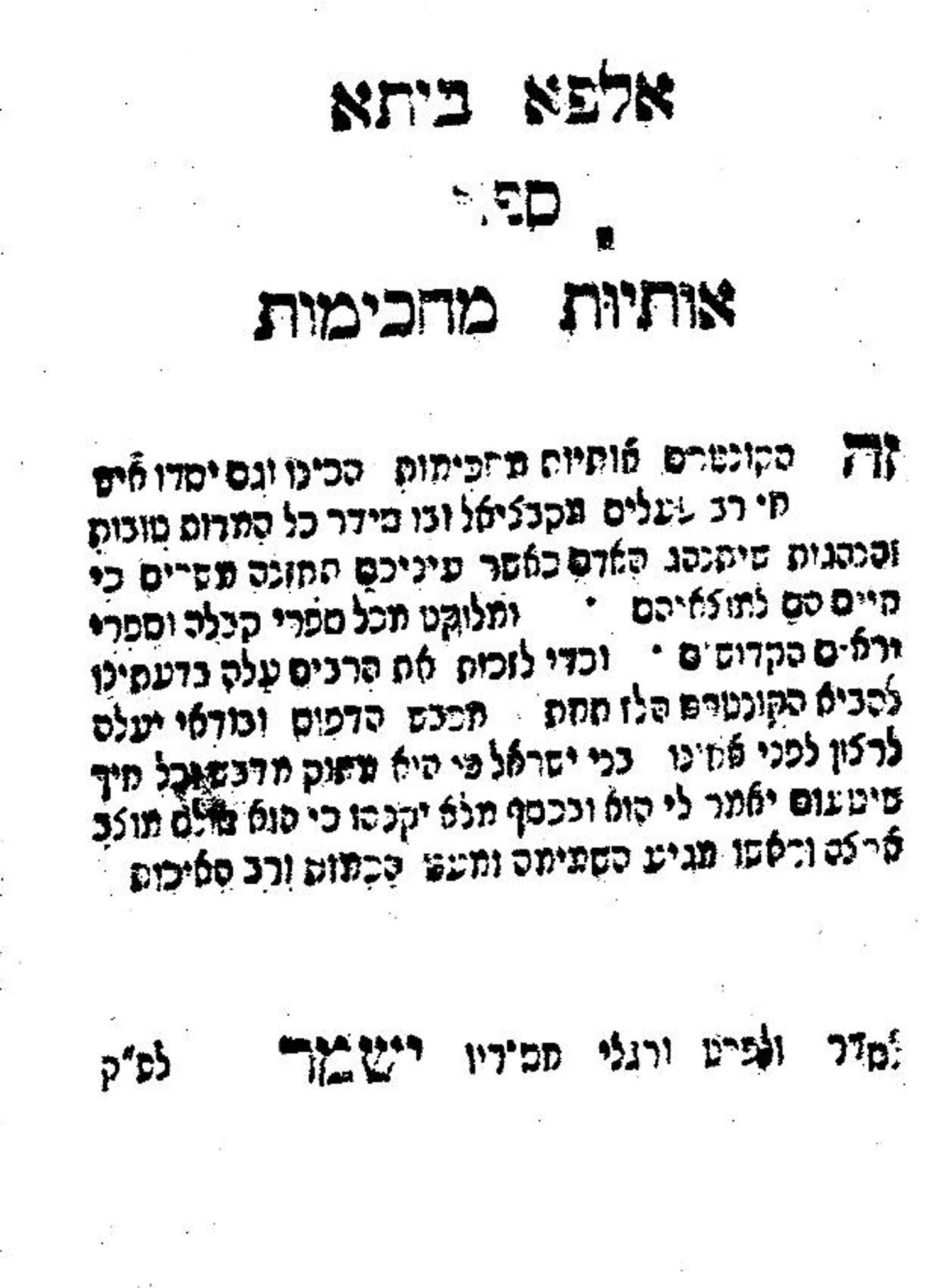
Sefer Alpha Beta (1799) Nowy Dwor
Courtesy of the National Library of Israel

There is yet another edition late eighteenth-century edition (below) this with the location unknown but clearly dated “He guards the steps of His devout ones ורעלי חסידיו ישמר (550 = 1790)” (Samuel 2:9). If the date is correct this would be the earliest of our printings of Alpha Beta. It was noted above that the Thesaurus records a 1790 Russia-Poland edition, likely referring to this printing, presumably the first printing, prior to the Nowy Dwor edition, which may have been the second edition and the first complete printing of Alpha Beta, excepting the recorded Breznitz Alpha Beta (1796), which was not seen. However, this 1790 Alpha Beta mentions Otiyyot Mahkimot but otherwise makes no reference to earlier printings.

It stands out, however, for within the entries portions of the text are highlighted so that they now appear as several entries. For example, within the above entry on ד דיבור speech there are now two additional entries, that is, the words are highlighted in the text, for example ד דיבור speech, דין judgement, and דרך ארץ respectfulness.
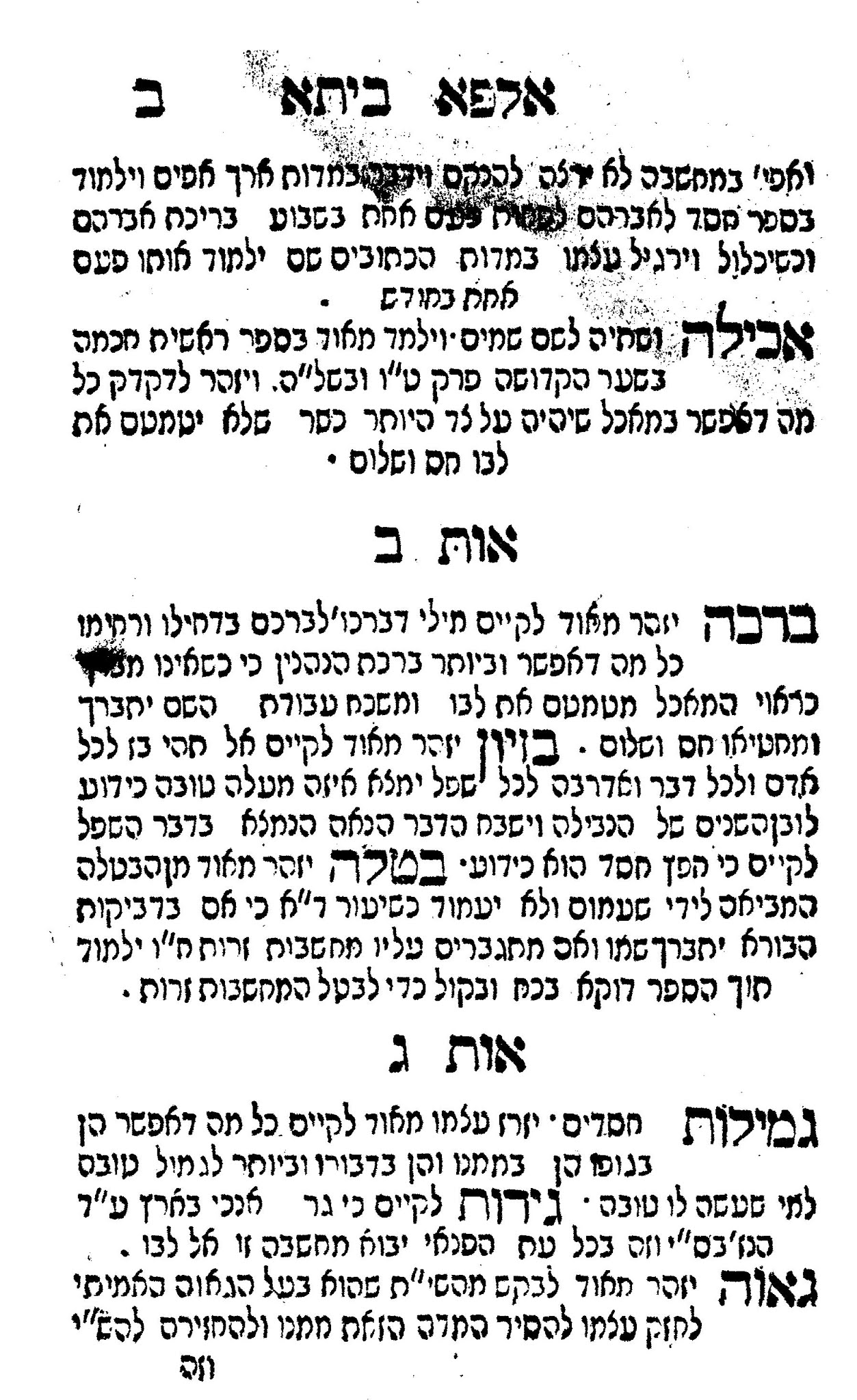
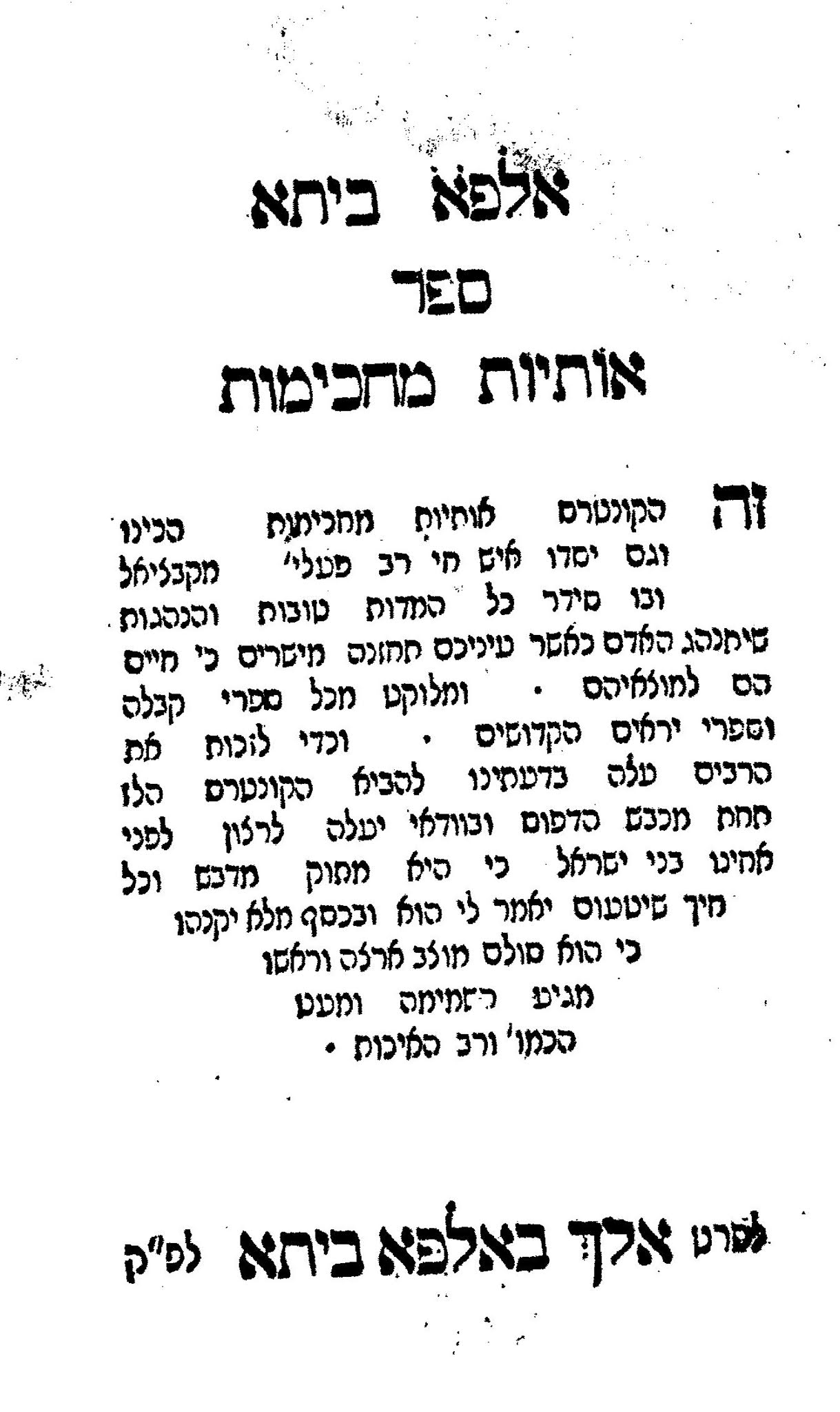
1818, Alpha Beta, Russia-Poland
Courtesy of the National Library of Israel

Two distinct editions of Alpha Beta are recorded as 1818 imprints. One clearly dated as 1818, lacking the place of publication, is recorded as a Russia-Poland imprint and omits Zevi Hirsch’s name. The second edition, tentatively dated 1818, the place of publication also lacking, is frequently recorded as a Berdichev imprint. It clearly identifies Zevi Hirsch as the author. These are the eighth and ninth editions of Alpha Beta.

The Russia-Poland edition is dated אלך באלפא ביתא (578 = 1818) but no printer is given. It is described as 19 cm. (8 ff.). The title-page states,

Alpha Beta
Sefer
Otiyyot Mahkimot

This brochure Otiyyot Mahkimot was prepared and created by “a valiant man of many achievements from Kabzeel” (II Samuel 23:20; I Chronicles 11:22). In it he arranged all the good middot (traits) and conduct with which a person should conduct himself as “your eyes can behold righteousness” (cf. Psalms 17:2) “for they are life to he who finds them” (Proverbs 4:22).

Selected from all the works of Kabbalah and by God fearing men. For the public good we have brought this brochure to press, and it will certainly be pleasing to our brothers the children of Israel for it is “sweeter than honey” (Judges 14:18) and all your life you should taste of it and say for full silver he acquired it for it is “a ladder set earthward its top reaching heavenward” (Genesis 28:13), of small size.

Tzevi Hirsch of Nadworna’s name does not appear on the title-page nor in the brief introductory paragraph that precedes the text, set in rabbinic letters.

The second 1818 edition is generally recorded as a Berdichev imprint, 16 cm. [28] ff. However, a word of caution. Isaac Yudlov notes that Avraham Yaari, in his article on Hebrew printing in Berdichev, in which Yaari records Bedichev imprints, omits this edition of Alpha Beta, suggesting that Yaari, who recorded fifty-six Berdichev titles, either did not believe it was a Berdichev imprint or omitted items that were questionable.11 Nevertheless, most bibliographies do record this edition as a Berdichev imprint.

The most active printer in Berdichev at this time was Israel Bak, who published Tzevi Hirsch’s Tsemh ha-Shem la-Tsevi, also in 1818 (above), also lacking the date of publication. Tzevi Hirsch’s name is clearly given, in enlarged bold letters, on the title-page of this edition of Alpha Beta. The title-page states,

Sefer
Alpha Beta

Otiyyot Mahkimot. Illuminating as saphires, shining as lightening, standing at the top of the peak of the world, who reflects on them at all times will find in it “good reasoning” (Psalms 119:66), a healing for the soul (cf. Proverbs 16:24) and a tonic for your bones (Proverbs 3:8), arousing hearts, and bringing souls closer to their Father in heaven. That came from the mouth of the righteous, the pious, and humble, holy one of the Lord, the esteemed , the rav, the gaon, illustrious in Torah, the godly man Tzevi Hirsch the light of whose Torah shined in Nadworna and other communities.

A second paragraph states that references in the Talmud to idol worshippers and various terms used to describe them do not apply to contemporary nations who are not idol worshippers but give honor to the Torah and its followers and rule with justice and kindness. Such proforma statements are often found in contemporary Hebrew works and editions of the Talmud. The title-page is followed by the introduction of Tzevi Hirsch’s son, David Aryeh. He writes,

Behold, the above holy words that were already published by one who exited and entered in the tent of the Torah of the Rav [Tzevi Hirsch], placing it in his bag, the identity of the one who took this awesome work[12] הכר”ך הנורא הזה completely unknown (lit. obscured from sight) and there is no reason as to why in places it was abbreviated and others lengthened from the author. Now time has turned, thanks to the will of the Creator, to merit my father . . . and to bring the book to press . . .
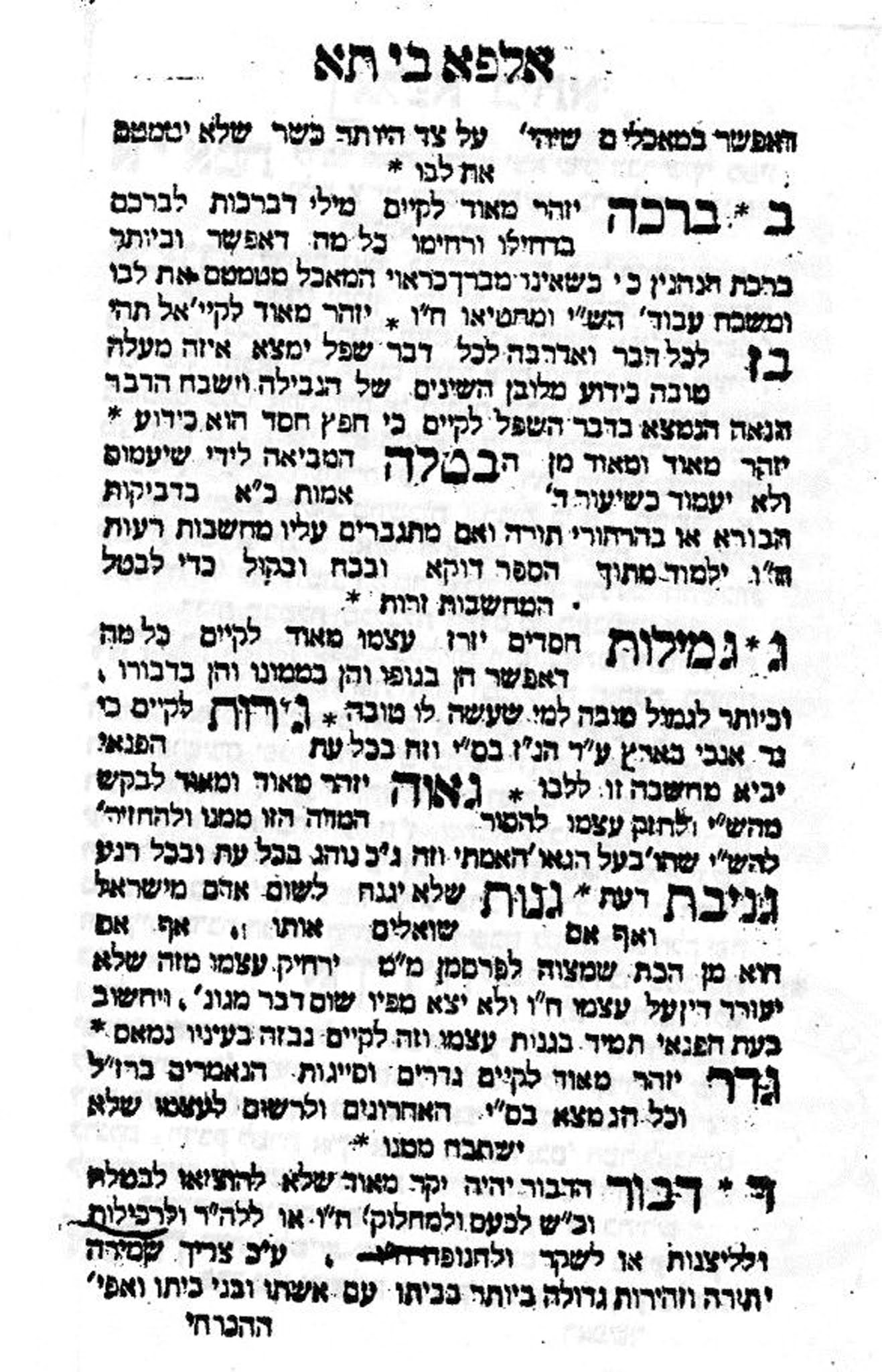
1818, Alpha Beta, Berdichev
Courtesy of the National Library of Israel Courtesy of Steven Weiss

Ze’ev Gries and Ya’akov Shemu’el Shpiegel both note, referencing the introduction, that the reason for the omission of Tzevi Hirsch’s name in the previous printings was that, beginning with the 1790 Poland or Russia edition, Alpha Beta was frequently printed without the author’s name as the book was plagiarized or printed with changes unbeknownst to the author. The situation was corrected when Tzevi Hirsch’s son, David Aryeh, issued the Berdichev, 1818 edition.[13]

Gries, after comparing the Berdichev and the previous editions, finds that the errors are insignificant, the differences minor, the texts generally alike. He concludes that David Aryeh’s complaints are primarily based on the unauthorized use of his father’s work and the omission of the aphorisms included at the end of the Nowy Dwor edition, which may have been omitted intentionally or because the manuscript in question lacked them.[14]

Printed with this edition of Alpha Beta is Mille d’Avot, a commentary on Pirke Avot. The latter work frequently printed together with Alpha Beta. In Pirke Avot: A Thesaurus Steven Weiss records eleven editions of Alpha Beta beginning with the 1818 Berdichev edition through a 2011 Benei Brak edition.[15] In the introduction David Aryeh informs that the work of “many pearls” (Proverbs 20:15) Mille d’Avot is printed from a manuscript of his father’s, the author of that work, and also notes the publication of Tsemah ha-Shem la-Tzevi.
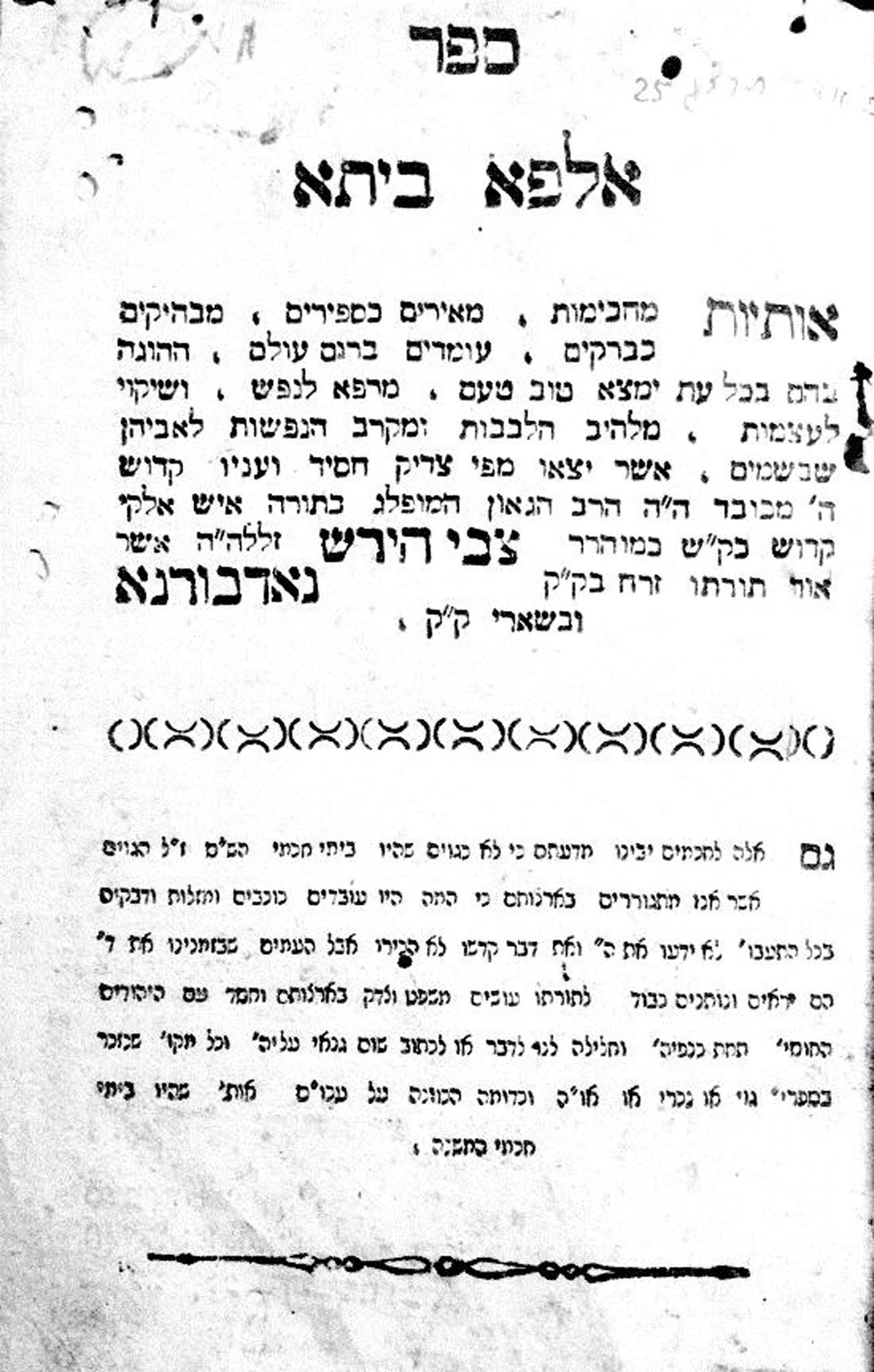
1848, Alpha Beta, Zolkiew
Courtesy of Otzar Hahochma

Subsequent editions of Alpha Beta clearly mention Zevi Hirsch’s name, for example the 1848 Zhitomir (Zhytomyr), edition (above). That edition was printed by Ḥanina Lipa, Aryeh Leib and Joshua Heschel Shapira, sons of Samuel Abba and Phinehas Shapira, grandsons of R. Moses Shapira. The original family press, in Slavuta, highly regarded, was forced to close after charges were brought by central authorities, but denied by the local Russian authorities, concerning the alleged murder by the Shapira family of a non-Jewish worker who had denounced the press to the authorities for printing Hebrew books without the approval of the censor. The press was reestablished by the Shapira sons in Zhitomir in 1847.

There is at least one recent edition that not only recognizes Zevi Hirsch as the author of Mille d’Avot but even emphasizes Mille d’Avot over Alpha Beta, the Lodz 1930 edition (below).

1930, Alpha Beta/ Mille d’Avot, Lodz
Courtesy of Steven Weiss

Tzevi Hirsch ben Shalom Zelig of Nadworna’s Alpha Beta has been a moderately popular work. The Thesaurus of the Hebrew Book records thirteen editions, the last being a questionable Zolkiew 1850 printing; The Bet Eked Sefarim records an equal number, the latest being a Lublin 1934 printing. While Alpha Beta is highly regarded this number of printings is not, in comparison to the ethical works noted at the beginning of this work, an impressive number of editions. Alpha Beta is a small brochure, portable and more easily learned than the other books mentioned, which are large and, in some instances, multi-volume works. One would have thought that this would have resulted in many more printings of Alpha Beta rather than the relatively small number noted. Given these considerations and the value (importance) of the ethical teachings in Alpha Beta the verse quoted at the beginning would appear to be appropriate for Alpha Beta.

By the riches of the sea they will be nourished, and by the treasures concealed in the sand. (Deuteronomy 33:19).

[1] I would like to express my appreciation to Eli Genauer for reading this article and for his suggestions, Dr. Steven Weiss and R. Yitzhak Wilhelm, Library of Agudas Chassidei Chabad Ohel Yosef Yitzhak Lubavitch, for their assistance.
[2] Steven J. Weiss, Pirke Avot: A Thesaurus: An Annotated bibliography of Printed Hebrew Commentaries, 1485- 2015 [Hebrew with English introduction]. A reason for the custom of saying Pirkei Avot between Pesah and Atzeret is that in these days each and every member of the people of Israel is obligated to purify himself during the days of Sefirah as the children of Israel purified themselves from the defilement of Egypt as is known from the holy Zohar. Seven weeks comparable to the seven days of niddah. (Ohev Yisrael for the Shabbat after Pesah 3:1).
[3] Yitzhak Alfasi, Entsiklopedyah la-Hasidut: Ishim כ-ת (Jerusalem, 2004), cols 603-07 [Hebrew]; Tzvi M. Rabinowicz, The Encyclopedia of Hasidism (Northvale, London, 1996), p. 335.
[4] Alfasi.
[5] Ze’ev G,ries, Sifrut ha-Hanhagot: Toldoteha u-Mekomah be-haye Haside R. Yisrael Ba’al Shem Tov (Jerusalem, 1989), p. 119 [Hebrew].
[6] Ch. B. Friedberg, Bet Eked Sefarim (Israel n.d.), alef 1422 [Hebrew]; Yeshayahu Vinograd, Thesaurus of the Hebrew Book. Listing of Books Printed in Hebrew Letters Since the Beginning of Printing circa 1469 through 1863. I (Jerusalem, 1993-95), p. 11 [Hebrew].
[7] Arising at chaztot lilah (middle of the night) refers to the kabbalistic custom of arising at the middle of the night to recite prayers and lamentations over the destruction of the Temple. (Aaron Wertheim (Author), Shmuel Himelstein (Translator), Law and Custom in Hasidism (Hoboken, 1992), p. 99.
[8] Torat ha-Adam has been printed independently several times, beginning with an Oleksinetz edition (c.1769) entitled Zot Torah ha-Adam. It is refeered to by that title in the Sudilikov (1819) and Munkatch (1904) printings.
[9] Cf. “Trust no friend, rely on no intimate; be guarded in speech with her who lies in your bosom” (Micah 7:5).
[10] Concerning the Nowy Dwor press see Marvin J. Heller, Printing the Talmud: Complete Editions, Tractates, and Other Works and the Associated Presses from the Mid-17th Century through the 18th Century (Leiden/Boston, 2019), pp. 211-18.
[11] Avraham Yaari, “Hebrew Printing at Berdichev,” Kiryat Sepher (1944), p. 100-24 [Hebrew]; Isaac Yudlov, The Israel Mehlman Collection in the Jewish National and University Library: An Annotated Catalogue of the Hebrew Books, Booklets and Pamphlets. Jerusalem 1984, pp. 190-91 no. 1171 [Hebrew].
[12] Concerning this phrase Gries references Ezekiel 1:22 the letters of הכר”ך reversed, the verse stateing “There was a likeness of an expanse above the heads of the Chayah החיה רקיע כעין הקרח, like the color of the awesome ice, spread out over their heads from above.” Also see TB Bava Mezia 24b and Hullin 95a where the phrase “obscured from sight” appears, albeit in a very different context.
[13] Gries, pp. 120-21; Ya’akov Shemu’el Shpiegel, Amudim be-Toldot ha-Sefer ha-Iṿri: hadar ha-meḥaber: be-Sha’ari ha-Defus (Jerusalem, 2014), pp. 25-26 [Hebrew].
[14] Gries, p. 21.
[15] In a private correspondence, dated May 27, 2020, Dr. Weiss writes that, concerning Alpha Beta, he “only listed the editions with Avot.”


Conservative Conversions, Some Grammatical Points, and a Newly Published Section of a Letter from R. Joseph B. Soloveitchik

Conservative Conversions, Some Grammatical Points, and a Newly Published Section of a Letter from R. Joseph B. Soloveitchik

Marc B. Shapiro

 
1. Since I mentioned R. Ovadiah Hoffman in the last post, I would be remiss in not noting that he and his brother, R. Yissachar Dov, recently published volume 4 of Ha-Mashbir, devoted to R. Ovadiah Yosef. It can be purchased here.
The volume contains a previously unpublished letter by R. Ovadiah Yosef that I provided, dealing with a rabbi who improperly converted people. It also contains a number of other noteworthy sections, such as R. Ovadiah’s notes to R. Ben Zion Uziel’s Mishpetei Uziel, talmudic notes from R. Uziel published from manuscript, R. Meir Mazuz’s notes to R. Ovadiah’s Yehaveh Da’at, and many valuable articles by contemporary Torah scholars, including the editors. Of particular interest to me was R. Yissachar Dov Hoffman’s article on the practice of a number of great Torah sages of prior generations not to kiss their children. Such a practice is so much against the contemporary mindset of what is regarded as healthy that, as R. Hoffman notes, even a Satmar rabbi, R. Israel David Harfenes, has stated that “in our time it is forbidden to follow this path” (p. 293).
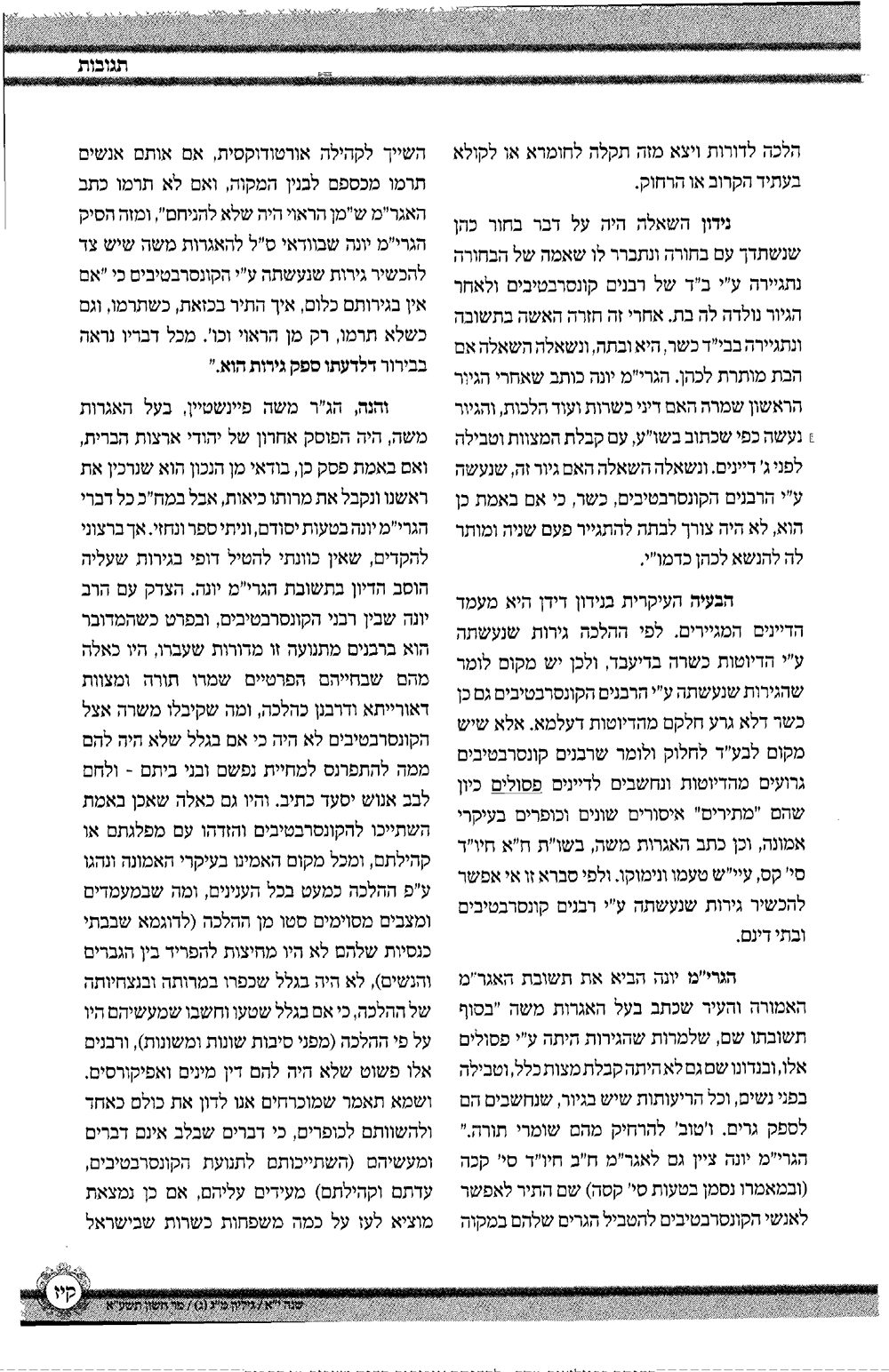
Apropos of the above-mentioned responsum on conversion by R. Ovadiah Yosef, in Beit Hillel, Adar 5770, R. Yisrael Meir Yonah deals with a conversion done by a Conservative beit din. He rules that in this particular case the conversion is valid. This ruling was affirmed by R. Ovadiah.In his responsum, R. Yonah states that R. Moses Feinstein regarded Conservative conversions as doubtful conversions rather than completely invalid, and brought two supposed proofs for this. I responded to R. Yonah in Beit Hillel 43 (Heshvan 5770), and you can see my letter here.[1]

To his credit, R. Yonah acknowledged that he was mistaken in his reading of R. Feinstein’s responsum.[2] It is also the case, as I mention in my letter, that it is possible that a conversion done by a Conservative rabbi, especially from years ago, could be halakhically valid. R. Feinstein himself, who wrote very strongly against Conservative conversions, also writes about such a conversion: כמעט ברור שאין עושין הגרות כדין. The word כמעט shows us that even R. Moshe recognized that there are times when a Conservative conversion can be halakhically valid. In Mesorat Moshe, vol. 1, p. 327, we see as well that R. Moshe acknowledged the possibility that a Conservative conversion could be valid:
אולי יש להסתפק דאפשר לא היו ב”ד של פסולים, דיש אנשים, בעצם דתיים ומאמינים, שמחמת דוחק פרנסה מקבלים משרה כרבנים אצלם, ואפילו אם למדו בסמינר שלהם, אולי בעצמו כן מאמין. ולפיכך למעשה, אם זה אפשר לברר, תבררו. ואם קשה לברר, אז אולי שייך להגיד השערה, שאם זה בכפר או עיר רחוק מעיקר ישוב היהדות הדתי מסתמא אין להסתפק, בוודאי אינו כלום. ואם זה בעיר שיש בו ישוב דתי, נו, אזי כן יש ספק.
I also know someone who offers eyewitness testimony that R. Moshe did not think that every Conservative conversion could be voided without investigation, especially as this would mean that women married to these converts would then be able to remarry without a get. R. Moshe was not willing to go this far.
Similarly, R. Ovadiah Yosef, when asked about a Conservative conversion, replied that before giving a ruling it was necessary to find out which Conservative rabbi did the conversion, “since the Conservatives are not all alike.”[3]
R. Ovadiah was also asked about a woman who had become religious and was interested in going out with a kohen for the purpose of marriage. The problem was that she had slept with a man whose mother was converted by a Conservative rabbi. This man’s family was somewhat traditional as they kept kosher, made kiddush, and lit Shabbat candles. Could the woman in question marry a kohen, which is forbidden if she had slept with a non-Jew? The answer to this question depends on the status of the man whose mother was converted by a Conservative rabbi. If the conversion was invalid then the man was also to be regarded as a non-Jew, and the woman we are discussing, who slept with this man, would be forbidden to a kohen.
R. Ovadiah replied that the woman could marry a kohen, which means that be-diavad he accepted the Conservative conversion. He gave this ruling without even seeking further knowledge about the particular rabbi who did the conversion under question, which appears to me to be an incredible leniency. In seeking to explain this ruling, R. Yehudah Naki writes, “We see that they observed some mitzvot, so be-diavad there is more room to be lenient, at least not to forbid others” (that is, to forbid the woman from marrying the kohen).[4]
As mentioned, R. Ovadiah accepted R. Yonah’s pesak that a particular conversion carried out by a Conservative beit din was valid. In this case, the daughter of a woman who had been converted wished to marry a kohen. This would only be allowed if the daughter was born Jewish, meaning that everything depended on the status of her mother’s conversion. Here is how R. Yonah described this particular Conservative beit din.[5]
ובירורים שעשינו בנ”ד התברר לנו שב”ד הזה שגיירוה, הם אנשים שנקראים וידועים כשומרי תורה ומצוות, ובעצם הם אורטודוכסים, וגם הגיור שעשו, ע”פ כל החקירות ודרישות שעשיתי, הקפידו בכל הדברים כולם, הן בטבילה, חציצה וכו’ וכו’, הן בקבלת מצות, ולימודי יהדות קודם הגיור, לא פחות ואולי יותר, מהרבה בתי דינים אחרים שנחשבים לחרדיים. וא”כ אין כל סיבה לפע”ד לפסול גיור זה.
Here is R. Ovadiah’s affirmation of R. Yonah’s pesak, from Beit Hillel, Adar 5770, p. 60.

That a Conservative conversion might be valid also appears to be assumed by R. Mordechai Eliyahu. This is what he writes in his Ma’amar Mordechai, vol. 2, Even ha-Ezer, no. 16:
ובענין הגר שנתגייר אצל הקונסרבטיבים והוא אינו שומר תורה ומצוות, והיה לכם ספק אם אפשר לכתוב שם יהודי שניתן לו, שם שלא השתמש בו מעולם, או לכתוב בן אאע”ה. נראה לי, מאחר וכל עצם נתינת הגט של אדם זה הוא לחומרא ולא מדינא, כי מי אמר שגרותו – גרות, וגיוריהם של הרבנים הקונסרבטיבים – גיור . . .
R. Eliyahu does not say that there is absolutely no reason for a get when dealing with a Conservative conversion. Rather, he refers to it as a humra. Also, note how he states, “who says that his conversion was a [valid] conversion?” This is the language of safek. He does not say, “certainly his conversion was invalid.”[6]
2. In a previous post here I mentioned a few common pronunciation mistakes in Kiddush. There is one more that I would like to mention, but it is a little more complicated than the ones I previous noted. In the Friday night kiddush we say כי הוא יום תחלה למקראי קודש. Where is one supposed to put the accent in the word למקראי? If you look at ArtScroll you find that it puts the accent on the penultimate syllable, the ר. However, Koren and most of the other siddurim I checked put the accent on the final syllable, the א.
I don’t know why this should be a matter of dispute, because the Torah itself uses the expression מקראי קודש three times (Lev. 23:2, 4, 37), and in every case the accent in מקראי is on the final syllable.[7] The Yom Tov morning kiddush also begins: אלה מועדי ה’ מקראי קודש. For some reason ArtScroll is not consistent, and in this case it puts the accent in מקראי on the א.
After my last post someone emailed me pointing out that another “common mistake” is that in Birkat ha-Mazon, in the second paragraph, people say נודה לך putting the accent on the first syllable instead of the second. In fact, the tune for Birkat ha-Mazon that American children are taught at schools around the country has the word נודה recited with the accent on the first syllable. Should we now start teaching all the children differently, so that they pronounce נודה with the accent on the second syllable which is how ArtScroll, Koren, and almost all the other siddurim have it?
Actually, this matter is not clear at all. I say this because if you open up a Tanakh to Psalms 79:13 and look at the words נודה לך you will find different versions. Some have the word נודה with the accent on the final syllable and others have the accent on the first syllable. The Aleppo Codex has the accent on the first syllable and puts a dagesh in the ל of לך. Although the practice of American children (and adults) pronouncing the word נודה with the accent on the first syllable has nothing to do with the Aleppo Codex, the fact that this pronunciation appears in such an important source means that there is no reason to change how the children are taught. However, this creates a problem because in the Amidah, in Modim, we say נודה לך ונספר תהלתך. If we are going to recite נודה of Birkat ha-Mazon with the accent on the first syllable, then we should be consistent and do the same thing in the Amidah, in ברוך ה’ לעולם in ma’ariv: נודה לך לעולם, and also in the so-called “Three-Faceted Blessing” (ברכה מעין שלש – Al ha-Mihyah): ונודה לך על הארץ.
Speaking of consistency, in Birkat ha-Mazon, the Amidah, ברוך ה’ לעולם, and the Three-Faceted Blessing, both the regular ArtScroll siddur and Koren have the accent in נודה on the final syllable. However, in the Amidah, ברוך ה’ לעולם, and the Three-Faceted-Blessing they both place a dagesh in the ל of ונודה לך and נודה לך, but do not place a dagesh in the ל of נודה לך in Birkat ha-Mazon. This makes no sense. If there is a dagesh in one there must be a dagesh in all of them. (In the Hebrew-only ArtScroll siddur they also put a dagesh in the in the ל of נודה לך in Birkat ha-Mazon.)
I think it is a mistake for ArtScroll and Koren to place a dagesh in לך in any of these instances. Since no exception with נודה לך is found in Tanakh, the only reason there would be a dagesh in לך is if the word נודה has the accent on the first syllable, as in the Aleppo Codex (and unlike what appears in ArtScroll and Koren), or if there is a makef between the two words.[8]
Regarding the word נודה, it is worth noting that in Ein Ke-loheinu there is no question that נודה is to be read with the accent on the final syllable (as the matter of where to put the accent in נודה only concerns the phrase נודה לך). Here is an example where the common tune, which puts the accent on the first syllable, cannot be defended grammatically.
I noticed two mistakes in the regular ArtScroll siddur which appear correctly in Koren. In the morning blessings we say אשר נתן לשכוי בינה. Where is the accent in the word לשכוי? ArtScroll puts the accent on the final syllable, and Koren puts the accent on the penultimate syllable, on the ש. Koren is correct as there is an explicit verse in Job 38:36: מי נתן לשכוי בינה. If you look at the trop on this verse you will find that the accent in לשכוי is on the penultimate syllable. Interestingly, in the Hebrew-only ArtScroll siddur they get this right.
The other mistake is that in Birkat ha-Mazon on Sukkot we say:
הרחמן הוא יקים לנו את סכת דויד הנופלת
ArtScroll puts a kamatz under the פ in הנופלת. Koren puts a segol and that is correct. We see this from the appearance of the word in Amos 9:11, and there is no change of vowel even on the etnahta.[9]
I also found an example where ArtScroll gets it right and Koren is mistaken. In ma’ariv, in the paragraph ואמונה כל זאת, we say העושה לנו נסים. Koren has העושה with the accent on the final syllable and the ל of לנו with a dagesh. Yet this doesn’t work. For there to be a dagesh in the ל, the prior word, העושה, has to have the accent on the penultimate syllable, which is how it appears in ArtScroll.
Another example where ArtScroll gets it right and Koren gets it wrong is in the morning blessings where we say שעשה לי כל צרכי. Koren puts the accent in שעשה on the final syllable. Yet this is a mistake, and as is correctly found in ArtScroll the accent is on the penultimate syllable, the ע.
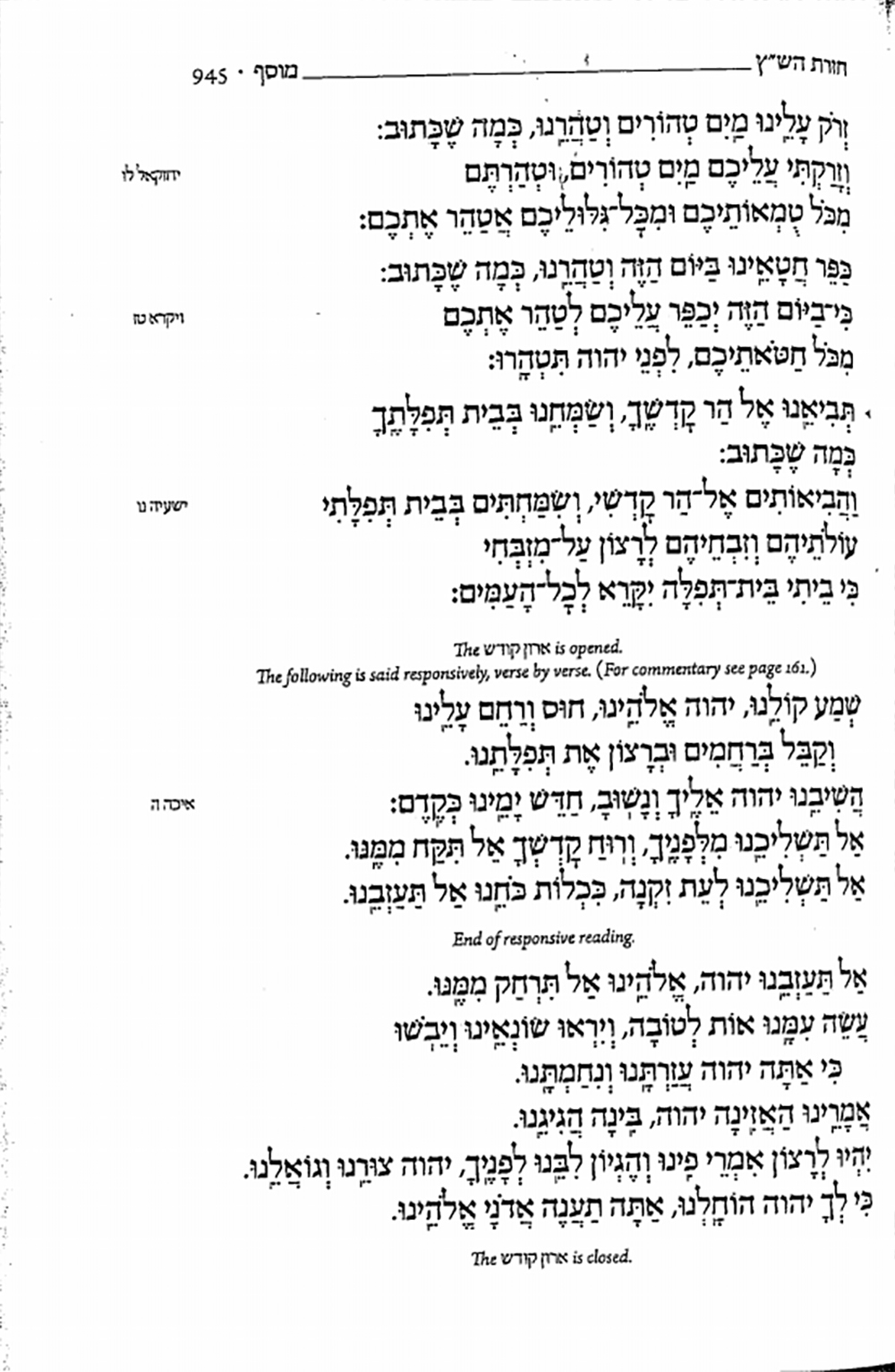
Since I have been speaking about the ArtScroll siddur, let me add a couple of comments about the Yom Kippur Machzor. Here is how Shema Kolenu appears in my copy of the Yom Kippur Machzor (p. 596).

The instructions tell us that “the first six verses of the following prayer are recited responsively, chazzan then congregation.” The problem is that I have never seen a synagogue that says the verses beginning אמרינו and אל תעזבנו responsively. What all these synagogues do is say the following four verses responsively:
שמע קולנו
השיבנו
אל תשליכנו מלפניך
אל תשליכנו לעת זקנה
In my experience, not only does no one say the verses beginning אמרינו and אל תעזבנו responsively, but they don’t say יהיו לרצון quietly either.
The text recorded by ArtScroll is the one found in many old Ashkenazic machzorim. So when and how were אמרינו and אל תעזבנו dropped from the responsive reading, or is it that from the beginning they were not included? As for יהיו לרצון, the old machzorim do not indicate that this is said quietly, so was there ever a tradition to recite it quietly or is ArtScroll simply trying to make sense of a verse that is found in the Machzor but no longer appears to be recited? If יהיו לרצון was originally part of the public reading, we again have to ask, why was it dropped?
Recognizing the problem, in the new edition of the ArtScroll machzor they made a change.
As you can see, אל תעזבנו has now been pushed to the next paragraph. We are also instructed that both אמרינו and יהיו לרצון are to be said quietly. Yet this doesn’t seem to make any sense, as those who are reciting Shema Kolenu responsively will not be saying these verses quietly. And again, I ask, is there any real tradition that these verses are to be said quietly, or is this something made up by people in an attempt to keep the traditional text of the Machzor while dealing with the fact that these verses are not part of the responsive reading? Unfortunately, when updating the Machzor, ArtScroll did not correct the instructions which still refer to the “first six verses” as being recited responsively, when instead it should say the “following four verses”.
Here is how Koren has the prayer.
This version, which puts אמרינו and יהיו לרצון before the final verse, is also attested to in prior machzorim, though the order found in ArtScroll appears to be the older version.To sum up, I am not sure what the best path for ArtScroll would have been. On the one hand, they could have adopted the version found in Koren, which solves all the problems. Keeping what appears to be the more authentic version, which they did, also makes sense, but then they were forced to add the instructions that certain verses are to be said silently. I have checked numerous old machzorim and there is no indication that these verses are to be said silently. Was there perhaps an oral tradition in this matter? Perhaps readers can comment on this. In any event, ArtScroll’s instructions are problematic, since, as mentioned, if people are reciting the prayer responsively, they are not going to be inserting two consecutive sentences quietly.

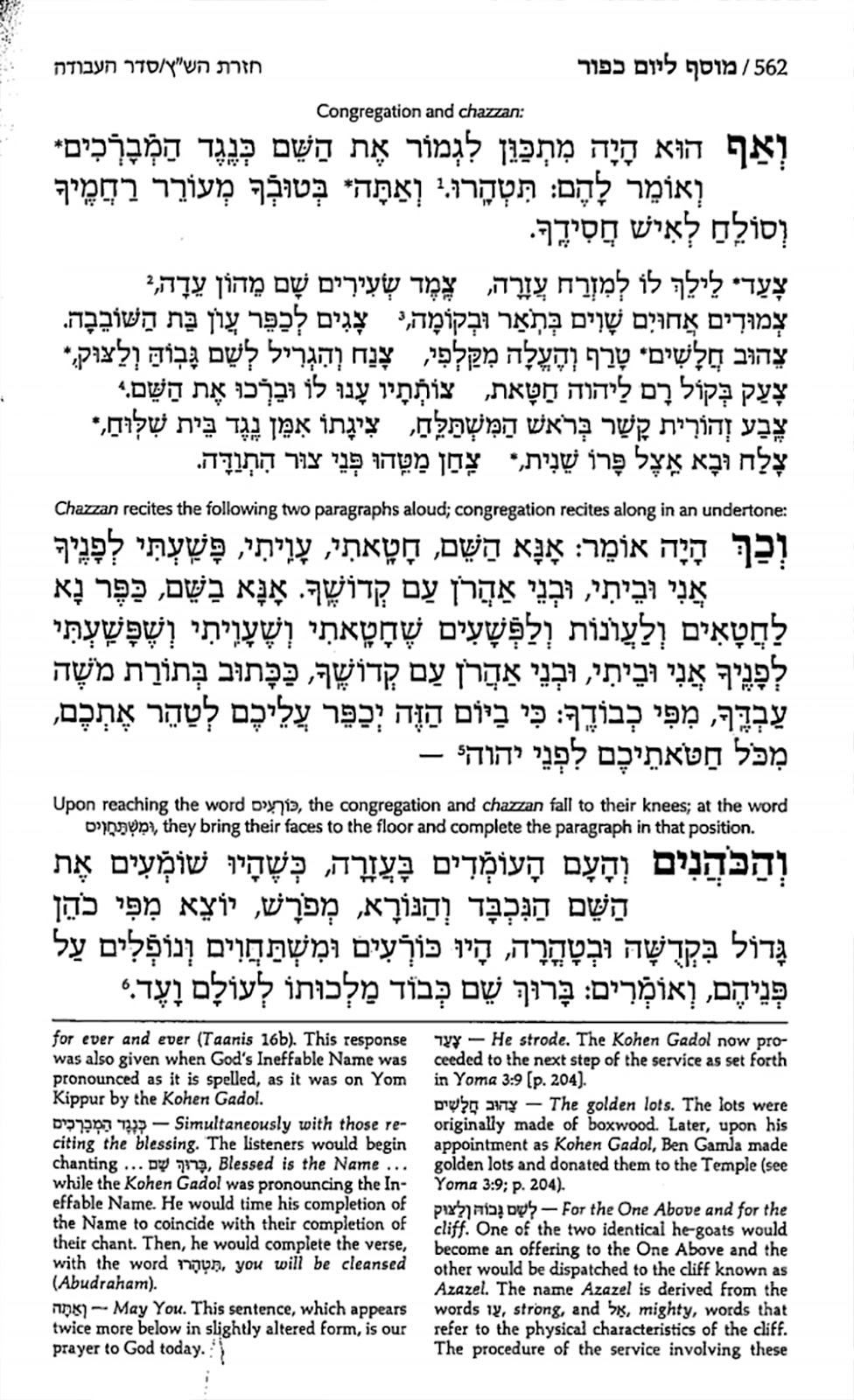
I noticed another interesting change in the ArtScroll Yom Kippur machzor between the old edition and the new one. Here is והכהנים והעם in the old edition.
It reads היו כורעים ומשתחוים ומודים ונופלים על פניהם.
Here is the new edition, where the word ומודים has been deleted. ArtScroll neglected to change the English translation, so it still appears, now incorrectly, as: “they would kneel and prostrate themselves, give thanks, fall upon their faces.”
Why was the word ומודים deleted? Based on what I have been able to determine, the version without the word ומודים is more common, so presumably that is the reason. Although most people might just chalk this up to a different girsa, R. Soloveitchik saw great significance in the alternative versions, and explained their different implications.[10]
Here are a couple of random mistakes I found in ArtScroll. (I use the ArtScroll siddur every day of the week, which is how I have come across these. I am sure that if I used Koren, I would find mistakes there too.) In the ArtScroll siddur, p. 86 it reads:
ואל מאורי אור שעשית, יפארוך, סלה
There is a dagesh in the ס of סלה. This means that the comma after יפארוך is a mistake, as you cannot place a dagesh in this ס if preceded by a comma.
Another mistake is found on p. 702, in the prayer for dew, which states בעם זו בזו. Its translation is correct: “Among this people, through this prayer.” However, I would have preferred if it appeared as follows: “Among this people, through this [prayer],” which would be a more accurate rendition of the few words. (This is indeed how it is translated in the ArtScroll Passover Machzor.)ArtScroll vocalizes these words be-am zu be-zu. Yet this is incorrect. בזו should be pronounced be-zo, referring to תפלה, the feminine Hebrew word for prayer. Koren gets this correct. This confusion of ArtScroll with zu and zo is also found on p. 202, where in the marriage service we find בטבעת זו and ArtScroll pronounces it zu, instead of zo. Again, Koren gets it right. (The word זו often appears in the Talmud, and the ArtScroll Talmud always pronounces it correctly.)

Let me close with one final mistake in ArtScroll, or perhaps it is not a mistake; readers can decide on their own. The ArtScroll Ohel Sarah Women’s Siddur is a special siddur designed for women. On the very first page of the prayers, this siddur has מודה אני with a segol under the ד. In a women’s siddur doesn’t there need to be a kamatz under the ד so that it reads modah?
This might reflect a broader issue. My experience is that in co-ed kindergartens the girls are also taught to say modeh. This might not be surprising, but I was also told by a number of people that even in girls-only kindergartens, both Ashkenazic and even some Sephardic ones, the girls are taught to say modeh. No doubt recognizing this problem, R. Yitzhak Yosef makes a point of placing a kamatz under the ד so that people will know how women are to pronounce the word.[11] R. Shlomo Zalman Auerbach likewise told the women in his family to say modah.[12]It is noteworthy that in one of the editions of Wolf Heidenheim’s Siddur Sefat Emet, found on Otzar ha-Hokhmah, girls are instructed to say modah.

However, this edition appeared after Heidenheim’s death, and unfortunately there is no way to determine exactly when. (The Basel 1956 date on the title page is just the date of the photo-offset edition, not the original.) As far as I can tell, none of the siddurim that appeared in Heidenheim’s lifetime distinguish between men and women with regard to modeh-modah.In response to questioners, R. Hayyim Kanievsky also stated that women are to pronounce the word as modah.[13] Despite this, when R. Meir Arbah asked Rebbetzin Batsheva Kanievsky, R. Hayyim’s wife, what she did, she replied that she pronounced it modeh![14]

The ArtScroll Women’s siddur also has שלא עשני גוי and not גויה and שלא עשני עבד instead of שפחה. This too would seem to be incorrect in a women’s siddur, but the standard version is defended by R. Shmuel Wosner, as he claims that the words גוי and עבד include both men and women.[15] More about this in the next post.
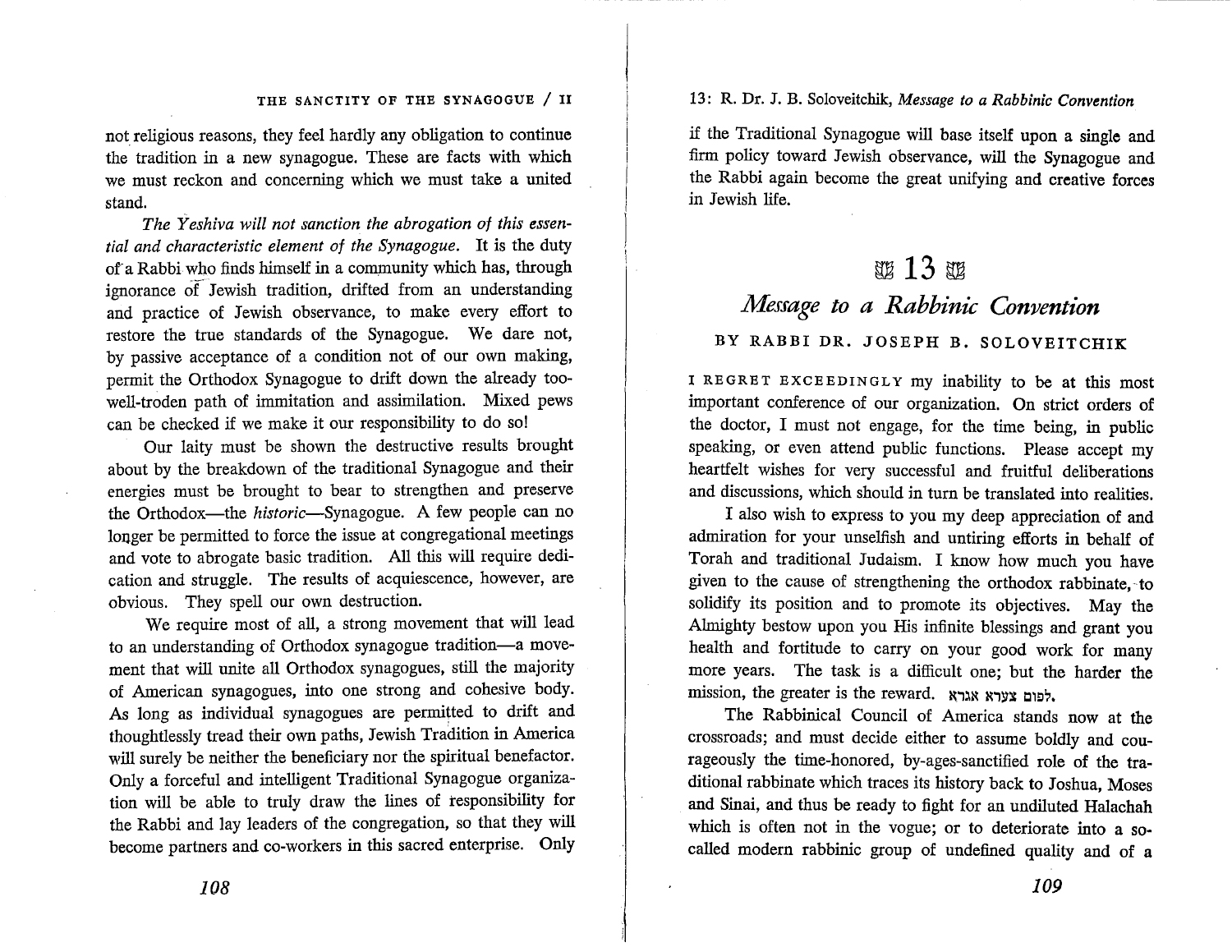
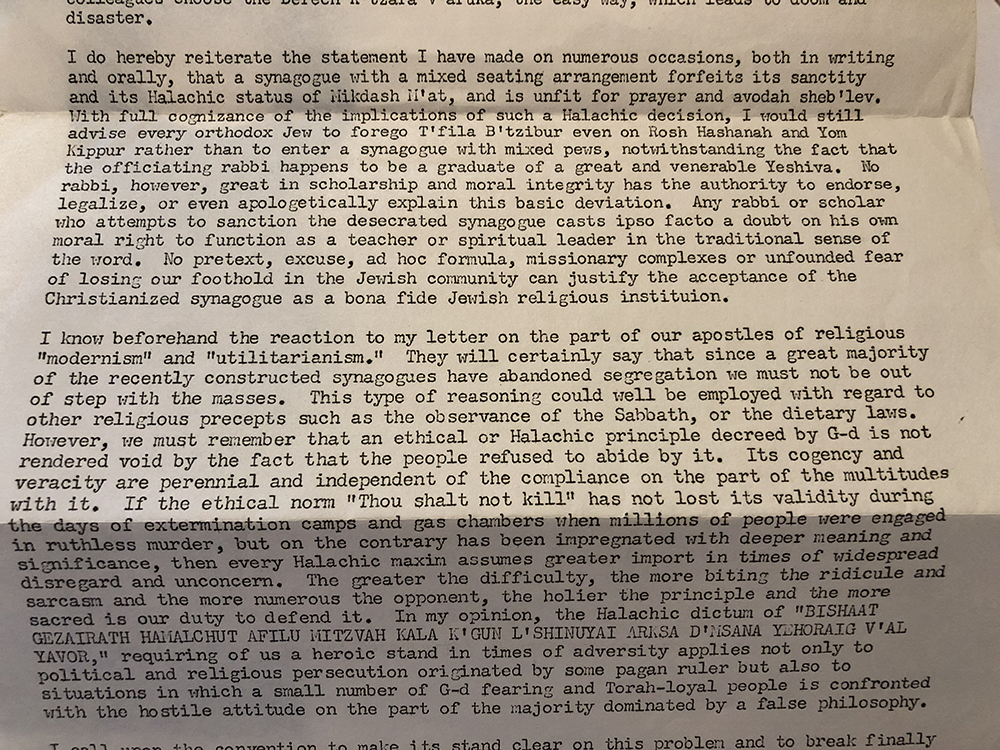
3. We all know that everything written by R. Joseph B. Soloveitchik is precious.[16] One area in which the Rav was very eloquent and forceful was with regard to the necessity of having a mehitzah in shul. In Baruch Litvin’s 1959 book, The Sanctity of the Synagogue, pp. 109-114, it prints a letter from the Rav to an RCA convention. 


This letter has been reprinted in Nathaniel Helfgot, Community, Covenant and Commitment, pp. 139-142.
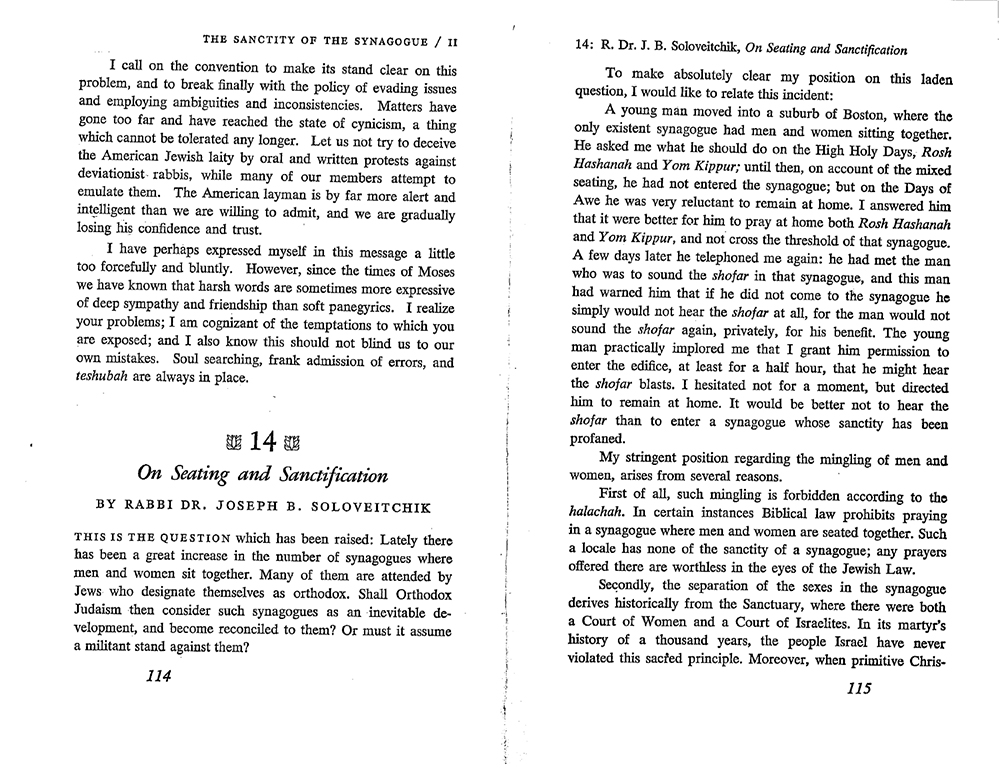
Moshe Schwartz found a copy of the original letter in the papers of his grandfather, R. Gedaliah Dov Schwartz. I thank him for sending it to me.

One interesting point which is not found in the Litvin book is that the Rav’s letter, while intended for RCA members, was addressed to R. David Hollander, the president of the RCA at the time. This is important to note because in the second paragraph he is speaking personally to R. Hollander and praising him for his good works. However, the reader of the letter in Litvin’s book will mistakenly think that the Rav is speaking to the RCA as a whole.
Furthermore, some of what R. Soloveitchik included was deleted from the letter as it appeared in the Litvin book. This was apparently because his points were not specifically relevant to the mehitzah issue. I am happy to be able to present here the omitted words of the Rav which until now have never been published, and which present an important personal statement about the halakhic process. Readers should note the end of the second paragraph that is transcribed below, as it is criticism of certain members of the RCA. Similar sentiments are found earlier in the letter (Litvin, p. 110, first paragraph), where the Rav concludes his paragraph with the strong words: “However, many of our colleagues choose the derech ketzarah va’aruchah, the easy way which leads to doom and destruction.”
As chairman of the Vaad Halachah I intended to inform the conference about our activities during the past year. Since I am prevented from doing so I have asked my friend Rabbi Joseph Weiss to take my place.
Permit me to say the following. One of the fundamentals of my faith is that the Halachah is an all-inclusive discipline and system of thought capable of meeting any challenge of modern times and of confronting the most perplexing problems which a technically progressive and scientifically minded society may periodically pose. This optimistic formula, however, cannot always be successfully applied because of the limited knowledge and the imperfect intellectual capability of the human being. I for one, am not always able to behold the Halachic truth and to see the light under all circumstances. Many a time I grope in the dark, pondering, examining and re-examining an intricate Halachic problem – and find myself unable to arrive at a clear decision. Even the Talmud has not solved all problems and has not answered all questions. The Teiku is a very prominent and characteristic feature of Torah She-B’al Peh. We members of the Halachah Commission are not partners in a contracting firm whose task it is to provide every member of the Rabbinical Council of America with a clear-cut answer to his problems. Quite often the solution eludes us. We are beset by grave doubts. We face many alternatives not knowing which to choose since each is supported by sound logical reasoning. We cannot be guided in our decisions by emotional factors or pragmatic arbitrariness and hence we are impelled to employ in such situations the principle of “B’divrai Torah Haloch Achar Hamachmir” which seems to inconvenience some of our members.
Religious Jews have of late developed an intolerant attitude towards what they call the shyness and reluctance on the part of scholars to commit themselves on Halachic issues, not knowing that there is no omniscience in this world and that doubt is an integral part of the Halachic experience as it is of every scientific performance. A rabbi who thinks that he can solve all problems is implicitly admitting his own ignorance. I implore the convention to abstain from leveling charges of evasion at the Halachah Commission. Let us not repeat the complaints which are so common in religious circles in Israel about a lack of boldness on the part of the rabbinate. They come, for the most part, from people who are not conversant with Halachic scholarship. If there is in our ranks some one wise enough to undertake to answer all Halachic questions by return mail, I would not hesitate to relinquish my position as chairman to him.
In the last paragraph of the letter, as it appears in Litvin, p. 114, the following words that I have underlined are omitted (and this appears to be a simple mistake rather than an intentional deletion): “I realize your problems, I am cognizant of the temptations to which you are exposed and I also know the great work you have been doing in the remote parts of our country.”
In this case I think that the Rav is speaking to the RCA members as a whole, not to R. Hollander personally.
The P.S. found in the Rav’s letter is also of interest.
P.S., I would suggest that the convention adopt a resolution condemning the Humphrey Bill pertaining to humane method of slaughter. The convention should also send a letter of thanks to the State Department for the special attention of Assistant Secretary Herbert Hoover, Jr., for its stand against the proposed calendar reform.
4. In my previous post about young rabbis I neglected to mention another such rabbi. R. Yekutiel Yehudah Teitelbaum (born 1912) succeeded his father as rabbi of the town of Sighet, and also as leader of the local hasidic group, at the age of 14.[17]
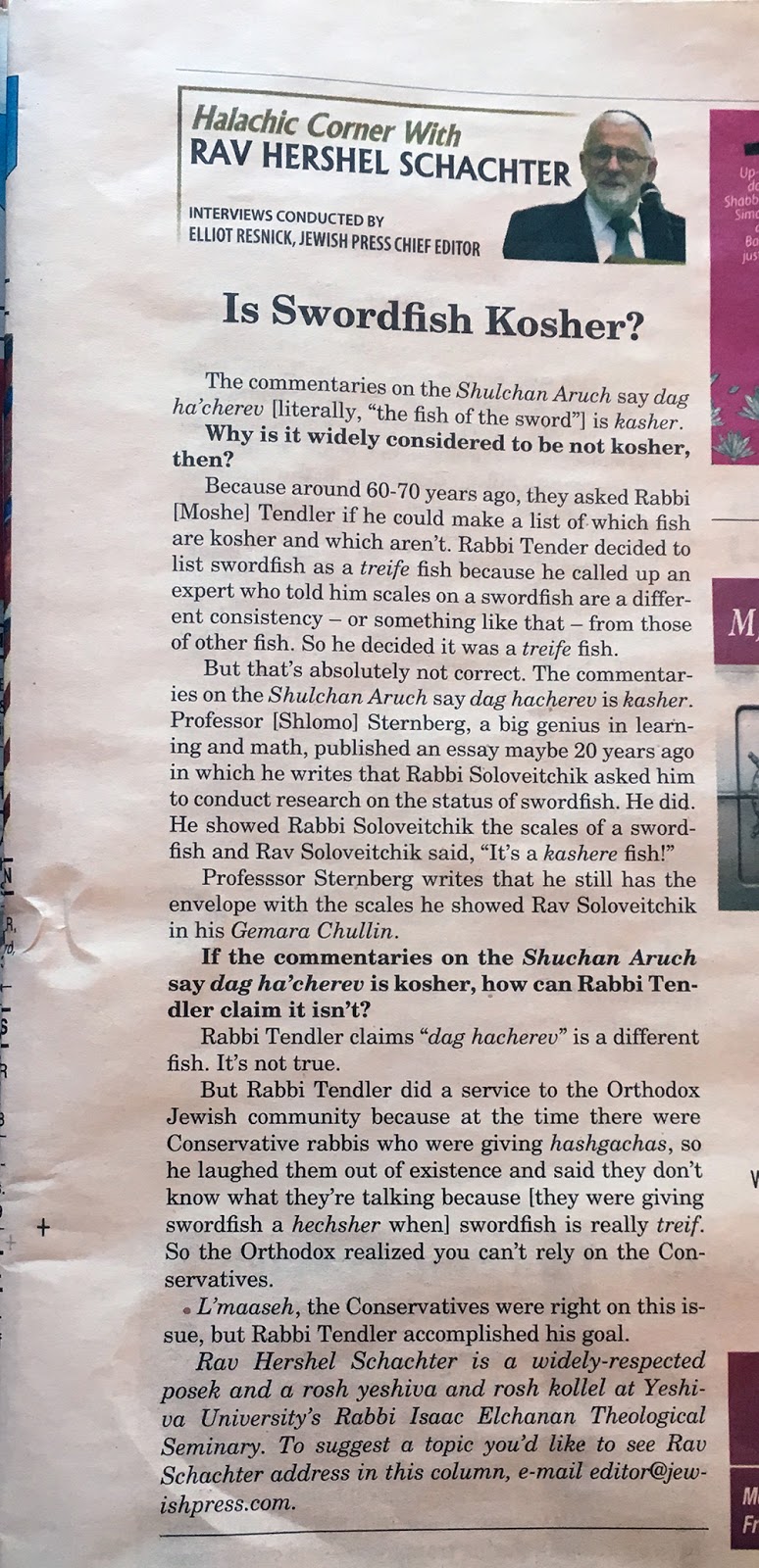
5. In addition to being the posek of the OU, R. Hershel Schachter is also the one Kashrut Vaads all over America turn to for halakhic decisions. That being the case, now that R. Schachter has publicly declared that swordfish is kosher[18] (his private opinion has been known for a long time), how come no Vaads in the United States will certify it as kosher? (In the first half of the twentieth century Orthodox Jews in the U.S. ate swordfish. See my post here.) Does this mean that in the U.S. the practice of not eating swordfish is for all intents and purposes now regarded as binding, and cannot be overturned even by a great posek?

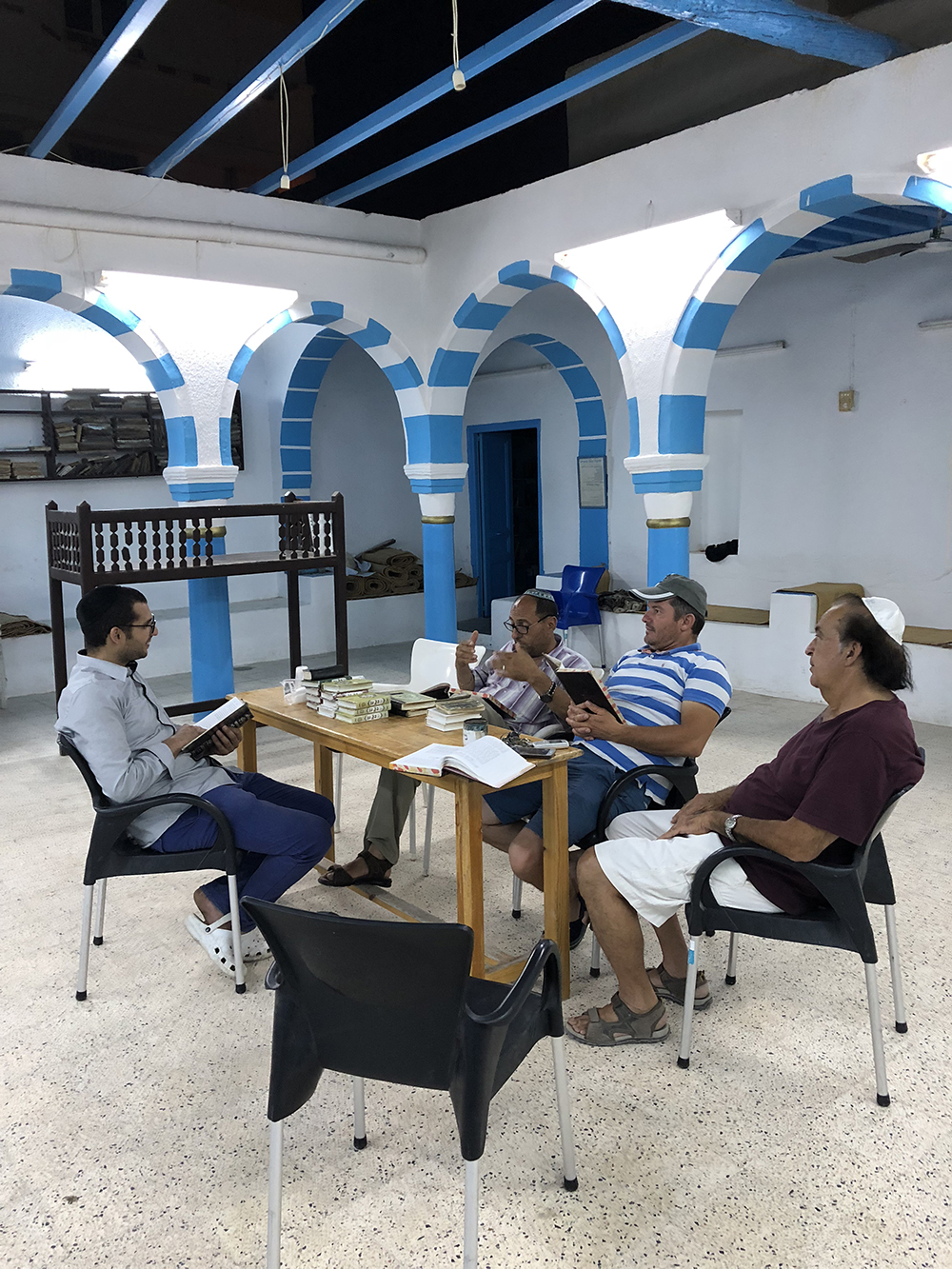
6. Last summer I spent time in Djerba, Tunisia. I hope to write up my impressions of this amazing community of over one thousand Jews, all of whom are shomer Shabbat. Djerba, and the nearby town of Zarzis which has around a hundred Jews, are the last Arabic speaking Jewish communities in the world. (In Tunis and Morocco the Jews speak French.) Here are some pictures from inside the R. Pinhas Yanah synagogue in Djerba, where you can see the signs in Arabic. 


Here is a small learning group in one of the synagogues after ma’ariv. They invited me to participate but not knowing Arabic I couldn’t follow.

When I came back one of my friends told me that I must share one particular story on the Seforim Blog, so here goes. There are fourteen different synagogues in Djerba. After visiting a number of them I noticed that they had no women’s sections. I asked one of the rabbis about the lack of ezrat nashim. He replied, in words that must sound blasphemous to Modern Orthodox ears, “What do women have to do with a synagogue?” While in the U.S. we build “women friendly” mehitzot, so that as much as possible the women can feel part of the synagogue service, in Djerba women’s spirituality has nothing to do with the synagogue. While I later learned that three of the synagogues do have an ezrat nashim, women never attend on Shabbat, only on Rosh ha-Shanah, Yom Kippur, and Purim. The popular Modern Orthodox notion that it is important for women, especially unmarried ones, to attend synagogue on Shabbat is something the women of Djerba know nothing about.
___________
[1] If I were writing the letter today, I would not refer to R. Ahron Soloveichik as rosh ha-rabanim and mara de-atra. I did so to give him respect, but it is not really accurate. While many people certainly did regard him as the leading rabbi of Chicago, and accepted his halakhic rulings as authoritative, this was by no means everyone’s opinion. Regarding R. Moshe Feinstein’s view permitting the non-Orthodox to use the community mikveh for their conversions, which is mentioned in my letter, it is important to note that this was only when the non-Orthodox institutions contributed to building the mikveh.
[2] The same mistake made by R. Yonah is also made by R. Yehudah Naki in his notes to R. Ovadiah Yosef, Ma’yan Omer, vol. 7, pp. 362-363, 390, 400-401.
[3] Ma’yan Omer, vol. 7, no. 38.
[4] Ma’yan Omer, vol. 7, no. 42.
[5] Beit Hillel, Adar 5770, p.
[6] R. Eliyahu’s responsum was sent to R. Gavriel Cohen, who has a beit din in Los Angeles. See here. This Beit Din also does conversions, and they have a very detailed curriculum for prospective converts. You can see a practice test of the 45 topics prospective converts are supposed to learn about here.
I have to say that until the last generation, converts were never required to have such detailed knowledge. Leaving aside all of the detailed issues of Jewish law the convert is instructed to learn about (including “Trumot and Maasarot, Challah, Bikurim, Maaser Ani and other types of charity”), does a convert really need to know about Elijah at Mt. Carmel or about “Tzedukim, Prushim, Charedim, Zealots (anti Romans and Greeks)”? Does a convert need to be able to “develop in detail” the following: Joshua, Judges (“mention at least 10 Judges and their stories”), Samuel, Saul, Jonathan, Isaiah, Jeremiah, the Twelve Prophets, Daniel, Ezra-Nehemiah, to list just some of the topics required? And  what about Rif, Rosh, Rashba, Tur, Zohar, Kabbalah, Shabbetai Zvi, Orhot TzadikimMesilat Yesharim, etc.? Since when do converts need to know about these things?
In the section dealing with the history of converts, R. Cohen’s website mentions Nero and Antoninus as things to know. Does this mean that if the future convert does not believe that these Roman emperors actually converted to Judaism, that he will not be accepted? (My next post will discuss Nero and Antoninus.) On the positive side, if even yeshiva educated people knew all the things the converts are being asked about, we would be in very good shape.
Contrast all this with how Maimonides says that we deal with future converts, in words that today would be regarded as “non-Orthodox,” or presenting a very low standard. Issurei Biah 14:2 states: “He [the prospective convert] should then be made acquainted with the principles of the faith, which are the oneness of God and the prohibition of idolatry. These matters should be discussed in great detail; he should then be told, though not at great length, about some of the less weighty and some of the more weighty commandments.”
[7] See also here.
[8] See Israel Yeivin, Introduction to the Tiberian Masorah, trans. E. J. Revell (n.p., 1980), no. 404. See also R. Adir Amrutzi, Dikdukei Aviah (Tel Aviv, 2010), p. 146. Regarding the Aleppo Codex and use of the dagesh, the following point is also of interest. Many people wonder why in Hallel the words הושיעה נא and הצליחה נא, taken from Ps. 118:25, only have a dagesh in the נ in הושיעה נא. In fact, in the Aleppo Codex both occurrences of the word נא have a dagesh. Also of interest, since it goes against what one would expect from the grammatical rules, the Aleppo Codex puts the accent on the final syllable of both הושיעה and הצליחה, and there is no makef after either of these words. See Yeivin, Introduction to the Tiberian Masorah, p. 291.
Regarding the makef, ArtScroll has omitted it from its siddur. Yet once they do so, it appears to me that there are a number of corrections that need to be made. For example, in shaharit of Shabbat we read
מי ידמה לך ומי ישוה לך
ArtScroll tells us that ידמה and ישוה have the accent on the final syllable and ArtScroll also puts a dagesh in the ל of לך. Yet the Masoretes who told us that in such a case you put a dagesh in the ל, also told us that you would only do so if there is a makef connecting the word לך and the prior word. Since ArtScroll has deleted the makef, why should the dagesh be included, as there is no reason for one without the other? (Koren also includes the dagesh without a makef.)
For those who want to be technical, once the makef is removed we even have a problem with the word כל. כל, meaning “all”, is only spelled with a kamatz (katan) when it is connected with a makef. However, when the makef is removed it is to be spelled with a holem. (The two exceptions are Ps. 35:10 and Prov. 19:7.) See Bayit Ne’eman 130 (15 Tishrei 5779), p. 5.
In biblical Hebrew there is even a word כל with a kamatz (gadol) and no makef. It is found in Isaiah 40:12:
וכל בשלש עפר הארץ
The passage means, “and comprehended the dust of the earth in a shalish-measure.” The word כל with a kamatz and no makef is from the root כול. The word כל with a kamatz and makef, which is the word we are all familiar with, is from the root כלל.
[9] This point was also noted by the Dikdukian here. For those who don’t know this website, it is a great resource for anyone interested in grammatical matters.
[10] Shiurei Ha-Grid: Kuntres Avodat Yom ha-Kippurim (Jerusalem, 2005), pp. 66-67.
[11] Otzar Dinim la-Ishah ve-la-Bat, ch. 1, no. 2 (p. 22), Yalkut YosefDinei Hashkamat ha-Boker, 1:9. It is noteworthy that R. Yom Tov Lippman Heller was also interested in ensuring proper pronunciation. Mishnah, Toharot 8:5 reads: שוטה אחת בעיר. Tosafot Yom Tov comments:
בקמץ הטי”ת כמו כי רועה היא (בראשית כט)
[12] Halikhot Shlomo, Tefilah, ch. 2 n. 17.
[13] Halikhot Hayyim, ch. 1 no. 1, Da’at Notah, vol. 1, p. 16. The very title of the last book mentioned is an example of what we are talking about, as it is more common for people to write “da’at noteh”, but this is not grammatical.
[14] Meir Oz, vol. 1, p. 27.
[15] Shevet ha-Levi, vol. 10, no. 8.

[16] I have been fortunate to discover a number of unknown letters by the Rav which I hope to publish.
[17] See Isaac Lewin, ed., Eleh Ezkerah (New York, 1961), vol. 4, p. 147. R. Jacob Elimelech Paneth was chosen to succeed his father as rabbi of Marosújvár at age fourteen, but he did not assume the office in practice until four or five years later. See Yosef Kohen, Hakhmei Transylvania (Jerusalem, 1989), p. 37. I thank R. Baruch Oberlander for informing me of the Hungarian name of the city R. Paneth served in.
[18] The interview with R. Schachter reprinted in this post is from the Jewish Press, April 20, 2018.


Second Rabbinic Bible/Chapter Divisions

University of California at Berkeley has purchased a copy of what is known as the Second Rabbinic Bible (seen on PaleoJudaica here). This Bible was published by Daniel Bomberg and edited by Jacob ben Hayyim ibn Adonyahu. Without denigrating the importance of owning the original, I think the article describing the value added to Berkeley is a bit misplaced or at the very least overblown.

First, this book is now available online via the Hebrew Univesity’s program of digitilizing parts of their collection (the First Rabbinic Bible is also available there as well). Second, a photomechanical reproduction of this book was done in 1972 with an additional introduction by the Bible scholar, Moshe Goshen-Gottstein. Additionally, one of the most important portions of this Bible, namely Jacob ben Hayyim’s introduction was published with an English translation and extensive notes by C.D. Ginsburg in 1867 and republished by Ktav in 1968. Basically, if one wants to examine this book, without paying a huge amount of money to purchase it, there is no lack of places to do so.

The article also neglected to mention a feature of this edition that is particularly important, the inclusion of chapter breaks. Although, Jacob b. Hayyim attempted to obtain the Jewish chapter breaks, the ones created by the ba’alei mesorah, Jacob only got these at the end of the printing a instead utilized the non-Jewish chapter breaks (which we use until today). He did, however, include a list of the Jewish breaks after his introduction but the actual divisions used in this edition are the non-Jewish ones. As the article correctly points out, this bible became the template for almost all future bibles and thus, we are consigned to use those divisions eventhough, at times, they run counter to Jewish law and tradition.

[For an excellent exposition on the chapter divisions, see Shmuel haKohen Weingarten, Halukat haTora l’Perakim, in Sinai vol. 42 (1958) pp. 281-293; R. Pesach Finfer, Mesoret ha-Toah veha-Nevi’im, Vilna 1906 (republished in 2005).]


Review – New Volume of Peskei Teshuvos on Mishna Berurah

Over the centuries, throughout our rich history, every time there has been a codification of halacha of any sorts there has been some opposition; the examples abound – the Rif who was opposed by the Bal Hamaor; the Rambam who was opposed by the Raavad. Even after that the Shach and Taz were also not accepted right away. One of the (many) reasons for this opposition was a fear of giving the law “to the simple people” who would then stop asking Rabbanim their questions as they could find the answers themselves in these works.

Another type of secondary source for halacha can be catagorized as likutim (collections). For example this catagory would include commentaries on the Shulchan Orach such as the Keness HaGedolah, Be’er Hetiv, and Sharei Teshvah. With these sorts of books there was an additional fear that the halachos might be not always be quoted correctly and people will fail to check the sources themselves. That fear appears prescient as in recent times many contemporary works err in the way they quote sources – making it almost impossible to even check the original sources. Some Gedolim even write in there haskamos on these works the author is a good person “but as this is a halachic work I can not back everything he says.”

An awareness of the above concerns is illustrated by the story surrounding the Shmiras Shabbas K’hilchasa. This sefer quotes literally thousands of pesakim of R. Shlomo Zalman Auerbach. After seeing the unexpected success to this sefer, R. Shlomo Zalman sat in a room a few hours a day for a few years and reviewed everything making sure anything quoted from him was one hundred percent accurate. This resulted in the third volume of Shmiras Shabbos K’hilchasa. Unfortunately, many works the authors themselves do not double check there own work let alone have a great person review it.

Today, there is no lack of books whose purpose is to be a repository of knowledge on a single topic. For instance, we have books devoted solely to the laws of washing one’s hands, how to bow properly (690 + pages), laws of lechem mishna (348 pages), the yarmulke (112 pages), and the list goes on. As it takes an almost heroic effort to write an entire book of hundreds of pages on but a single, minor topic, in most of the aforementioned cases, the authors indeed put forth a valiant effort to obtain anything and everything that, in the slightest way, remotely impacts on their selected topic.

Relatedly, there is another category of book, in which the author collects everything which discusses yet another book. The book that epitomizes this category of works is called Piskei Teshuvos al’pi Seder HaMishna Berurah (hereinafter “PT”). PT collects and addresses anything and everything which discusses the Mishna Berura. Just as the authors of the first category of books mentioned above go to great lengths, so too did the author of PT glean material from the most obscure sources on some of the most arcane topics.

At the turn of the century two excellent works were written almost the same time one on the whole Shulhan Arukh and one on just the volume of Orach Chaim. One is the Arukh Hashulhan and the other the Mishna Berurah. Each have their benefits (as will perhaps be discussed a different time) however, both were of great necessity as halacha is an endlessly complicated topic which, at that time, was especially evident. Before WWII the Arukh Hashulhan was much more widely accepted than the Mishna Berurah but after the war the Mishna Berurah became the more accepted one. What precipitated this change is unclear, some want to attribute it to the influence of the Chazon Ish who writes that the Mishnah Berurah is like the lishkas hagaziz etc. This is a rather ironic reason in that the Chazon Ish takes issue with the Mishna Berurah hundreds of times. Be that as it may today the more widely used work is the Mishna Berurah. There is even a Mishna Berurah cycle completing the whole Mishna Berurah every few years. However, as the years go by halakha has become larger especially with modern technology applications and the like, making it very hard for one person to master it all. The truth is throughout history there were various Gedolim that were experts in specific areas but not in everything – today such specialization is happening more and more.

As a result, R. Rabinowich came up with a great idea. He decided to put together all the newer sources according to the order of the Mishna Berurah. This idea of collecting the modern sources was actually one of the original goals of the Mishana Berurah as he writes in his introduction – to include all the recent literature from the seforim printed after the Sharei Teshuvah. R. Rabinowich’s work is the PT.

The first volume he released was on the laws of Shabbos. This first volume suffered a bit being the first born child. The sources were not that comprehensive and it did not cover many of the recent issues. The next volume, on the six volume of the Mishna Berurah, did get a bit better in the sources area. After that, the volume on fifth volume of Mishna Berurah came out here the sources got even better (as it much easier to put out a work on this volume thanks in part to the seforim Vayagid Moshe and Seder Arukh). After this he came out with a volume on the second volume of Mishna Berurah which he really out did himself on the sources. And recently the volume on first chelek on the Mishna Berurah came out.

The problem with this work is not that it does not have a wealth of information but rather one has to be careful to double check the sources to see if he quotes the pesak right and if he understood it.

So, thus far, five volumes of the PT have been published – the most recent, fifth volume covers volume one of the Mishna Berura. It is a very popular book. This latest volume was sold out in Israel within a week of publication and a distributor in the US ordered some 5,000 copies. R. Ovadia Yosef in a recent photograph in the Mispachah newspaper has a copy of the book on his table! This new volume of the PT weights in at a mere 995 pages. Readers may wonder how someone could write close to 1,000 pages on the first volume of the Mishna Berura alone? We now have our answer – it can’t be done.

The PT has a numerous flaws. First, the introduction. We are told that it is imperative to closely examine the words of the Mishna Berura because not doing so, “God forbid, could cause a person to err in the minutia of the laws and correctly interpreting them.” (p. 36). This statement is astounding. In the remainder of this volume’s introduction, there is no similar imperative to examine closely, or even cursorily look up, the many books the PT quotes. For that, we are expected to rely upon R. Rabinowich (the author of the PT) for his interpretations of the many, many books quoted – of course, he assumes that there is no need to double-check his work. However, if one were to go directly to Rabinowich’s collection without first reading the Mishna Berura, then one virtually is guaranteed to err. As we shall see, then, if one wants to avoid erring in a matter of law and its minutia, one should look up every single citation in the PT, as many are demonstrably wrong as will be explained below.

The PT instructs that when reading about unheard of laws, “one should make sure to test it logically.” (p. 37). So one would assume that the PT applied the same caveat when he was writing his book – unfortunately he does not. For instance, the PT informs us “that righteous and holy people have the custom [to wear a yarmulke] even when they are in the bath [mikvah] and only when they actually immerse do they remove it.” (p. 26). Or that it is a law that “one must close the door when using the restroom.” But, thankfully, the PT also informs us that “in cases that it is very dark or no one is around one can be lenient and not close the door.” (p. 29). Or, this gem, for example: one needs to wash his hands before invoking God’s name after “touching a Nochri, Yehudi Mumar . . .” but also, thankfully, that is “not an absolute obligation, [but that] one should be careful and strict whenever possible.” (p. 58). And this advice is vital, to be sure: one should not reveal more then necessary when using the bathroom – “however, that which is necessary not to soil oneself or the bathroom floor, or toilet” is permissible. (p. 28).

The PT also suffers from a lack of completeness. For example, the PT has a few columns on the custom of shuckelin (swaying) – but misses many of the sources. (p. 418) (See E. Zimmer, Olam k’Minhago Noheg pp. 72-113 for the sources). Or the entry related to the placement of the Ten Commandments in a synagogue (p. 17-18) — while the PT has a few sources, the bulk are missing. (See R. Goldhaver, Minhagi Kehilot (pp. 45-47) for a much more complete and balanced set of sources).

Next, we have the PT’s comments on the obligation to wear a yarmulke. The PT first quotes the passages in the MB, which in turn quotes the well-known opinion of the Turei Zahav, that not wearing a head covering is a halachic violation. The PT explains the violation is of the command be’chukosheihem lo sei’leichu. Unfortunately, the PT fails to cite anyone who disagrees with that opinion, including, most notably, the Vilna Gaon in his Biur haGra (Orach Hayyim, siman 8 – which is quoted in the famous first teshuva in the Iggeres Moshe). The PT does manage, however, to cite the same Gra to obligate a “complete covering of the head”?! (p. 24 n. 55). In addition, the PT does not cite, or even mention, R. David Tzvi Hoffmann’s view that follows the Gra. It is not only in this section that the PT appears to be blissfully unaware of the Gra’s view. Later in the book, where the PT discusses what someone should do if he prays by accident without a head covering, the PT makes no mention of the Gra’s view. (p. 719) Obviously, the Gra’s opinion on that topic is relevant, even if one were to hold that the Gra’s view is not optimal in the firs instance (i.e., in a post facto scenario, perhaps one can rely upon it).

Not only is the section on yarmulkes lacking in very important sources, it also completely distorts history. The PT makes the amazing statement that one must wear a yarmulke which is “noticeable” and, furthermore, that “this is what all Jews have done forever, in every generation.” (p. 24-25). This is absolutely not the case. There is a long history of even well known rabbis not wearing yarmulkes (or head coverings) at all, let alone ones that are capable of being seen from all sides. One example is a well known portrait of R. Hirsch. In that portrait, R. Hirsch appears bare headed. Of course, there are two possibilities – that he is actually bareheaded or that he is wearing a wig which gives the impression that he is bareheaded (and thus not complying with the PT’s requirement that a yarmulke be a “noticeable covering”). In either case, then, the PT’s absolutist claim is wrong. Not only is the PT’s ruling contrary to historical sources, it is erroneous with respect to halachic sources as well. There are numerous other examples where people either did not wear noticeable head coverings or they went completely bareheaded. Although the PT doesn’t have know about R. Hirsch, he should know that in fact R. Moshe Feinstein explicitly allows for someone to wear a non-obvious head covering. R. Feinstein allows for the wearing of a toupee which (if one has a decent one) will not be obvious.

In support of the position that one must wear a “noticeable covering,” the PT explains (p. 24 n. 57) that this understanding is premised on the prohibition of women wearing wigs. His “logic” is that because both women and men have obligations of head coverings, what is mandatory for one gender, must be for another. Although the PT cites to some sources holding that a wig is insufficient for women, as everyone knows there are many other opinions – as evidence by common custom today – which permit women to wear wigs. No such sources are cited or mentioned in the PT.

There are other similarly misleading statements throughout the PT. For example, the PT discusses the custom which some have to recite L’Shem Yichud prior to performing mitzvoth. He says that “as there are deep secrets in this recitation, there are some who disapproved of this custom . . . [H]owever, this custom has been justified and if Jews are not prophets, they are sons of prophets.” (pp. 63-64). This gives the erroneous impression that the concerns of those who disapproved of such recitations are no longer an issue. The source for this idea, inter alia, is the Siduro shel Shabbos. (p. 63 n. 21). It is correct that that sefer does justify this custom; however, many authorities, both before and after the Sidduro shel Shabbos, have strongly held it is inappropriate to recite this formulation. In no way did that sefer settle the issue.

The PT claims there is a tremendous obligation to wash one’s hands right after getting out of bed even before putting his feet on the ground – he notes a failure to comply is punishable by death. (pp. 5-8) First, he says that this stringency is based on the Zohar(which we do not actually have) , however, he failes to mention that it doesn’t appear in the Gemara or early poskim. Furthermore, buried in a footnote in passing he cites to the Gra who said that after the death of the Ger Tzedek the particular ruach ra which produces the stringency of the washing is no longer present. Nor does he even quote the Sheti Yados (already highlighted by the Hatam Sofer in his notes on Shulchan Orach) that one should not take the death penalty idea literally.

The PT also discusses the issue of reciting partial verses of the Torah and rules that this is not a problem “as it is already known that we are not concerned to split sections and even verses we find many times.” (p. 243) To whom is the PT referring (by use of the word “we”)? Indeed, there are some people who maintain the custom to not split verses. Most famous, perhaps, is the statement of R. Hayyim Volozhin regarding the veZos HaTorah passage when showing the Torah to the congregation.

Aside from misleading statements, there are some statements in the PT, out of which I can make no sense. For example, the PT discusses whether to use a patach or tzerei for the first two words of kaddish. (p. 506). He records that in R. Emden’s siddur and in the Siddur haRav, there is a patach, but “in all the other siddurim it is with a tzerei.” (Id.). First, what does the PT mean by all? Did he check every single siddur, both in published and in manuscript form? Or does he mean the siddurim at his shul or that he had on his bookshelf? Readers are left to guess because the PT does not elaborate further. Similar ambiguities (e.g., statements like “most siddurim”) abound. In any event, the PT is 100% wrong. In historical terms (i.e., how the siddurim vowalized the words in question), the custom up until the 18th century was to have a patach. (For a listing of the siddurim and the history see my article in the latest Ohr Yisrael).

Another example of this type of misstatement is in the PT’s discussion about praying where a married woman’s uncovered hair is visible. First, the PT states “we find that many achronim are lenient in this matter.” But, he then continues: “however, the majority of achronim” disagree. (p. 600). Who is the majority? Is the PT referring to contemporary persons or historic achronim (the period generally is considered to extend from approx. late 15th early 16th century until today)? Additionally, those in the “minority” include R. Moshe Feinstein, the Ben Ish Chai, the Oruch haShulchan, the Seridei Eish – and those are just the ones listed in the PT. Perhaps there are cases where usage of the term “majority” is appropriate but what about when there are such distinguished authorities in the “minority?”

Another example of the necessity to check the PT’s sources is the entry relating to the use of musical tunes whose origins were not Jewish. There, the PT misquotes the Kerach shel Romi. The PT says that even the Kerach shel Romi holds when a tune is specific to idolatry, then it cannot be used. (p. 470 n. 209) But, if one looks up the source, that sefer actually says the opposite.

The above represent some of the issues in the latest volume. I have not gone over the entire 995 pages with a fine tooth comb, but I have no doubt that there are numerous other examples of the kind discussed above. The biggest problem with the PT is, in fact, as Dayan Weiss states in his approbation: that the PT “has lovingly been accepted among klal yisrael.” [He also states that he greatly enjoys the PT.] While it is admirable that people are interested in expanding their knowledge, such efforts should not be at the expense of quality. This appears to be a clear case of trying to make available as much as possible irrespective of the content. Moreover, what is particularly troubling about the above discussed examples is that the PT consistently highlighting either chumrahs or outlandish and dubious “laws.” Relatedly, it seems that the PT’s the errors of omission always manage to omit out sources which would temper or obviate some of the more stringent statements found in the PT. This displays an ideological bias in favor of stringencies over leniencies (or in many cases over actual historical practice).

* I want to thank R. Eliezer Brodt for writing the introduction to this post.


Final Response

 Final Response

By Marc B. Shapiro

In response to Rabbi Herschel Grossman’s strong criticisms of my Limits of Orthodox Theology, I wrote four responses on the Seforim Blog. You can view them hereherehere, and here. I then stopped responding even though there are still many criticisms I could have commented on. Readers can compare Grossman’s arguments with my replies and draw their own judgment. Grossman has recently responded to my posts and offered further criticisms in an article published in Dialogue. See here.

I do not wish to respond to all of his points in his new article, but I feel I need to make some comments and then I will leave this matter and let the readers decide which side is more compelling. Because Grossman complains in his article that “the merits of the arguments are easily lost in the loose internet format and enthusiastic cheering of his online supporters,” I have decided not to allow comments to this post. I can only express my regret at the style that Grossman chose to adopt in his articles. Had he written in an appropriate fashion then it would have been possible to have had a constructive discussion and debate.

P. 161: “DIALOGUE editors offered the author, Dr. Marc Shapiro, an opportunity to respond directly in these pages. He chose instead to issue a response on his own blog, where he wrote a number of lengthy posts in his defense.”

Dialogue never offered me an opportunity to respond in the journal. The Seforim Blog is not my own blog. I am a writer on it like lots of others.

P. 162: “In his [Shapiro’s] view, the tenets of belief are Rambam’s innovations and are therefore disputable.” The word “innovation” implies that the Rambam invented the doctrines he includes in his principles. I never said such a thing.

P. 163: In giving examples of supposed distortions in my book, Grossman writes: “One example is when Shapiro cites Rivash in support of the statement that Christians believe in a three-part God while the Kabbalists believe in a ten-part God – a clear rejection of the Second Principle. A quick glance at Rivash reveals that he does indeed say such a thing as a quote from a philosopher, which he then proceeds to debunk.”

I would like readers to take a look at the relevant page of my book (p. 40) and see if what Grossman says is correct, that I cited Rivash in support of the statement that Kabbalists believe in a ten-part God.

Pp. 166-167. Readers should see my discussion here. I cite a number of sources that support what I say, and thus contrary to what Grossman states, I do not just insist on my right to offer an interpretation. In note 21 Grossman writes: “Dr. Shapiro attempts to salvage his theory by speculating that the Vilna Gaon may not have really meant what he wrote.” Readers can turn to my discussion here and will see that I never said that.

p. 173. We see here an example of how Grossman just talks past me, leading to nothing productive. I had questioned why in the Mishneh Torah the Rambam did not require that the convert be instructed in the Thirteen Principles. In his original essay, Grossman criticized this question which he said showed lack of understanding of the method of the Mishneh Torah. In my response here I cite rabbinic authorities who deal with this very question, thus showing that it is not an ignorant point, as Grossman portrayed it. One of those I cite is R. Chaim Sofer who writes [1]:

והדבר נפלא הלא יש י”ג עיקרי הדת והי’ לו לב”ד להאריך בכל השרשים

Grossman replies that while I quote R. Sofer, I neglect “to apprise [my] readers of R. Sofer’s subsequent words ‘Rambam didn’t add to the talmudic formula,’ exactly as I had written and directly in contradiction to Dr. Shapiro’s position.”

Here is the paragraph from R. Sofer.

R. Sofer says exactly what I quote him as saying. The final passage in the paragraph, which is mistranslated by Grossman, has nothing to do with my point and does not refute it in any way.

I would also note that in his fascinating Ha-Emunah ha-Ne’emanah, p. 142, R. Dovid Cohen offers an explanation as to why אין לומדים כל י”ג עקרים טרם שיתגייר הגר

P. 174. In Limits I discuss different approaches to the phenomenon of tikkun soferim. While the generally accepted approach is that tikkun soferim is not to be taken literally, I cite a number of authorities who did take it literally and assumed that Ezra or the Anshei Keneset ha-Gedolah made changes to biblical texts (including the Torah). In a later post here (which has nothing to do with Grossman), I cited some other examples of sources that understood tikkun soferim literally. One of those I mentioned is R. Pesach Finfer.[2] He states as follows:

ראוי הי‘ עזרא שתנתן התורה על ידו . . . והוא ונחמי‘ עשו תיקון סופרים וכינויי סופרים

Grossman says that it is unclear what I see in this line. What I see is that R. Finfer states that Ezra and Nehemiah were responsible for tikkunei soferim. This is the same language that is used in other sources that take the notion of tikkun soferim literally. For those who don’t take it literally, Ezra has nothing to do with tikkun soferim. Following the sentence I quoted from R. Finfer, he refers in parenthesis to Radbaz’s comment which offers a different perspective, that tikkun soferim is halakhah le-Moshe mi-Sinai. Here is the page.

While on the topic of tikkun soferim, let me share something else that is relevant. In Limits I mentioned that the evidence points to Rashi understanding tikkun soferim literally, namely, that the biblical text was changed by the Scribes. There was some pushback to this assertion by those could not accept that Rashi would ever hold such a position. Yet subsequent to my book, Yeshayahu Maori also came to the conclusion that Rashi understood tikkun soferim literally.[3] Furthermore, R. Avraham Pessin also explains that Rashi understands tikkun soferim literally.[4] He states that according to Rashi the Anshei Keneset ha-Gedolah had the authority to alter the text of the Torah:

ומבואר ברש”י שניתן הכח לאנשי כנסת הגדולה לשנות גם תורה שבכתב

I find this significant, because although one can point to numerous statements that such an approach in unacceptable, R. Pessin sees it as the clear meaning of Rashi (and among traditional interpreters he is not alone in this understanding[5]). Here are the pages from R. Pessin’s sefer.

Speaking of tikkun soferim, the most famous of which is Gen. 18:22: ‘ואברהם עודנו עומד לפני ה, I found something in R. Solomon Algazi’s Yavin Shemuah (Venice, 1639), p. 15a, which is fascinating and, as far as I know, unique in rabbinic literature. It is also in opposition to Maimonides’ Eighth Principle which establishes that the Torah in its entirety was delivered by God to Moses. In discussing ‘ואברהם עודנו עמוד לפני ה, R. Algazi claims that when God dictated the Torah to Moses, He said that God was standing before Abraham. But Moses on his own, out of respect for God, changed the verse to read that Abraham was standing before God. I guess we can say that this falls between the traditional view that the verse was never changed and the view that the Scribes altered the verse out of respect for God. For R. Algazi it was Moses who made the alteration, but as far as Maimonides is concerned, this is just as problematic as viewing tikkun soferim as an alteration of the Scribes. Here is R. Algazi’s surprising interpretation.

כיון דהב”ה היה אומר לו על כל מלה כתוב א”כ ודאי דהב”ה אמר לו וה’ עודנו עומד דלא איש אל ויכזב ומשה היה משנה על דרך כבוד וכותב ואברהם עודנו עומד א”כ מה שייך בזה הלכה למשה מסיני והוא על דרך המשל שדוד המלך יאמר לסופר מהי’ [מהיר] כתוב שדוד מצוה לפלוני והסופר משנה על דרך כבוד וכותב המלך דוד אבל המלך בעצמו אינו אומר כתוב המלך מצוה כך הב”ה יתעל’ לא אמר למשה שהיה סופר כתוב ואברהם עודנו עומד שהוא דרך כבוד אלא אמר לו האמת וה’ עודנו עומד ומשה שינה על דרך תיקון סופרים

Pp. 175-176. I wrote here: “Even when it comes to other basic ideas of Maimonides, which are not included as part of the Thirteen Principles, we find that scholars wondered why Maimonides did not include them in Hilkhot Yesodei ha-Torah.” I then cited Joseph Ibn Caspi in support of this statement. Here is the page from Amudei Kesef u-Maskiyot Kesef (Frankfurt, 1848), p. 113.

What I would add here is the interesting point that Ibn Caspi, Commentary on Guide 2:32, actually concludes that the Mishneh Torah’s formulation is in line with Maimonides’ true view, namely, that prophecy is a completely natural phenomenon which will of necessity occur if someone has both the ability and training. On the hand, he thinks that the view expressed in Guide 2:32 as being the “opinion of our Law and foundation of our doctrine”, namely, that God might prevent a prophet from prophesying, is not Maimonides’ true opinion, but is an example of the famous “seventh contradiction”.

Grossman is also mistaken when he writes, “In Moreh Nevuchim [2:32], Rambam argues—in opposition to the philosophers—that prophecy is only activated proactively by God, even if the requisite conditions are met.” Maimonides actually says the exact opposite of this. He states that the Torah view of prophecy is identical to the philosophic view except that God can choose, if He wishes, to prevent someone from prophesying even though according to nature he would be a prophet. This is the opposite of what Grossman states, that “prophecy is only activated proactively by God.”

Pp. 176-177: I stated that the notion that Maimonides changed his mind about including Reward and Punishment among the Principles was suggested by R. Solomon of Chelm. To this Grossman replies that Maimonides did not withdraw his belief in Reward and Punishment. It is just that in the Mishneh Torah he classified things differently. Again, Grossman misunderstands. I never said that Maimonides rejected the idea of Reward and Punishment. I was only referring to whether it should be included as part of the Thirteen Principles. As R. Solomon of Chelm explains, Maimonides’ later understanding is that Reward and Punishment is included as part of other principles and thus does not need to be listed separately.

Pp. 177-178. Grossman claims that I cite R. Avraham Hochman in an improper way, and in response R. Hochman states that the entire theme of his sefer “is to show that Rambam’s Principles are absolute and that he derived all of the Thirteen Principles from the Talmud.” He also is quoted as saying, “Academics often quote a question and forget that for the wise, the question is half the answer. But the professors stick to the question and don’t wait around for the answer.” Grossman then speaks of my “brazenness of citing a recognized authority to promote a position that the author himself openly rejects.”

I don’t know if R. Hochman reads English, and could see what I actually wrote, or if he only is responding to what Grossman told him. Either way, his letter, published at the end of Grossman’s article, is a complete distortion of my position. Leaving aside the particular examples that people can see, look at this characterization:

ולפי הבנה מוטעית זו שפך חמתו על הרמבם מנין לו לחדש הלכה שאינה במשנה . . .

Talk about describing a writer inaccurately!

And what is one to make of this statement from him?

אין שום חולק על עיקר מיסודי הדת אלא שנחלקו על מספר העיקרים

It is precisely against such a false view that I wrote my book in the first place. A typical response to the book has been that the opinions in opposition to Maimonides are “not accepted.” But here he denies that anyone actually disagrees with any of Maimonides’ principles. With such an outlook, we can’t even begin to have a dialogue.

The following paragraphs are what I quoted from R. Hochman. Nothing I quote here has any connection to what Grossman states or what R. Hochman writes in his letter responding to my supposed incorrect conclusions that I derived from his words. As the reader can see, contrary to what R. Hochman states, I mention not just his question but his answer as well. Of all of Grossman’s criticisms this one is very difficult to understand, because there is nothing at all controversial in what I write, and my summary of R. Hochman is accurate.

As for my wondering why the Principles are not listed together as a unit, which Grossman sees as an illustration of how I am unaware of the structure of the Mishneh Torah, let me begin by repeating what I wrote in my last post: R. Yaakov Nissan Rosenthal, on the very first page of his commentary Mishnat Yaakov to Sefer ha-Madda, also wonders about the point I made, that the Thirteen Principles as a unit are never mentioned in the Mishneh Torah. (Had I known this when I wrote my book, I certainly would have cited it.)

ותימא למה לא הביא הרמב“ם בספרו ה”יד החזקה” את הענין הזה של י“ג עיקרי האמונה, וצ”ע

R. Avraham Menahem Hochman writes:

מאחר וכל כך חמורה הכפירה, וגדולה החובה לדעת את י”ג העיקרים, כיצד זה השמיטם מספרו ה”יד החזקה”, ולא כתבם כפי שסדרם בפירוש המשנה

והנה אחר שהתבאר שהאמונה בי”ג העיקרים היא בסיס לתורה נשוב לשאלה הרביעית (בסוף פרק ה’) אשר לכאורה היא פליאה עצומה מדוע השמיט הרמב”ם ביד החזקה את החובה הגדולה להאמין בי”ג עיקרים, באופן חיובי, ולא סדרם כי”ג יסודי האמונה שחובה להאמין בהם

R. Hochman goes on to explain that most of the Principles are indeed mentioned in Hilkhot Yesodei ha-Torah in a positive sense (even if not as a unit of Thirteen Principles). He also notes the following important point, that when principles of faith are mentioned in the Talmud, they are never listed in a positive sense, that one must believe X. Rather, they are listed in a negative sense, that one who denies X has no share in the World to Come. Why Maimonides, in his Commentary on the Mishnah, chose to formulate the Principles in a positive sense and require active belief as a necessity for all Jews—something the Talmud never explicitly required—is an interesting point which we will come back to. Regarding some of the Principles the difference is clear. For example, according to the Talmud, denial of Resurrection is heresy, but one who has never heard of the Resurrection and thus does not deny it, or affirm it, is a Jew in good standing. For Maimonides, however, the doctrine of Resurrection must be positively affirmed. In a future post we can come back to which Principles even the Talmud implicitly requires positive affirmation of (obviously number 1, belief in God, but there could be others as well).

After reading these paragraphs, please look at Grossman’s article, pp. 177-178, and R. Hochman’s letter, pp. 188-191, and you will see that nothing there has any connection to what I actually say when referring to R. Hochman. I simply cite him to show that the question I asked is not an ignorant one, as Grossman stated. I also cite R. Hochman’s answer. So Grossman’s seizing on this and printing a lengthy letter from R. Hochman is nothing short of bizarre.

Pp. 178-179. Grossman writes:

Things really start to go “off the rails” when we examine Shapiro’s claim in the name of R. Shlomo Fisher, zatzal, that one need not accept Mosaic authorship, that the Rambam abandoned his principles, and that “Rambam’s formulation of the tenets of Jewish belief was far from universally accepted.”

Grossman responds that he found these attributions questionable so he checked with the family and students, and “they were horrified that anyone would be using R. Fisher’s name in this way.”

What exactly did I say that Grossman finds so objectionable? In Limits of Orthodox Theology, p, 126, I quote the following sentence from R. Bezalel Naor, Post-Sabbatian Sabbatianism (Spring Valley, 1999), p. 8: “The truth, known to Torah scholars, is that Maimonides’ formulation of the tenets of Jewish belief is far from universally accepted.” R. Naor tells us that he heard this insight from his teacher, R. Shlomo Fisher. (Anyone needing any indication of the high regard that R. Fisher held R. Naor in can examine their published correspondence.)

Grossman sees this as a radical statement whose authenticity he cannot accept. I don’t think readers of this blog will find it radical at all. In fact, I have elsewhere mentioned that R. Fisher made this statement in discussing R. Judah he-Hasid’s view on the authorship of the Torah, which diverges from Maimonides’ Eighth Principle. Contrary to Grossman, in none of my posts did I quote R. Fisher as saying that one need not accept Mosaic authorship. I simply cited his view about R. Judah he-Hasid. I also quoted his opinion that medieval Ashkenazic authorities had a different view on the matter of complete Mosaic authorship than Maimonides in that they did not regard the assumption that there are post-Mosaic verses in the Torah as heretical (a view also argued by Prof. Haym Soloveitchik, see here). Grossman claims that R. Fisher could not have said this, even though students can testify to him having said it. In fact, I can state right here that I too heard him make this distinction.

The final point that Grossman can’t accept is what I mentioned in 2007 here, from a student who attended R. Fisher’s weekly shiur on Avnei Miluim. “Interestingly enough, he reported to me that a few weeks ago R. Fisher declared that he believes the Rambam abandoned his system of 13 Principles, the proof being that they are never mentioned as a unit in the Mishneh Torah. In my book, I noted that R. Shlomo Goren held the same view.” Grossman summarizes my statement as “the Rambam abandoned his principles,” which would lead the reader to think that I was saying that the Rambam no longer accepted the truth of his 13 Principles, which would indeed be a radical position. But what I was really talking about, and I refer to this approach in my book, is the notion that the Rambam no longer accepted a system of 13 Principles. This would mean that he adopted another model to categorize the essential dogmas of Judaism, or as R. Goren suggested, maybe he later advocated a conception of Jewish theology like that held by Abarbanel, that one should not distinguish between so-called principles of Judaism and other aspects of the religion, since all must be regarded as equal.

When all is said and done, nothing I have attributed to R. Fisher is strange, radical, or unbelievable. Why Grossman would be horrified by what I wrote is anyone’s guess.

Grossman quotes from a 2018 letter put out by R. Fisher (some might say, put out by his family). In the letter, R. Fisher writes that no one is to quote anything he said in matters of Aggadah and hashkafah without the approval of his sons. This was because in the past he had been misquoted. We all know that misquoting of gedolim is nothing new. There are numerous examples of particular great rabbis being quoted as saying contradictory things, and of these rabbis stating that no one should believe anything they hear in their names unless they hear it directly from the rabbi. Yet this has never stopped people from quoting the gedolim and never will. This is simply the nature of the world. 

R. Fisher gave thousands of shiurim (a tiny percentage of them are online) and there are thousands of students who heard words of Torah from him. As with all students, they have repeated, and will continue to repeat, that which they heard from the rav, just like all students do. They have been doing this for at least fifty years. If R. Fisher’s letter means what it says, that no one is to repeat things that R. Fisher said, then this is simply an impossible request, and it also seems unprecedented in Torah history. It would mean that one who listens to a shiur from him dealing with non-halakhic matters, e.g., this one here, is not allowed to repeat any insights he heard. It would also mean that much of what was mentioned at the many eulogies, where people recalled things R. Fisher said, or on sites such as this and this, is inappropriate. It would mean that students are not allowed to repeat that which they heard from their rebbe. I don’t see how this is possible.

P. 179. Here is something that is really comical. Take a look at this page.

Grossman states that I mention that Shadal (Samuel David Luzzatto) claims that Ibn Ezra believed in post-Mosaic additions to the Torah. He writes: “Upon checking the source, we find yet another instance of Dr. Shapiro citing an author as believing something he actually vociferously denies. As Shadal points out, the primary source for this take on Ibn Ezra was the noted heretic Baruch Spinoza.”

I say this is comical since Grossman doesn’t have a clue as to what is going on here. The only way I can explain this is that Grossman merely skimmed the passage and thus misread it.

Shadal rejects Spinoza who (intentionally?) misunderstood Ibn Ezra to be hinting to the notion that Moses was not the author of the Torah.[6] This misinterpretation of Ibn Ezra is what Shadal rejects (and this is not mentioned in my book because it has nothing to do with what I was discussing). However, exactly as I said, Shadal also states that Ibn Ezra believed in certain post-Mosaic additions to the Torah. Here is the page in Shadal that I cited (as well as the subsequent page) so everyone can see it with their own eyes.

Shadal’s outlook in this matter is no secret, and he repeats this point elsewhere. See e.g., Mehkerei ha-Yahadut, vol. 2, p. 195:

מה שכתב ראב”ע ברמז, היות בתורה מקראות שנוספו בה אחר כמה דורות

In Iggerot Shadal, vol. 2, p. 246, he writes:

כי סברתו שיש בתורה מקראות נוספים קשה מדעת זולתו שקצת מלות מוטעות

In my book and subsequent posts I have identified around forty medieval and more recent authorities who share Shadal’s viewpoint in this matter.[7] Incidentally, R. Joseph Kafih, in his first work written when he was seventeen years old, attacks Shadal for attributing this view to Ibn Ezra. See Sihat Dekalim (Jerusalem, 2005), p. 90.

I must also note that Grossman does not simply miss Shadal’s meaning, but he also compares me to Spinoza in trying to ensnare the unsuspecting masses. If this wasn’t so comical, I might actually take offense. But I think readers should wonder how an author could say such a thing, and how a journal could publish it. It is simply beyond belief, made all the more absurd since Grossman is so mistaken about what Shadal actually states.

Incidentally, since we are talking about Shadal, it is worth noting that R. Elijah Benamozegh, whose commentaries on the Torah continuously dispute with Shadal, when it comes to Ibn Ezra and post-Mosaic additions, Benamozegh has the same position as Shadal. Here is what he writes in Ha-Levanon, July 3, 1872, p. 351, now easily available in the new edition of Em la-Mikra: Bereshit (Haifa, 2021), p. 114:

בראש ספר דברים ובמקומות אחרים רומז בעיניו מולל באצבעותיו ועל דלתות השער יתאו לרמוז שיש דברים בתורה נוספים ולא משה כתבם רק נביאים וצופים. ואני הפרתי את עצתו וקלקלתי את מחשבתו

P. 181. “Shapiro’s weakest scholarship appears when discussing kabbalistic matters.” I agree, which is why I try not to discuss these matters. If I do have to deal with them, I only rely on what recognized authorities have said,

P. 182. I wrote that according to Maimonides’ Seventh Principle, Moses was the greatest prophet who ever lived and there will never be a prophet as great as him in the future. Grossman says that I am mistaken, and that Maimonides does not declare that Moses was the greatest prophet, only that he was the “father of all prophets.” This statement is astounding. There are hundreds of discussions of the Seventh Principle in traditional rabbinic literature, and as far as I know they all agree with what I have written. The entire basis of the Seventh Principle is that Moses was greater than all other prophets. Maimonides states explicitly in the principle that “All are below him in rank . . . He reached a greater understanding of God than any man who ever existed or will ever exist.” This is so obvious that I do not want to spend any more time on it. It is only a mystery how Grossman could say something so wrong, and I do not know of anyone else who has ever written on this principle and made such a mistake (which Maimonides regards as heresy). Did no one from the editorial board of Dialogue read the article before publication? It is nothing short of incredible that an issue of Dialogue includes the false claim that there is no principle of faith to believe that Moses was the greatest prophet in Jewish history.

In addition to his explicit assertion that Moses was the greatest prophet, Maimonides does have an interesting formulation, stating that Moses is the father of all the prophets who preceded him and all who came after him. How can one be the “father” of those who came before him? R. Hayyim Dov Moshe Halpern explains it well[8]:

“אב” הכונה במעלה ולכן שייך לומר שהוא אב גם למי שקדם לו

Here are some passages from other authors whose books are found in my library. They all explain the principle correctly.

R. Yochanan Meir Bechhoffer writes[9]:

רבינו השווה את האמונה בעליונות משה רבינו על הנביאים הקודמים לו, לאמונה בעליונותו של הבאים אחריו. ואף כי אמת היא, שכך נחתמת התורה, לא קם כמשה וגו’, מ”מ יש לעיין מה הצורך בזה. נהי דהמאמין שאחר משה בא נביא גדול ממנו שיכול לבטל דבריו, כפר בנבואת משה, אך מה הסתירה לנבואת משה בחשבה שמי שקדם לו היתה גדול ממנו, הלוא הנביא הקדום לא יחדש דבר על פני משה

R. Ben Zion Epstein writes[10]:

ולכן נתנה למשה דוקא, כי היה דבוק כולו באין סוף ב”ה. ולכן היתה מדרגת נבואתו גדולה מכל הנביאים, ושכינה מדברת מתוך גרונו.

R. Avraham Menachem Hochman’s heading to his discussion of the Seventh Principle reads[11]:

להאמין בנבואת משה רבינו שהוא למעלה מכל הנביאים שהיו לפניו ולאחריו

And to mention one classic text (I could mention many more), R. Elchanan Wasserman writes[12]:

והנה בעיקרי הדת שמנה הרמב”ם בפירוש המשניות (פרק חלק) מנה שם עיקר אחד שכל דברי נביאים אמת, ועוד עיקר אחר שנבואת מהרע”ה היתה למעלה מנבואת כל הנביאים

R. Yaakov Weinberg in his Fundamentals and Faith, pp. 73ff. elaborates on Moses’ “prophetic superiority” (p. 81)

And finally, R. Yehudah Meir Keilson’s new edition of Kisvei ha-Rambam (which I encourage everyone to acquire), affirms my point (which as mentioned, is simply what Maimonides himself explicitly says, so it is not a question of how to interpret him).

Keilson, p. 82: “The Seventh Principle teaches that the nature of Moshe’s prophecy is unparalleled. . . . Rambam elaborates on Moshe’s prophetic superiority, which was the result of his moral and intellectual perfection.”

Keilson, p. 82 n. 1. “The title ‘father of all the prophets’ . . . Rambam takes this to refer to Moshe’s superiority in prophecy to that of all other prophets.”

Keilson, p. 154: “Rambam uses the expression that Moshe was the ‘father of all prophets’ to signify that he was the greatest of all prophets – that the level of his prophecy was superior to that of any prophet who ever was or who ever will be.”

Pp. 184-185. None of this makes any sense, and what Prof. Menachem Kellner writes has no relevance what I was referring to. I asked a simple question, which I later found that others asked as well (see here): Why does the Rambam not specify that future converts are to be instructed in the 13 Principles?

Coming next: Reviews of books by Benji Levy and Eitam Henkin, and an unknown article by R. Joseph B. Soloveitchik.

* * * * * * *

[1] Mahaneh Hayyim, Yoreh Deah 2, no. 25 (p. 139).
[2] Masoret ha-Torah ve-ha-Nevi’im (Vilna, 1906), p. 6. Regarding tikkun soferim as seen in the Genizah, see Joseph Ginsberg’s post here.
[3] “‘Tikkun Soferim’ ve-‘Kinah ha-Katuv’ be-Ferush Rashi la-Mikra,” in Yaakov Elman, et al., eds. Neti’ot le-David (Jerusalem, 2004), pp. 99-108.
[4] See his Temurat Ayil, Megillah, vol. 2 , pp. 93-95.
[5] In addition to the sources I have cited in Limits and here, see R. Petahyah Berdugo, Pituhei Hotam (Jerusalem, 1980), p. 187.
[6] Regarding Spinoza’s interpretation of Ibn Ezra, see Warren Zev Harvey, “Spinoza on Ibn Ezra’s “secret of the twelve,” in Yitzhak Y. Melamed and Michael A. Rosenthal, eds., Spinoza’s Theological-Political Treatise: A Critical Guide (Cambridge, 2010), pp. 41-55. See also Bezalel Naor, Ma’amar al Yishmael (Spring Valley, 1998), pp. 23-24.
[7] Shadal’s negative view of Ibn Ezra (and Maimonides) is well known. R. Jacob Bacharach’s poem in this regard is apt; Ishtadlut im Shadal (Warsaw, 1896), vol. 1, p. 19b:

הוא האיש אשר שם את הרמב”ם סיר רחצו, ועל הראב”ע השליך נעלו

[8] Hemdah Tovah (Lakewood, 2012), p. 131 n. 1.
[9] Even Shetiyah (Ramat Beit Shemesh, 2005), p. 74.
[10] Yud Gimmel Ikkarim (Jerusalem, 2009), p. 95.
[11] Ha-Emunah ve-Yud Gimmel Ikkareha (Jerusalem, 2004), p. 46.
[12] Kovetz Ma’amarim ve-Iggerot (Jerusalem, 2006), vol. 1, p. 57.


Rav Kook’s Missing Student

Rav Kook’s Missing Student[1]
by Bezalel Naor
Recent years have seen a breakthrough regarding the elusive identity of “Monsieur Chouchani,” the mysterious vagabond who in the capacity of mentor, exerted such an incredibly profound effect upon the Nobel-laureate novelist Elie Wiesel as well as the philosopher Emmanuel Levinas in the post-war, post-Holocaust years in France. I am referring to the identification of Chouchani as none other than Hillel Pearlman, an early student of Rav Kook in his short-lived Jaffa Yeshivah.[2]
Pivotal to the identification (which we shall not enter into here) is a letter that Rav Kook penned from exile in St. Gallen, Switzerland to two students of the Yeshivah. We offer the letter in English translation:
With the help of God
6 Tishri 5676 [i.e., 1915]
A good conclusion[3] to my beloved soul-friends, each man according to his blessing,[4] the dear “groom,” the Rabbi, sharp and encyclopedic, crowned with rare qualities and character traits, our teacher Rabbi Hillel, may his light shine; and the dear “groom,” exceptional in Torah and awe of heaven, modest and crowned with rare character traits, Mr. Meir, may his light shine.
Peace! Peace! Blessing with abundant love.
My dear friends, for too, too long I delayed the response to your dear letter. In your goodness you will give me the benefit of the doubt. Only as a result of the preoccupation brought on by the pain of exile and the heart’s longing produced by the general situation (God have mercy), were things put off.
Many thanks to you, our dear Mr. Meir, for your detailed letter, whereby you deigned in your goodness to write to us in detail the state of our family members in the Holy Land, especially the state of the girls, may they live.[5] May the Lord repay your kindness and gladden your soul with every manner of happiness and success, and may we together rejoice in the joy of the Land of Delight upon the holy soil, when the Lord will grant salvation to His world, His land and His inheritance, speedily, speedily, soon.
And you, my beloved Mr. Hillel, all power to you for your dear words, upright words pronounced with proper feeling and the longing of a pure heart. We are standing opposite a great and powerful vision previously unknown in human history. There is no doubt that changes of great value are hidden in the depths of this world vision. There is also no doubt that the hand of Israel through the spirit, the voice of Jacob,[6] must be revealed here. Far be it from us to treat as false all the deeds and events, the longing for general life, that we experienced the past years. As much as they are mixed with impurities; as much as they failed to assume their proper form, their living description, their true life—we see in them in the final analysis, correspondence to the holy vision, unmistakable signs that things are happening according to a higher plan. The hand of the Lord holds them, to pave a way for His people, weary from its multitudinous troubles, and also for His world, crouching under the weight of confused life.
It is certainly difficulty at this time to trace which is the way of the process, but in this respect we may be certain: The terrible wandering of such great and essential portions of our nation residing in Eastern Europe, where the spiritual life of Israel is concentrated, and the necessity of rebuilding physically and spiritually new communities, educational institutions and Torah academies—will bring numerous new results, certainly for good. From those new winds that have been blowing in our world for the past half-century and more, something is to be derived, if we can purify them, erecting them upon foundations of purity and holiness. The opinions and longing for spiritual and physical building of Israel; the mighty desire of building the Land and the Nation, despite external and internal obstacles; the visions tucked away in the hearts of numerous thinkers to uplift the horn of Israel and its spirit, to bind together the strength of life with the sanctity of the soul, the talent of understanding with the depth of faith, immediate implementation with longing for salvation—all these are things that will bear fruit, and the Master of Wars, blessed be He, will grow from all of them His salvation.[7]
One thing we know for certain, that we are invited to great projects: philosophic projects; literary and publicistic projects; practical and social projects; projects at the interior of eternal life and projects of temporal and secular life; projects that remain within the border of Israel; and projects that overflow and touch the streams of life of the world at large and their many relations with the world of Israel, which was, is, and will be a blessing to all the families of earth,[8] as the word of the Lord to our ancestor [Abraham] in antiquity.
My beloved, I request that you write to us whatever is [happening] to you, your situation in detail, whether in spiritual or material matters; whatever you imagine might interest us, whether of private or public affairs. For all I will be exceedingly grateful to you, with God’s help.
I am your fast friend, looking for your happiness and success, and your return together with all our scattered people to the holy soil in happiness and success. May the Lord bless you with all good and extend to you peace and blessing and a good conclusion, as is your wish and the wish of one who seeks your peace and good all the days, longing for the salvation of the Lord,
Abraham Isaac Ha[Kohen] K[ook][9]
In order to understand the contents of the letter, the better to grasp the identities of its two recipients, we must first acquaint ourselves with the circumstances in which it was written.
For one decade, from 1904 to 1914, Abraham Isaac Hakohen Kook served as Rabbi of the port city of Jaffa (precursor to Tel-Aviv). During those years in Jaffa he taught a select group of students in a yeshivah of his own making. (This yeshivah is not to be confused with the famous Yeshivah Merkaz Harav founded by Rav Kook in Jerusalem in the early 1920s.) In summer of 1914, Rav Kook set sail for Europe to attend the Knessiyah Gedolah or World Congress of the recently organized Agudath Israel movement. Due to the outbreak of World War One (on Tish’ah be-Av of that year), the conference was cancelled. Unable to return to Jaffa, Rav Kook remained stranded in Europe for the duration of the War, first in St. Gallen, Switzerland, where his needs were provided for by a sympathetic Mr. Abraham Kimhi, and later in London, where Rav Kook served as Rabbi of the Mahzikei Hadat synagogue in London’s East End.[10]
Much concerning the Jaffa yeshivah remains shrouded in mystery. No archive remains of this short-lived institution.[11] Thus we are pretty much left in the dark as to the curriculum,[12] enrollment, and even location. Fortunately, significant headway has been made in this direction in the recent article by Moshe Nahmani of the Yeshivat Hesder of Ramat Gan, “She’areha Ne’ulim—Yeshivat Harav Kuk be-Yaffo” (“Closed Gates—The Yeshivah of Rabbi Kook in Jaffa”).[13] Through painstaking research, the author was able to put together a list of students. Researchers had no difficulty identifying the “Hillel” of the letter as Hillel Pearlman. It was merely a case of “connecting the dots.”[14] But Nahmani was baffled by the “Meir” who is one of two co-addressees in our letter.[15]
I believe that I have solved the mystery of the missing Meir. In 1977, I was a visitor to the home of Rabbi Mayer Goldberg of Oakland, California. Rabbi Goldberg was a successful businessman (at that time in real estate) and a Jewish philanthropist, especially supportive of yeshivot or rabbinical academies. Rabbi Goldberg revealed to me that he had studied under Rabbi Kook in Jaffa.[16] He then went on to share with me a teaching of Rav Kook that I have since repeated on many an occasion. He said that before being exposed to Rav Kook’s teaching, the term “yir’at shamayim” (“fear of heaven”) had only a restrictive, narrowing connotation. Rav Kook explained the term in a totally different light. By the term “yir’at shamayim,” Rav Kook conveyed to his young listeners the vastness, the enormity, the infinitude of the universe.
Reading Moshe Nachmani’s article concerning Rav Kook’s yeshivah in Jaffa, and his bafflement as to the full identity of the student named simply “Meir,” I recalled my meeting with Rabbi Mayer Goldberg. I resolved that during my forthcoming visit to the East Bay area (as it has come to be known) I would meet with the late Rabbi’s children to learn from them more details of their father’s involvement with Rav Kook. What emerged from our discussion (conducted on February 14, 2013) is the following reconstruction of events.
Mayer Vevrick was born circa 1890 “near Kiev.”[17] At some time before World War One, Mayer boarded a ship from Odessa to Jaffa. In the words of his daughter Rachel Landes:
Once he arrived in Jaffa, he sought out the yeshiva of Rabbi Kook. Rabbi Avraham Kook was a world renowned scholar and it was there my father headed to study further. He became a “hasid,” a follower of the Rabbi, and thoroughly enjoyed his studies there. He lived in Rabbi Kook’s home.[18] He studied Talmud…with Rashi and the commentaries, for many hours a day with the other young men. These were the happiest days of his life, with uninterrupted Torah study, and the joy of learning with Rabbi Kook. Mayer adopted [Rabbi] Kook’s philosophy and was guided by it for the rest of his life.[19]
In World War One, Mayer left Jaffa for Egypt. There he was held by the British in an internment camp. Eventually, with some ingenuity, he was able to book passage on a boat to the United States.[20] Initially he resided on the East Coast. In Boston, he received a ketav semikha (writ of ordination) from Rabbi [Joseph M.] Jacobson. The semikha was written by Rabbi Jacobson on the spot in recognition of Mayer’s knowledge of Torah.[21] Later, Rabbi Mayer relocated to the West Coast, first to Washington State and finally to California.[22]
What becomes apparent from the letter of Rav Kook is that “Meir” remained in Jaffa after Rav Kook’s departure for Europe (followed almost immediately by the outbreak of World War One), and thus was in a position to give the Rav an update on the welfare of his daughters left behind in Jaffa. What also becomes apparent, is that in the Fall of 1915, “Meir” and his companion Hillel were no longer in the Land of Israel but somewhere else, for in his concluding remarks Rav Kook expresses the wish that they return to the Holy Land. This is consistent with Rabbi Goldberg’s biography, whereby he (along with countless other Jews of Erets Israel) was forced to flee the Holy Land at that time.[23]
This also coincides with the reconstructed biography of Hillel (Pearlman). Both students of Rav Kook, Hillel (Pearlman) and Meir (Goldberg) ended up in the United States in World War One. Whereas we are being told that Hillel (Pearlman) later left the United States for Europe and North Africa, reinventing himself as the mysterious “Monsieur Chouchani,” Mayer Goldberg remained in the United States.
Rabbi Mayer Goldberg passed away on September 25, 1992, a centenarian.[24] Shortly before his passing, Rabbi Goldberg had published in Jerusalem a collection of kabbalistic insights (culled from his marginalia in the books of his library), entitled Margaliyot shel Torah (Pearls of Torah). Much of the material in the book is attributed to the kabbalistic work Yalkut Reubeni.[25] My attention was riveted to an unattributed piece, which would appear to originate with Rabbi Mayer Goldberg himself:
In Exodus 2:12 we read that Moses slew the Egyptian (who was beating a Hebrew) and buried him in the sand. The Hebrew words are: “Vayyakh et ha-mitsri vayitmenehu ba-hol.”
Rabbi Goldberg observes that the word “ha-mitsri” (“the Egyptian”) has the same numerical value (gematria) as the word “Moshe” (“Moses”). In other words, Moses slew himself! The Rabbi then goes on to explain that what is truly conveyed by the verse, is that Moses slew the opinions of Egypt. Moses, growing up in the house of Pharaoh, had imbibed secular knowledge stripped of Godliness. So in other words, on a deeper level, what Moses was actually slaying was himself, or a part of himself that was thoroughly Egyptian in outlook. He then buried that secular learning devoid of Godliness “in the sand.” Here the Rabbi plays on the word “hol,”which may have another meaning beside “sand”: the secular. This is to say, Moses buried that tainted learning in the secular realm.[26]
Mayer Goldberg in youth:


Rabbi Mayer Goldberg in rabbinic attire:
©2013 by Bezalel Naor
[1] The writer wishes to express his gratitude to Eve Gordon-Ramek and Robert H. Warwick, children of the late Rabbi Mayer Goldberg, for their invaluable contribution to the preparation of this article.
[2] Prof. Shalom Rosenberg, former Professor of Jewish Philosophy at Hebrew University in Jerusalem, who was present at the time of Chouchani’s death in Uruguay, was so convinced of the identification that he named his son “Hillel” after his revered master. See Moshe Nahmani, “Mi Kan Hillel,” Mussaf Shabbat, Makor Rishon, 3 Ellul, 5771 [2.9.2011]; Yair Sheleg, “Goodbye, Mr. Chouchani,” Haaretz, Sept.
26, 2003; Solomon Malka, Monsieur Chouchani: L’énigme d’un maitre du XXème siècle (Paris, 1994). Recently, a website has been devoted exclusively  to Chouchani. At www.chouchani.com we are told that a film is being produced of the life of Mr. Shushani!
I have two anecdotes to contribute to the growing literature on Chouchani, the first heard from Prof. Andre Neher (1914-1988), the second from Rabbi Uziel Milevsky (former Chief Rabbi of Mexico).
·
My dear friend Andre (Asher Dov) Neher z”l had been a distinguished professor of Jewish studies at the University of Strasburg. I knew him in his last years after his retirement to Jerusalem. Neher told me that in his youth, his father had hired Chouchani to teach him Talmud. At their initial meeting it was decided that they would study Tractate Beitsah. Chouchani said to the young Neher: “In the next hour I can either teach you the first folio of the Tractate, or sum up for you the entire Tractate!”
Similarly, in the final phase of Chouchani’s career (in Montevideo, Uruguay), Rabbi Aaron Milevsky (1904-1986), Chief Rabbi of Uruguay, hired Chouchani to tutor his young son Uzi in Talmud. Chouchani rewarded Uzi’s diligence by allowing him to quiz him on any entry in the dictionary. Uzi asked Chouchani for the Latin name of some obscure butterfly, which Chouchani was able to supply without hesitation! (Heard from Rabbi Nachum Lansky of Baltimore, shelit”a, quoting Rabbi Uziel Milevsky z”l.)
At the onset of this article I wish to clarify one point. Should the identification of Hillel Pearlman with “Monsieur Chouchani” one day prove incorrect, that would in no way affect the positive identification of Rav Kook’s addressee “Meir” as Rabbi Mayer Goldberg of Oakland, California. The identification of the mysterious “Meir” as Rabbi Meir Goldberg is in no way contingent upon the identification of Hillel Pearlman as “Chouchani,” but rather stands on its own merits.
[3] Traditional blessing for the New Year uttered between Rosh Hashanah and Yom Kippur.
[4] Cf. Genesis 49:28.
[5] While Rav Kook and his Rebbetzin (as well as their only son Tsevi Yehudah) were together in Europe, their daughters were left behind in Jaffa, and Rav Kook was most anxious as to their welfare. The family would not be reunited until after World War One, when Rav Kook returned from European exile to the Holy Land.
[6] Genesis 27:22.
[7] Allusion to the conclusion of the Yotser prayer recited in the morning service: “ba’al milhamot, zore’a tsedakot, matsmi’ah yeshu’ot” (“Master of wars, Planter of righteousness, Grower of salvations”). A year into World War One, Rav Kook already envisioned that the outcome of the War would be a shifting of the center of Jewish life from Eastern Europe elsewhere, as well as the further advancement of the building of the Holy Land.
[8] Genesis 12:3.
[9] Igrot ha-Rayah, Vol. III (Jerusalem: Mossad Harav Kook, 1965), Letter 740 (pp. 2-3).
[10] Mr. Jacob Rosenheim, organizer of the Knessiyah Gedolah, subsequently penned a letter of apology to Rav Kook, for by extending the invitation to him to attend the conference, Rosenheim had indirectly brought about Rav Kook’s misfortune.
[11] Moshe Nahmani posits that it existed for 6-7 years from 1909/10-1915.
[12] We do know that one subject on the curriculum, namely Kuzari by Rabbi Judah Halevi, aroused the ire of the Jerusalem zealot Rabbi Isaiah Orenstein. See my translation of Orot (Spring Valley, NY: Orot, 2004), p. 236, n. 169.
[13] Available on the website www.shoresh.org.il, dated 4/17/2012 or 25 Nissan, 5772.
According to Moshe Nahmani, the true reason that so little is known of this earlier yeshivah of Rav Kook is that Rav Kook himself suppressed publicity concerning its inner life, for fear that should word of the curriculum leak out, the yeshivah would come under attack from the ever vigilant rabbis of Jerusalem. (In fact, Rav Kook’s teaching of Kuzari to the students was sharply criticized by the zealous Rabbi Isaiah Orenstein of Jerusalem.) Nahmani believes that Rav Kook was dispensing the arcane wisdom of Kabbalah to the students—sufficient grounds for keeping publicity away from the yeshivah. (But the Kabbalah may not have been the standard Kabbalah as taught in Jerusalem. We know that one of the instructors in the yeshivah was Shem Tov Geffen (1856-1927), an autodidactic genius who fused the study of Kabbalah together with mathematics and physics.) Of course, this is speculation on Nahmani’s part. What is factual, is that Rav Kook taught in Jaffa the Kuzari of Rabbi Judah Halevi and Maimonides’ Eight Chapters (Maimonides’ introduction to his commentary to Tractate Avot or Ethics of the Fathers)—which in themselves represented a departure from the standard curriculum of the contemporary yeshivot.
[14] In one day, 26 Iyyar, 5675, Rav Kook sent two letters from St. Gallen to America (Igrot ha-Rayah, Vol. II [Jerusalem: Mosad Harav Kook, 1961], Letters 733-734 [pp. 329-330]). The first letter is addressed to Rabbi Meir Berlin asking that he lend assistance to Rav Kook’s student, newly arrived immigrant Hillel Pearlman. The second letter is addressed to Hillel Pearlman himself, expressing pain that he too was exiled from the Holy Land, and offering encouragement, as well as the practical suggestion that he establish contact with Rabbi Meir Berlin, and with Rav Kook’s staunch friend Dr. Moshe Seidel, who might be in a position to help. In a postscript Rav Kook, noting that Hillel Perlman had spent some time in the house after Rav Kook’s own absence, asks for details concerning the welfare of the two Kook daughters left behind in Jaffa, Batyah Miriam and Esther Yael. Logic dictates that our Hillel is Hillel Pearlman of the earlier letters. What eventually became of Hillel Perlman and whether he in fact “morphed“ into “Monsieur Chouchani” remains something of a mystery. See Moshe Nahmani, “Mi Kan Hillel?”
[15] “She’areha Ne’ulim—Yeshivat Harav Kuk be-Yaffo,” Part II, note 51. So too in Nahmani’s earlier article “Mi Kan Hillel?”
[16] He told this writer that before arriving in Jaffa from his native Russia, he had studied under the “Gadol of Minsk.”
According to the memoir of Rabbi Goldberg’s daughter, Rachel Landes, “My Father, Mayer Goldberg” (October 15, 2009), her father grew up in Krementchug, Ukraine. She also writes that at one point in his career, her father studied in a Yeshivah Gedolah under Rabbi Zimmerman. Though Landes does not specify that the Yeshivah was located in Krementchug (to the contrary she writes that the Yeshivah was in Kiev), one ventures a guess that this Yeshivah of Rabbi Zimmerman was actually that of Rabbi Abraham Isaac Halevi Zimmerman, Rabbi of Krementchug. The latter was the father-in-law of Rabbi Baruch Baer Leibowitz (famed student of Rabbi Hayyim Halevi Soloveitchik, known as “Rabbi Hayyim of Brisk,” and himself Rosh Yeshivah of Knesset Beit Yitzhak, first located in Slabodka, and between the two World Wars in Kamenetz) and grandfather of Rabbi Dr. Aharon Chaim Halevi Zimmerman (1915-1995), Rosh Yeshivah of Beit ha-Midrash le-Torah (Hebrew Theological College) in Skokie, Illinois. (Rabbi Dr. Zimmerman’s father, Rabbi Ya’akov Moshe Halevi Zimmerman was the son of Rabbi Abraham Isaac Halevi Zimmerman of Krementchug.) But again, this is mere conjecture on my part.
[17] According to Rachel Landes’ memoir, her father was born in Krementchug. In his Application for a Certificate of Arrival and Preliminary Form for Petition for Naturalization (1940), Mayer writes that he was born in “[illegible] near Kiev.” Mayer adopted the surname “Goldberg” in the United States.
[18] The fact that Meir (or Mayer) resided in the Kook home would explain how he was able to supply Rav Kook with information concerning the Rav’s daughters. Nahmani noted that Rav Kook had earlier asked Hillel Perlman for details concerning the girls, the assumption being that Hillel Perlman had resided in the Rav’s home (though that is not explicitly stated in Rav Kook’s letter to Hillel Pearlman). See Moshe
Nahmani, “Mi Kan Hillel?”
[19] Rachel Landes, “My Father, Mayer Goldberg” (2009), p. 2.
[20] According to Mayer Warwick Goldberg’s Application for a Certificate of Arrival and Preliminary Form for Petition for Naturalization (1940), he booked passage on a Greek steamship from Alexandria, Egypt to New York under the assumed name “Othniel Kaplan” in Spring of 1915 or 1916. Writing twenty-five years after the fact, Mayer could no longer recall the precise date, whether the arrival in New York had taken place in Spring of 1915 or Spring of 1916. We are in a position now to aid his memory. We know from Rav Kook’s letters to Rabbi Meir Berlin and to Hillel Pearlman, both datelined “St. Gallen, 26 Iyyar 5675,” that as of Spring 1915, Hillel Perlman was in America. In order for Rav Kook’s letter of 6 Tishri, 5676 to be addressed jointly to Hillel and Meir, Meir too would have had to reside in America by Fall of 1915. That could only be so if Meir (or Mayer) arrived in New York in Spring of 1915—not 1916!
[21] The fact that Rav Kook does not address Meir by the title “Harav” in the salutation (as he does Hillel) indicates that Meir was not yet an ordained rabbi in the Fall of 1915.
[22] According to information supplied in his 1940 Application for…Naturalization, Mayer resided in New York City and Brooklyn from 1916 to 1917; in New Haven and Colchester, Connecticut from 1917 to 1919; in Seattle and Tacoma, Washington from 1919 to 1922; in San Francisco from 1922 to 1930; and in Oakland from 1930 to 1940.
[23] To quote from Rachel Landes’ memoir (p. 2): “…World War I broke out. The Turks, who were in control of Palestine, sided with Germany, and Russia was on the side of the Allies. My father, being from Russia, found himself classified as an enemy alien. The Turks began to round up all foreign nationals. It became clear that my father could not stay there.”
[24] At the 24th Annual Banquet of the Hebrew Academy of San Francisco, held on Sunday, December 6, 1992, a moving tribute was paid to the recently departed Rabbi Mayer Goldberg.
[25] Yalkut Reubeni (Wilmersdorf, 1681), by Reuben Hoshke HaKohen (Sofer) of Prague (died 1673), is a kabbalistic collection on the Pentateuch.
[26] Rabbi Mayer Goldberg, Margaliyot shell Torah (Jerusalem, 5750), p. 112. The Hebrew original reads:
ויך – 36 כמנין ל”ו כריתות [משנה, כריתות א, א], משה כרת את המצרי, כרת את החיצונים, ויטמינם בחולין. המצרי שהרג משה – הדעות של מצרים שמשה למד, חיצוניות בלי אלוהות –הרג וטמן בחולין, כי מש”ה בגימטריא המצר”י.