Bein hashemashot: A Reevaluation of the Texts Part III
This is the third of four posts, from a draft of a forthcoming monograph by Dr. William Gewirtz that addresses the period of bein hashemashot, the most fundamental area of dispute in the area of zemanim. What is proposed is an astronomically accurate hybrid position between the diametrically opposed conceptual views of the geonim and Rabbeinu Tam. That position justifies, to varying degrees, the practice of countless generations of European Jewry that started Shabbat well after sunset on Friday evening. Though often ignored in modern times, practical equivalents of this hybrid position have had major adherents throughout the generations. Our goal is to demonstrate that such a position is not just plausible, but in fact the preferred reading of the gemara in Shabbat, the primary text concerning bein hashemashot.
The attached PDF (click here to download) contains the 9 main sections of the monograph. Sections 5, 7 and 8, focused on reading the text of the gemara in Shabbat consistent with observation, detail the core thesis. This post is a commentary on each of the nine sections; unlike the PDF, it takes much wider latitude for conjecture. The next and last post summarizes some major areas of suggested innovation, contrasting the approach taken with an illustrative example of contemporary psak (the various rulings on zemanim of R. Feinstein), before making some closing observations.
Commentary on the 9 sections:
- How many mil does one walk during the period from sunrise to sunset? What is the time required to walk a mil? – 18, 22.5, 24 minutes, etc.
Except for Rambam and R. Ovadiah Bartenura, few maintain 24 minutes. Both of the other major opinions have significant support. Some geonim and rishonim likely maintained an 18 minute interval. However, many if not almost all later rishonim, particular those following Ramban, adhere to 22.5 minutes. Interestingly, by the time of the Shulchan Aruch most authorities are united around 18 minutes, with a small number of achronim strongly supporting 22.5 minutes.
When I started studying this topic, I was convinced by the overwhelming arguments presented by Prof. Levi based on both the text of the gemara and the opinion of many rishonim, that 22.5 minutes should be strongly preferred. However, 18 minutes also appears well supported. Geography (the distance from Modiin to Jerusalem, for example) seems to support more mil walked per day (even 40 being difficult.) As well, the assumed similarity of the fractions 1/10th and 1/6th used by the gemara in Pesachim would place the twilight period of either the time to walk 4 or 5 mil outside of the daytime period of the time to walk 40 or 30 mil; 5 mil external from 30 mil (1/6th) should imply that 4 mil is external from 40 mil (1/10th.) Arguments in favor of 18 minutes from anyone maintaining 72 minutes, almost all of R. Yosef’s examples, while not conclusive are highly likely. An assumed added vav in the text of the gemara in Pesachim (Our text of the gemara reads “teidah…“u”mealot hashachar” in the second such phrase addressing the interval between dawn and sunrise. The vav does not appear in certain older texts.) when referring to the twilight periods might have been intended to clarify or to lend further support to 18 minutes.
Since it is clear that many if not almost all rishonim supported 22.5 minutes, the change to 18 minutes is puzzling. As we demonstrated, a basic mathematical/logical error allowed many to misread the opinion of all chachmai sforad as not necessarily supporting 22.5 minutes. That error and the limited availability of many of their writings are certainly major contributors for the dominance of 18 minutes as the time to walk a mil. However, I suspect that this might also be an example of the impact on halakhic reasoning from the increasing availability of clocks beginning in the 15th century. Clocks made 90 minutes as the time that three stars appear untenable in central and southern Europe; as a result, perhaps, opinion shifted to a somewhat more reasonable 72 minutes and the associated time to walk a mil of 18 minutes. Prior to the widespread use of clocks, it is likely that observation of the skies, as opposed to either 72 or 90 minutes, was used to determine the end of Shabbat.
- How long is the period from sunset to tzait (kol) hakochavim (or equivalently alot hashachar to sunrise) in the Middle East around the time of the equinox? – 72 minutes, 90 minutes, 96 minutes, 120 minutes, etc.
96 minutes, four intervals of 24 minutes, referenced in a number of tshuvot, is unsupportable since whoever would maintain a time to walk a mil of 24 minutes must also consider the period from alot hashachar to sunrise as the time to walk 5 and not 4 mil. 120 minutes, while theoretically possible, is rarely encountered in halakha and is inconsistent with the point at which total darkness occurs in the Middle East, approximately 80 minutes after sunset. While both 72 and 90 minutes intervals are good approximations to 80 minutes, I maintain a slight preference for 72 minutes for four reasons: (How adherents of Rabbeinu Tam’s approach reconciled the difference in the length of the interval between dawn and sunrise versus sunset and three stars is unclear. The former would suggest 90 minutes in Europe, the opinion of many later rishonim who lived there. On the other hand, the latter would support 72 minutes. I suspect that given the subjective nature of determining what constitutes the first light and the additional stringencies of three small, adjacent stars, the difference may have become less evident. With the advent of clocks, 72 minutes was perhaps easier to assume if one number had to be chosen for both. This in turn may have made observation yet less authoritative.)
- The amount of light present at 72 minutes is so minimal that it was likely disregarded in halakha.
- R. Saadyah Gaon and Rambam, who both lived in the Middle East, support 72 minutes.
- The simple meaning of 1/10th of the (720 minute) day is 72 minutes; assuming 1/10th to mean 90/900 requires a unique variant of the notion of milebar adding two intervals of 90 minutes to 720.
- Around the winter solstice in Jerusalem, using an adjusted (or even fixed) 90 minutes in calculating according to the Magen Avraham, results in plag haminkha after sunset. In the winter, when the daytime period is approximately 10 hours and the sun is 20 degrees below the horizon about 96 minutes after sunset, plag haminkha (1.25*66 ~ 83 minutes) occurs approximately 13 minutes after sunset.
3. How is the period from alot hashachar to sunrise or its equivalent from sunset to tzait (kol) hakochavim to be adjusted at different locations and during different seasons (if at all)?
Prior to the widespread use of clocks, latitude and season (and perhaps even altitude) based adjustments were made naturally. The invention of clocks and the subsequent growth of time based expressions of halakha reduced the dependence on observation as have been documented by Prof. Stern.( Time and Process in Ancient Judaism. )
Many calendars exhibit inconsistent behavior, defining misheyakir, for example, based on physical observation, while maintaining an unadjusted period for alot hashachar, a position that creates anomalies at most European latitudes.
In practical terms, the end of a day of the week, when defined either by a measure of darkness or the more common appearance of three stars naturally embed both latitude and seasonal adjustments. However, except for a few isolated exceptions, those who wait 72 minutes after sunset for the end of Shabbat never made upward adjustments. (To my knowledge, no major figure except R. Soloveitchik (and perhaps some family members) applied and practiced precise latitude and seasonal adjustments to lengthen the end of Shabbat when following the opinion of Rabbeinu Tam.) By waiting 72 minutes, they would naturally wait longer than those watching for darkness or the appearance of stars at least until the point that one is approximately 50 degrees latitude or greater from the equator, regardless of the time of year. At latitudes below 50 degrees, even a depression angle of 8.5 degrees, that exceeds the observance of (almost) all communities, would equate to less than 72 minutes. As a result, 72 minutes after sunset remained invariant. Given the location of the vast majority of Jewish communities between 55 degrees north latitude and the equator, those who observed 72 minutes had limited physical motivation to make either latitude or seasonal adjustments; three stars, most often even small ones, are visible by that time. (To the contrary, not just were intervals not adjusted upwards, those who maintained the position of Rabbeinu Tam, either waited exactly 72 minutes or less, not more. As noted previously and first mentioned explicitly by R. Avraham Pimential in the 17th century sefer Minkhat Kohen and practiced in many communities, those following the opinion of Rabbeinu Tam actually reduced 72 minutes (often to around 50 minutes) based on the observation of three stars. I have never read an explanation of how this was reconciled with the calculation for the time of alot hashachar for those following the Rabbeinu Tam. A more traditional view of the Rabbeinu Tam’s position was to wait until 72 minutes after sunset.) (Even for St. Petersburg and certain communities in Scandinavia, given significant variance in how to interpret three small stars, smaller depression angles (but still greater than that which would equate to three medium stars) would allow 72 minutes to remain viable. See Benish chapter 46 on European observance in a number of (very) northern European communities that used the equivalent of a depression angle of approximately 7.5 degrees for the end of Shabbat. In Vilna for example, using a depression angle of 8.5 degrees, the end of Shabbat occurs approximately 95 minutes after sunset in the summer, 40 minutes later than in the spring.)
On the other hand, unlike the end of Shabbat (or any day of the week,) the beginning of the daytime period, alot hashachar, should not have been left invariant, as was often the case. In Prague in June, for example, using a depression angle of 8.5 degrees, the end of Shabbat occurs about 70 minutes after sunset, while alot hashachar, specified by a depression angle of 16 degrees, occurs over three hours before sunrise. However, as it was often axiomatically assumed based on Rabbeinu Tam’s interpretation of the sugya in Pesachim, that the interval between alot hashachar and sunrise must exactly equal the interval between sunset and tzait hakochavim, either both or neither could be adjusted. Particularly in the age of clocks, adjusting one and not the other would visibly violate that assumption. Thus, I suspect that the opinion of Rabbeinu Tam may have contributed to a tradition of not adjusting the time of alot hashachar, in order to maintain similarity with the invariance of the evening zman of a fixed 72 minutes after sunset for tzait hakochavim. The amount of illumination that defines the point of alot hashachar was simply assumed to be greater. (The times for misheyakir may be reflective. The rulings of Middle Eastern poskim tend to equate to depression angles of 11.5 degrees and higher, while European poskim tend to a range between 10 and 11 degrees, as is clear from Benish vol. 1, pages 211 – 215. It is highly likely that a relatively short duration (6 minutes) between alot hashachar and misheyakir that is mentioned by some commentators in OC 58:1 is not the result of an early point of misheyakir but a later point of alot hashachar. As a result, combining such a psak with an accurate (adjusted) time for alot hashachar cannot be justified.)
In summary, three potential impacts of increased reliance on clocks have been suggested in this and preceding sections of the epilogue:
- Reduced reliance on observation and natural skepticism about of its accuracy, particularly relative to a clock, eventually led to decreased practical knowledge of the meaning of specific physical entities further increasing reliance on clocks. (Arguably alot hashachar, misheyakir, and a medium versus small star have all been impacted .)
- The clear preference for 72 over 90 minutes as the point at which three (small) stars appear, and the related preference for 18 versus 22.5 minutes as the time to walk a mil.
- The invariance of the interval from alot hashachar to sunrise resulting from its assumed equivalence to the interval from sunset to tzait hakochavim according to the prevalent opinion of Rabbeinu Tam, created observational challenges. The duration of the interval from sunset to tzait hakochavim rarely exhibits any need for variation by either season or latitudes; the point of alot hashachar clearly does. The use of identical (fixed) intervals for both, weakened reliance on observation and trust in one’s ability to judge levels of darkness.
- How are we to define the hours of the day – sunrise to sunset or alot hashachar to darkness?
The identification of the opinion of the Magen Avraham only as far back as R. Israel Isserlein as opposed to Ramban (See R. Schechter’s explanation that R. Soloveitchik was completely unconcerned about the opinion of the Magen Avraham because of an implication from Rambam that was a supporting source for the Gaon. It is puzzling that R. Soloveitchik would dismiss an opinion of all chachmai seforad. ) and his school who clearly counted the hours of the day from alot hashachar to darkness remains puzzling. (I assume that this was primarily the result of limited availability of the seforim of chachmai sforad.) Given that the position of the Magen Avraham was held by all chachmai sforad and was the accepted custom of Jerusalem, in spite of the influence of the students of the Gaon, coupled with a lack of any unambiguous reference to the position of the Levushim amongst rishonim, provides additional support to that alternative. The argument of R. Yaffe and the Gaon that time is defined by the angles of the sun, is compelling, but not entirely convincing.
As noted in the past section, current practice, that sets times for the Magen Avraham’s zman based on a fixed 72/90 minutes for both alot hashachar and tzait (kol) hakochavim, is a divergence from zemanim based on observation that was practiced prior to the advent of clocks. For those who wish to maintain the times of the Magen Avraham, their precise approximation / calculation would seem warranted. As hypothesized, the opinion of Rabbeinu Tam and the observance of a fixed 72 (90) minutes at the end of Shabbat might have contributed to a tradition of not adjusting 72 minutes (or 90) minutes in this context as well.
- Of the three criteria given by the gemara in Shabbat – time, the appearance of stars, darkness (darkening / appearance of the sky / horizon), which if any are the definition of night and which are just approximations or an indication? How can opinions expressed using these three terms be compared?
I maintain a clear bias towards levels of darkness and light defining both the end and the beginning of bein hashemashot, as well as almost all other zemanim. What is not yet fully recognized is that relying on depression angles for defining the level of darkness is akin to relying on clocks to tell time.( I have seen calendars that while using depression angles choose to write three small or medium stars, presumably to make people more comfortable, avoiding marketing challenges and the need to explain.) More importantly, depression angles naturally incorporate adjustments based on season and latitude, something that clocks more than likely obscured. Clocks and even time is just an artifact; depression angles are a mechanism for accurately specifying the halakhic notion of darkness.
While both the appearances of stars and multiple levels of darkness vary naturally with seasons and latitude, clocks likely had impact with their introduction. As time became an easier and preferred method for specifying observance, it is likely that the meaning of darkness levels and the appearance of stars became less observed, relevant or understood.
Motivated by the desire to understand the observations and findings of R. Tukitzinsky more directly, I have carefully observed the appearance of stars and the darkening of the horizon at various latitudes and seasons of the year. As best as I can observe, the point at which the apex of the sky appears as dark as the eastern horizon slightly precedes the appearance of three or more stars. However, it is not yet as dark as the eastern half of the sky will become as one waits longer; the (eastern half of the) sky darkens further until sometime after a point in the evening comparable to the point in the morning of misheyakir. Even at that point, there is still some remaining illumination from the sun visible on the western horizon. Though this level of darkness is in all likelihood what is described in the gemara and has been the psak of generations of poskim for the end of Shabbat, it may well leave one feeling uncertain about the time at which Shabbat ends. Unlike alot hashachar where there is minimal (or no light) light, the end of Shabbat occurs when there is significantly more illumination. Without depression angles that point of chashecha is difficult to specify with precision even relative to three (small, adjacent) stars, perhaps influencing many to view stars as defining.
Assuming that the appearance of three stars and alot hashachar are equidistant from sunrise and sunset also makes it nearly impossible to regard darkness as defining; one would expect it to be equally dark at those two points. Instead, we end Shabbat when there is more illumination than at alot hashachar. This adds yet another reason why some doubted their observation of the degree of darkness, and preferred instead to think both of:
- stars as defining, and
- clocks as more reliable and precise than observation.
- How is the duration of bein hashemashot to be adjusted at different locations and during different seasons (if at all)? Might this depend on whether bein hashemashot is
- an interval of uncertainty that is its own unique halakhic category – either
- a combination of both day and night, or perhaps
- a category of its own, or
- an interval with a definitive transition point that we are uncertain how to pinpoint – either
- practically, or perhaps
- because of some element of halakhic uncertainty, or
- an example of the Rabbis establishing a fence?
In this and the following two sections, the approach of the geonim is assumed and options for the length, end, and beginning of bein hashemashot are discussed within their framework. It is easiest to begin with the length of bein hashemashot. This turns out to be a critical method to estimate the beginning of bein hashemashot given the assumption that the end of the bein hashemashot period is not in question. The interval of bein hashemashot can be specified using either of the following constructs:
- the interval between two precisely defined physical events / depression angles, and / or
- an interval of time prior to the end of the day.
Despite the potential dependence of these two constructs on the theoretical alternatives for defining bein hashemashot, I have argued that the issues are independent. The discussion that follows concentrates only on these two alternative constructs; others are either just variations or combinations.
One issue briefly outlined is the difference between safek chashecha and bein hashemashot. I assume that the period of safek chashecha is shorter than bein hashemashot and represents a period of real doubt about whether chashecha and the beginning of Shabbat at a biblical level has occurred. (The remainder of this section could be rewritten independent of this assumed relationship between bein hashemashot and safek chashecha if one were to feel that this assumption is not justified .) Bein hashemashot represents a longer interval, where Shabbat is mandated, but only at a rabbinical level.
The following discussion is not meant to identify a normative position, rather one that presents a preferred, or at least plausible, reading of the gemara and also (partially) justifies the practice of Jewish communities in Europe that started Shabbat well after sunset. Seeking to justify practice even at a rabbinical level requires a relatively short period of bein hashemashot. Using either sunset or even a minimal depression angle would mean that most communities who followed Rabbeinu Tam started Shabbat during bein hashemashot or worse.
Assume, as an illustrative example, that a community ends Shabbat 50 minutes after sunset with the appearance of three small stars. Assume further that while three small stars equate to a depression angle of approximately 8 degrees, three medium stars, the gemara’s end to both bein hashemashot and Shabbat, equates to a depression angle of approximately 6 degrees, and occurs 35 minutes after sunset. Bein hashemashot begins approximately 15 minutes before that, at 20 minutes after sunset. To justify practice, two elements must be considered:
- At the biblical level, the point of chashecha, slightly prior to three medium stars, and
- at a rabbinical level, the interval from the beginning of bein hashemashot until chashecha.
As detailed at the beginning of section 8, three alternative opinions, each to be adjusted by latitude and season advance the beginning of bein hashemashot by 4 to 15 minutes from sunset. At a minimum one would naturally maintain that a level of darkness computed for each of those alternatives must be achieved (to create an element of doubt that is required) to begin bein hashemashot. Additionally, one can maintain that the time to walk 3/4 mil is an absolute upper bound, invariant with respect to latitude and season. Thus, bein hashemashot cannot begin prior to the time to walk ¾ mil before the point of nightfall. If one would want to be as lenient as possible, one would take the later of these two potential times – counting back from chashecha the time to walk ¾ of a mil, while maintaining as well the requirement to reach a particular level of darkness. Thus, bein hashemashot begins at the earliest when a particular level of darkness is reached, (for example, a depression angle of three degrees) but at no time can the interval of bein hashemashot be longer than the time to walk ¾ mil. Using the minimum level of darkness is required slightly north of the latitude of the Middle East and further south approaching the equator. In those locations during certain periods of the year, subtracting the time to walk ¾ of a mil from chashecha might yield time X. However, the time at which a specific level of darkness, which must also occur prior to the start of bein hashemashot, is Y minutes later at time X+Y. For example, assuming that the time to walk ¾ mil is a maximum reached only in the summer, then the bein hashemashot period may begin only within ten minutes of chashekha in the spring and fall when the requisite level of darkness is achieved.
Moving from the Middle East to European latitudes, the focus of this discussion, reaching a particular level of darkness level always occurs at an earlier point than subtracting the time to walk ¾ mil from the point of chashecha. Thus, one obtains the latest (and most lenient) starting point for bein hashemashot by subtracting the time to walk ¾ mil from the point of chashecha, assuming that interval represents an invariant maximum for the period of bein hashemashot. Support for an invariant interval of bein hashemashot came from both R. Lorberbaum and R. Sofer, and in the case of R. Lorberbaum that was coupled with an 18 minute time to walk a mil yielding a period of bein hashemashot of 13.5 minutes. Problematically, in both of those cases the beginning of bein hashemashot was derived subtracting from an end of Shabbat that was determined by the appearance of three small stars. Although their practice was not as stringent as our current practice that equates to a level of darkness associated with a depression angle of 8.5 degrees, it was still one or more degrees greater than the level of darkness associated with a depression angle equating to three medium stars. It appears impossible to justify an overly lenient approach that subtracts from the time that three small stars appear of as opposed to an approach that subtracts from the earlier appearance of three medium stars.
To determine what was the practiced beginning of bein hashemashot requires a detailed historical analysis beyond that begun by Benish. It should be obvious that an early practiced chashecha and a long period of bein hashemashot is likely to avoid both biblical and rabbinic violation on erev Shabbat, while a later practiced chashecha and a short interval of bein hashemashot would create the highest likelihood of even a biblical violation on erev Shabbat. To the extent that the theoretical opinion of the Rabbeinu Tam was used, chillul Shabbat definitely occurred. However, more commonly the opinion of Rabbeinu Tam was equated to three stars with various stringencies, and bein hashemashot began some interval before that. That would make it much more likely that violations that occurred were only at a rabbinic level. Given a large body of evidence including:
- R. Pimentiel’s redefinition of Rabbeinu Tam to the earlier point of three small stars,
- the proposed times of bein hashemashot of both R. Lorberbaum and R. Adler,
- the question concerning the brit of a baby born about 25 minutes after sunset, posed to R. Moshe Sofer,
- the advice from R. Shneur Zalman of Liadi in his Siddur, and
- the natural stringencies that one would expect prior to the existence of clocks.
I doubt any communities (as opposed to individuals) ever started Shabbat as late as the theory of Rabbeinu Tam would have permitted.
While I have scant evidence, one can only assume that any three stars appearing would likely be taken as indicating that the Shabbat had begun. This, together with the halakhic literature only partially referenced above, would all seem to point to a beginning to bein hashemashot, absent tosefet Shabbat, at worse between 30 and 40 minutes after sunset, a point that likely avoided chillul Shabbat at least at the biblical level, particularly in northern European communities. Unfortunately, it is also probable that some individuals started Shabbat even later; the letter of R. Shneur Zalman of Liadi on the beginning of Shabbat, included in all of the Lubavitch movement’s Siddurim, is particularly telling. (R. Shneur Zalman of Liadi suggested that maximal protest be restricted to those who go past approximately a seasonally adjusted 30 minutes, if they refuse to listen initially.)
- When does the period of bein hashemashot end? How are the criteria specifying the end of the bein hashemashot period interpreted by various authorities?
Of course we assume latitude and season adjustments. We need to specify two points in time – the degree of darkness associated with the approximate appearance of three medium stars (the time given in the gemara) and the degree of darkness associated with three small, adjacent stars (what is now practiced). The former occurs at a depression angle of approximately 6 degrees, and the latter at about 8 degrees. Clearly, practice has many variants around those two points. Currently, a depression angle of 8.5 degrees suggested by R. Tukitzinsky and supported by R. Belsky’s interpretation of R. Feinstein is widely used.
I suspect some will find excessive the intensity with which the opinion of Rabbeinu Tam was found inconsistent with the combination of observation and the gemara’s description of the end of Shabbat. Many might perhaps prefer giving greater credence to difficult and forced efforts at reconciliation. However, current practice, including that of R. Y. Karelitz, which largely disregards Rabbeinu Tam’s opinion on the end of Shabbat, even for absolute biblical restrictions, encourage the conclusions reached. I do not know of another comparable instance where the uncontested opinion of the Shulchan Aruch was so completely overturned.
- How does the beginning of bein hashemashot relate to what we call sunset? What alternatives might be considered for the beginning of bein hashemashot?
This most controversial topic, moving the beginning of bein hashemashot forward from sunset even according to Rabbah, a variant of the generally assumed opinion of the geonim, successively solves the following issues:
- at 4 – 5 minutes, the minimal time reported as the custom of Jerusalem (See Minhagei Eretz Yisrael by R. Yaakov Gliss, pages 102 and 282.) as well as the opinion of R. Shneur Zalman of Liadi, the point when the sun disappears from the highest elevations around Jerusalem, Shmuel is consistent at least in a limited sense with R. Yosef but completely inconsistent with Rabbah.
- at 6 minutes, the opinion of R. Chaim Volozhiner and the appearance of a single star in the spring to an expert observer, Shmuel is more easily consistent with R. Yosef but only consistent in a limited sense with Rabbah.
- at 7 – 15 minutes depending on a variety of factors, Shmuel becomes entirely consistent with Rabi Yehudah and the time to walk ¾ mil can be considered a practical upper bound. (See Zemanim Kehilkhatam by R. Boorstyn, chapter 2, section 3 where he summarizes different 19th and 20th century poskim in Middle East who supported times beyond 4 – 5 minutes and up to approximately 10 minutes after sunset. The rationale he and some of these poskim used is different from that addressed in this monograph, with heavy reliance on the notion of sea-level in addition to visibility from higher elevations. 15 minutes is the opinion of Rambam according to R. Kapach.)
As stated in the preamble to this monograph, sunset is the established time to start the Shabbat. Where there is a need for greater precision in various circumstances, a posek might consider a construct similar to that provided by R. Nosson Adler. Perhaps a posek can choose to adjust by season and latitude what equates to some point between 4 – 6 and 9 – 12 minutes after sunset in the Middle East around the spring and fall equinox, applying whatever resulting time is the greater chumrah in a d’oraysa and the greater kula in a d’rabbanan. (For a host of reasons, if forced to a single number, I would guess (11 or) 12 minutes. The numbers chosen are purely illustrative.) In cases of (extreme) need, one might also consider limiting the length of the bein hashemashot period to at most 13.5 minutes prior to the appearance of three medium stars, a depression angle of approximately 6 degrees. This area has significant halakhic ramification. (Even if one were to insist on bein hashemashot beginning precisely at sunset, the above zemanim might at least be considered as alternatives for defining the start of safek chashecha.)
Rabbeinu Tam’s late start to Shabbat is yet more troublesome if prior to its formulation, the start of Shabbat was precisely at or even before sunset. I find it highly implausible to imagine Rabbeinu Tam proposing, even as a purely conceptual position, a notion so fundamentally at variance with practice! Even if the practice was to start Shabbat at or before sunset, it would make more sense that the period was only considered a non-mandated interval of tosefet Shabbat. Emergencies that occurred would have clarified the nature of practice. This would lend support to my conclusion: sunset was viewed at most as a non-obligatory start to (tosefet) Shabbat. As Jews migrated to Northern Europe, Shabbat started to separate further from sunset; most likely the start of Shabbat remained at least 15 minutes prior to the appearance of three medium stars. It is for that practice that Rabbeinu Tam provided a conceptual framework. Increased reliance on clocks centuries later, may well have resulted in a (slightly) later start to Shabbat for two reasons. First, the opinion of Rabbeinu Tam could be formulated more precisely. Second, a clock reduced the period of uncertainty that observation of nature naturally introduced.
- At what time (or within what interval) does one day end and the next day begin with respect to various halakhot? How do the two meanings of day – day as in “day of the week” and day as in “during the daytime” relate? Must the end of the daytime period coincide with the end of a day of the week?
It would be surprising if the different meanings of the term day in both Hebrew and English had no halakhic consequence. On the other hand, one might view this whole category as a modern innovation due to Brisker conceptualization and in opposition to the Gaon finding no halakhic significance to tzait kol hakochavim.
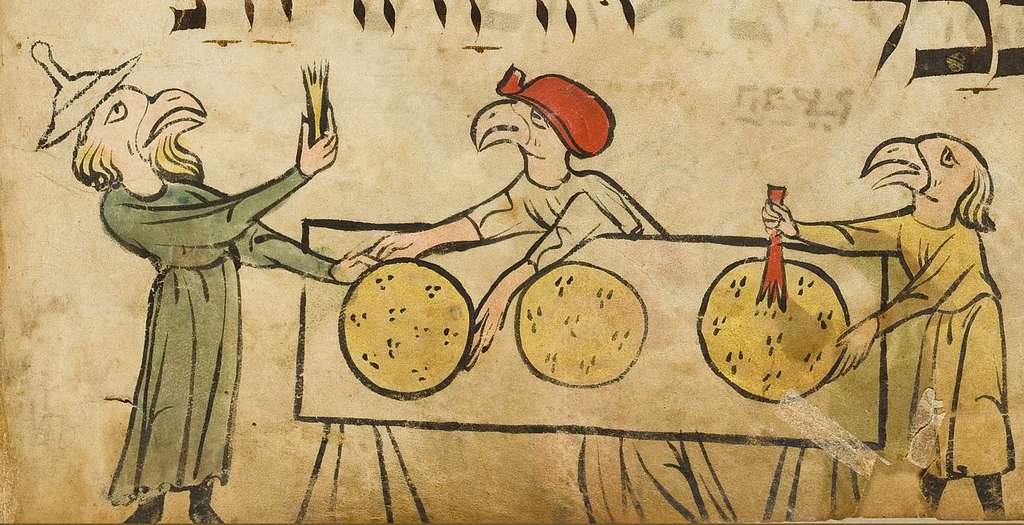 As detailed in chapter 8 of Epstein’s Medieval Haggadah, the early 14th Century Golden Haggadah is perhaps the most female-centric Haggadah and may have been commissioned for a woman. That manuscript emphasizes the unique, positive, and critical role women played in the Exodus narrative. Although it also depicts the practice of overzealous cleaning with a woman sweeping the ceiling. The 1430 Darmstadt Haggadah has a full-page illumination of women teachers, but its connection to the text is opaque. Finally, we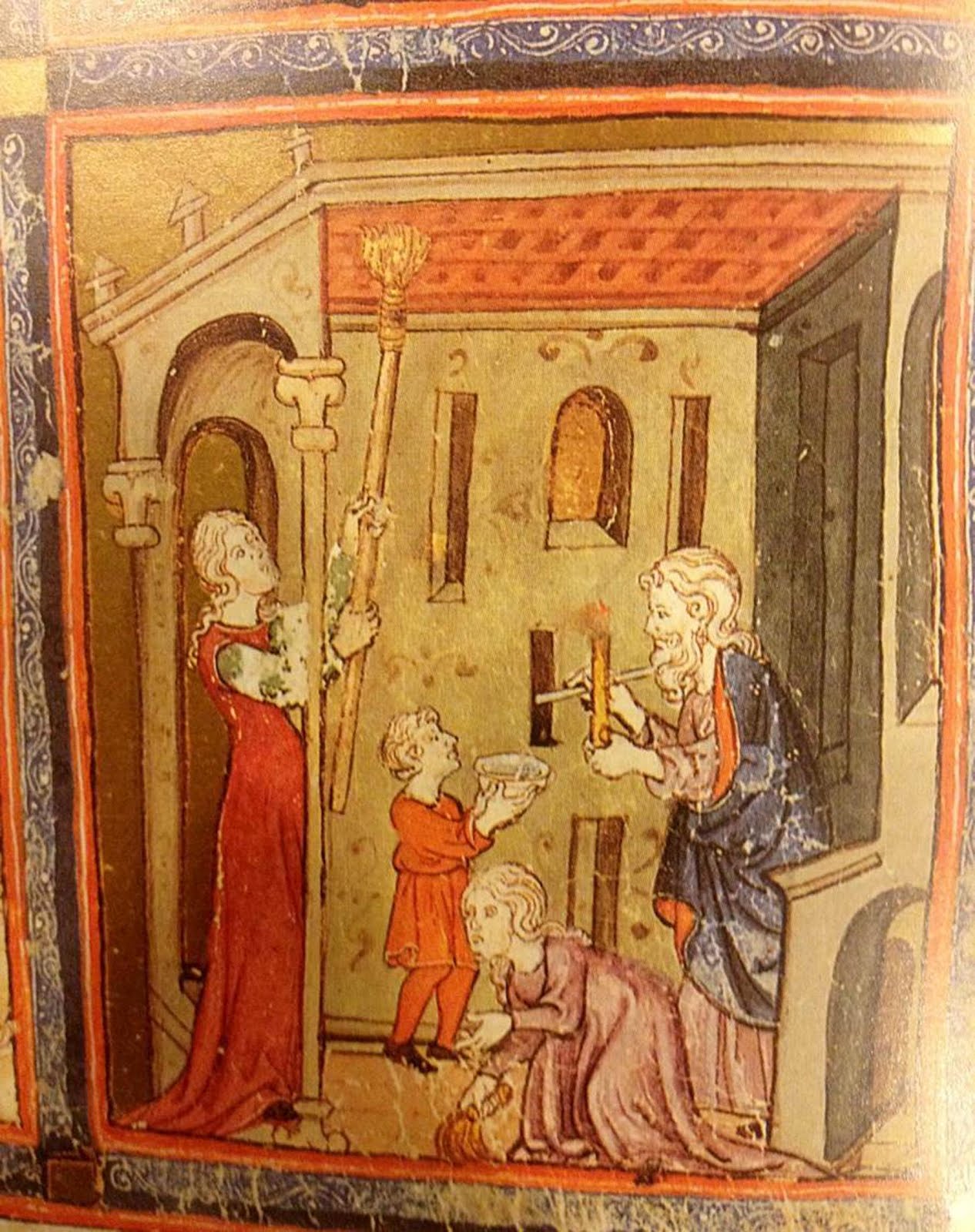
 After completing the Haggadah, Moss was asked to reproduce it, and, with Levy’s permission, produced, what the former Librarian of Congress, Daniel Bornstein, described as one of the greatest examples of 20th-century printing. The reproduction, on vellum, nearly perfectly replicates the handmade one. This edition was limited to 500 copies, all of which were sold. From time to time, these copies appear at auction and are offered by private dealers, a recent copy sold for $35,000. President Regan presented one of these copies to the former President of Israel, Chaim Herzog, when he visited the White House in 1987. While that is out of reach for many, this version is housed at many libraries, and if one is in Israel, one can visit Moss at his workshop in the artist colony in Jerusalem, where he continues to produce exceptional works of Judaica and view the reproduction. There is also a highly accurate reproduction, on paper that is