The Porto family: Eminent Sages, Scholars, and Prolific Seventeenth Century Authors

The Porto family: Eminent Sages, Scholars, and Prolific Seventeenth Century Authors

by Marvin J. Heller[1]

Among the illustrious families that have contributed to and enriched Jewish culture and history is the Porto (Rapa) family, comprised of sages and authors over the centuries. Known for their scholarship and valuable works, they also served in rabbinic positions in various locations. Originally from Lublin, the family came to Italy via Germany, settling in Porto in the vicinity of Verona. The family name Rapa stems from the German (Rappe in Middle High German), for raven. Rappoport is a combination of the Rapa, with Porto, done to distinguish this branch of the family from other Rapa branches. The Italian branch, our subject, providing eminent rabbis who authored distinguished works and served in the rabbinate in several cities in Italy.[2]

This article addresses the lives and works of several eminent members of the Porto family in the seventeenth century, describing a number of their diverse works. Entries are arranged chronologically.[3] A small number of Porto (Rapa) titles precede the works addressed in this article, also printed elsewhere. Among them are Kol Simhah (Prostitz, 1602) by R. Simhah ben Gershon Kohen, of Porto Rapa, on Shabbat zemirot; several editions of the Yalkut Shimonei with marginal annotations attributed to R. Menahem ha-Kohen Porto (Venice, 1566, Cracow, 1595-96, and Frankfort on the Main, 1687).[4] R. Abraham Menahem ben Jacob ha-Kohen Rapa mi-Porto (Rapaport)’s works, that is, the Minhah Belulah and Zafenat Pane’ah, are, as noted elsewhere, not addressed in this article, as having been described independently.

1608 Moses ben Jehiel ha-Kohen Porto-Rafa (Rapaport) – Our first Porto family publication is a compilation of responsa by R. Moses ben Jehiel ha-Kohen Porto-Rafa (Rapaport, d. 1624) concerning the prohibition by rabbis of the use of the mikveh in Rovigo. Moses ben Jehiel served from 1602 as rabbi of Badia Polesine in Piedmont, and afterwards as rabbi of Rovigo.

The dispute, a cause célèbre, concerned a mikveh built in 1594 by R. Jekuthiel Consiglio, then rabbi in Rovigo, in his home. Unable to obtain spring water, Consiglio dug a well and drew water with a pail, a halakhicly invalid procedure, as a mikveh requires free-flowing not drawn water. To resolve the problem, Consiglio used a pail with holes large enough to negate its status as a vessel. The mikveh’s validity depended upon whether the water passing through the bucket with holes was considered either drawn or pumped, thereby invalidating the mikveh.

After ten years possession of the house passed to R. Avtaylon Consiglio, Jekuthiel Consiglio’s older brother.[5] Among the first to invalidate the mikveh Avtaylon Consiglio, who upon studying the matter, found his brother’s position too lenient, the holes in the pail being too small to justify the leniency. Jekuthiel, however, found support for the halakhic appropriateness of his mikveh from several prominent rabbis from Venice. The dispute was widespread, in Italy prominent rabbis, such as R. Ezra of Fano, R. Moses Menachem Rapo, and R. Moses Cohen Porto, as well as R. Moses Mordecai Margalioth of Cracow responded. The dispute even extended to Prague and Safed, Eretz Israel, the respondent in the latter location there including R. Israel Galante in Safed.[6]

1608, Palgei Mayyim
Courtesy of the National Library of Israel

Three books are devoted to the subject of the Rovigo mikveh, namely Miḳveh Yisrael (Venice, 1607) by R. Judah ben Moses Saltero of Fano, Palgei Mayim (1608) by R. Moses ben Jehiel, both opposed to the mikveh, and Mashbit Milḥamot (Venice, 1606) by R. Isaac Gershon, this last in support of Jekuthiel Consiglio and his mikveh.

The title of interest to us is Moses ben Jehiel ha-Kohen Porto-Rafa (Rapaport)’s Palgei Mayim. It was, in manuscript, initially entitled Milhamot ha-Shem but was renamed. Palgei Mayim was published by Zoan (Giovanni) di Gara in quarto format (40: 78,[38\, [2] ff.) in the month of Shevat שסח (368 = January-February 1608). The title-page, which has a pillared frame, informs that it is responsa from rabbis from both Italy and elsewhere. The title-page is followed by Moses ben Jehiel’s introduction in which he informs that he has entitled this work Palgei Mayim (“rivers of water,” var. cit.) for a river of knowledge of Torah goes out of Eden. Moses ben Jehiel’s purpose in writing Palgei Mayim was to”

To defend the sage who prohibits [the mikveh] and all of us who agree with him, for this is our sole intention: to divert slanderous remarks from him, and if we do not succeed in getting people to stay away from the mikveh as we wished to do, what matter? At least we will have saved our souls.

Next is a lengthy forward preceded by a head-piece with several figurines which reappears towards the end of the book as a tail-piece (below). The text begins with a responsum from Avtalyon Consiglio, followed by a responsum from R. Ben Zion Zarfati, continuing with additional responsa.


Palgei Mayim is a compilation of the responsa of the rabbis who prohibited the use of the mikveh, quoting twenty-eight opinions in support of Porto’s position, followed by Mish’an Mayim, which is a refutation of the rejoinder of the opposition. As noted above, Porto originally intended to entitle Palgei Mayim Milhamot Ha-Shem (Wars of the Lord, Numbers 21:14) but, as he writes, reconsidered doing so to avoid creating a more combative environment. A collateral effect of this and other disputes at this time, which involved numerous rabbis, according to Robert Bonfil, was to weaken the authority of the rabbis involved.[7]

This is the only edition of Palgei Mayim, R. Moses ben Jehiel ha-Kohen Porto-Rafa‘s (Rapaport) only published work. (Seforim Blog editor’s note: Palgei Mayim and the other works mentioned about the Rovigo mikveh controversy was recently reprinted by Mechon Zichron Aron in their two-volume set Geonei Padua (2014).

1627 R. Menahem Zion (Emanuel) Porto Kohen Rappa – Our next member of the Porto (Rapaport) family, R. Menahem Zion (Emanuel) Porto Kohen Rappa was born in Trieste towards the end of the sixteenth century, serving there as chief rabbi, subsequently holding a similar position in Padua, where he died in about 1660. A multifaceted individual, Menahem Zion (Emanuel) Porto, a mathematician and astronomer, authored a variety of books encompassing several fields. His works on those subjects were highly regarded. Indeed, he was praised for his works by Italian scholars such as the mathematician and astrologer Andrea Argoli; and by Tomaso Ercaloni and Benedetto Luzzatto for his sonnets. Menahem Zion was recommended, in 1641, by Gaspard Scüppius, editor of the Mercurius Quadralinguis, to the renowned Protestant Christian-Hebraist Johannes Buxtorf (the younger), with whom Porto later carried on an active correspondence.[8]


1627, Over la-Soher,
Courtesy of Virtual Judaica

Over la-Soher, a treatise on mathematics, is Menahem Zion’s primary, best known Hebrew title. It was published in 1627 as a quarto (40: 22 ff.) at the press of Pietro, Aluise, and Lorenzo Bragadin. The title is from Abraham’s purchase of Machpelah from Ephron the Hittite, concluding, “money current among the merchants (over la-soher)” (Genesis 23:16). The title-page has a pillared frame and simply states that it is a sefer ha-mispar (book of numbers).

The verso of the title page has verse encouraging purchase of the book, beginning, “hasten to acquire Sefer ha-Mispar, look into it . . .,” followed by Porto’s introduction (2a-3a) in square letters, extolling the great benefit and practical value of the subject matter and mentioning predecessors, particularly R. Elijah Mizrahi’s (c. 1450–1526) Sefer ha-Mispar, a deep and difficult work. However, Porto, while being concise, has added to and made his book more accessible to the reader. Having dealt extensively with merchants, Menahem Zion has entitled this book Over la-Soher. Finally, Porto greatly praises his patron R. Abraham ben Mordecai Ottiniger. There is a second introduction (3a-b) from R. Gershom ben Kalonymous Hefez, a student of Porto, who was responsible for publishing Over la-Soher.

The text follows in a single column in rabbinic type. Over la-Soher is divided into twelve chapters, dealing with practical arithmetic, multiplication, divisions and fractions. Numerous examples are given in Hebrew rather than Arabic numerals. This is the only edition of Over la-Soher.

Porto’s Italian works include Porto Astronomico (Padua, 1636); Breve Istituzione della Geographia (Padua, 1636); and Diplomologia, Qua Duo Scripturæ Miracula de Regressu Solis Tempore Hiskiæ et Ejus Immobilitate Tempore Josuæ Declarantur (Padua, 1643) reportedly translated into Hebrew by Porto and into Latin by Lorenzo Dalnaki.[9] Diplomologia, Qua Duo Scripturæ is dedicated to the emperor Ferdinand III. Originally written in Italian, it was translated by the author himself into Hebrew, who then sent it to Lorenzo Dalnaki of Transylvania who translated it into Latin.

Porto Astronomico di Emanuel Porto Rabbi Hebreo di Trieste (Padua, 1636), [10] is dedicated to Count Benvenuto Petazzo. In contrast to the favorable comments noted above, Cecil Roth is dismissive of this work, writing “The Porto Astronomico . . . is unimportant save as a curiosity.” Concerning Menahem Zion’s other books, Roth includes them in the category of “popularizing works” which “were published and seem to have achieved a measure of success.”[11]


1636, Porto Astronomico
Courtesy of Google Books

1628 Abraham ben Jehiel ha-Kohen Porto – A scholar of distinction, R. Abraham ben Jehiel ha-Kohen Porto, was active at the beginning of the seventeenth century. He resided in Cremona and Mantua, and afterwards in Verona. He studied under relatives and appears to have served as rabbi in Verona. Abraham Porto was the author of several works, most notably Havvot Ya’ir, rabbinic epigrams as well as several other works, still extant in manuscript.

Havvot Ya’ir, an alphabetical collection of Hebrew words with their cabalistic explanations, was published in 1628 in Venice at the Bragadin press by Pietro, Aluise, and Lorenzo Bragadin in quarto format (40: 40 ff.). The title-page is dated in a straightforward manner, as שפח (388 = 1688), but the chronogram in verse at the end of the book provides a completion date of Rosh Hodesh Sivan [5]388 (Friday, June 2, 1628). The text is enclosed by a pillared architectural frame and states that it is an appetizer based on the sayings of our sages “‘His speech shall flow as the dew’ (cf. Deuteronomy 32:2) for from one word shall come forth, flourish, and shine many words for the honor of ‘the desirable of the young men” (cf. Ezekiel 23:6, 12, 23) such as R. Samuel Hayyim Bassan of Verona, a student of R. Samuel Meldola.”

There is a dedication to “the desirable of the young men,” R. Samuel Hayyim ben Mordecai Bassan of Verona (2a) which concludes with lines of verse. Abraham Menahem’s introduction follows, in which he gives two further reasons for entitling the book Havvot Ya’ir. Firstly, as the villages provide provision for the large cities (Megillah 2b) so this small work will much illuminate and enthuse great rabbis to remember and briefly speak the words of our sages. Also, as one that does not have children, so is his “soul abased and languishes, this is my generations before the Lord.”[12] Abraham Menahem writes that the book is called,

Havvot Ya’ir to enlighten להאיר and to inflame the hearts of choice students such as yourself (Bassan) in the way of our sages, as to why the Torah is called “Etz Hayyim (tree of life)”, (Proverbs 3:18, 11:30, 15:4), for as the small trees ignite the larger ones so too my friend, the young ignite and inflame the hearts of those who are older, “He will magnify the Torah, and make it glorious” (Isaiah 42:21).

1628, Havvot Ya’ir, Venice
Courtesy of Virtual Judaica

There is an approbation from R. Judah Aryeh (Leone) Modena, R. Simhah Luzatto, and R. Nehemiah ben Leib Sarival. The text, assembled from the beginnings of his speeches, follows in a single column in rabbinic type.

Example of entries, which are arranged alphabetically, are כ kaf: beginning karpas, yahaz כרפס יחץ, the initial letters are כי for “For כי, behold, the darkness shall cover the earth, and thick darkness the people, but the Lord shall arise upon you” (Isaiah 60:2). The Patriarchs are an omen for their offspring. Jacob “divided ויחץ the children” Genesis 33:1). צ Tzadi:צחק “God has made me laugh “ (Genesis 21:6), and according to R. Pollack, Sarah said that she trusts that her offspring will be Talmudic scholars who will be experts in צ zizit and the ties of tefillin. This is the only edition of Abraham ben Jehiel Porto’s Havvot Ya’ir.

Among Abraham ben Jehiel ha-Kohen Porto’s other works are Gat Rimmon, a book of verse; Shimmush Avraham, a commentary on the Torah (below); and Hasdei David on the Psalms, all unpublished. He also wrote responsa, several published in the responsa of his contemporaries. Abraham’s brother was R. Moses ben Jehiel Porto-Rafa (Rapoport, d. 1624), and our Abraham also edited and printed the Minḥah Belulah (Verona, 1594) of R. Abraham Menahem ben Jacob ha-Kohen Rapa mi-Porto (Rapaport), a kinsman.

Shimush Avraham
Courtesy of the Russian State Library

1675 Zechariah ben Ephraim Porto: – This Porto, a seventeenth century Italian scholar, was noted for his learning and still more for his other virtues. A native, resident of Urbino, R. Zechariah ben Ephraim Porto (d. 1672) also resided in Florence and Rome, where, in the latter location, he officiated as rabbi, although he modestly refused to assume that title. Zechariah ben Ephraim was also a philanthropist; in his will, Zechariah Porto, who was childless, left all of his wealth for communal bequests for Talmud Torahs, dowries, and support of communities in Eretz Israel. His extensive library was dedicated to the Talmud Torah in Rome.

Zechariah Porto was the author of Asaf ha-Mazkir, a work containing a list of all the explanations and comments found in the Ein Ya’aḳov, R. Jacob ben Solomon ibn Habib’s popular and much reprinted collection of the aggadic passages of the Talmud. Zechariah Porto would not publish his book; it was printed after his death by the Roman community (Venice, 1688; according to Zedner, 1675).[13]

The title-page of Asaf ha-Mazkir has images of Moses and Aaron on the sides, cherubim above holding the tablets with the ten commandments, and at the bottom additional imagery. It is dated with the chronogram “It is ‘Asaph the recorder (Asaf ha-Mazkir) אסף המזכיר’ הוא (435 = 1675)” (II Kings 18:18, 37; Isaiah 36: 3, 22). Asaf ha-Mazkir was printed at the Bragadin press by Domenico Vedelago in quarto format (40: [4], 400 ff.).

The title page of Asaf ha-Mazkir has the Bragadin frame with Moses and Aaron, and a brief text that simply states Porto’s name and that it is being published for the public good.[14] It is dated, “He is ‘Asaph the recorder’ אסף המזכיר הוא (435 = 1675)” (II Kings 18:18, 37, Isaiah 36:3, 22). The colophon dates conclusion of the work to Tuesday, 13 Adar, “relief and deliverance arise to the Jews from another place ממקום אחר (435 = March 11, 1675)” (Esther 4:14), which in fact was a Monday that year.


1675, Asaf ha-Mazkir
Courtesy of the National Library of Israel

The title page is followed by the introduction of the Talmud Torah, which praises Porto’s piety, charity, and many other fine qualities; verse, also praising Porto and his work, beginning, “The wage of the righteous” (Proverbs 10:16, 18:11); and the introduction of R. Moses ben Jacob Levi from Vienna, the editor. He writes in the same vein, but adds that he should not be held responsible for errors for work was done on Shabbat by gentiles which could not be corrected.[15] He too concludes with verse. Next is the Italian Noi Reformatori dello Studio di Padoa, dated 11. Marzo 1675 and signed Gio: Battista Nicolosi Segret.


1675, Asaf ha-Mazkir
Courtesy of the Library of Agudas Chassidei Chabad Ohel Yosef Yitzhak

The text of Asaf ha-Mazkir is set in two columns, headers and text from the Ein Ya’akov in square letters, sources in rabbinic type. Tractate names are in a decorative frame, chapters in bold letters. Entries consist of the statement in the Ein Ya’akov, followed by sources addressing those statements. An example of an entry is the last chapter of Kiddushin 82a,

One should always teach his son a clean and easy trade, etc.

Lehem Shelomo no. 366 109 f. amud a.

Tosfot Yom Tov ch. 4 195 f. amud b

This is the only independent edition of Asaf ha-Mazkir, Zechariah ben Ephraim Porto’s only published work. It was included in later editions of the Ein Ya’akov, beginning with the Amsterdam (1725-26) edition. As Eli Genauer noted, “It was included in later editions of the Ein Ya’akov, beginning with the Amsterdam (1725-26) edition.)  An example of something like this is Chochmas Shlomo which was printed a few times and then never again because it made it to the back of the Vilna Shas underneath the Maharsha. So even though it was only published independently three times, it was published dozens of times onward by being in the back of the Vilna Shas.”

1619 Allegro Porto – The most unusual entry in our collection of seventeenth century Porto imprints is Allegro Porto’s Nuevo Musiche, a collection of secular madrigals. This, our last Porto entry, is not in our chronological order, nor is it part of our description of the Hebrew works by members of the Porto family. It is included, however, assuming that Allegro Porto was a member of the extended Porto family, in order to show the great diversity and productivity, even outside of our subject area of Hebrew imprints, of the family’s accomplishments.

A madrigal is an elaborate multi-part song for several voices, without instrumental accompaniment. It is a genre popular in the late sixteenth and early seventeenth centuries. Allegro Porto published Nuevo Musiche in 1619, followed by two collections of madrigals in 1622 and 1625, one lacking a title-page.[16] Shlomo Simonsohn credits Allegro (Simha) Porto with four collections of songs, but enumerates three only, all printed in Venice, Nuove Musiche, (1619), Madrigali a cinque voci (1625), and Madrigali a tre voci, libro primo (1619).[17]

Cecil Roth informs that although singers and instrumentalists were active elsewhere in Italy, it was in Mantua only that there was a “sequence of Jewish composers who published their works.” Among them was Allegro Porto whom Roth describes as prolific. His writings, according to Roth, also include four works, two collections of madrigals for five verses being published in 1625, one being dedicated to the Holy Roman Emperor Ferdinand II, the daughter of the Duke of Mantua being his empress, Simonsohnn describes her, Eleanora Gonzaga, as the sister of the Dukes Francesco II, Ferdinando and Vincenzo II. Among Porto’s madrigals was a collection in the new style (Nuevo Musiche, 1619), this dedicated to Count Alfonso de Porzia, chamberlain to the Duke of Bavaria. Another collection of Porto’s madrigals, this for three voices “‘with some arias and a romanesque dialogue’ (the first part alone is recorded, but perhaps there were others), published first in 1619, was reissued in the nineteenth century.[18]

No image accompanies this entry, in comparison to the other book descriptions; it was not possible to find an image of Porto’s Nuevo Musiche. The reason is its great rarity, for as Roth explains “Musical publications of this age are prodigiously rare, many surviving in only a single copy – others perhaps were less fortunate, so that to state dogmatically that certain compositions were unpublished is hazardous.” He notes that in the famed musical collection of King João of Portugal, assembled in the late eighteenth century, destroyed in the Lisbon earthquake of 1755, were four works by Allegro Porto.

Finale: the Porto family in the seventeenth centuries: – The various branches and members of the Porto family in the seventeenth century provided the Jewish communities of Italy, and by extension, world Jewry, with several distinguished rabbis and authors, their diverse works encompassing Torah commentary, responsa, mathematics, astronomy, kabbalistic linguistics, Aggadah, and even musical compositions. Their books, despite their value, were, with exception, published once only, in single editions. Given that these works are viewed positively, it is unfortunate that they were not republished or are not better known. Perchance, the very diversity of these Porto publications, represent the eclectic views of Renaissance Italy. They are a rich contribution to Jewish literature, representing the contributions of the seventeenth Porto family to the Jewish society of that period and to our times as well.

[1] I would like to express my appreciation to Eli Genauer for reading the article and his several comments, in particular for his observation on the editions of Asaf ha-Mazkir.
[2] This is a companion article to a previous article on a single distinguished Porto, R. Abraham Menahem ben Jacob ha-Kohen Rapa mi-Porto (Rapaport) and his works, the Minhah Belulah and Zafenat Pane’ah. Concerning that article see Marvin J. Heller, “Abraham Menahem ben Jacob ha-Kohen Rapa mi-Porto (Rapaport) Ashkenazi: A Renaissance Rabbi of interest” Seforim.blogspot.com (March 17, 2021).
[3] Several of the background descriptions of Porto family are from Richard Gottheil, Isaac Broydé, and Ismar Elbogen, “Porto,” Jewish Encyclopedia X (1901-06), pp. 133-34 and Shimon Vanunu, Encyclopedia le-Hachmah Italia (Jerusalem, 2018), var. cit.
[4] The Yalkut Shimoni entries are from the book descriptions in the Library of Agudas Chassidei Chabad Ohel Yosef Yitzhak library catalogue.
[5] Shmuel Glick, Kuntress ha-Teshuvot he-Hadash: A Bibliographic Thesaurus of Responsa Literature published from ca. 1470-2000 (Jerusalem & Ramat Gan, 2006-07) II, pp. 839-40 no. 2982 [Hebrew].
[6] A. M. Habermann, Giovanni Di Gara: Printer, Venice 1564-1610. ed. Y. Yudlov (Jerusalem, 1982), pp. 123-25 no. 257 [Hebrew]; Carmilly-Weinberger, Censorship and Freedom of Expression in Jewish History, pp. 160-61; Avraham Yaari, Unknown Documents concerning the dispute in Rovigo,” Studies in Hebrew Booklore (Jerusalem, 1959), pp. 420-29 [Hebrew].
[7] Robert Bonfil, Rabbis and Jewish Communities in Renaissance Italy, translated by Jonathan Chipman (London, Washington, 1993), pp. 107-08.
[8] Gottheil, Broydé, Elbogen, op. cit.
[9] Giovanni Bernardo De Rossi,. Dictionary of Hebrew Authors (Dizionario Storico degli Autori Ebrei e delle Loro Opere), ed. Marvin J. Heller, (Lewiston, 1999), p. 157
[10] Cecil Roth, The Jews in the Renaissance (New York, 1959), pp. 235-36; Meyer Waxman, A History of Jewish Literature: From the Twelfth Century to the Middle of the Eighteenth Century II (New York, 1933, reprint 1960), p. 487.
[11] Cecil Roth, op cit, p. 236.
[12] Meir Benayahu, “The Caleon Press” Asufot XIII (Jerusalem, 2001), pp. 194-95 [Hebrew].
[13]  Ḥananel Nepi, Mordecai Samuel Ghirondi, Toledot Gedolei Yisrael (Trieste, 1853), p. 99 [Hebrew]; Joseph Zedner, Catalogue of the Hebrew books in the library of the British Museum (London, 1867), p. 788.
[14] Concerning the appearance of Moses and Aaron on the title-pages of Hebrew books see Dan Rabinowitz, “Aaron the Jewish Bishop,” ” Seforim.blogspot.com April 12, 2016).
[15] Concerning work done on Shabbat see Marvin J. Heller, “And the Work, the Work of Heaven, was Performed on Shabbat,” The Torah u-Maddah Journal 11 (New York, 2002-03), pp. 174-85, reprinted in Studies in the Making of the Early Hebrew Book (Brill, Leiden/Boston, 2008), pp. 266-77.
[16] Willi Apel, Harvard Dictionary of Music (Cambridge, 1969), p. 446.
[17] Shlomo Simonsohn, History of the Jews in the Duchy of Mantua (Jerusalem, 1977), p. 676.
[18] Cecil Roth, The Jews in the Renaissance (1959, reprint New York, 1965), pp. 286-87.

“A Woman Is Not an Elephant”

“A Woman Is Not an Elephant” – Some Jewish, Islamic and Classical Perspectives On the Conflict Between Authority and Truth

by Yitzhak of Bein Din Ledin

Unusually Long (Human) Gestations: Islam

The Middle East Media Research Institute (MEMRI) reports (hat tip: Rabbi Natan Slifkin):

Egyptian Medical Doctor Criticizes the Phenomenon of Accepting Unscientific Islamic Beliefs, like the Notion that a Woman's Pregnancy Can Last Up to Four Years

In an article on the liberal website Elaph, Dr. Khaled Montasser, a liberal Egyptian physician, criticizes the phenomenon of endorsing traditional ideas that have been disproven by science, such as the Muslim belief that a woman can be pregnant for up to four years. He points out that this notion is believed even by some Muslim doctors, and is acknowledged in the laws of some Arab countries, including those that are not theocracies. He calls on the Muslims not to accept outdated and unscientific ideas just because they were proposed by important clerics, stressing that contesting the opinions of religious scholars is not tantamount to attacking or disparaging the religion itself.Following are excerpts from his article:

At a Medical Conference, a Professor Raised the Notion of a Hidden Pregnancy Lasting One to Four Years

"In a medical conference held at one of the faculties of general medicine, a professor asked for permission to speak, and said: 'Why doesn't this conference deal with [the phenomenon of] hidden pregnancy?' When the participants asked what he meant by 'hidden pregnancy,' he replied: 'I mean a pregnancy that lasts one, two, three or four [years].' The conferees, both the students and the professors, were puzzled and asked one another, 'Is there such a thing as a pregnancy that lasts three or four years?' The professor answered confidently, with contempt for his colleagues' ignorance: 'Of course. Imam Malik [founder of the Maliki school of Islam] stayed in his mother's womb for three years.'"The danger posed by this belief is that, [in this case], the one who held it was a professor of medicine, who is probably schooled in the doctrine of scientific thinking, and relies on medical journals as his source [of knowledge]. Faced with a medical question, such as how long a pregnancy can last, he [is expected to] rely on what he has learned and read in these [scientific] sources, rather than on what he has read in texts of Islamic jurisprudence."Unfortunately, however, this doctor was not [just] speaking for himself. He represents a phenomenon, namely the victory of tradition over reason. He represents a school of thought that is willing to sacrifice all medical learning in order to uphold the predominance of jurisprudential Islamic texts and traditional fatwas. Proof of this is [the fact] that it is not only this professor who holds such views. I will have you know that the chief proponent of female circumcision [in Egypt] is a professor of gynecology and obstetrics, who even argued against the minister of health in a court hearing [about this matter]."

The Notion of Hidden Pregnancy Has Crept into the State Laws

"Some Islamic scholars, like those of the Hanafi [school], believe that a pregnancy can last up to two years, while those of the Maliki and Shafi'i schools think it can last up to four years, and some of them [have said] even five years or more. We [can] accept these statements as a kind of folklore, but not as any kind of scientific truth… I refuse to let anyone force me to accept this nonsense under the pretext of implementing the shari'a. Islam is a religion of reason, and [cannot] be associated with these medieval notions. Moreover, my mind refuses to accept something just because the Mufti wrote it in his book or because it appears in the Al-Azhar curriculum. How can I accept this as science when not a single gynecologist or obstetrician has ever witnessed [such an event] since the advent of scientific gynecology and obstetrics?… And from a moral perspective, how can I provide a jurisprudential loophole for a woman who was probably promiscuous after the death of her husband and then presented her baby, conceived in sin, as a baby of her dead husband by relying on the [notion] of a hidden pregnancy or on a fatwa issued by some [cleric] or religious school? This is what happened on December 14, 1927 at a shari'a court in Mecca. The qadi… ruled that the baby was conceived by the woman's dead husband who had died five years previously."The important question is whether the notion of a 'hidden pregnancy' is confined to religious legal texts and is acknowledged only in [Muslim] theocracies, or has [also] found its way into the laws of non-theocratic [Muslim] states that have been terrorized [into submission] by the slogans of the pressure group called political Islam. [Is Egypt] a state that respects reason and [rational] thinking or one that sanctifies tradition and accusations of heresy?"Science is familiar with the notion of a fetus, but does not recognize the notion of a hidden pregnancy or a pregnancy lasting more than ten months, let alone two to four years. The law is expected to be guided by [science] instead of pandering to religious scholars at the expense of science. [The ideas about 'hidden pregnancy'] are religious opinions that [reflect the beliefs] of past eras, and they should be treated as such, not as a sword that hangs over the neck of the legislator."It seems inconceivable that the laws of Egypt, Syria, or the Gulf states should include clauses about hidden pregnancy that reflect beliefs from the fourth century – [but the fact is that they do]. For example, [Egyptian] Law No. 15 from 1929 states that 'a woman's appeal to acknowledge her dead husband [as the father of] her child will not be considered if [the baby] was born over a year after [the husband's] death.' Law No. 131 from 1948 includes a clause stipulating that 'the law will take into account the rights of [a child] born as the result of a hidden pregnancy,' and Law No. 67 from 1980 [states that] 'a hidden pregnancy is legitimate [grounds] for granting rights.' Article 29 of the Personal Status Code [says]: 'The guardian of a child born [as a result of] a hidden pregnancy must inform the Attorney General's [office] when the pregnancy ends.' Article 128 in the Syrian legal code and the property guardianship law in Bahrain say the same thing."

A Woman Is Not an Elephant – She Can't Be Pregnant for More than 10 Months

"The proponents of tradition and enemies of rationality always argue that the religious scholars are [simply] cognizant of [unusual] cases that are possible, though rare. But there is a big difference between rare and impossible. It is impossible that a woman, who belongs to the human race, should suddenly turn into an Asian elephant and be pregnant for over two years. Even [a pregnancy lasting] one whole year… is impossible… The womb is not a storeroom… When a fetus stays in his mother's womb over 42 weeks, he is in danger of dying in utero, and if he stays there more than 43 weeks he will surely die… A 50-week fetus will certainly start to rot in his mother's womb… The duration of pregnancy is not a random affair; it is not a matter of possibilities, of changes in human nature or of changes that occur with time. Someone who says today that Imam Malik stayed in his mother's womb for three years is making light of a serious matter – and the blame lies not with those who said this in the past, but with those who endorse this opinion today."Debating and criticizing the opinions of religious scholars does not mean criticizing or disparaging religion. We mustn't be too sensitive to discuss a scientific issue that was misunderstood by the religious scholars of the past. There is no need to wave swords when discussing such issues. The fault lies not with those who [dare to] contest the [opinions of the religious scholars], but with those who think that these opinions are synonymous with the religion itself. The despicable questions that the clerics ask, [such as] 'Are you saying that the religious scholars were liars?' or 'Who are you to [argue] with figures of their caliber?' – are an impediment to any progress in science and in thinking."We are not accusing the religious scholars of lying, but are [merely] treating their opinions as part of [the beliefs] that prevailed in their time. We do not regard [these opinions] as sacrosanct just because those who held them were authoritative figures. Scientific truths are judged by other criteria that have nothing to do with the piety or devoutness of those who propose them. Moreover, one who contests a clerical opinion having to do with science is not attacking or disparaging the religious scholars, even if he is less pious than they. But he is probably equipped with modern research tools that are more effective than those that were available to those scholars. This does not in any way detract from their importance [as religious scholars] or from the [value] of their religious opinions…"The issue of hidden pregnancy opens a gateway to debating all the scientific and medical notions that appear in the jurisprudential texts. It is inconceivable that today, in the 21st century, we should repeat the opinions of ancient religious scholars – [such as the notion] that the menstrual blood feeds the fetus during pregnancy and turns into breast milk [after birth] – and discard everything science has taught us about gynecology… It is inconceivable that we should use terms like 'the man's [white] fluid' and 'the woman's [yellow] fluid' in discussing genetics, sexology, or infertility, while discarding [terms like] semen, ova, and the enormous wealth of knowledge gained since the discovery of DNA. The same goes for all the religious notions about medicine that are treated as religious commandments instead of as outdated medical [ideas], such as the notion of bloodletting which is defended so much that you would think it’s the sixth Koranic Pillar [of Islam]."

Unusually Long (Human) Gestations: Judaism

And what does our religion say about the possibility of abnormally long pregnancies? The Halachic discussion revolves around this Sugya: תניא איזהו בן שמנה כל שלא כלו לו חדשיו רבי אומר סימנין מוכיחין עליו שערו וצפרניו שלא גמרו טעמא דלא גמרו הא גמרו אמרינן האי בר ז' הוא ואישתהויי הוא דאישתהיאלא הא דעבד רבא תוספאה עובדא באשה שהלך בעלה למדינת הים ואישתהי עד תריסר ירחי שתא ואכשריה כמאן כרבי דאמר משתהאכיון דאיכא רבן שמעון בן גמליאל דאמר משתהי כרבים עבד דתניא רשב"ג אומר כל ששהה ל' יום באדם אינו נפל[1]The Shulhan Aruch, following the preponderant opinion of the Poskim, accepts the ruling of רבה תוספאה: האשב שהיה בעלה במדינת הים ושהה שם יותר מי"ב חדש וילדה אחר י"ב חדש הולד ממזר שאין הולד שוהה במעי אמו יותר מי"ב חדש ויש מי שאומר שאינו בחזקת ממזר וכיון דפלוגתא הוא הוי ספק ממזר: הגה אבל תוך י"ב חדש אין לחוש דאמרינן דאשתהי כל כך במעי אמו ודוקא שלא ראו בה דבר מכוער אבל אם ראו בה דבר מכוער לא אמרינן דאשתהי כל כך וחיישינן ליה[2]So normative Halachah recognizes pregnancies of up to twelve months as possible, if improbable,[3] but of longer than twelve months as impossible. There are, however, minority opinions that dissent from this position in both directions:

Even Longer Pregnancies

Meiri recounts a remarkable incident in his day of a woman who gave birth after a gestation of fifteen months, and although he acknowledges that Rambam, as well as his teachers, in the name of "The Book of Healing", by "great sages" in that discipline, deny that possibility, he stubbornly insists that his empirical experience trumps that view: ואחר שכן [שמכשירין את הולד שנולד לסוף י"ב חודש] אף ביתר משנים עשר חדש ואף בימינו אירע מעשה באשה ששהתה חמש עשרה חדשים וילדה והיה עיבורה ניכר כל ימי העבור שלא היה בה שום חשד והיו כל בני המחוז תמהים עליה וסבורים שהיה חולי הקרוי ריחים וילדה בן והיו שערו וצפרניו גדולים כאלו נולד ונתגדלוגדולי המחברים כתבו שאין העובר משתהא במעי אמו יותר משנים עשר חדש ואף רבותי העידו לי כן באותו זמן בשם ספר הרפואה לגדולי החכמים שבה אלא שמעשה שהיה כך היה ונראה לי לדון בה למעשה.[4]Rav Haim Yosef David Azulai (Hida) cites a manuscript comment of Rav Yosef (Haim) Corinaldi, which cites an incident from "their histories" that the wife of one Caesar had a fourteen month gestation, and the resulting son eventually succeeded his father as Caesar: ראיתי להרב מהר"ר דוד קורינאלדי זלה"ה בעל בית דוד על המשניות שכתב דבדברי הימים שלהם כתוב דאשת קיסר שהה הולד במעיה ארבעה עשר חדש והיה קיסר אחר אביו והיה עולה על לב דרבה תוספאה דהכשיר עד תריסר ירחי מעשה שהיה כך היה והוא הדין אם שהה יותר כל שלא ראו בה דבר מכוער אבל כבר כתב הרמב"ם דאין הולד שוהה במעי אמו יותר מי"ב חדש וגם בה"ג דאמר דאינו בחזקת ממזר לא אמרה מטעם דשוהה יותר אלא משום דיש לומר בצנעא בא כמו שכתב בטור ובבית יוסף וחלילה להקל נגד מה שפסק מרן דהוי ספק ממזר עכ"ל בהגהותיו כ"י:[5]Hida then mentions Meiri, but concludes by accepting as Halachah the opinion of Maran (and Rav Corinaldi), and declaring that we "obviously pay no attention to their histories": וראה זה חדש שראיתי בפסקי הרב המאירי ז"ל ליבמות שנדפסו מחדש … והוא פלא דנקטינן שאינו משתהא יותר מי"ב חדש. ומכל מקום לענין הלכה כל שנשתהא טפי מי"ב חדש הוי ספק ממזר כמו שכתב מרן וכמו שכתב הרב מהרד"ק הנזכר ופשיטא דאין להשגיח בדברי הימים שלהם. ומה שכתב הרב המאירי ז"ל הוא מציאות רחוק מאד מאד ומה גם דשם ניכר בשינוי שערו וצפרניו גדולים. הלכך טפי מי"ב חדש הוא ספק ממזר See also Ozar Ha'Poskim[6] for various other sources on the issue of abnormally long pregnancies, including several who emphatically insist on the impossibility of a gestation of longer than twelve months, but also a couple who seem to consider it possible.

The Two Hundred and Seventy One Day Maximum

In counterpoint to the view of Meiri is the stance of some of the Tosaphists and their followers, who maintain that Le'Halachah, any baby born after a gestation of longer than two hundred and seventy one days (nine "full" months of thirty days each) is considered a mamzer. Helkas Mehokek and Beis Shemuel mention this view, although it is not clear how much weight they give it: התוספות בנדה (דף ל"ח בד"ה שפורא גרים) כתבו דלא קיימא לן כרבה תוספאה (דממנו הוציא הרב דין זה) ואין הולד משתהי יותר מרע"א ימים היינו ט' חדשים שלמים כל אחד ל' יום:[7]מיהו התוספות נדה דף ל"ח כתבו דלא קיימא לן אשתהי וכן פסק באגודה[8]See Ozar Ha'Poskim[9] for more sources on this view.[After I had completed this paper, Eliezer Brodt showed me a fascinating and remarkably erudite thirty eight page comprehensive survey, by יעקב ישראל סטל, of references in Jewish literature to unusually long pregnancies.[10]  This exhaustive article cites the aforementioned sources as well as numerous others, and includes suggestions that Yissachar, son of Ya'akov, experienced a gestation of twelve months or longer, and that Binyamin, son of Ya'akov, experienced a gestation of twenty four months, or even thirty months!I have not had a chance to carefully read the entire article, but I did notice one apparent error: the author repeatedly asserts that the Talmudic passage that we have cited clearly rejects the possibility of a pregnancy lasting longer than twelve months, to the extent that he wonders why a couple of Aharonim claim merely that such pregnancies are “against nature”, and not that they are “against the Talmud and the Halachah”.[11]  But as we have seen, the Talmudic passage itself merely asserts that pregnancies lasting up to twelve months are possible; it is not at all clear that longer ones are impossible, and those who insist that they are, such as Hida, are relying primarily on the authority of Rambam and Maran.Incidentally, one of these Aharonim is Rav Ya'akov Emden, whose comment appears in the midst of his “expurgation of the Zohar”:[12]אך זה שכתוב עוד שם. ומן דרחל אתעברת מבנימין. לא אתעכב תמן. זה אי אפשר. לפי חשבון ששהה יעקב אבינו ע"ה בדרך שתי שנים. עד שנולד בנימין. כמו שכתב בסדר עולם ומוסכם בתלמוד  מאין חולק. והרי בכאן מאריך ספר הזוהר ימי עיבורו של בנימין חוץ לטבע. מה שלא נמצא דוגמתו.[13]]

Rejecting Incorrect Scientific Opinions of Religious Scholars: Islam

We have seen Dr. Montasser's claim that: Debating and criticizing the opinions of religious scholars does not mean criticizing or disparaging religion.R. Slifkin comments that: The parallels are interesting – including how, 800 years ago, Muslims would definitely not have been so traditionalist!Indeed. As the great Muslim thinker Abū Ḥāmid Muḥammad ibn Muḥammad al-Ghazālī writes in the Introduction to his great classic Tahafut Al Falasifah (Incoherence of the Philosophers): [T]here are those things in which the philosophers believe, and which do not come into conflict with any religious principle. And, therefore, disagreement with the philosophers with respect to those things is not a necessary condition for the faith in the prophets and the apostles (may God bless them all). An example is their theory that the lunar eclipse occurs when the light of the Moon disappears as a consequence of the interposition of the Earth between the Moon and the Sun. For the Moon derives its light from the Sun, and the Earth is a round body surrounded by Heaven on all the sides. Therefore, when the Moon falls under the shadow of the Earth, the light of the Sun is cut off from it. Another example is their theory that the solar eclipse means that the interposition of the body of the Moon between the Sun and the observer, which occurs when the Sun and and the Moon are stationed at the intersection of their nodes at the same degree. We are not interested in refuting such theories either; for the refutation will serve no purpose. He who thinks that it his religious duty to disbelieve such things is really unjust to religion and weakens its cause. For these things have been established by astronomical and mathematical evidence which leaves no room for doubt. If you tell a man who has studied such things – so that he has sifted all the data relating to them, and is, therefore, in a position to forecast when a lunar or a solar eclipse will take place; whether it will be total or partial; and how long it will last – that these things are contrary to religion, your assertion will shake his faith in religion, not in these things. Greater harm is done to religion by an immethodical helper than by an enemy whose actions, however hostile, are yet regular. For, as the proverb goes, a wise enemy is better than an ignorant friend. If someone says:The Prophet (may God bless him) has said: The Sun and the Moon are two signs among the signs of God. Their eclipse is not caused by the death or the life of a man. When you see an eclipse, you must seek refuge in the contemplation of God and in prayer." How can this tradition be reconciled with what the philosophers say?We will answer:There is nothing in this tradition to contradict the philosophers. … The atheists would have the greatest satisfaction if the supporters of religion made a positive assertion that things of this kind are contrary to religion. For it would then be easier for them to refute religion which stood or fell with its opposition to these things. (It is, therefore, necessary for the supporter of religion not to commit himself on these questions,) because the fundamental question at issue between him and the philosophers is only whether the world is eternal or began in time. If its beginning in time is proved, it is all the same whether it is a round body, or a simple thing, or an octagonal or hexagonal figure; and whether the heavens and all that is below them form – as the philosophers say – thirteen layers, or more, or less. Investigation into these facts is no more relevant to metaphysical inquiries than an investigation into the number of layers of an onion, or the number of seeds in a pomegranate, would be. What we are interested in this is that the world is the product of God's creative action, whatever the manner of that action may be.[14]Note that this ringing endorsement of at least a certain basic rationalistic insistence on the preposterousness of rejecting the ineluctable conclusions of mathematics and astronomy actually occurs in the Preface to a work whose goal is the defense of religion against what the author perceives as the deeply misguided, heretical arrogance of the philosophers. The book is, after all, titled Incoherence of the Philosophers, and virtually every single chapter title contains either the phrase "their inability to prove" or "refutation [of some belief of the philosophers]". As al-Ghazālī writes (in that same Introduction): Now, I have observed that there is a class of men who believe in their superiority to others because of their intelligence and insight. They have abandoned all the religious duties Islam imposes on its followers. They laugh at all positive commandments of religion which enjoin the performance of acts of devotion, and the abstinence from forbidden things. They defy the injunctions of the Sacred Law. Not only do they overstep the limits prescribed by it, but they have renounced the faith altogether, by having engaged in diverse speculations, wherein they followed the example of those people who "turn men aside from the path of God, and seek to render it crooked; and who do not believe in the life to come." The heresy of these people has its basis only in an uncritical acceptance – like that of the Jews and Christians – of whatever one hears from others or sees all around. … The heretics in our times have heard the awe-inspiring names of people like Socrates, Hippocrates, Plato, Aristotle, etc. They have been deceived by the exaggerations made by the followers of these philosophers – exaggerations to the effect that the ancient masters possessed extraordinary intellectual powers; that the principles they have discovered are unquestionable; that the mathematical, logical, physical and metaphysical sciences developed by them are the most profound; that their excellent intelligence justifies their bold attempts to discover the Hidden Things by deductive methods; and that with all the subtlety of their intelligence and the originality of their accomplishments they repudiated the authority of religious laws; denied the validity of the positive contents of historical religions; and believed that all such things are only sanctimonious lies and trivialities. When such stuff was dinned into their ears, and struck a responsive chord in their hearts, the heretics in our times thought that it would be an honour to join the company of great thinkers for which the renunciation of their faith would prepare them. Emulation of the example of the learned held out to them the promise of an elevated status far above the general level of common men. They refused to be content with the religion followed by their ancestors. They flattered themselves with the idea that it would do them honour not to accept even truth uncritically. They failed to see that a change from one kind of intellectual bondage to another is only a self-deception, a stupidity. What position in this world of God can be baser than that of one who thinks that it is honourable to renounce the truth which is accepted on authority, and then relapses into an acceptance of falsehood which is still a matter of blind faith, unaided by independent inquiry? Such a scandalous attitude is never taken by the unsophisticated masses of men; for they have an instinctive aversion to following the example of misguided genius. Surely, their simplicity is nearer to salvation than sterile genius can be. For total blindness is less dangerous than oblique vision.[15]

Rejecting Incorrect Scientific Opinions of Religious Scholars: Judaism

Rav Yitzhak Arama vigorously endorses al-Ghazālī's stance, applying it, mutatis mutandis, to Hazal's parallel statement about the causes of eclipses: [אמרו חז"ל] בגמרא סוכה (כ"ט.) על ד' דברים מאורות לוקים על כותבי פלסתר ועל מעידי עדות שקר ועל מגדלי בהמה דקה בארץ ישראל ועל קוצצי אילנות טובות.כי פשוטו מבואר הביטול. ורש"י כתב שם בסמוך על מאמר הדומה לו אשר אזכרנו עוד. לא שמעתי טעם הדבר. ואמר זה לפי שפשוטו שקר מבואר. שהרי הלקיות הם מחוייבים שיחולו ברגע היום ההוא או הלילה היוצא על פי חשבון תנועת גלגלי המאורות הידוע משערי החכמה ההוא. ואינן נתלים בחטאת האדם וזכיותיו. ואין מתנאי התורני לקבל שקרים מפורסמים ולהעמיד דמיונות לקיים פשט דברי הנביאים או החכמים. וזה הענין בעצמו כתבו החכם אל"גזלי בתחלת ספר הפלת הפלוסופים על מה שטענו על מאמר נמצא מפי מניח דת הישמעאלים. וזה נוסחו. השמש והירח הם שני אותות מאותות הקל יתברך שאינן לוקין רק בסבת מות אחר חיותו. וכאשר תראו אותו גורו לכם והחזיקו בתפלה וזכרון הקלעד כאן. וכבר היה זה המאמר לסבה שאמרנו לשמצה בקמיהם. אמר זה לשונו. ומי שחשב שהויכוח בבטל את זה הוא מן האמונה כבר נשתגע באמונה ונחלש ענינו. לפי שאלו הענינים כבר עמדו עליהם המופתים ההנדסיים המספריים וכו': ואמר מי שיפקפק בהם לומר שהוא כנגד התורה לא יפקפק רק בתורה. וההזק הנמשך לתורה במי שעיין בה שלא כדרכה יהיה רב מההזק הנמשך ממי שיטעון ויחלוק עליה כדרכה: והנה זה הוא כמי שיאמר שהאויב[16] המשכיל הוא טוב מהאוהב הכסיל עד כאן דבריו: ואנו צריכין לקבל האמת ממי שאמרו ולדעת שאין כוונת הדברים האלה למניחיהן כפשוטן. רק להורות בהם ענינים נכבדים על דרך הרמז יושגו למעיינים בהם בדברים יש קצת יחס להם עם נגליהם:[17]Indeed, Rav Arama is so enamored of al-Ghazālī's clarion call  that he approvingly invokes it once again, in the context of the problematic passage in the Torah implying that rainbows are special signs from God, and not purely naturalistic phenomena:[18]הנה הרמב"ן ז"ל נתפרסם מגדולי המאמינים וכתב על ברית הקשת ז"ל. ואנחנו על כרחנו נאמין לדברי היונים שמלהט השמש באויר הלח יהיה הקשת בתולדת כי בכלי מים לפני השמש יראה כמראה הקשת וכאשר נסתכל עוד בלשון הכתוב נבין כך. כי יאמר את קשתי נתתי בענן ולא אמר אני נותן כאשר אמר זאת אות הברית אשר אני נותן. ומלת קשתי תורה שהיתה לו הקשת תחלה. עכ"ל.הנה הודה בהכרח על האמת המפורסם מהנסיון וגם אשר יאמתהו הנביא באומרו כמראה הקשת אשר יהיה בענן ביום הגשם (יחזקאל א') כמו שאמרנו בספקות והוא המוסר הישר אשר כתבנו בפתיחה מפי החכם בספר ההפלה שכתב על ענין הלקיות מהנזק המגיע אל התורה מהליץ בעדה שלא כדרכה ממה שיחלוק עליה כדרכה.[19]

Captain James Cook's Tahitian Expedition

Here is Rav Pinhas Eliyahu Horowitz of Vilna's vivid and picturesque account of the predictability of eclipses:ואני ראיתי אשר נעשה תחת השמים לקוי [השמש] על ידי הלבנה ב' פעמים א' בק"ק האג אשר במדינת (האלאנד) ואחד בק"ק ווילנא אשר במדינת (ליטא) עיר מולדתי,[20]I do not know which eclipses he is referring to, but he now discusses the Transit of Venus of 1769, which was accurately predicted years in advance by astronomers at “the University” in England:גם היה בימי לקוי שמש פעם אחת על ידי כוכב נוגה הנקרא (פענוס) שעבר לפני השמש כנקודה קטנה שחורה ועגולה, כי כמו הירח לא יאיר אלא כשהוא לנוכח השמש אבל כשהוא תחת השמש הוא חשוך כן מראה הנוגה חשוך כשהיא תחת השמש אף על פי שהוא יפה מאד כשהוא לנגד השמש,וזה הלקוי היה מפורסם בעולם בטרם היותה זמן רב. כי חכמי התכונה בבית מדרש החכמה הנקרא (אוניווערזיטעט) אשר (בענגלאנד) חקרו וחשבו מהלכי כוכבי לכת ומצאו שעתיד לבא עת ידוע אשר יעבור נוגה את פני חמה וכתבו זה בספר כמה שנים קודם שכך יקרה בעת ההיא ויהיה נראה במדינה זו בזו השעה, ובמדינה זו בזו השעה וכאשר כתבו כן נראה בכל מדינה ומדינה באותה שעה ממש,He proceeds to describe Captain James Cook's first voyage to Tahiti in “a mighty ship” (the celebrated bark HMS Endeavour) to observe the Transit:ולכן בשנה שלפניה נסעו הרבה בני שרים וחורי ארץ ממדינת (ענגלאנד) למדינה רחוקה מאוד מעבר לים בצי אדיר מהלך שנה תמימה היא אי אחת מאיי הים הנקרא (אטעהייטע) אשר במדינת (אמעריקא) לראות שם הנהיה הדבר הזה באותה מדינה כשאר כתבו ואיש כלי מחזה בידו וכלים המגדלים את הראות אשר כל אדם חזו בו היטב, הן המה כלי ההבטה הנקראים (פערען גלעזער) אשר המציאו חכמי (דיאפטיקא), ויהי כאשר באו שמה יום אחד לפני היום המוגבל הכינו את אשר הביאו מאותן הכלים במקום ידוע למען יעמדו ויהיו נכונים ליום מחר לראות על ידם הלקוי ההוא, ובלילה ההוא גנבו אנשי הארץ ההיא הכלים ההם מן המקום ההוא גנבו וגם כחשו, וכמעט היה בחנם כל נסיעתם וטרחתם, ועל ידי השתדלות רב החזירו להם, וכאשר פתרו כן היה נראה שמה גם כן לקוי חמה מנוגה נגדו ובאותה שעה אשר כתבו לא נפל דבר מכל אשר כתבו:The instrument stolen by the locals was apparently actually a quadrant, not a telescope:Used for fixing longitude from the stars with a 19 mm diameter objective and focal length of 330 mm and radius arm of 300 mm this instrument was stolen by the locals who thought it must have great powers because it was moved around in a wooden box and guarded with a sentry.it was recovered, attempts had been made to pull it to pieces but it was put back together again some would say that it had lost its original alignment and accuracy. The counter weight hanging at the left hand side was immersed in water to dampen any vibrations that might occur during observations. A mahogany tripod was used to support the quadrant when used on location around Tahiti.[The above is taken from here; see the page for the photographs of the instrument.]R. Horowitz then claims that the ability to retrodict eclipses enables us to refute a Chinese claim that the earth is much older than the Biblical five millenniums believed by the Europeans:ואל תתמה על החפץ כי אף גם כל לקות החמה והלבנה יחשבו החכמים יודעי העתים מקודם כאשר מחשבים את המולד ואת התקופה העתידה לבא, וכמו כן נוכל לחשוב עתה כל הלקות למפרע הפונה קדים (א פאסטריארי) לדעת הלקות אשר היו מימי קדם כי על חשבון צדק יהלך {הלקות} החמה או הלבנה יחשב לו כפי שניו אשר היה מחויב להיות אז כאשר נוכל לחשוב כל המולדות והתקופות למפרע עד התחלת הבריאה וראשית היצירה.ועל ידי תחבולות חכמה זו נצחו חכמי (אירופא) לתושבי ארץ (חינא) האומרים העולם הזה כבר עברו עליו אלפים רבבות שנים באמרם כי כן נמצא כתוב על ספר דברי הימים שלהם כמה רבבות מלכים אשר מלכו בארצם זה אחר זה וכמה שנים מלך כל אחד וכמה מלחמות עשה וכל הקורות אותו וכל לקוי חמה ולבנה אשר היו בימיו.וחכמי (אירופא) נתנו עיניהם בלקות חמה ולבנה הנמצא כתוב אצלם בחשבון חשבו עליהם ובדקו אחריהם בעיון יפה על פי חשבון האמיתי דרך הקדים למפרע ומצאו כל הלקות אשר מפאת קדמה עד ראשית הבריאה המפורסם אצלנו ואצל כל גויי הארצות הכל אמת צדקו יחדו, ואשר שם ולמעלה ההולך קדמה הבריאה לא מצאו אפילו אחד בהם שבא בעתו ובזמנו הראוי לו על פי החשבון, וזה לנו האות אשר פיהם דבר שוא בכל שארי הדברים והקורות מימי קדם קדמתה גם כן, וכל הנמצא כתוב על ספר שלהם דברי כזב הם והכל שקר כי לא היה ולא נברא עדיין העולם, ונחזיק טובה לחכמי (אירופא) אשר במזימות זו חשבו ודידן נצח, כי אין מעשה וחשבון ודעת אחר בכל ספרי הבל שלהם אשר מראש מקדמי ארץ שנוכל לברר השקר נגד פניהם כמו ענין הלקות והוא בנין אב לכל שאר דבריהם כי הכל הבל, וכל ענין ומספר לפי רוב השנים קדמוניות אשר בידם ירושה אינם אלא במוחם החלושה.וזה הלקוי על ידי נוגה היה בשנת תקכ"ט לפ"ק.I do not know exactly what Chinese records he is referring to, but here's Wikipedia's discussion of historical eclipses:Historical eclipses are a valuable resource for historians, in that they allow a few historical events to be dated precisely, from which other dates and a society's calendar may be deduced. Aryabhata (476–550) concluded the Heliocentric theory in solar eclipse. A solar eclipse of June 15, 763 BCE mentioned in an Assyrian text is important for the Chronology of the Ancient Orient. Also known as the eclipse of Bur Sagale, it is the earliest solar eclipse mentioned in historical sources that has been identified successfully. Perhaps the earliest still-unproven claim is that of archaeologist Bruce Masse asserting on the basis of several ancient flood myths, which mention a total solar eclipse, he links an eclipse that occurred May 10, 2807 BCE with a possible meteor impact in the Indian Ocean. There have been other claims to date earlier eclipses, notably that of Mursili II (likely 1312 BCE), in Babylonia, and also in China, during the Fifth Year (2084 BCE) of the regime of Emperor Zhong Kang of Xia dynasty, but these are highly disputed and rely on much supposition.

A Famous, Pseudepigraphic Aphorism

al-Ghazālī

Incidentally, in that same Introduction al-Ghazālī cites this purported aphorism of Aristotle: This is Aristotle, who refuted all his predecessors – including his own teacher, whom the philosophers call the divine Plato. Having refuted Plato, Aristotle excused himself by saying: "Plato is dear to us. And truth is dear, too. Nay, truth is dearer than Plato."

Ibn Janah and Rav Zerahiah Ha'Levi

Educated medieval Jews were also familiar with this aphorism; a version of it even appears in the introduction to the Sefer Ha'Meoros, where Rav Zerahiah Ha'Levi, in the course of his gathering numerous sources in justification of his temerity in disputing some positions of Rif, notes that Rav Yonah (Abu-l-walīd Marwān) Ibn Janah marshals the aphorism in defense of his boldness in dissenting from aspects of the grammar of his revered predecessor Rav Yehudah (Abu Zakariyya Yahya ibn Dawūd) Ibn Hayyuj: וזה המנהג נהגו כל חכמי העולם כמו שכתב החכם המורה אבן גנא"ח בהשיבו על המורה הגדול בעל הדקדוק רבי יהודה ז"ל הזכיר דברי הפילוסוף שהשיב על רבו ואמרריב לאמת עם אפלטון ושניהם אהובנו אך האמת אהוב יותר[21]

Rav Yosef Kimhi

Versions of the aphorism also appear at least twice in the writing of Rav Yosef Kimhi (Rikam, surnamed Maistre Petit): ואמר פילוסוף אחד בהשיבו על אפלטון ראש החכמים אמר האמת ואפלטון שניהם אהובינו והאמת יותר חביבנו[22]ענה חכם בלבבו בר, בחלקו על דברחכמה ומדע, ותט לו אוזן והוא נדיבנוכי האמת אהוב ונחמד ורצוי, ואפלטוןגדול ורב ומאד צורב, גם הוא אהובינו,משפט שניהם נבחרה לנו, אך האמת יותר חביבנו:[23]Answer the wise in a fair, honest way when they discuss a matter with knowledge and wisdom; give ear to such, and they will become thy benefactors, for truth is a thing to be loved, desired, and received with favor; and even though our friend be a Plato, great and exalted, and renowned for his learning, the right of our judgment we claim in the matter of truth, for Truth is to us a friend dearer by far than aught.[24]These citations by Rav Zerahiah and Rav Kimhi are discussed by Prof. Howard Jacobson, in a brief JQR note,[25] in which he actually implies that Rav Zerahiah's citation of Ibn Janah is more complete than the defective extant text of the latter's Kitab al-Mustalḥaḳ, in which the aphorism apparently appears.[26]The Canadian folklorist Yehudah Leib Zlotnick (Avida) has an article on this aphorism in his מדרש המליצה העברית אמרי חכמה ואמרי אנשי, in which he collects numerous citations of versions of it by various Jewish authors, and he goes so far as to claim that: הננו רואים כי זהו מאמר מהמפורסמים ביותר אצלנו, אבל הנוסחאות שונות ומענינות[27]Here are some of the sources he mentions:

Rashba

ולא עוד, אלא שאף מצד החקירה אין לנו לדון לבטל דבר שחקירת חכם מן החכמים מחייב בטולו, אם יש בידינו קבלה על קיומו. ולמה נסמוך על חקירת החכם ההוא, ואולי חקירתו כוזבת מצד מיעוט ידיעתו בעניין ההוא. ואולי אם יעמוד חכם ממנו, יגלה סתירת דבריו וקיום מה שסתר, וכמו שקרה לחכמים שקדמו לאפלטון עם אפלטון. ושקרה לאפלטון עם ארסטו תלמידו הבא אחריו, ואמר שיש ריב לאמת עמו. ואיני אומר שנסמוך על הדין הזה להכזיב כל מה שיאמר כל חכם, כי אילו אמרנו כן היה כסילות באמת. אך אני אומר: במקום שיש מצווה או אפילו קבלה, אין מדין האמת לבטל הקבלה מפני דברי החכם ההוא, מן הצד הזה שאמרתי.[28]

Menasseh Ben Israel

מודעת זאת בכל הארץ שירמיה הנביא אחר שנבא ארבעים שנה ונחרב הבית הלך לו לארץ מצרים ועמד שם שנים רבות עד יום מותו וממנו קבל אפלטון רוב חכמתו כאשר חכמי היונים מעידים. וכן תראה שרוב דרכיו דרכי נועם וכל נתיבותיו שלום עם חכמי האמת והצדק. ובפרט בדברו על עסקי הנפש יחשוב שיש לנשמה צורות רשומות שעל ידיהן היא לומדת. כי הלמוד אצלו אינו רק הזכרה מה ששכח מיום היותה על האדמה. ואחריו בא תלמידו ארסטו ולהראות שחכמתו גדולה משלו ולהגדיל תפארתו בעיני העמים וששומעו ילך בכל הארצות חלק עליו בכל תוקף ואמר. אהוב אפלטון אהוב סוקרט אבל יותר אהובה האמת. …[29]Regarding the claim that Plato learned his wisdom from Yirmiyahu, see R. Josh Waxman's excellent discussion of this legend.

Rav Yair Haim Bacharach

כתב ראש הפילוסופים היוני אהוב סקראט אהוב אפלטון רק האמת אהוב יותר הביאו בספר נשמת חיים מ"ב פ"י ובספר מאור עינים חלק אמרי בינה פמ"ח. ובספר בא גד פ"ד ובהקדמת ספר חזוק האמונה ובהקדמת ספר האמונות ובכמה דוכתי ובכהאי גוונא כתב ריב"ש תשובה סימן ע'.[30]

Rav Tam Ibn Yahya

הן אמת כי נפלאה אהבתי אליך וחפצתי צדקך למען תזכה בשפטך. אך האמת יותר אהובה אצלי וארשתיה לי לעולם ולא אוכל כפרה.[31]One last mention of the aphorism, by R. Horowitz, who uses it to counter what he considers excessive deference to Rambam on matters of science:ותמהני על הרבה אנשים שלדעתם כל אשר ימצאו כתוב על ספר להרמב"ם ז"ל יחשבון שהודאי כן הוא עליו אין להוסיף וממנו אין לגרוע והפכו נמנע, ולא כן אבי, אבל האמת הוא שלא בכל הענינים כיוון לאמיתו של דבר והרבה יש בדבריו אשר הפכם הוא האמת כאשר כתבו שרים רבים ונכבדים מחכמי ישראל בספריהם הקדושים, כמו ספר עין הקורא לר' שם טוב ברבי שם טוב ועבודת הקודש לרבי מאיר גבאי ובעל נוה שלם ואור ד' לר' חסדאי ובדומה לאלה ספרים הרבה בשם הגדולים אשר בארץ החיים, ואנכי איש רש ונקלה לפני כבודו כגרגר חרדל לפני עולם מלא גם אני וכל מאמינים שהוא ואין בלתו ואין דוגמתו ביהודה וישראל החכמה והמדע והתורה הכל יכול וכוללם יחד כי מי כמוהו מורה בדת ודין במצות התורה בכל זאת אם בספרו היד החזקה אשר לפניו תכרע כל ברך יש בו כמה דברים שלא פסקינן כמותו מכל שכן בשאר ענינים:וכבר כתב בעל גבעת המורה בהקדמת ספרו שהסיבה מה שנתאחרה הפילוסופיא להגיע אל שלמותה זמן רב היה בעבור גודל חכמת (אריסטו) ופרסומו הנפלא ועל ידי כן נמשכו כל חכמי דור ודור בעיונם זמן רב אחר דעותיו והנחותיו בחשבם החולק עליו כחולק על דבר שאין ספק באמיתו עכ"ל.ככה ממש הסיבה מה שנתאחרה האמת להגיע באומתנו זמן רב הוא בעבור שרבים חושבים כי החולק על דבר מדברי הרמב"ם ז"ל כחולק על דבר שאין ספק באמיתו, וכמעט היינו הך כי כל דבריו משפט העיון אשר לאריסטו כי הוא ז"ל הלך בעקבותיו בעיוניות כידוע, אמנם כל איש ישר הולך אוהב הרמב"ם ז"ל ואוהב האמת יותר כאשר אמר החכם אהוב אריסטו אהוב סאקראט והאמת אהוב יותר:[32]The thesis that an unhealthy reverence for Aristotle had greatly retarded European scientific progress for centuries is the premise of L. Sprague de Camp's classic science fiction alternative history / time travel short story Aristotle and the Gun:Speculating that small changes in past history might have profound consequences on the present day world, scientist Sherman Weaver appropriates an experimental time machine to project himself back to the era of Philip II of Macedon. There he hopes to meet Aristotle, his belief being that the influential ancient philosopher's lack of interest in such had retarded scientific progress through much of subsequent history. Equipped with modern-day marvels and pretending to be a conventional traveler from India, which he represents as their source, he attempts to demonstrate to his new acquaintance the value of experimentation in the furtherance of knowledge.The Aphorism's Actual Provenance

Although the actual aphorism does not actually appear in any of Aristotle's writings, Prof. Henry Guerlac (bio: PDF)) has suggested that "there is more than a grain of truth" in the association of the aphorism with Aristotle, and he notes that Aristotle himself is "indebted to Plato … for the idea":

Indeed the aphorism has sometimes been associated with Aristotle himself; and in this there is more than a grain of truth: while it does not appear verbatim in any of Aristotle's works, the proverb is a succinct paraphrase of a passage in the Nicomachean Ethics. Aristotle, discussing the Idea of Form of the universal Good, remarks that the inquiry "is made an uphill one by the fact that the Forms have been introduced by friends of our own. Yet it would perhaps be thought to be better, indeed to be our duty, for the sake of maintaining the truth even to destroy what touches us closely, especially as we are philosophers or lovers of wisdom; for while both are dear, piety requires us to honor truth above our friends.Aristotle is, in fact, indebted to Plato, the inventor of the Forms, for the idea expressed in that passage. In the Republic (X, 595) Plato has Socrates arguing that poetry is dangerous to the state, and remarking Although I have always from my earliest youth had an awe and love of Homer … for he is the great captain and teacher of the whole of that charming tragic company; but a man is not to be reverenced more than the truth, and therefore I will speak out. Again, in the Phaedo, Socrates says: This is the state of mind, Simmias and Cebes, in which I approach the argument. And I would ask you to be thinking of the truth and not of Socrates. But clearly we are far from having the sentiment compressed into an aphorism. …[33]See the rest of Guerlac's paper, summarized here, for the various medieval sources of the aphorism, its classical antecedents, and its appearances in the literature of the medieval period and subsequent ones.[1]              יבמות פ: – קשר[2]              שולחן ערוך אה"ע סימן ד' סעיף י"ד[3]              The degree of improbability is the matter of some dispute: see Ozar Ha'Poskim 7:46:1.[4]              בית הבחירה, יבמות דף פ' ע"ב ד"ה וגלגלו בה מעשה באשה שהלך בעלה למדית הים[5]              יוסף אומץ סימן צ"ד אות ג' – קשר[6]              7:43:4[7]              חלקת מחוקק שם ס"ק י[8]              בית שמואל שם ס"ק י"ז[9]              7:48:5-6.  See also the suggestion of Rav Meir Posner (published in Resp. Rabbi Akiva Eiger I:100, cited in Pis'he Teshuvah EH 11:11) that one can plead קים לי according to this view.[10]              אמרות טהורות חיצוניות ופנימיות (ירושלים תשסו), מילואים מאמר ו[11]              Notes 147 and 166.[12]              This description of the Mitpahas Sefarim is from the Jewish Encyclopedia entry on Rav Emden by Max Seligsohn and Solomon Schechter.[13]              Mitpahas Sefarim (Altona 1768), Part I Chapter 4 #24 – link.[14]              Tahafut Al Falasifah (Incoherence of the Philosophers) (Pakistan Philosophical Congress: 1963 – Lahore), translated by Sabih Ahmad Kamali, Preface Two, pp. 6-8, available here: (PDF).[15]              ibid. pp. 2-3.[16]              בנדפס "שהאוהב", והיא טעות מוחלטת, כמובן, וכמבואר במקור באל"גזלי כנ"ל. ונראה שנתחלף להמהדיר "אויב" ב "אוהב"[17]              עקידת יצחק, מבוא שערים בשם ד', עמודים י"ט: – כ. – קשר[18]              See the exegesis of Ibn Ezra, Commentary to Genesis, 9:14 – link, and Ramban, Commentary to Genesis, ibid.link, (a portion of which is cited by Rav Arama). It is ironic that Ramban is the one who is convinced here of the correctness of the naturalistic explanation of the Greek scholars, while Ibn Ezra, usually seen as the greater rationalist, hedges.  See also R. Pinhas Eliyahu Horowitz's discussion in his Sefer Ha'Bris (see below) Section I Essay 10 Chapter 12.[19]              עקידת יצחק, שער ארבעה עשר (פרשת נח), עמוד קכו: – קשר[20]              ספר הברית (ירושלים תש"ן) חלק א' מאמר ד' שני המאורות פרק י"ב ד"ה ואני ראיתי. דפוס ראשון (ברין תקנ"ז): קשר. הקטע בענין הויכוח עם "חינא" לא נמצא שם, וכנראה שהוא מההוספות במהדורה השניה.[21]              הקדמה לספר המאורות[22]              ספר הגלוי, הקדמה עמוד 2 – קשר[23]              שקל הקודש, #254 – קשר[24]              Translation of Professor Hermann Golancz – link.[25]              "A Note on Joseph Qimkhi's "Sefer Ha-Galuy"", The Jewish Quarterly Review, New Series, Vol. 85, No. 3/4 (Jan. – Apr., 1995), pp. 413-414 – link.[26]              See fn. 2, ibid.[27]              מדרש המליצה העברית – אמרי חכמה ואמרי אנשי, עמוד 18 – קשר[28]              שו"ת הרשב"א חלק א' סימן ט' – קשר. הרבה מתשובה זו מועתקת פה[29]              נשמת חיים מאמר שני ריש פרק י' – קשר[30]              שו"ת חות יאיר ריש סימן ט' –קשר[31]              תומת ישרים / אהלי תם – קשר[32]              ספר הברית שם מאמר ב' חוג שמים פרק ו' ד"ה ותמהני[33]              Henry Guerlac, "Amicus Plato and Other Friends", Journal of the History of Ideas, Vol. 39, No. 4 (Oct.-Dec., 1978), pp. 627-633 – link. I am indebted to Mississippi Fred Macdowell for providing me with a copy of the article.


A Compromise in Halacha – On Menachot 33a

A Compromise in Halacha – On Menachot 33a
By Eli Genauer
A common D’var Torah delivered at a wedding goes something like this: “Dear Chatan and Kallah. You are standing beneath a Chupah which is representative of the home you will build within the Jewish people. When you walk into your home, you will notice that that Mezuzah is placed in a diagonal position on the doorpost. There is a disagreement between Rashi and his grandson Rabbeinu Tam as to whether the Mezuzah should be affixed in a vertical or horizontal position. Later decisors ruled that a compromise between those two opinions was in order and therefore prescribed that the Mezuzah be affixed diagonally. This lesson of compromise is an important one as you embark upon you marriage and the Mezuzah on your door is an important reminder of this principle. Mazal Tov!”
This wedding Dvar Torah is based on a Gemara in Menachot 33a
אמר רב יהודה אמר רב, עשאה כמין נגר פסולה.
איני? והא כי אתא רב יצחק בר יוסף אמר כולהו מזוזתא דבי רבי כמין נגר הוו עביד……. ?
לא קשיא, הא דעבידא כסיכתא, הא דעבידא כאיסתוירא. 
Rav Yehuda says that Rav says: If one affixes a Mezuzah like a bolt, it is invalid. Is this so? But when Rav Yitzchak bar Yosef came ( from Eretz Yisroel ) he said that all Mezuzot in the house of Rebbe ( Yehuda HaNasi) were affixed like a bolt……? This is not difficult. This ruling (where it is ruled as being unfit) is where it was prepared like a peg; that ruling (in the house of Rebbe where it is ruled as being fit) is where it is prepared like an ankle. [1] 
Rashi explains that a “נגר” is something that is embedded in a wall “שתוחבין הנגרין בכותל”[2] 2. He then writes the word “כזה” and illustrates this with a drawing showing a horizontally placed Mezuzah. This is one of many times here that Rashi tells us something and then uses the word “כזה” which is then followed by a diagram. In this case, the illustration shows a horizontally affixed Mezuzah and it is a mezuzah affixed in this direction that is improper.
Rabbeinu Tam (תוס’ ד״ה “הא דעבידא כסיכתא) is bothered by the explanation of Rashi because he feels that it is more honorable to have the Mezuzah affixed in a horizontal position just as it is more honorable to have a Sefer Torah lying horizontally than standing vertically. He therefore translates the word “נגר” as a “peg” and says that the disqualification of a Mezuzah affixed כמין נגר is that it is affixed vertically, like a peg. He also translates the word כסיכתא as a peg and therefore disqualified because it is vertical, and the word איסתוירא, which is considered to be proper, as the part of the foot below the ankle which is horizontal.
The idea that affixing the Mezuzah diagonally is a compromise between the positions of Rashi and Rabbeinu Tam is based on the Shulchan Aruch, Yoreh Deah 289:6

צְרִיכָה לִהְיוֹת זְקוּפָה, אָרְכָּהּ לְאֹרֶךְ מְזוּזַת הַפֶּתַח….. הַגָּה: וְכֵן נָהֲגוּ. (בֵּית יוֹסֵף) אֲבָל יֵשׁ אוֹמְרִים שֶׁפְּסוּלָה בִּזְקוּפָה, אֶלָּא צְרִיכָה לִהְיוֹת שְׁכוּבָה, אָרְכָּהּ לְרֹחַב מְזוּזַת הַפֶּתַח (טוּר וְהַפּוֹסְקִים בְּשֵׁם רַבֵּנוּ תָּם). וְהַמְּדַקְדְּקִין, יוֹצְאִין יְדֵי שְׁנֵיהֶם, וּמַנִּיחִים אוֹתָהּ בְּשִׁפּוּעַ וּבַאֲלַכְסוֹן (טוּר וְהַגָּהוֹת מַיְמוֹנִי ומהרי”ל ות”ה סי’ נ”ב), וְכֵן רָאוּי לִנְהֹג, וְכֵן נוֹהֲגִין בִּמְדִינוֹת אֵלּוּ.

In truth, it is not really a compromise but rather an effort to affix the Mezuzah in a way in which both Rashi and Rabbeinu Tam would approve. Rashi says that vertical is the proper way, horizontal is Pasul, but bent ( or diagonal) is also Kosher. Rabbeinu Tam says that horizontal is the proper way, vertical is Pasul, but bent is also Kosher. Some Meforshim take this idea even further by saying that since in the house of Rebbe the Mezuzot were affixed כאיסתוירא, this was some sort of Hidur and therefore something to be emulated.
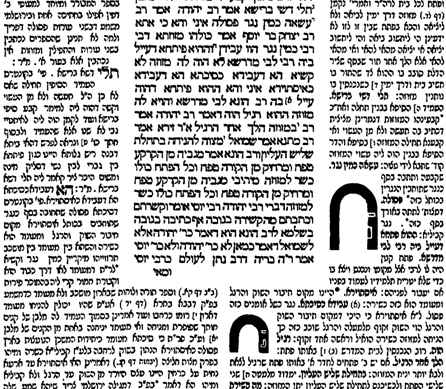
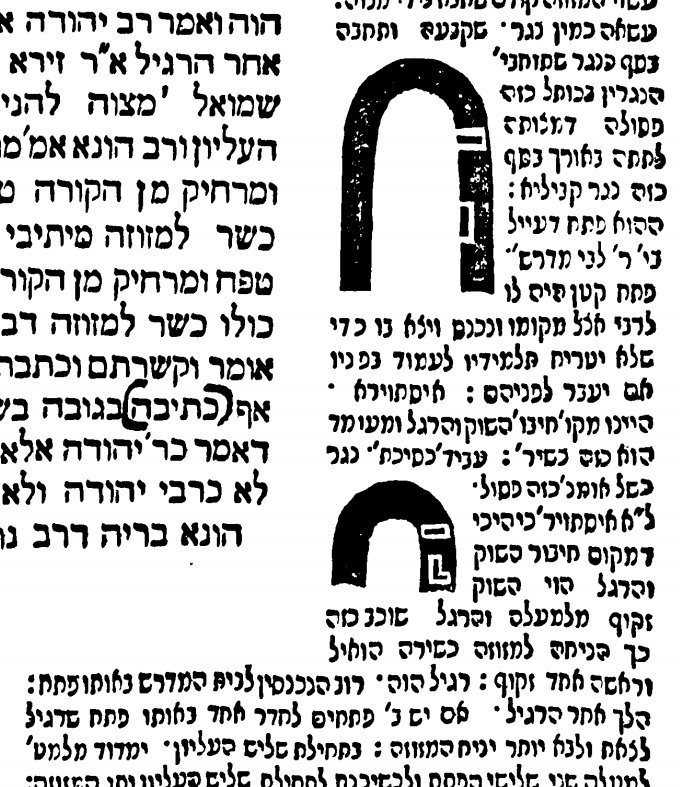
The classic edition of the Vilna Shas (Vilna 1885) renders this Sugya and the accompanying diagrams as such
Here are the words of Rashi which correspond to these two diagrams which show the positioning of four Mezuzot
  1. עשאה כמין נגר – שקבעה ותחבה בסף כנגר, שתוחבין הנגרין בכותל כזה.
  2. פסולה – דמצותה לתתה באורך בסף כזה …. נגר, קביליא
  3. עבידא כסיכתא – נגר כשל אומנים כזה פסולה
  4. איסתוירא – היינו מקום חיבור השוק והרגל ומעומד הוא כזה, כשירה:
  5. ל”א איסתוירא, כי היכי דמקום חיבור השוק והרגל הוי השוק זקוף מלמעלה והרגל שוכב כזה כך הניחה למזוזה כשירה הואיל וראשה אחד זקוף:
The doorframe in the top illustration shows the position of two Mezuzot.
The one on top is horizontal which is improper, and the one on the bottom is vertical which is Kosher.
  1. עשאה כמין נגר – שקבעה ותחבה בסף כנגר, שתוחבין הנגרין בכותל כזה.
He affixed and inserted it in the doorpost like a bolt, for workmen who work with bolts insert it in the walls like this[3] 
  1. פסולה – דמצותה לתתה באורך בסף כזה ….
It is improper- Because the Mitzvah is to affix it vertically in the doorpost like this….
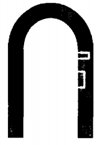
The doorframe in the lower illustration also shows two Mezuzot.
The one on top is horizontal and therefore improper and the one on the bottom is bent (it looks like the Hebrew letter Nun), and therefore Kosher. Here are the words of Rashi which correspond to these two Mezuzot.
עבידא כסיכתא – נגר כשל אומנים כזה פסולה
A bolt as fashioned by workmen like this is disqualified
ל”א איסתוירא. כי היכי דמקום חיבור השוק והרגל הוי השוק זקוף מלמעלה והרגל שוכב כזה כך הניחה למזוזה כשירה הואיל וראשה אחד זקוף
Another explanation of איסתוירא – like the point at which the “Shok” joins the ”Regel”, where the “Shok” is upright and the “Regel” rests, like this, so too if he affixes the Mezuzah like this it is Kosher because the top part is upright.
There is no diagram associated directly with this comment of Rashi
איסתוירא – היינו מקום חיבור השוק והרגל ומעומד הוא כזה, כשירה:
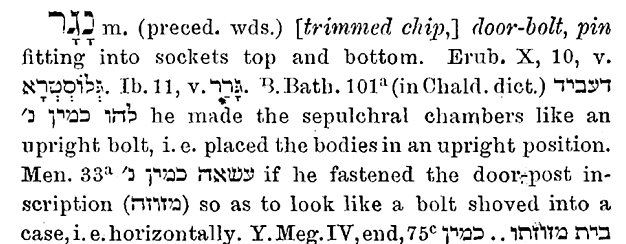
Whether a נגר is normally inserted horizontally or vertically is also “illustrated” in Jastrow’s explanation of the word
In Bava Batra 101a he describes it “like an upright bolt” and in our Gemara he describes it as “like a bolt shoved into a case, i.e. horizontally
There are two issues with the standard depiction of the two diagrams in the Vilna Shas. Rashi uses the word כזה five times and there are only four “illustrations” (2 in each diagram) Also, we would expect that there would be a diagram after each time it says כזה.
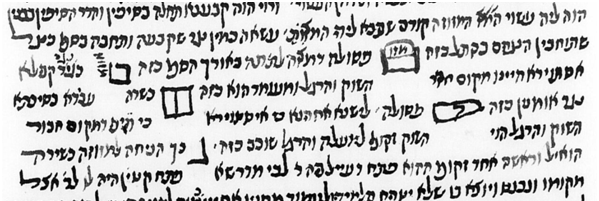
This problem is solved when we look at the only handwritten manuscript we have of Rashi on this part of Menachot.
The National Library of Russia, St. Petersburg, Russia Ms. EVR IV 25:

http://aleph.nli.org.il:80/F/?func=direct&doc_number=000159163&local_base=NNLMSS
It contains five depictions of the placement of the Mezuzot and each כזה is followed by a depiction.
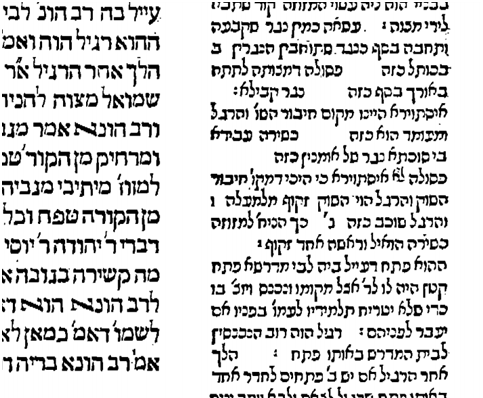
The problem is also solved when we look at the first printed edition of Menachot ( Bomberg 1522) whose source had to be a manuscript. [4] 
This printed edition leaves space after every כזה. It even includes a rudimentary depiction of the last כזה looking like a “Nun” which is supposed to depict where the ankle meets the leg.
It looks very much like the Nun in the National Library of Russia manuscript and may have emanated from the same source.
It was very exciting for me personally to discover this “diagram” which clearly was added to illustrate the כזה. In his Maamar ‘al hadpasat ha-Talmud with Additions, (ed. A.M. Habermann, Mossad ha-Rav Kook, Jerusalem: 2006, p.41)  Rav Natan Nata Rabbinowicz, writing about the first Bomberg edition, states as follows:

״ובכל התלמוד (וכן בכל הדפוסים הישנים עד דפוס בערמן) נשמטו הציורים בגמרא, רש״י ותוספות,ונשאר מקומם חלקמלבד בסוטה מגשישנו הציור ברש״י
“In all of the Talmud (and in all other older printed editions of the Talmud until the Berman edition ( Frankfurt an Der Oder 1697-99) the diagrams were not included in the Talmud, Rashi and Tosfot, and their space remained empty, except for Sotah 43A, where we find a diagram in Rashi.”

It turns out there was a diagram included in the second Bomberg edition of Zevachim( 1528) on 53b, which Rabbinowicz probably never saw. See my article here.
He may have also missed this one because it does not look much like a diagram, but just a letter, or perhaps he felt it was of no significance.
This depiction of the last כזה looking like a “Nun” was maintained by subsequent editions of the Talmud printed in Basel 1580, Cracow 1605, Amsterdam 1644, and Frankfurt an der Oder in 1699.
It was only dropped and replaced with the two larger diagrams we have today in the Frankfurt am Main edition of 1720.
Since many people follow the advice of the Rema and affix the Mezuzah diagonally, it is important to understand the source. This is the word in the Gemara which state that in the house of Rebbe, the Mezuzot were affixed כאיסתוירא. This word is etymologically related to the Latin word astragalus which is described as “the bone in the ankle that articulates with the leg bones to form the ankle joint”. It is more commonly known today as the Talus and looks like this:[5] 
As used in the Gemara, it probably meant the entire area where the bottom of the foot ( which is horizontal) met the bottom of the leg ( which is vertical) at the ankle, thereby looking like something that was bent.
Finally, there is a fascinating story about the Talus bone related by Rav Yisroel Shachor in the Sefer “Dovair Yesharim”.[6] In discussing the איסתוירא, he writes that he was in a terrible automobile accident and בחסדי ה׳ escaped death by climbing out of the rear of the car only seconds before it burst into flames. The only injury he sustained was a broken bone in his foot, which he identified as the Talus. He had many opportunities to view x-rays of his broken foot and concludes “I see this as a source of amazement that the only bone of all 248 bones in my body which was broken, allowed me to understand the words of Torah, and to understand that this was the איסתוירא which is mentioned in Gemarot.”[7]

[1] Translation courtesy of Sefaria.org and follows the interpretation of Rashi.
[2] There is discussion on whether what is shown as Rashi in our editions of Menachot was actually written by Rashi. Rav Natan Nata Rabbinowicz ( author of Dikdukei Sofrim) writes that our “Rashi” was written by a student of Rabbeinu Gershom. ( Dikdukei Sofrim on Menachot 86a note 6 where he writes …מפני שהפרוש הזה המיוחס לרש״י הוא כנראה מתלמיד הרבינו גרשום מאור הגולה והעתיק ברובו לשון הרבינו גרשום מאור הגולה) Rav Betzalel Ashkenazi (the author of the Shita Mekubetzet) writes that for chapters 7-10, the “Rashi” in the standard editions was not written by Rashi and he substitutes his own version which is indicated by the words “Rashi Ktiv Yad” in the Vilna Shas. The editors of the Vilna Shas record this opinion at the beginning of the 7th chapter ( Menachot 72a) as follows: וזה לשונו “זה הפּרוש אשר הוא בדפוס מפרק אלו המנחות עד שתי הלחם אינו מפי׳ רש״י ז״ל והוא של פרשן אחר, וזה לשון רש״י כּ״י”.But Rav Ashkenazi seems to indicate that the Rashi of other chapters was in fact written by Rashi. ( see his note to the beginning of Menachot chapter 11 where he writes מכאן ואליך הוא פירוש רש״י ז״ל).
[3] We only know that it is affixed in a horizontal direction from the picture, not from Rashi’s words.
[4] The Soncino family printed many tractates of the Talmud from 1483-1519 before Bomberg printed the complete Talmud in 1520-1522, and those Soncino editions often formed the basis for the text of the Bomberg edition. But the Soncino family did not print tractate Menachot meaning the Bomberg edition was based solely on manuscripts.
[5] My source for this information is Dr. Carol Teitz who is a member of my Shul. Dr. Teitz is an orthopedic surgeon and most recently, the dean of admissions at the University of Washington Medical School
[6] Doveir Yesharim, Sefer Shemot, Jerusalem. 2014, page 128

[7] This source was brought to my attention by a Torah scholar named Aharon who has helped me immensely in my research on diagrams.


Final Response

 Final Response

By Marc B. Shapiro

In response to Rabbi Herschel Grossman’s strong criticisms of my Limits of Orthodox Theology, I wrote four responses on the Seforim Blog. You can view them hereherehere, and here. I then stopped responding even though there are still many criticisms I could have commented on. Readers can compare Grossman’s arguments with my replies and draw their own judgment. Grossman has recently responded to my posts and offered further criticisms in an article published in Dialogue. See here.

I do not wish to respond to all of his points in his new article, but I feel I need to make some comments and then I will leave this matter and let the readers decide which side is more compelling. Because Grossman complains in his article that “the merits of the arguments are easily lost in the loose internet format and enthusiastic cheering of his online supporters,” I have decided not to allow comments to this post. I can only express my regret at the style that Grossman chose to adopt in his articles. Had he written in an appropriate fashion then it would have been possible to have had a constructive discussion and debate.

P. 161: “DIALOGUE editors offered the author, Dr. Marc Shapiro, an opportunity to respond directly in these pages. He chose instead to issue a response on his own blog, where he wrote a number of lengthy posts in his defense.”

Dialogue never offered me an opportunity to respond in the journal. The Seforim Blog is not my own blog. I am a writer on it like lots of others.

P. 162: “In his [Shapiro’s] view, the tenets of belief are Rambam’s innovations and are therefore disputable.” The word “innovation” implies that the Rambam invented the doctrines he includes in his principles. I never said such a thing.

P. 163: In giving examples of supposed distortions in my book, Grossman writes: “One example is when Shapiro cites Rivash in support of the statement that Christians believe in a three-part God while the Kabbalists believe in a ten-part God – a clear rejection of the Second Principle. A quick glance at Rivash reveals that he does indeed say such a thing as a quote from a philosopher, which he then proceeds to debunk.”

I would like readers to take a look at the relevant page of my book (p. 40) and see if what Grossman says is correct, that I cited Rivash in support of the statement that Kabbalists believe in a ten-part God.

Pp. 166-167. Readers should see my discussion here. I cite a number of sources that support what I say, and thus contrary to what Grossman states, I do not just insist on my right to offer an interpretation. In note 21 Grossman writes: “Dr. Shapiro attempts to salvage his theory by speculating that the Vilna Gaon may not have really meant what he wrote.” Readers can turn to my discussion here and will see that I never said that.

p. 173. We see here an example of how Grossman just talks past me, leading to nothing productive. I had questioned why in the Mishneh Torah the Rambam did not require that the convert be instructed in the Thirteen Principles. In his original essay, Grossman criticized this question which he said showed lack of understanding of the method of the Mishneh Torah. In my response here I cite rabbinic authorities who deal with this very question, thus showing that it is not an ignorant point, as Grossman portrayed it. One of those I cite is R. Chaim Sofer who writes [1]:

והדבר נפלא הלא יש י”ג עיקרי הדת והי’ לו לב”ד להאריך בכל השרשים

Grossman replies that while I quote R. Sofer, I neglect “to apprise [my] readers of R. Sofer’s subsequent words ‘Rambam didn’t add to the talmudic formula,’ exactly as I had written and directly in contradiction to Dr. Shapiro’s position.”

Here is the paragraph from R. Sofer.

R. Sofer says exactly what I quote him as saying. The final passage in the paragraph, which is mistranslated by Grossman, has nothing to do with my point and does not refute it in any way.

I would also note that in his fascinating Ha-Emunah ha-Ne’emanah, p. 142, R. Dovid Cohen offers an explanation as to why אין לומדים כל י”ג עקרים טרם שיתגייר הגר

P. 174. In Limits I discuss different approaches to the phenomenon of tikkun soferim. While the generally accepted approach is that tikkun soferim is not to be taken literally, I cite a number of authorities who did take it literally and assumed that Ezra or the Anshei Keneset ha-Gedolah made changes to biblical texts (including the Torah). In a later post here (which has nothing to do with Grossman), I cited some other examples of sources that understood tikkun soferim literally. One of those I mentioned is R. Pesach Finfer.[2] He states as follows:

ראוי הי‘ עזרא שתנתן התורה על ידו . . . והוא ונחמי‘ עשו תיקון סופרים וכינויי סופרים

Grossman says that it is unclear what I see in this line. What I see is that R. Finfer states that Ezra and Nehemiah were responsible for tikkunei soferim. This is the same language that is used in other sources that take the notion of tikkun soferim literally. For those who don’t take it literally, Ezra has nothing to do with tikkun soferim. Following the sentence I quoted from R. Finfer, he refers in parenthesis to Radbaz’s comment which offers a different perspective, that tikkun soferim is halakhah le-Moshe mi-Sinai. Here is the page.

While on the topic of tikkun soferim, let me share something else that is relevant. In Limits I mentioned that the evidence points to Rashi understanding tikkun soferim literally, namely, that the biblical text was changed by the Scribes. There was some pushback to this assertion by those could not accept that Rashi would ever hold such a position. Yet subsequent to my book, Yeshayahu Maori also came to the conclusion that Rashi understood tikkun soferim literally.[3] Furthermore, R. Avraham Pessin also explains that Rashi understands tikkun soferim literally.[4] He states that according to Rashi the Anshei Keneset ha-Gedolah had the authority to alter the text of the Torah:

ומבואר ברש”י שניתן הכח לאנשי כנסת הגדולה לשנות גם תורה שבכתב

I find this significant, because although one can point to numerous statements that such an approach in unacceptable, R. Pessin sees it as the clear meaning of Rashi (and among traditional interpreters he is not alone in this understanding[5]). Here are the pages from R. Pessin’s sefer.

Speaking of tikkun soferim, the most famous of which is Gen. 18:22: ‘ואברהם עודנו עומד לפני ה, I found something in R. Solomon Algazi’s Yavin Shemuah (Venice, 1639), p. 15a, which is fascinating and, as far as I know, unique in rabbinic literature. It is also in opposition to Maimonides’ Eighth Principle which establishes that the Torah in its entirety was delivered by God to Moses. In discussing ‘ואברהם עודנו עמוד לפני ה, R. Algazi claims that when God dictated the Torah to Moses, He said that God was standing before Abraham. But Moses on his own, out of respect for God, changed the verse to read that Abraham was standing before God. I guess we can say that this falls between the traditional view that the verse was never changed and the view that the Scribes altered the verse out of respect for God. For R. Algazi it was Moses who made the alteration, but as far as Maimonides is concerned, this is just as problematic as viewing tikkun soferim as an alteration of the Scribes. Here is R. Algazi’s surprising interpretation.

כיון דהב”ה היה אומר לו על כל מלה כתוב א”כ ודאי דהב”ה אמר לו וה’ עודנו עומד דלא איש אל ויכזב ומשה היה משנה על דרך כבוד וכותב ואברהם עודנו עומד א”כ מה שייך בזה הלכה למשה מסיני והוא על דרך המשל שדוד המלך יאמר לסופר מהי’ [מהיר] כתוב שדוד מצוה לפלוני והסופר משנה על דרך כבוד וכותב המלך דוד אבל המלך בעצמו אינו אומר כתוב המלך מצוה כך הב”ה יתעל’ לא אמר למשה שהיה סופר כתוב ואברהם עודנו עומד שהוא דרך כבוד אלא אמר לו האמת וה’ עודנו עומד ומשה שינה על דרך תיקון סופרים

Pp. 175-176. I wrote here: “Even when it comes to other basic ideas of Maimonides, which are not included as part of the Thirteen Principles, we find that scholars wondered why Maimonides did not include them in Hilkhot Yesodei ha-Torah.” I then cited Joseph Ibn Caspi in support of this statement. Here is the page from Amudei Kesef u-Maskiyot Kesef (Frankfurt, 1848), p. 113.

What I would add here is the interesting point that Ibn Caspi, Commentary on Guide 2:32, actually concludes that the Mishneh Torah’s formulation is in line with Maimonides’ true view, namely, that prophecy is a completely natural phenomenon which will of necessity occur if someone has both the ability and training. On the hand, he thinks that the view expressed in Guide 2:32 as being the “opinion of our Law and foundation of our doctrine”, namely, that God might prevent a prophet from prophesying, is not Maimonides’ true opinion, but is an example of the famous “seventh contradiction”.

Grossman is also mistaken when he writes, “In Moreh Nevuchim [2:32], Rambam argues—in opposition to the philosophers—that prophecy is only activated proactively by God, even if the requisite conditions are met.” Maimonides actually says the exact opposite of this. He states that the Torah view of prophecy is identical to the philosophic view except that God can choose, if He wishes, to prevent someone from prophesying even though according to nature he would be a prophet. This is the opposite of what Grossman states, that “prophecy is only activated proactively by God.”

Pp. 176-177: I stated that the notion that Maimonides changed his mind about including Reward and Punishment among the Principles was suggested by R. Solomon of Chelm. To this Grossman replies that Maimonides did not withdraw his belief in Reward and Punishment. It is just that in the Mishneh Torah he classified things differently. Again, Grossman misunderstands. I never said that Maimonides rejected the idea of Reward and Punishment. I was only referring to whether it should be included as part of the Thirteen Principles. As R. Solomon of Chelm explains, Maimonides’ later understanding is that Reward and Punishment is included as part of other principles and thus does not need to be listed separately.

Pp. 177-178. Grossman claims that I cite R. Avraham Hochman in an improper way, and in response R. Hochman states that the entire theme of his sefer “is to show that Rambam’s Principles are absolute and that he derived all of the Thirteen Principles from the Talmud.” He also is quoted as saying, “Academics often quote a question and forget that for the wise, the question is half the answer. But the professors stick to the question and don’t wait around for the answer.” Grossman then speaks of my “brazenness of citing a recognized authority to promote a position that the author himself openly rejects.”

I don’t know if R. Hochman reads English, and could see what I actually wrote, or if he only is responding to what Grossman told him. Either way, his letter, published at the end of Grossman’s article, is a complete distortion of my position. Leaving aside the particular examples that people can see, look at this characterization:

ולפי הבנה מוטעית זו שפך חמתו על הרמבם מנין לו לחדש הלכה שאינה במשנה . . .

Talk about describing a writer inaccurately!

And what is one to make of this statement from him?

אין שום חולק על עיקר מיסודי הדת אלא שנחלקו על מספר העיקרים

It is precisely against such a false view that I wrote my book in the first place. A typical response to the book has been that the opinions in opposition to Maimonides are “not accepted.” But here he denies that anyone actually disagrees with any of Maimonides’ principles. With such an outlook, we can’t even begin to have a dialogue.

The following paragraphs are what I quoted from R. Hochman. Nothing I quote here has any connection to what Grossman states or what R. Hochman writes in his letter responding to my supposed incorrect conclusions that I derived from his words. As the reader can see, contrary to what R. Hochman states, I mention not just his question but his answer as well. Of all of Grossman’s criticisms this one is very difficult to understand, because there is nothing at all controversial in what I write, and my summary of R. Hochman is accurate.

As for my wondering why the Principles are not listed together as a unit, which Grossman sees as an illustration of how I am unaware of the structure of the Mishneh Torah, let me begin by repeating what I wrote in my last post: R. Yaakov Nissan Rosenthal, on the very first page of his commentary Mishnat Yaakov to Sefer ha-Madda, also wonders about the point I made, that the Thirteen Principles as a unit are never mentioned in the Mishneh Torah. (Had I known this when I wrote my book, I certainly would have cited it.)

ותימא למה לא הביא הרמב“ם בספרו ה”יד החזקה” את הענין הזה של י“ג עיקרי האמונה, וצ”ע

R. Avraham Menahem Hochman writes:

מאחר וכל כך חמורה הכפירה, וגדולה החובה לדעת את י”ג העיקרים, כיצד זה השמיטם מספרו ה”יד החזקה”, ולא כתבם כפי שסדרם בפירוש המשנה

והנה אחר שהתבאר שהאמונה בי”ג העיקרים היא בסיס לתורה נשוב לשאלה הרביעית (בסוף פרק ה’) אשר לכאורה היא פליאה עצומה מדוע השמיט הרמב”ם ביד החזקה את החובה הגדולה להאמין בי”ג עיקרים, באופן חיובי, ולא סדרם כי”ג יסודי האמונה שחובה להאמין בהם

R. Hochman goes on to explain that most of the Principles are indeed mentioned in Hilkhot Yesodei ha-Torah in a positive sense (even if not as a unit of Thirteen Principles). He also notes the following important point, that when principles of faith are mentioned in the Talmud, they are never listed in a positive sense, that one must believe X. Rather, they are listed in a negative sense, that one who denies X has no share in the World to Come. Why Maimonides, in his Commentary on the Mishnah, chose to formulate the Principles in a positive sense and require active belief as a necessity for all Jews—something the Talmud never explicitly required—is an interesting point which we will come back to. Regarding some of the Principles the difference is clear. For example, according to the Talmud, denial of Resurrection is heresy, but one who has never heard of the Resurrection and thus does not deny it, or affirm it, is a Jew in good standing. For Maimonides, however, the doctrine of Resurrection must be positively affirmed. In a future post we can come back to which Principles even the Talmud implicitly requires positive affirmation of (obviously number 1, belief in God, but there could be others as well).

After reading these paragraphs, please look at Grossman’s article, pp. 177-178, and R. Hochman’s letter, pp. 188-191, and you will see that nothing there has any connection to what I actually say when referring to R. Hochman. I simply cite him to show that the question I asked is not an ignorant one, as Grossman stated. I also cite R. Hochman’s answer. So Grossman’s seizing on this and printing a lengthy letter from R. Hochman is nothing short of bizarre.

Pp. 178-179. Grossman writes:

Things really start to go “off the rails” when we examine Shapiro’s claim in the name of R. Shlomo Fisher, zatzal, that one need not accept Mosaic authorship, that the Rambam abandoned his principles, and that “Rambam’s formulation of the tenets of Jewish belief was far from universally accepted.”

Grossman responds that he found these attributions questionable so he checked with the family and students, and “they were horrified that anyone would be using R. Fisher’s name in this way.”

What exactly did I say that Grossman finds so objectionable? In Limits of Orthodox Theology, p, 126, I quote the following sentence from R. Bezalel Naor, Post-Sabbatian Sabbatianism (Spring Valley, 1999), p. 8: “The truth, known to Torah scholars, is that Maimonides’ formulation of the tenets of Jewish belief is far from universally accepted.” R. Naor tells us that he heard this insight from his teacher, R. Shlomo Fisher. (Anyone needing any indication of the high regard that R. Fisher held R. Naor in can examine their published correspondence.)

Grossman sees this as a radical statement whose authenticity he cannot accept. I don’t think readers of this blog will find it radical at all. In fact, I have elsewhere mentioned that R. Fisher made this statement in discussing R. Judah he-Hasid’s view on the authorship of the Torah, which diverges from Maimonides’ Eighth Principle. Contrary to Grossman, in none of my posts did I quote R. Fisher as saying that one need not accept Mosaic authorship. I simply cited his view about R. Judah he-Hasid. I also quoted his opinion that medieval Ashkenazic authorities had a different view on the matter of complete Mosaic authorship than Maimonides in that they did not regard the assumption that there are post-Mosaic verses in the Torah as heretical (a view also argued by Prof. Haym Soloveitchik, see here). Grossman claims that R. Fisher could not have said this, even though students can testify to him having said it. In fact, I can state right here that I too heard him make this distinction.

The final point that Grossman can’t accept is what I mentioned in 2007 here, from a student who attended R. Fisher’s weekly shiur on Avnei Miluim. “Interestingly enough, he reported to me that a few weeks ago R. Fisher declared that he believes the Rambam abandoned his system of 13 Principles, the proof being that they are never mentioned as a unit in the Mishneh Torah. In my book, I noted that R. Shlomo Goren held the same view.” Grossman summarizes my statement as “the Rambam abandoned his principles,” which would lead the reader to think that I was saying that the Rambam no longer accepted the truth of his 13 Principles, which would indeed be a radical position. But what I was really talking about, and I refer to this approach in my book, is the notion that the Rambam no longer accepted a system of 13 Principles. This would mean that he adopted another model to categorize the essential dogmas of Judaism, or as R. Goren suggested, maybe he later advocated a conception of Jewish theology like that held by Abarbanel, that one should not distinguish between so-called principles of Judaism and other aspects of the religion, since all must be regarded as equal.

When all is said and done, nothing I have attributed to R. Fisher is strange, radical, or unbelievable. Why Grossman would be horrified by what I wrote is anyone’s guess.

Grossman quotes from a 2018 letter put out by R. Fisher (some might say, put out by his family). In the letter, R. Fisher writes that no one is to quote anything he said in matters of Aggadah and hashkafah without the approval of his sons. This was because in the past he had been misquoted. We all know that misquoting of gedolim is nothing new. There are numerous examples of particular great rabbis being quoted as saying contradictory things, and of these rabbis stating that no one should believe anything they hear in their names unless they hear it directly from the rabbi. Yet this has never stopped people from quoting the gedolim and never will. This is simply the nature of the world. 

R. Fisher gave thousands of shiurim (a tiny percentage of them are online) and there are thousands of students who heard words of Torah from him. As with all students, they have repeated, and will continue to repeat, that which they heard from the rav, just like all students do. They have been doing this for at least fifty years. If R. Fisher’s letter means what it says, that no one is to repeat things that R. Fisher said, then this is simply an impossible request, and it also seems unprecedented in Torah history. It would mean that one who listens to a shiur from him dealing with non-halakhic matters, e.g., this one here, is not allowed to repeat any insights he heard. It would also mean that much of what was mentioned at the many eulogies, where people recalled things R. Fisher said, or on sites such as this and this, is inappropriate. It would mean that students are not allowed to repeat that which they heard from their rebbe. I don’t see how this is possible.

P. 179. Here is something that is really comical. Take a look at this page.

Grossman states that I mention that Shadal (Samuel David Luzzatto) claims that Ibn Ezra believed in post-Mosaic additions to the Torah. He writes: “Upon checking the source, we find yet another instance of Dr. Shapiro citing an author as believing something he actually vociferously denies. As Shadal points out, the primary source for this take on Ibn Ezra was the noted heretic Baruch Spinoza.”

I say this is comical since Grossman doesn’t have a clue as to what is going on here. The only way I can explain this is that Grossman merely skimmed the passage and thus misread it.

Shadal rejects Spinoza who (intentionally?) misunderstood Ibn Ezra to be hinting to the notion that Moses was not the author of the Torah.[6] This misinterpretation of Ibn Ezra is what Shadal rejects (and this is not mentioned in my book because it has nothing to do with what I was discussing). However, exactly as I said, Shadal also states that Ibn Ezra believed in certain post-Mosaic additions to the Torah. Here is the page in Shadal that I cited (as well as the subsequent page) so everyone can see it with their own eyes.

Shadal’s outlook in this matter is no secret, and he repeats this point elsewhere. See e.g., Mehkerei ha-Yahadut, vol. 2, p. 195:

מה שכתב ראב”ע ברמז, היות בתורה מקראות שנוספו בה אחר כמה דורות

In Iggerot Shadal, vol. 2, p. 246, he writes:

כי סברתו שיש בתורה מקראות נוספים קשה מדעת זולתו שקצת מלות מוטעות

In my book and subsequent posts I have identified around forty medieval and more recent authorities who share Shadal’s viewpoint in this matter.[7] Incidentally, R. Joseph Kafih, in his first work written when he was seventeen years old, attacks Shadal for attributing this view to Ibn Ezra. See Sihat Dekalim (Jerusalem, 2005), p. 90.

I must also note that Grossman does not simply miss Shadal’s meaning, but he also compares me to Spinoza in trying to ensnare the unsuspecting masses. If this wasn’t so comical, I might actually take offense. But I think readers should wonder how an author could say such a thing, and how a journal could publish it. It is simply beyond belief, made all the more absurd since Grossman is so mistaken about what Shadal actually states.

Incidentally, since we are talking about Shadal, it is worth noting that R. Elijah Benamozegh, whose commentaries on the Torah continuously dispute with Shadal, when it comes to Ibn Ezra and post-Mosaic additions, Benamozegh has the same position as Shadal. Here is what he writes in Ha-Levanon, July 3, 1872, p. 351, now easily available in the new edition of Em la-Mikra: Bereshit (Haifa, 2021), p. 114:

בראש ספר דברים ובמקומות אחרים רומז בעיניו מולל באצבעותיו ועל דלתות השער יתאו לרמוז שיש דברים בתורה נוספים ולא משה כתבם רק נביאים וצופים. ואני הפרתי את עצתו וקלקלתי את מחשבתו

P. 181. “Shapiro’s weakest scholarship appears when discussing kabbalistic matters.” I agree, which is why I try not to discuss these matters. If I do have to deal with them, I only rely on what recognized authorities have said,

P. 182. I wrote that according to Maimonides’ Seventh Principle, Moses was the greatest prophet who ever lived and there will never be a prophet as great as him in the future. Grossman says that I am mistaken, and that Maimonides does not declare that Moses was the greatest prophet, only that he was the “father of all prophets.” This statement is astounding. There are hundreds of discussions of the Seventh Principle in traditional rabbinic literature, and as far as I know they all agree with what I have written. The entire basis of the Seventh Principle is that Moses was greater than all other prophets. Maimonides states explicitly in the principle that “All are below him in rank . . . He reached a greater understanding of God than any man who ever existed or will ever exist.” This is so obvious that I do not want to spend any more time on it. It is only a mystery how Grossman could say something so wrong, and I do not know of anyone else who has ever written on this principle and made such a mistake (which Maimonides regards as heresy). Did no one from the editorial board of Dialogue read the article before publication? It is nothing short of incredible that an issue of Dialogue includes the false claim that there is no principle of faith to believe that Moses was the greatest prophet in Jewish history.

In addition to his explicit assertion that Moses was the greatest prophet, Maimonides does have an interesting formulation, stating that Moses is the father of all the prophets who preceded him and all who came after him. How can one be the “father” of those who came before him? R. Hayyim Dov Moshe Halpern explains it well[8]:

“אב” הכונה במעלה ולכן שייך לומר שהוא אב גם למי שקדם לו

Here are some passages from other authors whose books are found in my library. They all explain the principle correctly.

R. Yochanan Meir Bechhoffer writes[9]:

רבינו השווה את האמונה בעליונות משה רבינו על הנביאים הקודמים לו, לאמונה בעליונותו של הבאים אחריו. ואף כי אמת היא, שכך נחתמת התורה, לא קם כמשה וגו’, מ”מ יש לעיין מה הצורך בזה. נהי דהמאמין שאחר משה בא נביא גדול ממנו שיכול לבטל דבריו, כפר בנבואת משה, אך מה הסתירה לנבואת משה בחשבה שמי שקדם לו היתה גדול ממנו, הלוא הנביא הקדום לא יחדש דבר על פני משה

R. Ben Zion Epstein writes[10]:

ולכן נתנה למשה דוקא, כי היה דבוק כולו באין סוף ב”ה. ולכן היתה מדרגת נבואתו גדולה מכל הנביאים, ושכינה מדברת מתוך גרונו.

R. Avraham Menachem Hochman’s heading to his discussion of the Seventh Principle reads[11]:

להאמין בנבואת משה רבינו שהוא למעלה מכל הנביאים שהיו לפניו ולאחריו

And to mention one classic text (I could mention many more), R. Elchanan Wasserman writes[12]:

והנה בעיקרי הדת שמנה הרמב”ם בפירוש המשניות (פרק חלק) מנה שם עיקר אחד שכל דברי נביאים אמת, ועוד עיקר אחר שנבואת מהרע”ה היתה למעלה מנבואת כל הנביאים

R. Yaakov Weinberg in his Fundamentals and Faith, pp. 73ff. elaborates on Moses’ “prophetic superiority” (p. 81)

And finally, R. Yehudah Meir Keilson’s new edition of Kisvei ha-Rambam (which I encourage everyone to acquire), affirms my point (which as mentioned, is simply what Maimonides himself explicitly says, so it is not a question of how to interpret him).

Keilson, p. 82: “The Seventh Principle teaches that the nature of Moshe’s prophecy is unparalleled. . . . Rambam elaborates on Moshe’s prophetic superiority, which was the result of his moral and intellectual perfection.”

Keilson, p. 82 n. 1. “The title ‘father of all the prophets’ . . . Rambam takes this to refer to Moshe’s superiority in prophecy to that of all other prophets.”

Keilson, p. 154: “Rambam uses the expression that Moshe was the ‘father of all prophets’ to signify that he was the greatest of all prophets – that the level of his prophecy was superior to that of any prophet who ever was or who ever will be.”

Pp. 184-185. None of this makes any sense, and what Prof. Menachem Kellner writes has no relevance what I was referring to. I asked a simple question, which I later found that others asked as well (see here): Why does the Rambam not specify that future converts are to be instructed in the 13 Principles?

Coming next: Reviews of books by Benji Levy and Eitam Henkin, and an unknown article by R. Joseph B. Soloveitchik.

* * * * * * *

[1] Mahaneh Hayyim, Yoreh Deah 2, no. 25 (p. 139).
[2] Masoret ha-Torah ve-ha-Nevi’im (Vilna, 1906), p. 6. Regarding tikkun soferim as seen in the Genizah, see Joseph Ginsberg’s post here.
[3] “‘Tikkun Soferim’ ve-‘Kinah ha-Katuv’ be-Ferush Rashi la-Mikra,” in Yaakov Elman, et al., eds. Neti’ot le-David (Jerusalem, 2004), pp. 99-108.
[4] See his Temurat Ayil, Megillah, vol. 2 , pp. 93-95.
[5] In addition to the sources I have cited in Limits and here, see R. Petahyah Berdugo, Pituhei Hotam (Jerusalem, 1980), p. 187.
[6] Regarding Spinoza’s interpretation of Ibn Ezra, see Warren Zev Harvey, “Spinoza on Ibn Ezra’s “secret of the twelve,” in Yitzhak Y. Melamed and Michael A. Rosenthal, eds., Spinoza’s Theological-Political Treatise: A Critical Guide (Cambridge, 2010), pp. 41-55. See also Bezalel Naor, Ma’amar al Yishmael (Spring Valley, 1998), pp. 23-24.
[7] Shadal’s negative view of Ibn Ezra (and Maimonides) is well known. R. Jacob Bacharach’s poem in this regard is apt; Ishtadlut im Shadal (Warsaw, 1896), vol. 1, p. 19b:

הוא האיש אשר שם את הרמב”ם סיר רחצו, ועל הראב”ע השליך נעלו

[8] Hemdah Tovah (Lakewood, 2012), p. 131 n. 1.
[9] Even Shetiyah (Ramat Beit Shemesh, 2005), p. 74.
[10] Yud Gimmel Ikkarim (Jerusalem, 2009), p. 95.
[11] Ha-Emunah ve-Yud Gimmel Ikkareha (Jerusalem, 2004), p. 46.
[12] Kovetz Ma’amarim ve-Iggerot (Jerusalem, 2006), vol. 1, p. 57.


The Pew Report and the Orthodox Community (and Other Assorted Comments), part 2

The Pew Report and the Orthodox Community (and Other Assorted Comments), part 2
by Marc B. Shapiro
Continued from here.
Returning to the matter of Jewish men and non-Jewish women, it is noteworthy that the Spanish scholar R. Solomon Alami (14th-15th centuries), in his ethical will to his son, specifically warns him to abstain from sexual relations with non-Jewish women.[1] Note how in the following passage he also assumes that Reuben actually had sexual relations with his father’s concubine (an opinion also shared by talmudic sages, though in my experience the alternative view, that he didn’t actually do this, appears to be the standard approach among contemporary darshanim).
בבת אל נכר אל תחלל בריתך. היה גבור כארי למשול בתאוותך, תהי צדיק מושל יראת א-להים להטיבך באחריתך. השמר ממר ממות ופרוש מן הזימה. טמאת השם רבת המהומה. וזכור דבר זמרי ורעתו. וחרפת שבטו ברדוף נשיאם תאוותו. הלא אל אלה חטא שלמה מלך ישראל ונחלקה מלכותו. וזכור צדקת יוסף אשר גבר על יצרו ולא נתן מאוויי גבירתו. ותשב באיתן קשתו. עם גודל יופיו ועדונו והוא בבחרותו. והיה זה סיבה לשום במרום מדרגתו. וכל בית אביו חיו בזכותו. ונתנה לו הבכורה ונדחה ראובן בחללו יצועי אביו מבכורתו. כי לא יאות הכבוד לנקשר בזימה בכחשו.
An Italian list of takkanot from 1418 also speaks about this problem, that Jewish men thought that there was nothing wrong with having sex with non-Jewish women[2]: הנשים הנכריות מותרות בעיניהם. The fact that the various moralists speak about this issue shows that it was a real problem. While suggestions were offered to help men overcome sexual temptations, there was a recognition that, as the Talmud, Hullin 11b, states, “There is no guardian against unchastity,” אין אפוטרופוס לעריות. This principle is quoted by R. Joseph Karo in Shulhan Arukh, Even ha-Ezer 22:15.[3] Yet interestingly enough, in R. Karo’s Magid Meisharim[4] he is told that since he is entirely involved with service of God he cannot be seduced even by a naked woman.
מאחר שלבך תמיד אינו מהרהר אלא בעבודתי אפילו תפגע באשה ערומה לא תבוא לידי חטא
We know that there were some who argued that it was better for men to use Jewish (single) prostitutes so that they not come to having sex with married women or engage in homosexual acts.[5] (I am referring to places where Jews could not avail themselves of non-Jewish prostitutes, as the punishment for this was often execution.) R. Moses Hagiz[6] argues against this position, stating that we do not permit a lesser offense to prevent one from violating a more severe offense. He even calls this approach hukot ha-goyim.
והלכו בחוקת הגיום שזו היא טענת פטור אצלם אכן אנו בני ישראל הקדושים כשהשני איסורים הם מדאורייתא או תרי דרבנן אין לנו להתיר הא’ מחשש שלא יבא לעשות האחר
This passage is quoted by R. Isaac Lampronte, Pahad Yitzhak, s.v. boel aramit. He then adds that he heard from a hakham that sex with a Jewish prostitute is worse than sex with a non-Jew because of the possibility that that one will violate the niddah prohibition.
דיכול לבוא לאיסור נדה שהיא בכרת
Notice how he doesn’t say that one will certainly violate the niddah prohibition, only that it is a possibility. What this means is that even the Jewish prostitutes were expected to go to the mikveh, but that one can’t assume that they would indeed do so, and this explains why sex with a non-Jewish woman is preferable.[7]
But he adds that this should not be said publicly or to an ignorant person as this knowledge could lead men to have sex with non-Jews since they will mistakenly conclude that the prohibition is not so serious.
אין אומרים דבר זה בפרהסיא או בפני עם הארץ, כדי שלא ינהגו פריצות בביאות גויות.
What we are discussing was not simply theoretical since R. Isaac Arama, writing in fifteenth-century Spain, tells us that not only did the Jewish community leaders (שופטי ישראל) not take prostitution seriously, but in a few (קצת)[8] communities Jewish prostitutes were welcomed and even supported with Jewish communal funds (!).[9] This was done as the prostitutes were thought to be performing a public service, since without them it was thought that men would be led to have sex with married women or non-Jewish women (which as mentioned already could lead to execution). From a responsum of R. Judah ben Asher,[10] we see that even in an earlier era this point had been made with regard to “loose women” (and was rejected by R. Judah who thought it was better to have sex with a non-Jewish woman for whom the niddah prohibition did not apply):
ומוטב שיסתכנו הגופים מן הנפשות
Arama tells us that on different occasions he argued with the communal leaders, and also before גדוליהם which I assume means their rabbis, that it is one thing if someone commits a sin in private. In such a case, Arama would probably agree that it would be better for a man to have sex with a Jewish prostitute than with a with a non-Jew. (It must be that these prostitutes went to the mikveh, as Arama doesn’t mention anything about the niddah prohibition.) But Arama is firm that it is absolutely forbidden for the community – and he includes in this בתי דיניהם showing that the rabbis were complicit – to countenance any sin whatsoever, in this case welcoming in Jewish prostitutes, even if this strict stance leads to people committing greater sins or being executed by the non-Jews.[11]
R. Isaac Bar Sheshet (Rivash) had earlier also testified to the fact that the “gedolei ha-dor” had acquiesced to the existence of Jewish prostitutes in order to prevent men from visiting non-Jewish women, with all the dangers this entailed.[12] Contrary to Avraham Grossman,[13] the Rivash is not saying that this is what the “gedolei ha-dor” should do when faced with such a circumstance. Rather, he is decrying what they did. I am curious to hear if readers agree with me. Here are the words of the Rivash:
והרמב”ן ז”ל כתב בפ’ התורה שהיא אזהרה לב”ד שלא יניחו בנות ישראל להפקיר עצמן לישב בעינים על הדרך או בקובה של זונות לזנות לכל יבא. בואו ונצווח על דורנו שאין דומה יפה, וגדולי הדור העלם יעלימו את עינים פן יכשלו בני פריצי עמנו בנכריות ותצא אש ומצאה קוצים ונאכל גדיש
Returning to intermarriage, we see something very interesting in Pirkei de-Rabbi Eliezer, ch. 39. According to this text (which is paralleled by other midrashim[14]), Jacob’s sons married their sisters. The explanation given is that they did so in order not to marry the local inhabitants:
כדי שלא יתחתנו בעמי הארצות
This is quite an incredible assertion, since incest is forbidden under the Noahide code. If there were no eligible marriage partners, one would have expected Jacob’s sons not to marry at all rather than marrying their sisters. R. David Luria, in his commentary on the passage, does not even deal with this problem, instead noting that elsewhere in rabbinic literature one finds that Jacob’s sons did marry the local women. (For some reason, R. Luria’s edition does not include the words כדי שלא יתחנתו בעמי הארצות, which comes right after the text stating that Jacob’s sons married their sisters. This does not appear to be an act of censorship, since the real issue is not the explanation for their marriages, but the incestuous marriages themselves, and this is still found in R. Luria’s edition.)
The Tosafists have a simple response to this problem: Since the Torah had not yet been given Jacob’s sons only observed what they wanted.[15]
מאחר שלא נצטוו על התורה אע”פ שידעוה ברוה”ק מה שהיו רוצין היו מקיימין ומה שלא היו רוצין היו מניחין.
Nahmanides, Commentary to Gen. 38:2, assumes that each of the brothers married one of the twins of the other brothers, but not their own twins. Furthermore, no one actually married a complete sister, i.e., sons of Leah did not marry daughters of Leah. Thus, they did not violate Noahide Law. (I think this is probably also what the Tosafists assumed in the passage mentioned above.) While Nahmanides’ understanding works with some of the midrashim, it cannot be fit into the language of Pirkei de-Rabbi Eliezer, ch. 36, which states explicitly that each son was born together with his future wife:
  וכולן נולדו זווגן עמם חוץ מיוסף שלא נולדה זווגה עמו
Furthermore, Bereshit Rabbah 80 states that Simeon married Dinah, and she was his sister from the same mother. It is precisely in order to answer this problem that a Tosafist cites the Aggadah[16] that Dinah was actually first impregnated in Rachel, and God later transferred her to Leah, meaning that Simeon and Dinah were really not from the same mother.[17] (Many have pointed out that this has implications to the debate about the status of children born from surrogate mothers.[18])
The Maharal explains that the situation of the brothers marrying their sisters was an exceptional case, since if they did not marry them the only available marriage partners would have been pagan women.[19] As the Maharal notes, the parallel is to the sons of Adam who were permitted to marry their sisters since there was no one else for them to marry. This permission to marry their sisters was known to Jacob through ruah ha-kodesh, and the Maharal adds that one should not think that this contradicts the Torah, “for the one who gave the Torah forbade [it] and the one who gave the Torah [also] permitted [it].” In other words, God is the source of the law so he can choose to alter it if he chooses.
This approach can also explain the story of the akedah which troubles so many. If the reason not to murder is because God says so, then God can, if He wishes, permit murder in certain cases. I don’t want to get into the issue of Natural Law and the Euthyphro problem. Suffice it to say that most people would assume that the prohibition against incest is indeed part of Natural Law and not simply because God forbids it. Yet it must be noted that Sanhedrin 58b records a view that the Noahide code does not forbid marriage between brothers and sisters. According to Sanhedrin 58b, and this is followed by pretty much all commentators and halakhists, a non-Jew is permitted to marry his daughter. See also Mishneh TorahHilkhot Melakhim 9:5.[20] That at least some of the prohibitions on incest are not part of Natural Law would also seem to be a necessary conclusion of the Sifrei,[21] which states that the Children of Israel were driven to tears when Moses told them that they could no longer marry their sisters (from their fathers).[22]
וישמע משה את העם בוכה למשפחותיו . . . שהיו ישראל מצטערים בשעה שאמר להם משה לפרוש מן העריות מלמד שהיה אדם נושא את אחותו ואחות אביו ואחות אמו ובשעה שאמר להם משה לפרוש מן העריות היו מצטערים.
R. Ari Chwat has made the following interesting point.[23] The fact that the Sages state that the sons of Jacob married their sisters, something forbidden under Noahide law, illustrates how important it was for them to show that the brothers did not marry Canaanite women. In order to free them from the stain of intermarriage, the Sages were even prepared to claim that they had incestuous marriages. This shows how bad intermarriage was regarded by them.
נראה שכך יש להבין גם את המדרש (פרקי דר’ אליעזר פל”ה [צ”ל ל”ו] וב”ר פ, יא) שבני יעקב נשאו את אחיותיהם, למרות שיש בכך משום האשמתם בגילוי עריות, דבר שאסור אפילו לבני נח מלפני מתן תורה. אלא שרצו חז”ל ללמד זכות על אבותינו עצמם, ולנקותם מעבירת נשואי תערובת, עבירה בעייתית בדורם של חז”ל. כלומר: היות ועבירת נשואי אחיות לא עמדה על סדר יומם של חז”ל, ממילא האשמה זו תפגע בכבודן של אבותינו פחות מאשר להאשימם בנשואי תערובת, מעשה המתאים רק לשפלים ביותר בעם.
Regarding intermarriage, take a look at the following fascinating responsum from R. Meir of Rothenburg that appears in Teshuvot Ba’alei ha-Tosafot, ed. Agus, no. 72 (pp. 152-153). 

It begins by referring to the widow of a man “who was not pure”. What does this mean? From the responsum it would appear that this woman was “married” to a non-Jew. Based on the answer, it seems that she was claiming that she had done nothing wrong with this “marriage”, as she had received rabbinic permission, and therefore she should not suffer any stigma.[24] R. Meir tells us that he knew a woman of whom it was said that the rabbis permitted her to have sexual relations with a non-Jew. He also states that he heard that in France the rabbis permitted this for several women. What this appears to mean is that the rabbis permitted the Jewish women to live with non-Jewish men (since the rabbis were certainly not permitting promiscuous sexual relations). Irving Agus reasonably suggests that the reason these “intermarriages” were permitted is that refusal to allow them would have endangered Jewish lives.[25]
R. Meir does not accept this permission at all, and points out that the talmudic examples of Jewish women having sexual relations with non-Jews were when they were forced. Yael’s sexual encounter with Sisera was intended to weaken him out so she could then kill him. Following R. Meir’s responsum, there is an additional note, apparently from R. Mordechai ben Hillel, stating that it is not certain that had Esther and Yael consulted with halakhic authorities that they would have been given permission for their actions. The copyist rejects this point, noting that since the actions of Esther and Yael were done in order to save the Jewish people, what they did was certainly permitted. Howewver, one cannot use these cases to also permit other women to have sexual relations with non-Jews.
On the general matter of sex, I would like to call readers’ attention to a book that recently appeared. It is called Devar Seter and no author is given. You can see the book here.
This book is, as far I know, the most liberal work on the halakhot of sex ever to appear. I am worried that if I get too explicit and explain what I mean by “liberal” that some readers’ internet protection will prevent them from accessing this post. Therefore, I won’t say any more about the book except than I find it interesting that a number of rabbis who praise it only feel comfortable doing so anonymously.
Another book on sex recently appeared, this time in English, which also has a very liberal perspective, although it is not focused on halakhah but is a self-help book. It is authored by Rabbi David Ribner and Jennie Rosenfeld and is titled The Newlywed’s Guide to Physical Intimacy.[26]
A reader alerted me to an article on the book available here, and asked if I could comment on the following excerpt.
It is widely believed that ultra-Orthodox Jews are so concerned about modesty that they have sex through a hole in a sheet.
But this is a total myth, says Ribner: “There has never been a group of Jews anywhere in the world that has advocated having sex through a hole in a sheet. That has never happened. It doesn’t happen today, it never happened in history. It’s not advocated in any text within the Jewish community.”
I have no idea if there is anyone today who uses a sheet for sexual intercourse. There is certainly no community that insists on this (not even the Gur Hasidim, whose sexual behavior is extremely ascetic). However, it is simply incorrect to say that this action is not advocated in any text. Usually, when you have a widespread rumor like this, there is some basis for it, even if the original source has been distorted.
What is the origin of the idea of sex through a sheet? The Jerusalem Talmud, Yevamot 1:1, states that R. Yose ben Halafta, who performed the levirate marriage with his sister-in-law, had sex in this fashion: דרך סדין בעל. In case the words דרך סדין were not clear to readers, R. Baruch ben Isaac explains in Sefer ha-Terumah, Hilkhot Halitzah (Jerusalem, 1983), p. 46a, that it means that R. Yose ben Halafta made a hole in the sheet[27]: 

נקב עשה בסדין דרך מקום ביאה
This was done so that his personal pleasure be reduced and the focus be on the mitzvah.[28] The Talmud records that he had five children with this woman, and it is not clear if he used the sheet throughout their marriage or only in conceiving the first child (see Korban ha-Edah, ad loc., and also R. Hayyim Kanievsky’s commentary).[29]
If this was all we had, it would not be of great significance. All it would show was that one talmudic sage used the “hole in the sheet” method. There is no implication from the passage that anyone else adopted this approach. Yet based on this text, R. Meir of Rothenburg indeed assumed that when it came to levirate marriage this was the general practice among the pious during tannaitic times.[30]
ואפי’ חסידים הראשונים דור התנאים כשהיו מיבמין היו בועלין דרך סדין כדמשמע בירושלמי (פ”ק דיבמות ה”א) ר’ יוסי בר’ חלפתא הי’ בועל יבמתו דרך סדין
R. Jacob Emden, whose writings include a good deal about sexual matters, assumes that this type of hasidut is only applicable with levirate marriage, but not with one’s wife.[31]
דווקא ביבמה יש מקום לחסידות כזה לא זולת
There is also another significant passage, and it comes from the Vilna Gaon. He comments on the following text from the Shulhan Arukh, Orah Hayyim 240:8:
וי”מ מגלה טפח ומכסה טפח שלא היה ממרק האבר בשעת תשמיש כדי למעט הנאתו
The point of this text is that even during sex one should attempt to lessen the pleasure. In his note on this passage, the Gaon ties R. Joseph Karo’s words to what we have just seen in the Jerusalem Talmud. He then states that although one can say that R. Jose ben Halafta acted this way only because he was performing a religious ritual (levirate marriage), nevertheless, “it is also proper to act this way with one’s wife.” In other words, in contrast to what R. Jacob Emden wrote, the Gaon tells us that the practice of sex through a sheet is according to one opinion a valid and even recommended method of lessening sexual pleasure. A well-known talmid hakham who examined this text at my request wrote to me that since the Gaon does not object it implies acceptance, meaning that the Gaon would have approved of the proverbial hole in the sheet.

Use of a sheet would appear to be contradicted by the following passage in Ketubot 48a:
R. Joseph learnt: Her flesh [שארה] implies close bodily contact, viz., that he must not treat her in the manner of the Persians who perform their conjugal duties in their clothes. This provides support for [a ruling of] R. Huna who laid down that a husband who said, ‘I will not [perform conjugal duties] unless she wears her clothes and I mine’, must divorce her and give her also her ketubah.
Yet this text, which rejects the approach of the Persians, is itself opposed by R. Gamaliel who stated: “For three things do I like the Persians: They are temperate in their eating, modest in the privy, and chaste in another matter [i.e., sexual behavior]” (Berakhot 8b).[32]
Another interesting point related to sex and seforim is the following. Megillah 13b states: “R. Johanan said: Bigthan and Teresh were two Tarseans and conversed in the Tarsean language. They said: From the day this woman came we have been able to get no sleep. Come, let us put poison in the dish so that he [Ahasuerus] will die.”
Bigthan and Teresh couldn’t get any sleep since they could not go to sleep as long as the king was awake. But why was the king not going to sleep? Rashi explains that he found Esther so attractive that he had lots of sex with her, and this was keeping him up at night.
מתוך שהיתה חביבה עליו היה מרבה בתשמיש
R. Baruch Epstein, Torah Temimah, Esther 2:23, offers a different explanation of the Talmud. He claims that Ahasuerus was up at night because he so enjoyed taking walks with and talking to Esther.
כי היה מטייל ומשוחח עמה הרבה
What I can’t figure out is why R. Epstein expects us to prefer his understanding, which turns Ahasuerus into a perfect gentlemen, over that of Rashi.[33]
Finally, let me offer an example of distortion when it comes to sex. R. Israel Yanovski, Taharat Yisrael, vol. 2, p. 100b, no. 33, states:
מי ששם אצבעו בתורף אשה פריצות גדולה היא ויש בו איסור
The source offered for this surprising invasion of the marital bedroom is R. Yerucham, Toledot Adam ve-Havah, vol. 1, netiv 23 (p. 192d in the standard edition). Yet R. Yerucham says something very different.[34]
מי ששם אצבעו בתורף אשת איש פריצות גדולה היא ויש בו איסור ואפילו המסתכל אבל אינו חייב מלקות
The only question is if R. Yanovski’s quotation was a careless error (copied perhaps from R. Dovber Karasik, Pithei Olam, Orah Hayyim 240:16, who uses the same mistaken wording) or an intentional distortion due to puritanical feelings.[35]  R. Moshe Stern, Be’er Moshe, vol. 3 p. 204, assumes the former while I think the latter is also possible. I say this because Taharat Yisrael is quite an extreme work when it comes to sexual matters, which R. Yanovski wants to limit as much as possible. Thus, he praises those tzadikim whose children, we are told, equal exactly the number of times these tzadikim had sexual relations. In other words, if a certain tzaddik only had three children, then in his entire life he only had sex three times.[36]
As for other pious peopleR. Yanovski, based on kabbalistic sources, tells them to avoid sexual relations on Rosh Ha-Shanah (and tavo alav berakhah if one can abstain for the entire Ten Days of Penitence), Hoshana Rabbah, the three days preceding Shavuot and also on Shavuot, from Rosh Hodesh Av until the 11th of Av, the first and second night of Passover, the nights of Shemini Atzeret and Simhat Torah, and hol ha-moed Pesah (unless it falls on Shabbat). If this wasn’t enough, he also assumes that sex is forbidden on Hanukkah and Purim and any day that you don’t recite tahanun (!).[37]
בחנוכה ופורים נראה דאסור וכ”ש שאר ימים שאין נופלין על פניהם בהם דאסור בלי ספק

Finally, let me call attention to Berakhot 57b which states that three things resemble the World to Come, “the Sabbath, sunshine, and tashmish.” What does tashmish mean? Normally you would assume it to mean tashmish ha-mitah, i.e., sexual relations. However, the Talmud explains that it doesn’t mean this but refers to “tashmish of the orifices.”R. Samuel Alexandrov claims that the original rabbinic saying indeed meant what it said, i.e., that sex resembles the pleasure of the World to Come. However, the later sages didn’t want people to focus on sexual matters so they explained the passage in a different way.[38]

Regarding the connection between sex and the World to Come, R. Solomon Alkabetz quotes “the kedoshim” that sexual pleasure is one sixtieth of “the true pleasure”, i.e., the World to Come.[39]

To be continued

* * * * * *
Most of R. Yanovski’s Taharat Yisrael (mentioned in this post) focuses on the laws of niddah and mikveh. It was printed twice in Europe and then was reprinted in the United States in 1952. This latter publication was dedicated to the memory of R. Judah Leib Forer, the rabbi of Holyoke, Massachusetts. This page appears at the beginning of the book.
Here is the page of American haskamot added for this edition. This is one of a handful of haskamot from R. Soloveitchik, and I think is the first to appear in print.

Regarding R. Forer, who was an outstanding student of R. Hayyim Soloveitchik, there is a good deal of information from family members available on a website here. Among the points noted was that R. Shach was a student of his.
Here is the title page of Milei de-Igrot, consisting of Torah letters between R. Forer and R. Mordechai Gifter. There is also one letter from R. Shach to R. Forer. On p. 181 we also see that R. Forer delivered a shiur at RIETS. (There is another volume of Milei de-Igrot and this contains letters between R. Gifter and his teacher R. Moses Aaron Poleyeff. There is a good deal of biographical information about R. Gifter in this latter volume, including his difficult relationship with R. Bernard Revel.) 

The one point I would like to add to all the recollections that appear on the website I have referred to is that R. Forer was unique in that he was the spiritual leader of both the Orthodox and Conservative communities. That is, the membership of the Conservative synagogue liked R. Forer so much that while they wanted a mixed pew congregation, they also wanted him as their rabbi. This information was confirmed to me by elderly members of the Orthodox and Conservative synagogues. What is not known is if R. Forer ever actually attended the Conservative synagogue or if he was ever officially recognized as their rabbi. He was, however, the only spiritual leader in the town, recognized by all, and I don’t know of another example in history where there was one rabbi for both the Orthodox and Conservative congregations.
[1] Iggeret Musar, ed. Haberman (Jerusalem, 1946), p. 33. It is interesting that later in this work, in giving an example of an anti-Semitic decree in Spain, Alami mentions that Jews were forced to grow their beards. See p. 40. This shows that going clean-shaven was common in medieval Spain. Alami sees this as an example of midah ke-neged midah, i.e., since the Jews were improperly cutting off their beards, it was the non-Jewish authorities who forced them to grow the beards.
[2] Jubelschrift zum siebzigen Geburtstag des Prof. Dr. H. Graetz (Breslau, 1887), p. 60 (Hebrew section). Both this source and Alami are cited in Israel Abrahams, Jewish Life in the Middle Ages (New York, 1975), p. 94 (he mistakenly dates the  Italian document as 1413). Louis Finkelstein, Jewish Self-Government in the Middle Ages (New York, 1964), ch. 10, reprints the Italian document (mistakenly dating it as 1416). The passage I have referred to appears in Hebrew on p. 286, but is missing, together with much else, in what is supposed to be the translation on p. 294. Among the other Italian takkanot is one stating that a man can only wear one gold ring. See Jubelschrift, p. 59. I mention this only because some have the mistaken perception that Jewish men never wore rings. See also S’s post here which has a painting of R. Bernard Illowy wearing a ring.
[3] In the days of the Talmud we find that plenty of betrothed, but not yet married, couples were having sex, or at least suspected of it. See Ketubot 9b, 12a.
[4] Parashat Miketz, mahadura kama.
[5] R. Moses Sofer, She’elot u-Teshuvot Hatam Sofer, Even ha-Ezer no. 133, writes:

ועוד דזנות דפנויה קיל לאינשי ולא משמע להו איסורא כל כך אע”ג שהם נדות, ועינינו רואות דרובן פרוצות בפנוייתן ונעשות צנועות אחר נישואי[הן]י

Understood as written, the second part of this sentence is quite incredible, as the Hatam Sofer is stating that most unmarried Jewish women are sexually active. Yet there is no question in my mind that what he is really means is that most of those who are sexually active before marriage, behave properly after marriage. See here.

[6] Leket ha-Kemah (Amsterdam, 1707), p. 29a.
[7] R. Jacob Kamenetsky was adamant that it is worse for a man to marry a non-Jew than to marry a Jew who won’t observe taharat ha-mishpahah. See Emet le-Yaakov, parashat Ve-Yehi, p. 237, translated here.
[8] Perhaps this should be better translated as “some communities”, but I am dan le-kaf zekhut. See also Abraham Neuman, The Jews in Spain (Philadelphia, 1944), vol. 2, p. 279 n. 42.
[9] Jewish prostitutes definitely felt that they were part of the community. See R. Raphael Ankawa, Karnei Re’em (Jerusalem, 1910), no. 225, for a responsum sent to Brazil, regarding whether it was permissible for the synagogue to accept charity from the prostitutes, as well as a parochet they made for the synagogue. See also R. Moses Isserles, Shulhan Arukh, Orah Hayyim 153:21. R. Raphael Aaron ben Shimon, Nehar Mitzrayim (Alexandria, 1908), vol. 1, p. 12a, discusses a case where not only did the prostitute donate a parochet, but she also inscribed her name into it in golden letters. As R. Raphael notes, this is especially problematic since if allowed then people praying in synagogue would see her name staring down upon them and this would invariably lead to improper thoughts. (He adds that this particular prostitute had been with a lot of the young Jewish men.) Therefore, he ruled that the parochet could not be used and any gifts from prostitutes to the synagogue could not have their names on it. He also mentions a prostitute who donated a sefer Torah to the synagogue (!), and this was accepted on the condition that her name not appear on it..
Regarding Jewish prostitutes, see also the documents from the Russian archives recently published in ChaeRan Y. Freeze and Jay M. Harris, Everyday Jewish Life in Imperial Russia (Waltham, 2013), pp. 337ff., and see also Dan’s earlier post here. In 1611 the Prague Jewish community ordered the Jewish prostitutes to leave. See Simhah Assaf, Ha-Onshin Aharei Hatimat ha-Talmud (Jerusalem, 1922) p. 114. Any prostitute found plying her trade after this time would have a mark of shame branded onto her skin!
וזו שתזנה ח”ו מהיום והלאה יתוו עליה תו-קלון על ידי ברזל לוהט
See also Takanot Kandia, eds. Cassuto and Artom (Jerusalem, 1942), no. 31.
Pimps also felt that they were part of the community. See R. Joseph Hayyim, Rav Pealim, vol. 2, Orah Hayyim, no. 18, who rules that it is forbidden to give a pimp an aliyah, even if he only deals with non-Jewish prostitutes and non-Jewish clients. R. Hayyim Palache ruled that pimps must be expelled from the Jewish community. See Masa Hayyim, p. 14a. R. Solomon Kluger discusses Jewish pimps in Ha-Elef Lekha Shlomo, Yoreh Deah, no. 192, and see also R. Hayyim Palache, Hayyim be-Yad, no. 19, and R. Hayyim Hezekiah Medini, Sedei Hemed, Pe’at ha-Sadeh, ma’arekhet alef, no. 152 (s.v. apotropos le-arayot) .
[10] Zikhron Yehudah, no. 17.
[11] Akedat Yitzhak, Bereshitsha’ar 20.
[12] She’elot u-Teshuvot ha-Rivash, no. 425.
[13] Hasidot u-Mordot, p. 240 n. 96:
הוא סבר שעל “גדולי הדור” להעלים עיניהם מקיומן של זונות יהודיות מחשש לתגובה קשה של הסביבה הנוכרית, אם יהודים יקיימו יחסי מין עם נשים נוכריות
[14] See Torah Shelemah, Gen. 37, note 200, and see also Rashi, Gen. 37:35.
[15] See Da’at Zekenim mi-Ba’alei ha-Tosafot, Gen. 37:35
[16] See Berakhot 60a.
[17] Tosafot ha-Shalom, ed. Gellis, to Gen. 46:8.
[18] See R. Avraham S. Avraham, Nishmat Avraham (Jerusalem, 2007), vol. 3, p. 32.
[19] See Gur Aryeh, Gen. 46:10.
[20] The one exception I know of is Meiri, Sanhedrin 58b, who states that a non-Jew cannot marry his daughter. Even though the Talmud rejects this opinion, Meiri does not see this rejection as the Talmud’s final word on the subject. אפשר שדרך דחיה הוא וסוגיא בעלמא. However, just a few lines below this Meiri writes that if a Jew’s daughter (through a non-Jewish woman) converts to Judaism, he can marry her! While R. Abraham Sofer doesn’t comment on this seeming inconsistency, in R. Yitzhak Ralbag’s edition of Meiri on Sanhedrin, published in Sanhedrei Gedolah, vol. 4, he writes:
ק”ק לשיטת רבינו שב”נ אסור בבתו איך מותרת לו אחר הגירות.
Before you reply that the convert is like a “new person” and thus has no connection to her father, recall that in Yevamot 22a it explains that the incest prohibitions that are applicable for a non-Jew remain forbidden (rabbinically) even after conversion. So how then, according to Meiri, can a father marry his converted daughter?
[21] Ba-Midbar 90. See also Shabbat 130a.
[22] See also Maimonides. Hilkhot Melakhim 9:5, that this is permitted for non-Jews. I will return to the matter of incest in a future post.
[23] See his article “Ha-Zakaim be-Mikra ve-Hayavim be-Hazal,” available here.
[24] See Irving Agus, Rabbi Meir of Rothenburg (New York, 1970), vol., 1, p. 279.
[25] Teshuvot Ba’alei ha-Tosafot, p. 33. See also Agus in Jewish Quarterly Review 49 (1959), pp. 217-218.
[26] A number of years ago two of my friends got married. One of them met with his rabbi for “the talk”, and was told that when it comes to sex, pretty much everything is permitted. The other friend attended a “hatan class” in New York City. He called me one night, surprised at being told that in sexual relations only one position is permitted. This was stated as a matter of halakhah and the directly opposing statement of R. Moses Isserles, Shulhan Arukh, Even ha-Ezer 25:2, was never even mentioned. R. Isserles writes:
ויכול לעשות עם אשתו מה שירצה . . . ובא עליה בין כדרכה בין שלא כדרכה או דרך איברים ובלבד שלא יוציא זרע לבטלה. ויש מקילין ואומרים שמותר שלא כדרכה אפילו אם מוציא זרע אם עושה באקראי ואינו רגיל בכך. ואף על פי שמותר בכל אלה כל המקדש עצמו במותר לו קדוש יאמרו לו
Note R. Isserles’ last sentence. In other words, my friend’s hatan teacher decided (without asking his students) that all the future grooms sitting before him were going to be called קדוש.
[27] See also R. Moses of Coucy, Sefer Mitzvot Gadol, pos. no. 52. R. Hayyim Ozer Grodzinski, She’elot u-Teshuvot Ahiezer, vol 3, no. 24:4-5, has a different understanding.
[28] R. Nahman of Bratslav stated that not only does the tzaddik not experience any sexual pleasure, but he suffers during sex, even more than a boy suffers during circumcision. See Arthur Green, Tormented Master (Woodstock, VT, 1992), p. 39. Regarding sexual pleasure, there is an old question as to why one does not recite a blessing over it. R. Zvi Elimelech Shapira of Dinov stated that before sex one should make a shehakol on food or drink and include in thisalso the anticipated sexual pleasure. See his Magid Ta’alumah (Bnei Brak, 2006), to Berakhot 40a, 43a. Recognizing that people will find this suggestion quite strange, especially as no one before him ever had this idea, R. Zvi Elimelech adds:
כתבתי זה מסברתי והמשכיל לא ישליך דברי אחרי גיוו כי דברי טעם הם
Elsewhere, R. Zvi Elimelech writes that optimally one should not have any pleasure from sex. See Igra de-Firka (Jerusalem, 1973), p. 28b (no. 197):
ובאמת עפ”י התורה יותר טוב שלא ליהנות
[29] See also Tosafot, Shabbat 118b, s.v. eima, that R. Yose ben Halafta performed yibbum with five different women.
[30] She’elot u-Teshuvot Maharam be-R. Barukh, ed. Bloch (Budapest, 1895), no. 866.
[31] Mor u-Ketziah 240.
[32] It is also worth noting that R. Isaac Luria held that one’s tallit katan should remain on during marital relations. See R. Hayyim Joseph David Azulai, Birkei Yosef, Orah Hayyim 8:7. See also Magen Avraham, Orah Hayyim 240:22, and R. Avner Afgin, Divrei Shalom, vol. 5, pp. 417ff. R. Mordechai Eliyahu, Darkhei Taharah ha-Shalem, p. 278, writes: 

והמקפידים ללבש טלית טקן כל הזמן חוץ משעת רחצה, יניחו בשעת התשמיש את הטלית על צוארם שלא יחצץ ביניהם


[33] A friend pointed out to me that R. Ovadiah Yosef adopted R. Epstein’s explanation. See Hazon Ovadiah: Purim, p. 279.
[34] R. Yerucham’s formulation is also quoted by R. Moses Isserles, Darkhei Moshe, Even ha-Ezer 21:2.
[35] R. Yanovski’s “revision” of R. Yerucham relates to the matter of female sexual pleasure. There is a good deal to say about this, especially with regard to the approach of the Gur hasidim which forbids any foreplay from the husband. However, for now, let me just note that R. Joseph Hayyim says the exact same thing, and unlike the Gur hasidim who see this as an added stringency, he sees it as an actual prohibition (which for many women would mean that in their entire lives they would never experience any sexual pleasure ומפני הצניעות אקצר.) See Ben Yehoyada, Niddah 13a:
גם הנשים אסורות להשחית הזרע שלהן, כמ”ש רבינו האר”י ז”ל. מיהו נראה גם באשה אם בעלה עושה משמוש ידים באותו מקום דרך שחוק והתעוררות תאוה ודאי גורם לה בזה הזרעה לבטלה, ואיכא איסור של השחתת זרע
(See, however, Torah li-Shmah, no. 504, where he does not regard this as an actual prohibition.)The Lehem Mishneh, Hilkhot Ishut 15:18, says the exact same thing as appears in Ben Yehoyada without using any kabbalistic sources:

כשהבעל ממשמש באותו מקום דודאי מן הדין אסור לעשות כך דאסור למשמש שם
Lehem Mishneh’s view is accepted by R. Isaac Palache. Yafeh la-Lev, Even ha-Ezer 25:8.
R. Yitzhak Abadi, Or Yitzhak, vol. 2, p. 65, is very disturbed by the Lehem Mishneh and states:
הוא תמוה לחדש כן בדברי הרמב”ם מכח קושיא בדבריו . . . ובכלל עצם הענין הזה לחדש דברים כאלה בלי שום ראיה הוא דבר תמוה, ובפרט שרש”י אומר בפירוש שמותר, ועוד שמצוותו בכך
Regarding the talmudic statement, Niddah 13a, נשים לאו בנות הרגשה נינהו, R. Moshe Malka, Mikveh ha-Mayim, vol. 6, p. 57, writes as follows, in surprisingly strong language:
כמה קשה עלי שמועה זו שהיא נגד הטבע, וכי נשים לאו בני הרגשה נינהו? וכי אינן נהנות גם הן מתשמיש כמו הגברים?
I was surprised to see that R. Shlomo Aviner does not regard female sexual pleasure as having any real significance. Here are passages from two separate letters (quoted in Yakir Englander and Avi Sagi, Guf u-Miniyut be-Siah ha-Tziyoni-Dati he-Hadash [Jerusalem, 2013], p. 108).
מה שאין אשתך נהנית בשעת החיבור אין זה אסון, זה קורה לנשים רבות, והעיקר שהיא אינה סובלת מזה. היא נהנית הנאה רגשית פנימית מעצם הקרבה, מעצם האהבה האחווה השלום והרעות, ואינה זקוקה להנאה גופנית
בעניין ההנאה – מה שאינך נהנית, אינו קריטי, ישנן נשים שלא נהנו כל ימי חייהן אפילו פעם אחת ולא הפריע להן, אלא הכול היה באהבה גדול
I hope to return to this very interesting book. But for now I can’t resist citing a passage from R. Eliezer Melamed (quoted ibid., p. 128). Not only could an American Modern Orthodox rabbi never express such sentiments (if he wants to keep his job), but I am convinced that even if such a passage appeared in an American haredi publication, the women would be quite offended.

איזו אישה כשירה? העושה רצון בעלה, זה הסדר. כאשר יש החלטה כזו או אחרת, בנהוג שבעולם שהאיש הוא הקובע, כך מקובל. כאשר זה לך כך, בדרך כלל שני בני הזוג לא מרוצים. אפילו אם האישה שמחה שהיא מחליטה בלבד ומשפיעה על מהלך העניינים, בסוף היא מתמרמרת שהיא לא נשואה לבעל, לא לגבר, אלא לסמרטוט. כמובן שיכולים להיות דברים מסוימים שבהם האישה קובעת, “נו, תחליטי את איזה צבע נבחר לספה”. הבעל ג’נטלמן, בבקשה, תחליטי את. אבל הוא נותן לה את המנדט להחליט, כך מקובל

R. Aryeh Leib Steinman, Ayelet ha-Shahar, Kiddushin 30b, also states that a wife is obligated to obey her husband. It is easy to find plenty of earlier sources that say this, but I wonder how many haredi women today have such an understanding of their position in a marriage.

Regarding R. Melamed’s point that a man has to be a “man”, it reminded me of an interesting Meiri to Kiddushin 82b. The Talmud, ibid., states: “Happy is he whose children are males, and woe to him whose children are females.” Meiri suggests the following explanation: “Woe to him whose sons are like females,” with all the negative implications this implies:


שבניו נקבות שהזכרים פחותים וחסירים, ואשרי מי שבניו זכרים שנמצא בהם השלמות המכוון בהם

R. Yoel Schwartz, Ben Torah vi-Yeshivah (Jerusalem, 1978), p. 143, mentions this Meiri in the course of his discussion of male and female roles in Judaism. Schwartz makes the following very enlightened comment about how men should relate to “women’s work”, i.e., housework.


טיפוח הבית, הוא חלק האשה כמו שביארנו לעיל, מאחר שכאמור שטח זה הוא בתחום האשה, מי שמתעסק בטיפוח הבית מפסיד את כל ערך התועלת של קנין תורה
I shouldn’t mock it, however. If these guys can get their women to go along, who am I to protest? It wasn’t that long ago that pretty much all men had this Archie Bunker-like attitude.
[36] Taharat Yisrael, vol. 2, p. 97b.
[37] Taharat Yisrael, vol. 2, p. 97a.

[38] Mikhtevei Mehkar u-Vikoret (Vilna, 1907), vol. 1, p. 51. See also David Biale, Eros and the Jews (Berkeley, 1997), pp. 42-43, who sees here a conflict between the Sages and popular belief, with the latter assuming that there is a place for sexuality in messianic days. (When the Talmud refers to the World to Come it means the messianic era.)

[39] Shoresh Yishai (Sziget, 1891), to Ruth 3:7 (p. 56a).


Eliezer Brodt: Review of Halikhot Shlomo, by R. Shlomo Zalman Auerbach

Review of Halikhot Shlomo, by R. Shlomo Zalman Auerbach
By Eliezer Brodt

There is a well known joke which claims that some gedolim have actually been “writing from their graves.”[1] The most famous person to be “guilty” of this charge is R. Moshe Sofer (Hatam Sofer) as he printed nothing[2] in his lifetime and yet we have volumes and volumes of his Torah on literally every area and – to this day – they continue to be published.[3] Obviously, all of this material has come to light through his own notes and those of his many students.

Non-Republished works of R. Shlomo Zalman Auerbach

Another such person, who has had a similarly prolific posthumous literary output – although he did publish Torah novella in his own life time – is R. Shlomo Zalman Auerbach (1910-1995). After his death there has been a printing explosion of his writings covering all topics, including reprints of everything he has ever written! The only works of his not to be reprinted are two amazing works: the Meori Aish – a classic study on electricity and muktzah – and his Madeni Aretz on Shevi’it, as these two works have connections to one of the more controversial gedolim of the past century, R. Avraham Yitzchak Ha-Kohen Kook. As the Meori Aish has a haskamah from Rav Kook and the Madenei Aretz deals at great length with Rav Kook’s views on Shevi’it.

Halikhot Shlomo

For this post, however, I would just like to limit my focus to one of these recent works on R. Shlomo Zalman Auerbach — Halikhot Shlomo.

A few years ago R. Aron Auerbach and R. Y Terger started to print this work. It was printed by Feldheim for a rather low price. The first volume began with Hilkhot Tefilah and Berakhot. After that, they published a second volume discussing the Yom Tovim starting with Rosh Hashana until and including Purim. (Last year they released a limited edition of the Pesach section.) And this year, the third volume has just been published, completing the Yom Tovim, on Pesach and the rest of the year. The goal of this work is to collect everything spanning the gamut of R. Shlomo Zalman’s halakhic interests related to these topics of Tefilah, Berakhot and the Yom Tovim. These volumes are all well organized, culled from all the printed sources and from incidents recorded by his various students. Aside from these sources, they used many manuscripts and notes of R. Shlomo Zalman which have remained unpublished until this point. They try to reference exactly where everything came from; but, at times, this too becomes a bit confusing. The sefer has a nice layout the top part contains the statement of R. Shlomo Zalman, as well as his reasoning for the various pesakim. In the extensive footnotes, the editors demonstrate the breadth of where everything comes from. Sometimes they cite other sources on the topics under discussion. They also include many interesting stories, statements, and anecdotes of advice that R. Shlomo Zalman gave to different people. In addition to all this they include many interesting discussions of R. Shlomo Zalman on Aggadah. At the end of each volume, there is a collection of some lengthier pieces on relevant topics. Besides for all this they included a very thorough index assisting the interested reader in finding almost anything mentioned throughout in the sefer.

I would just like to quote a few interesting discussions from each volume for examples of what makes this work so special as there are literally thousands of gems scattered throughout this work.

Halikhot Shlomo, vol. 1

While talking about having perfectly squared tefillin, R. Shlomo Zalman says that its good enough if, according to viewing it with your eyes and that you do not have to measure the tefillin with a ruler. He than goes on to say – at great length – that the Torah goes according to ones eyes for everything including examining for bugs and checking etrogim (Halikhot Shlomo 1:53, and the footnotes therein).

On the topic of chumrot he writes that one should not just be machmir because he feels like it. Instead, such a position should be reached from one’s own understanding of the topic and that, in this instance, it is in fact the correct position. He contrasts this with the tendency, which can be attributed to many chumrot, which is a result of only utilizing secondary sources and not focusing on the primary sources. He goes on to write that he was very bothered when he would see people walking on shabbat and their wives would be pushing the baby carriages because the man held for himself it was prohibited to use an eruv. He writes that when he was young he was machmir and did not rely on the eruv but, when he got married, he was mater neder (annulled his vow) to be able to help his wife (Halikhot Shlomo 1:55).

Elsewhere they record, that R. Shlomo Zalman once met a chattan walking to shul without a shomer so he accompanied him until he got a shomer. R. Shlomo Zalman explained his actions that already the motzei shabbat before one gets married he is already called a chattan in regard to this that he needs a shomer (Halikhot Shlomo 1:63 1). He writes that a matmid is not one who learns many hours in the day but rather it is someone who learns set times carefully keeping them everyday (Halikhot Shlomo 1:67 2). He writes that a mourner can learn hilkhot aveilut in-depth during the week of shiva (Halikhot Shlomo 1:75 3). Also included is an interesting and in-depth step-by-step teshuva process (Halikhot Shlomo 1:77 4).

At the end of this volume, the editors printed a very interesting piece on the topic of saying ר’ פלוני בן ר’ פלוני – specifically the use of the Rabbi appellation – when calling someone up for an aliya at kriyat haTorah. R. Yosef Zechariah Stern writes that one should not say the title Reb because it is a problem of גבהות in front of God. R Shlomo Zalman, however, defends this custom at great length as we find everyone uses this title. He explains that the reason for its usage was because there are many different prayer customs that Chazal made to go against the tzedukim (צדוקים) to show that we have the Torah – both written and oral. So too, in the times of the Rishonim, there were people who denied the historicity of torah shebal peh, and these individuals were called Karaites; whereas the more-traditional sect of Jews were called Rabanim, and this is why when we call someone to the Torah we say “Reb” to show that he is not a karaite (Halikhot Shlomo 1:370-373; also included, in short, in the third volume, Halikhot Shlomo 3:33- 34).

Halikhot Shlomo, vol. 2

Some interesting points from volume two include: The famous topic of the prayer Machniseh Rachamim and how can it be said as it appears that we are praying to the angels. R. Shlomo Zalman responds to this concern and explains that one can pray to an angel if it is his job to carry the prayers – that is his job! Further, this is why one can sing the song Shalom Aleichem on Friday night as we are only asking them to do their job. However, he said the nussach which appears in kiddush levanah “כשם שאני רוקד כנגדך וכו’ כל לא יוכל כל אויבי לנגוע בי לרעה” makes it appears as if we are praying to the moon and is a mistake! Instead, it should read כשם שאני רוקד כנגדה (Halikhot Shlomo 2:4). When asked which kavonot one should have during the blowing of the shofar he said just that the Torah simply says to blow shofar! (Halikhot Shlomo 2:24). Another interesting idea is that R. Shlomo Zalman did not bless people with sticking out his hands except on very infrequent occasions. He quoted R S Alphandrei that there is no source for giving ones hand in chazal but rather its chukat hagoyim! (Halikhot Shlomo 2:10). At the end of the sefer include, as well, is a very interesting selection as to why the holiday of Hoshanah Rabbah, as a day of judgment or not, is not mentioned in the Torah (Halikhot Shlomo 2:428-434).

Halikhot Shlomo, vol. 3

The third volume of Halikhot Shlomo is the largest thus far, comprising over six hundred pages with many, many interesting and fascinating pieces.

Just to list a few: R. Shlomo Zalman writes that it’s very important to learn Masekhet Moed Koton and Hilkhot Aveilut as well, even though the Hatam Sofer (and others) said that one should not learn it (Halikhot Shlomo 3:439). On Tisha B’Av, R. Shlomo Zalman would read books about the Holocaust (Halikhot Shlomo 3:440). There is also an interesting discussion about the reason of the Mishneh Berurah as to why we eat dairy on Shavuot (Halikhot Shlomo 3:380-381). In regard to Pesach there is an amazing original piece as to why the bechorim (first born) fast on Erev Pesach. R. Shlomo Zalman writes that if it is solely due to the fact that the bechorim were saved from death, then all of the descendants of the bechorim should also fast – not just bechorim! (The answer is a bit more complex and includes several other components to this answer, as well.) To this, R. Shlomo Zalman says that the reason for the fast is not for the fact that they were saved but rather it was because the bechorim were supposed to do the avodah in the Beit Hamikdash, but that they lost it due to the sin of the Golden Calf. So on the fourteenth day of Nissan when they came to the Beit Hamikdash and they saw the kohanim and levi’im doing the beautiful avodah they felt very sad so they did not eat. So they decided to make a day to remember this as there was one time they were able to do this – when Hashem skipped over the houses and to atone for the Golden Calf which caused them to lose this great job (Halikhot Shlomo 3:179-180).

In sum, the Halikhot Shlomo is an excellent work and all in all, I feel that this is a beautiful work and well worth the money.

Sources:
[1] Upon hearing this aphorism, one cannot help but reflect on the passage in the Talmud: “R. Yohanan said in the name of R. Shimon bar Yochai: Any talmid hakham whose teachings are recited in this world, his lips move in the grave” (Yevamot 97a).
[2] Although the Hatam Sofer is the most popular target of posthumous publishing, in fact he did publish one work in his lifetime – although this is not well known. This is probably because his most famous work, his responsa volumes SHU”T Hatam Sofer, were published after he died. The Hatam Sofer died in 1839 and his teshuvot were not published until 1855. But, in the 1826 edition of the Hiddushei R”I Megash on Masekhet Shavout, there was appended a “Kuntres” which contains two Torah pieces and six teshuvot from the Hatam Sofer.
[3] For a discussion of the famous 1799 ruling of the Vilna beit din where they officially prohibited the ascribing any work to the R. Elijah, Gaon of Vilna which had not been personally sanctioned by that rabbinical body, see Gil S. Perl, “Emek ha-Neziv: A Window into the Intellectual Universe of Rabbi Naftali Zvi Yehudah Berlin,” (PhD dissertation, Harvard University, 2006), pp. 219, 226. Notwithstanding this prohibition, works ascribed to R. Elijah, Gaon of Vilna continued to appear for over two centuries. See also the introduction Yeshayahu Vinograd, Ozar Sifre ha-GRA (Jerusalem, 2003) for an extensive discussion surrounding the 1799 ruling of the Vilna beit din.