Chanukah Controversies, Customs and Scholarship: A Roundup & Update

Chanukah Controversies, Customs and Scholarship: A Roundup & Update

We are working on creating a better system to navigate past posts [please contact us at Seforimblog-at-gmail if you are interested in volunteering]. In the interim, here is a collection of Chanukah-related posts along with some new material:

(As an aside, the Seforimblog’s internal style guide uses the Ashkenazic transliteration of the holiday name. Nonetheless, each author has the freedom to use whichever they prefer.)

Controversies and Contested History

Nearly every aspect of Chanukah has sparked debate. The holiday’s most famous miracle, the oil burning for eight days, became the center of a 19th-century controversy involving the polyglot Chaim Zelig Slonimsky. Both Zerachya Licht (“חז״ל ופולמס חנוכה“) and Marc Shapiro (“The Hanukkah Miracle“) examine this dispute and whether the eight-day miracle was authentic or constructed. Licht explores Slonimsky’s fascinating life in greater detail in his two-part series on “Chaim Zelig Slonimsky and the Diskin Family” (part 1 and part 2). Slonimsky’s other Chanukah legacy, coining the Hebrew term sivivovon for dreidel, is discussed in this post (it pre-dated Ben Yehuda). Other linguistic terms are discussed with characteristic thoroughness by Mitchell First, tracing both “The Identity and Meaning of the Chashmonai” and “The Meaning of the Name Maccabee.” For an earlier treatment of the latter term, see Dan Rabinowitz’s post here. Meanwhile, the divergence between Ashkenazic and Sephardic practices extends even to the menorah lighting ritual itself. Zachary Rothblatt traces “The History behind the Askenazi/Sephardi Divide Concerning Lighting Chanukah Candles.” Reuven Kimmelman’s “The Books of Maccabees and the Al HaNissim Prayer for Hanukah” reveals how the liturgy itself represents a melding of different historical traditions.  While Marc covers another liturgical item,  a potential Maccabean Psalm (here), which opens another window into the holiday’s ancient textual layers.

Games, Mathematics, and Mythmaking

The dreidel’s supposedly ancient Jewish pedigree is thoroughly debunked in “April Fools! Tracing the History of Dreidel Among Neo-Traditionalists and Neo-Hebraists.” Despite persistent legends that brave Jews used dreidels to disguise Torah study during Greek persecution, the game has no such heroic origins. That hasn’t stopped it from generating interesting mathematical questions: which player has the best advantage? How long does a typical game last? Thomas Robinson and Sujith Vijay tackle the latter in “Dreidel Lasts O() Spins.”

Dreidel wasn’t the only Chanukah game. Card-playing customs are explored in “The Custom of Playing Cards on Chanukah,” which highlights an often-overlooked source for Jewish practice: Pauline Wengeroff’s Rememberings: The World of a Russian-Jewish Women in the Nineteenth Century.

Customs, Food, and Forgotten Practices

Many Chanukah customs center on food and celebration. Eliezer Brodt surveys these in “The Customs Associated with Joy and their More Obscure Sources,” and discusses the distribution of real and chocolate coins at the end of this post. But not all customs have survived or been remembered. Eliezer’s very first post for Seforimblog back in 2006, “A Forgotten Work on Chanukah, חנוכת הבית,” examined an obscure Chanukah text, Chanukas ha-Bayis, cited by Magen Avraham. (That initial post launched a prolific collaboration—Eliezer has since contributed dozens of articles, completed his Ph.D. dissertation on the Magen Avraham, and published many books.) His “The Chanukah Omission” identifies a missing tractate, with an update available in his recent talk here, along with a discussion of another lesser-known tractate that touches on Chanukah and involves censorship.

The Menorah in Text and Image

The menorah has been reproduced in countless forms, from the famous depiction on the Arch of Titus to manuscripts, printed books, and ephemera. Steven Fine’s The Menorah: From the Bible to Modern Israel (Harvard, 2016) offers the most comprehensive treatment of how this symbol shaped Jewish identity, and Fine continues to publish on the topic, recent articles are available on his Academia page. The exhibition catalog In the Light of the Menorah: Story of a Symbol (Israel Museum, 1998) contains excellent essays in both Hebrew and English, though oddly, the English version omits nearly all the notes. Another strange omission mars L. Yardeni’s earlier The Tree of Light: A Study of the Menorah (1971): Daniel Sperber notes in his Minhagei Yisrael (vol. 5, 171*) that Yardeni drew extensively on his Journal of Jewish Studies article but credited him only sporadically.

None of these works, however, addresses the menorah in early Hebrew printed books. For that, see our article “The Image of the Menorah in the Early Printed Hebrew,” along with the comments adding further examples.

New and Notable

Daniel Sperber has just published Mei Chanukah, a new work on the berita associated with Chanukah. Due to timing, it will likely only be available in Israel this year. If anyone knows of US distributors, please note them in the comments.

Not all recent scholarship meets the same standard. Akiva Shamesh’s review highlights serious deficiencies in Mitzva Ner Ish u-Beyoto. In another review, “Yemi Shemonah,” Shamesh addresses the “famous” Bet Yosef question: why eight nights of Chanukah rather than seven?
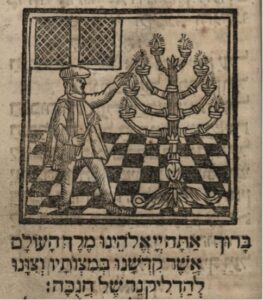
Sefer Minhagim, 1724, Gross Family Collection

Chanukah Samach!


Pesach, Haggadah, Art & Sundry Matters: A Recap of Important Seforimblog Articles

Pesach, Haggadah, Art & Sundry Matters: A Recap of Important Seforimblog Articles

Among the more interesting aspects of the history of Haggados, is the inclusion of illustrations. This practice dates back to the Medieval period and, with the introduction of printing, was incorporated into that medium. Marc Michael Epstein’s excellent book regarding four seminal Haggadah manuscripts, The Medieval Haggadah: Art, Narrative & Religious Imagination, was reviewed here, and a number of those illustrations, were analyzed in “Everything is Illuminated: Mining the Art of IllustratedHaggadah Manuscripts for Meaning.” Epstein edited and wrote an introduction to the recently published facsimile edition of the Brother Haggadah, which resides in the British Library. This is the first reproduction in full color of this important manuscript. Another recent reproduction of a manuscript Haggadah is Joel ben Simon’s Washington Haggadah. This Haggadah is particularly relevant this year, as it contains an alternative text for  Eruv Tavshilin blessing. Whether or not this was deliberate was the subject of some controversy, see “Eruv Tavshilin: A Scribal Error or Deliberate Reformation?

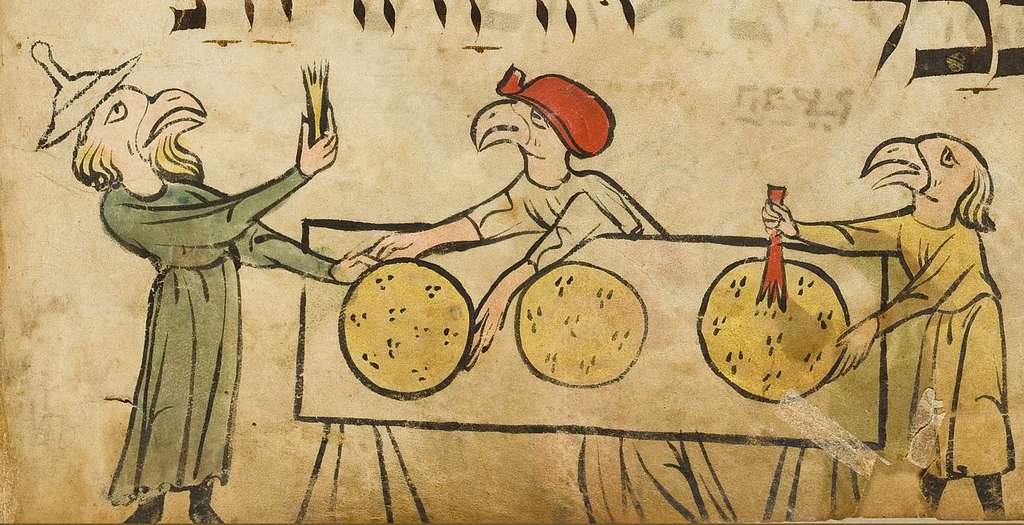
The first illustrated printed Haggadah, Prague, 1526, introduced new illustrations and recycled and referenced some of the common ones in manuscripts (see here for a brief discussion and here for Eliezer Brodt’s longer treatment). That edition would serve as a model for many subsequent illustrated Haggados but also contains surprising elements, at least in some religious circles, regarding the depiction of women, and was subsequently censored to conform with the revisionist approach to Jewish art. See, “A Few Comments Regarding The First Woodcut Border Accompanying The Prague 1526 Haggadah,” and Elliot Horowitz’s response, “Borders, Breasts, and Bibliography.” The Schecter Haggadah: Art, History and Commentary, a contemporary treatment of the art and the Haggadah, (for Elli Fischer’s review, see here), that unintentionally reproduced a version of one of the censored images in the first edition. It was restored in subsequent editions. Women appear in other contexts in illustrated Haggados. The most infamous example is the “custom” that implies a connection between one’s spouse and marror (discussed here), but our article, “Haggadah and the Mingling of the Sexes” documents more positive and inclusive examples of women’s participation in the various Passover rituals in printed Haggados.  Similarly, the c. 1300 Birds Head Haggadah has an image of female figures in snoods preparing the matza and a woman at the center of Seder table.

As detailed in chapter 8 of Epstein’s Medieval Haggadah, the early 14th Century Golden Haggadah is perhaps the most female-centric Haggadah and may have been commissioned for a woman. That manuscript emphasizes the unique, positive, and critical role women played in the Exodus narrative. Although it also depicts the practice of overzealous cleaning with a woman sweeping the ceiling. The 1430 Darmstadt Haggadah has a full-page illumination of women teachers, but its connection to the text is opaque. Finally, we argue that one printed Haggadah uses a subtle element in explicating the midrashic understanding of the separation of couples as part of the Egyptian experience.
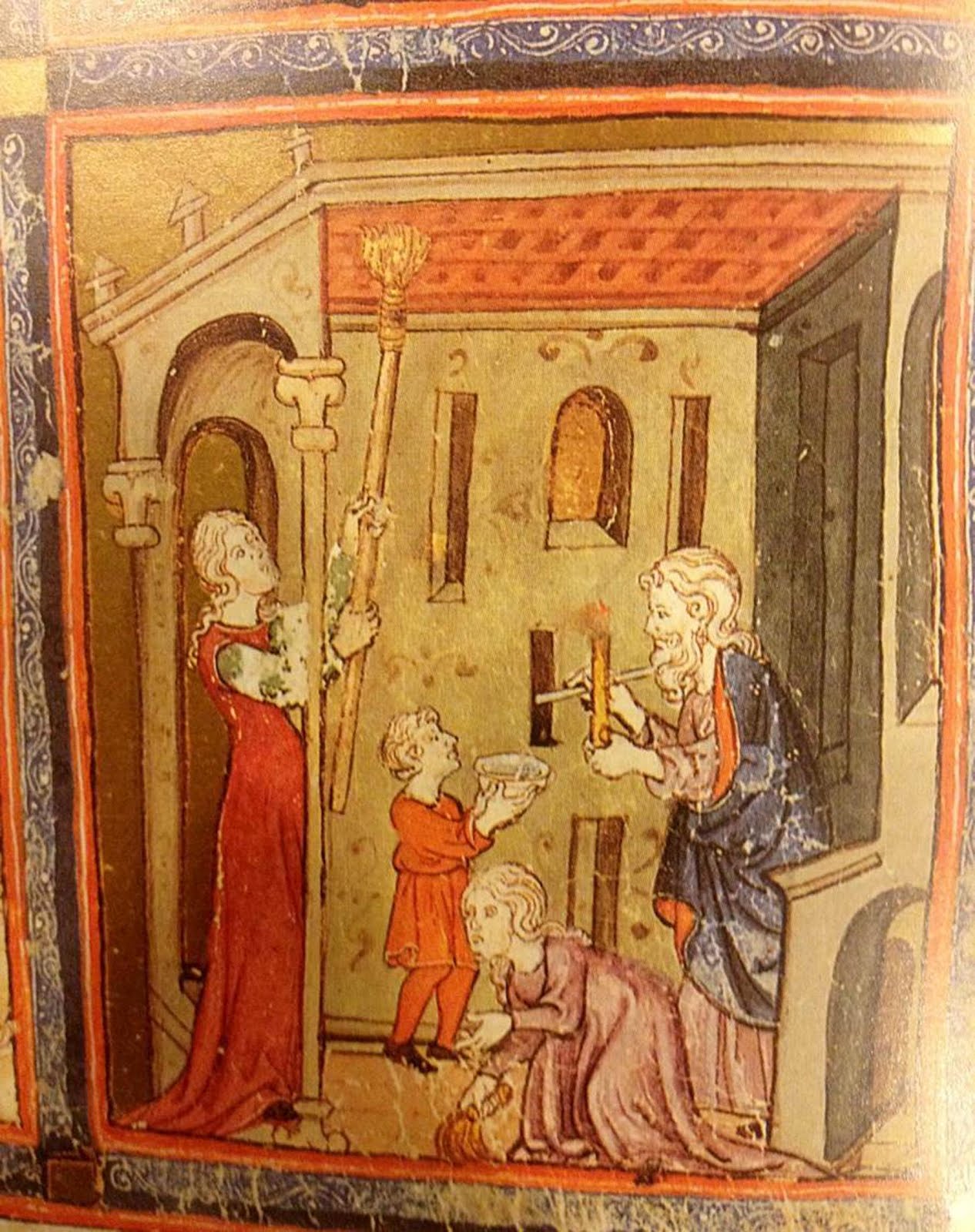
Sweeping the Ceiling, Golden Haggadah


One of the most creative contemporary Haggados was produced by the artist, David Moss. Moss was commissioned by David Levy to create a Haggadah, on vellum in the tradition of Medieval Jewish manuscripts. Moss worked for years on the project the result surely equals, if not surpasses, many of the well-known Medieval haggados, both artistically and its ability to bring deeper meaning to the text. The manuscript is adorned with gold and silver leaf and contains many paper-cuts (technically vellum-cuts).  One of the most striking examples of the silver decoration is the mirrors that accompany the passage that “in each and every  generation one is obligated to regard himself as though he personally came out of Egypt.” The mirrors appear on facing pages, interspersed with one with male and the other with female figures in historically accurate attire from Egypt to the modern period. Because the portraits are staggered when the page opens, each image is reflected on the opposite page, and when it is completely opened, the reader’s reflection literally appears in the Haggadah — a physical manifestation of the requirement to insert oneself into the story. The page is available as a separate print.

After completing the Haggadah, Moss was asked to reproduce it, and, with Levy’s permission, produced, what the former Librarian of Congress, Daniel Bornstein, described as one of the greatest examples of 20th-century printing. The reproduction, on vellum, nearly perfectly replicates the handmade one. This edition was limited to 500 copies, all of which were sold. From time to time, these copies appear at auction and are offered by private dealers, a recent copy sold for $35,000. President Regan presented one of these copies to the former President of Israel, Chaim Herzog, when he visited the White House in 1987. While that is out of reach for many, this version is housed at many libraries, and if one is in Israel, one can visit Moss at his workshop in the artist colony in Jerusalem, where he continues to produce exceptional works of Judaica and view the reproduction.  There is also a highly accurate reproduction, on paper that is available (deluxe edition) and retains the many papercuts and some of the other original elements, that is still available. This edition also contains a separate commentary volume, in Hebrew and English. (There is also one other available version that simply reproduces the pages, but lacks the papercuts.)
While the entire Moss Haggadah is worth study, a few examples. One paper-cut is comprised of eight panels, each depicting the process of brick making, the verso, using the same cuttings, depicts the matza baking process, literally transforming bricks into matza. The first panel of the matza baking is taken from Nuremberg II Haggadah, which we previously discussed here, and demonstrated that it preserves the Ashkenazi practice of only requiring supervision from the time of milling and not when the wheat was cut.

The illustration accompanying the section of Shefokh, reuses the illustrations of Eliyahu from the Prague 1526 and the Mantua 1528 Haggados to great effect. In the original and vellum reproduction, the cup of Eliyahu physically turns without any visible connection to the page — an extraordinary technical achievement. This section and the illustrations were discussed by Eliezer Brodt in “The Cup of the Visitor: What Lies Behind the Kos Shel Eliyahu, and, in this post, he identified an otherwise unknown work relating to the topic, for another article on the topic, see Tal Goiten’s “The Pouring of Elijah’s Cup (Hebrew).”  Eliezer revisited the topic in (here) his conversations with Rabbi Moshe Schwed, in the series, Al Ha-Daf. In last year’s conversation, he discussed a number of other elements of the history of the Haggadah, and three years ago the controversy surrounding machine produced matza. (All of the episodes are also streaming on Apple Podcasts, Spotify & 24Six.) Additionally, he authored “An Initial Bibliography of Important Haggadah Literature,” and two articles related to newly published Haggados, “Elazar Fleckeles’s Haggadah Maaseh BR’ Elazar ” and XXI. Rabbi Eliezer Brodt on Haggadah shel Pesach: Reflections on the Past and Present ,” regarding Rabbi Yedidya Tia Weil’s (the son of R. Rabbi Netanel Weil author of “Korban Netanel”) edition, and a review of David Henshke’s monumental work, Mah Nistanna. 

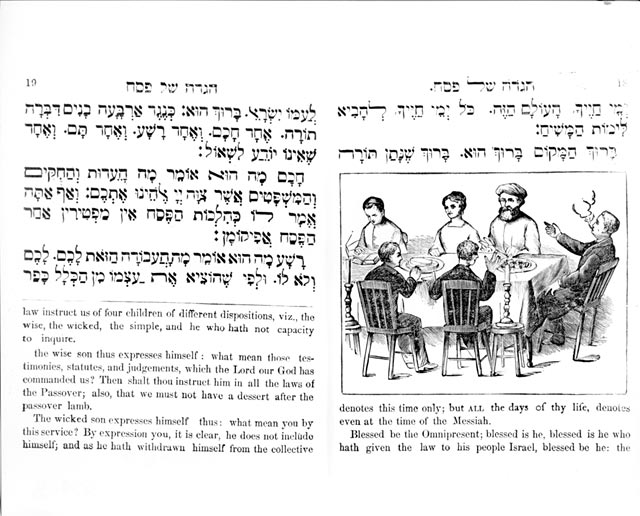
In one of the first haggadot printed in the United State published in 1886 Haggadah contains a depiction of the four sons.  Depicting the four sons is very common in the illustrated manuscripts and printed haggadot. In this instance, the wicked son’s disdain for the seder proceedings shows him leaning back on his chair and smoking a cigarette. According to many halakhic authorities, smoking is permitted on Yom Tov, nonetheless, the illustration demonstrates that at least in the late 19th-century smoking was not an acceptable practice in formal settings. (For a discussion of smoking on Yom Tov, see R. Shlomo Yosef Zevin, Mo’adim be-Halakha (Jerusalem:  Mechon Talmud Hayisraeli, 1983), 7-8).

The cup of Eliyahu is but one of many Passover food-related elements. The identification of Marror with the artichoke in Medieval Haggados, is debated by Dan Rabinowitz and Leor Jacobi , while Susan Weingarten provides an overview of the vegetable, in “The Not-So-Humble Artichoke in Ancient Jewish Sources.” Jacobi also discusses the fifth cup in his article, “Mysteries of the Magical Fifth Passover Cup II, The Great Disappearing Act and this printed article.  The history of the restriction of Kitniyot and the development of the practice of selling hametz is discussed in our article, “Kitniyot and Mechirat Chametz: Paradoxical Approaches to the Chametz Prohibition,” and was revisited on Rabbi Drew Kaplan’s Jewish Drinking podcast (and in an audio version on apple podcasts and spotify). Another guest was Marc Epstein, discussing his book on Medieval Haggados, and Dr. Jontahan Sarna where he gives an overview of the use of raisin wine for the kiddush and the four cups, based on his article, “Passover Raisin Wine,” as was the frequent contributor to the Seforimblog, Dr. Marc Shapiro. His interview, like many of his posts and his book, Changing the Immutable, discusses censorship and, in particular, the censored resposum of R. Moshe Isserles regarding taboo wine (also briefly touched upon in Changing the Immutable, 81-82, and for a more comprehensive discussion of the responsum, see Daniel Sperber, Nitevot Pesikah, 104-113).  For another wine related post, see Isaiah Cox’s article, “Wine Strength and Dilution.” The history of Jewish drinking and Kiddush Clubs was briefly discussed here.

Whether coffee, marijuana and other stimulants falls within the Kitniyot category appears here. Marc Shapiro’s article, “R. Shlomo Yosef Zevin, Kitniyot, R. Judah Mintz, and More,” regarding Artscroll’s manipulation of R. Zevin’s Moadim be-Halakha regarding kitniyot. Another coffee related article explores the history and commercial relationship between the Maxwell House Haggadah.  Finally, the last (pun intended) food discussion centers on the custom of stealing the afikoman.

The Amsterdam 1695 Haggadah was an important milestone in the history of printed illustrated Haggados, it was the first to employ copperplates rather than woodcuts. This new technique enabled much sharper and elaborate illustrations than in past Haggados. While some of the images can be traced to earlier Jewish Haggados, many were taken from the Christian illustrator, Mathis Marin. It also was the first to include a map. As we demonstrated that map, however, is sourced from a work that was a early and egregious example of forgery of Hebrew texts. For an Pesach related plagiarism, see “Pesach Journals, Had Gadyah, Plagiarism & Bibliographical Errors.” Kedem’s upcoming auction of the Gross Family collection includes, with an estimate of $80,00-$100,000, one of the rarest, beautiful, and expensive illustrations of Had Gadya by El Lissitzky published by Kultur Lige, Kiev, 1919. Eli Genauer reviews another number related edition, not in price, but convention, “The Gematriya Haggadah.”

There are two articles regarding the Haggadah text, David Farkes’ “A New Perspective on the Story of R. Eliezer in the Haggadah Shel Pesach,” and Mitchell First’s “Some Observations Regarding the Mah Nishtannah.” First’s other article, “The Date of Exodus: A Guide to the Orthodox Perplexed,” is also timely.
Finally, Shaul Seidler-Feller’s translation of Eli Wiesel’s article, “Passover with Apostates: A Concert in Spain and a Seder in the Middle of the Ocean,” tells the story of an unusual Pesach seder. Siedler-Feller most recently collaborated on the two most recent Sotheby’s Judaica catalogs of the Halpern collection.

Chag kasher ve-sameach!


Chanukah books and Etymology, Miracles (?), Dreidel, Cards and Christmas: A Roundup of Previous Posts

Zerachya Licht, “חז״ל ופולמס חנוכה,” and Marc Shapiro, “The Hanukkah Miracle,” discuss the 19th-century controversy regarding the polyglot, Chaim Zelig Slonimsky, and the connection, or lack thereof, the miracle of the candles burning for eight days. Licht discusses Slonimsky in more depth in a two-part post, “Chaim Zelig Slonimsky and the Diskin Family,” part 1 and part 2.   Marc also discusses a potential Maccabean Psalm in his article here.

Mitchell First traces the history and spelling of two terms associated with Chanukah,  “The Identity and Meaning of the Chashmonai,” “The Meaning of the Name Maccabee,” for an earlier post by Dan Rabinowitz, on the latter term, see here.  First recently published his latest book, Words for the Wise: Sixty-Two Insights on Hebrew, Holidays, History and Liturgy.

A recurring theme of articles in the secular and Jewish presses is whether playing dreidel has any sources and if it is even fun. For example, Howard Jacobson, who won the 2010 Man Booker prize in a New York Times editorial, isn’t a fan. “How many years did I feign excitement when this nothing of a toy was produced? The dreidel would appear, and the whole family would fall into some horrible imitation of shtetl simplicity, spinning the dreidel and pretending to care which character was uppermost when it landed. Who did we think we were – the Polish equivalent of the Flintstones?” Marc Tracy, in Tablet Magazine, expressed his sentiment in his post, “The Unbearable Dumbness of Dreidel.” Although this year, two articles in Tablet, “Adapt, Adopt, Subvert, Survive” and “The Miracle of the Dreidel,” argue for the contemporary relevance of the custom.  For our discussion, see “Chanukah Customs and Sources.” For another discussion regarding dreidel and other Chanukah customs, see “The Customs Associated with Joy and their More Obscure Sources.” Another form of Chanukah gameplay, cards, is dealt with in “The Custom of Playing Cards on Chanukah.” The post highlights an important, often overlooked, source for Jewish customs, the memoir of Pauline Wengeroff, Rememberings: The World of a Russian-Jewish Women in the Nineteenth-Century.

Eliezer Brodt tackles the missing tractate for Chanukah in “The Chanukah Omission,” and with an update in his recent talk, available here.  (And a discussion of the other lesser known tractate that implicates Chanukah and an example of censorship.)The Seforimblog, in 2006, published his first post, “A Forgotten Work on Chanukah, חנוכת הבית,” discusses an obscure Chanukah-related work, Chanukas ha-Bayis, cited by Magen Avraham. Subsequently, Eliezer wrote dozens of articles for the Seforimblog and his Ph.D. dissertation on the Magen Avraham. The serious deficiencies of another work on Chanukah, Mitzva Ner Ish u-Beyoto, are highlighted in a review by Akiva Shamesh.  Shamesh deals with the “famous” question of Bet Yosef, why there are eight and not seven nights of Chanukah, in another book review, “Yemi Shemonah.

Finally, the subject of Greek Wisdom is apprised in Eliyahu Krakowski’s article, “How much Greek in ‘Greek Wisdom.'”

This year, as many, Chanukah coincides with Christmas. For our original bibliography on the topic of the Jewish response to Christmas, otherwise referred to as Nitel, see here. That post should be updated to include Rebecca Scharbach, “The Ghost in the Privy: On the Origins of Nittel Nacht and Modes of Cultural Exchange,” Jewish Studies Quarterly 20 (2013), pp. 340-373. Marc Shapiro’s lecture on the topic is available on YouTube. And for an interesting Christmas card by Edmund Wilson, see Elliot Horowitz’s post, “Edmund Wilson, Hebrew, Christma, and the Talmud.” Horowitz’s other posts include one on Bugs Bunny, Isaiah Berlin on Meir Berlin (Bar-Ilan) and Saul Lieberman, non-Jewish reactions to the synagogue, a discussion of the historical application of Amalek, and regarding reading Biblical books to children.


Recommended Summer Reading

Recommended Summer Reading

By Eliezer Brodt

There are various “agendas” in the following post.

One goal is to continue to inform the Seforim Blog readership of some of the recently published seforim and provide them with descriptive reviews. Another goal is to make some of them available for sale; the proceeds help support the Seforim Blog.

Summertime affords some people a bit more time to relax and read a little. So even though book buying\selling has been dying, seforim & books are still being published at full speed. I have often wondered who is even buying\reading them. However, from various sources on line I see that some people are still interested in at least knowing about the new publications.

R’ David Bashevkin has created a whole following on Twitter discussing books weekly. In his podcast series he has given this month to devote to talking about different aspects related to books. Nachi Weinstein at Seforim Chatter is still going strong between book listings and podcasts, and Tradition has released their Summer recommended reading lists (here and here).

R’ Yoel Catane has just released the latest issue of Hamayan [#242], which includes his regular, excellent column of Book Reviews. This issue also includes an index of over 70 pages of the Books and Seforim reviewed in the Journal over the past twenty years. A PDF of the Journal is available upon request.

The books mentioned bellow are not “light reads” for, let’s say relaxing after the chulent, but are still very worthwhile.

ר’ בנימין ברוך קרלנשטיין, ים ודרום ירשה, גבולי ארץ ישראל, תקלה עמודים +119 עמודים של מפות

The first work I would like to mention is called Yam Udrom Yarsha. Every once in a while, a new topic comes to the forefront. Sometimes this topic has been around for a while, with much literature, but for whatever reason it becomes hot and an explosion happens at which many articles and works on the topic are published all at the same time. The topic in this case is the Boundaries of Eretz Yisroel. In the past few months at least six works have been published on this, all containing valuable material. I wish I had the time to discuss this fascinating subject, the geography of Eretz Yisroel and its importance for various fields such as Halacha, Chumash and Navi at length but my time is very limited. I hope to do a proper write up (or talk) about it in the near future.

This particular work is beautifully produced; it looks like the author has literally left no stone unturned. And it includes over a hundred pages of beautifully produced color maps to help one understand the topic better.

Email me if you would like a PDF of the Table of contents and some sample pages.

ירחמיאל ברודי, פירוש מסכת כתובות מן התלמוד בבלי, ג’ חלקים, 1200 עמודים

The next work I would like to bring the readers’ attention to is Professor Robert Brody’s three volume work on Mesechtas Kesuvot. Professor Robert Brody is recognized as one of the world’s experts on the Geonim. He has authored numerous articles and published materials of and about the Geonim, including numerous lost works.

In recent years he has published a lot on the subject of Academic Talmud. This is a subject which is worthy of its own series of posts which maybe one day I will have time to write. Most people that talk about it do not really have a grasp about what it is exactly. Lately, Academic Talmud has been discussed by various people as one of the famous Scholars of this field, Rabbi Professor David Halivni, recently passed away.

Brody’s articles on this topic were papers read at various conventions, there he discussed and many times disagreed with previous theories of scholars such as Halivni, Shamma Friedman and others. Most of these discussions and publications are read by a small readership who follow the ins and outs of Academic Talmud. In recent years Brody has published two books related to this subject, one in Hebrew (here) and one in English (here). A few weeks ago, and just in time for Daf Yomi learners, his three-volume running commentary on the whole Mesechata was released. It includes a detailed introduction about his method. For those “into” this kind of stuff this is an excellent and important work to be aware of and for some to learn carefully.

Email me if you would like a PDF of the introduction or some sample pages.

ר’ יעקב חיים סופר, מנוחת שלום, ד’ חלקים, כולל מפתחות

Rabbi Yakov Chaim Sofer is one of the most prolific writers of our generation and his expertise in all areas of Torah is legendary. In 2002, his father was Niftar and he decided that for each month of the year of Aveliut he would publish a volume of his writings, calling this work Menuchat Sholom. He successfully completed these 12 volumes, which touched upon a wide range of subjects, including: Shas, Torah, Bibliography, Minhaghim and much more. This special series has just been re-issued in four hardcover volumes with a 299pp. index, making this incredible encyclopedia more user friendly.

ר’ עובדיה זכאי, בקרבך קדוש, ניתוחי קיצור קיבה בהלכה, 350 עמודים

It is well known that many people seek out to write on some exotic/obscure topic and then turn it into a whole work. One such recent work is all about Stomach stapling (Sleeve gastrectomy), an operation that many overweight people consider having. This work literally deals with dozens of areas throughout the Halachic spectrum that could possibly present themselves. It also deals with some of the medical aspects of the procedure. For those into the genre of Medical halacha books this is an important new work worth owning.

Below is the Table of contents of the work

זכור לאברהם, בית מדרש ישיבת אליהו, ג’ חלקים, ב’תעז עמודים

In the early 1990’s one of the important Torah Journals to come out was Zechor LeAvrohom. Articles in the series included materials based on manuscripts alongside influential Halacha and Minhag discussions. Many of the manuscripts are housed in this Yeshivah’s library. About 18 volumes were published at the time; the last of which was published in 2005. A few weeks ago, there was a revival of sorts and three massive volumes were published, totaling over two thousand four hundred pages of new material!

As one can see from the Table of contents posted below, it’s full of interesting material on a wide range of subjects. The last few volumes of this journal are not available electronically and the plan is for this format to continue with these new volumes.

Hard copies of the earlier volumes are still available for purchase.

יעקב צבי מאיר, דפוס ראשון: מהדורת התלמוד הירושלמי ונציה רפ”ג וראשית הדפוס העברי, 265 עמודים

A short description of this book says: This study focuses on one medieval manuscript of the Palestinian Talmud, that served as a printer’s copy for the first edition of the composition, printed in Venice (1523). A detailed philological examination of the preparation of the text for print, drives a comprehensive description of transition of Talmudic literature from manuscript culture to print culture.

This work is technical but very important for people interested in understanding the transformation from a world of Manuscripts to a world with a printing press. In addition, it also helps one understand how exactly the first seforim were published.

Here is the Table of contents

רועי גולדשמידט, דורשי רשומות, רטוריקה, עריכה למדנות ומעמדות חברתיים בספרות הדרוש במזרח אירופה, 311 עמודים

This work is an important addition to the literature about Derush in general, and in particular in the early 1800’s. It also focuses a lot on the famous, popular work Arvei Nachal.

יוסף עופר, המסורה למקרא ודרכיה, פרקי מבוא, 345 עמודים

This latest work from Yosef Ofer, one of the world experts of the Masorah (and more), is meant to serve as an introduction to this complex subject.

קהילת צפרו, דורות ראשונים, סיפורה של קהילת צפרו במרוקו ואישי המעלה שחיו ופעלו בה, 387 עמודים \ קהילת צפרו, תהלה לדוד, סיפור חייו ומפעליו של הרב דוד עובדיה רבה האחרון של קהילת צפרו במרוקו,493 עמודים

These two volumes recently published by Kehillot Yisroel Institute are devoted to the city Sefrou in Morocco. The first volume traces its earlier history and the second volume concludes with an in-depth biography on its last Rav, R’ Dovid Ovadiah. These books are beautifully produced, with great pictures and many rare documents related to this city.

For a PDF of sample pages and a Table of Contents, email me.

משה הלל, מסכת תמורות, תולדות ר’ מרדכי שמואל גירונדי מפאדובה, לקורות הרבנית והקהילות באיטיליה בתקופת האמנציפצית וההשכלה, 592 עמודים

R’ Moshe Hillel has published yet another book via Kehillot Yisroel Institute. Like his previous works, this too is – simply put – incredible. It is meticulous researched and full of new information related to Italian Jewry in the early 1800’s based on manuscripts. The main focus of the book is R’ Mordechai Girondi’s life, a unique and fascinating person, with chapters about his library, his writings, his attitude towards Haskalah and much more. Moreover, materials related to the Ramchal among other personalities can be found in this work. A special section is devoted to R’ Girondi’s bibliographical work Toldos Gedolei Yisroel ViGeoni Italia. This is an important work, well worth owning and reading.

שד”ל, אוהב גר, 251 עמודים , בעריכת יונתן בשיא

In recent years many of Shadal’s works have been made available again (some with new material), some of which have not been easily purchasable for a long time. Some of these works have even been translated into English.

One of the classic works on Targum Onkelos is Shadal’s first book, Ohev Ger. It has now been reissued in a newly annotated edition.

Email me for a PDF of Sample pages.

ר’ משה פרנס, פרשת המלך, על מצות הקהל, תקטז עמודים

This new work, hot off the press, is an encyclopedic work devoted to every aspect of Hakhel. It has literally everything one can possibly think of related to Hakhel and includes a through index.

Email me for a PDF of Sample pages.


Guide and Review of Online Resources – 2022 – Part III

Guide and Review of Online Resources – 2022 – Part III

By Ezra Brand

Ezra Brand is an independent researcher based in Tel Aviv. He has an MA from Revel Graduate School at Yeshiva University in Medieval Jewish History, where he focused his research on 13th and 14th century sefirotic Kabbalah. He is interested in using digital and computational tools in historical research. He has contributed a number of times previously to the Seforim Blog (tag), and a selection of his research can be found at his Academia.edu profile. He can be reached at ezrabrand-at-gmail.com; any and all feedback is greatly appreciated. This post is a continuation. The first part of this post is here, the second here, and this is the third and final part.

21.Articles for popular audience

Websites with open-access articles, written for a popular audience, with relatively high scholarly standards.

General

  1. Academy of Hebrew Language .
    1. See above. Besides for a selection of scholarly articles from journals, has many articles specifically written for the website.
    2. Recommended. Focuses on Hebrew linguistics. Great resource, at a high level of scholarship, with lots of interesting articles on all topics related to Hebrew language, throughout history.
    3. Wikipedia: “The Academy of the Hebrew Language was established by the Israeli government in 1953 as the “supreme institution for scholarship on the Hebrew language in the Hebrew University of Jerusalem of Givat Ram campus.” Its stated aims are to assemble and research the Hebrew language in all its layers throughout the ages; to investigate the origin and development of the Hebrew tongue; and to direct the course of development of Hebrew, in all areas, including vocabulary, grammar, writing, spelling, and transliteration.”
  2. TheGemara.com.
    1. In English.
    2. Focuses on Talmud Bavli. Recommended. From the About Us: “We solicit original essays that are reviewed and edited by our in-house scholars, to ensure the highest academic standards as well as maximum readability for the general audience.”
  3. My Jewish Learning.
    1. Lots of good articles. However, it mostly focuses on Bible and Modern Jewish history, which are out of the scope of this guide.
  4. 929- Tanach B’yachad (929 – תנך ביחד).
    1. In Modern Hebrew. Lots of articles on Hebrew linguistics (for example: on the phraseעומד על הפרק). However, mostly focuses on Bible, which is out of the scope of this guide. And not so simple to filter for articles on Hebrew linguistics.

Newspapers and magazines

Newspapers and magazines can be a great source of scholarship, and they’re often available online. They are especially good for reviews of scholarly books, and interviews with scholars.[1] Israeli publications often have high-quality articles on Hebrew linguistics. Mostly behind paywall, with some articles not behind paywall.

Some of the best:

  1. Makor Rishon (מקור ראשון).
    1. In Modern Hebrew. Their Mussaf Shabbat (מוסף שבת) is especially good on scholarly topics.
    2. Wikipedia:
      1. “Makor Rishon is a semi-major Israeli newspaper […] Shabbat (Sabbath) – a supplement for Jewish philosophy, Judaism and literature, with an intellectual bent.”
  2. Haaretz (הארץ).
    1. In Modern Hebrew and English.[2]
    2. Available online: 4 April 1918 – 31 December 1997 (22,721 issues; 394,984 pages), at Israel National Library’s Jpress archive. However, not all pages in this date range are in fact available there.
    3. Wikipedia:
      1. “Haaretz is an Israeli newspaper. It was founded in 1918, making it the longest running newspaper currently in print in Israel, and is now published in both Hebrew and English […]”
  3. Segula (סגולה).
    1. In Modern Hebrew and English.
    2. Wikipedia – Hebrew:
      1. “Segula is an Israeli monthly dedicated to history, published since April 2010. The magazine deals with the history of the people of Israel and general history, from the perspective that the people of Israel play an important part in world history and the historical processes leading humanity. The magazine is published monthly. An equivalent edition in English is published once every two months.”
  4. Tablet
    1. Wikipedia:
      1. “Tablet is an online religious magazine of news, ideas, and Jewish culture. Founded in 2009 […]”.
  5. Jewish Review of Books
    1. Wikipedia:
      1. “The Jewish Review of Books is a quarterly magazine with articles on literature, culture and current affairs from a Jewish perspective. […] The magazine was launched in 2010 […]”

Blogs

Blogs are generally not formally peer-reviewed and are generally written more informally and conversationally, but are often a great resource. With the shift from blogs to social media, many blogs have shifted to Facebook, and to a lesser extent Twitter and Reddit. (E.g., Mississippi Fred McDowel no longer posts on “On the Main Line”, but does on Facebook..) Blogs are far less active than they were. There are a lot of Facebook groups, which I’m less familiar with, and technically have to be added to and aren’t indexed by Google unfortunately (“walled gardens“, vs. “open platforms”).

  1. The Seforim Blog
  2. The Talmud Blog. Focuses on Talmud.
  3. Rationalist Judaism. Focuses on relationship of science and Judaism, besides for contemporary politics and hashkafa.
  4. Kavvanah.blog- The Book of Doctrines and Opinions
  5. Jewish Studies @ CUL . A blog affiliated with Columbia University, focused on Hebrew Bibliography.
  6. Footprints Blog – Tracing Jewish Books Through Time and Place . A blog affiliated with Columbia University, focused on Hebrew Bibliography.
  7. Safranim .
  8. Am Hasefer (עם הספר). The blog of Rambam Library of Tel Aviv, focused on Hebrew Bibliography.
  9. Hagahot. Active 2005 – 2013.
  10. Giluy Milta B’alma (גילוי מילתא בעלמא). Masthead: “We present here new and interesting findings in Hebrew Manuscripts, and Genizah- We welcome posts in Hebrew or English.”
  11. On the Main Line. Blog of “Shimon Steinmetz/ Mississippi Fred MacDowell”.
  12. English Hebraica . Another blog of “Mississippi Fred MacDowell”. Masthead: “Chronicling Jewish and Jewish themed writing in the English language prior to the 19th century. interesting biographies, diagrams, translations, transliterations and descriptions of Jewish learning and theology from primary sources.” Active 2006 – 2007. Since then posts on Facebook and Twitter.
  13. What’s Bothering Artscroll? . Another blog of “Mississippi Fred MacDowell”.  Active 2006 – 2008.
  14. Hollander Books Blog. Masthead: “A bookseller and his books, his very many books. And a few ideas.”
  15. Kol Safran. Masthead: “A librarian’s comments on books, copyright, management, librarianship, and libraries that don’t get the full article treatment.” Many posts on topics in Jewish bibliography, as well as visits to Jewish libraries.
  16. Musings of a Jewish Bookseller. Masthead: “On Jewish Books, Jewish Bookselling and Jewish Booksellers”
  17. Notrikon (נוטריקון). In Modern Hebrew. Masthead: ”A journey through the space of the written word, between books, periods and people … stops at different stations, who knows where we will end up.”
  18. Oneg Shabbat (עונג שבת). Blog of Prof. David Assaf. Many interesting posts on modern Jewish history, and on history of Hasidut.
  19. HaSafranim – Blog of Israel National Library (הספרנים – בלוג הספרייה הלאומית). In Modern Hebrew. Focuses on Hebrew bibliography, and topics related to Modern Israel.
  20. 7minim (מינים). Masthead: “This blog is intended to allow me, Tomer Persico, to comment briefly on this and that”. Has a number of posts on recent scholarly books on history of Kabbalah (though the blog mostly focuses on contemporary issues).
  21. HaZirah HaLeshonit – Ruvik Rozental (הזירה הלשונית – רוביק רוזנטל). Many posts on history of individual Hebew words, by a well-known and popular Hebrew linguist.
  22. Leshoniada (לשוניאדה). In Modern Hebrew. Focuses on Hebrew linguistics.
  23. Safa Ivrit (השפה העברית). In Modern Hebrew. Focuses on Hebrew linguistics. Not quite a blog, rather a wide range of short articles on sources of sayings and words.

22.Videos and Podcasts

YouTube has a lot of academic lectures. With the covid restrictions over the past two years, it has become especially common to live stream scholarly lectures (whether there’s a live component or not), and often the videos are then permanently publicly available on YouTube.[3]

Some channels:

  1. Academic lectures. Hundreds of lectures available. The YouTube channels seem to often be used now for live streaming of scholarly lectures:
    1. National Library of Israel.
    2. The Israel Academy of Sciences and Humanities.[4]
    3. Israeli university channels. For example, Hebrew University ; Bar-Ilan University.
    4. Scholarly organizations, such as Yad Ben-Zvi.
  2. Torah in Motion. A large number of lecture series. However, it mostly focuses on more modern history, contemporary theology, and on the Bible, so outside the scope of this guide. For lecture series within the scope of this guide, see for example the series with Dr. William Gewirtz, The Changing Nature of Time in Halakha, which is a four-part series that, according to the description, includes a lot of discussion of the history of the Jewish calendar.
  3. Seforim Chatter. Podcast hosted by Nachi Weinsten of Lakewood, NJ.[5] Has interviews with top scholars discussing their most interesting research. For example, some previous guests include: Seforim Blog’s Prof. Marc Shapiro; Jacob J. Schacter, and many more. Recommended. Also has an associated Twitter feed.
  4. Misfit Torah. Podcast hosted by Akiva Weisinger.
  5. Channeling Jewish History. Podcast hosted by my friend Joel Davidi.[6] Interviews many scholars, such as Seforim Blog contributor Prof. Marc Shapiro.
  6. AllDaf. A number of discussions featuring Seforim Blog’s own Rabbi Dr. Eliezer Brodt “to briefly highlight some of the Rishonim and Acharonim ‘out there’ on this masechta”, see the latest Seforim Blog post here, with links to previous.
  7. Tradition Podcast. Hosted by the editor of Tradition. Available on their YouTube channel. For example, one episode is an interview with Prof. Eric Lawee on a new book of his on Rashi’s Commentary.
  8. Am HaSefer – Rambam Library – Beit Ariela (עם הספר – ספריית הרמב”ם בית אריאלה).
  9. Endless videos and podcasts, each of which must be judged on its own. One genre is well-edited videos with graphics by unknown hosts. Another type is podcast-type interviews with well-known personalities. A majority of all of these are focused on Bible, which as mentioned in the introduction, are outside the scope of this guide. Also, many of them are focused more on drawing lessons, in the “self-help” genre, and less on pure scholarship.[7]

23.Twitter

Now requires registration (free) to view most content.

Essentially every organization focused on Jewish scholarship has a Twitter feed and a Facebook page. Most Twitter feeds and Facebook pages affiliated with organizations are focused on academic events, book launches, awards, etc., and so are less interesting for our purposes here. Here are the ones that especially caught my eye as having content relevant to this guide, especially bibliographical content.

  1. Michelle Margolis (@hchesner) / Twitter .
    1. “Judaica @Columbia @Footprints_Heb #dhjewish, VP @jewishlibraries, Jewish book history, Hebrew incunabula”
  2. Footprints Project (@Footprints_Heb) / Twitter .
    1. “Tracing Jewish books through time and place.”
  3. National Library of Israel (@NLIsrael) / Twitter .
    1. “Collecting & preserving the cultural treasures of #Israel & the #Jewish People. Opening access to millions of books, photos, recordings, maps, archives + more.”
  4. נתן הירש Nathan Hirsch (@NLITorani) / Twitter.
    1. “Contemporary Rabbinic literature”.
    2. Also on Telegram: https://t.me/s/NLITorani
    3. And on Facebook: Nathan Hirsch | Facebook
  5. DayenuPal
  6. #dhjewish – Twitter Search / Twitter

24.Facebook

  1. Norman E. Alexander Library for Jewish Studies – Home | Facebook .
    1. “The Norman E. Alexander Library for Jewish Studies at Columbia University collects Judaica and Hebraica in all formats and supports research.”

25.Forums

There are some great forums dedicated to academic Jewish Studies.

  1. Otzar HaChochma’s forum (פורום אוצר החכמה). In Modern Hebrew. Lots of really interesting discussions.
  2. Behadrei Haredim – Forum: Seforim and Sofrim (בחדרי חרדים – פורום: ספרים וסופרים). In Modern Hebrew.
  3. Judaism.stackexchange.com (Mi Yodea). In English.

26.Summary

It’s truly an exciting time to be a reader and producer of scholarship. Let me know what I’ve missed!

27.Appendix – Halacha Brura’s Indexes

28.Intro

Halach Brura’s index is broken down by topic, such as works of Hazal, commentaries on Mishnah, commentaries on Talmud, etc. With links to other websites (mentioned above in section “Primary Texts”) where PDFs can be found.

Halacha Brura has an intro on their index’s main page, worth quoting in full, as it makes a lot of points very relevant to this guide.

As throughout, the translation is mine, and I have translated loosely. The breakdown into numbered paragraphs and bolding is mine as well:

  1. “As a service to visitors to the site, the Halacha Brura Institute centralizes here links to seforim that are on the Internet at various sites, in full text, some as text and some as scans, to save the viewer the need to visit libraries.
  2. Naturally, the status and location of websites change from time to time, so some of the links may not work, and we apologize for that. Anyone who finds a link that does not work – please contact us, and we may be able to tell him what the correct link is.
  3. Warning: We have not checked the “kosherness” of the sites to which we have created links, and the user must check this himself.[8]
  4. Heads up: Many of the books here are from older editions; in the meantime better editions have appeared, which are not available as open-access online because of copyright law.
  5. We would like to thank users who know of other seforim that are online in full text to please let us know, so that we can add them to this list.
  6. The seforim appear in different formats, and we have dedicated symbols to each format, as follows […]
  7. Scans of additional books can be obtained from the Rambam Library (ספריית הרמב”ם – בית אריאלה) in Tel-Aviv – email rambaml1@gmail.com.”

29.Statistics of Halacha Brura’s index

Halacha Brura indexes seforim on the following websites, in order of number of seforim linked:[9]

  1. HebrewBooks
  2. Israel National Library
  3. Seforim Online
  4. Grimoar
  5. Sefaria
  6. Google Drive
  7. Torat Emet
  8. Wikitext
  9. Goethe University Frankfurt Library
  10. Daat
  11. JTS Library.

Based on my analysis, at least 45% of Halacha Brura’s links are to HebrewBooks. In fact, one can view Halacha Brura’s index as essentially a kind of index of HebrewBooks.

As for the links to open-access books in Israel National Library, I mentioned earlier that all these links are now broken. I described earlier best way to now find these open-access books on the website.

As of 15-Feb-22, Halacha Brura has 36 webpages of indexes,[10] and based on my rough estimate over 40,000 open-access seforim have been categorized.

30.Halacha Brura’s symbols

Halacha Brura’s system of symbols is not especially user-friendly. I have therefore rearranged their symbols in a more logical arrangement, see below.

I organized the order of the symbols based on the frequency of times the symbol appears in Halacha Brura’s index. I have also supplemented the symbols, based on other intros in the website:

  1. Major symbols:
    1. § HebrewBooks , PDF format.
    2. Israel National Library , DJVU format.
    3. Israel National Library, METS format.
    4. Daat or Israel613, PDF format.
    5. ♔ text format (=transcribed). Can be Daat, Wikitext, Sefaria, or Chabad Library, among others.
  2. Resources especially relevant for manuscripts and early printed editions of Hazal, see Halacha Brura’s index here::
    1. University library :Goethe University Frankfurt Library; Russian National Library ; Jewish Theological Seminary Library ; New York Public Library.
    2. Google Books.
    3. The Center for Jewish History.
  3. Other miscellaneous symbols, rare, only a handful of each:
    1. ⋇ – PDF format; Ξ – Seforim Online, PDF format; ਊ – Seforim Online, TIFF format; ↂ – Daat, PDF format.

31.Meta-index of Halacha Brura’s indexes

Page names are mostly taken from the webpage “headers”, with some changes.

The number after the page name refers to the number in the URL, that differentiates pages. So, for example, the number for תנ”ך וחז”ל is 0: http://www.halachabrura.org/library/library0.htm. , and for ראשונים על התורה it’s 3a: http://www.halachabrura.org/library/library3a.htm.

The names of the categories and sub-categories are generally taken directly from the webpages, with small changes where deemed to be helpful. The ordering of the webpages is mine.[11]

  1. תנך וחזל – 0

    1. תנ”ך

    2. משנה

    3. תוספתא ומסכתות קטנות

    4. תלמוד

    5. מדרשים כסדר התנ”ך

    6. מדרשים שונים

    7. זוהר

    8. ספרים חיצוניים

  2. מפרשים על התורה ראשונים – 3a

    1. ראשונים על התורה

    2. ביאורים על רש”י

  3. מפרשים על התורה אחרונים כללי – 3g

  4. מפרשים על התורה אחרונים לפי חומש ועל התרגומים – 3n

  5. מפרשים על נך – 3h

    1. נ”ך כללי

    2. לפי ספר

    3. הפטרות

  6. מפרשי המשנה ; מפרשי תלמוד בבלי ראשונים – 8

    1. מפרשי המשנה

    2. מפרשי תלמוד בבלי – ראשונים

  7. מפרשי אגדות התלמוד, ירושלמי, תוספתא, מדרשים ופרקי אבות – 8l

    1. מפרשי אגדות התלמוד

    2. מפרשי הירושלמי

    3. מפרשי תוספתא

    4. מפרשי מדרשים

    5. מפרשי מסכתות קטנות

    6. מפרשים על פרקי אבות

  8. מפרשי תלמוד בבלי אחרונים ספרים שמפרשים כמה מסכתות – 8f

  9. מפרשי תלמוד בבלי אחרונים לפי מסכתא – 8h

  10. מפרשי תלמוד בבלי אחרונים שונים – 8m

    1. חידושי סוגיות

    2. כללי התלמוד

    3. הדרנים

    4. ריאליה

    5. הלכה למשה מסיני

  11. הלכה ראשונים – 8b

    1. גאונים

    2. ספרי רש”י

    3. ספרי הלכה של שאר ראשונים

    4. ארבעה טורים

    5. שולחן ערוך

    6. מוני המצוות

  12. הלכה אחרונים כללי – 8k

  13. הלכה אחרונים על שלחן ערוך אורח חיים – 8c

  14. הלכה אחרונים על שלחן ערוך יורה דעה – 8j

  15. הלכה אחרונים על שלחן ערוך אבן העזר, חושן משפט, ונושאים שונים – 8d

    1. על אבן העזר

    2. על חושן משפט

    3. על קדשים וטהרות

    4. סת”ם

    5. הלכה ורפואה

    6. מנהגים ותקנות

    7. כהנים ולויים

    8. כללי פסיקה

    9. שיעורים וזמנים

    10. הולכי דרכים

    11. צבא

    12. ספק

    13. חזקה

    14. נשים

    15. גוים

    16. תוכחה

    17. שמירת הלשון

  16. מניין המצוות אחרונים – 8g

  17. רמבם ומפרשיו ; ושאלות ותשובות – 8a

    1. רמב”ם ומפרשיו

      1. משנה תורה

      2. ספר המצוות

      3. מורה נבוכים

      4. פירוש המשנה

      5. תשובות ואגרות

      6. חיבורים אחרים

      7. מפרשים על משנה תורה

      8. מפרשים על מורה נבוכים

      9. מפרשים על חיבורים אחרים

        1. ספר המצוות

        2. פירוש המשנה

        3. מלות הגיון

      10. דרכו של הרמב”ם

    2. שאלות ותשובות

      1. גאונים

      2. ראשונים

      3. שו”ת אחרונים ששמם כשם המחבר – לפי סדר שמו הפרטי של המחבר

  18. מחשבה ראשונים – 3

  19. מחשבה אחרונים כללי – 3j

  20. דרשות כללי – 3f

  21. דרשות לפי נושא – 3e

    1. הספדים

    2. מועדים – אגדה

    3. מועדים בהלכה ובאגדה

    4. שבת

    5. גאולה ומשיח

    6. לימוד תורה

    7. שמירת הברית והעיניים

    8. טעמי המצוות

    9. צוואות

    10. סגולות

    11. י”ג עיקרים

    12. לבר מצוה

    13. חינוך

    14. חלומות

    15. צדקה וחסד

    16. נישואין

    17. ברית מילה

    18. שמחה

    19. תפילה

    20. שמירת הלשון

    21. נגד לא-אורתודוקסים (רפורמים, משכילים, ציונים, מתבוללים, כופרים, משיחי שקר)

    22. נגד שבתאי צבי ונגד נצרות

  22. קבלה – 6

    1. כללי

    2. פירושים על הזוהר

    3. ספר יצירה ופירושים עליו

  23. שירה, סידורים, ומחזורים – 3b

    1. שירה

    2. סידורים ותפילות ופירושיהם

    3. סידורים עם שמות

    4. סידורים בלי שמות – לפי סדר שנות הדפסה

    5. מחזורים לר”ה וליו”כ ושלשה רגלים

    6. מחזורים בלי שמות לפי סדר שנות ההדפסה

    7. תפילות מיוחדות

    8. סליחות

    9. ברכת החמה – לפי סדר השנים

    10. פירושים על התפלה

    11. סידורי מקובלים

  24. חסידות כללי וברסלב – 1

    1. כללי

    2. ברסלב

    3. ר’ אשר שיק

    4. ר’ שלום ארוש

  25. חבד ספרים – 1a

    1. בעל התניא

    2. ר’ דובער

    3. הצמח צדק

    4. מהר”ש

    5. ר’ שלום דובער

    6. ריי”צ

    7. ר’ מנחם מנדל

    8. חיבורים שונים

  26. חבד כתבי עת – 1b

  27. מונקאטש וויזניץ – 2

    1. מונקאטש

    2. ויז’ניץ

  28. הגדות – 3c

    1. עם פירושים

    2. בלי פירושים

    3. לקט מקורות בעניין פסח ועוד

  29. ביוגרפיות , היסטוריה – 3d

    1. ביוגרפיות

    2. היסטוריה

    3. ביבליוגרפיה

    4. ארץ ישראל בהלכה ובאגדה

  30. נושאים שונים – 3m

    1. דקדוק ולשון

    2. טעמי נגינה

    3. המסורה בתנ”ך

    4. אסטרונומיה וחכמת העיבור

    5. לוחות שנים

    6. ספרי יובל וזכרון

    7. אנציקלופדיות וספרים המסודרים בסדר א””ב

    8. רפואה ומדע

    9. גיאוגרפיה

    10. שיעורים וזמנים

    11. גמטריא וראשי תיבות

    12. גורלות

    13. חידות

  31. כתבי עת לפי אב אד – 5

  32. כתבי עת לפי אב ה – 5a

  33. כתבי עת לפי אב ומ– 5b

  34. כתבי עת לפי אב נת – 5c

  35. שונים – 4 (“מדור זה כולל ספרים שלא היה אפשר להכניס לאחד המדורים האחרים, מפני שנושא הספר הוא ייחודי“)

  36. שפות זרות (לאעברית) ; לאאורתודוקס ; סיפורים ; כתבי יד ; הומור – 4w

    1. שפות זרות

      1. אידיש

      2. אנגלית

      3. גרמנית

      4. ספרדית

      5. צרפתית

      6. לאדינו

      7. ערבית-יהודית

      8. פרסית

      9. רוסית

      10. לטינית

      11. הונגרית

    2. לא-אורתודוקס

      1. משכילים

      2. רפורמים

      3. שבתאים

      4. קראים

      5. שומרונים

    3. סיפורים

    4. כתבי יד

    5. הומור

[1] For an interesting example of newspaper interviews and lectures on YouTube being used as evidence in scholarly discussion, see Prof. Bezalel Bar-Kochva’s critique of Prof. Rachel Elior: https://www.tau.ac.il/sites/tau.ac.il.en/files/media_server/imported/508/files/2014/10/elior-25.11.2013.pdf. However, it must be admitted that that’s an unusual case.

[2] Example of article on Hebrew linguistics, on the word “שחצן”: המילה שַׁחְצָן: מה הקשר בין אריות לנחשים וביניהם לבין יוהרה?: https://www.haaretz.co.il/magazine/the-edge/mehasafa/.premium-1.2853618

[3] As for podcasts, many podcasts are also available on YouTube. For example, see below for the podcast “Channeling Jewish History”.

[4] See here: The Israel Academy of Sciences and Humanities – YouTube > “Past live streams”. Recent example that showed in my email inbox of youtube being used for live streaming of a scholarly lecture:

(PDF) ‘Three Lectures on Habad Hasidism’, Schocken Institute, Jerusalem, November 8, 15, 22, 2021 (Poser + Video) | Jonatan Meir – Academia.edu

When I was sent this link, Gmail even knew to attach the YouTube preview in the email.

[5] Introduction Show, Seforimchatter, https://seforimchatter.buzzsprout.com/1218638/4587641-introduction-show, July 15, 2020, Season 1 Episode 18. (Accessed 13-Feb-22).

[6] Admin of the Facebook group “Channeling Jewish History Group”.

[7] A few examples: R’ Dr. Ari Lamm’s podcast called “Good Faith Effort”; Michael Eisenberg’s YouTube channel.

[8] The Halacha Brura indexes indeed link to a nice amount of non-Orthodox works. A dedicated sub-category for non-Orthodox writings appears at the webpage indexing eclectic works (“ספרי קודש שונים”), together with “Foreign-language”, “Stories”, “Manuscripts”, and “Humor”. It should be pointed out that many of these non-Orthodox books have been removed from HebrewBooks, and are no longer available there.

[9] My analysis. I “scraped” a few webpages of Halacha Brura via relatively simple copy-paste and text manipulation in Google Sheets, to use as a sample.

[10] The number of webpages is always going up. When I started my research, there were 33 pages. They then split the page on “Journals” into 4 pages, due to indexing hundreds of additional links.

[11] As I’ve mentioned before, this index by Halacha Brura is a work-in-progress. They are still actively spinning off new pages. Therefore, this meta-index is likely to have some out-of-date info as time goes on.


Guide and Review of Online Resources – 2022 – Part II

Guide and Review of Online Resources – 2022 – Part II

By Ezra Brand

Ezra Brand is an independent researcher based in Tel Aviv. He has an MA from Revel Graduate School at Yeshiva University in Medieval Jewish History, where he focused his research on 13th and 14th century sefirotic Kabbalah. He is interested in using digital and computational tools in historical research. He has contributed a number of times previously to the Seforim Blog (tag), and a selection of his research can be found at his Academia.edu profile. He can be reached at ezrabrand-at-gmail.com; any and all feedback is greatly appreciated. This post is a continuation. The first part of this post is here.

11.Tools and Indexes

There are some very powerful tools for researching primary and secondary sources.

Gone are the days when one is completely at the mercy of memory, concordance, index, or colleagues. Many of the websites in the previous section (“Primary texts”) have good hyperlinked navigation pages. In addition, they have very good search capabilities. In addition to this, there are websites which are dedicated to search and indexes, that provide powerful capabilities that the previously mentioned websites don’t have.

Open-access

  1. Dicta.
    1. Search is highly recommended.
    2. From the About Us page: “Dicta applies cutting edge machine learning and natural language processing tools to the analysis of Hebrew texts.”
    3. Created by Prof. Moshe Koppel of Bar-Ilan University, who has written for Seforim Blog (see here). List of their search and other tools, all very cool and quite user-friendly and hyper-modern UX/UI, in the best way:
      1. Tanach search: “Search the Bible intuitively, with no need to worry about alternate spellings, prefixes and suffixes or sorting out multiple meanings of a word. Dicta’s search engine understands what you’re looking for.”
      2. Talmud Search: “Search the Talmud and Mishnah for words and phrases intuitively, with no need to worry about alternate spellings and multiple meanings. Dicta’s search engine understands what you’re looking for.”
      3. Quick Nakdan: “Automatically add nikud (vocalization) to text as you type.”
      4. Citation finder: “Identify exact or approximate quotations of biblical and talmudic sources in a given text.”
      5. Rabbinic Abbreviation Expander: “Expand abbreviations in Rabbinic texts. An entered text will be displayed including expanded abbreviations. The automated expansions are editable by the user.”
      6. Synopsis Builder: “Align two or more versions of the same (arbitrarily long) text, highlighting differences between versions and matching parallel words, including variant spellings and synonyms.”
      7. Stylistic Segmentation: “Partition any selected text into distinct stylistic components. For example, a multi-authored text can be automatically decomposed and displayed so that distinct authorial threads are shown in different colors.”
      8. Charuzit: “Find rhymes, assonance, and alliteration for any given Hebrew word. Search results can be filtered by entering semantic words and configuring various grammatical settings.”
  2. Parallels in Yerushalmi (מקבילות לירושלמי).
    1. Project of Prof. Leib Moscovitz of Bar-Ilan University.
    2. From the About page:
      1. “This site contains lists of sources and parallels to the Jerusalem Talmud, from the Bible, the literature of the Tannaim (Mishnah, Tosefta, and the Halachic Midrashim), the Jerusalem Talmud itself, and the classic Aggadic Midrashim of the Land of Israel. For some of the Tractates, parallels from the Babylonian Talmud are also recorded.”
  3. Escriptorium
    1. From the homepage: “A project providing digital recognition of handwritten documents using machine learning techniques.”[13]

12.Bibliographic info

Open-access

  1. Merhav – The National Library (מרחב – הספרייה הלאומית של ישראל).
    1. Recommended. Tremendous bibliographic resource, besides for being a powerful search tool (mentioned also above, under “Search”).
    2. Overview at their website here (Hebrew): “The National Library’s collection includes about five million items, including books, manuscripts, journals, maps, music and audio-visual and electronic material, in a variety of languages.
  2. The Bibliography of The Hebrew Book (also here) (מפעל הביבליוגרפיה העברית).
    1. My understanding is that “The Bibliography of The Hebrew Book” has been incorporated into “Merhav”. See also National Library’s guides here: https://www.nli.org.il/en/research-and-teach/catalogs/bibliographic-databases
    2. Wikipedia – Hebrew: “A body designated for the editing of a bibliography of Jewish printing. The project lists and describes all the books printed in Hebrew characters in the Hebrew language and in the languages ​​of the Jews (Yiddish, Ladino, Judaeo-Arabic, etc.) from the first Hebrew incunabula in the year 1475, until about 1960. The bibliographic database was built on the basis of the collections of the National Library and other collections in Israel and around the world. The bibliography numbers over 141,000 bibliographic and 15,000 biographical entries, and includes: books, journals and individual pages (ephemera). Each publication is reviewed by the project staff, and the description of the books is very broad and comprehensive than their description in the National Library catalog, and includes, for example: book approvals (הסכמות לספרים), introductions written by other authors, and the like. As of 2011, the project recorded and described close to 90% of the world’s Jewish books and is online on the National Library website.”
  3. Thesaurus of Talmudic Manuscripts
    1. Hosted at the Hachi Garsinan website, mentioned earlier. Requires registration (free).
    2. Based on Y. Sussman, Thesaurus of Talmudic Manuscripts, Jerusalem 2012. With Friedberg updates, edited by M. Katz, September 2017.

Requires subscription or purchase

  1. Talmud Yerushalmi Citation Database (מאגרי מידע לתלמוד בבלי). Requires subscription.
    1. Project of Dr. Moshe Pinchuk of Netanya Academic College.[14] 

13.Indexes

Open access

  1. Halacha Brura Institute – Virtual Library (מכון הלכה ברורה – ספריה וירטואלית).
    1. This is an incredible project.
    2. From the webpage: “The Halacha Brura Institute centralizes here links to seforim that are on the Internet at various websites, in full text, some as text and some as images, to save the visit to libraries.”
    3. Has an extensive methodology of symbols to mark the website where the work is found, and the file type.
    4. Ironically, Halacha Brura’s own meta-index of its own indexes is unfortunately not very good, there’s no full sitemap available on the website, and the organization of the webpages doesn’t isn’t always the best (for example, Rambam and commentators and Responsa are on the same page). Presumably, this is because webpages were split as they got larger. In any case, to help with this issue, I created my own meta-index of Halacha Brura’s indexes, see appendix.
    5. This project appears to be affiliated with the Rambam Library (ספריית הרמב”ם – בית אריאלה) in Tel-Aviv, though it’s not clearly stated on their website. See the appendix.
  2. Bibliography of works in Judeo-Arabic (אתר פרידברג לביבלוגרפיה בערבית יהודית).
    1. From the webpage:
      1. “The aim of this website is to present to all scholars, researchers and, in general, users interested in Judeo-Arabic texts, a comprehensive bibliography of all works in Judeo-Arabic ever printed, in a variety of formats, with some filtering capabilities.
      2. The list, with some 1,500 entries, is intended to cover all regions of publications and all periods of the works’ writings, up until and including the very early works of the 21st century.”
  3. Seforimonline.org .
    1. Well-organized, publications can be sorted by place of publication, year, etc. There also seem to be works there not found in other websites. (Halacha Brura’s index above sometimes links to Seforimonline.org.)
  4. Heichal Menahem (היכל מנחם).
    1. E-commerce website selling seforim. Can be used as a kind of index of recently published seforim, with lots of bibliographical info and pictures.

14.Secondary literature

15.Books

There are a nice amount of academic books available online, especially more recent ones.

Open-access

  1. Society for the Interpretation of the Talmud (האיגוד לפרשנות התלמוד). Scholarly interpretation of Talmud Bavli, written in Modern Hebrew.
    1. Recommended. The first seven of their publications are available there (published between 2006 – 2016). Does not include the most recent publications published 2019 – 2021. The level of scholarship is very high.
    2. Wikipedia – Hebrew: “A series of commentaries on the Babylonian Talmud based on scientific research as well as a traditional-religious interpretation. Most of the project’s books are available for public use as PDF files on the Society’s website, along with additional unpublished reference materials. The chairman of the association is its founder, Professor Shama Friedman, and its management consists of Prof. Yeshayahu Gafni, Prof. Gideon Libson and Prof. Shmuel Shilo.”
  2. AsifSifriyat Asif (אסיף ספריית אסיף). Dissertations in Hebrew, written by scholars associated with hesder and Religious-Zionist institutions. Also whole seforim and Torah journals divided neatly and searchable, many of them of potential scholarly interest, well-annotated and sourced (such as R’ David Bruckner’s series Mishnat Tana’im).
  3. P’sik (פסיק) . Scholarly books in Hebrew, for a more popular audience, mostly on Bible and contemporary religious thought.
    1. From Bar-Ilan University’s library guide: “The digital book platform is designed for reading and academic research.”
  4. De Gruyter. Academic publisher. Has around 100 open-access books in English categorized as on Jewish topics available for download.[15]
  5. JSTOR.
    1. Many open-access books, see the books marked “open-access”.
    2. Especially JSTOR, Brown Judaic Studies. Currently around 65 open-access books. From the “Publisher Description”:
      1. “Brown Judaic Studies has been publishing scholarly books in all areas of Judaic studies for forty years. Our books, many of which contain groundbreaking scholarship, were typically printed in small runs and are not easily accessible outside of major research libraries. We are delighted that with the support of a grant from the National Endowment for the Humanities/Andrew W. Mellon Foundation Humanities Open Book Program, we are now able to make available, in digital, open-access, format, fifty titles from our backlist. Once digitized the volumes will be freely available through ProjectMUSE, JSTOR, ACLS Open Humanities and the Hathi Trust.”

Requires subscription or purchase

  1. Kotar . (כותר) – Requires subscription.
    1. For Hebrew academic books. Fairly user friendly for reading, though not as user-friendly as Kindle (see later). According to results, around 800 titles in Jewish studies. Leans towards newer publications. Subscription for remote access is sometimes available through libraries, such as my library (Tel Aviv library). Should be pointed out that Kotar links are often linked in National Library’s Merhav search results (see earlier under “Search”).[16]
    2. Wikipedia – Hebrew: “A website that is an online library for subscribers of scholarly books in Hebrew, in collaboration with Israeli publishers. The title library offers hundreds of digital books and online reference on a wide range of topics from the humanities and social sciences, law, natural sciences and exact sciences and more. The publishers involved in the project include about 100 academic, public and private book publishers. The library began operating in January 2006. Kotar offers online access to a large variety of information sources. Kotar offers online browsing of a selection of over 3,000 titles (as of March 2018) of reference and information books and is constantly expanding.”
    3. There are a large amount of works put out by the following publishers:
      1. Yad Ben-Tzvi
      2. Bialik
      3. Sifriyat Heileil Ben-Chaim
    4. A few of the hundreds of books that are available there (all in Hebrew, as mentioned):
      1. M. Kahana et. al (ed.), Sifrut Hazal HaEretz Yisra’elit (2 vol.)
      2. A. Grosman, Rashi VeHaPolemos HaYehudi HaNotzri
      3. A. Reiner, Rabbeinu Tam
      4. S. Reif, HaGeniza MiKahir
      5. Anat Reizel, Mavo LeMidrashim.[17]
  2. Kindle e-books.
    1. Great for scholarly books in English. Recommend, in my opinion underrated as a resource for scholarly English books. Great advantages of Kindle e-books:
      1. Can highlight and annotate, with a special section with your highlights and annotations, which is great for later skimming and refreshing memory.
      2. Can hover for dictionary definitions and Wikipedia entry header paragraphs.
      3. As well as many of the other advantages mentioned above for electronic resources: instant availability; takes up minimal space, searchable, easily screenshotted, etc.
      4. For most books, can download free sample of beginning of book, usually containing front matter, Table of Contents, intro, and first chapter or two.
    2. However, it should be pointed out that Kindle editions are not necessarily “cheap”, though they’re generally cheaper than the physical copies. For example, Halivni’s book mentioned below is currently being sold on Amazon for $104, and the Kindle version is $67.[18]
    3. Some of the many scholarly books available on Kindle:
        1. Secunda, The Iranian Talmud
        2. Halivni, The Formation of the Babylonian Talmud
        3. Cohen, From the Maccabees to the Mishnah
        4. Feiner, The Jewish Enlightenment
  3. Magnes Press. Hebrew University’s academic press. Around 350 books available as ebooks for purchase, to read on their app. Came across this while researching this guide, have no idea if it’s any good, but looks promising.

16.Journals

There are a lot of academic articles readily available online.

Open-access

Journals whose full archives are currently open-access.

  1. Kiryat Sefer (קרית ספר) (years available: 1924 – 1998). Scholarly articles written in Modern Hebrew.
    1. Recommended. Contains a huge number of articles by the greats of Hebrew bibliography.
    2. Wikipedia – Hebrew: “The journal was published from the founding of the database in 1925 until 2003. It also contains many bibliographic articles.”
  2. Cathedra (קתדרה) (years available: 1976 – 2017). Scholarly articles written in Modern Hebrew.
    1. See description in Wikipedia Hebrew: קתדרה (כתב עת) – ויקיפדיה
  3. Pe’amim (פעמים) (years available: 1979 – 2009). Scholarly articles written in Modern Hebrew. After 2009, some articles open-access, but most not.
    1. See description in Wikipedia Hebrew: פעמיםויקיפדיה .
  4. Jewish Studies, an Internet Journal (years available: 2002 -). Scholarly articles written in English and Modern Hebrew
    1. Started in 2002, have issued 21 issues so far. Editor-in-Chief – Prof. James L. Kugel. Managing Editor – Prof. Leib Moscovitz.
    2. From the home page: “JSIJ is a peer-reviewed electronic journal dealing with all fields of Jewish studies, which is distributed free of charge via the Internet. By publishing articles electronically via the Internet, JSIJ seeks to disseminate articles much faster than is possible with paper publication, and to make these articles readily and conveniently accessible to a wide variety of readers at all times. We hope that the use of this new technology will eventually allow JSIJ to develop in ways not available with conventional print journals, including the possibility of computerized full-text searches and the use of hyperlinks to other texts.”
  5. Ginzei Qedem (גנזי קדם). (years available: 2005 – ). Scholarly articles written in Modern Hebrew. Journal is published by the Friedberg Genizah Project and the Ben-Zvi Institute.
    1. From the About page: “Ginzei Qedem is a peer reviewed annual publication devoted to Genizah texts and studies published by the Friedberg Genizah Project and the Ben-Zvi Institute. Ginzei Qedem uses the term, “Genizah texts and studies” in the widest sense of the term – fragments of literary works and documents from genizot in Cairo and elsewhere – including all the relevant disciplines – history, literature (including piyyut), language, Biblical studies and exegesis, Talmud and Rabbinics, magic etc. The articles are in Hebrew and English. Seven issues have appeared to date.”
    2. See further description in Wikipedia Hebrew: גנזי קדם (שנתון) – ויקיפדיה
  6. HaTzofeh LaHochmat Yisra’el (הצופה לחכמת ישראל). Available on HebrewBooks. (years available: 1921 – 1931). Scholarly articles written in Hebrew. See description in Wikipedia Hebrew: הצופה מארץ הגרויקיפדיה.
  7. Kovetz al Yad (קובץ על יד) . Available on HebrewBooks. (years available: 1885 – 1946). Publications of works from manuscripts. See description in Wikipedia Hebrew: מקיצי נרדמים.
  8. Hama’ayan (המעין) (years available: 1953 – 2009). Scholarly articles written in Modern Hebrew. Journal is currently affiliated with Yeshivat Sha’alvim.
    1. Wikipedia – Hebrew: “HaMa’ayan is a quarterly publication, published since 1953, ‘which combines a Torah dimension with a scientific-Torah dimension’ and contains various articles on Halacha, hashkafa, Jewish history and scholarly research.”
    2. Available here:
      1. המעין מכון שלמה אומן: years available: 2007 –
      2. Earlier issues, years available: 1953 – 2006, at Daat and HebrewBooks
  9. Netu’im (נטועים) (years available: 1994 -). Scholarly articles written in Modern Hebrew. Focuses on Torah Sheba’al Peh. Journal is affiliated with Yeshivat Alon Shevut and Herzog College.
  10. Dinei Yisra’el (דיני ישראל). (years available: 2009 – ). Scholarly articles written in Modern Hebrew. Focuses on Jewish law. Journal is affiliated with Tel-Aviv University.[19]
  11. Masechet (years available: 2004 – ). Scholarly articles written in Modern Hebrew. Focuses on topics related to women. Journal is affiliated with Bar-Ilan University.
  12. Tallelei Orot (טללי אורות) (years available: 1989 – ). Scholarly articles written in Modern Hebrew. Journal is affiliated with Orot Yisra’el College. Also selected articles at Daat, in text format.
  13. Oreshet (אורשת) (years available: 2010 – ). Scholarly articles written in Modern Hebrew. Journal is affiliated with Orot Yisra’el College.
  14. Moreshet Israel (מורשת ישראל) (years available: 2018 – ). Scholarly articles written in Modern Hebrew. Journal is affiliated with Ariel University.
  15. Oqimta (אוקימתא). (years available: 2013 – ). Scholarly articles written in Modern Hebrew and English. Journal started by Prof. Shamma Friedman of Bar-Ilan University.
    1. See description in Wikipedia Hebrew: אוקימתא (כתב עת)
  16. Tradition (years available: 1958 -).
  17. Hakira (years available: 2004 – ). Scholarly articles written in English.
    1. Wikipedia: “Ḥakirah, The Flatbush Journal of Jewish Law and Thought is a peer-reviewed academic journal in the field of halakha and Jewish thought. Hakirah is a Jewish journal which publishes articles that reflect a wide range of Orthodox beliefs and ideas. Those who submit articles run the gamut from laypeople, to rabbis, doctors and professors. The first volume of Hakirah was published in the fall of 2004. Each volume generally contains about ten English and two Hebrew articles comprising a total of about 250 pages. A new volume appears about every six to seven months.”
  18. Many Torani journals are available on HebrewBooks, by searching the title. Many are also linked to by Halach Brura in their index of journals, and in their respective Wikipedia entries. These are Torani journals, meaning that they are published by Orthodox institutions. They are all written in Modern Hebrew. The articles in these journals are mostly not relevant for this guide, however, they often contain scholarly articles, especially related to publications of manuscripts of rabinnic works of Geonim, Rishonim, or Aharonim. For ideological reasons, the scholarly articles relevant for this guide generally don’t cover topics earlier than the Geonic period, and they are more likely to publish on recent topics than earlier ones.[20]
    1. Tzefunot (צפונות). (years available: 1989 – 1993). Focuses on bibliographic topics. See description in Wikipedia: צפונות .
    2. Kovetz Beis Aharon VeYisra’el (קובץ בית אהרן וישראל) (years available: 1986 – 2002) . Also available on Otzar Hachochma’s forum.
    3. Or Yisra’el (אור ישראל). (Years available: 1996 – 2015). See description in Wikipedia: חסידות_קרלין#קובץ_בית_אהרן_וישראל .
    4. Pe’alim LeTorah (פעלים לתורה).
    5. Yeshurun (ישורון). (Years available: 1996 – 2015). See description in Wikipedia: ישורון (מאסף תורני) .
    6. Yerushateinu (ירושתנו). See description in Wikipedia: ירושתנו .
    7. Asifas Chachomim (אסיפת חכמים).
    8. Hitzei Giborim (חצי גבורים).
    9. Min HaGenazim (מן הגנזים).

Requires subscription or purchase

  1. JSTOR
    1. 58 journals that focus on the subject of Jewish Studies.
  2. Nevo.
    1. Israeli law journals, in Modern Hebrew. Journals there with many articles relevant to history of halacha:
      1. Dinei Yisra’el available at Nevo (נבו) with subscription, years available: 1970 -.
      2. Sh’naton Hamishpat Ha’ivri (שנתון המשפט העברי). (years available: 1974 – 2006). Journal is affiliated with Hebrew University.
      3. Mehkerei Mishpat (מחקרי משפט). (years available: 1980 – ). Journal is affiliated with Bar-Ilan University.
  3. Otzar HaHochma (אוצר החכמה):
    1. See on this resource above.
    2. Areshet (ארשת). (years available: 1958 – 1980). Journal published by Mossad HaRav Kook, focused on Hebrew bibliography. Links at the Wikipedia entry for the journal.
  4. Project MUSE.
    1. Some journals on Project MUSE that focus on Jewish Studies: JQR
  5. EBSCO

17.Articles

Websites with scholarly articles.

Open-access

  1. Academy of Hebrew Language (האקדמיה ללשון העברית).
    1. Scholarly articles in Modern Hebrew.
    2. From the page on “Articles”: “The Hebrew Language Academy publishes selected articles here from time to time for the benefit and enjoyment of the visitors to the site. The articles are written by linguists – including members of the Academy and its researchers – and are usually taken from the journals of the Academy:Leshonenu (לשוננו), Ha’Ivrit (Leshonenu L’am) (העברית = לשוננו לעם) and Akadem (אקדם). Some of the articles were written specifically for the academy’s website.”
    3. Appear in both PDF format, as well as text.
  2. Daat (דעת).
    1. See above. Besides for complete texts of primary works, has many scholarly articles from journals, in text format, such as Sinai (סיני), Shma’atin (שמעתין), Mahanayim (מחניים).
  3. Academia.edu .
    1. I follow around 200 academics. Some of them are for deceased scholars whose students have set up a profile for them, and uploaded their work. I get updates of articles in my “feed” about once a day, and the articles are generally a good fit for my interests. (E.g. Elliot Wolfson has many of his articles there.)
    2. Wikipedia – English: “Academia.edu is an American for-profit social networking website for academics. It began as a free and open repository of academic journal articles and registered a .edu domain name when this was not limited to educational institutions.”
  4. Metah (מטח).
    1. Lots of transcribed scholarly articles in Hebrew. See also the section of the website called “Peshita” (פשיטא).
    2. From the About page: “The virtual library project of Metah began in 2000. Metah is a non-profit institution and the library project is non-commercial; The library is open and accessible to anyone for free.”
    3. Some examples of articles available:
      1. 55 Tarbitz (תרביץ) articles, see list.
  5. Ad Henah (עד הנה).
    1. Lots of PDFs of scholarly articles in Hebrew.
    2. From the About page: “A study and research institute that studies the Torah work of Galician and Bukovina Jewry, from the sixteenth century to the present time.”
  6. Ptil Tekhelet (פתיל תכלת).
    1. Lots of PDFs of scholarly articles in Hebrew (shows 530 items). Focuses on the topic of tekhelet.
  7. Author academic websites (e.g., Meir Bar-Ilan ; Yehuda Liebes)
  8. Ask the author – generally amenable to sending their own articles and dissertation.

18.Bibliographic info and indexes

Open-access

  1. RAMBI (רמב”י).
    1. My understanding is that “The Bibliography of The Hebrew Book” has been incorporated into “Merhav” (see above).
    2. Wikipedia – Hebrew: “An indexed and cataloged article index (or bibliography) of thousands of academic and other articles in a wide range of fields in the Jewish Studies, the study of the Land of Israel and the State of Israel, and is the largest and most comprehensive database of its kind in the world. The information contained in Rambi was collected from thousands of scientific journals, literary or documentary journals, collections and files of one-time articles on a specific topic, in Hebrew, English, French, German and other languages ​​and in the Judaic languages: Yiddish, Arabic, Ladino and others; most of them found in the National Library. The criteria for inclusion in Rambi are that the publication be in an academic publication or another recognized and respected stage, or that it be useful for academic research purposes.”
  2. RAMBISH (רמבי”ש). Same concept as RAMBI, but for articles appearing in Orthodox journals.
  3. Indexes of dissertations / theses:
    1. Hebrew University – search
    2. Bar-Ilan University, Jewish Studies Department – list
    3. Jewish Theological Seminary– search and list
  4. Google Scholar

Requires subscription or purchase

  1. Index of References Dealing with Talmudic Literature (Lieberman Index) . Requires subscription.
    1. From the home page:
      1. “The Index of References Dealing with Talmudic Literature, offering pinpointed citations from hundreds of classic and modern scholarly works directly related to the specific selected passage within Talmudic literature.”
  2. Oxford Bibliographies in Jewish Studies. Requires subscription.
    1. From Bar-Ilan University’s library guide: “Oxford Bibliographies in Jewish Studies is an interdisciplinary database encompassing history, religion, philosophy, literature, sociology and political science. Its chronological and geographical range stretches from the Bible to the present, including communities from the Americas to Western and Eastern Europe, North Africa and the Middle East, South and East Asia, and Africa. Oxford Bibliographies Jewish Studies offers selected articles that break down subject areas into their component parts and pithy annotations that summarize the main contribution of each citation. The database is one of the components of the Oxford Bibliography, a database that offers an authoritative guide to the current scholarship, containing original commentary and annotations.”

19.Dictionaries

Open-access

  1. Wiktionary – Hebrew (H). Generally very good entries, with ample primary and secondary sources.
  2. Jastrow’s A Dictionary of the Targumim, the Talmud Babli and Yerushalmi, and the Midrashic Literature, in English:
    1. Sefaria: here. Transcribed and searchable, with hyperlinked Table of Contents.
    2. Wiktionary: here. Transcribed, with hyperlinked Table of Contents.
    3. Tyndale House: here. Scanned, with hyperlinked Table of Contents.
  3. R’ Natan of Rome, Sefer HeArukh, ed. Lublin 1883, on Sefaria. Includes R’ Benjamin Mousafia’s Musaf Aruch. Also at Sefaria: R’ Isaiah Berlin’s Hafla’ah ShebaArakhin on Sefer HeArukh.
  4. Academy of Hebrew language’s online dictionary . In Modern Hebrew. Based on Milon HaHoveh (מילון ההווה). Does not include etymologies or sources.

20.Encyclopedias

Open-access

  1. Jewish Encyclopedia . In English.
    1. Large parts of it have been incorporated into the corresponding English Wikipedia entries.
  2. Wikipedia – Hebrew.
    1. Great source for Jewish topics. I personally have found Wikipedia to be great sources for, among other topics:
      1. Biographies of Jews
      2. Jewish communities
      3. Jewish Law (halacha)
  3. Encyclopedia Talmudit – Micropedia (האנציקלופדיה התלמודית). In rabbinic/modern Hebrew, on Talmudic topics.
    1. From the webpage: “From Micropedia to Encyclopedia: Wikishiva (ויקישיבה) continues its collaboration with the Talmudic Encyclopedia project and now becomes the home of the new Talmudic Encyclopedia entries. Now, beyond the Talmudic Micropedia project, the entries of the Encyclopedia itself will be published here. It is important to note that entries published here are not currently published as books. To date, 251 entries have been written in the Talmudic Encyclopedia project. The Talmudic Encyclopedia: The new Talmudic Encyclopedia entries are already on Wikishiva! You can browse all the entries on the site or search using the search box, select the first letter, or select from the new entries on the site. The Talmudic Micropedia: The Talmudic Micropedia is a concise and up-to-date treasure trove of the entries of the Talmudic Encyclopedia, in a flowing and clear style.”

Requires subscription or purchase

  1. Encyclopedia Judaica, 2nd edition. In English.
    1. Second edition published by Gale and available on their website. Requires subscription, many libraries give access through OpenAthens, see for example Bar-Ilan University’s page.
    2. The entries (all? some?) of Encyclopedia Judaica, 2nd edition, appear to have been incorporated into encyclopedia.com, and fully hyperlinked to other EJ entries. The entries seem to be able to be found only via search, there’s no way to browse list of entries. See google search “Encyclopaedia Judaica site:https://www.encyclopedia.com/”.
    3. Bar-Ilan University overview: “Provides an overview of Jewish life and knowledge from the Second Temple period to the contemporary State of Israel, from Rabbinic to modern Yiddish literature, from Kabbalah to “Americana” and from Zionism to the contribution of Jews to world cultures.”
  2. Encyclopedias published by Brill, in English:
    1. Encyclopaedia of Judaism Online.
      1. From the webpage: “The prize-winning Encyclopaedia of Judaism is now available online. More than 200 entries comprising more than 1,000,000 words. This unique reference tool offers an authoritative, comprehensive, and systematic presentation of the current state of scholarship on fundamental issues of Judaism, both past and present. Comprehensive and up-to-date, it reflects the highest standards in scholarship. Covering a tradition of nearly four thousand years, some of the most distinguished scholars in the field describe the way of life, history, art, theology, philosophy, and the practices and beliefs of the Jewish people.”
    2. Encyclopedia of Jews in the Islamic World Online.
      1. From the webpage: “[T]he first cohesive and discreet reference work which covers the Jews of Muslim lands particularly in the late medieval, early modern and modern periods. The expanded online version, EJIW Online (started in 2010), is updated twice annually with newly commissioned articles, illustrations, multimedia, and primary source material. Interdisciplinary articles cover a wide range of topics from history, law, music, visual arts, social sciences, philosophy, anthropology and demography.”
    3. Encyclopedia of Jewish History and Culture Online.
      1. From the webpage: “From Europe to America to the Middle East, North Africa and other non-European Jewish settlement areas the Encyclopedia of Jewish History and Culture covers the recent history of the Jews from 1750 until the 1950s. Translated from German into English, approximately 800 keywords present the current state of international research and depict a complex portrait of Jewish life – illustrated by many maps and images. About 40 key articles convey central themes on topics like autonomy, exile, emancipation, literature, liturgy, music or the science of Judaism.”
    4. Encyclopedia of Hebrew Language and Linguistics Online.
      1. From the webpage: “[A] systematic and comprehensive treatment of all aspects of the history and study of the Hebrew language from its earliest attested form to the present day. The encyclopedia contains overview articles that provide a readable synopsis of current knowledge of the major periods and varieties of the Hebrew language as well as thematically-organized entries which provide further information on individual topics. With over 950 entries and approximately 400 contributing scholars, the Encyclopedia of Hebrew Language and Linguistics is the authoritative reference work for students and researchers in the fields of Hebrew linguistics, general linguistics, Biblical studies, Hebrew and Jewish literature, and related fields.”

[13] For overview, see the recent presentation, available on YouTube: “eScriptorium for Handwritten Text Recognition in Humanities Research” (uploaded Mar 3, 2021. accessed 25-Feb-2022).

For use on Hebrew manuscripts, there is a gated presentation cited by Katz 2022, footnote 16:
D. Stoekl Ben Ezra, “Sofer Mahir: Opening Up Rabbinic Manuscripts Towards Scholarly Editions”.

Presentation at the DHJewish conference in Luxemburg, January 2021. URL:

https://sofermahir.hypotheses.org/59.

Katz and Gershuni point out: “Unfortunately, the ability to use OCR to read Hebrew or Aramaic manuscripts is not yet sufficiently developed. When textual manuscript-based projects such as Stoeklet al.’s Sofer Mahir and Tikoun Sofrim will reach a more mature stage, the extension of the edition to the entire Talmud will be far easier to achieve.” (Katz 2022, section 4.1).
[14] See his article:משה פינצ’וק, “מאגרי מידע לתלמוד הירושלמי“, עלי ספר כב (תשע”ב), עמ’ 165-171.
[15] Search done on 23-Jan-2022. Example of books available: Ari Bergmann’s recent book, The Formation of the Talmud: Scholarship and Politics in Yitzhak Isaac Halevy’s Dorot Harishonim (2021) ; Guggenheimer’s recent translation into English and short commentary of Talmud Yershalmi. (Guggenheimer’s translation is also available in Sefaria.)
[16] Such as for the series משנת ארץ ישראל. It appears that the entire series is on Kotar, see Merhav search results and Kotar search results.
[17] This books is also available open-access, in a very user-friendly format, at a dedicated website: מבוא למדרשים | מחלקי המים . Thanks to Eliezer Brodt for pointing this out.
[18] As of 20-Jan-2022.
[19] Previous issues of Dinei Yisra’el available at Nevo (נבו) with subscription, years available: 1970 -.
[20] See index of Hebrew Wikipedia entries on Torani journals here: קטגוריה:ישראל: כתבי עת תורנייםויקיפדיה