“Ha’Rotzeh Lichanek, Hitaleh B’Ilan Gadol”: Notes on some Literary forgeries of Jewish works in the the Late Modern Period (1756-1965)

Ha’Rotzeh Lichanek, Hitaleh B’Ilan Gadol”: Notes on some Literary forgeries of Jewish works in the the Late Modern Period (1756-1965)

By Ezra Brand

Ezra Brand is an independent researcher based in Tel Aviv. He has an MA from Revel Graduate School at Yeshiva University in Medieval Jewish History, where he focused his research on 13th and 14th century sefirotic Kabbalah. He is interested in using digital and computational tools in historical research. He has contributed a number of times previously to the Seforim Blog (tag), and a selection of his research can be found at his Academia.edu profile. He can be reached at ezrabrand-at-gmail.com; any and all feedback is greatly appreciated.

Introduction

Jewish literary forgeries are a topic often discussed on the Seforim Blog, especially in the postings of Dr. Marc Shapiro (see the tag “Literary Forgery” for some of the relevant posts).[1] A “literary forgery” refers to a writing which claims to have been written by a certain, usually respected, figure, while in fact written by a later, usually much lesser known, writer.

A recent collection of articles on forgeries states: “There has been a growth in the number of publications dedicated to fakes and forgeries for around thirty years now, many of which have focused on books and literary works.”[2]

The classic source regarding literary forgeries in Jewish writing is that of the Talmud Bavli, Pesachim 112a:

חמשה דברים צוה ר”ע את רבי שמעון בן יוחי כשהיה חבוש בבית האסורין […] אמר לו אם בקשת ליחנק היתלה באילן גדול.

Translation by Koren-Steinzaltz, as appears in Sefaria website (bold in the original translation):

Rabbi Akiva commanded Rabbi Shimon ben Yoḥai to do five matters when Rabbi Akiva was imprisoned […] if you wish to strangle yourself, hang yourself on a tall tree.

Koren-Steinzaltz translation adds the explanation:

“This proverb means that if one wants others to accept what he has to say, he should attribute his statement to a great man.”

This interpretation is based on Rashi’s explanation:

אם בקשת ליחנק – לומר דבר שיהיה נשמע לבריות ויקבלו ממך. היתלה באילן גדול – אמור בשם אדם גדול.”

According to Rashi’s interpretation, this source permits fabricating a quote from an authority in order to be believed.[3] 

Based on this interpretation, the term often used in rabbinic writing for “forging” in someone else’s name is “תלה ב”, literally “hung on X”, meaning “ascribed (falsely) to X”.

The great scholar of Mishpat Ivri, Nahum Rakover, devotes a portion of his book on intellectual property in halacha, to a discussion of the sources that permit fabricating a quote from an authority in order to be believed.[4]

Some recent historians seem to imply that the 19th century saw a relative uptick in Jewish literary forgeries. Golda Akhiezer, in a 2018 article on Jewish historical forgeries in the 19th century, writes:[5]

One of the paradoxes of European cultural life of the nineteenth century, especially in the Russian Empire, was a combination of two parallel yet apparently conflicting processes: the emergence and increasing importance of modern science and the rise of multifarious forgeries of historical documents.”[6]

It should be pointed out that this isn’t truly paradoxical. Anthony Grafton famously noted the deep relationship between critical scholarship and forgeries.[7]

Ira Robinson also implies an uptick in Jewish literary forgeries in the 19th century, and gives a somewhat different theory as to why this time period gave rise to so many forgeries:

By the end of the nineteenth and the beginning of the twentieth centuries, the highly charged ideological atmosphere, as well as an ever-growing demand for Jewish books, engendered a situation in which there was great temptation to manufacture documents.[8]

However, it is remains speculative whether in fact there were a relatively larger number of Jewish literary forgeries in the 19th century. This question awaits a more quantitative study of the topic.[9]

Table of Notable Forgeries

It’s important to note that this list is not to be comprehensive. Rather, it’s a collection of especially notable forgeries, and some notes on them. I hope to update this list at a later date, and of course happy to hear suggestions.

Title Editor Earliest date (terminus post quem) Previous posts and bibliography
Divrei Gad Ha’Chozeh Leopold Immanuel Jacob van Dort 1756 10
Mishle Asaf (haskamot) Isaac Satanov 1783-1791 11
Besamim Rosh Saul Berlin 1793 12
Ramschak Chronicle Marcus Fischer 1828 13
Zekher Tzaddikim Mordecai Sultansky 1841 14
Sefer Avnei Zikaron Abraham Firkovich 1845-1872 15
The Roads of Jerusalem Eliakim Carmoly 1847 16
Sefer Ha’Eshkol R’ Zvi Binyamin Auerbach 1863 17
Baraita de-Ma’aseh Bereshit Lazarus Goldschmidt 1894 18
The Protocols of the Elders of Zion series of articles in Russian newspaper 1903
Goral HaAsiriyot (1904); Seder Hagada Le’Maharal (1905); Nifla’ot Maharal (1909); Refa’el HaMalach (1911); Tiferet Maharal MiShpoli (1912); Hoshen Mishpat (1913); Divrei HaYamim Asher LiShelomo HaMelech (1914); and more R’ Yehudah Yudel Rosenberg 1904-1914 19
Yerushalmi on Kodshim Solomon Judah Friedlander 1907–1909 20
Genizat Kherson 1922 21
Der Prager Golem (1917); Kovetz Michtavim Mekori’im MiHaBesht VeTalmidav (1923); Heichal LeDivrei Chazal (1948); Sefer Dovev Siftei Yeshenim (1959-1965) Chaim Bloch 1917-1965 22
Kol Hator R’ Shlomo Zalman Rivlin 1939 23

Forgers

There are two works whose genre can be described as “halachic”: Saul Berlin’s Besamim Rosh (1793) and R’ Zvi Binyamin Auerbach’s Sefer Ha’Eshkol (1863).

It is quite noticeable that perpetrators of literary forgery of Jewish texts were especially prominent outside of mainstream Orthodox Judaism, and created their forgeries for polemical reasons: Karaites (forgeries of Sultan and Firkovich), Maskilim, and anti-Semites (Protocols of the Elders of Zion).

Forgery of tendentious works relating to history are especially common:[24]

  1. Forged tombstone inscriptions and manuscript colophons (Firkovich)
  2. Forged chronicles (Sultanski ; Ramschak Chronicle)
  3. Forged travelogue (The Roads of Jerusalem of R’ Isaac Hilu)
  4. Forged protocols of meetings (Protocols of Elders of Zion)
  5. Forged letters (Genizat Kherson ; Bloch’s Kovetz Michtavim and more)[25]
  6. Fake stories (Rosenberg ; Bloch)

Bloch and Rosenberg, who create forgeries for popular entertainment purposes, are closer to the end of the date range, and both made prominent forgeries about the golem of the Maharal: Bloch’s The Letter of the Maharal on the Creation of the Golem (1923) and Rosenberg’s Nifla’ot Maharal. For Bloch, the polemical motivation of anti-Zionism played a role in other forgeries.

Isaac Satanow is the most playful, self-aware forger of them all. He even added fake “haskamot” to his Zohar Chibura Tinyana from well-known late 18th-century rabbinic figures (R’ Yosef Teomim and R’ Chaim Halberstam of Sanz), having the haskamot point out the possibility that Satanov himself wrote the works, but giving halachic justification for the permissibility of forgery.[26]

Rakover, in his book Zekhuyot Yotzrim (cited above), was misled by Satanow. In his discussion of permissibility in halacha of false quotation and literary forgery,[27] Rakover quotes the “haskamot” to Satanov’s as showing that forging is halachically permitted. It appears that Rakover wasn’t aware that the haskamot themselves are most likely forged.

Two of the first forgers discussed here, Saul Berlin and Isaac Satanow, had similar ideologies, and. Satanow may have assisted in fabricating Besamim Rosh.[28]

Conclusion

The issue of Jewish literary forgeries has received further prominence recently in the scholarship of R’ Moshe Hillel. R’ Hillel has written a number of works exposing forgeries. His most famous work is on Divrei Gad HaHozeh, a work purporting to be from the times of King David, published from an 18th century manuscript by Professor Meir Bar-Ilan in 2015. R’ Hillel argues that it is in fact an 18th century forgery.[29]

Hillel also wrote a book earlier this year called Hazon Tavrimon devoted to R’ Yakov Moshe Toledano (1880-1960), dealing with various historical documents that Toledano “discovered”, demonstrating that they are fake.[30]

Computer algorithms have also played a role in detecting forgeries, or refuting allegations of forgery, most prominently in the work of Professor Moshe Koppel. Some of this work has been featured in the Seforim Blog.[31] Hopefully, this software will be further refined to shed light on additional works that have been accused of being forged, to supplement the traditional tools used for proving authenticity on the one hand, and uncovering forgeries on the other.

[1] Thanks to Eliezer Brodt for reviewing and providing very helpful comments on this piece. I’d also like to thank my father for looking over a previous version of this blog post.

[2] Cécile Michel, Michael Friedrich (eds.), Fakes and Forgeries of Written Artefacts from Ancient Mesopotamia to Modern China (De Gruyter 2020), p. 1. See further bibliography in footnote there.

[3] However, Rashbam there gives a different explanation of the passage. He interprets that it’s not saying anything about deception. Rather, it’s simply giving advice that if you want people to listen to what you have to say, you should study from a master, so that you can then (correctly) quote him. The term “choke” is used simply because the term “high tree” is used.

For a wide-ranging discussion of sources discussing the interpretation of this passage, see Marc Shapiro, Changing the Immutable, pp. 259-261.

[4] See נחום רקובר, זכות היוצרים במקורות היהודיים, תשנ”א, עמ’ 25-36.

See also Shapiro, Changing the Immutable, and bibliography there.

[5] “Historical Research and Forgeries in the Age of Nationalism: The Case of the Russian Empire Between Jews and Russians”, East European Jewish Affairs 48. 2 (2018): 101 – 102.

For a general article on Jewish forgeries, see Cecil Roth, “Forgeries”, Encyclopedia Judaica, 1st edition (1972), pp. 125-126.

[6] In general, Ahiezer ibid. states on p. 110: “Due to the vastness of the topic, it is impossible to provide an exhaustive treatment of Jewish ahistorical writing and forgeries in this article.”

[7] Grafton, Forgers and Critics: Creativity and Duplicity in Western Scholarship, 2019 (2nd edition).

[8] Robinson, “Literary Forgery and Hasidic Judaism: The Case of Rabbi Yudel Rosenberg”, Judaism, 40 (1991), pp. 61-62.

[9] I’d like to thank Eliezer Brodt for raising this point in private communication.
[10] See Hillel, משה הלל, מגילות קוצין: בין דברי גד החוזהלאגרת רבן יוחנן בן זכאי“, על עמנואל יעקב ואן דורט וחיבוריו הבדויים (תשע”ח).
[11] See משה פלאי, “יצחק סאטאנוב ושאלת הזיוף בספרות“, קרית ספר נד תש”ם, עמ’ 817-824 ; בנימין ש’ המבורגר, “האם ניתן לסמוך על יצחק סאטאנוב?“, המעין, גליון טבת תשס”ט, עמ’ 86-91. here
[12] Previous Seforim Blog posts: 2006 ; Rabinowitz and Brodt 2010 ; Shaprio 2007 ; Brodt 2019 ; Maimon 2020. See bibliographies here נריה גוטל, ‏יחסו של הראיה קוק לספר בשמים ראש” “, JSIJ‏ 5, 2006, הערה 4 ; ר’ אליעזר יהודה בראדט, “ציונים ומילואים למדור נטעי סופרים“, ישורון כד (ניסן תשע”א), עמ’ תכה, והערה 5 (עמ’ תכה-תכז).

To those bibliographies can be added: Talya Fishman, “Forging Jewish Memory: Besamim Rosh and the Invention of Pre-Emancipation Jewish Culture,” in Jewish History and Jewish Memory, ed. by Elisheva Carlebach et. al (1998), pp. 70-88; Emile G. L. Schrijver, “Saul Of Berlin’s “Besamim Rosh” : The Maskilic Appreciation Of Medieval Knowledge”, Sepharad in Ashkenaz, Ed. by Resianne Fontaine et. al (2007), pp. 249-259.
[13]  Meir Lamed, “Fischer”, Encyclopedia Judaica, 2nd edition (2007); Meir Lamed, “Lieben, Salomon Hugo”, Encyclopedia Judaica, 2nd edition (2007); Iveta Cermanová, “The Ramschak Chronicle: New Findings about the Genesis, Reception and Impacts of the Forgery”, Judaica Bohemiae 52/2 (2017), pp. 33-67 ; Ahiezer (2018), p. 111 ; E. Randol Schoenberg, Who was the first Ramschak? | Schoenblog.com (February 5, 2021).
[14] Golda Akhiezer, Encyclopedia Judaica, 2nd ed. (2007), “Sultansky, Mordecai Ben Joseph”; גולדה אחיעזר, “מרדכי סולטנסקיקווים לדמותו וכתיבתו ההיסטורית“, קראי מזרח אירופה בדורות האחרונים: ד’ שפירא, ד’ לסקר (עורכים), מכון בן-צבי, ירושלים 2011, עמ’ 170–196; Akhiezer (2018), p. 105.
[15] See the many articles by Dan Shapira, most recently Michael Nosonovsky, Dan Shapira, and Daria Vasyutinsky-Shapira, “Not by Firkowicz’s Fault: Daniel Chwolson’s Comic Blunders in Research of Hebrew Epigraphy of the Crimea and Caucasus, and their Impact on Jewish Studies in Russia,” Acta Orientalia Hung., vol. 73, no. 4 (2020): 633-668, footnote 1, and his two-part popular article in Tablet Magazine in June 2021: “Inventing the Karaites” and “Forging History”. See also: Roth (1972); Haggai Ben-Shammai, “Abraham Firkovich”, Encyclopedia Judaica 2nd ed. (2007); Artem Fedorchuk, “New findings relating to hebrew epigraphic sources from the Crimea,with an appendix on the readings in king Joseph’s letter”, The World of the Khazars: New Perspectives (2007) pp. 109-122; Ahiezer (2018), p. 110 and footnote 40; Malachi Beit-Arié, Supplement: The Forgery of Colophons and Ownership of Hebrew Codices and Scrolls by Abraham Firkowicz, Fakes and Forgeries of Written Artefacts from Ancient Mesopotamia to Modern China (2020), pp.195-206; Yosef Ofer, “Two dedicatory inscriptions in manuscripts of Scripture and the question of their authenticity”, Journal of Jewish Studies (2020).
[16] See here, גרשם שלום, “סשבילי דירושלם המיוחס לריצחק חילומזוייף“, ציון ט, תרצ”ד, עמ’ לט–נג; מיכאל איש-שלום, “על שבילי דירושליםלריצחק בריוסף חילו“, תרביץ כרך ו’, טבת תרצ”ה, עמ’ 197–209; Roth 1972.
[17] Previous Seforim Blog posts: Shapiro 2007a ; Shapiro 2007b ; Shapiro 2008 ; Shapiro 2010. Roth 1972.
[18] Roth 1972; מאיר בר-אילן, “נפלאות ריהודה יודיל רוזנברג“, עלי ספר, יט, תשס”א, עמ’ 178-176, הערה 20.
[19] Previous Seforim Blog posts: 2006 ; Leiman 2010 ; Shapiro 2012 ; Brodt 2013 ; Shapiro 2022. Ira Robinson, “Literary Forgery and Hasidic Judaism: The Case of Rabbi Yudel Rosenberg”, Judaism, 40 (1991), pp. 61-78; Shnayer Leiman, “The Adventure of the Maharal Of Prague in London: R. Yudl Rosenberg and the Golem Of Prague” in Tradition 36:1 (2002), pp. 26-58; א. בנדיקט , “הגדת מהר”ל או אגדת מהר”ל”, מוריה, יד, גליון ג-ד, תשמ”ה, עמ’ קב-קיג; הרב שלמה פישר, “אל תשכן באלהיך עולה“, צפונות ג ניסן תשמ”ד, עמ’ סט; מאיר בר-אילן, “נפלאות ריהודה יודיל רוזנברג“, עלי ספר, יט, תשס”א, עמ’ 178-176; “זיופים וזייפנים” (2013) – פורום אוצר החכמה. ere
[20] Previous Seforim Blog post: 2007 . See bibliography here, ר’ אליעזר יהודה בראדט, “ציונים ומילואים למדור ‘נטעי סופרים’ “, ישורון כד (ניסן תשעא), עמ’ תנד-תנה. See especially R’ Boruch Oberlander’s series of articles in the journal Or Yisra’el . And see also this 2016 article on an unpublished manuscript of Yerushalmi Menahot that should be ascribed to Friedlander, אביעד ברטוב, “ליקוטים מאוחרים לירושלמימסדר קדשים“, נטועים כ (תשע”ו), עמ’ 221. here
[21] Previous Seforim blog posts: Leiman 2010 ; Koppel 2011. Ahiezer (2018), p. 110 and footnote 5.
[22] Previous Seforim Blog posts: Shapiro 2007b ; Leiman 2010 ; Shapiro 2010. See גרשם שלום, “קובץ מכתבים מקוריים”, קרית ספר א, i (1924-5), pp. 104-106; הרב יוסף תבורי, “שפוך חמתך: משמעותו וניסיונות לשנותו”, כרמי של, בעריכת נחם אילן ועוד, (2012), עמ’ 213-221; “שפוך אהבתך על הגויים‘… – זיוף משונה“, פורום אוצר החכמה (2012); “משמת הגרדצ הילמן זצל בטלו אשכולות“, פורום אוצר החכמה (2011) ; Alan Brill, Pour out thy Love Upon the Nations and Miriam at the Seder-Updated”, The Book of Doctrines and Opinions (March 23, 2010); “Fifty Shades of Greatness: The Archive of Rabbi Chaim Bloch (1881-1973) and his colorful personality”, Musings of a Jewish Bookseller (October 17, 2018); R’ David Golinkin, “Dressing as Elijah & Pouring Out Love”, My Jewish Learning.
[23] עמונאל אטקס, “הגאון מווילנה ותלמידיו כציונים הראשונים‘ – גלגוליו של מיתוס“, ציון פ,א (תשע”ה), ע’ 69-114; הנ”ל, הציונות המשיחית של הגאון מווילנה: המצאתה של מסורת (תשע”ט); יוסף אביב”י, “קול התור – דור אחר דור”, מכילתא א (תש”פ), עמ’ 159–336.

Summary at Avivi’s blog קול התור דור אחר דור.

See also the lengthy and detailed thread on Avivi’s article in Otzar HaChochma forum, עליית תלמידי הגרא גירסת רשז ריבלין עמוד 42 – פורום אוצר החכמה: and המאמר על קול התור תשובות והוספות פורום אוצר החכמה.

And see Allan Nadler’s review of Etkes’s and Avivi’s work, “Like Dreamers”, in Jewish Review of Books, Winter 2021, pp. 15-18 (thanks to Eliezer Brodt for pointing out this article).

[25] Compare also Yosef Perl’s famous Megaleh Temirin. This a collection letters ostensibly written by Hasidim, and which is clearly a satire. Wikipedia describes it as follows: “Megalleh Temirin is an anti-Hasidic satirical composition written by Yosef Perl in 1819 as a parodic novel of letters between Hasidim, which became a symbol of the battles of the Jewish Enlightenment movement against the Hasidic movement.” This work was put out in a scientific edition by Jonathan Meir, available on Kotar, with additional volumes of appendices and studies.

[26] Moshe Pelli (משה פלאי, “יצחק סאטאנוב ושאלת הזיוף בספרות“, קרית ספר נד תש”ם, עמ’ 817-824) p. 822, footnote 31 who agrees with Zinberg that the haskamot themselves are most likely written by Satanow. Haskamot being forged by Satanov is also mentioned by Hamburger in his article on Satanow (בנימין ש’ המבורגר, “האם ניתן לסמוך על יצחק סאטאנוב?“, המעין, גליון טבת תשס”ט, עמ’ 86-91), p. 87 footnote 11, citing Encyclopedia Hebraica.

[27] Rakover, pp. 29-31.

[28] Pelli, p. 817 footnote 2.

[29]  ר’ משה הלל, מגילות קוצין.

See also Otzar Hahochma forum (July 2021 and on), חדש מאת רמ הלל מגילות קוצין | גד החוזה או פלוני ההוזה? – עמוד 2 – פורום אוצר החכמה.

See there the attached PDF of Bar-Ilan’s response (March 2022), with a discussion.

[30] ר‘ משה הלל, חזון טברימון: תעודות מזויפות מבית היוצר של האחים טולידאנו מטבריה (תשפ”ב).

See Eliezer Brodt’s Seforim Blog post (March 2, 2022): Book Announcements: Five recent works – the Seforim Blog.

[31] For example, see Moshe Schorr, Who Wrote the Late Volumes of Igrot Moshe? – The Seforim Blog (January 20, 2019).See also his work on Genizat Herson (cited in Koppel’s Seforim Blog blogpost, footnote 7):

מ. קופל, “זיהוי מחברים בשיטות ממוחשבות: “גניזת חרסון””, ישורון כג (אלול ה’תש”ע), תקנט-תקסו.

Koppel’s program has also been used to indicate that Ben Ish Hai is the author of Shu”t Torah LiShmah, see Brodt here, item #33.

Not directly related, but see the announcement of exciting progress on Dicta, a suite of digital tools for traditional Hebrew texts spearheaded by Koppel, reported recently in the Jerusalem Post (August 4, 2022) : New AI technology hopes to change everything we know about Jewish texts – The Jerusalem Post


Hebrew Printing in Lissa (Leszno), A Brief (Perchance) Transitory Moment

Hebrew Printing in Lissa (Leszno), A Brief (Perchance) Transitory Moment

 By Marvin J. Heller[1]

Jewish history is replete with cities, locations, that in their time were centers of Jewish life, replete with communal activities and prominent sages, but sadly, are poorly recalled today, if at all, except in academic and historical circles. One such location is Lissa, Leszno in Polish. Given its relative prominence, Lissa is unusual in that, unlike many similar locations, it was not home to a prominent Hebrew press. Lissa did, perchance, host a printing press for a brief period of time, and that press, together with the books it is credited with publishing, is the subject of this article.

Lissa (Leszno) is located in the Poznan district of Prussia, or, depending on one’s perspective, in the Wielkopolska province of Poland.[2] Previously a village, Lissa was incorporated as a town in 1534, granted a charter by Count Andreas Lescynski, whose descendants include Stanislas Leszczynski, King of Poland (1704-1709). Jewish settlement followed soon after, the settlers likely coming from Germany, having such names as Auerbach and Oldenburg, and several decades later from Silesia. There were Jews prior to that time, however, as communal records record a coronation tax in 1507.

There are contradictory reports as to Jewish settlement, one noting that the Jewish community was granted a charter in 1580, and at about that time a synagogue and a cemetery were established. Another recounting informs that the privilege granted to the Jewish community is dated March 10, 1626, and the earliest preserved tombstone dates to 1662/67. The Jewish population of Lissa consisted of approximately 5,000 Jews in 1765 (about 15% of the town’s population); one of the largest Jewish communities in the Polish–Lithuanian Commonwealth.

The Lissa (Leszno) community had business relations with Breslau as early as 1650. By 1740 Jewish merchants outnumbered non-Jews; by 1793, 40 of the 53 merchants were Jewish, as were 200 of the 201 brokers. Similarly, by 1800, 32 of the 51 tailors were Jews, while others were smelters, tanners, furriers, and embroiderers. Products such as woven goods, furs, and hides reached Moscow and the Turkish borders. After the second partition of Poland and the absorption of Lissa into Prussia in 1793, the community, deprived of its markets in Poland and Russia, began to decline, falling as low as 804 in 1913.

Jewish life was not entirely pacific. The Jewish community of Lissa suffered during tah-ve-tat (the Chmielnicki massacres of 1648-49) and during the second Swedish war which forced the Jews to temporarily flee in 1659. In the Northern War (1706–07), the community underwent extra exactions from both sides, suffering plunder and rape from Russian soldiers, the entire Jewish quarter being burned. In 1709, there was a plague and Jews were accused, by bringing the corpse of a Jew to be buried, of infecting the town with the plague. There were several subsequent events, including devastating fires in which Jewish homes and synagogues were destroyed.

All this notwithstanding, Lissa became a center of Jewish life in Greater Poland in the mid-eighteenth century, renowned throughout Europe for its rabbinic sages and yeshivot. Among the prominent rabbinic sages who served in Lissa are R. Isaac Eilenburg, R. Jacob Isaac ben Shalom; Isaac ben Moses Gershon; R. Ephraim Kalisch; Mordecai ben Ẓevi Hirsch; the latter’s brother, R. Abraham Abusch Lissa; R. David Tevele; R. Jacob Lorbeerbaum, and from 1864 to 1912 R. Samuel Baeck. Also associated with Lissa is R. Akiva Eger, who studied in Lissa from 1780 to 1790.

Given the above, it would be surprising if there was not a Hebrew press in Lissa. Nevertheless, Lissa’s subsequent history, would suggest that locating a press there in the early decades of the nineteenth century is also, perchance, surprising, as will be addressed later. Concerning the Lissa press, Yeshayahu Vinograd records eight entries for it in his Thesaurus of the Hebrew Book.[3] Those works are all small, in octavo format, generally booklets at best. One additional work, not recorded in the Thesaurus as a Lissa imprint, but so listed by the National Library of Israel, is R. Joseph Yuspa Hirschfeld’s Yad Yosef.

We come now as why the Hebrew press in Lissa is referred to in the article title as “Brief (Perchance) and Transitory.” In contrast to the above record of Lissa imprints, Ch. Friedberg, in his History of Hebrew Typography, does not have an entry for Lissa, but rather subsumes the publications credited to that city to his entry for Dyhernfurt (Dyhernfurth) writing concisely in a footnote, that “the printers intentionally give the place of printing on several title-pages as Lissa in place of Dyhernfurth for reasons that are unclear. There is no doubt that these books were printed in their entirety in Dyhernfurth.”[4] That location is in Lower Silesia, a community approximately 50 miles (80 km.) distant from Lissa. It had, at times, been under Austrian (Hapsburg) rule, subsequently considered part of Poland and of Prussia.

Dyhernfurth was home to a press that had previously been very successful, beginning with Shabbetai Bass (1641-1718) who established a Hebrew press there in 1689. In the more than ensuing century, Hebrew presses in Dyhernfurth printed numerous titles including individual tractates from the Talmud, as well as two complete editions of the Talmud. However, the second edition of the Talmud, printed from 1816 through 1824, was not successful.[5] The then current Hebrew press, that of David Sklower and Naphtali Zevi ben Moses David Hochmavitz, was forced to close. Part of the typographical equipment fell to Sklower who relocated to Breslau and afterwards to Warsaw. The remaining typographical equipment went, in 1821, to R. Zevi Hirsch ben Meir Katz, known as Warschauer.

It is Warschauer who is credited as the Hebrew printer in Lissa (Leszno). It is his name that appears on the title-pages of several of the books that give Lissa as the place of publication. Friedberg, as noted above, writes that these books were actually Dyhernfurth imprints. Friedberg references an article in the Soncino-Blãtter by Dr. Louis Lewin who writes, in considerably greater detail, that it has escaped notice that the Lissa type is consistently Dyhernfurth type and “dass sie durchgangig Dyhernfurther Typen aufweisen, eilweise nur Fortfetzung eines Dyhernfurther Druckes sind . . . (that it is partially only a continuation of the Dyhernfurth press)”. Furthermore, a Lissa ליסא press being concealed, only alluded to by the phrase Gedruckt in der hebrãischen “Buchdruckerei.”

Lewin continues that works such as the Mahzor are either a reprint of the popular and much reprinted Heidenheim Machzorim or a plagiarism of an author whose authorship is disputed. He is also dismissive of the women’s prayer books, not consequential works. Lewin also observes that no mention is made of the press in the Lissa commuity news or in other contenporary Lissa docments. concluding that “all these prints must be “Es mńssen darum alle diese Drucke als Pseudo-Lissaer”not noted in Jewish literature. But ratherליססא , the names of the print shop owners and staff echte Dyhernfurther bezeichnet werden, deren Druckherren die Brūder Hirsch und Markus Warschauer waren (described as pseudo-Lissaer and actually Dyhernfurth imprints, the printers being the brothers Hirsch and Markus Warsawer).[6]

Interestingly. Friedberg, in his bibliographical lexicon, Beit Eked Sefarim, records these Lissa imprints without modifying notation.[7] Other bibliographers also record Lissa imprints without qualifications. For example, Aron Freiman, in A Gazetteer of Hebrew printing, records Joseph Hirschfeld’s Lekitat Yosef as the first Lissa imprint.[8]

At this time, that is the early nineteenth century, there was a prohibition in Austria on the publication of several categories of Hebrew books, particularly Hasidic and kabbalistic books as well as Yiddish works. Lissa, however, although previously part of the Habsburg domain, appears to have been apart from that realm at this time. When those prohibitions were in effect, Hebrew printers attempted to circumvent them by either by backdating books to a period prior to its imposition of the prohibition or giving a false publication place on the title-page. However, the books credited to the Lissa press, with a rare exception, do not appear to fall into the prohibited categories and should not, therefore, have required any prevarication.[9]

As noted above, only a small number of titles are credited to the Lissa press. The titles described are indicative of the market to which this small press directed its publications. It did not publish large works, such as Talmudic tractates or major halakhic treatises. Rather its publications are small books addressed and of value to the general population.

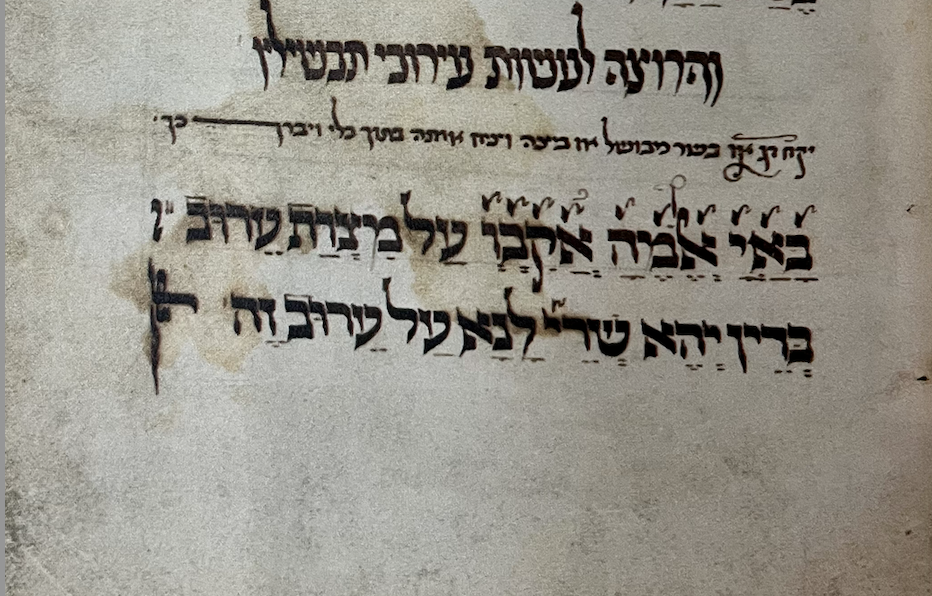
La-Yesharim Tehillah – Among the first titles published by the press is La-Yesharim Tehillah, a drama by the renowned kabbalist R. Moses Hayyim Luzzatto’s (Ramhal, 1707–1746). Ramhal is best known today for his Mesillat Yesharim, a popular and much studied ethical masterpiece. La-Yesharim Tehillah (Praise to the Upright), a very different composition, is one of Ramhal’s last works. It is an allegory, expressing the feelings of persecution he experienced due to controversy about him, and reflecting his belief in the ultimate victory of the just. This edition was published in octavo format (80: 72 pp.).

1824, La-Yesharim Tehillah

The title-page, which has no ornamentation, neither decorative borders nor a printer’s mark, states:

La-Yesharim Tehillah
Shir Yididos

On the day of the wedding of the sage, the wise, כהר”ר [the honorable rabbi]
Jacob Di-Gais יצו [may his Rock and Redeemer watch over him]
With the bride, the virgin, the modest
Lady Rachel De Vega Enriques יצו [may her Rock and Redeemer watch over her]

I, the young
Moses Hayyim ben Jacob Hayyin Luzzatto, have written it.
First printed in Amsterdam in 1740
And printed a second and third time in Berlin in 1780
And in the year
[5]584 (1824) לבע [From the creation of the World].
LISSA
At the press of the partners, Gabridor Warschauer, and Company.
At the expense of the exalted R. Lipman of Koenigsberg.

The title, La-Yesharim Tehillah, is from the verse “[Sing forth, O you righteous, to the Lord; it is fit that] the upright [acclaim, praise] Him” (Psalms 33:1); the subtitle, is from “For the leader; on the shoshannim by the son of the Korah, A maskil, a song of endearment (A Love Song, Shir Yididos (Psalms 45:1).

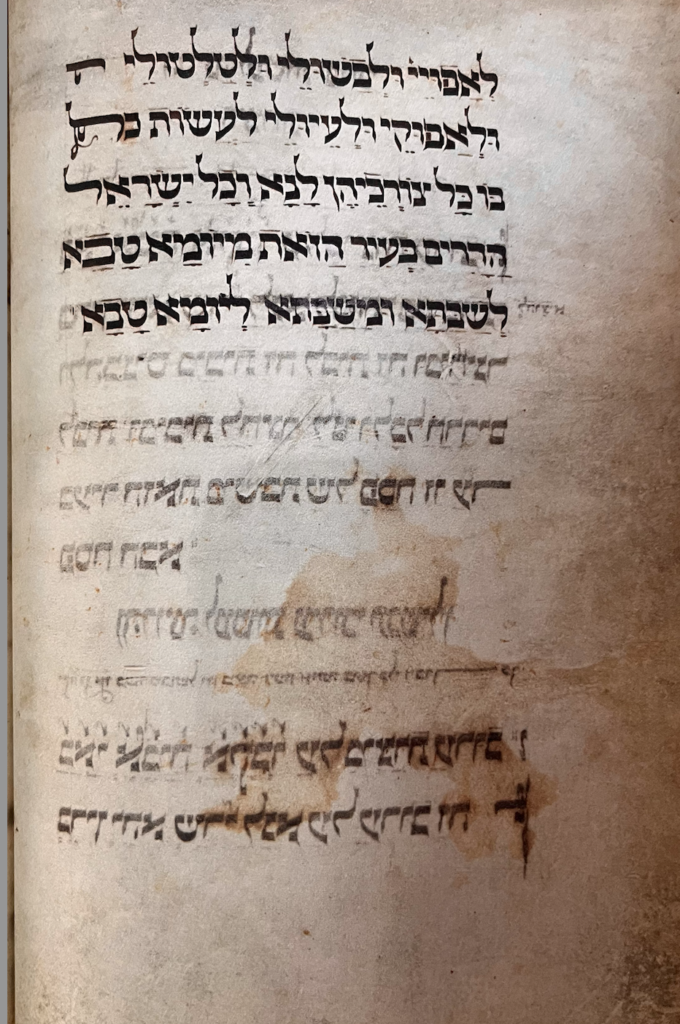
The title-page is followed by prefatory material set in rabbinic letters, among them introductions, one from R. Solomon ben Joel of Duvno, descriptions of the allusions in the play, a list of the characters, and the play. The text is in square vocalized Hebrew. La-Yesharim Tehillah, Ramhal’s third and last play, was written in Amsterdam and represents the climax of his dramatic art. The play is an allegory in three acts of four, five and six scenes. [10] An example of the text,

Understanding: O Uprightness, Beloved of my soul, let thy heart take courage; like a girdle gird on strength! For when assistance seems far away, relief comes suddenly to us. When in the blazing heat, in summer drought, the sky is covered with thick darkness of the clouds whose thunder roaring makes the earth beneath to quake; when lightning flashes like an arrow; when the wind rends the mounts, as thought they were earthen pitchers . . . then the beasts of the forest all together take refuge, and all the young doves flee into the clefts of rocks. . . .

Uprightness: O understanding, of joy of my heart, thy comforting has surely enlarged my heart. For now it seems as though from the words of thy mouth I behold an opening for my hope. But be so kind, if thou hast good tidings. Withhold it not from me.[11]

A popular and much reprinted work, the Bet Eked Sepharim records twenty-six editions through 1949. According to the Bet Eked Sepharim this is the eighth edition, not the fourth printing of La-Yesharim Tehillah.[12]

Likitat Yosef – Also printed in 1824 and, reportedly, again in 1826 is R. Joseph Yuspa ben Tzvi Hirsch Hirschfeld’s Likitat Yosef, a linguistic work, a Hebrew-Yiddish Dictionary with references to Biblical verse for instructing children.[13] This too is an octavo ([6], 61, [1] ff.). The publishers are given as Medihernfort and Kamp. Hirschfeld (d. 1848), a pedagogue, is credited with three additional works, Yad Yosef (below), Middot ha-Derashot Halakah (Berlin, 1840), and Shir ha-Yahid (Berlin, 1833), on prayer and zemirot.[14] Another work, recorded by William Zeitlin is Bechinath Olam (Berlin, 1838), “Reflections on the world and its inhabitants by R. Jedaya Penini. …”[15]

The title-page of Likitat Yosef is formatted in the same manner as La-Yesharim Tehillah, that is, without ornamentation. However, unlike the preceeding work, which is dated in a straight forward manner, Likitat Yosef is dated with a chronogram, “‘Accursed is the one who moves the boundary of his fellow ארור מסיג גבול רעהו (584 = 1824)’ (Deuteronomy 27:17) for fifteen years.” The restriction on reprinting Likitat Yosef is highly unusual, not because it states the time limit for reprinting the work, but due to its mention on the title-page rather than in an approbation, which is the customary way of restricting unauthorized republication, and that it is used as the dating chronogram. The title-page states that it is:

Sefer
Likitat Yosef
A key
To finding pleasing items,
One language and other things[16]
Hebrew . . . words from
Yuspa Hirschfeld
Preschool teacher . . .
Printed
Here, in the crowned city
LISSA
“Accursed is the one who moves the boundary of his fellow” (584 = 1824) for fifteen years.
At the press of the partners from Dyhernfurth, Medihernfort and Kamp

The title-page is followed by the introduction which begins “‘A wise man has his eyes in his head’ (Ecclesiastes (2:14), an understanding scale in his hand, and the roots of understanding branch out in his eyes. He will see that ‘My heart overflows with a goodly theme’ (Psalms 45:2): to teach the young of the children of Israel ‘a clear language’ (Zephaniah 3:9).” Hirschfeld continues on the importance and value of the youth of Israel learning the language well, on a daily basis. The heart of the wise person values this in contrast to the fool who has no appreciation. Hirschfeld states that due to his love of brevity he has not expounded on words at length

There is a brief postscript in which Hirschfeld references his father, R. Tzvi Hirsch, followed by a brief statement from the printer who states that it is not as leket shikhhah, the forgotten gleanings from the field, but rather is selections all pure. Below is an acronym, the first letter of each line spelling Joseph Yuspa. Next is a list of sixty-three contributors (sponsors) arranged by city in German (Fraktur), that is, Breslau (22), Posen (17), Lissa (14), Krotoschin (6), Wortenborg (2), and D. Ostrowo (2).

1824, Likitat Yosef

The text is set in two columns, arranged alphabetically. Within each column words are given in Hebrew in square vocalized letters with their explanation in Yiddish set in a smaller font comprised of a mixture of Vaybertaytsh and rabbinic letters. Synonyms are given in order and words are organized by letters of the alphabet and vowels, for example, ayin patach, ayin segol, for example

Likitat Yosef has been reprinted several times, beginning, as noted above, with a reported second Lissa edition (1826), Vienna (1825), and again in Vienna (1835).[17]

Tehinat Imahot; Techina Shlosha She’arim – Our next Lissa titles are two small octavo tehinot, that is, Tehinat Imahot ([8] ff.) by Hadas, the wife of the late R. Yudel of Hadzish and Techina Shlosha She’arim ([16] ff.), no author given. Both were printed, respectively, in 1824 and 1825, by the Hebraisher Buchdruckerei (Hebrew book printers) with the same title-page format as noted above.

Tehinnot are described by A. Idelsohen as private devotions, often the source for later public prayers. They are a personal, spontaneous and inspired form of expression representing the craving of the soul. They may be understood as in keeping with Berakhot (28b), which states, “do not make your prayer routine, but rather free supplications and petitions before God.” Tehinnot were written through the ages by men of piety; they have been described as a “rivulet of that warm and soulful outpouring [that] never ran dry in Israel.” They have been written through the generations to express plights, needs, wishes, and aspirations which move the heart. Originally in Hebrew, they have been written in all languages spoken by Jews. Tehinnot in Yiddish were mainly for women and those unfamiliar with Hebrew. In many cases tehinnot were published in book form.[18]

Similarly, Meyer Waxman writes that “Tehinoth were the special medium of devotion of the women of Israel and were adapted . . . both in form and content to their needs. Generation after generation of pious souls had poured forth their hearts before their Maker and pleaded for the health and welfare of their near and dear ones in the semi-lyrical language of these supplication prayers.” He notes their varied nature, describing them as heterogenous, addressing all phases of life, supplications in an intimate tone.[19]

The text of both or our tehinot are set in Vaybertaytsh, a semi-cursive type generally but not exclusively, reserved for Yiddish books, so named because these works were most often read by the less educated and women. They were clearly meant for an Ashkenazi audience, for books in Vaybertaytsh were certainly not directed or intelligible to a market outside that community, but also evidence that that market was sufficiently large enough to justify the publication of works for a particular element of rather than for the entire Jewish community.[20]

The title-page of Tehinat Imahot (mother’s supplications) states that it is a collection of prayers of life, continuing in Yiddish that it is with the merit of our fathers and mothers and the Lord who has given us years of life through honorable deeds. The text is in a single column, set in Vaybertaytsh.

Techina Shlosha She’arim is in three parts, as noted on the title-page, that is, hallah, niddah, and lighting Sabbath candles; Shabbat and Rosh Hodesh; and the Yamim Nora’im. The text, set in a single column in Vaybertaytsh, excepting headings and introductory lines, is comprised of both prayers and brief halakhic notes. The references to hallah, niddah, and lighting Sabbath candles concerns the taking of a portion of bread for an offering; niddah, the monthly menstrual separation; and hadlaka, lighting the Friday evening Sabbath candles. The importance of these activities is based on Shabbat 31a, which states “For three transgressions woman die in childbirth. Because they are not observant [of the laws] of Niddah, Hallah, and lighting of Sabbath candles.”


1825, Techina Shlosha She’arim


This is the only edition of Tehinat Imahot. This is the first edition of Techina Shlosha She’arim; it has been reprinted numerous times, the Thesaurus records twenty-one editions.[21]

Yad Yosef – Our second R. Joseph Yuspa Hirschfeld title is Yad Yosef. This, the first edition, is not, as noted above, recorded in the Thesaurus as a Lissa imprint but rather as having been printed in Vienna at the press of Anton Schmidt in 1826. Friedberg, in the Bet Eked, does record this edition as a Lissa imprint.[22] It was published as a duodecimo (120: [2], III-VI, [VII-XII], 216, [2] pp.). The title-page, which does not name Lissa as the place of publication, follows the style of the other Lissa imprints, that is, with a simple title-page devoid of ornamentation. It describes Yad Yosef as the names of the persecuted שמות הנרדפים for which there are references. It is dated “And we will rejoice in the words of your Torah ונשמח בדברי תורתך (588 = 1828).” The colophon dates completion of the work to Wednesday, Rosh Hodesh Heshvan, in the year “Happy is the one who waits אשרי המחכה (589 = October 8, 1828)” (Daniel 12:12).

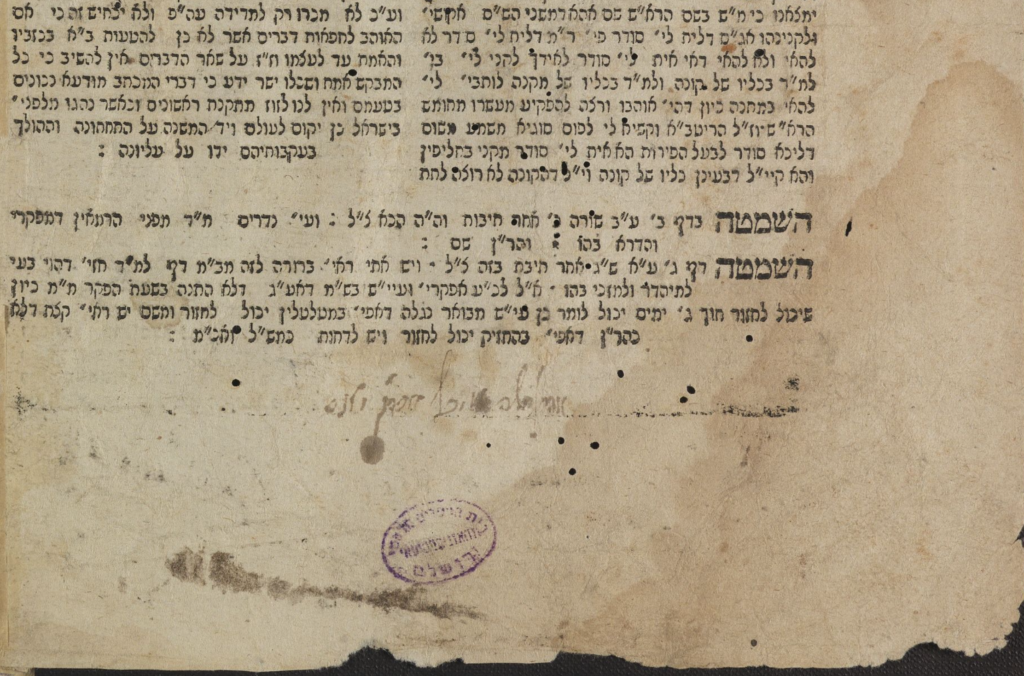
Yad Yosef reads from left to right, like a German book. Nevertheless, it begins with a Hebrew title-page followed a multi-page vorrede (preface) in German followed by a second lengthy preface in Hebrew. The former has an image of justice, sitting blindfolded with a sword in one hand, scales in the other. Below it is Hebrew text that states,

“See for yourselves how my eyes
lit up when I tasted that bit of honey” (I Samuel 14:29)
“If my anguish were weighed” )Job 6:2) on the matter.
“My full calamity laid on the scales” )Job 6:2) and for my heart suffices.

Repeated below it are those verses in German. The Hebrew introduction begins in a light manner that might perchance be meant to be humorous or sarcastic, stating that “it is well known, especially to those who love words of acumen אמרי בינה that it is the custom for a work, small or large, to have a have a brief summary of the book’s topic – to place words in the mouth of the reader, his eyes to see, his eyelids discern the apology, and quickly find the object of his desire.” He then continues, begins, in a more serious vein,

that he “has walked in their footsteps and prepared a lexicon, also I – and this work (letter) I gathered with great diligence, nights as days, with exertion for the honor of the Torah and those who study it: who love and cherish it the beloved! “The teaching of the LORD is perfect” (Psalms 19:8), in it are written and I have found the reasons of DIFFERENT WORDS IN EXPRESSION AND TOUGHT – I have arranged them alphabetically . . .

1828, Yad Yosef

The introduction is followed by the text, set from left to right, comprised of Hebrew works and concise bi-lingual references. Entries are brief, the Hebrew word in the center in square vocalized letters, to the left a source of the term in rabbinic letters, and to the right a translation in German and biblical source. Three examples of the text, one only with a reference, that to Rashi, from the above image, are:

כביר ע’ רש’י ובאור – Matratze. 1. Sam 19. 13.

ענג Lust, Wohlleben. Jes. 58. 13

תענוג Vergnūgen. Sprūch. 19. 10.

כביר Matratze. 1. Sam 19. 13. which refers to the verse “Michal then took mannequins and placed them in the bed, and she put a כביר goat-skin at its head and covered it with a cloth.” (I Samuel 19:13).

ענג Lust, Wohlleben. Jes. 58. 13 (If you restrain your foot because it is the Sabbath, refrain from accomplishing your own needs on My holy day; if you proclaim the Sabbath ענג ‘a delight’ and the holy [day] of the Lord ‘honored’ and you honor it by not engaging in your own affairs, from or discussing the forbidden: seeking your own needs.” (Isaiah 58:13)

תענוג Vergnūgen. Sprūch. 19. 10. תענוג Pleasure does not befit a fool; surely [it is not fitting for] a servant over dignitaries. (Proverbs 19:10).

Yad Yosef concludes with a multi-page bi-lingual Hebrew-German Oeffentliche Danksagung (public thanksgiving) addressed to Tobias Marcus and L. Mende, an example below:

Let your home be wide open, and let the poor be members of your household. (Avot 1:5)
Dein Haus sei offen, Fremde aufaunehmen, um Gastfreiheit an ihnen su üben; achte sie wie deine Hausgebornrn.”

Open your hand to the poor and needy kin in your land (Deuteronomy 15:11)
Thue deine Hand auf gegen deinen Bruder, de Arman und Dürftigen in deinem Lande.

Yad Yosef has been reprinted twice, in Frankfurt on the Oder (1828) and in Berlin (1830).[23]

A final word on Joseph Yuspa Hirschfeld. Moritz Steinschneider has an entry for Joseph Hirschfeld, which begins “Privatlehrer in Schweria a. d. Warte. [Postena Berol. etc. Mrt. mense Decmbr. A1848. – Autor suspectus,” that is he describes Hirschfeld as a private tutor and concludes that the authorship is suspect.[24] No reason is given for that suspicion and in the absence of any supporting or contradictory evidence Steinschneider’s position remains open, unresolved.

Also attributed to the Lissa press is a Mahzor, dated 1824, not seen by the author. Perchance, this is the Heidenheim Mahzor referred to by Lewin. Another work credited to the press, although its date distances it from the general period of activity of the subject press, is R. Saul Isaac ben Ahron Jacob Kaempf’s Toldot Rabbi Akiva Eger, dated 1838. Also noted is another undated edition of Techina Shlosha She’arim.

We now return to the subject of perchance, that is, whether there was a press in Lissa or, as Dr. Lewin suggests, the books attributed to Lissa were actually printed in Dyhernfurth. Lewin was a respected scholar and his reservations need be taken seriously. However, upon inspection, his contention does not appear to be convincing.

Among his arguments for a Dyhernfurth publication site for the books attributed to Lissa are the likeness of the fonts in the books printed in both locations. However, likeness of fonts is not a strong argument: not only is type available to more than one press from a foundry, but more likely Warschauer took typographical equipment with him when relocating to Lissa, as did Sklower when he relocated to Breslau. Similarly, there is no reason why the worker’s names, not noted in the colophons, is any more suggestive of Dyhernfurth than Lissa, nor does the insufficient description of the press seem sufficient evidence to question its location. That the women’s prayer books appear to be inconsequential to Lewin does not detract from their communal value or suggest that they were printed elsewhere. That the press is not mentioned in communal news or documents may be because the press was not consequential. It might be well asked, if the Lissa press was in Dyhernfurth, why is it not mentioned in their communal records, or, finally, what was to be gained by concealing the press’s location.

On the other hand, just as Sklower left Dyhernfurth for Breslau so did Warschauer leave Dyhernfurth for Lissa. That the press appears to have done poorly there actually supports a Lissa location. A small press, it did not publish “consequential” works such as the Talmud, large halakhic titles, or responsa. The books that it did publish were of value to a, perchance, less educated community, addressing their needs, including women’s prayer books.

A likely reason for the presses’ difficulties and brief existence may actually be its location, that is, in Lissa. That location, as noted above, at one time a city of import, had begun to decline after the partition of Poland and its annexation by Prussia in 1793. No longer an important commercial center nor a location with a history as a center of printing. Lissa had no prior press, nor was it well situated for a press. The books it published were small, of value to a local population, consisting of ethical, linguistic and liturgical works, but did not address the needs of a more sophisticated population with leading yeshivot, as Lissa had been so earlier. It was not set up for book distribution, a basic requirement for a successful press. Several of the books that it did publish, were quickly reissued in Vienna, republished at the press of Anton Schmidt, a publisher of consequence.[25]

Given the restrictions on reprinting stated on the title-page of Likitat Yosef it would appear that the almost immediate reprinting of that title and other works were at the initiative of the author. Given the poor distribution of Lissa imprints Hirschfeld likely sought a larger and more successful press, an objective filled by the press of Anton Schmidt. Perchance, no, in this instance certainly not perchance, but more likely, indeed assuredly, if the books had been printed in Dyhernfurth, with its history of printing and successful book distribution, there would not have been a need to reprint these titles in Vienna.

All of the above notwithstanding, the books that were published in Lissa, albeit small in number and in size, were worthy titles. Lissa was, as noted at the beginning of this article, one of many presses, small in size and output, which are poorly recalled today. Nevertheless, this does not detract from the fact that these presses published valuable works, serving the needs of the local population. Here too, the Lissa press, despite being short lived, published books of value to its community and deserves to be remembered and well regarded.

[1] I would like to express my appreciation to Eli Genauer for reading the article and his comments. All images in this article are Courtesy of the National Library of Israel.

[2] The background information on the history of Lissa (Leszno) is a composite of the following articles on that city, namely Jacob Rothschild and Danuta Dombrowska, “Leszno,” Encyclopaedia Judaica, vol. 12, p. 667; Gotthard Deutsch and Samuel Baeck, “Lissa (called formerly Polnisch Lissa),” Jewish Encyclopedia, vol. 8, pp. 107-08; “Leszno (I),” The Encyclopedia of Jewish Life Before and During the Holocaust, vol. 2, pp. 74-74; and Hanna Węgrzynek, “Leszno,” YIVO Encyclopedia of Jews in Eastern Europe, translated from Polish by Joanna Nalewajo-Kulikov, vol. 1, p. 107.

[3] Yeshayahu Vinograd, Thesaurus of the Hebrew Book. Listing of Books Printed in Hebrew Letters Since the Beginning of Printing circa 1469 through 1863 II (Jerusalem, 1993-95), p. 407 [Hebrew].

[4] Ch. Friedberg: History of Hebrew Typography of the Following Cities in Europe: Amsterdam . . .Dyhernfurt . . . From its Beginning in the year1516 . . (Antwerp, 1937), p. 72 [Hebrew].

[5] Concerning the printing of the Talmud in Dyhernfurth see Marvin J. Heller, Printing the Talmud: A History of the Individual Treatises Printed from 1700 to 1750. (Brill, Leiden, 1999), pp. 219-43.

[6] Louis Lewin, “Hebrãische Drucke und Drucker aus Grosspolen,” Soncino-Blãtter (Berlin, 1925-26), pp. 173-74. R. Louis Lewin (1868–1941), was a German rabbi and historian. He served as rabbi in several communities prior to settling in 1937 he settled in Palestine. Among his several works is Geschichte der Juden in Lissa (1904). Israel Halpern, “Lewin, Louis,” EJ 12, p. 761.

[7] Ch. B. Friedberg, Bet Eked Sepharim, (Israel, n.d), var. cit. [Hebrew].

[8] Aron Freiman, A Gazetteer of Hebrew printing, reprinted in Hebrew Printing and Bibliography (New York, 1976), p.298.

[9] Concerning the intentional misdating of Hebrew books or giving a different location see Marvin J. Heller, “Who can discern his errors? Misdates, Errors, and Deceptions, in and about Hebrew Books, Intentional and Otherwise,” in Further Studies in the Making of the Early Hebrew Book (Brill, Leiden/Boston, 2013), pp. 395-420.

[10] Meyer Waxman, A History of Jewish Literature III (New York, London, 1960), pp. 101-04.

[11] Benzion Halper, “Dispute Between Understanding and Uprightness” in Post – Biblical Hebrew Literature: an Anthology (Philadelphia, 1921), pp. 243-246

[12] Friedberg, Bet Eked Sepharim, lamed 422. The eight printings recorded by the Bet Eked Sepharim, in contrast to the first editions cited on the title-page of this edition are 1) Amsterdam,1743; 2) Berlin, 1780; 3) Lvov, 1790; 4) Lvov, 1799; 5) Berlin, 1799; 6) Lvov, 1803; 7) Lvov, 1823; and (8) Lissa, 1824.

[13] Both the Thesaurus and the Beit Eked Sefarim have entries for a 1826 edition of Likitat Yosef. However, none the library catalogues checked, admittedly a small number, nor World Cat, he world’s largest network of library content and services, record an 1826 edition of Likitat Yosef.

[14] Vinograd, Thesaurus I, p. 221.

[15] William Zeitlin, Biblotheca hebraica post-Mendelssohniana (Leipzig, 1983). p. 144.

[16] This phrase appears, with a single letter variation, in Genesis 11:1 as “[The whole earth was of] one language and of common purpose .שפה אחת ודברים אחדים.” Perhaps this form of the verse on the title-page is more appropriate for Likitat Yosef, as it appears in halakhic and midrashic works as well as commentaries, and one kabbalistic work, Sefer Milḥamot Hato Likitat Yosef’ as “The whole earth was of one language and other purposes שפה אחת ודברים אחרים,” suggesting Likitat Yosef’s linguistic purpose, that is, it is a bi-lingual dictionary.

[17] Friedberg, Beit Eked Sefarim, lamed 788; Vinograd, Thesaurus, I, p. 221. Concerning the 1825 Vienna edition of Likitat Yosef. There is no question of misdating or incorrect labeling. The 1825 Vienna was seen and a comparison of the two editions show that it is as described, a separate, independent, and apparently slightly expanded printing of the Lissa edition of Hirschfeld’s Likitat Yosef, this at the press of Anton Schmidt.

[18] A. Idelsohen, Jewish Liturgy and its development (New York, 1932), pp. 257-58, 264-65;

[19] Waxman, p. 641.

[20] Concerning the early use of Vaybertaytsh see Herbert C. Zafren, “Variety in the Typography of Yiddish: 1535-1635,” Hebrew Union College Annual LIII (Cincinnati, 1982), pp. 137-63; idem, “Early Yiddish Typography,” Jewish Book Annual 44 (New York, 1986-87), pp. 106-119. In the former article, Zafren informs that the first book in which Yiddish was a segment was major was Mirkevet ha-Mishneh (Sefer shel R. Anshel), a concordance and glossary of the Bible (Cracow, 1534/35). In the latter article he suggests that the origin of Vaybertaytsh, which he refers to as Yiddish type, was the Ashkenaz rabbinic fonts, supplanted by the more widespread Sephardic rabbinic type which prevailed in Italy (p. 112).

[21] Vinograd, Thesaurus II, p. 165.

[22] Friedberg, Bet Eked Sepharim, yod 119; Vinograd, Thesaurus II, p. 230.

[23] Friedberg, Bet Eked Sepharim, yod 119.

[24] Moritz Steinschneider, Catalogus Liborium Hebraeorum in Bibliotheca Bodleiana (Berlin, 1852-60), col. 1043, no. 5233.

[25] Anton Schmidt was sufficiently sucessesful and the quality of his books highly regarded with the result that he was ennobled in 1823 by the Austrian Emperor, so that he now was Anton Von Schmid.


Poetry and Wordplay in the Book of Kohelet

Poetry and Wordplay in the Book of Kohelet

By Joseph Wertzberger[1]

Sefer Kohelet, the Book of Kohelet, was written approximately 700-600 BC according to Rabbinic sources,[2] and is dated to somewhere between that time and the early to mid-third century BC by academic sources.[3] Its wisdom is traditionally attributed to King Solomon.[4]

The book is part of ancient Hebrew wisdom literature, and is known for its existential, philosophic lessons and motifs. But alongside that also, the book is suffused with sophisticated poetry and wordplay, and I’d like to use this essay to point out a few examples.

  1. The Meaninglessness of Huvel

The book begins with its most well-known verse, summarizing the work’s theme and setting its tone.

הבל הבלים אמר קהלת, הבל הבלים הכל הבל. קהלת א ב

Huvel of huvel,[5] said Kohelet, huvel of huvel, all is huvel.

The word huvel can be translated variously as air,[6] vapor, meaninglessness, vanity,[7] folly, futility, absurdity,[8] or nothingness.[9] The word is repeated throughout the book as a motif, describing aspects of human endeavor and life experience.

The book begins with a bang, so to speak; a strong summary statement that captures the book’s theme, while also the reader’s attention; and the theme is then explained, elaborated upon, and expanded throughout the rest of the book. The sentence is only eight words long, and a remarkable five of them, more than half of the sentence, are the same word, essentially nothing.

Using a word that also means air, or vapor, as the book’s theme is not accidental, for in the author’s effort to examine life’s purpose, meaning and sense, to dig into it and to pin it down, he (and we, alongside) discovers ultimate meaning and sense to be elusive. We think we understand things, and our minds naturally intuit purpose and endow things with meaning, but the moment we try to pin it down and fully capture it, it slips through our fingers like so much vaporous air.

In fact, the word huvel itself symbolizes its meaning onomatopoeically well, being composed of only soft consonants,[10] its vocalization almost entirely pure breath itself, with no hard sounds; an unusual verbal formulation. The entire sentence, in fact, is composed almost completely of “air” with almost no hard consonants, the only two being the hard ‘k’ sounds in Kohelet and hakol, balancing each other out at the two ends of the sentence. When the sentence is read aloud, particularly with its ancient Hebrew pronunciation and syllabic emphasis, it has a very lilting, bouncing and poetically balanced quality to it.[11]

It is also intriguing to notice that the hard ‘k’ sound in hakol is in fact the only thing that distinguishes the word from the similar word huvel – in fact, even more so, the tiniest difference between the letters kuf and vet are what distinguish absolutely everything from nothing! And the only other ‘k’ sound in the verse is in the only other physical object that appears in the sentence, the speaker of the sentence at its opposite end, who is examining everything, and turning it into nothing.[12] And so, essentially, nothing appears in the sentence until almost its very end, and when something does appear, everything appears all at once with the one simple word, hakol, and it’s all immediately revealed to in fact be… hevel, nothing at all.

  1. Onomatopoeia

The book includes many beautiful examples of onomatopoeia. In addition to the word huvel and its use as mentioned, some of the best are the following.[13]

כל הנחלים הלכים אל הים והים איננו מלא, אל מקום שהנחלים הלכים שם הם שבים ללכת[14]. קהלת א ז

We hear the pitter-patter of water bouncing, running and tumbling through the brook down the mountainside.

סובב סבב הולך הרוח ועל סביבתיו שב הרוח[15]. קהלת א ו

The wind’s whistle and howl comes through.

כי כקול הסירים תחת הסיר, כן שחק הכסיל[16]. קהלת ז ו

We can clearly hear the kindling under the kettle crackle and hiss,[17] and the fool’s braying cackle alongside.

אם ישך הנחש בלוא לחש, ואין יתרון לבעל הלשון[18]. קהלת י יא

Here we hear the hiss of the snake, and the whispered sounds of the luchash, in the sounds of the sentence. There’s also a poetically ringing rhyme to the verse, and the gossip whisperer’s tongue coming at the end of it circles poetically back to the snake at its start, whose bite is also viscerally associated with its flicking tongue (snakes hunt by smelling prey through their tongue).

  1. He Gives Another, His Portion

כי יש אדם שעמלו בחכמה ובדעת ובכשרון ולאדם שלא עמל בו יתננו חלקו[19]. קהלת ב כא

The word chelko at the end of the sentence seems initially extraneous and off-balance, for when we read the sentence from its start, it seems complete with the word yitnenu. The word chelko then appears, almost an added appendage at the sentence’s end.

It seems that the word chelko (his portion) would have fit the sentence better had the preceding word been yiten (he gives) instead of yitnenu (he gives it to him). Since the word yitnenu includes a subject-reference, it’s odd to refer to the subject again in the next word. Noticing this odd juxtaposition and double subject reference clues in the reader to understand that the person (and portion) described in chelko can also be read as referring to the receiver.[20]

In other words, the sentence is written so as to create in the reader an initial visceral perception of chelko as referring to the giver, followed by an understanding that it refers to the receiver; providing – in prose – an illustration of the very act described by the prose itself, namely having chelko, the portion, ‘pass’ as it were, from the giver to the receiver![21]

  1. Making Meaning of Experience

ראיתי את הענין אשר נתן אלהים לבני האדם לענות בו. קהלת ג י

The words “inyan’ and “la’anot” in this sentence have at least four translations, all of which fit together to provide a fuller meaning to the sentence.

La’anot and inyan can mean suffering, pain and negative experience, as in,

וכאשר יענו אותו. שמות א יב

כל נדר וכל שבעת אסר לענת נפש. במדבר ל יד

יום ענות אדם נפשו. ישעיהו נח ה

This translation is given to the words by the Targum,[22] and in this reading the sentence means, “I saw the suffering that God gave people to be afflicted with.”

La’anot and inyan can also mean celebration,[23] happiness and positive experience, as in,

קול ענות אנכי שמע[24]. שמות לב יח

כי האלהים מענה בשמחת לבו[25]. קהלת ה יט

This translation is given by Mordechai Zer-Kavod in his commentary to Mossad Harav Kook’s edition of Kohelet, and at Kohelet 1-13 he notes a similar translation by R. Shlomo Kluger. In this reading, the sentence means, “I saw the experience that God gave people to be enjoyed with.”

La’anot and inyan can also simply mean experience, with no negative or positive connotations, similar to the Rabbinic Hebrew, and from there modern Hebrew’s, use of the common word inyan,[26] as in,

וענתה שמה כימי נעוריה. הושע ב יז

R Sa’adia Gaon, Rashi, Rashbam, Ibn Ezra and Ralbag provide similar translations of the word.[27] In this reading the word inyan means a matter, or engagement, la’anot means something like “to be engaged in” or “exercised with”, and the sentence is translated as, “I saw the engagement that God gave people to be exercised with.”[28]

So, it turns out, there are three different ways to translate the words inyan and la’anot, each of which changes the overall meaning of the verse, and each of which diverse translations are accurate, work in the sentence structure, and can provide meaning to the sentence.[29] Which is all to say, that our interpretation of experience and how we see it, provides the meaning we give to it!

Finally, la’anot and inyan can also mean to witness, as in,

לא תענה ברעך עד שקר. שמות כ ב

לענות בו סרה. דברים יט טז

וענתה השירה הזאת לפניו לעד. דברים לא כא

In this translation the verse means, “I saw the experiences that G-d gave to people to witness (i.e., to see and experience)”.[30]

Here too, are two layers of meaning, for in one sense, to say that one has ‘witnessed’ an event is simply another way of saying that one has seen and experienced it. But in a deeper sense, it is the witnessing of the event itself that gives meaning, shape and form to the event; and with no witness, the event would be formless and without meaning.[31] This reading, of course, fits right into, and complements, the first three readings of the verse, for it is our experience of an event, and the way in which we witness it, that creates it as an event for us, provides us its meaning, and makes it what it is to us.[32] [33]

  1. Relax, In the End Nothing Makes Sense

הבל הבלים אמר הקוהלת הכל הבל. קהלת יב ח

The same sentence that began the book, bookends it again as its conclusion.[34] [35] Its meaning at both ends, however, can be read differently.

In writing and in reading the book, and in working through its problems, questions, discussions, and thematic variations, the author and his readers undertake a journey of exploration of life’s contradictions and paradoxes. Taking that journey, in depth, leaves the traveler different at the end than at its start, for along the way, the reader has discovered, and partly through their own thoughtful exploration of the author’s words, that the only choice, and inherent to life’s experience, is acceptance of the absurdities and paradoxes intrinsic to it.[36] [37]

In this way, what began as a lament of discomfiture at life’s impossible contradictions, ends as a statement of their factuality and acceptance. As we initially began peeling away the layers of life’s onion, and realizing that things don’t make as much sense as we intuitively feel they should, our natural, instinctive need for sense is disturbed. But at the journey’s end, once we’ve gone through the process of internalizing experience’s innate senselessness, its fuller realization and our more complete understanding that it’s all simply part of life’s inherence, permits us to accept things for what they are; and having done that, our experience becomes all the easier for it, rather than harder. Things are not really meant to make sense anyhow, they never completely will, and in the final analysis, it gives us permission to take our life in hand once again, accept it, make of it its best, and live it calmly[38] and productively,[39] prudently and judiciously,[40] happily[41] and to the fullest of our efforts.[42] Like the t-shirt that reads, “Relax, nothing is under control”, the excision of our attempts at understanding releases us from them when they don’t serve us well.

Relax, do what you can to live a good life… “before the silver cord snaps, before the golden cup shatters…[43]

.הבל הבלים אמר הקוהלת הכל הבל

[1] The author is the creator of the youtube channel “Understanding Kohelet”, here.
[2] בבא בתרא טו-א
[3] See, e.g., here. Ibn Ezra also seems to note that at least some of the book’s editing was done after the first temple period, for example at 2-25. In other verses as well, ibn Ezra and other commentators note language and word choices resembling writing of times closer to the Rabbinic period. See also the Preface to Mossad Harav Kook’s edition of Kohelet, Section 5, Part 4.
[4] קהלת רבא א-א, סנהדרין כ-ב
[5] In its simple reading, the double havel havulim can be understood as emphasis, i.e., the epitome of vanity, or utter vanity, similar to the words shir hashirim, and many other double words used in Tanach. In a deeper sense it can also be understood to intimate that huvel, meaninglessness, is itself also meaningless (a double negative that cancels itself out), because by the end of the book, and through its exploration, we discover together with the author, that in as much as things can never be fully and truly understood, an overemphatic focus on meaninglessness is itself meaningless and purposeless.
[6] In referring to air, the author is foreshadowing the many other verses in which the book uses air and wind to represent the ephemeral, fleeting nature of life and experience, e.g., 1-6, 1-14, 12-7, and many others.
[7] Not in the contemporarily more common use of the word vain, as narcissistic pride, but vain as futile.
[8] Not with its commonly used definition of farcically ridiculous, but something much closer to its existentialist philosophic meaning of senselessness, as used in, for example, Albert Camus’ The Myth of Sisyphus.
[9] If our attempt to pin down a precise meaning for the word huvel is frustrated, we are not the first to experience such frustration, for R Sa’adia Gaon, as well, mentions five potential Arabic translations of the word.

Defining the book’s theme through a word that has many translations and interpretations is in no way coincidental, for that is a practice and theme throughout the work, using words and constructing phrases in such ways that exploration and thought is required to unpack and fully understand them in their context, and through such exploration and understanding, different aspects of the intended message are communicated.
[10] The letter vet in ancient Hebrew was pronounced with a “w” sound, similar to its contemporary Yemenite pronunciation.
[11] This is true of much of Tanach, an appreciation of which has been lost due to historic changes in reading style and pronunciation.
[12] The phrase havel havulim umar kohelet may also allude to the fact that even the statements and attempts of the author to examine the world and its meaning are also impossible and vain, as elaborated upon later on in the book, for example chapter 1, verses 8, 13, and 17, and chapter 7, verse 23. So the analysis too, and the attempt at finding meaning, is itself meaningless. See also Ralbag at 12-8.
[13] The poetry and onomatopoeia comes through best when the sentences are read with the sound, pronunciation and syllabic emphasis of original, ancient Hebrew.
[14] All the rivers go to the sea, and the sea is not full; to the place the rivers go, there they return to go.
[15] Circling in circulation, goes the wind, and on its circulation, returns the wind.
[16] For like the sound of the twigs under the pot, so is the laugh of the fool.
[17] In fact, the sounds are very similar to the English words, ‘cackle’ and ‘hiss’, which themselves sound like their meaning.
[18] If the snake bites, without a hiss/spell, and there is no advantage to the master of the tongue.
[19] For there may be a person whose efforts are with intelligence and with wisdom, and with suitability, and to a person who expended no effort over it, he gives (it to) him, his portion.
[20] See Targum, which translates the phrase as יתנניה למהוי חולקיה, “he gives it to become his portion”, clearly reading the portion as attached to the receiver, presumably because of the otherwise odd double subject reference. Ibn Ezra also reads chelko as referring to a subject receiver. Rashbam too, reads chelko as attaching to the receiver, but states that the giver in yitenenu is God (presumably due to the otherwise double subject reference), and in this reading perhaps yitnenu means “it shall be given [by God]”, rather than he shall give it, since the giver in yitnenu is not referring back to the person described in the first half of the sentence.

On the other hand, R Sa’adia Gaon’s commentary clearly translates chelko as referring to the giver. R Moshe Yitzchok Ashkenazi (Tedeschi) in Ho’il Moshe also provides a grammatical reading of the sentence in which chelko refers to the giver.

Reading yitnenu as attaching to the receiver’s object referred to in chelko is also somewhat supported by the ta’amim, since yitnenu is given a munach, tying it to its succeeding word chelko, rather than to its preceding phrase (i.e., the phrase ‘he gives’ modifies ‘his portion’, rather than any object that may have been described earlier in the sentence, in amulo or in bo). Consider also that the object being passed from the giver to the receiver has not yet been explicitly articulated into the sentence prior to the appearance of the word chelko, since, arguably, amulo is describing only the giver’s efforts, not the fruit of those efforts, which would be the object actually being passed; and the word bo in and of itself, does not either provide the sentence with a subject.
[21] Mordechai Zer-Kavod in the Mossad Harav Kook edition of Kohelet describes a third potential subject to which chelko might refer, which is the fruits of the giver’s labor, and in this reading the word chelko means “part of”, i.e., a part of the giver’s possessions, and the sentence reads as, “For there is a person whose efforts are with intelligence… and to a person that labored not for it, he gives part of it.” See also Rashi on the verse for a similar formulation based on midrash.
[22] In Kohelet 1-13, the verse includes a similar formulation

ונתתי את־לבי לדרוש ולתור בחכמה על כל־אשר נעשה תחת השמים הוא ענין רע נתן אלהים לבני האדם לענות בו

and Targum, ibn Ezra and Tanchum Yerushalmi provide a similar translation to the words inyan and la’anot in that verse, while Metzudat Tzion provides a similar translation for the word la’anot, although not for the word inyan, and Ri Karo provides a similar translation for the word inyan, although not for the word la’anot.
[23] It is quite possible that the root of the word enu as it is used in phrases like

עלי באר ענו לה, במדבר כא יז, ענו לה׳ בתודה, תהלים קמז ז, ביום ההוא כרם חמר ענו לה, ישעיהו כז ב

is also related to the word celebration, although in these cases it is also, and perhaps more closely, related to word respond or say.
[24] See for example, Ibn Ezra, Ramban, Ralbag and R’ Avraham ben Harambam, although others provide different translations of the word in this sentence too.
[25] See Rashbam and Ralbag, although there are also other ways to translate the word in this sentence as well.
[26] In reviewing the related words and meanings in all of these similar verses, as parsed through the various commentaries, it seems to me also that the general word inyan in this reading, as meaning something close to an engagement, or more simply a thing, something that is, may also be etymologically related to use of the similar word and root for the concept of residing in or simply being in, as in the word ma’on.
[27] In some cases these translations are in Kohelet 1-13, and as between the different commentators, they are provided with varying nuance as to the precise translation and word usage.
[28] In the larger context of the chapter, this sentence is a response to the verses coming just before it, which read,

לכל זמן, ועת לכל חפץ, תחת השמים. עת ללדת ועת למות… עת לאהב ועת לשנא, עת מלחמה ועת שלום. מה יתרון העושה באשר הוא עמל

This well-known section of Kohelet questions the point of a life of constant change and dissolution, where the pendulum of experience always swings from one side to the other, and where every effort invested, and even the things invested in, often ends and changes to its opposite; and therefore, the question is begged, “what advantage the doer in such that he toils?”

It is this question that the present verse responds to, explaining that these fluctuations and changes in expended effort, and in life and experience, in fact have as their purpose the engagement and exercise of people in and with their life and experiences. In other words, the goal settings, fluctuations, achievements, disappointments, moving goal-posts, and corrections, are actually the very things that create the life of engagement and attunement, and a life lived in one straight line would be pointless and meaningless, and lacking in engagement.

The other translations as well, are responsive to the prior verses and question in a similar way. The frustrated and constantly changing efforts can be seen as a form of immiseration that people are afflicted with (in this reading, the present verse in 3-10, is simply extending the question and problem discussed in the prior verse), or they can be seen as challenges which can be invigorating, and bring a person joy when approached from the perspective of, and with a purpose to, building and improving.
[29] This is a good representative illustration of a lot of the messaging in Kohelet, which often revolves around purpose, perception and meaning, and how these are multi-layered, and appear different from different vantage points, or when different factors or interpretations are brought to bear. This is also the key to understanding the many seeming ‘contradictions’ in Kohelet (בבלי, שבת ל׳ ב׳) – for when the meanings and contexts of what are being said are fully understood, they are clearly seen not to be contradictions at all.
[30] And in a fifth translation, which fits right in alongside the rest and is related to witness, the word la-anot can also mean to respond, see medrash rabah here, and ibn Ezra at Kohelet 1-13. And, believe it or not, with these five translations we have still not exhausted all the possible translations of the word as used in the sentence, see for example Rashi, Ri Karo, and Tanchum Yerushalmi in the parallel verse at Kohelet 1-13, each with other, additional translations.
[31] In fact it might questionably even be called an “event” at all.
[32] This theme comes up in art too, for example in Albert Camus’ “The Stranger”, and Jonathan Blow’s “The Witness”.
[33] This verse is a good example of what we find with many of the verses and statements in Kohelet, which is that they can be translated and interpreted from a number of different vantage points, with several layers of meanings able to be peeled back like layers of an onion, while all of those layers of meaning interact with, and nest within, each other to provide an ultimate interpretation and meaning to the sentence. And while it’s easy to assume that some or many of these interpretations are unintentional, and arise coincidentally due to the poetic nature of the text, or due to the brevity of ancient Hebrew which, because it has relatively few words compared to other languages, consequently more meanings and translations for each of its words; on closer reading and familiarity with the nuances of the book’s style and messaging it seems likely that the varied and rich layers of meaning were seeded intentionally.
[34] Rashbam notes that the book’s ending, from this verse on, was appended at a later time by its editors. This is also evident from the style, tone and content of verses 12-9 through 12-14, which differ from the rest of the book. See also Ralbag, Ho’il Moshe at 12-7, and Metzudas Dovid, Shadal at 12-8. It’s also possible that verses 1-2, and 12-8 (the two bookending huvel verses), which more closely resemble the rest of the book, were part of the original earlier work, while verses 1-1 and 12-9 through 12-14 were added later as a kind of prologue and epilogue. See also FN 3 regarding the book’s editing.
[35] The end of the book and its beginning also mirror each other in that the lead-in from the summary sentence to the rest of the book (verses 1-4 to 1-7), and the lead out from the book to the closing summary sentence (verses 12-2 to 12-7) are composed of evocatively colorful imagery, which express their messages of the ephemerality of existence and the eventuality of life’s and of experience’s end, not only in the literal statements of their message, but also in the impressionist emotions that their images create in the reader. As well, some of the same elemental imagery of earth, sun, air and water is mirrored between the start of the book and its end (compare Chapter 1 verses 4, 5, 6 and 7 with Chapter 12 verses 2, 6 and 7).
[36] One cannot point to any one verse that states the premise of this point explicitly, rather it is an idea that develops organically and expands its realization over the course of the work in the perceptions experientially realized by the reader through their effort in working through the book’s perambulatory contemplations and exploratory deliberations. One can point in support, however, among various verses, to 9-7 through 9-10, which in a sense can be seen as the conclusion of the first part of the book (which begins at 1-12). Arguably, it is the author’s intent is for the reader to discover the point’s salience for themself as they work through the book’s ideas together with the author.
[37] That the present verse’s summary conclusion is a result of the conclave of ideas preceding it is also supported by the verse’s choice of wording, ‘umar hakohelet‘, with the definitive article, ‘the’ kohelet – for it is the gathering together and synthesizing of the various strands of thought through the course of the book that produce the conclusions reached at its end. In this interpretation we translate the word kohelet as ‘a coming-together’ or a ‘gathering (n.)’, as in ‘the results of the act of gathering’, or ‘the things that have been gathered’, conjugating the root verb ko-h-el, similar to words such as toelet and pesolet.

Interestingly, the same conjugation of the root also produces the feminine verb, a point made by wordplay in Chapter 7, verse 27, where, as compared to the word construction in our present sentence, the author changed the word kohelet from a noun to a feminine verb simply by moving the letter ‘heh’ over one word (changing amrah kohelt to amar hakohelet).
[38] 12-3 to 4, in its emotional resonance.
[39] E.g., Chapter 11, generally.
[40] Verses 11-8 to 12-1.
[41] Verses 9-7 to 9, and 11-8 to 9.
[42] Verse 9-10.
[43] Verse 12-6.


Renewal of the Hakhel Ceremony in Jerusalem and New York

Renewal of the Hakhel Ceremony in Jerusalem and New York[1]

By Aaron R. Katz

A graduate of the University of Chicago Law School and a musmach of RIETS, Aaron is the Associate Director, Private Equity and M&A Finex at WTW Israel. He lives with his wife and four children in Mishkafayim, Ramat Bet Shemesh.

As we come to the final days of the Shmitah year, preparations will soon begin for the Zecher LeHakhel events that will occur starting with the new year of 5783 (2022), which is a Motzei Shmitah year (the year following the Shmitah year).

During Chol Hamoed Sukkot in 2015, a Zecher LeHakhel ceremony took place in the courtyard in front of the Kotel. As the corresponding Hebrew year of 5776 immediately followed a Shmitah year, the event was a commemoration of the biblically-ordained Hakhel ceremony[2] in which the entire nation would assemble during Sukkot[3] of every Motzei Shmitah year for a public reading by the king of certain parts of Deuteronomy.[4] Present at the event at the Kotel were numerous dignitaries, including the Ashkenazi and Sefardi Chief Rabbis, as well as President Reuven Rivlin.

 The current Hakhel ceremony traces its roots to R. Eliyahu David Rabinowitz-Teomim (1843-1905) (the “Aderet” and the father-in-law of R. Avraham Yitzchak Hacohen Kook), who discussed the establishment of a commemoration of Hakhel in his book Zecher LeMikdash in 1889 (the Hebrew year of 5649, which itself was a Shmitah year), a work that was anonymously published but has been conclusively determined to have been written by him.[5] The first modern-day ceremony took place in 1945, following the end of the 5705 Shmitah year, under the auspices of Ashkenazi Chief Rabbi Isaac Herzog. The ceremony began in the Yeshurun Synagogue and concluded at the Kotel. In 1952, following the 5712 Shmitah year, the Hakhel ceremony was held on Mt. Zion (as the Kotel was under Jordanian rule at the time) and was attended by both R. Herzog and Sefardi Chief Rabbi Ben-Zion Meir Hai Uziel. A book titled Zecher LeMitzvat Hakhel, edited by R. Mordechai Cohen, appeared shortly after the ceremony and contains a lengthy discussion of the Hakhel ceremony, as well as pictures and a description of the 1952 event. [6]

In the Nisan 5713 (March/April 1953) edition of Yeshiva University’s Talpioth journal includes two articles on Hakhel, including one by the journal’s editor R. Samuel K. Mirsky, under the title: “Renewal of Hakhel.[7] At the end of that same journal appears a Hebrew description of a Hakhel ceremony that took place in New York. The description was written by a certain צ.. (which most certainly refers to R. Zvi Tabory, who took part in the event as mentioned below). An English translation of this description from Talpioth appears below.[8]

Hakhel Gathering in New York

On Wednesday, the third day of Chol Hamoed Sukkot, a special gathering took place at the Commodore Hotel in New York to commemorate the Hakhel ceremony.

The gathering was organized by the Jewish Agency’s Department for Torah Education and Culture in the Diaspora to allow the Jews of the Diaspora the opportunity to identify with our brethren in the State of Israel who were assembling at the same time on the summit of Mt. Zion in Jerusalem to take part in a Hakhel ceremony organized by the Chief Rabbinate and the Ministry of Religion, the first such event since the establishment of the State.

The Rabbinical Council of America co-organized this gathering together with the Jewish Agency’s Department for Torah Education and Culture in the Diaspora (the “Department”), and this joint effort was extremely successful. A large celebratory crowd filled the hall, and hundreds of people were forced to go home for lack of space.

Dr. Yosef Burg, Israel’s Health Minister, inspired those assembled with his words on the responsibilities of a Jew, whoever he may be, to the State of Israel. R. Samuel K. Mirsky gave an instructive talk on the renewal of the practice of Hakhel in Israel. R. Zvi Tabory, Director of the Department in New York, opened the evening and pointed out the historic nature of the event, which comes on the heels of the revival of our nation in its land. He also delivered words of blessing on behalf of the Chief Rabbinate of Israel and the head of the Department, R. Zev Gold of Jerusalem. The participants enthusiastically accepted the blessing from Zion: “Just as you have merited to organize this event, so may you merit to perform the ritual properly according to all of its laws in the restored Temple in Jerusalem!” R. Israel Tabak of Baltimore, head of the Education Department of the Rabbinical Council of America, served as the master of ceremonies for the event and introduced R. Theodore Adams, the President of the Rabbinical Council of America, who discussed the concept of Jewish unity. Dr. Pinkhos Churgin, President of Mizrachi in America, delivered words of blessing on behalf of the Mizrachi organization, and R. Yissocher Levin, President of Hapoel HaMizrachi in America, delivered words of blessing from his organization.[9] Mr. Eliezer Doron, Israeli Consul General of New York, delivered words of blessing on behalf of the State of Israel.

A musical program was arranged by Cantor Shalom Katz from Washington, D.C., and Cantor Pinchas Jassinowsky from New York. Mrs. Jassinowsky accompanied them on the piano. 

R. Zvi Yehuda Meltzer, Av Bet Din of Rehovot and Rosh Yeshiva of Yeshivat Hadarom in Israel, recited a special prayer for world peace.

It is quite unfortunate that an event of this caliber only occurs once every seven years; however, we can hope that the inspiration and excitement felt on this occasion will sustain the Jewish community for the next seven years.

The organizers of the event did not want to limit its scope simply to New York; rather, they intended to extend it to outlying cities as well. In turning to rabbis across the United States to suggest that they arrange Hakhel commemoration events in their respective communities, they offered a sample program, attached materials on the topic of Hakhel, and provided copies of the thorough, instructive, powerfully impactful article on Hakhel written by R. Samuel K. Mirsky, an advanced edition of which had been published in honor of the celebration held on Chol Hamoed Sukkot.

In addition, the Department arranged a celebratory Hakhel event for upperclassmen from yeshiva day schools that took place in the large hall of the Rabbi Isaac Elchanan Theological Seminary. This event was also held during Chol Hamoed Sukkot, and 1,200 students from 20 different yeshiva day schools participated. Students from the Shulamith School for Girls put on a wonderful play about the draining of the Hula swamps. A choir of one hundred students from Yeshiva Rabbi Moshe Soloveichik and Yeshiva Rabbi Israel Salanter, conducted by Mr. S. Silbermintz, sung a number of pleasant tunes for the audience.

These young children also lit candles and prayed for world peace, and it is certain that this event left a lasting impact on the attendants.

Conclusion

This post focuses on the rebirth of the modern Hakhel ceremony in the years of 1945 and 1952. In a future post, I hope to examine the manner in which the ceremony was observed in later years in both Israel and the diaspora. Of particular interest is whether R. Mirsky’s push for widespread of observance of Hakhel in the diaspora made a lasting impact following the successful 1952 event.  

Notes:

[1] I wish to thank my dear friends Rabbi Shaul Seidler-Feller, Mr. Menachem Butler and Rabbi Dr. Eliezer Brodt for their assistance on this brief essay at the Seforim blog. The essay is dedicated to the memory of my beloved chavrusa Donny Ladell, דניאל שבתי בן אליעזר ז“ל, upon his thirteenth yahrtzeit.
[2] See Deuteronomy, ch. 31. Also see the recently published Parshas Ha’melech by R. Moshe Parness on pages 118-120 where he quotes the relevant sources that discuss that Hakhel is only a biblical commandment in force as long as the Beit Hamikdash is standing. There is also a sefer called Parshas Ha’melech by R. Shmuel Genut on Hakhel that was just published this summer as a third edition (with the earlier two editions having been published in the two previous Motzei Shmitah years, respectively) that discusses the mitzvah of Hakhel, online here.
[3] For an in-depth discussion on the exact day of when Hakhel would take place, see David Henshke, “When is the Time of Hakhel?” Tarbiz, vol. 61, no. 2 (1992): 177-194 (Hebrew), available here.
[4] See Rambam, Hilchot Chagigah, ch. 3. For a detailed analysis of the Rambam’s opinion and a description of the proper halachic manner in which to conduct a Zecher LeHakhel event, see Maran Ovadya Yosef, Chazon Ovadya: Hilchot Shmitat Ksafim uPruzbul (Jerusalem, 2015), 219-228 (Hebrew), as well as his responsum in She’elot u-Teshuvot Yabia Omer, Yoreh Deah, vol. 10, no. 22. Maran Ovadya Yosef was prominently involved in numerous “Zecher LeHakhel events” at the Kotel. I was privileged to see him in person in 2008 at the last Zecher LeHakhel he attended before his passing in 2013.
[5] See Yaakov S. Spiegel, Amudim be-Toldot ha-Sefer ha-Ivri / Chapters in the History of the Jewish Book, vol. 3: The Title Page (Jerusalem, 2014), 35-36 (Hebrew), regarding the anonymously published Zecher Lemikdash, which includes an approbation from Rabbi Eliyahu David Rabinowitz-Teomim, known as the Aderet, as well as comments that the Aderet himself wrote on the work, which Spiegel notes was purposely done by the Aderet in order to conceal that he himself authored the work.

Note that the Ahavat Shalom edition of all of the Aderet’s writings was published in 2004 and the Zecher Lemikdash volume contains the original Zecher Lemikdash that was anonymously published as well as additional writings from the Aderet that has not previously been published (see pages 22-24 and 82-85).

See also the recently-published volume of The Collected Writings of R. Moshe Reines, ed. Eliezer Brodt (Jerusalem, 2018), 604 (Hebrew), where R. Reines identifies the Aderet as the author of Zecher Lemikdash. For more on this work, see here. Also see Ari D. Kahn, “The Commandment of Hakhel,” Explorations (25 September 2015), notes 2-3, available here, regarding the authorship of Zecher Lemikdash. R. Parness in Parshas Ha’melech (see source 2 above) also quotes Zecher Lemikdash though he argues with one of the Aderet’s sources.
[6] This sefer is available online here.

In a recently published collection of writings of the Chazon Ish titled Sefer Chazon Ish: Shailos uTeshuvos v’Chiddushim, it is recorded in Siman 446 that on his copy of the Sefer Zecher LeMitzvat Hakhel, the Chazon Ish wrote that “assur la’asot ken” (it is forbidden to do so). Perhaps the Chazon Ish’s opinion may serve as one source for the general resistance of Ashkenazi haredi circles to joining in the event at the Kotel, which is more closely identified with the national religious movement (at least from the perspective of Ashkenazim). Notably, since the late Lubavitcher Rebbe, Rabbi Menachem Mendel Schneerson, was a proponent of Hakhel events (see, for example, the letter from R. Schneerson in the beginning of Zecher LeMitzvat Hakhel), the Chabad movement hosts numerous such events around the world throughout the entire year following Shmitah. For a synopsis of R. Schneerson’s views on Hakhel, see, for example, two articles by Shmuel Butman, “A Special Year: Hakhel Gatherings for Torah Inspiration,” The Jewish Press (23 September 1994): 19; and Shmuel Butman, “The Year of Hakhel,” The Jewish Press (21 October 1994): 36. See also the Likras Shabbos volume (volume 516, Parshas Veyelech, 5776) published by Or Hachasidus which contains many insights on Hakhel from R. Schneerson.
[7] Talpioth, vol. 6, no. 1-2 (March-April 1953): 92-118 (Hebrew).

Several months prior to the publication of his Talpioth article, R. Mirsky published two articles in English-language publications on Hakhel in Samuel K. Mirsky, “Hakhel,” The Jewish Forum, vol. 35, no. 9 (October 1952): 167-169; and Samuel K. Mirsky, “The Forgotten Mitzvah,” The Jewish Horizon, vol. 15, no. 2 (October 1952): 3-4. See also the article by R. Mirsky’s brother-in-law in Gersion Appel, “Renewing the Covenant: The Importance of Hakhel for the Jewish Faith and Its Implications for Today,” The Jewish Horizon, vol. 15, no. 6 (February 1953): 6-9.

Interestingly, R. Mirsky posited, based on R. Eliezer of Metz, that there are really two separate Mitzvot involved with Hakhel, one of which is a commandment directed to the entire nation and one of which aims at the individual. R. Mirsky wrote that the individual commandment had been transformed into the modern-day celebration of Simchat Torah, and that, with the establishment of a Jewish state, the national commandment can now be renewed, concluding that “only a Hakhel in which the national aspect is emphasized in fitting celebration can fill the demand of the hour.”

For an initial biographical tribute to R. Samuel K. Mirsky, see Yehudah Mirsky, “The New Heavens in the New World: The Religious Hebraism of Samuel K. Mirsky,” in Adam S. Ferziger and David Sperber, eds., Darkhei Daniel – The Paths of Daniel: Studies in Judaism and Jewish Culture in Honor of Rabbi Professor Daniel Sperber (Ramat-Gan: Bar-Ilan University Press, 2017), 101*-128*, available here.
[8] The JTA also has a write-up of the New York event. See online here:

“A parallel celebration of the revival for the first time in 2,000 years of “Hakhel,” the Biblical ceremony which was performed in ancient Israel at the end of every Sabbatical year, took place at the Hotel Commodore here tonight at a public service sponsored by the Jewish Agency and the Rabbinical Council of America. The service was a counterpart of a similar celebration held in Jerusalem earlier this week on Mount Zion under the auspices of the Chief Rabbinate of Israel. A message from Dr. Nahum Goldmann emphasizing that the furtherance of Jewish scholarship and culture in its various forms is of decisive importance for the survival of the Jewish people and of Judaism, was read at the service here. A “Hakhel” ceremony for children, attended by 1,200 pupils of 19 Hebrew day schools in New York, was held yesterday at the Yeshiva University.”

[9] Note that at this time, Mizrachi and Hapoel HaMizrachi were two Israeli political separate parties. These parties later combined for the 1955 Knesset elections and ultimately merged in 1956 to form the National Religious Party.


A Desperate Plea for Help on Behalf of Vilna’s Old Jewish Cemetery

A Desperate Plea for Help on Behalf of Vilna’s Old Jewish Cemetery in 1919

By Shnayer Leiman

Recently, a brief study was posted online on Meir Zelmanovich, the custodian of Vilna’s old Jewish cemetery, who died a martyr’s death in 1920.[1] Here, we wish to add Zelmanovich’s only published writing, a Yiddish letter that appeared in Vilna’s יידישע צייטונג [Yidishe Tsaytung], on Monday, December 15, 1919.[2] The letter will appear below both in the original Yiddish and in an annotated English translation. It is a significant, and tragic, historical document. Also, mostly due to the recent discovery of a treasure trove of photographs relating to World War I, we will present several newly discovered photographs of Zelmanovich.[3]

For those unfamiliar with Vilna’s old Jewish cemetery, we note that according to a Jewish tradition in Vilna it was founded in 1487. Modern scholars, based upon extant documentary evidence, date the founding of the cemetery to 1593, but admit that an earlier date cannot be ruled out. The cemetery, still standing today (but denuded of its tombstones), lies just north of the center of the city of Vilna, across the Neris River, in the section of Vilna called Shnipishkes (Yiddish: Shnipishok). It is across from, and just opposite, one of Vilna’s most significant landmarks, Castle Hill with its Gedeminas Tower. The cemetery was in use from the year it was founded until 1830, when it was officially closed by the municipal authorities. Although burials no longer were possible in the old Jewish cemetery, it became a pilgrimage site, and thousands of Jews visited annually the graves of the righteous rabbis and heros buried there, especially the graves  of the Ger Zedek (Avraham ben Avraham, also known as the son of Graf Potocki, d. 1749), the Gaon of Vilna (R. Eliyahu ben R. Shlomo Zalman, d. 1797), and the Hayye Adam (R. Avraham Danzig, d. 1820). Such visits took place even after World War II.

Briefly, the historical context of the letter was the battle for control of Vilna in the aftermath of World War I. During the years 1914 to1922, nine different governments ruled in Vilna, making life miserable for its residents. Almost certainly, the greatest concentration of Jewish suffering in this period took place in 1919, when the Polish legionnaires unleashed a pogrom against Vilna’s Jews. Zelmanovich’s Letter to the Editor appeared in print in December 1919 and records in detail the damage to the dead; he left it for others to record the damage to the living.[4] This stage of Polish rule came to an end when the Russians recaptured Vilna in July of 1920. Russian rule lasted for some six weeks, and was followed by Lithuanian rule. On October 8, 1920 the Poles once again recaptured Vilna. Sadly, on October 10, 1920 Meir Zelmanovich was one of a handful of Jews murdered by the returning Polish legionnaires.

1. The Original Yiddish Version of Zelmanovich’s Letter.

2. An Annotated English Translation of Zelmanovich’s Letter.

The Hostile Incidents at Vilna’s Old Jewish Cemetery: (A Letter to the Editor)

Please provide me with a platform to describe the hostile incidents that have taken place – from Passover[5] until today – at the old Jewish cemetery.

Immediately after Passover, the fence (surrounding the cemetery) was breached, and horses were allowed to enter the cemetery. The officers in charge of the horses chose to move into my house, and helped themselves to whatever they could find. It was only when my daughter came down with typhus, that they left the house and encamped on the cemetery grounds. They burned the wooden tombstones, and broke stone tombstones as well. They smashed the tombstones of R. Yisrael Kreines’ father,[6] R. Yaakov Landau,[7] Rekhl the mother of R. Shimon Strashun,[8] R. Mordechai Meltzer’s wife,[9] and a few others. They were about to destroy the wooden tombstone of the Chief Rabbi, R. Hillel,[10]ho died in 1706,[11] but I managed to hide it while it was still whole.

The official rabbi,[12] Rabbi Rubinstein[13] was heavily involved in rectifying matters. We were able to arrange for the horses to be removed from the cemetery. The officers of the Zedakah Gedolah Society[14] arranged for the fence to be repaired at a cost of 7000 rubles. Now, however, the soldiers have returned with saws and axes and have pulled back and rearranged the fence so that anyone could enter the cemetery from the nearby public passage way. Thus, they once again are tearing down the rooftops of the mausoleums.

Regarding the Gaon’s[15] mausoleum, they have now, for a second time, torn down its roof, and also smashed its windows. They have also begun to break down its walls.

They tore off the rooftops of the mausoleums of R. Noah Petletzis[16] and R. Shmuel Landau.[17] Just last night, they placed the carcasses of 5 horses next to the mausoleums.

All our communal Jewish activists are obligated to come and view for themselves the devastation that is taking place in the old Jewish cemetery. And, at the same time, they are obligated to rescue whatever can still be rescued.

Meir Yisrael Zelmanovich,
Custodian of the Old Jewish Cemetery

———-

3. Newly Discovered Photographs of Meir Zelmanovich.

a) Meir Zelmanovich at the Mausoleum of R. Menahem Manes Chajes.


b) Photograph of Meir Zelmanovich at Vilna’s Old Jewish Cemetery.

The top photograph (left) is clearly the original that ultimately appeared in the postcard that was produced in 1916 (right) and discussed in our earlier study.[18] The photograph’s clarity and detail are far superior to that of the postcard, a clear reminder that some postcard reproductions need to be taken with a grain of salt.[19]

The bottom photograph, it seems to me, is a magnificent likeness of Meir Zelmanovich. Someone scribbled in the date 1916, which almost certainly is when it was taken.[20]


Notes

[1] S. Leiman, “In Praise of Ephemera: A Picture Postcard from Vilna Reveals its Secrets more than One Hundred Years after its Original Publication,” The Seforim Blog, July 27, 2020 (here). Cf. The Leiman Library (www.leimanlibrary.com), texts, item 143.

[2] Issue 181, p. 2, columns 1-4. The newspaper lists the Jewish calendrical date as well, 23 Kislev. For a brief history of Vilna’s short-lived יידישע צייטונג (it ceased publication in 1920), see D. Flinker, et al, eds., עיתונות יהודית שהיתה (Igud ha-Olami shel ha-Itonaim ha-Yehudim: Tel-Aviv, 1973), p. 246.

[3] In July of 2020, a huge collection of rare photos of Vilna was sold at auction on Ebay. The photos were made by a professional photographer who served as a photo correspondent working with the German 10th army, which occupied Vilna during World War I. Fortunately, about half of the photos were acquired by a coalition of scholars and patrons of scholarship in Lithuania who realized how significant these photos were. I am indebted to my Lithuanian colleague, Dr. Andrius Kulikauskas, for sharing the above information with me, after the fact. What Andrius could not know is that I too was a bidder in that auction (without knowing all the fine details about who took the photographs), and managed to acquire four photos taken at the Old Jewish cemetery in Vilna, including the two photos of Meir Zelmanovich reproduced below.

[4] For a fuller account of the pogrom itself, see the study cited above in note 1.

[5] Vilna’s Jewish community celebrated Passover in 1919 from the evening of April 14 through April 22. The Russian Red Army ruled in Vilna through April 18, 1919. On April 19, the Polish legionnaires replaced the Russian Red Army. Almost immediately, a pogrom ensued against the Jews, leading to much death and destruction. Vilna remained under Polish control during the period that Zelmanovich published his “Letter To The Editor.”

[6] R. Yisrael Gordon Kreines (1778-1856) was a learned Torah scholar adept in Russian. In 1837 he was appointed Rabbi of Vilna, largely for the purpose of fulfilling the Czarist regime’s requirement that a rabbi be appointed who could record in Russian all births, marriages, and deaths in the Jewish community. See H.N. Steinschneider, עיר ווילנא (Vilna, 1900), pp. 192-195. Kreines’s father, R. Avraham Gordon was a major lay leader (פרנס ) of Vilna who died in 1780. See S. Y. Fuenn, קריה נאמנה (second edition, Vilna, 1915), p. 187-188.

[7] R. Yaakov Landau (circa 1793-1828), a learned rabbinic scholar, was the oldest son of R. Shmuel Landau, also a rabbinic scholar of note (see below, note 17). R. Yaakov was the older brother of R. Yitzhak Eliyahu Landau (1801-1876), who served as rabbi and official preacher (מורה צדק ומגיד מישרים) of Vilna from 1868 until his death in 1876. R. Yaakov’s Landau’s full given name was Avraham Yaakov. Unfortunately, he died at an early age. His epitaph is preserved in Fuenn, pp. 253-254. Y. Klausner, קורות ביתהעלמין הישן בוילנה (Vilna, 1935), p. 63, note 2, reports that R. Yaakov Landau’s tombstone was no longer standing in 1935.

[8] R. Shimon Strashun (circa 1823-1905) was a distinguished rabbinic scholar who resided in Vilna, and was the son of a distinguished rabbinic scholar who also resided in Vilna, R. Avraham David Strashun (19th century). Avraham David’s first wife, חנה (d. 1824), was the mother of R. Shimon Strashun. See Steinschneider, p. 191. Assuming there is no error here on the part of either Steinschneider or Zelmanovich, it is possible that her full name was חנה רחל. The Yiddish name Rekhl is a common variant of the name Rokhl. See, e.g., A. Beider, A Dictionary of Ashkenazic Given Names (Bergenfield, 2001), pp. 560- 562, especially p. 561, column 2.

[9] R. Mordechai Meltzer (1797-1883) served as an official rabbi in Vilna with the title מורה צדק . He was the head of Vilna’s Ramajles (ראמיילעס) Yeshiva during the first half of the 19th century, where he trained many of Vilna’s most distinguished rabbis. In 1864, he was appointed Chief Rabbi of Lida (today in Belarus), where he served with distinction until his death in 1883. His wife, Sarah Devorah, died in 1830, and was buried in Vilna’s old Jewish cemetery. See Steinschneider, pp. 122-126.

[10] For a brief account of R. Hillel b. R. Jonah ha-Levi, and for the text of his epitaph, see Fuenn, p. 104. Wooden tombstones were commonplace in the old Jewish cemetery; not everyone could afford a stone tombstone. The wooden tombstone of R. Hillel b. R. Jonah ha-Levi, rescued by Zelmanovich, almost certainly no longer exists. A photograph of the tombstone, however, was preserved in the An-Ski Museum in Vilna, and published in Klausner, p. 42.

[11] The Yiddish original gives the Jewish year: [5]466.

[12] Under Czarist rule, the Russian government required Jewish communities to appoint a kazyonny ravvin “an official rabbi,” fluent in Russian, who – among his various responsibilities — would be responsible for recording (in Russian) births, marriages, and deaths. Rabbi Rubinstein’s initial appointment in Vilna was as kazyonny ravvin. Zelmanovich uses the Yiddish (and German) title ראבינער here to indicate Rabbi Rubinstein’s status at the time.

[13] Rabbi Isaac Rubinstein (1880-1945) was appointed “official rabbi” (see previous note) of Vilna in 1910. With the outbreak of World War I, the more traditional rabbis were forced to flee Vilna, and Rubinstein – for all intents and purposes – was the only functioning rabbi in Vilna. In this difficult period, and later under Polish rule, Rubinstein repeatedly interceded on behalf of the Jewish community, with great success. He served as a member of the Polish senate from 1922-1939. In 1928, he was appointed Chief Rabbi of Vilna. A leading religious Zionist, and a superb speaker, he managed to flee Vilna in 1940 (then under Soviet domination), and made his way to the United States in order to enlist aid on behalf of East European Jewry.

[14] The Zedakah Gedolah Society was Jewish Vilna’s official communal institution in charge of public welfare. Given the rampant poverty that prevailed throughout much of Vilna’s Jewish history, this was one of the most important institutions in Vilna. It assumed even greater significance when the Czarist regime abolished Vilna’s “Kahal” structure in 1844. One of the Zedakah Gedolah’s many tasks was to provide the lion’s share of the funding necessary for the upkeep of Vilna’s Jewish cemeteries. With the advent of World War I, it fell into a period of steady decline and would ultimately be liquidated under Polish rule in 1931. See Israel Cohen, Vilna (Philadelphia, 1943), pp. 121-122 and pp. 394-397. Cf. Andrew N. Koss, “Two Rabbis and a Rebbetzin: The Vilna Rabbinate During the First World War,” European Judaism 48:1 (2015), pp. 120-122.

[15] The reference is to the mausoleum of R. Elijah b. Solomon (1720-1797), the Vilna Gaon, which never fully recovered from the damage inflicted upon it by the Polish legionnaires.

[16] Noah Bloch Petletzis (d. 1809) was an exceedingly wealthy Jew who donated generous sums of money to Vilna’s various educational and charitable institutions. He singlehandedly provided the entire funding for the construction of the women’s section (עזרת נשים) in Vilna’s Great Synagogue. See Fuenn, p. 223-224; cf. Klausner, p. 66. He should not be confused with the Maskil Noah Bloch (d. 1846) who, after much controversy about exactly where in the Zaretcha cemetery he should be buried, was finally laid to rest. See H.N. Steinschneider, עיר ווילנא (Jerusalem, 2003), vol. 2, pp.48-49 (edited by M. Zalkin).

[17] R. Shmuel Landau (d. 1818) was a son-in-law of R. Hayyim Landau (d. 1797) of Brody, a founder and key supporter of the קלויז of Brody. On the “kloyz” of Brody, see N.M. Gelber, תולדות יהודי ברודי (Jerusalem, 1955), pp. 62-73. Not surprisingly, R. Shmuel adopted his father-in-law’s surname and brought it to Vilna. He was an exceedingly modest rabbinic scholar, whose 3 sons, all named Landau, would become well-known rabbinic scholars. R. Shmuel Landau’s epitaph (or, at least, a portion of it) was preserved by Fuenn, p. 230; cf. Klausner, p. 63.

[18] See above, note 1.

[19] Notice, e.g., the different facial expressions in the two photographs. When the two photographs are enlarged, it becomes obvious that the original photograph preserves much detail no longer visible in the postcard, including the fine detail of the vast terrain to the left of the mausoleum (alas, only partially captured by the scans presented her, but quite visible to the naked eye.)

[20] That all the photographs gathered here are, in fact, genuine likenesses of Meir Zelmanovich seems likely. Certainly the family photo published in the earlier study (see above, note 1) identifies him by name. His German passport of 1916 offers additional proof. During the German occupation, all residents of Vilna were required to have — and to carry at all times – a German passport (we would call it: an identity card). Zelmanovich’s German passport lists his correct name, age, and address (at the Old Jewish cemetery), and includes his passport photo! I am indebted to Regina Kopilevich, researcher and tour guide extraordinaire, for retrieving Zelmanovich’s passport from the many preserved in the Lithuanian State Historical Archives (Lietuvos Valstybes Istorijos Archyvas). Here is Zelmanovich’s passport photo:

Yet another unmistakable likeness of Meir Zelmanovich can be seen in two photographs preserved in the archives of the Ghetto Fighter’s House Museum at Kibbutz Lohamei Hagetaot. Both photos were taken in 1916 at the old Jewish cemetery. One photo (catalog number 31468) depicts Meir Zelmanovich and a teenager (almost certainly his son Sholom) standing next to the legendary tree that hovered over the ashes of the martyred Ger Zedek of Vilna, in the old Jewish cemetery’s south eastern corner. Another photo (catalog number 31467) depicts the father and son (now wearing an overcoat) standing at a pathway in the center of the old Jewish cemetery. The photos are available online, so there is no need to post them here. I am deeply grateful to art historian Dr. Vilma Gradinskaite of Vilnius for bringing my attention to the photos preserved in the archives of the Ghetto Fighter’s House Museum.


 Rashi Devarim 26:17-18….. הֶאֱמַ֖רְתָּ and הֶאֱמִֽירְךָ֣

Rashi Devarim 26:17-18….. הֶאֱמַ֖רְתָּ and הֶאֱמִֽירְךָ֣

Eli Genauer

Rashi provides two explanations for a word in the Torah. Some scholars maintain that Rashi was not the source of the second explanation, rather it was derived from a “Taus Sofrim”. A close look at the manuscript witnesses reveals that the second explanation most likely did originate with Rashi. 

Devarim 26

17. אֶת־ה’ הֶאֱמַ֖רְתָּ הַיּ֑וֹם לִהְיוֹת֩ לְךָ֨ לֵֽאלֹֹֹֹֹקים וְלָלֶ֣כֶת בִּדְרָכָ֗יו וְלִשְׁמֹ֨ר חֻקָּ֧יו וּמִצְוֺתָ֛יו וּמִשְׁפָּטָ֖יו וְלִשְׁמֹ֥עַ בְּקֹלֽוֹ׃

 18. ה’ הֶאֱמִֽירְךָ֣ הַיּ֗וֹם לִהְי֥וֹת לוֹ֙ לְעַ֣ם סְגֻלָּ֔ה כַּאֲשֶׁ֖ר דִּבֶּר־לָ֑ךְ וְלִשְׁמֹ֖ר כָּל־מִצְוֺתָֽי

Rashi:

:האמרת … האמירך. אֵין לָהֶם עֵד מוֹכִיחַ בַּמִּקְרָא, וְלִי נִרְאֶה שֶׁהוּא לְשׁוֹן הַפְרָשָׁה וְהַבְדָּלָה — הִבְדַּלְתָּ לְךָ מֵאֱלֹהֵי הַנֵּכָר לִהְיוֹת לְךָ לֵאלֹהִים וְהוּא הִפְרִישְׁךָ אֵלָיו מֵעַמֵּי הָאָרֶץ לִהְיוֹת לוֹ לְעַם סְגֻלָּה, וּמָצָאתִי לָהֶם עֵד וְהוּא לְשׁוֹן תִּפְאֶרֶת כְּמוֹ (תהלים צ”ד) יִתְאַמְּרוּ כָּל פֹּעֲלֵי אָוֶן

האמרה, האמירך are words for the meaning of which there is no decisive proof in Scripture. It seems to me, however, that they are expressions denoting “separation” and “selection”: “You have singled Him out from all strange gods to be unto you as God — and He on His part, has singled you out from the nations on earth to be unto Him a select people”. And I have found a parallel (lit., a witness) to it where it bears the meaning “glory”, as in (Psalms 94:4): “All wrongdoers glory in themselves”. (Sefaria translation)

We are faced with the following issues

  1. First Rashi says that he cannot find a word in Tanach similar האמרת … האמירך אֵין לָהֶם עֵד מוֹכִיחַ בַּמִּקְרָא, and he is therefore compelled to give his own interpretation וְלִי נִרְאֶה
  2. Rashi then seems to do an about face and says that he actually did find a comparable word in Tanach וּמָצָאתִי לָהֶם עֵד. The Sefer Yosef Da’as terms this a Stirah.
  3. The textual witness that Rashi finds for האמירך is in Tehillim. On that word in Tehillim, Rashi gives an explanation and refers you to Ki Savo where he says the meaning is the same as his interpretation of וּמָצָאתִי לָהֶם עֵד . There is a similar situation with Rashi’s interpretation of that word in Chagigah 3a and on Berachos 6a. On the other hand, in Gittin 57a, we find Rashi explaining our Pasuk in Ki Savo the same as his וְלִי נִרְאֶה Pshat here. We need to understand the relationship between the Rashi in Devarim and the Rashi on Tehillim. We need to understand the various Gemaros that explain either the Pasuk in Tehillim or the Pasuk in Devarim. We also need to understand why Rashi did not use the interpretation of Onkelos for the words האמרת ,האמירך which is taken directly from the Gemara in Chagigah.
  4. When we look at the various manuscripts of Rashi on this Pasuk we find a wide diversity of texts. Both the Sefer Yosef Da’as (Prague 1609) and Wolf Heidenheim (Chumash Me’Or Eynayim 1821) say that the words starting from וּמָצָאתִי לָהֶם עֵד were not written by Rashi but were added later on by a student.[1] A study of the many Rashi manuscripts available today puts this conclusion into question

האמרת … האמירך. אֵין לָהֶם עֵד מוֹכִיחַ בַּמִּקְרָא, וְלִי נִרְאֶה שֶׁהוּא לְשׁוֹן הַפְרָשָׁה וְהַבְדָּלָה — הִבְדַּלְתָּ לְךָ מֵאֱלֹהֵי הַנֵּכָר לִהְיוֹת לְךָ לֵאלֹהִים וְהוּא הִפְרִישְׁךָ אֵלָיו מֵעַמֵּי הָאָרֶץ לִהְיוֹת לוֹ לְעַם סְגֻלָּה, וּמָצָאתִי לָהֶם עֵד וְהוּא לְשׁוֹן תִּפְאֶרֶת כְּמוֹ (תהלים צ”ד) “יִתְאַמְּרוּ כָּל פֹּעֲלֵי אָוֶן”

The above seems to be the standard text of this Rashi. We find evidence of this entire text including the words “וּמָצָאתִי לָהֶם עֵד” going back to Lisbon 1491, Venice 1524 and Sabionneta 1557:

Lisbon 1491

Venice 1524 ( and 1547)

Sabionetta 1557

Some “newer” Chumashim have the thought starting with וּמָצָאתִי לָהֶם עֵד in parentheses:

Amsterdam 1901-A.S Onderwijzer – (The Dutch translation of Rashi also has this portion in parentheses)

Chumash Torah Temimah- Vilna -1904

The Artscroll Stone Chumash has the words “דבר אחר” immediately preceding the word “וּמָצָאתִי” all in parentheses.

I have also seen it recorded with just the דבר אחר in parentheses. 

The Sefer Yosef Da’as (Cracow 1608) concludes that the words starting from וּמָצָאתִי לָהֶם עֵד were not written by Rashi[2] ״רק איזה תלמיד כּתבו על הגליון והמדפיס חשב שהם דברי רש״י״ 


This is also the conclusion of Wolf Heidenheim:

Chumash Meor Einayim, Rödelheim : 1821 (ed. Wolf Heidenheim)

Heidenheim echoes the words of the Yosef Daas[3]:

What was the Original Girsa of Rashi?

Here is some background on the manuscript known as Leipzig 1. It was not available to Yosef Da’as, Wolf Heidenheim or later on, to A J. Berliner and to Artscroll Saperstein.

From Chachmei Tzarfat HaRishonim by Prof. Avraham Grossman.[4]

עמ’ 187 :כלי עזר חשוב לבירור הנוסח המקורי של פירוש רש”י לתורה הוא כתב-יד לייפציג  .פירוש רש”י לתורה שבכתב-יד זה הוא ככל הנראה הנוסח הקרוב ביותר על המקור שכתב רש”י, המצוי כיום בידינו, אף שגם בו יש השלמות מאוחרות ושיבוש העתקה. בשולי פירוש רש”י לתורה שבכתב-יד זה נרשמו הגהות רבות ערך של תלמידו ר’ שמעיה, ונידון בהן בפירוט בסקירת מפעלו של ר’ שמעיה

 עמ’ 188 :ר’ מכיר העיד פעמים הרבה שהחזיק בידיו את כתב היד של פירוש רש”י לתורה שבו כתב ר’ שמעיה בעצמו את הגהותיו

. עמ’ 191 :מדבריו של ר’ שמעיה עולה כי לא זו בלבד שרש”י בעצמו הכניס תקונים לפירושיו והגיהם, אלא שביקש גם ממנו לעשות כן

 “הגהות רבינו שמעיה ונוסח פירוש רש”י לתורה” –  תרביץ ס׳ (תשנ״א)

לדעתי ראוי [כ”י ליפזיג 1] להיחשב כמקור החשוב ביותר המצוי כיום בידינו וככלי העזר העיקרי לכל חקירה בשאלת הנוסח של פירוש רש”י לתורה”

This is how it is recorded in Leipzig 1. The order is reversed and Lashon Tiferet comes first followed by Lashon Havdalah. 

(The entire page.)

 .יז-יח האמרת, האמירך – לשון תפארת כמו יתאמרו כל פעלי און אין להם עד במקרא, ולי נר’ שהם לשון המשכה והבדלה הם, הבדלתו מאלקי הנכר להיות לך לאלקים, והוא הפרישך אליו מעמי הארץ להיות לך לעם סגולה 

We find that the interpretation that Rashi seems to give as an afterthought, is now the first interpretation.                                                                            

Berlin 1221- Has only לשון תפארת

                                                                  האמרת, האמירך – לשון תפארת כמו יתאמרו כל פעלי און 

On the other hand, Munich 5 has only Lashon Havdalah with no Lashon Tiferes – the complete opposite of Berlin 1221.

Because of its age (1194) another important manuscript is Oxford UCC 165 ( Neubauer 2440). It records the Rashi the same as Munich 5.

To summarize: Lepzig 1 has both comments with Lashon Tiferes first. Berlin 1221 has only Lashon Tiferes and Munich 5 and Oxford UCC 165 only have Lashon Havdalah.[5]

An analysis of other manuscripts by Al HaTorah yields the following, along with a possible approach to reconciling the textual variances. .

From Al Hatorah.org:

10 ה    10ה הדיון בהמשך של “אין להם עד… לעם סגולה” חסר בכ”י ברלין 1221, וינה 23, וינה 24 

בכ”י פרמא 181, מינכן 5, פריס 155, ברלין 1222, וטיקן 94, ליידן 1, המצב הפוך, וחסר “לשון תפארת כמו יתאמרו כל פעלי און” (בפרמא 181 הוא נוסף בגיליון אחר “לעם סגולה”, ובברלין 1222 הגיליון סומן לאחר “האמרת והאמירך” וכפי שהוא מופיע בטקסט בלייפציג 1). בכ”י ויימר 652 “מצאתי להם עד לשון תפארה יתאמרו כל פועלי און” מופיע בסוף הפירוש לאחר “לעם סגולה”, וכן באופן מקוטע בפריס 154. כ”י פריס 49 דומה לכ”י לייפציג. ועיין במחלוקתם של א’ טיוטו בתרביץ ס”א:א’ עמ’ 92-91 וא’ גרוסמן בתרביץ ס”א:ב’ עמ’ 308.
יש שתי דרכים שבהן ניתן להסביר ולשחזר את התהליך שאירע בפירוש רש”י כאן:
(א) הפירוש הראשון (“לשון תפארת”) הוא של רש”י עצמו, והפירוש השני (“לשון המשכה / הפרשה והבדלה”) הוא תוספת של ר”י קרא. אפשרות זו נתמכת ע”י כ”י מוסקבה 1628 – עיין דברינו על פירוש ר”י קרא לדב’ כ”ו:י”ז-י”ח.
(ב) שני הפירושים הסותרים נכתבו ע”י רש”י עצמו. הפירוש הראשון (“לשון תפארת”) הוא של רבותיו של רש”י, והפירוש השני (“לשון המשכה / הפרשה והבדלה”) הוא של רש”י עצמו. אפשר שכ”י פרנקפורט 19 תומך באפשרות זו. שם כתוב: “האמרת, האמירך – לשון תפארת כמ’ יתאמרו כל פועלי און וכמ’ בראש אמיר כך הורו מורים [אולי צ”ל “מורי”]. ואני אומ’ שאין להם עד במקום [צ”ל “במקרא”]. ולי נראה שהוא לשו’ הפרשה והבדלה, הבדלתו לך מאלהי הנכר להיות לך לאלהים, והוא הפרישך אליו להיות לו לעם סגולה.”

Analysis of Gemaros and of Rashi in Tehillim:

The first Pshat וְלִי נִרְאֶה in the standard Rashi is that the Jewish people have set aside Hashem to be there G-d (לְשׁוֹן הַפְרָשָׁה וְהַבְדָּלָה ) and He has set aside the Jewish people as His people. This is similar to the explanation Rashi gives for our Pasuk on Gittin 57b. The Gemara tells the story of the woman whose seven sons refused to bow down to an idol, each one quoting a Pasuk to back up his decision.  

‘אתיוהו לאידך אמרו ליה פלח לעבודת כוכבים אמר להו כתוב בתורה (דברים כו, יז) את ה’ האמרת וגו’ וה’ האמירך היום וגו

They then brought in yet another son, and said to him: Worship the idol. He said to them: ( I cannot do so,) as it is written in the Torah: “You have האמרת  Hashem this day to be your G-d…and Hashem has האמירך you this day to be a people for His own possession” (Deuteronomy 26:17–18)

Rashi explains   האמרת – ייחדת – set aside . This is very similar to the Lashon he uses in Ki Savo of הִבְדַּלְתָּ לְךָ מֵאֱלֹהֵי הַנֵּכָר לִהְיוֹת לְךָ לֵאלֹהִים

On the other hand, the Pasuk where he writes וּמָצָאתִי לָהֶם עֵד וְהוּא לְשׁוֹן תִּפְאֶרֶת כְּמוֹ 

 “יִתְאַמְּרוּ כָּל פֹּעֲלֵי אָוֶן”:, in Tehillim 94:4..there Rashi gives his second explanation to our words in Ki Savo

The thought expressed in Tehillim is how long will Hashem tolerate the fact that evildoers brag about their actions. It is clear that יִֽ֝תְאַמְּר֗וּ means “praise themselves”. 

עַד־מָתַ֖י רְשָׁעִ֥ים ׀ יְהוָ֑ה עַד־מָ֝תַ֗י רְשָׁעִ֥ים יַעֲלֹֽזוּ׃

How long shall the wicked, O LORD, how long shall the wicked exult,

יַבִּ֣יעוּ יְדַבְּר֣וּ עָתָ֑ק יִֽ֝תְאַמְּר֗וּ כָּל־פֹּ֥עֲלֵי אָֽוֶן׃

shall they utter insolent speech, shall all evildoers pride themselves?

Rashi in Tehillim  

יתאמרו. ישתבחו כמו (דברים כו) האמרת והאמירך

In Ki Savo, Rashi seems to say he can’t find a witness for this word  הֶאֱמַ֖רְתָּ in all of Mikra and then Rashi himself in Tehillim explains the word as meaning something very similar to לְשׁוֹן תִּפְאֶרֶת  and refers you to the Pesukim in Devarim. And in Tehillim, he gives a different explanation for the Pasuk in Ki Savo than he gives on Gittin 57b.

Chagigah 3a on the bottom of the page

עוד דרש (דברים כו, יז) “את ה’ האמרת היום”,” וה’ האמירך היום “אמר להם הקב”ה לישראל אתם עשיתוני חטיבה אחת בעולם ואני אעשה אתכם חטיבה אחת בעולם

Rashi comments

האמרת – שבחת כמו יתאמרו כל פועלי און (תהילים צ״ד:ד׳) ישתבחו, שדרכן צלחה:

Again we have the word יתאמרו or האמרת meaning something like לְשׁוֹן תִּפְאֶרֶת (שבחת ) and not לְשׁוֹן הַפְרָשָׁה וְהַבְדָּלָה

Rashi seems to be giving us a translation of the word האמרת as opposed to the Gemara’s Drasha on this word

However, Onkelos uses the word  חֲטַבְתָּin his translation of the word He’emircha

יָת הּ’ חֲטַבְתָּ יוֹמָא דֵין לְמֶהֱוֵי לָךְ לֶאֱלָק’ וְלִמְהַךְ בְּאָרְחָן דְּתָקְנָן קֳדָמוֹהִי וּלְמִטַּר קְיָמוֹהִי וּפִקּוּדוֹהִי וְדִינוֹהִי וּלְקַבָּלָא בְמֵימְרֵיהּ:

והּ’ חָטְבָךְ יוֹמָא דֵין לְמֶהֱוֵי לֵיהּ לְעַם חַבִּיב כְּמָא דִי מַלִּיל לָךְ וּלְמִטַּר כָּל פִּקּוּדוֹהִי:

חטיבה  is like in the words “Chotaiv Aitzecha.”

The word חטיבה is translated by Steinsaltz as a “single entity.”

This is Steinsaltz’s translation of the Gemara:

You have made Me a single entity in the world, (as you singled Me out as separate and unique). And (therefore) I will make you a single entity in the world, (as you will be a treasured nation, chosen by God.)

This is more in line with the idea of

לְשׁוֹן הַפְרָשָׁה וְהַבְדָּלָה — הִבְדַּלְתָּ לְךָ מֵאֱלֹהֵי הַנֵּכָר לִהְיוֹת לְךָ לֵאלֹהִים וְהוּא הִפְרִישְׁךָ אֵלָיו מֵעַמֵּי הָאָרֶץ לִהְיוֹת לוֹ לְעַם סְגֻלָּה

We have a similar outcome in Rashi in Berachos 6a where the Pasuk in Ki Savo is also quoted. There too Rashi explains the word האמיר in our Pasuk in Ki Savo as meaning praise.

ומי משתבח קודשא בריך הוא בשבחייהו דישראל אין דכתיב את ה׳ האמרת היום וכתיב וה׳ האמירך היום 

Is the Holy One, Blessed be He, glorified through the glory of Israel?  Yes as it is stated: “You have האמרת, this day, that the Lord is your God, And it states: “And the Lord has האמירך, this day,…(Deuteronomy 26:17–18).

Rashi comments on the word האמרת:

האמרת – לשון חשיבות ושבח כמו יתאמרו כל פועלי און (תהילים צ״ד:ד׳) ישתבחו

The Lubavitcher Rebbe summarizes some of the problems with the Rashi text as we have it, and adds another issue as to why Rashi didn’t explain the word as coming from the Shoresh “Omair” as Ibn Ezra did.


Likutei Sichos Chelek Tes – The Sicha is in Yiddish only – This is a summary in Hebrew:

קשה לפרש ש”האמרת” הוא לשון אמירה (כי האמירה אינה בכל יום), ו”אין להם עד מוכיח במקרא” שיכריח לפרש כן. אך “ומצאתי להם עד” שהוא לשון תפארת

ברש”י (כ”ו י”ז): “האמרת והאמירך: אין להם עד מוכיח במקרא. ולי נראה שהוא לשון הפרשה והבדלה, הבדלתו לך מאלוקי הנכר להיות לך לאלוקים והוא הפרישך אליו מעמי הארץ להיות לו לעם סגולה. ומצאתי להם עד והוא לשון תפארת כמו יתאמרו כל פועלי און”

.1 צריך להבין איך אומר בהתחלה ש”אין להם עד מוכיח”, הרי מיד אח”כ אומר “ומצאתי להם עד”? 

.2ומדוע אינו מפרש שהוא לשון אמירה – כמו שפירש ר’ יהודה הלוי והובא באבן עזרא – שאז יוצא שיש להם ריבוי מוכיחים במקרא

והביאור: רש”י מדגיש ש”אין להם עד מוכיח במקרא”, זאת אומרת שישנה קושי לפרש ש”האמרת” הוא לשון תפארת ואמירה, ורק אם היה להם עד מוכיח – שיכריח לפרש כן – הי’ מפרש כן. והקושי שישנו בפירוש אמירה הוא שהפסוקים “האמרת היום” “וה’ האמירך היום” באים בהמשך להפסוק “היום הזה ה’ אלוקיך מצוך” – שקאי על כל יום, וא”כ אי אפשר לפרש ש”האמרת” הוא לשון אמירה, כי רק כשהנהגת בנ”י הוא כראוי פועלים שה’ יאמר שהוא רוצה להיות להם לאלוקים, ורק כשהנהגת ה’ עם בנ”י הוא באופן ניסי, אומרים בנ”י שהם עם סגולה. ולכן מפרש רש”י “לשון הפרשה והבדלה”, דענין זה אינו תלוי בהנהגת בנ”י (דגם כשאינם עושים רצונו של מקום יודעים שה’ הוא אלוקיהם(

This is how this Pasuk is presented in the Artscroll Saperstein Rashi[7]:

The comments end (4.) with “Yosef Da’as concludes they were interpolated by someone other than Rashi” indicating that Rashi in Ki Savo does not include the concept of האמרת meaning לְשׁוֹן תִּפְאֶרֶת. This is directly in contradiction to Leipzig 1. 

What does Avraham Berliner in Zechor L’Avraham (Berlin 1867) say?                            

Firstly, Berliner states that the author of Yosef Da’as only had one Rashi manuscript and therefore his (Berliner’s) rendering of Rashi is more accurate.

This is Berliner on our Pasuk:

In his introduction, Berliner mentions all the Kisvei Yad he had and includes Munich 5 but he does not include Leipzig 1. 

In conclusion, if you look at many early manuscripts, the idea that האמרת means לְשׁוֹן תִּפְאֶרֶת is definitely there. As a matter of fact, in Lepzig I it comes first and other manuscripts, (such as Berlin 1221) don’t even have the explanation of הבדלה. Both Leshonos could come from Rashi. 

[1] The Artscroll Sapirstein Rashi quotes Yosef Da’as as the last of its comments.
[2] The author of Yosef Da’as:

המחבר היה מחכמי פראג שנולד בפראג בשנת ש”ם ונפטר שם בשנת תי”ד. הוא היה תלמידם של גדולי חכמי פראג, והוא מביא הרבה תורה מהם בספר, וכן הוא כותב מאחרי השער שהספר נדפס בהסכמתם. המחבר עמל לזקק את הטעויות שנפלו בפירוש רש”י על התורה, ולמטרה זו השתמש בחומשים עתיקים, וכן בכתב יד עתיק מהמאה ה-14 שמצא בלובלין. ליד כל תיקון והערה, הוא מציין את המקור

[3] A.J. Rosenberg also weighs in on this (Judaica Press Rashi in English) as follows:

[4] There is a Machlokes on Grossman’s opinion which is still open 308 ‘ועיין במחלוקתם של א’ טיוטו בתרביץ ס”א:א’ עמ’ 92-91 וא’ גרוסמן בתרביץ ס”א:ב’ עמ.
[5] Munich 5 is also supposed to be quite authoritative. Here is a quote from Prof. Marc B. Shapiro cited in Hakirah 26:

The copyist of the Rashi manuscript was not some anonymous person, but R. Solomon ben Samuel of Würzberg. R. Solomon was an outstanding student of R. Samuel he-Hasid and a colleague of R. Judah he-Hasid. He was also a student of R. Yehiel of Paris, and R. Solomon’s son was one of the participants in the 1240 Paris Disputation together with R. Yehiel. R. Solomon wrote Torah works of his own and he may be identical with R. Solomon ben Samuel, the author of the piyyut סלחתי ישמיענו that is recited in Yom Kippur Neilah. ArtScroll, in its Yom Kippur Machzor, p. 746, tells us that סלחתי ישמיענו was written by “R’ Shlomo ben Shmuel of the thirteenth-century.”

[6] Explanation of Ibn Ezra. First, he says it a language of exaltation. (similar to Shavachta and Lashon Tiferes)  Then he quotes Rabbi Yehuda HaLevi as saying the source is ויאמר . Ibn Ezra prefers this explanation. This is referred to by the Lubavitcher Rebbe as the most direct explanation. 

האמרת. מלשון גדולה וקרוב מגזרת בראש אמיר ויאמר רבי יהודה הלוי הספרדי ,נשמתו עדן, כי המלה מגזרת ויאמר והטעם כי עשית הישר עד שיאמר שהוא יהי’ אלהיך גם הוא עושׁה לך עד שאמרת שתהי’ לו לעם סגולה ויפה פירש והנה תהיה מלת האמרת פעל יוצא לשנים פעולים

The Hebrew word “bespoke” carries connotations of exaltation. Compare, “in the top of the uppermost bough” [Isaiah 17: 6]. The Spaniard Rabbi Yehudah HaLevy — may his soul rest in Gan Eden — explained how the word is related to the verb “to say”: the sense of the passage is that you have done all that is proper, to the point that you cause other people to say “He will be your God”; and He will likewise act toward you so as to cause you to say that you will be His treasured people. According, the verb “to bespeak” takes both a direct and an indirect object.
[7]
Artscroll’s sources are given as follows:

Variant readings [of the text of Rashi] are either enclosed in braces or appear in the footnotes, along with the sources from which Rashi drew his commentary. Among the earliest printed editions (incunabula) from which the variant readings are taken are the editions printed in: Rome (undated, possibly 1470), Reggio di Calabria, Italy (also called defus rishon, “first printed edition”; 1475); Guadalajara, Spain (Alkabetz edition, 1476); Soncino, Italy (1487); Zamora, Spain (1487). The Venice (Bomberg) edition of 1517-18 was the first edition of Mikraos Gedolos with Scripture, Targum, Rashi and all the standard commentaries. In the course of researching the variant readings of Rashi, we found valuable resources in the recently published Yosef Hallel (Rabbi Menachem Mendel Brachfeld; Brooklyn; 5747/1987); and, for the Bereishis volume, the ongoing Chamishah Chumshei Torah – Ariel/Rashi HaShalem (Jerusalem, vol. 1 – 1986, vol. 2 – 1988, vol. 3 – 1990). 


The Meaning of the Word Eduyos in מסכת עדיות

The Meaning of the Word Eduyos in מסכת עדיות

David S Farkas

Mr. Farkas received his rabbinic ordination from Ner Israel Rabbinical College in 1999. He lives with his family in Cleveland, Ohio, where he serves as Senior Corporate Counsel for one of the largest energy distribution companies in the United States.

Masechet Eduyos is a unique volume of the Talmud. It is the only halachic tractate not confined to a single defined area of law. It is, rather, a collection of Mishnayos on diverse topics, some of which appear elsewhere throughout the six orders of the Mishna and the Gemara. It is also, along with Avos, the only volume in Seder Nezikin with no Gemara, neither Bavli nor Yerushalmi.[1]

What exactly does the word Eduyos mean? Two traditional explanations have been offered, one significantly older than the other. Both explanations are not without difficulties. In this brief note I propose, with all appropriate caution and respect, a new explanation – a חדוש that, to my knowledge, has never before been suggested.

The classical explanation is stated by the Rambam in his Introduction to the Mishna, as follows:[2]

ורוב עניין זאת המסכתא הוא לזכור בה כל ההלכות שהעידו עליהם אנשים ברורים נאמנים, ושעדותם ראוי לסמוך עליהועדויות הם הודעת הדברים שהעידו בם לפני השופטים בעיתים ידועים וקבלו אותם מהם

Thus, Eduyos means “testimonies”. The volume is a record of various halachic statements made by reliable men in front of judges, assembled into a single volume. To be more precise, as the Rambam also writes at the end of the second chapter of his commentary, based on Berachos 27b, these testimonials took place when R. Gamliel was deposed from his position of Nasi, and replaced by R. Elazar ben Azaryah. This would indeed appear to be the simplest explanation, as the phrase העיד – a Tanna “testified” – appears numerous times in Eduyos. And the plural of the word is, in fact, עדיות, as it appears in Makos 6b הרי אלו שתי עדיות.

And yet the matter is not quite that simple. For these numerous examples all appear only in the last three chapters of the 8-chapter volume. (The word is also used, in a passing and different context, in the third Mishna of the first chapter.) In fact, the majority of the rulings found in the volume were not decided on the basis of any testimony at all. Shouldn’t the name of the masechta reflect the character of the entire masechta?

There is a second interpretation of the word, based on an alternate name for Eduyos found several times in the Gemara: בחירתא. The meaning of this word is “the chosen”, or “the best”. The sense of the word is that these Mishnayos are “the best”, because the halacha follows them, since their content comes from great authorities. See, e.g., Rashi to Brachos 27a and Kiddushin 54b. Noting this, the Tiferes Yisrael commentary of R. Yisrael Lifschitz (1782-1860) writes in the name of his father that the name of the volume should really be pronounced עִדיות (Idiyos) with a chirik under the ayin. The word would thus parallel the term בחירתא, and would also be understood as “the choice ones”, in the same way that word is sometimes used in the Talmud, as in לא בא הכתוב אלא לִגְבּוֹת לנזקין מן העדית (Bava Kama 6b). The scholar Y. N. Epstein, in his מבוא לנוסח המשנה, also prefers this alternative “choice” explanation, citing Geonic spellings of the volume as עידיות which, in concert with the alternative name בחירתא, supports this understanding. (Interestingly, while Epstein cites this explanation in the name of the early Reform leader Abraham Geiger, a contemporary of R. Lifschitz, this view is already found in the Maarich of R. Menachem di Lonzano (1550-1626) under the entry for בחר.)[3]

Nevertheless, after R. Lipschitz records this suggestion he discredits it, based on Rashi in Kiddushin 54b. Rashi thereto, in explaining the word בחירתא, writes: מסכת עדיות קרי בחירתא שכל דבריהם העידו מפי הגדולים והלכה כמותן. Since Rashi deliberately employs the word העידו (rather than אמרו), he feels that Rashi did not agree with his father’s proposal, and instead accepted the traditional explanation that it means “testimony.” Yet this too, is not quite clear. While Rashi does clearly make a point of emphasizing the word העידו, he also uses the words מפי הגדולים, which speaks to “the best”. (And in his commentary to Brachos he does not use the word העידו at all.) The following must be noted as well: In the Rambam cited above, en route to explaining the word to mean “testimony”, Rambam writes that the volume contains “testimony from choice and trustworthy men.” (אנשים ברורים נאמנים). This too, speaks to the alternative “choice” explanation. Thus, both Rambam and Rashi appear to deliberately conflate both meanings – “testimony” and “choice” – in explaining the meanings of עדיות and בחירתא.

The ambiguity in Rashi and Rambam seem to suggest they saw merit in both explanations – which is another way of saying, perhaps, that they also sensed the difficulties in both. The most glaring difficulty, it seems to me, is that neither of the two explanations get to the heart of what Eduyos really is: a miscellany of disconnected and unrelated teachings. If the name of the volume is supposed to characterize the content it contains, surely a more apt appellation could have been chosen.

It is precisely because of this question that R. Yitzchak Rabinowitz, in Doros HaRishonim, posits that strictly speaking, only the last three chapters are called עדיות; these three chapters were added to a pre-existing work written in the early days of Yavneh (as the Tosefta to Eduyos indicates) that contained the first five chapters.[4] Together, the entire work is called בחירתא. R. Rabinowitz proceeds at length, with close analysis, to describe how the work ultimately came together, but of interest here, in doing so notes the following:

המסהזאות היוצאת לגמרי מכל כלל מסכתות כולו, אשר הם ידברו מפרט אחד של שבת או יבמות וכווהיא אין לא פרט כלל מסויים. ולא יכול להיות כזה, לפי שכל ענינה היפך מזה, כי מתחילה נבראה בימי הבירורים להביא שם העוללות מענינים השונים אשר עדיין לא נסדרו אצל יסוד המשנה ובמקומם, העוללות השייכים לדברי בש ובה, והעוללות של סוף ימי הבית אשר עדיין לא נסדרו במקומם….יש בהם אשר נשארו כן גם לפנינו רק במסעדיות לפי שהינם [כצל] עומדים לעצמם, ואין להם התלת גמורה אצל יסוד המשנהוהדבר מובן מעצמו כי בעסקם בימי הבירורים כל דברי בש ובה היה עליהם להביא את הדברים האלו אשר עדיין לא קנו מקומם ואשר אך במקום הזה הוא גם עיקר מקומם בהמסהזאת, אשר נוסדה לכל העוללות האלה

R. Rabinowitz’s point is that Eduyos was intended as a sort of clearing house to record all sorts of information that did not have a natural home elsewhere in the Mishna.

With this in mind, I draw the reader’s attention to the following verse, Isaiah 64:5:

וַנְּהִי כַטָּמֵא כֻּלָּנוּ וּכְבֶגֶד עִדִּים כָּל צִדְקֹתֵינוּ וַנָּבֶל כֶּעָלֶה כֻּלָּנוּ וַעֲו‍ֹנֵנוּ כָּרוּחַ יִשָּׂאֻנוּ

We have all become defiled, and all our righteousness is like a worn-out garment; we all wither like a leaf, and like a wind, our sins carry us off. (Artscroll translation)

Note the phrase כבגד עדים. Rashi explains: וכבגד עדים וכלבוש מרחק (תי) כבגד מאוס שהכל אומרים הסר. עדים תרגום של הסרה. The phrase means a piece of clothing to be cast out, something repulsive that everyone removes. Idim is the Targum of the word “removal”.

Rashi writes similarly in Genesis 4:19, in explanation of Lemech’s two wives, one of whom was named עדה. After explaining that the custom then was for men to take two wives, one for propagation and one for carnal pleasure, Rashi writes: עדה היא של פריה ורביה, ועל שם שמגונה עליו ומוסרת מאצלו. עדה תרגום של סורה. Adah was called by this name because she was repulsive to and cast out from her husband. It is the Targum on the word “remove”. Indeed, in Genesis 49:10 the words לא יסור are translated by Targum as לא יעדי.

R. Isaiah D’Trani (ריד c. 1165-1240) relates the phrase to Proverbs (25:50) מעדה בגד ביום קרה, and says it means בגד ישן הרבה והוסר כל צמרו a very old cloth from which all the wool has been removed. The JPS translation (1999) renders it “Disrobing on a chilly day”, which retains the sense of discarding or removing.[5]

Radak, in his commentary to Isaiah, explains similarly: תרגום ספחת עדיא, ויש מפרשים מתרגום הרה מעדיא, כלומר כשתלד בגדיה מלוכלכים בדם, ויש לפרש בגד סמרטוט ובלוי, וכן בדברי רבותינו זל המשמשת בעדים עד שהוא נתון תחת הכר, והענין אחד כי בגד מלוכלך הוא מוסר מהבריות.. The Targum of “discoloration” (Leviticus 13:2) is Adia. Some explain it based on the Targum of “pregnant” (Genesis 16:11) which is Mi-Adya, that is, when one gives birth, her clothes are soiled with blood. It should thus be understood here as a used rag. The sages employed a similar usage concerning a woman who cohabits with the use of cloths, i.e, the sheet under the pillow [to determine her halachic status as a menstruant.] The sense of the phrase is thus a dirty rag removed from people.

The concept of הסרה removed is thus common to all these explanations. Stated otherwise, the word עד or perhaps עדי means something cast aside. As noted by Radak (as well as the Aruch; see also R. Hai Gaon to Nidah 1:1, cited in Kohut’s Aruch Ha-Shalem) the word עד used in the laws of Nidah, commonly thought to mean that the use of a cloth bears “witness” to one’s halachic status as a menstruant, actually refers to the cloth itself. In the context of Isaiah, the phrase takes on a connotation of “filth”. However, as both Rashi and the Rid explain, and in view of the examples they cite, it appears that the word itself has no inherent connotation of uncleanliness. (To the contrary, if the rag were already soiled it would be of no use for determining one’s halachic status for purposes of Nidah.) The key point is that it refers to something cast off or discarded – a negligible item of no value by itself.

If so, we may have here the true meaning of the name of this most unusual Masechta. For, as noted by the Doros HaRishonim, what is the volume of Eduyos, if not an eclectic collection of random Mishnayos without any unifying theme in which they could otherwise find a home?

In Bava Basra 14b, after proposing that the prophet Hosea, of the 12 minor prophets, should be written separately, the Gemara rejects the proposal, commenting איידי דזוטר מירכס. Since it is small, if it would be written separately it would be lost.

Just so. The Mishnayos of Eduyos are teachings without a בית אב. They are small, individual items, with no common theme. If they were not assembled together in a single volume, they would have been lost. They would have been discarded and forever removed from the Talmudic cannon, except insofar as some of them found their way into the Gemara in the same way as other Beraisos did. These Mishnayos are all בגדי עידם – outcasts, left outside the other tractates because of their individualized nature. They are, then, to use the word we would use today: Miscellaneous.

It remains to be asked, if the name of the Masechta is based on the meaning of עד or עדי in the sense of “Outcasts”, (or as I prefer, “Miscellaneous”), rather than “Testimonies”, why then is it called עדיות rather than עדים? For this it is sufficient to note that there are many places in which the Sages employed words in grammatical formats different from the way they are found in Tanach. See Chulin 137b. כי סליק איסי בר היני אשכחיה לריוחנן דקא מתני ליה לבריה רחלים אמר ליה אתנייה רחלות אל כדכתיב רחלים מאתים אמר ליה לשון תורה לעצמה לשון חכמים לעצמן. In this example, R. Yochanan directed Issi to use the term רחלות with a feminine suffix, even though the Torah itself uses the masculine, because rabbinic terminology has its own pattern. As noted in the Soncino commentary, “In the speech of the rabbis there is a marked tendency to adopt the plural ending ‘oth’ in place of the ending ‘im’ with which the same words are found in the Bible. Compare the plural of המון, קרבן, עולם etc.” The word עדיות would thus fit neatly within this pattern.[6]

Alternatively, perhaps the sages thought the word עדים might be confused with the word for “witnesses”, and thus chose to use the word עדיות instead. There is precedent for such a suggestion – מסכת ביצה, it has been suggested, is pronounced differently from how the ordinary word ביצה is pronounced, for fear of confusion with a similar-looking word.[7]

Finally, it is entirely possible that the sages deliberately used the word עדיות to give it a broad meaning, so as to encompass all three meanings of the word עד: testimonies, choice, and miscellaneous. To call it עדים would only have given this third, new meaning suggested here. We have already noted above that both Rashi and the Rambam appear to recognize both of the first two meanings within their commentary. If so, and if I am correct in this suggestion that the word carries the connotation of “miscellaneous”, the sages may still have called the volume עדיות to preserve the other two meanings as well.

I acknowledge the inherent risk one undertakes in proposing a new reading in so basic and fundamental a point. Nevertheless, מקום הניחו לנו להתגדר. I believe this rare but well-established meaning of the word עד is, in whole or in part, the source of the name of Masechet עדיות.

[1] There is, however, a kind of pseudo-gemara to Eduyos, compiled from the rest of the Talmud by R. Shlomo Sirillo (1485 – 1554) with a commentary of his own. The manuscript, which was seen and highly praised by the Chida in Shem HaGedolim, was part of the Gunzburg collection in Moscow for many years. Parts of it were published sporadically by R. Avraham Shoshana of Machon Ofeq, and the complete manuscript was finally published in Jerusalem in 2014.

[2] R. Yehuda Al-Charizi translation, Mossad HaRav Kook edition of the Introduction to the Mishna.

[3] It is unclear, at least to me, if the word עידית is Hebrew or Aramaic. It could be the word is based on the usage of עד in the sense of “ornament”, as in Jeremiah 4:30 (מַה תַּעֲשִׂי כִּי תִלְבְּשִׁי שָׁנִי כִּי תַעְדִּי עֲדִי זָהָב) or Ezekiel 16:7 (וַתִּרְבִּי וַתִּגְדְּלִי וַתָּבֹאִי בַּעֲדִי עֲדָיִים). Yet the word is also often found contrasted with זיבורית, meaning “inferior quality”, a word which does not appear in Tanach and which most scholars seem to think is Aramaic. At any rate, both עידית and זיבורית are found already in the Mishna, so it is not impossible that a volume of Mishnayos would be named עדיות in the sense of “choice.”

[4] Doros HaRishonim, Vol. 3, pp. 216-222.

[5] Rashi in Chulin 133a also connects the two phrases of וכבגד עדים and מעדה בגד.

[6] Soncino translation and commentary of R. Eli Kasdan, both of whom I have previously written in this space.

[7] See Tiferes Yisrael commentary, beginning of Beitzah. Note that Rabbeinu Chananel’s commentary to the volume begins with a rhyme אתחיל מסכת ביצה, בעזרת גדול העצה perhaps an indication that it is to be pronounced in its usual way.


On the Ger Tzedek of Vilnius

On the Ger Tzedek of Vilnius

By Yosef Vilner

This year the holiday of Shavuot occurred right after Shabbat. There were many meals and lively conversations around the table. During one these talks my daughter mentioned a story she read in a weekly supplement to the Hebrew edition of the Orthodox Jewish newspaper Hamodia. The story was about Polish nobleman Graf Potocki, a convert to Judaism who was convicted of apostacy by the Catholic Church and burned alive at the stake in Vilna on the second day of Shavuot on May 24, 1749. As a native of Vilna, I was very pleased to hear that this old, deeply rooted Litvak tradition is still celebrated on the pages of the contemporary Israeli magazines. However, the following day I discovered that Lithuanian Jewish Community in an apparent attempt to commemorate this event as a non-event published an article with a headline: “Ger Tzedek Count Potocki Story is Likely a Myth.” The article is derived from Wikipedia, where it appears under the title “Abraham ben Abraham.”

What prompted the editors of the website to compose such a headline? Most likely the following introductory passage in the Wikipedia article: “Although the Orthodox Jewish community accepts the teachings about Abraham ben Abraham, secular scholars have largely concluded that it is a legend.” But if the editors would take the trouble to continue reading the article they would probably arrive at a different conclusion. Setting aside the question of the reliability of Wikipedia as a source, let me present some of the conclusions of these “scholars” and examine them together with you.

As we read the article, we are informed that: “Historians who have studied the story of Potocki, believe it to be invented although it is unknown when or by whom. Jacek Moskwa points to a possibility that the author was Kraszewski himself, who is known to have invented some tales he claimed were true.” The reference here is to Joszef Ignacy Kraszewski, a well-known Polish writer and historian who published the story about Ger Tzedek from a Hebrew manuscript in his history of Vilna in 1841.

But to our great surprise in the next paragraph we discover that: “Polish historian Janusz Tazbir asserted that the story originated at the turn of the 19th century and was published in a Jewish periodical issued in London as “The Jewish Expositor and Friend of Israel” (vol. 8, 1822).” It does not take a mathematical genius to figure out that if the story appeared in print already in 1822 it could not be an invention of Kraszewski, who published it in 1841.

But what is this mysterious “Jewish periodical issued in London” called The Jewish Expositor and Friend of Israel? And what was exactly published there? A quick Google search produced the following results. “The Jewish Expositor and Friend of Israel” was a monthly periodical published by London Society for Promoting Christianity amongst the Jews, by no means a “Jewish periodical”. The abovementioned volume contains “Extracts from the Journal of Mr. Wolff”, who was a Jewish convert to Christianity and traveled as a missionary in Egypt and Eretz Israel between 1821 and 1826. According to the Jewish Encyclopedia from 1906 he “was the first modern missionary to preach to the Jews near Jerusalem.”  In the spring of 1822, he met with Rabbi Menachem Mendl of Shklov one of the leading rabbis in Jerusalem at the time. A neophyte Christian and a fervent missionary, Joseph Wolff initiated theological discussions with Rabbi Menachem Mendl in a disguised attempt to convert him to Christianity. Rabbi Rabbi Menachem Mendl, on the other hand, intended to bring Joseph Wolff back to the faith of his forefathers, the Judaism. It is the experts from these discussions that Joseph Wolff reported to “The Jewish Expositor and Friend of Israel”. April 14, 1822, Joseph Wolff wrote: “Rabbi Mendel mentioned to me the history of the conversion of a Polish Count, Podozky by name, he turned Jew, and was committed to the flames by the inquisition in Wilna.”

Rabbi Menachem Mendl was one of the outstanding disciples of the Vina Gaon, who immigrated to Eretz Israel in 1808 and settled in Jerusalem in 1816. Born in Shklov in 1750 he came to Vilna in 1795 to study with the Gaon. According to his own testimony: “I did not withdraw from his [the Gaon’s] presence; I held onto him and did not leave him; I remained in his tent day and night.” There is little doubt that he heard the story about the Ger Tzedek from the Rabbis of Vilna who were contemporaries to the trial and the execution of Avraham ben Avraham in 1749. This oral tradition Menachem Mendl related to Joseph Wolff in Jerusalem on the 14 April 1822.

As a result, the assertion of Janusz Tazbir  that the story about the Ger Tzedek “originated at the turn of the 19th century“ is not at all compelling. Moreover, if we scroll back to the beginning of the Wikipedia article, we will read the following passage:

There is also one contemporary written account from 1755, by Rabbi Yaakov Emden, Vayakam Edus b’Yaakov, 1755, p. 25b. A rough translation: A few years ago, it happened in Vilna the capital of Lithuania that a great prince from the family of Pototska converted. They captured him and imprisoned him for many days thinking they could return him to their religion. He knew that he would not escape harsh tortures and a cruel death if he would not return. They wanted to save him from the death and punishment that would await him if he held out. He paid no attention to them or to the begging of his mother the countess. He was not afraid or worried about dying in all the bitter anguish they had done to him. After waiting for him for a long time, they tried to take it easy on him for the honor of his family. He ridiculed all the temptations of the priests who would speak to him every day because he was an important minister. He scorned them and laughed at them, and chose death of long and cruel agony, to the temporary life of this world. He accepted and suffered all from love and died sanctifying God’s name. May he rest in peace.

Rabbi Yakov Emden, one of the prominent European Rabbis of the 18th century, resided most of his life in Altona, now part of Hamburg, but maintained very close ties with the Jewish community of Vilna, were both of his parental grandparents were born. Known for his critical attitudes, he most certainly verified the credibility of the account before he published it in a book.

If incredulous Janusz Tazbir would be aware of this source, he would never have suggested “that the story originated at the turn of the 19th century.” But would he be convinced that it really happened in the first half of the previous century? Probably not, and this is because: “the tragic fate of Potocki, passed through Jewish oral tradition, remains unconfirmed by 18th-century Polish primary sources .” We must admit, in all fairness, that the lack of the evidence in the Polish sources poses a serious problem. But does it necessarily follow that the alleged event never happened? Or is it possible that the Polish archives of that period possess black holes that conceal certain events? One could speculate that due to the prominence of the Potocki magnate family, the conversion of one its members from Catholicism to Judaism and his subsequent execution was concealed from the public and later obliterated from the Church records.

As we progress with Tazbir’s arguments presented in the article we discover that: “the Polish nobility was guaranteed the freedom of faith and capital punishment was extremely rare.” But the author of the article is quick to note: “though see also Iwan Tyszkiewicz” and links to an entry in Wikipedia were we are told the following. Iwan Tyszkiewicz was well-to-do subject of the Polish–Lithuanian Commonwealth, who became a follower of Socinian doctrines and abandoned Roman Catholicism for a Unitarian sect and was burned alive for blasphemous heresy at the great marketplace of Warsaw in 1611. So much for religious freedom of faith. The second point attributed to Tazbir in above citation “and capital punishment was extremely rare” is even more incredible. How does it exactly invalidate the Jewish tradition that one Ger Tzedek was executed in 1749? Furthermore, according to Magda Teter (The Legend of Ger Zedek of Wilno as Polemic and Reassurance, AJS Review 29:2, 2005) in the span of five-year period from 1748 to 1753, another two such executions occurred in Poland. Abram Michelevich, a Jew from Mohilev, and his Christian partner, Paraska Danilowna, were executed in Mohilev in 1748, Abraham for proselytizing and Paraska for apostasy. And on June 2, 1753, Rafal Sentimani was burned alive for having converted from Catholicism to Judaism on the outskirts of Vilna. By no means it could be called an extreme rarity by the standards of the mid-eighteenth century.

Professor Shaul Stampfer of Hebrew University once commented that it is much easier for a historian to prove what something did happen then to prove that something did not happen. Indeed, to paraphrase the famous motto of Leopold von Ronke, to show wie es eigentlich nicht gewesen ist is extremely difficult. Some of the arguments against the historicity of the Jewish tradition about Count Valentin Potocki presented in the Wikipedia article are false, some are dubious, and others are not compelling. The deafening silence of the Polish sources from the 18th century could possibly be explained; the Jewish record from 1755 cannot possibly be ignored. Is it legitimate because of this piece of scholarship to conclude that: “Ger Tzedek Count Potocki Story is Likely a Myth”?

If gerbiami journalists from Lithuanian Jewish Community could go back in time for some eighty-five years and then continue for another ten minutes from their fortified headquarters on Pylimo street to attend the morning service at the Great Synagogue of Vilna on the second day of Shavuot, they would hear a special prayer recited in honor of Avraham ben Avraham, the Ger Tzedek. A prayer that is already mentioned by Samuel Joseph Fuenn in his Kiryah ne’emanah ,1860, p.125. And its recital on the second day of Shavuot in the Great Synagogue is attested to by Chaykl Lunski in Mehagito Havilnai, 1921, p.56.

If they would visit the old Jewish cemetery in Shnipishok, they would see a place where the ashes Ger Tzedek were interred. The grave “had an iron shed built over it, with a Hebrew inscription, enclosed with large blocks of stone joined by heavy iron rails” (Israel Cohen, Vilna 1943, p. 74).

If they would visit the old cemetery on the 9th of Av or on the eve of the High Holidays, they would most likely encounter numerous visitors praying by the grave of the Ger Tzedek. Would they still have courage to say that “Ger Tzedek Count Potocki Story is Likely a Myth”, and the Jews of Vina are paying respect to the product of their own imagination?

The Great Synagogue of Vina was demolished, and the old Jewish cemetery was razed to the ground by the Lithuanian Soviet regime. Most of the worshipers who offered a special prayer in honor of Ger Tzedek on the day of his martyrdom or prayed by his grave themselves became martyrs during the Holocaust. But the story about noble life and tragic death of Count Potocki is still retold by the traditional Jewish periodicals around the time of Shavuot with great admiration and respect. Would it not be more appropriate for the official website of the Lithuanian Jewish Community to honor its glorious past and to do the same instead of calling it “likely a myth”?

Acknowledgment

My understanding of this topic was informed by a lecture of Professor Shnayer Leiman “The Ger Tzedek of Vilna: Fact or Fiction”, available on yutorah.org.


Rashi BaMidbar 22:9- “Taut Sofrim” or “Agadot Chalukot?”

Rashi BaMidbar 22:9- “Taut Sofrim” or “Agadot Chalukot?”

By Eli Genauer

Summary: Here we find polar opposite approaches to a Stirah in Rashi’s commentary to the Torah. One approach maintains that Rashi used two different Midrashic sources for his contradictory comments, and the other solves the Stirah by saying that one of the comments attributed to Rashi is actually a Taut Sofrim.

There is a very perplexing verse towards the beginning of Parshat Balak:

ט:וַיָּבֹא אֱלֹקים אֶל-בִּלְעָם וַיֹּאמֶר מִי הָאֲנָשִׁים הָאֵלֶּה עִמָּךְ:

Balak sent messengers to Bilaam asking him to curse the Jewish people. Bilaam retired for the night and Hashem approached him at that time. “Who are these men with you?”, Hashem asked. Certainly, the Omniscient One knew the answer to that question. We look to Rashi to explain the motivation for G-d’s question and surprisingly we find it all the way back in Parshat Breishit (Breishit 3:9). Adam and Chava had just disobeyed Hashem by eating the forbidden food and they heard Hashem walking in the Garden. Hashem asked Adam “where are you?”( איכה), the answer to which Hashem already knew. Rashi comments as follows:

“איכה“. יוֹדֵעַ הָיָה הֵיכָן הוּא אֶלָּא לִכָּנֵס עִמּוֹ בִּדְבָרִים, שֶׁלֹּא יְהֵא נִבְהָל לְהָשִׁיב אִם יַעֲנִישֵׁהוּ פִּתְאוֹם (בראשית רבה),[1] וְכֵן בְּקַיִן אָמַר לוֹ אֵי הֶבֶל אָחִיךָ (בראשית ד), וְכֵן בְּבִלְעָם מִי הָאֲנָשִׁים הָאֵלֶּה עִמָּךְ (במדבר כ“ב), לִכָּנֵס עִמָּהֶם בִּדְבָרִים, וְכֵן בְּחִזְקִיָּה בִּשְׁלוּחֵי מְרֹאדַךְ בַּלְאֲדָן:

Hashem knew where Adam was, but He asked this in order to open up a conversation with him that he should not become confused in his reply, if He were to pronounce punishment against him all of a sudden……..Similarly with Bilaam, “who are these men with you?” — to open up a conversation with them.

Rashi in Breishis emphasizes that the reason Hashem asked Bilaam “who are these men with you” was to draw him into a conversation, thereby making him more comfortable in speaking to Him.

However in Parshas Balak (BaMidbar 22:9) Rashi seems to have a different take[2] on why Hashem asked “Who are these men with you?”

מי האנשים האלה עמך. לְהַטְעוֹתוֹ בָא, אָמַר פְּעָמִים שֶׁאֵין הַכֹּל גָּלוּי לְפָנָיו, אֵין דַּעְתּוֹ שָׁוָה עָלָיו, אַף אֲנִי אֶרְאֶה עֵת שֶׁאוּכַל לְקַלֵּל וְלֹא יָבִין (תנחומא):

“Who are these men with you?” G-d’s question led Bilaam to conclude “Sometimes, not everything is revealed before Him, for He is not always omniscient. I will find a time when I am able to curse, and He will not realize it.” The words “ לְהַטְעוֹתוֹ בָא” with which Rashi begins, seem to indicate that Hashem was trying to mislead Bilaam into thinking that He was not all knowing, and not to draw him into a conversation . Here are a few attempts to translate לְהַטְעוֹתוֹ בָא.

  1. To cause him to err did He come” – Linear Translation of Rashi – S.S. and R Publishing Company Brooklyn, NY 1949
  2. It came to delude him“ – Chabad website for Parshat HaShavua based on translation of Rabbi A.J Rosenberg for Judaica Press
  3. He intended to delude him (1) – Chumash with Rashi of A.M. Silbermann and M. Rosenbaum, Jerusalem 1934

The Silbermann Chumash directs you to a footnote which reflects the approach of many of the Meforshai Rashi on the contradiction between the two comments of Rashi. “Rashi on Genesis 3:9 has already pointed out that sometimes G-d puts a seemingly superfluous question to a person to open a conversation. One of the instances he cites there is Bilaam. The heathen soothsayer did not understand the purpose of this question, and it suggested to him that G-d was not omniscient at all times”

The Artscroll Sapirstein Rashi does a much better job in encapsulating this approach by replacing “cause him to err” with “gave him room to err”.[3] Artscroll adds a footnote summarizing the approach of Gur Aryeh by saying that Hashem intended to gently open the conversation with Bilaam, but worded the question in an ambiguous way. Bilaam could have understood the question as Hashem’s way of entering into a conversation with him, but he instead chose to interpret it to indicate that Hashem was not always aware of all the details of a situation.

Professor Yeshayahu Maori Z”L in his book “Sugyot B’Nusach HaMikrah U’B’Parshnato”[4] advances the idea that the Stirah stems from the fact that Rashi accessed two different Midrashic sources, one for his comment in Breishit and one for his comment in BaMidbar.[5] This is based on the idea which was advanced by Rav Eliyahu Mizrachi that sometimes Rashi used “Agadot Chalukot”.[6] The author of “Tzaidah L’Derech” (Prague 1623) sees this case as one where Rashi used “Agadot Chalukot” and that is why Rashi’s comment on “מי האנשים האלה עמךis different in Breishit and BaMidbar.[7] Here are the words of Rav Yissachar Ber Eilenburg (1570-1623) author of “Tzaideh L’Derech”

אלא מאי אית לך למימר שאגדות חלוקות הן ורש״י רגיל לפרש פעמים אחר אגדה אחת ופּעמים אחר אגדה אחרת כמו שכתב הרא״ם ז״ל בהרבה מקומות אין מספר

“But what can you say but that Rashi used different Aggadot here. Rashi is accustomed to explaining matters by using one Aggadah here and another Aggadah there as Rav Eliyah Mizrachi has stated in many places”[8]

Rav Yosef Ben Yissachar Miklish (1580-1654) is one who is very bothered by the fact that this comment in Rashi seemingly contradicts what he wrote in his commentary on Hashem’s question of “where are you?” to Adam ( Breishit 3:9).[9] He addresses this Stirah in a completely different manner. He maintains that he had a manuscript which was 315 years old in which the words “לְהַטְעוֹתוֹ בָאdid not exist, nor did it contain the words that followed. Rather, it had a completely different Girsa in this Rashi. The website Alhatorah.org attributes a very similar Girsa to a manuscript called Berlin 1221[10] along with material from other manuscripts.[11] It also notes that Wolf Heidenheim attributed the comment to Rav Yosef Kara.

היידנהיים ייחס את התוספת לר׳ יוסף בר׳ שמעון ז״ל,[12] ואפשר שכך היה כתוב בכ״י שלפניו, אך בכל עדי הנוסח שבידינו, אין ייחוס מפורש לר״י קרא. והשווה רש״י בראשית ג׳:ט׳.[13]

The comment attributed to Rashi in this manuscript in general matches the words quoted by Yosef Daat for “his” version of Rashi. The main thrust is that Hashem addressed Bilaam in a way to engage him in the way one addresses someone to make them feel comfortable כשיבוא לתפוס את האדם מתוך דבריו, and not to delude him (ְלהַטְעוֹתוֹ)

Berlin 1221

https://digital.staatsbibliothek-berlin.de/werkansicht?PPN=PPN666097542&PHYSID=PHYS_0160&DMDID=DMDLOG_0001

Yosef Daat

The author of Yosef Daat even speculates that the words “לְהַטְעוֹתוֹ בָאare a Taut Sofrim inserted by printers “to cause people to err” as Rashi himself would never have written such a comment.

כי גירסת “לְהַטְעוֹתוֹ בָא” היא גירסא בא בדפוס להטות את הבריות

However, the overwhelming majority of manuscripts contain the wording of Rashi as we have it today, something which the author of Yosef Daat would not have known.[14] Here is the important manuscript known as Leipzig 1.[15]

The three Defusim Rishonim (Rome, Alkabetz and Reggio di Callabrio) do not contain the Girsa cited by Yosef Daat. There is no indication in any early printed edition from the 1400’s and 1500’s that any other Girsa existed.

Avraham Berliner (Berlin 1867) normally notes the Girsaot of Yosef Daat but here completely ignores it.[16]

There was another approach taken a bit over 400 years ago in trying to explain what Rashi meant when he wrote לְהַטְעוֹתוֹ בָא and that is to insert an explanatory remark in parentheses embedded into the text of Rashi. The first time I could find it in a printed edition was in one printed in Hanau 1611-1614. This is how it looks:

“ל ישרים דרכי ה‘ צדיקים ילכו בם ופושעים יכשלו בם כוונת הש“י שאמר מי האנשים היתה לטובה ליכנס עמו בדברים כמ“ש רש“י בפ‘ בראשית בתיבה איכה אך בא לבלעם לטעות כי הוא טעה)

This portion in the parentheses is clearly not part of Rashi and it makes no attempt to hide it as it states clearly כמ“ש רש“י בפ‘ בראשית בתיבה איכה. It tries to explain what Rashi means by first quoting a Pasuk, (ישרים דרכי ה׳… ) something Rashi could have done himself if he so desired.

The Hanau edition contained many other comments like this. The Bibliography of the Hebrew Book notes that this was an edition which featured additions to Rashi from some of the Meforshai Rashi.

ככל אשר נדפס בויניציאה [ש”ן-שנ”א] -מעבר לשער הקדמה קצרה (“אל עין הקורא”) ובה רשימת “כמה מעלות” שבהוצאה הנוכחית. בין השאר נאמר שהחומש והתרגום ובפרט פירוש רש”י הוגהו “מתוך חומש של … רּ ישעיה הלוי” (הורוויץ, בעל השל”ה).

After the Hanau edition, the embedded comment in parentheses had a very strong run. I consulted my personal collection of Chumashim from the 1700’s and 1800’s and, beginning with a Chumash printed in Amsterdam in 1729 to one printed in Pressburg in 1868, 13 have the comment and 6 do not. The comment also appears in practically all the Chumashim from the 1900’s that I looked at. This might be because many of them are photo offset of what is known as the Netter Mikraot Gedolot of Vienna of 1859 which served as the model for many editions that followed.[17]

Vilna Netter 1859

It is included on the Chabad website for the portion of the week, but only on the English side!

However, many new editions such as Oz Vehadar, Mosad HaRav Kook and HaMaor (2005) do not include this parenthetical comment, a practice which returns this Rashi to its original form.[18]


[1] בראשית רבה י״ט: י״א

וַיֹּאמֶר הָאָדָם וגוּ (בראשית ג, יב), אַרְבָּעָה הֵן שֶׁהֵקִישׁ הַקָּדוֹשׁ בָּרוּךְ הוּא עַל קַנְקַנָּן וּמְצָאָן קַנְקַנִּין שֶׁל מֵימֵי רַגְלַיִם, וְאֵלּוּ הֵן, אָדָם, וְקַיִן, וּבִלְעָם, וְחִזְקִיָּהוּ. אָדָם שֶׁנֶּאֱמַר: וַיֹּאמֶר הָאָדָם הָאִשָּׁה. קַיִן(בראשית ד, ט): וַיֹּאמֶר ה׳ אֶל קַיִן אֵי הֶבֶל וגוּ וַיֹּאמֶר לֹא יָדַעְתִּי. בִּלְעָם הָרָשָׁע, שֶׁנֶּאֱמַר (במדבר כב, ט י): מִי הָאֲנָשִׁים הָאֵלֶּה עִמָּךְ, וַיֹּאמֶר בִּלְעָם אֶל הָאֱלֹהִים וגוּ. חִזְקִיָּהוּ (מלכים ב ך, יד) (ישעיה לט, ג): מָה אָמְרוּ הָאֲנָשִׁים הָאֵלֶּה וגוּ.


[2] Medrash Tanchuma Parshat Balak Siman 5 (also BaMidbar Rabah 20:9)

The text of Medrash Tanchuma is as follows

כֵּיוָן שֶׁאָמַר לוֹ: מִי הָאֲנָשִׁים הָאֵלֶּה. אָמַר הָרָשָׁע, אֵינוֹ יוֹדֵעַ בָּהֶם. כִּמְדֻמֶּה אֲנִי, יֵשׁ עִתִּים שֶׁאֵינוֹ יוֹדֵעַ, וְאַף אֲנִי אֶעֱשֶׂה בְּבָנָיו כָּל מַה שֶּׁאֲנִי רוֹצֶה לַעֲשׂוֹת. לְכָךְ אָמַר לוֹ: מִי הָאֲנָשִׁים הָאֵלֶּה עִמָּךְ, לְהַטְעוֹתוֹ.


[3]Artscroll Sapirstein Rashi, Brooklyn, NY, 2018, p.275.

[4] Yeshayahu Maori, Shaanan, Kiryat Shmuel-Haifa, 2020

[5] Ibid pages 137-139.

[6] Rav Eliyahu Mizrachi did not use the approach here rather he tried to address the Stirah in the following manner

מזרחי במדבר כ״ב: ט

מי האנשים האלה עמך? להטעותו בא שיאמר פעמים שאין הכל גלוי לפניו אין דעתו שוה עליו אף אני אראה עת שאוכל לקלל ולא יבין. אבל בפסוק איכה פירש יודע היה היכן הוא אלא ליכנס עמו בדברים שלא יהא נבהל להשיב אם יענישהו פתאום וכן בקין אמר לו אי הבל אחיך וכן בבלעם מי האנשים האלה עמך ליכנס עמהם בדברים ושמא י”ל דה”נ כדי להכנס עמו בדברים הוא כדפירש התם אלא ששם לא פירש הטעם למה נכנס עמו בדבור ופה פירש הטעם ואמר כדי להטעותו וכוּ וכן פירש שם גבי איכה ואי הבל אחיך שנכנס עמהם בדברים כדי שלא יהיו נבהלים מלהשיב חטאתי כדי שימחול להם שאם היה מתחיל להענישם פתאום מבלתי שאלת איכה ושאלת אי הבל אחיך היו נבהלים מלהשיב חטאתי והשם ברחמיו רוצה בתשובת הרשעים ואינו חפץ במיתתן:


[7] As mentioned before, the basis of the comment in BaMidbar is Medrash Tanchuma. The basis for the comment in Breishit 3:9 according to Mizrachi is Breishit Rabah.

בב”ר פי’ שאם היה מענישו פתאום בלתי שאלת איכה היה נבהל מלהשיב לו חטאתו


[8] This approach is noted in Rashi HaShalem – Mechon Ariel- Jerusalem 1986.

[9] Yosef Daat was printed in Prague in 1609- The author יוסף בן יששכר ‬מיקליש writes that he wrote this book….

“לתקן המעוות והטעת[!] שנפלו מהמדפיסים … בפירוש … רש”י ז”ל על חמשה חומשי התורה”….”מאסף לכל הגירסות והנוסחאות שבכל החומשיּ חדשים גם ישנים בכלל, ובפרט רש”י קלף ישן נושן”

The Bibliography of the Hebrew Book writes as follows:

.המחבר כותב בהקדמה שמצא בלובלין “רש”י קלף נושן לערך שלש מאות שנה ויותר” וכן השתמש “בחומשים הישנים דפוס לובלין ודפוס פראג” להיגה בהם את פירש רש”י. המקורות להגהות מצויינים בגליון, בשולי העמודים


[10] State Library of Berlin, Berlin, Germany Ms. Or. fol. 1221 – 13th century – Ashkenazic script.

[11]  Al Hatorah notes as follows:


.עם השלמות ותיקונים ע״פ כ״י וינה 24 וכ״י המובא בהבנת המקרא (היידנהיים), ועיין גם כ״י פיזרו 16. נוסח מקוצר בכ״י ברסלאו 11 (סרוול 5) ובגיליון בכ״י ברסלאו 102 (סרוול 12)


[12] Rav Yosef bar Shimon was ר׳ יוסף קרא . This is from the website Daat which speaks about the possible intermingling of his comments with those of Rashi.

[13] This is the beginning of the way it appears in הבנת המקרא by Wolf Heidenheim, Roedelheim 1860 – במדבר עם תרגום אונקלוס מדויק ע”פ כ”י לוונשטין, ליפמן הירש-  היידנהיים, בנימין וולף בן שמשון.

[14] The comment of לְהַטְעוֹתוֹ בָא is found in the following 13 th century manuscripts:
Oxford UCC 165,
Munich 5,
Hamburg 13,
Oxford-Bodley Opp.34(Neubauer186),
London 26917 (Neubauer 168),
Casanatense 2848,
Paris 154,
Vatican Urbanati 1,
Parma 2708

The Nusach of Berlin 1221 is found in Hamburg 32:

But on top of the page is found the standard text:

[15] The website Alhatorah.org notes this about the importance of the Leipzig 1 manuscript: “the importance of the Leipzig 1 (Universitätsbibliothek Leipzig, B.H.1) manuscript of Rashi can hardly be overstated. This manuscript was written in the 13th century by R. Makhir b. Karshavyah, who states that he produced it from a copy of the commentary transcribed and annotated by Rashi’s own secretary, R. Shemayah. MS Leipzig 1 is, thus, an extremely valuable textual witness which comes tantalizingly close to the original source.”

[16] The Bibliography of the Hebrew Book includes this information from the book.

[17]  בשנת תרי”ט (1859) החלו להדפיס בוינה מהדורה חדשה של חמשה חומשי תורה עם תרגום אונקלוס, תרגום ירושלמי ותרגום יונתן, פירוש רש”י, אבן עזרא, רשב”ם, רמב”ן ועוד. מהדורה זו שנתפרסמה בהידורה וביופייה, הובאה לדפוס על יד שלמה (זלמן) נעטטער מירושלים

[18] Chumash Rashi HaMevuar 2015 (Oz Vehadar) cites Yosef Daat but without his comment that perhaps the normal Girsa is a Taut. In that same Chumash at the back of the Chumash they have a section called Nuschaot Shonot and they cite the Girsa of Yosef Daat but add that the Defusim Rishonim have it the way we do. Yosef Hallel (Brooklyn, 1987) records the words of Yosef Daat and adds that he found a similar Lashon in a manuscript.


Tarnopol: A short-lived early 19th century Hebrew press

Tarnopol: A short-lived early 19th century Hebrew press
by Marvin J. Heller[1]

The blossoms have appeared in the land, The time of your song has arrived,
and the voice of the turtledove Is heard in our land.
The green figs form on the fig tree. The vines in blossom give off fragrance.
Arise, my darling; My fair one, come away!
“O my dove, in the cranny of the rocks. Hidden by the cliff.
Let me see your face, Let me hear your voice; For your voice is sweet And your face is comely.”
Catch us the foxes, The little foxes
That ruin the vineyards— For our vineyard is in blossom. (Song of Songs 2:12-15).

Tarnopol (Ternopol), a city with an established Jewish community, dates its founding to the mid-sixteenth century. The community had many positive aspects (blossoms have appeared in the land, The time of your song has arrived), and was home to a Hebrew printing press (The green figs form on the fig tree. The vines in blossom give off fragrance) for a brief time only in the early nineteenth century. Due, however, to the contentious relationship between conflicting segments of the community, that press, after publishing a variety of valuable works, was short lived and closed prematurely (The little foxes that ruin the vineyards).

Tarnopol is in Galicia, in the western Ukraine, approximately 227 miles (365 km.) from Kiev (Kyiv) and 73 miles (117 km,) from Lvov. Although there had been earlier residences in the area, credit for founding the city as a private town in 1540 is given to the Polish hetman, Jan Amor Tarnowski. Tarnowski permitted Jewish settlement almost immediately afterwards in what was his personal domain. The city charter permitted Jews to reside throughout the city, excluding the market place. Initially, the Jewish population was small, comprised of only a few dozen Jews, this based on the head tax paid, the revenues from it being, in 1564, 20 zlotys, rising to 23 the following year. Jews quickly became a majority of the population, with as many as 300 families resident there in the sixteenth and seventeenth centuries.[2] By 1765, the Jewish population of Tarnopol had increased to 1,246 Jews.[3]

In 1548, Tarnopol was granted the privilege of the Magdeburgian Laws, regulations concerning internal autonomy within cities and villages granted by the local ruler, developed by Otto I, Holy Roman Emperor (936–973). In 1566, Tarnopol received the Emporium Right, the duty of storing the merchandise of the merchants passing through the town, and the privilege of the residents of the town to be the first to purchase the merchandise. Tarnopol was fortified and strengthened during the Tartar invasions in 1575 and 1589. In 1621, it became the property of Chancellor Tomash Zamoiski.[4]

A fire in 1623 caused significant damage to the homes in the city, but Zamoiski allowed the Jews to rebuild their homes as well as a new synagogue, this constructed in citadel style, to replace the one destroyed in the fire. Jews could buy and sell goods, excepting some leather merchandise, this to protect the monopoly of Christian shoemakers. Jews could be butchers, but had to provide the owners of the city annually with ten milk stones.

Tarnopol suffered, as did Jewish communities throughout Eastern Europe, from the Chmielnicki massacres of 1648-49 (tah ve-tat) and again in 1653 from the Tartar invasions. Until the ravages of the former occurred, the Jewish community was prosperous. At that time, however, most Jews fled, those remaining being massacred. Jews participated in the defense of the city in the Cossack and Swedish wars. The city, now the property of Alexander Konyetspolski, was reconstructed, but suffered yet again in 1672 when the town’s castles and citadels were bombarded by the Turks. Towards the end of the century the community began to revive, Jewish merchants being dominant in the grain and cattle trades.[5] In 1690, Tarnopol became the private property of the Polish royal family, Subiesky, and subsequently was transferred to the noble Polish family, Pototski, remaining in their possession until 1841 when private ownership of cities was abolished.

An early rabbi in Tarnopol was R. Gershom Nahum R. Meir ben Isaac Tarnopoler, who stated that “Our community is the capital (i.e it was important).” The rabbis active in Tarnopol in the eighteenth century included R. Joshua Heschel Babad, followed by R. Jacob Isaac ben Isaac Landau. Joshua Heschel Babad’s (Babad is an acronym of Benei Av Bet Din, “children of the av bet din,” 1754-1838) itapprobations appear in several of the titles described in this article and served as rabbi of Budzanow and, from 1801, of Tarnopol. He opposed the growing circle of maskilim in Tarnopol and polemicized against their patron, Joseph Perl (below), and, in 1813, of the teaching system in the school founded by Perl where secular studies were taught.[6]

Tarnopol suffered from an outbreak of the Black Plague in 1770, suffering many deaths. Finally, in 1772, Tarnopol was annexed to Austria and from 1809 to1815 was in the possession of the Russians, returning to Austrian rule until it became part of the Western Ukrainian Republic. Its status changed yet again at the end of 1918 when it became part of independent Poland.

In the early eighteenth century Tarnopol was largely Hassidic. Nevertheless, among the significant figures in Tarnopol was Joseph Perl, a prominent Maskil, active in that movement and an opponent of Hassidus.

A Hebrew press was established in Tarnopol in 1812. At that time Nahman Pineles and Jacob Auerbach, accomplished printers, obtained permission from the Russian authorities to establish a Hebrew press, this with the condition that the books to be printed would be approved by the censor. They acquired typographical equipment from the printer Benjamin ben Avigdor and employed two workers, Mordecai ben Zevi Hirsch and Aryeh Leib ben David. Ch. Friedberg informs that this was not an auspicious time to establish a press due to the Napoleonic wars. Nevertheless, it was established with the support of Joseph Perl, who not only provided financial assistance, but also space in his school for the press. He did so in the belief that the books published by the press would be in support of the Haskalah.[7]

The Thesaurus of the Hebrew Book records twenty-two entries, from 1812-13 through 1817.[8] These works are varied. We will describe a portion of them, several in some detail, others in passing, giving a sense of the press’ output.

I

Yeshu’ot Meshiho – Printing is reported to have begun with Don Isaac ben Judah Abrabanel’s (1437-1508) Yeshu’ot Meshiho (the Salvation of His Anointed) in 1812-13.[9] Abrabanel, a noted statesman, biblical exegete, and philosopher, traced his lineage to King David. He was the grandson of Samuel and the son of Judah Abrabanel, the former an advisor to three Kings of Castile, the latter to the King of Portugal. Don Isaac Abrabanel received a thorough Jewish education, studying Talmud under R. Joseph Hayyun (d. 1497), as well as instruction in philosophy, classics, and even Christian theology, this last useful in his defense of Judaism. Abrabanel succeeded his father as treasurer to King Alfonso V of Portugal, during which time he was instrumental in redeeming Jewish captives brought to Portugal. Upon the death of Alfonso in 1481, João II (1481-95) became king of Portugal. In 1483, João accused Abrabanel of participating in a conspiracy. Forewarned, Abrabanel fled to Spain, where he served as an official in the court of Ferdinand and Isabella. In 1492, they offered him the opportunity to remain in Spain as a Jew, but he chose to go into exile and left with other Jews.[10]

A prolific author Abrabanel wrote extensive and highly regarded commentaries on books of the Bible, philosophical works, and a three-part trilogy of consolation on resurrection and redemption. Yeshu’ot Meshiho is the third part of the trilogy. The first parts are Ma’yenei ha-Yeshu’ah (Wells of Salvation), first printed in Ferrara (1551) on the book of Daniel, followed by Mashmi’a ha-Yeshu’ah (Announcing Salvation), first edition published in Salonika (1526); the trilogy is completed with Yeshu’ot Meshiho. The text addresses redemption, the Messiah, and the end of days.[11] This is recorded as the first edition of Yeshu’ot Meshiho in bibliographies, but is extremely rare and was not seen by this writer. It is recorded as an octavo.

Rosh Amanah – Our second work by the Abrabanel, also printed in 1813, is Rosh Amanah, on the principles of faith. First published in Constantinople (1505) this edition was printed in the year “[From Lebanon, my bride, with me!] Trip [look] down from Amana’s peak תשורי מראש אמנה (573 = 1813)” (Song of Songs 4:8), a reference to the principles of faith (Emunah). It was printed in quarto format (40: 30 ff.). Abrabanel completed Rosh Amanah “in Naples at the end of Marheshvan, in the year, ‘The voice of rejoicing רנה (255=November, 1494) and salvation’” (Psalms 118:15), that is, two years after the expulsion of the Jews from Spain. The verso of the title-page has an approbation from R. Joshua Heschel Babad, av bet din of Tarnopol, immediately below it is verses from Judah Abrabanel, the author’s son, and below that a statement that wherever the phrases akum or goi appears it refers to ancient idol worshippers, not to contemporary non-Jews who are upright people.

1813, Rosh Amanah

Next is Abrabanel’s introduction, in which he explains that his purpose in writing the book is twofold, to clarify the confusion resulting from the many lists on the principles of faith and to defend Maimonides from his critics, most importantly R. Hasdai Crescas (c. 1340–c. 1410–11, Or HaShem), and Joseph Albo (15th century, Ikkarim). Stylistically, Rosh Amanah follows the same format as Abrabanel’s other works, that is, he poses a series of questions which he then resolves.

There are twenty-four chapters. In the first twenty-two Abrabanel enumerates twenty-eight objections to Maimonides thirteen principles of faith, twenty taken from Crescas and Albo. Abrabanel subsequently resolves these objections, defending Maimonides from his critics, although he too, in chapter twenty-three, rejects Maimonides’ formulation of a dogma for Judaism. Rosh Amanah begins with a discussion of the thirteen principles, followed (ch. 2-5) with Crescas and Albo’s objections; then nine necessary propositions for the ensuing discussion (6-11); the refutation of the objections (12-21); criticism of Crescas’ and Albo’s formulation (22); Abrabanel’s contention that Judaism has no dogmas (23); and lastly, a discussion of the Mishnah in Sanhedrin (90a), “All Israel has a share in the world to come,” which might seem to posit a dogma for Judaism.[12]

Despite Abrabanel’s contention that Judaism has no dogmas he writes (ch 22) that if he were to, “choose principles to posit for the divine Torah I would lay down one only, the creation of the world. It is the root and foundation . . . and includes the creation at the beginning, the narratives about the Patriarchs, and the miracles and wonders which cannot be believed without belief in creation.”

Rosh Amanah has been published at least nine times to the present, excluding a questionable 1547 Sabbioneta edition, and translated into Latin by Guilielmum Vorstium (Liber de capite fidei, Amsterdam, 1638 and 1684), French by B. Mossé (Le princips de la foi, Avignon, 1884), and English twice, that is, the first five chapters by Isaac Mayer Wise (The Book on the Cardinal Points of Religion), serialized in The Israelite (Cincinnati, 1862), and more recently in its entirety as by M. Kellner (Principles of Faith, Rutherford, 1982).

Hamishah Homshei Torah – Among the other works published at this time were a Hamishah Homshei Torah, that is, a small rabbinic Bible (Mikra’ot Gedolot) with commentaries. Four volumes were published in 1813 and one volume, Bamidbar (Numbers) was published in 1814. The text of Hamishah Homshei Torah, on facing pages, is comprised of the biblical text in square vocalized letters on the right page, and below it in rabbinic letters, R. Aaron of Pesaro’s (d. 1563) Toledot Aharon, a concordance, brief citations to the places where each word or phrase in the Biblical text appear; the commentaries of Rashi; and Siftei Ḥakhamim (R. Shabbetai ben Joseph Bass, 1641-1718), a super-commentary on Rashi. On the facing page is Onkelos in square vocalized letters, the Ba’al ha-Turim (R. Jacob ben Asher, c. 1270-1340) and the continuation of Rashi and Siftei Ḥakhamim, all in rabbinic letters.

Likkuttei Shoshanah – Another very different work, published in 1813/14 is R. Samson Ostropoler of Polonnoye’s (Volhynia, (d. 1648) Likkuttei Shoshanah. Ostropoler, a kabbalist of repute, died on July 22, 1648, at the head of his community in the Chmielnicki massacres. At that time, Ostropoler assembled 300 members of his community into the synagogue and, dressed in shrouds and prayer-shawls, said selihot and prayers until they were slaughtered. R. Nathan Hannover, in Yeven Metsulah on the Chmielnicki massacres, informs that a magid (heavenly teacher) who frequently instructed Ostropoler in the secrets of the Kabbalah, warned him of the impending catastrophe, advising Ostropoler to call the community to repent, which he did but to no avail.[13] Likkuttei Shoshanah, a kabbalistic work, was published in a small format, 20 cm. (8 ff.).

II

Pa’ne’ah RazaR. Isaac ben Judah ha-Levi’s commentary on the Torah, Pa’ne’ah Raza, built upon literal interpretations (peshaṭ) intermingled with gematriot and notarikon (numerical and abbreviated letters of words) is also an 1813 publication. Isaac ben Judah ha-Levi (13th cent.) was one of the Tosafot of Sens, and a student of R. Hayyim (Paltiel) of Falaise. Printed previously in Prague (1607), this edition was published as an octavo (80: 142, [2] ff.).

1813, Pa’ne’ah Raza

The title-page informs that the contents include, in addition to Isaac ben Judah ha-Levi’s commentary the insights of many other rishonim (early sages) who are then noted, and that Pa’ne’ah Raza, is novellae on Hamishah Homshei Torah and Megillah in veiled ways. Among the many virtues that the title-page lists are insightful forms of elucidation, all desirable, sharp, sweet peshat (literal interpretations), queries and responses, and much more. Also included are words of the sages through gematriot, as given at Sinai with sound and flame.

The title-page is followed by R. Joshua Heschel Babad’s approbation and then Isaac ben Judah’s introduction. He begins that “I am the youth of my mother’s house and of my people, ‘a worm and a maggot’ (Avot 3”1), I know my place . . . ‘I am but dust and ashes’ (Genesis 18:27).” The title alludes to his name Pa’ne’ah פענח and Raza רזא, both have a numerical value of 208, the numerical value of his name, Isaac יצחק (208). He has included what he has heard from his teachers, among them Ran, R. [Joseph] of Orleans, R. Joseph Bekhor-Shor, and some sayings of R. Judah he-Hasid, in gematriot and peshat. He also names R. Eliezer of Worms and others, stating that he has noted the name of every contributor where possible; for he does not, heaven forbid, wish to take someone else’s adornment. Where he does not know the name, it is left unspecified.

R. Hayyim Joseph David Azulai (Hida, 1724-1806), notes the wonder (miracle) and foreknowledge in the heart of the author, that Pa’ne’ah Raza, the name given so many years before, standing for Isaac twice, represents both the author and, after many centuries, the editor.[14]

Although Pa’ne’ah Raza is noted for its gematriot and notarikon much of the text is literal explanations. An example is the following, from Exodus 40:35:

“And Moses was not able to enter [into the Tent of Meeting, because the cloud abode on it]. Rashi explains, “the cloud was removed and he entered and He spoke with him.” A difficulty, how if so did He speak with him. For all the days of their encampment the cloud was over it? Furthermore, if so, Aaron and his sons could not enter, in which case, how did they burn the incense, light the menorah, and arrange the lehem ha-Panim? It is possible to say that this was one (another) cloud and during the days of their encampment they were able to enter . . . and R. Eliezer of Worms explains that for one hour the cloud was on it and afterwards removed so that they could enter.

As noted above, Pa’ne’ah Raza was first published in Amsterdam in 1607. This is the third edition, followed, according to the Bet Eked Sefarim, by two additional editions, the last being Warsaw (1928). The National Library of Israel records more recent printings, the latest being Ann Arbor, Michigan (1974) and Jerusalem (2019) editions.[15]

Torat ha-Adam – A work, undated and lacking the place of printing attributed to Tarnopol, although that is uncertain, is R. Samuel ben Shalom’s Torat ha-Adam, an ethical work with kabbalistic content. It was published in c. 1813; measures 23 cm. and comprised of 28 ff.[16] At the top of the title-page is the statement, “Happy is the man who has not forgotten you, and the son of man who finds his strength in You.” The text of the title-page states that it was written by the holy man of God. All who will look into it with open eyes will see how a person has to serve the Lord with a complete and perfect service in order to acquire true completion, for this is why man was created in this world. It further informs that the author, R. Samuel ben Shalom, is a grandson of R. Moses of Ostrog, author of Arugat ha-Bosum on the Song of Songs. The title page is followed by R. Samuel’s introduction, where he writes that he entitled the book Torat ha-Adam because it is how a person should conduct himself all the days of his life in this world. Much of the text is taken from or influenced by the Mishnat Hasidim of R. Emanuel Hai Ricci.[17]

Imrei Binyamin R. Benjamin ben Meir ha-Levi of Brody’s Imrei Binyamin, discourses on the weekly Torah readings, was printed in the year “Of Benjamin he said: Beloved of the LORD, He rests securely beside Him ולבנימין[אמר] ידיד ה ישכן לבטח(574 = 1814)” (Deuteronomy 33:12). Imrei Binyamin was published as an octavo (80: [3], 92 ff.). Although the title-page describes Imrei Binyamin as being on all the weekly Torah readings the text is actually only from the beginning of Bereshit (Genesis) through be-Hukkotai (Leviticus). The title-page informs that these discourses were delivered on Shabbat by Benjamin when he was the maggid mesharim in Berdichev for seventeen years and afterwards in Brody. Imrei Binyamin was brought to press by R. Meir Eliezer ben Pinhas, the author’s grandson. He sadly begins the introduction, “I am the builder of the house of Benjamin, the father of my father.” Benjamin ben Meir had one son only, who predeceased him. In several instances, inserted between the columns of R. Benjamin’s commentary are annotations of Meir Eliezer. He hoped to publish other parts of this work but that, unfortunately, did not happen.[18]

III

Mishlei Shelomo – In 1814, the press published Menahem Mendel Lefin’s (Levin, 1749-1826) Mishlei Shelomo, a bi-lingual octavo format (80: [2], 91 ff.) Hebrew-Yiddish commentary on Proverbs. Lefin, born in Satonov, Podolia, was therefore known as Satonover, and was also referred to as Mikolayev, as he also resided in Mikolayev for an extensive amount of time; spending his last years in Brody and Tarnopol. Lefin received a traditional Jewish education, studying Talmud and rabbinic codes, but early in his life, reportedly by accident, came across and was influenced by Joseph Solomon Delmedigo’s (1591–1655) Elim, dealing with mathematics and physics, motivating him to study those subjects. Lefin subsequently went to Berlin for medical treatment where he was also influence by Moses Mendelssohn (1729–1786), becoming a strong advocate of the Haskalah.

Lefin was a prolific author, his titles including a Hebrew translation of Dr. Samuel-Auguste Tissot’s popular book on medicine; and encouraged by a friendship with Prince Czartoryski, Essai d’un plan de reforme, avant pour objet déclairerhis la Nation Juive en Pologne et de la rdresser par s4es moeurs (An essay upon a Plan of Reform with the Object to Enlighten the Jewish Nation in Poland and to Improve it in Accordance with its Customs); . Lefin’s Hebrew works include Iggrot ha-Hokkmah, Refuot ha-Am, Heshbon ha-Nefesh, which, among other ethical topics, also elaborates on Benjamin Franklin’s Poor Richard’s Almanac, which R. Israel Salanter (1810-83), founder of the Mussar movement, considered an excellent handbook for moral development and had reprinted; a new translation of Maimonides’ More Nevuchim, this in Mishnaic Hebrew, and Alon More, Lefin’s only original work, this an introduction to the philosophy of Maimonides, and Mishlei Shelomo, all in “a delightful prose”.[19]

The brief text of the title-page of Mishlei Shelomo states that it includes a concise new commentary in Ashkenaz (Yiddish) for the benefit of our brothers Beit Yisrael in the lands of Poland. Below that is that it was printed with the permission of the censors. There are two approbations, the first from R. Joshua Heschel Babad, the second from R. Mordecai ben Eliezer Sender Margolious, av bet din, Satonov. Below the approbations is Lefin’s introduction, in which he notes that so Torah should not be forgotten from Israel, he has included commentators and transcribed books of the Bible into different languages. He notes that in later generations with the movements of Jews and forgetfulness, older commentaries are not always understood, particularly in the lands of Ashenaz. Therefore, he has undertaken to bring out a concise commentary for our brothers in those lands, beginning with Proverbs (Mishlei).

1814, Mishlei Shelomo

The text follows, comprised, on facing pages, of the text of Proverbs in vocalized square letters, below it Lefin’s commentary in rabbinic letters, on the recto page. On the verso is Lewin’s translation in square vocalized letters and below it the continuation of the commentary. Zinberg writes that Lefin disregarded the distinction between the spoken and written language, and that Ecclesiastes and Proverbs should not be translated “in the language that the market-Jewess speaks to her customer in the street.” Zinberg describes Lefin’s purpose in the translation, putting an end to the standard style of the translations of the Bible that had been dominant for hundreds of years and according to which the children in the schools had the Biblical text taught and translated to them. He wishes to give ordinary Jews , worn out with toil, the “holy books” without embroidered covers, but in the simple, weekday garment of the colloquial language, with its homely concepts and images, including its Slavisms, as it is spoken at home and in the market place. . . .Mendel Levin-Satanow did not print his translation of Proverbs in the special “women’s type” customary for Judeo-German books, but in square Hebrew letters and with vowels. Levin’s spelling is also characteristic of his translation: he writes the words mainly according to their phonetic sound. Thus we find in his work rufikh, not ruf ikh: nemtzakh, instead of nemt es aykh . . .[20]

Mishlei Shelomo was part of Lefin’s translation of the Bible into Yiddish, of which only the volumes on Proverbs and Ecclesiastes were published. He was able to publish Mishlei Shelomo with the financial aid of Joseph Perl. As noted above, Mishlei Shelomo has approbation from two av bet din. It is rare, indeed unusual, for rabbis to give approbations to books by Maskilim, especially in this case where a sponsor was Joseph Perl, who was opposed to the orthodox establishment.

Waxman observes that Lefin’s translation into the Yiddish vernacular raised the objection, “a hue and cry” among Maskilim who regarded Yiddish as a jargon and wished to reduce its use as much as possible. Tobias Gutman, another maskil, even wrote a pamphlet against Lefin, branding him a traitor to the cause of Hebrew. Leaders of the Galician Maskilim intervened and the pamphlet was not published during Lefin or Gutman’s lifetime. All of this notwithstanding, Lefin’s books were generally popular.

IV

Luach (Calendar) – Three calendars are recorded for the Tarnopol press, that is, 1813,1814, and 1815, all credited to Joseph Perl. Each calendar is octavo in format, the 1814 calendar, our subject calendar, is (80: [9], [4], 1, 11, [1] ff).

Joseph Perl (1773–1839), already noted several times in passing, was a person of import in the Haskalah. He was born in Tarnopol to Todros. a wealthy wine merchant and for a time holder of the communal concession for the tax on meat. As a young man, Perl was attracted to Hassidism, but while a partner in his father’s business he travelled to various locations where he met Maskilim, among them, in Brody, Menahem Mendel Lefin, who inspired Perl. He was deeply involved throughout his life in education, founding a moderate Haskalah school in Tarnopol, one that continued to exist until World War II. Perl served as principal of the school, which initially gave lessons in Perl’s mansion taught in German, boys learning for eight years, girls for five. An opponent of the educational system established by Perl was Joshua Heschel Babad, av bet din of Tarnopol.

1814, Luach (Calendar)

Among his activities in Tarnopol, from 1813 to 1815, was the publication of these calendars, which cited rabbinic sources and popular science. Perl became an opponent of Hassidis, which he felt had left the path of tradition, authoring several anti-Hasidic satires, beginning with Über das Wesen der sekte Chassidim (On the Essence of the Hasidic Sect), written between 1814 and 1816. Next was a Hebrew-Yiddish parody of R. Naḥman of Bratslav, entitled “The Story of the Loss of the Prince,” which mocked Hasidism. His most important work was Megaleh temirin (The Revealer of Secrets; 1819), published under the pseudonym Ovadyah ben Petaḥyah, “harshly critical of Hasidic society, its leaders, and its customs its leaders, and its customs.” Perl wrote yet additional works in the same vein.[21] The activities of Perl and his fellow Maskilim resulted in a ban on the Maskilim by the admorim R. Jacob Orenshtein of Lvov in 1816 and by R. Zevi Hirsch Eichenstein in 1822, and R. T. Israel from Rejin, nicknaming “Joseph Perl ‘the second son of Miriam’” referring to the founder of Christianity.[22]

The cover of the calendar succinctly states that it is a calendar for the year 1814 and on the verso lists the contents, that is, the calendars and other material included within the publication. This is followed by a more detailed title-page that states that it is from the year five thousand תקע”ד ([5] 574 = 1814) from the creation of the world according to the accounting of the people of Israel, followed by its contents, which include the Roman (secular) calendar, other calendars as well as other virtues such as the eastern calendar, sunset, the days (history) of the Roman state, locations where places of justice are closed, concluding that added is a luah ha-lev (heart rest) in which all who read it will find calm for his soul, and, de rigeur, with the permission of the censor.

The verso of the title-page has a list of pertinent contractions for the year 1814 and below the order of Hoshanas (prayers said on Hoshana Rabbah, the seventh day of Sukkot). This is followed by several charts for the molad (appearance of the new moon), chronology of historical events, additional calendars, customs, and customs pertaining to the year 1814, and then luah ha-lev which encompasses such subjects as hospitality, loving thy neighbor, loving Torah and wisdom, charity, honoring one’s parents, and much more. Next is a section entitled examining nature, with subheadings, encompassing such subjects as five things are said about a mad dog (Yoma 88), and concerning products such as grapes and olives. At the end are ethical parables and eleven riddles, for example. who is it that is born a few days after his mother; what is the easiest of all things to do, concluding that the answers will be given in the next calendar.

Shevah Tefillot – Another prayer book, attributed by some to Joseph Perl. It is a small work (15 cm., [40\] pp.), designed for the use of students. The title-page informs that it is “Shevah Tefillot: for the seven days of the week, as the young boys pray daily immediately when they come to learn in the Beit ha-Sefer (yeshivah) which exists to educate the Benei Yisrael (Jewish children) of Tarnopol). Immediately below it is like text in Yiddish. The following page has the verse “He who turns a deaf ear to instruction. His prayer is an abomination” (Proverbs 28:29). The text is comprised of facing pages of prayers for each of the seven days of the week in square vocalized Hebrew letters and in Yiddish in square unvocalized Hebrew. The National Library of Israel (NLI) attributes Shevah Tefillot to the Beit Sefer ha-Hinukh Na’arei Benei Yisrael (Tarnopol), that is the school faculty. The Thesaurus attributes Shevah Tefillot to both the Beit Sefer and Joseph Perl, in contrast to the NLI description which states that the author compiler is unknow. However, given Perl’s involvement with education in Tarnopol the attribution to Perl appears reasonable.

V

Sha’arei Ziyyon – A very different type of work, in contrast to the works of Maskilim, is R. Nathan Nata ben Moses Hannover’s (d. 1683) Sha’arei Ziyyon, a collection of Lurianic kabbalistic prayers, particularly for Tikkun Hazot (midnight prayers in remembrance of the destruction of the Temple and for the restoration to the Land of Israel). Hannover’s birthplace and early background are uncertain. His residence in Zaslav, Volhynia, was apparently peaceful and untroubled, but came to an end with the Chmielnicki massacres of 1648-49 (tah ve-tat), witnessed and recorded by him in Yeven Mezulah. He is reported to have learned Kabbalah with R. Samson Ostropoler of Polonnoye (Volhynia) who died in those massacres (above). In 1683, Hannover, then dayyan in Ungarisch Brod, was murdered while at prayers by a stray bullet fired by raiding Turkish troops.[23]

Hannover was the author of several other important works, among them Yeven Mezulah, which chronicles the experiences of Polish Jewry during the Chmielnicki massacres, based on first person accounts, first edition published in Venice (1653) and Safah Berurah, a popular four language, Hebrew-German-Latin-Italian,, glossary for conversation and as a guidebook for travelers consisting of 2,000 words (Prague, 1660). Another work, Ta’amei Sukkah (Amsterdam, 1652) is a discourse on the festival of Sukkot. Based on a sermon delivered in Cracow in 1646; the work is incomplete. Lack of funds prevented Hannover from publishing the entire work; therefore, he writes, he is publishing one discourse only. No other parts were ever published.[24]

Turning to Sha’arei Ziyyon, it was published in 1815 in a small format, as a 14 cm. sextodecimo (160: 132 ff.). The title is from “The Lord loves the gates of Zion (sha’arei Ziyyon) more than all the dwellings of Jacob” (Psalms 87:2). The title-page informs that Hannover relied on the works of R. Hayyim Vital (1542–1620), the foremost student or R. Isaac Luria (ha-Ari ha-Kodesh, 1534–1572), whose teachings were based on R. Shimon bar Yohai (mid-second century C.E.). The title-page is followed by a description of the seven sha’arim (seven gates) comprising Sha’arei Ziyyon. They are Tikkun Hazot based on Etz ha-Hayyim; Tikkun ha-Nefesh, to be said after Tikkun Hazot with Yedid Nefesh; Tikkun ha-Tefillah according to Kabbalah; Tikkun Kriat ha-Torah; Tikkun Kriat Shema with the appropriate kavvanot; Tikkun shel Erev Rosh Hodesh; and Tikkun Malkhut on Rosh Ha-Shanah and Yom ha-Kippurim. Omitted are the approbations and Hannover’s introduction that appeared in the first edition (Prague, 1682).

Text is generally in a single column in square vocalized letters, occasionally accompanied by commentary in rabbinic letters. This too is in contrast to the first edition which was in a single column in rabbinic type with occasional headers, and some limited text in square letters. Sha’arei Ziyyon is primarily a compilation of existing prayers assembled into one work. Prayers currently recited on special festival days, such as Ribbono shel Olam, said prior to the removal of the Torah from the Ark and the Yehi Ratzon after the priestly blessing are taken from Sha’arei Ziyyon

1815, Sha’arei Ziyyon

Gershom Scholem, in describing the influence of Kabbalah on Jewish life, writes that one of the areas in which it had the greatest influence was prayer. Sha’arei Ziyyon is among the most influential books in this sphere, expressing Lurianic doctrines “of man’s mission on earth, his connections with the power of the upper worlds, the transmigrations of his soul, and his striving to achieve tikkun were woven into prayers that could be appreciated and understood by everyone, or that at least could arouse everyone’s imagination and emotion.”[25] Sylvie-Anne Goldberg describes as Sha’arei Ziyyon “one of the most widely read books in the Jewish world.”[26] The Bet Eked Sefarim enumerates fifty-four editions through 1917.[27] The National Library of Israel records an additional twelve editions through 2019.

Likkutei Zevi – Another liturgical work is R . Zevi Hirsch ben Hayyim Wilhermsdorfer’s Likkutei Zevi, a varied prayer book. Published in 1815 it too is a 14 cm. sextodecimo (160: 102 ff.). Zevi Hirsch was a scholar and printer in Wilhemsdorf, active there for almost three decades, beginning to print in 1712 at the age of twenty-nine. He was the was the author of annotations to a Selihot (1714), Darkei No’am (1724) and Likkutei Zevi (1738) published by him in Wilhemsdorf, as well as Likkutei Naftali (Fuerth, 1769).[28]

The title-page notes that Likkutei Zevi has been printed numerous times and has added prayers for the shelosh regalim, on teshuvah. Likkutei Zevi begins with prayers in large square vocalized letters, followed by prayers in smaller square unvocalized Hebrew and includes material in rabbinic letters. The text is comprised of selections form Psalms, to be said on different occasions and times of the year, such as Hodesh Elul (hafares Nedarim), Rosh HaShanah, and Yom Kippur, Mishnayot for tractates Yoma and Sukkah with the commentary of R. Obadiah Bertinoro, brief halakhot for Sukkah, material on Pesah, Iggerot Teshuvah and Rabbenah Yonah’s Yesod ha-Teshuuvah. Likkutei Zevi has proved to be a popular work, Friedberg records this as the twenty-sixth edition of fifty-eight entries for that work in the Bet Eked Sepharim through 1875, and notes further editions with supplementary material.[29]

VI

We began by noting that the Tarnopol press of Naḥman Pineles and Jacob Auerbach published a variety of valuable works “blossoms have appeared in the land, The time of your song has arrived, and the voice of the turtledove, is heard in our land. The green figs form on the fig tree. The vines in blossom give off fragrance,” this despite being “short lived and closed prematurely.” The examples of the titles issued by the press encompass philosophic, Hassidic (Kabbalistic), and Maskilic works, many clearly designed to be of communal value, such as prayer books, calendars, Hamishah Homshei Torah, and Mishlei Shelomo, others reflecting the diverse composition of the community. The varied works include books by Don Isaac ben Judah Abrabanel, Samson Ostropoler of Polonnoye, Nathan Hannover, and Menahem Mendel Lefin, and Joseph Perl.

Pineles and Auerbach were partners in the press until 1814. After that Friedberg informs that Pineles was the sole printer. He suggests that as Tarnopol was part of the Russian domain the press omitted the place of printing from some title-pages in order to mislead the Austrian censor, citing Yeshu’ot Meshiho, Hamishah Homshei Torah, Imrei Binyamin, Torat ha-Adam, Pa’ne’ah Raza, and others as examples. With the exception of Torat ha-Adam and Likkuttei Shoshanah (below) all of the titles seen and reproduced here give Tarnopol as the place of printing, which supports Friedberg that Pineles printed copies with variant title-pages for different markets. The only problem with Friedberg’s examples is that Friedberg stated that he did not see the title-page of Yeshu’ot Meshiho but included it as an example of work with variant title-pages.[30]


The press ceased printing in Tarnopol in 1817 due to a boycott of the press publications by the Orthodox community for supporting the Haskalah.[31] Prior to that, according to Friedberg, on July 6, (1 Sivan) 1816, after Tarnopol had returned to Austrian rule the press published Mekor Haim (1816) as well as educational works in German. The National Library of Israel lists a small a small number of later works, such as Ibacharta Bachaim (komentarz do Szulchana Arucha) by Hayyim ben Pinchas Schachter (1838) and Ma’aseh Ninveh (Prophezeiung Obadia’s, 1848), the latter also listed by the Thesaurus. The short-lived life of the Tarnopol press and the controversy over the nature of several of its works notwithstanding, in retrospect it can be said that the Tarnopol did press publish a variety of valuable works. Given the brief life of the press and its unfortunate end we might conclude “The little foxes. that ruin the vineyards— For our vineyard is in blossom.”

1813/14 Likkuttei Shoshanah

[1] Once again, I would like to express my appreciation and gratitude to Eli Genauer for reading this article and for his general editorial suggestions. All images in this article are courtesy of the National Library of Israel excepting Likkuttei Shoshanah, which is courtesy of the Library of Agudas Chassidei Chabad Ohel Yosef Yitzhak.

[2] Nathan Michael Gelber and Aharon Weiss. “Tarnopol,” Encyclopaedia Judaica, vol. 19, pp. 516-518; Joseph Jacobs, Schulim Ochser, Jewish Encyclopaedia, vol. 12 pp. 63-64

[3] Jonathon Meir, “”Ternopil,” YIVO Encyclopedia of Jews in Eastern Europe 2 (New Haven & London, 2008), 855-56.

[4] Francine Shapiro,  Project Coordinator, “Tarnopol,” Encyclopedia of Jewish Communities in Poland, Volume II (Ternopil, Ukraine), Translation of “Tarnopol” chapter from Pinkas Hakehillot Polin by translated by Shlomo Sneh with the assistance of Francine Shapiro, pp. 234-51, published by Yad Vashem, Jerusalem. https://www.jewishgen.org/yizkor/pinkas_poland/pol2_00234.html. The following description of Tarnopol is based on this Pinkas.

[5] “Tarnopol,” The Encyclopedia of Jewish life Before and During the Holocaust, editor in chief, Shmuel Spector; consulting editor, Geoffrey Wigoder; foreword by Elie Wiesel II (New York, 2001), III pp. 1291-93.

[6] Joshua Heschel Babad subsequently served briefly in Lublin (1828), but was compelled to leave the city because of his dispute with the Mitnaggedim there. He returned to Tarnopol serving there for almost forty years, until 1837. In 1830, Babad became ill and, in 1838, was replaced as rabbi, by the Maskil Shelomoh Yehudah Rapoport (Shir). Babad’s responsa, Sefer Yehoshu’a (Zolkiew, 1829), on Shulḥan Arukh, was considered a basic halakhic work. (Josef Horovitz, “Babad,” Encyclopedia Judaica, vol. III: vol. 3: pp. 14-15; Haim Gertner, “Babad Family,”; Yivo Encyclopedia, vol. I: pp. 102-03

[7] Ch. Friedberg: History of Hebrew Typography in Poland from its beginning in the year1534 and its development to the present. . . . Second Edition Enlarged, improved and revised from the sources (Tel Aviv, 1950), 148-49 [Hebrew].

[8] Yeshayahu Vinograd, Thesaurus of the Hebrew Book. Listing of Books Printed in Hebrew Letters Since the Beginning of Printing circa 1469 through 1863 II.(Jerusalem, 1993–95), 340-41 {Hebrew].

[9] Friedberg, History of Hebrew Typography, reports that the copy he saw lacked a title-page. He attributes this to the conditions described above.

[10] Benzion, Netanyahu, Don Isaac Abravanel: Statesman & Philosopher, (Philadelphia, 1972), var. cit.

[11] Ch. B. Friedberg, Bet Eked Sepharim, (Israel, n.d.), yod 1061 [Hebrew].

[12] M. Gaster, “Abravanel’s Literary Work,” in Isaac Abravanel. Six Lectures, ed. J. B. Trend and H. Loewe (Cambridge, 1937), pp. 48-49; and Menachem Marc Kellner, ed. and tr. Principles of Faith (Rosh Amanah) (Rutherford, 1982), pp. 11-50.

[13] Ada Rapoport-Albert, “Shimshon ben Pesaḥ of Ostropolye,” YIVO Encyclopedia 2: 1710.

[14] Hayyim Joseph David Azulai, Shem ha-Gedolim haShalem with additions by Menachem Mendel Krengel II (Jerusalem, 1979), p. 134 pe no. 123 [Hebrew].

[15] Ch. Friedberg, Bet Eked Sefarim, (Israel n.d.), pe 575 [Hebrew].

[16] National Library of Israel; Vinograd, Thesaurus of the Hebrew Book, II, 340: 7. In contrast to the two previous citations Friedberg, Bet Eked Sefarim tav records Torat ha-Adam as Tarnopol, 1812

[17] Courtesy of Virtual Judaica.

[18] Bidspirit, Winners lot 102 (January 18, 2021). Imrei Binyamin had an estimated auction price of $300-500, price realized $130. Another copy, Moreshet lot 032 (August 26, 2020), was placed on auction, estimate $350. Not sold. Virtual Judaica (September 19, 2017), estimate $200-500, price realized $100.

[19] Meyer Waxman, A History of Jewish Literature (Cranbury, 1960), vol. III pp. 142-44; Israel Zinberg, A History of Jewish Literature translated by Bernard Martin, VI (Cleveland, 1972-78), pp. 275-280

[20] Zinberg, vol. IX, p.216.

[21] Jonatan Meir, “Perl, Yosef,” YIVO Encyclopedia, vol. 1342-44.

[22] Francine Shapiro, Project Coordinator, “Tarnopol,” Encyclopedia of Jewish Communities in Poland, p.5.

[23] Concerning Hannover see Marvin J. Heller, “R. Nathan Nata ben Moses Hannover: The Life and Works of an Illustrious and Tragic Figure,” Seforim.blogspot.com, December 28, 2018, reprinted in Essays on the Making of the Early Hebrew Book, (Brill, Leiden/Boston, 2021) pp. 256-72.

[24] Concerning other such small books published as a prospective for larger unpublished see Marvin J. Heller, “Books not Printed, Dreams not Realized,” in Further Studies in the Making of the Early Hebrew Book (Brill, Leiden/Boston, 2013), pp. 285-303.

[25] Gershom Scholem, Kabbalah (NewYork, 1973), p. 193.

[26] Sylvie-Anne Goldberg, Crossing the Jabbok: Illness and death in Ashkenazi Judaism in Sixteenth through Ninteenth-Century Prague (Berkeley, 1996), p. 88.

[27] Friedberg, Bet Eked Sefarim, shin 2148. Given all of those editions it should be noted that the Bet Eked Sefarim does not include the Tarnopol edition, which, if it did, would be the thirty-ninth printing or Sha’arei Ziyyon.

[28] Concerning Zevi Hirsch ben Hayyim and his press in Wilhermsdorf see Marvin J. Heller, Printing the Talmud: A History of the Individual Treatises Printed from 1700 to 1750 (Brill, Leiden, 1999), pp. 118-52; Moshe N. Rosenfeld, Jewish Printing in Wilhermsdorf. A Concise Bibliography of Hebrew and Yiddish Publications, Printed in Wilhermsdorf between 1670 and 1739, Showing Aspects of Jewish Life Also seen Mittelfranken Three Centuries Ago Based on Public and Private Collections and Genizah Discoveries. With an Appendix ‘Archival Notes’ by Ralf Rossmeissl (London, 1995), var. cit.

[29] Friedberg, Bet Eked Sefarim, lamed 645.

[30] Friedberg, History of Hebrew Typography, op. cit.

[31] Gelber and Weiss, EJ, op. cit.


Psalms 117:1-2: Why Are the Goyim Praising God?

Psalms 117:1-2: Why Are the Goyim Praising God?[1]

By Mitchell First
MFirstAtty@aol.com


In Hallel, has only two verses:

1) Praise Hashem all goyim; Laud him all the umim.

2) For his ḥesed is great?[2] עלינו and the emet of Hashem is forever, Halleluyah.

Why are the nations of the world to be praising God? Because his ḥesed is great on the Israelites? Does this make sense? I first read about this interpretive issue in Rabbi Hayyim Angel’s excellent article in Through an Opaque Lens (2006). I am writing this article to collect more sources and expand the discussion. I will also offer a different solution than the various solutions proposed by Rabbi Angel.

Admittedly it is possible to read the two verses as independent of one another. But in the simplest reading they are connected by that explanatory word כי (=for) and the author is asking the nations of his time to praise God because of the extravagant ḥesed that God has provided to the nation of Israel.

A Sage in the Talmud (Pes. 118b) realizes this difficulty and reads the verse as follows: “Praise Hashem all nations”- for the great acts and wonders which God does for the nations; how much more so should we praise Him, for his chesed is great on us…” In other words, this Sage suggests that the second part of the verse refers to Israelites praising God, even though that is not mentioned in the verse.?[3]

How do our commentaries deal with our issue?

Rashi writes that we should reinterpret the word כי so that it instead means “even though.” This drastically changes the meaning of the verse. R. Angel explains: “Rashi intimates that the nations are generally unhappy about God’s distinctive relationship with Israel. The Psalmist…calls to the nations to rise above their initial antagonism.”

It is true that כי has multiple meanings and “even though” is one of them. But this is still far from a plain sense reading of the verse.

Rashbam has an interesting approach to our verse (found in his comm. to Deut. 32:43). The nations are being told to believe in and praise God. If they do, he will give them great ḥesed just like he gave to Israel. This is clever but it does not read well into the verse.

Radak solves the difficulty a different way. The verse is talking about the messianic era. He cites Tzefaniah 3:9: “Then I will turn to the peoples…that they may all call the name of Hashem to worship Him with one shoulder.”?[4] Radak adds that the nations did not believe that God could liberate the Israelites from being subjugated. On seeing that he did, they will praise him.

Malbim suggests a specific context for the psalm. In the late 8th century BCE Sancheriv exiled the Israelites and exiled non-Israelites with them. Eventually, God will return the Israelites together with these non-Israelites. Since God’s rescue of the Israelites will benefit these non-Israelites, they will praise him. There are of course no clues to any of this in these two verses.

The Daat Mikra commentary (composed by Amos Chacham) takes the approach that when Israel is downtrodden, the nations mock the God of Israel. See, e.g., Ps. 115:2: “Why should the nations say now: ‘Where is their God?’.” Conversely, when Israel is succeeding, the nations are impressed and praise him. It cites Ezekiel 36:23: “I will sanctify my great name, which has been profaned among the nations, and which you have profaned among them. And the nations will know that I am Hashem… when I shall be sanctified in you before their eyes.” Thus, Daat MIkra interprets the background to Psalms 117:1-2 to be that the nations have seen that God saved Israel.

Another approach is to deny the legitimacy of the question. It seems that there are many other verses in the book of Psalms where the nations of the world are called upon to praise God for saving Israel. This approach is taken by R. Feivel Meltzer in his Pnei Sefer Tehillim (1982), p. 332.?[5]

For example, at Ps. 98: 2-4, we have: “Hashem has made His salvation known and revealed His righteousness to the nations. He has remembered His love and his faithfulness to Israel. All the ends of the earth have seen the salvation of our God. Shout for joy to Hashem all the earth…”

Also, at Ps. 100:1-3: “Make a joyful sound to Hashem, all the lands.  Serve Hashem with gladness. Come before His presence with singing.  Know that Hashem is God: it is He that made us, we are His,?[6] we are His people, and the sheep of His pasture.”

Finally, there is the approach that the word aleinu in the phrase: “For his ḥesed is great aleinu“ is broad enough to include the ḥesed performed for non-Israelites as well. In the time of the Rishonim, R. Moshe Ibn Gikatilah took this approach.?[7] In more modern times, among those who took this approach are Rav S.R. Hirsch and the Iyun Tefillah commentary in the Siddur Otzar Ha-Tefillot.?[8]

This is a simple way to read the phrase, but is this approach a sensible approach? Here is the weakness with it. If ḥesed is being performed for Israelites and non-Israelites- for example, God provides rain– why would the goyim praise the God of Israel? If the goyim are living in proximity to the Temple, we could understand that they would praise the God of Israel. But if the goyim are living anywhere else, it is hard to imagine that they would think that the God that they are supposed to praise is the God of Israel.?[9] It seems evident that it is only ḥesed performed for Israelites that will trigger the goyim to praise the God of Israel.

I would like to offer a different approach, one that is not mentioned by Rabbi Angel.?[10]

I know from my own extensive writings on the acrostics in the book of Psalms that the fifth book (chaps. 107-150) dates to the early Second Temple period. (Probably the fourth book does too.) See my Esther Unmasked (2015), pp. 207-230.?[11] With this background, we can suggest that the author of chapter 117 viewed the Jewish worship in the Temple as beneficial to all the nations. That is why he may be asking the nations to praise God for his goodness to the people Israel. God let the people of Israel rebuild their Temple.

Something like this approach is mentioned in the Soncino: “If, as the modern commentators hold, it is of post-exilic date, it proves that universalism was strong in the heart of the Jews when they were struggling to rebuild a national life, and that this task was undertaken in no chauvinist spirit.” I am sure that others prior to the Soncino suggested something like this as well.

I have also thought of a way that could help us decide whether “For his ḥesed is great aleinu“ includes ḥesed to non-Israelites and I have not seen the following argument elsewhere.

We can look at the rest of the verse: “and the emet of Hashem is forever…” “Emet” has two possible meanings here: “truth” or “trustworthiness.” Many give it a truth-related meaning here.?[12] But I think that it is more likely that it means “trustworthiness.” Let us look at Psalm 100. Psalm 100 ends: “Ki tov Hashem le-olam ḥasdo ve-ad dor va-dor emunato.” This verse is somewhat similar to 117:2, just that it has the word emunato, instead of emet. This suggests that “trustworthiness” is the meaning of the emet of 117:2.?[13] A reference to God’s trustworthiness seems to me to be more suggestive of keeping promises to Israelites than it is of keeping promises to both Israelites and non-Israelites.

——

I will close with the fascinating (and obviously homiletical) interpretation of R. Isaac of Volozhin (d. 1849). I will present it the way it is summarized in the ArtScroll Tehillim commentary, in the comments to Psalms 117:2: “Once, a Russian prince asked Rav Yitzchak (Reb Itzaleh) of Volozhin to explain why non-Jews instead of Jews, are expected to praise God for his kindness to Israel. Rav Yitzchak replied without hesitation: ’You princes plan countless anti-Semitic schemes with which to destroy us, but our Merciful God always manages to foil your plots. Your secret councils are so well guarded that we Jews don’t even realize all the ways in which you intended to harm us, nor how God has saved us. Only you gentiles see clearly how God’s kindness to us was overwhelming?[14]; therefore only you can praise him adequately!’ ”?[15]

[1] I would like to thank Sam Borodach for reviewing the draft of this article.

[2] The implication of gavar here is that the esed is so great that it is beyond measure. We see this from Psalm 103:11. See the Soncino and Daat Mikra there. I have seen the suggestion that because God’s esed to Israel has been so great and beyond measure, the Psalmist believes that Israel cannot adequately discharge its responsibility to praise God by itself. He therefore invites the rest of the world to praise God as well.

[3] See also Midrash Tehillim 117:2 which splits our two verses into three different voices.

[4] The last two words are a metaphor for “together;” i.e., joined by a single yoke.

[5] He cites the earlier scholar Yechezkel Kaufmann who takes this approach and who laughs at those who think that 117:1-2 is an anomaly.

[6] I am translating according to the kri, not the ketiv.

[7] He is cited in Ibn Ezra. He writes that God’s esed to all is that he keeps us alive and sustains us.

[8] P. 447. I am sure that others took this approach in modern times as well. This approach to verses 117:1-2 is also perhaps implicit at Midrash Tehillim 117:1 in the statement by R. Tanchum about rainfall: “rainfall brings joy to the entire world.” See Rabbi Angel’s article.

[9] A few centuries later, there were Gentiles known as “Godfearers” who lived close and far and who feared and praised the God of Israel. But there is little evidence that the book of Psalms is dated later than the Persian period and there is no evidence for Gentile “Godfearers” as early as the Persian period unless one gives this meaning to the “yirei Hashem” mentioned at Psalms 115:11, 118:4, and 135:19.

The Soncino commentary to 115:11 observes that many modern expositors understand the “yirei Hashem” references to be to “pious Gentiles who come to worship in the Temple.” But the Daat Mikra commentary mentions several possible interpretations: 1) Israelites who took on extra stringencies, 2) another term for all Israelites, 3) converts, and 4) asidei umot ha-olam. Another suggestion is that ”yirei Hashem” are Israelites who serve God out of fear, in contrast to “Beit Aharon,” Israelites who serve God out of love. See The Complete ArtScroll Siddur, p. 635 (citing Maharal). I thank Michael Alweis for pointing out the interpretive issue of “yirei Hashem” to me.

[10] Of course, his article was limited to responses by traditional Orthodox sources.

[11] The title of the article I am referring to here is: “The Pe/Ayin Order In Ancient Israel and Its Implications for the Book of Tehillim.”Earlier than this, I had similar shorter articles in Biblical Archaeology Review (July-Aug. 2012) and in Journal for the Study of the Old Testament 38 (2014). Basically I concluded that the acrostics in the first book of Psalms (chapters 1-41) were composed with the older pe preceding ayin order and that the ayin preceding pe order (reflected in the acrostics of the fifth book) did not begin to be used in ancient Israel until the post-exilic period. (The acrostics in the book of Psalms are only found in the first and fifth books.) See in particular the Daat Mikra commentary to Psalms 34:18, n. 9. (Psalms 34:16-18 makes much better sense assuming an original pe preceding ayin order.)

Although Bava Batra 14b attributes the book of Psalms to David and others who lived earlier than him, Shir Ha-Shirim Rabbah 4:4 preserves the views of both Rav and R. Yochanan that Ezra was one of the ten figures involved in the composition of Psalms. A similar passage is found at Kohelet Rabbah 7:19. Also, the scholar Avi Hurvitz has shown that the Hebrew of the fourth and fifth books of Psalms is later than that of the earlier books. (Note that the word Halleluyah is only found in the fourth and fifth books.) In modern times, Malbim (intro. to Psalms) and Daat Mikra (intro. to Psalms, pp. 13 and 47) are willing to accept that parts of Psalms date to the early Second Temple period. The commentary of Rashbam on most of Psalms (discovered in the 1990’s in a library in Russia, but not yet fully published) takes this position as well. (For the passages, see the 1997 article by I. Ta-Shema in Tarbitz 66, p. 418. When Ta-Shema wrote his article, the identity of the author of this commentary was not yet known.) It bears emphasizing that at Psalms 126:1 we have the phrase “shivat Tziyon” and at 137:1 we have the phrase “al naharot Bavel sham bakhinu.” See also R. Hayyim Angel, Vision from the Prophet and Counsel from the Elders (2013), pp. 210-18.

[12] See, e.g., the 1917 Jewish Publication Society of America translation (included at the top in the Soncino): “And the truth of the Lord endureth forever.”

[13] At Psalms 146:6, we have ha-shomer emet le-olam. Here too emet seems to have a trust-related meaning. See Daat Mikra.

[14]  In their translation in this work, ArtScroll translates the ki gavar phrase as “For His kindness to us was overwhelming.” That is why this phrase is used here. But see n. 2 above.

[15] The commentary is getting this story from iddushei HaGriz HaLevi on the Torah, Yitro 18:10. See similarly the Iyun Tefillah commentary in the Siddur Otzar Ha-Tefillot, p. 447.

—–

Is there any possibility that our two-verse chapter is only the remnant of a larger lost psalm? Daat Mikra rejects this. It points out that that there are three psalms that only have three verses: 131, 133 and 134. It admits that there are some Masoretic texts which join chapter 117 with either 116 or 118. But the texts that are generally more reliable (including the Aleppo Codex) have 117 as a separate chapter. In the Septuagint, it is also a separate chapter. Also, there is a Halleluyah at the end of 116 and another one at the end of 117. These words always indicate either a beginning or end of a chapter. Daat Mikra nevertheless concludes that Psalm 117 serves as an introduction to Psalm 118. This may be another way to determine the meaning of the aleinu of 117:2. But I will leave this potential direction to others.


How Jews of Yesteryear Celebrated Graduation from Medical School: Congratulatory Poems for Jewish Medical Graduates in the 17th and 18th Centuries: An Unrecognized Genre

How Jews of Yesteryear Celebrated Graduation from Medical School:
Congratulatory Poems for Jewish Medical Graduates in the 17th and 18th Centuries:
An Unrecognized Genre

Rabbi Edward Reichman, MD

Edward Reichman, Professor of Emergency Medicine at the Albert Einstein College of Medicine, is the author of The Anatomy of Jewish Law: A Fresh Dissection of the Relationship Between Medicine, Medical History and Rabbinic Literature (Published by Koren Publishers/OU Press/YU Press, 2022), as well as the forthcoming, Pondering Pre-Modern(a) Pandemics in Jewish History: Essays Inspired by and Written during the Covid-19 Pandemic by an Emergency Medicine Physician (Shikey Press).

Prelude

    As the season of graduation is upon us, I thought to look for a copy of the Hebrew poem I received upon my graduation from medical school. My search however was in vain, as I ultimately realized that no such sonnet was ever composed. When I graduated medical school some years ago, my parents, a”h, were overjoyed. They purchased me a copy of the Physician’s Prayer of Maimonides [1] (which still hangs on my wall) from the then-popular olive wood factory on the bustling Meah Shearim Street in Jerusalem. My extended family, friends, classmates, and mentors shared in my accomplishment, but no tangible expression of their happiness was forthcoming (nor did I expect one). At that time, the notion of someone authoring a poem in honor of my graduation, was, suffice it to say, nowhere to be found in the gyri of my cerebral cortex, with which I had become intimately familiar from my neuroanatomy lectures.

    My transient memory, or more aptly, history lapse may perhaps be forgiven, as I currently spend a portion of my life in Early Modern Europe, immersed in the world of Jewish medical history. It is in this period where we will find the origins of my (only partially misguided) poetic yearnings.

Introduction

    This year I discovered an account of a poem in honor of the graduation of an 18th century Jewish medical student. It appeared some fifty years ago in the pages of Koroth, a journal of Jewish medical history.[2] The poem is housed in the Bibliotheca Rosenthaliana in the Netherlands, part of the Library of the University of Amsterdam. The article, written by the late Professor Joshua Leibowitz, grandfather of the academic field of Jewish medical history, and founding editor of Koroth, discusses the poem’s author, Isaac Belinfante, a poet, bibliophile, and preacher at the Ets Haim Synagogue in Amsterdam, and provides a transcription and commentary of the poem.

    As to the date of the poem, Leibowitz suggests around 1770.[3] About the recipient, whose name appears in the text of the poem, Leibowitz was unable to identify additional biographical information.

    Leibowitz’s most astonishing observation, however, was that “what we have before us is an occasional poem dedicated to a topic not found in Hebrew literature, the graduation of a physician.” This was the first and only poem of this type Leibowitz had encountered.[4]

    Here we revisit this poem and reclaim the lost identity of its recipient, solving one seemingly insignificant historical mystery. In the process, however, we discover that Leibowitz’s observation was profoundly mistaken, though by no fault of his own. This poem is in fact part of a much larger story in Jewish literary and medical history, one that can only now be adequately explored. We reveal an entire genre of literature in Jewish history that has gone largely unrecognized and underappreciated.

Section 1- Solving a 150-year-old Mystery

    Isaac Belinfante was a prominent personality and prolific poet in eighteenth century Amsterdam. He penned poems for friends, preachers, fellow poets, and as far as we know, only one poem for a graduating physician, Moses Rodrigues.

    Until today, the identity of Rodrigues and his medical institution has remained unknown.

The Date of the Poem

    Leibowitz writes that, “The external evidence would favour a date round about the year 1770, as most of the printed poems of Isaac Belinfante appeared at this time.” In fact, we needn’t seek external sources. An examination of the original manuscript reveals the date at the very bottom of the page.[5]


    The “A” is assumedly for annum, and the Hebrew year 5529 corresponds to 1768 or 1769. As we shall see, it refers to the latter. Leibowitz was off by only one year. I suspect he viewed a reproduction of the document, and the bottom of the page, which included the date, was simply left off the copy. Had he viewed the original, this notation would have surely not escaped his keen eye.

The Institution and Identity of the Graduate

    The text of the poem does not explicitly mention the institution. The physical presence of the poem in the Bibliotheca Rosenthaliana in Amsterdam might reflect that the recipient was Dutch or that he graduated from a Dutch university. The author of the poem lived in Amsterdam and the last name of the recipient, Rodrigues, was common in 18th century Amsterdam. However, based on the description of the graduation ceremony in the text of the poem, as well as other factors, Leibowitz writes that “we are inclined to suppose that Dr. Rodrigues obtained his degree abroad, possibly in Padua, as most of the Dutch Jewish physicians in the 17th and 18th centuries bore foreign diplomas.”[6]

Below is the relevant verse:

    The mention of the student’s rejoicing upon exiting the “house of the argument” is clearly a reference to the room where the graduation dissertation/disputation was held. The verse concludes with a description of the placing of a hat (biretta) on the graduate’s head and a ring on his finger. These are known features of the graduation ceremony from the University of Padua,[7] with which Leibowitz was quite familiar.[8]

    There is a spectacular illustration of this ceremony, which has gone unnoticed, found in the diploma of a Jewish medical graduate of Padua from 1687, Moses Tilche.[9]

    However, these elements were not necessarily unique to Padua. Indeed, while disputations were a prominent feature of most European universities, starting from the late fifteenth century (at least), the disputationes before obtaining a doctorate had fallen into disuse in Padua.[10] Leibowitz was not aware of this. The other graduation features were also not unique to Padua and were found in the commencement ceremonies of other European universities. Leibowitz believed this poem to be a unicum, and as such, he had no basis for comparison, or reference points to identify the institution.

    As for the graduate himself, Rodrigues is found nowhere in Friedenwald’s classic work,[11] nor in Nathan Koren’s expansive biographical index of Jewish physicians.[12] Moreover, despite the proliferation of online resources and databases, a Google search yields no results.

    Let us consider Leibowitz’s suggestion that Rodrigues was a graduate of a foreign medical school, such as Padua. Modena and Morpurgo compiled a comprehensive list, based on extensive archival research, of the Jewish students who attended the University of Padua from 1617-1816.[13] There is no Rodrigues listed among the students who either matriculated or graduated from the University of Padua.

    If Rodrigues did not attend Padua, perhaps he trained in Germany, as by this time Jews were widely accepted into German universities.[14] A review of these records again reveals no Moses Rodrigues. He is likewise not found amongst the of Jewish physicians in Poland at the time.[15]

    Having ruled out a foreign institution, we return to the land of the poem’s origin. Komorowski lists the graduation and dissertation of a Moses Rodrigues from Leiden in 1788,[16] but this is some twenty years after our poem was written. Perhaps a relative.

    This brings us to the work of Hindle Hes, who authored a monograph focusing exclusively on the Jewish physicians in the Netherlands.[17] Indeed, it is Professor Leibowitz who suggested to Hes the subject of her study.[18] (Perhaps he had hoped to resolve Rodrigues’ identity.) Hes lists a Mozes Rodrigues who graduated the University of Utrecht July 7, 1769,[19] the year of Belinfante’s poem. This aligns with the recipient of our poem. Rodrigues’ dissertation is pictured below.

    Moses Rodrigues hailed from Madrid and trained and practiced as a surgeon in Paris prior to his stay in Amsterdam. He later completed a medical degree in the University of Utrecht.20 In the University of Utrecht student registry,[21] he is listed as Moseh Rodrigues, Hyspanus, Chirurgus Amstelodamensis (surgeon from Amsterdam), reflecting that he had already been a practicing surgeon. The other students in the registry have no such descriptor, only their names appearing.

    In the four-page introduction to his Latin dissertation,[22] Rodriguez notes that he had been a practicing surgeon for twenty-seven years prior to obtaining his medical degree. Unfortunately, he provides little other personal biographical information. What would compel a practicing surgeon to obtain an additional medical degree later in life? The content of the introduction provides possible insight. At this stage of history, surgery and medicine were unique disciplines with very different training and focus. Surgeons rarely attended universities. Rodrigues strongly advocates for the synthesis and unity of surgical and medical training.

It is one thing, moreover, that I thought it best to advise publicly in this work, namely, that twin arts are by the worst design and custom and are descended from the same father from the intimacy by which they are tied together. I am pointing to the medical and surgical art, which they distinguish with differences in various places, so that the first is concerned with curing internal diseases, the second in curing external diseases. What a distinction, since I see it extended beyond what is equal, as if these parts of medicine were to be separated rather than to be joined together! I wish to subject this work to this admonition, and to prove my endeavors in promoting both arts to good and fair readers, because, when I shall have attained it, I shall seem to have rendered to me the most beautiful fruit of design or of labor.[23]

    Formal university training in medicine would surely advance this objective. It is also possible that despite his years of experience, Rodrigues needed a formal degree to procure a higher-level position in the Netherlands.[24]

    The content of Belinfante’s poem further corroborates our identification.[25]

    In describing the medical practice of Rodrigues, Belinfante invokes distinctly surgical practices. The graduate is described as healing every “netah,” traumatic injury (from the word nituah, anatomy, or in today’s usage, surgery), as well as “one struck from a flying arrow.”[26] He seals the “mouth” of every wound and closes every opening. There are references to his treatment of afflictions of the skin and bone, as well as punctured, mauled or amputated limbs, all the domain of the barber-surgeon. This description would not have been applicable to a typical medical graduate or practitioner of medicine, but was clearly relevant to Moses Rodrigues, a practitioner of surgery. As mentioned above, Rodrigues was identified as a practicing surgeon in his matriculation record. He is also so identified on the cover page of his dissertation.

    While Hes makes no mention of any poem, it is unlikely she would have come across this lone leaflet buried in the archives of the Bibliotheca Rosenthaliana.

    In sum, we have conclusively proven that Moseh Rodrigues, graduate of Utrecht in 1769, is the recipient of Belinfante’s ode. While there is satisfaction in the historical restoration of this one obscure poem, it pales in comparison to the discovery revealed in the next section.

Section 2- An Update to Leibowitz’s Observation- Congratulatory Poems in Honor of Jewish Medical Graduates

    In 1971, Leibowitz was compelled to write an article on the Rodrigues poem owing to his belief in the utter novelty of a sonnet for a Jewish medical graduate in the 18th century. How novel indeed was such an enterprise?

    In the last fifty years, a number of similar poems have come to light. Experts in Jewish Renaissance poetry have written about them;[27] bibliophiles, collectors and libraries own them; Jewish medical historians have footnoted them,[28] but I suspect none of them appreciates the extent of the proverbial forest.

    In the course of my research in the field of Jewish medical history, I have taken note of these poems, the majority of which were written for graduates of the University of Padua.

    Italian Hebrew poetry from the Renaissance and Early Modern Period, often in broadside form, has been and remains an eminently collectible category. These poems, written for a variety of occasions including weddings and funerals, are often part of larger manuscript and book collections of bibliophiles, and while some remain in private hands, many have landed in major institutions.[29] Among these collections, we find poems written for medical graduates of Padua.[30] Thus far, I have identified a record of one hundred poems,[31] mostly in Hebrew, written for sixty five medical graduates, all from the University of Padua during the 17th to early 19th centuries.[32]

    Similar poems can also be found for Jewish graduates in the Netherlands and Germany, though in smaller numbers.[33] The timeline of their appearance mirrors the transition of Jewish medical training from Padua to the Netherlands to Germany.[34]

    Though Leibowitz had no access to other poems, his conjecture was Padua as the student’s place of graduation.[35] While the recipient of that particular poem happened to be a Dutch university graduate, Leibowitz’s instincts were essentially correct. We now know that this genre of poetry for the Jewish medical student, in particular in Padua, was quite common.

Below I provide some observations of the congratulatory poetry for Jewish medical graduates.

Graduates of the University of Padua[36]

    Padua was the first university to allow Jews to formally train in medicine, and for a number of centuries, it was the only one. It is thus in association with the University of Padua that we find the earliest and most plentiful examples of our genre of poetry.

Chronological Span

    The poems range primarily from the 1620’s to the 1780’s, with some outliers expanding the dates from 1600 to 1836. One of the earliest examples is a poem written by Rabbi Yehuda Aryeh De Modena for the graduate David Loria.[37] The original, likely in the author’s hand, resides in the Bodleian Library.[38]

Format

    While the majority of the Padua poems are found in broadside format, some are found in book form, and others in manuscript. The broadside below, in honor of the graduate Jacob Coen (1691), is a typical example.[39]

Authors

    The authors include mentors, fellow students or recent graduates, family members, and poets (e.g., Simha Calimani and Isaiah Romanin). Some of the prominent personalities included among the authors are Rabbi Yehuda Arye de Modena, Rabbi Moshe Hayyim Luzzatto (Ramal), Rabbi Solomon Marini, and Rabbi Isaac Hayyim Cantarini. The example below, written by Ramal in honor of the graduation of Emanuele Calvo (1724),[40] is one of at least eight poems he authored for Padua graduates.[41]

Recipients

    For most of the graduates for whom we possess poems, we have only one example. A number of students however received multiple poems. For example, Joseph Hamitz (Padua, 1623) received eleven poems; Salomon Lustro (Padua, 1697)- eight; Shemarya (Marco) Morpurgo (Padua- 1747)- four. Below is a manuscript copy of a poem by Shabbetai Marini[42] in honor of Lustro. Marini, a fellow alumnus of Padua from 1685, and author of a number of graduate poems, also translated Ovid’s Metamorphosis into Hebrew.[43]

Numbers and Percentage of Students

    What percentage of medical graduates received congratulatory poems? Modena and Morpurgo list a total of 325 Jewish medical graduates from 1617-1816. We have a record of poems for sixty students in this period. We thus have poems for around 20% of the medical graduates from over a 200-year period. These are only the poems of which we are aware. As these poems were typically produced as ephemeral broadsides, there are certainly poems that have not survived. The actual percentage of student poems is thus likely higher.

Location

    The poems and broadsides derive primarily from the following institutions- the National Library of Israel (NLI),[44] the Library of the Jewish Theological Seminary (JTS), the Valmadonna Trust,[45] the British Library, the Bodleian Library, and the Kaufmann Collection at the Hungarian Academy of Sciences in Hungary.[46] In a number of cases, a copy of the same poem is found in more than one library. There are likely poems in both private and public hands that have not yet surfaced.

Congratulatory Poems from Netherlands and Germany

    While the lion’s share of congratulatory poems are connected to Padua, there are examples from other countries as well. In the mid-seventeenth century, universities in the Netherlands (Utrecht, Franeker, Leiden) began accepting Jewish medical students. I have begun exploring the dissertations of Jewish medical graduates of the Netherlands and their value for the study of Jewish medical history. A comprehensive study remains a desideratum. The poems from the Netherlands, and from Germany as well, are not found in broadside form, but rather appended to the medical student dissertations. In Padua there were no dissertations within which to append poems, thus the poems were issued as broadsides. The broadside form was also used for other types of poetry in Italy at this time. Below is an example of a poem for a graduate of the University of Leiden, one of the premier medical schools in the world at this time. Salomon Gumpertz graduated Leiden in 1684 with the following dissertation.

    Appended to the dissertation is a poem written by his relative and fellow graduate, Phillip Levi (AKA Yehoshua Feibelman).

    While there is no poem at the end of Levi’s own dissertation, there is a short prayer in Hebrew composed by Levi himself to celebrate the completion of his medical studies.[47]


Blessed is the Lord who has not withheld his kindness from me and has bestowed upon me kindness and wisdom to learn the discipline of medicine. I hope that God will grant me blessing and success in my efforts and the scattered people of Israel from the four corners of the earth should be gathered, our exile should come to a speedy end, and God should send us to our land through the aegis of our Messiah speedily in our days, Amen.

    The Leiden University Senate was less than enamored by Levi’s addition and despite his graduation with honors censured him for concluding with a prayer insulting Christianity. The prayer ends with a plea to God to hasten the end of the exile by bringing “our Messiah” speedily in our days. The Senate added a warning as well for any future Jewish students to abstain from similar expressions.[48]

    We also find poems attached to medical dissertations of Jewish students in 18th century Germany. However, while in the Netherlands there were only three of four major universities where Jews attended, with Leiden being the most common, in Germany, there were many universities that opened their doors to Jews in the 18th century and onwards.[49] A proper study of the congratulatory poetry for Jewish medical graduates in Germany would be more challenging. Below is one example, a poem in honor of the graduation of Jonas Jeitteles[50] by Avraham HaKohen Halberstadt.

    Jonas was the Chief Physician of the Jewish community of Prague. In 1784, Joseph II granted Jonas and “his successors” the right to treat patients “without consideration of their religion.” He is best remembered for his campaign supporting Edward Jenner’s smallpox vaccination, for which he received the approbation of Rabbi Mordechai Banet.

Congratulatory Poems for Jewish Medical Graduates- A Genre Whose Time has Come

    Even today, manuscripts or books hidden for centuries are occasionally discovered and brought to light.[51] In this case however, it is not one item, nor even one genizah or repository that we have revealed, rather, recently discovered and previously unidentified items in collections across the world that constitute, in their aggregate, a unique genre of poetry. Imagine that just fifty years ago the founder of the field of Jewish medical history was aware of only one example.

    The collection of Jewish medical graduate poems as a whole merits recognition as a unique entity and awaits comprehensive cataloging and research.[52] To be sure, the concept of congratulatory poetry written upon completion of academic study, including medical education,[53] was not limited to Padua, nor was it limited to Jewish students. There was a broader practice of writing congratulatory poems, often in Greek or Latin, at the end of academic dissertations.[54] Nor was the use of the Hebrew language for this poetic expression restricted to the Jewish community. There was even a practice by non-Jews, typically Christian Hebraists, to write congratulatory poems in Hebrew.[55] Comparison of these different bodies of literature will surely be the substance of future dissertations, but there is no doubt that our genre will have a unique place in history.

    Jews throughout history were often restricted in their choice of professions, limited to money lending or medicine. Though allowed to become physicians, Jews were barred by papal decree from obtaining a university education. It was around the 16th century that the first academic institution, the University of Padua officially accepted Jewish students. Next would be universities in the Netherlands, starting in the mid-17th century, followed by Germany in the early 18th century and others. It is in this historical context that the congratulatory poems for Jewish medical students evolved. The collective community elation at the newly allowed entrance into the world’s leading academic institutions is reflected in these sonnets.

Conclusion

    Writing in 1971 about a manuscript of a poem he had recently discovered, Leibowitz claimed that the congratulatory poem for Jewish medical graduates was “a topic not found in Hebrew literature.” We now know just how untrue this statement is. It is not only “found in Hebrew literature,” but it was a common practice spanning over two hundred years and multiple countries. More examples will surely be discovered. While extensive research has been done for the Paduan poems, more work is needed to explore and identify the poems from graduates of the Netherlands, Germany,[56] and other countries.[57]

    For a variety of reasons, the unique genre of poetry for the Jewish medical graduate has all but disappeared in the modern era. This at least partially reflects the dissipation of the novelty of the concept of the university-trained Jewish physician. While arguably a positive trend, it nonetheless behooves us to restore this underappreciated genre to its rightful glory. Though I hesitate to call for a resurrection of the enterprise, partially due to my personal literary ineptitude, at the very least a recollection of the practice would serve to imbue today’s Jewish medical graduates with a renewed sense of pride and historical perspective.


[1] This prayer of a “renowned Jewish physician in Egypt from the 12th century” was first published anonymously in German in 1783 in Deutches Museum 1 (January-June, 1783), 43-45. On the history of the dissemination, attribution and authorship of this prayer, see J. O. Leibowtz, Dapim Refuiim 1:13 (March, 1954), 77-81; Fred Rosner, “The Physician’s Prayer Attributed to Moses Maimonides,” Bulletin of the History of Medicine 41:5 (1967), 440-457. Below is a picture (taken by the author) of a letter written by the Chief Rabbi of England, Rabbi J. H. Hertz, to Sir William Osler about the prayer.


[2] J. O. Leibowitz, “An 18th Century Manuscript Poem by I. Belinfante Honouring a Medical Graduate,” Koroth 5:7-8 (February, 1971), 427-434 (Hebrew) and LI-LIV (English).

[3] My summary of Leibowitz’s assessments is a composite of both the Hebrew and English versions of the article, which contain different information.

[4] As a footnote, he adds that he later discovered one additional poem of this type by Ephraim Luzzatto in honor of Barukh Ḥefetz (AKA Benedetto Gentili). This poem is published in Luzzatto’s collection of poetry. See Meir Letteris, ed., Ephraim Luzzatto, Eleh Bene ha-Ne’urim, (Druck und Verlag des Franz Edlen von Schmid: Wien, 1839), 43-44 (poem no. 27).

[5] Hs. Ros. Pl. B-23;L. Fuks, Catalogue of the Manuscripts of the Biblioteca Rosenthaliana University Library (Leiden, 1973), no. 317. I thank Rachel Boertjens, Curator of the Bibliotheca Rosenthaliana, for kindly providing me a copy of the poem.

[6] For a discussion about a physician from Amsterdam who obtained a foreign diploma, see E. Reichman, “The ‘Doctored’ Medical Diploma of Samuel, the Son of Menaseh ben Israel: Forgery of ‘For Jewry’,” Seforim Blog (link), March 23, 2021. Since the publication of this article, I discovered a record of Samuel’s matriculation at the University of Leiden Medical School on July 1, 1653 (along with his cousin Josephus Abarbanel), thus further buttressing my theory that his Oxford diploma is genuine and that he had received medical training elsewhere prior to obtaining his diploma from Oxford in 1655.

[7] The ceremony also included the symbolic opening and closing of a book to reflect the transmission of knowledge, as well as the placement of a wreath, and a kiss on the graduate’s cheek.

[8] Joshua Leibowitz, “William Harvey’s Diploma from Padua, 1602,” Journal of the History of Medicine and Allied Sciences 12 (1957), 395.

[9] Gross Family Collection, Israel. I thank William Gross for graciously providing me a copy of the diploma. On the diplomas of the Jewish graduates of the University of Padua, see E. Reichman, “Confessions of a Would-be Forger: The Medical Diploma of Tobias Cohn (Tuvia Ha-Rofeh) and Other Jewish Medical Graduates of the University of Padua,”in Kenneth Collins and Samuel Kottek, eds., Ma’ase Tuviya (Venice, 1708): Tuviya Cohen on Medicine and Science (Jerusalem: Muriel and Philip Berman Medical Library of the Hebrew University of Jerusalem, 2021), 79-127.

[10]  Personal correspondence with Francesco Piovan, Chief Archivist, University of Padua (March 18, 2022). The rare disputationes that were offered were only oral, and these were for Paduan citizens who wished to be admitted into a Collegium after their doctorate.

[11] Harry Friedenwald, Jews and Medicine (Johns Hopkins University Press: Baltimore, 1944).

[12] Nathan Koren, Jewish Physicians: A Biographical Index (Israel Universities Press: Jerusalem, 1973).

[13] Abdelkader Modena and Edgardo Morpurgo (with editing and additions done posthumously by Aldo Luzzatto, Ladislao Munster and Vittore Colorni), Medici E Chirurghi Ebrei Dottorati E Licenziati Nell Universita Di Padova dal 1617 al 1816 (Bologna, 1967). While there have been some subsequent additions, this work, based on extensive archival research, remains the definitive reference on the Jewish medical students of Padua. It was published in Italy just four years before Leibowitz’s article was released, and he may not have yet been familiar with it.

[14] On the Jews in German medical schools, see Louis Lewin, “Die Judischen Studenten an der Universitat Frankfurtan der Oder,” Jahrbuch der Judisch Literarischen Gesellschaft 14 (1921), 217-238; Idem, “Die Judischen Studentenan der Universitat Frankfurt an der Oder,” Jahrbuch der Judisch Literarischen Gesellschaft 15 (1923), 59-96; Idem, “Die Judischen Studenten an der Universitat Frankfurt an der Oder,” Jahrbuch der Judisch Literarischen Gesellschaft 16 (1924), 43-87; Adolf Kober, “Rheinische Judendoktoren,Vornehmlich des 17 und 18 Jahrhunderts, ”Festschriftzum 75 Jährigen Bestehen des Jüdisch-Theologischen Seminars Fraenckelscher Stiftung, Volume II, (Breslau: Verlag M. & H. Marcus, 1929), 173-236; Idem, “Judische Studenten und Doktoranden der Universitat Duisberg im 18 Jahrhundert,” Monatsschrift für Geschichte und Wissenschaft des Judentums Jahrg. 75 (N. F. 39), H. 3/4 (March/April 1931), 118-127; Monika Richarz, Der Eintritt der Juden in die akademischen Berufe: Judische Studenten Und Akademiker in Deutschland 1678-1848 (Schriftenreihe Wissenschaftlicher Abhandlungen Des Leo Baeck: Tubingen, 1974); Wolfram Kaiser and Arina Volker, Judaica Medica des 18 und des Fruhen 19 Jahrhundertsin den Bestanden des Halleschen Universitatsarchivs (Wissenschaftliche Beitrage der Martin Luther Universitat Halle-Wittenberg: Halle, 1979); M. Komorowski, Bio-bibliographisches Verzeichnisjüdischer Doktoren im 17. und 18. Jahrhundert (K. G. Saur Verlag: Munchen, 1991); Eberhard Wolff, “Between Jewish and Professional identity: Jewish Physicians in Early 19th Century Germany-The Case of Phoebus Philippson,” Jewish Studies 39 (5759), 23-34.John Efron, Medicine and the German Jews (Yale University Press: New Haven, 2001); Wolfram Kaiser,“ L’Enseignement Medical et les Juifs a L’Universite de Halle au XVIII Siecle” in Gad Freudenthal and Samuel Kottek, Melanges d’Histoire de la Medicine Hebraique (Brill: Leiden, 2003), 347-370; Petra Schaffrodt, Heidelberg-Juden ander Universitat Heidelberg: Dokumente aus Sieben Jahrhunderten (Ruprecht Karls Universitat Heidelberg Universitatsbibliothek, August, 2012); Steffi Katschke, “Jüdische Studenten an der Universität Rostock im 18. Jahrhun-dert. Ein Beitrag zur jüdischen Bildungs-und Sozialgeschichte,” in Gisela Boeck und Hans-Uwe Lammel, eds., Jüdische kulturelle und religiöse Einflüsse auf die Stadt Rostock und ihre Universität (Jewish cultural and religious influences on the city of Rostock and its university) (Rostocker Studien zur Universitätsgeschichte, Band 28: Rostock 2014), 29-40; Malgorzata Anna Maksymiak and Hans-Uwe Lammel, “Die Bützower Jüdischen Doctores Medicinae und der Orientalist O. G. Tychsen,” in Rafael Arnold, et. al., eds., Der Rostocker Gelehrte Oluf Gerhard Tychsen (1734-1815) und seine Internationalen Netzwerke (Wehrhahn Verlag, 2019), 115-133.

[15] N. M. Gelber, “History of Jewish Physicians in Poland in the 18th Century,” (Hebrew) in Y. Tirosh, ed., Shai li-Yesha‘yahu, (Tel Aviv: Ha-Merkaz le-Tarbut shel ha-Po‘el ha-Mizraḥi, 5716), 347–37.

[16]  Komorowski, op.cit., 68.

[17] Hindle Hes, Jewish Physicians in the Netherlands (Van Gorcum: Assen, 1980), 140.

[18] Hes, op.cit., XI.

[19] Hes gleaned her information from an article by David Ezechial Cohen, the Dutch physician and medical historian.

De Amsterdamasche Joodsche Chirurgijns” N.T.v.G. 74 I. (May 3, 1930), 2234-2256, esp. 2252. On Cohen, see Hes, op.cit., 26. Cohen authored a number of articles in the Netherlands Journal of Medicine on the history of Jewish surgeons and physicians in Amsterdam.

[20] Album studiosorum Academiae rheno-traiectinae MDCXXXVI-MDCCCLXXXVI. Accedunt nomina curatorum etprofessorum per eadem secula (Rijksuniversiteit te Utrecht, 1886), 164.

[21] This is not noted by either Hes or Cohen.

[22] De Indicationibus pro re Nata Mutandis, University of Utrecht (July 7, 1769).

[23] Translation by Demetrios Paraschos.

[24] “Although Jews with foreign degrees were permitted to engage in medicine as general practitioners, tolerance was not extended to tertiary education.” George Weisz and William Albury, “Rembrandt’s Jewish Physician Dr. Ephraim Beuno (1599-1665): A Brief Medical History,” Rambam Maimonides Medical Journal 4:2 (April 2013), 1-4.

[25] The second and third stanzas from the original alongside Leibowitz’s transcription.

[26] Line 3 of stanza 2 is an allusion to Tehillim, Chap. 91.

[27] See, for example, Devora Bregman Tzror Zehuvim(Ben Gurion University: Be’er Sheva, 1997), 200 and idem,Shevil haZahav (Ben Gurion University: Be’er Sheva, 1997), 186.

[28] See Abdelkader Modena and Edgardo Morpurgo, Medici E Chirurghi Ebrei Dottorati E Licenziati Nell Universita Di Padova dal 1617 al 1816 (Bologna, 1967).

[29] The institutions include the National Library of Israel (NLI), the Library of the Jewish Theological Seminary (JTS),the Valmadonna Trust, the British Libraryand the Kaufmann Collection at the Hungarian Academy of Sciences in Hungary. The Valmadonna Trust poems were recently integrated into the NLI, and a number of medical poems are featured in S. Liberman Mintz, S. Seidler-Feller, and D. Wachtel (eds.), The Writing on the Wall: A Catalogue of Judaica Broadsides from the Valmadonna Trust Library (London, 2015).

[30] The medical poems are sometimes found hidden and unidentified, together with other Italian occasional poems written for weddings, memorials, or other assorted events. See, for example, the previously unidentified poem written in honor of Abram Macchioro’s graduation from Padua in 1698, which is buried in a large collection of miscellaneous poems (NLI, system n. 990001920200205171, folio 19r).

[31] In book, manuscript and broadside form.

[32] Edward Reichman, “Congratulatory Poems for the Jewish Medical Graduates of the University of Padua,” forthcoming. Only a few of these poems are not extant.

[33] These are not found in broadside form.

[34] See Edward Reichman, “The Mystery of the Medical Training of the Many Isaac Wallichs: Amsterdam (1675),Leiden (1675), Padua (1683) and Halle (1703),” Hakirah 31 (Winter 2022), 313-330.

[35] Returning to the poem briefly, despite being the beneficiaries of a database of sorts, we would not be in any better position today to identify Rodrigues’ institution from internal evidence of the poem alone. While many of the Padua poems share a similar form, they come in many different varieties of size and style. While this poem has certain similar features and conforms to the general style of some of the extant poems of Padua, this alone is not dispositive. Several of the Padua poems mention the university explicitly, but inconsistently; thus, absence of its mention does not preclude the poem’s association with Padua. See, for example, the poem written by Isaiah Roman in in honor of the graduation of Yisrael Gedaliah Cases in 1733 (JTS Library Ms. 9027 V5:26). As to whether the poem’s location in the Netherlands presents a challenge for positing a Paduan origin, suffice it to say that of all extant Padua poems for Jewish medical students, a sum total of one is found in Italy (the poem for Samuele Coen 1702). The others can be found in libraries in Israel, America, England, and Hungary, though I have yet to locate as ingle Padua poem in the Netherlands. Leibowitz’s instincts however were correct, and by pure statistics alone, not knowing the identity of the student, the odds would certainly favor a Paduan source. Fortunately, this entire exercise is rendered moot once the identity of the student has been revealed.

[36] What follows is drawn from my forthcoming work on the congratulatory poems from Padua.

[37] On Loria, see Edward Reichman, “From Graduation to Contagion: Jewish Physicians Facing Plague in Padua, 1631” The Lehrhaus (link), September 8, 2020.

[38] MS. Michael 528, 60 recto, number 341.This poem was published in Simon Bernstein, Divan of Rabbi Yehuda Arye MiModena (Hebrew) (Philadelphia, 1932), n. 79.I thank Sam Sales, Superintendent, Special Collections Reading Rooms, Bodleian Library for his assistance and graciousness in locating and providing copies of this manuscript.

[39] This copy is from the JTS Library, Ms. 9027 V5:5. Another copy is found in the British Library, The Oriental and India Office Collections, Shelfmark 1978.f.3.

[40] JTS Library, Ms. 9027 V5:8. See Y. Zemora, Rabi Moshe Ḥayyim Luzzatto, Sefer HaShirim (Mosad HaRav Kook: Jerusalem, 5710), 10-11.

[41] The other graduates are Elia Consigli (1723), Elia Cesana (1727), Jacob Alpron (1727), Marco Coen (1728), Yekutiel Gordon (1732), Israel Gedalya Cases (1733), and Salomon Lampronti, (1734). On the relationship between Luzzatto and the medical students of Padua, see, for example, Morris Hoffman, trans., Isaiah Tishby, Messianic Mysticism: Moses Hayim Luzzatto and the Padua School (Oxford: The Littman Library, 2008).

[42]  On Marini, see M. Benayahu,“Rabbi Avraham Ha-Kohen Mi-Zanti U-Lehakat Ha-Rof ’im Ha-Meshorerim Be-Padova,”Ha-Sifrut26 (1978): 108-40, esp. 110-111.

[43] See Jacob Goldenthal, Rieti und Marini: Dante und Ovid in Hebräischer Umkleidung (Vienna: Gerold, 1851); Laura Roumani,“Le Metamorfosidi Ovidio nella traduzione ebraica di Shabbetay Hayyim Marini di Padova” [Ovid’s Metamorphoses translated into Hebrew by Shabtai Ḥayim Marini from Padua] (PhD diss., University of Turin, 1992); idem, “The Legend of Daphne and Apollo in Ovid’s Metamorphoses Translated into Hebrew by Shabbetay Ḥayyim Marini” [in Italian], Henoch (Turin University) 13 (1991): 319–335.

[44] The NLI also has reference and reproductions of many of the poems found in the other collections.

[45] See S. Liberman Mintz, S. Seidler-Feller, and D. Wachtel (eds.), The Writing on the Wall: A Catalogue of Judaica Broadsides from the Valmadonna Trust Library (London, 2015).

[46] Prior to their landing in these major libraries and institutions, many of these poems belonged to private collectors including Moses Soave, David Kaufmann and Meir Beneyahu.

[47] See Hes, op.cit., 95.

[48] Philip Christiaan Molhuysen, Bronnen tot de geschiedenis der Leidsche Universiteit 1574-1811 (s-Gravenhage: M. Nijhoff, 1916-1923), vol. 4, p. *194, entry for June 5, 1684.

[49] Examples include Heidelberg, Geissen, Berlin,Duisberg, Halle, Butzow, Rostack, Gottingen, Frankfurt, and Erlangen.

[50] See the biography of Jonas Jeitteles by his son, Yehuda ben Jona Jeitteles, Bnei haNe’urim (Prague 1821).

[51] See David Israel, “Newly Discovered Jewish Genizah in Cairo Grabbed by Egyptian Government” Jewish Press Online (March 24, 2022). Time will tell what hidden gems this cache will reveal. See also, for example, Edward Reichman, “The Discovery of a Hidden Treasure in the Vatican and the Correction of a Centuries-Old Error,” the Seforim Blog (link), January 11, 2022.

[52] The Valmadonna Trust Library, now incorporated into the National Library of Israel, began the process, and identified a separate category of broadside poems honoring Jewish medical graduates. See The Writing on the Wall, op.cit., 166-169.

[53] See Jaap Harskamp, Disertatio Medica Inauguralis… Leyden Medical Dissertations in the British Library 1593-1746 (Catalogue of a Sloane-inspired Collection) (London: Wellcome Institute for the History of Medicine, 1997), 270, where the author lists all the medical dissertations from the University of Leiden housed in the British Library collection that contain congratulatory poetry. There are hundreds on this list alone, and this does not include other Dutch universities.

[54] Bernhard Schirg, Bernd Roling, and Stefan Heinrich Bauhaus, eds., Apotheosis of the North: The Swedish Appropriation of Classical Antiquity around the Baltic Sea and Beyond (1650 to 1800) (De Gruyter: Berlin, 2017),64ff. As dissertations were not typically required for graduation at the University of Padua, the congratulatory poems were usually produced as separately published broadsides. However, I have as yet to find poetry written for non-Jewish medical graduates of the University of Padua.

[55] Andrea Gotz, “A Corpus of Hebrew-Language Congratulatory Poems by 17th-Century Hungarian Peregrine Students: Introducing the Hebrew Carmina Gratulatoria (HCG) Corpus and its Research Potentials,” Acta Universitatis Sapientiae, Philologica 11:3 (2019), 17-32; Jozsef Zsengeller, “Hebrew Carmina Gratulatoria from Franeker by Georg Martonfalvi and His Students,” Reformatus Szemle 114:2 (2021), 125-158.We rarely find these for medical dissertations. One example is the poem by György Magnus, found in the dissertation of Sámuel Kochmeister, “De Apoplexia,” from 1668, submitted at Wittenberg. I thank Andrea Gotz for this reference.

[56] As opposed to the case of Padua, where the poetry was published as ephemeral broadsides, and one can never know how many poems did not survive the test of time, poems found in association with dissertations are more likely to endure. Copies of student dissertations, wherein the poetry would be found, are typically preserved in university archives. We can therefore get a better idea of the true prevalence of this genre of poetry in the Netherlands and Germany. From a comprehensive review of the Jewish student dissertations, we will learn the percentage of Jewish students for whom poems were written, the language and quality of the poetry, and the identification of the authors. Moreover, these dissertations also often contain introductions, acknowledgments, and other appended material, which represent an untapped source of historical and genealogical information.

[57] Other universities opened to Jewish students in the 18thcentury, including Jagalonian University, and the universities of Pest, Lemberg, Prague, Vienna, and Warsaw, for example. Universities in Odessa and Kiev were only established in the mid to late 19thcentury. I have yet to find poems for graduates of these institutions.


Eruv Tavshilin: A Scribal Error or Deliberate Reformation?

Eruv Tavshilin:  A Scribal Error or Deliberate Reformation?

by: Dan Rabinowitz

The Washington Haggadah was written by the scribe Joel ben Simon, and is currently housed at the Library of Congress in Washington, D.C., and is available online in a beautiful digital copy. Joel produced the Haggadah in the late 15th century. As so much of the core Hebraica collection at the Library of Congress, the manuscript was sold by Efraim Deinard to the Library probably around 1916. (Deinard was one of the most interesting bookmen in the early 20th century, and we will return to him and his biography in the near future).

In 1965, this haggadah was first printed as part of the Diskin Orphan House Haggadah series. The Library of Congress didn’t publish its facsimile edition until 1991, and last year another facsimile edition of this haggadah was published. Although this haggadah was written close to 300 years before Diskin published it, a significant scribal error escaped notice until that time. Specifically, in the text for eruv tavshilin rather than just saying “with this eruv I am allowed to cook from Yom Yov for Shabbat,” it continues and says “and on Shabbat for Yom Tov.” Eruv tavshilin is designed to permit cooking on the holiday for Shabbat. Of course, cooking is always prohibited on Shabbat, whether or not it follows a holiday. The Washington Haggadah seems to permit what is otherwise prohibited.

This did not escape the eagle eyes of some. They feared that someone might use this haggadah (we note that contrary to the other reproductions mentioned, the Diskin version is a poor copy) and inadvertently think it is permissible to cook on Shabbat. The Agudath Harabbonim took out ads in the Yiddish daily, Der Tag, and the Forward to let its readers know of this error.

The publishers countered the Agudath’s claim and mailed out a letter, with the provocative title, “Heresy or Blunder,” after Passover indicating the error and included a letter from Cecil Roth, who had written about manuscript haggadot.

In his letter, he indicates that, indeed this was most likely unintentional and that Joel did not have a different tradition regarding eruv tavshilin. Indeed, we know from Joel’s other manuscripts, where he records the correct blessing, that the Washington 

Haggadah’s version was simply a scribal error.


NOTE: In 1991, the Library of Congress (where the manuscript resides) published an (expensive) facsimile edition of Washington Haggadah. Myron Weinstein, ed. The Washington Haggadah: A Facsimile Edition of an Illuminated Fifteenth-Century Hebrew Manuscript at the Library of Congress Signed by Joel ben Simeon (Washington, D.C., Library of Congress, 1991). In that volume, the text of the eruv tavshilin is discussed by Mordechai Glatzer, “The Ashkenazi and Italian Haggadah and the Haggadot of Joel ben Simon,” 157. The Washington Haggadah was recently republished in a much more affordable format and includes articles by David Stern and one, if not the foremost expert on illustrations in Haggadot, Katrin Kogman-Appel see here for her Academia page). The Washington Haggadah: Copied and Illustrated by Joel ben Simeon (Cambridge: Harvard University Press, 2011). See here for a video presentation by Kogman-Appel and Stern delivered at the Library of Congress.


Kitniyot and Mechirat Chametz: Paradoxical Approaches to the Chametz Prohibition

Contemporary Rabbis don’t bother to interrogate the sources of law and custom; instead, their purpose is to traffic in chumrot and create new prohibitions. They are unable to appreciate their hypocrisy … on the one hand, they roar like a lion against those who are open to change and the reformists, that one cannot alter an iota from what the kadmonim imposed, while on the other hand, casually discard the kadmonim whenever the achronim create new chumrot and they fight with all their might…to impose these new prohibitions.”

R. Yitzhak Shmuel Reggio, Yalkut YaShaR, Gorizia 1854.

Kitniyot and Mechirat Chametz: Paradoxical Approaches to the Chametz Prohibition

By Dan Rabinowitz

Some Pesach rituals trace their history for millennia. Others are of more recent vintage and continue to evolve significantly without any indication of stopping. Two in that category define the contours of chametz prohibition, one expanding and the other contracting its perimeters. Each’s creation was itself a radical departure from the status quo. In both instances, rabbis readily overcame established legal precedent. But their methodologies differ substantially and, at times, are contradictory. Yet, the intersection between the two, mechirat chametz and kitniyot, remains unexplored, and their conflicts unresolved.[1]

Mechirat Chametz

The present-day practice of “mechirat chametz” consists of the pre-Pesach transference of the title to the Jew’s chametz to a non-Jew, and upon the conclusion of Pesach, the chametz reverts to the Jew at no cost. The Torah prohibits any relationship between a Jew and their chametz on Pesach. Aside from the usual restrictions against eating or otherwise enjoying a prohibited item, here, the Torah proscribes even possession. One must destroy their chametz. The Mishna (Pesachim, 21a) and Talmud (Pesachim 13a) recognize that one can avoid liability if they sell their chametz to a non-Jew. But those transactions were permanent and irreversible, and the chametz never returned to the Jew. The first instance of a reversible transaction appears in the Tosefta (Pesachim 2:6).

ישראל ונכרי שהיו באין בספינה וחמץ ביד ישראל הז מוכרו לנכרי ונותנו במתנה וחוזר ולוקח ממנו לאחר הפסח ובלבד שיתנו לו במתנה גמורה

A Jew and a non-Jew are boarding a ship on the eve of Pesach, and the Jew has chametz, he can gift it or sell it to the non-Jew and get it back afterward so long as it was an absolute gift.

The Jew is boarding a ship on Erev Pesach,[2] on a journey that will extend beyond the holiday. There is enough non-chametz for Pesach, but if he destroys his chametz now, he likely will not survive the remainder of the journey. Can one violate Pesach and keep the chametz?  If the chametz is necessary to survive Pesach, he can keep it and even eat it on the holiday. But does a future pikuah nefesh issue justify violating the law now? According to the Tosefta, a reversible transaction will avoid liability for the chametz, so long as it is “matanah gemurah,” an unconditional gift, and not matanah ‘al meant le-hachzer.   One can justify relying on pure legal formalism and comply with all the technical requirements of a transaction, even if the practical effect of this transaction is a nullity.  

Another version of the Tosefta seems to envision an even more restrictive view of the transaction.  In this version, in addition to the requirement that the transaction is a “matanah gemurah,” there is one more caveat, “u-belvad she-lo yarim,” “so long as it is not a trick.” [3]

According to Rav Amram Gaon (810-875) and Rishonim, “no trickery” codifies the implicit limitation of the Tosefta, that this solution is exceptional (expressed nautically) and can never become the norm. This approach remained the practice for hundreds of years, and there was no yearly mechirat chametz. The Rambam and the Rosh repeat the case described in the Tosefta, occurring on a ship, not in any other context. [4]

R. Yisrael Isserlein (1390-1460), in his collection Terumat HaDeshen, is the first recorded instance of a Jew seeking to avoid financial loss affirmatively engaging in the Tosefta’s solution. He discusses a case where someone owns a significant amount of chametz and would incur a loss if he destroys it. But there is a non-Jewish acquaintance that is willing to accept the chametz gift with the understanding that he will return it after Pesach. Isserlein permits this approach so long as it is a gift without explicit conditions. Isserlein does not limit the frequency of resorting to this approach.[5]    

The immediate impact, and rate of adoption, of his decision, remains unclear. Indeed, some question the historicity of Isserlein’s responsa. They claim that the issues described are theoretical and are not in response to actual queries or events.

In the 16th century, R. Yosef Karo (1488-1575) discusses the legal issue of the retrievable sale in his commentary on the Tur, Bet Yosef, and records Isserlein’s ruling in Shulchan Orach but does not indicate whether it was commonplace.  In his commentary on Shulchan Orach, R. Moshe Isserless (1530-1572) (Rema) is silent on this issue entirely and does not mention a yearly custom to sell chametz.  The first to widely apply this technique and significantly lower the requirements was R. Yoel Sirkes (1561-1640).  

With the introduction of propination laws in the 16th century and the rise of the arendtor, there was consolidation in the alcohol industry, shifting control from localized production by peasants to the ruling class. Many of those licenses were managed or leased to Jews. By the late 16th century, Jews in Poland and Lithuania were firmly entrenched in the alcohol industry.  For many non-Jews, arendtor and Jew were synonymous. According to one account, Jews held a monopoly on the entire alcohol trade in Cracow. This created an issue for Pesach.  While Isserlein and Karo, and many others accept that one can sell their chametz, they all explicitly require, like any standard transaction, that the non-Jew remove the chametz he bought. Karo, in Shulchan Orach, codifies the requirement that the chametz is “me-chutz le-bayit,” outside of the Jews’ control. The Jew’s house was chametz-free.  But it was impractical to remove the distillers’ chametz from their property because of the substantial amounts and the fear that with alcohol, the non-Jew might not return it. [6] 

Faced with these issues, Sirkes created a new approach to the sale. Mechirat chametz is not just chametz, he also counseled to sell the ground underneath the chametz. It effectively created non-Jewish property within the Jew’s home. The chametz was “me-chutz le-bayit,” but remained in situ.

Sirkes’ ingenious solution created another issue. When the sale was just for chametz (a transportable good), a monetary transaction, even a nominal one, sufficed. But a written contract is required to sell land to a non-Jew.  Rather than change the process for the sale of chametz and mandate a written contract, Sirkes relaxed the contractual requirement.  He reasoned that requiring a contract for mechirat chametz potentially created another economic issue. He explained that a written agreement might otherwise induce the non-Jew to think the Jew fully sold the chametz and might keep it! This would trigger significant losses, and Sirkes was willing to forego the contract entirely.  He justifies both the sale and the diminution of its legal requirements because of potential economic harm.[7]  

Sirkes’ solution generally relaxed the legal requirements, but he did add two new aspects to mechirat chametz.  First, one must explicitly acknowledge the deficiency of the sale and announce that “I am selling you the room where the chametz is for money and even though I didn’t write a contract.”  He explains that this formulation works according to Tur and R. Karo in Bet Yosef (Choshen Mishpat 194), even for a land sale. Left unmentioned is that Sirkes rejects that position in that same section.

Second, the Jew must give the non-Jew a key to the house. Without that, no external action signifies the chametz is not the Jews, and the sale is clearly a sham.  By the early twentieth century, R. Yisrael Meir Kagan, in his Mishna Berurah, further eroded the key requirement and nullified the need for it entirely for all intents and purposes.  Rather than a physical transfer of the key, the Mishna Berurah allows one merely to identify the key’s location. Like the chametz, the keys can remain in the Jew’s possession, on their regular hook, and in the Jew’s control. There is no independent source for this leniency.  Instead, according to R. Kagan, it is “pashut.” [8] 

The key requirement was not the only aspect of Sirkes’ formula that fell by the wayside. Almost immediately after Sirkes created his workaround, it was being degraded.  Both R. Avraham Gombiner (1635-82), in his Magen Avraham, and R. David HaLevi Segal, in his Turei Zahav, hold that even giving a key is unnecessary. Simply setting aside a place for the chametz is enough.  (Although it seems that the key’s association with mechirat chametz was so pervasive that people began to sell the key rather than the chametz.) [9]

Sirkes’ idea that one can include non-chametz items in the fictional sale was adopted in a different context, again because of the effect of the alcohol trade. At the time, most distilling occurred with rye. The process produced a significant amount of spent rye, while otherwise useless, could be turned into cattle feed. Jewish cattle farmers recognized that they needed to sell their animal feed, and they did so. But, without that feed, the animal’s health and well-being were affected, and it took them time to recover after Pesach. Thus, it became customary to sell not only the chametz but also the cow. Now the non-Jews could come and feed the now non-Jewish cattle their regular diet. While this was initially frowned upon by some, many ultimately accepted it. [10]

The Dispute in Jassy Regarding Modifications to the Process

Despite all of these changes, until the 19th century, one aspect of the sale remained consistent; the individual conducted it, and there was no public communal sale of everyone’s chametz. Yet, leaving it to the individual proved problematic. According to some, there were widespread issues of sales not conforming with the (then) acceptable formulations, inattention to the transaction details, and a general failure to consummate the sale. To accommodate those realities, another shift in the process occurred. The most conspicuous example of introducing the new approach occurred in Romania in the 1840s. R. Yosef Landau and R. Aaron Moshe Taub, two of the leading rabbis in the same city, Jassy, disagreed about the propriety of instituting this new method. Collectively, they published six titles and five books supporting their respective opinions. 

Additionally, Landau asked one of the most well-known legal authorities in the region, R. Shlomo Kluger (1785-1869), to adjudicate the dispute. He wrote a lengthy teshuva siding with Landau’s approach. Yet, this remained unsettled in his mind, and some years later, he retracted his position and agreed with Tauber.

R. Yosef Landau (1791-1853) came from a rabbinic family and, in his youth, studied with R. Levi Yitzhak of Bardichiv. He married young, and when his first wife died at 18, he remarried. His father-in-law was wealthy and generously supported Landau, enabling him to study full-time. At 22, he accepted the position as Liytin’s rabbi. In 1834, at the suggestion of the Ruzhiner Rebbe, Landau took the position of chief rabbi of Jassy.

Jassy (Iași) is today located within northeastern Romania, near the border with Moldovia. In 1565, it became the capital of the former principality of Moldovia and today is the second-largest city in Romania. Jassy had long been the spiritual center for Jews throughout Romania/Moldovia. By the early 19th century, it became a hub for Chasidim. In 1808, R. Yehoshua Heschel Shor, the Apter Rebbe, settled in Jassy.

The early to mid-19th century was arguably the high point of Jewish life in Jassy. At the opening of the century, there were less than 2,000 Jews. By 1838, there were almost 30,000 Jews, accounting for over 40% of the total population. Concurrent with the influx of Jews into Jassy was a general improvement of its finances, especially after the Russian Turkish peace of Adrianople in 1829. Jews played a sizeable role in the city’s overall commerce. They held monopiles to several industries, cattle, cheese, cereals, and dominated in others, such as banking, and owned most commercial buildings in the center of town.

While progress had been good for Jassy, it came with challenges. The combination of the sprawling populace and robust commercial market created complexities that required a revision to the process. After Landau arrived in Jassy, he instituted a new form of mechirat chametz. He established a system where individuals would no longer transact directly with a non-Jew. A handful of select people would buy everyone else’s chametz, and those designated ones would execute the final sale to the non-Jew. Appointing a few knowledgeable people ensured consistency and greater compliance.

Sometime before 1842, Landau published the rationale for this decision. There are no extant copies of that book, Seyag le-Torah, and consequently, the publication date has confused some bibliographers. Friedberg, and after him, Vinograd, date Seyag le-Torah to 1846, which would place it at the tail end of the controversy, its final book, published after three years of silence. But Shmuel Ashkenazi demonstrated that Seyag le-Torah is the first book published regarding the communal mechirat chametz controversy in Jassy and was printed around 1842. The rest of our discussion follows Ashkenazi’s reconstruction of the dispute. [11]

By 1842 Landau could no longer lead the community alone. He requested for the Jewish community to hire a second rabbi. With Landau’s blessing, R. Aaron Moshe Tauber (1787-1852), originally from Lviv, was engaged. Tauber also came from a storied rabbinic family and was the grandson of R. Yoel Sirkes. He also married into a wealthy family in Przemysl, Poland, and studied there for a few years after marriage. He began a relationship with R. Yaakov Meshulum Orenstein (author of the Yeshuot Ya’akov), then rabbi in Jaroslaw, about ten miles from Przemysl. Tauber eventually left Przemysl and returned to Lviv. By this time, Orenstein was the chief rabbi of Lviv, and he and Tauber reconnected. Tauber also began regularly studying with R. Shlomo Kluger, then rabbi in Kulykiv, on the outskirts of Lviv. In 1817, Kluger would leave Kukykiv for Brody, but Tauber remained until 1820. When he was 32, he took a position in the hamlet of Snyatyn, Ukraine, over 150 miles south of Lviv. In 1831, he made an unsuccessful bid for the chief rabbi of Óbuda (one of the three towns that merged in 1873 to form Budapest). In 1842, after 24 years in Snyatyn, Tauber moved further south to Jassy as the new co-rabbi.

Soon after arriving, he learned of Landau’s mechirat chametz process and disapproved. In a public address, Tauber criticized the practice but declined to take any more concrete action against it because he deemed it an entrenched and accepted custom. Nonetheless, he counseled those “who have the fear and trembling of God in their heart” to execute a private sale. According to Tauber, Landau started a whisper campaign that all private sales of chametz are ineffective. Nonetheless, Tauber “remained silent” and held himself back from a direct conflict with Landau.

By Pesach of 1843, all the gloves were off. Tauber claimed that he identified additional issues with the new procedure that convinced him he must act; otherwise, all Jassy’s Jews risked liability. On the eve of Pesach 1843, he published Modo’ah Rabba (An Important Announcement), identifying issues with Landau’s approach to a communal mechirat chametz. Landau had his response ready and published Mishmeret Seyag le-Torah defending his position in Seyag le-Torah within a month. A second title, Bitul Modo’ah (A Nullification of the Announcement), specifically addressed the issues Tauber raised in Modo’ah Rabba appeared at the end of the book. While Landau was formulating and printing his response, Tauber was working to explain his position further.

A short time later, Tauber published Hagu Segim (Remove the Detritus, based upon Misheli 25:4), offering additional evidence against the new practice. But, he wrote this before seeing Landau’s Mishmeret Seyag le-Torah and did not discuss its arguments. To address that, soon after, Tauber published another pamphlet, Hareset Mishmeret (Destroying the Guardian), that attempted to rebut Landau’s rejoinder of Tauber’s rejoinder of Landau’s original defense.

Meshmeret Seyag Le-Torah, Jassy, 1842

A few copies of Landau’s Mishmeret le-Seyag with Bitul Mo’dah and Tauber’s Hareset Mishmeret survive. There are no extant copies of the other books. Mishmeret le-Seyag/Bittul Mo’dah and Hareset Mishmeret are now available online. But both digital versions are flawed. The National Library of Israel’s copy of Hareset Mishmeret is damaged, and some text is lost. But Tauber autographed the final page of that copy.

Final leaf from National Library of Israel copy with Tauber’s signature

The issue with the copy of Mishmeret le-Seyag le-Torah on Hebrewbooks.org is more significant. There is no title page, and the text begins on the first page. Typically, the verso of the title-page is blank or contains copyright information. This copy was originally reproduced by Copy Corner.  In the pre-internet era, the Goldberg brothers photocopied rare and out of print books and bound them in a rudimentary hardcover and distributed them through Beigeleisen Books in Boro Park. Through their efforts thousands of seforim were accessible to the wider public at very reasonable prices.  For those without access to libraries with significant seforim collections, Copy Corner’s catalog stepped in to address that gap. When Copy Corner photocopied the books they added their publication information to the verso of the title page. Normally not an issue, here it results in a blank page with just the Copy Corner legend substituted for the second page of the text of Mishmeret le-Seyag le-Torah.

Hareset Mishmeret was the last public missive, but the two sides remained at loggerheads privately. Communal leaders unsuccessfully pressed for a resolution but eventually, the two reconciled. Love instigated the cessation of hostilities.

In 1846, R. Landau’s son, Mattityahu, married Tauber’s daughter. But the marriage almost didn’t happen. Not because of the controversy over mechirat chametz. Instead, the bride’s and groom’s mothers shared the same name, Hindi. Some view such a match as taboo. But the Ruzhiner Rebbe, R. Yisrael Friedman, endorsed the match. He reasoned that there is no prohibition here because neither mother uses her given name. They both go by “Rebbetzin.” [12]

Sometime before the intermarriage of the two families, Landau requested R. Shlomo Kluger’s assistance to resolve the dispute and determine which approach to adopt. Kluger’s reply begins that he is personally unacquainted with R. Landau but that Tauber is a childhood friend. Despite that friendship, Kluger sides with Landau.

Tauber only recently arrived in Jassy, the largest city in Moldovia, and was unwise to the realities of a big city. Kluger attributes Tauber’s objections to his naivety. Tauber spent the last twenty-two as the rabbi of the small town of Sniatyn, where there were around 2,000 Jews compared to Jassy’s 30,000. The traditional practice of private transactions might work in a town the size of Sniatyn, where Tauber was able to supervise the process. Jassy was a different animal. Landau was responding to those realities when he restructured mechirat chametz. Kluger was the rabbi of Brody, a substantial city of an estimated 15,000 Jews, and saw first-hand the challenges of a large and more cosmopolitan community. Like Landau, Kluger adopted the revised mechirat chametz. Indeed, he had already done so six years earlier! Over the next seven printed double-column pages, Kluger justifies his and Landau’s mechirat chametz ritual, concludes that Landau’s approach is correct, and describes it as “takanah Gedolah,” a worthy edict. Kluger, however, notes that he finds the whole episode distasteful and that he doesn’t have time to engage in these sorts of controversies and communicates his mystification that such a vicious dispute could arise over a “davar katan” like this.

Despite Kluger’s comprehensive defense of the communal mechirat chametz ceremony, he ultimately regretted that position. Kluger included an addendum when this responsum went to press in 1851. After seeing the effects of the new approach, he explained that he was reversing his stance. With the consolidation of mechirat chametz into a communal sale, an industry arose. Profiteers saw an opportunity and began competing for people to sell them their chametz. With money as their only motive, they were incredibly sloppy with the sales. With the single points of failure, there was often no legally recognized transfer, leaving countless people owning chametz on Pesach. Kluger disavowed his lengthy defense. He ascribed it to alternative motives, preserving Landau’s honor. Kluger concluded with the recommendation that every individual execute their own contract with the non-Jew, i.e., Tauber’s position.[13]

During that same period, R. Moshe Sofer, in a very lengthy responsum, supports preserving the less than 100-year-old practice of selling chametz and rebuffing the many reasons it seemingly conflicts with established Jewish law. Despite his leading the rallying cry of “hadash assur min ha-Torah,” Sofer, who rejects new approaches because of their novelty, unqualifiedly approved of mechirat chametz.

R. Ephraim Zalman Margolis wrote to Sofer and raised issues with the current process as it was nothing more than “ha-aramah” and that certainly selling one’s animal is prohibited. Sofer began by noting that there are instances where ha-aramah is permitted. Hazal crafted those exceptions because they recognized that “אין כל המקומות והזמנים שוים.” Ultimately, he concluded that despite the sham nature of the modern procedure, it is a fully-realized transaction that discharges ownership for purposes of chametz and even permits the Jew to sell their cattle with the chametz. [14]

Sometime after the widespread adoption of communal mechirat chametz, there was another revision to the practice. Now, the individual no longer sells his chametz to the rabbi and the individual never directly executes a sale. Instead, the individual approaches the rabbi not to sell him the chametz but appoint him an agent to sell it on their behalf.[15]

The most recent shift in mechirat chametz is that it is no longer de facto but de jure.  According to some, R. Shlomo Yosef Eliashiv among them, today, mechirat chametz is obligatory even if one destroyed their chametz. [16]  

(Bardak, recently satirized the contemporary practice, with all its details, in an episode that imagined a very sophisticated purchaser that presses their rights, legal and political.)

Kitniyot

The historical approach to mechirat chametz and the willingness to adapt biblical law to the realities of modern society stands in sharp contrast to another chametz-related issue, kitniyot. There is no doubt that the biblical prohibition against chametz did not include kitniyot. The Mishna and Talmud agree that it is permissible. At best, it is an Ashkenazi custom and/or edict whose earliest record is the 13th century and was never universally adopted by all Jews. Consequently, many rabbis explicitly rejected the prohibition as either a “minhag ta’ot” or even a “minhag shetut.” Yet, according to some, kitniyot is such a powerful legal concept that even in instances of severe famine, kitniyot remains prohibited. Kitniyot is even more pervasive now than ever before, with new items added yearly to the list. [17]

There have been attempts to repeal kitniyot custom since the 18th century, without significant success. In the case of the nascent Reform Judaism movement, like many other laws and customs, it overturned kitniyot without any specific halakhic justification. But the other attempts came with substantial legal analysis that supported removing the prohibition. Many raised economic arguments to justify reversing kitniyot. In the case of mechirat chametz, the initial beneficiaries of the sale were well-to-do Jews who held large amounts of chametz. The kitniyot restrictions mainly affected the poor who could not afford expensive matza and for whom kitniyot’s low cost would provide a more economically feasible alternative to satisfy their daily caloric needs.

R. Tzvi Ashkenazi, Chakham Tzvi (1656-1718), one of the leading rabbis in Western Europe, first articulated this argument. Chakham Tzvi concluded that the economic harm justifies removing the restriction. Nonetheless, he declined to act alone, and without others joining his approach, the rule remained in effect even in the communities he served. Likewise, his son, R. Yaakov Emden (1697-1776), agreed with removing the restriction against kitniyot but required consensus among rabbis to make any practical change. [18]

Eventually, beginning at the turn of the 19th century, a handful of communities in Western Europe acted upon the approach of Hakham Tzvi (in addition to marshaling other arguments) and abolished the prohibition against kitniyot.[19] The first to do so was a community under French control, the Consistory of Kingdom of Westphalia, created by Napoleon in 1807, today located in the north-western corner of Germany. The argument for the repeal was initially only on behalf of garrisoned soldiers in the area. They did not have access to large amounts of matzo, and permitting kitniyot would alleviate their hunger. Ultimately, the kitniyot repeal applied to all Jews in the area. Perhaps the most well-known rabbi involved, R. Menahem Mendel Steinhardt, authored a lengthy defense of the dispensation and many other changes and sent it to his close friend R. Wolf Heidenheim (1757-1832). Although Steinhardt specifically told Heidenheim to keep the letter private, Heidenheim believed that the analysis was too compelling to hold back from the public. Heidenheim went ahead and published it without consent at his own expense. He also appended some of his notes to the book. The book, Divrei Iggeret, published in 1812, contains one of the most cogent published arguments for the abolition of kitniyot. Nonetheless, Steinhardt’s defense was rejected by many.

Despite those rejections, in addition to Heidenheim, others continued to support him, if not his kitniyot position. His former havruta, R. Betzalel of Ronsburg (1760-1820), who provided a haskamah to Steinhardt’s responsa work, Divrei Menahem, still held him in high esteem long after Divrei Iggeret. He also secured two subsequent rabbinic positions in other Jewish communities. Others, however, cast him as a villain.

One recent book characterizes Steinhardt and others as “the wicked maskilim may their names be blotted out” and ascribes their motivations as solely driven “to disparage the kadmonim.” Rather than concern for the poor, according to the book, the true purpose of reversing the prohibition against kitniyot is to permit chametz on Pesach eventually. [20]

Heidenheim’s support troubled some because he is an accepted orthodox figure. One approach is to attribute Heideheim’s willingness to publish Divrei Iggeret as a favor to Steindhardt’s uncle, R. Yosef Steinhardt, with whom Heidenheim studied in his teens.[21] This explanation seems implausible. First, this approach ignores Heidenheim’s unreserved praise of the force of Menahem’s arguments. Heidenheim justified his decision to unilaterally publish Menahem’s letter so that “every honest, sensitive, and intelligent person will see that [Menahem’s] purpose is to teach Beni Yehuda avodat Hashem, to fear and love Him in the ways of truth and peace . . . and to respond to the detractors and support the poor and provide them as much food as possible.” Second, when Divrei Iggeret was published, Yosef Steinhardt had been dead thirty-six years, and when he passed, his nephew, Menachem, was only seven years old. Indeed, another author, Benyamin Shlomo Hamburger, highlights this lack of connection between uncle and nephew to diminish any family prestige that might inure to Menachem.

Likewise, Hamburger turns Menachem’s adoption of his uncle’s surname (and not the more traditional approach of using his birthplace, Hainesport, as the surname) into a liability. Hamburger sees this as a blatant example of carpetbagging, trading on his uncle’s reputation. Similarly, Hamburger delegitimates Menachem’s responsa work, Divrei Menachem, and describes it as entirely self-interested, simply “an attempt to get any rabbinic position.”

Although Steinhardt’s approach to kitniyot did not significantly alter the orthodox practice, he substantially changed Jewish liturgical practices despite attempts to marginalize him. Steinhardt’s Divrei Iggeret comprises ten letters, one of which is devoted to kitniyot. The other nine argued for changes to other Jewish practices. The seventh letter addresses the custom to recite the mourner’s Kaddish.

Until the 19th century, the accepted Ashkenazi custom was to have each mourner recite the Kaddish individually. Steinhardt argued for adopting the Sefardic tradition of all the mourners reciting Kaddish in unison. While some rejected that position as a change to the status quo, including R. Moshe Sofer, Steinhardt’s modification of the practice is today widely accepted. His opinion was first cited approvingly in the commentary to Shulchan Orach, Piskei Teshuva, with the instruction to review Divrei Iggeret for its compelling arguments. Many of those arguments mirror those Steinhardt relied upon for his repeal of kitniyot. Among those that kitniyot lacks Talmudic sources, the current restriction did more harm than good, the Sefardim already do it, and R. Emden theoretically permits its annulment.

Steinhardt first categorizes the entire kaddish ritual as a custom that “has absolutely no root or foundation.” He challenges any attempt to find early sources that support incorporating Kaddish into the standard prayers. Neither the Bavli nor Yerushalmi nor the “Rishonim” incorporate the practice. Steinhardt dismisses midrashic sources, presumably the Zohar Hadash (Achrei Mot, 112), as irrelevant to determining practice. Second, the current custom of assigning only one mourner to right to lead Kaddish is detrimental because it leads to fighting for priority and a general lack of decorum. Third, the modification is the standard practice amongst Sefardim. Fourth, in theory, R. Yaakov Emden’s willingness to overturn the Ashkenazi custom in favor of the Sefardic one. Fourth, he cites R. Moshe Hagiz’s that implies reciting kaddish unison is permitted. He concludes that despite canceling the historical practice, his position is also ancient.[23]

Steinhardt’s change was embraced by conventional rabbis, explicitly citing the Divrei Iggeret and incorporating the change into their codifications. For example, Kitzur Shulchan Orach, Ta’amei Minhagim, Kol Bo’ al Avelut, and the more recent Peni Barukh associate the change with Divrei Iggeret. R. Gavriel Zinner, in his work on the laws of mourning, Neta Gavriel, didn’t just cite the Divrei Iggeret; he reproduces the entire letter from “ha-Gaon Rebbi Mendel Steinhardt.”[24]

Hamburger is again troubled by the seeming approval of Menahem’s modification of Kaddish and asks, “how is it possible that Divrei Iggeret received such a positive reception that he became the source of this [new] law?” The answer: Steinhardt hoodwinked the Eastern European rabbis. They thought that the change occurred with the consent of all the German rabbis and was unaware that Menahem acted alone and his true purpose was radical reform. Left unexplained is why many of the same Eastern European rabbis were aware of his actual intentions when it came to kitniyot.[25]

Likewise, many of those same personalities that vigorously defended the retention and extension of the leniency of mechirat chametz refused to budge on the custom of kitniyot. Despite the lack of supporting evidence, R. Moshe Sofer held that repealing the kitniyot restriction is impossible because it is a universally accepted formal edict. Nonetheless, among his arguments in defense of mechirat chametz was that “any restriction that the Talmud does not explicitly mention we cannot decree that is prohibited.” [26]

R. Tzvi Hirsh Chajes defends the practice of mechirat chametz. He accepted that the justification for mechirat chametz is economic. Nonetheless, he rejects the elimination of kitniyot as a too substantial reformation of Jewish practice to allow, even though it too caused significant financial hardship. According to him, because the Reform movement abolished kitniyot, any other attempt is tainted and assumed to be driven by the same anti-Orthodox sentiments and must be rejected to maintain the status quo. Even though the first major successful attempt to remove kitniyot was not a Reform congregation but an Orthodox one, headed by notable Orthodox rabbis, who based their decision on the law. [27]

The practice of mechirat chametz significantly altered the landscape of Pesach compliance. Each stage of its evolution required creative solutions to contemporary issues as they arose. Rather than invoking the general rule that chametz demands a strict reading of the law, leniencies were repeatedly devised and were near-universally adopted. Indeed, R. Isserlein, in his responsum permitting mechirat chametz, rejects that principle’s applicability to mechirat chametz. With limited exception, until the 17th century, Jews complied with the straightforward reading of the Biblical restriction, “chametz shall not be found in your houses.” The changing economics of the 17th century forced the rabbis to confront a new reality where it was no longer financially possible to physically remove one’s chametz. One rabbi’s solution was universally adopted, altering the mechirat “chametz” to include a second sale, that of the land. In less than a century, his formulation proved insufficient to deal with the continuing changing reality. Other Rabbis instituted additional modifications to the process. Now there is no direct sale of chametz, and the mechirat chametz ritual consists of appointing an agent. Each of these changes required reliance on leniencies, and in nearly every instance, the modifications themselves created ancillary issues. Ultimately, rabbis overcame all the objections, and the mechirat chametz ceremony remains in full effect.[28]

Paradoxically, kitniyot, despite the many reasons marshaled against retaining the practice, each of these is ruled insufficient to justify repealing kitniyot. Instead, the principle of “the severity of the prohibition of chametz (leavened food) mandates rejecting leniencies” was applied to kitniyot (non-leavening foods) to justify its endless expansion and ignored for mechirat “chametz.” As of now, mechirat chametz does not apply to kitniyot, and the two practices remain isolated from one another, just as they have in their development and legal approach. Both, however, remain examples of the dynamic nature of Jewish practice even within Orthodoxy.

NOTES

[1] This article is not intended to provide a comprehensive survey of all the literature regarding mechirat chametz and kitniyot. The focus of the article is the historical modifications to the practices. For a general discussion regarding the history and application of mechirat chametz, see Shmuel Eliezer Stern, Mechirat Hametz ke-Hilkhato (Bene Brak: 1989); R. Shlomo Yosef Zevin, Ha-Mo’adim be-Halakha, vol. 2 (Jerusalem: Talmud HaYisraeli HaShalem, 1980), 294-304; Tuvia Friend, Mo’adim le-Simha, vol. 4 (Jerusalem: Otzar haPoskim, 2004), 151-223.

For a comprehensive discussion regarding kitniyot, see the recently published book by Yosef Ben Lulu, Kitniyot be-Pesach: Gilgulo ve-Hetatputhoto ha-Halakhtit ve-Historiyt shel Minhag Zeh be-Adat Yisrael ’ad Yamenu (Be’er Sheva: Dani Sefarim, 2021); see also our discussion, “Kitniyot and Stimulants: Coffee and Marijuana on Passover,” Seforim blog, March 9, 2010.
[2] The scenario of boarding on the eve of Pesach is problematic. The Tosefta prohibits boarding a ship within three days of Shabbat. Tosefta Shabbat 13:13. He is already in breach of one prohibition confirms that this is an extraordinary case.
[3] This is an alternative text and not a later interpolation. See Leiberman, Tosefta ke-Peshuto, Seder Mo’ad, vol. 4 (New York: JTS, 2002), 495-96. But R. Yosef Karo mistook this just to be the commentary of the BaHaG and not part of the text because otherwise, it would prohibit the then-current form of mechirat chametz. Karo dismissed “shelo yarim” as an independent requirement and treated it as simply a reiteration of the prohibition against an explicitly conditional gift. See R. Shlomo Yosef Zevin, Ha-Mo’adim be-Halakha, vol. 2 (Jerusalem: Talmud HaYisraeli HaShalem, 1980), 295.
[4] See Lieberman, id. at 496, collecting sources.
[5] See R. Israel Isserlein, Shmuel Avitan ed., Terumat ha-Deshen (Jerusalem: 1991), no. 120, 93. Of note is that Isserlein does explicitly cite the Tosefta as his source. Indeed, his “rayah” “prooftext” is a passage from Talmud Bavli (Gitten 20b). He argues that the Talmudic source generally recognizes a transaction even when the parties’ intent is for the recipient to return it. It is possible that he held the Tosfeta alone is insufficient justification for the broad applicability of a reversible gift. Instead, he needed to prove the general efficacy of this type of transaction.
[6] Gershon Hundert, Jews in Poland-Lithuania in the Eighteenth Century (Berkley: University of California Press, 2004), 14-15, 36-37; see generally, YIVO Encyclopedia, Tavernkeepers; Glenn Dynner, Yankel’s Tavern: Jews, Liquor, & Life in the Kingdom of Poland (Cambridge: Oxford University Press, 2013). Jews’ association with the liquor trade persists today in Poland. Since the 1980s, Kosher and “Jewish style” vodka has become popular with Poles. These vodkas are considered premium brands, allegedly so pure as to stave off any ill effects the next morning. See Andrew Ingall, “Making a Tsimes, Distilling a Performance: Vodka and Jewish Culture in Poland Today,” Gastronomica, 3 (1), (2003), 22-27.
[7] Sirkes assumes that a written contract is unnecessary. The contemporary practice of executing a written agreement occurred later. See Mechirat Chametz ke-Helkhato, 68-9.
[8] For a survey of sources requiring giving the key, see Mechirat Chametz ke-Hilkhato, 13n18. Mishna Berurah, 448:12 & Sha’arei Tzyion, id. He asserts that this position is alluded to in the Hemed Moshe. But the Hemed Moshe (448:6) discusses an instance where the non-Jew decides to return the keys to the Jew unilaterally. In that instance, the Jew does not violate the law. But this scenario still contemplates the Jew physically transferring the key to the non-Jew. There is no indication that the Jew can forego the entire transaction by simply referencing the existence of a key.

R. Yechiel Epstein (Arukh ha-Shulchan 448) also rules that the mere identification of the key’s location is sufficient to avoid liability. He also holds that he need not go alone if the non-Jew uses the key to access the room, not for chametz but to get something else. The Jew is permitted to accompany him to ensure the integrity of the goods.
[9] See Mechirat Chametz Ke-Hilkahto, 13.
[10] For an exhaustive collection of sources, see R. Yitzhak Eliezer Jacob’s 2003 book, Tevu’at be-Ko’ah Shor, devoted to the topic; see also Mehirat Hametz ke-Hilkhato, 30-31.
[11] See Yisrael Landau’s son, Mattityahu Landau, wrote a biography of his father. Toldot Yosef, (Bardichiv, 1908), 13-16; Shmuel Ashkenazi, “Ha-Mahloket bein Rabanei Yus be-Shenat 1843,” Ali Sefer, 4 (June 1977), 174-77. Iasi, Yivo Encyclopedia; Iasi, Pinkas Kehilot Romania.

For biographical information for Tauber, see Hayyim Nasson Dembitzer, Kelilat Yofei (Cracow, 1888), 151n1.
[12] Landau, Toldot Yosef, 15.
[13] Shlomo Kluger, Shu” T meha-Gaon Mofes ha-Dor R. Shlomo Kluger, in David Shlomo Eibsheuctz, Na’ot Desha (Lemberg: 1851) 3a-6b (at the back of the book). Avraham Binyamin Kluger, Shlomo Kluger’s son, published the book.

A few years later, another Pesach controversy, machine-made matza, also involved R. Shlomo Kluger. He was against using the new technology for Pesach. See Meir Hildesheimer and Yehoshua Lieberman, “The Controversy Surrounding Machine-made Matzot: Halakhic, Social, and Economic Repercussions,” Hebrew Union College Annual 75 (2004), 193-26.
[14] Shu’T Hatam Sofer, OH, 62.
[15] Like the other solutions, using an agent created its issues. But none were significant enough to undermine the efficacy or acceptance of the practice. See Mechirat Chametz ke-Hilkhato, 5-6, 110-19.
[16] See Mechirat Chametz ke-Hilkhato, 7. The legitimacy of the sale is of such force that even if someone completely ignores it and continues to eat and use their chametz, the sale is still effective for anything that remains. See R. Moshe Feinstein, Iggerot Moshe, Orach Hayim 1 (New York: 1959), 203 (no. 149).
[17] Ben Lulu, Kitniyot, 31-93.
[18] Yaakov Emden, Mor u-Ketiah, 453.
[19] Another early attempt to rescind kitniyot was the inclusion of a responsum in Besamim Rosh that alleges kitniyot source is from the Karaites. There is no basis for this assertion. On the contrary, the extant evidence demonstrates that Karaites affirmatively rejected any prohibition against kitniyot. See Ben Lulu, Kitniyot,173-75. See here for our previous discussions regarding the Besamim Rosh.
[20] Moadim LeSimcha 241-42
[21] See R. Nosson David Rabinowich, “Be-Mabat le-Ahor: Kamma he-Orot be-Inyan “Heter” Achilat Kitniyot be-Pesach,” Kovetz Etz Chaim 15(2011), pp. 345–348.
[22] Binyamin Shlomo Hamberger, Ha-Yeshiva ha-Ramah be-Feyorda: Ir Torah be-Dorom Germaniyah ve-Geon’eha (Bene Brak: Machon Moreshet Ashkenaz, 2010), 398-422.
[23] See Divrei Iggeret, no. 7, 10b-11a; Tzvi Hirsch Eisenstadt, Piskei Teshuva, Yoreh De’ah, 376:6.
[24] Gavriel Zinner, Neta Gavriel: Helkhot Avelut (Jerusalem: Congregation Nitei Gavriel, 2001), 344n2.
[25] Hamburger, Ha-Yeshiva, 412-417.
[26] For a discussion of R. Moshe Sofer’s position regarding kitniyot and his involvement in the controversy, see Ben Lulu, Kitniyot, 185-88.
[27] See Darkei ha-Hora’ah, chap. 2, Kol Kitvei MaHaRiTz, vol. 1, 223-225; Minhat Kenot, Kol Kitvei MaHaRiTz Hiyut, vol. 2, 975-1031.
[28] Some refrain from selling certain forms of chametz out of an abundance of caution, but the custom of the vast majority of Jews is to sell all types of chametz. See Mehirat Chametz, 5-6.


Some Notes on Verifying the Authenticity of the Alleged Rav Yisrael Salanter Photographs

Some Notes on Verifying the Authenticity of the Alleged Rav Yisrael Salanter Photographs

By Shnayer Leiman

There are some who claim that the photographs of R. Yisrael Salanter’s sons can be  used for the likeness of their father, since we have testimony that the sons looked almost exactly like their father. Let us examine the evidence.

1. Aside from the 3 published photographs of R. Yisrael’s son R. Yitzchak (see “The Recently Published Photographs of R. Yisrael Salanter”), the only other extant sketch of a son of R. Yisrael Salanter is the portrait of Lipman Lipkin (1846-1876).[1]

Indeed, Menahem G. Glenn would claim:[2]

The portrait of Dr. Lipkin reproduced in the Ha’asiph shows physical  features undoubtedly inherited from his father, a high, broad forehead, lively keen eyes, a prominent aquiline, sensitive nose, a short shorn beard encircling his face, making an impressive appearance. He must have borne a more striking resemblance to his father than any of his brothers. We thus have some idea of what his father, who never allowed himself to be photographed, looked like.

For our purposes, what needs to be noticed is that the likenesses of Lipman Lipkin and his brother R. Yitzchak are mutually exclusive. They are hardly interchangeable. And so, if the one is a replica of R. Yisrael Salanter, the other is not. But there is an even greater flaw in Glenn’s “testimony.” The sine qua non for testimony regarding any likenesses of R. Yisrael Salanter and a son of his – with the son shedding light on the image of the father — is: the witness must have seen both! But, Glenn, in all likelihood, never saw any of R. Yisrael Salanter’s sons. And I can say with absolute certainty that Glenn (1896-1978) never set eyes on R. Yisrael Salanter, who died in 1883.

2. In 1954, the earliest of the 3 extant photographs of R. Yitzchak Lipkin was published by his grandson, R. Hayyim Yitzchak Lipkin (1911-1988).[3] It appeared as follows:

At the right of the photo, the legend reads (in part):

According to eye-witness testimony, his likeness
[literally: his facial features] resembled that of his
father R. Yisrael.

Now this is more serious evidence. At least two issues, however, came to mind when I first saw this.

Issue 1: I suspect that almost every reader of this note has been told, at some point in his life, that he/she looks like his/her father, mother, or both. I have been told by some that I look “exactly” like my father, and by others that I look “exactly’ like my mother. In fact, I look “exactly” like neither, but inherited traits of both. In brief, this is hardly an exact science. So whenever someone testifies that A looks like B, it may well be more a personal opinion than a statement of fact.

Issue 2: I noticed that the “eye-witness” was not identified. Who was the witness? Is he a reliable witness? Did he actually see R. Yisrael and R. Yitzchak? Nothing in the 1954 volume sheds light on these questions.

In 2003, a fuller and much expanded edition of the 1954 R. Hayyim Lipkin volume appeared in print.[4] The photo and its legend were conspicuously absent! אין זה אומר אלא דרשני.

3. In 2017, R. Menahem Mendel Plato published a massive 445 page biography of R. Yisrael Salanter.[5] It included the following photograph of R. Yitzchak and the legend under it.[6]

The legend reads in part: “According to the testimony of his [i.e. R. Yisrael Salanter’s] descendant, Rav Dessler, his [R. Yitzchak’s] image is like that of his father.”

At last, the witness is identified. It is none other than Rav Eliyahu Dessler, a great-grandson of R. Yisrael Salanter, who is prominently featured elsewhere in the Plato volume.[7] He is surely a trustworthy witness for what he may have heard from others. But he cannot be an “eye-witness” for what R. Yisrael Salanter looked like. Rav Eliyahu Dessler (1892-1953) was born almost 10 years after R. Yisrael Salanter died in 1883.

In sum, until we have the testimony of an unequivocal witness who saw both R. Yisrael and R. Yitzchak, and testifies that indeed they looked almost exactly alike, we do not know what R. Yisrael looked like, other than by the vivid descriptions by those who actually saw him.[8] It is thus injudicious, to say the least, when a publisher recently reissued the classic anthology of R. Yisrael Salanter’s writings, אור ישראל, with an unidentified photograph of R. Yisrael’s son, R. Yitzchak, on the cover![9]

It honors neither R. Yisrael nor R. Yitzchak, who devoted their lives to teaching and telling the truth.[10]

NOTES

[1] Published in האסיף (Warsaw, 1884-85), part 2, p. 259.
[2] M.G. Glenn, Israel Salanter: Religious-Ethical Thinker, (New York, 1953), pp. 65-66.
[3] תורת רבי ישראל מסלנט (Tel-Aviv, 1954), part 2, p. 126.
[4] תורת רבי ישראל מסלנט (Jerusalem, 2003).
[5] אור ישראל מסלנט (n.p., 2017).
[6] Op. cit., p. 119.
[7] Op. cit., pp. 239-240. On Rav Dessler, see Y. Rosenblum, Rav Dessler (New York, 2000).
[8] Aside from the sources cited in “The Recently Published Photographs of Rav Yisrael Salanter,” see the description by R. Yitzchak Blazer, אור ישראל (Vilna, 1900), p. 120, דה עליו נתקיים.
[9] אור ישראל (North Haven, Conn., 2020).
[10] I am indebted to my colleague, Zalman Alpert, who insisted that I address this issue; and to my son, R. Akiva, who provided the closing image of what the cover of a R. Yisrael Salanter anthology looks like when members of the family become interchangeable parts.

——————-

APPENDIX

Having devoted several postings to true and false claims (regarding photographs), we attach a brief, seasonal דבר תורה about true and false claims embedded in a commentary on the הגדה של פסח .

One of my favorite hasidic stories is about אמת. It reads as follows:

R. Pinchas of Koretz (1726-1791) was a man of truth. He devoted seven years to researching the definition of אמת. He spent another seven years researching the definition of שקר. He spent yet another seven years researching how one goes about acquiring truth and distancing himself from falsehood. In order to appreciate what R. Pinchas of Koretz accomplished, one need only examine the case of R. Shem of Kalshitz.

R. Shem of Kalshitz  used to go the mikvah in the darkness of the night, just prior to his fixed hours for Torah study after midnight. He ordinarily went to the mikvah together with an aide. One night, R. Shem noticed that the aide was sound asleep and he didn’t want to disturb him. He went by himself to the mikvah, deep in holy thought. Unfortunately, he stumbled and fell into a pit in the ground, breaking a rib in the process. The next morning, upon entering the  בית המדרש  for the morning prayers, the Hasidim were shocked not to see the Rebbe, R. Shem, sitting and learning in his usual seat. They made search, found him unconscious in the pit,  and brought him to his house. There, he spent many weeks in recovery, wrapped in bandages and barely able to move. During the entire recovery period, he never complained, indeed, he never even groaned!  His Hasidim asked him: “Rebbe, how is it possible that you haven’t groaned even once?” R. Shem answered: “I try to follow the teachings of R. Pinchas of Koretz, who taught that groaning — more often than is warranted by the pain —  is a subcategory of שקר. So, just to be on the safe side, I don’t groan at all.”   

                                           ———————————–

Since many are groaning about the arduous task of preparing for Passover, I thought the above story may prove useful. The story was translated (with minor modification) from the Hebrew version that appears in R. Shalom Meir Wallach’s  באהלי צדיקים   הגדה של פסח  (Bnei Brak, 1989, p. 159; Bnei Brak, 2007, p. 210). An English version of the Wallach Haggadah, entitled Haggadah of the Chassidic Masters, was published by ArtScroll in 1990 (and in many later editions; I saw the Fifth Impression published in 2020, where our passage occurs at  p. 115). Wallach’s Haggadah is a treasure trove of hasidic Torah, thought, and folklore.

The story itself teaches us how difficult it is to discover the truth, and how painful it sometimes can be when we strive to implement the truth. And it teaches these themes in more ways than one. Thus, for example, there never was a Rebbe named R. Shem of Kalshitz. I know this because there never was a town populated with Hasidim called Kalshitz. And a Rebbe without Hasidim will not long remain a Rebbe. (Kalshitz should not be confused with Kaloshitz, a small town in Galicia that did have a Rebbe, but never one whose name was R. Shem.) It is relatively easy, however, to identify the R. Shem of our story, since almost no Rebbe (or Rabbi, for that matter) bore the name Shem. The reference is clearly to R. Shem Klingberg (1870-1943), who was an outstanding rabbinic scholar  and Rebbe, known as R. Shem of Zaloshitz (also spelled: Zaloczyce and Dzialoshitz). Zaloshitz was a town some 44 kilometers northeast of Krakow, where R. Shem’s father, R. Avraham Mordechai served as Rebbe. R. Avraham Mordechai later moved to Krakow, and upon his death, was succeeded, as Rebbe, by his son R. Shem. R. Shem is properly known as מזאלושיץ בקראקא  האדמו”ר. Sadly, R. Shem died a martyr’s death in the Plaszow concentration camp in 1943.

The various accounts in the Wallach Haggadah give as the source for the story:  הקדמת אהל שם. No book by the name of  אהל שם   presents in its introduction the story of R. Shem of Zaloshitz. The reference should read: R. Shem Klingberg,אהלי שם על התורה ועל המועדים  (Jerusalem, 1961), הקדמה, p. 15. There, in a biography of R. Shem by one of his surviving sons (at the time), R. Moshe Klingberg, the story appeared in print for the first time.

The errors listed above appear in all the editions of the Wallach Haggadah, whether in Hebrew or in English. None of the editions even attempted to identify “R. Shem of Kalshitz.” Truth is elusive indeed. In general, see the essays on R. Shem of Zaloshitz in M. Unger, אדמו”רים שנספו בשואה  (Jerusalem, 1969), pp. 287-289; and in I. Lewin, ed., אלה אזכרה   (New York, 1972), vol. 7, pp. 266-270. R. Shem died על קידוש השם   on 28 Nisan 1943.