Forthcoming Genazym Auction

Genazym Auctions is holding an auction on December 8th and browsing the catalog (available here) one can view beautiful photos of various rare books and documents, and learn more about numerous works, events and people related to many different time periods of Jewish History from all walks of life.

Just to highlight some of the items:

The first lot is a complete set of the Hanau 1610 edition of the Arba’ah Turim, with an illustrated frontispiece. There are two very similar versions of the same title page, the same year, by the same printer.  Which is first and which copied from the other?  One version appears in Shu”t Mahril, Hanau, 1610 and the other adorning the Tur, Hanau, 1610 (lot 1).

These were certainly among the first books published by Hans Jacob Hanau because both include a publisher’s note that describes the creation of his press.  Because the note appears in both (and no others in 1610), we can establish that both were among the first, but not which is first.

The most obvious physical difference between the two is size, the Tur is considerably larger than the Shu”t.  The former is a folio and the latter an octavo.

A close examination of the title page images yields interesting differences, using these differences we can determine which is the original.  Both contain non-Jewish elements, specifically Aaron with a bishop’s mitre and the incense, and Moses with horns. Yet, Aaron’s garment is considerably more embellished in the Tur.  Two winged cherubs appear above Moses and Aaron, in the Tur the wings are clearly visible and, in the Shu”t, they look more like a small scarf.  Both include a border surrounding the printer’s name, yet the Tur includes a border with figures, including a bare-breasted woman and the Shu”t is a simple border without any figures.  Underneath the printer’s mark, the Tur includes an additional panel that is completely absent in the Shu”t. That panel includes a raven, deer, and griffins.  The upper illustration is also different. Both depict the binding of Isaac, but in the Tur, Isaac is bowing whereas in the Shu”t he is kneeling.  [Regarding the image of the binding of Isaac in Hebrew books, see Marvin J. Heller, Further Studies in the Making of the Early Hebrew Book (Leiden, Brill, 2103), 35-56; Daniel Sperber, “Isaac of Prostitz’s Akedahs,” in Eshkolot: Essays in Memory of Rabbi Ronald Lubofsky (Melbourne, 2002), 213-25.] Perhaps most significant is Abraham’s clothing.  Whereas Moses and Aaron’s clothing are of indiscriminate time and is more focused on the ritual elements, in the Tur, Abraham is depicted in decidedly Renaissance garb with a neatly shaped beard.  In the Shu”t, Abraham is in the same dress as Moses and an unkempt beard.

The sum total of these changes points to a more expertly executed frontispiece on the Tur and a cruder imitation in the Shu”t.  It is possible that Hans Jacob purchased the original and then when the frontispiece was too large for the book, he created a new, smaller version.  Consequently, the first Hebrew book to include Moses and Aaron and printed in is indeed the Tur and not the Shu”t Mahril. The Tur holds both a record as the first Hebrew frontispiece with biblical imagery, Prague, 1540, and also as the first specifically with Moses and Aaron.

It appears that Hans Jacob sold the larger woodcut as it appears in 1615 in Elijah Zulkiman Ulma’s edition of Ginnat Egoz.

Finally, no matter which book is first neither qualifies as the first Hebrew book published in Hanau.  At best they can qualify as the first Hebrew books printed entirely in Hebrew and for a Jewish audience. The title of the first published Hebrew book in Hanau goes to a Latin Hebrew work, Mikneh Avraham, Grammatica Hebrae una cum Latina interpretation, published by Gulielmum Antonium in 1594. [For a description of this work, see Yitzhak Yudolov, Ginzei Yisrael (Jerusalem, Hebrew University Press, 1984), no. 1868.] The inclusion of a Latin translation and that the book opens left to right indicates a non-Jewish audience.   Thus, the Tur is the first Hebrew book for a Jewish audience published in Hanau.

Important Historical Broadsides & Documents

Lots 8 and 9 are of particular interest as they are printed editions of the classic Shu”t Noda Beyehuda but have numerous glosses from various Rabbonim of the time.

Lots 27 and 29 are original documents of the Chasam Sofer. Especially of note is lot 28 which is a manuscript copy of the very interesting autobiographical account of the Chasam Sofer when Pressburg was under siege from Napoleon’s armies in 1806. Also featured are other documents of his students and family members.

Lot 36 is R. Akiva Eiger’s personal copy of Masseches Megilah containing over fifty notes which were only printed in 1999.

Lot 39 a a broadside appealing for help after a pogrom in Posen 1716, where many Jews were killed. This item does not appear to be in any collection!

Lot 50 is a beautiful Machzor, yet another volume from the excellent collection of R’ N ’ ochum Dov Sadigur. A lot of his been written about this collection For more on this see R’ Zusha Dinkel’s article on this topic (PDF available upon request).

Lot 52 looks incredible (one can only to dream to own such an item). This is a few-page autograph manuscript of the Ramchal, where he lists out clearly and concisely fundamental concepts in Kabbalah.

Lot 53 is a manuscript of an important work of the Arizal. Of note is it’s a volume from the famous Library of R’ Daniel Itzig Berlin which the Prei Megadim used when composing some of his classic works.

Lot 61 Is a first edition of the Tikunei Shabbos. This important work was one of the key works which help “spread” and make famous various customs of the Arizal related to Shabbos.

Lot 64 is an amazing new discovery. This item is glosses of the Rogatchover Gaon on Kabbalah, written in a copy of the Rema Mi-Fano’s classic Asarah Ma’amros. As more and more of the Rogatchover Gaon’s material we learn more and more about him these notes shed light that he was also into Kabbalah (on some level).

Lot 77 is a copy of the Chortkover Rebbe’s, Avnei Miluim. What makes this of bibliographic interest is their a famous legend that Chasidim do not look at this work of the Ketzos as it was indexd by his maskilic son in law Shi”r and even contains comments of his. This copy remained in the family and was alsogin his Grandson’s collection.

Lot 90 is an original fascinating letter of R’ Yosef Zundel Salant where we learn about the following incident with the Mashgiach and some Talmidim in Volozhin:

מעשה שהיה ביה בוואלזין, פעם אחת בליל מוצא שמחת תורה משמחת יום טוב נשתכרו הר’ הג’ מו”ה אליקום ארדעצענר… והכו זה את זה והיה לחם עג”ג לאדמו”ר הרב הגאון זלה”ה… ושלחוהו מן השאלקע למטה לישיבה וגם שם לא שקט עד שאמרתי נצרך לכפתו וכן עשו, וביישתי את פניו ברבים, והיינו אוהבים נאמנים גם אחרי כן…. עתה נפלי בלבי ספק אולי שכחתי לבקש ממנו מחילה עד שימחול לי בלב שלום,… הגם שנצטויתי לעשות כן… על כן גודל בקשתי שימחול לעשות שליח עבורי… ולהביא יוד בני אדם להעמידם על קברו ולבקש מחילה בשמי…

Lot 92 is a copy of Rabbenu Yeruchem which has a signature of R’ Yisroel Salanter which is very rare to come by, interesting to see this item was in his library.

Lot 94 looks very special, as its twenty-seven original pages of the Classic work Meshech Chochma from R’ Meir Simcha Of Dvinsk. One hope who ever purchases this item prints it for the world to benefit from it.

Lot 100 relates to a controversy which took place about one hundred years ago involving many Torah giants related to a case of Chalitzah. R’ Yudolovetz offered a unique heter. Although he was a great gaon, this heter, was to put it mildly attacked by many. Yet, hundreds of people “pass” this work daily as it comes up as the first item on the Otzar Hachomah data base. The joke goes someone has to come up with a sefer with a title which would put them earlier on the list.

Lot 101 is the important and well-known, if not relied upon, responsum of R’ Chaim Ozer Grozensky on gelatin. This copy includes unpublished materials. For some sources on this topic see R’ Spitz collection here in footnote 12-13.

Item 125 is autograph copy of a responsum of R Meir Arik in regard to making Havdalah on seltzer.

Lot 183 Is the personal copy of the Chida’s classic work Birkei Yosef with over fifty glosses of his which have never been printed before. One only hopes that the future owner prints this material for the Torah world to benefit from it.

Lots 199-203 Are very important documents containing historical information about the Mir Yeshiva while it was in Shanghai.

Lots 207-208 must be pointed out as they are full manuscripts of classic Teshuva’s of the two previous Poskei Hador, R’ Moshe Feinstein (21pp.) and R’ Sholomo Zalam Auerbach (20 pp.).  R’ Moshe’s Teshuvah being offered for sale here relates to opening up cans and bottles on Shabbos has been the start of numerous Shiurim, articles and even seforim on this topic.

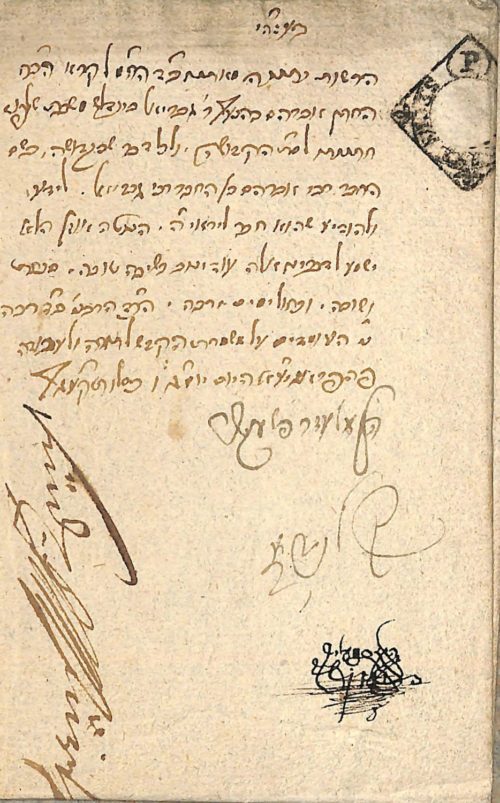
Lot 213 is a Letter and a Tefilah written by R’ Chaim Berlin, in honor of the of Czar Alexander III of Russia in Moscow, 1886. It appears to be written to Moses Montefiore and thanks him for his donation. R. Berlin describes that he, together with his students, recited this prayer. Additionally, the document discusses a heretofore unknown Talmud Torah that R’ Chaim Berlin had in Moscow.


Jacob’s Dream: Reproducing a Talismanic Illustrated Title Page

Jacob’s Dream: Reproducing a Talismanic Illustrated Title Page

(Illustrations are from the following sources: the Edut Be Yosef, Rabot, Shivim Tekunei Zohar, and Yefeh Anaf are from the Gross Family Collection.  The Minhat Shai is from Dan Rabinowitz’s personal collection, and the rest are courtesy of the internet.)

One of the earliest examples of Jewish art are the biblical paintings at the Dura Europos Synagogue, completed in 244-5 C.E. Among those images is that of Jacob’s dream. The importance of the Dura Europos iconography in the development of Jewish art is hard to overestimate. “The iconographic formulas, seen for the first time in the Dura synagogue would recur both in Jewish art and Christian art, in widely differing media – manuscripts, murals, mosaics, ivories and silver utensils – frequently without modification, or with only the modifications necessitated by different materials or techniques, or the need to emphasize a new theological perspective.”[1]

By the time of its discovery in the 1920s, only a fragment of Jacob’s dream scene remained visible. Nonetheless it is possible to discern the subtly of the artist. In the fragment, Jacob is depicted as a figure wearing Greek costume – the then contemporary dress – leaning on his elbow, in the posture of Palmyrene funerary reliefs. Only the body is preserved, the head and upper body are lost. Near the figure is planted an inclined ladder, which one or perhaps two (it is unclear) personages in Persian dress are ascending. This custom, consisting of a short-belted tunic adorned with braid at the throat and hem, and wide trousers gathered into short supple boots, represents in the language of the Dura painter the garb of kings and princes, and court temple  personnel.[2] 

Scholars have voiced a number of opinions to explain the Persian court dress. According to one scholar the artist was referencing a midrash that appears in Pirkei de-Reb Eliezer. The angels, rather than merely serving as Jacob’s protection, also allude to “the four kingdoms that would conquer and subjugate the Jews, each as represented by its prince.”[3]One of the kingdoms is Persia. Thus, the artist’s choice of iconography was deliberate.

Jewish Title Pages

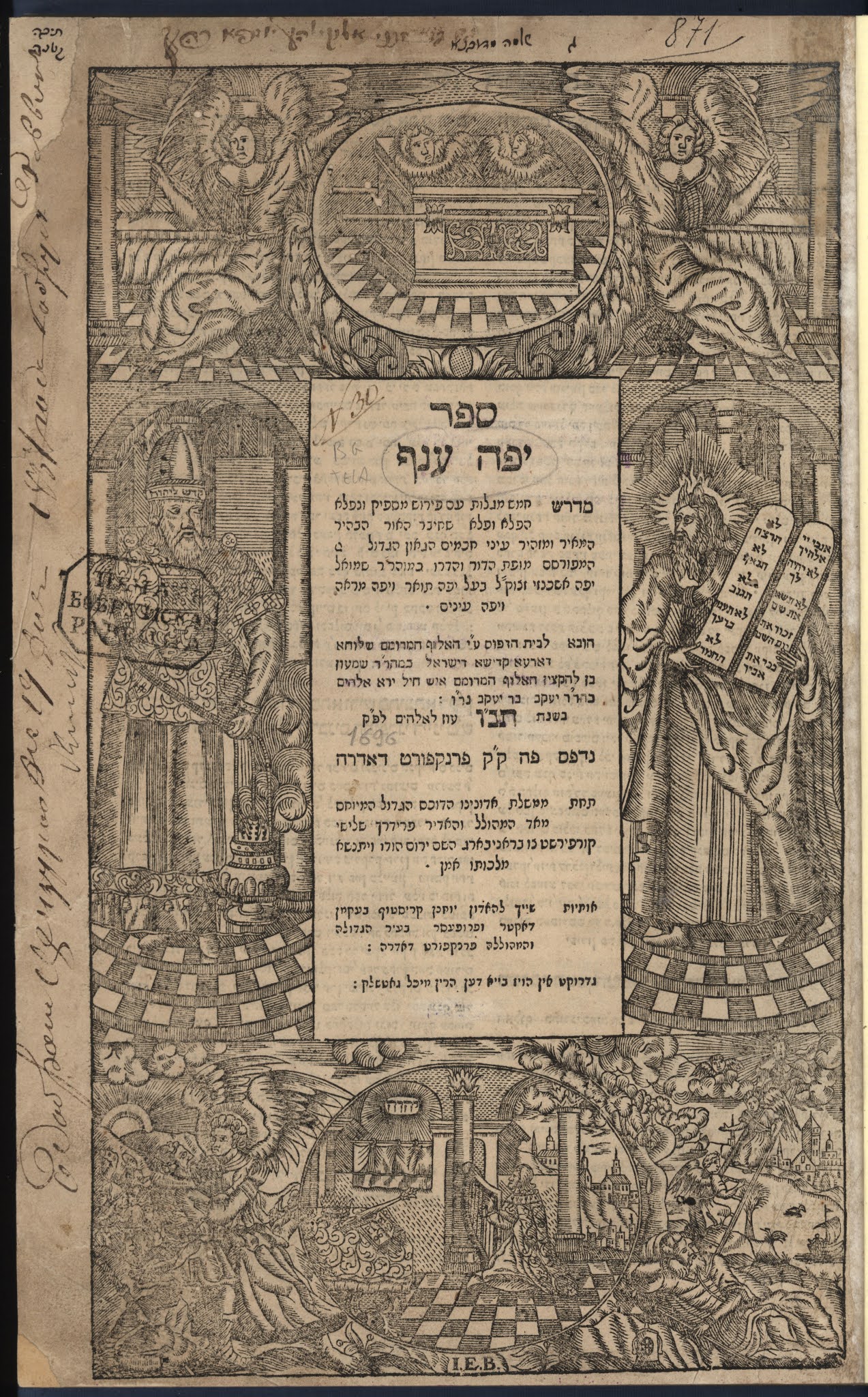
The first illustrated Jewish title pages appeared in the early seventeenth century. In 1693, the first depiction of Jacob’s dream graced a Jewish title page. That book, Sefer Rabbot, Midrash Rabba, with the commentary of R. Yisachar ben Naftali Katz, printed in Frankfurt on the Oder by Michael Gottschalk.


He was a local bookbinder and bookdealer who took over the management of Johann Christoph Beckman’s printing press in Frankfort d.O. in 1693, and led the press for almost forty years.[4]  Sefer Rabbot’s title page includes Moses and Aaron (who first appear in the 1610 edition of the She’a lot u-Teshuvot Mahril, printed in Hanau (see “Aaron the Jewish Bishop”), at the top, angels around the ark, and at the bottom, three biblical scenes, Jacob wrestling with the angel, David praying, and Jacob’s dream. It is obvious that these images are modeled after Matthaeus Merian’s engravings of biblical scenes that accompanied his Icones Biblicae printed between 1625-1630. All three of these images can be traced to Merian based upon a number of similarities and artist conventions.

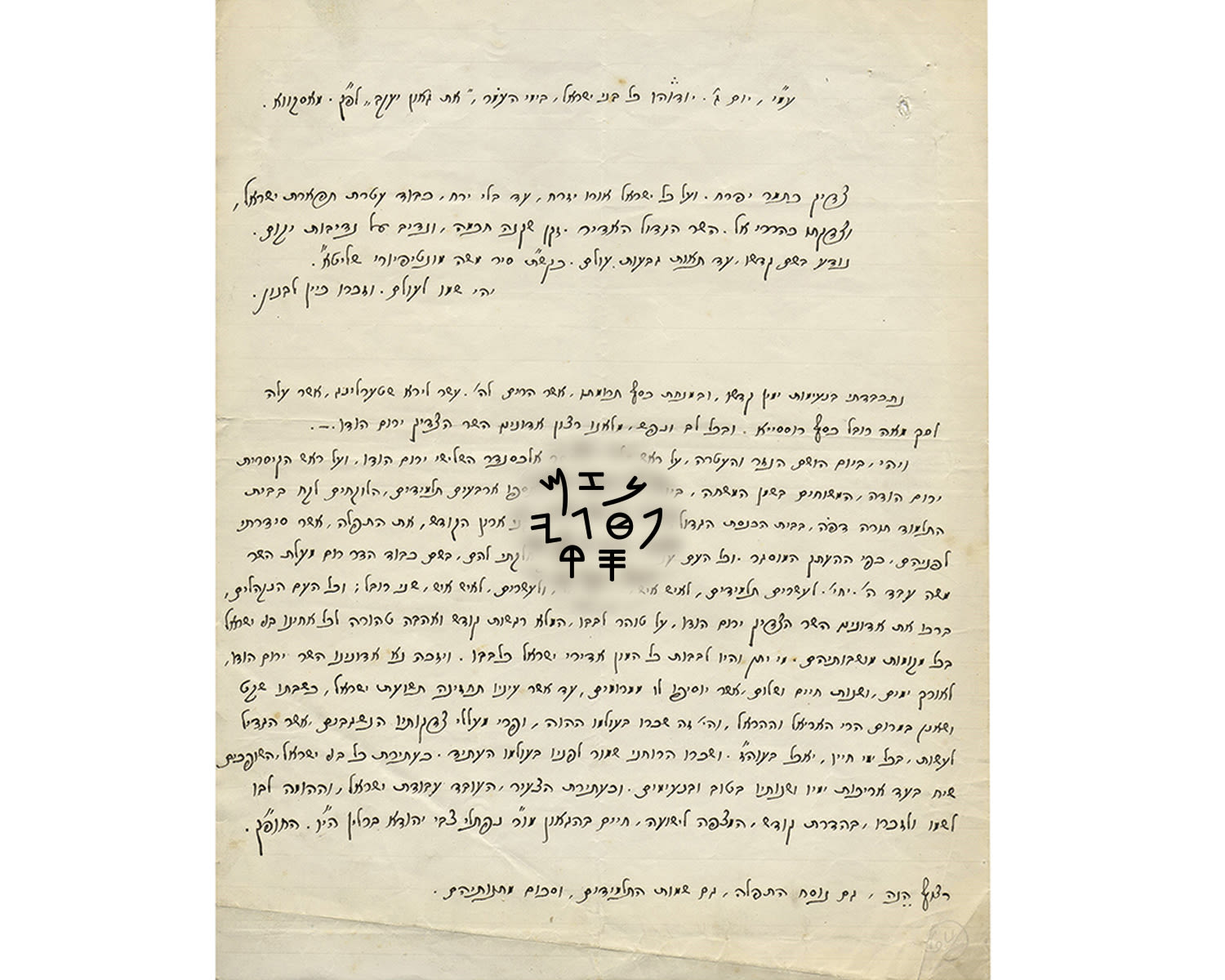
The image of Jacob’s dream depicts, in both instances, Jacob laying next to a tree, boats and houses appear in the background, and angels’ hands are outstretched to greet Jacob. There is one significant puzzling difference. In Merian’s depiction, he substitutes the letters (reversed) of tetragram for God. In the Jewish book, God is depicted as an old man with a beard wearing a crown. This, despite Judaism’s strong prohibition on depicting God in a human form.

(This is not the only instance of a Jewish book containing a human image for God. The title-page of the first edition of R. Yedidia Shlomo of Norzi’s commentary on the biblical mesorah, Minhat Shai, Mantua, 1742-44, includes a depiction of God with a human face.   The images on the title page are various biblical vignettes and in the one for the resurrection of the “dry bones” that appears in Yehkezkel, God is shown as an old man with a white beard.)

Here is that image in detail:

Michael Gottschalk reused the Rabot title page at least five times; in 1695, for R. Shmuel Yaffe, Yafe Anaf, in 1696, Mattityahu ben Asher Lemle Liebermann, Mattat Yah, in 1698 in R. Benjamin Ze’ev Wolf ben Samuel Romaner’s Ir Binyamin,  in 1699 in Ohel Yaakov, and in 1602 in Yisrael b. Aaron Yaffa, Or Yisrael.


These title pages are just a few of Gottchalk’s illustrated title pages. Gottshalk artistic sensibilities are on full display in his 1697-99 edition of the Talmud, a work for which the Frankfurt press is best known to this day. It contains arguably the most magnificent Talmudic title page ever printed.

In 1695, the first illustrated copperplate Haggadah was published in Amsterdam. All the images are modeled based upon Merian. The title page too contains a number of biblical scenes in circular medallions. One of which is Jacob’s dream.

The next title page that depicts Jacob’s dream appears in Tzvi Hirsch ben Rachmiel Chotsh’s, Shiv’im Tikunei ha-Zohar, Hemdat Tzvi, Amsterdam, Moshe ben Avraham Mendes Coutinho, 1706.[5] Like the Gottchalk’s image that includes heretical iconography, those of Shiv’im Tikunei ha-Zohar would prove equally problematic.[6]

Despite Hemdat Tzvi’s impressive approbations, R. Jacob Emden accused Chotsh, and specifically this book, of holding and expressing Sabbatian beliefs.[7] It has been conclusively demonstrated that indeed Chotsh’s book contains Sabbatian ideas.[8] Evidence of Chotsh’s embrace of Sabbateanism is identifiable amongst the title page images. Indeed, Chotsh calls attention to the larger meaning of the title page’s images. At the bottom of the title page Chotsh provides that “whosoever wishes to know the secret of the above frontispiece, should see the introduction to the Tikkunim at the beginning of the first article.” An inspection of that section yields likely Sabbatian passages. Thus, Chotsh is indicating that like the introduction, the title page also contains allusions to Sabbateanism.

The title page depicts a variety of biblical figures and Jacob’s dream appears at the top center of the page. Above that are two deer holding a crown with the verse from Isaiah 28:5, “On that day will the Lord of the hosts be for a crown of glory, and for a diadem of beauty.” The “crown of glory” or in Hebrew “Ateret tzvi” has a double meaning here, “glory” and “deer” and, of course, is alluding to Sabbatia Tzvi, who, “on that day” will be presumably wearing the crown.[9]

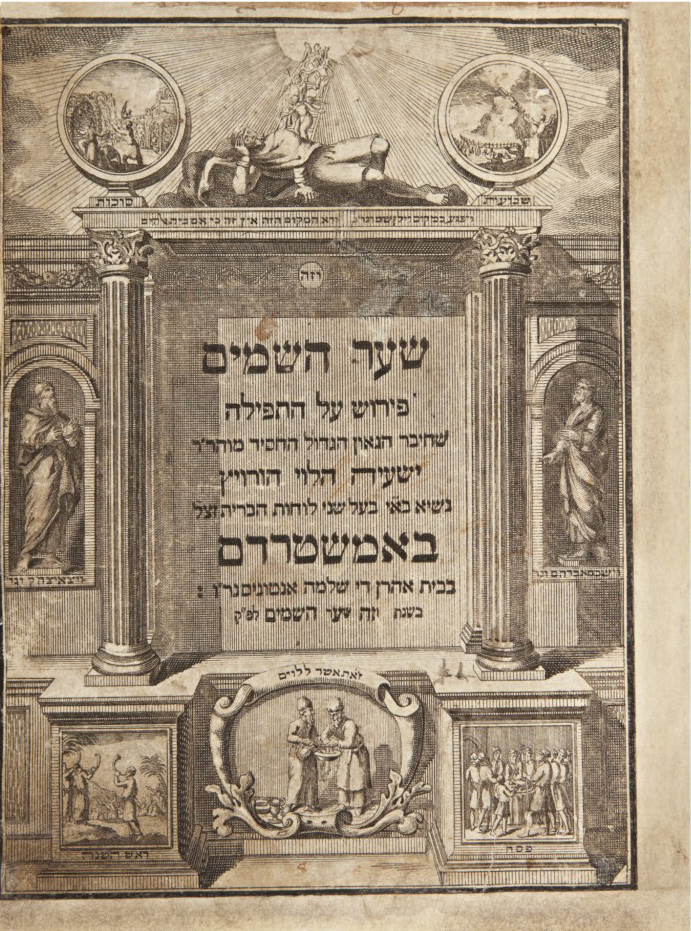
The most long-lasting depiction of Jacob’s dream is that which appeared in Siddur Shaarei Shamyim from R. Isaiah ha-Levi Horowitz (Shelah), Amsterdam, 1717.[10]

This title page is notable in that the accompanying images that align with the book which was not always the case. This is a complete machzor and as such four holidays, Sukkot, Pesach, Shavout, and Rosh Hashana, are represented on the top encased in circles, and underneath the columns. On one side of the bottom of the pillars. On either side is a niche, on the right with Abraham with the legend and on the left, Isaac, underneath each is a verse corresponding to prayer. Displayed prominently at top center, depicting his dream, with the verse from which the book’s title is derived. Underneath the title is a depiction of the Levites pouring water over the priest’s hands with the legend above, Ze hasher la-leviim. This is a reference to R. Horowitz’s lineage. All of the biblical images correspond with Merian’s depictions.

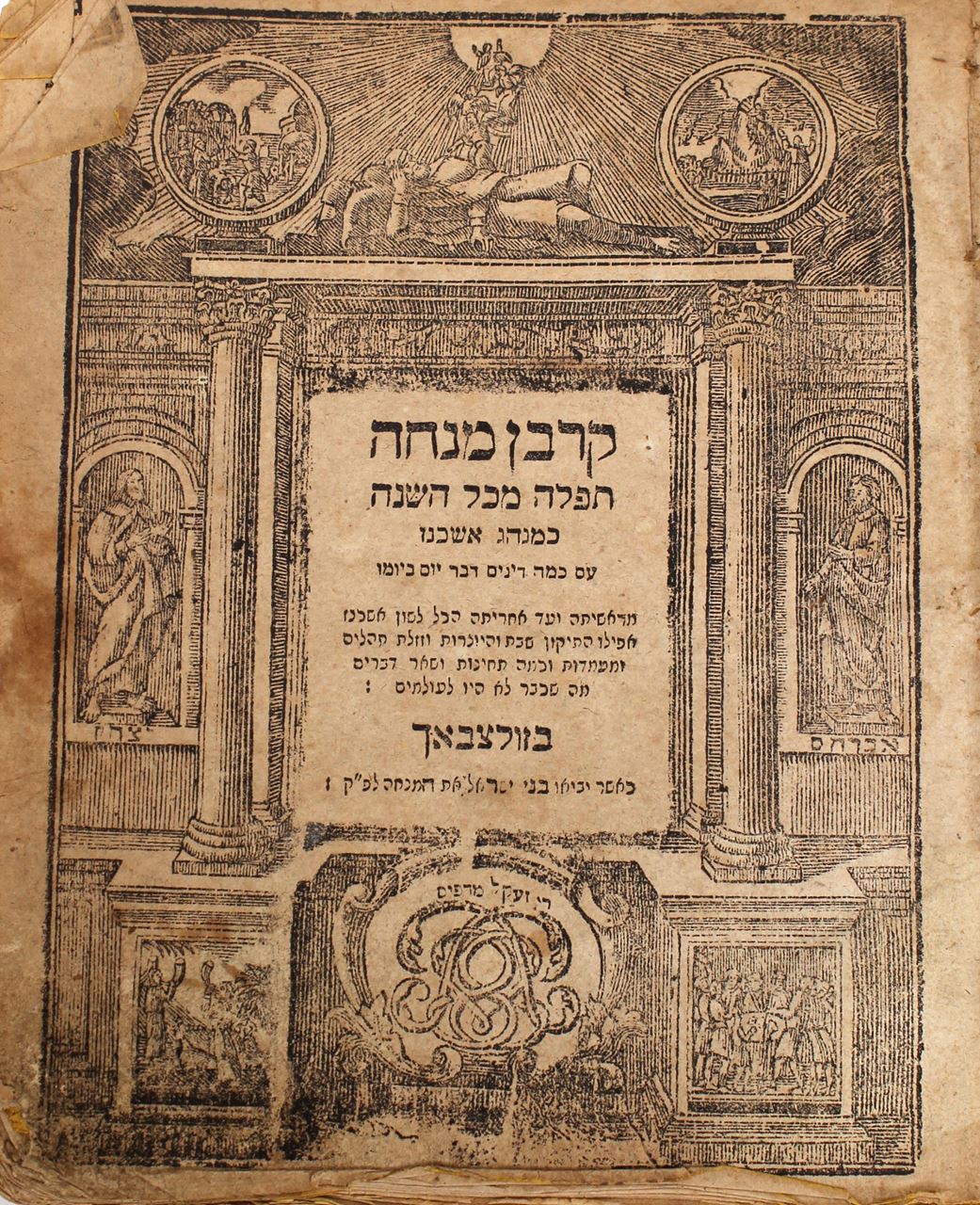
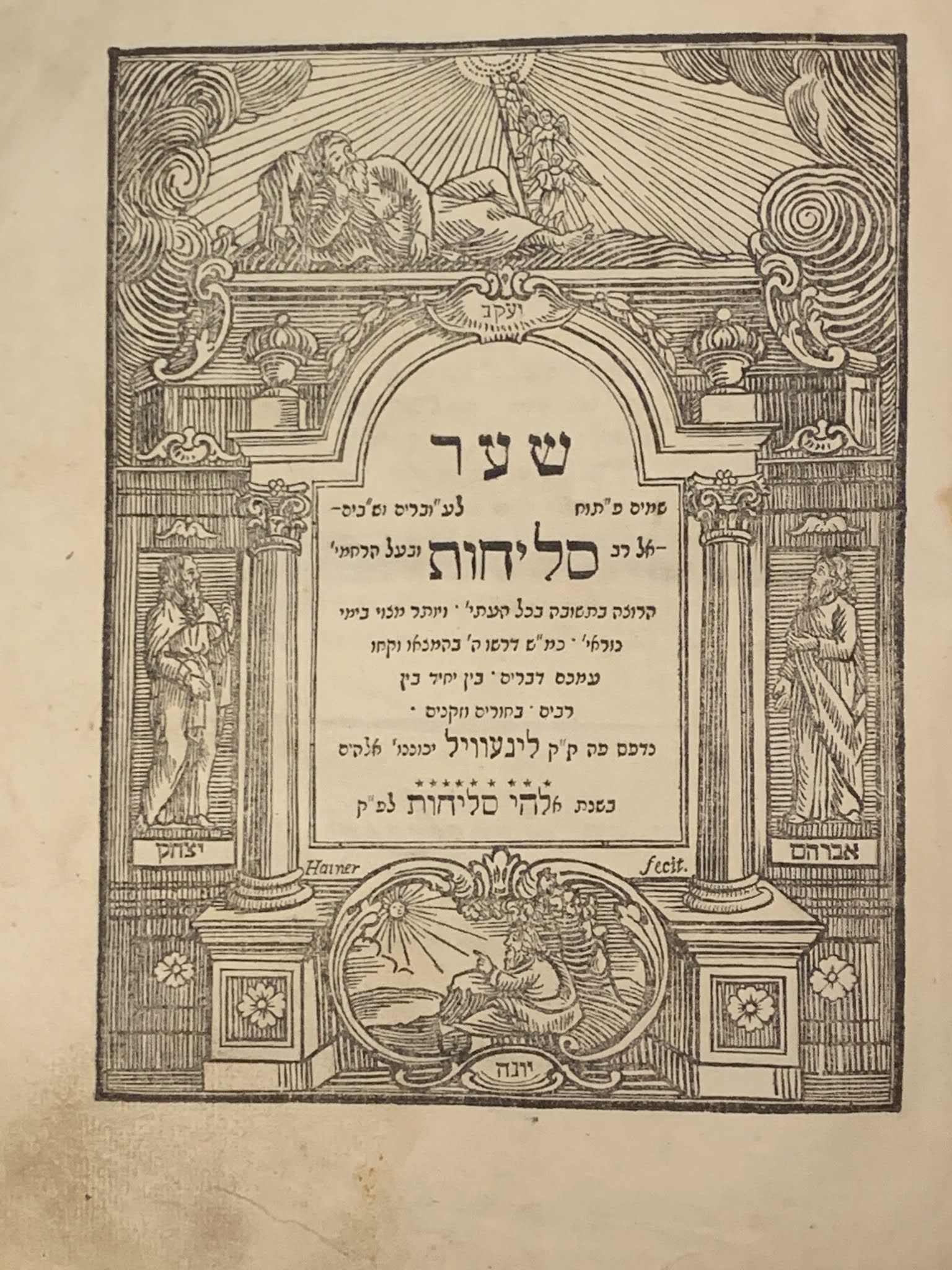
This title page, with small modifications, was repeatedly copied and is found in books from across Europe. One explanation for the ubiquity of this title page is that the Siddur ha-Shelah was imbued with talismanic effect. R. Yoel Sirkes in his approbation assures that whoever prays from this book their prayers would be answered. As evidence of the talismanic effect of the book one only needs to look to recent auctions where the book is regularly sold for tens of thousands of dollars. Perhaps printers looking to capitalize on the aura surrounding the Siddur ha-Shelah incorporated the images in their books.

For example, the title page appears in Edut be-Yaakov, Sulzbach, 1741,[11] in 1765, Furth, Siddur Korban Minha, and in 1797, in the north west of France in Luneville, Sha’ar Selihot ve-Tahanunim. In the latter, the Levite is substituted for Jonah as that is more aligned with the High Holiday themes of the book, and the four depictions of the holidays are removed because they conflict with the singular nature of the book.

Illustrated Hebrew title pages are perhaps the most ubiquitous, and certainly the most accessible form of Jewish art. Yet, the study of the art of the Hebrew title page has not attracted commensurate scholarly interest. Our example, tracing the depiction of Jacob’s dream, is but one instance that illustrated Hebrew title pages fit within the larger history of Jewish art. Here, the Hebrew title pages seventeenth- and eighteenth-century Hebrew books harken back to the iconography identified at Dura Europos that continued to appear in Jewish artistic forms, in this instance books.

[1] Gabrielle Sed-Rajna, Jewish Art (New York: Harry N. Abrams, Inc., 1997), 127.

[2] Gabrielle Sed-Rajna, Jewish Art (New York: Harry N. Abrams, Inc., 1997), 559.

[3] E.L. Sukenik, Bet-haKeneset shel Dura-Europa ve-Tserayav (Jerusalem: Mossad Bialik 1947), 112-3.

[4] B. Friedberg, History of Hebrew Typography in Central Europe (Antwerp, 1935), 35-49.

[5] Like Gottschalk, Coutinho also produced a number of other illustrated title pages with biblical images.In 1696, the year before he published the siddur, he published at least two books with illustrated title pages, Sefer Hinukh and the Mishna. This title page was reused in Coutinho’s 1698 edition of R. Hayim Moshe Karinal, Yemin Moshe.   

[6] Bezalel Naor, Post-Sabbatian Sabbatianism, (Spring Valley, NY: Orot, 1999),79-82.

[7] See Shnayer Leiman, “Sefarim ha-Hashudim be-Shabbta’ot: Rishimat shel ha-Gaon Yavet”z Tzal,” in Sefer ha-Zikhron le-Rebi Moshe Lifschitz, (New York, 1996), 890

[8] See Naor, Post-Sabbatian, 80-81 and the sources cited therein.

[9] Of course, Shabbatai Tzvi is not the only “Tzvi,” Chotsh’s first name is Tzvi. Perhaps the image is an allusion to his name – a somewhat common theme in Hebrew title page illustrations. Recently, however, one scholar noted that the deers are not the only Sabbatian reference. According to his theory, the layout of the biblical figures aligns with kabbalistic representations of the sefirot.  See Naor, 81.

[10] Horowitz’s other book, Sheni Luhot ha-Brit, Amsterdam, 1698, also contains a beautifully illustrated title page.

[11] The title page was reused for decades in the Sulzbach presses. As late as 1794, there are examples of the title page. See, e.g. Tsenah u-Renah, Sulzbach, 1794.


Kol Nidrei, Choirs, and Beethoven: The Eternity of the Jewish Musical Tradition

Kol Nidrei, Choirs, and Beethoven: The Eternity of the Jewish Musical Tradition
The Seforim Blog is reposting Dan Rabinowitz’s post from 2018.
On April 23, 1902, the cornerstone to the Taharat Ha-Kodesh synagogue was laid, and on Rosh Ha-Shana the next year, September 7, 1903, the synagogue was officially opened. The synagogue building was on one of Vilna’s largest boulevards and constructed in a neo-Moorish architectural style, capped with a blue cupola that was visible for blocks. There was a recessed entry with three large arches and two columns. The interior housed an impressive ark, located in a semi-circular apse and covered in a domed canopy. But what really set the synagogue apart from the other 120 or so places to pray in Vilna was that above the ark, on the first floor, were arched openings that served the choir. In fact, it was generally referred to by that feature and was known as the Choral Synagogue. The congregants were orthodox, most could be transported to any modern Orthodox synagogue and they would indistinguishable, in look – dressing in contemporary styles, many were of the professional class, middle to upper middle class, and they considered themselves maskilim, or what we might call Modern Orthodox.[1]

The incorporation of the choir should be without controversy. Indeed, the Chief Rabbi of Vilna, Yitzhak Rubenstein would alternate giving his sermon between the Great Synagogue, or the Stut Shul [City Synagogue], and the Choral Synagogue.[2] Judaism can trace a long relationship to music and specifically the appreciation, and recognition of the unique contribution it brings to worship. Some identify biblical antecedents, such as Yuval, although he was not specifically Jewish. Of course, David and Solomon are the early Jews most associated with music. David used music for religious and secular purposes – he used to have his lyre play to wake him at midnight, the first recorded instance of an alarm clock. Singing and music was an integral part of the temple service, and the main one for the Levite class who sang collectively, in a choir. With the destruction of the temple, choirs, and music, in general, was separated from Judaism. After that cataclysmic event, we have little evidence of choirs and even music. Indeed, some argued that there was an absolute ban on music extending so far as to prohibit singing.

It would not be until the early modern period in the 16th century that choirs and music began to play a central role in Jewish ritual, and even then, it was limited – and was associated with modernity or those who practiced a more modern form of the religion.
Rabbi Leon (Yehudah Aryeh) Modena (1571-1648) was one of the most colorful figures in the Jewish Renaissance. Born in Venice, he traveled extensively among the various cities in the region.[3] He authored over 15 books, and made his living teaching and preaching in synagogues, schools, and private homes; composing poems on commission for various noblemen; and as an assistant printer. In 1605, he was living in Ferrara where an incident occurred in the synagogue that kickstarted the collective reengagement with music. Modena explained that “we have six or eight knowledgeable men, who know something about the science of song, i.e. “[polyphonic] music,” men of our congregation (may their Rock keep and save them), who on holidays and festivals raise their voices in the synagogue and joyfully sing songs, praises, hymns and melodies such as Ein Keloheinu, Aleinu Leshabeah, Yigdal, Adon Olam etc. to the glory of the Lord in an orderly relationship of the voices according to this science [polyphonic music]. … Now a man stood up to drive them out with the utterance of his lips, answering [those who enjoyed the music], saying that it is not proper to do this, for rejoicing is forbidden, and song is forbidden, and hymns set to artful music have been forbidden since the Temple was destroyed.[4]
Modena was not cowed by this challenge and wrote a lengthy resposum to defend the practice which he sent to the Venetian rabbinate and received their approbation. But that did not put the matter to rest.
In 1610, as he approached forty, Modena received his ordination from the Venetian rabbis and settled in Venice to serve not only as a rabbi but as a cantor, with his pleasant tenor voice. In around 1628 in the Venetian ghetto, an academy of music was organized with Modena serving as the Maestro di Caeppella . Both in name and motto that academy embraced its subversive nature. It was called the Academia degli Impediti, the Academy of the Hampered, named in derision of the traditional Jewish reluctance to perform music because of “the unhappy state of captivity which hampers every act of competence.” In this spirit, especially in light of Modena’s responsum on music in 1605, the Accademia took the Latin motto Cum Recordaremur Sion, and in Hebrew, Bezokhrenu et Tzion, when we remembered Zion, based paradoxically on Psalm 137, one of the texts invoked against Jewish music: “We hung up our harps…. How shall we sing the Lord’s song in a strange land?”
On Shemini Atzeret and Simchat Torah in October 1628, a spectacular musical performance was held in the Spanish synagogue, which had been decorated with silver and jewels. Two choirs from the academy sang artistic Hebrew renderings of the afternoon service, the evening service, and some Psalms. Their extensive repertoire lasted a few hours. A throng of Christian noblemen and ladies attended the Simchat Torah service. The applause was great, and police had to guard the gates to ensure order
Beyond his musical endeavors, Modena also served as an expert in Hebrew publishing. The two would create a confluence that enabled the first modern Jewish book of music.
For Rabbi Leon Modena, his young friend, the musician Salamone Rossi, would herald the Jewish re-awakening. We know very little about Rossi’s life. He was born circa 1570 and died sometime after 1628, possibly in 1630. He is listed as a violinist and composer on the payroll of the Gonzaga dukes, rulers of Mantua, and was associated with a Jewish theater company, as composer or performer or both. In addition, Rossi was also writing motets – short pieces of sacred music typically polyphonic and unaccompanied – for the synagogue using contemporary Italian and church styles. He was specifically encouraged in this endeavor by Modena, who urged the composer to have this music published so that it could have an even greater impact.[5] In 1622 the publishing house of Bragadini in Venice issued thirty-three of Rossi’s synagogue motets in a collection, Shirim asher le-Shlomo, that Modena edited. This extraordinary publication represented a huge innovation. First, the use of musical notations that required a particularly thorny issue to be resolved right versus left. Rossi decided to keep the traditional musical notational scheme and provide those from left to right and write the Hebrew backward, because the latter would be more familiar to the reader. Second, it was the first time the Hebrew synagogue liturgy had ever been set as polyphonic choral music. Polyphony in the Christian church had begun centuries earlier. Rossi’s compositions sound virtually indistinguishable from a church motet, except for one thing: the language is Hebrew – the lyrics are from the liturgy of the synagogue, where this music was performed.
There was bound to be a conflict between the modern Jews who had been influenced by the Italian Renaissance and who supported this innovation, and those with a more conservative theology and praxis. But the antagonism towards music, especially non-traditional music, remained strong. Anticipating objections over Rossi’s musical innovations, and perhaps reflecting discussions that were already going on in Venice or Mantua, Modena wrote a lengthy preface included the responsum he wrote in 1605 in Ferrara in support of music in which he refuted the arguments against polyphony in the synagogue. “Shall the prayers and praises of our musicians become objects of scorn among the nations? Shall they say that we are no longer masters of the art of music and that we cry out to the God of our fathers like dogs and ravens?”3 Modena acknowledged the degraded state of synagogue music in his own time but indicates that it was not always so. “For wise men in all fields of learning flourished in Israel in former times. All noble sciences sprang from them; therefore, the nations honored them and held them in high esteem so that they soared as if on eagles’ wings. Music was not lacking among these sciences; they possessed it in all its perfection and others learned it from them. … However, when it became their lot to dwell among strangers and to wander to distant lands where they were dispersed among alien peoples, these vicissitudes caused them to forget all their knowledge and to be devoid of all wisdom.”
In the same essay, he quotes Emanuel of Rome, a Jewish poet from the early fourteenth century, who wrote, “What does the science of music say to the Christians? ‘Indeed, I was stolen out of the land of the Hebrews.’” Using the words of Joseph from the book of Genesis, Modena was hinting that the rituals and the music of the Catholic church had been derived from those of ancient Israel, an assertion that has been echoed by many scholars. Although it can be argued that Modena indulges in hyperbole, both ancient and modern with some attributing the earliest ritual music to Obadiah the convert who noted a Jewish prayer that was only then appropriated for use in Gregorian chants.[6]
Directly addressing the naysayers, Modena wrote that “to remove all criticism from misguided hearts, should there be among our exiles some over-pious soul (of the kind who reject everything new and seek to forbid all knowledge which they cannot share) who may declare this [style of sacred music] forbidden because of things he has learned without understanding, … and to silence one who made confused statements about the same matter. He immediately cites the liturgical exception to the ban on music. Who does not know that all authorities agree that all forms of singing are completely permissible in connection with the observance of the ritual commandments? … I do not see how anyone with a brain in his skull could cast any doubt on the propriety of praising God in song in the synagogue on special Sabbaths and on festivals. … The cantor is urged to intone his prayers in a pleasant voice. If he were able to make his one voice sound like ten singers, would this not be desirable? … and if it happens that they harmonize well with him, should this be considered a sin? … Are these individuals on whom the Lord has bestowed the talent to master the technique of music to be condemned if they use it for His glory? For if they are, then cantors should bray like asses and refrain from singing sweetly lest we invoke the prohibition against vocal music.
No less of an authority than the Shulhan Arukh, explains that “when a cantor who stretches out the prayers to show off his pleasant voice, if his motivation is to praise God with a beautiful melody, then let him be blessed, and let him chant with dignity and awe.” And that was Rossi’s exact motivation to “composed these songs not for my own honor but for the honor of my Father in heaven who created this soul within me. For this, I will give thanks to Him evermore.” The main thrust of Modena’s preface was to silence the criticisms of the “self-proclaimed or pseudo pious ones” and “misguided hearts.”
Modena’s absurdist argument – should we permit the hazzan to bray like an ass – is exactly what a 19th-century rabbi, Rabbi Yosef Zechariah Stern, who was generally opposed to the Haskalah – and some of the very people who started the Choral Synagogue, espoused. Stern argues that synagogal singing is not merely prohibited but is a cardinal sin. To Stern, such religious singing is only the practice of non-Jews who “strive to glorify their worship in their meeting house [בית הכנסת שלהם] so that it be with awe, and without other intermediaries that lead to distraction and sometimes even to lightheadedness. In the case of Jews, however, there is certainly be a desecration of G-d’s Name when we make the holy temple a place of partying and frivolity and a meeting house for men and women … in prayer. there is no place for melodies [נגונים], only the uttering of the liturgy with gravity [כובד ראש] … to do otherwise is the way of arrogance, as one who casts off the yoke, where the opposite is required: submission, awe and gravity, and added to this because of the public desecration of G-d’s Name – a hillul ha-Shem be-rabbim.” (For more on this responsum see here.)
Similarly, even modern rabbis, for example, R. Eliezer Waldenberg, who died in 2006, also rejected Modena’s position, because of modernity. Although in this instance, not because of the novelty or the substance of Modena’s decision but because of the author’s lifestyle. Modena took a modern approach to Jewish life and was guilty of such sins as not wearing a yarmulke in public and permitting ball playing on Shabbos.
Despite these opinions, for many Orthodox Jews, with some of the Yeshivish or Haredi communities as outliers, song is well entrenched in the services, no more so than on the Yomim Noraim. Nor is Modena an outlier rabbinic opinion of the value of music and divine service. No less of an authority than the Vilna Gaon is quoted as highly praising music and that it plays a more fundamental role to Judaism that extends well beyond prayer. Before we turn to the latter point it is worth noting that at times Jewish music was appropriated by non-Jews – among the most important composers, Beethoven. One the holiest prayer of Yom Kippur, Kol Nedri, is most well-known not for the text (which itself poses many issues) but the near-universal tune. That tune, although not as repetitive in the prayer can be heard in the sixth movement of Beethoven’s Quartet in C# minor, opus 131 (you can hear a version here). One theory is in 1824, the Jews in Vienna were finally permitted to build their own synagogue and for the consecration asked Vienna’s most famous composer to write a piece of music.[7] Although Beethoven did not take the commission, he may have done some research on Jewish music and learned of this tune. We could ask now, is Beethoven playing a Jewish music?[8]
R. Yisrael M’Sklov, a student of the Gaon records that he urged the study of certain secular subjects as necessary for the proper Torah study, algebra and few other, but “music he praised more than the rest. He said that most of the fundamentals and secrets of the torah … the Tikkunei Zohar are impossible to understand without music, it is so powerful it can resurrect the dead with its properties. Many of these melodies and their corresponding secrets were among the items that Moshe brought when he ascended to Sinai.”[9]
In this, the Gaon was aligned with many Hassidim who regularly incorporated music into their rituals, no matter where the origin. Just one of many examples, Habad uses the tune to the French national anthem for the prayer Aderet ve-Emunah. The power of music overrides any considerations of origin. Indeed, they hold that not only can music affect us, but we can affect the music itself, we hold the power to transform what was impure, the source and make it pure. That is not simply a cute excuse, but the essence of what Hassidim view the purpose of Judaism, making holy the world. Music is no longer a method of attaining holiness, singing is itself holiness.[10]
Today in Vilna, of the over 140 places of worship before the Holocaust five shul buildings remain and only one shul is still in operation. That shul is the Choral Synagogue – the musical shul. Nonetheless not all as it should be. In the 1960s a rabbi from Israel was selected as the rabbi for the community and the shul. When he arrived, he insisted that choirs have no place in Judaism and ordered the choir arches sealed up. We, however, have the opportunity, as individuals and community to use the power of music to assist us on the High Holidays – that can be me-hayeh ma’tim.
[1] See Cohen-Mushlin, Synagogues in Lithuania N-Z, 253-61. For more on the founding of the congregation see Mordechai Zalkin, “Kavu le-Shalom ve-ain: Perek be-Toldot ha-Kneset ha-Maskili ‘Taharat ha-Kodesh be-Vilna,” in Yashan mi-Pnei Hadash: Mehkarim be-Toldot Yehudei Mizrah Eiropah u-ve-Tarbutam: Shai le-Imanuel Etkes, eds. David Asaf and Ada Rapoport-Albert (Jerusalem: Merkaz Zalman Shazar, 2009) 385-403. The images are taken from Cohen-Mushlin.
[2] Hirsz Abramowicz, Profiles of a Lost World (Detroit: Wayne State University Press, 1999), 293.
[3] Regarding Modena see his autobiography, translated into English, The Autobiography of a Seventeenth Century Rabbi, ed. Mark Cohen (Princeton: Princeton University Press, 1988); and the collection of articles in The Lion Shall Roar: Leon Modena and his World, ed. David Malkiel, Italia, Conference Supplement Series, 1 (Jerusalem: Hebrew University Press, 2003).
[4] His responsum was reprinted in Yehuda Areyeh Modena, She’a lot u-Teshuvot Ziknei Yehuda, ed. Shlomo Simonsin (Jerusalem: Mossad Harav Kook, 1956), 15-20.
[5] See generally Don Harrán, Salamone Rossi: Jewish Musician in Late Renaissance Mantua (Oxford: Oxford University Press, 1999); Michelene Wandor, “Salamone Rossi, Judaism and the Musical Cannon,” European Judaism 35 (2002): 26-35; Peter Gradenwitz, The Music of Israel: From the Biblical Era to Modern Times 2nd ed. (Portland: Amadeus Press, 1996), 145-58.
The innovations of Rossi and Modena ended abruptly in the destruction of the Mantua Ghetto in 1630 and the dispersion of the Jewish community. The music was lost until the late 1800s when Chazzan Weintraub discovered it and began to distribute it once again.
[6] See Golb who questions this attribution and argues the reverse and also describes the earlier scholarship on Obadiah. Golb, “The Music of Obadiah the Proselyte and his Conversion,” Journal of Jewish Studies 18: 43-46.
[7] Such ceremonies were not confined to Austria. In Italy since the middle of the seventeenth century, special ceremonies for the dedication of synagogues had become commonplace. See Gradenwitz, Music of Israel, 159-60.
[8] Jack Gotlieb, Funny, It Doesn’t Sound Jewish, (New York: State University Press of New York, 2004), 17-18; see also Theodore Albrecht, “Beethoven’s Quotation of Kol Nerei in His String Quartet, op. 131: A Circumstantial Case for Sherlock Holmes,” in I Will Sing and Make Music: Jewish Music and Musicians Through the Ages, ed. Leonard Greenspoon (Nebraska: Creighton University Press, 2008), 149-165. For more on the history of the synagogue see Max Grunwald, Vienna (Philadephia: Jewish Publication Society of America, 1936), 205-21.
[9] R. Yisrael M’Sklov, Pat ha-Shulhan (Sefat, 1836).
[10] See Mordechai Avraham Katz, “Be-Inyan Shirat Negunim ha-Moshrim etsel ha-Goyim,” Minhat ha-Kayits, 73-74. However, some have refused to believe that any “tzadik” ever used such tunes. Idem. 73. See also our earlier article discussing the use of non-Jewish tunes “Hatikvah, Shir HaMa’a lot, & Censorship.”


Romm Press, Haggadah Art, Controversial Books, and other Bibliographical Historica

Legacy Auctions: Romm Press, Haggadah Art, Controversial Books, and other Bibliographical Historica

Legacy Judaica’s fall auction is next week, September 13, and we wanted to highlight some bibliographical historica.  Lot 95 is Elbona shel Torah, (Berlin, 1929), by R. Shmuel Shraga Feigneshon, known as Safan ha-Sofer.  He helmed the operations of the Romm Press in Vilna.  During his 55-year tenure, he oversaw the publication of the monumental Vilna Shas, among numerous other canonical works that became the model for all subsequent editions. He wrote a history of the press which first appeared in part in the journal HaSofer (vol. 1 27-33 and vol. 2-3 46-57, 1954-55). It was then published in its entirety in Yahadut Lita vol. 1. 1959.  This biography was plagiarized in nearly every respect by the Yated Ne’eman.  It was a near-perfect reproduction (albeit in English rather than the original Hebrew), except that certain names and select passages were omitted presumably because they reference Jewish academics or other materials deemed objectional to Haredi audiences.

In Elbona shel Torah, (51-52), Shafan Ha-Sofer discusses the censorship of Jewish texts from non-Jewish authorities.  There were not only omissions but also additions to the text.  He identifies one of the angels mentioned in the supplications between the Shofar sets with Jesus.  He claims that “Yeshu Sa’ar ha-Pinim” is in fact Jesus of Nazareth.  Nonetheless, he notes that this passage was included in most mahzorim.  Indeed, in the first Romm edition of the Mahzor this angel appears.  He explains that after it was published a rabbi from Yemen, who was unfamiliar with the historic inclusion of the passage, was shocked when he came this passage.  He immediately set about issuing a ban on all the Romm books, classifying them within the category of a sefer torah of a heretic which is consigned to the fire.  But the ban was annulled after a Jerusalem rabbi intervened and explained to his clergy brother that in fact the Romm edition merely followed an accepted text. According to Shafan ha-Sofer, after this brush with what is described as potential financial ruin, later editions of the Vilna Mahzor omit Yeshu.

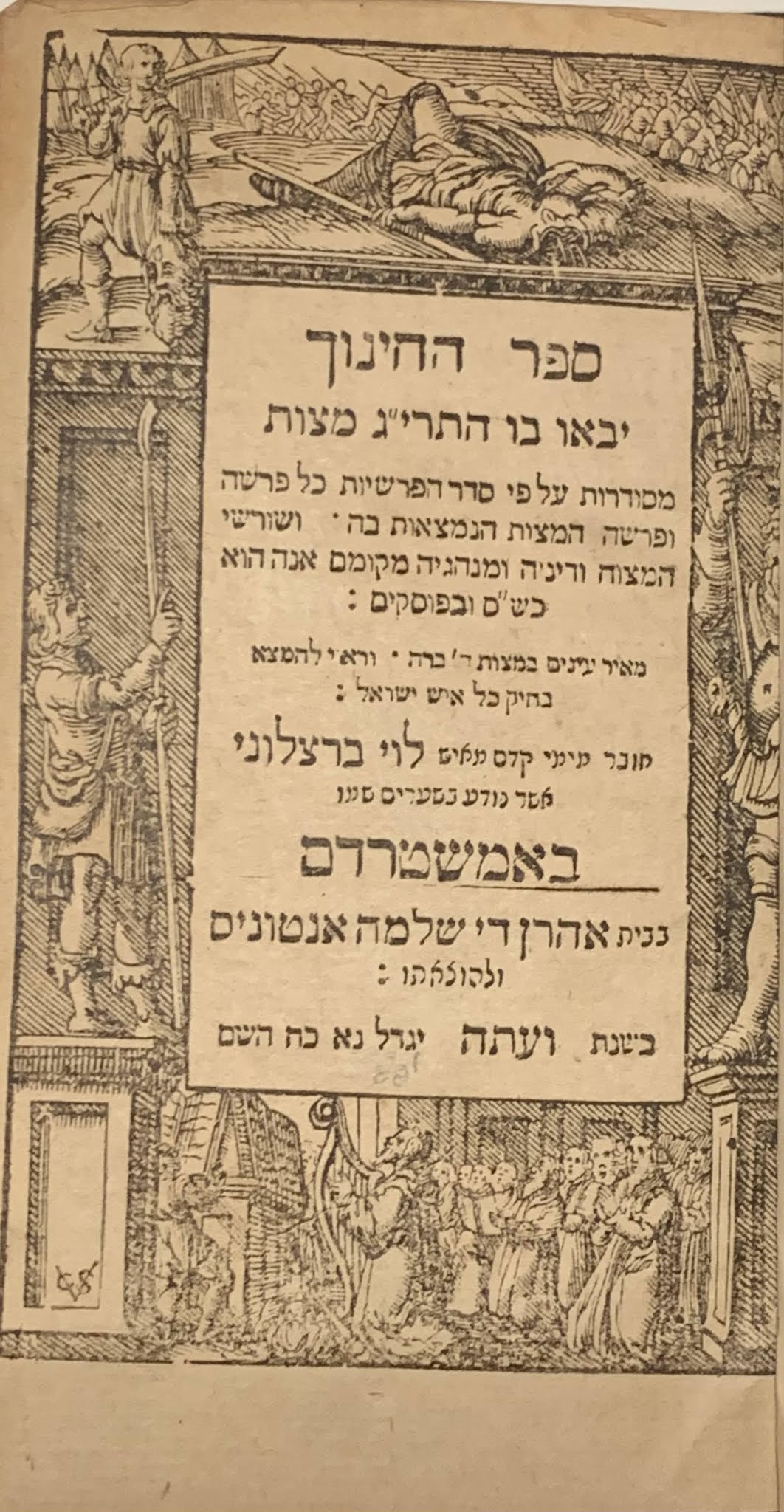
Two books feature on their title pages an immodest Venus rising.  The title page of R. Moshe Isserles, Torat ha-Hatat, Hanau, 1628, lot 33, depicts in the bottom center of page Venus with a loincloth.  Additionally, on the two sides of the pages two similarly exposed women appear in medieval costume. This particular title page was reused on at least three other books.  A similarly undressed woman appears on the title page of R. Isaac of Corbeil’s Amudei Golah, Cremona 1556, lot 1.

Naftali Hertz Wessley’s, Divrei Shalom ve-Emet, Berlin, 1782, lot 99, (volume 2), is the controversial work wherein he provides his educational program.  Although some of his other works secured the approbations of leading Orthodox rabbi, some of the more traditional rabbis were opposed to Wessley’s reforms advocated in Divrei. See our discussion here, and Moshe Samet, Hadash Assur min ha-Torah (Jerusalem, Carmel, 2005), 78-83; Edward Breuer, “Naphtali Herz Wessely and the Cultural Dislocations of an Eighteenth-Century Maskil,” in New Perspectives on the Haskalah, Shmuel Feiner and David Sorkin eds., (London, Littman Library, 2001), 27-47.. Wessley advocated for the inclusion of some secular studies, separate grades for children of different ages and abilities, and satisfying testing requirements. These and many others of his suggested reforms are now commonplace in Orthodox schools. He was interested in improving all aspects of Jewish education and chided his more acculturated Jews who only adopted his policies as they related to secular subjects but did not otherwise incorporate contemporary intellectual rigor to their Jewish studies. Copies of the originals of the work are rare.

Another book that aroused a controversy is R. Zechariah Yosef Rosenfeld of St. Louis’ work, Yosef Tikva, St. Louis, 1903.  Rosenfeld defends the use of machine manufactured matzot for Passover.  There is a significant literature regarding the use of these matzot, see Hayim Gartner, “Machine Matzah, the Halakhic Controversy as a Test Case for Defining Orthodoxy,” in Orthodox Judaism: New Perspectives, (Jerusalem, Magnes Press, 2006), 395-425 (Hebrew) and Jonathan Sarna, How Matzah Became Square: Manischewitz and the Development of Machine-Made Matzah in the United States, (New York, Touro College, 2005) .

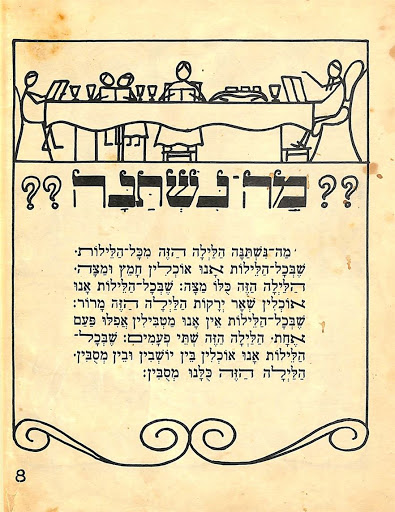
Another Passover item Yaakov Agam’s limited edition of the Haggadah, Paris, 1985, lot 138.  Agam adds a rich color palette to the otherwise spare style of the German illustrator, Otto Geismar. His 1928 haggadah uses minimalism to great effect and has a whimsical flair, yet at times the thick black ink figures are dark and foreboding.  Agam’s offers of a kaleidoscopic version of the haggada that is purely uplifting.


Otto Geismar, Berlin 1928

Yaakov Agam, Paris 1985

Aside from the books, one letter of note, Lot 182.  In 1933 letter from R. Hayim Ozer Grodzensky writes that he had proclaimed a fast in Vilna in response to the rise of Hitler and that “the new persecutions will cause the old to be forgotten.” Despite the fact that R. Ozer recognized almost immediately the threat of Hitler, during WWII he was not as prescient.  As late as March 1940, he was encouraging Jews to remain in Vilna. See Eliezer Rabinowitz, R. Hayim Ozer’s Prophesy for Vilna has Been Fulfilled,” Morgen Journal, May 8, 1940.

Two final items, both relate to the Volozhin yeshiva.  The first is a copy of Meil Tzedakah, Prague 1756, lot 158that belonged to R. Yosef Dov Soloveitchik, the Bet ha-Levi, and rosh ha-yeshiva of Volozhin.  The book also belonged to the Vilna rabbi, R. Abraham Pasveller, and R. Chaim Soloveitchik.  The second, lot 166, is a letter by the R. Naftali Berlin, Netziv, the Bet Ha-Levi’s co-Rosh ha-Yeshiva and eventual disputant.  He writes to the journal HaTzfirah (see these posts (herehere and here) regarding the Netziv and reading the contemporary press), regarding 1886 fire in Volozhin Yeshiva and the rebuilding efforts. Among other things, he sought to publicizes the names of donor and provided a list from memory.  Among the donors was Yisrael Brodsky. Although Brodsky was a major donor to the Volozhin Yeshiva and a highly acculturated Orthodox Jews, some have attempted to portray him otherwise.  See our post “For the Sake of Radin!  The Sugar Magnate’s Missing Yarmulke and a Zionist Revision.”


Pesach and Haggadah Themed Posts 2020

Pesach and Haggadah Themed Posts 2020

Here’s a roundup of Pesach and Haggadah-themed posts at the Seforim Blog.

                                                      Illustrations and the Haggadah

I. Racy Title Pages Update II 12.01.2005.

Discusses the title page of the Prague Haggadah of 1526. This particular Haggadah used an illustration of a nude woman in the Haggadah’s quotation of Ezekiel 16:7 (“I cause you to increase, even as the growth of the field. And you did increase and grow up, and you became beautiful: you breasts grew, and your hair has grown, yet you were naked and bare”). This is contrasted with the Venice 1603 Haggadah which not only used an almost identical illustration but even included a note alerting the reader that this is a picture of a man!

II. Prague 1526 Haggadah 3.30.2006.

Discusses this first fully illustrated Haggadah. Since according to rabbinic tradition Abraham was called an Ivri because he came from “the other side” of the river, he is depicted in a rowboat. In the Mantua 160 Haggadah a similar idea is shown, only Abraham rides in a gondola!

III. Separate Beds More on Illustrated Haggadot 4.04.2006.

Discusses the bedroom illustration in the Venice 1629 Haggadah. The Haggadah interprets “our pain” (Deut. 26:7) as referring to the separation of husbands and wives. This is illustrated with husband and wife sleeping in separate beds and a lit lamp.

IV. Haggadah, First Hebrew Map, and Forgery 4.10.2006.

Discusses the Amsterdam 1695 Haggadah. This Haggadah innovated by using copper plates rather than woodcuts, making its illustrations – by the convert Abraham b”r Ya’akov mi-mishpahto shel Avraham avinu – exceptionally intricate and pleasing. Includes one of the earliest Hebrew maps of the land of Israel.

V. Haggadah and the Mingling of the Sexes 3.27.2007.
The Mantua 1560 edition of the Haggadah shows men and women working together to bake matzot. The editors even included a verse from Psalms 148:12, highlighting old and young, bachelor and virgin, seeing matzah production as a fulfillment of this verse. By contrast, in the 1609 Prague Haggadah although a similar illustration is used there is no woman working the matzah oven. The interpretation of verses appearing to sanction the mingling of young boys and girls is also discussed.
VI. Review of Marc Michael Epstein, The Medieval HaggadahArt, Narrative & Religious Imagination.  
Epstein’s book is one of the most comprehensive on the illustrated Haggadah, and specifically four of among the most important illuminated Haggadot.
VII  A Few Comments Regarding the First Woodcut Border Accompanying the Prague 1526 Haggadah
Analysis of the first fully illustrated Haggadah and illustrated Hebrew books and titlepages, and the history of censorship of this Haggadah.
VIII.  Borders, Breasts, and Bibliography by Elliot Horowitz
Elliot Horwitz’s analysis of the 1526 Haggadah and the previous entry, “A Few Comments..”
IX. 1526 Prague Haggadah and its Illustrations by Eliezer Brodt
 Another post discussing this important haggadah.

X.   Halakhah and Haggadah Manuscripts

It highlights how halakha influenced the illustrations in medieval Haggadot.


Artichoke and Marror in Haggadah illustrations 


The Humble Artichoke

The First Artichoke Controversy of 2012 by Leor Jacobi

The Not-So-Humble Artichoke in Ancient Jewish Sources by Susan Weingarten

Elijah’s or the Fifth Cup

X. Eliyahu Drinking from the Cup 3.29.2006.
Discusses various beliefs about Elijah in connection with the Seder, illuminated from Haggadah illustrations.

XI.  The Cup for the Visitor: What lies behind the Kos Shel Eliyahu?  By Eliezer Brodt

XII. Mysteries of the Magical Fifth Passover Cup II, The Great Disappearing Act  by Leor Jacobi

Kitniyot


XIIII.  Shlomo Yosef Zevin, Kitniyot, R. Judah Mintz, and More by Marc B. Shapiro

Highlights a passage of R. Zevin’s Moadim Le-Simcha regarding Kitniyot that was altered in the Artscroll translation.

XIV.  Kitniyot and Stimulants: Coffee and Marijuana on Passover

Whether marijuana and coffee are classified as kitniyot.

Specific Haggadot

XV. On  the Maxwell House Haggadah

Discusses the connection between this coffee house and Passover.

XVI. Old Haggadot for Free 4.10.2006.
A notice that many important and old Haggadot are available online
 XVII. Elazar Fleckeles’s Haggadah Maaseh BR’ Elazar By Eliezer Brodt

XVIII. Book Announcement Gabriel Wasserman’s Haggadah

XIX.  New Book Announcement: Professor David Henshke’s Work on the Seder Night by Eliezer Brodt

XX. The Gematriya Haggadah By Eli Genauer

XXI. Pesach Journals, Had Gadyah, Plagiarism & Bibliographical Errors 3.27.2007.
Discusses Yeshurun’s special Pesach issue. The author of one of the article’s method of essentially repackaging scholarly journal articles for frum Torah journals is exposed.
XXI. Rabbi Eliezer Brodt on Haggadah shel Pesach: Reflections on the Past and Present 3.27.2007.
Discusses the interesting Haggadah of R. Yedidiah Thia Weil (Rav Korban Nesanel’s son). Among other things of note, the author mentions that he heard that Jews have one more tooth than non-Jews.
XXII. Pesach Drasha of the Rokeach by Eliezer Brodt, 4.02.2007.
Discusses a newly published derasha of R. Eleazer Rokeach’s Pesach , which mentions his personal Pesach customs, and of which confirms something long recorded in his name, but never known from his own words.
XXIII. Initial Bibliography of Important Haggadah Literature by Eliezer Brodt, 4.16.2008.
Discusses Haggadot and the historical development of the Haggadah, such as R. Menachem Kasher’s Haggadah Shelemah and Prof. Y. H. Yerushalmi’s Haggadah and History, as well as many others.
Miscellaneous

XXIV.  Afikoman Stealing and other related Minhagim by Elizer Brodt

XXV. Passover with Apostates:  A Concert in Spain and a Seder in the Middle of the Ocean By Eliezer Wiesel
A translation (by Shaul Seidler-Feller) of a Yiddish article written by Elie Wiesel describing a memorable 1949 seder.

XXVI. A New Perspective on the Story of R. Eliezer in the Haggadah Shel Pesach by Dovid Farkes

XXVII. The Date of the Exodus: A Guide to the Orthodox Perplexed by Mitchell First, 4.03.2011.
Discusses possible ways of identifying the specific Pharaoh of the Torah and therefore the date of the enslavement and exodus from Egypt.

Chag kasher ve-sameach!


To Censor or Not to Censor, that is the Question

To Censor or Not to Censor:  Electricity on Yom Tov, Illustrations and Other Items of Interest at Legacy Judaica’s March 2020 Auction

By:  Eliezer Brodt & Dan Rabinowitz

Legacy Auction’s latest auction will take place on March 26, 2020.  Their catalog provides us the opportunity to discuss a few items of interest to bibliophiles.

There are many examples of the phenomenon of censoring or declaring forgeries of teshuvot and other halakhic rulings especially when those rulings are contrary to contemporary practices. Nonetheless, there is at least one example where the urge to suppress contrary halakhic rulings was rejected.[1]

R. Yehiel Mikhel Halevi Epstein of Novogrudok is most well-known for his pseudo commentary on the Shulkhan Orakh, Orakh ha-Shulhan. [2] In addition to that work, he also wrote teshuvot and other important material, some of which was recently reprinted (see our post here) in Kitvei ha-Orukh ha-Shulkhan.  One was controversial responsum regarding turning on and off electric lights on Shabbat.

R. Dov Baer Abramowitz was born in 1860 in Lithuania but left at age 10 for Jerusalem.  He received ordination from R. Shmuel Salant and in 1894 emigrated to the United States.  He held a handful of rabbinic positions, eventually, in 1906 becoming the chief rabbi of St. Louis.  Abramowitz sought to reverse the trend of American Jews abandoning the faith and issued a variety of publications that sought to accomplish the goal of strengthening American Orthodoxy.  He was involved in the establishment of REITS, the Agudath Harabbonim, and the first branch of Mizrachi in America. [3] In 1903, Abramowitz, as part of his educational program, began issuing his journal, Bet Vaad le-Hakhamim, “the first rabbinic journal in America, to address the waning of religious observance and the lack of unity among religious authorities in America.” [4].  The annual subscription was $2, a fairly substantial sum when the average weekly wage in 1905 was approximately $11.  The journal lasted one year with six issues.

The first issue begins with an important announcement regarding the “new technology in the new land” that is a hot water heater and using it on Shabbat.  (Bet Va’ad vol. 1, 4).   Many important American (in addition to a few international) rabbis participated in the journal.  For example, R. Chaim Ozer Gordzinsky’s older cousin and with whom he studied, Zevi Hirsch the rabbi of Omaha, Nebraska, wrote a lengthy responsa regarding riding a bicycle on Shabbat.  He argues that the issue is carrying an object on Shabbat in a public space or even in a karmelit, but he identifies no other prohibition. (Bet Va’ad no. 5, Sivan 5663 [1903], 3-7).   Thus, it is unclear whether where there is eruv whether he would have permitted riding a bicycle.     The journal also includes a letter detailing the revolutionary production process of Manischewitz machine matzot and the various benefits of that process.  (Bet Va’ad, vol. 1 25-27). The letter is from the Chief Rabbi of Cincinnati because Manischewitz was originally founded in Cincinnati and only began production in the New York area in 1932 and shuttered its Cincinnati operations in 1958.[5]

The first issue includes four letters discussing the use of electricity on Yom Tov and whether one can turn on and off electrical switches, R. Epstein’s is the first.  (Bet Va’ad, vol. 1, 1). Therein he argues that one can turn on electrical switches on Yom Tov.  He identifies the issue of nolad or creating something as potentially prohibiting the action but concludes that one is merely connecting the circuits and nothing new is created.  But he caveats his responsum with the disclaimer that electricity is uncommon in Novogrudok and his opinion is based upon his best efforts to understand electricity. Indeed, R. Shlomo Zalman Aurbach refers to R. Epstein’s responsum as containing “devarim tmuhim” and explained that they are a product of a faulty understanding of the technology.(Shlomo Zalman Aurbach, Me’orei Or (Jerusalem, 1980), appendix). Lot 85, includes this volume as well as the second issue.

R. Epstein was not alone in permitting electricity on Yom Tov, indeed, the other three letters in Bet Vaad similarly permit electricity. Other contemporary rabbis also rule in favor of electricity.

Nonetheless, those are minority views and today the common Orthodox practice is to refrain from turning on and off electrical switches.  When the publishers of R. Epstein’s writings were deciding what to include in Kol Kitvei, they approached R. Chaim Kanievsky and asked whether they should exclude R. Epstein’s responsum regarding electricity.  Presumably, they were concerned that one of the greatest halkhic authorities of the late 19th and early 20th centuries permitted what is “established” law to the contrary (despite the other opinions). But R. Kanievsky rejected that position and held that the responsum should be reprinted.[6]

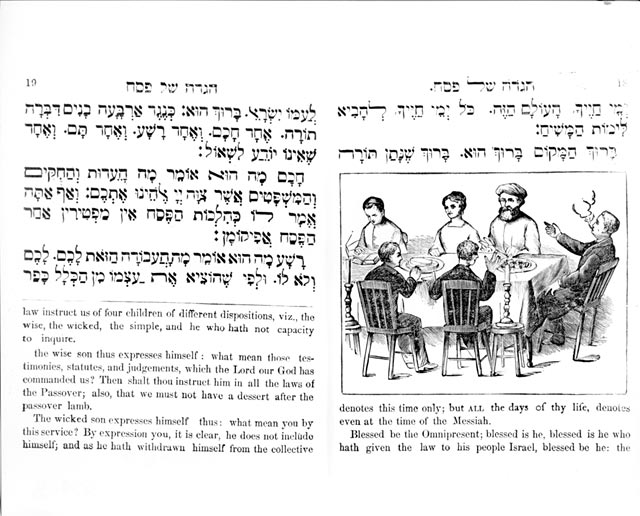
Another example of Americana and the use of fire on Yom Tov appears in one of the first haggadot printed in the United States.  The 1886 illustrated Haggadah contains a depiction of the four sons.  Depicting the four sons is very common in the illustrated manuscripts and printed haggadot. In this instance, the wicked son’s disdain for the seder proceedings shows him leaning back on his chair and smoking a cigarette. According to many halakhic authorities, smoking is permitted on Yom Tov, nonetheless, the illustration demonstrates that at least in the late 19th-century smoking was not an acceptable practice in formal settings. (For a discussion of smoking on Yom Tov, see R. Shlomo Yosef Zevin, Mo’adim be-Halakha (Jerusalem:  Mechon Talmud Hayisraeli, 1983), 7-8).


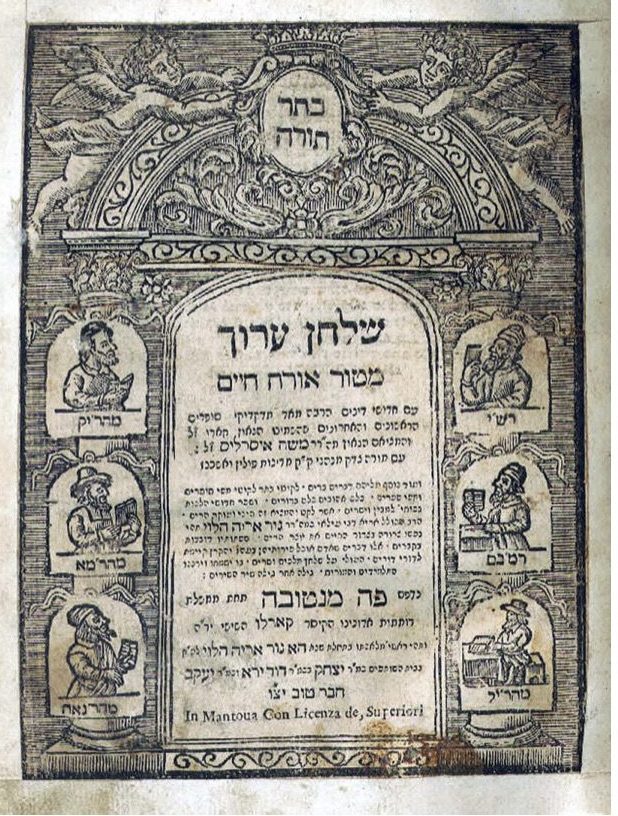
One of the other lots that also implicates illustration is lot 94, Shulhan Orakh im Pirush Gur Areyeh, Mantua, 1722, that contains the commentary of R. Yosef ben Ephraim Gur Areyeh Halevi.  As we have previously discussed at the end of this post, the Gur Areyeh’s title page to the first volume depicts six relevant personalities, Rashi, Rambam, MahaRIL, R Yosef Karo, R. Moshe Isserles, and R. Gur Areyeh.  According to some accounts, this illustration roused the ire of some rabbis because they felt the depictions were crude, and in some instances seem to show at least one rabbi in violation of Jewish law.  Allegedly, they claim that the Rambam is shown with insufficient peyot (sidelocks) in addition to long hair (as do others).  Thus in the remaining volumes of this edition, the illustrations were removed and they no longer appear (although at least in one preserved copy the illustration is repeated in the Yoreh De’ah volume).


One lot, # 161, is an incredible discovery: R. Yosef Dov Halevi Soloveitchik’s (Bet Halevi) copy of the Halakhot Gedolot (BeHaG).  This copy contains hundreds of unpublished glosses, citations, and cross-references. This copy establishes that the Netziv was not the only Rosh Yeshivah of Volozhin who was involved in the works of the Geonim. One only can hope that whoever purchases this copy will publish the notes.

Another such item is # 87 is a presentation copy of Derishat Tzion that contains the commentary of R’ Tzvi Pesach Frank. Although not noted in the description R. Frank presented this copy to R’ Chaim Hirschenson.  In his Shut Malkei Bakodesh,(4:10) R’ Hirschsenson prints a very interesting letter from R Frank after he received a copy of one of R. Hirschenshon’s book. R Frank took issue with some of R. Hirschenshon’s conclusions and to his credit, he prints it without censoring it. The book being auctioned might have been a gift from R Frank in return for the gift he received. R. Frank’s letter is full of fascinating contemporary descriptions of Jerusalem.

Finally, for a discussion regarding lot 93, Menukha ve-Kedusha and censorship see our post here.
[1] See, for example, Yakkov Shmuel Speigel, Amudim be-Tolodot Sefer ha-Ivri:  Ketivah veha-Atakah (Ramat Gan:  Bar Ilan University Press, 2005), 241-97; Marc Shapiro, Changing the Immutable:  How Orthodox Judaism Rewrites History (Oxford:  Littman Library of Jewish Civilization, 2015), 81-118.

[2] For a biography see R. Eitam Henkin, Tarokh le-fani Shulkhan (Jerusalem:  Maggid, 2019).  Regarding this book see our discussion here.

[3] Yosef Goldman, Hebrew Printing in America 1735-1926:  A History and Annotated Bibliography (Brooklyn:  [YG Books], 2006), vol. 1, no. 584, 514. See our reviews of Goldman’s bibliography here and here.

[4] Goldman, Hebrew Printing, no. 591, vol. 1, 521.

[5] See generally, Yossi Goldman, vol. 1, no. 591, 520-21.  Bet Vaad contains materials beyond responsa and halakhic discussions, including poetry, discussions regarding Jewish life in America such as yeshivot, restaurants, and a fable written in verse.

For a discussion of Manischewitz, see Jonathan D. Sarna, “How Matzah Became Square: Manischewitz and the Development of Machine-Made Matzah in the United States,” in Rebecca Kobrin, ed., Chosen Capital: The Jewish Encounter with American Capitalism (New Brunswick: Rutgers University Press, 2012), 272-288; Jonathan D. Sarna, How Matzah Became Square: Manischewitz and the Development of Machine-Made Matzah in the United States (New York: Touro College, 2005).

[6] Regarding the position that seeks to portray Orthodox Judaism a monolithic halakhic process and view as legitimate only certain opinions see Adiel Schremer, Ma’ase Rav: Shekul ha-Da’at ha-Halakhati ve-Eytsuv ha-Zehut ha-Yahadut (Ramat Gan:  Bar Ilan University Press, 2019), 191-97.


Lecture Announcement: Dr. Marc Shapiro

The Seforim Blog is pleased to announce that esteemed Seforim Blog contributor Dr. Marc Shapiro is speaking at Young Israel Beth-El of Boro Park, 4802 15th Avenue in Brooklyn, this coming Saturday night December 21 at 8pm.

The title of his talk is “Judaism and Islam: Some Historical and Halakhic Perspectives”.


Marc B. Shapiro’s Iggerot Malkhei Rabbanan to be available in Israel

Copies of Marc Shapiro’s recent work Iggerot Malkhei Rabbanan mentioned here, are now available for purchase in Israel. To purchase contact Eliezerbrodt@gmail.com.


Legacy Judaica Auction, Cremation, R. Kook, and Other Items

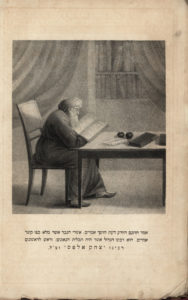
Legacy Judaica is holding an auction on Monday, September 23rd, and a few items of note.  The Viennese Schmidt press produced two books with rather striking portraits.  One of R. Shmuel Eidels, Maharsha, and other of R. Yitzkah Alfasi, Rif, which is at lot 54.  Rif is depicted wearing robes and a turban with a long white beard.  Of course, there are no contemporaneous portraits of Rif, and this is a 19th century creation.  (For more on rabbinic portraits see Cohen, Jewish Icons, 114-153).


The first edition of R. Yitzhak Hutner’s, Torat ha-Nazir, contains three approbations from R. Chaim Ozer, R. Avraham Shapiro (Dvar Avraham), and R. Kook.  The next edition omits all three, presumably to avoid including R. Kook’s.  Although later reprints include just R. Chaim Ozer’s, leaving out the page that contains the Dvar Avraham’s and R. Kook’s letters (for example, the copy on Hebrewbooks). (See Marc Shapiro, Changing the Immutable, 157-160, and Eitam Henkin, “Historical Revisionism by the families of R. Kook’s Disciples:  Three Case Studies,” in Hakirah.)’


The polemical offerings include the Berlin 1905 book, Hayyei Olam, (lot 74) that opposes cremation of Jewish bodies.  At the turn of the twentieth century the issue of cremation was debated among Jews, with the rabbis of Hamburg and Altona having opposing views.  Hayei Olam, written by R. Lerner, the rabbi of Altona was against the practice and collects numerous other letters from sympathetic rabbis.  On the other side, R. Arentreu, in Or ha-Emet, and R. Shimon Tzvi Deutsch, in Heker Halakha, defended the practice.  (For more on the issue, see the entries for these works in Shmuel Glick’s Kuntres ha-Teshuvot ha-Hadash and Michael Heiger’s article in Halakhot ve-Aggadadot).


For a more recent controversial book, lot 80 is Making of a Godol, of the recently passed R. Nosson Kamenetsky.  We have discussed this book and its editions and the book, Anatomy of a Ban, which documents the controversy here

For those interested in bibliomancy, the edition of Tanakh recommended for the goral ha-Gra is at lot 123.  Of note is that this edition has two title pages in Hebrew and Latin, and likely not intended for a Jewish audience.

For one of the more bizarre travelogues, it is hard to surpass Sefer ha-Brit ha-Hadasha im ha-Nehar Sambatyyon be-Medinat China (lot 141).  After receiving permission from President McKinley, Uziel Haga accompanied US military forces in China for purposes of surveying the customs and life of Chinese Jews. Another lot of American Judaica, lot 138, is a collection of 10 works from R. Yekusiel Yehuda Greenwald.  R. Greenwald was a prolific author who wrote on many diverse topics. He is perhaps most well known for his book on the laws of mourning, Kol Bo Aveilut, but also wrote books on R. Yonathan Eiybschitz, the reform movement, and the Palestinian Talmud, and was a rabbi in Columbus, Ohio after emigrating from Hungary.

There is a well-known if an inaccurate story that on Yom Kippur, during a cholera epidemic, R. Yisrael Salanter wanted to ensure that those who needed to would eat.  So he got up on the bimah in the Great Synagogue of Vilna and made Kiddush and ate cake.  Although the veracity of the story has been questioned, with an eyewitness reporting that R. Yisrael announced from the bimah that those who needed to eat could do so without first asking their doctor but he ate nothing.  (See Yaakov Mark, Be-Mihitzatam shel Gedolim 68).  Lot 197 is a document from R. Yaakov Tzvi Mecklenburg, author of Kitav veha-Kabbalah, instructing women to remain at home and not attend synagogue for fear of spreading communicable diseases. For more on cholera, Yom Kippur, and R. Yisrael Salanter, see Eliezer Marmalstein, “Eating on Yom Kippur during Epidemics — Cholera — R. Yisrael Salanter’s Permissive Stance and those who Opposed Him,” Kovets Ets Hayyim, (Bobov), vol. 7, 273-294 (Hebrew).


Rabbi Yechiel Goldhaber shiurim this week

You are cordially invited to the following shiurim/lectures by the noted author, Rav Yechiel Goldhaber, whose respected research and scholarship is well-known.

1. The next shiur will take place Monday, September 16th, 8 PM at Lakewood Courtyard Simcha Room 8:00 pm Yiddish/English.

2. Tuesday, September 17th the shiur will take place in Monsey at 20 Forshay Rd at בית המדרש אור החיים פארשעי  At 12:30 it will be in Yiddish and 8:30 it will be in English.

3. Wednesday September 18th The Shiur will take place back in Boro Park at 1611 46 st In בית המדרש ‘שפע חיים’ – צאנז. This shiur will be in Yiddish at 9:30 PM.

4. Thursday, September 19th, 12:45 – 1:30 at 919 Third Avenue, New York, NY (32nd floor). Rabbi Goldhaber’s speech will be delivered in English. RSVP by 10:00 AM Thursday, September, 19th is required to get through security. Please RSVP to myrna.rosado@debevoise.com

The subject of all these shiurim/lectures is “The Mesorah of the Esrogim”. Rabbi Goldhaber will present the subject matter in a comprehensive, detailed yet clear manner, aided by drawings, pictures and photographs.


Rabbi Yechiel Goldhaber lectures tomorrow night, 9/9/19, & Wednesday, 9/11/19

You are cordially invited to the following shiurim/lectures by the noted author, Rav Yechiel Goldhaber, whose respected research and scholarship is well-known.
The first shiur will take place Monday, September 9th, 7:30 PM at 1454 54th Street, Brooklyn, NY. Rabbi Goldhaber’s speech will be delivered in Yiddish. The subject of this shiur is “The Mesorah of the Esrogim”. Rabbi Goldhaber will present the subject matter in a comprehensive, detailed yet clear manner, aided by drawings, pictures and photographs.
This lecture is dedicated לזכר נשמת  the late Dr. Shlomo Sprecher ז״ל  who coordinated and hosted many of Rabbi Goldhaber’s shiurim.
The second shiur will take place Wednesday  September 11th, 8:45 PM at 39 Eastbourne Dr Chestnut Ridge, NY. Rabbi Goldhaber’s speech will be delivered in English. The subject of this shiur is “The Mesorah of the Esrogim”. Rabbi Goldhaber will present the subject matter in a comprehensive, detailed yet clear manner, aided by drawings, pictures and photographs.


Book sale still active

Just a reminder that the sale from this post is active for another two days (through June 27).


Message from Professor Haym Soloveitchik

In the newly-published issue of the Jewish Quartlerly Review (Spring 109:2), there is an exchange between Robert Brody and Haym Soloveitchik on the “Third Yeshivah of Bavel” (https://muse.jhu.edu/issue/40354). Professor Soloveitchik’s reply is in two parts: Part I in JQR and the continuation–Part II– on his website.<haymsoloveitchik.org>. At the conclusion of  his reply in JQR, he refers the readers to Part II on his website: “Those interested in my replies to all of Brody’s other objections can turn to my website, haym.soloveitchik.org, and click on Reply to Brody, Part II.” There is a typographical error in the name of the website. There is no period between <haym> and<soloveitchik>. The correct address is: <haymsoloveitchik.org>.


Legacy Auction, agunot, censorship, and other notable items

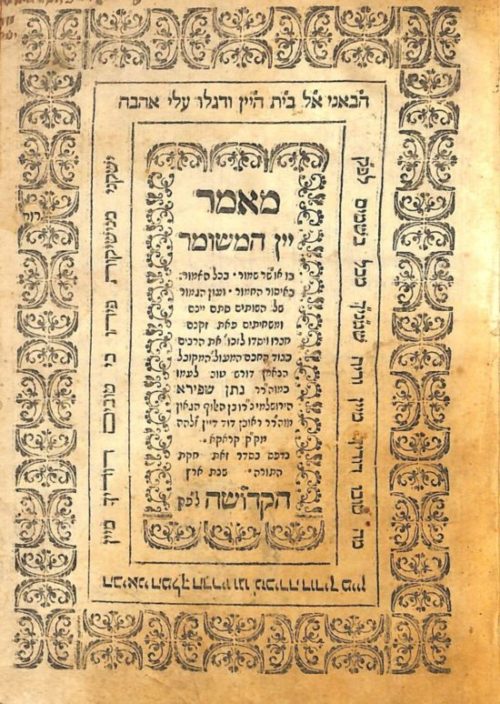
Legacy Judaica will be holding its latest auction on April 4th. The auction includes a few lots regarding agunot and comprehensive attempts to annul marriages.  In the early 20th century, especially in the aftermath of WWI, some tried to find global solutions to the massive agunah problem.  To those books offering solutions were those which disputed the validity of those solutions.  There is a lot of ten historic books on the controversies and a lot of letters from American rabbis.  One of the most substantial responses is, Ein Tenai be-nesunin , whose title leaves no doubt as to its position.  The book includes an important letter from R. Chaim Ozer and other rabbis.  According to some, the book was a response to one of the more eclectic figures invovled in the controversy, R. Yosef Shapotsnik.  His book, Lekor le-Asirim Dror, also leaves no doubt as to his position.  Although that book does not appear at this auction, Shapotshnik was involved in many other controversies and one of his books on the issue with an eruv in London.  (lot 48).   One of R. Nathan Shapira’s polemics, one against drinking yayin neskeh, and the other on Lurianic observances of certain mitzvos constitutes (lot 76).

A  lesser-known example of censorship are the two “first” editions of R. Yehuda Greenwald’s Shut Zikhron Yehuda, both published in 1923.  The first contains a lengthy letter questioning how R. Yosef Hayyim Sonenfeld could associate himself with the Agudah.  In the second edition that is replaced with a letter regarding eating on the eve of Yom Kippur.  Unfortunately in the second version although they changed the letter they weren’t as thorough as they should have been left the original title in the index. (lot 50).

The version of the Shulkhan Arukh with the commentary Gur Areyeh that contains the portraits of rabbis is lot 47.  Regarding the use of the portraits and whether they were offensive see our recent post.

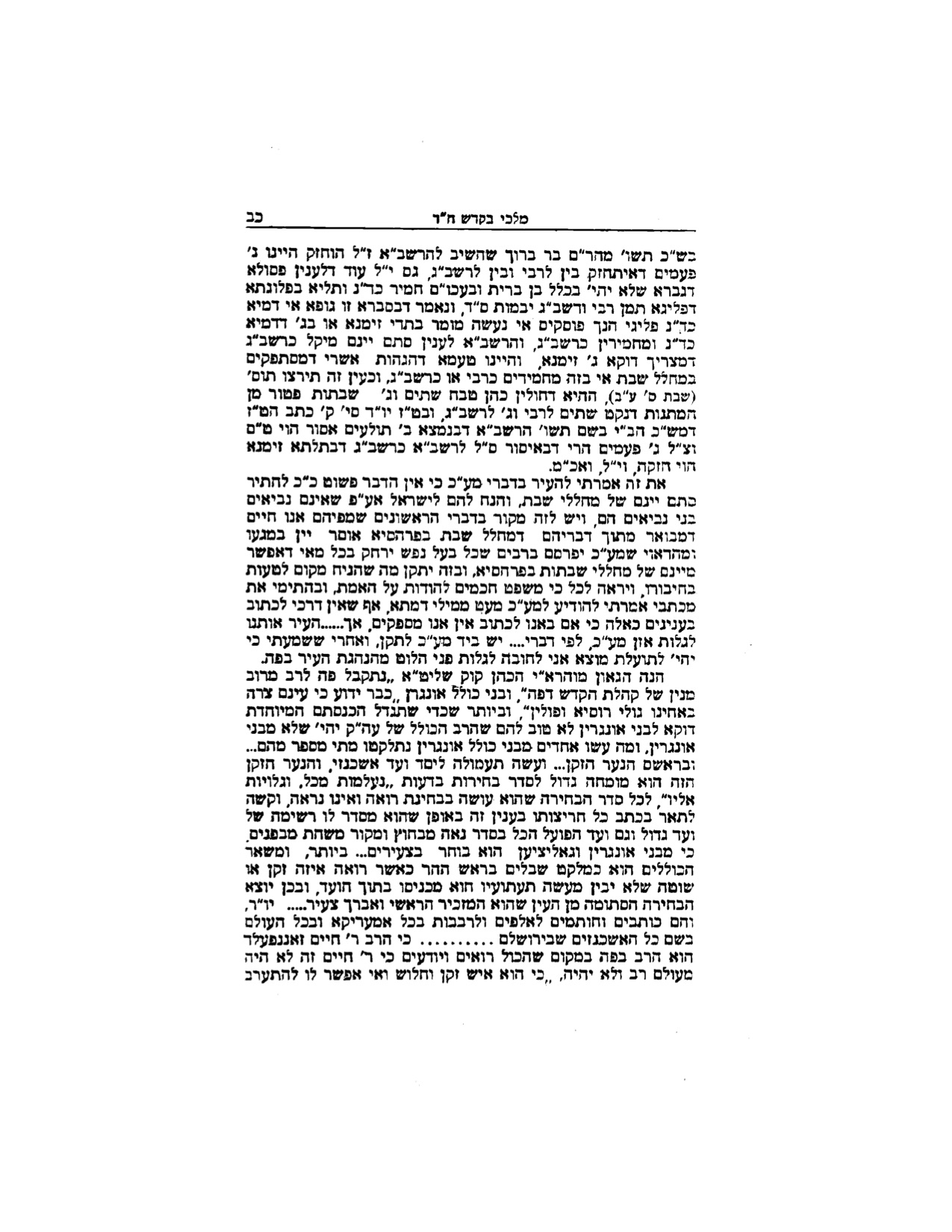
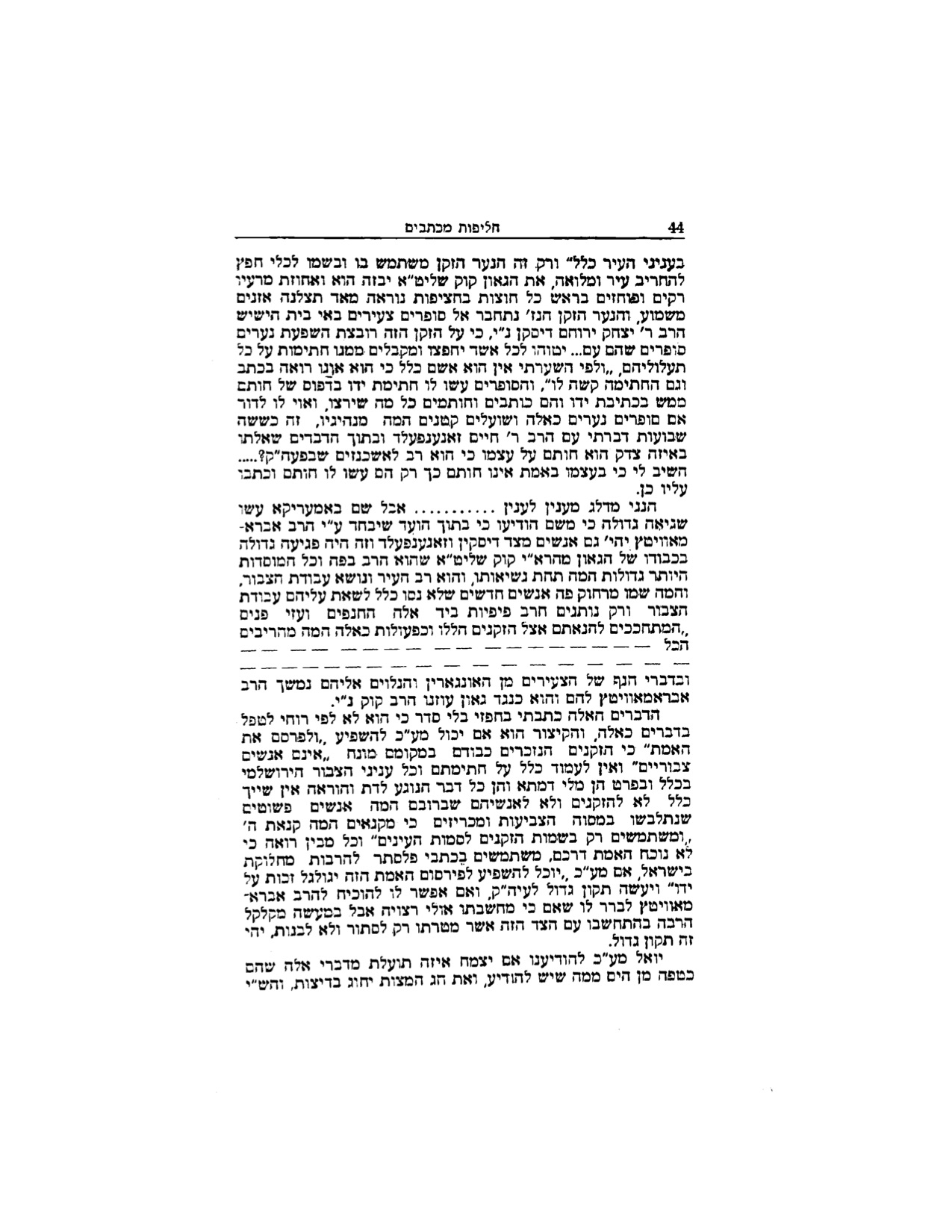
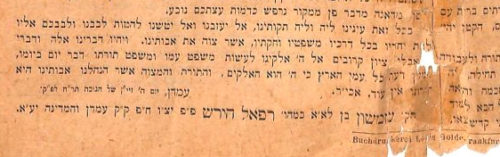
Lot 49 is a large double-sided broadside polemic against the Reform rabbinical conferences signed by R. Samson Raphael Hirsch when he was still the rav and av beis din of Emden. Here is an excerpt:


Lot 13 is Sefer Zichronos of R’ Abohav although quoted by many it was very rare and almost no one saw it inside but rather came to it through secondary sources including the Magan Avhrhom who quotes it often,and was printed by Ahahvat Sholom twice.

Another point of interest related to this work is this work was printed anonymously The Chida deals with this at length in his Shem hagedolim if this is a proper practice. See also most recently Yakav Speigel in Amudim Betoldost Sefer haivri ( BEsharei Hadefus) Chapter Two and see our post here. We also dealt with R Abuhav here.

Lot 12 is the first edition of of ha-Kesav Ve-ha-Kaballah by R. Jacob Zvi Mecklenburg (Leipzig, 1839).

Earlier on the blog (here) we have pointed to pieces only found in the first edition of this work and this particular volume is from the main synagogue in Koningsberg where R. Mecklensberg was the rabbi.

Lot 24 is the Nesivot Mishpat. an interesting tidbit about of this work has been noted in this post

Lot 28 is the Shut Meshiv Davar of the Netziv.  The entry notes that there are two editions of the first edition. The one for sale is more complete.  Some of the differences have been noted in The series on the seforim blog “The Netziv, Reading Newspapers on Shabbos in General & Censorship” (here, here and here). Part four in the series will hopefully be published shortly dealing with some more differences between the various editions.

Lot 94 is R’ Moshe Koerner and his Toras Moshe. There are two editions of this work, each with a different introduction. This was pointed out by Dr. Sprecher in his introduction to R’ Koerner’s Birchas Moshe which he reprinted. He also printed copies of both introductions. This is not noted in the Mifal bibliography entry on this work. Also, worth pointing to about R’ Koerner is recent excellent article from, Uriel Gellman, “Between Worlds: The Miserable Life of an Itinerant Preacher on the Eve of Modernity”, Jewish Quarterly Review, vol. 109 no. 1, 2019, pp. 54-83.

Lot 82 Sefer Safra Detzniusah DeYakov  about this rare book R’ Ephrayim Zalman Margolis who had a excellent collection writes picturesquely about this work:

.והספר היה אצלי ונשרף בעוה”ר בשריפה שהיה פ”ק שנת תק”ן לפ”ק ומאז לא בא לידי

See ( מעלות היוחסין עמ’ סד) for this reference.

Lots 111-112 manuscripts of the Maaseh Rav sound very interesting one hopes that who ever prints them makes them available to the public to study. For now see R Dovid Kamenetsky article here

Lot 102 Zemirot mateh Yehudah. See what the Pre Megadim writes about this work:

בספר נטריקן, יורשלים תשכד, דף טז ע”ב: “ועיין בספר מטה יהודה על זמירות ואדם גדול היה“. וראה שם הקדמה דף ו ע”א.

Lot 103

The Dibuk highlighted in auction entry is dealt with at great length in   Sara Zfatman’s  excellent book Jewish Exorcism in Early Modern Ashkenaz (heb.).

Lot 162 provides evidence of which edition of the haggadah the Netziv might have used at the seder, R’ Eliezer Ashkenazi ‘s Maasei Hashem.  The Netziv quotes this work in his commentary on the Sifri (1:243) and in his work on Chumash Bershis (44:34). This was his personal copy:

Lot 204 is a copy of Teudas Chaver (Prague 1813) signed by the Prague beis din, including R. Elazar Fleckeles, and R. Shmuel Landau, the Noda be-Yehuda’s son.

Lot 205 R Chaim Ozer and R Kook, relating to their relationship. See R. Dovid Kamenetsky’s article here


Invitation to Two Lectures by Dan Rabinowitz this Week & Discount Code

This Tuesday Dan Rabinowitz will appear on a panel, “Saving Jewish Cultural Legacy:  Libraries and Archives During and After WII,” at Brandeis University.
This Thursday he will be discussing his book at the Library of Congress, at the African and Middle East Reading Room at noon.
Seforim Blog readers are invited to attend.
Additionally, readers of the blog can receive a 20% discount on Dan’s book, The Lost Library:  The Legacy of Vilna’s Strashun Library  in the Aftermath of the Holocaust, for purchases directly from University of Chicago Press (here) using the code BUPRABIN for 20% off.