Review of Jay R. Berkovitz’s The Pinkas of Metz

Review of Jay R. Berkovitz’s The Pinkas of Metz

By Eliezer Brodt & Dan Rabinowitz

Jay R. Berkovitz, Protocols of Justice: The Pinkas of Metz Rabbinic Court 1771-1789, (2 vol., 222 pp. +1084 pp.), Brill 2014

Jay R. Berkovitz, Law’s Dominion, Jewish Community, Religion and Family in Early Modern Metz,(404 pp.) Brill 2022

A decade ago, Professor Jay Berkovitz, a Professor and Chair of Judaic and Near Eastern Studies at the University of Massachusetts, Amherst, published the Pinkas (record book or register) of the Rabbinic Court in Metz. Jews began living in Metz, a town in Northeast France near the Moselle River, in the 16th century. These records require a reassessment of the Jewish legal process and procedure, especially concerning the secular legal system. In 2022, Berkovitz published a self-standing monograph, Law’s Dominion, to fully describe and explicate the impact of the Pinkas. Both works mark significant advancements in modern Jewish history and the theory of the Jewish legal system. Yet, they have not received the proper attention they deserve in the Hebrew book world. The lack of recognition can partially be attributed to the publisher, the distinguished publishing house of Brill. Brill’s publications are not generally available for sale in local Seforim stores, and many are priced outside the reach of laymen (or even scholars). Nonetheless, both are worth seeking out, and we intend to bring these vital works to the attention of Seforimblog readers and describe their significance.

The Pinkas of the Metz Rabbinic Court covers just 18 years, 1771-1789, yet it is a massive amount of material. Berkovitz’s transcription (albeit with notes) is over one thousand pages. This is truly what one would call a labor of love. Not only did he publish a huge manuscript (over one thousand pages) with valuable indices, but he also mined the work extensively. In 2014, he wrote a volume (222 pp.), in English, dealing with many aspects of the Pinkas (as I will elaborate on below), demonstrating his command of everything possibly imaginable related to this work.

A few years later, in 2022, Berkowitz revisited the Pinkas and published another book, Law’s Dominion, Jewish Community, Religion and Family in Early Modern Metz, updating his previous book with a few more hundred pages.[1]

Berkowitz describes his project as follows:

Though certainly never intended to become a complete history of the Jews of Metz, Protocols of Justice grew to become much larger in size and complexity than originally expected. Despite its expanding into a self-standing monograph, I am very much aware that work on this project is still in its early stages. I present these volumes as an invitation to scholars to continue what has commenced here (p. 25).

Introduction: Pinkasim and their Historic Value

By way of introduction, many people seek out new niches where they can contribute valuable studies about otherwise unknown topics. One such untapped area is the world of Pinkasim. Over the years, numerous kinds of Pinkasim have been published, some in extensive critical editions. But there remains plenty of work in this “field.”

What is a Pinkas?

These records, typically in the form of a notebook or book, transcribe the materials of a particular group, society, or entity. They can be marriage or divorce records, Synagogue protocols, or numerous “Chevrah books.” Even though many have been lost or destroyed, numerous volumes have survived in libraries worldwide. In recent years, some have even ended up in private collections. (After the Holocaust, “Pinkas” is also used to describe a different form of communal books. Survivors from towns in Europe published “memorial books” to document their history and memorialize the murdered Jews. Many of those use Pinkas in the title, for example, Pinkas Zetel, Pinkas Galicia. Although collectively, the genre is referred to as “Yizkor books. New York Public Library collected these, and they are available on its site: Yizkor Book Collection.)

Historians have long recognized the value of Pinkasim generally. When reading the works of various prominent historians before World War Two, they often cite something like this: “In the Pinkasim of the town or city, I found…” One of the more well-known examples of a Pinkas is the Pinkas of the Vilna Gaon Kloyz. This manuscript is currently in New York and has a fascinating story regarding its survival (See David Fishman, The Book Smugglers, 52-55 for more details). R. Shlomo Zalman Hevlin published of the text of this Pinkas in the journal Yeshurun. Shlomo Zalman Hevlin, “The Pinkas of the Gaon’s Kloyz,” Yeshurun 16 (2005), 746-60; “The Kloyz of the Gaon of Vilna Zts”L, Ketayim me-Pinkas ha-Kloyz,” Yeshurun 6 (1999), 678-85.[2]

This Pinkas provides invaluable information regarding ownership of one of the homes where the Vilna Gaon resided. After his death, his children claimed it was part of the estate, while his students argued that it belonged to the community. After some machinations, including changing the board composition that held the property in trust, the court ruled in favor of the children. Some scholars view this property dispute as an attempt to resolve a larger issue of whether Gaon’s children or his students would control his intellectual legacy. After this decision, the children determined which Gaon’s manuscripts would be published rather than the students. (See Dan Rabinowitz, The Lost Library, Brandeis University Press, Massachusetts, 2019, 55-58.)

The Significance of the Bet Din Pinkas.

A subset of Pinkasim are those of Be’tai Din, taking the form of a register of the various disputes and decisions. These, too, are of critical importance. These documents shed light on individuals’ relationships to communal takanot, the power and authority of the Bet Din, and many other areas.

Yet, today, many of the Pinksim no long survive. Sometimes this was deliberate as in the case in the 1600’s of the Frankfurt Bet Din.

כתוב ביש נוחלין… וזה לשונו, קבלה ישנה מאבותי ז”ל שלא להשליך שום חשבון ישן אף על פי שנחשב הכל, כי אולי תבוא עת להוכיח דבר מה מאותו. עד כאן ולדידי הכותב הוה עובדא בזה כמה פעמים שבא לי לאחר ההשלכה לכלל היזק, כי כמעט הייתי מוכרח בכל פסח לשרוף כתבים ופתקאות, לפי שריבויים מפסקי דינים והשלישות וכיוצא ישתרגו עלו על צוארי, שלא היה המועט מחזיק את המרובה. וגם מפני שלא יהיה לי הטורח גדול ביותר בחפשי בחפש מחופש אחר כתב אחד, כאשר גם עתה אחר כל שריפת הכתבים נלאיתי עד כמה שעות בחפשי אחר איזה כתב [יוסף אומץ סי’ שע, עמ’ קח]

Rabbinic scholars eventually recognized the significance of pinkasim.[3] For example, the Nodeh BeYehudah uses one to determine the spelling of names in a get:

הנה אהוביי להיות שאין הגדול מעיד בגדלו על מה שראה בקטנו כ”א דברים ידועים שחשבו רז”ל ולכן אין אני יכול להעיד. אבל אעפ”כ אני אומר לכם נהירנא כד הוינא טליא כבר תשע או כבר עשר ראיתי אצל אא הרב זל פנקסאות של הגליל קראקא וראיתי פנקסאות משנים קדמוניות היו חתומים בו גאוני עולם זקני הגאון רשכב”ה מוהר”ר העשיל זצ”ל ואחריו דודי זקני הגאון המפורסם מוהרר”ל וגם ראיתי חתימת הגאון בעל תוספות י”ט שמה וכמדומה שבכל מקום שנרשם שם השומא חדשה שעשו שמאים באסיפת הגליל היה נכתב פילטץ עם טי”ת, ואף שאין אני יכול להעיד בבירור כי טליא הוינא וגם מלתא דלא רמיא וכו’ אבל תדעו שהפנקסאות הנ”ל דומה אני שהיה אח”כ ביד המאוה”ג מוהר”ר שלמה ז”ל אב”ד דק”ק פינטשוב שהיה סופר הגליל דרשו שם בק”ק הנ”ל ותמצאו אבל עכ”פ המפורסמות א”צ ראיה וזה דבר ידוע ששם העיר בכל מדינת פולין קורין פילטץ עם טי”ת וכן כותבים בכל האגרות והרי הוחזק שם העיר בלשון היהודים עם טי”ת. [נודע ביהודה, קמא, אבן העזר, סי’ פז].

Basically, one man’s junk became another’s treasure.

At first glance, a Pinkas of the Bet Din might appear to be dry material only of interest to specialists and technicians. But in reality, these contain information that can elucidate and enrich larger Jewish history. Nonetheless, little work has been done with the Pinkasim of rabbinical courts. Recently, however, some have begun publishing and analyzing these records to great effect. Edward Fram’s book, A Window on Their World: The Court Diaries of Rabbi Hayyim Gundersheim Frankfurt Am Main 1773-1794 (2012), inaugurated this approach.

A more focused usage of a Bet Din Pinkas is an article by Moaz Kahana. He identified a short and somewhat cryptic entry in the Pinkas of the Bet Din of Prague regarding a fine levied on two people. From that citation Kahana provides a sweeping exposition on Jewish coffee culture in Prague in the 18th century. Among other details, in 1765 (during the period that R. Yehzkel Landau was the Chief Rabbi), there were at least six coffee houses in the Jewish quarter, owned by Jews, open on Shabbos, that Jews frequented and sanctioned by the Rabbinate. (Moaz Kahana, “Shabbos be-Beyes ha-Kaffe shel Kehilah Kedosha Prague,” in Zion, 2013 (78), 5-50).

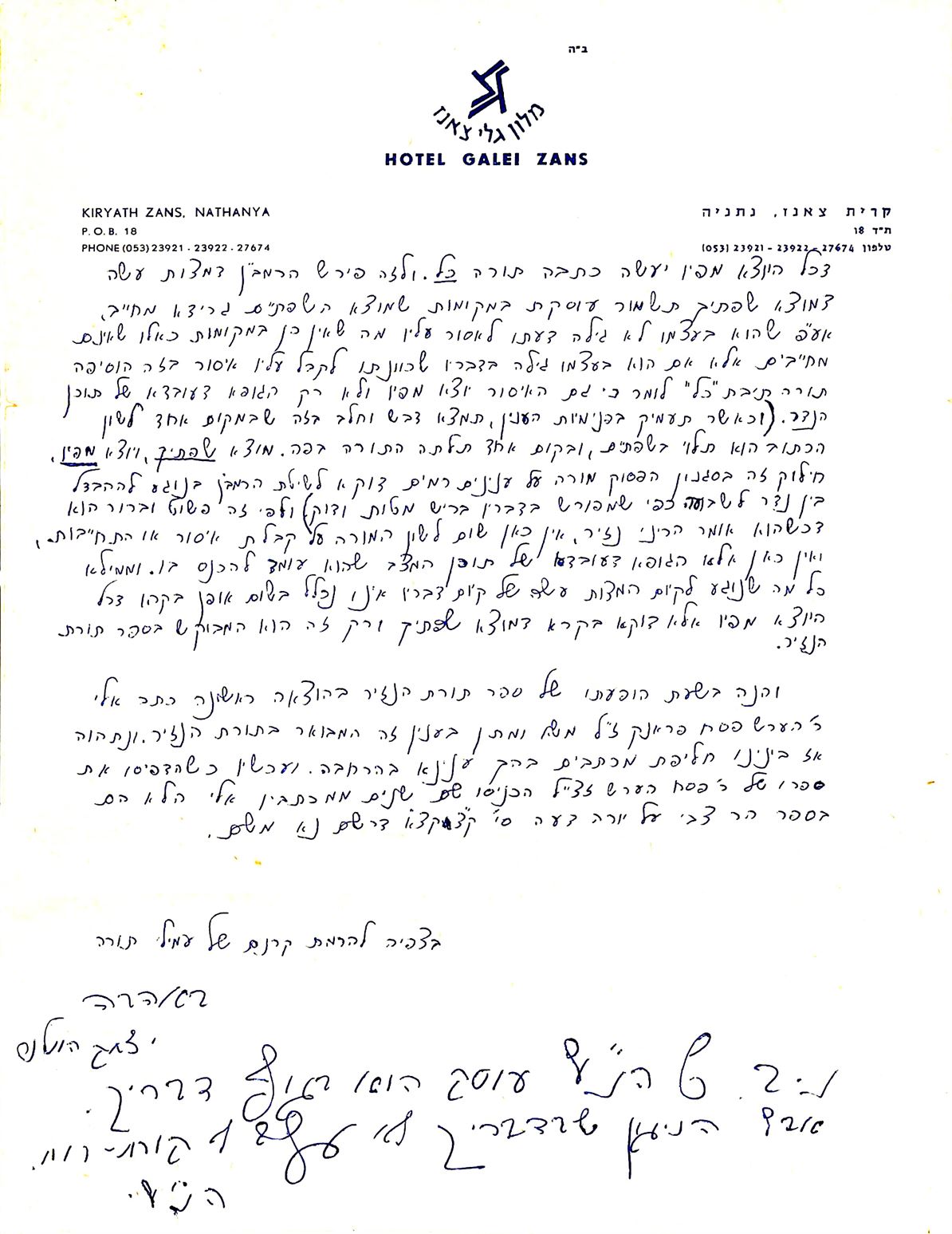
A few years ago, in the prominent journal Yeshurun (24 (2011), pp. 235-297), R’ Dovid Kamenetzky published material from the Pinkas of Frankfurt from the Haflah.[ Avalaibel here and here] R’ Zalman Nechemiah Goldberg commented to the volume editors that he was so excited to read this material. In the course of this post, we hope to explain what his excitement was about. It is safe to imagine that had he seen this material from the Pinkas of Metz, he would have been beyond excited.

What can we learn from this Pinkas?

This Pinkas of the Bet Din of Metz is of especial importance. Berkowitz cites Anthony Grafton that “…courtroom and the lawyer’s study have turned out to be historical alembics where the methods of social and intellectual historians can be mingled in new forms, producing results of unsuspected richness.” that “In the last quarter-century, especially, the courts have been identified as a dynamic arena of social change and as a valuable source for understanding economic history and the changing function of law in society.” Recognizing this value, many scholars have used medieval Jewish records to elucidate those periods’ history. Yet there is a lacuna when it comes to the early modern era. Consequently, the potential of beit din records remains largely untapped (p.3).[4]

Berkowitz acknowledges that, in part, the lack of use of bet din records is due to the many technical challenges, including “proficiency in Hebrew paleography and expertise in the largely unfamiliar territory of Jewish civil and family law. As a result, we know virtually nothing about the kinds of cases that came before rabbinic courts and even less concerning jurisprudence and dispute resolution methods employed there. This is rather ironic in light of the heightened interest in law shown by historians working on late medieval and early modern Europe.” (p. 3)

As mentioned, Berkowitz did two important things: he transcribed this massive work carefully and studied it as a historian of Halacha; he “mined” this work very carefully.

The transcription alone is not a small feat; we are talking about a volume that, in print form, is almost 1000 pages of Hebrew text! The Pinkas also includes obscure words in French and Yiddish, which Berkowitz also deciphers, provides a useful glossary of foreign terms.

An important feature of Berkowitz’s edition of the Pinkas is the extensive indices based on topics, names, and places.

Berkowitz writes:

The economic data contained in the proceedings of the Metz Beit Din will doubtless prove invaluable in gauging the range and intensity of Jewish commercial activity in the pre-revolutionary era… (p. 30)

Then Berkowitz elaborates on this, listing out what exactly one can learn from this Pinkas:

The Metz court records are also filled with resources for investigating the economic complexities of marriage, family, and kinship relations. A profusion of details concerning the social and economic importance of betrothal agreements, dowries, marital property division, and inheritance arrangements represent a treasure trove of historical data. Particularly fascinating are cases that reveal the degree to which law, family, property, and business interests were tightly interwoven. On occasion, the human story comes into view with unusual poignancy, especially in cases of abandoned wives, young widows, and tales of deprivation… Legal mechanisms that came into play in response to evolving social and economic trends in the eighteenth century produced a measure of equality between husbands and wives that is apparent in quite a number of cases that came before the Beit Din. Accordingly, the picture that emerges… to the work women performed beyond their domestic responsibilities. There is abundant evidence suggesting that wives borrowed and extended loans, occasionally without their husbands’ authorization, to help support their families… (pp. 30-31)

Sources for the Law

What do we Know about the Jewish Community of Metz at the time?

Berkowitz writes:

Metz was the western-most outpost of Yiddish-speaking Ashkenazic Jewry in the early modern era (p. 7) With a population of over 46,000, Metz was the tenth largest city in France. During the seventeenth century the Jewish population in Metz increased dramatically and by the end … it numbered nearly 3000 individuals. Slightly less than seven percent of the city’s total population, it constituted the largest Jewish community in France prior to the Revolution (p.8).

In general, there is also great significance to Metz in the world of Halacha at this time, as Berkowitz writes:[5]

The major halakhic works that were produced in Metz or in nearby communities in the eighteenth century and were significant from a regional standpoint include Yaʾir Ḥayyim Bacharach, Resp. Ḥavvot Yaʾir (Frankfurt, 1699); Jacob Reischer, Resp. Shevut Yaakov, pts. 1–3 (Halle, 1710), pt. 2 (Offenbach, 1719), and (Metz, 1789); Joseph Steinhardt, Resp. Zikhron Yosef (Fürth, 1773)[6]; Gershon Coblentz, Resp. Kiryat Ḥannah (Metz, 1789); and Aaron Worms, Meʾorei Or (Metz, 1790–1793) (p. 25)[7]

Why was this Pinkas written in the first place?

Berkowitz explains:

Precious little is known about the production of the Metz Beit Din records. We cannot state with certainty under whose direction these records were produced, for whom they were intended, and toward what end they were preserved in written form. Nevertheless, there was nothing novel or uncommon about providing litigants with written copies of its rulings. Documents issued by the court were intended to confirm an admission of debt, the withdrawal of a claim, the exoneration of an individual from unsubstantiated accusations, or the severance of a widow from her husband’s estate, to name only several of the more common types of validation provided by the Beit Din. In some instances, the court was asked to issue a maʾaseh beit din (a formal judgment) that confirmed ownership over property or established the legality of a particular transaction. Written rulings of this sort were frequently produced as evidence in cases that continued over the course of months or even years. Although the communal register does not contain an explicit directive concerning the actual preservation of judicial records, article 109 of the 1769 community bylaws stated that “every ruling of the Beit Din must be written and signed… It was stipulated, further, that “it is prohibited for either of the litigants to pay the other even a perutah until they have seen the written and signed judgment. (p. 39)

While there is little doubt about the value of the Pinkasim, especially as they relate to the Jewish legal system, they do not offer a complete record of the judicial process. Despite containing hundreds of legal decisions predicated on Jewish law, the Pinkasim do not provide the underlying rationale of those decisions. The decisions distinguish between those based on Jewish law, internal takanas, and custom. But the specifics of the which sources and rationales are compelling are left unsaid. This, however, is unsurprising as most Bet Din decisions, whether recorded in Pinkasim or other sources, seemingly rely upon Rema’s statement that “there is no need to write the rationales and proofs, we only write for them [i.e., for the litigants] the claims and the ruling.”

Who transcribed the Pinkas?

Precisely what role scribes played in determining the content, form, and language of the cases they recorded is unclear. Variations in handwriting, in addition to the assorted signatures affixed at the ends of collations of cases, reveal that several different court stenographers were commissioned to record the judicial proceedings during the eighteen years chronicled in the Pinkas. The largest number of entries appears to be in the hand of a single scribe, Juspa Katz, whose name is recorded in seven cases that span fifteen years (pp. 43-44).

Elaborating on this, Berkowitz adds:

In each of these instances, the document was approved by the av beit din, by the judges, or in some instances by the presiding syndic (parnas ha-ḥodesh). Overall, the stylized prose used in recording the proceedings, which are punctuated by the inclusion of biblical phrases and technical expressions drawn from talmudic and halakhic literature, suggest that the text of the Pinkas was the product of meticulous preparation by erudite scholars and well-trained scribes.

The function of the Beis Din

Berkowitz describes: “As a communal institution, the Metz Beit Din filled three principal functions. First and foremost, it was a judicial body that represented the primary, though certainly not the exclusive, public venue for the resolution of disputes among residents of the greater Metz community. Litigants regularly came from the towns and villages of the Moselle countryside as well, and in some instances from more distant localities when business dealings brought them into contact with Moselle residents. Second, as in the case of the French lower courts, the Beit Din performed bureaucratic functions that included the confirmation of legal documents and contracts, the execution of wills, and the appointment of guardians. Third, it enjoyed certain institutional powers related to social control and supervision. Although this range of functions may have resembled the merging of judicial, legislative, and executive tasks in early modern French courts, the Beit Din acted more as an arm of the Kahal executive and coordinated itself with the general policy guidelines set forth by the community’s governing body. Furthermore, on a much smaller scale, the centralized authority of the Kahal was more pronounced than that of the state and, as a result, the independence of the rabbinic court could be expected to be more narrowly circumscribed (pp. 65-66).

Who were the Dayanim on this Beis Din?

One of the critical insights of this volume is the identification of the dayanim of the Beis Din. These are generally not recorded elsewhere. Berkowitz identifies:

Rabbis Moses Narol Cohen, Gershon Ashkenazi, Jacob Reischer, Abraham Broda, Joshua Jacob Falk, Jonathan Eibeschütz, Shmuel Hilmann, and Aryeh Loeb Günzberg. Günzberg… best known as a renowned Talmudist and author of the celebrated Shaʾagat Aryeh (p. 14)

The Shagas Aryeh is well-known as a posek, but this identifies in a lesser-known role, Av Beis Din. (See Oriel Touitou, The Methods of Rabbi Pinhas Ha-Levy of Horwitz and Rabbi Aryeh Leib in Talmud Study and Halachic Decisions, (PhD) Bar Ilan University 2012; R. Peretz Risenberg, Yeshurun 30 (2014) pp. 772-824; Eliezer Brodt, Yeshurun 24 (2011), p. 463.

How many cases did this Beis din Deal with?

Berkowitz writes:

Serving as the primary communal forum where legal disputes were adjudicated, the Beit Din typically met two or three times a week and averaged roughly sixty cases per year. In accordance with standard procedure in Jewish law, three judges (dayyanim) heard each case; in virtually every instance the tribunal consisted of the av beit din (Günzberg) together with two adjunct dayyanim. In the course of the eighteen years that are chronicled in the Pinkas, fifteen rabbinic judges rotated on the Beit Din alongside the chief justice. Of these sixteen judges, four sat on the bench for the entire period and several others performed their duties for most of those years (p. 15).

Methods of the Beis Din

They did not just give verdicts. They personally investigated the facts.

Concerning a dispute over the suitability of the living space in which an orphan resided together with his uncle, the Beit Din decided to pay a visit to investigate whether the physical conditions in the home were as required. It also hired a nurse to provide a medical perspective, and two more to corroborate the opinion of the first. After taking these steps the Beit Din was persuaded that the orphan was not mistreated and there were no grounds for legal action against the guardians (p. 70)

What do we know about the “reach of this Beis din”?

Berkowitz writes:

These are strong indications of the stability and continuity that characterized the work of the court during nearly two decades of service to the community. Equally impressive is the long geographical reach of the Metz Beit Din. Litigants came from near and far, from Augny located just 8 kilometers southwest of Metz and as far as Frankfurt, which was a distance of 260 kilometers. To accommodate individuals who were unable to travel to Metz from distant communities in the Moselle, the rabbinic court occasionally made special arrangements… In order to reduce expenses, the local cantor was deputized by the Metz Beit Din to administer the widow’s oath… in the presence of one witness. Altogether, more than one hundred villages throughout the Moselle countryside and beyond are mentioned in the court proceedings. These distances reveal much about the far-flung commercial and financial dealings of Metz residents and the centralization of authority in the Moselle region and in areas of Lorraine (pp. 15-16).

The Metz Beis Din and Secular Law

Berkowitz writes:

Without surrendering its own authority, the Beit Din regularly acknowledged the interdependence of cases brought before the rabbinic judges and those taken to the French civil court system. But on numerous occasions the Beit Din made it clear that it would need to await the judgment of the French court before it could issue its own ruling. In a case concerning the division of living space, it declared that its decision was valid “so long as the gentile courts do not object.” It is striking that even in matters that were presumably of minimal interest to the authorities, the Beit Din was hampered by contingencies of this sort… the Metz Beit Din enjoyed substantial independence from state interference and control. Whether they were considering contractual matters, offenses against the public order, or the civil consequences of strictly religious affairs, municipal and royal courts firmly imposed their jurisdiction and exercised the right to overturn the decisions of the ecclesiastical courts when there was evidence of a procedural irregularity. Moreover, the powers of ecclesiastical courts were limited to canonical penalties. The Beit Din, with the full support of the Kehillah leadership, was granted greater latitude by the state to resolve internal differences on the basis of Jewish legal traditions that extended primarily to civil matters. Nevertheless, neither the Kehillah nor the Beit Din was able to ignore pressures to coordinate with and adapt to general law…. How the Metz Beit Din functioned alongside the French civil courts may be the crucial question, but, as will become apparent, it is exceedingly difficult to answer. Complicating the issue is the fact that recourse to French civil courts appears to have accelerated as the eighteenth century wore on. Individuals who took their disputes to gentile courts, known in rabbinic and halakhic literature as ʿarkhaʾot shel goyim, were consistently denounced by medieval and early modern rabbinic authorities (pp. 107-108)

Berkowitz continues:

The present study addresses a different set of questions: How did jurists within the rabbinic court system respond to the challenges to Jewish law that were posed by non-Jewish legal systems? Is there any evidence that judicial procedure in the Beit Din, or the interpretation of the law itself, was influenced by French law or by the possibility of recourse to French civil courts? How did the phenomenon of legal pluralism influence the methods of adjudication and jurisprudence employed in the Metz rabbinic court? The impact of legal pluralism may be discerned in the court’s adoption and adaptation of legal perspectives and mechanisms from general jurisprudence, both in the realm of procedure and in substantive areas of law such as the division of marital property. Invariably, the Beit Din’s method of adjudication reveals tensions between its role as guardian of communal autonomy and the political demands imposed by legal centralism—tensions between its role as arbiter of Jewish law and agent of the Kahal, on the one hand, and its awareness of the contingent nature of the relationship between Jewish law and general law, on the other (pp. 109-110).[8]

Power of the Jewish courts in Early Modern France:

The proceedings of the Metz Beit Din provide elaborate details concerning Jewish civil autonomy. Under the aegis of the governing authority of the Kehillah, the Beit Din was authorized by the state to resolve differences among members of the community on the basis of Jewish customs and legal traditions. In this respect the Beit Din enjoyed a level of authority that far exceeded that granted to the ecclesiastical courts… Overall, the Metz proceedings contain little evidence, either direct or indirect, of resistance to its juridical authority (p.53)

Related to this, a case in the Pinkas is worth citing. As Berkowitz summarizes:

In Metz, as in other communities, the authority exercised by the Beit Din and the scope of its jurisdiction were a reflection of the latitude extended to it by royal and municipal authorities. Owing to limitations on the power of the Kehillah to enforce judicial rulings, the Beit Din found it necessary on certain occasions to caution recalcitrant litigants that failure to respond to a summons carried severe consequences. In the case of Gershon Coblentz, who refused to appear before the Beit Din to settle a dispute with Yozel Cahen, the Beit Din threatened to serve him with a contempt of court order (pequdat ḥerem) and to employ “other forms of coercion.” How effective these threats could have been without the backing of the state is questionable. Coblentz remained adamant in his “rebellion and refusal, holding up the words of the rabbis to ridicule,” whereupon Yozel proceeded to seek authorization from the Beit Din to bring his claim to the French court. The Beit Din informed Gershon that it had approved the transfer of the case to the civil court, and following their response that they did not object, the rabbinic court authorized Yozel to take hold of the written documentation, in French, so that he could sue in the civil court (p. 54).

Who represented the people for the Beis Din?

In more than a third of the cases that were brought to the Metz Beit Din, litigants were represented by their own attorneys. This is likely to have been a (sic) commonplace in rabbinic courts in other communities as well. The scope of legal representation in rabbinic courts had widened considerably in the sixteenth to the eighteenth centuries (p. 60)

Implications for Jewish History from the Pinkas

Knowledge of French

Berkowitz writes:

Although the foregoing examples suggest that French literacy was more prevalent among Metz Jews than has been generally assumed, there is little doubt that facility in French was far less extensive in the countryside than among the urban elite. Even fifty years after the Revolution there were still Jews in the small towns and villages of Alsace and Lorraine who could not speak French. The records of the Beit Din suggest that although the scribes who had been assigned the task of recording the case summaries were familiar with a wide range of technical French vocabulary pertaining to judicial procedure and financial instruments, their fluency may have been limited to oral proficiency. (pp. 93-94)

In addition to gleaning information regarding the legal and judicial practices, the Pinkas also provide information regarding the day-to-day life of the Jews in Metz and beyond. Some of these lead to the important conclusion that “confirm[s] that even prior to the Revolution, cultural influences transcended social barriers, and this appears to have been true for a larger segment of the Jewish population than is commonly assumed.” (p. 95). Others, however, point to more prosaic elements of the lives of the Jews. Nonetheless, the Pinkas is a primary source for assessing their lifestyle and everyday trials and tribulations, and is essential to paint objective picture of their lives.

Some Interesting cases which show life was rather colorful:

On one occasion, when informed that a woman who was engaged to be married had become pregnant, the Beit Din summoned her and her fiancé in order to ascertain whether he was the father and, assuming he was, to ensure compliance with Jewish law if the couple intended to marry. According to Talmudic law, a man is forbidden to marry a woman who was either pregnant by another man or who is nursing another man’s child until the child is twenty-four months old. In response to a husband’s claim that his wife’s pregnancy was not his doing, the Beit Din proceeded to investigate the matter thoroughly. Based on the wife’s acknowledgment of her extra-marital affair, as well as the testimony of witnesses confirming the utter lack of affection between husband and wife, the Beit Din absolved the husband of all financial responsibility for the child and ordered him to divorce his wife; she, in turn, was required to accept the get, even against her will, on account of her confession. Because marriage and sexuality were matters of vital interest to the public, the Beit Din acted swiftly, in some instances before litigants came forward (pp. 68-69)[9]

Another colorful case discussed by Berkowitz regarded:

Reichle Cahen… approached the Kahal in its meeting room and openly accused Hirtz Oulif of fathering her child; she demanded that he marry her and provide birth expenses and child support. Initially heard by the Kahal, the case caused something of a furor because of the public nature of the young woman’s accusation and owing to her family’s elevated status within the community. The Beit Din was invited to join the Kahal in its effort to stave off the worrisome trend, and the head of the rabbinic court, R. Günzberg, was asked to lead the new initiative. Although ill-health prevented Günzberg’s participation, members of the Beit Din proceeded, together with several syndics, to examine the arguments and testimony presented by Reichle and Hirtz… the Beit Din demanded that Reichle and Hirtz address each other directly, without legal representation. Hirtz proceeded to deny each of Reichle’s claims as utterly false. Aiming “to uphold the bylaws of the community,” the Beit Din responded by imposing the ḥerem on both the young woman and the young man, undoubtedly to convey the message that promiscuous behavior would not be tolerated under any circumstances. But when it came out that there were witnesses willing to testify that the young man was heard boasting of his exploits, the Kahal and the Beit Din altered their approach. They recorded the statements in writing, assembled additional oral testimony attesting to the accuracy of the earlier statements, and subsequently set about to erect “a fence and barrier against the promiscuity of the generation and so that daughters will not act wantonly or be treated as such.” At this point the Beit Din imposed the ban directly on Hirtz until such time as he had appeased Reichle by agreeing either to marry her or present her with monetary compensation. It further required him to deposit 1200 livres with the Kahal until the birth, at which point it would be determined whether Reichle’s paternity claim was plausible. If it was, then the money would be turned over to Reichle; if not, the money would be returned to him. In any event, the Beit Din required him to pay a fine of three hundred lives that would be distributed to the poor…(pp. 147-148)[10]

Seats in Shul

In one instance, the Beit Din authorized a widow to sell two synagogue seats and to collect the total value of her ketubah, even though a lien had been placed on the property of the orphans, earmarking it as a charitable bequest. Selling the seats enabled the widow to remove the lien on her ketubah and tosefta, in accordance with both Jewish and general law. (p. 71)[11]

Looking at the index will show that the Beis Din had to deal with many issues with seats in shul.

Gorel: Lotteries

Numerous cases were resolved via lotteries, as listed in the index. These provide additional materials related to lotteries in Jewish culture. See Yechiel Lash, The Attitudes of Halachic Decisors to the Casting of Lots Within a Decision-Making Process and Their Implications, (Ph.D. Bar Ilan Talmud Department 2012); Shraga Bar-On, Lot Casting, God and Man in Jewish Literature: From the Bible to the Renaissance (heb.), Ramat Gan 2020; Eliezer Brodt, Likutei Eliezer, pp. 56-58; Fram, pp. 47-49.

We learn about the Beis Din’s involvement in helping people experiencing poverty:

… details of charitable giving, including laws regulating confraternities and poor relief, particularly when complications demanded the court’s legal expertise. In nearly a dozen cases, the Beit Din was approached concerning the practice of supplying the itinerant poor with billets, known in Yiddish as pletten. Each Metz householder, in proportion to his wealth, was required by communal law to deposit pletten, inscribed with their names, in a chest. Poor travelers would then draw tickets in order to secure meals and a night’s lodging offered at the homes of community members. Questions ranged from the basis upon which the pletten obligations were to be determined for each resident to how to contend with individuals who refused to share the responsibility… (p. 72)

Another interesting case:

In a parallel dispute concerning the administration of a charitable gift bequeathed by an estate, the Beit Din was asked to decide whether the Kahal had the right to exercise control against the wishes of the heirs. Ẓadok Grumbach objected to the Kahal’s insistence that one of twelve rooms in the beit midrash established with funds donated by his grandfather, Abraham Grumbach, ought to be designated for elementary instructional purposes. His attorney argued that this would violate the will of the deceased and contradict prior judgments of the court. It had been understood that the rooms in the upper level were intended for lomdim (scholars) who had been appointed through the generosity of the benefactor and in whose merit they dedicated their efforts; the noise caused by younger students would arguably create a disturbance for the lomdim. Grumbach therefore sued the Kahal for breach of contract.

The attorney for the Kahal responded that the placement of a teacher and students in the room in question would be preferable to leaving it empty, and that in so doing the Kahal would remain in compliance with previous agreements and legal rulings. As a matter of policy, he argued further on the basis of talmudic law that the seven tovei haʾir (the talmudic term used to refer to the lay communal executive council) had the authority to alter a communal ordinance if the intent was to increase learning and expand Torah instruction. The Beit Din upheld the position of the Kahal, arguing that the placement of a teacher and five students in a room on the first level was consistent with the original intent of the testator. It maintained that it was fair to assume that Abraham would have wished the room to be used for instructional purposes rather than to remain empty and that such use would be in the merit of the soul of the deceased… (pp.76-77)

Sins and daily life:

Berkowitz writes:

As traditional barriers separating Jews and non-Jews began to fall after midcentury, communal leaders responded with new attempts to slow the pace of acculturation. Their efforts, though perhaps not religiously motivated, recognized the dangers implicit in excessive exposure to French culture. Games of leisure and chance had become so popular that any person found engaged in these pastimes without the authorization of the community council could be barred from attending synagogue for three years. Paternity suits and extramarital pregnancies were routinely recorded in the communal register and in the protocols of the Beit Din, and the repeated condemnation of extravagance over the course of the eighteenth century suggests that these trends were on the rise. (p.13)

Card Playing & Gambling

There are numerous sources of this kind in various documents throughout Jewish history. One of the most well-known personal accounts appears in R. Yehudah Areyeh Modena’s autobiography. (See generally, Yitzhak Rivkin, Der kamf kegn azartshpiln bay Yidn, (YIVO, 1940).

In the Pinkas we find:

שאמת הוא שהי׳ עובר חרם ע״י שחוק רק שאין כוונתו כמו עוברי חרמים המשחקי׳ בקובי׳ וקארטין רק שהי׳ משחק שחוק אחר שקורין לאדי אצל חתן אחד ושחוק זה ג״כ חרם וב״ח הנ״ל השיב שאין חוששין ללעז ורבי׳ הי׳ אומרי׳ לו שרגיל בעיני המון עם לשחוק [שחוק 192 ] זה אצל חתנים [עמ’ 514]

Other kind of cases which demonstrate a bit about daily life:

In the same vein, the numerous disputes brought before the Beit Din that pertained to building construction and repairs, water damage, and privacy concerns bring to light otherwise hidden aspects of everyday life in the eighteenth century. In a case that concerned the management of public space, residents of a building were fined by the civil court for failing to keep the rear of the property free of litter; the court instructed them to hire a non-Jewish gardener to keep the property clean in accordance with the requirements of the law.

A dispute regarding the relocation of an outhouse, specifically concerning the claim that the work was not performed correctly, was brought to the police-court and was subsequently resolved to the satisfaction of the residents. In a similar case, the placement of an outhouse adjacent to a separation wall between two properties became a contested matter; in this instance it was the Beit Din that was asked to settle the question of the potential physical harm that might result. Disputes pertaining to construction, plumbing, and shared space reveal that it was quite common for Jews to hire non-Jewish workers and to seek the opinion of non-Jewish experts. Such patterns ought to be viewed as a natural consequence of the dependence of the Jewish community on the larger French population to help meet its ordinary, everyday needs… (p. 96)

Jewish Financing of the Military.

Another interesting tidbit found in the Pinkas described by Berkowitz is typical of other Rich Jews:

A probate inventory detailing the property left by Rabbi David Hertzfeld in 1776 lists among those who owed money to the deceased seven heads of military regiments: Orléans, Poitou, La Couronne, Royal Roussillon, Touraine, Auvergne, and Navarre. Although the total amount still owed was modest—approximately 12,000 livres—the lending network had a long reach and its success no doubt demanded extraordinary efforts in earning and maintaining the trust of this specialized clientele (p. 103).

Commercial enterprises at the time in Metz:

In the Pinkas, we find:

For sources in the Beit Din records on commercial enterprise, see the following: Horse trade… sheep trade… cows… Forage… partnership for forage, straw, and oats… Wax… Brokerage… Gems…Cheese: Vol. 1, pt. 2, 30b, no. 122; in Vol. 2, 46b, no. 149, the sale of cheese beneath a shop prompted the storeowner to complain that the pungent smell was harming his business; he asked the Beit Din for a restraining order on the cheese maker. For partnerships with non-Jews, see Vol. 2, 28b, no. 194 (p.11)…

Material Culture & Contemporary style in Metz

Fabrics, clothing, jewelry and valuable gems, as listed in various types of registers, particularly collateral and probate inventories, provide strong indications of the affinity of Metz Jews with French culture. An impressive variety of fabrics is recorded in the Pinkas; these include drap d’or (cloth woven with gold) and drap d’argent (cloth woven with silver); drap d’Elbeuf (fabric produced in Elbeuf, a town in Normandy specializing in weaving wool); drap de Sicile (a silk fabric produced in Sicily); gros de Tours

And Berkowitz’s list goes on for a while (p. 94)

Berkowitz then adds an essential point to the significance of all this:

The numerous references to luxurious fabrics, ornate clothing, housewares, and precious stones that punctuate cases throughout the Pinkas reveal a strong attraction to contemporary styles. Jewish merchants who imported fine fabrics to Metz from various producers in northern and central France were responsible, at least in part, for the sophisticated taste in the Jewish community, as were pawnbrokers who accumulated and sometimes sold silver and gold tableware received in pledges. These examples confirm that even prior to the Revolution, cultural influences transcended social barriers, and this appears to have been true for a larger segment of the Jewish population than is commonly assumed. The allure of fine fabrics, clothing, dinnerware, and jewelry is recorded in extraordinary detail throughout the Pinkas. Taken together in its totality, the fascination with luxury assists in sketching the portrait of an acculturated minority… (p. 95)

As mentioned, the Pinkas has material related to the related to the Shages Aryeh. It even provides a list of the seforim he owned. (p. 270).

רשימה מהספרים שהמה למשכון ביד פו״מ הקצין כ׳ שמואל לוי מהרבנות של אדמ״ו הגאון אב״ד דקהילתינו מיץ יע״א זצ״ל
ספר רב אלפס ד׳ אמשטרדם פ״ד ליוור
יוד זוהר סמך ליוור
מדרש רבה ד׳ אמשטרדם י״ב ליוור
טורים ד׳ ווילמרשטארף ך״ד ליוור
טורי׳ ד׳ וויניציאה ח״י ליוור
יוד פרי חדש על א״ח י״ב ליוור
רמב״ם ד׳ אמשטרדם עם הלחם משנה סמך ליוור
אשלי רברבי ח״י ליוור
פני יהושע על סדר נשים ד׳ אמשטרדם טית ליוור
מכלל יופי

הספרים אלו כפי הרשימה הנ״ל המה למשכון ביד פו״מ הנ״ל מהרבנות הנ״ל. וכפי מאמרו מגיע לו מן הרבנות הנ״ל סך שלשה מאות שלשים וחמשה ליוור י״ד סוא ו״ד. ונישום המשכון הנ״ל עפ״י בקיאין בעד סך שלשה מאות ליוור. ועפ״י הבירור שנתברר ע״י עדים כשרים שהזוהר ופרי חדש שנתנה הרבנות הנ״ל לפו״מ הנ״ל שייכי׳ לחתנה מו״ה ליב כאשר כבר יצא מפי ב״ד מקדמת שפו״מ הנ״ל מחויב להחזיר לאשת מו״ה ליב הזוהר ופרי חדש

It should not be strange to see the Zohar listed among his books. Although not as well known, he was also an expert in Kabbalah.

Elsewhere we find about his seforim (p. 911):

לפ״פ דמיין ומשם לקיניגשבערג. ומספר הספרים שבתוך ארגזי׳ הנ״ל המה קכ״ה שו״ת שאגת ארי׳ וארבעה מאות ועשרים טורי אבן שחבר המנו׳ זצ״ל. ושני מאות ושמני׳ ספרי רשב״א על נדה שנדפסו פה. נמצא לאחר נכוי מדמי מכירה הנ״ל שעולה שבעה אלפים וששה מאות ותשעים וששה ליוור ד״י סוא כנ״ל את מה שהחזיק מו״ה יצחק

Today it is commonplace for everyone to acquire their own esrog. Yet, historically, it was very difficult and expensive to obtain an esrog. In the Pinkas, we find:

… גם לא באתרוג… וע״ד דמי האתרוג השיב כ׳ מאיר באשר שהי׳ מתיירא שידחו אותו חוצה ולא יתנו לו חלק באתרוג של הקהל הי׳ מוכרח לקנות לו לעצמו אתרוג מיוחד בכן אינו מחויב ליתן כלום לדמי אתרוג של הקהל… ((pp.471-472

In the Pinkas of Cracow, we find the same:

הסופר בפקודתם כל ההכנסות מכל בתי כנסיות ומן כל החברות דפה… גם החשבונות מכל ההוצאות שהוציאו מקופת הצדקה… וכן לקנות אתרוגים לחלקם לכל בתי כנסיות…” [כלילת יופי, ב’ דף סז ע”א]

R’ Dovid Nieto in his Kuzari Hasheni (p.25), writes related to this:

“בחג הסוכות אמר הכתוב ולקחתם… פרי עץ הדר… ואפשר שהכוונה היא על רמון נאה… אבל הם ז”ל פירשו שהוא אתרוג דווקא ופסלו כל מה שאינו אתרוג ממש כפי הסימנים אשר מסרונו אף על פי שיהיה מאותו המין, וזה גורם הוצאה רבה ועגמת נפש גדולה ליושבי ארצות ואקלים הקרים לפי שצריך שיביאו להם אתרוג מארץ הרחוקים לחוג בו את חג הסכות בהוצאה רבה. ולא עלתה תלונותי כי אין ציבור עני, אלא שלפעמים יש להם ההוצאה אבל לא השבח של המצוה כגון כשלא הגיע לידם אלא בתוך ימי החג או אחריו התאמין אדוני המלך שאנשים חכמים ונובנים בדו כל זה מלבם טעם ויסוד אחר אלא להתשרר על הצבור”.

A Possible Alternative Use of the Pinkas: Testing Rabbinical Candidates

As mentioned above, while the Pinkas is an invaluable source of Beis Din decisions, the rationale of those decisions is left unstated.

Fram writes:

Even in communities where such records do exist, such as Metz, whose rabbinic court records have recently been published in a monumental volume by Jay Berkovitz, there are over a thousand rulings but no rationales for judgments. This is not surprising. Ashkenazic tradition did not require rabbinic courts to rationalize their decisions. As Rabbi Moses Isserles expressed it in Shulhan `Arukh, basing himself on an earlier source: “There is no need to write the rationales and proofs, we only write for them [i.e., for the litigants] the claims and the ruling.”

Berkowitz writes:

The Beit Din was guided in its rulings by several types of law of Jewish and general provenance. Jewish law comprised talmudic principles… Traditional Jewish law, based on the Talmud and medieval / early modern codes, is the legal foundation of the Pinkas. However, no texts of the Jewish legal tradition are ever referenced by name in the rabbinic court proceedings, and even oblique references to the views of poseqim or to rabbinic responsa are extremely rare. Nevertheless, the occasional use of a talmudic phrase or of a halakhic argument that presumably guided judges in their decisions offers unmistakable clues as to the sources upon which the Beit Din relied (p. 57)

Earlier Berkowitz writes:

To appreciate the interaction of Metz Jews with French law and society will require a careful examination of the legal discourse that is submerged deeply in the rabbinic court records. That goal is not readily within reach, however, owing to the Beit Din’s routine omission of the sources upon which it relied and because of its failure to indicate the reasoning that informed its decisions. This was standard practice in cases reported by rabbinic courts in almost every locality. In sharp contrast with rabbinic responsa, no effort was made by rabbinic courts to document their engagement of earlier and contemporary sources or to define the technical-legal issues under review… (p.33)

The lack of rationale provides for a creative usage of these Pinkasim for pesak. They can be used as a “Jeopardy-type” test for future Dayanim, and similar to a modern law school exam where one is only presented a fact pattern but is required to elucidate the rationale and law behind those. Examiners could provide the Pinkas ruling and require students to articulate the reasoning. Let them read the case, etc., and the conclusions and try to document, as a test of their knowledge, the possible sources that they would suggest could be the rational for the Dayanim’s pesak.

Indeed, there are historical antecedents to this form of examination. For example, R’ Efrayim Zalman Margolis describes in his youth what his father did with him:

זכורני כשהייתי תינוק שהגיע לעונת הפעוטות לקחני אבי מורי הגאון ז”ל וחינך אותי לשעות… וכשהייתי כבן תשע היו עמי שעשועי… אשמורת הבוקר יעיר לו משנתי ולפניו שניתי כמה סדרים עד שהיו בפי שנונים ושגורים ובידי סדורים והגעתי ליותר מחצי הש”ס בזמן קצר וכמעט לאומרם בע”פ ממני לא יבצר ובכל זמן ועידן עמי היו מתעדן לטייל עמי בהלכות ושמעי לאזני חדושים באגדות ומדרשים… היה עורך דין דאיתא בשאלה בספרי שות ודרש ידרוש מעמי אם אשמע לפתור על אתר… [בית אפרים, על הלכות טריפות הריאה, בסוף הקדמה שניה].


There are also a number of seforim that are composed of riddles to sharpen the student’s mind.

In 1545 R’ Yakov Landau published one in the back of his Sefer HaAgur called Sefer Chazan. R’ Efrayim Heksher published another one called Divrei Chachamim VeChedusim in 1743. Another one worth mentioning is in the excellent work Kerem Shlomo published in 1840. One last one to mention is R’ Yosef Zechariah Stern in Shut Zecher Yosef, Orach Chaim 2, at the end has two pages with an introduction of earlier sources for this. This is part of his much larger work on the subject, which was not published. Most recently, they published R’ Chaim Kanievsky’s Tests that he gave on Shas; the questions are also like riddles [See, for example, Kovetz Eitz Chaim 37 (2022), pp. 393-433]. These riddles are very unique in their approach. Of course, similar to the Metz Pinkas, R. Kanievsky provided little in the way of the underlying rationale his pesakim. (See also Yakov Shmuel Spiegel, “Academies in Italy and the Permission to hold Academia on Shabbos Day: The Responsa of R. Isaac Ben Asher Pacifico,” in Mekhilta, 3, 79-124).

In conclusion, Berkowitz’s work is a tour de force. The transcription, notes, and excurses provide a unique window into the judicial process and have implications beyond the law. While the contents are not a complete record of Metz, it is a sufficiently large data set that provides a wealth of avenues for exploration. All of these volumes are worth reviewing in-depth and, no doubt, will considerably enrich Jewish scholarship on Jewish courts and related subjects.

[1] Berkowitz also devoted numerous articles to this work many of which are available here.
[2] See also R. Dovid Kamentsky Toras Hagra, pp.134-137, 183-199.
[3] See Refael Kroizer, The Literature of “Shemot Gittin”: Formation, Meaning and Implication, M.A. TAU University (2019), pp.6-20.
[4] On Beis Din in Germany in the Middle Ages see: Moshe Frank, KeHilot Ashkenaz Ubatei Dinahen, Tel Aviv 1938: For a General overview of the Topic of Beis din See the Classic work of Louis Finkelstein, Jewish Self Goverment in the Middle Ages, (1964). See R’ Chaim Benish, השיפוט היהודי בראי ההיסטוריה מבית שני ועד ימינו. On Going to Non-Jewish courts see R. Uri Teiger, Kuntres Mishapat Aseh; R’ Chaim Benish, Arkot BeHalacha.
[5] Another collection of Metz rabbinic discussions, including those of the Sha’gas Areyeh was published in 2013. See Sefer Toras Chachmei Metz, (Jerusalem, 2013).
[6] For an excellent collection of material regarding Steinhardt, see Binyamim Hamburger, HaYeshiva ha-Ramah vi-Fyorda: ‘ir Torah vi-derom Germanyah u-Ge’oneha, vol. 2, (Bene Berak, 2010), 127-238).
[7] On this fascinating person, see earlier studies by Berkowitz (here) and Yakov Shmuel Speigel, “`Al ha-Yehus le-Chiburav shel R’ Ahron Vorms,” in Yerushaseinu 3 (2009), 269-309.
[8] See also, pp. 123-134 for Berkowitz’s careful documented discussion.
[9] See also p.119 for another similar such case. See Fram, p. 43 for similar kind of cases.
[10] These kind of “issues” can be found in numerous Teshuvah literature for example see R. Joseph Steinhardt, Zichron Yosef which was published in 1773:

א. נשאל נשאלתי על איש אחד רך בשנים מבלי בנים פה במדינות עלזוס סמוך לנהר רינוס שכבר נודע ונתפרסם שזינתה אשתו עם בחור אחד ואח”כ המירו שניהם ונשאו זה לזו היוכל בעלה הראשון לקחת אשה אחר’ עלי’ בלתי זיכוי גט לאשתו הראשונ’ שהמירה יען כי כבד עליו הדבר לעשותו לזכות לה גט מכמה טעמים ידועים והעיקר מפאת דאגתו כי יהי’ מוכרח לפיזר ולהוציא הון רב אחרי עשותו כן לזכות לה גט: נער אחד שהתקשר לישא נערה אחת שהי’ מצוי ורגיל עמה תמיד שנתעברה היא אמרה ממנו והוא כפר מתחלה ולבסוף הודה האם רשאי רשאי לקחתה תוך ימי ההנקה: [סי’ א]

ב. שאלה נער אחד הי’ רגיל ומצוי תמיד אצל בתולה אחת ולבסוף נעשה קישור תנאים ביניהם ואח”כ בא עליה נער החתן בזנות ונתעברה ממנו וכאשר הגידה לו פסולה הנ”ל שהיא מעוברת הבטיחה כי ח”ו לא יבגוד בה רק ישאנה כדמו”י. אכן אחרי בואו לאחיו ובית אביו סיפר להם איך כי כלתו לפ”ד מעוברת מן איש אחר בלעדו ושהוא לא בא עליה מעולם [סי’ ב]

ג. שאלה נער אחד בשמו ראובן העיד לפני הב”ד על פלונית א”א בפני’ ובפני בעלה איך שביקש’ ממנו לבוא לביתה בליל שלמחרתה הוכנס לברית בן זכר שנולד לאחיו וכן עשה ובבואו לביתה ונתיחד עמה הרגילתו ממש ותובעתו לבוא עלי’ וכן עשה שבא עלי’ אמנם האשה הכחישתו ואמרה מעולם לא נגעת בי ואפי’ באצב’ קטנה. ואח”כ בא הנער שמעון והעיד גם הוא איך שפעם אחת ביקשה ממנו האשה שיבוא לביתה בליל שבועות וישכוב שם ובאשר שבעלה איננו בביתו ורק אצל הח”ק ישכוב עמה והוא שמע אלי’ ובא ושכב עמה והאשה הכחישה גם אותו בפנינו ואמרה מעולם לא נגעת בי ועוד עברו ביניהם שם במעמד הב”ד דברים מכוערים רבים כהנה ויען כי לפ”ד אין נפקותא בהם לענין דינא לא העתקתים… [סי’ ז]

[11] See also Fram p. 47.


The Ghetto Library and Daily Life Under the Nazis

The Ghetto Library and Daily Life Under the Nazis

In giving the public this opportunity to learn more about the spiritual resistance of the Vilna Ghetto, we seek to immortalize the moral heroism of the victims of the Holocaust. And bring to light the phenomenon of the vitality and endurance of the Jewish people – throughout their long existence, laden with suffering and restrictions, it has forced them not to give up but to seek the means of self-expression and foster their traditions and culture no matter what adversity they faced.
Jevgenija Biber, “To the Reader,” Vilna Ghetto Posters

During the Holocaust, resistance took on many forms. In some instances, it was armed resistance, such as in the Warsaw ghetto and the Vilna ghetto uprisings. Other types were religious or spiritual, such as Jews performing mitzvahs or studying Torah in the most horrific situations and, for example, refusing to eat on Yom Kippur in concentration camps where their food rations were already placing them at risk of starvation. However, there is another type, and that was refusing to allow the Nazis to control everyday life. After the Soviets re-entered Vilna in 1944, among the few survivors, some began collecting whatever documents and other materials that they could regarding Jewish life before the war. Eventually, this would form the core collection of a short-lived Jewish Museum. The museum operated until 1948 when the Soviet-controlled government confiscated all the materials and dumped them into a repurposed church. It would be decades before they were placed in more appropriate locations. A portion of those documents went to the Lithuanian Central State Archives. 

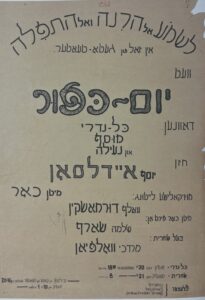
Among those in the Archive are posters and broadsides from the Vilna Ghetto period. These are evidence of continuing daily life even after there had been massive deportations and murders of Jews. Nonetheless, when the opportunity presented itself, whether for intellectual events, concerts, or even sports, the Jews ferociously fought to continue to live their lives. 2005, the Vilna Gaon Jewish State Museum in Vilnius published some of these Vilna Ghetto Posters, compiled by Jevgenija Biber, Rocha Kostanian, and Judita Rozina. (Unfortunately, as far as we know, the book is only available at the Museum’s bookstore in Vilnius.)

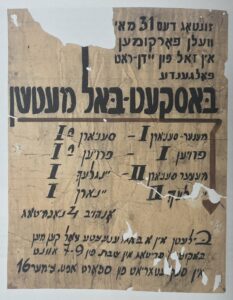
Basketball Competition at the Jewish Council hall, Sunday, May 31, 1942, Ghetto Posters, Number 6, LCVA, F. r-1421, Ap. 2, B. 94

For example, one poster announces a basketball tournament that includes men, women, and seniors. Another announces the opening of the Jewish ghetto theater, whereas others announce specific plays and other cultural events, such as a night commemorating Haim Nahum Bialik. The theater hall also housed Yom Kippur services in 1942.

Ghetto Posters, number 25, LCVA, F. r-1421, Ap. 2, B. 122

On the intellectual side, there were lectures on Jewish history, one on the zugos, and the pairs of Rabbis in the Mishna. Another was an announcement of sermons delivered on the Yom Tefillah that was declared in February 1942.

Ghetto Posters, number 46, VŽM 1219

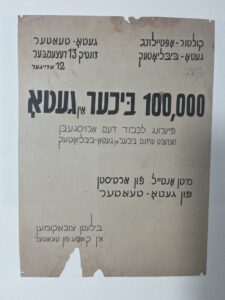
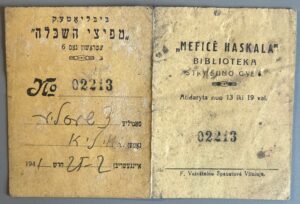
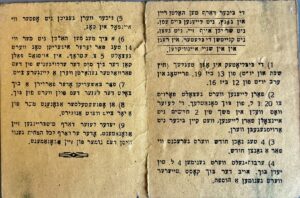
One of the most astounding documents was an announcement that on Sunday, December 13, 1942, at noon, a “Celebration of one hundred thousand books loaned by the Ghetto library” since it opened in September 1941. The ghetto library was in the former Mefitsei Haskalah Library. That library was among the three largest in Vilna. The other two, the Strashun Library and the YIVO Library were closed by the Nazis. This was nearly the same circulation numbers, 90,000 yearly, as before the Nazi invasion and ghettoization of the Vilna’s Jews. Most recently, in the portion of the pre-war documents now at the Judaica Centre at the Lithuanian National Library, a reader’s library card was discovered that slightly pre-dates the formation of the ghetto library. This card, from February 21, 1941, provides the library’s rules, including an admonishment not to leave the books in rain or snow, how to calculate due dates, and fines for overdue books.  

From the Judaica Collection of the National Library of Lithuania 

In addition to the poster is a highly detailed description of the library and its operations that survived the Holocaust. In October 1942, Kruk published “The Library and Reading Room in the Vilna Ghetto, Strashun Street.” The document was originally in Yiddish (and the original is at the YIVO Institute in New York, available here), but Zachary Baker translated it into English and added notes. (See Herman Kruk, “Library and Reading Room in the Vilna Ghetto, Strashun Street 6,” translated by Zachary Baker, in The Holocaust and the Book, Destruction and Preservation, ed. Jonathan Rose, University of Massachusetts Press, 2001, 171-200). 

Kruk provides a prehistory and then specifically recounts the library’s activities since it reopened in September 1941. Among other details, before the war, there were 2,000 subscribers, and in 1940-41, with the influx of Jews from all over Eastern Europe, that number doubled. By September 1941, there were 4,700 subscribers. Men and women were represented almost equally, although women had a slight advantage. The fact that the library reached 100,000 books by December is especially remarkable, in that it was closed for several months as it was too cold to operate. 

Kruk notes significant changes in subject matter and books during this period. For example, there was a 600% increase in readership for War and Peace, and books on war, such as All is Quiet on the Western Front and Emile Zola’s War, were also in high demand. The library’s readers of history were focused on books regarding the Crusades and other martyrdom literature. However, there have been significant changes to the library since before the war. Most notably, 15-30-year-olds made up the bulk of readers during the pre-war period, while in 1942, that number had dropped precipitously. Kruk explains that age groups bearing the brunt of forced labor were too tired to contemplate reading at the end of an exhausting day. 

Kruk summarizes the popularity of libraries and readings, even in the face of death: “A human being can endure hunger, poverty, pain, and suffering, but he cannot tolerate isolation. Then, more than in normal times, the attraction of books and reading is almost indescribable.” 


On Libraries, Bibliophiles & Images: Taj Auction 13

On Libraries, Bibliophiles & Images: Taj Art Auctions 13

by Eliezer Brodt and Dan Rabinowitz

Taj Art Auctions will hold its 13th auction this Sunday, April 7th (the catalog is available here). The auction contains many items worth highlighting, especially those related to historic Jewish libraries, as well as other unique books and ephemera.

Recently, arguably, the most significant Jewish library reopened its doors. The National Library of Israel, housed at Hebrew University for decades, moved into its own building, designed by the starchitects Herzog & de Meuron, who count the Tate Modern among other outstanding projects. Books are integral to the Jewish experience, and the library’s location, next to some of the most important institutions of the Jewish state, the Knesset, the Israel Museum, and the Supreme Court, echoes that sentiment. The library’s ground floor houses the Jewish Studies reading room, which contains over 200,000 volumes. The library itself holds over four million books (and counting). These are now accessed by a quartet of robots that fetch requested books. There is even a window to watch them in action. The Scholem room has been transformed from its small, cramped quarters into a spacious room that houses the collections of several kabbalah scholars. Scholem’s desk is still present. There is a permanent exhibit of some of the library’s treasures, but that is only accessible on an official tour.

Nonetheless, it is undoubtedly worth seeking out. An exhibition of manuscripts of one the greatest privately held collections of Judaica, the Braginsky Collection, opens this month. While the National Library’s new building and collection are exceptional, many precursor Jewish libraries existed throughout the Jewish diaspora.

The oldest functioning Jewish library in the world is the Ets Haim Library in Amsterdam, dating from 1616. (An exhibition of its books was held at the National Library of Israel, then known as the Jewish National and University Library, in 1980). Its antiquity is tied to the date the school opened with the same name. This school became well-known for its unique curriculum and success in imparting that curriculum. Unlike the Central and Eastern European schools that almost immediately started studying Mishna and Talmud, the Talmud Torah applied a more systematic approach to Jewish literature. R. Shabbetai Seftil, the son of R. Yeshaya ha-Levi Horowitz (Shelah or Shelah ha-Kodesh), traveled from Frankfurt to Pozen via ship. That journey took him through Amsterdam, where he saw that the students’ studies operated in sequence. First, they studied the entire corpus of Tanakh and then completed the Mishha, and when they matured, they only began studying Talmud, and this approach contributed to their unique success. Seeing the benefits, he broke down crying, “Why don’t we follow the same approach in our countries [of Central and Eastern Europe]? Suppose only we could institute this throughout the Jewish communities. What would the harm be in first completing the Torah and Mishna until the student reaches thirteen and then begins Talmud? With that background, it will take only a year to become proficient in the intricacies of Talmud study, unlike our current approach that requires years to reach that level of fluency.”

In an example of the intertwining nature of the library and the school, the bibliographer R. Shabbetai Bass (1641-1718), who wrote the first Hebrew bibliography, Sifte Yeshenim (today, most well-known for this commentary on Rashi, Sifte Hakhim). Bass was born and lived in what is today the Czech Republic (Czechia). Around 1680, he went to Amsterdam to print Sifte Yeshenim. During that time, he visited the library and school and described the students as “students of giants: young children dancing like locusts and like so many lambs. To my eyes, they were giants, so well-versed in their knowledge of Torah and grammar. They could write Hebrew verse and poetry in meter and converse in clear Hebrew.” He also describes the unique aspect of the library. “Within the midrash, they have a special school, and there they have many books, and all the time they are in the yeshivah, this room is also open, and whoever wishes to study, anything he desires is lent to him. But not outside the beit midrash, even if he provides a large sum of money.”

From Ets Haim Bibliotheek Website

Among the Ets Hayim Library treasures is an Amsterdam print, the first Haggadah with copperplate illustrations. While illustrations in printed Haggados began with the Prague Haggadah of 1526, these were woodcuts. Copperplates, however, produce much finer illustrations. In 1695, the convert, Abraham ben Yaakov, designed and executed these copperplates, and the Haggadah was printed by the famed Amsterdam publisher, Proops. (Copperplates were already used in printing decades before the Haggadah. Perhaps one of the most significant recent examples is a 1635 copper etching by Rembrandt that the Jewish art scholar Simon Schama donated to the Rijksmuseum in Amsterdam last year.)  The illustrations are based on the Christian biblical illustrations of Mathis Marin. While most are innocuous, the temple image at the end of the Haggadah is topped with a cross. In addition to the fine illustrations, the Haggadah also contains a large foldout map of the Jews’s journeys from Egypt to Israel; it is among the first Jewish maps of the Holy Land.

The Ets Hayim Library holds a unique edition of this Haggadah, considered one of its most treasured books. First, it contains an extra title page. But, more importantly, it is hand colored. While the copperplates are a significant improvement, the coloring makes this an especially striking Haggadah. It is listed among 18 Highlights from the Es Haim: The Oldest Jewish Library in the World, published by the library in 2016. The book includes three full-page reproductions of various details of the Haggadah and smaller reproductions of other pages. There are only two other copies of this version. One is at the Hebrew Union College in Cincinnati, and the other is being auctioned at Taj Art Auctions (lot 89). The copy at the auction was a gift from the printer Solomon Proops.

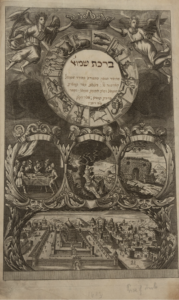
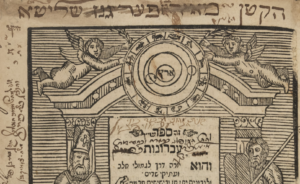
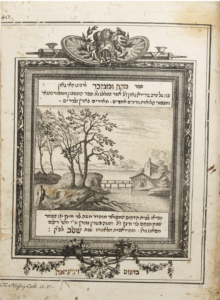
Similar images from the Haggadah’s title page were reused in Menoras ha-Me’or, Amsterdam, 1722, (lot 84), and the Amsterdam Haggadah final illustration of the Beis ha-Mikdash, that if one looks closely, the Christian cross was left intact from the original Mathis Marin illustration, also appears in the beautiful and unique title page adorning Birkas Shmuel, Frankfurt, 1782 (lot 152).

Birkas Shmuel, Frankfurt, 1782 Note the Cross on the Top of the Temple

Amsterdam was home to another significant library, the Rosenthaliana. It was collected in Hanover but eventually landed in Amsterdam. The catalog related to this library attests to the rarity of another book in this auction. This library was amassed by Eliezer (Leeser) Rosenthal (1794-1868). Born in Warsaw, he eventually traveled to Hanover, where he served as a Rabbi. His wife came from a wealthy family that allowed Rosenthal to indulge in his passion, book collecting. At their death, his library comprised more than 5,200 volumes, including twelve incunabula and numerous rare and unique books. After his death, his son, George, commissioned the bibliographer Meyer (Marcus) Roest to complete a bibliography of the library. It was published in two volumes in 1875 and reproduced in 1966. Roest’s work incorporated Rosenthal’s catalog of his library, Yodeah Sefer. Despite the many rare books in the collections, there was at least one book he could not procure, at least a complete copy. In his entry, 1524, for the Ibbur Shanim, Venice, 1679, he says that “it is a terrible loss, that my copy is incomplete, it is missing the last pages, my copy ends at page 95 … and is missing the calendric charts for 150 years, beginning from 1675, my copy is missing from 95 of these charts, from 1731 onward… This is a scarce (yekar mitzius) book and is not listed in R. Hayim Michael’s [Or Meir] or the Shem ha-Gedolim, or Di Rossi’s bibliography.” The National Library of Israel received a complete copy from the Valmaddona Trust, which was digitized and available online. (One can bid on four of the Valmadonna books, Talmud Bavli, Seder Zeriam, Lublin, 1618, lot 70 , as well as lots 12, 54, and 68). A complete copy of the book appears in the auction at lot 2. (For more on calendar books, see Elisheva Carlebach, Palaces of Time: Jewish Calendar and Culture in Early Modern Europe, and pp. 51-55 regarding Ibbur Shanim. His work is also a source for the Tu be-Shevat seder, see our post, “Is there a Rotten Apple in the Tu be-Shevat Basket“). The book has its own intersting history that is briefly described in the timely post, “Kitniyot and Mechirat Chametz: Paradoxical Approaches to the Chametz Prohibition.”

Yet another seminal Jewish library was that of R. Dovid Oppenheim (1664-1736), considered “the greatest Jewish bibliophile that ever lived.” (See Alexander Marx, Studies in Jewish History and Booklore, 213). Oppenheim started his rabbinic career in Moravia, moved to Prague, and was eventually elevated to Bohemia’s Chief Rabbi. At age 24, his library consisted of 480 books, and by 1711, his library stood at over 2,100 books, missing only 140 books from those listed in Shabbetai Bass’s bibliography of all Hebrew books. After his death (with some additions from his son, Yosef), the library rose to 4,500 printed books and 780 manuscripts. Although Oppenheim lived in Prague, the library was in Hanover. This was due to the heavy book censorship, which included the potential for confiscation by the authorities. Oppenheim visited his library, but perhaps because his time was limited, his works do not indicate that he was acquainted with the book’s contents. Instead, he should be considered a consummate bibliophile, and his collection consisted of rarities and special beautiful and unique copies, with a considerable number on blue paper. For example, there were 51 books printed on vellum, 40 of which he commissioned himself, out of about 200 known books printed on that medium until 1905.

After his death and multiple attempts to sell the library, it eventually went to the Bodleian Library at Oxford University. A complete history of the library was most recently accounted for by Joshua Teplitsky in his Prince of the Press: How One Collector Built History’s Most Enduring and Remarkable Jewish Library. But before its final resting place, there were a handful of catalogs of the library or various aspects of it. The first complete printed catalog of the library was issued in 1782 and was intended to elicit interest from potential Jewish and non-Jewish buyers. Thus, it contains two title pages, one in Hebrew and the other in Latin. This rare bibliophilic item is lot 156.

Finally, the auction also includes books from the library of R. Nachum Dov Ber Friedman, the Sadigur Rebbe. His library was recently described in Amudei Olam by R. Zusya Dinklos, pp. 419-39. Aside from traditional works, the library also held Haskalah works, as the one in lot 71.

Illustrated Books

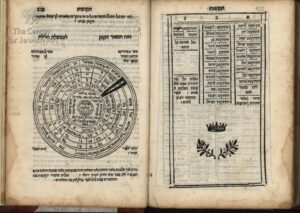
We discussed Ibur Shanim, and in addition to its rarity, it is also among the small number of Hebrew books that contain illustrations. Because the book’s purpose was to elucidate and explain Hebrew calendrical calculations, including the determination of the tekufos (which he vehemently criticizes some Rishonim and others for dismissing them as old wives tales), there are a handful of tutorial images.

Ibur Shanim
Gross Family Collection

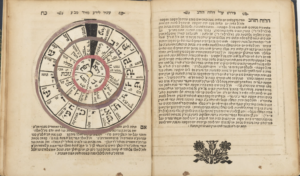
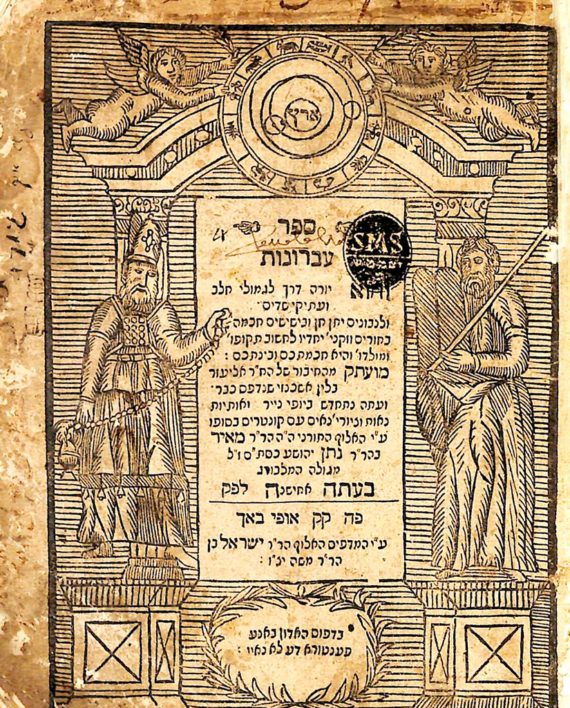
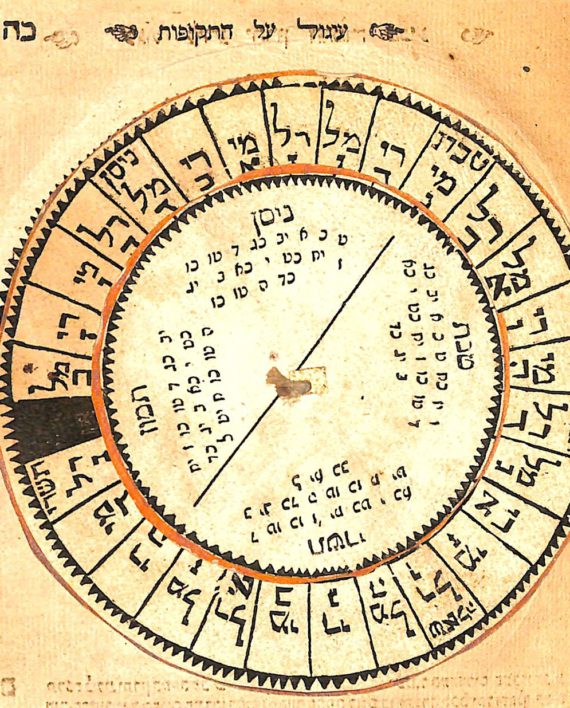
Likewise, Sefer ha-Ivronot, Offenbach, 1722 (lot 73) includes celestial images, in this instance, a movable wheel of the heavenly apparatuses. While there was some speculation that the title page image depicting a heliocentric universe was deliberately to align with the book’s contents, that is unlikely as the image was reused in at least three other books printed in Offenbach that are unrelated to astronomy.

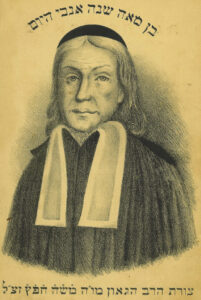
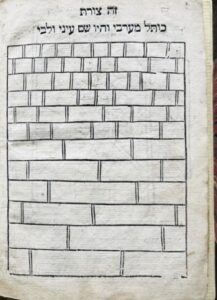
Moshe Hefetz, perhaps more well-known for the 19th-century modification of his portrait attached to the first edition of his Melechet Machshevet, which depicts him bare-headed, authored a book on the Bet ha-Mikdash, Haknukas ha-Bayis, 1696, (lot 20), within which several Temple elements are illustrated.

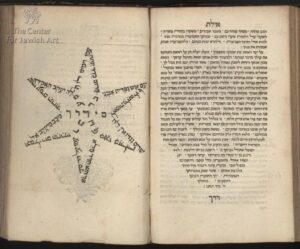
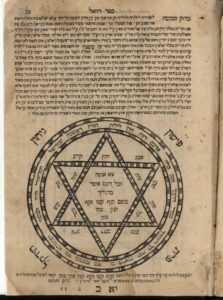
Two books contain eclectic images of the Jewish star. Igeret Ayelet Ahavim, Amsterdam, 1665 (lot 140) and the first edition, 170 Amsterdam, Raziel HaMalach, (lot 120) include unusual adaptations of the star. (For another kabbalistic rarity, lot 116, is the kabbalist, Rabbi Yosef Erges’ personal copy of the Rosh ha-Shana and Yom Kippur machzorim with his kabbalistic additions.)

Iggeres Ayyeles Ahahuvim
From the Gross Family Collection

Razeil ha-Malakh
From the Gross Family Collection

There are a handful of artistic title pages, with at least two Greek gods, Hercules and Venus (see lots 10 and 48), and some potentially objectionable ones that Marc Shapiro discussed in his book Changing the Immutable (lots 64 & 78).

One of the most unusual title pages is a special one that its owner inserted into the book. The title page, taken from a non-Jewish architectural image by the 18th-century engraver Franz Carl Heissig, was filled in by hand with the book’s publication information (lot 5).

Finally, while censorship in Jewish books is somewhat common, undoing censorship is less common. Lot 62 is a unique copy of the Shu’T Maharshal that includes the otherwise expunged name of an informer. Other copies only refer to the person obliquely; this copy, although crossed out, the name is still visible. For more on this see Elchanan Reiner, “Lineage (Yihus) and Libel:  Mahral, the Bezalel Family, and the Nadler Affair,” in Elchanan Reiner, ed., Maharal: Biography, Doctrine, Influence, 101-26 (Hebrew).


Do We Cut Off or Bury One’s Head in the Sand?

Do We Cut Off or Bury One’s Head in the Sand?

Review: Elliott Horowitz, Reckless Rites: Purim and the Legacy of Jewish Violence

In 2017, the erudite and eclectic scholar Elliott Horowitz unexpectedly passed away. His oeuvre is exceptionally diverse, having authored more than seventy-five articles and reviews and five books, with topics ranging from studies on Italian art, Jews and coffee, the significance of the beard among Jews, comparing and contrasting Jewish and non-Jewish biblical exegesis, and Jewish violence (see his Academia page for most of them). Seven additional articles appeared on this site, in a similar vein as his others, covering Bugs Bunny, nude imagery in the Haggadah, Isaiah Berlin, Saul Lieberman, among others. He regularly used the “Molkho Institute for Absurdly Abstruse Research” to identify his affiliation in his email signature. Jewish violence was a long fascination of Horowitz. Beginning in 1994, with an article in the Hebrew journal Zion, he revisited the issue in no less than six articles that culminated in his 2006 book, Reckless Rites: Purim and the Legacy of Jewish Violence (Princeton University Press, Princeton, New Jersey). Horowitz documents how the conclusion of the Purim story, culminating in the Jews massacring 75,800 people over two days, was used as a justification for Jewish violence against non-Jews throughout history. Horowitz revisited this topic on this website, “Modern Amalekites from Adolf to Avigdor.” In a later article, he also identified the Biblical story of Dinah as another source for this type of violence.

While arguably, the violence at the end is only a minor part of the story, for some, that aspect has clouded everything about the Book of Esther and Purim. First, Horowitz looks at how non-Jews viewed the Book. Some had a very negative view due to the Jewish revenge. They considered that motif un-biblical (read non-Christian). Horowitz goes through each character and how first non-Jews interpreted their actions. For instance, Mordechai was treated rather harshly by many of these commentators, as was Esther, due to her passivity. What is especially fascinating is how these non-Jewish understandings sometimes crept into Jewish thought. Thus, Horowitz documents Jews parroting these rather un-Jewish, as it were, interpretations.

Horowitz then tackles the overarching theme of Amalek and how this has been understood throughout history. Some hold there is no obligation to destroy Amalek today, while others are willing to label any perceived enemy of Jews as deserving of the harsh consequences of Amalek. Some of these examples are rather disturbing.

After dealing with the Book of Esther specifically, Horowitz focuses on the Jewish practice of Purim. Specifically, he deals with Jewish violence or violent acts on Purim directed at non-Jews. He provides a discussion of the stereotype of the “mild” (read the wimp) Jew, including its origins and whether it is borne out by history. He then discusses numerous diverse examples spanning from the 5th century until today of Jewish violence. Some are not physical violence. Instead, it is host desecration or general enmity of non-Jewish symbols, while other, most recently Barukh Goldstein, is physical violence in its worst form.

Horowitz is compelling in the scope of this idea and how prevalent this is. It is especially telling when tracing and seeing how systematically Jews have decided to sweep these under the rug these examples; it demonstrates that censorship is not limited to any one group, and even amongst supposedly dispassionate scholars; they too can fall prey to their own biases.

To play down some of these incidents, we have Jewish historians who decided to avoid discussion of such matters or, at times, downplay their significance. However, in light of the many examples here, it is challenging to ignore such examples. Indeed, Shaul Magid noted in his review that Horowitz’s book “seems to elicit a kind of cognitive dissonance among peers, as if to say ‘this simply cannot be true’ even given the detailed evidence and argumentation to the contrary. This is often because of the audacity of the thesis and the way it challenges how we understand the present.” Hillel Halkin’s review of Commentary magazine is one example that fails to adequately address Horowitz’s thesis and his substantial evidence. Halkin claims that the book is a distortion of history and places too much emphasis on too few examples. In the next issue, Horowitz responded to Halkin’s criticism, noting Halkin’s misreading of some texts and inability to present any contrary evidence. In his inimical style, Horowitz invokes the Godfather to prove his point.

Halkin remained obsessed with Horowitz’s book and, a year later, returned to it and attempted to compare it and Michael Stanislawki’s book (A Murder in Lemberg), to Ariel Toaff’s Pasque di Sangue that seemingly argued Jews regularly killed non-Jewish children.”, which is riddled with methodological errors and has been entirely discredited (here). This time, not only Horowitz took issue with Halkin. Three scholars, Allan Nadler (who previously wrote a very positive review of Reckless Rites and presciently noted that Horowitz is a “scrupulously honest voice, dealing in exemplary fashion with an important subject that has been ignored by scholars precisely because of its extreme delicacy. In his execution of narrating the repercussions of Haman’s execution, Horowitz has enriched us with a model of historical scholarship. Anything but reckless, “Reckless Rites” is a rare gem of academic work that will make a real difference”), Elisheva Carlebach, and Naomi Gratz, derided Halkin’s attempt to tar Stanislawki and Horowitz. Perhaps it is best to view Halkin’s criticism through the prism of his long history of minimizing Israeli responsibility for violence, Horowitz being but one example. Indeed, Halkin himself seemingly accepted Yigal Amir’s murder of Yitzhak Rabin. Halkin claims that Amir’s error was not in the assassination itself; instead, “What made Yitzhak Rabin’s assassination exceptionally atrocious was not it’s being a murder, but it’s being a cataclysmic political blunder.” Hillel Halkin, “Israel & the Assassination: A Reckoning,” Commentary Magazine, January 1996. Halkin, however, was willing to criticize one person affected by Rabin’s murder, his son. Halkin, under the pseudonym Philologos, pokes fun at Rabin’s son’s pronunciation of the Kaddish he said on behalf of his father. See “On Language,” “Yuval Rabin’s Kaddish,” Forward, November 17, 1995. Perhaps if Amir had butchered a blessing rather than Rabin, Halkin would have found occasion to criticize.

Commentary, however, wasn’t done with Horowitz. In 2010, Commentary published Abby Wisse Schachter’s essay, “The Problem with Purim,” which is generally about feminist views of Purim characters. As an aside, she claims that Horowitz’s book contains “the questionable claim” and the “bizarre thesis” that “Purim has long been the occasion for outbreaks of Jewish animosity and even violence toward Christians.” She asserts that Horowitz’s thesis is based solely on the example of Baruch Goldstein. This is incorrect. As Horowitz demonstrates in his letter to the editor, it is evident that she could not have spent more than ten minutes with the book to arrive at her conclusion. Horowitz shows that Schechter’s article contains other mistakes beyond her discussion of his book.

In the end, there is little doubt that he wrote a well-researched and thorough book that inevitably engenders discussion, whether or not readers agree with Horowitz, is less the point. (See, for example, Eliezer Brodt’s post, “The Origins of Hamenstashen in Jewish Literature (Revisited),” on this site. Brodt references Horowitz’s discussion regarding a Saudi scholar who alleges Jews use blood to make hamenstashen.) Instead, as with all groundbreaking scholarship, a Talmudic approach, one that values discussion over conclusion is the best one can hope for.


Some Highlights of the Upcoming Taj Art Auction

Some Highlights of the Upcoming Taj Art Auction*

With the proliferation of auction houses and the centralized platform of Bidspirit, there are auctions of Judaica and Hebraica on a weekly, if not more frequent, basis. One of the more recent entrants into this arena is Taj Art, founded in 2021 by Tomer Rosenfeld and Aron Orzel. This Sunday, December 24th, at 7 pm Israel time, Taj Art will be hosting their 11th auction, which includes some items of particular bibliographical and historical note.

The full catalog is available here, and a pdf of the highlights brochure is here.

The first (lot 9) is a work that appears in a story that is a touchstone for the modern feminist agenda.

According to R. Barkuh HaLevi Epstein, he maintained a regular dialogue with Netziv’s first wife, Rayna Batya. Among the topics of conversation was the issue of women studying Jewish literature. Rayna was well-versed and regularly studied an impressive array of Jewish books.

Epstein, in his Mekor Barukh, attempts to place Rayna as less of an anomaly but more as one within a chain, albeit small of women throughout Jewish history that similarly shared Rayna’s interest and erudition of Jewish texts. While there is little doubt that there are examples of such women, many of Epstein’s examples are corrupt at best and deliberate misreading of the sources at worst. Nonetheless, there is little doubt that Rayna was an erudite woman. According to Epstein, Rayna eventually won him over to her position when she identified a responsa that provided that women could study traditional texts. The source was Ma’ayan Ganim. Epstein repeats the position of Ma’ayan Ganim in his commentary on the Torah, Torah Temimah (although without reference to Rayna or a particular episode).

First, we should note that Marc Shapiro has questioned the veracity of the entire story in his article on this site, which is subject to a rebuttal by Y. Lander. Eliyana Adler’s article, “Reading Rayna Batya: The Rebellious Rebbitzen as Self-Reflection,” (available here), collects additional discussions regarding the event and provides her approach to the story. While one can debate the merit and implications for Jewish feminism, it is worth briefly discussing the obscure work Ma’ayan Ganim.

The Ma’ayan Ganim, authored by the Italian rabbi Shmuel Archovalti, was published in 1553 in a small format and consisted of 50 letters intended to guide effective communication. Unlike many other legal systems, Jewish law largely relies on responsa, letters from rabbis in response to queries (although, in some instances, contrived rather than actual). Despite the format, not all letters are legal, and certainly, a text with sample letters intending to serve as a writing tool does not qualify as legally binding. Irrespective of the purpose, the letters demonstrate an interest in the issue that held the interest of many rabbis and others. Similarly, whether or not Epstein created the entire episode or embellished parts of it does not detract from his position that encouraged women’s study of Jewish texts.

While Rayna Batya has enjoyed questionable notoriety, it is disappointing that a woman whose advocacy for women’s study and Jewish women’s rights was well documented and received the respect of leading Jewish rabbis and scholars is today nearly forgotten. Ironically, as Dr. Leiman highlights, the New Jewish Encyclopedia notes that prior Encyclopedias Jewish women were marginalized, it too fails to record Esther. The one exception to this forgetfulness is the Encyclopedia for the Zionist Leaders, which records Esther and some of her accomplishments. Today, however, there is a very robust discussion of many of Esther’s unique contributions and essential ideas that appeared here: https://mizrachi.org/hamizrachi/the-time-of-our-freedom/

It includes translating one of Esther’s articles that appeared in the Jewish press.

Two books are written by R. Yitzhak Chaim Kohen MeChazanim (Cantarini), Et Kets and Pachad Yitzhak (Lot 22). The former was published in 1710 and the latter in 1685. Despite the gap in time, both contain a fully illustrated page that precedes the title page and depicts the Akadeh. Et Kets discusses the messianic era, while Pachad Yitzhak is devoted to discussing the Jews of Padua, avoiding being massacred by an angry mob. Despite the same iconography, the two illustrations were likely done by two different artists and contain subtle but important differences.

Et Kets

The overall depictions are of two different time periods of the Akedah episode. In the first, the illustrations depict Abraham just as he was about to slaughter Isaac and the angel calling to stop him. But, in the second, the illustration is of Abraham going after the ram, not Isaac. The significance of this is tied to the actual books. In Pachad Yitzhak, the book discusses a terrific threat to the Jews and their salvation. Thus, the illustration is similar – the terrific threat to Isaac and salvation. The second work, Et Kets, is a much more positive book. This work has no fear of the prior; instead, it is fully devoted to the Messiah, and thus, the illustration is only of the ram and its sacrifice. Lot 22 is Pachad Yitzhak, the rarer of the two.

Further, different Hebrew words appear in both illustrations. On the first, the word ערכה (prepared or set up) appears across Abraham’s chest. This word expresses Abraham’s readiness to sacrifice Isaac. It would seem, similarly, that the Jews of Padua were willing to sacrifice themselves for God. But the word ערכה only means to prepare and not actually to sacrifice. Thus, Isaac was only prepared but not sacrificed, and so too, the Jews of Padua were placed in danger but ultimately redeemed.

In Et Kets, the words ירא יראה appear. These words reference what Abraham called the place where the Akedah took place. Importantly, Abraham uttered these words after the entire episode. These were words of jubilation on his passing his test and Isaac’s redemption. Again, these words fit well with the content of Et Kets.

These allusions are unsurprising, considering the style of R. Dr. Cantarini. His books are written rather cryptically, with many allusions to Biblical and other themes throughout. (See our fuller discussion here.)

Many Hebrew books include a depiction of the Temple Mount, represented by the Dome of the Rock. However, Lot 43, Zikrohn Yerushalim, published in 1742, consists of a depiction of the Dome of the Rock (surrounded by a Medieval wall and town) but broke new ground in depicting the Kotel to represent the Jewish Temple. This is the first time the Kotel ever appeared in a Jewish book. Yet, only in the 19th century did the Jewish books fully transition to the Kotel rather than the Dome of the Rock.

There are two notable works by R. Emden, his Siddur, (lot 52), and R. Azreil Hildeshiemer’s copy of Meor u-Ketziah (lot 175). This edition of the Siddur is especially important as most of the reprints (until recently) only included the commentary, and the actual text of the Siddur did not reflect many of R. Emden’s approaches and, frequently, a direct conflict between the commentary and the text.
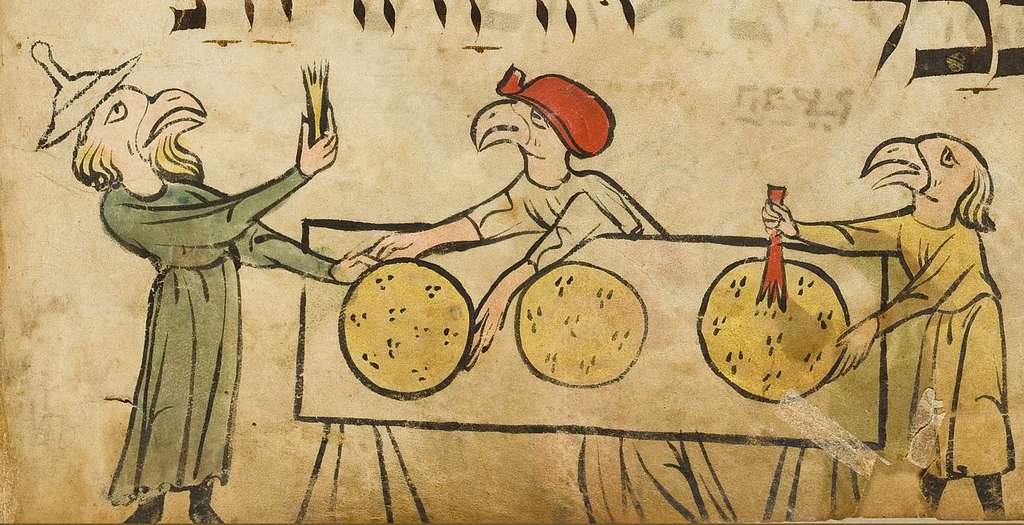
There are some very rare antiquarian books, an incunabulum from Radak, (lot 149), published in 1486 by Soncino. Lot 148 is a leaf from a manuscript of Rambam’s commentary of the Mishna dated to 1222 and transcribed in Yemen. One of the rarest Bomberg volumes of the Talmud is Mesechet Avodah Zarah, lot 32. Of course, because this tractate discusses non-Jews and their relationship to Jews, it was particularly fraught. Indeed, after the resumption of the printing of the Talmud in Basel after the ban in the early 16th century, it omitted this tractate entirely. (There are also two other Bomberg volumes, lots 3334).

Eliyahu HaBakhur (Elia Levita) wrote one of the earliest grammar and dictionaries of Hebrew and Aramaic in the modern period. Lot 86, is the first edition of his Sefer HaBakhur, Isny, 1541.  A more recent reprint was subject to censorship due to including a particular commentary.  See our discussion, “A New Book Censored.”

There are also a few books that contain noteworthy illustrations. Lot 87 is Tzurat ha-Arets, Basel, 1546, which includes astronomical images. Lot 89, is an edition of the fundamental kabbalistic work, Razeil ha-Malakh, that depicts the star of David and kabbalistic amulets.

The issue of rabbinic pay appears to have affected even the greatest of rabbis. Lot 205 is a letter from R. Chaim Ozer to the Vilna community pleading for a raise because he is so destitute that “he will not have money for rent or food.”

In all, there are a number of highly collectible items, and the catalog is certainly worth a closer look.


*This is part our series on upcoming auctions, “Auction Highlights.” These provide the opportunity to revisit previous posts and provide short notes about books and other related items.


Pesach, Haggadah, Art & Sundry Matters: A Recap of Important Seforimblog Articles

Pesach, Haggadah, Art & Sundry Matters: A Recap of Important Seforimblog Articles

Among the more interesting aspects of the history of Haggados, is the inclusion of illustrations. This practice dates back to the Medieval period and, with the introduction of printing, was incorporated into that medium. Marc Michael Epstein’s excellent book regarding four seminal Haggadah manuscripts, The Medieval Haggadah: Art, Narrative & Religious Imagination, was reviewed here, and a number of those illustrations, were analyzed in “Everything is Illuminated: Mining the Art of IllustratedHaggadah Manuscripts for Meaning.” Epstein edited and wrote an introduction to the recently published facsimile edition of the Brother Haggadah, which resides in the British Library. This is the first reproduction in full color of this important manuscript. Another recent reproduction of a manuscript Haggadah is Joel ben Simon’s Washington Haggadah. This Haggadah is particularly relevant this year, as it contains an alternative text for  Eruv Tavshilin blessing. Whether or not this was deliberate was the subject of some controversy, see “Eruv Tavshilin: A Scribal Error or Deliberate Reformation?

The first illustrated printed Haggadah, Prague, 1526, introduced new illustrations and recycled and referenced some of the common ones in manuscripts (see here for a brief discussion and here for Eliezer Brodt’s longer treatment). That edition would serve as a model for many subsequent illustrated Haggados but also contains surprising elements, at least in some religious circles, regarding the depiction of women, and was subsequently censored to conform with the revisionist approach to Jewish art. See, “A Few Comments Regarding The First Woodcut Border Accompanying The Prague 1526 Haggadah,” and Elliot Horowitz’s response, “Borders, Breasts, and Bibliography.” The Schecter Haggadah: Art, History and Commentary, a contemporary treatment of the art and the Haggadah, (for Elli Fischer’s review, see here), that unintentionally reproduced a version of one of the censored images in the first edition. It was restored in subsequent editions. Women appear in other contexts in illustrated Haggados. The most infamous example is the “custom” that implies a connection between one’s spouse and marror (discussed here), but our article, “Haggadah and the Mingling of the Sexes” documents more positive and inclusive examples of women’s participation in the various Passover rituals in printed Haggados.  Similarly, the c. 1300 Birds Head Haggadah has an image of female figures in snoods preparing the matza and a woman at the center of Seder table.

As detailed in chapter 8 of Epstein’s Medieval Haggadah, the early 14th Century Golden Haggadah is perhaps the most female-centric Haggadah and may have been commissioned for a woman. That manuscript emphasizes the unique, positive, and critical role women played in the Exodus narrative. Although it also depicts the practice of overzealous cleaning with a woman sweeping the ceiling. The 1430 Darmstadt Haggadah has a full-page illumination of women teachers, but its connection to the text is opaque. Finally, we argue that one printed Haggadah uses a subtle element in explicating the midrashic understanding of the separation of couples as part of the Egyptian experience.
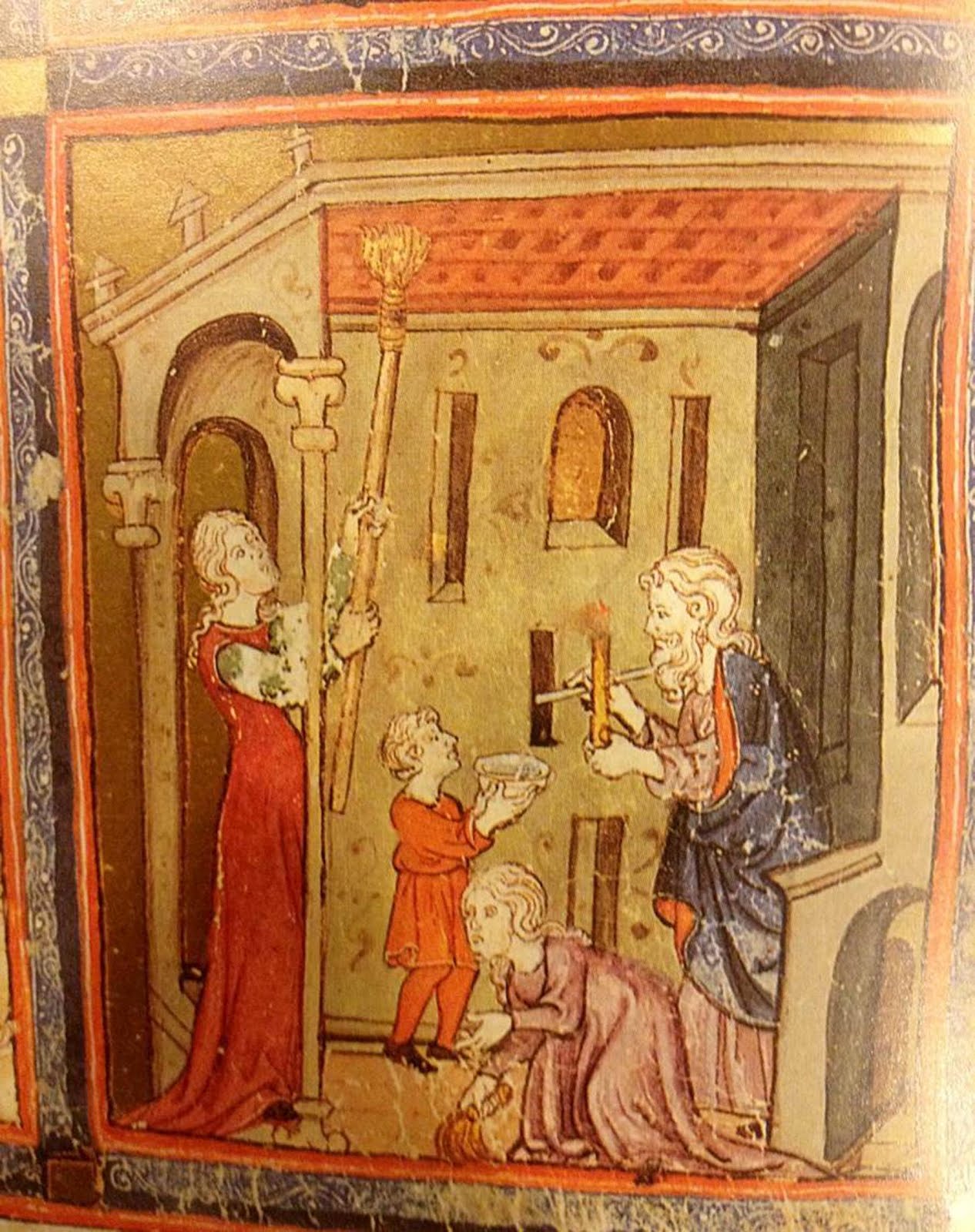
Sweeping the Ceiling, Golden Haggadah


One of the most creative contemporary Haggados was produced by the artist, David Moss. Moss was commissioned by David Levy to create a Haggadah, on vellum in the tradition of Medieval Jewish manuscripts. Moss worked for years on the project the result surely equals, if not surpasses, many of the well-known Medieval haggados, both artistically and its ability to bring deeper meaning to the text. The manuscript is adorned with gold and silver leaf and contains many paper-cuts (technically vellum-cuts).  One of the most striking examples of the silver decoration is the mirrors that accompany the passage that “in each and every  generation one is obligated to regard himself as though he personally came out of Egypt.” The mirrors appear on facing pages, interspersed with one with male and the other with female figures in historically accurate attire from Egypt to the modern period. Because the portraits are staggered when the page opens, each image is reflected on the opposite page, and when it is completely opened, the reader’s reflection literally appears in the Haggadah — a physical manifestation of the requirement to insert oneself into the story. The page is available as a separate print.

After completing the Haggadah, Moss was asked to reproduce it, and, with Levy’s permission, produced, what the former Librarian of Congress, Daniel Bornstein, described as one of the greatest examples of 20th-century printing. The reproduction, on vellum, nearly perfectly replicates the handmade one. This edition was limited to 500 copies, all of which were sold. From time to time, these copies appear at auction and are offered by private dealers, a recent copy sold for $35,000. President Regan presented one of these copies to the former President of Israel, Chaim Herzog, when he visited the White House in 1987. While that is out of reach for many, this version is housed at many libraries, and if one is in Israel, one can visit Moss at his workshop in the artist colony in Jerusalem, where he continues to produce exceptional works of Judaica and view the reproduction.  There is also a highly accurate reproduction, on paper that is available (deluxe edition) and retains the many papercuts and some of the other original elements, that is still available. This edition also contains a separate commentary volume, in Hebrew and English. (There is also one other available version that simply reproduces the pages, but lacks the papercuts.)
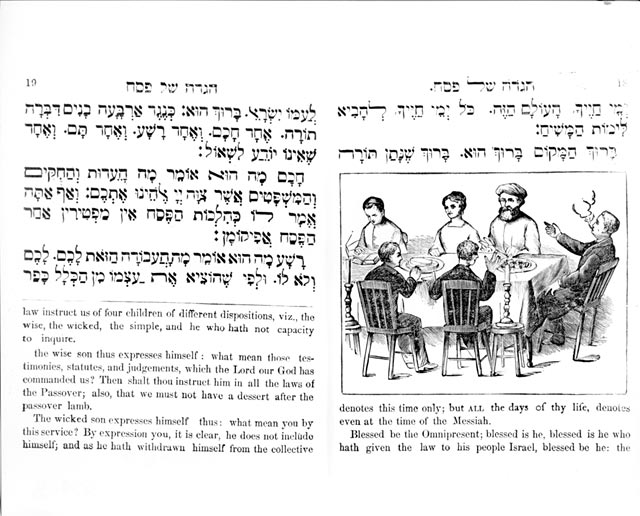
While the entire Moss Haggadah is worth study, a few examples. One paper-cut is comprised of eight panels, each depicting the process of brick making, the verso, using the same cuttings, depicts the matza baking process, literally transforming bricks into matza. The first panel of the matza baking is taken from Nuremberg II Haggadah, which we previously discussed here, and demonstrated that it preserves the Ashkenazi practice of only requiring supervision from the time of milling and not when the wheat was cut.

The illustration accompanying the section of Shefokh, reuses the illustrations of Eliyahu from the Prague 1526 and the Mantua 1528 Haggados to great effect. In the original and vellum reproduction, the cup of Eliyahu physically turns without any visible connection to the page — an extraordinary technical achievement. This section and the illustrations were discussed by Eliezer Brodt in “The Cup of the Visitor: What Lies Behind the Kos Shel Eliyahu, and, in this post, he identified an otherwise unknown work relating to the topic, for another article on the topic, see Tal Goiten’s “The Pouring of Elijah’s Cup (Hebrew).”  Eliezer revisited the topic in (here) his conversations with Rabbi Moshe Schwed, in the series, Al Ha-Daf. In last year’s conversation, he discussed a number of other elements of the history of the Haggadah, and three years ago the controversy surrounding machine produced matza. (All of the episodes are also streaming on Apple Podcasts, Spotify & 24Six.) Additionally, he authored “An Initial Bibliography of Important Haggadah Literature,” and two articles related to newly published Haggados, “Elazar Fleckeles’s Haggadah Maaseh BR’ Elazar ” and XXI. Rabbi Eliezer Brodt on Haggadah shel Pesach: Reflections on the Past and Present ,” regarding Rabbi Yedidya Tia Weil’s (the son of R. Rabbi Netanel Weil author of “Korban Netanel”) edition, and a review of David Henshke’s monumental work, Mah Nistanna. 

In one of the first haggadot printed in the United State published in 1886 Haggadah contains a depiction of the four sons.  Depicting the four sons is very common in the illustrated manuscripts and printed haggadot. In this instance, the wicked son’s disdain for the seder proceedings shows him leaning back on his chair and smoking a cigarette. According to many halakhic authorities, smoking is permitted on Yom Tov, nonetheless, the illustration demonstrates that at least in the late 19th-century smoking was not an acceptable practice in formal settings. (For a discussion of smoking on Yom Tov, see R. Shlomo Yosef Zevin, Mo’adim be-Halakha (Jerusalem:  Mechon Talmud Hayisraeli, 1983), 7-8).

The cup of Eliyahu is but one of many Passover food-related elements. The identification of Marror with the artichoke in Medieval Haggados, is debated by Dan Rabinowitz and Leor Jacobi , while Susan Weingarten provides an overview of the vegetable, in “The Not-So-Humble Artichoke in Ancient Jewish Sources.” Jacobi also discusses the fifth cup in his article, “Mysteries of the Magical Fifth Passover Cup II, The Great Disappearing Act and this printed article.  The history of the restriction of Kitniyot and the development of the practice of selling hametz is discussed in our article, “Kitniyot and Mechirat Chametz: Paradoxical Approaches to the Chametz Prohibition,” and was revisited on Rabbi Drew Kaplan’s Jewish Drinking podcast (and in an audio version on apple podcasts and spotify). Another guest was Marc Epstein, discussing his book on Medieval Haggados, and Dr. Jontahan Sarna where he gives an overview of the use of raisin wine for the kiddush and the four cups, based on his article, “Passover Raisin Wine,” as was the frequent contributor to the Seforimblog, Dr. Marc Shapiro. His interview, like many of his posts and his book, Changing the Immutable, discusses censorship and, in particular, the censored resposum of R. Moshe Isserles regarding taboo wine (also briefly touched upon in Changing the Immutable, 81-82, and for a more comprehensive discussion of the responsum, see Daniel Sperber, Nitevot Pesikah, 104-113).  For another wine related post, see Isaiah Cox’s article, “Wine Strength and Dilution.” The history of Jewish drinking and Kiddush Clubs was briefly discussed here.

Whether coffee, marijuana and other stimulants falls within the Kitniyot category appears here. Marc Shapiro’s article, “R. Shlomo Yosef Zevin, Kitniyot, R. Judah Mintz, and More,” regarding Artscroll’s manipulation of R. Zevin’s Moadim be-Halakha regarding kitniyot. Another coffee related article explores the history and commercial relationship between the Maxwell House Haggadah.  Finally, the last (pun intended) food discussion centers on the custom of stealing the afikoman.

The Amsterdam 1695 Haggadah was an important milestone in the history of printed illustrated Haggados, it was the first to employ copperplates rather than woodcuts. This new technique enabled much sharper and elaborate illustrations than in past Haggados. While some of the images can be traced to earlier Jewish Haggados, many were taken from the Christian illustrator, Mathis Marin. It also was the first to include a map. As we demonstrated that map, however, is sourced from a work that was a early and egregious example of forgery of Hebrew texts. For an Pesach related plagiarism, see “Pesach Journals, Had Gadyah, Plagiarism & Bibliographical Errors.” Kedem’s upcoming auction of the Gross Family collection includes, with an estimate of $80,00-$100,000, one of the rarest, beautiful, and expensive illustrations of Had Gadya by El Lissitzky published by Kultur Lige, Kiev, 1919. Eli Genauer reviews another number related edition, not in price, but convention, “The Gematriya Haggadah.”

There are two articles regarding the Haggadah text, David Farkes’ “A New Perspective on the Story of R. Eliezer in the Haggadah Shel Pesach,” and Mitchell First’s “Some Observations Regarding the Mah Nishtannah.” First’s other article, “The Date of Exodus: A Guide to the Orthodox Perplexed,” is also timely.
Finally, Shaul Seidler-Feller’s translation of Eli Wiesel’s article, “Passover with Apostates: A Concert in Spain and a Seder in the Middle of the Ocean,” tells the story of an unusual Pesach seder. Siedler-Feller most recently collaborated on the two most recent Sotheby’s Judaica catalogs of the Halpern collection.

Chag kasher ve-sameach!


New book Announcement

New book Announcement

After being out of print for several years, a new edition of Rav Yehuda Herzl Henkin z”l’s Shu”t Bnei Banim Vol. 1 was just published.

The volume remains as relevant, original, and significant as when written, 4 decades ago; and has haskamot from a first-rank lineup of gedolim: R. Gedalia Felder, R. Moshe Feinstein, R. Eliezer Waldenberg, R. Menashe Klein, R. Ovadia Yosef, R. Avram Shapira, and R. Mordechai Eliahu, all ztz”l.  The new edition is annotated and punctuated, making it even more accessible.  

Copies can be purchased in the US at Israel Mizrahi’s incredible book store via this link or via his email address bluebirds15@yahoo.com.

For information how to purchase copies in Israel contact Eliezerbrodt@gmail.com.

To see sample pages of the new edition, send an email to Eliezerbrodt@gmail.com.

For some recent write ups about R. Henkin: See here for an article from a close talmid of his and here for an article from Rabbi Shlomo Zuckier. Here is a link to a video presentation about his very productive life and legacy from December 30, 2020.


Chanukah books and Etymology, Miracles (?), Dreidel, Cards and Christmas: A Roundup of Previous Posts

Zerachya Licht, “חז״ל ופולמס חנוכה,” and Marc Shapiro, “The Hanukkah Miracle,” discuss the 19th-century controversy regarding the polyglot, Chaim Zelig Slonimsky, and the connection, or lack thereof, the miracle of the candles burning for eight days. Licht discusses Slonimsky in more depth in a two-part post, “Chaim Zelig Slonimsky and the Diskin Family,” part 1 and part 2.   Marc also discusses a potential Maccabean Psalm in his article here.

Mitchell First traces the history and spelling of two terms associated with Chanukah,  “The Identity and Meaning of the Chashmonai,” “The Meaning of the Name Maccabee,” for an earlier post by Dan Rabinowitz, on the latter term, see here.  First recently published his latest book, Words for the Wise: Sixty-Two Insights on Hebrew, Holidays, History and Liturgy.

A recurring theme of articles in the secular and Jewish presses is whether playing dreidel has any sources and if it is even fun. For example, Howard Jacobson, who won the 2010 Man Booker prize in a New York Times editorial, isn’t a fan. “How many years did I feign excitement when this nothing of a toy was produced? The dreidel would appear, and the whole family would fall into some horrible imitation of shtetl simplicity, spinning the dreidel and pretending to care which character was uppermost when it landed. Who did we think we were – the Polish equivalent of the Flintstones?” Marc Tracy, in Tablet Magazine, expressed his sentiment in his post, “The Unbearable Dumbness of Dreidel.” Although this year, two articles in Tablet, “Adapt, Adopt, Subvert, Survive” and “The Miracle of the Dreidel,” argue for the contemporary relevance of the custom.  For our discussion, see “Chanukah Customs and Sources.” For another discussion regarding dreidel and other Chanukah customs, see “The Customs Associated with Joy and their More Obscure Sources.” Another form of Chanukah gameplay, cards, is dealt with in “The Custom of Playing Cards on Chanukah.” The post highlights an important, often overlooked, source for Jewish customs, the memoir of Pauline Wengeroff, Rememberings: The World of a Russian-Jewish Women in the Nineteenth-Century.

Eliezer Brodt tackles the missing tractate for Chanukah in “The Chanukah Omission,” and with an update in his recent talk, available here.  (And a discussion of the other lesser known tractate that implicates Chanukah and an example of censorship.)The Seforimblog, in 2006, published his first post, “A Forgotten Work on Chanukah, חנוכת הבית,” discusses an obscure Chanukah-related work, Chanukas ha-Bayis, cited by Magen Avraham. Subsequently, Eliezer wrote dozens of articles for the Seforimblog and his Ph.D. dissertation on the Magen Avraham. The serious deficiencies of another work on Chanukah, Mitzva Ner Ish u-Beyoto, are highlighted in a review by Akiva Shamesh.  Shamesh deals with the “famous” question of Bet Yosef, why there are eight and not seven nights of Chanukah, in another book review, “Yemi Shemonah.

Finally, the subject of Greek Wisdom is apprised in Eliyahu Krakowski’s article, “How much Greek in ‘Greek Wisdom.'”

This year, as many, Chanukah coincides with Christmas. For our original bibliography on the topic of the Jewish response to Christmas, otherwise referred to as Nitel, see here. That post should be updated to include Rebecca Scharbach, “The Ghost in the Privy: On the Origins of Nittel Nacht and Modes of Cultural Exchange,” Jewish Studies Quarterly 20 (2013), pp. 340-373. Marc Shapiro’s lecture on the topic is available on YouTube. And for an interesting Christmas card by Edmund Wilson, see Elliot Horowitz’s post, “Edmund Wilson, Hebrew, Christma, and the Talmud.” Horowitz’s other posts include one on Bugs Bunny, Isaiah Berlin on Meir Berlin (Bar-Ilan) and Saul Lieberman, non-Jewish reactions to the synagogue, a discussion of the historical application of Amalek, and regarding reading Biblical books to children.


Legacy Judaica: Astrological Title Pages, R. Hutner, and Other Items of Note

Legacy Judaica‘s Spring auction is on May 8, 2022. The catalog includes some especially rare first editions, Siddur ha-Shelah, (no. 119), Mesilat Yesharim (no. 45), a volume of the Bomberg edition of the Talmud (lot 10), and some other items of interest.

Sefer Evronot, Offenbach, 1722, (lot no. 63) is an unusual Hebrew book because it includes paper cut-outs that are reattached to the book and form an interstellar calculator allowing precise determination of the calendar. Despite the celestial nature of the work, at the top center of the title page, held aloft by putti, is a depiction of the universe. The earth is in the center, but unlike a geocentric approach with the sun circling the earth, there is no reference to the sun, only the planets. The image depicts the orb system of planets and pre-dates even Copernicus’s theory. (See, Ariel Cohen, “The Celestial Host, the Calendar, and Jewish Art,” in Written in the Stars: Art and Symbolism of the Zodiac, ed. Iris Fishof (Jerusalem: Israel Museum, 2001), 18). Israel ben Meir (his father was a noted publisher) and his non-Jewish partner, Bonaventura de Launoy, published the book. (See Marvin Heller, Essays in the Making of the Hebrew Book (Leiden: Brill, 2021), 273-92).

Auction 10 Batch 2 #18b Sefer Ibronos

The Sefer Evronot is not the book for which this title page was designed. Instead, Israel first used the illustration on Abraham ben Hiya’s, Tzurat ha-Arets (Offenbach, 1720). The image is appropriate for the book as it also discusses the solar system’s depiction. This is one of the earliest examples of a title page illustration allusion to the book’s contents and not serving an aesthetic purpose.

Tzurat Ha-Aretz, from the Gross Family Collection

A similar illustration to the title page’s celestial illustration appears in the book. 58a. But the one in the book is less sophisticated than the title page; that one contains a very detailed zodiac. Although it was specifically created for a Hebrew book it didn’t stop the ubiquitous error of depicting Aaron with a bishop’s miter, this time with a cross clearly visible. The Moses and Aaron theme title page first appeared in 1610 in Hanua. One year later, it was used in another book, Nishmat Adam, (lot no. 11), although that one does not have a cross.

The zodiac title page illustration appears on at least two other of Israel’s books that have no association with celestial ideas: a commentary on Birkat ha-Mazon and Zemirot, Mateh Yehuda, (Offenbach,1721) and a Haggadah with the commentary Zera Yehuda (Offenbach, 1721). Israel printed over 40 books, and it is unclear why he decided to use it on these two books that seemingly have no relationship to the image.

There are two items related to R. Hutner’s Torat ha-Nazir. Lot 70, is the first edition published in softcover format in Kovno in 1932. This is the only edition that R. Kook’s approbation appears. The later editions of Torat HaNazir remove it. In some editions, all the approbations are removed and in others, R. Chaim Ozer’s was retained. (although the printers did not alter the original heading, “Letters of the Ge’onim.” See Marc Shapiro, Changing the Immutable (Oxford: Littman, 2015), 157-160.

Another item related to the Torat Ha-Nazir is a letter to an unidentified correspondent (lot 236). Apparently, R. Hunter chanced upon that person’s copy of Torat ha-Nazir with their notes. One of which took issue with R. Hutner’s approach, and he defended himself. R. Hutner added a postscript that the tone was inappropriate whatever the objections (in the margins).

Lot 223 is a letter from R. Chaim Ozer regarding cremation.  Although today after the Holocaust it seems difficult to imagine cremation widely accepted by Jews, in the early 20th century, some Orthodox rabbis permitted cremation.  R. Ozer’s letter discusses one the main works, Hayyi Olam.
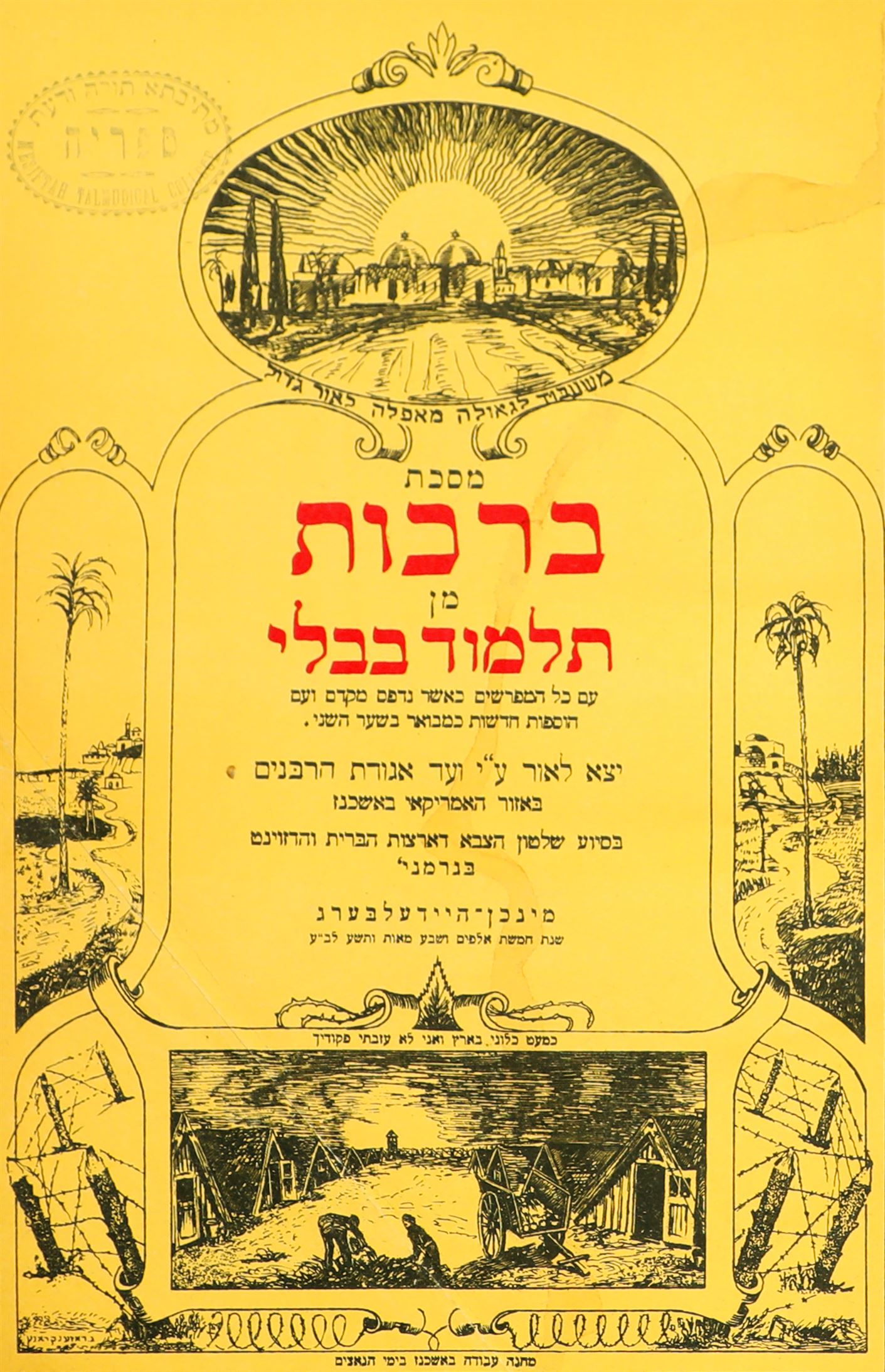
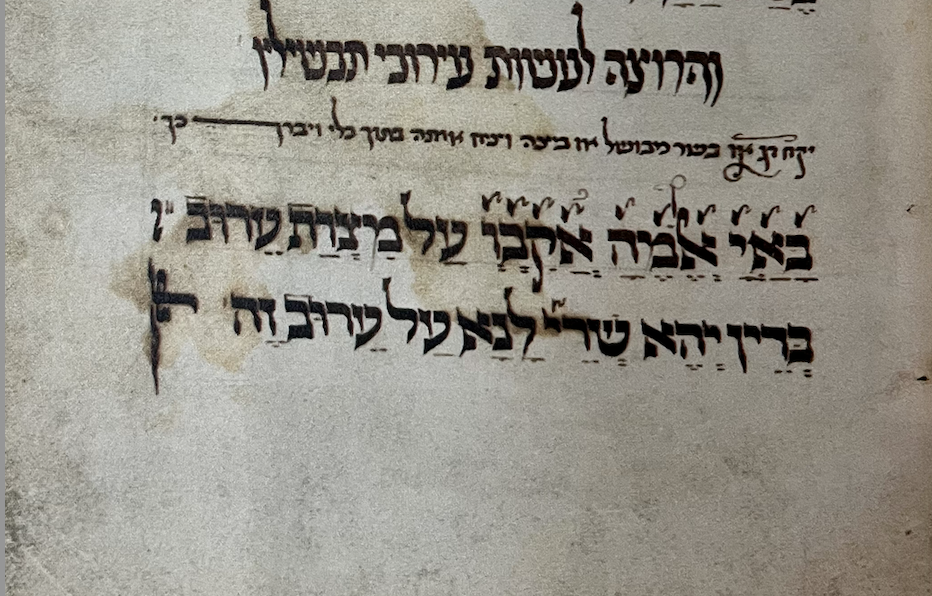
Lot 77 is two broadsides. One is from a list of Rabbis against Heichal Shlomo, against attending a convention. These Rabbis consistently opposed the creation of Heichal Shlomo and the idea of a Central Organization that controlled and spoke for all Orthodox Jews. The Heichal Shlomo board discussed how best to respond to those objections. Ultimately, Zerach Warhftig, argued against responding as they tried to engage and even discuss changing the name but received no response. (See Protocols of the Merkaz HaRuchani HaOlami, January 28, 1958).

The inauguration of Heichal Shlomo occurred on Lag Be’Omer, 1958, to great pomp and circumstance. The mayor held a cocktail party in the garden, and the gentleman was told to wear suits and hats.

There are both editions of the “Survivors Talmud.” (lots 160 & 161).The first edition, published in Munich in1946, only included Nedarim and Kiddushin. In 1948, the American Army published a complete edition of the Talmud. These are the only editions of the Talmud that any government published before the establishment of the State of Israel. There are three introductions, one in English and two in Hebrew. The English one reads in part:

This edition of the Talmud is dedicated to the United States Army. This Army played a major role in the rescue of the Jewish people from total annihilation and after the defeat of Hitler bore the major burden of sustaining the DPs of the Jewish faith. This special edition of the Talmud published in the very land where, but a short time ago, everything Jewish and Jewish inspiration was an anathema, will remain a symbol of the indestructibility of the Torah. […]

Rabbi Samuel A. Snieg, Chief Rabbi of the United States Zone, “Dedication.”

Munich, Germany, 1948 edition of the Talmud printed under the supervision of the Procurement Division, European Quartermaster General Depot, United States Army.

Interesting personal copies one is R. Chaim Ozer’s Achiezer with his inscription (lot 176), R. Chaim Keanievsky’s personal siddur (lot 181), and R. Yaakov Loberbaum’s, the author of the Nesivot ha-Mishpat, copy of Shev Shema’ata (lot 183) and R Chaim Berlin (item 182) a rare volume of Shut Harshaba that R Hirsch got as a gift from his father (item 179) and two items from the Beis Halevi’s Library (items 192 &194) [One with unpublished glosses].


Eruv Tavshilin: A Scribal Error or Deliberate Reformation?

Eruv Tavshilin:  A Scribal Error or Deliberate Reformation?

by: Dan Rabinowitz

The Washington Haggadah was written by the scribe Joel ben Simon, and is currently housed at the Library of Congress in Washington, D.C., and is available online in a beautiful digital copy. Joel produced the Haggadah in the late 15th century. As so much of the core Hebraica collection at the Library of Congress, the manuscript was sold by Efraim Deinard to the Library probably around 1916. (Deinard was one of the most interesting bookmen in the early 20th century, and we will return to him and his biography in the near future).

In 1965, this haggadah was first printed as part of the Diskin Orphan House Haggadah series. The Library of Congress didn’t publish its facsimile edition until 1991, and last year another facsimile edition of this haggadah was published. Although this haggadah was written close to 300 years before Diskin published it, a significant scribal error escaped notice until that time. Specifically, in the text for eruv tavshilin rather than just saying “with this eruv I am allowed to cook from Yom Yov for Shabbat,” it continues and says “and on Shabbat for Yom Tov.” Eruv tavshilin is designed to permit cooking on the holiday for Shabbat. Of course, cooking is always prohibited on Shabbat, whether or not it follows a holiday. The Washington Haggadah seems to permit what is otherwise prohibited.

This did not escape the eagle eyes of some. They feared that someone might use this haggadah (we note that contrary to the other reproductions mentioned, the Diskin version is a poor copy) and inadvertently think it is permissible to cook on Shabbat. The Agudath Harabbonim took out ads in the Yiddish daily, Der Tag, and the Forward to let its readers know of this error.

The publishers countered the Agudath’s claim and mailed out a letter, with the provocative title, “Heresy or Blunder,” after Passover indicating the error and included a letter from Cecil Roth, who had written about manuscript haggadot.

In his letter, he indicates that, indeed this was most likely unintentional and that Joel did not have a different tradition regarding eruv tavshilin. Indeed, we know from Joel’s other manuscripts, where he records the correct blessing, that the Washington 

Haggadah’s version was simply a scribal error.


NOTE: In 1991, the Library of Congress (where the manuscript resides) published an (expensive) facsimile edition of Washington Haggadah. Myron Weinstein, ed. The Washington Haggadah: A Facsimile Edition of an Illuminated Fifteenth-Century Hebrew Manuscript at the Library of Congress Signed by Joel ben Simeon (Washington, D.C., Library of Congress, 1991). In that volume, the text of the eruv tavshilin is discussed by Mordechai Glatzer, “The Ashkenazi and Italian Haggadah and the Haggadot of Joel ben Simon,” 157. The Washington Haggadah was recently republished in a much more affordable format and includes articles by David Stern and one, if not the foremost expert on illustrations in Haggadot, Katrin Kogman-Appel see here for her Academia page). The Washington Haggadah: Copied and Illustrated by Joel ben Simeon (Cambridge: Harvard University Press, 2011). See here for a video presentation by Kogman-Appel and Stern delivered at the Library of Congress.


Kitniyot and Mechirat Chametz: Paradoxical Approaches to the Chametz Prohibition

Contemporary Rabbis don’t bother to interrogate the sources of law and custom; instead, their purpose is to traffic in chumrot and create new prohibitions. They are unable to appreciate their hypocrisy … on the one hand, they roar like a lion against those who are open to change and the reformists, that one cannot alter an iota from what the kadmonim imposed, while on the other hand, casually discard the kadmonim whenever the achronim create new chumrot and they fight with all their might…to impose these new prohibitions.”

R. Yitzhak Shmuel Reggio, Yalkut YaShaR, Gorizia 1854.

Kitniyot and Mechirat Chametz: Paradoxical Approaches to the Chametz Prohibition

By Dan Rabinowitz

Some Pesach rituals trace their history for millennia. Others are of more recent vintage and continue to evolve significantly without any indication of stopping. Two in that category define the contours of chametz prohibition, one expanding and the other contracting its perimeters. Each’s creation was itself a radical departure from the status quo. In both instances, rabbis readily overcame established legal precedent. But their methodologies differ substantially and, at times, are contradictory. Yet, the intersection between the two, mechirat chametz and kitniyot, remains unexplored, and their conflicts unresolved.[1]

Mechirat Chametz

The present-day practice of “mechirat chametz” consists of the pre-Pesach transference of the title to the Jew’s chametz to a non-Jew, and upon the conclusion of Pesach, the chametz reverts to the Jew at no cost. The Torah prohibits any relationship between a Jew and their chametz on Pesach. Aside from the usual restrictions against eating or otherwise enjoying a prohibited item, here, the Torah proscribes even possession. One must destroy their chametz. The Mishna (Pesachim, 21a) and Talmud (Pesachim 13a) recognize that one can avoid liability if they sell their chametz to a non-Jew. But those transactions were permanent and irreversible, and the chametz never returned to the Jew. The first instance of a reversible transaction appears in the Tosefta (Pesachim 2:6).

ישראל ונכרי שהיו באין בספינה וחמץ ביד ישראל הז מוכרו לנכרי ונותנו במתנה וחוזר ולוקח ממנו לאחר הפסח ובלבד שיתנו לו במתנה גמורה

A Jew and a non-Jew are boarding a ship on the eve of Pesach, and the Jew has chametz, he can gift it or sell it to the non-Jew and get it back afterward so long as it was an absolute gift.

The Jew is boarding a ship on Erev Pesach,[2] on a journey that will extend beyond the holiday. There is enough non-chametz for Pesach, but if he destroys his chametz now, he likely will not survive the remainder of the journey. Can one violate Pesach and keep the chametz?  If the chametz is necessary to survive Pesach, he can keep it and even eat it on the holiday. But does a future pikuah nefesh issue justify violating the law now? According to the Tosefta, a reversible transaction will avoid liability for the chametz, so long as it is “matanah gemurah,” an unconditional gift, and not matanah ‘al meant le-hachzer.   One can justify relying on pure legal formalism and comply with all the technical requirements of a transaction, even if the practical effect of this transaction is a nullity.  

Another version of the Tosefta seems to envision an even more restrictive view of the transaction.  In this version, in addition to the requirement that the transaction is a “matanah gemurah,” there is one more caveat, “u-belvad she-lo yarim,” “so long as it is not a trick.” [3]

According to Rav Amram Gaon (810-875) and Rishonim, “no trickery” codifies the implicit limitation of the Tosefta, that this solution is exceptional (expressed nautically) and can never become the norm. This approach remained the practice for hundreds of years, and there was no yearly mechirat chametz. The Rambam and the Rosh repeat the case described in the Tosefta, occurring on a ship, not in any other context. [4]

R. Yisrael Isserlein (1390-1460), in his collection Terumat HaDeshen, is the first recorded instance of a Jew seeking to avoid financial loss affirmatively engaging in the Tosefta’s solution. He discusses a case where someone owns a significant amount of chametz and would incur a loss if he destroys it. But there is a non-Jewish acquaintance that is willing to accept the chametz gift with the understanding that he will return it after Pesach. Isserlein permits this approach so long as it is a gift without explicit conditions. Isserlein does not limit the frequency of resorting to this approach.[5]    

The immediate impact, and rate of adoption, of his decision, remains unclear. Indeed, some question the historicity of Isserlein’s responsa. They claim that the issues described are theoretical and are not in response to actual queries or events.

In the 16th century, R. Yosef Karo (1488-1575) discusses the legal issue of the retrievable sale in his commentary on the Tur, Bet Yosef, and records Isserlein’s ruling in Shulchan Orach but does not indicate whether it was commonplace.  In his commentary on Shulchan Orach, R. Moshe Isserless (1530-1572) (Rema) is silent on this issue entirely and does not mention a yearly custom to sell chametz.  The first to widely apply this technique and significantly lower the requirements was R. Yoel Sirkes (1561-1640).  

With the introduction of propination laws in the 16th century and the rise of the arendtor, there was consolidation in the alcohol industry, shifting control from localized production by peasants to the ruling class. Many of those licenses were managed or leased to Jews. By the late 16th century, Jews in Poland and Lithuania were firmly entrenched in the alcohol industry.  For many non-Jews, arendtor and Jew were synonymous. According to one account, Jews held a monopoly on the entire alcohol trade in Cracow. This created an issue for Pesach.  While Isserlein and Karo, and many others accept that one can sell their chametz, they all explicitly require, like any standard transaction, that the non-Jew remove the chametz he bought. Karo, in Shulchan Orach, codifies the requirement that the chametz is “me-chutz le-bayit,” outside of the Jews’ control. The Jew’s house was chametz-free.  But it was impractical to remove the distillers’ chametz from their property because of the substantial amounts and the fear that with alcohol, the non-Jew might not return it. [6] 

Faced with these issues, Sirkes created a new approach to the sale. Mechirat chametz is not just chametz, he also counseled to sell the ground underneath the chametz. It effectively created non-Jewish property within the Jew’s home. The chametz was “me-chutz le-bayit,” but remained in situ.

Sirkes’ ingenious solution created another issue. When the sale was just for chametz (a transportable good), a monetary transaction, even a nominal one, sufficed. But a written contract is required to sell land to a non-Jew.  Rather than change the process for the sale of chametz and mandate a written contract, Sirkes relaxed the contractual requirement.  He reasoned that requiring a contract for mechirat chametz potentially created another economic issue. He explained that a written agreement might otherwise induce the non-Jew to think the Jew fully sold the chametz and might keep it! This would trigger significant losses, and Sirkes was willing to forego the contract entirely.  He justifies both the sale and the diminution of its legal requirements because of potential economic harm.[7]  

Sirkes’ solution generally relaxed the legal requirements, but he did add two new aspects to mechirat chametz.  First, one must explicitly acknowledge the deficiency of the sale and announce that “I am selling you the room where the chametz is for money and even though I didn’t write a contract.”  He explains that this formulation works according to Tur and R. Karo in Bet Yosef (Choshen Mishpat 194), even for a land sale. Left unmentioned is that Sirkes rejects that position in that same section.

Second, the Jew must give the non-Jew a key to the house. Without that, no external action signifies the chametz is not the Jews, and the sale is clearly a sham.  By the early twentieth century, R. Yisrael Meir Kagan, in his Mishna Berurah, further eroded the key requirement and nullified the need for it entirely for all intents and purposes.  Rather than a physical transfer of the key, the Mishna Berurah allows one merely to identify the key’s location. Like the chametz, the keys can remain in the Jew’s possession, on their regular hook, and in the Jew’s control. There is no independent source for this leniency.  Instead, according to R. Kagan, it is “pashut.” [8] 

The key requirement was not the only aspect of Sirkes’ formula that fell by the wayside. Almost immediately after Sirkes created his workaround, it was being degraded.  Both R. Avraham Gombiner (1635-82), in his Magen Avraham, and R. David HaLevi Segal, in his Turei Zahav, hold that even giving a key is unnecessary. Simply setting aside a place for the chametz is enough.  (Although it seems that the key’s association with mechirat chametz was so pervasive that people began to sell the key rather than the chametz.) [9]

Sirkes’ idea that one can include non-chametz items in the fictional sale was adopted in a different context, again because of the effect of the alcohol trade. At the time, most distilling occurred with rye. The process produced a significant amount of spent rye, while otherwise useless, could be turned into cattle feed. Jewish cattle farmers recognized that they needed to sell their animal feed, and they did so. But, without that feed, the animal’s health and well-being were affected, and it took them time to recover after Pesach. Thus, it became customary to sell not only the chametz but also the cow. Now the non-Jews could come and feed the now non-Jewish cattle their regular diet. While this was initially frowned upon by some, many ultimately accepted it. [10]

The Dispute in Jassy Regarding Modifications to the Process

Despite all of these changes, until the 19th century, one aspect of the sale remained consistent; the individual conducted it, and there was no public communal sale of everyone’s chametz. Yet, leaving it to the individual proved problematic. According to some, there were widespread issues of sales not conforming with the (then) acceptable formulations, inattention to the transaction details, and a general failure to consummate the sale. To accommodate those realities, another shift in the process occurred. The most conspicuous example of introducing the new approach occurred in Romania in the 1840s. R. Yosef Landau and R. Aaron Moshe Taub, two of the leading rabbis in the same city, Jassy, disagreed about the propriety of instituting this new method. Collectively, they published six titles and five books supporting their respective opinions. 

Additionally, Landau asked one of the most well-known legal authorities in the region, R. Shlomo Kluger (1785-1869), to adjudicate the dispute. He wrote a lengthy teshuva siding with Landau’s approach. Yet, this remained unsettled in his mind, and some years later, he retracted his position and agreed with Tauber.

R. Yosef Landau (1791-1853) came from a rabbinic family and, in his youth, studied with R. Levi Yitzhak of Bardichiv. He married young, and when his first wife died at 18, he remarried. His father-in-law was wealthy and generously supported Landau, enabling him to study full-time. At 22, he accepted the position as Liytin’s rabbi. In 1834, at the suggestion of the Ruzhiner Rebbe, Landau took the position of chief rabbi of Jassy.

Jassy (Iași) is today located within northeastern Romania, near the border with Moldovia. In 1565, it became the capital of the former principality of Moldovia and today is the second-largest city in Romania. Jassy had long been the spiritual center for Jews throughout Romania/Moldovia. By the early 19th century, it became a hub for Chasidim. In 1808, R. Yehoshua Heschel Shor, the Apter Rebbe, settled in Jassy.

The early to mid-19th century was arguably the high point of Jewish life in Jassy. At the opening of the century, there were less than 2,000 Jews. By 1838, there were almost 30,000 Jews, accounting for over 40% of the total population. Concurrent with the influx of Jews into Jassy was a general improvement of its finances, especially after the Russian Turkish peace of Adrianople in 1829. Jews played a sizeable role in the city’s overall commerce. They held monopiles to several industries, cattle, cheese, cereals, and dominated in others, such as banking, and owned most commercial buildings in the center of town.

While progress had been good for Jassy, it came with challenges. The combination of the sprawling populace and robust commercial market created complexities that required a revision to the process. After Landau arrived in Jassy, he instituted a new form of mechirat chametz. He established a system where individuals would no longer transact directly with a non-Jew. A handful of select people would buy everyone else’s chametz, and those designated ones would execute the final sale to the non-Jew. Appointing a few knowledgeable people ensured consistency and greater compliance.

Sometime before 1842, Landau published the rationale for this decision. There are no extant copies of that book, Seyag le-Torah, and consequently, the publication date has confused some bibliographers. Friedberg, and after him, Vinograd, date Seyag le-Torah to 1846, which would place it at the tail end of the controversy, its final book, published after three years of silence. But Shmuel Ashkenazi demonstrated that Seyag le-Torah is the first book published regarding the communal mechirat chametz controversy in Jassy and was printed around 1842. The rest of our discussion follows Ashkenazi’s reconstruction of the dispute. [11]

By 1842 Landau could no longer lead the community alone. He requested for the Jewish community to hire a second rabbi. With Landau’s blessing, R. Aaron Moshe Tauber (1787-1852), originally from Lviv, was engaged. Tauber also came from a storied rabbinic family and was the grandson of R. Yoel Sirkes. He also married into a wealthy family in Przemysl, Poland, and studied there for a few years after marriage. He began a relationship with R. Yaakov Meshulum Orenstein (author of the Yeshuot Ya’akov), then rabbi in Jaroslaw, about ten miles from Przemysl. Tauber eventually left Przemysl and returned to Lviv. By this time, Orenstein was the chief rabbi of Lviv, and he and Tauber reconnected. Tauber also began regularly studying with R. Shlomo Kluger, then rabbi in Kulykiv, on the outskirts of Lviv. In 1817, Kluger would leave Kukykiv for Brody, but Tauber remained until 1820. When he was 32, he took a position in the hamlet of Snyatyn, Ukraine, over 150 miles south of Lviv. In 1831, he made an unsuccessful bid for the chief rabbi of Óbuda (one of the three towns that merged in 1873 to form Budapest). In 1842, after 24 years in Snyatyn, Tauber moved further south to Jassy as the new co-rabbi.

Soon after arriving, he learned of Landau’s mechirat chametz process and disapproved. In a public address, Tauber criticized the practice but declined to take any more concrete action against it because he deemed it an entrenched and accepted custom. Nonetheless, he counseled those “who have the fear and trembling of God in their heart” to execute a private sale. According to Tauber, Landau started a whisper campaign that all private sales of chametz are ineffective. Nonetheless, Tauber “remained silent” and held himself back from a direct conflict with Landau.

By Pesach of 1843, all the gloves were off. Tauber claimed that he identified additional issues with the new procedure that convinced him he must act; otherwise, all Jassy’s Jews risked liability. On the eve of Pesach 1843, he published Modo’ah Rabba (An Important Announcement), identifying issues with Landau’s approach to a communal mechirat chametz. Landau had his response ready and published Mishmeret Seyag le-Torah defending his position in Seyag le-Torah within a month. A second title, Bitul Modo’ah (A Nullification of the Announcement), specifically addressed the issues Tauber raised in Modo’ah Rabba appeared at the end of the book. While Landau was formulating and printing his response, Tauber was working to explain his position further.

A short time later, Tauber published Hagu Segim (Remove the Detritus, based upon Misheli 25:4), offering additional evidence against the new practice. But, he wrote this before seeing Landau’s Mishmeret Seyag le-Torah and did not discuss its arguments. To address that, soon after, Tauber published another pamphlet, Hareset Mishmeret (Destroying the Guardian), that attempted to rebut Landau’s rejoinder of Tauber’s rejoinder of Landau’s original defense.

Meshmeret Seyag Le-Torah, Jassy, 1842

A few copies of Landau’s Mishmeret le-Seyag with Bitul Mo’dah and Tauber’s Hareset Mishmeret survive. There are no extant copies of the other books. Mishmeret le-Seyag/Bittul Mo’dah and Hareset Mishmeret are now available online. But both digital versions are flawed. The National Library of Israel’s copy of Hareset Mishmeret is damaged, and some text is lost. But Tauber autographed the final page of that copy.

Final leaf from National Library of Israel copy with Tauber’s signature

The issue with the copy of Mishmeret le-Seyag le-Torah on Hebrewbooks.org is more significant. There is no title page, and the text begins on the first page. Typically, the verso of the title-page is blank or contains copyright information. This copy was originally reproduced by Copy Corner.  In the pre-internet era, the Goldberg brothers photocopied rare and out of print books and bound them in a rudimentary hardcover and distributed them through Beigeleisen Books in Boro Park. Through their efforts thousands of seforim were accessible to the wider public at very reasonable prices.  For those without access to libraries with significant seforim collections, Copy Corner’s catalog stepped in to address that gap. When Copy Corner photocopied the books they added their publication information to the verso of the title page. Normally not an issue, here it results in a blank page with just the Copy Corner legend substituted for the second page of the text of Mishmeret le-Seyag le-Torah.

Hareset Mishmeret was the last public missive, but the two sides remained at loggerheads privately. Communal leaders unsuccessfully pressed for a resolution but eventually, the two reconciled. Love instigated the cessation of hostilities.

In 1846, R. Landau’s son, Mattityahu, married Tauber’s daughter. But the marriage almost didn’t happen. Not because of the controversy over mechirat chametz. Instead, the bride’s and groom’s mothers shared the same name, Hindi. Some view such a match as taboo. But the Ruzhiner Rebbe, R. Yisrael Friedman, endorsed the match. He reasoned that there is no prohibition here because neither mother uses her given name. They both go by “Rebbetzin.” [12]

Sometime before the intermarriage of the two families, Landau requested R. Shlomo Kluger’s assistance to resolve the dispute and determine which approach to adopt. Kluger’s reply begins that he is personally unacquainted with R. Landau but that Tauber is a childhood friend. Despite that friendship, Kluger sides with Landau.

Tauber only recently arrived in Jassy, the largest city in Moldovia, and was unwise to the realities of a big city. Kluger attributes Tauber’s objections to his naivety. Tauber spent the last twenty-two as the rabbi of the small town of Sniatyn, where there were around 2,000 Jews compared to Jassy’s 30,000. The traditional practice of private transactions might work in a town the size of Sniatyn, where Tauber was able to supervise the process. Jassy was a different animal. Landau was responding to those realities when he restructured mechirat chametz. Kluger was the rabbi of Brody, a substantial city of an estimated 15,000 Jews, and saw first-hand the challenges of a large and more cosmopolitan community. Like Landau, Kluger adopted the revised mechirat chametz. Indeed, he had already done so six years earlier! Over the next seven printed double-column pages, Kluger justifies his and Landau’s mechirat chametz ritual, concludes that Landau’s approach is correct, and describes it as “takanah Gedolah,” a worthy edict. Kluger, however, notes that he finds the whole episode distasteful and that he doesn’t have time to engage in these sorts of controversies and communicates his mystification that such a vicious dispute could arise over a “davar katan” like this.

Despite Kluger’s comprehensive defense of the communal mechirat chametz ceremony, he ultimately regretted that position. Kluger included an addendum when this responsum went to press in 1851. After seeing the effects of the new approach, he explained that he was reversing his stance. With the consolidation of mechirat chametz into a communal sale, an industry arose. Profiteers saw an opportunity and began competing for people to sell them their chametz. With money as their only motive, they were incredibly sloppy with the sales. With the single points of failure, there was often no legally recognized transfer, leaving countless people owning chametz on Pesach. Kluger disavowed his lengthy defense. He ascribed it to alternative motives, preserving Landau’s honor. Kluger concluded with the recommendation that every individual execute their own contract with the non-Jew, i.e., Tauber’s position.[13]

During that same period, R. Moshe Sofer, in a very lengthy responsum, supports preserving the less than 100-year-old practice of selling chametz and rebuffing the many reasons it seemingly conflicts with established Jewish law. Despite his leading the rallying cry of “hadash assur min ha-Torah,” Sofer, who rejects new approaches because of their novelty, unqualifiedly approved of mechirat chametz.

R. Ephraim Zalman Margolis wrote to Sofer and raised issues with the current process as it was nothing more than “ha-aramah” and that certainly selling one’s animal is prohibited. Sofer began by noting that there are instances where ha-aramah is permitted. Hazal crafted those exceptions because they recognized that “אין כל המקומות והזמנים שוים.” Ultimately, he concluded that despite the sham nature of the modern procedure, it is a fully-realized transaction that discharges ownership for purposes of chametz and even permits the Jew to sell their cattle with the chametz. [14]

Sometime after the widespread adoption of communal mechirat chametz, there was another revision to the practice. Now, the individual no longer sells his chametz to the rabbi and the individual never directly executes a sale. Instead, the individual approaches the rabbi not to sell him the chametz but appoint him an agent to sell it on their behalf.[15]

The most recent shift in mechirat chametz is that it is no longer de facto but de jure.  According to some, R. Shlomo Yosef Eliashiv among them, today, mechirat chametz is obligatory even if one destroyed their chametz. [16]  

(Bardak, recently satirized the contemporary practice, with all its details, in an episode that imagined a very sophisticated purchaser that presses their rights, legal and political.)

Kitniyot

The historical approach to mechirat chametz and the willingness to adapt biblical law to the realities of modern society stands in sharp contrast to another chametz-related issue, kitniyot. There is no doubt that the biblical prohibition against chametz did not include kitniyot. The Mishna and Talmud agree that it is permissible. At best, it is an Ashkenazi custom and/or edict whose earliest record is the 13th century and was never universally adopted by all Jews. Consequently, many rabbis explicitly rejected the prohibition as either a “minhag ta’ot” or even a “minhag shetut.” Yet, according to some, kitniyot is such a powerful legal concept that even in instances of severe famine, kitniyot remains prohibited. Kitniyot is even more pervasive now than ever before, with new items added yearly to the list. [17]

There have been attempts to repeal kitniyot custom since the 18th century, without significant success. In the case of the nascent Reform Judaism movement, like many other laws and customs, it overturned kitniyot without any specific halakhic justification. But the other attempts came with substantial legal analysis that supported removing the prohibition. Many raised economic arguments to justify reversing kitniyot. In the case of mechirat chametz, the initial beneficiaries of the sale were well-to-do Jews who held large amounts of chametz. The kitniyot restrictions mainly affected the poor who could not afford expensive matza and for whom kitniyot’s low cost would provide a more economically feasible alternative to satisfy their daily caloric needs.

R. Tzvi Ashkenazi, Chakham Tzvi (1656-1718), one of the leading rabbis in Western Europe, first articulated this argument. Chakham Tzvi concluded that the economic harm justifies removing the restriction. Nonetheless, he declined to act alone, and without others joining his approach, the rule remained in effect even in the communities he served. Likewise, his son, R. Yaakov Emden (1697-1776), agreed with removing the restriction against kitniyot but required consensus among rabbis to make any practical change. [18]

Eventually, beginning at the turn of the 19th century, a handful of communities in Western Europe acted upon the approach of Hakham Tzvi (in addition to marshaling other arguments) and abolished the prohibition against kitniyot.[19] The first to do so was a community under French control, the Consistory of Kingdom of Westphalia, created by Napoleon in 1807, today located in the north-western corner of Germany. The argument for the repeal was initially only on behalf of garrisoned soldiers in the area. They did not have access to large amounts of matzo, and permitting kitniyot would alleviate their hunger. Ultimately, the kitniyot repeal applied to all Jews in the area. Perhaps the most well-known rabbi involved, R. Menahem Mendel Steinhardt, authored a lengthy defense of the dispensation and many other changes and sent it to his close friend R. Wolf Heidenheim (1757-1832). Although Steinhardt specifically told Heidenheim to keep the letter private, Heidenheim believed that the analysis was too compelling to hold back from the public. Heidenheim went ahead and published it without consent at his own expense. He also appended some of his notes to the book. The book, Divrei Iggeret, published in 1812, contains one of the most cogent published arguments for the abolition of kitniyot. Nonetheless, Steinhardt’s defense was rejected by many.

Despite those rejections, in addition to Heidenheim, others continued to support him, if not his kitniyot position. His former havruta, R. Betzalel of Ronsburg (1760-1820), who provided a haskamah to Steinhardt’s responsa work, Divrei Menahem, still held him in high esteem long after Divrei Iggeret. He also secured two subsequent rabbinic positions in other Jewish communities. Others, however, cast him as a villain.

One recent book characterizes Steinhardt and others as “the wicked maskilim may their names be blotted out” and ascribes their motivations as solely driven “to disparage the kadmonim.” Rather than concern for the poor, according to the book, the true purpose of reversing the prohibition against kitniyot is to permit chametz on Pesach eventually. [20]

Heidenheim’s support troubled some because he is an accepted orthodox figure. One approach is to attribute Heideheim’s willingness to publish Divrei Iggeret as a favor to Steindhardt’s uncle, R. Yosef Steinhardt, with whom Heidenheim studied in his teens.[21] This explanation seems implausible. First, this approach ignores Heidenheim’s unreserved praise of the force of Menahem’s arguments. Heidenheim justified his decision to unilaterally publish Menahem’s letter so that “every honest, sensitive, and intelligent person will see that [Menahem’s] purpose is to teach Beni Yehuda avodat Hashem, to fear and love Him in the ways of truth and peace . . . and to respond to the detractors and support the poor and provide them as much food as possible.” Second, when Divrei Iggeret was published, Yosef Steinhardt had been dead thirty-six years, and when he passed, his nephew, Menachem, was only seven years old. Indeed, another author, Benyamin Shlomo Hamburger, highlights this lack of connection between uncle and nephew to diminish any family prestige that might inure to Menachem.

Likewise, Hamburger turns Menachem’s adoption of his uncle’s surname (and not the more traditional approach of using his birthplace, Hainesport, as the surname) into a liability. Hamburger sees this as a blatant example of carpetbagging, trading on his uncle’s reputation. Similarly, Hamburger delegitimates Menachem’s responsa work, Divrei Menachem, and describes it as entirely self-interested, simply “an attempt to get any rabbinic position.”

Although Steinhardt’s approach to kitniyot did not significantly alter the orthodox practice, he substantially changed Jewish liturgical practices despite attempts to marginalize him. Steinhardt’s Divrei Iggeret comprises ten letters, one of which is devoted to kitniyot. The other nine argued for changes to other Jewish practices. The seventh letter addresses the custom to recite the mourner’s Kaddish.

Until the 19th century, the accepted Ashkenazi custom was to have each mourner recite the Kaddish individually. Steinhardt argued for adopting the Sefardic tradition of all the mourners reciting Kaddish in unison. While some rejected that position as a change to the status quo, including R. Moshe Sofer, Steinhardt’s modification of the practice is today widely accepted. His opinion was first cited approvingly in the commentary to Shulchan Orach, Piskei Teshuva, with the instruction to review Divrei Iggeret for its compelling arguments. Many of those arguments mirror those Steinhardt relied upon for his repeal of kitniyot. Among those that kitniyot lacks Talmudic sources, the current restriction did more harm than good, the Sefardim already do it, and R. Emden theoretically permits its annulment.

Steinhardt first categorizes the entire kaddish ritual as a custom that “has absolutely no root or foundation.” He challenges any attempt to find early sources that support incorporating Kaddish into the standard prayers. Neither the Bavli nor Yerushalmi nor the “Rishonim” incorporate the practice. Steinhardt dismisses midrashic sources, presumably the Zohar Hadash (Achrei Mot, 112), as irrelevant to determining practice. Second, the current custom of assigning only one mourner to right to lead Kaddish is detrimental because it leads to fighting for priority and a general lack of decorum. Third, the modification is the standard practice amongst Sefardim. Fourth, in theory, R. Yaakov Emden’s willingness to overturn the Ashkenazi custom in favor of the Sefardic one. Fourth, he cites R. Moshe Hagiz’s that implies reciting kaddish unison is permitted. He concludes that despite canceling the historical practice, his position is also ancient.[23]

Steinhardt’s change was embraced by conventional rabbis, explicitly citing the Divrei Iggeret and incorporating the change into their codifications. For example, Kitzur Shulchan Orach, Ta’amei Minhagim, Kol Bo’ al Avelut, and the more recent Peni Barukh associate the change with Divrei Iggeret. R. Gavriel Zinner, in his work on the laws of mourning, Neta Gavriel, didn’t just cite the Divrei Iggeret; he reproduces the entire letter from “ha-Gaon Rebbi Mendel Steinhardt.”[24]

Hamburger is again troubled by the seeming approval of Menahem’s modification of Kaddish and asks, “how is it possible that Divrei Iggeret received such a positive reception that he became the source of this [new] law?” The answer: Steinhardt hoodwinked the Eastern European rabbis. They thought that the change occurred with the consent of all the German rabbis and was unaware that Menahem acted alone and his true purpose was radical reform. Left unexplained is why many of the same Eastern European rabbis were aware of his actual intentions when it came to kitniyot.[25]

Likewise, many of those same personalities that vigorously defended the retention and extension of the leniency of mechirat chametz refused to budge on the custom of kitniyot. Despite the lack of supporting evidence, R. Moshe Sofer held that repealing the kitniyot restriction is impossible because it is a universally accepted formal edict. Nonetheless, among his arguments in defense of mechirat chametz was that “any restriction that the Talmud does not explicitly mention we cannot decree that is prohibited.” [26]

R. Tzvi Hirsh Chajes defends the practice of mechirat chametz. He accepted that the justification for mechirat chametz is economic. Nonetheless, he rejects the elimination of kitniyot as a too substantial reformation of Jewish practice to allow, even though it too caused significant financial hardship. According to him, because the Reform movement abolished kitniyot, any other attempt is tainted and assumed to be driven by the same anti-Orthodox sentiments and must be rejected to maintain the status quo. Even though the first major successful attempt to remove kitniyot was not a Reform congregation but an Orthodox one, headed by notable Orthodox rabbis, who based their decision on the law. [27]

The practice of mechirat chametz significantly altered the landscape of Pesach compliance. Each stage of its evolution required creative solutions to contemporary issues as they arose. Rather than invoking the general rule that chametz demands a strict reading of the law, leniencies were repeatedly devised and were near-universally adopted. Indeed, R. Isserlein, in his responsum permitting mechirat chametz, rejects that principle’s applicability to mechirat chametz. With limited exception, until the 17th century, Jews complied with the straightforward reading of the Biblical restriction, “chametz shall not be found in your houses.” The changing economics of the 17th century forced the rabbis to confront a new reality where it was no longer financially possible to physically remove one’s chametz. One rabbi’s solution was universally adopted, altering the mechirat “chametz” to include a second sale, that of the land. In less than a century, his formulation proved insufficient to deal with the continuing changing reality. Other Rabbis instituted additional modifications to the process. Now there is no direct sale of chametz, and the mechirat chametz ritual consists of appointing an agent. Each of these changes required reliance on leniencies, and in nearly every instance, the modifications themselves created ancillary issues. Ultimately, rabbis overcame all the objections, and the mechirat chametz ceremony remains in full effect.[28]

Paradoxically, kitniyot, despite the many reasons marshaled against retaining the practice, each of these is ruled insufficient to justify repealing kitniyot. Instead, the principle of “the severity of the prohibition of chametz (leavened food) mandates rejecting leniencies” was applied to kitniyot (non-leavening foods) to justify its endless expansion and ignored for mechirat “chametz.” As of now, mechirat chametz does not apply to kitniyot, and the two practices remain isolated from one another, just as they have in their development and legal approach. Both, however, remain examples of the dynamic nature of Jewish practice even within Orthodoxy.

NOTES

[1] This article is not intended to provide a comprehensive survey of all the literature regarding mechirat chametz and kitniyot. The focus of the article is the historical modifications to the practices. For a general discussion regarding the history and application of mechirat chametz, see Shmuel Eliezer Stern, Mechirat Hametz ke-Hilkhato (Bene Brak: 1989); R. Shlomo Yosef Zevin, Ha-Mo’adim be-Halakha, vol. 2 (Jerusalem: Talmud HaYisraeli HaShalem, 1980), 294-304; Tuvia Friend, Mo’adim le-Simha, vol. 4 (Jerusalem: Otzar haPoskim, 2004), 151-223.

For a comprehensive discussion regarding kitniyot, see the recently published book by Yosef Ben Lulu, Kitniyot be-Pesach: Gilgulo ve-Hetatputhoto ha-Halakhtit ve-Historiyt shel Minhag Zeh be-Adat Yisrael ’ad Yamenu (Be’er Sheva: Dani Sefarim, 2021); see also our discussion, “Kitniyot and Stimulants: Coffee and Marijuana on Passover,” Seforim blog, March 9, 2010.
[2] The scenario of boarding on the eve of Pesach is problematic. The Tosefta prohibits boarding a ship within three days of Shabbat. Tosefta Shabbat 13:13. He is already in breach of one prohibition confirms that this is an extraordinary case.
[3] This is an alternative text and not a later interpolation. See Leiberman, Tosefta ke-Peshuto, Seder Mo’ad, vol. 4 (New York: JTS, 2002), 495-96. But R. Yosef Karo mistook this just to be the commentary of the BaHaG and not part of the text because otherwise, it would prohibit the then-current form of mechirat chametz. Karo dismissed “shelo yarim” as an independent requirement and treated it as simply a reiteration of the prohibition against an explicitly conditional gift. See R. Shlomo Yosef Zevin, Ha-Mo’adim be-Halakha, vol. 2 (Jerusalem: Talmud HaYisraeli HaShalem, 1980), 295.
[4] See Lieberman, id. at 496, collecting sources.
[5] See R. Israel Isserlein, Shmuel Avitan ed., Terumat ha-Deshen (Jerusalem: 1991), no. 120, 93. Of note is that Isserlein does explicitly cite the Tosefta as his source. Indeed, his “rayah” “prooftext” is a passage from Talmud Bavli (Gitten 20b). He argues that the Talmudic source generally recognizes a transaction even when the parties’ intent is for the recipient to return it. It is possible that he held the Tosfeta alone is insufficient justification for the broad applicability of a reversible gift. Instead, he needed to prove the general efficacy of this type of transaction.
[6] Gershon Hundert, Jews in Poland-Lithuania in the Eighteenth Century (Berkley: University of California Press, 2004), 14-15, 36-37; see generally, YIVO Encyclopedia, Tavernkeepers; Glenn Dynner, Yankel’s Tavern: Jews, Liquor, & Life in the Kingdom of Poland (Cambridge: Oxford University Press, 2013). Jews’ association with the liquor trade persists today in Poland. Since the 1980s, Kosher and “Jewish style” vodka has become popular with Poles. These vodkas are considered premium brands, allegedly so pure as to stave off any ill effects the next morning. See Andrew Ingall, “Making a Tsimes, Distilling a Performance: Vodka and Jewish Culture in Poland Today,” Gastronomica, 3 (1), (2003), 22-27.
[7] Sirkes assumes that a written contract is unnecessary. The contemporary practice of executing a written agreement occurred later. See Mechirat Chametz ke-Helkhato, 68-9.
[8] For a survey of sources requiring giving the key, see Mechirat Chametz ke-Hilkhato, 13n18. Mishna Berurah, 448:12 & Sha’arei Tzyion, id. He asserts that this position is alluded to in the Hemed Moshe. But the Hemed Moshe (448:6) discusses an instance where the non-Jew decides to return the keys to the Jew unilaterally. In that instance, the Jew does not violate the law. But this scenario still contemplates the Jew physically transferring the key to the non-Jew. There is no indication that the Jew can forego the entire transaction by simply referencing the existence of a key.

R. Yechiel Epstein (Arukh ha-Shulchan 448) also rules that the mere identification of the key’s location is sufficient to avoid liability. He also holds that he need not go alone if the non-Jew uses the key to access the room, not for chametz but to get something else. The Jew is permitted to accompany him to ensure the integrity of the goods.
[9] See Mechirat Chametz Ke-Hilkahto, 13.
[10] For an exhaustive collection of sources, see R. Yitzhak Eliezer Jacob’s 2003 book, Tevu’at be-Ko’ah Shor, devoted to the topic; see also Mehirat Hametz ke-Hilkhato, 30-31.
[11] See Yisrael Landau’s son, Mattityahu Landau, wrote a biography of his father. Toldot Yosef, (Bardichiv, 1908), 13-16; Shmuel Ashkenazi, “Ha-Mahloket bein Rabanei Yus be-Shenat 1843,” Ali Sefer, 4 (June 1977), 174-77. Iasi, Yivo Encyclopedia; Iasi, Pinkas Kehilot Romania.

For biographical information for Tauber, see Hayyim Nasson Dembitzer, Kelilat Yofei (Cracow, 1888), 151n1.
[12] Landau, Toldot Yosef, 15.
[13] Shlomo Kluger, Shu” T meha-Gaon Mofes ha-Dor R. Shlomo Kluger, in David Shlomo Eibsheuctz, Na’ot Desha (Lemberg: 1851) 3a-6b (at the back of the book). Avraham Binyamin Kluger, Shlomo Kluger’s son, published the book.

A few years later, another Pesach controversy, machine-made matza, also involved R. Shlomo Kluger. He was against using the new technology for Pesach. See Meir Hildesheimer and Yehoshua Lieberman, “The Controversy Surrounding Machine-made Matzot: Halakhic, Social, and Economic Repercussions,” Hebrew Union College Annual 75 (2004), 193-26.
[14] Shu’T Hatam Sofer, OH, 62.
[15] Like the other solutions, using an agent created its issues. But none were significant enough to undermine the efficacy or acceptance of the practice. See Mechirat Chametz ke-Hilkhato, 5-6, 110-19.
[16] See Mechirat Chametz ke-Hilkhato, 7. The legitimacy of the sale is of such force that even if someone completely ignores it and continues to eat and use their chametz, the sale is still effective for anything that remains. See R. Moshe Feinstein, Iggerot Moshe, Orach Hayim 1 (New York: 1959), 203 (no. 149).
[17] Ben Lulu, Kitniyot, 31-93.
[18] Yaakov Emden, Mor u-Ketiah, 453.
[19] Another early attempt to rescind kitniyot was the inclusion of a responsum in Besamim Rosh that alleges kitniyot source is from the Karaites. There is no basis for this assertion. On the contrary, the extant evidence demonstrates that Karaites affirmatively rejected any prohibition against kitniyot. See Ben Lulu, Kitniyot,173-75. See here for our previous discussions regarding the Besamim Rosh.
[20] Moadim LeSimcha 241-42
[21] See R. Nosson David Rabinowich, “Be-Mabat le-Ahor: Kamma he-Orot be-Inyan “Heter” Achilat Kitniyot be-Pesach,” Kovetz Etz Chaim 15(2011), pp. 345–348.
[22] Binyamin Shlomo Hamberger, Ha-Yeshiva ha-Ramah be-Feyorda: Ir Torah be-Dorom Germaniyah ve-Geon’eha (Bene Brak: Machon Moreshet Ashkenaz, 2010), 398-422.
[23] See Divrei Iggeret, no. 7, 10b-11a; Tzvi Hirsch Eisenstadt, Piskei Teshuva, Yoreh De’ah, 376:6.
[24] Gavriel Zinner, Neta Gavriel: Helkhot Avelut (Jerusalem: Congregation Nitei Gavriel, 2001), 344n2.
[25] Hamburger, Ha-Yeshiva, 412-417.
[26] For a discussion of R. Moshe Sofer’s position regarding kitniyot and his involvement in the controversy, see Ben Lulu, Kitniyot, 185-88.
[27] See Darkei ha-Hora’ah, chap. 2, Kol Kitvei MaHaRiTz, vol. 1, 223-225; Minhat Kenot, Kol Kitvei MaHaRiTz Hiyut, vol. 2, 975-1031.
[28] Some refrain from selling certain forms of chametz out of an abundance of caution, but the custom of the vast majority of Jews is to sell all types of chametz. See Mehirat Chametz, 5-6.


The Image of the Menorah in the Early Printed Hebrew Book

The Image of the Menorah in the Early Printed Hebrew Book

By Dan Rabinowitz

The menorah is one of the most recognizable Jewish symbols. Today it has been adopted by the State of Israel as her official symbol, and throughout history there are numerous examples of its use. Coins, headstones, paintings and synagogue walls etchings, lamps, mosaics, manuscripts, and books, all provide examples of the widespread usage and mediums. Many of these examples have been addressed by scholars, but there is a lacuna regarding the depiction of the menorah in the Hebrew book.[1]

Despite that it is one of the most recognizable and ubiquitous symbols, the image of the menorah barely makes an appearance on Hebrew books. The first appearance of the menorah in a Hebrew book was Yosef Yikhya’s, Torah Or, Bologna, 1538. There is appears on the verso of the titlepage. The menorah is created via micrography and extols the value of the work. The designer even correctly places the menorah on a stand (and not a solid base as shown in the Arch of Titus). [2] 

From the inception of printing, Hebrew printers, like others, created and populated their works with their unique marks. These symbols served advertising for the publisher. Perhaps the only other symbol with such wide resonance and connection to the Jews as the Menorah is the star of David. There are over 200 printers’ marks, or emblems, close to 20 examples of the Magen David, and multiple appearances of other Jewish symbols, lions, David, Solomon, eagles, but two only of a menorah. [3]

Meir ben Jacob Parenzo, (aka Parentio, Parintz, or Maggius Parentinus), operated in Venice from 1545 until his death in 1575. He apprenticed in Daniel Bomberg’s printing shop, and in 1545 he began working for the Venetian printer, Cornelio Adelkind. Although most of his career was in the service of others, he did publish a handful of books on his own. He did not own a press and likely used Bomberg’s Press. All of these books bear Parenzo’s printers mark, a menorah. Whatever ambiguity there is about his surname, his personal name, Meir, alludes to lighting, thus a natural connection to the menorah. On either side of the menorah, “This is Meir’s menorah, he is the son of Yaakov Parenzo.”

Parnezo’s mark comprises around half of the title page. This grotesque design was called out for being unique among his contemporaries, but that it was “a pathetic bid for immortality.” As a measure of divine justice, according one scholar of Hebrew Italian printing, that “Meir Parenzo, notwithstanding his hope for immortality, is completely forgotten except for a small circle of Hebrew bibliographers, who, although conscious that the individual contributions of the men they commemorate are negligible in the great current of human affairs as it flows majestically down through the ages, nevertheless handing down (or transmitting) the knowledge of the existence of so many faithful men who have contributed their share to the enlightenment of the world.” [4] 

Another printer, also a Meir, incorporated the menorah into his mark, although on a much smaller scale. Meir ben Yaakob Ibn Ya’ir, here too, the surname, Ibn Ya’ir, references light. The menorah appears inside a border, flanked by olive trees surrounded by four verses, all mentioning either oil or light. Meir was active between 1552 and 1555. He published a few books abridged books on the laws of shehitah, as well as a work on Hebrew grammar, all exceedingly rare. [5]

The menorah next makes an appearance in Moshe Cordovero’s, (1522-1570), first book, Pardes Rimonim. This illustration is not of the biblical menorah, rather it is a kabbalistic representation of the sefirot overlaid on the menorah frame. This illustration was printed in most subsequent editions of Pardes Rimonim, although not as an exact reprint of the first edition.

The first illustration of the menorah that was an attempt to depict and elucidate complexities of the biblical menorah only occurred in 1593. There were two books that include the illustration, Biurim and Omek Halakha.

R. Yaakov ben Shmuel Bunim Koppelman, (1555-1594) studied with R. Mordechai Jaffe, author of the Levush. In addition to traditional subjects, he was also well-versed in (my astronomy and mathematics. He published Omek Halakha in Cracow, 1593, a commentary on the Talmud. This slim volume of just 95 pages, is rich in illustrations, which appear on nearly every page. For example, there is a thirteen page an in-depth discussion of astrology with two full page diagrams of the lunar paths and many of the other pages include multiple illustrations. Koppelman includes a detailed diagram of the menorah with an accompanying commentary. [6]

The Biurim on Rashi was published in 1593 in Venice and attributed to R. Nathan Shapira. Shapira had died in 1577; his work includes three illustrations, the menorah, a map of Israel, and a diagram of how the spies carried the large bunch of grapes. This is the first Hebrew book to contain a map.

The book is one of the handful of examples of literary forgeries in Hebrew books. R. Shapira’s son, Yitzhak, published his father’s comments on Rashi in 1597 in a work titled Imrei Shefer. In the introduction he explains why there are two books that are attributed to his father on the same topic published within a few years of one another.

ואתם קדושי עליון אל תתמהו על החפץ שזה שתנים ימים יצא בדפוס איזה ביאורים הנקראים על שם הגאון אדוני אבי ז”ל, כי המציאוהו אנשים, אנשי בלי עול מלכות שמים, חיבור אשר מצאו, ומי יודע המחבר אם נער כתבו ורצו לתלותו באילן גדול אדני אבי ז”ל, חלילה לפה קדוש להוציא מפיו דברים אשר אין בהם ממש, כי הכל תוהו ובוהו ומזויף מתוכו, כלו עלו קמשונים כסו פניו חרולים. וכאשר הגיעו הספרים ההם בגלילות אלו הכרוז בהסכמת כל רבני ורשאי המדינות שלא ומכרו ויהיו בבל יראה ובבבל ימצא בכל ארצות אלו. ואשר קנו מהם יחזר להם המעות ולא ימצא בביתך עולה

[“Do not wonder why I am publishing what was published just two years ago, the Biurim, in my father’s name. As wicked people, people who found a book, a book which may have been written by a child. However, they wanted to use my father’s good name to publish their work. But, my father would never say such stupidities which appear in that book, their book is worthless and a forgery. When this was discovered all the Rabbis agreed that this book [Biurim] should be under a ban, no one should be allowed to keep it. Whomever purchased it should have their money returned, they should not allow a stumbling block into their home.”]

According to R. Shapiro’s son, the Biurim, is illicitly associated with his father. His son was not the only one to question the authenticity of the Biurim. R. Yissachar Bear Ellenburg in his Be’er Sheva and in his Tzedah L’Derekh states unequivocally that R. Shapiro did not write the Biurim.

The diagram of the menorah does not appear in Imrei Shefer. [7]

The diagram of the menorah appears in Yosef Da’at printed in Prague in 1609 by Rabbi Yosef ben Issachar Miklish (1580 -1654). He was a student of the Maharal of Prague and of Rabbi Ephraim Lonchitz, the author of the Klai Yakar. The purpose of the book was to correct errors in Rashi’s commentary. He used a 14th century manuscript to make those corrections. To better facilitate studying Rashi, the book includes illustrations including the menorah. This a full page with detailed descriptions of each part of the menorah. Interestingly, the base seems to combine two different approaches, one that has three legs and the other with a solid base. Miklish reproduces a solid base on top of three legs.

In 1656/57 Yalkut Shimoni with the commentary of Berit Avraham was published in Livorno, Italy. This one includes a menorah created via micrography, but unlike the others that appear at the front of the books, this one appears at the end. It is a colophon.

A unique example of the menorah appears in the 1684 edition of the Humash. It is the sole illustration on the title page. When the menorah appears on the title page, it is almost always in conjunction with other vessels or other symbols. This is perhaps the only instance of a stand-alone menorah on a title page.

The next appearance is the first time it illustrated a titlepage, in R. Shabbati ben Joseph Meshorer Bass’s (1641-1718), most well-known work, his commentary on Rashi, Siftei Hakhamim. This edition was published in Dyhernfurth, Germany at Bass’s press. This was the second edition of the work, (the first was published in 1680 in Amsterdam), and includes one of the most unusual Hebrew titlepages.

The titlepage depicts Moshe and Aaron, with the ark and other temple vessels, and prominently, and occupying the bottom third of the page, a menorah. Bass makes multiple luminary allusions on the title page. This edition includes

“.עם תרגום אנקלוס וביאור מאור הגדול רש״י ז״ל: ועליו מפרשי דבריו ככוכבים יזהירו: ובש״בעה נרות יאירו

The menorah makes another appearance on the next page. Like the Torah Or, Bass uses micrography, in praise of the book, to form the shape of the menorah.

Aside from the figurative arts there was also a musical component to the page. This is not surprising as Shabbati was a musician and singer, and a noted bassist singer, hence the “Meshorrer”/“Bass” surname. On the bottom of the page, in the left corner, appears “Az Yashir Moshe” the beginning of the one of the fundamental Jewish musical pieces, and musical notes appear at the bottom of the page, in what appears to be a composition of sorts. This is one of the few times musical notations appears in early Hebrew religious books. Another is Immanuel Hayi Ricci’s commentary on the Mishna, Hon Ashir, printed in Amsterdam in 1731. Appended to the end of the book are three songs, two set to music with notation.

Another menorah appears in Bass’s edition. On the next page, like the Torah Or, the menorah is comprised of micrography extoling this edition with the commentary. [8]

In 1694, R. Avraham Tzahalon published a portion of his grandfathers, R. Yom Tov Tzahalon’s (c. 1559-1638), responsa. R. Yom Tov was a child prodigy, only eighteen when he published his first work. That same year he was included in granting an approbation alongside R. Moshe Tarani (Mahrit) and R. Moshe Alschech. R. Yom Tov was no shrinking violet. And he had a dim view of R. Yosef Karo’s Shulhan Arukh. He belittled it, calling it only fit for children. The title page and the verso of the 1694 edition include depictions of the temple vessels and specifically the menorah. But his responsa do not discuss the temple vessels and this was included, “to beautify and embellish the title page of the book in a manner fit for print; the students illustrated holy concepts, the form of the Tabernacle and the Third Temple.” A rare of example of acknowledging the aesthetic beauty in the Hebrew book.

Three years later, the Italian scholar, Moshe Hafetz, (1663-1711), (aka Moses Gentili) published Hannukat ha-Bayit which discusses the Temple in great detail and includes numerous illustrations. Because of the illustrations, the book was printed in two parts. First all the text was printed with space left for the illustrations and illustrations were then added using etched copperplates.

His other work, Melekhet Mahshevet, includes his portrait, the first rabbinic portrait included in a Hebrew book, which is somewhat controversial because he is bareheaded. In a 19th century edition, a yarmulke was drawn on his head.[9]

The Bass titlepage served as the model for another lavishly illustrated titlepage. Although it served as a model, it was only a model and not a perfect facsimile. This was intentional. In this instance, the Menorah was the most important visual element of the titlepage and therefore is significantly larger than before and is in the center not the bottom of the page. Of course, this is because the book’s title includes menorah, Menorat haMeor. The book’s structure is based upon the biblical menorah and divided into seven parts, like the seven branches of the menorah. The title page was likely executed by the well-known engraver, Avraham ben Jacob, whose lavishly illustrated 1695 edition of the Haggadah, remains among the most remarkable illustrated haggadot and served as a model for dozens of other illustrated haggadot. Like in the Biruim, Jacob also produced a map, this one much more refined than the basic one in the Biruim. It is a large fold-out map of the Jews travels from Egypt to Israel. Most of his illustrations are copied from the Mathis Maren, a Christian, whose biblical illustrations were very popular. [10]

The illustration was reused by another Amsterdam printer, Solomon Proops, in 1723. Thus, this is one of the few instances of Hebrew titlepage images reflecting the title or the work itself rather than serving a mere ornamental purpose. The titlepage imagery was reused for a 1755 edition of the Torah. This time the menorah is significantly reduced in size.

While these menorahs depicted in Hebrew books, might differ in small details, they are consistent in depicting curved, and not straight, arm. Nearly every manuscript and all the archeological finds similarly depict the curved branches. Of late, this is subject to controversy. The Lubavitcher Rebbe heavily promoted his position that the arms of the biblical menorah were straight and not rounded. In the main, he based this on a manuscript in the Rambam’s hand that includes a depiction of the menorah with straight arms and the confirming testimony of his son that, according to Rambam, the arms were straight. This produced one of the more unusual exchanges in a haredi journal, in his instance, Or Yisrael, published in Monsey, New York. Those historic and documentary materials are used by R. Yisrael Yehuda Yakob, from Kollel Belz, as evidence against the Rebbe’s position. The article uses the mosaics in the 7th century Shalom al Yisrael Synagogue. The menorah is at the center of a large mosaic. The inscription near the mosaic indicates that the entire congregation, men, women, old and young, all took part in the creation of the mosaic. The Burnt House in Jerusalem’s Old City, that dates to the Second Temple period. Yakob then moves on to numismatic, citing a coin from the Hasmanoim period. Section three is then devoted to a discussion of the menorah on the Arch of Titus. Yakob references unidentified “hokrim” who posit that the base of the menorah was broken en route to Rome and was replaced with a base of a Roman creation. This explains why the base does not conform with the Rabbinic description and contains bas reliefs of various mythical and real animals. It was not the true one. Although unidentified, this position is that of the former Chief Rabbi of Israel, Rabbi Herzog as well as the nineteenth-century British Protestant academic, William Knight. Only in section four does Yakob turn to the more traditional Medieval Jewish commentaries. Ultimately, Yakob concludes that the rounded arms is the correct depictions and “justifies” the custom to draw it that way. Following the text, is a reproduction of the menorah from the second century synagogue, Dura Europas. A most unusual conclusion for a rabbinic article. (The image of the Dura Europos menorah actually depicts a straight arm menorah, that follows the Rebbe’s opinion. This is one of the only archeological examples of a straight arm menorah. The value of this image, however, is questionable. The menorah appears four times at Dura Europos. The straight arm one appears at the upper left corner of the opening for entrance. But, in the panel that specifically depicts the Mishkan and its vessels, there is a rounded arm menorah. While we don’t know what to attribute the differences to, it is more likely that greater care was placed in the accurate reproduction of the menorah within the context of the mishkan rather than were it serves as mere decoration.)

As would be expected, there was a rebuttal article that is more in line with the Haredi approach. The author concedes that his main objection is to Yakob’s approach, the “fundamental point which is almost litmus test of one’s religiosity: any evidence adduced from pictures and archeological evidence, God forbid, to rely upon these things or the conclusions of archeologists.” Although never directly discussed, presumably the author would dismiss the examples in the Hebrew book.[11]

* I would like to thank the bibliophile par excellence, Marvin Heller, for his assistance and close read of the article, and William Gross, whose library of objects and books is among the richest private collections, and provided most of the images, with credit to the Gross Family Collection. Many are available at the Center for Jewish Art website (https://cja.huji.ac.il/browser.php).

[1] See for example, Rachel Hachlili, The Menorah, The Seven-Armed Candelabrum (Leiden: Brill, 2001) who exhaustively catalogs the examples of menorah depictions but does not discuss the Hebrew book.
[2] For the history of the menorah, see Steven Fine’s comprehensive study, The Menorah, From the Bible to Modern Israel (Cambridge: Harvard University Press, 2016). Also see L. Yarden, The Tree of Light, A Study of the Menorah (Ithaca: Cornell University Press, 1971.
[3] Avraham Yaari, Degali Madfisim ha-Ivriyim (Jerusalem: Hebrew University Press, 1944), see index s.v. magen David and menorah; Yitzhak Yudlov, Degali Madfisim (Jerusalem: Old City Press, 2002); For examples of lions, eagles, and fish, see Marvin Heller, Essays on the Making of the Early Hebrew Book (Leiden: Brill, 2021), 5-84
[4] See Steinschnider, Catalogus Libr Hebr., col. 2984, no. 8761 (discussing his surname); Yaari, Degali, 128-29; Encyclopeadia Judaica, vol. 13 col. 101-02 (1996); David Amram, The Makers of Hebrew Books in Italy (London: Holland Press, 1963), 367-71.

Parenzo may have a second printers mark that only appears once, in the 1574 Bragadini edition of the Rambam. On the verso of the title page is, according to EJ, “a rather daring design” illustrating Venus hurling arrows at a seven-headed dragon. Unmentioned is Venus’ clothes, or lack thereof.

This mark is similar to the Cremona-Sabbioneta, printer, Vincenzo Conti’s mark, with the seven-headed hydra. His, however, has Hercules rather than Venus.

A nude Venus was also used by Allesandro Gardano for his printers mark. He only published one book, a pocket edition of the Shulhan Orakh in 1578. A naked Venus rising appears at the bottom.

Hans Jacob, who published in Hanau in the 1620s, also has a naked Venus rising from a seashell at the bottom of at least four works, R. Moshe Isserless, Torat Hatas, Sefer Mahril, and a Siddur.

For a detailed discussion of Parenzo’s printing activities, see A.M. Haberman, “Ha-madfeshim beni R’ Yaakov Parenzoni be-Veniztia,” in Areshet 1 (1959), 61-88.
[5] See Yudolov, Degali Madfisim (Jerusalem: Old City Press, 2002), 23-24.
[6] See Marvin Heller, “Jacob ben Samuel Bunim Koppelman: A Sixteenth Century Multi-Faceted Jewish Scholar,” Gutenberg-Jahrbuch (Mainz, 2018), pp. 195-207.
[7] Introduction Imrei Sefer, Lublin 1697 (on differences in the printings of the Imrei Shefer see Yudolov, Areshet, 6 (1981) 102 no. 7); Biurim, Venice 1693; R. E. Katzman, “Rabbi Nathan Nata Shapiro – Ha-Megaleh Amukot” in Yeshurun 13 (Elul 2002) 677-700; Introduction [R. E. Katzman], Seder Birkat HaMazon im Pirush shel R. Noson Shapiro, 2000 Renaissance Hebraica, 1-10.
[8] His original surname may have been Strimers. See Shimeon Brisman, A History and Guide to Judaic Bibliography (Cincinnati: Hebrew Union College Press, 1977), 267n.33. For additional biographical information see id. collecting sources.
[9] Dan Rabinowitz, “Yarlmuke: A Historic Cover-up?,” (here) Hakirah (4).
[10] Regarding the map, see Harold Brodsky, “The Seventeenth-Century Haggadah Map of Avraham Bar Yaacov,” in Jewish Art 19-20 (1993-1994): 149-157; David Stern, “Mapping the Redemption: Messianic Cartography in the 1695 Amsterdam Haggadah,” in Studia Rosenthaliana 42/43 (2010-2011), 43-63; Amir Cahanovitc, “Mappot be-haggadot pesah” (Masters thesis, Achva Academic College, 2015), 34-85. For a discussion of this edition and reproductions of some of its images and a comparison with Mathew Merian’s illustrations see Cecil Roth, “Ha-Haggadah ha-Metsuyyeret she-bi-Defus,” Areshet 3 (1961), 22-25; Yosef Hayim Yerushalmi, Haggadah and History (Philadelphia: The Jewish Publication Society, 2005), plates 59-62, 67, 69.
[11] See R. Yisrael Yehuda Yakob, “Tzurot Kani Menorah,” in Or Yisrael 18 () 131-139; R. Nahum Greenwald, “Kani Menorah Ketzad Havei,” in Or Yisrael 18 () 140-154.


Shiur Announcement: Rabbi Yechiel Goldhaber in Brooklyn, 11/1/21 & 11/3/21

Shiur Announcement: Rabbi Yechiel Goldhaber

R’ Yechiel Goldhaber will be visiting the United States for a few weeks.

The readership of the Seforim Blog is invited to a lecture by the noted author, Rav Yechiel Goldhaber whose respected research and scholarship is well-known to Seforim Blog readers.

He will be giving a shiur tomorrow night, Monday, 11/1, at 7:30 PM. The address is at:

Rabbi Rabinowitz

1454 54th Street

This shiur will be in Yiddish

Wednesday night, 11/3, he will be giving a shiur in English

Rabbi Meir Adler at 7:30 pm

962 East 19th Street

Both of these shiurim will be about

איסור לא תחנםוהשלכותיו לגבי ההיתר מכירה לשמיטה, בליווי תעודות חדשות שטרם פורסמו

Rabbi Goldhaber will be available to give a shiur in your area. To book him, please contact him at: goldhaber.y@gmail.com


Legacy Judaica Spring 2021 Auction

Legacy Judaica Spring 2021 Auction

By Dan Rabinowitz and Eliezer Brodt

Legacy Auction Judaica is holding its Spring auction on May 30th (link) and it provides us the opportunity to discuss some interesting bibliographical and historical books and items.

Item #7 is the first edition of Charedim printed in 1601. This is the first appearance of R. Elazar Azkiri’s song Yedid Nefesh in print. For a full discussion of this Tefilah see Bentcy Eichorn, Zemirot Zion, pp. 91-106. This volume also has many unidentified glosses.

Another entry of note is Item #147, the Hida’s copy of the 1545 edition of the Sifra with what may be his marginalia.

An item with important glosses is Item #160 which has the notes of R’ Chaim Sofer known as ‘the Hungarian R’ Chaim,’ on the work Sharei Torah. See also Item #61 which has glosses from R’ Hirsch Berlin.

Item #79, is the first edition, Seder Zera’im. While small portions of the Tiferes Yisrael commentary on the Mishna proved controversial, this volume contains the approbation of R. Akiva Eiger, who is also listed on the subscriber list.

Another controversial work, the late R. Nosson Kamenetsky’s Making of a Godol, is Item #97. This is the first edition, not the later edition which censored material from the first. We discuss some of the controversy, bans, and differences between the editions, in a series of articles here, here, here, and here.

Also a controversial work is Item #100, Pulmus haMussar which discusses the dispute regarding the Mussar movement. Revealing the inner machinations between the parties proved controversial itself and Pulmus was printed just once and it has never been reprinted. Regarding this work, see Eitam Henkin, Ta’arokh le-fani Shulkhan, 123-139.

Item #136’s description contains an interesting cryptic note about the copy of Pe’as Hashulchan: “Includes the rare final page of corrections and polemics”.

Here is the story behind this sentence: In 1799 one of the earliest authorized works of the Gra printed was the Shenos Eliyahu. In the back there was a section called Likutim.

Here is the text of the Gra Related to Mesorah:

In 1821 R’ Wolf Heidenheim wrote about this:

This is what R’ Shklover is referring to in the last page of his work without naming who he was referring to:

Interestingly enough R’ Yitzchaki of Bnei Brak in an article in Yeshurun 5 (1999) pp. 535-537 concludes that R’ Heidenheim was correct. In later editions of the Pe’as Hashulchan has the piece of R’ Shklover added into the proper place in the important introduction of the work. (Thanks to Y. Yankelowitz for his sources and materials).

Another work of the Gra is the first edition of the Biur ha-Gra on Shulhan Orakh (Item #137). This edition removed many standard commentaries (Taz, etc.) but not the Be’er ha-Goleh because he was related to the Gra. A Shulhan Orakh with just the Gra’s commentary proved not viable because when people purchased a Shulhan Orakh they wanted all the standard commentaries in addition to the Gra’s. In the middle of the publication of the Even ha-Ezer volume the publishers decided that they would include the other commentaries even if it meant moving the Gaon’s commentary to the bottom, they received permission from R. Chaim Volozhin to do so.

About Item #18 Messechtas Purim see our discussion earlier on the blog here.

Item #25 is Peirush Megilas Achashverosh, Venice 1565. The description states:

R. Zechariah ben Saruk (1450-c. 1540), was one of the great Chachamim of Spain… With an important introduction, which provides a rare historical glimpse into the travails of Jews who were exiled from Spain as well into as other challenges of that period.

Worth quoting is part of another piece from this interesting introduction:

שהראשונים הניחו לנו לדבר אבל לא לקנטר ואני תמה מאד מן החכם העניו ה”ר שמואל די בידאש נ”ע איך נפל ברשת מאמר האומר אין משיבין על הארי אחר שמת? וזה לשתי סבות הא’ שהוא ידוע לקטני עריסה [רץ המונחים בעריסה] כי קטנם עבה ממתנינו, וההקש והערך שיש בין ידיעתם לידעתנו הוא בערך גלגל ערבות אל נמלה אחת, השנית שהחכמים ההם ע”ה שחברו מה שחברו, האירו לנו בחיבוריהם מפיהם אנו חיים, אם כן מה נהיה כפויי טובה ששתינו מים זכים מבורם ועתה נקנטר כנגדם. ובעת שאמר החכם הנזכר על בעל העטור והרא”ש והרמב”ם ז”ל שהוכו בסנורים, ודברים אחרים, זרים לכל חכם לב לאומרם מאשלי רברבי. ותמהני מחכמתו שאני הייתי מכיר אותו היטב שהוא חכם ועניו איך אמר בהקדמת ספרו מה שסתר אחר כך בספרו? כי אמר בהקדמתו שהסתירה אשר לא יכוןי הסותר לבייש את האשר נעלם ממנו דבר, כי אין זה מורידו מחזקתו. והאמת כן הוא. ובספרו, כשחלק על הגאונים הנזכרים אמר שהוכו בסנורים

ונראה לי דילמא מר נאים כדנפק שמעתתיה מפומיה, כמו שאמרו על רבי יהושע בן לוי, כדאיתא במסכת נדה פרק המפלת. ולא זו בלבד הזהיר לנו חז”ל, אבל גם כן אמרו במוסריהם שלא יחלוק אדם על רבו אפילו בעודו בחיים חייתו, ולכן אמרו בירושלמי לית ריש לקיש מתריס כלפי רבי יוחנן, למפיגל עליה לאפוקי מיניה עובדא. העובדא היה שהוראה רבי יוחנן לתלמידו ריש לקיש שהצפורן אינה מטמא, כמו שהמחלוקת הוא בירשלמי במסכת הורית פרק כהן משוח

ובעבור שזה האיש היה חשוב במדותיו, נאמר שזה היה כשגגה שיוצא מלפני השליט ולכן בכל מה שחלק כנגד גאונים עולם, לא אדבר אלא באחד, בעבור שנשבעתי ואקיימה להיות כנגד כל איש שיחלוק נגד הרא”ש והרמב”ם ז”ל וכו’

על כל שאר הדברים שהטיח כנגדם, ובפרט נגד הראב”ע ז”ל אשר אחר חתימת התלמוד היה רשום ככל הגאונים, אף אלפי שהיה הוא גאון, וראו מה שכתב עליו הרמב”ם לבנו, והוא היה חכם כולל ושלם בכל חכמה. ואנכי ראיתי חדושי הראב”ע ממסכת קידושין [ותוס’ הביאו בקידושין לו א], והם בתכלית הדקות האימות, ובא החכם ר’ שמואל די וידאש, האל יכפרהו לומר עליו, ולא אמר אמת ואינו נכון ודברים אחרים, שאינם ראויים לדבר כנגד האשל הגדול הראב”ע. ומה שאמרתי לא הייתי אומר, אלא שנקרת בפי’ אחד שלו מהמגלה הזאת

Last year this rare work was reprinted based on the first edition and manuscripts with notes and a useful introduction about the work.

Item #37 is the rare work Tal Oros. This work is almost completely unknown to most poskim. One important exception was the Magen Avraham who quoted it numerous times in his classic work on Shulchan Aruch. For additional information about this author see this earlier post on the blog (here).

Previously we have mentioned how we can learn about works found in different people’s libraries. Item #163 is the Beis Halevi’s copy of the classic work of the Malbim on Orach Chaim which sadly was never completed.

An interesting bibliographical scoop about this work can be found in an interview in Mishpacha Magazine in the September 4, 2019 (Issue #776, p. 50) by Rabbi Yonason Sacks. He describes purchasing the Malbim’s own copy which had an important gloss to a specific passage.

The catalog’s letters section is always an important way to learn about interesting unknown historical documents and the like.

Item #229 we learn about a newspaper written in Yeshivas Telz for Purim. This tradition is found already in Volozhin as described by Shaul Stampfer and continues until today.

Item #182 is another Letter of R. Yehiel Mikhel Epstein, author of the Orakh ha-Shulhan.

This letter has a very interesting passage (which the entry downplays) we already wrote about back in 2007 (here). In this letter he wrote not to write to R’ Spektor as he is מוקף מסביב and write to the Netziv even though he is sick.

Shockingly enough R’ Chaim Kanievskey advised R’ Horowitz, the editor of this edition, not to edit out this line.

Item #224 must be highlighted as this is an incredible manuscript, which relates to the famous controversy in Yerushalayim in the 1880’s.

This is a letter from 1887 written by R. Yosef Dov ha-Levi Soloveitchik, the author of the Bes ha-Levi, to his friend R’ Hildesheimer. The catalog description states in part:

During the late 1880’s the old Yishuv of Yerusholayim, then led by the great R. Yehoshua Leib Diskin, was supported by the “Chalukah” system, which was funded by Jews from the Diaspora… He continues that there is still one place that the plague of secular studies has not infiltrated and that is Yerusholayim, and despite the fact that scoffers want to implement secular studies there, the Yishuv, under the leadership of “Rabbeinu HaGadol Me’or Ha’Golah Yochid B’Doreinu B’Torah V’Yirah HaGaon MaHaRIL Diskin Shlit”a, have prevailed and held on to their sacred tradition. However, those who are opposed to the Chachomim are totally persistent in their publications against the Yishuv and the MaHaRIL”. The Beis Ha’Levi therefore requests that R. Hildesheimer publicize that he disagrees with this view, and that he reaffirm that it is forbidden for the school system in the Old Yishuv, which was constituted primarily of students with Lithuanian backgrounds, to implement these changes…

In this letter we see the incredible respect that the Beis Halevi had from R’ Yehoshua Leib Diskin, something known to us from many other sources.

R’ Hildesheimer’s role in this controversy has been discussed a bit by David Ellenson, Rabbi Esriel Hildesheimer and the Creation of a Modern Jewish Orthodoxy, pp. 110-112,123-126.

Many aspects of this fascinating controversy have been dealt with by R’ Eitam Henkin HY”d in various articles.

One important point is from the Beis Halevi letter it sounds like all Lithuanian Gedolim sided with R’ Diskin but this is not so simple at all. R’ Shmuel Salant definitely did not agree with R’ Diskin on this. IYH this will be discussed at greater length in the future.


Is there a rotten apple in the Tu-BeShevat Fruit Basket?

Is there a rotten apple in the Tu-BeShevat Fruit Basket?

By Dan Rabinowitz and Eliezer Brodt

[This post is heavily updated from an earlier Seforim Blog post – here]

Some claim that the origins of the custom to celebrate Tu-beShevat as a holiday that includes eating fruits and other rituals, is Sabbatean. In the main, this assertion is based upon identifying  the work Hemdat Yamim as the source for Tu-beShevat as a holiday and eating fruit and other rituals.  Thus, an article in Ha’aretz trumpets, “The New Year for the Trees, Isn’t it for Sabbatai Zvi.” And the National Library of Israel’s blog includes a post “The Holiday of Tu-beShevat is an Auspicious Time to Pray for the Only (?!) Jewish False Messiah.”  They even include this photoshopped image.

However, a closer look at the history reveals, that although some of the customs on Tu-beShevat can be traced to Hemdat Yamim the actual celebration dates much earlier. Contrary to the popular song, Tu-beShevat hegihu hag ha-ilannot, the 15th of Shevat was not a “chag” of the trees.  Instead, the earliest discussions regarding Tu-beShevat do not mention any holiday associated with the day.  The first Mishna in Rosh Hashana, identifies the 15th of Shevat as the new year for trees.  This designation merely defines how to calculate annualized tithes and is otherwise silent as to the significance of the date.  One can’t tithe fruits from one year using a different year’s fruits. Thus the 15th of Shevat is the cut-off point. [For other contemporaneous examples see Safrai, Mishnat Erets Yisrael, Mesekhet Rosh HaShana (Jerusalem:  Mehlelet Lifshitz, 2011), 305-06]. It was not until R. Gershom’s time that there were any of the traditional holiday markers, but only that fasting is prohibited.

The first mention of the custom to eat fruit and other holiday rituals appears in 16th century Machzor, published between 1548 and 1550. 

That Machzor follows the Ashkenazi rite and includes a discussion of customs according to that rite and the commentary of R. Benyamin ha-Levi Ashkenazi, Ma’aglei Tzedek. He was the rabbi of the Ashkenazi community in Saloniki (of contemporary interest is that he records the death of four of his sons during a plague).   This source, however, was not well-known, and, historically, a different, later, source is identified.  For example, Avraham Ya’ari in his otherwise comprehensive article claims that R. Issachar ibn Susan (c. 1510-1580) is the first mention.  Susan, in his Ibur Shanim, published in 1578, provides that “the Ashkenazim have the custom [on Tu-beShevat] to eat many fruits in honor of the day,” confirming the custom recorded in the Machzor.  1578 was the first authorized printing of R. Susan’s work but not the first time this custom is associated with him.  In 1564, Shlomo Rie published Susan’s Tikkun Yissachar.  (Ibur Shanim 48b and Tikkun Yissachar 62a).  Susan, in Ibur Shanim, accuses Rie of publishing an unauthorized edition, one that contains errors and unacknowledged additions by Rie. Ibur Shanim includes a corrected and otherwise only slightly modified version of Tikkun Yissachar.  [See Susan’s introduction; see also Yaakov Shmuel Spiegal, Amudim be-Tolodot Sefer ha-Ivri: Hadar Mechaber (Jerusalem, 2018), 321-22.]

Mention of this custom also appeared in a Judeo-German Minhagim book first published in 1590. “The custom is to eat many fruits as it is the New Year of the trees.”

Venice, 1593 edition


In the community of Worms, there was a rather interesting variation of the custom. As R. Jousep Schammes (1604-1678) in his custom-book states:

On Purim and the 15 of Av and Shevat these were vacation days for the Rabbis, . . . [on the 15th of Shevat] one says tehina even during the morning prayer. It is a vacation day for the students and the teachers, especially the younger students, it is a day of feasting and joy for or the teachers and their students. The custom is for the teachers to distribute whiskey to the students and make merry with them.”  Minhagei [de-Kehilah Kedosha] Vermisai le-Rebi Joszpa Shamesh (Jerusalem:  Machon Yerushalim, 1988), 249-50, no. 211.

The first mention of Tu-beShevat in a Sefardic source appears in R. Hayyim Benveniste’s (1603-1673) Kenneset ha-Gedolah, first published in Livorno in 1658, where he quotes Susan from the Tikkun Yissachar.  Although Benveniste would later be associated with the Sabbatian movement, his inclusion of this custom in 1658, long pre-dates the movement. Benveniste’s source does not include a seder, nor does it testify to any adoption amongst Sefardim.

Kabbalah first enters the picture in 1728 with a somewhat obscure source. In 1728, Eliyahu Malhlenov published, Birkat Eliyahu, his commentary on the Talmud.  Amongst his papers,, he had a few pages of materials from R. Moshe Hagiz and appended those to Birkat Eliyahu. These materials include responsa and discussions regarding customs.  Hagiz records a custom from his grandfather, R. Moshe Galante.  R. Galante was also Hagiz’s teacher as his father died when Hagiz was a boy.  According to Hagiz, his grandfather had “the custom that on the 15th of Shevat he would eat many fruits that required many blessings and prayed to God that he should decree for us and them a good year. He ate the following 15 fruits, and on each one would recite … a chapter of Mishna…”  Hagiz then provides the order to eat the fruits.

Hagiz might technically be the first to describe a specific ceremony associated with eating fruits, but the source that popularized Tu-beShevat amongst Sefardim, and that incorporated a seder is Hemdat Yamim. Hemdat Yamim, first published in 1732 anonymously has the entire seder for Tu-beShevat. This includes passages from the Bible as well as specific foods. This in turn was popularized to a greater degree when it was included in the book Pri Etz Hadar first published in 1753 and republished an additional 29 times by 1959, and now digitized on Sefaria.

National Library of Israel

The author of Hemdat Yamim concedes that this is not a custom that originated with the Ari or his students.  Nonetheless, the author provides his own kabbalistic ideas and wrote his own kabbalistic prayers for the occasion, and a specific order to the ceremony.  According to many scholars, Hemdat Yamim is not reflective of the kabbalah of the Ari but that of Sabbatai Tzvi and his disciples.  Indeed, Boaz Huss has identified specific prayers in the Hemdat Yamim Tu-beShevat liturgy that allude to Sabbatai Tzvi. Whether or not this assertion is correct, because we can trace this custom, that of eating fruits, to over 100 years prior to the Sabbatian movement as already a pre-existing custom, it is likely unrelated to Sabbatian theology or custom.

Plagiarism

Avraham Ya’ari, the noted bibliographer, wrote a comprehensive article tracing the history of Tu-beShevat.  That article appeared in Machanim and is available at Daat.  This article, at times entire paragraphs, are reprinted verbatim, without any attribution, in a recent book ostensibly authored by Tuvia Freund, Moadim le-Simchah.  Published in six volumes between 1998-2010, this work is replete with such examples of plagiarism.  Here, however, Freund did something arguably even more egregious.  In the pages of materials he steals, Freund cites Yaari and his article by name.  Not for the fact that all the above material comes from there but a small tangential item, the number of times a book was printed.  Indeed, Freund is so unwilling to give Yaari any credit in a paragraph lifted word for word from Yaari, the work Hemdet Yamim is discussed.  Freund provides in a footnote, “see the long discussion regarding this work in Sefer Talmumot Sefer page 134 and on.”  Freund doesn’t reveal the author of Talmumot Sefer, who is none other than Yaari.  Freund doubly removed Yaari from the picture.


Magen Avraham

The Magen Avraham cites the Tikkun Yissachar as the earliest source for the custom to eat fruits on the 15th of Shevat.  This, despite the fact that he had accessed, and indeed quotes on many occasions, the Machzor with the Maageli Tzedek commentary. See, e.g.,

נה:יז, פח:ג, קלא:י, תכז:א, תלא:ה, תלז:יז, תכז:א, תנ:יב, תנג:יא, תקפא:ד, תקפא:ז, תקפא:ח, תקפב:ח, תקפג:ב תקפד:ג, תקפט:ד, תרכד:ז, תרכט:ה, תרנא:יט, תרנא:כא, תרנח:יב, תרסא:, תרע:ב [2X], תרעב:ה, תרעג:ז, תרפא:א, תרפח:יא, תרצ:יט, תרצא:ח

While he had access to the Machzor, he did not have access to the Tikkun Yissachar.  The Magen Avraham quotes the Tikkun Yissachar on a few occasions, but always via a secondary source. See Brodt Halachic Commentaries to the Shulchan Aruch on Orach Chayim from Ashkenaz and Poland in the Seventeenth Century (PHD Bar Ilan 2015), pp. 68-69. The Mekor Chaim in O.C. 686:1 is the first to point to the Machzor for this minhag.

The halachot in the Machzor were collected by  Yitzhak Hershkowitz ed., Maglei Tzedek (Jerusalem, 2000), pp. 156-157.  Regarding R. Benyamin see Y.S. Emmanuel, Matsavos Saloniki, vol. 1 (Jerusalem, 1973), 36, 68-69; Meir Benayahu, “Rebi Shmuel Yaffa Ashkenazi,” in Tarbiz, 42 (1973), 423-24 and note 37; M.S. Molcho, Matsevot Bet ha-Olamin she Yehudi Saloniki (Tel Aviv, 1975), 59-60; Yitzhak Rivkin, “Dikdukei Soferim,” in Kiryat Sefer 4 (1927), 278 no. 32; Daniel Goldschmidt, Mehkerei Tefillah u-Piyyut, 252-65, Meir Benayahu, Defus ha-Ivri be-Kremonah (Jerusalem, 1971), 141-78. About Knesset Hagedolah and being a Sabbatean see Brodt, Halachic Commentaries to the Shulchan Aruch on Orach Chayim from Ashkenaz and Poland in the Seventeenth Century, pp. 56; Brodt, Yeshurun 35 ( 2016 )p. 775; See also the recent work, R. Shmuel Ashkenazi, Igrot Shmuel (2021)-, 1, pp. 4-5. 

R. Shmuel Ashkenazi

As the Seforim Blog just published Iggrot Shmuel from R. Shmuel Ashkenazi (see here and here) we reprint two letters from his collection, one discussing the origins of the holiday of the 15th of Shevat and the other Hemdat Yamim.


Notes:

Additional sources discussing the 15th of Shevat, see  Meir Rafeld, Netivi Meir, (2013), 185-189; R Mandelbaum, Tehilah Ledovid (Jerusalem, 1993);  Guttman, Otzar TuBeshvat.

Tikkun Yissachar was republished in 1988 with an excellent introduction from R. Betzalel Landau.  Most recently, in 2019, it was reprinted and re-typeset, with additional notes. This edition also includes R Landau’s introduction and another introduction of material about the work. See also Elisheva Carlebach, Palaces of Time: Jewish Calendar and Culture in Early Modern Europe (London: Belknap, 2011),  51-58; יוסף הקר, ‘יששכר אבן סוסאן עליית כוהנים לתורה בשמחת חתנים’, בתוך: ‘מנחה למנחם’, קובץ מאמרים לכבוד ר’ מנחם כהן, בעריכת חנה עמית, אביעד כהן וחיים באר, ירושלים תשס”ח, עמ’ 79-97

Regarding Hagiz, see Elisheva Carlebach, The Pursuit of Heresy (New York: Columbia University Press, 1990).

After the Birkat Eliyahu was published it was attacked by some rabbis.  See Meir Benayahu, “Sefarim she-Hiburum R. Moshe Hagiz she-Hotsyim le-Or,” in Ali Sefer 4 (1977), 143, 150-52; see also Shlomo Yaakovovitch, “Sefer Shehitot u-Bedikot le-R’ Yaakov Weil,” in Tsefunot 4 (1989), 112; Carlebach, Pursuit of Heresy, 247-49. Regarding R. Eliyahu see Y. Halpern, Pinkas Vaad Arba Arotsot (Jerusalem, 1990) 362; Tzvi Horowitz, Le-Tolodot ha-Kehilot be-Polin (Jerusalem, 1989), 1.

The literature on Hemdat Yamim is substantial and we hope to return to the work in an upcoming post.  For the most recent discussion see Y. Goldhaber, “Le-Birur Zehuto shel Mehaber Hemdat Yamim,” in  Sefer Zikhoron le-Professor Meir Benayahu, vol. 2 (Jerusalem: Karmel, 2019), 873-908.

Huss’s article appears as Boaz Huss, “Ha-Ets ha-Nehmad ben Yishi Hayi al ha-Adama: al Mekoro ha-Sabbatai shel Seder 15 Shevat,” in Sefer Zikhoron le-Professor Meir Benayahu, vol. 2 (Jerusalem: Karmel, 2019), 909-20.