Birds’ Heads, Romaine Lettuce, and the Art of Reading a Haggadah

Birds’ Heads, Romaine Lettuce, and the Art of Reading a Haggadah

A persistent question arises with every illustrated Haggadah, whether a fourteenth-century Sephardic manuscript or a mid-twentieth-century Maxwell House edition: what function do these images serve? Are they merely decorative, do they provide commentary, or do they serve as documentary evidence of ritual practice? Furthermore, when these images draw from the visual culture of the surrounding non-Jewish world, as is often the case, does such borrowing diminish their Jewish character, or does it indicate a more complex dynamic?

These questions are more thorny than they initially appear, and scholarly responses have evolved significantly in recent decades. This post synthesizes several strands: our previous discussions of specific manuscripts, insights from Marc Michael Epstein’s influential scholarship on medieval Haggadah manuscripts, and a notable controversy documented by Leor Jacobi. Our aim is to provide a more nuanced and comprehensive guide to interpreting these images.

The Two Mistakes

Anyone who works closely with illuminated Haggadot will recognize two recurring interpretive errors, both of which diminish rather than illuminate.

The first is the “derivative” thesis: the assumption that when an image in a Jewish manuscript resembles one in a Christian context, it is merely borrowed and thus lacks distinctive Jewish meaning. This perspective has informed much scholarship. Medieval Jewish and Christian artists often employed similar pictorial conventions; when similarities are observed, scholars have typically identified the Christian source, labeled the Jewish version as dependent, and concluded their analysis. This approach, however, overlooks the transformation that occurs when such imagery is adapted within a Jewish context and the specific messages it conveys to a Jewish audience.

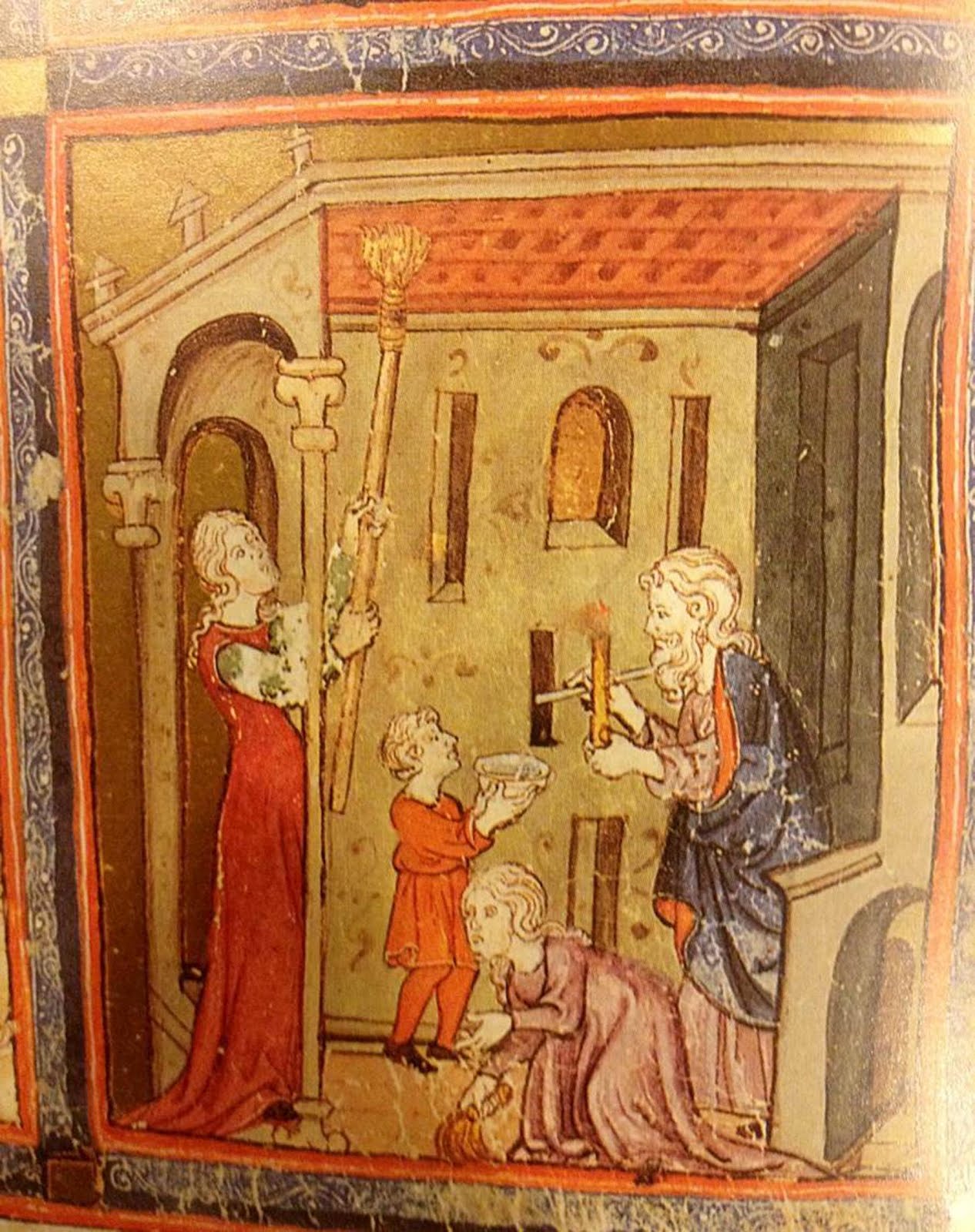
The second error is more nuanced and may be termed the Wissenschaft snapshot: interpreting manuscript images as direct documentary evidence of ritual practice. For example, treating a depiction of marror as a definitive record of the vegetable used at the Seder, or viewing an illustration of bedikat chametz as a literal representation of the search process. This approach originates in nineteenth-century Jewish scholarship, which sought to extract concrete evidence about historical Jewish life from all available sources.

In 2012, in the comments section of this very blog, Marc Michael Epstein intervened in just such a discussion with a statement worth quoting in full:

Rabbosai (and Marasai): A manuscript is NOT a mirror. Jews depict themselves in their art (or commission art that depicts them) not as they were, but as they desired to be seen. Please please please do not engage in the typical Wissenschaft strategy of looking at illuminated manuscripts for “clues to Jewish life in the Middle Ages” or even to Jewish history. What we can learn from them is histoire des Mentalites, but even that takes a lot of work to get to.

This intervention arose from a debate about whether Sephardic medieval Haggadot depict marror as an artichoke, a topic addressed further below. The methodological insight, however, is broadly applicable: these images provide access to the histoire des mentalités—the internal landscape of aspiration, theological imagination, and communal self-representation. This perspective offers a richer understanding than the Wissenschaft snapshot, though it requires careful interpretation. Importantly, analyzing how a community chose to represent itself constitutes significant historical evidence, even if it does not directly reveal specific ritual practices.

The Birds’ Head Haggadah

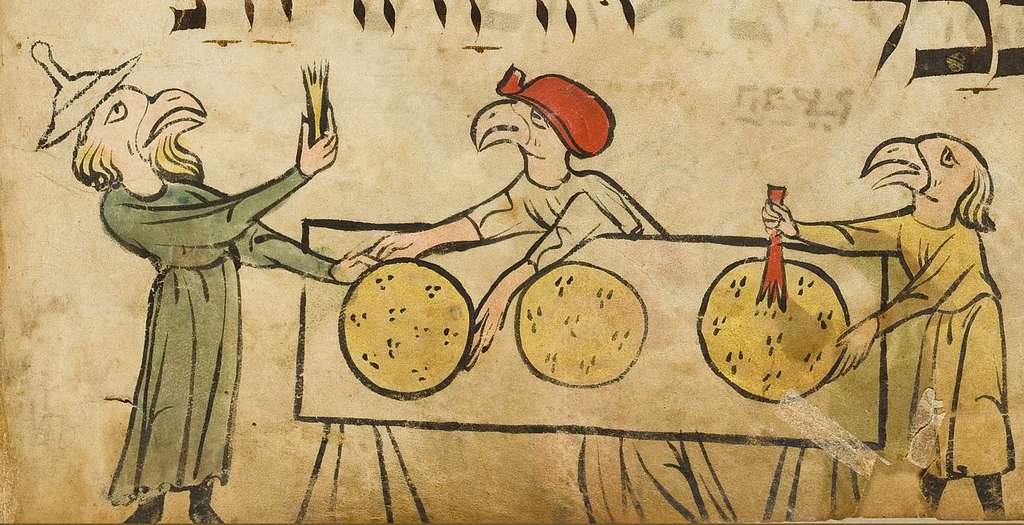
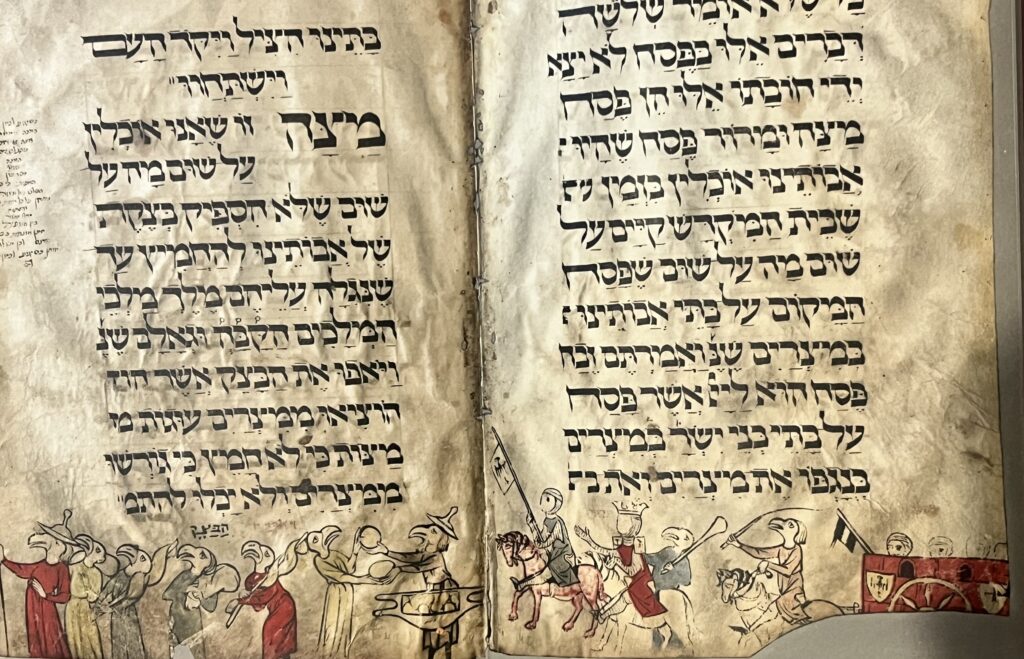
The oldest extant illustrated Haggadah text, dated to the early 1300s (and now in the Israel (now in the Israel Museum, although the exact provenance remains murky like so many Jewish items), takes its name from its most immediately striking feature: nearly all the human figures bear birds’ heads rather than human faces. Non-Jewish figures — Egyptians, angels — are instead shown with blank circular discs where faces should be. The zoophilic imagery has attracted a remarkable range of explanations: halakhic anxiety about depicting human faces too completely; a visual encoding of relative spiritual status; and, at the least plausible extreme, the claim that the birds’ beaks are an anti-Semitic caricature of the Jewish nose inserted by a hostile illustrator.

Birds Head Haggadah, Exodus Scene

Epstein critically examines these theories, ultimately adopting a more nuanced position that acknowledges the halakhic dimension without attributing the imagery to a single cause. As discussed in our earlier review, the most illuminating aspect of his analysis is his attention to an anomaly previously dismissed as carelessness. In the Exodus scene depicting the Israelites fleeing and Pharaoh’s army in pursuit, most figures conform to expectations: Israelites with birds’ heads and Egyptians with blank discs. However, two figures in the pursuing army also have birds’ heads. Epstein, prompted by his ten-year-old son’s observation, suggests these figures represent Datan and Aviram, members of the erev rav who chose to remain with the Egyptians. The presence of birds’ heads is intentional, signifying that even the sin of siding with oppressors does not erase Jewish identity. This artistic choice introduces themes of the wicked son, belonging, apostasy, and the potential for return, all of which are particularly resonant in the context of the Seder.

This approach exemplifies Epstein’s methodology: treating anomalies not as errors to be dismissed, but as interpretive keys to deeper meaning.

The Golden Haggadah

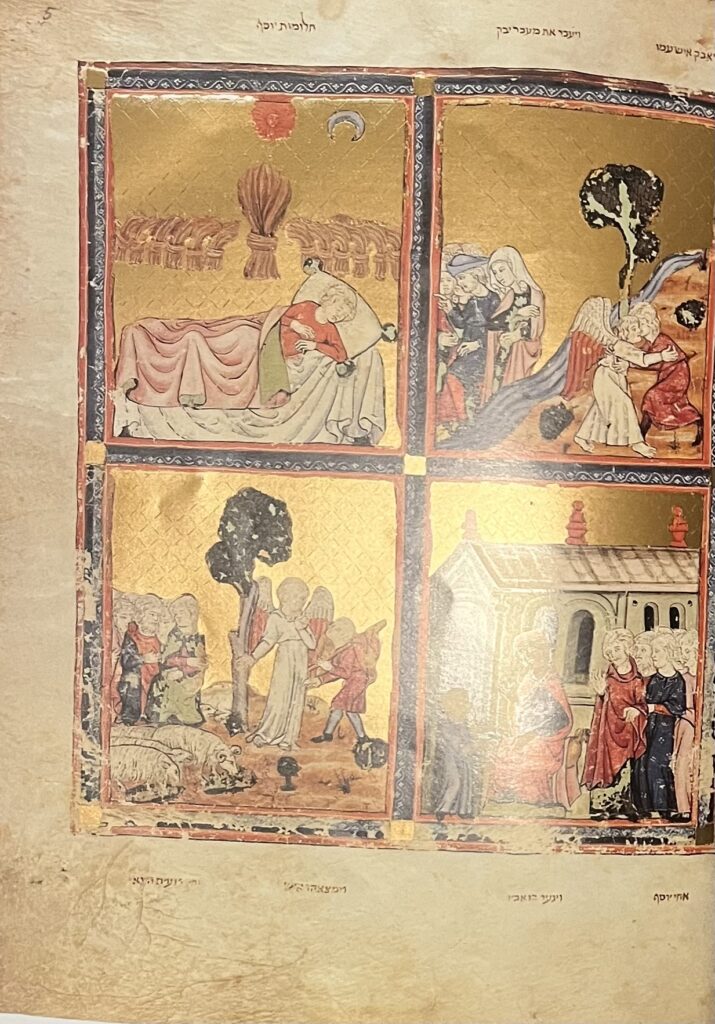
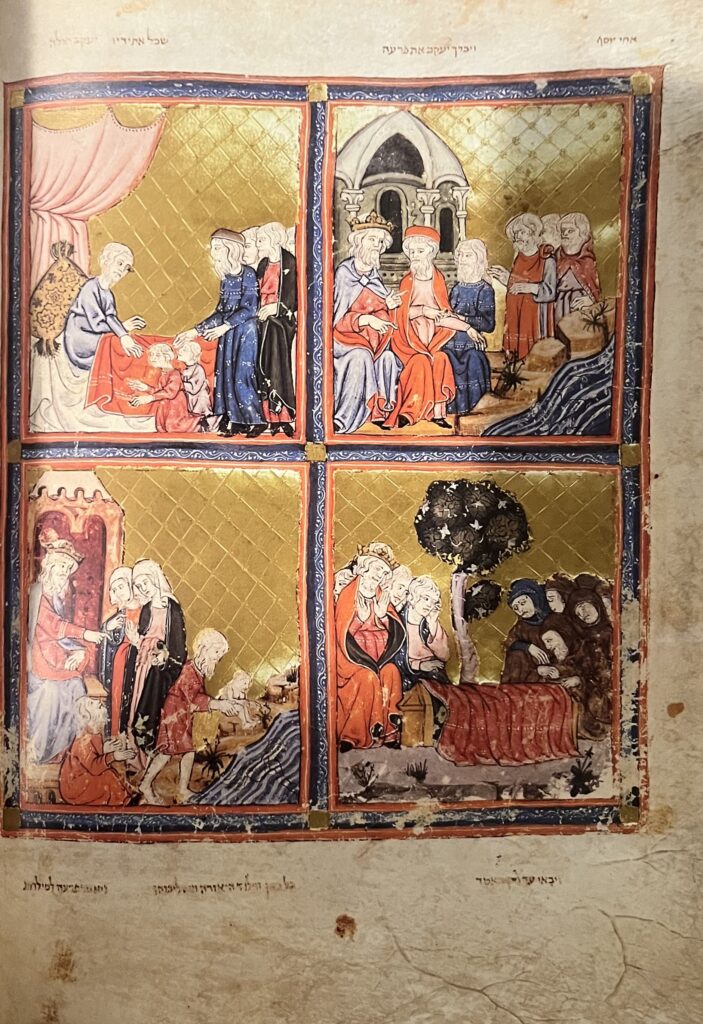
The Golden Haggadah, a Sephardic manuscript from around 1320 distinguished by its extensive use of gold borders and embellishments, illustrates a key structural distinction within the manuscript Haggadah tradition. In Ashkenazic manuscripts, illustrations are integrated throughout the text, appearing in margins and between passages, and typically serve to comment on or extend the Haggadah narrative, such as scenes of Pesach preparations, the search for chametz, or the baking of matzah. In contrast, Sephardic manuscripts concentrate pictorial content before the text in a visual preamble: a series of full-page panels, arranged two or four per page, that trace Jewish history from the patriarchal era or creation through the Exodus, preceding the Haggadah text itself. These images function as a visual overture rather than direct illustrations of the liturgy.

While the Golden Haggadah adheres to Sephardic conventions, Epstein demonstrates that its imagery is more sophisticated than a straightforward chronological sequence. The illustrator establishes a network of visual connections across panels separated by generations, particularly through the motif of water. Water is depicted in scenes such as Jacob before Pharaoh, the drowning of Israelite boys in the Nile, the rescue of infant Moses, and Moses drawing water for Jethro’s daughters. In each instance, the depiction of water, its color, movement, and spatial relationship to the figures, is distinctive and cross-referential, encouraging viewers to interpret these scenes collectively rather than in isolation. The resulting theological argument centers on themes of divine providence, measure-for-measure justice, gratitude, and salvation as continuous threads throughout history. This constitutes visual midrash: interpretive commentary conveyed through imagery, fulfilling the Seder’s purpose of provoking reflection.


The Rylands Haggadah, Its Brother, and the Marror That Wasn’t an Artichoke

The third and fourth manuscripts analyzed by Epstein—the Rylands Haggadah (currently housed at the John Rylands Library in Manchester) and the manuscript referred to as the Brother to the Rylands—are Sephardic codices discussed together in his work. The term “Brother” was introduced by Bezalel Narkiss due to the notable visual similarities between the two manuscripts; Katrin Kogman-Appel has since argued that the so-called Brother likely predates the Rylands and served as its model. For the purposes of this discussion, both manuscripts represent a shared visual tradition, and the direction of influence is less significant than the insights they collectively provide.

Rylands Brother Haggadah

These manuscripts prompted a particularly instructive methodological episode in recent Haggadah scholarship, which unfolded in real time in the comments section of this blog in 2012 and was subsequently documented by Leor Jacobi. The central question was whether depictions of marror in the Rylands, the Brother, and the Sarajevo Haggadah represent an artichoke. David Golinkin had cited these illustrations as evidence that artichokes were used as marror in medieval Catalonia. Upon encountering this question on Erev Pesach 5772, wrote immediately to Epstein, who replied within the hour:

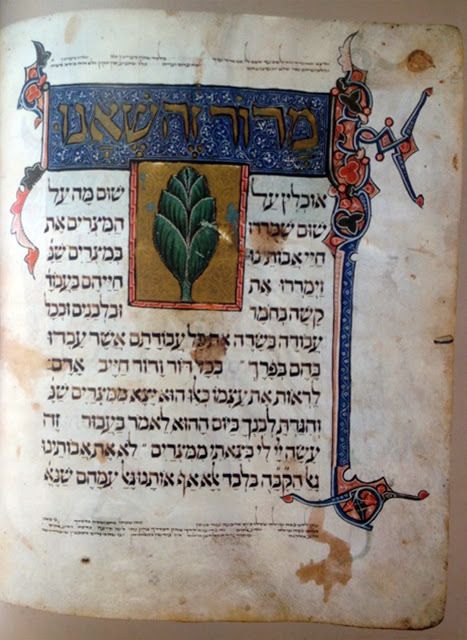
I don’t believe the Sephardic mss show an artichoke, rather they depict an entire head of romaine lettuce. The way to prove or disprove this would be to compare contemporary or roughly contemporary botanical mss.

When the same identification appeared in a post on this blog, Epstein returned with the fuller statement quoted above — “a manuscript is NOT a mirror” — and added the crucial clarification about representational logic:

Also, because a head of Romaine is SHOWN in the haggadah it doesn’t mean that there was a head of (possible unchecked-for-bugs) Romaine on the table. Every image is not a snapshot, but a representation — a combination of the real, the general, the ideal and the symbolic. Showing the head is a way of REPRESENTING Romaine — it says, “We use a type of lettuce that grows with leaves together in a head like this.” It does NOT necessarily mean “We use complete heads of Romaine at the Seder, like this.”

This logic warrants careful consideration. A manuscript illuminator aiming to depict marror must clearly indicate the species. Depicting the entire head of romaine lettuce—leaves clustered in a recognizable form—serves as an effective visual shorthand for this type of lettuce. Illustrating individual romaine leaves would make them nearly indistinguishable from other leafy vegetables. Thus, the whole head functions as the visual vocabulary for the species, rather than as a literal representation of the serving. The same reasoning applies to artichoke identification: if an artist intended to depict an artichoke, the distinctive globed, thistle-shaped head would be unmistakable. The Sarajevo Haggadah’s depiction of veined leaves bound at the base with a cord, as Epstein observes, aligns with characteristics of lettuce rather than artichoke.

Jacobi’s account adds another layer of insight: Epstein posits that artists of later manuscripts (the Rylands and Brother, likely produced after the Golden Haggadah) may have copied a lettuce image from an earlier model and, interpreting the veined and slightly “spiky” leaves, mistakenly identified it as an artichoke. Patrons did not correct this, as they recognized that artichokes were not used as marror and thus interpreted the image as romaine, regardless of the artist’s intent. These images illustrate the challenges of visual transmission when botanical knowledge is limited, but they do not provide evidence of actual Seder practice beyond confirming that romaine was regarded as the standard marror species in Sephardic communities, a fact already established by textual sources.

Rylands Haggadah

The Barcelona Haggadah introduces additional complexity: its marror illustration appears to have been added by a post-medieval artist who, relying on earlier Haggadah images as models, no longer understood the original intent, resulting in a stylized hybrid that is neither distinctly artichoke nor lettuce. As Evelyn Cohen observes, some manuscripts left the marror space blank, indicating that the image was occasionally tailored to the patron’s local practice. This underscores the non-monolithic nature of the visual tradition and the influence of artist-patron relationships on the final product.


In summary, there is no textual or visual evidence that artichokes were ever used as marror. Romaine lettuce, which becomes increasingly bitter as it is chewed—beginning with a mild taste and culminating in pronounced bitterness at the spine, thus symbolizing the intensification of Egyptian servitude—is far better supported as the intended species and is almost certainly what these images depict.

The Printed Haggadah: The Same Logic

The interpretive methodology applied to medieval manuscripts is equally relevant to the printed tradition.The four foundational printed Haggadot—Prague 1526, Mantua 1560, Venice 1609, and Amsterdam 1695—established a visual vocabulary that influenced nearly every subsequent illustrated Haggadah for centuries thereafter. As we have discussed at length in earlier posts (see here, here, and here), these Haggadot draw from both manuscript precedents and the broader visual culture of their respective eras, exhibiting the same patterns of intentional borrowing and creative transformation observed in medieval manuscripts.

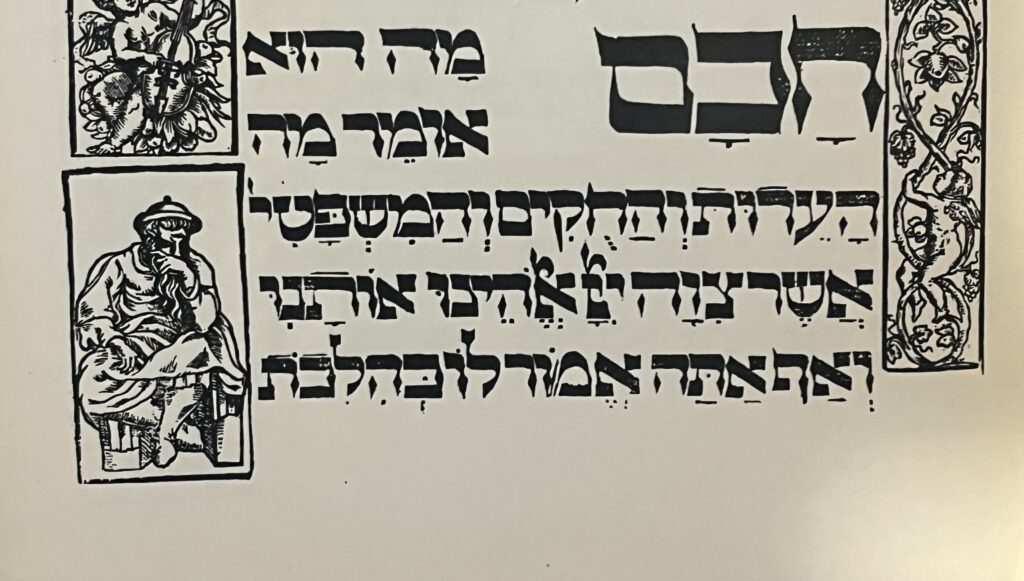
The Mantua 1560 Haggadah, the first illustrated Italian Haggadah, exemplifies this dynamic. Its depiction of the Wise Son is modeled unmistakably on Michelangelo’s prophet Jeremiah from the Sistine Chapel ceiling. However, while Michelangelo’s Jeremiah is bareheaded, the Haggadah’s Wise Son wears the Pileus Cornutus, the conical hat mandated for Jews by Christian law (and likely the beginning of the custom of universal Jewish headcovering). Thus, a figure from the Vatican’s most prominent sacred space is appropriated, marked with a symbol of Jewish social subordination, and reimagined as an embodiment of Jewish wisdom at the Seder table. This reflects both dependence and subversion.

Mantua, 1526, The Wise Son

A similar complexity is evident in the title page’s distinctive helical “barley-sugar” pillars. While these are sometimes attributed to their prominent use at St. Peter’s Basilica, suggesting Christian architectural borrowing, the more probable source is local: the Cortile della Cavallerizza at the Palazzo Ducale in Mantua, designed by Giulio Romano and completed around 1540. The printer Ruffinelli appears to have incorporated these pillars throughout his Mantuan publications as a regional identifier, functioning not as a Christian symbol but as a marker of local identity, akin to a colophon. What may appear as Christian iconography is, in fact, civic geography repurposed as a printer’s device.

Prague Haggadah, Kiddush

The warning against treating images as direct records of practice is relevant here as well. R. Shlomo Hakohen Kook criticized the Prague 1526 Haggadah for depicting the wine cup held in the left hand and grasped by the stem rather than cupped at the base, but both critiques conflate artistic representation with ritual documentation. The left-handed depiction results from the woodcut printing process, which produces a mirror image of the original block; copyists working from printed exemplars, rather than the original block, further reversed the image, consistently yielding left-handed figures. This reflects printing history, not halakhic instruction. The issue of cupping the cup is another anachronism: this practice became widespread only after the publication of the Shelah, which appeared more than a century after the Prague Haggadah. Thus, the woodcut cannot be faulted for omitting a custom that did not yet exist.

What We Can and Cannot Learn

The illuminated Haggadah is a remarkable historical source, but its value depends on the questions posed to it. These manuscripts and early printed books are not objective records of ritual practice; rather, they reflect the choices of communities, shaped by artistic conventions, available models, patron preferences, and the expressive possibilities of the visual vocabulary of their era. When interpreted thoughtfully, they reveal the inner imaginative life of the communities that produced them: their understanding of the Exodus, their self-conception, the theological claims embedded in their liturgical texts, and their engagement with and adaptation of surrounding visual cultures.

This constitutes an exceptionally rich body of evidence, surpassing any attempt to treat the images as mere snapshots of Seder table contents. However, extracting meaningful insights requires art-historical expertise, contextual historical knowledge, and a readiness to embrace interpretive ambiguity—qualities that distinguish the approach exemplified by Epstein from earlier traditions.

Readers who have not yet encountered The Medieval Haggadah: Art, Narrative & Religious Imagination (Yale University Press, 2011) — reviewed here when it appeared here — would do well to remedy that before this Pesach. And to spend a few more minutes at the Seder with the pictures. Additionally, Epstein’s recently released book, People of the Image: Jews and Art,  similarly tackles these topics, including discussions of Haggadah illustrations and, like his The Medieval Haggadah, is among the best in the genre. A review of the book is forthcoming.

Related posts: our 2012 review of Marc Michael Epstein’s The Medieval Haggadah: Art, Narrative & Religious Imagination (here); Leor Jacobi on the artichoke controversy and how to read manuscript marror illustrations (here) and earlier discussions about the vegetable here and here; halakhic implications of Haggadah illustrations (here); and our discussions of the Prague 1526 Haggadah (here here, and here), and for our examination of printed illustrations see “The Mother Haggados: Models for Modern Analysis of Printed Jewish Illustrations.”


The Mother Haggados: Models for Modern Analysis of Printed Jewish Illustrations

The Mother Haggados: Models for Modern Analysis of Printed Jewish Illustrations

There is a long tradition of illustrating Haggados, dating back to at least the early Middle Ages. Likely only a small portion of those manuscripts has survived. However, most have been reprinted, and their imagery has been meticulously analyzed and cataloged. These manuscripts can broadly be divided into two categories based on their places of origin: Sephardic or Ashkenazic countries. The former includes the creation cycle and the Exodus story prior to the Haggadah text, while the latter incorporates the imagery into the text. Within these categories, and with the exception of “brother” or “sister” manuscripts, no single manuscript necessarily influenced subsequent ones. Of course, common manuscript imagery appears in many of these manuscripts, with the hunting scene being the most ubiquitous.

Illustrations in printed Haggados, however, are different. They can be traced back to four “mother” Haggados, each the first in its respective region, representing the three main geographical areas of Jewish settlement and centers for printing Hebrew books: Prague, 1526 (Eastern Europe); Mantua, 1560 (Italy); Venice, 1609; and Amsterdam, 1695 (Western Europe). These specific Haggados were reprinted many times, with the illustrations, motifs, and themes appearing in them—sometimes collectively and at other times singularly—finding their way into nearly all subsequent illustrated Haggados. Some of these illustrations reflect influences from manuscripts, and all three were impacted by the broader non-Jewish culture and geographical iconography (though not directly related to the text itself). For example, an Italian Haggadah shows Avraham crossing a river in a gondola, while Prague incorporates Gothic architecture for the Egyptian cities. Additionally, we can sometimes identify specifically Christian iconography or direct borrowing from Christian sources in these and later Haggados. Occasionally, this involves using an image that carries no specific Christian connotations, while in other instances, the usage is clearly identifiable as specifically and uniquely Christian.

While these Haggados are discussed by many scholars, at best they analyze a few images, and even in many instances, they fail to fully account for the nuance of the images. Instead, they focus on external influences or some exotic element of the images. This form of analysis is no longer in vogue, and as it relates to Hebrew manuscripts, it has seen a substantial correction, most notably in the recent works of Marc Michael Epstein and Katrin Kogman-Appel on Hebrew manuscripts.[1] We hope to make a small contribution to redirecting the narrative regarding the imagery of printed Hebrew Haggados. What follows is not intended to be a comprehensive analysis of all printed illustrated Haggados. Indeed, we do not discuss Prague 1526, as we have dealt with that edition on a few previous occasions (here, here, here, here, here, here, and here). Rather, we hope it serves as a minor contribution in applying the current methodology used for Hebrew manuscripts to the Hebrew book.

Mantua 1560: Many Cooks in the Kitchen

The Mantua 1560 Haggadah is the first Italian-illustrated Haggadah, published by Giacomo Rufinelli and it is available here from a copy in the Braginsky Collection (the NLI recently exhibited the manuscripts from Collection, with a companion book, Encounters with Beauty). The woodblock images were overseen and possibly even executed by Yitzhak ben Shmuel Bassan. However, since they are unsigned, the artist is uncertain. Yet, however, as we will see, there may have been multiple artisans involved in creating the woodblocks. Bassan served as the shamash in the first synagogue established in Mantua by Yitzhak Porto.

Mantua 1560 is the first illustrated Haggadah to include a title page. The convention of title pages became standard in Hebrew books only in the early middle period of the 16th century; see our discussion here. Like many Jewish and non-Jewish title pages, it frames the page with architectural elements, such as arches and pillars. These pillars are unique. They are not traditional columns but helical (twisted) pillars, referred to as barley-sugar pillars.

While at first blush, Rufinelli’s incorporation might seem associated with a distinctly Christian structure, closer examination reveals that the printer’s usage served a different purpose, one explicitly aligned with his publishing house. This style is most well-known for its use in St. Peter’s Basilica in Rome, which was constructed in the 4th century by Constantine the Great and this style is claimed to be derived from the famed pillars of the Solomonic temple, the yachin and boaz pillars (although no Jewish sources describe these as helical). These pillars supported the dome above the main altar. The original Basilica was demolished in the early 16th century and rebuilt at the end of that century. It was most famously reproduced by the school of Raphael in “The Donation of Constantine,” completed around 1524, and adorns the ceiling of Sala di Costantino, one of the four Raphael rooms within the Vatican Palace. Nonetheless, Rufinelli most likely used these pillars not to evoke St. Peter’s but for a more local reason, specifically to identify his books as Mantuan in provenance. The local Cortile della Cavallerizza in the Palazzo Ducale in Mantua, designed by Giulio Romano and completed around 1540, predates Rufinelli’s incorporation of these pillars in his books (they appear in the Haggadah and others). The second elevation is notable for its barley-sugar pillars, an early example of the Mannerist school of architecture and among the Palazzo’s most unique and recognizable features.

Cortile della Cavallerizza

Perhaps, in Rufinelli’s mind, these pillars symbolized Mantua, and he treated them as akin to a printer’s device expressing familial or other aspects of the printer. Indeed, while Italianate books in the 16th century regularly incorporated architectural elements into title page designs, we have not located any books that utilize the Solomonic pillars, despite their history and symbolism in Italy, other than Ruffinelli’s Mantuan prints.[2]

Another image from this Haggadah originates from the Vatican Palace: the depiction of the prophet Jeremiah that Michelangelo painted on the ceiling of the Sistine Chapel. Jeremiah, seated in a contemplative pose with his hand on his beard and legs crossed, is used to illustrate the wise son in the Haggadah. Nevertheless, the image takes on a unique Jewish twist in the Haggadah version. Jeremiah is no longer bareheaded; instead, he wears a Pileus Cornutus, or Jewish hat, the cone-shaped headgear commonly mandated by Christian law.

Mantua, 1560

The first edition of the Maxwell House Haggadah (we discussed the history of the first edition here) also reproduces a well-known Renaissance image of Rembrandt. It includes Rembrandt’s Sacrifice of Isaac, now in the St. Petersburg Museum.

Maxwell House Haggadah, New York, 1932

The illustration of the final son, the one who cannot ask, is also of non-Jewish origin. In this instance, it comes from a biblical illustration by the noted illustrator, Hans Holbein the Younger, and appears in Icones Historiarum Veteris Testamenti, first published in 1538 (page 88). The image is used in a different context, Psalms 53:2, for a fool, but in the Haggadah, it illustrates the son who does not even know how to ask.

Mantua, 1560

Holbein, Icones Historiarum Veteris Testamenti

Determining the source of the remaining images, as well as the number and identity of the artists involved in the production of this Haggadah, is challenging. A close examination of the style and quality of the images suggests that at least three artists contributed. Artist A’s work features detailed, technically accurate German-style drawings, while Artist B’s illustrations resemble almost childlike line drawings that lack perspective and depth. The third artist, Artist C, produces illustrations that are not as crude as those of Artist B, as they possess a sense of perspective. Yet, they are also not executed as well as those of Artist A.

Artists A and B appear on the first page of the Haggadah. In the upper right-hand corner, there is a detailed and precise depiction of a man searching for hametz, dressed in a Germanic style, belted and wearing a beret, with the ceiling and fence rendered with perspective. At the bottom center left is a simple line drawing of the matzah baking scene. The men and women wear Italianate clothing, with the men in unbelted tunics and cloth caps covering their ears or in flat hats, and the women in low-cut dresses with exaggerated shoulders. There is no depth, as the men on the far left overlap on the same plane as the women kneading the dough. Similarly, the two people at the table in the right-center, using the “redler” (dough docker) to mark the matzah, also lack perspective.


Artists A and B are again juxtaposed on facing pages, featuring two images depicting the killing of Jewish babies. On the right page, we see the midrashic image of Pharaoh bathing in the babies’ blood, while the left page shows the act of casting the babies into the water. Here, as well, the illustration on the right side portrays the participants with realism, whereas the left displays simple line drawings. The woman on the far right of the left page, with her hands raised, contrasts sharply with the despondent woman at the far right of the right page, where the anguish of having her child torn from her arms is powerfully conveyed.

Artist C demonstrates intermediate technical skills between those of Artists A and B. Two similar images of the family at the seder demonstrate the distinction between Artists B and C. Artist B’s work consists of line drawings, offering little to no shading or depth on a single plane, whereas Artist C’s piece presents a crowded scene where each figure wears a unique dress, showcasing multiple perspectives and well-rendered depth of perception.

A comparison between two figures, both seated in similar chairs and holding comparable objects, effectively represents the distinct styles of Artists A and C. Rabbi Eliezer, characterized by a disproportionate head and a simpler chair. The king image, however, holds a topped goblet with filigree on the bottom and is seated beneath an elaborate copula. All of the features are well-proportioned and executed within a smaller and more challenging format. These distinctions suggest that the two seated men cannot be the work of the same artist.

Artist C is evident in Moshe leading the Israelites out of Egypt. The large group of Israelites is well drawn (no Artist B line drawings), but Moshe, particularly his head, is not rendered as well as the figures in Artist A’s works.

Similarly, the most recognizable image from this Haggadah, which shows the Messiah on a donkey with Elijah following, displays the hybrid style of Artist C. The Messiah, donkey, Elijah, and especially the figure with the bow and arrow are clearly less refined than those of Artist A, but not as simplistic as Artist B.

None of the Haggadah’s images are signed. One clue to the influence of Artist C is seen in his illustration of Avraham crossing the river. His boat of choice is a gondola, suggesting that Artist C may have Venetian origins.

The gondola also makes a brief appearance in another of Artist C’s images, titled “Building Pitom and Ramses.” There is a small gondolier crossing the river visible at the top center of the image.


Artist A’s city of origin, or where he may have spent time, cannot be determined from his drawings. The wise son, Jeremiah, is depicted by Artist A, but, despite the origins of this illustration in the Sistine Chapel, we cannot identify Artist A as Roman, nor confirm that he viewed the image firsthand in Rome. It is more plausible that he encountered the images only through drawings, whether printed or otherwise. A comparison of the beard in the Haggadah, with its long, wavy hairs, aligns much more closely with this drawing, now in the Metropolitan Museum of Art, printed in Mantua (although its dating is disputed), rather than with Michelangelo’s bushy, untamed beard in the Sestina.[3]


If, indeed, there are three artists, we can tentatively associate the images with their artists as follows:

Artist A: King on chair (p. 2, 3,36, 37, 42, 70), Jeremiah (p. 9), praying man (p. 9, 14), four sons (p. 10-11), Rosh Hodesh (p. 11), Pharoh bathing in blood (p. 20), Aaron with staff (p. 24), angel with sword (p. 24), R. Yosi (p. 26), King pointing finger (p. 27), Israelites escaping Egypt with Egyptian pursuing (p. 28-29), Paschal lamb (p. 32), matzah (p. 33, 40), maror (p. 34, 38, 40),.

Artist B: matza baking (p. 1), family seder (p. 4, 42), children thrown into the river (p. 21).

Artist C: hare hunt (p. 3), enslaved Israelites building (p. 6, 35), Avraham on gondola (p. 13), young woman (p. 18), Pitom and Ramses (p. 19), R. Eliezer (p. 28), Egyptians drowning (p. 31), Moshe leading the Israelites (p. 38), family seder (p. 41), Elijah entering Jerusalem (p. 45).

Venice, 1609 An Egalitarian Haggadah?

The third “mother” Haggadah was conceived by Israel Zifroni, a printer, editor, and typesetter, and published by Giovanni di Gara in Venice in 1609 (briefly discussed here and here).[4] The images are unsigned and it is unclear if they were executed by Zifroni or he just oversaw their production. There were three editions: in Judeo-Italian, Judeo-German, and Ladino.5 On the title page, Zifroni invokes the verse from Psalms 148:12: “‘Youths and maidens, elders and boys, will praise the name of the Lord,’ who inspired me, Zifroni, to bring this crown of beauty to light, so that no eye will be satiated by its forms. Here, one can always find novelties; these were not done in vain, but with intention and purpose. These will prolong the story, for your eyes withhold my glory and my deeds related to it.” In this epigraph, Zifroni alludes to two unique aspects of the illustrations in his edition: its egalitarianism, as it is for everyone, and the deliberate nature of the illustrations, meant to provide additional commentary to the text and fulfill the obligation that “whoever adds in the retelling is praiseworthy.”

While Zifroni surely intended that the Haggadah be used for all age groups, one of the “novelties” in the illustrations is a focus on a female audience. This inclusivity, emphasizing images depicting women, repeatedly appears throughout the Haggadah. Additionally, there are scenes that do not include women, in previous Haggadahs, and it is unclear from the text if women participated. Nevertheless, Zifroni incorporates them into the narrative.[6]

Zifroni’s intentional and distinct approach is already evident from the title page imagery, which contains six images divided between the processes of searching and burning hametz and matzah baking. The people depicted conducting these processes are exclusively women, with no men present. This gendered approach sharply contrasts with the Prague 1526 and the Mantua 1560, which depict a man searching for Hametz.

Mantua, 1560

Prague, 1526

Similarly, while the baking scene at the bottom of the page is very similar to that of Mantua 1560, nearly all the men depicted are now women. Aspects of the process in Mantua were entirely male, whereas in Zifroni’s they are now exclusively female.

Venice, 1609

Mantua, 1560

In Mantua, the kneading depicts three men, while in Zifroni’s there are three participants as well, but one is a woman. Mantua shows two men mixing the dough, whereas Zifroni’s features two women. Mantua has two men shaping and puncturing the dough, while in Zifroni’s there are two women. Even in the scene at the top of the page depicting the harvesting and checking of wheat, where the heavy labor involved could easily be portrayed as exclusively male, Zifroni still includes one woman at the table checking the wheat.

Zifroni’s biblical scenes, when possible, include women. For example, in the scene above depicting Avraham crossing the river in the Prague and Mantua Haggadahs Avraham is shown alone, accompanied only by the rower in Prague (second image below) and the gondolier in Mantua (third image below).

This aligns with the verse in the Haggadah, “that I took Avraham your forefather over the river,” which does not mention anyone else. By contrast, in this seminal scene in the formation of the Jewish people, Zifroni did not limit himself to the literal text. His illustration references the biblical story that includes Sarah. Thus, she is portrayed in the gondola, along with two other women at the dock about to board, while no other men, aside from Avraham, are present, not even Lot. This multitude of women sharply contrasts with the scene on the right, depicting idol worship, where the genders are reversed; here, there is just one woman, and the rest are men.

Another “novel” illustration related to the Israelites time in Egypt. The Talmud offers two reasons why women are obligated to the same degree as men in reciting the Haggadah: they too were included in the Exodus miracle, and, according to Rabbi Avira, they were not just participants, they were the catalyst for the Exodus (Sotah 11b). There are at least three episodes that demonstrate the integral part women played: Shifrah and Pu’ah, women’s roles in the exponential reproduction of the Israelites, and Pharaoh’s daughter saving Moshe. All three feature prominently in Zifroni’s images. While infanticide is illustrated in Prague and Mantua in two panels, one showing the gruesome murder to drain their blood for Pharaoh’s bath and the other showing them being cast in the river, neither Haggadah shows the multiplication of the Israelites. Yet, in Zifroni’s work, in addition to one panel of the babies being cast in the river, he includes two that illustrate the population explosion, specifically highlighting the unique and nearly exclusive role of women.

The first shows four women nursing and raising the children, both alluding to the midrash teaching that Jewish woman in Egypt birthed sextuplets. On the right, one woman is nursing two children while another four are clamoring for sustenance. In the middle, the three other women tend to six children. Two men appear far to the left, only partially depicted with most of their bodies cut from the scene (perhaps alluding to their male parts, their only relevant part in the story). Additionally, as we previously discussed in the article, “Separate Beds,” this printed Haggadah is unique in representing Jewish abstinence. Like the other images, it displays an awareness with rabbinic literature. 

Indeed, this scene is repeated and expanded upon on the next page. Again, a woman nursing six children, this panel now incorporates the earlier part of the story, which emphasizes that the women encouraged their husbands, even after a brutal day of enslavement, to spend time together. This alludes to the Talmudic passage that uses the verse in Shir HaShirim (8: 5), stating that they procreated under the apple tree. The Nile River is included in this scene, not to illustrate infanticide, but to show the women bathing in preparation for their meeting with their husbands.

Even the panel that depicts infanticide is unique in that the largest and most prominent portion of the scene shows Pharaoh’s daughter saving Moshe. Additionally, Shifrah and Pu’ah appear before Pharaoh on the left, unlike any earlier illustrations that omit them entirely.

Contrasting the earlier Haggadahs illustration of the scene with the Israelites safely on the side of the sea and the Egyptians drowning highlights the central role that women play in Zifroni’s version.

In his depiction, the center of the frame shows Miriam playing instruments and singing with the women, while Moshe and the rest of the men are relegated to the right of the panel. In Mantua, (the two images below) Miriam is merely part of the larger group, identifiable only upon close examination.


In Prague, the scene is exclusively male. Likewise, in the scene of the Israelite encampment in the wilderness, Zifroni was careful to include Miriam and her well.

Another scene where there was no need to include women is Avraham meeting Malki Tzedek, where a woman appears at the far right of the panel.

There are other scenes where women take center stage. When eating the matzah, the women at the center distribute it to the men, seemingly indicating that the women are leading the seder. Both Prague and Mantua, show only a lone man.

Mantua, 1560

Women are central in the scene of the Four Questions. Their prominence is particularly noticeable as the image on the following page depicts Rabbi Eliezer and other sages, with him in taking center stage.

Similarly, when Avraham greets the three angels, both he and the angels are shifted to the left of the frame, while Sarah, in the tent, occupies the center.

Finally, most radically, although it is not entirely clear as the top of the head is obscured behind the letter, the wise “son,” upon close examination, it is perhaps a woman. Unlike the other “sons” this child is wearing a skirt whereas the men and boys are in pants!

In conclusion, one prominent and exceptional thematic element in Zifroni’s illustrations is the significant role of women. This leaves little doubt that he intended to portray and elucidate the Haggadah through deliberate images that appeal to and highlight both the feminine and the traditional masculine role in the Exodus.

Amsterdam 1695, A Judeo-Chrisitan Haggadah or an Exemplar for Haggadah Illustrations?

One of the most striking examples of Christian iconography in the Hebrew book is the 1695 Haggadah printed in Amsterdam and illustrated with copperplates by the convert Jacob Bar Abraham. This marks the first use of that technique in a Hebrew book, which allows for a much more refined and precise presentation of images. The Haggadah also includes a fold-out map, though it may not be the first example in a Haggadah.[7] Bar Jacob was originally from the Rhineland and may have even been a Christian preacher.[8] He was not the only convert involved in Amsterdam Jewish printing. According to Yaari, there were at least six others.

These images were used as a template for at least four 18th and 19th-century Haggados in Amsterdam, as well as hundreds of editions printed in Germany and Eastern Europe, and even as far afield as Iran, India, and North Africa.[9] There are at least five 18th-century manuscripts that also utilize Bar Jacob’s images.[10] Despite their popularity throughout the European Jewish world, the source of his images is non-Jewish. Thirteen of the fourteen illustrations in this edition, and six of those on the title page, do not come from any of the three other “mother” Haggados. Instead, these illustrations are sourced from the biblical images created by the Christian artist Matthaeus (Mathis) Merian the Elder.[11] They first appeared in his Icones Biblicae, published in Basel in 1625, and were subsequently incorporated into the most popular Bibles in the Rhineland

Bar Jacob’s source was first identified in 1931, a fact acknowledged by subsequent analyses of this edition. Some critiques are highly critical of Bar Jacob’s model, with one scholar going so far as to assert, without any corroborating evidence, that “there was fierce opposition” to Bar Jacob’s edition.[12] These scholarly critiques generally question the appropriateness of using Christian biblical imagery, the lack of direct relevance of this imagery because it was not designed for the Haggadah, and the failure to follow the “traditional” imagery found in other “mother” haggados. Despite the great scrutiny to which this edition was subjected, the most obvious Christian element that appears in just one of the fourteen images went unnoticed scholars.[13] And in fact, upon close examination, these scholars’ complaints are easily refuted. While Bar Jacob’s source was Merian, he transformed those images to fit the Haggadah, and with one exception, they fall well within the bounds of accepted Jewish imagery and further enhance and clarify the text of the Haggadah.

The six biblical images at the top of the title page predate the Exodus story, which triggered some complaints of them being non-conformist and irrelevant.[14] Yet, this criticism fails to acknowledge the widespread Sefardic manuscript convention, dating back at least to the 14th century, of prefacing the Haggadah with biblical imagery that documents the precursor events to the Exodus. The Sarajevo Haggadah but one of many examples. Indeed, most Jews in Amsterdam in 1695, particularly the wealthier individuals who were likely the target audience for what was presumably an expensive Haggadah, were of Sefardic origin. Some scholars identified examples of borrowing images and motifs from Medieval manuscripts in other “mother” haggados, but they overlook this when it comes to Bar Jacob.

Perhaps the most consistent criticism relates to the disconnect between biblical images and the Haggadah liturgy. Since Merian’s images were designed for the Bible, they do not necessarily correspond directly to the words of the Haggadah. While some parts of the Haggadah reference the biblical story, Merian did not illustrate those specific narratives. To address this limitation, Bar Jacob discovered alternative images and adapted them for the Haggadah. Importantly, Bar Jacob did not merely “cut and paste.” He modified Merian’s images as needed to align with and, crucially, to clarify through illustration the Haggadah and its themes. Since these subtle modifications do not align with traditional scholarly criticism, most remain unmentioned. Although we lack the space to cover all of Bar Jacob’s images and his distinct approach, we will revisit this later. One scholar points out that “the most egregious” example is Bar Jacob’s illustration of the rabbis in Benei Brak. Being that this story post-dated the Bible by many centuries, none of Merian’s images were intended for this scene. Instead, Bar Jacob used Merian’s image of Joseph and his brothers, provoking this scholar’s ire.

From the Gross Family Collection


This is another example of a surface-level examination of printed illustrated Haggadah images. A close look at the image demonstrates that, rather than being an egregious usage of Merian, it perfectly illustrates Bar Jacob’s approach to transforming the image to suit the Haggadah and express the nuance of the text. In adapting Merian’s image, Bar Jacob modified it in three significant ways, all of which render it especially suitable to clarify the text of the Haggadah.

The purpose of the story of the rabbis in Benei Brak is to provide a historical example of people meaningfully discussing the Exodus story all night. The rabbis were so engrossed in conversation that they were unaware that the time for this obligation had ended, and that they were now required to express the Exodus in a different and common format, reciting the Shema. The nocturnal nature of the story is a central element. Thus, in Bar Jacob’s version, the chandelier, which in Merian’s version is unlit, is lit. To further emphasize the fact that this took place at night, Bar Jacob includes two lit candles in the foreground.

Second, the Benei Brak story is predicated on the fact that the rabbis were unaware that the sun had risen. Thus, as opposed to Merian’s version, where Joseph and his brothers are dining in a room with large open windows, Bar Jacob’s version has opaque windows, indicating that the rabbis became aware that the sun had risen only when their students interrupted the discussion. The windows also allow Bar Jacob to avoid the visible church with a cross atop the steeple that is seen through the large opening in Merian’s version.

Third, Bar Jacob has removed the two dogs, a common Christian artistic motif, from the foreground. The Talmud is anti-canine. Indeed, Rabbi Eliezer, one of the sages listed in the Haggadah, stated that “one who breeds dogs is like one who breeds pigs!” Needless to say, it would be highly inconsistent with the text of the Haggadah to retain dogs in the illustration.

The final modification is in the participants’ headgear. In Merian’s version, only Yosef’s head is covered, with a royal turban. Bar Jacob’s version has all the rabbis wearing head coverings. Beyond a possible Jewish halachic requirement to cover one’s head while engaged in Torah study, a close examination of the headgear fundamentally changes the scene’s dynamic. In Merian, the brothers genuflect to who appears to be an Egyptian royal figure. In the Haggadah, all the rabbis are equal in their obligation. This is made clear in the previous statement of the Haggadah, which states that all, whether wise, knowledgeable, and even those proficient in the entire Torah, are equally obligated to discuss the Exodus story all night. Bar Jacob retained a figure at the head of the table, yet his importance is deemphasized because he wears the same hat as the rabbi on his left.

Bar Jacob’s awareness of the limitations of Merian’s illustrations is evident in the one illustration in the text that is not from Merian. Merian’s illustration of Moshe receiving the Torah depicts Aaron meeting Moshe and the Israelites worshipping the Golden Calf. Thus, Merian’s focus is on sin rather than the spiritual importance of receiving the Torah. Therefore, Bar Jacob chose a different image, one that appears in many Amsterdam Bibles (see here, here and here), showing the Israelites celebrating the event.

Yet, there is, one image that seemingly includes an obvious Christian element: a cross. While somewhat unclear due to its minuscule size, Bar Jacob’s depiction of the Temple appears to have a cross on the front of the building’s roof. Bar Jacob did, however, modify the image in another way to clarify the text. Marien’s version features many people outside and inside the Temple. But the text of the Haggadah discussing the Temple is a prayer for the future, and Bar Jacob presented the Temple as empty, symbolic of the fact that Jews today do not have a Temple to visit. We pray that in the future, we will all be among those in its courtyards.

From the Gross Family Collection

Surprisingly, this is not the only instance of a cross in a Hebrew book. For example, in the 1747 Hamburg edition of Mahram Schiff, the bottom image includes two prominent crosses. Likewise, the bottom left image of the 1668 Amsterdam edition of Nahlas Shivah, which uses “Moshiach Bar David Ba” to denote the year, shows a cross in the background.

Finally, we must discuss two additional Haggados, both of which have been repeatedly praised as beautiful examples of illustrated printed Haggados. Unfortunately, upon close examination, they clearly display Christian iconography in an entirely unnecessary and highly problematic manner. The first, Basel 1816, praised by Steinschneider and described as containing “pleasing” woodcuts is the most troubling. In 1997, this edition was even reprinted and colorized to mark the centennial of the first Zionist Congress held in Basel. For centuries, some have claimed a connection between Jesus’ Last Supper and the Pesach seder. Yet, Jews today would reject the notion that they are reenacting the Last Supper. But in the Basel Haggadah the text regarding the three items that one must eat on Pesach is illustrated with the image of Jesus at the Last Supper, surrounded by the Apostles!

The final “Christian Haggadah” is described by Yerushalmi as “undoubtedly the most distinguished illustrated edition produced in Europe during the 19th century,” and the images “welcome a freshness of design.” Alexander Marx praised its “refined artistic taste,” and that the illustrations are “dignified and pleasing and make this edition outstanding among its contemporaries.”[15] Despite these compliments, in truth, most of the images are not fresh but are copies of previous images from the “mother” Haggados, specifically the 1609 Venice Haggadah. In many instances, this “distinguished” edition eliminates the nuance and meaning of those earlier images. In some cases, the images are nonsensical. Finally, many of the designs suffer from blatant non-Jewish imagery.

From the Gross Family Collection

For example, the Venice Haggadah uniquely enhances the image of the Israelites’ encampment with Miriam and her well as part of the theme of emphasizing women’s role in the Exodus. In the Trieste Haggadah, Miriam and a group of women appear in the bottom far right. However, the women seem to be worshipping her as some sort of deity, with one woman bowing to her. The Venice Haggadah includes the scene of Yaakov meeting Lavan after fleeing Lavan’s home. It features four tents in the background, each with one of Yaakov’s wives, as they play a critical role in that story – Lavan’s complaint is that he did not have the opportunity to say goodbye to them, and then Rachel has a calamitous interaction with Lavan. Yet, in the Trieste Haggadah, there are five (!) empty tents.

Finally, in the most egregious image that is not modeled after any of the prior Haggados, Moshe appears before the burning bush, with God depicted as a man with a beard. Of course, direct depictions of God are prohibited. Unfortunately, this is not the only example in Hebrew books depicting God’s face. The title page of the first edition of Minhas Shai, 1742-1744, also includes such an image. However, it appears that, unlike the illustrator of the Trieste Haggadah, the illustrator of that title page was a non-Jew. This is evident from the fact that the artist was unfamiliar with Hebrew, as the letters are crude and obviously copied. Likewise, since the illustrator of the Kaufmann Haggadah was a non-Jew, in the scene with the burning bush God is depicted as a man.[16]


From the Gross Family Collection

The Moss YaKNeHZ: History and Historic Imagery

The four “mother” haggados are not the only examples of thoughtful illustrations in printed haggados. A contemporary work by David Moss, who remains active with his studio in the Artist Colony in Jerusalem, is an exceptional piece that creatively combines the history of illustrated Haggados in both manuscript and print. The original manuscript has been recently acquired (at Sotheby’s auction) and donated to the National Library of Israel, where it is now on display (see here). If one cannot visit, they can still enjoy it in the comfort of their home. Originally, a small number of exact reproductions were produced; however, those are long out of print. Still, copies of a beautiful two-volume reproduction remain available—one volume contains the manuscript, while the other offers explanatory notes. This edition is admittedly missing a few original elements, but it retains many of the most critical aspects, including the papercuts and fold-out pages, leaving most of Moss’s genius still apparent. One version merely reproduces the Haggadah in a flat format, and we recommend splurging for the two-volume version.

As this year’s Pesach begins on Saturday night, we will use Moss’s accompanying illustration of the procedure unique to that evening as an exemplar of his approach. This procedure, referred to by the Talmud by the acronym YaKNHaZ, translates to the order of operations for the blessings: Yayin (wine), Kiddush, Havdalah, and Zeman (the Shehechiyanu blessing). Moss depicts this section with 12 boxes, 11 containing coins adorned with eagles, and the final one showing a hare jumping out of the frame. This illustration references manuscripts, one of the “mother” haggadot, and its subsequent expression, Jewish history more broadly.

Upon closer inspection, the hare makes an appearance not only in the final box but also is present in each of the boxes with eagles, where it is grasped in their talons. The scene of a hare hunt is common in both non-Jewish and Jewish manuscripts, yet in many instances, it is simply aesthetic and disconnected from the text. However, in the Prague 1526 Haggadah, it becomes directly associated with the text. YaKNHaZ sounds similar to the German phrase “Jagen Has,” which means chasing or hunting hares. The Prague illustrator includes an image of hares fleeing from the hunter and seemingly running headlong into a net. In the next illustrated Haggadah, printed in Augsburg in 1534, which mainly uses the Prague illustration, the hare hunt appears on two panels, transforming the narrative from merely evocative of the procedure to becoming symbolic of the Exodus story. The first panel is a copy of the Prague illustration; yet, rather than the hares succumbing to their pursuer, the second panel shows them jumping over the net to safety. The hunter is no longer just a hunter, and the hares are not mere animals of prey. Instead, the hunter symbolizes those who seek to persecute the Jews, while the hares represent God’s promise that the Jews will ultimately prevail against their adversaries.

Moss’s research uncovered that many historically anti-Semitic governments employ the eagle as their symbol. The eleven panels reproduce these symbols. To illustrate those governments’ animosity toward the Jews, the hares are clutched in the birds’ talons. Yet, akin to the optimism of the Augsburg illustrator, the final frame depicts the hare escaping.

In the accompanying commentary, Moss explains that this image proved to be the most controversial in his Haggadah because eagle imagery is not limited to the past. Instead, it is now most associated with the United States. Until recently, one could comfortably distinguish the United States from its eagle predecessor, as it uniquely granted Jews equal rights from its inception. However, during these unprecedented times, one hopes that Moss’s imagery does not turn out to be prescient.
[1] Marc Michael Epstein, The Medieval Haggadah: Art, Narrative & Religious Imagination (New Haven: Yale University Press, 2011); Katrin Kogman-Appel, Illuminated Haggadot from Medieval Spain (Penn State University Press, 2006).
[2] No examples appear in the various collections of Italian books from that period. See, e.g., Harvard College Library Department of Printing and Graphic Arts Catalogue of Books and Manuscripts, Part II: Italian 16th Century Books, Vols. I-II.
[3] See Boorsch and Lewis, The Engravings of Giorgio Ghisi (Metropolitan Museum of Art, 1985), 164-165 (available here).
[4] Regarding Zifroni see Marvin Heller, “Ambrosius Froben, Israel Zifroni and Hebrew Printing in Freiburg im Breisgau,” in Studies in the Making of the Early Hebrew Book (Brill, Leiden, 2008), 131-150.
[5] This edition was analyzed by Bezalel Narkiss in a 1974 reproduction, Tovia Preschel, in the 1973 Diskin Orphan House reproduction, and Ursula Schubert, Jewish Book Arts, 1994, and discussed by Yerushalmi in his Haggadah and History. None mention the uniquely feminine nature of this edition. Instead, they mainly locate it within the Prague and Mantuan traditions, or identify manuscript precursors, or highlight a few additions.
[6] This discussion is largely informed by and indebted to Epstein’s close analysis of the Golden Haggadah. See Epstein, Medieval, 129-200.
[7] See Isaac Yudlov ed., The Haggadah Thesaurus: Bibliography of Passover Haggados (Jerusalem: Magnes Press, 1997) n20; Rehav (Buni) Rubin, Portraying the Land: Hebrew Maps of the Land of Israel from Rashi to the Early 20th Century (Jerusalem: Yad Izhak Bar-Zvi, 2014) (Hebrew), 83-99. For a detailed discussion of the map, see Rubin, id. and David Stern, “Mapping the Redemption,” Studia Rosenthaliana 42-43 (2010-2011), 43-63.
[8] See Abraham Yaari, Studies in Hebrew Booklore (Mossad Harav Kook, Jerusalem, 1958)(Hebrew), 250-251. Habermann asserts without any evidence that while still in the Rhineland Bar Jacob was convinced by Jewish friends, possibly those involved in printing, to convert to Judaism. See A.M. Habermann, The Illustrated Haggada (Safed: Museum of Printing Arts, 1963), 22. Unfortunately, we have very few details regarding his time in the Rhineland, and no information regarding his decision to convert.
[9] See Shalom Sabar, “From Amsterdam to Bombay, Baghdad, and Casablanca: The Influence of the Amsterdam Haggadah on Haggadah Illustration among the Jews in India and the Lands of Islam,” in, The Dutch Intersection.  The Jews and the Netherlands in Modern History (Leiden:  Brill, 2008) ed. Yosef Kaplan, pp. 279-300 and illustrations pp. 498-517.
[10] See, e.g., Oppenheim Haggadah (1719), Cecil Roth Oxford Haggadah (1753), Babad Haggadah (1769), Tel Aviv Haggadah (1771), and Pressburg Haggadah (1777).
[11] Rahel Wischnitzer-Bernstein, “Von der Holbein Bibel zur Amsterdam Haggadah,” MGWJ 75, (1931), 269-286. The Haggadah’s two other images, Moshe and Aaron, flanking the title page, are sourced from the Yiddish translation of Tanakh by Yekuseil Blitz, published in Amsterdam in 1676-78. The Haggadah is not the only Jewish text that was influenced by and adopted Christian illustrations. See Heyd, Milly, “Illustrations in Early Editions of the Tsene-U’rene — Jewish Adaptations of Christian Sources,” Journal of Jewish Art 10 (1984) 64-86.
[12] Ursula Schubert, Umanut ha-Sefer ha-Yehudit (Tel Aviv, Kibbutz Hameuhad, 1994), 50.
[13] This was finally noticed in 2002. See by F. Wiesemann in ‘Kommt heraus und schaut’– Jüdische und christliche Illustrationen zur Bibel in alter Zeit [Katalog zur Ausstellung, Universitäts und Landsbibliothek Düsseldorf) (Essen 2002), p. 30 (cited by Stern, “Mapping the Redemption,” 53n12.
[14] Schubert, Umanut, 48.
[15] Alexander Marx, “Illustrated Haggadahs,” in Jewish History and Booklore (New York: Jewish Theological Seminary, 1944), 275.
[16] Gabrielle Sed-Rajna, ed., Kaufmann Haggáda (Budapest, 1990), 19; Kogman-Appel, Illuminated Manuscripts, 235 n9.


On the History and Development of Nirtza

On the History and Development of Nirtza

By Yaacov Sasson

Yaacov Sasson is a musmach of RIETS, and author of the recently published ספר שש אנכי, available here.

Nirtza is the conclusion of the seder, and as most commonly recited in the Ashkenazi tradition, consists of the following components: the recitation of L’shana Habaa B’Yerushalayim and Chasal Sidur Pesach, followed by the piyutim Vayehi Bachatzi Halayla, Va’amartem Zevach Pesach, Ki Lo Naeh, Adir Hu, and then additional piyyutim such as Chad Gadya and Echad Mi Yodea; the latter two are of later vintage.[1] Nirtza remains somewhat enigmatic, and an analysis of the historical development of Nirtza is helpful to understand its function within the structure of the seder.

The Leket Yosher, a student of the Trumas Hadeshen, records the Trumas Hadeshen’s simanei haseder, which are more detailed and elongated than the popular “Kadesh Urchatz” simanim. The Nirtza of the Trumas Hadeshen is similar to the current day Nirtza, with one very noteworthy difference. For the end of the seder, beginning with the washing of mayim acharonim, the Trumas Hadeshen’s simanim read as follows:

The Leket Yosher goes on to explain each of these simanim in more detail, and writes[2]:

As such, the Leket Yosher already had the components of L’shana Habaa, Chasal Siddur Pesach, Vayehi Bachatzi Halayla, Va’amartem Zevach Pesach, Ki Lo Naeh, and Adir Hu. However, the Leket Yosher has the piyyutim of Vayehi Bachatzi Halayla, Va’amartem Zevach Pesach, and Ki Lo Naeh before the drinking of the fourth cup, whereas the common practice now is to say these piyyutim after the cup and after Chasal Siddur Pesach.

The recitation of these three piyyutim before the drinking of the cup seems to indicate that, fundamentally, the Trumas Hadeshen and Leket Yosher considered these piyyutim to be part of Hallel, as the fourth cup was instituted over the recitation of Hallel. The content of these piyyutim is mostly hallel and shevach, so it seems reasonable that these piyyutim were originally included in the seder as a part of Hallel, and this is also indicated by the Trumas Hadeshen’s language of “Mosif B’Shvachos Ha-el”, indicating that these piyyutim are indeed a hosafa to Hallel. Thus, within the structure of the seder, these three piyyutim do not function as part of the conclusion of the seder; rather they are actually part of Hallel.

The Leket Yosher places L’Shana Habaa, the piyyut Adir Hu, and Chasal Siddur Pesach after the fourth cup. The distinction between these, which are placed after the cup, and the aforementioned three piyyutim, seems to be that the elements placed after the cup are thematically forward looking, toward the future geula, rather than hallel on past miracles. As such, they are appropriate for Nirtza, which, as mentioned, functions as the conclusion of the seder.[3] While Vayehi Bachatzi Halayla and Va’amartem Zevach Pesach do end with bakashos for the future geula, they are by and large shevach and hallel for past miracles, and thus were considered a hosafa to Hallel.

It is also likely that Chasal and Adir Hu were later additions to the seder, which might constitute an additional reason why they were split from the three earlier piyyutim.[4] It appears from Leket Yosher that Chasal Siddur Pesach was originally a local minhag, so that certainly became widespread later than the three earlier piyyutim. And in the hagada of Rav Yitzchak ben Meir of Dura (author of Shaarei Dura), the seder ended with L’shana Habaa after the final cup, with no recitation of Adir Hu or Chasal.[5] This would indicate that Adir Hu and Chasal became standard later than the three earlier piyyutim, which are included in the Shaarei Dura’s hagada.[6]

As noted earlier, the widespread practice today is to recite the three piyyutim (Vayehi Bachatzi Halayla, Va’amartem Zevach Pesach, and Ki Lo Naeh) after the drinking of the fourth cup.[7] Maharshal (Shu”t Maharshal 88) objected to the recitation of these piyyutim before the drinking of the cup, because the closing bracha of Hallel should immediately precede the drinking of the cup.[8] Maharshal states that the piyyutim should be recited after the cup, unlike the Tofsei Machzorim that have the drinking of the cup after these piyyutim. Maharshal is cited by the Bach (siman 480), and the Magen Avraham (siman 480) writes that the piyyutim should be recited after the cup, as they are only a minhag. Although Maharshal and the Magen Avraham provide reasons why the piyyutim should come after the cup, it is possible that they fundamentally agree that the piyyutim are an extension of hallel, albeit with technical reasons why they should be recited after the cup.

It should be noted that the Magen Avraham also cites from the Tashbetz (99) that Maharam would recite the piyyutim before drinking the fourth cup, so as not to be thirsty when going to sleep, and this is what is printed in Siddurim. My impression is that, although he brings both opinions, the ikar halacha according to the Magen Avraham is like the opinion of Maharshal, that the piyyutim be recited after the cup.

As noted by Maharshal and the Magen Avraham, the order printed in the Tofsei Machzorim and Siddurim in their time was the recitation of the three piyyutim before the drinking of the cup. And while Maharshal, the Bach, and the Magen Avraham ruled as early as the sixteenth and seventeenth centuries that the piyyutim should be recited after the drinking of the cup, this ruling was largely not followed for hundreds of years.[9] In my informal survey of printed hagados available online, virtually all printed hagados that I saw through the eighteenth century followed the old order, with the piyyutim before the cup, as presented in the simanim of the Trumas Hadeshen.[10]

To show just a few examples, this hagada printed in Amsterdam in the late 1700s places the piyyutim directly after the concluding bracha of Hallel, before drinking the cup[11]:

As does this hagada printed in Fuerth in the late 1700s[12]:

There were few hagados in the early 1800s that placed the piyyutim after the cup, with more in the later 1800s, as this practice grew modestly. But even by the end of the nineteenth century, the majority of hagados placed the piyyutim before the drinking of the fourth cup. (Aruch Hashulchan (480:3) also writes regarding the placement of the piyyutim before the cup, that it is so in the Hagados, confirming that this was the standard order through the nineteenth century.) The major shift to placing the piyyutim after the cup took place in the twentieth century, and very much accelerated in the second half of the twentieth century, to the point that today, it is difficult to find a hagada that places the piyyutim before the cup.

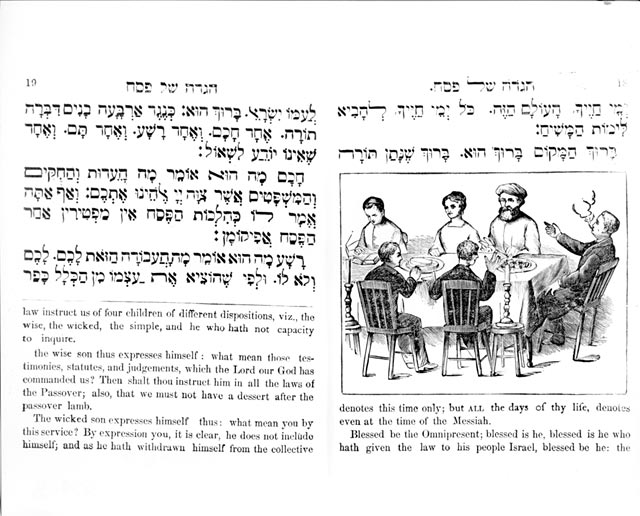
The Maxwell House hagada is the most widely used hagada in America, and has been used by millions of Jews over the past 100 years. Maxwell House also placed the piyyutim before the cup, as late as its 1994 edition. (Below is an image from the 1964 edition.)

However, by the 2015 edition of the Maxwell House hagada, the order was changed, and the piyyutim are now placed after drinking the cup.[13]

Some other new editions of older hagados have also moved the placement of the piyyutim to after the cup. For example, in the 2001 Ahavas Shalom edition of the Shelah’s hagada, they have moved the piyyutim to after the cup, but do inform the reader of the original placement of the piyyutim.

One popular hagada that still places the piyyutim before the cup is the Ktav Publishing House (red and yellow) hagada.[14] This placement is so out of the ordinary in current day hagados, that it leads to questions like this one[15]: “The semi popular Passover Hagadah by Rabbi Nathan Goldberg strangely puts drinking the fourth cup at the seder after starting a couple of songs from nirtzah. I’ve never seen this in any other haggadah, and it seems wrong. The fourth cup was established to go with hallel, and it would make sense then to drink it at its conclusion, and not make an interruption with a couple of unrelated songs. Is this a mistake? Is there some source for this “change”?”

The pendulum has swung so much to the Maharshal’s order, that the questioner is unaware that this was the order in the majority of hagados until a century ago, and that the change went in the other direction; the order more common today is the result of a change. The language of the question is also noteworthy, as “drinking the fourth cup at the seder after starting a couple of songs from nirtzah” would indeed be strange, as would be an interruption of “unrelated songs”. However, if we understand that these piyyutim are actually intended to be part of Hallel, as noted above, the question falls, as the question is based on the assumption that these piyyutim are intended to be part of Nirtza.

Similarly, the Mesivta (Nusach Ashkenaz) Hagada (p.792) singles out Rav Reuven Margoliyos’s hagada (Be’er Miriam) in noting that Ki Lo Naeh appears there before the drinking of the cup, seemingly also unaware that the majority of hagados were printed that way until the twentieth century.

An interesting question arises: why is it that the ruling of Maharshal and the Bach were largely not followed until the twentieth century, and the custom in the twentieth century shifted so dramatically that the prior custom is now nearly unheard of? One possibility is that this is a “Rupture and Reconstruction” phenomenon, and reflects the shift from mimetic tradition to book-learning halacha due to the rupture in Ashkenazi society caused by the holocaust, a result of which was the de-emphasis of the mimetic tradition. This larger trend was noted by Dr. Haym Soloveitchik in his seminal article in Tradition.[16] A modification of Dr. Soloveitchik’s hypothesis was put forward by Rabbi Yehoshua Pfeffer, who suggested that the shift to book-learning halacha was a result of the explosion of yeshivos and kollelim in the 20th century.[17] R. Micha Berger has argued that the changes noted by Dr. Soloveitchik began in the 19th century, and “less than a discontinuity that occurred in the mid-20th century, the reconstruction was a long process that was forced to a hasty close[18]”, which seems to fit the phenomenon we have observed here.

Another factor to consider is what R. Joseph Tabory has written, that “the custom eventually disappeared from the eastern European tradition, although it still appears in some haggadot of the western Ashkenazic tradition[19]”, although he does not note what precipitated the change, when the change occurred, or that it has further accelerated in the last century with the demise of Eastern European Jewry.

An additional explanation for the dramatic change in common practice was suggested by my good friend Dr. Josh Lovinger, who noted that the halachic codes themselves may have tended more towards Maharshal’s position as time has gone on. The Magen Avraham, for example, brought the position of Maharshal, as well as the practice of Maharam. However, the Shulchan Shlomo (480:1) requires the piyyutim to be placed after the cup, and the Aruch Hashulchan (480:3) also endorses Maharshal’s position unequivocally.[20] There are however, counter-examples, as Chayei Adam (Klal 130: Hallel) presents both options as legitimate, and Mishna Brura, following Magen Avraham cites both positions. It is possible that the acceleration of this shift was a result of a combination of all of the above factors.

Assuming the three piyyutim are to be recited after the cup, as according to Maharshal, what then is the proper sequence after the cup? Based on the above, that the piyyutim were originally part of Hallel, it would follow that the three piyyutim should be recited immediately after the cup, and before Chasal. Although the piyyutim ought not be recited before the cup for a technical reason, it is reasonable that the piyyutim be placed adjacent to Hallel since they were intended to be part of Hallel. Chasal Siddur Pesach means that the seder is complete, so it would be inconsistent to declare that the seder is complete and then go back to reciting Hallel. As noted above, the three piyyutim are primarily hallel-themed, while Chasal is forward looking, and as such seems to belong after the piyyutim. Additionally, as mentioned above, Chasal was added to the seder later than the three piyyutim, which might be another reason that Chasal was originally placed after the cup. This might be additional reason to recite the piyyutim before Chasal, as they were incorporated into the seder earlier.

This order, with the three piyyutim after the cup but preceding Chasal, is in fact found in the hagada of Rav Yozfa Shamash, available in manuscript online via the National Library of Israel.[21]

This section is also included in Machon Yerushalayim’s edition of Rav Yozfa Shamash’s Minhagei Vermeiza, in the hagahos to siman 77:

This is also the order presented in Rav Yaakov Emden’s siddur Shaarei Shamayim, with the three piyyutim after the drinking of the cup, and preceding Chasal.[22] Here is Chasal following the completion of Ki Lo Naeh:

However, this order is not the prevailing practice, and is almost unheard of in present day hagados.[23] Although R. Joseph Tabory notes that “Others of the western tradition have…retained a vestige of the western Ashkenazic custom by retaining the Hasel Seder Pesach after the additional songs, rather than immediately after drinking the fourth cup[24]”, it is unclear to me who he is referring to in the present day that has retained Chasal after the additional songs.

The only hagada that I have seen printed in the last 100 years that places these piyyutim after the cup and before Chasal, is the hagada Todas Yehoshua of the Monastryshcher Rebbe, printed in 1935.[25] (There might be others that I have not seen, but they are certainly very few and far between.) Here is how the piyyutim appear in the Todas Yehoshua, with Vahehi Bachatzi Halalya after the cup, and Chasal after the end of Ki Lo Naeh.

The Monastryshcher was one of the earlier Chasidic Rebbes to emigrate to the United States, and OU Press recently published a volume about him, entitled Hasidus Meets America: The Life and Torah of the Monsatryshcher Rebbe, by Ora Wiskind.[26] I contacted the Rebbe’s descendants to inquire why his hagada placed the piyyutim before Chasal, but did not receive a clear answer. However, his great-grandson Rabbi Nachum Rabinowitz pointed me to the Rebbe’s hanhagos, printed in sefer Erkei Yehoshua, and his own practice was not as printed in his hagada. On the first night, he recited the piyyutim after the cup and after Chasal, as is the common practice today. On the second night, he recited the piyyutim before the cup, as was the old minhag. So his personal practice was different on each night, but neither night was consistent with what he printed in his hagada.

The prevailing practice nowadays is to recite the piyyutim after the cup, and after Chasal. The earliest hagada that I have seen with this order is the hagada of Rav Shabsai Sofer (published from manuscript over 20 years ago), that has the three piyyutim after the cup and after Chasal.[27] The vast majority of hagados with the piyyutim after the cup follow this order, and virtually all hagados printed nowadays follow this order. It is not clear to me how this order became dominant. Most published halachic codes, when they state that the piyyutim belong after the cup, do not specify whether they belong before or after Chasal. Shulchan Shlomo appears to be the exception, as it specifies saying the piyyutim after Chasal. This might have contributed to this becoming the prevailing practice, although it is not clear that this would be sufficient to carry the day so decisively. It is possible that the order of Chasal being recited immediately after the cup stuck, even when the piyyutim were moved to after the cup.

Aside from the question of how this became the prevailing practice, there is also the question of whether this practice is reasonable. If the piyyutim are seen as a part of Hallel, then it should make sense to recite them before Chasal, not after. Part of the explanation might be that the recitation of Chasal is intended to connote the end of the formal halachic seder, and as such should follow the drinking of the last cup, and not additional piyyutim which are a hosafa to hallel. However, as noted above, thematically these piyyutim are more similar to Hallel, while Chasal turns the focus towards the future geula, so the placement of these piyyutim remains somewhat ambiguous, and as such is a matter of dispute between different authorities, as noted above.

In summary, the Trumas Hadeshen and Leket Yosher place these three piyyutim (Vayehi Bachatzi Halayla, Va’amartem Zevach Pesach, Ki Lo Naeh) before the drinking of the fourth cup, as part of Hallel. This was the Ashkenazi practice for hundreds of years. Maharshal, Bach and other poskim objected to this practice and required the piyyutim to be placed after the cup. This ruling was largely not followed the twentieth century. If the three piyyutim were intended to be part of hallel, it would seem to be reasonable to recite them before Chasal, but the common practice is to recite them after Chasal.

Let us conclude with a Nirtza bakasha found in a hagada manuscript from Baghdad in 1776[28]:


,נרצה כל מי שעושה זה הסדר יזכה לשנים רבות
,נעימות וטובות, לשנה הבאה בירושלים
שמחים כפלי כפלים בקבוץ גלות יהודה ואפרים אמן

[1] See R. Daniel Goldschmidt’s chapter 3, and Hagada Shleima (R. Shmuel Ashkenazi and R. Menachem Kasher) siman 36.
[2] https://hebrewbooks.org/pdfpager.aspx?req=8860&st=&pgnum=155

[3] The 1526 Prague Hagada also contains a version of Adir Hu in German, printed in Hebrew letters, beginning “Almechtiger Gott”.

https://braginskycollection.com/portfolio/prague-haggadah
Hagada Shleima suggests that perhaps the German is the original and the Hebrew (Adir Hu) is a translation, but I have not seen any evidence to support that assertion. Versions of this German Adir Hu also appear in various later hagados, some of which include the refrain “Nun Bau”, for example in the 1725 Herlington Hagada.

https://braginskycollection.com/portfolio/herlingen-haggadah/


This German version is still recited by some in the Yekke community to this day. This version also appears in the Hagada in the original printing of the Shaar Hashamayim siddur with the commentary of the Shelah. (The 2001 Ahavas Shalom edition of the Shelah Hagada has removed the German version.) This German version of Adir Hu did elicit some opposition, such as in Beis Eivel Uveis Mishte (pp18b – 20b) by Rav Shmuel Palaggi, and Kos Yeshuos by Rav Naftali Hertz Fleish (excerpts printed in Min Hagenazim, vol. 3, 1975, p. 96.)
[4] See R. Daniel Goldschmidt’s Chapter 3, where he also notes that Chasal and Adir Hu were later additions.
[5] https://www.loc.gov/item/2022397713

[6] Interestingly, the Shaarei Dura hagada has the recitation of borei nefashos after the fourth cup, in the image shown. This is certainly a scribal error, as a few pages before, when detailing the halachos of the remainder of the seder, it says explicitly that al hagefen is to be recited after the fourth cup. Also noteworthy is that this hagada includes our standard simanim of “Kadesh Urchatz”, but with the addition of a siman “Notel”, denoting mayim acharonim before birkas hamazon.
[7] I am told, anecdotally, that some in the Yekke community still recite the piyyutim before the fourth cup.
[8] Regarding the closing bracha of birkas hamazon, and the recitation of harachaman before the cup, see my Sos Anochi (siman 26).
[9] My assumption in this statement is that people’s practice generally followed what was printed in their hagados.
[10] One exception that I saw in print is in the siddur of Rav Yaakov Emden, which will be shown below. There were also several exceptions in manuscript that were printed only more recently, such as the hagados of Rav Yozfa Shamash and Rav Shabsai Sofer, also mentioned below.
[11] https://hebrewbooks.org/4889
[12] https://hebrewbooks.org/10550
[13] My attempts to determine who decided to make this change to the Maxwell House hagada were unsuccessful.
[14] https://ktav.com/products/goldberg-passover-haggadah-box-of-50
[15] https://judaism.stackexchange.com/questions/102127/fourth-cup-after-starting-nirtzah

[16] “Rupture and Reconstruction” by Dr. Haym Soloveitchik, in Tradition 28:4.
[17] In a Symposium on “Rupture and Reconstruction”, Tradition 51:4, specifically pp. 83-84.
[18] https://www.torahmusings.com/2019/08/rupture-and-reconstruction-at-25-years/

[19] The JPS Commentary on the Haggadah, p. 60. My thanks to Dr. Josh Lovinger for bringing this reference to my attention.
[20] Interestingly, Mishna Brura cites both positions, while the Aruch Hashulchan endorsed Maharshal unequivocally. This is somewhat of a departure from what we would expect based on Dr. Soloveitchik’s presentation in “Rupture and Reconstruction”, in which the Aruch Hashulchan typically attempted to justify common practices, while the Mishna Brura tended to value common practice less than did the Aruch Hashulchan.
[21] https://www.nli.org.il/he/manuscripts/NNL_ALEPH990001671700205171/NLI#$FL15383925. This hagada was recently published by under the title Hagada Likutei Yosef.

https://kollelashkenaz.org/publications/haggadah-shel-pesach-the-yosef-yusfa-haggadah/

[22] https://hebrewbooks.org/pdfpager.aspx?req=22619&st=&pgnum=92&hilite=

My thanks to Dr. Josh Lovinger for bringing this reference to my attention.
[23] I would expect that Hagada Likutei Yosef should follow this order, but have not seen a copy thus far.
[24] The JPS Commentary on the Haggadah, p. 60.
[25] https://hebrewbooks.org/2712

This hagada was printed as a fundraiser for Yeshiva R. Chaim Berlin.
[26] https://oupress.org/product/hasidus-meets-america/
[27] My thanks to Dr. Josh Lovinger for bringing this reference to my attention.
[28] Hebrewmanuscripts.org/hbm_712.pdf


Pesach, Haggadah, Art & Sundry Matters: A Recap of Important Seforimblog Articles

Pesach, Haggadah, Art & Sundry Matters: A Recap of Important Seforimblog Articles

Among the more interesting aspects of the history of Haggados, is the inclusion of illustrations. This practice dates back to the Medieval period and, with the introduction of printing, was incorporated into that medium. Marc Michael Epstein’s excellent book regarding four seminal Haggadah manuscripts, The Medieval Haggadah: Art, Narrative & Religious Imagination, was reviewed here, and a number of those illustrations, were analyzed in “Everything is Illuminated: Mining the Art of IllustratedHaggadah Manuscripts for Meaning.” Epstein edited and wrote an introduction to the recently published facsimile edition of the Brother Haggadah, which resides in the British Library. This is the first reproduction in full color of this important manuscript. Another recent reproduction of a manuscript Haggadah is Joel ben Simon’s Washington Haggadah. This Haggadah is particularly relevant this year, as it contains an alternative text for  Eruv Tavshilin blessing. Whether or not this was deliberate was the subject of some controversy, see “Eruv Tavshilin: A Scribal Error or Deliberate Reformation?

The first illustrated printed Haggadah, Prague, 1526, introduced new illustrations and recycled and referenced some of the common ones in manuscripts (see here for a brief discussion and here for Eliezer Brodt’s longer treatment). That edition would serve as a model for many subsequent illustrated Haggados but also contains surprising elements, at least in some religious circles, regarding the depiction of women, and was subsequently censored to conform with the revisionist approach to Jewish art. See, “A Few Comments Regarding The First Woodcut Border Accompanying The Prague 1526 Haggadah,” and Elliot Horowitz’s response, “Borders, Breasts, and Bibliography.” The Schecter Haggadah: Art, History and Commentary, a contemporary treatment of the art and the Haggadah, (for Elli Fischer’s review, see here), that unintentionally reproduced a version of one of the censored images in the first edition. It was restored in subsequent editions. Women appear in other contexts in illustrated Haggados. The most infamous example is the “custom” that implies a connection between one’s spouse and marror (discussed here), but our article, “Haggadah and the Mingling of the Sexes” documents more positive and inclusive examples of women’s participation in the various Passover rituals in printed Haggados.  Similarly, the c. 1300 Birds Head Haggadah has an image of female figures in snoods preparing the matza and a woman at the center of Seder table.

As detailed in chapter 8 of Epstein’s Medieval Haggadah, the early 14th Century Golden Haggadah is perhaps the most female-centric Haggadah and may have been commissioned for a woman. That manuscript emphasizes the unique, positive, and critical role women played in the Exodus narrative. Although it also depicts the practice of overzealous cleaning with a woman sweeping the ceiling. The 1430 Darmstadt Haggadah has a full-page illumination of women teachers, but its connection to the text is opaque. Finally, we argue that one printed Haggadah uses a subtle element in explicating the midrashic understanding of the separation of couples as part of the Egyptian experience.

Sweeping the Ceiling, Golden Haggadah


One of the most creative contemporary Haggados was produced by the artist, David Moss. Moss was commissioned by David Levy to create a Haggadah, on vellum in the tradition of Medieval Jewish manuscripts. Moss worked for years on the project the result surely equals, if not surpasses, many of the well-known Medieval haggados, both artistically and its ability to bring deeper meaning to the text. The manuscript is adorned with gold and silver leaf and contains many paper-cuts (technically vellum-cuts).  One of the most striking examples of the silver decoration is the mirrors that accompany the passage that “in each and every  generation one is obligated to regard himself as though he personally came out of Egypt.” The mirrors appear on facing pages, interspersed with one with male and the other with female figures in historically accurate attire from Egypt to the modern period. Because the portraits are staggered when the page opens, each image is reflected on the opposite page, and when it is completely opened, the reader’s reflection literally appears in the Haggadah — a physical manifestation of the requirement to insert oneself into the story. The page is available as a separate print.

After completing the Haggadah, Moss was asked to reproduce it, and, with Levy’s permission, produced, what the former Librarian of Congress, Daniel Bornstein, described as one of the greatest examples of 20th-century printing. The reproduction, on vellum, nearly perfectly replicates the handmade one. This edition was limited to 500 copies, all of which were sold. From time to time, these copies appear at auction and are offered by private dealers, a recent copy sold for $35,000. President Regan presented one of these copies to the former President of Israel, Chaim Herzog, when he visited the White House in 1987. While that is out of reach for many, this version is housed at many libraries, and if one is in Israel, one can visit Moss at his workshop in the artist colony in Jerusalem, where he continues to produce exceptional works of Judaica and view the reproduction.  There is also a highly accurate reproduction, on paper that is available (deluxe edition) and retains the many papercuts and some of the other original elements, that is still available. This edition also contains a separate commentary volume, in Hebrew and English. (There is also one other available version that simply reproduces the pages, but lacks the papercuts.)

While the entire Moss Haggadah is worth study, a few examples. One paper-cut is comprised of eight panels, each depicting the process of brick making, the verso, using the same cuttings, depicts the matza baking process, literally transforming bricks into matza. The first panel of the matza baking is taken from Nuremberg II Haggadah, which we previously discussed here, and demonstrated that it preserves the Ashkenazi practice of only requiring supervision from the time of milling and not when the wheat was cut.

The illustration accompanying the section of Shefokh, reuses the illustrations of Eliyahu from the Prague 1526 and the Mantua 1528 Haggados to great effect. In the original and vellum reproduction, the cup of Eliyahu physically turns without any visible connection to the page — an extraordinary technical achievement. This section and the illustrations were discussed by Eliezer Brodt in “The Cup of the Visitor: What Lies Behind the Kos Shel Eliyahu, and, in this post, he identified an otherwise unknown work relating to the topic, for another article on the topic, see Tal Goiten’s “The Pouring of Elijah’s Cup (Hebrew).”  Eliezer revisited the topic in (here) his conversations with Rabbi Moshe Schwed, in the series, Al Ha-Daf. In last year’s conversation, he discussed a number of other elements of the history of the Haggadah, and three years ago the controversy surrounding machine produced matza. (All of the episodes are also streaming on Apple Podcasts, Spotify & 24Six.) Additionally, he authored “An Initial Bibliography of Important Haggadah Literature,” and two articles related to newly published Haggados, “Elazar Fleckeles’s Haggadah Maaseh BR’ Elazar ” and XXI. Rabbi Eliezer Brodt on Haggadah shel Pesach: Reflections on the Past and Present ,” regarding Rabbi Yedidya Tia Weil’s (the son of R. Rabbi Netanel Weil author of “Korban Netanel”) edition, and a review of David Henshke’s monumental work, Mah Nistanna. 

In one of the first haggadot printed in the United State published in 1886 Haggadah contains a depiction of the four sons.  Depicting the four sons is very common in the illustrated manuscripts and printed haggadot. In this instance, the wicked son’s disdain for the seder proceedings shows him leaning back on his chair and smoking a cigarette. According to many halakhic authorities, smoking is permitted on Yom Tov, nonetheless, the illustration demonstrates that at least in the late 19th-century smoking was not an acceptable practice in formal settings. (For a discussion of smoking on Yom Tov, see R. Shlomo Yosef Zevin, Mo’adim be-Halakha (Jerusalem:  Mechon Talmud Hayisraeli, 1983), 7-8).

The cup of Eliyahu is but one of many Passover food-related elements. The identification of Marror with the artichoke in Medieval Haggados, is debated by Dan Rabinowitz and Leor Jacobi , while Susan Weingarten provides an overview of the vegetable, in “The Not-So-Humble Artichoke in Ancient Jewish Sources.” Jacobi also discusses the fifth cup in his article, “Mysteries of the Magical Fifth Passover Cup II, The Great Disappearing Act and this printed article.  The history of the restriction of Kitniyot and the development of the practice of selling hametz is discussed in our article, “Kitniyot and Mechirat Chametz: Paradoxical Approaches to the Chametz Prohibition,” and was revisited on Rabbi Drew Kaplan’s Jewish Drinking podcast (and in an audio version on apple podcasts and spotify). Another guest was Marc Epstein, discussing his book on Medieval Haggados, and Dr. Jontahan Sarna where he gives an overview of the use of raisin wine for the kiddush and the four cups, based on his article, “Passover Raisin Wine,” as was the frequent contributor to the Seforimblog, Dr. Marc Shapiro. His interview, like many of his posts and his book, Changing the Immutable, discusses censorship and, in particular, the censored resposum of R. Moshe Isserles regarding taboo wine (also briefly touched upon in Changing the Immutable, 81-82, and for a more comprehensive discussion of the responsum, see Daniel Sperber, Nitevot Pesikah, 104-113).  For another wine related post, see Isaiah Cox’s article, “Wine Strength and Dilution.” The history of Jewish drinking and Kiddush Clubs was briefly discussed here.

Whether coffee, marijuana and other stimulants falls within the Kitniyot category appears here. Marc Shapiro’s article, “R. Shlomo Yosef Zevin, Kitniyot, R. Judah Mintz, and More,” regarding Artscroll’s manipulation of R. Zevin’s Moadim be-Halakha regarding kitniyot. Another coffee related article explores the history and commercial relationship between the Maxwell House Haggadah.  Finally, the last (pun intended) food discussion centers on the custom of stealing the afikoman.

The Amsterdam 1695 Haggadah was an important milestone in the history of printed illustrated Haggados, it was the first to employ copperplates rather than woodcuts. This new technique enabled much sharper and elaborate illustrations than in past Haggados. While some of the images can be traced to earlier Jewish Haggados, many were taken from the Christian illustrator, Mathis Marin. It also was the first to include a map. As we demonstrated that map, however, is sourced from a work that was a early and egregious example of forgery of Hebrew texts. For an Pesach related plagiarism, see “Pesach Journals, Had Gadyah, Plagiarism & Bibliographical Errors.” Kedem’s upcoming auction of the Gross Family collection includes, with an estimate of $80,00-$100,000, one of the rarest, beautiful, and expensive illustrations of Had Gadya by El Lissitzky published by Kultur Lige, Kiev, 1919. Eli Genauer reviews another number related edition, not in price, but convention, “The Gematriya Haggadah.”

There are two articles regarding the Haggadah text, David Farkes’ “A New Perspective on the Story of R. Eliezer in the Haggadah Shel Pesach,” and Mitchell First’s “Some Observations Regarding the Mah Nishtannah.” First’s other article, “The Date of Exodus: A Guide to the Orthodox Perplexed,” is also timely.
Finally, Shaul Seidler-Feller’s translation of Eli Wiesel’s article, “Passover with Apostates: A Concert in Spain and a Seder in the Middle of the Ocean,” tells the story of an unusual Pesach seder. Siedler-Feller most recently collaborated on the two most recent Sotheby’s Judaica catalogs of the Halpern collection.

Chag kasher ve-sameach!


Lectures on Hagadah Shel Pesach and about Hagaon Rav Chaim Kanievsky ZTZ”L’s Seforim

Lectures on Hagadah Shel Pesach and about Hagaon Rav Chaim Kanievsky ZTZ”l’s Seforim

By Eliezer Brodt

Earlier this week I had a conversation with Rabbi Moshe Schwed of All Daf, about the Hagadah. Topics included: how many Hagadas there are in existence, various works on the development on the Pesach Seder, and seforim devoted to the Halachos of the Seder, by Rishonim and Achronim. It concluded with a short discussion about illustrated Hagadas and the reasons behind them, available here. It is also available for viewing here and here.

In addition, here are the first three episodes of a new video series that I recently started with Rabbi Moshe Schwed of All Daf. The series is devoted to the seforim of Hagaon Rav Chaim Kanievsky Ztz’l.

In the first episode, I discuss Kiryat Melech, R’ Chaim’s sefer on the Rambam. The second one is about his work on the Marsha, Orchos Chaim, and more. The third episode is devoted to a sefer called Nachal Eitan. I hope to continue with this series right after Pesach.

 It is available for viewing here [1,2,3] and here. Here is a link to a folder with the videos (it also includes only audio files of the presentations).

.Feedback or comments of any sort are appreciated


Pesach and Haggadah Themed Posts 2020

Pesach and Haggadah Themed Posts 2020

Here’s a roundup of Pesach and Haggadah-themed posts at the Seforim Blog.

                                                      Illustrations and the Haggadah

I. Racy Title Pages Update II 12.01.2005.

Discusses the title page of the Prague Haggadah of 1526. This particular Haggadah used an illustration of a nude woman in the Haggadah’s quotation of Ezekiel 16:7 (“I cause you to increase, even as the growth of the field. And you did increase and grow up, and you became beautiful: you breasts grew, and your hair has grown, yet you were naked and bare”). This is contrasted with the Venice 1603 Haggadah which not only used an almost identical illustration but even included a note alerting the reader that this is a picture of a man!

II. Prague 1526 Haggadah 3.30.2006.

Discusses this first fully illustrated Haggadah. Since according to rabbinic tradition Abraham was called an Ivri because he came from “the other side” of the river, he is depicted in a rowboat. In the Mantua 160 Haggadah a similar idea is shown, only Abraham rides in a gondola!

III. Separate Beds More on Illustrated Haggadot 4.04.2006.

Discusses the bedroom illustration in the Venice 1629 Haggadah. The Haggadah interprets “our pain” (Deut. 26:7) as referring to the separation of husbands and wives. This is illustrated with husband and wife sleeping in separate beds and a lit lamp.

IV. Haggadah, First Hebrew Map, and Forgery 4.10.2006.

Discusses the Amsterdam 1695 Haggadah. This Haggadah innovated by using copper plates rather than woodcuts, making its illustrations – by the convert Abraham b”r Ya’akov mi-mishpahto shel Avraham avinu – exceptionally intricate and pleasing. Includes one of the earliest Hebrew maps of the land of Israel.

V. Haggadah and the Mingling of the Sexes 3.27.2007.
The Mantua 1560 edition of the Haggadah shows men and women working together to bake matzot. The editors even included a verse from Psalms 148:12, highlighting old and young, bachelor and virgin, seeing matzah production as a fulfillment of this verse. By contrast, in the 1609 Prague Haggadah although a similar illustration is used there is no woman working the matzah oven. The interpretation of verses appearing to sanction the mingling of young boys and girls is also discussed.
VI. Review of Marc Michael Epstein, The Medieval HaggadahArt, Narrative & Religious Imagination.  
Epstein’s book is one of the most comprehensive on the illustrated Haggadah, and specifically four of among the most important illuminated Haggadot.
VII  A Few Comments Regarding the First Woodcut Border Accompanying the Prague 1526 Haggadah
Analysis of the first fully illustrated Haggadah and illustrated Hebrew books and titlepages, and the history of censorship of this Haggadah.
VIII.  Borders, Breasts, and Bibliography by Elliot Horowitz
Elliot Horwitz’s analysis of the 1526 Haggadah and the previous entry, “A Few Comments..”
IX. 1526 Prague Haggadah and its Illustrations by Eliezer Brodt
 Another post discussing this important haggadah.

X.   Halakhah and Haggadah Manuscripts

It highlights how halakha influenced the illustrations in medieval Haggadot.


Artichoke and Marror in Haggadah illustrations 


The Humble Artichoke

The First Artichoke Controversy of 2012 by Leor Jacobi

The Not-So-Humble Artichoke in Ancient Jewish Sources by Susan Weingarten

Elijah’s or the Fifth Cup

X. Eliyahu Drinking from the Cup 3.29.2006.
Discusses various beliefs about Elijah in connection with the Seder, illuminated from Haggadah illustrations.

XI.  The Cup for the Visitor: What lies behind the Kos Shel Eliyahu?  By Eliezer Brodt

XII. Mysteries of the Magical Fifth Passover Cup II, The Great Disappearing Act  by Leor Jacobi

Kitniyot


XIIII.  Shlomo Yosef Zevin, Kitniyot, R. Judah Mintz, and More by Marc B. Shapiro

Highlights a passage of R. Zevin’s Moadim Le-Simcha regarding Kitniyot that was altered in the Artscroll translation.

XIV.  Kitniyot and Stimulants: Coffee and Marijuana on Passover

Whether marijuana and coffee are classified as kitniyot.

Specific Haggadot

XV. On  the Maxwell House Haggadah

Discusses the connection between this coffee house and Passover.

XVI. Old Haggadot for Free 4.10.2006.
A notice that many important and old Haggadot are available online
 XVII. Elazar Fleckeles’s Haggadah Maaseh BR’ Elazar By Eliezer Brodt

XVIII. Book Announcement Gabriel Wasserman’s Haggadah

XIX.  New Book Announcement: Professor David Henshke’s Work on the Seder Night by Eliezer Brodt

XX. The Gematriya Haggadah By Eli Genauer

XXI. Pesach Journals, Had Gadyah, Plagiarism & Bibliographical Errors 3.27.2007.
Discusses Yeshurun’s special Pesach issue. The author of one of the article’s method of essentially repackaging scholarly journal articles for frum Torah journals is exposed.
XXI. Rabbi Eliezer Brodt on Haggadah shel Pesach: Reflections on the Past and Present 3.27.2007.
Discusses the interesting Haggadah of R. Yedidiah Thia Weil (Rav Korban Nesanel’s son). Among other things of note, the author mentions that he heard that Jews have one more tooth than non-Jews.
XXII. Pesach Drasha of the Rokeach by Eliezer Brodt, 4.02.2007.
Discusses a newly published derasha of R. Eleazer Rokeach’s Pesach , which mentions his personal Pesach customs, and of which confirms something long recorded in his name, but never known from his own words.
XXIII. Initial Bibliography of Important Haggadah Literature by Eliezer Brodt, 4.16.2008.
Discusses Haggadot and the historical development of the Haggadah, such as R. Menachem Kasher’s Haggadah Shelemah and Prof. Y. H. Yerushalmi’s Haggadah and History, as well as many others.
Miscellaneous

XXIV.  Afikoman Stealing and other related Minhagim by Elizer Brodt

XXV. Passover with Apostates:  A Concert in Spain and a Seder in the Middle of the Ocean By Eliezer Wiesel
A translation (by Shaul Seidler-Feller) of a Yiddish article written by Elie Wiesel describing a memorable 1949 seder.

XXVI. A New Perspective on the Story of R. Eliezer in the Haggadah Shel Pesach by Dovid Farkes

XXVII. The Date of the Exodus: A Guide to the Orthodox Perplexed by Mitchell First, 4.03.2011.
Discusses possible ways of identifying the specific Pharaoh of the Torah and therefore the date of the enslavement and exodus from Egypt.

Chag kasher ve-sameach!