Pesach and Haggadah Themed Posts 2020

Pesach and Haggadah Themed Posts 2020

Here’s a roundup of Pesach and Haggadah-themed posts at the Seforim Blog.

                                                      Illustrations and the Haggadah

I. Racy Title Pages Update II 12.01.2005.

Discusses the title page of the Prague Haggadah of 1526. This particular Haggadah used an illustration of a nude woman in the Haggadah’s quotation of Ezekiel 16:7 (“I cause you to increase, even as the growth of the field. And you did increase and grow up, and you became beautiful: you breasts grew, and your hair has grown, yet you were naked and bare”). This is contrasted with the Venice 1603 Haggadah which not only used an almost identical illustration but even included a note alerting the reader that this is a picture of a man!

II. Prague 1526 Haggadah 3.30.2006.

Discusses this first fully illustrated Haggadah. Since according to rabbinic tradition Abraham was called an Ivri because he came from “the other side” of the river, he is depicted in a rowboat. In the Mantua 160 Haggadah a similar idea is shown, only Abraham rides in a gondola!

III. Separate Beds More on Illustrated Haggadot 4.04.2006.

Discusses the bedroom illustration in the Venice 1629 Haggadah. The Haggadah interprets “our pain” (Deut. 26:7) as referring to the separation of husbands and wives. This is illustrated with husband and wife sleeping in separate beds and a lit lamp.

IV. Haggadah, First Hebrew Map, and Forgery 4.10.2006.

Discusses the Amsterdam 1695 Haggadah. This Haggadah innovated by using copper plates rather than woodcuts, making its illustrations – by the convert Abraham b”r Ya’akov mi-mishpahto shel Avraham avinu – exceptionally intricate and pleasing. Includes one of the earliest Hebrew maps of the land of Israel.

V. Haggadah and the Mingling of the Sexes 3.27.2007.
The Mantua 1560 edition of the Haggadah shows men and women working together to bake matzot. The editors even included a verse from Psalms 148:12, highlighting old and young, bachelor and virgin, seeing matzah production as a fulfillment of this verse. By contrast, in the 1609 Prague Haggadah although a similar illustration is used there is no woman working the matzah oven. The interpretation of verses appearing to sanction the mingling of young boys and girls is also discussed.
VI. Review of Marc Michael Epstein, The Medieval HaggadahArt, Narrative & Religious Imagination.  
Epstein’s book is one of the most comprehensive on the illustrated Haggadah, and specifically four of among the most important illuminated Haggadot.
VII  A Few Comments Regarding the First Woodcut Border Accompanying the Prague 1526 Haggadah
Analysis of the first fully illustrated Haggadah and illustrated Hebrew books and titlepages, and the history of censorship of this Haggadah.
VIII.  Borders, Breasts, and Bibliography by Elliot Horowitz
Elliot Horwitz’s analysis of the 1526 Haggadah and the previous entry, “A Few Comments..”
IX. 1526 Prague Haggadah and its Illustrations by Eliezer Brodt
 Another post discussing this important haggadah.

X.   Halakhah and Haggadah Manuscripts

It highlights how halakha influenced the illustrations in medieval Haggadot.


Artichoke and Marror in Haggadah illustrations 


The Humble Artichoke

The First Artichoke Controversy of 2012 by Leor Jacobi

The Not-So-Humble Artichoke in Ancient Jewish Sources by Susan Weingarten

Elijah’s or the Fifth Cup

X. Eliyahu Drinking from the Cup 3.29.2006.
Discusses various beliefs about Elijah in connection with the Seder, illuminated from Haggadah illustrations.

XI.  The Cup for the Visitor: What lies behind the Kos Shel Eliyahu?  By Eliezer Brodt

XII. Mysteries of the Magical Fifth Passover Cup II, The Great Disappearing Act  by Leor Jacobi

Kitniyot


XIIII.  Shlomo Yosef Zevin, Kitniyot, R. Judah Mintz, and More by Marc B. Shapiro

Highlights a passage of R. Zevin’s Moadim Le-Simcha regarding Kitniyot that was altered in the Artscroll translation.

XIV.  Kitniyot and Stimulants: Coffee and Marijuana on Passover

Whether marijuana and coffee are classified as kitniyot.

Specific Haggadot

XV. On  the Maxwell House Haggadah

Discusses the connection between this coffee house and Passover.

XVI. Old Haggadot for Free 4.10.2006.
A notice that many important and old Haggadot are available online
 XVII. Elazar Fleckeles’s Haggadah Maaseh BR’ Elazar By Eliezer Brodt

XVIII. Book Announcement Gabriel Wasserman’s Haggadah

XIX.  New Book Announcement: Professor David Henshke’s Work on the Seder Night by Eliezer Brodt

XX. The Gematriya Haggadah By Eli Genauer

XXI. Pesach Journals, Had Gadyah, Plagiarism & Bibliographical Errors 3.27.2007.
Discusses Yeshurun’s special Pesach issue. The author of one of the article’s method of essentially repackaging scholarly journal articles for frum Torah journals is exposed.
XXI. Rabbi Eliezer Brodt on Haggadah shel Pesach: Reflections on the Past and Present 3.27.2007.
Discusses the interesting Haggadah of R. Yedidiah Thia Weil (Rav Korban Nesanel’s son). Among other things of note, the author mentions that he heard that Jews have one more tooth than non-Jews.
XXII. Pesach Drasha of the Rokeach by Eliezer Brodt, 4.02.2007.
Discusses a newly published derasha of R. Eleazer Rokeach’s Pesach , which mentions his personal Pesach customs, and of which confirms something long recorded in his name, but never known from his own words.
XXIII. Initial Bibliography of Important Haggadah Literature by Eliezer Brodt, 4.16.2008.
Discusses Haggadot and the historical development of the Haggadah, such as R. Menachem Kasher’s Haggadah Shelemah and Prof. Y. H. Yerushalmi’s Haggadah and History, as well as many others.
Miscellaneous

XXIV.  Afikoman Stealing and other related Minhagim by Elizer Brodt

XXV. Passover with Apostates:  A Concert in Spain and a Seder in the Middle of the Ocean By Eliezer Wiesel
A translation (by Shaul Seidler-Feller) of a Yiddish article written by Elie Wiesel describing a memorable 1949 seder.

XXVI. A New Perspective on the Story of R. Eliezer in the Haggadah Shel Pesach by Dovid Farkes

XXVII. The Date of the Exodus: A Guide to the Orthodox Perplexed by Mitchell First, 4.03.2011.
Discusses possible ways of identifying the specific Pharaoh of the Torah and therefore the date of the enslavement and exodus from Egypt.

Chag kasher ve-sameach!


Mysteries of the Magical Fifth Passover Cup (II): The Great Disappearing Act

Mysteries of the Magical Fifth Passover Cup (II): The Great Disappearing Act

By Leor Jacobi

Years ago, as a Yeshiva Bochur, a Rabbi explained to me that, according to the GRA, the Cup of Elijah at the Passover Seder is really the Fifth Cup mentioned in the Talmud which there is a doubt about  Thus, it is Elijah’s cup because when he returns to herald the redemption, every Talmudic tequ will be solved. I found that the elusive Fifth Cup is not actually mentioned in the Talmud as we have it, but by most of the Rishonim, who all had a textual variant.

Later, as a Junger Mann, I found R. Menachen Mendel Kasher’s pamphlet on the Fifth Cup, also published in his Haggadot (generally abridged). Despite some intrinsic flaws, it is a masterful and ingenious integration of traditional and modern methods.

A few years ago, groundbreaking publications by my teacher, David Henshke, and my colleague, Eliezer Brodt, inspired me to build upon their foundation, concentrating on points which remain obscure or unsolved.

As there are quite a few of these, I divided up the study into seven chronological and thematic parts which I hope will evolve into book chapters eventually but also stand alone as they are. The first part of the envisioned series, on the magical genesis of the fifth cup, was accepted by a prominent journal that graciously agreed to have an early draft distributed here. Part four, on 19th century scholarship post-Levinsohn was recently submitted to another leading academic journal.

With the current social upheavals due to the Coronavirus pandemic in mind, thanks to the generosity of the editors of the Seforim Blog, we can forego delays and release a draft of part two in time for Passover. Hopefully, the virus will disappear faster than the fifth cup did! Please favor me with your feedback towards advancing the project and I will do my best to acknowledge any and all contributions.

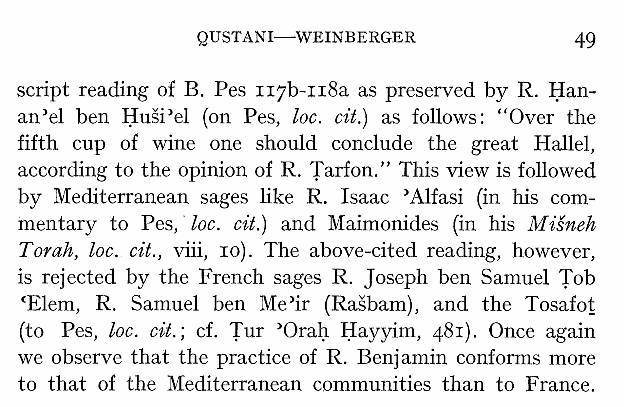
In a previous study on the genesis of the Fifth Cup, a primary textual variant of the Babylonian Talmud (Pesachim 118a) was identified as the source, an original teaching from the Talmudic Sages. Following the compilation of the Talmud, Babylonian Geonim not only received this textual variant, but actually drank the fifth cup themselves, with the apparent exception of Rav Hai Gaon, who also had the fifth cup Talmudic variant, but interpreted it as an optional practice, one which he did not follow. If the fifth cup was ordained in Babylon due to zugot, concern for even pairs arousing evil spirits, as explained in the prior study, perhaps Rav Hai inherited the original Palestinian custom of only four cups (zugot was only an issue in Babylon), as the Sages of Erez Israel did not believe in zugot. Alternatively, perhaps Rav Hai rejected the fifth cup as far as his own practice but not to the point of speaking out against it.

The fifth cup was widely observed among the Babylonian Geonim, and subsequently mentioned by Alfasi, Maimonides, and by Tur (14th century), the latter at length, with an entire siman (OḤ 481) devoted to it. 


However, if we fast-forward to the 16th century, we find that, despite an extensive discussion in R. Joseph Karo’s monumental Bet Yosef the fifth cup disappeared completely in his Shulḥan Arukh. Following the order of Tur, R. Karo gave names to all of the simanim. Here, he adopted a side issue of the siman and made it the focus and new title: “Not to drink after the fourth cup”. 


Furthermore, none of the principal commentators on the Shulḥan Arukh (“nose kelim”, 16th-17th centuries) even noted its disappearance. Explaining the magical disappearing act of the fifth cup during the Middle Ages will be the focus of this study.

The disappearance has bothered modern scholars of rabbinic literature, who struggled to explain it, most notably R. Menahem Kasher. Several factors have been suggested to explain the elimination of the fifth cup. They include: 1) Deletion of the Talmudic text mentioning the fifth cup due to homoteleuton (skipping text from one similar word to another)[1], 2) Endorsement of this variant by Rashi and Rashbam, 3) Application of this variant by subsequent Ashkenazi scribes,[2] 4) Circulation of an abbreviated version of Rav Hai Gaon’s responsum (in Tur) which suggests that Rav Hai Gaon also received the “Rashbam’s” version of the Talmud which does not mention the fifth cup,[3] 5) A statement at the beginning of Tur that the fifth cup should not be drunk, probably explaining Rashbam’s opinion, but ambiguously stated, 6) the development of a stringency in Medieval Ashkenaz to refrain from all drinking after the fourth cup, with some including even water in the prohibition (see below) and 7) The publication of the Venice edition of the Talmud, in 1520-23 following Rashbam’s textual variant, with no mention of the fifth cup, all subsequent editions following in kind, almost certainly the edition consulted by R. Joseph Karo.

Despite this multitude of factors, they don’t adequately explain R. Joseph Karo’s editorial decision to completely delete such a well-entrenched custom as the fifth cup, mentioned by all three of his pillars, Alfasi, Maimonides, and Rosh.[4] I propose that an additional factor, barely recognized previously and never noted in this context, was the one that settled the matter conclusively in the mind of Maran.

Rabbenu Yonah Girondi (13th century) maintained that one should refrain from drinking extra wine so as to be able to study the laws of Passover and the story of the Exodous all night, as the Sages did in Bne Braq. Maharil cites Rosh (Asheri) as adding that the fifth cup was permitted due to the verse v’heveiti. However, our standard printed text of Rosh states that the fourth cup is permitted due to the verse v’laqaḥti

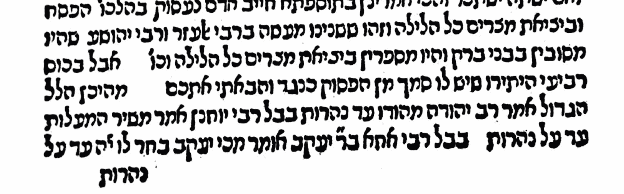
(אבל בכוס רביעי התירו שיש לו סמך מן הפסוק כנגד ולקחתי אתכם. (סימן לג…

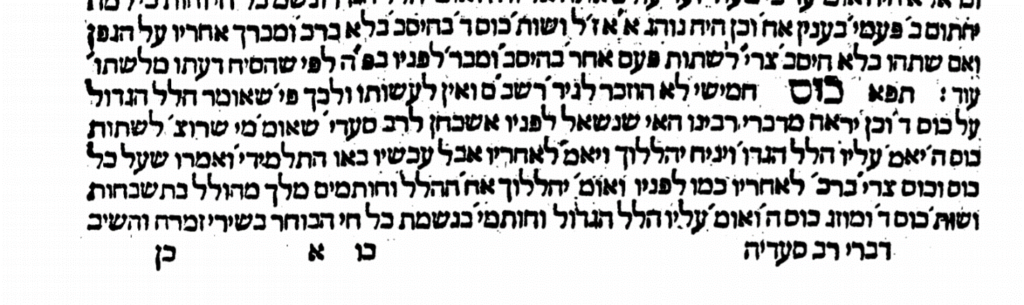
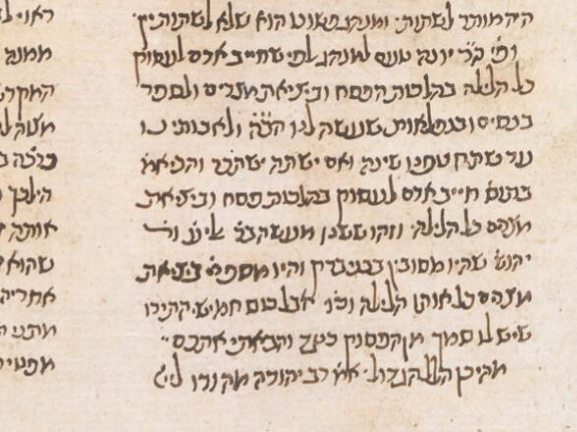
Rabbi Alter Hilewitz (1906-1994, author of halakhic works and editor of Encyclopedia Talmuditobjected that the printed text makes no sense and must have become corrupted.[5] There is no reason to permit the fourth cup after it has already been mandated in the Mishnah. The special dispensation must have been for the fifth cup and Maharil cited the genuine text version of Rosh.[6] R. Hilewitz’s hunch was correct, as we find in an early manuscript of Rosh (Asheri) written in Spain in 1325 during the lifetime of Rosh (from middle of 3rd line from bottom):[7] 


Rabbi Hilewitz

The corruption was a by-product of proliferation of the Rashbam’s text of the Talmud eliminating the fifth cup entirely. It probably represents an unintended stringency in interpretation of the prohibition on drinking excessively. Another correction we find in the manuscript is the attribution of the opinion. The manuscript attributes it to Rabbenu Yonah, corresponding to the attribution in Tur. However, the printed edition misattributes it to ר”מ, R. Meir of Rothenburg, master of Rosh.

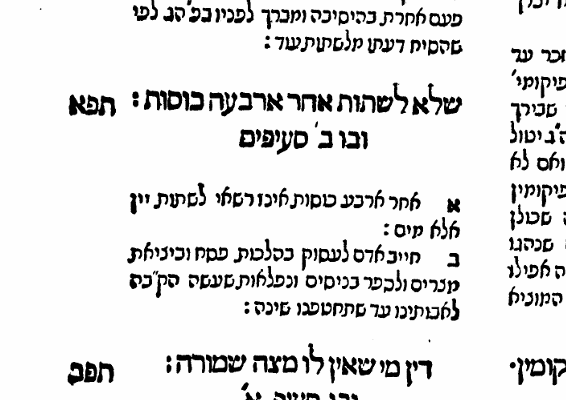
The text of Rosh which R. Joseph Karo relied upon was almost certainly that of the famous aforementioned Venice edition of the Talmud.[8] It reads:

.אבל בכוס רביעי התירו שיש לו סמך מן הפסוק כנגד והבאתי אתכם…


The text does not make sense. It is conflated. Either the fourth cup was permitted by the verse v’laqaḥti (as in the modern printed editions), or the fifth cup was permitted by the verse v’heveiti (as in the manuscript). The fourth cup could not have been permitted by the verse v’heveiti. The development was apparently a two-stage process and the Venice Edition represents the “missing link”, an intermediate stage in which the fifth cup was changed to the fourth cup but the verse remained intact. At this point, R. Joseph Karo or the later publishers could have corrected the text back to “the fifth cup”, restoring the original version in the manuscript. However, the tide was already turning towards the fourth cup Talmudic textual variant in Bet Yosef, with his decision to read Rashbam’s Talmudic textual variant into Rav Hai Gaon’s responsum.[9] R. Joseph Karo decided to keep “the fourth cup” and to ignore the word v’heveiti, or to mentally “correct” it to v’laqaḥti, exactly how the later printers chose to emend the text of Asheri.

One can speculate as to why Kasher, Benedict and subsequent Rabbinic scholars did not discover this source. R. Hilewitz’s observation was published in a 1945 newspaper article in Palestine. At the time, war was raging and R. Kasher was in America. Manuscript variants of the text of the Talmud have been studied and published on for years[10] and the last generation has brought us two editions of Tur prepared using manuscripts.[11] Even Tosafot Rosh is published from manuscripts in critical editions.[12] However, for some reason, manuscripts of Rosh are relatively uncharted territory, despite the centrality and rabbinic authority of the work. Perhaps (similar to Rashi’s Talmudic commentary, up until the groundbreaking work of my teacher, Aaron Ahrend) it is this very centrality that led its manuscripts to be ignored, as it was printed so early on, in the Venice Talmud, and so many times. 

Most significantly, the text is hidden from view. Tur clips off this section of the discussion and Bet Yosef does not cite it. However, once we return to the textual version that laid open before R. Joseph Karo on his desk, which he certainly meditated on, we can understand how he interpreted the abbreviated text of Tur and why he decided to delete the fifth cup.


Addendum: The Power of Piyyut

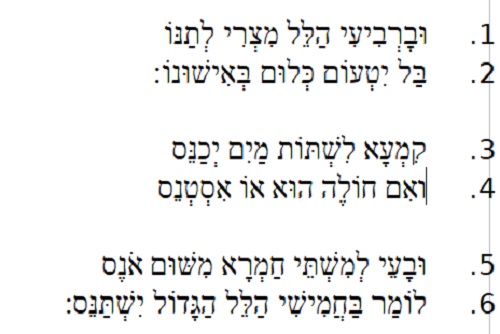
Shmuel of Evreux adopted a stringency not to drink even water after the four cups.[13] His source was the piyyut composed by R. Yosef Tuv Elem for a qerova recited on Shabbat ha-Gadol.[14] The last two stanzas at the end of the piyyut are the most famous today, for they are recited almost universally at the end of the Haggadah: “Hasal siddur Pesah”. The stanza preceding it is one mentions the fifth cup. There are two textual variants of this line interpretations of the piyyut. Three manuscripts read as follows:[15]


According to this text, line 3 states that it is permitted to drink water absolutely, in accordance with normative halakhah. Line 4 adds conditions for drinking wine, being sick or finicky, as described in line 5 with the recitation of Hallel ha-Gadol in line 6.

Medieval piyyut commentaries also follow this text, for example, the commentary by Samuel b. Salomo of Falaise:[16]

…קמעא, מעט, לשתות מים יכנס, לאחר סעודתו אם ירצה לשתות, ואם חולה הוא או אסטניס ובעי למשתי חמרא ואינו יכול לשתות מים, לומ’ בה’ על שם ‘ה הלל הגדול, ישתנס, יאזור

However, the textual variant followed by the Tosafot (Pesahim 117b) omits the vav at the beginning of line 4. Now the conditions of line 4 apply to line 3 as conditions for drinking water. Apparently from this piyyut, R. Shmuel of Évreux derived the stringency against drinking water after the Seder.[17] Tosafot for chapter Arvei Pesahim were based upon the Tosafot of R. Yechiel of Paris or a student of his, such as Rabbenu Peretz (Shalem Yahalom). R. Yechiel was in contact with R. Shmuel. R. Yechiel would attempt to refute R. Shmuel’s novel stringencies. Sometimes the refutation was accepted, such as cited by R. Peretz in his gloss to Smak 93, and sometimes not, as found in Orhot Hayyim, Hilkhot Tum’ah, vol 2, p. 602, and apparently in our case regarding the stringency of not drinking water. In this case, the development of a stringent shitta forbidding even the drinking of water likely shifted the goalposts of halakhic discussion away from the option of the Fifth Cup of wine. 

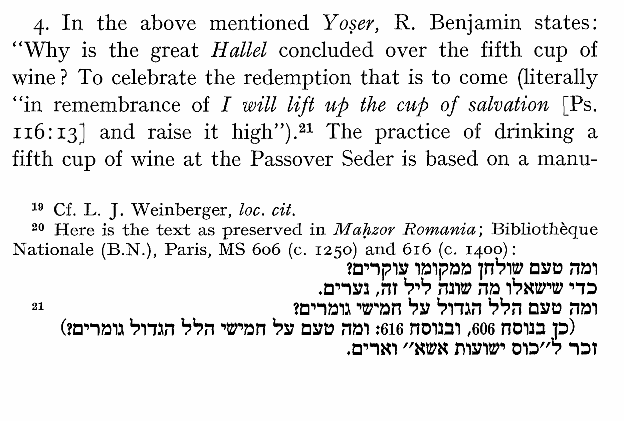
Finally, on the topic of piyyut, Leon J. Weinberger described a poem from R. Binyamin which mentions the fifth cup as a basic custom, an integral part of the Passover Seder. The piyyut was later published in its entirety by Ezra Fleischer.[18] According to Weinberger, it provides a messianic interpretation of the fifth cup, an aspect of the fifth cup that will become more evident during later periods to be discussed in chapters of this study yet to come. 


Editor Note: please see Eliezer Brodt’s earlier post on this subject: https://seforimblog.com/2013/03/the-cup-for-visitor-what-lies-behind/

[1] Henshke; also see here for another possibility and analysis of Talmudic manuscripts here.
[2] Kasher noted Rabbenu Tam’s fierce opposition in general to applying proposed emendations into the text of the Talmud itself, blaming Rashbam (his older brother) in particular. See Spiegel, Soloveitchik, briefly reviewed in my Jewish Hawking in Medieval France.
[3] Rav Kasher advanced this claim convincingly to explain the deletion by R. Joseph Karo. R. Avraham Benedict also advanced this claim, without crediting Kasher. As far as rendering a legal decision, Benedict took a diametrically opposite position. According to Kasher, now that we possess the full version of Rav Hai Gaon’s responsum, we see that R. Joseph Karo was led astray by an ambiguous text. Benedict considers R. Karo’s decision binding and the presence of the abbreviated version is ample justification.
[4] Noted especially by Kasher, also by Henshke.
[5] ‘Kos shel Eliahu’, Bamishor 245-6 (25.3.1945), p. 5.
[6] This version is also found in Abudraham (Seder ha-Haggadah u’Perisha, ed. S. Kroizer, Jerusalem 1963, p. 234), citing Rabbenu Yonah. Abudraham’s source was probably Asheri, but he did not generally cite secondary sources, as he himself stated in his introduction (p. 6.). See: L. Jacobi, “Talmudic Honey”, Fragments of the Novellae of R. David ben Saul of Narbonne”, Giluy Milta B’alma, 2/17/2016.

[7] British Library Add. 27293 f. 131v.
[8] Bomberg: Venice 1520-1523, p. 138b.
[9] Kasher, Benedict.
[10] Diqduqe Sofrim, Lieberman Instritute, Friedberg.
[11] Shirat Devorah; Ma’or.
[12] Mossad Ha-Rav Kook, Ofeq Institute.
[13] Cited by Mordechai, Hagahot Maimoniot (Ed. Constantinople, 6:11, “gedole Evreax”), Agur. Tosafot Pesachim 117b.
[14] See a letter from Pinchas Eliyahu Lawee in Kobetz Beit Aharon 15:5 (89, 1998), pp. 135–136.
[15] With only minor variants irrelevant for our purposes. Gabriel Wasserman shared with me his pilot edition of variants and Abraham Levine provided me with expert guidance in this study.
[16] Parma – Biblioteca Palatina Cod. Parm 3000 (de Rossi 378), f. 30a-35b. I was aided in locating piyyut commentaries by Elisabeth Hollender’s monumental Clavis.
[17] Another later piyyut follows this strict opinion, recently published by R. Jacob Israel Stal. See his note at page 33.
[18] Kobez al Yad 21 (1985), p, 31.


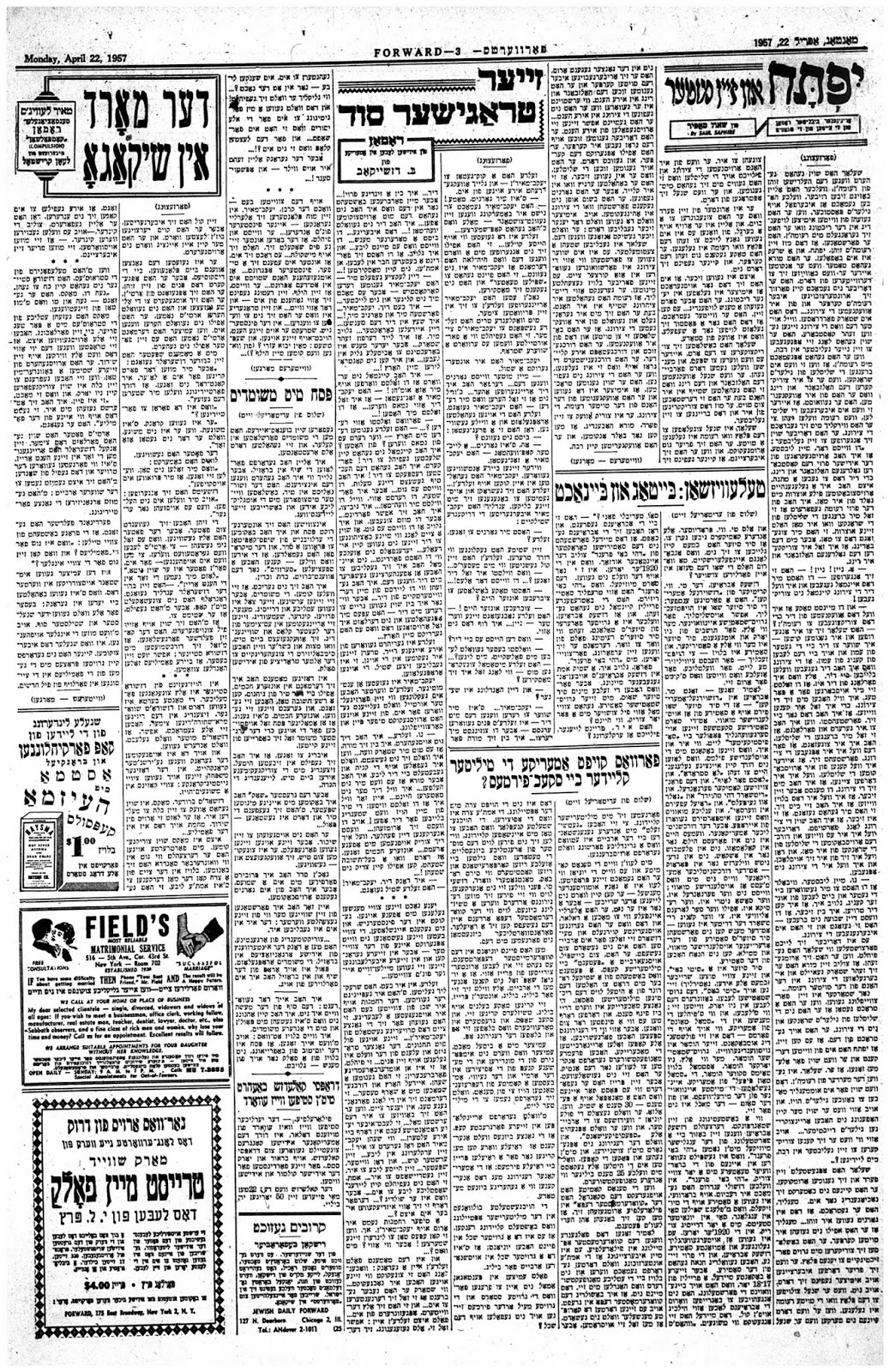
Passover with Apostates: A Concert in Spain and a Seder in the Middle of the Ocean by Elie Wiesel (1957)

Passover with Apostates:
A Concert in Spain and a Seder in the Middle of the Ocean
By Eliezer Wiesel
Forverts (22 April 1957) [Yiddish]
[Translated into English by Shaul Seidler-Feller (2018)]

If someone says to you that Passover is the festival of redemption not only of a nation but of each individual, believe him;
If someone explains to you that a Jew remains a Jew deep at heart, despite the masks he is often forced to wear, do not doubt him;
If someone tells you that, no matter what a Jew does, he will remain a living legacy of his people and his past, nod your head and say: True!
I ask that the skeptics among you listen to a story that happened to me a few years ago.
However, I must warn you: I know the beginning and middle of the story; the end, I do not know to this day.
I believe that, in this case at least, the end is not important. In any event, read on:
The Drunkard
In 1949, I traveled to Spain on assignment, spending several weeks crisscrossing the country, chatting with ordinary citizens as well as circumspect politicians, and seeking out here and there Jews and vestiges of Jewish life from the time of the Inquisition.
I found both Jews and tragic remnants of the Jewish past in that country of Judah Halevi and Samuel ha-Naggid.
However, the most interesting among them I encountered by chance, not in a museum or in Jewish company but in a cabaret.
Spanish colleagues, who brought me to Madrid and wished to show me the nightlife of the capital, led me to a cabaret, where overstuffed rich people came to admire flamenco performers who, in dancing and gyrating their bodies to some crazy rhythm, seemed as though they had been possessed by a dybbuk.
I do not know why my gaze, which wandered not only to the stage but also throughout the hall, suddenly fixed on a man in his 40s, who was sitting alone not far from us and did not stop drinking whiskey.
Perhaps the drunkard drew my interest and curiosity because I have met many drunkards in my life, but this one was different.
Most drunkards drink to forget; he drank to remember. So it seemed to me, based on the way in which he held the glass in his hand, brought it to his lips, and placed it back on the table.
He had a gentle face with a high, wrinkled forehead; thick eyebrows hanging over dark, mournful eyes; and delicate hands with fingers ranging from long to extremely long.
We sat in the cabaret for three hours, but, for all his drinking, the drunkard did not get sleepy.
My curiosity grew by the minute until I could no longer contain it. I called over the waiter and asked him who our bizarre neighbor was.
“Oh, you must mean Paul,” the waiter replied.
“Good, now I know his name,” I answered, “but who is he?”
The waiter smiled: “Wait a bit, be patient for a couple hours. Then you will see something you will not forget for the rest of your life. Wait, señor, it’s worth it…”
I wanted to question him further, but other guests summoned him. We had no choice but to wait.
The Divine Violin
In the meanwhile, the dancers grew tired from their dancing and the music itself began to die down.
The cabaret slowly started to empty out and a sudden gloom overtook this hall, to which people would come seeking false happiness and hollow illusions.
Our drunkard continued to knock back one glass after another, as if he had decided to drown himself, his life and his sadness, in the ever-full, ever-empty glass he held in his hand.
Suddenly, he gave the waiter a wink, and the latter understood what the guest wanted from him.
The waiter approached the stage, where the orchestra was playing sentimental melodies, and returned to the drunkard’s table with a violin in hand.
The drunkard took the violin, and a deathly silence descended upon the hall. All eyes were trained on him, on this elegant drunkard, who, eyes closed, stroked the bow for a long while, his face glowing as though flames were about to burst out of his head into the night.
Then he began to play.
And I shuddered.
I have heard many virtuosos in my lifetime, among them some of the most famous and talented.
But I had never heard anything like this.
Suddenly, it seemed to me that the cabaret had been transformed into a temple where he, the cantor, sought to purify his soul and ours in the blue sea of musical notes, of divine songs and harmonies.
I do not recall how long he played. I only remember that the impromptu concert was suddenly cut short and I was unable to catch a glimpse of the violinist, since he had already left the cabaret.
The magic came to an end, disappeared, and everything happened so quickly that I could barely believe it had been anything more than a dream.
The waiter then approached and told us that the drunkard comes every evening to the same cabaret, drinks his fill, and once he is good and plastered, he takes the violin and gives a free concert – for himself.
Who was he, this Paul? A German Jew, before the war he was a violinist who gave concerts. Hitler deported him to a concentration camp where he played in the camp orchestra. After the war, he was no longer up to performing in public. He came to Madrid in 1945-46. He had enough money – presumably from wealthy relatives. Many people suggested that he again give concerts, but he can only play when he is drunk.
That story left me then with a terrible impression. I decided to return to the cabaret the next day. But at the hotel a cable was waiting for me directing me to make a short trip to Tangier.
Two years later, I again visited Madrid and went to the same cabaret, but Paul was no longer there. They informed me that he had traveled to settle in Israel.
Apostates at the Seder
Three years ago, I celebrated Passover on a French ship, somewhere in the middle of the ocean between Brazil and Argentina.
We observed the Seder as it should be done. More than fifty people were seated at the table. But not all of them were Jews: thirty of them were… apostates.
The State of Israel was then going through difficult times, and Christian missionaries had arrived to buy up Jewish souls. Anyone who agreed to apostatize received a visa to Brazil and food for the journey.
Several hundred Jews left Israel then, having allowed themselves to be persuaded by the missionaries.
On a beautiful day, I took the French ship Provence and sailed to Brazil to see how the apostates were living there.
I knew that a couple dozen apostate Jews were traveling on that same ship, but I did not have access to them. First of all, the ship was large (with more than a thousand passengers), and go ask someone if he was not only not a Jew but an apostate! Second of all, the officers told me that many passengers almost never leave their cabin, so how is one supposed to go in to see them and ask indiscreet questions?
To my “luck,” a dramatic incident took place in Brazil: in Rio de Janeiro, the Immigration Authority refused to recognize the apostates’ entrance visas (to this day, no one knows why), and they were not allowed off the ship. According to international maritime law, the Provence had to bring them back to Marseilles, France. But because the ship was first traveling to Buenos Aires, they locked the apostates in the ship’s cellar and held them there under arrest.
I myself was supposed to disembark in Brazil, but immediately upon hearing about the incident, the journalist in me decided to travel on with these unhappy Jews to chronicle their suffering.
In the meanwhile, Passover sneaked up on us and I received permission from the ship’s captain to lead a Seder. The announcement came over the megaphone that those Jews who so wished could have a special “service” after dinner, as required by Jewish law.
I did not expect the apostates to come. But come they did. They numbered thirty-something: men, women, children. They sheepishly entered the coach dining hall and silently sat down at the table, where matzos and kosher wine symbolized their connection to the old traditions of the Jewish people.
At that moment, I remembered our Sages. Even at the gates of Hell, they said, a wicked person can repent. And they were correct, our Sages. It is enough that he witness an old-time Passover Seder for even the worst apostate to free himself of his shackles.
It goes without saying that I was in seventh heaven, sitting together at the table with Jews who had returned, reading the Haggadah.
But the greatest shock came a few minutes later. The door opened and there stood… Paul.
He did not appear drunk. But his eyes were cloudy. He came to the table, sat down, and… was silent.
After the Seder, I tried to have a conversation with him, but I could not extract anything from him.
One thing I understood more from his silence than from the few words he uttered: the Jew in him had remained.
…On the return from Argentina, thanks to the intervention of Jewish organizations in Brazil, they allowed the apostates off the ship.
Paul also left the ship, and in Brazil he escaped my eye.
I warned you: I do not know the end of this story. I have no idea what happened to Paul and the other apostates.
I know only this: if someone tells you that Passover is the festival of redemption not only of a nation but of each individual, believe him.


Afikoman – “Stealing“ and Other Related Minhagim

Afikoman – “Stealing“ and Other Related Minhagim*
By Eliezer Brodt


One of the most exciting parts of Seder night for kids is the “stealing” of the afikoman. Children plan well in advance when the best time would be for them to steal it, where they will hide it, as well as what they should ask for in exchange for it. Not surprisingly, toy stores do incredibly good business both during Chol Hamoed and in the days following Pesach because of this minhag. In this article I would like to trace the early sources of this minhag and also discuss rabbinic responses to it.[1]


That the minhag of stealing the afikoman was observed widely in recent history is very clear. For example, Rebbetzin Ruchoma Shain describes how she stole the afikoman when she was young; her father, Rav Yaakov Yosef Herman, promised her a gift after Yom Tov in exchange for its return.[2] Raphael Patai describes similar memories from life in Budapest before World War II.[3] In another memoir about life in Poland before the war, we find a similar description,[4] and in Alexander Ziskind Hurvitz’s Yiddish memoir about life in Minsk in the 1860s, he writes that he stole the afikoman on the first night of Pesach, that his father gave him nuts in return, and that he was warned not to steal it on the second night.[5]


Interestingly, there were occasions when the stealing of the afikoman involved adults as well. For example, in his informative memoir about life in Lithuania in the 1880s, Benjamin Gordon describes stealing the afikoman with the help of his mother,[6] and going back a bit earlier, we find that Rav Eliezer Shlomo Schick from Hungary was encouraged by his mother to steal the afikoman and to ask his father for something in exchange.[7]


But even those who recorded this minhag occasionally referred to it in less than complimentary terms. For example, in 1824 a parody called the Sefer Hakundos (literally, the “Book of the Trickster”) was printed in Vilna,[8] which describes how the “trickster” has to steal the afikoman and claim that someone else stole it.[9] In fact, this custom is even found in the work of a meshumad printed in 1856.[10]


Opposition to the Minhag


Given the implication that this minhag not only encouraged stealing but actually rewarded children for doing so, there were many who opposed it, including the Chazon Ish,[11] the Steipler,[12] Rav Shlomo Zalman Auerbach,[13] the Lubavitcher Rebbe[14] and Rav Tzvi Shlezinger.[15] Rav Shemtob Gaguine writes that Sefardim do not have the custom of stealing the afikoman, and he explains that this is because it is forbidden to steal even as a joke since it encourages stealing.[16] And Rav Yosef Kapach writes that this was not the minhag in Teiman as it is forbidden to steal, even for a mitzvah.[17]


Rav Aron of Metz (1754-1836) protests against this minhag in his work Meorei Or, as the goyim will say that the Jews are trying to teach their children to steal, as they did in Mitzrayim.[18] The question is, what does he mean?


In the anonymous work of a meshumad printed in 1738, we find a detailed description of the stealing of the afikoman by the youngest child and how he tries to get a reward for it from his father. He writes that the reason for this minhag is to teach the child to remember what the Jews did in Mitzrayim—that they borrowed from the Egyptians and ran away with the items.[19] This was the concern of Rav Aron of Metz. It is possible that this is why Rabbi Yair Chaim Bacharach of Worms writes in Mekor Chaim that there is reason to abolish this minhag.


How far back can this minhag be traced, and what is the source for it?


In most of the Rishonim and early poskim, in describing the part of the Seder called Yachatz, we find mention of breaking the matzah. Some go so far as to say that the leader of the Seder puts it on his shoulders and walks a bit with it (others do this only later on, when they eat the afikoman).[20] Some mention putting it under a pillow to watch it,[21] but there is almost no mention of children stealing it. The earliest source for the custom of stealing the afikoman that I have located is the illustrated manuscript Ashkenazic Haggadah, known as the Second Nuremberg Haggadah, written between 1450 and 1500. On page 6b, the boy puts out his hand to get the afikoman from his father. Later on in the Haggadah (p. 26b), in the section called Tzafun, the leader asks for the afikoman that the boy had hidden.[22] However, in almost all the many works related to the Seder, we do not find such a custom mentioned.


Although it’s mentioned in the Second Nuremberg Haggadah, we do not find it mentioned again after that for many years. Worth noting, for example, is that in the famous illustrated Haggadah of Prague (1526), there is no mention or picture of such a thing.[23]


In the work Siach Yitzchak of Rav Yitzchak Chayes (1538-1610), which is a halachic work on the Seder night, first printed in 1587, there is mention of the stealing of the afikoman, but not exactly the way we do it today.[24]


Rabbi Yair Chaim Bacharach of Worms (1638-1702) writes in Mekor Chaim that the children had a custom to steal the afikoman.[25]


One of the earliest printed references can be found in the work Chok Yaakov on hilchos Pesach by Rabbi Yaakov Reischer (1660-1733), first printed in 1696 in Dessau. He wrote that in his area, children had the custom to steal the afikoman.[26]


Rav Yosef Yuzpha of Frankfurt also cites this custom in his Noheg Ketzon Yosef, first printed in 1717.[27] Rav Yaakov Emden (1698-1776) cites the custom as well.[28]


Where does this minhag come from? Many Acharonim[29] point to the Gemara (Pesachim 109a), which mentions that we are “chotef” the matzos on the night of Pesach for the children.[30] What does “chotef” mean in this context? The Rishonim offer different explanations.[31] The Rambam writes that on this night one has to make changes so that the children will notice and ask why this night is different, and one answers by explaining to them what happened. The Rambam adds that among the changes we make are giving out almonds and nuts, removing the table before we eat, and grabbing the matzah from each other.[32] Rabbeinu Manoach points to the Tosefta as the source for the Rambam that “chotef” means to grab.[33] Some Rishonim, quoting the Tosefta, write clearly that it means to steal.[34]


The truth is that, based on the Rambam, we can understand where this minhag came from. The night of Pesach is all about the children. The Seder night is a time when we do many “strange” things with one goal in mind—to get the children to notice and ask.[35] The purpose of this is to fulfill the main mitzvah of the night—sippur yetzias Mitzrayim. The mitzvah of zecher l’yetzias Mitzrayim lies behind many mitzvos. The reason for this, says the Chinuch, is that Yetzias Mitzrayim was testimony that there is a God Who runs the world, and that He can change what He wants when necessary, as he did in Mitzrayim.[36] Elsewhere, the Chinuch adds that the reason Yetzias Mitzrayim is related to so many mitzvos is that in doing a variety of activities with this concept in mind, we will internalize the importance of this historic event.[37]


“Strange” Things at the Seder


Following are some of the various minhagim that are intended simply to get the children to ask questions.


The Gemara (Pesachim 109a) mentions that they gave almonds and nuts so that the children should stay awake.[38] All the various aspects of the Karpas section of the Seder, according to many, are for the purpose of prompting them to ask[39] what’s going on—from washing before eating vegetables[40] to omitting a brachah on the washing,[41] dipping the vegetable into salt water, and eating less than a kezayis,[42] breaking the matzah at Yachatz,[43] lifting the ke’arah before saying “Ha Lachma Anya,”[44] switching to Hebrew at the end of “Ha Lachma Anya,”[45] removing the ke’arah before reciting the Haggadah[46] (or removal of the table), giving even the children four cups of wine, and pouring the second cup at the beginning of the Haggadah.[47] Although numerous reasons are given for these minhagim, one common reason is that they are intended to spark the children’s curiosity, which leads to a discussion of Mitzrayim and all the miracles that took place there.


According to the Rambam, this is what lies behind the stealing of the afikoman—it is yet one more thing that we do to get the children involved and prompt them to ask questions. All this can explain another strange custom. The Chida writes that at a Seder he attended during his travels, a servant circled the ke’arah around the head of each male at the Seder three times, similar to what many do during kaparos with a chicken.[48] There are even earlier sources for such a minhag.[49]


Additional Sources in Favor of “Stealing”


At the Seder of the Chofetz Chaim and his son-in-law, the children did steal the afikoman.[50] In Persia, we find that some had this custom as well.[51] Rav Yisroel Margolis Yafeh, a talmid of the Chasam Sofer, also defends the minhag of stealing the afikoman.[52]


Earlier, I mentioned that Rav Shlomo Zalman Auerbach was against stealing the afikoman. Interestingly enough, his rebbe, Rav Dovid Baharan Weisfish, did allow it.[53] Rav Avigdor Nebenzahl writes that he did not understand the reasoning of his rebbe, Rav Shlomo Zalman, since it did not encourage the children to steal but simply helped them stay awake.[54]


There is a much earlier work that offers a similar premise. Rav Yosef Yuzpa of Frankfurt writes in his work Noheg Ketzon Yosef that one should not discontinue the minhag that children steal the afikoman and get something in return from their father, as this keeps them awake and they discuss Yetzias Mitzrayim.[55] And as far as the argument that stealing is never permitted, Rabbi Weingarten points to Hilchos Purim, in which we find that some level of damage is permissible for the sake of simchas Yom Tov.[56]


Other Reasons for This Custom[57]


Rabbi Yair Chaim Bacharach of Worms writes in Mekor Chaim that the reason for custom is to teach children to cherish the mitzvos.


Related to all of this is an interesting teshuvah in the anonymous work Shu”t Torah Lishmah. The author was consulted by a talmid chacham who had visited a family on the Seder night, and the head of the household put out a stack of matzah before beginning the recital of the Haggadah so that everyone could recite it over a piece of matzah. When he brought out the matzah, everyone ran to grab a piece. The guest was upset about this, and they explained to him that the purpose was to demonstrate their love for the mitzvah. The guest felt that it was an embarrassment to the mitzvah to act in such a coarse way; in addition, there is an issue not to grab bread greedily. The author of Torah Lishmah pointed to the Gemara in Chullin (133a), which suggests that since they were doing it to show their love for the mitzvah, it was not a problem.[58]


Rav Moshe Wexler, in Birkas Moshe (1902), gives a simple reason for this minhag. We are concerned that we will forget to eat the afikoman; what better way to remember than to have a child remind you since he wants to get his reward?[59]


Deeper Message Behind the Minhag


One last idea about this minhag, which is very much worth quoting, comes from Rabbi Shimon Schwab:


“I personally do not care for the term ‘stealing the matzah.’ It is un-Jewish to steal—even the afikoman! The prohibition against theft includes even if it is done as a prank (see Bava Metzia 61b)… Notwithstanding the fact that children taking the afikoman is not stealing because it is not removed from the premises, it would still be the wrong chinuch to call it ‘stealing.’ Rather, I would call it ‘hiding the matzah,’ to be used later as the afikoman, which is called ‘hidden.’


“There is an oft-quoted saying, although not found in any original halachic source, that all Jewish minhagim have a deep meaning… Thoughtful Jewish parents of old, in playing with their children, always incorporated a Torah lesson into their children’s games. Similarly, the minhag of yachatz, whereby we break the matzah into a larger and smaller piece, with each being used for its special purpose, is also deeply symbolic. The smaller piece, the lechem oni, the poor man’s bread, is left on the Seder plate, along with the maror and charoses. However, the larger piece is hidden away for the afikoman by the children, who who will ask for a reward for its return, and it is then eaten at the end of the meal.


“I heard a beautiful explanation for the symbolism of this minhag from my father. He explained that the smaller piece of matzah, the lechem oni, represents Olam Hazeh, with all its trials and tribulations. This piece is left on the Seder plate along with the maror and charoses, reflecting life in this world, with all its sweet and bitter experiences. However, the larger, main piece, which is hidden away during the Seder, to be eaten after the meal as the afikoman, represents Olam Haba, which is hidden from us during our lives in this world. The eating of this piece after the meal, when one is satiated, is symbolic of our reward in Olam Haba, which can be obtained only if we have first satiated ourselves in this world with a life of Torah and mitzvos. The children’s request for a reward before giving up the afikoman is symbolic of our reward in Olam Haba, which is granted to us by Hakadosh Baruch Hu if we have earned it.”[60]


There is an additional widespread custom of saving a piece of the afikoman for after Pesach.[61] Where does this minhag come from?


In her memoirs, Pauline Wengeroff (b. 1833 in Minsk) wrote: “In some Jewish homes, a single round matzah was hung on the wall by a little thread and left there as a memento.”[62] Mention of this custom is found in the work of a meshumad printed in 1794,[63] and another from 1856.[64] Chaim Hamberger also describes witnessing someone breaking off a piece of the afikoman and saving it as a segulah.[65] The Munkatcher Rebbe used to give out a piece of the afikoman, which some would save for the entire year.[66] In Persia, some also had the custom of saving a piece of the afikoman.[67]


In a book[68] filled with humor, which received a haskamah from Rav Chaim Berlin, a rich man complains to his friend that the mice are eating his clothes. His friend suggests that he sprinkle the clothes with the crumbs of the afikoman that he saves each year. He guarantees that the mice will not eat the clothes as the halachah is that one cannot eat anything after the afikoman!


In an even earlier source, the Magen Avraham—Rav Avrohom Gombiner’s classic work on the Shulchan Aruch, first printed in 1692—he makes a cryptic statement in Hilchos Yom Tov (not in Hilchos Pesach) in a discussion of making holes in meat, saying that one should hang the afikoman in such a way that he can make a hole in it with a knife.[69] What is he referring to?


Rabbi Yaakov Reischer (1660-1733), in Chok Yaakov on hilchos Pesach, first printed in 1696, writes that there is a custom to break off a piece of the afikoman and hang it, and he points to this Magen Avraham as proof.[70] Neither of these sources gives us insight into the reason for the practice, but it is clear that it is a segulah done with the afikoman.


The answer may be found in another work of Rabbi Yaakov Reischer. He was asked about his thoughts on the Kitzur Shlah, who writes that there is a problem with hanging the afikoman since it is a bizayon [disgrace] for the food, which is a halachic issue.[71] Rav Reischer says that it is not an issue since it serves to remind us of Yetzias Mitzrayim. He adds that his father and teachers observed this custom.[72]


Rabbi Yair Chaim Bacharach of Worms also writes that the reason for the minhag to hang a piece of the afikoman is zecher l’yetzias Mitzrayim.[73]


But why isn’t there an issue of bizui ochlin? Perhaps we can understand it based on Rav Avigdor Nebenzahl’s[74] explanation of the general issur of bizui ochlin, which is that bread is a special gift that Hashem gives us from Olam Haba so it is prohibited to use it in an embarrassing way. However, here one is using it for the mitzvah of zecher l’yetzias Mitzrayim, so maybe that’s why Rav Reisher held that it was not an issue.


From these sources it appears that hanging the matzah has nothing to do with any segulah but is simply zecher l’yetzias Mitzrayim.


The Kitzur Shlah, however, suggests that if one wants to observe this minhag, he should not hang the piece of afikoman but should carry it around with him. He adds that this segulah is a protection from thieves.[75] Rabbi Yair Chaim Bacharach of Worms also mentions that the piece of afikoman is a segulah for protection when traveling, but he does not quote a source for this.


In other early segulah sefarim, we find different segulos associated with the afikoman. In a rare work first printed in 1646, we find that it protects one from mazikim. At the end of the same work, the author writes that it can protect one from drowning at sea[76]; Rav Binyamin Baal Shem makes the same statement.[77] Rabbi Zechariah Simnar’s Sefer Zechirah, first printed in 1709, states that the piece of afikoman protects one from mazikim. This last source is an additional reason for the widespread observance of the custom because the sefer was extremely popular in its time and was reprinted over 40 times.[78]


One famous personality who actually used this segulah was Sir Moses Montefiore. When he found himself in the midst of a terrible storm, he cast a piece of afikoman into the sea. His family used to commemorate this miracle each year.[79]


In the anonymous work of a meshumad printed in 1738, he says it is used to ward off the evil eye.[80] Rav Yisachar Shlomo Teichtal has a very interesting teshuvah on this segulah. He writes that in the Shulchan Aruch it appears that the afikoman has all the dinim of the korban Pesach; with that comes the problem of leaving behind even one piece. He says that one should leave a piece behind for this segulah only from the matzah of the second night. He says that the people in Eretz Yisrael should save a regular piece of matzah. He then cites the Yosef Ometz, who writes that he made sure not to lose one crumb of the afikoman, so how could one possibly save a piece for the entire year?[81] His suggestion at the end is that it is better to save a regular piece of matzah.


Rav Chaim Hakohen, a talmid of Rav Chaim Vital, writes in his work Tur Barekes that there is a special segulah to save and hang a piece of matzah for the entire year and that it protects one from mazikim.[82] This practice is also cited in the very popular anonymous work Chemdas Yamim, which was first printed in 1731.8[3] Rabbi Moshe Chagiz (1671-1751) writes the same about the segulah, [84] as does Rav Dunner.[85] All of these sources appear to say that the segulah is not specifically associated with a piece of the afikoman.


Until 2010, these was the array of earlier sources known for this custom. In 2010, a fascinating manuscript of Rav Chaim Vital (1543-1620) was printed for the first time—Sefer Hape’ulos.[86]


Rav Chaim Vital is best known in the realm of Kabbalah; he was the primary student of the Arizal, entrusted with disseminating his teacher’s works.


What makes Sefer Hape’ulos especially interesting is that we see Rav Chaim Vital in a different light than he was previously known. In the first part of this work we see him as a doctor of sorts. He provides remedies to people for all kinds of illnesses—asthma, infertility, headaches, toothaches and many other conditions. Much of his advice was based on segulos and the like. In this work, he shows a familiarity with medical procedures of that period. He quotes advice that he had read in various medical works. There is also a section on alchemy.


The whereabouts of the actual manuscript are a mystery.


Rumors are that it is being sold page by page as segulah, and each page fetches a large sum of money. But copies of the manuscript are accessible on various databases.


In this work, Rav Chaim Vital writes that to calm the sea in a storm, one should take a kezayis of the afikoman and throw it into the sea.[87]


According to this statement, we see that Rav Vital does not agree with the sources saying that the afikoman should be regarded as regular matzah. Furthermore, we see that he was not concerned with Rav Teichtal’s issues as he was in Eretz Yisrael and he still said the afikoman should be used.


Burning With the Chametz


One last aspect of the treatment of the afikoman comes from Rav Schick, who says that since the afikoman is eaten as a zecher of the korban Pesach, we should keep a piece of it to burn with the chametz in order to remind us that any leftovers of the korban Pesach were to be burned.[88] Rav Dunner did the same.[89] The aforementioned work of a meshumad, printed in 1856,[90] mentions this aspect of the custom.


* A version of this article was printed in April of last year in Ami Magazine.


[1] For sources on this topic that helped me prepare this article R’ Moshe Katz, Vayaged Moshe, pp. 118-120; R’ Moshe Weingarten, Seder Ha-Aruch 1 (1991), pp. 336-338; R’ Y. Lieberman, Chag Hamatzos, pp. 458-460; R’ Avrohom Feldman, Halacha Shel Pesach, pp. 299-302; R’ Chaim David Halevi, Shonah Bishonah (1986), pp. 144-148; R’ Tuviah Freund, Moadim Li-Simcha (Pesach), pp. 340-354 [=Tzohar 2 (1998, pp. 196-206]; Pardes Eliezer, pp. 158-172; S. Reiskin, Yedah Ha-Am, 69-70 (2010), pp. 114-121 [Thanks to R’ Menachem Silber for this source]. See also, R’ Melamed, Hadoar 69 (1990), pp. 13-14.
[2] Ruchoma Shain, All for the Boss, (Young readers edition) (2008), pp. 6-7.
[3] Raphael Patai, Apprentice in Budapest: Memories of a world that is no more (1988), p. 156.
[4] Norman Salsitz, A Jewish Boyhood in Poland: Remembering Kolbuszowa (1999), pp. 166-167.
[5] A. Z. Hurvitz, Zichronot Fun Tzvei Dorot (1935), p. 138.
[6] Benjamin Lee Gordon, Between Two Worlds: The Memoirs of a Physician (2011), p. 24.
[7] R’ Shlomo Tzvi Schueck, Seder Haminhagim, (1880) p. 69b. About R’ Schueck, see Adam Ferziger, “The Hungarian Orthodox Rabbinate and Zionism: The Case of R. Salamon Zvi Schück”, Eleventh World Congress of Jewish Studies (Jerusalem, Israel, July 1993). I hope to return to him in a future piece.
[8] See the critical edition of this work printed in 1997, p. 67.
[9] P. 64.
[10] H. Baer, Ceremonies of Modern Judaism (1856), p. 149.
[11] R’ Z. Yavrov (ed.), Ma’aseh Ish Vol. 5 (2001), p. 19.
[12] R’ A. L. Horovitz (ed.), Orchos Rabbeinu Vol. 2 ( p. 78.
[13] R’ Y. Turner & R’ A. Auerbach (ed.), Halichos Shlomo (Moadei Hashanah: Nissan-Av) (2007) p. 260; R’ T. Freund, Shalmei Moed, (2004) p.400.
[14] R’ M. M. Schneersohn, Haggadah Shel Pesach Im Likutei Tamim Vol. 1 (2014), p. 11. See also p. 179.
[15] R’ Y. Shlezinger, Meorot Yitzchak (2012) p. 345.
[16] R’ S. Gaguine, Keser Shem Tov Vol. 3 (1948), p. 176.
[17] Halichos Teiman (1968), p. 22. See also, R’ Razabi, Hagadah Pri Etz Chaim, p. 337-338; R’ Harari, Mikroei Kodesh, p. 209.
[18] Meorei Or, Od Lomoed, p. 178a. The Orchos Chaim (Spinka). 473:19 quotes this piece. See R’ Yisachar Tamar, Alei Tamar, Moed 1, p. 311. On this work see the important article of Yakov Speigel, Yerushaseinu 3 (2009, pp. 269-309. About this specific piece see Ibid, pp. 279-289; R’ Dovid Zvi Hillman, Yeshurun 25 (2011), p. 620.
[19] Gamliel Ben Pedahzur, The Book of Religion, Ceremonies and Prayers of the Jews, London 1738, pp. 54-55. On this work see C. Roth, Personalities and Events in Jewish History, pp.87-90, David B. Ruderman, Jewish Enlightenment in an English Key, Princeton University Press 2000, pp. 242-49.
[20] See Hanaghot HaMarshal, pp. 10-11; Magen Avraham, 473:22; Chidushel Dinim Mei-Hilchos Pesach, p. 38. See Rabbi Chaim Benveniste, Pesach Meuvin, 315; Vayagid Moshe, pp. 116-117. There are numerous sources for putting on short skits at the seder I hope to return to this in the future.
[21] See Rabbi Yechiel Heller, Or Yisharim, p. 3b; R’ Reuven Margolis, Haggdas Baer Miriam (2002), p, 26.
[22] The Haggadah is now online here (http://jnul.huji.ac.il/dl/mss-pr/mss_d_0076/). See Bezalel Narkiss and Gabriella Sed-Rajna article about this Hagdah available there. Thanks to Rabbi Mordechai Honig for pointing me to this source.
[23] On this haggadah see Y. Yudolov, Otzar Haggadas, p. 2, # 7-8. See also Rabbi Charles Wengrov, Haggadah and Woodcut, (1967), pp, 69-71; the introduction to the 1965 reprint of this Haggadah; Yosef Yerushalmi, Haggadah and History, plate 13; See also Yosef Tabori, Mechkarim Betoldos Halacha (forthcoming), pp. 461-474. I hope to return to this Hagdah in a future article.
[24] Sich Yitzchack, p. 21a. About this Gaon see the Introduction of R’ Adler in his recent edition of his Pnei Yitzchchak- Apei Ravrivi.
[25] Mekor Chaim, Siman 477. This incredible work was first printed from manuscript in 1988.
[26] Chok Yaakov, 472:2. About him see S. Shilah, Asufot 11 (1998), pp. 65-86.
[27] Noheg Ketzon Yosef, p. 222.
[28] See his siddur, volume 2, p. 48. This comment is from the recent additions printed from the manuscript of his siddur.
[29] The first to tie it to this Gemarah was Chok Yakov (1696), R’ Yakov Emden; R’ Yedidya Thia Weil, Marbeh Lisaper, (1791), p. 7a; R’ Shimon Sofer (son of the Chasam Sofer), Mectav Sofer p. 110b; R’ Tzvi Segal, Likutei Tzvi, (1866) p. 28; R’ Shlomo Tzvi Schueck, Seder Haminhaghim, (1880) p. 69b; Sefer Matamim, p. 154; Meir Ish Sholom, Meir Ayin Al Seder Vehagadah Shel Leli Pesach, (1895), p. 34; Rabbi Yeshayah Singer, Mishneh Zichron, (1913) p. 180; R. Avraham Eliezer Hershkowitz, Otzar Kol Minhaghei Yeshrun (St. Louis, 1918), p. 136. See also Daniel Goldschmidt, Haggadah Shel Pesach (1948), p. 22 [This piece does not appear in his later edition]. See the interesting Teshuvah on this from R’ Munk, Pas Sudecha, Siman 51.
[30] Related to this, see Shu”t Torah Lishmah, #138 where he describes a custom on the Seder night.
[31] See Rashi; Rashbam; Riaz.
[32] Rambam, Chometz Umatzah 7:3.
[33] See R’ Saul Lieberman’s Tosefta Kifshuto, Pesachim, p. 653; R’ Yisachar Tamar, Alei Tamar, Moed 1, p. 311; Meir Ish Sholom, Meir Ayin Al Seder Vehagadah Shel Leli Pesach, (1895), pp. 34-35; Yosef Tabori, Pesach Dorot, p. 254; Shmuel & Zev Safrai, Haggadas Chazal, (1998), pp. 47-48.
[34] See Rashbam; Sefer HaMichtam; Maharam Halewa; Rabbenu Yerchem; Meiri. See also Ri Melunel and the Nimukei Yosef. See also Mahril, p. 114.
[35] This topic is dealt with at great length in Rabbi Mordechai Breuer’s Pirkei Mo’adot, pp. 171-192; Shama Friedman, Tosefta Atiktah, pp. 439-446. See also Rabbi Yosef Dubovick’s unpublished paper on the topic [many thanks to him for making it available to me]. See also Hagada Shel Pesach, Mesivtah, pp. 101-107. For more on this see the excellent recent work of Dovid Henshke, Ma Nishtna (2016), pp.271-299, 397-405.
[36]. See Chinuch Mitzvah 10.
[37] Chinuch Mitzvah 20.
[38] See R’ Chaim Berlin, Nishmat Chaim, p. 179. Yechezkel Kotik describes in his memoirs (Ma She’ra’iti, p. 164) getting nuts on Erev Pesach. See also Pauline Wengeroff, Rememberings, p. 44 who also describes getting nutson Pesach.
[39] See R’ Chaim Berlin, Shut Nishmat Chaim (Bei Brak), Siman 50.
[40] Chock Yakov, 473:28 see also Mahril, p. 98; Yosef Tabori, Pesach Dorot, (1996), pp. 212-244; R’ Yosef Schachar, Hod Vhadar Kevodo, pp. 124-125 [A Letter of Rabbi Chaim Berlin]; my Bein Keseh La-asur, pp. 148-153.
[41] See Yosef Tabori, Pesach Dorot, ibid.
[42] See Drasha of the Rokeach, p. 97
[43] Seder Hayom, p. 153
[44] Drasha of the Rokeach, p.98.
[45] Drasha of the Rokeach, p.98.
[46] See Drasha of the Rokeach, p. 9. But see Magan Avrhom 473:25 and Chock Yakov 473:33.
[47] See Magan Avrhom, 473:27; Seder Haaruch, 1, p. 388-390.
[48] Maagal Tov, pp. 62. On this work see my article in Yeshurun 26 (2012) pp. 853-874 and my earlier article in Ami Magazine, September 27, 2012 Is the Zoo Kosher?
[49] See the collection of sources in Rabbi Tovia Preshel, Or Yisroel 15 (1999),pp. 149-151; Rabbi Yisroel Dandorovitz, Yechalek Shalal (2014), pp. 92-98. It appears that the Barcelona Haggadah, produced after 1350, is the earliest record of the custom to place the Seder Plate on someone’s head during the recitation of Ha Lahma Anya [Thanks to Dan Rabnowitz for this source].
[50] Hagadas HaGershuni, p. 58
[51] Yehudei Poras, pp. 25, 26-27.
[52] Shut Mili D’avos (3:14).
[53] Orech Dovid, p. 107
[54] Hagadah Yerushlyim Bemoadeah,p. 55. See also R’ Harari, Mikroei Kodesh, p. 209
[55] Noheg Ketzon Yosef, p. 222.
[56] Seder Haaruch 1, p. 338. However see the Aruch Hashulchan 696:10 who says today we are not on such a level.
[57] For additional reasons see R’ Shimon Sofer (son of the Chasam Sofer), Mectav Sofer p. 110b; R’ Yisroel Margolis Yafeh, Shut Mili D’avos (3:14); Rabbi Yeshayah Singer, Mishneh Zichron, (1913) p.67a.
[58] Shut Torah Lishma, #138. On this work see: M. Koppel, D. Mughaz and N. Akiva (2006), New Methods for Attribution of Rabbinic Literature Hebrew Linguistics: A Journal for Hebrew Descriptive, Computational and Applied Linguistics; M. Koppel, J. Schler and E. Bonchek-Dokow (2007), Measuring Differentiability: Unmasking Pseudonymous Authors, JMLR 8, July 2007, pp.1261-1276; R’ Y. Liba, Shevet MeYehudah, pp. 213-236; R’ Yakov Hillel, Ben Ish Chai (2011), pp. 410-422; (excellent) intro-
duction to the new edition of this work; Levi Cooper, A Bagdadi Mystery: Rabbi Yosef Chaim and Torah Lishmah, JEL 14;1 (2015), pp 54-60.
[59] Birchat Moshe, pp. 15-16
[60] Rav Schwab on Prayer, pp. 542-543.
[61] R’ Menachem Kasher, Torah Shlemah, 12:286; Rabbi Moshe Weingarten, Seder Ha-Aruch 2 pp.244-245; Pardes Eliezer, pp.172-179. The most recent discussion of this custom is by R’ Bentzion Eichorn where he devoted a complete work called Simchat Zion (2008) (73 pps.) devoted to the many aspects of this minhag. See also D. Sperber, The Jewish Life Cycle, p. 585.
[62] Rememberings, p. 45.
[63] H. Isaacs, Ceremonies, Customs Rites and Traditions of the Jews, London 1794, pp. 111.
[64] H. Baer, Ceremonies of Modern
Judaism, Nashville 1856, p. 149.
[65] Tzefunot 11 (1991), p.97.
[66] Darchei Chaim Ushalom, pp. 193-194.
[67] Yehudei Poras, p.27.
[68] Osem Bosem, p. 35.
[69] Siman 500:7. For a possible early source for this dating to 1550 see Y. Yuval, Two nations in your Womb, p.245.
[70] Chok Yakov, 477:3.
[71] Kitzur Hashilah, p. 67a. See Hatzofeh Lichochmas Yisroel 9 (1925), pp.235-241 for an additional problem with observing this custom.
[72] Shut Shevous Yakov, 3:52.
[73] Mekor Chaim, Siman 477.
[74] Yerushalayim BeModeah (Purim), p. 258.
[75][76] Derech HaYashar, p. 8, p. 42.
[77] Amtachas Binyomin, p. 18.
[78] Sefer Zechira, p. 271. On this work see my Likutei Eliezer, pp. 13-25.
[79] See Cecil Roth, Personalities and Events in Jewish History, p. 85. See also Abigail Green, Moses Montefiore: Jewish Liberator, Imperial Hero (Cambridge, Mass. Harvard University Press, 2010, pp. 82-83 and 447 n.104. [Thanks to Menachem Butler for this last source].
[80] Gamliel Ben Pedahzur, The Book of Religion, Ceremonies and Prayers of the Jews, London 1738, p.78. Earlier on p. 55 he mentions some carry it with them as a segulah when traveling to stop a storm.
[81] Mishnat Sachir, # 122.
[82] See also R’ Dovid Zechut, Zecher Dovid, 3:27, p. 183.
[83] Chemdas Yomim, Pesach, p. 26 b. On this work see my Likutei Eliezer, p. 2.
[84] Eleh hamitzvos 19, p. 58.
[85] Minhagehi Mahritz Halevi, p. 167-168.
[86] On this work see Gerrit Boss, extensive article “Hayyim Vital’s Practical kabbalah and Alchemy; a 17th Century book of secrets” in the Journal of Jewish Thought and Philosophy, Volume 4, pp. 54-112. See also my Likutei Eliezer, pp.46-89.
[87] Sefer Hape’olot p. 241. In 2015 a beautiful haggadah, Hagaddas Medrash BiChodesh, (2015), was printed for the first time of R’ Eliezer Foah (died 1658) talmid of the Remah Mi Pano where he also brings this segulah of throwing it in to the sea (pp. 19-20). The editor incorrectly writes that this is the first source for this segulah.
[88] Siddur Rashban, 33b.
[89] Minhagehi Mahritz Halevi, p. 167-168.
[90] H. Baer, Ceremonies of Modern Judaism, Nashville 1856, p. 149.
New book announcement: Professor David Henshke’s work on the Seder Night

Book announcement:  New work on the Seder Night
By Eliezer Brodt
דוד הנקשה, מה נשתנה: ליל הפסח בתלמודם של חכמים,
מגנס, 626 עמודים
I am very happy to announce the publication of an important work (in time for Pesach) which I have been eagerly awaiting; Professor David Henshke of the Talmud Department at Bar Ilan University’s long awaited volume, Ma Nishtanah: Leil HaPesach BiTalmudam shel Chachamim. The book was printed by Magnes Press.
Why am I excited about this work?
A few years ago I wrote:
Perhaps the topic which has engendered the most commentary in Jewish literature is the Haggadah shel Pesach. There are all kinds, in all languages, and with all types of commentary, pictures, etc. Whatever style one can think of, not one, but many Haggadahs have been written. So, whether it’s derush, kabbalah, halakha, mussar or chassidus there are plenty of Haggadahs out there. Then, there are people who specialize in collecting haggadahs although they do not regularly collect seforim. In almost every Jewish house today one can find many kinds of Haggadahs. In 1901 Shmuel Wiener, in A Bibliography of the Passover Haggadah, started to list all the different printings of the Haggadah. Later, in 1960, Abraham Yaari, in his work A Bibliography of the Passover Haggadah, restarted the listing and reached the number 2700. After that, many bibliographers added ones which Yaari omitted. In 1997, Yitzchak Yudlov printed his bibliography on the Haggadah,  The Haggadah Thesaurus. This thesaurus contains a beautiful bibliography of the Pesach Haggadahs from the beginning of printing until 1960. The final number in his bibliography listing is 4715. Of course ever since 1960 there has been many more printed. Every year people print new ones; even people who had never written on the Haggadah have had a Haggadah published under their name, based on culling their other writings and collecting material on the Haggadah. When one goes to the seforim store before Pesach it has become the custom to buy at least one new Haggadah; of course one finds themselves overwhelmed not knowing which to pick!
A year later I wrote a post listing an Initial Bibliography of Important Haggadah Literature that is out there.  In that post I discussed various works on the Seder night (regular and academic).
I personally collected and have learned through numerous works of all kinds on the seder night for many years. I am always on the lookout for some fresh new look on the seder night. A few years ago, I came across some articles by Professor Henshke in various publications such as HaMaayan and more academic journals and was hooked. I also heard him speak a few times. A few years ago when I was enrolled in the Talmud Department in Bar Ilan University, I started to go to a class of his once a week; each week, I was simply blown away. Around Pesach time the focus of the class was based on some of his work on the Seder night.
What is the strength and uniqueness of this work?
Professor Henshke shows a command of two worlds which some feel cannot go together, the Yeshivah and Academic worlds. He learned by various greats of the past including R’ Yisroel Gustman, R’ Binyamin Ze’ev Benedict, and R’ Shlomoh Fisher, has served as a maggid Shiur and is extremely familiar with the Yeshivisheh Torah in all areas, including Kodoshim and Taharos. His works shows an incredible command of the relevant sources, from Chazal and onwards, Geonim, Rishonim and Achronim. At the same time he shows the same impressive breadth in academic literature as well as deep understanding and utilization of the various methodologies. He is careful to examine all the material from scratch, including the manuscripts, to the finest details. This allows him to look at the sugyah with a fresh look. Additionally, he is also a great “Mechadish” and has originated many new ideas on various issues. Professor Henshke is an outstanding example of the tremendous benefit in combining both worlds (a topic for a different time). All this is done with Yiras Shamyim and with proper respect of whoever he is dealing with, even when he is arguing with them.
In general, Professor Henshke’s lectures and written material focus on the Peshat. Basing himself upon a meticulous reading of the texts, he then approaches Chazal (Midrashi halacha and Mishna-Tosefta) by putting each halachah into its proper literary perspective (each corpus reflects the Halachos as learned in a different Bais Midrash; that of R’ Yishmael and that of R’ Akiva). This approach, coupled with his phenomenal scope allows him to connect seemingly non-related halachos, weaving an intricate tapestry worthy of both Rosh Yeshiva and scholastic.

Here are Professor Henshke’s own words (from the introduction to this work) explaining what it is he is trying to bring to the table (I have abridged the text and footnotes):

כלום לא נכתב די על ליל הסדר?[1] השאלה… אכן מתבקשת – אף על פי שחיבור זה אינו פירוש להגדה (שאין מספר לביאוריה),[2] ואף אינו דיון תורני בסוגיות ליל הפסח (שדה שאף הוא כבר נחרש עמוקות).[3] תכליתו של ספר זה כפולה – בירור מצווֹת ליל הסדר היסודיות מבחינת תולדות ההלכה בתקופת התנאים והאמוראים (והוא חלקו הראשון שלחיבור), והבהרת התהווּתה של ההגדה התנאית – מימות התנאים עצמם ועד עיצובו של הרובד התנאי בהגדה של ימי האמוראים והגאונים (חלק שני). אף על פי כן, השאלה שבכותרת במקומה עומדת, לפי שסִפרות המחקר על ליל הסדר, שעניינה בתכליות הללו, אף היא כבר רחבה ומסועפת

    ברם, לא מעט מסִפרות המחקר נכתב מתוך מבט חיצוני לגופו של החומר הנחקר. חוקרי ליל הסדר לרוב לא ראו את תפקידם בניתוח מהלכי הסוגיות התלמודיות (המשמשות מקור ראשון לענייננו) מפנימן, אלא בהצבת נקודת מוצא שמחוץ להלכי המחשבה התלמודית – כמנוף לבירור מחודש של התופעות. כך, לדוגמאות אחדות, נחקרה ההגדה על רקע פוליטי,[4] על-פי תרבות הסימפוזיון ההלניסטי,[5] או כתגובה לפסחא הנוצרית ול’הגדתה’[6] – אך נקודות מוצא אלה, שאין כלל ספק בחיוניותן, ראוי להן להישקל דווקא לאחר בירור תלמודי מדוקדק בכל כלי הניתוח

שמדע התלמוד של ימינו מְספק. ומעין דבריו של רא”ש רוזנטל: “לא יהיה בסופו של דבר שום מבוא אל התלמוד אלא בתלמודיות ממש“.[7] אין לדלג אפוא אל מעבר לגופי המקורות – קודם שהללו נתבררו מתוכם ככל שיד העיון משגת.

    כיצד יש להם למקורות להתברר? על שלושה דברים עומד מחקר התלמוד:[8] (א) בירור שיטתי של נוסח המקורות התלמודיים, על יסוד מכלול עדי הנוסח שבידינו ויחסיהם ההדדיים; (ב) הבהרת לשונם של המקורות, על-פי פשוטם בהקשרם ועל יסוד בדיקתם בשאר היקרויות; (ג) על בסיס שני אלה מתאפשרת העֲמידה החיונית על הרכבם הספרותי של המקורות, הבחנת רובדיהם אלה מאלה ועמידה על יחסיהם ההדדיים. קשיים ותמיהות שמערימות הסוגיות השונות מתיישבים תחילה מתוך בירורים פנימיים אלה, אשר מביאים לעמידה על מהלכי החשיבה התלמודיים ותולדותיהם; ומעֵין וריאציה על התער של אוקהם[9] דומה שמלמדת כי דווקא כאשר אין בכל אלה כדי להושיע, יש מקום לפנות אל מחוץ לסוגיות עצמן

    אימוצה של מתודה זו בסוגיא דילן[10] דומה שמשיב כל הצורך על השאלה שהוצגה…, כפי שמתברר בבדיקת הסִפרות הקיימת

 סקירה מפורטת של ספרות המחקר בפרשת ליל הסדר, כפי שנדפסה עד שנת תשנ”ו, מצויה במבואו של יוסף תבורי לחיבורו ‘פסח דורות’ (תל-אביב 1996). במרכזה של ספרות זו עומדות כמדומה הגדותיהם של ד’ גולדשמידט (תש”ך) ורמ”מ כשר (מהדורה שלישית תשכ”ז), כל אחת בדרכה; אך תיאורן של דרכים אלה, יחד עם הצגת שאר הספרות בענייננו, ימצא הקורא במבואו האמור של תבורי. ואילו גוף ספרו הוא ודאי נקודת מפנה בחקר הלכות ליל הסדר; כי בחיבור זה מונחת תשתית שאין לה תחליף בתחום הנדון, וכל מחקר הבא אחריו נזון הימנו.[11] ברם, נוסף לנתונים הרבים שנתגלו ונצטברו מיום הופעת ספרו של תבורי (שבנוי בעיקרו על דיסרטציה משנת תשל”ח) – ויָתר עליהם: דרכי חשיבה וניתוח שנתחדדו מאז – הרי כבר הודיע המחבר עצמו כי “עיקר החידוש שלי הוא בתיאור תולדות הלכות ליל הסדר בתקופה הבתר אמוראית” (עמ’ 27; ההדגשה שלי). ואילו חיבורִי מוקדש בעיקרו לסִפרות התנאים והאמוראים.[12]

    מתוך כלל הסִפרות שיצאה לאור לאחר ספרו של תבורי, אזכיר כאן שני חיבורים שנזקקתי להם רבות. בשנת תשנ”ח יצאה לאור ‘הגדת חז”ל’ מאת שמואל וזאב ספראי. זהו חיבור רב ערך שריכז נתונים הרבה, והוא כתוב בידי אב ובנו, שני היסטוריונים מומחים; אלא שהיסטוריה היא אכן מגמתם, ולא בירורי הסוגיות התלמודיות לשמן… ולא עוד אלא שספר זה מוקדש להגדה דווקא, ומצוות ליל הסדר נידונות בו רק אגבה. מכל מקום, הכרת תודה יש בי אף לחיבור זה, שאי אפשר לחוקר ליל הסדר שלא להיזקק לו

    משנה ותוספתא פסחים הן נושא חיבורו של שמא יהודה פרידמן, ‘תוספתא עתיקתא’ (רמת-גן תשס”ג), שבכללו סעיפים העוסקים בענייננו. כדרכו, אין דבר גדול או קטן במהלך הדברים שפרידמן אינו יורד לסוף עניינו ומבררו כשׂמלה. ברם, נקודת המוצא של חיבור זה היא השיטה הכללית המוצעת בו, בדבר קדמותן של הלכות התוספתא להלכות המשנה המקבילות… מכל מקום, כל אימת שחיבורו של פרידמן נגע בענייננו, מיצוי מידותיו היה מאלף

He has written over 100 articles and two books (here and here) developing and elaborating on his methods.

The current volume is certainly not a light read but it will help one understand numerous sugyos of the seder night in new and in deeper levels than before. It is sure to become the new definitive work on the seder night putting it in a original perspective.

If one is interested in reading some articles by Professor Henshke that were later updated and incorporated into this work, feel free to email me at Eliezerbrodt@gmail.com
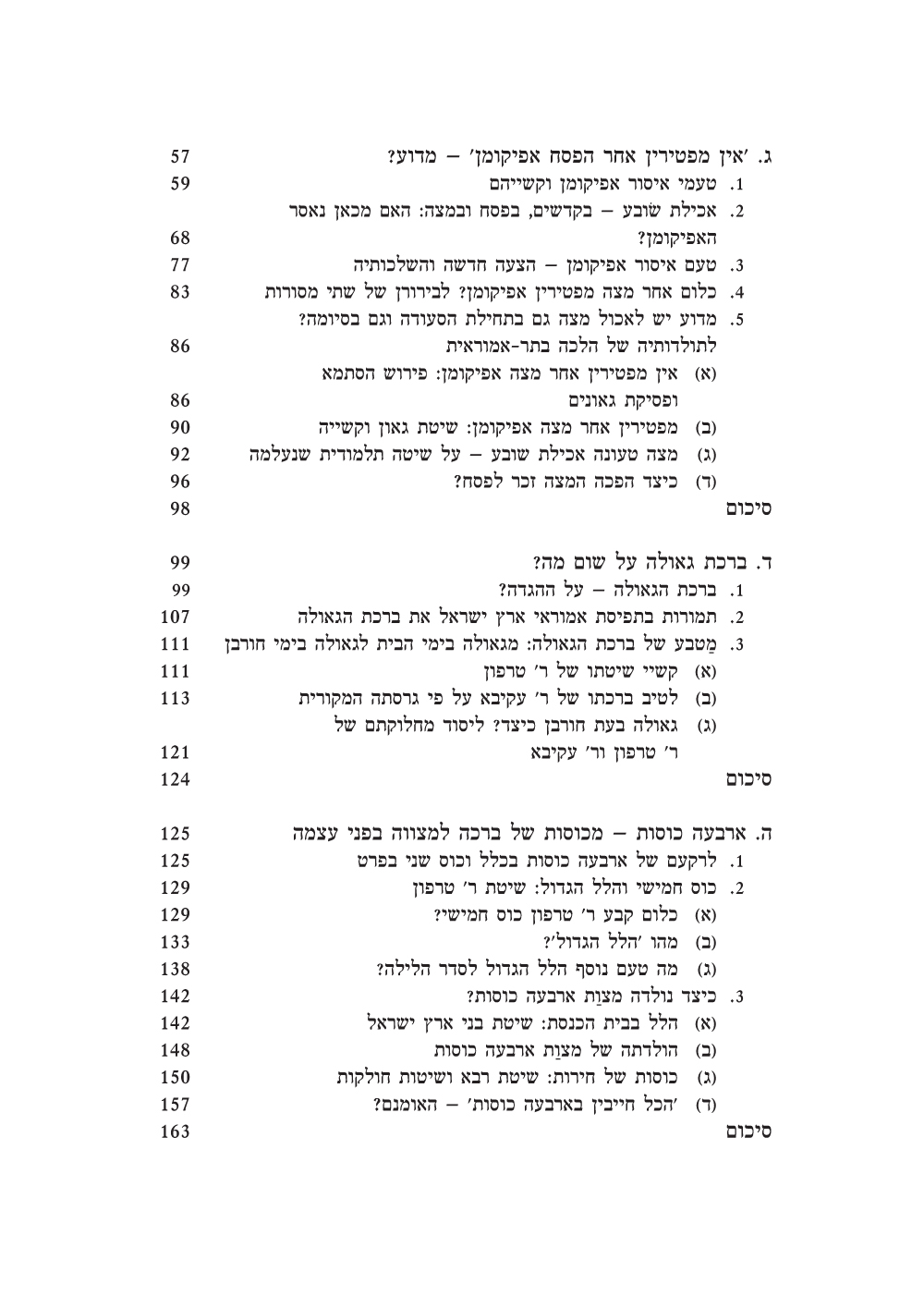
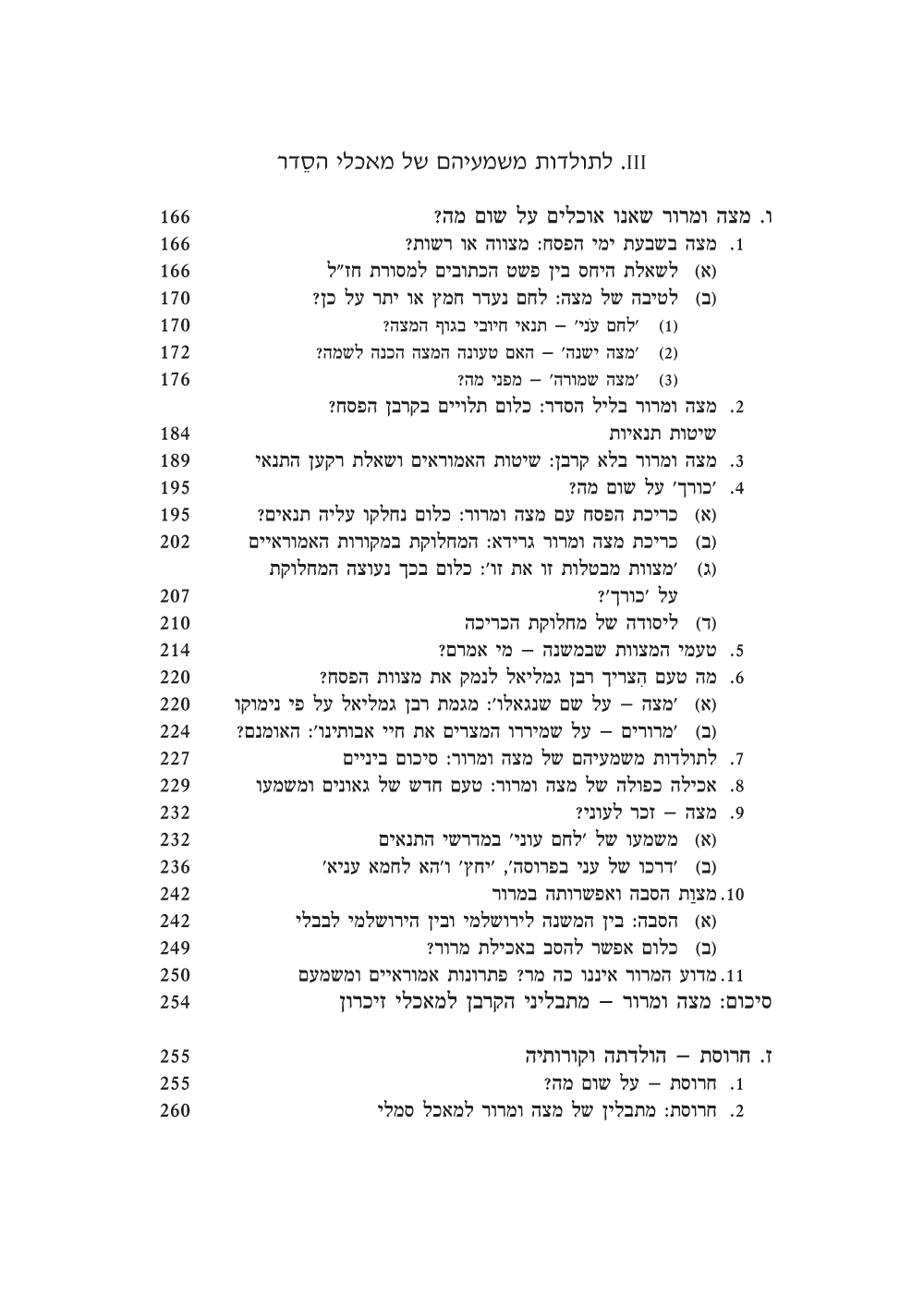
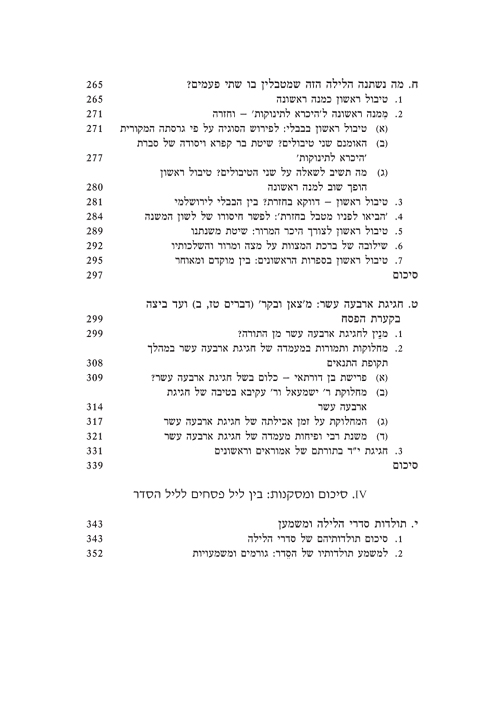
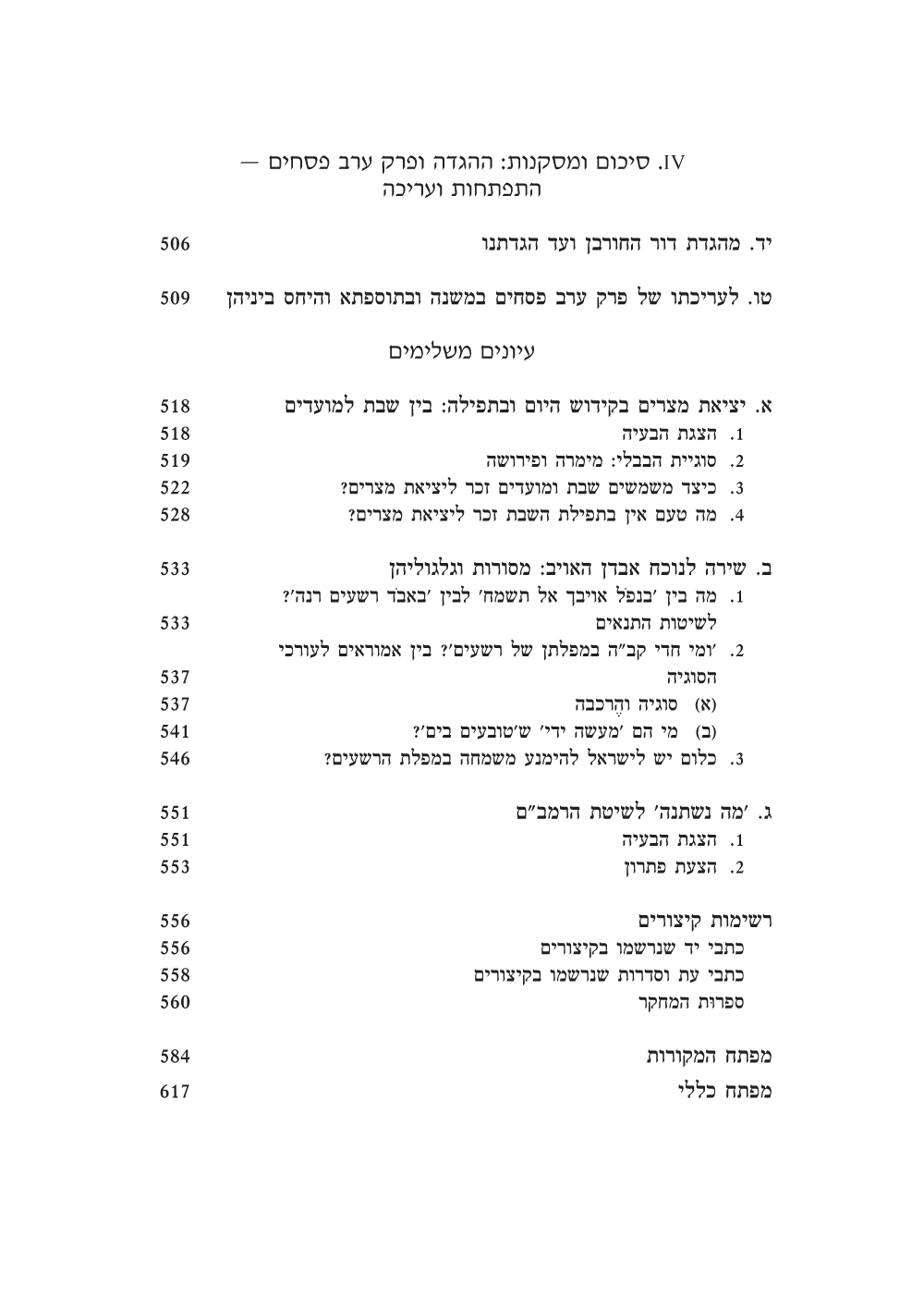
Here are the Table of Contents of this special work.
Simply looking at it gives one sense of some of the issues he deals with.

The book can be purchased via Magnes Press or through me at Eliezerbrodt@gmail.com

Copies of this work will be arriving at Biegeleisen shortly.


[1] הכינוי ‘ליל הסדר’ לליל ט”ו בניסן איננו מחידושי הלשון העברית החדשה, כפי שסבר י’ כנעני, אוצר הלשון העברית,ערך ‘סדר’ (עמ’ 3947), שהרי הוא מתועד כבר אצל מהרי”ל, במפנה המאות י”ד-ט”ו למניינם; ראה מהרי”ל, סדר ההגדה, ח, עמ’ צב. אך ספק אם יש למצאו קודם לכן, והשווה המילון החדש של א’ אבן שושן, ערך ‘ליל’ (עמ’ 812), המייחס את הביטוי לימי הביניים, בלא ציון מקור. הרבה קודם לכן מוצאים אנו את ה’סדר’ גרידא (ראה לדוגמה המקורות שהביא א’ בן יהודה במילונו, ערך ‘סדר’, עמ’ 3971), וכן את ‘סדר ליל פסח’ (ראה למשל ראבי”ה, סי’ תקכד, עמ’ 152). כלום הלעז sederabend הוא פרי תרגום של ‘ליל הסדר’ – או שמא איפכא? בשל המקור המאוחר יחסית של הביטוי ‘ליל הסדר’, נקטנו בכותרת החיבור את הלשון ‘ליל הפסח’. ועל “ליל הפסח” ראה להלן.
[2] ראה: יודלוב, אוצר, שם נרשמו “קרוב לחמש מאות פירושים… ממזרח וממערב, מכל קצות הקשת המחשבתית רבת הגונים והענפים שבעולם האמונה והמחשבה היהודית לדורותיה”, כדברי י”מ תא-שמע בהקדמתו שם, עמ’ ח, והואיל והרישום מגיע שם לשנת תש”ך, הרי כיום יש להוסיף כמובן לא מעט; אך מעֵבר לכך, רשימה זו אינה כוללת אלא את דפוסי ההגדות המלוּות בפירושים, ואילו לביאורי ההגדה שמצאו מקומם בשאר כל הספרות התורנית דומה שאין מספר
[3] ראה, לדוגמה בעלמא, מפתח הספרים שבסוף אוצר מפרשי התלמוד – פסחים, ד: ערבי פסחים, ירושלם תשנ”ד, עמ’ תתסט-תתצח.
[4] ראה למשל פינקלשטיין, א-ב..
[5] ראה למשל מאמרו רב ההשפעה של שטיין, סימפוזיון; על הבעייתיות שבכיווּן זה ראה להלן..
[6] ראה למשל דאובה שצוין להלן…, ובעקבותיו יובל, שני גוים, עמ’ 92; על כך שההנחה שביסוד דברי דאובה אינה מתקיימת, ראה להלן שם בהמשך. רעיונותיו המעניינים של יובל, המתאר את ההגדה כתגובה לנצרות, בעייתיים מבחינת בירור המקורות; ראה על כך עוד, לדוגמה, להלן… בתחום היחס לנצרות מצוי גם חיבורו של ליאונרד, אך הלה מבקש לברר את העניינים גם מתוכם. אלא שאף כאן ניכרת היטב בעייתיות ברקע התלמודי; וראה, לדוגמה, להלן…
[7] רוזנטל, המורה, עמ’ טו
[8] השווה: רוזנטל שם; ספרִי שמחת הרגל, עמ’ 2-1
[9] כבר העירו על ניסוחו של הרמב”ם, בקהיר של המאה הי”ב, לעקרונו של ויליאם איש אוקהם, באנגליה של המאה הי”ד: “אם, למשל, יש ביכולתנו להניח מתכונת אשר על-פיה תהיינה אפשריות התנועות… על-פי שלושה גלגלים, ומתכונת אחרת אשר על-פיה יתאפשר אותו דבר עצמו על-פי ארבעה גלגלים, ראוי לנו לסמוך על המתכונת אשר מספר התנועות בה קטן יותר” (מורה הנבוכים ב, יא, מהד’ שורץ עמ’ 290). ואכמ”ל במקורותיו.
[10] החיבור הנוכחי איננו הראשון שבו מבקש אני לבחון ולהדגים מתודה זו; שני קודמיו (משנה ראשונה; שמחת הרגל) נתמקדו בתורת התנאים..
[11] לחיבורו זה הוסיף תבורי מחקרים נוספים בענייני ליל הסדר, ואלה שנזכרו בחיבורנו רשומים ברשימת ספרות המחקר שבסופו; וראה עוד סיכומו “The Passover Haggadah”, בתוך: S. Safrai et al. (eds.), The Literature of the Sages, II, Assen 2006, pp. 327-338
[12] דיונים בספרות הגאונים והראשונים נערכו כאן כשיש בהם כדי להבהיר את הכיווּנים שהועלו באשר להלכה החז”לית.


The Gematriya Haggadah

The Gematriya Haggadah
By Eli Genauer
I try to buy a new Haggadah every year to make sure I have something new to say. It is especially important at my stage in life when grandchildren will remind you if you use last year’s Dvar Torah.
This year’s Haggadah was definitely in the category of “מה נשתנה ההגדה הזאת מכל ההגדות”. It’s name is ״כוס ישועות״  and it was printed on the Isle of Djerba, Tunisia in 1947. It’s author was Rabbi David Cohen (also known as רבי דוד כהן אלמג׳רבי) who served as the Rav in the southern Tunisian city of Tataouine (תיטאוין). The text of the Haggadah is translated into Judeo-Arabic and the Halachos and instructions are in that language. Thankfully, the Peirush of Rav Cohen is in Hebrew which allowed me access to his approach to the Haggadah.
We find out a bit about Rav Cohen from the Haskamah given at the beginning of the book by six prominent Rabbis of Djerba. It states as follows:
הרב זצ״ל היה כמעט הראשון בהתישבות אחינו בית ישראל שם מראשיתו בתור שוחט ובודק ומרביץ תורה ושליח צבור,ואחר כך נתמנה לרב ומורה צדק שם.
We learn that he was a pioneer in establishing the Jewish community in Tataouine and served in many capacities there before become the Rav of the town. He authored numerous books, some printed while he was alive, and some, like this Hagaddah, printed after his Petirah in 1934.
The Haggadah was printed by a committee (המשתדלים) in Tataouine who raised money for this purpose. There are over 800 names of families or individuals who contributed to its publication. Included in this are over 100 contributors from Tataouine which gives one some idea of the size of the community.
Most of the contributors included with their names the memory of a deceased relative or a blessing for a hoped for milestone for their children. Some of the blessings were familiar to me and others were a bit different.

For a married child: ויפקדהו בבנים זכרים של קיימא אמן abbreviated as ויפקדהו בבזשק״א

This seemed to reflect a cultural preference for boys and perhaps a high rate of infant mortality.

There were no blessings for someone just to have children.

For boys there were two blessings depending on age:

ויזכה לתורה ולתפילין ולחופה and ויזכה לתפילין ולחופה

For unmarried men the hope was ויזכה לחופה 

For those a bit older (?), it was ויזכה לחופה בקרוב
In his Hakdamah, the author explains why he chose to name his Peirush כוס ישועות. He writes that the Gematriya of כוס ישועות is the same as אני הקטן דוד בן המנוח אבאתו כהן. Sort of.  The total of the latter is nine short but if you add to it the nine words כוס ישועות andאני הקטן דוד בן המנוח אבאתו כהן it comes out the same ( 878 ). One senses that the author is very attuned to Gematriyos and his commentary proves this to be true.
A good example of Rav Cohen’s use of Gematriyos is how he plays with the phrase הא לחמא עניא
He first notes that הא לחמא  has the same numerical value as the word מילה (85) indicating that בזכות המילה יצאו ממצרים.

He then writes that the word עניא has the numerical value of ענוה indicating that דבזכות הענוה יצאו
Getting back to הא לחמא which equals 85, he relates it to the word פה which has the same numerical value. Matzah is לחם עוני which requires us to do the following: שׁצריך פה האדם לענות בליל פסח בהלל והודאה לשמו יתברך שעשׂה עמנו ניסים ונפלאו

Finally, if you take the total of the first letters of הא לחמא עניא די אכלו you get 110 which is the number of years that Yosef lived. This hints at the fact that it was because of the sale of Yosef, the Jews suffered in Egypt.
The city of Tataouine is famous in popular culture because it served as the inspiration for the name of the fictional planet of Tatooine in the Star Wars movie series. Many of the scenes of Luke Skywalker’s home planet in the original movie were shot near Tataouine. I was very glad to meet a real inhabitant of Tataouine, one who has enhanced my Seder experience.