From Print to Pixel: Digital Editions of the Talmud Bavli

From Print to Pixel: Digital Editions of the Talmud Bavli

Ezra Brand

Ezra Brand is an independent researcher who resides in Tel Aviv. He has an MA from Revel Graduate School at Yeshiva University in Medieval Jewish History, and has studied in the Talmud Department of Bar-Ilan University. He has contributed a number of times previously to the Seforim Blog (tag), and a selection of his research can be found at his Substack blog. His most recent major work is a “Guide to Online Resources for Scholarly Jewish Study and Research”. He is currently working on an overview of names and naming in early Jewish literature. He can be reached at ezrabrand@gmail.com; any and all feedback is greatly appreciated.

Intro – the tzurat hadaf[1]

It is a surprising fact that despite incredible advancements in technology, the layout of the Talmud has remained the same for centuries. The Bomberg edition from the 16th century, a groundbreaking achievement, still sets the standard. Yoel Finkelman writes in his recent, impressive overview of the layout of the printed Talmudic page:[2] “What is remarkable about the Gemara’s mise-en-page (the term for tzurat ha-daf in the academy) is not its invention, but its staying power as the normative way to produce texts of the Talmud.”[3] Finkelman then delves into the “history of the tzurat ha-daf of the Gemara.”

For an illustration of the lengths to which traditional publishers have gone to preserve the traditional tzurat hadaf, even in the 21st century, see Elli Fischer and Shai Secunda’s 2012 review article of the then-just-released “Artscroll Digital Library Schottenstein Talmud (English) App”, for the iPad:[4]

Since this elucidation is significantly longer than (and, in fact, already includes the actual text of) the Hebrew/Aramaic original, each Vilna page ends up being reproduced two to five times for every English page (a grey bar shows the reader which segment of the Vilna corresponds to the facing elucidation). This decision, both brilliant and perverse, added well over 10,000 pages, bringing the entire series to 73 volumes. The perversity of adding 10,000 apparently superfluous pages is obvious, but the brilliance of the decision was that it always kept the “original” page before the reader.

The digital daf

At the outset, Finkelman (in the above-mentioned article) highlights that the material manifestation of the written word can be broadly attributed to three factors: 1) The technological and material resources that are utilized to create and disseminate texts, 2) The economic and market forces that influence the demand for knowledge and education, and 3) The cultural perceptions of the role and function of language.[5] The ongoing decline in printing costs during the 20th and 21st centuries, coupled with the increasing accessibility of education, have led to significant advancements in all these factors.[6]

The advent of the internet has opened up entirely new avenues for publishing and designing the daf. Furthermore, for the very first time, readers have the opportunity to customize their reading experience, tailoring it to their unique preferences.

One popular author writes:[7]

“After more than a thousand years as the world’s most important form of written record, the book as we know it faces an unknown future. Just as paper superseded parchment, movable type put scribes out of a job, and the codex, or paged book, overtook the papyrus scroll, so computers and electronic books threaten the very existence of the physical book.”

However, one could plausibly say that the claim of the death of books has been greatly exaggerated. Physical books continue to be highly popular, and their sale has only continued to grow. And Orthodox Jews have yet an additional incentive to continue to buy physical books, as they can’t use ebooks on Shabbat and Chag. Regardless, there’s no question that we are in the middle of a decades-long revolution in how we have the ability to consume text, if one so chooses.

Despite the vast technological advancements that have revolutionized publishing, the digital daf is a peculiar return to pre-printing press methods in at least one regard: nowadays, the Talmud can be studied in isolation, without the surrounding commentaries. Most of the layouts that will be examined below diverge from the traditional tzurat hadaf that has been preserved for more than four centuries. In this way, they resemble the medieval Talmudic manuscripts, which include only the Talmud itself (sometimes accompanied by Rashi’s commentary).[8]

Let’s turn our attention to another aspect that Finkelman highlights: the groundbreaking nature of implementing a universal pagination system. Bomberg himself astutely utilized pagination and indexing as a key selling point.[9] Similarly, one of the numerous revolutionary features of digital editions such as Sefaria and Al-HaTorah is the capacity to reference not only the daf and amud, but also the section number. (I’ll explain the specific details of this later in this piece.) One can cite using section number, and hyperlink directly to that section. Every amud has around 10-15 sections, so this narrowing down is considerable. Even without reference to a specific section, checking a reference is far easier in a digital edition: with a simple “control + f”, one can search for a word from the quote. Gone are the frustrating days of scanning a giant wall of text in an amud to find a quote.

What will be discussed in this review

My focus here will be on modern editions that are available open-access digitally, online.[10] Therefore, I won’t review modern print editions.[11] I will also not review digital editions that, in my opinion, are inferior in every way to the editions discussed here.[12] And I won’t discuss editions targeted towards beginner students.[13]

As one of the resources exclusively pertains to Kiddushin (Katz’s Mahberot Menahmiyot), my sample will be from Tractate Kiddushin, specifically Kid. 2b, which solely features the Gemara without the Mishnah. Images will only be of Gemara, Rashi, and Tosafot, meaning that, I will exclude the surrounding glosses (Mesoret HaShas, etc). I will not be discussing supplementary texts and commentaries, and hyperlinks to outside sources that each has.[14] I will be discussing different customization and viewing options.

Another caveat: This piece is focused on layout, and so it will not discuss the textual accuracy of the editions.[15]

An interesting element of modern editions is the typography; specifically the choices of font. However, this will not be discussed here.[16]

Outline

Intro – the tzurat hadaf 1
The digital daf 2
What will be discussed in this review 4
Outline 5
Tzurat hadaf AND customizable 6
Mercava 6
Shitufta 7
Static PDF 9
Mahberot Menahmiyot (=MM) 9
Gemara Sedura HaMeir 10
Talmud HaIgud – Society for the Interpretation of the Talmud (האיגוד לפרשנות התלמוד) 12
Digital, not customizable 14
Wikisource 14
Pirkei Talmud Me’utzavim – R’ Dan Be’eri 15
Talmud Or Meir 18
Dicta 19
Digital and customizable 20
Sefaria 20
Al-Hatorah 22
Speculation on the future 24
Concluding Thought 27

Tzurat hadaf AND customizable

Mercava

At present, Mercava contains only Tractate Berachot. It includes a menu option that enables users to toggle punctuation and nikud. It is also worth noting that Mercava is presently in beta version, as stated explicitly by the page header. Many of the menu options are grayed out or non-functional, resulting in a suboptimal user experience. Often, it seems that two features cannot be employed simultaneously, without any discernible explanation.

Shitufta

Quite basic. It has section splits, which are the same as those of Sefaria and Al-Hatorah.[17] Like them, it enables linking to a specific section. However, it diverges from the section numbering in Sefaria and Al-Hatorah by commencing from 0 instead of 1, resulting in all section numbers in Shitufta being one less from those of Sefaria and Al-Hatorah.

Static PDF

Mahberot Menahmiyot (=MM)[18]

By Prof. Menachem Katz.

Image of Talmud text, from p. 3, line # 7:

MM is a static PDF. It divides every sentence into a separate line, as opposed to splitting into larger blocks of sections. The lines are numbered. It offers complete punctuation, without nikud.[19] MM displays citations for biblical verses, Mishnah, and Tosefta, as well as additional features discussed in the introduction.

Gemara Sedura HaMeir [20]

With punctuation, and split by line.

Talmud HaIgud – Society for the Interpretation of the Talmud (האיגוד לפרשנות התלמוד) [21]

The text is split into lines and numbered, similar to MM. Due to the nature of the work, the primary purpose of the Talmudic text in the Talmud HaIgud is not for its own sake, but to serve as a basis for subsequent commentary.

Digital, not customizable

Wikisource[22]

The crowd-sourced Wikisource is a sister-project of Wikipedia. It is replete with hyperlinks to primary sources, and to external secondary sources. Like MM, the text contains punctuation but not nikud. Instead of using numbered sections (like Sefaria and Al-Hatorah) or lines (like MM), the text is divided into unnumbered paragraphs. Moreover, these paragraphs are longer than those found in Sefaria and Al-Hatorah.

Pirkei Talmud Me’utzavim – R’ Dan Be’eri[23] [24]

Available as downloaded Word docs, from the Da’at website, for a few chapters. I consider this to be not customizable.[25] Has nikud, punctuation, and is split into numbered lines.

Talmud Or Meir

Has nikud, punctuation, and is split into numbered lines. While there are technically some customization options available, they are limited in scope.[26]

Dicta

Dicta has a suite of powerful tools, which combined could make for an incredible studying experience. These include automated tools for nikud and for Biblical sources.[27] Unfortunately, at this time it appears that the only way to view a passage of Talmud is via search results. There, a link is offered to the page in Sefaria. There is a section called Library, with powerful tools for reading rabbinic works, but only 300 works are currently offered there.[28]

Here’s a screenshot, of what appears after searching the first words of Kidushin 2b (“אי נמי שדות בכסף יקנו”), opening the first result, and scrolling to 2b:

Digital and customizable

Sefaria[29]
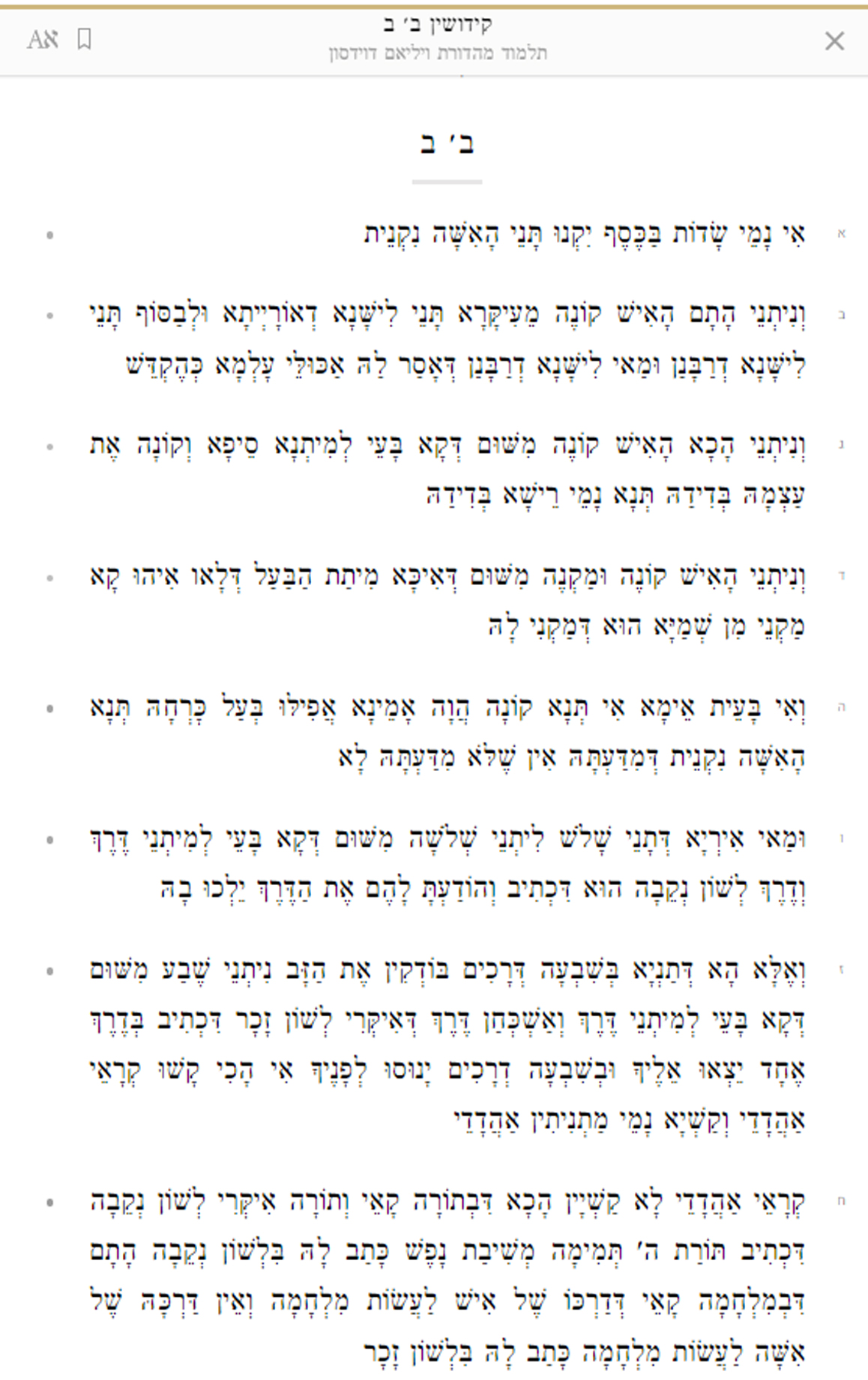
Image of customization options:

Splits into numbered sections. In our example, there are 15 sections. The default Hebrew doesn’t split these into paragraphs, but there is an option to split into paragraphs. Many tractates have nikud, some have punctuation. Our example page doesn’t have punctuation, even though it shows that option. Sefaria gives the option to remove nikud. As mentioned, as with Shitufta and Al-Hatorah, one can hyperlink to a specific section.

Al-Hatorah[30]

The section numbers in circles on the right side of the page are hyperlinked, which is a convenient feature. In the example page we are looking at, there is no nikud, unlike Sefaria. However, there is a period after each section, which provides a slight advantage over Sefaria‘s lack of punctuation, as it helps to break up the passages when viewing with no section breaks.

While Al-Hatorah also includes hyperlinked sections, it does not explicitly label which section is which, unlike Sefaria. Therefore, finding a specific section requires trial and error. As with Shitufta and Sefaria, it is possible to hyperlink to a particular section in Al-Hatorah.

One notable difference is that Al-Hatorah does not expand acronyms, as Sefaria does. For instance, מט is not expanded to מאי טעמא, and אבא is not expanded to איבעית אימא.

Speculation on the future

Secunda and Fischer, in the faraway land of 2012 (cited at the beginning of this piece), envision a future Talmud app:

“First of all, it would be a virtually borderless intertextual web. Talmudic passages that shed light upon one another would be linked in intricate overlapping networks. Passages citing earlier texts—biblical verses, the Mishnah, other rabbinic texts, the apocrypha—would be hyperlinked to the collection in which the cited text originally appears. Passages would also link to later commentaries, super-commentaries, relevant excerpts from legal codes and responsa, manuscript variants, monographs, homiletic interpretations, and, indeed, translations and elucidations. Discussions of Akkadian medicine would call forth images of Babylonian tablets. People, places, historical events, concepts, practices, and all sorts of other realia mentioned in the text would link to relevant explanatory pages, pictures, recordings, and video clips. […] [T]wo new Jewish text websites, themercava.com and sefaria.org, offer promising platforms for crowd-sourced translation, commentary, and discussion of the Bavli and other Jewish texts. […]”[31]

While some aspects of this idealistic vision have been realized, many others have not, at least not yet. Moreover, it remains unclear whether a more crowdsourced and social-media-oriented approach, (suggested in an un-cited part of Secunda and Fischer’s article), would even be desirable. In retrospect, the year 2012 was marked by somewhat utopian thinking, with Wikipedia and Facebook having recently achieved great success in spreading knowledge and connecting people worldwide. It seemed only natural to aspire to something similar in the realm of literature. However, today, with greater awareness of the unpredictable dynamics of such systems (such as misinformation), it is far from clear that such a goal is attainable or even desirable.

In my view, Sefaria, Al-Hatorah, and Dicta are the most promising candidates for realizing the immersive and highly hyperlinked experience envisioned by Fischer and Secunda. Once this is achieved, the resulting research tools are likely to be extremely powerful as well. However, the idea of leveraging comparative sources, as described by the authors, still seems quite far off, particularly with the current set of available tools.

Regarding the social and chavruta aspect discussed by Fischer and Secunda, a new possibility has emerged that was not even envisioned a year ago: an artificial intelligence-powered chavruta. I recently experimented with ChatGPT by providing it with the first paragraph of Kidushin 2b.[32]

As usual, ChatGPT demonstrated impressive coherence and confidence. However, it provided laughably incorrect interpretations. In fact, in some cases, it provided interpretations that were the exact opposite of the correct one.

I conducted a comparable test by inputting a paragraph of Ramban’s commentary on that sugya, requesting an explanation from ChatGPT. To my surprise, ChatGPT provided a reasonably good rephrasing in English. Although some of it was correct and some of it was incorrect, even the incorrect part was not entirely off. However, ChatGPT still requires further yeshiva study before being able to serve as a teacher.[33]

Given the rapid advancements in artificial intelligence and large language models, it appears highly likely that AI will continue to improve its ability to interpret the Talmud, along with all other sources, including digitized manuscripts. It may not be long before we turn to AI to obtain the ultimate p’shat in the Talmud.[34] Furthermore, there is a possibility that AI could eventually bring comparative sources to bear, as previously mentioned.

To update the speculative future envisioned by Fischer and Secunda, my ideal Talmud study experience would be an app with a GPT plug-in acting as a virtual chavruta/Rebbe, to interpret text and answer questions. In fact, something like this is already being tested by Khan Academy.[35]

With current tools, it will even be possible to create a virtual shiur.[36] In the future, it could even be live and interactive, happening in real time.

Another interesting idea that is ripe to be explored is visualization of the Talmudic text. This was put to the test by Yael Jaffe, in a 2015 Columbia dissertation.[37] Jaffe writes in her abstract (bolding is mine):

“This study investigates the effect of access to a visual outline of the text structure of a Talmudic passage on comprehension of that passage. A system for defining the text structure of Talmudic passages was designed by merging and simplifying earlier text structure systems described for Talmudic passages, following principles taken from research on text structure. Comprehension of two passages were compared for students who did traditional reading of a Talmudic passage (the passages had punctuation added, and a list of difficult words and their meanings was appended) (the control condition), and students who read the passage with these same materials as well as with an outline of the text structure of that passage (the experimental condition) […]

The results provide evidence that awareness of the text structure of a Talmudic passage helps readers when the passage is concrete and somewhat well organized. ”[38]

It is interesting to note that Jaffe’s control group had punctuation added. There is, in fact, no good reason why the punctuation should not be added to all the standard Vilna-Romm editions. This is something that I did as a matter of course in my gemaras in my yeshiva days, and I presume that I was not the only one.[39]

Concluding Thought

Will there ever be a single Talmud application to rule them all, similar to how the Bomberg layout remained the standard for 500 years, and continues to do so? Such a scenario is improbable and perhaps even unwanted in today’s rapidly changing and complex digital landscape. It would suggest a lack of progress. We may have to wait for the arrival of the Messiah or, at the very least, the AI singularity to provide the ultimate Talmud super-app.

[1] This piece was written as part of preparation for the workshop “Editions of Classical Jewish Literature in the Digital Era”, to be held at University of Haifa, June 18-20, 2023, at which I’ll be presenting. I want to express my gratitude to Menachem Katz for his efforts in organizing that workshop, and for inviting me to speak there. I’d also like to thank Eliezer Brodt for his helpful comments on an earlier draft of this piece. I would also like to thank my father, my brother, and S. Licht for reviewing, making suggestions, and helping clarify in conversation some of the ideas discussed.
[2] 
Finkelman, ”From Bomberg to the Beit Midrash: A Cultural and Material History of Talmudic Page Layout”, Tradition (Winter 2023), Issue 55.1, p. 14. I’d like to thank Eliezer Brodt for bringing this article to my attention.
[3] Immediately before, he writes (my bolding): “[T]he famous and ubiquitous tzurat ha-daf (page layout) of the Gemara was never exclusively by Talmudists for Talmudists. It was a common practice for producing non-Jewish European glossed texts in manuscript and later print from the high middle-ages though the sixteenth century. Some copyists and later printers of the Gemara—whether those printers were Jews or not—adopted it from contemporary Christian textual production.” This point is also made by Michele Chesner, in her interview on the Seforim Chatter podcast: “With Michelle Chesner discussing old books, Seforim, and more” (April 29, 2020).
[4] “Brave New Bavli: Talmud in the Age of the iPad”, Jewish Review of Books (Fall 2012). Archived here.
[5] Finkelman, pp. 16-17.
[6] Relatedly, I have heard the theory a few times from Prof. Meir Bar-Ilan that the writing down of the Talmud may have occurred due to the spread of the Chinese invention of paper to the West in the early medieval period. For some work on when the Mishnah and Talmud were first written, with previous scholarship cited, see: Yaakov Elman, “Orality and the Redaction of the Babylonian Talmud”, Oral Tradition, 14/1 (1999): 52-99 ; Shamma Friedman, “The Transmission of the Talmud and the Computer Age”, in Sharon Liberman Mintz and Gabriel M. Goldstein, eds., Printing the Talmud: From Bomberg to Schottenstein (2005), pp. 143-154 (esp. pp. 146-148) ;

יעקב זוסמן, “‘תורה שבעל פהפשוטה כמשמעה: כוחו של קוצו של יוד“, מחקרי תלמוד ג, א (תשסה), עמ‘ 209-384 (נדפס שוב כספר ב– 2019) ; נחמן דנציג, “מתלמוד על פה לתלמוד בכתב: על דרך מסירת התלמוד הבבלי ולימודו בימי הביניים“, בראילן ללא (תשסו), עמ‘ 49-112.

[7] Keith Houston, The Book: A Cover-to-Cover Exploration of the Most Powerful Object of Our Time (2016), introduction (available via Amazon Kindle sample). He adds in a footnote: “It is worth introducing “codex” as a technical term: it means specifically a paged book, as opposed to a papyrus scroll, clay tablet, or any of the myriad other forms the book has taken over the millennia.”
[8]
Recently pointed out by Ari Zivotofsky in a Seforim Blog post (“The Longest Masechta is …”, March 31, 2023): “[I]t is worth noting that ambiguity regarding sizes of masechtot only arose when commentaries began to be put on the same page as the text of the gemara. In other words, until the era of the printing press there was no ambiguity as to which masechta was the longest.” See also Finkelman, pp. 18-19 ; Friedman, “Printing”, p. 148. The early Soncino editions also only contained the Gemara and Rashi, see Finkelman, pp. 22-24. And see the recent statement of Yehuda Galinsky (bolding is mine): “The end of the thirteenth century witnessed a discernable growth in the composition of glossed works in Ashkenaz. It was from this time onwards that authors penned influential talmudic and halakhic works from France and Germany with the intention that they be accompanied by a supplementary gloss, which was to be copied alongside the text […] Instead, we find stand-alone commentaries that were copied separately from the text it was interpreting. In contrast to the well-known layout of the printed Talmud page, the writings of Rashi and Tosafot were written and usually copied as stand-alone commentaries and not as actual glosses to be copied on the same page.” (Judah Galinsky, “The Original Layout of the Semak”, Diné Israel, Volume 37 (2023), pp. 1*-26*, pp. 1-2.) A commenter to Zivotofsky’s blogpost pointed out that there is a print edition that contains only the Talmud (with supplementary indexes). It was printed 25 years ago. Here’s bibliographic info according to the National Library of Israel catalog entry:

תלמוד בבלי: כולל כל המשנה והמסכתות הקטנות : נערכו, סודרו והודפסו מחדש בכרך אחד, עם חלוקה לפסקאות, איזכורים מהמקרא, מלווים בשבעה מפתחות בסגנון אנציקלופדי, כולל מפתח ערכים אלפבתי, בעריכת צבי הפרייזלר הרב שמואל הבלין הרב חנוך הבלין (1998).

As an aside, Finkelman states (p. 18) that “The earliest [Talmudic manuscripts] are Geniza fragments from the ninth century”. However, see Friedman, pp. 147-148, that the earliest Talmudic manuscript is a scroll that can be dated to the 7th century.
[9] Finkelman, pp. 25-28. See also the interesting point by Finkelman, p. 41 (based on Jordan Penkower), that Bomberg was also the one to establish the standard method of citation for Tanach in the Jewish world: “In his first Mikraot Gedolot, Bomberg made a significant addition by adding chapter numbers and (in the second edition) verse numbers, features with little Jewish precedent which were based on thirteenth-century Catholic developments.”
[10] See my recent “Guide to Online Resources for Scholarly Jewish Study and Research – 2022”, where I discuss many of the resources discussed in this piece with more breadth. There I also discuss many of the resources excluded from this review for the reasons enumerated further. Bar-Ilan Responsa Project’s Talmud is online, but is not open-access. Bar-Ilan Responsa Project’s Talmud is linked from Yeshiva.org.il’s Talmud pages, top right of page. (See on Yeshiva.org.il in a later footnote.) That version of Bar-Ilan Responsa Project’s Talmud has punctuation, but no nikud, and is not split into sections/paragraphs, and is inferior in every way than the editions discussed here.

For the same reason (not open-access), I have not reviewed any editions on Otzar HaHochma, or other digital libraries which require a subscription.
[11]
Such as Vagshal, Oz VeHadar, Shas Vilna HeChadash, Gemara Sedura. See image here of layout of Gemara Sedura. (See Shimon Steinmetz’s interesting piece here on self-censorship in the Vagshal edition: “Vagshal’s revision of the history of the Vilna Talmud, or, One of the most egregious examples of censorship I have ever seen”.) The best completely static tzurat hadaf edition that I could find available online as open-access is the Moznaim edition, available at Daf-yomi and HebrewBooks. It is a PDF, simply re-typeset. There are also printed editions with punctuation, such as Steinsaltz-Koren; Oz VeHadar; and Tuvia’s. See these news articles from 2016 on Oz VeHadar’s (ongoing?) Talmud edition with nikud and punctuation: here and here. And see the National Library of Israel (=NLI) catalog entry here. See also the NLI catalog entry on Yosef Amar’s 1980 Talmud edition (17 vols.) with nikud based on Yemenite pronunciation, here. And see NLI catalog entries of Koren’s (ongoing?) Talmud edition with nikud and punctuation: Sanhedrin (2014) ; Bava Metzia (2015) ; Sukkah (2016) ; Bava Batra (2017) ; Kidushin (2018).
[12] So I won’t discuss the following: Kodesh.snunit ; Mechon Mamre ; Daf-yomi.com > “Text”. Daf-yomi.com’s “Chavruta commentary” and “tzurat hadaf” are indeed worthwhile. See previous note on Daf-yomi.com’s Moznaim tzurat hadaf edition. The Friedberg Project website Hachi Garsinan technically has a few digital editions of Talmud on their website, but they are all for the purpose of presenting the manuscript variants. So I won’t be reviewing that, since this piece is focused on layout and UX/UI, and in that regard, the edition is sub-par. (Again, this is not necessarily a critique, as this isn’t the point of those editions.) As I say further, in this piece I will not discuss the editions’ textual accuracy. For this reason, I also won’t discuss The Academy of the Hebrew Language’s Ma’agarim edition. Tashma.jewishoffice.co.ils Talmud shows promise, but for now seems to be inferior in every way than the editions discussed here. The website Yeshiva.org.il (פרשני ויקישיבה) has the Chavruta commentary of the Talmud. However, as mentioned, the original PDFs of Chavruta commentary are available on the Daf-yomi.com website, so in my opinion it’s clearly best to use that. There’s no advantage to the text version (except for the ability to copy-paste). Yeshiva.org.il’s Chavruta is fully editable, wiki-style. But I see that as a negative, as you don’t know what you’ll be getting.
[13] Such as Gemara Brura and The People’s Talmud. See more at R’ Josh Waxman’s blogpost, “Some excellent Talmud projects out there” (March 5, 2020).
[14] For example, Sefaria and Al-Hatorah have the Steinsaltz translation and commentary, and Wikisource has extensive links to other resources.
[15] Many of the textual elements of the Vilna-Romm edition have been superseded by better editions (though many are still incomplete). Some examples:

תלמוד: דקדוקי סופרים (השלם); הכי גרסינן

רשי: מהדורות פרופאהרן אהרנד

תוספות ; תוספות ישנים; רבינו חננאל : מהדורות רב קוק

עין משפט: עינים למשפט של ריצחק אריאלי (כל שבעה כרכים זמינים בהיברובוקס, לדוגמא, כאן)

מסורת השס: דקדוקי סופרים השלם; תלמוד האיגוד

ריף: מהדורת שבט

[16] For now, see Yakov Mayer in his recent ground-breaking book on the first edition of Talmud Yerushalmi (which was also printed by Bomberg’s press), who cites previous studies on typefaces used by Bomberg: Yakov Z. Mayer, Editio Princeps: The 1523 Venice Edition of the Palestinian Talmud and the Beginning of Hebrew Printing (2022, Hebrew).

See also the recent book by Simon Garfield, Just My Type: A Book About Fonts (2011 ) for a fascinating, well-written, popular overview of typesetting and fonts. On medieval handwriting styles of Hebrew, see the monumental 3-volume series, under Malachi Beit-Aryeh’s editorship (each area is a different volume):

מפעל הפליאוגראפיה העברית, אסופות כתבים עבריים מימיהביניים (1987-2017)

On second temple era styles, see the various works by Ada Yardeni, especially:

עדה ירדניספר הכתב העברי: תולדות, יסודות, סגנונות, עיצוב (1991).

[17] It is unclear to me who first made these section splits. It’s a question I’d be quite interested in knowing the answer to.
[18] Links to all of parts of MM:

  1. אקדמות למהדורה של התלמוד הבבלימסכת קידושיןמחברות מנחמיות

  2. מסכת קידושין ב עא יד עב

  3. מסכת קידושין יד עבכה עב

  4. מסכת קידושין כה עבכט עא

  5. מסכת קידושין כט עאמא עא

  6. מסכת קידושין מא עאנח עב

  7. מסכת קידושין נח עבסט עא

  8. מסכת קידושין סט עא פב עב

Compare Katz’s similar work on Yerushalmi (which also includes textual variant apparatus, and short commentary, unlike his work on Bavli), available at his Academia.edu site: “פסחן ומצתן של נשים Women on Passover and Matzah”.
[19]
 I personally prefer this style (punctuation, without nikud). See my discussion later.
[20] Tractate Sukka, p. 2 (ב). Not to be confused with Gemara Sedura (no HaMeir). Currently available online: Tractate Sukka (2013, here) and Tractate Avoda Zara (2015, here). See more on the project here.
[21] From the latest volume available online:

נתנאל בעדני, סנהדרין פרק חמישי (תשעב), עמ‘ 4.

See more on the project here.
[22]
See more on the project here.
[23] See also some of R’ Be’eri’s other editions, available on Da’at website, here and here. On R’ Be’eri, see the Hebrew Wikipedia entry on him: דן באריויקיפדיה
[24] Screenshot of downloaded Word document.
[25] To explain: Even though everything in the Word doc can be customized, this isn’t built into the website. Any of the editions in this “Digital” section can be pasted into a Word document and customized.
[26] Notably, the text itself is actually an image, which makes copying it impossible.
[27] Dicta was started by Prof. Moshe Koppel of Bar-Ilan University. He has contributed to Seforim Blog.
[28] As of 15-Apr-23.
[29] See more on the project here.
[30] See more on the project here.
[31] Compare also, at length, Friedman, “Printing”, pp. 150-154 ; Shai Secunda, “Resources for the Critical Study of Rabbinic Literature in the Twenty-First Century” in Compendia Rerum Iudaicarum ad Novum Testamentum (CRINT) 16, Christine Hayes (ed.), (2022), pp. 621-632.
[32] On 15-Apr-23, at https://chat.openai.com/.
[33] I should point out that I did not have access to GPT-4, which is the latest version of GPT. So I could not test whether GPT-4 is more capable at interpreting Talmud. For a discussion of some sources of the Yeshivish dialect of English possibly used as datasets for training ChatGPT-4, see my “From the Shtetl to the Chatbot: Some contemporary sources of Yeshivish content, in light of ChatGPT-4”.
[34] For some preliminary algorithmic research on the Talmud, see, for example, Satlow M., Sperling M. (2017). “Naming Rabbis: A Digital List”; Satlow M., Sperling M. (2020), “The Rabbinic Citation Network”; Satlow M., Sperling M. (2020). “The Rabbinic citation network”, AJS Review ; Zhitomirsky-Geffet M., Prebor G. (2019), “SageBook: toward a cross-generational social network for the Jewish sages’ prosopography”, Digital Scholarship in the Humanities, 34(3), pp. 676–695 ; “A graph database of scholastic relationships in the Babylonian Talmud”, Digital Scholarship in the Humanities, Volume 36, Issue Supplement_2, October 2021, Pages ii277–ii289, https://doi.org/10.1093/llc/fqab015, Published: 22 February 2021. See also Shira Shmidman, “Self-Evident Questions and Their Role in Talmudic Dialectic”, AJS Review (2023), p. 128: “Recently, I analyzed talmudic questions (that open with the phrase baʿei or beʿah minei) and discovered that by charting the questions by the generation in which they were asked, one can identify chronological trends of question asking in the Babylonian Talmud.”
[35] See Sal Khan, “Harnessing GPT-4 so that all students benefit. A nonprofit approach for equal access”, Khan Academy Blog (March 14, 2023). See especially this description: “Khanmigo [=the AI tool] engages students in back-and-forth conversation peppered with questions. It’s like a virtual Socrates, guiding students through their educational journey. Like any great tutor, Khanmigo encourages productive struggle in a supportive and engaging way.” For fun, I asked ChatGPT for a clever name for an AI chavruta/Rebbe. It gave me ten options. One of them is a great one (ChavrutAI), while three of them were hilarious ( AIvrumi; AIsh Torah; RoboRabbi). RoboRabbi could provide many of the intellectual aspects of being a rabbi: psak, eitza, questions in learning, and divrei torah.
[36] With tools like ChatGPT (content), ElevenAI (voice), D-ID (video), one can create any style of shiur. See my “Heimish High-Tech: Video in Yeshivish dialect using Generative artificial intelligence”. For training sources for the Yeshivish dialect, see my article: “From the Shtetl to the Chatbot: Some contemporary sources of Yeshivish content, in light of ChatGPT-4”.
[37] Jaffe, The Relevance of Text Structure Strategy Instruction for Talmud Study: The Effects of Reading a Talmudic Passage with a Road-Map of its Text Structure (2015). See especially ibid. Appendix E (pp. 103-104).
[38] On visualizations, see also this article, and the bibliography cited there:

יעקב אמיד, “עיצוב ייצוגים גרפיים של דיון תלמודי: תחום דעת מתחדש בהכשרת מורים להוראת תלמוד

See also the lengthy intro of Menachem Katz to his Mahberot Menahmiyot (discussed earlier), with relevant bibliography. One good existing resource for outlines and charts for Talmud is Daf Yomi Advancement Forum – Kollel Iyun HaDaf. See Josh Waxman, “Some excellent Talmud projects out there” (cited earlier), #2. A fascinating related project is that of R’ Dr. Michael Avraham on mapping out the logic of the Talmudic sugya, using the tools and notation of modern logic. See his massive series Studies in Talmudic Logic, currently at 15 volumes. Note the surprising claim made in the abstract of vol. 14 of the series (Andrew Schumann, ed., Philosophy and History of Talmudic Logic, bolding is mine): “The Talmud introduces a specific logical hermeneutics, completely different from the Ancient Greek logic. This hermeneutics first appeared within the Babylonian legal tradition established by the Sumerians and Akkadians to interpret the first legal codes in the world and to deduce trial decisions from the codes by logical inference rules. The purpose of this book is (i) to examine the Talmudic hermeneutics from the point of view of its meaning for contemporary philosophy and logic as well as (ii) to evaluate the genesis of Talmudic hermeneutics which began with the Sumerian/Akkadian legal tradition. The logical hermeneutics of the Talmud is a part of the Oral Torah that was well expressed by the Tannaim, the first Judaic commentators of the Bible, for inferring Judaic laws from the Holy Book.”
[39]
My suggestion for breaking the tzurat hadaf into sections: the pilcrow (¶). On the pilcrow, see the entertaining popular book, Shady Characters: The Secret Life of Punctuation, Symbols, and Other Typographical Marks (2013) by Keith Houston, chapter 1. (Available from Amazon for free as a Kindle sample.)

It should be pointed out that trop is an early medieval Hebrew form of punctuating the Biblical text. A few alternatives of punctuating the Torah arose in Geonic times.

On early nikud of Mishnah and Talmud, especially nikud bavli (we use nikud tavrani), see Yeivin:

ישראל ייבין, מסורת הלשון העברית המשתקפת בניקוד הבבלי (תשמה), פרקים בו.

I will point out the following: Tuvia’s edition adds nikud. But once one is past the beginner stage, nikud does little to enhance the reading experience, and in fact many readers find it a distraction. Modern Hebrew rarely uses nikud. Exceptions are for literature geared towards children and beginners (as noted), as well as instances where decoding is especially difficult, such as poetry, transliterated foreign words, and ambiguous words. In contrast, punctuation is a huge boost to faster comprehension, as Jaffe notes. Modern Hebrew texts use standard punctuation, like all modern languages.


More on “New Notes Added in the Koren Talmud”

More on “New Notes Added in the Koren Talmud”

Shalom Z. Berger

In what seems like another lifetime but was just over a year ago, the Jewish world celebrated the 13th Daf Yomi Siyum HaShas. The beginning of the 14th cycle led to a revisiting of the Koren Talmud Bavli that had appeared in print for the first time in concert with the previous cycle. In a Seforim Blog post, Chaim Katz pointed out that the new English edition included some additional notes based on Rav Kook’s Ein Aya, and I responded with a post that offered some background on the efforts put into adding (and, occasionally, subtracting) notes, how it was done and to what purpose.

As I wrote in that earlier post, “Our assumption was that the audience for the new English Talmud would be less familiar with concepts and personalities appearing in the Gemara than Hebrew speakers, so we aimed to make sure that when new concepts or personalities appeared, they would receive a background or personality note.” This was done by creating a database of existing translated notes from the Hebrew Steinsaltz volumes, and inserting them as appropriate.

In a response to my post, Chaim Katz graciously acknowledged the contribution that these additional notes make in the new edition, writing: “But for English speakers that aren’t going to learn the language, or learn Tanach, or Mishna first, the “English” section of your edition is almost perfect. In any case the difficulty for students of the Talmud is not the language; it’s the missing concepts, circumstances, realia and all the other background information that the Koren Edition includes. Ashrekhem and Yasher Kohakhem!”

With that background, I would like to share two examples of additional notes, the first of which appears towards the end of Massekhet Pesahim, which, I hope, makes this a timely contribution. As we are in the midst of the year-long mourning period for Rav Steinsaltz, perhaps this could also serve as a tribute to his memory.

Presenting this on the Seforim Blog will also give me the opportunity to publicly thank individuals who helped me develop the new notes and to acknowledge sources that do not appear in the Koren Talmud Bavli itself. In doing so, I am emulating Rav Steinsaltz in his Gemarot, where, from Massekhet Hagiga until the beginning of Seder Kodashim, there often appears a page at the very end of the volume acknowledging individuals who made contributions to a given volume in various fields. In the first few volumes where this appears, it is a concise paragraph thanking his team of editors, graphics people and those who prepared the indices. Beginning with Massekhet Nedarim, he begins to thank medical doctors who helped him with medical issues in the massekhet (as an example, Prof. Jacob Steinberg of the Einstein Medical School gets a shout-out at the end of Nazir). Baba Kamma has additional thanks to those who helped him with questions of geography, while Sanhedrin mentions by name people who assisted in such areas as climate, botanica, zoology, medicine, geography, Rashi’s use of Old French and more.

Beginning with Massekhet Zevahim these pages ceased to appear, which may be connected with the appointment of senior editors in that volume, as now Rav Steinsaltz is listed as “Editor-in-Chief,” with Yonatan Eliav serving as editor. (I will note that each volume of the Koren Talmud Bavli lists editors, translators, copy editors, language consultants, etc., and the team grew in number as we moved though Shas.) Yonatan Eliav tells me that Rav Steinsaltz was “interested in everything,” that he had a large number of reference works at his disposal that he frequently turned to. It would appear that as time went on and the project became larger and larger – and Rav Steinsaltz became involved in more and more things – that he came to rely on experts in various areas of knowledge for the original Hebrew notes and commentary.

Yonatan Eliav also shared that Rav Steinsaltz was not necessarily interested in making use of the background material in order to explain the Gemara, rather his natural curiosity led him to include edifying information about the topic at hand in the Gemara even if it was not essential to understand the sugya. While I did include some material like that in Massekhet Berakhot, it was no longer a priority for my team as we moved forward. Still, there were a number of occasions when understanding the realia was essential for understanding the Gemara, as exhibited in the two examples below.

Pesahim 75a – Lead from its source

One of the editors, Micky Siev, reached out to me just before Massekhet Pesahim was finalized with the following question: In discussing how the Korban Pesah had to be roasted, the Gemara segues to a discussion about how the punishment of execution by burning was to be conducted. The translated text of the Steinsaltz Gemara originally read:

The Gemara asks: Once there is the reason of Rav Naḥman, why do I need the verbal analogy derived from the sons of Aaron? Even without it, Rav Naḥman’s ruling would require the court to carry out the execution with molten lead, which provides an easier death. They say in answer to this question: If not for the verbal analogy, I would have said that burning the soul while the body remains is not considered burning. And if it were just due to the statement of Rav Naḥman that one must select a kind death, we should add many bundles of branches so that she would die quickly. It therefore teaches us through the verbal analogy that executing with molten lead is considered burning. But if this is so, that the verse says: She shall be burned, to include all methods of burning, for what do I need the expression: In fire? The Gemara answers: To exclude lead from its source; when lead is extracted from the ground it is burning hot and this burning lead cannot be used for executions because its heat does not come from fire.

The original text of the Talmud reads לאפוקי אבר מעיקרו, which is translated here as “To exclude lead from its source.” The underlined sentence at the end is a direct translation of the Hebrew Steinsaltz, which is based on Rashi.

Siev asked me the following question:

The underlined section is the Gemara as explained by Rashi. The question is simply that lead is mined from the ground, and as far as we are aware, is not burning hot when it is extracted from the ground.”

My first reaction was to turn to the Steinsaltz Gemara itself. A parallel sugya appears in Hullin 8a, and the Hebrew Steinsaltz Gemara has a note there that explains how it may be possible for lead that is newly mined to be molten hot, and I suggested translating that note for this sugya, as well. But Siev would have none of that. He insisted that to the best of his knowledge and research, lead is never molten when it is freshly mined.

I am not sure that this question would gain much traction in a traditional bet midrash setting, but it certainly was appropriate to ask in the context of the Steinsaltz effort that puts significant emphasis on questions of realia (in fact, at a family wedding that I attended at the time, a relative who gives shiur at one of the prominent one-year Israel programs and is a serious talmid hakham asked me “what are you learning these days?” I shared this question with him and his reaction was “this is learning?!” But surely, if it appears in the Gemara, תורה היא וללמוד אני צריך).

None of the usual sources offered me anything, so I tried to be creative. I called a neighbor who is a geologist. What I learned was that although both he and his wife studied geology, they studied in Israel, which has no lead deposits, so they could not be of any help. Recognizing that I needed to broaden my search, I posted the question on H-Judaic, a listserv for Jewish studies academics (full disclosure – today, as a measure of hakarat hatov, I serve as one of the volunteer editors at H-Judaic). Within a day Prof. Gerrit Bos, Chair of the Martin-Buber-Institut at Cologne University wrote to me simply “Dan Levene and Beno Rothenberg deal with this problematic issue extensively in their: A Metallurgical Gemara: Metals in the Jewish Sources, London: 2007, pp. 101-107.”

While I could not locate the volume in a search of academic libraries in Israel, the Yeshiva University library had a copy, and my sister, Shulamith Berger, who heads their special collections, had a scan for me in a few hours. All this networking led to the removal of the underlined explanation of “lead from its source,” and its replacement with the following note:

This is an opportunity for me to thank Prof. Bos for the reference, acknowledge that the suggestion appears in the book by Dan Levene and Beno Rothenberg, and thank my sister, Shulamith, for making their work accessible to me.

~~~

Shevuot 23a – Pressed figs from Ke’ila…honey or milk

I mentioned this case in my last post, but would like to come back to it in order, again, to acknowledge the assistance of others in the research I did when developing the note that ultimately appeared in the Koren Talmud Bavli volume.

In this case, I believe that the editor involved was Jonathan Mishkin, who pointed out that the Gemara takes for granted that someone who ate pressed figs from Ke’ila or drank honey or milk could not perform the Temple service because they were likely to be intoxicated.

The Gemara challenges: But perhaps the intoxicating substance referred to in the verse is pressed figs from Ke’ila, as it is taught in a baraita: A priest who ate pressed figs from Ke’ila or drank honey or milk and then entered the Temple and performed the sacrificial rites is liable for violating the prohibition against conducting the Temple service while intoxicated.

The Hebrew Steinsaltz Gemara offers a laconic explanation in a note suggesting that figs from Ke’ila have a high sugar content, which may lead to fermentation, but it says nothing about the other substances that appear to be even more problematic. The page in the Koren Talmud Bavli appears as follows:

The first thing to catch your eye has to be the illustrations – none of which appear in the original Hebrew Steinsaltz Gemara – but there is more. The Background note about the prohibition to enter the Temple when intoxicated is taken from the Steinsaltz Reference Guide to the Talmud, which served as the source for many of the additional notes aimed at giving context to a discussion in the Gemara.

The note on “Pressed figs from Ke’ila…honey or milk” expands on the original Steinsaltz note that figs may ferment. The real challenge is why milk should be considered intoxicating (the story of Yael and Sisera in Judges 4:19 notwithstanding). The two suggestions raised in the note are that milk, too, can ferment and become alcoholic, or that “milk” in this context refers to white date wine, the latter suggestion attributed to Rav Menachem Kasher’s Torah Temimah.

Both of those suggestions, again, came from responses that I received on the H-Judaic list. While the Torah Shelemah is credited with the idea that “milk” may be white date wine (Vol. 28 pp. 273-274 in the milu’im), I would like to acknowledge that I was directed to this source by Prof. Admiel Kosman, who serves as professor of Talmud and Rabbinic Literature at Potsdam University.

After a time, I began to turn to both Bos and Kosman directly with questions like these, as they both proved to be invaluable resources in questions of realia. My public thanks to both.

In closing I would like to reiterate my thanks to Rav Steinsaltz zekher tzaddik li’vrakha and yibadel le’hayyim tovim, Meni Even Yisrael for allowing me to play a role in this project that aims to spread Torah among all Jews. A friend recently sent me a still photo taken from an interview with Amar’e Stoudemire that shows the Koren Talmud Bavi on the shelf behind him. The power of Rav Steinsaltz’ vision to make the library of Sifrei Kodesh available to all Jews who desire to learn is a powerful legacy that is now being fulfilled.

Rabbi Dr. Shalom Berger szberger@gmail.com served as Senior Content Editor for the Koren Talmud Bavli project. He is now involved in developing English language educational programming for Herzog College’s Tanakh department.


New Notes Added in the Koren Talmud Bavli

New Notes Added in the Koren Talmud Bavli
Shalom Z. Berger

I would like to thank Chaim Katz for his close reading of the Koren Talmud Bavli, focusing on the new notes that were added in Tractate Berakhot, which he shared in a recent post on the Seforim Blog. His post offers an opportunity to share some of the background to the changes in the new English edition as compared to the original Steinsaltz Talmud Hebrew edition.

Perhaps the most important thing to clarify is the thinking that went into the decision to produce a new translation of the Talmud in English. What has driven much of Rav Steinsaltz’ publishing is his belief that basic Jewish texts should not be confined to a specific group in the Jewish world. Jewish texts belong to all Jews, and all Jews should be given access to the wisdom of Jewish thinkers and writers. This was the idea behind the original Steinsaltz translation of the Talmud Bavli into modern Hebrew, and it is what led to the decision to develop an English translation that would be based on it. From the current chatter on social media, it appears that the combination of the availability of this English edition of the Talmud Bavli and the publicity given to Daf Yomi study following the recent Siyum HaShas has confirmed the wisdom of this undertaking.

When the team involved in the translation first gathered to discuss what changes – if any – would be made to the English edition, many possibilities were discussed. First and foremost, was the layout itself. It would have been impossible to fit a side-by-side translation next to the tzurat hadaf of the traditional Vilna Shas, yet there was a strong feeling that the tzurat hadaf was essential. Was an interlinear translation important – following the tradition of the Steinsaltz Hebrew (and competing English) translation – or were there other, perhaps even better, ways of presenting a translation that matched the original Aramaic text? Without going into details (perhaps that is for another Seforim blog post), the decision was made to create a volume that could serve as a pedagogic tool, with the original text facing an English translation that highlights the literal translation, while interspersing language that helped with transition and clarification. A separate section had the tzurat hadaf with full punctuation and vowelization for both Gemara and Rashi, and light punctuation for Tosafot. The idea was that someone with little background in Talmud study would start with the translation, following it to learn terminology and cadence, and work their way up to the “Hebrew” side of the Gemara while having the English translation as a reference.

Beyond the standard contents, the Hebrew Steinsaltz Gemara includes a number of additions that appear on virtually every page. The bottom of the page contains iyunim and halakha, while the side bars have girsa’ot, lashon and a number of different categories, e.g., hahayyim, ha’olam, ishim, etc. Another addition that is not nearly as obvious to the reader is the replacement of censored lines, like the addition of כגון ישו הנוצרי (Berakhot 17b). I do not believe that the idea behind these additions was to produce an “academic” edition of the Talmud, rather the point was to make the Talmud as accessible as possible – to introduce the personalities of the participants in the Talmudic discussions, to clarify the realia that often leaves the reader confused by means of maps, charts and images, to show how the discussions on the Talmud page lead to a conclusion in the codes, and so forth.

Many hours were spent deciding which of these to include and whether the English edition required changes or updates. For example, there was talk of adding contemporary responsa to the halakha category (a suggestion that was ultimately rejected). The final decision was to leave out girsa’ot, to update lashon with an advisory group of academic scholars, to review the iyunim, adding new ones or removing old ones as necessary, to update the “personalities” biographies and to combine most of the different additional categories into a single “background” category. Perhaps the most obvious changes apparent to anyone who opens the Koren Talmud Bavli are the image upgrades that appear throughout the different volumes. Far from the simple sketches that appear in the original, the new images are clear, full-color (in the standard edition) representations that make these volumes aesthetically appealing and offer greater clarification of the issue at hand.

When making changes in the notes, it was essential that the Talmud being produced in English remain the “Steinsaltz Gemara” in that the new material would reflect Rav Steinsaltz’ approach to teaching and learning. As such, it was necessary for someone familiar with Rav Steinsaltz’ somewhat eclectic approach to compiling notes in his Gemara to spearhead that effort. I had just finished a multi-year project reviewing Rav Steinslatz’ notes on the entire Shas, producing a daily essay based on his teachings (see here), and I was tasked with heading up the team that was to work on the English notes in the new edition.

Our assumption was that the audience for the new English Talmud would be less familiar with concepts and personalities appearing in the Gemara than Hebrew speakers, so we aimed to make sure that when new concepts or personalities appeared, they would receive a background or personality note.

The most obvious method of adding relevant material was to “borrow” from Rav Steinsaltz’ own work – from other tractates in the Hebrew Talmud Bavli, from his Reference Guide to the Talmud and from his other published works. To assist in this, a database was created of all the notes that appeared in the original Steinsaltz Hebrew Gemara, from which notes could be readily accessed and inserted, as appropriate. Beyond that, decisions would have to be made about where to insert new notes (or change existing ones), and research would need to be done to ensure the quality and consistency of those notes.

The new audience presented other challenges, as well. Translating holy texts is a weighty matter, indeed (see b. Megillah 3a). It is well-known that select quotes from the Talmud have been used as the basis for anti-Semitic screeds since medieval times.[1] Making the Talmud available in English exposes it to an impossibly broad populace, and we believed that it would be necessary to offer background explanations to sections that could be viewed in a negative or questionable light. Heated online discussions that included the Editor-in Chief, Rav Tzvi Hersh Weinreb, other members of the editorial team, and outside experts, led to the creation of new notes that were inserted in the volumes.

What kind of notes would be added? Here are some examples:

– Notes were inserted to offer explanations for Talmudic statements that cast Gentiles in a bad light. Here we repeatedly turned to the well-known Meiri, “who explains that the Sages in the Talmud were referring to pagans whose way of life was completely lacking in ethical or moral constraints, and who for many centuries cruelly persecuted and murdered the Jews. The Meiri claims that by his time in the thirteenth century, all of humanity had adopted the moral and ethical codes of the major monotheistic religions. Therefore, statements like the one in the mishna do not apply to contemporary gentiles.”[2]

– Another example is how to deal with statements in the Gemara that appear to present beliefs that are contradicted by modern science. The following note appears in Sanhedrin 91a:

Akhbar that today is half flesh and half earth: Post-talmudic sages, ranging from Maimonides to Rabbi Samson Raphael Hirsch, have asserted that Talmudic beliefs about the natural world were an outgrowth of the prevailing views of the wider society in Talmudic times. The Sages of the Talmud lived many centuries before the development of modern science and were influenced by contemporaneous scientific theories. Therefore, their notions of the natural world, some with halakhic implication, are at times inconsistent with modern science. In the case of the creature discussed here, the Sages may have heard reports of a creature of this kind, or may even themselves have observed a creature emerging from the earth that superficially appeared to be half-flesh and half-earth. It is apparent that some commentaries (Rashi, Meiri) hold that it is a product of spontaneous generation, a phenomenon that was universally accepted well in the nineteenth century but is rejected by modern science.

On the one hand, this type of note is typical of the Steinsaltz realia background notes that attempt to make the Gemara explicable to contemporary understanding. At the same time, it does depart from the usual approach by recognizing the fact that scientific beliefs appearing in the Talmud may be incorrect.

– We also added notes to explain passages in the Gemara that are hard to understand from the perspective of the natural world. As an example, the Gemara in Shevuot 23a quotes a Baraita that teaches: “A priest who ate pressed figs from Ke’ila or drank honey or milk and then entered the Temple and performed the sacrificial rites is liable for violating the prohibition against conducting the Temple service while intoxicated.” An existing Hebrew language Steinsaltz note suggests that the figs from Ke’ila may have caused intoxication because their high sugar levels could lead to fermentation that produced alcohol. No mention is made about how honey or milk might lead to intoxication. In this case, the new note was based on a suggestion made by Rav Menachem Kasher in his Torah Shelemah,[3] leading to the following:

Milk can also ferment, and in some cultures it is common to drink fermented alcoholic milk beverages known as Kefir. In the Bible there are references to the intoxicating powers of milk (see Judges 4:19). Another possibility is that the word halav here, rather than denoting milk, is referring to white date wine. This usage appears a number of times in rabbinic literature. The Jerusalem Talmud (Shabbat 19:5) discusses halav in the context of teruma, which can consist only of produce. Similarly, the Targum translates the word halav in the Song of Songs (5:1) as referring to white wine (Torah Shelema).

– As noted above, perhaps the most attractive additions were the enhanced images. Accompanying the above-mentioned note were new images of figs, together with a map of Israel showing the location of Ke’ila. On more than one occasion, I received a request from editors asking for suggestions of images that could be added to tractates that were lacking visual enhancements to the text.

Tractate Berakhot, which is what Chaim Katz focused on in his review, posed a problem of a different order. Simply put, Berakhot has a lot of words on each page.4 This led to a situation where the original Hebrew Steinsaltz, which limited to a single amud to a two page spread, had little room for explanatory notes, given that the text of the Gemara, Rashi and the Hebrew translation took up almost all the room on the page. This was especially true on pages of aggada, where the Gemara text took up even more room on the page, so that on pages where Rav Steinsaltz’ commentary would have been especially helpful, there was little to be found. The English translation pages did not have these limitations – indeed, English translation guaranteed that there would be quite a bit of “white space” – and it became necessary to add material that matched Rav Steinsaltz’ writings, which include Jewish philosophy, kabbalah and hassidut. Most of the new notes in the tractate have their roots in this perceived need.

As Chaim Katz writes, many of the new notes are from classical commentaries on the aggadic portions of Gemara. While it is correct that the vast majority of the original Hebrew notes in Berakhot are from classical sources, there are some contemporary scholars referred to in those notes (e.g., 28b, where Rav Isaac HaLevi Herzog is brought alongside Rav Sa’adia Ga’on and others in explaining why Rabban Yohanan ben Zakkai perceived that King Hezekiah was coming to escort him to the next world).

In consultation with Rav Steinsaltz – who was involved in several other projects and was unable to turn his attention to writing a new commentary on these sections of Berakhot – I suggested Rav Kook’s Ein Aya as an approach that would dovetail nicely with Rav Steinsaltz’ own writings and an ideal source for the kind of ideas that would enhance the study of the tractate, both on their own merits and by introducing an important thinker to the English reading public. Previously, the Ein Aya had changed my personal experience when I taught Berakhot, inasmuch as contemporary questions on aggadic portions of the Gemara that go undiscussed by the classic commentaries are given voice by Rav Kook. Studying this work, choosing which pieces would engage the contemporary English reader, and distilling them into concise prose for inclusion in the new volume, was a challenging labor of love. As Chaim Katz notes, the Ein Aya is considerably longer than standard commentaries. Furthermore, Rav Kook’s language is difficult and often obscure. I will leave it to the reader to decide whether I succeeded in capturing and conveying Rav Kook’s ideas accurately in the limited space available.

After almost 20 years of working on various Steinsaltz-related Talmud projects efforts, this is a fitting time for me to express my appreciation to Rav Adin Steinsaltz and to Rav Meni Even-Yisrael for having been given the opportunity to play a role in fulfilling Rav Steinsaltz’ vision of spreading Torah to as wide a spectrum of Jews as possible.

Rabbi Dr. Shalom Berger szberger@gmail.com served as Senior Content Editor for the Koren Talmud Bavli project. He is now involved in developing English language educational programming for Herzog College’s Tanakh department.

[1] Some readers may recall that there was a time not long ago when the only place one could find the Soncino translation of the Talmud online was on a notorious anti-Semitic website, which highlighted sections that were thought to “prove” a variety of accusations against “rabbinic” Jews.
[2] This note appears in Avoda Zara 22a. Inserting the Meiri in cases like this has solid precedent, see b. Bava Kama 113a in the standard Vilna edition.
[3] See Vol. 27 in the supplements (Miluim) pp. 273-274. Rav Kasher opens by expressing surprise that he has never seen this question raised elsewhere.
[4] According to this calculation – https://judaism.stackexchange.com/questions/2672/what-is-the-longest-masechta – significantly more than any other tractate.


Berakhot Koren Talmud Bavli and Ein Aya

Berakhot Koren Talmud Bavli and Ein Aya

by Chaim Katz

Berakhot Koren Talmud Bavli (KE) is a translation (into English) of Rav Adin Even-Yisrael Steinsaltz’s Hebrew edition of tractate Berakhot. It comprises the text of the Talmud, the in-line commentary, the explanation of foreign words, the mini-studies (iyunim), the biographies of selected sages, the description of cultural objects (hahayim), descriptions of fauna and flora and more. As far as I’ve noticed, they never mention in the front matter nor in the advertising blurbs that they added informational notes that don’t appear in the original edition, but there are more than 100 new notes in Berakhot KE.

In this paper, I’d like to present an overview of the new notes, and specifically examine the notes based on Ein Aya [1] – Rav Kook’s commentary to Ein Yaakov. [2]

I had a few questions about the notes based on Ein Ayah:

  1. In the Hebrew edition, Rav Adin created a bibliography of all the sources he used to compile his explanations. The list contains about 100 entries that stretch from Baal Halakhot Gedolot and Sheiltot (8th century) to Rabbi Akiba Eger (died 1837), the Hatam Sofer (died 1839), and  commentaries printed in the Vilna Shas and the Vilna Ein Yaakov, e.g., Maharatz Chajes (died 1855), Rav Samuel Strashun (died 1872), Rav Hanokh Zundel the author of Etz Yosef (died 1867).  Rav Adin did not incorporate any 20th century authors in his commentary. KE made an exception and included Rav Kook. What is the reason?
  2. Ein Aya is not really an explanation of Ein Yaakov. Rav Kook points out in its introduction that his work uses Ein Yaakov as a starting point. However, his goal was to expand the literature of Aggadah and produce a new type of reading material based upon ethical ideas in Jewish philosophy, kabbalah, musar and hassidut. Does KE realize that Ein Aya is not a commentary like the others?
  3.  Ein Aya is very long. A haggadic statement that Maharsha devotes 15 lines of explanation to, is discussed by Rav Kook in about 60 lines (30 lines of double column text). How will KE summarize all that material? [3]

First, I’ll briefly review some of the new notes in KE and then examine a few passages quoted from Ein Aya. The following are new:

1 KE Daf 16b (page 112) has a biography of Rav Safra which is copied from the Hebrew edition Moed Kattan 25a

2 KE Daf 57b (page 371) has a biography of Rabbi Yishmael ben Elisha copied from Gittin 58a

3 KE Daf 64a (page 409) has a note about the Chaldean astrologers, which is copied from the Hebrew Shabbat 156b. 

4 KE Daf 17b (page 115) has a note about Jesus the Nazarene copied from the Hebrew Edition Sotah 47a.

5 KE Daf 9b, (page 59) there is a note about tekhelet, similar but different from the notes in Menahot 38a  .

6 KE Daf 12b, (page 82) has a long note about tzizit – ritual fringes

7 KE Daf 13b, (page 91) there’s a definition of kavanah – intent

8 KE Daf 13b, (page 92) has a diagram of the placement of the tefillin on the arm and hand. 

9 KE Daf 56b, (page 365) has a note describing a lion. 

10 KE Daf 56b, (page 367) has a note describing an elephant. 

11 KE Daf 41a, (page 270) has notes for: radish, olive, wheat, barley, and fig. The following page has a definition of a date. 

12 KE Daf 59a (page 382) has a note about a rainbow.

13 KE Daf 7a, (page 42) has an unattributed explanation based on the words: “When I wanted you did not want . . . “.  The explanation is from Maharsha. 

14 KE Daf 10a, (page 64) has a comment concerning the relationship of the Holy One Blessed is He and the world. This explanation comes from Etz Yosef.

15 KE Daf 11b, (page 74) has an unattributed very long note about abounding love אהבה רבה and eternal love אהבת עולם. The note is taken verbatim from The Long Shorter Way (Chapter 4 – Two Ways of Loving G-d) [4].

16 KE Daf 51a, (page 323) has a clarification of a statement made by the angel Suriel. This is from the Maharsha. 

17 KE Daf 58a, (page 374) has an explanation concerning the statement: “When Samaria was cursed, its neighbors were blessed”. The explanation comes from Anaf Yosef.

18 KE Daf 17a (page 114) There is a short note about the “Divine Presence” (although it’s not the first time that the word שכינה appears in the tractate.)

My sense is that the Steinsaltz Hebrew edition only introduces a note when there is a problem (on the page) that the additional note might solve. KE relaxes this constraint. I’ll illustrate this difference using the first example in the above list. We read in our Gemara:

 After his prayer, Rav Safra would add: “May it be Your will, G-d our G-d, that You make peace among the members of the heavenly court…”

Rav Safra is one of many sages quoted. There is no problem that needs to be solved. The KE has a biography of Rav Safra that ends this way:

Since Rav Safra was an itinerant merchant, he never established his own yeshiva and did not spend much time in the study hall. Therefore, there were those among the Sages who held that he was unlike other Rabbis, that all are required to mourn their passing. 

This is a strange piece of information which doesn’t look like it belongs in a biography. However, the Talmud Moed Kattan 25a, records the following discussion:

When R. Safra died, the students did not rend their clothes for him, since, they said, we have not learned from him. Abaye argued with them: Does the baraita say: ‘When a teacher dies’? Rather it says ‘when a scholar dies’.  Moreover, every day in the study hall we discuss his interpretations of the halakha. 

KE’s biography was copied from Rav Adin’s biography in Moed Katan. 

There are many other examples of notes in KE that were copied from one location to another. They usually don’t fit very well in the destination location. In general, the notes regarding the religious objects add value. The notes describing the obvious (e.g., lion and elephant) are probably included for their esthetics.

Concerning Ein Aya: First, I’ll present the note, my translation and the Hebrew text of Ein Aya side by side and then I’ll discuss the note briefly. 

1 KE Daf 9a (Page 57), Ain Aya Berakhot 1 112 

When the children of Israel were redeemed from Egypt, they were redeemed only in the evening. And when they left, they left only during the day:

There are two separate elements to the transition from slavery to freedom. First, the slave acquires a personal sense of freedom and becomes master of his own fate. Second, he becomes free in the eyes of others, i.e., he is perceived by those surrounding him as a free man and has the potential to influence them. With regard to the children of Israel, the first element enabled them to receive the Torah and elevate themselves with the fulfillment of G-d’s commandments. The second element provided Israel with the opportunity to become a “light unto the nations.” Therefore, the redemption was divided into two stages. The first stage, in which they acquired private, personal freedom, took placed at night; the second stage, which drew the attention of the world to the miracle of the Exodus, took place during the day.

R. Aba said: All agree that when Israel was redeemed from Egypt, they were redeemed specifically during the night, and when they left Egypt, they left specifically during the daytime.

Redemption from slavery to freedom in general has two effects on an entire nation: 1) An inner liberation and exaltedness that it senses when it exchanges the submissiveness of slavery for autonomy and self-determination. 2) A freedom to perform actions that impact the world. 

In Israel these two effects are more pronounced. For the inner freedom is the beginning of their own perfection – developing holy behaviors in Torah, its mitzvot and its wisdom. While the outer public freedom allows Israel to be a light to the nations. A great part of the latter mission has already been accomplished even in our time and will be fully completed when G-d has compassion on His nation. For from Zion will the Torah go forth (Is. 2:3), Even the people in the far-way lands will wait to hear Torah of Israel (Is. 42:4)

Therefore, the redemptions are divided into two parts. When Israel was redeemed from Egypt – the inner redemption – this occurred during the nighttime. For the main point is not publicity or exposure to others, but a strong sense of their inner liberation. When they left, they specifically left during the daytime, publicly and openly for all the nations of the world to see, to demonstrate their worldly mission of instructing, benefiting and illuminating all of mankind with the light of G-d as it is written: Nations will walk in your light, kings in your glorious light. (Is. 60 3)

א”ר אבא הכל מודים כשנגאלו ישראל ממצרים לא נגאלו אלא בערב, וכשיצאו לא יצאו אלא ביום .

הגאולה מעבדות לחירות בכלל, פועלת בכלל עם-שלם שני עניינים. האחד הוא החופש שירגיש בנפשו התרוממות שיצא מכלל שפלות העבדות ונעשה בן חורין ואדון לעצמו. והשני הוא הפעולה הנגלית בעולם, בהיותו עם חפשי חי ופועל.

ובישראל עוד יתר שאת לשני אלה, כי החופש הפנימי הוא התחלה לשלמות עצמם, בקדושת המדות בתורה ומצותי’ וחכמתה. והחופש הגלוי החיצוני, הוא עומד בישראל להיות לאור גויים, כאשר כבר נעשה חלק גדול מזה גם לעת כזאת, ויגמר בתכליתו לעת ירחם ד’ את עמו, כי מציון תורה תצא ולתורת ישראל איים ייחלון.

 ע”כ נחלקו הגאולות לשני חלקים, כשנגאלו ישראל ממצרים הגאולה הפנימית, היינו מבערב, שע”ז אין העיקר הידיעה והפרסום של זולתם, כי אם ההרגשה הטובה בחופשתם הפנימית. וכשיצאו לא יצאו אלא ביום, ביד רמה גלוי לכל יושבי תבל, להורות על פעולתם הגלויה בעולם, להשכיל להיטיב לכל ברואי בצלם להאיר באור ד’, כדבר שנאמר “וְהָלְכוּ גוֹיִם לְאוֹרֵךְ וּמְלָכִים לְנֹגַהּ זַרְחֵךְ

KE skipped the nuance that Rav Kook was speaking about nations and not individuals. It also decided that redemption occurs in two stages, while Rav Kook only said that redemption has two components to it. They stopped short and didn’t capture the emphasis that Rav Kook placed on enlightening the nations (probably with the Noachide laws), but on the whole, it’s a fairly accurate summary.

2 KE Daf 10b, (page 65), Ain Aya Berakhot 1 141

From the chambers [kirot] of his heart – Often prayer is viewed as an act that combines the spiritual and the intellectual. There is a cognitive awareness of the necessity to turn to G-d in our time of need. When there is a pressing need, calling for a higher level of prayer, there can be an authentic call emanating from a person’s very heart, as the Psalmist declares: “My heart and my flesh sing for joy unto the living G-d” (Psalms 84:3) Hezekiah turned his face to the wall and prayed. Why wall? Rabbi Shimon b Lakish said: From the walls of his heart.

There is a prayer that accompanies emotions that are intellectual, when the intellect perceives the value of the necessity of praying and recognizes the great worth of prayer. For the intellect is associated with the spirit of the heart, which resides in the chamber of the heart. 

However, when one fortifies oneself in prayer so much so that the body’s powers are aroused by the feelings generated by prayer, then the prayer affects the body, not just the soul. This is called praying from the walls of the heart. Namely, not just with the spirit, which is in the chamber of the heart, but also with physical vitality as it written: my heart and my flesh sing to the living G-d (Psalms 84:3)

ויסב חזקי’ את פניו אל הקיר ויתפלל. מאי קיר ארשב”ל מקירות לבו

יש תפילה שבאה ברגש שכלי, שהשכל משקיף על ערך הנחיצות להתפלל ומכיר גדולת ערך התפילה. והנה השכל מיוחס לרוח הלב השורה בחלל הלב.

אבל כשמגביר ברחמים עד שגם כוחות הגופניים מתפעלים מרגשי התפילה, ונמצא שהתפילה פועלת על הגוף לא על הנפש לבדה, נקרא שמתפלל מקירות הלב. כלומר לא מהרוח לבדו שהוא בחלל הלב, כ”א גם בהתפעלות בשרית, כמו שכתוב “לבי ובשרי ירננו אל אל חי”.

This is a more difficult piece, particularly because we don’t relate to the view that (one side of) the heart is filled with spirit. We don’t identify with the description of the heart as a source of emotion and we no longer think of intellect affecting the flesh of the heart (but that’s another discussion).

The main problem with KE’s translation, is that Rav Kook is speaking here about the influence that prayer has on the person. He’s not speaking about “a higher level of prayer . . . an authentic call emanating from a person’s very heart”. He’s saying that a person can change himself through prayer.  He can change his thoughts (chamber of the heart) and he can even change his character (walls of the heart). KE’s translation misses all of this. It misses the distinction between walls and chamber, and it misses the connection to the verse from Psalms that Rav Kook cites.

(It’s not the right place now to trace the history of the idea that the person refines and elevates himself through prayer. See maybe Rav Shimshon Raphael Hirsch on Devarim 11:13, or Rabbi Soloveitchik’s Shiurim l’Zecher Aba Mori z”l  volume 2, page 29 and other places there.)

3 KE Daf 63b, (page 408), Ain Aya Berakhot 9 344

Matters of Torah are only retained by one who kills himself over it [5]

While educators often try to make Torah study easier because they believe that doing so will lead students to accumulate more information and Torah knowledge, their approach is fundamentally flawed. The significance of Torah education is qualitative, not quantitative. It is not the sheer volume of knowledge amassed; it is the quality of the Torah wisdom that is attained. Simplistic, facile methods of study do not facilitate deep understanding. That can only be achieved through hard work and serious effort

The school of R. Yannai taught: What is the meaning of (Mishle 30:33) The culturing of milk produces fermented milk (yogurt) …  In whom do you find fermented milk of Torah, in the one who spits out the milk he nursed from his mother.


There are many educators who pride themselves for introducing methods that make learning simpler. They imagine they’ll benefit the world by transmitting lessons and knowledge of Torah in an undemanding way, eliminating the need to for a person to work. 

This assistance is misguided. Knowledge isn’t measured by quantity but by quality, according to depth and perceptiveness that enable the student to apply the knowledge to any situation. More so regarding Torah knowledge, which is measured by the profound impression on the student in his ethical personality, virtuous behavior, and pure fear of Heaven.

Success will come when the studies do not follow an easy and undemanding curriculum. For through exertion and mental effort, a person is elevated to ethical behaviors, and turns with love and longing toward wisdom and holiness. The learning affects him such that he’s entirely dedicated and devoted to his lessons. Learning specifically with great effort produces a deep understanding, clarity in knowledge, and the pleasing way of serving G-d, fearing Him, and purifying one’s character. 

Studies that are acquired easily, without exertion and tremendous struggle will always be superficial, frozen and detached from the person’s inner soul. They will have minimal impact on his behavior and personality. 

Therefore, the fermented milk of Torah, the choice purified portion of Torah, the key aspect, clarified by deep thought and profound understanding that strengthens the soul in the fear G-d, and in the ways of holiness in whom will it be found? Only in one who was raised laboring in Torah and acquired Torah by following the beaten paths of strenuous effort and great toil; who distances himself from his childhood pleasures so that his Torah was not acquired though childish games.  He spits out the sweet milk he nursed from his mother

אמרי דבי ר”י: מאי דכתיב (משלי ל לג): “כי מיץ חלב יוציא חמאה במי אתה מוצא חמאה של תורה? – במי שמקיא חלב שינק משדי אמו עליה”

רבים הם הפדגוגים המתנשאים להביא דרכים להקל את עול הלימוד, וחושבים שיביאו ברכה לעולם בהקנותם את הידיעות והלימודים התורניים באופן קל, שלא יצטרך האדם להיות עמל בהם.

תועלת הדבר אינה אמנם אלא מתעה, כי הידיעות לא תימדדנה על פי כמותם כי אם על פי איכותם, על פי עומק ההבנה וחריפות השימוש בהם לכל חפץ.ביותר לימודי התורה, על פי גודל הרושם שפועלים על הלומד, לענין התכונה של המוסר המעשים הטובים ויראת ה’ הטהורה. 

ובזאת יהיה מועיל רק הלימוד שאינו בא בדרכים קלים ונוחים לקלוט, כי על-ידי היגיעה ועבודה שכלית מתעלה האדם למידות נעלות, ולהיות נוטה אל השכל ואל כל דברי קודש באהבה וחפץ לב, והלימוד פועל עליו להיות כולו נתון ומסור ללימודיו. על-כן יצא מהלמוד שעל-ידי היגיעה דווקא, עומק ההבנה והידיעה הברורה עם הפעולה הרצויה לעבודת ה’ ויראתו וכל טהרת המדות. 

אבל הלימודים הנכנסים באופן קל, בלא יגיעה ועבודה כבירה, ישארו לעולם שטחיים וקפויים, עומדים מחוץ לנפשו של אדם הפנימית, ופועלים מעט על מעשיו ועל יצרי לבבו.

ע”כ חמאה של תורה, הברור והמובחר שבה, העיקרי, המחוור בעומק רעיון ושום שכל והמרבה אומץ הנפש ביראת ה’ ודרכי קודש במי תמצא? רק במי שנתגדל על עבודת התורה בעמל, וקנה אותה בדרכים כבושים שע”י יגיעה ועבודה רבה, שעמדו לו להתרחק מן הילדות וכל געגועיה, לבלתי קנותם בדרך שעשועי ילדים, כ”א מקיא חלב שינק משדי אמו עליה

KE, missed the point here as well. Rav Kook isn’t speaking about education or Torah education. It’s not about “deep understanding that can only be achieved through hard work and serious effort” 

He’s speaking about love of G-d. The fermented milk of Torah represents the Torah studies that, under the proper conditions, lead the person to the love of G-d. Knowledge isn’t sufficient; one must labor and exert himself in these Torah studies and only then will they succeed in leading him to holiness.  

(The basis of Rav Kook’s idea might be in the Sifre Devarim (on Deut. 6 6) quoted by Maimonides Book of Commandments, Positive #3, “You shall love G-d your G-d with all your heart’, can I know how to love G-d? The Torah therefore says: These words which I command you today shall be upon your heart. Thus, you will come to recognize the One who spoke and the world was created and you’ll cling to His ways.)

4 KE Daf 10a, (page 62), Ain Aya Berakhot 1 128  

David… resided in five worlds and said a song of praise corresponding to each of them:

There is a tremendous difference between looking upon an experience in a superficial manner and reflecting upon it and contemplating it. An individual who merely sees the external will not come to understand the deeper, spiritual significance of a given experience or encounter. Natural events like pregnancy, birth and nursing may seem to be mundane events experienced by humans and animals alike. However, one with a higher level of spiritual discernment will appreciate the vast difference between man and animal. King David’s songs of praise, uttered at every stage of life, attest to the magnitude of his sensitivity to G-d’s beneficence and to his appreciation of His role in the world.

He lived inside his mother’s womb and offered songs of thanksgiving; he went out into the air of the world…

One who looks at the real world superficially cannot recognize the grandeur and beauty of the majesty of G-d nor the splendour of the human soul, as his perception of the real world is based exclusively on obvious visible traces of wisdom. In the words of the Duties of the Heart, (Hovot HaLevavot by Bahya ibn Pakuda Spain 11th century): based on the obvious visible traces of wisdom in the real world, both the intelligent man and the fool are equivalent. 

On the other hand, the truly gifted person will find hidden insights in the very things that didn’t inspire or elevate the person who looks at the world superficially. The truly gifted person will recognize the line of kindness that extends through all creations from their beginnings to their ultimate purpose. He will appreciate G-d’s wonders and thank Him. With happiness he will sing for G-d and for His goodness. He will recognize the majesty of his own soul that perceives the grandeur of the glorious King. Therefore, David (peace to him), who combined in himself depth of knowledge with sweet Divine song, sang about things that are discerned only with wisdom and deep contemplation. 

He lived inside his mother’s womb…  

Seemingly, there is no reason to be amazed. The experience is similar for a human or any other animal that doesn’t speak. In the womb, the human embryo is just like an amphibian or a lizard, the lowest rungs in the animal hierarchy.

 But when he reflects deeply, that in this lowly state all organs and limbs, which will serve the loftiest powers of the soul, are being completed. Not one is missing. If so, how great is the work taking place in the womb for the design of a person. Then, being so far from perfection, all the material and spiritual abilities he will later need are developing so that he’ll develop into a refined ethical person, who embraces in his brain and mind, the foundations of the world and its infinite expanses.

דר במעי אמו ואמר שירה, יצא לאויר העולם  . . . 

הבדל יש בין המסתכל רק בהשקפה שטחית על המציאות, הוא לא יוכל להכיר רוממות ה’ והדר גאונו ועם זה הוד נפש האדם, רק מהדברים הגלויים בסימני החכמה שבמציאות. כדברי חוה”ל, שבסימני החכמה הגלויים המשכיל והכסיל שוין בהם. 

אבל החכם האמיתי, הוא יחדור אל סימני החכמה הצפונים, שלעין הרואה רק חיצוניות הדברים לא יולד מהנה שום רוממות נפש. אבל החכם האמיתי, יכיר החוט של חסד ההולך בכל המעשים כולם מהתחלתם עד מטרתם, ויכיר נפלאות השם ית’ ויודה לשמו. ומטוב לב ישיר על ד’ ועל טובו, ויכיר הוד נפשו המכרת את הדרת מלך הכבוד. ע”כ דוד ע”ה שבו חובר עומק הדעת עם נועם השירה האלהית, אמר שירה על הדברים שרק בחכמה והשקפה רבה יוכר הודם ופלאם.

 דר במעי אמו, לפי החיצוניות אין להפליא כ”כ, מקרה האדם בזה כמו שאר החיים הבלתי מדברים, אז הוא במדרגת השרצים ג”כ שהם במדרגה הנמוכה של מערכת החי. 

אבל כשהתבונן, כי בהיותו במצב הנמוך הזה אז נגמרו ונוצרו כל יצוריו כולם, וכל האיברים המשמשים לכוחות הנפש היותר נשגבות אחד מהם לא נעדר. א”כ מה רבה התכונה הנעשה בבטן המלאה ביצירת האדם, שאז במצב רחוק משלמות והתפתחות כזה, צריכים שיוכנו לו כל הכוחות וכל הכלים הרוחניים והגשמיים שיצטרכו לו בהיותו אדם המעלה, המחבק זרועות עולם ומרחבי אין קץ בדעו ושכלו.

Here too, I think, KE missed the point. It’s not about “the vast difference between man and animal”, which Rav Kook never mentioned. Rav Kook picks the theory of recapitulation to explain David’s song. According to the theory (which was immensely popular in the second half of the 19th century), the stages of embryonic development correspond to adult stages in the evolution of the species (ontogeny recapitulates phylogeny). That’s why Rav Kook writes: the human embryo is then like an amphibian.  But the theory is based on superficial similarities. The truly wise man looks beyond the superficiality and sees that each embryonic phase is not an evolutionary ancestor, but a point on a line extending from the person’s beginning to his birth. Each point on the line contains a hidden potential that will unfold and finally develop into a moral and ethical man. The insight (probably disproves the theory and) results in a greater appreciation of the Creator’s kindness, which is the song of praise that David sings.

We can now come back and answer the three questions that I posed earlier. 1) KE is not looking at Ein Aya as a typical commentary; that’s why they had no problem including Rav Kook’s words in the Berakhot volume.  Additionally, I guess, the writers or editors have an admiration and affinity for Rav Kook and wanted to include some writings of his. 2) KE knows that in quoting a section from Ein Aya they are not explaining the text of the Talmud. Instead, they are attempting to follow the path of Ein Aya; to add thoughts and reading material of an ethical nature to KE. 3) It looks (at least in these few examples) that KE translated only the first few sentences of the Ein Aya section and then wrote up their own conclusions. They probably didn’t read to the end of the Ein Aya section(?), or if they did, they decided to “keep it simple”. I guess this can be excused too. In one of these notes they did write “see Ein Aya” instead of just attributing the section to Ein Aya.

Maybe the new notes in KE Berakhot aren’t of the same calibre as the original notes in the Hebrew edition. Still, they make the learning more interesting and more attractive. For this we should be thankful.

[1] Ein Aya is a work by Rav Kook on the Aggadah in Ein Yaakov, published by Makhon HaRav Tzvi Yehuda, Jerusalem. It consists of 4 volumes covering Berakhot and most of Shabbat. Though it was written over 100 years ago it was only published recently (approximately between 1995 and 2005). The text is also available at https://he.wikisource.org/wiki/
[2] Ein Yaakov is a collection of aggada from the Talmud Babli, by Rabbi Yaakov Ibn Habib (died 1516)
[3] I’m using as my example: Daf 3a “Rabbi Eliezer said: The night consists of three watches… during the first watch a donkey brays, during the second the dogs howl, during the third the infant nurses from its mother and a wife speaks with her husband”
[4] The Long Shorter Way, Discourses on Chasidic Thought, by Adin Even-Israel Steinsaltz, edited and translated by Yehuda Hanegbi, Koren/Maggid Publishers. Based on a series of lectures delivered by Rabbi Adin Even-Israel Steinsaltz on Rabbi Schneur Zalman of Liadi’s classic Chasidic work, the Tanya.
[5] There is a printing mistake here. They mixed up the passage’s key words (דיבור המתחיל) with another comment.  I’m not sure if this mistake affected the subsequent translation. 


A Preliminary Review of The New Koren Talmud Bavli: A Goldilocks edition

A Preliminary Review of  The New Koren Talmud Bavli:  A Goldilocks edition
by Jeremy Brown

Jeremy Brown lives outside of Washington DC. He is the author of New Heavens and a New Earth: The Jewish Reception of Copernican Thought, to be published later this year by Oxford University Press.

We are only weeks away from finishing the seven-year cycle of Daf Yomi.  Right on cue, publishers are ready to meet the demand of those ready to study Daf Yomi the first time as the cycle begins anew, or perhaps students who wish to learn Talmud at a slower pace.  We are promised Daf Yomi apps (“apps” did not exist seven years ago) and the publication in English of a new translation and commentary on the Talmud: the Koren Talmud Bavli, with a commentary by Rabbi Adin Even-Israel, better known as Adin Steinsaltz.  The team is led by Rabbis Tzvi Hersh Weinreb (formally executive Vice President of the OU) and Joshua Schreier (formally at Midreshet Lindenbaum) both of whom have stellar reputations, and the project will eventually comprise the entire Talmud Bavli in 41 volumes.  The regular price of each volume will be $49.95, but Amazon is advertising Berakhot at a significantly discounted rate of $29.54.  If these prices are maintained, the entire English Steinsaltz could be purchased for about $1,200; by comparison the entire (full size) ArtScroll English Talmud in 73 volumes, costs about $2,450  – twice as much.   Inevitably, comparisons will be drawn to both the older translation by Isidore Epstein and much more recent ArtScroll English translations, and even a cursory glance reveals striking differences between the productions. (To keep things simple, we will refer to the Koren edition as the “Steinsaltz” Talmud; the ArtScroll Schottenstein edition will be called the “ArtScroll” edition; and the translation by Isidore Epstein will be called the “Soncino” edition.)  
First, there are significant production differences. While the ArtScroll production team included several women proofreaders, the Steinsaltz team includes women as translators as well as language consultants.  This change does not guarantee a better product of course, and the outcome must be judged on the basis of its merits alone. However this approach demonstrates a commitment to a refreshing worldview in Jewish publications in which outstanding scholars are no longer barred from contributing simply because they do not carry a Y chromosome. With the repugnant attempts to marginalize women occurring in some fundamentalist sectors of Jewish society today, the Steinsaltz Talmud reminds us that Talmudic scholarship and teaching are no longer male dominated spheres. It is a message needs to be heard in Jerusalem and in Brooklyn.
Another difference also points to a subtle but palpable embracing of the modern: the approach to transliteration. The Steinsaltz team has adopted a transliteration schema that generally reflects the Academy. Thus the letter ח is transliterated as H with a dot under the letter, a כ is  kh, and ת is t. ArtScroll published Berachos, Steinsaltz published Berakhot. Again, such differences do not guarantee a better product, but imply that the Steinsaltz Talmud has an approach that might include lessons from the academy and modern scholarship. Finally, the designers have added a magnificent full color cover to the book, which is both eye-catching but utterly impractical if the volume is to be carried every day since the translucent paper easily scars.  Still, there is a simple solution to this. Just remove the cover while learning from the Talmud. If you do this you will notice the warm red tone of the volume, which is remarkably similar to many editions of the standard Hebrew only ש”ס today. Was this a clever way to disguise the book for those who feel the need to do so? 
Haskamot
Interestingly the Steinsaltz Talmud includes five haskamot from rabbis who died recently or long ago. Two are from R. Moshe Feinstein dated from 1970 and 1983.   An even earlier haskamah from R. Menachem Schneerson, the late Lubavitcher Rebbe, dates from 1969, or some 43 years before the publication of the English edition. There is an undated haskamah from R. Moshe Zevi Neriah who died in 1995, and the final haskamah is from R. Mordechai Eliyahu, who served as the Sephardi Chief Rabbi of Israel and died in 2010.  Quite what these haskamot are doing here is not clear; do such things persuade the reader to that the work is indeed appropriate, or do they serve instead as a kind of spiritual shield, meant to deflect any criticism of the project? The five haskamot printed in the Steinsaltz Talmud are all translated, so perhaps the target audience is indeed the reader who is not fluent in Hebrew, although I doubt there is much persuasive power in the haskamah as a book blurb. In comparison, ArtScroll printed twelve signed haskamot, but translated none of them. (Essay question: Compare and contrast the haskamot of the Steinsaltz and ArtScroll editions of the Talmud.)
Introduction
The Steinsaltz Talmud contains an introduction to Masekhet Berakhot which is more or less a translation of the original Hebrew, but generally improves on it.  Here perhaps the editors faced an important question: should this opening volume of 
ש”ס contain introductory essays about the place of the Talmud in Jewish thought and history, its development and why it must remain a meaningful foundation of Jewish identity? Or should the reader instead be thrown headfirst into the project, learning what Talmud is by, well, learning Talmud. In fact such a guide already exists, written by Steinsaltz and published by Random House in the 1989 English language Reference Guide. This work will soon be reprinted in a re-edited book as part of the larger Steinsaltz English Talmud set.  Such a guide will help many of those taking their first steps along the path of Talmud study. 
The introduction that is provided is both inspiring and welcoming, as the following will demonstrate.  Consider for example, the ArtScroll Talmud, which (after some 37 pages listing the sponsors) opens its introduction to Berachos in this way: 

Berachos [“Blessings”] as its name implies, deals primarily with the assorted blessings that are recited at various times and occasions. In essence a ברכה, blessing…is an acknowledgment of God as the Creator of the phenomenon beheld, the Commander of the mitzvah performed or the Provider of the benefit enjoyed.

Here in comparison is the Steinsaltz introduction: “Tractate Berakhot is the first tractate in the order of “Faith.” The primary focus of the tractate is the myriad ways in which a Jewish person expresses faith throughout his life.” There is a certain grandeur here that is captured, a certain look at the big picture that lies behind the detailed halakhic discourse.  This theme is echoed later in the introduction when the reader wonders just how the detailed halakhic path can lead to greater appreciation of the divine.  

Furthermore, faith, despite its broad scope, is not a palpable presence, in one’s daily life. True, faith as Weltenschauung and as a general approach exists, in one form or another in the hearts of all people, at different levels of consciousness and acceptance.  However, the difference between that faith and real life is too significant. There is no comparison between accepting the fundamental tenets of faith in one’s heart and fulfilling them in practice, especially at all of those minor, uninspiring opportunities that constitute a majority of one’s life.  If the abstract concepts of faith are not manifest in a practical manner in all of the details of a person’s life, faith will loose its substance; consequently all of life’s details will be rendered worthless and pointless.  Indeed the fundamental demand of religion is well characterized in the phrase “if you devote your heart and your eyes to Me, I know that you are mine.”

This introduction addresses one of our great challenges, and yet it is rarely acknowledged. Every day life is often, well, just ordinary everyday life.  Although we may, at times, be keenly aware that life is a gift that cannot be taken for granted, in truth, there are many “minor and uninspiring” moments, and these do indeed constitute the majority of life. Yes, there is indeed chasm that separates faith and real life, and the introductory essay addresses this existential reality head on. 
Content
The layout of the Talmud is a radical departure from that of the Vilna 
ש”ס  and follows the earlier decision of Steinsaltz when his Hebrew translation and commentary no longer stuck to the Vilna format.  In that version each single amud was split into two pages, whereas in this English edition there is no allotted page format, and hence no automatic rubric that ties the page of the English translation with that of the Vilna 
ש”ס . For the ArtScroll translation the need to retain the look and feel of the Vilna 
ש”ס  was a guiding editorial principle that resulted in the same Hebrew page being reproduced several times in order to accommodate the English translation alongside.  The editors of the Steinsaltz Talmud made the wise decision that assumed their reader would be comfortable reading a page of Talmud in a form that no-longer resembled the standard page of Talmud, and the decision works.  Should the reader wish to refer to the page of the Vilna 
ש”ס , the entire masekhet is reproduced at the back (or front depending on your orientation) of the volume but with the addition of vowels. The result is that Masekhet Berakhot is in one volume, unlike the ArtScroll edition in which the Berachos is spread over two.  
Despite this break with traditional formatting, the Steinsaltz page maintains a Talmudic feel with its central text in Hebrew to the left of the English translation, surrounded by notes, just as in the Vilna 
ש”ס  there is a central Talmudic text surrounded on three sides by later commentaries.  In the original Hebrew Steinsaltz edition the various comments were largely to be found at the bottom of the page, whereas in the English edition they are where Rashi and Tosafot are usually to be found.  The result is a central ancient text surrounded by later comments – which is very Talmudic indeed.
The actual text is a pleasure to read, using Koren’s by now very familiar fonts.  Phrases in Hebrew are widely separated from each other, and the English translations are also printed in a paragraph style, rather than as a running text, which was generally how it appears in the ArtScroll.  The Steinsaltz presentation is, as a result, a greater pleasure to read and the Talmudic arguments are easier to follow than the page presented in either the traditional Vilna format or as translated in the ArtScroll or Soncino editions.  Small notes direct the reader of the English text to notes found at the borders of the page.  Like the original Hebrew Steinsaltz, these comprise of Notes on the Talmudic discussion, Background on material, Halakha (which references the Shulhan Arukh and Rambam), Language and Personalities.  These notes are supplemented with high quality color illustrations (although only in black and white in the Steinsaltz Daf Yomi edition). The illustrations are generally a superb addition and aid.  In a discussion of ritual impurity (36b), the illustration of the crown of the pomegranate is critical to understanding the text. Similarly the illustration of the issar (28b), a small coin, helps the reader understand the discussion. However the text states an opinion that one must bend down during the Amidah “until he can see an issar [on the ground]” so here the discussion might have been better illustrated with a reproduction of the actual size of the coin since this is most germane to the issue.  Some illustrations are vital – like that of a katedra or chair from the Talmudic era (43a) which was significantly different from the modern chair, and Talmudic era burial cave (14b). Others seem rather unnecessary; does the modern reader really need a color picture of a lion (56b) or elephant (57a)? And there are some errors too: Ursa Major is not “the largest a star in Taurus” (59a). Indeed it is not a star at all, but rather a constellation. Nor is it “the eye of the ox;” that would be Aldebaran. Elsewhere we correctly learn that polycythemia vera is one of the only conditions for which bloodletting remains an effective therapy. This is true, but the description of the disease causing excessive bleeding from the gums and from ordinary cuts is not; that would be hemophilia. (There is a subgroup of patients with PV who have thrombocytosis and dysfunctional platelets in whom bleeding can occur, but this is an obscure detail).   Perhaps, to complement the impressive group of translators and language consultants, the publisher should add a scientific consultant. These (relatively) minor quibbles aside, the notes provide important clarifications and points of interest which change the often dry Talmudic texts into accessible and even enjoyable reading material.
The censored text
The publisher’s preface to the Steinsaltz Talmud notes that the standard “Vilna edition was read against other manuscripts and older print editions, so that texts which have been removed by non-Jewish censors have been restored to their rightful place.” This is evident with the inclusion of a censored text on 17b in which the censored Vilna (and ArtScroll) text reads  שלא יהא לנו בן או תלמיד שמקדיח תבשילו ברבים  .  The original uncensored text identified the student who caused others to sin by name:שלא יהא לנו בן או תלמיד שמקדיח תבשילו ברבים כגון ישו הנצרי.  No mention of the censored text is mentioned in the ArtScroll Talmud, which instead directs the reader to the Ritva “for a specific reference.” The Ritva indeed mentions the reference to Jesus, but why did ArtScroll decline to amend the censored text? Of what precisely, were they afraid?  
This is not an isolated example. The text of the Talmud is also censored on 3a.  The original uncensored text reads  אוי לי שהחרבתי את ביתי ושרפתי את היכלי והגליתים לבין אומות העולם
However the Hebrew text of the English ArtScroll (and the Soncino) reads as follows:
אוי לבנים שבעונותיהם החרבתי את ביתי ושרפתי את היכלי והגליתים לבין אומות העולם
The additional words  לבנים שבעונותיהם  were added by Christian censors and the corrupted text was noted in Dikdukei Soferim. None of was evident to the editors of the English ArtScroll, who compounded the error by adding the following homiletic note to the corrupted text.
In its effort to comment on (nearly) everything, the ArtScroll edition has added a homiletic explanation of a text written (almost certainly) by a Jewish apostate serving as Christian censor. Fortunately, the Hebrew and English editions of the Steinsaltz, together with the Hebrew Schottenstein (ArtScroll) have returned the text to its original and uncensored form.  
While the number of such censored Talmudic texts is not especially large, the modern reader should expect no less than the most accurate text of the Talmud, and the editors of the Steinsaltz Talmud seem to have been sensitive to this need.
Side by side comparisons
The real test of the new Steinsaltz Talmud is how it feels to use it, and how that experience compares to the older ArtScroll and much older Soncino translations.  What follows is a comparison of a section of text chosen at random. The comments are preliminary; an in-depth comparison of the three editions would require far more space than this review allows. First the Talmud itself, from ברכות ז:
Here is the Soncino translation togther with the foonotes, (which are not found on the same page in the orginal):
Next, the ArtScroll:
And finally the Steinsaltz with the Notes as they appear on the printed page:
In elucidating the meanings of this passage, the Soncino provides the minimalist approach, which consists of a translation of the biblical verse as it is cited in the Talmud, together with a translation of the comments of R. Yohanan and Resh Lakish.  The English text is understandable, but only with some effort. (What exactly are “stripes”?) In order to appreciate the biblical proof text cited the reader would have to look up the verse in its entirety. The notes provided in the Soncino edition are at the foot of the next page, so that in order to know where the verses are from, the reader must divert her attention from the text to the notes.   Finally, having studied this passage, the reader is left wondering just why regret is preferable to punishment.  Should her skills allow she could read Rashi’s explanation (who emphasizes that regret is reached through a personal reckoning), or provide an explanation of her own.  
The ArtScroll translation does more work for the reader, filling in the missing biblical text so that the verse is understood in its entirety without the need to actually reach for a Bible to look it up.  But the explanation, like the reference explaining where the verse comes from, is to be found in a footnote under the text, which is distracting.  Even more disruptive is the explanation of the verse provided in note thirty-two.  It explains how the verse may be understood metaphorically in the context of Hosea’s rebuke of Israel’s infidelity, but this is of no relevance in understanding the Talmud here.  Finally, following Rashi’s explanation, the ArtScroll translation of the verse from Proverbs used as the proof text for Resh Lakish is unnecessarily verbose: “The humbleness following from reproof…”
The Steinsaltz Talmud adopts a different approach than the ArtScroll, placing the references into the flow of the text so that the reader never has to search for the biblical citation.  Like the ArtScroll translation, it fills in the words missing from the biblical quotes, but it also provides a psychological explanation in the body of its translation, noting that “remorse is more effective than any externally imposed punishment.” The reader’s attention is directed to a note that appears immediately next to, (rather than below and distant from) the text that is being studied, and it here that the text is explained; it reveals an educational methodology in which a student learns best when “approached in a sensitive manner.”  This insight is acknowledged to come from Ein Ayeh, although the opportunity to tell the reader that this is a work of Rabbi A. I. Kook was sadly missed.  Finally, in its translation of the verse from Proverbs, the less verbose Steinsaltz translation is more germane and better understood: “A rebuke enters deeper into a man of understanding…”
The Soncino translation, once of great service as the only English translation, uses language that is anachronistic. It is difficult to use, and lacks the kinds of explanations that the modern reader is looking for. The ArtScroll translation is busy both esthetically and in its content, with so many references that the reader is often not able to distill what is of true value – namely, understanding the meaning of the Talmud and using it whenever possible to guide contemporary Jewish living. The Steinsaltz approach provides a Goldilocks translation, one that is just right, providing the reader with enough detail and explanation to discern the meaning of the Talmud, and to leave its study with a profound lesson that is applicable to contemporary society. For the student who wishes to study the Talmud in depth but who lacks the Hebrew skills to do so, the ArtScroll translation provides plenty of references and additional material.  For the more casual student, and for the reader engaged in the challenge of following the Daf Yomi cycle, the Steinsaltz translation is more readable and the page less overwhelming, without sacrificing any of the ability to understand the text itself. Less is certainly more.  Much more.  
Conclusion – the Talmud evolves
Writing some one hundred and forty years ago, Raphael Nathan Rabbinovicz described the 1554 edition of the Sabbioneta Masekhet Kiddushin as “the most becoming and beautiful. If the entire Talmud had been printed, it would have been the glory and most beautiful jewel of Israel.  All the editions before and after would not have compared to it…” The new English Steinsaltz Masekhet Berakhot deserves no less an accolade.  Aesthetically attractive, and containing new and important elucidations of the text, it is not simply a “me-too” translation, but a statement of the relevance and evolution of the central text of rabbinic Judaism.  It deserves a place on the shelf of every English speaking modern-Orthodox house and Bet Midrash, or better yet, every English speaking Jewish home.  The Koren Steinsaltz Talmud invites us to savor the Talmud. It shows us that far from being a work that is difficult and at times frustratingly opaque, the Talmud can be a colorful work that is not only easy to understand, but a pleasure to read. Ravina and Rav Ashi would have been proud.