Further On A Forged Letter of Rabbi Joseph B. Soloveitchik

Further On A Forged Letter of Rabbi Joseph B. Soloveitchik

By Mosheh Lichtenstein

Rabbi Mosheh Lichtenstein is a co-Rosh Yeshiva of Yeshivat Har Etzion.

He is a grandson of Rabbi Joseph B. Soloveitchik.

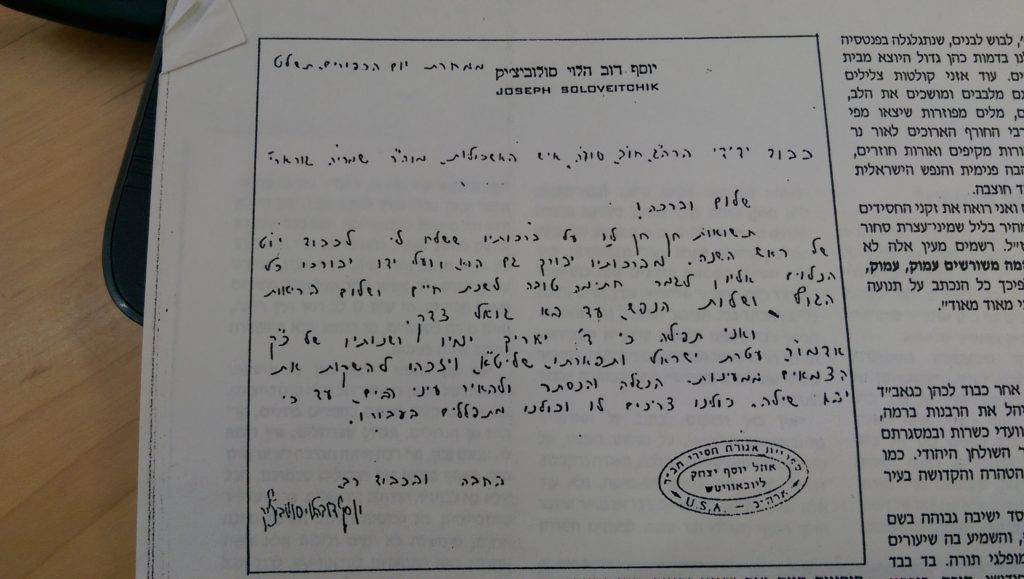
It was recently brought to my attention that various readers of the Seforim Blog have expressed skepticism regarding the determination that the letter found in President Chaim Herzog’s archives and supposedly written by my grandfather, Rabbi Joseph B. Soloveitchik zt”l (hereafter, “the Rav”), is a forgery.


Moreover, some of the commentators have engaged in various conspiracy theories regarding the motivation and the accuracy of the claim that this is a fake letter. See here. Although I do not usually attempt to argue with such claims or engage conspiracy theorists and strongly suspect that penning this response will not necessarily convince those who refused to accept the original clarification, I will, nevertheless, attempt to present the evidence that the letter is indeed a forgery since I fear that future researchers may also question the denial and view the letter’s status as an unresolved issue.

Moreover, since there may be sincere individuals who are indeed skeptical of a forgery claim regarding a letter whose subject is a controversial figure and may suspect that there is an agenda behind the denial of the letter’s legitimacy, I am presenting the evidence for their review and evaluation. Thus, if those who expressed skepticism are indeed sincere and open to evaluating the evidence, it is my hope that they will review the evidence presented below and recognize that the letter is fraudulent.

At the outset, I must re-emphasize what was clearly stated by the editors of the Seforim Blog (here); i.e. that the determination of our family members who saw this letter and judged it to be a “crude forgery” was entirely based upon an examination of the signature, stationery and other such considerations and totally independent of any opinion, positive or negative, regarding the subject of the letter. Having stated for the record what should be obvious, I will now present the considerations themselves.

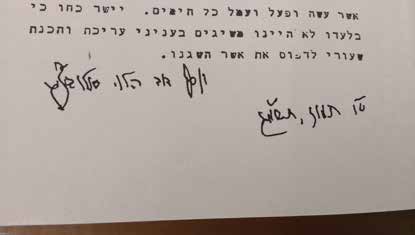
1. First, and this alone should suffice, is the error in the spelling of the name. The Rav spelled his name דוב with a vav in the middle and not דב without a vav. I have never seen a signature of the Rav without the vav and I challenge all of those who doubted our claim to produce a signature of the Rav, in his handwriting, without a vav. As there are a multitude of “semikhah klafim” signed by the Rav, as well as numerous letters that he wrote, I assume that this can be readily verified. I would add that, unlike dates or plain text, it is rare indeed that people make typos in their signature.

2. The Rav’s signature in the letter contains an additional conclusive indication that the Rav didn’t write it which is the mention of his father and his title. The Rav would use the title אבא מרי when referring to his father in his halakhic writings and famously utilized it in the title of a major work, Shiurim le-Zekher Abba Mari (Jerusalem: Mosad ha-Rav Kook, 1984). However, he never used it when referring to his father, Reb Moshe Soloveichik, in his signature. Usually, the Rav signed his name without mentioning his father but if he did mention him, he always used the Brisker title of הגאון החסיד or variations of it and never אבא מרי. Thus, he might sign בן הגאון החסיד or בהגאון מהרמsee Iggerot ha-Grid pp. 139-140 for two such examples – but not אבא מרי as in the letter under discussion.


The vast majority of the letters that I have had occasion to see, as well as those published in *Community, Covenant And Commitment: Selected Letters And Communications*, ed. Nathaniel Helfgot (Jersey City, NJ: Ktav, 2005), and originally written in Hebrew, contain the Rav’s name alone without any reference to his father whatsoever. Moreover, my impression is that the younger the Rav was and the more “rabbinic” and traditional or ceremonial the context (such as HaPardes), he might refer to his father, while in more political or non-rabbinic settings and the older he gets, he rarely signs as his father’s son. This is doubly true of the years when he had physical trouble writing (for examples of 2 late letters in very rabbinic settings in which his father is not referenced in his signature, see the letter published in the beginning of the first volume of the first edition of the Shiurim le-Zekher Abba Mari and/or the letter written to Rabbi Shemariah Gourary in October 1978 and published in a Chabad journal upon his petirah in 1993).

The bottom line is that the vast majority of all his letters don’t mention his father and this is esp. true in the later years. Thus, the very reference to his father in a very late letter to a secular political figure like Chaim Herzog might already raise suspicions about this letter, but the crucial point is that even when mentioning Rabbi Moshe Soloveichik, he is never referred to as אבא מרי. Presumably, the person who wrote this letter was aware of the Abba Mari title because of the book (which had just been published a year earlier), but unfamiliar with the Rav’s normal signature mode and thus blundered into applying the wrong title to Rabbi Moshe Soloveichik.

In an aside, I’ll also mention that the person who wrote this letter was not only woefully unequipped with knowledge of the Rav’s signature, he also didn’t know how to spell אבא מרי properly. Unlike the Rav, who was aware of the phrase’s origin in the Shas (Kiddushin 31b and Sanhedrin 5a) and its usage by the Rambam in Mishneh Torah (Hilkhot Talmud Torah 4:3 and Hilkhot Shehitah 11:10) to refer to his father and, of course, spells it properly, the writer of this letter can’t even spell the title that he chose properly (although I can’t rule out the possibility of a typo, I cannot but have the impression that this is yet another instance of the work of someone who simply doesn’t know what he’s doing).

3. The letter includes the title איש בוסטון together with the signature. I’d love to see another letter of the Rav in which he signed himself as איש בוסטון. Until such a letter is produced, I regard this as an additional example of the fraudulent nature of this letter since the Rav didn’t use such a title to identify himself. He was not Paul Revere and apparently did not consider איש בוסטון to be a defining characteristic.

4. A crucial element in assessing a signature’s authenticity a graphological examination. In our case, the signature of the Rav in the Herzog letter simply fails the most basic graphological test. Since a graphological analysis is by definition subjective, I preferred to present the verifiable objective evidence regarding the Rav’s signature prior to raising this point. I also feel obligated to preface my claim with two preliminary comments about the legitimacy of handwriting comparisons:

a. Halakhah and the American banking system that has utilized handwritten checks for decades as a prime form of payment rely upon comparison and recognition of an individual’s signature. The concept of kiyum shtarot, a major legal mechanism in Halakhah which is crucial to all legal documents, is predicated upon comparing signatures.

b. The Rav’s signature is quite distinctive and remained consistent throughout the years. A clear line runs between all his signatures, from youth to old age. In his later years, the signature is more frail and less forceful than his earlier signatures, but the basic form is constant and readily recognizable. The signature that appears in the Herzog letter is so starkly different from his recognized signature that this is a plain case of black and white and not a grey area. Had it been a grey area which required a judgement call, I would never make such a subjective claim, but the contrast here is so great that it does not require a judgement call. To utilize a Talmudic concept from a somewhat different case of graphological assessment, an average ינוקא דלא חכים ולא טפש could easily make this call.

To back up this claim, I suggest that the interested reader see for himself examples of the Rav’s signature in these years. An example from June 1983 is the letter printed in the first volume of Shiurim le-Zekher Abba Mari (first edition).

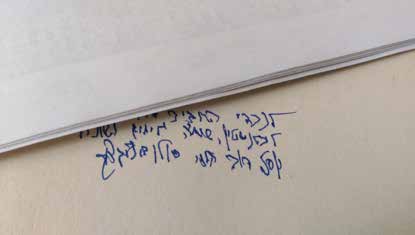
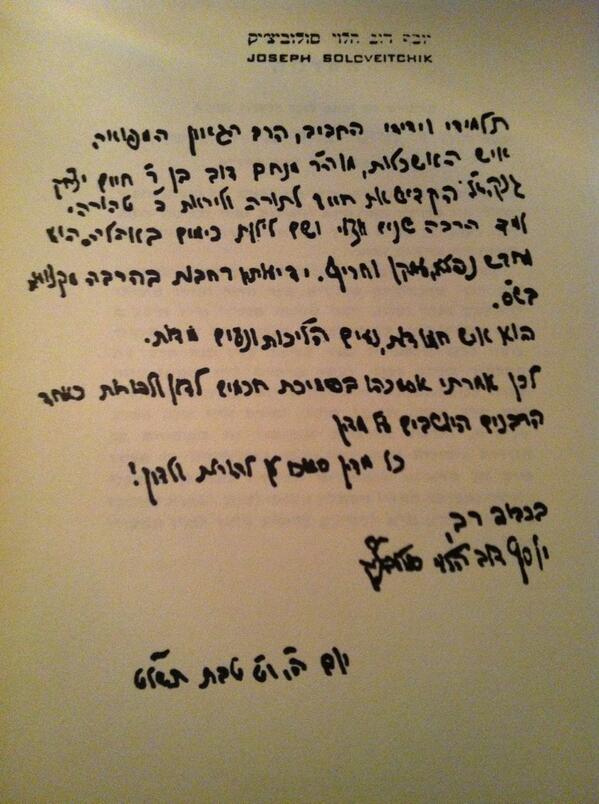
A later example, and even more relevant example, from Winter 1984 (probably January-February 1984) is this (from a dedication he inscribed to me in the Shiurim le-Zekher Abba Mari that he sent me):

One can notice 2 things in this signature: 1. Its basic consistency with his younger signatures 2. the frailty of his writing. The signature in the letter to President Herzog, in contrast, is inconsistent with all of the Rav’s signatures and does not express the frailty of his aging motoric skills, despite supposedly being written months later.

For a somewhat earlier, albeit still late, example, one can see the signature in the haskamah published by Rabbi Menachem Genack in his sefer ברכת יצחק, written in Jan. 1979.

In summary, the signature itself in the document under question is so full of errors that if it were a get, you could say that it contains almost all possible פסולים as it includes א. שינה שמו ב. ושם אביו ג. ושם עירו ד. ואינו מקויים .

From the signature, let us turn our attention to the stationery. Anyone who has seen letters of the Rav knows that the letterhead is always the Rav’s name and usually, but not always, his address as well. He does not use Yeshiva University stationery nor RIETS stationery. I have never seen a letter written by the Rav on a YU letterhead. He was not the Rosh Yeshiva of RIETS or president of YU – he was Rabbi Joseph B. Soloveitchik, the Rav, and his stationery reflects this.

It must also be emphasized that this particular letter is purported to have been written in Boston where the chance that the Rav used YU stationaey is nil. I was with the Rav in Boston during the summer of 1984 and I can attest to the fact that he did not have YU stationery in his study that summer (nor at any other time that I was in Boston).

Thus, it seems fairly obvious to assume, although I cannot verify this, that ‘the writer of this letter’ had access to YU stationery which is dispensed to hundreds of locations but not to the Rav’s private stationery and, therefore, chose to present the Rav as writing on YU stationery, unaware that by doing so ‘he’ is undermining rather than bolstering the credibility of his forgery.

Actually, what ‘the writer of this letter’ is doing is even more bumbling since ‘he’ is not using proper YU letterhead stationery either; if one looks carefully at the letter that was reproduced at the Seforim Blog, it can be noticed that it is written on paper designed for internal correspondence as a memo and is not formal institutional stationery of the sort that is appropriate to use in correspondence with a head of state.

Another suspicious element is the copies of the letter that supposedly were sent to Rabbi Norman Lamm, Dr. Burg and Rabbi Michael Strick. Aside from the fact that to the best of my knowledge, it was not the Rav’s custom to copy others on his letters and this alone is room for additional suspicion, it is unfathomable to think that he would have Rabbi Strick’s name as one of those copied to his letter. Was the Rav even aware that Rabbi Strick worked in YU’s Israel office? Even if so, why would he copy him on a letter to Herzog which does not deal with YU affairs? For that matter, why would he copy Rabbi Lamm?

Since the Rav did not ‘CC’ people and was unaware of Rabbi Strick’s position, this, too, is an additional reason that at least parts of this letter must be considered inauthentic and the work of others. [If one were to argue that this anomaly is reason to support the letter’s authenticity as a lectio difficilior, I would counter that such an argument would be reasonable, if it could be established that the Rav was aware of Rabbi Strick’s role in YU Israel, but since this is definitely not the case, he couldn’t have copied on a letter someone who he was unaware of his position. Thus it is not a more difficult reading, but rather an impossible one and, therefore, proves its inauthenticity rather than its authenticity.]

Next, let us turn our gaze to the top of the page and the salutation of בעזרת צור ישראל וגואלו. Once more, I challenge anybody to produce a letter or document in which the Rav used such a phrase to refer to the KBH in a similar context (or any context, for that matter).

Although one could conceivably argue that he did not normally do so but changed his custom when writing to the president of Medinat Yisrael, I would not accept such a line of reasoning because of the reasons outlined below, but I would also emphasize that the Rav’s letter to Prime Minister David Ben-Gurion does not contain such a phrase nor do any of his other letters to various Israeli Religious Zionist leaders. All of these letters were published in *Community, Covenant And Commitment: Selected Letters And Communications* and are readily available for examination. If one were to argue more ingeniously that he used the phrase only in a letter to Chaim Herzog because of his father, Rav Yitzhak Isaac ha-Levi Herzog’s involvement in the formulation of Tefillah Leshalom Hamedinah, he would have not only to claim that the Rav was attempting to compliment Herzog but also to establish that the Rav was aware of Rav Herzog’s role in the formulation of that text. Personally, I am quite skeptical of this for a variety of reasons, but I will not insist upon it in this discussion.

The crucial point regarding the use of צור ישראל וגואלו is that the Rav would never use such a phrase. Without entering into a protracted discussion of the Rav’s attitude to Zionism in general, a topic that much has been written upon, I will allow myself to state that while undoubtedly supportive of Religious Zionism, he was deeply opposed to three elements of Israeli Religious Zionism that he encountered in his contacts with the Israeli Religious Zionist sector. The first was the ideological position that Jewish Nationalism and its political expression are of the highest religious value. The second, not entirely unrelated to the first, was the perspective that viewed the establishment of the State of Israel and its subsequent achievements as highly significant stages in the Redemption. Regarding those who held to a position that he described as the attachment of “excessive value to the point of its glorification and deification” [of the State of Israel] (*Community, Covenant And Commitment: Selected Letters And Communications*, page 164), he defined them as delusional (the original Hebrew uses the phrase “הוזיםwhich is translated in the published text as “dreamers,” but which actually has a much stronger connation of delusion within it) and in total error. He was also very distant from a historical appraisal that saw the Geulah as imminent. As anyone who has read *Kol Dodi Dofek* or *Hamesh Derashot* is well aware, the Rav emphasizes the Man-God relationship in the context of Zionist history rather than the imminent realization of the promised Redemption.

An additional element that the Rav strenuously objected to was various expressions and formulas in liturgical or halakhic settings that were disconnected from traditional forms of expression and exuded a strong sense of a break with the past and the creation of a new religious language. I would not overstate the case if I stated that such expressions actually caused him to cringe. He certainly was emotionally distant from such phrases and did not use them. A famous example of this was his insistence upon the term “Eretz Yisroel” rather than “Israel,” but there were many such examples, some better known (e.g. translating the text of the ketuba into Hebrew), some not so well known. Even wearing a white shirt on Shabbos (“Israeli style”), rather than a suit, would sometimes annoy him if he sensed that it was an expression of non-traditionalism and “anti-Galut” sentiment. I can attest to this first hand כי מבשרי אחזה זאת. I spent time with my grandfather, the Rav, as a wide-eyed 17 year old youth who often expressed his Zionist sentiments in front of him and occasionally raised his ire by doing so. Once, discussing a related topic, he admitted to me that reciting a certain text was rationally the proper thing to do, but, nevertheless, expressed a personal emotional reluctance to do so because of its novelty and lack of traditional moorings.

Therefore, although this is admittedly a subjective criterion that I am attempting to avoid, I cannot believe that any letter that the Rav wrote or authorized – even to a head of state whose father was Rav Herzog – would contain the phrase בעזרת צור ישראל וגואלו.

Finally, I must point out an issue of content regarding the letter. As I stated at the outset, I am not judging the letter based upon any presumed attitude of the Rav regarding Rabbi Meir Kahane. However, the content of the letter is extremely problematic for totally other reasons. As can be seen, the letter concludes with a clear admonition and rebuke to President Herzog in no uncertain terms regarding his level of observance. Not only does the writer allow himself to criticize Herzog’s standards of public observance, an obviously sensitive topic for someone raised as an observant Jew, he also doesn’t shy away from introducing the extremely sensitive and intensely personal issue of Herzog’s relationships with his parents and children in light of his problematic observance of Mizvoth.

I will allow myself to state that the Rav that I knew, and I assume many of the Seforim Blog’s readers as well, would never enter into such personal matters and grant unsolicited advice and judgement upon his correspondent’s personal life and relationships. For that matter, I cannot imagine that any rational individual who is requesting a favor from a person of stature would conclude his message by rebuking the person and making it clear that he is a disappointment to his parents. Why the writer of this letter thought that this is a reasonable text is beyond me, but if he chose to concoct such a text, I do claim that the Rav would not, and could not, have written such a text. While this is admittedly subjective and, therefore, I do not rest my case upon it but rely upon the above-mentioned considerations, I do believe that the Seforim Blog’s readers should be alerted to this perspective as well.

I will not continue to discuss this letter, although much more could be said about it. In conclusion, I will add that I believe that many of the points that I raised above suffice to individually prove that this letter is utterly false; however, it is also important to emphasize that there is a significance to their cumulative effect. Thus, even if one can argue or suggest alternatives to a particular claim, the accumulation of so many suspicious characteristics is an additional consideration to recognize that the text is much too problematic to be trusted or relied upon.

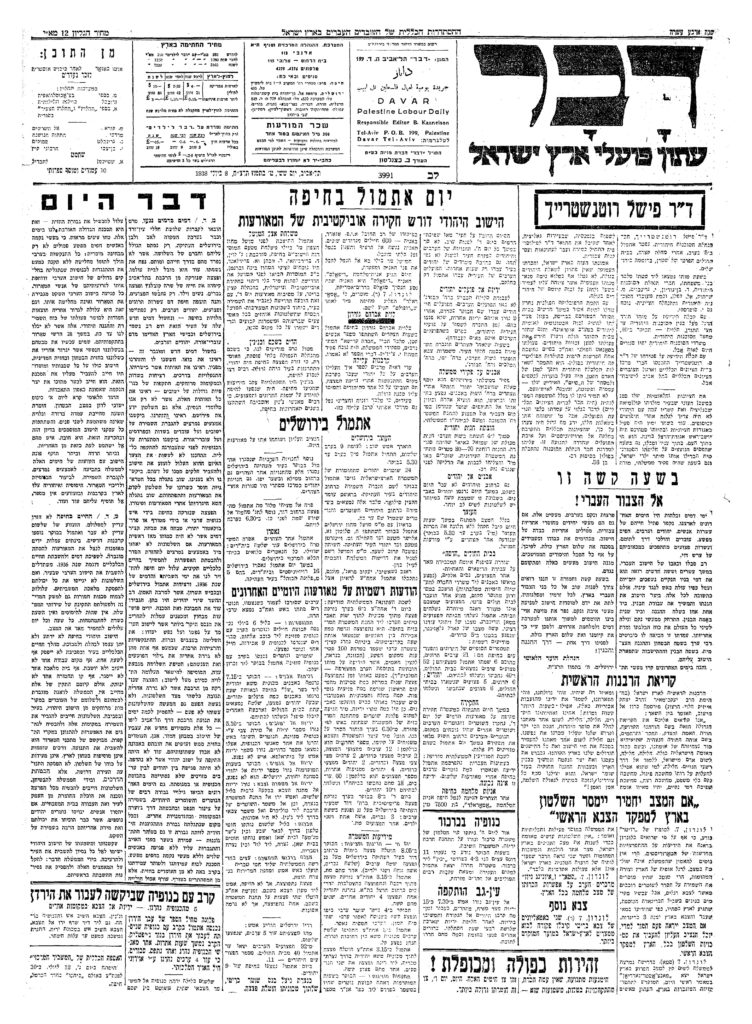
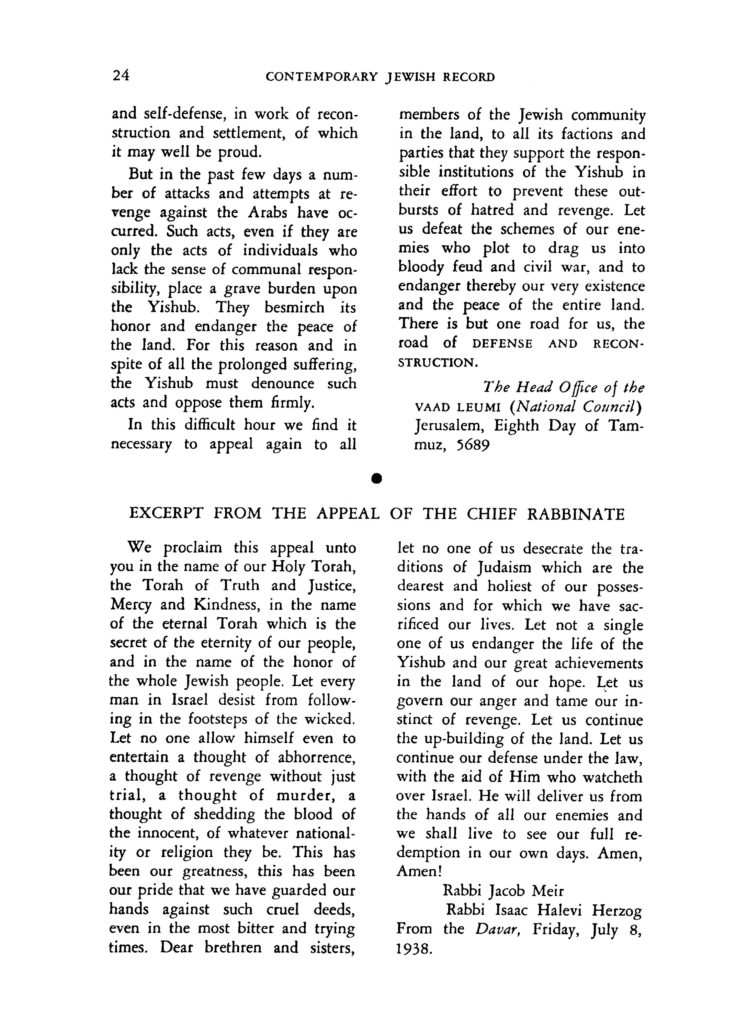
Ironically, whoever thought to send this letter to President Herzog and to appeal to his zekhut avot as part of a letter requesting support for Rabbi Kahane was probably barking up the wrong tree by doing so. Rav Yitzchak Isaac ha-Levi Herzog, whose authority is celebrated in the letter, had the following to say about the issue of retribution and Jewish-Arab relationships in times of terror attacks, published on the front page of the newspaper Davar, Friday, July 8, 1938, and translated into English several months later in Contemporary Jewish Record 1:1 (September 1938):

Why did someone want to counterfeit a letter in the Rav’s name is a question that may be unanswerable, even if we were to identify the person who wrote the letter. It is certainly unanswerable without identifying the writer. It should be recognized, though, that the primary motivation may not have been a political agenda to validate Rabbi Kahane, although it is obvious that the writer’s opinion of him is somewhat favorable and that he is attempting to advance the Kach party’s agenda, but may be rooted in other realms. For instance, the writer may have had a psychological need to empower himself to speak as the Rav, for a variety of reasons, and realized this by counterfeiting a letter in the Rav’s name and sending it to a prominent and famous person.

Whatever the motivation may be – political or psychological – we must recognize that this is a letter that that was not signed or authorized by the Rav and that is what matters.


Ha-Osek be-Mitzvah Patur min ha-Mitzvah: The Case of Prayer and Torah Study

Daniel Sperber has just published a new book, On the Relationship of Mitzvot Between Man and His Neighbor and Man and His Maker. The Seforim Blog is happy to present chapter 4 from the book. 
Ha-Osek be-Mitzvah Patur min ha-Mitzvah: The Case of Prayer and Torah Study
Daniel Sperber
We find in Sefer ha-Rokeah, section 369 ad fin., that a person who is sitting in the synagogue, wrapped in his talit and with his tefillin on his head and is reciting liturgical songs, must, nonetheless, rise up before his teacher, since he can carry out both actions and he will receive fine rewards in both worlds. Now there are early authorities who hold that the principle that one who is engaged in one mitzvah is exempt from another is also the case when both could be carried out. (See Shulhan Aruch Orah Hayyim 38:8, and in the Beur Halachah, ibid., and also R. Yaakov Hayyim Sofer, Brit Yaakov [Jerusalem: 1985], section 2, 36; R. Ovadiah Yosef, Hazon Ovadiah: Sukkot [Jerusalem: 2005, 167].) The author of the Rokeah, R. Elazar of Germaiza, was a disciple of R. Yehudah (b. R. Shmuel) he-Hasid, the author of Sefer Hasidim. And it is the view of R. Yehudah he-Hasid that even if one can carry out both mitzvot, one is exempt from doing so, if one is engaged in a prior mitzvah; and this, indeed, is the view of R. Elazar Rokeah himself (Rokeah, Hilchot Sukkah, section 299; see Sofer). Why then should one who is engaged in praising the Lord in the synagogue, have to rise up before his teacher? Surely he is already engaged in a mitzvah, and therefore exempt from others! The answer, I suggest, is because ritual synagogue worship is directed towards God, but respect for one’s teacher is a mitzvah between man and his fellow, and he is therefore not exempt from it. So too the Hida, R. Hayyim Yosef David Azulai, rules, that even in the hour of prayer one rises before a Torah scholar, (Birkei Yosef Orah Hayyim, section 244:1; and see Sofer, note 8 on page 37; and see most recently the discussion of R. Yitzchak Eliyahu Stessman, Kimah ve-Hidur [Jerusalem: 2011, 88–91], with additional references).
Indeed, the severity of not rising before one’s teacher is expressed by R. Eleazar in very extreme terms in BT Kiddushin 33b:
Any scholar who does not rise before his teacher is called a wicked person (רשע), and will not live long and will forget his learning.
(See also R. Yaakov Hezkiyahu Fisch, in his Ve-Haarachta Yamim, ed. Y.M. Sofer, [Jerusalem: 2010, 71–72].)
To this we may add what we are told of the Arizal, by his disciple R. Hayyim Vital, that he was very particular in paying his workers exactly on time and without delay. And if he did not have the money with which to pay these wages, he would delay his afternoon prayer (minhah) until close to sunset in order to search out a loan with which to make the payment. Only afterwards would he hurriedly daven minhah. He would explain himself by saying: “How can I pray to the Lord, may He be blessed . . . , when such an important mitzvah is incumbent upon me, and I have not carried it out?” (See R. Hayyim Vital, Shemonah Shearim: Shaar ha-Mitzvot [Jerusalem: 1872], Parshat Tetzeh; Avraham Tobolsky, Hizaharu be-Memon Haverchem, vol. 2, [Bnei Brak: 1981, 211–212].)
In a somewhat different vein, but with much the same principle as its basis, we read in Niflaot Beit Levi, by A. Kleiman (Pietrokov: 1911, 32, [Yiddish]), cited in Louis I. Newman and Samuel Spitz, The Hasidic Anthology: Tales and Teachings of the Hasidim (New York: 1944, 178:2, 480) as follows:
A teamster (=wagon driver) sought the Berditchover’s (Reb Levi Yitchak of Berditchov’s) advice as to whether he should give up his occupation because it interfered with regular attendance at the synagogue. “Do you carry poor travellers free of charge?” asked the Rabbi. “Yes,” answered the teamster. “Then you serve the Lord in your occupation just as faithfully as you would be frequenting the synagogue.”
(However, see A.Y. Pfoifer, Ishei Yisrael [Jerusalem: 1998, 104, section 11, and notes ad loc].)
And indeed, the Rambam in Hilchot Talmud Torah 3:4, followed by the Shulhan Aruch, Yoreh Deah 246:8, rules:
If there came before him [the choice of performing] a mitzvah and (i.e., or continuing) learning Torah, if that mitzvah could be carried out by another, he should not interrupt his learning; but if not, he should carry out that mitzvah and then return to his study. And when it comes to giving charity, one should always give charity first.[1]
This indeed is the conclusion to be drawn from the sugya in Yerushalmi Pesahim 3:7 (and parallel to JT Hagigah 1:7). There we read that R. Abahu, who lived in Caesarea, sent his son R. Haninah to study in Tiberias, in the Yeshiva of R. Yohanan.
They came and informed him that [his son] was engaged in charitable activities (i.e., in the burial of dead). He sent him a message, saying to him: “Are there no graves in Caesarea that I sent you to Tiberias?” (i.e., for such activities you could have stayed at home).
The Talmud continues that it was already decided at Beit Nitzeh in Lod that “study is greater for it leads to deeds,” (see below). However, the rabbis of Caesarea qualified this by saying:
This is the case when there is someone else to carry out the deeds. But if there is not anyone else to carry them out, the deed comes before [the study], (i.e., has precedence).
We then are told a tale:
R. Hiyya, R. Yosi [and] R. Ami were late coming to R. Eleazar [for their lesson with him]. He asked them, “Where were you?” They replied, “We were involved in charitable activity” (meaning in the burial of someone). “Was there no one else [who could do this?]” he asked of them. They replied, “He was a neighbor [according to the Pnei Moshe, or a proselyte – according to the Korban ha-Edah,” i.e., and there was no one else to deal with his burial.]
Incidentally, we may add here that the interpretation of the Pnei Moshe is supported by a passage in Sefer Haredim, (by R. Eleazar Azikri, [Safed: 1533–1600]), Mitzvot Aseh . . . ha-Teluyot be-Lev 22, which states that:
A person is obligated to act charitably towards his neighbors and his relations more than to other people, as is clearly stated in the Bavli and the Yerushalmi.
(See S. Lieberman, HaYerushalmi Kiphshuto [Jerusalem: 1934, 426] and his other comments.) And the parallel text in JT Hagigah 1:7., begins with an additional passage, namely:
R. Yehudah, when he would see a dead person (i.e., a burial) or a bride (i.e., a marriage procession), [and people] praising them (i.e., honoring them in the processions), he would turn to his students (נותן עיניו בתלמידים), and say: “The [dealing with] the dead precedes the study of Torah (תלמוד).”
And a somewhat similar notion, but expressed in a Hassidic vein, may be found in a story related in Yehezkel Shraga Fraenkel’s Rabbenu ha-Kaddosh mi-Shinyeve (Ramat Gan: 1992, 256–257). He relates that once the Rabbi of Warsaw came to visit the Divrei Hayyim, R. Hayyim of Sanz. The Sanzer Rebbe asked him, “Do you learn?” “Yes,” the Warsaw Rabbi replied. The Rebbe repeated, “Do you always learn?” The reply was, “When someone who is embittered and needs help comes to me, I close my gemara and deal with him, to help and encourage him.” “This is what I wanted to hear,” said the Sanzer, “whether you have the good sense to close your gemara when someone needs your help,[2] both in word and in deed, and in any case to encourage him and bolster his spirit.”[3]
Here we must make something of a digression, which is not really a digression, as this touches upon a very important point. For the Mishnah in Peah 1:1 states that: “the study of Torah is equal to all of them,” i.e., even to those mitzvot listed in the Mishnah which are social ones, such as honoring one’s parents, doing charitable deeds, bringing peace between rival individuals, etc. The question we ask ourselves is: is the study of Torah (תלמוד תורה) a ritual or a social mitzvah? Into which category does it fall? For if the former, according to our suggestion how can it be superior to those other social mitzvot?
To clarify this issue we must go back to a very ancient discussion that took place in the attic at Beit Nitzeh in Lod, between R. Tarfon and the Elders. For this question was put before them: which is greater, or more important תלמוד או מעשה, learning or deeds? R. Tarfon answered: Deeds are greater. While R. Akiva said study is greater. And they all replied: Study is greater for it leads to deeds (BT Kiddushin 40b).[4] That is to say the importance of study is in that it constitutes the key to the proper execution of the mitzvot. This is also the meaning of R. Shimon the son of Rabban Gamliel’s statement in Avot 1:17: Not the expounding of the law (midrash) is the chief thing, but the doing [of it] (maaseh). And this is amplified by Rabbenu Bachya in his commentary ad loc.: that the aim of man’s labor in Torah is not that he should just learn a lot, but that [his learning] should lead to deeds, as we have learned from the verse [in Deuteronomy 5:1], ‘and ye may learn them [i.e., the statutes and judgments], and keep and do them.’ And this is further amplified in Shulhan Aruch ha-Rav, by R. Shneur Zalman Mi-Ladi, in his Hilchot Talmud Torah 4:2, by telling us that “it is impossible to fulfill all the mitzvot in all their details without intensive study and knowledge of them. And for this reason it is equal to all of them,” i.e., not intrinsically, but as a means to their proper application.[5]
This issue has been analyzed recently by R. Yitzchak Shapiro, in his article in Hakirah 9, (2010), 221–243, entitled “To know the Forbidden and the Permitted: An Analysis of Rambam’s View of the Purpose and Goals of Talmud Study.” He shows that the Rambam’s view, as expressed in his letter to his disciple R. Yosef,[6] is that “learning Torah is a utilitarian endeavor, with extracting halachic conclusions its functional objective” (227).[7] He goes on to show that “the simplicity and obviousness [of this position] might go unnoticed if not for its staggering ramification and total incompatibility with contemporary realities in derech halimud ” (227–228). For as he earlier showed (223–224): “the Aharonim do identify an aspect of Torah study, unrelated to fulfillment of the other mitzvot, based on the verse והגית בו יומם ולילה – ‘but thou shalt meditate therein day and night’ (Joshua 1:8, cf. BT Menachot 99b). This mitzvah of ‘limud ha-Torah’ is distinct from the mitzvah of ‘yediat ha-Torah,’ and can be fulfilled regardless of the subject matter that is learned, whereas the mitzvah of yediat ha-Torah requires a curriculum that is limited to ‘halachah’ (or at least the sharpening of one’s mental acuity, which is necessary for accurate application of halachah). However, one may fulfill both facets of the mitzvah simultaneously only by learning halachic subject matter.”[8]
This is the view of the Meiri, as formulated in his commentary to BT Berachot 7b:
The knowledge of how the Torah actually expresses itself indeed requires serving or observing Torah scholars. While intellectual learning is the cause of wisdom, observing the Sages is the cause of knowing how the Torah manifests itself. This is both true for monetary matters as well as that which is prohibited and permitted.
Hence, we may well understand the statement of Rav in BT Megillah 3b, that Talmud Torah is greater than the sacrifice of the daily offerings (­temidin).
Here we may also call attention to R. Meir Triebitz’s insightful analysis (in his introduction to R. Daniel Eidensohn’s Daas Torah: A Jewish Sourcebook [Jerusalem: 2005, 31–35]). He begins by noting that God commands us twice to study Torah: once in Deuteronomy 11:19, and again in Deuteronomy 4:9–11. He analyzes the differences between these two formulations in all their details – e.g., one in the plural and the other in the singular; one talks of teaching, the other telling; one focuses on parents to children, while the other lists three generations. He concludes that “the two verses which obligate us to learn the Torah actually refer to two types of study. One refers to the study of the legal part of Torah, and the other to the study of Torah’s theology. Each form of study is deemed a separate scholarly enterprise.” He characterizes these two forms of study as “legal” (i.e., halachic) study, and “faith” study, which he states “deals primarily with Aggadic parts of the Torah.” But for our purposes it is important to emphasize that both verses, that is to say both classes of study, require the student also to be a teacher, and to pass on his learning to future generations. Hence, Torah study has a social aspect too.
This is a very broad subject that requires a study in its own right, and we cannot enlarge on it here. But what emerges very clearly is that the mitzvah of Torah study is in a very special category, for without it one would not know how to carry out ritual or social mitzvot correctly. Nonetheless, the Or Zarua and the Rav
Baal ha-Tanya agree that one interrupts learning Torah to fulfill other mitzvot, if both cannot be carried out at the same time, and one is not exempt because one is already involved in a prior mitzvah.[9]
This is clear from the baraita in BT Ketubot 17a (BT Megillah 3b, 29a) that we interrupt our study of Torah (מבטלין תלמוד תורה) not merely for a met mitzvah and to accompany the dead (הוצאת המת), but also for wedding ceremonies (הכנסת כלה) – all supreme social mitzvot.[10] And in this way, we may better understand the passage in Avot de-R. Natan, chapter 41, (ed. Schechter, Vienna: 1887, 133):
It once happened that R. Tarfon was sitting and teaching his disciples, and a bride went past him. He ordered that she be brought into his house, and told his mother and his wife that they should bathe her, anoint her, and decorate her with jewelry, and dance before her until she goes to her husband’s house.
Apparently, he interrupted his teaching in order to carry out the mitzvah of hachnasat kallah.[11] And indeed we read in the letters of the Hafetz Hayyim (Michtevei ha-Hafetz Hayyim he-Hadash, vol. 2, Bnei Brak: 1986) II, 86:
You occasionally see a Jew who [in a praiseworthy way] learns Torah [as much as possible] and values his time [not wasting a minute]. But if he does not set aside part of the day to do deeds of kindness, what a lack of intelligence!
And interestingly enough, this also becomes evidence from the commentary of R. David ha-Nagid, the Rambam’s grandson, to Avot 1:15. There Shammai is cited as saying: “Make thy [study of the] Torah a fixed
habit (קבע); . . . . And receive all men as its cheerful countenance.” And this is explained by the Nagid to mean that even when you are engaged in your fixed period of Torah study, you should not desist from receiving people cheerfully, thinking that in doing so you are “wasting” Torah-study time.[12] So apparently he regarded proper interpersonal relationship of such importance as even to override one’s involvement in Torah learning. And this presumably goes under the category of kevod ha-beriyot, respect for the individual. (Cf. below, sections 15 and 19.)
We are reminded of the statement of Reb Yisrael of Rizhyn (died 1850), who expounded the verse in Psalms 115:16, “the heavens are the heavens of the Lord; but the earth hath He given to the children of men.”
There are two kinds of tzaddikim. Those of the one sort learn and pray the livelong day and hold themselves far from lowly matters in order to attain holiness. While the others do not think of themselves, but only of delivering the holy sparks which are buried in all things back to God, and they make all lowly things their concern. The former, who are always preparing for Heaven, the verse calls “the heavens,” and they have set themselves apart for the Lord. But the others are the earth given to the children of men.
(Martin Buber, Tales of the Hasidim: The Later Masters, New York: 1948, 53–54)
Here, he is contrasting the Lithuanian mitnagdim’s way, (in a double-edged complementary fashion), with that of the Hasidim, while we well know with which way he personally sided.
At the same time we should recollect how Yehudah ha-Levi in his ­Kuzari, begins his definition of the religious man according to Jewish tradition with the negative statement that “in Jewish opinion, the religious man is not to be defined as one who cuts himself off from the world” (Book III, sect. I, ed. Hirschfeld, Leipzig: 1882, 140–141). Perhaps he was combating predominant contemporary Sufi views on extreme asceticism. (See Franz Rosenthal, “A Judaeo-Arabic Work under Sufic Influence,” HUCA XV 1940,
440, and cf. page 465 for an extreme view of this form of asceticism, and note 104.)

[1] See Le-Hair Hilchot Tzedakah be-Or Yekarot (Jerusalem: 2010, 6–7). And see below sect. 16 on the overriding importance of charity, and Appendix.
[2] See, for example, the practice of the Brisker Rav, Reb Hayyim Soloveitchik, as described in Aharon Sorasky, Marbitzei Torah u-Musar bi-Yeshivot Nusah Lita mi-Tekufat Volozin ve-ad Yameinu, vol. 1 (Jerusalem: 1976, 110).
[3] Cf. BT Shabbat 127a: Said R. Yohanan: Great is the hosting of guests as are those rising up early to the House of Study [of Torah], as we have learned: to make room for guests [to avoid] hindrance in the House of Study. But Rav Dimi of Nehardea said: It is greater than rising up early to the House of Study. For we learned: “for guests,” and only afterwards “to avoid hindrance in the House of Study.” And see below sects. 11 and 12 on hosting guests.
[4] On this text see Benedict Thomas Viviano, Study as Worship: Aboth and the New Testament (Leiden: 1978, 105–109). Directly related to this is the text in JT Pesahim 3:7, and JT Hagigah 1:7, cited above, from which the Rabbis learned that if others can carry out these charitable activities, a person should not interrupt his Torah studies. And this seems to be the dominant view among the poskim. See further BT Moed Katan 9a; Shulhan Aruch Yoreh Deah 246:18; Meiri to BT Shabbat 9a and Moed Katan ibid.; Rabbenu Yeruham 22a in the name of the Ravad, etc. See R. Asi ha-Levi Even Yuli, Shulhan Aruch ha-Middot, vol. 2, Halachah u-Musar (Jerusalem: 2009, 243–244).
[5] See R. Mordechai Shmuel Ashkenazi’s magnificent commentary to Hilchot Talmud Torah Mi-Shulhan Aruch Admor ha-Zaken, vol. 5 [= ha-Rav] (Kefar Habad: 2000, 86).
[6] Ed. Y. Shilat, Iggrot ha-Rambam, vol. 1 (Jerusalem: 1987, 254–259); and see editor’s note on 257–258 to line 4).
 [7] At the simplest level, there is, in the Rambam’s view, an obligation upon one who has learned Torah,
also to teach it to others. See Hilchot Talmud Torah 1:2, and so too in the listing of the positive commandments at the beginning of his Mishneh Torah, no. 11. (This list is also that of the Rambam, as attested by the author of the Magid Mishneh in his introduction to Hilchot Eruvin, and the Kesef Mishneh in Hilchot Hannukah 3:6; Responsa Noda bi-Yehudah Kama, Orah Hayyim, sect. 29; Petah ha-Dvir, vol. 2, sect. 194, subsect. A. See R. Yaakov Hayyim Sofer, Drupteki de-Oraita, vol. 1 [Jerusalem: 1987, 45]. And see further his remarks, 68–69, on the need to teach others.) Of related interest is the article of Sarah Pessin, “Maimonides and the Sacred Art of Teaching,” apud Adaptations and Innovations: Studies in the Interaction between Jewish and Islamic Thought and Literature from the Early Middle Ages to the Late Twentieth Century, Dedicated to Professor Joel Kraemer, ed. Y. Tzvi Langermann (Paris & Louvin: 2007, 285–298). See also, most recently, the remarks of R. Aharon Lichtenstein, in H. Sabato and A. Lichtenstein, Mevakshei Panecha (Tel Aviv: 2011, 212–215).
[8] See the material R. Yitzchak Shapiro brings from the letters of R. Yisrael Salanter (no. 27), in this regard. See also Kuntres Aharon shel Shulhan Aruch ha-Rav, Talmud Torah 3:1, ed. Y.A. Lev (Ashdod: 1989, 39 et seq.). And see R. Aharon Lichtenstein’s very comprehensive study entitled “Does Involvement in Torah Study Exempt One from Mitzvot?”, which appeared in Alei Etzion 16 (5769 [2009]), 71–107, which examines this issue in depth, dealing with questions of delaying procreation, Megillah reading, prayer, all mitzvot, etc., and seeks to explain Rambam’s position that “ha-osek be-mitzvah patur min ha-mitzvah” theoretically applies to Torah study too, when “it is studied with the purpose of performing” (91); and cf. ibid., 105, for his suggestive interpretation of the view of the Maharach Or Zarua. His study of this very complex issue is extremely rich and requires intense study. See also Moshe Zvi Polin, Sefer ha-Mitzpeh al ha-Rambam, vol. 1, (on Hilchot Talmud Torah) (Jerusalem: 2005, 11–26), that studying (lilmod ) and teaching (lelamed ) are two interconnected mitzvot. See Ramban Hilchot Talmud Torah 1:1; Hilchot Hagigah 3:1: that anyone who is obligated to study is obligated to teach, and cf. ibid., 1:4. I think this is the meaning of the statement in Seder Eliyahu Rabba, ed. Friedman, p. 63 =Tanna Debe Eliyahu, transl. W.G. Braude & I.J. Kapstein (JPS, 1981, 183) that “one who toils in Torah is like a lamp which provides light for the eyes of many.” And in this connection, it is also worth reading Benjamin Blech’s article “Personal Growth or Communal Responsibility: A Question of Priorities,” The Torah U-Madda Journal 2 (1990), 134–142. However, to give a slightly different point of view, see Hatam Sofer to Nedarim 81a; R. Hayyim Volozin’s Nefesh ha-Hayyim, Shaar Dalet, sect. 3; Ruah Hayyim to Avot 6:1, and the introduction to Eglei Tal.
A very extreme expression of this view is to be found in R. David Baharan’s “Hanhagot u-Piskei Halachah,” in Otzrot Yerushalayim, vol. 13 (Jerusalem: [2010?]), 40, where he insists one must learn halachah every day, and it is not sufficient to learn merely Gemara. He goes on to say that one must learn Shulhan Aruch Orah Hayyim or Hayyei Adam, and he who does not do so will surely have no part in the World to Come. (See also ibid., 41–42.)
See further R.S.Z. Auerbach, Halichot Shlomo . . . al Moadei ha-Shanah, ed. Y. Terner and A. Auerbach (Jerusalem: 2007), 537–539, who also is of the opinion that there are two aspects to Torah study: the one being to study in order to learn how to act properly, and the other as an independent positive commandment which is not just in order to know how to act, but the actual practice of learning as an end in its own right. He expands on this position bringing biblical and rabbinic sources to bear out this point of
view. However, here too he agrees that ultimately this is in order “to purify his body through the light of Torah, in order to cleave to God . . . who orders the world (àùø äìéëåú òåìí ìå), and without which the world cannot subsist (åáìà ÷éåîí – àéï î÷åí ÷éåí ìòåìí)” so that in the final reckoning this non-action-orientated
study is nonetheless direct to úé÷åï òåìí, the betterment of our world, (see ibid., 536).
[9] See Kuntres Aharon ibid., in the editor’s Midrashei ha-Kuntres, 36; and also Kuntres Aharon, Talmud Torah 4:3, that one interrupts
learning for persuading others to give charity, where others are less
persuasive, or helping in burying the dead, etc. See R. Mordechai Shmuel
Ashkenazi, ibid., 87 et seq.
See
further R. Ovadiah Yosef, Hazon Ovadiah: Sukkot
(Jerusalem: 2005, 168), on the special status of Talmud
Torah, because it is mandated at all times (îöåä
úîéãéú), and, hence, cannot exempt from other mitzvot, as this
would free us from all other mitzvot (citing the Birkei
Yosef of the Hida 38:7).
This
subject has most recently been examined in considerable detail, with a wealth
of sources, by R. Asi ha-Levi Even Yuli, in his Shulhan
Aruch ha-Middot, vol. 2, Halachah ve-Musar
(Jerusalem: 2009, 243–247). He shows that there are two opposing views. For the
Yosef Omez, by R. Yosef Juspa Kahn Neurelingen (c.
1639), (Frankfurt am Main: 1908, [reprint, Jerusalem: 1965] 316), writes that
the Rabbis said: Anyone who is involved in Torah learning and not in gemilut hasadim, acts of charity, is as one who has no
God. And therefore he wrote that a Torah scholar should make sure that every
day he should carry out one act of charity. And the Seder
ha-Yom (by R. Moshe ibn Machir [Venice: 1599], and numerous editions)
wrote that one must not interrupt the learning of Torah for any mitzvah which
can be carried out by another, with the exception of acts of charity. And
therefore the enthusiastic should take this to heart and pursue acts of charity
as one pursues life itself. (And see the continuation of this passage.) Even
Yuli further refers us to Responsa Aderet Tiferet
(by R. Avraham Dori, vol. 4, sect. 44), who following on the words of the Seder ha-Yom seeks to find additional support for this
view in the Rambam, citing the gemarot in BT Megillah 3b, 29a; BT Ketubot
17a as further proof, in that one interrupts Torah learning to accompany the
dead to his final resting place. (See below on this subject.) He then refers us
to the Sdei Hemed to which we referred earlier on.
However, this runs counter to the prevailing majority view found in a multitude
of rabbinic sources, to which he referred on 243–244, and therefore very
convincingly he rejects and refutes this argument on 246–247. See there in
detail. However, the above just underscores what we have tried to point out,
namely the complex ambiguity of the status of Torah study.
[10] See Rema, Even ha-Ezer 65:1; Ba”h
ibid., that even the leading Torah authority, Gedol
ha-Dor, does so. And even public learning is so interrupted, (Pnei Yehoshua to BT Ketubot
ibid., on the basis of Tosafot Megillah ibid.). However, see D. Friedman, Piskei Halachot, vol. 3 (Warsaw: 1901, 35), argues that
nowadays, that we are not intimately acquainted with the laws and our studies are directed to their correct understanding, therefore,
we do not interrupt Torah learning for wedding ceremonies. See, in detail, on
all the rules related to this subject, B. Adler, Ha-Nisuim
ke-Hilchatam, 2nd ed., vol. 2 (Jerusalem: 1985, 394–395).
Clearly
hachnasat kallah is related to the mitzvah of procreation,
which is one of the paramount duties of a man, in Jewish halachic thought. See
my Netivot Pesikah (Jerusalem: 2008, 162–163, n.
251). (And cf. below, sect. 30.)
Here
we may add that a communal positive mitzvah always takes precedence and outweighs
a private individual’s positive mitzvah. A teacher sitting shiva is forbidden to learn and teach Torah. However, he
is permitted to do so if the community needs him (Shulhan
Aruch Yoreh Deah 384:1). See Tzvi Marx, Halakha
and Handicap (Jerusalem: 1992–1993, 228).
[11] See Schechter’s note
in his edition of Avot de-R. Natan, n. 24, and p.
131, n. 10.
[12] Midrash
R. David ha-Nagid to Avot, ed. BenTziyyon
Kipnis (Jerusalem: 1944). The Arabic original appeared in Na Amon 1901. However, there are some doubts as to the
attribution of authorship. See Milhamot Ha-Shem by
R. Avraham ben ha-Rambam, ed. M. Margaliot (Jerusalem: 1953, 38, n. 8); A.
Katz, JQR 48
(1957), 140–160; Midrash R. David ha-Nagid to
Genesis, ed. A. Katz (Jerusalem: 1964, 16–18). On R. David ha-Nagid himself,
see A. Strauss (Ashtor), Toldot ha-Yehudim be-Mitzrayim
ve-Suriah tahat Shilton ha-Mamelukim, vol. 1 (Jerusalem: 1944, 117–128).


April Fools! Tracing the History of Dreidel Among Neo-Traditionalists and Neo-Hebraists

April Fools! Tracing the History of Dreidel Among Neo-Traditionalists and Neo-Hebraists

These explanations [for playing with the sevivon] are far from reality. Why do no sources dating from the Maccabean period, and only in the last few hundred years, mention playing sevivon? If “Hakhamim” decreed it, or it was the custom in ancient times, of if “Beis Din shel Hashmonaim” established it, why is it not mentioned for all these generations?

Yitzhak Tesler, “Ha-Dreidel (Sevivon) be-Chanukah: Mekoroseha, Ta’amyah, u-Minhagyah,” Or Yisrael, 14 (1999), 50.

I have seen a toy in London called a Teetotum. It is exactly like a Hanucah Trendel with English letters instead of Hebrew on it. But why it is called by its peculiar name, no one can tell me. Of course, the name comes from the letter T, which is inscribed on one of the four sides of the toy; thus T Totum or T takes all. This reminds me of the noted Latin epigram addressed by the boy to the twirling Teetotum Te, totum, amo, amo, te, Teetotum.

Leopold Dukes to Leopold Löw, September 1864.

Only two mitzvot of Chanukah are mentioned in Rabbinic sources: lighting candles and reciting the full Hallel. Over the centuries, many other practices came to be associated with Chanukah. Some are unique to specific geographic regions, while others saw universal adoption. One that is lesser-known today is the custom of Venetian Jews to travel on gondolas, rowing through the city, and greeting each house with a blessing and “a merry Hebrew” carol. Or the custom in Avignon, France, recorded in 1779, that women were permitted in the men’s section of the synagogue during the eight days of Chanukah.[1] Many Jews accept these as the evolution of Jewish practice without requiring any sacred reasons; others are unwilling to do so. These neo-traditionalists locate the practices within the rubric of Jewish ritual and even claim historical legitimacy when there is none. The dreidel is an example of this phenomenon.

The dreidel toy is not Jewish in origin. Instead, dreidel is the ancient game of teetotum that remained popular until at least the twentieth century. Teetotum, at its most basic, is a four-sided dice with a stick in the middle. While some versions use dots or numbers to denote players’ actions, letters are the most commonplace. The letters vary based upon the vernacular, with the name teetotum from the Latin version of T (totum-all), and the remaining letter instructions, A (aufer-take), N (nihil-nothing), D (depone-put down). Even the Hebrew letters are merely a transliteration of the German version: G (ganz-all), H (halb-half), N (nischt-nothing), and S (schict-put).

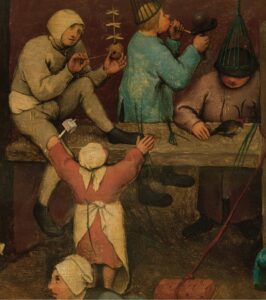
Figure 1 Detail: Pieter Bruegel, Children’s Games, Kunsthistorisches Museum, Vienna

Teetotum is documented in Vienna’s Kunsthistorisches Museum displays Pieter Bruegel the Elder’s (1525/30-1569) masterpiece, “Children’s Games” (1560). Another of his works in the museum is the “Tower of Babel,” which is the subject of a forthcoming post. Children’s Games depicts over two hundred children playing eighty different games. Bruegel’s encyclopedic pictorial catalog of games is unique in the annals of art. A small child is at the bottom left corner, her arms raised, holding a teetotum. (See here for a detailed view and here for Amy Orrock’s excellent article, “Homo ludens: Pieter Bruegel’s Children’s Games and the Humanist Educators,” discussing the purpose and interpretation of the painting within Erasmus’s views on the benefits of play.) Teetotum also appears in the list of games of Bruegel’s near contemporary French author François Rabelais’s (d. 1553) satirical work, Gargantua. The Oxford English Dictionary identifies it as “a favorite Victorian toy.” It appears in well-known English literature such as Lewis Carol’s Through the Looking Glass, where the White Queen (then a white sheep) asks Alice, “Are you a child, or a teetotum.” Other examples are Charles Dickens’ Our Mutual Friend, Edgar Allen Poe’s The System of Doctor Tarr and Professor Fether, and James Joyce’s Finnegans Wake as “finfoefom” (based on Joyce’s unique lettering system).[2]

Despite the widespread awareness of teetotum in Europe from at least the 1500s, the earliest Jewish sources connecting it with Chanukah date to the nineteenth century. Other Chanukah games boast much earlier recognition. For example, R Yosef Yuspa Nördlinger Hahn (1570-1637) mentions chess, tic-tac-toe, cards, and possibly backgammon.[3] Likewise, a 1638 herem banned cards and dice on Chanukah, although chess was excepted.[4] In subsequent Jewish literature, card playing has the most mentions, but that is due to their moral and ethical concerns rather than approval. None of these mention dreidel or any similar game.

The lack of historicity and mesorah was no barrier for 19th-century rabbis, nearly all Hassdic, from asserting Jewish relevance and stating that it is among the customs that qualify as minhag Yisrael Torah. R. Tzvi Elimelech Spira of Dinov is perhaps the most well-known example. In his Bnei Yissaschar, he contrasts the operation of the dreidel with the other Jewish play toy, the Purim gragger. The dreidel is activated from the top, symbolic of the heavenly source of the Chanukah miracle. The gragger is turned from the bottom because the catalysts of the miracle were Mordechai and Ester.

Others explain the symbolism of the dreidel’s letters, נ, ג, ה, ש. According to one explanation, these allude to the two rabbinically sanctioned mitzvot that we have on Chanukah, נרות שמונה (candles all eight nights) and הלל גמר (the complete Hallel). Others note the gematria (numerical value) of the letters, which correspond to the same gematria as משיח (the Messiah). Others still link the letters with גשנה the city Yosef secured for his family in Egypt that appears in the weekly Torah reading that coincides with Chanukah.[5]

None of these, however, locate the dreidel within the Chanukah story, and for that, we need to wait until the early twentieth century. According to this modern origin story, after the Greeks prohibited Torah study, Jewish teachers and students continued to do so surreptitiously in caves. When the authorities discovered these groups, they quickly switched from studying to playing dreidel.

The first appearance of this account appears in a collection of customs published in 1917 in Saint Louis. R. Avraham Eliezer Hirshovitz (1859-1924), originally from Kovno (today Kaunas), Lithuania, and in 1908 emigrated to the United States and was the preacher of Shaary Torah and taught children in Pittsburg, PA.[6] In 1892, he published the first edition of his book on Jewish customs, Minhagei Yeshurun, in Vilna. It includes three haskamos (approbations). The only discussion regarding Chanukah is the source of the name. Seven years later, he published an expanded second edition in Vilna, with 280 customs and now eight additional approbations (he omitted one from the first edition), most notably one from R Yitzchak Elchanan Spektor. R Spektor caveats that he only had time to read a few lines but that “it is a nice work.” Another approbation is from the maskil, Kalman Schulman.[7] We are unaware of any other religious book that bears his approbation. Hirshovitz provides that he obtained “many other approbations and letters of support” that he did not include. Neither of these editions discusses dreidel.

In 1899, Hirshovitz published a further expanded version in Yiddish in Vilna. By then, he had emigrated to the United States. He discusses game playing on Chanukah for the first time, although only cards. He explains that some play cards as it is like war, evoking the military victory over the Greeks. Nonetheless, he disapproves of playing cards, noting that cards are non-Jewish (he does not mention any halakhic reasons or the numerous Jewish sources that explicitly prohibit cards and other forms of gambling on Chanukah).

Finally, in the first American edition, published in Saint Louis in 1918, now with approximately 500 customs, Hirshovitz addresses the custom of playing dreidel. He does not mention any of the Hassidic explanations. Instead, he tells the story of the dreidel and how it was used to hoodwink the Greeks.[8] Despite the complete lack of evidence and the absurdity of the Greeks falling for such a simplistic and completely unrealistic ruse, Hirshovitz’s narrative quickly entered the Jewish collective consciousness. For example, in the collection of customs, Pardes Eliezer devotes an entire chapter to dreidel and explains “that despite the fact dreidel doesn’t appear in the sifrei ha-achronim it does not prove it is a recent custom.” Rather, “kama hokerim” (many scholars) describe it as “an ancient custom, dating to the Hasmonic period,” and then uses Hirshovitz’s story. Or, in the book Minhag Yisrael Torah, Hirshovitz’s narrative is “the simple” explanation.[9] Today, if one does a cursory search on the internet, there are articles from the Aish.com website regarding dreidel entitled “A Serious Game,” or on Chabad.org that describes Hirshovitz’s rationale as “the Classic” and “common” reason, and many others.

Not all were so taken with Hirshovitz’s work. R Shmuel Kraus published a highly critical article in Kiryat Sefer in 1933 that highlights numerous methodological issues with Hirshovitz’s work.[10] While Kraus notes the book was sloppily published with omissions and other defects, he reserves the bulk of his article is devoted to Hirshovitz’s hallucinatory customs and corresponding sources. While the article does not discuss the dreidel, it criticizes Hirshovitz for identifying sources for the “custom” to trick people on April 1, the word “daven” that is identified as either Aramaic or from the English word Dawn and provides a reason why in Europe a Bar Mitzvah boys give a “derasha,” but in the United States a “speech.” Hirshovitz sometimes tries to adopt a more substantive and historically defensible explanation, even citing an article from JQR regarding the Magen David.[11]

While Hirshovitz’s explanation is unsupportable, one hypothesis is worth mentioning. Israel Abrams, in an article that initially appeared in The American Hebrew and republished in his collection Festival Studies, posits that Teetotum:

It is a very ancient game, known to the Greeks and Romans. But why was it specially favoured on Hanucah? No answer has ever been given to this natural question. It may be that the Teetotum was regarded as a very innocent form of gambling, if that be not altogether too harsh a word to use. Many pious people never played cards or any other game of chance, but they may have felt that so simple a game as this was lawful enough. But I can now supplement this with a new suggestion. Teetotum is still in parts of Ireland the indoor recreation of the peasantry at Christmas tide. Now it is well known that such games seldom change their seasons. I should wonder if the Teetotum was a favourite toy elsewhere at Christmas. If so, the Jews may have transferred it to Hanucah. For they never invented their own games, except those of intellectual species such as Hanucah Ketowes [riddles]. The Ketowes even gave rise to a folk proverb: “Zechus Owes, Kein Ketowes,” i.e., I suppose merit of the fathers is not the solution of life’s riddle. Indeed, the moral of Hanucah, is after all, that Judaism must rely on present effort of the children as well as on the past merits of their sires, if it is to remain in any true sense a “Feast of Light.”[12]


The Case of the Origin Story of the Creation of the Word Sevivon

Another mythical story associated with dreidel occurs with the origin of the modern Hebrew word for the toy, sevivon. The most well-known history is found in the autobiography of Eliezer Ben Yehuda’s son, Itamar ben Avi (1882-1943), Im Shahar Atzmotenu, published in 1961. Rochel Berlov, in her article “Me Hidush ha-milah ‘Sevivon’?”, however, demonstrated that the term long predated Itamar. (See also Ester Goldenberg’s article).  David Yeshayahu Silberbusch coined it and first appeared in Hayyim Zelig Slonimski’s journal Ha-Tzefirah on December 24, 1897 (See Zerachyah Lict’s comprehensive article regarding Slonimski’s challenge to the miracle of the oil and Marc Shapiro’s subsequent discussion). A week and a half later, Silberbusch used the word as the title of a satirical article, and it subsequently regularly appeared in the newspaper. In 1923, Levin Kipnis published his now famous song, sevivon, sov, sov, sov. Itamar wrote his autobiography when he was fifty, and it was published posthumously. He tells the story of how

one day, when he and his family were preparing to go on a trip outside the city, outside the wall, I suddenly jumped towards my parents: Mother! Mother! I found a sevivon for Chanukah. My mother hugged and kissed me with admiration. “How beautiful is the word you created, my son!” This is how the word sevivon was created and became standard for decades among all Jewish children. I, the writer of these memories and the one who created it when I was a child, among countless other words that are now incorporated into our language, but [not everyone] recognizes who created them.

Despite this story, the word does not appear in any newspapers his father, Eliezer Ben Yehudah, edited. Moreover, Ben Yehudah did not include it in his monumental dictionary of modern Hebrew. Nonetheless, Itamar’s story was retold countless times in children’s books and treatments of Itamar (and some still think the issue remains unsettled). Zohar Shavit’s assessment of Itamar’s book, which can be equally applied to Hirshovitz’s dreidel origin story, aptly sums up the willingness to accept such tall tales:

Above all, he understood the importance of creating an interesting and fascinating story, apparently even at the expense of historical credibility… It is quite clear that in some of his personal stories, Ben-Avi prefers the interesting story over fidelity to the facts.

Notes:

[1] Recorded in Israel Abrahams, “Hanucah in Olden Times,” in Festival Studies Being Thoughts on the Jewish Year (Philadelphia, 1906), 146, 152.

[2] Joseph Shipley, The Origins of English Words: A Discursive Dictionary of Indo-European Roots (Johns Hopkins University Press, 2001), 411; John P. Anderson, Joyce’s Finnegans Wake: The Curse of Kabbalah (Universal Publishers, 2008), 211-12.

[3] Yosef Kosman, Noheg ka-Tzon Yosef, (Tel Aviv, 1979), 188 n.12; Herman Pollack, Jewish Folkways in Germanic Lands (1648-1806): Studies in Aspects of Daily Life (MIT Press, 1971) 181, 330n184.

[4] Minhagei DK”K Vermisia, Yitzhak Zimmer, ed., vol. 1 (Mefal Toras Hakhmei Ashkenaz, 1988), 238-39.

[5] See R. Yitzhak Tesler, “Ha-Dreidel (Sevivon) be-Chanukah: Mekoroseha, Ta’amyah, u-Minhagyah,” Or Yisrael, 14 (1999), 50-60 (collecting these and other sources).

[6] For biographical and complete bibliographical information, including a discussion of variant versions, see Yosef Goldman, Hebrew Printing in America 1735-1926: A History and Annotated Bibliography (Brooklyn, 2006) n583&622 (see here and here for our review of this work).

[7] For biographical information, see Hillel Noah Steinschneider, Ir Vilna, vol. 2, Mordechai Zalkin, ed. (Hebrew University Magnes Press, Jerusalem, 2002), 182-83.

[8] Avraham Hirshovitz, Otzar Kol Minhagei Yeshurun (St. Louis, 1918), 57. Hirshovitz cites “HaRav Ziv” as his source. But otherwise, it provides no information regarding this person. Two authors from that period use “Ziv,” Yehoshua ben Aba Ziv, who wrote a book of songs and a fictional work in Yiddish on the life of a Yeshiva student. The book of songs, Asifas Shirim: Al Mo’adei ha-Shana (Vilna, 1875), 13-15, includes a song for Chanukah but does not mention dreidel. The other possibility is Nehemiah Shmuel Libowitz, who used the pseudonym “Ziv.” Libowitz was a contemporary of Hirshovitz in America, and although we have not discovered any evidence, it’s possible they met in the United States. That may account for Hirshovitz’s inclusion of the dreidel story in his U.S. edition. Nonetheless, none of Libovitz’s published works include Hirshovitz’s Dreidel story, which includes the book Herod and Agrippa, which touches upon the Hashmonim.

[9] Kollel Damesek Eliezer, Pardes Eliezer, Hanukah, vol. 2 (Machon Damesek Eliezer, Brooklyn, 2004), 650-51; Yosef Lewy, Minhag Yisrael Torah, vol. 3 (Brooklyn, 1997), 216. Gavriel Zinner  however, in his extensive discussion of Chanukah customs and dreidel in his Neta Gavriel, does not mention Hirshovitz’s reason.

[10] Shmuel Kraus, “A.Y. Hirshovitz, Otzar kol Minhagei Yeshurun,” in Kiryat Sefer 11,3 (1934), 311-12.

[11] See Hirshovitz, Otzar Kol Minhagei Yeshurun, 4 (April fools), 28 (speech versus derasha), 88 (JQR).

[12] Abrahams, “Hanucah,” 154-55.


A Mild Case of Plagiarism: R. Abraham Kalmankes’ Ma’ayan Ha-Hokhmah

A Mild Case of Plagiarism:  R. Abraham Kalmankes’ Ma’ayan Ha-Hokhmah
by Shnayer Leiman
1.  The Accusation.

Rabbi Joseph Samuel ben R. Zvi (d. 1703) – more popularly known as ר’ שמואל ר’ חיים ר’ ישעיה’ס – served as a member of the rabbinic court in Cracow for some 26 years, after which he was appointed Chief Rabbi of Frankfurt in 1689.1 An avid collector of books and manuscripts, he made good use of them in listing in the margins of his copy of the Talmud variant readings, emendations, and annotations to the text of, and commentaries on, the Babylonian Talmud. These were published posthumously in the Amsterdam and Frankfurt editions of the Talmud, 1714-21. Today, they are incorporated in every edition of the Vilna Talmud, and every student of the Talmud benefits from the efforts of this great rabbinic scholar.2
One of the many tasks of the leading rabbis in the 17th and 18th centuries was to write letters of approbation on behalf of mostly young rabbinic scholars seeking to publish their manuscripts. R. Joseph Samuel wrote some 40 such letters of recommendation during his lifetime, not an insignificant number in those days.3 This, despite the fact that he looked askance at the recommendations that many of his colleagues were writing, and was less than impressed by the quantity and quality of books being published. Indeed, at one point he called for – and apparently instituted – a moratorium on the publication of rabbinic works in Germany, claiming that many of them were superfluous and some were even harmful.4
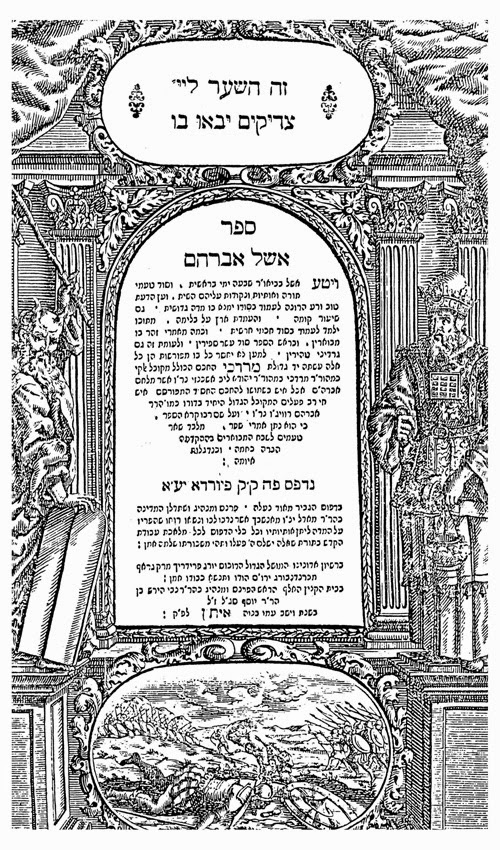
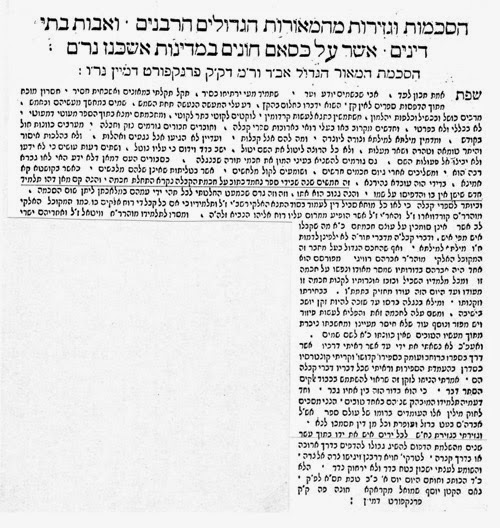
On January 2, 1701, R. Joseph Samuel wrote a letter of approbation for a kabbalistic work by R. Mordechai Ashkenazi, an otherwise unknown author (then) who was a protégé of the distinguished Italian rabbi and kabbalist, R. Abraham Rovigo (d. 1713).5 The book, entitled אשל אברהם, and the letter of approbation, were published later in 1701 in Fürth. After a lengthy critique of the proliferation of works on Kabbalah in the late 17th century, the letter reads, in part:6
They [the new authors of kabbalistic works] are guilty of two evils. First, they neither know nor understand the deeds of God. Second, they cause the common folk to slight the rabbis expert in the exoteric Torah. The common folk assume that rabbis not expert in Kabbalah are not true scholars. So they cast away their expert rabbis, listening instead to the enchanters, whose wisdom is borrowed from others. I can testify that this is true [i.e., that the enchanters’ wisdom is borrowed from others], for I was involved in such a case. I recall vividly how some fifty years ago I owned a copy of a delightful kabbalistic work entitled התחלת חכמה. Some upstart student, a novice with no knowledge based on accumulated learning, printed the book under his own name. He simply plagiarized the entire book.
2.  The Identity of the Plagiarized Book.
No book entitled התחלת חכמה has ever appeared in print. It therefore could not have been plagiarized by anyone. Moreover, R. Joseph Samuel did not reveal the name of the plagiarist and the title of the book in its plagiarized form. This literary riddle was first raised in print early in 1976 by the noted bibliophile, Abraham Schischa of London.7 The solution was not long in coming. That same year, R. Shmuel Ashkenazi, also a noted bibliophile, solved the riddle.8 He correctly identified התחלת חכמה as the title of a kabbalistic book in manuscript form, still available in a variety of contemporary libraries.9 In book form, it was entitled מעין החכמה and it first appeared in print in Amsterdam in 1652.10 The plagiarist who published מעין החכמה under his own name was R. Abraham Kalmankes of Lublin. Ashkenazi provided other useful information as well, but all that is important for our purposes is that he clearly identified R. Abraham Kalmankes as a plagiarist. As such, he agreed fully with R. Joseph Samuel’s characterization (in his letter of approbation) of the novice upstart student. The  late Professor Gershom Scholem also identified R. Abraham Kalmankes as a plagiarist. He would write:11
והוא [ר’ אברהם קלמנקס] הדפיס ס’ התחלת חכמה הגניבה [כך כתוב] על שמו,
וכבר יש רמז לדבר בהסכמת הרב מפרנקפורט לס’ אשל אברהם.

“He [R. Abraham Kalmankes] published the pirated book entitled Hathalat Hokhmah under his own name. The matter is alluded to in the letter of approbation by the rabbi of Frankfurt to the book entitled  Eshel Avraham.”

It is our contention that R. Abraham Kalmankes has received less than a fair hearing in the court of modern scholarship. If we reopen the investigation, it is because much of the evidence has either been misconstrued or overlooked. The reader will have to decide for himself whether or not Kalmankes was, in fact, a  plagiarist, and whether or not he should be better remembered for his seminal contribution to Jewish teaching and literature.
3. מעין החכמה.
            a) Claims of the Author/Editor
מעין החכמה, the first book to appear under R. Abraham Kalmankes’ name, is a short introduction to Lurianic Kabbalah. Indeed, it was among the earliest such works to appear in print. The title page of the quarto sized volume is followed by a one-and-a-half page introduction (pages 2-3). The introduction is followed by the text (pp. 4-22), which consists of 78 tightly-knit chapters (פרקים), perhaps more properly labeled today as paragraphs. Thus, several of the “chapters” consist of no more than15 lines of print (and, sometimes, even less). Scattered throughout the book are occasional comments in parentheses. These may reflect an educational tool used by the original author to clarify a difficult term by means of a gloss, creating — in effect — what we would call today a footnote. Or, as appears likely, these may reflect a second hand, i.e., material added to the base text by someone other than the author, e.g., a later editor of the original manuscript. Our immediate concern, however, will not be with the book’s content or structure, but rather with its authorship. What are the claims of the title page and the introduction? What do they tell us about the authorship of
מעין החכמה?
The title page basically announces the content of the book.12 It is a kabbalistic manual, we are informed, the likes of which has yet to appear in print. It provides the kabbalistic underpinning upon which all of R. Isaac Luria’s teachings rest. The title page then indicates that the book’s secret teachings are being  brought to press [ Hebrew:תעלומים  הוציא לאור] by “the exceedingly wise and young divine kabbalist, R. Abraham, son of the Gaon, Chief Rabbi and Head of the Yeshiva, R. Aryeh Leib, scion of the Kalmankes family of Lublin.” Note that the phrase “being brought to press by” is ambiguous. It is unclear from the title page whether R. Abraham Kalmankes is being presented as the author, editor, or publisher of מעין החכמה.
We perforce turn to the introduction, which – if read carefully – resolves much of the ambiguity of the title page.13The introduction, written and signed by R. Abraham Kalmankes, begins with a justification for the book’s publication. Briefly, Kalmankes, himself a victim and survivor of the Chmielnitzki massacres, informs the reader that he was puzzled by the seemingly endless exile of the Jews, with redemption nowhere in sight. After much reflection – and deeply influenced by kabbalistic teaching – Kalmankes concluded that it was faulty prayer that was prolonging the exile of the Jewish people. Jewish prayer was not piercing the heavens and reaching God on high. He compared the state of the Jewish people to a ship adrift at sea, with no one on board who knows how to steer the ship to safety. Nothing will change, argued Kalmankes, until kabbalistic teaching spreads throughout the Jewish communities. The seeds of redemption were planted by R. Isaac Luria, the master of proper kabbalistic prayer. Alas, he died before redemption set in, but he left a successor, R. Hayyim Vital, who in turn left “a basket full of manuscripts,” i.e. he reduced to writing the kabbalistic teachings of R. Isaac Luria, especially those relating to prayer. Once these teachings were mastered by Jews the world over, redemption would be at hand.
Unfortunately, “the basket full of manuscripts” was not being made available to the Jewish community at large. Kalmankes explains that those who horde the manuscripts refuse to publish them. This, for two reasons. First, for reasons of vanity. By retaining the manuscripts for themselves, they became the masters of esoteric teaching and the power brokers to whom all had to turn for guidance. Second, for reasons of profit. The owners of the manuscripts charged a hefty price for those who wished to view and copy them. Kalmankes decided to put an end to this scandalous state of affairs by acquiring and publishing one of the manuscripts that preserved some of the key esoteric teachings of R. Isaac Luria. Moreover, he “added a few comments of his own, in order to benefit the many readers,” almost certainly a reference to the comments in parentheses mention above. He gave the manuscript a new title, מעין החכמה [Wellspring  of Knowledge], for “just as a wellspring begins with a narrow opening that ultimately widens as it fills with water, so too this book begins with nuggets of wisdom that broaden and deepen as one grows in wisdom.” Kalmankes concludes the introduction with the following signature: “These are the words of the youngest
member of the group, Abraham, son of my father and teacher Rabbi Aryeh, son of the Gaon, our teacher and rabbi, the honorable R. Joseph Kalmankes Yaffe of Lublin.”
            b) Editions
Some of the confusion surrounding מעין החכמה relates to the multiplicity of published kabbalistic works with the title מעין החכמה, some of which have been mistakenly ascribed to Kalmankes in library catalogues throughout the world.
Confusion surrounding Kalmankes’ alleged plagiarism is also due, in part, to variant readings that appear in the later printed editions of מעין החכמה, for which Kalmankes can hardly be held responsible. After brief mention of some unrelated kabbalistic works with the title מעין החכמה, we will list and describe each of the printed editions of Kalmankes’ מעין החכמה.
An anonymous kabbalistic treatise entitledמעין חכמה  (ascribed in part to Moses) is included in the collection entitled ארזי לבנון (Venice, 1601).14 It is unrelated to Kalmankes’ מעין החכמה. The Ashkenazic printing house of the partners Judah Leib b. Mordecai Gimpel and Samuel b. Moses Ha-Levi published yet another anonymous kabbalistic treatise entitled מעין החכמה (Amsterdam, 1651).15 Frequently reprinted, it too is unrelated to Kalmankes’ מעין החכמה.
Four different editions of Kalmankes’ מעין החכמה have appeared in print. They are:
1. מעין החכמה, Amsterdam, 1652. Printed by the Immanuel Beneviste publishing house during the lifetime of its author/editor Abraham Kalmankes, it is the only reliable edition of Kalmankes’ מעין החכמה. As such, we will claim that Kalmankes can be judged only on the basis of this, and no other, edition of מעין החכמה. For a detailed description of the book, its title page, and introduction, see above.16
2. מעין חכמה, Koretz, 1784. This edition was printed by the Johann Anton Krieger publishing house which, in Koretz, was devoted to the publishing of kabbalistic and hasidic works.17 Although Kalmankes’ title of the book is retained, the title page ascribes the book to R. Isaac Luria and makes no mention of Abraham Kalmankes. More importantly, this edition omits Kalmankes’ introduction to the book. The text is a slightly revised and updated version of the Kalmankes edition. It incorporates most of Kalmankes’ parenthetical notes, with slight revision.18 The text was edited in its present form sometime between 1698 and 1784, i.e. well after Kalmankes’ death.19
3. מעיין חכמה, Polonnoye, 1791. Printed by the Samuel b. Yissokhor Baer Segal publishing house, this edition of מעין החכמה  appears at the end of a collection of kabbalistic works whose title page reads: ספר הר אדני.  מעיין חכמה is accorded no title page of its own. It begins with a skewed version of Kalmankes’ introduction, entitled: הקדמת המחבר ספר מעיין חכמה. No such title is applied to Kalmankes’ introduction in the first edition. We have already indicated (see above) that the introduction is omitted entirely from the second edition, so no such title appears there. The introduction to this, the third edition, closes with the name of the author:  אברהם בן מהו’ ארי’ בן הגאון מה’ משה יוסף קלמן מלובלין. In the first edition, however, Kalmankes’ grandfather’s name is given as: הגאון מורנו ורבנא כמוהר”ר יוסף קלמנקס ייפה מלובלין, with no mention of either משה or קלמן. The text that follows is entitled: התחלת החכמה האלהות כפי דרך האר”י אשכנזי ז”ל הנקרא ספר מעיין החכמה. It differs considerably from the text published in the first two editions. It  mostly lacks Kalmankes’ parenthetical comments strewn throughout the first two editions. It regularly omits readings that appear in the first two editions, and often adds material that is lacking in the first two editions. Indeed, it is a different manuscript version of the Lurianic digest that was first published by Kalmankes in 1652.20
4. מעין החכמה, Lvov, 1875. No publisher’s name is given. This is a hybrid version drawn from two earlier printed editions. Kalmankes’ introduction is drawn from the skewed version that accompanies the Polonnoye, 1791 edition. The text is drawn from the Koretz, 1784 edition.21 As such, this edition has no independent value and requires no further discussion.
            c) Relationship of the Published Editions to the Extant Manuscripts
No one has written more intelligently about the history of Lurianic kabbalistic manuscripts than Yosef Avivi.22 What follows is essentially a brief account of the relationship between the published editions of Kalmankes’מעין החכמה and the extant manuscripts, based largely (but not entirely) upon the results of Avivi’s investigations.
Numerous manuscripts copies of the kabbalistic treatise entitled התחלת החכמה, most of them dating to the 17th and 18th centuries, are extant in libraries throughout Europe, Israel, and the U.S. While they vary slightly from each other, they clearly reflect a single recension of an early 17th century kabbalistic treatise. The anonymous treatise, whose original title is unknown, was written by a disciple of Luria in Damsascus and then sent to Italy. There, the manuscript was copied and circulated under a variety of names such as קונטרס ההיכלות, כללי חכמת שיעור קומה, התחלת החכמה, and התחלת חכמה. It was precisely because a manuscript copy of התחלת חכמה came into the possession of R. Joseph Samuel b. R. Zvi of Cracow sometime prior to 1652, that he was so startled when he saw Kalmankes’ printed edition of מעין החכמה. Even after the printed edition made its debut in 1652, new manuscript copies of the kabbalistic treatise were written and circulated under a variety of titles, now including the title מעין החכמה.
Avivi has shown that the  התחלת החכמה manuscripts formed the first part of a larger Lurianic treatise that originally included a second part as well. Whereas the first part focused entirely on עולם האצילות, the second part focused  on עולם הבריאה — and is extant in manuscript form only. The two parts were separated from each other, and largely due to Kalmankes’ publication, the first part became an independent work entitled מעין החכמה. In sum, Kalmankes’ מעין החכמה is an accurate copy (with the addition of occasional glosses by Kalmankes) of an anonymous early 17th century Lurianic treatise that circulated widely under a variety of titles, including the title התחלת החכמה.
4. R. Abraham Kalmankes.
            a) Family History
The accusation of plagiarism leveled against R. Abraham Kalmankes by R. Joseph Samuel b. R. Zvi, and seconded by both R. Shmuel Ashkenazi and  Gershom Scholem, was not accompanied by any discussion of R. Abraham Kalmankes himself. When and where did he live? How did he make a living? What other books did he author? Was he an inveterate plagiarizer?23 Had such an investigation been conducted, we suspect that the accusation of plagiarism would not have been leveled at all.
In a brief biographical account of Kalmankes published in 1992, the author of the account bemoans the fact that so little is known about Kalmankes’ life history.24 Nonetheless, much more is known about him – and his family — than the meager snippets of information recorded in the 1992 biographical account or in the standard discussions of מעין החכמה. We will take as our point of departure the clear reference in Kalmankes’ introduction to מעין החכמה to his distinguished grandfather, “the Gaon, our Teacher and our Rabbi, R. Joseph Kalmankes Yaffe of Lublin.” For our purposes, what is most important about the grandfather is that after an illustrious rabbinic career in Lublin, he spent his last years in Prague, where he died, and remains buried to this day.25 The elaborate epitaph on his tombstone informs us that he died at the age of 56 on Sunday,13 Tishre, in the year 5397 (= October 12, 1636).26 The significance of this information will become apparent shortly, but first we need to turn elsewhere.
In 1678, at the family owned printing press in Lublin, R. Abraham Kalmankes published the only other work he would publish in his lifetime. Entitled ספר האשל, it is a masterful (and typical seventeenth century) rabbinic commentary on the book of Genesis.27It was the first installment of a planned commentary on the entire Torah, but apparently the rest of the commentary either never materialized or was never published.  The commentary is essentially a midrashic-halakhic work, replete with citations from the Midrash, Talmud, Codes (especially R. Joseph Karo’s שלחן ערוך), and kabbalistic literature. The volume itself is accompanied by a series of letters of recommendations by rabbis from Kremenitz, Lublin, Brisk, Pinsk, Grodno, Vilna,28 and more, all attesting to Kalmankes’ rabbinic scholarship. Once again, Kalmankes prefaced his work with an informative introduction. Kalmankes alludes to the many trials and tribulations that accompanied him through life, including hazardous trips to Egypt and the land of Israel. He was near death on several occasions during his travels, but managed to make his way back safely to Lublin.29 Upon his return, he undertook to publish two works in his lifetime. This, in order to fulfill the talmudic dictum: “Happy is he who arrives here [i.e., on High] with his talmudic teaching in hand.”30 Since according to biblical teaching, a matter is established by “two witnesses,” Kalmankes was determined to author two books and publish them, so that he would have them “in hand” when necessary. The first book, ספר האשל, intended for a more or less popular audience, took the form of a commentary on the book of Genesis. The second book, entitled ברכת אברהם, was intended for talmudic scholars only. Kalmankes informs us that the manuscript copy of ברכת אברהם was completed and that he looked forward to its publication. Sadly, it was never published. What  needs to be noted immediately is that Kalmankes never imagined that his earlier publication of מעין החכמה could count as one of his “two witnesses”! (And this was in 1687, long before R. Joseph Samuel b. R. Zvi leveled his accusation of plagiarism in 1701.) Indeed, מעין החכמה is not mentioned at all in Kalmankes’ introduction to ספר האשל. Clearly, he did not consider it a book that he had authored.
Elsewhere in the introduction, Kalmankes notes that he will make a special effort to cite דברי תורה from his grandfather, R. Joseph Kalmankes, who he describes as: “א”א זקני מ”ו הגאון מוהר”ר יוסף קלמנקס, זצ”ל, אשר מנוחתו כבוד בק”ק פראג.”  Kalmankes adds that upon his grandfather’s death in Prague, all of his writings were lost, and that he – Kalmankes – will therefore record his grandfather’s teachings as he heard them from his disciples. “For,” explains Kalmankes, “I merited to sit at his feet only until the age of ten. Thus, I was a child, and have no real knowledge of his novellae.” We, of course, cannot be certain whether Kalmankes sat at his grandfather’s feet in Lublin or Prague (or both). If only in Prague, and if Kalmankes was ten years old when his grandfather died, we have the latest possible date of birth for Kalmankes, namely 1626, for we have already established that Kalmankes’ grandfather died in 1636. Kalmankes, of course, could have been born earlier than 1626, and we have reason to believe that this was the case.
At the other end of the spectrum, it seems likely that R. Abraham Kalmankes died somewhere between 1678 and 1701. That he was still alive in 1678 is attested by the publication of ספר האשל in that year, and by several of the letters of recommendation dated 1678, all of which describe Kalmankes as alive and well. Since Kalmankes never responded to the devastating accusation of plagiarism made against him in 1701 by a leading rabbinic contemporary, it is probably safe to assume that he died before the accusation appeared in print. Though we cannot pinpoint the year of his death with precision, the most likely candidates are either 1692 or 1693. Kalmankes died in Lvov, where he served on its rabbinic court as דיין.31 The text of the epitaph on his tombstone was copied and published in 1863 and reads:32
שנת תתן אמת ליעקב
                          ביום טוב נהפך כי טוב פעמים ואבל ומספד ונהי בכפלים
ט”ו בחודש ניסן נגנז צנצנת המן המאיר באספקלריא המאירה
כבוד מורינו ורבנו ומאורנו נתבקש בישיבה של מעלה
הגאון האלוף עין הגולה מו”ה אשר יעקב אברהם בן הרב מוהר”ר אריה קלמנקש
צלל במים אדירים של תורה וחיבר ס’ אשל אברהם על שמו נקרא
ובשביל שזיכה את הרבים יבוא שלום וינוח על משכבו בשלום
תנצב”ה
Thus, Kalmankes died on 15 Nisan on a Tuesday.33 But in which year? The text states unequivocally that it was in the year whose numerical value was embedded in the biblical phrase תתן אמת ליעקב.34 But the copyist (in 1863) informed his readers that, due to an erasure, he could no longer determine which letters from the phrase were enlarged or highlighted on the original tombstone. This makes it difficult, but not impossible – as we shall see – to calculate Kalmankes’ approximate year of death. Since Kalmankes died on the first day of Passover which fell on a Tuesday, seven candidates (between the years 1678 and 1701) present themselves: 1679, 1686, 1689, 1692, 1693, 1696, and 1699. The Hebrew equivalents for these years are: [5]439, [5]446, [5]449, [5]452, [5]453, [5]456, and [5]459. Now the numerical value of a combination of letters from the phrase תתן אמת ליעקב must add up exactly to one or more of the above Hebrew dates. Only two solutions are possible: [5]45235 and [5]453.36 These are 1692 and 1693, respectively.37 In sum, if we had to give mostly approximate dates for the three generations of the Kalmankes family mentioned by R. Abraham Kalmankes in both of his publications, they would be:
R. Joseph Kalmankes:    1580-1636
R. Aryeh Kalmankes:      1600-167038
R. Abraham Kalmankes: 1620-169339
b) Citation from מעין החכמה in ספר האשל
Critical for our discussion is the fact that R. Abraham Kalmankes cites מעין החכמה in his ספר האשל!40 It is the only reference to מעין החכמה in ספר האשל.The passage reads:41
       או יאמר מאמר הר”י ז”ל באשר נקדים מאמר מהאר”י לור”י[א] הנזכר בספר מעיין החכמה
אשר הביאותיו לבית הדפוס בפ’ י”ד שבשעת הבריאה…
Or we can explain this by citing a passage from R. Isaac of blessed  memory, i.e., by first introducing a passage by R. Isaac Luria Ashkenazi — which is mentioned in chapter 14 of the book מעיין החכמה, which I brought to press [literally: to the publishing house] — which states that during the period of creation…
If one examines chapter 14 of מעין החכמה, the passage cited by Kalmankes in ספר האשל appears exactly as referenced, but Luria’s name appears nowhere in the text of chapter 14! This is precisely because מעין החכמה was a repository of Lurianic teaching which he – Kalmankes – brought to press. Kalmankes never claimed authorship of the book, and he tells us so in his own words in 1678, long before any accusation was leveled against him.
5. Conclusions.
Ultimately, whether or not Kalmankes is viewed as a plagiarist will depend largely on one’s definition of plagiarism.42 In terms of literary (as distinct from oral) plagiarism, a reasonable definition would seem to be:
Plagiarism is the act of appropriating in print another person’s ideas,          writings, or words, and passing them off as one’s own by not providing proper attribution to their original source.
Even aside from the definition itself, the moral opprobrium attached to any specific act of plagiarism will depend on a variety of factors. Thus, it seems to me, that the more literal and lengthy the borrowing, the more heinous the offense. Motive too will surely play a role in determining the severity of the offense. We turn to the specifics of the Kalmankes case.One can certainly sympathize with R. Joesph Samuel’s outrage when, in the 1650’s, he chanced upon a copy of the recently published מעין החכמה. He leafed through its pages and realized instantaneously that it was virtually word for word a printed copy of a manuscript he owned under the title התחלת חכמה. Worse yet, prominently displayed on the title page of the pirated book was the name of the “divine kabbalist,” R. Abraham Kalmankes, a name otherwise unknown to R.Joseph Samuel. He could only conclude that this was a blatant case of plagiarism that called for condemnation. Indeed, he was still upset about the matter some fifty years later!
But, as we have seen, the title page of מעין החכמה is somewhat ambiguous about Kalmankes’ role in its authorship and publication. It simply states that Kalmankes הוציא לאור the תעלומים, i.e., he published the secret or hidden digest of Lurianic teaching. One suspects that R. Joseph Samuel never examined Kalmankes’ introduction to מעין החכמה. Had he done so, he surely would have noticed that Kalmankes admits openly that he is publishing a manuscript that contains a digest of Lurianic teaching, authored by a disciple of Luria – and not by him. Kalmankes’ states unequivocally that his contribution to the volume is limited to the few comments he added (almost always in parentheses) and to the new title, מעין החכמה, he provided for it. It is only in the third edition of מעין החכמה, published in Polonnoye, 1791 – long after Kalmankes’ death – that a skewed version of Kalmankes’ introduction is labeled: הקדמת המחבר ספר מעיין חכמה, in effect suggesting that Kalmankes was the author of מעין החכמה. Anyone who reads this skewed version of Kalmankes’ introduction, and compares it to the original, will realize at once that it is was created in 1791 in order to harmonize its content with that of a different manuscript version of the Lurianic digest (one that lacked Kalmankes’ comments) that was being attached to it.43
 We have also the clear evidence from Kalmankes’ introduction to ספר האשל, published by him in 1678, that he sought to author and publish two books in his lifetime, so as not to be embarrassed when he was called “on High.” He provides the titles of both books, yet makes no mention of the fact that he had authored and published a book called מעין החכמה. He knew full well that this was a book written by others, which he had brought to press. Indeed, as we have seen, he cited מעין החכמה in his ספר האשל. When doing so, he stated openly that it was a Lurianic work that he had brought to press.
            There doesn’t seem to be much evidence here for plagiarism, as defined above. Kalmankes’ מעין החכמה was based upon a Lurianic manuscript that was anonymous and was circulating under a variety of titles. Kalmankes never claimed authorship of the manuscript, and indicated clearly that all he did was to provide the manuscript with a new title and some brief annotation. This he did for the best of motives, namely to bring about the ultimate redemption of the Jewish people. He did not pass off the work as his own (other than the title and the annotations, which were legitimately his own creation); he withheld no proper attribution.
On the other hand, three distinguished scholars, R. Joseph Samuel of the seventeenth century, and R. Shmuel Ashkenazi and the late Professor Gershom Scholem of the twentieth century, were persuaded that Kalmankes was a plagiarist. Perhaps they felt that the appearance of Kalmankes‘ name on the title page of מעין החכמה,  preceded by the words “אב בחכמה ורך בשנים המקובל האלוהי כמוהר”ר,” with no mention of any manuscript or attribution to others, was sufficiently misleading – and, perhaps, even deliberately intended – to create the impression that Kalmankes was the author of the book. If so, they would argue, he deserves to be listed among the plagiarizers. I am not persuaded that this is the case, but in deference to the three distinguished scholars mentioned above, I have allowed the title of this essay to read as it does. At best (or: worst), it is a mild case of plagiarism, if even that.44
NOTES
1 For biographical studies of R. Joseph Samuel b. R. Zvi, see H.N. Dembitzer,
כלילת יופי (Cracow, 1893), vol. 2, pp. 144b-152b; M. Horovitz, Frankfurter Rabbinen (Jerusalem, 1969), ed. J. Unna, pp. 94-97 and 296-297; and idem,
רבני פרנקפורט (Jerusalem, 1972), ed. J. Unna, pp. 67-69 and 212. For the epitaph on his tombstone, see idem, אבני זכרון (Frankfurt, 1901), p. 151. For legendary accounts of R. Joseph Samuel, see E. Sternhell, “,תולדות יצחק” p. 2b, in Y.I. Billitzer, באר יצחק (Paks, 1898); and Y.L. Maimon, שרי המאה (Jerusalem, 1955), vol. 1, pp. 231-233.
2 For an assessment of R. Joseph Samuel’s contribution to the printed text of the Talmud, see Y. S. Spiegel, עמודים בתולדות הספר העברי: הגהות ומגיהים (Ramat-Gan, 2005), second edition, pp. 404-407.
3 See L. Loewenstein, מפתח ההסכמות (Lakewood, 2008), ed. S. Eidelberg, pp. 99-100.
H.N. Dembitzer, op. cit., vol. 2, p. 150a.
See G. Scholem, חלומותיו של השבתאי ר’ מרדכי אשכנזי (Jerusalem, 1938); and Y. Tishby, נתיבי אמונה ומינות (Jerusalem, 1964), pp. 81-107. Cf. the historical vignette in Rabbi P. Katzenellinbogen, יש מנחילין (Jerusalem, 1986), ed. Y.D. Feld, pp. 74-75.
The original reads:
ושתים רעות עושים כי לא ידעו ולא יבינו אל פעולות השם,  גם גורמים להשניא  בעיני המון את חכמי תורה שבנגלה, כסבורים העם דמאן דלא ידע האי לאו גברא רבה הוא, ומשליכים אחרי גיום חכמים חרשים ושומעים לקול מלחשים, אשר בטליתות שאינן שלהם מלבשים, כאשר בקושטא קא אמינא בדידי הוה עובדא, נהירנא זה חמישים שנה שבידי ספר נחמד כתוב על חכמת הקבלה נקרא תחלת חכמה, והנה קם מאן דהו תלמיד חדש שישן אין בו והדפיסו על שמו, והנה גנוב הוא אתו.
A. Schischa, “שלושה ספרים נעלמים,” עלי ספר 2(1976), pp. 237-240.
S. Ashkenazi, “שתי הערות,” עלי ספר 3(1976), pp. 171-173. For an expanded version of Ashkenazi’s comments in עלי ספר, see his אסופה: ארבעה מאמרים מאוצרות הר”ש אשכנזי שליט”א (Jerusalem, 2014), pp. 49-53. Cf. S.Z. Havlin, “הערת העורך,” עלי ספר 11(1984), p. 134.
These include the National Library in Jerusalem, the Bodleian Library at Oxford, and a host of other libraries in Europe and the United States. For an early description of two such manuscripts in the National Library in Jerusalem, see G. Scholem, כתבי יד בקבלה (Jerusalem, 1930), p. 63, manuscript 2512, and p, 117, manuscript 47. The Bodleian Library lists some 10 manuscript copies of התחלת חכמה in its collection. See A. Neubauer, Catalogue of the Hebrew Manuscripts in the Bodleian Library and in the College Libraries of Oxford (Oxford, 1886), column 1001. Cf. the corrections to these listings in M. Beit-Arie and R.A. May, eds., Catalogue of the Hebrew Manuscript in the Bodleian Library: Supplement of Addenda and Corrigenda (Oxford, 1994), passim. A manuscript copy of התחלת חכמה was in the private library of R. Joseph Solomon Delmedigo in 1631. See his נובלות חכמה (Basel, 1631), p. 195a. The precise title of the book varies in the manuscripts, with the most common titles being התחלת חכמה  and
התחלת החכמה.
10 See L. Fuks and R.G. Fuks-Mansfeld, Hebrew Typography in the Northern Netherlands 1585-1815 (Leiden, 1984), vol. 1, pp. 176-177, entry 233.
11 See the undated loose page, in Scholem’s hand, appended to Scholem’s copy of מעין חכמה at the National Library in Jerusalem. Cf. ספריית גרשם שלום בתורת הסוד היהודית: קטלוג (Jerusalem, 1999), vol. 1, p. 312, entry 4188.

12 See the scan of the title page.
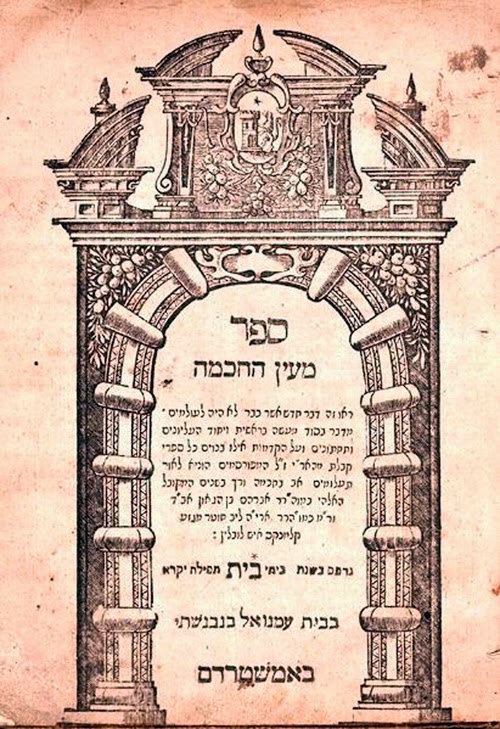
 

13 See the scan of the introduction.
14 The title is so listed on the pages of the treatise itself in ארזי הלבנון, pp. 46b-47a. On the title page of ארזי הלבנון, it is listed as מעיין החכמה. The frequent and easy interchange between the spellings מעין and מעיין and the spellings חכמה and החכמה characterizes virtually all the printed editions of the various books bearing these titles.
15 L. Fuks and R.G. Fuks-Mansfeld, op. cit., vol. 1, p. 195, entry 270,
16 Only a handful of copies are extant world wide. To the best of my knowledge, the first edition of Kalmankes’ מעין החכמה has not been photo-mechanically reproduced, and it is not available online (as of the date this note was recorded). Nor is it available on any of the standard electronic collections of rabbinic literature, such as HebrewBooks, אוצר החכמה, or אוצרות התורה. I am indebted to the National Library in Jerusalem and the Jewish Theological Seminary in New York for making their copies available to me. The scans of the title page and the introduction are reproduced here courtesy of the Bibliotheca Rosenthalia, now in the Special Collections of the University of Amsterdam (online catalogue: http://permalink.opc.uva.nl/item/001748453).
17 H. D. Friedberg, תולדות הדפוס העברי בפולניא (Antwerp, 1932), p. 61.
18 One key revision appears on p. 1, chapter 2, where ספר ויקהל משה is referenced. The book is not mentioned in the first edition of Kalmankes’ מעין החכמה, nor could it have been, since ספר ויקהל משה was not published until 1698. The reference is to R. Moshe Graf, ויקהל משה (Dessau, 1698). It does not appear likely that Kalmankes saw Graf’s work in manuscript form, since מעין החכמה was published in 1652 and Graf was born in 1650.
19 For the date of Kalmankes’ death, see below. The Koretz, 1784 edition was photo-mechanically reproduced in Jerusalem, 1970.
20 The Polonnoye, 1791 edition of מעיין חכמה was photo-mechanically reproduced in Jerusalem, n.d. (circa 1998), in a thin, dark blue, hardbound volume whose spine and outer cover read צדיק יסוד עולם, and whose title page reads הר אדני. (In other words, when seeking a copy in a bookshop of the reprint of the Polonnoye, 1791 edition of מעיין חכמה, whatever else you do, don’t ask for a copy of מעיין חכמה.)
21 As noted by S. Ashkenazi (see above, note 8), the title page of the Lvov edition indicates that its text is based upon the Koretz edition, and reproduces the very biblical phrase used by the Koretz edition for indicating its original date of publication in 1784. But by highlighting a different set of letters within the same biblical phrase, the Lvov edition announces to the reader that its date of publication is 1875.
22 Y. Avivi, קבלת האר”י (Jerusalem, 2008), 3 volumes, passim. See especially vol. 1, pp. 204-208, 443; and vol. 2, pp. 565-568, 840-841. See also, idem, “כתבי האר”י באיטליה עד שנת ש”פ”,” עלי ספר 11(1984), pp. 91-134; and “הערה,” עלי ספר 12(1986), p. 133.
23 “Plagiarism is something people may do for a variety of reasons but almost always something they do more than once.” So T. Mallon, Stolen Words: Forays into the Origins and Ravages of Plagiarism (New York, 1989), preface, p. xiii.
24 Rabbi M.Y.S. Goldenberg, “פתח דבר,” to the reissue of R. Abraham Kalmankes’ ספר האשל (Brooklyn, 1992).
25 On R. Joseph Kalmankes Yaffe of Lublin, see J. Kohen-Zedek, שבת אחים ( St. Petersburg, 1898), pp. 59-76; S. B. Nissenbaum,  לקורות היהודים בלובלין, (Lublin, 1920), second edition. pp. 36-37; S. Buber, אנשי שם (Cracow, 1895), p. 89, entry 217;  and S. Englard, “צפונות יוחסין (א), “ ישורון 3(1997), p. 680, note 6 and p. 694, note 36a.
26 See K. Lieben, גל עד (Prague, 1856), German section, p. 46; Hebrew section, pp. 34-35.
27 R. Abraham Kalmankes, ספר האשל (Lublin, 1678). Few copies have survived. For the copy at the Bodleian Library, see M. Steinschneider, Catalogus Librorum Hebraeorum in Bibliotheca Bodleiana (Berlin, 1860), vol. 1, column 752, entry 4458:1; and A.E. Cowley, A Concise Catalogue of the Hebrew Printed Books in the Bodleian Library (Oxford, 1929), p. 45. For the copy at the British Library, see J. Zedner, Catalogue of the Hebrew Books in the British Museum (London, 1867), p. 14. For the copy at Yeshiva University’s Mendel Gottesman Library, see B. Strauss, אהל ברוך (London, 1959), p. 31, entry 534. To the best of my knowledge, the first edition of Kalmankes’ ספר האשל has not been photo-mechanically reproduced, and is it not available online (as of the date this note was recorded). Nor is it available on any of the standard electronic collections of rabbinic literature, such as HebrewBooks, אוצר החכמה, or אוצרות התורה. A new edition of this exceedingly rare volume was made available by Rabbi M.Y.S. Goldenberg (Brooklyn, 1992) and we are indebted to him. Nonetheless, one needs to use this new edition with caution; the text has been “improved” for the modern reader. A comparison of the texts of the title page, as they appeared in 1678 and 1992, serves as an indicator of the occasional liberties taken with the text. A seemingly enigmatic woodcut (opposite the opening page of the commentary on Genesis) depicting a Jew (Kalmankes?) drawing water from a well (מעין החכמה?) – and framed in an elaborate frame marked by two angelic beings holding up a crown inscribed with the words כתר תורה – was not reproduced in the 1992 edition. See the attached scans:
 
28 The letter of recommendation from Vilna, dated 1673, was written by its Chief Rabbi, R. Moses b. David Kramer (d. 1687), the paternal great-great-grandfather of the Vilna Gaon.
29 These vicissitudes of life may account for the additional first names of Kalmankes, who in ספר האשל is identified as אשר יעקב אברהם קלמנקס. For the practice of changing names and/or adding additional first names when confronted by difficult circumstances, see R. Judah He-Hasid, ספר חסידים (Jerusalem, 1957), ed. R. Margulies, p. 214, paragraph 245 and notes. Cf. A. Teherani, כתר שם טוב (Jerusalem, 2000), vol. 1, pp. 293-315.
30 B. Pesahim 50a and parallels.
31 S. Buber, op. cit., p. 45, entry 101.
32 G. Suchestow, מצבת קודש (Lemberg, 1863), second edition, vol. 1, no pagination, entry 32.
33 The opening line ביום טוב נהפך כי טוב פעמים signals that Kalmankes died on a holiday that fell on the day when כי טוב was said twice. The next line identifies the holiday as 15 Nisan, i.e., the first day of Passover. The day כי טוב was said twice refers, of course, to the third day of creation, i.e. Tuesday. See Gen. 1:10 and 12.
34 Buber, loc. cit., writes with confidence that the highlighted letters are אמ”ת, which would indicate that Kalmankes died in [5]441 or 1681. But in 1681, the first day of Passover fell on a Thursday, not on a Tuesday. Suchestow was more circumspect, indicating it was no longer possible to determine which of the engraved letters were enlarged or highlighted. He left the problem unresolved. The usual practice for highlighting was the placement of a protruding dot over the engraved letters that were to be used for reckoning the year of death. The problem cannot be resolved by emending the second line to read ט”ז בחודש ניסן instead of ט”ו בחודש ניסן, since the second day of Passover can never fall on a Tuesday. See שלחן ערוך, אורח חיים, סימן תכח: א.
35 By highlighting the letters תתן אמ’ת’ לי’עקב’.
36 By highlighting the letters תתן א’מ’ת’  לי’עקב’.
37 These dates are based upon the assumption that the text of Kalmankes’ epitaph, as copied and published by Suchestow in 1863, is an accurate copy of the original. But this may not be the case. Suchestow’s מצבת קודש is marred by egregious errors. He sometimes copied and published as many as four different versions of the same epitaph! In another instance, he divided an epitaph into two parts, creating two dead persons when only one was called for. See the critiques of Suchestow in S. Buber, op. cit. (above, note 25)pp. vi-viii and in R. Margulies, “”,לתולדות אנשי שם  סיני 26(1949-50), p. 113 ( and throughout the later installments to this essay published in סיני between 1950 and 1952). Given that Kalmankes’ tombstone was close to 200 years old when it was copied in 1863, it is likely that the epitaph could be read only with great difficulty. While any attempt at emending the received text is speculative, a slight emendation of the first lines of the epitaph yields the following text:
שנת תתן אמ”ת ליעקב
ביום טוב נהפך טוב פעמים ואבל ומספד ונהי בכפלים
ט”ו בחודש ניסן נגנז צנצנת המן המאיר באספקלריא המאירה
The sense would be that Kalmankes died on 15 Nisan, on יום טוב, on a day when טוב was twice overturned. It was overturned first, because every day of the week of creation was described as  טוב(with the exception of the second and seventh days); and second, because it was יום טוב, a holiday. This would allow for 15 Nisan to fall on a Thursday, and indeed in 1681 (the numerical equivalent of אמ”ת), the first day of Passover fell on a Thursday. If so, Kalmankes may well have died in 1681.
38 These dates are an approximation. We know only that R. Aryeh Kalmankes died in 1671 or earlier, as his name appears with ברכת המתים in several letters of approbation dated 1671 and appended to ספר האשל.
39 These dates, as well, are an approximation. For possible evidence that R. Abraham Kalmankes died in 1681, see above, note 37. If Kalmankes was born in 1620, he would have been 32 years old when מעין החכמה was published in 1652. This fits well with his description on its title page as a רך בשנים. It also fits well with R. Joseph Samuel’s characterization of him (at the time) as an “upstart student.” It would also mean that he was nearing 60 years of age in 1678, when he published ספר האשל. This fits well with his bemoaning the fact – in the introduction to the volume – that the hair on his head and beard had turned gray and that old age was overtaking him.
40   It is astonishing that the author of the most comprehensive study of the Kalmankes family, J. Kohen-Zedek, שבת אחים (see above, note 25), concluded on pp. 67-68, that the authors of מעין החכמה and ספר האשל were two different people named Kalmankes (cousins, of course)! Among his proofs is the alleged fact that the author of ספר האשל was unaware of the existence of מעין החכמה. Alas, Kohen-Zedek overlooked the passage cited here. So too Gershom Scholem, who wrote: “המחבר [של ספר מעין החכמה] לא הזכיר את הספר בספריו הוא, כגון ספר האשל.” See the loose page in Scholem’s hand and the Scholem Library Catalogue, referred to above, note 11. Scholem, however, did not conclude with Kohen-Zedek that the authors of מעין החכמה and ספר האשל were two different people. Even more astonishing is the fact that the late bibliophile, R. Reuven Margulies, cited Kohen-Zedek’s conclusion approvingly. See R. Margulies, “לתולדות אנשי שם בלבוב,” סיני 26(1949-50), p. 219. It appears likely that Scholem (in part) and Margulies were misled by Kohen-Zedek.
41 ספר האשל (Lublin, 1678), p. 8b. We have printed the text as it appears
  in the first edition. In the 1992 edition, it appears on p. 29 as follows:
או יאמר באשר נקדים מאמר הר”י לוריא הנזכר בספר מעיין החכמה אשר הביאותיו לבית הדפוס בפ’ י”ד, שבשעת הבריאה…
 42 In general, see A. Lindey, Plagiarism and Originality (New York, 1952); T. Mallon, op. cit. (above, note 23); and J. Anderson, Plagiarism, Copyright Violation and Other Thefts of Intellectual Property: An Annotated Bibliography with a Lengthy Introduction (Jefferson, North Carolina, 1998).
43 Thus, in the introduction to the first edition of מעין החכמה, Kalmankes states:
וגם מעט מזער מדעתי הוספתי אך לזכות הרבים היא כוונתי (I added but a few comments of my own; my only intention is to benefit the many). In the Polonnoye, 1791 edition this was radically changed to: וגם מעט מזער מדעתי לא הוספתי אך לזכות הרבים היא כוונתי (I added not even the fewest of comments of my own; my only intention is to benefit the many). This change was made necessary because the kabbalistic manuscript now appended to Kalmankes’ introduction, and being published together with it for the first time, did not contain Kalmankes’ additional comments.   
44 I am deeply grateful to Rabbi Menachem Silber for reading and commenting on an earlier draft of this essay. The errors that remain are entirely mine.
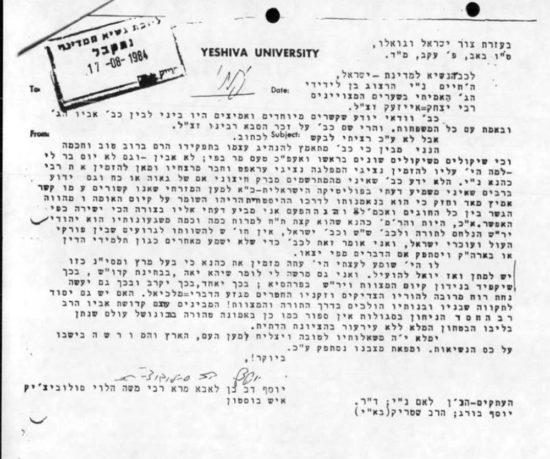
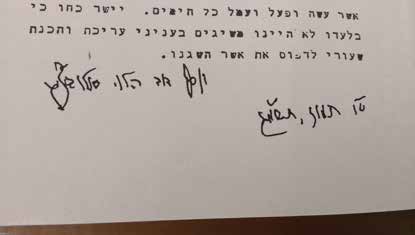
Jews, Medicine and the University of Padua A Behind the Scenes Tour of a New Exhibit at the Jewish Museum of Padua November 2, 2022- December 31, 2022

Jews, Medicine and the University of Padua: A Behind the Scenes Tour of a New Exhibit at the Jewish Museum of Padua
November 2, 2022- December 31, 2022
By Rabbi Edward Reichman, MD

The city of Padua (or Padova), just twenty-five miles southwest of Venice, has a rich and expansive Jewish history, though it is not typically on the itinerary of the Jewish traveler to Italy. One might perhaps recognize the city name as the penultimate stop on the train from Florence to Venice. The likes of Rabbi Yehuda Minz (Mahari Minz- 15th century), Rabbi Meir Katzenellenbogen (Maharam Padua- 16th century), and Rabbi Moshe ayyim Luzzatto (Ramḥal- 18th century) all lived and taught there, as did many other great personalities in Jewish history.
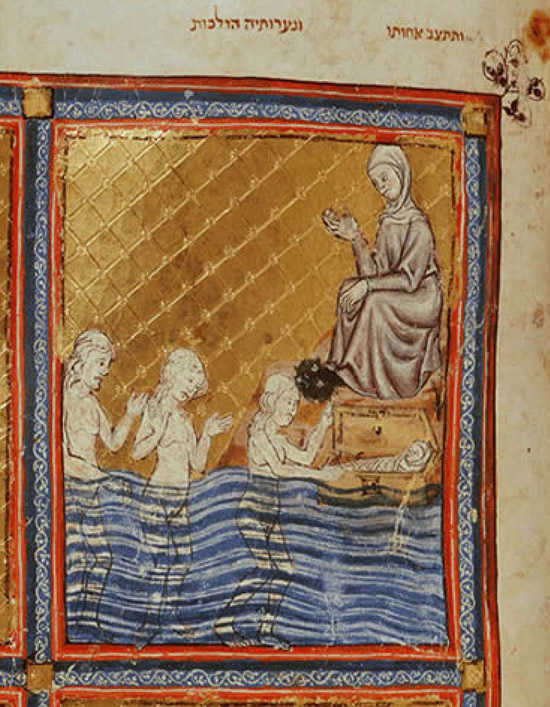
One of the centerpieces of the city is the University of Padua, one of the oldest universities in the world, which is celebrating its 800th anniversary this year. To this day, it remains one of the premier universities in Europe. The Jewish history of this city is very much intertwined with the university. One remarkable connection between the two is geographical. As divine providence would have it, the Ghetto of Padua was established literally meters away from the university campus. A casual stroll from Palazza Bo, the iconic architectural center of the University of Padua, to the Ashkenazi Synagogue in the Ghetto, now home to the Jewish Museum in Padua, takes less than five minutes.

A new exhibit at the Jewish Museum of Padua, in collaboration with the University of Padua, explores the unique relationship between the university and the Jewish community in the pre-modern era, with particular focus on the medical training of Jewish students. The exhibit commemorates a key role the university played in Jewish medical history, beginning in the fifteenth century, as the first university to officially allow Jews to gain formal training in the field of medicine. Since the formation of the earliest universities,[1] Jews were officially barred by papal decree from attending, as the universities were by and large under the auspices of the Catholic Church. In the pages of this blog, we have drawn attention to the role the University of Padua played in Jewish medical education.[2] Most recently we focused on a rare genre of poems written in honor of Jewish medical graduates of this institution from the 16th-18th centuries.[3]

I am now delighted to inform you of a new exhibit at the Jewish Museum of Padua- Jews, Medicine and the University of Padua– which will run through December 31, 2022. The exhibit was inaugurated with an event on November 2, 2022. Introductions by representatives of the museum, the Jewish community of Padua and the University of Padua were followed by a recorded video address by Chief Rabbi Dr. Riccardo Di Segni of Rome, himself a prominent physician, on Judaism and medicine. The program concluded with my presentation about the training of Jewish medical students in Padua.[4]

The archival material occupies a large display case[5] and reflects three centuries of history through rare documents, including community and city archives, which have never been on public display. With the exception of the work of Vesalius, all the items are unica.

In addition, displayed throughout the exhibit hall are portraits of Jewish physicians from Padua from the Benvenesti Collection of the Museo d’Arte of Padua, and a slideshow of diplomas and congratulatory poems appears on the big screen.

Please join me for a behind the scenes virtual tour of some of the highlights of the exhibit.

I. Anatomy, Vesalius, and the Jewish Medical Students of Padua

Andreas Vesalius
De Humani Corporis Fabrica (1543)

Library of the University of Padua

On the lower left shelf of the case, we find an early edition of Andreas Vesalius’ De Humani Corporis Fabrica, open to the frontispiece. It is no exaggeration that the field of modern anatomy was born at the University of Padua under the vision of the famed professor of anatomy, Andreas Vesalius (1514–1564).[6] You may wonder why a copy of this volume, one of the most famous works in the history of medicine and anatomy, is part of an exhibit on Jewish medical history.

This monumental development in the history of medicine interfaced with the Jewish community of Padua in a number of ways. Much like this one anatomy book reveals the structures of the entire body, so too, this one book provides a window into a complex chapter of the experience of the Jewish medical student in Padua with respect to anatomy.

Hebrew Anatomical Terms

The anatomical terms detailed in the works of Vesalius – the Tabulae Anatomicae and De Humani Corporis Fabrica – are presented in multiple languages. One of those languages is Hebrew.[7] The reason for this is not specifically related to the Jewish medical students of Padua per se, but rather to the role the Jews played in the translation of medical works and the transmission of classical medical teaching from antiquity to the Middle Ages and Renaissance.[8]

Exactly who is responsible for the Hebrew translations in the Tabulae Anatomicae is unknown. Vesalius may have attended lectures on the Hebrew language by Joannes van Campen at the Pedagogium Trilingue in Louvain.[9] With the Hebrew terminology for the Fabrica, however, Vesalius duly acknowledges some assistance:

I have decided to give in the index principally a simple list of the names of the bones, first presenting those I use in the text; then the Greek; then, any others in Latin taken from authoritative writers, and all that in such way that it may have value. After these will follow the Hebrew, but also some Arabic, almost all taken from the Hebrew translation of Avicenna[10] through the efforts of Lazarus de Frigeis, a distinguished Jewish physician and close friend with whom I have been accustomed to translate Avicenna.[11]

The reference to Avicenna, the eleventh century Persian physician and polymath, refers to the Canon of Avicenna, one of the more influential medical works of that time. A magnificent, illustrated Hebrew manuscript translation of the Canon, which dates from the mid fifteenth century, is found in the University of Bologna,12] and the work was printed later in the fifteenth century. The Hebrew terminology in Vesalius, and its relationship to the Hebrew medical terminology of the Canon, has been studied by both historian and linguist alike.[13] Some have been less than complimentary.[14]

Vesalius credits Lazarus de Frigeis, “a distinguished Jewish physician and close friend,” with assisting him with the Hebrew translation in the Fabrica.[15] While some evidence has come to light about this friend, his exact identity still eludes scholars.[16] De Frigeis is believed to be depicted in the classic illustration on the frontispiece of the Fabrica, visible in the exhibit showcase, wearing characteristically Jewish garb.[17]

Vesalius and the Jewish Medical Students of Padua

Another relationship between Vesalius and the Jews[18] is inferred from his tenure as a lecturer at the University of Padua.[19] As Padua[20] was one of the only institutions of higher learning in the medieval and Renaissance periods to admit Jews,[21] Jews from across Europe flocked to attend.[22] These students however were not versed in either Italian or Latin, the academic language of discourse. They sometimes required translation for their studies. This is evidenced by the existence of a rare manuscript of the Fabrica in Yiddish dating from the late 1500s.[23]

One could imagine a group of German Jewish medical students sitting in the back of Vesalius’s lecture hall hunched over this very manuscript trying to keep pace with the day’s lesson.

Vesalius’s work also formalized and expanded the teaching of human anatomy at the University of Padua, as well as at medical schools throughout the world. The supply of cadavers was a perennial challenge for the medical school and each community which sent medical students for training at the university was required to provide bodies for the dissection table. This presented a unique problem for the Jewish students, as Jewish law forbids the dissection of the body after death. The Jewish medical students and Jewish community went to great lengths to gain exemption from this requirement. This is reflected in the Jewish community archives of this period.[24] There was also fear of grave robbing from the Jewish cemeteries.[25] Indeed, one scholar has suggested that one of the illustrated letters in the Fabrica depicts a scene of the grave robbing of a body from a Jewish cemetery.[26]

The “o” on the flag held by the putti was the symbol Jews were required to wear on their clothing.

In one case in 1676, a Jewish body was stolen before burial by medical students and brought to the anatomy table for dissection. Riots ensued and a compromise was ultimately reached. Isaac Cantarini wrote about this in his Paad Yitzak (1684). Roth recounts a case where disgruntled students kidnapped an etrog that was being transferred between communities on Sukkot and held it ransom in exchange for providing Jewish bodies for dissection.[27]

II. History of Degree Granting for Jewish Medical Students before 1615- Counts Palatine

Padua City Archives (1469-1470)
ASPd, Notarile, vol. 1946
Archivio di Stato di Padova

The oldest and rarest item of the exhibit (bottom left section- front) is a volume of the Padua city archives from the late 15th century. The pages on display document the medical degree-granting process for Jewish students during this period.

In the early centuries of the University of Padua Medical School, doctoral degrees were granted by the Sacred College of Philosophers and Physicians in a Catholic religious ceremony. As such, this pathway to a medical degree was not a viable option for a religious Jew. However, non-Catholics, including Jews, could obtain medical degrees through a different pathway outside of the university walls, granted by specific individuals known as Counts Palatine, who received their authority from the Holy Roman Emperor. These ceremonies were held privately before a notary and witnesses.[28]

On display is a remarkable archival record from February 21, 1469, reflecting this degree-granting process. The passage recounts that the Holy Roman Emperor Frederick III, while visiting Italy, bestowed upon Judah Messer Leon[29] a double doctorate in medicine and liberal arts, in addition to the title of Counts Palatine, granting him the right to confer doctorates upon other Jews of proven worthiness.

Judah Messer Leon was an accomplished physician, professor, and Torah scholar who later taught at the University of Padua Medical School. His work Nofet Tzufim (Abraham Conat: Mantua, 1475), known to this blog audience as the first Hebrew book to be printed in the lifetime of its author,[31]is a treatise on rhetoric, utilizing the classical literary devices of the ancient discipline of rhetoric applied to the Torah. One of the uses for this work was to prepare the Jewish students who matriculated from foreign countries to the medical schools in Italy. Indeed, Messer Leon is purported to have organized a yeshiva where students could receive a comprehensive Jewish education while training in the secular disciplines necessary for higher studies in the humanities, philosophy, and medicine.[31]

In the same archival record, we learn that it would be just one year later that Messer Leon would exercise his privilege as a Counts Palatine. In Padua, on 27 February 1470, Rabbi Dr. Judah Messer Leon bestowed a medical degree upon the Jew Yoanan Alemanno in a private ceremony at his home. Alemanno was a prominent Italian rabbi, philosopher and Kabbalist who also apparently taught Hebrew to the likes of Pico Mirandola. The nature of the ceremony was similar to the conventional Padua University procedure and included presenting the new doctor with a signed book, placing a gold ring on his finger, a wreath on his head, tying a red silk thread around his waist, and kissing him on the cheek.[32] However, while the invocation to the ceremony for the typical Christian student was “In Christi Nomini,” Messer Leon’s invocation for Alemanno was In Dei omnipotentis nomine amen” (in the name of the Omnipotent God, Amen).[33]

This was the precursor to the invocation which would be used for the formal diplomas of Jewish students in the following centuries, “In Dei Aeterni Nomine Amen.” Messer Leon exercised this extraordinary privilege a number of times during his lifetime.

Messer Leon was involved in a Jewish legal dispute regarding the permissibility of wearing academic robes. Issues relating to these robes included the obligation to wear tzitzit, as well as the concern that they might contain sha’atnez.[34]

In 1615, the Collegio Veneto was established to serve the purpose of granting degrees to non-Catholic students and essentially replaced the Counts Palatine. The diplomas on display in this exhibit are from the period of the Collegio Veneto.

III. Diplomas of Jewish Medical Graduates of the University of Padua

Diplomas of Padua Jewish medical graduates are exceedingly scarce. While there have been a few sold at auction over the last few decades,[35] such diplomas are rarely displayed in public. I have thus far identified a total of nineteen extant diplomas of Jewish Padua medical graduates. Only three examples are found in Italy, and all of them are on display at this exhibit. An additional diploma was reproduced for display,[36] and images of others appear on the screen in the exhibit hall. Below I describe the diplomas on display, accompanied by a brief bio of their (original) bearers.

1) Medical Diploma of Moise di Pellegrino (Moshe ben Gershon) Tilche[37]
University of Padua- 1687
Gross Family Collection (Tel Aviv, Israel)

The invocation for the diploma for the typical Padua graduate was “In Christi Nomini.” For Jewish students, such as Tilche, the invocation was typically amended to “In Dei Aeterni Nomini.” Tilche is identified as “Hebreus” in the diploma, which was common for most Jewish students.

This is one of only a few Jewish medical diplomas from Padua that bear the graduate’s portrait, and the only such example displayed in this exhibit. Below the portrait are putti holding a laurel wreath, a book, a ring, and a hat.

This is a remarkable and unique depiction of the features of the Padua graduation ceremony. In addition to placing the wreath and hat on the graduate, a ring was placed on his finger, and books were symbolically opened and closed to represent the transmission of knowledge. This is similar to the ceremony described above performed by Messer Leon. This is the only known such illustration found on any Padua diploma.

The year is listed as “currente anno” instead of the typical term with Christian reference, such as Anno Domini, Anno a Christi Nativitate, or Anno Christiano.

Witnesses: The two witnesses for Tilche’s diploma were the Jewish physician, and graduate of Padua, Isaac Vita Cantarini (AKA Yitsḥak Ḥayyim Cantarini) and the Jew Samuele Pace. A branch of the Pace family was established in Padua by the 17th century. A member of the family, Solomon, received his medical degree from Padua in 1647.[38] Cantarini was a rabbi as well as a physician and was a prominent figure in the Padua Jewish community.[39] Cantarini was both the author and recipient of poems dedicated in honor of Padua medical graduates.

Moshe ben Gershon Tilche signed a letter published in the Jewish legal responsa of Sanson Morpurgo, another medical Padua graduate (1700),[41] about the custom of donning tefillin on ḥol ha-mo‘ed (intermediate days of the holiday).[41]

2) Medical Diploma of Samuele Coen[42]
University of Padua- 1702
University of Padua Archives Raccolta Diplomi, 33 (n. 3841)

There were sixteen medical graduates from the University of Padua from the seventeenth and eighteenth centuries with the last name of Coen, though they were not all related. Samuele was part of the sphere of Rabbi Moshe ayyim Luzzatto (Ramal). It was a common custom for students’ mentors, fellow Padua students or alumni, or family members to compose congratulatory poems, mostly in Hebrew, to celebrate the student’s graduation. There are three students I have identified for whom we possess an extant copy of both a diploma and a congratulatory poem. Coen is one. Coen’s brother Moise, also a Padua medical alumnus (1675), composed a broadside poem in honor of Samuele’s graduation.[43]

Moise served as a witness for the graduation diploma of another Jewish student, Emanuel Colli, whose diploma is housed in the Magnes Collection in California.

In 1741, Coen’s daughter married another graduate of Padua’s medical school, Jacob ben Moses Alpron.[44] Rabbi Moshe ayyim Luzzatto (Ramal) wrote a poem in honor of Alpron’s graduation.

It was not uncommon for the typical Padua medical diploma to include an illustration of the family coat of arms for the graduate. Coen’s diploma is one of a few examples of coats of arms found in diplomas of Jewish students, and the only example in our exhibit. The coat of arms includes the symbol of the Kohen tribe, two hands in the formation used for the priestly blessing. Above the hands appears a crown, and below it appears a raven.

Samuel Coen was clearly a member of the kohen tribe, as were a number of Padua medical graduates including Tuviyah haKohen Rofeh and Isaac Cantarini, for example. Given the introduction of systematic anatomical dissection into the medical school curriculum in the 16th century, I have long wondered why there is no reference in the halakhic literature of this time to the issue of dissection for a Kohen, let alone for a Yisrael. The first references to dissection are in the late 1700s with the famous responsa of the Nodah biYehuda and Rav Yaakov Emden, though they contain no discussion about Kohanim. This is perhaps because the format of anatomy teaching involved the professor alone performing the dissection and teaching over the body. This is reflected in the design of anatomical theater of Padua. Students did not perform hands-on dissection; thus, the only potential issue would be tumat ohel, which at least according to some authorities is not generated by a non-Jewish corpse. However, as the original theater had a retractable roof to eliminate the foul odors during dissection, perhaps even tumat ohel may have been a non-issue.

Returning to the diploma, there are two sets of books on a table under the medallion, all of them labeled with the names of secular authors who were part of the standard curriculum at that time, including Plato, Aristotle, Hippocrates, Galen, and Avicenna.

I had hoped the name Maimonides might have appeared on the spine of one of the books.

Coen is identified as “Hebreus” in the diploma, which was the norm for Jewish students.

The year is listed as “currente anno” instead of the typical term with Christian reference, such as Anno Domini, Anno a Christi Nativitate, or Anno Christiano.

3) Medical Diploma of Moise Valle[45]
University of Padua – 1713
Biblioteca Statale del Monumento Nazionale di Praglia, Fondo Ebraico, 156

Moshe David Valle (1697-1777), one of the more well-known graduates of Padua, was an Italian Rabbi, physician, and kabbalist. He lectured for the Padua confraternity Mevakshei HaShem (seekers of God). He was a prolific author and teacher, as well as student, of Rabbi Moshe Ḥayyim Luzzatto (known as Ramḥal). He authored commentaries on the Torah and Prophets as well as works on Kabbalah.[46]  He is responsible for disseminating the teachings of Ramḥal. Ephraim Luzzatto, physician, poet and fellow graduate of the University of Padua, authored a poem praising Valle’s lectures.[47]

Ramḥal and the University of Padua

As we are discussing Valle, we would be remiss if we did not at least briefly mention the relationship of Ramḥal to the university and its students. Though not part of this exhibit, the relationship of Ramḥal with the students of the university has been explored.[48] It had long been debated as to whether Ramḥal actually attended the university, as evidence was elusive. Debra Glassberg Gail has recently discovered records of his matriculation,[49] though not graduation. I obtained copies of these records confirming the matriculation of Moise Vita Luzzatto at the universitas artistarum,[50] amongst the students of philosophy and medicine.

Matriculation Records of 1723

Moise Vita Luzzato di Giacob ebreo

Matriculation Records of 1725

Moise Vita Luzato di Giacob ebreo

Matriculation Records of 1726

Moise Vita Luzato di Giac ebreo

The Luzzatto family had a long and productive relationship with the university as described below regarding the diploma of Raffaele, which is on display. Some of Ramḥal’s most cherished students, including Yekutiel Gordon and Moshe David Valle, studied medicine in Padua, and I have identified at least eight medical students for whom Ramḥal wrote congratulatory poems upon their graduation.[51]

Returning to the diploma, Valle, as well as the other students represented in this exhibit, had the invocation amended to “In Dei Aeterni Nomini.” Valle is identified as “Hebreus” as well. The year is listed as “currente anno,” devoid of any Christian reference.

Valle was promoted by Bernardino Ramazzini, who was in contact with some of the Christian Hebraists of that time.[52]Ramazzini is also considered the founder of occupational medicine, and in his classic work on diseases of the tradesman he discusses the increased prevalence of scabies among the Jewish population.[53]

Valle is buried in the Jewish cemetery of Padua.

The Diploma Medallion

The Padua diploma typically contains a medallion on the front page, which was designed and intended for the inclusion of a portrait. However, as this option required an additional fee, it was not exercised by all students. As the basic structure of the diploma was templated, for those who refused the portrait option, the medallion nonetheless remained. In these cases, one thus finds the medallion left bare, or filled with text. The three aforementioned diplomas in our exhibit reflect the three possible options. While Tilche chose the premium package, his fellow graduates did not.

4) Medical Diploma of Raffaele Luzzatto[54]
University of Padua 1797
Centro per la Storia dell’Università di Padova

The latest diploma in our exhibit is likewise noteworthy, though not because of its artistic value. Raffaele was a member of the famous Luzzatto family, many of whom graduated the University of Padua Medical School.[55]Raffaele was from the town of San Daniele in the northeastern region of Italy, Friuli.[56] From the end of the 17th to the early 19th century, numerous members of the San Daniele Luzzatto family graduated from the Padua medical school.[57]In fact, Raffaele was in a direct, unbroken line of what would ultimately be six generations of Luzzatto physicians, many of them named Raffaele.[58]

Samuel David Luzzatto (1800–1865), the great scholar and bibliophile, known as Shadal, reports that on a visit to his uncle Isaac in San Daniele, he was shown the medical diploma of Isaac’s father, Raphael.[59] Shadal then commented, “We learn that the poet Isaac was preceded by a Raphael and an Isaac, and was followed by a Raphael and an Isaac, all of them doctors.” This diploma on display may be the very diploma Shadal saw on his visit.

This is a simple unilluminated diploma comprised solely of calligraphic text. The invocation reads “In Dei Nomine,” similar but not identical to the invocations of the other diplomas in this exhibit.

Close inspection reveals that the word “Dei” is written over erased text of a longer word. There are a few additional erasures, including the words under the granting authority of the degree, which reflect the possibility that this diploma was templated for a Christian student, and originally read, “In Christi Nomine.”

Further proof for this theory is that the invocation for the Jewish student usually read, “In Dei Aeterni Nomine,” with the word “Aeterni” added. This is not the case here, as given the limited space of the templated invocation, it would not have been possible to add the additional word. Of note, Luzzatto’s graduation record in the Padua University Archives actually bears the invocation, “in Christi Nomine.”

There are a number of cases where the archival record for Jewish students bears the standard Christian invocation, while the student diploma does not. The archival scribe may have simply followed the usual formula without much thought, and the student would likely never have known otherwise. The diploma, however, was given to the student to possess in perpetuity and therefore the emendation to “in Dei Aeterni Nomine” would have been preferred for a Jewish student.

Luzzatto is also not identified as a hebreus in either the archives or in the diploma. Furthermore, while the diplomas of Tilche, Coen and Valle amended the format for the date to remove any Christian reference, this diploma retains the conventional Christian dating, “Anno a xti Nativ” (shorthand for Anno a Christi Nativitate).” All the aforementioned observations support the suggestion that this diploma was originally templated for a Christian student.

IV. Benvenisti Collection of Portraits of Physicians

Padua’s Museo d’Arte contains the Benvenisti collection of portraits of physicians. Displayed are reproductions of portraits of some Jewish physicians,[60] some of whom graduated from the University of Padua. I highlight two examples below.

1) Sabbato Vita Marini (1662-1748)

Marini’s famous portrait is used for the museum exhibit advertising.

Shabtai Ḥayyim Marini graduated from Padua in 1685[62] and was a close friend and possible teacher of Rabbi Moshe Ḥayyim Luzzatto (Ramḥal).[62] In addition, he translated into Hebrew the first three books of Ovid’s Metamorphoses from the Italian translation of Giovanni Andrea dell’Anguillara.[63] Joseph Almanzi composed an ode to Marini in his Nezem Zahav:

2) Samuele Medoro (1788-1854)

Samuel Medoro (1788-1854), received his training in the University of Padua, served as surgeon in the La Confraternità Israelitica “Sovvegno” di Padova, which endowed medical assistance to Jews throughout Italy, and published many medical articles. He was an active participant in the debate about the requirement for oral suction as part of the circumcision procedure. His handwritten lectures on cicumcision were sold at auction in 2013 by Kedem Auction House in Jerusalem.[64]

Conclusion

If you happen to be in Italy before the end of the year it may just be worth the detour from Venice to catch a rare glimpse of a little-known chapter at the crossroads of Jewish, Italian, medical and academic history. While there, make sure to book a tour with the museum, which includes the synagogue and cemeteries. In the old cemetery are buried Rabbi Meir Katzenellenbogen, who was a teacher and mentor to the Jewish medical students of Padua;[65] Abraham Catalano, physician and author of the work Olam Hafukh[66] on the 1631 plague (a reproduction of which is on display at the exhibit); and Moshe David Valle, who was a staunch supporter of Ramḥal and whose diploma is on display. If you have even the remotest interest in the history of medicine or anatomy, the University of Padua is home to the first and longest standing permanent anatomical theater in the world, completed in 1595, just steps away from the exhibit. In fact, the theater benches were not only occupied by many Jewish medical students over the centuries, there is also a record of Jews from the community (non-students) attending dissections when the theater was first built.[67] It is thus evident that you do not need to be a doctor (or health care provider) to appreciate this medically related exhibit.

I conclude with the following serious offer (though my wife Sara might describe it otherwise). If you make it to the exhibit in person, feel free to contact me, and I would be delighted to give you a tour while you are there- time and time zone permitting. (I have already done it once.)

Appendix- Jews, Medicine and the University of Padua: The Uncut Version

Below are a number of sections I had hoped to include in the exhibit, but for a variety of reasons did not make the cut.

Seforim/Books related to the Graduates

The original exhibit proposal included a section of first or early edition books/seforim related to or composed by Padua medical graduates. Included in this selective list are:

  • Paad Yitzak by Isaac ayyim Cantarini (Padua- 1664), which includes an account of a Jewish body kidnapped for the purpose of dissection by the non-Jewish medical students of Padua.

  • The ubiquitous Ma’aseh Tuviyah by Tuviyah HaRofeh (Padua-1683), one of the most famous graduates from Padua.[68]

  • Mateh Dan by David Nieto (Padua- 1687), patterned after the Kuzari.

  • Paad Yitzak, the first halakhic encyclopedia, by Isaac Lampronti (Padua- 1696).

  • Shemesh Tzedakah, responsa by Shimshon Morpurgo (Padua- 1700).

I also happened upon an article by Professor Joanna Weinberg about the collection of Hebrew printed works in the Antoniana Library of Padua.[69] A number of the items in this collection, all of which were printed before 1663, would be perfect for an exhibit on Jews and Medicine in Padua:

  • Cannon of Avicenna:[70] One of two Hebrew incunabula in this library, it is the only known Hebrew medical incunabula. Could Lazarus de Frigeis have used this copy when assisting Vesalius with the Hebrew terms of the Fabrica? Speculative to be sure, but certainly not out of the realm of possibility. Perhaps marginalia are present in the copy to shed light.

  • Shiltei ha Gibborim by Abraham Portelone:[71] Though neither medical in content nor written by a Padua graduate, it is nonetheless authored by one of the most famous Jewish medical personilites of that time and would certainly have been known to and possibly owned by the Jewish medical students in Padua. In addition, his son was a medical graduate of Padua and was promoted by none other than Galileo.

  • Pesakim from R. Yehuda Mintz and R. Meir Katzenellenbogen:[72] These two Torah giants were leaders of the Padua Jewish community in their day and certainly interacted and taught the Jewish medical students.[73]

  • Sefer Elim by Yosef Shlomo Delmedigo:[74] Delmedigo is one of the greatest alumni of Padua and amongst other things was known for his relationship with Galileo.[75]

In addition to the content of these books, their provenance was also relevant to our exhibit. Many of the Hebrew books held in the Antoniana Library originally belonged to Paduan Jews, evidenced by the family names inscribed on the title pages. I do not think it unreasonable to imagine that some of these works were actually used by Jewish medical students in Padua. Furthermore, I discovered that Pontificia Biblioteca Antoniana was a mere 750 meters from the Jewish Museum and Ghetto. It seemed too good to be true… and it was. The library requested exorbitant restoration fees for the items prior to transfer and regretfully financial constraints precluded this option. Alas, it was not meant be. I had also hoped to obtain Messer Leon’s Nofet Tzufim from the Vatican Library, but not unsurprisingly, was met with the same response and result.

Congratulatory Poems for the Jewish Medical Graduates of Padua

After having researched and written extensively about the congratulatory poems for the Jewish medical graduates of Padua, you might expect to find at least one hard copy of such a poem as part of the exhibit. However, for financial, legal and insurance reasons, the exhibit was limited to items found in Italy, primarily in the environs of Padua. Remarkably, of the over one hundred Hebrew congratulatory poems I have identified, not one is found in Italy. They are primarily found in Israel, America, England and Hungary. There is one single poem in the university archives written in Italian in honor of Samuele Coen,[76] whose diploma appears in the exhibit. The author is one of the University of Padua staff diploma illustrators, and I have yet to determine the story behind its composition. It does not in any way represent the genre of this poetry. In lieu of the physical poems, a slideshow of examples of congratulatory poems, along with examples of additional diplomas, is projected on the screen of the exhibition hall.

Padua Medical Graduates as Mohelim, Performing Circumcision on the Children of Their Fellow Graduates and Mentors

Identifying physicians of Jewish lineage is of great interest to some historians, but my interest lies at the intersection of medical practice and religious observance. The practice of circumcision by physicians is one such interface, and the physician-Mohel combination is not that common even today (with the exclusion of urologists). While this topic merits its own broader study, I have identified a number of Padua medical graduates who were also mohelim. Remarkably, in two cases, the pinkas mohel, or circumcision registry, is still extant, revealing another “medical” connection.

1) David Loria

Loria graduated Padua in 1623. Upon his graduation, Rabbi Yehuda Aryeh Modena composed a poem in his honor which now resides in the Oxford Bodleian Library.[77]

This poem is unique amongst the medical student poems, as it is one of only two medical student poems written in Aramaic.[78]

Loria and Modena maintained connection long after Loria’s graduation from medical school.[79] Indeed, Modena offered to bestow rabbinic ordination upon David Loria, though the latter declined for unknown reasons.[80] Loria was also a mohel and performed the rite for Modena’s grandson, Avtalion, in March 1636.[81] Though a physician in the Ghetto of Padua, Loria Fled Padua during the plague of 1631. However, he made extensive arrangements to provide for the needy.[82]

2) Salomon Lampronti[83]

Salomon was the son of the famous Isaac Lampronti, physician, rabbi, and author of Paḥad Yitzḥak. Isaac (Padua, 1696) and his son Salomon (Padua, 1734) were alumni of Padua’s medical school. Salomon was a mohel and his pinkas survived the ravages of time. Though I was unable to access the entire work, the passage shown in the Kedem auction catalogue[84] happened to include the record of Lampronti’s circumcision of the son of the physician Solomon Zamorani,[85] a Padua graduate of 1753.[86] Zamorani was also a student of the younger Lampronti. I suspect there are children of other Padua medical graduates included in this ledger.

3) Menahem Navarra[87]

Navarra completed his medical studies in 1740, and the poem below was written in honor of his graduation by Isaiah Romanin.[88]

Navarra was a mohel and, like Lampronti, his pinkas mohel has survived. Among those for whom he performed the rite were the children of Jacob Grassin Basilea and Raffael Ferrarese, both Padua medical graduates.[89] Below are examples of some of the entries:

March 27, 1757, son of Yaakov Gershon Basilea (Padua, 1735)[90] 

On December 2, 1769 Navarra circumcised the second son of Raffael Ferrarese (Padua, 1762), one of twins. The milah was performed one month after birth. Note he is called an “uman” (i.e., rofeh uman), which may possibly refer specifically to a university-trained physician.

There is a pinkas Milah housed in the University of Pennsylvania Library[91] which belonged to a member of the Fermi (or possibly Fermo/Firmo) family,[92] though the specific family member remains unknown. The entries run from 1705 to 1736. Therein are multiple references to Shimshon Morpurgo, a rabbi/physician graduate of Padua (1700).[93]

While the dates of the pinkas would align perfectly with the Padua medical graduate Moshe Yaakov son of David Fermo (Padua, 1701), I have no evidence to support his identification as the work’s author.[94] Furthermore, the spine of the work is stamped in gold with the words, Pinḳas mohel leha-R. Firmo. While the “R” typically refers to Rav, perhaps in this case the “R” stands for rofeh, though I admit this is unlikely.

[1] Bologna, founded in 1088, is considered the oldest university in the world.
[2] E. Reichman, “The ‘Doctored’ Medical Diploma of Samuel, the Son of Menaseh ben Israel: Forgery of ‘For Jewry’,” Seforim Blog (here), March 23, 2021; idem, “The Illustrated Life of an Illustrious Renaissance Jew: Rabbi Dr. Shimshon Morpurgo (1681-1740),” Seforim Blog (here), June 22, 2021.
[3] E. Reichman, “How Jews of Yesteryear Celebrated Graduation from Medical School: Congratulatory Poems for Jewish Medical Graduates in the 17th and 18th Centuries- An Unrecognized Genre,” Seforim Blog (here), May 29, 2022.
[4] Three additional lectures accompany the exhibit. For a list of the lectures, including zoom info and recordings, see here.
[5] The exhibit was limited to items found in Padua and its environs.
[6] On Vesalius, see O’Malley, Andreas Vesalius of Brussels. The classic bibliography of works about Vesalius by Harvey Cushing is continuously updated by Dr. Maurits Biesbrouck, Vesaliana: An Updated Vesalius Bibliography here.
[7] On the use of Hebrew in medical literature throughout history, see the excellent survey of H. Friedenwald, “The Use of the Hebrew Language in Medical Literature,” Bulletin of the History of Medicine 2(1934), pp. 77–111. See also J. J. Barcia Goyanes, “Medieval Hebrew Anatomical Names: A Contribution to Their History,” Koroth 8:11–12 (1985), pp. 192–201; A. Goldstein, “Historical Development of Hebrew Medical Terminology,” Koroth 3:11–12 (May 1966); Goldstein, 4:1–2 (December 1966), p. 122; 4:5–7 (December 1967), p. 452; 4:11–12 (December 1968), p. 773. On the use of Hebrew in universities during this period, see, for example, Z. Y. Flashkas, “The Hebrew Language in the Universities of the Middle Ages,” Koroth 2:910 (May 1961), pp. 494495.
[8] On this topic, see, for example, the works Gerrit Bos, Gad Freudenthal, Resianne Fontaine, Lola Ferre, and Maud Kozody.
[9] O’Malley, Vesalius of Brussels, p. 33. For a list of professors of the Hebrew language at the Collegium Trilingue (University of Leuven) during Vesalius’s stay there, see Valerius Andreas, Fasti Academici Studii Generalis Lovaniensis (List of the Academics of the University of Louvain) (Lovanii, apud Hieronymum Nempaeum, 1650), p. 284. I thank Dr. Maurits Biesbrouck for graciously providing me with a copy of the relevant passage in this reference.
[10] On Avicenna (aka Ibn Sina) in Hebrew, see J. O. Leibowitz, “The Preface of Nathan Ha-Meati to his Hebrew Translation (1279) of Ibn-Sina’s Canon,” Koroth 7:1–2 (April 1976), pp. 1–7; Leibowitz, “Ibn Sina in Hebrew,” Koroth 8:1–2 (June 1981), p. 3; B. Richler, “Manuscripts of Avicenna’s Canon in Hebrew Translation: A Revised and Up-to-Date List,” Koroth 8:3–4 (August 1982), pp. 145–168; S. Kottek, “The Hebrew Manuscript of Avicenna’s Canon” (French), Medicina Nei Secoli 8:1 (1996), pp. 13–29; Gad Freudenthal and Mauro Zonta, “Avicenna Among Medieval Jews: The Reception of Avicenna’s Philosophical, Scientific and Medical Writings in Jewish Cultures, East and West,” Arabic Sciences and Philosophy 22 (2010), 217–287.
[11] De Humani Corporis Fabrica (1543), p. 166, translated in O’Malley, Vesalius of Brussels, p. 120.
[12] Mauro Perani and Giacomo Corazzol, Nuovo Catalogo dei Manoscritti Ebraici della Biblioteca Universitaria di Bologna (Minerva Edizioni, 2013), 35-38.
[13] M. Etziony, “The Hebrew-Aramaic Element in Vesalius’s Tabulae Anatomicae Sex,” Bulletin of the History of Medicine 18(1945), 413–424; Etziony, “The Hebrew-Aramaic Element in Vesalius: A Critical Analysis,” Bulletin of the History of Medicine 20 (1946), pp. 36–57; Jacques Pines, “La nomenclature Hebraique dans le oeuvres anatomiques d’Andre Vesale,” Le Scalpel 118 (1965), 8592; Juan Jose Barcia Goyanes, “Los terminos osteologicos de la ‘Fabrica’ y la evolucion del lenguaje anatomico Hebreo en la Edad Media,” Sefarad 42 (1982), 299–326.
[14] Etziony, “Hebrew-Aramaic Element in Vesalius,” 36.
[15] For unclear reasons, the phrase “distinguished Jewish physician” was omitted from the second edition of the Fabrica. See O’Malley, Vesalius of Brussels, p. 120.
[16] S. Franco, “Ricerche su Lazzaro ebreo de Frigeis, medico insigne ed amico di Andre Vesal,” La Rassegna Mensile di Israel 15 (1949), 495–515; J. Pines, “Lazarus Hebraeus of Frigeis, Collaborator and Close Friend of Andreas Vesalius” (French), Le Scalpel 117(January, 1964), 512; Balazs Bugyi, “Rilievi critici sul medico traduttore di Vesalio, Lazarus de Frigeis,” Acta Medicae Historiae Patavinae 11 (1964–1965), 203–205; B. Bugyi, “Critical Notes about Lazarus de Frigeis: Vesalius’s Advisor in Hebrew Terminology,” Koroth 3:11–12 (May 1966), 613–615; Francesco Piovan, “Nuovo documenti sul medico ebreo Lazzaro ‘De Frigeis’ collaboratore di Andrea Vesalio,” Quaderni per la Storia Dell’Universita di Padova 21 (1988), pp. 67–74; D. Carpi, “Alcune nuove considerazione su Lazzaro di Raphael ‘de Frigiis’,” Quaderni per la Storia Dell’Universita di Padova 30 (1997), pp. 218–226. For more of the identity and history of De Frigies, see M. Nevins, “A Face in the Crowd: Vesalius’ Jewish Friend,” Korot 23(2015-2016), 237-256.
[17] See O’Malley, Vesalius of Brussels, 142.
[18] Vesalius also addresses a midrashic tradition that an indestructible luz bone will be the nidus, or origin, of the resurrection of the body in Messianic times. He attributes this notion to an Arabic or magical tradition. He rejects this belief as neither verifiable nor consistent with anatomical observation. See E. Reichman and F. Rosner, “The Bone Called Luz,” Journal of the History of Medicine and Allied Sciences 51:1 (January, 1996), 52–65.
[19] See O’Malley, Vesalius of Brussels, 73–110.
[20] On the University of Padua in general, see, for example, H. Rashdall, The Universities of Europe in the Middle Ages, 3 vols. (Oxford University Press, reissued 1987); L. Rosetti, The University of Padua: An Outline of Its History, trans. Alice W. Maladorno Hargraves (Edizioni Lint, 1987).
[21] On the Jews and the University of Padua, see A. Ciscato, Gli Ebrei in Padova (13001800) (Arnaldo Forni Editore, 1901); Cecil Roth, “The Medieval University and the Jew,” Menora 9:2 (1930), 128–141; S. Dubnov, “Jewish Students at the University of Padua,” Sefer Hashanah: American Hebrew Yearbook (1931), 216219; Jacob Shatzky, “On Jewish Medical Students of Padua,” Journal of the History of Medicine 5 (1950), 444447; Cecil Roth, “The Qualification of Jewish Physicians in the Middle Ages,” Speculum 28 (1953), 834–843; David B. Ruderman, “The Impact of Science on Jewish Culture and Society in Venice (with Special Reference to Jewish Graduates of Padua’s Medical School),” in Gli Ebrei e Venezia, Secoli xivxviii (Atti del Convegno Internationale Organizzato D’all’lnstituto di Storia della Sociata e della Stato Veneziano dell a Fondatione Giorgio Cini, Venezia, 1983), 417–448, reprinted in Ruderman, Jewish Thought and Scientific Discovery in Early Modern Europe (New Haven, 1995); S. Massry et al., “Jewish Medicine and the University of Padua: Contribution of the Padua Graduate Toviah Cohen to Nephrology,” American Journal of Nephrology 19:2 (1999), 213–221; S. M. Shasha and S. G. Massry, “The Medical School of Padua and Its Jewish Graduates” (Hebrew), Harefuah 141:4 (April 2002), 388394; E. Reichman, “The Valmadonna Trust Broadsides: A Virtual Reunion of the Jewish Medical Students of the University of Padua,” Verapo Yerapei: The Journal of Torah and Medicine of the Albert Einstein College of Medicine Synagogue 7 (2017), 55- 76.
[22] For a list of Jewish graduates from the University of Padua medical school in past centuries, see Abdelkader Modena and Edgardo Morpugo, Medici E Chirurghi Ebrei Dottorati E Licenziati Nell’Universita Di Padova dal 1617 al 1816 (Bologna, 1967); E. V. Ceseracciu, “Ebrei laureate a Padova nel cinquecento,” Quaderni per la storia dell’Universita di Padova 13 (1980), 151–168.
[23] This extremely rare manuscript of a unique and unpublished Yiddish translation of Vesalius’s work on anatomy is one of only fifty surviving Yiddish manuscripts predating 1600, of which only five address medical subjects. The manuscript was gifted to the University of Pennsylvania (Rare Book & Manuscript Library LJS 485) in 2015 and is available in digital format online.
[24] See Daniel Carpi, Minutes Book of the Council of the Jewish Community of Padua Volume Two: 1603-1630 (Israel Academy of Sciences and Humanities, 1979), parti 545 and parti 616.
[25] Carpi, op. cit., parti 616, discusses a request to delay burial during the season of anatomy at the medical school to preclude grave robbing.
[26] Jeffrey Levine, “Jewish History in Vesalius’s Fabrica,” September 17, 2014 (here).
[27] For more on the history of anatomy and graverobbing in rabbinic literature, see Edward Reichman, The Anatomy of Jewish Law (Maggid/OU/YU Press, 2022).
[28] Benjamin Ravid, “In Defense of the Jewish Doctors of Venice, ca. 1670,” in M. Perani, ed., Una Manna Buona per Mantova: Man Tov le-Man Tovah: Studi in onore Vittodire Colorni per il suo 92 compleanno. (Leo S. Olschki: Florence, 2004), 479-506, esp. 480. On the Counts Palatine, see also, Debra Glasberg Gail, Scientific Authority and Jewish Law in Early Modern Italy, Ph.D Dissertation, Columbia University (2016), Chapter 3; Andreas Rehberg, “Le Lauree Conferite dai ContiP di Nomina Papale: Prime Indagini,” in Anna Esposito and Umberto Longo, eds., Lauree Università e Gradi Accademici in Italia nel Mmedioevo e Nella Prima età Moderna (Cooperativa Libraria Universitaria Editrice: Bologna, 2013), 47-76.
[29] On Messer Leon and his work, see Isaac Rabinowitz, The Book of the Honeycomb’s Flow by Judah Messer Leon: A Critical Edition and Translation (Cornell University Press, 1983); Daniel Carpi, “Rabbi Yehuda Messer Leon and his Work as a Physician” (Hebrew), Michael 1 (1972), 276-301; idem, “Notes on the Life of Rabbi Judah Messer Leon,” in E. Toaff, ed., Studi sull’Ebraismo Italiano: In Memoria di Cecil Roth (Rome: Barulli, 1974), 39-62.
[30] Marc Shapiro, “Talmud Batra, R. Yudel Rosenberg, R. Mordechai Elefant, and Sexual Abuse,” The Seforim Blog (March 24, 2022).
[31] Rabinowitz, op. cit., xxiii. For more on this yeshiva and other programs throughout history that combined the study of Torah and medicine, see E. Reichman, “The Yeshiva Medical School: The Evolution of Educational Programs Combining Jewish Studies and Medical Training,” Tradition 51:3 (Summer 2019), 41-56.
[32] Carpi, op. cit., “Notes,” 51-52. See also, E. Reichman, “The Yeshiva Medical School,” op. cit.
[33] Daniel Carpi, “Notes on the Life of Rabbi Judah Messer Leon,” in E. Toaff, ed., Studi sull’Ebraismo Italiano: In Memoria di Cecil Roth (Rome: Barulli, 1974), 39-62, esp. 51 and 56-58.
[34] Responsa Maharik, n. 88. See J. David Bleich, “Clerical Robes: Distinction of Dishonor,” Tradition 50:1 (2017), 9-34. For another halakhic chapter involving Messer Leon, see Elliott Horowitz, “Don’t Mess with Messer Leon: Halakhah and Humanism in Fifteenth Century Italy,” in Richard Cohen, et. al., eds., Jewish Culture in Early Modern Europe, Essays in honor of David B. Ruderman (Hebrew Union College Press: Cincinnati, 2014).
[35] The diploma of Israel Olmo (Padua, 1755) was sold at Sotheby’s Important Judaica Auction (November 24, 2009), lot n. 160, and is now part of the Braginsky Collection in Zurich. The diploma of Emanuel Delmedigo De Dattolis (Padua, 1686) was sold by Kestenbaum Auction House Fine Judaica (July 21, 2020), and is now in a private collection .
[36] The diploma of Moises Tilche (Padua, 1687) was reproduced for the exhibit.
[37] Tilche is listed in the work of Abdelkader Modena and Edgardo Morpurgo, Medici E Chirurghi Ebrei Dottorati E Licenziati Nell Universita Di Padova dal 1617 al 1816 (Bologna, 1967), n. 25, p. 46.
[38] See M and M, n. 50.
[39] For extensive bibliography on Cantarini, see, Asher Salah, La Republique des Lettres: Rabbins, Ecrivains et Medecins, Juifs en Italie au XVIIIe Siecle (Brill: Leiden, 2007), 120-124. See additional bibliography in the poem section.
[40] This letter is appended in Shemesh Tzedaka (Venice, 1743) to n. 14, 28a. The pagination is confusing as the headings of the lengthy responsum n. 14 are sometimes labeled as n. 4 (omitting the yod) and sometimes mislabeled as n. 15. See also Salah, Le Republique des Lettres, 630.
[41] For further discussion of this particular controversy, which involved a number of prominent rabbinic authorities of the time, as well as for broader treatment of the clash of Ashkenazi and Sephardi customs in history, see B. S. Hamburger, Gedole ha-Dorot ‘al Mishmar Minhag Ashkenaz, 2nd ed. (Bnei Brak: Makhon Moreshet Ashkenaz, 5754), esp. 4344.
[42] Coen is listed in the work of Abdelkader Modena and Edgardo Morpurgo, Medici E Chirurghi Ebrei Dottorati E Licenziati Nell Universita Di Padova dal 1617 al 1816 (Bologna, 1967). This diploma is also included in a spectacular volume of reproductions of Padua diplomas from 1504 to 1806 issued by the University of Padua in 1998. See G. Baldissin Molli, L. Sitran Rea, and E. Veronese Ceseracciu, Diplomi di Laurea all’Università di Padova (15041806) (Padova: Università degli studi di Padova, 1998).
[43] Jewish Theological Seminary Library Ms. 9027 V5:7. JTS lists the year as 1700, though Modena and Morpurgo, list his graduation year as 1702. The original diploma confirms the date of 1702.
[44] See Modena and Morpurgo, n. 154, p. 65 and n. 211, p. 81.
[45] Valle is listed in Modena and Morpurgo, n. 184, p. 73.
[46] For a list of his works, see here.
[47] Meir Letteris, ed., Ephraim Luzzatto, Eleh Bene ha-Ne’urim (Druck und Verlag des Franz Edlen von Schmid: Wien, 1839), 69-70, n. 50.
[48] On the relationship between Luzzatto and the medical students of Padua, see, for example, Morris Hoffman, trans., Isaiah Tishby, Messianic Mysticism: Moses Hayim Luzzatto and the Padua School (Oxford: The Littman Library, 2008).
[49] Debra Glasberg Gail, Scientific Authority and Jewish Law in Early Modern Italy, Ph.D Dissertation, Columbia University (2016), 127, n. 56.
[50] ASUPd, ms. 233, f. 168; ASUPd, ms. 233, f. 180; ASUPd, ms. 233, f. 187.
[51] Elia Consigli (1723), Emanuele Calvo (1724), Elia Cesana (1727), Jacob Alpron (1727), Marco Coen (1728), Yekutiel Gordon (1732), Israel Gedalya Cases (1733), and Salomon Lampronti, (1734). Most of these poems are not extant. Some are listed in Y. Zemora, Rabi Moshe Ḥayyim Luzzatto, Sefer HaShirim (Mosad HaRav Kook: Jerusalem, 5710).
[52] See David Malkiel, “Christian Hebraism in a Contemporary Key: The Search for Hebrew Epitaph Poetry in Seventeenth Century Italy,” Jewish Quarterly Review 96:1 (Winter 2006), 123-146.
[53] Bernardino Ramazzini, A Treatise of the Diseases of the Tradesman (Andrew Bell: London, 1705), 196-197, cited in Robert Jutte, The Jewish Body (University of Pennsylvania Press: Philadelphia, 2021), 177.
[54] Luzzatto is listed in Modena and Morpurgo, n. 305, p. 107.
[55] See Modena and Morpurgo, and Reichman, “The Valmadonna Trust Broadsides.”
[56] See the website of the Museo del Territorio on San Daniele del Friuli here. The site lists four of this graduates ancestors but does not mention him. He would be the fifth.
[57] See Modena and Morpurgo, 76. There is a misprint showing Luzzatto graduating in 1794. In a note on his relative, Isacco del Raffael, the authors correctly state the year of graduation as 1797.
[58] Cited in D. Mirsky, The Life and Work of Ephraim Luzzatto (New York: Ktav Publishers, 1987), 8.
[59] See Mirsky, Ephraim Luzzatto, op. cit, 8.
[60] Sabbato Vita Marini (1662-1748), Benedetto Frizzi (1756-1844), Medoro Samuele (1788-1854), Amedeo Conegliano (1767–1851), Donato Benvenisti (1787–1835).
[61] For reference to Marini’s graduation from Padua, see Modena and Morpurgo, 41, n. 100. Modena and Morpurgo confuse the two Marinis and reference Friedenwald’s mention of Marini as witness for Pictor’s diploma in association with Shabtai Aharon instead of Shabtai Ḥayyim.
[62] See here. The author of the On the Main Line blog may have confused Shabtai Aḥaron Ḥayim Marini (1685–1762) with Shabtai Ḥayim Marini (1662–1748). The blog cites a passage from the Ḥida’s Ma‘agal Tov (p. 82) that mentions in passing that Chida attended a lecture/sermon of Marini, after which they shared a meal together. A manuscript draft of one of Marini’s sermons was auctioned in November 26, 2013. See here). In the notes for the auction, it states that “many letters written to him (Marini) are featured in the book ‘Iggrot Ramḥal’. The Ramḥal mentions him tens of times in his letters. He was the one who convinced the Ramḥal to leave Europe and immigrate to Eretz Yisrael.”
[63] This translation was published many times between 1500 and 1700, with the last edition in 1832. Marini also adapted Pirke Avot into verses and composed occasional poems for weddings. See Laura Roumani’s critical edition of Marini’s work, “Le Metamorfosi di Ovidio nella traduzione ebraica di Shabbetay Ḥayyim Marini di Padova” [Ovid’s Metamorphoses translated into Hebrew by Shabtai Ḥayyim Marini from Padua] (PhD diss., University of Turin, 1992). See also L. Roumani, “The Legend of Daphne and Apollo in Ovid’s Metamorphoses Translated into Hebrew by Shabbetay Ḥayyim Marini” [in Italian], Henoch (Turin University) 13 (1991): 319–335. See the small volume by Jacob Goldenthal, Rieti und Marini: Dante und Ovid in Hebräischer Umkleidung (Vienna: Gerold, 1851).
[64] https://www.kedem-auctions.com/en/content/handwritten-lectures-dr-samuel-medoro-circumcision-copy-letters-italian-scholars-and
[65] See Reichman, “Yeshiva Medical School,” op. cit.
[66] A rare Italian version of this work is found in Padua and a page is reproduced for the exhibit. It was added in light of our recent experience with Covid-19. There are a number of extant Hebrew manuscript versions of this work, and it was only published in the 20th century by Cecil Roth. See Cecil Roth, ed., Abraham Catalano, “Olam Hafukh,” Kovetz al Yad 4:14 (1946), 67–101.
[67] Cynthia Klestinec, “A History of Anatomy Theaters in Sixteenth Century Padua,” Journal of the History of Medicine and Allied Sciences 59:3 (2004), n. 74.
[68] Much has been written on Tuviyah. For the most recent contribution, see Kenneth Collins and Samuel Kottek, eds., Ma’ase Tuviya (Venice, 1708): Tuviya Cohen on Medicine and Science (Jerusalem: Muriel and Philip Berman Medical Library of the Hebrew University of Jerusalem, 2021).
[69] Joanna Weinberg, “The Collection of Hebrew Printed Books in the Antoniana Library of Padua,” Il Santo 14:3 (September-December 1974): 271-303.
[70] Weinberg, #134.
[71] #121 Weinberg. I discussed this work briefly in two other Seforim Blog entries, E. Reichman, “The Discovery of a Hidden Treasure in the Vatican and the Correction of a Centuries-Old Error,” Seforim Blog (here), January 11, 2022; idem, “Samuel Vita Della Volta (1772-1853): An Underappreciated Bibliophile and his Medical ‘Diploma’tic Journey,” Seforim Blog (here), November 5, 2021.
 [72] #10 Weinberg
[73] In #15 R. Minz addresses the issue of wearing masks (masquerade?) on Purim for both men and women (masquerade?). Maharam Padua (#86) discusses whether a student has to pay a tutor if the tutor flees during a plague.
[74] #12 Weinberg
[75] See the creative essay by Stefano Gulizia, “The Paduan Rebbi: A Note on Galileo’s Household and Mediterranean Science in the Seventeenth Century,” Philosophical Readings VII:3 (2015), 43-52.
[76] Padua University Archives, Raccolta Diplomi, 33. This poem was found folded in the same file as Coen’s diploma and has gone previously unnoticed. For further discussion, see Edward Reichman, Congratulatory Poems for the Jewish Medical Graduates of the University of Padua (University of Padua Press, forthcoming).
[77] MS. Michael 528, 60 recto, number 341. See Simon Bernstein, Divan of Rabbi Yehuda Arye MiModena (Hebrew) (Philadelphia, 1932), n. 79.
[78] I thank Dr. Susan Einbinder and Dr. Richard Steiner for assistance in interpreting this poem. Bernstein omits a letter in the second word of the third line and it should read “b’ulpana d’asuta” i. e., medical school. The other poem in Aramaic was written for Yehudah Matzliaḥ Padova. See Meir Benayahu, “Poems for the Graduation of the Physician Yehuda Matzliaḥ Padua,” (Hebrew) Koroth 7:1-2 (Nisan, 5736), 39-49.
[79] Modena wrote a poem for the birth of Loria’s son Shimon in August 1633. See Bernstein, Divan, op. cit., n. 80. A copy of this poem is in the British Library, The Oriental and India Office Collections, Shelfmark 1978.f.5.


[80] See S. Simonsohn, Zikne Yehudah (Mosad HaRav Kook: Jerusalem, 5716), 46.
[81] See Mark R. Cohen, trans. and ed., The Autobiography of a Seventeenth-Century Venetian Rabbi: Leon Modena’s Life of Judah (Princeton University Press, 1989), 142.
[82] See E. Reichman, “From Graduation to Contagion: Jewish Physicians Facing Plague in Padua, 1631” The Lehrhaus (here), September 8, 2020.
[83] On Lampronti, see Asher Salah, La République des Lettres: Rabbins, écrivains et medecins, juifs en Italie au XVIIIe siècle (Brill: Leiden, 2007), n. 516.
[84] Kedem Auction #22 Catalogue (May 8, 2012), Lot 217.
[85] Entry n. 169, 1774.
[86] Modena and Morpurgo, 95. Zamorani, from Ferrara, was also a student of Solomon Lampronti. See Nepi Ghirondi, Toldot Gedolei Yisrael, p. 133.
[87] On Navarra, see Cecil Roth, “Rabbi Menahem Navarra: His Life and Time 1717-1777. A Chapter in the History of the Jews of Verona,” Jewish Quarterly Review 15:4 (April, 1925), 427-466.
[88] Kaufmann Collection in the Hungarian Academy of Sciences Library in Budapest, Hungary (580, 20). There is also a copy in the British Library (Oriental and India Office Collections, Shelfmark 1978.f.3).
[89] See Navarra’s circumcision ledger (1745-1783) at NLI system n. 990001857430205171. The original ledger is housed in the University of Leeds in the Cecil Roth Collection (MS Roth/208). The children of Basilea are listed at numbers 41 and 91, and the children of Ferrarese at numbers 116, 130 and 148.
[90] M and M p. 87.
[91] CAJS Rar Ms 503. I thank Chaim Meiselman for bringing this to my attention.
[92] Fermi and Fermo were different family names.
[93] The catalogue notes references to Morpurgo on pages 16r and 24r. There is an additional mention of Morpurgo on page 32v (item 167), which is pictured here. The name Morpurgo spans across two lines. On Morpurgo, see E. Reichman, “The Illustrated Life of an Illustrious Renaissance Jew: Rabbi Dr. Shimshon Morpurgo (1681-1740),” Seforim Blog (here), June 22, 2021.
[94] The catalogue identifies references by the author to his family members, but I was unable to find any corroborated genealogical information elsewhere.


A Few Comments Regarding The First Woodcut Border Accompanying The Prague 1526 Haggadah

A Few Comments Regarding The First Woodcut Border Accompanying The Prague 1526 Haggadah

The Prague 1526 edition of the Haggadah is one of the most important illustrated haggadot ever published.  It is perhaps the earliest printed illustrated haggadah for a Jewish audience and served as a model for many subsequent illustrated haggadot.[1] The earliest printed haggadah with illustration was published in 1512 in Latin and for a non-Jewish audience. That haggadah contains six woodcuts, and was intended as a response to the infamous anti-Semite Pfefferkorn’s screeds against Judaism.[2]The woodcut accompanying the first page shows three Jews around the seder who have four cups in front of them.  Although the Talmud explicitly states that one is not required to have four distinct cups of wine, presumably the image is a crude method of indicating the four-fold nature of the wine during the seder rather than prescribing custom.

The Prague 1526 edition was published by Gershom and his brother Gronom Katz on Sunday, 26th of Tevet 5287 or December 30, 1526.[3] This detailed publication information does not appear on the title page, rather it appears at the end of the book and is  referred to as a colophon.  The colophon is a manuscript convention that was incorporated into earlier printed books. The Prague 1526 edition does not have a title page at all.  At that time, the usage of the title page was only in its early stages.[4]

  1.          The Earliest Hebrew Title Pages

As with non-Hebrew titles, the title page developed over time, both in terms of content as well as usage.[5]   The first Hebrew title page is that of the Sefer Rokeah published in Fano in 1505.[6] But that title page is really one of the more basic forms of the title page, known as a “label title page” providing only the title and author and no other ornamentation or information.[7] In that same year, an edition of Abarbanel’s Zevah Pesach was published in Constantinople.  This edition was the first to contain a border with the title and author, but no place or date of publication.[8] The first Hebrew book containing all the elements of a traditional title page, border, title, author, place and date is likely the 1511 Pesaro edition of the Talmud published by Soncino.[9]

Traditionally, the Hebrew title page is referred to as a “sha’ar” or gate.  The theory behind this description is that many title page borders are comprised of “gates,” the most common are the pillars that adorn many Hebrew books and are assumed to be those at Saint Peter’s Basillica in Rome.  Their inclusion in Hebrew books is perhaps linked to the (discredited) notion that the Catholic Church maintains certain portions of the Jewish Temple, and these pillars were actually in the Temple.  The first Hebrew book to use an architectural border is Daniel Bomberg’s edition of the Jerusalem Talmud published in 1522.[10]

  1. Illustrations in Hebrew Books

Returning to the Prague 1526 haggadah, as mentioned previously, this edition was copiously illustrated, including the first page of the book. This is not the first example of Hebrew printed illustrations.  The earliest illustration to appear in a Hebrew book is that of a lulav and a handful of other explanatory images accompanying the Rome edition of the Sefer Mitzvot Gedolot dated to before 1480.[11]


The first fully illustrated Hebrew book was published in the incunabula period as well, it is Isaac ben Solomon Ibn Sahula’s Meshal ha-Qadmoni, printed in Italy, circa 1491, by Gershom Soncino.[12]

The border surrounding the first page of the Prague 1526 incorporates both Jewish as well as non-Jewish elements.  First, it is obvious that a Jew had a hand in the border as, in the inset, it displays someone performing bedikat hametz (searching for the bread) where he is using the traditional implements of a candle and chicken feather.  The outside border is less Jewish, and as many have noted, appears to be a copy of Italian/German renaissance borders.  The two most likely candidates for models for Prague are the border first used in the 1518 edition of Sacri Doctoris by Raymond Lulli (available here) or a border first used in 1519 for Paolo Ricci’s, Lepida et litere in Augsburg and reused in an Augsburg 1522 edition of Erasmus, Ad reverendum (available here).  Although we cannot pinpoint exactly which of these, if any, served as a model, what is clear is that among the images included in this border are bare-breasted women.

The use of bare breasted women to illustrate the haggadah is not limited to Prague. Both Charles Wengrov and Elliot Horowitz have pointed to earlier manuscript antecedents for Prague’s usage of such illustrations.[13] Aside from the printed example of the Prague 1526 Haggadah, this convention continued in manuscripts as well illuminated after 1526.  There are at least four such 16th century examples.[14] Additionally, and contrary to Horwitz’s contention that Spanish Jews were less accepting of such displays,[15] the Sarajevo Haggadah, which originated in Spain around 1350, includes two panels of Adam and Eve both depicting a bare-breasted Eve.


Likewise, the Golden Haggadah, 1320 Spanish manuscript includes the same form of illustration of the Adam and Eve scene.  Additionally, the Golden Haggadah includes images of nude bathers when it depicts Miriam standing from afar to see what will become of baby Moses.[16]

III.            Censorship in Modern Reprints of Prague 1526

            These historical antecedents notwithstanding, recent reprints of Prague 1526 have not been as accepting.  This initial border has been altered to airbrush and removes the bare breasts.  In 1989, a facsimile edition of Prague 1526 was published with the commentary of the Prague rabbi, Rabbi Yehuda Loew (Maharal). This border has been “touched up.”

Similarly, in 1998, a colorized facsimile edition of Prague 1526 was published.  Although the publishers took great pains to provide color where before there was black and white, they also altered this border.

Oddly enough, although they found this image offensive, they decided to reproduce it in two other places in this reprint even though this image only appears once in the original. Here is the original:

Not only is the first border altered, but other instances of bare breasts have been removed; most notably the image accompanying the verse from Ezekiel 16:7 “I made you grow like a plant of the field. You grew up and developed and became the most beautiful of jewels. Your breasts were formed and your hair grew, you who were naked and bare.”

(As discussed previously here a later, Venice 1609, edition also altered this page.)  Again in 2001, a facsimile of Prague 1526 “published by the Religious Council of Efrat in honor of the settlement’s twentieth anniversary . . . . two illustrations are surreptitiously deleted: the bare breasted woman” accompanying the verse from Ezekiel.[17] Most recently, in 2009, the airbrushed image of this woman was reproduced in The Schechter Haggadah: art, history; commentary.[18]

[1] There may be an earlier illustrated print haggadah, however, only 12 leaves of this haggadah are extant making it difficult to date (or identify the country of origin).  For a bibliography regarding this fragment haggadah see Y. Yudlov, Otzar haHaggadot, Magnes Press, Jerusalem:1997, entry 9; and most recently, Eva Frojmovic, “From Naples to Constantinople: The Aesop Workshop’s Woodcuts in the Oldest Illustration Printed Haggadah,” in The Library, Sixth Series, Vol. XVIII, No. 2, June:1996, pp. 87-109.

[2]  See R. Cohen, Jewish Icons: Art & Society in Modern Europe, University of California Press, CA:1998, pp. 21-22; see also Y.H. Yerushalmi, Haggadah; History: A Panorama in Facsimile, Philidelphia:1978, plates 6-8.

[3] Aside from the edition discussed herein, there is at least one copy of another haggadah that is also published by Cohen in Prague that same year.  While both versions are substantially similar, some of the images and borders have been changed.  Relevant for our purposes, is that the image accompanying “Sefokh” which is a full
page border with images of bare breasted women, has been replaced with a more innocuous border found elsewhere in the haggadah.  See Yudlov, Otzar, entry 8; A. Ya’ari, Bibliography of the Passover Haggadah,
Bamberg & Wahrman, Jerusalem:1960, entry 7; Rabbi Charles Wengrov, Haggadah & Woodcut: an Introduction to the Passover Haggadah Completed by Gershom Cohen in Prague, Shulsinger Bros., New York:1967, pp. 78-9.

[4] The first Prague imprint to include a separate title page is in a 1526 edition of Yotzrot published by Cohen.  See Wengrov, Haggadah & Woodcut, p. 82 n.238.

[5] Although, with regard to the adoption of the title page, Jews appear to adopt this convention at or near the time as society at large, that was not the case with other literary advances.  While the majority of the western world adopted the codex and discarded the scroll some time in the third century, the first recorded Jewish reference to the codex does not occur until the late
eighth or the early ninth centuries.  See Anthony Grafton, “From Roll to Codex: A Christian Initiative,” in Crossing Borders, Hebrew Manuscripts as a Meeting-place of Cultures, ed. Piet van Boxel & Sabine Arndt, Bodleian Library:2012, pp. 15-20.

[6] A.M. Habermann, Title Pages of Hebrew Books, Museum of Printing Art, Safed:1969, pp. 8-9.

[7] For a discussion of the development of the title page as well as the different types, i.e., label, border, end-title, see M.M. Smith, The Title-Page its early development 1460-1510, The British Library & Oak Knoll Press, London & Deleware:2000.

[8] See M.J. Heller, The Sixteenth Century Hebrew Book: An Abridged Thesaurus, Brill, Leiden & Boston:2004, vol. I, pp. 6-7.

[9] The border used for the Pesaro Talmuds first appeared in Decachordum Christianum (The Christian Ten String Harpsichord) published in Fano, 1507 by Gershom Soncino.  See M.J. Heller, Printing the Talmud, pp. 104-117  Additionally, see Heller’s discussion, id. p. 113, regarding Soncino’s reuse of the Dechachaordum‘s frames.  In reality, although the frames were originally cut for Decachordum, they were first used on Gershom’s edition of Bahya ibn Pakua’s commentary on the Torah, published four months prior to Decachordum.  See M.J. Heller, The Sixteenth Century Hebrew Book: An Abridged Thesaurus, Brill, Leiden & Boston:2004, vol. I, p. 41; Smith, The Title-Page, supra, pp. 47-59 (discussing the use of the blank title page).

[10]  See A.M. Habermann, “The Jewish Art of the Printed Book,” in Jewish Art, An Illustrated History, ed. Cecil Roth [revised ed. by B. Narkiss], New York Graphic Society Ltd., Connecticut:1971, pp. 167-68.  In Habermann’s earlier work, Title Pages of Hebrew Books, p. 9, he erroneously asserts that the earliest works to include architectural title pages were Soncino’s Melitza le-Maskil and Bomberg’s Tanach, both published in 1524/25.

[11]  See Joshua Bloch, “The Library’s Roman Hebrew Incunabula,” in Hebrew Printing & Bibliography, ed. Charles Berlin, New York:1976, p. 140.  For a description of this work see S. Iakerson, Catalogue of Hebrew Incunabula from the Collection of the Library of the Jewish Theological Seminary of America, JTS, New York & Jerusalem:2005, entry 7.

[12] See A.M. Habermann, “The Jewish Art of the Printed Book,” supra, at 169.  Habermann appears to argue that this is first printed Hebrew book containing illustrations, is incorrect. As discussed above, the first was the Rome edition of Sefer Mitzvot Gedolot. He is not alone in this error.  Ursula Schubert makes the same error.  See Ursula Schubert, Jewish Book Art, From the Renaissance until Emancipation, [Hebrew], Kibbutz hami-Uchad, Tel Aviv:1994, p. 27.  Habermann, id., notes that the great Hebrew bibliographer, Mortiz Steinschneider, was tricked with regard to one of the illustrations contained in Meshal
ha-Qadmoni
.  Steinschneider, in a discussion about the alleged Christian origins of these illustrations, called attention to the fact that in one of them contains a monk wearing a crucifix. But, in the interim we have learned “that this last embellishment was a
practical joke played by a Christian scholar. . . [the crucifix] having been added by [a later] hand!”  Regarding the history and origins of the images included in Meshal ha-Qadmoni, see César Merchán-Hamann, “Fables from East to West,” in Crossing Borders, pp. 35-44; Ursula Schubert, Jewish Book Art, pp. 27-8.

[13]  Rabbi Charles Wengrov, Haggadah & Woodcut, p. 47 nn.112-13;Elliot Horowitz, “Between Cleanliness and Godliness,” in Tov Elem: Memory, Community & Gender in Medieval & Early Modern Jewish Societies, ed. E. Baumgarten, et al., Bialik Institute, Jerusalem:2011, *38-*39.

[14] Mendel Metzger, La Haggada Enluminée, E.J. Brill:1973, plate LIV, nos. 303-305; Chantily Haggadah, Musée Condé, Ms.
732, fol. 13, reproduced in Index of Jewish Art, eds. B. Narkiss & G. Sed-Rajna, Jerusalem-Paris:1976, vol. I, card no. 36.

[15] Horowitz, “Between Cleanliness,” at *38, (“One suspects that a Spanish Jew coming to Germany in the early 15th century would have been equally surprised to see an image of a naked woman” in a Hebrew manuscript.).

[16]  The Golden Haggadah, ed. Bezalel Narkiss, Pomegranate Artbooks, California:1997, figs. 17 & 24.

[17]  Id. n.37.  Horowitz only notes the 2001 example of censorship of Prague 1526, and apparently is unaware of the earlier
examples.  Additionally, he chastises the Efrat reproduction for erroneously indicating a 1527 publication date.  Efrat is not only in erring regarding the secular date.  The first facsimile edition (Berlin:1925), which includes a scholarly introduction, full title
is:  “Die Pessach Haggadah Des Gerschom Kohen Gedruckt Zu Prag 5287/1527.” Perhaps one can excuse the error as, in reality, it was completed on the eve of 1527, December 30, 1526.

[18] The Schechter Haggadah: Art, History & Commentary, [illustrations selected and annotated by David Golinkin], Schechter Institute of Jewish Studies, Jerusalem:2009, p. 36, fig. 16.1.