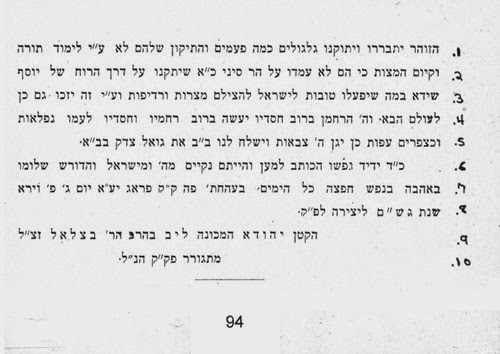
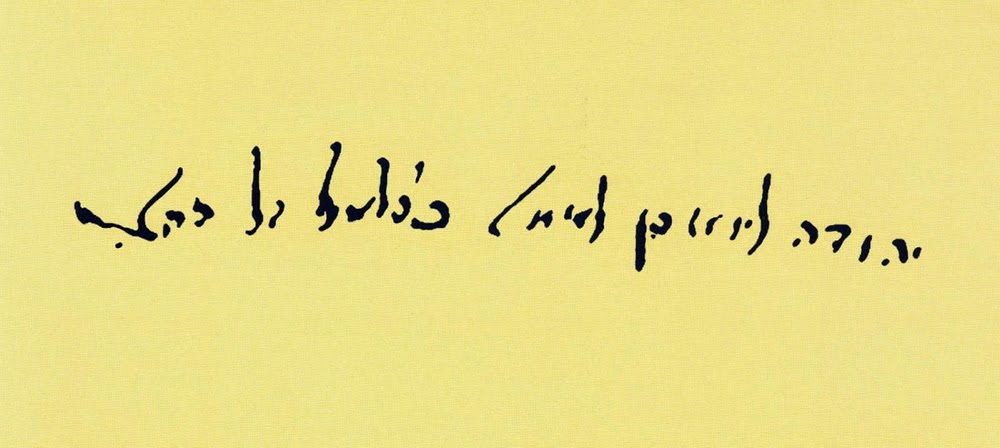
The Letter of the Maharal on the Creation of the Golem
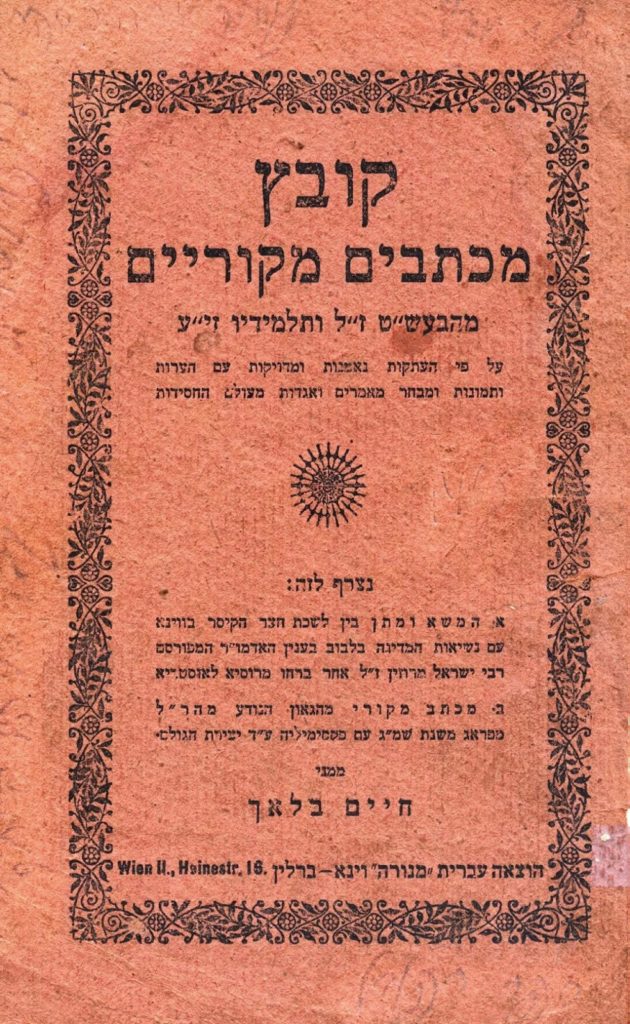
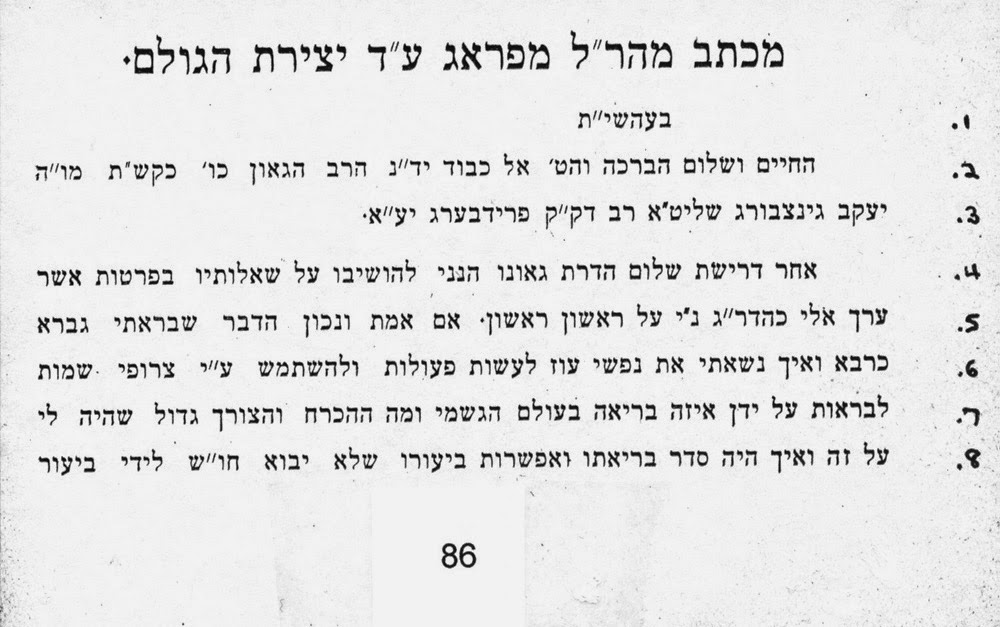
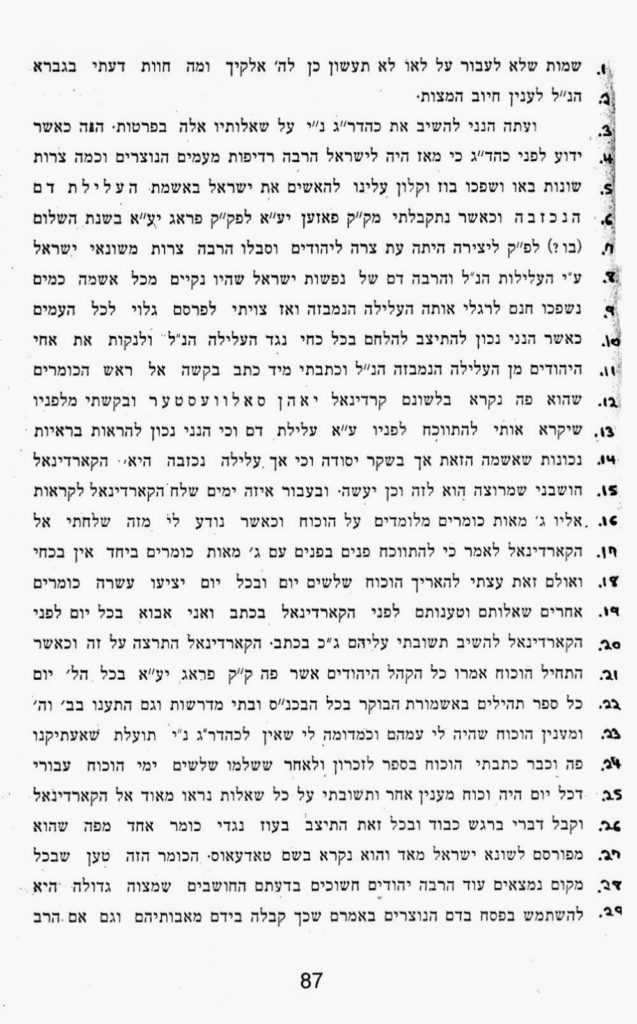
In 1931, R. Yitzchok Eizik Weiss (d. 1944), the Spinka Rebbe,6 published the very same letter of the Maharal (without any mention of the prior Bloch publication) based upon — what he believed to be — an original manuscript in his possession. He appended it to the posthumous publication of his father’s אמרי יוסף על המועדים7 . Although he gave no indication as to when or how the letter came into his hands, two witnesses provide us with some interesting detail.
The Gaon and Zaddik of Spinka informed me on Monday of [parshat] Hukkat-Balak, 7 Tammuz, 5682 [= 1922], that a manuscript written by the hand of the Maharal of Prague came into his possession. In it, he responded to R. Jacob Günzberg about the making of the Golem, how and why it was done, and whether the Golem will be included in the resurrection of the dead.9
Thus, we know that the letter reached the Spinka Rebbe no later than the beginning of July in 1922.
Birkat Ha-Hammah in the Old Jewish Cemetary of Frankfurt
(Fig. 1) Briefly, when R. Samson Raphael Hirsch succeeded in creating a thriving separatist Orthodox Jewish community in Frankfurt in the 19th century (after the majority of the official Jewish community had joined the Reform movement), it became apparent to the official Jewish community that the best way to counter Hirsch’s success was by finding a place for Orthodoxy within the official Jewish community. The communal authorities agreed in 1878 to appoint an Orthodox rabbi, Rabbi Markus Horovitz (author of שו”ת מטה לוי), aside from the Reform rabbis already in their employ. As a precondition to his appointment, Rabbi Horovitz demanded that a new Orthodox synagogue be built for his community in Frankfurt. It was constructed in 1882 – a magnificent structure – and was known as the Börneplatz Synagogue (figure 1) until its destruction by the Nazis on November 10, 1938.[15] Indeed, it was built adjacent to the Jewish cemetery, and its windows overlooked the tombstones in the cemetery. It displaced the old Jewish hospital, not a synagogue. No other synagogue in the history of Frankfurt was built overlooking the Jewish cemetery. This, then, was the synagogue that R. Tamar saw in 1921. But, of course, it didn’t exist in 1617 and therefore cannot be used to explain the accounts of R. Joseph Yuzpa Hahn and R. Asher b. Eliezer Ha-Levi.[16] Tamar’s confused account misled at least two of the recent halakhic anthologies on birkat ha-hammah, R. Gavriel Zinner, נטעי גבריאל: קידוש החמה וברכתה (Jerusalem, 2009)[17] and R. Yonah Buxbaum, קידוש החמה (Jerusalem, 2009).[18] Both cite Tamar’s account as authoritative, without further comment. In the case of R. Buxbaum (prior to his citation of Tamar), two reasons are suggested for the recitation of birkat ha-hammah adjacent to the Jewish cemetery: it provided greater space for the entire Jewish community to gather and recite the blessing together, and it provided a better view of the sun. At last, a breath of fresh air! We shall devote the remainder of this essay to an analysis of these two suggestions, to see whether or not they are likely explanations of what happened in Frankfurt. An organized Jewish community existed in Frankfurt from as early as 1150. Christian persecution of the Jews in Frankfurt was rampant throughout the medieval period and took a variety of forms. In 1462, it took the form of a decree issued by the Frankfurt Council which forced the Jews to live in a newly created ghetto. It was basically one long street, called the Judengasse, ultimately with four and five story wooden row-houses on both sides of the street (figures 2, 3, and 4).[19] Initially, walls 30 feet high were constructed around the ghetto to keep the Jews out of Christian Frankfurt. The gates that allowed entry in and exit from the ghetto were kept locked at night. Jews could not leave the ghetto on Sundays and Christian holidays (until 1798, when this restriction was rescinded). These were the basic conditions of Jewish life on Frankfurt until the 19th century, when in the aftermath of the French Revolution and Emancipation, the ghetto walls came crumpling down and Jews were permitted to live outside the ghetto.[20]
(Fig. 2)
(Fig. 3)
(Fig. 4) A wonderful account of the Judengasse is preserved in the writings of R. Jacob Joshua Falk (author of פני יהושע), who described what he saw when he moved to Frankfurt in 1742 in order to serve as Chief Rabbi:[21] בבאי לכאן ק”ק פפד”מ עיר הגדולה לאלקים, רבתי עם, רבתי בדעות, ראיתי שערוריה גדולה בין כהני ה’, בהיות הדבר ידוע שאין ליהודים פה כי אם רחבה אחת קטנה, ארוכה כמות שהיא מצפון לדרום ונחלקה לשתי שכונות, אחת מצד מזרח ושכנגדה למולה מצד מערב, ואין הפסק בין הבתים, כל שכונה ושכונה, כי אם במקומות מעט מזעיר. והיה כי ימות מת באחד מבתי השכונה, הוצרכו הכהנים להיות נעים ונדים ולזוז ממקום ולילך משכונה לשכונה שכנגדה. ואם ח”ו גם באותה שכונה ימות המת, אזי לא ימצא מנוח לכף רגלם, ללון לינה אחת ברחוב היהודים כלל, כי אם במקומות מעט מזעיר. Lest anyone assume that the פני יהושע’s description of the Judengasse applies only to the 18th century, and not earlier, a map of Frankfurt – drawn in 1628 – indicates otherwise (see figure 5).[22] The map, contemporary with R. Joseph Juzpa Hahn and R. Asher b. R. Eliezer Ha-Levi, depicts the Judengasse exactly as described by the פני יהושע.
(Fig. 5) One other point needs to be addressed in order for this analysis to continue. What time in the morning did davening begin in Frankfurt, and when did they recite the birkat ha-hammah? Regarding the latter question, the two witnesses cited at the start of the essay seem to contradict each other. R. Joseph Yuzpa Hahn indicates that the blessing was recited immediately after davening, adjacent to the cemetery. R. Asher b. R. Eliezer Ha-Levi indicates that it was recited “in the third hour,” adjacent to the cemetery. In fact, we know that on April 5, 1617, sunrise (more specifically: נץ החמה) in Frankfurt was at 5:53 A.M. and sunset was at 7:03 P.M.[23] If one counted hours from 6:00 A.M., the third hour was between 8:00 and 9:00 A.M. If one counted שעות זמניות, the third hour from sunrise was approximately between 8:05 and 9:11 A.M. We also know exactly what time davening ordinarily began, thanks to Johann Jacob Schudt, who testifies that services began every weekday morning in Frankfurt at 6:00 A.M.[24] Assuming that davening took not more than an hour, according to R. Hahn the blessing was recited shortly after 7:00 A.M. According to R. Ha-Levi it was recited shortly after 8:00 A.M.[25] At that hour, on the Judengasse, due to the row-houses, the sun could not be seen at all! This was because the Judengasse was a crescent shaped street on a North-South axis, more or less perpendicular to the Main River. In order to see the sun – rising in the East and setting in the West – it was necessary to leave the ghetto and walk to the nearest open space, so that the blessing could be properly recited. The nearest open space, just beyond the southern gate of the ghetto, was the Jewish cemetery and its surrounding fields (see figure 6).[26]
(Fig. 6) Returning to the two suggestions of R. Buxbaum, the first was that the land adjacent to the cemetery provided greater space for the entire Jewish community to gather and recite the blessing together. Doubtless this is true, but it does not seem likely that this was the key factor for the decision to walk out to the cemetery area. There was one place in the Jewish ghetto where large crowds could gather, if the only concern was ברוב עם הדרת מלך. Weddings in Jewish Frankfurt were performed just outside the doors of the main synagogue[27] precisely because there was sufficient room for all the invited guests to attend the ceremony (see figure 7).[28] In 1617, there were some 454 Jewish families living in Frankfurt.[29] These could easily gather in front of the main synagogue, if necessary in shifts. If they walked to the cemetery area nonetheless, it was because only there could the sun be sighted and the blessing recited. R. Buxbaum’s second suggestion was that the cemetery area provided “a better view” of the sun. We would suggest that it provided the only view of the sun – at an early hour – in Jewish Frankfurt from the 15th through the 19th centuries.
(Fig. 7) It is noteworthy that some 30,000 Jews lived in Frankfurt in 1925, a year in which birkat ha-hammah was recited. There are no reports that Jews went to the cemetery area in order to recite the blessing. It was no longer necessary.[1] A third witness from Frankfurt, R. Joseph Koshmann, נהג כצאן יוסף (Hanau, 1718; cf. the Tel-Aviv, 1969 edition, p. 145), also discusses birkat ha-hammah. Since he makes no reference to the Jewish cemetery in Frankfurt, the focus of discussion of this essay, his account will not be addressed.[2] The correct name of the sefer is יוסיף אומץ. The printer misread the manuscript copy (still extant at the Bodleian Library in Oxford), and it is by the mistaken title that the book is read and cited. See R. Yissachar Tamar,עלי תמר: ירושלמי סדר זרעים (Tel-Aviv, 1979), vol. 1, p. 294. [3] . §378. Cf. יוסף אומץ (Frankfurt, 1928), p. 80, §378. R. Hahn’s testimony is not necessarily confined to the 1617 recital of the birkat ha-hammah, as he may also have witnessed the 1589 recital when he was 19 years old. [4]. P. 7 of the Hebrew section of M. Ginsburger, ed., Die Memoiren des Ascher Levy (Berlin, 1913). Cf. E. Kallmann, ed., Les Mémoirs d’Ascher Levy de Reichshoffen (Paris, 2003), p. 21, interlinear addition 2. [5] Cf. Psalm 137:1 על נהרות בבל, which can only mean “at the side of; by.” See also Rashi to Gen. 14:6. [6] See, e.g., E. Brodt and Ish Sefer, “A Preliminary Bibliography of the Recent Works on Birkat ha-Chamah,” Tradition Seforim Blog, March 27, 2009; and Akavya Shemesh, “על ספר קידוש החמה לר’ יונה בר”י בוקסבוים,” Tradition Seforim Blog, March 30, 2009. [7] We have examined the following 6 works only: R. J. David Bleich, Bircas HaChammah (Brooklyn, 2009); R. Yonah Buxbaum, קידוש החמה (Shikun Square, 2009); R. Mordechai Genut, ברכת החמה בתקופתה (Bnei Brak, 2009); R. Menachem Mendel Gerlitz, ברכת החמה כהלכתה (Jerusalem, 2009); R. Yehuda Herskowitz,The Sun Cycle (Monsey, 2009); and R. Gavriel Zinner, נטעי גבריאל: הלכות ברכות החמה (Brooklyn, 2009). [8] Genut, p. 290. [9] Had there been any validity to this presumption, it surely would have been adduced by the late R. Mordechai Spielman in his ציון לנפש צבי (Brooklyn, 1976), an anthology of all passages in rabbinic literature that allow a Kohen to enter a cemetery.[10] See שולחן ערוך: יורה דעה §367:2-4 and commentaries. [11] Gerlitz, p. 232 was the only work (of the 6 I consulted) to raise this issue (in a footnote). He resolves it by suggesting that the blessing was actually recited just outside the cemetery. Nonetheless, in the body of his work he writes unequivocally that: יש שנהגו לברך ברכה זו בבית הקברות.[12] So too Gerlitz, pp. 231-232.[13] See above, note 2. [14] For this emendation, see already R. Liepman Philip Prins (d. 1915), פרנס לדורות (Jerusalem, 1999), p. 292. [15] See Rachel Heuberger and Salomon Korn, The Synagogue at Frankfurt’s Börneplatz (Frankfurt, 1996). Figure 1, a photograph of the Börneplatz Synagogue taken in 1887, is drawn from p. 11 of this booklet. [16] Moreover, the Börneplatz Synagogue was outside the Jewish ghetto, whereas during the ghetto period (15th -19th centuries), all the synagogues in Frankfurt were inside the ghetto. [17] Pages 105-106.[18] Pages 160-161.[19] Figure 2 is a 19th century lithograph of the Judengasse (from the Leiman Library). Figure 3 is a photograph of the Judengasse from circa 1860 and is drawn from Georg Heuberger, Ludwig Börne – A Frankfurt Jew Who Fought For Freedom (Frankfurt, 1996), p. 9. Figure 4 is a photograph of the eastern side of the Judengasse, taken circa 1875 after much of the western side was demolished. The main Reform Synagogue, constructed in 1860 at the exact site where the main synagogue of the traditional community once stood, can be seen at the extreme left of the photograph (from the Leiman Library). [20] In general, see A. Freimann and F. Kracauer, Frankfort (Philadelphia, 1929). [21] See R. Mordechai Halberstadt, שו”ת מאמר מרדכי (Brünn, 1790), §56. [22] The map is drawn from Rachel Heuberger and Helga Krohn, Hinaus aus dem Ghetto: Juden in Frankfurt am Main 1800-1950 (Frankfurt, 1988), p. 13. [23] See R. Meir Posen, אור מאיר (London, 1973), p. 330 and table 86. [24] Johann Jacob Schudt, Jüdische Merkwürdigkeiten (Frankfurt, 1714), vol. 2, p. 218. [25] It is possible that in order to recite birkat ha-hammah together as a community specifically during the third hour, davening in Frankfurt on this day began at 7:00 A.M., rather than at 6:00 A.M. Thus, there would be no conflict between the reports of R. Hahn and R. Ha-Levi, both agreeing that the blessing was recited shortly after 8:00 A.M. Interestingly, a לוח published in Frankfurt in 1757 – a year in which birkat ha-hammah was recited – seems to state that the proper time for the recital of the blessing was between 8:00 and 10:00 A.M (if I am reading it correctly). I am indebted to Dan Rabinowitz for bringing the לוח to my attention. [26] Figure 6 is a portion of a map of Frankfurt from 1864. It is drawn from Heuberger and Krohn, op. cit., p. 93. At the upper left of the map is the Judengasse. One can see the newly constructed Reform Synagogue on the eastern side of the Judengasse.. The row-houses lead into the Judenmarkt, east of which is the old Jewish cemetery. Doubtless, it was in and around the Judenmarkt that the Jews gathered to recite birkat ha-hammah between the 15th and 19th centuries. [27] See סדר והנהגה של נשואין (Frankfurt, 1701), pp. 4-5, §4. Cf. יוסף אומץ (Frankfurt, 1928), p. 332.[28] Figure 7 (drawn from Heuberger and Krohn, op. cit., p. 49) depicts the Old Synagogue (on the Judengasse) of Frankfurt, after it was rebuilt in 1711 [and prior to its demolition in 1860] following a fire that destroyed almost all the dwellings in the Jewish ghetto. There appears to be ample space in the foreground for the communal recitation of birkat ha-hammah. [29] See Jewish Encyclopedia, vol. 5, p. 486.
A Desperate Plea for Help on Behalf of Vilna’s Old Jewish Cemetery
A Desperate Plea for Help on Behalf of Vilna’s Old Jewish Cemetery in 1919
By Shnayer Leiman
Recently, a brief study was posted online on Meir Zelmanovich, the custodian of Vilna’s old Jewish cemetery, who died a martyr’s death in 1920.[1] Here, we wish to add Zelmanovich’s only published writing, a Yiddish letter that appeared in Vilna’s יידישע צייטונג [Yidishe Tsaytung], on Monday, December 15, 1919.[2] The letter will appear below both in the original Yiddish and in an annotated English translation. It is a significant, and tragic, historical document. Also, mostly due to the recent discovery of a treasure trove of photographs relating to World War I, we will present several newly discovered photographs of Zelmanovich.[3]
For those unfamiliar with Vilna’s old Jewish cemetery, we note that according to a Jewish tradition in Vilna it was founded in 1487. Modern scholars, based upon extant documentary evidence, date the founding of the cemetery to 1593, but admit that an earlier date cannot be ruled out. The cemetery, still standing today (but denuded of its tombstones), lies just north of the center of the city of Vilna, across the Neris River, in the section of Vilna called Shnipishkes (Yiddish: Shnipishok). It is across from, and just opposite, one of Vilna’s most significant landmarks, Castle Hill with its Gedeminas Tower. The cemetery was in use from the year it was founded until 1830, when it was officially closed by the municipal authorities. Although burials no longer were possible in the old Jewish cemetery, it became a pilgrimage site, and thousands of Jews visited annually the graves of the righteous rabbis and heros buried there, especially the graves of the Ger Zedek (Avraham ben Avraham, also known as the son of Graf Potocki, d. 1749), the Gaon of Vilna (R. Eliyahu ben R. Shlomo Zalman, d. 1797), and the Hayye Adam (R. Avraham Danzig, d. 1820). Such visits took place even after World War II.
Briefly, the historical context of the letter was the battle for control of Vilna in the aftermath of World War I. During the years 1914 to1922, nine different governments ruled in Vilna, making life miserable for its residents. Almost certainly, the greatest concentration of Jewish suffering in this period took place in 1919, when the Polish legionnaires unleashed a pogrom against Vilna’s Jews. Zelmanovich’s Letter to the Editor appeared in print in December 1919 and records in detail the damage to the dead; he left it for others to record the damage to the living.[4] This stage of Polish rule came to an end when the Russians recaptured Vilna in July of 1920. Russian rule lasted for some six weeks, and was followed by Lithuanian rule. On October 8, 1920 the Poles once again recaptured Vilna. Sadly, on October 10, 1920 Meir Zelmanovich was one of a handful of Jews murdered by the returning Polish legionnaires.
1. The Original Yiddish Version of Zelmanovich’s Letter.
2. An Annotated English Translation of Zelmanovich’s Letter.
The Hostile Incidents at Vilna’s Old Jewish Cemetery: (A Letter to the Editor)
Please provide me with a platform to describe the hostile incidents that have taken place – from Passover[5] until today – at the old Jewish cemetery.
Immediately after Passover, the fence (surrounding the cemetery) was breached, and horses were allowed to enter the cemetery. The officers in charge of the horses chose to move into my house, and helped themselves to whatever they could find. It was only when my daughter came down with typhus, that they left the house and encamped on the cemetery grounds. They burned the wooden tombstones, and broke stone tombstones as well. They smashed the tombstones of R. Yisrael Kreines’ father,[6] R. Yaakov Landau,[7] Rekhl the mother of R. Shimon Strashun,[8] R. Mordechai Meltzer’s wife,[9] and a few others. They were about to destroy the wooden tombstone of the Chief Rabbi, R. Hillel,[10]ho died in 1706,[11] but I managed to hide it while it was still whole.
The official rabbi,[12] Rabbi Rubinstein[13] was heavily involved in rectifying matters. We were able to arrange for the horses to be removed from the cemetery. The officers of the Zedakah Gedolah Society[14] arranged for the fence to be repaired at a cost of 7000 rubles. Now, however, the soldiers have returned with saws and axes and have pulled back and rearranged the fence so that anyone could enter the cemetery from the nearby public passage way. Thus, they once again are tearing down the rooftops of the mausoleums.
Regarding the Gaon’s[15] mausoleum, they have now, for a second time, torn down its roof, and also smashed its windows. They have also begun to break down its walls.
They tore off the rooftops of the mausoleums of R. Noah Petletzis[16] and R. Shmuel Landau.[17] Just last night, they placed the carcasses of 5 horses next to the mausoleums.
All our communal Jewish activists are obligated to come and view for themselves the devastation that is taking place in the old Jewish cemetery. And, at the same time, they are obligated to rescue whatever can still be rescued.
Meir Yisrael Zelmanovich,
Custodian of the Old Jewish Cemetery
———-
3. Newly Discovered Photographs of Meir Zelmanovich.
a) Meir Zelmanovich at the Mausoleum of R. Menahem Manes Chajes.
b) Photograph of Meir Zelmanovich at Vilna’s Old Jewish Cemetery.

The top photograph (left) is clearly the original that ultimately appeared in the postcard that was produced in 1916 (right) and discussed in our earlier study.[18] The photograph’s clarity and detail are far superior to that of the postcard, a clear reminder that some postcard reproductions need to be taken with a grain of salt.[19]
The bottom photograph, it seems to me, is a magnificent likeness of Meir Zelmanovich. Someone scribbled in the date 1916, which almost certainly is when it was taken.[20]
Notes
[1] S. Leiman, “In Praise of Ephemera: A Picture Postcard from Vilna Reveals its Secrets more than One Hundred Years after its Original Publication,” The Seforim Blog, July 27, 2020 (here). Cf. The Leiman Library (www.leimanlibrary.com), texts, item 143.
[2] Issue 181, p. 2, columns 1-4. The newspaper lists the Jewish calendrical date as well, 23 Kislev. For a brief history of Vilna’s short-lived יידישע צייטונג (it ceased publication in 1920), see D. Flinker, et al, eds., עיתונות יהודית שהיתה (Igud ha-Olami shel ha-Itonaim ha-Yehudim: Tel-Aviv, 1973), p. 246.
[3] In July of 2020, a huge collection of rare photos of Vilna was sold at auction on Ebay. The photos were made by a professional photographer who served as a photo correspondent working with the German 10th army, which occupied Vilna during World War I. Fortunately, about half of the photos were acquired by a coalition of scholars and patrons of scholarship in Lithuania who realized how significant these photos were. I am indebted to my Lithuanian colleague, Dr. Andrius Kulikauskas, for sharing the above information with me, after the fact. What Andrius could not know is that I too was a bidder in that auction (without knowing all the fine details about who took the photographs), and managed to acquire four photos taken at the Old Jewish cemetery in Vilna, including the two photos of Meir Zelmanovich reproduced below.
[4] For a fuller account of the pogrom itself, see the study cited above in note 1.
[5] Vilna’s Jewish community celebrated Passover in 1919 from the evening of April 14 through April 22. The Russian Red Army ruled in Vilna through April 18, 1919. On April 19, the Polish legionnaires replaced the Russian Red Army. Almost immediately, a pogrom ensued against the Jews, leading to much death and destruction. Vilna remained under Polish control during the period that Zelmanovich published his “Letter To The Editor.”
[6] R. Yisrael Gordon Kreines (1778-1856) was a learned Torah scholar adept in Russian. In 1837 he was appointed Rabbi of Vilna, largely for the purpose of fulfilling the Czarist regime’s requirement that a rabbi be appointed who could record in Russian all births, marriages, and deaths in the Jewish community. See H.N. Steinschneider, עיר ווילנא (Vilna, 1900), pp. 192-195. Kreines’s father, R. Avraham Gordon was a major lay leader (פרנס ) of Vilna who died in 1780. See S. Y. Fuenn, קריה נאמנה (second edition, Vilna, 1915), p. 187-188.
[7] R. Yaakov Landau (circa 1793-1828), a learned rabbinic scholar, was the oldest son of R. Shmuel Landau, also a rabbinic scholar of note (see below, note 17). R. Yaakov was the older brother of R. Yitzhak Eliyahu Landau (1801-1876), who served as rabbi and official preacher (מורה צדק ומגיד מישרים) of Vilna from 1868 until his death in 1876. R. Yaakov’s Landau’s full given name was Avraham Yaakov. Unfortunately, he died at an early age. His epitaph is preserved in Fuenn, pp. 253-254. Y. Klausner, קורות בית–העלמין הישן בוילנה (Vilna, 1935), p. 63, note 2, reports that R. Yaakov Landau’s tombstone was no longer standing in 1935.
[8] R. Shimon Strashun (circa 1823-1905) was a distinguished rabbinic scholar who resided in Vilna, and was the son of a distinguished rabbinic scholar who also resided in Vilna, R. Avraham David Strashun (19th century). Avraham David’s first wife, חנה (d. 1824), was the mother of R. Shimon Strashun. See Steinschneider, p. 191. Assuming there is no error here on the part of either Steinschneider or Zelmanovich, it is possible that her full name was חנה רחל. The Yiddish name Rekhl is a common variant of the name Rokhl. See, e.g., A. Beider, A Dictionary of Ashkenazic Given Names (Bergenfield, 2001), pp. 560- 562, especially p. 561, column 2.
[9] R. Mordechai Meltzer (1797-1883) served as an official rabbi in Vilna with the title מורה צדק . He was the head of Vilna’s Ramajles (ראמיילעס) Yeshiva during the first half of the 19th century, where he trained many of Vilna’s most distinguished rabbis. In 1864, he was appointed Chief Rabbi of Lida (today in Belarus), where he served with distinction until his death in 1883. His wife, Sarah Devorah, died in 1830, and was buried in Vilna’s old Jewish cemetery. See Steinschneider, pp. 122-126.
[10] For a brief account of R. Hillel b. R. Jonah ha-Levi, and for the text of his epitaph, see Fuenn, p. 104. Wooden tombstones were commonplace in the old Jewish cemetery; not everyone could afford a stone tombstone. The wooden tombstone of R. Hillel b. R. Jonah ha-Levi, rescued by Zelmanovich, almost certainly no longer exists. A photograph of the tombstone, however, was preserved in the An-Ski Museum in Vilna, and published in Klausner, p. 42.
[11] The Yiddish original gives the Jewish year: [5]466.
[12] Under Czarist rule, the Russian government required Jewish communities to appoint a kazyonny ravvin “an official rabbi,” fluent in Russian, who – among his various responsibilities — would be responsible for recording (in Russian) births, marriages, and deaths. Rabbi Rubinstein’s initial appointment in Vilna was as kazyonny ravvin. Zelmanovich uses the Yiddish (and German) title ראבינער here to indicate Rabbi Rubinstein’s status at the time.
[13] Rabbi Isaac Rubinstein (1880-1945) was appointed “official rabbi” (see previous note) of Vilna in 1910. With the outbreak of World War I, the more traditional rabbis were forced to flee Vilna, and Rubinstein – for all intents and purposes – was the only functioning rabbi in Vilna. In this difficult period, and later under Polish rule, Rubinstein repeatedly interceded on behalf of the Jewish community, with great success. He served as a member of the Polish senate from 1922-1939. In 1928, he was appointed Chief Rabbi of Vilna. A leading religious Zionist, and a superb speaker, he managed to flee Vilna in 1940 (then under Soviet domination), and made his way to the United States in order to enlist aid on behalf of East European Jewry.
[14] The Zedakah Gedolah Society was Jewish Vilna’s official communal institution in charge of public welfare. Given the rampant poverty that prevailed throughout much of Vilna’s Jewish history, this was one of the most important institutions in Vilna. It assumed even greater significance when the Czarist regime abolished Vilna’s “Kahal” structure in 1844. One of the Zedakah Gedolah’s many tasks was to provide the lion’s share of the funding necessary for the upkeep of Vilna’s Jewish cemeteries. With the advent of World War I, it fell into a period of steady decline and would ultimately be liquidated under Polish rule in 1931. See Israel Cohen, Vilna (Philadelphia, 1943), pp. 121-122 and pp. 394-397. Cf. Andrew N. Koss, “Two Rabbis and a Rebbetzin: The Vilna Rabbinate During the First World War,” European Judaism 48:1 (2015), pp. 120-122.
[15] The reference is to the mausoleum of R. Elijah b. Solomon (1720-1797), the Vilna Gaon, which never fully recovered from the damage inflicted upon it by the Polish legionnaires.
[16] Noah Bloch Petletzis (d. 1809) was an exceedingly wealthy Jew who donated generous sums of money to Vilna’s various educational and charitable institutions. He singlehandedly provided the entire funding for the construction of the women’s section (עזרת נשים) in Vilna’s Great Synagogue. See Fuenn, p. 223-224; cf. Klausner, p. 66. He should not be confused with the Maskil Noah Bloch (d. 1846) who, after much controversy about exactly where in the Zaretcha cemetery he should be buried, was finally laid to rest. See H.N. Steinschneider, עיר ווילנא (Jerusalem, 2003), vol. 2, pp.48-49 (edited by M. Zalkin).
[17] R. Shmuel Landau (d. 1818) was a son-in-law of R. Hayyim Landau (d. 1797) of Brody, a founder and key supporter of the קלויז of Brody. On the “kloyz” of Brody, see N.M. Gelber, תולדות יהודי ברודי (Jerusalem, 1955), pp. 62-73. Not surprisingly, R. Shmuel adopted his father-in-law’s surname and brought it to Vilna. He was an exceedingly modest rabbinic scholar, whose 3 sons, all named Landau, would become well-known rabbinic scholars. R. Shmuel Landau’s epitaph (or, at least, a portion of it) was preserved by Fuenn, p. 230; cf. Klausner, p. 63.
[18] See above, note 1.
[19] Notice, e.g., the different facial expressions in the two photographs. When the two photographs are enlarged, it becomes obvious that the original photograph preserves much detail no longer visible in the postcard, including the fine detail of the vast terrain to the left of the mausoleum (alas, only partially captured by the scans presented her, but quite visible to the naked eye.)
[20] That all the photographs gathered here are, in fact, genuine likenesses of Meir Zelmanovich seems likely. Certainly the family photo published in the earlier study (see above, note 1) identifies him by name. His German passport of 1916 offers additional proof. During the German occupation, all residents of Vilna were required to have — and to carry at all times – a German passport (we would call it: an identity card). Zelmanovich’s German passport lists his correct name, age, and address (at the Old Jewish cemetery), and includes his passport photo! I am indebted to Regina Kopilevich, researcher and tour guide extraordinaire, for retrieving Zelmanovich’s passport from the many preserved in the Lithuanian State Historical Archives (Lietuvos Valstybes Istorijos Archyvas). Here is Zelmanovich’s passport photo:
Yet another unmistakable likeness of Meir Zelmanovich can be seen in two photographs preserved in the archives of the Ghetto Fighter’s House Museum at Kibbutz Lohamei Hagetaot. Both photos were taken in 1916 at the old Jewish cemetery. One photo (catalog number 31468) depicts Meir Zelmanovich and a teenager (almost certainly his son Sholom) standing next to the legendary tree that hovered over the ashes of the martyred Ger Zedek of Vilna, in the old Jewish cemetery’s south eastern corner. Another photo (catalog number 31467) depicts the father and son (now wearing an overcoat) standing at a pathway in the center of the old Jewish cemetery. The photos are available online, so there is no need to post them here. I am deeply grateful to art historian Dr. Vilma Gradinskaite of Vilnius for bringing my attention to the photos preserved in the archives of the Ghetto Fighter’s House Museum.
Hirschian Humanism After the Holocaust: An Analysis of the Approach of Rabbi Shimon Schwab
Hirschian Humanism After the Holocaust:
An Analysis of the Approach of Rabbi Shimon Schwab
By Rabbi Shmuel Lesher
Rabbi Shmuel Lesher is a Machon Beren Kollel fellow at RIETS / Yeshiva University. Prior to completing his rabbinic ordination at RIETS, Rabbi Lesher studied at the Mirrer Yeshiva in Jerusalem and Yeshiva of Greater Washington in Silver Spring, Maryland. Rabbi Lesher lives in Washington Heights, with his wife Leora and their three children.
This is his first contribution to the Seforim Blog.
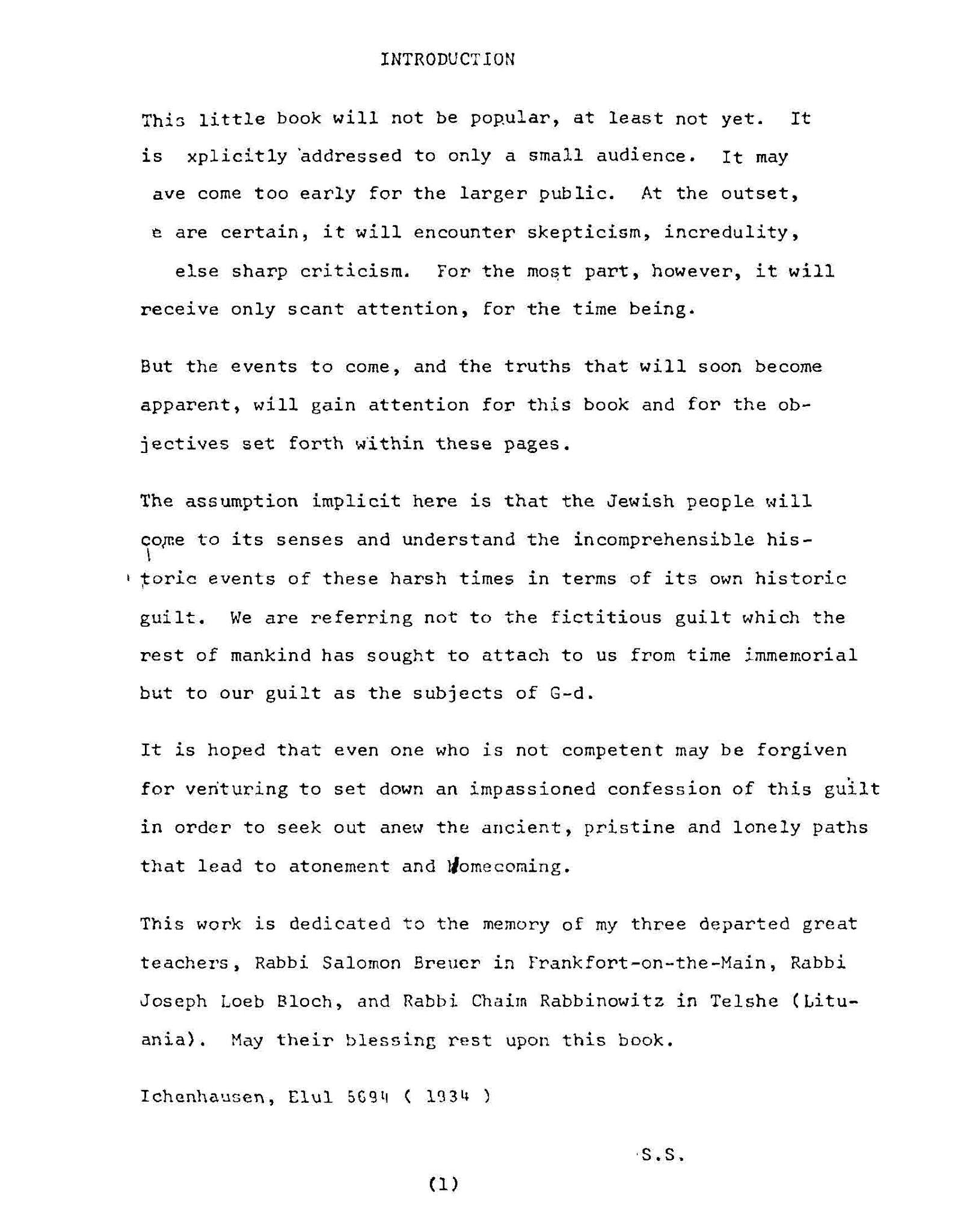
In 1959, Rabbi Shimon Schwab[1] made a unique contribution to the way his community and others commemorate the Holocaust. Shortly after he joined the rabbinate of K’hal Adath Jeshurun in Washington Heights, Manhattan, R. Schwab was asked by R. Joseph Breuer[2] to compose a special Tisha B’av kinnah for their kehillah. Although it was originally written for the KAJ community, many other congregations have adopted the custom of reciting it on Tisha B’av.[3] To be sure, there have been others who authored kinnot to commemorate the Holocaust.[4] However, it appears that, especially in America, R. Schwab’s kinnah is perhaps one of the first written by a rabbinic figure to gain widespread popularity.
In addition to his innovative Holocaust kinnah, the events of the Holocaust played a significant role in how R. Schwab interpreted and perpetuated the Torah Im Derekh Eretz philosophy to which he was heir. According to R. Schwab, Torah Im Derekh Eretz was seen by R. Samson Raphael Hirsch as the ideal model. However, openness to secular culture has historically been the minority opinion among gedolei yisrael.[5]
R. Schwab reached this conclusion after re-evaluating his position multiple times throughout his life. In a speech he delivered in 1990,[6] he recalled how the events of Kristallnacht (Nov 9, 1938 – Nov 10, 1938), and later the Holocaust, shook his belief in Torah Im Derekh Eretz to the core. How could R. Hirsch have believed the humanism of Germany would lead to an uplifted and righteous society when the same humanistic society ended up committed genocide without much protest from the “enlightened students of Schiller and Goethe?”[7] R. Hirsch must not have seen German humanistic Bildung[8] as anything more than a time-bound compromise in order to save his community from assimilation.[9] R. Schwab was referring to an essay he wrote in 1934 entitled Heimkehr ins Judentum (Homecoming To Judaism).[10] Here R. Schwab claimed R. Hirsch only intended Torah Im Derekh Eretz as a temporary allowance. This book was the first substantial rejection of Torah Im Derekh Eretz written by someone who grew up in the Hirschian community.[11]
An English version of this essay, prepared by K’hal Adath Jeshurun translator Gertrude Hirschler, appeared in 1978.[12]
Around the same time he published Heimkehr ins Judentum, R. Schwab wrote to a number of Eastern European Torah leaders asking them about the permissibility of incorporating secular studies into a yeshiva curriculum.[13] Dr. Marc B. Shapiro notes that this was yet another sign of the waning popularity of Torah Im Derekh Eretz at the time, even in Germany itself.[14] Apparently, R. Schwab, who had studied in Lithuanian yeshivot, was not convinced of the permissibility of what had been established as normative practice in his own country. Dr. Shapiro’s analysis is correct. However, consider R. Schwab’s query in light of his unequivocal rejection of Torah Im Derekh Eretz in his Heimkehr ins Judentum. Based on the dates of his letters and the responses of his interlocutors, it appears that even as he published Heimkehr ins Judentum, R. Schwab felt the viability of Torah Im Derekh Eretz was still an open question — or at least one still worthy of inquiry.[15]
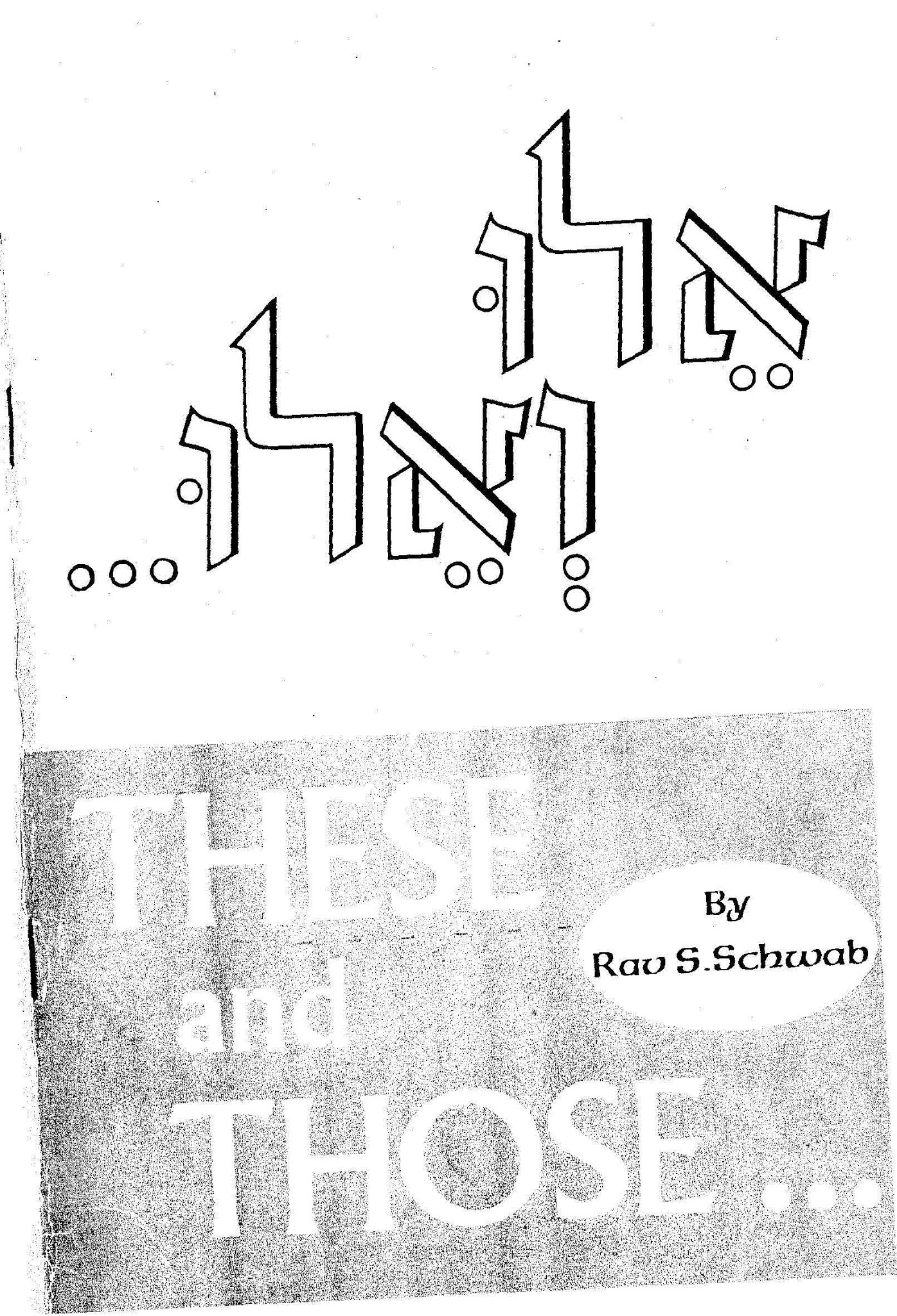
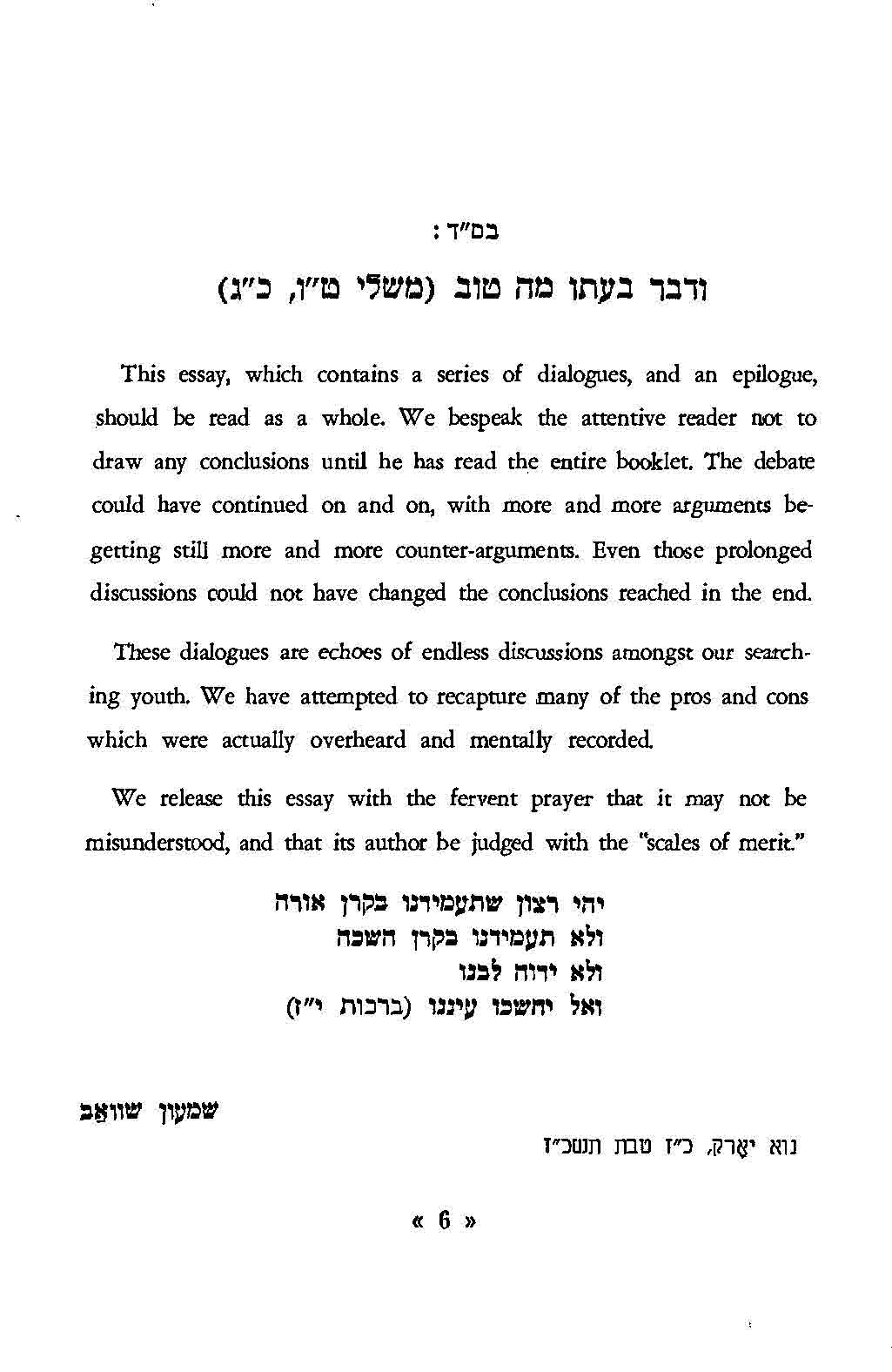
Later in his life, after re-assessing R. Hirsch writings, R. Schwab came to believe that his earlier view was incorrect. In this later re-evaluation, R. Schwab felt that Hirsch did, in fact, wholeheartedly believe in the significance of humanism for society. After this realization, in 1966, R. Schwab wrote an essay entitled, “Elu ViElu: These and Those,” which showed the validity and necessity of both the “Torah Only” approach of many gedolei yisrael and the Hirschian “Torah Im Derekh Eretz” approach. R. Schwab wrote this 47-page pamphlet in the form of a series of dialogues intended as the “echoes of endless discussions amongst our searching youth.”[16]
On the 48th anniversary of Kristallnacht, in 1986, R. Schwab echoed his previous concern, expressing that in a post-Holocaust world, although he accepted R. Hirsch’s Torah Im Derekh Erech application to science, medicine, and history, he could no longer believe in the power of culture and secular humanism.[17] Although R. Hirsch celebrated Schiller, and all the values of ethics and humanism he represented, this vision was “broken by the shattering of windows and the screaming of frightened children in the night.”[18] “We do not extend Torah Im Derekh Eretz to include philosophy, ethics, morality or humanism…No longer are we going to seek out Schiller to teach us about humanity. It no longer interests us.”[19] He therefore discouraged the study of these disciplines, stating unequivocally:
“The age of Humanism was a passing episode in the annals of history…The lessons of Kristallnacht – don’t believe there is Torah among the goyim (gentiles). Let us not make the same mistake as our ancestors, to believe there is any other ethical culture for us beside the Torah.”[20]
However, as forceful as this statement was, it is unclear if this was in fact R. Schwab’s final position. In his last comments on the matter in 1990, he argued for Torah Im Derekh Eretz as an ideal model.[21] Although he did caution about the dangers of the arts and literature influencing our moral compass, he did not vouch for a complete break with those disciplines.[22] As indicated by the title of his essay, R. Schwab believed, “Elu ViElu divrei Elokim hayim” – These and those are the words of the Living God.[23] Both the “Torah Only” approach of the majority of gedolei yisrael, and the “Torah Im Derekh Eretz” approach are of equal validity and importance for the Jewish community.[24] However, as the Holocaust demonstrated, we should be cautious when approaching secular humanism. Ultimately, there is no other true ethical code that produces an uplifted and righteous society other than the Torah. Although commitment to both disciplines – Torah and humanism – was seen by R. Hirsch as the ultimate goal, it appears that the same cannot be said for R. Schwab.[25]
Although R. Schwab apparently regained some of his conviction in Hirschian humanism, the Holocaust challenge has been posed to the Hirschian position and to religious humanism in general. How can one believe the study of the humanities can guarantee humaneness? R. Aharon Lichtenstein marshals the words of the literary critic George Steiner:
“We now know that a man can read Goethe or Rilke in the evening, that he can play Bach and Schubert, and go to his day’s work in Auschwitz. To say he has read them without understanding or that his ear is gross, is cant. In what way does this knowledge bear on literature and society, on the hope, grown almost axiomatic from the time of Plato to that of Mathew Arnold, that culture is a humanizing force, that the energies of the spirit are transverse to those of conduct?”[26]
R. Lichtenstein notes this is a “terrifying question for believers in the self-sufficiency of secular humanism, [and] a formidable one for advocates of religious humanism.”[27] In response to this challenge, R. Lichtenstein argues as long as the ultimate source of morality is the Torah and our humanism is fettered in religious conviction, religious life can gain much from the study of the humanities.[28]
We cannot know how R. Hirsch himself would respond to this challenge, however, one can certainly hear echoes of Hirschian thought in R. Lichtenstein’s defense of religious humanism.[29] According to the Hirschian authority Dayan Isidor Grunfeld, R. Hirsch argued for a religious humanism anchored by divine revelation. In fact, Grunfeld loosely translated Torah Im Derekh Eretz, the slogan most commonly associated with R. Hirsch, as “God-rooted religious humanism.”[30]
In this view, an irreligious or secular humanism is bound not to elevate man, but rather to debase him. Religious humanism, on the other hand, embraces the intrinsic dignity of man because he was created in the image of God.[31] For R. Hirsch, this principle is fundamental to his view of all of mankind joined in one universal “brotherhood.”[32] By ceasing to regard man as being of a higher and divine origin, secular humanism, paradoxically results in the diminishing of man’s value.[33]
In fact, R. Hirsch in his commentary on the Torah, argues for the intrinsic value of Torah Im Derekh Eretz, or culture, even in the face of the potential negative impact of secular culture:
“Culture starts the work of educating the generations of mankind and the Torah completes it; for the Torah is the most finished education of Man…culture in the service of morality is the first stage of Man’s return to God. For us Jews, Derekh Eretz and Torah are one. The most perfect gentleman and the most perfect Jew, to the Jewish teaching, are identical. But in the general development of mankind culture comes earlier…
But of course, where culture and civilisation are used in the service of sensuality and degeneration only gets all the greater. But still such misuse of culture does not do away with the intrinsic value and blessing of Derekh Eretz.”[34]
Although what can be called “low culture” or “degenerative humanism” corrupts Torah ideals, this does not negate the intrinsic value of “good and true culture.” Indeed, according to R. Hirsch, “Jews rejoice whenever or wherever culture elevates people to a perception of true values and to nurture goodness.”[35]
Perhaps the Hirschian response to the Holocaust challenge is that if we do not believe we are the ultimate arbiters of truth and morality, fundamentally, our value system remains sacrosanct even when it is not recognized by society, namely, even in Nazi Germany. The utter failing of a secular humanistic society does not undermine the value of a God-fettered humanism. Even after the horrors of the Holocaust, Hirschian humanism remains intact. In the words of Jacob Breuer, Torah Im Derekh Eretz is indeed a “Timeless Torah.”[36]
Notes:
Thank you to Dan Rabinowitz and the editors at the Seforim Blog for their assistance. Thank you to my father-in law R. Hanan Balk and Yehuda Geberer who shared some important sources with me. I am indebted to my rebbe and mentor R. Netanel Wiederblank in general, and in particular for his advice and insight into this topic.
[1] R. Schwab served as a rabbinic leader K’hal Adath Jeshurun from his arrival in 1958 until his passing in 1995. For biographical details on R. Schwab, see R. Moses L. Schwab, “Rav Simon Schwab: A Biography,” in Moreshet Tzvi – The Living Hirschian Legacy: Essays on ‘Torah im Derech Eretz’ and the Contemporary Hirschian Kehilla (New York: K’hal Adath Jeshurun, 1988), 45-51. For other essays in this volume, see the Table of Contents:
See also R. Moshe L. Schwab, “Biography of Rav Shimon Schwab,” in Rav Schwab on Prayer (Brooklyn: ArtScroll Mesorah, 2001), ix-xx available here; R. Eliyahu Meir Klugman, “The Ish Ha’Emes: The Man of Impeccable Integrity, Rabbi Shimon Schwab,” The Jewish Observer, vol. 28, no. 5 (Summer 1995): 11-22, available here.
[2] Rabbi Dr. Joseph Breuer, the grandson of R. Samson Raphael Hirsch, was the founding Rav of K’hal Adath Jeshurun in Washington Heights, Manhattan. For biographical details on R. Breuer, see David Kranzler and R. Dovid Landesman, Rav Breuer: His Life and His Legacy (New York: Feldheim, 1998) and Dr. Ernst J. Bodenheimer and R. Nosson Scherman, “Rav Dr. Joseph Breuer zt”l, One Year After His Passing,” The Jewish Observer, vol. 15, no. 6 (May 1981): 3-10, available here.
[3] See R. Avrohom Chaim Feuer and R. Avie Gold, eds., Tefillah L’Moshe: The Complete Tisha B’av Service (Brooklyn: Artscroll Mesorah, 1992), 392-394, who cite the background story to the kinnah from R. Schwab himself. Also see Moshe Schwab, “A Biography of Rav Shimon Schwab,” Rav Schwab on Prayer, xix, who also references the story. For the text of R. Schwab’s Holocaust Kinnah, see here, courtesy of ArtScroll/Mesorah.
[4] For other kinnot composed for the Holocaust, see Mordechai Meir, “Zakhor Na Ha-Bikhiot Bi-Tahom HaGoyot: Kinnot L’zekher HaShoah,” Akadamot, vol. 9 (2000): 77-99 (Hebrew), available here; and Jacob J. Schacter, “Holocaust Commemoration and Tish’a be-Av: The Debate Over ‘Yom ha-Sho’a’,” Tradition: A Journal of Orthodox Jewish Thought, vol. 41, no. 2 (Summer 2008): 164-197, available here, especially 194-195n36-41 for sources on R. Joseph B. Soloveitchik’s position. See also Jacob J. Schacter, “The Rav and the Tisha B’Av Kinot,” in Zev Eleff, ed., Mentor of Generations: Reflections on Rabbi Joseph B. Soloveitchik (Jersey City: Ktav, 2008), 303-314, available here, and earlier in Jacob J. Schacter, “Rabbi Joseph B. Soloveitchik zt”l on the Tisha B’Av Kinos,” Jewish Action, vol. 54, no. 4 (Summer 1994): 11-12, available here.
[5] Anonymous, “A Letter Regarding ‘the Frankfurt Approach’,” ha-Ma’ayan, vol. 6, no. 4 (1966): 4-7 (Hebrew)
A translation of this anonymous essay appears in Shnayer Z. Leiman, “From the Pages of Tradition – R. Shimon Schwab: A Letter Regarding the “Frankfurt’ Approach,” Tradition: A Journal of Orthodox Jewish Thought, vol. 31, no. 3 (Spring 1997): 71-77, available here. Dr. Leiman writes in 77n4 that members of ha-Ma’ayan’s editorial board confirmed his suspicion that the Anonymous author was R. Shimon Schwab.
[6] R. Shimon Schwab, “Torah Im Derech Eretz – A Second View,” in Selected Speeches: A Collection of Addresses and Essays on Hashkafah, Contemporary Issues and Jewish History (New York: C.I.S. Publishers, 1991), 236-252, the transcript of an address delivered at K’hal Adath Jeshurun on February 19, 1990.
[7] Ibid.
[8] Referring to the German tradition of self-formation through acculturation and education attributed to Wilhelm Von Humboldt (1791-1810).
[9] R. Shimon Schwab, “Torah Im Derech Eretz – A Second View,” in Selected Speeches: A Collection of Addresses and Essays on Hashkafah, Contemporary Issues and Jewish History (New York: C.I.S. Publishers, 1991), 239.
[10] R. Shimon Schwab, Heimkehr ins Judentum (Homecoming To Judaism) (Frankfurt: Hermon-Verlag, 1934; German).
[11] Marc B. Shapiro, Between The Yeshiva World and Modern Orthodoxy: The Life and Works of Jehiel Jacob Weinberg 1884-1966 (Portland: Littman Library, 1999), 152. Dr. Shapiro notes that one of the first articles written by the great Jewish historian Jacob Katz was a review of Heimkehr ins Judentum. See Jacob Katz, “Umkher oder Rückkehr – Review of ‘Heimkehr ins Judentum’, by Simon Schwab,” Nahalat Tsevi, vol. 5 (1935): 89-96, available here; and Jacob Katz, With My Own Eyes: The Autobiography of an Historian, trans. Ziporah Brody (Hanover, NH: New England Universities Press, 1995), 96.
[12] R. Shimon Schwab, Heimkehr ins Judentum (Homecoming to Judaism), trans. Gertrude Hirschler (New York, 1978).
[13] See Marc B. Shapiro, Between The Yeshiva World and Modern Orthodoxy: The Life and Works of Jehiel Jacob Weinberg 1884-1966 (Portland: Littman Library, 1999), 152, who notes that a copy of the original letter exists in the Joseph Rozin Archive, Yeshiva University. The four Eastern European rabbis who are known to have responded in writing are R. Elhanan Wasserman, R. Barukh Ber Leibowitz, R. Avraham Yitzhak Bloch, and R. Yosef Rozen. Their replies are printed in Yehuda (Leo) Levi, Shaarei Talmud Torah (Jerusalem: Feldheim, 1981), 296-312 (Hebrew) and R. Bloch’s response was first published in Proceedings of the Association of Orthodox Jewish Scientists, vol. 1 (New York: AOJS, 1966), 107-112, available here. For more on the background of R. Schwab’s letter and the responses he received, see Jacob J. Schacter, “Torah u-Madda Revisited: The Editor’s Introduction,” The Torah u-Madda Journal, vol. 1 (1989): 1-22, available here, especially 15n1-2; Yehuda (Leo) Levi, “Rabbi Samson Raphael Hirsch-Myth and Fact,” Tradition: A Journal of Orthodox Jewish Thought, vol. 31, no. 3 (Spring 1997): 5-22, esp. 11, available here, and Marc B. Shapiro, “Torah im Derekh Erez in the Shadow of Hitler,” The Torah u-Madda Journal, vol. 14 (2006-2007): 84-96, esp. 85-86,95 available here.
[14] See Marc B. Shapiro, Between The Yeshiva World and Modern Orthodoxy: The Life and Works of Jehiel Jacob Weinberg 1884-1966 (Portland: Littman Library, 1999), 152.
[15] There seems to be some discrepancies among those who record the story. Marc B. Shapiro dates the letter to 1933, whereas Jacob J. Schacter says it was 1934. Most surprising, is R. Dr. Norman Lamm’s assertion that the question was posed from America. See R. Norman Lamm, Torah Umadda: The Encounter of Religious Learning and Worldly Knowledge in the Jewish Tradition (Northvale, NJ: Jason Aronson, 1990), 39. Either way, contrary to what Dr. Levi writes that R. Schwab was still a student in a Lithuanian yeshiva when he posed the question, R. Schwab had already left the Mir Yeshiva by 1931. By September of 1933 he had already accepted a rabbinic position in Ichenhausen, Bavaria. See Moshe L. Schwab, “Biography of Rav Shimon Schwab,” Rav Schwab on Prayer, x-xi. It appears more likely that R. Schwab sent his letters as he started making arrangements to open a yeshiva in Bavaria. This is, in fact, how I heard the story from R. Dovid Landesman, R. Breuer’s biographer. See his R. Dovid Landesman, There Are No Basketball Courts In Heaven (McKeesport, PA: Jewish Educational Workshop, 2010), 142-143. Nevertheless, there is reason to believe that Dr. Levi’s record of the story should be the most accurate. In addition to publishing the four responses to R. Schwab, Dr. Levi writes in his Torah Study: A Survey of Classic Sources on Timely Issues (New York: Feldheim, 2002), 363n13, available here, that R. Schwab himself shared R. Yosef Rozen’s response with him personally. It is unlikely that Dr. Levi would not have gotten the context of the letters accurately from R. Schwab. Perhaps one can suggest in Dr. Levi’s defense, that R. Schwab may have posed the question at least twice. Once when he was a yeshiva student in Lithuania and then again in writing later when opening a yeshiva in Bavaria.
[16] It was published by Philipp Feldheim, Inc., and included a brief preface by R. Dr. Joseph Breuer. See also the related essay by R. Joseph Breuer, “Torah im Derech Eretz: A Hora’at Sha’ah?” Mitteilungen, vol. 26 (August – September 1965): 1-2 (German), and then translated into Hebrew as R. Joseph Breuer, “Torah ‘im Derekh Erez. —Hora’at Sha’ah?” ha-Ma’ayan, vol. 6, no. 4 (1966): 1-3 (Hebrew). See also Shnayer Z. Leiman, “Rabbinic Responses to Modernity,” Judaic Studies, no. 5 (Fall 2007): 1-122, available here, especially pp. 57-96 on R. Samson Raphael Hirsch, and esp. 84-85n122 on this article by R. Breuer. It is beyond the scope of this essay to explore this article by R. Schwab.
[17] R. Shimon Schwab, “Kristallnacht: A Historical Perspective,” in Selected Writings: A Collection of Addresses and Essays on Hashkafah, Jewish History and Contemporary Issues (New York: C.I.S, 1988), 81-87. See also R. Shimon Schwab, “Fifty Year After Kristallnacht,” in Selected Speeches: A Collection of Addresses and Essays on Hashkafah, Contemporary Issues and Jewish History (New York: C.I.S. Publishers, 1991), 30-36, the transcript of an address delivered at K’hal Adath Jeshurun on October 30, 1988.
[18] R. Shimon Schwab, “Kristallnacht: A Historical Perspective,” in Selected Writings: A Collection of Addresses and Essays on Hashkafah, Jewish History and Contemporary Issues (New York: C.I.S, 1988), 84-86.
For further on R. Samson Raphael Hirsch and Friedrich von Schiller, see the annotated translation of R. Samson Raphael Hirsch’s address delivered at “the Celebration of the Israelitischen Religionsgesellschaft’s School in Frankfurt am Main on November 9, 1859 on the Eve of the Schiller Festival,” which was first translated to English in Marc B. Shapiro, “Rabbi Samson Raphael Hirsch and Friedrich von Schiller,” Torah u-Madda Journal, vol. 15 (2008-2009): 172-187, available here. Several years later, in 2012, the official publication committee of R. Samson Raphael Hirsch’s writings for the Hirschian community published an English translation of R. Samson Raphael Hirsch, “Address Delivered on the Eve of the Schiller Centenary,” in The Collected Writings of Rabbi Samson Raphael Hirsch, vol. 9: Timeless Hashkafah (New York: Rabbi Dr. Joseph Breuer Foundation, 2012), 137-152, with the translation having been decades earlier by Gertrude Hirschler.
[19] R. Shimon Schwab, “Kristallnacht: A Historical Perspective,” in Selected Writings: A Collection of Addresses and Essays on Hashkafah, Jewish History and Contemporary Issues (New York: C.I.S, 1988), 86.
[20] Ibid. Also see Rav Schwab on Prayer, 54 where R. Schwab noted on November 10th, 1990, on the anniversary of Kristallnacht, that “this nation [Germany] of poets and thinkers’ was, at its core, really nothing but a horde of highly organized wild animals. All their developments in medicine, science, art, music, and philosophy did not make them one iota more human.”
[21] R. Shimon Schwab, “Torah Im Derech Eretz – A Second View,” in Selected Speeches: A Collection of Addresses and Essays on Hashkafah, Contemporary Issues and Jewish History (New York: C.I.S. Publishers, 1991), 236-252. In fact, in his Ma’ayan Beit Ha-Shoevah (Brooklyn: ArtScroll Mesorah, 1994), Parshat Yitro, 194 (Hebrew) he takes a more humanistic approach to explain the very same Midrash he mentioned as the lesson of Kristallnacht – “If a person tells you there is Torah among the nations of the world, do not believe him. However, if a person tells you there is wisdom among the gentiles, believe him (Eicha Rabba 2:13).
[22] R. Shimon Schwab, “Torah Im Derech Eretz – A Second View,” in Selected Speeches: A Collection of Addresses and Essays on Hashkafah, Contemporary Issues and Jewish History (New York: C.I.S. Publishers, 1991), 246.
[23] A reference to Eruvin 13b.
[24] R. Shimon Schwab, These and Those (New York: Feldheim, 1966), 40-42.
[25] For more on the development of R. Schwab’s position vis a vis Torah Im Derekh Eretz as well as his criticisms of Modern Orthodoxy and Torah u-Madda, see Zev Eleff, “American Orthodoxy’s Lukewarm Embrace of the Hirschian Legacy, 1850-1939,” Tradition: A Journal of Orthodox Jewish Thought, vol. 45, no. 3 (Fall 2012): 35-53, available here; and Zev Eleff, “Between Bennett and Amsterdam Avenues: The Complex American Legacy of Samson Raphael Hirsch, 1939-2013,” Tradition: A Journal of Orthodox Jewish Thought, vol. 46, no. 4 (Winter 2013): 8-27, esp. 20-26, available here.
[26] George Steiner, Language and Silence: Essays, 1958-1966 (London: Faber and Faber, 1967), 15-16.
[27] R. Aharon Lichtenstein, “Torah and General Culture: Confluence and Conflict,” in Jacob J. Schacter, ed., Judaism’s Encounter with Other Cultures – Rejection or Integration? (Northvale, NJ: Jason Aronson, Inc, 1997), 217-292, quote at 316.
[28] Ibid., 317.
[29] Ionically, R. Lichtenstein was critical of R. Hirsch’s humanism. He wrote that, “it is precisely the sense of accommodation and concession – at times, even apologetics – that is persistent, if not pervasive. The humanism is genuine and genuinely Jewish; and yet at many points, the sense that we are dealing with an element that has been engrafted is inescapable.” See R. Aharon Lichtenstein, “Legitimization of Modernity: Classical and Contemporary,” in Moshe Z. Sokol, ed., Engaging Modernity: Rabbinic Leaders and the Challenge of the Twentieth Century (Northvale, NJ: Jason Aronson, Inc., 1997), 3-33, quote at 30. See also R. Aharon Lichtenstein, “‘Mah Enosh’: Reflections on the Relation between Judaism and Humanism,” Torah u-Madda Journal, vol. 14 (2005-2006): 1-61, available here, where although he does not quote R. Samson Raphael Hirsch, he does quote from his son in Dr. Mendel Hirsch, Humanism and Judaism, trans. J. Gilbert (London: Beddo Press, 1928), at 51n2. See also Mendel Hirsch, “Humanism and Judaism,” in Jacob Breuer, ed., Fundamentals of Judaism: Selections from the works of Rabbi Samson Raphael Hirsch and outstanding Torah-true thinkers (New York: The Rabbi Samson Raphael Hirsch Society, 1949), 167-179, available here. This critique predates R. Lichtenstein. See Gershom Scholem, “Politik der Mystik, Zu Isaac Breuer’s ‘Neuen Kusari’,” Jüdische Rundschau, vol. 39, no. 57 (17 July 1934): 1-2 (German), available here and cited in Mordechai Breuer, The Torah Im Derekh Eretz of R. S.R. Hirsch (New York: Feldheim, 1970), 61n117, available here.
[30] Dayan Isidor Grunfeld, Introduction to Horeb (London: Soncino, 1962), xciii.
[31] See R. Akiva’s statement in Avot (3:14), “Beloved is man for he was created in the image [of God].”
[32] R. Samson Raphael Hirsch, The Pentateuch, trans. Isaac Levy (London: L. Honig & Sons, 1959), Genesis 5:1.
[33] Dayan Isidor Grunfeld, Judaism Eternal, vol. 1: S.R. Hirsch – The Man and His Mission (London: Soncino, 1956), xx.
[34] R. Samson Raphael Hirsch, The Pentateuch, Genesis 3:11.
[35] Ibid.
[36] See the title of Jacob Breuer, ed., Timeless Torah: An Anthology of the Writings of Rabbi Samson Raphael Hirsch (New York: The Rabbi Samson Raphael Hirsch Society, 1957).
Change Has Come To Modena
By Eli Genauer
I would like to thank S. of “On The Main Line” for his assistance and insightful comments.
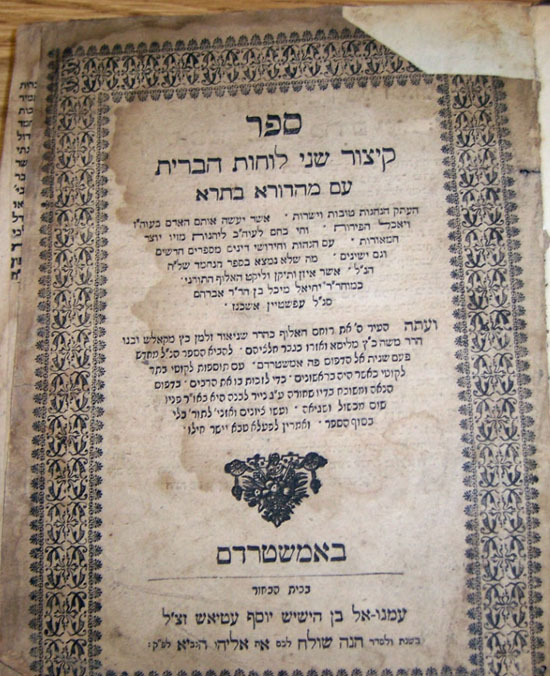
The Kitzur Shelah by Rav Yechiel Michel Epstein, was first published in Fürth in 1683.[1] It was not truly an abridgement of the Shnai Luchos HaBris, but rather a Sefer which stood on its own. It was used for many years by people in smaller communities as a guide for what to do at different times of the year.[2] As many know, it is reputedly the source of the actual Pesukim recommended for the custom of saying Pesukim Lishemot Anashim. [3]
I have an old copy of this Sefer (Amsterdam 1707) whose title page looks like this:

In fact, this custom of reciting a Pasuk associated with one’s name is recorded there at the very end.
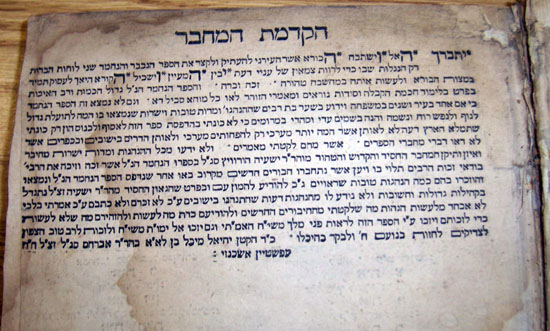
Chapter 5 of Post Sabbatean Sabbatianism by Rabbi Dr. Bezalel Naor goes into the reasons why Rav Yakov Emden blacklisted this book. It is based on the Hakdamah which uses the expressions Mashiach Ha’Amiti and Y’Mot HaMashiach, which equal 814 and is also the Gematria for Shabbetai Zvi.[4] The copy I have from 1707 comes with the original quotation marks, functioning like italics, on both Mashiach Ha’Amiti and Y’mot Hamashiach. (Starting from the third line from the bottom with the word V’Yizku.)

Detail:

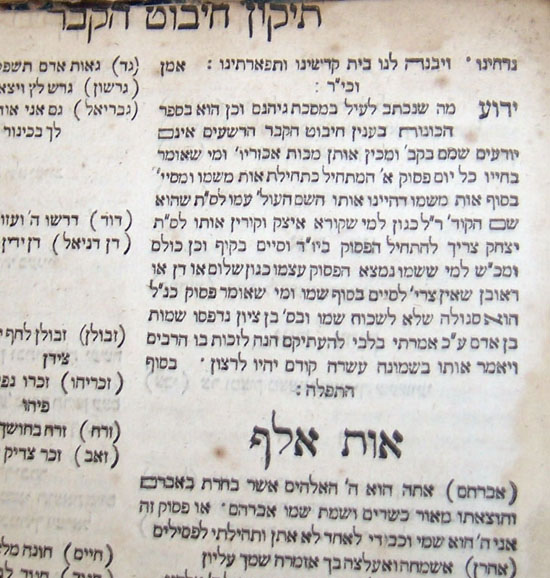
I was looking through the book to find the part that speaks about the Pesukim L’Shemot Anashim and found it at the very end. I was fascinated to see that immediately before the final section, Rabbi Epstein concludes his Sefer with a hope for the coming of Moshiach, and he refers to Moshiach as Nezer Rosheinu ( bottom line below).

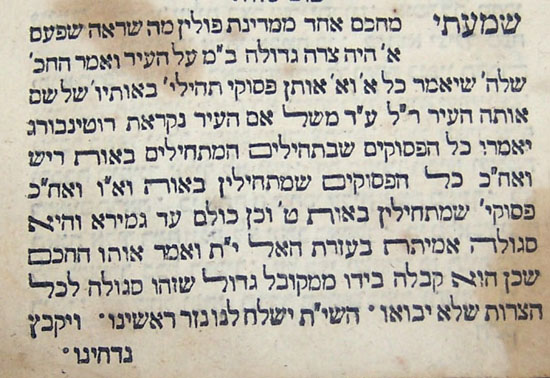
I was curious about the words Nezer Rosheinu to describe Moshiach, and suspecting foul play, I did two things. Firstly, I wrote to Dr. Shnayer Leiman and asked him about the Kitzur Shelah and its use of the word Nezer Rosheinu. This is what Dr. Leiman answered (posted with permission).
“Briefly, Kitzur Shelah is a Sabbatian work. It is suffused with Sabbatian material, so one needn’t look for evidence just at the beginning and end. It was already identified as Sabbatian by R. Yehezkel Katznellenbogen in the first quarter of the 18th century. See also Krengil’s שם הגדולים השלם, vol. 2, p. 148, in הגהות עין חנוך, where the work is identified as Sabbatian.
נזר ראשינו (if that is the correct נוסח — one always need to check the first 3 editions; Amsterdam, 1707 is the 4th edition) is surely a reference to Sabbetai Zevi. The latter name in gematria totals 814, a sacred number for Sabbatians. נזר ראשינו adds up to 824. Either the author wrote נזר ראשנו which totals 814, and the printer misspelled it ראשינו; or, the total 824 stands for ה”ה שבתי צבי. Sabbatians regularly wrote ה”ה before his name. It is an abbreviation for המלך המשיח.
What really needs to be noted is that in a recent edition of קיצור של”ה (Ashdod, 1998), the offensive phrase has been censored and replaced.”
It appears then that Kitzur Shelah has Sabbatean allusions right from the Hakdamah ( which anyone can see for themselves by the use of Mashiach Ha’amiti, etc.) to the last lines which use the words Nezer Rosheinu. It is almost as if it is Koheles in reverse where “its beginning is words of Torah and its end is words of Torah” (Shabbat 30b).
I also did a search online putting in the words “Shabbetai Zvi” and “Nezer Rosheinu”. I got one pertinent hit and it brought up an entirely new issue. I found referenced an article from the Israeli publication HaMaayan published by Mossad Yitzchak Breuer in Tammuz of 5743 (1983).
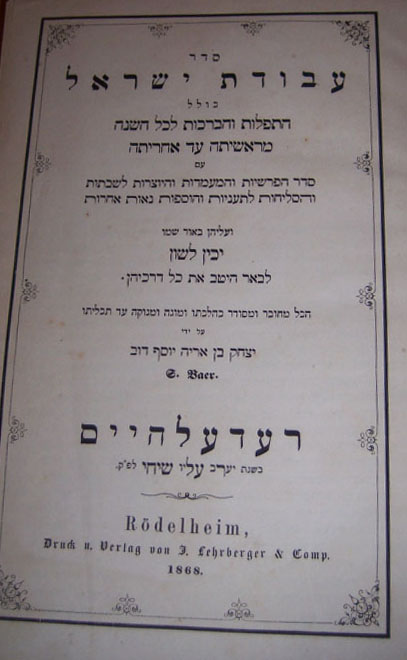
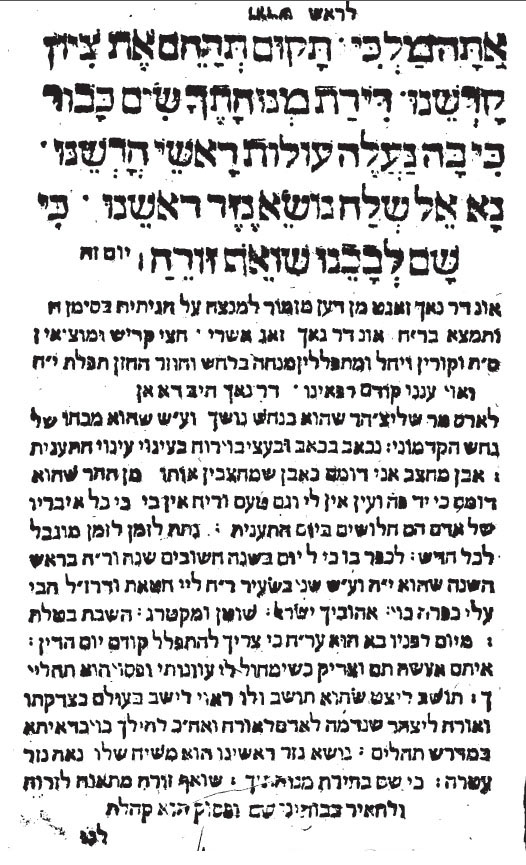
There we find an article by Rav Yosef Yehoshua Apfel (a Dayan in Leeds, and a noted Talmid of the Seridei Eish) on Yom Kippur Kattan, where he writes about the connection between Nezer Rosheinu and Shabbetai Tzvi. Rav Apfel references the famed Siddur Avodas Yisroel printed in 1868 by Dr. Yitzchak (Seligmann) Baer:

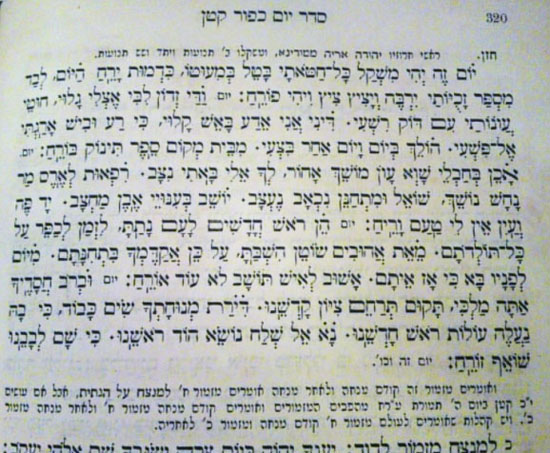
and specifically the Piyyut Yom Zeh Yehi Mishkal Kol Chatasai, included in the Yom Kippur Kattan service which appears there.

He writes as follows

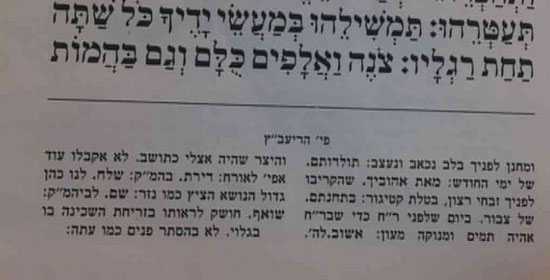
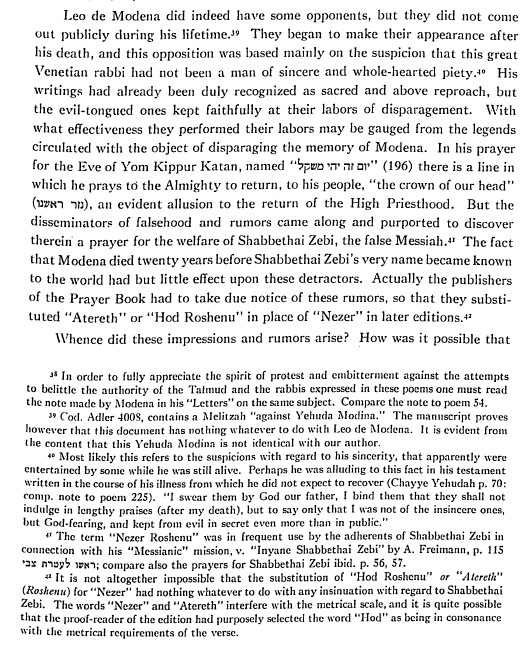
Rav Apfel is at first puzzled a bit as to why Modena would write a Piyyut for a Kabbalistic service (“Ha’Inyan Hu K’tzas Muzar”). He then tells us that Dr. Baer changed the last line of the Piyyut by exchanging the phrase “נא א-ל שלח נושא נזר ראשנו” for “נא א-ל שלח נושא הוד ראשנו”. Dr. Baer explains his reasoning for this change: because he wanted to restore the proper meter, and because he wanted to save the Piyyut from having a “Remez Passul.” Rav Apfel understands this to mean a hint of Shabbetai Zvi. Dr. Baer did this even though, as Rav Apfel writes, Rabbi Yehuda Aryeh MiModena could not have been referring to Shabbetai Zvi, because the Piyyut was written around 1614, and Shabbtai Zvi was only born in 1626. Rav Apfel writes that the Nussach of “נא א-ל שלח נושא נזר ראשנו” appears in many Siddurim (בהרבה סדורים). I recently looked at many Siddurim at the Library of Congress and found this to be true, especially in ones published pre-1868.
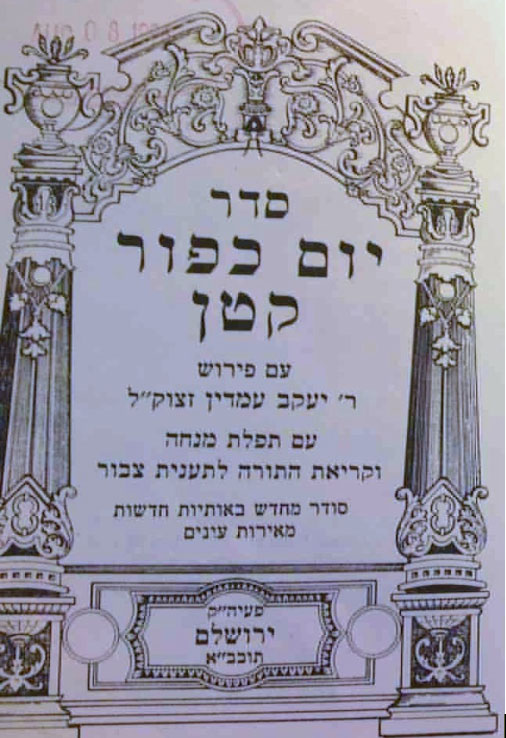
Rav Yakov Emden, who needed little prompting to find Sabbatean allusions, did not understand this phrase as referring to Moshiach, but rather to the Kohen Gadol. This booklet contains the Yom Kippur Katan service with the commentary of Rav Yakov Emden:

The Peirush of Rav Yaakov Emden on the words “נא א-ל שלח נושא נזר ראשנו” indicates as such. “שלח לנו כהן גדול הנושא הציץ כמו נזר”.

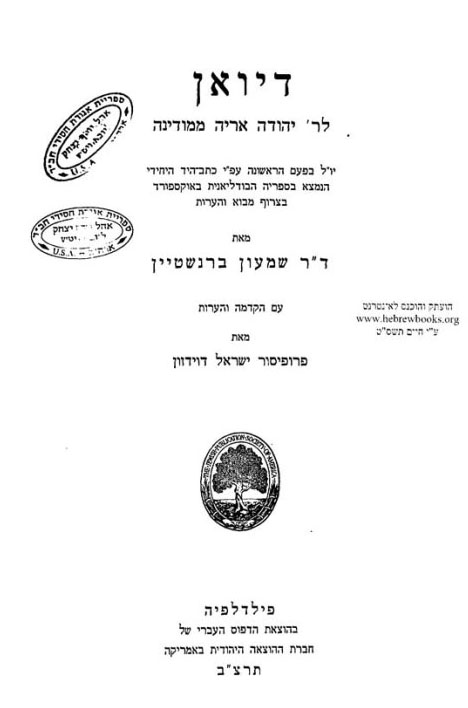
The phrase “נא א-ל שלח נושא נזר ראשנו” is also used in the following book which is generally based on Kisvei Yad of Modena found in the Bodleian Library, although this particular Piyut is not from a Ksav Yad. [5]

(דיואן – יהודה אריה ב”ר יצחק ממודינא, courtesy of Hebrewbooks.org)
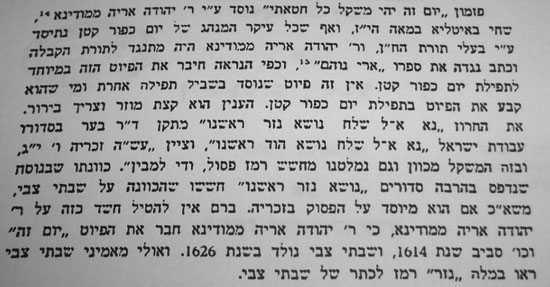
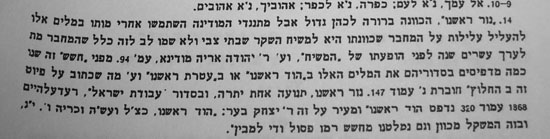
In this book, Professor Simon Bernstein takes on the change in phrase matter and writes[6]:

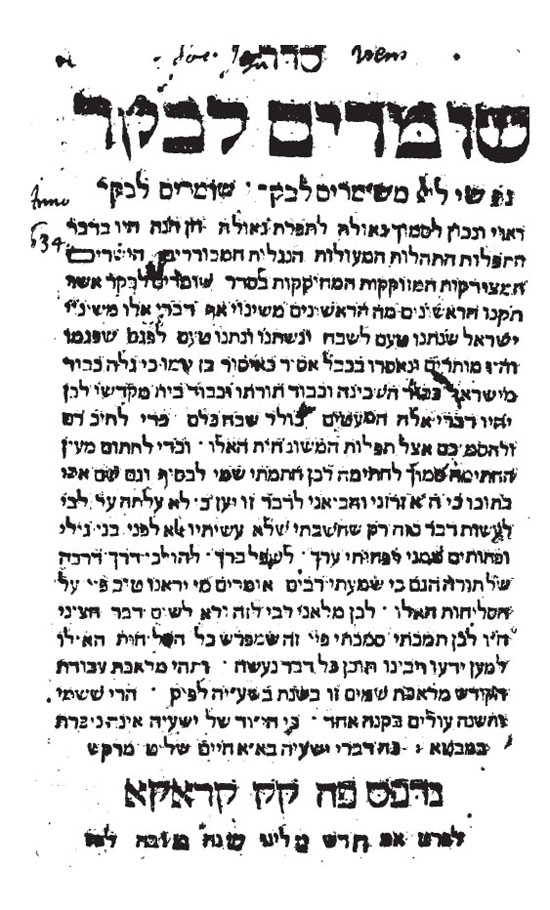
Probably the best proof as to what the original Nusach really was comes from a book named Seder Shomrim LaBoker printed in Cracow in 1626, only 12 years after the Piyyut was probably written.
As you can see, not only is the phrase Nosei Nezer Rosheinu used, the commentary actually explains that it refers to Moshiach and not to the Kohen Gadol (נושא נזר ראשינו הוא משיח שלו נאה נזר עטרה)!


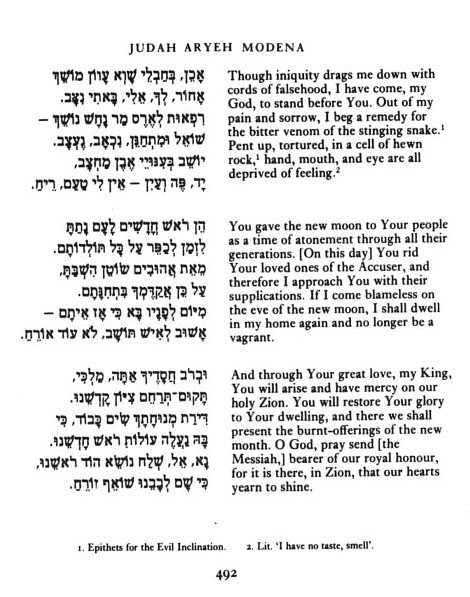
All the many Siddurim that I looked at in the post-1868 period also have the phrase which includes the words Nezer Rosheinu. The new ArtScroll Siddur printed in August of 2010 which includes for the first time the Yom Kippur Kattan service, has the Nussach of Nezer Rosheinu. It seems that in the end, that Nussach won out. The only one I could find who used Hod Rosheinu, following Dr. Baer, was T. Carmi in the Penguin Book of Hebrew Verse (1981):

I am not sure what Dr. Baer’s main reason for changing the Nussach from what seems was the normative one. Could it have mainly been the fixing of the meter and the Shabettai Zvi issue was brought along Agav Urchay?[7] He introduces his comment on his version of the text with the abbreviation כצ”ל . Does this mean that he had a written source for his version? In the introduction to his Siddur, Dr. Baer lists more than 25 post-1650 Siddurim that he consulted in the process of putting together his work. I am curious as to why he did not cite a source for this textual variation. As stated by Rav Apfel and Dr. Bernstein, it is clear that this phrase when written in 1614, did not originally refer to Shabbetai Zvi who didn’t “appear” until a few decades later. Was Dr. Baer reacting to a later development in history and changing the past to reflect the present? We have seen that quite often lately, and example of which was pointed out by Dr Shnayer Leiman above: “What really needs to be noted is that in a recent edition of קיצור של”ה (Ashdod, 1998), the offensive phrase has been censored and replaced”
[1] Encyclopedia Judaica, Keter Publishing House, Jerusalem, 1972. Article entitled “Epstein, Jehiel Michal Ben Abraham Ha-Levi” attributed to Dr. Yehoshua Horowitz
[2] Ibid.
[3] This matter is in contention and is based on the question of when the book was first printed. S. wrote me “When was the Kitzur first published? Like the Encylopedia Judaica, many sources state that the book was first published in 1683, Steinschneider contends that it was published in 1693. He claims that this is what the chronogram on the title page adds up to. Since this is a dispute about a yud, my guess is that he is correct. The first significant bibliographer before him, Julius Fuerst (Bibliotheca Judaica v. 1 pg. 246 under Eppstein) listed the year 1683. However, shortly afterward Steinschneider cataloged the Hebrew books in the Bodleian Library and there he writes that it’s 1693. He not only bases this on the chronogram, but also on the content of the haskamos. Following him is the next significant Jewish bibliographer, Isaac Benjacob, who in his Otzar Ha-seforim (pg. 535) agrees with Steinschneider. Whether or not Benjacob saw the book, I cannot say, but Steinschneider obviously did.
“What makes this interesting is that if this is true, then the Kizur Ha-shelah was actually published three years *after* the Sefer Ben Zion, (which lists actual Pesukim Lishmot Anashim) not seven years before. This would make the Ben Zion the first to list names and pesukim [that we know of so far].”
Be that as it may, here is an excerpt from the page on Names in my Kitzur Shelah (Amsterdam 1707):

[4] What I find fascinating is that the author of the Encyclopedia Judaica article cited above, completely ignores this point. He writes “It is very doubtful that he (Rav Epstein) had any associations with the Sabbatean movement, although he was suspected of it because of the wording of a certain passage in his Siddur”.
[5] Yom Zeh Yehi Mishkal, which is printed on page 199, is not from Modena’s Divan, which evidently didn’t include this pizmon. Rather, the poem was so famous that the editor evidently thought he simply had to include it. He copied it from a Siddur, the 1845 Prague edition of Seder Tefilat Yisrael edited by Wolfgang Wessely.
[6] In the Introduction to the Divan, Bernstein also writes:

[7] S.’s conclusion was that Dr. Baer’s primary concern was grammatical. There were at least two sources prior to him which alluded to a Sabbatean suspicion about Nezer Rosheinu in Yom Zeh Yehi Mishkal (and both of them reject it as absurd). If the concern was primarily about Sabbatianism, why then didn’t he change Nezer to Keter? The answer must be that this change would not fix the problematic meter, but Hod does. Thus under the cover of removing even a “Shemetz” of a doubt, despite it not even being a real issue, he makes the change which soothes his grammarian’s soul.