Apostates and More, Part 2

Apostates and More, Part 2

Marc B. Shapiro

Continued from here

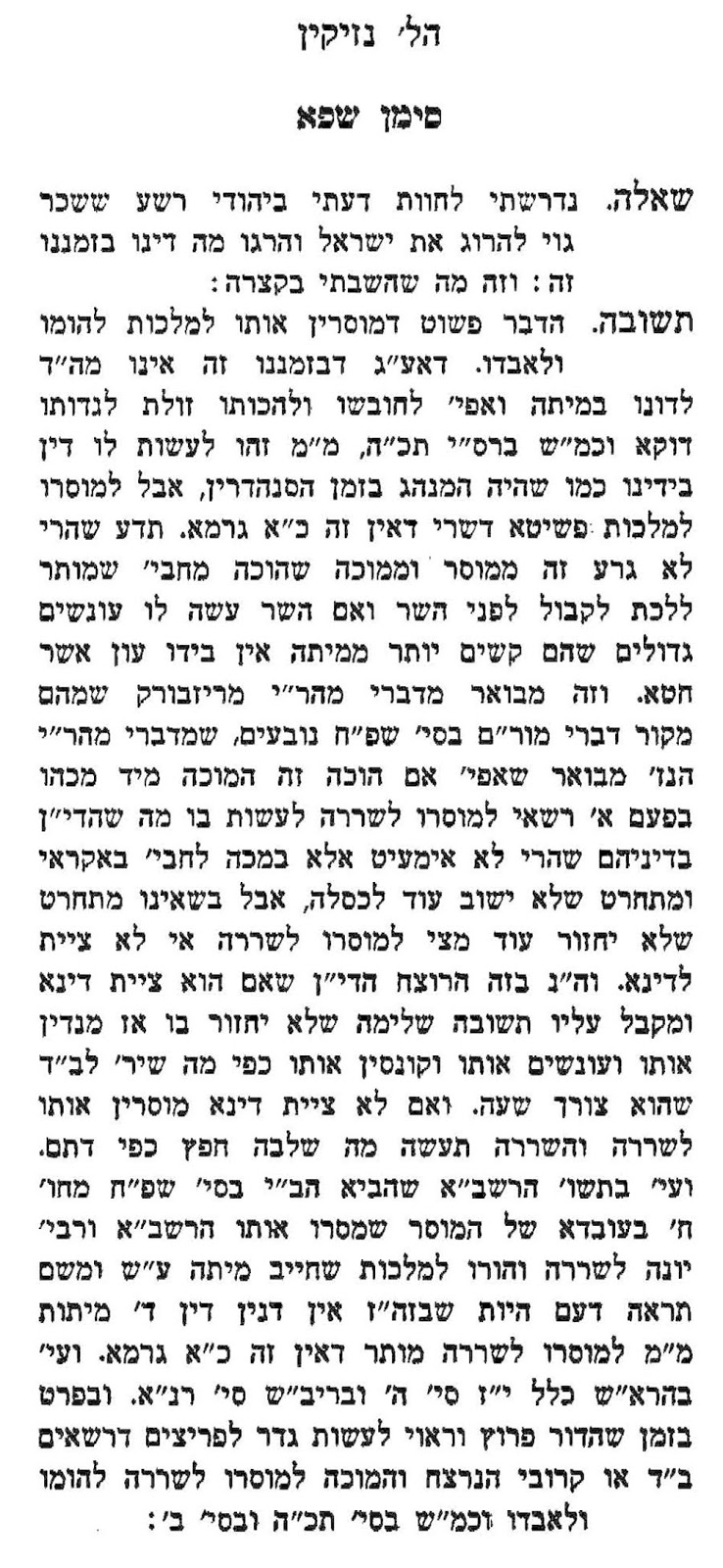
1. Another apostate was Rabbi Nehemiah ben Jacob ha-Kohen of Ferrara, who was an important supporter of R. Moses Hayyim Luzzatto during the controversy about him.[1]Here is the the final page of the haskamah he wrote in 1729 for R. Aviad Sar Shalom Basilea’s Emunat Hakhamim.
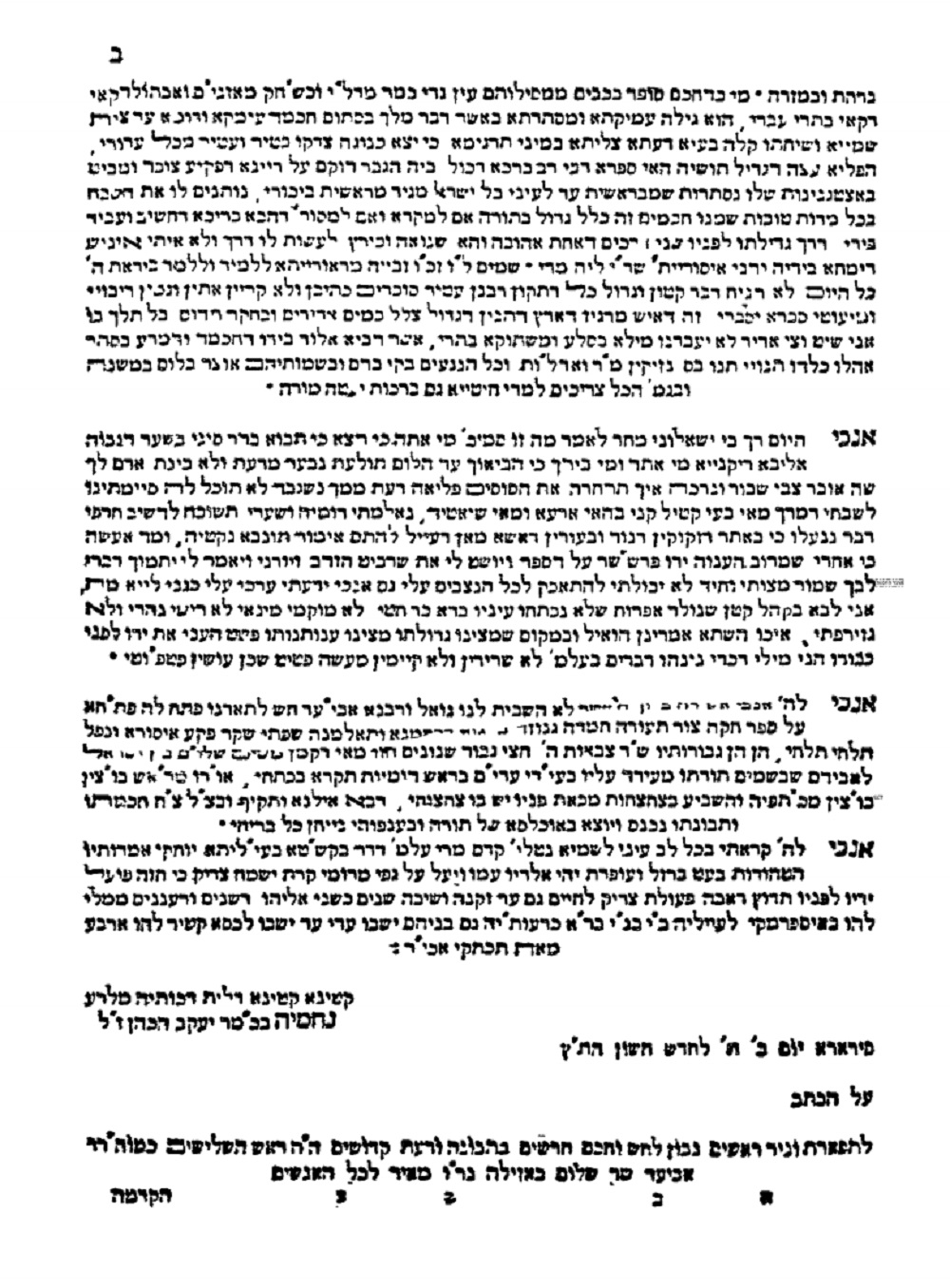
R. Isaac Lampronte, in a halakhic discussion in his Pahad Yitzhak, refers to Nehemiah, but not by name.[2] He calls him אחד מן החכמים רך בשנים אשר אחרי כן הבאיש ריחו כנודע. In R. Hananel Nepi and R. Mordechai Samuel Ghirondi, Toldot Gedolei Yisrael (Trieste, 1853), p. 229, they write about Nehemiah: שאח”כ נעשה ישמעאלי. Obviously, “Ishmaelite” is a code word for Christian.[3]

The story reported by Samuel David Luzzatto is that Nehemiah used to go to prostitutes, and when the rabbis found out about this they removed the rabbinate from him. Too embarrassed to remain in the Jewish community, Nehemiah apostatized.[4] Cecil Roth cites another Italian source that Nehemiah converted so he could marry a Christian woman. Unfortunately, his son and three daughters apostatized together with him (his wife had apparently already died).[5] 

Another apostate who should be mentioned is Michael Solomon Alexander (1799-1844), first Anglican bishop in Jerusalem. Before his apostasy, Alexander was a rabbi.[6] 

Rabbi Abraham Romano of Tunis also became an apostate. He converted at the end of the seventeenth century when R. Meir Lombrozo was appointed a dayan in his place. After Romano converted, he became well known as a Islamic preacher, and after his death his tomb was venerated by Muslims. He was known as Sidi Sofiane, and the street in Tunis with this name is named after him.[7] It is reported that in the nineteenth century R. Uziel Alheikh, author of the halakhic work Mishkenot ha-Ro’im, would recite Kaddish at Romano’s grave so God would forgive his sin.[8] 

I am sure many readers have heard of Rabbi Israel Zolli, the chief rabbi of Rome who converted after the Holocaust. Not so well known is Rabbi Daniel Zion, who was the chief rabbi of Bulgaria and after World War II served as a rabbi in Jaffa. When it became known that he was a believer in Jesus, he was forced out of his rabbinic position. There is a good deal online about Zion, and entries in English and Hebrew on Wikipedia.

Rabbi Hayyim Asher Hoffmann was another modern rabbi accused of working with missionaries. He was in Argentina at the beginning of the twentieth century, and wrote a haskamah for R. Menahem Mendel Hirschhorn’s 1904 book Magid le-Yisrael. Here is the title page of the book, followed by the haskamah.

In 1907, R. Mordechai Amram Hirsch of Hamburg informed Jewish leaders in Buenos Aires that Hoffmann had worked in the Christian mission in Hamburg. Not long after this, Hoffmann committed suicide.[9]

Hoffmann is not the only rabbi to have committed suicide. In his recent article in Hakirah, Moshe Ariel Fuss deals with R. Moshe Soloveichik’s great dispute with the Polish Agudat Ha-Rabbanim. He also discusses the suicide of one of the dayanim of Tomashov, which was related to the dayan’s role in the dispute.[10]

There was another rabbi and author of a sefer who committed suicide. Let me preface this story with some other relevant information. In the early 1990s there was a project at the Harvard library to put thousands of rare Hebrew books on microfiche. This would then be sold to major university libraries. It was a wonderful idea and involved considerable expense on the part of the company, K.G. Saur, which was carefully photographing the books. (I used to watch the photographer doing his work.) It was very costly to purchase the more than ten thousand fiches, but for a library that wanted to instantly have access to almost five thousand rare Hebrew books, this was a great solution. You can see a 1994 ad for the project here.

Unfortunately for this project, advancing technology made it obsolete almost immediately upon completion. The ability to access rare books online, on hebrewbooks.org, Otzar ha-Chochma, Google Books, and other sites, meant that microfiche readers went the way of typewriters. (I still haven’t gotten rid of my own microfiche reader, as I never know if it might come in handy).

Harvard put out a catalog advertising the microfiche set, which discussed the different genres of books included. The catalog also had pictures of a few of the title pages of the books. Here is one of the pages in the catalog.[11]


Here is a clearer picture of the title page.

The book is Derekh Yam on Tractate Meilah by Rabbi Mordechai Nahman Stieglitz, published in 1900. At the time (almost thirty years ago), I thought nothing of this, and just assumed that Derekh Yam was a random book that was picked for inclusion in the catalog. However, someone who knows a lot about seforim told me that there is no question that Derekh Yam was not randomly picked. He said that whoever chose to use this title page, when there were so many others that could have been picked, must have done so as an inside joke for the benefit of those who knew the history of Rabbi Stieglitz (which at the time I knew nothing about).

Derekh Yam is a fine commentary on a tractate that not so many have written about. Understandably, then, when people study Meilah this is one of the books they will turn to. And why not, seeing that the book has haskamot from such great figures as R. Isaac Schmelkes, R. Shalom Mordechai Schwadron, and R. Aryeh Leibush Horowitz? It also includes an approbation and a lengthy responsum (pp. 47a-58a) by R. Joshua Horowitz, the Rebbe of Dzikov (Stieglitz’s hasidic group[12]) and author of a number of volumes with the title Ateret Yeshuah.

Shortly following the appearance of Derekh Yam, Stieglitz’s life took a different turn. He not only left Poland but abandoned Torah observance as well. Meir Wunder writes that “he went to study at the University of Berlin (and not Vienna).”[13] Wunder’s information that Stieglitz studied in Berlin presumably came from Yehudah Rubenstein (see below), but I don’t know why he felt the need to correct the error that he studied in Vienna, as I haven’t seen anyone make this claim. 

It could be that Stieglitz did study in Berlin (though I know of no evidence for this), and to be sure one would need to check the archives of the University of Berlin. However, Rubenstein and Wunder were unaware that Switzerland was Stieglitz’s primary academic place of study, and his 1908 doctoral dissertation is from the University of Bern. It deals with Baraitot in Tractate Berakhot in the Bavli and Yerushalmi. You can see it here. As was typical in those days in Germany and Switzerland, the doctoral dissertation is short and insignificant. It never ceases to amaze me how easy it was in those countries to receive a doctorate.

Yehudah Rubenstein says the following about Stieglitz:[14] When his book Derekh Yam appeared it was greatly praised by Torah leaders and had an impact on talmudic scholars. It also included a long responsum from R. Joshua Horowitz. Later, a רוח שטות entered Stieglitz and he abandoned his wife and children and went to Berlin to study, where he abandoned Torah observance and fell in love with the daughter of a banker, whom he married after divorcing his wife. He then went to New York where he went into business and made a lot of money on Wall Street. However, during the Depression Stieglitz lost his money and committed suicide.[15]

Rubenstein also notes that Dzikover hasidim, at the command of their rebbe, collected all the copies of Derekh Yam that they could find, from synagogues and private homes, and destroyed them. He concludes:

.והספר דרך ים הוא יקר המציאות, כי נשארו ממנו טופסים מועטים

What used to be a rare book is now, thanks to modern technology, at everyone’s fingertips. Even if, as a result of this post, the book is removed from hebrewbooks.org and Otzar ha-Chochma, you can still see Harvard’s copy here.

In 1976, the descendants of R. Joshua Horowitz published Ateret Yeshuah: Likutei Teshuvot ve-Haskamot.


In the introduction it states that the book includes all the responsa and approbations of R. Horowitz found in the writings of others. However, they purposely did not include the approbation and responsum found in Derekh Yam.[16]

Returning to apostasy by rabbis who produced seforim, I have previously mentioned R. Profiat Duran, the Efodi (see here), and an article by Joseph Hacker has recently appeared which further complicates matters.[17] Let me first note that in Latin documents his name appears as Perfeyt, so from now on this is how I think we should pronounce it. Second, and here Hacker follows on Maud Kozodoy’s earlier research,[18] we have evidence that not only did Duran convert (this we already knew), but that he remained a Christian for the rest of his life, even when he had left Spain and could have returned to Judaism. If that wasn’t enough, both Kozodoy and Hacker believe that he married a Christian woman, as the wife to whom he left his possessions had a different name than his first wife. Yet this latter point is not conclusive. It could be that the woman he was married to at the end of his life was a Jewish woman who apostatized, either the original wife who changed her name on conversion, or a second wife. How Duran continued to write anti-Christian polemical works while living as a Christian is still a mystery.[19] His famous grammatical work, Ma’aseh Efod, the introduction to which Professor Isadore Twersky loved to study with his graduate students,[20] was also written while he was a Christian.


When the information about his life eventually filters out to the Orthodox world, presumably he will no longer be cited as an authority (although all evidence points to his important commentary on Maimonides’ Guide being written before his conversion so perhaps that can still remain in the canon).[21]

I must also mention R. Levi Ibn Habib (ca. 1480-1541), the great sage of Jerusalem. As a young man in Portugal, he converted (or was converted) to Christianity. We don’t know if at this time he was living with his father, R. Jacob Ibn Habib, who is famous for editing the Ein Yaakov. Later, R. Levi journeyed to Salonika where he was together with his father.

We do not know the precise details of R. Levi’s conversion. Scholars often write about Jews being subjected to “forced conversion.” This can mean that one is told he must convert or he will be killed. In this circumstance, Jewish law requires martyrdom, and Jewish history knows of many who chose this path.[22] Yet people who were not strong enough to accept martyrdom, and converted to Christianity to save their lives, are routinely described as forced converts. 

The other meaning of forced conversion is using actual physical force to baptize someone, as occurred in Portugal. R. Levi was in Portugal in 1497, when Jewish life there came to an end. Many Portuguese Jews converted “willingly”  in addition to the strong Christian pressure to convert, some did so to be freed from slavery or after their children were taken from them, as this was the only way to get them back. There was also the unusual circumstance that the King ordered the Jews not yet baptized to be baptized against their will, literally by physical force. (Mainstream Catholic teaching did not regard this as a valid baptism, unlike the case of one who converted to save his life, as this latter act was taken out of free will).[23] As mentioned, we do not know whether R. Levi converted “willingly” or not, but we do know that he lived as a Christian after this conversion.

In the great dispute over the revival of semikhah between R. Levi and R. Jacob Berab, R. Berab saw fit to allude to R. Levi’s conversion as a means of discrediting him. This is quite surprising, as one is not supposed to remind a ba’al teshuvah of his previous sins. Here are some of R. Berab’s words which are clearly designed to contrast his pure history with R. Levi’s history, which included living as a Christian (and thus having a Christian name).[24]

שת”ל מיום הגרוש והשמד שבספרד לעולם הייתי מורה הוראות בישראל . . . ועם היותי ברעב ובצמא ובחוסר כל לעולם הלכתי בדרכי השם יתברך ונתעסקתי בתורתו . . . ות”ל שמעולם לא נשתנה שמי אי רבי קרו לי השתא רבי הווי קרי לי אז וזה שמי לעולם . . סוף דבר שת”ל לעולם השתדלתי שלא ילך להתרעם עלי שום אות מאלף ועד תי”ו, רצוני לומר שלא נתחלל שם שמים על ידי בשום אחד מהאותיות כדי שלא יעלו לשמים להתרעם עלי

R. Levi was understandably quite offended by R. Berab’s words. He expresses his pain that R. Berab would attempt to publicly humiliate him by bringing up the difficult timein Portugal. He makes it clear that he is speaking for many others who were also in his unfortunate circumstance.[25]

לישנא בישא טובא איכא הכא, ובמקום שהיה לו לחכם להודות על האמת ולהשיב כהלכה גרם לשפוך דמי ולהלבין פנים בהזכירו אלי עונות ראשונים . . . לא לכבודי ח”ו כי אם לכבוד כל אותם שנמצאו באותה הצרה ושמו עצמם בסכנות רבות וברחו ולא ראו בטובה עד שזכו להיות בעלי תשובה ורבים מהם נפטרו לחיי הע”ה

R. Levi also mentions that he was not yet a bar onshin when he converted. The evidence we have shows that he was older than 13 in 1497, so when he says that he was not yet a bar onshin, it must mean that he was under the age of 20. This is in accord with an aggadic statement in Shabbat 89b that God does not punish for transgressions in the first twenty years.[26] The Zohar, Bereishit 118b, also states that while an earthly beit din punishes from age 13, the Heavenly Court does not punish for sins committed before age 20.[27]

R. Levi further states that despite his difficult circumstances, in his mind he remained a Jew, loyal to the one true God. While others changed his name to a Christian name, he himself never changed. He adds that while he did not merit to die al kiddush ha-shem, he hopes to achieve a complete repentance for his past. Here are some of R. Levi words, full of pathos:[28]

ואומר כי אני לא אחלל בריתי ברית התורה להשיב לזה החכם על פי דרכו . . . גם לא אכחיש המובן מדבריו בהגדלת אשמתי ולא אציל עצמי בדברתי לומר שאף אם שנו שמי בעונתי בשעת השמד אני לא שניתי, ובוחן לב וחוקר כליות יודע כי תמיד אותו יראתי, ואם לא זכיתי לקדש שמו לבי יחיל בקרבי מפני זעמו הגם שעדיין לא הייתי בר עונשין בבית דינו כלל, מכל זה לא אומר ח”ו כי שקר התנצלותי, ועוד כי יוסיף פשע על חטאתי, אדרבה אבכה יומי ולילי אוי לי אללי ואודה עלי פשעי ואומר ידעתי יי’ רשעי ופשעי וזדוני כי רבו למעלה ראש משורש פורה רוש, ואשמותי גדלו עד לשמים, אבל בטחתי על רוב חסדיך ונשענתי על רוב רחמיך, וכשם שזכיתני לצאת מן ההפכה והבאתני אל העיר ההוללה בתוך השנה להיות שונה שם בכל יום הלכה עד היום שיש יותר מארבעים שנה, כך תזכני להיות בעל תשובה שלמה, ומה גם עתה בהיותי עולב עלבון גדול אשר כזה על לא חמס בכפי, ואתה אדון הסליחות אלדי הרוחות ראה בדמעות אשר זלגו עיני עתה באנחות ויהיו בבית גנזיך מונחות לעת צאת נפשי, ואולי תזכה בהן לשוב למנוחות

It is one thing for contemporaries to slug it out and attack each other. However, that was hundreds of years ago, and in the intervening centuries both R. Levi and R. Berab have been included in the canon of gedolim. R. Berab has the additional distinction of having given semikhah (the real kind) to R. Joseph Karo. As such, we are dealing with important figures who are each deserving of great respect. This is why I found it so unusual that a twentieth-century rabbi, Benjamin Trachtman, who came to the defense of R. Levi, showed considerable disrespect for R. Berab. 

R. Trachtman was a rabbi in a few different places in the United States and Israel, and author of a number of works. In 1930 he was rabbi in Mishwaka, Indiana (near South Bend) when he published his book, Shevet Binyamin. Here is the title page.

The book comes with a number of “haskamot,” among them from R. Moshe Mordechai Epstein and R. Isaac Sher. From the “haskamot” we learn that R. Trachtman had been a student at the Chevron Yeshiva. I put the word haskamot in quotation marks, since even though that is what the letters at the beginning of the book are called, they are not haskamot at all as they have nothing to do with the book. Rather, they testify to R. Trachtman’s Torah knowledge and most of the letters are semikhah certificates.

I find it hard to believe that R. Trachtman’s teachers, and the others whose letters appear in the book, would have approved of his judgment of R. Berab, found on p. 93 of his book. He states that in looking at the dispute between R. Levi and R. Berab, you can see the difference between a person who has mussar values and one who is “lacking mussar and middot”! He claims that R. Berab is an example of someone who had great Torah knowledge but was lacking in the area of ethics. I find it incomprehensible that a twentieth-century scholar would speak this way about one of the recognized Torah sages of centuries ago.

משם יש לראות את הנפ”מ בין אדם בעל מוסר שכל דבריו שקולים במשורה בחשבון ודעת לאדם חסר המוסר והמדות, והינו[!] כי אחד מהדברים אשר אדם נכר בהם הוא בכעסו, בעת אשר מחלוקת לו עם חבירו, והנה המחלוקת של שני החכמים הנ”ל אם כי המחלוקת היה לש”ש לדינא אבל בכל זאת יש לראות שם גם זה הסוג מחלוקת של אנשים השוטים והמחלוקת מזה הסוג בולט הרבה מדברי הר”י בי רב, כי בדבריו אנו רואים התנפלות עזה בדברים בוטים כמדקרות חרב ועלילות מזויפות על הרלב”ח אשר א”א בשום אופן שמחשבון יצאו הדברים ואדרבה הרלב”ח אף כי גם הוא אינו מחריש לו אבל דבריו בנחת נשמעים במתינות ובישוב כנראה משם . . . ואל תאשימני על בואי לבקר את הר”י בי רב כי נתן לי רשות בדבריו, וסוף סוף אנו רואים בחוש גם עתה כי הוא שני דברים נפרדים כי יש למצוא תלמידי חכמים אשר גאונותם בתלמוד הוא עד למאוד וכשבאים לסוגיא “יכיר יכירנו לאחרים” הם נכשלים באופן פשוט אשר בשום אופן אין לחפות עליהם, אם לא כי יצאו מגדר המוסר

Also worth noting is Jacob Katz’s comment at the end of his classic article on the semikhah controversy.

Nor can we ignore the fact that Berab’s personal attacks on ben Habib, and the recounting of his “old sins,” were not germane. He did not dare to give explicit expression to the serious accusation about ben Habib’s conversion in his youth; instead he couched it in words of self-praise (“I myself never changed my name”). Such a tactic is evidence of an emotional need to pretend that one has done nothing wrong, which is a sign of an uneasy conscience.[29]

I must also mention R. Isaac Bar Sheshet, the great Rivash. Did the Rivash actually convert to Christianity during the anti-Jewish persecution of 1391? There is no mention of this in any Hebrew documents. However, in 1983 Jaume Riera published an article in Sefunot based on documents from the Spanish archives which show that during the 1391 anti-Jewish attacks, the Rivash, who served as rabbi of Valencia, converted to Christianity. This is attested to in three separate documents, two of which refer to the rabbi of Valencia and one of which identifies the Rivash by name. The documents show that while many Jews were killed in Valencia during the attacks, most converted to save their lives and the large synagogue was turned into a Church.[30] 

We do not know the exact circumstances that supposedly led the Rivash to convert, and the only important detail in this regard that we learn from the documents is that the Rivash’s death sentence was revoked after his apostasy. Riera offers a suggestion to explain why Rivash chose to convert, but this is based on nothing other than Riera’s vivid imagination. Yet Riera’s imaginings, which conjured up “false witnesses,” a “disgraceful crime,” and other completely fictional events, are presented in the Wikipedia entry on Rivash as actual fact.

In 1391 there occurred the great persecutions of the Jews of Spain in consequence of the preaching of Fernandes Martinez. On the first day of the persecutions, the younger brother of King John I summoned Isaac on July 9, 1391. He explained that to be able to restrain and cease the bloodshed, it would be necessary to promulgate an organized conversion of the Jews, which should obviously start with the communal leaders. Some of the leaders did relent to the heavy pressure laid upon them; but not Isaac, who held steadfast to his faith. After a couple of days, the officials set up false witnesses to testify against Isaac for a disgraceful crime. Due to this accusation, Isaac was condemned to death, by burning at the stake in the city’s central square. On July 11 Isaac was immersed, donned the robe of a Dominican and received the name Jaume De-Valencia.

Around a year and a half after the supposed conversion the Rivash escaped to Algeria, where he was known as a great posek whose responsa remain among the most important ever written. He died in 1408.

Did the Rivash convert? There were a number of rabbis, admittedly not of the Rivash’s level, who converted to Christianity in Spain, so the idea is not impossible. We also have to remember that the conversion of the Rivash, if it indeed occurred, was also only a temporary event. I do not think it casts aspersions on a great rabbi if we find that when faced with the terrible choice, he did not choose martyrdom. Everyone realizes that this is never an easy choice. This was especially the case in Spain which, unlike Germany, never had a culture extolling Jewish martyrdom (and we know that large numbers of Spanish Jews chose conversion over death).

In analyzing this matter, the real issue that experts should focus on is how reliable are the government documents. R. David Bar Sheshet is a descendant of the Rivash and recently published a biography of his illustrious forefather. Some might be surprised that in an “Orthodox” biography he deals with the matter of the supposed conversion. However, being that this is by now a well-known “fact,” it is basically impossible to ignore. Not surprisingly, Bar Sheshet argues against the claim that the Rivash converted.[31] Yet this is not simply a hagiographic perspective, and I myself am not convinced. If indeed the Rivash converted, the Church would presumably have used this as a propaganda tool, yet we have no evidence that this was ever done. Furthermore, does it make sense that no Jewish sources of the time mention the apostasy of such a prominent rabbi?[32]

Among my hobbies are visiting the graves of great Torah sages, and this hobby has taken me around the world. What about visiting the graves of the Rivash, and also R. Simeon ben Zemah Duran, the Tashbetz, both of whom are buried in Algiers?[33] Recently, I was in a Paris airport waiting for my flight to Tunisia. At very next gate was a flight to Algiers. Yet despite how easy it would be to travel there, I have yet to go. There is no Jewish community in the city and I don’t know how safe it is to visit Jewish sites. One day when I am convinced it is safe, I will travel there, much like I will travel to Baghdad to visit the grave of the Ben Ish Hai.

Fortunately, one person did make the trek to Algiers. He has put online pictures of the cemetery where the Rivash and R. Simeon ben Zemah Duran are buried, having been moved there from the original cemetery at the end of the nineteenth century. Even before the move they had been given new tombstones.[34] See his website here.

This is the Rivash’s grave. The picture is taken from the just mentioned website.
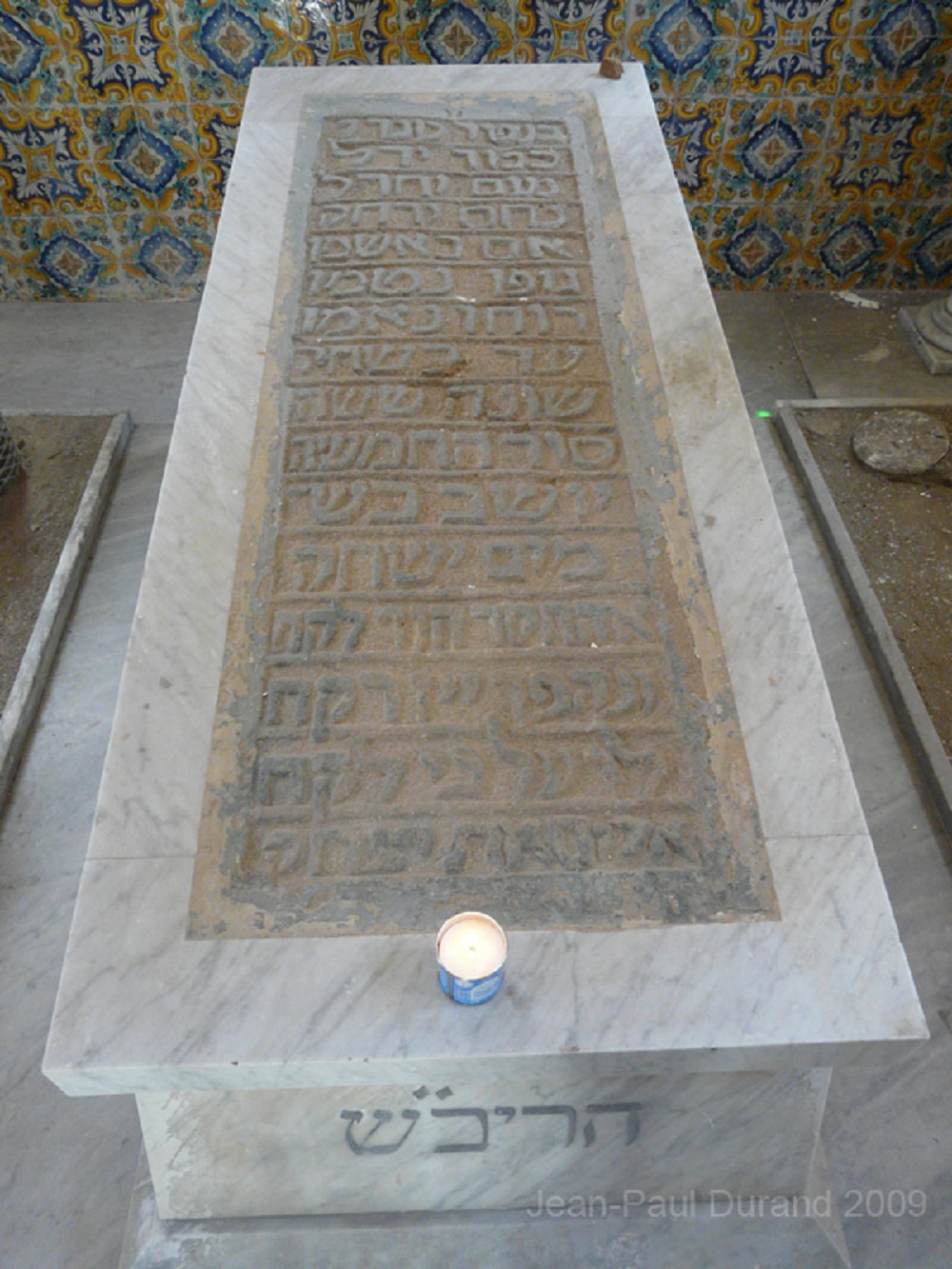
This is R. Duran’s grave. The picture comes from the same website.

Excursus

Due to the censor, or perhaps even self-censorship, in certain European prayer books negative expressions directed against idolatry, and hence bearing a possible anti-Christian interpretation, were turned into anti-Islamic expressions. See Leopold Zunz, Die Ritus des synagogalen Gottesdienstes (Berlin, 1919), p. 222. Halakhic works were also affected. See, for example, R. Abraham Danzig, Hokhmat Adam 153:1, where some printings have:

ואם שרוי הוא בין ישמעאלים

Every reader should easily grasp that in this passage ישמעאלים does not really mean Muslims.

Mishneh Torah, Hilkhot Avodah Zarah 9:4 reads:

הנוצרים עובדי עבודה זרה הן ויום ראשון יום אידם הוא. לפיכך אסור לשאת ולתת עמהן בארץ ישראל יום חמישי ויום ששי שבכל שבת ושבת. ואין צריך לומר יום ראשון עצמו שהוא אסור בכל מקום

In the textual notes in the Frankel Mishneh Torah, they cite a manuscript that reads:

ישמעלים [!] עובדי ע”ז הן ויום ששי יום אידם . . . ואין צריך לומר יום ששי עצמו

In the Shabbat morning Amidah, we read:

וגם במנוחתו לא ישכנו ערלים

Steinschneider noted that some texts replace arelim with “Ishmaelites.” See Polemische und Apologetische Literatur in arabischer Sprache zwischen Muslimen, Christen und Juden (Leipzig, 1877), p. 374. This change of text was done in Christian countries for obvious reasons and should fool no one. Thus, it is surprising that Salo W. Baron, A Social and Religious History of the Jews, vol. 6, p. 327 n. 15, writes as follows about the version that contains “Ishmaelites”:

This was hardly an invention of later generations of Jews who, living in Christian countries, sought to avoid difficulties with censors. . . . If Maimonides, in his formulation, substitutes arelim (uncircumcised) for “Ishmaelites” (cf. M.T. Seder Tefillot at the end of the second book; here switched to the Musaf prayer), this was merely in line with his general preference for Islam as against Christianity.

This is complete nonsense. Maimonides did not substitute arelim for “Ishmaelites.” The text he had, which is the authentic text of the prayer, included the word arelim.

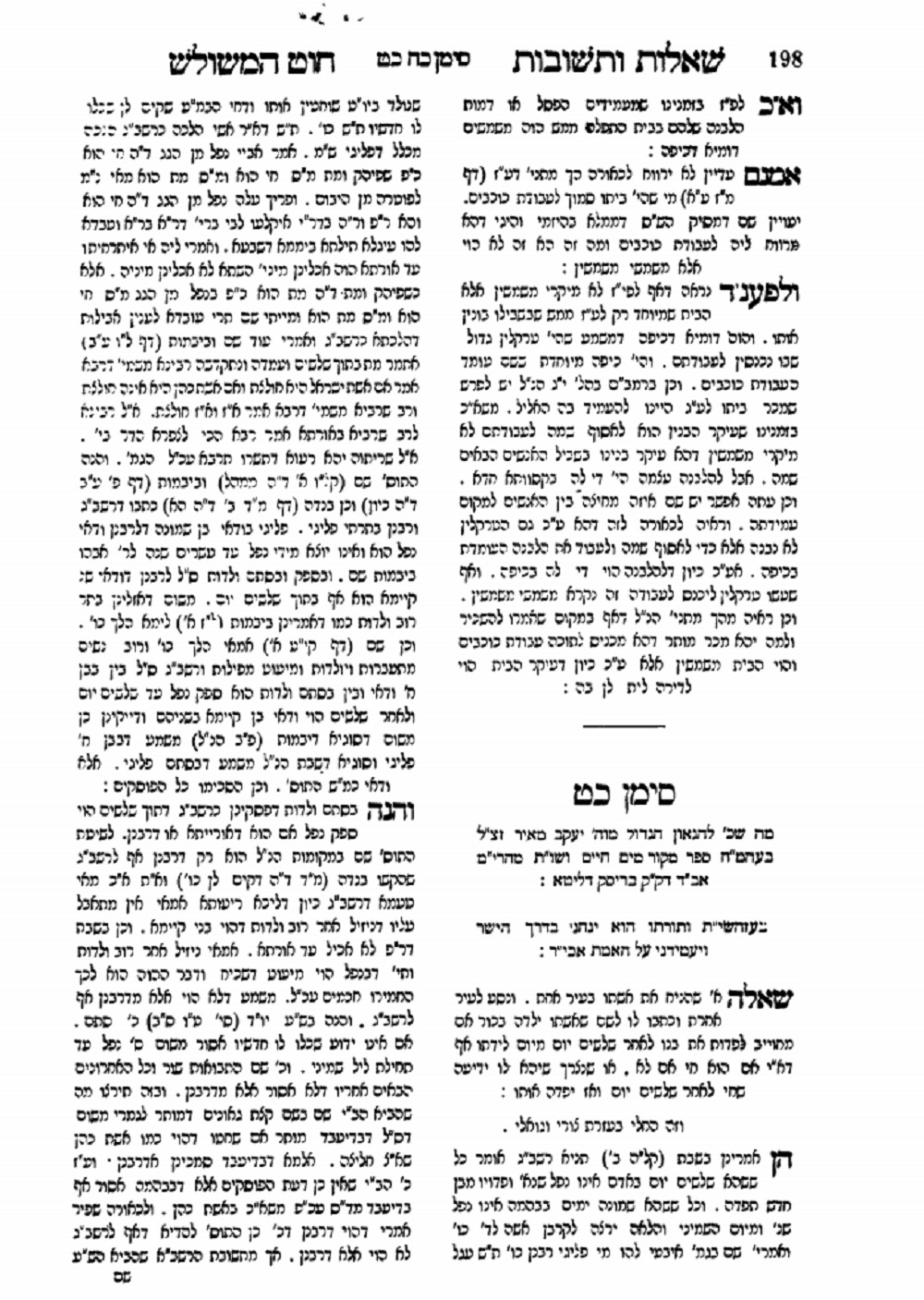
Here is a responsum of R. Eliezer Isaac Fried, from Hut ha-Meshulash, no. 28. This responsum is cited in many of the discussions dealing Islam and halakhah, in particular with reference to mosques. In my article on the topic from many years ago I too cited this source. See “Islam and the Halakhah,” Judaism 42 (Summer 1993), p. 337.

I recently had occasion to look at this responsum again, and I see that everyone has misunderstood it. It is obvious that R. Fried is not really speaking about building a mosque but a church. When, in the responsum, he speaks of placing the crescent in the mosque, this is really code for crucifix. In fact, the entire responsum assumes that he is speaking about a religion of avodah zarah, which is the obvious sign that he is really speaking about Christianity.

My excuse for misreading the responsum years ago is that I was young and unsophisticated. However, it is very surprising to me that many great talmidei hakhamim have also cited this responsum without realizing that it is not really referring to Islam. See also here where I discuss a mistake by R. Judah Aszod who assumed that in a particular responsum the Hatam Sofer was discussing candle lighting as part of a religious celebration in India, when it is obvious that the Hatam Sofer is really referring to the practice of European Christians.

For an example of self-censorship in the opposite direction, namely, the removal of references to Islam, see this page of a responsum of R. Rahamim Joseph Franco, Sha’arei Rahamim (Jerusalem, 1881), vol. 1, Orah Hayyim, no. 5, p. 8b (look at the paragraph beginning ושוב).


2. I would like to mention some more mistakes I have found in the ArtScroll siddur and machzor. I believe that it is worthwhile to call attention to such mistakes, not only for their own sake, but because ArtScroll has made corrections in the past when these types of errors have been pointed out, and they no doubt will continue to do so in the future.

I myself have noticed a number of corrections that ArtScroll has made, and it could be that the example I will now discuss is an additional one, but I have not personally seen the correction. In response to an earlier post, R. Elazar Meir Teitz informed me that in the prayer recited before taking the Torah out of the Ark on Shabbat morning, in the words היטיבה ברצונך את ציון, ArtScroll mistakenly puts the accent in ברצונך on the penultimate syllable (and when we sing these words with the popular tune the accent is indeed on the penultimate syllable). I checked my ArtScroll siddurim and machzorim and that is indeed where the accent is. However, I have been told that in the new printings of at least one of the various ArtScroll siddurim (but not of the machzorim) this has been corrected and the accent is now on the final syllable. Can any reader confirm that this is indeed the case?

I noticed over Yom Kippur that ArtScroll has a very strange translation in the על חטא prayer. We say:

ועל חטא שחטאנו לפניך ביודעים ובלא יודעים

ArtScroll translates this: “And for the sin that we have sinned before You against those who know and against those who do not know.” I am certain that this is a mistake, and that ביודעים ובלא יודעים means, “with knowledge or without knowledge,” in other words, “wittingly or unwittingly.” I assume ArtScroll was driven to its translation because earlier in the prayer we say בזדון ובשגגה. Thus, if ביודעים ובלא יודעים means “wittingly or unwittingly,” then it is repeating what was earlier said. Furthermore, we also say earlier בבלי דעת and בדעת ובמרמה, so this would seem to be more of the same. Yet I do not think that a prayer with repetitions creates difficulties, and in this case, I think it makes more sense than translating the passage the way ArtScroll does. I am curious to see if readers agree with me.[35]

The final mistake I would like to call attention to is one that is found in most siddurim and collections of zemirot, so ArtScroll is in good company. It is noteworthy that the Koren siddur and the new RCA siddur get it right. The old RCA-De Sola Pool siddur also got it right.

In the Sbbath song ברוך א-ל עליון, it states:

ואשרי כל חוכה
מאת כל סוכה שוכן בערפל

The meaning, as translated by ArtScroll, is:

Praiseworthy is everyone who awaits a double reward
From the One Who sees all but dwells in dense darkness.

Here is how the Hebrew page appears in the ArtScroll Zemiroth,[36] p. 186.
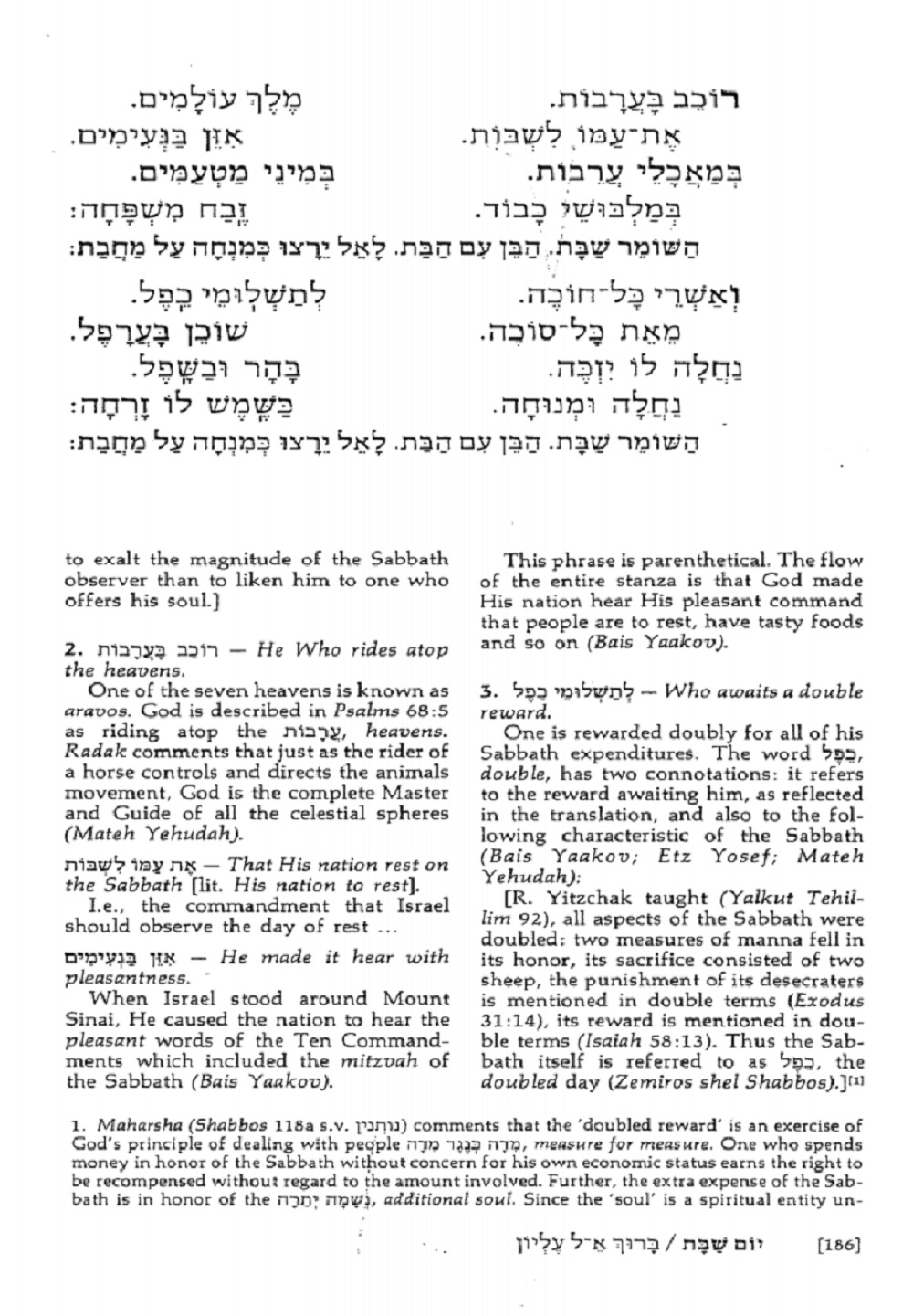
The problem here is that if you look at the Hebrew you can see that the English has not been translated properly. כל-סוכה does not mean “the One Who sees”, but “everyone who sees.” The word כל has a kamatz which means that it is connected to the following word. In the Zemiroth, ArtScroll puts the makef in, just like almost always in the Masoretic text of Tanakh כל with a kamatz has a makef.[37] But the meaning of the passage is the same even without the makef, and in the siddur ArtScroll does not include it. 

In order for the passage to mean “the One Who sees all,” the word כל must have a holam.[38] This point is actually made by R. Nota Greenblatt, who states that the version found in ArtScroll and many others, where the word כל has a kamatz, is nothing less than heresy since God has been replaced by humans.

3. I want to call readers’ attention to an important volume that has just appeared. Seforim Blog contributor R. Moshe Maimon has published the first volume of his edition of R. Abraham Maimonides’ commentary on Genesis. Maimon’s improvements on the earlier translation from the Arabic make the work a pleasure to read. His explanatory notes are simply fantastic, taking into account all relevant sources, both traditional and academic, that can illuminate the text. This will now become the standard edition of R. Abraham’s commentary, and I can think of no greater honor for Maimon than this. Hopefully, this publication will lead to a surge of interest in the commentary of R. Abraham, much like R. Kafih’s new translation of Maimonides’ Commentary on the Mishnah did for this work. The book is available at Biegeleisen, and can also be purchased online at Mizrahi books here.


[1] See Isaiah Sonne, “Avnei Binyan le-Korot ha-Yehudim be-Italyah,” Horev 6 (1941), pp. 100ff.; Elisheva Carlebach, The Pursuit of Heresy: Rabbi Moses Hagiz and the Sabbatian Controversies (New York, 1990), pp. 237ff.
[2] This is noted by Carlebach, The Pursuit of Heresy, p. 331 n. 18.
[3] See Excursus
[4] Peninei Shadal (Przemysl, 1888), p. 12. See the recent discussion of Nehemiah by Yaakov Spiegel in Hitzei Giborim 11 (2019), pp. 1146ff. Spiegel mentions that Torah writings from Nehemiah remain in manuscript. He also notes that in a recent printing of Basilea, Emunat Hakhamim, Nehemiah’s haskamah was removed (and perhaps surprisingly, the printer acknowledged that it was removed).
[5] Cecil Roth, Studies in Books and Booklore (Farnborough, England, 1972), p. 44 (Hebrew section).
[6] See Alexander’s appendix to John Hatchard, The Predictions and Promises of God Respecting Israel (London, 1825), p. 38. See also Kelvin Crombie, A Jewish Bishop in Jerusalem (Jerusalem, 2006), p. 13, and the entry on him in the Dictionary of National Biography, here.
[7] R. Joseph Tanugi, Toldot Hakhmei Tunis (Bnei Brak, 1988), pp. 233-234; R. Abraham Khalfon, Ma’aseh Tzadikim (Jerusalem, n.d.), p. 309.
[8] L’Univers Israelite, Oct. 7, 1932, available here; André N. Chouraqui, Between East and West: A History of the Jews of North Africa, trans. Michael M. Bernet (Philadelphia, 1968), p. 72.
[9] See Victor A. Mirelman, Jewish Buenos Aires, 1890-1930 (Detroit, 1990), p. 89.
[10] “Ha-Rav Moshe Soloveichik u-Ma’avakav be-‘Moetzet Gedolei ha-Torah’ ve-‘Agudat ha-Rabbanim’ be-Polin,” Hakirah  25 (2018), p. 47.
[11] I thank Menachem Butler for sending me this image.
[12] See Yehoshua Mondshine, Ha-Tzofeh le-Doro (Jerusalem, 1987), p. 37.
[13] Entzyklopedia le-Hakhmei Galizia, vol. 5, col. 154.
[14] Ha-Darom (Tishrei 5723) 16 p. 150.
[15] Another rabbi who met an unfortunate demise was R. Isaiah ha-Levi, author of the first Ba’er Heitev on the Shulhan Arukh (not Ba’er Heitev found in the standard editions). R. Meir Eisenstadt, Meorei Esh, beginning of parashat Shemini, tells us that on his way to Eretz Yisrael, R. Isaiah, his wife, and daughter were killed in a fire in their hotel. Regarding the different commentaries with the name Ba’er Heitev, see R. Yehiel Dov Weller in Yeshurun 17 (2006), pp. 825ff. 

In the old translation of Maimonides’ commentary to Mikvaot 4:4, he writes about a certain rabbi: ונהרג על זה באמה ובזרוע. This led to all sorts of speculations about which rabbi was killed. However, this is a mistaken translation. See R. Kafih’s note in his new translation, and also his commentary to Mishneh Torah, Hilkhot Mikvaot, vol. 2, p. 461. In a future post, I will mention a few rabbis who were killed by Jews, as well as cases of attempted murder. For now, I merely want to call readers’ attention to Prof. Shnayer Leiman’s email published in Chaim Dalfin’s new book, Torah Vodaas and Lubavitch (Brooklyn, 2019), p. 203.

There was a rabbi who allegedly was killed by mobsters. I heard from reliable sources that he was beaten, rolled in the snow and left to die. (Perhaps the goal was to frighten him, not kill him.) He survived the ordeal, but died shortly thereafter from pneumonia. The rabbi was Rabbi Yaakov Eskolsky, famous author and Rabbi of the Bialystocker Shul on the Lower East Side. I’m not aware of any written account that mentions this.

Leiman also mentions that Rabbi Israel Tabak, the son-in-law of R. Eskolsky, in discussing his father-in-law’s death mentions nothing about any foul play. See Tabak, Three Worlds (Jerusalem, 1988), p. 156. 

R. Eskolsky served as a rabbi in Scranton for a few years. See his biography here. I previously wrote a bit about him here. In Tabak’s book, p. 152, it mentions that R. Eskolsky celebrated Thanksgiving, and that at a Thanksgiving dinner Tabak attended, he “emphasized the significance of Thanksgiving Day for our people who came to the United States from Eastern Europe, and especially from Russia. Coming to America, the land of freedom and opportunity, was like emerging from darkness into light and certainly deserved to be marked by thanksgiving, both to G-d and to America that treated its citizens so well.” I believe that for any non-hasidic rabbi in America in the early part of the twentieth century, the notion that there was something religiously problematic with celebrating Thanksgiving would have been incomprehensible.

Shimon Steinmetz sent me this picture from the Forverts, Oct. 23, 1930. I find it fascinating that R. Eskolsky served as a justice on the “Jewish Arbitration Court.” 

[16] See Yehoshua Mondshine, “Aminutan shel Iggerot ha-Hasidim me-Eretz Yisrael,” in Katedra 64 (1992), p. 89 n. 152.
[17] “Perfeyt Duran be-Italyah ve-Goral ha-Sefarim ha-Ivriyim Aharei Meoraot 1391,” Ba-Derekh el ha-Modernah: Shai le-Yosef Kaplan (Jerusalem, 2019), pp. 61-91.
[18] The Secret Faith of Maestre Honoratus (Philadelphia, 2015), pp. 20, 28.
[19] See Kozody’s suggestions to explain this, Secret Faith, pp. 30ff. Regarding when his polemical works were written, see Benzion Netanyahu, The Marranos of Spain (Ithaca, 1999), pp. 221ff.
[20] Twersky discusses this text in “Religion and Law” in S.D. Goitein, ed., Religion in a Religious Age (New York, 1974), pp. 69-82. Regarding Twersky, I recently discovered this video of one of Chaim Grade’s lectures at Harvard from October 1981, and Twersky introduces him at the beginning. Unfortunately, only the first part of the lecture appears in the video. If anyone knows if the second part exists, please let me know. Menachem Butler was kind enough to send this page from the Boston Jewish Advocate, Oct. 22, 1981, announcing the Grade lectures.
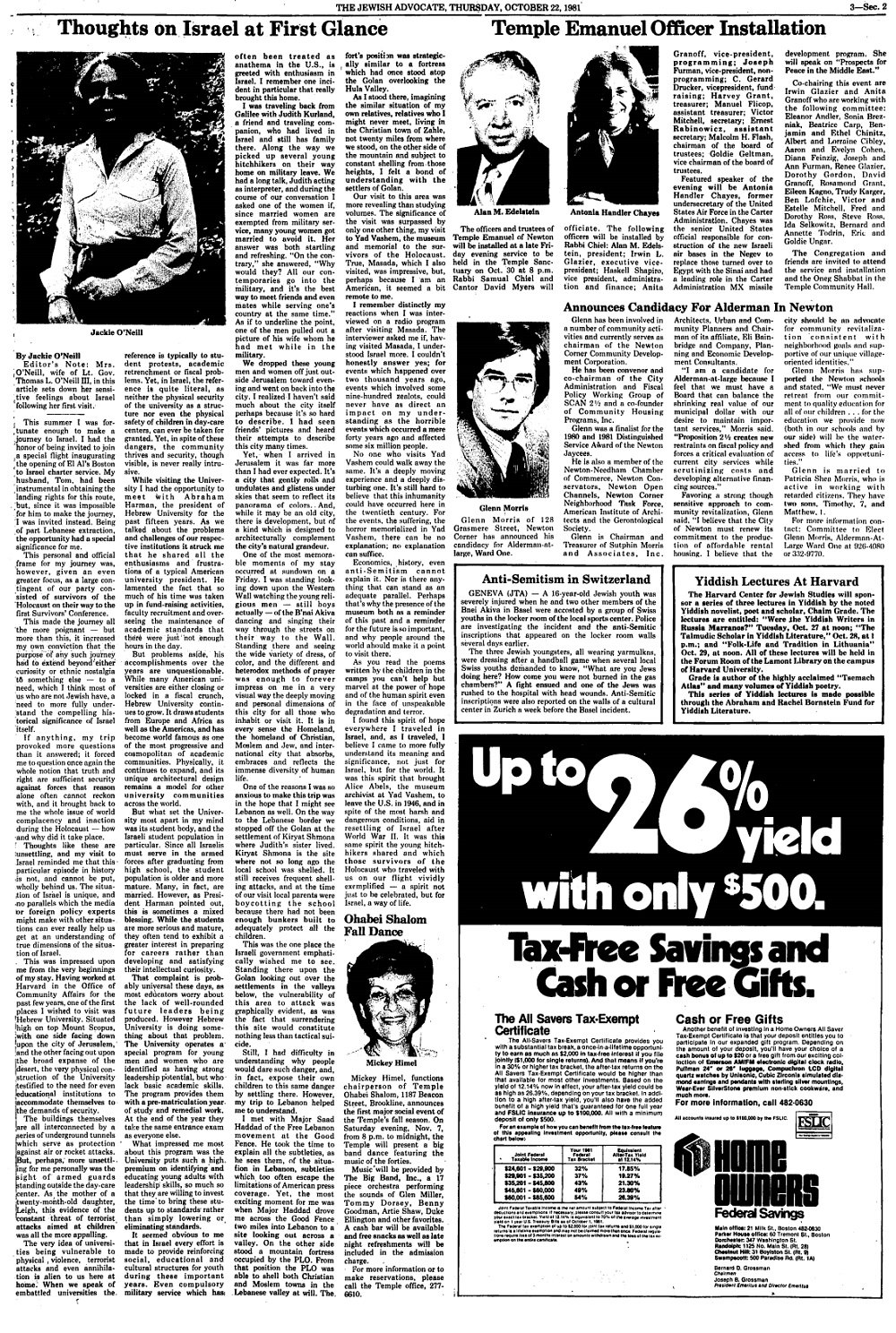
Grade had earlier lectured at Harvard in 1977. Regarding these lectures, see Allan Nadler’s recollections here.
[21] Here is the first page of an article by Yehudah Hershkowitz that appeared in Yeshurun 9 (2001), p. 572.

Note how Duran is referred to as “Rabbenu”. The author is aware that Duran apostatized, but he, like everyone before him, assumed that Duran later returned to Judaism.
[22] Regarding martyrdom, R. Moshe Feinstein makes an interesting point in Iggerot Moshe, Yoreh Deah III, no. 108 (p. 353). We all know that a convert must accept the mitzvot for the conversion to be valid. What about if a convert honestly states that while he accepts the mitzvot, if confronted with violating a prohibition for which martyrdom is required, he knows that he will not have the courage to be martyred? Is this to be regarded as rejecting a commandment which means that he cannot be converted? R. Moshe says no, as acceptance of the mitzvot means that you intend to fulfill them under normal circumstances, and extreme cases such as those that involve martyrdom do not impact this acceptance.
[23] For R. Elijah Capsali’s report of the forced conversion, by actual physical force, see Abraham Gross, Struggling with Tradition (Leiden, 2004), p. 81. See also the Christian report in E. H. Lindo, The History of the Jews of Spain and Portugal (New York, 1970), p. 330. Another forced convert in Portugal who later became famous was R. Solomon Ibn Verga, author of Shevet Yehudah. R. Joseph Garson, who later escaped to Salonika, also appears to have undergone forced conversion in Portugal. See Joseph Hacker, “Li-Demutam ha-Ruhanit shel Yehudei Sefarad be-Sof ha-Meah ha-Hamesh Esreh,” Sefunot 2, new series (1983), pp. 29ff. As with R. Levi, we do not know the circumstances of the forced conversions of R. Ibn Verga and R. Garson. Since it appears that R. Jacob Ibn Habib was also in Portugal in 1497, then presumably he too was converted, either “willingly” or not. See, however, Marjorie Lehman, The En Yaaqov: Jacob ibn Habib’s Search for Faith in the Talmudic Corpus (Detroit, 2012), pp. 26-27. Regarding whether R. Isaac Karo was in Portugal then, or if he succeeded in leaving prior to the mass conversion, see Karo, Derashot R. Yitzhak Karo, ed. Shaul Regev (Ramat-Gan, 1995), pp. 9-10.
[24] Kuntres ha-Semikhah, in Teshuvot R. Levi Ibn Habib, no. 147, section 4 (p. 39 in the new edition).
[25] Ibid., no. 148 section 5, p. 52.
[26] R. Solomon ben Adret, She’elot u-Teshuvot ha-Rashba, vol. 6, no. 179, explains that this is because a person’s intellect is not sufficiently developed until age 20.
[27] R. Moses Sofer rejects the notion that one is not punished by Heaven for sins committed before age 20. See She’elot u-Teshuvot Hatam Sofer, vol. 2, Yoreh Deah no. 155. For more on this matter, see R. Pinchas Zabihi, Ateret Paz, vol. 3, no. 1, and here.
[28] Teshuvot R. Levi Ibn Habib, no. 148, section 5 (p. 53 in the new edition).
[29] Divine Law in Human Hands (Jerusalem, 1998), p. 170.
[30] Riera, “Le-Toldot ha-Rivash bi-Gezerot 1391,” Sefunot 17 (1983), pp. 11-20.
[31] Rabbi Yitzhak Bar Sheshet (Beitar Ilit, 2017), pp. 83ff.
[32] In this post, I have not dealt with accusations of rabbis’ apostatizing that arose in the contexts of disputes. For an example where hasidim accused one of their mitnagedic opponents, R. Leib Rakowski of Plock, of apostasy and also of marrying a non-Jewish woman, see Marcin Wodzinski, Studying Hasidism (New Brunswick, N.J., 2019), p. 120. This occurred after they tried to beat up the rabbi. See ibid., p. 119.
[33] In rabbinic literature Algiers is written as ארג’יל. This is due to the influence of the Spanish exiles who settled in North Africa, as in Spanish Algiers is pronounced as Argel. I was surprised to see that a generally careful scholar, Tuvia Preschel, Ma’amrei Tuvyah, vol. 1, p. 58, recorded the following false information.   

הם [יהודי אלג’יר] לא רצו לכתוב אלגיר שהיא מלשון אלה וגם “גירא בעיניך השטן” וע”כ הסבו שם העיר לארג’יל, לשון אור וגיל וסימנה טוב


[34] Regarding the transfer of the remains, see Bar Sheshet, Rabbi Yitzhak Bar Sheshet, pp. 83ff.
[35] In his Derashot Kol Ben Levi, p. 130, R. Jehiel Michel Epstein’s explains ביודעים ובלא יודעים as follows:

היודעים המה העבירות שאין להם מבא בהיתר כלל והלא יודעים הם המותרות מההיתר שאין האדם מרגיש בנפשו כלל שזהו חטא וא”כ אין ידוע כלל שחטאנו לפניך

For a homiletic explanation that is found in many different sources, see R. Zvi Hirsch Ferber, Siah Tzvi, p. 162:

וזה שאנו מתודים על חטא שח”ל ביודעים, זה שהגיע להוראה ואינו מורה, ובלא יודעים, שלא הגיע להוראה ומורה

Yisrael Meir Lau,Yahel Yisrael: Avot, ch. 4, p. 246, writes:

בלא יודעים – הכוונה לחטא שחטאנו, מחמת שהיינו במצב של “לא יודעים”, שבאשמתנו לא ידענו את הדין, ועברנו על  העבירה בלא לדעת כלל שיש בכך איסור. חומרתו של מעשה הנעשה “בלא יודעים” היא, ממש כמעשה הנעשה “ביודעים”, ועל שניהם כאחד אנו מתוודים ומבקשים שהקב”ה יסלח לנו ביום הכיפורים

[36] My copy was published in 1979. Later, ArtScroll changed the transliteration to Zemiros.
[37] כל with kamatz is pronounced as kamatz katan. The only exceptions in Tanakh are Psalms 35:10: כל עצמתי, and Proverbs 19:7: כל אחי-רש. In these cases there is no makef after כל and therefore it is pronounced as kamatz gadol.

Isaiah 40:12 is another biblical verse with the word כל without a makef and it too has a kamatz gadol:

וכל בשלש עפר הארץ

Yet the word כל here is completely different than all other appearances of כל in Tanakh. This passage means, “and comprehended the dust of the earth in a shalish-measure.” The word כל we are all familiar with is from the root כלל. The word כל in Isaiah 40:12 is from the root כול.
[38] I found another mistake in ArtScroll’s version of the song, and again, many others, including Koren and the new RCA siddur, make the same mistake. Yet the RCA-De Sola Pool siddur gets it right, as does Birnbaum. In the first stanza it reads עד אנא תוגיון. ArtScroll vocalizes the last word as “tugyon” (shuruk, holam) Yet this is a verse in Job 19:2 and the correct pronunciation is “togyun” (holam, shuruk).

The fifth stanza ends רוחו בם נחה. ArtScroll puts the accent in נחה on the penultimate syllable. However, in the context of the song, where all the other stanzas have the parallel rhyming word with the accent on the last syllable, I don’t think there is any doubt that נחה should also be read with the accent on the last syllable, despite what the grammatical rule may say.


ArtScroll and More

ArtScroll and More
Marc B. Shapiro
In an earlier post here I discussed ArtScroll’s use of a censored talmudic text.[1] This happens quite a bit and it is not always clear if the translators were aware that they were working with an inauthentic text. However, for many passages there is no question that they realize that what they are translating is not authentic but was added because of fear of non-Jewish reaction. Here is a chart someone drew up showing how the various new Talmud editions deal with the matter of censorship.

It is significant that even in the Hebrew ArtScroll the text that is used is censored. ArtScroll has never publicly explained why they have adopted this approach, but I think it is obvious that unlike other publishers, ArtScroll is still worried about creating anti-Semitism and thus continues to print a censored Talmud. While I think everyone agrees that the ArtScroll Talmud translation is a masterpiece, opinions will obviously differ as to whether ArtScroll made a mistake in not restoring the Talmud to its pre-censorship state.[2]
ArtScroll’s approach is different than that of other publishers who are very happy that they can now include the complete uncensored words of the Talmud. Ezra Chwat’s words express the feeling of every publisher other than ArtScroll.[3]
אין צורך להדגיש את החשיבות של הנגשת הסוגיה המקורית לעשרות אלפי הלומדים את הגמרא כפי שיצא מפיהם הקדושים של האמוראים, ושלא יסתפקו ב”גירסא” שאושרה על ידי הכנסייה.
Yet R. Leopold Greenwald had the exact opposite approach, and he was upset when he heard that a new Talmud was being printed that reinserted the censored texts. His words reflect the approach later adopted by ArtScroll [4]:
ומה מאד דאבה נפשנו בראותנו, כי מכריזים גם עכשיו על “המציאה הגדולה”, כי בירושלים מדפיסים כעת תלמוד עם כל ההשמטות שהשמיטו הצנזורים במשך מאות שנים. ועל זה אנו קוראים: שקול טובתך! בני ישראל לא ישבעו עונג מהטובה הזאת, לא ספרותנו ולא חכמתנו יתעשרו מהשמטות הללו, לא בזמננו ולא בהדורות שאחרינו. כבר שבענו צרות ומכאובות. ולהיות בפי כל מחבל בודאי אסון הוא. איפוא הם חכמי ירושלים? האם אינם רואים כי מזה לא תושע יהודה וכי צוררי ישראל ישיגו חומר מסוכן חדש?
For those who are unaware of the details, let me just mention that I am not referring to a word here or there that was censored and has not been restored by ArtScroll. Sanhedrin 43a has a number of lines dealing with the execution of Jesus and his disciples. While the entire section is found in Soncino (in translation), Steinsaltz, Wagshal and Oz ve-Hadar, it is not to be found in ArtScroll. Both the English and Hebrew editions of ArtScroll tell the reader that a section has been deleted from the Vilna Shas. However, in Sanhedrin 67a, where another section has been deleted and is found in the other editions just mentioned, ArtScroll does not inform the reader of the deletion.
An allusion to the Sanhedrin 67a text is found in Va-Avo ha-Yom el ha-Ayin, attributed to R. Jonathan Eybeschuetz. This explosive text, which remained in manuscript for almost three hundred years, has just appeared in print, edited by Pawel Maciejko.[5] Va-Avo ha-Yom el ha-Ayin is very important to understanding the controversy over R. Eybeschuetz. (I hope that the manuscript Gahalei Esh, a treasure trove of documents dealing with eighteenth-century Sabbatianism, will also soon appear in a scholarly edition.) Quite apart from the radical theological notions found in Va-Avo ha-Yom el ha-Ayin, Maciejko describes the work as follows: “[I]t is blatantly pornographic (in fact, it is possibly the only truly pornographic text ever written in the rabbinic idiom.)”[6]
Speaking of pornography let me add the following. Not long ago I was visiting a certain synagogue for Shabbat. When it came time for Torah reading I took out the chumash that was near me. It happened to be the one published by R. Aryeh Kaplan. I actually am not a fan of this chumash for use in synagogue as its focus is entirely philological, and doesn’t deal with any of the issues that a typical person would want explained in reviewing the Torah portion. But this was what I had so I used it. In Exodus 35:22 an unusual word appears: כומז. It means some sort of golden bodily ornament. The word also appears in Numbers 31:50. According to the Exodus passage, this was one of the items the Israelites in the desert donated at the time of the building of the Tabernacle. The passage is Numbers refers to booty taken from the Midianites. Among the different interpretations Kaplan offers for כומז is “a pornographic sculpture.” This is quoted in the name of R. Aaron Alrabi (fifteenth century). I was quite shocked when I saw this and later saw that this interpretation is also quoted by R. Kasher in Torah Shelemah, which must have been where Kaplan saw it.
Alrabi wrote a commentary on Rashi which was published in Constantinople in 1525. In this work, on Exodus 35:22, Alrabi writes:
יראה לי שהוא תכשיט מצוייר צורת רחם האשה כדי שישתוקק רואהו לפועל המשגל והצנועות היו מביאות אותו עליהן בחדריהם לתת תשוקה לבעליהן העין רואה והלב חומד בו, והיה זה לכונה טובה לכן הותרו לשרת בקדש
What this means is that the item in question had a picture of a woman’s private parts. The Israelite women would have their husbands look at it in order to sexually excite them before they had marital relations. Since this pornographic viewing was for a good purpose, it was permitted for these items to be donated for use in building the Tabernacle. Here is the original text.
Those who want to see the book in its entirety can view it here.
I find this explanation quite strange. I don’t know what led Alrabi to his original understanding and why he did not find any of the prior explanations compelling.
Incidentally, one of the other explanations cited by Kaplan is that כומז means a chastity belt. R. Ephraim ben Shimshon (12th-13th centuries) writes[7]:
הכומז היה כלי כמנעול שקושרת האשה פתחה שלא יודעו להם שם אדם, כי אם בעלה לבד, והוא גודר הערוה.
This is how he understands Shabbat 64a which states that כומז means דפוס של בית הרחם. Soncino translates this as “cast of the womb” and ArtScroll translates it the exact same way. Koren translates “a mold [in the shape] of the womb.” In general I would say that disagreeing with these three translations is not a smart thing to do, yet in this case I must do just that. The translations I have cited are incorrect as they do not reflect what the Talmud is saying. בית הרחם in Shabbat 64a does not mean “womb” but rather something else. In order not to cause problems for those with internet filters I won’t spell it out completely, but I think the reader already understands.[8]
Rashi, Exodus 35:22, in summarizing the Talmud leaves no doubt in this matter:
כלי זהב הוא נתון כנגד אותו מקום לאשה
The very text in Shabbat 64a also lets us know that this matter has nothing to do with a “womb”, as immediately following the explanation of דפוס של בית הרחם the Talmud explains that the wordכומז  is an acronym of כאן מקום זימה “here is the place of lewdness”, and there is no issue of lewdness with the womb. ArtScroll itself, in its note on this latter passage, explains the matter well: “The place encased by this ornament is the part of the body which is the focus of lewdness.” In other words, in its commentary ArtScroll tells us that we are not dealing with the womb at all, but with another part of a woman’s anatomy. As such, it was a mistake for ArtScroll in its translation to adopt Soncino’s rendering of כומז as “cast of the womb”.
In his commentary to Berakhot 24a s.v. תכשיטין שבפנים, Rashi explains that a כומז is a chastity belt. From the context of this talmudic passage we see that it also had ornamental significance:
כומז דפוס של בית הרחם שהיו עושין לבנותיהן ונוקבין כותלי בית הרחם כדרך שנוקבין את האזנים ותוחבין אותו כדי שלא יזדקקו להן זכרים
In its commentary, ibid., ArtScroll summarizes Rashi as follows: “The kumaz was an ornament that covered a woman’s private parts.”
Let me return to Shabbat 64a where כומז is explained as being an acronym for כאן מקום זימה. The Maharal, Gur Aryeh, Ex. 35:11, writes:
מפני שהוקשה להם לרז”ל שאין דרך לשון הקודש לקרא שם מיוחד לדברים שהם ערוה . . . כל דבר ערוה אין הכתוב נותן לו שם מיוחד . . . וכאן למה קרא כומז שם מיוחד אל הכלי הזה שהוא דפוס בית רחם, ולכך דרשו רז”ל שהוא כאן מקום זימה והשתא אין שם מיוחד לכלי זה רק כאילו נקרא כאן זימה.
I don’t understand the Maharal’s point. Just because there are no words in leshon ha-kodesh for sexual organs, why should we assume that there is no name for an item designed to cover a sexual organ?
Returning to the matter of “pornographic viewing” as described by Alrabi, I wonder if this could also have halakhic significance. I mention this only because of the controversy some years ago by an answer given by R. Shlomo Aviner that in a she’at ha-dehak (i.e., there are serious marital sexual issues) it would be permitted for a husband and wife to together view explicit pictures in a book. See here.
The entire conversation with R. Aviner was a set-up, and the anti-Aviner website used it to attack R. Aviner, and portray him as permitting viewing of pornography. Yet it is obvious that he was referring to sexual self-help books (which would have explicit pictures) since he refers to books found in Steimatzky. R. Moses Feinstein had earlier permitted a soon-to-be-married man to read sexual self-help books.[9] There is no indication in R. Feinstein’s responsum that he is also including the viewing of pictures in such books, but I do not know if he would regard this as a problem if the pictures are not of real people but are drawings.
Let us return to the subject of chastity belts. In the Wikipedia entry for “Chastity Belt” one finds the following:
Gregory the Great, Alcuin of York, Bernard of Clairvaux and Nicholas Gorranus all made passing references to ‘chastity belts’ within their exhortatory and public discourses, but meant this in a figurative or metaphorical sense within their historical context.
The first detailed actual mention of what could be interpreted as “chastity belts” in the West is in Konrad Kyeser von Eichstätt’s Bellifortis (1405), which describes the military technology of the era.
As we have seen, Rashi and R. Ephraim are not referring to chastity belts in a metaphorical sense. Thus, their mention of the item is of general historical significance, and Rashi (1040-1105) might be the earliest recorded example of someone referring to a chastity belt. Eric John Dingwall wrote an entire book on the subject of chastity belts entitled The Girdle of Chastity (Scranton, 1959). On p. 14 he writes: “There can be little doubt that the idea of such a device, at least in a somewhat modified form, was current at least as early as the second half of the twelfth century.” He then cites the late twelfth-century Guigemar Epic, written by Marie de France, as a source of this. Yet Rashi’s mention of the chastity belt predates this source by around a century.
See also here where as part of a museum exhibition on chastity belts it states:
Until the 12th century, there are no textual memories related to chastity belts at all (not even any allusions without actually using the term) where the reference is not in a theological or mythological context.
This sentence is incorrect, for as we have seen Rashi referred to chastity belts many decades before Marie de France, who is also cited in the museum exhibition as the first one to refer to the item. What we have here is a good example where scholars make judgments based exclusively on their knowledge of medieval Latin, Romance and Germanic literature. Exposure to what appears in medieval Hebrew texts would have caused them to alter these judgments.
Returning to ArtScroll, here is an example where I believe that ArtScroll has printed something that they know is incorrect, but did so in the interest of good Jewish-Gentile relations. I think it is a noteworthy example as it has nothing to do with a censored text, but focuses on the explanation of the Talmud. Avodah Zarah 6a states that according to R. Yishmael it is forbidden to do business with idolaters because of Sunday. Rashi explains that this means that one can never do business with idolaters since one cannot do business with them three days before and three days after their holiday, and this includes the entire seven-day week.
It doesn’t take much imagination to realize what the Talmud is referring to by “Sunday”, and in the uncensored text it actually has  נוצרי, נוצרים or  יום הנוצרי instead of “Sunday”. Yet ArtScroll in its translation states that the Talmud is referring to “Babylonian pagans who observe a sun-worshiping festival every Sunday.” It is true that Meiri states as much.[10] Meiri also claims that when the Talmud uses the word נוצרים it does not mean followers of ישו הנוצרי, but refers to the use of the term in Jeremiah 4:16, which Meiri claims is derived from the word נבוכדנצר.[11] While it is true that R. David Kimhi also sees the word in Jeremiah 4:16 as related to נבוכדנצר, it is Meiri alone who claims that this is also intended when the Talmud refers to נוצרים.
It is certainly appropriate that ArtScroll cited Meiri’s explanation in a note, but how is it that this is the only explanation cited, when other than Meiri everyone else has assumed, with good reason, that נוצרים refers to Christians? This can only be an example of ArtScroll shading the truth for apologetic reasons. People can debate the appropriateness of this, but there can be no doubt that ArtScroll is not being frank in its presentation here.
In the ArtScroll Hebrew edition it also quotes Meiri and states the that Talmud is not referring to Christians. Yet unlike in the English edition, in the Hebrew ArtScroll there is a note which states: “See Rambam, Hilkhot Avodat Kokhavim 9:4”. If you open up the Mishneh Torah what you find is that the Rambam states:
הנוצרים עובדי עבודה זרה הן ויום ראשון יום אידם הוא
In other words, by referring to the Mishneh Torah after mentioning Meiri, ArtScroll is alerting readers to the fact that the Rambam does not agree with Meiri and believes that the passage in Avodah Zarah 6a indeed refers to Christians. Yet this is never spelled out in ArtScroll, and you need to take their suggestion to consult the Mishneh Torah in order to learn that not everyone agrees that when the Talmud mentions those who make Sunday their holiday that it is referring to Babylonian pagans. (In fact, as already mentioned, only Meiri advocates this position.) Does the average person who learns daf yomi realize this?
In case anyone has any doubts as to what I am saying, please note the following. After referring to Maimonides, the note in the Hebrew ArtScroll calls attention to the Venice edition of the Talmud with Rashi, and to Dikdukei Soferim. Again, only one who examines these sources will learn that they offer an interpretation at odds with Meiri. If you look at the Venice Talmud or Dikdukei Soferim (or even Steinsaltz) you will find that in Avodah Zarah 6a Rashi explains:
נוצרי, ההולך בטעותו של אותו איש שצוה להם לעשות להם יום איד בא’ בשבת
In other words, Rashi tells us, just like Maimonides, that when the Talmud refers to those who celebrate נוצרי יום it means the Christians who follow Jesus.I find it significant that even in the Hebrew edition ArtScroll feels the need to only allude to the explanation of Rashi and Maimonides, while presenting Meiri’s explanation as the standard understanding of the text. ArtScroll certainly knows that this is not the standard understanding, and ArtScroll itself cannot believe that Meiri’s understanding is what the Talmud really means. After all, every other medieval commentator agrees with Rashi and Maimonides. In this case, the only explanation is that ArtScroll is following a long apologetic tradition, which was based on fear of what the non-Jews would say if they knew the true meaning of certain talmudic passages.

Another example of this tendency was called to my attention by R. Moshe Maimon. Ketubot 15a discusses the case of A killing B, when A actually intended to kill another person. In its discussion the Talmud refers to “Canaanites”, which in the current context simply means non-Jews. In fact, in all manuscripts and early printings what appears is not “Canaanites” but “goyim”.[12] “Canaanites” is simply a “correction” of the censor. Yet ArtScroll has a note explaining that “The Canaanites were the pagan people who lived in Eretz Yisrael before the Israelites entered the land.” The implication of this comment is that the halakhah stated in the Talmud was only applicable with the ancient Canaanites but not with regard to other non-Jews. This is false and ArtScroll knows it is false, but it is no different than the “note to reader” found in many seforim that all the halakhot about non-Jews only refer to the pagans in faraway places. In the latter case everyone knew (and knows) that these words are not to be taken seriously, but I would assume that the typical user of the ArtScroll English Talmud does not realize this. It is noteworthy that the ArtScroll Hebrew Talmud does not include the note about the Canaanites.[13]
In 1728, an era in which Jewish-Gentile relations were not the best, R. Jonathan Eybeschuetz printed Tractate Berakhot with many deletions, as this was the only way he was given permission to publish the volume. Here is the title page.
The volume can be found at hebrewbooks.org here. True to form, R. Jacob Emden accused R. Eybeschuetz of being in league with the bishop of Prague and intent only on making money from his new printing.[14] There was also a lot of controversy about this edition, not only because of the many deletions but even more so because of the instances where the talmudic text was rewritten. While non-Jewish censorship has a long history, this latter practice, of Jews agreeing to rewrite sections of the talmudic text, was a new and more dangerous phenomenon. Other tractates were later printed, but R. Eybeschuetz had nothing to do with them, and in any event the controversy focused on Berakhot as the other tractates simply printed the censored text from the earlier Basel edition, but did not add anything new.[15]
In his recent outstanding study of this episode, which makes use of manuscript sources, Pawel Maciejko writes:
In both academic scholarship and Jewish collective memory, the best-known controversies concerning Rabbi Jonathan Eibeschütz (1690-1764) are those about his kabbalistic tract Va-avo ha-yom el ha-‘ayin . . . and about the allegedly Sabbatean amulets that he distributed to the members of the communities of Metz and Altona, Hamburg, and Wandsbeck in the 1750s. However, during his early years, the most important controversy concerning Eibeschütz was not the dispute surrounding his suspected Sabbateanism and the heterodox writings attributed to him but rather the outrage engendered by his friendly relations with the local Catholic clergy and his alleged involvement in the publication of heavily censored editions of the Pentateuch, the Talmud, and the prayer book. In the eyes of many contemporaries, the damage caused by the appearance of these latter publications vastly overshadowed any harm stemming from the heretical views expressed in Eibeschütz’s kabbalistic works and amulets.[16]
Maciejko notes that R. Moses Hagiz was so outraged by R. Eybeschuetz’s Talmud that he asked other rabbis to issue a ruling that it be burnt!
Shortly after the publication of R. Eybeschuetz’s Talmud someone wrote a defense of it, explaining why it was necessary to print a censored Talmud.[17] Raphael Kirchheim, who published this document, cites another who states that its author was none other than R. Eybeschuetz, since the author refers to R. Abraham Broda as his teacher.[18] R. Broda had served as rosh yeshiva in Prague, and later rav of Metz and Frankfurt.
While Maciejko also accepts this view,[19] the reference to R. Broda as the author’s teacher, מורי ורבי, would appear to show that R. Eybeschuetz could not have written the letter, since he was not a student of R. Broda.
We have good information about R. Eybeschuetz’s life, but there still is a lot we don’t know. Even though R. Eybeschuetz is not recorded as R. Broda’s student in the standard biographies, one could claim that it is possible that he studied for a short time under him, and for some reason this fact was not known to the biographers.[20] Yet in this case we can indeed make the definitive statement that R. Eybeschuetz did not study with R. Broda since R. Eybeschuetz tells us this himself. Some thirty years after R. Broda’s death in 1717 his Eshel Avraham was published (Frankfurt, 1747). Here is the title page.
Among those who provided an approbation was R. Eybeschuetz, who at that time was in Metz. His respect for R. Broda is great, but he leaves no doubt that he never studied with him:
ממש רובי חכמי ישראל בדור הזה השלימי’ המה שותי מימיו ואף אני אם לא זכיתי לאורו לחזות לרבי מקמא כי בבואי לפראג שנת תע”ל כבר חמק דודי ופנה הודו לכאן ק”ק מיץ היא העיר אשר כעת אני יושב בה בתוך עמי, מ”מ נפתולי נפתלתי עם גדולי תלמידיו הרבני’ וחכמי’ מובהקים ושלימים במדע אשר נשארו שם ושמעתי’ תמיד בבי מדרשי’ בדיבוק חברי’
Returning to the document published by Kirchheim, it describes the history of the banning of the Talmud in the years before R. Eybeschuetz printed his volume. Interestingly, it tells about the confiscation of Jewish books from the Jews of Prague, which were then handed over to the Jesuits to be examined for anything against Christianity. From other sources we know that the Jesuits burnt the copies of the Talmud they confiscated, and “[i]n the 10 years from 1715 to 1725, very few copies (according to some sources, none) of the Talmud existed in Bohemia.”[21]
This need for copies of the Talmud explains why R. Eybeschuetz had to take the step he did. The document also tells of the punishment of a man from Nikolsburg who was caught smuggling Talmuds into the Prague ghetto. He was forced, in chains, to clean the streets for a year. The smuggled Talmuds were supposed to be burnt, but this was somehow prevented (probably with a good bribe).
The only way to print a Talmud in Prague was to remove everything the Jesuits viewed as offensive to Christianity. They also viewed certain aggadot as objectionable, such as the description of God wearing tefillin in Berakhot 6a, and these too had to be removed.[22] The document tells us that having the Church agree to publication of the Talmud, even with these restrictions, was regarded as a great achievement. It also tells us that all the important rabbis in Prague permitted the publication of the bowdlerized Talmud.[23]
וכאשר הגיעו לידינו רשימה אספנו להגאון מורנו ורבנו האב”ד ור”י נר”ו בצירוף כל חכמי רבינו [!] עירנו אשר ת”ל המה גדולים בחכמה ובמנין וטבעם יצא בכל ארץ לעיון במילין אם כשר ונאות לעשות כן אם לא ואחר הלנת דין פעמים ושלש ומשא ומתן עלתה הסכמה להדפיס מס’ ברכות הנודע הגהתן וסדר זרעים אשר לא יחסר בו דבר, אך ממסכת שבת והלאה לא עבר הסכמתן כי לא נודע עדיין טיב הגהות נוצרים בו אם מעט אם רב
The document then quotes a statement issued by the scholars of Prague defending their decision, a statement that was only intended to be viewed by other learned Jews. In justifying their decision to publish a censored Talmud – since this was all they were permitted and it was a censored Talmud or nothing – we find the following very interesting passage:[24]
ודאי שנכון הדבר לעשות לבלי כושל ועיכוב כלל כי ודאי שניתן הש”ס להצילו באחד מאיבריו ולא יהיה הש”ס חמור מג”ע וש”ד אשר ק”ל יהרג ואל יעבר קימו לן אם מיחדים על אחד ימסר להם ואל יהרגו וכ”ש הדבר בש”ס שבזמן שמיחדים לומר השמיטו דא מאתכם שיהא הנשאר לפליטה שישמיטו זאת ולא יצאו כולם לבית השריפה מבלי שריד באהלינו אהל תורה ובפרט כי חז”ל שיסדו התלמוד לא על זה יסדו להיותו בדפוס גלוי לכל עמים כי אם כתבוהו בכתיבה תמה ומסרו זאת לזרע אמונים להנחיל לבניהם אחריהם לחלקם ביעקב ולהפיץ בישראל.
The last sentence is making the point that there are certain things in the Talmud that should not be published for all to see, as these are the sorts of things that could create great problems with non-Jews. The Prague scholars then state that it is actually a good thing to cut out certain passages from the Talmud. In other words, they are acknowledging that even without Christian demands, it would be best in internally censor certain passages so as to prevent problems from arising. This is exactly what ArtScroll is doing today. No one is forcing them to self-censor, but they see matters as the sages of Prague who wrote (emphasis added)[25]:
וזה לערך ר’ שנה שהחל להתפשט ספרינו בדפוס לתקנות אחינו למען יהיו להם הספרים בנקל ומצוי, אמנם בדברים כאלו תקנתם קלקלתם שגורמים סכנה לכל ספריהם ומטילים איבת הנוצרים עלינו ודאי ראוים שדברים אלו יהיו חוזרים לאיתנם הראשון מבלי לחוקקם בעט ברזל ועופרת.
They are not saying that the censored matters should be forgotten about. Rather, they should be only be passed on in a non-published form (“Torah she-Ba’al Peh”) to advanced students who study the Talmud; they should not be put down in print for all to see and thus create a Christian backlash. The sages of Prague make the same point about strange Aggadot that are not to be taken literally and can only be understood by a few, and which have become subject to Christian mockery. These too should be omitted[26] להציל דברי חז”ל. When possible, the Prague sages state, one should not delete an entire passage but simply change certain words. In this way the sense of the passage is not changed for any learned person, but problematic words are removed thus helping to blunt anti-Semitic attacks:[27]
ומכ”ש לשנות הלשון במילות ושמות נרדפים באופן שלא ישתנה הענין פשיטא שמותר
The Prague sages then state that if necessary it is even permitted to alter (i.e., falsify) halakhic rulings that appear in the Talmud in order to prevent anti-Semitism (which obviously could lead to real danger). They note that R. Solomon Luria disagrees but that the accepted practice is not in accord with what he wrote, a point that was later made by R. Moses Feinstein:[28]
דעת מהרש”ל להחמיר אף במקום סכנה. אמנם מעשים בכל יום שמהפכין הדין ומשנין מדרכי השלום בהפקעת הלואה וכדומה ולא שמענו פוצה פה לעולם וכן נראה היפוכו בדברי מהר”ם רבק”ש בש”ע ח”מ סי תכ”ה ודברים המה מועתקים בספרים רבים.
It is interesting that the Prague sages quoted the famous words of R. Moses Rivkes in his commentary to Shulhan Arukh, Hoshen Mishpat 425:5, who responds to a particular anti-Gentile law as follows:
The Rabbis said this in relation to the pagans of their own times only, who worshipped stars and the constellations and did not believe in the Exodus or in creatio ex nihilo. But the people in whose shade we, the people of Israel, are exiled and amongst whom we are dispersed do in fact believe in creatio ex nihilo and in the Exodus and in the main principles of religion, and their whole aim and intent is to the Maker of heaven and earth, as the codifiers have written. .  . . So far, then from our not being forbidden to save them, we are on the contrary obliged to pray for their welfare.[29]
Some, such as Jacob Katz,[30] have seen R. Rivkes’ words as reflecting a new tolerant approach. However, the sages of Prague, who were closer to the time R. Rivkes lived, saw his words as merely designed for non-Jewish eyes and not to be taken seriously by Jews. R. Rivkes’ comment would therefore be no different than the declarations found at the beginning of many seforim that all negative statements about non-Jews are only directed towards pagans but have nothing to do with the Christians of Europe who worship God and allow the Jews to dwell among them.
Unlike what has been described by the Prague sages, Maciejko does not view the “corrections” in R. Eybeschuetz’s Talmud as simply defensive. He writes:
Eibeschütz believed that there was no final, fixed, and canonized text of the Talmud. . . . Eibeschütz put himself in the shoes of the ancient sages and saw himself not as expurgating but rather as creating the text of the Talmud.[31]
Maciejko further writes:
Eibeschütz seems to have been the only early modern Jewish author who believed that the talmudic sages needed to be edited for style. For themselves, such changes were only possible thanks to the editorial freedom Eibeschütz granted himself in his “Apology and Answer of the Rabbis Prague”: Eibeschütz considered the talmudic text open and unfinished and therefore felt free to “correct” it even in instances in which he experienced no external pressure from the church or from any other powerbrokers. As for the character of these changes, one thing can be said with certainty: most of them aimed to create a neater and simpler text of the Talmud, one that avoids intricate grammatical constructions or potentially misleading expressions.[32]
It is hard for me to accept that R. Eybeschuetz could have viewed himself as “updating” the Talmud. Yet Maciejko is correct that we are confronted with the fact that R. Eybeschuetz’s Talmud contains linguistic and stylistic changes that were not required by the censor. Unlike Maciejko, I would explain matters in the following way: Since the Talmud was already being published in a censored fashion, with numerous passages deleted or rewritten, R. Eybeschuetz saw no reason not to make other changes that would create a more user-friendly text. However, this has nothing to do with the talmudic text being “open and unfinished” as Maciejko puts it. It wasn’t that he was improving on the original Talmud or seeking to replace it, but since the Talmud he was publishing was already “damaged”, as it were, he did not see a problem making other changes if these changes could be of assistance to the reader. Furthermore, everyone who bought this Talmud knew that it was a she’at ha-dehak publication and that it was only to be used if one had no access to an uncensored text. I have no doubt that R. Eybeschuetz felt the exact same way, and thus I would need more evidence before accepting Maciejko’s theory.
Maciejko makes a further claim that R. Eybeschuetz’s “editing” of the Talmud hints to his secret universalist religious views that are also found in Va-Avo ha-Yom el ha-Ayin. This is a much more provocative claim than what I discussed in the previous paragraph, and I am curious as to what other scholars will have to say about it.
In addition to being given permission to print an expurgated Talmud, the non-Jewish authorities also permitted “strange” aggadic passages to remain if a good explanation could be provided for them. In R. Eybeschuetz’s edition of Berakhot such explanations are found at the back of the volume, and the reader is alerted to them by a note on the talmudic page.[33]
Until Hebrewbooks.org put the Prague edition of Berakhot online, it was a very rare book, and Maciejko knows of only three copies in existence.[34] In 1981 Professor Shnayer Leiman republished R. Eybeschuetz’s explanations to Berakhot.[35]
To be continued


[1] See also Jeremy Brown’s post here and regarding Brown’s post see David Zilberberg’s earlier post here.
[2] Only in the last year or so have I started to examine the ArtScroll Talmud on a regular basis and I am continuously impressed. This has to be one of the most significant Torah publications of the twentieth century. Since that is the case, I don’t see why such effort is being put into producing the new Koren Talmud. While it sometimes has points that do not appear in ArtScroll, I don’t know why anyone would prefer it over ArtScroll. I have had a chance to use both ArtScroll and Koren in reviewing some sugyot in Berakhot with my son, and in my mind ArtScroll always comes out on top. I even found one place where Soncino is to be preferred to Koren (although generally this is not the case). In Berakhot 29a it states: “Corresponding to what were these twenty-four blessings of the Amida prayer of the fast days instituted?” Unlike Soncino, Koren provides no note to this sentence and most people who read it will have no clue what it is talking about since when they look in the siddur they will not find twenty-four blessings in the Amidah on fast days (as they will assume that the fast days referred to are Yom Kippur, Tisha be-Av, etc.). ArtScroll helpfully explains as follows: “On certain public fast days decreed in times of drought, an additional six blessings, enumerated in the Mishnah in Taanis 15a, are added to the eighteen regular blessings of the Shemoneh Esrei, for a total of twenty-four blessings.” I would only add that the proper transliteration of עשרה is esreh, not esrei.
[3] See here where Chwat also posts a page of R. Hananel from the censored Sanhedrin 43a.
[4] See his letter in Moshe Chaim Ephraim Bloch, Heikhal le-Divrei Hazal u-Fitgameihem (New York, 1948), p. 8. For more opposition to publishing the censored talmudic texts, see Eliezer Zvi Zweifel, Saneigor (Warsaw, 1885), pp. 265-266
[5] (Los Angeles, 2014). Regarding the Sanhedrin 67a text, see Maciejko’s English introduction, pp. xlviii-xlix.
[6] P. xix.
[7] Perush ha-Torah (Johannesburg, 1950), p. 69.
[8] David Brodsky also discusses בית הרחם as a synonym for “va–na”. See A Bride Without a Blessing (Tübingen, 2006), pp. 55, 65, 84. In Alcalay’s English-Hebrew dictionary, s.v. va–na, it gives three Hebrew definitions, one of which is .בית הרחם
[9] Iggerot Moshe, Even ha-Ezer 1, no. 102. This appears in the second to last paragraph of the responsum. The last paragraph is where R. Moshe presents his famous view that living in the Land of Israel is not an obligatory mitzvah, a mitzvah hiyuvit, but rather a mitzvah kiyumit.Here is a good time to cite an email I received from a Lakewood scholar which I think is quite insightful, and relates to the “immodest” title pages I discuss in my recent book. This scholar writes:

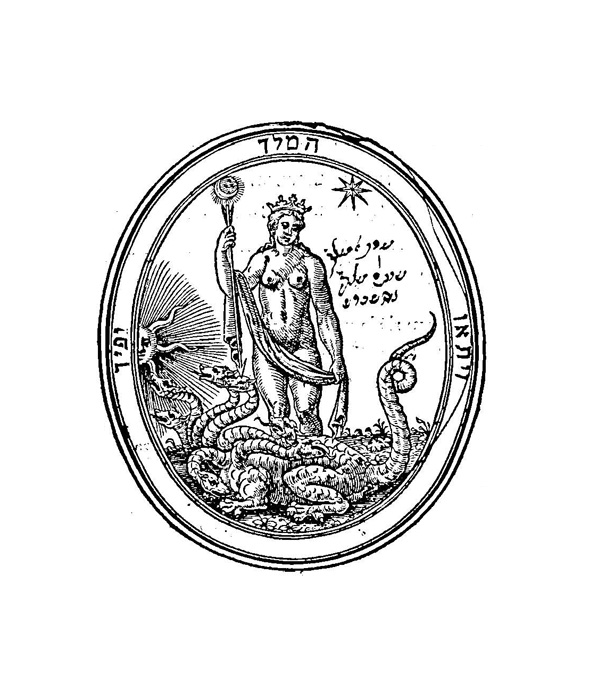
There is one comment that I want to make right now regarding the pictures of the topless women that appeared and then disappeared in seforim. In addition to a point that I already once made that perhaps in earlier times the breasts were associated more with breastfeeding than with romance (it certainly was associated with that as well as can be seen from the Song of Songs, but not exclusively as today; perhaps it was more like a woman’s hair which can be seen in pictures), I would like to add a stronger point regarding these pictures.

It would seem to me that before photography when it wasn’t possible to produce real live looking pictures, people would be inclined to consider drawing an ערוה. But after the advent of real photographs, one gets the feeling that he is looking at a real image of a woman. It is for this reason, perhaps, that pictures of topless women became taboo. Once photographs began to be associated with ערוה, paintings and drawings followed since they are so similar to photographs. In other words, they became guilty by association.

If there is any merit to this argument (or speculation) then one can go a step further and say that the advent of color motion pictures which is more alive caused further stringency in this area. A picture of a woman is not that “problematic”, but to watch her video is already more like “mingling without a mechitza”. Once the women are struck from the videos, it is natural that they should be expunged from the magazines as well. It is worth noting that both the laws outlawing pornography and the invention of photography coincided with one another. It would seem that it wasn’t outlawed as long as it was only in the form of a drawing, painting, or sculpture.

While it is true that earlier sources do speak of the sexual nature of breasts (see my post here note 19), I think that my correspondent has put his finger on a very important point. It would appear that breasts were more commonly associated with breastfeeding which meant that it was not problematic to show them in pictures. We even find such a portrayal on two tombstones in the old Sephardic cemetery in Altona. Here are the pictures as they appear in Michael Studemund-Halevy and Gaby Zuern, Zerstoert die Erinnerung Nicht. Der Juedische Friedhof Koenigstrasse in Hamburg (Munich, 2002), p. 109.

There are also a whole series of paintings and sculptures showing the Virgin Mary breastfeeding, obviously showing that this was not regarded as immodest in Christian circles.

The non-sexual nature of breasts also explains Shabbat 13a:

 עולא כי הוי אתי מבי רב הוה מנשק להו לאחוותיה אבי חדייהו
(Perhaps because he found this text so strange, the Hatam Sofer interpreted it allegorically: היה מנשק החכמה. See Hiddushei Hatam Sofer, ad loc.)In response to the email from the Lakewood scholar, S. commented as follows

Another point which I think needs to be brought up about nude art is just how ubiquitous it was in Europe, statues, frescoes, and title pages in books, etc., very much influenced by Classical culture, which was of utmost importance in European learning and culture. If you’re in Venice or Prague or any major city in Europe you can’t avoid seeing it. The style of title pages may have changed, as styles do, so it is not surprising that Jewish printing culture changed as well. And eventually these seforim became one, two, and three centuries old and were only seen by individuals. Nudity in art was not ubiquitous in Eretz Yisrael and America, and it is not surprising that we woke up in the 20th century in American and EY and found these things surprising. My point is that it doesn’t necessarily have to do with them seeing breasts as sexual or not (what about thighs and bare midriffs? And seforim even depicted nude women bathing in the mikveh.) It is also important to note that in the writing of many great people they refer to specific editions they used, and it is clear that they saw it and neither defaced or said anything about it. So attitudes might be a European city vs. non-European city thing as well.

In an earlier post here I dealt with this picture which appears in the Venice 1574 edition of the Mishneh Torah.

Jacob D. called my attention to Shlomo Zalman Havlin’s comment in Yeshurun 29 (2013), p. 791 n. 7. Here Havlin states that when he attended the Chevron yeshiva its library had the Venice 1574 Mishneh Torah, but the yeshiva attempted to keep this edition from students due to the “immodest” picture reproduced above. Havlin also notes that some great rabbis were involved in the publication of this edition of the Mishneh Torah, including R. Menahem Azariah of Fano and R. Moses Provencal.

[10] Meiri to Avodah Zarah p. 4.

[11] Meiri to Avodah Zarah p. 4, Ta’anit 27b (p. 97). Regarding Meiri’s claim, see Lawrence Zalcman, “Christians, Noserim, and Nebuchadnezzar’s Daughter,” JQR 81 (1991), pp. 411-426. Zalcman argues that Meiri did not just make up his interpretation for apologetic reasons, but was aware of Mandaeans who were known as natzurai and were linked to Nebuchadnezzar.
[12] See Dikdukei Soferim ha-Shalem, ad loc.
[13] The Talmud pages used by ArtScroll in its most recent printings are taken from Oz ve-Hadar’s edition (minus certain notes that appear only in the Oz ve-Hadar Talmuds). This means that ArtScroll omits the Shitah Mekubetzet, citing Meiri’s and R. Jonathan of Lunel’s tolerant comments, which appears in the standard Vilna edition, Bava Kamma 38a and 113a.
[14] Hit’avkut, p. 2a.
[15] See R. Raphael Rabbinovics, Ma’amar al Hadpasat ha-Talmud, ed. Haberman (Jerusalem, 1952), pp.112ff.; David Leib Zuenz, Gedulat Yehonatan (Petrokov, 1930), vol. 1, pp. 12ff.
[16] “The Rabbi and the Jesuit” On Rabbi Jonathan Eibeschütz and Father Franciscus Haselbauer Editing the Talmud,” Jewish Social Studies 10 (Winter 2014), pp. 147-148.
[17] The defense was published in installments in Ha-Magid, May 9, 16, 23, 30, 1877. Sections of the document appear in  Zweifel, Saneigor, pp. 264-265, and in Saul Pinchas Rabinowitz’s edition of H. Graetz, Divrei Yemei Yisrael, vol. 8, p. 464 in the note. The complete document was published in Zuenz, Gedulat Yehonatan, pp. 135ff., but he does not identify its source, leading the reader to assume that he is quoting from a manuscript.
[18] See Ha-Magid, May 9, 1877, pp. 170-171. (The reference to R. Broda as his teacher appears on p. 171.) As we shall see, R. Eybeschuetz had a great deal of respect for R. Broda. Yet R. Jacob Emden’s father, the Hakham Zvi, had a different perspective. See Yehezkel Duckesz, Ivah le-Moshav (Cracow, 1903), p. 14.
[19] “The Rabbi and the Jesuit,” p. 166.
[20] S. points out an interesting source which gives an unknown, but presumably true, biographical detail of R. Eybeschuetz’s life in the spiritual autobiography of an apostate Jew named Salomon Duitsch, A Short Account of the Wonderful Conversion to Christianity of Solomon Duitsch … Extracted from the Original Published in the Dutch Language (London 1771).S. wrote to me as follows:

Prone to mystical visions and ascetic practices like fasting, he was regarded locally as a tzadik, but he eventually became convinced of Christianity. When this became known was forced to divorce his wife. After a period of wandering he ended up in Altona. He still looked Jewish and his issues were unknown there. He writes of meeting and staying the night at R. Eybeschuetz, who was very delighted to host him on account that R. Eybeschuetz was educated and taken care of as an orphan in the house of his great-grandfather in Nikolsburg. This information about a Nikolsburg period in R. Eybeschuetz’s life, and who this great-grandfather might be, is not mentioned in the biographies, and is a reminder that much information about people’s lives is not necessarily in books.

[21] Maciejko, p. 150.
[22] For details see ibid., pp. 169ff.
[23] Ha-Magid, May 16, 1874, p. 180.
[24] Ibid., May 23, p. 188.
[25] Ibid.
[26] Ibid., May 30, 1877, p. 199.
[27] Ibid. In my post here I discussed how R. Jehiel Michel Epstein engaged in self-censorship in the Arukh ha-Shulhan in order not to have problems with the non-Jewish authorities. Rabbi Shalom Baum called my attention to Arukh ha Shulhan, Orah Hayyim 480:1, for another example of this. I have underlined the words which any educated reader would understand were not to be taken seriously (since how could contemporary Jews ask God to pour out his wrath on the Babylonians who departed the historical stage over two thousand years ago?):
ואחר ששתו הכוס השלישי נוהגין לומר שפוך חמתך וגו’ ולפתוח הדלת כדי לזכור שהוא ליל שמורים ובזכות אמונה זו יבא משיח וישפוך חמתו על הבבליים שחרבו בהמק
[28] Ha-Magid, May 30, 1877, p. 199. Regarding the views of R. Luria and R. Feinstein, see my Changing the Immutable, p. 42.
[29] I have used the translation in Jacob Katz, Exclusiveness and Tolerance (Oxford, 1961), p. 165.
[30] Ibid., pp. 164ff.
[31] “The Rabbi and the Jesuit,” p. 167.
[32] Ibid., pp. 173-174.
[33] I don’t know why this procedure was not required for the other tractates published in Prague.
[34] “The Rabbi and the Jesuit,” p. 179
[35] Or ha-Mizrah 29 (1981), pp. 418-428. Leiman’s publication remains valuable because of his introduction and notes.


The Hatam Sofer’s Humor

For Nachi and Matt and their love of noses.

I heard the following from Dr. Leiman. In the Hatam Sofer’s yeshiva in Pressburg, it was the custom for all to wear hats while learning. This included fairly young boys. One day a ba’al ha’bus (a community member not part of the Yeshiva) came in and saw a young boy learning. As he was a youngster, his hat was a bit oversized. The ba’al ha’bus went over to him and said “Shalom aleichem Hat, where is the bucher [boy].” The boy turned around and was rather disturbed by this insult, noticed the man’s rather prominent nose. The boy replied, “Shalom aleichem Nose where is the ba’al ha’bus.” This reply incensed the ba’al ha’bus and he immediately went to the Hatam Sofer to complain.

The Hatam Sofer called the boy over to hear his side of the story. The boy explained he was minding his own business when this person made a comment about his hats size to which he just replied in kind. Upon hearing this, the Hatam Sofer responded, using a verse from this week’s Torah portion (Det. 29:23), if this is so, “מה חרי האף הגדול הזה.” (A play on words to mean “what anger [spite] this great nose displays.”)


R. Flensberg, Donkeys, Antelopes and Frogs

R. Flensberg , Donkeys, Antelopes and Frogs

Recently, a book, Aggadata de-Ve Rav, Machon Limud Aggadah, Ashdod, 2010, pp. 50, 176, 56, collecting various works attempting to explain the difficult and, on their face, rather odd stories (aggadot) that appear in Baba Batra (73a-74) many of which involve odd animals do odd things.  In addition to these passages, there is another odd passage in Bechorot (7b) which also involves an animal, a donkey also engaging in odd behavior. This passage was too was also the subject of many works attempting to explain it. This new book reprints four of the many works attempting to decipher the stories in Baba Batra, R. Elyakim Getz, Redfunei be-Tapuchim, R. Zev Wolfe Boskowitz, Le-Binyamin Amar, R. Eliyahu Guttmacher, Tzafnat Panach, and the fourth is Aggadot Soferim, which a collection of materials on the topic from Ritva, Gra, and R. Efrayim Lunschutz (author of Kli Yakar, among other works).  While three editions of Redfunei be-Tapuchim are available on Hebrewbooks (here, here and hereLe-Binyamin Amar and Tzafnat Panach are not. The book also provides biographical details about these authors (56 pp.).  Additionally, a list of others books devoted to the Baba Batra stories which are not reprinted herein are included.  The list provides over 25 such works devoted to the stories in Baba Batra.  Regarding the donkey of Bechorot there are almost as many books on that topic.  We have found 23 such works.  One of those discussing the donkey of Berchorot is an important, little-known and recently reprinted book on that topic.  Specifically, R. Hayyim Yirmiyahu Flensberg’s Nezer ha-Nitzhon, Vilna, 1883 (reprinted Machon Mishnas Rabbi Aaron, Israel, 2001).*  Amongst the many who praised Flensberg’s book, was his teacher, the Netziv.  And, it was not only the Netziv, but Flensberg received a request from his alma mater, Volozhin, that his book was so popular could he please send ten additional copies. Thus, in light of this book discussing, what is arguable similar aggadot, we provide background on this little-known Lithuanian rabbi, his works and children.


Flensberg was born in 1842.  And, as many great rabbis, there are both miraculous stories told of his conception and birth as well as how bright he was.  Indeed, it is said that he knew 300 pages of Talmud, with Tosefot, at his bar-mitzvah.  While those stories are not unusual, what is unusual was the bar-mitzvah gift he received from his rebbi, R. Ya’akov Tuvia Goldberg, a copy of Avraham Mapu‘s Ahavat Tzion, perhaps the first Hebrew novel.  As his rebbi saw that Flensberg expressed an interest in studying Hebrew, his rebbi decided this book would be appropriate.  Apparently, this gift was so important, that in the biography of Flensberg, written by his son Yitzhak Yeshayahu Flensberg, some seventy years later, records this.  It is worth noting that, although this biography appears at the beginning of the second volume of Flensberg’s Torah commentary which was reprinted in 2000 by the Lakewood publisher, Machon Mishnas Rabbi Aaron, this fact remains in this edition.

It should also be noted that, while on its face, it is questionable how much one can read into a single bar-mitzvah gift, Shaul Stampfer views this gift as highly significant.  Stampfer writes, that although the policy of the Volozhin rabbinic administration was to prohibit haskalah literature, Flensberg is used as an example to prove that “not all the students viewed reading haskalah literature as conflicting with torah study.”  Shaul Stampfer, The Lithuanian Yeshiva, Jerusalem, 2005, 171.  Stampfer cites the story of the bar-mitzvah gift and notes that although Flensberg received this gift “he still went to study in Volozhin.”  Id. at 172.  Indeed, it is even more questionable to use the bar-mitzvah gift to understand the Volozhin students’ views on haskalah literature when one considers the timing.  Flensberg didn’t go to Volozhin immediately after his bar-mitzvah, rather it would be over a year and a half before he went to Volozhin. [1] During that time, Flensberg stopped studying with R. Goldberg, the bar-mitzvah gift, giver and began studying with R. Leib Charif (eventual Chief-Rabbi of Tytvenai and Rietavas Lithuania).  (Also relevant for our purposes is that R. Leib  authored a book on the donkey Gemara in

Bechorot called Eizot Yehoshua.) Thus, there are two significant factors that may sever any ties between Flensberg’s bar-mitzvah gift and his ultimate decision to go to Volozhin.  


In all events, Flensberg thrived at Volozhin.  He studied in the Netziv’s group and was close to the Netziv.  Additionally, he was selected for the highly prestigious position at the Volozhin Yeshiva as the Purim Rav of Volozhin.  His appointment to this position took place sometime before he left Volozhin in 1859, making this the earliest, and perhaps one of the only, recorded mention of this custom from Volozhin.[2] In fact, there are those who doubt the existence of the custom of Purim Rav at Volozhin.[3] This appears to undermine that position.  Additionally, the description of the Purim Rav position is of interest.  According to Flensberg, the position was fairly innocuous.  For the two days of Purim, the Netziv would cede his position to the best student. The student would wear the Netziv’s hat and use the Netziv’s walking stick.  All the students would give the Purim Rav great deference.  They would also pepper him with questions both about Purim and more comical questions.  The Purim Rav would answer in the Purim spirit.  Nowhere is there any mention of lack of respect or, seemingly anything that is objectionable. 

After leaving Volozhin, he married Itta, whose father was R. Mendel Katz, who would eventually become a rabbi in Radin.  After his marriage he went to study in a bet midrash in Kovno.  Although some refer to this place as “the Kovno Kollel,” it cannot be referring to the famous Kovno Kollel as that did not begin until 1877 long after R. Flensberg left Kovno and entered the rabbinate.  During his time in Kovno Flensberg became friendly with R. Yitzhak Elchonon Spektor. After leaving Kovno in 1869 to his first rabbinic position, and, in 1889, after a few other employment changes, Flensberg ended up in Shaki as the chief rabbi. 

Flensberg found the rabbinate a good fit and focused on derash and philosophy.  But, before publishing any of his books, he penned a number of important articles in various newspapers including Ha-Levonon, Ha-Melitz, and Ha-Maggid.  In general, he took a rather novel views towards newspapers.  At the time, many viewed newspapers as a threat to Orthodox Judaism as it exposed people to different views that they otherwise wouldn’t be exposed to.  Thus, many took the position that reading a newspaper was prohibited.  Flensberg, however, recognized that merely ignoring the problem is ineffective.  Instead, he proposed that the Orthodox start their own newspaper so that their views will be available to all. This view echos that of R. Yaakov Ettlinger, who started the Orthodox journal Shomer Tzion ha-Ne’eman. (And, it appears, the same debate is happening, again, today with regard to the internet and related technologies.) In addition, Flensberg also penned a series titled Moreh Neukei ha-Zeman he-Hadash, which some view an indirect attack against Nachman Krochmal‘s similarly titled work. Flensberg wrote this essay during a time that he was suffering from headache and prohibited from Torah study.  Thus, turned his focused to producing essays for newspapers.  


After his wife died in 1882, he published his first work, Nezer ha-Nitzhon.  As mentioned above, this book contains a lengthy explanation of the talmudic story regarding the famous donkey.  Additionally, he includes two derashot at the end.  In the introduction, he credits his wife for the publication and explains that this book is in her memory. In 1897, he published his next books, She’alot Hayyim, Divrei Yirmiyahu in Vilna.  The first titled portion is comprised of responsa and the second titled portion is comprised of dershot.  The second part also contains a lengthy introduction regarding Flensberg’s view on derush, and a eulogy for R. Yitzhak Elchonon Spektor and the Godol of Minsk.  

It appears that not everyone, including those who normally are very well-read, were familiar with R. Flensberg’s works.  Katzman explains that R. Zevin, in Ishim ve-Shetot (p. 71), confuses R. Hayyim Flensberg with another R. Hayyim – R. Hayyim Soloveitchik.  The statement R. Zevin attributes to a child R. Hayyim Soloveitchik, and which R. Zevin himself doubts it comports with what we know about R. Hayyim Soloveitchik’s manner of deciding law, actually appears in R. Hayyim Flensberg’s She’alot Hayyim, no. 14.[4] 

In 1905,[5] he published his commentary on Hasdai Cerscas’ Ohr Adonay.[6]  This is one of the very few commentaries on this very difficult work.  Flensberg prefaces the book with an in-depth introduction regarding the work and its author.  R. Yehiel Yaakov Weinberg wrote a glowing review of the book.  Weinberg expressed surprise that no one else, with one exception, had seen fit to review such a worthy book.  Weinberg notes that to write such a commentary requires not only “an ish ma’adai” but also one must be a “rav ve-goan talmudi.”[7] Flensberg includes a few pages of comments on Moreh Nevukim at the end of the book, and there are two letters one from Abraham Harkavey and the other from R. Dr. Abraham Berliner, at times, taking issue with some of Flensberg’s conclusions.  This was intended to be the first part of two of Flensberg’s commentary on Crescas.  According to Flensberg’s son, in 1909 the second portion was published but languished at the printer. And, after World War I broke out in 1914, the Flensberg’s were under the impression all the copies were lost.  In 1925, they learned that Ester Rubinstein, Flensberg’s daughter, had saved the plates as well as other manuscripts.  It is unclear if the second portion was ever actually reprinted.  The JNUL appears to only have a few leaves from the second volume.

In 1910, Flensberg published his commentary on Shir ha-Shirim, Merkevot Ami. And, that same year, he also published his first volume of commentary on the Torah, Divrei Yirmiyahu, covering Genesis. 

In 1914, Flensberg died, his full epitaph is included in his son’s biography which appeared in the second volume of Flensberg’s Torah commentary which was published posthumously in 1927. This version of the epitaph is the only complete one as the one on his headstone accidentally left out a line “for some [unnamed] reason.” 

He was survived by his son, Yitzhak Yishayahu, and his daughter, [Haaya] Ester Rubinstein.  Yitzhak Yishayhu lived in Pilwishki the town where R. Yehiel Yaakov Weinberg served as Rabbi.  When Weinberg describes the learned people in Pilwishki, one of the ones he singles out is Yitzhak Yishayahu.[8] Flensberg’s daughter, however, was more well-known than his son.  She married Yitzhak Rubinstein, who subsequently became Chief Rabbi of Vilna – the first in over 200 years – and she was heavily involved in Vilna community affairs and was an ardent Zionist.  This is in contrast to her father who compared Zionists to “the Berlin group . . . of maskilim.”[9] She was also very learned and R. Weinberg provides that when her father couldn’t remember a source, he would ask Ester who could always provide it.

Ester was also involved in woman’s issues.  She started a girls school in Vilna and wrote why woman’s suffrage is allowed under Jewish law.[10]

Ester died young, at age 43, in 1924.  A Sefer Zikhron was published in her honor and, among others, R. Weinberg wrote a beautiful article describing Ester in the most honorific terms. An English translation was published by Dr. Leiman. Additionally, a memorial service was held in the Great Synagogue of Vilna, according to Leiman, “this was the only woman ever accorded this honor.”

Yitzhak, after Ester died, was involved in a bitter fight for the Vilna rabbinate that pitted him against R. Hayyim Ozer Grodzenski, and the Mizrachi versus the Agudah.  In the end, Rubinstein was elected by a majority of the vote.  This was viewed as untenable, and the chief rabbi position was split between the halakhic and administrative, giving both Rubinstein and Grodzenski positions.[11] This controversy was memorialized by Chaim Grade in his Rabbis and Wives, where he “resurrects” the dead Ester and imagines her as the driving force in her husband’s push for the Rabbinate.  This part is untrue. However, Grade’s story of how Rubinstein was almost shouted down during his first speech (and his supporters forcibly ejected the shouters) after his election is true.

Two Broadsides Attacking Rubinstein and Urging Voters to Pick Number 18, R. Hayyim Ozer’s Number
These may have been penned by the Hazon Ish as he was heavily involved in the campaign to elect Grodzenski.

From a private collection.


Yitzhak would leave Europe to the United States to teach in Yeshiva University in 1941. On May 23, 1944, the day Belkin is inaugurated president of Yeshiva University, Rubinstein received an honorary doctorate of divinity from Yeshiva University. See also, N.Y. Times, May 23, 1944 p. 21.  Rubinstein died on Oct. 30, 1945 [23 Marchesvan 5706] and is buried in Mt. Carmel cemetery in Queens.
In conclusion, R. Flensberg’s books from the one, Nezer ha-Nizhon, on the odd donkey passage to his more run of the mill responsa to his philosophy and derush are all of interest. Additionally, his children were no slouches either.

Notes

[1] Katzman asserts that Flensberg didn’t go to Volozhin until he was 16 or 17, which makes any connection between a bar-mitzvah gift and Flensberg’s entrance into Volozhin even more tenuous.  See Eliezer Katzman, “A Biography of the Rav from Shaki – The Goan Rabbi Hayyim Yirmiyahu Flensberg ZT”L,” in Hayyim Yirmiayahu Flensberg, She’elot Haayim, Machon Mishnas Rabbi Aaron, Israel, 2001, 1.  Katzman, however, provides no citation in support of his dates.  We rely upon Flensberg’s son’s biography for our chronology.  See Yitzhak Flensberg, “In Place of an Introduction,” in Hayyim Yirmiyahu Flensberg, Divrei Yermiyahu al ha-Torah, Vilna, 1927, vol. 2, V-VI. 
[2] This has been noted by Katzman, “Biography” p. 2 n.2. It is odd that in Stampfer’s discussion of the Purim Rav in Volozhin, he fails to note Flensberg’s importance in establishing the existence of this custom even though the source is the same biography that contains the bar-mitzvah gift story.  Cf. The Lithuanian Yeshiva at 165-68.  Indeed, it is on the very next page after the bar-mitzvah gift.  See “In Place of an Introduction” at VI. 
[3] See this excellent article by Yehoshua Mondshein which demonstrates that the most well-known story regarding the institution of Purim Rav is likely more legend than fact.  Additionally, Mondshein collects those who doubt the existence of the Purim Rav custom. But see Stampfer, at 168 where he provides that the Purim Rav custom was abolished at Volozhin because of the Netziv’s second marriage after his first wife died.  At the time of the marriage the Netziv was in his sixties, and his new wife was in her twenties.
(The exact age difference is unclear, Stampfer’s source, Meir Berlin, Rabban shel Yisrael, pp. 124-31 states that the Netziv was 50 and that there was “only” a thirty year age difference and not forty.) She was a divorcee who had divorced her first husband because she felt he wasn’t a world class “lamdan.”  And, she was extremely protective of her husband’s honor. It appears that she or the Netziv or both became the butt of jokes and she insisted that the Purim Rav custom end. Based upon her insistence, the custom died. For additional sources regarding the Purim Rav, see Mondshein’s article cited above and Eliezer’s post in note 23. See also R. Nosson Kamenetsky, Making of a Godol, Jerusalem, 2002, vol. 2, p. 1062 regarding Netziv and Purim Rav.   
[4] See Katzman, “Biography” at 3 regarding Flensberg’s plea for an Orthodox newspaper and id. at 5 regarding R. Zevin. Regarding R. Ettlinger’s journal see Judith Bleich, Jacob Ettlinger his Life & Works, unpublished doctoral dissertation, NYU, 1974, 291-321.
[5] It should be noted that there is some confusion regarding the publication date.  According to the title page that appears on the soft outer cover, the book was published in Elul 5,667 [Sept./Oct. 1906], according to the two virtually similar title pages that follow the soft cover, the book was published in 5665 [1904/1905]. In Weinberg’s review, he first refers to a 1901 publishing date which appears to be a typographical error and then, later, mentions that he was writing his review over four years after Flensberg’s commentary was published.  Weinberg’s review was written in 1912 and if he was being exact, that would give it a publication date of 1908. We have used the 1905 date as it is the date given by Flensberg’s son in his biography.  It is clear, that whichever year it was published, Flensberg’s commentary was not composed that year as Flensberg had been working on this commentary for some twenty years.  See “In Place of an Introduction” at VII-VIII. 
[6] Regarding the propriety of using of god’s name in titles see R. Hezkiyah Medini, Be’ari ba-Sadeh in his Sedei Hemed. Medeni was forced to defend the title of his magnum opus, Sedei Hemed, even though he didn’t use god’s name, only a word, that in this context refers to god only if read incorrectly. See also Ya’akov Shmuel Spegiel, Amudim be-Toldot Sefer ha-Ivri: Ketivah ve-Hatakah, Bar Ilan Univ. Ramat Gan, 2007, pp. 608-10; R. Moshe Hagiz, Halachot Ketanot, Jerusalem, 1981, no. 314 (sedi). 
[7] The review originally appeared in Ha-Ivri, Jan. 26, 1912, p. 47 and is reprinted in Collected Writings of Rabbi Yehiel Yaakov Weinberg, Marc B. Shapiro, ed., vol. II, Scranton, 2003, 115-18.
[8] See Yehiel Yaakov Weinberg, “Introduction,” in R. Abraham Abba Resnick, Keli She’aret, Netanya, 1957 reprinted in Shapiro, Collected Writings, vol. II, pp. 388-402. For an overview of Weinberg’s time in Pilwishki see Marc B. Shapiro, Between the Yeshiva World & Modern Orthodoxy, Littman Library, 1999, 18-50.
[9] Kaztman, “Biography” at 3. 
[10] See Leiman, n. 4.
[11] See Gershon Bacon, “Rubinstein vs. Grodzinski: The Dispute Over the Vilnius Rabbinate and the Religious Realignment of Vilnius Jewry. 1928-1932,” in The Goan of Vilnius and the Annals of Jewish Culture, Izraelis Lempertas, ed., Vilnius Univ., 1998, 295-304; see also the end of Menachem’s very comprehensive post, for additional sources regarding the election. 

*
In 2001, Machon Mishnas Rabbi Aaron republished all of R. Flensberg’s works with the exception of R. Flensberg’s commentary on Crescas.


The Fundraising Campaign to Print the Letters of Rabbi Shmuel Ashkenazi (1922-2020)

The Fundraising Campaign to Print

the Letters of Rabbi Shmuel Ashkenazi (1922-2020)

By Eliezer Brodt

Over Shabbos one of the hidden giants of the seforim world, both within ultra-orthodox and academic circles, was niftar; a man known as Rabbi Shmuel Askenazi. He was 98 and lived in Batei Ungarin in Meah Shearim.

(seen here with Rav Yechiel Goldhaber)

R. Ashkenazi authored many books and hundreds of articles in dozens of journals – both academic and charedi. Besides for authoring so much, he assisted many people in both circles helping in many areas of the Jewish literature.

Just a few hours ago a beautiful hesped tribute for R. Ashkenazi was published by my close friend (and Seforim Blog co-editor) Menachem Butler at Tablet Magazine, available here.

I hope to write a proper article about him in the very near future as I was privileged to get to know him very well for many years. Indeed, for the past number of years I have joined together with a group of friends to raise the necessary funds to print his writings, and would like to share with you details about our project this week.

Brief Background

A few years ago a partial bibliography of his writings was printed in a work called Alfa Beta Kadmita de-Shmuel Zeira. The background to the publication of this volume is that R. Askenazi had been writing and collection information on thousands of topics for over eighty years. Unfortunately, he did not print much of what he gathered. The main reason for this was R. Ashkenzi’s “weakness” for incredible levels of perfection.

More than a dozen years ago, several people began to try to prepare his writing for print, and an effort was painstakingly undertaken by Rabbi Yaakov Yisrael Stahl and colleagues. Three volumes have already printed, for example see here and more are ready to go, with several sample chapters appearing at the Seforim Blog several years ago (see here).

The topics that these works deal with are virtually everything on some level, sources on expressions, minhaghim, dininm, evolution of famous stories, bibliography, corrections of authors’ errors, encyclopedic style information on thousands of topics culled from thousands of seforim many of them very rare or unknown. In addition, there are R. Askenazi’s notes on tefilah, piyut, Chumash, Shas, Zohar, and from other seforim that he annotated on the side.

It is so painful to say that the current delay of publication is funding.

As we are still within the week of mourning of our teacher R. Shmuel Ashkenai, we seek assistance to help print his collection of letters. There are nearly one thousand letters from R. Ashkenazi to people all over the world, beginning from 1942 (!) and continuing onward including to all types of noted authors, scholars, and professors. The topics of these letters range from tracing expressions, sources for numerous statements in Chazal or piyut, minhaghim, the evolution of famous stories, bibliography and much much more.

It’s a work that anyone interested in the Jewish Book will find many things to enjoy. We cannot underestimate the significance of this collection of letters, which provide a window into his world of interlocutors and correspondents.

To quote just one of the many testimonies found in Menachem Butler’s article from Seforim Blog contributor Professor Shnayer Leiman, who writes:

Reb Shmuel was “bibliographer, bibliophile, and book collector, and his encyclopedic knowledge of all of Hebrew and Yiddish literature remains unparalleled in our time.” His collected writings are an intellectual treasure trove, “covering a wide range of topics in the field of Jewish Studies. Aside from his scholarly distinction, R. Shmuel Ashkenazi wrote in an elegant Hebrew with its own special charm. Not only did he advance discussion, but he did so in an aesthetically pleasing manner. Let it be said openly: this… set will enlighten every reader and will significantly advance scholarship. Anyone concerned with advancing the cause of quality Jewish scholarship will take special delight in the publication of these volumes…During his lifetime [Ashkenazi] corresponded with the greatest Jewish scholars and bibliographers the world over. They wrote to him, for only he could solve the countless historical and literary problems that stumped them. Suffice to list among those who consulted him: Gershom Scholem (distinguished Jewish historian); S.Y. Agnon (Nobel Prize laureate); Judah Leib Maimon Fishman (Minister of Religions, Israel); and a stellar list of prominent Jewish historians, rabbinic scholars, and bibliographers, much too long to list here (e.g., Simha Assaf; Israel Ta-Shma; Meir Benayahu; A.M. Habermann; Avraham Yaari; and Naftali Ben Menahem).

The volumes are ready to be typeset and then ready to go to print right – 1,000 pages, printed in two volumes, and will be issued in a very limited edition. It will be available for purchase in several weeks. (The only lines missing from the book are those of the benefactors for the project.) We are looking for sponsors to assist in defraying the cost of publication, and we hope that you can help contribute. Tax deductions for sums over $250 are available, and every patron who pledges $250 or greater will receive a complimentary copy of the two-volume set with shipping. American tax deductions available for those who contribute for the sponsorship levels of $250, $500, $1,000, or $2,500.

Upon the publication of the volumes in several weeks, full details with ordering information will be made available at the Seforim Blog, and the books will possibly be available in select bookstores, while supplies last.

(We know that financial times are very difficult, and so even a little bit can assist this project move forward. For more information please email me at eliezerbrodt@gmail.com.)

Book sale

At the same time due to requests worth mention is that some of his earlier works are still available for purchase.

His first work titled *Alfa Beta Kadmita de-Shmuel Zeira* (844 pp.) there are still a very limited amount of copies left, the price is $52.

The second work (two volumes) is being greatly reduced for a short time only, for $32.

His third work *Assufah* is available for $13.

(For more information about anything related to this project or purchasing his works contact me at eliezerbrodt@gmail.com).


More on Chaim Bloch

More on Chaim Bloch
By Marc B. Shapiro
In a previous post I mentioned how the non-Jewish Austrian minister Leon Bilinski was descended from the rav of Posen, R. Samuel ben Moses Falkenfeld, the Beit Shmuel Aharon. More information about Bilinski’s Jewish roots is found in Chaim Bloch’s Ve-Da Mah she-Tashiv (New York, 1943), p. 74 n. 1. In general, I have found that when Bloch is reporting about other people’s biographies and history in general, he is very reliable. It is only when he is somehow involved in the story that he is full of lies.1 His Ve-Da Mah she-Tashiv is a good example. Here is the title page.
In this book he makes up an entire story that he was asked by an important Catholic figure to answer questions from the Vatican dealing with Judaism. The whole story is a fiction, as is so much else he writes about himself. As for Bilinski, Bloch tells us that he is in possession of Bilinski’s 1146 page (!) unpublished diary. As Bloch himself notes, he provided various scholars (e.g.., N. M. Gelber) with selections of this diary which they then used in their own works, thus misleading the world. In these selections, Bilinski comes off as a strong anti-Zionist, who even warns Herzl about how the Arabs will never accept a Jewish state in Palestine.2 In an article in the Herzl Year Book, Bloch published what he claimed was an 1893 letter from Herzl and uses this to prove that Herzl was interested in the Jewish problem already in 1893, a year before the 1894 Dreyfus trial which is usually cited as having turned Herzl to Jewish matters.3 Various scholars have cited this letter, as they understandably regard it as significant in understanding Herzl, but of course it is a forgery. Another way Bloch misled scholars, in particular Gelber, is with regard to an anonymous booklet that speaks of a return of the Jews to the Land of Israel and the establishment of a state.4 According to Billinski’s diary, so Bloch tells us, the author of this booklet was Benjamin Disraeli. Bilinski would certainly have been in a position to know this information, and therefore a number of people have been misled by this, thinking the diary authentic
Look how Bloch’s forgeries were able to have such an impact. I think, in the end, this is what gives the forger satisfaction, watching everyone taken in by his creation. In 1948 no one would have believed that Bloch was capable of this. In fact, if not for his blatant forgeries in Dovev Siftei Yeshenim, some people today would still assume that he is reliable. As the Talmud tells us, tafasta merubah lo tafasta! Bloch should have stuck with his smaller forgeries, because when he decided to publish complete volumes of forged material, that’s when people really began to take notice. It is therefore very surprising that no less a scholar than Robert S. Wistrich, who is aware of the accusations of forgery against Bloch, nevertheless cites material from Bloch’s Mi Natan li-Meshisah and states that in his opinion at least some of the material must be considered authentic. Why he thinks this he doesn’t tell us. The truth is that this book, like Dovev Siftei Yeshenim, is full of Bloch’s forgeries, and not only of rabbis but also of political leaders (including summaries of supposed letters from Bismark about Zionism!)5

Just to illustrate that you can’t judge people by appearances, here is a picture of Bloch, which previously appeared in Dr. Shnayer Leiman’s post on the Seforim Blog.6

Throughout Bloch’s various books, he quotes numerous letters from gedolim who were no longer alive, and none of these letters are found in his archives, currently kept at YIVO and the Leo Baeck Institute. In other words, he simply made up these letters, as he did with the entire volumes of anti-Zionist letters of gedolim that he published. The rule is that whenever Bloch cites a previously unpublished letter from someone, either addressed to himself or to another, and the author of the letter is no longer alive, you can assume that the letter is forged. We know this now, after Shmuel Weingarten’s exposé of Dovev Siftei Yeshenim.7 Yet the evidence was there all along, had people paid attention. But people had no reason to assumed that Bloch was not reliable. R. Joseph Elijah Henkin, however, who was involved in a terrible dispute with Bloch, did accuse Bloch of dishonesty, and pointed out that he would attribute quotes to rabbis who were no longer alive so that he couldn’t be contradicted. In the late 1930’s Bloch published a letter from R. Kook. R. Zvi Yehudah Kook was very skeptical of its authenticity and requested that Bloch send him a copy of it. Bloch replied that he was unable to do so since he had lost the original.8 This was Bloch’s pattern, and I assume that all of the many letters he published from leading rabbis and hasidic leaders, beginning in the early part of the twentieth century, are forgeries.9

Here is another example of Bloch’s tendency to fabricate things. It comes from his Heikhal le-Divrei Chazal u-Fitgameihem (New York, 1948), p. 9. Everything he reports here is a fantasy. As with some of his other forgeries, Bloch is obviously motivated here by good intentions, but it is all complete nonsense.

Ve-Da Ma she-Tashiv also contains forged letters. I am certain that the letter of R. Chaim Ozer Grodzinski on pp. 52-53 is an example of this. Anyone can look at the style of R. Chaim Ozer’s many letters and see how he consistently used certain formulas in concluding his letters. Nowhere does R. Chaim Ozer conclude a letter with
ונזכה כולנו לראות בישועת עמנו במהרה
He does use the expression
ועיניהם תחזינה בישועת עמנו במהרה

and this is found in a letter that Bloch would have had access to, the letter of R. Chaim Ozer to Agudat ha-Rabbanim about the Louis Epstein proposal.10 I assume he used the concluding portion of this letter to help him create his forgery. But in other areas he wasn’t so careful. For example, in the supposed letter of R. Chaim Ozer to Bloch, he refers to the latter as a צנא מלא ספרא , yet this expression does not appear in R. Chaim Ozer’s other letters (based on Otzar ha-Hokhmah’s database, which only has the first edition of R. Chaim Ozer’s letters, not the expanded Iggerot R. Chaim Ozer.)
We should assume the same for all of the other letters in this book from people who were not alive when the book was written. It is fascinating that on p. 44 n. 1 Bloch refers to the anti-Zionist letters he would later publish in Dovev Siftei Yeshenim. Ve-Da Mah she-Tashiv was published in 1943 and the first volume of Dovev Siftei Yeshenim didn’t appear until 1959, meaning that this forgery was very long in the making, and Bloch was setting the stage for it many years prior.
There is more to say about this book, in particular his argument that there are passages in the Talmud that were inserted by heretics – a viewpoint earlier mentioned by R. Joseph Zvi Duenner, as I have pointed out elsewhere, see here.

I will leave that for another time, but to give you an example of what I am referring to, here is a passage from p. 39 (emphasis in the original):
אופינית היא “המעשיה” בר’ שמעון בן גמליאל “שהיה על גב מעלה בהר הבית וראה נכרית אחת נאה ביותר. אמר: מה רבו מעשיך ד'” (ע”ז כ ע”א) המאמר הזה זיוף  . . . לא יעלה בדעתנו, שר’ שמעון בן גמליאל הביט על אשה, היינו הך, נכרית או ישראלי – לשם יפיה. ומצאתי עוד מאמר בשם רב, שזיופו עומד מחוץ לכל ספק: “בשעה שבקש נבוכדנצר לעשות לאותו צדיק (צדקיהו) כך, נמשכה ערלתו ש’ אמה והיתה מחזרת על כל המסבה כולה שנאמר: שבעת קלון מכבוד, שתה גם אתה והערל” (שבת קמט ע”ב). מלבד הנבול שבמאמר זה, הוא חסר טעם, ולא יתכן, שמפי רב יצאו הדברים.
I don’t know which position is “frummer”? To defend the honor of the sages and therefore deny that these “obscene” passages are authentic, or to defend the Talmud as we have it and thus have to deal with these passages.
Yet whatever the answer to this is, if Bloch were alive today, the haredi world would put him in herem for another reason. Here is what he writes on p. 38, with regard to how to view Aggadah in contrast to the halakhic sections of the Talmud. (What he says is nothing other than the Geonic and Spanish tradition, which is largely unknown in today’s yeshiva world.):
היא אינה נחשבת ליסוד קיומה של היהדות ויש לה אופי של ספר עם . . . לחלק האגדה נכנסו דברי מוסר ודרך ארץ, מליצות ובדיחות, סגולות ורפואות, אזהרות ועצות, פתרון חלומות ואגדות, שלהרבה מהם יש ערך גם מחוץ להיהדות. יתכן שהרבה הושפעו בעלי התלמוד בזה מהעמים שכניהם.
Also interesting is that in Ve-Da Mah she-Tashiv, p. 44 n. 1,  he refers very positively to R. Henkin, something that would later change when their great battle began.
Bloch claimed that he had a close relationship with the great R. Judah Leib Zirelson of Kishinev (Speaking for myself, Zirelson’s greatest achievement had to have been standing up to the extreme anti-Zionist elements in Agudat Israel, led by R. Elhanan Wasserman and R. Aaron Kotler. They wanted the Agudah to officially oppose the creation of a Jewish state. Zirelson, as president of the 1937 Kenesiah Ha-Gedolah in Marienbad, was able to convince the Moetzet Gedolei ha-Torah to agree with his own position, which was not to oppose a state but to attempt to bring Torah values into it. See Ha-Pardes, Oct. 1937, p. 8). In this book, Bloch cites a number of things from Zirelson of which, again, I have no doubt that he has made them up. For example, can anyone imagine that Zirelson would offer the following Haskalah-Reformist interpretation that Bloch puts in his mouth (p. 34)?
יתכן שהיתה כוונתו של ר’ שמעון בן יוחאי, בחפשו יסוד במקרא שהנכרים אינם מטמאים באוהל, כדי שלא ימצאו הרומיים תואנות ואמתלאות חדשות על ישראל, ומאימת המלכות הורה כן.
Although I can’t go into it in any detail now, the truth is that we do on occasion find Haskalah-Reformist types of interpretation even in traditional sources,11 but since these are very rare and we have no evidence that Zirelson ever said what is attributed to him, I assume it is another of Bloch’s forgeries. In other words, as he did so often, Bloch attributed his own understanding to one of the great Torah sages.
In chapter fourteen of Ve-Da Mah She-Tashiv, where he stresses the need for honesty in one’s dealings with non-Jews, he claims that Zirelson told him about a Zoharic passage in parashat Lekh Lekha that states:
כל מאן דמשקר בהאי עלמא בערל כמאן דמשקר בשמיה דקוב”ה
This is a beautiful thought. The only problem is that it doesn’t exist anywhere in the Zohar. I am certain that Zirelson would never have misquoted the Zohar and that the mistake is Bloch’s. I assume that the mistake is unintentional, perhaps quoting from memory, since a great forger like Bloch would never have dared falsely attribute anything to the Zohar, the accuracy of which could easily be checked.
Here is the actual Zohar text (vol. 1, p. 93a):
דכל מאן דמשקר בהאי כמאן דמשקר בשמיה דקב”ה
If you examine the entire passage you will find that it has nothing to do with being honest, and the word משקר here does not mean “to lie”, but “to betray”. The text is actually speaking about berit milah and how one is obligated to treat it properly, especially דלא עייל ליה ברשותא אחרא, which certainly refers to refraining from having sex with non-Jewish women. What the text is saying is that if you have illicit sex you betray the mark of the circumcision, and this is like betraying God’s name.
Since I mentioned Haskalah-Reformist interpretations in traditional texts, let me note one of the most famous of these. In Shabbat 140b, R. Papa’s states that if one can drink beer but instead drinks wine, he violates the prohibition on baal tashchit. Maharsha explains that R. Papa said this because he was a beer salesman! What this apparently means is that R. Papa lied about the halakhah in order to drum up more business for himself. How else to interpret Maharsha’s explanation?
ורב פפא לטובת עצמו אמרה שהוא הי’ עושה שכר.
This explanation is, to be sure, quite shocking. If you want to stretch things a bit you can say that according to Maharsha, R. Papa didn’t consciously alter the halakhah to benefit himself, but since he was a beer maker he was unconsciously led to this position, as it would benefit him. This explanation – which could easily have been offered by Jacob Katz – is suggested by the noted Yemenite posek, R. Yitzhak Ratsaby12:
והנה כל העובר ישום וישרוק, היתכן כדבר הזה שרב פפא יפסוק הלכה משום ריוח ממונו?! . . . ובודאי גם לדעת מהרש”א לא יתכן שרב פפא יאמר פסקי הלכה רק מתוך נגיעה, חלילה לו. אלא היה זה כעין “שוחד סמוי”, שלא הרגיש בו הוא עצמו, שמתוך כך בא לידי טעות בהלכה זו. כמו שהכתוב צווח ואומר (שמות כג, ח): “כי השוחד יעוור פקחים ויסלף דברי צדיקים”, ועל דרך שמצינו בכתובות (קט, ב) בגדולי עולם שאמרו על עצמם שהשוחד היטה את ליבם.
I think most people will tell you that this sort of explanation, which points to unconscious factors influencing halakhic decisions, was not how people thought in the days of the Maharsha. I myself do not see this as an anachronistic explanation, as the Talmud, Ketubot 105b, already discusses precisely this sort of unconscious influence.13  I believe that this is also how we are to understand all the discussions about נוגע בדבר, and how it applies even to the greatest tzadikim. It is not that these people will consciously twist the truth, but that unconsciously this is what can happen. Presumably, this is also the meaning of Hullin 49a:  ישמעאל כהנא מסייע כהני

I think this is also how we are to understand R. Moses Isserles, Yoreh Deah 242:36:
תלמיד חכם שאמר דבר הלכה בדבר השייך לדידיה . . . אין שומעין לדידיה דלמא מדמי דברים להדדי שאינן דומים
See also Ritva, Yevamot 77a:
דחיישינן שמא מתוך שנושא ונותן בהלכה כדי לקיים את דבריו אמר בדדמי כסבור שקיבל מרבו
I am not going to analyze the Maharsha in any depth, because either way you explain him, this is the exact sort of explanation that according to the Rav is heretical as it falls under the Rambam’s category of מכחיש מגידה.14 And it is not just the Rav who would be shocked by what Maharsha wrote. R. Yehoshua Heschel of Monistritch15 states:
ועל מאמר המהרש”א הזה צווחי קמאי 
R. Abraham Vengrober16 says concerning the standard explanation of Maharsha (before offering a different understanding of his words):
ופריצי עמנו מצאנו בקעה לדבר סרה על רז”ל . . . גם רבינו המהרש”א ז”ל לא כיוון בזה ח”ו להכוונה אשר העולם סוברים שבשביל זה שהי’ מסחרו שבח את הדבר לטובת עצמו.
R. Samuel Strashun in his commentary to the passage takes strong issue with Maharsha, and R. Hayyim Hezekiah Medini17 is astounded by what Maharsha wrote:
הדבר תמוה לפרש דנחשד רב פפא לדבר שקר חלילה לטובת עצמו.
I assume it is only a matter of time before this explanation of Maharsha is deleted from a future printing.
Here is another example (Taanit 14a-14b):
In the time of R. Judah the Prince there was distress. He ordained thirteen fast days and their prayer was not answered. He thought of ordaining additional fasts but R. Ammi said to him, “Did not [the Sages] declare we should not trouble the community unduly.” Said R. Abba the son of R. Hiyya b. Abba, “R. Ammi [in saying this] was studying his own interests.”
  
Rashi explains R. Abba’s declaration:
לעצמו דרש: דלא אמר אלא לפי שהוא לא היה רוצה להתענות
If anyone other than Rashi wrote this, wouldn’t it be regarded as an example of מכחיש מגידה?
Here is another example, from the Jerusalem Talmud, Shabbat 6:1:
R. Abbahu in the name of R. Yohanan, “It is permitted for a man to teach Greek to his daughter, because such learning is an ornament for her” Simeon bar Ba heard and said, “It is because R. Abbahu wants to teach his daughter such that he has assigned the teaching to R. Yohanan.”
R. Abbahu responded quite sharply to Simeon bar Ba, proclaiming: “May a curse come upon me, if I did not hear it from R Yohanan.” But I am more interested in Simeon bar Ba’s accusation. He assumed that the great R. Abbahu would falsely attribute a halakhic ruling to an earlier sage in order that his daughter would benefit. When Geiger and Graetz said things like this, no one was surprised, and the Orthodox condemned them for these type of interpretations. Yet here you have a Haskalah-Reformist type of interpretation offered by one of the Sages.
Returning to Bloch, another example where he deceived the world is found in his Heikhal le-Divrei Hazal u-Fitgemeihem, pp. 591-592. In line with his apologetic approach to Jewish sources, he claims that he saw an old version of the Passover prayer Shefokh Hamotkha, that went as follows:

שפוך אהבתך על הגוים אשר ידעוך

Even a great scholar such as Naftali Ben-Menachem was taken in by Bloch (and if you search online you will find a number of others who assume that Shefokh Ahavatkha is a real text, rather than another Bloch forgery18). Ben Menachem’s article appears in Mahanayim 80 (1963), and here is the page where he refers to Bloch’s version.

Incidentally, in Heikhal le-Divrei Hazal Bloch claims that he wrote about this version at length in his 1935 book Der Judenhass im Spiegel der Jahrtausende, and also printed a copy of the manuscript there. (In 1935 Bloch was living in Vienna.) Although he mentions this book in a couple of his other writings, there is no evidence that any such book ever appeared. Now we have the internet which allows us to check all the greatest libraries in a minute, yet in a prior era, simply mentioning that he had published such a book and that it contained a copy of the manuscript would have been enough to convince everyone. After all, it was not like people in the United States, England, or Palestine/Israel could easily check the holdings of libraries in Austria and Germany.
Meir Hershkovitz, in his fine book on R. Zvi Hirsch Chajes, also quotes Bloch a number of times. Bloch claimed to have seen unpublished material from Chajes and he included some of it in his Heikhal, but everything he mentions is fraudulent, and some of the comments are really outrageous. For example, on p. 565 he quotes Chajes as saying as follows about Rabbi Akiva19:

ר”ע מבני בניו של סיסרא היה ולמרות קדושת התורה ששלטה בו נשאר בו משהו מאופיו של סיסרא
(Some are probably wondering why I didn’t underline the first part as well, which states that R. Akiva was descended from Sisera. After all, in a few weeks Daf Yomi will reach Sanhedrin 96b and there you find the following, with no mention of R. Akiva: “Descendants of Sisera studied20 Torah in Jerusalem; descendants of Sennacherib taught Torah to the multitude. Who were these? Shemaya and Avtalion. Descendants of Haman studied Torah in Bnei Brak.” Yet numerous texts21 record a version of this passage that identifies R. Akiva as among the descendants of Sisera.)

What motivated Bloch to invent this negative comment about R. Akiva? I think that this too can be attributed to anti-Zionist motivations (an anonymous commenter on Soferim u-Seforim offered a similar explanation; see the link in n. 1). R. Akiva was associated with Bar Kokhba’s rebellion, and in the popular mind at least, this was a matter of pride for twentieth-century Jews. The thrust of the comment attributed to Chajes is to see this “warlike” aspect of R. Akiva as a throwback to Sisera. In other words, this is not something good. We see another example of Bloch’s anti-Zionism in his attempts to argue that a passage in Maimonides’ Letter on Astrology is not authentic. In this passage, Maimonides states that the Temple was destroyed and the Jews exiled because instead of focusing on “the art of military training and conquering lands,” they involved themselves with astrology, thinking it would help them. (Iggerot ha-Rambam, ed. Sheilat, vol. 2, p. 480) This passage was too “Zionistic” for Bloch, and not surprisingly he argues that it is a forged interpolation. See his article in Ha-Pardes 34 (April 1960), pp. 39-42, where once again it is Bloch who is the forger, citing a supposed letter from a Christian scholar to Dr. [Daviid?] Kaufmann and also telling us about the support he supposedly received from the Tchortkover Rebbe. (This Rebbe, incidentally, happened to be a one of the leading Agudah supporters of settlement in the Land of Israel.) One of Bloch’s major proofs that Maimonides could not have written this passage is his assumption that Maimonides was not impressed with R. Akiva’s support of Bar Kokhba. He bases this argument on Mishneh Torah, Hilkhot Melakhim 11:3. Yet Maimonides’ viewpoint in this matter is not enough for Bloch, and to achieve his purpose he has to actually find fault with R. Akiva’s character, something Maimonides would never do. Bloch even attacks some modern writers (such as Aaron Zeitlin and Hillel Seidman) who had stressed the contemporary significance of Maimonides’ words. In Bloch’s mind, by doing so they were showing the non-Jews that the Protocols of Elders of Zion were correct, namely, that Jews really did want to conquer the world! Bloch’s Neturei Karta side comes out very well in this article.

As a way of covering himself, so that people will believe the manuscripts of Chajes are authentic, Bloch states that he assumes that the material he is quoting from has survived in Israel, either with the family or at the National Library (Heikhal, pp. 520, 560). Yet in Hershkovitz, this supposition is stated as fact (Rabbi Zvi Hirsch Chajes, p. 438). It is quite surprising that Hershkowitz, who wrote such a comprehensive biography of Chajes, didn’t attempt to track down these manuscripts. Had he done so, he would have realized that they don’t exist.
*    *    *
This is a blog about seforim, but with Dan’s permission, in a future post I am going to write about the various blogs and news sites, both haredi and Modern Orthodox, that focus on Jewish matters (halakhah, hashkafah, etc.). In the last six months I have visited them a good deal, left a number of comments (some quite provocative and opposed to my own outlook [e.g., dealing with sexual abuse, Zionism, Daas Torah, Torah mi-Sinai, etc.], and always under a pseudonym) and gathered the reactions. I also corresponded with people I met on the sites and with various anonymous baalei ha-blogs. I tried to be a bit of a reporter, gathering information, and just like a reporter sometimes has to hide his identify, I felt that in this circumstance it was permissible, especially as almost everyone I was dealing with was also anonymous. We all know that the ability to be anonymous is basic to the internet (and there has been a good deal of discussion recently about whether this is a good idea). I also felt that if I got involved in a debate on a haredi or Modern Orthodox site, my name would be recognizable to some of the people and they might respond differently than if I was some anonymous person.

Most of the information is publicly available (as are my comments), but I won’t cite any names, as I am not interested in individuals but in some of the thought processes that I observed. As always, I will tie this in with seforim, especially the phenomenon of anonymous and pseudonymous (as opposed to pseudepigraphal) seforim and articles, and also discuss the modern anonymous halakhic questions that R. Yuval Sherlow has written about. (He has also published a couple of volumes of his answers to these questions.) How is Judaism perceived and portrayed when people can live in two worlds, the public one and the private anonymous world of the internet? What does it mean when most people who comment about controversial topics choose to do so under a pseudonym? I think that what I found also has implications to an issue I have been concerned with for a long time, namely, the value of private letters and conversations vs. published word in seeking to evaluate the personality of an individual. This directly relates to David Holzer’s book on the Rav and was also a topic that became a dispute between the late Prof. Twersky and myself when writing my dissertation on R. Weinberg–more on that to come.

I mention all this because I have a request: If anyone is aware of a similar study with regard to Christian or political blogs and websites, please let me know. As a friend commented to me when I told him about my project, “we all know that there are registered Democrats on the Upper West Side who secretly vote Republican, but in order not to scandalize their friends, will only post their true opinions anonymously.” Yet has anyone written about this? There are serious methodological issues that must be dealt with in any such inquiry.
*    *    *

My new Torah in Motion class begins this Monday. I invite all who are free on Monday nights at 9PM Eastern to join us. This semester we are covering R. Eliezer Berkovits, R. Chaim Ozer Grodzinski, R. Elijah Benamozegh and R. Joseph Messas. You can sign up for it here
If you want to watch or listen to previous classes, to get a sense of how they work, you can download them here.
Notes
1 For a recent discussion of Bloch, see here which contains a number of informative comments.
2 See Bloch, Mi Natan li-Meshisah Yaakov ve-Yisrael le-Vozezim (Bronx, n.d.), pp. 54ff.
3 “Herzl’s First Years of Struggle: Unknown Episodes and Personal Recollections” Herzl Year Book 3 (1960), pp. 77-90.
4 The booklet is found in N. M. Gelber, Tokhnit ha-Medinah ha-Yehudit le-Lord Beaconsfield (Tel Aviv, 1947),  pp. 35ff. Gelber’s book is devoted to this booklet.
5 “Zionism and its Religious Critics in Fin-de-Siècle Vienna,” in S. Almog, et al., eds., Zionism and Religion (Hanover, 1998), pp. 150, 157 n. 45.
6 See here.
7 Mikhtavim Mezuyafim Neged ha-Tziyonut (Jerusalem, 1981).
8 See Weingarten, Mikhtavim, pp. 164-165. In Ha-Posek 11 (1950), p. 802, Bloch published another letter from R. Kook. It is also found in Heikhal le-Divrei Hazal u-Fitgamehem, p. 614. Again he tells us that he only has a copy of the letter, as the original was lost, and here too the letter in unquestionably a forgery. Bloch had R. Kook sign the letter עבד לעם קדוש , which he knew is found in numerous authentic letters. But the letter also contains the phrase כל יקר ראתה עיני , and this does not appear in any of the almost 2000 letters and responsa of R. Kook, as can be determined from the new database of R. Kook’s writings
9 I don’t know whether this also applies to halakhic writings, e.g., the supposed manuscript from R. Shalom Schwadron that came from Bloch and is published in R. Isaac Liebes, Beit Avi, vol. 3 no. 157. Incidentally, a few responsa after this, in no. 161, Liebes discusses whether a rabbinic organization could publicly advocate the institution of the death penalty, since it might happen that a Jew would also be sentenced to death (sound familiar?). Liebes begins his reply:
לא רק שמותר להתריע בכיוון זה רק מצוה לעורר את דעת העם את חומר הסכנה המרחפת על תושבי הארץ.
During the discussions about the Grossman execution, I looked at some of the haredi websites (until the comments made me sick). What I found interesting was the incredible level of ignorance of most of the writers, all of whom had been in yeshiva and many of whom had studied there for years. They were able to declare that a murderer can’t be executed unless he was observed by two kosher witnesses and was given warning, which they thought settled matters. Had these people known a bit of responsa literature, there would have understood how things worked in the real world, and especially what was done in the days of the rishonim. Do these people think that if a guy stood up in shul and opened fire with a machine gun, killing 20 people, that a Jewish court couldn’t execute him because he was never given a warning? Let’s continue with R. Liebes:
יש כח להבי”ד בזמן שרואין צורך השעה לענוש עונש מות אפילו בכל יום אפילו אם מן התורה פטורין הם כדי שעל ידי זה כל העם ישמעו וייראו ולא יזידון עוד.
As for the possibility that a Jewish man will be executed:
מצוה וחיוב לעורר את דעת הקהל להתריע את בתי המשפט שיראו להעביר בכל המדינה משפט מות ולענוש בכל החומר הרוצחים והפושעים ואת מדינתינו ארצות הברית אשר מאמינה בתנ”ך יכולים לשכנע אותה ולהראות לה עד היכן תוה”ק מקפידה לבער את רשעי הארץ בתור חיוב ומצוה. ומש”כ כת”ר לחשוש דלפעמים ימצא רוצח יהודי א”כ אנחנו נהיה אשמים במיתתו זה אינו כלום . . . מוכח מזה דהמחוייב מיתה עפי דין המלכות מותר למסרו להם מטעם דינא דמלכותא. מובן ממילא שכל דברינו מוסבים רק על המדינות שיש להם שוויון הזכויות לכל אזרחיה בלי שום אנטישמיות ושנאת ישראל ולכן אם ח”ו יהודי נתפס באיזה עון ופשע הרי הוא נידון כמו כל אזרחי המדינה.
Many who commented on the various sites were people who never opposed the death penalty before and do not oppose it now, yet they were anti-death penalty in this case because, quite simply, they think the death penalty is just fine except when it is a Jew being executed. They vote for all the right wing candidates and then have the chutzpah to complain when their man actually follows through on his support of capital punishment and doesn’t share their view that a supposed baal teshuvah (whose last meal on earth was a non-kosher chicken sandwich bought from the prison canteen) should not be executed. Some of them cited Sanhedrin 17a, סנהדרי שראו כולן לחובה פוטרין אותו , as if this had any relevance. First of all, this passage only means that he is not executed in the normal fashion, but he can certainly be executed as an emergency measure. In addition, some understand this passage to mean that if on the first day of deliberations all conclude that he is guilty, he is not condemned to death immediately but the case is revisited on the next day. If then, all find him guilty, he is executed. None of the commenters who mentioned this law quoted the view of R. Meir ha-Levi Abulafia (cited in many sources) and the Tosafot Hakhmei Anglia that the meaning of פוטרין אותו is ממהרין אותו להורגו .  This understanding is praised by the Reisher Rav, R. Aharon Lewin, Ha-Derash ve-ha-Iyun, Deut. no. 119:5, and R. Baruch Epstein, Torah Temimah, Ex. 23:2. Epstein is convinced that this understanding is correct because otherwise היש לך חוטא גדול ונשכר מזה .  For more on the subject, see Zorach Warhaftig, “Rov u-Miut be-Veit ha-Din,” in Itamar Warhaftig, ed., Minhah le-Ish (Jerusalem, 2001), pp. 100ff. See also R. Reuven Margaliot, Margaliyot ha-Yam, Sanhedrin 17a, no. 19, who cites the Tashbetz:
שהם ז”ל לא אמרו ב”ד שהסכימו כולם לחובה פטור, חלילה להם שיאמרו ככה, ואם על פי הרוב הורגים כל שכן ע”פ כולם ויותר טוב ויותר משובח הוא שיהיה הפסק דין מוסכם מהכל ולא שיהיה שום חולק.
There is a good deal more to say on this topic, but in the interests of space I will leave it for another time. Suffice it to say that as in all such matters one can find a variety of viewpoints. See e.g., R. Yair Hayyim Bacharach, Havot Yair, no. 146. Some poskim have even ruled that when a murderer has been sentenced to death it is forbidden to try and save him. See R. Nathan Leiter, Tziyun le-Nefesh Hayah, no. 121. (Others disagree, see e.g., Teshuvot Hatam Sofer, vol. 6, no. 14.) Obviously, such a ruling has no relevance to people who oppose the death penalty on principle, but it does speak directly to those who normally support it—as I daresay includes most, if not virtually all of the people who were commenting so outrageously on the haredi sites. Let me close by citing a responsum of R. Meir Zak in Teshuvot Eitan ha-Ezrahi, no. 45. What he said in the seventeenth century, in a case involving a Jewish murderer, is just as relevant today, and it is incredible how this responsum speaks to the Grossman case (he even uses the term “hillul ha-shem”!). Notice how he also includes the manhigei ha-dor in his criticism.
מאחר שניתן ביד גוים ערכאות הם יעשו בו משפט וידינו לא תהיה בו . . . ואפשר שעל נדון דידן נאמר מורידין מאחר שכתב הרב מהר”ד ה”ל האב”ד דק”ק ה”ל שדעתו לעשות כפרה והיה כל ימיו חוטא גדול ופושע, נאמר לישרי’ ביה גודא רבא ואף אם יאמר שרוצה לעשות תשובה ולפי דעתי על אלו אמרו חז”ל אין נחת רוח בתשובתן של רשעים להקב”ה כי ראה עצמו ביד גוים רוצה לרמות אותנו, אבל להפריז ממון לפדות אותו בשביל שאומר שרוצה לעשות תשובה זה הוא חילול השם שיאמרו אין עונש שפיכות דמים אצל יהודים נחשב חטא והיה אם גוי יהרוג ח”ו ליהודי ג”כ לא ידונו לעשות נקמה. ותמיד אני צועק ככרוכיא על מנהיגי הדור שכל גנב או חוטא שבא למאסר עושין השתדלות לפדות אותו ע”י שחדים דבר זה בעו”ה מרבה פשעים וגניבות כל א’ עושה מה שלבו חפץ ורבו פריצי הדור כאלו אנחנו רואים בעו”ה רוב גנבי ישראל ע”כ שלא לתת פרוטה לפוטרו ממות.
Isn’t it amazing that hundreds of years ago he was condemning the leaders who think that every thief or sinner who goes to jail should be the focus of pidyon shevuyim? From this responsum we learn that the warped values we have seen these last few years go back a long time. And what is one to make about his statement that the majority of thieves are Jewish? (using the language of Avodah Zarah 70a). I pray we never reach this point, although we probably have to do keriah over the fact that the Agudah spokesmen have been insistent in letters to the editor and in interviews that Orthodox Jews are not more dishonest than anyone else. In other words, no one, neither Jew nor non-Jew, even assumes anymore that being an Orthodox Jew means that you hold yourself to a high ethical standard. Their goal now is to convince the public that when it comes to obeying the law, Orthodox Jews (and their institutions) are simply no worse than everyone else. If that is not an indictment of our entire educational system, I don’t know what is.
For those interested in pursuing further the topic of Jewish murderers, here is a nineteenth-century responsum by the Moroccan R. Joseph Berdugo (Divrei Yosef no. 381).

10 Le-Dor Aharon (Brooklyn, 1937), p. 36. In this letter R. Chaim Ozer uses the expression והנני חותם בברכה , and this also appears in his supposed letter to Bloch.
11 In my Studies in Maimonides, I tried to show that “academic” interpretations of Maimonides can also be found in the most traditional sources. The same thing can be done with regard to the Talmud, and Prof. Halivni has cited many examples of traditionalists who offered explanations of the sort he focuses on (Higher Criticism). When “academic” explanations are found in rishonim, even the most conservative will be hesitant to attack them. But that was not always the case a few hundred years ago. For example, R. Nissim writes as follows in his commentary on the Rif, Megillah 26a, s.v. zo divrei R. Menahem:
ודאמרינן במעמדות לאו דוקא ומשום אשגרת לישן נקטיה
(This same view is actually advocated by Ramban, as noted in Gilyon ha-Shas, Megillah 26a.) This was too much for R. David Pardo, Mikhtam le-David, Orah Hayyim no. 14:
מלבד הלחץ זה הדחק שסובל הדבר בעצמו לומר דהש”ס וכל הפוס’ מעתיקי הש”ס נקטו באשגרת לישן מלתא דשקרא ממש דבר זר ורחוק.
12 Paamei Yaakov, Adar II 5768, p. 108.
13 The Talmud deals there with how even the desire of one of the parties in a dispute to give a gift to a rabbi who will rule on the case impairs his objectivity. This talmudic passage provides all the explanation one needs to understand how so many learned rabbis remained silent as the Tropper scandal played out. If amoraim admitted that they couldn’t properly judge a matter if they had only been offered a gift, certainly one in our day who actually received such a gift is not capable of judging the case of his benefactor. The Steipler refused to take as much as a cigarette from one of his admirers whose case he was to judge, and continued to refuse gifts from this person even after the case was concluded. See Avraham Yeshayahu Kanievsky, Toldot Yaakov (Bnei Brak, 1995), p. 208.
With regard to the more troubling (and I believe rare) circumstance of rabbis who will actually lie to benefit themselves, I have a number of sources on this. For now, let me just cite the words of the Shulhan Arukh, Yoreh Deah 314:1:
הכהנים חשודים להטיל מום בבכור אפילו אם הוא חכם ויושב בישיבה
As for the sordid details of the Tropper scandal itself, and those who refused at first to believe what they heard with their own ears (not to mention the Elon scandal as well as others), here is what the hasidic master, R. Meshulam Feivish Heller (died 1794), had to say in an earlier era, a presumably holier era as yet uncontaminated by television and the internet (Yosher Divrei Emet [Jerusalem, 1974]), p. 113:
והלא ידוע ומפורסם שיש בעוה”ר כמה לומדים שהם בעלי ניאוף רח”ל, ובעלי עבירות ידועים.
R. Hayyim Eleazar Shapira, Divrei Torah 5:82, writes about
הרבנים ובפרט האדמורי”ם הגונבים דעת ולבות הבריות, וכל כונתם אך לטובתם, בעצמם בגופם ובשרם וממונם ותאותם.
This is what the Ropshitzer is reported to have said:
דעו כי קודם ביאת המשיח יתרבה כ”כ השקר בעולם עד שרב העיר יסע יחדו עם אשה נכריה בעגלה אחת, ורבים מבני העיר יאמרו אחריו אין קדוש כמוהו.
R. Isaiah Asher Zelig Margulies, Ashrei ha-Ish (Jerusalem, 1927), p. 49, who records the saying, assumes that the Gentile woman spoken of really means “heresy”, but I don’t know why it should not be understood literally. It is not like the Ropshitzer was confronted with many secularly educated rabbis that he would need to make such a statement. (I assume that Margulies was led to his assumption by Maimonides’ famous letter to R. Jonathan of Lunel, where he speaks of non-Torah studies—which for Margulies equals heresy—as being נשים נכריות . See Iggerot ha-Rambam, ed. Sheilat, vol. 2, p. 502.)
Since a concern with kavod is also so often present in the various scandals, the following comment by R. Elimelech of Lizhensk is noteworthy (quoted in Or Elimelekh [Jerusalem, 2003], no. 75):
מצוה עם כבוד גרוע יותר מעבירות ניאוף רח”ל.
14 See the text of the Rav’s lecture here.
15 See R. Aharon Perlow, Margaliyot ha-Shas al Masekhet Shabbat (Jerusalem, 2005), p. 471.
16 Likutei Avraham (Jerusalem, 1976), p. 319.
17 Sedei Hemed, maarekhet lamed, kelal 108.
18 See also Alan Brill’s recent post here.
19 For an example of genealogy in the reverse direction – i.e., from righteous to wicked, see Rashi to I Kings 10:1, where it very strangely states that Nebuchanezar was the son of Solomon and the Queen of Sheba. This only appears in the later printed editions of Rashi, and is cited in the name of R. Isaac Luria. It is difficult to know what to make of this. I find it hard to believe that the passage ever could have been meant literally, since Solomon lived some three hundred years before Nebuchadnezar. Even legends, if understood literally, have to make chronological sense. Perhaps it means that the origin of the later disaster involving Nebuchadnezar can be traced to Solomon involving himself with foreign women such as the Queen of Sheba. In other words, not that Solomon is the literal father of Nebuchadnezar, but rather he is his “ultimate cause”.
As for the ultimate origin of the notion that Solomon was Nebuchadnezar’s father, I have been unable to find any other source that records that this was stated by R. Isaac Luria. R. Menahem Azariah de Fano (1548-1620), Asarah Maamarot (Jerusalem, 2005), pp. 412-413 (Maamar Eim Kol Hai 2:23), states that Nebuchadnezar descended from Solomon. Two points are significant here. First, he does not say that Solomon is his father, and second, he does not attribute this to any source, which presumably means that it was a well-known kabbalistic idea. R. Jehiel ben Solomon Heilprin, Seder ha-Dorot, year 2935, states that according to a Midrash, Solomon fathered a daughter with the Queen, and Nebuchadnezar was her son. R. Hayyim Joseph David Azulai, Midbar Kedemot, maarekhet yod, no. 47, claims that Nebuchadnezar was descended from this daughter. See also R. Joseph Palache, Yosef et Ehav (n.p., 2005), maarekhet bet, no. 17.
20 למדו תורה . This should probably be read as לימדו תורה , “taught Torah”, since in the parallel text in Gittin 57b it has למדו תינוקות, which means “taught children”. See also Dikdukei Soferim, Sanhedrin 96b.
21 To give just one, here is a page from R. Nissim Gaon’s Sefer ha-Mafteah to Berakhot 27b.


Note how Jacob Goldenthal, the editor, assumes that it is actually Haman from whom R. Akiva is descended! Jacob Reifman agreed with this. See Iggeret Bikoret, ed. Ben Menahem (Jerusalem, 1969), p. 17. Louis Finkelstein, Akiba, p. 321 speaks of the R. Akiva-Sisera connection as a “legend widely repeated in medieval works.” He doesn’t seem to realize that the medieval works were citing from their texts of the Talmud. See also Dikdukei Soferim, Sanhedrin 96b, which cites one such manuscript.