Shnayer Leiman: Notes on Rabbinic Epitaphs I

Notes on Rabbinic Epitaphs: I
by Shnayer Leiman

The newly recovered tombstone of R. Yosef Trani (1568-1639), the Maharit, among the greatest of the early aharonim,[1] is a truly remarkable event. The discoverer, the noted bibliophile and book dealer R. Shlomo Epstein, had searched all the Jewish cemeteries in Istanbul (formerly: Constantinople), but could not locate the Maharit’s grave. On a recent visit to Safed, where he went to pray at the tomb of R, Moshe Alshekh (circa 1520-1593), he noticed nearby a fragmented, barely legible tombstone (see figure 1). As he began to decipher the text, he realized that it was the tombstone of none other than the Maharit. In fact, the Maharit died and was buried in Constantinople, but his sons later transferred his remains to Safed (as he had requested) so that he could be interred near his father, R. Moshe Trani (1500-1580), the Mabit.[2]


There is much to learn from tombstone inscriptions. Often they are the only source of precise information about an ancestor or about a gadol be-yisrael. Sadly, tombstones are often neglected, lost, or destroyed. Despite all the claims otherwise, we do not know where Rashi (d. 1105), Ibn Ezra (d. 1164), R. Eleazar b. Yehudah of Worms, author of Sefer Rokeah (d. circa 1230), or Don Isaac Abarbanel (d. 1508) are buried.[3] Moreover, no one took the trouble to copy their tombstone inscriptions – and they can no longer be recovered. In a much later period, the tombstone of R. Aryeh Leib b. Asher Gunzberg (d. 1785), noted author of the Sha’agat Aryeh, was destroyed.[4] Again, no one took the trouble to copy his tombstone inscription before it was destroyed – and it can no longer be recovered. Similarly, Sarah Schenierer’s (see figure 2)[5] headstone in Plaszow (a suburb of Krakow), erected in 1935 and destroyed by Nazi orders in 1942, was neither photographed nor copied during the seven years it stood undisturbed. When the stone was reset in 2003 (see figure 3), a newly invented text, based in part on eye-witness testimony, had to be prepared for it. We need to learn from these instances that it is crucial that we preserve Jewish cemeteries the world over, to the best of our ability. Moreover, tombstone inscriptions in particular need to be photographed while still legible, and – at least in the case of gedolei yisrael – restored or redone so that visitors can read and be inspired by what was said about those gedolei yisrael. When tombstones are restored, the original text is always preferable to a newly invented text. 

In my travels, I often photograph rabbinic epitaphs, and present some samples in this posting.

I. R. Akiva Eger (d. 1837).

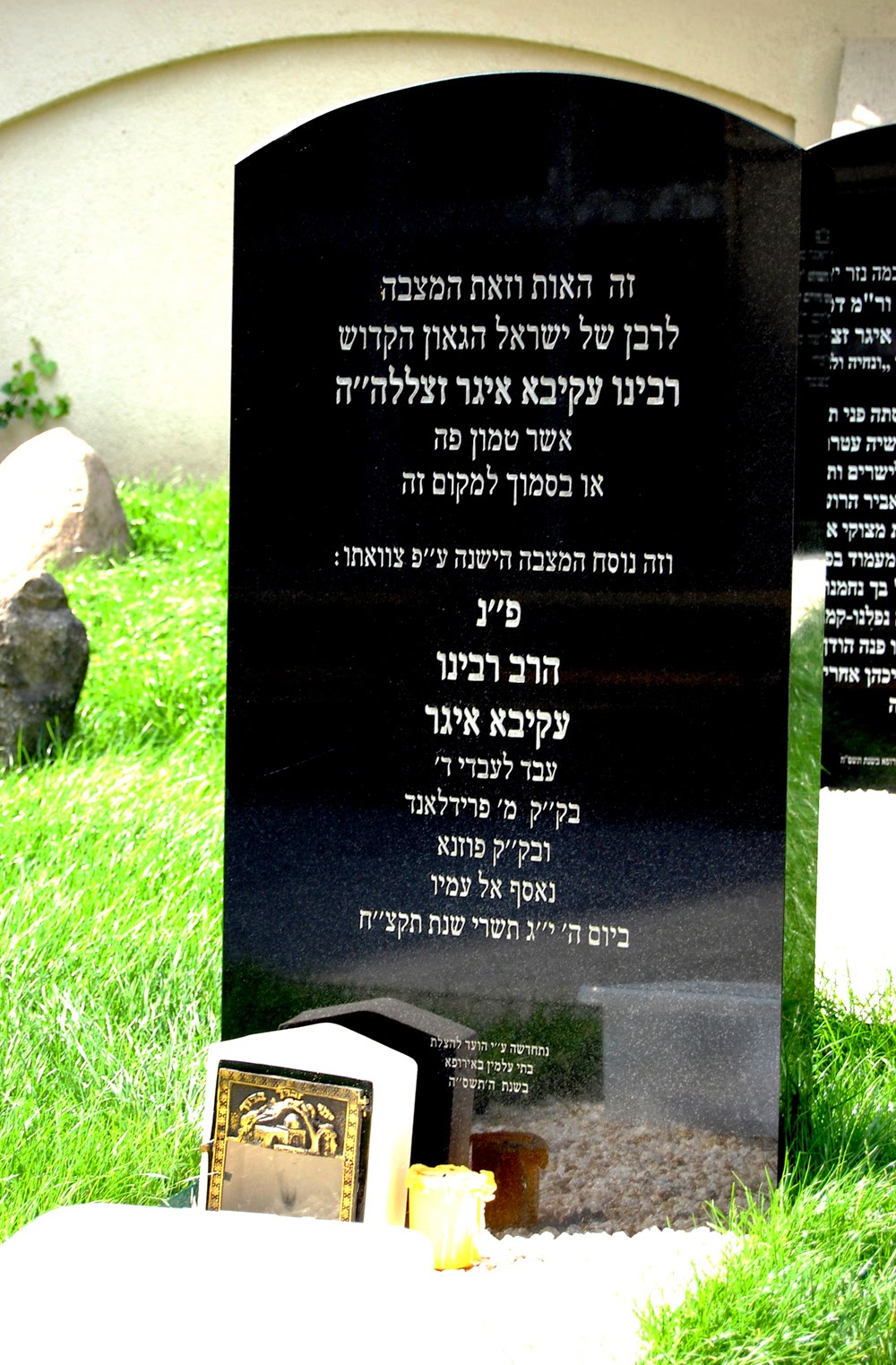
There is no need to rehearse here biographical information about R. Akiva Eger.[6] Sadly, his grave in Poznan (formerly: Posen), which was still standing before World War II (see figure 4),[7] was destroyed by the Nazis. 

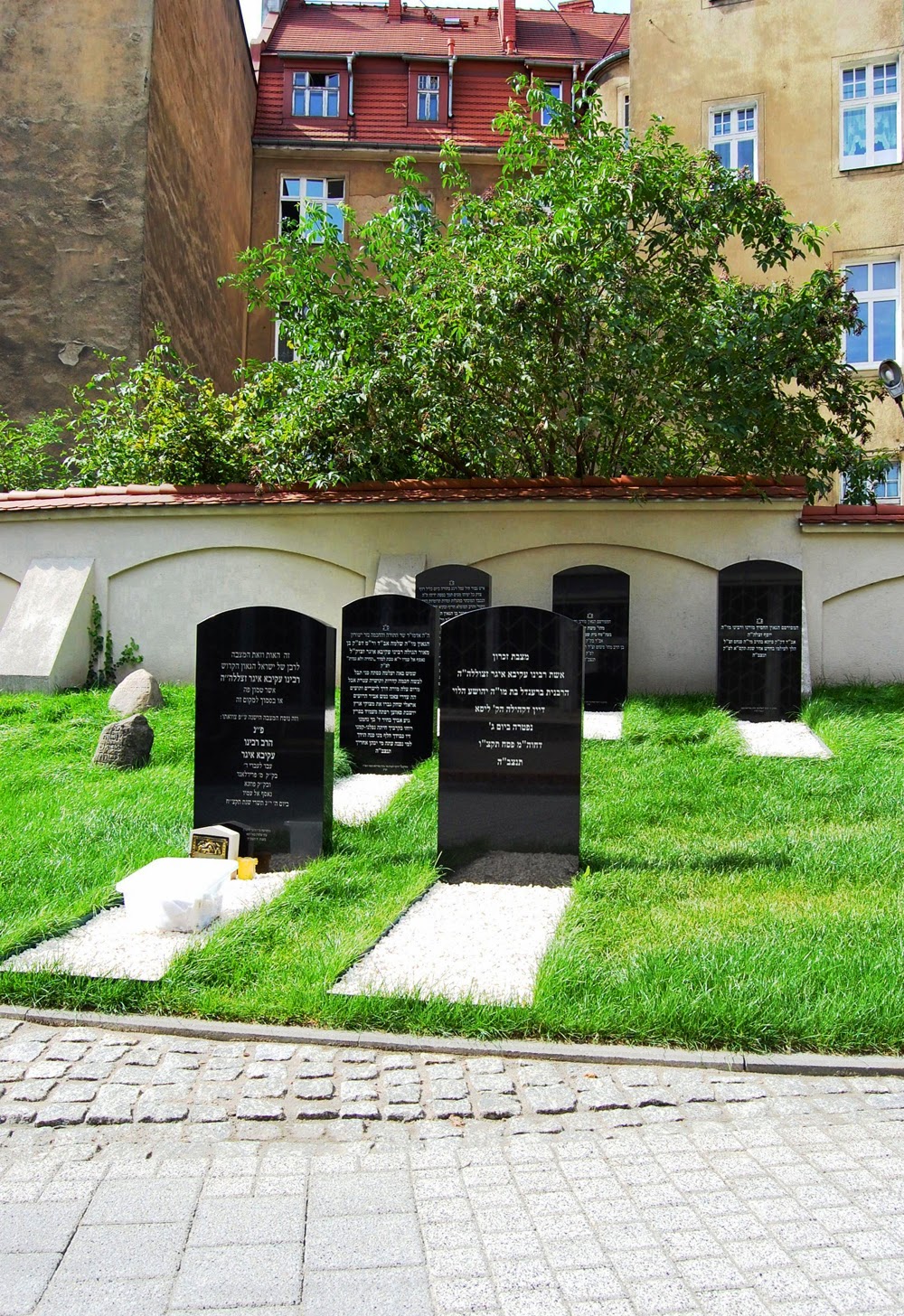
Tombstones from the Jewish cemetery were used to pave roads, and the nineteenth century Jewish cemetery itself – it opened in 1804 – was incorporated into Poznan’s Trade Fair grounds after the war.[8] Ultimately, a housing project and shopping center were built on the grounds of the Jewish cemetery, today at ul. Glogowska corner ul. Sniadeckich. Fortunately, the rabbinic section of the cemetery served as a parking lot (rather than as the foundation of an apartment house), and it was possible to transform the lot into a grassy knoll and to set new tombstones over the old graves (see figure 5). 

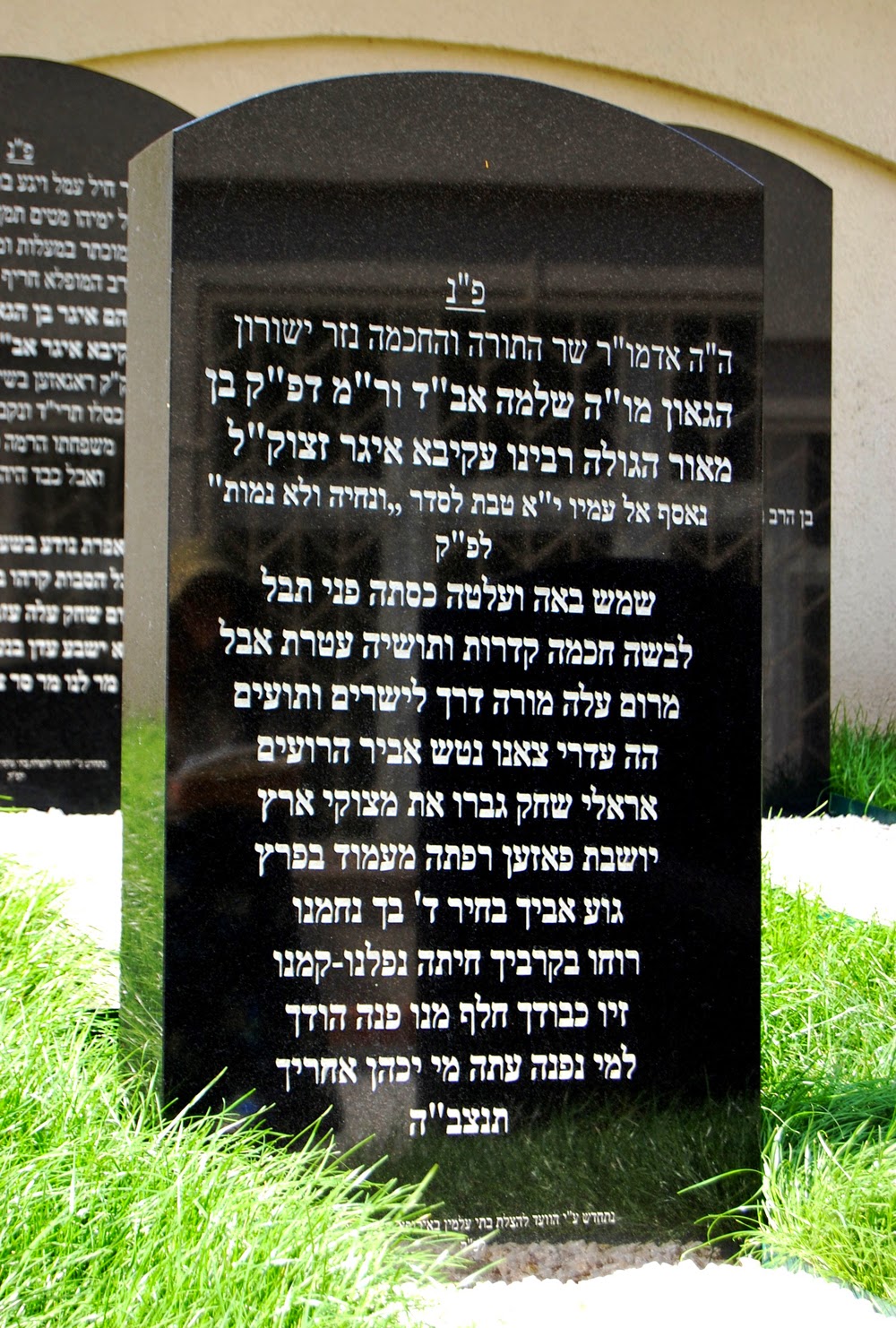
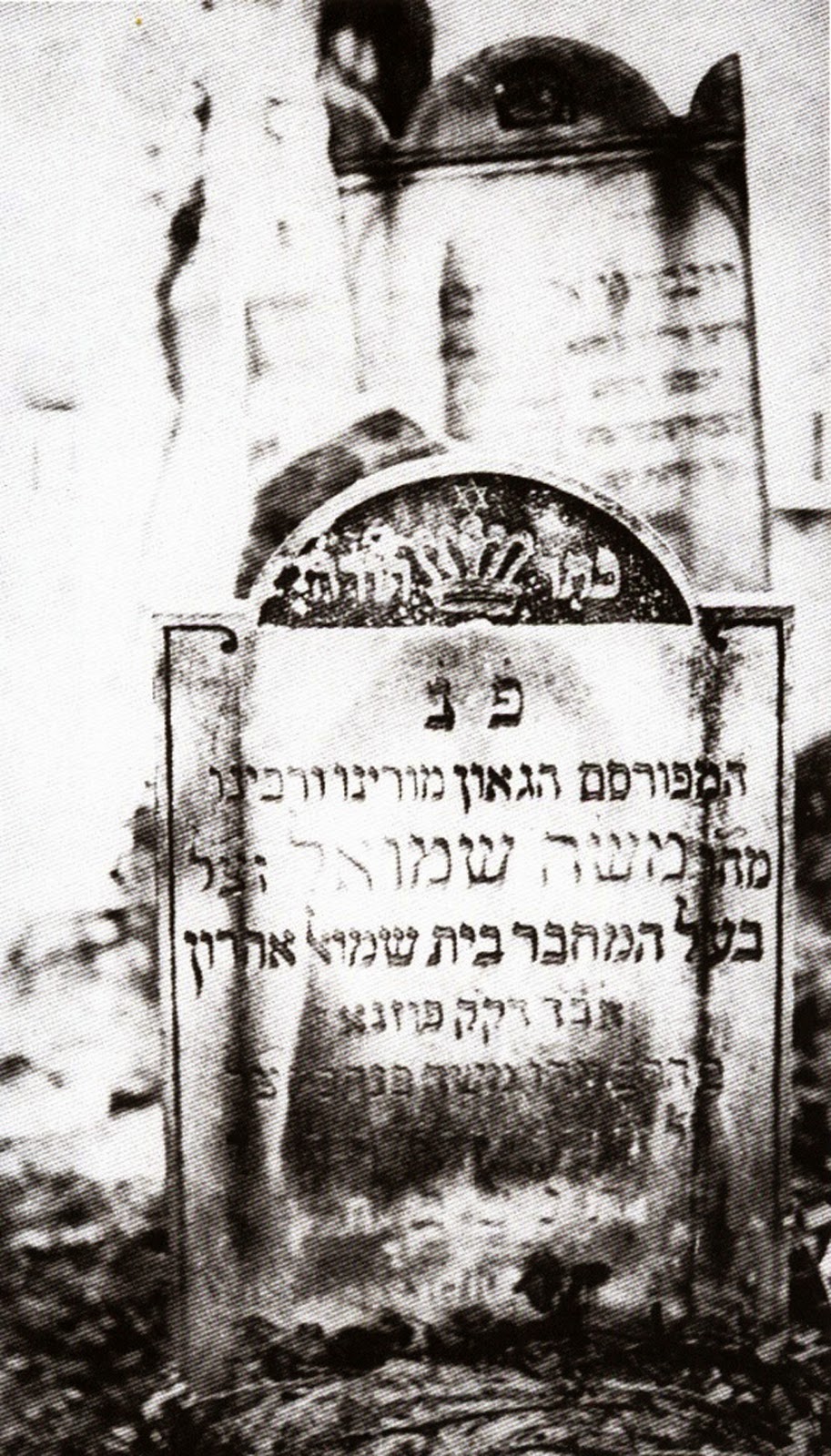
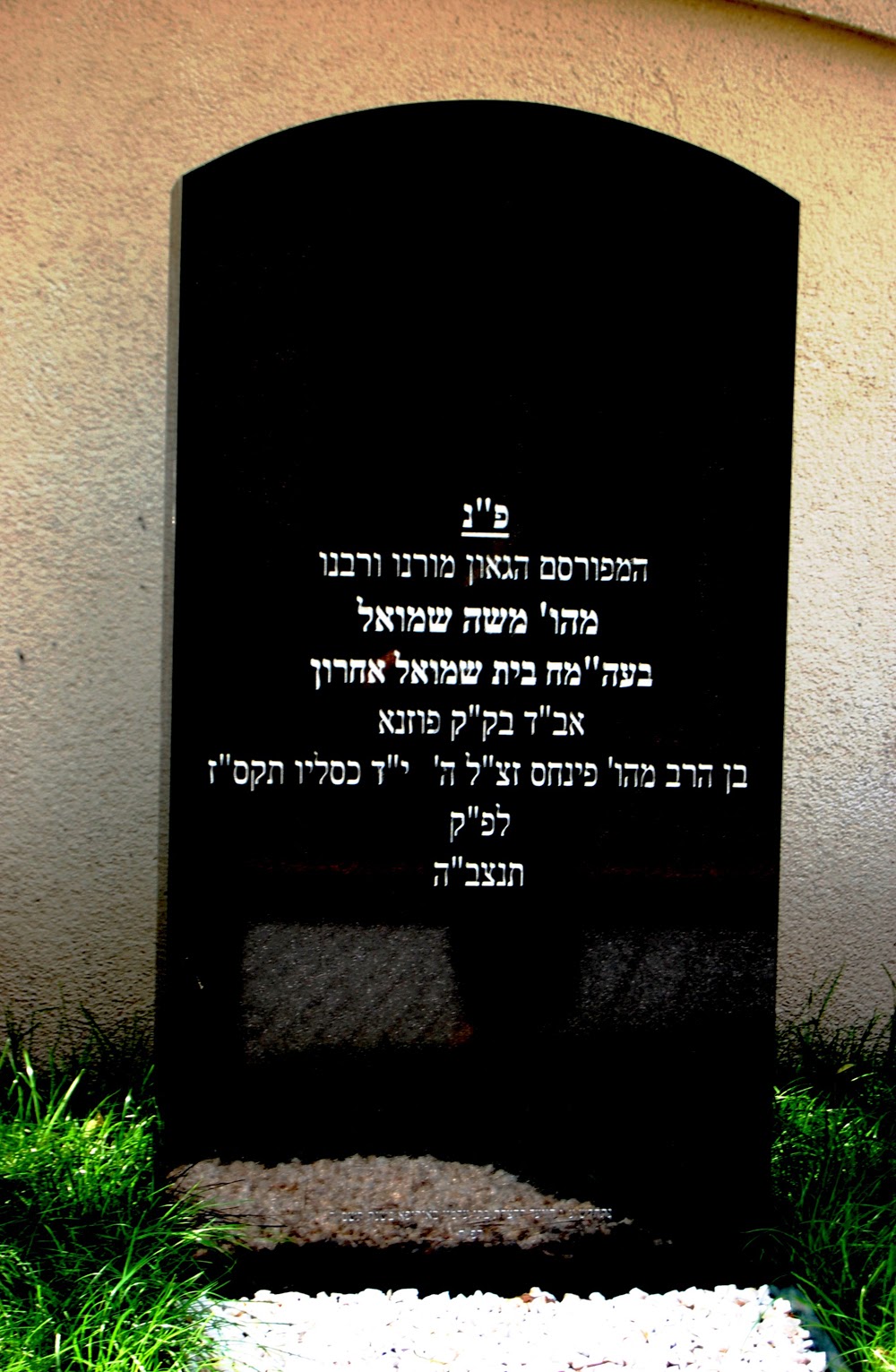
At best, the tombstones are approximately over the gravesites they describe. Even so, it is a great kiddush ha-Shem that this sacred site has been restored. The graves restored include R. Akiva Eger (see figure 6), his second wife Breindel (d. 1836), his son and successor R. Shlomo Eger (d. 1852; see figure 7), and his son R. Avraham Eger (d. 1854). Also restored were the graves of two predecessors of R. Akiva Eger as Chief Rabbi of Posen: R. Yosef b. Pinhas of Posen (son-in-law of R. Yehezkel Landau Prague; see figure 8), d. 1801, and R. Moshe Shmuel, author of בית שמואל אחרון, d. 1806 (see figures 9 and 10 for the original and the restored tombstone inscriptions).[9]

We would be remiss if we didn’t mention that R. Akiva Eger’s likeness is on permanent display in Poznan’s Town Hall (see figure 11). The excerpt in figure 11 is part of a larger mural painted by Julius Knorr (1810-1860) and entitled Marktplatz in Posen. The painting was done during the lifetime of R. Akiva Eger and was first displayed in 1838. R. Akiva Eger can be seen at the bottom right, walking with cane in hand and accompanied by the two other members of his rabbinic court.[10]

II. R. David Hoffmann (d. 1921).

The recent announcement that R. David Hoffmann’s פירוש על ספר שמות (based upon his lecture notes in German) is about to be published by Mosad Harav Kook has brought great joy to biblical and rabbinical scholars alike.[11] Yet another sefer by the Master! It matters not that more than a century has passed since he first taught Exodus at the Hildesheimer Rabbinical Seminary. Of course modern Bible scholarship has changed drastically in the interim. R. David Hoffmann’s commentary will not reflect modern archaelogical advance, will not grapple with the textual readings of the Dead Sea Scrolls, and will not deal with the latest philological discoveries of Semitic linguistics. But those who have read his commentaries on Genesis, Leviticus, and Deuteronomy, and learned from them, will know that regarding R. David Hoffmann “כל מקום שאתה מוצא דבריו עשה אזנך כאפרכסת.”[12] Master of the Oral Law, he of course read the Torah through rabbinic lenses. At the same time, he listened to dissenting voices, weighed all the evidence, and never disparaged others even as he dismissed their arguments. He always judged judiciously and graciously. And even when one disagrees with him, one always gains insight from his comments.

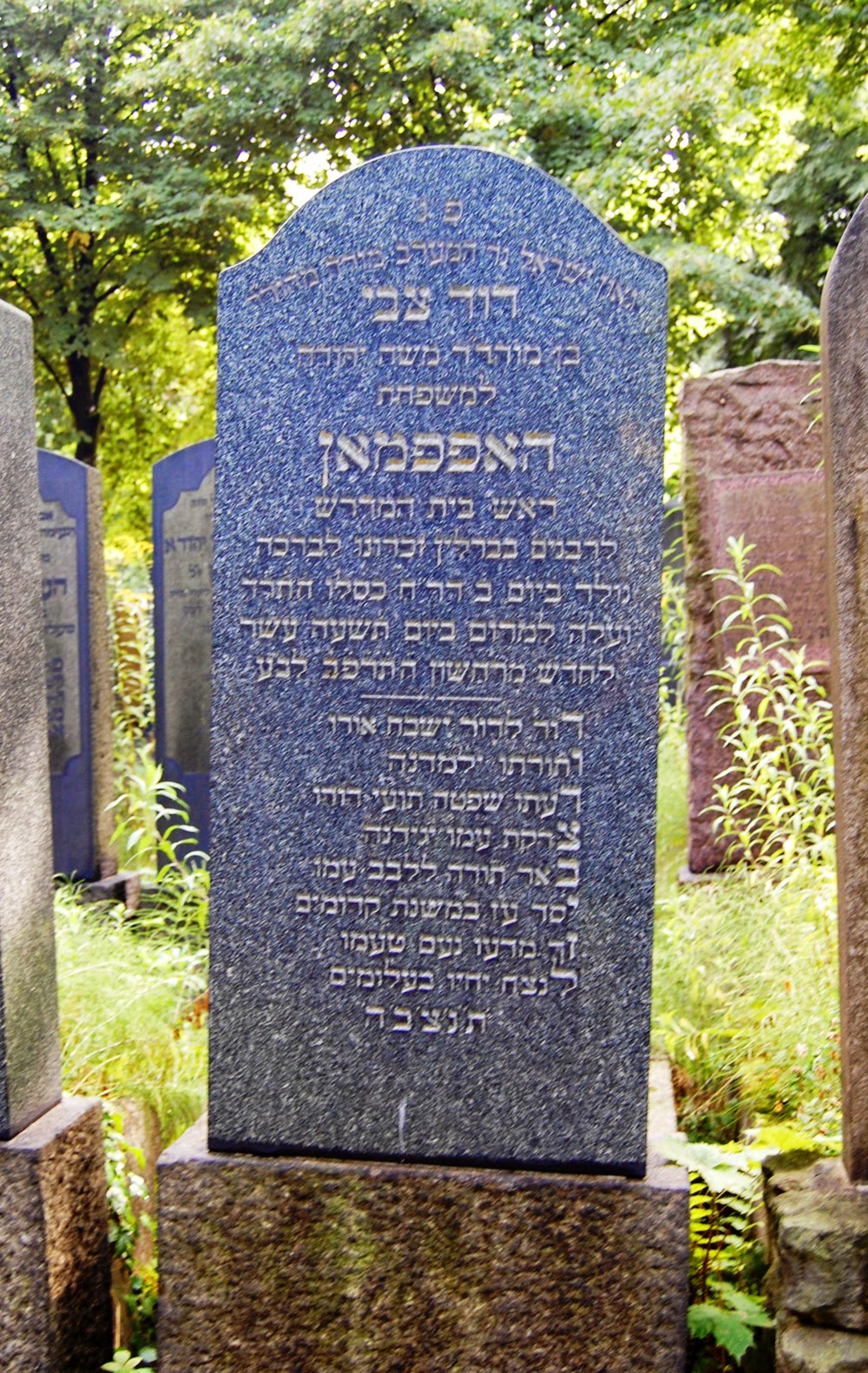
It is sad that this seminal figure, Rector and Rosh Yeshiva, Bible scholar and Posek, Literary Critic of the Mishnah and Restorer of Lost Tannaitic Midrashim, Defender of the Faith and Public Servant, has never been the subject of an intellectual biography worthy of the name.[13] Here we publish, apparently for the first time, his epitaph. R. David Hoffmann is buried in the Adass Jisroel cemetery in the Weissensee section of Berlin.

Obverse (see figure 12):

פ”נ
[גאון ישראל נר המערב מורה מהור”ר [14
דוד צבי
בן מוה”ר ר’ משה יהודה
למשפחת
האפפמאן
ראש בית המדרש
לרבנים בברלין זכרונו לברכה
נולד ביום ב’ דר”ח כסלו התר”ד
ועלה למרום ביום תשעה עשר
לחדש מרחשון ה’ תרפ”ב לב”ע
—————-
דור לדור ישבח אורו
ותורתו ילמדנה
דעתו שפטה תועי דורו
צדקת עמו יגידנה
באר תורה ללבב עמו
יסד עז במשנת קדומים
זך מדעו נעם טעמו
לנצח יחיו בעלומים
תנצב”ה
 

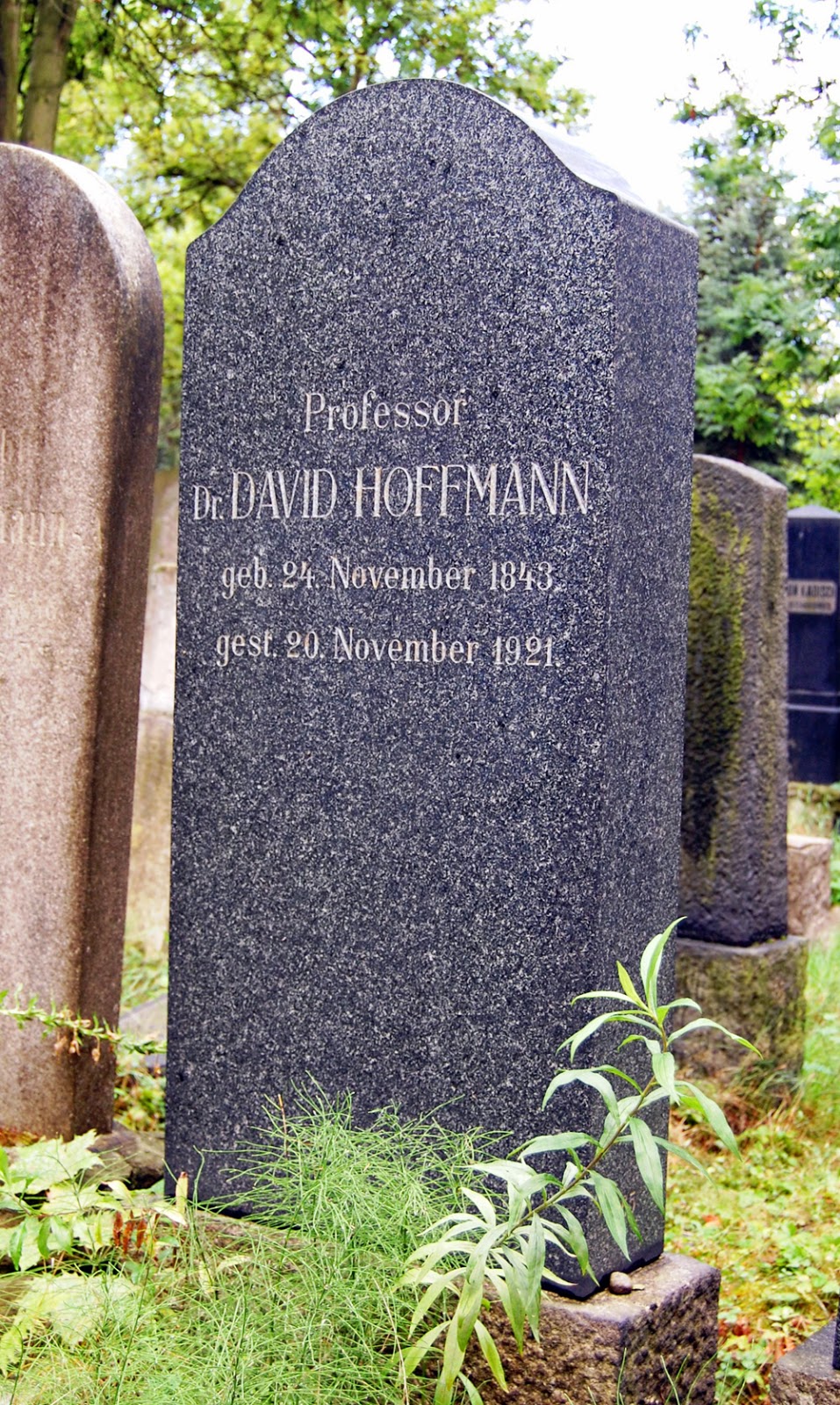
Reverse (see figure 14):

Professor
Dr. DAVID HOFFMANN
geb. 24. November 1843.
gest. 20. November 1921.

[1] According to R. Avraham Yeshayahu Karelitz (d. 1953), “גדול האחרונים הוא המהרי”ט.” See Z. Yabrov, מעשה איש, Bnei Brak, 2001, vol. 4, p. 90.
[2] See E. Zalman, “המהרי”ט קבור בצפת,” Qulmos 65 (2008), pp. 18-21. The photograph in figure 1 is taken from the Zalman essay.
[3] In the case of R. Eleazar b. Yehudah of Worms, he was certainly buried in the Worms Jewish cemetery, standing to this very day. The portion of the cemetery he was buried in was appropriated by the non-Jewish authorities. See R. Juspa Shammes, מעשה נסים, Amsterdam, 1696, p. 20.
[4] See N. Netter, “Les Anciens Cimetieres Israelites de Metz,” REJ 51(1905-6), pp. 280-281. Cf. S. Schwarzfuchs, (תנאי הרבנות של השאגת אריה בק”ק מיץ”,מוריה 15(1986″, pp. 81-90.
[5] The only extant authentic photograph of Sara Schenierer, which scholars in Israel and the United States have kept under wraps for years, was recently published in T. Lesniak, J. M. Malecki, J. Purchla, and A.B. Skotnicki, eds., Swiat przed katastrofa:Zydzi krakowscy w wudziestoleciu miedzywojennym (A World Before a Catastrophe: Krakow’s Jews Between the Wars), Krakow, 2007, p. 128 – and is reproduced here.
[6] See, e.g., Y. Strasser and A. Perl, eds., מאורן של ישראל: רבינו עקיבא איגר, New York, 1990, 2 vols. Cf. J.H. Sinason, The Gaon of Posen: A Portrait of Rabbi Akiva Guens-Eger , Jerusalem, 1991.
[7] Figure 4 is taken from T. Sztyma-Knasiecka, Miedzy tradycja a nowoczesnoscia: Zydi poznanscy w XIX i XX wieku, Poznan, 2006, p. 23.
[8] See Z. Pakula, , The Jews of Poznan, London, 2003, pp. 1-21 and 109. Cf. anonymous, “Jewish Poznan,” Poznan in Your Pocket, July-October 2008, p. 6.
[9] The photograph of the original tombstone inscription is taken from Sztyma-Knasiecka, p. 22.
[10] See Sinason, pp. 100-103; cf. Sztyma-Knasiecka, p. 13.
[11] See A. Wasserteil’s introduction to R. David Hoffmann, (שיעבוד בני ישראל במצרים, המעין 48(2008, number 3, p. 25.
[12] R. David Hoffmann used to apply this Talmudic phrase to the רש”ש, but it surely applies to Hoffmann as well. See his שו”ת מלמד להועיל, Frankfurt, 1932, vol. 3, §71. Cf. R. M. Roth, מבשר עזרא, Jerusalem, 1968, p. 167.
[13] Useful information can be gleaned from the following:
H.J. Bechtoldt, “David Hoffmann,” in his Die jüdische Bibelkritik im 19. Jahrhundert, Stuttgart, 1995, pp. 363-438; D. Ellenson and R. Jacobs, “Scholarship and Faith: David Hoffmann and his Relationship to Wissenschaft des Judentums,” Modern Judaism 8(1988), n.1, pp. 26-70; L. Ginzberg, Students Scholars and Saints, Philadelphia, 1928, pp. 252-262; L. Jung, The Path of a Pioneer, London, 1980, pp. 20-27; J. Marmorstein, “David Hoffmann, Defender of the Faith,” Tradition 8(1966), n.4, pp. 91-101; A. Marx, Essays in Jewish Biography, Philadelphia, 1947, pp. 185-222; Idem, Studies in Jewish History, New York, 1944, pp. 369-376; M. B. Shapiro, “Rabbi David Zevi Hoffmann on Torah and Wissenschaft,” Torah U-Madda Journal 6(1995-6), pp. 129-137; C. Tchernowitz, מסכת זכרונות, New York, 1945, pp. 244-264; and Y. Wolfsberg-Aviad, “David Hoffmann,” in L. Jung, ed., Guardians of Our Heritage, New York, 1958, pp. 363-419 (cf. Wolfsberg-Aviad’s דיוקנאות, Jerusalem, 1962, pp. 57-66). Much more bibliography can be added; the items listed here are intended to get the interested reader started.
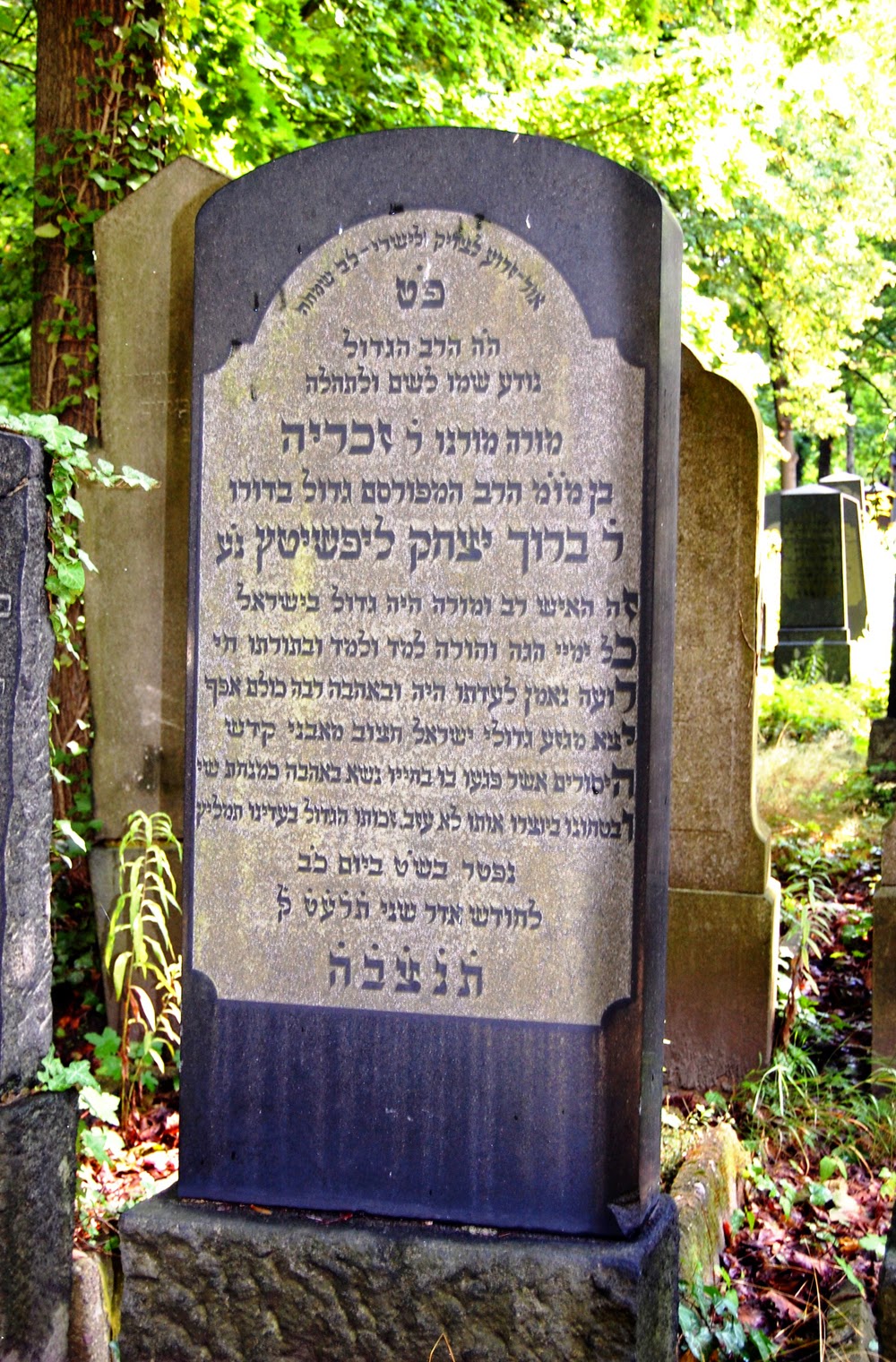
[14] For the honorific title מורה מורנו, see figure 13, also from the Adass Jisroel cemetery. Cf. the very interesting responsum in שו”ת מהרש”ם 2:56.


A Note on the הסכמות of the חפץ חיים

A Note on the הסכמות  of the חפץ חיים
By Shnayer Leiman

All the comments to the previous posting (“A Note on R. Bezalel Alexandrov’s משכן בצלאל and its Prenumeranten”) are deeply appreciated. It’s what makes the Seforim Blog required reading for anyone interested in serious scholarship. I cannot possibly address all the comments. The references in the notes to the essay address some of the issues raised. To Yisrael Dubitsky’s important  comments, one should add that privately owned copies of the two parts of משכן בצלאל  are available, at the very least, in New York and Silver Spring, Maryland. Having said that, the fuller editions of  משכן בצלאל  and  ילקוט בצלאל  remain rare books. Hopefully, online resources such as Hebrew Books and Otzar Ha-Hokhmah will scan the fuller texts and make them available to all. Lest Yisrael’s comment about YU’s copy of   משכן בצלאל  be misunderstood by an uninformed reader (“Mishkan Betsalel is available at 4 libraries that reported to OCLC [YU is not one of them]”), rest assured that the Mendel Gottesman Library at YU owns a full edition of  משכן בצלאל. The Gottesman Library lists some 200,000 volumes of Judaica on its on-line catalogue, and these are reported to OCLC. Those 200,000 volumes form the basic books necessary for a Jewish Studies research library. But like many Jewish Studies research libraries, YU has many other collections of Judaica, catalogued and uncatalogued. One of those catalogued collections (not on-line) lists the full edition of  משכן בצלאל , which, courtesy of the YU librarians, I was able to consult when preparing the essay.

While the focus of the essay was not on  הסכמות , since the bulk of the comments focused on the  הסכמות of the  חפץ חיים  , I shall attempt to address that issue, and only briefly.
1. Whether one chooses to recognize the letter of the  חפץ חיים  as a הסכמה  or not, the letter remains one of the three reasons for bringing  משכן בצלאל  to the attention of the public. Any letter of the  חפץ חיים  is a treasure. This particular one is published only in משכן בצלאל   (and in the secondary sources based upon  משכן בצלאל).
2. It should be noted that   משכן בצלאל  contains three letters of approbation. Aside from the letter of the    חפץ חיים, it includes a letter of approbation from R. Avraham Yoffen (1887-1970), Rosh Yeshiva of Nevarodok in Nevarodok, and then of Nevarodok in Bialystok.  The letter is dated 13 Tishre 5680 [October 7, 1919] and was written in Minsk. A third letter of approbation, from R. Yitzchak Isaac Eliezer Hirshowitz (1871-1941), then a Resh Mesivta in the Slabodka section of Kovno, is dated 5 Tishre 5680 [September 29, 1919] and was also written in Minsk. (Rabbi Hirshowitz is famous, in part, for publishing an early translation into Hebrew of the teachings of Rabbi Samson Raphael Hirsch. His book, מיטב הגיון   [Vilna, 1913] was intended for Lithuanian Jewry and carried an enthusiastic הסכמה from R. Chaim Ozer Grodzenski.) The letters of approbation by Rabbis Yoffen and Hirshowitz not only praise R. Bezalel Alexandrov’s learning and piety, they also indicate that both rabbis examined and approved the manuscript of R. Bezalel Alexandrov’s book. All three letters of approbation are printed together immediately following the title page. All three letters are introduced (separately) with the exact same title: מכתב תעודה מהרב הגאון… To consider the last two letters  הסכמות  ,and the first a private letter that has absolutely nothing to do with the book, seems almost ludicrous. A form-critical analysis leads to the ineluctable conclusion that all three letters of approbation are הסכמות. Moreover, it seems highly unlikely that R. Bezalel Alexandrov, a musar enthusiast, would have placed a letter (by the חפץ חיים) that had absolutely nothing to do with the book, in its הסכמות section and thereby mislead potential buyers and readers of the book. Worse yet, he published the “misleading” letter during the lifetime of the חפץ חיים, and after the חפץ חיים was kind enough to be among the first subscribers to the book! In terms of the nature of the הסכמה by the חפץ חיים, it is paralleled by many others that he wrote in response to specific requests for a הסכמה. He was impeccably honest, and did not want to praise a book he did not read, and was not likely to read. Instead, he showered priestly blessings on the author, מעומקא דלבא.
3. If one examines the first page of prenumeranten in משכן בצלאל (posted with the essay), one will notice that the חפץ חיים’s name appears under the general rubric: אלה שמות הפרענומעראנטין דק”ק ווילנא, שליט”א. This seems awkward, since the חפץ חיים lived in Radin, some 85.6 kilometers from Vilna. The names of no other residents of Radin appear on the four- page list of subscribers. Indeed, the likelihood that anyone would attempt to gather subscriptions from the residents of Radin was probably as high as the likelihood of a Jewish book dealer seeking a copy of the first edition of the נועם אלימלך (one of the rarest of Jewish printed books) in the Serengeti in Tanzania. (Berel Kagan has no entry for Radin.) It is well known, however, that the חפץ חיים frequented Vilna in the 1920’s in particular, and often stayed with relatives in Shnipishok (a Vilna suburb), and would meet with R. Chaim Ozer Grodzenski in order to address the needs of כלל ישראל. Similarly, R. Bezalel Alexandrov was not a resident of Vilna. He was there in 1923 for one purpose only (staying at the home of one of the Vilna subscribers, Shmuel Melamed, at 39 Breite Gass), in order to publish his book. And the letter of the חפץ חיים was written in 1923! It seems likely that the two met in Vilna in 1923 and R. Bezalel asked for a הסכמה, and received the letter he printed at the start of משכן בצלאל.
4. It should be noted that the author of מאיר עיני ישראל (cited in note 7 of the essay), in a chapter entitled “הסכמות מרן החפץ חיים זצ”ל לספרי מחברי תקופתו,” includes the הסכמה  by the חפץ חיים  given to R. Bezalel Alexandrov’s משכן בצלאל.  Also, מפעל הביבליוגרפיה   lists 3  “הסכמות”  for  משכן בצלאל.  It did not imagine that one of the letters was a personal letter unrelated to the book being published.
5. Ultimately the issue is one of definition. What is the definition of a הסכמה ? Or to phrase it another way: what elements must be present in a  הסכמה in order for it to be recognized as a legitimate הסכמה? Here are some possibilities. (I will not bring proofs or disproofs for any of these definitions; in fact, these – and many more – have been suggested as possibilities by leading rabbis throughout the generations.)
1.    A הסכמה  is a legal document by an authorized rabbi that provides copyright protection for the author of a ספר. A הסכמה without such a provision is not a הסכמה.
2.    A הסכמה must be written by an authorized rabbi and he must attest to the integrity of the author and to the integrity of the ספר being published . If the הסכמה lacks the one or the other, it is not a הסכמה.
3.     The  הסכמה  must be written by an authorized rabbi and he needs only to attest to the integrity of the author. Nothing else is significant.
4.    A הסכמה is a promotional document, signed by an authorized rabbi, and necessary for sales. The content of letter is of little consequence.
Whichever definition one chooses, a host of questions will remain to be answered. Who is an authorized rabbi? What if the author of the book, an authorized rabbi, writes the הסכמה for himself? Can a father write a  הסכמה for a son? What shall we do with the many הסכמות that do not fit any of the definitions listed above? Thus, there are censored הסכמות, forged הסכמות, reluctant הסכמות, הסכמות  written under duress, and retracted הסכמות, just to list a few of the many categories. Even aside from these questions, many great rabbis (in all periods) refused to seek הסכמות, and published their books without them. Some stated unequivocally (about their books): מעשיך יקרבוך ומעשיך ירחקוך .
In sum, given the uncertain (and changing) definitions of the term הסכמה through the ages, I cannot speak with confidence that I know precisely, in every case, what is and what isn’t a  הסכמה. And I certainly have no monopoly on wisdom. Nonetheless, for the reasons listed above, I am persuaded that R. Bezalel Alexandrov asked the חפץ חיים for a הסכמה in 1923, and printed the one he received. Readers will have to decide for themselves the precise status of the חפץ חיים’s letter printed at the beginning of משכן בצלאל. But whatever they decide, they need to bear in mind the variety of definitions of הסכמה through the ages, they need to examine all the evidence, and they need to realize that their conclusion will be only one opinion among many others, and not necessarily the correct one.


The Modern Custom of Standing for the Ten Commandments

Many mitvot require that one stand. One of which is reading the Torah. Thus, the ba’al koreh and the person making the blessing stand. When it comes to those who are just listening, there is a debate whether they are required to stand as well. Some hold that the listeners are required to stand while others require the listeners to stand only for the blessings, and finally others don’t there is a nearly universal custom to stand during the recitation of the Ten Commandments. Tracing the history of this custom, however, uncovers that not only is this a fairly recent custom, it is also a highly problematic one.

The earliest possible source for this custom, as with many of today’s “universal” customs, is the Hemdat Yamim. The Hemdat Yamim, records that:
According to the Hemdat Yamim, the custom of the Ari (most of his customs the Hemdat Yamim attributes to the Ari, see this post discussing the spurious nature of the Meron custom also attributed to the Ari,) was to not stand for the recitation of the Torah with the exception of the Ten Commandments. Importantly, the Hemdat Yamim is only proposing this custom, not attempting to justify an already existing custom. Moreover, as we shall see, most who discuss the custom of standing for the ten commandments do so in an effort to reconcile this custom with the prohibition of elevating or highlighting the ten commandments as proscribed by the Talmud.

For instance, R. Shmuel Aboab discusses the custom of standing for the Ten Commandments. R. Aboab was asked “about the custom of some to stand for the Ten Commandments, what is the reason for this custom and should others follow it?” In his response, R. Aboab first questions the custom in light of the well-known passage in the Berachot where the Talmud records that the custom to read the Ten Commandments was abolished in the “gevulot” due to the “minim.” Thus, according to the Talmud, highlighting the Ten Commandments or, in this case, standing specifically for their reading may run afoul of this passage. Ultimately, R. Aboab defends the custom of standing and distinguishes the Talmudic passage and claims that the Talmudic restriction is only applicable “when it is unclear why one is favoring the Ten Commandments over the rest of the Torah, i.e. when one reads the Ten Commandments daily. But, here, [merely standing on Shavout or Parshat Yitro or Vethanan] the purpose is clear in that we are reenacting the acceptance of the Divine Glory and thus there is no fear of the minim. The standing for the Ten Commandments is thus akin to standing when we recite the blessing on the new moon, . . . as Abbai states we need to do it standing and Rashi explains that since we are greeting the Divine Glory we are required to make the blessing standing out of respect for the Divine Glory. Therefore, we stand when the Ten Commandments are read and it poses no problem.”[1]
The Hida also defends the custom of standing and argues the Talmudic fear of minim is not applicable as the Ten Commandments are read as part of a larger Torah reading thereby demonstrating that although we may stand for part we believe in it all.[2]

In fact, it is not an exaggeration to say, from the early 18th century there has been a virtual explosion of commentaries attempting to justify this custom in light of the Talmud. [3]

Of course, as with most Jewish customs, not everyone agrees that standing for the Ten Commandments is appropriate. R. Y. Emden (additions to the Siddur, Laws of Shavout) holds that one should not stand for the Ten Commandments as does R. Gieger in Divrei Keholot (p. 466).

Returning now to the origins, the earliest and most likely source is the Hemdat Yamim, which dates to sometime in the 17th century. That said, he is not actually the earliest person to discuss this custom. Rather, the Rambam discusses this custom, however, the Rambam cannot be the source for the custom of standing for two reasons. First, this passage of the Rambam was unknown until the 20th century. Second, the Rambam was against the custom of standing for the Ten Commandments.

The Rambam’s statement appears in two editions of his responsa, first in the Freimann edition and then again, with small differences, in the Blau edition. The first, Freimann was published in 1934, and Blau’s was published in 1971. Consequently, these can not be the sources for the custom discussed in the 17th century as these were still in manuscript and unknown in the 17th century – that is, no one mentions the Rambam until the publication of these editions. Moreover, as we have seen, this is not a inconsequential custom, rather, on its face this custom runs counter to the Talmud and thus if in fact this custom pre-dated the Hemdat Yamim why is there no one who raises the conflict with the Talmud in Berchot. As we have seen, once the custom is discussed it is almost always in the context of justifying the custom in light of the Talmudic passage.

The Rambam, contrary to the position of those discussed above, takes issue with standing during the Ten Commandments. Specifically, unlike those above, he is unwilling to distinguish the Talmudic passage and in fact expands on what the Talmud prohibits. According to the Rambam, based on the Talmud, it is prohibited from elevating any part of the Torah over any other part. As the Rambam discusses at length in his Commentary on the Mishna, the introduction to Perek Helek, it is heresy to claim any one part of the Torah is more important than any other. Similarly, the Rambam holds that to stand for one part of the Torah and not another part is akin to heresy as it shows that the Ten Commandments are somehow worthy of standing to the exclusion of the rest of the Torah.

To recap, the custom of standing seems to have become popular with the Hemdat Yamim in the early 18th century and the Rambam was against this practice ruling that it skirted the line of heresy. R. Ovadiah Yosef, basing himself on the Rambam (R. Yosef doesn’t trace the lack of historical basis for the custom), rules that it is prohibited to stand. Surprisingly, this is not the conclusion reached by all his contemporaries. Instead, R. Waldenberg, takes the position that since this is well-established “minhag yisrael” standing for the ten commandments is permitted. R. Waldenberg raises the possibility that this custom falls in the category of those customs which are so powerful they override law.

R. Waldenberg then deals with the Rambam, and essentially dismisses the Rambam as unimportant because this responsum was unknown. R. Waldenberg then throws in for good measure the controversial statement of the Hazon Ish regarding using recently discovered manuscripts. [4]

R. Waldenberg is not the only one to dismiss this responsum. R. Feinstein also discusses standing for the Ten commandments and offers his own justification. In doing so he never mentions the Rambam’s position. R. David Feinstein was asked if his father was aware of this responsum and R. D. Feinstein said that his father was not. But, R. Dovid continued, “knowing his father’s position on newly discovered manuscripts – [that he took a dim view?]- the Rambam’s responsum doesn’t affect the analysis.”Feldman, Yisrael be-Mamadam, p . 1051. Thus, rather then dealing with the Rambam in a meaningful manner many appear to be willing to dismiss the entire position of the Rambam. Furthermore, the reason for this pithy dismissal is not based on substance but, instead, by alleging without any basis in fact that this responsum is a forgery.In sum, the custom of standing is based on the Hemdat Yamim and is not older than the 18th century. The Rambam had serious reservations about establishing such a custom, but some are willing to ignore the Rambam on questionable grounds.

Sources:

See Y. Goldhaver, Minhagei Kehilot, vol. 1 227-36 where the majority of the above is taken from. See also, Sperber, Minhagei Yisrael, vol. 2, 109-11, n.63 (he discusses among other things, the meaning of “minim”); E. Brodt, Yeruschasanu, vol. 2, p. 208; G. Oberlander, Minhag Avotanu be-Yadanu, Nissan-Av, chapter 27; S.Y. Feldman, Yisrael be-Mamadam, vol. 2, 1040-51.

See also, Goitein, A Mediterranean Society, vol. II, 340 where he records the custom that to take an oath one had to swear “in the name of God, and the Ten Commandments.” And that a document from Syracuse, Sicily, it records that “the party giving the oath was even obliged to read the Ten Commandments aloud from the Torah Scroll.”

[1] R. Aboab’s distinction is far from certain. Specifically, why it is clear on Shavout one is standing for a particular purpose as opposed to the daily recitation of the Ten Commandments?[2] This reasoning is also not convincing as the proposed daily recitation of the ten commandments was also in a larger context where other Torah passages are recited, Shema, Az Yashir, and Tehilim. If reading the ten commandments during Yitro obviates the minim issue why doesn’t reading it with the Shema or the Monday and Thursday Torah readings obviate the minim issue?[3] See R. Ovadiah Yosef, Yeheva Da’at, vol. 1 no. 29 where in his typical fashion cites almost all the relevant literature.[4] R. Waldenberg is not the first, nor presumably will he be the last, to question the authenticity of a particular responsum of the Rambam. For other examples, see Y.S. Speigel, Amudim be-Tolodot Sefer ha-Ivri, Kiteva ve-Hatakah, 264-65.


Interview with Rabbi Moshe Maimon About his Edition of R. Avraham b. HaRambam’s Peirush on Chumash

Interview with Rabbi Moshe Maimon About his Edition of R. Avraham b. HaRambam’s Peirush on Chumash

By Eliezer Brodt

Last year I wrote:

The second volume of R. Avraham b. HaRambam’s peirush on Chumash Shemot was released (832 pp.). This new edition was edited by Rabbi Moshe Maimon and was published in a beautiful edition by Machon Aleh Zayis. Last year, Rabbi Maimon published the first volume (678 pp.) I hope to publish very shortly, on the Seforim Blog, an interview with the author where he describes in greater depth his work on R. Avraham b. HaRambam, and his new edition of the Peirush.

The following interview with Rabbi Maimon is the fulfillment of the that promise.  I would like to note that from time to time, I hope to include interviews of this nature with authors and publishers of books on the Seforim Blog.

A few weeks ago, the second slightly updated version of R. Avraham b. HaRambam’s Peirush on Chumash Bereishis was published. [If you want a PDF of the updates, email me at Eliezerbrodt@gmail.co]

Eliezer: Rabbi Maimon, can you briefly tell us a bit about yourself?

Rabbi Maimon : I was born in Monsey to a rabbinic family with Turkish-Sephardic roots that claims ancestry to the Rambam. After marriage to my wife Dena (nee Elbaz) of Cleveland OH, I settled in Lakewood where I learned and taught in BMG for many years. I currently reside with my wife and children in Jackson NJ, which may be the fastest growing Jewish community outside of Lakewood. I’m employed as the eleventh grade Rebbi in Yeshiva High School of Monsey, NY.  Being a lifelong bibliophile drew me into professions such as teaching Holocaust and Jewish history classes in different yeshivahs, and consulting auction houses on antique sefarim and manuscripts. I also spend many hours a week editing and publishing various of works of Torah scholarship.

Eliezer: Can you give readers a brief profile of R. Avraham b. HaRambam?

Rabbi Maimon: Rabbenu Avraham was the Rambam’s only son, and the Rambam took great pride in him, extolling his virtues and predicting that one day R. Avraham would take his place among the Torah greats of the nation. R. Avraham was only 19 years old when his father passed away, yet his father’s careful tutelage had already prepared him to assume the Rambam’s mantle of leadership. He was immediately recognized as his father’s able successor in every endeavor – including holding the position of senior physician to the Sultan. By the time of his untimely passing at the age of 51, R. Avraham had left behind a number of original works, as well as various works dedicated to elucidating his father’s legacy.

Eliezer: What makes this peirush unique?

Rabbi Maimon: The Rambam wrote many works, covering all aspects of Torah sheba’al peh. Yet, he never wrote on Torah shebichtav (the work attributed to him on Megillat Esther is more than likely spurious; it is reminiscent of other Judeo-Arabic Midrashic compendiums that were popularly, if falsely, attributed to the Rambam’s school). True, his voluminous writings contain many rich insights from which various commentarial compendiums have been culled. But scholars have long recognized the dearth of a systematic exposition of the Chumash according to the Geonic pshat system informed by the Rambam’s sparkling ethical and philosophical system. Rabbenu Avraham’s peirush, hewn from the almost forgotten Geonic and Andalusian sources and permeated entirely with the spirit of the Rambam’s original thought, fills this void perfectly.

Eliezer:  What was his Relationship with His father, the Rambam?

Rabbi Maimon: The Rambam’s influence on the Peirush is readily apparent from even a cursory acquaintance with it. Besides for the various peirushim that R. Avraham cites in his father’s name, and the many references to his father’s works, numerous individual peirushim are presented in obvious accordance with the Rambam’s shittah (such as the assertion that Yaakov’s encounter with the malach occurred in a dream). Yet, a closer look at the Peirush reveals that the Rambam’s influence on the Peirush is actually all encompassing. It is present in the way R. Avraham references various pesukim in Tanach, in his penchant for citing ma’amarei Chazal, his usage of Hebrew, as well as Judeo-Arabic phrases, and even his distinctive spelling of various words (such as ירושלם). Throughout R. Avraham’s works, the influence of his father is always present.

Eliezer: Any favorite pieces or themes to which you would like to draw readers’ attention?

Rabbi Maimon: One of the very unique features of R. Avraham peirush, which has almost no parallel in the writings of Rishonim, and was only popularized in recent generation through the Alter of Slabodka, is the view that the various individuals in Tanach whom we view as evil in accordance with their depiction in Midrashim, were actually not entirely wicked. According to this opinion, Eisav, Yishmael, Lot, Lavan, and even Korach and his cadre, all possessed higher spiritual capacities and inclinations that at times straddled the boundaries between good and evil. In line with this approach, R. Avraham asserts that the generation that left Egypt, with all their seeming lapses in the midbar, was a generation of tzadikim, whose spiritual level we can hardly conceive of. They alone are referred to as tzivot Hashem by the Torah; no other generation was ever given this appellation, no other compares to them.

In addition, Rabbenu Avraham’s sefarim opened a window for me to a fascinating but little-known world. I found them to be both illuminating and inspirational, full of his original insights and interpretations, and packed with penetrating mussar and exhortations to embrace a rational, yet mystical, form of chassidus.

Rabbenu Avraham’s oeuvre is also a thoroughly Maimonidean work, and through him one can gain a deep and comprehensive appreciation for the Rambam’s weltanschauung.

Eliezer: Are there any Halacha pieces in this work?

Rabbi Maimon: Many insights into R. Avraham’s halachic approach can be gleaned from the peirush, and this is even true of peirushim on the non-legal aspects of Chumash. Parshat Mishpatim in particular is replete with examples of R. Avraham’s pshat-based understanding of the Halacha, whereby he insists that the simple reading of a passuk be understood as binding to the extent that the rabbinic interpretation can accommodate it. As such, R. Avraham understands that the verse, “thou shall stay far away from falsehood,” is not merely an injunction about perjury in court, as it has been codified by the basic commentators, but also contains a basic admonition for anyone not to lie. There are many examples of this unique approach; I have expanded on this topic in the introduction to volume one.

Eliezer: As is evident from your work and notes, you compared him to other Rishonim, so how would you characterize R. Avraham’s peirush in terms of his comparison to other mefarshim?

Rabbi Maimon: In many respects, R. Avraham is certainly from the rodfei hapshat, to use a term the Ramban coined for the likes of the Ibn Ezra who always prefer the pshat of passuk over the allegorical commentaries proffered by midrashim and preferred by Rashi. Yet, R. Avraham also places a strong emphasis on the underlying intent of Torah’s narrative sections that teach moral and ethical imperatives, as well as the underlying intent of the legalistic sections, often couched in the rational basis for these sections (more on this introduction to the current volume). This synthesis can be found to some extent among other mefarshim like the Ralbag, and even the Ramban on some level, though the commentary of Radak to Bereshit is probably the most similar to that of R. Avraham.

Eliezer: Would you call him a mechadesh? What makes him unique?

Rabbi Maimon: Rabbenu Avraham’s close read and extreme common sense leads him to ask many original questions, and to offer many original interpretations. In some cases he anticipated explanations only offered centuries later by the acharonim, such as the Malbim and the Netziv, and in some cases he is the only source for his original explanations. A good sample of his original interpretations can be found in R. Sholom Spitz’ index of original peirushim appended at the end of each volume.

It must also be noted that the peirush is an invaluable repository for interpretations from his predecessors that would otherwise be lost to posterity. These include many peirushim from R. Saadia and R. Shmuel b. Chofni Gaon and a good number of peirushim quoted by R. Avraham in the name of his Grandfather, R. Maimon ha-Dayyan.

Eliezer: In light of your extensive seven plus years “immersed” in the world of RABH, do you have any thoughts or comments on his famous essay on Aggadah, especially in regard to his views about Chazal and science. More specifically, do you think that it’s a forgery as some have claimed, at the height of some controversies a few years back? Or you think the views expressed in this essay on Aggadah are consistent with his work on Torah?

Rabbi Maimon: In my separate work on that Essay on Aggadah, I endeavored to demonstrate conclusively that Rabbenu Avraham’s statements in the Essay are perfectly in line with the views of the Geonic-Andalasuian Beit Medrash. This is the school of thought espoused by R. Saadia Gaon and his followers through the era of the Kadmonim, who thrived in Muslim Spain until the middle of the 12th century when the Rambam and his family were force to flee. Rabbenu Avraham is a prominent example of this school of thought, and we find ample expression in the works of the Rambam and R. Saadia Gaon among others as well. The claim that some of these statements constitute a Maskilic forgery is ill-informed in my opinion. It is based on the notion that the ideas expressed in the essay are controversial and were created by Maskilim. However, once we realize that these ideas were the accepted norm in the Beit Medrash in which R. Avraham was reared, it becomes quite clear that there is nothing particularly controversial in R. Avraham’s presentation.

The decline of the Judeo-Arabic world caused much of the important works of the Geonic-Andalusian school to go lost. Additionally, the spread of Kabbalah and the influence of the Arizal were very influential in giving rise to a perspective contrary to the one expressed by R. Avraham, with the result that many people today are not aware that R. Avraham’s viewpoint ever held sway.

Yet, even if today we follow a different perspective, that should not mean that we must deny that previously it was Rabbenu Avraham’s perspective that ruled the day. I feel, and this is how I was taught by my rebbis, that our awe of the Rishonim and our fealty to them requires that we study their words and endeavor to understand them, even if we do not subscribe to aspects of their particular viewpoints. As my father writes in his beautiful introduction to the volume on Shemot, this was the way of Beit Hillel who would ponder the opposing views of Beis Shammai before declaring their own, and in fact, this is the very reason why we follow Beit Hillel.

The views in the essay are evident in the Peirush as well, even if they are not prominently featured due to the different nature of the work. For example, in Bereishit, R. Avraham speaks of the sciences as a body of accumulated knowledge, amassed over the generations. This fits well with his stated view in the Essay that the scientific knowledge of Chazal was of the sort that was available to savants at that time, and was not a separate branch of wisdom received by oral tradition from on High.

More importantly, throughout the Peirush, it is clear that R. Avraham’s approach to Aggadah is consistent with his statements in the Essay that Aggadic statements of individual members of Chazal were their own stated opinions and were not part of the authoritative oral tradition of Torah shebaal peh.

Eliezer: How long ago did you begin working on this project?

Rabbi Maimon: Already as a teenager, I was drawn to the Peirush of Rabbenu Avraham and began studying it then to the best of my abilities, though many times I found the Peirush too much to handle and I could not make much sense of it. The impetus to undertake the project of re-issuing it in a new edition came during a moment of inspiration one Rosh Hashanah, about seven years ago.

Eliezer: How did you, a Yeshivish-trained scholar get into this field of study in the first place?

Rabbi Maimon: At first, I thought I would just re-issue the Peirush, newly typeset and punctuated with little intrusion into the text and accompanied only by small marginal commentary. Yet, the more I got into the project, the more invested I became, and each subsequent recension saw the Peirush growing exponentially in terms of elucidation of the text in the notes, and also in terms of improving the translation, where I felt that doing so would enhance readability and comprehensibility.

Eliezer: Were you able to use Friedberg genizah in the course of your work?

Rabbi Maimon: The Friedberg Jewish Manuscript Society (https://fjms.genizah.org/) has been an indispensable resource for me. I have made frequent use of all its resources, and I feel my work has been immeasurably enhanced as a result. The Genizah portal was key in locating as of yet unpublished fragments of Sefer Hamaspik which were useful in elucidating corresponding passages in the Peirush, and the Judeo-Arabic corpus portal was especially crucial in establishing accurate translations for many of R. Avraham’s unique usages of Judeo-Arabic phrases.

Eliezer: Did you find any new passages of the Peirush?

Rabbi Maimon: To date, no corresponding fragments to the Peirush have been found in the Genizah, which lends credence to my contention in the foreword to Volume One that the Peirush was never disseminated. It appears that a lone manuscript (likely an autograph) made its way to Aleppo with R. David Ha-Naggid II, a fifth-generation descendant of R. Avraham, where it was copied over into what is today the sole surviving manuscript of the Peirush. Yet, in two instances I have located fragments of Hamaspik which contain references to the Peirush (incidentally, this was significant on its own because it helped shed light on the ongoing editing process of Hamaspik, which I detailed in the introduction to Volume One). In one of these instances, the reference pertains to a portion of Parshat Bereshit that is missing from our manuscript. I translated this piece and appended it to my addition. Other genizah fragments that were significant are transcribed in the notes where relevant. I shared my discovery of another one of the relevant Genizah fragment from Sefer Hamaspik with Prof. Friedman who was able to use it for an article of his that was recently published (see here).

Eliezer: What challenges were involved in translating the work from Arabic?

Rabbi Maimon: First, it was mostly troubleshooting. Anytime I felt that the language was cumbersome or obscure, I would attempt to re-translate key phrases to improve the flow and make it more understandable. At the same time, I would mine the publications of key Judeo-Arabic experts such as Professors Blau Friedman and Ilan for their observations regarding R. Avraham’s use of difference phrases. As I developed an appreciation and understanding of R. Avraham’s individual “flavor” in his language and syntax, I began to highlight his consistency in the usage of various terms and phrases in specific contexts, which was sometimes lost in the original translation. In all these cases I carefully noted the correction in the notes, typically with a brief explanation for the change.

Eliezer: Can you describe in short, your goal in your comments to the work?

Rabbi Maimon: My notes focus on all the aforementioned qualities for the Peirush. Basic sources have been incorporated into the text, but where some expansion was needed, I moved the discussion to the footnotes. <The rest of this response is detailed at length in the Overview>

Eliezer: Who did you consult while working on this project?

Rabbi Maimon: In the course of my work, I reached out to talmidei chachamim and experts from across the spectrum, and I have been careful to credit them all wherever appropriate. Professors Mordechai Akiva Freidman and Nahem Ilan, both of whom have spent years of research into the writings of Rabbenu Avraham, were particularly helpful in assisting with specific issues related to various translations I was working on. Rabbis Yaakov Wincelberg of Miami and Yehuda Zevald of Bnei Braq, both talmidei chachamim with ample experience in the Judeo-Arabic writings of the Rambam and Rabbenu Avraham, were helpful in this regard as well.

Rav Sholom Spitz, Rosh Yeshivah of Sha’ar HaTorah of Queens was quite gracious in sharing his personal notes on the Peirush and elucidating them when necessary, and I have incorporated these into my own notes with proper attribution.

In general, I have consulted a wide variety of published scholarship pertaining to research into Rabbenu Avraham’s writings, and I have referenced their contribution to my work, in accordance with the Rambam’s own dictum to accept truth regardless of its source.

Readers may also find Rabbi Maimon’s interview on The Seforim Chatter Podcast (here) interesting, and a nice review of Rabbi Maimon’s edition has recently appeared in the Fall issue of Jewish Review of Books here.

Purchasing information:

Email me at Eliezerbrodt@gmail.com for parts of the introduction and some sample pages of this special new work.

Copies are available for purchase at Biegeleisen (Brooklyn), Judaica Plaza (Lakewood), Tuvia’s (Monsey) as well as through many other fine retailers.

On can also purchase it online (or in person) through Mizrahi Book Store at this link.

To purchase a copy in Eretz Yisrael, contact me at Eliezerbrodt@gmail.com


R. Reuven Margulies I

First, I want to post a bibliography of R. Margulies’s works and then I shall discuss some biogrpahical details in the next post. This bibliography is not a scientific one in that I do not attempt to list every edition. Rather, I am listing just the works and some bibliogrpahical information as I see fit. Most of this information comes from Naftali Ben Menachem’s bibliogprahy of R. Margulies’s books which was printed in Sefer Margolious.

1) Toldot Adam (Lemberg 1912) on R. Shmuel Edels
2) Kav Besamim (Lemberg 1913) 102 notes on Tosefot
3) Drush l’yom ‘alot ‘al kesi moshlim ‘adonanu haKeiser Karal haRishon (Lemberg 1918)
4) Kavi Ohr (Lemberg, 1921) laws pertianing to Israel as well as articles on history, including yesod hamishna among others
5) Yesod HaMishna V’Arikachto (Lemberg, 1933) on the creation of the Mishna
6) Sefer Hassidim with his notes (multiple printings)
7) Tolodot Rabenu Hayyim ben Atar (Lemberg, 1925), biography on the Ohr Hayyim includes the notes of R. Meir Dan Plotzki (Kli Hemdah)
8) Ohr Meir (Lemberg, 1926), biography of R. Meir from Perlmishiya
9) Margenuta d’Reb Meir (Lemberg, 1926), sayings of the above R. Meir
10) Shealot u’Teshuvot min HaShamyim, R. Margulies’s extensive notes on the teshuvot as well as a comprehensive introduction discussing Torah lo’ Bashmyim and other related topics (multiple printings)
11) Yalkut Margolious ([Lemberg], 1927), derashot of R. Margulies
12) Imrei Kodesh haShalem (Lemberg, 1928)
13) Vikuach Rabbanu Yehiel m’Paris (Lemberg, 1928), with biography of R. Yehiel
14) Shemot v’Kinuim B’Talmud, discussing names in the Talmud, including when two names started, (multiple printings)
15) Helulua d’Tzadika (Lemberg 1929), lifespan and death dates of Tzadikim
16) Vikuach HaRamban (Lemberg, 1928)
17) Yalkut Peninim (Lemberg, 1929), derashot
18) Butzna d’Nehora HaShalem (Lemberg, 1930), about R. Barukh of Metzerich
19) Gevurot Ari (Lemberg, 1930), biography of R. Leib Srhson
20) Toldot Rabbenu Avrohom Mimoni, biography of Rambam’s son, (multiple printings)
21) Rishimah (Lemberg, 193-) list of books in his bookstore
22) Mekor Barukh (Lemberg, 1931), biography of R. Barukh of Metzerich and other historical documents
23) Shem Olam, to reveal the anonymous people in hazal (multiple printings)
24) HaModiah journal
25) Nefesh Hayyia, on Shulchan Orakh multiple printings
26) Hagadah shel Pesach (Tel Aviv, 1937)
27) Shichot Chakhamim
28) Mekor haBerakha discussing blessing and why and when before one does something (recently reprinted)
29) Zohar with his extensive notes (multiple printings)
30) Sibah hisnaguto discussing R. Emden/R. Eybeschitz controversy (very controversial Scholem wrote a pamphelet against this) Tel Aviv 1941
31) Reb Saul Levin M’Ziaf haSefer Besamim Rosh, in Aresehet 1944
32) Malechi Elyon on angels in Hazel (multiple printings)
33) Ollalot various articles (multiple printings)
34) Tikunei Zohar notes, multiple printings
35) Sefer haBahir same as above
36) Zohar Hadash same
37) L’Toldot Anshei Shem b’Lvov, Jerusalem 1952
38) Milchmot HaShem (R. Avrohom ben HaRambam) (including the biography on him) (multiple printings)
39) haRambam v’Hazohar now reprinted in Penini Margolios
40) Sha’ari Zohar collecting relvant passages from the Zohar to Hazal (multiple printings)
41) Margolios HaYam on Sanhedrin (multiple printings)
42) Divrarim b’Itam dershot
43) L’Heker haMisparam beTalmud, Sinai 44
44) Tzioyunim Bibliographim a comprehensive biobibliography in Areshet 1-2,4
45) Tziyunim l’Ha’arot l’Seder haDorot, Sinai 46
46) HaMikrah v’Hamesorah multiple printings
47) Mekharim b’Darkei haTalmud v’Hidosov multiple printings


“New” R. Reuven Margoliyot Book

Mossad HaRav Kook has published Peninem u-Margoliyot which is a collection of articles by R. Reuven Margoliyot. These articles originally appeared in the journal Sinai and are now republished in a single volume. It seems that the impetus to collect and publish these was not so that people could have access to them (although perhaps this played a small role). Instead, Mossad HaRav Kook was forced, as it was, to publish these.
In the last few years, in honor of someone’s child’s wedding, someone published some of R. Margoliyot’s articles and books, including the articles which appeared in Sinai. Now, this seems to have upset Mossad HaRav Kook as they note in the introduction where they explain these articles are not that well known “with the exception of one publisher in America, who stole, without first obtaining permission, and Jews will not have a stumbling block in their homes.” While it may be the case that many are unaware of the journal Sinai or where to find R. Margoliyot’s writings it seems that Mossad HaRav Kook who had these for years, some for 30 years, they would have been content to let them langiush had it not been for this violation of copyright.

In fact, Mossad HaRav Kook has only published those articles which appeared in Sinai, they did not, as the American publisher did, republish other works (long out of copyright) of R. Margoliyot. The American publications include Toledot Ohr Hayyim haKadosh and Toledot Maharsha. The latter was originally published in Lemberg in 1932 it contains a portrait of the Maharsah (R. Shmuel Edels) as well as a discussion by R. Margoliyot of other Rabbis who had their portraits done (the picture of him in the chair is from the 1814 Vienna edition of the Maharsha and the frontal picture is from R. Margulies’s book).

The articles in these books include among others: Ha-Rambam v’HaZohar, Defusi haShulhan Arukh, Defusi haShulahan Ohrah haRishonim, Zionunei HaPesukim b’Talmud u-Midrashim, and Toledot Rebbi Yehuda HaNassi.

I purchased both the American and the Mossad HaRav Kook versions at Beigeleisen Books.