Another “Translation” by Artscroll, the Rogochover and the Radichkover

Another “Translation” by Artscroll, the Rogochover and the Radichkover
Marc B. Shapiro
1. As I discuss in Changing the Immutable, sometimes a choice of translation serves as a means of censorship. In other words, one does not need to delete a text. Simply mistranslating it will accomplish one’s goal. Jay Shapiro called my attention to an example of this in the recent ArtScroll translation of Sefer ha-Hinukh, no. 467.  
In discussing the prohibition to gash one’s body as idol-worshippers so, Sefer ha-Hinukh states:

אבל שנשחית גופנו ונקלקל עצמנו כשוטים, לא טוב לנו ולא דרך חכמים ואנשי בינה היא, רק מעשה המון הנשים הפחותות וחסרי הדעת שלא הבינו דבר במעשה הא-ל ונפלאותיו.

The Feldheim edition of Sefer ha-Hinnukh, with Charles Wengrov’s translation, reads as follows:

But that we should be be destructive to our body and injure ourselves like witless fools—this is not good for us, and is not the way of the wise and the people of understanding. It is solely the activity of the mass of low, inferior women lacking in sense, who have understood nothing of God’s handiwork and his wonders.

This is a correct translation. However, Artscroll “translates” the words המון הנשים הפחותות וחסרי הדעת as “masses of small-minded and unintelligent people.” This is clearly a politically correct translation designed to avoid dealing with Sefer ha-Hinukh’s negative comment about the female masses. I will only add that Sefer ha-Hinukh’s statement is indeed troubling. Why did he need to throw in “the women”? His point would have been the exact same leaving this out, as we can see from ArtScroll’s “translation.” Knowing what we know about the “small-minded unintelligent” men in medieval times, it is hard to see why he had to pick on women in this comment, as the masses of ignorant men would have also been a good target for his put-down.

2. In my post here I wrote:

One final point I would like to make about the Rogochover relates to his view of secular studies. . . . Among the significant points he makes is that, following Maimonides, a father must teach his son “wisdom.” He derives this from Maimonides’ ruling in Mishneh Torah, Hilkhot Rotzeah 5:5:

הבן שהרג את אביו בשגגה, גולה. וכן האב שהרג את בנו בשגגה, גולה על ידו, במה דברים אמורים. כשהרגו שלא בשעת לימוד, או שהיה מלמדו אומנות אחרת שאינו צריך לה. אבל אם ייסר את בנו כדי ללמדו תורה או חכמה או אומנות ומת פטור

He adds, however, that instruction in “secular” subjects is not something that the community should be involved in, with the exception of medicine, astronomy, and the skills which allow one to take proper measurements, since all these matters have halakhic relevance. In other words, according to the Rogochover, while Jewish schools should teach these subjects, no other secular subjects (“wisdom”) should be taught by the schools, but the father should arrange private instruction for his son.

 רואים דהרמב”ם ס”ל דגם חכמה מותר וצריך אב ללמוד [!] לבנו אבל ציבור ודאי אסורים בשאר חכמות חוץ מן רפואה ותקפות [!] דשיך [!] לעבובר [צ”ל לעבור] וגמטרא [!] השייך למדידה דזה ג”כ בגדר דין

He then refers to the Mekhilta, parashat Bo (ch. 18), which cites R. Judah ha-Nasi as saying that a father must teach his son ישוב המדינה. The Rogochover does not explain what yishuv ha-medinah means, just as he earlier does not explain what is meant by “wisdom,” but these terms obviously include the secular studies that are necessary to function properly in society.

Dr. Dianna Roberts-Zauderer takes issue with my assumption that “wisdom” (חכמה), the word used by Maimonides, includes what I have termed “secular studies”. (The Touger translation also has “secular knowledge”). She correctly points out that when the medievals used the word חכמה it means philosophy. She adds: “Does it not make sense that Maimonides would advocate the learning of philosophy? Or that the Rogochover would forbid the learning of philosophy in yeshivot, but only permit it at home with a teacher hired by the father?”
Although the term חכמה often means philosophy, I do not think we must assume that this is its meaning in Hilkhot Rotzeah 5:5. Based on parallel passages in Maimonides’ writings where the same halakhah is mentioned, R. Nachum Eliezer Rabinovitch claims that the word חכמה in this case actually means good character traits.[1] He sums up his discussion as follows:
כוונת רבינו אחת היא בכל המקומות, דהיינו לימוד מדות הנקרא חכמה
Quite apart from this, in my discussion I was dealing with how the Rogochover understood the passage in Maimonides. We have to remember the context of the Rogochover’s letter. He was asked about the study of secular subjects, as was the practice among the German Orthodox. He was not asked about the study of philosophy per se. Furthermore, in the passage cited from manuscript by R. Judah Aryeh Wohlgemuth,[2] which I referred to in the previous post, the Rogochover specifically understands Maimonides’ term חכמה in Hilkhot Rotzeah 5:5 as meaning שאר החכמות, which he identifies with what R. Judah ha-Nasi calls ישוב המדינה. 
Regarding the Rogochover, there are a few things people mentioned to me after seeing my post which I think are worthwhile to record. Dr. Rivka Blau, the daughter of R. Pinchas Teitz, told me that her uncle, R. Elchanan Teitz, would on occasion cut the Rogochover’s hair.
In the post I mentioned how the Rogochover acknowledged that his learning Torah while sitting shiva was a sin, but he did so anyway as the Torah was worth it. R. Yissachar Dov Hoffman called my attention to the following comment about this by R. Ovadiah Yosef, Meor Yisrael, Berakhot 24b:
לפע”ד לא יאומן כי יסופר שת”ח יעבור על הלכה פסוקה בטענה כזו. והעיקר דס”ל כמ”ש הירושלמי פ”ג דמ”ק שאם היה להוט אחר ד”ת מותר לעסוק בתורה בימי אבלו, דהו”ל כדין אסטניס שלא גזרו בו איסור רחיצה מפני צערו.
In the post I mentioned that the Shibolei ha-Leket appears to be the only rishon who adopts the position of the Yerushalmi referred to by R. Ovadiah. R. Yissachar Dov Hoffman called my attention to R. Yehudah Azulai, Simhat Yehudah, vol. 1, Yoreh Deah no. 40, which is a comprehensive responsum on the topic of a mourner studying Torah. R. Azulai notes that a few recently published texts of rishonim record the position of the Yerushalmi. He also mentions that according to some rishonim the prohibition is only to study on the first day of mourning. In studying R. Azulai’s responsum, I found another source that could be used to defend the Rogochover’s learning Torah during shiva. R. Meir ben Shimon ha-Meili writes:[3]
ונראה לומר דלדברי כל פוסקים העיון מבלי הקריאה מותר, שאינו אלא הרהור בעלמא, ולא חמיר אבלות משבת דאמרינן דבור אסור הרהור מותר, וכל שכן הרהור בדברי תורה לאבל שהוא מותר . . . והלכך מותר לו לאבל לעיין בספר, ובלבד שלא יקרא בו בפיו.
R. Meir ben Shimon adds that despite what he wrote, the common practice is for a mourner not to read any Torah books. Yet as we can see, he believes that this is halakhically permitted as long as one does not read out loud.
R. Chaim Rapoport called my attention to the following passage in a new book about the late rav of Kefar Habad, Ha-Rav Mordechai Shmuel Ashkenazi (Kefar Habad, 2017), p. 546:
יצוין בהקשר זה למעשה משעשע, ששח הרב אשכנזי בשם הרה”ח ר’ אליהו חיים אלטהויז הי”ד, אודות אסיפה שכינס הרבי הריי”ץ עם הגיעו לריגה שבלטביה. הרוגצ’ובר נכח באותה ישיבה, ומשנמשכו הנאומים, התקשה הגאון לשבת במנוחה, והוא הסיר את כובעו והשליכו על הבקבוקים שניצבו על השולחן, תוך שערם כוסות שורה על שורה בפירמידה, וכן שפך מים מכוס אחת לשנייה וכדומה.
הרב ד”ר מאיר הילדסיימר [!] ע”ה מברלין, שהיה יקה מובהק, תהה לפשר התופעה והתקשה להכילה. הרבי הריי”ץ חש בפליאתו וציין באוזניו, כי הרוגצ’ובר הינו “שר התורה, וכל רז לא אניס ליה”. השיב הרב הילדסהיימר: “הכול טוב ויפה, אולם נורמאלי זה לא”.
I am surprised that such a passage, using the words “not normal” about behavior of the Rogochover, was published, especially in a Habad work. As is well known, there is a special closeness in Habad to the Rogochover, as he himself was from a Habad family (although it was not Lubavitch but from the Kopust branch of Habad).[4]
Ha-Rav Mordechai Shmuel Ashkenazi also has a number of other stories about the Rogochover. The following appears on p. 211: Once R. Jacob David Wilovsky of Slutzk visited R. Meir Simhah of Dvinsk and told him that he wanted to also visit the Rogochover. R. Meir Simhah attempted to dissuade him, saying that the Rogochover would put him down like he puts everyone down. Yet R. Wilovsky visited him and the Rogochover did not put him down. He said to the Rogochover, “I heard that you put down everyone, but I see that you treat me with respect.” The Rogochover replied, “I put down gedolim, not ketanim.”
In my post on the Rogochover, I showed this page from R. Menahem Kasher’s Mefaneah Tzefunot (Jerusalem, 1976), p. 2.

I wrote:
Look at the end of the first paragraph of the note on p. 2. The “problematic” quotation of the Rogochover, saying that he will happily be punished for his sin in studying Torah, as the Torah is worth it, has been deleted. Instead, the Rogochover is portrayed as explaining his behavior as due to the passage in the Yerushalmi. While all the other authors who discuss this matter and want to “defend” the Rogochover claim that his real reason for studying Torah was based on the Yerushalmi, in R. Kasher’s work this defense is not needed as now we have the Rogochover himself giving this explanation!
Yet the Rogochover never said this. R. Zevin’s text has been altered and a spurious comment put in the mouth of the Rogochover. By looking carefully at the text you can see that originally R. Zevin was quoted correctly. Notice how there is a space between the first and second paragraphs and how the false addition is a different size than the rest of the words. What appears to have happened is that the original continuation of the paragraph was whited out and the fraudulent words were substituted in its place. Yet this was done after everything was typeset so the evidence of the altering remains.
I had forgotten that the 1976 edition of Mefaneah Tzefunot, which is the one found on Otzar ha-Hokhmah and hebrewbooks.org, was the second publication of the book. I thank David Scharf for reminding me of this and for sending me copies of the following pages. Here are the Hebrew and English title pages of the first edition.

Notice how the two title pages have different publication dates. At that time, Yeshiva University was helping to fund R. Kasher’s work on the Rogochover.[5]
Here is page 2 of the preface.

As you can see, in the original publication the text from R. Zevin appears in its entirety. It is only in the second edition that R. Kasher altered what R. Zevin wrote.
There is a good deal more to say about the Rogochover, so let me add another point. In 1892 R. Dov Baer Judah Leib Ginzberg published his Emunat Hakhamim. Included in it, on pages 23b-24b, is a report of how the Rogochover understood the time of death. I believe that what he states can be used to support the argument that brain death is equal to halakhic death. Here are the pages.

The matter of antinomianism, and in particular the Rogochover violating halakhah in the name of a higher purpose, is of interest to many people. In a future post I will cite an example concerning which I think everyone (or most everyone) will agree that even though the halakhah is clear, nevertheless, even the most pious will not hesitate to violate the halakhah in this particular case, again, because of a larger concern.
For now, I want to call attention to another who, like the Rogochover, was very unusual. R. Shlomo Aviner writes as follows:[6]

בישיבת “מרכז הרב” היה גאון אחד בשם הרדיצ’קובר, שהיה מתנהג בצורה משונה. הוא היה נכנס לשירותים עם ספר הרמב”ם. אמרו לו: אסור! ותשובותו: “הרי גם הרמב”ם עצמו היה נכנס לשרותים!”כשנפטר, היו האנשים נבוכים בהספד שלו, שהרי היה תלמיד חכם, אך התנהג בצורה מוזרה מאד. הרב נתן רענן, חתנו של מרן הרב, הספיד אותו ואמר, שגדולתו היתה אהבת התורה, ומרוב אהבת התורה עשה דברים שלא יעשו. הוא חטא חטאים שנבעו מאהבת התורה.

R. Aviner speaks about a gaon known as the Radichkover who was quite strange. He would go into the restroom holding a copy of the Mishneh Torah. When he was told that this is forbidden, he replied that Maimonides himself went to the restroom! In other words, if Maimonides could go into the restroom then certainly his book can be brought into it. The Radichkover actually tells this story himself about bringing R. Reuven Katz’s book, Degel Reuven, into the restroom.[7]
When he died, people did not know how to eulogize him, because on the one hand he was a great talmid hakham, but on the other hand he acted in a very strange manner. R. Aviner tells us that R. Natan Ra’anan, the son-in-law of R. Kook, delivered the eulogy and said that his greatness was his love of Torah, and due to this great love he did things that were improper. “He sinned yet these sins arose from his love of Torah.”
It is obviously not very common that a eulogy mentions improper things done by the deceased. It is also understandable why, due to his unconventionality, the Radichkover reminds people of the Rogochover. For those who have never heard of him, his name was R. Yaakov Robinson (1889-1966), and before coming to Eretz Yisrael he studied with R. Baruch Ber Leibowitz. You can read more about him here and here. Two responsa in R. Moshe Feinstein’s Iggerot Moshe were sent to the Radichkover. Both of these responsa are from 1933, when R. Moshe was still in Russia.[8]
If you look at the Wikishiva page on the Radichkover here, it says that he died in 1977. So how do I know that this is incorrect and that he died in 1966? Because he died at the same time as R. Jehiel Jacob Weinberg. Here is a page from Beit Yaakov, Shevat 5726, p. 31, and you can see the announcement of both of their funerals.

It is typical of an Agudah publication like Beit Yaakov that it would falsely state that R. Weinberg was connected for many years with Agudat Israel. This is as false as the newspaper’s statement that he served as rosh yeshiva in Montreux.
A number of sharp comments of the Radichkover became well known in the Jerusalem yeshiva world and are mentioned in the two sites I linked to above. See also here for more of his sayings. Here is one I liked, which was written by the Radichkover in one of his works (mentioned here).[9]
הבוקר אחרי התפילה ניגש אלי יהודי ושאל אותי למה אני יושב ב”ויברך דוד”. חשבתי לעצמי, זה שאני יושב בלי אשה, זה לא מפריע לו, זה שאני יושב בלי פרנסה, זה לא מפריע לו, מה כן מפריע לו, שאני יושב בויברך דוד . . .
Here is another great story dealing with the Hazon Ish (mentioned here)
ר’ יענקל היה נתון תדיר בתחושת רדיפה. מעולם לא אכל אוכל שלא הכין בעצמו ועוד שאר דברים ע”ז הדרך. פעם נזעק לביתו של החזון אי”ש בטענה כי אחדים מבני הישיבה ניסו להרעילו. מה עליו לעשות. שאלו החזון אי”ש: “מה שמו בכוס קודם – את התה או את הסם”. הרהר ר’ יענקל קלות וענה: “קודם את התה ואח”כ את הסם”. נענה החזו”א: “אנחנו הרי פוסקים שתתאה גבר”. ונח דעתיה.
In the recently published conversations of the late R. Meir Soloveitchik, Da-Haziteih le-Rabbi Meir, vol. 1, p. 159, the Hazon Ish’s wife is quoted as saying as follows about the Radichkover: 

מה”שברי לוחות”, אפשר לראות ולשער מה היו הלוחות השלמות, כאשר היה בריא

While the Radichkover never published any full-length books, he published a number of short pieces. Here is the first page of his Masa Dumah.

Here is the first page of his Olam Gadol Oleh ve-Olam Katan Shokea.

A short glance at either of these works should suffice to show that we are not dealing with a “normal” talmid hakham. In Olam Gadol, p. 10, he reports that the Rogochover said about him that he was the greatest Torah scholar alive! Here is page 15 of Olam Gadol. It hardly needs to be said that what he includes here about the locked rest rooms is not the typical material found in seforim.

In Masa Dumah, p. 8, he makes the following sharp comment about R. Joseph Kahaneman. “They asked me in the Ponovezh yeshiva, what I have to say about the Ponovezher Rav. I said to them that he is greater than the Maharal of Prague. The Maharal created one golem and he created three hundred golems. The Ponovezh Yeshiva is a factory for am ha’aratzut.”
Excursus
The people who saw the Radichkover sitting during Vayvarekh David were bothered since everyone knows that this is recited standing. The ArtScroll siddur states: “One must stand from ויברך דויד until after the phrase אתה הוא ה’ הא-להים, however there is a generally accepted custom to remain standing until after ברכו.” I don’t like this formulation. On what basis can ArtScroll state that “one must stand”? The word “must” means that we are dealing with a halakhah, i.e., an obligation. But that is not the case at all. Standing in Vayvarekh David is only a minhag, like much else we do in the prayers.[10] As such, I think it would have been proper for ArtScroll to write, “The generally accepted practice is to stand from ויברך דויד” etc.
R. Moses Isserles, Shulhan ArukhOrah Hayyim 51:7, refers to standing in Vayvarekh David, and his language is as follows:[11]
ונהגו לעמוד כשאומרים ברוך שאמר ויברך דוד וישתבח

On this passage, the Vilna Gaon writes: לחומרא בעלמא, “it is only a stringency”. R. Jehiel Michel Epstein, Arukh ha-Shulhan, Orah Hayyim 51:8, also writes that there is no halakhah to stand for Vayvarekh David.
ומצד הדין אין שום קפידא לבד בשמ”ע ומחויבים לעמוד וקדושה וקדיש וברכו.
R. Epstein returns to this matter in Arukh ha-Shulhan, Yoreh Deah 214:23. This passage is not well known as this volume of Arukh ha-Shulhan was only printed in 1991 and is not included in the standard sets of Arukh ha-Shulhan that people buy. R. Epstein writes:
מדינא דגמ’ מותר לישב בכל התפלה לבד שמונה עשרה דצריך בעמידה ושיש הרבה נוהגים ע”פ מה שנדפס בסידורים לעמוד כמו בויברך דוד וישתבח ושירת הים וכיוצא בהם גם זה אינו מנהג לקרא למי שאינו עושה כן משנה ממנהג וראיה שהרי יש מן הגדולים שחולקים בזה.
According to R. Epstein, one does not even violate a minhag by sitting for Vayvarekh David and the rest of the prayers through Yishtabah.
So we see that when it comes to standing, Vayvvarekh David has the same status as Yishtabah, i.e., standing for both is minhag. Yet ArtScroll mistakenly separates the two, regarding the standing for Vayvarekh David as halakhah and the standing for Yishtabah (and everything in between) as “a generally accepted custom.” It is worth noting that the Mishnah Berurah, Orah Hayyim 51:19, only mentions the custom of standing in Vayvarekh David, not the current practice of standing until after Yishtabah. I must note, however, that the Kaf ha-Hayyim, Orah Hayyim 51:43, quotes R. Isaac Luria that one has to stand, צריך לעמוד, during Vayevarekh David. This is similar to ArtScroll’s formulation, but I find it hard to believe that ArtScroll’s instructions are based on kabbalistic ideas.
R. Jacob Moelin (the Maharil) did not stand for Vayvarekh David. See Sefer Maharil, Makhon Yerushalayim ed., Hilkhot Tefilah, no. 1, p. 435, and R. Yair Hayyim Bacharach, Mekor Hayyim 51:7. See also R. Jacob Sasportas, Ohel Yaakov, no. 74, for a report that in Hamburg they did not stand for Vayvarekh David.
R. Samuel Garmizon (seventeenth century), Mishpetei Tzedek, no. 70, was asked about someone who was accustomed to stand in Vayvarekh David (and also in Barukh She-Amar) but now wishes to sit. Is he allowed to? R. Garmizon states that if he mistakenly thought that it was an obligation to stand and has now learned that it is only a pious practice (minhag hasidim), then he is permitted to sit and it is not regarded as if he took on a stringency as an obligation. The Yemenite practice is also not to stand for Vayvarekh David. See R. Yihye Salih, Piskei Maharitz, ed. Ratsaby, vol. 1, p. 118.
While readers might find this all interesting, they might also be wondering what it has to do with the Radichkover, since hasn’t Ashkenazic practice in the last few generations been universally to stand? Actually, this has not been the case. R. Israel Zev Gustman stated that in the Lithuanian yeshivot the practice was to sit for Vayvarekh David, and also for Yishtabah. They only stood for Barukh She-Amar and the kaddish after Yishtabah. See Halikhot Yisrael, ed. Taplin (Lakewood, 2004), p. 117.
R. Shlomo Zalman Auerbach said that the general practice is to sit for Vayvarekh David. See R. Nahum Stepansky, Ve-Alehu Lo Yibol, vol. 1, p. 61:
יש הרבה דברים שכתוב שנהגו לעמוד בהם, ואנחנו רואים שנוהגים שלא לעמוד בהם. ב”ויברך דוד” כותב הרמ”א שנהגו לעמוד – ולא עומדים.
I find this astounding. I have been to Ashkenazic synagogues all over the word and I have never seen people sit for Vayvarekh David. Yet R. Shlomo Zalman says that this is what people do. This passage comes from a discussion of how R. Shlomo Zalman dealt with a young yeshiva student who pressed him that people in the synagogue should stand when someone gets an aliyah and recites Barkhu. R. Shlomo Zalman replied that the minhag is to sit, adding, “You don’t see what people do?!” In other words, the fact that people sit when someone gets an aliyah shows us that this is the minhag and it should not be changed, despite what might appear in various halakhic texts.
Regarding standing during prayers, I have noticed something else. When I was young many of the old timers would sit for the various kaddishes. Today, in the Ashkenazic world, it seems that everyone stands for every kaddish, and this is in line with what R. Moses Isserles writes in Shulhan Arukh, Orah Hayyim 56:1. Also, it seems that for the communal mi-sheberakh for sick people everyone also stands, and in some shuls they announce that everyone should stand. Why is this done? I cannot think of any reason to stand for this mi-sheberakh unless it is a way to get people to stop talking. 

Michael Feldstein recently commented to me that in the last ten years or so he has seen something that did not exist in earlier years, namely, people standing for Parashat Zakhor. I, too, noticed this in my shul, but it has only been going on for a year or two. This year, no one announced that people should stand. Some just stood up on their own and pretty much the entire shul then joined in. Unless the rabbis start announcing that people can sit down, in a few years it will probably become obligatory to stand for Parashat Zakhor, much like it now seems to be obligatory to repeat the entire verse, whereas when I was young the only words to be repeated were תמחה את זכר עמלך. (I always paid attention to this as Ki Tetze is my bar mitzva parashah.) Today, if the Torah reader tries to repeat only these words, they will tell him to go back and repeat the entire verse. What we see from all of this is that customs are constantly being created, and they often arise from the “ritual instinct” of the people, without any rabbinic guidance.

Two final points: 1. In the word ויברך the yud is a sheva nah (silent shewa). 2. The accent is on the second to last (penultimate) syllable, the ב, not on the final syllable, the ר. This word also appears in Friday night kiddush, and it is very common to hear people, including rabbis, make the mistake of treating the yud as a sheva na (vocal shewa) and also putting the accent on the last syllable. Many people also make a mistake at the beginning of kiddush by pronouncing the word ויכלו with the accent on the second to last syllable, the כ, when it should be on the last syllable, the ל. Another common pronunciation mistake is found in the Shabbat morning kiddush. וינח has the accent on the second to last syllable, the י, not on the final syllable, the נ.

Regarding the instructions in the ArtScroll siddur, another example of confusion is found in the commentary on Av Ha-Rahamim, pp. 454-455. ArtScroll writes:
As a general rule, the memorial prayer [Av ha-Rahamim] is omitted on occasions when Tachanun would not be said on weekdays, but there are any numbers of varying customs in this matter and each congregation should follow its own practice. During Sefirah, however, all agree that אב הרחמים is recited even on Sabbaths when it would ordinarily be omitted, because many bloody massacres took place during that period at the time of the Crusades. Here, too, there are varying customs, and each congregation should follow its own.
In the second-to-last sentence, ArtScroll says that “all agree”, but in the very next sentence it states that “there are varying customs.” If there are varying customs, then obviously not “all agree”. Incidentally, R. Zvi Yehudah Kook said Av ha-Rahamim every Shabbat, i.e., even when the accepted minhag is to omit it, since he felt that after the Holocaust this was the appropriate thing to do. See Va-Ani be-Golat Sibir (Jerusalem, 1992), p. 298.
Finally, since I have been speaking about different customs in prayer, I should mention something that I forgot to include in my post here, dealing with China. I believe that, outside of Israel, there is only one Ashkenazic synagogue in the world that has birkat kohanim every day.[12] This is Ohel Leah in Hong Kong. (R. Mordechai Grunberg, who has traveled all over the world as an OU mashgiach and currently works in China, told me that as far as he knows this statement is correct. I had the pleasure to spend Shabbat with him and three mashgichim from the Star-K at the wonderful Chabad House in Shanghai in June 2018.)  
I have no doubt that the reason for the Ohel Leah minhag is because its nineteenth-century community was Sephardic. At some time in the twentieth century (no one was able to tell me when) the liturgy became Ashkenazic, but the daily birkat kohanim was kept. Interestingly, although the liturgy is Ashkenazic, it is nusah sefard. I assume the reason for this is that when they decided to adopt the Ashkenazic liturgy they wanted it to still have a Sephardic flavor, and that is why they chose nusah sefard.
* * * * * * *
2. Simcha Goldstein called my attention to how earlier this year the 5 Towns Jewish Times “touched up” a picture of Ivanka Trump.

3. Here is a painting of the Rav, R. Joseph B. Soloveitchik. It was commissioned by his wife when he was fifty years old. The Rav later gave this painting to Rabbi Julius Berman, and it is currently hanging in his home. I thank Rabbi Berman who graciously allowed me to publish a picture of the painting.

4. Tzvi H. Adams contributed three fascinating and thought-provoking posts to the Seforim Blog dealing with the impact of Karaism on rabbinic literature. He has now published a comprehensive article on this matter in Oqimta, available here. Its title is “The Development of a Waiting Period Between Meat and Dairy: 9th-14th Centuries.” There is a good deal to say about this article, but let me just make a couple of comments. On p. 4 he writes:

Even many minhagim extant today were arguably initiated as a response to the Karaite movement. For example, many historians agree that the recital of the 3rd chapter from Mishnat Shabbat, “Bamme Madlikin,” on Friday evenings following the prayer service was introduced during the time of the geonim with the intent of reinforcing the rabbinic stance on having fire prepared before Shabbat, in opposition to the Karaite view that no fire may be present in one’s home on Shabbat.[13] Similar arguments have been made for the origins of the custom of reading Pirkei Avot, the introduction of which traces rabbinic teachings to Sinai, on Shabbat afternoons. Recent scholarship has demonstrated that the creation of Ta’anit Esther in geonic times was likely a reaction to Karaite practices. 
Later in the article, p. 57 n. 141, Adams mentions what might be the most prominent example of a response to Karaite practices, namely, reciting a blessing on the Shabbat candle. This blessing does not appear in the Talmud.[14] It is a geonic innovation, and according to R. Kafih it was instituted in opposition to the Karaite view that no fire should be burning in one’s home on the Sabbath.[15] He argues that by adding a blessing to the candle lighting, the geonim created an anti-Karaite ritual. While the Karaites would sit in the dark every Friday night, not only would the Jews have light, but they would recite a blessing before lighting the candle,[16] thus showing their rejection of the Karaite position.[17] R. Meir Mazuz makes the exact same point,[18] as does R. Abraham Eliezer Hirschowitz,[19] Isaac Hirsch Weiss,[20] Jacob Z. Lauterbach,[21] and Naphtali Wieder.[22]
In fact, some have argued that not only the blessing but the candle lighting itself was instituted in response to heretics who did not use fire on the Sabbath. As Lauterbach states, “It was as a protest against the Samaritans and the Sadducees.”[23] R. Kafih sees R. Joseph Karo as sharing this opinion. He writes as follows, quoting Maggid Meisharim (and assuming that what the Maggid says represents R. Karo’s view).[24]
וכתב מרן בספרו מגיד מישרים ר”פ ויקהל ואמר ביום השבת, למימר דדוקא ביום השבת גופיה הוא דאסור לאדלקא, אבל מבעוד יום לאדלקה ליה ויהא מדליק ומבעיר ביומא דשבתא שרי. ולאפוקי מקראים דלית להו בוצינא דדליק ביומא דשבתא ע”ש. נראה שגם מרן ראה בחובת הדלקת נר בשבת גם פעולה נגד דעות הכופרים בתורה שבע”פ שעליהם נאמר ורשעים בחשך ידמו.
Regarding the Shabbat candle, it is also worth noting that R. Judah Leib Landsberg actually stated that the practice of candle lighting was adopted from the Persians. Since the Jews were so attached to what was a pagan practice, Ezra and Nehemiah directed this practice towards a holy purpose, much like the origin of sacrifices was explained by Maimonides.[25]
ואפילו היה דומה למנהגי הפרסיים, לא היה ביד עזרא ונחמיה הכח והרצון לעקור המנהג הנשתרש באומה משנים קדמוניות, ולכבה האש זר “החברים” מבית ישראל. ובכל זאת למען תת לו איזה חינוך קדושה קדשוהו ותקנוהו להדליק האש של חול לנר קודש לקדושת השבת, כסברת הרמב”ם ז”ל בענין קרבנות כנודע.
He later acknowledged that this was not a serious explanation and claimed that the practice of candle lighting went back to Moses.[26]
One final comment about Karaites: Rashi, Sukkah 35b, s.v. הרי יש, has a strange formulation. In discussing the prohibition to redeem terumah so that an Israelite could eat it, Rashi writes:

הרי יש בה היתר אכילה לכהן, וישראל נמי נפיק בה, או לקחה מכהן הואיל ויכול להאכילה לבן בתו כהן, אבל פדיון אין לה להיות ניתרת לאכילת ישראל, והאומר כן רשע הוא


How is it that Rashi refers to one who makes a mistake in this matter as a רשע? Many people have attempted to explain this passage. R. Isaac Zev Soloveitchik noted that there must have been a sect that believed that it was permitted to redeem terumah, and that is why Rashi responded so sharply.[27] Regarding this suggestion of R. Soloveitchik we can say, חכם עדיף מנביא.

R. Tuvya Preschel’s Ma’amrei Tuvyah, volume 3, recently appeared. On p. 67 it reprints an article that appeared in Sinai in 1966. Preschel points out that the notion that terumah can be redeemed is stated by none other than Anan ben David in his Sefer ha-Mitzvot. It appears that Rashi knew of this Karaite opinion and this explains his harsh reaction. This was a great insight by Preschel, Unfortunately, while this insight has been cited by many in the last fifty years, Preschel is almost never given credit.
5. Many countries in Europe have Stolpersteins. These are brass plates, created by the artist Gunter Demnig, commemorating martyrs of the Holocaust. They are put in the pavement in front of buildings where the martyrs lived. A few years ago Demnig also started doing this for survivors of the Holocaust. I arranged to have one made for R. Jehiel Jacob Weinberg.
After almost two years of waiting, I am happy to report that on June 18, 2018, a Stolperstein was placed at Wilmersdorfer Strasse 106, in Berlin. There was a little ceremony when the Stolperstein was inserted. Here is a picture of Demnig installing it as well as some other pictures that I think people will find moving.

[1] Yad Peshutah, Hilkhot Rotzeah 5:5.
[2] Yesodot Hinukh ha-Dat le-Dor (Riga, 1937), p. 250.
[3] Sefer ha-Meorot, Moed Katan, ed. Blau (New York, 1964), pp. 73-74 (to Moed Katan 20a).
[4] For a great story about the Rogochover told by R. Menahem Mendel Schneerson, see Likutei Sihot, vol. 16, pp.  374-375.
[5] Yeshiva University’s Gottesman Library also has a large archive of over 2500 letters and postcards sent to the Rogochover. This material was sent to the United States before World War II by the Rogochover’s daughter. I published a lengthy letter from this collection in my article on the dispute over the Frankfurt rabbinate. See Milin Havivin 3 (2007), pp 26-33.
The Zaphnath Paneah Institute at YU no longer exists. When I look at old material from YU, I often come across things that are now only a memory. Here is something I think people might find interesting.

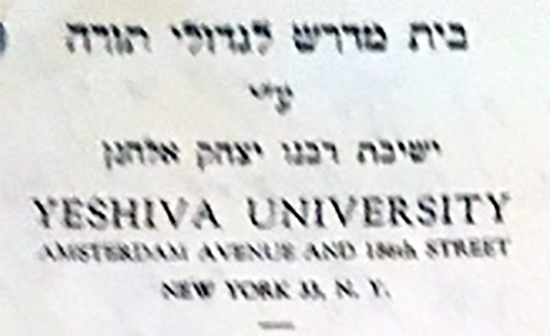
(Unfortunately, the picture I took is not so clear.) The Beit Midrash li-Gedolei Torah was the name of a kollel at YU in the 1940s and 1950s headed by R. Avigdor Cyperstein. I thank his daughter, Mrs. Naomi Gordon, for allowing me to go through his papers where I found the stationery with the name of the kollel. R. Gedaliah Dov Schwartz was actually a member of this kollel. See Ha-Pardes, Tevet 5751, p. 58 and Kislev 5752, p. 1. Today YU has a number of kollels, see here, but none with this name. Does anyone know when this kollel stopped functioning?

[6] Mi-Shibud li-Geulah mi-Pesah ad Shavuot (n.p., 1996), p. 87.
[7] See his Masa Dumah, p. 4.
[8] Iggerot Moshe, Yoreh Deah, vol. 1, nos. 4, 74. The first responsum mistakenly has the place of authorship as London, when it should say Luban. The city name appears correctly in the second responsum, which was written on the same day as the first. See here.
[9] See the Excursus where I discuss standing for Vayvarekh David.
[10] Saying Vayvarekh David is itself only a minhag. See Tur, Orah Hayyim 51:7:
ובתקון הגאונים כתוב יש נוהגים לומר ויברך דוד את ה’

[11] In Darkhei Moshe, Orah Hayyim 51 he writes:

המנהג עכשיו לעמוד מויברך דוד עד תפראתך
From his words we see that people only stood for the first half of Vayvarekh David.
[12] There is a lot of confusion as to how to pronounce the word ברכה in both the singular and plural construct: ברכת and ברכות. The first is pronounced birkat, as there is a dagesh in the כ. The second is pronounced birkhot, as there is no dagesh in the כ, and is parallel to the word הלכות – hilkhot. Interestingly, ברכתי (“my blessing”) does not have a dagesh in the כ even though ברכת does. I don’t think that there is any grammatical rule that can adequately explain all this. We know how the words related to ברכה are pronounced because they are attested to numerous times in Tanakh.

The word הלכות does not appear in Tanakh, and the Yemenite tradition is actually to pronounce it as hilkot, with a dagesh in the כ. See here. When not quoting from Tanakh, the Yemenite tradition is also to pronounce ברכת as birkhat, as in birkhat ha-mazon. See here.
[13] It is not only historians who say this. See R. Yitzhak Yeshaya Weiss, Birkat Elisha (Bnei Brak, 2016), vol. 3, p. 37, and see also R. Shimon Szimonowitz, Meor Eifatekha, p. 4, who cites R. Jacob Schorr and R. Serayah Deblitsky.
[14] A number of Ashkenazic rishonim quote a passage from the Jerusalem Talmud that speaks of a blessing on the Sabbath light, yet this is not found in any extant text and scholars agree that it is not an authentic Yerushalmi text. See the comprehensive discussion in R. Ratzon Arusi, “Birkat Hadlakat Ner shel Yom Tov,” Sinai 85 (1979), pp. 63ff. See also Jacob Z. Lauterbach, Rabbinic Essays (Cincinatti, 1951), p. 459 n. 98 and Sefer Ra’avyah, ed. Aptowitzer, vol. 1, p. 263 n. 10.
[15] See Teshuvot ha-Rav Kafih le-Talmido Tamir Ratzon, ed. Itamar Cohen (Kiryat Ono, 2016), pp. 162-163, and R. Kafih’s commentary to Mishneh Torah, Hilkhot Shabbat 5:1, n. 1.
[16] I use the word “candle”, rather than the plural, “candles”, as the practice of lighting two candles only originated later, in medieval Ashkenaz. See R. Gedaliah Oberlander, Minhag Avoteinu Be-Yadenu: Shabbat Kodesh (Monsey, 2010), pp. 11ff. I was surprised to learn that R. Meir Soloveitchik’s daughters each lit a Shabbat candle and recited the blessing from the time they were three years old. See Da-Haziteih le-Rabbi Meir, vol. 1, p. 323.
[17] In later years we find that some Karaites adopted the practice of lighting candles on Friday night. Se Dov Lipetz, “Ha-Karaim be-Lita,” in Yahadut Lita (Tel Aviv, 1959), vol. 1, p. 142
[18] Bayit Ne’eman 38 (25 Heshvan 5777), p. 3, Bayit Ne’eman 118 (10 Tamuz 5778), p. 2 n. 9. In She’elot u-Teshuvot Bayit Ne’eman, p. 190, he does not present this approach as absolute fact, but states that it is “nearly certain”.

וקרוב לודאי שברכת נר שבת נתקנה בימי הגאונים להוציא מדעת הקראים

[19] Otzar Kol Minhagei Yeshurun (St. Louis, 1917), p. 232.
[20] Dor Dor ve-Doreshav (Vilna, 1904), vol. 4, p. 97. Weiss points to other examples of practices that he suggests were a response to Karaites, such as counting the omer at night, betrothing a woman with a ring, and reciting רבי ישמעאל אומר in the morning prayers. R. Judah Leib Maimon claims that the practice of a Saturday night melaveh malka was instituted by the geonim in opposition to the Karaites, who saw the Sabbath as a difficult and depressing day, in contrast to traditional Jews who find it difficult to part with the Sabbath. See Sefer ha-Gra, ed. Maimon (Jerusalem, 1954), vol. 1, p. 80.
[21] Rabbinic Essays, p. 460. He writes that the blessing was “probably intended as a more emphatic protest against the Karaites.”
[22] “Berakhah Bilti Yeduah al Keriat Perek ‘Bameh Madlikin,’” Sinai 82 (1978), p. 217.
[23] Rabbinic Essays, p. 459. See also Yehudah Muriel, Iyunim ba-Mikra (Tel Aviv, 1960), vol. 2, p. 131.
[24] Commentary to Mishneh Torah, Hilkhot Shabbat 5:1, n. 1.
[25] Hikrei Lev (Satmar, 1908), vol. 4, p. 84.
[26] Ibid, pp. 84, 86ff.
[27] Shimon Yosef Meler, Uvdot ve-Hanhagot mi-Beit Brisk (Jerusalem, 2000), vol. 4, p. 310.


The Gaon’s Impact on the Interpretation of both Primary Sugyot in Zemanim

The Gaon’s Impact on the Interpretation of both Primary Sugyot in Zemanim

By William Gewirtz

Unquestionably, almost all iddushim in the understanding of the vast literature on zemanim have halakhic implications. My intent is not to influence what has become minhag Yisroel; my focus is on establishing more precise halakhic definitions and theoretical innovations in sugyot that are central to the study of zemanim. Competent poskim can implement any changes in halakhic practice, which they determine that these innovations support.[1]

Two areas dominate the study of zemanim:

  • How to determine precise delimiters for the day of the week, which concludes at the end of the period of bein ha-shemashot.[2]
  • How to calculate the hours of the daytime period, which according to all opinions begins at alot hashaar.

Interestingly, in both Hebrew and English, the words yom and day denote both the daytime period and the day of the week. Our focus is on:

  • the Gaon’s impact on the interpretation of two key aspects of Shabbat 34a-35b, which examines the transition between days of the week, and
  • a key aspect of the Gaon’s clarification of Pesaim 94a focused on the daytime period.

The approach to the above sugyot were radically changed by the Gaon’s observations.[3] However, only the impact on the former sugyah in Pesaim is usually recognized.

As I strongly indicated in a paper on errors in halakhic reasoning, I do not believe that attempts to deal with the critique of Rabbeinu Tam’s position by the Gaon have ever been fully effective. In this paper, however, the focus is not on the extensive halakhic literature written primarily in the period of the aaronim, but on the text of the gemara itself and its interpretation by rishonim. The conclusions reached are very different.[4]

The first two sections address areas in the gemara beginning on Shabbat 34a where a significant modification to an earlier reading of the gemara, often associated with rishonim aligned with Rabbeinu Tam, is strongly preferred, but only when assuming a slight modification to the presumed opinion of the geonim / Gaon.[5] In a similar vein we suggest a modification to how the bein hashemashot interval is to be used, something I believe to be independent of the positions of Rabbeinu Tam and the Gaon.

The third section addresses the Gaon’s innovative reading of the gemara in Pesaim 94a, a reading that is strongly supported by both elementary logic and astronomy. Included in the Gaon’s reading is a concept that was never made explicit in rabbinic literature prior to the Gaon, to the best of my knowledge. As will become clear, that observation forms the basis for the Gaon’s challenge to the opinion of Rabbeinu Tam.

My observations are not intended to be judged as controversial, although concluding a sugyah may not have been correctly understood (or at the very least properly explained) until the 18th century might be jarring.  It is beyond my focus or competence to deal with the implications of that observation; observations addressing that point would be welcomed.

Section 1: The endpoints of the period of bein ha-shemashot

The dispute between the geonim / Gaon and Rabbeinu Tam revolves around the placement of the interval of bein ha-shemashot, within the interval between sunset and tzait (kol) ha-kokhavim, whose length is (almost always) assumed to be the time needed to walk 4 milin.[6] The length of the bein ha-shemashot period is universally assumed to be the time needed to walk ¾ of a mil. It is normally assumed that

  • the opinion of the geonim / Gaon places the bein ha-shemashot period at the start of that interval, while
  • Rabbeinu Tam places it at its end.

Those two alternatives represent opposite extremes.  Two adjustments seem reasonable.

  • First, separate the dispute between the geonim / Gaon and Rabbeinu Tam into two distinct components:
    • The first concerns the beginning and the second the end of the bein ha-shemashot period, subject to a constraint that the length of the bein ha-shemashot interval must equal the time to walk ¾ of a mil.
  • Second, assume that there are multiple hybrid / intermediate positions, situated between the two generally assumed alternatives.[7]

This allows for

  • an interpretation of the gemara in Shabbat similar (or according to some identical) to the overwhelmingly compelling position of the geonim / Gaon relative to the end of the bein ha-shemashot period,
  • while defining the beginning of the bein ha-shemashot period using the textual approaches of many rishonim, albeit employing a significantly earlier point in time, much closer to sunset.

While I have not seen this conceptualization explicitly formulated[8] in the classic halakhic literature, practice and several pragmatic opinions are supportive of this approach.  More importantly, the challenges raised to the opinions of both Rabbeinu Tam and the Gaon are, without exception, directed at the late ending of the Shabbat according to the opinion of Rabbeinu Tam and at the early beginning of the Shabbat according to the opinion of the Gaon.[9] This approach sidesteps the challenges to both opinions. Additionally, this approach absolutely disputes the view that

  • Anyone who rejects the start of Shabbat precisely at or even a few minutes after sunset must embrace the approach of Rabbeinu Tam,

an assumption that does not follow logically, though it is occasionally found in the halakhic literature.[10]

There are numerous arguments in support for this position. We cite several of the strongest:

  1. The term mi-she-tishkeh ha-amah: Ramban in Torat Ha-Adam[11] and the many akhemai sforad who adopted his position stress that the meaning of the term mi-she-tishkehha-amah unquestionably implies not sunset but a point after A simpler phrase shikiat haamah would denote precisely sunset. Of course, mi-she-tishkehha-amah does not imply any specific time but only that the time follows sunset by some number of minutes. The only change required is to assume that mi-she-tishkeh ha-amah is referring to a point much closer to sunset, something that appears more reasonable than a point over 50 minutes later according to the (theoretical) view of Rabbeinu Tam. In other respects, the gemara is read like the numerous rishonim who assumed that mi-she-tishkeh ha-amah cannot refer to sunset proper.
  2. Tosefet Shabbat:[12] Ramban argues that tosefet Shabbat could only begin after sunset during an interval that is still a part of the daytime period. Ramban does not consider tosefet Shabbat prior to sunset as meaningful, equating it to the value of illumination from a candle during daylight.
  3. The sugyah in Shabbat applies year-round, not only during a specific season or seasons: The gemara in Pesaim 94a, which equates the time needed to walk 40 milin with the daytime period, must assume an average day around either the spring or the fall equinox. In the Middle East, during a winter day of approximately 10 hours or a summer day of approximately 14 hours, the distance covered in one day would vary considerably. However, unlike the gemara in Pesaim 94a that can only apply to a 12-hour daytime period, the gemara in Shabbat, defines the end of Shabbat using terms like ashekhah, hisif ha-elyon ve-hishveh le-taton and the appearance of three stars, all of which apply (nearly) uniformly throughout the year.[13]

At both the fall and spring equinox, the sun appears in the same place over the equator and you might expect Shabbat to begin and end at the identical time.  Certainly, regardless of how one measures darkness, it is equivalently dark any number of minutes after sunset at those two times.  However, in Jerusalem and other parts of the Middle East, unrelated to the degree of darkness, stars first appear a number of minutes later (after sunset) in the fall than they do in the spring.[14]Advantaged by the early appearance of Sirius and Canopus in the spring but not the fall, the Gaon restricts the focus of the gemara to the spring only.

Note that:

  1. All rishonim who choose to comment on the sugyah in Pesaim 94a state that the day in question occurs only around the spring (or fall) equinox.
  2. Not a single rishon makes an analogous comment, restricting the gemara beginning on Shabbat 34b to any specific time of year.
  1. Shmuel’s unchallenged statement:[15]With Prof. Levi’s table (provided in the appendix) as background, examine Shmuel’s unchallenged statement on Shabbat 35a, according to the position of the geonim / Gaon.[16] After discussing the appearance of the horizon and the length of the bein ha-shemashot period, the gemara states the opinion of R. Yehudah in the name of Shmuel who asserts: “one star – daytime, two stars – bein ha-shemashot, and three stars – night.”[17] This is followed by the opinion of Yosi (bar Adin) asserting that the stars in question are neither stars that appear in the day (i. e., large stars[18] or planets) nor small stars that only appear well after the time of tzait ha-kokhavim, but medium stars. How might Shmuel’s statement be reconciled with the previous discussion in the gemara?
  • First, exclude the implausible suggestion that R. Yosi bar Adin’s assertion that Shmuel’s statement is referring to medium stars applies only to the third part (or second and third parts) of the text. Under this interpretation, the first part of Shmuel’s statement concerning one star, includes not only medium stars but also large stars or planets that are on occasion visible before sunset.  Were that the case, the statement would be informing us that the appearance of a planet before sunset does not indicate that the bein ha-shemashot period has begun. In addition to being forced to argue that the different parts of Shmuel’s statement refer to different types of stars, such an assertion would hardly be necessary; the gemara gives no hint that the bein ha-shemashot period begins before sunset.[19]
  • Second, because R. Yosef begins bein ha-shemashot at the time walk 1/12th of a mil later than R. Yehudah, some[20] align Shmuel’s statement and even pasken like R. Yosef, assuming that R. Yehudah start to bein ha-shemashot precisely at sunset, cannot be reconciled with Shmuel’s statement. Prof. Levi’s chart challenges that approach, since a delay of at most 2 minutes[21] (after sunset) provides no benefit; the first medium star cannot be seen until at least 6 minutes after sunset.
  • Third, there are other (implausible) solutions that align Shmuel with Rabi Yosi only, some going so far as identifying the amora Yosi (bar Adin) as the tanna Rabi Yosi. To follow a sugyah focused on Rabi Yehudah, with an uncontested statement that accords only with Rabi Yosi is dubious, at best. Furthermore, Shmuel’s statement, which refers to the non-instantaneous, successive appearance of stars, is difficult to align with an opinion that the bein ha-shemashot interval is instantaneous.

The most plausible suggestion, like the view of R. Ḥaim Volozhin below, is that the bein hashemashot begins at least 6 minutes after sunset.[22]

  1. Seeing stars so early (even if only in the spring) is practically impossible:

If the start of the period of bein ha-shemashot for the geonim / Gaon is precisely sunset, there has been considerable effort[23] to align the appearance of three stars within the time it takes to walk ¾ of a mil after sunset. The only solution provided is to assume that the time needed to walk ¾ of a mil applies only around the spring equinox[24] [25] and, even then, to make yet further assumptions to arrive at so short an interval.  Particularly if the time needed to walk ¾ of a mil is 13.5 minutes and even if it is a bit under 17 minutes, three stars can rarely be seen so soon after sunset and then

  • only with great difficulty,
  • by experts, perhaps aided by telescopes, and
  • in a pristine environment absent urban sources of light, like the Judean desert.

Under no circumstances, is 13.5 minutes possible, and 16.85 minutes is almost equally unreasonable.[26]

  1. Multiple opinions that begin bein ha-shemashot slightly after sunset:
  • 4 to 5 minutes: The minimum time reported as the custom of Jerusalem[27] as well as the opinion of R. Shneur Zalman of Liadi,[28] the point when the sun is no longer visible even from the highest elevations around Jerusalem.[29]
  • Greater than 6 minutes: The opinion of R. Ḥaim Volozhin based on Shmuel’s statement concerning the appearance of a single star that is visible in the spring to an expert observer at that time.[30] The fact that R. Ḥaim Volozhin disagrees with his Rebbe, strongly suggests that the Gaon’s position that Shabbat starts at precisely sunset was only promulgated le’migdar miltah.
  • 7 to 15 minutes: These views are supported by a variety of sources mentioned previously including R. Kapach’s view of Rambam and R. Posen’s view of the opinion of the geonim. A time around 10 minutes is implied by many Sephardi poskim who mention that until the call of the Moslem mugrab for their fourth prayer service, it is still day thus allowing for the performance of a brit on that day for a baby born in those few minutes after sunset on that same day one week earlier.

When linked to the times given in Prof. Levi’s charts, various alternatives from 6 – 16 minutes after sunset can be plausibly suggested.  The next section on how the bein hashemashot interval was intended to be used will shed further light in determining how many minutes after sunset might still be considered daytime.

Section 2.  Before or after

One aspect of the Gaon’s interpretation of Shabbat 34b, often assumed without further examination, is that bein hashemashot is calculated by adding its length to the beginning of the beginning of bein hashemashot period.  That assumption will now be challenged.  Though not conclusive as to how the sugyah should be read, some seforim of near contemporaries[31] of the Gaon assume the opposite approach, subtracting the length of the bein hashemashot interval from the end of Shabbat. The arguments below attempt to demonstrate that this approach may have been standard before the writings of the Gaon proliferated years later in the middle of the 19th century.[32] While some may argue that counting forward from sunset versus backward from nightfall is somehow tied to the fundamental makhloket of the geonim / Gaon and Rabbeinu Tam, there does not appear to be any logical, textual or halakhic basis for such an assertion.

The fundamental question is:

What possible value could there be in introducing (especially in an era before clocks) a time-based approximation that is a lower bound, season dependent, rarely applicable, and then only under rare, idealized conditions, at best? In what context would such information be useful?

Thus, I propose that the time needed to walk ¾ of a mil should be interpreted differently than the Gaon proposed and instead we will attempt to demonstrate that

  • The time to walk ¾ of a mil is to be subtracted from the end of the bein ha-shemashot period as opposed to being added to its beginning.
  • The period is not a minimum (that occurs only around the spring equinox), but a maximum (that occurs around the summer solstice). Thus, the entire sugyah is applicable year-round providing a conservative upper-bound to the length of the bein ha-shemashot

The arguments for both assertions are interrelated and are presented concurrently.[33]

  1. The gemara in Shabbat is primarily focused on Friday night and determining when the bein ha-shemashot period begins, as opposed to when it ends. The gemara assumes that the end to the period of bein ha-shemashot is known; each of the disputants are addressing when the period of bein ha-shemashot begins on Friday night. However, if the time needed to walk ¾ of a mil were meant to be added to the time of sunset, it would be addressing the end of the bein ha-shemashot period and not the beginning.
  2. The three fractions (each expressed as the time needed to walk a part (1/2, 2/3 and ¾) of a mil,) given as alternatives for the length of the period of bein ha-shemashot would then all have identical semantics; each of the three fractions (of the time to walk a mil) is counting back from the assumed point of ashekhah, to calculate the beginning of the bein ha-shemashot Given Prof. Levi’s chart, under no circumstances could anyone imagine that the time to walk either ½ of a mil after sunset could be the point at which Shabbat ends. The amoraim, R. Yehudah and R. Yosi, are quantifying the opinion of Rabi Yehudah in contrast to Rabi Nehemiah’s interval, whose period of bein ha-shemashot is only the time needed to walk ½ of a mil.
  3. If someone were countering the position of Rabi Yosi, who says the period of bein ha-shemashot is instantaneous, it is more likely that he would say that it can be “as long as” opposed to “as short
  4. The significant issue raised previously of never seeing stars as early as at the time needed to walk ¾ of a mil after sunset becomes entirely moot.
  5. The period of bein ha-shemashot has some practical consequence providing a potentially useable, conservative upper bound as opposed to a purely theoretical lower bound, which is of limited to no use.
  1. As noted earlier, rishonim, who limit the gemara in Pesaim to the equinox periods in the fall and spring, make no such assertion with respect to the gemara in Shabbat. One might presume from the lack of commentary that rishonim assumed that the sugyah applies year-round.

Treating the gemara in Shabbat like the gemara in Pesaim as referring only to days around the spring (but not the fall) equinox[34] is unnecessary when thinking of the interval as a practical upper bound.  All the other descriptions in the gemara, either the appearance of the sky / horizon or the visibility of three stars, apply year-round.

Now examine the three elements in combination:

  • The various opinions of rishonim on the time to walk ¾ of a mil – 13.5, 16.85 and 18 minutes.
  • Levi’s chart indicating that 3 stars are visible to a careful observer 30[35] minutes after sunset in the summer.
  • The two suggested interpretations that
  • delay the beginning of bein hashemashot to a point slightly after sunset, and
  • view the sugyah as subtracting the length of bein hashemashot from its end to find its beginning.

We can then assume that Shabbat begins from 12 (subtracting 18 from 30) to 16.5 (subtracting 13.5 from 30) minutes after sunset.[36]  However, given

  • very natural and expected stringency that occurs even today but certainly are to expected in an era before (widely available and accurate) clocks, and
  • the need for tosefet Shabbat

practiced times for starting Shabbat between 5 and 10 minutes after sunset ought not be surprising.

Section 3. The Gaon’s approach to Pesaim 94a.

The Gaon’s approach to Pesaim 94a is premised on an incontrovertible astronomic and logical fact. Assuming that alot hashaar approximates the first light of the day, then its evening counterpart, tzait ha-kokhavim, must occur when the sun’s illumination has (next to) no remaining effect.[37]  At both of those times, all stars that are in position to be seen are not obscured by illumination from the sun. As a result, the Gaon adds the word kol to differentiate tzait ha-kokhavim, which throughout the Talmudic literature refers to the appearance of 3 stars, from tzait kol ha-kokhavim, the appearance of “all the (potentially visible) stars.” Of course, this point demolishes[38] Rabbeinu Tam’s interpretation that is predicated on the assumption that the meaning of the term tzait ha-kokhavim occurring in both Pesaim 94a and Shabbat 35a is the same. Slightly reformulated the Gaon asks how could the time of the appearance of only three stars and the time of alot hashaar, when (almost) all the stars are still visible, be separated by intervals of identical length from sunset and sunrise respectively?  The pre-dawn counter point to the time after sunset when (only) three stars are first visible cannot be alot hashaar when (almost) all stars are still visible.[39]

This iddush is not unexpected, even though the gemara in Pesaim is the primary sugyah used throughout halakhic history to provide a source for determining the time of alot hashaar.  Despite that halakhic application, the sugyah is focused primarily on geography and astronomy. Thus, harmonious use of the term tzait ha-kokhavim with its use elsewhere in Talmudic literature, which Rabbeinu Tam assumed, need not be presumed.

Since the notion of tzait kol ha-kokhavim is new, it is also not surprising that the Gaon did not specify, to the best of my knowledge, any halakhic uses for the notion of tzait kol ha-kokhavim. Of course, those who followed Rabbeinu Tam’s position had no reason to even consider a point in the evening after tzait ha-kokhavim.

However, that changed with the arrival of what we colloquially call the Brisker methodology. Talmudists of that school have produced potential halakhic implications. For example, it is not difficult to differentiate between:

  • halakhot tied to a specific day or those that are to be performed every day,
  • from those that have no connection to any specific day but are restricted to being performed only during the daytime period.

Presumably, the construction of the Beit HaMikdash is a straightforward example. While there is a daytime requirement,[40] there is no constraint on which day of the week that construction should take place. Another example, which does not comport with the above iluk, has been proposed by R. Moshe Soloveitchik. He suggested the use of tzait kol ha-kokhavim as a delimiter for tosefet Shabbat according to those following the Gaon.  While Shabbat ends at the time of tzait ha-kokhavim, R. Soloveitchik proposed that tosefet Shabbat is meaningful only until tzait kol ha-kokhavim.

While these examples[41] are noteworthy, the lomdus of a yartzeit shiur by R. Joseph Soloveitchik was astonishing. Effectively, but not explicitly, R. Soloveitchik disregarded both historic interpretation and practice when he transformed Rabbeinu Tam into an early supporter of the notion of tzait kol ha-kokhavim.[42]  As presented in that shiur, though expressed slightly differently, the dispute between the Gaon and Rabbeinu Tam revolves around whether Shabbat ends at tzait ha-kokhavim or tzait kol ha-kokhavim.[43]

In R. Soloveitchik’s formulation, the Gaon defined a critical point along a continuum beginning at the point of sunset, when there is almost complete exposure to the sun’s illumination, and ending at the point of tzait kol ha-kokhavim when no noticeable impact from the sun’s illumination can still be detected. That critical point occurs roughly when 3 medium stars first become visible and marks the transition point between days of the week according to the geonim / Gaon.  Rabbeinu Tam, however, according to R. Soloveitchik’s formulation, defined the transition between days of the week at the point when the sun’s impact has ended entirely, a point corresponding to the end of the continuum, at tzait kol ha-kokhavim.[44]

A possible approach that R. Soloveitchik did not employ is that the Gaon and Rabbeinu Tam decided differently based on two conflicting sugyot in Shabbat and Pesaim, respectively. Of course, that would be at variance with Rabbeinu Tam’s normal methodology for resolving conflicting sugyot.  Rabbeinu Tam tends to distinguish between sugyot, something he does explicitly with respect to these sugyot, as opposed to declaring sugyot in conflict and deciding between them. The principal motivation for even raising such a possibility is R. Soloveitchik’s complete avoidance of any mention of the challenges to Rabbeinu Tam’s position from the sugyah in Shabbat. This leads me to wonder if in R. Soloveitchik’s ahistorical reformulation of Rabbeinu Tam, and for reasons entirely unstated, R. Soloveitchik gave the sugyah in Pesaim prominence and preference over the sugyah in Shabbat according to Rabbeinu Tam.

Conclusions:

It is not at all usual to treat a ruling of the Gaon as le’migdar miltah.  However, three things increase my confidence that I am correct in this instance.

  1. The reality as described in the epistle of the Ba’al ha’Tanya referenced earlier, who lived at the same time and in the same general area, clearly describes people working beyond 30 minutes after sunset, something that the Gaon would be motivated to prevent as resolutely as possible.
  2. The opinion of R. Ḥaim Volozhin, in open disagreement with the Gaon’s stated position, demands a reconciliation of views.
  3. The textual arguments made by rishonim, the halakhic writings and positions of noted aaronim, and the various arguments that I have formulated appear convincing.

What should be noted is the Gaon’s interesting ability to impact not just pesak, but the way we (perhaps even unconsciously) approach the study of sugyot.

Appendix


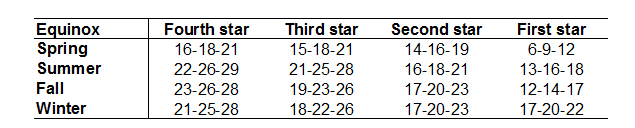
Prof. Levi’s Table

The three times listed in each cell of the table correspond to how difficult it is to see a star.

  • The shortest time noted is when an expert who knows exactly where to look can observe a star.
  • The intermediate time noted is when a star can be seen with great difficulty.
  • The third time noted is when a careful observer can see a star.

The time when stars are visible to a casual observer, is yet later.

[1] My assumption is that poskim may find the innovations useful in exceptional situations as opposed to more typical ones.
[2] According to the vast majority of rishonim, the day ends when bein ha-shemashot ends or at most 2 minutes later.
[3] Familiarity with both sugyot is assumed to fully assess this essay.
[4] See my article in Hakirah spring 2019 for more detail on the Gaon’s convincing attack on Rabbeinu Tam’s position.
[5] A version of that reading is presented in Ohr Meir as the opinion of the geonim, who R. Posen seeks to demonstrate conflict with that of the Gaon.  What the Gaon felt mei ikar ha’din can be disputed as will be illustrated.  Even if one were to reject any variation of the Gaon’s stated position, this paper can also be considered to apply to the less specific view of the geonim.
[6] Both 72 or 90 minutes are increasingly assumed to apply only in the Middle East around both equinoxes and require adjustment (using depression angles) to account for variation by season and latitude.
[7] These positions are more properly characterized as variants of the position of the geonim / Gaon as they are all much closer to their normally assumed period of bein ha-shemashot.
[8] Throughout R. Kapach’s commentary on Mishnah Torah, however, he asserts that this is the position of Rambam. See R. Posen’s view as well, mentioned in footnote 5.
[9] This seminal point was made explicitly by R. Chaim Sonnenfeld in teshuvah 33 (an approbation to a sefer on zemanim) in a recently published volume of his teshuvot.  His reaction, as might be expected, was to be mamir, and fulfill the stringencies of both opinions. I argue that the strengths of both opinions lead to the opposite and more probable conceptual position, adopting the leniencies of both positions.
[10] See Vol. 2 of HaZemanim BeHalakha by R. Ḥaim Benish, page 360, especially footnote 58.
[11] Pages 251 – 252, Chavel edition, Mossad Ha-Rav Kook.
[12] This argument is included due to its ancient provenance; it is easily challenged given that it is normally assumed that tosefet Shabbat can begin at plag ha’minah, which precedes sunset.
[13] Note as well, that the gemara in Pesaim 94a applies to

  • a day of average length,
  • which occurs around both the spring and fall equinox.

However, the days that would be referred to in Shabbat 34b would be

  • a minimum, as opposed to an average, and
  • restricted to those days when the appearance of three stars occurs within the time needed to walk ¾ of a mil after sunset. For astronomic reasons such days occur only in the spring and not in the fall.

While neither of these two differences is itself convincing, both lend further support to the thesis developed.
[14] See the chart by Prof. Levi provided in the attachment.
[15] A more extensive analysis of Shmuel’s statement will appear in a future issue of the Torah u’Maddah journal.
[16] This section assumes detailed familiarity with the sugyah on Shabbat 34b-35b.
[17] Prepositions have been omitted from the statement in order not to bias the semantics.
[18] Large stars are defined as kokhavei lekhet, moving stars, currently called planets. Other approaches to dividing stars into categories are much less likely and not considered.
[19] The isolated opinion of R. Eliezer mi’Mitz, who begins the bein ha-shemashot period before sunset, is difficult to reconcile with Shmuel’s statement, in any case.
[20] See the last two paragraphs on page 358 and especially footnote 50 in Vol. 2 of HaZemanim BeHalakha.
[21] The time to walk 1/12 of a mil is between 1.5 and 2 minutes.
[22] While normally I would assume Prof. Levi’s third entry matches Shmuel’s assertion, since this statement might mean seeing a star does not mean bein ha-shemashot has necessarily begun, it might mean just an accidental sighting, which may occur at the earliest time possible when normally only an expert, knowing exactly where to look, can locate a star.
[23] R. Benish, R. Willig, Prof. Levi among many others struggle with this issue.
[24] In the spring Sirius and Canopus can both be seen around 15 minutes after sunset.
[25] Having seen no earlier discussion of this issue anywhere in the halakhic literature, I believe this interpretation originated with the Gaon in O. . 261. The alternative under discussion, delaying the start of bein ha-shemashot by some small number of minutes after sunset, eliminating the hypothesis that bein ha-shemashot begins precisely at sunset, which leads to such questions.
[26] Perhaps one can assume some worsening of atmospheric conditions, as a result of pollution, slightly decreasing visibility.  I spoke with a chemist in my synagogue, Dr. Irwin Goldblatt, who verified this as a possibility.  I have no basis to determine how accurate this observation might be, but it is hard to imagine that it is consequential.
[27] See Minhagei Eretz Yisrael by R. Gliss, pages 102 and 282.
[28] Seder Hakhnosat Shabbat, found towards the end of every abad siddur, specifies 4 minutes. He reverses the position he took in Shulan Arukh HaRav, which supported Rabbeinu Tam.
[29]See Zemanim Ke’hilkhatam by R. Boorstyn, chapter 2, section 3, where he summarizes different 19th and 20th century posekim in the Middle East who supported times beyond 4 to 5 minutes and up to approximately 10 minutes after sunset.  The rationale he and many of these posekim used is varied often relying on the notion of sea level and / or visibility from higher elevations, a topic of continued debate.
[30] See the addition to Maaseh Rav section 19.  Six minutes is expressed as 1/10th of an hour to be applied in both the morning and evening, although Shmuel’s assertion of “one star – daytime” is given as the reason for the slight delay after sunset. How R. aim Volozhin determined this precise time that equals the time at which an expert can see Sirius remains a mystery.
[31] R. Adler, R. Loerberbaum, and R. Sofer all subtract the length of the bein hashemashot interval from the end of Shabbat, see my article, Zemannim: On the Introduction of New Concepts in Halakhah, in the TuMJ 2013.
[32] It goes without saying that the instantaneous communication that characterizes of our current environment cannot be anachronistically assumed in a prior period. This impacts the assumptions made about when some of these sources are read / known, a topic not pursued further.
[33] A set of arguments based on the statement of Shmuel about 1, 2 and 3 stars are not included and will be incorporated in a future paper examining both Shmuel statement and Rambam in multiple sections of Mishnah Torah, based on their mastery of astronomy as it was known in their times.
[34] First suggested by the Gaon in O. . 261, this approach is widely assumed in recent halakhic literature. Note that the gemara in Pesaim assumes an average day, which occurs in both the spring and fall around the equinox.  However, the Gaon’s argument assumes, not an average interval, but a minimum interval and one that occurs only in the spring, but not in the fall; stars are not visible as early in the fall as in the spring.  On the other hand, as suggested, a maximum would apply year-round.
[35] Prof. Levi uses a depression angle normalization to spring, which we will not explain.  His use of 28 is in fact closer to 30 minutes, as normally defined by clock-time.
[36] 12 – 13 minutes is consistent with the many rishonim supporting a time to walk a mil of 22.5 minutes.
[37] There is no reason to debate whether the underlying science favors either of the two most common halakhic definitions, which sandwich current technology’s identification of the point at which the first light of the sun is visible. Expressed as depression angles the 72- and 90-minute intervals equate to depression angles of approximately 16 and 20 degrees, respectively. With the best available equipment, light from the sun can be observed at a depression angle of approximately 18 degrees. One can then argue that 16 degrees is when the amount of light is visible to humans, while 20 degrees is when one arises in anticipation of emerging light. Both are reasonable positions for defining alot hashaar.
[38] So strong a word is intentional given the “bombe” kasha of the Gaon; see immediately below.
[39] R. Moshe Sofer might be trying to deal with this point about a symmetric point to the appearance of three stars in his commentary on Shabbat 34.
[40] See Rambam, Hilkhot Beit Ha’Beirah (1:12). Rambam’s formulation is originally stated in the negative, which raises possible questions that might be analyzed in this context.
[41] Other possible examples include the operation of a beit din, the laws of aveilut, particularly the first day, etc.
[42] The philosophical underpinnings that would enable such ahistorical iddushim is beyond the scope of this article. Despite an accusation of partiality, one cannot dismiss the assumption that R. Soloveitchik was aware of the various challenges to his iddush. Despite bringing support from the period of the rishonim, I believe the Rav was establishing what he knew to be a restatement of Rabbeinu Tam’s position, based on the undeniable accuracy and correctness of the Gaon’s notion of tzait kol ha-kokhavim. In my own mind, I have played out a long and imagined conversation with R. Soloveitchik on this subject.
[43] For any number of reasons, it is difficult to imagine the perspective presented was that of Rabbeinu Tam. Rather, it might represent Rabbeinu Tam’s position updated and enhanced by what is now known scientifically.
[44] What I also do not understand is why R. Soloveitchik referred to the mathematical notion of continuity as opposed to any astronomical knowledge, which I think would have been more relevant.


Abraham Menahem ben Jacob ha-Kohen Rapa mi-Porto (Rapaport) Ashkenazi: A Renaissance Rabbi of Interest

Abraham Menahem ben Jacob ha-Kohen Rapa mi-Porto (Rapaport) Ashkenazi: A Renaissance Rabbi of Interest[1]

by Marvin J. Heller

R. Abraham Menahem ben Jacob ha-Kohen Rapa mi-Porto (Rapaport) is a sixteenth century rabbi of particular interest. An intriguing, eclectic, and erudite figure, his life encompasses events that effected mid-century Jewry, recorded in his work. His books, two only published, are varied and unusual, one due to its subject matter, cryptography, the other a response to the banning of the Talmud and, as a result, turning from study of that work to Kabballah. His Minhah Belulah attempting a returning to more traditional studies by providing a Torah commentary based on Midrashim.

“From His right hand He presented the fiery Torah to them” (Deuteronomy 33:2). “The Torah is compared to fire, when a man comes too close, he is burned, when too distant he is cold, so too the Torah . . . this also alludes to the great destruction our eyes have witnessed, due to our many iniquities” (Minhah Belulah on Deuteronomy 33:2)

R. Abraham Menahem ben Jacob ha-Kohen Rapa mi-Porto (Rapaport, 1520 – 1596) Ashkenazi is an intriguing, eclectic, erudite figure. He is primarily remembered today for his Minhah Belulah, a commentary on the Torah based on Midrashim and his remarks in that work on the burning of the Talmud in 1553.[2] The Minhah Belulah, certainly worthy of our consideration, eclipses Abraham Menahem’s other accomplishments, which are multifaceted and also deserving of attention. This article addresses the Minhah Belulah but is also intended to draw attention to R. Abraham Menahem’s other books and activities.

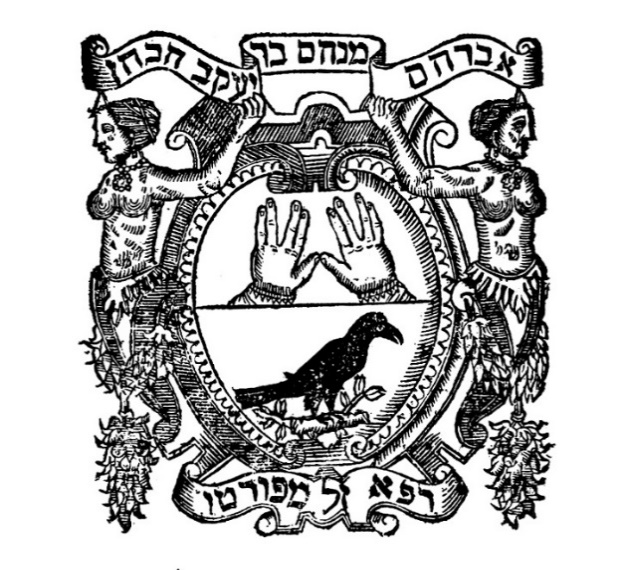
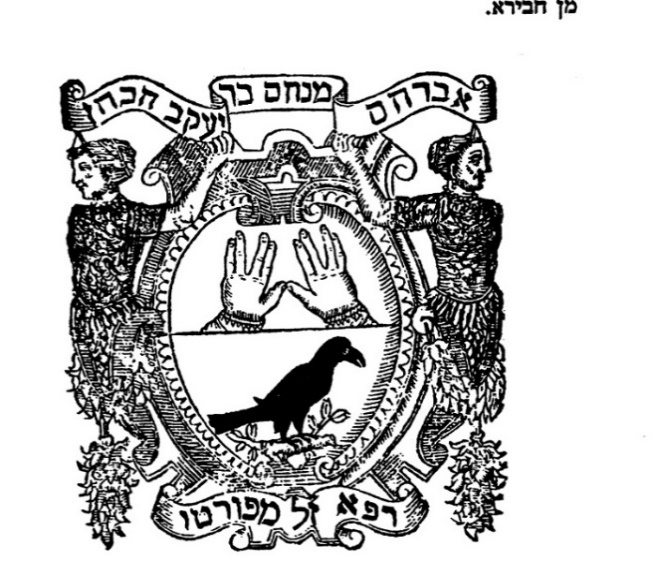
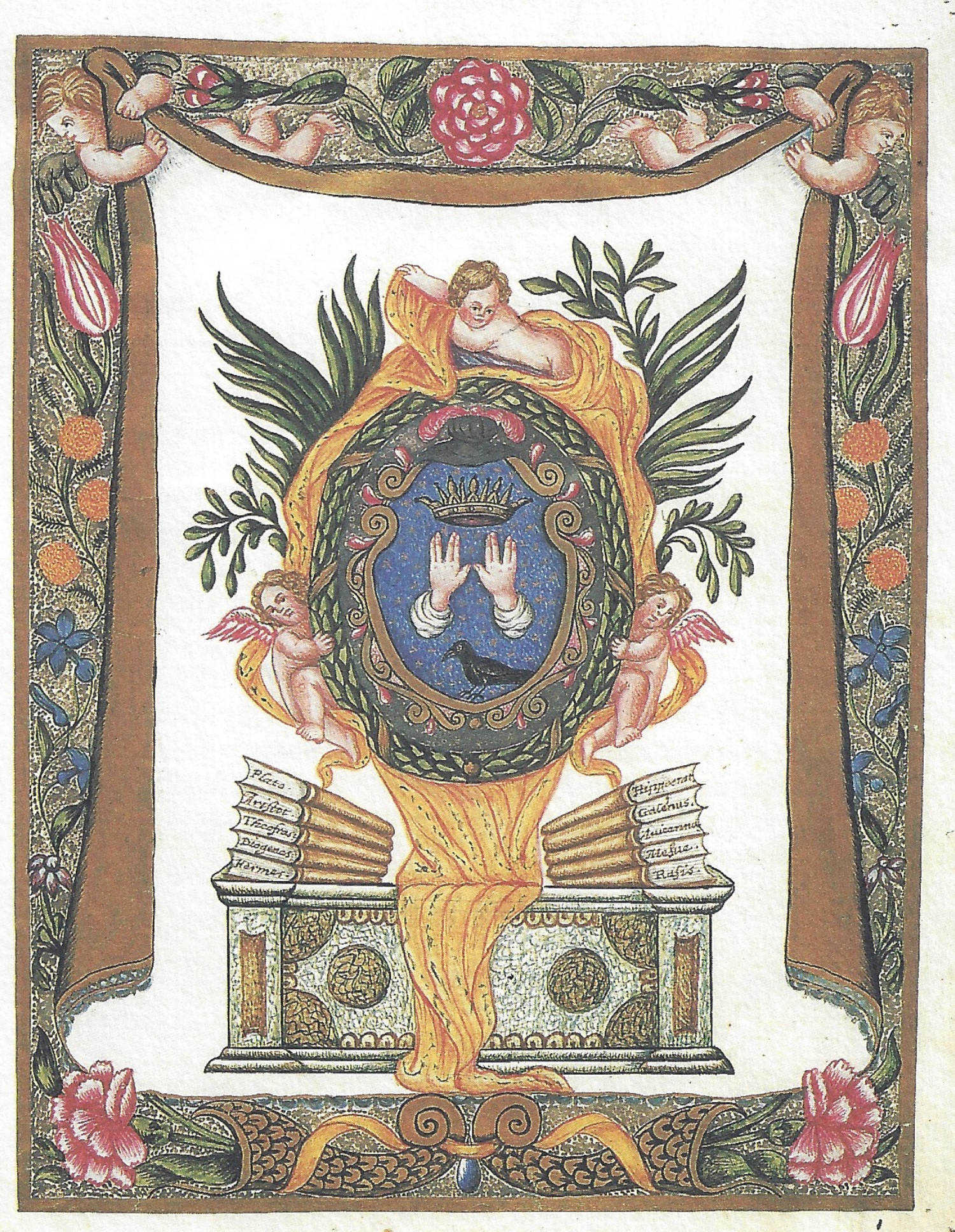
A member of the Porto family which came to Italy from Lublin, Abraham Menahem was born in Porto in the vicinity of Verona. The family name Rapa stems from the German (Rappe in Middle High German), for raven. Rappoport is a combination of the Rapa, with Porto, done to distinguish this branch of the family from other Rapa branches, a fact alluded to in the introduction to the Minhah Belulah. At a young age Abraham Menahem went to Venice where he studied secular as well as rabbinic subjects, particularly medicine; his wide scholarship being evident from his works, particularly his Torah commentary, Minhah Belulah (Verona, 1594).

His teachers included R. Elijah Levita (Bahur, c. 1468-1549) the renowned Hebrew philologist and Vittore (Victor) Trincavella (1496-1568) with whom he studied medicine, this in addition to his traditional Talmudic studies.[3] Subsequently, prior to accepting a rabbinic position, Abraham Menahem worked in Venice as a proofreader and editor for the Bragadin press; many of the books he edited have introductions or verse from him. Among the books that he worked on was Maimonides’ (Rambam) Mishnah Torah, that resulted in the controversy leading to the burning of the Talmud.[4] He would subsequently serve as rabbi in Cremona and Verona.[5] In the latter, where he officiated from 1584 to 1592, Abraham Menahem also headed a highly regarded yeshiva.

In addition to the Minhah Belulah, Abraham Menahem wrote and/or is credited with several other works, most still in manuscript, among them commentaries on several books of the Bible and Avot. I. T. Eisenstadt and S. Wiener ascribe another Torah commentary to Abraham Menahem, Soles Belulah, but there is no record of any such work by him. Soles Belulah is also noted, most briefly, by R. Hayyim Joseph David Azulai (Hida, 1724-1806).[6] Moritz Steinschneider (1816-1907) also refers to such a book, the entry in his catalogue of the Bodleian Library stating: “excerpta in Bibliis Rabb,” dating it (1724-27). Steinschneider also references other bibliographies where it is mentioned.[7] Ma’amar’al Mezi’ut ha-Shedim, unpublished, on the existence of devils, is also credited to Abraham Menahem by several bibliographers, among them Eisenstadt and S. Wiener and Israel Zinberg, the latter writing that “A special work about spirits and evil ones was written by the well-known Menahem Kohen Porto” but without specifying the title of the work.[8] In addition to these books, Abraham Menahem wrote responsa, unpublished excepting one entitled Dagim, printed in R. Isaac Hezkiah ben Samuel Lampronti’s (1679-1756) Paḥad Yitzhak.[9] Another responsum credited to Abraham Menahem concerns the wearing of tefillin during hol ha-Moed, reported as being in Teshuvot R. Abraham Menahem Porto ha-Kohen, sect. 163.[10]

Abraham Menahem was among those who prohibited reading the Me’or Einayim (Mantua, 1573) of Azariah de Rossi (c. 1511 – c. 1578). Me’or Einayim (Enlightenment of the eyes) was the most controversial Hebrew book of the sixteenth century. A series of historical essays, de Rossi was motivated to write it by an earthquake that began on November 18, 1571, in Ferrara, destroying his residence, much of the city, but not its ten synagogues, with 200 people perishing in one night. In Me’or Einayim, de Rossi describes the earthquake, and addresses classical and scientific reasons for the disaster. A conversation with a Christian resulted in Azariah translating the Apocryphal, Letter of Aristeas, into Hebrew (Hadrat Zekenim), and in the third part of Me’or Einayim attention is directed to Philo, and other Jewish authors no longer widely read, asserting that the former utilized the Greek Septuagint rather than the Hebrew Bible. De Rossi suggests that Midrashic literature should not be understood literally and questions Talmudic chronology. The resulting herem (ban), stated that “no person of any congregation . . . may have this composition in their possession, either in whole or in part, or study it, unless each individual shall have first obtained permission in writing from the sages of their city.”[11]

Abraham Menahem, despite not having actually seen the Me’or Einayim, not only presented the herem to his congregation but, in a sermon, admonished them to not be led astray by a heretical book that, in contrast to its name, Me’or Einayim, actually “darkens the sight and undermines the foundations of Judaism.” Furthermore, in a letter to R. Menahem de Fano, Abraham Menahem indicates that although he has not yet seen Me’or Einayim he is aware from personal conversations with de Rossi that de Rossi “rejects the Jewish mode of reckoning time.”[12] Subsequently, however, after R. David Provencal and R. Judah Moscato, both rabbis in Mantua, permitted Me’or Einayim to be read, Abraham Menahem retracted his position.[13] Abraham Menahem also signed takkanot (prohibitions) forbidding gambling (1573) and infringing on moneylending franchises held by fellow Jews.[14]

As noted above, the earliest published work, attributed to Abraham Menahem in bibliographies and Encyclopedias, with the exception of Eisenstadt, who attributes it to another Menahem, is Zafenat Pane’ah on cryptography, with a cipher-code of his own invention. Steischneider described Zafenat Pane’ah as “Revelator arcanorum De Cryptographia {w31433. Rof. Diz., lib. Stmp. P60. 8. en. 1556. 4289:3.[15]

Abraham Menahem spent two years preparing Zafenat Pane’ah. In the absence of the place of publication, locations such as Venice (Steinschneider), Ferrara (BenJacob), and Sabbioneta (Sonne) have been suggested. Avraham Yaari, following Sonne, records Zafenat Pane’ah as a Sabbioneta imprint, including it among the books published by the Foa press in that location.[16] The National Library of Israel records Zafenat Pane’ah, giving the location as Sabbioneta but also notes Riva as a possible place of publication.[17] Zafenat Pane’ah was reprinted twice, in Venice [1620] and in Prague, no date.[18]

The title-page, perchance intentionally cryptic, does not identify the publisher, place of printing, or author, although the latter is evident from the text. Zafenat Pane’ah was published as a small booklet, described as either a duodecimo (120) or an octavo (80🙂 consisting of [6ff]. The title, Zafenat Pane’ah, is from, “And Pharaoh called Joseph’s name Zafenat Pane’ah” (Genesis 41:45), which Rashi explains as, “he who reveals hidden things.” As stated on the title-page, the purpose of the book is to enable one may to write a letter to a friend so that all who see it will not understand it.

The text of the title-page, which as noted above, lacks the date and place of publication, as well as having no ornamentation, states,

“See, this is new!” (Ecclesiastes 1:10); “In a levelled way” (cf. Jeremiah 18:15); “that they should do according to every man’s pleasure” (Esther 1:8); to write letters to one’s companion as a sealed book that will not be intelligible to those who see it. Even if alien eyes peruse the writing, in this manner it will be a great marvel, that tens of thousands of men all together should write in this way, that one should not understand the thinking of his companion. Even if “all go to one place” (Ecclesiastes 3:20) and hew from one quarry, something impossible to be heard and from intelligence withheld. If not after searching this page, confirming its great benefit as “your eyes uphold righteousness” (cf. Psalms 17:2).


1555, Zafenat Pane’ah
Courtesy of the National Library of Israel

The title-page is followed by Abraham Menahem’s lengthy effusive dedication to his uncle, R. Jacob Mugil, in which he also discusses the need for and value of cryptography, concluding with the date Tuesday, 15 October, 1555, Venice, signed Menahem of Porto. Next is a brief introduction in which the rules of encryption are discussed. He writes that there should be a sign between the writer and the recipient, whether in Hebrew, Ashkenaz, or whichever language the writer chooses, and it does not matter if the signs are numerous or few in number. “‘One who does much sacrifice and one who does less, as long as’ (Berakhot 5a, 17b) he places one letter with another as I will explain.” After some brief instructions on spacing Abraham Menahem signs his name as Menahem ben Jacob ha-Kohen from Porto.

Abraham Menahem’s name follows given in a bold, brief statement referring to the coding of his name, and, also in bold letters, the verse “If you had not plowed with my heifer, you would not have found out my riddle,” (Judges 14:18 ) This is followed by an example, in which Porto’s name appears as Menahem bar Jacob ha-Kohen mi-Porto, followed by the verse. His name is then spelled out over the verse as an encryption example. The text follows, discussing the subject of cryptography.


1555, Zafenat Pane’ah
Courtesy of the Jewish Theological Seminary

Turning to the Minhah Belulah, the work for which Abraham Menahem is best known, that work, a commentary on the Torah, based on Midrashim, was published in Verona (1594) as a quarto (40: [3], 208, [1] ff.).[19] His motivation in writing the Minhah Belulah was the lack of Talmudic tractates. This resulted from the dispute between the Bragadin and Giustiniani presses over their editions of the Mishnah Torah, as noted above, which culminated in the burning of the Talmud, this based on a papal bull, dated August 22, 1553, ordering the confiscation and burning of the Babylonian and Jerusalem Talmuds and prohibiting their possession. Among the results was a decline in Talmudic and midrashic studies and a turn to kabbalistic works. The Minhah Belulah is an attempt to achieve something of a balance in such studies under prohibitive conditions.


1594, Minhah Belulah
Courtesy of The Library of Agudas Chassidei Chabad Ohel Yosef Yitzhak

The title, Minhah Belulah, is from the phrase minhah belulah (a meal offering mixed) במנחה בלולה, which appears in seven verses in the Torah, three in Leviticus, four in Numbers, albeit with different prefatory letters.[20] The title-pages states that it is,

Minhah Belulah

A commentary on the Hamishah Homshei Torah, prepared and written by the complete sage R. Abraham Menahem ben R. Jacob Kohen Rapa mi-Porto. The author explains there in detail many Midrashim and straight forward explanations augmenting them with interpretations of his own in a language that is clear and straightforward so that when one rests on the Sabbath, festivals, and appointed times from all his exertions he will peruse it and find in it great value “according to each man’s pleasure” (Esther 1:8) and according to his abilities.

Printed here in the capital city of Verona at the press of Messer Francesco dalle Donne

Beginning of the work was on Monday, the fifth day of the month of Iyar in the year “Rejoice שמחו (354=1594, April 15, 1594) with Jerusalem, and be glad with her, all you who love her [all you who mourn for her].” (Isaiah 66:10). May the Lord in His mercy grant us the merit to publish many books, and save us from errors and show us wonders, great and numerous “to the lawgivers of Israel” (Judges 5:9) “and a redeemer will come to Israel” (Isaiah 59:20) and so may He do. Amen.

In the domain of the rulers of Venice, may their majesty be exalted higher and higher. Amen

In the year of our lord the Duke Pasquale Cigona, may he be exalted, higher and higher Amen.

As noted above, Abraham Menahem varies the manner in which he gives his name. This is most evident in the Minhah Belulah, for as Hida observes, Abraham Menahem gives his name on the title-page of the Minhah Belulah as Rapa mi-Porto and at the end as bar Jacob ha-Kohen Rapa mi-Porto. Afterwards, Abraham Menahem writes it as R. Abraham ha-Kohen mi-Porto. Hida then comments that a source for these variaitions stems from one place, for he saw the Maharikh (R. Isaac Ha-Kohen Rapoport), author of Batei Kehunah (I, Izmir, 1741, II, Salonica 1744) that for Ashkenaz he signed his name as Isaac ha-Kohen Rapa Port from the seed of the priesthood in Lublin. Hida adds that he saw his father’s name who signed as Judah ha-Kohen Ashkenazi.[21]

The title-page informs that the publisher of the Minhah Belulah was Francesco Dalle Donne, an Italian printer whose primary business was Italian not Hebrew books. Active from 1592 into the seventeenth century, Dalle Donne was the first printer to publish books with Hebrew type in Verona, publishing the latter for about three years only, and then issuing less than ten titles, the majority in Yiddish, two only in Hebrew, the Minhah Belulah and the Midrash Tanhuma. Jews were prohibited from owning print-shops during the Counter-Reformation, from the mid-sixteenth century, so the presses publishing Hebrew books in Italy in this period belonged to non-Jews. The involvement of Christian printers, in this case Dalle Donne, with the Hebrew book market was not uncommon.[22]

Christian printers published Hebrew books in association with Jewish partners. The relationship between Christian printers and their Jewish partners was mutually beneficial. For the Christian publisher “the Hebrew books sector, being unique, was attractive to investors, being more limited and not so wildly competitive as the Italian book sector.”[23] In addition to the non-Jew’s access to the Jewish book market, the Jewish associate was not only able to publish Hebrew books, but he also gained access to the typographical material of his Christian partner. The latter, for example, frequently provided attractive frames to the former after having used them for his market and the Jewish partner also utilized the printer’s pressmark and other ornamentation. This was of value to the Jewish partner as he did not have to go the expense of having decorative material prepared, at a relatively much greater expense as it would be utilized for a much smaller market. This despite the fact that the frames were often incompatible with traditional Jewish sensibilities.[24]

The Dalle Donne press employed Abraham Bath-Sheba to print the Minhah Belulah. Abraham Bath-Sheba was the son of Sabbatai Mattathias Bath-Sheba (Basevi in Italian), an Italian-Jewish family of German (Ashkenazic) origin. Originally from Italy, Sabbatai Mattathias Bath-Sheba and his family relocated to Salonika where they operated a press, active from 1592 to 1605.[25] Interested in printing tractates from the Talmud the press sent Abraham Bath-Sheba to Italy to secure financing for the project. While in Italy he worked briefly for the Dalle Donne press in Verona, soon afterwards returning to Salonica.[26]

The title-page is followed by Abraham Menahem’s introduction, somewhat unusual, as stated in its header “ALEF BET ‘O you who linger in the garden, listening’ (song of Songs 8:13) ‘at the gate of the many-peopled city’” (cf. Song 7:5) You will come, brought into the Temple of your glory, blessings without account.” The header ALEF BET does not refer to the first letters of the Hebrew alphabet. alef bet, but rather to the fact that the introduction is comprised of one thousand (alef) instances of the letter bet, as can be seen from the first two lines of the introduction, below, emphasis added.

בחלון בתי בעד אשנבי אביוני בבנים הקרבים בקרב ובאים בגבורות חובורות
להציב הדרכים לבנות חורבות ולשובב נתיבות קצובות חצובות מחוטבות

“I have looked out of the window of my house though the lattice” (Proverbs 7:6) and the needy of your sons engaged in battle, and coming with mighty bruises,
To establish the ways, rebuild the ruins, and establish paths, . .

The introduction concludes with a page a verse, followed by the text. The enlarged initial words of each of the five books of the Hamishah Homshei Torah (Pentateuch) are set within a like ornate attractive outer frame comprised of an urban scene at the top with a male and female head at either side, below at the sides are bare female figures, and at the bottom two supine figures. The varying initial words are set with different backgrounds and side images (below).


Vayikra (Leviticus)


Devarim (Deuteronomy)

Two examples of the style of Abraham Menahem’s commentary follows.

“[Then the Lord God fashioned the side that He had taken from the man into a woman] and He brought her to the man” (Genesis 2:22). Suddenly, and while distracted, so that he would be most delighted with her, for most joy is felt when sudden, and so sorrow, as it says “Hezekiah rejoiced with them, etc.” (Isaiah 39:2) for the matter was sudden, and so, according to our sages “three things come when they are not expected, [Messiah], a find, [and a scorpion], etc. (Sanhedrin 97a) and a woman is called a find, as it is written “One who has found a wife has found good.” (Proverbs 18:22).

“[And you – lift up your staff and stretch out your arm over the sea ] and split it” (Exodus 14:16) and with the merit that “he split the wood for the offering” (Genesis 22:3) and thus he modified the language “[and the Children of Israel shall come] into the midst of the sea on dry land” in the midst of the place that was sea, and made dry land: “Lift up your staff and stretch out your arm” so that the Egyptians said that Moses did all of this with his staff, therefore [the Holy One, Blessed be He] said lift up your staff, as with “Remove yourself from among the assembly” (Numbers 17:10) and do the miracle with your hand.

Another different type of elucidation of a biblical passage, this on the verse “He said, ‘No longer will it be said that your name is Jacob but Israel . . .” (Genesis 32:29) is given by Abraham Menahem,

Israel ישראל A name that includes all the Patriarchs and Matriarchs י Yitzhak (Isaac) ש Sarah ר Rivkah ר Rachel א Abraham ל Leah. Even though we find that afterwards he is called by the name Jacob, perhaps it was not changed so that they would not say because he was a trickster it was changed (referring to the purchase of the birthright from Esau) and also because the Holy One, blessed be He gave him that name as I explained by “ and He called his name Jacob” (Genesis 25:26).

There is also some commentary reflecting current conditions, as noted above in the lead paragraph. Abraham Menahem ben Jacob ha-Kohen Rapa mi-Porto (Rapaport, 1520- c. 1594) had been an eyewitness to the burning of the Talmud in Venice in 1553, which tragic event is reported in the Minhah Belulah, on the phrase “. . . a fiery law unto them,” (Deuteronomy 33:2), That paragraph, in further detail, says”

And He said: He gave the reason why Israel was more appropriate for the blessing than the other nations, idol worshippers . . . From His right hand [He presented] the fiery Torah [to them]. “The Torah is compared to fire, when a man comes too close, he is burned, when too distant he is cold, so too the Torah . . . and this also alludes to the great destruction our eyes have witnessed, due to our many iniquities, throughout Italy. The burning of the Oral Law [Talmud] in the year שיד[as in] “the hand יד of the Lord was upon us.” The decree went out from the city of Rome to use [the Talmud volumes] as fuel for the fire. In Venice, woe to the eyes that saw this, on the thirteenth and fourteenth of Marheshvan [5]514 (October 31, November 1, 1553), a continuous fire which was not extinguished. I fixed these days for myself, for each and every year, for fasting, weeping, and mourning, for this day was as bitter for me as the burning of the House of our God (the Temple).

The text concludes on 206b, followed on 207ab by an afterward by Abraham Menahem in which, as noted above, he informs that he has only written this for his generation which lacks Talmudic tractates, they having been taken away, their place replaced by kabbalistic studies; this work has been written not for sages but for those who want the revealed Torah rather than hidden (kabbalistic) meanings, “to quench the thirst of those who want straight forward meanings or midrash,” as noted in the alef bet introduction.

Below the afterward is Abraham Menahem’s escutcheon, consisting of two scantily clad women at the sides holding a streamer that says “Abraham Menahem ben Jacob ha-Kohen.” Between the women is a shield and within it two spread hands giving the priestly benediction, below that a black raven on a branch, and at the bottom another streamer that says “Rapa me-Porto.”[27] In the reprint of the Minhah Belulah (B’nei Brak,1989) the women are more modestly covered.

Yet another modest version of Abraham Menahem’s escutcheon was published in yet another recent work, this Benjamin Shlomo Hamburger’s three volume history, Ha-Yeshiva ha-Rama bi-Fiorda (Bnei Brak, 2010). It is described by Michael K. Silber in an article entitled “Modesty and Piety: Improving on the Past” as having “been modestly transgendered and piously rendered with beards!”[28] Below is original example escutcheon and the two more modest figures.

1594, Minhah Belulah, Verona


1989, Minhah Belulah, B’nei Brak


2010, Minhah Belulah, B’nei Brak

Under the original, that is the first printing of the escutcheon is a statement informing that the work was written [completed] in Cremona on Wednesday, 24 Shevat, [5]342 (January 27, 1582), when Abraham Menahem was, rabbi in Cremona. On the following page is the apologia of the proofreader (editor), Abraham ben Jehiel Kohen Porto.

It begins with a header, initially misspelled, being given asהמגיעה rather than the correct המגיה, resulting in a stop-press correction.[29] The proofreader (editor) Abraham ben Jehiel, a kinsman, addressees the issue of typographical errors in the Minhah Belulah in his remarks, apologizing for any errors in the book, for “Who can discern mistakes” (Psalms 19:13). He informs that not only was he careful but that Abraham Bath-Sheba was diligent in the supervising the compositors reviewing the type setting, “letter by letter.” Nevertheless, the work was done by uncircumcised workers (non-Jews), inexperienced in setting Hebrew letters, and it was not possible to avoid errors. Neither they nor the author, therefore, should be held responsible for any errors, but requests they be judged favorably.[30]

We conclude our discussion of the Minhah Belulah, appropriately, by noting that, in addition to the ornamentation already mentioned there are also tail-pieces at the end of several parts of the books. Most are simply decorative use of florets or of an arch. In two instances, however, the tail-piece is of a figure on both sides of a vase. This too is not an image consistent with traditional Jewish sensibilities, reflecting the use of ornamentation by Jewish printers of their non-Jewish partners’ typographical material.


The Minhah Belulah is concisely noted in Shabetai Bass’s Sifte Yeshenim (Amsterdam. 1680) the first bibliography of Hebrew books by a Jewish author.[31] It has subsequently been regularly recorded in Hebrew bibliographies. The Minhah Belulah was first reprinted in a Pentateuch (Hamburg, 1795), reprinted in Warsaw (1853), and perhaps elsewhere. The only standalone edition of the Minhah Belulah was printed in Bnei Brak by R. Jacob David Kohen (1989).[32]

R. Abraham Menahem ben Jacob ha-Kohen Rapa mi-Porto (Rapaport) is, as stated at the beginning of this article “an intriguing eclectic figure. . . . primarily remembered today for his Minhah Belulah, a commentary on the Torah.” That work, although not frequently reprinted, is highly regarded by all who are familiar with it. Abraham Menahem’s accomplishments, however, are more varied, making him an unusual and interesting personality. Clearly a person of great erudition, not only for his mastery of rabbinic sources, such as the Talmud and Midrashim, but also for his extensive knowledge, encompassing medicine and, this most unusual, cryptography.

In addition, to the works just noted, Abraham Menahem also wrote responsa and, perhaps in the context of his contemporary activities, he was an important rabbinic figure, leading congregations in Cremona and Verona and head of a yeshivah. Nevertheless, R. Abraham Menahem ben Jacob ha-Kohen Rapa mi-Porto (Rapaport) is best remembered today for his Minhah Belulah, which, as this article has attempted to show, is a valuable and important contribution to rabbinic exegetical literature.

[1] I would like to express my appreciation and gratitude to Eli Genauer for reading this article and his suggestions.
[2] Midrash is defined by Moshe David Herr, “Midrash.” Encyclopaedia Judaica, 14, p. 182), as “the designation of a particular genre of rabbinic literature containing anthologies and compilations of homilies, including both biblical exegesis (Hermeneutics) and sermons delivered in public (Homiletics ) as well as aggadot and sometimes even halakhot usually forming a running commentary on specific books of the Bible.
[3] Vittore (Victor) Trincavella was an eminent physician whose works include translation of Greek classics. Because of his proficiency in that language he was known as the Greek scholar. Concerning Victor Trincavella see Alexander Chalmers, The General biographical dictionary: containing an historical and critical account of the lives and writings of the most eminent persons in every nation: Particularly The British And the Irish. From The Earliest Accounts To The Present Time 30 (London, 1816), pp. 35-36.
[4] Jacob David Kohen, ed. Minhah Belulah, (Bne’i Brak, 1989), pp. 6-7 [Hebrew].
[5] Eliakim Carmoly, Ha-Orevim u-Vene Yonah: Shalshelet ha-Yuhasin shel Mishpaḥat Rapoporṭ u-Mishpaḥat Yungṭoibin (Redelhaim, 1861), pp. 5-8; [Hebrew]; Mordechai,Margalioth, ed. Encyclopedia of Great Men in Israel 1 (Tel Aviv, 1986), col, 70; [Hebrew]; Tovia Preschel, and Abraham David, “Porto (Rafa-Rapaport),Encyclopaedia Judaica 16, (2007), p. 406.
[6] Hayyim Joseph David Azulai, Shem hagedolim hashalem with additions by Menachem Mendel Krengel II (Jerusalem, 1979), p. 107 no. 36 [Hebrew]; I. T. Eisenstadt and S. Wiener, Da’at Kedoshim (St. Petersburg, 1897-98), p. 144 [Hebrew].
[7] Moritz Steinschneider, Catalogus Liborium Hebraeorum in Bibliotheca Bodleiana (CB, Berlin, 1852-60), col. 704 no. 4289:2.
[8] Zinberg, !v, p.85
[9] “Rapa (Porto), Menahem Abraham b. Jacob ha-Kohen (Menahem Rapoport),” (sic.) Jewish Encyclopedia 10 (New York and London, 1901-06) p. 317. Paḥad Yitzhak, is a halakhic encyclopedia. Abraham Menahem’s responsum in vol. II (Venice, 1753), 86a-b [Hebrew] on dagim (fish) is a detailed discussion on the biblical requirement that kosher fish have scales, here concerning the permissibility of fish that either lack scales but will grow them or currently have scales but will lose them when they come out of the water. At the end of the responsum is a comment from R. Solomon Levi Mortera that he has copied the responsum from a manuscript of R. Abraham Menahem Kohen Porto’s Sheilot u’Teshuvot in the possession of R. Solomon ben Israel Basan.
[10] Robert Bonfil, Rabbis and Jewish Communities in Renaissance Italy (London, Washington,1993), pp. 66 n.134, 134-40. Bonfil’s source or Abraham Menahem’s responsa is R. Abraham Menahem, ‘Teshuvot’, in MSS. Jerusalem Heb., 83 904, Montefiore 480 and Mantua 38.
[11] Concerning the controversy over the Me’or Einayim see Robert Bonfil “Some Reflections on the Place of Azariah de Rossi’s Meor Enayim in the Cultural Milieu of Italian Renaissance Jewry” in Jewish Thought in the Sixteenth Century (Cambidge, Ma. And London, 1983), pp. 49-88. On the subject of Abraham Menahem and such bans see ibid. pp. 73-75.
[12] Zinberg, 1112.
[13] Me’or Einayim was first reprinted in 1794, in Berlin, after the haskala (Jewish enlightenment) had begun. Concerning the Me’or Einayim and the related controversy see Naomi Vogelman-Goldfeld, “Some Reflections on the Hebrew Printing in Italy During the Sixteenth Century,” in Manoscritti, frammenti e libri ebraici (Rome, 1991), pp. 101-08; Cecil Roth, The Jews in the Renaissance (1959, reprint New York, 1965), pp. 318-29; Lester A. Segal, Historical Consciousness and Religious Tradition in Azariah de’ Rossi’s Me’or Einayim (Philadelphia, 1989); Shlomo Simonsohn, History of the Jews in the Duchy of Mantua (Jerusalem, 1977), pp. 634-37; Meyer Waxman, A History of Jewish Literature (1933, reprint Cranbury, 1960), II pp. 516-22; Yosef Hayim Yerushalmi, Zakhor, Jewish History and Memory (Seattle, 1983), pp. 57-58 and 69-75; and Israel Zinberg, A History of Jewish Literature V (New York, 1975), translated by Bernard Martin, IV pp. 106-14.
[14] Tovia Preschel, and Abraham David, op. cit.
[15] Steinschneider, CB, col. 704 no. 4289:3.
[16] Avraham Yaari, “The Printers B’nei Foa,” in Studies in hebrew Booklore, (Jerusalem, 1958), p. 362 n. 17 [Hebrew].
[17] National Library of Israel system number 990017477400205171.
[18] Ch. Friedberg, Bet Eked Sefaim, (Israel n.d.), zaddi 387 [Hebrew].
[19] The Minhah Belulah was addressed previously by me in “A Little Known Chapter in Hebrew Printing: Francesco dalle Donne and the beginning of Hebrew Printing in Verona in the Sixteenth Century,” The Papers of the Bibliographical Society of America 94:3 (New York, N. Y., 2000), pp. 333-46, reprinted in Studies in the Making of the Early Hebrew Book (Brill, Leiden/Boston, 2008), pp. 151-64. This article is a detailed expansion of that section of that article on the Minhah Belulah.
[20] The verses are “This is the law of the peace-offering מִנְחָה בְלוּלָה that is mixed with oil or that is dry, it shall belong to all the sons of Aron, every man alike” (Leviticus 7:10); “And a bull and a ram for a peace-offering to slaughter before the Lord, and a meal-offering וּמִנְחָה בְּלוּלָה mixed with oil, for today the Lord appears to you” (Lev. 9:4); On the eighth day, he shall take two unblemished male lambs and one unblemished ewe in its first year, three tenth-ephah of fine flour mixed מִנְחָה בְּלוּלָה with one log of oil: (Lev. 14:10); (with a tenth-ephah of fine flour as a meal offering, mixed לְמִנְחָה בְּלוּלָה with a quarter hin of crushed oil” (Numbers 28:5); And on the Sabbath day; two male lambs in their first year, unblemished , two tenth-ephah of fine flour for a meal offering, mixed מִנְחָה בְּלוּלָה with oil and its libation” (Numb. 28:9); And three tenth-ephah of fine flour for a meal offering mixed מִנְחָה בְּלוּלָה with oil, for each bull; and two tenth ephah of one flour mixed with oil, for the one ram” (Numb. 28:12); And a tenth-ephah of fine flour for a meal offering, mixed מִנְחָה בְּלוּלָה with oil, for each lamb – a burnt-offering, a satisfying aroma, a fire offering to the Lord” (Numb. 28:13).
[21] Concerning the Francesco dale Donna press see Marvin J. Heller “A Little Known Chapter in Hebrew Printing”; Azulai, Shem ha-gedolim ha-shalem II (Jerusalem, 1979), pp.90-91 no. 146 [Hebrew]; Carmoly, p. 6, records seven different ways in which Abraham Menahem gives his name, namely Menahem mi—Porto; Menahem bar Jacob ha-Kohen mi-Porto; Menahem Porto ha-Kohen Ashkenazi; Abraham Menahem ben Jacob Rapa mi-Porto; Abraham Menahem Porto ha-Kohen; Abraham Menahem Porto ha-Kohen Ashkenazi; Abraham Menahem ha-Kohen Porto and cites the books and responsa in which those names appear.
[22] Concerning the restrictions on Hebrew workers in Venice see Benjamin Ravid, “The Prohibition against Jewish Printing and Publishing in Venice and the Difficulties of Leone Modena,” Studies in Medieval Jewish History and Literature (Cambridge: Harvard University Press, 1979), ed. Isadore Twersky, 135-53.
[23] Zipora Baruchson, “Money and Culture: Financing Methods in the Hebrew Printing Shops in Cinquecento Italy,” La Bibliofilia 92 (1990), 25. Concerning the restrictions on Hebrew workers in Venice see Benjamin Ravid, “The Prohibition against Jewish Printing and Publishing in Venice and the Difficulties of Leone Modena,” Studies in Medieval Jewish History and Literature, ed. Isadore Twersky (Cambridge: Harvard University Press, 1979), 135-53.
[24] For examples of such usage see Marvin J. Heller, “Behold, you are beautiful, my love: The Use of Ornamental Frames in Hebrew Incunabula” Printing History NS 10 (New York, July, 2011), pp. 39-55, reprinted in Further Studies in the Making of the Early Hebrew Book. (Brill, Leiden/Boston, 2013), pp. 3-33; “Mars and Minerva on the Hebrew Title Page,” The Papers of the Bibliographical Society of America 98:3 (New York, N. Y., 2004), pp. 269-92, reprinted in Studies in the Making of the Early Hebrew Book (Brill, Leiden/Boston, 2008), pp. 1-17; “The Printer’s Mark of Marc Antonio Giustiniani and the Printing Houses that Utilized It,’ Library Quarterly, 71:3 (Chicago, July, 2001), pp. 383-89, reprinted in Studies, pp. 44-53.
[25] Abraham Bath-Sheba’s device, a crowned lion on the left and half a crowned eagle on the right back to back, appears near the end of several of the books printed by the Dalle Donne press, for example, Paris un Viene (1594) and the Midrash Tanhuma (1595), although not in the Minhah Belulah. The device on the title-page of the Minhah Beliulah appears on 6a of Paris un Viene.
[26] Concerning tractate Berakhot printed in Salonika see Marvin J. Heller, ““The Bath-Sheba/Moses de Medina Salonika Edition of Berakhot: An Unknown Attempt to Circumvent the Inquisition’s Ban on the Printing of the Talmud in Sixteenth Century Italy,” Jewish Quarterly Review LXXXVII (Philadelphia, 1996), pp. 47-60, reprinted in Studies in the Making of the Early Hebrew Book, pp. 284-97.
[27] Avraham Yaari, Hebrew Printers’ Marks (Jerusalem, 1943, reprint Westmead, 1971), pp. 28, 141 no. 45 [Hebrew].
[28] Michael K. Silber, “Modesty and Piety: Improving on the Past” The Seforim Blog (December 27. 2010).
[29] Stop-press corrections result from compositor errors, caught by the corrector during the press-run. When the error was found the press would be stopped, the error corrected and printing resumed. To replace a sheet due to a single (minor) error would necessitate replacing an entire quire (several pages), the number depending on the book format. Due to cost factors, both of paper and labor, the sheet with the error would be replaced only if the error was substantial or substantive. It is therefore possible for books to consist of non-uniform copies, having several sheets with variant readings. Concerning examples of such errors see Marvin J. Heller, “Who can discern his errors? Misdates, Errors, and Deceptions, in and about Hebrew Books, Intentional and Otherwise” Hakirah: The Flatbush Journal of Jewish Law and Thought 12 (2011), pp. 269-91, reprinted in Further Studies, pp. 395-420.
[30] As with ownership of the press (above) so too it was required that compositors be non-Jews, the work subsequently reviewed by Jewish correctors. Concerning this see Marvin J. Heller, ““And the Work, the Work of Heaven, was Performed on Shabbat,” The Torah u-Maddah Journal 11 (New York, 2002-03), pp. 174-85, reprinted in Studies, pp. 266-77.
[31] Shabetai Bass’s Sifte Yeshenim (Amsterdam. 1680), p. 44 no. 211 [Hebrew]. Concerning Bass see Marvin J. Heller, “Bass, Shabetai ben Yosef,” The Yivo Encyclopedia of Jews in Eastern Europe, Gershon David Hundert, ed. I (New Haven & London, 2008), pp. 129-30; Abraham Meir Habermann, “Rabi Shabetai Meshorer Bas (ha-bibliyografi ha-‘ivri ha-rishon),” in Anshe sefer ve-anshe ma‘aseh, pp. 3–11 (Jerusalem, 1974) [Hebrew].
[32] Minhah Belulah, Jacob David Kohen, ed. (B’nei Brak, 1989), pp. 5-10 [Hebrew].


The Custom of Akdamut on Shavuot

R. Brodt has already discussed the custom of azharot on Shavous, I wanted to discuss another Shavous custom – akdamut. Akdamut is the poem in Aramaic which is said around the time of the reading of the Torah on the first day of Shavuot.

This poem, composed by R. Meir ben Isaac who lived in Worms in the 11th century. He was also know as R. Meir Sha”tz (Shiliach Tzibor). The poem itself describes what happens in heaven when the angels sing their praises to god as well as god’s relationship with the Jewish people. The earliest source which records the custom to say akdamut is R. Ya’akov Molin (MaHRiL). The custom is then mentioned in most of the traditional codifiers of Ashkenazic custom.

The placement of akdamut is the subject of some controversy. According to the earliest sources which record the custom, they place the recitation of akdamut after the first passuk is read from the Torah. This was the accepted custom for many years. In the 17th century some began to question the propriety of interrupting the Torah reading with this poem. This controversy was brought to head in Venice where there were both Ashkenazim and Sefardim. As the Sefardim did not say akdamut at all, they found it highly questionable whether one can insert such a late poem in the middle of the Torah reading. This became a large controversy in Venice. The question was raised about the propriety of Ashkenazi customs in general and whether the Sefardic majority (in Vencie) could pass judgment on customs which they do not follow.

R. Ephraim HaKohen was asked a host of questions related to this controversy. First, can a Sefardic court decide about the propriety of an Ashkenazic custom, or are they considered “suspect” as they do not follow that custom? Second, is the custom of akdamut correct – to read it after the first passuk? And, finally, what is the effect of Sefardic customs vis-à-vis Ashkenazic ones when one group is in the majority?
He responded that first, there is no issue of a Sefardic court deciding on the customs of Ashkenazim. But, he explained that although in Venice the majority is comprised of Sefardim, that fact alone does not affect the Ashkenazic custom – as majority is not decided by a raw majority of people, but rather, a majority of people who follow a particular custom. Thus, you would look only at the Ashkenazic community to decide this issue based on majority. Or as he puts it “the majority of Sefardim is nothing when it comes to Ashkenazim.”

Finally, he discusses whether it is correct to pause and recite akdamut during the Torah reading. He explains that this is a correct custom, in part, because those who decided to do this to begin with were obviously aware of this issue and decided to do so anyways. He concludes that as this is a well-established custom it should remain in effect.

While R. Ephraim HaKohen spent a considerable amount of time justifying this practice (it is a very long responsa), his descendant R. Ya’akov Emden felt, irrespective of his great-grandfather, that it was wrong to interrupt the Torah reading. In his siddur, R. Emden takes issue, recognizing that although his great-grandfather justified the practice, there can in fact be no justification. The only proper place is prior to the start of the entire Torah reading – but one can not interrupt the Torah reading for akdamut. R. Emden argues that R. Ephraim’s assumption that the ones who instituted akdamut also knew about this problem, is meaningless. R. Emden explains that the early Ashkenazim had no problem interrupting in all sorts of instances for piyyutim, thus it is unsurprising to find they did it again here. But, R. Emden, says when it is no longer acceptable to recite many piyyutim there can be no justification for reciting akdamut during the Torah reading.

A similar stance to that of R. Emden is found in R. David ben Shmuel haLevi’s work – Turei Zehav or TaZ. He also complains about interrupting the Torah reading with this piyyut.

Based himself upon the same concerns as R. Emden and the TaZ, R. Aryeh Gunzberg (Sha’agas Aryeh) when he took the Chief Rabbi position of Metz argued that the community should change their custom from reciting akdamut after the first passuk and move it before the Torah reading. The community, however, would have none of that and refused to agree to the change. The Sha’gas Aryeh then threatened to leave Metz. In the end, the “compromise” was the Sha’agas Aryeh only came to the main Shul four times a year to give a derasha in protest of the community keeping their custom of akdamut.
Although one may justify the practice, as R. Ephraim HaKohen did, based upon the notion this is an established custom, the ultimate question is why was this established in the Torah reading at all? In the journal Ve’Laket Yosef, an interesting explanation is offered. Akdamut is in Aramaic, and it was the custom to have a translator during the Torah reading. This translation was done into Aramaic. There are two rather estoric readings – the Torah reading of the first day of Shavuot and the haftorah of the second day of Shavuot. Perhaps, prior to attempting to translate these difficult readings, the translator offered a justification and request from the congregation to allow him to translate this. Akdamut was the translators introduction – thus as his first time he would translate would be after the first verse – his introduction, and akdamut is after the first verse.

Setting aside when one is supposed to say akdamut, who was R. Meir the author? R. Meir lived in Worms, but the custom in Worms was not to say akdamut. This is a bit strange as one would assume the author’s home town would say his piyyut. R. Yehuda Leib Kirchheim, one of the recorders of Worm’s custom and history, says that once someone read akdamut in a beautiful fashion, and with a tremendous amount of concentration and right after he finished – he died. Thus, they stopped saying akdamut in Worms. However, R. Kirchheim, argues that this can not be the reason akdamut is not said as this would only prove how great akdamut is, it would not justify not saying it (although one could argue that it is a great piyyut, but after the person died, in Worms, they couldn’t find anyone else to recite it).

There are all sorts of legends told about R. Meir. Although it is typically understood that R. Meir Shatz was a chazzan, there is another explanation to this name. There is a legend which has a priest challenging the Jews in Worms to a debate. This threw the Worms Jewish Community into a tizzy, they didn’t know what to do. R. Meir stood up and said someone should go to the other side of the sambatyon river. The rabbi responded, fine – you be the one to go. Well R. Meir went off, first to Israel to ask a kabbalist where the sambatyon river is and then on to the sambatyon. When he got there, sure enough, the river was impassable, except on Shabbos. Although he would have been prohibited from crossing the river on Shabbos, as he was doing so only to save the lives of those in Worms, he did so. He found someone to go back and defend the Worms community. But, R. Meir got stuck, as he no longer had a dispensation to cross the river – there was no longer any mortal danger as he had found someone, so he remained behind the sambatyon river. According to this legend, Sheliach Tzibor – or the community emissary is literal and not a chazzan.

It is unclear where R. Meir is buried, some say in Tiberius, others place him somewhere in Europe.

Sources:

R. Ephraim HaKohen, Sha’arei Ephraim, no. 10; Va’yelaket Yosef, no. 175 (1916); Landshuth, Amudei Avodah, pp. 164-65; Jacobson, Netiv Benah, vol. 4, pp. 99-105; R. Weinstock, Sheni Asar Shevtei Yisrael, pp. 70-77; Yuspah Shames, Minhagi Worms, vol. 1 ; Grossman, Hakmei Ashkenaz, 292-96; Frankel ed., Goldschmit Shavous Machzor, pp. 28-35; T. Rabinowitz, Iyunei Halacha, vol. 2 pp. 452-67; Hamburger, Gedolei haDoros ‘al Mishmar Minhag Ashkenaz, pp. 108-112.Also, see A. Habermann, Toldos HaPiyyut V’hashirah, vol. 2, p. 184 where he says that akdamut is in Aramaic as it is such a marvelous piyyut if it was in Hebrew (a language the angels can understand) the angels would be jealous. For further online sources see here, here and here.


Marc Shapiro: What Do Adon Olam and ס”ט Mean?

What Do Adon Olam and ס”ט Mean ? [1]
by
By Marc B. Shapiro ס”ט
1. People often refer to me as a Modern Orthodox intellectual. There are actually quite a number of us out there. If you hear someone using words like “ontological,” “existential,” “mimetic,” and now, “tergiversation”[2] you can assume he in in our club. Also, another telltale sign is that when we give divrei Torah you will hear us refer to Philo, the Apocrypha, Pseudepigrapha (if we are confident that we can pronounce the word properly[3]), Shadal, or Cassutto.[4] Of course, we are careful to only say Midrash, and never Medrish, as the latter pronunciation is a sure sign of a Philistine.
It is no secret that Modern Orthodox intellectuals like to look down on Artscroll, and to let others know about this. So we must find places where Artscroll makes mistakes. It is not enough to point to the vastly different historical conceptions between us and Artscroll; we need to find places where Artscroll simply got it wrong (for one such example see here). This will show that even if they are conquering the world, they shouldn’t think that they are so brilliant. I am not speaking about the Artscroll Talmud (which we use when no one is looking) or the Artscroll “History” series, which is not popular with the Modern Orthodox.[5] I am referring to the Artscroll siddur and chumash which have taken over the Orthodox world. (The Modern Orthodox intellectuals must have been so busy these last twenty years producing articles read by each other that it never occurred to them to produce their own siddur and chumash.)[6]
But finding these errors is easier said than done. I am not referring to run-of the-mill errors, but the sort that will impress people at your Shabbat table. That way you can show them that you are a Modern Orthodox intellectual, and not afraid to stand up to Artscroll, this generation’s anti-Messiah. Artscroll is the Goliath, and if it can be felled, then Feldheim, Targum and certainly the minor leaguers at Aish Ha-Torah will be that much easier to take down. If the obscurantists are not yet shaking in their feet, once they see our ever-forthcoming translation of the Arukh ha-Shulhan, which will bring back the 1950’s and the “mimetic tradition”, this will put them in their place.
As I state, it is not so easy to find the perfect mistake. One could point out that in the Artscroll siddur, p. 320, it refers to a “responsa” of Maimonides, when the word they should have used is “responsum.” But this clearly won’t do the trick. After all, no one assumes that Artscroll is an expert in English; it is because Artscroll is expert in Jewish things that it has become so popular. For a while I thought that I could impress those ever-impressionable Shabbat guests by pointing out that contrary to what the Artscroll siddur, p. 870, states, R. Eleazar Kalir was not a tanna. But again, this is not something that most people care about. Besides, someone always ended up pointing out that no less than Tosafot claims that he was a tanna, and my protestations about what Shir proved were always met with blank stares, for what does a Prague song have to do with anything?
And what about when I showed people that in the chumashim printed until 1999, Lord Jakobovits, who died in that year, is referred to as Emeritus Chief Rabbi of the British Empire (see one of the first pages of the chumash where it lists the important people involved with Artscroll). On the title page of Hertz’s chumash he is referred to as “Late Chief Rabbi of the British Empire,” and the Jakobovits reference might be trying to parallel this. All my protestations that Jakobovits was never Chief Rabbi of an Empire (which had ceased to exist before he came into office) but of a Commonwealth have never found anyone showing much interest. (The technical title is Chief Rabbi of the United Hebrew Congregations of the Commonwealth. The title is more grandiose than the office. At most, there are 300,000 Jews in the United Kingdom (as, at present, no one in Australia, Canada, Zambia, etc. looks to the British Chief Rabbi for religious guidance). Subtract the unaffiliated, Reform and Masorti from this, and then subtract the Haredim and the Sephardim and this will give you the number of Jews represented by the Chief Rabbi.)
There was actually a very big error I used to point out, and this was found in the Artscroll Shabbat Zemiros (it has since been corrected). At the beginning of the Shalosh Seudos section Artscroll wrote:
The three meals of the Sabbath symbolize the three Patriarchs, the three divisions of Scripture: Torah, Prophets and Hagiographa, and the three feasts through which Esther brought about Haman’s downfall. Many matters of awesome spiritual significance are dependent on the Third Meal as the Zohar discusses frequently (Aruch HaShulchan 291).
This is a very strange passage, since what does Esther have to do with the Three Sabbath meals? Furthermore, since when did Esther organize three feasts? Everyone who attends synagogue on Purim knows that there were only two feasts. This is what the Arukh ha-Shulhan states:
ויהא זהיר מאד לקיים סעודה שלישית ואמרו חז”ל דכל המקיים סעודה ג’ ניצל משלש פורעניות . . . ואם אפשר שאינן ממש מן התורה מ”מ ודאי מתקנת משה רבינו הם שכן קיבל מסיני והם מרמזים נגד ג’ אבות, נגד תורה נביאים וכתובים, ובשעה שניתן להם המן ניתן להם על ג’ סעודות
What happened was that whoever wrote the commentary to the Zemiros understood the word המן (the manna) to mean Haman, and that he was given into the Jews’ hands because of three feasts![7]
Artscroll did what everyone should do when an error is brought to their attention, namely, correct it in a future edition.. (In another post I plan on noting a couple of corrections to my own writings.) In fact, this is a good lesson to all of us, because if Artscroll, whose writers are big talmidei hakhamim, could make such a simple mistake, then all of us should realize that we too can make simple errors.
The important thing is that they corrected the error. If only the same could be said about Mossad ha-Rav Kook. There has already been discussion on this blog about some problems with the Chavel edition of Ramban. In fact, although both the Commentary on the Torah and Kitvei Ramban have been reprinted about twenty times, many obvious errors have still not been corrected. I was planning on giving one example, but I wasn’t sure which one to use. About five minutes before writing this I received a call from the owner of www.publishyoursefer.com, which will soon be reprinting Kitvei R. Weinberg. He informed me that there are many students at the Ner Israel yeshiva who follow the Seforim Blog, pleasant news indeed. In their honor, since unlike myself, they spend most of their day involved in the intricacies of the Talmud and its commentators, my example will be from the introduction of Ramban to his Dina de-Garmei, a work which only a real talmid hakham would try to tackle. The text is found in Kitvei Ramban, vol. 1, p. 417. Ramban writes
אבל יש אשר קולמוס הראשונים סתמן
ועתה נעלם טעמן מעיני תלמידי הזמן
וחכמי הצרפתים אספו רובן אל עמן
הם המורים, הם המלמדים, הם המגלים לנו נטמן
Chavel explains the third line to mean
חכמי הצרפתים אספו רובן של הטעמים הללו לתוך ספריהם להיות לעינים של תלמידי הזמן
Yet this is incorrect. What the Ramban means is that most of the French sages have left this world and gone on to their eternal reward.
Getting back to Artscroll, I was pleased when I found the perfect example of an Arscroll error, and this in a prayer that we all know well, Adon Olam. What do these words mean? To answer this, most people will open their Arscroll siddur.[8] Artscroll translates, “Master of the Universe”. This, or similar translations (e.g., Lord of the Universe, Master of the World) seem to be standard. Yet for a while I was convinced that the proper translation was “Eternal Lord.” After looking at the song as a whole, and seeing how it speaks of God’s eternity, it appeared clear to me that this is what the first two words mean.
I was happy to find that both Birnbaum and De Sola Pool (both of which are now almost impossible to find in any synagogue) understood the first two words this way as well. So happy was I with my idea that I made sure to tell lots of people about it, all of whom were very impressed, since here was a bona fide correction to Artscroll. I was in London a couple of months ago and was davening with the new siddur published by Rabbi Jonathan Sacks. Lo and behold, I found that he too translated the words as did Artscroll. After davening the rabbi of the shul asked me if I liked the new siddur and I told him yes. I also used the opportunity to point out that even this wonderful siddur mistakenly translates the first words of Adon Olam. It seemed that he too was impressed. I certainly thought that for the rest of my life I would be able to pull this out of my back pocket whenever I needed to show that even Artscroll, the veritable Urim ve-Tumim, can make a mistake.
But alas, all good things come to an end. The very next morning after speaking to the London rabbi, I went to a hashkamah minyan and the siddur I chose to use was Ha-Siddur ha-Meduyak. This siddur is produced by the Kise Rahamim Yeshiva in Bnei Brak. This is a Tunisian yeshiva under the leadership of R. Meir Mazuz, who is known by the acronym נאמן ס”ט. In addition to the siddur, they have also produced a variety of other books with the title “Meduyak.” This is because every line has been carefully examined by R. Mazuz, who does not hesitate to make corrections, even if the version he is correcting has been in use for many hundreds of years.[10] This has been very controversial and R. Dovid Yitzchaki, in various articles, has harshly polemicized against R. Mazuz. As we have come to expect, Yated Ne’eman quoted the condemnation issued by maranan verabonon gedolei Yisroel, in which these books were described as terrible breaches in Judaism. The implication to be drawn from the attack is that R. Mazuz and his students are dangerous reformers.[11]
R. Mazuz did not rest, and the 2005 edition of the siddur (which I purchased from mysefer.com) contains letters of support for R. Mazuz from R. Ovadiah Yosef, R. Shlomo Amar, R. Shmuel Wosner, and R. Shimon Alouf of the Brooklyn Syrian community. There is also a letter from “Ha-Gaon he-Hasid” R. Dov Kook, the son-in-law of R. Yitzhak Zilberstein, who is himself the son-in-law of R. Eliashiv. This is significant since R. Elyashiv was at the forefront of the condemnation. As the Yated article states:
Woe to a generation in which every man does as he sees fit. And the matter should be publicized to prevent others from being drawn in by their ways,” write maranan verabonon gedolei Yisroel headed by Maran HaRav Yosef Sholom Eliashiv shlita, in a letter opposing the publication of “precise” (“meduyak”) editions of Chumoshim and Tehillim as well as new siddurim and machzorim that contain grave breaches and changes from the accepted tradition handed down to us.
Yet R. Dov Kook writes to R. Mazuz about how much he benefited from using the Siddur Ha-Meduyak!
R. Mazuz is a very interesting personality. To begin with, he had a close connection to Habad for many decades, having taught in a Habad school in Tunis in the 1960’s. Yet when he saw the Messianic fever and other problems in Habad, he publicly condemned what was going on and wrote a long letter detailing his objections.[12] In addition, he was very vocal in support of the Gaza settlers.[13] He is also the only one of our gedolim who is an expert in arcane areas such as grammar,[14] Masorah, and medieval Hebrew poetry.
In fact, since he is an expert in this latter field, I knew that I could ask him a question about which most other gedolim would probably have no clue what I was talking about. One doesn’t need to have read Steve Greenberg’s book, or have listened to some of the gay advocates speaking around the time of the recent Jerusalem parade, to know that man-boy love is a theme in a number of medieval Hebrew poems.[15] I raised this issue with R. Mazuz, and was pretty sure that he would answer the way he did:
חס וחלילה להאמין שחכמי ספרד כתבו שירים מענין משכב זכור. וראה בסוף ס’ תחכמוני שהביא עשרה שירים לקלל ולארר נבל אחד שכתב “לו שר בנו עמרם פני דודי” וכו’. צבי חן הוא כינוי לעלם יפה ואין בו כל דופי. חוקרי זמננו מהרהורי לבם ותעתועי רוחם כותבים מה שכותבים
(The reference to the Tahkemoni can be found in the Warsaw, 1899 edition, ed. Kaminka, pp. 430ff.)
R. Mazuz is also the final halakhic authority for the Tunisian community. With the death of R. Shalom Messas, chief rabbi of Jerusalem, I think that after R. Ovadiah, R. Mordechai Eliyahu and R. Shlomo Amar, R. Mazuz is the most important of the Sephardic rabbis in Israel. He is also very close to R. Ovadiah, who has had a long attachment to Kise Rahamim. The yeshiva is unique in that it focuses on the old Tunisian approach to the study of Talmud (the Tunisian iyyun), and from very young the students are taught to master the art of Hebrew writing [16] and to acquire wide-ranging knowledge of Tanach. We are clearly dealing with an unusual man and an unusal yeshiva. Returning again to the Chavel edition of the Ramban, I should mention that R. Mazuz is pretty harsh in his evaluation of it, and he lists a number of errors.[17]
When I first starting looking into the Thirteen Principles, I wondered how, in the Eighth Principle, Maimonides could insist on complete Mosaic authorship, and assert that denial of this equals heresy. After all, there is a view mentioned in the Talmud, and quoted by Rashi on chumash, that the last eight verses were written by Joshua. And yet, people were saying that since kelal Yisrael accepted the Ikkarim, this view must now be regarded as kefirah. I asked R. Mazuz about this and he replied:
ולענין שמנה פסוקים אחרונים ודאי האומר שכתבן יהושע אינו נחשב אפיקורוס ח”ו
I was also curious to know what he would say about study of the Ralbag’s Milhamot ha-Shem, which differs with Maimonides’ principles when it comes to creation ex nihilo and God’s knowledge of particulars.[18] He wrote to me as follows:
ודברי רלב”ג במלחמות ה’ ידועים. וזו היתה צרת הפילוסופיא היונית שלכדה ברשתה רבים וכן שלמים (כמו שלכד יצה”ר דע”ז בזמנו את מנשה בן חזקיה וחבירו ואפ”ה למדים מהם הלכה למעשה ע’ סנהדרין דף קב ע”ב). בס’ מלחמות ה’ אסור ללמוד רק מי שמילא כריסו ש”ס ופוסקים וצריך לעיין בו משהו לפי שעה. וכבר כינוהו הרב אברבנאל והיעב”ץ “מלחמותיו עם ה'” (ח”ו). אבל בפירושו על התנ”ך מותר ללמוד ויש בהם דברים נפלאים וחכמה עמוקה, אם כי לפעמים נטה מדרך היושר. וה’ הטוב יכפר בעדו
Throughout R. Mazuz’s writings, one finds interesting comments about the great medieval Jewish philosophers. Let me offer one such example.
In Guide 2:32 Maimonides speaks about the nature of prophecy and the prophet. One of the qualifications for a prophet is that he be intellectually advanced. Maimonides writes:
But with regard to one of the ignorant among the common people, this is not possible according to us – I mean, that He should turn one of them into a prophet – except as it is possible that He should turn an ass or a frog into a prophet.
Both Efodi and Shem Tov understand the last words as an allusion to Balaam’s ass and the fish that swallowed Jonah (and to whom God spoke), and understand both stories to have happened in dreams. Maimonides is, of course, explicit about the Balaam episode, and Efodi and Shem Tov see no difference between this and the Jonah story. Interestingly, Efodi says this elsewhere as well, but as Lawrence Kaplan has pointed out it was censored from the 19th century edition of the Guide that remains the standard edition (full details will be found in my forthcoming book). But the reason why that passage was censored was not because of the Jonah reference. After all, no less a figure than the Vilna Gaon saw the Jonah story as an allegory. The problem with the censored passage, and the reason it had to be taken out, was because there Efodi writes that according to the Rambam the Akedah also only happened in a dream.
According to R. Mazuz, Efodi and Shem Tov misunderstood Maimonides here, and if he was alluding to what they claim, he would have written fish, not frog. The key to understanding Maimonides are his words earlier in the chapter:
It is not possible that an ignoramus should turn into a prophet; nor can a man not be a prophet on a certain evening and be a prophet on the following morning, as though he had made some find.
In R. Mazuz’s opinion, this is a clear allusion to Muhammad, who according to Muslims was an illiterate man to whom Gabriel appeared and commanded “Read” (or “Proclaim”), and he was thus turned into a prophet. R. Mazuz concludes, “It is this sort of ‘prophet’ that Maimonides refers to as an ass or frog.”[19]
What does any of this have to do with Adon Olam? When I was using the siddur I began to study R. Mazuz’s notes (pp. 660ff.) to R. Yehudah ha-Levi’s piyyut Mi Kamokha, which Sephardim recite on Shabbat Zakhor. (For those who are Haim Sabato fans, this piyyut makes an appearance in ch. 10 of his recent book, Ke-Afapei Shahar) The first stanza of the alphabetical piyyut begins with the word אדון. On this word, R. Mazuz explains why the first letter has a kametz under it, and he contrasts that with אדון עולם אשר מלך, in which the aleph has a hataf patah since it is a construct, and means אדון של עולם.
When I saw this I was quite surprised, and upset, because here was R. Mazuz, whose knowledge of the ins and outs of the Hebrew language is perhaps unmatched except by a few specialists who spend their lives on this (while R. Mazuz’s forays into Hayyuj, Ibn Janach, and Radak’s Shorashim are as rakahot ve-tabahot to the study of Talmud and halakhah). Yet here he was explaining Adon Olam as Master of the World. I wrote to him asking why he assumed this is what it meant, especially as the piyyut as a whole seems to be speaking of Eternal Lord, the one who was here before the world and who will be here when the world ceases.
Although Adon Olam is a post-biblical prayer, as a side point I also noted that as far as I knew, the word עולם in Tanakh never means “world” (for which תבל is used) but always means ancient, eternal, eternity, or something along those lines. In fact, I was actually certain of this, and I had first heard this point twenty years ago when I was spent my junior year at the Oxford Centre for Hebrew Studies. I was fortunate to be able to study Biblical Hebrew, one-on-one, for an entire year with Professor Jeremy Hughes, author of Secrets of the Times: Myth and History in Biblical Chronology. Hughes was a strange combination of hippie and Bible scholar, and I learnt a great deal from him. I still remember my surprise at being told, when I used the word חזר in one of my exercises, that this is not a biblical Hebrew word, and I must use שב. He also pointed out the error in Weingreen’s Practical Grammar for Classical Hebrew, p. 110, which gives “world” as one of the translations of עולם. I wasn’t sure that he was correct, but a glance at the BDB confirmed his point.
A few weeks ago I received a letter from R. Mazuz, and well, let’s just say that I won’t be trying to impress people any more by pointing out that Artscroll has mistranslated Adon Olam. To begin with, R. Mazuz insists that Adon Olam is identical with Ribbono shel Olam. As for my point about “olam” never meaning “world” in the Bible, he writes:
זו דעת החוקרים האחרונים שעולם בתנ”ך פירושו נצח, אבל חז”ל לא הבינו כן
As proof for this he refers to Berakhot 54a
כל חותמי ברכות שבמקדש היו אומרים: עד העולם. משקלקלו הצדוקין ואמרו אין עולם אלא אחד התקינו שיהו אומרים מן העולם ועד העולם
At the conclusion of the benedictions said in the Temple they used at first to say simply, “forever.” When the Sadducees perverted their ways and asserted that there was only one world, it was ordained that the response should be “from world to world” [i.e., two worlds].
He also called attention to a passage in Sanhedrin 58b where the verse in Ps. 89:3, עולם חסד יבנה, is understood not as “forever is mercy built,” but as “the world shall be built up by grace.”
As I said, I am forced to conclude that in this case Artscroll gets a pass. What then is a Modern Orthodox intellectual to do? Anyone want to hear about Kalir?
Since everything with me seems to come back to the Thirteen Principles let me make one more point about Adon Olam. This time, I refer to the appearance of these words in Yigdal, and here there is no question that the words mean “Master of the Universe”. The passage reads
הנו אדון עולם לכל נוצר יורה גדולתו ומלכותו
Artscroll translates: “Behold! He is Master of the universe to every creature, He demonstrates His greatness and His sovereignty.” The translation is correct, but the problem is that this has nothing to do with the Fifth Principle. The Principle says that one cannot worship any other being but God (or use these beings as intermediaries to reach God). Because of this Birnbaum has the following in his siddur:
הנו אדון עולם וכל נוצר יורה גדולתו ומלכותו
By changing one letter, the stanza now agrees with the Principle. The problem here is that Birmbaum’s emendation, while it makes sense, is not actually a “version”. That is, there is no manuscript that reads as such. It is a speculative emendation. Abraham Berliner,[20] on the other hand, cites an actual variant text:
הנו אדון עולם וכל יוצר יודה גדולתו ומלכותו
The word יוצר is presumably a mistake for נוצר, although יודה makes sense. In fact, the Siddur ha-Meduyak offers וכל נוצר יודה as an alternate version for those who prefer that Yigdal actually correspond to the Principles.
2. Since I mentioned the Gaon נאמן ס”ט now is as good a time as ever to explain what the acronym ס”ט means. I am sure that even after what I write people will continue to err, but at least the yehidei segulah who make up the Seforim blog readership will know the truth, and will be ready offer a correction next time they hear someone refer to a ספרדי טהור.
Contrary to widespread belief ס”ט does not mean ספרדי טהור!! To be sure, you can find people today, even Sephardim, who will assert that this is what it means. But historically, it never meant this, and today, among the talmidei hakhamim who use it, this is not what it means.
How, you might be thinking, do I know this? The easiest answer is that the Hakham Zvi and R. Yaakov Emden both use the abbreviation, and neither of them were Sephardi. What it does show, however, is that the Hakham Zvi, who studied in Sephardic yeshivot and served as hakham to the Sephardic community in Sarajevo, adopted an abbreviation common in the Sephardic world. Those who study Sephardic works know that this is hardly the only example of an abbreviation which is not found in Ashkenazic works.
Furthermore, we have to ask what could the very expression ספרדי טהור mean? Presumably, it would refer to those who are not descended from Marranos. Yet we find that the abbreviation was used in an era before there was religious persecution in Spain. For example, R. David Abudarham, in the introduction to his work, attaches ס”ט to his name. Also, in Teshuvot R. Yehudah ben ha-Rosh, no. 75, two people sign with the abbreviation. What possible sense could ספרדי טהור have in early fourteenth century Spain, before the religious persecutions, not to mention in a place where everyone was Sephardic and there was no need to differentiate oneself from the uncultured Ashkenazim?
So what does ס”ט mean? Some have suggested that it stands for סין טין which is the Aramaic for רפש וטיט (Isaiah 57:20) and means mire and dirt. This would be like many other rabbinic expressions that show the author’s humility. H. J. Zimmels has correctly noted that “this explanation is not convincing as one would expect SvT = Sin ve-Tin (mire and dirt).[21] I would also add that while authors often use similar expressions – e.g., עפר ואפר – when referring to themselves, who ever heard of referring a great rabbi in such a way? It would be the height of disrespect, and yet we do find people writing to sages and attaching ס”ט to their names, showing that they didn’t have this explanation in mind.
Zimmels notes that Zunz already pointed out that the abbreviation stands for סופו טוב, which means, “may his end be good.”[22] It is also possible that the Aramaic סיפיה טב was intended.[23] This is parallel to the Ashkenazic שליט”א, the difference being that, unlike with ס”ט, no one adds שליט”א to his own name. R. Mazuz sums up the matter as follows (Or Torah [Tamuz 5733], no. 110):
ומכלל האמור תבין, שמה שכותבים כמה מאחינו האשכנזים (כגון בספר שם הגדולים וואלדען) על רבנים ספרדים ס”ט לאחר פטירתם, ויש אפילו הכותבים רב פלוני ס”ט זצ”ל, הכל טעות, ויסודו בפירוש המשובש הנ”ל ספרדי טהור, כאילו ישנה התנשאות הגזע לספרדים על אחיהם האשכנזים. ולפי הבאור הנכון “סיפי טב”, נמצא הכותב ס”ט זצ”ל ככותב שליט”א זצ”ל בנשימה אחת. ופשוט שגם “אשכנזי טהור” יכול לחתום ס”ט בלי שום פקפוק, כמו שחתמו הגאונים חכם צבי והיעב”ץ הנ”ל. ותשקוט הארש
(The last words are a play on the expression ותשקוט הארץ that appears a number of times in Tanakh. Its meaning here is that all speech or utterance will cease, i.e., there is no need for any more discussion or argument about the issue.[24])
If there are still any who have doubts, let me also quote the words of the great R. Shalom Messas, late Chief Rabbi of Jerusalem and unquestioned leader of the Moroccan community until his death a few years ago. In 2007 the fourth volume of his Shemesh u-Magen appeared. On p. 193 he writes:
הדבר פשוט וגם ברור אצלינו שהכוונה היא סיפיה טב, ר”ל שאחריתו יהיה טוב, ומעולם לא נתכוונו על ספרדי טהור כלל . . . ורק פירוש זה יצא מהמקנטרים שרוצים לעשות פירוד בין הספרדים לאשכנזים, ובאמת כל ישראל קדושים וטהורים הם בני אברהם יצחק ויעקב, אין ביניהם כמלא נימא
Now if only Yated Ne’eman and the haredi school systems in Israel would take these last words to heart![25]
Appendix 1
In my post responding to Rabbi Leff I elaborated on the fact that according to the Rambam the mezuzah does not provide any physical protection. Most Jews throughout history have disagreed with Maimonides, and a good example of this can be seen in the song my children learned in nursery school. The lyrics are as follows, and in the song each line is repeated twice.
I have a mezuzah
On my door
Now I will tell you
What it’s for
To protect us
Day and night
Kiss it when you enter
It’s on your right
This summer my three year-old came home from camp with the same song, but with different lyrics.
I have a mezuzah
On my door
Now I will tell you
What it’s for
To kiss it
That’s our aim
For on it is written
Hashem’s name
While the original manuscript of the song appears to be lost, I have no doubt that the first version is the original. The words in the second version are clumsy, and don’t fit the song very well. I therefore assume that the second version contains theologically-based textual emendations of the sort Geiger describes in his Urschrift. A critical edition of Jewish children’s songs remains a scholarly desideratum.
Appendix 2
When I asked R. Mazuz about his abbreviation ,נאמ”ן ס”ט he told me that in the book Rosh Mashbir by R. Berdugo one can find a number of examples of rabbis using such abbreviations. I haven’t yet looked through the book, but I did glance at the introduction by R. Yosef Messas. Messas was Chief Rabbi of Haifa, pride of the Moroccan rabbinate, and a great defender of R. Kook, yet unfortunately fate has destined him to be only remembered as the posek who permitted marrried women to go with uncovered hair and who permitted the use of electric hanukkah menoras. He ends his introduction to Rosh Mashbir with following words
עבד אל דוק וחוג אשש יוסף משאש ס”ט
This is a very unusual expression. I recalled that I had seen his cousin R. Shalom Messas also use it. In fact, I did a search on the various databases and other than these two, no one else signs his name this way, so it obviously was a family tradition..But what does it mean? In the search I turned up a comment by Shalom Albeck, in his edition of the Eshkol (the authentic Eshkol), p. 11 n. 9, who notes a piyyut by R. Yitzhak Ibn Ghiyat that begins
ברוך אשר אשש דוק וחוג בעשרה מאמרות
This piyyut was recited on Yom Kippur morning in North Africa, and we now know that the author was actually R. Joseph Ibn Avitur. But the question still remains, what do these words mean? Fortunately, R. Simeon ben Zemah Duran (the Tashbetz) wrote a commentary on this piyyut, and it has been published in a wonderful edition by Raphael Kohen (Jerusalem, 2002). Citing the relevant biblical texts upon which the words are based, Tashbetz explains the line as follow: “Blessed be he who established heaven and earth with ten utterances.”[26]
Thus, the Messas expression means “Servant of God, who established heaven and earth.”
Incidentally, Kohen, the editor of the Tashbetz’s commentary, is also the editor of R. Solomon ben Samuel’s Pithei Olam (Jerusalem, 2004). Kohen adds his own lengthy essay to this volume and it is of bibliographical interest in that it is probably the most vicious and insane attack of other scholars in the last hundred years (much worse than anything R. Shemariah Menasheh Adler wrote). When Kohen hates you, he says so openly. Thanks to him, we can even add two new acronyms to the Hebrew language. He adds the following after the names of all the distinguished scholars he despises (and it’s the final two acronyms that appear to be original to him).
שר”י ישו”ז תו”ע אל”ב
This means:
שם רשעים ירקב ימח שמו וזכרו תימקנה ותשחקנה עצמותיו אסור לעסוק בקבורתו


Notes:
[1] I had intended my next post to be part 2 of my discussion of Auerbach’s Eshkol. However, I still need a couple of books to complete it, so instead I decided to post this.


[2] For example see here.
[3] A number of years ago I attended a session at the American Academy of Religion annual conference. I am not ashamed to admit that I didn’t understand what they were talking about. I understood the words, but the sentences didn’t make any sense to me. It was a different language. Yet there was a woman sitting near me who kept making comments and referring to gnosis, but the problem was that she kept pronouncing the “g”. I didn’t hold that against her. You can certainly know what you are talking about and mispronounce a word, since if you have never heard it spoken, how are you supposed to know? And there are certainly many examples of people who pronounce a word perfectly, but don’t know what it means. I struggled with myself as to whether I should put a note in front of her, pointing out that the “g” is silent.. I decided not to, figuring that since she didn’t know she was mispronouncing it, she was not embarrassed, and over time she would learn. This is different than the case of the speaker some years ago who kept referring, in his talk on Hasidism, to the Zaddik, pronouncing the “z” as a “z”, not a “tz”.
[4] I was at an event where one such intellectual even referred to the Tao!
[5] The one quality history book – and it is a really fine piece of work – published by Artscroll is Eliyahu Klugman’s biography of Hirsch. But unfortunately, even he couldn’t be totally honest. Thus, we find the following on page 66: “Reb Shraga Feivel Mendlowitz, the first great Torah educator in America . . .” Is it possible that Klugman has never heard of Rabbi Bernard Revel and Yeshivas R. Yitzchak Elchanan? Regarding Mendlowitz, and the great respect he gets from the haredim, I have always assumed that they are unaware of his great love for the teachings of R. Kook. Listen to Menachem Mendlowitz, “The Complexity of Greatness: My Grandfather, Rav Shrage Feivel Mendlowitz” at Torah In Motion here.
R. Shraga also planned to open, together with R. Hutner, the American Hebrew Theological University. This is discussed in Helmreich’s World of the Yeshiva. This institution would have been just like Lander College. For a relevant source which, as far as I know, has gone unnoticed, see Otzrot Yerushalayim (5741), no. 601. Here we find that Mendlowitz wanted the Mir Yeshiva in New York to institute secular studies. (The author of this report, R. Moshe Yehudah Blau, was the world’s greatest editor of rishonim from manuscript, long before this became fashionable.)
[6] It is easy to see why the Artscroll siddur replaced the Birnbaum. It is simply better, i.e., much more complete (although I wonder who gave them the crazy idea to put the English in italics). But I am not sure what makes the Artscroll chumash “better” than Hertz. It is different, to be sure, but I think that a typical Modern Orthodox congregation would still be well-served by Hertz, if not exclusively, certainly in addition to Artscroll. I don’t understand why all the Hertz chumashim were carted away, never to be seen again. The RCA chose to make the Artscroll siddur its siddur (adding in the prayers for the government, the State of Israel, and the IDF). The fact that the first RCA siddur, edited by De Sola Pool and published in 1960, never achieved lasting popularity, and Artscroll was willing to put aside its anti-Zionist ideology when presented with the possibility of selling hundreds of thousands of siddurim, no doubt influenced the RCA to go with a tried and true product. (I understand Arscroll leaving out the prayer for Israel, but how did the haredi community come to the view that the prayer for the government is not “frum”.and thus is neither recited nor included in the siddur?). The RCA’s reluctance to actually produce a new siddur on their own was probably influenced by the controversy that ensued when their first siddur was released. This siddur was banned by Agudas ha-Rabbanim. One of the reasons was that the Song of Songs appeared with a literal translation, and this no doubt helps explain Artscroll’s method of translation of this text. For details on the ban, see see Ha-Pardes, Feb. 1961.
Let me also note that in his 1987 introduction to the RCA Artscroll siddur, RCA president Rabbi Milton Polin wrote about the original De Sola Pool RCA Siddur, that it “has been reprinted many times since its original publication and continues in use in most large Orthodox congregations.” I don’t believe the last part of this sentence is correct. In fact, even if there were some large congregations that used the original RCA siddur as the “official” shul siddur, Birnbaum certainly outnumbered De Sola Pool 10-1 in this respect.
[7] See R. Menashe Klein, Shanu Hakhamim bi-Leshon ha-Mishnah (Brooklyn, 1994), p. 108.
[8] No one has yet written about the great influence of Artscroll in influencing prayer in the English-speaking world. Let me offer an example that everyone can observe during the coming holidays. When I was growing up, during Hallel everyone sung Hodu, Yomar Na, etc. together with the chazan. That was the minhag although I don’t know if it was a minhag of long standing. The Shulhan Arukh, Orah Hayyim 422:3 says that with regard to how these verses are recited – and he assumes that they will be done responsively – כל מקום כפי מנהגו. The fact that the Mishneh Berurah points out that they are supposed to be recited responsively was ignored, much like on Rosh Hashanah there are piyyutim which the machzor says should be recited responsively but are sung together, or like Yigdal or Anim Zemirot which are sometimes recited together rather than responsively. Yet today this practice of singing Hodu, etc. together with the chazan has almost completely disappeared from the American scene, and if you do try to sing along, you will often be the only one doing so and will probably get dirty looks. In the last twenty years, what has happened is that the chazan recites the verse, and the congregation is quiet and responds Hodu and then reads the next verse. Sometimes the congregation sings the Hodu response and sometimes not, but they never sing the other verses. How did the practice change? It was a direct result of the Artscroll siddur which tells people that only the chazan recites the verse and the congregation responds.
Minhagim have a funny way of starting. In my shul, for some reason, the chazan does not recite Mussaf from the middle bimah, but from the front of the shul. I am told that this is a Hungarian practice. No one I have asked seems to know how this started, and the synagogue is less than 10 years old. Currently, I am watching a minhag develop before my eyes. A couple of years ago I noticed that people were reading the Haftorah from the side of the bimah. If I’m not mistaken this is a hasidic practice. In any event, when this first started it was only one or two people who did so, Now, virtually everyone who comes up does so, no doubt thinking that this is the halakhah and they don’t want to do something incorrect. In another year, it might even be possible to declare that the minhag of the shul is to read from the side. There are many more examples of this I can give. Let me conclude with a story of one shul that refused to be run over by Artscroll. The year was 2001 and on Shabbat morning I was davening at the Rydniker Shtiebl on the Upper West Side which was across the street from my apartment. The late Rabbi Orenstein, who had studied in Kamenitz before the war, was the rav. It was one of those Shabboses where there is some confusion as to which Haftorah is read. Rabbi Orenstein told the reader what he should do, and someone called out that Artscroll says that we should read a different haftorah. Dr. David Diamond stood up, banged his hand on the bimah, and very sternly declared: “In this shul we have a rav, and we follow what he tells us to do. Artscroll is not the rav and Artscroll does not tell us which Haftorah to read!” With that he sat down, and never again did anyone dare ask a “kasha” on the Rav from Artscroll.
[9] R. Mazuz told me that the acronym stands for נאם מאיר נסים. He also informed me that he was following in the path of Moroccan sages who signed with acronyms, such as
המרבי”ץ (מרדכי בן יוסף [בירדוגו]), יעב”ץ (יעקב בן צור), משבי”ר – משה בירדוגו
[10] Unfortunately, the newest editions of the siddur do not include his lengthy essay in which he justifies his emendations.
[11] See here.
[12] See the volume Ve-Al Titosh Torat Imekha (n.p., n.d).
[13] See here.
[14] He has a number of notes in the new edition of R. Elijah Bahur’s Tishbi. Dan Rabinowitz wrote about this edition here. After seeing what R. Mazuz wrote about the proper way to pronounce the Kaddish (see Or Torah (5750), pp. 747, 875), I abandoned my practice of Yitgadel and returned to the the time-honored Yitgadal. See Dan Rabinowitz’ review of the evidence, here.
[15] Unless I missed something, I didn’t see any of the gay advocates mention that R. Hayyim Vital recorded the accusation of a dybbuk that when drunk, R. Israel Najara would engage in homosexual behavior. This passage was censored in a recent publication, as noted by Dan Rabinowitz. See here.
[16] Recently, one of the students, R. Ovadiah Hen, published the book Ha-Ketav ve-ha-Mikhtav which attempts to bring this to the Torah world. One interesting thing he notes is that one should not write עיין ברמב”ם. Instead, one should write
עיין להרמב”ם
[17] See his introduction to R. Hayyim Amsellem, Minhat Hayyim, (Sharsheret, 1986), vol. 2. Chavel’s error cited above was first noted by R. Mazuz here.
[18] Regarding Ralbag, this comment is addressed to the few guys I was speaking to in Teaneck a few weeks ago (whose names I can’t recall and who are probably reading this). I mentioned that in my next posting I would give another example of Ralbag differing with the Thirteen Principles that I only recently found. I was referring to prophets equalling Moses during the Messianic era. However, I misspoke. Ralbag’s oppositon to Maimonides, in that he thinks the Messiah will be a superior prophet to Moses, is mentioned in my book. What I meant to say was not Ralbag, but Radak. In his commentary to Joel 3:1, in speaking of the great spirit of prophecy that will come upon people in Messianic days, Radak writes of the possibility that among these people (including women!) there may be some who will equal Moses.
והבנים והבנות יתנבאו בנערותם כמו שמואל הנביא והנבואה תהיה להם במראה החלום כמו שאמר חלומות חזיונות, וכן היתה נבואת רוב הנביאים, כמו שאמר אם יהיה נביאכם ה’ במראה אליו אתודע בחלום אדבר בו, וכן יהיו בהם מעלות זה למעלה מזה כמו שהיו בנביאים שעברו עד שאולי יהיה בהם כמשה רבינו ע”ה
[19] Kovetz Ma’amarim (Bnei Brak, 2003), p. 270. This example is not noted by Yehuda Shamir, “Allusions to Muhammad in Maimonides’ Theory of Prophecy in His Guide of the Perplexed,” JQR 64 (1975), pp. 212-224.
[20] Ketavim Nivharim (Jerusalem, 1969), vol. 1, p. 20.
[21] Ashkenazim and Sephardim (London, 1976), additional note to p. 286.
[22] Ibid., p. 287.
[23] For those who want more information on this topic, R. Shlomo Yitzchaki has written the most detailed study to date. See “Be-Inyan Roshei Tevot S”T,” Or ha-Ma’arav (Adar-Nisan, 5750), pp. 39-56.
[24] In a few weeks, in shaharit of Yom Kippur, we will recite the piyyut אדר יקר, the first line of which reads: אחוה בארש מלולי
[25] Lest people think that when it comes to Sephardi-Ashkenazi relations it is only the latter who have behaved in an improper manner, let me quote some interesting historical tidbits from Zimmels, Ashkenazim and Sephardim, p. 62:
In the year 1766 the Sephardi congrgation in London passed a law forbidding a Sephardi to marry an Ashkenazith and stipulated that the wife or widow could not obtain any relief from the ‘Zedakah’ (charity). Moreover, in the year 1772 a Sephardi asked the permission of the ‘Maamad’ to marry a “Tudesca’ but was refused, and in the Sephardi Synagogues in Amsterdam and London the Ashkenazim were prevented by wooden barriers from proceeding beyond the place permitted to them.
However, I have not yet found any sources in which Sephardim claim that Ashkenazim smell (Yated’s latest outrage, this time said about the Yemenites). It appears to me that the greatest social achievement of the religious Zionist movement in Israel has been the complete breakdown of the Ashkenazi-Sephardic divide.
[26] See also R. Abraham Ibn Ezra, Diwan, ed. Egers (Berlin 1886), p. 109: דוק וחוג התרועעו ממזרח ומים


Jews, Medicine and the University of Padua A Behind the Scenes Tour of a New Exhibit at the Jewish Museum of Padua November 2, 2022- December 31, 2022

Jews, Medicine and the University of Padua: A Behind the Scenes Tour of a New Exhibit at the Jewish Museum of Padua
November 2, 2022- December 31, 2022
By Rabbi Edward Reichman, MD

The city of Padua (or Padova), just twenty-five miles southwest of Venice, has a rich and expansive Jewish history, though it is not typically on the itinerary of the Jewish traveler to Italy. One might perhaps recognize the city name as the penultimate stop on the train from Florence to Venice. The likes of Rabbi Yehuda Minz (Mahari Minz- 15th century), Rabbi Meir Katzenellenbogen (Maharam Padua- 16th century), and Rabbi Moshe ayyim Luzzatto (Ramḥal- 18th century) all lived and taught there, as did many other great personalities in Jewish history.

One of the centerpieces of the city is the University of Padua, one of the oldest universities in the world, which is celebrating its 800th anniversary this year. To this day, it remains one of the premier universities in Europe. The Jewish history of this city is very much intertwined with the university. One remarkable connection between the two is geographical. As divine providence would have it, the Ghetto of Padua was established literally meters away from the university campus. A casual stroll from Palazza Bo, the iconic architectural center of the University of Padua, to the Ashkenazi Synagogue in the Ghetto, now home to the Jewish Museum in Padua, takes less than five minutes.

A new exhibit at the Jewish Museum of Padua, in collaboration with the University of Padua, explores the unique relationship between the university and the Jewish community in the pre-modern era, with particular focus on the medical training of Jewish students. The exhibit commemorates a key role the university played in Jewish medical history, beginning in the fifteenth century, as the first university to officially allow Jews to gain formal training in the field of medicine. Since the formation of the earliest universities,[1] Jews were officially barred by papal decree from attending, as the universities were by and large under the auspices of the Catholic Church. In the pages of this blog, we have drawn attention to the role the University of Padua played in Jewish medical education.[2] Most recently we focused on a rare genre of poems written in honor of Jewish medical graduates of this institution from the 16th-18th centuries.[3]

I am now delighted to inform you of a new exhibit at the Jewish Museum of Padua- Jews, Medicine and the University of Padua– which will run through December 31, 2022. The exhibit was inaugurated with an event on November 2, 2022. Introductions by representatives of the museum, the Jewish community of Padua and the University of Padua were followed by a recorded video address by Chief Rabbi Dr. Riccardo Di Segni of Rome, himself a prominent physician, on Judaism and medicine. The program concluded with my presentation about the training of Jewish medical students in Padua.[4]

The archival material occupies a large display case[5] and reflects three centuries of history through rare documents, including community and city archives, which have never been on public display. With the exception of the work of Vesalius, all the items are unica.

In addition, displayed throughout the exhibit hall are portraits of Jewish physicians from Padua from the Benvenesti Collection of the Museo d’Arte of Padua, and a slideshow of diplomas and congratulatory poems appears on the big screen.

Please join me for a behind the scenes virtual tour of some of the highlights of the exhibit.

I. Anatomy, Vesalius, and the Jewish Medical Students of Padua

Andreas Vesalius
De Humani Corporis Fabrica (1543)

Library of the University of Padua

On the lower left shelf of the case, we find an early edition of Andreas Vesalius’ De Humani Corporis Fabrica, open to the frontispiece. It is no exaggeration that the field of modern anatomy was born at the University of Padua under the vision of the famed professor of anatomy, Andreas Vesalius (1514–1564).[6] You may wonder why a copy of this volume, one of the most famous works in the history of medicine and anatomy, is part of an exhibit on Jewish medical history.

This monumental development in the history of medicine interfaced with the Jewish community of Padua in a number of ways. Much like this one anatomy book reveals the structures of the entire body, so too, this one book provides a window into a complex chapter of the experience of the Jewish medical student in Padua with respect to anatomy.

Hebrew Anatomical Terms

The anatomical terms detailed in the works of Vesalius – the Tabulae Anatomicae and De Humani Corporis Fabrica – are presented in multiple languages. One of those languages is Hebrew.[7] The reason for this is not specifically related to the Jewish medical students of Padua per se, but rather to the role the Jews played in the translation of medical works and the transmission of classical medical teaching from antiquity to the Middle Ages and Renaissance.[8]

Exactly who is responsible for the Hebrew translations in the Tabulae Anatomicae is unknown. Vesalius may have attended lectures on the Hebrew language by Joannes van Campen at the Pedagogium Trilingue in Louvain.[9] With the Hebrew terminology for the Fabrica, however, Vesalius duly acknowledges some assistance:

I have decided to give in the index principally a simple list of the names of the bones, first presenting those I use in the text; then the Greek; then, any others in Latin taken from authoritative writers, and all that in such way that it may have value. After these will follow the Hebrew, but also some Arabic, almost all taken from the Hebrew translation of Avicenna[10] through the efforts of Lazarus de Frigeis, a distinguished Jewish physician and close friend with whom I have been accustomed to translate Avicenna.[11]

The reference to Avicenna, the eleventh century Persian physician and polymath, refers to the Canon of Avicenna, one of the more influential medical works of that time. A magnificent, illustrated Hebrew manuscript translation of the Canon, which dates from the mid fifteenth century, is found in the University of Bologna,12] and the work was printed later in the fifteenth century. The Hebrew terminology in Vesalius, and its relationship to the Hebrew medical terminology of the Canon, has been studied by both historian and linguist alike.[13] Some have been less than complimentary.[14]

Vesalius credits Lazarus de Frigeis, “a distinguished Jewish physician and close friend,” with assisting him with the Hebrew translation in the Fabrica.[15] While some evidence has come to light about this friend, his exact identity still eludes scholars.[16] De Frigeis is believed to be depicted in the classic illustration on the frontispiece of the Fabrica, visible in the exhibit showcase, wearing characteristically Jewish garb.[17]

Vesalius and the Jewish Medical Students of Padua

Another relationship between Vesalius and the Jews[18] is inferred from his tenure as a lecturer at the University of Padua.[19] As Padua[20] was one of the only institutions of higher learning in the medieval and Renaissance periods to admit Jews,[21] Jews from across Europe flocked to attend.[22] These students however were not versed in either Italian or Latin, the academic language of discourse. They sometimes required translation for their studies. This is evidenced by the existence of a rare manuscript of the Fabrica in Yiddish dating from the late 1500s.[23]

One could imagine a group of German Jewish medical students sitting in the back of Vesalius’s lecture hall hunched over this very manuscript trying to keep pace with the day’s lesson.

Vesalius’s work also formalized and expanded the teaching of human anatomy at the University of Padua, as well as at medical schools throughout the world. The supply of cadavers was a perennial challenge for the medical school and each community which sent medical students for training at the university was required to provide bodies for the dissection table. This presented a unique problem for the Jewish students, as Jewish law forbids the dissection of the body after death. The Jewish medical students and Jewish community went to great lengths to gain exemption from this requirement. This is reflected in the Jewish community archives of this period.[24] There was also fear of grave robbing from the Jewish cemeteries.[25] Indeed, one scholar has suggested that one of the illustrated letters in the Fabrica depicts a scene of the grave robbing of a body from a Jewish cemetery.[26]

The “o” on the flag held by the putti was the symbol Jews were required to wear on their clothing.

In one case in 1676, a Jewish body was stolen before burial by medical students and brought to the anatomy table for dissection. Riots ensued and a compromise was ultimately reached. Isaac Cantarini wrote about this in his Paad Yitzak (1684). Roth recounts a case where disgruntled students kidnapped an etrog that was being transferred between communities on Sukkot and held it ransom in exchange for providing Jewish bodies for dissection.[27]

II. History of Degree Granting for Jewish Medical Students before 1615- Counts Palatine

Padua City Archives (1469-1470)
ASPd, Notarile, vol. 1946
Archivio di Stato di Padova

The oldest and rarest item of the exhibit (bottom left section- front) is a volume of the Padua city archives from the late 15th century. The pages on display document the medical degree-granting process for Jewish students during this period.

In the early centuries of the University of Padua Medical School, doctoral degrees were granted by the Sacred College of Philosophers and Physicians in a Catholic religious ceremony. As such, this pathway to a medical degree was not a viable option for a religious Jew. However, non-Catholics, including Jews, could obtain medical degrees through a different pathway outside of the university walls, granted by specific individuals known as Counts Palatine, who received their authority from the Holy Roman Emperor. These ceremonies were held privately before a notary and witnesses.[28]

On display is a remarkable archival record from February 21, 1469, reflecting this degree-granting process. The passage recounts that the Holy Roman Emperor Frederick III, while visiting Italy, bestowed upon Judah Messer Leon[29] a double doctorate in medicine and liberal arts, in addition to the title of Counts Palatine, granting him the right to confer doctorates upon other Jews of proven worthiness.

Judah Messer Leon was an accomplished physician, professor, and Torah scholar who later taught at the University of Padua Medical School. His work Nofet Tzufim (Abraham Conat: Mantua, 1475), known to this blog audience as the first Hebrew book to be printed in the lifetime of its author,[31]is a treatise on rhetoric, utilizing the classical literary devices of the ancient discipline of rhetoric applied to the Torah. One of the uses for this work was to prepare the Jewish students who matriculated from foreign countries to the medical schools in Italy. Indeed, Messer Leon is purported to have organized a yeshiva where students could receive a comprehensive Jewish education while training in the secular disciplines necessary for higher studies in the humanities, philosophy, and medicine.[31]

In the same archival record, we learn that it would be just one year later that Messer Leon would exercise his privilege as a Counts Palatine. In Padua, on 27 February 1470, Rabbi Dr. Judah Messer Leon bestowed a medical degree upon the Jew Yoanan Alemanno in a private ceremony at his home. Alemanno was a prominent Italian rabbi, philosopher and Kabbalist who also apparently taught Hebrew to the likes of Pico Mirandola. The nature of the ceremony was similar to the conventional Padua University procedure and included presenting the new doctor with a signed book, placing a gold ring on his finger, a wreath on his head, tying a red silk thread around his waist, and kissing him on the cheek.[32] However, while the invocation to the ceremony for the typical Christian student was “In Christi Nomini,” Messer Leon’s invocation for Alemanno was In Dei omnipotentis nomine amen” (in the name of the Omnipotent God, Amen).[33]

This was the precursor to the invocation which would be used for the formal diplomas of Jewish students in the following centuries, “In Dei Aeterni Nomine Amen.” Messer Leon exercised this extraordinary privilege a number of times during his lifetime.

Messer Leon was involved in a Jewish legal dispute regarding the permissibility of wearing academic robes. Issues relating to these robes included the obligation to wear tzitzit, as well as the concern that they might contain sha’atnez.[34]

In 1615, the Collegio Veneto was established to serve the purpose of granting degrees to non-Catholic students and essentially replaced the Counts Palatine. The diplomas on display in this exhibit are from the period of the Collegio Veneto.

III. Diplomas of Jewish Medical Graduates of the University of Padua

Diplomas of Padua Jewish medical graduates are exceedingly scarce. While there have been a few sold at auction over the last few decades,[35] such diplomas are rarely displayed in public. I have thus far identified a total of nineteen extant diplomas of Jewish Padua medical graduates. Only three examples are found in Italy, and all of them are on display at this exhibit. An additional diploma was reproduced for display,[36] and images of others appear on the screen in the exhibit hall. Below I describe the diplomas on display, accompanied by a brief bio of their (original) bearers.

1) Medical Diploma of Moise di Pellegrino (Moshe ben Gershon) Tilche[37]
University of Padua- 1687
Gross Family Collection (Tel Aviv, Israel)

The invocation for the diploma for the typical Padua graduate was “In Christi Nomini.” For Jewish students, such as Tilche, the invocation was typically amended to “In Dei Aeterni Nomini.” Tilche is identified as “Hebreus” in the diploma, which was common for most Jewish students.

This is one of only a few Jewish medical diplomas from Padua that bear the graduate’s portrait, and the only such example displayed in this exhibit. Below the portrait are putti holding a laurel wreath, a book, a ring, and a hat.

This is a remarkable and unique depiction of the features of the Padua graduation ceremony. In addition to placing the wreath and hat on the graduate, a ring was placed on his finger, and books were symbolically opened and closed to represent the transmission of knowledge. This is similar to the ceremony described above performed by Messer Leon. This is the only known such illustration found on any Padua diploma.

The year is listed as “currente anno” instead of the typical term with Christian reference, such as Anno Domini, Anno a Christi Nativitate, or Anno Christiano.

Witnesses: The two witnesses for Tilche’s diploma were the Jewish physician, and graduate of Padua, Isaac Vita Cantarini (AKA Yitsḥak Ḥayyim Cantarini) and the Jew Samuele Pace. A branch of the Pace family was established in Padua by the 17th century. A member of the family, Solomon, received his medical degree from Padua in 1647.[38] Cantarini was a rabbi as well as a physician and was a prominent figure in the Padua Jewish community.[39] Cantarini was both the author and recipient of poems dedicated in honor of Padua medical graduates.

Moshe ben Gershon Tilche signed a letter published in the Jewish legal responsa of Sanson Morpurgo, another medical Padua graduate (1700),[41] about the custom of donning tefillin on ḥol ha-mo‘ed (intermediate days of the holiday).[41]

2) Medical Diploma of Samuele Coen[42]
University of Padua- 1702
University of Padua Archives Raccolta Diplomi, 33 (n. 3841)

There were sixteen medical graduates from the University of Padua from the seventeenth and eighteenth centuries with the last name of Coen, though they were not all related. Samuele was part of the sphere of Rabbi Moshe ayyim Luzzatto (Ramal). It was a common custom for students’ mentors, fellow Padua students or alumni, or family members to compose congratulatory poems, mostly in Hebrew, to celebrate the student’s graduation. There are three students I have identified for whom we possess an extant copy of both a diploma and a congratulatory poem. Coen is one. Coen’s brother Moise, also a Padua medical alumnus (1675), composed a broadside poem in honor of Samuele’s graduation.[43]

Moise served as a witness for the graduation diploma of another Jewish student, Emanuel Colli, whose diploma is housed in the Magnes Collection in California.

In 1741, Coen’s daughter married another graduate of Padua’s medical school, Jacob ben Moses Alpron.[44] Rabbi Moshe ayyim Luzzatto (Ramal) wrote a poem in honor of Alpron’s graduation.

It was not uncommon for the typical Padua medical diploma to include an illustration of the family coat of arms for the graduate. Coen’s diploma is one of a few examples of coats of arms found in diplomas of Jewish students, and the only example in our exhibit. The coat of arms includes the symbol of the Kohen tribe, two hands in the formation used for the priestly blessing. Above the hands appears a crown, and below it appears a raven.

Samuel Coen was clearly a member of the kohen tribe, as were a number of Padua medical graduates including Tuviyah haKohen Rofeh and Isaac Cantarini, for example. Given the introduction of systematic anatomical dissection into the medical school curriculum in the 16th century, I have long wondered why there is no reference in the halakhic literature of this time to the issue of dissection for a Kohen, let alone for a Yisrael. The first references to dissection are in the late 1700s with the famous responsa of the Nodah biYehuda and Rav Yaakov Emden, though they contain no discussion about Kohanim. This is perhaps because the format of anatomy teaching involved the professor alone performing the dissection and teaching over the body. This is reflected in the design of anatomical theater of Padua. Students did not perform hands-on dissection; thus, the only potential issue would be tumat ohel, which at least according to some authorities is not generated by a non-Jewish corpse. However, as the original theater had a retractable roof to eliminate the foul odors during dissection, perhaps even tumat ohel may have been a non-issue.

Returning to the diploma, there are two sets of books on a table under the medallion, all of them labeled with the names of secular authors who were part of the standard curriculum at that time, including Plato, Aristotle, Hippocrates, Galen, and Avicenna.

I had hoped the name Maimonides might have appeared on the spine of one of the books.

Coen is identified as “Hebreus” in the diploma, which was the norm for Jewish students.

The year is listed as “currente anno” instead of the typical term with Christian reference, such as Anno Domini, Anno a Christi Nativitate, or Anno Christiano.

3) Medical Diploma of Moise Valle[45]
University of Padua – 1713
Biblioteca Statale del Monumento Nazionale di Praglia, Fondo Ebraico, 156

Moshe David Valle (1697-1777), one of the more well-known graduates of Padua, was an Italian Rabbi, physician, and kabbalist. He lectured for the Padua confraternity Mevakshei HaShem (seekers of God). He was a prolific author and teacher, as well as student, of Rabbi Moshe Ḥayyim Luzzatto (known as Ramḥal). He authored commentaries on the Torah and Prophets as well as works on Kabbalah.[46]  He is responsible for disseminating the teachings of Ramḥal. Ephraim Luzzatto, physician, poet and fellow graduate of the University of Padua, authored a poem praising Valle’s lectures.[47]

Ramḥal and the University of Padua

As we are discussing Valle, we would be remiss if we did not at least briefly mention the relationship of Ramḥal to the university and its students. Though not part of this exhibit, the relationship of Ramḥal with the students of the university has been explored.[48] It had long been debated as to whether Ramḥal actually attended the university, as evidence was elusive. Debra Glassberg Gail has recently discovered records of his matriculation,[49] though not graduation. I obtained copies of these records confirming the matriculation of Moise Vita Luzzatto at the universitas artistarum,[50] amongst the students of philosophy and medicine.

Matriculation Records of 1723

Moise Vita Luzzato di Giacob ebreo

Matriculation Records of 1725

Moise Vita Luzato di Giacob ebreo

Matriculation Records of 1726

Moise Vita Luzato di Giac ebreo

The Luzzatto family had a long and productive relationship with the university as described below regarding the diploma of Raffaele, which is on display. Some of Ramḥal’s most cherished students, including Yekutiel Gordon and Moshe David Valle, studied medicine in Padua, and I have identified at least eight medical students for whom Ramḥal wrote congratulatory poems upon their graduation.[51]

Returning to the diploma, Valle, as well as the other students represented in this exhibit, had the invocation amended to “In Dei Aeterni Nomini.” Valle is identified as “Hebreus” as well. The year is listed as “currente anno,” devoid of any Christian reference.

Valle was promoted by Bernardino Ramazzini, who was in contact with some of the Christian Hebraists of that time.[52]Ramazzini is also considered the founder of occupational medicine, and in his classic work on diseases of the tradesman he discusses the increased prevalence of scabies among the Jewish population.[53]

Valle is buried in the Jewish cemetery of Padua.

The Diploma Medallion

The Padua diploma typically contains a medallion on the front page, which was designed and intended for the inclusion of a portrait. However, as this option required an additional fee, it was not exercised by all students. As the basic structure of the diploma was templated, for those who refused the portrait option, the medallion nonetheless remained. In these cases, one thus finds the medallion left bare, or filled with text. The three aforementioned diplomas in our exhibit reflect the three possible options. While Tilche chose the premium package, his fellow graduates did not.

4) Medical Diploma of Raffaele Luzzatto[54]
University of Padua 1797
Centro per la Storia dell’Università di Padova

The latest diploma in our exhibit is likewise noteworthy, though not because of its artistic value. Raffaele was a member of the famous Luzzatto family, many of whom graduated the University of Padua Medical School.[55]Raffaele was from the town of San Daniele in the northeastern region of Italy, Friuli.[56] From the end of the 17th to the early 19th century, numerous members of the San Daniele Luzzatto family graduated from the Padua medical school.[57]In fact, Raffaele was in a direct, unbroken line of what would ultimately be six generations of Luzzatto physicians, many of them named Raffaele.[58]

Samuel David Luzzatto (1800–1865), the great scholar and bibliophile, known as Shadal, reports that on a visit to his uncle Isaac in San Daniele, he was shown the medical diploma of Isaac’s father, Raphael.[59] Shadal then commented, “We learn that the poet Isaac was preceded by a Raphael and an Isaac, and was followed by a Raphael and an Isaac, all of them doctors.” This diploma on display may be the very diploma Shadal saw on his visit.

This is a simple unilluminated diploma comprised solely of calligraphic text. The invocation reads “In Dei Nomine,” similar but not identical to the invocations of the other diplomas in this exhibit.

Close inspection reveals that the word “Dei” is written over erased text of a longer word. There are a few additional erasures, including the words under the granting authority of the degree, which reflect the possibility that this diploma was templated for a Christian student, and originally read, “In Christi Nomine.”

Further proof for this theory is that the invocation for the Jewish student usually read, “In Dei Aeterni Nomine,” with the word “Aeterni” added. This is not the case here, as given the limited space of the templated invocation, it would not have been possible to add the additional word. Of note, Luzzatto’s graduation record in the Padua University Archives actually bears the invocation, “in Christi Nomine.”

There are a number of cases where the archival record for Jewish students bears the standard Christian invocation, while the student diploma does not. The archival scribe may have simply followed the usual formula without much thought, and the student would likely never have known otherwise. The diploma, however, was given to the student to possess in perpetuity and therefore the emendation to “in Dei Aeterni Nomine” would have been preferred for a Jewish student.

Luzzatto is also not identified as a hebreus in either the archives or in the diploma. Furthermore, while the diplomas of Tilche, Coen and Valle amended the format for the date to remove any Christian reference, this diploma retains the conventional Christian dating, “Anno a xti Nativ” (shorthand for Anno a Christi Nativitate).” All the aforementioned observations support the suggestion that this diploma was originally templated for a Christian student.

IV. Benvenisti Collection of Portraits of Physicians

Padua’s Museo d’Arte contains the Benvenisti collection of portraits of physicians. Displayed are reproductions of portraits of some Jewish physicians,[60] some of whom graduated from the University of Padua. I highlight two examples below.

1) Sabbato Vita Marini (1662-1748)

Marini’s famous portrait is used for the museum exhibit advertising.

Shabtai Ḥayyim Marini graduated from Padua in 1685[62] and was a close friend and possible teacher of Rabbi Moshe Ḥayyim Luzzatto (Ramḥal).[62] In addition, he translated into Hebrew the first three books of Ovid’s Metamorphoses from the Italian translation of Giovanni Andrea dell’Anguillara.[63] Joseph Almanzi composed an ode to Marini in his Nezem Zahav:

2) Samuele Medoro (1788-1854)

Samuel Medoro (1788-1854), received his training in the University of Padua, served as surgeon in the La Confraternità Israelitica “Sovvegno” di Padova, which endowed medical assistance to Jews throughout Italy, and published many medical articles. He was an active participant in the debate about the requirement for oral suction as part of the circumcision procedure. His handwritten lectures on cicumcision were sold at auction in 2013 by Kedem Auction House in Jerusalem.[64]

Conclusion

If you happen to be in Italy before the end of the year it may just be worth the detour from Venice to catch a rare glimpse of a little-known chapter at the crossroads of Jewish, Italian, medical and academic history. While there, make sure to book a tour with the museum, which includes the synagogue and cemeteries. In the old cemetery are buried Rabbi Meir Katzenellenbogen, who was a teacher and mentor to the Jewish medical students of Padua;[65] Abraham Catalano, physician and author of the work Olam Hafukh[66] on the 1631 plague (a reproduction of which is on display at the exhibit); and Moshe David Valle, who was a staunch supporter of Ramḥal and whose diploma is on display. If you have even the remotest interest in the history of medicine or anatomy, the University of Padua is home to the first and longest standing permanent anatomical theater in the world, completed in 1595, just steps away from the exhibit. In fact, the theater benches were not only occupied by many Jewish medical students over the centuries, there is also a record of Jews from the community (non-students) attending dissections when the theater was first built.[67] It is thus evident that you do not need to be a doctor (or health care provider) to appreciate this medically related exhibit.

I conclude with the following serious offer (though my wife Sara might describe it otherwise). If you make it to the exhibit in person, feel free to contact me, and I would be delighted to give you a tour while you are there- time and time zone permitting. (I have already done it once.)

Appendix- Jews, Medicine and the University of Padua: The Uncut Version

Below are a number of sections I had hoped to include in the exhibit, but for a variety of reasons did not make the cut.

Seforim/Books related to the Graduates

The original exhibit proposal included a section of first or early edition books/seforim related to or composed by Padua medical graduates. Included in this selective list are:

  • Paad Yitzak by Isaac ayyim Cantarini (Padua- 1664), which includes an account of a Jewish body kidnapped for the purpose of dissection by the non-Jewish medical students of Padua.

  • The ubiquitous Ma’aseh Tuviyah by Tuviyah HaRofeh (Padua-1683), one of the most famous graduates from Padua.[68]

  • Mateh Dan by David Nieto (Padua- 1687), patterned after the Kuzari.

  • Paad Yitzak, the first halakhic encyclopedia, by Isaac Lampronti (Padua- 1696).

  • Shemesh Tzedakah, responsa by Shimshon Morpurgo (Padua- 1700).

I also happened upon an article by Professor Joanna Weinberg about the collection of Hebrew printed works in the Antoniana Library of Padua.[69] A number of the items in this collection, all of which were printed before 1663, would be perfect for an exhibit on Jews and Medicine in Padua:

  • Cannon of Avicenna:[70] One of two Hebrew incunabula in this library, it is the only known Hebrew medical incunabula. Could Lazarus de Frigeis have used this copy when assisting Vesalius with the Hebrew terms of the Fabrica? Speculative to be sure, but certainly not out of the realm of possibility. Perhaps marginalia are present in the copy to shed light.

  • Shiltei ha Gibborim by Abraham Portelone:[71] Though neither medical in content nor written by a Padua graduate, it is nonetheless authored by one of the most famous Jewish medical personilites of that time and would certainly have been known to and possibly owned by the Jewish medical students in Padua. In addition, his son was a medical graduate of Padua and was promoted by none other than Galileo.

  • Pesakim from R. Yehuda Mintz and R. Meir Katzenellenbogen:[72] These two Torah giants were leaders of the Padua Jewish community in their day and certainly interacted and taught the Jewish medical students.[73]

  • Sefer Elim by Yosef Shlomo Delmedigo:[74] Delmedigo is one of the greatest alumni of Padua and amongst other things was known for his relationship with Galileo.[75]

In addition to the content of these books, their provenance was also relevant to our exhibit. Many of the Hebrew books held in the Antoniana Library originally belonged to Paduan Jews, evidenced by the family names inscribed on the title pages. I do not think it unreasonable to imagine that some of these works were actually used by Jewish medical students in Padua. Furthermore, I discovered that Pontificia Biblioteca Antoniana was a mere 750 meters from the Jewish Museum and Ghetto. It seemed too good to be true… and it was. The library requested exorbitant restoration fees for the items prior to transfer and regretfully financial constraints precluded this option. Alas, it was not meant be. I had also hoped to obtain Messer Leon’s Nofet Tzufim from the Vatican Library, but not unsurprisingly, was met with the same response and result.

Congratulatory Poems for the Jewish Medical Graduates of Padua

After having researched and written extensively about the congratulatory poems for the Jewish medical graduates of Padua, you might expect to find at least one hard copy of such a poem as part of the exhibit. However, for financial, legal and insurance reasons, the exhibit was limited to items found in Italy, primarily in the environs of Padua. Remarkably, of the over one hundred Hebrew congratulatory poems I have identified, not one is found in Italy. They are primarily found in Israel, America, England and Hungary. There is one single poem in the university archives written in Italian in honor of Samuele Coen,[76] whose diploma appears in the exhibit. The author is one of the University of Padua staff diploma illustrators, and I have yet to determine the story behind its composition. It does not in any way represent the genre of this poetry. In lieu of the physical poems, a slideshow of examples of congratulatory poems, along with examples of additional diplomas, is projected on the screen of the exhibition hall.

Padua Medical Graduates as Mohelim, Performing Circumcision on the Children of Their Fellow Graduates and Mentors

Identifying physicians of Jewish lineage is of great interest to some historians, but my interest lies at the intersection of medical practice and religious observance. The practice of circumcision by physicians is one such interface, and the physician-Mohel combination is not that common even today (with the exclusion of urologists). While this topic merits its own broader study, I have identified a number of Padua medical graduates who were also mohelim. Remarkably, in two cases, the pinkas mohel, or circumcision registry, is still extant, revealing another “medical” connection.

1) David Loria

Loria graduated Padua in 1623. Upon his graduation, Rabbi Yehuda Aryeh Modena composed a poem in his honor which now resides in the Oxford Bodleian Library.[77]

This poem is unique amongst the medical student poems, as it is one of only two medical student poems written in Aramaic.[78]

Loria and Modena maintained connection long after Loria’s graduation from medical school.[79] Indeed, Modena offered to bestow rabbinic ordination upon David Loria, though the latter declined for unknown reasons.[80] Loria was also a mohel and performed the rite for Modena’s grandson, Avtalion, in March 1636.[81] Though a physician in the Ghetto of Padua, Loria Fled Padua during the plague of 1631. However, he made extensive arrangements to provide for the needy.[82]

2) Salomon Lampronti[83]

Salomon was the son of the famous Isaac Lampronti, physician, rabbi, and author of Paḥad Yitzḥak. Isaac (Padua, 1696) and his son Salomon (Padua, 1734) were alumni of Padua’s medical school. Salomon was a mohel and his pinkas survived the ravages of time. Though I was unable to access the entire work, the passage shown in the Kedem auction catalogue[84] happened to include the record of Lampronti’s circumcision of the son of the physician Solomon Zamorani,[85] a Padua graduate of 1753.[86] Zamorani was also a student of the younger Lampronti. I suspect there are children of other Padua medical graduates included in this ledger.

3) Menahem Navarra[87]

Navarra completed his medical studies in 1740, and the poem below was written in honor of his graduation by Isaiah Romanin.[88]

Navarra was a mohel and, like Lampronti, his pinkas mohel has survived. Among those for whom he performed the rite were the children of Jacob Grassin Basilea and Raffael Ferrarese, both Padua medical graduates.[89] Below are examples of some of the entries:

March 27, 1757, son of Yaakov Gershon Basilea (Padua, 1735)[90] 

On December 2, 1769 Navarra circumcised the second son of Raffael Ferrarese (Padua, 1762), one of twins. The milah was performed one month after birth. Note he is called an “uman” (i.e., rofeh uman), which may possibly refer specifically to a university-trained physician.

There is a pinkas Milah housed in the University of Pennsylvania Library[91] which belonged to a member of the Fermi (or possibly Fermo/Firmo) family,[92] though the specific family member remains unknown. The entries run from 1705 to 1736. Therein are multiple references to Shimshon Morpurgo, a rabbi/physician graduate of Padua (1700).[93]

While the dates of the pinkas would align perfectly with the Padua medical graduate Moshe Yaakov son of David Fermo (Padua, 1701), I have no evidence to support his identification as the work’s author.[94] Furthermore, the spine of the work is stamped in gold with the words, Pinḳas mohel leha-R. Firmo. While the “R” typically refers to Rav, perhaps in this case the “R” stands for rofeh, though I admit this is unlikely.

[1] Bologna, founded in 1088, is considered the oldest university in the world.
[2] E. Reichman, “The ‘Doctored’ Medical Diploma of Samuel, the Son of Menaseh ben Israel: Forgery of ‘For Jewry’,” Seforim Blog (here), March 23, 2021; idem, “The Illustrated Life of an Illustrious Renaissance Jew: Rabbi Dr. Shimshon Morpurgo (1681-1740),” Seforim Blog (here), June 22, 2021.
[3] E. Reichman, “How Jews of Yesteryear Celebrated Graduation from Medical School: Congratulatory Poems for Jewish Medical Graduates in the 17th and 18th Centuries- An Unrecognized Genre,” Seforim Blog (here), May 29, 2022.
[4] Three additional lectures accompany the exhibit. For a list of the lectures, including zoom info and recordings, see here.
[5] The exhibit was limited to items found in Padua and its environs.
[6] On Vesalius, see O’Malley, Andreas Vesalius of Brussels. The classic bibliography of works about Vesalius by Harvey Cushing is continuously updated by Dr. Maurits Biesbrouck, Vesaliana: An Updated Vesalius Bibliography here.
[7] On the use of Hebrew in medical literature throughout history, see the excellent survey of H. Friedenwald, “The Use of the Hebrew Language in Medical Literature,” Bulletin of the History of Medicine 2(1934), pp. 77–111. See also J. J. Barcia Goyanes, “Medieval Hebrew Anatomical Names: A Contribution to Their History,” Koroth 8:11–12 (1985), pp. 192–201; A. Goldstein, “Historical Development of Hebrew Medical Terminology,” Koroth 3:11–12 (May 1966); Goldstein, 4:1–2 (December 1966), p. 122; 4:5–7 (December 1967), p. 452; 4:11–12 (December 1968), p. 773. On the use of Hebrew in universities during this period, see, for example, Z. Y. Flashkas, “The Hebrew Language in the Universities of the Middle Ages,” Koroth 2:910 (May 1961), pp. 494495.
[8] On this topic, see, for example, the works Gerrit Bos, Gad Freudenthal, Resianne Fontaine, Lola Ferre, and Maud Kozody.
[9] O’Malley, Vesalius of Brussels, p. 33. For a list of professors of the Hebrew language at the Collegium Trilingue (University of Leuven) during Vesalius’s stay there, see Valerius Andreas, Fasti Academici Studii Generalis Lovaniensis (List of the Academics of the University of Louvain) (Lovanii, apud Hieronymum Nempaeum, 1650), p. 284. I thank Dr. Maurits Biesbrouck for graciously providing me with a copy of the relevant passage in this reference.
[10] On Avicenna (aka Ibn Sina) in Hebrew, see J. O. Leibowitz, “The Preface of Nathan Ha-Meati to his Hebrew Translation (1279) of Ibn-Sina’s Canon,” Koroth 7:1–2 (April 1976), pp. 1–7; Leibowitz, “Ibn Sina in Hebrew,” Koroth 8:1–2 (June 1981), p. 3; B. Richler, “Manuscripts of Avicenna’s Canon in Hebrew Translation: A Revised and Up-to-Date List,” Koroth 8:3–4 (August 1982), pp. 145–168; S. Kottek, “The Hebrew Manuscript of Avicenna’s Canon” (French), Medicina Nei Secoli 8:1 (1996), pp. 13–29; Gad Freudenthal and Mauro Zonta, “Avicenna Among Medieval Jews: The Reception of Avicenna’s Philosophical, Scientific and Medical Writings in Jewish Cultures, East and West,” Arabic Sciences and Philosophy 22 (2010), 217–287.
[11] De Humani Corporis Fabrica (1543), p. 166, translated in O’Malley, Vesalius of Brussels, p. 120.
[12] Mauro Perani and Giacomo Corazzol, Nuovo Catalogo dei Manoscritti Ebraici della Biblioteca Universitaria di Bologna (Minerva Edizioni, 2013), 35-38.
[13] M. Etziony, “The Hebrew-Aramaic Element in Vesalius’s Tabulae Anatomicae Sex,” Bulletin of the History of Medicine 18(1945), 413–424; Etziony, “The Hebrew-Aramaic Element in Vesalius: A Critical Analysis,” Bulletin of the History of Medicine 20 (1946), pp. 36–57; Jacques Pines, “La nomenclature Hebraique dans le oeuvres anatomiques d’Andre Vesale,” Le Scalpel 118 (1965), 8592; Juan Jose Barcia Goyanes, “Los terminos osteologicos de la ‘Fabrica’ y la evolucion del lenguaje anatomico Hebreo en la Edad Media,” Sefarad 42 (1982), 299–326.
[14] Etziony, “Hebrew-Aramaic Element in Vesalius,” 36.
[15] For unclear reasons, the phrase “distinguished Jewish physician” was omitted from the second edition of the Fabrica. See O’Malley, Vesalius of Brussels, p. 120.
[16] S. Franco, “Ricerche su Lazzaro ebreo de Frigeis, medico insigne ed amico di Andre Vesal,” La Rassegna Mensile di Israel 15 (1949), 495–515; J. Pines, “Lazarus Hebraeus of Frigeis, Collaborator and Close Friend of Andreas Vesalius” (French), Le Scalpel 117(January, 1964), 512; Balazs Bugyi, “Rilievi critici sul medico traduttore di Vesalio, Lazarus de Frigeis,” Acta Medicae Historiae Patavinae 11 (1964–1965), 203–205; B. Bugyi, “Critical Notes about Lazarus de Frigeis: Vesalius’s Advisor in Hebrew Terminology,” Koroth 3:11–12 (May 1966), 613–615; Francesco Piovan, “Nuovo documenti sul medico ebreo Lazzaro ‘De Frigeis’ collaboratore di Andrea Vesalio,” Quaderni per la Storia Dell’Universita di Padova 21 (1988), pp. 67–74; D. Carpi, “Alcune nuove considerazione su Lazzaro di Raphael ‘de Frigiis’,” Quaderni per la Storia Dell’Universita di Padova 30 (1997), pp. 218–226. For more of the identity and history of De Frigies, see M. Nevins, “A Face in the Crowd: Vesalius’ Jewish Friend,” Korot 23(2015-2016), 237-256.
[17] See O’Malley, Vesalius of Brussels, 142.
[18] Vesalius also addresses a midrashic tradition that an indestructible luz bone will be the nidus, or origin, of the resurrection of the body in Messianic times. He attributes this notion to an Arabic or magical tradition. He rejects this belief as neither verifiable nor consistent with anatomical observation. See E. Reichman and F. Rosner, “The Bone Called Luz,” Journal of the History of Medicine and Allied Sciences 51:1 (January, 1996), 52–65.
[19] See O’Malley, Vesalius of Brussels, 73–110.
[20] On the University of Padua in general, see, for example, H. Rashdall, The Universities of Europe in the Middle Ages, 3 vols. (Oxford University Press, reissued 1987); L. Rosetti, The University of Padua: An Outline of Its History, trans. Alice W. Maladorno Hargraves (Edizioni Lint, 1987).
[21] On the Jews and the University of Padua, see A. Ciscato, Gli Ebrei in Padova (13001800) (Arnaldo Forni Editore, 1901); Cecil Roth, “The Medieval University and the Jew,” Menora 9:2 (1930), 128–141; S. Dubnov, “Jewish Students at the University of Padua,” Sefer Hashanah: American Hebrew Yearbook (1931), 216219; Jacob Shatzky, “On Jewish Medical Students of Padua,” Journal of the History of Medicine 5 (1950), 444447; Cecil Roth, “The Qualification of Jewish Physicians in the Middle Ages,” Speculum 28 (1953), 834–843; David B. Ruderman, “The Impact of Science on Jewish Culture and Society in Venice (with Special Reference to Jewish Graduates of Padua’s Medical School),” in Gli Ebrei e Venezia, Secoli xivxviii (Atti del Convegno Internationale Organizzato D’all’lnstituto di Storia della Sociata e della Stato Veneziano dell a Fondatione Giorgio Cini, Venezia, 1983), 417–448, reprinted in Ruderman, Jewish Thought and Scientific Discovery in Early Modern Europe (New Haven, 1995); S. Massry et al., “Jewish Medicine and the University of Padua: Contribution of the Padua Graduate Toviah Cohen to Nephrology,” American Journal of Nephrology 19:2 (1999), 213–221; S. M. Shasha and S. G. Massry, “The Medical School of Padua and Its Jewish Graduates” (Hebrew), Harefuah 141:4 (April 2002), 388394; E. Reichman, “The Valmadonna Trust Broadsides: A Virtual Reunion of the Jewish Medical Students of the University of Padua,” Verapo Yerapei: The Journal of Torah and Medicine of the Albert Einstein College of Medicine Synagogue 7 (2017), 55- 76.
[22] For a list of Jewish graduates from the University of Padua medical school in past centuries, see Abdelkader Modena and Edgardo Morpugo, Medici E Chirurghi Ebrei Dottorati E Licenziati Nell’Universita Di Padova dal 1617 al 1816 (Bologna, 1967); E. V. Ceseracciu, “Ebrei laureate a Padova nel cinquecento,” Quaderni per la storia dell’Universita di Padova 13 (1980), 151–168.
[23] This extremely rare manuscript of a unique and unpublished Yiddish translation of Vesalius’s work on anatomy is one of only fifty surviving Yiddish manuscripts predating 1600, of which only five address medical subjects. The manuscript was gifted to the University of Pennsylvania (Rare Book & Manuscript Library LJS 485) in 2015 and is available in digital format online.
[24] See Daniel Carpi, Minutes Book of the Council of the Jewish Community of Padua Volume Two: 1603-1630 (Israel Academy of Sciences and Humanities, 1979), parti 545 and parti 616.
[25] Carpi, op. cit., parti 616, discusses a request to delay burial during the season of anatomy at the medical school to preclude grave robbing.
[26] Jeffrey Levine, “Jewish History in Vesalius’s Fabrica,” September 17, 2014 (here).
[27] For more on the history of anatomy and graverobbing in rabbinic literature, see Edward Reichman, The Anatomy of Jewish Law (Maggid/OU/YU Press, 2022).
[28] Benjamin Ravid, “In Defense of the Jewish Doctors of Venice, ca. 1670,” in M. Perani, ed., Una Manna Buona per Mantova: Man Tov le-Man Tovah: Studi in onore Vittodire Colorni per il suo 92 compleanno. (Leo S. Olschki: Florence, 2004), 479-506, esp. 480. On the Counts Palatine, see also, Debra Glasberg Gail, Scientific Authority and Jewish Law in Early Modern Italy, Ph.D Dissertation, Columbia University (2016), Chapter 3; Andreas Rehberg, “Le Lauree Conferite dai ContiP di Nomina Papale: Prime Indagini,” in Anna Esposito and Umberto Longo, eds., Lauree Università e Gradi Accademici in Italia nel Mmedioevo e Nella Prima età Moderna (Cooperativa Libraria Universitaria Editrice: Bologna, 2013), 47-76.
[29] On Messer Leon and his work, see Isaac Rabinowitz, The Book of the Honeycomb’s Flow by Judah Messer Leon: A Critical Edition and Translation (Cornell University Press, 1983); Daniel Carpi, “Rabbi Yehuda Messer Leon and his Work as a Physician” (Hebrew), Michael 1 (1972), 276-301; idem, “Notes on the Life of Rabbi Judah Messer Leon,” in E. Toaff, ed., Studi sull’Ebraismo Italiano: In Memoria di Cecil Roth (Rome: Barulli, 1974), 39-62.
[30] Marc Shapiro, “Talmud Batra, R. Yudel Rosenberg, R. Mordechai Elefant, and Sexual Abuse,” The Seforim Blog (March 24, 2022).
[31] Rabinowitz, op. cit., xxiii. For more on this yeshiva and other programs throughout history that combined the study of Torah and medicine, see E. Reichman, “The Yeshiva Medical School: The Evolution of Educational Programs Combining Jewish Studies and Medical Training,” Tradition 51:3 (Summer 2019), 41-56.
[32] Carpi, op. cit., “Notes,” 51-52. See also, E. Reichman, “The Yeshiva Medical School,” op. cit.
[33] Daniel Carpi, “Notes on the Life of Rabbi Judah Messer Leon,” in E. Toaff, ed., Studi sull’Ebraismo Italiano: In Memoria di Cecil Roth (Rome: Barulli, 1974), 39-62, esp. 51 and 56-58.
[34] Responsa Maharik, n. 88. See J. David Bleich, “Clerical Robes: Distinction of Dishonor,” Tradition 50:1 (2017), 9-34. For another halakhic chapter involving Messer Leon, see Elliott Horowitz, “Don’t Mess with Messer Leon: Halakhah and Humanism in Fifteenth Century Italy,” in Richard Cohen, et. al., eds., Jewish Culture in Early Modern Europe, Essays in honor of David B. Ruderman (Hebrew Union College Press: Cincinnati, 2014).
[35] The diploma of Israel Olmo (Padua, 1755) was sold at Sotheby’s Important Judaica Auction (November 24, 2009), lot n. 160, and is now part of the Braginsky Collection in Zurich. The diploma of Emanuel Delmedigo De Dattolis (Padua, 1686) was sold by Kestenbaum Auction House Fine Judaica (July 21, 2020), and is now in a private collection .
[36] The diploma of Moises Tilche (Padua, 1687) was reproduced for the exhibit.
[37] Tilche is listed in the work of Abdelkader Modena and Edgardo Morpurgo, Medici E Chirurghi Ebrei Dottorati E Licenziati Nell Universita Di Padova dal 1617 al 1816 (Bologna, 1967), n. 25, p. 46.
[38] See M and M, n. 50.
[39] For extensive bibliography on Cantarini, see, Asher Salah, La Republique des Lettres: Rabbins, Ecrivains et Medecins, Juifs en Italie au XVIIIe Siecle (Brill: Leiden, 2007), 120-124. See additional bibliography in the poem section.
[40] This letter is appended in Shemesh Tzedaka (Venice, 1743) to n. 14, 28a. The pagination is confusing as the headings of the lengthy responsum n. 14 are sometimes labeled as n. 4 (omitting the yod) and sometimes mislabeled as n. 15. See also Salah, Le Republique des Lettres, 630.
[41] For further discussion of this particular controversy, which involved a number of prominent rabbinic authorities of the time, as well as for broader treatment of the clash of Ashkenazi and Sephardi customs in history, see B. S. Hamburger, Gedole ha-Dorot ‘al Mishmar Minhag Ashkenaz, 2nd ed. (Bnei Brak: Makhon Moreshet Ashkenaz, 5754), esp. 4344.
[42] Coen is listed in the work of Abdelkader Modena and Edgardo Morpurgo, Medici E Chirurghi Ebrei Dottorati E Licenziati Nell Universita Di Padova dal 1617 al 1816 (Bologna, 1967). This diploma is also included in a spectacular volume of reproductions of Padua diplomas from 1504 to 1806 issued by the University of Padua in 1998. See G. Baldissin Molli, L. Sitran Rea, and E. Veronese Ceseracciu, Diplomi di Laurea all’Università di Padova (15041806) (Padova: Università degli studi di Padova, 1998).
[43] Jewish Theological Seminary Library Ms. 9027 V5:7. JTS lists the year as 1700, though Modena and Morpurgo, list his graduation year as 1702. The original diploma confirms the date of 1702.
[44] See Modena and Morpurgo, n. 154, p. 65 and n. 211, p. 81.
[45] Valle is listed in Modena and Morpurgo, n. 184, p. 73.
[46] For a list of his works, see here.
[47] Meir Letteris, ed., Ephraim Luzzatto, Eleh Bene ha-Ne’urim (Druck und Verlag des Franz Edlen von Schmid: Wien, 1839), 69-70, n. 50.
[48] On the relationship between Luzzatto and the medical students of Padua, see, for example, Morris Hoffman, trans., Isaiah Tishby, Messianic Mysticism: Moses Hayim Luzzatto and the Padua School (Oxford: The Littman Library, 2008).
[49] Debra Glasberg Gail, Scientific Authority and Jewish Law in Early Modern Italy, Ph.D Dissertation, Columbia University (2016), 127, n. 56.
[50] ASUPd, ms. 233, f. 168; ASUPd, ms. 233, f. 180; ASUPd, ms. 233, f. 187.
[51] Elia Consigli (1723), Emanuele Calvo (1724), Elia Cesana (1727), Jacob Alpron (1727), Marco Coen (1728), Yekutiel Gordon (1732), Israel Gedalya Cases (1733), and Salomon Lampronti, (1734). Most of these poems are not extant. Some are listed in Y. Zemora, Rabi Moshe Ḥayyim Luzzatto, Sefer HaShirim (Mosad HaRav Kook: Jerusalem, 5710).
[52] See David Malkiel, “Christian Hebraism in a Contemporary Key: The Search for Hebrew Epitaph Poetry in Seventeenth Century Italy,” Jewish Quarterly Review 96:1 (Winter 2006), 123-146.
[53] Bernardino Ramazzini, A Treatise of the Diseases of the Tradesman (Andrew Bell: London, 1705), 196-197, cited in Robert Jutte, The Jewish Body (University of Pennsylvania Press: Philadelphia, 2021), 177.
[54] Luzzatto is listed in Modena and Morpurgo, n. 305, p. 107.
[55] See Modena and Morpurgo, and Reichman, “The Valmadonna Trust Broadsides.”
[56] See the website of the Museo del Territorio on San Daniele del Friuli here. The site lists four of this graduates ancestors but does not mention him. He would be the fifth.
[57] See Modena and Morpurgo, 76. There is a misprint showing Luzzatto graduating in 1794. In a note on his relative, Isacco del Raffael, the authors correctly state the year of graduation as 1797.
[58] Cited in D. Mirsky, The Life and Work of Ephraim Luzzatto (New York: Ktav Publishers, 1987), 8.
[59] See Mirsky, Ephraim Luzzatto, op. cit, 8.
[60] Sabbato Vita Marini (1662-1748), Benedetto Frizzi (1756-1844), Medoro Samuele (1788-1854), Amedeo Conegliano (1767–1851), Donato Benvenisti (1787–1835).
[61] For reference to Marini’s graduation from Padua, see Modena and Morpurgo, 41, n. 100. Modena and Morpurgo confuse the two Marinis and reference Friedenwald’s mention of Marini as witness for Pictor’s diploma in association with Shabtai Aharon instead of Shabtai Ḥayyim.
[62] See here. The author of the On the Main Line blog may have confused Shabtai Aḥaron Ḥayim Marini (1685–1762) with Shabtai Ḥayim Marini (1662–1748). The blog cites a passage from the Ḥida’s Ma‘agal Tov (p. 82) that mentions in passing that Chida attended a lecture/sermon of Marini, after which they shared a meal together. A manuscript draft of one of Marini’s sermons was auctioned in November 26, 2013. See here). In the notes for the auction, it states that “many letters written to him (Marini) are featured in the book ‘Iggrot Ramḥal’. The Ramḥal mentions him tens of times in his letters. He was the one who convinced the Ramḥal to leave Europe and immigrate to Eretz Yisrael.”
[63] This translation was published many times between 1500 and 1700, with the last edition in 1832. Marini also adapted Pirke Avot into verses and composed occasional poems for weddings. See Laura Roumani’s critical edition of Marini’s work, “Le Metamorfosi di Ovidio nella traduzione ebraica di Shabbetay Ḥayyim Marini di Padova” [Ovid’s Metamorphoses translated into Hebrew by Shabtai Ḥayyim Marini from Padua] (PhD diss., University of Turin, 1992). See also L. Roumani, “The Legend of Daphne and Apollo in Ovid’s Metamorphoses Translated into Hebrew by Shabbetay Ḥayyim Marini” [in Italian], Henoch (Turin University) 13 (1991): 319–335. See the small volume by Jacob Goldenthal, Rieti und Marini: Dante und Ovid in Hebräischer Umkleidung (Vienna: Gerold, 1851).
[64] https://www.kedem-auctions.com/en/content/handwritten-lectures-dr-samuel-medoro-circumcision-copy-letters-italian-scholars-and
[65] See Reichman, “Yeshiva Medical School,” op. cit.
[66] A rare Italian version of this work is found in Padua and a page is reproduced for the exhibit. It was added in light of our recent experience with Covid-19. There are a number of extant Hebrew manuscript versions of this work, and it was only published in the 20th century by Cecil Roth. See Cecil Roth, ed., Abraham Catalano, “Olam Hafukh,” Kovetz al Yad 4:14 (1946), 67–101.
[67] Cynthia Klestinec, “A History of Anatomy Theaters in Sixteenth Century Padua,” Journal of the History of Medicine and Allied Sciences 59:3 (2004), n. 74.
[68] Much has been written on Tuviyah. For the most recent contribution, see Kenneth Collins and Samuel Kottek, eds., Ma’ase Tuviya (Venice, 1708): Tuviya Cohen on Medicine and Science (Jerusalem: Muriel and Philip Berman Medical Library of the Hebrew University of Jerusalem, 2021).
[69] Joanna Weinberg, “The Collection of Hebrew Printed Books in the Antoniana Library of Padua,” Il Santo 14:3 (September-December 1974): 271-303.
[70] Weinberg, #134.
[71] #121 Weinberg. I discussed this work briefly in two other Seforim Blog entries, E. Reichman, “The Discovery of a Hidden Treasure in the Vatican and the Correction of a Centuries-Old Error,” Seforim Blog (here), January 11, 2022; idem, “Samuel Vita Della Volta (1772-1853): An Underappreciated Bibliophile and his Medical ‘Diploma’tic Journey,” Seforim Blog (here), November 5, 2021.
 [72] #10 Weinberg
[73] In #15 R. Minz addresses the issue of wearing masks (masquerade?) on Purim for both men and women (masquerade?). Maharam Padua (#86) discusses whether a student has to pay a tutor if the tutor flees during a plague.
[74] #12 Weinberg
[75] See the creative essay by Stefano Gulizia, “The Paduan Rebbi: A Note on Galileo’s Household and Mediterranean Science in the Seventeenth Century,” Philosophical Readings VII:3 (2015), 43-52.
[76] Padua University Archives, Raccolta Diplomi, 33. This poem was found folded in the same file as Coen’s diploma and has gone previously unnoticed. For further discussion, see Edward Reichman, Congratulatory Poems for the Jewish Medical Graduates of the University of Padua (University of Padua Press, forthcoming).
[77] MS. Michael 528, 60 recto, number 341. See Simon Bernstein, Divan of Rabbi Yehuda Arye MiModena (Hebrew) (Philadelphia, 1932), n. 79.
[78] I thank Dr. Susan Einbinder and Dr. Richard Steiner for assistance in interpreting this poem. Bernstein omits a letter in the second word of the third line and it should read “b’ulpana d’asuta” i. e., medical school. The other poem in Aramaic was written for Yehudah Matzliaḥ Padova. See Meir Benayahu, “Poems for the Graduation of the Physician Yehuda Matzliaḥ Padua,” (Hebrew) Koroth 7:1-2 (Nisan, 5736), 39-49.
[79] Modena wrote a poem for the birth of Loria’s son Shimon in August 1633. See Bernstein, Divan, op. cit., n. 80. A copy of this poem is in the British Library, The Oriental and India Office Collections, Shelfmark 1978.f.5.


[80] See S. Simonsohn, Zikne Yehudah (Mosad HaRav Kook: Jerusalem, 5716), 46.
[81] See Mark R. Cohen, trans. and ed., The Autobiography of a Seventeenth-Century Venetian Rabbi: Leon Modena’s Life of Judah (Princeton University Press, 1989), 142.
[82] See E. Reichman, “From Graduation to Contagion: Jewish Physicians Facing Plague in Padua, 1631” The Lehrhaus (here), September 8, 2020.
[83] On Lampronti, see Asher Salah, La République des Lettres: Rabbins, écrivains et medecins, juifs en Italie au XVIIIe siècle (Brill: Leiden, 2007), n. 516.
[84] Kedem Auction #22 Catalogue (May 8, 2012), Lot 217.
[85] Entry n. 169, 1774.
[86] Modena and Morpurgo, 95. Zamorani, from Ferrara, was also a student of Solomon Lampronti. See Nepi Ghirondi, Toldot Gedolei Yisrael, p. 133.
[87] On Navarra, see Cecil Roth, “Rabbi Menahem Navarra: His Life and Time 1717-1777. A Chapter in the History of the Jews of Verona,” Jewish Quarterly Review 15:4 (April, 1925), 427-466.
[88] Kaufmann Collection in the Hungarian Academy of Sciences Library in Budapest, Hungary (580, 20). There is also a copy in the British Library (Oriental and India Office Collections, Shelfmark 1978.f.3).
[89] See Navarra’s circumcision ledger (1745-1783) at NLI system n. 990001857430205171. The original ledger is housed in the University of Leeds in the Cecil Roth Collection (MS Roth/208). The children of Basilea are listed at numbers 41 and 91, and the children of Ferrarese at numbers 116, 130 and 148.
[90] M and M p. 87.
[91] CAJS Rar Ms 503. I thank Chaim Meiselman for bringing this to my attention.
[92] Fermi and Fermo were different family names.
[93] The catalogue notes references to Morpurgo on pages 16r and 24r. There is an additional mention of Morpurgo on page 32v (item 167), which is pictured here. The name Morpurgo spans across two lines. On Morpurgo, see E. Reichman, “The Illustrated Life of an Illustrious Renaissance Jew: Rabbi Dr. Shimshon Morpurgo (1681-1740),” Seforim Blog (here), June 22, 2021.
[94] The catalogue identifies references by the author to his family members, but I was unable to find any corroborated genealogical information elsewhere.