‘And How Can One Behold a Sefer Torah in Distress?’ On the Relationship between Rabbi Chaim Heller and Rabbi Joseph B. Soloveitchik
‘And How Can One Behold a Sefer Torah in Distress?’
On the Relationship between Rabbi Chaim Heller and Rabbi Joseph B. Soloveitchik
by Aviad Hacohen and Menachem Butler
This article, published on the occasion of the anniversaries of the passing of Rabbi Chaim Heller (14 Nisan 5720) and Rabbi Joseph B. Soloveitchik (18 Nisan 5753), may their memories be a blessing, reexamines their relationship through a newly published body of correspondence, situating their bond within the intellectual and material conditions of mid-twentieth-century American Orthodoxy.[1] The letters document both a relationship of unusual personal and scholarly closeness and the economic precarity and institutional instability that affected even leading Torah scholars of the period.
One such document, written by R. Soloveitchik in 1942 at a moment of acute crisis, reads as follows:
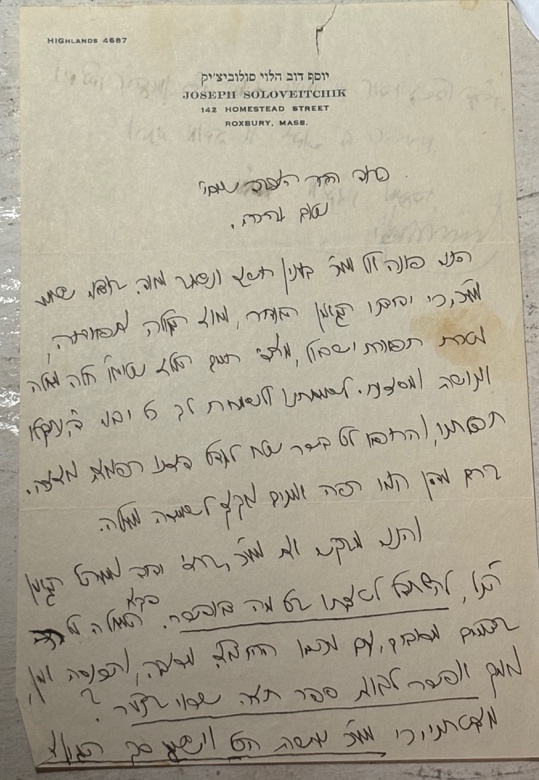
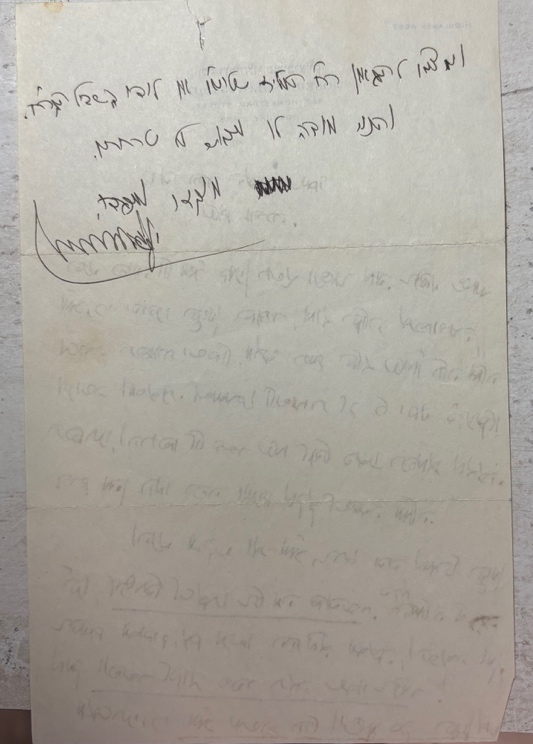
“Your esteemed honor has surely heard that our friend, the great and mighty gaon, luminary of the Diaspora and its glory, the crown of Israel’s splendor, our teacher and master Rabbi Chaim Heller, may he live long, has fallen gravely and dangerously ill. To our joy, and to the joy of all who fear God, our prayers have been accepted, and the Healer of all flesh has sent recovery and healing to the great one of our generation. Yet he remains weak and requires exceptional care. I therefore request of your esteemed honor, as a friend of the aforementioned gaon, to exert yourself on his behalf in every possible way. The supervision of the illness has entailed great expense, and even now the outlay is considerable while there is no income – and how can one behold a Sefer Torah in distress? I am confident that your esteemed honor will do all that is necessary, secure a fitting sum, and deliver it to the gaon R. H. Heller, may he live long, or to the fund ‘For R. H.’ I thank him in advance for his efforts. Your admirer and one who honors you.”[2]
In this letter, Soloveitchik addressed his friend Rabbi Simon (Abraham Yeshayahu) Dolgin,[3] then rabbi of Congregation Beth Jacob in the Beverly Hills neighborhood of Los Angeles, where he would serve for more than three decades and build one of the most significant Orthodox communities on the American West Coast. Upon receiving the appeal, Dolgin promptly sent a contribution; it appears, however, that its amount did not meet Soloveitchik’s expectations.
In a subsequent letter of appeal sent to Rabbi Dolgin approximately one month later [=14 July 1942], R. Soloveitchik again wrote:
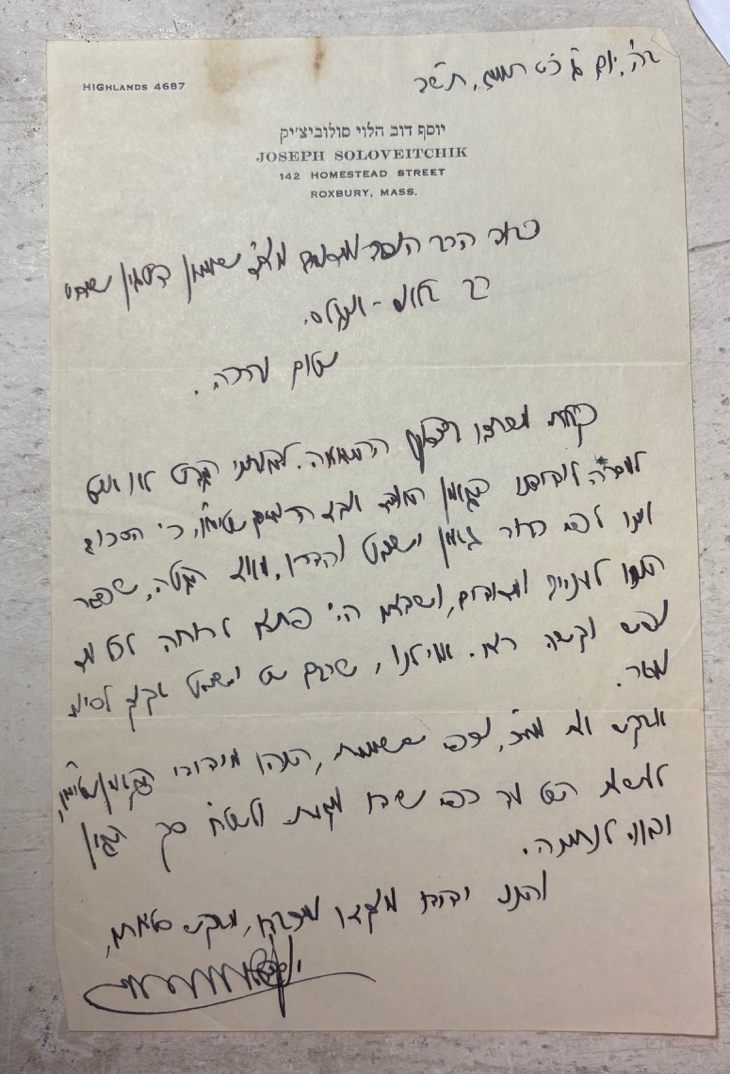
“I received your letter together with the check. To my great regret I cannot deliver it to our friend, the great gaon, the mighty shepherd, may he live long, for the sum is not commensurate with the honor and majesty of a gaon of Israel, a luminary of the Diaspora, who dispersed his wealth to the poor and destitute, and whose home was open wide to all who were embittered and broken in spirit. Woe unto us, that the rabbi of Israel stands in need of aid and assistance. I request of your esteemed honor – who, as I have heard, is among the friends of the aforementioned gaon – to do all that lies within your power and to send a proper and worthy sum.”
The letters published here for the first time provide a rare window into the distinctive relationship, a bond of unusual personal and intellectual intimacy, and the enduring ties that prevailed for decades between two of the leading Torah scholars in the United States in the twentieth century. At the same time, they illuminate the manifold hardships, including acute financial privation, humiliation, and disappointment, that rabbis of that period were compelled to endure as they sought even minimal means of livelihood with which to sustain their households. This fate did not spare even one of the foremost sages of the generation, R. Chaim Heller, who, in order to support his family, was compelled to piece together sporadic and temporary sources of income until he eventually attained, albeit only in relative terms, a measure of stability and a settled position that afforded him and his family a degree of economic security.[4]
Beyond their intrinsic interest, these letters are of particular importance by virtue of the period in which they were written. They date to the years of the Second World War, from which very little of Rabbi Joseph B. Soloveitchik’s correspondence has survived.
Already in these early letters, the literary Hebrew of R. Joseph B. Soloveitchik and his distinctive stylistic register stand out prominently.[5] They attest both to the profound bond between the two scholars and to R. Soloveitchik’s sustained concern for the welfare of his colleague and intimate friend, R. Chaim Heller. Their connection began years earlier in Berlin.
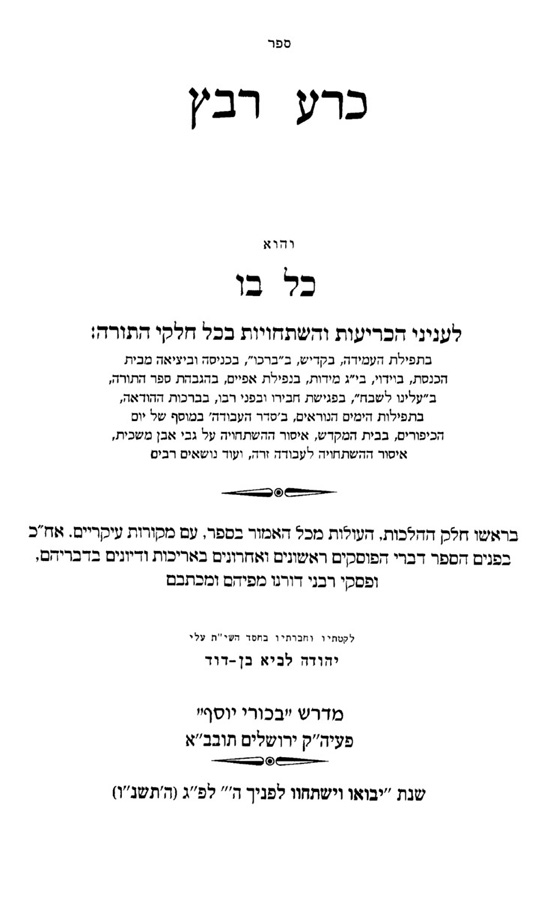
R. Chaim Heller (1879-1960) was among the leading Torah scholars of the early twentieth century. Alongside his greatness in Torah, he was deeply engaged in the scholarly study of Talmudic literature and biblical translation.[6] His work was characterized by a distinctive methodological orientation that sought to challenge the prevailing assumptions of modern biblical criticism through philological rigor grounded in the resources of the rabbinic tradition. In his introduction to On the Jerusalem Targum to the Torah (New York, 1921), R. Heller sharply criticized what he termed the “mechanical method” of comparing ancient translations in order to posit divergent textual recensions. Against this approach, he argued that the multitude of so-called “variants” in translations such as the Peshitta, the Septuagint, and the Samaritan Pentateuch do not reflect alternative Hebrew originals, but rather systematic exegetical practices. In his view, the translators did not render the biblical text literally, but interpreted and expanded it in light of traditions preserved in Hazal. This thesis enabled him simultaneously to undermine the conclusions of contemporary critics and to reaffirm the centrality and antiquity of the Oral Torah as an interpretive matrix for Scripture.[7]
This distinctive synthesis of traditional learning and critical scholarship was already prefigured in the formative trajectory of his early life. Born in Białystok and raised in Warsaw, he was already in his youth known as “the prodigy of Warsaw.” From the age of ten he ceased studying with melammedim; he never attended a yeshiva and acquired his entire Talmudic learning independently, as an autodidact. He married the daughter of a wealthy member of the Łódź community, and in the home of his uncle in Warsaw encountered the leading sages of the generation, engaging them in rigorous dialectical discussion. Among them were R. Yosef Dov Soloveitchik, author of Beit ha-Levi; R. Isaac Elchanan Spektor of Kovno; and the Netziv of Volozhin. During these years he also formed especially close ties with R. Chaim Soloveitchik, his relative by marriage R. Eliyahu Feinstein of Pruzhany, and R. Eliyahu Chaim Meisel of Łódź. In later years, he received a doctoral degree from the University of Würzburg.
Following the death of Rabbi Malkiel Tzvi Tannenbaum, the community of Łomża was left without a rabbi, and its leaders resolved to appoint Rabbi Heller, already known as a sharp and penetrating scholar and a man of broad learning who held a doctoral degree. By that time he had published studies on the Septuagint and on Maimonides, which drew the respect of both rabbinic and academic circles. Yet after only a few months he resigned his post. Various explanations have been offered for his departure: some point to his reluctance to devote extensive time to communal responsibilities, which he regarded as bittul Torah, while R. Joseph B. Soloveitchik recounted that Rabbi Heller himself expressed concern that members of the congregation might pressure him to act against his convictions.
R. Heller soon left for Berlin, where, in 1922 he established the Beit Midrash ha-Elyon, an advanced institution for rabbinic training that drew a small but serious circle of students. Berlin at the time was a meeting ground of worlds, traditional learning and modern scholarship, and Heller moved between them with unusual authority. In R. Heller’s case, this was not merely a sociological juxtaposition but a fully integrated intellectual stance, in which Wissenschaft methods were appropriated and redirected in defense of the integrity of the Masoretic text and the authority of the Oral Torah.[8] It was there that the young R. Soloveitchik spent several formative years. He was not formally enrolled in the institution, but he attended Heller’s lectures and was deeply influenced by them. What impressed him was not only R. Heller’s mastery of Torah and scholarship, but the range of his mind – the sense that he inhabited both disciplines fully, without strain or concession.
In 1929, R. Chaim Heller was appointed as a Visiting Professor of Bible at RIETS,[9] and “for close to ten years Heller taught in New York while occasionally traveling to Berlin and elsewhere before settling in the United States.” More than a decade later, his name was even floated by Rabbi Dr. Leo Jung as a potential successor as Rosh Yeshiva of RIETS following the death of R. Moshe Soloveichik in 1941.[10] A contemporaneous portrait of Heller’s intellectual profile appears in a 1930 article by R. Yerahmiel Elimelekh (Max J.) Wohlgelernter in the ha-Pardes journal, in which R. Heller is presented not merely as a scholar of unusual range, but as a figure who entered directly into confrontation with modern biblical criticism on its own terms, armed with philological expertise yet grounded in the authority of the rabbinic tradition. Against what R. Wohlgelernter characterizes as the “mechanical” methods of contemporary critics, R. Heller is depicted as demonstrating that the multiplicity of textual variants in ancient translations reflects interpretive practice rather than divergent textual recensions, thereby reasserting the integrity of the Masoretic text and the centrality of the Oral Torah as its interpretive matrix.[11]
In 1937, several years after the rise of the Nazis to power and the intensification of anti-democratic measures directed especially against the Jews, R. Chaim Heller emigrated to the United States and settled in New York. That same year, R. Moshe Feinstein likewise arrived in New York. During this period, R. Heller renewed his connection with R. Joseph B. Soloveitchik, who had come to the United States some five years earlier at the urging of his father, R. Moshe, then Rosh Yeshiva of the Rabbi Isaac Elchanan Theological Seminary. In Boston, R. Joseph B. Soloveitchik led his community with distinction and, alongside his teaching, increasingly assumed a position of broader intellectual and religious leadership, establishing himself as a central figure for a growing circle of students and adherents.[12]
Despite this recognition of his intellectual stature, the conditions that Heller encountered upon his arrival in the United States were markedly different. Like many rabbis who fled Germany on the eve of the Second World War and arrived in the United States as refugees,[13] R. Chaim Heller entered a professional landscape that was structurally inhospitable. The lingering effects of the Great Depression continued to constrain both the rabbinic and academic labor markets.[14] Congregational positions, even in smaller and more remote communities, were typically occupied by long-established incumbents, while the few available posts offered only modest remuneration. Universities, for their part, were in a period of contraction, with limited hiring and little institutional appetite for figures whose scholarly profile did not align neatly with existing departmental frameworks. For a scholar of Heller’s unusually wide and interdisciplinary range, no obvious institutional niche presented itself.
In response, Heller adopted a peripatetic mode of intellectual livelihood. Lacking a stable appointment, he supported himself through public lectures, assembling an income that remained precarious and contingent. This required sustained mobility, persistence, and a readiness to engage even relatively small audiences. At one stage, this itinerant circuit took him as far as Los Angeles, a journey that, under the conditions of the time, entailed considerable logistical and physical demands, where he delivered a series of lectures in his areas of expertise. It was likely in the course of this visit that he first encountered Rabbi Dolgin.
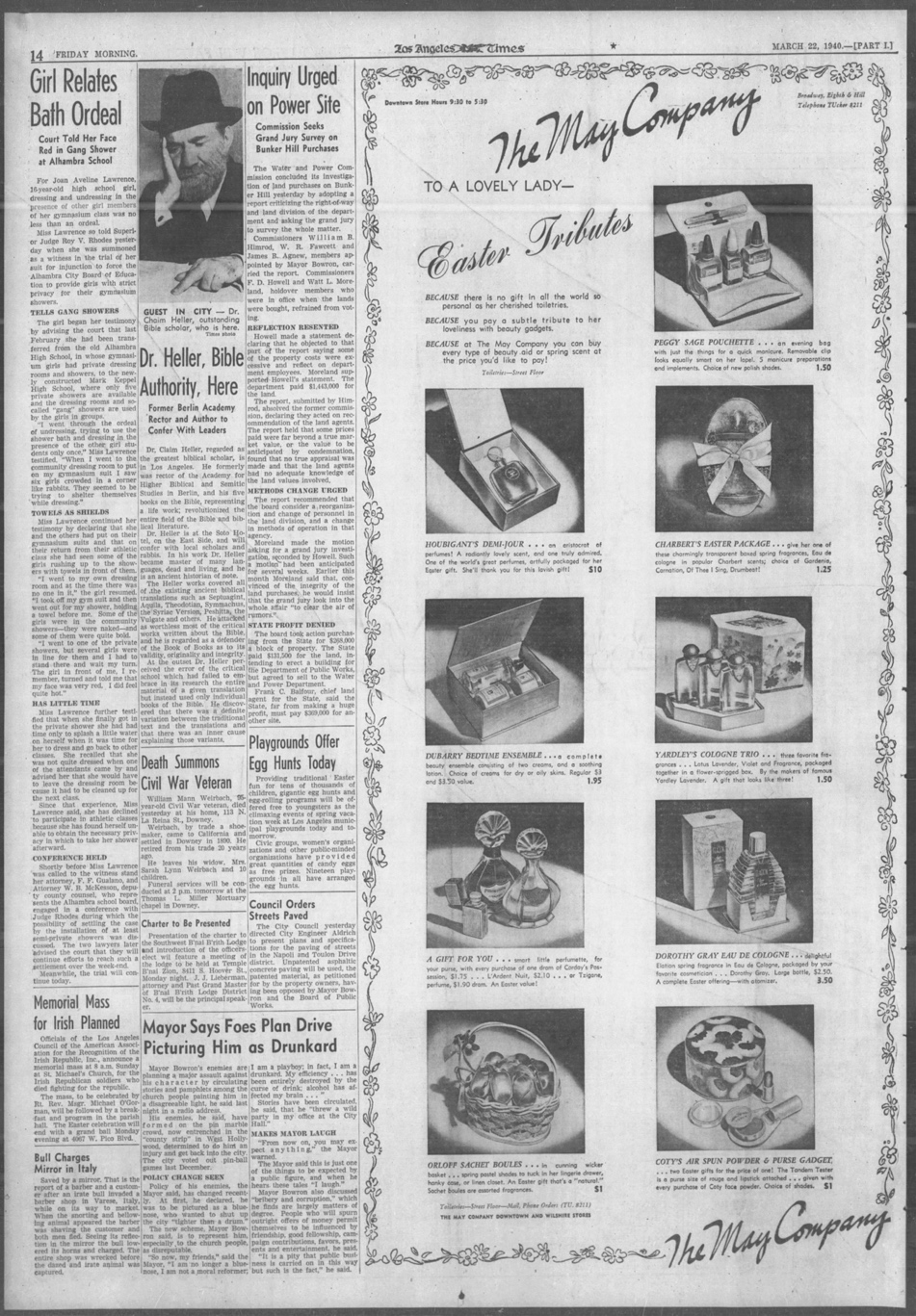
The notice of R. Chaim Heller’s arrival in Los Angeles appeared in the Los Angeles Times, March 22, 1940.
It may be assumed that, in the wake of this visit, the relationship between the two was further strengthened. Expression of this is found in three letters written during those years by R. Chaim Heller to R. Dolgin, which are published here for the first time.
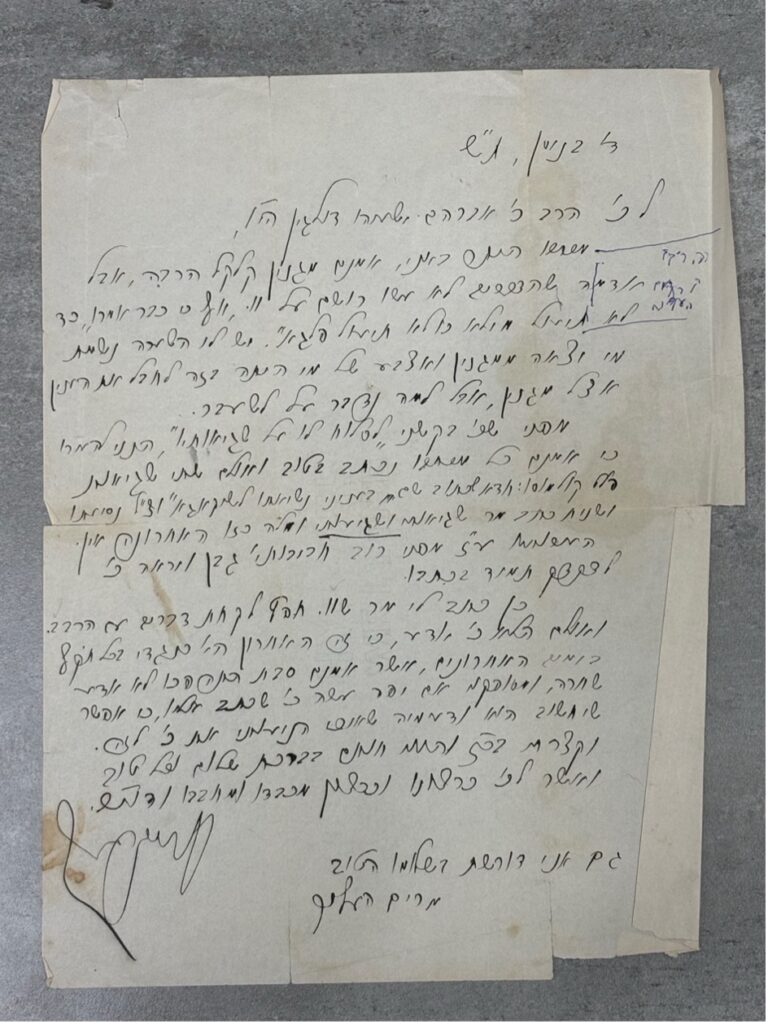
The first letter is dated 4 Nisan 5700 [= 12 April 1940], a short time, approximately three weeks, after R. Chaim Heller’s arrival in Los Angeles. It reads as follows:
“To the honorable Rabbi Abraham Isaiah Dolgin, may he live long: Your esteemed letter has reached me. Although Magnin[15] caused considerable damage, it seems to me that his words made no impression upon ploni, notwithstanding the saying, ‘When a word cannot enter in its entirety, it enters in part.’[16]
I have a conjecture as to whose soul spoke through Magnin, and whose finger was involved in undermining the matter there, but why should we speak of what has passed.
Since Your Honor requested of me “to forgive him for his errors,” I hereby note that, indeed, your entire letter was written well; however, two errors slipped from your pen: first, that you wrote also “concerning the matters of his נשיאתו (nesi’ato, ‘his presidency/bearing’) to Chicago,” whereas it should read נסיעתו (nesi‘ato, ‘his travel’); and second, that you wrote שגיאותי ושגיעותי (shegiyotai, ‘my errors’), and such a latter form does not exist.
I have drawn his attention to this out of my great affection for him,[17] and your honor should take care to be precise in his writing. You also wrote to me that Mr. Sh. desires to discuss matters with Rabbi B. [Bernard Revel[18]]; however, your honor knows that the latter has recently opposed me with full force, though I do not know the cause of his reversal,[19] and I am uncertain whether your honor acted wisely in writing to him, for he and those associated with him may think that I prompted your honor to do so. I have been brief in all this, and I conclude with blessings of peace and all good to your honor, according to your will and the will of one who esteems and cherishes you, and who inquires after your welfare.
Chaim Heller”
In the margin of the letter, his wife added a brief greeting of her own: “I too inquire after his welfare. Miriam Heller.”
The second letter was written approximately two months later, on the eve of the festival of Shavuot, in which R. Chaim Heller gives expression to his frustration that promises made to him, apparently concerning the provision of a stable source of livelihood, had not been fulfilled. It reads as follows:
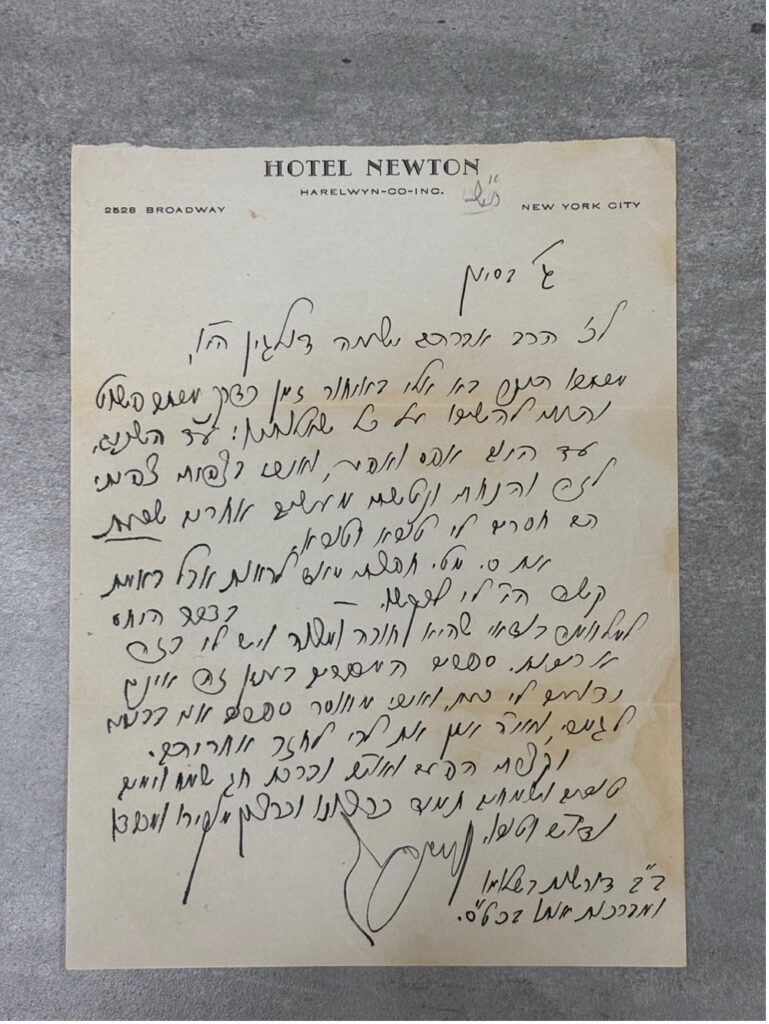
3 Sivan [5700] [9 June 1940]
To the honorable Rabbi Abraham Isaiah Dolgin, may God preserve and sustain him,
Your esteemed letter reached me with delay, as is the way of ordinary post, and I shall respond to all your inquiries: regarding the matter of the years [?], up to this day there is nothing whatsoever, and I had indeed waited and hoped for this, and accordingly set aside and abandoned other undertakings which I now lack greatly – very greatly.
I very much wished to meet with […], but in truth it was difficult for me to request this.
Concerning the attitude toward the war,[20] it is certainly an obligation and a commandment, and I have much to elaborate on this matter. Books addressing this subject are not presently known to me, for I am entirely without books in my home; with God’s help, I shall set my mind to seeking them out.
I shall be brief this time. With blessings for long life, a joyous festival, and days of gladness always, in accordance with your will and the will of one who esteems and honors you, who inquires after your welfare and goodness.
Chaim Heller
[p.s.] My wife and daughters inquire after your welfare, and bless you with every good, selah.
The third letter was written approximately a year later, on the eve of Passover 5701. At that time, reports in the press in the Land of Israel[21] indicated that R. Heller was about to receive a teaching appointment at Yeshiva University alongside his colleague R. Joseph B. Soloveitchik. Having grown accustomed to disappointment, R. Heller feared that this announcement amounted to no more than a “trial balloon” lacking any concrete foundation. This apprehension, together with his distress at both the substance and the tone of the report, found expression in a letter he addressed to R. Dolgin:
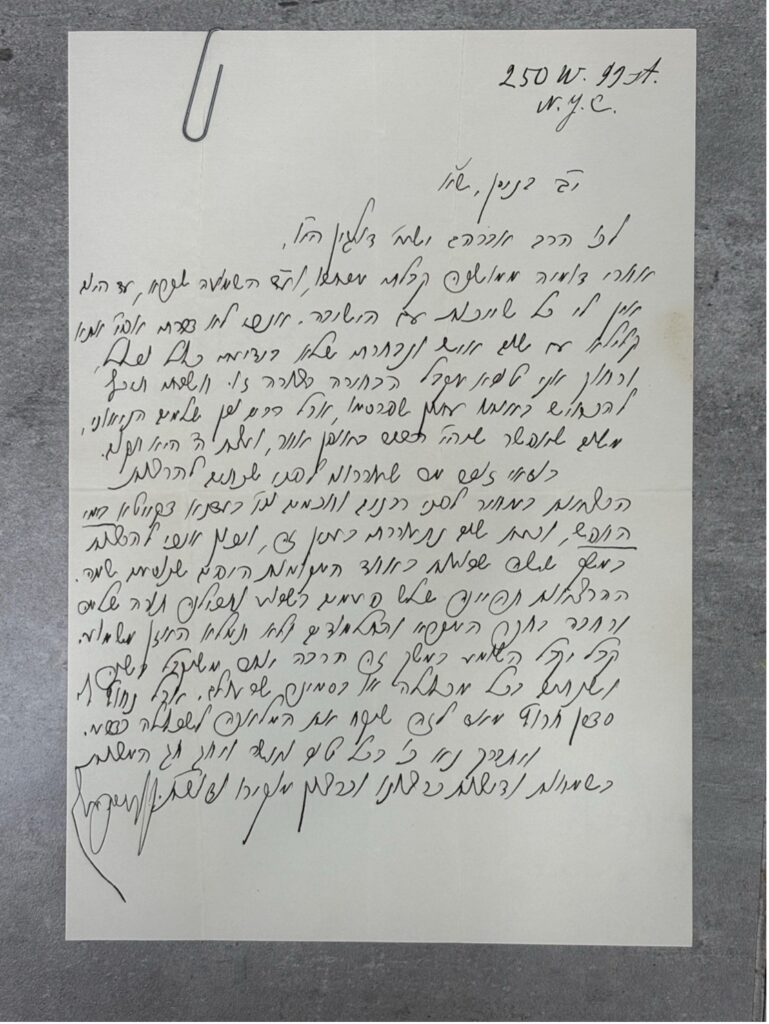
“12 Nisan 5701 [9 April 1941]
To the honorable Rabbi Abraham Isaiah Dolgin, may God preserve and sustain him,
After a long period of silence while confined to bed, I received your letter. Concerning the report that you read: to this day I have no connection whatsoever with the yeshiva.[22] I have not spoken even a word – however slight[23] – with any person, and I was selected entirely without my knowledge; indeed, I am far removed from accepting an appointment in such a manner. I immediately considered issuing a denial in the very newspaper that published the report, but many worthy individuals dissuaded me, on the grounds that matters might yet develop otherwise, and that the counsel of the Lord shall prevail.”
In this connection, he related to his friend his deliberations regarding an additional source of livelihood – delivering lectures to vacationers in the Catskill Mountains during the summer months:
“You surely recall that two years ago I was approached to deliver lectures, for remuneration, before rabbis and scholars, etc., during the summer season (be-idna de-qayta), in the vacation period; and now this matter has again been raised, and I am prepared to lecture for six weeks in one of the pleasant locales to which people travel.
The lectures would be held three times a week and would encompass a comprehensive and wide-ranging treatment of biblical scholarship and the Talmuds, such that ‘the ear would not be sated with hearing’.[24] Over this period, the listener would gain far more than he would in a year or two at any college or seminary in the world. However, I require a highly energetic organizer who will undertake to arrange this enterprise properly. May your honor be blessed with all good and prosperity, and may you celebrate the Festival of Unleavened Bread with joy and delight.”
After several years in the United States, during which he lacked a stable source of livelihood, R. Chaim Heller secured a position on the teaching staff of Yeshiva University and served alongside his colleague R. Samuel Belkin, R. Joseph B. Soloveitchik, and R. Moshe Shatzkes on the RIETS Ordination Board.[25]
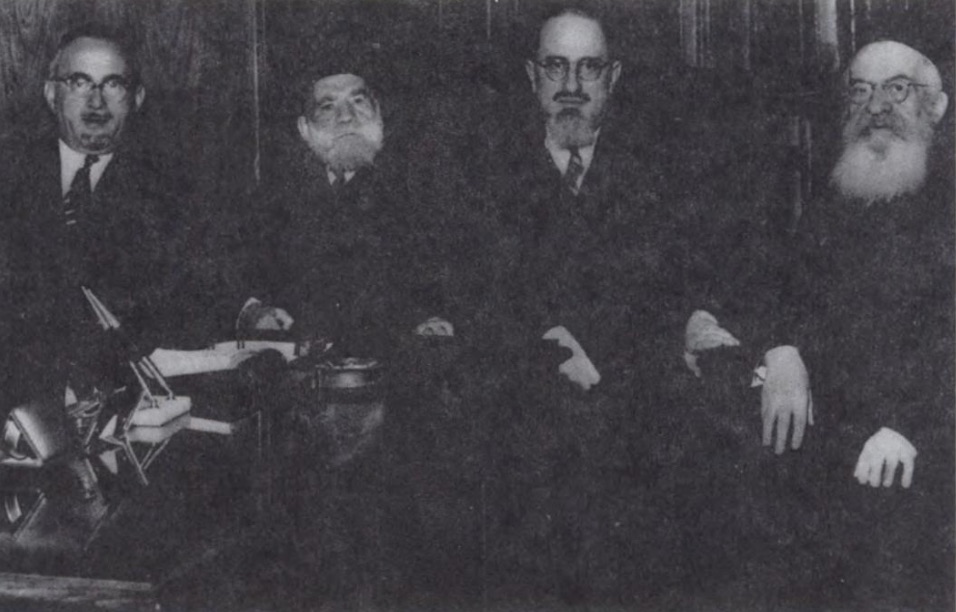
Yet, as emerges from a letter cited below, his salary conditions remained far from favorable. Efforts were made to improve them and, over time, met with a measure of success. The literary oeuvre of R. Chaim Heller is vast in scope. Yet, as R. Joseph B. Soloveitchik would later describe in his eulogy, what was published only represents only a minute fraction, “mere remnants of remnants,” of the breadth of his orally transmitted Torah. It should also be borne in mind that the overwhelming majority of his writings were composed prior to his arrival in the United States.
Among his works in the field of biblical scholarship, particular note should be taken of his studies on the textual tradition of the Bible and its various translations: his work on the Jerusalem Targum to the Torah (New York, 5681 [1921]); on the Samaritan Pentateuch (Berlin, 5684 [1924]); on the Septuagint in the Concordance Heikhal ha-Qodesh, with appended notes, commentaries, and investigations in biblical studies (New York, 5704 [1944]); and on the Peshitta, the Syriac translation of the Bible (transcribed into Hebrew script, with notes, glosses, and commentaries by Chaim Heller: Genesis, Berlin, 5687 [1927]; Exodus, Berlin, 5689 [1929]). He prepared a revised edition of the Peshitta to Exodus for publication but did not succeed in completing its printing prior to his death. Among his halakhic works, his annotated edition of Maimonides’ Sefer ha-Mitzvot (first edition, Piotrków, 5674 [1914]) is well known. A subsequent edition of this work was published by Mossad HaRav Kook in Jerusalem (5706 [1946]) – and has since appeared in numerous further editions – and for this work he was awarded the Rav Kook Prize in 5707 [1947]. His writings also include Hiqrei Halakhot, analytical investigations of legal rulings and issues in the section Hoshen Mishpat (vol. I, Berlin, 5684 [1924]; vol. II, Piotrków, 5692 [1932]); as well as studies on various topics in Maimonides and the halakhic decisors concerning the laws of lending and borrowing and their ancillary matters (Chicago, 5706 [1946]). In addition, he published, in jubilee and memorial volumes, several qontrasim that functioned as a kind of Masoret ha-Shas for the Jerusalem Talmud.[26]
Even after R. Chaim Heller had joined the faculty of Yeshiva University, R. Joseph B. Soloveitchik continued to seek ways to assist him, inter alia by working to secure an increase in his salary. Expression of this may be found in a brief letter that he wrote to R. Chaim Heller on 23 Sivan 5713 (5 June 1953), which is likewise published here for the first time:
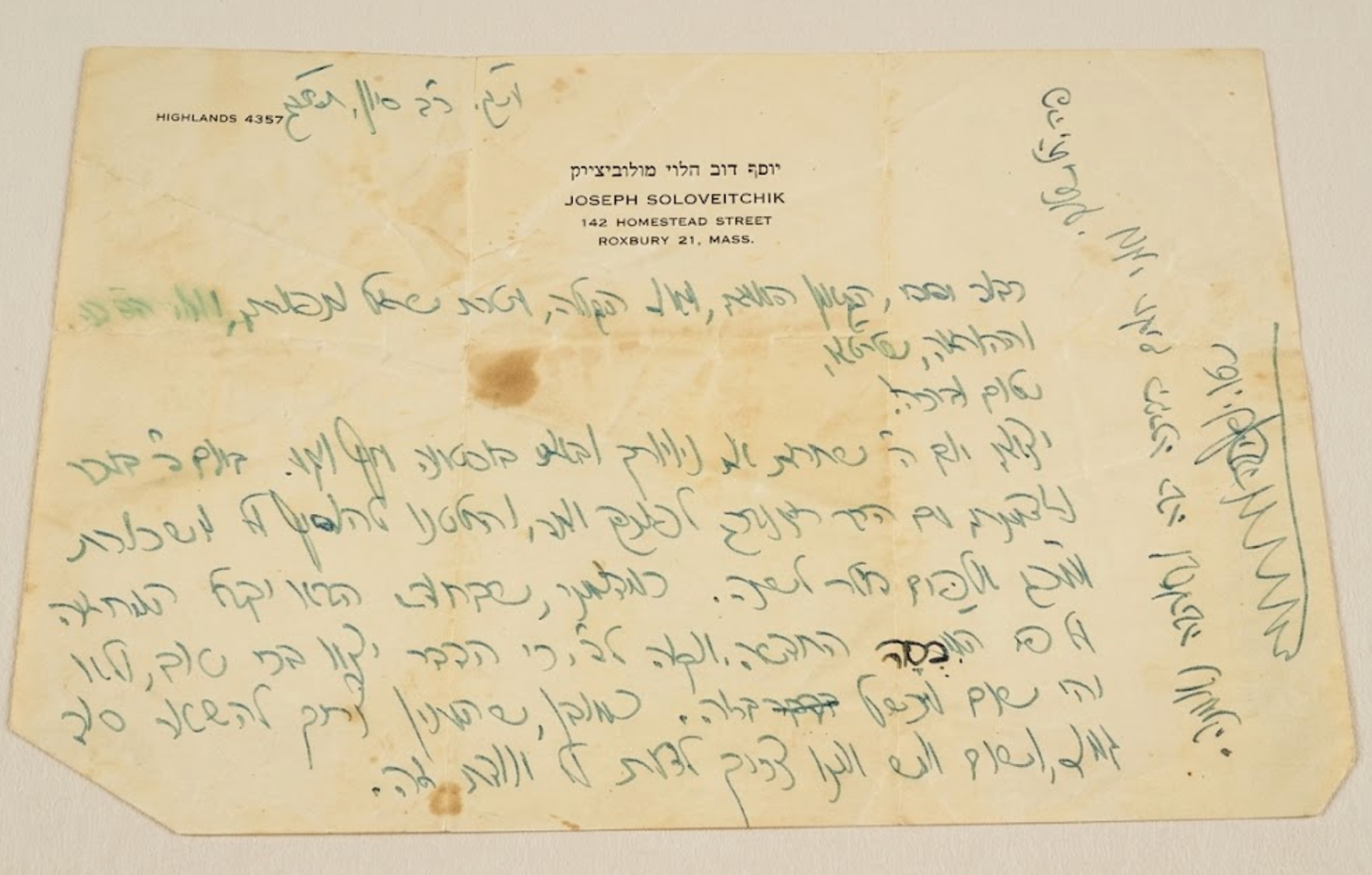
Erev Shabbat, 22 Sivan 5713 [5 June 1953]
To my honored friend, the true gaon, luminary of the Diaspora, crown of Israel and its glory, pillar of halakhah and instruction, may he live long,
Greetings and blessings!
I departed New York on Thursday morning and arrived in Boston utterly exhausted. On the preceding Wednesday I met with Rabbi Rosenberg at a certain inn, and we resolved to add two thousand dollars annually[27] to your honor’s salary. It seems to me that next month you will receive a check in accordance with the new scale. We trust in God that the matter will be brought to a good conclusion and that no obstacle will arise in connection with it. Naturally, the matter must remain in absolute confidence, and no one need be informed of it.
I conclude with abundant blessing and faithful affection,
Joseph Dov HaLevi Soloveitchik[28]
This quiet intervention on Heller’s behalf was not an isolated act, but part of a sustained pattern of concern. In this connection, it is instructive to recall R. Aharon Lichtenstein’s characterization of R. Joseph B. Soloveitchik, in his eulogy. Reflecting on his father-in-law’s own self-understanding, he writes:
“The personal self-conception that characterized the Rav, of blessed memory, with respect to his own functioning was bound up with educational–pedagogical activity, and this across multiple spheres. He would often remark that when he arrived in the World of Truth, and were he to be asked to specify by virtue of what he merited a share in the World to Come, he would indicate three points: (a) that he studied Torah with his children; (b) that he founded the Maimonides School in Boston; (c) that he was concerned, over an extended period, for the honor and welfare of a certain talmid hakham.”[29]
This final point refers to R. Soloveitchik’s sustained and well-documented efforts on behalf of R. Chaim Heller. The depth of this personal concern was not confined to the private sphere, but found parallel expression in a sustained intellectual and institutional collaboration between the two. A further expression of their bond and cooperation is found in their joint letter of response to Israeli Prime Minister David Ben-Gurion, who in 1958 approached them, among other “Sages of Israel,” to solicit their opinion on the question “Who is a Jew?” Although the inquiry was addressed to each of them separately, the two resolved to compose a joint reply. Thus they wrote, inter alia:
“We are indeed perplexed that the State of Israel now seeks to hew down our traditional branches and thereby smear the ancient glory of Israel which has long been sanctified through the spilt blood and sufferings of preceding generations. It is only because of these roots that we preserve our uniqueness as a holy people and that we are inextricably bound to the Holy Land. … Will the present State of Israel be built up by (maintaining a threat of) destruction to its very sanctity?”[30]
The same bond found further expression in another brief letter issued by R. Joseph B. Soloveitchik some two years later, likewise published here for the first time. The occasion for its dispatch was the forthcoming wedding of R. Joseph B. Soloveitchik’s daughter, Tova, to Rabbi Dr. Aharon Lichtenstein, his most distinguished student.
In September 1959, a small notice appeared in the “Announcements” column of The Commentator, the student newspaper of Yeshiva University, reporting the engagement of Dr. Aharon Lichtenstein, a member of the class of 1953, to Tova Soloveitchik. It appeared alongside advertisements for driving instruction and for Barton’s confectionery (under OU supervision).[31]
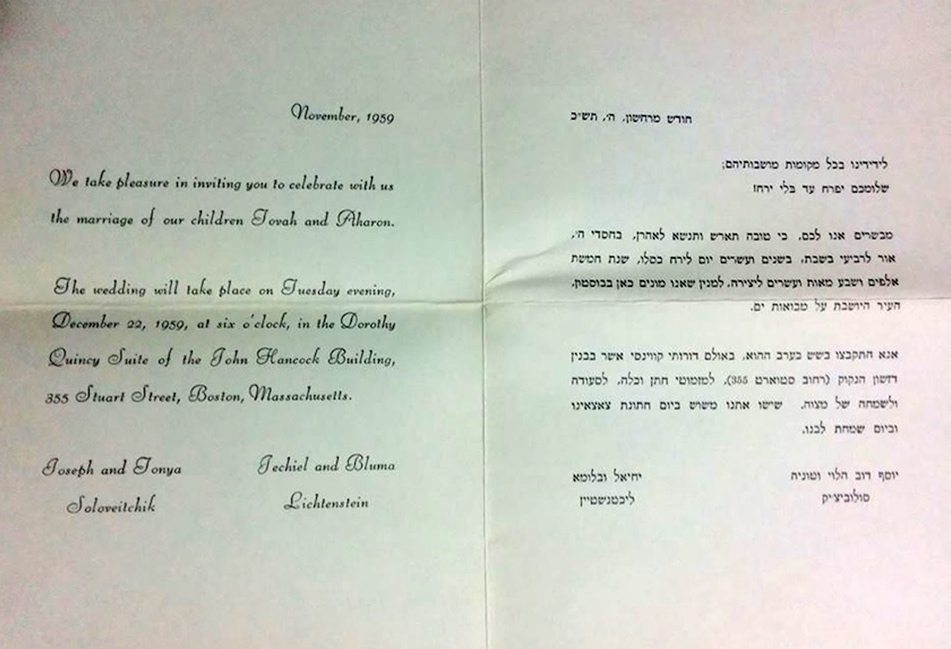
Approximately a month and a half later, in November 1959, the parents of the couple sent a formal invitation to family members and acquaintances. The Hebrew text was ornate, replete with distinctive idioms, and clearly bore the imprint of R. Joseph B. Soloveitchik’s unique stylistic signature:
“To our friends in all their places of residence – may your peace flourish without end! We hereby inform you that Tova shall be betrothed and married to Aharon, with the grace of God, on the evening preceding the fourth day of the week, on the twenty-second day of the month of Kislev, in the year five thousand seven hundred and twenty from Creation, according to the reckoning we follow here in Boston, the city situated at the approaches of the sea. Pray assemble at six o’clock on that evening in the Dorothy Quincy Hall, in the John Hancock Building (355 Stuart Street), for the celebration of bride and groom, for the festive meal, and for the joy of a commandment. Rejoice with us in the joy of our offspring’s wedding day and in the gladness of our hearts. Joseph Dov HaLevi and Tonya Soloveitchik; Yechiel and Bluma Lichtenstein.”
By contrast, the English version was brief, formulated in a more formal and utilitarian manner. The period during which the invitations were sent was one of particular intensity in the Soloveitchik household. At that time, R. Soloveitchik received an informal invitation to put forward his candidacy for the position of Chief Rabbi of Israel[32]; concurrently, he was engaged in intensive preparation for the major eulogy for his uncle, the Griz, R. Yitzhak Ze’ev Soloveitchik, later known as the discourse “Mah Dodekh mi-Dod.”[33]
On account of the mention of his name as a candidate for the office of Chief Rabbi, an extensive journalistic interview with R. Soloveitchik was conducted in Yedioth Ahronoth.[34] The interviewer, Elie Wiesel (later a Nobel laureate), reported that, following the Rav’s annual Teshuvah Derashah several months earlier, the Israeli consul general in New York had sent a telegram to Jerusalem declaring: “Here is the best candidate to replace Rabbi Herzog.”[35] Wiesel asked R. Soloveitchik whether he would agree to assume the position if it were offered to him. R. Soloveitchik replied that no such offer had yet been made, but added in principle: “One does not decline an invitation that comes from the Land of Israel… When I receive it, if indeed it is sent, I shall consider it with utmost seriousness. I shall ask myself whether I am worthy of so exalted an office.” When Wiesel further inquired whether it was true that his uncle, R. Yitzhak Ze’ev Soloveitchik, had instructed him not to accept the position, R. Soloveitchik dismissed the report: “It is difficult to believe such rumors. In our family there is a tradition not to compose wills… perhaps because we fear death and its reality.”[36]
In the course of the interview, R. Soloveitchik spoke with evident pride of the religious and spiritual revival among youth and young adults in America, yet added that talk of their immigration to the Land of Israel was, at most, “a beautiful dream.” He attributed the gap between the intensification of Jewish and religious consciousness and the reluctance to immigrate, inter alia, to Prime Minister David Ben-Gurion, who, in his view, failed to appreciate the potential inherent in religion to draw youth to Israel and to demand sacrifice on its behalf. “In my view,” said the Rav, “Ben-Gurion is a religious Jew, though it is possible that he himself does not know this.” These remarks, whose precise formulation was itself questioned in contemporaneous discussion, elicited sharp criticism from several prominent figures within American Jewry. Among them was Moshe Meisels, editor of ha-Doar, who, in a pointed “open letter,” challenged both the claim that Israel had lost its ‘messianic’ hold on the Jewish imagination and the attribution of this development to deficiencies in the religious posture of the Israeli state.[37] Questioning the very premise of R. Soloveitchik’s formulation, Meisels asked rhetorically whether it could truly be maintained that “the concept of Israel has lost its messianic content,” and whether the responsibility for such a development could plausibly be laid at the feet of the state. The Rav sought to respond, but was exceedingly occupied with the final polishing of the eulogy for his uncle, R. Yitzhak Ze’ev Soloveitchik, which he was to deliver within a matter of days.[38]
Indeed, as the Yiddish adage has it, a mentsh trakht un Got lakht – man plans, and God laughs. Only a few days after the wedding invitations for his daughter and R. Aharon Lichtenstein had been dispatched, R. Joseph B. Soloveitchik was diagnosed with colon cancer and was required to travel urgently to Boston to undergo life-saving surgery. R. Soloveitchik informed his family, including the bride and groom, on the night that he delivered the eulogy for his uncle. On the following day, he departed for Boston. The couple, of course, immediately announced the postponement of the wedding, and all prayed for the Rav’s recovery.
R. Soloveitchik himself, only fifty-seven years old at the time, confided to those close to him: “I suddenly ceased to be immortal; I became a mortal being.” In the nights preceding the operation, he undertook a profound reckoning of his life. In later years, he described something of his experience during those turbulent days:
“My existential awareness was an absolute one. Non-being did not enter into it. I would not sustain my gaze upon nihility. Whenever I started to think of death, my thoughts were dashed back and they returned to their ordinary objective, to life. When I looked upon my grandson, I always tried to think of him as if he were my contemporary. I believed that we would always do things and play together. Then sickness initiated me into the secret of non-being. I suddenly ceased to be immortal; I became a mortal being.
The night preceding my operation I prayed to God and beseeched him to spare me. I did not ask for too much. All I wanted was that he should make it possible for me to attend my daughter’s wedding, which was postponed on account of my illness – a very modest wish in comparison with my insane claims to life prior to my sickness. The fantastic flights of human foolishness and egocentrism were distant from me that night.
However, this ‘fall’ from the heights of an illusory immortality into the valley of finitude was the greatest achievement of the long hours of anxiety and uncertainty. Fundamentally, this change was not an act of falling but one of rising toward a new existential awareness which embraces both man’s tragedy and his glory, in all its ambivalence and paradoxality. I stopped perceiving myself in categories of eternity. When I recite my prayers, I ask God to grant me life in very modest terms.”[39]
Further testimony to R. Soloveitchik’s state of mind during this period is found in a letter he sent to R. Reuven Katz, Chief Rabbi of Petah Tikvah. At its outset, the Rav explains that he had fallen gravely ill and been confined to bed, describing the experience in stark terms:
“Dark days, filled with anxiety, suffering, and silent loneliness, passed over me. My world was suddenly overturned. Yet the merit of my forefathers stood by me in the hour of wrath, and the Holy One, blessed be He, in His abundant mercy redeemed my soul in peace and did not allow me to die… Even now, as I begin to recover, I have not yet shaken off the physical weakness and the psychological dread that overcame me during those bitter and difficult hours of illness and suffering.”[40]
He then turns to the question of the Chief Rabbinate, noting both the changed circumstances and his own unsuitability for the role:
“However, the recent developments concerning the Chief Rabbinate… have cast a new light upon the situation, and I doubt whether I would be able to engage in Torah study with peace of mind… There is compelling reason to assume that I would become entangled in all the convolutions of politics, a matter that is neither to my spirit nor to my desire… Therefore I am compelled to acknowledge that, under the present circumstances, I am not fit for this office. I am a teacher, and I have in my world nothing but the four cubits of halakhah. I do not wish to depart from them, even were I to be offered an entire kingdom.”
These remarks make clear that R. Soloveitchik’s refusal to consider candidacy for the position of Chief Rabbi was shaped both by the lingering effects of illness and by a principled resistance to political entanglement, together with a self-conception rooted in the life of Torah within “the four cubits of halakhah.”[41]
As a result of his illness, R. Soloveitchik remained in Boston for approximately three months, during which he gradually recovered. In the course of this period, he merited to bring his daughter Tova and his son-in-law, R. Aharon Lichtenstein, under the wedding canopy. In consultation with the family, it was decided to postpone the wedding by only one month following the operation, and it was ultimately held on 26 Tevet 5720 (26 January 1960).[42]
A week before the rescheduled wedding, still confined to his bed and not yet recovered from surgery, R. Soloveitchik insisted on writing to his close friend R. Chaim Heller. The letter, published here for the first time, was not written in his own hand. The script shows that he dictated it, most likely to his wife, and, in his weakened state, managed only to sign his name.
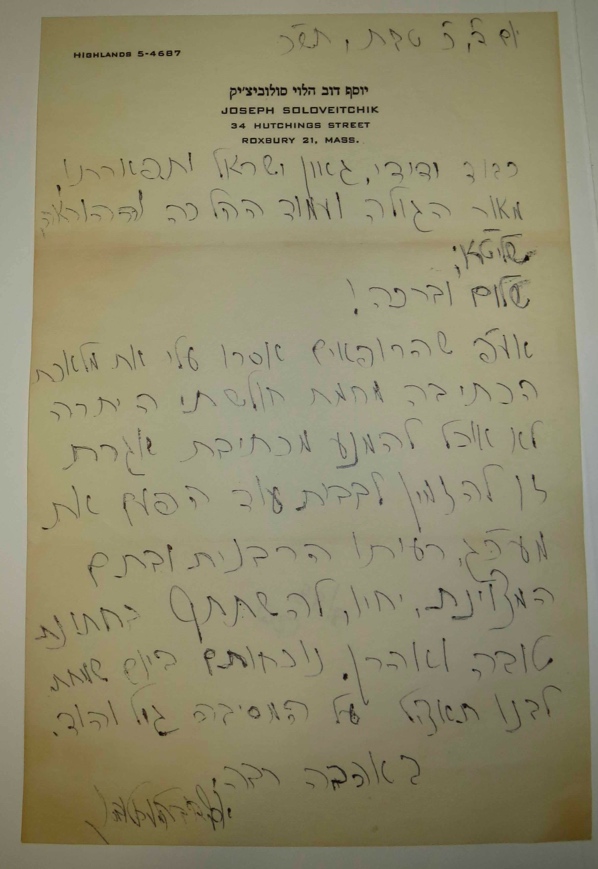
“To my honored friend, the gaon of Israel and its glory, luminary of the Diaspora and pillar of halakhah and instruction, may he live long; greetings and blessings! Although the physicians have forbidden me to engage in writing on account of my extreme weakness, I cannot refrain from writing this letter in order once again to extend a heartfelt invitation to your esteemed honor, to your esteemed wife, and to your distinguished daughter, may they live, to participate in the wedding of Tova and Aharon. Their presence on the day of our heart’s rejoicing will lend joy and splendor to the celebration. With great affection, Joseph Dov HaLevi Soloveitchik.”
His wife, Dr. Tonya Soloveitchik, appended a moving appeal of her own in Yiddish:[43]
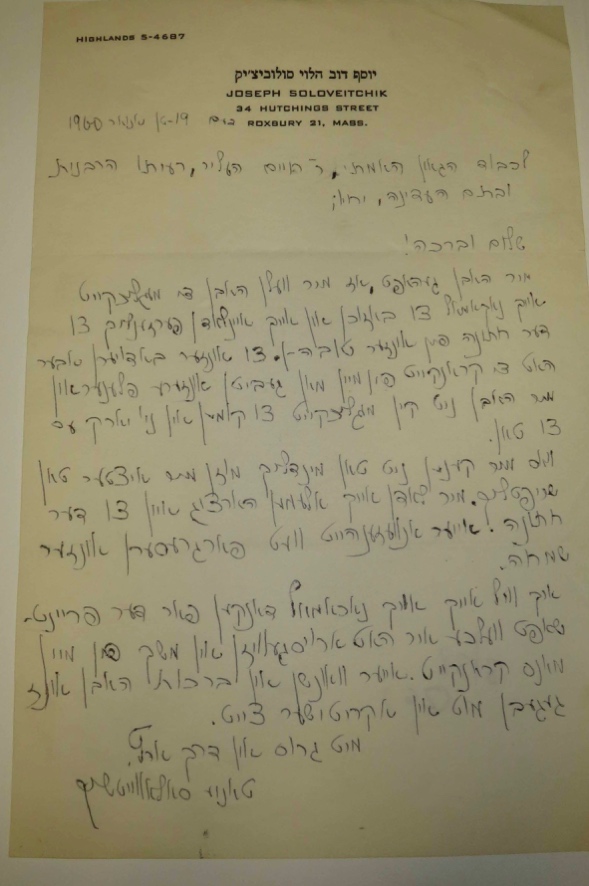
January 19, 1960
To the honorable and true gaon, R. Chaim Heller, to his esteemed wife, the rebbetzin, and to their refined daughter, may they live – greetings and blessings!
We had hoped that we would have the opportunity to visit you once more and to invite you personally to the wedding of our Tova. To our regret, however, my husband’s illness has altered our plans, and we have no possibility of coming to New York to do so.
What we are unable to do orally, we must now do in writing: we warmly invite you all to the wedding! Your presence will greatly enhance our joy.
I also wish once again to thank you for the friendship you have shown during my husband’s illness. Your good wishes and blessings gave us strength at a critical time.
With regards and respect,
Tonya Soloveitchik
In the end, R. Chaim Heller did not attend the wedding, apparently due to his frail health and the difficulty of traveling from New York to Boston. Within a few months, on the Fourteenth of Nisan 5720 (10 April 1960), the Eve of Passover, he returned his soul to his Creator.[44] Although the constraints of time and the approaching festival precluded extended eulogies, R. Joseph B. Soloveitchik flew from Boston to New York to attend the funeral, delivered brief words of farewell, recited kaddish at the funeral,[45] and returned to Boston before the onset of Passover. The rabbinic journal ha-Pardes would later note that “his close friend and trusted associate, Rabbi Joseph Dov Soloveitchik of Boston, eulogized him in moving words.”[46] Although these remarks were long thought to have been lost, a partial and mediated record preserved in the Yiddish press makes it possible to recover something of their content:
“A visit to Rabbi Chaim Heller was in the nature of a pilgrimage… When I would arrive at the elevator of the building at 210 West 99th Street… I would experience a sensation as though a curtain had descended, separating between the sacred and the profane. The Temple comprised three divisions: the Holy of Holies, the Sanctuary, and the Courtyard. Rabbi Chaim embodied all three. He conducted himself within the Holy of Holies… his occupation was solely with Torah… The entirety of the Torah lay before him as an open book… Yet he also partook of the character of the Courtyard, engaged with the community of Israel as a whole… From him radiated both the light of immense knowledge and the simplicity of humanity.”[47]
Even in this compressed form, the structure of the eulogy is already fully present: Heller is cast simultaneously as a figure of absolute immersion in Torah, of intellectual breadth, and of human accessibility, an integration that would find fuller expression in Soloveitchik’s later memorial address. Several weeks later, he returned to the task in a more formal setting, delivering a powerful and deeply moving eulogy at a memorial gathering at Yeshiva University.
As is well known, and in keeping with the characteristic reserve of the Lithuanian Torah greats, R. Joseph B. Soloveitchik was generally sparing in his expressions of affection, esteem, and praise for fellow scholars, and rarely employed language of overt admiration. In the case of R. Chaim Heller, however, he departed from this pattern and bestowed upon him an exceptional and uncommon measure of appreciation, the like of which he appears to have granted to few, if any, other Torah scholars.
This finds expression in the great and moving eulogy that R. Soloveitchik delivered for R. Chaim Heller nine weeks after his passing, at a public gathering at Yeshiva University on June 13, 1960, which also included eulogies by the institution’s president, Dr. Samuel Belkin. R. Soloveitchik’s eulogy was published the following year on the occasion of the first yahrzeit under the title “Rabbi Chaim Heller: The ‘Shmuel ha-Katan’ of Our Generation,” and opened with the following words:
“Who was this man who departed from us in silence and with gracious humility? What was his stature, and what were his deeds? Who was R. Chaim, who held no public office and had no need for conventional titles – whose entire greatness was encapsulated in two simple words: ‘R. Chaim,’ greater than ‘Rabban’ was his name? Some years ago… when the president of this institution, Rabbi Samuel Belkin, introduced R. Chaim… he employed the following formulation: ‘R. Chaim belongs to that small company of men of virtue for whom we pray each day in the Amidah: for the righteous, for the pious, for the elders of Your people the House of Israel, and for the remnant of their scribes. R. Chaim,’ the rabbi continued, ‘is of the remnant of Israel’s scribes.’ In this utterance he encapsulated all that was singular and wondrous in the man. At the time, I was seated on the platform beside R. Chaim, and as I beheld him – entirely withdrawn, enclosed and self-contained, as though scorched by the gaze of the audience fixed upon him – his lips murmuring, ‘What does he want of me?,’ and the pained embarrassment of a solitary individual, thrust against his will into a bustling and clamorous crowd, spread across his face…”[48]
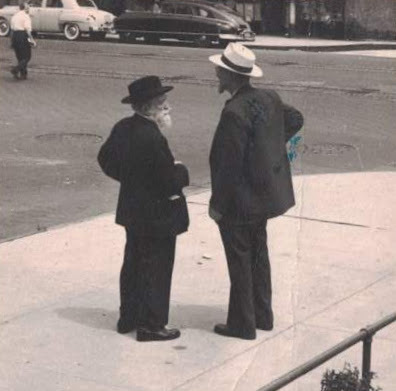
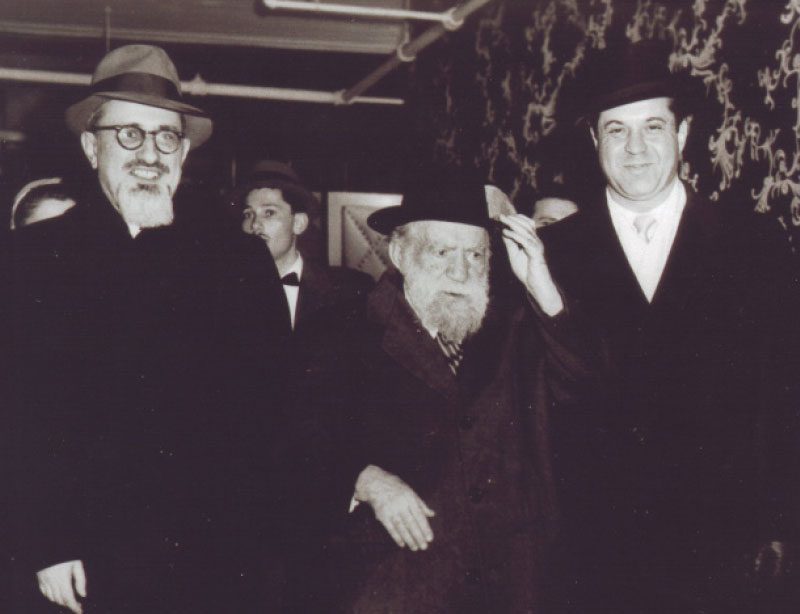
R. Chaim Heller and R. Joseph B. Soloveitchik in New York, in the vicinity of Yeshiva University.
Notes
-
- A shorter, and non-annotated, version of this article appeared in Hebrew as Aviad Hacohen and Menachem Butler, “‘A Sefer Torah in Distress’,” Makor Rishon, Pesach Supplement, no. 1495 (1 April 2026): 10-11, 16 (Hebrew), available here.We are grateful to our friend Aaron R. Katz and to the Dolgin family for granting us access to letters sent by Rabbi Joseph B. Soloveitchik and Rabbi Chaim Heller to the family patriarch, Rabbi Simon (Abraham Isaiah) Dolgin, of blessed memory. We thank Shulamith Z. Berger of the Yeshiva University Archives for providing photographs of Rabbi Joseph B. Soloveitchik and Rabbi Chaim Heller. We are also grateful to Rabbi Moshe Dembitzer, author of several landmark biographical studies of Rabbi Chaim Heller, for sharing with us a forthcoming, as yet unpublished essay on Rabbi Soloveitchik’s graveside eulogy for Rabbi Heller. ↑
- The letter bears no date; however, the postmark on the envelope indicates that it was sent from Boston to Los Angeles on June 9, 1942. ↑
- On Rabbi Simon (Abraham Isaiah) Dolgin (1915-2004) and his extensive activities, see Jubilee Volume Minḥah Le-Ish: Presented to HaRav Simon A. Dolgin on the Occasion of His 75th Birthday, ed. Itamar Warhaftig (Jerusalem: Ariel, 1990). Ordained at the Hebrew Theological College in Skokie, Illinois, Dolgin assumed the rabbinate of Congregation Beth Jacob (later in Beverly Hills) in 1938 and served there for approximately thirty-two years, during which he transformed it into a prominent Orthodox community and developed a broad educational infrastructure, including the Harkham Hillel Hebrew Academy. In 1971 he immigrated to Israel, where he served as rabbi of the Ramat Eshkol neighborhood and later as Director-General of the Ministry of Religious Affairs. On his correspondence with David Ben-Gurion, see On the Character of the State of Israel: Correspondence between Prime Minister David Ben-Gurion and Rabbi Simon (Abraham Isaiah) Dolgin, ed. Yitzhak Goldshlag (Jerusalem, 1973; Hebrew). ↑
- By way of comparison with the present, this phenomenon still finds occasional resonance in the lives of rabbis today. ↑
- On this point, see the remark of Rabbi Aharon Lichtenstein, at the conclusion of his discussion of “The Rav as Eulogist” (forthcoming):“It is difficult for me to conclude without saying a word about the literary dimension of these eulogies. For all my admiration of the Rav’s Torah greatness, and of the content of these eulogies – which is, of course, primary – it is hard not to be left in astonishment at his literary and linguistic ability. We are speaking of a person who was not educated in the Hebrew language, and whose knowledge in this area was drawn from reading Haskalah literature. Let us recall: the Rav did not live in a Hebrew-speaking environment, nor did he speak Hebrew fluently. Yet the richness of his language is truly astounding. Were one to read these texts for this purpose alone, I have no doubt that he would be amply rewarded.” ↑
- On the most recent biography and intellectual profile of R. Chaim Heller, see the now substantial body of recent scholarship, which has significantly advanced our understanding of his life and work, see Moshe Dembitzer, “The Letters of Rav Chaim Heller,” Hitzei Giborim, vol. 9 (2016): 923-952 (Hebrew), which assembles and analyzes a wide corpus of correspondence and reconstructs key aspects of his personal and scholarly networks; Uriel Banner, “Towards a Profile of Rabbi Chaim Heller,” Asif, vol. 8 (2023): 720-766 (Hebrew), offering a synthetic biographical portrait grounded in both contemporary testimony and archival material; and Moshe Dembitzer, “‘To Show My People a New Type’: The Academic Chapter in the Life of Rabbi Chaim Heller,” Mekhilta, vol. 5 (February 2024): 365-382 (Hebrew), which reconstructs in detail his academic formation and intellectual program, particularly his engagement with philology and the Wissenschaft des Judentums milieu. ↑
- For earlier biographical and bibliographical information on Heller, see Jacob I. Dienstag, “Ein ha-Mitzvot: Bio-Bibliographical Lexicon of the Scholarship on Maimonides’ Sefer ha-Mitzvot,” Talpiyot, vol. 9, no. 3-4 [=Rabbi Chaim Heller Memorial Volume] (September 1970): 663-759, esp. 697-702 [#20] (Hebrew), available here, which underscores both his expertise in biblical translation and linguistics and his programmatic effort to defend the integrity of the Masoretic text. For a critical assessment of R. Heller’s methodology, see Marc B. Shapiro, Between the Yeshiva World and Modern Orthodoxy: The Life and Works of Rabbi Jehiel Jacob Weinberg, 1884-1966 (Oxford: Littman Library, 1999), 169-171, who characterizes R. Heller’s work as driven by a dogmatic commitment to the integrity of the Masoretic text and questions the scholarly validity of his attempts to account for all textual variants within that framework. On the polemical reception of Heller’s work among contemporaries, especially R. Yehiel Jacob Weinberg and Paul Kahle, see ibid. On the reception of Heller’s halakhic method within the American-yeshiva world, see Mordechai Gifter, “Halakhic Studies in [Rav Chaim Heller’s] ‘Le-Hikrei Halakhot’,” Talpiyot, vol. 9, no. 3-4 [=Rabbi Chaim Heller Memorial Volume] (September 1970): 913-921 (Hebrew). Rabbi Mordechai Gifter, at the time Rosh Yeshiva of the Telshe Yeshiva in Cleveland and a former student of R. Chaim Heller at Yeshiva College/RIETS in the early 1930s (prior to his subsequent entry to the world of Telshe in Lithuania), presents the work as a sustained program of conceptual halakhic analysis, marked by rigorous coordination of the Rishonim. In contrast to the reading of both Professor Jacob I. Dienstag and Professor Marc B. Shapiro, it is in Rabbi Mordechai Gifter’s reading of R. Chaim Heller that there is a reflection of the work’s reception within advanced yeshiva circles as an instance of high-level lomdus rather than as an idiosyncratic or marginal enterprise. ↑
- See Moshe Dembitzer, “‘To Show My People a New Type’: The Academic Chapter in the Life of Rabbi Chaim Heller,” Mekhilta, vol. 5 (February 2024): 365-382 (Hebrew). ↑
- “To Join Yeshiva Faculty: Dr. Chaim Heller of Berlin Will Be Professor of Bible,” The New York Times (18 September 1929): 24. ↑
- Jeffrey S. Gurock, The Men and Women of Yeshiva: Higher Education, Orthodoxy, and American Judaism (New York: Columbia University Press, 1988), 130-131, 275n21. See also “Rabbi Chaim Heller, Yeshiva U. Professor, Dead at 81,” Yeshiva University News (5 April 1960), 6-7; and Gilbert Klaperman, The Story of Yeshiva University: The First Jewish University in America (New York and London: Macmillan, 1969), 152 ↑
- See Yerahmiel Elimelekh (Max J.) Wohlgelernter, “Rabbi Chaim Heller: Prince of the Torah and Ruler over the Treasures of Knowledge,” ha-Pardes, vol. 4, no. 2 (May 1930): 26-30 (Hebrew); and for a later popular portrayal in the American context, see Aaron Rosmarin, “Reb Chaim Heller – One in Generations,” The Jewish Criterion, vol. 20, no. 104 (15 September 1944): 175-178. Special thanks to Shimon Steinmetz for pointing us to this article by Dr. Aaron Rosmarin. ↑
- See Seth Farber, “Reproach, Recognition and Respect: Rabbi Joseph B. Soloveitchik and Orthodoxy’s Mid-Century Attitude Toward Non-Orthodox Denominations,” American Jewish History, vol. 89, no. 2 (June 2001): 193-214; Seth Farber, “Immigrant Orthodoxy’s Last Stand: The Rise of Rabbi Soloveitchik to Rosh Yeshiva,” in Immanuel Etkes, ed., Yeshivot u-Batei Midrashot: Mordechai Breuer Jubilee Volume (Jerusalem: Shazar, 2006), 417-430 (Hebrew); Seth Farber, “Immigrant Orthodoxy’s Last Stand: The Appointment of Rabbi Joseph B. Soloveitchik as Rosh Yeshivah at RIETS and the Coming-of-Age of American Orthodoxy,” in Bentsi Cohen, ed., As a Perennial Spring: A Festschrift Honoring Rabbi Dr. Norman Lamm (New York, 2013), 173-187; and earlier in Seth Farber, An American Orthodox Dreamer: Rabbi Joseph B. Soloveitchik and Boston’s Maimonides School (Hanover, NH: Brandeis University Press, 2004). ↑
- See, for example, Michael A. Meyer, “The Refugee Scholars Project of the Hebrew Union College,” in Bertram W. Korn, ed., A Bicentennial Festschrift for Jacob Rader Marcus (Waltham, MA: American Jewish Historical Society, 1976), 359-375; Michoel Zylberman, “Yeshiva’s Response to World War II and Revel’s Rescue of European Refugees,” The Commentator, vol. 69, no. 4 (16 November 2004): 22-23; and most recently, Cornelia Wilhelm, The Last Generation of the German Rabbinate: German Refugee Rabbis in the United States, 1933-2010 (Bloomington: Indiana University Press, 2024). ↑
- On the difficulties faced by immigrant rabbis in securing stable positions in the United States during the interwar and Depression years, including the need to obtain congregational contracts as a condition of entry and the scarcity of viable pulpits, see Jonathan D. Sarna and Zev Eleff, “The Immigration Clause that Transformed Orthodox Judaism in the United States,” American Jewish History, vol. 99, no. 3 (July 2017): 357-376. ↑
- Rabbi Edgar F. Magnin (1890-1984) was a prominent American Reform rabbi who served for decades as the spiritual leader of Wilshire Boulevard Temple in Los Angeles, one of the most influential Reform congregations in the United States. ↑
- Bereshit Rabbah 56:4; that is, a statement containing lashon hara – if it does not enter in its entirety [into the heart of its recipient], at least part of it enters. ↑
- “Out of the abundance of my affection for him”; a common idiom found in the sources of Mishpat Ivri. ↑
- Yeshiva’s founding president Rabbi Bernard Revel passed away a few months later, on December 2, 1940, in the prime of his life, at the age of fifty-five (!). For a biography from more than a half-century ago, see Aaron Rakeffet-Rothkoff, Bernard Revel: Builder of American Jewish Orthodoxy (Philadelphia: The Jewish Publication Society of America, 1972). See also Sidney B. Hoenig, “Rabbinics and Research: The Scholarship of Dr. Bernard Revel,” in Leon D. Stitskin, ed., Studies in Judaica in Honor of Dr. Samuel Belkin as Scholar and Educator (New York: Yeshiva University Press, 1972), 401-467; Harvey Horowitz and William M. Kramer, “Stamp of Approval: Oklahoma Oilman and Rosh Ha-Yeshiva Bernard Revel,” Western States Jewish History, vol. 18, no. 3 (April 1986): 256-261; Jeffrey S. Gurock, “An Orthodox Conspiracy Theory: The Travis Family, Bernard Revel, and the Jewish Theological Seminary,” Modern Judaism, vol. 19, no. 3 (October 1999): 241-253; and Moses Mescheloff, “As I Knew Him: Memories of Rabbi Dr. Bernard Revel,” in Menachem Butler and Zev Nagel, eds., My Yeshiva College: 75 Years of Memories (New York: Yashar Book, 2006), 76-80; and William L. Lee, “President Bernard Revel’s Triple Program: Inventing Jewish and Semitic Studies for the Original 1928-1929 Yeshiva College Curriculum,” in Hayyim Angel and Yitzchak Blau, eds., Rav Shalom Banayikh: Essays Presented to Rabbi Shalom Carmy by Friends and Students in Celebration of Forty Years of Teaching (Jersey City, NJ: Ktav Publishing House, 2012), 201-224. ↑
- This remark (dated 12 April 1940) may plausibly be connected to the negotiations then underway between Rabbi Joseph B. Soloveitchik and Dr. Bernard Revel concerning the proposed affiliation of Heikhal Rabbeinu Haym ha-Levi, the Boston graduate-level yeshiva founded by Rabbi Soloveitchik in 1939, with RIETS and Yeshiva College. Following a period of negotiation, a formal memorandum of agreement was drafted in May 1940, envisioning the Heikhal as a New England branch of the New York institution, with coordinated academic governance and shared institutional interests. In this context, R. Chaim Heller’s reference to Dr. Revel’s sudden opposition might reflect tensions surrounding these negotiations and suggests that Heller was attempting to advocate on Rabbi Soloveitchik’s behalf before Dr. Revel. See Rabbi Joseph B. Soloveitchik, Community, Covenant, and Commitment: Selected Letters and Communications, ed. Nathaniel Helfgot (Jersey City: Ktav Publishing House, 2005), 168-169 (no. 7, “Memorandum of Agreement Between RIETS, Yeshiva College and the Graduate-Level Yeshiva in Boston Opened by Rabbi Soloveitchik”); and Samuel Pardes, “Observations on Sukkot in Boston on the Occasion of Ha-Pardes’ Jubilee,” ha-Pardes, vol. 14, no. 8 (November 1940): 27-29 (Hebrew), who describes the rapid consolidation of Orthodox communal life in Boston under Soloveitchik’s leadership, including the central role of the Heikhal, thereby providing contemporaneous evidence for the institutional significance of the Boston enterprise. See also Menachem Genack, “Rabbi Nota Greenblatt, zt”l,” Jewish Action, vol. 83, no. 2 (Winter 2022): 67-68, who notes that during the six months in which Rabbi Greenblatt studied at Heikhal Rabbeinu Haym ha-Levi, Rabbi Soloveitchik “sat opposite the sole portrait in the room – that of ‘the Zeide, Reb Chaim’.” Although the proposed affiliation with RIETS and Yeshiva College ultimately did not materialize, Rabbi Soloveitchik’s Boston enterprise continued to consolidate locally.As Maimonides School historian Seth Farber notes, on December 31, 1940, the Maimonides Educational Institute merged with Yeshivat Torat Israel and Heikhal Rabbeinu Haym ha-Levi, forming a unified institution soon relocated to a centrally situated campus serving the Orthodox communities of Dorchester, Roxbury, and Mattapan. In 1962, reflecting shifting demographic patterns in Greater Boston, the Maimonides School relocated to Brookline under the leadership of Rabbi Soloveitchik and his wife, Dr. Tonya Soloveitchik, chair of the School Committee. See Seth Farber, An American Orthodox Dreamer: Rabbi Joseph B. Soloveitchik and Boston’s Maimonides School (Hanover, NH: Brandeis University Press, 2004), 56. See also Seth Farber, “Reproach, Recognition and Respect: Rabbi Joseph B. Soloveitchik and Orthodoxy’s Mid-Century Attitude Toward Non-Orthodox Denominations,” American Jewish History, vol. 89, no. 2 (June 2001): 193-214; Seth Farber, “Immigrant Orthodoxy’s Last Stand: The Rise of Rabbi Soloveitchik to Rosh Yeshiva,” in Immanuel Etkes, ed., Yeshivot u-Batei Midrashot: Mordechai Breuer Jubilee Volume (Jerusalem: Shazar, 2006), 417-430 (Hebrew); Seth Farber, “Immigrant Orthodoxy’s Last Stand: The Appointment of Rabbi Joseph B. Soloveitchik as Rosh Yeshivah at RIETS and the Coming-of-Age of American Orthodoxy,” in Bentsi Cohen, ed., As a Perennial Spring: A Festschrift Honoring Rabbi Dr. Norman Lamm (New York, 2013), 173-187; and Tovah Lichtenstein, “Mrs. Soloveitchik: A Biographical Sketch,” Tradition: A Journal of Orthodox Jewish Thought, vol. 55, no. 2 (Spring 2023): 95-112. ↑
- The letter was written in the midst of the Second World War. ↑
- “Leading Torah Sages Appointed Heads of Yeshivat Rabbeinu Yitzchak Elchanan in New York: Rabbis Dr. Chaim Heller, Rabbi Yitzhak Rubinstein of Vilna, and Rabbi Joseph B. Soloveitchik,” ha-Tsofeh (4 April 1941): 1 (Hebrew). ↑
- This is a reference to the Rabbi Isaac Elchanan Theological Seminary. ↑
- An expression from Kabbalistic and Hasidic literature, in its fuller form: “ata qalila de-leit beih meshasha,” meaning a slight utterance devoid of substance. ↑
- See Ecclesiastes 1:8. ↑
- This photo appears in Aaron Rakeffet-Rothkoff, The Rav: The World of Rabbi Joseph B. Soloveitchik, vol. 2 (Jersey City, NJ: Ktav Publishing House, 1999), 216. ↑
- At the time, a rumor circulated that these booklets were composed as part of a commentary on the entire Jerusalem Talmud; if such a work existed, it has not come down to us. ↑
- $2,000 in June 1953 is equivalent to approximately $24,386.94 in present-day value, adjusted for inflation based on the U.S. Consumer Price Index. ↑
- This letter was made available to us, through the courtesy of the family of R. Chaim Heller, in August 2012. ↑
- See Aharon Lichtenstein, “Eulogy for Rabbi Joseph B. Soloveitchik,” Mesorah Journal, vol. 9 (1994): 8-33, esp. 24 (Hebrew). ↑
- The letter was printed in English translation in Joseph B. Soloveitchik and Chaim Heller, Jewish Identity: Who Is A Jew?, ed. Baruch Litvin and Sidney B. Hoenig (New York: Feldheim, 1965), 116-117, and reprinted in a slightly different translation in Rabbi Joseph B. Soloveitchik, Community, Covenant, and Commitment: Selected Letters and Communications, ed. Nathaniel Helfgot (Jersey City: Ktav Publishing House, 2005), 168-169 (#27. “On the ‘Who is a Jew?’ Question [a]”). ↑
- The Commentator, vol. 50, no. 1 (24 September 1959): 4. See also Jesse Sodden, “A Jewish Ideal Realized on the American Scene (Interview with Stephen Klein),” The Jewish Forum, vol. 34, no. 6 (June 1951): 105-108; and Morris Freedman, “Orthodox Sweets for Heterodox New York: The Story of Barton’s,” Commentary Magazine, vol. 13, no. 5 (May 1952): 472-480. ↑
- On this episode, see Jeffrey Saks, “Rabbi Joseph B. Soloveitchik and the Israeli Chief Rabbinate: Biographical Notes (1959–1960),” Bekhol Derakheha DeAhu (BaDaD), no. 17 (September 2006): 45-67. For a detailed account of an earlier, unsuccessful candidacy and its broader implications, see Aviad Hacohen, “‘You May View the Land from a Distance, but You Shall Not Enter It’: Rabbi Joseph B. Soloveitchik’s Candidacy for the Tel Aviv Chief Rabbinate and the Riddle of His Subsequent Refraining from Visiting Israel,” in Dov Schwartz, ed., Religious Zionism: History, Thought, Society, vol. 9 (Ramat Gan: Bar-Ilan University Press, 2023), 153-222 (Hebrew). ↑
- See Gerald J. Blidstein, “Rabbi Dr. Soloveitchik Eulogizes Famed Uncle, The Brisker Rav,” The Commentator, vol. 50, no. 5 (17 December 1959): 1,3. The eulogy was later published as Joseph B. Soloveitchik, “Mah Dodekh mi-Dod,” ha-Doar, vol. 43, no. 39 (27 September 1963): 752-759 (Hebrew), and reprinted in Joseph B. Soloveitchik, Besod Hayahid Vehayahad, ed. Pinchas Peli (Jerusalem: Orot, 1976), 191-253 (Hebrew). ↑
- Elie Wiesel, “‘The Immigration of Jewish Youth from the United States Is in the Nature of a Beautiful Dream’…: said Rabbi Joseph B. Soloveitchik, who has been mentioned as a candidate for the position of Chief Rabbi of Israel, in a conversation,” Yedioth Ahronoth Sabbath Supplement (13 November 1959): 7 (Hebrew). ↑
- See Jeffrey Saks, “Rabbi Joseph B. Soloveitchik and the Israeli Chief Rabbinate: Biographical Notes (1959-1960),” Bekhol Derakheha DeAhu (BaDaD), no. 17 (September 2006): 45-67, esp. 50. ↑
- Elie Wiesel, “‘The Immigration of Jewish Youth from the United States Is in the Nature of a Beautiful Dream’…: said Rabbi Joseph B. Soloveitchik, who has been mentioned as a candidate for the position of Chief Rabbi of Israel, in a conversation,” Yedioth Ahronoth Sabbath Supplement (13 November 1959): 7 (Hebrew). ↑
- See Moshe Meisels, “The State of Israel and the Land of Israel: A Sort of Open Letter to Rabbi Joseph B. Soloveitchik,” ha-Doar, vol. 40, no. 5 (4 December 1959): 71 (Hebrew). ↑
- Gerald J. Blidstein, “Rabbi Dr. Soloveitchik Eulogizes Famed Uncle, The Brisker Rav,” The Commentator, vol. 50, no. 5 (17 December 1959): 1,3. ↑
- These reflections were published only decades later, in Joseph B. Soloveitchik, Out of the Whirlwind: Essays on Mourning, Suffering and the Human Condition, eds. David Shatz, Joel B. Wolowelsky, and Reuven Ziegler (Hoboken, N.J: Ktav, 2003), 131-132. On this, see Dov Schwartz, “Finitude and Suffering: ‘Out of the Whirlwind’,” in From Phenomenology to Existentialism: The Philosophy of Rabbi Joseph B. Soloveitchik, vol. 2 (Leiden: Brill, 2013), 227-289. ↑
- Published in full in Marc B. Shapiro, “Letters from the Rav,” Hakirah: The Flatbush Journal of Jewish Law and Thought, vol. 32 (2022): 135-168, at 165-166 (Hebrew). An abridged version appeared in “Rabbi Dr. Joseph B. Soloveitchik Refuses to Stand for the Office of Chief Rabbi of Israel [Letters to MK Haim-Moshe Shapira and Rabbi Reuven Katz],” ha-Doar, vo. 40, no. 19 (11 March 1960): 330 (Hebrew), and a partial English translation is found in Rabbi Joseph B. Soloveitchik, Community, Covenant, and Commitment: Selected Letters and Communications, ed. Nathaniel Helfgot (Jersey City: Ktav, 2005), 173-176 (no. 29, “Declining the Offer to Submit His Candidacy for the Position of Chief Rabbi of the State of Israel [a]”). ↑
- See also Menashe Unger, “What Disappointed Rabbi Soloveitchik in the Chief Rabbinate?” Tog-Morgen Journal (11 March 1960): 5 (Yiddish); Menashe Unger, “Rabbi Soloveitchik Reflects upon the Great Responsibilities of the Rabbinate,” Tog-Morgen Journal (14 March 1960): 5 (Yiddish); and Menashe Unger, “Conversation with Rabbi Joseph B. Soloveitchik, ‘The Rabbinate and that of the State Are Two Separate Domains’,” ha-Tsofeh Literary Supplement (18 March 1960): 3-4 (Hebrew). An edited translation appears in Rabbi Joseph B. Soloveitchik, Community, Covenant, and Commitment: Selected Letters and Communications, ed. Nathaniel Helfgot (Jersey City: Ktav Publishing House, 2005), 179-185 (no. 31, “On the Chief Rabbinate of Israel [c]”); ↑
- For the literary gift from Rabbi Jehiel Jacob Weinberg to the newlyweds, see Shaul Seidler-Feller, “‘Amru Lo HaKadosh Barukh Hu … Yodea Ani Kavanato shel Aharon Heikh Hayetah Le-Tovah’: On a Short Wedding Wish to the Lichtensteins from the Pen of Rabbi Jehiel Jacob Weinberg,” The Seforim Blog (18 June 2015), available here. ↑
- Our thanks are extended to Dr. Vicki Shifris and Dr. Nathan Shifris for their assistance in translating the letter. ↑
- R. Chaim Heller passed away at the Hospital for Joint Diseases in Manhattan (now NYU Langone Orthopedic Hospital). See “Rabbi Chaim Heller, Yeshiva U. Professor, Dead at 81,” Yeshiva University News (5 April 1960): 6-7. ↑
- See Aharon Benzion Shurin, “The Gaon Rabbi Chaim Heller Who Passed Away on the Eve of Passover,” Forverts (15 April 1960): 6 (Yiddish); and the testimony regarding the recitation of Kaddish attributed to Aharon Benzion Shurin’s brother, Rabbi Israel Shurin, in Hershel Schachter, Mi-Peninei ha-Rav (Jerusalem: Flatbush Beth Hamedrosh, 2005), 266 (Hebrew). ↑
- Samuel Pardes, “The Gaon Rabbi Chaim Heller,” ha-Pardes, vol. 34, no. 8 (May 1960): 40 (Hebrew). ↑
- We thank Rabbi Moshe Dembitzer for sharing an unpublished forthcoming essay on Rabbi Soloveitchik’s eulogy at Rabbi Heller’s graveside. The present English translation is based on a Hebrew rendering of the text in a forthcoming study by Moshe Dembitzer, “Words of Farewell at the Bier of Rabbi Chaim Heller,” and has been checked against the Yiddish original published by Hillel Seidman, “Rabbi Chaim Heller: His Genius in Torah and in Hokhmat Yisrael,” Tog-Morgen Journal (20 April 1960): 5 (Yiddish). See also Hillel Seidman, “The Combatant for the True Meaning of the Torah: After the Passing of Rabbi Chaim Heller,” ha-Doar, vol. 40, no. 23 (29 April 1960): 443 (Hebrew); and Hillel Seidman, “The Gaon Rabbi Chaim Heller: In His Halakhic Rulings and His Practices,” ha-Doar, vol. 40, no. 24 (6 May 1960): 460-461 (Hebrew). ↑
- Joseph B. Soloveitchik, “Rabbi Chaim Heller: The ‘Shmuel ha-Katan’ of Our Generation,” ha-Doar, vol. 41, no. 23 (21 April 1961): 400-405 (Hebrew), reprinted in Ohr ha-Mizrach, vol. 9. 1-2 (September 1961): 1-11 (Hebrew); and then republished under a new title in Joseph B. Soloveitchik, “Rabbi Chaim Heller,” Panim El Panim, no. 514-515 (2 April 1969): 20-25 (Hebrew); and Joseph B. Soloveitchik, “Profile of Rabbi Chaim Heller (On the Tenth Anniversary of his Passing — Eve of Passover, 5720),” Shana be-Shana (1970): 197-221 (Hebrew). It was later reprinted under the title “Peletat Sofreihem” (lit. “The Surviving Remnant of Their Scribes”) in Joseph B. Soloveitchik, Besod Hayahid Vehayahad, ed. Pinchas Peli (Jerusalem: Orot, 1976), 254-294 (Hebrew); and Joseph B. Soloveitchik, Divrei Hagut ve-Ha’arakha, ed. Moshe Krone (Jerusalem: World Zionist Organization, 1982), 137-162 (Hebrew). A translation of this essay appears in Joseph B. Soloveitchik, “A Eulogy for R. Hayyim Heller” (trans. Shalom Carmy),” in Joseph Epstein, ed., Shiurei ha-Rav: A Conspectus of the Public Lectures of Rabbi Joseph B. Soloveitchik (Hoboken, NJ: Ktav Publishing House, 1974), 46-65. ↑