New Sefer Announcement: The Collected Writings of R’ Moshe Reines
New Sefer Announcement
by Eliezer Brodt
It is with great pleasure that I announce a sefer that I just printed, The Collected Writings of R’ Moshe Reines.
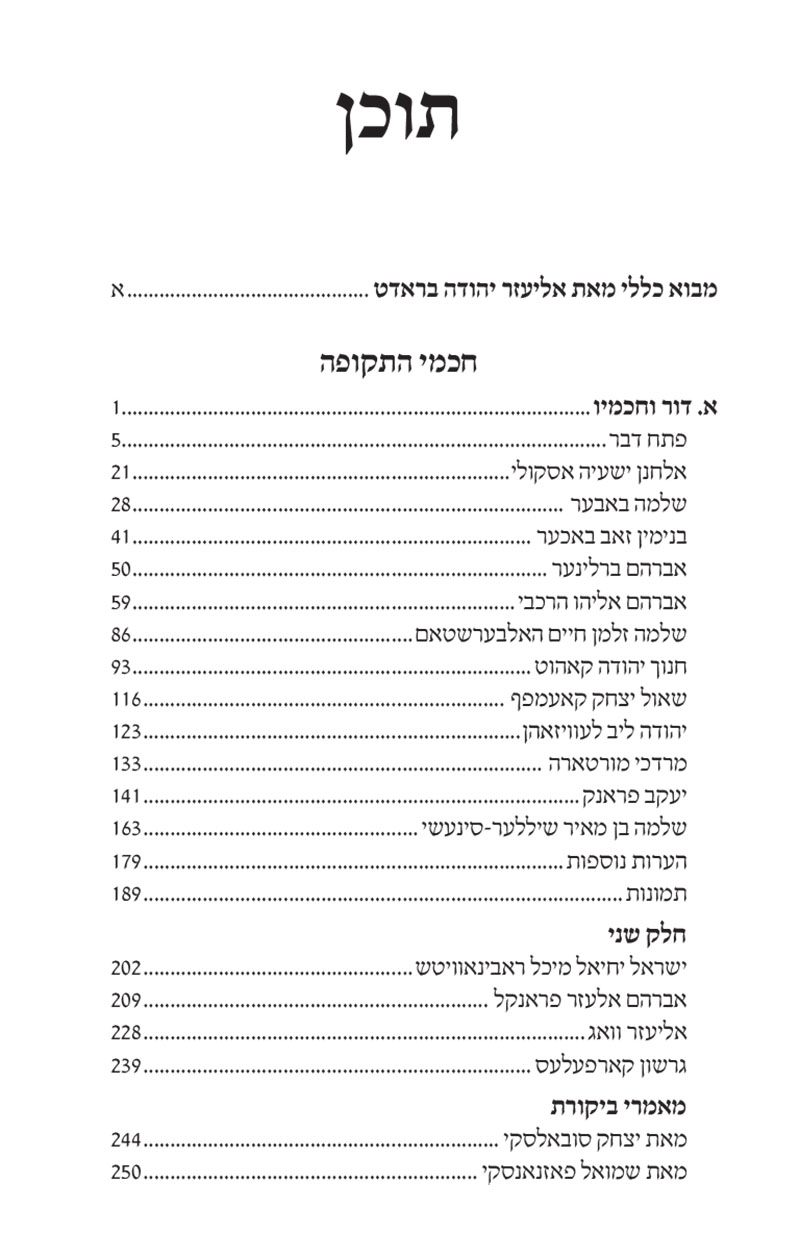
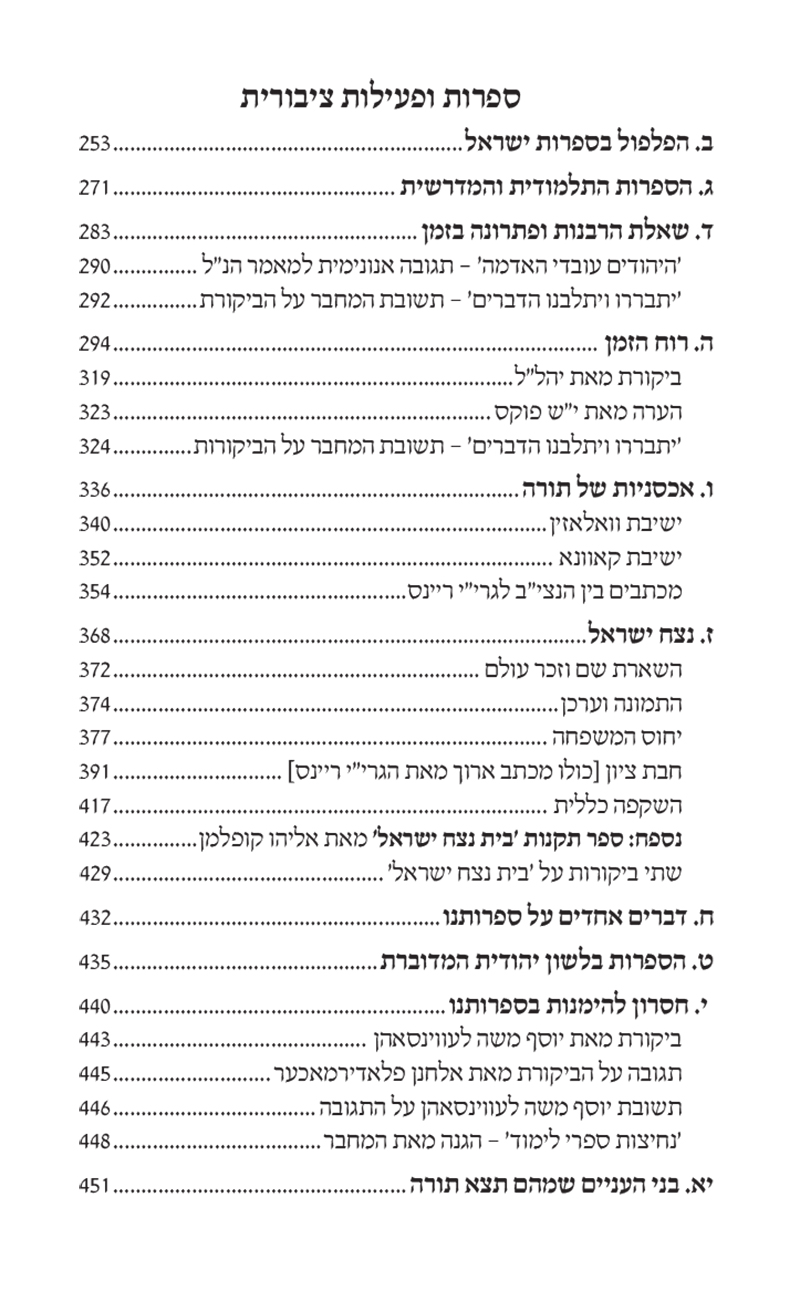
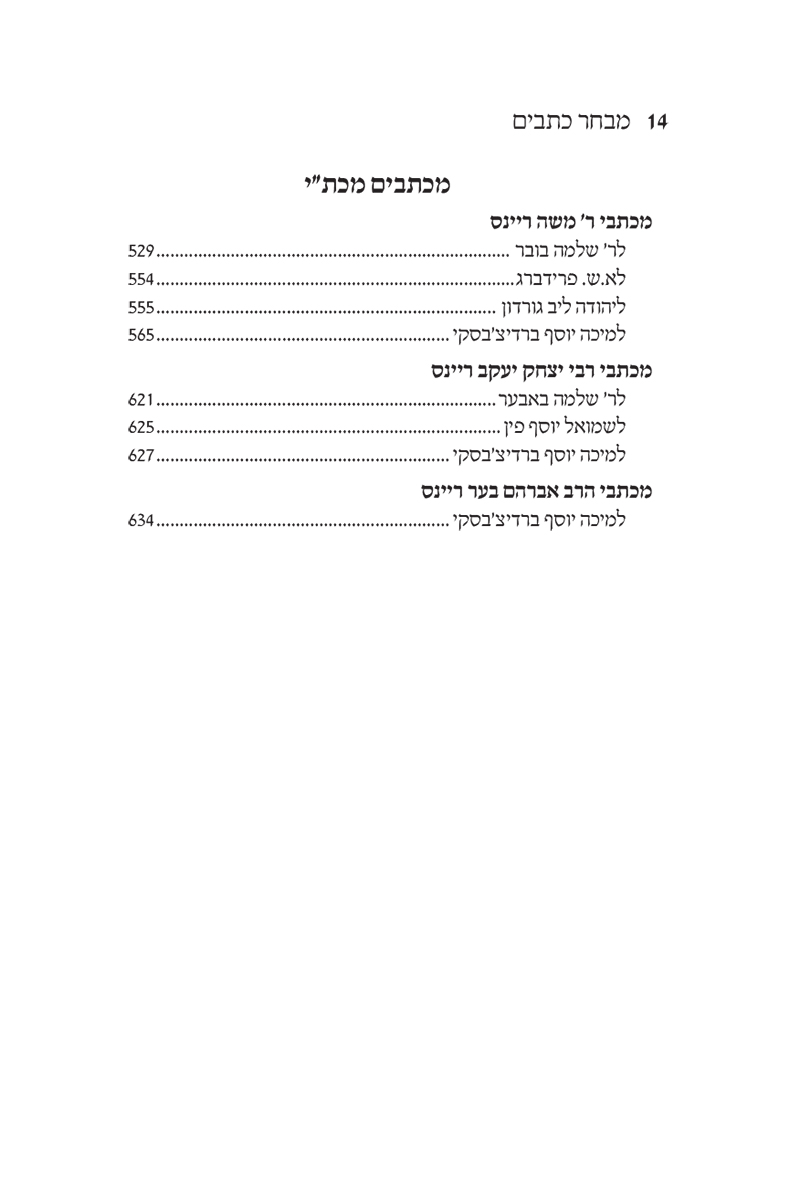
ר’ משה ריינס מבחר כתבים, אוסף חיבוריו מאמרים ואגרותיו, לג+ 640 +4 עמודים
The sefer will be available for purchase in the US shortly. (We will post that info soon).
A PDF of some sample pages are available upon request, for more information contact me at eliezerbrodt@gmail.com.
What follows is the English introduction to the book. This is an abridged version of the much longer Hebrew introduction included in the book.
A few years ago, while researching the history of the Lithuanian Yeshiva of Volozhin, I came across an article written by Reb Moshe Reines. His article included a few letters between his father, Rabbi Yitzchok Yaakov Reines, rabbi of Lida and leader of the religious Zionist movement, and Rabbi Naftoli Tzvi Yehuda Berlin (the Netziv), head of the Volozhin Yeshiva. These letters were not included in the recent collections of the Netziv’s writings. A short while later I read a small, rare book by Reb Moshe Reines called Dor VeChachomov; a collection of essays about various scholars of his generation. The quality of these writings piqued my interest in Reb Moshe Reines (RMR). I began researching the author and proceeded to search for his other writings. I soon discovered that this brilliant scholar died in 1891 at the very young age of twenty-one, and that precious little else is known about him.
I was introduced to the world of RMR’s father, Rabbi Yitzchok Yaakov Reines, by one of his descendants, my friend Rabbi Yisroel Gordon. As I began collecting RMR’s writings, I suggested to Rabbi Gordon that they are of significant historic interest and that they be reprinted in one modest volume. Rabbi Gordon’s mother, Mrs. Naomi Gordon, great granddaughter of Rabbi Y.Y. Reines, underwrote most of the costs of the project. Mr. Yosef Aronson, great grandson of Rabbi Y.Y. Reines, participated in the financing as well.
After further research, I discovered that RMR was such a prolific writer that the modest volume I had envisioned grew to a much larger size.
My inquiries led me to uncover a significant correspondence between RMR and the renowned scholar Rabbi Shlomo Buber. Over twenty letters from RMR to Shlomo Buber are currently preserved in the Buber collection in the National Library of Israel in Jerusalem. I requested and received permission to copy, transcribe, and print these rare, personal documents. Also included in this collection are several letters by RMR to the writer Judah Leib Gordon.
In addition to this treasure located at the National Library, I discovered an additional thirty-seven letters from RMR to his friend, Micha Yosef Berdeshevsky. Professor Avner Holtzman graciously granted permission to copy, transcribe, and print these letters in this collection. This volume also includes some letters by Rabbi Yitzchok Yaakov Reines to Berdeshevsky, Shlomo Buber, and Shmuel Finn. All of these letters have never been printed before.
Over the course of my research, I discovered that some additional letters by RMR, written to Avrohom Dubsewitz, had been preserved at the New York Public Library. However, copies of those were located too late to be included in this volume.
From his letters it is clear that RMR was a remarkably prodigious scholar. He had expert knowledge of the Talmud. He published articles on Jewish history, and was also educated in other areas of secular knowledge. Further, his command of Hebrew was formidable. This combination of knowledge is quite remarkable, considering his youth.
In a letter to Shlomo Buber (included in this work), Rabbi Y. Y. Reines writes of his devastation after his son’s untimely death, and expresses his desire to write a book about him. Unfortunately, as far as we know, he never got around to doing so.
Significance of this Volume
RMR’s articles were prominently featured in the important newspapers and journals of the day. Some of his essays sparked debates in the periodicals. These debates are included in this collection. His writings shed a light on Jewish life in Russia in the 1880s, dealing with many then-current issues such as Jewish education, yeshivos, and the rabbinate. Some of RMR’s ideas and thoughts on these topics are still relevant today.
RMR writes clearly that he was his own person, presenting ideas that sometimes diverged from those of his father. Yet, his writings reflect his father’s influence, and they serve to illuminate the complex ideas and worldview of his father, the unique and often-misunderstood Rabbi Y.Y. Reines.
This volume also includes numerous letters from RMR’s correspondence with various personages of the time. These letters, printed here for the first time, are autobiographical in nature. As with much autobiographic material, these letters are historical documents, offering an authentic glimpse into an era.
Highlights
The first section of RMR’s collected writings is a small book entitled Dor VeChachomov. His original plan was to write essays on the lives of fifty Jewish scholars of the day. Twelve essays from this collection were printed in his lifetime; four more were printed after he died. His choice of subjects is explained in his letters to Shlomo Buber. Apparently, RMR was commissioned to write about living personalities about whom no biographies had yet been written, thus limiting his choice of subjects. He requested of his subjects that they send him a biography and a bibliography of their writings. Some of them did not respond. For those who did, he wrote up their information and added his own introductory paragraphs (some with highly interesting, tangential discussions). Among the more famous scholars he included in the book were: Binyomin Ze’ev Bacher, Avraham Berliner, Shlomo Buber, and Avraham Harkavi. These essays are the first biographies written about them.
Another essay is titled Achsanyah Shel Torah. This essay was supposed to develop into a small book, but sadly he never completed it. It deals with the yeshiva in Volozhin and the Kovno Kollel, and contains many fascinating details. Included in this section are six letters from the Netziv to Rabbi Y.Y. Reines.
Another noteworthy essay is Hasafrut Hatalmudut VeHamedrashit. This essay addresses different aspects of publishing seforim. One section deals with the challenges authors face getting their work printed and gaining proper recognition. One senses that this section reflects his and his father’s personal experiences. Another part of this essay is devoted to the importance of book reviews and the role of proper haskamos (approbations). A third part suggests creating a fund for poor writers. Many of the issues raised in this essay remain relevant for authors today.
One of the longer essays in this volume is Netzach Yisroel, an in-depth treatment of a proposal to establish a genealogical museum in Jerusalem, housing family trees in an organized fashion, including pictures of family members. RMR encouraged sending the proposed museum any material of historical significance, including works published or unpublished. One section of RMR’s essay focuses on the importance of pictures, another on the importance of family trees. The last section is devoted to the importance of living in Eretz Yisroel. In it, RMR included a beautiful letter from his father on the subject.
Some of the essays deal with the need to establish a curriculum for the education of a rabbi, detailing what subjects, besides the requisite Torah knowledge, a rabbi needs to know. The issue of educating rabbis in areas other than Torah, without compromising their Torah studies, is discussed. This subject was very important to Rabbi Y. Y. Reines, who opened more than one yeshiva with that challenging agenda.
Related to this is an essay about the pilpul method of learning. Much has been written and continues to be written on this subject. In this essay, RMR analyzes the pilpul method, listing the issues that have been raised about it, and demonstrating its weaknesses. He advocates a method based on rules of logic, a method advanced and written about by his father.
RMR wrote many times and at great length about haskalah, the Jewish enlightenment movement. His approach to haskalah was that one should “accept the truth from whoever says it,” as did the tanna Rabbi Meir (Chagigah 15b), whose approach to the impious teacher Acher was to take the good and leave behind the bad.
Thus, in a letter to Judah Leib Gordon, he writes:
“Although from a religious perspective you and I are as far apart as are Lida and Pressburg, for you are utterly irreligious (as your demands for “reformations in religion” prove!), and I am completely conservative in religious matters and in all my days have never transgressed even the slightest custom which has become sanctified in the course of time (save foolish and deviant customs, such as spitting during the recitation of alienu l’shabeiach, which from my youth has aroused in me repulsion and is intolerable to me); however with regard to haskalah, my views are exactly like yours and my heart identical to yours.”
RMR’s letters are vastly informative regarding his special relationships with Shlomo Buber, Shmuel Finn, and Micha Yosef Berdishevsky. They also include tidbits about his parents, his brother, pen names he used, and other articles he planned on writing.
One last interesting, bibliographical piece we learn from the letters regards the anonymous work Hakolos Yechdalun (Bardichov, 1887), an attack on Rabbi Y.Y. Reines’ work and new method of learning. In various letters we read about RMR’s strong reaction to the work. We also learn that he showed it to his father. Until now, bibliographers were not certain who the author was, suggesting it was one Rabbi Yaakov Tzvi Yanovski. From RMR’s letters, it appears clear that indeed Rabbi Yanovski is the author.
Aside from presenting the writings of a brilliant young scholar, this volume opens a window into the intellectual ferment of the Jewish world in the late nineteenth century.
Here are the table of contents:
The Vilna Gaon, part 3 (Review of Eliyahu Stern, The Genius) by Marc B. Shapiro
The Vilna Gaon, part 3 (Review of Eliyahu Stern, The Genius)
by Marc B. Shapiro
In honor of Sean Penn and Mark Wahlberg, who understand what pidyon shevuyim is all about.
Continued from here.Returning to R. Sternbuch’s Ta’am ve-Da’at, vol. 1, earlier in this book, p. 88, we find the following passage.
שמעתי ממרן הגריז”ס זצ”ל (הגאב”ד דבריסק) שאברהם אבינו לא היה עצבני וחושש ומפחד שהולך לשחוט בנו יחידו, אלא היה לו הלילה שלפני העקדה ככל הלילות, ולא נתרגש מצווי זה וקם בבוקר לקיים המצוה כשם שמקיימים כל מצוה, והשכים כזריזין שמקדימים למצוות, ושש ושמח לקיים מצות בוראו
According to R. Velvel Soloveitchik, Abraham was not emotionally affected by the command to sacrifice Isaac, and on the night before he was to go to Mt. Moriah he slept as well as on any other night. He approached this commandment like any other commandment, and was ready to do it with joy. It is hardly an accident that the Abraham described by R. Velvel very much resembles R. Velvel himself. See also my earlier post here. [1]
Yet doesn’t R. Velvel’s understanding conflict with the notion that the Akedah was a test or trial? What kind of test was it if Abraham related to this command just like any other?
The Gaon is quoted as having a different perspective on the Akedah.[2] According to him, since Abraham was engaged in acts of loving kindness all the time, this commandment was designed to develop in him the attribute of cruelty, which is also required at times.
וז”ש כאן בעקידה עתה ידעתי כי ירא אלקים אתה, לפי שקודם לכן לא היה אלא רחמן מאד שהיה מכניס אורחים וגומל חסדים. אבל המדה של אכזריות ולכוף א”ע ולקיים מצות הבורא ית’ עדיין לא היה ניכר בו והיו יכולים לומר שאברהם איננו צדיק גמור ח”ו. אבל בעקידה שעשה ג”כ מדת אכזריות שרצה בכל אות נפשו לקיים מצות הבורא ולשחוט את בנו יחידו אשר בו תלוי כל חיותו א”כ עתה נשלם וניכר שהוא צדיק גמור
The Gaon connects this to the commandment to send away the mother bird before taking the eggs. In the Guide 3:48, Maimonides understands this as designed to avoid cruelty to the mother bird. However, the Gaon has the exact opposite interpretation. He assumes that sending away the mother is very cruel, and that is the entire point of the commandment. He points out that in only two commandments does the Torah promise long life. One is respect for parents, which is about compassion. The other is sending away the mother bird, which is about cruelty, The complete personality, i.e., the tzaddik, needs to have both of these characteristics.
לפי שאין השלימות ניכר באדם אלא כשיש לו מדות הפוכות, כגון מדת רחמנות ואכזרות
As the Gaon explains, if someone had only one of these characteristics, you could say that this was just his nature. However, when you see in the same person the opposite characteristics of compassion and currently, applied at different times, this shows that the person is a tzaddik. This also explains why God gave commandments that are characterized by compassion as well as commandments that cause one to act with cruelty.(R. Moses Cordovero writes that “kindness is not valued in an individual who is naturally kind, only in a person who overcomes his inclination to act contrary [to the dictates of kindness].” See Or Yakar, Hayyei Sarah, p. 110, translation in Paul B. Fenton, “The Banished Brother: Islam in Jewish Thought and Faith,” in Alon-Goshen-Gottstein and Eugene Korn, eds. Jewish Theology and World Religions [Oxford, 2012], p. 251.)
Directly before this explanation in Divrei Eliyahu, the Gaon discusses God’s commandment to Abraham to circumcise himself and every newborn boy. According to the Gaon, Abraham was in doubt whether he should fulfill the commandment, since the requirement of such a practice would discourage the pagans from conversion. He thought that perhaps it would be better for him to disobey God’s command, and give up his heavenly reward, in order to increase believers in the world.
נתיירא אאע”ה שמא עי”ז לא ימשכו אחריו הבאים להתגייר ונוח היה לו להפסיד לעצמו משכרו הטוב ורק לקבץ מאמינים בעולם
Not knowing what to do, Abraham consulted with Aner, Eshkol, and Mamre, and the first two advised not doing the circumcision, but Mamre advised him to listen to God and that is what he did.
This is a development of an older theme that appears in a number of midrashim and is alluded to in Rashi, Genesis 18:1. According to these sources, Abraham was indeed unsure whether to listen to God, but none of the midrashim offer a reason for Abraham’s hesitation. [3] The midrashic notion that Abraham hesitated over following God’s command is quite startling, and many commentators deal with it in all sorts of creative ways.[4] The Gaon softens the difficulty somewhat by explaining that Abraham was not in doubt regarding whether to follow God’s command because he was afraid of the procedure, but his motivation was much more exalted. Yet the Gaon’s explanation is somewhat difficult because the midrashim have Mamre convincing Abraham to do the procedure by reminding him how God saved him from the fiery furnace or how in general God has always watched over him, and there is thus no justification for ignoring His command. This implies that Abraham’s reason for hesitation was fear over the operation rather than concern that his proselytizing efforts would suffer.
I would love to know what R. Velvel would say about these midrashim, which show Abraham in a very different light than the way he describes the Patriarch.
Finally, let me mention a story famous in Habad and recorded by the Lubavitcher Rebbe in various places. It shows an attitude entirely at odds with the sort of piety we saw in the last post. Here is a selection from the Rebbe’s letter in Iggerot Kodesh, vol. 22, no. 8558 (p. 366). The translation is taken from here.
The Alter Rebbe shared his house with his oldest married son, Rabbi Dov Ber (who later succeeded him as the Mitteler Rebbe). Rabbi Dov Ber was known for his unusual power of concentration. Once, when Rabbi Dov Ber was engrossed in learning, his baby, sleeping in its cradle nearby, fell out and began to cry. The infant’s father did not hear the baby’s cries. But the infant’s grandfather, the Alter Rebbe, also engrossed in his studies in his room on the upper floor at the time, most certainly did. He interrupted his studies, went downstairs, picked the baby up, soothed it and replaced it in its cradle. Through all this Rabbi Dov Ber remained quite oblivious.
Subsequently, the Alter Rebbe admonished his son: “No matter how engrossed one may be in the loftiest occupation, one must never remain insensitive to the cry of a child.”[5]
In the last post I showed examples of removing material from the English translation of a Hebrew book, so as not to scandalize the English reader. Here is another example. The Hebrew text comes from Shimon Yosef Meller’s biography of R. Velvel Soloveitchik, Ha-Rav mi-Brisk (Jerusalem, 2006), vol. 2, pp. 546-547. I previously mentioned this passage here.
Here is the relevant page in the translation, The Brisker Rav (Jerusalem, 2009), vol. 2, p. 573, and you can see that the story I am referring to has been removed.
For another story about vomiting, see the following passage which comes from the introduction of the Gaon’s sons to his commentary on the Shulhan Arukh.
Here is a similar story recorded about R. Yisrael Salanter.[6]
Whether these stories actually happened is not important. What is important is that they were regarded as examples of piety in those days, while today if someone would act this way people would feel revulsion. In fact, since people had such a different response years ago, there is no need to assume that the stories did not happen simply because today the stories seem impossible. When it comes to what people regard as appropriate, one sees enormous changes between generations and cultures. An obvious example is the matter of homosexuality. While a century ago this was pretty much universally regarded as repulsive, among today’s younger generation of college educated people you would be hard pressed to find anyone to say this (as I can attest from interactions with hundreds of college-age students). Even among the halakhically observant, i.e., those who accept the prohibition on homosexuality, many do not regard it as inherently repulsive.
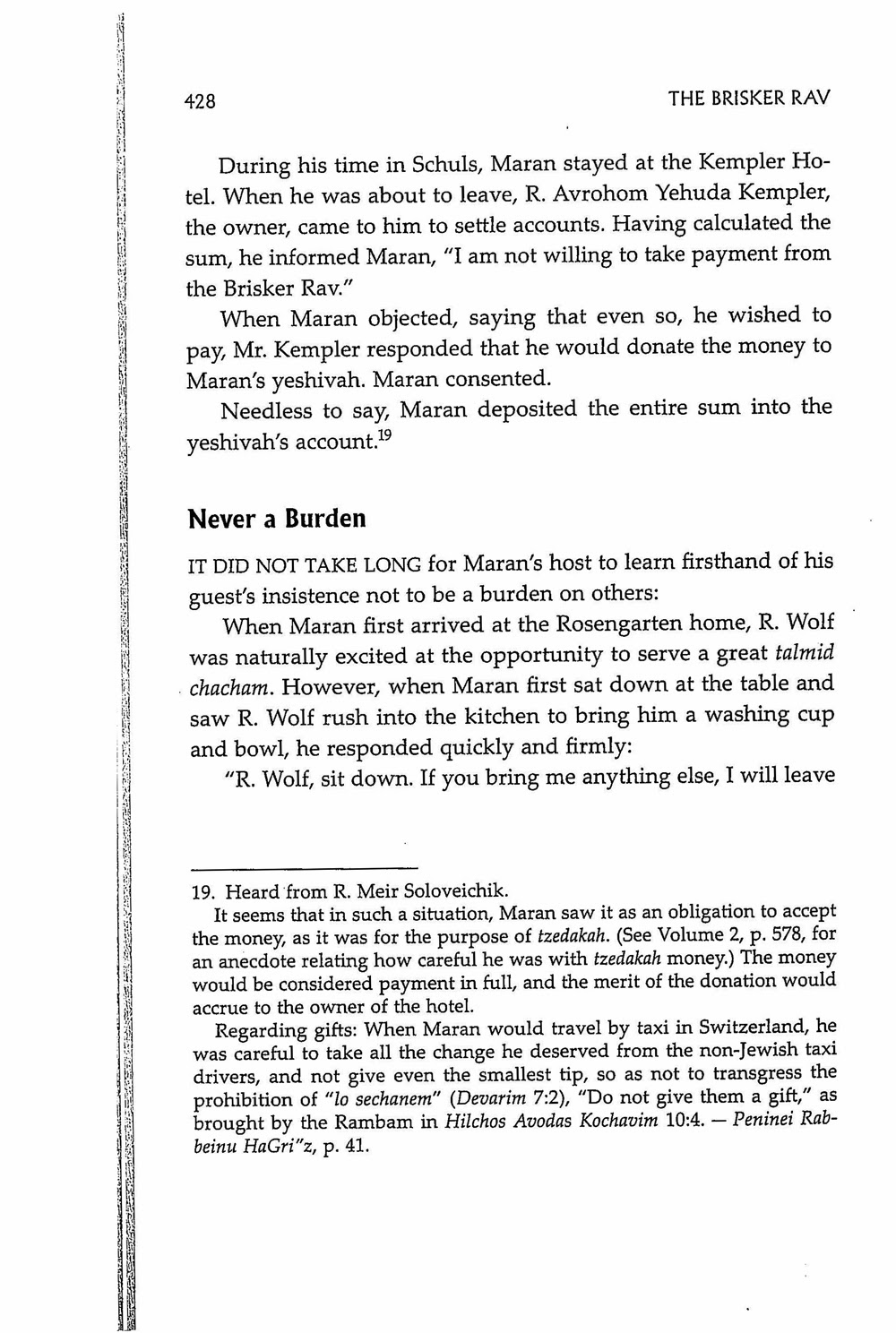
When it comes to The Brisker Rav, I have to confess that I was also certain that another passage would be removed, and it was not. I have in mind vol. 3, p. 428 n. 19 (the last paragraph).[7]
P. 140: Stern cites a comment that appears on every other page in R. Israel Salanter’s journal Tevunah:
All laws concerning monetary transactions have absolutely no practical authority. For we follow the law of the land. And this is the meaning of the great principle of “the law of the land is final.” We study, analyze, and debate monetary topics in the same way in which we study the laws of donations to the temple, tithes, sacrifices and purities, which are not practiced today. They are discussed only in terms of fulfilling our duty to study the Torah.
Upon this, Stern remarks, “While one cannot discount the pressures of governmental censorship that may have contributed to this position, still it marks an important development in rabbinic history. As Elchanan Reiner correctly notes, ‘Diverting attention from the actual ruling to the text itself, namely to the very practice of interpretation, constitutes a dramatic shift in the history of knowledge.’”
I don’t accept this at all. There is no question that the words quoted from Tevunah were directed towards non-Jewish governmental authorities, if not in Germany (where the journal was published), certainly in Russia, where the journal would find its major readership. How is this an important development, and how does it relate to Reiner’s point (made in an entirely different context) when every Jew who read these words understood that that they were not to be taken seriously, any more than the passages on the second page of many rabbinic books stating that all references to non-Jews only refer to pagans in places like China and India?
Let me make just a few more comments about the Gaon. Some people refer to him as Rabbi Elijah Kramer. When I first saw this name a number of years ago, I didn’t know who was being referred to since I had never heard of any Elijah Kramer. The first reference in print to Elijah Kramer (or Kremer) that I have been able to discover is Maurice Samuel’s 1963 book, Little Did I Know, p. 257. (If anyone is aware of an earlier reference, please let me know) The name was later made popular after appearing in the title of Yaacov Dovid Shulman’s 1994 book, The Vilna Gaon: The Story of Rabbi Eliyahu Kramer.[8]
If this post does nothing else, I hope it puts an end to this mistaken practice. The Vilna Gaon was not named Kramer! He was descended from someone named R. Moses Kramer (his great-great grandfather), but the Gaon never used this name and no one ever used it about him, so it is a mistake to call him this.[9] See also note 1 in S.’s post here.
The mistake of referring to the Gaon as Kramer appears in a 2012 book by Rabbis Berel Wein and Warren Goldstein, The Legacy: Teachings for Life from the Great Lithuanian Rabbis, p. 130. The particular chapter I refer to was written by Wein, and on the same page that he mentions Kramer he refers to the Gaon’s foremost student as “Rabbi Chaim Rabinowitz”. As far as I know, this is the first time R. Chaim of Volozhin has been given the last name Rabinowitz, and I have no idea what led Wein to write this. Perhaps there was some confusion between R. Chaim of Volozhin and R. Chaim Rabinowitz of Telz.
This book (which I do recommend) has an approbation by R. Shmuel Kamenetsky in which he writes that “everything in it is true.” I am inclined to think that R. Kamenetsky was only referring to the larger issues discussed in the book rather than attesting to the accuracy of every fact. There is an old saying
כשם שאין בר בלא תבן כך אין ספר ללא טעויות
We can update this saying by adding the word “blog post” after the word “sefer”.
Bezalel Naor has published the following letter he wrote to Elliot Wolfson.
Have you read the new book by Eliyahu Stern, The Genius: Elijah of Vilna and the Making of Modern Judaism (New Haven: Yale University Press, 2013)? In a lengthy endnote on pp. 196-198 (note 19), Stern polemicizes against your reading of the Vilna Gaon’s interpretation of “sefer ve-sefer ve-sippur” (Sefer Yetsirah 1:1). Stern refers to your essay “From Sealed Book to Open Text: Time, Memory, and Narrativity in Kabbalistic Hermeneutics,” Interpreting Judaism in a Postmodern Age, ed. Steven Kepnes (New York: New York University Press, 1996), pp. 145-178, especially footnote 14.
Not wishing to rely on memory alone, I consulted the beginning of the Bi’ur ha-GRA le-Sifra di-Tseni’uta:
Sifra–A book (sefer) is the revelation of the thought, for the thought is closed within man and is revealed only by his speech or by his writing. And so En Sof was revealed, and created the world for [the purpose of] revelation and to make Himself known, as it says in the Zohar, and so the tikkunim that are explained in the continuation [of Sifra di-Tseni’uta] also [come about] through these two things, as it says in Sefer Yetsirah (The Book of Creation), “and [He] created His world with book, book and narrative (sefer ve-sefer ve-sippur). The matter of the two books and [single] narrative is due to the fact that in speech, at one stroke his thought is revealed, whereas in a book it takes two times: once when he writes and his thought is revealed in the world, but the book is yet closed; and a second time when the book is read and then revealed. But in speech, both are included at one time.” (Elijah of Vilna, Bi’ur ha-GRA le-Sifra di-Tseni’uta, ed. Bezalel Naor [Jerusalem, 1997], 1a)Elliot, your understanding of the passage is sound. On the other hand, Stern’s translation of the first term ”sefer” (which he is forced to revocalize “sefar”) as “mathematics,” would appear to be without foundation. As for the revocalization from sefer to sefar, Stern has drawn on Yosef Avivi, whom he cites. (See Yosef Avivi, Kabbalat ha-GRA [Jerusalem: Kerem Eliyahu, 1993], pp. 32-35.) Yet even Avivi did not have the audacity to inject into the Gaon’s commentary the concept of “mathematics.” This mathematicization of Elijah’s worldview awaited Leibniz.
I am not qualified to express an opinion on the merit of Stern’s opinion vs. that of Wolfson when it comes to understanding what the Gaon says. However, when it comes to the Sefer Yetzirah text, we should not assume that Yosef Avivi and Stern are the first ones to revocalize ספר as sefar. This passage in Sefer Yetzirah appears in R. Judah Halevi, Kuzari 4:25, and Hartwig Hirschfeld, in his translation, writes “S’far Sefer, and Sippur.” Also, here is a page from the edition of the Kuzari with the commentary of R. David Cohen, the Nazir (Jerusalem, 2002), p. 227, and you can see this vocalization. (On the previous page, he, like Hirschfeld, vocalizes the word sefar in the text of the Kuzari).
R. Joseph Kafih also vocalizes the word as “sefar” in his edition of the Kuzari.Naor is mistaken when he states that understanding sefar as referring to “mathematics” is without foundation. While it is true that contrary to the implication of Stern, p. 196 n. 19, Avivi does not say anything about mathematics, there are others who do. Returning again to R. Judah Halevi, Kuzari 4:25, here is Hirschfeld’s translation:
As to sefar, it means the calculation and weight of the created bodies. The calculation which is required for the harmonious and advantageous arrangement of a body is based on a numerical figure. Expansion, measure, weight, relation of movements, and musical harmony, all these are based on the number expressed by the word sefar.
See also the page from R. David Cohen above, where he quotes R. Judah Barceloni who states: וספר – זה חשבון והוא המספרHere is another text woth noting. It is from R. Joseph Kimhi’s Sefer ha-Galui (Berlin, 1887) p. 3.
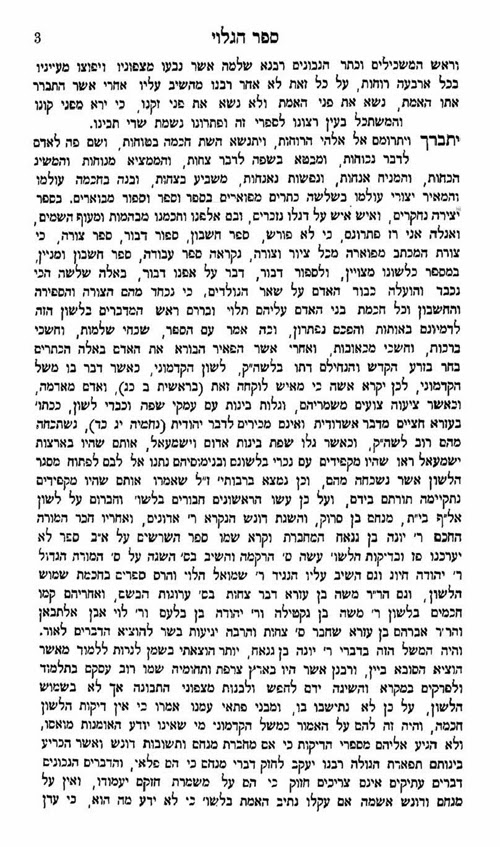
Kimhi tells us that he is going to let us into the secret of this text, which hasn’t yet been explained, and he writes: ספר חשבון ומניין. He then explains that this is one of the wisdoms that only humans are privy to. See also the anonymous commentary on Sefer Yetzirah, published by Israel Weinstock (Jerusalem, 1984), which explains ספר ספר וספור as follows:
לעיין תמיד בספרים, ולספור דרכי המספרים, ולחשוב בם תמיד
There are other sources that can be cited, but I think this suffices to show that Stern’s reading has to be taken seriously.
Let me conclude by mentioning something already well known, that the Gaon’s writings are full of original views. Stern deals with some of them, and there are many others. In TheLimits of Orthodox Theology, p. 14 n. 55, I already note that the Gaon apparently believed that of the Thirteen Principles, only the first and second were real dogmas (in the Maimonidean sense).
Needless to say, each of the views I will now mention could have a detailed post of its own. There are obviously many other unique views of the Gaon, but for now I think these few will be of interest to readers as they are not that well known.
1. The Gaon did not wear R. Tam tefillin. We are told that he didn’t want to be without tefillin for even a small amount of time. Since the halakhah is in accordance with Rashi, the time spent wearing R. Tam tefillin would be regarded as bitul mitzvat tefillin.[10] R. Elijah Rabinowitz-Teomim writes[11]:
מתחרט אני כל פעם בלבי, על שהנהגתי בתפלין של רבנו תם, בראותי דעת רבינו הגר”א זצ”ל בזה, ככתוב בס’ שערי רחמים משמו, אך אי אפשר לי שלא להניח עוד
2. According to the Gaon, non-Jews in the Land of Israel have to observe all the mitzvot. I know this will be hard for people to believe, so here is the text to see with your own eyes. It comes from the first edition of Aderet Eliyahu (Halberstadt, 1859-1860), Deut. 32:9.This is a very unusual position, and I don’t know of any precedent for it.[12] It is so unusual, in fact, that the next printing, Warsaw 1887, simply cut this section out. Here is how the page looks in the Warsaw edition.
Raphael Shuchat notes that in a manuscript version of the Aderet Eliyahu text there is an important addition, which I have underlined:[13]
ואפילו הגוים הדרים בא”י צריכים לקיים כל המצוות, לפי שכל המצוות תלויים בארץ ישראל
But even with this addition the text is still very difficult, and no one has been able to find a source for the notion that Gentiles have to observe all the mitzvot in the Land of Israel, meaning that the idea is probably original to the Gaon. Shuchat offers two suggestions neither of which really fit with the Gaon’s words. One is that the Gaon means to say that since today there is no longer a law of ger toshav, any non-Jew who wishes to live in the Land of Israel has to convert. According to Shuchat, that is what he means when he says that non-Jews in the Land of Israel have to observe all the mitzvot. His other suggestion is that while there is no halakhic obligation for non-Jews to observe the mitzvot, by not doing so they are not respecting the sanctity of the Land.
שנכרי אינו חייב מצד ההלכה במצוות בארץ, אך מצד קדושת א”י הוא פוגם אם לא יקיים את המצוות בארץ
R. Eliezer Waldenberg also takes note of the passage in Aderet Eliyahu, and seeing no way to explain it assumes that the text is a mistake – מפי שמועה לא נכונה.[14]
Yet R. Waldenberg was unaware that in Aderet Eliyahu, Deut. 1:5, the Gaon says the exact same thing, namely, that in the Land of Israel non-Jews are obligated in all the mitzvot.[15]
ולכן נענשו אפי’ נכרים מפני שלא שמרו את התורה בארץ כמ”ש (מ”ב י”ז) לא ידעו את משפט א-להי הארץ, שישראל מצווה על כל התורה בח”ל ובארץ מצווה אפי’ נכרי
This text appears in full even in the second edition of Aderet Eliyahu, which is the edition that censored the comment to Deut. 32:9. R. Elijah Dessler used the censored Aderet Eliyahu so he didn’t know the Gaon’s comment to Deut. 32:9, but he noted the comment to Deut. 1:5 and expressed his great surprise.[16]
וזה דבר פלא לאמר דע”פ דין תורה כל נכרי הדר בא”י יהי’ מחוייב בכל המצוות כל זמן שבחפצו לדור בה, ותו מה יהי’ בדבר שמירת שבת, שהרי הגוי אסור בשמירתה, ומה יהי’ באכילת קרבן פסח, וכדומה.
While I don’t know of any talmudic or midrashic sources to support the Gaon’s position that a non-Jew in the Land of Israel has to observe all mitzvot,. there are some earlier texts that place additional obligations on non-Jews than what we normally assume.
Midrash Tanhuma (ed. Buber), Metzora 13, states that non-Jews are punished with karet if they violate the laws of Niddah.[17]
Ibn Ezra, Ex. 13:7, 20:8, Lev. 17:13-14, 20:25, states that a non-Jew living in the Land of Israel (i.e., a ger toshav) is obligated to observe Shabbat. He is also not to work on Yom Kippur, to refrain from eating hametz on Passover, and to only eat kosher food. This is Ibn Ezra’s understanding of the peshat of the Torah, but the Talmud records no such laws.The most significant of the sources I can cite, and the one closest to the Gaon’s position, is found in Avodah Zarah 64b. Here the Talmud quotes אחרים as saying that a ger toshav has to observe all the mitzvot with the exception of ritually slaughtered meat. The Hazon Ish, Yoreh Deah 65:6 wonders about this position, since does it mean that a non-Jew must wear tefillin and eat in a sukkah? He assumes that the talmudic passage means that non-Jews in the Land of Israel are only obligated in the negative commandments, and this is required so that Jews not be negatively influenced by their non-Jewish neighbors. See also R. Asher Weiss, Minhat Asher, Bereishit, p. 19.
Subsequent to the Gaon, the Hatam Sofer claims, based on a comment of Tosafot,[18] that when the Torah forbids something for Jews, it is praiseworthy for non-Jews to also abstain from this. See Hatam Sofer al ha-Torah, ed. Stern, vol. 1, p. 216:
דמה שהוא מדינא אסור לנו, נכנס עכ”פ בגדר החסידות גבי ב”נ
*******
1. If, after all I have written, people are still not motivated to read Stern’s book, or they simply don’t have the time, you can watch him discuss the topic here.
Quite apart from Stern’s work on the Gaon, Shlomo Pick wrote the following in his just published article, “Al Prof. Shaul Lieberman ve-ha-Makhon ha-Gavoah[19] le-Torah she-Al Yad Universitat Bar-Ilan – Perek me-Hashkafato,” Badad 28 (Kislev, 5744), p. 10 n. 10.
2. On a recent trip to Toronto I had the pleasure meeting the indefatigable Yehuda Azoulay. Anyone who is interested in the history of great Sephardic rabbis should check out his books here.
3. In the previous post I wrote about the title of the newspaper Yated Ne’eman, and how yated is actually a feminine noun. All that I wrote in that section was tongue in cheek, as I think readers realized, but by mistake I didn’t include a footnote that was supposed to go in. In that note I pointed out that despite what the grammarians might say about the word yated, there are plenty of sources, from long before the newspaper came into existence, that use yated as a masculine noun. The following passage, which has both masculine and feminine,[20] appears in Teshuvot ha-Rashba, ed. Dimitrovsky, vol. 2, p. 529:
ובמלאת הימים האלה יהיה היתד הנאמן תקועה בלבם יתד לא תמוט
4. In the last post I referred to R. Mordechai Agasi’s Asurei ha-Melekh, a recent book dealing with the halakhot of being in prison. One of the commenters noted that this is an example of “life imitating art”, and he referred to a parody of Artscroll available here here where you can see the imaginary new English sefer The Laws of Incarceration. (I recommend also clicking on the links at the bottom of phony Artscroll website.)
Yet what we see from Asurei ha-Melekh is that this is anything but a joke. The parody has as one of the questions answered by the fake Artscroll book, “What are the requirements for conducting Bedikas Chometz in one’s cell?” In Asurei ha-Melekh, vol. 1, pp. 161-162, Agasi, discusses this very case. (All references to Asurei Melekh will be to vol. 1 unless otherwise mentioned).
Believe me when I tell you that pretty much all the possible halakhic problems a prisoner can think of are dealt with in the book. He even deals with some very far-fetched cases. For example, on p. 17 he discusses how one is to put on tallit and tefillin if his hands are in chains. His answer is that a non-Jew can put them on the prisoner, and the prisoner can still make the blessing.
I know that many people have made a joke of Asurei ha-Melekh. But this is a very serious book that serves a real purpose. It also comes with a letter of approbation from R. Shalom Lipskar. He heads the Aleph Institute, one of whose purposes is to reach out to Jews in prison. With the great increase in haredi prisoners, it is important for them to be given halakhic guidance, and the way to do this is with a sefer. (The Modern Orthodox will need an English language book.) Just because someone makes a mistake and has to go to prison doesn’t mean that he should make matters worse and give up Torah observance. There are also new halakhic problems that have to be dealt with. For example, Agasi, p. 123, discusses the case of one who is under house arrest but is permitted to go to synagogue. To enforce the house arrest, the man has to wear an electronic monitor. Is one permitted to go to synagogue on the Sabbath with the electronic monitor since as soon as he leaves his house it starts to record his movements and causes various LED lights to go on? Agasi’s answer is that the man must not leave his house on the Sabbath.
The federal government has made matters easier for observant prisoners by turning Otisville Federal Penitentiary into the place where many non-violent haredim (and other Orthodox Jews) are sent if they are convicted of a federal crime. It has a full-time Jewish chaplain and kosher kitchen.[21] The prison commissary list of food[22] helpfully notes those that are kosher (regular hashgachah) and also those that are “super-kosher” under the hashgachah of the CRC (Central Rabbinical Congress, i.e., Satmar).
Returning to Agasi’s book, while it has certain value, as I indicated, it also has great problems. Let me begin, however, by noting something positive. On p. 42 he states in no uncertain terms that one must follow the Law of the Land, and this includes taxes, traffic, and building laws. He states that violation of the Law of the Land is a Torah prohibition.
Yet I must also state that the book is biased against the American justice system, which he thinks is putting away too many haredim. He tells us that Jewish law, unlike secular law, does not sentence people to prison as a punishment (p. 11). Historically this has been true, but that is because the Jewish communities didn’t have real prisons. At most they had small jails to keep people for limited periods of time. (See R. Ephraim ha-Cohen, Sha’ar Ephraim, no. 83, who discusses if the communal jail needs a mezuzah.) If they were dealing with a real criminal who had to be stopped, they turned him over to the non-Jewish authorities or they dealt with him through physical punishments. Jewish courts in Spain would deal very harshly with those they wanted to punish. They even cut off tongues and noses as forms of punishment. Considering the alternative, one would think that Agasi would be happy that we have progressed to prisons, which seem much more humane than how medieval Jews dealt with troublemakers. Yet from Agasi’s standpoint, long prison sentences are what he regards as cruel and unusual punishment.
מאסר למשך זמן רב הינו עונש עינוי אכזרי מתמשך ביותר
He also states that prison is not a deterrent. But his real problem with prison is that the Jewish prisoner, once he is incarcerated, can’t fulfill his appropriate spiritual tasks (p. 12).
המאסר שולל ממנו את החירות הדרושה לו כדי למלא את תפקידו הרוחני בעולם הזה, וכיון שכך, הינו מעכב את טובתו
Agasi contrasts the moral bankruptcy of prison with the Jewish approach, which doesn’t sentence a thief to jail but forces him to become a slave. And when someone kills accidentally, he is not sent to jail but instead has to live in a City of Refuge.[23] Agasi tells those unfortunate enough to be sentenced to prison that they should reflect on the fact that this is not the Torah way (p. 23):
אם חלילה נגזר עלינו לשהות בו תקופה ממושכת, בגין כל סיבה שרק תהיה, יש לנו להתבונן בהבדל המשמעותי שבין תורת ישראל לבין חוקי כל עם ולשון, בבחינת “ראו מה בין בני לבן חמי.”
In order that the prisoner not feel alone in his predicament, Agasi includes a long list of stories so the prisoner can read about how others had also been improperly incarcerated. Among the figures to read about include Joseph, Samson, R. Meir of Rothenburg, R. Yom Tov Lippman Heller, R. Shneur Zalman of Lyady, R. Yehezkel Abramsky, and many others.
At the beginning of vol. 2, pp. 1-2, he notes that many of those sitting in prison are wondering what they are doing there when lots of non-Jews who did worse are free. Agasi’s response is to blame anti-Semitism. The non-Jews have it in for the haredim and that is why they are putting them in jail.
מאז ומקדם היו אומות העולם שונאים לבני יעקב. . . . נהנים ומתענגים לראות את בני ישראל שבורים ברוחם ורצוצים בגופם
His reply to the anti-Semites is that while they can imprison the Jew’s body, they can’t destroy his soul (p. 4):
עם ישראל לכל אורך הדורות תמיד ידע דבר אחד: אפשר לכלוא את גופם בתא מאסר, אפשר להצר את רגליהם מלכת, אפשר לאסור באזיקים את ידיהם, אפשר להשליכם אל צינוק חסר אוויר, אך, אי אפשר לכלוא את רוחם ונשמתם של בני מלכים הדבוקה בחי העולמים, אי אפשר להגיע אל נקודתם הפנימית המקושרת תמיד בבורא כל עולמים.
On p. 43 he states that according to Jewish law you can’t punish someone without two witnesses, even if you have clear proofs: הוכחות אפילו ברורות ביותר
Since the U.S. government is not obligated to operate according to Jewish law, I don’t know why this is relevant (unless he assumes that lacking witnesses the government only has the right to charge non-Jews). I have said it before, and let me now say it again. The Torah obligation for two witnesses was never how Jewish society operated. As has been pointed out by many, it is impossible to run a society that would require two male witnesses – not to mention the requirement of warning a perpetrator – in order to punish criminals, as such a system would not be able to convict anyone and thus would not have any power of deterrence. (Why the Torah has rules and procedures for criminals that can’t be implemented in the pre-Messianic world is a topic for a future post.) Jewish courts always did what they thought was necessary in order to secure order, and halakhah gives them this authority. To say otherwise is itself a hillul ha-shem because it means that when it comes to dealing with crime Jewish law is unworkable, while the truth is that Jewish law can deal with every possible situation.
Here is what the Rashba says on this issue (Teshuvot vol. 3, no. 393), and his words have been quoted again and again. Note expecially his strong language that insisting on Torah requirements will “destroy the world”.
ורואה אני שאם העדים נאמנים אצל הברורים רשאים הן לקנוס קנס ממון או עונש גוף, הכל כפי מה שיראה להם, וזה מקיום העולם, שאם אתם מעמידין הכל על הדינין הקצובים בתורה ושלא לענוש אלא כמו שענשה התורה בחבלות וכיוצא בזה נמצא העולם חרב, שהיינו צריכים עדים והתראה, וכמו שאמרו ז”ל לא חרבה ירושלים אלא שהעמידו דיניהם על דין תורה, וכ”ש בחוצה לארץ שאין דנין בה דיני קנסות ונמצאו קלי דעת פורצין גדרו של עולם ונמצא העולם שמם
See also R. Hayyim Ozer Grodzinski, Iggerot R. Hayyim Ozer, vol. 2 nos. 833, 837.On p. 58, Agasi writes:
הנוגע בנכרי ובכל חפץ של עבודה זרה או הנוגע בישראל מומר יש להחמיר ליטול ידיו
Something tells me that this is not exactly the type of “humra” to be adopted when one goes to prison. Heaven help the Jewish prisoner if the non-Jew or non-observant Jew figures out what’s going on. To put it another way, I wouldn’t want to be in the prison yard when the good ol’ boys hear that Yankel has a problem shaking their hands.
I also wonder how smart it is for Agasi to tell the haredi prisoner the following:
אוכל נבילות להכעיס הרי הוא אפיקורס, והאפיקורס או ישראל המחלל שבת בפרהסיא אסור להחזיר להם אבידה, כעובד כוכבים.
Agasi does add that there are times when the lost object should be returned, but still, why even create the possibility that someone might want to be mahmir? Again, I wouldn’t want to be there when the non-Jew or non-observant Jew figures out who has taken their lost property.
I also don’t know how practical the following halakhah is, since prisoners don’t get to choose who their cellmate is (p. 58).
לא יתייחד ישראל עם נכרי, מפני שחשודים על שפיכות דמים
Finally, on p. 184 he gives us the following halakhah:
אסיר שברח מבית הסוהר, מברך ברכת הגומל, שאף אם ייתפס וייאסר פעם נוספת אין זה המשך המאסר הקודם אלא מאסר חדש, ואין לומר דכיון שיש חשש שמא ייתפס עדיין לא מקרי שישתחרר לגמרי.
When I told a friend this halakhah, he assumed that I was pulling his leg, just like the story of the man who had to be unburied since his tachrichin were made of sha’atnez, which was around the same time as the sha’atnez in the baseball gloves.
[1] Among the stories I record in this post is that when one of R. Velvel Soloveitchik’s sons died shortly after birth, and the family was crying, R. Velvel insisted that they stop their tears, since there is no avelut before thirty days. This sort of response can also be found in medieval times. In thirteenth-century England, R. Moses the Pious’s son hanged himself before Shavuot. R. Moses “did not leave his room nor did he shed a tear, but studied in his library as if no evil had befallen him, asserting that his son had caused his own death.” See Elliot Horowitz, Reckless Rites (Princeton, 2006), p. 154.
[2] See Divrei Eliyahu (Israel, n.d.), parashat Va-Yera. The two passages I quote also appear in Kol Eliyahu (Petrokov, 1905)
[4] For one creative solution, see R. David Halevi (the Taz), Divrei David to Gen. 18:1, that Abraham was never actually commanded to circumcise himself!
אין מצוה זו לאברהם דרך צווי כשאר מצות, אלא נתן לאברהם הברירה אם חפץ הוא שיתקיים העולם ימול, ואם לאו שאינו חפץ לימול לא יתקיים העולם, וא”כ אין הכרח שימול עצמו, לזה ביקש עצה מג’ אוהביו מה יבחר לו
R. Judah Kahana (died 1819), Terumat ha-Kari (Jerusalem, 1997), Introduction, claims that Abraham never had any doubt that he would follow God’s command. However, he wanted his companions to attempt to convince him not to circumcise himself, as his fulfillment of the commandment in the face of such arguments would therefore be a higher level of service of God, as the Sages tell us: לפום צערא אגרא. This is a strange position, since when is one supposed to purposely test oneself in such a way? Just as strange is R. Yisrael Yaakov Fisher, Even Yisrael al ha-Torah (Jerusalem, 2007), pp. 19-20. He argues in a similar fashion as R. Kahana and claims that just as Maimonides in Shemonah Perakim, ch. 6, tells us that the highest level is one who desires to commit (certain) sins but overcomes his inclination, so too one should feel a desire not to observe positive commandments and nevertheless overcome this desire. Since Abraham had no evil inclination, and was obviously going to observe God’s command, he wished to create the equivalent of an evil inclination by having his colleagues argue against circumcision.
מעתה מבואר היטב הא דנטל אברהם אבינו עצה על המילה, דהרי אמרו חז”ל בב”ב (יז ע”א) שלשה לא שלט בהן יצה”ר אברהם יצחק ויעקב, וא”כ כשנצטוה על המילה לא היה לו יצה”ר להסיתו שלא יעשה ויהיה כוסף שלא לעשות, ואח”כ יעשה, כי הוא המעולה והמשובח כמש”כ הרמב”ם, ולכן הלך אצל ג’ אוהביו כדי שהם יסיתוהו שלא יעשה ואח”כ יעשה כי הוא המשובח והמעולה.
Try to imagine going through life thinking that the positive commandments you do (wearing tzitzit, eating matzah, taking a lulav, etc.) you really don’t want to do but only do so because you are commanded. This is not exactly a recipe for making Judaism appealing, however much it might please Yeshayahu Leibowitz.
[5] One day during the forced evacuation of Amona, R. Avraham Shapiro was unable to deliver his shiur. He told the story of R. Shneur Zalman and his son and concluded, “I too cannot teach at a time when children in Israel are crying from the cruel blows delivered by their brothers.” Yitzhak Dadon, Rosh Devarkha, p. 160. See also Daniel Sperber, On the Relationship of Mitzvot Between Man and His Neighbor and Man and His Maker (Jerusalem, 2014), pp. 57-58.
[6] The story appears in R. Ephraim Zaitchik, Ha-Meorot ha-Gedolim (Jerusalem, 1969), p. 38 (no. 108).
[7] This last paragraph brings up an issue that I have discussed quite a bit on this blog. Recently, the news was awash with the great kiddush ha-shem performed by Rabbi Noah Muroff when he returned a bag containing nearly $100,000 to its rightful owner. I then listened to his talk at the Agudah convention here.
I am curious if anyone else had my reaction. While his return of the money was definitely a kiddush ha-shem, I think that his speech has the potential to be a hillul ha-shem, nullifying the kiddush ha-shem. First of all, he lets the world know that there are those who told him that it was forbidden (!) to return this money. He then tells the audience that his justification of returning the money was in order to make a kiddush ha-shem. This approach, which received applause at the convention (but not from those on the dais!), is not what he explained in a prior interview with the Los Angeles Times that his reason was “to do what is right, and thinking about the feelings of others. It’s looking out for one’s fellow man, and not just for one’s self.” (I assume this is how he really feels, not how he expressed himself at the convention.)
Let’s leave aside the point that as best as I can determine, according to secular law one is indeed obligated to return lost property of this sort. I understand that for those who don’t accept the Meiri, the halakhah Muroff is discussing can be quite a challenge in modern times. But I wonder what is going through the heads of the Agudah leadership. Do they really want the entire world to know that their approach in this matter has nothing to do with helping one’s fellow man, but is about doing what will make Jews look good in people’s eyes? Isn’t this the sort of thing that would be best not spoken about in public?
[8] R. Nathan Kamenetsky, Making of a Godol, vol. 2, p. 1261, refers to R. Eliyahu “Kremmer”.
[9] A great nephew of the Gaon was named Elijah Kramer. See R. Avraham Benedikt, “Ha-Gaon Rabbi Yaakov Zvi Neiman,” Moriah 10 (Heshvan 5742), p. 82.
[10] See R. Asher ha-Kohen, Keter Rosh (Jerusalem, 2012), no. 13. See the discussion of the Gaon’s opinion in R. Hayyim Eleazar Shapira, Divrei Torah, vol. 7, p. 865, and in Ot Hayyim ve-Shalom 34:2.
[11] Nefesh David, p. 123, published with Seder Eliyahu (Jerusalem, 1983).
[12] For Karaites who held this position, see David Sklare, “Are the Gentiles Obligated to Observe the Torah,” in Jay M. Harris, ed., Be’erot Yitzhak (Cambridge, MA, 2005), pp. 311-346.
[13] “Eretz Yisrael be-Mishnat ha-Gra,” Ha-Ma’ayan (Tamuz 5758), p. 16.
[14] Tzitz Eliezer, vol. 16, no. 60. (In Hilkhot Medinah, vol. 3, p. 6, R. Waldenberg quotes this text of the Gaon and doesn’t raise any questions about its authenticity.)
This is the exact sort of approach that R. Waldenberg criticized R. Moshe Feinstein for adopting when confronted with a difficult Tosafot. R. Moshe argued that the text should be emended. R. Waldenberg responded forcefully (Tzitz Eliezer, vol. 14, no. 100):
והנה עם כל הכבוד, לא אדוני, לא זו הדרך, וחיים אנו עפ”ד גאוני הדורות, והמה טרחו כל אחד ואחד לפי דרכו לבאר ולהעמיד כוונת דברי התוס’ בנדה וליישבם, ואף אחד מהם לא עלה על דעתו הדרך הקלה והפשוטה ביותר לומר שיש ט”ס בדברי התוס’ ובמקום מותר צריך להיות אסור.
I have earlier commented on how on a number of occasions R. Moshe discarded sources that did not fit in with his understanding. See The Limits of Orthodox Theology, p. 101 n. 73. See also R. Yehoshua Mondshine’s discussion in Beit Aharon ve-Yisrael 21 (Tishrei-Heshvan 5766), pp. 150-151. Mondshine discusses a text of R. Jacob Emden that R. Moshe declared inauthentic, yet we have the text in question in Emden’s own handwriting.
New information on R. Moshe’s outlook can be found in the recently published Mesorat Moshe (Jerusalem, 2013). Not only was R. Moshe’s approach in this area not scientific, but it is quite untraditional, even radical. See ibid., pp. 506, 507, 508, 520, 522, 525, 590, where R. Moshe rejects the authenticity of comments of Rashbam, “Rashi” on Chronicles, Ramban, and Sforno. Regarding the Ramban, he thought that real heresy had maliciously been inserted into the commentary, a view that as far as I know has never before been suggested. In other cases where he rejected the authenticity of comments of Rashbam and Or ha-Hayyim, he only retracted his view when he saw that there was midrashic support for these comments.
After seeing all this, I think it is impossible to take seriously R. Betzalel Deblitsky’s assumption that when R. Moshe referred to a text as inauthentic, it is likely that he didn’t mean this literally but was merely adopting a respectful way of disagreeing with an earlier authority. See Deblitsky, Beit Aharon ve-Yisrael 21 (Kislev-Tevet 5766), p. 170:
והכל יודעים שברוב המקומות אין לשון זו אמורה אלא כלפי דברים הדחוים מחמת עצמם אם מסברא ואם ממשנה. ולשון כבוד הוא, כאומר שאין לתלות האשמה במחבר עצמו ובודאי תלמיד טועה כתבו. הנסיון לאמת קביעה זו של “תלמוד טועה כתבו” בבדיקה בכת”י, משול כמעט למי שילקט לשונות “כי ניים ושכיב אמרה”, ויברר ע”פ מקורות נאמנים כי אותו חכם אשר עליו נאמר לשון זה, אמר לההיא שמעתתא בשעת צילותא ולא כמתנמנם.
See also the discussion here.Finally, R. Hillel Goldberg called my attention to the Gaon’s commentary to Yoreh Deah 201:1 where he writes: וכתבו בספרי הטבע. This is further evidence that the Gaon read scientific works. Goldberg also called my attention to the Hazon Ish, Mikvaot 7:4 (first series) who refers to the Gaon’s commentary ad loc., and writes: ונראה שאין זה ממשנת הגר”א ז”ל. Yet this is incorrect as the Gaon’s commentary was printed from his manuscript without any changes being inserted. Goldberg discusses the Hazon Ish’s comment in his Hallel ha-Gadol (Denver, 2008), p. 20. See also Betzalel Landau, Ha-Gaon he-Hasid mi-Vilna (Jerusalem, 1978), p. 220, who cites a hasidic author, R. Abraham Joshua Freund, who stated that this passage was not written by the Gaon, “but some mistaken student wrote it in his name.”
[15] For earlier statements regarding Aderet Eliyahu, and the assumption that certain passages were actually authored by his son R. Avraham and others, see Dovid Kamenetsky, “Kitvei ha-Gra bi-Defus u-vi-Khetav Yad,” Yeshurun 24 (2011), pp. 940-951. R. Avraham denied the accusation that his words are included in the commentary. See Yeshurun 4 (1998), pp. 2-3. Regarding the general issue of citations of the Gaon in later works, including their reliability, see Yaakov Shmuel Spiegel, “Kuntres Amar Eliyahu,” Yeshurun 6 (1999), pp. 734-762, ibid., 7 (2000), pp. 707-734. (Here is good place to note that many writers use Spiegel’s research without acknowledgment.)
[16] Sefer ha-Zikaron le-Ba’al Mikhtav me-Eliyahu (Bnei Brak, 2004), vol. 1, p. 45. R. Dessler mentions which edition of Aderet Eliyahu he used.
[17] See R. Yaakov Hayyim Sofer, Kerem Yaakov (Jerusalem, 1989), pp. 92-93.
[18] Ta’anit 11a s.v.אסור
[19] According to some, including the Gaon, this is how the word גבוה is pronounced. See the Gaon’s Dikdukei Eliyahu (Lodz, 1939), p. 22. Others think it should be pronounced “gavowah”. See R. Ben Zion Cohen, Sefat Emet (Jerusalem, 1987), p. 59. It is a mistake to pronounce it “govoha” (as in the official name of the Lakewood yeshiva, Beth Medrash Govoha).
[20] It is corrected to all masculine in one of the manuscripts. See Dimitrovsky’s note, ad loc.
[23] R. Yissocher Frand has a similar approach to that of Agassi. See his essay here where he writes:
Torah justice differs significantly from today’s legal systems. Modern justice attempts to go beyond the actual crime, into the mind of the criminal, to determine why he committed the crime. Was he abused as a youngster? Perhaps the discrimination suffered by people of his race caused him to commit the crime? Was he fully coherent when he committed the crime? Maybe he was insane at the time… Hundreds of criminals are freed each year because the jury or judge trying their case felt that they were able to evaluate the motives of the criminal, and based on their evaluation, the criminal should not be punished for his crime.
Truthfully, however, we mortals have no way of determining most people’s motives. In the Torah justice system, the dayanim (judges) are required to rule cases based on cool, calculated examination of the evidence, with absolutely no leniency for what they might consider to be extenuating circumstances.
This is a complete distortion of how Jewish courts operated. There was a reason why it was so rare that the courts executed someone. It was precisely because they did not rule cases “based on cool, calculated examination of the evidence.” Based on what I have quoted, it appears that Frand believes that Jewish courts are supposed to execute someone even if he was not fully coherent. Some people assume that the reason the Sages set up so many roadblocks in the way of executing someone was because they wanted to prevent possible execution of an innocent man. Yet Gerald Blidstein suggests that it might be because they didn’t want to execute a guilty man. See his “Capital Punishment – The Classic Jewish Discussion,” in Menachem Kellner, ed., Contemporary Jewish Ethics (New York, 1978), p. 316.
The Vilna Gaon, part 2 (Review of Eliyahu Stern, The Genius)
The Vilna Gaon, part 2 (Review of Eliyahu Stern, The Genius)
Another reference by the Gaon to the Guide – in this case it is only attributed to him – is found in his comment to Bava Kamma 92b (commenting on (בירא דשתית מיניה לא תשדי בי קלא, which has been published in a number of different sources, most conveniently in the commentary Anaf Yosef to Ein Yaakov, Bava Kamma 92b. The Gaon quoted the Guide as saying that if you find one good thing in a book you shouldn’t deride it for any other nonsense in it.[1]
This must refer to Maimonides’ comment in the Introduction to the Guide where he writes: “All into whose hands it [the Guide] fall should consider it well, and if it slakes his thirst, though it be only one point from among the many that are obscure, he should thank God and be content with what he has understood.”
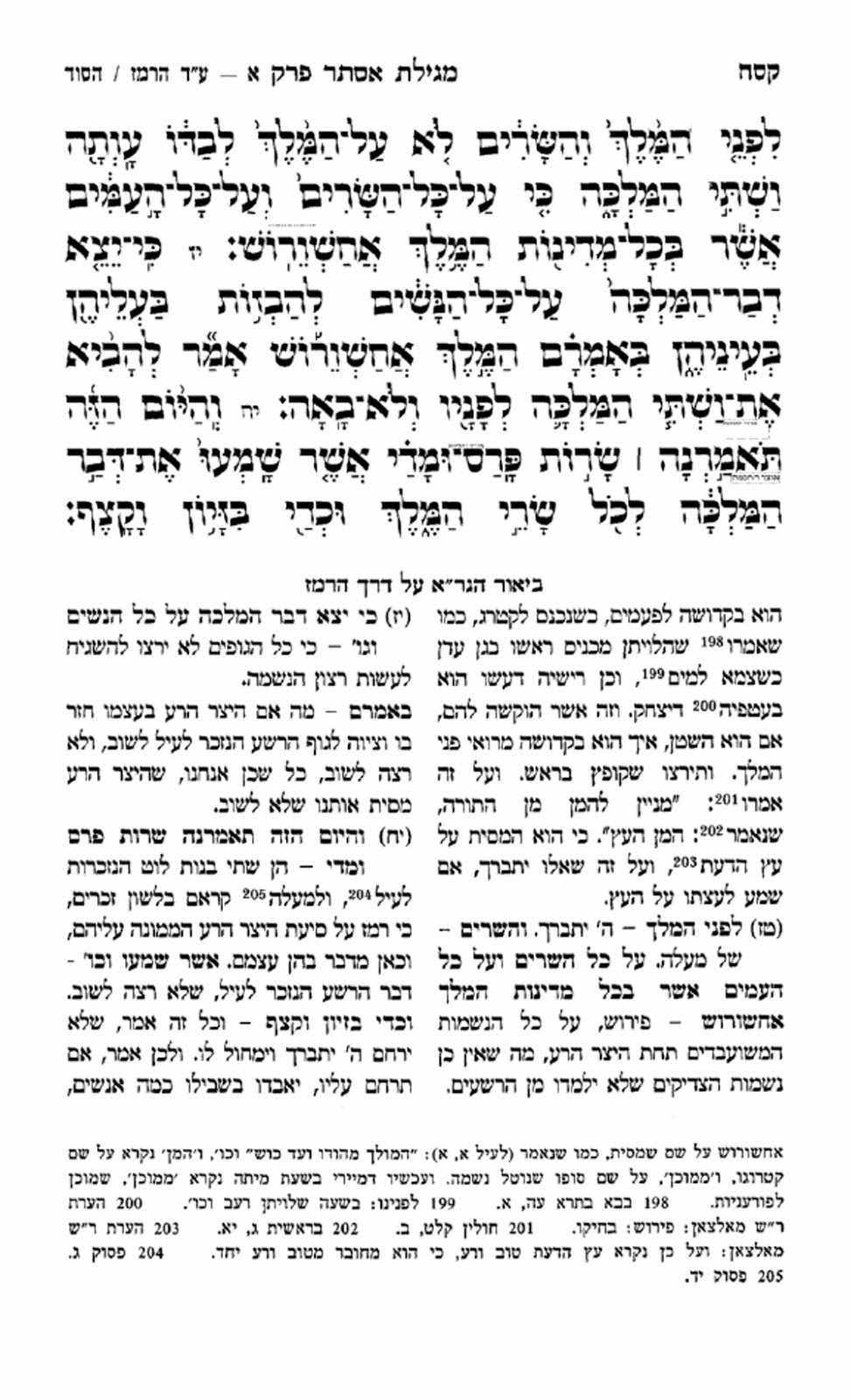
When it comes to the Guide and the Vilna Gaon, there is also a reference in the Gaon’s commentary to Esther 1:18. Here are the pages from the Mossad ha-Rav Kook edition.
As R. Meir Mazuz pointed out,[2] the Gaon is referring to Guide 1:54. However, as you can see, the editor didn’t know this and thus didn’t provide the source.[3]
Here is another example where a learned editor did not know a source in the Guide. In R. Abraham Sofer’s edition of Meiri, Hibbur ha-Teshuvah, p. 170, the Meiri quotes Maimonides, and as you can see in note 4, Sofer comments, “I don’t know where.” Maimonides words are not in any of his halakhic writings, which is why Sofer didn’t know about them, but they do appear in Guide 3:8.
Returning to the Gaon and Maimonides, when it comes to sex the Gaon’s view parallels that of Maimonides in the Guide, although I don’t know if we can speak of influence. Maimonides famously spoke of the sense of touch as being a “disgrace to us.”[4] The Gaon actually had the same opinion in that he regarded sex as something to be loathed and a necessary evil. Only with regard to the spiritual elites did he see something intrinsically positive in it.[5]
שדברי העולם הזה בעצם מאוסים, כמו האכילה, שנוטל מאכל ועושה פרש ורעי וכן המשגל, אבל התכלית, מה שבא מזה הוא טוב, כמו תכלית האכילה שיהא חזק ללמוד תורה, ותכלית המשגל להיות בנים צדיקים וטובים, וזהו תכלית ופעולה. וז”ש בהצדיקים לא מיבעי שהתכלית מזה אצלם טוב, אלא אפילו הפעולה עצמה הוא לחיים, שהן מכוונין בזה ואכילתן כקרבן ממש. וכן בכל דבר.
Yet even when dealing with the righteous, one can only imagine how the Gaon would have reacted if he had seen the following text, from R. Solomon of Karlin, Shema Shelomo (Jerusalem, 1956), p. 96 (sippurim no. 59), in which we see how an unnamed hasidic figure said that he needed sex every day, a statement that shocked his bride to be.[6]
Here is another example where the Gaon’s has the same view as Maimonides in the Guide. Tamid 1:1 states: “The priests kept watch [throughout the night] at three places in the Temple.” Why? In the Mishneh Torah, Hilkhot Beit-ha-Behirah 8:1, Maimonides says that this is just a matter of showing respect to the Temple, since there is no fear that anything will be stolen. In his commentary to Tamid 1:1 (found in the Vilna ed.), the Gaon explains that the guards were there to prevent unauthorized entry. In Guide 3:45 Maimonides also offers this explanation (in addition to mentioning that the watch was for glory and honor).
Regarding Meiri’s Hibbur ha-Teshuvah, mentioned above, in Saul Lieberman and the Orthodox I mentioned the notes at the end of this volume by Louis Ginzberg, notes that have not yet been removed from newer printings. I neglected to mention this dedication to Ginzberg at the beginning of the volume.
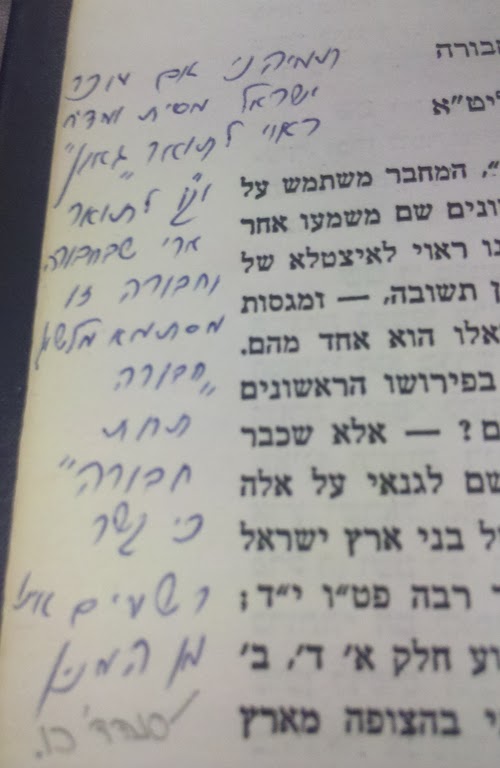
As for Ginzberg’s notes at the end of Hibbur ha-Teshuvah, A reader sent me the following, which shows how Yeshivat Ner Israel’s beit midrash copy of the book is “decorated”.
Regarding Sofer’s edition of Hibbur ha-Teshuvah, there is one other important point I must mention. The volume first appeared in 1950 and was subsequently reprinted by Sofer, with no changes to the text of the Meiri or the pagination. This reprint is what appears in the multivolume Beit ha-Behirah that everyone purchases. However, this is unfortunate, because the 1950 edition is far superior. Here is the title page of the first edition, which was published by Yeshiva University.
This edition contains a lengthy and valuable introduction by R. Samuel Mirsky, which deals with various aspects of the Meiri. Furthermore, Mirsky included thirty pages of important notes, many of them textual, that are vital for anyone who studies the Hibbur ha-Teshuvah. (Mirsky also calls attention to the passage in Guide 3:8, which as I noted above, Sofer did not know about.[7]) Quite apart from the 1950 edition, in Talpiot 4 (5710), pp. 417ff., Mirsky published a number of chapters from Hibbur ha-Teshuvah and his notes often call attention to things not mentioned by Sofer. It would therefore be helpful if a new edition of Hibbur ha-Teshuvah was published and included the notes of both Sofer and Mirsky. This new edition should also include the many pages of notes by Yehudah Preis-Horeb and R. Dov Berish Zuckerman that appeared in Talpiot 5 (5712), pp. 880ff., which are also quite valuable.
I can’t explain why Sofer did not include at least Mirsky’s notes when he republished the book. Fortunately, the first edition is available on hebrewbooks.org.
Finally, here is an example where the Gaon’s position is not merely similar to that of Maimonides in the Guide, but is clearly influenced by the latter.[8] In Yahel Or the Gaon states:[9]
כי כל השמות אינן רק משותפין ומושאלין מפעולותיו . . . רק שם הוי”ה . . . והוא שם העצם שאינו מושאל מפעולה רק (מורה) על הויותו תמיד והיותו מעצמו
Here is what Maimonides writes in Guide 1:61 (Ibn Tibbon translation). It is obvious that the Gaon was influenced in this matter by Maimonides’ words.
כל שמותיו יתעלה הנמצאים בספרים כולם נגזרים מן הפעולות, וזה מה שאין העלם בו, אלא שם אחד, והוא יו”ד ה”א וא”ו ה”א, שהוא שם המיוחד לו יתעלה, ולזה נקרא שם המפורש, ענינו, שהוא יורה על עצמו יתעלה הוראה מבוארת אין השתתפות בה . . . להיותו מורה על עצמו יתעלה, מאשר לא ישתתף אחד מן הברואים בהוראה ההיא
P. 109. Stern mentions the report that after the Gaon’s death on Sukkot, when the hasidim continued to celebrate, three hasidim were killed by mitnagdim. It is hard to know whether there is any truth to this story, or to the report of hasidim killing a mitnaged.[10] Unfortunately, in our day we have seen haredi Judaism in Israel descend to a level unimaginable even ten years ago.[11] Harsh rhetoric, which on occasion has led to real violence, is now routine, and the rabbis who use the harsh, and often hateful, speech are never called to account for their actions.[12] It is only a matter of time before we see a religiously motivated murder, and we have already had close calls, including a stabbing at Ponovezh.
Seeing what has occurred in recent months, we can understand why some people might conclude that R. Akiva was right on target when he told his son, “Do not dwell in a town whose leaders are talmidei hakhamim” (Pesahim 112a). In a previous post I already quoted Yeshayahu Leibowitz’s comment that we know the Sages had a sense of humor since they stated תלמידי חכמים מרבים שלום בעולם. Along these lines, many decades ago an unnamed rabbi explained why the blessing reads
הפורש סוכת שלום עלינו ועל כל עמו ישראל ועל ירושלים
The problem with this formulation is that there is no need for Jerusalem to be singled out after mentioning the entire people of Israel. The explanation given is that since Jerusalem has more disputes than anywhere else (and today we could add Bnei Brak) it therefore needs a special mention when asking God to spread over us his shelter of peace.[13]
R. Kook actually claims that the Jewish people are more apt to be involved in internal disputes than any other people. In Kevatzim mi-Ketav Yad Kodsho (Jerusalem, 2006), p. 43, he writes:
ישראל הם עלולים יותר לפירוד ומחלוקת מכל אומה, מפני שריבוי הצביונים שמתחלקים בעמים רבים, כלולים בישראל ביחוד.
I am writing these words not long after a man attacked R. Aharon Leib Steinman, which could easily have caused R. Steinman’s death. So as not to put all the blame on one side, does anyone have any doubt that if Degel ha-Torah was running the show that R. Shmuel Auerbach would right now be under house arrest or sitting in jail? I say this only because I assume that the rhetoric directed against him is hyperbole, because if is not hyperbole, then we should assume that if Degel ha-Torah was in charge he would have been executed by now. Can the rabbis who use this sort of rhetoric really claim that they are innocent when an individual decides to take their words literally and kill someone, even a great Torah scholar? Didn’t these rabbis learn the lesson of the Rabin assassination, that if you call someone a rodef (and thus hayav mitah), someone might very well take you up on this? As for throwing people out of kollels because they didn’t vote for Degel ha-Torah, any kollel that does so should be ineligible for Israeli government money.
Most disappointing in this matter is R. Chaim Kanievsky who seems to think that Torah Judaism has the equivalent of a papacy, and he can thus declare that all are obligated to follow R. Steinman, meaning that there is only one Torah path.[14] This approach first surfaced when R. Elyashiv was ill and R. Kanievsky declared that the torch of leadership had passed to R. Steinman whose word was now law. See here. Have we ever had such a thing in the Lithuanian Torah world where a sage’s unquestioned leadership is formally proclaimed in this manner, as if he were a hasidic rebbe taking over for his deceased father? In the non-hasidic world the people have always chosen their spiritual leaders, as the Sages tell us: עשה לך רב. Never have they been imposed on us from above.
In the booklet Kuntres Tikun Haderah, which is an attack on R. Yehoshua Ehrenberg, the Rosh Yeshiva of the Haderah yeshiva, one of R. Ehrenberg’s great sins is that he declared that “the” gadol ha-dor is not something that can be proclaimed in papal fashion. Here are two of his statements that strike me as entirely reasonable, but which for the followers of R. Kanievsky are enough to turn him into an enemy of Torah Judaism.
ר’ חיים החליט שהרב שטיינמן הוא הגדול. גדול זה לא דבר שאפשר להחליט עליו
לדעתי המושג ,הנהגה, הוא מי שהציבור בפועל שומע בקולו. כמה אחוזים צריך? ר’ חיים חושב שמספיק מה שיש לרב שטיינמן. אולי לא
And here is another statement from R. Ehrenberg, which for his opponents is the height of chutzpah simply because he doesn’t believe that there is currently one authority whose decisions bind everyone.
עוד התבטא בחוצפה עזה: “מאז שהרב אלישיב נפטר אין מנהיג אחד בעם ישראל. אין כזה מושג הנהגה. היום זה התבטל אין אחד שחייבים לשמוע לו
No one is saying that R. Kanievsky shouldn’t express his opinion that his approach is the proper one. But that is very different than what he and his followers have been doing. Declaring that supporters of R. Auerbach are behemot, invalid as witnesses, and should not be given aliyot is just the beginning. אחרי אלף גלגולי מחילות, some believe that R. Kanievsky’s language has unintentionally even verged on incitement to murder. He has followers who will do anything he says, and he has declared that R. Auerbach is a zaken mamre and deserving of sekilah (the death penalty of stoning) for not accepting the leadership of R. Steinman.[15] (Say what you will about R. Auerbach’s politics, he is certainly enough of a Torah scholar to have his own opinion on matters.) R. Kanievsky has also, playing on the word עץ which is how the Bnai Torah party is often referred to, said that its followers should be “hung on a tree”. I assume that this comment was said in a non-serious manner, but as a leader he needs to be aware that there are people who might not see it this way, and take it into their hands to fulfill his words. Was it this sort of language that led followers of Beit Shammai to kill followers of Beit Hillel, a fact attested to by the Jerusalem Talmud?[16] When vitriolic language was used in New Square, we saw how someone decided to take matters into his own hands, and his solution was to burn down a house which would have killed all the inhabitants. Unfortunately, it would no longer be a surprise if one of R. Kanievsky’s followers decided to use violence as part of this milhemet mitzvah.
Considering the shocking things R. Kanievsky has recently said, is it possible that he doesn’t really know the situation, and the people who are meeting with him and getting him to speak about certain matters are really manipulating him? R. Kanievsky has been meeting with people and providing advice for decades and until the last couple of months he never spoke like this. Is there any other explanation for his sudden change of tone? Here is the recording of R. Kanievsky referring to R. Auerbach as deserving sekilah and also referring to him as a zaken mamre and his followers as behemot. I ask the readers, does it sound like R. Kanievsky really understands what is going on? Do we have any idea what sort of information against R. Auerbach various askanim have provided him with?[17]
Let me take you back to an earlier era when we heard the type of rhetoric you can now hear. This is from the front page of the newspaper Davar, Nov. 29, 1972, and came after R. Shlomo Goren was subjected to death threats.
Should we be surprised if what R. Goren was subjected to is soon repeated with R. Auerbach? And even if it doesn’t reach this extreme, we have already seen how much damage can be caused by what the Lithuanian haredim call “השקפה”, to which one can reply:[18]
אין “השקפה” אלא לרעה (ראה רש”י בראשית יח, טז)
Now is as good a time as ever to note that the falsehoods of Yated Ne’eman begin right with the title of this newspaper. The title is derived from Isaiah 22:23 which reads
ותקעתיו יתד במקום נאמן
This means, “And I will fasten him as a peg in a sure place.”
Yet if you look two verses later (Is 22:25) you find the following words
תמוש היתד התקועה במקום נאמן
We see from this is that the word יתד is feminine.[19] Furthermore, throughout rabbinic literature יתד is feminine and it is also feminine in modern Hebrew, meaning that the title of the newspaper should be Yated Ne’emanah.[20] I say this even though there is one biblical verse, Ez. 15:3, where the word is masculine, since I don’t think the newspaper was intending to adopt the usage of one verse in contradiction to the general “Masorah” (as we know how important Masorah is to them).
יתד is a feminine word along the same model – kametz followed by tzeireh – as the following words that are also feminine[21]: חצר, גדר, ירך, כתף
While I think that the newspaper’s title is probably just a simple error, I know some of you conspiracy theorists are thinking about how the people who run Yated don’t like to give the females among us their due, and won’t even publish their pictures, so maybe they see it as disgraceful to have something feminine in the title . . .[22]
Pp. 160-161: Stern records a few of the famous, and from a contemporary perspective, shocking stories about how the Gaon related to his children. “His children divulge that Elijah never once wrote a letter to any of them. Nor when he saw them, once every year or two, did he ever ask about their work or their well-being.” Stern refers to these stories as “painful memories.” I don’t think this is accurate. If they were painful memories, his children would not have recorded them. It might be painful for us to read the stories, but we have to be careful not to project our sense of how parents and grandparents should behave onto a different culture.[23[
Aryeh Morgenstern refers to R. Hayyim of Volozhin’s comment in the introduction to Sifra di-Tzeniuta that the Gaon never asked about how his children were doing and never wrote them letters or read letters from them. According to Morgenstern, this should be seen as a veiled criticism of the Gaon by R. Hayyim, since if he wanted to show people how great the Gaon’s ascetic attachment to Torah was, he didn’t need to bring an example illustrating how the Gaon related to his family.[24] I completely disagree. To suggest that R. Hayyim intended to criticize the Gaon regarding this matter, especially in the introduction to one of the Gaon’s books, is in my mind impossible. While moderns such as Morgenstern might find the description of the Gaon problematic, it was not viewed as such by R. Hayyim, nor by those of our contemporaries who continue to cite this description (and similar ones about other great Torah scholars.)[25]
In an earlier post, available here I noted that David Singer and Moshe Sokol advance the radical view that the Rav’s descriptions of his family members is actually designed to show his opposition to their hyper-intellectualism and pan-halakhism. They write
[T]here is something strange about Soloveitchik’s tales of the Litvaks. The behavior he describes is so radical, so extreme, as to make his presumed heroes seem grotesque. Who, for example, wishing to portray Litvak intellectualism in a positive light, would boast that his father and grandfather set aside all human sentiment and refused ever to enter a cemetery, because a stark encounter with death would have distracted them from the contemplation of the law. Or again, who would tell with pride the following macabre story about his maternal grandfather [referring to the story of R. Elya and his dying daughter]. . . . Stories like this, while ostensibly presented in order to glorify the Litvak, cannot help but evoke strong disapproval in the reader. And this disapproval, it seems safe to assume, is shared in part by Soloveitchik himself, specifically by that part of him which rebels against the Litvak tradition’s spurning of the emotions. The vein of anger that runs through the anecdotal material in “Halakhic Man” is not to be missed.[26]
Again, I find it impossible to accept that the Rav was actually criticizing his father and grandfathers. I say this not because of any pieties, but simply because the Rav’s connection to these people was not merely one of admiration but idolization. It is obvious that Singer and Sokol have a different vantage point than the Rav and traditional Lithuanian Jewish society in general. But why do they assume that what they see as “grotesque” must be shared by the Rav? All one needs to do is peruse haredi hagiographies to find lots of descriptions of what, when it comes to intellect triumphing over emotion, one can call rabbinic counterparts to Mr. Spock.
Returning to Stern, he also quotes Aliyot Eliyahu’s comment that “to love the path of God and His Torah . . . he [Elijah] had to fight against his human instincts, pause, and let go of his own love for his own children.” Stern notes Solomon Schechter’s comment that Aliyot Eliyahu was “incapable of marking the line between monster and hero,” which again reflects a modern sentiment.
Incidentally, I am sure Schechter’s comment was influenced by what appears in Aliyot Eliyahu, note 51, which is not mentioned by Stern (perhaps because it refers to a segulah?):
סיפר לי גיסי המופלג מ’ זלמן ז”ל נכד הגאון ז”ל, שאמו בת בגר”א היו בני’ מתים כשהם קטנים ר”ל, וכשהיתה מעוברת ממנו [גיסי הנ”ל]., נסעה מביתה [מק’ דיסנא], אל אביה הגר”א שיבקש רחמים שיהיה הולד של קיימא. ובבואה לפניו אמר לה במילים קצרים סגולה לקיום בנים . . . ויותר מזה לא רצה לבטל לדבר עמה.
R. Ephraim Kirschenbaum takes note of this passage and some similar ones and raises the question – which itself I find surprising in a haredi publication – is this proper Torah behavior?[27]
הנה מתיאורים הללו, מגדולים אנשי שם, מצטייר לנו הגר”א כאלו איש אשר מרוב השתקעותו בתורה דוכא כליל כל רגש כלפי ילדיו. האם האדם השלם אמור כך להיות?
The answer his gives, not surprisingly, is that there is a different standard for saintly figures than for the masses.
האמת היא שהגדולים הנ”ל בהלכות ביטול תורה וחומרתו קעסקי, ואין מדבריהם סתירה לפן נוסף.
Stern (p. 161) aptly quotes the Gaon’s suggestion[28]
that one should follow the Babylonian Talmud’s injunction (tractate Eruvin 22a) to “blacken” oneself toward one’s children as a “raven” does to her fledglings. The “raven” the Gaon explains, is “an allegory for the scholar who becomes cruel to his children [so that] he can spend all of his time studying the Torah.”
I would just add to this the quote from the Gaon in R. Samuel Maltzan’s Even Shlomo, ch. 3:4 (emphasis added):
שני מיני גבורה נמצא בעובדי ה’, ונקראים גבורים ואנשי חיל. גבור הוא הכובש את יצרו בעת שבאה העברה לידו, ואנשי חיל הם אבירי הלב בשלמות הבטחון להגות בתורה יום ולילה ושלא להשגיח על בניו ובני ביתו הצועקים ללחם, וכמו שאמרו (עירובין כב ע”א) שחורות כעורב שמשים עצמו אכזרי על בניו כעורב. ומה עושה לו הקב”ה? מזמין לו אדם להחזיקו כיששכר וזבולון.
R. Yitzhak Zilberstein quotes the story found in the introduction to the Gaon’s commentary to Shulhan Arukh according to which the Gaon was so involved in his learning that he forgot about his ill son. Rather than conclude that this is something only for spiritual elites, he seems to regard this as something everyone should strive for. He writes:[29]
וזהו דרגת חשקת התורה, שהוא למעלה מדרגת אהבת התורה, שהחושק בתורה שוכח כל אהבותיו, אפילו ממה שטבע הקב”ה בבריאה, כדוגמת אהבת אב לבן, ויתכן שזה הכונה בגמרא בעירובין (דף כב ע”א) שהתורה מתקיימת במי שמשים עצמו אכזרי על בניו ועל בני ביתו כעורב. דהיינו שחושק בתורה, עד שמשכח כל אהבה אחרת
The removal of what moderns regard as a basic emotional connection to one’s children[30] is also seen the anonymous hagiography of R. Elyashiv, Ha-Shakdan.[31]
I, for one, was quite surprised that this was included in the hagiography, as it runs so much against how people today think about such matters. I also have to say that I find some of what appears in the book very difficult to believe. R. Elyashiv probably knew the entire Talmud by heart, so how are we supposed to believe that he didn’t even know the names of his children?[32]
When Ha-Shakdan appeared I went out on a limb stating that I was sure that this sort of material would never appear in English because of the shocked reaction it would create even among haredi readers in the U.S. It is always dangerous to make predictions about the future, which is why we historians usually stick to the past, but in this case it turns out that I was correct.
In February 2013 Artscroll published an English translation (“adapted and expanded”) of Ha-Shakdan.[33] Without discussing the book or the translation in any detail, let me just call your attention to some of the material that, not surprisingly, was deleted. Here is p. 69 of Ha-Shakdan and p. 123 of the translation.
Notice how in the translation most of the paragraph beginning with the words מעבר לזה have been deleted. I think the reason is obvious, as mentioned already. But is Israeli haredi society really so different when it comes to this sort of thing than American haredi society? That is, won’t Israeli readers be saddened to see sentences such as לא היו לו דיבורים עם הבנות and כשהם באים אצלו בביקורים או בתורנות, אין להם שיחה משותפת בכלל
Here is Ha-Shakdan, pp 62-63, and the translation pp. 105-106.
Notice how the first two paragraphs on p. 62 are not translated and also the first full paragraph on p. 63. Also, in the translation on p. 106, the second paragraph (“Rav Elyashiv’s lack of involvement . . .”) does not appear in the original. The translator obviously thought that this clarification was important for the English-speaking audience.
Here are two other passages from Ha-Shakdan, pp. 96 n. 69 and 251-252, that also don’t appear in the English translation.
Regarding the story on p. 98 n. 69, this should be contrasted with how it is told that R. Avraham Shapiro took up smoking as a way of dealing with the emotional strain of some of the cases he was confronted with as a dayan.
In general, when it comes to the stories reported in Ha-Shakdan, I have to say that I don’t accept the basic message the author is trying to get across. His point is that the stories he tells of R. Elyashiv regarding his indifference to people and events are a result of his complete absorption in Torah study. Yet it should be clear to anyone who reads the book, and knows something about R. Elyashiv, that all we have in these stories are an aspect of R. Elyashiv’s personality that really has nothing to do with absorption in Torah study. There have been plenty of great Torah scholars who were people-persons and conversationalists.
It is obvious that someone who by nature is extremely introverted, as R. Elyashiv was, will be more inclined to find his place among the books than an extrovert. But to describe R. Elyashiv’s personality as a complete outgrowth of Torah study is a distortion and shows a basic ignorance of human psychology. We didn’t need R. Nathan Kamenetsky’s Making of a Godol to realize that great Torah scholars encompass all sorts of personalities and one sort is not any more “authentic” than another. All we can say is that people, including gedolim, are different.[34] While haredim who are knowledgeable about the history of Torah figures love to talk about their different personalities, it is also the case that it is harder in that world to publish something that seriously analyzes a Torah sage’s personality. Yet without such an attempt, you will never get a real biography, only hagiographies.
Here are some quotations from Ha-Shakdan, vol. 2, pp. 246, 248, and plenty more could be added:
הגרי”ש לא מתייחס לכל אחד, וכאשר הוא כן מתייחס למשהו, הוא בוחן בעין משלו כל נושא. הכרעותיו בנושאים רגישים ביותר – ענייניות וחסרות רגש. גם עם צאצאיו, ואפילו הקרובים שביניהם, נוהג הוא באותה ידה של איפוק ואדישות.
כאשר ביום השלישי למלחמה פשטה השמועה שהצבא כבש את העיר העתיקה, והכותל המערבי בידי היהודים, הדבר עורר התרגשות גדולה מאוד. בשלב זה כבר לא עצר בעצמו בעל המעשה, וניגש לרגע לפינתו של רבינו לספר לו כי הצבא כבש כבר את כל מזרח העיר מידי הירדנים! הגרי”ש פסק מהלימוד והקשיב לו עד שכילה לדבר, ולא הגיב כלל. המספר המשיך בהתלהבות: והכותל המערבי גם כן משוחרר! רבינו שמע אותו עד הסוף באדיבות ותשומת לב כדרכו, ובלא שום זיק של התרגשות שב להתנועע ולהחזיר את עיניו בחזרה לגמרא הגדולה להמשיך מהמילה שפסק בה.
There are lot of further examples I can cite from other great rabbis. Here is how the Hafetz Hayyim is described by his son:
Father had no personal friendships with anyone all the days of his life, even though he loved every Jew and especially men learned in the Torah, whom he loved as his very self. Many times did I hear him tell how the daughter of the Vilna Gaon, who lived in another town, once paid a visit to her father. The Gaon inquired after her health and that of her husband and children and then immediately returned to his studies. The daughter began to weep at her father’s apparent indifference, but he declared, “I do not have the time” [in Yiddish, nitoh kein zeit]. So it is not surprising that father, of blessed memory, had no material friendships with anyone . . . . I once heard him explain the verse “And thou shalt love the Lord thy God with all they heart” (Deuteronomy 6:5) to mean that the heart should be so filled with the love of God as to leave no room in it for any other loves.[35]
R. Joseph David Epstein, who cites this passage, hastens to add that this sort of behavior is only intended for the spiritual elites.[36] הדברים האמורים לעיל, על הסתייגות מאהבה משפחה, ועל העלמת עין מצרכי בית, הרי אך לבעלי מדרגה וקדושי עלינו המה
What is one to make of the following story, found in Meir Einei Yisrael (Bnei Brak, 2004), vol. 1, p. 274?:
שמועה התהלכה בינינו שרבי משה לנדינסקי למד שמונה שנים עם חבר בוולוז’ין ולא ידע מה שמו של הבחור. הסיפור הקטן הזה מדגיש את אישיותו העצומה, שהיה בכל הוויתו רק מתמיד, ומעבר ללימוד לא נחשב אצלו שום דבר.
Quite apart from the fact that I don’t believe such a story is possible, I wonder why this is quoted as praise. Is this supposed to be a characteristic of a Torah personality, that you can learn with someone for eight years and never even take the trouble to learn the person’s name? I can’t imagine that the Hafetz Hayyim – R. Londinsky was the rosh yeshiva in Radin – or any of the mussar teachers would think that this is appropriate bein adam le-havero behavior.
Here is another story, found in R. Moshe Sternbuch, Ta’am ve-Da’at, vol. 1, pp. 244-245.
I don’t believe such a story is even remotely possible. R. Akiva Eger was a real person, with real feelings, and he loved his daughter. The idea that he could be at her house for an entire Shabbat, after not having seen her for years, and be so engrossed in learning that he didn’t even notice that a different woman had taken her place is simply not believable. Yet it is significant that the story is told as an example of praise, and R. Sternbuch concludes by pointing to it as an example of how gedolim so involved in Torah study forget everything else in the world. If you would repeat such a story before a Modern Orthodox crowd they would be horrified. What would the haredi masses think of such a story? Would they be inspired by the commitment to learning above all else, or would they share the Modern Orthodox negative reaction?
R. Yonason Rosman called my attention to the following passage in R. Yitzhak Zilberstein’s Tuvkha Yabiu, vol. 1, p. 38, which describes how a yeshiva student was so involved in his learning that he named a newborn daughter with the same name as one of his other daughters, forgetting he already had a child with that name!
אחד האברכים המצויינים בבני ברק, העמל ויגע בתורה, קרא לבתו שנולדה לו בשם פלוני ורק לאחר מכן נזכר שאחת מבנותיו נקראת כבר בשם זה… המדובר במשפחה ברוכה ילדים עד כדי כך שהאב הספיק לשכוח שכבר נעשה שימוש בשם זה. והוא פלא!
Whether the story ever happened is not important. What is important is that it is being told on the assumption that people will be impressed with the yeshiva student’s total absorption in his studies
To be continued
* * * *
1. In recent years, books have appeared on every possible halakhic topic. This genre keeps expanding and here is the title page of a new book, Asurei ha-Melekh by R. Mordechai Agasi of Boro Park.[37]
I thought nothing could surprise me anymore, but this book certainly did. It is a large two volume set, and the first half of volume one deals with the halakhot relevant to one who is serving time in prison (or as I told a friend, “the halakhot of being in jail”). The rest of the book contains words of inspiration, stories, prayers, etc. all of importance for the prisoner. As the author explains in his introduction, the book is needed because of the increase of haredim in the prisons.
התרבתה, לדאבונינו, האוכלוסייה החרדית בבית הסוהר, וגדלה פי כמה.
It really is incredible when one thinks about this, since not too long ago it would have been simply unimaginable that such a sefer would have been needed.
2. Many people are interested in the Rogochover, R. Joseph Rozin. There is no question that he had a fascinating personality and there are many interesting stories about him. Yet very few people actually study his works because they are so difficult. Until now, nothing of significance has appeared in English on his halakhic thought. Therefore, I am happy to recommend R. Dovber Schwartz’s new book, The Rogochover Gaon, for those seeking to learn about this significant figure.
[1] R. Abba Mari of Lunel, Minhat Kenaot, ed. Dimitrovsky (Jerusalem, 199), p. 317 (ch. 23) wrote:
ואני לא על המחזיק בספרי היונים אני כועס ולא אחשבנו ככופר לא כמחליף חק ולא כעוזב ברית ומפר ואם נמצא בהם דבר טוב אפי’ בדף אחד, מציל על כל הספר
See also R. Jacob Lorberbaum, Ma’aseh Nissim (Jerusalem, 2011), Introduction:
וכבר אמרו וידוע כי בדברי תורה אף אם ימצא דבר אחד טוב מציל על כל הספר כולו
In his Torat Gittin (Jerusalem, 2003), Introduction, he writes:
ואמר החכם כי דבר אחד טוב יציל על כל הספר כולו
See also R. Yissachar Tamar, Alei Tamar (Jerusalem, 1979), Zeraim, vol. 1, Introduction, p. 14.
[2] Or Torah, Iyar 5772, p. 741.
[3] R. Mazuz has more to say about the Mossad ha-Rav Kook edition of this commentary, which I will perhaps return to in a future post..
[4] See The Limits of Orthodox Theology, pp. 15-16.
[5] The quote that follows come from the Oxford ms. of the Gaon’s commentary to Prov. 10:16. See the Mossad ha-Rav Kook edition, p. 110, n. 56.
[6] The story originally appeared in R. Zvi Ezekiel Michaelson’s Pinot ha-Bayit, p. 78.
[7] R. Ovadiah Yosef, Yehaveh Da’at, vol. 5, no. 35, also provides the source that eluded Sofer.
[8] Credit for this example goes to R. Eliyahu Tziyon Sofer, Tziyon Eliyahu (Jerusalem, 2008), p. 273.
[9] (Vilna, 1982 ), vol. 2, p. 19a.
[10] See Mordechai Wilensky, Hasidim u-Mitnagdim (Jerusalem, 1970), vol. 2, p. 178. This report, contained in the early anti-hasidic text Shever Posh’im, includes names and places and was written not long after the event described. Nevertheless, I would not accept the story as historically accurate without confirmation from other sources, which as far as I know has not been found. See also S.’s post here which discusses another alleged murder by Hasidim. In Sippurei Niflaot mi-Gedolei Yisrael (Tel Aviv, 1969), p. 279, it reports that R. Menahem Mendel of Kotzk thought that R. Shmelke of Nikolsburg made a mistake when he forced his “enlightened” opponents to leave the city. What he should have done, according to the Kotzker, is have them killed.
[11] One positive recent development is that at least some people in Bnei Brak have woken up to the sexual abuse problem. See here where parents are advised not to send children outside by themselves. In the letter it refers to incidents related to “kedushat and taharat Yisrael”. What exactly does this mean? The English translation speaks of kedushat Yisrael being “compromised” by certain “terrible incidents”. Does this mean that the kedushat Yisrael of the victims has been compromised? If so, this is an unbelievably offensive statement, since how can the kedushat Yisrael of a victim, who did no wrong, be compromised based on the evil actions of someone else?
[12] R. Zvi Yehudah Kook wrote (Sihot ha-Rav Zvi Yehudah: Bereshit [Jerusalem, 1993], p. 242):
ר’ שלמה זלמן זצ”ל זקני היה אומר על סוג מסוים של קנאים: “הם חיות קדושות, חיות טורפות שקשה לסבול, אבל בסגנון של קדושה.” אמנם קדושים הם, אבל בגלל שנאתם לישראל, מתעכבת אהבת ד’ אליהם, כדברי הגר”א. ביחס לאף לא אחד מגדולי ישראל, לא מצאנו שבח שהיה שונא ישראל. נכון שלפעמים יש צורך במלחמה מעשית, אבל לא בשנאה, שהיא קטנות.
When R. Zvi Yehudah refers to the Gaon he has in mind the Gaon’s comment to Tikunei Zohar, 57b s.v. דבגינייהו where he writes:
דהש”י שונא מקטרג על בניו אף הקדושים
Elsewhere, R. Zvi Yehudah elaborates (Or li-Netivati [Jerusalem, 1989], p. 307:
חטא גדול הוא לקטרג על ישראל ובהרבה ספרים הוא מוזכר. הגר”א אומר :”ד’ יתברך שונא את המקטרגים על בניו – אף הקדושים,” הגר”א משתמש במילה נוראה זו “שונא” – אפילו על קדושים וצדיקים, אם הם מקטרגים על ישראל ח”ו.
See also R. Shlomo Aviner’s commentary to R. Kook, Orot ha-Tehiyah (Beit El, 2009), vol. 2, p. 175.
[14] In opposition to this, see the continuation of the passage quoted above from Kevatzim mi-Ketav Yad Kodsho, p. 43:
שינויי דעות בכמה ענינים רוחניים וחומריים אינו מעכב, ואדרבא מועיל, מכל הטפוסים יצא הדבר הטוב הכללי. אלא שהכל צריכים להתאחד בנוגע לכללות קיומה של תורה
[15] See here where Chaim Shaulson asks why R. Auerbach as a zaken mamre is hayav sekilah. According to Sanhedrin 11:1 a zaken mamre is to be strangled (henek).
[16] JShabbat 1:4. See Tosafot, Gittin 36b s.v. אלא.
[17] In general, R. Kanievsky, whose unique greatness in Torah knowledge must be acknowledged by everyone, has made a number of astounding statements over the years. (A few years ago the internet was abuzz with his statement that Jews have a different number of teeth than non-Jews, and more recently we all heard about what he said regarding people who have iPhones.) These sorts of statements can charitably be explained by the fact that since his entire world is Torah he relies on intermediaries for knowledge about the wider world. But this raises the question of why he should be the address for questions relating to political matters.
To give an example of the problem I am referring to, here are two pages from R. Shmuel Baruch Genut, Iggeret ha-Melekh (Elad, 2013), pp. 3-4..
R. Kanievsky declares that there is no medical danger from smoking and the doctors don’t know what they are talking about. Despite his unquestioned Torah brilliance, such as answer shows a complete disregard of reality and encourages unhealthy living. I ask those readers from the haredi world, doesn’t this show that perhaps R. Kanievsky is not the best person to ask when it comes to matters outside of “pure” Torah? I don’t ask this to be disrespectful. I would really like to hear from people who follow R. Kanievsky how they see the matter.
Finally, let me say a word about askanim, since I referred to them. While in the case of the incomprehensible attacks on R. Auerbach I raise the possibility that the askanim have poisoned R. Kanievsky’s view of R. Auerbach, I am not one of those who blaime everything on the “evil askanim” The first time I ever really heard the askanim blamed in a major way was when Making of a Godol was banned. In the first few days after the ban appeared, I remember seeing various people on the internet saying that it couldn’t be true, that it was just the askanim, etc. In the last decade there have been numerous other statements and bans that upset many people, especially in the American haredi world, and we have heard over and over again that gadol x couldn’t have said that which was attributed to him, and that it was a creation of the askanim. Yet in almost every case we have seen that American haredi apologists were wrong and the gadol indeed said that which was attributed to him.
[18] This comment was originally made by R. Yehudah Naki in his note to R. Ovadiah Yosef, Ma’yan Omer, vol. 12, p. 145.
[19] See also Deut. 23:14: ויתד תהיה לך על אזנך.
[20] This was pointed out to me years ago by R. Nathan Kamenetsky.
[21] See Yitzhak Avinery, Heikhal Rashi (Tel Aviv, 1960), vol. 4, p. 436.
[22] When I pointed out the grammatical problem of YatedNe’eman’s title to R. Meir Mazuz, he responded:
אבל הם כותבים ביום ששי מדור “יתד חָדָה”. ולפי דעתם שהוא לשון זכר צ”ל יתד חָד (כמו קם, שב, רץ, מנחי ע”ו) אא”כ סוברים שהוא אנדרוגינוס, פעם זכר ופעם נקבה
A few years ago it was reported that R. Mazuz was going to burn pages from Yated Ne’eman as part of the Purim festivities. See here.
[23] Stern writes:
In one startling vignette, they recount that as their father was preparing to leave on a journey of self-reflection, his favorite child, Shlomo Zalman, fell gravely ill. Elijah refused to change his plans. Only after a month away “not thinking about his family or his children” did the Gaon find himself on the toilet one day wondering about the boy’s well-being (for one is not supposed to think thoughts of Torah then.) He immediately returned home.
This story comes from the Gaon’s sons’ introduction to his commentary on Shulhan Arukh, and Stern has accurately reported what appears there with one exception. According to the text, the Gaon was in the בית הרחיצה when he recalled his son. While today people use the term “washroom” synonymously with “lavatory”, in this text the meaning is “bathhouse” not “toilet”.
The story recorded with the Gaon might also have a connection to Maimonides’ Guide, as Maimonides writes, Guide 3:51, that the time to focus on worldy things is “while you eat or drink or bathe” (emphasis added). This connection was noted by R. Meir Mazuz, Darkhei ha-Iyun (Bnei Brak, 2012), p. 194.
[24] Mistikah u-Meshihiyut me-Aliyat ha-Ramhal ad ha-Gaon mi-Vilna (Jerusalem, 1999), pp. 258-259.
[25] See ibid., where Morgenstern shows that a statement about the Gaon by his grandson was omitted from the introduction to a book. Although this statement refers to how the Gaon expressed no interest in his grandson or his family, I do not believe it was omitted because of a fear that others would regard this as criticism of the Gaon, but rather due to a general concern of how the Gaon would appear in readers’ eyes.
[26] David Singer and Moshe Sokol, “Joseph Soloveitchik: Lonely Man of Faith,” Modern Judaism 2:3 (October 1982), p. 259.
[27] “Peninim be-Mishnat ha-Gra,” Yeshurun 18 (2006), p. 890.
[28] The Gaon’s comment is in Peirush al Kamah Aggadot (Vilna, 1800), pp. 3b-4a (Stern mistakenly gives the reference as pp. 5-6.)
[29] Hashukei Hemed: Sanhedrin, Introduction, pp. 6-7.
[30] R. Yaakov Moshe Harlap describes R. Kook as having such concern for the kelal that his own relationship with his family was not in any way special to him, and he mentions an episode with R. Zvi Yehudah that illustrated this. See his letter in Me-Avnei ha-Makom 11 (2000), pp. 51-53 (part of the letter is found here):
ואף גם בצער קרובי משפחתו לא היה מרגיש בהם יותר ממה שהרגיש באחרים, שכן בכל מבטו ובחוג ידיעתו לא היה נמצא מושג של פרטים כי אם כללים, ומאי נפקא מיניה בינם לבין אחרים
R. Harlap’s description of R. Kook stands at odds with so much else we know about the special relationship between R. Kook and R. Zvi Yehudah.
[31] 3 vols. (Jerusalem, 2010-2013). All references in this post are to volume 1 unless otherwise noted.
[32] See Yeshurun 28 (5773), pp. 349ff., for three letters from the 1950s from R. Elyashiv to R. Chaim Kanievsky. In the greeting at the beginning of these letters he is careful to mention not only his daughter but also his granddaughter.
[33] The English title is Rav Elyashiv: A Life of Diligence and Halachic Leadership. This translation is also noteworthy, in that as far as I know, it is the only time that Artscroll has allowed material explicitly degrading Torah scholars to appear in its books. One does not find this in the works of Jonathan Rosenblum, Aharon Sorasky, or any of the other writers published by Artscroll. While the following sentence is typical of haredi works published in Israel, it is quite shocking that Artscroll included it, while at the same time deleting other parts of the book. P. 176 n. 5: “Rav Yoel Kluft, av beis din of Haifa, once remarked to his students, ‘If I would be offered a job today as a plumber, I would leave dayanus.’ This sharp statement expressed the bitter feelings of Torah-true dayanim toward the establishment that employed them.” So I guess the many dayanim who didn’t (and don’t) feel this way about being part of the Israeli government-funded batei din are not to be regarded as Torah-true.
[34] Yechezkel Moskowitz was kind enough to send me the booklet “עניני השקפה: Notes of a תלמיד” which appeared in 2004 and records various teachings from R. Henoch Leibowitz. The following is relevant to the matter we are discussing (nos. 5 and 24 from the booklet).
No שיחת חולין? We can’t live like that, so לשם שמים we need to keep our שמחת החיים. Some גדולים of the previous דור were able to be serious, but that may have been because of their personality. חפץ חיים did make some jokes occasionally. [RH (Rosh ha-Yeshiva) told us R. Chaim Ozer joked a lot but R. Elchonon rarely ever.]
As a young man, R’ דוד [R. Dovid Leibowitz] was by the חפץ חיים when a man came in and began complaining to the ח”ח about a certain גדול that he felt had hurt him in a certain way. R’ דוד was sure the ח”ח would reprimand the man for speaking such about a גדול! But the ח”ח just said “Nu, that’s the גדולים of our דור!” R’ דוד learned 2 things. 1) It’s שייך for גדולים to do something wrong. 2) He’s still a גדול! The ח”ח said “that’s the גדולים of our times” meaning he’s still a גדול but he has more faults. In our youth, we think a גדול is by definition perfect — and if he’s not then he’s not a גדול. It’s not so.
See also R. Yitzhak Dadon, ed., Rosh Devarkha (Jerusalem, 2010), p. 548, where R. Avraham Shapiro is quoted about a certain Torah scholar (not R. Elyashiv, so I have been informed by the source of the story). Yet the message is also applicable with regard to Ha-Shakdan and R. Elyashiv, i.e., there isn’t just one path, and devotion to Torah study doesn’t create one identical personality.
בשיחה שהיתה לכמה תלמידים עם רבינו זצ”ל, הוזכר רב פלוני מרבני דורנו, ואחד הנוכחים הוסיף ואמר באזני הנוכחים: הוא צדיק גדול! רבינו ששמע זאת, פנה אל זה ששיבח ושאל בסקרנות: איך אתה יודע? אותו תלמיד השיב: הוא תמיד בכובד ראש, עם פנים רציניות, אף פעם לא ראיתי אותו צוחק . . . מיד דיבר [הגר”א שפירא] בשבח אותו תלמיד חכם מצדדים אחרים שהכיר בו, והוסיף באזני התלמידים ואמר: שלא תחשבו ש”צדיק” זה דוקא מי שלא יודע לחייך, לזה יש לפעמים סיבות אחרות שאינו יודע לחייך, ואפשר להיות צדיק אמיתי עם מצב רוח טוב.
[35] Mikhtevei ha-Rav Hafetz Hayyim (New York, n.d.), Dugma mi-Darkhei Avi, no. 68 (p. 37), translation in Louis Jacobs, Holy Living: Saints and Saintliness in Judaism (Northvale, 1990), p. 51.
[36] Mitzvot ha-Bayit (New York, 1972), vol. 1, p. 138.
[37] I wonder about the title of the book, which is derived from Gen. 39:20. אסורי is the ketiv, but אסירי is the keri, so why isn’t the title Asirei ha-Melekh?
The name Chashmonai appears many times in the Babylonian Talmud, but usually the references are vague. The references are either to beit Chashmonai, malkhut Chashmonai, malkhut beit Chashmonai, malkhei beit Chashmonai, or beit dino shel Chashmonai.[2] One time (at Megillah 11a) the reference is to an individual named Chashmonai, but neither his father nor his sons are named.
The term Chashmonai (with the spelling חשמוניי) appears two times in the Jerusalem Talmud, once in the second chapter of Taanit and the other in a parallel passage in the first chapter of Megillah.[3] Both times the reference is to the story of Judah defeating the Syrian military commander Nicanor,[4] although Judah is not mentioned by name. In the passage in Taanit, the reference is to echad mi-shel beit Chashmonai.[5] In the passage in Megillah, the reference is to echad mi-shel Chashmonai. Almost certainly, the passage in Taanit preserves the original reading.[6] If so, the reference is again vague.
Critically, the name Chashmonai is not found in any form in I or II Maccabees, our main sources for the historical background of the events of Chanukkah.[7] But fortunately the name does appear in two sources in Tannaitic literature.[8] It is only through one of these two sources that we can get a handle on the identity of Chashmonai.
————
Already in the late first century, the identity of Chashmonai seems to have been a mystery to Josephus. (Josephus must have heard of the name from his extensive Pharisaic education, and from being from the family.) In his Jewish War, he identifies Chashmonai as the father of Mattathias.[9] Later, at XII, 265 of his Antiquities, he identifies Chashmonai as the great-grandfather of Mattathias.[10] Probably, his approach here is the result of his knowing from I Maccabees 2:1 that Mattathias was the son of a John who was the son of a Simon, and deciding to integrate the name Chashmonai with this data by making him the father of Simon.[11] It is very likely that Josephus had no actual knowledge of the identity of Chashmonai and was just speculating here. It is too coincidental that he places Chashmonai as the father of Simon, where there is room for him. If Josephus truly had a tradition from his family about the specific identity of Chashmonai, it would already have been included in his Jewish War.
The standard printed text at Megillah 11a implies that Chashmonai is not Mattathias: she-he-emadeti lahem Shimon ha-Tzaddik ve-Chashmonai u-vanav u-Matityah kohen gadol…This is also the implication of the standard printed text at Soferim 20:8, when it sets forth the Palestinian version of the Amidah insertion for Chanukkah; the textincludes the phrase: Matityahu ben Yochanan kohen gadol ve-Chashmonai u-vanav…[12] There are also midrashim on Chanukkah that refer to a Chashmonai who was a separate person from Mattathias and who was instrumental in the revolt.[13]
But the fact that I Maccabees does not mention any separate individual named Chashmonai involved in the revolt strongly suggests that there was no such individual. Moreover, there are alternative readings at both Megillah 11a and Soferim 20:8.[14] Also, the midrashim on Chanukkah that refer to a Chashmonai who was a separate person from Mattathias are late midrashim.[15] In the prevalent version of Al ha-Nissim today, Chashmonai has no vav preceding it.[16]
If there was no separate person named Chashmonai at the time of the revolt, and if the statement of Josephus that Chashmonai was the great-grandfather of Mattathias is only a conjecture, who was Chashmonai?
Let us look at our two earliest sources for Chashmonai. One of these is M. Middot 1:6.[17]
…המוקד בבית היו לשכות ארבע [18]…ייון מלכי ששיקצום המזבח אבני את חשמוניי בני גנזו בה צפונית מזרחית
From here, it seems that Chashmonai is just another name for Mattathias. This is also the implication of Chashmonai in many of the later passages.[19]
The other Tannaitic source for Chashmonai is Seder Olam, chap. 30. Here the language is: malkhut beit Chashmonai meah ve-shalosh =the dynasty of the House of Chashmonai, 103 [years].[20] Although one does not have to interpret Chashmonai here as a reference to Mattathias, this interpretation does fit this passage.
Thus a reasonable approach based on these two early sources is to interpret Chashmonai as another way of referring to Mattathias.[21] But we still do not know why these sources would refer to him in this way. Of course, one possibility is that it was his additional name.[22] Just like each of his five sons had an additional name,[23] perhaps Chashmonai was the additional name of Mattathias.[24] But I Maccabees, which stated that each of Mattathias’ sons had an additional name, did not make any such statement in the case of Mattathias himself.
Perhaps we should not deduce much from this omission. Nothing required the author of I Maccabees to mention that Mattathias had an additional name. But one scholar has suggested an interesting reason for the omission. It is very likely that a main purpose of I Maccabees was the glorification of Mattathias in order to legitimize the rule of his descendants.[25] Their rule needed legitimization because the family was not from the priestly watch of Yedayah. Traditionally, the high priest came from this watch.[26] I Maccabees achieves its purpose by portraying a zealous Mattathias and creating parallels between Mattathias and the Biblical Pinchas, who was rewarded with the priesthood for his zealousness.[27] Perhaps, it has been suggested, the author of I Maccabees left out the additional name for Mattathias because it would remind readers of the obscure origin of the dynasty.[28] (We will discuss why this might have been the case when we discuss the meaning of the name in the next section.)
—–
We have seen that a reasonable approach, based on the two earliest rabbinic sources, is to interpret Chashmonai as another way of referring to Mattathias.
The next question is the meaning of the name. The name could be based on the name of some earlier ancestor of Mattathias. But we have no clear knowledge of any ancestor of Mattathias with this name.[29] Moreover, this only begs the question of where the earlier ancestor would have obtained this name.[30] The most widely held view is that the name Chashmonai derives from a place that some ancestor of Mattathias hailed from a few generations earlier. (Mattathias and his immediate ancestors hailed from Modin.[31]) For example, Joshua 15:27 refers to a place called Cheshmon in the area of the tribe of Judah.[32] Alternatively, a location Chashmonah is mentioned at Numbers 33:29-30 as one of the places that the Israelites encamped in the desert.[33] In either of these interpretations, the name may have reminded others of the obscure origin of Mattathias’ ancestors and hence the author of I Maccabees might have refrained from using it.
It has also been observed that the word חשמנים (Chashmanim) occurs at Psalms 68:32:
Chashmanim will come out of Egypt; Kush shall hasten her hands to God.
(The context is that the nations of the world are bringing gifts and singing to God.[34])
It has been suggested that the name Chashmonai is related to חשמנים here.[35] Unfortunately, this is the only time the word חשמנים appears in Tanakh, so its meaning is unclear.[36] The Septuagint translates it as πρέσβεις (=ambassadors).[37] The Talmud seems to imply that it means “gifts.”[38] Based on a similar word in Egyptian, the meanings “bronze,” “natron” (a mixture used for many purposes including as a dye), and “amethyst” (a quartz of blue or purplish color) can be suggested.[39] Ugaritic and Akkadian have a similar word with the meaning of a color, or colored stone, or a coloring of dyed wool or leather; the color being perhaps red-purple, blue, or green.[40] Based on this, meanings such as red cloth or blue cloth have been suggested.[41] Based on similar words in Arabic, “oil” and “horses and chariots” have been proposed.[42] A connection to another hapax legomenon, אשמנים,[43] has also been suggested. אשמנים perhaps means darkness,[44] in which case חשמנים, if related, may mean dark-skinned people.[45] Finally, it has been suggested that חשמנים derives from the word שמן (oil), and that it refers to important people, i.e., nobles, because the original meaning is “one who gives off light.” (This is akin to “illustrious” in English).[46]
But the simplest interpretation is that it refers to a people by the name חשמנים.[47] An argument in favor of this is that חשמנים seems to be parallel to Kush, another people, in this verse. Also, יאתיו is an active form; it means “will come,” and not “will be brought.”[48]
Whatever the meaning of the word חשמנים, I would like to raise the possibility that an ancestor of Mattathias lived in Egypt for a period and that people began to call him something like Chashmonai upon his return, based on this verse.
Conclusions
Even though Josephus identifies Chashmonai as the great-grandfather of Mattathias, this was probably just speculation. It is too coincidental that he places Chashmonai as the father of Simon, precisely where there is room for him.
The most reasonable approach, based on the earliest rabbinic sources, is to interpret Chashmonai as another way of referring to Mattathias, either because it was his additional name or for some other reason. A main purpose of I Maccabees was the glorification of Mattathias in order to legitimize the rule of his descendants. This may have led the author of I Maccabees to leave the name out; the author would not have wanted to remind readers of the obscure origin of the dynasty.
Most probably, the name Chashmonai derives from a place that some ancestor of the family hailed from.
—–
A few other points:
º Most probably, the name חשמונאי did not originally include an aleph. The two earliest Mishnah manuscripts, Kaufmann and Parma (De Rossi 138), spell the name חשמוניי.[49] This is also how the name is spelled in the two passages in the Jerusalem Talmud.[50] As is the case with many other names that end with אי (such as שמאי), the aleph is probably a later addition that reflects the spelling practice in Babylonia.[51]
º The plural חשמונאים is not found in the rabbinic literature of the Tannaitic or Amoraic periods,[52] and seems to be a later development.[53] (An alternative plural that also arose is חשמונים; this plural probably arose earlier than the former.[54]) This raises the issue of whether the name was ever used in the plural in the Second Temple period.
The first recorded use of the name in the plural is by Josephus, writing in Greek in the decades after the destruction of the Temple.[55] It is possible that the name was never used as a group name or family name in Temple times and that we have been misled by the use of the plural by Josephus.[56] On the other hand, it is possible that by the time of Josephus the plural had already come into use and Josephus was merely following prevailing usage. In this approach, how early the plural came into use remains a question.
Since there is no evidence that the name was used as a family or group name at the time of Mattathias himself, the common translation in Al ha-Nissim: “the Hasmonean” (see, e.g., the Complete ArtScroll Siddur, p. 115) is misleading. It implies that he was one of a group or family using this name at this time. A better translation would be “Chashmonai,” implying that it was a description/additional name of Mattathias alone.
° The last issue that needs to be addressed is the date of Al ha-Nissim.
According to most scholars, the daily Amidah was not instituted until the time of R. Gamliel, and even then the precise text was not fixed.[57] Probably, there was no Amidah at all for most of the Second Temple period.[58] The only Amidot that perhaps came into existence in some form in the late Second Temple period were those for the Sabbath and Biblical festivals.[59] Based on all of the above, it is extremely unlikely that any part of our text of Al ha-Nissim dates to the Hasmonean period.
The concept of an insertion in the Amidah for Chanukkah is found already at Tosefta Berakhot 3:14. See also, in the Jerusalem Talmud, Berakhot 4:1 and 7:4, and in the Babylonian Talmud, Shabbat 24a, and perhaps Shabbat 21b.[60] But exactly what was being recited in the Tannaitic and Amoraic periods remains unknown. The version recited today largely parallels what is found in the sources from Geonic Babylonia. The version recited in Palestine in the parallel period was much shorter. See Soferim 20:8 (20:6, ed. Higger).[61] The fact that the Babylonian and Palestinian versions differ so greatly suggests that the main text that we recite today for Al ha-Nissim is not Tannaitic in origin. On the other hand, both versions do include a line that begins biymei Matityah(u), so perhaps this line is a core line and could date as early as the late first century or the second century C.E.[62]
In any event, the prevalent version of Al ha-Nissim today, Matityahu … kohen gadol Chashmonai u-vanav, can easily be understood as utilizing Chashmonai as an additional name for Mattathias. But this may just be coincidence. It is possible that the author knew of both names, did not understand the difference between them, and merely placed them next to one another.[63]
On the other hand, we have seen the reading ve-Chashmonai in both Al ha-Nissim and Tractate Soferim. Perhaps this was the original reading, similar to the reading in many manuscripts of Megillah 11a. Perhaps all of these texts were originally composed with the assumption that Mattathias and Chashmonai were separate individuals. But there is also a strong possibility that these vavs arose later based on a failure to understand that the reference to Chashmonai was also a reference to Mattathias.
——
Postscript: Anyone who is not satisfied with my explanations for Chashmonai can adopt the explanation intuited by my friend David Gertler when he was a child. His teacher was talking to the class about Mattityahu-Chashmonai and his five sons, without providing any explanation of the name Chashmonai. David reasoned: it must be that he is called חשמני because he had five sons (i.e., חמשי metathesized into חשמי/חשמני)![64]
[1] I would like to thank Rabbi Avrohom Lieberman, Rabbi Ezra Frazer, and Sam Borodach for reviewing the draft. I will spell the name Chashmonai throughout, as is the modern convention, even though the vav has a shuruk in the Kaufmann manuscript of the Mishnah and Chashmunai may be the original pronunciation
[2] The references to beit dino shel Chashmonai are at Sanhedrin 82a and Avodah Zarah 36b. The balance of the references are at: Shabbat 21b, Menachot 28b and 64b, Kiddushin 70b, Sotah 49b, Yoma 16a, Rosh ha-Shanah 18b and 24b, Taanit 18b, Megillah 6a, Avodah Zarah 9a, 43a, and 52b, Bava Kamma 82b, and Bava Batra 3b. For passages in classical midrashic literature that include the name Chashmonai, see, e.g.,Bereshit Rabbah 99:2, Bereshit Rabbah 97 (ed. Theodor-Albeck, p. 1225), Tanchuma Vayechi 14, Tanchuma Vayechi, ed. Buber, p. 219, Tanchuma Shofetim 7, Pesikta de-Rav Kahana, p. 107 (ed. Mandelbaum), and Pesikta Rabbati 5a and 23a (ed. Ish Shalom). See also Midrash ha-Gadol to Genesis 49:28 (p. 866). The name is also found in the Targum to I Sam. 2:4 and Song of Songs 6:7.
The name is also found in sources such as Al ha-Nissim, the scholion to Megillat Taanit, Tractate Soferim, Seder Olam Zuta, and Midrash Tehillim. These will be discussed further below.
The name is also found in Megillat Antiochus. This work, originally composed in Aramaic, seems to refer to bnei Chashmunai and/or beit Chashmunai. See Menachem Tzvi Kadari, “Megillat Antiochus ha-Aramit,” Bar Ilan 1 (1963), p. 100 (verse 61 and notes) and p. 101 (verse 64 and notes). There is also perhaps a reference to the individual. See the added paragraph at p. 101 (bottom). This work is generally viewed as very unreliable. See, e.g.,EJ 14:1046-47.
Most likely, it was composed in Babylonia in the Geonic period. See Aryeh Kasher, “Ha-Reka ha-Historiy le-Chiburah shel Megillat Antiochus,” in Bezalel Bar-Kochva, ed., Ha-Tekufah ha-Selukit be-Eretz Yisrael (1980), pp. 85-102, and Zeev Safrai, “The Scroll of Antiochus and the Scroll of Fasts,” in The Literature of the Sages, vol. 2, eds. Shmuel Safrai, Zeev Safrai, Joshua Schwartz, and Peter J. Tomson (2006). A Hebrew translation of Megillat Antiochus was included in sources such as the Siddur Otzar ha-Tefillot and in the Birnbaum Siddur.
[3] Taanit 2:8 (66a) and Megillah 1:3 (70c). In the Piotrkow edition, the passages are at Taanit 2:12 and Megillah 1:4.
[4] This took place in 161 B.C.E. On this event, see I Macc. 7:26-49, II Macc. 15:1-36, and Josephus, Antiquities XII, 402-412. The story is also found at Taanit 18b, where the name of the victor
is given more generally as malkhut beit Chashmonai.
[5]Mi-shel and beit are combined and written as one word in the Leiden manuscript. Also, there is a chirik under the nun. See Yaakov Zusman’s 2001 edition of the Leiden manuscript, p. 717.
[6] The phrase echad mi-shel Chashmonai is awkward and unusual; it seems fairly obvious that a word such as beit is missing. Vered Noam, in her discussion of the passages in the Jerusalem Talmud about Judah defeating Nicanor, adopts the reading in Taanit and never even mentions the reading in Megillah. See her Megillat Taanit (2003), p. 300.
There are no manuscripts of the passage in Megillah other than the Leiden manuscript. There is another manuscript of the passage in Taanit. It is from the Genizah and probably dates earlier than the Leiden manuscript (copied in 1289). It reads echad mi-shel-beit Chashmonai. See Levi (Louis) Ginzberg, Seridei ha-Yerushalmi (1909), p. 180.
Mi-shel and Chashmonai are combined and written as one word in the Leiden manuscript of the passage in Megillah and there is no vocalization under the nun of Chashmonai here.
[7] I Maccabees was probably composed after the death of John Hyrcanus in 104 B.C.E., or at least when his reign was well-advanced. See I Macc. 16:23-24. II Maccabees is largely an abridgment of the work of someone named Jason of Cyrene. This Jason is otherwise unknown. Many scholars believe that he was a contemporary of Judah. Mattathias is not mentioned in II Macc. The main plot of the Chanukkah story (=the persecution of the Jews by Antiochus IV and the Jewish rededication of the Temple) took place over the years 167-164 B.C.E.
[8] M. Middot 1:6 (benei Chashmonai) and Seder Olam, chap. 30 (malkhut beit Chashmonai).
[9] I, 36. This view is also found in Seder Olam Zuta, chap. 8.
Earlier, at I, 19, he wrote that Antiochus Epiphanes was expelled by ’Ασαμωναίου παίδων (“the sons of” Chashmonai; see the Loeb edition, p. 13, note a. ). This perhaps implies an equation of Chashmonai and Mattathias, But παίδων probably means “descendants of” here.
[10] XII, 265. Jonathan Goldstein in his I Maccabees
(Anchor Bible, 1976), p. 19, prefers a different translation of the Greek here. He claims that, in this passage, Josephus identifies Chashmonai with Simon. But Goldstein’s translation of this passage is not the one adopted by most scholars.
There are also passages in Antiquities that could imply that Chashmonai is to be identified with Mattathias. See XX, 190, 238, and 249. But παίδων probably has the meaning of “descendants of ” (and not “sons of”) in these passages, and there is no such identification implied.
The ancient table of contents that prefaces book XII of Antiquities identifies Chashmonai as the father of Mattathias. See Antiquities, XII, pp. 706-07, Loeb edition. (This edition publishes these tables of contents at the end of each book.) But these tables of contents may not have been composed by Josephus but by his assistants. Alternatively, they may have been composed centuries later.
In his autobiographical work Life (paras. 2 and 4), Josephus mentions Chashmonai as his ancestor. But the statements are too vague to determine his identity. This work was composed a few years after Antiquities.
[11] Goldstein suggests (pp. 60-61) that Josephus did not
have I Macc. in front of him when writing his Jewish War, even though Goldstein believes that Josephus had read it and was utilizing his recollection of it as a source. Another view is that Josephus drew his sketch of Hasmonean history in his Jewish War mainly from the gentile historian Nicolaus of Damascus.
Most likely, even when writing Antiquities, Josephus did not have II Macc. or the work of Jason of Cyrene. See, e.g., Daniel Schwartz, Sefer Makabim ב (2008), pp. 30 and 58-59, Isaiah M. Gafni, “Josephus and I Maccabees,” in Josephus, the Bible, and history, eds. Louis H. Feldman and Gohei Hata (1989), p. 130, n. 39, and Menachem Stern, “Moto shel Chonyo ha-Shelishi,” Tziyyon 25
(1960), p. 11.
[12] I am not referring to the Palestinian version as Al ha-Nissim, since it lacks this phrase. The text of Al ha-Nissim in the Seder R. Amram (ed. Goldschmidt, p. 97) is the same (except that it reads Matityah). See also R. Abraham Ha-Yarchi (12th cent.), Ha-Manhig (ed. Raphael), vol. 2, p. 528, which refers to Matityah kohen gadol ve-Chashmonai u-vanav, and seems to be quoting here from an earlier midrashic source. Finally, see Midrash Tehillim, chap. 30:6 which refers to Chashmonai u-vanav and then to beney Matityahu. The passages clearly imply that these are different groups.
[13] See the midrashim on Chanukkah first published by
Adolf Jellinek in the mid-19th century, later republished by Judah
David Eisenstein in his Otzar Midrashim (1915). Mattathias and Chashmonai are clearly two separate individuals in the texts which Einsenstein calls Midrash Maaseh Chanukkah and Maaseh Chanukkah, Nusach ‘ב. See also
Rashi to Deut. 33:11 (referring to twelve sons of Chashmonai).
[14] As I write this, Lieberman-institute.com records four manuscripts that have Chashmonai with the initial vav like the Vilna edition, two manuscripts that have Chashmonai without the initial vav (Goettingen 3, and Oxford Opp. Add. fol. 23), and one manuscript (Munich 95) that does not have the name at all. (Another manuscript does not have the name but it is too fragmentary.) There are three more manuscripts of Megillah 11a, aside from what is presently recorded on Lieberman-institute.com. See Yaakov Zusman, Otzar Kivei ha-Yad ha-Talmudiyyim (2012), vol. 3, p. 211. I have not checked these.
With regard to the passage in Soferim 20:8, there is at least one manuscript that reads חשמונאי (without the initial vav). See Michael Higger, ed., Massekhet Soferim (1937), p. 346, line 35 (text). (It seems that Higger printed the reading of ms.ב in the text here.)
[15] These midrashim are estimated to have been compiled in the 10th century. EJ 11:1511.
[16] The prevalent version is based on the Siddur Rav Saadiah Gaon (p. 255): Matityah ben Yochanan kohen gadol Chashmonai u-vanav. This version too can be read as reflecting the idea that Chashmonai was a separate person.
[17] Middot is a tractate that perhaps reached close to
complete form earlier than most of the other tractates. See Abraham Goldberg, “The Mishna- A Study Book of Halakha,” in The Literature of the Sages, vol. 1, ed. Shmuel Safrai (1987).
[18] The above is the text in the Kaufmann Mishnah manuscript. Regarding the word beney, this is the reading in both the Kaufmann and Parma (De Rossi 138) manuscripts. Admittedly, other manuscripts of Mishnah Middot 1:6, such as the one included in the Munich manuscript of the Talmud, read ganzu beit Chashmonai.
But the Kaufmann and Parma (De Rossi 138) manuscripts are generally viewed as the most reliable ones. Moreover, the beit reading does not fit the context. Since the references to Chashmonai in the Babylonian Talmud are often prefixed by the word beit and are never prefixed by the word beney, we can understand how an erroneous reading of beit could have crept into the Mishnah here.
The Mishnah in Middot is quoted at Yoma 16a and Avodah Zarah 52b. At Yoma 16a, Lieberman-institute.com presently records five manuscripts or early printed editions with beit, and none with bnei. At Avodah Zarah 52b, it records three with beit and one with beney. (The Vilna edition has beit in both places.) Regarding the spelling חשמוניי in the Mishnah, most likely, this was the original spelling of the name. See the discussion below.
[19] See, e.g.,Bereshit Rabbah 99:2: חשמונאי בני ביד נופלת יון מלכות מי ביד, Bereshit Rabbah 97 (ed. Theodor-Albeck, p. 1225): לוי של משבטו היו חשמוניי שבני, Pesikta Rabbati 5a, Tanchuma Vayechi 14, Tanchuma Vayechi, ed. Buber, p. 219, Pesikta de-Rav Kahana, p. 107, and Midrash ha-Gadol to Genesis 49:28. See also the midrash published by Jacob Mann and Isaiah Sonne in The Bible as Read and Preached in the Old Synagogue, vol. 2 (1966), p. עב.
I also must mention the scholion to Megillat
Taanit. (I am not talking about Megillat Taanit itself. There are no references to Chashmonai there.) As Vered Noam has shown in her critical edition of Megillat Taanit, the two most important manuscripts to the scholion are the Parma manuscript and the Oxford manuscript.
If we look at the Parma manuscript to the scholion to 25 Kislev, it uses the phrase nikhnesu beney Chashmonai le-har ha-bayit, implying that the author of this passage viewed Chashmonai as Mattathias.
On 14 Sivan, the Oxford manuscript of the scholion tells us that חשמונאי יד וכשגברה, the city of קסרי was conquered. Probably, the author of this passage is referring to the acquisition of Caesarea by Alexander Yannai, and the author is using Chashmonai loosely. Probably the author meant beit Chashmonai or malkhut beit Chashmonai. (One of these may even have been the original text.)
On 15-16 Sivan, the Parma manuscript of the scholion tells us about the military victory of חשמונאי בני over Beit Shean. We know from Josephus (Antiquities XIII, 275-83 and Jewish War I, 64-66) that this was a victory that occurred in the time of John Hyrcanus and that his the sons were the leaders in the battle. But it would be a leap to deduce that the author of this passage believed that John was חשמונאי. Probably, the author was using חשמונאי בני loosely and meant beit Chashmonai or malkhut beit Chashmonai. Not surprisingly, the Oxford manuscript has beit Chashmonai here.
In the balance of the passages in the scholion, if we look only at the Parma and Oxford manuscripts, references to beit Chashmonai or malkhut beit Chashmonai are found at 23 Iyyar, 27 Iyyar, 24 Av, 3 Tishrei, 23 Marchesvan, 3 Kislev, 25 Kislev, and 13 Adar.
[20] This passage is quoted at Avodah Zarah 9a. In the
Vilna edition, the passage reads malkhut Chashmonai. The three
manuscripts presently recorded at Lieberman-Institute.com all include the beit preceding חשמונאי. The other source recorded there is the Pesaro printed edition of 1515. This source reads חשמוניי מלכות.
[21] One can also make this argument based on the passage
in the first chapter of Megillah in the Jerusalem Talmud: משלחשמוניי אחד ויצא. This passage tells a story about Judah (without mentioning him by name). But the parallel passage in the
second chapter of Taanit reads: חשמוניי בית משל אחד אליו ויצא. As pointed out earlier, almost certainly this is the original reading. Moreover, if a passage intended to refer to a son of Chashmonai, the reading we would expect would be: חשמוניי מבני אחד ויצא.
[22] Goldstein, p. 19, n. 34, writes that the Byzantine
chronicler Georgius Syncellus (c. 800) wrote that Asamόnaios was
Mattathias’ additional name. Surely, this was just a conjecture by the chronicler or whatever source was before him.
[23] The additional names for the sons were: Makkabaios
(Μακκαβαîος), Gaddi (Γαδδι), Thassi (Θασσι), Auaran (Αυαραν) and Apphous (Απφους). These were the names for Judah, John, Simon, Eleazar and Jonathan, respectively. See I Macc. 2:2-4.
[24] See, e.g., Goldstein, pp. 18-19. Goldstein also writes (p. 19): Our pattern of given name(s) plus surname did not exist among ancient Jews, who bore only a given name. The names of Mattathias and his sons were extremely common in Jewish priestly families. Where many persons in a society bear the same name, there must be some way to distinguish one from another. Often the way is to add to the over-common given name other names or epithets. These additional appellations may describe the person or his feats or his ancestry or his place of origin; they may even be taunt-epithets. The names Mattityah and Mattiyahu do occur in Tanakh, at I Ch. 9:31, 15:18, 15:21, 16:5, 25:3, 25:21, Ezra 10:43, and Nehemiah 8:4. But to say that these names were common prior to the valorous deeds of Mattathias and his sons is still conjectural. (Admittedly, the names did become common thereafter.)
[25] See, e.g.,
Daniel R. Schwartz, “The other in 1 and 2 Maccabees,” in Tolerance and Intolerance in Early Judaism and Christianity, eds. Graham N. Stanton and Guy G. Stroumsa (1998), p. 30, Gafni, pp. 119 and 131 n. 49, and Goldstein, pp. 7 and 12. See particularly I Macc. 5:62. As mentioned earlier, I Maccabees was probably composed after the death of John Hyrcanus in 104 BCE, or at least when his reign was well-advanced. See I Macc. 16:23-24.
[26] According to I Macc. 2:1, Mattathias was from the priestly watch of Yehoyariv. Of course, even if he would have been from the watch of Yedayah, the rule of his descendants would have needed legitimization because they were priests and not from the tribe of Judah or the Davidic line.
[27] See, e.g., Goldstein, pp. 5-7 and I Macc. 2:26 and 2:54. Of course, the parallel to Pinchas is not perfect. As a result of his zealousness, Pinchas became a priest; he did not become the high priest.
[28]
Goldstein, pp. 17-19. Josephus, writing after the destruction of the Temple and not attempting to legitimize the dynasty, would not have had this concern. (I am hesitant to agree with Goldstein on anything, as his editions of I and II Maccabees are filled with far-reaching speculations. Nevertheless, I am willing to take his suggestion seriously here.)
[29] As mentioned earlier, the identification by Josephus of Chashmonai as the great-grandfather of Mattathias is probably just speculation.
[30] It has been suggested that it was the name of an
ancestor. See, e.g., H. St. J. Thackeray, ed., Josephus: Life
(Loeb Classical Library, 1926), p. 3, who theorizes that the Hasmoneans were named after “an eponymous hero Hashmon.” Julius Wellhausen theorized that, at I Macc. 2:1, the original reading was “son of Hashmon,” and not “son of Simon.”
See Emil Schürer, The History of the Jewish People in the Age of Jesus Christ, revised and edited by Geza Vermes, Fergus Millar, and Matthew Black, vol. 1 (1973), p. 194, n. 14.
[32] See, e.g., Isaac Baer, Avodat Yisrael (1868), p. 101, EJ 7:1455, and Chanukah (ArtScroll Mesorah Series, 1981), p. 68.
[33] See, e.g.,EJ 7:1455. Another less likely alternative is to link the name with Chushim of the tribe of Benjamin, mentioned at I Ch. 8:11.
[34] The probable implication of the second part of verse
32 is that the people of Kush will hasten to spread their hands in prayer, or hasten to bring gifts with their hands. See Daat Mikra to 68:32.
[35] This is raised as a possibility by many scholars. Some of the rabbinic commentaries that suggest this include R. Abraham Ibn Ezra and Radak. See their commentaries on Ps. 68:32. See also Radak, Sefer ha-Shoreshim,חשמן , and R. Yosef Caro, Beit Yosef, OH 682. The unknown author of Maoz Tzur also seems to adopt this approach (perhaps only because he was trying to rhyme with השמנים).
[36] Some scholars are willing to emend the text. See, for example, the suggested emendations at Encyclopedia Mikrait 3:317, entry חשמנים (such as משמנים = from the oil.) The Brown-Driver-Briggs Hebrew and English Lexicon (1906) writes that there is “doubtless” a textual error here.
[37] So too, Origen (third century). Some Rishonim interpret the termחשמנים here as rulers or people of importance. See, e.g., the commentaries on Psalms 68:32 of Ibn Ezra (סגנים) and Radak. See also Radak, Sefer ha-Shoreshim, חשמן
,
and R. Yosef Caro, Beit Yosef, OH 682. What motivates this interpretation is the use of the term in connection with Mattathias. But we do not know the meaning of the term in connection with Mattathias.
[38] See Pes. 118b (דורון). Perhaps supporting this is verse 68:30 (lekha yovilu melakhim shai). See Rashbam to Pes. 118b. Also, the interpretation מנות דורונות is found at Midrash Tehillim (ed. Buber, p. 320). It also seems to be the view of Rashi.
[39] On the Egyptian word ḥsmn as bronze or natron,
and reading one of these into this verse, see William F. Albright, “A Catalogue of Early Hebrew Lyric Poems,” Hebrew Union College Annual 23 (1950-51), pp. 33-34. Jeremy Black, “Amethysts,” Iraq 63 (2001), pp. 183-186, explains that ḥsmn also has the meaning amethyst in Egyptian. But he does not read this into Ps. 68:32. (He reads it into the Biblical חשמל.)
[40] See, e.g., Black, ibid., and Itamar Singer, “Purple-Dyers
in Lazpa,” kubaba.univ-paris1.fr/recherche/antiquite/atlanta.pdf.
[41] Ludwig Koehler and Walter Baumgartner, The Hebrew
and Aramaic Lexicon of the Old Testament (1994), vol. 1, p. 362, interpret “bronze articles or red cloths.” Mitchell Dahood, Psalms II:51-100 (Anchor Bible, 1968) interprets “blue cloth.”
Based on the Akkadian, George Wolf suggests that חשמנים refers to nobles and high officials because they wore purple clothing. See his Studies in the Hebrew Bible and Early Rabbinic Judaism (1994), p. 94
[42] For “oil,” see Encyclopedia Mikrait 3:317,
entry חשמנים (one of the many possible interpretations mentioned there). For “horses and chariots,” see Daat Mikra to 68:32 (citing the scholar Arnold Ehrlich and the reference to the coming of
horses and chariots at Is. 66:20).
[44] Ernest Klein, A
Comprehensive Etymological Dictionary of the Hebrew Language for Readers of English (1987), p. 58, writes that it usually translated as “darkness.” Some Rishonim who adopt this interpretation are Menachem ben Saruk (quoted in Rashi) and Ibn Janach. Note also the parallel to Psalms 143:3. On the other hand, the parallel to בצהרים at Is. 59:10 suggests that the meaning of באשמנים is “in the light,” as argued by
Solomon Mandelkern in his concordance Heikhal ha-Kodesh (1896), p. 158.
[45] See Midrash Tehillim (ed. Buber, p. 320): שחורים
אנשים. This is the fourth interpretation suggested there. Buber puts the second, third, and fourth interpretations in parenthesis, as he believes they were not in the original text. The first interpretation is מנות דורונות. The second and third interpretations are farfetched plays on words.
Also, the original reading in the Targum Pseudo-Jonathan translation of חשמנים seems to be אוכמנא or אוכמנאי, meaning “dark people.” See David M. Stec, The Targum of Psalms (2004) p. 133. The standard printed editions have a different reading (based on an early printed edition) and imply that חשמנים was the name of a particular Egyptian tribe.
[46] See Mandelkern, p. 433, who cites this view even though he disagrees with it.
[47] A modern scholar who takes this approach is Menachem
Tzvi Kadari. See his Millon ha-Ivrit ha-Mikrait (2006). This also seems to be the approach taken in the standard printed edition of the Targum Pseudo-Jonathan, even though this does not seem to be the original reading. See also Rashi to Ps. 68:32, citing Menachem ben Saruk who claims that they are the residents of Chashmonah. See also Radak, Sefer ha-Shoreshim, חשמן (second suggestion) and Mandelkern, p. 433.
Gen. 10:14 mentions כסלחים as one of
the sons of Mitzrayim. Interestingly, one of the three early texts of
the Septuagint (codex Alexandrinus, fifth cent.) reads Χασμωνιειμ
(=Chasmonieim) here. If this were the original reading, this would suggest that there were a people called Hashmanim (or something similar) in second century B.C.E. Egypt. But the Sinaiticus and Vaticanus codices (which are earlier than the Alexandrinus codex) do not have this reading; they have something closer to the Hebrew. Most likely, the reading in the Alexandrinus codex is just a later textual corruption. See John William Wevers, Notes on the Greek Text of Genesis (1993), p. 136.
[48] See similarly Deut. 33:21, Proverbs 1:27, Isaiah 41:5
and 41:25, and Job 3:25, 16:22, 30:14, and 37:22.
[49] The Kaufmann manuscript dates to the tenth or eleventh century. The Parma (De Rossi 138) manuscript dates to the eleventh century. The vocalization in both was inserted later. In the Kaufmann manuscript, there is a patach under the nun and a chirik under the first yod. Also, the vav is dotted with a shuruk. (The Parma manuscript does not have vocalization in tractate Middot; the manuscript is not vocalized throughout.).
The Leiden manuscript of the Jerusalem Talmud includes a chirik under the nun in the passage in Taanit (66a). See Zusman’s 2001 edition of the Leiden manuscript, p. 717. There is no vocalization under the nun in the passage in Megillah (70c).
[50] חשמונאי is the spelling in all but one of the manuscripts and early printed editions of Seder Olam. One manuscript spells the name חשמוני. See Chaim Joseph Milikowsky, Seder Olam: A Rabbinic Chronography (1981), p. 440.
Also, חשמוניי is the spelling in the text of Pesikta de-Rav Kahana that was published by Bernard Mandelbaum in his critical edition of this work (p. 107). (But see the notes for the variant readings.) Also, חשמוניי is the spelling in the text of the Theodor-Albeck edition of Bereshit Rabbah, at section 97 (p. 1225). (But see the notes for the variant readings.). See also ibid., p. 1274, note to line 6 (חשמניי).
Also, Lieberman-institute.com cites one manuscript of Menachot 64b with the spelling חשמוניי. This is also the spelling used by R. Eleazar Kallir (early seventh century). See his piyyut for Chanukkah לצלעי נכון איד (to be published by Ophir Münz-Manor).
[51] I would like to thank Prof. Richard Steiner for pointing this out to me.
[52] Jastrow, entry חשמונאי, cites the plural as appearing in some editions of Bava Kama 82b (but not in the Vilna edition.) Lieberman-institute.com presently records five manuscripts of Bava Kama 82b. All have the word in the singular here. The EJ (7:1454) has an entry “Hasmonean Bet Din.” The entry has a Hebrew title as well: חשמונאים של דין בית. The entry cites to Sanhedrin 82a and Avodah Zarah 36b, and refers to “the court of the Hasmoneans.” (In the new edition of the EJ, the same entry is republished.) Yet none of the manuscripts presently recorded at Lieberman-institute.com on these two passages have the plural.
(Lieberman-institute.com presently records two manuscripts of Sanhedrin 82a and three manuscripts of Avodah Zarah 36b. According to Zusman, Otzar Kivei Ha-Yad Ha-Talmudiyyim, vol. 3, p. 233 and 235, there are three more manuscripts of Sanhedrin 82a extant. I have not checked these.)
Probably, the reason for the use of the plural in the EJ entry is that scholars began to use the plural for this mysterious bet din, despite the two references in Talmud being in the singular. See, e.g., Zacharias Frankel, Darkhei ha-Mishnah (1859), p. 43. Other erroneous citations to a supposed word חשמונאים are found at Chanukah (ArtScroll Mesorah Series), p. 68, n. 6.
[53] The earliest references to this plural that I am are
aware of are at Midrash Tehillim 5:11
(ובניו חשמונאים), and 93:1 (חשמונאים בני). But it is possible that
חשמונאים may not be the original reading in either of these
passages. The reference at 5:11 is obviously problematic. Also, the line may be a later addition to the work. See Midrash Tehillim, ed. Buber, p. 56, n. 66. (This work also refers to חשמונאי בית and ובניו חשמונאי. See 22:9, 30:6, and 36:6.) The next earliest use of this plural that I am aware of is at Bereshit Rabbati, section Vayechi, p. 253 (ed. Albeck): חשמונאים בני. This work is generally viewed as an adaptation of an earlier (lost) work by R. Moshe ha-Darshan (11th cent.)
[54] חשמונים is found in the piyyut שמנה כל אעדיף by R. Eleazar
Kallir (early seventh century) and in the works of several eighth century paytannim as well. Perhaps even earlier are the references in Seder Olam Zuta. See, e.g., the text of this work published by Adolf Neubauer in his Seder ha-Chakhamim ve-Korot ha-Yamim, vol. 2 (1895), pp. 71, 74 and 75. See also the Theodor-Albeck edition of Bereshit Rabbah, section 97, p. 1225, notes to line 2, recording a variant with the reading חשמונים. Also, Yosippon always refers to the חשמונים when referring to the group in the plural. (In the singular, his references are to חשמונאי and חשמוניי.) Also, Lieberman-institute.com
cites one manuscript of Megillah 6a (Columbia X 893 T 141) with the reading חשמונים.
[55] See his Jewish War, II, 344, and V, 139, and Antiquities
XV,403 (Loeb edition, p. 194, but see n. 1).
[56] It is interesting that a similar development occurred
in connection with the name “Maccabee.” The name was originally an additional name of Judah only. Centuries later, all of the brothers came to be referred to by the early church fathers as “Maccabees.” See Goldstein, pp. 3-4.
[57] See, e.g., Allen Friedman, “The Amida’s Biblical and Historical Roots: Some New Perspectives,” Tradition 45:3 (2012), pp. 21-34, and the many references there. Friedman writes (pp. 26-27): The first two points to be noted concerning the Amida’s history are that: (1) R. Gamliel and his colleagues in late first-century CE Yavneh created the institution of the Amida, its nineteen particular subjects, and the order of those subjects, though not their fully-fixed text, and (2) this creation was a critical part of the Rabbinic response to the great theological challenge posed by the Second Temple’s destruction and the ensuing exile…See also Berakhot 28b.
[58] Admittedly, this view disagrees with Megillah 17b which attributes the Shemoneh Esreh of eighteen blessings to an ancient group of 120 elders that included some prophets (probably an equivalent term for the Men of the Great Assembly.) But note that according to Megillah 18a, the eighteen blessings were initially instituted by the 120 elders, but were forgotten and later restored in the time of R. Gamliel and Yavneh. See also Berakhot 33a, which attributes the enactment of תפילות to the Men
of the Great Assembly.
[59] See, e.g., the discussion by Joseph Tabory in
“Prayers and Berakhot,” in The Literature of the Sages, vol. 2, pp.
295-96 and 315-316. Tabory points to disagreements recorded between the House of Hillel and the House of Shammai regarding the number of blessings in the Amidot for Yom Tov and Rosh ha-Shanah when these fall on the Sabbath. See Tosefta Rosh ha-Shanah 2:16 and Tosefta Berakhot 3:13. Disagreements between the House of Hillel and the House of Shammai typically (but not exclusively) date to the last decades of the Temple period. See EJ 4:738. The reference to Choni ha-Katan in the story at Tosefta Rosh ha-Shanah also perhaps supports the antiquity of the disagreement. (This individual is not mentioned elsewhere in
Tannaitic or Amoraic literature.)
[60] With regard to Birkat ha-Mazon, the practice
of reciting Al ha-Nissim here seems to only have commenced in the Amoraic period. See Shabbat 24a.
[61] The first two words of the Palestinian version, פלאיך וכניסי, are also referred to in שמנה כל אעדיף, a Chanukkah piyyut by R. Eleazar Kallir (early seventh century).
[62] Early authorship of Al ha-Nissim is suggested
by the fact that some of its language resembles language in I and II Macc. See particularly I Macc. 1:49, 3:17-20, 4:24, 4:43, 4:55, and II Macc. 1:17 and 10:7. See also perhaps I Macc. 4:59. The original Hebrew version of I Macc. was still in existence at the time of Jerome (4th century). See Goldstein,
p. 16.
[63] It has already been pointed out that Josephus, having I Maccabees 2:1 in front of him (=Mattathias was the son of John who was the son of Simon), was faced with a similar problem. The
solution of Josephus was to conjecture that Chashmonai was the father of
Simon.
[64] I Macc. 2:2-4 states explicitly that Mattathias had
five sons: John, Simon, Judah, Eleazar and Jonathan. Another brother, Ιωσηπον (=Joseph), is mentioned at II Macc. 8:22.But it has been suggested that the original reading here was Ιωαννης (=John), or that Joseph was only a
half-brother, sharing only a mother.
An Illustrated Life of an Illustrious Renaissance Jew Rabbi Doctor Shimshon Morpurgo (1681-1740)
An Illustrated Life of an Illustrious Renaissance Jew Rabbi Doctor Shimshon Morpurgo (1681-1740)
By Rabbi Edward Reichman, MD
Shimshon (AKA Samson or Sanson) Morpurgo is a classic Italian Renaissance personality- physician, rabbi, liturgist/poet, author. Born in 1681 in Gradisca d’Isonzo, close to Gorizia, Morpurgo was brought by his father to Venice as a young boy. He spent his entire life in Italy, training to be a rabbi and physician, practicing medicine, composing prayers and poems, engaging in debate and dialogue with some of the generation’s prominent figures, and ultimately serving as the rabbi of the city of Ancona for the last twenty years of his life. While a definitive biography of Morpurgo remains a desideratum, he has been the subject of a number of dedicated essays.[1] Scholars have addressed his medical practice,[2] his philosophical work,[3] and his lengthy correspondence with Moshe Chagiz regarding the controversies involving both Shabtai Tzvi and Rabbi Moshe Chaim Luzzatto.[4] A collection of his halakhic responsa, Shemesh Tzedakah, was published posthumously by his son, Moshe Hayyim Shabtai,[5] and manuscript examples of his personal correspondence, halakhic responsa, and occasional poems can be found in various libraries.[6]
The present contribution is not primarily intended to expand upon Morpurgo’s narrative biography, though it will enhance it, but rather as a visual supplement. Here we bring to light previously unknown or little-known documents from significant chapters of his life, including his medical diploma, his semikhah and his portrait. It is a rarity to possess such a group of documents for any one figure in the pre-modern era.
Medical Diploma
Morpurgo graduated the famed University of Padua Medical School in 1700 at the age of nineteen. Padua was the first university in Europe to officially open its doors to Jewish students,[7] and hundreds of Jewish students studied there between the sixteenth and nineteenth centuries. A number of diplomas of Jewish graduates from this period are extant in libraries, museums and personal collections.[8] The full text of Morpurgo’s diploma is printed in Edgardo Morpurgo’s book on the Morpurgo family history,[9] but he provides neither a picture of the diploma nor any context to compare this diploma to that of other Padua medical graduates. Indeed, based on the question marks in the text and the occasional misspellings, it leads me to wonder if he had access to the original diploma when writing this text.[10] The original medical diploma, a portion of which is pictured below, is housed in the U. Nahon Museum of Italian Jewish Art in Jerusalem.[11]
The diplomas of the Jewish graduates of the University of Padua Medical School possess unique features which are reflected in Morpurgo’s diploma. For example, the invocation for a standard issue medical diploma from Padua in this period, “In Christi Nomine Amen” (in the name of Christ Amen), is replaced with the non-Christian substitution, “In Dei Aeterni Nomine Amen” (in the name of the Eternal God, Amen). Morpurgo is referred to as Hebreus, typically added for the Jewish graduate. Other changes include the writing of the date as “current year,” as opposed to the typical forms of dating which included Christian reference (e.g., Anno Domini), and the location of the graduation ceremony, which was in a nondenominational venue, as opposed to a church.
While similar to other Jewish diplomas in form, this is not the case with respect to style. In this regard, Morpurgo’s diploma stands apart from his peers. Most of the diplomas we possess of Padua graduates form this period, whether Jewish or not, are ornate elaborate works of art with magnificently illustrated borders, often including a portrait of the graduate and a family coat of arms. Indeed, Padua University hired its own staff of artists and calligraphers for this purpose. The Morpurgo family had a coat of arms- a depiction of the prophet Jonah in the clutches of the jaws of the whale- which appears in documents and tombstones of the family throughout the centuries.[12] Below are some examples:
Morpurgo’s diploma contains no portrait, no coat of arms, no illustration whatsoever. It is a simple calligraphic text.
Below are some example pages from the diplomas of two Jewish students, both of whom graduated within a year or two of Morpurgo. These diplomas were more the norm.[13]
Diploma of Lazarus De Mordis (1699)[14]
Diploma of Samuel Coen (1702)
Rabbinic Ordination (Semikhah)
As recorded in the preface to his responsa Shemesh Tzedakah, Morpurgo received his rabbinic ordination from Rabbi Yehudah Briel in 1709. Meir Benayahu records the text of the semikhah document in his article on Morpurgo.[15] Rabbi Briel was a mentor to other Padua medical graduates, including Yitzhak Lampronti.[16]
The original document is housed in the National Library of Israel[17] and is reproduced below. The ordination is handwritten on a simple piece of paper (?parchment) with no ornamentation.
This stands in stark contrast to the semikhah of Rabbi Brill himself, which is quite ornate.[18]
The unembellished nature of both Morpurgo’s medical and rabbinic certificates, especially in the historical context of Renaissance Italy, may reflect a preference for simplicity or trait of humility.
Papal Privileges
In 1730, during a severe Influenza outbreak, Morpurgo distinguished himself by providing medical services to both Jew and Christian alike. This was particularly remarkable in light of the Papal decrees prohibiting Jews from treating Christians and reciprocally forbidding Christians from being treated by Jews. At the time, this earned him the approbation and commendation of Cardinal Prospero Lambertini.[19] Lambertini would later go on to become Pope Benedict XIV (1740 –1758). In gratitude, Morpurgo and his heirs received rights to act as superintendents of merchandise arriving at the port of Ancona and intended for use in the Apostolic Palace.[20] I have discovered three extant documents issuing privileges to Morpurgo’s heirs. None of the current bearers of these documents notes the existence of the others examples.
1787
The earliest example of a Papal privilege for the Morpurgo family dates from 1787. The document, a picture of which appears below, was sold by Sotheby’s Auction House on December 22, 2015.[21] The catalogue entry is titled as follows: Privileges Accorded to the Heirs of Samson Morpurgo, Granted by Filippo Lancellotti, Prefect of the Apostolic Palace, Rome: 1787.
1793
The second example is from the year 1793. This document is not found in any auction house or museum, but rather on the ancestry research website, MyHeritage.com, accompanying a Morpurgo family tree. While it is not as high quality a reproduction, it is clearly of the same origin as the other two issuances, similar to the third example below. These type of ancestry sites, which include elaborate family trees, often with accompanying historical documents (photos, paintings, etc.), represent an untapped resource for historical research. I will leave it to scholars to debate the use of such material, which may be unprovenanced.
1794
The final example comes from the Umberto Nahon Museum (Jerusalem).[22]
Cardinal Lancellotti, the Prefect who issued the first document above, died in 1794. The latter two were issued by Giuseppe Vinci, assumedly another Prefect of the Apostolic Palace. All three of the documents above were issued under the auspices of Pope Pius VI (1775-1799). It is quite possible that more such documents will surface in the future.
Portrait of Shimshon Morpurgo
As mentioned above, the diploma of Morpurgo bears no illumination, and thus, no portrait, as is found in the diplomas of some other Jewish graduates. Be it for principled or financial reasons, Morpurgo elected not have his portrait adorn his certificate of medical school completion. He did however sit for a portrait later in life,[23] which represents his rabbinic pursuits exclusively, without allusion to his medical practice.[24]
He is pictured at his desk, with his hand on an open Hebrew book. The top line, spanning across both pages is legible, and reads, “ach bi-zelem yithalekh ish,” a phrase from Tehillim (39:7) with kabbalistic overtones.
The remaining open pages of the book consist of scrawled lines. Inscriptions in Hebrew characters can be found in the works of European artists of the early modern period.[25] Behind Morpurgo are shelves lined with Hebrew books. Some of the titles are legible, including Rambam and Levush, though I cannot make out the others.
The artist for the Morpurgo portrait is not known, though it is remarkably similar to the portrait of another rabbi physician of this period, Chakham David Nieto (1654- 1728).[26]
There are so many similarities in fact – the curtains, the chair, the bookshelf,[27] the desk, the quill, the book with a legible Hebrew top line- that I am inclined to suggest that they were either drawn by the same artist, or at the very least one was directly inspired by the other.[28]
The book under Nieto’s hand is an accurate representation of his own Mateh Dan, published in 1714, while the book under Morpurgo’s hand does not appear to be that of his own authorship.[29] This may explain why Nieto is holding a quill as if writing the text before him.
The artist for Nieto’s portrait is David Estevens, a Dutch Jew. Though we do not know the exact date of Nieto’s portrait, Landsberger writes that inasmuch as the portrait shows certain books written by him in 1714 and 1715, it follows that the portrait must have been painted at a time subsequent to then.[30] He does not identify the books to which he refers. A number of books of Nieto’s clearly appear in the portrait. Mateh Dan was published in 1714 and Pascalogia in 1702. Esh Dat was published in 1715, and though not clearly completely visible, the word “Dat” in English appears on a book resting on its side on the bookshelf. Perhaps Landsberger was referring to this. What Landsberger did not know, is that there is a more obtuse reference to another work of Nieto’s which may bring the date of our portrait forward by a few years. On the notebook behind the book Mateh Dan appears the word “Noticias.” Cecil Roth suggests that this one word was used by Nieto to cleverly claim authorship of an anonymously published controversial work beginning with the same word.[31] This work was published in 1722. Thus, this portrait must have been drawn between 1722 and 1728.
While there is no way to determine the exact year of Morpurgo’s portrait, we can likewise limit it to within a certain time period based on the internal aspects of the portrait. The card sitting on Morpurgo’s desk displays the name of the city Ancona, though unfortunately I cannot make out the other words on the card. It is in Ancona that Morpurgo settled for the later portion of his life, marrying the daughter of Rabbi Fiametta, the rabbi of Ancona, whose position he filled after the latter’s death. Thus, it is fair to assume that the portrait was drawn somewhere between 1710[32] and 1740.
Parenthetically, this portrait depicts Morpurgo without a beard. Recent discussions have addressed the issue of the beardless rabbis of the Renaissance period and have included Morpurgo’s portrait.[33]
Portrait of Morpurgo’s Son
While researching the portrait of Shimshon Morpurgo, I came across a portrait identified as Joseph Leon Morpurgo (d. 1786), the son of Shimshon.[34]
What makes this portrait of particular interest is less its connection to his father than its correlation with Joseph’s ketubah, presently in the Jewish Theological Seminary Library.
This spectacularly ornate renaissance ketubah is unique in that it contains miniature illustrations of a bride and groom.
Ketubah of Morpurgo’s son Yosef
Ancona 1755[35]
Are these simply generic representations of a bride and groom, or are they actual portraits of the wedding party? A “head” to “head” comparison between the portrait and the ketubah may provide some insight.
I will leave it to the reader to decide on the extent of the similarities. The Morpurgo coat of arms also appears on the top of the ketubah.[36]
Morpurgo’s Participation in Weddings and Circumcisions
In addition to his scholarly exploits, we have record of Morpurgo’s social activities as well. Like many of his Jewish Italian Renaissance peers, he wrote occasional poetry, including for the wedding of Shabtai Marini, a fellow medical graduate of the University of Padua, though some fifteen years earlier.[37] Marini has also been identified as a rebbe of Ramchal, though evidence is scant,[38] and translated Ovid’s Metamorphosis into Hebrew.[39]
Morpurgo also wrote a wedding poem for another Marini family wedding in 1721, the union of Benjaminben Matzliach Rava and Elena bat Gemma and Isaac ben Solomon me-Marini.[40]
We also have record of Morpurgo serving as a witness for the Ketubah of two weddings in the year 1722,[41] with one example below.[42]
We can compare Morpurgo’s signature on the ketubah to that found on the inside cover of Morpurgo’s personal copy of Rashba’s commentary on Kiddushin.[43]
A Pinkas Mohel, or circumcizor’s ledger, from his time (1705- 1736) documents his involvement in varying capacities in the circumcisions of the time, including those of his children.[44]
Conclusion
Shimshon Morpurgo is one of the more remarkable figures in Jewish history, a true Renaissance personality. From an archival perspective, he may possibly be the only pre-Modern Jewish figure for whom we possess a copy of his rabbinic ordination, medical diploma and portrait, in addition to the other notable material included here. These visual supplements to Morpurgo’s biography will hopefully further enhance our appreciation of his illustrious life.
[1] On Morpurgo, see Edgardo Morpurgo, La Famiglia Morpurgo di Gradisca sull’Isonza 1585-1885 (Premiata Societa Cooperativa: Padova, 1909), 32–34, 65–69, 77, 104; Yeshayahu Sonne, “Letter Exchange Between R. Moshe Chagiz and R. Shimshon Morpurgo,” (Hebrew) Kobetz al Yad, 12 (1937), 157–96; M. Wilensky, “On the Rabbis of Ancona,” (Hebrew) Sinai, 25 (1949), 68–75; M. Benayahu, “Rabbi Shimshon Morpurgo,” (Hebrew) Sinai 84 (5739), 134-165; David Ruderman, “Kabbalah, Science and Christian Polemic: The Debate Between Samson Morpurgo and Solomon Aviad Sar Shalom Basilea,” in his Jewish Thought and Scientific Discovery in Early Modern Europe (Yale University Press: New Haven, 1995), 213-228; A. Salah, La Republique des Lettres: Rabbins, Ecrivains et Medecins, Juifs en Italie au XVIIIe Siecle (Brill: Leiden, 2007), 455-460. On his graduation from the University of Padua, see A. Modena and E. Morpurgo, Medici e Chirurghi Ebrei Dottorati e Licenziati nell’Università di Padova dal 1617 al 1816 (Forni Editore: Bologna, 1967), 62, n. 147. In the eighteenth century, the Inquisition in Mantua routinely confiscated Hebrew books for expurgation. Some of Morpurgo’s books were confiscated in 1732, only to be returned six years later. See S. Simonsohn, The History of the Jews in the Duchy of Mantua (Kiryath Sepher: Jerusalem, 1977), 694, n. 398.
[2] Abraham Ofir Shemesh, “Two Responsa of R. Samson Morpurgo on Non-Kosher Medicines: Therapy vs. Jewish Halakhic Principles,” Journal for the Study of Religions and Ideologies 18:52 (Spring 2019), 3-16. In his introduction to his philosophical work Eitz Ha-Da’at (Venice, 1704), 3b, Morpurgo mentions his plans to write a manual on the laws of treifot which would include extensive anatomical discussions and illustrations. We have no record of this idea ever coming to fruition. Chaim Meiselman wrote a brief article for the University of Pennsylvania Library blog (Pennrare.wordpress.com) entitled, “An Illustrated Manuscript for Terefot: CAJS Rar Ms 480,” (February 27, 2019). Here he discusses an anonymous Italian manuscript on treifot with detailed illustrations and anatomical notes. Could this somehow be related to Morpurgo?
[3] Ruderman, op. cit.
[4] See Sonne, op. cit; Yaakov Shmuel Speigel, “The Beginning of the Ramchal Polemic: Four New Letters from the Manuscripts of Rabbi Shimshon Morpurgo,” (Hebrew) HaMa’ayan 231 (Tishrei, 5780), 324-355; idem, “The Ramchal Polemic: The Complete Letter Sent by R’ Moshe Chagiz to R’ Shimshon Morpurgo,” (Hebrew) Da’at 89 (2020), 371-404. I thank Eliezer Brodt for this source.
[5] (Vendramin: Venice, 1743).
[6] See the National Library of Israel’s International Collection of Digitized Hebrew Manuscripts, https://web.nli.org.il/sites/nlis/en/manuscript, s. v., “Samson Morpurgo.” [7] See E. Reichman, “The Valmadonna Trust Broadsides: A Virtual Reunion for the Jewish Medical Students of the University of Padua,” Verapo Yerapei 7 (2017): 55-76. [8] See E. Reichman, “The ‘Doctored’ Medical Diploma of Samuel, the Son of Menasseh ben Israel: Forgery or ‘For Jewry’,” Seforim Blog (here), March 23, 2021; idem, “Confessions of a Would-Be Forger: The Medical Diploma of Tobias Cohn (Tuvia HaRofeh) and other Jewish Medical Graduates of the University of Padua,” forthcoming in K. Collins and S. Kottek, eds., Ma’ase Tuviya (Venice, 1708): Tuviya Cohen on Medicine and Science (Jerusalem: Muriel and Philip Berman Medical Library of the Hebrew University of Jerusalem, 2019), in press.[9] Morpurgo, op. cit., 65-68.
[10] For example, the name of one of the witnesses is written in the book as “Sabbetteo. Vith [?] Marini hil.” while it appears clear in the original- Sabbatheo Vita Marini Phil (short for philosophy and medicine degree).
[11] I thank Dr. Andreina Contessa, former Chief Curator of the museum, for kindly providing me with the images of this diploma.
[12] The pictures of stone below appear on the cover of Marjetka Bedrac and Andrea Morpurgo, The Morpurgos, the Descendants of the Maribor Jews (Center Judovske Kulturne Dediscine Sinagoga, 2018). The fourth image appears at the top of a ketubah for the wedding of Zechariah ben Shemariah Morpurgo and Luna bat Isaac ben Shemariah Morpurgo in Venice on Wednesday, 14 Nisan 5472 (April 9, 1712). The item was auctioned by Sotheby’s, Important Judaica (December 19, 2018), item 153. There is an author named Michael Morpurgo who wrote a book titled, “Why the Whales Came.” I wonder if this is more than coincidence.
[13] For further discussion of these students and their diplomas, see Reichman, “Confessions,” op. cit.
[14] If the graduate requested, a portrait would be drawn in the medallion. There was an addition fee for this service [15] Benayahu, op. cit., 157.
[16] For more on Briel and his circle of medical students, see Reichman, “Valmadonna,” op. cit.
[17] System n. 990001800790205171. [18] Venice (1677) JTS B (NS) PP489
[19] The text is preserved in Edgardo Morpurgo, op. cit., 69.
[20] Awarding a person and his heirs for exceptional behavior was common practice in Europe at this time. Other Jewish families benefitted from this practice. For example, Benjamin Ravid writes, “In 1616, in accordance with the privilege granted by the Council of Ten 150 years earlier to David Mavrogonato of Crete that in return for his untiring services to Venice he and his heirs were, among other favors, to be exempted from the special Jewish distinguishing sign, the Cattaveri granted the request of Elie Mavrogonato of Crete to be allowed to wear a black capello.” See Benjamin Ravid, “From Yellow to Red: On the Distinguishing Head-Covering of the Jews of Venice,” Jewish History 6:1-2 (1992), 179-210, esp. 196. Ravid mentions other family members who benefitted from these privileges. [21] http://www.sothebys.com/en/auctions/ecatalogue/2015/important-judaica-n09447/lot.14.html (accessed April 17, 2021).
[22] Item number: ICMS-EIT-0825.
[23] C. Roth, The History of the Jews in Italy (Jewish Publication Society: Philadelphia, 1946), opposite p. 401. Roth identifies the portrait as an oil painting in the possession of the Morpurgo family. I have as yet been unable to identify the location of the original work. I have consulted museums, libraries and members of the Morpurgo family to no avail. All the copies of this portrait I have identified all seem to be from this one source. I have found no discussion or source detailing the whereabouts of the portrait or the identity of its author. [24] A copy of this picture is pinned to the inside cover of Morpurgo’s original medical diploma in the U. Nahon Museum.
[25] Pawel Maciejko has recently added to the scholarship on this topic, which has included studies on the works of Rembrandt. See P. Maciejko, “A Portrait of the Kabbalist as a Young Man: Count Joseph Carl Emmanuel Waldstein and His Retinue,” Jewish Quarterly Review 106:4 (Fall 2016), 521-576, esp. 529-537. Maciejko notes that, “While Hebrew inscriptions were commonplace in Western paintings, representations of Hebrew books were rare.” [26] On Nieto’s portrait, see Macienko, op. cit., 533-536; OntheMainline Blog, “David Nieto, an Art Mystery and the Joys of Digitized Books” (October 9, 2009) http://onthemainline.blogspot.com/2009/10/david-nieto-art-mystery-and-joys-of.html (accessed April 17, 2021); F. Landsberger, “The Jewish Artist Before the Time of Emancipation,” Hebrew Union College Annual 16 (1941), 321-414, esp. 387-388.
[27] A few books on the shelf of Nieto’s portrait appear to bear a title, though I cannot decipher them.
[28] The clarity and detail of the Nieto portrait appears far superior, but this may simply be a reflection of the quality of the reproduction. [29] The phrase from Tehillim does not appear in his work, Eitz ha-Da’at, or in his responsa, Shemesh Tzedakah, published posthumously by his son, Moshe Hayyim Shabtai.
[30] According to Landsberger, op. cit., the reproduction here in mezzotint, done by I. MacArdell, did not appear until 1728, the year of Nieto’s death. The original oil painting upon which this work is based is lost today. [31] See OntheMainline blog, “David Nieto, an Art Mystery and the Joys of Digitized Books” (October 9, 2009) http://onthemainline.blogspot.com/2009/10/david-nieto-art-mystery-and-joys-of.html (accessed April 17, 2021); Cecil Roth, “The Marrano Typography in England,” The Library 5:2 (1960), 118-128, esp. 121-122.
[32] According to Benayahu, op. cit., 139, the earliest documentation placing Morpurgo in Ancona dates from July, 1711.
[33]See http://onthemainline.blogspot.com/2011/01/beards-and-beardlessness-in-italian.html (accessed April 17, 2021). Here the author writes, “apparently the native Jews of Salonica were scandalized by the closely trimmed beards of the Francos who lived among them. They demanded that they grow them or be expelled. The situation of the ex-pat Italians came to the attention of the Italian rabbis, including one of the foremost ones, Samson Morpurgo (Shemesh Tzedakah #61). Morpurgo interceded on their behalf attempting to prevent the Salonica community from expelling those not sporting a full beard. It is pointed out that Morpurgo himself, as per the above portrait, was beardless.”
There is a portrait on myheritage.com which is identified as being that of Dr. Samson Morpurgo. Attempts to contact the curator of the site to learn more about the portrait were unsuccessful.
It depicts an older man with a salt and pepper beard. This man is dressed in garb similar to Morpurgo and is likewise seated at a desk with a feather and quill. I have no additional information to corroborate this identification and have seen no reference to this portrait elsewhere. If indeed verified, this would not only add to our visual history, it would also alter the discussion about Morpurgo’s beardlessness. [34] The portrait is found on the MyHeritage.com website. Attempts to contact the curator of the site to learn more about the portrait were unsuccessful. [35] JTS Library Ketubah 5 record # 265985. I thank Sharon Liberman Mintz for bringing this ketubah to my attention. [36] Apparently as both the bride and groom were members of the Morpurgo family only one coat of arms was included. [37] David Kaufmann Collection of Medieval Hebrew manuscripts in the Oriental Collection of the Library of the Hungarian Academy of Sciences, n. 580, p. 21. I thank Kinga Devenyi from the Kaufmann Collection in Budapest for providing a copy of this poem. While the poem is unsigned, Benayahu provides definitive proof that Morpurgo is the author. For additional information on Marini and this poem, see M. Benayahu, “Rabbi Avraham Ha-Kohen Mi-Zanti U-Lehakat Ha-Rof ’im Ha-Meshorerim Be-Padova,” Ha-Sifrut 26 (1978): 108-40, esp. 110-111. [38] See OntheMainline blog (October 20, 2010), http://onthemainline.blogspot.com/2010/10/ramchals-rebbe-rabbi-sabbato-marini-of.html (accessed April 17, 2021). There, the rebbe of Ramchal, as well as the picture below are identified as Rabbi Dr. Shabtai Aharon Chaim Marini (1685-1762).
According to Laura Roumani, whose dissertation is on Shabtai Hayyim Marini, both the picture and rebbe of Ramchal are Shabtai Hayyim Marini (1662-1748). In addition, according to Roumani, “Shabbetay Aharon Hayyim Marini is not the one born in 1685 who died in 1762. That is Shabbetay son of Aharon Marini who got his degree in medicine in 1705. He belongs to another lineage of the family. Shabbetay Aharon Hayyim Marini passed away in 1809 and was a rabbi in the Spanish synagogue of Padua. He was the son of Shelomoh Marini son of Shabbetay Hayyim and the father of Armellina Stella Rahel Marini who married Avraham Sevi HaLevi who inherited all the autographs of Shabbetay Hayyim Marini.” See Laura Roumani, “Le Metamorfosi di Ovidio nella traduzione ebraica di Shabbetay Hayyim Marini di Padova” [Ovid’s Metamorphoses translated into Hebrew by Shabtai Ḥayim Marini from Padua] (PhD diss., University of Turin, 1992). See also L. Roumani, “The Legend of Daphne and Apollo in Ovid’s Metamorphoses Translated into Hebrew by Shabbetay Ḥayyim Marini” [in Italian], Henoch (Turin University) 13 (1991): 319–335. [39] Joseph Almanzi composed an ode to Marini in his Nezem Zahav: [40] JTS Ms. 9027 V2:29. The poem is signed זה שמ”י לעלם and the author is not identified in the JTS catalogue. As per correspondence with Laura Roumani, “The author is Shimshon Morpurgo (who used to sign as Shmi, shinmem being the initials of his name). Elena was the daughter of Gemma second wife of Yishaq Marini, Shabbetay Hayyim Marini’s father. The wedding took place after 1721 (Yishaq was deceased). Though Shelomoh Marini is mentioned, he was not Yishaq Marini’s father. Yishaq was the son of Shabbetay Marini the doctor, brother of Shelomoh.” [41] National Library of Israel, system number 000301332 and system number 004092777. [42] system number 004092777. The wedding of Shmuel Moshe Hakohen and Diamante Hakohen. [43] This sefer is part of the Shimeon Brisman Collection in Jewish Studies at Washington University in St. Louis. http://omeka.wustl.edu/omeka/exhibits/show/brisman/item/6997 (accessed April 16, 2021). [44] See University of Pennsylvania Library, CAJS Rar Ms 503 (https://franklin.library.upenn.edu/catalog/FRANKLIN_9969495443503681). The catalogue notes references to Morpurgo on pages 16r and 24r. There is an additional mention of Morpurgo on page 32v (item 167), which is pictured here. The name Morpurgo spans across two lines.
Hasidism in America
Hasidism in America
Marc B. Shapiro
There is a tape of R. Joseph B. Soloveitchik in the 1950s saying that there is no real Hasidism in the United States. He says that he saw real Hasidism in Warsaw, and America does not have it. When the Rav made this statement, I think most non-hasidim would have agreed that Hasidism did not have any real future in the United States. The 1950s was a time when the focus was on the melting pot. In such an era, Hasidism would have been as out of place in wider American society as Muslim women walking down the streets of New York City or Los Angeles wearing hijabs. How things have changed!
There are many reasons for the great success of Hasidism in the United States, among them the turn to multiculturalism which has made the public square more welcoming of a variety of lifestyles. The coarsening of the wider culture has also pushed religious people to a more inward direction, and those looking to escape from this culture can easily be drawn towards Hasidism. Also important is that for many young hasidim the wider culture does not have the same draw it once did. And for those who do want to be part of the wider culture, in today’s day and age one can be a hasid and live a much more open life, even if only virtually, then people did a generation or two ago. The rise of the welfare state has also been crucial to hasidic growth, as without the welfare state hasidic communities as we know them would be unsustainable.[1] Finally, there is one other element that has been important to hasidic growth, and also to its fracturing, and that is the leadership that has been able to provide guidance in post-war America.
Samuel Heilman’s engrossing new book discusses this very point, that of leadership. Its title is Who Will Lead Us? The Story of Five Hasidic Dynasties in America, and it is required reading for anyone interested in the contemporary hasidic world.
The dynasties Heilman focuses on are Munkács, Boyan, Bobov, Satmar, and Lubavitch. There is also an introductory chapter on succession in Hasidism which itself is an important issue. I do not know if people in the hasidic world give it much thought, but for non-hasidim the whole matter of succession is somewhat strange, since by what right should a son (sometimes even a very young son) or son-in-law be able to take over religious leadership? Very few outsiders will be impressed with the hasidic concept of “holy seed,” as in the non-hasidic world, at least until recent years, it was understood that one rises to greatness based on one’s own achievements, not based on who one’s father was (though that always helps). It is thus interesting to learn that in the early years of Hasidism the concept of family succession did not exist.[2] Yet as we all know, for many years now succession has been based on lineage and in that way the hasidic court is just like the royal court.[3] (I was struck by Heilman’s use of the term “dowager” to describe the widow of the rebbe. I have never seen the term used in this way but is a good usage.) Of course, there have been times when there were disputes as to who should be the rightful successor, and this always had the potential to lead to a split in a hasidic group, a point we will return to.
Heilman was fortunate that he “was helped immensely by several rebbes who graciously consented to be interviewed and who for long hours and over many months and years opened their lives to me” (p. xv). Some readers might find it strange for a rebbe to be so open with an academic researcher, but it shows that at least some rebbes are interested that academic discussions about them be accurate, and that their perspectives be taken into account.[4]
Heilman’s chapter dealing with Munkács is riveting, and never before has the story been told in print. By “story,” I have in mind the life of R. Baruch (Boruchel) Rabinowitz, the rebbe of Munkács, who did what is almost unheard of, namely, giving up his “rebbeship.” Freed from this role, he was able to become more “modern” and publicly abandon the anti-Zionism so much associated with his father-in-law, R. Hayyim Eleazar Shapira, his predecessor as rebbe of Munkács. While living as a rabbi in Brazil (the “chief rabbi” of São Paulo), he even acceded to his new wife’s wishes to get a dog (which he himself walked). He read widely in secular literature, earned a university degree in philosophy and psychology, and taught philosophy at the University of São Paulo. (p. 51).
While some have seen the Holocaust as changing R. Baruch’s outlook, it appears that this is not entirely the case. As Heilman informs us (p. 44), during the Munkácser Rebbe’s famous 1930 trip to the Land of Israel, in which R. Baruch the future son-in-law accompanied him, R. Baruch snuck out at night to meet secretly with R. Yaakov Moshe Charlop, the leading follower of R. Kook. (Heilman refers to R. Charlop as head of Yeshivat Merkaz ha-Rav, but that would only happen after R. Kook’s death.) This shows that already in his youth he had a much broader perspective than his future father-in-law.
By the time his metamorphosis is complete, it appears that R. Baruch should be categorized as a Religious Zionist – or perhaps even a Modern Orthodox – rabbi. There is a picture in the book of him with Ben Gurion. Unfortunately, Heilman does not identify the other rabbi in the picture – R. Shlomo Goren. Here is another picture of R. Baruch in the Sinai desert after the 1967 war.[5]
Because R. Baruch had given up the role of rebbe, this meant that it was to pass to his son. Yet R. Baruch did not seem too happy about this and appears to have never regarded it as a real option, as he did not raise any of his sons to become a rebbe. Heilman does a wonderful job describing how it came to pass that the young Moshe Leib became the rebbe. The story he tells is also one of great sadness, of a deep human tragedy, as in the end there was a complete break between R. Baruch and three of his children from his first marriage (which includes the current Munkácser Rebbe), even to the extent of R. Baruch forbidding them to attend his funeral or to say Kaddish for him. (You can see R. Baruch’s letter here.) Is there anything more tragic for a family than this?
While it is often stated that the hasidim rejected R. Baruch because he became a Zionist, the truth is that he rejected them, in that he chose not to continue as the rebbe. The bitter and public break with his children was a real family tragedy, but it is difficult to read the book and not conclude that the fault for this lay in R. Baruch’s unresolved issues – Heilman speaks of “Oedipal overtones” (p. 63) – seen most vividly in R. Baruch’s shocking behavior at R. Moshe Leib’s wedding. The result of all this is that R. Baruch has been completely erased from Munkács history and has no significance to the movement. When a book with his approbation is reprinted, such as R. Joseph Lustig’s Amudei Esh le-Veit Yosef, it is not surprising that the approbation is removed. Here is the title page of the edition with the approbation removed.
Despite the family tragedy, it must be said that R. Baruch’s son and successor, R. Moshe Leib, has been remarkably successful in leading a revival of the dynasty. He has also played a role in wider Jewish affairs, both publicly and behind the scenes, and is a fine example of what a successful rebbe can be.
Let me add a few more points about R. Baruch that are not mentioned in Heilman’s book. One might have assumed that as R. Baruch became more modern he would distance himself from his father-in-law, a man very much identified with extremism. But that did not happen. Until the end of his life he continued to display awe for R. Hayyim Eleazar Shapira. In Binat Nevonim (2012 ed.) pp. 153-154, he defends R. Shapira against the accusation that he was a “ba’al machloket.” What about his well-known attacks against the Religious Zionists and those non-Zionist Orthodox who wished to go on aliyah intending to work the land?[6] R. Baruch explains, very unconvincingly, that R. Shapira reacted the way he did because he hoped that the Messiah would soon arrive and people would then be able to immigrate to the Land of Israel without confronting any irreligiosity. R. Baruch’s own opinion comes a few pages later, p. 157, where he writes that the ingathering of Jews, including non-religious, to the Land of Israel is a fulfillment of biblical prophecy. Only later will God send His Holy Spirit to purify the people from all of its sins, and then He will send the Messiah. Such a perspective is very much at odds with what R. Shapira advocated.
Interestingly, in dealing with the accusation that his father-in-law was a “ba’al machloket,” R. Baruch says nothing about R. Shapira’s battles against the Agudah and its rabbis,[7] or his battles against non-Agudah rabbis and rebbes, in particular the Spinka Rebbe, R. Isaac Eizik Weiss, and the Belzer Rebbe, R. Yissachar Dov Rokeah. In the latter case, R. Shapira’s actions were very extreme, and it was alleged that he even attempted to get the government to expel the Belzer Rebbe from the city.[8] He attacked the Belzer Rebbe personally and referred to his hasidim as חזירי בעלז.[9] His attacks on Belz did not stop even after the Belzer Rebbe’s death, and the Belzer community of Munkács decided to separate from the wider Orthodox community of the city which was controlled by R. Shapira.[10] Since they were not legally allowed to create another Orthodox community, they officially became the Neolog community of Munkács. Although they were as distant from the Neologs as their persecutor, R. Shapira, declaring themselves as Neolog was the only way for them to create their own community which would be recognized by the government.[11]
In Binat Nevonim, pp 173-174, we see very clearly R. Baruch’s Religious Zionist feelings. He reviews the modern growth of the Land of Israel beginning with the early immigrations, and mentions how Jews hoped that this growth was the beginning of the redemption. He even states that the British did not live up to their expected role when they removed a large part of biblical Israel from the Jewish homeland. Could anything be further from the old Munkács approach than the following words from R. Baruch, after summarizing the various nineteenth-century attempts to build up the Land of Israel (p. 174)?
הארץ השוממה מתחילה לנשום ולהחיות מחדש. היא מתחילה להעלות תקווה בלב יושבי הארץ ובלב העם היהודי כולו, שהנה הגיע הזמן של שיבת ציון של חזון הגאולה לעם ישראל ולחזון הגאולה לכל העמים שעם יהודי נשא בקרבו מאז אברהם אבינו דרך הנביאים עד היום הזה.
He recognizes that we have not yet reached the end of the road, but like any Religious Zionist he is confident that the time is coming when the State of Israel will live up to its promise (p. 176):
עם ישראל, זה הנולד לגדולות ולנצורות, לא בדור הזה שהוא כדורו של דוד המלך ייהפך לאור לגויים, לא בדור הזה יהפוך את מדינתו למדינה לדוגמא. אבל יבוא הדור, דור שיהיה דומה לדורו של שלמה, דור שידע מנוחה, דור שלא יצטרך לנהל מלחמות, דור שידע להעמיד את כח החכמה לפני כח הגבורה – והדור הזה יקים את המדינה לדוגמא, מדינה שבה מדע התורה, המוסר, והצדק, והשוויון ישמשו תשתית לחיי האנושות, ואז יבוא משיח צדקנו, נצר דוד מלכנו ומציון תצא תורה ודבר ה’ מירושלים.
In discussing the Holocaust, R. Baruch states that we cannot ask why God was silent and did not hear the cries of the millions of victims (p. 158). He strongly rejects the notion that the Holocaust, which was an unparalleled national suffering, can be explained as due to any particular sins (p. 198). Regarding the Holocaust, it is also important to mention that R. Baruch was very involved in the efforts to save Hungarian Jewry.[12]
Returning to Heilman, the story of Boyan, which he tells with great skill, did not have the conflict and tragic aspects that were described in the chapter on Munkács. Yet here too we find the same theme, namely, a dynasty without an obvious successor. And again, we see that with the right man, and with proper guidance from the hasidic elders, he can grow into the role. As with Munkács, the Boyaner Rebbe has blossomed into a respected rebbe, either overcoming his more modern background (as some would say), or using this background to allow him to better understand the Jewish people as a whole.
For those interested in conflict in religious life, the chapters on Bobov and Satmar, focusing on the split in these movements, provide plenty of that. In fact, even before the dispute over who would be the current Satmar rebbe, conflict was a basic feature of Satmar life already in Europe. Heilman writes, “For Satmar hasidim conflicts served as a form of socialization and identity formation. . . . [T]his relish for conflict, framed as a steadfast ideological purity, would become the essential identity of Satmar Hasidism.” (pp. 163, 164)
In addition to discussing the conflicts over succession, Heilman also provides the necessary background to understand matters. Thus, in the chapter on Bobov, long before we get to the conflict that led to the split in the movement, Heilman reviews the history of Bobov, its fate during the Holocaust, and its rebirth after the war. Heilman does the same in all of the chapters, allowing readers to appreciate the unique aspects of each of the different Hasidic groups. In his chapter on Satmar, here is how Heilman summarizes what defined this group for its rebbe, R. Joel Teitelbaum.
The struggle to remain apart as well as distinctive and to argue that these positions were the only and authentic way of being Jewish not only made Yoelish’s followers feel that they were part of a great cause and the true defenders of Jewry and Judaism but made Satmarism and its inventor a kind of model for what steadfast Orthodox Judaism was meant to be, a vanguard of contra-acculturation and authenticity. Second, he had to make sure that his educational system did not provide his hasidim with the skills that would make leaving the enclave easy. Third, he had to demonize the world outside so that his followers would either be afraid of entering it or be confident that their own ways were infinitely superior. (p. 173)
I would like to add a few final comments and corrections.
I am not sure why Heilman includes a chapter on Chabad. While obviously the story here is not the fight over succession but the fact that there has not been a succession, for those who read Heilman’s and Menachem Friedman’s biography of the Lubavitcher Rebbe, the material in Who Will Lead Us? focusing on R. Menachem Mendel is not new. The first half of the chapter deals with prior Lubavitcher rebbes, not really the focus of the book which deals with the American scene, but helpful to understanding later events.[13]
It seems that spending so much time among the hasidim has led some of their hagiography to rub off on Heilman. How else to explain his statements that R. Baruch knew Maimonides’ Guide of the Perplexed by heart (p. 42) and R. Joel Teitelbaum “was able to review a folio of Talmud at age five” (p. 156)? Both of these men were scholars, and thus the hagiography focuses on their scholarship. I would be interested to know if in the hagiography about current rebbes, and in particular the ones discussed by Heilman, is scholarship even mentioned. Do current hasidim even assume that their rebbes are great Torah scholars?
In the preface, p. xiv, Heilman tells us that he will look at five different successions. In Munkács and Boyan a successor was lacking. In Bobov and Satmar two individuals claimed the throne. In Habad, the “hasidim denied a need for a successor at all, claiming that their rebbe had never really died.” While it is true that the Habad hasidim have no interest in a successor, there is only a very small number who claim that the Rebbe did not die (and thus they do not go to his grave). The mainstream messianist view is that the Rebbe indeed died and will be resurrected as the Messiah.[14] Even those who do not write זצ”ל or זי”ע do not deny that the Rebbe died and was buried. Yet they assume that his soul is still involved in this world and as such they do not want to treat him as someone who has passed from the scene.
P. 58. Heilman writes that the Lubavitcher Rebbe “claimed to have attended the Sorbonne and other European universities.” (p. 58) I do not understand the use of the word “claimed,” as it appears to cast doubt on what the Rebbe said. Yet in Heilman’s book, The Rebbe, he himself mentions that the Rebbe was a registered student at both the University of Berlin and the Sorbonne.
Pp. 85-86. Heilman states that R. Yerucham Gorelick “came from Slutzk, Belarus, and had studied in the famous non-Hasidic yeshiva there.” This is incorrect as R. Gorelick studied in Lomza, Radin, and also in Brisk, but not in Slutzk. In fact, in 1923 (when R. Gorelick was twelve years old) the Slutzk yeshiva moved to Kletzk.
P. 169. In discussing the Kasztner train and the inclusion in it of the Satmar Rebbe, Heilman writes: “Kasztner was persuaded, after someone paid a ‘huge sum,’ to include Yoelish and some of those connected to him among the 1670 in the train.” Why the leading anti-Zionist, R. Joel Teitelbaum, was included on the Kasztner train is a question that has never been convincingly answered. A popular legend is that Kasztner’s mother appeared to him in a dream and requested that he include the Rebbe. Yet even if this explains why the Rebbe was included, there were also other anti-Zionist rabbis who were on the train, which was a microcosm of larger Hungarian Jewish society.[15]
Before reading Heilman’s book, I had never heard that it was only money that enabled the Rebbe to be rescued. The source Heilman provides for this is a Satmar biography of the Rebbe that relied on an item that appeared in the Satmar paper Der Yid. These are precisely the sorts of sources that have to be used very carefully, and in many cases are simply useless if one is trying to find out the truth. At the very least, Heilman should have written that it is “alleged” that someone paid a huge sum, rather than state it as fact. One of the “problems” of the Satmar Rebbe’s biography is that despite being saved by the Zionist Kasztner, there is no evidence of the Rebbe ever having expressed any gratitude towards Kasztner or the Zionists as a whole for saving his life, something that has often troubled people. However, if the only reason the Rebbe was on the train was because of a simple monetary transaction, then he would have no reason to feel grateful to Kasztner or the Zionists. To put it another way, there is good reason for Satmar writers to portray the event this way in order to burnish the reputation of the Rebbe. As such, the unsubstantiated report Heilman relies on here must be treated with a great deal of suspicion.
The hasidic world is obviously of great significance in Orthodoxy. There are so many different hasidic groups that just when I think I know them all, I see an article about another rebbe whom I have never heard of. In fact, some years ago someone produced a “yellow pages” of all the hasidic rebbes. There are 554 listed, and by now no doubt a few more need to be added. Here is the first page.
There are significantly more rebbes now than a hundred years ago. Marcin Wodzinski has written that “there were approximately three hundred tsaddikim active in 1900.”[16]
What I know from friends in the hasidic world is that there are also people who should be regarded as “independent hasidim.” I first heard this expression a few years ago in Budapest where I became friendly with a visiting American hasid. When I asked him which group he was part of, he replied, “independent.”
Here was a man who looked like a hasid, who considered himself a hasid, who valued the hasidic way of life, and yet he did not have a rebbe. Since then I have met other “independent hasidim,” and their story is pretty much the same. They grew up as hasidim and love Hasidut, but they do not find any of the rebbes appealing. Some of them have also seen things that caused them to be disillusioned with the contemporary rebbes. They do not deny the value of a rebbe, and believe that great rebbes existed in the past. It is just that today they do not see such figures.
I would love to see an article dealing with the phenomenon of the independent hasidim. Is this something that can continue in a family over generations, or is it a one generation event, with the children brought up in such a family generally joining a hasidic group or linking up with the yeshiva world? Interestingly, Wodzinski notes the existence of independent hasidim around the time of World War I, and I wonder when they first appeared. In Wodzinski’s words: “During the war and after it, shtiblekh sprang up, gathering the half-rejects and half-deserts from the Hasidic world, shtiblekh unaffiliated with any court.”[17]
The independent hasidim should be distinguished from what Wodzinski has termed “à la carte Hasidism.” This is a phenomenon that also existed in the early twentieth century, and consisted of “young Hasidim who sampled different courts, picking various festivals with different tsaddikim depending on individual taste or indeed on the way different tsaddikim enacted different elements of Hasidic ritual.”[18]
Another point of interest which has not yet been analyzed is the position of the rebbe when he was still a child and teenager. Heilman’s book discusses this with regard to the current Munkácser Rebbe, but when he was young there was not yet an expectation that he would become the rebbe. What about those who knew that they would become rebbe. What type of childhood did they have? Did they have friends like other children, or were they regarded as too special to mix with the masses? And how about when they were teenagers and realized the significance of their fathers, who served as rebbes? It would be fascinating to hear from current rebbes about how they experienced childhood and young adulthood. People often forget that even the most important figures were once young and enjoyed the same sort of fun that all young people do. I actually have a photo of a young Shlomo Halberstam (1907-2000) in his bathing suit having fun in a lake. Heilman discusses in detail his experiences during the war and how after the war he rebuilt the Bobov dynasty, a task that fell to him as his father, R. Ben Zion, was murdered by the Nazis.[19] Yet the photo I just mentioned reminds us that even future rebbes were able to enjoy themselves like everyone else.
* * * * * *
Since this post deals with Hasidism, it is a good place to call attention to an unfortunate example of censorship in the writings of the Hatam Sofer. Here is the title page of volume 2 of the Derashot of the Hatam Sofer, first published by R. Joseph Naphtali Stern in 1929. R. Stern’s edition is based on the Hatam Sofer’s own manuscripts.
Beginning on p. 371a one can find the eulogy for the Hatam Sofer’s teacher, R. Nathan Adler. On p. 373a, in speaking of the great piety of R. Adler, the Hatam Sofer writes: ולא כחסידי הזמן ח”ו.
Now take a look at the Pressburg 1881 edition of Torat Moshe, Va-Yikra, p. 41b. You can see that the words ולא כחסידי הזמן ח”ו do not appear. It is not known if the publisher was responsible for this censorship, as he informs us in the introduction to volume 1 that some of what appears in the book was copied from the Hatam Sofer’s manuscripts and sent to him.
And while on the topic of censorship, here is another example dealing with a leading student of the Hatam Sofer, R. Moses Schick. Here is Derashot Maharam Schick, p. 30b, published in Cluj around 1936.[20]
You can see that he mentions Wessely’s Yein Levanon. Now take a look at the Derashot Maharam Schick published in Jerusalem, 2003.
As you can see, the reference to Yein Levanon has been removed. R. Moses Schick believed that Yein Levanon was a fine book, worthy of being quoted. However, the publisher thought differently. Ironically, the new edition was published by Makhon Maharam Schick. Here is the title page
So we have a publishing institute named after R. Moses Schick, and the people who run it would no doubt insist that they have the greatest respect for R. Schick. Yet this respect does not include respecting the sanctity of what he actually wrote.
R. Moses Schick refers to Wessely’s comment to Avot 1:1. In the new edition of Yein Levanon (Rishon le-Tzion, 2003), p. 44, the editor points out that R. Samson Raphael Hirsch, in his commentary to Avot 1:1, also cites Wessely by name. While this comment appears uncensored in the English translation of Hirsch’s commentary, in the Hebrew translation Wessely’s name has been replaced by “one of the commentators.” The editor adds: “The translators think that they are wiser and more understanding than R. Samson Raphael Hirsch.”
* * * * * *
In Changing the Immutable, p. 211, I write that R. Hayyim Vital “records” and “mentions” certain negative information about Israel Najara. Yitzy Weinberg commented to me that I neglected to state a very important point, namely, the source of R Vital’s information. Weinberg feels, and others probably do as well, that knowing the source is important, since if R. Vital recorded information that he had personal knowledge of it would have more significance than if it came from another source.
Before coming to this point, I must note from a modern perspective, it is hard not to conclude that R. Vital was overly credulous. He was ready to believe the most far-fetched tales of angels, demons, magic, spirit possession, and exorcisms, and has no reticence in describing personal experiences with some of these things. He himself was even possessed by a powerful evil spirit. Morris M. Faierstein has recently discussed this episode and reaches the following striking conclusion: “Within the universe of Lurianic Kabbalah and the stories found in Vital’s mystical diary, the Book of Visions [Sefer Hezyonot], it can only be Jesus of Nazareth who was the evil spirit that possessed Hayyim Vital.”[21]
Knowing all this, I do not believe that the information about Najara quoted by R. Vital should be accepted at face value,[22] especially when the charges made (homosexual behavior and sexual relations with a non-Jewish woman) are so serious. I would say this even if the ultimate source of this information was R. Vital himself.[23]
Nevertheless, I agree that I should have mentioned that the information recorded by R. Vital came from a spirit that had entered a woman (a phenomenon that only after R. Vital’s time came to be known as a dybbuk[24]). Furthermore, in the book I noted: “Because of this, Vital wrote that ‘the hymns that he has composed are themselves good, but whoever speaks to him and whatever leaves his mouth is forbidden, because he always used foul languages and was a drunkard his whole life.’” This too is a statement from the spirit.
Among the information revealed by the spirit was that “between the fast days,” Najara “prepared a meal at that hour at the house of Jacob Monides, put his hat on the ground, sang songs in a loud voice, ate meat, drank wine, and even became drunk.”[25] R. Vital writes that Najara admitted that this incident occurred, meaning that in this case R. Vital wants us to know that the spirit spoke the truth. R. Vital does not record asking Najara about the spirit’s more serious accusations, and he would have told us if he had.[26]
Despite what I have just written, some seem to assume that everything that appears in R. Vital’s Sefer ha-Hezyonot must be attributed to himself, even if he attributes it to a spirit. Thus, Lawrence Fine writes: “In his dream diary, Vital alleges that Israel Najara engaged in homosexual behavior in his drunkenness, and contends, in connection with Damascus, that ‘there is much homosexuality . . . in this land.’”[27] As you can see, Fine does not mention the spirit but states that “Vital alleges.”
Another example is that Israel Zinberg writes that “Vital declares,” and then cites the passage I quoted in my book, which first appeared in Shivhei R. Hayyim Vital.[28] “The hymns that he has composed are themselves good, but whoever speaks to him and whatever leaves his mouth is forbidden, because he always used foul language and was a drunkard his whole life.” Zinberg does not mention the spirit.
Avraham Amazleg writes as follows (emphasis added)[29]:
שם רח”ו גם בפי הרוח דברי גנאי וביקורת על נג’ארה. רח”ו או הרוח אמנם מודים שהפזמונים שהוא חיבר הם טובים, אבל אסור לאומרם או לדבר עם המחבר, כי פיו דובר נבלה, וממילא הוא שיכור כל ימיו.
Almog Behar writes[30]:
המקובל רבי חיים ויטאל, תלמיד האר”י, בן תקופתו, כתב עליו ב”ספר החזיונות” שלו.
I could bring a number of additional examples where the words of the spirit are attributed to R. Vital, but I think readers get the point.
Although in all texts of Shivhei R. Hayyim Vital Najara’s name was deleted – it first appeared in the 1954 edition of R. Vital’s Sefer ha-Hezyonot – it was not too difficult for Zinberg and others to figure out who was being referred to. R. Moses Sofer appears to have also been aware of the passage in Shivhei R. Hayyim Vital, or perhaps there even was an oral tradition about the more serious charges against Najara that only appeared in print in 1954. I say this because when asked by his son why he did not sing Najara’s spiritually moving Y-ah Ribon, the Hatam Sofer replied: “Rather than telling you why I do not sing it, it is better to sing it.” From that point on he sang Y-ah Ribon.[31]
* * * * * *
R. Yechiel Goldhaber is well known as an outstanding scholar, whose many publications are always enlightening.[32] Not many know that he also offers tours of the Old City of Jerusalem. Having had the pleasure of participating in one of his tours, I highly recommend it to all who are interested in the history of Jerusalem (which I believe includes all Seforim Blog readers).
My own Torah in Motion tours to Europe in summer 2018 have also been announced. You can read about them here.
The young scholars R. Yisachar Dov Hoffman and R. Ovadiah Hoffman are known to many Seforim Blog readers. R. Yisachar has authored Avodat Ovadiah which focuses on practices of R. Ovadiah Yosef. R. Ovadiah Hoffman is a Seforim Blog contributor, and both of them have published three volumes of Ha-Mashbir, dedicated to studies on R. Ovadiah Yosef. I think readers will be interested to know about an event they are organizing to commemorate the yahrzeit of R. Ovadiah Yosef. It is to take place on Sunday, October 22, 2017, from 6:25pm-9pm (refreshments available), followed by maariv. It will be an evening of shiurim dealing with contemporary halakhic issues and reflections on the legacy of R. Ovadiah Yosef. It will be held at Beis Midrash Kerem Shlomo, 1880 East 27th Street (between Ave. R and S), in Brooklyn. The scheduled speakers are R. Herschel Schachter, R. Aryeh Ralbag, R. Yitzchok Yisraeli, and R. Betzalel Rudinsky. It promises to be a fascinating evening.
[1] See Heilman, Who Will Lead Us, p. 193, where he mentions that in 1984, under the leadership of R. Moshe Teitelbaum, the Satmar were officially designated by the government as a “disadvantaged minority, which allowed them access to various government benefits.”
[2] R. Hayyim Halberstam, Divrei Hayyim,vol. 2, Hoshen Mishpat. no. 32, writes against the practice of family succession when it comes to the Rebbe, and contrasts this with the position of town rav where there is such a concept:
ועל דבר ירושת הכבוד הנה במח”ת כ”ת הבוררים הרבנים וכי רבני החסידים שליטתם בתורת משרה כמו רב שבנו קודם הלא ידוע שהקדוש ר”א ואביו הק’ זלה”ה לא היו רבנים ורק מחמת גודל קדושתם ויראתם נשמעו דבריהם לכל הגליל וינהו אחריהם ללמוד תורה ויראה מהם גם נתנו להם נדבות לכבד יראי השם כמותם ירבו בישראל ושאלו עצות כאשר ישאל איש בדבר אלקים כי היו בעלי רוח הקודש ותפלתם ודיבורם בקדושה עשו פרי ומה נעשה אם הבאים אחריהם אין בהם קדושה זו. מה ירשו לשאול עצה דעת אין בהם. אם להתפלל מי יודע העולה למעלה לא ידעתי שום צד ירושה בזה. והנה מצינו למופת כגון הרב הקדוש איש אלקים רשכבה”ג מו”ה דוב בער זלה”ה ממעזריטש השאיר הגדולה לתלמידיו הרב הק’ מברדישטוב ומאור עינים ואור המאיר זלה”ה, וכן רבו הבעש”ט הניח המשרה זו לתלמידיו לא לבנו שהי’ קדוש ה’ וכן רבינו הקדוש בעהמ”ח נועם אלימלך הניח המשרה לתלמידיו לא לבנו הגם שהיו קדושים למאד כידוע לכן אין בזה שום ירושה ורק מעשיו יקרבוהו ומעשיו ירחקוהו.
[3] In R. Zvi Yehudah Kook’s recently published Sihot R. Zvi Yehudah: Emunah, ed. S. Aviner (Jerusalem, 2017), p. 200, Berdyczewski is quoted explaining what led him to abandon traditional Judaism. In short, it was seeing how his learned grandfather had to humble himself before a young rebbe. While Hasidism and attachment to a (worthy) rebbe are wonderful things, one should always remember what R. Kook states in Orot, p. 146, about the possible dangers:
הדבקות בצדיקים, כדי שיתערב כח המציאות שבנשמתם עם הנשמה הבלתי-נשלמת, היא דבר נכבד מאד במהלך התפתחות הנפשות, אבל צריך שמירה גדולה, שאם יטעה בצדיק אחד, וידבק בו דבקות פנימים הויתית, וידבק ג”כ בחסרונותיו, הם יפעלו לפעמים על הדבק במדה גרועה הרבה ממה שהם פועלים על האיש המקורי. אשריהם ישראל שהם דבקים בנשמת האומה, שהיא טוב מוחלט, לשאוב על ידה אור ד’ הטוב
[4] Heilman never mentions a rebbe by name as his source, but on p. 53, in quoting the recollections of an unnamed family member, it is the Munkácser Rebbe who is being quoted. There were only two family members who were present at the event discussed, the Rebbe (R. Moshe Leib) and his brother, Chaim Elazar. Since Chaim Elazar spoke on the record and on numerous occasions is mentioned by name as the source for information, the “unnamed family member” must be the Rebbe himself. The Rebbe must also be the source for the information on pp. 57-58, where Heilman records what R. Baruch told the young Moshe Leib, including his recommendation that Moshe Leib attend university. Heilman also mentions what Moshe Leib told his father: “Today, if someone puts a college diploma on his wall, his rebistve is finished.”
[5] The picture comes from this article. For a bar mitzvah video made by one of R. Baruch’s grandsons, see here.
[6] See Yitzhak Alfasi, Ha-Hasidut ve-Eretz Yisrael (Jerusalem, 2010), pp. 175-176; Menachem Keren-Kratz, “The Politics of Jewish Orthodoxy: The Case of Hungary 1868-1918,” Modern Judaism 36 (October 2016), 8pp. 232-233.
[7] As part of his battle against the Agudah, he also took on Daf Yomi which in his mind was simply ridiculous:
טפשות וצחוק מכאיב
“For how can one learn a page every day when the pages almost always end in the middle of a subject.” Divrei Torah (Brooklyn, 1998), vol. 6, no. 82. Elsewhere he explained that the great danger in joining a Daf Yomi group is that one might be led to adopt the Agudat Israel ideology, “and Heaven forbid to join with them.” Iggerot Shapirin (Brooklyn, 1983), p. 319. He also accused the Agudah of initiating the Daf Yomi in order to have at its disposal ready-made groups that could be used to colonize the Land of Israel. See Sha’ar Yisaschar (Brooklyn, 1992), p. 382.
For other examples of rabbinic opposition to Daf Yomi, due to its association with Agudat Israel, see Tikun Olam (Munkács, 1936), p. 106; Aharon Rosenberg, ed., Mishkenot ha-Ro’im (New York, 1987), vol. 3, pp. 901-902; Nitzotzei Or 3 (Elul, 5758), pp. 33-41. While I do not think that R. Joseph B. Soloveitchik can be called an opponent of Daf Yomi, I was present at a shiur in the summer of 1985 where he expressed his dismay that due to the growing popularity of Daf Yomi, people were no longer studying all six orders of the Mishnah, much of which has no Talmud and is thus not included in the Daf Yomi cycle. (For reasons that are unclear, Middot and Kinnim are the only tractates of Mishnah included in Daf Yomi.)
[8] See Yeshayahu A. Jelinek, The Carpathian Diaspora:The Jews of Subcarpathian Rus’ and Mukavchevo, 1848-1948 (New York, 2007), p. 172; Shmuel ha-Kohen Weingarten, “Pulmus Munkács-Belz,” in Yehudah Erez, ed., Entziklopedyah shel Galuyot: Karpatoros (Jerusalem-Tel Aviv, 1959), p. 230; and my Changing the Immutable (Oxford, 2015), p. 229.
[9] See Weingarten, “Pulmus Munkács-Belz,” p. 230.
[10] Not surprisingly, this dispute led to violence. The topic of violence, which has been a part of certain hasidic courts, is worthy of a study. Let me offer a few relevant sources. There is a report of hasidim murdering a mitnaged. See Mordechai Wilensky, Hasidim u-Mitnagdim (Jerusalem, 1970), vol. 2, p. 178. This report, contained in the early anti-hasidic text Shever Posh’im, includes names and places and was written not long after the event described. Nevertheless, I would not accept the story as historically accurate without confirmation from other sources, which as far as I know has not been found. See also S.’s post here which discusses another alleged murder by hasidim. (I do not believe there is any truth to this story.)
There are, unfortunately, hasidic stories that present violence as an acceptable option to settle disputes. It is safe to assume that such teachings have an impact on some impressionable minds (think New Square). For example, in Sippurei Niflaot mi-Gedolei Yisrael (Tel Aviv, 1969), p. 279, it reports that R. Menahem Mendel of Kotzk thought that R. Shmelke of Nikolsburg made a mistake when he forced his “enlightened” opponents to leave the city. What he should have done, according to the Kotzker, is have them killed.
Some relevant material is found in the book Zikhron Asher (1980) by R. Asher Edelstein. This book is not found on Otzar ha-Chochmah or hebrewbooks.org. I learnt about it from R. Nahum Abraham, Darkhei ha-Ma’amarim (n.p., 2017), section Peti Ya’amin le-Khol Davar, pp. 113-114 (who cites the stories I mention). Here is the title page.
Here is pp. 14-15 where we are told that the Kosover Rebbe tried to drown the follower of another rebbe. Following this it mentions how each of the rebbes discussed would bring punishments upon the followers of the other rebbe.
Here is pp. 31-32 where it records that the Kosover Rebbe was angry that one of his hasidim went to the Belzer Rebbe, and this anger caused the man’s factory to burn down. It also tells a story of violence that took place at the wedding of one of the Ruzhiner Rebbe’s sons. This story ends with the death of the man who during the wedding had stabbed the Kosover Rebbe with a needle.
Here is pp. 63-64 where it describes how the rebbe R. Yissoschar Berish Eichenstein once removed a fly from his plate on Shabbat, in violation of the halakhah. When this was mentioned to him by R. Menahem Mendel Stern, the rav of Sighet, R. Eichenstein replied that a man had been reincarnated in this fly, and he had to be metaken it. R. Stern replied that he does not seen any tikunim but only regular Shabbat violation. The story ends that R. Eichenstein’s brother cursed R. Stern and R. Stern returned the curse, leading to the brother’s early death and R. Stern not having any “nachas” from his descendants.
None of the pages I have reproduced are found in the 2004 edition of Zikhron Asher. Here is the title page.
Yitzhak Even, Mahloket Sanz ve-Sadegura (New York, 1916), has a lot to see about violence between the Sanzer and Sadegura hasidim. On p. 68, he tells how some Sanzer hasidim murdered a Sadegura hasid. On pp. 79-80, he discusses the stabbing of a Sanzer hasid and further violence against Sanzer hasidim. He also mentions a report that in response to being attacked, the Sanzers murdered an elderly Sadegura hasid. See also pp. 83, 86-87. I do not know how reliable Even’s information is.
[11] See here. This action led to R. Shapira issuing the following statement in 1929, declaring that the Belz community is to be regarded as no different than the Reform community:
הן כבר הודענו כי אותן שמחזיקים בבית התפלה של הנעאלאגים דפה – דינם כמו שאר הנעאלאגים האוכלים נבילות וטריפות – ופשוט שאין להם נאמנות וחזקת כשרות כלל.
See Weingarten, “Pulmus Munkács-Belz,” col. 230 n. 2. See also ibid., col. 232, that originally the Belzers wished to be recognized as a Status Quo community. Only when the government did not agree to this, did they then request, and receive, government recognition as a Neolog community. Weingarten’s father was the secretary of the Munkács community. See Weingarten, “Ha-Admor Mi- Munkács, Rabbi Hayyim Eleazar Shapira,” Shanah be-Shanah (1980), p. 447. Even though Weingarten was a Zionist, he still had a very good relationship with R. Shapira. See Weingarten, Perurim mi-Shulhanam shel Gedolei Yisrael (Jerusalem, 2004), pp. 17-37.
[12] Regarding this, see Binat Nevonim.
[13] On p. 216, Heilman mentions that already the Tzemach Tzedek sent out shluchim to the wider Jewish world. Apropos of this, I know that some have wondered why Chabad calls its emissaries שלוחים and not ,שליחי which any Hebrew dictionary will tell you is the plural of שליח. Yet as R. Meir Mazuz points out, in rabbinic Hebrew the plural is indeed שלוחים. Thus, we find in Rosh ha-Shanah 18a: על ששה חדשים השלוחין יוצאים. Also, Maimonides has a section in the Mishneh Torah that is called הלכות שלוחין ושותפין. See R. Mazuz’s note to Hannah Peretz, Patish he-Hazak (Bnei Brak, 2013), vol. 2, p. 384 n. 26, and his recently published Mi-Gedolei ha-Dor, vol. 3, p. 129 n. 2. R. Mazuz thinks that the term שליחים originates in Christian circles, and that it was perhaps because of this that Jews used the term שלוחים. Yet as far as I know there is no evidence that Christians used the term שליחים in the days of the Mishnah.
I do not believe that the term שלוחappears in classic rabbinic literature, but we do have it with a suffix. E.g., Mishnah Berakhot 5:5: ששלוחו של אדם כמותו. See Ben Yehudah’s dictionary, s.v. שלוח, שליח. Ben Yehudah, s.v. שלוח, explains the difference between שלוח and שליח as follows:
[שלוח] זה שנשלח, בהבדל מה מן שליח, שתפקידו הקבוע הוא לשמש כנשלח בשליחות.
[14] The only time I have ever had contact with a Chabad group that apparently denies the Rebbe’s death was in New Delhi. Here is a picture of the sign in front of the Chabad House and the stamp that is found in its siddurim and seforim.
ללא שינוי דגניזה means that the Rebbe’s soul continues to function in his body as there was no death.
[15] R. Jacob Elimelech Panet, the rav of Dej, Hungary, was on Kasztner’s list as one of the rabbis to be saved. However, R. Panet refused to leave the Dej ghetto and was later murdered in Auschwitz. See Shlomo Spitzer, Kehilot Hungaryah (Jerusalem, 2009), p. 111.
[16] “War and Religion; or, How the First World War Changed Hasidism,” Jewish Quarterly Review 106 (Summer 2016), p. 289 n. 20.
[17] Wodzinski, “War and Religion,” p. 305.
[18] Wodzinski, “War and Religion,” p. 299.
[19] In the recently published English translation of R. Pinchas Hirschprung’s Holocaust memoir, The Vale of Tears, trans. Vivian Felsen (Toronto, 2016), pp. 152-153, he discusses the Shabbat he spent with R. Ben Zion in Lemberg shortly after the start of the war. This memoir originally appeared in Yiddish in 1944. Fortunately, it was not translated by ArtScroll or one of the other haredi publishing houses as I am certain they would have deleted some of R. Hirschprung’s wonderfully honest comments. See e.g., p. 222, where he confesses that he thought of suicide. On p. 156, he writes, “I slept well, woke up past noon and recited the morning prayers far too late.” P. 160: “I was envious of this woman’s profound belief in divine providence.” P. 166: “I stealthily took some water from the town ritual bath.” On p. 221, he writes that R. Chaim Ozer Grodzinski told him that he was not worried about Lithuania losing its independence, a view that was soon shown to be incorrect. On pp. 246-247, he writes about how R. Chaim Ozer told him that he and his yeshiva should not take the visas for Curacao that were available, but should remain in Vilna. Had R. Hirschprung and his colleagues listened to R. Chaim Ozer it would have meant their deaths. I do not think that a haredi publication would ever record such an error in Daas Torah. R. Hirschprung also mentions how a hasid who was with him argued that precisely because R. Chaim Ozer, the misnaged, said not to get the visas, that this was a sign from heaven to do the exact opposite.
Regarding R. Hirschprung, in 1985 I was present at a siyum ha-shas where R. Shlomo Goren said that R. Hirschprung was the only person alive who knew the entire Talmud by heart. I found two talmudic notes published by R. Hirschprung when he was only fourteen years old. See Or Torah )Lvov) 1 (1926), p. 18, Beit Va’ad le-Hakhamim )Satmar), Adar 5686 (1926), p. 67. See also ibid., Kislev 5687 (1927), pp. 37-38. When he was sixteen he began to edit the Cracow Torah journal Ohel Torah. Regarding R. Hirschprung’s book Peri Menahem, which was written when he was apparently only thirteen years old, see Gedulat Pinhas (Brooklyn, 1999), p. 14; Yaakov Shmuel Spiegel, Amudim be-Toldot ha-Sefer ha-Ivri: Be-Sha’arei ha-Defus (Jerusalem, 2014), p. 65.
At a future time I can discuss the rabbis who told people to remain in Europe even after World War II had begun. Since in this post I have discussed the Satmar Rebbe, I will only mention that R. Asher Anshil Yehudah Miller reports that during the Holocaust the Rebbe told his followers to remain in Hungary, which in hindsight was clearly a wrong decision. See Miller, Olamo shel Abba (Jerusalem, 1984), p. 309. R. Miller writes:
בשעה שהיהודים עמדו במבוכה ולא ידעו להחליט האם כדאי לברוח, מכיון שלא הכירו את מזימתם ואכזריותם של הגרמנים, עשו הוראותיו של האדמ”ר מסאטמער רושם עצום על כל יהודי חרדי “לא להבהל ולא להמלט, כי קרובה הישועה לבוא”. לדאבונינו לא כך היו פני הדברים – אלפי נפשות של יהודים טובים עם בני משפחותיהם הגיעו למחנות השמדה, למרות שהתגוררו בקרבות הגבול.
[20] There is no publication date on the title page, but the introduction is dated 1936.
[21] See Faierstein, “The Possession of Rabbi Hayyim Vital by Jesus of Nazareth,” Kabbalah 37 (2017), p. 36.
[22] In his introduction to Jewish Mystical Autobiographies (New York, 1999), p. 12, Morris M. Faierstein writes:
A related question is how are we to deal with Vital’s assertions when he cites the dreams and visions of others that were supposedly told to him, or when he recounts various “omens” that foretold his greatness in his childhood or youth. Similarly, when he ascribes certain thoughts or actions to others, should we assume that he is a reliable reporter or that these are his own invention? Data that cannot be verified from external sources, and this includes most of the contents of the Book of Visions, must be treated as Vital’s perception or belief. It would not be helpful to use judgmental terms like fantasy or invention or say that Vital “alleges” this or that. It is obvious that we are dealing with a “visionary” document and it should be approached from that perspective.
Regarding the larger question of how seriously we should take accusations found in written works, especially when we know that the author had negative feelings about the person he was writing about, I saw something relevant in Pawel Maciejko’s new book, Sabbatian Heresy. This is a very helpful book, which includes translations of a number of important texts. In the introduction, p. xxiv, Maciejko writes as follows:
While Sabbatians did not always display a positive or even tolerant attitude toward non-Jews, they never ignored other religions and traditions. They studied them with an intensity that sometimes bordered on obsession (according to contemporary testimony, Rabbi Jonathan Eibeschuetz developed an “uncontrolled urge to read books of the priests”).
What is the source for the information about R. Eibeschuetz? None other than R. Jacob Emden, who said all sorts of negative things about R. Eibeschuetz. Thus, I do not feel it is appropriate to refer to such a source as “contemporary testimony.”
[23] Israel Zinberg, who died before the most serious accusations against Najara were published, wrote as follows:
To be sure, Hayyim Vital is not a completely reliable witness. Apparently, he had some personal scores to settle with the poet. Furthermore, the vain and arrogant Vital envied Najara, because Isaac Luria was so enchanted by his verses. Luria used to say that even among the “family on high” Najara’s hymns are received with great enthusiasm, and that his soul is a “spark” of no less a soul than that of King David, the godly poet of the Psalms. (A History of Jewish Literature, trans. B. Martin [Cincinnati and New York, 1975], vol. 5, p. 95)
It is one thing to say that R. Vital believed in all sorts of superstitions, but Zinberg crosses the scholarly line by casting aspersions on R. Vital’s character. See also Meir Benayahu, “Rabbi Yisrael Najara,” Asupot 4 (1990), pp. 234-235, who defends Najara against the attacks on him, in particular by R. Menahem Lonzano. He writes:
ואולי דווקא משום הדרשות לתשובה שהיה ר’ ישראל נאגארה דורש ורבים חסידים וישרים נלקטו אליו בג’ובאר, שכל מעיינם היה בתיקון עצמם וקירוב זמן הגאולה, קינאו בו וטפלו עליו דברים שלא כן?
In his criticism of Najara, R. Lonzano pointed to what he regarded as the totally inappropriate erotic language used by Najara in describing the loving relationship between man and God. See Benayahu, “Rabbi Yisrael Najara,”, pp. 223ff. One example of such erotic language is found in Najara’s poem ידד שנת עיני (Shirim, ed. Tova Beeri[Tel Aviv, 2015], pp. 126-127):
לו אהיה יונק ואתה אומני
אינק שדי יופיך צמאי אשברה
דוד נעלה חמדת מהללי . . .
לו אהיה אהל ואתה שוכני
נתעלסה אהב בגיל נתאזרה
דוד נעלה חמדת מהללי
לו אהיה לשון ואתה מעני
אשקיט יקוד חשקך בשיר ואזמרה
דוד נעלה חמדת מהללי
Here is my attempt at a translation:
If I were a suckling infant and You my wet nurse
I would suckle at Your beautiful breasts, quenching my thirst
My beloved, exalted and praiseworthy . . .
If I were a tent and You dwelled within
We would revel in love, gird ourselves in joy
My beloved, exalted and praiseworthy
If I were a tongue and You my response
I would calm my flaming desire for You with song
My beloved, exalted and praiseworthy
The first line of the last stanza is difficult. I have followed Prof. Joseph Yahalom’s suggestion. Prof. Tova Beeri in her note to the passage believes that the translation should be, “If I were a tongue and You the enabler of my speech,” based on Prov. 16:1. See also here s.v. פירוש. At this time, let me thank the incomparable Peter Cole for his e-mails to me discussing some of the problems of translations of poetry.
Najara would no doubt defend himself against R. Lonzano’s criticism by stating that he was following in the path of Song of Songs. Cf. Andreas Tietze and Joseph Yahalom, Ottoman Melodies Hebrew Hymns (Budapest, 1995), p. 19.
[24] See Encyclopaedia Judaica, s.v. Dibbuk.
[25] Faierstein, Jewish Mystical Autobiographies, p. 71.
[26] Sefer ha-Hezyonot, p. 34. Benayahu, “Rabbi Yisrael Najara,” p. 231, quotes all the bad things the spirit said about Najara and writes (emphasis added):
הרח”ו ראה בכך אשמה כבדה ולכן סיפר לנאג’ארה על כל אשר נאמר עליו, והוא כותב: “והודה לי שכן היה”.
Yet this is incorrect. As I indicated in the text, R. Vital did not speak with Najara about the more serious accusations.
[27] Physician of the Soul, Healer of the Cosmos: Isaac Luria and His Kabbalistic Fellowship (Stanford, 2003), p. 176.
[28] A History of Jewish Literature, vol. 5, p. 95.