Disenchantment with Zionism? Leon Roth and Yeshayahu Leibowitz on the Qibyā Raid

Disenchantment with Zionism?

Leon Roth and Yeshayahu Leibowitz on the Qibyā Raid

Warren Zev Harvey[1]

The infamous Qibyā reprisal raid (peʿulat tagmul), led by Major Ariel Sharon, later to become Israel’s Prime Minister, was the first military operation for which the young State of Israel was severely condemned by the UN, major nations, and the world Jewish community. It was carried out on the night of October 14, 1953, in response to many terror attacks by Arab fidāʾiyūn who had infiltrated Israel from Jordan, from the vicinity of the village of Qibyā. In particular, the raid was carried out in response to an attack on the town of Yehud, in which Sultana (Suzanne) Kanias, her three-year-old daughter Shoshana, and her one-and-a-half-year-old son Benny were murdered. Her thirteen-year-old son, Yitzhak, was seriously wounded, and died three years later. The raid was officially named “Operation Shoshana.”

When they saw the Israeli soldiers approaching, most of the men of Qibyā fled, and the village was conquered easily. The Israelis blew up more than 40 buildings, killing 69 residents, mostly women and children.

In the wake of the Qibyā raid, many leading Jewish personages in both Israel and the Diaspora wrote responses to it, probing its ethical and political dimensions.[2]

Among those responding were two of the foremost Maimonidean philosophers of the 20th century, Leon Roth (1896-1963) and Yeshayahu Leibowitz (1903-1994), both renowned professors at the Hebrew University of Jerusalem.

Roth’s response (“The Moral Issue”) appeared as a Letter to the Editor in The Jewish Chronicle (London) on 4 December 1953.[3] Leibowitz’s response (“After Qibyā”) appeared in the Israeli biweekly Beterem on 15 December 1953 and 15 January 1954. Roth’s intervention came near the close of a sustained Anglo-Jewish debate (October 23 – December 11, 1953), initiated by The Jewish Chronicle’s editorial “Right Is Might.”[4] Participants in this debate included Norman Bentwich (twice),[5] Selig Brodetsky, Abraham Cohen (twice), Albert Montefiore Hyamson, Harry Samuels, Ernst Akiba Simon,[6] Sefton David Temkin, and Robert Weltsch. Leibowitz’s response, by contrast, inaugurated a long Israeli debate (December 15 – March 15), whose participants included Rabbi Benjamin (Yehoshua Radler-Feldman / Hatalmi), Yuval Elitzur (twice), Amitai Etzioni, Pepita Haezraḥi (twice), Eliezer Schweid, and Ernst Akiba Simon (twice).

Leon Roth, known in Hebrew as Ḥayyim Yehudah Roth (ח״י רות, erut = Freedom), was born in London and educated at Oxford.[7] He was the older brother of the historian Cecil Roth.[8] During World War I, he served as a lieutenant in the Jewish Legion of the British Army. He co-founded the Department of Philosophy at the Hebrew University of Jerusalem in 1928 together with Samuel Hugo Bergmann, and became its first Aḥad Haʿam Professor.[9] He later served as Rector of the University (1940-1945) and Dean of Humanities (1949-1951). He was the author of many lucidly argued works in English and Hebrew on Greek, medieval, and modern philosophy, including Spinoza, Descartes, and Maimonides (1924) and Judaism: A Portrait (1960).[10] In July 1951, at the age of fifty-five, he resigned his chair at the Hebrew University of Jerusalem and returned to England,[11] despite efforts by the University and senior figures in the Israeli government to persuade him to remain.[12] He died suddenly of a heart attack on 2 April 1963 while visiting Wellington, New Zealand, where he is buried.[13]

Yeshayahu Leibowitz was born in Riga and studied chemistry and medicine at Berlin and Basle. He was the older brother of the Bible scholar, Neḥamah Leibowitz. He moved to Jerusalem in 1935, and taught biochemistry, organic chemistry, and neurophysiology at the Hebrew University. During Israel’s War of Independence, he served as a platoon commander in the Haganah. A selection of his trenchant Hebrew essays on Jewish philosophy appeared in English translation under the title, Judaism, Human Values, and the Jewish State (1992). He was fifty years old when he wrote his response to the Qibyā raid, an intervention that marked the beginning of his long and influential engagement with the tensions between political sovereignty, religious commitment, and moral responsibility.

In his response to the raid, Roth asked two main questions: (1) Do we as Jews today have an obligation to traditional Jewish values? (2) What manner of human beings could have carried out the Qibyā raid? In his response to the raid, Leibowitz, in effect, engaged with Roth’s two questions, and gave thought-provoking replies. Although Leibowitz did not mention Roth, it seems clear that he had read his response and was in conversation with it – at least with regard to the second installment (January 15), if not also with regard to the first one (December 15).

Roth’s Response

Whereas the debate in the Jewish Chronicle had focused on whether Diaspora Jews should publicly criticize the Israelis, Leon Roth was interested in a different question. His concern, rather, was Judaism itself. “The problem,” he wrote, “is whether…Judaism…can acquiesce in this incident.” The Qibyā raid, he continued, “is the type of action which we have been accustomed to say that Judaism taught the world to condemn and from which Jewry itself has so often suffered.” If we do not censure the Israeli raid, we hypocritically deny our own sacred values and our own past. Roth asked: “Shall we still be able to say that we demand one law for all and that we do not do to others what we do not wish others to do to us? That the lex talionis is not Jewish; that we abhor the spilling of blood, even of animals; that we are commanded in the Pentateuch to care for the non-Jew (‘love the stranger’), as was noted by the rabbis of another day, thirty-six times?… Dare we repeat the old commonplace of which we were once so proud that Jewish courts were so careful to avoid the shedding of blood that they disallowed all circumstantial evidence and in practice all but abolished the death penalty?” In other words, if we abandon our Jewish values, can we still consider ourselves Jews?

This was Roth’s first question. Do we as Jews today have an obligation to traditional Jewish values? However, he also had a second question, namely: What manner of human beings could have carried out the Qibyā raid?

Roth phrased his second question as follows: “The real tragedy is…for the Israelis… What manner of men are these who could contrive this action, or what persons could carry it out? And what manner of men are those who, arrogantly dismissing the moral issue, bemuse themselves and us with their Realpolitik?” If the conduct of the Israelis was not Jewish, then what was it?

Roth left his two questions unanswered. It was up to Leibowitz to answer them.

Leibowitz’s Response

Like Roth, Leibowitz begins his response to the Qibyā raid by raising the question of our relationship today as Jews to our traditional values. However, he does not speak simply about “Jews,” but Jews in the State of Israel. The “true religious and moral significance” of our Jewish political independence, he argued, is that it is “a test” or “a trial” (Hebrew: nissayon, like the nisyonot of Abraham) of our traditional values. In the Diaspora, Leibowitz explained with wry irony, we enjoyed “spiritual benefits from conditions of exile, foreign rule, and political impotence.” We spoke well about morality, but our morality “was never tested.” Diaspora existence (Hebrew: galut) “was a form of escapism.” True, we did not engage in mass murder, but we did not have an army to do so. We did not have the power to be moral. We could suffer for our values, but could not act on their behalf. “Now we are being tested.”

The notion that morality presupposes power is of course Nietzschean. But not only Nietzschean. The distinguished Israeli philosopher of education, Ernst Akiba Simon, who was the only personage who participated in the debates on Qibyā in both the Jewish Chronicle and Beterem, called Leibowitz’s attention to a relevant passage in Rabbi Judah Halevi’s philosophic dialogue, The Kuzari, I, 113-114.[14] In that passage, Halevi’s rabbinic protagonist boasts to the King of the Khazars that the Christians and the Muslims are engaged in terrible wars, but we Jews are virtuous, meek, and do not kill anyone. The King immediately retorts: “Your humility is not by choice! As soon as you have a moment of triumph, you’ll kill too [idhā aṣabtum ẓafra, qataltum]!”[15]

Again like Roth, Leibowitz distinguishes between our traditional values and Realpolitik. It is possible to find a moral justification for the Qibyā raid, but “we shouldn’t try to do so,” because it was an atrocity (zevaʿah). He compared the Qibyā raid to the raid on the city of Shechem by Jacob’s sons (Genesis 34).[16] The sons gave a moral justification for their act, saying: “Should one deal with our sister as with a harlot?!” (ibid., v. 31). Nonetheless, Jacob cursed the act, saying: “Simeon and Levi…weapons of violence their kinship… Cursed be their anger… I will scatter them” (ibid., 49:5-7). There are acts, insisted Leibowitz, that may be morally or politically justifiable, but are accursed. He concluded his response to the Qibyā raid with the chilling words: “We may find ourselves erecting our Third Commonwealth upon the curse of Jacob our Father.”

Leibowitz also engaged with Roth’s second question, “What manner of men are these who could contrive this action,” carry it out, or defend it?[17] In his own response, Leibowitz asks: “From where have these youths come who felt no inhibition…to perform the atrocity?” Leibowitz, unlike Roth, gives an explicit answer. He replies: “They were nurtured on the values of a Zionist education… Their conduct is among the consequences of applying the religious category of holiness [Hebrew: qedushah] to social, national, and political interests… The concept of holiness – which is absolute and beyond all categories of human thought and evaluation – is transferred to the profane. From a religious standpoint only God is holy, and only His imperative is absolute. All human values…are profane… Country, state, and nation… are never holy… They are always subject to criticism.” The moment secular Zionist education transformed the old religious categories, like “holiness,” into social, national, or political categories, it created a generation of Israelis who did not have the ability to criticize their government. They held the State and its policies to be sacred. The secularization of religious concepts is accordingly dangerous and can be fatal. Leibowitz never tired of preaching: Only God and His commandments are “holy” or absolute. The orders of David Ben-Gurion or Ariel Sharon should always be subject to criticism. It was, according to Leibowitz, the secularizing Zionist education that made possible the atrocity of Qibyā.

Disenchantment with Zionism?

Both Roth and Leibowitz devoted decades to the creation of a renewed Hebrew culture in Zion. In the years before the proclamation of the State of Israel, both lectured and wrote extensively on questions of government, citizenship, and education with an eye to preparing Palestinian Jews for independence. Yet both were controversial personalities, who were at times accused of anti-Zionism and even treason. When in 1947 Roth advocated the extension of the British Mandate in Palestine, he was widely denounced as a traitor.[18] Roth had argued that the required conditions for Jewish independence had not yet been achieved, and the premature proclamation of the Jewish State would necessarily lead to a bloody war with the Arabs whose end could not be foreseen. Similarly, when in the 1980s Leibowitz advised young Israeli soldiers to refuse to serve in the occupied territories,[19] he was widely denounced as a traitor.

Did Roth or Leibowitz ever become disenchanted with Zionism?

Roth left Israel in the summer of 1951. His abrupt departure (Hebrew: yeridah) was related to his disappointment with the nationalistic policies of the newly proclaimed State, in particular the discrimination against its Arab citizens. However, he never stated that he was disenchanted with cultural Zionism.

After his departure from Israel, Roth lectured throughout the world on the subject of Judaism, emphasizing its ethical and universalist dimensions. In his classic 1960 book, Judaism: A Portrait, he does not discuss Zionism at all. He avoids the subject entirely.[20] However, he does discuss the Land of Israel. Although he criticizes Rabbi Judah Halevi’s version of Judaism, which he characterizes as “a mystical and geographical nationalism,”[21] he stresses that when Halevi himself, like the rabbinic protagonist of his Kuzari, ascended to the Land of Israel, he did so ultimately because of a “moral ideal,” that is, “he journeyed to the Holy Land in order to live the life of holiness.”[22] Roth himself, while rejecting “mystical,” “geographical,” and Realpolitikal Zionism, remained faithful to the Zionism of his youth, a Zionism based on moral idealism and holiness. The Land of Israel, he wrote, “is the land where Judaism was begotten and flourished, and where its holy men, under the influence of the divine spirit, lived the life of holiness.”[23] Nonetheless, he chose to conclude his Judaism: A Portrait with a paean to Jewish universalism: “As God is found everywhere, so man can live everywhere. He can survive even in the inside of a whale. And just as God can put man there, so from there can man seek for God, and so too can God find man [Jonah 2:1-11]. ‘Lord, Thou hast been our dwelling place in all generations’ [Psalms 90:1].”[24] Not Jerusalem, not London, but the Lord is our dwelling place.

As for Leibowitz, he was very often asked if he had become disappointed with Zionism, and he always gave the same answer. No, he replied, all his expectations for Zionism have been fulfilled. He never expected Zionism to solve our moral or religious problems. Zionism, for him, was simply a program to achieve Jewish political independence in the Land of Israel.[25] “We were fed up being ruled by the gentiles,” he used to say. Zionism, as he understood it, was intended to provide a political arena in which individual Jews could struggle for their own diverse values and aspirations. It was intended to provide only the arena, not the values and aspirations.

Leibowitz may never have become disappointed in Zionism, but there were, I believe, three times when he became disappointed in Israelis.

The first disappointment came right at the beginning of the State. In the years preceding its proclamation, Leibowitz had called upon the Palestinian rabbinic authorities to prepare Jewish law for the governance of a modern state (hilkhot medinah). He entreated them to enact bold halakhic rulings concerning government, technology, and economics, subjects which had understandably been neglected in the Diaspora. However, after the establishment of the State, it became quite clear that neither the rabbis nor the religious public were desirous of enacting such rulings. This lack of a will for halakhic initiative on the part of religious Israelis profoundly disappointed him.

The second disappointment was the Qibyā raid. Leibowitz became disappointed in the secular (or secularizing) Zionist education, but still believed that those Israeli youth who were educated in the religious Zionist schools were immune to the distorted nationalism that he had perceived among the perpetrators of the Qibyā raid.

The third disappointment came after the Six-Day War with the radicalization of the Religious Zionist public. This was surely Leibowitz’s greatest disappointment. The religious Zionist youth, reared on torah u-mitzvot, who he had thought should be immune to aberrant nationalism, had now become the most nationalistic and least critical of all sectors in Israeli society. This was a hard blow that left Leibowitz staggered and reeling for the rest of his life.

Qibyā and Us

Written more than seventy years ago, the responses of Leon Roth and Yeshayahu Leibowitz to the Qibyā raid confront difficult existential questions which remain pertinent in today’s Israel and for today’s Zionism. The admonitions of those two maverick Maimonideans have not lost their relevance. Far from it, they have become more urgent.

Appendix 1

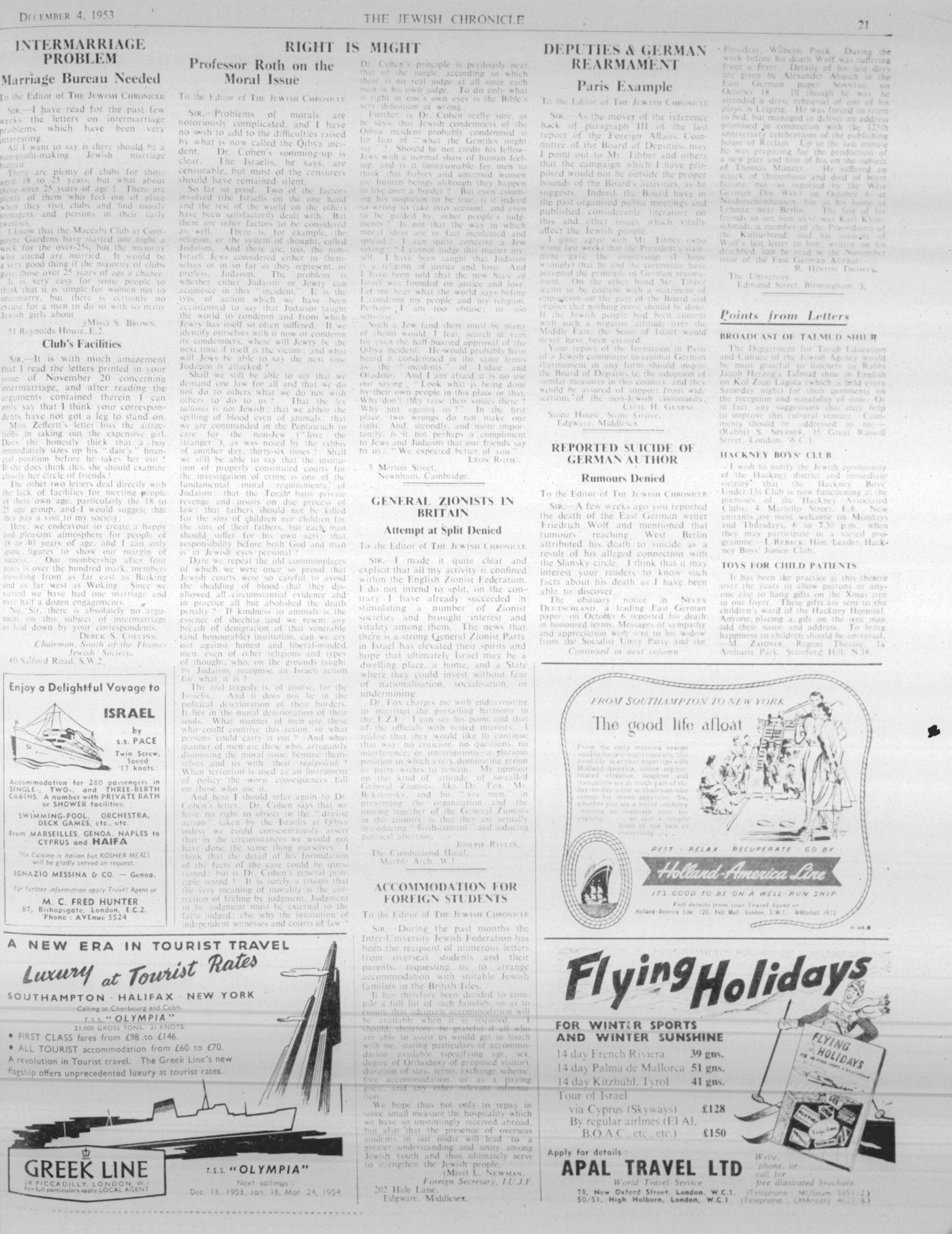
Reproduced here is the original page featuring Leon Roth’s Letter to the Editor (“Professor Roth on the Moral Issue”), The Jewish Chronicle (December 4, 1953): 21.
Appendix 2:

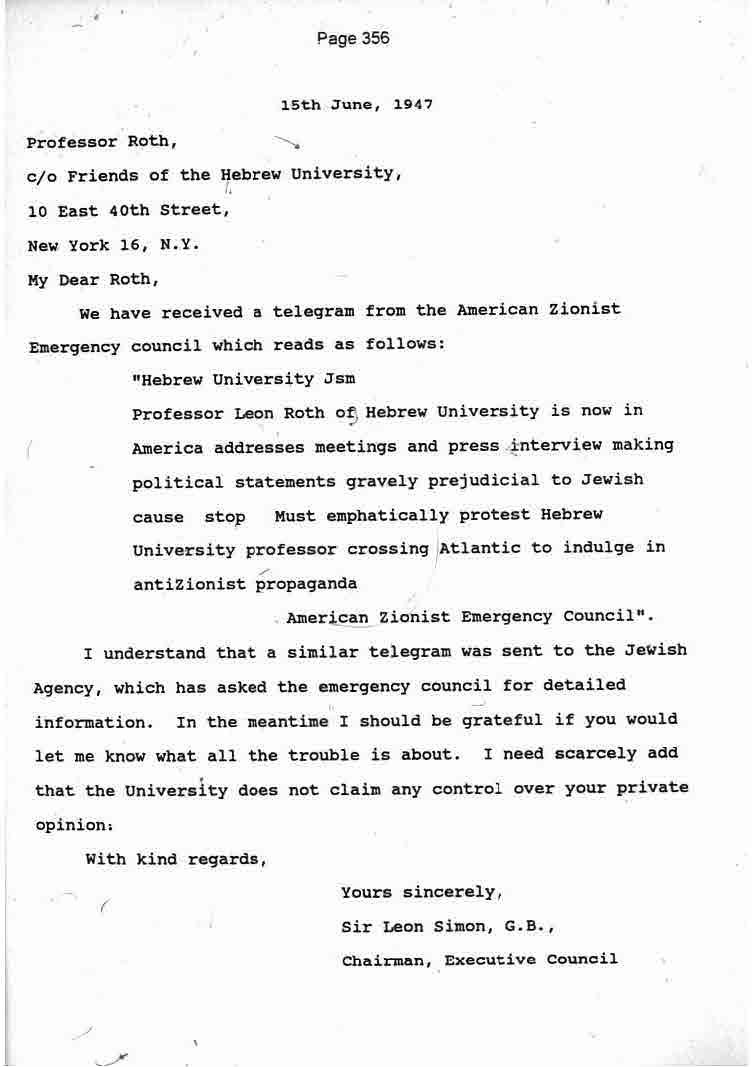
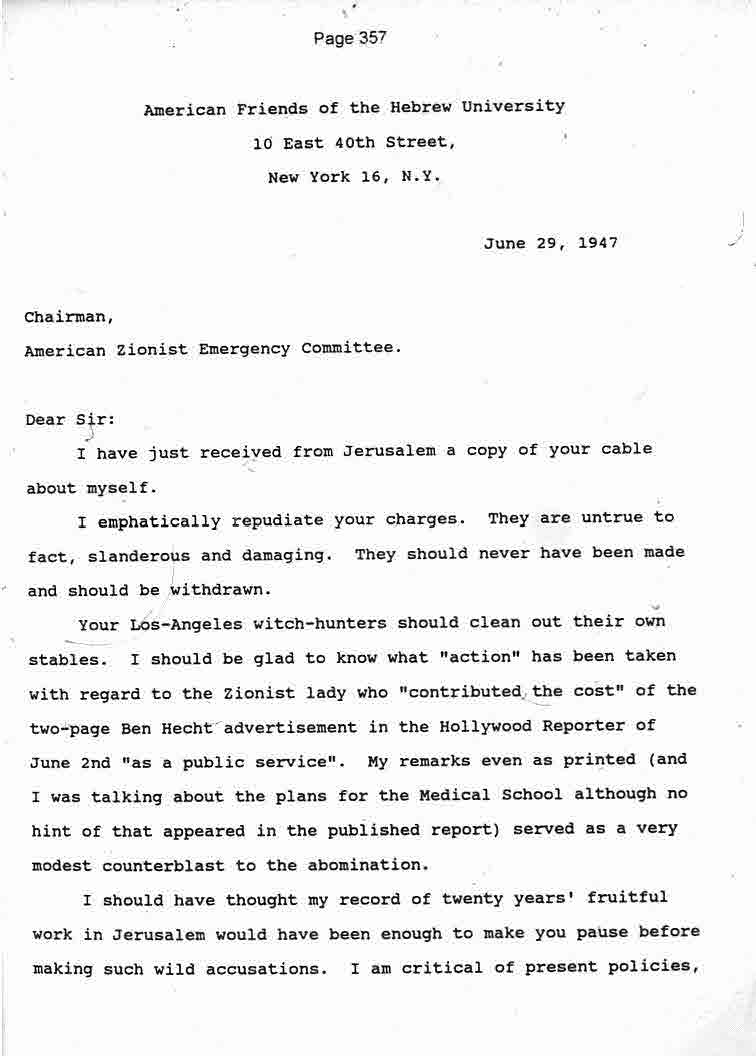
Reproduced here is the full exchange of correspondence between Leon Roth and Sir Leon Simon following Roth’s public remarks in the United States in June 1947 opposing the proposed partition of Palestine. The documents include Simon’s letter conveying the protest of the American Zionist Emergency Council, Roth’s reply rejecting the accusations, and related communications. The texts are reproduced here in full, without alteration, from Jan Katzew, “Leon Roth – His Life and Thought: The Place of Ethics in Jewish Education” (PhD dissertation, Hebrew University of Jerusalem, 1997), Appendix, pp. 355-358.
Appendix 3

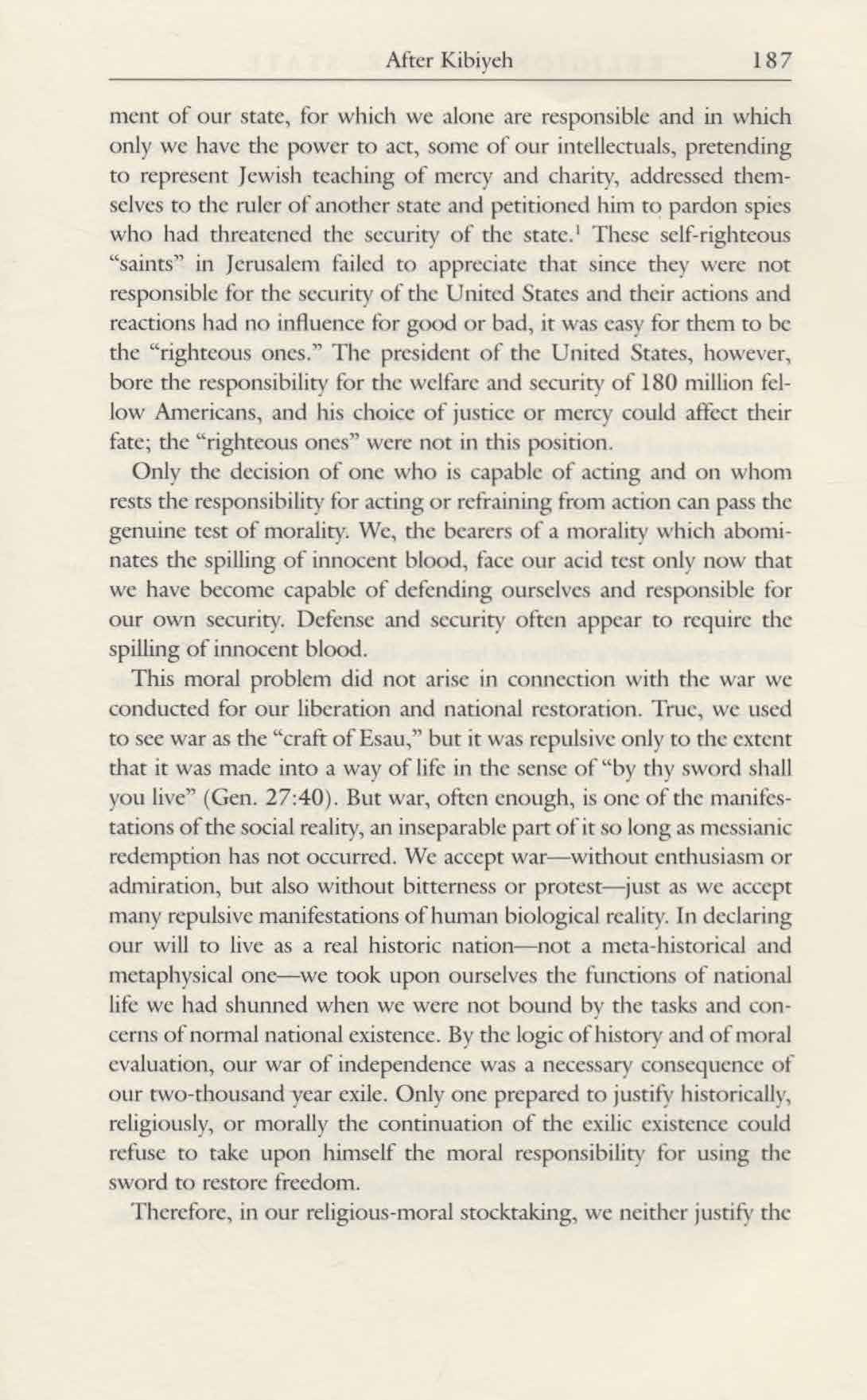
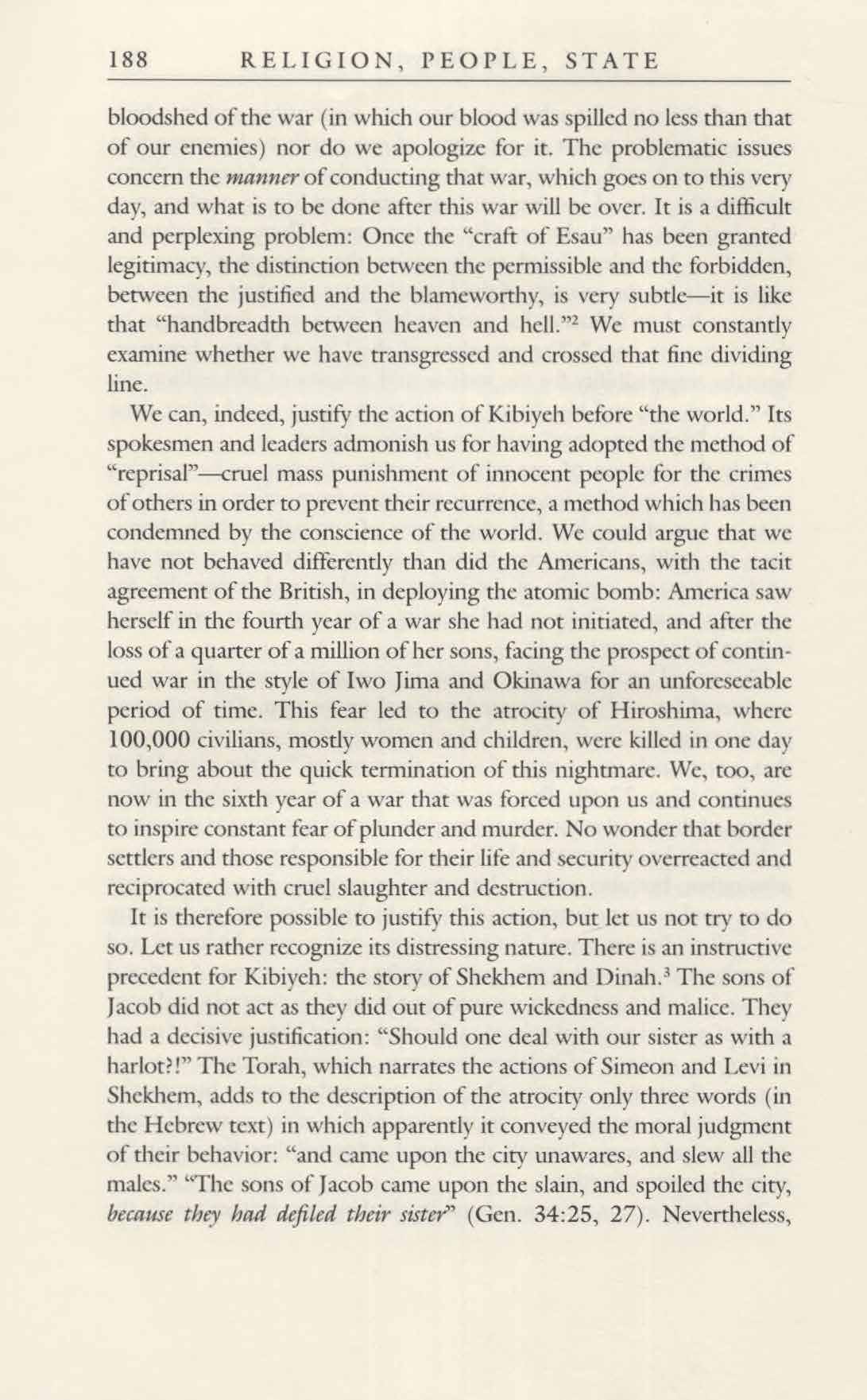
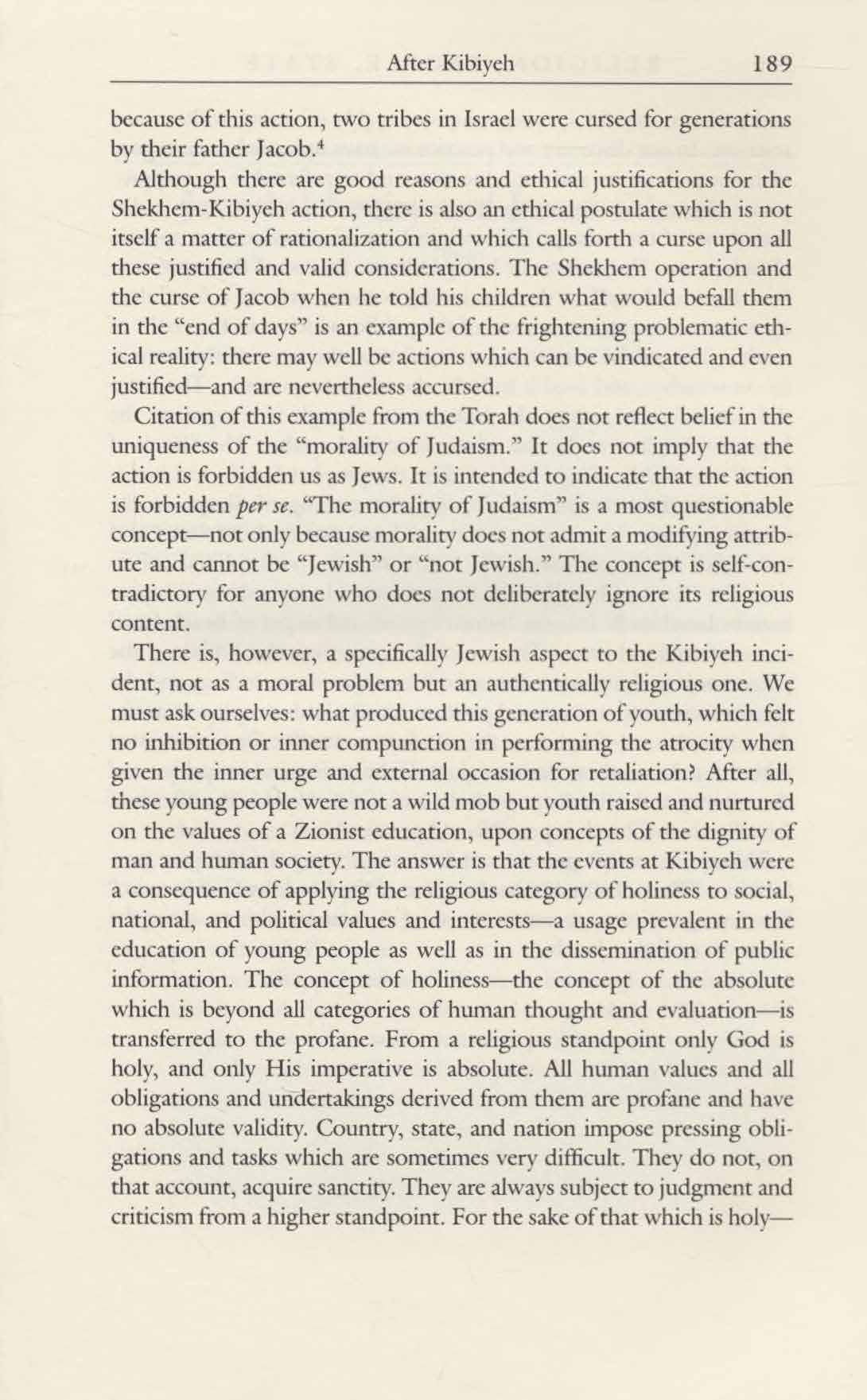
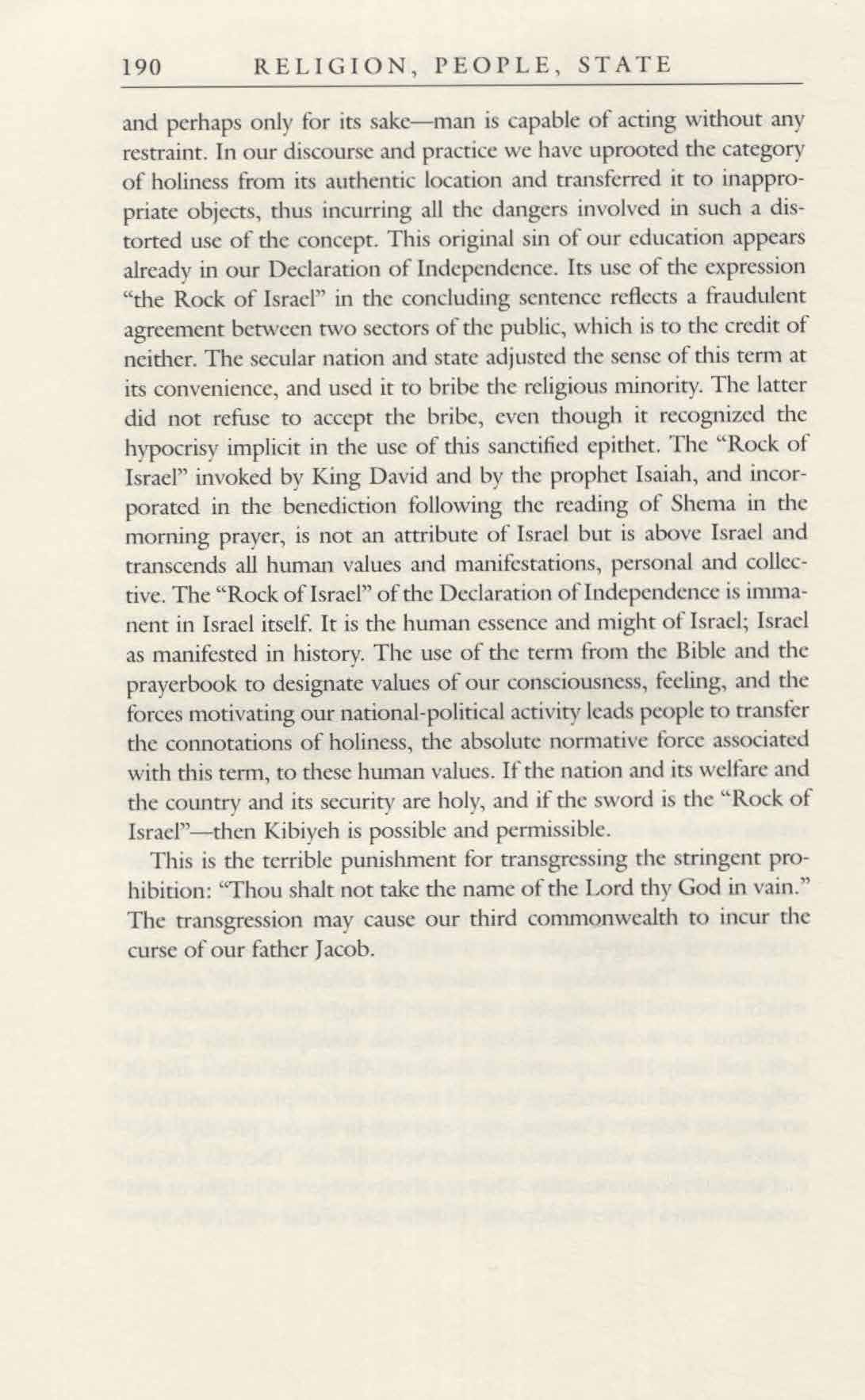
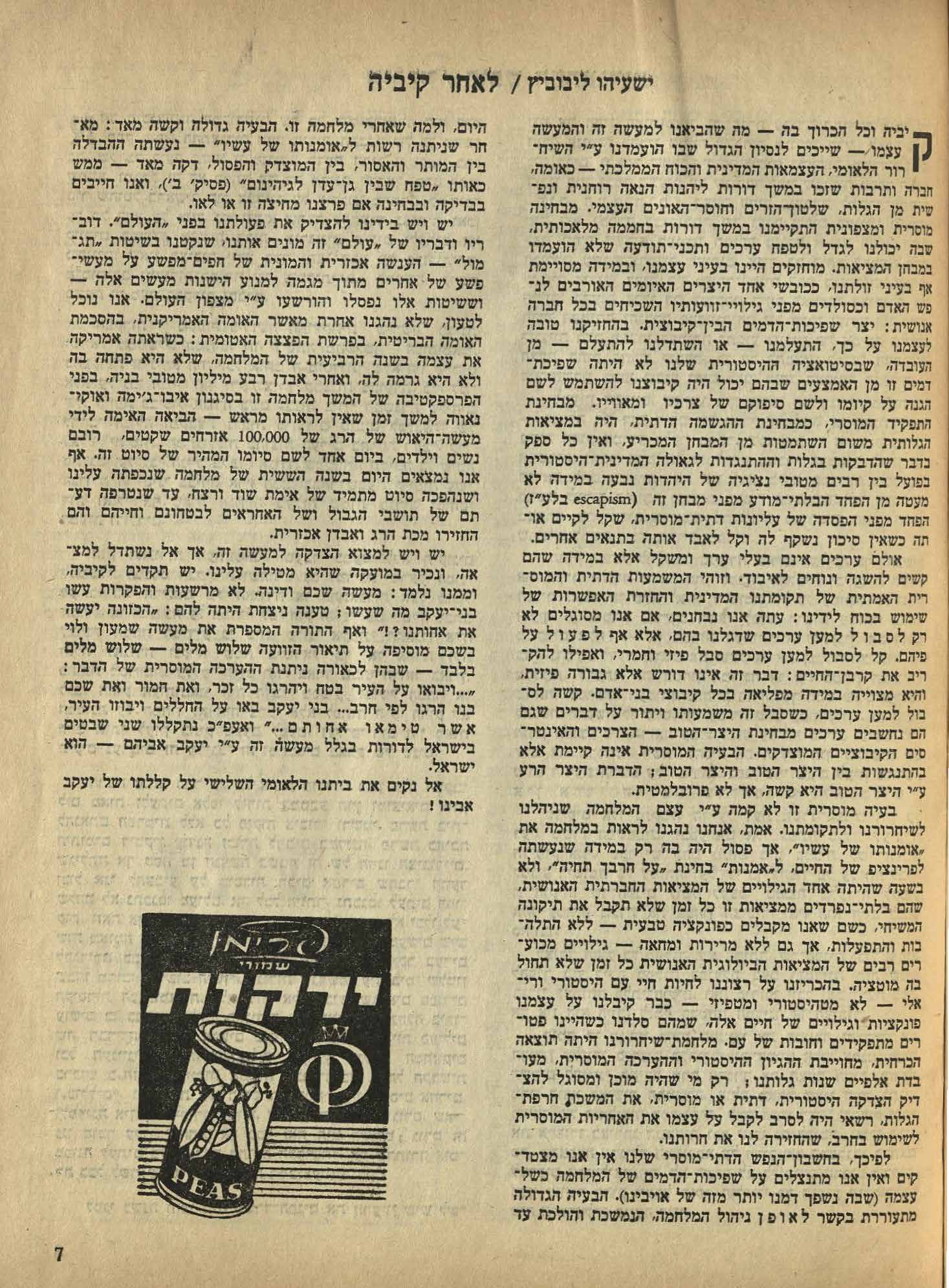
Reproduced here is Leibowitz’s original article “After Qibyā,” Beterem, no. 189 (15 December 1953): 7 (Hebrew).
Appendix 4

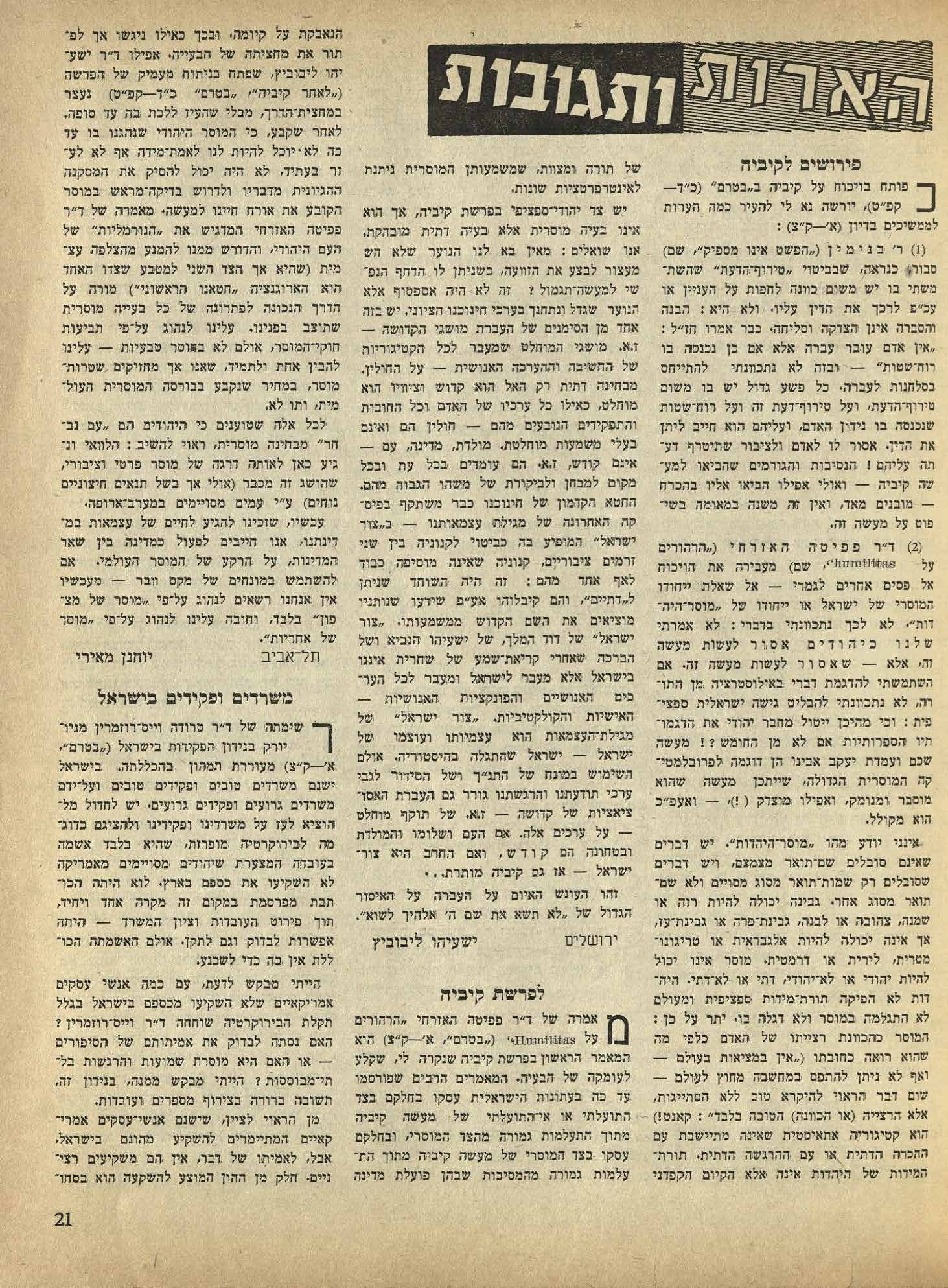
Reproduced here is Leibowitz’s follow-up article, “Letter – Commentaries on Qibyā,” Beterem, no. 191 (15 January 54): 21 (Hebrew).[26]
Appendix 5:

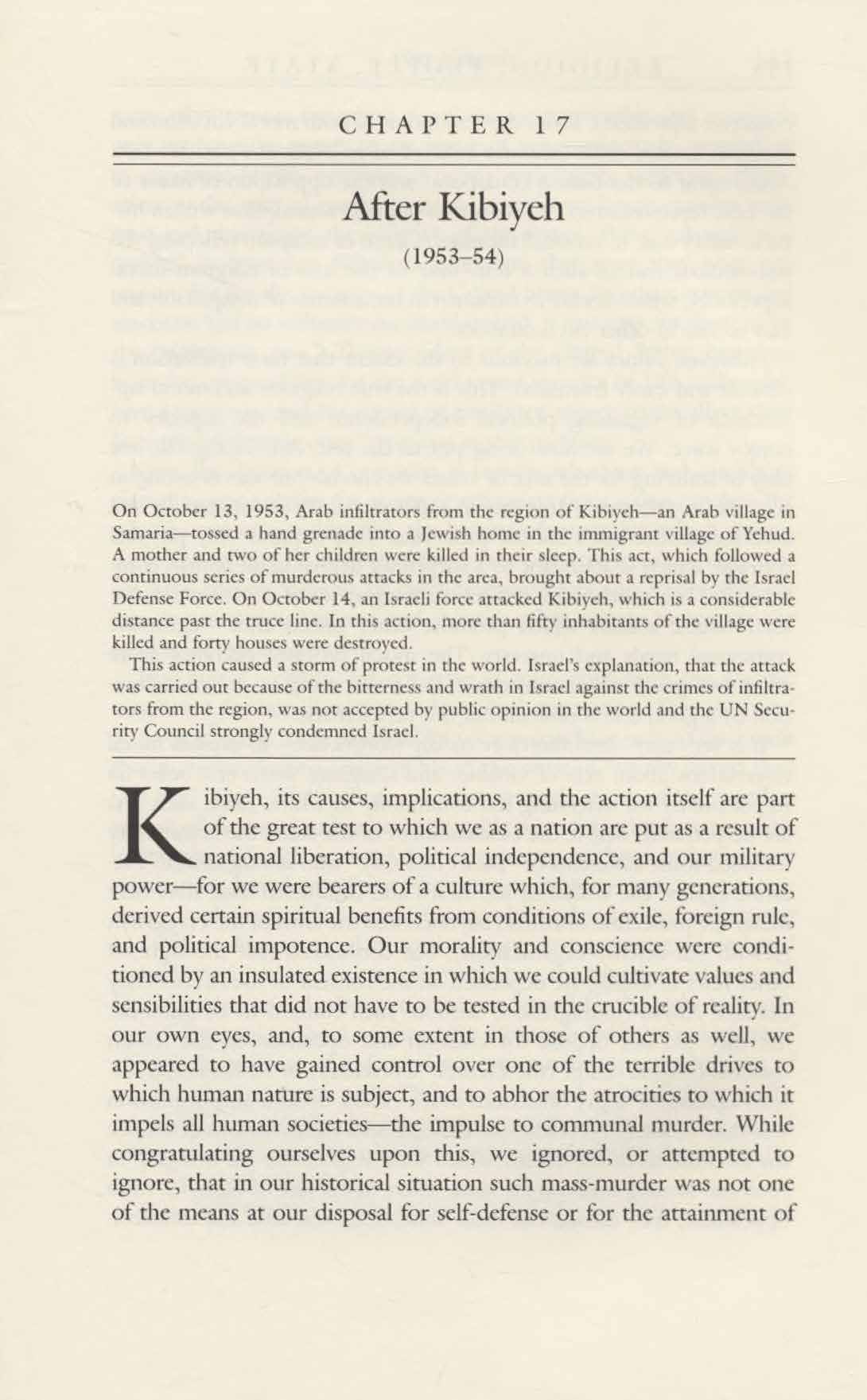
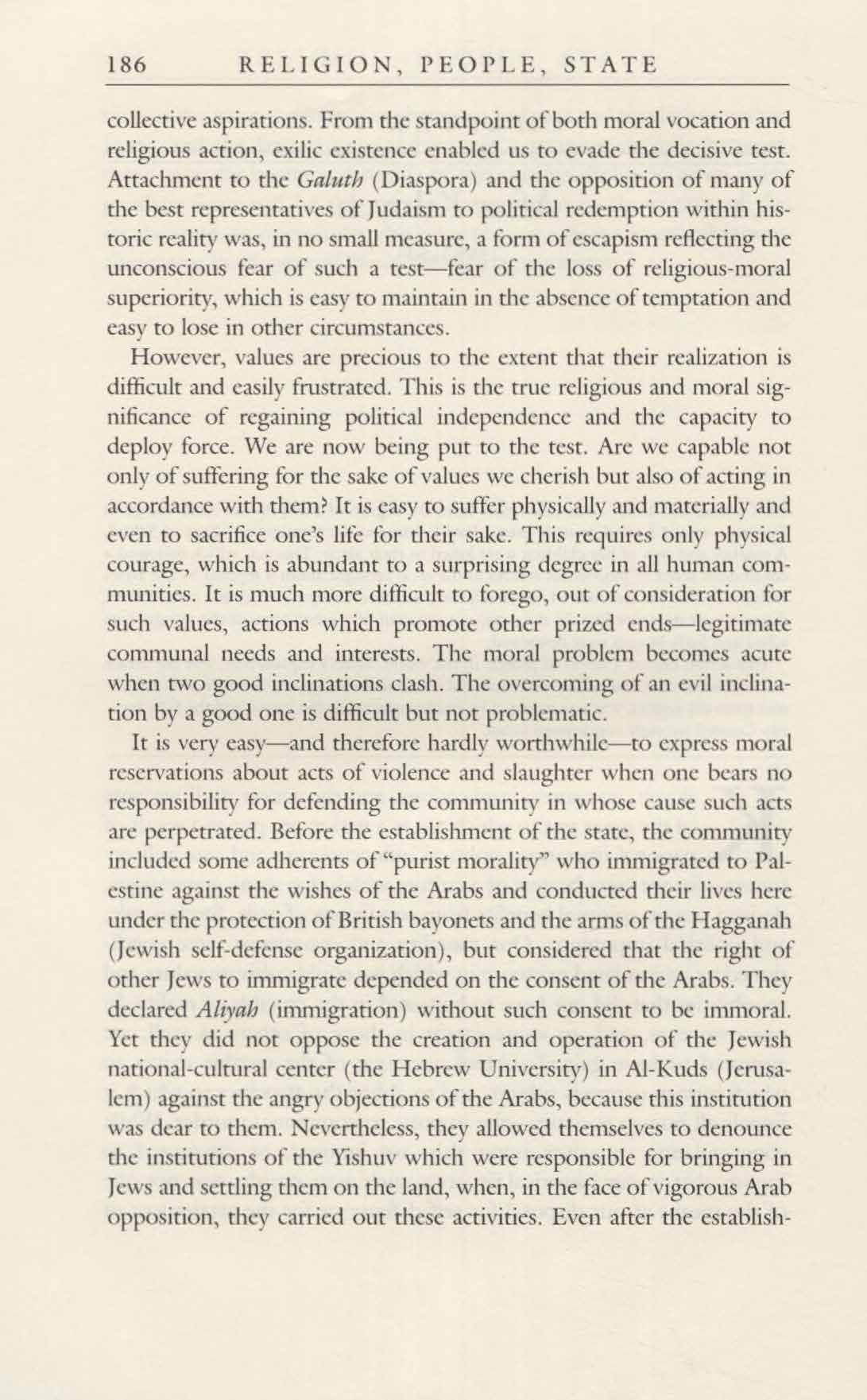
Reproduced here is the Hebrew text of “After Qibyā” as it appears in Yeshayahu Leibowitz’s 1954 book Torah u-Mitzvot ba-Zeman ha-Zeh. Passages reproduced from the original Beterem article of 15 December 1953 (see above, Appendix 3) are printed in plain font. Material drawn from the follow-up article in Beterem of 15 January 1954 (see above, Appendix 4), written in reply to Pepita Haezraḥi, appears in bold. Material first added in Torah u-Mitzvot ba-Zeman ha-Zeh is underlined.

The original December 15 text was copied in Torah u-Mitzvot ba-Zeman ha-Zeh with only minor changes; e.g., “emet, lefanim nahagnu” instead of “emet, anaḥnu nahagnu”; or “maʿaseh zevaʿah shel hereg” instead of “maʿaseh yeʾush shel hereg.”

The material deriving from the January 15 article was incorporated in it with many stylistic changes; e.g. “ha-problematikah ha-musarit ha-maḥridah” instead of “ha-problematikah ha-musarit ha-gedolah”; or the placement of “ha-hadgamah, etc.,” before “maʿaseh Shekhem, etc.,” instead of vice versa. It will be noted that Leibowitz’s well-known criticism of the secularization of religious concepts seems to have had its origin in his reply to Pepita Haezraḥi. His remarks about “tzur yisraʾel” repeat an urban legend. In point of fact, the dictum mentioning tzur yisraʾel was included already in the early draft of the Declaration of Independence by Mordecai Beham and Harry Davidowitz, written around April 22, 1948.[27]

The controversial paragraph on the Jerusalem “tzaddiqim,” added in Torah u-Mitzvot ba-Zeman ha-Zeh, illustrates the chasm in those days between Leibowitz and the Hebrew University “peace camp,” which consisted of famed professors like Samuel Hugo Bergmann, Martin Buber, Judah Leon Magnes, Gershom Scholem, Ernst Akiba Simon.” Roth also was not usually considered to be one of the members of that camp. See Bergmann’s article cited above, note 7.

The final sentence originally read: “al naqim et beytenu,” etc., which is stronger, simpler, and less preachy than the revised version.

After Qibyā

קיביה וכל הכרוך בה – מה שהביא למעשה זה והמעשה עצמו – שייכים לנסיון הגדול שבו הועמדנו ע”י השיחרור הלאומי, העצמאות המדינית והכוח הממלכתי – כאומה, חברה ותרבות שזכו במשך דורות ליהנות הנאה רוחנית ונפשית מן הגלות, שלטון-הזרים וחוסר-האונים העצמי. מבחינה מוסרית ומצפונית התקיימנו במשך דורות בחממה מלאכותית, שבה יכולנו לגדל ולטפח ערכים ותכני-תודעה שלא הועמדו במבחן המציאות. מוחזקים היינו בעיני עצמנו, ובמידה מסויימת אף בעיני זולתנו, ככובשי אחד היצרים האיומים האורבים לנפש האדם וכסולדים מפני גילויי-זוועותיו השכיחים של חברה אנושית : יצר שפיכות-הדמים הבין-קיבוצית. בהחזיקנו טובה לעצמנו על כך, התעלמנו – או השתדלנו להתעלם – מן העובדה, שבסיטואציה ההיסטורית שלנו לא היתה שפיכת-דמים זו מן האמצעים שבהם יכול היה קיבוצנו להשתמש לשם הגנה על קיומו ולשם סיפוקם של צרכיו ומאווייו. מבחינת התפקיד המוסרי, כמבחינת ההגשמה הדתית, היתה במציאות הגלותית משום השתמטות מן המבחן המכריע, ואין כל ספק בדבר שהדבקות בגלות וההתנגדות לגאולה המדינית-היסטורית בפועל בין רבים מטובי נציגיה של היהדות נבעה במידה לא מעטה מן הפחד הבלתי-מודע מפני מבחן זה ( escapism בלע”ז) – הפחד מפני הפסדה של עליונות דתית-מוסרית, שקל לקיים אותה כשאין סיכון נשקף לה וקל לאבד אותה בתנאים אחרים.

אולם ערכים אינם בעלי ערך ומשקל אלא במידה שהם קשים להשגה ונוחים לאיבוד. וזוהי המשמעות הדתית והמוסרית האמיתית של תקומתנו המדינית והחזרת האפשרות של שימוש בכוח לידינו : עתה אנו נבחנים, אם אנו מסוגלים לא רק לסבול למען ערכים שדגלנו בהם, אלא אף לפעול על פיהם. קל לסבול למען ערכים סבל פיזי וחמרי, ואפילו להקריב את קרבן-החיים : דבר זה אינו דורש אלא גבורה פיזית, והיא מצוייה במידה מפליאה בכל קיבוצי בני-אדם. קשה לסבול למען ערכים, כשסבל זה משמעותו ויתור על דברים שגם הם נחשבים ערכים מבחינת היצר הטוב ; הבעייה המוסרית מתעוררת בכל חריפותה בהתנגשות בין היצר הטוב והיצר הטוב ; הדברת היצר הרע ע”י היצר הטוב היא קשה, אך לא פרובלמטית.

נוחה מאד – ולכן גם זולה ועלובה מאד – היא מוסריות המסתייגת ממעשי אלימות ושפיכות-דמים מבלי שתהא בצידה של מוסריות זו גם האחריות לעניינים ולערכים שלמענם או בשמם נעשים מעשים אלה ונשפך דם זה. לפני הקמת מדינתנו היינו עדים במחננו לבעלי מוסריות צרופה, שהם עצמם עלו לא”י נגד רצונם של הערבים וחיו ופעלו בה בחסותם של הכידונים הבריטיים והאקדחים של ההגנה, אולם את זכות עלייתם של יהודים אחרים התנו בהסכמתם של הערבים, ואת העליה בכוח – שלא בהסכמת הערבים – פסלו כלא-מוסרית ; הם לא התנגדו להקמתו ולקיומו של המרכז התרבותי-לאומי היהודי באל-קודס (ירושלים) על אפם ועל חמתם של הערבים – כי המוסד הזה היה יקר בעיניהם -, אך הם הרשו לעצמם לגנות את פעולתם של מוסדותינו שהיו אחראים להעלאת יהודים וליישובם על הקרקע כשהללו עשו את המוטל עליהם על אפם ועל חמתם של הערבים. ואף אחר הקמת מדינתנו שרק לה אנו אחראים, ורק בה יש בידנו סיפק לעשות, פנו אנשי-רוח בקרבנו, שנתעטפו באיצטלת תורת החסד והרחמים של היהדות, אל שליטה של מדינה אחרת ודרשו ממנו לחון מרגלים שהתנכלו לבטחונה של המדינה ההיא(הזוג יוליוס ואתל רוזנברג בארה”ב, שנמצאו אשמים בריגול לטובת ברה”מ לשם השג מידע סודי על החימוש הגרעיני; הם נידונו למיתה והוצאו להורג ב-19.6.1953). ולא חלו ולא הרגישו צדיקים אלה בירושלים, שמאחר שאין הם האחראים לבטחונה של ארצות-הברית ושמעשיהם ותגובותיהם אינם משפיעים על בטחון זה לא לטובה ולא לרעה – קל ונוח להם להיות “צדיקים” ; ואילו בידו ובאחריותו של נשיא ארצות-הברית הופקדו שלומם ובטחונם של 180 מליון מבני-עמו, ומידת-הדין או מידת-הרחמים שבה הוא נוקט עלולה להשפיע על סיכון קיומם מחמת הפצצה האטומית. ולא הבינו צדיקי- ירושלים שאין הם רשאים לדון את נשיא ארצות-הברית עד שיגיעו למקומו.

המבחן הממשי של המוסריות אינו אלא בהכרעתו של מי שסיפק בידו לעשות והאחריות לעשיה או לאי-עשיה עליו. הנסיון המוסרי שלנו הגיע כשנעשינו אנו – נושאי המוסר המתעב שפיכת דם נקי – בעלי-יכולת ואחראים לעניני הגנה ובטחון, ענינים שבעיותיהם נראות לפעמים כניתנות לפתרון ע”י שפיכת דם נקי.

בעייה מוסרית זו לא קמה ע”י עצם המלחמה שניהלנו לשיחרורנו ולתקומתנו. אמת, לפנים נהגנו לראות במלחמה את “אומנותו של עשו”, אך פסול היה בה רק במידה שנעשתה לפרינציפ של החיים, ל”אומנות” בחינת “על חרבך תחיה”, ולא בשעה שהיתה אחד הגילויים של המציאות החברתית האנושית, שהם בלתי נפרדים ממציאות זו כל זמן שלא תקבל את תיקונה המשיחי, כשם שאנו מקבלים כפונקציה טבעית – ללא התלהבות והתפעלות, אך גם ללא מרירות ומחאה – גילויים מכוערים רבים של המציאות הביולוגית האנושית כל זמן שלא תחול בה מוטציה. בהכריזנו על רצוננו לחיות חיי עם היסטורי וריאלי – לא מטאהיסטורי ומטפיזי – כבר קיבלנו על עצמנו פונקציות וגילויים של חיים אלה, שמהם סלדנו כשהיינו פטורים מתפקידים וחובות של עם. מלחמת-שיחרורנו היתה תוצאה הכרחית, מחוייבת ההגיון ההיסטורי וההערכה המוסרית, מעובדת אלפיים שנות גלותנו ; רק מי שהיה מוכן ומסוגל להצדיק הצדקה היסטורית, דתית או מוסרית, את המשכת חרפת-הגלות, רשאי היה לסרב לקבל על עצמו את האחריות המוסרית לשימוש בחרב, שהחזירה לנו את חרותנו.

לפיכך, בחשבון-הנפש הדתי-המוסרי שלנו אין אנו מצדיקים ואין אנו מתנצלים על שפיכות-הדמים של המלחמה כשלעצמה (שבה נשפך דמנו לא פחות מזה של אויבינו). הבעייה הגדולה מתעוררת בקשר לאופן ניהול המלחמה, הנמשכת והולכת עד היום, ולמה שאחרי מלחמה זו. הבעייה גדולה וקשה מאד : מאחר שניתנה רשות ל”אומנותו של עשו”, נעשתה ההבדלה בין המותר ואסור, בין המוצדק והפסול, דקה מאד – ממש כאותו “טפח שבין גן-עדן וגיהנום” (פסיק’ ב’), ואנו חייבים בבדיקה ובבחינה אם פרצנו מחיצה זו או לאו.

יש ויש בידינו להצדיק את פעולתנו בפני “העולם”. דובריו ודבריו של “עולם” זה מגנים אותנו על שנקטנו בשיטות “תגמול” – הענשה אכזרית והמונית של חפים-מפשע על מעשי-פשע של אחרים מתוך מגמה למנוע הישנות מעשים אלה, בשיטות שנפסלו והורשעו על-ידי מצפון העולם. אנו נוכל לטעון, שלא נהגנו אחרת מאשר האומה האמריקנית, בהסכמת האומה הבריטית, בפרשת הפצצה האטומית : כשראתה אמריקה את עצמה בשנה הרביעית של המלחמה, שלא היא פתחה בה ולא היא גרמה לה, ואחרי אבדן רבע-מיליון מטובי בניה בפני הפרספקטיבה של המשך מלחמה זו בסיגנון איבו-ג’ימה ואוקינאוה למשך זמן שאין לראותו מראש – הביאה האימה לידי מעשה-הזוועה של הרג 100,000 אזרחים שקטים, רובם נשים וילדים, ביום אחד לשם סיומו המהיר של סיוט זה. אף אנו נמצאים היום בשנה הששית של מלחמה שנכפתה עלינו ושנהפכה סיוט מתמיד של אימת שוד ורצח, עד שנטרפה דעתם של תושבי הגבול ושל האחראים לבטחונם וחייהם והם החזירו מכת הרג ואבדן אכזרית.

יש ויש למצוא הצדקה למעשה זה, אך אל נשתדל למצאה, ונכיר במועקה שהיא מטילה עלינו. יש תקדים לקיביה, וממנו נלמד : מעשה שכם ודינה. לא מרשעות והפקרות עשו בני-יעקב מה שעשו : טענה ניצחת היתה להם : “הכזונה יעשה את אחותנו” ? ! ואף התורה המספרת את מעשה שמעון ולוי בשכם מוסיפה על תיאור הזוועה שלוש מלים – שלוש מלים בלבד – שבהן לכאורה ניתנת ההערכה המוסרית של הדבר : “…ויבואו אל העיר בטח ויהרגו כל זכר, ואת חמור ואת שכם בנו הרגו לפי חרב.. בני יעקב באו על החללים ויבוזו העיר, אשר טימאו אחותם…”. ואעפ”כ נתקללו שני שבטים בישראל לדורות בגלל מעשה זה ע”י יעקב אביהם – הוא ישראל.

אפשר ואפשר לנמק ולבסס, להסביר ולהצדיק את מעשה שכם-קיביה מבחינת כל עקרונות המוסר הניתנים לשיקול ולחישוב ראציונלי. אולם קיים גם פוסטולט מוסרי, שאינו כלל בגדר שיקול וחישוב, ושממנו נובעת קללה על כל השיקולים והחישובים המוצדקים והנכונים הללו. מעשה-שכם וקללת יעקב אבינו, בשעה שחזה לבניו את ואחרית-הימים – זוהי דוגמה לפרובלימטיקה המוסרית המחרידה, שייתכן מעשה שהוא מוסבר ומנומק, ואפילו מוצדק (!) – ואעפ”כ הוא מקולל.

ההדגמה מן התורה – אין משמעותה האמונה בייחודו המוסרי של ישראל או בייחודו של “מוסר-היהדות”. אין משמעותה שלנו כיהודים אסור לעשות מעשה זה ; אלא זוהי הדגמה שאסור לעשות מעשה זה. “מוסר-היהדות” הוא מן המושגים המפוקפקים ביותר – ולא רק משום שאין המוסר סובל שם-תואר מצמצם ואינו יכול להיות “יהודי” או “לא-יהודי” : עצם המושג “מוסר-היהדות” הוא סתירה מיניה וביה בשביל כל מי שאינו מתעלם בכוונה מן התוכן ומן המשמעות הדתיים של היהדות – ז. א. בשביל מי שאינו מזייף את היהדות. המוסר כהכוונת רצייתו של האדם כלפי מה שהוא רואה כחובתו (“אין במציאות בעולם – ואף לא ניתן להיתפס במחשבה מחוץ לעולם – שום דבר הראוי להיקרא טוב ללא הסתייגות, אלא הרצייה [או הכוונה] הטובה בלבד” : קאנט !) או כלפי מה שהוא מבין בטבע המציאות (הסטואה; שפינוזה) – המוסר הוא קטיגוריה אנתרופוצנטרית-אתיאיסטית, שאינה מתיישבת עם ההכרה הדתית או עם ההרגשה הדתית ; זו אינה מכירה אלא את “הטוב והישר בעיני ה’ “ – לא את ”הטוב והישר”! ואינה מעריכה את “החכם בחכמתו” אלא את “המשכיל ויודע את ה’ “. עובדה היסטורית- אמפירית היא – במחילת עצמותיהם של שד”ל, אחה”ע והרמן כהן – שהיהדות לא הפיקה תורת-מידות ספציפית ומעולם לא התגלמה במוסר ולא דגלה בו. תורת-המידות של היהדות אינה אלא הקיום הקפדני של תורה ומצוות שמשמעותן המוסרית ניתנת לאינטרפרטציות שונות.

יש, אמנם, צד יהודי ספציפי בפרשת קיביה, אך הוא אינו בעייה מוסרית אלא בעיה דתית מובהקת. אנו חייבים לשאול את עצמנו : מאין בא לנו הנוער הזה, שלא חש מעצור ומניעה נפשית לבצע בידיו את הזוועה, כשניתן לו הדחף הפנימי או החיצוני למעשה-תגמול ? והרי נוער זה לא היה אספסוף, אלא הנוער שגדל ונתחנך בערכי חינוכו הציוני, במושגי ערכי האדם והחברה. דבר זה הוא מן התוצאות של השימוש בקטיגוריה הדתית של קדושה לענינים ולערכים חברתיים, לאומיים ומדיניים שימוש שהוא רווח אצלנו בחינוך הנוער ובהסברה ציבורית : מושגי קדושה – ז. א. מושגי המוחלט שמעבר לכל הקטגוריות של החשיבה וההערכה האנושית – מועברים על החולין, מבחינה דתית רק האל הוא קדוש ורק צוויו הוא מוחלט, ואילו כל ערכיו של האדם וכל החובות והתפקידים הנובעים מהם – חולין הם ואינם בעלי משמעות מוחלטת. מולדת, מדינה, עם – חובות ותפקידים נעלים הם, המחייבים לפרקים אף למעשים קשים מאד, אך לעולם אין הם נעשים קודש, ז. א.לעולם הם עומדים למבחן ונתונים לביקורת של משהו הגבוה מהם. על דברים שבקדושה – ואולי רק עליהם – מסוגל האדם לפעול ללא כל מעצור. אנו עוקרים את הקטגוריה של קדושה ממקומה ומעבירים אותה על דברים שלא להם נועדה, עם כל הסיכון הכרוך בשימוש מסולף זה. החטא הקדמון הזה של חינוכנו כבר משתקף במגילת עצמאותנו – ב”צור ישראל” המופיע בסיומה כביטוי לקנוניה בין שני זרמים ציבוריים, קנוניה שאינה מוסיפה כבוד לאף אחד מהם : העם והמדינה החילוניים, שהוציאו מושג זה ממשמעותו, נתנו את המונח כשוחד למיעוט הדתי, וזה לא נמנע מלקבלו, אעפ”י שידע את הדו-פרצופיות הגלומה בשימוש זה בכינוי הקדוש. ו”צור ישראל” של דוד המלך, של ישעיהו הנביא, של הברכה שאחרי קריאת-שמע של שחרית – אינו בישראל אלא מעבר לישראל ומעבר לכל הערכים, הגורמים והגילויים האנושיים – האישיים והקולקטיביים כאחד. “צור ישראל” של מגילת העצמאות הוא בישראל עצמו – הוא עצמותו ועוצמתו האנושיים של ישראל : ישראל שנתגלה בהיסטוריה. אולם השימוש במונח של התנ”ך והסידור לגבי ערכי תודעתנו והרגשתנו האנושיים ולגבי הכוחות המניעים של פעולתנו הלאומית-מדינית – שימוש זה גורם שגם האסוציאציות של קדושה – ז.א. של תוקף מוחלט – הכרוכות בכינוי זה מועברות על ערכים אלה. אם העם ושלומו והמולדת ובטחונה הם קודש, ואם החרב היא-היא “צור ישראל” – אז גם קיביה אפשרית ומותרת…

זהו העונש האיום של העבירה על האיסור החמור של “לא תשא את שם אלהיך לשוא”.

מתוך עבירה על איסור זה אנו עלולים להקים את ביתנו השלישי על קללתו של יעקב אבינו.

The text was also translated by the philosopher Eliezer Goldman on the basis of later versions, while taking into consideration the earlier ones, as published in Yeshayahu Leibowitz, Judaism, Human Values, and the Jewish State (Cambridge, MA: Harvard University Press, 1992), 185-190, 277.
Appendix 6

Halakhic Engagements with the Qibyā Raid and the Renewal of the Laws of War

By Menachem Butler

The present appendix situates the halakhic discussion of the Qibyā raid within the context of recent scholarly efforts to recover, contextualize, and critically assess Jewish legal discourse on sovereignty, military service, and war in the State of Israel. It does not seek to adjudicate the halakhic permissibility of Qibyā, but rather to map the emergence, structure, and internal tensions of the halakhic discourse the episode generated.

Among the more recent of these scholarly efforts is the Milḥemet Mitzvah series, edited by Aviad Hacohen, Yitzchak Avi Roness, and myself. This multi-volume project is devoted to the halakhic, historical, and ideological foundations of military obligation in modern Israel, bringing together newly translated primary sources alongside contemporary scholarship in order to reconstruct the formative debates through which categories such as milḥemet mitzvah, collective obligation, and the relationship between Torah study and national defense were rearticulated under conditions of Jewish statehood.[28] A forthcoming volume in the Milḥemet Mitzvah series will extend this inquiry to the Qibyā raid and its halakhic aftermath, situating the episode within the longer arc of post-1948 Jewish legal reflection on war, retaliation, and civilian harm. Whereas the volumes published to date focus primarily on the War of Independence and its immediate halakhic reverberations, the events of October 1953 mark a subsequent – and in many respects decisive – moment in the development of modern halakhic thought on warfare. The halakhic debates of 1948 were largely oriented toward questions of obligation, authority, and participation in collective defense; Qibyā, by contrast, compelled a direct confrontation with issues that had previously remained largely implicit, including the legitimacy of retaliatory violence, the halakhic status of civilian populations, and the reconciliation of inherited legal norms with the operational realities of modern warfare.

At the center of the halakhic discourse on Qibyā stands Rabbi Shaul Yisraeli’s extended responsum, which quickly became the unavoidable point of reference for subsequent Religious Zionist engagement with the episode and, more broadly, with questions of war, responsibility, and state violence.[29] Written in close proximity to the events of 1953, it constitutes one of the earliest systematic attempts to evaluate Qibyā through halakhic reasoning rather than through moral intuition or political necessity. Its enduring influence lies not only in its substantive conclusions, but in the methodological seriousness with which it applies classical legal sources to a modern military operation involving civilian casualties. As the literature surveyed here demonstrates, the responsum quickly assumed a canonical role, shaping subsequent Religious Zionist halakhic treatments of military force and the limits of legitimate violence under conditions of Jewish sovereignty.

Beyond ethical, philosophical, or political reactions, Qibyā also generated a sustained halakhic discourse that sought to situate the events within inherited legal categories while testing their elasticity in the face of modern military power. This body of writing reflects neither straightforward apologetics nor wholesale repudiation, but a concerted effort to articulate norms of legitimacy and restraint within a legal tradition long shaped by political powerlessness. Rabbi Yisraeli’s responsum first appeared in Ha-Torah ve-ha-Medinah, a journal founded in the early years of the State of Israel by leading figures within the Religious Zionist movement to confront, in a systematic halakhic register, the unprecedented challenges posed by Jewish sovereignty.[30] Conceived as a forum for the renewal of hilkhot medinah – of the laws of statehood – the journal brought together senior rabbinic authorities from Israel and the Diaspora to deliberate questions of governance, security, agriculture, economics, and public authority that had long remained underdeveloped in the absence of Jewish sovereignty. Under Rabbi Yisraeli’s editorial leadership, Ha-Torah ve-ha-Medinah rejected both apologetics and abstract theorization, insisting instead on rigorous engagement with concrete realities and on the integration of classical halakhic mastery with intimate knowledge of contemporary conditions.

The programmatic ambitions of Ha-Torah ve-ha-Medinah were articulated with unusual clarity by Rabbi Yisraeli himself in a contemporaneous interview reflecting on the aims and methods of the forum he edited.[31] From the outset, he rejected the assumption – prevalent even among committed religious thinkers – that “the laws of state and society do not exist at all within the Torah,” insisting instead that Jewish law is capable of sustaining “ordinary political life” without recourse to miracles or messianic suspension. Against both those who regarded the state as a theological aberration and those who treated halakhah as relevant only to the private sphere, Rabbi Yisraeli framed the task of the forum as reconstructive rather than apologetic: to recover areas of halakhah long relegated to the category of “law for the messianic era” and to clarify them through sustained engagement with classical sources and contemporary realities alike. It was precisely this commitment – to determining positions “not on the basis of moral agitation or political excitement alone, but on the basis of solid halakhic sources” – that governed the inclusion of the Qibyā raid among the journal’s most urgent and controversial subjects. Read against this backdrop, Rabbi Yisraeli’s responsum on Qibyā emerges not as an exceptional intervention prompted by political pressure, but as a paradigmatic test case within the programmatic framework of Ha-Torah ve-ha-Medinah, oriented toward collective responsibility and the exercise of coercive power by a Jewish state. Published as “The Qibyā Incident in Light of Halakhah,”[32] the responsum exemplifies the journal’s ambition to subject even the most morally fraught acts of state violence to sustained halakhic scrutiny rather than rhetorical evasion. In this capacity, it functions as the foundational text for the halakhic discussion of Qibyā and as a formative intervention in the development of Religious Zionist legal thought on war and sovereignty.

A crucial caveat is therefore in order. The halakhic engagement with Qibyā examined here unfolded largely in advance of, and largely independent from, the broader moral reckoning with the operation in Israeli public discourse. As Efrat Seckbach has shown, Qibyā was framed for decades within Israeli collective memory as a tragic, defensive, or even necessary act, and only much later came to be stabilized as a paradigmatic moral transgression.[33] The early rabbinic and halakhic discussions surveyed in this appendix thus did not emerge in response to sustained public condemnation, nor were they shaped by a settled moral consensus regarding the operation’s illegitimacy. Rather, they developed within a discursive environment in which the moral meaning of Qibyā remained fluid, contested, and largely underdetermined in the public sphere. This temporal and discursive disjunction is analytically significant: it cautions against retrojecting later ethical judgments onto early halakhic reasoning and underscores that these responsa were formulated in a context where halakhic analysis functioned not as post hoc legitimation, but as an initial site of normative articulation under conditions of unresolved moral uncertainty.

Unlike Professor Leon Roth’s moral indictment or Professor Yeshayahu Leibowitz’s theological warning, Rabbi Shaul Yisraeli’s intervention is deliberately juridical: it insists that Qibyā be evaluated as a matter of halakhic classification rather than moral expression or prophetic protest. He opens his analysis by sharply delimiting the scope of halakhic categories traditionally invoked to justify violence outside the context of war. He examines, and ultimately rejects, the applicability of rodef, judicial punishment, and collective liability, emphasizing that none can justify the foreseeable killing of non-combatants, especially children. This refusal to rely on expansive constructions of culpability constitutes an important boundary-setting move and signals resistance to dissolving halakhic distinctions under the pressure of political exigency.

Having rejected these alternatives, Rabbi Yisraeli treats milḥamah as the sole halakhic category within which the events of Qibyā can be assessed. War, in his account, is governed by norms distinct from those that regulate interpersonal violence or judicial punishment: it is structured by collective agency and strategic necessity rather than individualized culpability. On the basis of classical discussions of siege warfare and national defense, he argues that halakhah does not require absolute differentiation between combatants and civilians where such distinctions cannot be operationally maintained. Yet this claim is narrowly framed. Civilian harm is neither trivialized nor treated as halakhically neutral, and Qibyā is not presented as unproblematic. Instead, the operation is situated within ezrat Yisrael miyad tzar – assistance to Israel against an enemy threat – understood as a form of defensive war oriented toward deterrence and protection. This classification permits halakhic authorization of the operation while leaving intact a residue of moral unease that resists full juridical resolution.

The most consequential element of the responsum lies in Rabbi Yisraeli’s treatment of milḥemet mitzvah. He rejects the claim that defensive war is obligatory solely by virtue of pikuaḥ nefesh, noting that halakhah does not, as a rule, require one to endanger one’s life for the sake of others. To address this problem, he recasts defensive war as a binding collective obligation, grounded not in emergency rescue but in biblical models of national preservation and reprisal. In doing so, he relocates the normative basis of military action from individual ethical calculus to communal responsibility, thereby providing a conceptual structure that would prove influential for later halakhic discussions of warfare. Yet the responsum does not resolve its own tensions. Rabbi Yisraeli repeatedly signals unease and declines to subsume Qibyā under familiar categories of punishment or self-defense. The argument moves between legal authorization and acknowledged moral disquiet, registering the pressure placed on inherited halakhic frameworks by the conditions of modern, state-sponsored violence.

Subsequent halakhic and scholarly treatments of Qibyā have largely proceeded from Rabbi Yisraeli’s responsum.[34] These later authors have extended, modified, or even contest his conclusions, but they all have done so within the conceptual framework he set in place.[35] The responsum thus operates less as a conclusive ruling than as a point of orientation, shaping the terms in which questions of halakhic authorization and the moral burdens of sovereignty would thereafter be posed.

The reception of Rabbi Yisraeli’s responsum has been mapped most systematically by Professor Gerald J. Blidstein,[36] who reconstructs the emergence of a post-Qibyā discourse in which Rabbi Yisraeli’s analysis furnished later decisors with a conceptual grammar for addressing civilian harm within the logic of war. By relocating the discussion from individualized self-defense to the framework of collective warfare, the responsum made it possible to engage questions of civilian casualties without negating civilian status – a shift that both constrained and expanded the scope of permissible violence. Blidstein devotes particular attention to the post-Qibyā expansion of rodef. Whereas classical halakhah construes the rodef narrowly, later writers increasingly attribute derivative responsibility to civilian populations through functional analogies that blur the distinction between combatants and non-combatants. What concerns Blidstein is not merely the expansion itself, but the manner in which it proceeds: descriptive claims about the realities of modern warfare are allowed to perform normative work without explicit halakhic argument. This slippage between descriptive realism and legal authorization constitutes the central ethical risk identified in Blidstein’s essay. Modern warfare undoubtedly challenges classical distinctions, but difficulty alone does not license their abandonment. When empirical claims dictate legal conclusions, halakhah risks mirroring military practice rather than governing it; Qibyā thus becomes emblematic of the moral hazards confronting halakhic reasoning under conditions of sovereignty.[37]

A wider historical and jurisprudential framing is offered by Professor Arye Edrei, who situates Qibyā within a longue durée narrative of halakhic reactivation. In his account, Jewish law entered modernity with the laws of war largely dormant, and the advent of sovereignty transformed war from an abstract category into an unavoidable halakhic reality.[38] Within this framework, Qibyā marks a shift from questions of the obligation to wage war (jus ad bellum) to questions of how war is to be conducted (jus in bello).[39] Rabbi Yisraeli’s responsum exemplifies this shift through its methodological boldness: classical categories are not merely applied but reconfigured in order to address deterrence, civilian entanglement, and asymmetric warfare. Edrei emphasizes the ambivalence of this renewal – necessary for halakhic relevance yet destabilizing long-standing assumptions about civilian immunity and proportionality. He further traces the interpretive trajectory from Qibyā to later conflicts, particularly Lebanon, showing how early interpretive decisions acquired precedential force. While acknowledging internal pluralism and critique, Edrei argues that sovereignty established a shared framework in which war became central to halakhic self-understanding, thereby exposing halakhic discourse to the pressures inherent in regulating state violence.

The internal complexity of Rabbi Yisraeli’s position is examined by his disciple, Rav Prof. Neria Guttel, who situates the Qibyā responsum within Rabbi Yisraeli’s broader intellectual biography and his sustained involvement in the institutions of Religious Zionism.[40] Rav Guttel opens with a polemical claim: Rabbi Yisraeli has been remembered within the movement through what he describes as a “rather flat, highly plastic, and one-dimensional image,” whereas his actual halakhic posture was “far more complex.” This mischaracterization, Rav Guttel argues, obscures the disciplined character of Rabbi Yisraeli’s legal reasoning.[41] In the case of Qibyā, his refusal to extend the categories of rodef or collective punishment is presented not as moral hesitation but as fidelity to halakhic boundaries that resist ideological inflation. At the same time, Rabbi Yisraeli’s decision to legitimate the operation within the framework of war reflects his acceptance of what Rav Guttel elsewhere describes as the inescapable responsibilities generated by sovereignty and institutional participation. For Rav Guttel, this combination of legal authorization and acknowledged discomfort belongs to a broader pattern of rebuke issued from within loyalty rather than from withdrawal. The responsum thus exemplifies a mode of halakhic engagement that neither sanctifies state violence nor dissociates itself from it, and Rav Guttel cautions that later readings which extract permissive conclusions while neglecting this internal tension risk reproducing precisely the flattening of Rabbi Yisraeli’s thought that his essay seeks to correct.[42]

A more narrowly focused doctrinal analysis is offered by Yitzchak Avi Roness, who examines Rabbi Yisraeli’s reconceptualization of milḥemet mitzvah. Challenging the grounding of defensive war in pikuaḥ nefesh, Roness argues that Rabbi Yisraeli instead relocates it within a theory of collective obligation rooted in national preservation.[43] This move expands the halakhic space for legitimating military action while simultaneously exposing the ideological dimensions of interpretive choice. Roness further shows how this reconceptualization is operationalized in Qibyā, where retaliatory action is legitimated as part of an ongoing defensive war rather than as an immediate act of rescue; while enhancing doctrinal coherence and halakhic relevance, the shift weakens the internal tools available for critique, increasing reliance on strategic judgment and assessments of national interest.

Taken together, this body of halakhic literature demonstrates that the moral and political unease elicited by Qibyā was neither external to Jewish legal thought nor resolved outside it, but was internalized, debated, and reformulated within halakhic categories themselves. Far from functioning merely as a vehicle of retrospective legitimation, halakhic discourse became a sustained arena of normative contestation, in which inherited legal frameworks were pressed to account for the realities of sovereign violence, retaliation, and civilian harm. Readers approaching Qibyā primarily through ethical theory or political critique may therefore profit from attending to these halakhic engagements, not as exercises in doctrinal closure, but as serious and often unsettled attempts to articulate responsibility, restraint, and moral remainder within a legal tradition newly compelled to confront the burdens of political power.

Appendix 7

Ariel Sharon on the Qibyā Operation:

A Contemporaneous Record of the 1965 Eshkol-Sharon Meeting

By Menachem Butler

The following is an annotated English translation of an Historical Document from the 1965 meeting between Levi Eshkol and Ariel Sharon, as recorded contemporaneously by Eshkol and published by Arnon Lamfrom and Ze’ev Elron.[44]

A revealing retrospective window onto the logic of Qibyā is provided by this document. Speaking twelve years after the operation, amid a bitter intra-Zionist political struggle, Sharon rejected the claim that Qibyā marked a departure from prior practice, maintaining instead that most earlier reprisal actions had likewise targeted civilians and that the later distinction between military and civilian objects was largely retrospective. The novelty of Qibyā, in his account, lay not in intent but in its successful outcome: the seizure of an entire village, the large-scale demolition of houses, and the operation’s deterrent impact on the Arab population, its achievement of security, and its “restoration of honor to the IDF. Civilian deaths are acknowledged but minimized: he was aware of no more than a dozen men killed in the conquest of the village, but unaware of the deaths of the many women, children, and others who were hiding silently in the houses. Read against the contemporaneous responses of Leon Roth and Yeshayahu Leibowitz, this document does not resolve the moral problem of Qibyā so much as confirm its depth, exemplifying – without euphemism – the subordination of ethical language to state power, deterrence, and prestige that Roth feared Judaism could not survive and that Leibowitz denounced as the sacralization of the profane.

Historical Document

Ariel Sharon came on the initiative and with the knowledge of the Chief of Staff [Yitzhak Rabin].

He wishes to set matters on their factual truth. Ben-Gurion’s declaration concerning Qibyā motivates him.

I [Sharon] carried out the act and reported it. This group [Rafi] is capable of anything. The tendency is not a matter concerning Pinhas Lavon. The matter is directed against civilian objects, to bind the government’s hands from action. On the other hand, there is a feeling that we are not responding [today] sufficiently and adequately. The public expects action. Ben-Gurion’s intention is [on the one hand] to bind [the government], and [on the other hand] in order to cause the government to fail.

At a house gathering in Nazareth, [Shimon] Peres said that the army and the paratroopers [–]. He spoke of their contributions [operations?] and also related many military secrets. This is not fair.

And now to the matter of Qibyā. Ben-Gurion says that in his time operations were carried out against military objects, and that Pinhas Lavon is responsible for the operation against civilian objects. He [Sharon] examined and found that this is not correct and not true. Moshe Dayan also scoffs. It is true that in that period [before the establishment of Unit 101 in the summer of 1953] these operations simply did not succeed. There was an operation against Sharafat [Sharfaṭ] near Jerusalem, 7.2.1951. The mukhtar’s house and additional houses were blown up. On 8.2.1951, in Dir Bṭut [Balut], an attack on civilians that did not succeed.

25.9.1951, an attack on a-Ṣafi – Dead Sea, did not succeed, although five civilians were killed.

6.1.1952, three attacks: I. Beit Jala, II. Beit Furiq, III. Idna – Beit Govrin.

23.1.1953, two attacks on Falama near Qalqilya.

18.5.1953 [19.5.1953], operations against the village of Husan near the approaches [Mavo] of Beitar. An operation against Far‘un near Tulkarm. An operation near Midya near Ben Shemen. And against Bedouin civilians in the south along the Beersheba–Hebron road.

Almost all the operations were not carried out properly. Most of the operations in those days were carried out against civilians. Both Tawfiq [1960] and Nuqeib [1962] were also operations against civilians.

Precisely against military objects did operations begin in the days of Pinhas Lavon: the raid on the Legion camp at ‘Azzun – [east of] Qalqilya, after the murder of a Jew in Ra‘anana, end of June 1954. The aggressive operation against an Egyptian position near Kissufim.

Ariel [Sharon] was wounded there.

A third operation – the kidnapping of Legion personnel at Beit ‘Ur al-Tahta, Lower Beit Horon, near Latrun. Another operation against the police station at Tzurif in January 1955 was not carried out; we were turned back en route because of new information. In the days of Pinhas Lavon there was strict insistence on meticulous execution. He himself received reprimands for deviation. There was a severe prohibition on using fire in houses prior to inspection with flashlights.

And now Qibyā.

He, Ariel, planned and was responsible for the execution. He was on site. He led the men. He checked the houses, gave instructions what to blow up. There were [?] five names there. The order was no different from other orders: to blow up the maximum number of houses and to strike men, exactly as in all orders for previous operations. The difference was that this time the operation succeeded, and incidentally it had a first-degree impact on the Arabs, as well as on the IDF – which had almost previously lost its prestige – and also on the Arabs. The Arabs were not accustomed to large and successful operations on our part. They had become accustomed to the IDF coming and blowing up some house at the edge of the village. This time the IDF came, took control of the village. There was a deathly silence in the village. There were 10–12 fatalities, all during the occupation and penetration action. This was reported already in the morning [after the operation].

But 40–50 [people] were blown up in houses. Apparently some of the inhabitants hid in the houses; we did not see them. In one case, an explosives officer heard the crying of a child after he had already ignited the fuse. He endangered himself, jumped into the house, and took the girl out. After that, no people were seen.

I was summoned to Ben-Gurion three or four days later in Jerusalem. I reported on the operation. He was satisfied with the operation and said: “It is not important what the world will say. What is important is what the Arabs in the region will think.” The conversation ended.

A month before he resigned – his final resignation – he summoned me and asked whether perhaps I remember who gave the order in the Qibyā operation. I answered that I do not remember who gave the order; I remember to whom I reported the operation. He, Ben-Gurion, said: “I was ashamed of that operation.” And Ariel said: “I do not know what your view of it is today. I will remind you of what you said to me then.” I repeated his words and explained to him how the operation was carried out. Ben-Gurion did not retract his words and said that he had been ashamed at the time.

In any event, Ben-Gurion knows the truth and heard the description from me, and the things that he, Ben-Gurion, said then [thus!], 1963. He was also angered to hear my words.

And further: all along, the situation and the manner of searching for a way against Pinhas Lavon influenced me [Sharon]. Moshe Dayan also mocks the way and the method of theirs [of the Rafi people] to seek means to blacken Pinhas Lavon.

  1. This article is based on a talk given at the Limmud Festival, Birmingham UK, December 2025. A Hebrew version appeared in Yashar, 21 January 2026, available here. See also my more extensive discussion: Warren Zev Harvey, “After Qibyā: Yeshayahu Leibowitz, Leon Roth, and Neḥamah Leibowitz,” in Aviezer Ravitzky, ed., Yeshayahu Leibowitz, Between Conservatism and Radicalism: Reflections on His Philosophy (Jerusalem: Van Leer Institute, 2007), 354-365 (Hebrew), available here. I thank Mr. Menachem Butler for providing links to various relevant materials, adding much historical and bibliographical information to the notes, and authoring the important Appendices 6 and 7.
  2. See Efrat Seckbach, “The Qibyā Operation in Israeli Public Memory, 1953-1985,” Iyunim Bitkumat Israel, no. 27 (2017): 274-301 (Hebrew), available here, who documents that the dominant Israeli public opinion initially tended to see the operation as justified, minimized civilian casualties, and avoided moral evaluation, but from the mid-1970s onward, in the wake of the Yom Kippur and Lebanon Wars, Qibyā came to be remembered as a paradigmatic moral transgression.On the halakhic dimensions of the Qibyā raid, including contemporary rabbinic responses and their later reception, see Appendix 6, by Menachem Butler, “Halakhic Engagements with the Qibyā Raid and the Renewal of the Laws of War.”
  3. Leon Roth, “Letter – Professor Roth on the Moral Issue,” The Jewish Chronicle (4 December 1953): 21, reprinted in Raphael Loewe, “Note,” in Leon Roth, Is There a Jewish Philosophy? Rethinking Fundamentals (Oxford: The Littman Library of Jewish Civilization, 1999), xviii-xx, available here. See also below, Appendix 1. The British discussion of the Qibyā raid was exacerbated by the intervention of Dr. Cyril Garbett, Archbishop of York: “Archbishop Accuses Israel: ‘Cruel Massacre’ of Arab Villagers,” The Jewish Chronicle (13 November 1953). The Board of Deputies of British Jews issued an immediate reply, rejecting his censure as “provocative and one-sided” (ibid.).
  4. “Right Is Might,” The Jewish Chronicle (October 23, 1953): 16. David F. Kessler was the Chronicle’s managing director and John Maurice Shaftesley its editor. On the editorial’s contemporary reception, see David Cesarani, The Jewish Chronicle and Anglo-Jewry, 1841–1991 (Cambridge: Cambridge University Press, 1994), 206, who shows it was widely regarded as an important moral statement. It was praised by Ernst Akiba Simon and Selig Brodetsky, and endorsed by Rabbi Leo Baeck who personally congratulated Kessler. It was sharply criticized by the Israeli Embassy in London, although Ambassador Eliahu Elath later conceded to Kessler that the criticism had been warranted.
  5. In his first intervention (“Israel Border Conflict – The Deputies’ Statement, 23 October 1953), Bentwich repudiated an apologetic statement issued by the Board of Deputies in response to the Foreign Office’s censure of Israel, and he criticized the Qibyā action as “a shocking indefensible act which violates the fundamental ethic of Judaism.” In his second intervention (“Professor Bentwich’s Reply,” 27 November 1953), he responded directly to Rabbi Abraham Cohen, President of the Board of Deputies. He rejected his claim (20 November 1953) that condemnation of the reprisal raid was permissible only for those who could swear they themselves would not retaliate in a similar situation, and he insisted that he himself would oppose the Qibyā action “in any circumstances.” Roth’s December 4 letter continued Bentwich’s criticism of Cohen’s opinion that although the Qibyā action was morally wrong, Jews should not hasten to condemn it.
  6. Simon, Professor of Education at the Hebrew University of Jerusalem, was in England in October 1953 on a lecture tour under the auspices of the Leeds Zionist Association and the Zionist Federation. In his lectures Simon emphasized the tension between Jewish moral consciousness and political existence, warning that “Israel will not solve your educational problem – you must solve it yourself,” and calling for “a new equilibrium between Jewish consciousness and Jewish existence.” See “Needs of Jewish Education: Professor Simon’s Lectures,” The Jewish Chronicle (October 9, 1953): 5.
  7. See Raphael Loewe, “Memoir about Leon Roth,” in Raphael Loewe, ed., Studies in Rationalism, Judaism and Universalism – In Memory of Leon Roth (London: Routledge & Kegan Paul, 1966), 1-11, available here.
  8. See Irene Roth, Cecil Roth, Historian Without Tears: A Memoir (New York: Sepher-Hermon Press, 1982), 114, for an anecdote from Irene and Cecil Roth’s 1935 visit to Palestine. When in Safed, Cecil Roth mentioned to “an elderly man clad in a long silk caftan” that he had a brother in Jerusalem named Leon: “[T]he man grew excited. ‘Do you mean Professor Leon Roth, the philosopher?’ he said in surprise. ‘How is it possible that you did not say so at once? To have such an eminent scholar in one’s family and not to proclaim it from the housetops – this I cannot understand.’ Then he continued, ‘I, too, am something of a philosopher. I have published a number of pamphlets on the subject.’ Cecil had never heard of these pamphlets, but he was amazed at the fact that their author, a complete stranger and seemingly far removed from western Jewish thought, should know of his family.” See also Cecil Roth, “Types Seen in Palestine,” Opinion: A Journal of Jewish Life and Letters 5, no. 12 (October 1935): 13-15; and idem, “Jerusalem, Paradise of Ethnologist,” The Palestine Post (30 April 1935), reporting a visit to his brother in Jerusalem.
  9. See Samuel Hugo Bergmann, “On the Figure of Prof. H. Y. Roth,” Haaretz Literary Supplement (12 April 1963): 3 (Hebrew); and Neve Gordon and Gabriel Motzkin, “Between Universalism and Particularism: The Origins of the Philosophy Department at the Hebrew University and the Zionist Project,” Jewish Social Studies 9 (2003): 99-122; and see also Tal Meir Giladi, “Jerusalem Divided: The Hebrew University’s Philosophy Department Between Rotenstreich and Bar-Hillel,” in Yfaat Weiss and Uzi Rebhun, eds., The History of the Hebrew University of Jerusalem: The Nation-State and Higher Education (Jerusalem: Magnes, 2024), 767-798 (Hebrew). See soon Niv Perelsztejn, “The Genesis of Israeli Philosophy, 1917-1967: Cross-cultural Dialogue or Academic Isolation” (Ph.D. dissertation, Haifa University, to be submitted in Spring 2026).
  10. For a list of his publications, see Raphael Loewe, “Bibliography of the Writings of Leon (Hebraice Hayyim Yehudah) Roth,” in Raphael Loewe, ed., Studies in Rationalism, Judaism and Universalism – In Memory of Leon Roth (London: Routledge & Kegan Paul, 1966), 523-536, available here.
  11. The Israeli press framed Roth’s departure as an expression of disillusionment with the policies of the State and the University. See, e.g. “Prof. Roth Returns – Disillusioned – to England,” Maariv (15 March 1951): 4 (Hebrew), available here.
  12. Loewe reports that Roth’s resignation was met with resistance not only by the University but also by senior figures in the Israeli establishment, who regarded him as a major national asset and sought to retain him through offers of high office. Proposals were made that he assume the presidency of the University or, alternatively, enter the government as Minister of Education; but “he was not to be dissuaded,” and in July 1951 he returned to England. See Loewe, “Memoir about Leon Roth,” 1-11, esp. 5, available here.
  13. A photograph of his tombstone, taken by Mr. Menachem Butler during an Aseret Yemei Teshuvah visit to Karori Cemetery in Wellington, New Zealand, on Sunday, 23 September 2012, as part of his High Holiday tour of New Zealand, has been published in David Assaf, “A Book Dedication: ‘I Will Go and Return to My First Husband’ – A Farewell Gift from Ḥayyim Yehudah Roth,” The OnegShabbat Blog (11 March 2012), available here. (Note: the post was originally published in March 2012 and has been updated periodically in subsequent years, including the addition of the tombstone photograph.)
  14. Ernst Akiba Simon, “Letter – After Qibyā and Rabbi Judah Halevi,” Beterem, no. 190 (1 January 1954): 21 (Hebrew).
  15. Warren Zev Harvey, “Judah Halevi on War and Morality,” in Aviad Hacohen and Menachem Butler, eds., Praying for the Defenders of Our Destiny: The Mi Sheberach for IDF Soldiers (Cambridge, MA: The Institute for Jewish Research and Publications, 2023), 317-318, available here.
  16. See Elliott Horowitz, “Genesis 34 and the Legacies of Biblical Violence,” in Andrew R. Murphy, ed., ‪The Blackwell Companion to Religion and Violence (Blackwell Publishing, 2011), 163-182, available here.
  17. The discussion of Roth’s second question does not appear in Leibowitz’s original article of 15 December 1953, but was introduced only in his follow-up piece of 15 January 1954, and was written in explicit response to Pepita Haezraḥi, “Thoughts on Humilitas,” Beterem, no. 190 (1 January 1954): 9-11 (Hebrew); see below, Appendix 4. Since Leibowitz’s discussion appeared a full six weeks after Roth’s letter in the Jewish Chronicle, there is no reason to doubt that he was influenced by it. The length and thoughtfulness of Leibowitz’s reply to Dr. Haezraḥi reveals the great respect he had for the independent-minded young philosopher, then 32.
  18. Nearly three decades ago, my student Rabbi Dr. Jan Katzew documented the controversy that erupted in 1947 around Leon Roth’s public opposition to the proposed partition of Palestine. While on a visit to the United States on behalf of the Hebrew University of Jerusalem, Roth was quoted in “Professor Gives Some Opinions on Palestine,” Los Angeles Times (3 June 1947): 4, arguing that partition was impracticable and warning that it would leave “two sore spots that will eventually lead to violence.” His remarks, made less than six months before the United Nations vote on partition, provoked heated reactions from American Zionist leaders, who accused him of anti-Zionist agitation. In a letter of protest, Sir Leon (Arie) Simon, then Chair of the University’s Executive Council and later its President, cited a telegram from the American Zionist Emergency Council charging that “Professor Leon Roth of Hebrew University is now in America … making political statements gravely prejudicial to the Jewish cause.” Roth rejected the accusation as “untrue to fact, slanderous and damaging,” insisting on his right, “after twenty years’ fruitful work in Jerusalem,” to criticize prevailing policies. See Jan Katzew, “Leon Roth – His Life and Thought: The Place of Ethics in Jewish Education” (PhD dissertation, Hebrew University of Jerusalem, 1997), 72-74; the full exchange between Roth and Simon is reproduced below in Appendix 2 (from Katzew’s appendix, pp. 355-358).
  19. See Yeshayahu Leibowitz, Judaism, Human Values, and the Jewish State (Cambridge, MA: Harvard University Press, 1992), 241-248.
  20. When taken to task by Shubert Spero for omitting reference to the State of Israel and Zionism, Roth responded: “I fancy that the reviewer has fallen into the conventional confusion between the ‘Land of Israel’ and the ‘State of Israel.’ The State of Israel has worries which neither I nor your reviewer can, or has the right to try to, solve; but are they, all or in part, connected with Judaism? In any case would it not be wiser for us to try and make up our minds first what Judaism is and only afterwards…what our attitude to the new State is to be?” See Leon Roth, “Communications – Are There Authoritative Beliefs?” [Response to Shubert Spero], Tradition: A Journal of Orthodox Jewish Thought 5, no. 1 (Fall 1962), 123-124, available here. After forsaking the State of Israel in 1951, Roth devoted his final years to trying to clarify what Judaism is.
  21. Leon Roth, Judaism: A Portrait (New York: Viking Press, 1960), 104.
  22. Ibid., 107.
  23. Ibid., 107.
  24. Ibid., 230-231.
  25. See, Judaism, Human Values, and the Jewish State, pp. 191-192.
  26. In this article, Leibowitz responded to Pepita Haezraḥi, “Thoughts on Humilitas,” Beterem, no. 190 (1 January 1954): 9-11 (Hebrew); and Rabbi Benjamin, “The Plain Sense Is Not Sufficient…,” ibid., 11 (Hebrew).
  27. See Warren Zev Harvey, “Theopolitical Notes on Israel’s Declaration of Independence,” Journal of Ecumenical Studies 56 (2021): 338-346, available here.
  28. Milhemet Mitzvah, vol. 1: Halakhic Foundations, Religious Authority, and Military Service in Israel’s War of Independence, eds. Aviad Hacohen, Yitzchak Avi Roness, and Menachem Butler (Cambridge, MA: The Institute for Jewish Research and Publications, 2025), available here; and Milhemet Mitzvah, vol. 2: Religious Leadership and Halakhic Responsibility in the Military Service Debate, eds. Aviad Hacohen, Yitzchak Avi Roness, and Menachem Butler (Cambridge, MA: The Institute for Jewish Research and Publications, 2025), available here.
  29. See Neria Guttel, “Missing from the Book – Review of War in Light of Halakhah,” in Aviad Hacohen, Yitzchak Avi Roness, and Menachem Butler, eds., Milhemet Mitzvah, vol. 2: Religious Leadership and Halakhic Responsibility in the Military Service Debate (Cambridge, MA: The Institute for Jewish Research and Publications, 2025), 318-328, who offers a detailed analysis of the systematic marginalization of Religious Zionist halakhic treatments of war in the Encyclopedia Talmudit and the editors’ deliberate preference for citing ḥaredi authorities while excluding Religious Zionist halakhic thinkers.
  30. See Aharon Kampinsky, “Torah Publications,” in Rabbinism and Politics in Religious Zionism (Boston: Academic Studies Press, 2024), 37-52, on the establishment of Ha-Torah ve-ha-Medinah as a halakhic forum for questions of sovereignty, governance, security, and agriculture in the early years of the State of Israel; see also Asher Cohen and Aharon Kampinsky, “Religious Leadership in Israel’s Religious Zionism: The Case of the Board of Rabbis,” Jewish Political Studies Review 18, nos. 3-4 (Autumn 2006): 119-140.
  31. “Creators on Their Works – Rabbi Shaul Yisraeli: Editor and Reviewer,” ha-Tsofeh Literary Supplement (7 January 1955): 5-6 (Hebrew), available here.
  32. Shaul Yisraeli, “The Qibyā Incident in Light of Halakhah,” Ha-Torah ve-ha-Medinah, nos. 5-6 (1953-1954): 71-113 (Hebrew), available here, and later revised and expanded as “Military Actions for the Protection of the State,” in ʿAmud ha-Yemini (Tel-Aviv-Jaffa: Moreshet, 1966), 162-199 (Hebrew).
  33. See Efrat Seckbach, “The Qibyā Operation in Israeli Public Memory, 1953-1985” (cited above, n. 2). Her otherwise comprehensive study does not engage the contemporaneous halakhic discussions of Qibyā, treating them neither as part of Israeli public discourse nor as relevant to the formation of public memory. This omission accords with her focus on secular political, cultural, and media arenas, but it also underscores the extent to which halakhic discourse operated in a largely parallel register, marginal to the sites in which Israeli collective memory of Qibyā was shaped. The absence of halakhic material from this historiography thus reinforces the claim that early rabbinic and halakhic engagements with Qibyā unfolded independently of the later moral reckoning traced here.
  34. See Michael J. Broyde, “Just Wars, Just Battles, and Just Conduct in Jewish Law: Jewish Law Is Not a Suicide Pact!,” in Lawrence H. Schiffman and Joel B. Wolowelsky, eds., War and Peace in the Jewish Tradition (New York: Yeshiva University Press, 2004), 1-43, available here, who treats Rabbi Shaul Yisraeli’s responsum on the Qibyā incident as the earliest sustained modern halakhic engagement with civilian harm in asymmetric warfare and traces its subsequent elaboration in the pages of Teḥumin. In his reading, Rabbi Yisraeli’s argument is taken to permit the targeting of civilians who materially assist hostile operations through a widened application of the rodef doctrine, extending even to indirect or expressive forms of support. This analysis reflects a later stage in the reception of Yisraeli’s responsum, in which its categories are preserved but pressed beyond the narrower limits they bear in the original text.
  35. See also Aviad Hacohen, “Ethics and War: A Select Bibliography,” in Eli Bloom, ed., Arakhim be-Mivhan Milhamah: Values in the Test of War – A Symposium in Memory of Ram Mizrachi (Jerusalem: Moreshet, 1985), 252-256 (Hebrew), available here.
  36. Gerald J. Blidstein, “The Treatment of Hostile Civilian Populations: The Contemporary Halakhic Discussion in Israel,” Israel Studies 1, no. 2 (Fall 1996): 27-45, available here; and Gerald J. Blidstein, “The Ethical and Legal Status of Hostile Civilian Populations in Contemporary Halakhic Thought,” State, Government, and International Relations, vols. 41-42 (1997): 155-170 (Hebrew), available here.
  37. See also his related articles in Gerald J. Blidstein, “The Massacre at Shechem, Collective Punishment, and Contemporary Halakhic Thought,” Et Ha-Da’at 1 (1997): 48-55 (Hebrew), available here; Gerald J. Blidstein, “The Ethics of Warfare Revisited,” Me’orot Journal 6, no. 2 (2008): 2-5, available here; and Gerald J. Blidstein, “The Case of Shechem: Maimonides’ Normative Reading,” in Daphne Barak-Erez and Gidon Sapir, eds., Essays in Honour of Izhak Englard (Ramat-Gan: Bar-Ilan University Press, 2010), 375-387 (Hebrew), available here.
  38. Arye Edrei, “From Qibyā to Beirut: The Renewal of the Jewish Laws of War in the State of Israel,” in Yossi Goldstein, ed., Yosef Daʿat: Studies in Modern Jewish History in Honor of Yosef Salmon (Beer Sheva: Ben-Gurion University of the Negev, 2010), 95-127 (Hebrew). An earlier version appeared in Arye Edrei, “Law, Interpretation, and Ideology: The Renewal of the Jewish Laws of War in the State of Israel,” Cardozo Law Review 28, no. 1 (October 2006): 187-227, available here.
  39. See Suzanne Last Stone, “The Jewish Law of War: The Turn to International Law and Ethics,” in Sohail H. Hashmi, eds., Just Wars, Holy Wars, and Jihads: Christian, Jewish, and Muslim Encounters and Exchanges (New York: Oxford University Press, 2012), 342-363.
  40. See Neria Guttel, “‘He Whom One Loves, He Rebukes’: The Complexity of Rav Shaul Yisraeli’s Attitude toward the Personalities, Institutions, and Philosophy of Religious Zionism,” in Yishai Arnon, Yehuda Friedlander, and Dov Schwartz, eds., Studies in Religious Zionism: Developments and Changes (Ramat-Gan: Bar-Ilan University Press, 2012), 145-167 (Hebrew), available here.
  41. See also Neria Guttel, “The Rabbinate and the State,” ha-Tsofeh Literary Supplement (22 June 2001): 11-12 (Hebrew).
  42. See further Neria Guttel, “Combat in an Area Dense with Civilian Population,” Teḥumin, no. 23 (2003): 18-31 (Hebrew), expanded and published in Neria Guttel, “Combat in an Area Dense with Civilian Population,” in Eyal Karim, ed., Ha-Milhamah ba-Terror (Kiryat Arba: ha-Makhon le-Rabanei Yishuvim, 2006), 43-105 (Hebrew), available here. Although not concerned with the Qibyā responsum as such, the article addresses the same operational problems that first emerged there and illustrates how later halakhic discussion of civilian harm can press earlier categories toward more permissive conclusions while leaving aside the hesitations and limits that shape Rabbi Yisraeli’s original analysis.
  43. Yitzchak Avi Roness, “Halakhah, Ideology and Interpretation: Rabbi Shaul Yisraeli on the Status of Defensive War,” Jewish Law Association 10 (2010): 184-195, available here.
  44. Arnon Lamfrom and Ze’ev Elron, “Historical Document: Meeting of Levi Eshkol and Ariel Sharon Concerning the Qibyā Operation – Jerusalem, 3 September 1965,” Yesodot, no. 6 (2024): 269-282 (Hebrew), available here; and see also Ariel Sharon, “The Operation That Restored the IDF’s Honor,” Yediot Ahronoth (18 October 1992): 8-9, 11 (Hebrew), available here, which retrospectively casts the operation as a necessary assertion of deterrence that successfully restored the IDF’s military standing, but gives little attention to the operation’s legal or moral ambiguity.


R. Chaim Vital and his Unknown Work Sefer ha-Pe'ulot

R. Chaim Vital and his Unknown Work Sefer ha-Pe’ulot:
A Work on Science, Medicine, Alchemy and Practical Magic.
by: Eliezer Brodt

ספר הפעולות רבי חיים ויטאל, תש”ע, תלט עמודים כולל מבוא ומפתחות

A few years back, in a post at the Seforim blog discussing the history of plant known as baladur, I mentioned a sefer, Refuah Ma’asiyot le-Rav Chaim Vital. At the time, I only briefly touched upon this work. What follows is a more detailed discussion of the recently published edition as well as the history and substance of the work. The author is R. Chaim Vital, the most famous student of the Arizal. This work was virtually unknown, and is a collection of science, medicine, alchemy and kabbalah ma’asiyot (practical magic). In 2007, Professors Amar and Buchman published a part of this manuscript, entitled Refuah Ma’asios L’Rav Chaim Vital. A few months ago, someone printed the whole manuscript and provided a different title, Sefer ha-Pe’ulot.

As mentioned above, the author is R. Chaim Vital (1543- 1620). R. Vital is most well-known in the realm of kabbalah, and, specifically, as being the primary student of the Arizal entrusted with disseminating the Arizal’s works. R. Vital’s reputation, however, wasn’t confined to the Arizal’s teachings and kabbalah. R. Vital was well-represented in the niglah (revealed Torah) arena. R. Vital studied niglah with R. Moshe Alschich and R. Vital received (real) semikha during the time when such semikha was being given in Sefat.[1] Unfortunately, we do not have much of his writings in niglah with the few exception where his son quotes R. Vital in his son’s various works. For example, five responsa of R. Vital appear in Shu”t Baer Mayim Chaim (82-86) and the various pesakim scattered in his son’s works Chochmas Nashim, Chaim Shnayim Yeshalayim, and some of R. Vital’s other statements appear in Tosetos Chaim on Rashi. [2].

In Sefer ha-Chezyonot, R. Vital records R. Karo’s admonition to R. Alschich regarding R. Vital’s study in niglah:צוה מהר”ר יוסף קארו ז”ל למורי הר’ משה אלשיך בשם המלאך המגיד הדובר בו שיזהר מאוד ללמדני בכל יכלתו, כי אני הוא העתיד לישאר אחריו בדור ההוא ממלא מקומו של מהרי”ק (חזינות א:ג).

M. Benayhu in his work Toldos ha-Ari quotes R. Chaim Hakohen, a student of R. Vital, regarding R. Vital:וגם היה מקפיד מאוד שלא לכתוב קמיעות גם בתפילה לא הי’ מאריך כל כך רק אמר מלה במלה. והי’ אומר שאני רוצה ללמוד בשעה שאני זו שאני מאריך, וגם לא כאותן שמתפללין כל היום. והי’ לומד כל היום וכל הלילה (ספר תולדות האר”י, עמ’ 243)

For all the Kabbalah aspects related to R. Vital see Y. Avivi work’s Binyan Ariel, which caused great controversy, and his more recent three volume masterpiece Kabbalat ha-Ari. See also Lawrence Fine, Physicians of the Soul, Healers of the Cosmos.

Much has been written about Vital’s famous autobiography, Sefer ha-Chezyonot, (see here and here) G. Scholem sums up some of the history of the work:
ספר החזיונות יצא לאור מתוך כתב יד המחבר על ידי אהרן זאב אשכולי. ירושלים מוסד הרב קוק ג’ שלום כתב: אחרי הופעת הספר מיחו כמה רבנים בפני מוסד הרב קוק על שלא גנזו ספר זה וגרמו בזיון לתורה, וביניהם ראובן מרגליות מת”א שכתב להם שכתב היד בוודאי מזוויף מן האחרונים! (ספריית גרשום שלום בתורת הסוד היהודית, א, #4331)

Returning to the Sefer ha-Pe’ulot, it was first mentioned in brief by Gershon Scholem in Alchemie und Kabbala [recently translated into English by Klaus Ottman]. The alchemy section of this book was discussed by Raphael Patai in his book, Jewish Alchemists. Meir Benayahu discusses it in various places in his writings (amongst them in his book on the Ari and in two articles in Korot (9:3-17,9:91-111). Gerrit Boss, wrote an extensive article on this book called “Hayyim Vital’s Practical kabbalah and Alchemy; a 17th Century book of secretsin the Journal of Jewish Thought and Philosophy, Volume 4, pp. 54-112. In this article Boss reorders the book, as the book, as it is appears in the manuscript isn’t a model of clarity, doing an excellent job of putting each remedy into its proper categories. [Boss also criticizes the discussion of Patai on the topic of alchemy in relation to this work.]. Yosef Avivi briefly discusses in his catalog of the Musayif collection (Ohel Shem, pp.191-93) as that it where this manuscript came from. The whereabouts of the actual manuscript today are a mystery, rumors are that it is sold page by page for a segulah, and each page fetches a large sum of money.
More recently, Prof. Zohar Amar and Yael Buchman in published two articles in Sinai (121:231-38 and 125:202-215) they focus upon the various halachic aspects discussed in this work. Buchman also wrote her doctorate on this work of R. Vital, Aspects of Material Culture, Realia and Medicine in the works of Rabbi Hayyim Vital (1543-1620), Bar Ilan Univ., (Heb). Buchman’s main focus is not the kabbalah parts but rather the science and medical aspects of this work. She demonstrates, at length, that this is an excellent document to give us a picture of the medical world during that time period. She also has an additional article about this work based on her doctorate in Katedra (99:48-64). In 2007, Buchman and Amar printed part of this book, Refuah Ma’asiyot le-Rav Chaim Vital. But, they printed only the medical portion. This edition, however, is very useful in understanding the medical aspects of the sefer. They note that a volume on the realia part is being prepared.
What makes Sefer ha-Pe’olot especially interesting is that we see R’ Chaim Vital in a different light than previously known. In the first part of this work we see him as a doctor of sorts. He provides remedies to people for all kinds of illnesses, in all areas of health, asthma, infertility, headaches, toothaches and much more. Much of the advice was based on Segulos or the like. In this work he shows a familiarity with real medical procedures from that time period. He quotes various pieces of medical advice that he had had read in various medical works.
We already were aware of Vital’s interest in science as he wrote a work called Sefer ha-Techuna related to astronomy. But, in Sefer ha-Pe’olot aside from showing him to be very involved in medicine we also see him interested in other things. For example, Vital provides in-depth descriptions of how to make wine, various milk products and the making of honey. He has a lengthy discussions of how to remove stains from clothes, how to dye garments, how to make ink and reeds for writing. These discussions are a gold mind of information for those studying realia of various time periods of Eretz Yisroel. Realia is a prime topic of interest for Professor Amar and Bochman and they deal with that in their excellent introduction to Refuah Ma’asiyot le-Rav Chaim Vital. This is also the main focus of Bochman’s previously mentioned doctorate. As Bochman writes in her doctorate ”this manuscript… is the sole Hebrew source originating in 16th century EY still known today, which discusses directly and in detail different aspects of material culture, realia and medicine. He thus provides a rare insight into the daily routine of the Jewish community in EY during this period, of the problems it faced and the ways in which those problems were solved.” Gerit Bos in his above cited article (pp. 59-62) also touches a bit on this aspect of realia. Bochman suggest an interesting reason for R. Vital interest in writing about all these practical things such as wine making dyeing, cheese making etc. ”R. Chaim Vital’s purpose in writing about everyday issues is in fact a reflection of his Halachic world view. A study of his Halachic and practical teachings confirms that R. Vital preferred to make the goods he needed himself rather than buying them from gentiles. In order to do so he had to find ways of simplifying the manufacturing process of many products. He succeeded, and thus avoided the Halachic problems raised as a result form purchasing from foreign sources.”

Other Ideas Discussed in Sefer ha-Pe’olot
Another large section of this work is segulos and kabbalah masiyot. This section contains many parts, many of which R. Vital writes he tested and used successfully, other recipes he tested and they did not work and yet others which he heard from reliable sources that they worked but he had not independently tested. All these sections, however, are not in any order. He returns to the same topic than goes to another and comes back to it again and again. Bos in his previously mentioned article does a nice job of organizing some of it into topics. There are methods for all kinds of things just to list a few: methods preventing Ayin Hara, bones stuck in a throat, finding out which woman one will marry, talking to dead people, how to deal with plagues, ways to track down thieves, dealing with enemies and help having children. I will discuss a few of these ‘recipes ‘and a little about them in other sources.

She’elot Chalom – Asking Questions via DreamsHe includes many methods to find out information via dreams (pp. 11-12, 193, 250-51, 265, 276). We find many methods and instances for performing a dream question and answer from the Geonic period into the Middle Ages the process is generally referred to as שאלת חלום. One of the most famous works which was written utilizing this method is the Shu”t Min ha-Shamyim. Much has been written on this topic in general, as the use of such a procedure appears to run afoul of Rabbinic rule that Torah is not in heaven (Torah lav ba-shamayim). A nice collection of material on this topic has been collected by A. Heschel in a classic article printed in the Sefer Hayovel Lekovod Alexander Marx (see especially pp. 183-186, 195-208). R. Reven Margolis in his edition of Shu”t Min ha-Shamayim also does a great job of putting together the material on the topic. One should also read the introduction of R. Aron Marcus to his edition of Shut Min Ha-shmayim. Recently this topic has been dealt with in a doctorate by M. Goldstein called Histayos Begormim Min Hasmayim Be Hachras Halacha. See also the forthcoming article on this topic from Professor Kanarfogel called ”’For its not in heaven’: Dreams as a Determinant of Jewish Law and Practice in Northern Europe During the High Middle Ages”. See also Hagar Kahana-Smilansky, “Aristotle on Sleep and Wakefulness: A Medieval Hebrew Adaptation of an Unknown Latin Treatise,” Aleph 10:1 (2010): 67-118; (especially at the end of the piece); A. Kuyt, Hasidut Askenaz on the Angel of Dreams, in Creation and Re-creation in Jewish Thought. Yuval Harrari, “‘The Opening of the Heart’: Magical Practices for Gaining Knowledge, Understanding and Good Memory in Judaism of Late Antiquity and Early Middle Ages,” in Shefa Tal: Studies in Jewish Thought and Culture presented to Bracha Sack, eds., Z. Gries, H. Kreisel, and B. Huss (Beer Sheva, 2004), 336-344. See also. M. Idel, Mekubulim Shel Leiylah. See also the manuscript of a sefer Segulot from Italy available here p. 8,12,14,19,21,24 (of the PDF).Shadal writes about his father:ומה תאמר אם אגיד לך כי גם אדוני אבי זצ”ל היה עושה לעת הצורך שאלת חלום על פי חכמת קבלה מתות מה שלמד בס’ הברית, והשיג לפעמים חלומות צודקים כוללים הגדת עתידות שנתקיימו (ויכוח על חכמת הקבלה, עמ’ 125 [על אביו וספר הברית ראה: פרקי חיים (שולוואס) עמ’19 ]).
Interestingly to note while looking for early sources that mention the Beshet, G. Scholem (The Latest Phase, (Heb.), p. 119) found one from the Shages Aryeh where he said:
ואמר כל מה שהבעל שם טוב ידע היה הכל על ידי שאלת חלום בכל לילה.And one quoted from manuscript by S. Dubnov:
זכרתי בהיות הרב המפורסם הבקי בחכמת אלקות מוה’ ישראל בעל שם זצ”ל עשה שאלת חלום והראו לו שנשמת אבי מורי ז”ל נשמת רב אלפס, ובעבור שלא חבור הרב אלפסי בסדר קדשים בא אדמ”ו לתקן זה (תולדות החסידות, עמ’ 484).Just for bibliographical purposes G. Scholem got the exact sources wrong it was the Gra who said it and not the Shages Aryeh – he misread the source. It says:
גם אמר שהגאון אמר על השאגת אריה שהוא מרבה אחר הפלפול והשאגת אריה אמר על הגאון זצ”ל שהוא מרבה בפשטות. ועוד אמר שהבעל שם טוב מה שידע הי’ על ידי שאלות חלום בכל לילהThis is from a list of statements that R. Chaim Volzhiner told a student of his printed in the Tosfos Maseh Rav (p.18b, #113). Scholem understood that the whole statement was from the Shages Aryeh, as R. Chaim Volzhiner also studied with him. But, the statement following the period is really a new piece and is going back to the Gra which is what most of the sefer is material R. Chaim heard from the Gra. Today we have other manuscripts which contain this statement and confirm that this statement was made by the Gra and not by the Shages Aryeh, see Keser Rosh, (last chapter #13); Eliach, Kol Hakosev Lechaim, p. 239. Be that as it may it is clear the Gra held that the Beshet used this method often. But, R. A. Kemlar in his work Dor De’ah (p. 29) writes that Beshet was very anti using such methods. The source for R. Kemlar was probably R. Aron Marcus who makes this claim in his Keses Hasofer on Shut Min Ha-shmayim (p.8) and he used his works extensively.
There is another possible source of the Besht using dreams and that is regards to eating Chadash:וסיפר שהבעל שם טוב שאל בחלומו על חדש בזמן הזה איך הדין. וענו לו שלאחר פטירת הב”ח צ”ל ציינו את הגהינם ארבעים יום מחמת שהיה צריך זה לכבוד הב”ח. ובבוקר עמד הבעל שם טוב זצ”ל ושלח להביא שכר מחדש ושתהו. ואמר כדאי הב”ח שמתיר לסמוך עליו (זכרון טוב, פיעטרקוב תרנב, דף יב ע”א אות יא).This story is very famous and has been dealt with at length by Y. Mondshine here. I will quote two sources from Mondshine’s article as this leads us into this next topic. He shows that how the story developed and to when this piece of the Besht and a dream was added to it. See also Pardes Yosef, Vayikra, p. 274; R. G. Oberlander, Minhag Avosenu Beyadnu, 2, pp. 512-24.Even if The Besht did not use dreams he used other methods such as השבעת עליית הנשמה as it is clear from the famous document אגרת עליית הנשמה. For the sources on this see Y. Mondshine, Shivhei ha-Besht, pp. 233-39; Shivhei ha-Besht (Rubenstein ed.), pp. 92-3; M. Rosman in Founder of Hasidism: A Quest for the Historical Ba’al Shem Tov pp. 99-113; E. Etkes, Baal Shem, (heb.), pp. 292-301.[Completely off topic but in light of tumult of two hundred and fiftieth Yarzheit of Beshet, Scholem in the earlier quoted lecture missed another early source about the Besht- in the Shem Hagedolim the Chida writes:אור החיים… ושמענו כי עתה בפולוניא הם מחשבים אותו הרבה ונדפס עוד שני פעמים ונתעורר זה על ידי שהרב החסיד קדוש מהרר”י הגיד גדלות נשמת מהר”ח הנזכר (שם הגדולים, ערך אור החיים).How To: Exorcisms
R. Vital brings methods to remove dybukim, shedim and/or reuach rah that may attach themselves to people (pp. 176, 208, 222, 258-59). For recent discussion, on this topic see: J.H. Chajes, Between Worlds Dybbuks, Exorcists and Early Modern Judaism. See also J.H. Chajes, Jewish Exorcism: Early Modern Traditions and Transformations, pp.386-398, in Judaism in Practice, Ed. L. Fine; D. Ruderman, Kabbalah, Magic and Science, pp. 55-58; G. Nagel, Sipurei Dybuk Besafrus Yisroel; Dybbuk and Maggid: Two Cultural Patterned of Altered Consciousness in Judaism, AJS Review, 21:2(1996):341-366; Nishmat Chaim, 3:10; Ish ha-Emunah, p.45; C. Hamberger, Three Worlds, (heb.), 3:69-70. There is even a story of the Gra and a Dybbuk, see Ha-goan, pp. 499-502. For an additional story with a Dybuk in Lita, see Y. Kotick, What I saw,(Heb.), ed. D. Assaf (end of chapter eight); Etkes, Baal Shem, (heb.), p. 290; See also Emet le-Ya’akov, p.264. On the Chasam Sofer and a Dybuk see Chut ha-Mishulash, pp. 38a-38b. See also this great article from Y. Mondshine here.
Some other well-known sources on dybukim:וכבר שמענו בזמננו זה מפי מגידי אמת הגדה מפורסמת שיקרה לאנשים נופלים נרדמים בבטול חושיהם ומפיהם יצא עתק לדבר ולהשיב ושפותותיהם בלתי נעות וקול דברים יוצא מגרונם שואלים ומשיבים כענין. וכן ראיתי כתב בא מצפת תוב”ב בשנה הזאת שנת ש”ס לפ”ק לענין אשה שהיתה נופלת כן (מעשי ה’ מעשה בראשית פרק ב, עמ’ יב .).The Simchas Hanefesh writes:

ואני הכרתי בק”ק טשאכטשב ילד בן שלש שניים שהיה דובר סודות התורה גדולים, והוא עצמו לא ידע מאי קאמר. גם בק”ק ליסא היתה בתולה אחת שהיתה מגדת סודות התורה ואחר כך הוברר הדבר שהיה זה קליפה… ובהיותי מתגורר במדינות פולין אירע שם מעשה כזה, באשה cאחת שדבק השד ימים כלילות ולבסוף הרג את ילדיה (שמחת הנפש, עמ’ נב-נג).
Earlier I cited a story of the Ba’al Shem and his dream in relationship to the Bach and eating Chadash. I quoted that Y. Mondshine has demonstrated that this is not the exact story and as tends to happen stories they get additions and undergo changes over time. The Chida in Shem Hagedolim writes:
ראיתי להרב מהר”ר רפאל בספרו תוס’ שבת… בהקדמתו… דרוח אחד נתגלה באיש אחד והרוח בתוך דבריו היה מסיח לפי תומו דכאשר עלה לשמים הרב ב”ח כרוזא קרי בחיל פנו מקום לר’ יואל מקרקא (שם הגדולים, ערך הרב הגאון גדול בדורו מהר”ר יואל סירקי”ס).

Rav A. Landau brings:

וקבלתי מישישים בשם צדיקים קדושים זי”ע דהמעשה שהביא בשם הגדולים… מהכבוד הנעשה לרבינו הב”ח… היה בשביל היתר החדש שהמציא הוא ז”ל (צלותא דאברהם, ב, עמ’ תריט).
Segulot for Better Memory-Petihat Lev

Another group of ideas mentioned in this work are methods related to helping ones memory (pp. 270, 299). Some of which are for Petihat Lev (pp. 270, 329, 348). One of the methods he mentions is eating baladur (p. 348, 343) which has been the subject of its own post:
פתיחת לב לחכמי צרפת וכך היו נוהגים לעשות לבניהם וכך היו נותנין להם בכל בוקר… ונקרא בלאדור קטן… (עמ’ שמח)The subject of Petihat Lev has been discussed much in recent literature. This concept of Petihat Lev is found in many different sources where people used to do all kinds of things to help with memory and understanding Torah enabling one to understand and recall the Torah effortlessly. One example something done for Petihat Lev of this are the customs relating to the educational initiation ceremony of young boys still done today in many circles.Professor Y. Ta Shema printed a piece from manuscript (included in his Kneset Mechkarim 1:154) from a work written in 1294 called Sefer Hamaskil which gives us a little insight into this Petihat Lev it says: ומאותו היום שאכלו אדם הראשון ניתנו לו חדרדים בלבו לקבל כוח רוח עץ הדעת, שהוא רוח מעורבב מטוב ורע, ויש לו לאדם כמה חדרים בליבו, כל חדר ממונה על ממשלת חכמה אחת, חדר זה ממונה על מלאכת החרש… ובאמצעית הלב יש חדר גדול המקבל רוח שכל עץ הדעת ושותין ממנו שאר חדרים כולו. נסתם חדר אחר או שנים נסתמים ממונים עליהם, כאשר אתה רואה קצת בני אדם שהם סכלים בחכמות העולם והם חכמים גדולים בחכמת המלאכים. ובזמן שהחדר האמצעי כולו סתום, ואין הרוח יכול להתפשט מתמלא המוח עשן ומשתטה”.Some general sources on Petihat Lev can be found in: Ephraim Kanarfogel, in his Peering through the Lattices, Mystical, Magical and Pietistic Dimensions in the Tosafist Period (pp. 140-41,156, 237), Ivan G. Marcus, Rituals of Childhood, Jewish Acculturation in Medieval Europe (p. 28), and in the excellent article by Yuval Harrari, “‘The Opening of the Heart’: Magical Practices for Gaining Knowledge, Understanding and Good Memory in Judaism of Late Antiquity and Early Middle Ages,” in Shefa Tal: Studies in Jewish Thought and Culture presented to Bracha Sack, eds., Z. Gries, H. Kreisel, and B. Huss (Beer Sheva, 2004), 303–347 (available here). See also in his recent book Ha-Kishuf ha-Yehudi ha-Kodom picture 20 (at the end of the book) and the very recent Yeruschatanu 4:48. See also the manuscript of a sefer Segulot from Italy available here pp. 7,20, 30 (of the PDF).
Remedies Against Lilith Another batch of remedies discussed by R. Vital are ways to prevent Lilith (p. 203, 140, 216). R. Vital writes that he used one particular procedure over two thousand times:בענין לילות… הנה פעמים רבות לאין קץ יותר מאלפים פעמים כתבתי אותם…”During the sixteenth century, many were concerned about Lilith. For example, R. Eliyahu Bocher [Elias Levita] (1469-1549) writes in his classic work Sefer Ha-Tishbi, in his entry for Lilith:לילת… נמצא כתוב, שאותן מאה ושלושים שנה שהיה אדם פרוש מחוה באו שדים ונתחממו ממנו והוליד שדין ורוחין ומזיקין. ובמקום אחר מצאתי ארבע נשים הם אמות השדים, לילית ונעמה ואוגרת ומחלת… ובספר בן סירה בשאלה הששית ששאל נבוכדנצאר אותו, וזה לשונו מפני מה הבנים מתים כשהם בני שמונה ימים? אמר לו, מפני שלילית הורגת אותם, והאריך שם הרבה, וקצתי לכותבם כי אינני מאמין בהם, אך מנהג פשוט בינינו האשכנזים שעושין עגול סביב כותלי החדר ששוכבת בה היולדת עם נתר או גחלים וכותבין בכל כותל אדם חוה חוץ לילית, ובפתח החדר מפנים כותבין שמות שלשה מלאכים אלו… כמו שהמסרה להם לילית בעצמה בשעה שרצו המלאכים האלו להטביע אותה בים, כל זה מבואר היטב בספר בן סירה, יעיין שם מי שמאמין בו. (ספר התשבי, ערך לילית).A little later R. Chaim Me-Friedberg (c. 1520-88), the Maharal’s brother, writes: “וכן המנהג לעגל את החיות בעת לידתם אחר שם שכובים על המטה, כדי שלא ישלוט בהם רוחין ולילין, וכל כן כותבים לילית חוץ בהזכרת שלשה שמות של המלאכים (ספר החיים, ספר חיים טובים פרק ח). R. Zev Rabinowitz offers a very different perspective on this custom, after quoting the words of the Tishbi, R. Rabinowitz writes:”ועוד בזמננו מצוי בינינו קמיע זה נדפס על נייר ותולין אותו למעלה מכל דלת שבבית היולדת. והמנהג למהר לתלותו תיכף אחר הלידה מפני חשש סכנה לדעת ההמון וגדוליו. וב”ה כי בטלתי קמיע זה (אשר לא ממקור טהור נובע) מביתי… והיולדת ובניה היו שלמים ובריאים, כי שומר ישראל ישמור מכל רע את כל הבוטח בו בלי שום כלי סגולה, תמיה תהיה עם ה’ (שערי תורת בבל, עמ’ 498)There are many articles devoted to the topic of Lilith see for example R. Reven Margolis in his Malechei Elyon. Additionally, Gershom Scholem wrote a few essays in which he collected a lot of the material on the topic and for recent updated versions of these essays see his work Shedim Ruchos and Neshmos edited by E. Leibes pp. 61-102 [also printed in his Mechkrei Kabalah, pp. 201-24] Although Scholem quotes many excellent sources including many from manuscript and he was aware of the manuscript Sefer ha-Pe’olot (as mentioned earlier) of R. Vital he does not quote with regard to Lilith. He also does not quote the source from Sefer ha-Chaim. See Mivchar Kitvei Mordechai Gimpel Shnaver, pp.4-6; Y. Stal notes to his edition of R. Y. Hachassid’s Amaros Tehoros. pp. 176-77; N. Rubin, Reshis ha-Chaim, pp. 56-59. See also D. Sperber, The Jewish Life Cycle, pp. 26-31; C. Hamberger, Three Worlds, (heb.), 3:7-9; Y. Dan, Toldot Torat ha-Sod ha-Ivrit, 2:532-37. See also this recent work which is devoted to the topic available here.
Bibliomancy Another interesting method found in this sefer is the method of gorel using a Chumash to find out what to do:
ואני הצעיר הכותב קבלתי שצריך לעשות הגורל הנז’ בחומש מכתיבת יד שאין בו כי אם חמשה חומשי תורה ואפילו לא הפטרות. והשלך שבעה שביעיות שהם מט, ומן שער החמישים יוצא כזה השלך ז’ עלין… (עמ’ קפט)This concept has been used by many and is more recently the subject of two books, Gorel Hagra and Hegyon ha-Gorel from E. Martzbach. See also Bromberg’s book, Me-Gedolei ha-Torah veha-Chasidut on the Marsham, pp. 129,144; Eliach in his book Ha-Goan, pp. 1110-1127; Alei Tamar, Shabbat, pp.83-4; R. Reuven Margolis, Mekor Chesed, p.214.

How To: Kefisot ha-Derech
R. Vital provides a method for ‘Kefisios haderech’ (p.278), or traveling at hight speed (before the advent of the Concorde). Additional methods for kefisiot ha-derekh can be found in many different early documents. In the collection Teshuvos ha-Geonim ha-Chadoshot we find a teshuva to Rav Hai Goan about this topic which says:

ודבר ברור ומפורסם לאנשי ספרד ומסורת בידם מאבותיהם כי מר נטרונאי גאון ז”ל בקפיצת הדרך בא אליהם מבבל ורבץ תורה וחזר וכי לא הלך בשיירא ולא נראה בדרך. וכמה ספרים מצויין אצלינו כתוב בהם מהשמות וכמה שמות מלאכים וצורת חותמות ואומ’ הרוצה לעשות כך והרוצה להגיע לכך יכתוב כך וכך כמו זה על כך וכך ויעשה כך ויתקיים לו המעשה (תשובות הגאונים החדשות, מהד’ עמנואל סי’ קטו, עמ’ 125).This Teshuva has been printed earlier in a few places amongst them in Perush le-Sefer Yetzirah Li-Ha-Ri Barcelona (p.103). It is worth reading the most complete version of this teshuva in S. Emanuel edition as it is the most comprehensive discussion of magic etc. in a Rabbinic source from that time period. Especially, as always it is worth reading, Emanuel’s excellent notes there (pp.121-46). See also R. Brody, The Geonim of Babylonia and the Shaping of Medieval Jewish Culture, Yale University Press 1998, pp.142-147 and Tzemichat ha-Kehillah ha-Yihudit be-Artzot ha-Islam 275-78; Yuval Harrari, Ha-Kishuf ha-Yehudi ha-Kodom, pp. 258-61; J.Tractenberg, Jewish Magic And Superstition: A Study In Folk Religion, p. 88; Louis Jacobs, Theology in The Responsa, pp. 18-21; Y. Dan, Toldos Torat ha-Sod he-Ivrit, 3:154-72. Another early source where we find kefisiot ha-derekh mentioned is in Megilat Achimatz (pp. 20-21). A later source for kefisiot ha-derekh can be found in R. Katzenelenbogen’s Yeish me-Nechlin, p. 65, 96. See also the manuscript of a sefer Segulot from Italy available here p. 13 (of the PDF). See also R. Margolis in the back of his edition of Sefer Chasidim pp. 586-89 and G. Nigal, Magic Mysticism and Hasidism, Heb. ,pp. 33-42,170-77. The Chida even brings in Shem Hagedolim (entry on R. Vital) a story of R. Vital himself doing kefisiot ha-derekh.For an amusing yet unsuccessful account of an attempt to do ‘Kefisios haderech’ see A. Ber Gotliber, Zikhronot u-Maseot, p. 120:אני וחברי אמרנו ננסה הפעם אחת מנפלאותינו הנה נא ידענו לעשות קמיע על קפיצת הדרך מה לנו לשבת בעגלה רתומה לסוסים נלכה ברגלנו והקמיע על צווארנו, ונראה מה יהיה, ונעש כן… ויהי העם רצים בסוסים אחרי מרכבת הרב, ואנחנו, אני ויעקב יוסף, רודפים אחריהם ברגל, כגיבור ששנו לרוץ אורח ברגלינו, לא הלכנו עוד כל ימי חיינ… ימים רבים הייתי כלוא אחר כך בביתי ולא יכולתי צאת ובוא כי רגלי בצקו, והכאב גדול מאוד, כי לא נוסיתי באלה,
R. Yakov Emden writes about kefisiot ha-derekh:

מן המקרא נראה שאפילו הנביאים לא היו משתמשים בשם ללכת בקפיצה שהרי אליהו הנביא הגדול שבנביאים אחרי משה רבינו הלך נבוך במדבר ארבעים יום… (הגהות על עירובין דף מג ע”א).
Automatic Writing
R. Vital brings a method for ‘automatic writing’ which basically via using a Shem so that the pen writes itself (p.175).
The Chida writes in his travels that the Shach was able to perform this feat:עוד סיפור שהש”ך היה יודע שם הכותב והוא היה מדבר והקולמוס כותב מאליו ומשו”ה כתב כמה ספרים (מעל טוב השלם, עמ’ 144)
R. Luria writes about his uncle the Radal (printed in the introduction of many editions of the Radal’s Pirkei De R’Eliezer) who writes:כח מהירת הכתיבה אשר חחנו הש”י הי’ מפליא עיני כל רואי עד שהיה כמפורסם לכל שזכה להשבעת הקולמוס, ובפרט כי היה נמצא בכתב יד במגלת סתרים שלו סדר השבעת הקולמוס.
On automatic writing see also, M. Benayhu, Ha-Chida pp. 292, 563-68, and the important comments of Y. Tishbi, in Mishichut be-Dor Gerush Sefard u-Purtchagal, pp.55-56.
There is even a story with the Chida and ‘automatic writing’ see Sefer Ha-Chida p.191 where he was in Paris and he saved the King’s son from drowning and as the story goes the queen asked him what he wanted as a reward:
שתבקשי מהמלך שיתן לי רשות כדי שנוכל ליכנס ולראות הספריה של פאריס המפורסמת בכל העולם. אשת המלך עשתה רצונו מפני הטובה שקדם ועשה לה התחיה את בנה, ביקשה מבעלה ונתן לו רשות לזמן קצר, דהיינו שלושה ימים, כל יום שתי שעות, מפני שהדבר קשה עליו בפרט לאיש יהודי. לפיכך הוצרך החיד”א להשתמש בשבעות הקולמוס, כלומר שהיה משביע את הקולמוס בשמות הקדוש שיכתוב מאליו כל מה שירצה בקלות מרובה ובזמן מועט. בשלושה ימים אלה בלבד הספיק כמעט להעתיק כל מה שרצה בקיצור, ואחר כך התחיל ללמוד ולהתבונן בהם כראוי והוציא מהם כמה דברים חדשים ויקרים שהאיר את העולם בהם.Evil Eye
This work is full of methods to remove the evil eye see pp. 175, 194, 241, 298-99.Torat Chaim writes

שענין עין הרע הוא ניצוץ ושפע רע ומזיק היוצא מן העין ומגיע דבר הנראה אליו ונדבק בו… (תורת חיים, ב”מ, דף פד ד”ה מה דגים).

C. Hamberger, Three Worlds, (2:145) in his excellent chapter on the Torat Chesed writes regarding the Torat Chaim:

הרב חשש מאוד לעין הרע,, לבד שלא אמר הח”י פרק משנה בפני כל איש, עוד כשבא אליו איש שלא נתיישר בעיניו, כשהלך האיש, אמר הרב פלוני הביט עלי עין הרע, ונכנס למטבח והקיא, לפיכך בכל לילה כשהלכו כל האנשים הוצרכו שנים ממכיריו לאמר לפניו את הלחש לעין הרע של החיד”א בשמו… (שלשה עולמות, ב, עמ’ קמה)
Chazon Ish writes:
מסודות הבריאה כי האדם במחשבתו הוא מניע גורמים נסתרים בעולם המעשה ומחשבתו הקלה תוכל לשמש גורם להרבה ולחרבן של גשמים מוצקים, וכדאמר פסחים נ’ ב’ כיון דנפיש אפחזייהו שלטא בהו עינא… ובשעה שבני אדם מתפעלים על מציאות מוצלחה, מעמידים את מציאות זו בסכנה, ומ”מ הכל בידי שמים וכל שלא נגזר עלי’ בדין שמים לאבדן הדבר ניצל, אבל שכנגזר הדבר לאבד, מתגלגל הדבר לפעמים על ידי שמת עין תמהון על הדבר ועל ידי זה הוא כלה… (חזון איש, הערות מסכות ב”ב סי’ כא, עמ’ רנה ע”א)

R. Gedalih Nadel writes:

שיש מציאות של עין הרע- זה דבר ברור. זה לא מעשה שדים וכשפים, אלא זהו רגש של קנאה, ומסירת דין לשמים… (בתורתו של ר’ גדליה, עמ’ קס-קסא).

R. Y. Kamentsky writes

ענין עין הרע שיכול להזיק, הוא מציאות גמורה, וכמו שמצינו כן בדברי חז”ל, ומכל מקום מזיק רק למי שחושש לעין הרע, ולמי שאינו חושש אינו מזיק… (במחיצת רבנו, עמ’ רכט-רל).

For some additional sources on evil eye. See: Nishmat Chaim, 3:27; R. David de Silva, Pri Megadim p.50; R. Yosef Zecariah Stern, Maymar Talchoet ha-Aggadot, p.13; R. Eliyahu Gutmacher, Sukkat Sholom, pp.84-85; Seder Eliyahu, p. 21; Shu”t Kol Mevaser, 2:7; S. Ashkenazi, Avnei Chain, pp. 221-253; C. Hamberger, Three Worlds, 3:7-10; Ish HaEmunah, p. 81. See also Yuval Harrari, Ha- Kishuf ha-Yehudi ha-Kodom, pp. 298-302 and his piece in The Literature of the Sages (pp. 534-36).
It is worth quoting about this from the satirical work Ketav Yosher:

ויש לי ידיעות גם כן בחכמת הרפוא… ולא יאמין אדוני שלמדית חלילה חכמה הזאת בספרי הגוי’ ובכנסיה שלהם, שמו שיעשו פריצי בני עמונו חלילה! האם אין ספרי רפואות הרבה מאוד כמו מפעלות אלדים ושער אפרים מלאים סגולות ורפואות שאין בכל חכמי הגוים השגה לדעת דבר מהם לפי שהם למעלה מן הטבע, ואנכי ידעתי להסיר עין הרע בלחש… וכיוצא באלה (כתב יושר, דף ח ע”א).
On this work see M. Pelli, ‘Saul Berlin’s Ktav Yosher: The Beginning of Satire in Modern Hebrew Literature of the Haskalah in Germany,’’ in Leo Baeck Institute Year Book, XX (1975), pp. 109-127 see also this recent post [strangley enough KY is not listed in the classic work Parody in Jewish Literature].

Segulah of the Afikomon
Many people have the custom to save a piece of the afikomon after Pesach for various reasons R. Vital writes: לשתוק הים מזעפו כזית מצה שמורה מן האפקומין תשליך לד’ רוחות הספינה… (עמ’ רמא).This custom of saving the afikomon has been dealt with by many, most recently by Bentcy Eichorn in his Simchat Zion (73 pps.). The earliest source he found at the time mentioning this segulah was from the Tur Brekes a talmid of R. Chaim Vital. In this work we have R. Vital himself recording this custom. One famous personality who actually used this segulah was Sir Moses Montefiore. See Cecil Roth, Personalities and Events in Jewish History, p. 85. See also Abigail Green, Moses Montefiore: Jewish Liberator, Imperial Hero (Cambridge, Mass.: Harvard University Press, 2010, pp. 83 and 447 n.104. [Thanks to Menachem Butler for this last source]. See also Gamliel Ben Pedahzur, The Book of Religion, Ceremonies and Prayers of the Jews, London 1738, p. 78 where he says it is used to prevent Evil Eye. [On this work see Cecil Roth, Personalities and Events in Jewish History, p.87-90, David B Ruderman, Jewish Enlightenment in an English Key, pp. 242-49]. See also See also D. Sperber, The Jewish Life Cycle, p. 585. Another source (not cited by B. Eichorn) is found in the rare book from R. Dovid Askenazi called Beis Dovid (available here) p. 46b. This work is quoted often by H. Pollack in his Jewish Folkways in Germanic Lands (1648-1806).

Miscellaneous How Tos
Another method which R. Vital brings in this collection is how to have a angel visit you to teach you Torah (p. 299). The most famous person to have had this experience was R. Yosef Karo. For the most extensive discussion on this see J.Z. Werblowsky, Joseph Karo: Lawyer and Mystic. I hope to return to this topic shortly. For an earlier source of somone who had a angel visit him see R. Aron Marcus in his Ha-chasidut (p.242).

Another rather strange method found in this work is how to kill one’s enemy (p. 209) but later on he says:

ודע כי אין זה מותר אלא להורג שונא גוי אבל לשונא ישראל אסור אם משום לא תקלל חרש ואם מפני ששופך דמו והורגו… (עמ’ רסח).
R. Vital brings the known Segulah of saying Eliyhua Hanavi on Motzei Shabbat:
להרוויח פרנסתו בלי צער ויגיעה. בכל מוצאי שבת כשאומר ההבדלה יאמר שבעים פעמים אליהו הנביא לא פחות ולא יותר ואחר כך יכווין בלבו שם… (עמ’ רעו).
Interestingly enough when mentioning a segulah for שאלת חלום on Motzei Shabbas he also mixes in Eliyhua Hanavi.
שאלת חלום במוצאי שבת כשירצה ליישון ירחץ פניו וידיו ויאמר אליהו הנביא אליהו הנביא… (עמ’ שנג).
לדוד מזמור לה’… יאמר מזמור זה בליל ראשונה של ראש השנה ובליל יום הכיפורים קודם קדיש בתרא… ולא יחסרו לו כל ממזונותיו כל השנה ההיא… (עמ’ שכה).

On this topic see: R. Yosef Toemim (Pri Megadim) in Noam Megadim, 14b; the sources in Y. Goldhaver, Minhaghei Kehilot, 2:31; A. Brover, Zicronot Av u-Beno, p. 353, and my article in Yeruschnu 2:211.

This work has a few methods for one to use to determine the gender of a fetus (p. 214, 349, 357). R. Vital’s apparent permissive view on learning the gender of a fetus may provide support for the position which allows for one, today, to ask their doctor what one is having – as I had heard some people felt it is problematic.

R. Vital explains that reciting Parshas ha-Akieda helps for many things:להנצל מגנבים או לכל צרה תאמר כל פרשת העקידה בכונה שלימה (עמ’ קעו)

Elsewhere in this work R. Vital writes a method to help one stay up:
להקיץ בלילה ולא יאנוס אותך השינה אומר… (עמ’ רלז)Bos already points out that this probably has to do with the custom of Tikun Chatzos and staying up afterwords. See also Elliott Horowitz, “Coffee, Coffeehouses, and the Nocturnal Rituals of Early Modern Jewry,” AJS Review 14:1 (Spring 1989): 17-46.
Eating olives
About eating olives R. Vital writes:ראיתי במופת כי הרגיל לאכול זיתים הרבה… מביא שכחה גדולה לאדם ההוא (עמ’ כא).
R. David de Silva (son of the Pri Chodosh) writes in his work Pri Megadim:הזית עצמו עם היות שאמרו רז”ל בגנותו שהוא מטמטם את הלב, עכ”ז האוכל מעט מהם עם מזון בתוך הסעודה מחזק האיצטומכא וגורם תאות המאכל (פרי מגדים, עמ’ 123).

On eating olives see: Zecher Aseh, pp. 406-09 and Shmirat Ha-guf Ve-Hanefesh pp. 38-41. On olives in general see Z. Amar, Agriculture Produce in the Land of Israel in the Middle Ages, (heb.), pp.136-64.

About raising doves R. Vital writes:
יונים… המגדלים בתוך ביתו הוא בהכרח שימותו אחד או שנים מאנשי הבית בשנה ההיא. גם שאר היונים שמעתי שאינן סימן טוב לגדלם בבית לא לסבת הבנים ולא לסבת מיעוט ההצלחה בממון. ולכן טוב להתרחק גם מלגדל תורים… (עמ’ שיח) There is a nice comment from the Netziv on this topic: יש להתבונן למה שלח שני עופות הללו דווקא ערב ויונה. והלא יש הרבה עופות שפורחים טוב יותר מהם. ותו מאין היה רשות לנח להוציאם מן התבה לפני הזמן היציאה לכולם על כן היה נראה לפי הפשט דעורב ויונה הללו לא היו מן הזוגות שנכנסו להחיות זרע בדבר ה’. אלא בשביל שהיה נח לפני מי המבול כאחד מן השרים שמנהגם הי’ גם אז לגדל עורבים ויונים. כדאיתא בפ’ מפנין ונכנסו גם המה בכלל וכל ביתך כמ”ש לעיל והי’ מנהג העורב הגדל בבית שלא לשלחו במרחקים משא”כ יונה היא מלומדת לכך לשאת מכתבים למרחוק ולהביא דבר בפיה… (העמק דבר, נח, ח:ז).On this topic in general see: Tzar Balei Hachaim p. 237-40; R. Lerner in Shmirat Ha-guf Ve-Hanefesh pp. 709-11; Kovetz Eitz Chaim, 5:334-349.
R.Vital quotes about being a sandek at a Bris Milah:
גם מי שהוא סנדקוס לנימול אחד לא יהיה פעם אחרת סנדקות בשנה ההיא כי ח”ו א’ משני הנמולים ימות בשנה ההיא. אבל צוואת רבינו יהודה החסיד ז”ל היא שלא יהיה אדם א’ סנדקות לשני ילדים אחים בני איש אחד (עמ’ קמד).We see in this piece he was aware of the famous Tzavah of R. Yehudah Hachassid yet he disagreed with it.Sources of this work
As mentioned much of the material from this book is collected from many different sources one such source is R. Yeuhdah Aryeh Modena work Sod Yesharim first published in 1595. This work of Modena as described by Howard E. Adelman in “Success and Failure in the Seventeenth-Century Ghetto of Venice: The Life and Thought of Leon Modena, 1571-1648,” (PhD dissertation, Brandeis University, 1985), (p. 334) as a collection of “cures remedies and magic… was collected from Galen, a second century Greek Physician, Italian folklore and popular Italian books . . . These show no relation to Talmudic or medical rabbinic traditions.” What is a bit interesting regarding R. Vital use of this source is aside from much of Modena’s work being sourced from non-Jewish works, Modena was very anti-Kabbalah and even against the teachings of the Arizal and still R. Chaim Vital quotes a large part of this work. See also Z. Gries, Safrut Ha-Hanhagot, p.95.
Rashi and Kabbalah
R. Chaim Vital brings a method from Rashi saying certain shemot (p. 223). This would be an addition source to show that Rashi was familiar with kabbalah. For more on this see my Bein Kesseh Leassur, p.177. For additional sources on this see: Chasdei Dovid, Sotah 159a; A. Berliner, Ketavim Nevcharim, vol. 2, p. 212; Zunz, Toldot Rashi, p. 25b; M. Idel, Kabblah, New perspectives, p. 238; Shadal, Vechuach Hakabalah, p.8; Maznei Zedek, p.239. See also R. Yitchack Dimin Akko who writes:ואילו היה רש”י ז”ל מקובל בסודות התורה לא היה שותק מלומר דברי כוונת רז”ל במאמר זה ובמקומות רבים ששתק, ואע”פ שהאיר עיני הגולה בתורה שבכתב ותורה שבעל פה וכל רז ממנו לא נעלם זכרו לחיי עולם (מאירת עינים, פרשת בהר, עמ’ רכט).
Maharam Me-Rutenberg and Kabbalah
Another person R. Chaim Vital brings a method from is Maharam Me-Rutenberg saying certain shemot (p. 222). M. Gudeman in Ha-Torah ve-Hachaim (1:135) writes that the Maharam had nothing to do with kabbalah. But, R. Aron Marcus in his Ha-chasidut (p.242) demonstrates that Gudeman was wrong. More recently, Ephraim Kanarfogel, in his Peering through the Lattices, Mystical, Magical and Pietistic Dimensions in the Tosafist Period (pp. 115-24) demonstrates quite conclusively that Maharam had plenty to do with Kabbalah.
Another person R Chaim Vital brings (p.96) a method for someone having difficulty giving birth, is from the Marash Serlov. Marash Serlov was famous from his work on Mishnayois printed in many editions of Yachen Uboez called Melakhet Shlomo. But until now we did not have any sources connecting him to these kind of things.[Bos already point this out in his article (p.84)]
What Rashi and Arizal were learning when they died
A rather interesting historical statement found in this work is:
גם כל רב ישיבה שלומד בישיבתו אחד מג’ מסכתות אלו והם יבמות ונדה ובבא בתרא הוא מסוכן שימות טרם ישלים אותה לקרותה. ורש”י ז”ל נפטר במסכת בתרא ומורי זלה”ה נפטר בהיותו קורא מסכת יבמות דרך בקיאות עם תלמידיו (עמ’ קמד).There are a few points of interest here one, he lists only these three volumes, Yevamot, Niddah, and Babba Batra are dangerous omitting the ones that other earlier sources list as being dangerous like Chulin and Moed Koton. Two, he brings the well-known legend that Rashi died while writing on Bava Basra. Three, he records something which had been unknown until now that the Arizal died while teaching Yevomos. Fourth, why is it considered dangerous to learn because they died during these Mesectos other great Gedolim died while learning other ones so are they dangerous to learn to?
On Rashi dying while writing on Bava Basra Koreh Hadores brings the famous question that many ask (he brings it from R. Shlomo Algazi): if Rashi died in middle of writing his work on Baba Batra, how is it that others say he died while working on Makot? R. Conforte’s seemingly obvious answer is that Rashi must have been working on both at the same time (p.56).Another point about Rashi dying while working on Baba Batra is made by the Sredei Eish:במסכת בברא בתרא בפרק חזקת הבתים כתוב כאן מת רש”י ואחר כך מתחיל פירוש רשב”ם, והנה, אנשי המדע עמלו ולא גילו עד היום את הקבר של רש”י, הם לא מצאו אותו, האם זה בטרויש או בוורמש, החוקרים אינם יודעים אבל הלומדים יודעים! במסכת בבא בתרא נפטר, הוא מת בתוך הגמרא. וכך נאמר על משה רבינו ולא ידע איש את קבורתו אבל הוא מת בתוך התורה. הקב”ה כתב לו במצבה ולא קם עוד בישראל כמשה, ואת הזכות הזו היתה גם לרש”י, הוא מת במסכת בבא בתרא, לא צריך לחפש קברו פה הוא חי ופה הוא מת, זהו האידיאל של תלמיד חכם אמיתי”. (לפרקים, עמ’ תר).A different version of the story is:

, כאשר התחילו ללמוד מסכת בבא בתרא: בדף כט ע”א באמצע העמוד נפסק פירוש רש”י ובמקומו בא עד סוף המסכת פירוש נכדו הרשב”ם, כשלאחר סיום דברי רש”י מופיע משפט בשתי גירסאות א’ עד כאן פירוש רש”י זצ”ל וב’ כאן מת רש”י. ואמר הגר”י זצ”ל בתקיפתו, שרק הגירסא הראשונה נכונה: “רש”י לא מת הוא עדיין חי ויוסיף לחיות בתוכנו, כי אנחנו עוסקים במשנתו ובפרשנותו ומתפללים בדבריו ומתייגעים בכל עת ובכל שעה! (לפרקים, עמ’ 58)
For more on this topic of Rashi and when he died see: A. Berliner, Le-Toldos Pirushei Rashi, pp.194-195 who deals with if Rashi literally died here while writing. See also Y. Epstein, Tarbitz, 4:183,185; E. E. Auerbach, Bal’e Hatosfos, p. 39, 50; A. Grossman, The Early Sages of France, (Heb.), p.217; R. Y. Sofer, Menuchot Sholom, 4:104-105.

About this piece missing in the Pesaro edition printed by Soncino See R. N. Rabinovitz, Mamar Al ha-Dfasot ha-Talmud, p. 21; Marvin Heller, Printing the Talmud, p.119.
Influence of this work on Chida
This work clearly had an influence on the Chida as one can see in his travels, Magel Tov he writes:
ולזה הוצרכתי להזכר שם קודש משמירת הדרך… (עמ’ 47).Elsewhere in the Magel Tov he writes:ובתוכם ראיתי ספר מופלא מכ”י מהרח”ו זצ”ל בקבלה מעשית וחכמת הצירוף וענינים אחרים… (עמ’ 59).We find him using Kabblah Maasios in his travels (p. 91), performing pidyonis (p.75,87) gorel (p.70) and שאלת חלום (p.116). We have a whole collection of his שאלת חלומות printed in Ha- Chida (pp. 556-563) For more on the Chida and Kabblah Maasios see Ha-Chida pp. 134-140. It is unclear why the editor of this new edition does not assume, as many others do, that the Chida had the Sefer ha-Pe’ulot. A possible proof (but not a strong one) to the opinion of the editor of this new Sefer ha-Pe’ulot could be is that in his travels the Chida brings a segulah to prevent someone from going off the derech (p.121, p. 76). But, although Vital, in Sefer ha-Peulot, (p. 188), records one segulah for this problem, the Chida’s is different from, Chida’s is from the Rema Mepano. Now it could very well be because he knew this one worked and not because he was not aware of the one in the Sefer ha-Pe’ulot.

Alchemy
Alchemy in Jewish Sources
A large part of this work is about alchemy (pp. 98-132). For a general background on this topic See Richard Kieckhefer, Magic in the Middle Ages, pp.133-39. Steinschneider argued [as quoted by Tractenberg (Jewish Magic And Superstition: A Study In Folk Religion, University of Pennsylvania Press 2004; p.356] that alchemy is really a non-Jewish topic and only much after its inception did Jews pick it up. However, after reading Gershon Scholem study on the topic Alchemie und Kabbala, which was recently translated into English by Klaus Ottman, I would disagree with Steinschneider. [Thanks to Menachem Butler to alerting me to this translation]. More recently R. Patai has written a complete work on the topic called The Jewish Alchemist, this book is composed of most of the material on the topic in print and in manuscript form. Just to mention a few sources on the topic. See also Gershon Scholem, Shedim Ruchos and Neshmos edited by E. Leibes pp. 183-85.

For other sources on Jewish alchemists some of which are cited in the works of Scholem and Patai some not.The Kuzari writes:כבר ראינו חרפת כל מי שהשתדל בדבר מהדרכים האלה מבעלי הכמי”א ובעלי הרוחניות. ואל תשיבני ממה שיכולים עליו האנשים מבריאת בעלי חיים בעשות הדבורים מבשר הבקר, והיתושים מהיין, כי זה איננו משעורם וחכמתם, אבל הוא מנסיונות שמצאום, כאשר מצאו המשגל יהיה ממנו הולד, ואין לאדם בה יותר מהנחת הזרע באדמה, שהיא מזומנת לקבולו ולהצלחתו בה ושעור הערכים שראויה להם הצורה האנושית איננו כי אם ליוצרה יתברך. וכן שעור האומה החיה הראויה לחול הענין האלהי בינה, איננו כי אם לאלהים לבדו, וצריך לשמוע אותו השעור והערך ממנו, ואל יתחכם אדם על דברו, כמו שאמר: אין חכמה ואין תבונה ואין עצה לנגד ה’. ואיך אתה רואה התחבולה שנתדמה לאבותינו ללכת אחריהם ולא נתחכם אנחנו בתורה (כוזרי, מאמר ג אות כג)…. כמו זה טעו בעלי הכמי”א והרוחניים. הכמיים חשבו שישערו האש הטבעית במשקליהם עד שיהיה להם מה שירצו, ותהפך להם העצמים, כאשר תעשה אש החום הטבעי בחיים אשר יהפך המזון לדם ובשר ועצם ושאר האיברים, וטורחים למצוא כאש הזאת. והתעו אותם נסיונות שמצאו אותם במקרה לא משעורם (שם, אות נג).In the Cheshek Shlomo on the Kuzari (recently printed from manuscript) he writes that this passage is referring to alchemy and he then goes on describe the process (p. 312-313). See also the Kol Yehudah in both places in his work on the Kuzari. Another early source on the topic is the Ibn Ezra:מי זהב. כן שמו. והגאון אמר צורף זהב. ואחרים אמרו רמז לעושים זהב מנחושת ואלה דברי רוח (אבן עזרא, וישלח, לו:לט).Elsewhere he writes: כי יש דבר שיושם באש עם הזהב, ומיד ישרף ויהיה שחור, ולעולם לא ישוב זהב. וזה דבר מנוסה ואמת הוא (אבן עזרא, כי תשא, לב:כ)The Tzfnos Paneiach and Ohel Yosef (both commentaries on Ibn Ezra) understand these places to be refering to alchemy (see also the Michokei Yehudah). Mendelson in his Biur Nesivot Sholom writes (Shemot):וכן עמדו בעל החימ”יא הדור האחרון על הנסיון הזה, ואמרו שכשתערב מלח טר”טרי עם גפרית תוכל לפרר את הזהב באש עד אשר דק כעפר.
In the Middle Ages there was a manuscript that was supposedly authored by the Rambam containing methods to do alchemy. Scholem, in his work on alchemy (p. 18) and in his famous article on the Rambam becoming a Mekubal (Mechkarei Kabalah, p. 195) explains that it is incorrect to associate the Rambam with this manuscript. See also Y. Shilat, Igres HaRambam 2:693. But, Vital, in Sefer ha-Pe’olot (p. 345) references a method for alchemy that he attributes to the Rambam.
R. Yosef Kaspi writes:כי אין ספר שמלאכת אלכימיאה היא מלאכה אמתית, עד שהיודעה הנה תחת הנחשת יביא זהב (משנה כסף, עמ’ 18) R. Eliezer Ashkenazi in his Maasei Hashem writes (Thanks to my friend Zev Schonbrun for this source):
הצעה שביעית. שכל הידיעות נכללו תחת שני סוגים עליונים, אחת ידיעת הטבעיות, ושנית, ידיעת האלהיות אשר המה למעלה מן הטבעיות. ואמנם הידיעה באלהיות כאשר תושג על אמתותה היא אין בה רק טוב, כמ”ש (תהלים ה, ה) לא יגורך רע, אבל הידיעה בטבעיות אפילו שתשיג אותה על אמתותה בין שתדע מצד החכמה הטבעית להחריב עיר אחת או שתדע לבנותה ולהעמידה הכל יקרא ידיעה, וכן כאשר תדע לעשות באלכימיי”א מהנחשת זהב או מהזהב נחשת עם היותו רע תקראנה ידיעה בטבעיות (מעשה ה’, מעשה בראשית, פרק טז, עמ’ 49).

One of the more famous people involved with alchemy was R. Yehudah Aryeh Modena as he writes in his autobiography. See The Autobiography of a Seventeenth Century Venetian Rabbi, Leon Modena’s Life of Judah at p. 102. Modena describes how he got involved with alchemy and spent much money on it. Additionally, in his Midbar Yehuda Modena writes:

חושבי מחשבות לעשות בזהב ובכסף, יודעים כי הטביע ה’ בטבע המתחכות בפרט, יסוד דק אשר בכח אש אולאנביקו יוציאוהו מהם, ונשאר המעט מחזק את המרבה ומתקיים זמן רב בלי הפסד (מדבר יהודה, דרשה טז).
See also his Arei Noam, p. 30 And His Iggerot, p. 98. For more about Modena on this topic see Howard E. Adelman in “Success and Failure in the Seventeenth-Century Ghetto of Venice: The Life and Thought of Leon Modena, 1571-1648,” (PhD dissertation, Brandeis University, 1985), (pp. 231-32, 328-29).R. Delmedigo writes:ומשבח אני אמציאים איזו מלאכה לתעולת הרבים, ועסקי בעלי מהפכת המתכות חכמי פילוסופי הארלקימיאה המארים לעין אמתות התפלספותם (מצרף לחכמה, פרק ז).R. Emden on Alchemy
R. Yakov Emden discusses alchemy in a few places in his writings:גם מדוע החריש ממלאכת האלקימיא הנכבדת, אשר יש בה ברכה, גם למי שלא עמד בסודה התכליתי, תועלתה רב בחלק הנגלה ממנה, ממנה תוצאות רפואות הרבה, חיים ומות בקרבה, ואוהביה יאכל פריה (מטפחת ספרים, פרק ט, עמ’ קה).Elsewhere he writes:
על החלק העלם שבחכמת הטבע הנקרא אלקומיא שהיא חלק המעשי שבה להכיר ולידע הפרדת היסודות… שמא היינו מודים שהיא ססעיף ממעשה בראשית (מגדל עוז, אוצר הטוב, מוסר ד, אות י, דף כה ע”א)Additonally he writes:הרואה חכמי או”ה… ראוי לברך ברכה זו…ואפילו הגיעו למדרגה שיוכלו לשנות העצמים ממיני המתכות, כמו שאומרים בעלי האלקימיאה, מכל מקום היא מלאכה, ויוכל אדם לקבלה במסורת מבלי עיון. אמנם אשר השיג אותה על פי עיון ולימוד, שהעמיק להתחכם באותו מלאכה… כדומה שיתכן להקרא חכם (מור וקציעה, סי’ רכ”ד).In another place he writes:דוגמת זה מה שהפליגו בעלי האלקימיא לספר בשבח עוצם מעלת רפואה תעלת כללית. שאם אמת נכון הדבר בפיהם לדעתי היא באה מספר רפואות של שלמה המלך… ונראים הדברים שרבותינו חכמי המשנה והתלמוד היו בקיאין באותו חכמה וממנה נתעשרו כל העושר העצום המפולג ראב”ח… ראב”ע, ור”ע ורבי נכדו… וכיוצא בהם רבים שזכו לעושר שיעור שלא יאומן כי יספור על מלכי ארץ (אגרת בקורות, דף כו ע”א).See also his Shu”t Sheliot Yavetz (1:41, at the end). I was rather surprised to find no real discussion of this topic in Jacob J. Schacter, “Rabbi Jacob Emden: Life and Major Works,” (PhD dissertation, Harvard University, 1988). In R. Patai, The Jewish Alchemist he has a chapter on R. Emden but it is missing most of the above quoted sources.Sefer ha-Brit writes:לכן… שאסור להשתמש בקבלה מעשיית כי הקליפות מתדבקים מאד באדם העוסק… ולכן מפתין אותו ומטין אותו לדרכים לא טובים ומגלים לו ממשלת שדים ועניני הבל עולם הזה במלאכת האלכימיה… (ספר הברית, חלק ב, מאמר יא פרק א)
R. Dov Ber Torish writes:אך הכה המחקר באלפיו והסכלות ברבבותיה, ועד היום לחט חרב הסכלות מתהפכת בעולם ועצומים הרוגיה (גנזי המלך, עמ’ 79).Another intresting person who was involved in alchemy was Mordechai Levison as he helped A. Nordeskjold translate his work A Plain System of Alchemy into English. See D. Ruderman in Jewish Thought and Scientific Discovery in Early Modern Europe, pp.345-357 esp. p. 348. See also this work Mivchar Kisvei Mordechai Gimpel Shnaver put out by S. Sprecher p. 7. See also, Moshe Pelli, Mordechai Gumpel Schnaber, “The First Religious Reform Theoretician of the Hebrew Haskalah in Germany,” JQR, New Series, Vol.64, No.4, (Apr.1974), pp.289-313; Moshe Graupe Heinz, “Mordechai Gumpel Shnaber-Levison The Life, Works and Thought of a Haskalah Outsider,” Leo Baeck Institute Year Book, 41 (1996) 3-20. Thanks to on the main line for these last two sources. See also here.
R. Samuel Falk, aka “The Ba’al Shem of London,” who was a very colorful character was also a student of alchemy (his portait apears on the cover of Patai’s book-it is him and not the founder of Hassidut as been errouneously attributed). The Chida writes about him:

וסיפרו על בעל שם מלונדריס שמואל פולאק בן הרב יהושע פלאק נפלאות ולובש בגד זהב ואותיות חקוקות בו מעשה ידיו ויש לו חרב שפורחת, וכל עסקו ביערים ובשפת הים בהתבודדות והוא היה אומר שמתעסק לטובת העולם והוא משבט יהודה ומעשיו לא נתעסק אדם זה ת’ שנה והוא מלך על ארץ תבל שהלך הוא בשבילי הים… וכיוצא בזה שאר שטיות שהולך ביער שהוא מששת ימי בראשית, והנגלה הוא שיש לו ממון הרבה (מעגל טוב, עמ’ 155). [3]
Recently an entire book came out on the subject of gold from R. Yisroel Dandorovitz called Ha-Nechmadim me-Zahav. This book is twenty three chapters of different aspects related to gold. He uses many seforim, including many obscure sources, and puts together many nice original ideas. Chapter eleven is devoted to the subject of alchemy. [This chapter first appeared in the Eitz Chaim Journal (Vol. 8, 288-309)]. He brings many sources on the subject. Just to point out a few small minor points with this chapter. When discussing both Modena and R. Emden although he brings some of the sources I mentioned he does not bring all of them. When disucssing Ibn Ezra he brings the Pirish Nisvos Olam not realizing that this is Mendelssohn as he is quoting this from a secondary source. He also was not aware of neither Scholem or Patai’s work on the subject. A few additional sources worth noting that Dandorovitz didn’t include: Mekor Baruch (3:1224) where R. Epstein has a amusing story about the subject. According to the story he was going to go into partnership with someone to make gold based on a recipe he found in an old sefer. See also Pardes Yosef (2:331); Shliti Giborim, p. 399; Meor ha-Chaim, (Drashos of the Or Hachaim Hakodosh), p. 82.
Scholem already notes (ibid. p.49) that this piece is lacking in the Eshkoli edition of the Sefer ha-Chizyonot. But, it is unclear why this statement was removed. While it is clear that R. Vital engaged in the study of alchemy and that due to the Arizal’s negative views towards the topic abandoned it, it is unclear if Vital picked alchemy back up after the Arizal’s death. This newly published work, which was penned after the Arizal’s death suggests that Vital still showed an interest in alchemy even after the Arizal died. But, the editor of the Sefer ha-Pe’ulot suggests (p.1) that while R. Vital may have remained interested in the subject after the Arizal told him to stop he never returned to actually practicing it.
Kabbalah Masiyot
I would just like to point out one last very important issue about kabbalah masiyot (practical kabbalah) in general. Some feel that this sefer, Sefer ha-Pe’olot, is full of silly stuff – all kinds of weird and wacky segulos and it is even an embarrassment to R. Chaim Vital to print this work. The truth is this is not so at all and it is not an embarrassment to him at all. Furthermore, as I will demonstrate the printing of this sefer is very important. I will elaborate why and in the process give some insight into this kind of genre of seforim.
In the late 1600’s – early 1700’s we find an explosion of segulah type seforim being printed. Some of these works appeared in over seven or eight editions demonstrating great popularity. Titles of these works include: Sefer Shem Tov Koton, Amtacat Binyomin, Sefer Zechirah, Mifolot Elohyim and Tolodot Adam. These books were the subject of an excellent docotrate by C. Martus, Sefer Segulotum ve-Refuot be-Ivrit, Tachnetam u-Mekorotum, Heb, (hopefully it will be in book form shortly). Zev Gries also deals with this books in his excellent work Safrut Ha-Hanhagot. Even more recently worth mentioning is the sefer Segulot Yisroel this work is a collection full of segulot from many seforim and it is full of many nice haskomot first printed in 1905 and since than has been printed many times.
All of these seforim are full of segulot for all kinds of things, many of which were based on using methods of Kabblah Maasiot. Kabblah Maasiot is done through various methods some with saying certain shemios others using kemyios.
R. Eliyahu Bahur writes in his definition of kemyiot:
קמיע… ונראה לי שהוא לשון קימעה בדברי רבותינו.. שפירשו מעט, ולפי שמשימין בקמיע פתקין קטנים עם כתיבה מעוטה בראשי תיבות וגימטריאות של שמות קדושים והשבעות לפכיך נקרא קמיע (ספר תשבי, ערך קמיע). [4]
Many of these people were called Balei Shem as R. Dembinzer writes:
ולאלה אנשי מופת אשר קמו בתוך בני ישראל מן השרידים אשר רוח ה’ נוססה בם לפעול ישועות בקרב הארץ ע”י תפלתם או על פי קבלת מעשיות, היו רגילים לתת להם כנוי בעל נס או בעל שם (כלילת יופי, א, דף עח ע”ב).
R. Tamar writes:
והנה היו בעלי שם בדורות שלפנינו כמו רבי אליהו בעל שם, זקנו של החכם צבי שיצר גולם בכח שמות הקדושה… וכמו המהר”ל מפראג… ואחרים בדורות שלפנינו שכולם פעלו ישעות ורפואת בכח שמות הקדושים ומפני כן קראו להם בעל שם (עלי תמר, אלון שבות תשנב, א, יומא, עמ’ שנב בסוף) [5]
Now, to be sure, all these works have impressive haskamot and, as I noted above, these works were printed many times. The problem is that of what is contained in these works appear to run counter to the Mishna in Avot (1:13) which says:

“ודישתמש בתגא, חלף”The source for this is a Mishna in Avot de Rebbe Nosson which says

ודאשתמש בתגא אבד ואזיל ליה כיצד שכל המשמתש בשם המפורש אין לו חלק לעולם הבא (סוף פ’ יג) [6]

The Semak brings from R. Yehudah Hachassid

וראיה מרבינו יהודה חסיד שהזהיר לתלמידיו שלא לילך לחופה מפני לסטים שבדרך והלכו ובטחו במה שידעו להזכיר את השם הלכו והזכירו ונצולו בחזרה אמר להם אבדתם העולם הבא אם לא תשובו בלא שום הזכרת השם ותמסרו נפשכם להריג’ והלכו ונהרגו (סמ”ק, מצוה ג).
R. Yosef Gitilah writes
ואם באמת היה ביד החכמים הראשונים שמות הקדושים מקובלים מפי הנבאים…והיו יכולים לחדש בהם אותות ומופתים בעולם. לא היו משתמשים בהם לצרכם רק בעת הגזירה לפי שעה או על צד קידוש השם (שערי אורה, שער א, דף א ע”א).
In order to understand this issue, it is worth quoting the words of R. Chaim Vital

“וזהו סוד ענין קבלה מעשית… ולכן אסור להשתמש בה, כי בהכרח יתדבק גם ברע המתדבק בטוב וחושב לטהר נפשו ומטנפה בסבת הרע ההוא. וגם אפילו שישיג, הוא אמת בתערובת שקר… וטומאת הקלפות מתדבקות באדם המתקרב להשיג על ידי קבלה מעשית, ולכן שומר נפשו ירחק מהם… וקח ראיה מרבי יוסף דילא ריינ”י ורבי שלמה מולכו שנשתמשו בקבלה מעשית ונאבדו מן העולם וכל זה לסבה הנזכר כי אין טוב בלתי רע. ולא עוד אלא שמכריחים אותן בעל כרחן על ידי השבעות ואז מפתים אותן ומטין אותן לדרכים לא טובים עד שמאבדים נפשם, וגדולה מזו כי כל דרכי ההשבעות האלו העלימום הראשונים ואין אנו בקיאים היטב בדרכיהן וראוי להתרחק מהם בתכלית” (שערי קדושה, ירושלים תשמה, חלק ג שער ו, עמ’ צו ).R.Yakov Emden writes pretty much the same thing:
“טפשים מתעתעי’ כבן כוזביא… ר’ שלמה מולכו ורא”ל וזולתם המשתמשי’ בהשבעות וקבלה מעשית. פתאום עברו ונענשו אף על פי שהיתה כוונה לטובה (מגדל עוז, זיטאמיר תרלד, בית מדות, עליית הטבע, אות ז, עמ’ 242).

See also J.J. Schacter, “Rabbi Jacob Emden’s Iggeret Purim,” in Studies in Medieval Jewish History,2, p. 444. A very interesting bibliographic; piece was printed by S. Sprecher from Mordechai Levison (here) (for more on him see above):
בהיותי בעיר אלטונא בשנת תקטו לפ”ק כתבתי אגרת שלומים להרב מהור”ר יעקב חונה פה בעיר עמדין על דבר הקמיעות שכתב הרב מהור”ר יהונתן… אתם הרעשתם את הארץ על דבר הקמיעות כאילו שוא שקר ותפל, אמת הרמב”ם זצ”ל הכחיש השמות כולם באמרו הפתאים ראשונים בארו שקרים ובוא הספרים שחברו לידי אנשים רכי לבב… נזכר בש”ס… רק שכחו ובימים בא אחד ליסדו…
R. Eliyahu Gutmacher writes
אבל להיות עוסק במעשה בקבלה מעשית ודאי לא. אם לא אותן אשר הגיעו ידיעה על ידי גילו אליהו או זולת זה ממופתים ברורים שכן הוא רצון ה’ ברוך הוא שיעסקו, שבאו בשביל זה לעולם, ונשמתן מסוגל לזה. ומזה היה התנאים והאמוראים ואחרי זה בדורות שעסקו כך. אבל זולת זה לא לבד שיתרחק ממעשה, לענ”ד גם ממעשה, לענ”ד גם בדרישת הידיעה איך נעשה אין לכנס, כי קשה המעצר בעת הצורך מלחפש היתר (צפנת פענח, מאמר ט).
R. Chaim Vital explains why in the times of the Tanaim and Amoraim Kabblah Maasiot was allowed and used:
“וזהו סוד שמוש פרקי היכלות שנשתמשו בו רבי נחוניא ורבי עקיבא ורבי ישמעאל ואנשי-כנסת-הגדולה, ואחר-כך נשכחו גם דרכי השמושים ההם. ועוד אחרת, כי נאבד טהרת אפר פרה בזמן האמוראים עד זמן אביי ורבא, כנזכר בתלמוד, ולכן לא נשתמשו מאז ואילך בעלית הפרדס…” (שערי קדושה, שם, עמ’ צו).
I elaborated on this point in my sefer Bein Kesseh Leassur (pp. 97-111) and here.
But the issue we must deal with is how did all these people write methods of kabblah maasiot to use we do not have the efer Parah Adumah today and even more problematic it is against the Mishna in Avot? A partial answer for this can be found in the introduction of Mifolot Eloyhim where R. Yoel Bal Shem writes:
שיש שמות הקדושים מאד מאד שאין צריכם טררה כלל ע”ד הלא כה דברי כאש והפעולות שהם מגדר הזה אם הם אמתיות בלי טעות מותר לפועל בהם בזמן הזה בלי אפר פרה ועי”ז יש קידוש השם שרואים בחוש נפלאות השם יתברך והבקיאים בקבלה מעשיות יודעים זאת” (מפעלות אלקים, [בתוך: ספרים קדושים מחכמי ספרד], ברוקלין תשמ”ה, דף ג ע”ב- ד ע”א).
But even with this fact it still does not explain how this works out with the Mishna in Avot which provides a blanket prohibition against any use of kabbalah maasiot.

Furthermore there is a great danger in using kabbalah maasiot. Sefer Chassdim writes,

R. Vital brings some one who used it who got hurt (p. 188) See also Sefer Chasdim # 211; R. Katzenelenbogen, Yeish Manchlin, pp. 88-90; Ephraim Kanarfogel, Peering through the Lattices, Mystical, Magical and Pietistic Dimensions in the Tosafist Period, p. 209
כי כל דרכי השבעות העלימו הראשונים ואין אנו בקיאין בהם וכל מה שנמצא כתוב בספרים מן הקבלה המעשיות והשבעות ופעולות יהיה בכתב או בדפוס רובם ככלם משובשים הכל הבל ואין בם מועיל… ונאמנה תדע שכל ההשבעות ופעולות אשר תמצא כתוב בכתב יד או בדפוס ומתיחסים בשם המקובלים הראשונים המפורסמים רובם ככולם מזוייפים ומשובשים כמה מהם נשתבשו על ידי העתקות באורך הזמן וכמה מהם הראשונים בעצמם שבשו אותם בכוונה כדי שלא ישתמשו בהם כמו ספר ברית מנוחה וספר רזיאל וכדומה (ספר הברית, חלק ב, מאמרי יא, פרק א-ב).
Matzav ha-Yosher:
Based on all these sources and others, R. Yakov Hillel comes out very strongly against using kabbalah maasiot. One of his main concerns is as mentioned even if one can use kabbalah maasiot it is very possible the texts of the various Shemios are wrong. But, R. Hillel needs to then account for these collection of very popular seforim mentioned above, all of which are full of kabbalah Maasiot. But, even more problematic is this sefer, Sefer ha-Pe’olot, of R. Vital especially as mentioned above R. Vital is against using kabbalah maasiot. For this R. Hillel answers that R. Vital collected this for himself and never intended to print it (p.271). R. Yakov Hiller deals with this topic in his Shu”t va-Yeshev ha-Yam (1:13) and in his very famous and popular work Tomim Teheyeh. This sefer received numerous important haskomos and is devoted to discourage people from going to people who claim to do all kinds of miracles. The editor of the Sefer ha-Pe’ulot echos R. Hillel’s justification (intro, p.18) although he apparently was unaware of R. Hillel’s discussion regarding Sefer ha-Pe’olot. R. Hillel claims based on his reading of the diary of the Chida that the Chida saw Sefer ha-Pe’olot but then he immediately returned it (p. 59). I believe this is an incorrect reading of the diary as eventually a few years later he did go through the sefer and keep it as is clear from that very same page in the diary. But even more importantly I am not sure R. Hillel is correct in his over all picture that he is presenting as I will explain.
It is true that there are many sources against using kabbalah maasiot as I listed some of them. Now I do not have a proper explanation for this at this time. However, I would like to point out that through out our history we find many people that did all kinds of things with kabbalah maasiot. From Chazal throught Geonim [7] Rishonim until late Achronim.[8] As Y.Harari writes: “In recent decades nothing short of a revolution has taken place in the way we understand ancient Jewish magic and its place within the broad spectrum of Jewish culture in Palestine and Babylonia, in the mishna and Talmud period.”
In order to see this one just has to read through the works of: R. Thompson, Semitic-Magic its origins and Development; J. Trachtenberg, Jewish Magic And Superstition: A Study In Folk Religion, University Of Pennsylvania Press 2004; regardingthe use of magic during the times of Chazal see: S. Lieberman, Greek in Jewish Palestine, pp. 97-114; J. Naveh, S. Shaked, Magic Spells and Formulae; E. E. Auerbach, Chazal, pp. 82-88, 103-114; Y. Gafni, Yehudi Bavel Be-Tkufos Hatalmud, p. 167-176; Y. Dan, Toldot Torat ha-Sod ha-Ivrit, 2:474-505; E. Kanarfogel, Peering through the Lattices, Wayne State University, 2000; G. Bohak, Ancient Jewish Magic A History, Cambridge University, 2008 and H.J. Zimmels, Magicians Theologians Doctors, New York 1952 p.35, 194. See also the recent excellent study of Yuval Harrari, Ha-Kishuf Ha-yehudi Ha-kodom available for purchase here. See also the articles of Yuval Harrari (p.521-564) and Michael D. Swartz (p.393-420) in The Literature of the Sages. See also the bibliography in D. Ruderman in Jewish Thought and Scientific Discovery in Early Modern Europe, pp. 380-82. See also the many articles of Meir Bar Ilan some of which are avialable here see also D. Ruderman, Kabbalah, Magic and Science, pp. 102-120. See also this excellent bibliography from Scott Noegel.
There is a very nice exhibit of this currently at the Bible Lands Museum in Jerusalem (see here) “Angels & Demons, Jewish Magic Through The Ages,” which shows the acceptance of all this in to Jewish life. They even printed a very nice edition of this display with articles from the top academics of the field called Angels and Demons.
Now it is true that there were frauds amongst them [9] but many of them were great people. As I already mentioned there were many works full of kabbalah maasiot printed. These books were very popular as we know form the many times they each were printed. Some of them were written by big Mekubalim and many of these works have impressive haskomot.
Recent years has seen an explosion of studies related to the Baal Shem Tov and who he was. A while ago Professor Etkes wrote a excellent article in which he documents the phenomena of Balei Shem who were active in Europe before the Baal Shem Tov. [This article was than printed as the first chapter in his book on the Beshet.] This theory was expanded upon much more by Professor Rosman in the first chapter of his excellent work Founder of Hasidism: A Quest for the Historical Ba’al Shem Tov. The Baal Shem was continuing with this accepted path, except that he was much more successful and famous than of all the previous Balei Shem. In this article he shows that these people were known as great people and that we have reliable accounts of them. There methods were based for a large part on kabbalah maasiot and seemed to have been accepted. All this seems to show that the use of kabbalah maasiot was common practice. This article of Etkes has been accepted and used by most who have written on the topic. [10] Just to give one example of this to put the significance of this in perspective. Today there is an accepted custom to recite Ledovid during the month of Elul and Tishrei. Many groups were skeptical of this custom saying the earliest source for this custom was the Chemdat Yomim-a highly controversial work. However research has shown pretty conclusively that the first sources for this custom predates the Chemdat Yomim by a while as it is found in some of these segulah Seforim. More so based on a fascinating autobiography recently printed from Manuscript from a very learned Rav at that time period we see he writes good things about the author of the earliest source – R. Binyomin Ba’al Shem. All this shows that this minhag was started by a very special person – R. Binyomin Ba’al Shem.
Now the printing of this work of R. Chaim Vital just gives us one more work to add to such lists. The importance of this is that R. Vital was a great mekubal and a godol Hador in his time, much more famous and important than all the other authors known to have written on this subject to date. Even more so is that he obviously did not have a problem with using kabbalah maasiot. This sefer is full of examples of kabbalah maasiot many of which he says he himself tried and used one of which I quote earlier he used over two thousand times!
הנה פעמים רבות לאין קץ יותר מאלפים פעמים כתבתי אותם.
Now it is quite strange that R Chaim Vital was doing this as I previously mentioned that he was very against the use of kabbalah maasiot for a few reasons so why was he himself using it? It is even stranger because as I brought earlier R Chaim Vital’s oppsition to Shlomo Molcho because he practiced kabblah maasiot. [See M. Idel, “Shlomo Molcho as a Magician,” Sefunot, 1985, pp. 83-119]. But, according to Sefer ha-Pe’olot R. Vital himself also engaged in kabbalah masiyot! [As an aside in the otherwise excellent work of R. Hamberger Mishchei Sheker Umisnagdheim he blacklists R. Molcho because of the above statement of R. Chaim Vital. In so doing, Hamberger ignores all the rest of the positive opinions of great people about him in light of this work it is even stranger to do so. I hope to return to this issue in a full article in the near future]. So according to all this even if R. Hillel is correct that the book was not meant to be published but the issue at hand is did he practice kabbalah maasiot and the answer is from this book we see he definitely did!

Some say that he wrote this work before he met the Arizal but that is not true simply because he quotes the Arizal a few times in this work always in context of him being dead already (pp.144, 148, 265) and as I quoted earlier he even mentions when the Arizal died what he was learning (p.144). Be that as it may it is clear that his opinion on this topic needs clarification. [Amar and Buchman also address this problem in their work Refuah Maasiot le-Rav Chaim Vital, pp. 59-60].

Just a few words on this recent edition. The editor chose rather wisely not to bother putting in almost any footnotes. Rather he focused on trying to print an accurate and legible version of the complete text. On the Hyde Park forum there as a rather vicious fight about this new edition. Someone claimed that it was full of mistakes and that he did not transcribe the text of the manuscript properly. This is rather ironic as in the beginning of this new sefer the editor accuses Amar and Bochman for not transcribing the manuscript accurately (unfortunately typical of charedei work to criticize academics). The editor defended himself rather well (in my opinion) showing that the copy of the manuscript he was working with was very hard to read. After finding a clearer copy the editor went back and fixed many words he was unsure of there proper reading. These corrections are available from the editor. My personal opinion after carefully reading the whole fight was that the person who was criticizing this new version had an agenada which was because he himself was working on printing the sefer (see here). A copy of the manuscript is available on Otzar Hachochma.
The reason I say it is wise that the editor did not even attempt to put in notes is because it would have taken him years to decipher the basic sources for all the information mentioned in this work. This work is huge and is full of material in all areas as I mentioned. It would require consulting with experts in many different fields. A few years back in the journal Mekabtziel from Mechon Ahvat Sholom printed a few pages from this work. It appeared that they planned on printing the whole work with notes but it is unclear if they will publish the complete work. Although I am not sure what exactly motivated the editor of this new edition to to print this work, I thank him for it as I am sure many others do. Another thing of note is that he did make sure to consult Yosef Avivi the noted expert on Kabbalah especially of R Vital. He included a nice introduction and indexes. In truth the index could have been better but it is still very helpful. He has indexes for names of people of various shemios and of the plants brought down and the like brought in this work I do not necessarily agree with all that he writes in the introduction. For example, he claims this is not the work the Chida used I disagree (see above). He also writes the Arizal is only mentioned once this also is not true he is quoted a few times just see the index of this work which lists five times.

One rather interesting thing he writes in the beginning of the work is

מודעה ואזהרה ספר זה נועד לעיון בלבד ולא לשימוש מעשי, והעושה מפעולותיו על דעתו ובאחריותו הוא עושה. שומר נפשו וגופו ירחק מלעשותן, והיה שלום
Refuah Maasios L’Rav Chaim Vital Amar and Buchman also write this:
לשימת לב הקוראים ספר זה מסכם מידע רפואי, היסטורי ומסורתי ואין להשתמש בתרופות או בטיפולים המוזכרים בו מבלי להיוועץ ברופא. המחברים אינם אחראים לכל נזק שעלול להיגרם מהשימוש במידע הכלול בספר זה ודוחים מראש כל תביעה בנושא זה.
If one is interested in purchasing a copy of this work contact Bieleisein or the editor at hapeulot@gmail.com. It is not being sold in stores and was printed in a limited edition. If you already purchased a copy of the sefer you can get a few pages of corrections from the editor at the same e mail address.

[1] The document that attests to R. Vital’s semikha was puplished by M. Benayahu in his article on semikha in Sefer Hayovel Leyitzchak Baer, p. 266.
[2] See my Bein Kesseh Leassur, pp. 43-47. Additionally biographical information regarding R. Vital can be found in Koreh ha-Dorot, p. 149; D. Tamar, Eshkolot Tamar, pp. 81-115; M. Benayahu, Tolodt ha-Ari, index under R. Hayyim Vital; A. David, Aliyah ve-Hityashivot be-Eretz Yisrael be-Me’ah ha-T”Z, 167-69. Regarding R. Moshe Alshich see David, id. at 195; M. Benayahu, Yosef Beherei, 233-55; M. Idel, Messianic Mystics, pp. 165-69. See also the new edition of Eitz Hadas Tov of R. Chaim Vital where they printed an extensive biography on him. For a bibliography of his works see; N. Ben Menachen, Timron, 2, 265-334.
[3] Much has been written about him first by Hermann Adler, “The Baal Shem of London,” Transactions of the Jewish Historical Society of England 5 (1908): 148-173, and idem, “The Baal-Shem of London,” in A. Freimann and M. Hildesheimer, eds., Festschrift zum siebzigsten Geburtstage a. Berliner’s: Gewidmet von Freunden und Schülern (Frankfurt: J. Kaufmann, 1903), 1-9ץ Than Cecil Roth in his article, “The King and the Cabalist,” Essays and Portraits in Anglo-Jewish History (Philadelphia: Jewish Publication Society, 1962), 139-162 this was based on lectures he gave on the radio. Roth had some autobiographical material about him from Falk’s personal attendant’s diary which is what he based his article on. More recently Falks own autobiography has been discovered and a Hebrew critical edition has been printed by Mosad Bialik called ‘Me-Bal Shed Le-bal Shem’, edited by Michal Oron. An English translation of this work by the Littman Library is forthcoming.

R. Yakov Emden accused him of being a secret Sabbatian. However Oren writes based on what we have from Falk he can not find conclusive proof of this. See his Michal Oron, “Dr. Samuel Falk and the Eibeschuetz-Emden Controversy,” in Karl Erich Grozinger and Joseph Dan, eds., Mysticism, Magic and Kabbalah in Ashkenazi Judaism: International Symposium Held in Frankfurt a.M. 1991 (Berlin & New York, Walter de Gruyter, 1995), 243-256. See also on this point Marsha K. Schuchard, “Dr. Samuel Jacob Falk: A Sabbatian Adventurer in the Masonic Underground,” in Matt D. Goldish & Richard H. Popkin, eds., Millenarianism and Messianism in Early Modern European Culture: Jewish Messianism in the Early Modern World (Dordrecht: Kluwer Academic Publishers, 2001), 203-226; idem, “Yeats and the ‘Unknown Superiors’: Swedenborg, Falk, and Cagliostro,” in Marie Mulvey Roberts & Hugh Ormsby-Lennon, eds., Secret Texts: The Literature of Secret Societies (New York: AMS Press, 1995), 114-168. See also David B. Ruderman, Jewish Enlightenment in an English Key, pp.161-169 and R. Patai, The Jewish Alchemist, p. 455-462. See also R. Hamberger Mishchei Sheker Umisnagdheim, p. 694. I would like to thank Menachem Butler with his help for some of these sources. See also here and here.

One last side point related to the Baal Shem of London the famous Picture of the Baal Shem is not of him but is rather a picture of the Baal Shem of London see Richard I. Cohen, “The Rabbi as Icon,” Jewish Icons: Art and Society in Modern Europe (Berkeley and Los Angeles: University of California Press, 1998), 125-126 (figure 68) and 287n26-27. See also G. Scholem (The Latest Phase,(heb.), p. 147, 388. See also here.

[4] על קמיע: ראה י’ הררי, הכישוף היהודי, ירושלים תשע, עמ’ 167-179; שמואל וזאב ספראי, משנת ארץ ישראל, מסכת שבת, א, ירושלים תשסט, עמ’ 222-224.
[5] וראה: ח’ ליברמן, אהל רח”ל, א, ניו יורק תש”מ, עמ’ 5; ז’ גריס, ספרות הנהגות, עמ’ 50; ג’ נגאל, מאגיה, מיסטיקה וחסידות, ישראל תשנ”ב, עמ’ 13-32 וראה הערות עמ’ ו153-170; ר’ משה דוד צ’צ’יק, ישורון (שם, עמ’ תרסה הערה 6).

[6] ראה בפירושו של רבינו בחיי, בתוך: ר’ מרדכי קצנלנבוגן, (מהדיר) משנת ראובן, ירושלים תשס”ה, עמ’ קפד, ובפירוש לר’ יעקב ב”ר שמשון, שם. וראה ש’ עמנואל (מהדיר), תשובות הגאונים החדשות, ירושלים תשנ”ה, עמ’ 133. וראה בפירוש של ר’ עובדיה מברטנורא שהביא דברי האבות דר’ נתן בשם ‘שמעתי’. וראה סיכום חשוב בכל זה בדברי ר’ יעקב הלל, שו”ת וישב הים, ירושלים תשנ”ד, א, סי’ יג; ובספרו תמים תהיה, ירושלים תשנו; ור’ ראובן מרגליות בהערותיו לשו”ת מן השמים, ירושלים תשמ”ח, עמ’ נד-נו.


[[7 ראה פירש ספר יצירה לר’ יהודה ברצלוני, (מהדיר: ש’ הלברשטאם), ירושלים תשל”א, עמ’ 103: “שאלה לרבינו האי ז”ל… כי ראוי פלוני אדם ידוע מבעלי השם…”. וראה ש’ עמנואל (מהדיר), תשובות הגאונים החדשות, ירושלים תשנ”ה, עמ’ 124. וראה: ב’ קלאר, מגילת אחימעץ, ירושלים תשל”ד, עמ’ 22: “והזכיר הרב השם בכח היד…”. וראה מ’ בן-ששון, צמיחת הקהילה היהודית בארצות האסלאם קירואן, 800-1057, ירושלים תשנ”ז, עמ’ 275-278; R. Brody, The Geonim of Babylonia and the Shaping of Medieval Jewish Culture, Yale University Press 1998,
p.142-147.

[8] כמו הבעל שם טוב, [עליו ובפרט על נקודה זה ראה: ע’ אטקס, בעל השם, ירושלים תשסב; מ’ רוסמן, הבעש”ט מחדש החסידות, ירושלים תש”ס]; והבעל שם ממיכלשטאט, [עליו ראה בעל שם ממיכלשטאט, ירושלים תשמ”ג].
See also The Master of An Evil Name: Hillel Ba’al Shem and his Sefer Ha- Heshek, Yohanan Petrovsky-Shtern,AJS Review 28:2 (2004),217-248;Moshe Idel, ‘Jewish Magic from the Renaissance period to early Hasidim, Religion Science and Magic in Concert and Conflict, Ed. J. Neusner, E. Freichs, P. Flesher pp. 82-117.

Another interesting source of a great person who knew Kabblah Maasios was R. Avrhom Simcha, the nephew of R. Chaim Volzhiner. The Netziv writes in his Hesped on R. Avrhom:אבל בפטירת הגאון מוהרא”ש זצ”ל אשר היה משיירי תלמידי הגאון אביר הרועים מוהר”ח זצ”ל והי’ מקובל ממנו כמה ענינים וסודות, וגם קבלה מעשית אשר היה מועיל הרבה בזה, רחוק שיעמיד אחר במקומו, באשר כי אין בדורות אלו ממי ללמוד ומי יבוא לעסוק באלו… (דרשות הנצי”ב, דרוש יח).To make this even more interesting recently a letter of the Netziv was printed about a amulet for a woman giving birth in the letter the Netziv writes:ודבר קמיע זו קלה וקצרה כאשר הנני שולחה לך, ומסודרת היא מפי הצדיק ר’ אברהם שמחה צ”ל אמנם אמר לי שאינו יודע אם תועיל ממני, באשר אין כל הנשמות מסגולות לכאלה, והיינו אתמחי גברא כמובן. ותאמין לי מחמדי כי עוד היום איני יודע אם היא לתועלת כאשר היתה באמנה מיד חותני זצ”ל או מיד הצדיק הנ”ל. הן אמת שהנשים המילדות אומרות שמועיל בכל זה איני מאמין כל כך. ומכל מקום הנני נותנה כדי לחזק בזה לב היולדת באשר חזוק הלב הוא דבר גדול… (ספר זכרון תפארת רפאל, עמ’ פו-פז).
In the Matzav Hayashar he brings while discussing writing segulos:וכן שמעתי אומרים על הר”ר יצחק אבד”ק וואלאזין כידוע ומפורסם עוד היום מכמה מיני מעשיות אלא שאין דרכי להעלות בכתב סיפורי מעשיות והיינו שכוונתו היתה בזה שזכותו וזכות אביו הרב הצדיק ז”ל יגן על מותו האדם (מצב הישר, ב, דף ט ע”ב ).

As an aside for an interesting piece about R. Chaim Volzhiner and his knowledge in Kabbalah See what R. Eliyhu Rugler writes – printed by E. E. Auerbach, Meckarim Bmadyaei Hayehadus, 1, p. 415.

R. Eliyahu Gutmacher writes:ויש הכרח ממני לכתוב כאן בקיצור, שבל יאמר מי: הלא נשמע כמה מעשיות אשר נעשים על ידך בעזה”י להציל מצרות רבות, אין זאת רק על ידי קבלת מעשית. וכאשר הגעתי אגרת ממרחק מחכם גדול… בהיותי שאני בקי בקבלה מעשיות ארחם לעשות בבזה שנתייאש מכל הרופאים. בקראי זאת נפלה עלי להיות חשוד בכך… קודם כל אודיע כי בכל התאמצות דחיתי מעלי כל הבא, אבל ראיתי סיבות נפלאות שכן היה רצון ה’. באשר שגדולי ישראל הסיעו הנדכאים עלי. ומה היה לי לעשות אם באו אב ואם ואחד מקרוביהם והביאו לי בנם, בוכים וצועקים לרחם. ישבתי ללמוד עם בחורים בבית המדרש והובא נער מן י”א שנה בכתף אביו וצעק לרחם עליו… והנער לא היה יכול לדבר מאומה… וקולו פעמים בנביחה ככלב ופמעים כעגל…וגם כל העוברים דרך העיר בשמעם עניניו לביתו לראות הנפלאות. ואני ידעתי שאין לי מאומה במה לרפאותו. בכל זאת חשבתי הלא ד’ ברוך הוא שולחו… ולקחתי ספר תהילים ובמקום שנפל אמרתי, והבאתי לכל תיבה כוונה לענין שלפני. וכוונתי היטב בשורש האותיות, ובמיוחד בהזכרת השם הקודש… פתאום הוציא הנער קול אשר נבהלו כולם, והראה באצבע למקום אחד. ואמרתי מהר לפתוח החלון, וכן היה ודיבר הנער ואמר יצאה אחת מן המכשפות ממנו ופתחתי לראות בבטנו כי אמר עוד שלש מכשפות בו… ואמרתי כיון שיש עת רצון אתפלל עוד. וכאשר אמרתי שוב בערך ד’ מינוטין שוב צעק בקול אשר בכל השכונה ברחוב ההוא נבהלו והחלון היה פתוח ושוב אמר הנה כולם יצאו… והיה כזה עוד בכמה אשר יש לכתוב כמעט ספר מכל הענינים, והכל היה בעל כרחי שהפיל עלי בכח. ורק על ידי תפלות ובקשות ולפעמים גם סגולות השכיחות… (עי”ש עוד דברים חשובים בזה, צפנת פענח, מאמר ט).
R. Eliyahu Gutmacher became a famous Baal Mofos. Eventually he published an ad in the Ha-maggid to beg people to stop coming and sending him letters for help. See Mechitav me-Eliyahu, pp. 89-91; See also Bromberg’s book, Megedolei ha-Torah veha-Chasidut on R. Gutmacher, pp. 143-152 where he prints some letters from manuscripts of R. Gutmacher about this.

[9] ר’ משה חגיז במשנת חכמים, ירושלים תשלד, דף לה ע”א, סוף אות ר”מ כתב: “כי נשבע אני שראיתי ודברתי עם כמה וכמה אנשים שהיו מחזיקין אותם ההמון למקובלים בעל קבלה ובעלי שם ולא היו יודעין דין דק”ש ונטילת ידים… והיהו כותבין על עצמן הרב הגדול החסיד”. ר’ יעקב עמדין במור וקציעה סי’ רכד כתב: “והמודיעים חדושים בטבע על ידי קבלה מעשית… אבל כבר אבדה חכמה זו מבנים. והמתפארים בה בדור זה בארצות האלה כפי שידענו מזויפים הם רמאים, אוחזי עינים לפתאים, כמו שנתברר בימינו הרבה”.
It is worth quoting here the words of the Ketav Yashar which I brought earlier:
ויש לי ידיעות גם כן בחכמת הרפואה שהתירה התורה, ולא יאמין אדוני שלמדית חלילה חכמה הזאת בספרי הגוי’ ובכנסיה שלהם, שמו שיעשו פריצי בני עמונו חלילה! האם אין ספרי רפואות הרבה מאוד כמו מפעלות אלדים ושער אפרים מלאים סגולות ורפואות שאין בכל חכמי הגוים השגה לדעת דבר מהם לפי שהם למעלה מן הטבע, ואנכי ידעתי להסיר עין הרע בלחש… וכיוצא באלה (כתב יושר, דף ח ע”א).
[10] To show further evidence to Etkes’s theory my friend M. Checick showed me the following source:
בשו”ת גאוני בתראי (סימן סג) ישנה תשובה מאת ר’ שמשון מייזליש אב”ד זאלקווא והגליל (חתן ר’ אביגדור הורוויץ מקאמינקא חתן ר’ צבי הירש מייזליש) בענין אשה שהודתה שזינתה תחת בעלה. סיבת הודאתה היא מגפה שפקדה את העיר, ואיימו על הקהל שיביאו בעל שם שיגלה בשל מי הסער הזה, ומתוך חששה – הודתה. וכך מספר ר’ שמשון: “אירע בימות הקיץ שעבר, בהיות בעו”ה מדת הדין ר”ל מתוח על העיר הזאת במיתות הילדים ר”ל. ועל רעיונו סליקא לשלוח לק”ק ראזדיל לכבוד הרב המאור הגדול המפורסם אב”ד נ”י אשר מוחזק בהמון ישראל שלפעמים מגלה מצפונים של בני אדם, ואולי יתוודע החטא אשר כאש בערה, ומה עשה ה’ ככה ומה חרי האף הגדול הזה. ושמעה אשה אחת זאת, ואמרה לבעלה ולפני בית חמיה: אל ישלחו חנם – מאיתי יצא הרע, שבהיותי פעם אחת ישינה בבית גיסי ובא עלי גיסי…”.

ראה: ע’ אטקס, בעל השם, ירושלים תשסב, עמ’ 15-53 [=’מקומם של המאגיה ובעלי השם בחברה האשכנזית במפנה המאות הי”ז-הי”ח’, ציון, ס, תשנה, עמ’ 69-104]; 04]; מ’ רוסמן, הבעש”ט מחדש החסידות, ירושלים תש”ס, עמ’ 23-40; מ’ אורון, מ’בעל שד’ לבעל שם, תל אביב תשסג, 13-27;ח’ פדיה,הדגם החברתי דתי כלכלי בחסידות בתוך: צדק ועדה, עורך: ד’ אסף, ירושלים תשס”א, עמ’ 363-367

See also G. D. Hundret, Jews in Poland- Lithuania In The Eighteenth Century, University of California Press 2004, pp. 142-153; G. Dynner, Men of Silk, pp. 137-147.

וראה: ג’ שלום השלב האחרון עמ’ 100 ועמ’ 110;ז’ גריס, ספרות ההנהגות, ירושלים תש”נ, עמ’ יט ועמ’ 97; הנ”ל, הספר כסוכן תרבות, תל אביב תשס”ב, עמ’ 41מ’ פייקאז’ בימי צמיחת החסידות, עמ’ 136 -137 [וראה על זה א’ רובינשטין, עלי ספר, יד עמ’ 184-186

על כל ספרים אלו והשפע על ההמון ראה: ח’ מטרס, ספרי סגולתם ורפואות בעברית תכנים ומקורות, עובדה לשם קבלת תואר דוקטר, האוניברסיטה העברית, ירושלים תשנ”ז. והנ”ל, ‘מבריאת אדם- להבראתו: עיונים בספרי סגולת ורפואות’, עמ’ 147-164, בתוך ספר היובל לכבוד י’ דן,
Creation and Re-creation in Jewish Thought, Mohor Siebeck 2005.
H. Pollack in Jewish Folkway in Germanic lands pp.113-145
See also Nimrod Zinger, ‘Natural’ And ‘Unnatural’ Causes For Illness In The Writings Of Ba’alei Shem, Doctors And Patients Among German Jews In The Eighteenth Century,” in Giuseppe Veltri and Maria Diemling, eds., The Jewish Body: Corporeality, Society, and Identity in the Renaissance and Early Modern Period (Leiden: EJ Brill, 2008), 127-55; Nimrod Zinger, “Our hearts and spirits were broken: The medical world from the perspective of German-Jewish patients in the seventeenth and eighteenth centuries,” Leo Baeck Institute Yearbook 54:1 (2009): 59-9; Nimrod Zinger, “The Baal Shem and the Doctor: Medicine in the Daily Life of German Jews, 1648-1770,” (PhD dissertation, Ben-Gurion University, 2010; Hebrew). Thanks to Menachem Butler for the last three sources.

R’ Orenstein, Author of the Yesuos Yaakov: The Controversy Over Publication of his Works

R’ Orenstein, Author of the Yesuos Yaakov: The Controversy Over Publication of his Works
by R. Yosaif M. DubovickR. Y. Dubovick has published many articles on diverse topics. He is currently working on many projects including a critical edition of the Rabbenu Hananel’s commentary on Bava Kama. Additionally, he has published a critical edition of the Mahrashal on hilchot shehita and Yoreh Deah (discussed here ) and R. Dubovick is working on some of the Mahrashal’s other works. As R. Orenstein’s yarhzeit is the 25th of Av, Tuesday, Aug. 26, R. Dubovick provides the following information on this personage and his works.
Biographical Sketch of R’ Orenstein

Perhaps the crown of pre-war Polish Jewry was the city of Lvov (Lviv, Lemberg). Settled in the dawn of our history in Poland, the city was renowned as a center of learning and piety, drawing from the elite of scholarship to its helm. The mere mention of the city’s name draws to mind those Gaonim, such as R’ Yehoshua, author of Shut Pnei Yehoshua, Sefer Maginei Shlomo (grandfather of the author of the noted Pnei Yehoshua on Shas), as well as R’ Shmuel HaLevi author of Turei Zahav on Shulchan Aruch [1](son-in-law of R’ Yoel Sirkes[2] the author of Bayis Chodosh on Tur)[3]. R’ Zvi Ashkenazi (author of Chacham Tzvi, father of R’ Yaakov Emden), R’ Shlomo of Chelm, author of Merkeves haMishnah on Rambam (as well as homilies on the haftorot and a volume of responsa[4]), and R’ Chayim Hakohen Rappoport[5] all held the position of Av Beis Din and Rav of Lvov. The subject of Toldos Anshei Shem by R’ Shlomo Buber, Lvov has had its history well written and studied. R’ Buber went so far as to personally request from the Rav of Krakow, the noted historian and author, R’ Noson Chayim Dembitzer to collate his own findings; the result, a sefer of immense value to any student of history and genealogy, Klillat Yofe.[6] These seforim list prominent men of stature and renown, leaders of the kehillot, their works and ancestors, shedding valuable light on the city’s history. From the beginning of the 5th century, (1640) Lvov’s two communities [‘inner’ Lvov, and ‘outer’ Lvov] united under the leadership of one Rav. This period of grace between the communities lasted for close to two hundred years, and ended with the passing of the famed Gaon of Lvov, R’ Yaakov Meshulem Orenstein in 5599 (1839), the focus of this article. Much has been written regarding this sage, with numerous accounts detailing his biography. Klillat Yofe details his father’s position as Rav of Lvov, R’ Mordechai Zeev, who took office after R’ Shlomo of Chelm stepped down as Rav in order to embark on a journey to Eretz Israel.[7] In 5547 (1787) R’ Mordechai Zeev was taken suddenly from this world, leaving a young twelve year old Yaakov Meshulem an orphan. The youth’s best interests in mind, whilst still in the shiva period he was betrothed to the daughter of R’ Tzvi Hirsch of Yaruslav, who was financially well off and would support his son-in-law.[8] As such, the young man developed in his studies, and gained repute as a scholar of stature. His opinion was sought in many difficult matters, and elders as well as his contemporaries flocked to his doorstep in Yaruslav to discuss various issues with him. Notably, R’ Aharon Moshe Tobias of Satnin, author of Shut Toafos Reem, would spend much time conversing with R’ Yaakov Meshulem.[9] Additionally, he was friends with R’ Yehonosan Shimon Frankel, author of Etz Pri Kodesh, Lember, 1838. See his haskmah where he referrs to him as “yidid nafshe.” He was also friendly with R’ Yaakov Tzvi Yalish, author of Melo haRoim who he refers to as “hu yedidi min’noar.”
R’ Yaakov Meshulem mentions having been Rav AB”D of Zhalkov for a period, but the exact dates aren’t clear. Later, he was appointed to take his father’s seat as Rav AB”D of Lvov, and we find witness that in 5566 (1806) was already serving Lvov as its spiritual head, a position he held for over 30 years, until his passing. The hub of religious activity in Poland, R’ Yaakov’s opinion on halachic matters was sought out by the leading sages of his time. Halachic authorities such as R’ Moshe Sofer (author of Shut Chasam Sofer), and R’ Akiva Eiger, R’ Aryeh Leibish of Stanislaw (as well as with his son and successor R’ Meshulem Yissocher, author of Shut Bar Levai), as well as R’ Yaakov’s relative, R’ Chaim Halberstam of Sanz all queried him on matters of grave importance. His opinions regarding rulings issued by R’ Shlomo Kluger of Brody versus his dissenters are collected in sefer Shivas Eynayim, along with those of his son, R’ Mordechai Zeev. While himself not a member of the Chassidic camp, R’ Yaakov showed no animosity towards Chassidim and their leaders, and is purported to have met with Rebbe Yisroel Freidman of Ruzhin, as well as Rebbe Meir of Premshlyn. As the head of the most prestigious community in the area, R’ Yaakov also held the position of Nasi or president of Eretz Israel, and was responsible for the collation and distribution of all tzedakah funds earmarked for the Holy Land’s poor.[10] In addition, being financially secure, R’ Yaakov established a personal free-loan organization, a gemach. The apple of his eye, his only son R’ Mordechai Zeev was taken from him at an early age on the 17th of MarCheshvan 5597 (Oct 28, 1836). Less than three years later, R’ Yaakov passed away on the 25th day of Av, 5599 (Aug 5, 1839), and was buried next to R’ Shmuel Halevi, author of Turei Zahav. Out of respect for their venerable leader, it was agreed upon that no longer would there be one Rav heading both communities, rather a new title called ‘Rosh Bais Din’, with less authority was implemented. In the succeeding line of leaders, Lvov called R’ Yaakov’s grandson, R’ Tzvi Hirsch to take his rightful place. In turn, R’ Tzvi Hirsch’s son-n-law, R’ Aryeh Leib Broide[11] succeeded him. R’ Orenstein’s Works & the Controversy Over Their PublicationA prolific writer, R’ Yaakov is best known for his magnum opus, Yeshuos Yaakov, novella covering all four sections of the Shulchan Aruch. Published in his lifetime, R’ Yaakov is said to have danced with a copy of a second edition, stating that he is now assured that this work is considered by heaven to be ‘prophetic’ in nature.[12] He also penned chiddushim on the Torah in the order of the parshiyos, at first printed together with the chumash entitled ‘Ein Yaakov‘, and later published as a separate volume. A new edition of these chiddushim was re-typeset in 5764 (2004), with a two page biographical sketch. Throughout Yeshuos Yaakov, R’ Yaakov cites numerous times his chiddushim on Shas, Rambam as well as his teshuvos, responsa. Seemingly, these works remained in manuscript form, and over the course of the years were lost. Recently, an attempt was made to ‘reconstruct’ those chiddushim on Shas based on chiddushim and references gleaned from sefer Yeshuos Yaakov. Chiddushei Yeshuos Yaakov al Seder haShas, 7 volumes, printed by Machon leCheker Kisvei Yad – Chochmas Shlomoh, Yerushalayim, 5757-60/1997-2000. In the last months of 5666 (1906), R’ Avraham Yosef Fisher, a well-known publisher, printed R’ Yaakov’s teshuvos from manuscript, in Peterkov. According to R’ Fisher, he was given the autograph from the then Gerrer Rebbe, R’ Avraham Mordechai Alter (author of Imrei Emes) for printing. The responsa were reordered according to the Shulchan Aruch, and in the end of the sefer, a table of contents as well as a list of errata and annotation was added. For reasons not fully explained, R’ Fisher printed the book sans approbations that he claimed to have received from various leaders. He had applied to several sages for their approval, and while waiting for their response, decided to publish without them. In deference to those letters not at hand, he chose to omit those he did have, citing his desire to publish as taking precedence. This printing of the sefer was photo-mechanically reproduced in New York some forty years ago. Several months after his sefer was printed, R’ Aryeh Leib Broide, the son-in-law of R’ Yaakov’s grandson and heir, R’ Tzvi Hirsch, issued a variant title page, and introduction. Claiming that the book had been in his personal possession to date, he alone had sent it to a printer, one Shimon Neiman for publication. Seemingly, the book changed hands, R’ Fisher took possession of the printed volumes, selling them under his name, with R’ Aryeh Leib Broide receiving a mere thirty volumes. As rightful owner, R’ Aryeh Leib decried this act, and wondered how the name of the Gerrer Rebbe had been brought in to the fray. The variant pages were then bound to these thirty volumes. Speculation as the behind the scenes reasoning would be an exercise in futility, as no word of it was mentioned by the Gerrer Rebbe himself.[13] While it is possible that R’ Aryeh Leib’s claims are accurate, R’ Fisher was a respected publisher, and would only stand to lose by stooping to theft. Further, the silence of the Gerrer Rebbe on the issue is deafening in its own right. What cause could he have had be still regarding this issue? If he did give the book along with a letter, why remain silent? On the other hand, if his name was simply being used, why did he allow himself to remain an accessory to theft, even if only a defacto one? One might postulate based upon the religious leanings of those involved. Lvov at the time was torn between the haskalah movement, and the majority of its opposition, the Chassidim. While R’ Yaakov stood strong against the waves of the enlightenment, after his passing those safeguards he passed began to lose potency. The Rabbinate in Lvov became politically controlled by those with positions of power and wealth, and sentiment among the Chassidic community in Lvov was that even R’ Tzvi Hirsch was suspect of leaning towards the maskilim.[14]> Certainly R’ Aryeh Leib was considered controversial. His son Mordechai (Marcus) studied in Polish schools, received a doctorate, and married Martin Buber’s sister, Gila. It is possible that R’ Neiman had suspicions as to the religious opinion of the book, seeing how the main buyers market were Chassidim. Should the book be published under R’ Aryeh Leib’s name, it might not sell. Moreover, it could be he suspected R’ Aryeh Leib of wanting to edit the text, based on his personal leanings. Perhaps he sent it to the Gerrer Rebbe, who in turn allowed for R’ Fisher to print it, and use his name. In the event of exposure, R’ Fisher would take the blame, while the Gerrer Rebbe would remain silent, thereby obfuscating the facts. This year, a new edition of this controversy-fraught sefer has been published. Completely re-typeset, with the annotations and corrections penned by R’ Fisher added in their rightful locations. Additionally, an index has been set up, to reference the standard ensemble of basic halachic texts; Shas Bavli and Yerushalmi, Rambam, Tur and Shulchan Aruch. Many of the responsa are those alluded to by R’ Yaakov in his Yeshuos Yaakov; some of the letters are replies to expound his thoughts in Yeshuos Yaakov. A veritable ‘who’s who’ of Galitzian Rabbis can be listed among those querying R’ Yaakov; R’ Chayim Halberstam of Sanz, R’ Aryeh Leibish of Stanislaw, and R’ Moshe Sofer, to name a few. The current publisher did not feel the edition would be complete without scouring the available literature and storehouses for those novella and letters that are not readily available. Such, an addendum was appended to the sefer, with additional responsa, derashos, chiddushim and even witticisms and anecdotes not found in the more common seforim. Of note, is a particularly interesting piece R’ Yaakov expounded upon in the main beis medrash of Lvov in honor of Kaiser Franz Joseph [Emperor Franz II], on June 29 1814 (the 11th of Tamuz 5). The spirit of the derashah is the miraculous victory the Emperor had over Napoleon Bonaparte, and how he was Divinely aided in battle. A lone copy of this sermon survived, and Dr. M. Balaban reproduced it in his volume in honor of Dr. Mordechai (Marcus) Broide. Other curios include novella that elaborate on those posed in Yeshuos Yaakov, and anecdotes from obscure works of that period. In one incident, while speaking with a local Rav of lesser standing, R’ Yaakov offered a very insightful thought. The Rav, realizing the potential use of this thought in a personal derashah, asked of R’ Yaakov to ‘present’ him with this thought and make it his “own”. Understanding the Rav’s motive, R’ Yaakov agreed under one condition: that upon using the thought as his own, he must announce that he received it as a gift from R’ Yaakov. As a final touch, the publisher added a photo of the original title page, as well as the variant pages printed by R’ Aryeh Leib. The ability to locate an extant copy of one of thirty copies ever bound testifies to the sheer effort expended in this edition.[Available at Girsa Books, Jerusalem; Biegeleisen Books, Brooklyn NY USA, and fine bookstores worldwide]

[1] Originally, the sefer was written as glosses and comments on Tur, much like the work by his father-in-law. [One might correlate the two works even more closely, and claim both emanated from marginal notes. See Prof. Y. S. Speigel, Amudim bToldot Hasefer haIvri, vol. 1, p. 297.] Later these notes were edited to form the present commentary.[2] R’ Shmuel married R’ Yoel’s widowed daughter-in-law (m. R’ Shmuel Tzvi Hertz, son of the Bach), and raised her orphan R’ Aryeh Leib, author of Shut Shagas Aryeh (w/ Kol Shachal). R’ Aryeh Leib was sent along with his brother by his stepfather to investigate the issue of Shabbtai Zvi.[3] During the outbreaks of 5424, two of his sons were massacred along with hundreds of the cities inhabitants. See D. Kahane, Sinai, 100 (Jubilee Volume), pp. 492-508.[4] Both published by Mossad HaRav Kook from manuscript.[5] Author of Shut R’ Chayim HaKohen.[6] Indexed by Jacob B. Mandelbaum.[7] Unfortunately, he never made it to E. Israel, having passed away along with his wife in the city of Salonika, Greece, and is entombed there. See A. Brick, Sinai 61, pp. 168-84.[8] Introduction to Yeshuos Yaakov.[9] Citation in Klillat Yofe and see here as well.[10] Called “the charities of R’ Meir Baal Hanes”. There is uncertainty regarding the true name of this charity. Historically, the tanna Rebbi Meir was never called “Baal HaNes” and the name is not found in neither Geonic literature or in works by the Rishonim. Furthermore, geographical guidebooks that list gravesites in E. Israel mention TWO R’ Meirs, one in Teveryah (this is the grave of the well known tanna, the student of R’ Akiva and friend of R’ Yehuda and R’ Shimon Bar Yochai) and one in Gush Chalav, the second bearing the name “Baal Hanes”. This would seem to distance the moniker from the well known R’ Meir even further despite his ability to perform miraculous accounts (see A”Z 18b. see also Petach Eynayim by R’ Chida ad loc). In his pamphlet biography of Ramban, R’ Reuven Margolis notes the above discrepancies. Based on Ramban’s final sermon in Spain, extolling the urgency to support those dwelling in the Holy Land, as well as Ramban’s personal activities in founding a house of worship along with a yeshiva in the then desolate Yerushalayim, R’ Margolis offers a novel theory. He is of the opinion that at one point, whether while heading his personal yeshiva in Yerushalyaim, or perhaps as the subsequent head of the Yeshiva of R’ Yechiel of Paris in Acco, Ramban established a central organization charged with soliciting and collecting funding from the Diaspora. As the years passed, the fund was named after its founder, Charities of Ramban. In all likelihood, at the fall of Acco to the Mamelukes, the Yeshiva was dismantled, and the funding dwindled, the name falling into disuse. At the rebirth of E. Israel settlement, perhaps in the times of R’ Chayim Abulefia in Tiveryah, the acronym forming the name RMB”N was reinstated as an antique fund, and further misinterpreted to be read R’ Meir Baal haNes.[11] Father of Dr. Marcus Broide. Out of respect for his grandfather, who opposed secular studies, Marcus did not attend university. See M. Balaban, Shalshelet haYachas shel Mispachat Orenstein-Broide, Warsaw, 1931.[12] Intro to Y”Y al hatorah[13] Rosh Gulat Ariel (A.M. Segal, Yerushalayim, 1990) page 378 citing an article in Ner Yisroel by the late R’ Tzvi Yizchok Abromovitz, rabbi of Chatzor HaGalilit.[14] Balaban.


Response to Criticism, Part 3

Response to Criticism, Part 3

Marc B. Shapiro

Continued from here.

Let me continue with Rabbi Herschel Grossman’s review. [1] This post will complete my response to around a quarter of his review, so we still have a long way to go.

Grossman writes (p. 42)

According to Shapiro, “Maimonides would be surprised that . . . later generations of Jews . . . latched onto his earlier work;” and it “is certainly one of the great ironies of Jewish history that the Thirteen Principles became the standard by which orthodoxy was judged.” Finally, “the characteristic that gave them their afterlife . . . is precisely their outer form . . . Had Maimonides listed a different number of principles in the Mishneh Torah . . . these would have become the Principles of Judaism.” In other words, after postulating that Rambam innovated these obligatory beliefs, Shapiro concludes that it was the popular acceptance of these Principles that established halachic practice.

If you look at the quotations from my book that Grossman has cited, you can see ellipses. The problem here, and this would be unknown to the average reader who does not bother to see what I actually wrote, is that the complete sentences without the ellipses mean something very different than what Grossman wants the readers to think they say. Here is the complete first sentence that he cites (from p. 7 in my book): “Presumably, Maimonides would be surprised that in seeking to define the essentials of Judaism, later generations of Jews, both scholars and masses, had latched onto his earlier work rather than his more detailed formulation in the Mishneh Torah.” I think all readers will agree that the part of the sentence that Grossman quotes, with strategic ellipses, does not give the reader the true sense of the sentence. I can’t say whether this is a result of bad faith or careless writing.

Here is the complete second sentence that Grossman cites (from p. 15 in my book): “It is certainly one of the ironies of Jewish history that the Thirteen Principles became the standard by which orthodoxy was judged, for, as is well known, Maimonides himself was attacked for supposedly holding heretical views, at odds with his very own Principles.” Again, we see that by use of a strategic ellipsis, Grossman give the reader a false impression of what I wrote.

Here is the complete third selection that Grossman cites (from p. 14 in my book).

Returning to the Thirteen Principles, the characteristic that gave them their afterlife and caused them to become the formulation of the Jewish creed is precisely their outer form, that is, the fact that they were formulated as a catechism with all the Principles listed together. Had Maimonides listed a different number of Principles in the Mishneh Torah (e.g., twelve or fourteen), these would have become the principles of Judaism. But he did not, and thus the Thirteen Principles stuck.

In this case, the use of ellipses does not distort what I said.

Grossman states that I postulated that “Rambam innovated these obligatory beliefs.” We have already seen that this is complete nonsense. I never said that Maimonides invented the “obligatory beliefs,” as this would mean that before Maimonides there was no conception of traditional Jewish beliefs, which is a ridiculous notion.

In his final sentence, Grossman states that I concluded “that it was popular acceptance of these Principles that established halachic practice.” This is indeed my opinion, but I would also add that it obviously took time for the Principles to achieve widespread acceptance. Nothing I have said here is unusual or radical, and it is also opinion of many others who have written on the subject. Here, for example, is what R. Meir Orian writes in his book on the Rambam (published by Mossad ha-Rav Kook).[2]

ראינו כי בעצם ערר רבנו משה התנגדות בכל חיבור שכתב . . . גם קביעתם של שלשה עשר העיקרים של היהדות – שבמרוצת השנים נתקדשו בקדושת התורה והאומה – לא היתה לפי רוח גדולי הדור שבזמנו

There were other competing systems of dogma, but I state that none of them could compete with Maimonides’ formulation, both because of Maimonides’ supreme authority and also because popular piety prefers more dogmas to fewer. It is no accident that there are almost a hundred different poetic versions of the Principles, of which Yigdal is only the most famous. These are reflections of the popular attachment to the Principles, not to any rabbinic decision in favor of Maimonides. So if we conclude that the Principles establish halakhic practice, then yes, it was popular acceptance of these Principles that established the halakhic practice, much like popular acceptance and rejection of halakhic rulings throughout history has established halakhic practice.

Had the religious masses accepted an alternative formulation of Jewish dogma, then this would have become the standard. The rabbis can give rulings, but from talmudic times to the present it is the masses of religious Jews that determine if a halakhic ruling is accepted or not. Even with regard to the greatest poskim, you find that for some of their rulings the religious masses simply refused to accept them (perhaps because they found them too difficult and were already accustomed to do things in a different way, e.g., R. Moshe Feinstein and time clocks on Shabbat). I am not sure what Grossman’s problem is with the notion that popular acceptance can determine halakhic practice. Maybe he thinks that halakhah is only about the posek issuing a ruling. However, especially when speaking historically, we must also take into account that the religious masses (the “olam”) also have a crucial role to play in how halakhah develops.

This important notion is elaborated upon in the recent book by R. Ronen Neuwirth, The Narrow Halakhic Bridge, pp. 293ff. Here is one passage from R. Kook that R. Neuwirth quotes (from Eder he-Yekar, p. 39): “All of the mitzvot of the rabbis that we fulfill – their main foundation is the acceptance of ‘the entire nation’ which is the honor of the nation.”

Grossman, pp. 42-43, quotes the following sentence from my book (p. 17, mistakenly omitting a few words in his citation):

It seems that there is even halakhic significance to the Principles, as seen in the fact that R. Israel Meir Hakohen [Mishnah Berurah 126:2] records that one who denies the divinity of the Torah, reward and punishment, the future redemption, and the resurrection cannot serve as a prayer leader. Had Maimonides not included these Principles in his list, it is unlikely that denial of the last two, which are not necessarily of prime importance to a religious life, would disqualify one in this way.

Grossman writes:

Contrary to Shapiro’s hasty assumption, the Rambam is not the source for this Halacha. The source is the Talmud Yerushalmi, cited by the Tur [Orah Hayyim 126] as follows: “A prayer leader who skips two or three words does not have to go back to say them, except for one who does not mention ‘the Resurrection of the Dead,’ for perhaps he is a disbeliever [kofer] in the Resurrection of the Dead, and [the blessing] ‘Who rebuilds Jerusalem,’ for perhaps he does not believe in the Coming of the Mashiach.” Obviously, the ruling of the Mishnah Berurah is not an “invention” based on the Rambam.

Grossman’s translation is not exact as אין מחזירין אותו does not mean “does not have to go back”, and the translation also omits the words ומכניע זדים שמא מין הוא, but for our purposes this is not crucial.

The first thing to note is that I never said that the Mishnah Berurah’s source for his ruling is the Rambam’s Principles. What I said is that had the Rambam not included the Messianic era and Resurrection among his principles, denial of them would not have been enough to affect a Jew’s status (so that he couldn’t be a prayer leader, etc.). I will explain what I mean, as Grossman has once again completely misunderstood my point.

Let us take Resurrection, which is mentioned in the Mishnah as an obligatory belief. Nevertheless, the Rambam was suspected by both opponents and supporters as not really believing in it literally. In response to this suspicion, he wrote his famous Letter on Resurrection, which affirms the literalness of Resurrection and tells us that when he included it in his Principles he really meant it. Imagine if Maimonides, in his Letter on Resurrection, had not affirmed literal Resurrection, but instead defended the notion that it is to be understood metaphorically, as referring to the World to Come. Had that occurred, then the Rambam’s great authority would have ensured that belief in Resurrection would not be required.

My point is therefore simple: If the Rambam had declared that belief in Resurrection is not required, I do not believe that the Mishnah Berurah would have regarded this approach as heretical and thus invalidated a hazzan who held such a view, despite what other rishonim might have held. Similarly, had the Rambam not included the Messianic Era as a Principles of Faith, I do not believe that it would have been regarded as an obligatory belief, denial of which is heresy. It might have been a “recommended” belief, but not a generally accepted “obligatory” belief. In my opinion, this shows the great significance of the Rambam from both a theological and a halakhic perspective.

If you look at Jewish history, you will find that while many have asserted that certain beliefs are obligatory (e.g., gilgul, existence of demons, Divine Providence encompassing the animal kingdom, Daas Torah, R. Shimon Ben Yohai authored the Zohar, the Sages were infallible in matters of science), these beliefs have never become generally accepted to the extent that those who do not share them are regarded by the wider Orthodox world as outside the fold. Only Maimonides’s Principles were able to do such a thing. This explains what I mean when I say that had Maimonides not regarded the Messianic Era or Resurrection as obligatory beliefs, that “it is unlikely that denial” of them would have been enough to place the stamp of heresy on such a person, and thus to disqualify him from being a hazzan.

On p. 44 of his article, Grossman returns to the matter that I (and others) raised, that the Thirteen Principles are not mentioned in the Mishneh Torah. I also suggested that in his later works Maimonides was not attached to his earlier formulation of thirteen principles, as he presents a more detailed formulation of required beliefs in the Mishneh Torah.

In response to my point that one would have expected the Thirteen Principles to be listed in Hilkhot Yesodei ha-Torah, Grossman writes (p. 44)

Here, too, Shapiro indicates that he is unaware of the structure of the Mishneh Torah. The entire work is an expansion of the 613 Mitzvos: The entire work is introduced by Rambam’s Sefer haMitzvos which lists all 613 Mitzvos, and each of the sections (Halachos) has a listing of the Mitzvos included therein. Consequently, there is no place to highlight the Thirteen Principles in Hilchos Yesodey haTorah, since there are explicit Mitzvos for only three of them—emunah, yichud and avodah zarah, which he in fact does list in the introduction to this section. He could not have listed all the rest since they are not Mitzvos.

I reject this paragraph. There is a good deal in Hilkhot Yesodei ha-Torah that has nothing to do with “explicit Mitzvos.” For that matter, there is a good deal in the Mishneh Torah as a whole that is not related to “explicit Mitzvos.” In addition to what I mentioned in my last post, one can also add the last two chapters of Hilkhot Melakhim, which are about the messianic era and have nothing to do with mitzvot. The Rambam included these chapters because he felt that this material is important, and he did not limit himself in the Mishneh Torah to only matters that derive from ‘explicit Mitzvos”. Therefore, there is nothing about the “structure of the Mishneh Torah” that would have prevented him from listing the Thirteen Principles as a unit in Hilkhot Yesodei ha-Torah or elsewhere. In fact, most of the Principles are already listed in Hilkhot Yesodei ha-Torah, but just not together as a unit (which was my point), which shows that he had no problem listing them even though “they are not Mitzvos.”[3]

As for my wondering why the Principles are not listed together as a unit, which Grossman sees as an illustration of how I am unaware of the structure of the Mishneh Torah, let me begin by repeating what I wrote in my last post: R. Yaakov Nissan Rosenthal, on the very first page of his commentary Mishnat Yaakov to Sefer ha-Madda, also wonders about the point I made, that the Thirteen Principles as a unit are never mentioned in the Mishneh Torah. (Had I known this when I wrote my book, I certainly would have cited it.)[4]

ותימא למה לא הביא הרמב“ם בספרו ה”יד החזקה” את הענין הזה של י“ג עיקרי האמונה, וצ”ע

R. Avraham Menahem Hochman writes:[5]

. . .מאחר וכל כך חמורה הכפירה, וגדולה החובה לדעת את י”ג העיקרים, כיצד זה השמיטם מספרו ה”יד החזקה”, ולא כתבם כפי שסדרם בפירוש המשנה

והנה אחר שהתבאר שהאמונה בי”ג העיקרים היא בסיס לתורה נשוב לשאלה הרביעית (בסוף פרק ה’) אשר לכאורה היא פליאה עצומה מדוע השמיט הרמב”ם ביד החזקה את החובה הגדולה להאמין בי”ג עיקרים, באופן חיובי, ולא סדרם כי”ג יסודי האמונה שחובה להאמין בהם

R. Hochman goes on to explain that most of the Principles are indeed mentioned in Hilkhot Yesodei ha-Torahin a positive sense (even if not as a unit of Thirteen Principles). He also notes the following important point, that when principles of faith are mentioned in the Talmud, they are never listed in a positive sense, that one must believe X. Rather, they are listed in a negative sense, that one who denies X has no share in the World to Come. Why Maimonides, in his Commentary on the Mishnah, chose to formulate the Principles in a positive sense and require active belief as a necessity for all Jews—something the Talmud never explicitly required—is an interesting point which we will come back to. Regarding some of the Principles the difference is clear. For example, according to the Talmud, denial of Resurrection is heresy, but one who has never heard of the Resurrection and thus does not deny it, or affirm it, is a Jew in good standing. For Maimonides, however, the doctrine of Resurrection must be positively affirmed. In a future post we can come back to which Principles even the Talmud implicitly requires positive affirmation of (obviously number 1, belief in God, but there could be others as well).

Even when it comes to other basic ideas of Maimonides, which are not included as part of the Thirteen Principles, we find that scholars wondered why Maimonides did not include them in Hilkhot Yesodei ha-Torah. For example, R. Joseph Ibn Caspi writes:[6]

.הנה תמהתי על כבודו בספרי המכונה ספר הסוד, כי [אם] כן עשה הוא דעת תורתנו ויסוד הדת למה לא מנה זה בהלכות יסוד [!] התורה בתחלת מנותו היסודות

With regard to the Thirteen Principles themselves, in R. Jacob Yitzhaki’s popular Sephardic Mahzor Oholei Yaakov: Rosh ha-Shanah, p. 59b, he states:

.ובאמת גם הרמב”ם ז”ל לא זכר מהעיקרים הללו לא בספרו הגדול משנה תורה ולא בס’ המורה שחבר אחריו בזקנותו. ואם היה עודנו מחזיק בם היה לו להזכירם בס’ המדע והמורה, כי שם מקומם, ורק נזכרו בפי’ המשנה שחבר בבחרותו כידוע

R. Yitzhaki agrees with my point that it is significant that the Thirteen Principles as a unit are not mentioned in the Mishneh Torah(or in the Guide of the Perplexed; he is obviously aware that the individual principles appear in various places in the Mishneh Torah). His words, ואם היה עודנו מחזיק בם היה לו להזכירם, show that he, too, is not certain that the notion of Thirteen Principles was still something the Rambam held to when he wrote the Mishneh Torahand Guide of the Perplexed. Grossman can reject R. Yitzhaki’s point the same way he rejects what I wrote, but readers can see that what we have written is not something completely ignorant, as Grossman would have people believe.

On pp. 44-45, in response to my suggestion that in his later years the Rambam did not feel bound to the Thirteen Principles as the ultimate summation of Judaism, Grossman refers to a passage in the Rambam’s Letter on Resurrection. Here the Rambam mentions that in his commentary to Sanhedrin he expounded on fundamentals of Judaism, and he mentions that he did likewise in the Introduction to the Mishnah and the Mishneh Torah. I myself refer to this source in Limits, p. 6, as one of the few times the Rambam mentions the Principles subsequent to his the Commentary on the Mishnah. This does not change the fact that the Rambam does not refer to the Principles as a unit in the Mishneh Torah or the Guide, and the understanding of Judaism found in these latter works is not always the same as what we see in the Principles. I would assume that it is in the Rambam’s later, and indeed greater, works that we should look in order to identify his final statements on matters of Jewish belief.

The real problem is that again, Grossman simply does not understand what I am saying. He concludes this section of his criticisms by stating that, “Clearly the Rambam has not retracted his opinion that there are Principles, or roots – lacking belief in which, one is missing the fundamentals of Judaism.” Of course, I never said that in his later years the Rambam did not believe that there are Principles of Judaism. Even if we never had his Thirteen Principles, you can look at the Mishneh Torah and see that there are beliefs that if you deny them, you are missing the fundamentals of Judaism. My point about the Rambam not being tied to the Thirteen Principles has nothing to do with this. It thus makes no sense for Grossman, p. 46, to write that in the Guide the Rambam refers to the fundamentals of faith, and then to cite chapters from this work that require belief in God’s incorporeality, as if this has anything to do with what we are talking about. Let us not forget that it was the Rambam who chose thirteen principles.[7] He did not find this in the Torah or in the Talmud. When you examine the Mishneh Torah you see that he could just as easily have chosen fourteen principles, or even more (and later writers indeed added additional principles).

There is no need to belabor this any longer, but let me call attention to an error Grossman makes on pp. 46-47. He states that R. Joseph Albo refers to the Guide of the Perplexed “in explicating Rambam’s Principles.” He then cites Albo’s Sefer ha-Ikarim 1:3: “And why did he not include the dogma of creation, which everyone professing a divine law is obliged to believe, as Maimonides himself explains in the twenty-fifth chapter of the second part of the Guide of the Perplexed?” This is not an example of Albo using the Guide to explicate the Rambam’s Principles. In this chapter of Sefer ha-Ikarim, Albo asks why the Rambam does not include creation as one of the Thirteen Principles. He cites the Guide not to explicate the Principles but to show that the Rambam regarded creation as an essential doctrine, and therefore it should have appeared in the Principles. (Albo was unaware that later in life the Rambam added to the Fourth Principle the belief in creation ex nihilo.)

One point that Grossman is adamant about is that it is improper to suggest that the Rambam changed his mind when it comes to the Principles. That is because, Grossman states, the Rambam revised his Commentary on the Mishnah throughout his life, so if he did not change what he wrote in the Principles, it is “an indisputable indication” (p. 46) that it remained his opinion. The reader of Grossman’s essay will not realize that it is not a major point of my book to argue that the Rambam changed his mind about his formulations in the Principles. What I do suggest is that the Thirteen Principles as a unit is not his final statement of dogma, because he does not mention it in the Mishneh Torah or the Guide, and in those works you find other doctrines that are regarded as principles of faith which are not included in the Thirteen Principles. Furthermore, as we shall see in future posts, the Rambam has different emphases and even outright contradictions to the Thirteen Principles in his later works, so we are left with assuming that either he changed his mind or that his formulations in the Thirteen Principles were intended for a certain audience, but did not represent his true view, which would only later be revealed in the Guide – and perhaps even in the Mishneh Torah – to the spiritual and intellectual elites. I will deal with this in greater detail in a future installment of my response to Grossman. For now I just want to note that the approach that he regards as ignorant as well as apparently blasphemous, that the Rambam changed his views about certain matters in the Principles, is not unknown even among rabbinic figures.

In Limits, p. 148, I noted that R. Meir Don Plotzki claimed that while in the Twelfth Principle the Rambam requires that the Messiah be descended from Solomon, he does not mention this in the Mishneh Torah. For R. Plotzki, this shows that the Rambam retracted his earlier view (even though he never corrected what he wrote about this principle in the Commentary on the Mishnah).[8] This again illustrates the problem with so many of Grossman’s criticisms of me. He points to things I wrote that he thinks are absurd and ignorant, but what happens when I show that great rabbinic figures have said the same thing? Obviously, Grossman would not criticize them in the same way. Is this an example of the old “they could say it but you can’t”?

R. Eliyahu Meir Feivelson notes that in the Sefer ha-Mitzvot, Positive Commandment, no. 4, the Rambam includes as part of “fear of God,” fear of punishment. However, when he describes this mitzvah in the Mishneh Torah, Hilkhot Yesodei ha-Torah2:1-2, there is no mention of fear of punishment, only what is called יראת הרוממות. R. Feivelson writes[9]:

ויש להעיר עוד, שאולי יותר נכון לומר בדעת הרמב”ם, שהוא חזר בו מדבריו בספר המצוות, ולכן בספר משנה תורה נקט את יראת הרוממות. ורגליים לדבר, שהרי בהקדמתו לפרק חלק מנה הרמב”ם את האמונה בשכר ועונש, וכאחד מי”ג עיקרי אמונה. ואילו בהלכות תשובה (פ”ג הל, ו’-ח’) מנה את כל עיקרי האמונה פעם נוספת (ותחת זה מנה שם את האמונה בתורה שבכתב ושבע”פ לשני עיקרים), ולא הזכיר שם את האמונה בשכר ועונש, ושמא זה מוכיח על שינוי דעתו בענין זה

R. Feivelson mentions that in the Mishneh Torah, Hilkhot Teshuvah3:6-8, when the Rambam lists the different types of heretical beliefs, there is nothing about Reward and Punishment. He therefore suggests that the Rambam changed his mind and no longer regarded this as a Principle.

If Grossman would read R. Feivelson like he reads me, he would protest that it is outrageous to suggest that the Rambam stopped believing in, or requiring belief in, Reward and Punishment. But this would be a mistake. R. Feivelson knows full well that Reward and Punishment is an important Jewish belief. He also knows that Hilkhot Teshuvah, chapter 8, is all about Reward and Punishment. All he is suggesting is that the Rambam ceased to regard this as one of the Principles of Judaism, denial of which is heresy, and which everyone must also positively affirm to be regarded as part of the Jewish community. Or perhaps he only means to say that the Rambam removed Reward and Punishment from the Principles so people would not focus on this as a motivation to observe of the Torah. If R. Feivelson is correct, then Reward and Punishment is no different than other true beliefs which the Rambam didn’t see fit to include in the Thirteen Principles.[10]

R. Feivelson’s basic idea, that the Rambam changed his mind about including Reward and Punishment as one of the Principles, was actually earlier suggested by R. Solomon of Chelm in his classic commentary Mirkevet ha-Mishneh, Hilkhot Teshuvah3:8:

(. . .וזה מכוון נגד י”ג עיקרים שבפירוש המשנה אלא שבחדא יש חזרה, ושם מונה שכר ועונש, וכאן בחיבורו השמיטו (לפי דמצוה לעבוד שלא ע”מ לקבל פרס מאהבה

Let me turn to one other place where it is possible that the Rambam changed his mind in a matter of dogma. There are a number of discussions of the Rambam’s view of the Messiah, and it is typically stated that he believes that the Messiah will be a prophet. Since R. Alter Hilewitz was recently mentioned in the Seforim Blog here, let me cite him.[11]

שהמלך המשיח בעצמו יהיה נביא, ולא סתם נביא, אלא נביא יותר גדול מכל הנביאים פרט למשה

That the Messiah will be a prophet is often stated as part of the dogma of belief in the Messiah, yet there is nothing in the Twelfth Principle about the Messiah being a prophet. Why then do so many assume that this is part of the Rambam’s Principle? I think the answer is because in the Mishneh TorahHilkhot Teshuvah 9:2, the Rambam states that the Messiah will be a great prophet, close to the level of Moses. He also mentions this in his Letter to Yemen.[12]

As mentioned, there is nothing in the Twelfth Principle about the Messiah being a prophet. Does this mean that the Rambam changed his mind? I don’t think we can say for sure. Yet it is noteworthy that in the Mishneh Torah, Hilkhot Melakhim, ch. 11, when the Rambam speaks about the Messiah, he also does not mention anything about the Messiah being a prophet. In fact, in Hilkhot Melakhim 11:3 he tells us that R. Akiva thought that Bar Kokhba was the Messiah. Since Bar Kokhba was not a prophet, this is a proof that the Messiah does not need to be a prophet. Another relevant point is that in Hilkhot Melakhim 12:3 the Rambam speaks of the Messiah as having ruah ha-kodesh, which is a lower level than prophecy. Thus, it appears clear that according to Hilkhot Melakhim the Messiah will not be a prophet, or at least does not need to be a prophet.[13]

How to explain the fact that in Hilkhot Teshuvah the Rambam says that the Messiah will be a great prophet, while in Hilkhot Melakhim he does not mention this at all, and he refers to Bar Kokhba, thus showing that the Messiah does not need to be a prophet? R. Joseph Kafih states that the Rambam changed his mind on this matter. When writing his Letter to Yemen and Hilkhot Teshuvah the Rambam thought that the Messiah needed to be a prophet, however, his later position is reflected in Hilkhot Melakhim.[14] R. Kafih makes this claim even though there is no evidence that the Rambam ever altered what he wrote in Hilkhot Teshuvah. My point in mentioning this is not to claim that R. Kafih is correct in his assumption, only to show, in opposition to Grossman, that great commentators have indeed been prepared to state that the Rambam changed his mind, even if we have no evidence that he later corrected his earlier works.[15]

Regarding prophecy, R. Shlomo Aviner cites R. Kook that Adam was a greater prophet than Moses. I found this formulation noteworthy, as it contradicts Maimonides’ principle that Moses was the greatest prophet. In response to my question, R. Aviner replied to me that Adam is not to be included in regular history, and was thus not the among the prophets Maimonides was referring to.[16]

אדם הראשון הוא מחוץ לחשבון ההסטורי הרגיל ולפניו, ושורש כל בני האדם

R. Aviner cited as his source Orot ha-Kodesh, vol. 1, p. 280, which refers toזיהרא עילאה דאדה”ר. In fact, I found a more apt source in Shemonah Kevatzim3:66, where R. Kook puts the matter very clearly:

זיהרא עילאה דאדם הראשון היא כוללת מדה עליונה זו העולה עד למעלה מהאספקלריא המאירה של נבואת משה רבנו

The concept of Adam’s זיהרא עילאה is found throughout kabbalistic literature (which also states that Enoch would later receive this זיהרא עליאה). I had never understood it as also including prophecy, as opposed to simply greatness, but after investigating the matter I do not think that R. Kook is saying anything out of the ordinary by excluding Adam from the Rambam’s Principle. I think that this is also the sense you get from R. Hayyim of Volozhin when he discusses Adam.[17] In Nefesh ha-Hayyim 1:20, he also stresses the greatness of the Messiah, and he cites a rabbinic text that the Messiah will surpass Abraham, Moses, and Adam.[18] R. Hayyim adds that he will only surpass Adam after the Sin, but not before.

Regarding Adam before the Sin, R. Solomon Elyashiv writes:[19]

השגת אדה”ר קודם החטא שהשיג אז את כל האצילות הנה היה במדרגת האצילות של אז שהיה גבוה ונעלה מאד . . . כי מציאת אדה”ר שקודם הטא היה למעלה לגמרי מכל חק סוג אנושי אשר מאחר החטא ולהלאה

R. Isaiah Horowitz discusses Adam from a kabbalistic perspective on a few occasions. In Shenei Luhot ha-Berit[20], sectionToldot Adam: Beit Yisrael (p. 9a in the first printing, Amsterdam 1749; no. 104 in the newer printings), he writes:

והנה אדם עולה במספר קטן ט’ כי אדם לא בא בסוד יחידה מצד כתר המעלה העליונה עשירית, וזהו “אדם אחד מאלף לא מצאתי” א”ל [אל תקרי] אֶלֶף בסגול אלא אַלף שהיה חסר

This is exactly how the text appears in the first printing including the vowels. R. Horowitz cites Ecclesiastes 7:28, however the verse actually states: אדם אחד מאלף מצאתי. Only later in the verse does it say: ואשה מכל אלה לא מצאתי. It seems clear that this is simply a mistake and that R. Horowitz was citing from memory.[21] We find the same verse misquoted later in the Shelah, where the derash seems to be clearly based on the mistake:[22]

חותמו של הקב”ה אמת רומז על אה”יה אשר אהיה כי אהיה פעמי’ אה”יה עולה כמנין אמת. אדם הוא מעשר אמת כי ד”ם מעשר מ”ת ומהאלף לא שייך מעשר וזה רמז אדם אחד מאלף לא מצאתי כלומר אחד מאלף לא נמצא מעשר

This is all quite strange as using Otzar ha-Chochma I found two other places in the Shelah where the verse is cited correctly.[23]

Regarding Moses’ prophetic level, in Limits, p. 89, I cited authorities who understand Midrash Tanhuma’s statement that the Messiah will be “more exalted than Moses” to mean that he would be a greater prophet than Moses. Subsequent to the book’s publication, I found that the Lubavitcher Rebbe also leaves this as a possibility,[24] for in his Sefer Sihot: 5751, vol. 2, p. 789, he writes:

ובתנחומא (ס”פ תולדות) משמע שהוא נביא גדול ממשה – ראה לקו”ש ח”ו עמ’ 254 – ועצ”ע

Here is one additional point which is I think of interest. Although Judah David Eisenstein was not a religious authority, he was an Orthodox Jew and his works became quite popular in Orthodox homes.[25] It is noteworthy, therefore, that in his Otzar Dinim u-Minhagim, p. 325, he writes as follows, completely rejecting the Rambam’s system of dogma:

ואיך יעלה על הדעת לומר כי היהודי שאינו מאמין בלבו באיזה מן הי”ג עקרים חוץ מאמונת ה’ לבדו כי הוא יוצא מכלל ישראל. בפרט כי דת ישראל לא נוסדה על מחשבות ורעיונות רק על המעשה, מצות עשה ומצות לא תעשה, והיהודי המקיים כל המצוות הוא בודאי יהודי כשר אע”פ שאינו מאמין בלבו ברוב העקרים שמנה הרמב”ם

He then suggests that the Rambam retracted his understanding of ikkarim.

ונראה כי גם הרמב”ם חזר מעקריו אלה שכתב בערבית לפירוש המשניות, כי בספרו היד החזקה שכתב בעברית להלכה למשה [למעשה] הורה בגר שבא להתגייר, מודיעין אותו עקרי הדת שהוא ייחוד השם ואיסור ע”ז, ומאריכין בדבר הזה, ומודיעין אותו מקצת מצות קלות ומקצת מצות חמורות ואין מאריכין בדבר זה

Notice how Eisenstein requires belief in God, without which one is not part of Israel. But this takes us back to the question of what actually is belief in God. For the Rambam, someone who believes in a corporeal God is not really believing in God at all, and is thus a heretic, while Rabad disagrees. In Limits and in subsequent writings I have cited a number of authorities who agree with Rabad, which shows that the Rambam’s’ approach in this matter was not universally accepted. While it is true that Rabad and the others I cite believe that God is incorporeal, they do not accept that one who errs in this matter is to be regarded as a heretic, which is a major break with the Rambam as it means that denial of one of the Principles does not equal heresy.[26]

Here is another source that we can add to the list. The Hasidic master R. Meir Horowitz of Zhikov states that one who has a defect in his belief in God – which I assume can also include believing in God’s corporeality – but is part of a Hasidic community and accepts a rebbe, is not to be regarded as wicked. This is because by being devoted to the rebbe he will eventually be brought to a proper belief in God. What he is saying, if I am interpreting him correctly, is that you can have members of the Orthodox community whose beliefs might be incorrect, even heretical, but they should not be regarded as wicked because their very belonging to the community and acceptance of its rabbinic leadership is itself significant. I don’t know how many would agree with R. Meir, but what he says is quite fascinating.[27]

וכמו כן יש בנמצא בני אדם אשר יש להם חסרון באמונת הבורא כביכול, ועם כל זה יש להם אמונת צדיקים, ומקבלים עול הצדיק על עצמם . . . וגם אנשים כאלו אינם בכלל רשעים, יען כי על ידי אמונת צדיקים בודאי יבוא אחר כך לאמונת הבורא, כי על ידי התקשרות לצדיק במשך הזמן יזכה גם לאמונה גמורה. וכמו שפירשו בספרים הלואי אותי עזבו ואת תורתי שמרו היינו לשמור מה שהתורה מרבה בתיבת את ד’ א-להיך לרבות תלמידי חכמים

Finally, let me call attention to another unconventional view of R. Michael Abraham. R. Abraham states that since it impossible to force people to believe, the Thirteen Principles of Faith of the Rambam must be understood as only a suggestion which people are free to reject, not an obligation, as only behavior can be legislated, but not thought.[28]

באופן מהותי אי אפשר לצוות על אנשים להאמין דווקא בדבר מסוים. אתה יכול לצוות על אנשים שיתנהגו באופן מסוים, אבל אי אפשר להכתיב להם מה לחשוב, וגם איך תדע שהם חושבים אחרת מכפי שצוו. אז גם 13 עיקרי האמונה של הרמב”ם הם לא הלכה, אלא הצעה של הרמב”ם, ובהחלט אפשר גם לחשוב אחרת.

* * * * * * * *

[1] Regarding Grossman’s review, it is apt to cite the words of R. Yissachar Tamar, Alei Tamar, Shabbat, p. 6 (referred to by R. Neriah Guttel, Or Yekarot [Elkana, 2016], p. 290):

ומכאן אזהרה חמורה למבקרי ספרים שיעיינו הדק היטב עד שחורצים משפטם על ערך הספר וחשיבותו

In a future post I hope to also discuss another critique of my book, that of Seth Kadish. While I have argued that the Thirteen Principles reflect a conservative approach sometimes at odds with Maimonides’ other works, Kadish, in his very interesting and significant article, offers an alternative, I would even say revisionist, perspective. Here is some of what appears in the summary at the beginning of the article.

Such an attitude assumes that Maimonides’ famous list of the “thirteen foundations of the Torah” reflects a conservative stance (regardless of his wider agenda). This paper argues, to the contrary, that his dogma is best read in context as a natural reflection of radical formulations found in his pre-Guide rabbinic writings. It further argues that the great Iberian critics of Maimonidean dogma understood it in exactly this way and rejected it as such, offering meaningful alternatives in its place. They designed their alternative systems to reflect their views about the nature and substance of the Torah, not just to address the semantics of dogma.

Seth (Avi) Kadish, “Jewish Dogma after Maimonides: Semantics or Substance,” Hebrew Union College Annual 85 (2015), pp. 195-263.
[2] Ha-Moreh le-Dorot (Jerusalem, 1956), p. 92 (emphasis added).
[3] See R. Isaac Abarbanel, Rosh Amanah, ch. 19; Menachem Kellner, Dogma in Medieval Jewish Thought (Oxford, 1986) p. 228 n. 60; R. Dovid Yitzhaki’s essay in R. Jacob Emden, Luah Eresh (Toronto, 2001), p. 466. R. Yehezkel Sarne, Beit Yehezkel: Hiddushim u-Veurim be-Inyanim Shonim (Jerusalem, 1995), p. 242, has an interesting perspective:

.יסודי התורה אינו ענין לעיקרי התורה או עיקרי האמונה שהרי לא כלל הרמב”ם כאן כל העיקרים שאם אינו מאמין בהם נעשה כופר על ידן. אלא יסודי התורה היינו שהתורה עומדת עליהם ומי שאין לו היסודות גם תורה אין לו

Earlier in this note, I refer to R. Emden’s work לוח ארש. This is sometimes written as Luah Eres, yet this is a mistake. The second word is Eresh, as in the word ארשת (see Ps. 21:3) which has the connotation of “speech”. This is explained by R. Dovid Yitzhaki in his edition of Luah Eresh (referred to above), p. 3 n. 1 (second pagination).

In Shaharit of Yom Kippur, we recite the piyyut אדר יקר, the first line of which reads: אחוה בְּאֶרֶשׁ מלולי.

R. Aaron Samuel Katz’s commentary on Midrash Rabbah has the title Kore me-Rosh(Berdichev, 1811). It is divided into two sections, one of which is called ארש רבה. This is obviously a play on ארץ רבה (Ps. 110:6), and ארש also contains letters from the names אהרן שמואל.

Sephardic melitzah often uses the word ארש, such as in the expression ותשקוט הארש (sometimes written as האר’ש). Its meaning is that all speech or utterance should cease, that is, there is no need for any more discussion or argument about the issue. Another melitzah is באתי אל הארש (a play on Deut. 26:3), which means “this is what I have to say”.

There is also a melitzah ארש קדם (a play on Gen. 25:6) which means “words of introduction”.

Here is the beginning of R. David Pipano’s Avnei ha-Efod, vol. 1 (Sofia, 1913).

On pp. 24a and 171a R. Pipano uses another melitzah that I love, and which you can occasionally find in other Sephardic works: ובחפשון יצאתי (a play on Deut. 16:3). This means that he searched in rabbinic literature.

The title of R. Emden’s book, לוח ארש, is a play on לוח ארז that appears in Song of Songs 8:9. In the Bible, ארז is vocalized אׇרֶז as it comes at the end of a sentence. Does that mean that seforim with the title לוח ארז should also be vocalized Arez, and לוח ארש should be Aresh? The answer is no, because when we cite the title we are not quoting a biblical verse. Similarly, with R. Isser Zalman Meltzer’s book אבן האזל, just because in I Sam. 20:19 we read האבן הַאׇזֶל does not mean that when citing the name of the book, where it is not the end of a sentence, that we should write Even ha-Azel. Rather, the title is Even ha-Ezel. (The information in this paragraph has been confirmed with R. Dovid Yitzchaki.)
[4] Regarding R. Rosenthal, I think it is noteworthy that he held that at least in certain cases, such as with women who are unable to get married, it is permissible for single women to be artificially inseminated, and he ruled this way in practice. See R. Yehudah Berakhah, Birkat Yehudah, vol. 7, p. 267. R. Aharon Lichtenstein also held this position. See R. Shmuel David, “Teshuvot Ba’al Peh shel ha-Rav Aharon Lichtenstein,” Tzohar 40 (2016), p. 32:

?שאלהרווקה מבוגרת, כבת 41, מבקשת היתר לקבל תרומת זרע מגוי כדי לזכות להיות אם, האם ניתן להתיר לה

תשובה: אנחנו איננו ששים למצב שילד יגדל בלא אב, אך אי אפשר לראות את דמעתה ולחשות, ולכן כיוון שאין כאן איסור, הרי שמותר לה לקבל תרומת זרע מגוי, ורופא יזריק אותו, כמו שעושים לזוג נשוי

I believe that this is now the accepted position in the Modern Orthodox world, for the simple reason that strictly speaking there is no halakhic prohibition. In the haredi world, rabbis often forbid things for communal reasons, even though there is no real halakhic prohibition. But these types of rulings do not carry as much weight in the Modern Orthodox community.

It is also of note that before the creation of the State of Israel, R. Rosenthal went on the Temple Mount, as there was a tradition where it is permissible to go. However, he agreed that in contemporary times this should not be allowed. See the interview with his student, R. Shlomo Amar, here.
[5] Ha-Emunah ve-Yud Gimmel Ikareha (Jerusalem, 2005), pp. 84, 103-104.
[6]Amudei Kesef u-Maskiyot Kesef (Frankfurt, 1848), p. 113. See also ibid., p. 101:

למה לא מנה זה הדעת בהלכות יסודי התורה עם הייחוס בא-ל

[7] See R. Shimshon Dovid Pincus, Nefesh Shimsohn: Be-Inyanei Emunah (Jerusalem, 2005), p. 99:

הרמב”ם היה הראשון שמנה את י”ג העיקרים . . . מה הרמב”ם חיפש כשהוא יסד את אותם “עיקרים”, ובכלל מה הם “עיקרים”? . . . הרמב”ם פסק את י”ג העיקרים להלכה, וכנראה שקבלנו את שיטתו

[8] Hemdat Yisrael (Petrokov, 1927), vol. 1, p. 14a (final numbering; in Limits I referred to this as p. 14b, as it is found on the second column). Interestingly, on the very next page, p. 14b, R. Plotzki writes:

בשיעור שלמדתי בישיבת ר’ יצחק אלחנן ז”ל בפה ניויארק יום ב’ ט”ז תמוז באספת כל גדולי מורי הישיבה והרבה מגדולי הרבנים בנויארק

This shiur at Yeshivat R. Yitzchak Elchonon took place in 1926, during a fundraising visit to the United States.
[9] Va-Yavinu be-Mikra: Va-Yikra, p. 175 (emphasis added).
[10] Regarding R. Feivelson, see the recent news report here about how two young men from the extremist Peleg group took out a knife and threatened R. Feivelson that he stop giving shiurim or else suffer the consequences. In a future post, I hope to discuss why there has been strong opposition in some quarters to R. Feivelson’s approach.
[11] “Yemot ha-Mashiah be-Mishnato shel ha-Rambam,” Sinai 41 (1957), p. 17.
[12] Iggerot ha-Rambam, ed. Shilat, vol. 1, p. 106 (Arabic), pp. 154-155 (Hebrew). This is in line with the Rambam’s Seventh Principle which states that other prophets cannot reach Moses’ level of prophecy. In Limits, ch. 6, I discuss those who disagreed with this principle. I subsequently found what seems to be another example of disagreement with the Rambam in this matter. In speaking of the prophets in the Messianic era, R. David Kimhi, commentary to Joel 3:1, writes:

וכן יהיו בהם [הנביאים] מעלות זה למעלה מזה כמו שהיו בנביאים שעברו עד שאולי יקים בהם כמשה רבינו עה

In his final words he offers the possibility that future prophets will be as great as Moses.
[13] R. Hananel Sari writes as follows with reference to Maimonides’ description of the Messiah in Hilkhot Melakhim:

כאן המלך המשיח נמדד רק במידת הצלחתו להקים מחדש את הממלכה לפי חוקי התורה. כלומר, מבחן התוצאה בעניין זה בלבד, ואינו צריך להיות נביא, ובוודאי שאינו צריך להיות נביא גדול!

“Tekufatenu vi-Yemot ha-Mashiah be-Mishnat ha-Rav Kafih,” Masorah le-Yosef 7 (2012), p. 97.
[14] Commentary to Hilkhot Teshuvah, p. 650 n. 21. See also R. Kafih’s note to his edition of Iggerot ha-Rambam, p. 50 n. 26.
[15] Regarding Maimonides not correcting the Mishneh Torah to bring all of the halakhot in line, see my Studies in Maimonides and His Interpreters, pp. 6, 68 n. 275.
[16] See my Iggerot Malkhei Rabbanan, no. 120. Copies of this work are available here.
[17] Nefesh ha-Hayyim 2:17, 4:28.
[18] The rabbinic text R. Hayyim refers to is a Midrash, but he was apparently citing from memory, as the Midrash does not mention anything about Adam but instead mentions Abraham, Moses, and the angels. This Midrash is usually quoted from Midrash Tanhuma, ed. Buber, vol. 1, p. 70a, but this edition was not yet published in R. Hayyim’s lifetime, so he would have known the Midrash from Yalkut Shimoni, Zechariah, no. 571.
[19] Leshem Shevo ve-Ahlamah: Sefer ha-Deah (Petrokov, 1912), vol. 1, p. 85b. Following this passage, on the same page, R. Elyashiv says something noteworthy (and difficult to accept). He cites the following from Shemot Rabbah 41:6:

Another explanation of And He gave unto Moses (Ex. 31:18). R. Abbahu said: All the forty days that Moses was on high, he kept on forgetting the Torah he learned. He then said: “Lord of the Universe, I have spent forty days, yet I know nothing,” What did God do? At the end of the forty days, He gave him the Torah as a gift, for it says, And He gave unto Moses. Could then Moses have learned the whole Torah? Of the Torah it says: The measure thereof is longer than the earth, and broader than the sea (Job 9:9): could then Moses have learned it all in forty days? No, but it was the principles (kelalim) thereof which God taught Moses.

R. Elyashiv believes that the entire text just cited was stated by R. Abbahu, but it appears to me that the words beginning “Could then Moses have learned” were not said by R. Abbahu. Be that as it may, R. Elyashiv has a difficulty with the midrashic statement, which he attributes to R. Abbahu, that Moses was only taught the principles of the Torah, as this contradicts other aggadic statements that Moses was taught all the details as well. He therefore concludes that R. Abbahu did not really believe what he said, but his statement was only directed towards the heretics, whom he would sometimes dispute (see Avodah Zarah4a).

I find this quite difficult, since if his statement was directed towards the heretics, why does it appear in the Midrash without any such indication. This is quite apart from what many will regard as a more fundamental difficulty, namely, the assertion that a sage’s words in a classic rabbinic text are to be understood as a false statement designed to merely “shut up” the heretics. Here is what R. Elyashiv writes:

אך העיקר נראה לי כי ר’ אבהו לא אמר זה אלא כנגד המינין כי הוא היה רגיל להתווכח עם המינין. וכמ”ש בעבו”ז דף ד’ ע”א. וכדי שלא ליתן פתחון פה למינים להעיז נגד קבלת חז”ל אמר כמה דברים גם מה שהוא נגד דעתו, ע”ד שאמרו חולין כ”ז ב’ לאויבי דחיתי בקש. וע”ד ששינוי [!] הע”ב זקנים כמה דברים בתורה בהעתקתם לתלמי המלך כמ”ש במגילה ט’ ע”א . . . וכן הוא בענינינו כי מה שאמר ר’ אבהו בשמו”ר פ’ מ”א סי’ ו’ הנז’ שלא למדה משה רק כללים לא אמר זה אלא כנגד המינים וכדי לסכור את פיהם אבל הוא עצמו ודאי סובר ככל המאמרים הנז’ שלמד הקב”ה למשה כל דקדוקי תורה ודקדוקי סופרים

In Changing the Immutable, ch. 8, I discuss some who make the same claim as R. Elyashiv regarding other texts. Recently, I found that R. Judah Leib Landesberg also makes this point. In his Hikrei Lev (Satmar, 1905), vol. 1, p. 57, he discusses R. Judah’s statement in Sanhedrin 92b that Ezekiel’s vision of the Dry Bones coming to life was not something that happened in reality, but was only a parable (mashal). R. Landesberg cannot accept that R. Judah really meant this. He assumes that the point of his statement was polemical, and directed against the early Christians who spoke about the resurrection of Jesus and were strengthened in their false belief by the story of the resurrection of the Dry Bones.

מפני הוראת שעה ופריצת הדור החדש אשר על יסוד זה חפץ לבנות בנין שקר וכזב, מותר לומר שכל התחיה בימי יחזקאל היה “רק משל”, למען לא תתגבר ותתחזק האמונה הבדויה, שחנוך והתלוי קמו חיים ועלו השמים

On p. 66, he adopts the same approach regarding R. Hillel’s statement in Sanhedrin 99a: “There shall be no Messiah for Israel, because they have already enjoyed him in the days of Hezekiah.” As R. Landesberg sees it, R. Hillel did not believe what he said, but his statement was directed against those Jews who were being influenced by the followers of Jesus who claimed that the Messiah had arrived. R. Hillel was telling these people that Jesus could not be the Messiah, as there will be no Messiah since the prophecies were already fulfilled in the days of Hezekiah. According to R. Landesberg, R. Hillel’s false statement was justified as a “hora’at sha’ah”, an emergency measure to save Jewish souls from going astray. He also identifies R. Hillel with the Nasi Hillel II, and suggests that the Roman government required him to make the statement that there would be no Messiah.

ולא לבד העכו”ם גם רבים מהיהודים מתנצרים וטענותם והתנצלותם הי’ “כי משיח כבר בא” ע”כ היה הנשיא הילל מוכרח במעשה מטעם הממשלה, ומפני “הוראת שעה” לפרסם בישראל שלא יאמינו ברע ולא יבטחו בו ובשלוחיו, וחלילה להאמין כי הוא המשיח המקוה לישראל ע”כ גזר ואמר “אין משיח לישראל”! ונבואת ישעי’ כבר נתמלאה בימי חזקיה

[20] See R. Herschel Schachter, Divrei ha-Rav, p. 184, in the name of R. Joseph B. Soloveitchik, that the practice developed of calling this work the Shelah ha-Kadosh rather than its actual title, Shenei Luhot ha-Berit, because people thought that Shenei Luhot ha-Berit as a title was a bit “over the top”.
[21] See Eliezer Zweifel in Ha-Karmel, March 13, 1866, p. 249.
[22] P. 178b in the first printing. In more recent printings see section Masekhet Pesahim, no. 524.
[23] First printing, p. 348b, in more recent printings see section Bamidbar, no. 27; first printing, p. 409b, in more recent printings see section Torah she-Be’al Peh, no. 384.
[24] See the discussion of the Rebbe’s words by Aharon Meir Felder in Tamim be-Hukekha (Brooklyn, 2008), pp. 26ff.
[25] Regarding Eisenstein, see Robert L. Samuels, “The Life and Work of Judah David Eisenstein as Reflected Primarily in His Memoirs” (unpublished masters dissertation, Hebrew Union College-Jewish Institute of Religion, 1960), available here.

R. Binyamin Lau, Mi-Maran ad Maran (Tel Aviv, 2005), pp. 137ff., discusses R. Ovadiah Yosef’s attitude towards Eisenstein’s Hebrew encyclopedia, Otzar Yisrael. He first notes that in a responsum about the permissibility of using the secular calendar, R. Ovadiah cites Otzar Yisraelas a source that the secular year is not to be traced to Jesus’ birth, since he was actually born before the beginning of the Common Era. See Yabia Omer, vol. 3, Yoreh Deah, no. 9. R. Lau notes that R. Ovadiah is not consistent in how he relates to this encyclopedia. In R. Ovadiah’s responsum dealing with the halakhic status of the Ethiopian Jews, he refers to R. Eliezer Waldenberg’s reliance on Otzar Yisrael to demonstrate that they are not descended from Jews, and harshly attacks R. Waldenberg for relying on this work “which contains some matters of heresy.” Yabia Omer, vol. 8, Even ha-Ezer, no. 11:3.

R. Lau is content to note the inconsistency without probing further if perhaps this can be explained as R. Ovadiah delegitimizingOtzar Yisraelbecause it stood in opposition to his halakhic conclusion that the Ethiopians are Jewish. It appears likely that the delegitimization was ad hoc polemical rather than substantive, and thus able to be used when R. Ovadiah felt warranted. For another negative comment about Otzar Yisrael, see Yalkut Yosef, Orah Hayyim 131, p. 415.

In 1993, R. Hayyim Kanievsky’s notes to Eisenstein’s Otzar Midrashim were published. I received a copy of the pamphlet from David Farkas, who informs me that it was included with the recent reprint of Otzar Midrashim, obviously in order to make the book more “kosher”. It is interesting to examine what R. Kanievsky states should be deleted from Otzar Midrashim, as it is not merely references to academic scholars but also phrases that most will see as quite innocuous. Even Eisenstein’s comment that some scholars regard Eldad ha-Dani as a charlatan is to be deleted (R. Kanievsky’s note to p. 19), perhaps because this would reflect poorly on the rabbis who were taken in by him. (Shimon Steinmetz suggests that the reason is actually the reverse, that including this information would reflect poorly on those who were skeptical of Eldad.)

R. Kanievsky also says to delete any references to non-Jewish influence on these so-called Midrashim. To give one example, Eisenstein, p. 251, writes as follows about the medieval Midrash known as Sefer ha-Yashar:

.כנראה נתחבר ספר הישר במאה התשיעית או העשירית בזמן הגאונים. המקורים שמהם שאב המחבר הם מדרשות חז”ל ספר יוסיפון, והגדות הערביים

R. Kanievsky says to delete the words והגדות הערביים. I don’t understand why R. Kanievsky feels this way. I could just as easily imagine a great Torah scholar going through Eisenstein’s book and showing the problems with many of these Midrashim, precisely because of the questionable material in them, which would explain why they were never “accepted”. Even with regard to Sefer Zerubavel (Otzar Midrashim, pp. 158ff.), which is a seventh-century apocalypse that has no religious authority in traditional Judaism and is full of strange passages, R. Kanievsky objects to Eisenstein’s historical comments. Again, I don’t see why R. Kanievsky sees this as a religious imperative when dealing with such a work as Sefer Zerubavel, and am frankly surprised that he did not recommend deleting this entire “Midrash,” as he did with other “Midrashim” included by Eisenstein that he did not regard as authentic (see his notes to pp. 371, 372, and see also his notes to pp. 35, 400, where he expresses doubt that these “Midrashim” are from the Sages). Regarding Sefer Zerubavel, see David Berger, Cultures in Collision and Conversation(Boston, 2011), pp. 268ff.

Also of interest is the following passage from Otzar Midrashim, p. 583, about Midrash Tanhuma. I have underlined the word that R. Kanievsky said to remove:

.אמנם הוא [ר’ תנחומא] לא מחבר המדרש הזה ולא מסדרו, רק הבאים אחריו קבצו רוב דרשותיו וספחו אליהם דרשות מבעלי אגדה זולתו, וקראוהו על שמו מפני שהיה דרשן מצוין בזמנו

I do not know why R. Kanievsky was bothered by Eisenstein declaring that R. Tanhuma was a great darshan. Is it because this might imply that other sages were not such great darshanim? But how is this any different than saying, for example, that R. Akiva was a great Torah scholar, a statement that no one would object to?

Finally, R. Kanievsky (notes to p. 214) appears to be defending the so-called letter of R. Yohanan Ben Zakai. This is an obvious forgery, and according to Moshe Hillel was written in Poland in the eighteenth century. See Hillel, Megilot Cochin (Jerusalem, 2018), pp. 259ff. See also pp. 190ff., where Hillel discusses other scholars’ views about the matter
[26] Regarding the Rambam and Rabad, there is a very strange passage in R. Isaac of Komarno, Shulhan ha-Tahor, 167:3. I shudder to think what a Lithuanian rosh yeshiva would say if you mentioned to him the explanation offered for Rabad’s words.

אבל המצוה שיהיה מלח על השולחן ובפרט מי שהוא משורש קין יזהר מאד, מרן האר”י, ובזה תבין דברי הרמב”ם [הל’ חמץ ומצה ח, לח] שפסק לאכול מצה בחרוסת, הוא הטעם כיון שיש לפניו דבר שהוא משובח מן המלח מחוייב לאכול פרוסת הבציעה בדבר שמשובח כיון שעומד לפניו הכרח שיטבול בו את הבציעה המצה כי חרוסת שלהם הי’ מפירות יקרים הרבה מוטעם ביותר וכתב עליו הראב”ד זה הבל ותמהו עליו למה לו לההביל את הדבר שהוא מוזכר אצל הגאונים הראשונים עיין שם, אבל באמת כוונת רבינו רוח הקודש שלו הי’ זה הבל מי ששורשו הבל א”צ למלח ודי בלפתן אבל מי שהוא משורש קין בהכרח שיטבל במלח ולא בחרוסת והוא ענין נפלא

R. Nahum Abraham writes that it is forbidden to print this explanation, as it is so bizarre. See Darkhei ha-Ma’amarim, p. 13 (first pagination).
[27] Imrei Noam (Brooklyn, 2003), vol. 1, p. 225 (to Ex. 4:8-9). See Mendel Piekarz, Ha-Hanhagah ha-Hasidit (Jerusalem, 1999), p. 37.
[28] See here.


The Ethics of the Case of Amalek: An Alternative Reading of the Biblical Data and the Jewish Tradition

 The Ethics of the Case of Amalek: An Alternative Reading of the Biblical Data and the Jewish Tradition
by Reuven Kimelman
This study of Amalek deals with seven questions.
1. Is the battle against Amalek primarily ethnic or ethical?
2. What is the difference in reading the biblical data starting with Exodus and Deuteronomy or starting with I Samuel 15?
3. What is the evidence that the Bible already seeks ethical justification for punishing Amalek?
4. How does post-biblical literature in general and rabbinic literature in particular further the transformation of Amalek into an ethical category?
5. How is the “Sennacherib principle” applied to Amalek?
6. How is Amalek de-demonized?
7. How can Haman be an Amalekite when according to 1 Chronicles 4:43 the remnant of Amalek had been wiped out?
                                                1. Introduction
This study deals with the wars against Amalek. The popular conception is that the Bible demands their extermination thereby providing a precedent for genocide.[1] This reading of Amalek filters the Torah material through the prism of Saul’s battle against Amalek in the Book of Samuel. The total biblical data is much more ambiguous making the most destructive comments the exception not the rule as will be evident from a systematic analysis of all the Amalek material in the Bible.
                                                2. AMALEK
The first biblical reference to Amalek appears in Exodus 17:
7The place was named Massah and Meribah, because the Israelites quarreled and because they tried the Lord, saying, “Is the Lord present among us or not?” 8Amalek came and fought with Israel at Rephidim. 9Moses said to Joshua, “Pick some men for us, and go out and do battle with
Amalek. Tomorrow I will station myself on the top of the hill, with the rod of God in my hand.” Joshua did as Moses told him and fought with Amalek, while Moses, Aaron, and Hur went up to the top of the hill. 11Then, whenever Moses held up his hand, Israel prevailed; but whenever he let down his hand, Amalek prevailed. 12But Moses’ hands grew heavy; so they took a stone and put it under him and he sat on it, while Aaron and Hur, one on each side, supported his hands; thus his hands were faithful until the sun set. 13And Joshua overwhelmed the people of Amalek with the sword. Then the Lord said to Moses, “Inscribe this in a document as a reminder, and recite in the ears of Joshua:[2] ‘I will utterly blot out the memory of Amalek from under heaven.’ ” 15And Moses built an altar and named it Adonai-nissi. He said, “It means, ‘Hand upon the thro[ne] of the Lo[rd]!’ The Lord will be at war with Amalek throughout the ages.”
This text raises many questions: (1) why could Moses not keep his hands up fully aware that as long as they were raised Israel prevailed, (2) why are the hands of Moses called “faithful,” (3) why was it inscribed in a document and told specifically to Joshua that God — not he — is to blot out Amalek, (4) why is it God — not Israel — who will be at war with Amalek, and if God is waging the war (5) why does God not finish them off as was done with the Egyptians at the Sea rather than extending it throughout the ages. Finally, (6) why do the terms for God and throne appear in the Hebrew orthographically truncated? The inability to account for these matters in literal terms has generated the view that the battle between Amalek and God serves as a metaphor for the conflict between human evil and divine authority where human evil truncates, as if were, the divine presence and authority.[3] The metaphorical reading would account for locating the war with Amalek in Exodus after a crisis of faith — “Is the Lord present among us or not?” (17:7)[4]  and why the hands of Moses are described as faithful, namely, faith generating. It also accounts for its location in Deuteronomy after a warning against dishonest business practices that ends with “For everyone who does those things, everyone who deals dishonestly, is abhorrent to the Lord your God” (25:16).[5]
The appearance of Amalek is thus correlated with the absence of faith and morality. Its presence signifies their absence. The position is epitomized in the rabbinic statement: “As long as the seed of Amalek is in the world neither God’s name nor His throne is whole. Were the seed of Amalek to perish from the world the Name would be whole and the throne would be whole.”[6] In fact, an alternative version explicitly states “the wicked” instead of Amalek.[7] Thus the war against Amalek is not against a specific ethnicity, but the human ethical condition. Such a battle ultimately can only be waged by God not Joshua. Therefore Joshua is pointedly told that what he started with the historical Amalek is not his job to finish since that can only be done by God. In sum, the more Amalek comes to embody moral evil, the more it moves from ethnicity to ethics.
It is generally assumed that the metamorphosis of Amalek from the ethnic to the ethical is a product of post-biblical exegesis, absent in the Bible itself. Alternatively, the aforementioned terminological peculiarities reflect a process of metaphorization already evident in the Bible. The possibility that the Exodus text was already understood metaphorically in the Bible may be gathered from the other references to the actual nation of Amalek which lack awareness of the Exodus text. Thus in the next reference to Amalek, in Numbers 13:29 and 14:25, they are designated by their location only. Numbers 14:43-45 warns Israel:
42Do not go up, lest you be routed by your enemies, for the Lord is not in your midst. 43 For the Amalekites and the Canaanites will be there to face you, and you will fall by the sword, inasmuch as you have turned from following the Lord· and the Lord will not be with you.” 44Yet defiantly they marched toward the crest of the hill country, though neither the Ark of the Covenant nor Moses stirred from the camp. 45And the Amalekites and the Canaanites who dwelt in that hill country came down and pummeled them to/at Hormah.
There is no allusion to the Exodus episode unless it is in the metaphorical explanation that Israel meets defeat because they turn away from God. In any case, there is no command to do away with Amalek nor any special comment about them. In Numbers 24:20, it is predicted that Amalek will be gone or perish forever without any mention that Israel will destroy them.[8] It correlates well with the last biblical mention of Amalek in 1 Chronicles 4:43 where it is recorded that the last remnant of Amalek was done away with as part of its conflict with the tribe of Simeon, but not because of any mandated war against them.
The next reference to Amalek is in Deuteronomy 25. It adds three elements. It seeks to provide a basis for retributive justice by charging Amalek with an unprovoked ambush of the defenseless, seeking to “cut down all the stragglers in your rear.” It is precisely their immorality
that triggered the demand for retribution.[9] It also delays the battle until all the borders have been secured thereby removing it from any defense or security agenda. This process is extended by later authorities who further postponed the struggle with Amalek till the kingship was instituted and the Temple built,[10] while others delayed it to the messianic age.[11] And lastly, it shifts the responsibility for such retribution from God to Israel. It goes like this:
17Bear in mind what Amalek did to you on your journey, after you left Egypt—18how, he surprised you on the march, when you were famished and weary, and undeterred by fear of God, cut down all the stragglers in your rear. 19Therefore, when the Lord your God grants you safety from all your enemies around you, in the land that the Lord your God is giving you as a hereditary portion, you shall blot out the memory of Amalek from under heaven. Do not forget!
This description, especially the expression “undeterred by fear of God,” provoked various classical commentators to level against Amalek a slew of charges such as insolence, immorality in warfare, undermining divine authority,[12] and provoking other nations to attack Israel.[13] Thus it was claimed that they were “justly suffering the punishment which they wrongly strove to deal to others.”[14] Others, however, claimed that the expression “not fearing God” applied to Israel just as do the preceding expressions “famished and weary.”[15] Faulting Israel for “not fearing God” correlates with faulting Israel for the lack of faith, in Exodus 17:7, which precipitated the onslaught of Amalek in 17:8.[16]
 Amalek next appears in The Book of Judges.[17] He is described as a launcher of raids into the Israelite heartland without any special comment. In fact, he is sometimes associated there with Midian, who becomes the object of Israel’s wrath (ibid., 6:15), not Amalek. The absence of any special enmity for Amalek is telling.
The next reference to Amalek in 1 Samuel 15 is fateful. It places the responsibility to blot out the memory of Amalek on the king and identifies “the memory” with all the people and livestock. This position was harmonized with Deuteronomy’s position that it is the people’s responsibility by maintaining that the demand devolves upon the people only when led by a king in an act of war.[18]  It states:
1Samuel said to Saul, “I am the one the Lord sent to anoint you king over His people Israel. Therefore, heed the voice of the Lord’s words. 2‘Thus said the Lord of Hosts: I am exacting the penalty for what Amalek did to Israel, for the assault he made upon them on the road, on their way up from Egypt.’ 3“Now, go attack Amalek, and proscribe all that belongs to him. Spare no one, but kill alike men and women, infants and sucklings, oxen and sheep, camels and asses.”
There are two ways of parsing this section. Either both verse two and three are God’s, or only verse two while three is Samuel’s inference. According to the second parsing, we have here Samuel’s interpretation and application. He places the responsibility to blot out the memory of Amalek on the king, he interprets “blotting out” as physical extermination, and identifies “the memory” with all the people and livestock. Samuel thereby extends the innovation of Deuteronomy seven of including Canaanites in the proscription of Israelite idolators to the Amalekites.[19] This move was perceived as so harsh that the talmudic rabbi, R. Mani, had King Saul himself protest the order objecting that even if the adult males were guilty the children and livestock were not.[20] Since there is no similar objection with regard to the Amalek material in the Torah, the Torah material was not understood as including children and livestock. Saul’s objection in the Talmud must hence be against Samuel’s interpretation that the proscription of Amalek includes the destruction of those who did not partake in Amalek’s dastardly deeds. After all, Exodus faults Amalek for mounting the attack at all, whereas Deuteronomy focuses on their crude cowardice of attacking the stragglers. Both accusations are limited to those who fought.
 Just as Samuel expanded the biblical data, Maimonides later on circumscribed Samuel’s
position and harmonized it with Deuteronomy by limiting the attack on Amalek to the people when led by a king in an act of war.[21] He thus ruled that the appointment of a king precedes the war against Amalek. Since he also ruled there that the destruction of Amalek precedes the building of the Temple,[22] he ends up severely restricting its application to the period between the appointment of the king and the building of the Temple. In biblical chronology, that limits it to the reign of Saul and David. Even that, is not as limiting as the Bible itself since there is no mention of Amalek with regard to David’s failed attempt, or Solomon’s successful attempt, to build the Temple nor do either seek to do away with Amalek. Presumably, Amalek was already irrelevant or that Samuel’s understanding of Amalek was never accepted. This, as shall see, makes most sense of the biblical data.
Besides limiting the morally outrageous ruling on Amalek to a specific time, it was limited by a process of moral justification. This process begins already in Deuteronomy by spelling out their felonious behaviour and continues in the Book of  Samuel. Samuel thus justifies his slaying of the king of Amalek, Agag, not by referring to crimes of long ago but to recent ones, saying: “As your sword has bereaved women, so shall your mother be bereaved among women” (I Samuel 15:33).[23] By understanding the king as representative of the people, a four hundred year vendetta becomes a quid pro quod judicial execution. Only those who have wielded the sword will die by the sword. [24] Lurking behind this understanding is obviously the verse “A man shall be put to death [only] for his own sin” (Deuteronomy 24:16). A verse which was already used in the Bible (2 Kings 14:6 = 2 Chronicles 25:4) to prevent cross-generational vendettas. A similar understanding of the battle against Amalek as justified retribution appears in the reference to Amalek immediately preceding our story in 1 Samuel 14:48: “He (King Saul) was triumphant, defeating the Amalekites and saving Israel from those who have plundered it.” If the Hebrew of “and” is taken, as it sometimes is, as “namely,”[25] then Saul’s defeat of the Amalek is in response to Amalek’s plundering of Israel.
This reading that Amalek should only get as they gave is justified by David’s tit-for-tat response to Amalek’s plundering. 1 Samuel 30 states what Amalek did to Israel:
1By the time David and his men arrived in Ziklag, on the third day, the Amalekites had made a raid into the Negev and against Ziklag; they had stormed Ziklag and burned it down. 2They had taken the women in it captive, low-born and high-born alike; they did not kill any, but carried them off and went their way.
Again Amalek attacked the weak left behind. What did David do? Not knowing what to do he inquired of the Lord:
7David said to the priest Abiathar son of Ahimelech, “Bring the ephod up to me.” 8When Abiathar brought up the ephod to David, inquired of the Lord, “Shall I pursue those raiders? Will I overtake them?” And He answered him, “Pursue, for you shall overtake and you shall rescue.”
Evidently, there was no recourse to any standing order to kill Amalek. Indeed, nothing is made of the fact that they are Amalekites. They are simply called raiders. David’s counterattack sought only to recoup his own. Amalekites who fled are left alone and the livestock is taken as spoil:
17David attacked them from before dawn until the evening of the next day; none of them escaped, except four hundred young men who mounted camels and got away. 18David rescued everything the Amalekites had taken; David also rescued his two wives. 19Nothing of theirs was missing—young or old, sons or daughters, spoil or anything else that had been carried off —David recovered everything. 20David took all the flocks and herds, which [the troops] drove ahead of the other livestock; and they declared, “This is David’s spoil.”
Note that there is no condemnation of David, à la Saul, for not slaying Amalek or for taking the spoil. Similarly, 1 Chronicles 18:11 records that David dedicated to God the spoils of Amalek[26] just as he did to those of Edom, Moab, Ammon, and the Philistines. Again Amalek is treated as other enemies without a distinctive comment or special treatment just as is the case in Psalm 83:7-9 which lists Amalek among the many enemies of Israel. One tradition, cited by Rashi and Radak to 2 Chronicles 20:1, has the Amalekites trying to pass as Ammonites to wage war against Israel in the time of Jehoshaphat, whereas another, based on Numbers 21:1, has them trying to pass as Canaanites to exploit Israel’s vulnerability upon the death of Aaron.[27]
The final case which shows that the treatment of Amalek was not different from other enemies is David’s encounter with the Amalekite who slew King Saul in 2 Samuel 1:
4“What happened?” asked David. “Tell me!” And he told him how the troops had fled the battlefield, and that, moreover, many of the troops had fallen and died; also that Saul and his son Jonathan were dead. 5“How do you know,” David asked the young man who brought him the news, “that Saul and his son Jonathan are dead?” 6The young man who brought him the news answered, “I happened to be at Mount Gilboa, and I saw Saul leaning on his spear, and the chariots and horsemen closing in on him. 7He looked around and saw me, and he called to me. When I responded, ‘At your service,’ 8he asked me, ‘Who are you?’ And I told him that I was an Amalekite. 9Then he said to me, ‘Stand over me, and finish me off for I am in agony and am barely alive.’ 10So I stood over him and finished him off, for I knew that he would never rise from where he was lying. Then I took the crown from his head and the armlet from his arm, and I have brought them here to my lord.” … 13David said to the young man who had brought him the news, “Where are you from?” He replied, “I am the son of a resident alien, an Amalekite.” 14“How did you dare,” David said to him, “to lift your hand and kill the Lord’s anointed?” 15Thereupon David called one of the attendants and said to him, “Come over and strike him!” He struck him down and he died. 16And David said to him, “Your blood be on your own head! Your own mouth testified against you when you said, ‘I put the Lord’s anointed to death.’ ”
The Amalekite who informed David that he had slain Saul at his request expected a reward not retribution. The fact that he tells David that he informed Saul that he is an Amalekite indicates his obliviousness of any Israelite crusade to do away with Amalek. Indeed, as we have seen, David treated Amalek no different than any other enemy.
Samuel’s demand for the wholesale killing of Amalek thus stands as the exception not the norm. It does not even coincide with the other biblical data. After all, if Saul had slain all the Amalekites why did they remain so numerous in David’s time? In Numbers, Judges, and elsewhere in 1 Samuel (14:48, 27:8) Amalek gets the same quid pro quod treatment as other ancient enemies. This is even their lot at the hands of Saul in 1 Samuel 14:48.
The normalization of Amalek reaches its peak in the en passant record of their destruction in 1 Chronicles 4:41-43:
41 Those recorded by name came in the days of King Hezekiah of Judah and attacked their encampments and the Meunim who were found there, and wiped them out to this day, and settled in their place because there was pasture there for their flocks. 42 And some of them, five hundred of the Simeonites, went to mount Seir with Pelatiah, Neariah, Rephaiah, and Uzziel, sons of Ishi, at their head. 43 Having destroyed the last surviving Amalekites, they live there to
this day.
The destruction of the remnant of Amalek is told as part of a local conflict with the tribe of Simeon during the reign Hezekiah in the late eighth century BCE. Neither king, prophet, or God is involved. No biblical precedent is noted. It simply is not a big deal. Any subsequent reference or allusion to Amalek is perforce metaphorical. The major biblical example of the metaphoraization of Amalek is Haman, the would-be exterminator of the Jews in the Book of Esther. The association of Amalek with Haman through the term ‘Agagite’ is a consequential development in the move from the ethnic to the ethical. Since, as 1 Chronicles 4:43 notes, the last Amalekites were done away centuries earlier, the association of Amalek with Haman is part of the move of identifying Amalek with their historical wannabees.  Apparently, aware of the historical problem, the Greek versions of Esther 3:1 call Haman, or his father Hammedatha, a Bougaean or Macedonian not the Agagite. The Talmud itself understood Hammedatha, in Esther 3:1, 10, as an expression of moral opprobrium.[28]
The Haman case is complex and requires extended analysis. It is common to see the conflict between Mordecai and Haman as an episode in the ongoing bout between Israel and Amalek by linking Mordecai with King Saul and Haman with Amalek. Both links are problematic. The identification of Mordecai with Saul is based on identifying Saul with “the son of Jair, the son of Shimi, the son of Kish, a man of Benjamin” (Esther 2:5). The assumption is that Kish is the Benjaminite Kish, the father of Saul (1 Samuel 9:1),[29] yet no mention is made of the most illustrious and pertinent ancestor — King Saul. Moreover, Jair is not a Benjamite name, but rather a son of Manasseh according to Numbers 32:41, or a priest of David according to 2 Samuel 20:26. Finally, Shimi is identified only as a member of the clan of Saul (2 Samuel 16:5), not as a descendant of Saul. Frustrated by these discrepancies, the Talmud takes Jair, Shimi, and Kish to be metaphorical epithets of Mordecai himself.[30]
With regard to designating Haman the Agagite (Esther 3:1, 10; 5:8; 8:1, 3, 5; 9:10, 24), note that Haman is not designated an Amalekite as other Amalekites are but only as an Agagite.[31] Moreover, the antagonism of Haman for Mordecai is attributed to Mordecai’s provocative
behavior (Esther 3:2-5), a stance he maintains even after the decree (Esther 5:9), and not to Haman’s genealogy. There is no evidence that Haman on his own had it in for the Jews.  Similarly, the Greek Addition A to Esther (v. 17) attributes Haman’s ire against Mordecai and his people to Mordecai having exposed the plot against the king of the two eunuchs who, according to Josippon 4, were relatives of Haman. He only becomes subsequently the nefarious model of classical Judeophobia; ticked off by one Jew he seeks to eliminate all Jews.
Note that Haman is not executed because of his genealogy, but because of his murderous machinations. He is specifically hanged on the gallows he prepared for Mordecai as an expression of poetic justice and not for any long standing vendetta. As Samuel justifies Agag’s execution by his iniquitous acts so does the Book of Esther justify Haman’s by his. Neither is punished for the sins of their fathers. Similarly, the Book of Esther no more concludes with a mandate to remember Amalek than does the story of Saul and Agag. In both cases by doing away with the enemy, in Haman’s case also his sons, there remains no remnant in the story itself and the case is closed. Even Haman’s sons are slain not because of their father but because, as 9:5-10 notes, they numbered among the foes of the Jews. Had this been part of a historical vendetta, a tit-for-tat allusion to the impalement of Saul’s sons by the vindictive Gibeonites in 2 Samuel 21:9 would have been in order. Clearly, the moral structure of the book is predicated on a measure for measure system not on any historical retribution or squaring of accounts.
Instructively, if not ironically, Haman’s plan “to destroy, massacre, and exterminate all the Jews, young and old, children and women” (Esther 3:13) smacks of Samuel’s order to Saul: “kill alike men and women, infants and sucklings” (1 Samuel 15:3). In pointing out the moral absurdity of Haman’s designs there is an oblique critique of Samuel’s. Josephus indeed states that Haman’s hatred of the Jews derives from this incident,[32] as if to say that the Jews are now getting as they gave. A vendetta against Amalek has become a vendetta against the Jews. The Midrash, however, sees this as a preemptive comeuppance arguing that “God gave Amalek a taste of his own future work.”[33] The Midrash is extending Samuel’s moral justification for slaying Agag. Just as Samuel justified killing Agag because he killed others, so the Midrash justifies the order for wiping out Amalek because Haman ordered the wiping out of the Jews. Not able to anchor Amalek’s extraordinary punishment in any prior behavior, the Midrash perforce extends its moral compass to include Amalek’s future behavior. In any case, the issue remains moral.
This moral self-criticism extends to comments made about Amalek’s mother Timna. Accordingly to the Talmud, her efforts to convert were rejected by all three Patriarchs. Wanting to join this people at all cost, she marries Isaac’s grandson, through Esau, Eliphaz. The fruit of
this relationship is Amalek who goes on to aggrieve Israel for their having ticked off his mother Timna.[34] The insight is that Israel’s lack of receptivity to converts can trigger a resentment that leads to retributive vindictiveness.
The allusion to the Saul-Amalek incident explains another relevant peculiarity of the Book of Esther. Thrice, it states that “they did not lay hands on the spoils” (9:10, 15, 16) of those persons slain in trying to kill the Jews even though the royal edict (8:11) explicitly permitted it. Since the original decree specifically mentioned (3:13) the right of spoils for the slain Jews why did the Jews not act in kind? Unless it was to avoid transgressing the prohibition against taking the spoils of Amalek mentioned in 1 Samuel 15:3. But the murderous Persians are not of Amalek stock,[35]  unlike the sons of Haman where the same scruple was adhered to (see Esther 9:10). If they are not of Amalek why were they treated as if they were? if not because they were Amalek in character. Despite no chance for spoils, now that government support had been rescinded, they pressed on to kill the Jews. Wanting to kill Jews for its own sake, they are dubbed thrice-fold not just the enemies of the Jews, but also their haters (Esther 9:1, 5, 16).[36]
Acting like Amalek, they are treated as Amalek, no longer an ethnic designation but an ethical metaphor.[37]
Maimonides also makes no special provision for Amalek when he argues that all wars must be preceded by overtures of peace indicating that were Amalek to sue for peace they would not be subject to destruction.[38] The ruling that all must be offered terms of peace flows from the following Midrash:
God commanded Moses to make war on Sihon, as it is said, ‘Engage him in battle’ (Deuteronomy 2:24), but he did not do so.  Instead he sent messengers . . . to Sihon . . . with an offer of peace (Deuteronomy 2:26). God said to him: ‘I commanded you to make war with him, but instead you began with peace; by your life, I shall confirm your decision.  Every war upon which Israel enters shall begin with an offer of peace, as it is written, “When
you approach a city to attack it, you shall offer it terms of peace”
(Deuteronomy 20:10).[39]
Since Joshua is said to have extended such an offer to the Canaanites,[40] and Numbers 27:21 points out Joshua’s need for inquiring of the priestly Urim and Tumim to assess the chances of victory, it is evident that also divinely-commanded wars are predicated on overtures of peace as well as on assessments of the outcome.[41] Moreover, the cross-generational struggle against Amalek, according to Maimonides, is limited to Amalek maintaining the practices of their biblical ancestors of rejecting the Noachide laws which stipulate the norms of human decency and civil society.[42] Were Amalek to accept them they would achieve the status of other Noachites. Again morality trumps biology.
The concern with the humanity of the enemy is also a factor. Referring to Deuteronomy 21:10ff. Josephus says the legislator of the Jews commands “showing consideration even to declared enemies.  He . . . forbids even the spoiling of fallen combatants; he has taken measures to prevent outrage to prisoners of war, especially women.”[43] Apparently reflecting a similar sensibility, R. Joshua claimed that his biblical namesake took pains to prevent the disfigurement of fallen Amalekites,[44] whereas David brought glory to Israel by giving burial to his enemies.[45] It is this consideration for the humanity of the enemy that forms the basis of
Philo’s explanation for the biblical requirement in Numbers 31:19 of expiation for those who fought against Midian. He writes:
For though the slaughter of enemies is lawful, yet one who kills a man, even if he does so justly and in self-defense and under compulsion, has something to answer for, in view of the primal common kinship of mankind.  And therefore, purification was needed for the slayers, to absolve them from what was held to have been a pollution.[46]
The position that the negation of Amalek is ethical not ethnic is also reflected in the following talmudic anecdote about Amalek’s ancestor Esau[47] who was later identified with Rome:
Antoninus (the Roman Emperor) asked Rabbi (Judah the Prince): Will I enter the world to come?” “Yes,” said Rabbi. “But,” said Antoninus, “is it not written, ‘And there will be no remnant to the house of Esau’ ” (Obadiah 18). (Rabbi replied) “The verse refers only to those who act as Esau acted.” We have learned elsewhere likewise: “And there will be no remnant of the house of Esau,” might have been taken to apply to all (of the house of Esau), therefore Scriptures says specifically — “of the house of Esau,” to limit it only to those who act as Esau acted.[48]
Once the criterion becomes behavior and not birth, the Talmud can claim that even the descendants of Haman the Amalekite became students of Torah.[49] Following suit, Maimonides ruled: “We accept converts from all nations of the world.”[50] Radak even entertains the possibility that the Amalekite who refers to himself as a ger in 2 Samuel 1:13 meant a convert to Judaism. For him and Maimonides, the wiping out of Amalek can be accomplished by the wiping out of Amalekite qualities. This is why Maimonides states with regard to Amalek: “It is also a positive commandment to remember always his evil deeds.”[51] He adopts the position of Sifrei Deuteronomy[52] that “remember” is fulfilled with the mouth, and “do not forget” is fulfilled through the heart. No act of violence is mandated against Amalek. So why, according to him, was Amalek punished so harshly to begin with? To deter future Amalek wannabees.[53]
As Amalek became more and more a metaphor for human evil, the eradication of Amalek from the national-historic plane was shifted to the metaphysical and psycho-spiritual.[54] The interioralization of Amalek imposes the duty of eradication on all. This shift parallels the aforementioned rabbinic reading of the Amalek episode in Exodus if not that of the Bible itself.
In the post-biblical period the shift from ethnicity to ethics is total. In both the Saul-Amalek and Haman episodes, Scripture indicates that no one remained. Their ethnicity was also rendered operationally defunct by applying the same “Sennacherib principle” to them that was applied to the long gone Canaanites.[55] This principle was based on the fact that Sennacherib, the king of Assyria, erased the national identity of those he conquered which included all of the nations of ancient Canaan and surrounding nations,[56] as he says: “I have erased the borders of the peoples; I have plundered their treasures, and exiled their vast populations” (Isaiah 10:13). Independent of the “Sennacherib principle,” others limited the moral relevance of the command against Amalek by restricting the waging of a war of total destruction against Amalek to King Saul.[57] Such limitations best reflects the total biblical data. Applying the “Sennacherib principle” and limiting the commandment to a specific period in the past or postponing it to the messianic age effectively removes the case of Amalek from the post-biblical ethical agenda.
In sum, there are four ways of rendering Amalek operationally defunct:
1. The recognition that the mandate for their extermination was a minority position based on Na”kh (1 Samuel 15), not confirmed in the rest of the Bible indeed implicitly denied.
2. The realization that the process of transmuting Amalek into a metaphor for human evil is rooted in the Torah (Exodus 17).
3. The limitation of the conflict to King Saul and/or postponing the battle to the messianic era
4. The application of the same “Sennacherib principle” to Amalek that was applied to the long gone Canaanites.
 These four overlapping stratagems of the biblical and post-biblical exegetical tradition mitigate the ruling regarding the destruction of the Amalekites. This trumping of genealogy by ethics helps account for the absence of any drive to exterminate or dispossess Amalek even when Israel was at the height of its power under the reigns of David and Solomon.
[1]On the practice of
genocide in antiquity, see Louis Feldman, “Remember Amalek!”: Vengeance,
Zealotry, and Group Destruction in the Bible according to Philo, Pseudo-Philo,
and Josephus
, (Cincinnati: Hebrew Union College Press, 2004), pp. 2-6.
[2]Taking kee as
introducing direct speech; see The Hebrew and Aramaic Lexicon of the Old
Testament
, eds. L. Koehler, W. Baumgartner, et al., (3 vols.,
Leiden: Brill, 1994-1996), 2:471a; and Amos Ḥעakham, Sefer Shmot,
(2 vols., Jerusalem: Mosad Harav Kook, 1991), 1:329a.
[3]See Pesikta deRav
Kahana 3; and Pesikta Rabbati 12.
[4] Which is how the
Midrash takes it; see Midrash Tanḥעuma, BeShalaḥע
25, p. 92; and Pesikta deRav Kahana 3.8, ed.
Mandelbaum, 1:47 with parallels in n. 5. Otherwise it should probably be
located several chapters later after the Sinaitic narrative.
[5]So Pesikta de
Rav-Kahana
3.4, ed. Mandelbaum, 1:42-43:
R. Banai, citing R. Huna, began his discourse
[on remembering Amalek] with the verse “A false balance is an abomination to
the Lord …” (Proverbs 11:1). And R. Banai, citing R. Huna, proceeded: When you
see a generation whose measures and balances are false, you may be certain that
a wicked kingdom will come to wage war against such a generation. And the
proof? The verse “A false balance is an abomination to the Lord” … which is
immediately followed by a verse that says, “The immoral kingdom will come and
bring humiliation [to Israel]” (Prov. 11:2).
See Rashi and Abarbanel
to Deuteronomy 25:17 with Tosafot to B. T. Kiddushin
33b, s. v. ve-eima.
[6]Pesikta DeRav Kahana
3.16, ed. Mandelbaum, 1:53 with parallels in n. 8.
[7]See Menaḥem Kasher,
Torah Shelemah
(Jerusalem: Beth Torah Shelemah, 1949-1991), 14:272f.
[8]This may be what allowed
Josephus (Antiquities 3:60) to say that Moses predicted that the
Amalekites would perish with utter annihilation.
[9]As spelled out in the
end of the first stanza of the kerovah of Parshat Zakhor; see the Yotzer
for Parshat Zakhor in The Complete ARTScroll Siddur for
Weekday/ Sabbath/ Festival, Nusach Ashkenaz
(Brooklyn: Mesorah
Publications, 1990), p. 880f.
[10]Sifrei Deuteronomy 67, T.
Sanhedrin 4.5, B. T. Sanhedrin 20b.
[11]The eschatological
reading may already be in the Dead Sea Scroll 4Q252, 4.1-3; see Louis
Feldman, “Remember Amalek!”: Vengeance, Zealotry, and Group
Destruction in the Bible according to Philo, Pseudo-Philo, and Josephus

(Cincinnati: Hebrew Union College Press, 2004), p. 52f. It is clearly already
tannaitic. Rabbi Joshua reads Exodus 17:6 to mean “When God will sit on His
throne and His kingship is established — at that time will the Lord war on
Amalek.” And according to Rabbi Eliezer: “When will their names be blotted out?
When idolatry is uprooted along with its devotees,when the Lord is alone in the
world and His kingdom lasts forever– then the Lord will go out and war on
those people” (Mekhilta deRabbi Ishmael, ed.
Horowitz-Rabin, p. 186). See the version and discussion in Menahem Kahana, The
Two Mekhiltot on the Amalek Portion
[Hebrew] (Jerusalem: Magnes Press,
1999), p. 239f. The Aramaic translation, Targum Jonathan, takes
the word “end” in Numbers 24:20, which refers to Amalek, as an allusion to the
Messianic era. For medievals who also postponed the conflict to the messianic
period, see Moses b. Jacob of Coucy, Sefer Mitsvot Gadol (SeMaG),
negative commandment #226; and R. David b. Zimra (RaDBaZ) with Maimonidean
Glosses to Hilkhot Melakhim 5:5.This probably includes Maimonides
since he made the battle with Amalek contingent upon a king, see his “Laws of
Kings and Their Wars,” 1:2.
[12]See Nachmanides,
Abarbanel, and Sforno ad loc., and Exodus 17:16 along with Josephus, Antiquities
4.304.
[13]See Josephus, Antiquities
3.41; Mekhilta de-Rabbi Ishmael, Amalek 1 (ed. Horovitz-Rabin), p. 176; Mekilta
de-Rabbi Shimon bar Yohai
81 (ed. Epstein-Melamed) 119; and the end of the
second stanza of the kerovah of Parshat Zakhor in The Complete
ARTScroll Siddur for Weekday/ Sabbath/ Festival, Nusach Ashkenaz
(Brooklyn:
Mesorah Publications, 1990), p. 882f.
[14]Philo, The Life
of Moses, 1:218 (LCL 6:391).
[15]Mekhilta, Amalek 1, ed.
Horowitz-Rabin, p. 116, l. 9 (see p. 116, lines 3 and 18). See Ralbag
(Gersonides) as cited by Abarbanel ad loc.
[16]See Midrash Tannaim,
ad loc., ed. Hoffmann, p. 170; and Hizkuni ad loc.
[17]Judges 3:13; 6:3-5, 33;
7:12; 12:15. The
word עמלק
appears also in 5:14, but, based on the Septuagint, probably should be emended
to עמק.
[18]Based on B. T.
Sanhedrin 20b, Maimonides explicitly
states that the commandment devolves only on the collectivity not the
individual; see his Book of Commandments,
end of positive commandments #248. In his “Laws of Kings and Their Wars,” 1:2,
based on 1 Samuel 15:1-3, Maimonides rules that the appointment of a king
precedes the war against Amalek. He also rules there that the destruction of
Amalek precedes the building of the Temple; see Sifrei Deuteronomy  67, ed. Finkelstein, p. 132, with n. 4.
Nonetheless, there is no mention of Amalek with regard to David’s failed
attempt, or Solomon’s successful attempt, to build it. Presumably, Amalek had
already disappeared or was irrelevant.
[19]See Michael Fishbane, The JPS Bible Commentary Haftarot
(Philadelphia: The Jewish Publication Society, 2002), p. 344f.
[20]B. T. Yoma
22b; and Yalqut Shimoni 2:121 (Genesis–Former
Prophets
[10 vols., ed. Heyman-Shiloni, Jerusalem: Mosad Harav Kook,
1973-1999], Former Prophets, p. 242 with parallels).
[21]Based on B. T.
Sanhedrin 20b, Maimonides explicitly
states that the commandment devolves only on the collectivity not the
individual; see his Book of Commandments,
end of positive commandments #248.
[22]“Laws of Kings and Their
Wars,” 1:2; see Sifrei Deuteronomy  67, ed. Finkelstein, p. 132, with n. 4.
[23]This sentiment leads, in
the nineteenth century, Avraham Sachatchover (Bornstein) to reject the idea
that the seed of Amalek is punished for the sins of their fathers, for it is
written (Deuteronomy 24:16): “Fathers shall not be put to death for children,
neither shall children be put to death for fathers.” Thus the punishment
of Amalek is contingent upon their maintaining the ways of their fathers (Avnei Nezer, part 1: Orahע Ḥayyim [New York: Hevrat Nezer, 1954]
2.508).
[24]As Maimonides states:
“Amalek who hastened to use the sword should be exterminated by the sword” (Guide for the Perplexed 3:41. ed. Pines, p. 566); see
Eugene Korn, “Moralization in Jewish Law: Genocide, Divine Commands and
Rabbinic Reasoning,” The Edah Journal
5:2 (Sivan 5766/2006), pp. 2-11, especially p. 9.
[25]See The Hebrew and Aramaic
Lexicon of the Old Testament,
eds. L. Koehler, W. Baumgartner, et al., (3 vols., Leiden: Brill, 1994-1996)
1:258a
[26]Just as Saul, in 1
Samuel 15:15b, claimed was his intention.
[27]See Numbers Rabbah 19.20, Yalkut Shimoni 1:764 with Menahem Kasher, Torah Shleimah 41:196,
nn. 4-5.
[28] צורר בן צורר, see  P. T.
Yevamot  2:5 with Penei Moshe ad loc.; and Agadat Esther 3.1, ed.
Buber, p. 26, along with Louis Ginzberg, Legends
of the Jews
, 7 vols. (Philadelphia: The Jewish Publication Society, 1968)
6:461, n. 88, and 462f., n. 93.
[29]See Midrash Psalms 7.13-15,
and B. T. Moed Qatan 16b
[30]B. T. Megillah
12b; see Menachem Kasher, Torah Sheleimah, Megillat Ester (Jerusalem 1994), p. 60, n. 45.
[31]Accordingly, Targum Rishon adds “Agag son of Amalek” and Targum Sheinei traces the
genealogy all the way back to Esau echoing Genesis 36:12.
[32]Josephus, Antiquities 11.212
[33]Pesikta Rabbati 13.7, ed.
Friedmann, p. 55b; ed. Ulmer, 13.15, p. 205. For the demonization of Amalek,
see the Yotzer for Parshat Zakhor, Birkat Avot, found in The Complete ARTScroll Siddur for Weekday/ Sabbath/ Festival, Nusach
Ashkenaz
(Brooklyn: Mesorah Publications, 1990), pp. 880-883.
[34]See B. T. Sanhedrin 99b, Midrash HaGadol, Genesis, ed. Margulies, p. 609
[35]Pace Targum Rishon 9:6, 12; Rabbenu Baḥעyעa to
Exodus 17:19 and Ralbag to 1 Samuel 15:6
[36]The combination of
“enemies and haters” recurs in the blessing after the Shema of the evening
service referring to Israel’s opponents in general not just the Egyptians.
[37]This is similar to the
classical Soloveitchikean position which identifies Amalek with those groups
whose policy with regard to the Jewish people is “Let us wipe them out as a
nation” (Psalm 83:5). See the discussion of Norman Lamm, “Amalek and the Seven
Nations: A Case of Law vs. Morality,” in War
and Peace in the Jewish
Tradition, ed. Lawrence Schiffman and
Joel Wolowelsky (New York: Yeshiva University Press, 2007), p. 215.
[38]“Laws of Kings and Their
Wars,” 6.1, 4. This became the normative position; see Aviezer Ravitsky,
“Prohibited Wars in Jewish Tradition,” ed. Terry Nardin, The Ethics of War
and Peace (Princeton: Princeton University Press, 1998), pp. 115-127.
[39]Deuteronomy Rabbah 5.13 and Midrash
Tanhעuma, Sעav 5.
[40]“Who came and told the
Cannanites the Israelite were coming to their land?
R. Ishmael b. R. Nahman said, ‘Joshua
sent them three orders: “He who wants to leave may leave; to make peace may
make peace, to make war against us may make war.” ’ The Girgashites left …
The Gibeonites made peace… Thirty-one kings made war and fell” (Leviticus
Rabbah 17.6, ed. Margulies, p. 386 and parallels).
[41]The position that all
wars must be preceded by an overture of peace gained widespread acceptance; see
Maimonides, “Laws of Kings and Their Wars” 6:1, 5; Nahmanides and Rabbenu
Baḥaya to Deuteronomy 20:10; SeMaG
positive mitzvah #118; Sefer Ha-Hעinukh mitzvah #527 along with Minḥat
Hעinukh
, ad loc.; and possibly
Sa’adyah Gaon, see Yeruḥעam Perla, Sefer
Ha-Mitsvot Le-Rabbenu Sa’adyah
(3 vols., Jerusalem, 1973) 3:251-252. Cf. Tosafot, B. T. Gittin 46a, s.v. keivan.
[42]See Maimonides, “Laws of
Kings and Their Wars” 6.4, with Joseph Caro, Kesef Mishnah, ad  loc.; and Avraham Bornstein, Avnei Nezer, to Oraḥע Ḥעayyim
508.
[43]Josephus, Contra Apion II. 212-13.
[44]Mekhilta, Amalek 1, ed.
Horovitz-Rabin, p. 181; ed. Lauterbach, 2:147; and Naftali Zvi Yehudah Berlin, Ha‘ameq Davar to Deuteronomy 17:3.
[45]See Rashi and Radak to 2
Samuel 8:13. In general, no one is to be left unburied. Deut. 21:23 allows for
no exceptions; see B. T. Sanhedrin 46b with Saul Lieberman, “Some
Aspects of After life in Early Rabbinic Literature, in Harry Austryn Wolfson Jubileee Volume (Jerusalem: American Academy
of Jewish Research, 1965), pp. 495-532, 516.
[46]Philo, Moses 1.314.
[47]See Genesis 36:12, 16; I
Chronicles 1:36.
[48]B. T. Avodah
Zarah 10b. A later midrash even
applies “Your priests O Lord,” (Psalm 132:9, or 2 Chronicles 6:41) to Antoninus
the son of Severus; see Bet HaMidrasch,
ed. Jellinek (Jerusalem: Wahrmann, 1967) 3:28; and Yalqut Shimoni 2:429. He
is also included among the ten rulers who became proselytes; see Louis
Ginzberg, Legends of the Jews, 7
vols. (Philadelphia: The Jewish Publication Society, 1968), 6:412, n. 66.
[49]B. T. Sanhedrin 96b, B. T. Gittin 57b. For a range of modern traditional opinion on the
issue, see Yoel Weiss, “Be-Inyan Mi-Benei Banav Shel Haman Lamdu Torah Be-Benei
Beraq, Ve-Ha’im Meqablim Gerim Me-Zera Amaleq,” Kovets Ginat Veradim 1.1 (5768 [20008]), pp. 193-196.
[50]“Laws of Prohibited
Relations,” 12:17.
[51]“Laws of Kings and Their
Wars” 5.5. Not dealing with messianic reality, the subsequent codes, Arba‘ah Turim and the Shulkhan Arukh, make no mention of Amalek’s elimination only the possible
(!) requirement of reading it from the Torah; see Joseph Karo, Shulkhan Arukh, Orakh Hayyim 685:7.
[52]296; see Finkelstein
edition, p. 314, l. 8, with n. 8.
[53]Guide for the Perplexed
3:41 (ed. Pines, p. 566).
[54]See Zohar 3:281b. The approach gained currency in medieval philosophy, in
medieval and Renaissance biblical exegesis, in Kabbalah, in Hasidic literature,
and in other modern traditional commentaries; see Eliot Horowitz, Reckless Rites: Purim and the Legacy of
Jewish Violence
(Princeton: Princeton University Press, 2006), pp. 134-35;
Alan Cooper, “Amalek in Sixteenth Century Jewish Commentary: On the
Internalization of the Enemy,” in The
Bible in the Light of Its Interpreters: Sarah Kamin Memorial Volume
, ed.
Sara Japhet (Jerusalem: Magnes Press, 1994), pp. 491-93; Avi Sagi, “The
Punishment of Amalek in Jewish Tradition: Coping with the Moral Problem,” The Harvard
Theological Review, 87 (1994), pp. 323-346, esp. 331-36; and Yaakov Meidan, Al Derekh
HaAvot (Alon Shvut: Tevunot, 2001), pp. 332-35.
[55]See Elimelech (Elliot)
Horowitz, “From the Generation of Moses to the Generation of the Messiah: Jews
against Amalek and his Descendants,” [Hebrew] Zion 64 (1999), pp.
425-454; and Sagi, “The Punishment of Amalek in Jewish Tradition: Coping with
the Moral Problem,” op. cit. pp. 331-336, who cites Yosef Babad, Minḥat Ḥinukh, 2. 213 (commandment
604); and Avraham Karelitz, Ḥazon Ish Al
Ha-Rambam
(Bnei Brak, 1959), p. 842.
[56]See M. Yadayim 4:4, T. Yadayim 2:17 (ed. Zuckermandel, p.
683), T. Qiddushin 5:4 B. T. Berakhot
28a, B. T. Yoma 54a, with Osעar HaPosqim, Even HaEzer 4.
[57]See Minhעat Hעinukh to Sefer HaHעinukh,
end of mitzvah #604; and Avraham
Karelitz, Ḥעעazon Ish Al
HaRambam (Bnei Brak, 1959), p. 842.


Kalir, False Accusations, and More

Kalir, False Accusations, and More
by Marc B. Shapiro
1. I now want to return to Kalir and the criticism of me. To recap, I had earlier mentioned how Artscroll originally correctly identified Kalir as post-tannaitic, but later changed what it wrote in order to be in line with Tosafot’s opinion that he was a tanna. Some think that it is wrong to criticize Artscroll by using academic methodology instead of judging them by traditional sources, since they don’t recognize the academic approach.
My first response is that this is nonsense and a textbook example of obscurantism. If there is evidence of a certain fact, one can’t say that it is only a fact if it appears in some “traditional” source, and therefore one who ignores this evidence gets a pass.
Furthermore, when it comes to Kalir one can also date him using traditional sources.[1] One of these sources is quite fascinating. Whether there is any truth to the event described, I can’t say, but the fact that a traditional source dates him after the tannaitic era is what is important for us at present. This shows that Tosafot’s dating is not the only traditional source in this matter. The source I refer to is the medieval R. Ephraim of Bonn who states that the paytan Yannai, who is usually dated to the seventh century but could even be a few centuries earlier (but still post-tannaitic), was the teacher of Kalir.
R. Ephraim notes that Yannai was not the most kind of teachers and he was jealous of his student Kalir, showing that the Sages’ statement that people are jealous of all, except for a son and student (Sanhedrin 105b), can have exceptions. In order to deal with his problem, Yannai decided to terminate Kalir, with extreme prejudice of course. He therefore put a scorpion in Kalir’s sandal which took care of matters. R. Ephraim reports that because of this murder, in Lombardy (Italy) they refused to recite one of Yannai’s hymns.[2]
אוני פטרי רחמתים. ואמר העולם שהוא יסוד ר’ יניי רבו של רבי אלעזר בר קליר, אבל בכל ארץ לומברדיאה אין אומרים אותו, כי אומרים עליו שנתקנא בר’ אלעזר תלמידו והטיל לו עקרב במנעלו והרגו. יסלח ה’ לכל האומרין עליו אם לא כן היה.
R. Ephraim is the source for this report and as you can see from his final words, he took the report very seriously and literally, declaring that if it wasn’t true then those who spread this rumor were in need of repentance. Israel Davidson, however, claims that to take the report literally would be “absurd”, and the report of the scorpion is merely an “idiom, undoubtedly Oriental in origin, for expressing unfriendliness.”[3] The problem with this is, as we have seen, R. Ephraim and the community of Lombardy did take the report literally, so why should Davidson, living well over a thousand years after the supposed event, know more than people who lived in medieval times?[4] It is one thing to say that the murder never occurred, but that doesn’t mean that the story as told was not meant to be understood literally, and there is every reason to assume that it means what it says. If it happened, it would hardly be the first murder committed by a Jew. Thus, although the story is almost certainly a legend, our reason for making this determination is not because it is impossible to imagine one Jew doing such a thing to another.
Another important source is found in R. Hayyim Joseph David Azulai, Mahazik Berakhah, Orah Hayyim 112 (end). Azulai, as we all (should) know, had a keen bibliographical sense, and knew rabbinic history very well. After mentioning how Tosafot and the Rosh state that Kalir was really the tanna R. Eleazar ben Shimon,[5] the Hida quotes R. Isaac Luria as follows:
דהפייטן היה בו ניצוץ מנשמת ר’ אלעזר ברבי שמעון.
In other words, it is not that Kalir was actually a tanna, but that his soul was connected with R. Eleazar ben Shimon. I presume that this is an attempt to preserve the old tradition identifying the two, while at the same time recognizing that historically they were two different people. We find the same approach among many commentaries that deal with aggadic statements that make all sorts of identifications, of what can perhaps be called the rabbinic “conservation of people.” In other words, there is a tendency to identify biblical figures with other known biblical figures, such as Elijah with Pinhas and Harbonah, Hagar with Keturah, Pharaoh with the King of Nineveh, Yocheved and Miriam with Shifrah and Puah, Mordechai with Malachi[6] and Ezra, Tziporah with the Cushite woman,[7] Balaam with Laban, Daniel and Haman with Memukhan, to mention just a few.[8]
I don’t think people should be surprised that also among traditional commentators one can find the viewpoint that these identifications are not to be taken literally[9]—kabbalists are often inclined to see these texts as referring to reincarnation[10]—and some modern scholars have spoken of these identifications as examples of what they term “rabbinic fancy.” Some of these identifications are so far-fetched that I have no doubt that R. Azariah de Rossi and R. Zvi Hirsch Chajes are correct that the Sages who expounded them never intended them to be taken literally.[11]  Although I haven’t investigated the matter, I assume one would find the same tendency to non-literal interpretation when dealing with Aggadot that insert historical figures into other biblical episodes, e.g., Balaam and Jethro becoming Pharoah’s advisors, or when the Aggadah identifies spouses, e.g., Caleb marrying Miriam and Rahab marrying Joshua (and having daughters with him[12]).
2. In the previous post I quoted what the late R. David Zvi Hillman said in the name of R. Shlomo Yosef Zevin regarding Saul Lieberman. Some people were incredulous, and this raises the question of how reliable Hillman was and if he would distort things for ideological purposes.[13] I have spoken about him before, and I reproduced his defense of the Frankel edition of the Mishneh Torah not citing R. Kook.[14] Despite his strong ideological leanings, as of yet I haven’t found any evidence that he would purposely distort. My sense is that he was quite honest in his scholarship (and the issue with R. Zevin and Lieberman might have been something he misunderstood or perhaps R. Zevin wasn’t clear in what he said. It simply is impossible now to reconstruct events.)
Even though I believe that Hillman was honest in his scholarship (i.e., not intentionally distorting as is so often the case with haredi writers), we do find that his ideology led him to unfounded conclusions. These are not intentional distortions because he really believed what he was saying, but they are distortions nonetheless. Here is one example.
In 1999 a memorial volume appeared called Ohel Sarah Leah. Beginning on p. 246 is an article by Hillman dealing with R. Joseph Saul Nathanson’s view of the International Date Line. In this article, he deals with a letter by R. Zvi Pesah Frank published by R. Menachem M. Kasher. He believes that Kasher added material to the letter so as to align it with his own viewpoint. The fact that Kasher published the letter in 1954, almost seven years before R. Zvi Pesah Frank’s death, does not deter Hillman from his argument. Other than Hillman, I think everyone realizes that if you are going to forge something in another’s name, you don’t do it when they are still alive![15] We can thus completely discount Hillman’s argument and see it as an ideologically based distortion.
Despite this defense of Kasher, it must also be pointed out that there are serious questions about the reliability of some things he published. In Between the Yeshiva World and Modern Orthodoxy I mentioned R. Eliezer Berkovits’ claim that the Weinberg letter Kasher published was not authentic. Berkovits clearly thought that Kasher forged it, but when I pressed him to say so openly, he wouldn’t. All Berkovits would say is that Weinberg never wrote such a letter, and it was fraudulent. When I asked, “So R. Kasher forged it?” he replied that he wasn’t going to speculate about this, and would only say that the letter did not exist. Being that Kasher claimed that Weinberg wrote the letter to him, this means that Berkovits was accusing him of forgery, but for whatever reason did not want to say so openly.
I have a 1982 letter from Berkovits to another rabbi, and in this letter he is not as circumspect as he was with me. Here he pretty much states that Kasher forged the letter “le-shem shamayim.”
בענין מו”ר הגאון זצ”ל אני בטוח שהוא מעולם לא כתב אותם הדברים שהרב כשר מוסר בשמו בנועם. אדרבה יראה לנו את מכתבו של מו”ר זצ”ל. לפני כשנה כתבתי לו בדואר רשום ובקשתי בעד צילום או העתק של מכתבו של הרב וויינברג זצ”ל. עד היום לא קבלתי תשובה ממנו. מבטחני שהדברים שנאמרו ושנכתבו בשמו אינם אמיתייים. בעונותינו הרבים הגענו למצב שגם אנשים ירא שמים וכו’ מורים היתר לעצמם בכל מיני ענינים כשהם חושבים שכל כוונתם לשם שמים היא. והוא רחום יכפר וכו’.
In the recently published Genazim u-She’elot u-Teshuvot Hazon Ish, pp. 263ff. the unnamed editor also levels serious accusations against Kasher, in a chapter entitled הזיוף החמור והנורא. He puts forth a series of claims designed to show that another letter Kasher published on the International Date Line, this time a posthumous letter from R. Isser Zalman Meltzer, is also forged. I have to say that in this example, unlike the one dealt with by Hillman, there is at least circumstantial evidence, but no smoking gun. The most powerful proof comes from Kasher himself in which he tells of a meeting with the Hazon Ish and how at that meeting he told the Hazon Ish about the letter he received from R. Isser Zalman in opposition to the Hazon Ish’s position. Yet the letter Kasher publishes from R. Isser Zalman is dated from after the Hazon Ish’s death. There is clearly a problem here, but more likely than assuming forgery is that Kasher was simply mistaken in his description of his visit with the Hazon Ish. Let’s not forget that this element of the account of his visit was published thirty-three years after the event, and it is possible that Kasher didn’t recall everything that was said. The followers of the Hazon Ish have indeed always claimed that his description of his visit, in Ha-Kav ha-Ta’arikh ha-Yisraeli (Jerusalem, 1977), pp. 13-14, is not to be relied upon. Since his own recollection of his visit is the strongest evidence in favor of Kasher forging R. Isser Zalman’s letter, it is not very convincing.
In the previous paragraph I wrote that “this element” of Kasher’s account was published thirty-three years after his visit, so let me explain by what I mean by that. In Ha-Pardes, Shevat 5714, p. 30, soon after the Hazon Ish’s death, he originally published his account. Only when he later published his Kav ha-Ta’arikh ha-Yisraeli did he mention that he told the Hazon Ish that he received letters from R. Zvi Pesah and R. Isser Zalman, and this point is mentioned after his description of his visit. In his original description he mentions nothing about receiving letters, only that R. Zvi Pesah told him his opinion and R. Isser Zalman agreed with this. I think what likely happened is that in the passing decades Kasher forgot that the letters he received only arrived after the Hazon Ish’s death. As mentioned, if you look at what he wrote right after the death of the Hazon Ish, he doesn’t mention any letters, and he even states explicitly that he didn’t have anything in print from R. Zvi Pesah. I think this shows that while Kasher’s recollection was not exact, there is no evidence that he forged the letter.
I do, however, have to mention that in the 1977 version of the visit Kasher adds something that is not in the original recollection and must therefore be called into question. In the original recollection he reports that the Hazon Ish began reading Kasher’s work on the dateline and then said that he is tired and asked if he could hold on to the work to read later. In the 1977 version Kasher then adds the following, which shows the Hazon Ish as not very committed to his own position, a point which is at odds with everything else we know about the Hazon Ish and the dateline:
והוסיף בזה הלשון: נו, יעדער מעג (קען) זיך האלטען ווי ער פערשטעהט. [כל אחד רשאי (יכול) להחזיק כפי הבנתו].
Kasher was also involved in another problematic episode related to his book Ha-Tekufah ha-Gedolah, which is dedicated to showing the messianic significance of the State of Israel. In the book, pp. 374ff., he includes a proclamation urging participation in the Israeli elections. This proclamation is signed my many rabbinic greats and states that the State of Israel is the beginning of the redemption. This is a very significant document and is often referred to, because among the signatories are some who were never identified with Religious Zionism.
But is the document authentic? Zvi Weinman has shown (and provided the visual evidence) that a number of the rabbis signed a document that did not mention anything about athalta di-geula but instead referred to kibutz galuyot.[16] In Kasher’s book, their names are listed together with those who signed the document referring to athalta di-geula, even though they never agreed with this formulation. This would appear to be a Religious Zionist forgery (unless it is simply a careless error), although it is impossible to know whether Kasher was responsible for this or if he was misled by someone else.
If it can ever be proven that Kasher was indeed responsible for a forgery, there is still a possible limud zekhut for this type of behavior (and I mentioned it in a prior post): If you are convinced of the correctness of your position, it is not hard to construct an argument, based on traditional Jewish sources, that false attribution and even forgery is permissible. In the book I am currently working on I bring all sorts of examples of this which I think will be very distressing for readers, as it is in complete opposition to what most of us regard as basic intellectual honesty.
Returning to the recently published Genazim u-She’elot u-Teshuvot Hazon Ish, the editor also makes an outrageous accusation and I am surprised that no one has yet publicly protested. The canard is leveled at Chief Rabbi Isaac Herzog, whose saintliness was universally acknowledged even by those who opposed his Zionist outlook. It was R. Herzog who in early 1940 flew to London and was able to convince the English government to grant a number of visas for Torah scholars. He was thus directly responsible for saving the lives of, among many others, R. Velvel Soloveitchik and R. Shakh.[17] This fact alone should have been enough to prevent any scurillous accusations directed against R. Herzog.
On pp. 226ff. there appears a 1941 letter, dated 24 Elul, from R. Shlomo Yosef Zevin to the Hazon Ish asking him about the problem of Shabbat in Japan for those who had escaped the Nazi clutches. R. Zevin wrote to the Hazon Ish at the request of R. Herzog, who said that only two people in the Land of Israel were expert in this matter, R. Tukatchinzky and the Hazon Ish.
There is a good deal that can be said about R. Zevin’s letter and the Hazon Ish’s response, but that is not my concern at present. Yet I must at least mention that the editor provides another letter from the Hazon Ish in which he expresses his displeasure that R. Zevin’s Torah writings had appeared in the newspaper Ha-Tzofeh. According to the Hazon Ish, these should have been published as a special booklet, as it is inappropriate to publish Torah articles in a newspaper that in the end is used to wrap food in. He also mentions that Ha-Tzofeh itself is not suitable, referring obviously to its Religious Zionist outlook. (R. Zevin would, over his lifetime, write hundreds of articles for Ha-Tzofeh, many of which have not yet been collected in book form.)
Also noteworthy is that in his reply to R. Zevin the Hazon Ish raises the possibility that the viewpoint of the rishonim would have to be rejected if it turns out that they were mistaken in their understanding of the metziut.

העומד עדיין על הפרק הוא אם טעם הראשונים ז”ל הוסד על המחשבה שאין ישוב בתחתית הכדור, ואז נקח עמידה נועזה לנטות מהוראת רבותינו ז”ל ולעשות למעשה היפוך דבריהם הקדושים לנו ולכל ישראל, או שאין לדבריהם שום זיקה לשאלת ישוב התחתון.
(In a later letter, quoted on p. 231, we see a different perspective.) In R. Zevin’s letter he mentions why the issue of Shabbat in Japan was so pressing. R. Herzog had recently received a telegram from Kobe, Japan, asking on what day the Jewish refugees should fast.[18] Here is a copy of the telegram, as it appears in David A. Mandelbaum’s Giborei ha-Hayil, vol. 1.


Genazim u-She’elot u-Teshuvot Hazon Ish, p. 227, makes the astounding assertion that this telegram was a scheme cooked up by the Chief Rabbinate (i.e., R. Herzog).This would enable R. Herzog to call a gathering a great Torah scholars at which time he could push them to accept his opinion in opposition to the viewpoint of the “gedolei Yisrael.” It is hard to imagine a more outrageous accusation directed against a man of unquestioned piety such as R. Herzog.

Quite apart from the slander I have just pointed to, the volume also contains a good deal of ideologically based distortion, which is why it is noteworthy that it not only includes the letter from the Hazon Ish to Saul Lieberman (p. 330) that I published in Saul Lieberman and the Orthodox,,[19] but even identifies him in the following respectful way:
המכתב נשלח לבן דודו פרופ’ ר’ שאול ליברמן ז”ל מחה”ס תוספתא כפשוטה, ירושלמי כפשוטו וש”ס.
Considering how Lieberman is persona non grata in the haredi world, I find this identification, as well as mention of his books, nothing sort of remarkable.[20]
In fact, the story gets even more interesting. A couple of months ago volume two of Genazim u-She’elot u-Teshuvot Hazon Ish appeared. Before I was able to get a copy, people emailed me to let me know that this volume contained a lengthy letter from Lieberman to the Hazon Ish. (I thank Ariel Fuss for sending me a copy of the letter.) It appears on pages 207-209 and is really fascinating. Leaving aside the talmudic analysis, the end of the letter shows the different outlooks of these cousins. We see that the Hazon Ish had criticized Lieberman for referring to Prof. Jacob Nahum Epstein as mori ve-rabbi. Lieberman didn’t understand why the Hazon Ish found this objectionable, since Epstein was a pious Jew and Lieberman learnt many things from him, “true Torah and not the path of the maskilim but that of our teachers of blessed memory, who search for the truth in the words of Hazal, in all possible ways, and many obscure places in the Jerusalem Talmud were explained to me precisely through this approach.”[21]
Lieberman then turns to another criticism of him by the Hazon Ish, that he was not devoting himself adequately to his Torah study. It is hard to know what to make of this critique, as who was more devoted to his studies than Lieberman. Lieberman defends himself from this accusation, noting:
אני לפעמים נופל על הספסל מחוסר אונים מרוב התאמצות ויושב אני לפעמים כמה ימים על סוגיא אחת עם ראש חבוש.
Here is Lieberman’s grave, in the Sanhedria cemetery. Note who he is buried next to. (As I mentioned in Saul Lieberman and the Orthodox, according to Chaim Herzog, Lieberman was R. Herzog’s closest friend. It is therefore fitting that he be buried next to R. Jacob David.)
3. Regarding the last post, a number of people emailed me pointing out other “immodest” title pages and also learned women that I didn’t mention. I thank all who emailed. Many of the other title pages I knew about and might refer to at a future time, but the post was specifically concerned with censorship of title pages, and this explains the ones I cited. One of the commenters did refer to a title page that I did not know, from a 1731 Hamburg manuscript. See here (the rest of the Haggadah has other interesting pictures). If you ever needed an example of how what we today regard as unacceptable is not necessarily how people hundreds of years ago viewed matters, this is it.[22]
Regarding learned women, a great deal has obviously been written about this and I don’t see it as my purpose to simply repeat what others have written elsewhere. I hope that in the prior post (and indeed in all my posts), people find new material and learn things that they wouldn’t know from elsewhere, even those who are experts in the various topics.
Since the matter has been raised again, le me mention something that I originally was going to write about. At the last minute I took it out, as I was convinced (by both a scholar who will remain anonymous and Prof. Shamma Friedman) that I was in error.
Tosefta Ketubot 4:7 (and the parallel passage in J. Ketubot 5:2) reads:
נושא אדם אשה . . . על מנת שתהא זנתו ומפרנסתו ומלמדתו תורה.
It then follows by telling us that R. Joshua son of R. Akiva arranged exactly this sort of marriage. I think that if you show this passage to people, and cover up the commentaries, they will translate it to mean that a man can marry a woman on the condition that she will take care of his physical sustenance “and will teach him Torah.” (This is how Neusner translates in his Tosefta and Yerushalmi translation, and is also found in some academic articles.) Yet all of the traditional commentaries understand this text to mean that the woman provides the financial support her husband needs in order that he is able to study Torah on his own. For a while I assumed that this was an apologetic understanding by the commentators, and we know that the Talmud does offer a few examples of learned women. Yet as mentioned, I was convinced of my error.[23] In email correspondence, Friedman also called attention to other unusual Hebrew formulations which don’t mean what they literally say. For example, Yevamot 13:12 states: בא על יבמה גדולה תגדלנו. Yet this does not mean that she has to raise the boy, but only that she has to wait until he is of age to give her a divorce. He also pointed to Nazir 2:6 (and see also 2:5) which uses the language of הרי עלי לגלח חצי נזיר and this has nothing to do with shaving the Nazir.
One final point I would like to make about learned women is that before drawing any conclusions about their knowledge, we must be sure that we are not dealing with ghost writers. For example, Dov Katz, Tenuat ha-Mussar (Jerusalem, 1982), vol. 1, p. 242 n. 30, refers to the wife of R. Aryeh Leib Horowitz (the son of R. Israel Salanter) as a “learned woman” based on the introduction she wrote to her deceased husband’s Hayyei Aryeh (Vilna, 1907). Here is the text.

I can’t prove it, but I am very confident that someone wrote this on behalf of the wife, who was a traditional rebbetzin, not a maskilah.

4. In preparation for the trip I am leading to Italy in July (we still have room for some more people, and also for the August trip to Central Europe), I thought it would be helpful to read the letters of R. Ovadiah Bartenura. Right at the beginning of the first letter[24] I found something very interesting. I immediately suspected that this passage would be omitted from a translation directed towards the Orthodox masses. I checked, and lo and behold, the passage is indeed deleted. Here is the text:

Note how R. Ovadiah testifies that while the Jews in Palermo were careful about not drinking non-Jewish wine, which was noteworthy since elsewhere in Italy Jews routinely consumed this, their sexual morality and observance of the Niddah laws left something to be desired. He claims that most young women there were already pregnant at their wedding.
Here is how the page appears in the translation by Yaakov Dovid Shulman:
This text was censored even though the preface to the book states: “In publishing these letters in their entirety, including the critical comments made by Rabbi Ovadiah Bartenura of those people and practices of which he disapproved, the assumption is made that these criticisms were written to instruct the reader and not to denigrate any individuals.” As you can see, the letter has not been published in its entirety, and if one were to go through the text carefully, perhaps some other deleted passages would be discovered.[25]
5. I have done six posts on R. Kook and from email I receive I know that some people want me to return to this. I plan to, but I still have a few more posts to do before I get to that. In the meantime, however, I want to inform readers that a new volume of R. Kook’s writings has just appeared. It is called Ginzei ha-Rav Kook and I thank R. Moshe Zuriel for drawing my attention to it. My sense is that this volume does not have much importance, as much of it, and maybe even the majority, has already appeared in other collections, particularly the Shemonah Kevatzim. I was able to determine this using the R. Kook database, which except for the most recently published material includes all of R. Kook’s writings.
I did find one passage (p. 87, no. 85) which I am pretty sure has not yet appeared, even in the most recent writings. It relates back to a point I already called attention to in R. Kook, namely, his privileging of the pious masses over the Torah scholars in certain ways. One rabbinic text that would appear to oppose R. Kook’s conception is the famous Avot 2:5: ולא עם הארץ חסיד. See how R. Kook neutralizes this text, pointing out that there are a lot of things more important than being a hasid. Here is R. Kook, a member of the rabbinic elite, nevertheless insisting that the am ha-aretz can have just as much holiness as the Torah scholar, be visited by Elijah, and even have ruah ha-kodesh:
“ולא עם הארץ חסיד”. אבל מה שהוא למעלה מהחסידות, כמו קדושה וענוה ותחית-המתים וגילוי אליהו ורוח-הקודש, מפני גודל קדושתם הם שוים לכל נפש. כי כל לבבות דורש ד’, ואחד המרבה ואחד הממעיט ובלבד שיכוון לבו לשמים, ומעיד אני עלי שמים וארץ, אמר אליהו, בין איש בין אישה, בין עבד בין שפחה, בין נכרי בין ישראל, הכל לפי מעשיו רוח הקודש שורה עליו. וכיון שלא יצאו שפחה ונכרי מכלל רוח-הקודש, קל-וחומר שלא יצא עם-הארץ שהוא מזרע קודש, מעם ה’ וצבאותיו אשר הוציא ממצרים להיות לו לעם נחלה כיום הזה, סגולה מכל העמים.
(The reference to Elijah is from Tanna de-Vei Eliyahu, ch. 9.)
P. 112, no. 104, returns to a theme I have also dealt with, that study of halakhic details can be problematic for a mystical personality such as R. Kook.[26] Yet he adds that this is still the job of the righteous ones, and we can see here an autobiographical reflection.
אף על פי שלימודם של המצוות המעשיות בדקדוק קיומם מכביד לפעמים הרבה על הצדיקים הגדולים השרויים תמיד באור המחשבה העליונה, מכל מקום מתוך כח היראה העליונה שבלבבם, מתגברים הם גם על שפע קדושתם, ועוסקים בתורה ובמצוות במעשה ובדקדוק, אף על פי שהם צריכים למעט על ידי זה את אורם העליון.
Can we also see an autobiographical reflection on p. 114, no. 106, where R. Kook speaks about the righteous who want the world to recognize their greatness and holiness?
לפעמים מתגלה בצדיקים גדולים תשוקה גדולה, שיכירו הכל את מעלתם ושיאמינו בקדושתם. ואין תשוקה זו באה כלל משום גסות הרוח או אהבת כבוד המדומה, כי אם מפני החשק הפנימי של התפשטות האור הטוב שבהם על חוג היותר רחב האפשרי. וזהו מעין התשוקה של הופעת החכמה על ידי המצאות טובות וספרים טובים שכשהיא אידיאלית היא עומדת בנקודה היותר עליונה שבאור הנשמה הא-להית.
He then returns to the difficulty the Tzaddik has with halakhic particulars (p. 115):
ישנם צדיקים גדולים כאלה, שהם למעלה מכל שרש הדינים, ועל כן אינם יכולים ללמוד שום דבר הלכה. וכשהם מתגברים על טבעם ועוסקים בעומקא של הלכה, מתעלים למעלה גדולה לאין חקר, והם ממתקים את הדינים בשרשם.
[1] R. Yaakov Yisrael Stoll, in his recently published Segulah (Jerusalem, 2012), pp. 50ff., takes it as a given that Kalir is post-tannaitic.
[2] Israel Davidson, Mahzor Yannai (New York, 1919), p. xlix                     
[3] Ibid, p. xxv.
[4] Unless R. Ephraim was misinformed about Lombardy, this practice must have changed at some time because we know that in Lombardy the piyut was recited on Shabbat ha-Gadol. See R. Moshe Rosenwasser, Le-Hodot u-le-Halel  (Jerusalem, 2001), p. 379. As Rosenwasser points out, R. Ephraim is also the source for the story of R. Amnon of Mainz writing U-Netaneh Tokef.
[5] This is impossible as in one of his hymns he tells us that is father’s name is Jacob. See R. Simon Federbush, Ha-Lashon ha-Ivrit be-Yisrael u-ve-ha-Amim (Jerusalem, 1967), pp. 70-71.
[6] This identification explains how in Italy Jews with the Hebrew name Mordechai were sometimes given the vernacular name Angelo (= מלאכי). See Cecil Roth, Venice (Philadelphia, 1930), p. 168.
[7] This identification is rejected by Rashbam. See his commentary to Num. 12:1. Regarding Rashbam’s comment, see the lengthy discussion of Lockshin in his translation. While Rashbam rejects the notion that the Cushite is Tzipporah, he apparently has no problem repeating the legend  that “Moses reigned in the land of Cush for forty years and married a certain queen [from there].” He knew this legend from the work Divrei ha-Yamim de-Moshe Rabbenu, although as Lockshin mentions, it is also found in more “kosher” sources, such as Yalkut Shimoni. Ibn Ezra also cites the legend of Moses ruling in Cush in his commentary to Num. 12:1, despite the fact that in his commentary to Ex. 2:22 he writes:
Do not believe what is written in the book called the History of Moses. I will give you a general rule. We should not rely on any book not written by prophets or by the sages who transcribed traditions passed on to them. We definitely should not rely on these books when they contradict reason. The same applies to the Book of Zerubavel, the Book of Eldad ha-Dani, and similar compositions.
In a previous post I discussed Rashi’s understanding of the word Cushite, and how it is not to be taken literally. Ibn Ezra does take it literally (and still thinks that it refers to Tziporah). As with Rashi, he assumes that Cushites are not very attractive and explains that Miriam and Aaron, who spoke negatively about Moses, “suspected that Moses refrained from sleeping with Tzipporah only because she was not beautiful.” (Commentary to Num. 12:1).
Regarding the Cushite woman, I found something strange in R. Joseph Solomon of Posen’s Yesod Yosef (Munkacs, 1907), p. 8b. This is how he explains Aaron’s and Miriam’s talk against Moses on account of the Cushite he married (Num. 12:1):
מרים ואהרן רצו לתלות בוקי סריקי במשה ולהטיל מום בקדשי’ לפי דברי התרגום שני שפירש אשה כושית מלכה כוש שטימא את ברית קודש ובעל בת אל נכר וכל ביאה שאינה בהיתר נקרא הוצאת זרע לבטלה
R. Joseph Solomon goes on to explain why Aaron and Miriam were mistaken in their judgment.
[8] See R. Joseph Zekhariah Stern, Zekher Yehosef, Orah Hayyim no. 121 (p. 34a). R. Shmuel Avraham Adler, Aspaklaryah, vol. 27, s.v. shem, pp. 119ff
[9] R. Menahem Azariah of Fano acknowledges that when it comes to Elijah-Pinhas, most scholars understood this literally. Yet he rejected this position, perhaps because it would require Pinhas to have lived at least 350 years.) See Asarah Ma’amarot, Hikur Din section 4 ch. 18:
ואף על פי שיש מרבותינו אומרים בפשיטות פינחס הוא אליהו אין הדבר כמחשבת המון החכמים שפינחס לא מת ושקיים בעצמו שנוי השם.
[10] Opponents of gilgul had argued that if this was an authentic Jewish doctrine, certainly the Talmud would have mentioned it. R. Elijah Benamozegh argues that these texts, identifying various people as one and the same, are the proof that the talmudic sages indeed accepted reincarnation. He assumes that for many of these passages, where the different eras of the individuals mentioned is an obvious problem, no one with any intelligence can believe that the Talmud meant these passages to be understood literally. The meaning must therefore be reincarnation. See Eimat Mafgia, vol. 2, p. 2b:
איככה יוכל האיש לא טח עיניו מראות להניח כי לבן הארמי אשר חי בימי יעקב אבינו הוא עצמו בלעם הרשע, אשר היה בימי בני בניו האחרונים . . . וחירם שהיה בימי שלמה הוא אשר היה בימי יחזקאל . . . כיצד נוכל לייחס הבנתם הפשטית לחכמינו הקדושים אשר גם לפי דעות המנגדים לא יתכן לתלות בהם חסרון ושגעון כ”כ עצום כאשר כל אחד יראה בדמיונות האלה.
There are two books entitled Eimat Mafgia, one by Benamozegh and the other by R. Moses ben Ephraim of Brody (Warsaw, 1888). Both of them are directed against R. Leon Modena’s Ari Nohem. The title comes from Shabbat 87b: אימת מפגיע על ארי
[11] Meor Einayim, ch. 18; Mevo ha-Talmud, ch. 21, in Kol Sifrei Maharatz Chajes, vol. 1. In other words, the peshat is not literal. According to traditional commentaries, we find plenty of examples of this in the Bible also. Thus, when the Torah speaks of God’s outstretched arm, Maimonides insists that the peshat is that these words are not to be understood literally. Many have argued that even according to the peshat “an eye for an eye” is not to be understood literally. I think that most people today who read the book of Job will conclude, as did Maimonides, that the peshat is that it is not a historical tale.
[12] See Megillah 14b, Tosafot, Megillah 3b s.v. melamed, Maharsha, Hidushei Aggadot, Eruvin 63b (why does he quote Tosafot and not the Talmud in Megillah14b?), R. Samuel Strashun’s note to Eruvin 63a.
[13] Some people might have been led to thinking this because his letter was published in Yeshurun, which has in the past published articles that have engaged in censorship and ideological distortion. In the most recent volume, Nisan 5772, which also contains the Hillman letter, we find another instance of the disrespect for Torah scholars that is routine, and almost required, in haredi literature, and which in previous posts I have provided numerous examples of. (I refer obviously to Torah scholars not in the haredi camp.) On pp. 456-467,  there are letters from five deceased rabbis to R. Avraham Zeleznik. Four of them have the acronym זצ”ל put after their name. The only one who doesn’t merit זצ”ל, and instead is given ז”ל , is the Zionist R. Avraham Shapira (who incidentally was by far the most distinguished Torah scholar of the five.) R. Shapira also wasn’t provided with a short biography, presumably because then his position as Rosh Yeshiva of Merkaz ha-Rav and Chief Rabbi of the State of Israel would have to be mentioned.
[14] See here. With regard to Hillman, in this post I misstated his genealogy. Prof. Shlomo Zalman Havlin wrote to me as follows:
יש לתקן: הגרד”צ אינו נכד של הגרמ”מ חן הי”ד כפי שכתב [ע”פ האיזכור מבטאון חב”ד שהשתבש.] הוא בנו של ד”ר אשר הילמן בעל משרד רו”ח בת”א, נינו של הגרד”צ, רבה הידוע של צ’רניגוב, אביו של הרמ”מ. אגב, גם המשוררת זלדה [מישקובסקי] היתה נכדת הגרד”צ מצ’רניגוב, ואף אחיינית האדמו”ר האחרון מליובאוויטש.מאחיו של הגרמ”מ היה הרב אברהם חן, שהיה סופר מעולה, מחבר ‘במלכות היהדות’, קונטרס יפה ומרגש על אביו  
הגאון. היה רבה של שכונת בית הכרם [כמדומה שהיתה זו שכונה שלא נזקקה לרב]. מעניין לעניין, כדאי להוסיף, כי לגרמ”מ דובר בשעתו שידוך עם בתו של ר’ חיים מבריסק. לצ’רניגוב בא שליח להכיר את החתן המיועד, ולפי התיאורים ששמעתי ,הוא היה כנראה הגאון ר’ זלמן סענדר, אביו של הגאון ר’ אברהם בעל דבר אברהם, ורבה של קובנה [הוזכר ג”כ במאמר זה]. וכמה נשים ממשפחת הגרד”צ נסעו לבריסק להכיר את הכלה ומשפחתה. בגלל שיבושי הדואר הרוסי, חשבו בצ’רניגוב שאין תשובה, בעוד התשובה החיובית נדדה לעיר אחרת, והשידוך כידוע לא יצא אל הפועל. אגב, שמעתי, כי הנשים ממשפחת הגרד”צ כששבו אמרו, שלאור המסופר על גדולת ר’ ‘חיים וכו’, הרי כאשר שמעוהו בתפילת ערבית, אמרו, אצל אבא רואים יותר אפילו ב”אשר יצר
[15] See the response to Hillman by R. Ephraim Greenbaum (Kasher’s grandson), in Ohel Leah Sarah, pp. 942-943.
[16] Mi-Katovitz ad Heh be-Iyar (Jerusalem, 1995),  pp. 130ff.
[17] See A. Bernstein et al., Yeshivat Mir: Ha-Zerihah be-Fa’atei Kedem (Bnei Brak, 1999), vol. 1, pp. 218-219.
[18] One of my high school teachers was with the Mir yeshiva during the War. He told us how on Yom Kippur some people actually fasted for two days, eating pahot mi-ke-shiur after the first day so that they would be able to fulfill both the opinion of R. Herzog and the rabbis aligned with him as well the Hazon Ish’s view.
Fasting two days on Yom Kippur is actually not new. Ibn Ezra records how certain people did it in medieval times. He minces no words about what he thinks of them. See Sefer ha-Ibur, ed. Halbertam, pp. 4a-b:
ואם טען טוען הלא אתם אומרים כי שני ימים טובים צוו לעשות קדמונינו בעבור הספק למה לא קבעתם צום כפור שני ימים גם יש טפשי עולם מחברינו שיתענו שני ימים ואני אראה להם שלא יועיל להם תעניתם כי הוא שוא ושקר.
[19] This letter was previously printed in Sefer Zikaron Tuv Moshe (Bnei Brak, 2008), p. 253, and here too Lieberman is referred to respectfully. This book does not inform the reader where it found this letter, although Genazim u-She’elot u-Teshuvot Hazon Ish informs us that its source is Sefer Zikaron Tuv Moshe. I know that a number of copies of Saul Lieberman and the Orthodox made their way around Bnei Brak, and one of them apparently found its way to the editor of Sefer Zikaron Tuv Moshe.
[20] With reference to the Hazon Ish’s family, in Saul Lieberman and the Orthodox I noted how the Steipler stated that one should not study Lieberman’s books since he left the Orthodox world. Last year a new edition of the Tosefta was published and included some questions to R. Chaim Kanievsky. In the original question the authors spoke negatively about Lieberman. When they gave the page with their question and R. Hayyim Kanievsky’s reply to the typist (who might even have been a woman) they added the word להשמיט with reference to the comment about Lieberman. Perhaps this was because they didn’t want people to know about the family connection between the Hazon Ish and Lieberman. However, the typesetter didn’t understand their intention and included the word להשמיט, thinking that this word was to be added to the text. Here is the page (click to enlarge, or see detail directly below it).

Portions of the letter of the Hazon Ish to Lieberman, referred to on this page, are also found in Kovetz Iggerot Hazon Ish, vol. 3, no. 2.

I just mentioned women typists, which is common in the haredi world (Kitvei R. Weinberg vol. 1, which was printed by a Satmar company, was typed by a woman.) Let me now turn to what I think is an example of a woman translator, and I thank Elchonon Burton for bringing this text to my attention. Here are two pages from R. Shakh’s Lule Toratekha.

In it he mentions how the Hafetz Hayyim famously referred to Adam ha-Kohen as yemah shemo. Adam ha-Kohen was the pen name of Abraham Dov Baer Lebensohn, and for more on how the Hafetz Hayyim viewed him, see S.’s post here. Note how R. Shakh adds שר”י  to Adam ha-Kohen’s name. This stands for שם רשעים ירקב (“the name of the wicked shall rot” – Prov. 10:7) and is only applied to the most wicked.

Here is how this passage appears in Artscroll’s English translation, Rav Shach on Chumash.

The translator did not understand what שר”י means and assumed that it was part of his name, creating a previously unknown maskil, Adam HaKohen Sherry. Based on this error, I assume that the initial translation was done by a woman who knew modern Hebrew but not “rabbinic code.” The final translator, who is a talmid hakham, probably just revised the initial translation. Now knowing anything about the Haskalah, when he saw the name Sherry it didn’t raise a red flag leading him to check the original. S. pointed out to me that in the Wikipedia entry for Yimach Shemo, Adam HaKohen Sherry also makes an appearance.

[21] While on the topic of Lieberman, let me note that he has an unknown article in Otzar ha-Hokhmah 10 (1934), pp. 83-84, signed ש. ל.. In this short article he criticizes some of what R. Leopold Greenwald wrote about the Jerusalem Talmud. I refer to this article as “unknown” because I have never seen anyone refer to it, and it is not found in Tuvia Preschel’s bibliography of his writings included in Sefer ha-Zikaron le-Rabbi Shaul Lieberman, ed. Shamma Friedman (New York and Jerusalem, 1993).
 [22] After writing these words I saw that the title page of this haggadah was included in Leon Wieseltier’s article in the most recent Jewish Review of Books (Spring 2012), which is presumably where the commenter saw it. See here. See also this post regarding a different Haggadah, and see also Dan’s post here.
Here are some other pictures that I think people will find interesting. They appear in R. Leon Modena’s Tzemah Tzadik (Venice, 1660). This is not found on hebrewbooks.org but is on Otzar ha-Hokhmah (at least for now). This particular copy was originally part of Elkan Nathan Adler’s collection. (Adler used for his middle name the name of his father, R. Nathan Adler, chief rabbi of England. This was not unusual. To give another example, R. Samson Raphael Hirsch’s father’s name was Raphael.) Here is Adler’s book plate. His Hebrew name was Elhanan.
From Tzemah Tzadik, here is an illustration showing love of people.
Here is one showing love of man and wife.

Here is an “immodest” picture showing mermaids, which Modena, like so many others of his time, believed in.

Modena’s name does not appear on the title page of Tzemah Tzedek, but he reveals his authorship at the beginning of ch. 1, where first letters of the first sixteen words read: יהודה אריה ממודינא

Here is the page.

[23] He had already corrected Tal Ilan in this regard. See “A Good Story Deserves Retelling – The Unfolding of the Akiva Legend,” Jewish Studies Internet Journal 3 (2004), p. 85 n. 96.
[24] Darkhei Tziyon (Kolomea, 1886), pp. 5a-b
[25] As part of my preparations for the trip I have also been reading Elliot Horowitz’ many important articles on Italy. Not long after finding the censored text I saw that Horowitz had already discussed this passage and showed that there is indeed a history of omitting and distorting it. See “Towards a Social History of Jewish Popular Religion: Obadiah of Bertinoro on the Jews of Palermo,” Journal of Religious History 17 (1992), pp. 140ff. While the examples Horowitz discussed are motivated by a Victorian style of writing, the example I give is probably motivated by a desire to shield the masses from the knowledge that even in pre-Reform Europe violation of halakhah was in many places a common phenomenon. It never ceases to amaze me how little knowledge of history some otherwise very intelligent people have, which I guess means that the censorship and rewriting of history is having an effect. Not long ago I was with someone who had spent a number of years in yeshiva, and he really believed that in 19th century Eastern Europe the porters and wagon drivers were all great talmidei hakhamim whose free time was devoted to mastering Shas.
[26] See also Tomer Persico, “Ha-Rav Kook: Al Tzadikim Gedolim ve-Yishrei Lev – be-Ma’alah ha-Hasagah ha-Mistit,” Moreshet Yisrael 5 (2008), available here.


Post-script by S. of On the Main Line:

Two points may be of further interest.

1) Regarding the Western Askenazic custom of using the father’s name as a middle name ala  the aforementioned R. Hirsch and Elkan Nathan Adler, E. N.’s two older half brothers also used  their father’s name, Nathan, as middle names; there was Marcus Nathan Adler, best known for his edition of Benjamin of Tudela’s Travels. In addition, Chief Rabbi Herman Adler also used it as a middle name, especially in his earlier years. In his university matriculation record from 1856 he is listed as “Hermann Nathan Adler.”

2) In addition to the coded acrostic self-reference by the author of Zemach Zedek in the opening lines referred to above (‘יושר האהבה וכו), R. Yehuda Aryeh Modena also refers to himself in the opening lines of the hakdamat ha-mekhaber: נודע ביהודה אלקים ובישראל אריה שאג.