R. Akiva Yosef Schlesinger, Tikkat Shofar on Shabbat & plagiarism (of course)

Menachem Mendel has a very good post discussing the issues and the history regarding the propriety of blowing the shofar on Rosh HaShana when it falls on Shabbat. A central figure in this discussion is R. Akiva Yosef Schlesinger. R. Schlesinger is perhaps best known for his book Lev haIvri a commentary on the last will and testament of the Hatam Sofer. In this book, which perhaps can be used to trace much of Haredi ideology today, the bulk is devoted to putting down the “reformers.” He discusses Mendelssohn’s Biur, speaking in the vernacular and a host of other issues. There is no doubt he held what many would consider extremists views. R. Schlesinger has a less well known side – his love of Israel and dislike or almost vehement hatred of inertia.

R. Schlesinger who was born and raised in Hungry emigrated to Israel. When he got to Israel, at the time, most people were supported by the various kollelim. These kollelim would be set up by country, Hungarian Kollel etc. (the American Kollel was controversial). These kollelim in turn wielded tremendous power – they had the money. R. Schlesinger took a very dim view of these kollelim. First, he felt the money was not given out based upon need and merit, rather it was given based upon status and connections. Additionally, this system only ensured that people would never actually try and make money themselves. To be clear, these kollelim did not only support people learning full time, rather, almost everyone was supported by them.

R. Schlesinger came out strongly against the kollelim and decided to set up his own system. This system he outlined his book Kollel HaIvirim. First, he explains his system would be democratic. He explains that the Torah requires one to follow the majority. This is so, even when a Godol or the like holds different views. He proves this by pointing to the system of the Sanhedrin. There, they did not just go with greatest Rabbi on the Sanhedrin, rather, they started polling the views of the lowest one. (p. 7).

According to R. Schlesinger’s system the Kollel or Board would be in charge of almost everything. They would oversee the education of the children. He advocated for marriage at 18 and then a 3 year period to devote to study. However, R. Schlesinger notes, not too many people are successful at just studying Torah full time, therefore, the Kollel should see who is not or who does not have an interest and they should learn a proper profession. This study should not be half hazard. Instead, they should study from a expert and devote a significant amount of time to this endeavor. He includes agriculture among these professions. (p. 9-10)

R. Schlesinger did not shy away from accountability. Even today many religious organizations do not have open books. R. Schlesinger, however, advocated for a yearly accounting which would be sent to all where they could view all the expenses and the accounting of the Kollel. (p.11).

He also seems to have taken what today would be considered a religious Zionist view of the then current status of Israel. Although at the time, Israel was under the rule of the Turkish government, due to the fact, they were fairly benevolent he understood that it was already then – long before the founding of the State of Israel – the messianic era. Specifically, he points to the Talmudic passage which explains the only change during the messianic era will be the removal of government oppression (אין בין עולם הזה לימות המשיח אלא שעבוד מלכיות בלבד). (p. 19) Additionally, he chides his former countrymen on their aversion to move to Israel. He says R. Isaiah Horowitz in the 16th century moved to Israel although it took a year to do. Today, he says, it is easy. The government gives anyone who wants a pass and it on the fast ships and rail it takes a mere 10 days. (p. 16).

Although it was fairly safe, R. Schlesinger was aware there still should be a security force. Thus, he advocated for a month long rotation for everyone. These watchers would serve for a month and then others would take their place. He says they should do so even on Shabbat. (p. 26b).

He wanted everyone to have a flag. There would be a general Kollel haIvrim flag with white, green, purple and turquoise. Then each shevet would have their own as well. (p. 27).

All of these plans met with serious resentment from the established Kollelim. They viewed him as undermining their system and way of life. So, as anyone who wants to get someone in trouble does – they searched his books to find something they could ban. Sure enough, they were successful. In his book Bet Yosef Hadash, which is on the Bet Yosef, he discusses a terrible problem and attempts to find a satisfactory answer. In Russia at the time there was forced conscription for a 25 year period. This was a Jewish death sentence – some people, were taken as young as 8. So, some would flee Russia and move to Israel to avoid this. At times, their wives refused to come. R. Schlesinger, therefore, discusses the possibility of getting around the Herem of Rabbenu Gershon on two wives. R. Schlesinger’s enemies, however, accused him of doing away with and not respecting the Herem.

They consigned his books to the fire and put a ban on them.

In the end, however, his students (and he had many) were successful in setting up the city of Petach Tikvah (see here for more). They wanted R. Schlesinger to join them, and he did. He purchased land, but to honor his father in law, purchased it in his father in laws name.

Unfortunately, this had terrible ramifications. When R. Schlesinger returned to Hungary to gain support for his movement, his enemies went to his father in law. His father in law was old and could not take this. His father in law signed over the land he owned in Petach Tikvah, the land which was the culmination of R. Schlesinger’s dream to his enemies, the Hungarian Kollel. R. Schlesinger then attempted to get it back. He did win some court victories. His opponents, however, used his own means against him. They ignored the pronouncements of the Bet Din, knowing that R. Schlesinger would never go to a non-Jewish court.

It seems that not only was R. Schlesinger a tragic figure, but other things he touched as well. Shmuel Weingarten was an avid Zionist. He published, among other things, a book demonstrating the collection of anti-Zionist letters in Dovev Siftei Yeshanim were forgeries. At the end of his life he obtained letters sent to R. Schlesinger’s group (although they don’t mention it, Weingarten shows they in fact were)and published them in a volume titled B’Shevach Yishuv Ha’aretz. These letters were from many Rabbis, some who were not that well known. Weingarten, as he notes, had to spend considerable effort tracking down and providing biographical information about these persons. He also transcribed the letters. He, unfortunately, did not live to see this book published.

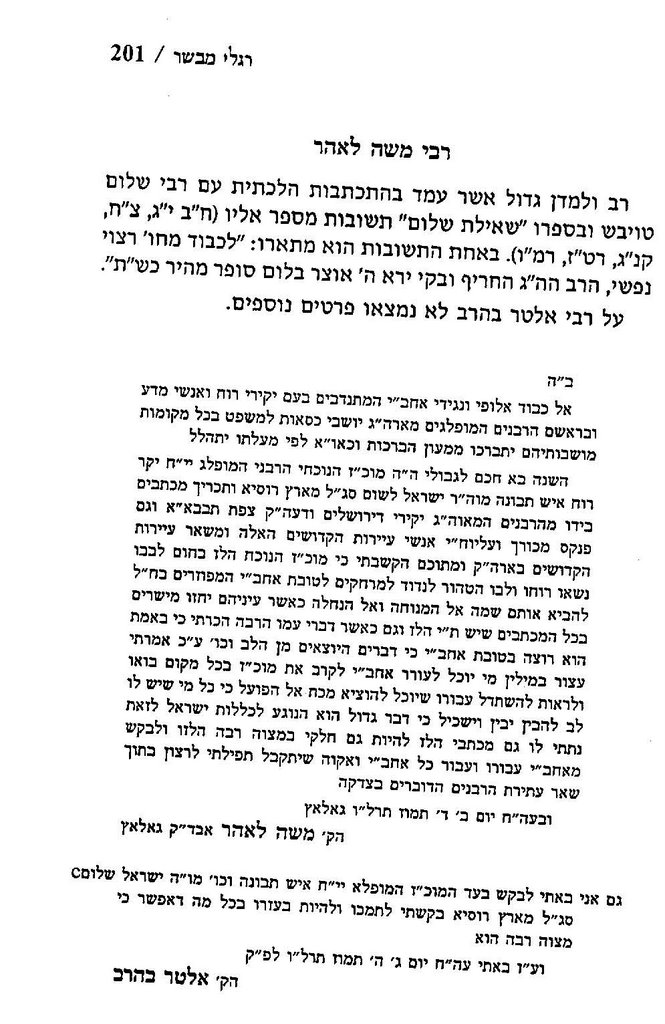
In 1999/2000 some in Beni Brak B. Margolius (most likely a woman due to the lack of first name), published a book, Ragli Mevasar. This book is divided into three parts. The first two are biographies of R. Schlesinger and his father in law. The last part are the very same letters originally published by Weingarten. Additionally, they include the very same biographies that Weingarten did. There is absolutely no attribution at all! I have included a page from each were the reader can see how they are the same. The top page is from Weingarten and the bottom from Ragli Mevasar. None of the library catalogs I have seen note that this is plagiarized.


Of Twice-Told Tales and Ockham’s Razor: A Response to R. Moshe Haberman

Of Twice-Told Tales and Ockham’s Razor: A Response to R. Moshe Haberman

By Elli Fischer

Elli Fischer is an independent writer, translator, and rabbi.  He is editor of Rabbi Eliezer Melamed’s Peninei Halakha series in English and cofounder of HaMapah, a project that applies quantitative analysis to rabbinic literature. He is a founding editor of The Lehrhaus, a web magazine of contemporary Jewish thought, and his writing has appeared in numerous Jewish publications. He holds degrees from Yeshiva University, rabbinical ordination from Israel’s Chief Rabbinate, and is working toward a doctorate in Jewish History at Tel Aviv University.

R. Moshe Haberman’s fascinating recent post on the Seforim Blog, “The Twice-Told Tale of R. Yonason Eybeshutz and the Porger,” traces the provenance of a single copy of the first edition of R. Eybeschutz’s כרתי ופלתי in order to resolve an old and puzzling question about a reference to an apparently nonexistent view of the Semag. The answer – that the reference to Semag (סמג) in the printed edition is a typo and should actually be סהנ, or Sefer Ha-Nikur – was first suggested in 1930 by Rabbi Solomon M. Neches and further clarified by Prof. Shnayer Leiman. Rabbi Neches claimed that this typo was corrected by R. Eybeschutz himself, as the author’s copy of the work was extant, owned by R. Neches, and contained the handwritten emendation. The case seemed to be closed.

However, upon inspection, it seemed that the book was not owned by the author, but by a different R. Yonason Eybeschutz. The conclusion of R. Haberman’s article is that this copy of the 1763 edition of כרתי ופלתי was owned by two different (and unrelated) people named Rabbi Yonasan Eybeschutz.

The post also states that Rabbi Neches, a leading rabbi in Los Angeles (and, as Fred MacDowell discovered, mesader kiddushin at the wedding of Elaine Ackerman to Jerome L. Horowitz, a.k.a “Curly” of the Three Stooges) from the 1920s until his death in 1954, who claimed to have the book in his possession in 1930, did not really have it in Los Angeles in 1930. Rather, he had seen it in his youth in Ottoman Palestine. The copy remained in Eretz Yisrael until 1963, when it was purchased by UCLA through sponsorship of the Cummings family and sent with tens of thousands of other items to Los Angeles. In other words, rather than take R. Neches at his word, that he possessed the book in Los Angeles in 1930, and presumably kept it until his death in 1954, whereupon his personal library was dispersed, R. Haberman posits that the book never reached American shores, let alone R. Neches’s shelves, during his lifetime, yet arrived in the city where he served within a decade of his passing.

The story thus contains two owners who coincidentally shared the name Rabbi Yonason Eybeschutz (RYE), and there is no connection between the fact that it was a Los Angeles rabbi who first mentioned this very item in 1930 and the fact that the item itself was in Los Angeles in 1963. Rather, the book made its way from Europe to Ottoman Palestine some time before 1910 (while its prior owner, the second RYE, was still alive in Poland). There it was viewed by a teenage R. Neches, who remembered, 20 years later, a marginal gloss he found therein. Meanwhile, the book itself falls off the grid for half a century before resurfacing in 1963, in an auction.

After reading the post, I decided that such a great story, filled with the most unlikely coincidences, deserved a Footprint. As I started documenting the copy’s provenance, however, the narrative began to unravel. As I will show, there is a much simpler narrative of the book’s provenance.

R. Haberman determines that two different RYEs owned the book because one signature specifies ownership by “Rabbi Yonasan Halevi Eybeshutz of Leshitz” and another signature bears resemblance to the signature of the original, 18th century RYE, author of כרתי ופלתי. Thus, it must have been owned by both RYE of Leshitz and RYE the author. Since R. Neches owned at least one book by RYE of Leshitz, namely, שער יהונתן, he, too, must have discovered that two distinct RYEs owned the book.

The problem with this theory is that there is no “Rabbi Yonasan Halevi Eybeshutz of Leshitz”. Rather, in the early 20th century, there were two RYEs. One was the rabbi of Kock (Kotzk) and later of Łosice (Leshitz), Poland and author of תפארת יהונתן. He was not a Levi, and he passed away in c. 1915. The second (or third) RYE, who was indeed a Levi, lived in the Praga district of Warsaw and perished in 1943. He was the author of שער יהונתן among other works, and on the title page that appears in Appendix B of R. Haberman’s post, you can see that the author is listed as living in Warsaw, and there is no mention of Leshitz/Łosice.

The pictures that accompany R. Haberman’s post show clearly that the RYE who owned this copy of כרתי ופלתי was from Łosice, but he does not sign that he was a Levi – because he wasn’t. With this in mind, we can now revisit the question: Is there any indication that the original RYE owned the book as well, or can we attribute everything to the non-Levi RYE of Leshitz?

After a bit of searching, I found an item related to RYE of Łosice on an auction site. This item, a copy of R. Eliyahu Mizrahi’s ספר מים עמוקים (Berlin, 5538/1778), contains both the stamp and signature of RYE of Kotzk (before his arrival in Leshitz). Here his signature is immediately to the left of the word ספר.

And here is his stamp (the smaller one):

The auctioneers also included a picture of a marginal note that the owner inscribed in the book, in the name of one Rabbi Isaac of Leszno (Lissa), son of the rabbi of Mezrich (presumably Międzyrzecz, Poland, in Prussia, close to both Leszno and Lozice, and not Mezhyrichi, Ukraine, home of the famed Maggid, or Międzyrzec Podlaski, in eastern Poland):

(Here is another item that contains RYE of Leshitz’s handwriting.)

Moreover, I am no graphologist, but the two RYE signatures that R. Haberman compares in his post seem far from identical. In the signature of the 18th-century RYE, the leg of the ה is more curved, the bottom of the נ does not extend very far below the line, the ת has a shorter leg, and the top of the ן begins at the same level as the tops of all the other letters. Sure, there is some superficial similarity, but it seems very far from dispositive.

Rather, Ockham’s Razor would encourage us to adopt the simpler explanation, namely, that copy of כרתי ופלתי was owned by only one Rabbi Yonason Eybeschutz: the rabbi of Kotzk and then Leshitz, who died in the early 20th century. It was he who wrote the gloss referring to ספר הניקור – an answer that has the ring of truth and which there seems to be no reason to reject, even if the answer was not provided by the author himself. If anything, RYE of Leshitz deserves his due as the one who resolved this question.

Let us now turn to the question of where the book was at various points. Here, the suggestion that R. Neches viewed the book in Eretz Yisrael prior to 1910, when he emigrated to the US, seemed impossible, as the previous owner – whether RYE of Leshitz or RYE Halevi of Warsaw – lived in Europe. When, why, and how would the book have made its way to Ottoman Palestine without its owner? Moreover, R. Neches’s language seemed to indicate quite clearly that the book was in his possession, in Los Angeles, in 1930. This received further confirmation from commenter Ben Sommerfield, who notes that in another article, from 1951, R. Neches again mentioned that the copy of כרתי ופלתי is in his possession and even includes a facsimile of the page with the marginal note. We can thus conclude that the book was in possession of R. Neches in Los Angeles from 1930 to 1951.

In order to have been included in the Cummings Collection, then, the book would have had to get from Los Angeles to Israel and back to Los Angeles in a span of 12 years – 9 years if we presume that R. Neches kept it until his death in 1954. While not impossible, here again, another explanation seems far more likely.

In an article in HaMa’ayan (56:1 [215], Tishrei 5776, pp. 101-2), R. Yaakov Yitzchak Miller, who located the copy of כרתי ופלתי together with R. Haberman (they thank one another in their respective articles), correctly identifies the previous owner of the copy as RYE of Leshitz (even comparing the signature in the copy to the signature in other auctioned items – in which there are likewise marginalia) and thus dismisses R. Neches’s claim that this was the author’s copy. R. Miller also notes (n. 2 ad loc.) that much of R. Neches’s library was donated to UCLA. It would seem far more likely that this copy of כרתי ופלתי was donated to UCLA from R. Neches’s estate than that it was sent to Israel, appended to a much larger collection, and then purchased by UCLA several years later.

So what are we to make of Prof. Arnold Band’s confirmation that כרתי ופלתי was part of the collection whose purchase he orchestrated in 1963, and of the fact that the book is listed in the UCLA catalog as part of the Cummings collection? In my view, the likely answer is that the 1963 purchase indeed included a copy of כרתי ופלתי – perhaps UCLA’s copy of the Vienna 1819 edition. It takes nothing away from Prof. Band and his efforts to secure this collection to suggest that it seems highly unlikely that he remembers, after 57 years, a detail that he never mentioned before about a signature in one specific book out of 30,000. Perhaps he remembered that the purchase included a copy of כרתי ופלתי, even an old one. Or perhaps he mixed up the 1819 copy with the 1763 copy after the former’s arrival in Los Angeles, resulting in the library miscataloging R. Neches’s 1763 copy. Either way, a cataloging error seems more likely than the scenario suggested by R. Haberman.

The final timeline would then look something like this: The copy was owned by RYE of Leshitz until his death in 1915. At some point between 1915 and 1930, R. Neches purchased it – perhaps from a dealer who obtained items from the estate of RYE of Leshitz and convinced buyers that they had been owned by the far more famous 18th century RYE. It remained in R. Neches’s possession until his death in 1954, whereupon it was donated to UCLA and miscataloged.


Zvi Hirsch Masliansky: Memoirs from the Hebrew Periodical Ha-Doar

Zvi Hirsch Masliansky: 
Memoirs from the 
Hebrew Periodical Ha-Doar 
By Zviah Nardi
Introduction.

Zvi
Hirsch Masliansky, known as “The National Preacher” (1856-l943), was a member of
the Hibbat Zion movement in Russia from the time of its inception in l882, and served
as its itinerant preacher in the early 1890s. After his expulsion from Russia
in 1895, he went to the United States, where he became a leading figure in the
integration of the mass immigration of Eastern European Jews to American life.
 He wrote memoirs of those two
periods of his life in the l920s. Published in Yiddish in 1924, they were followed
by a Hebrew version, for which the author was also responsible, in l929. The
family has recently published an English translation: Memoirs; an account of
my life and travels,
Jerusalem, Ariel, 2009, which has been distributed to
family and friends, as well as to leading libraries.
 In the l930s Masliansky wrote
another memoir, which was published in installments in the Hebrew periodical
Ha-Doar, mostly in vols. 13-14, 1933-5; four segments in vol. 15 and one, which
has been translated into English and incorporated into the English 2009 book,
in vol. 16 (1937).
 The focus of these memoirs is far
more personal then that of the book. Here Masliansky describes his childhood,
his education, the early stages of his career and his marriage. Other segments
focus on various people he knew and loved back in Russia, including some great
Rabbis and important public figures.
 Despite their literary quality
and importance to social history, these memoirs, hidden in the large bound
volumes of Ha-Doar, are even less known to the public than those published in
the book. A number of excerpts from the Ha-Doar memoirs have been translated by
Zviah Nardi (co-translator of the 2009 English book) for the benefit of family
members. To the best of our knowledge, this is their first English version. The
unpublished continuation of these memoirs in Masliansky’s handwriting is in
possession of the family.
 We are most thankful to Eliezer
Brodt of the Seforim blog for putting this partial translation on the web, and
thus making it accessible to all interested in Zvi Hirsch Masliansky and in the
life of the Jews in the Pale of Settlement in the late 19th century.
We are also thankful to Moshe Maimon for bringing us together, and reviewing
the excerpts. We hope to continue the translation of both the published and the
hand written material in the future, and propagate them in the same fashion as
the work continues.
 Finally, I would like to conclude
with a personal note: In 2006, four of our progeintor’s descendants made the
decision to publish his memoirs in an English version:  his grandsons James and Marshall Weinberg of
New York and his great- granddaughters Zviah Nardi and Meira Nardi Bossem of
Jerusalem. As these excerpts of his second memoir from Ha-Doar appear on the
web, only two of us remain. My dear cousin-once-removed James Weinberg, a
businessman and prominent Jewish leader, passed away in October 2013; my dear
sister, Meira, just a year ago (on kaf-gimmel Tamuz). Meira was the first
reader of both memoirs as the work progressed — a wonderful first reader and
advisor.  We would appreciate the
willingness of our readers to join us for a moment of thought about our dear
departed.
 Zviah Nardi, Marshall Weinberg.
 
For further details contact znardi@bezeqint.net.

Excerpts from Masliansky‘s
Second Set of Memoirs,
Ha-Doar, 1933-1935.
Ha-Doar vol. 13, 1933-4,
no. 38, p. 724
Tachlith” – In search for
a purpose in life.
(A Chapter from my Memoirs)
My days as a “Yeshivah Bochur  [student at a religious academy], those
“days” devoid of goal and practical purpose, have come to an end.  I felt a growing aspiration to study at the
modern, government-authorized Teachers’ Seminary in Zhitomir. I walked from
Novogrudok to Pinsk, where I planned to board a ship headed for Kiev on the
river Dnieper, and then walk from Kiev to Zhitomir.
Tachlith, Tachlith
[purpose, purpose] – this word sounded in my ears day and night, as I walked
and as I sat, as I ‘lay down and as I got up’. What will be my purpose in life,
what will become of me? I do not want Rabbi Yosel the Dayan [judge
according to religious law] as a role model, nor do I want Rabbi Eliezer the
preacher or the fanatical ascetic who tore the [modern Hebrew] novel “Ashmat
Shomron
” [by Avraham Mapu] to shreds. This problem gave me no rest and kept
buzzing in my mind like the proverbial mosquito in the head of Titus. I had
dwelled long enough among fanatic savages. I am a grown boy, fifteen years old,
and back in my native town of Slutsk my mother, the elderly widow, is suffering
hunger, and she and my orphaned brother of eleven years, are expecting my help.
And what is my purpose in life? Tachlith! Tahclith!  –  the
cry was echoing inside me at that time as I walked along the road.
I became weaker by the hour, and
when I reached Mir, I felt that I should give my weak body and my swollen feet
a rest; I shall rest and then continue my quest for a purpose.
I was drawn to visit the Yesivah,
I so loved and adored, once more. I found this “molder of the nation’s spirit”
in fine order. Hundreds of students were chanting their gemorrah lessons
in loud voices. I found my cousin Avraham Yitzhak Masliansky[1] son of my
uncle Arieh Leib there (I used to call him ABIM in my letters). Our meeting was
one of loving excitement, as we had not seen each other since I had left
Slutsk. He told me that my younger brother Avraham was in Mir as well, studying
at the Talmud Torah [elementary school.] I was excited and moved to hear
this, and soon hugged and kissed my brother, and yet I said to myself with a
broken heart: “my miserable mother, you have lacked twice – a widow who is now
also bereaved of her children; left behind by both your sons.”
My cousin ABIM and I went to
visit our teacher Rabbi Chaim Leib[2]. He received
me cordially and discussed various issues with me. I did not tell him my
destination, as I did not wish to aggravate him. He suggested I return to the Yeshivah
and promised to provide for all my needs. My heart was indeed inclined to
accept his offer, but my mind reminded me “Tachlith!” I thanked him, he
blessed me, and I left the Yeshivah, with a heart full of longing.
After two days of rest I took my
wandering staff in my hand and put my sack on my back; my relatives escorted me
to the main road where we kissed each other and parted in tears.
– – – – – – – – – – – – – – – –
Ha-Doar, vol. 14, 1934-5,
no.1, pp. 8 – 9.
Pinsk
(a Chapter from “My Life.”)
Two Yeshivah students
seeking a purpose in life are walking along the main road leading from Kapulya
to Pinsk. They walked for six days and ‘in the seventh day’ they arrived in
Pinsk; they came to this foreign city, where they had neither a relative nor ‘a
redeeming kinsman,’ with sore feet but with courageous spirits and high hopes.  The city of Pinsk at the time excelled in its
commerce more than any other city in Lithuania. Along the river Pina, a
tributary of the Dnieper, its ships sailed to Kiev, Kremenchuk, Yekaterinoslav
and Odessa. We immediately noticed the difference between Pinsk and the surrounding
cities. The city was full of life and tumult, being the center of commerce for
grain and lumber shipped to the south of Russia by boats and rafts.  Thousands of peasants bringing their
commodities filled its streets causing this turmoil.
At that time there were a number
of rich families living in Pinsk that were renowned throughout Russia. I am
referring to the Luria, Zeitlin, Eisenberg and Greenberg families, all had
among them learned men skilled in Torah and wisdom [secular studies]. The most
illustrious family were the Lurias, descendants of Rabbi Shlomo Luria (the
MaHaRSHaL) or of the Holy Ari [the mystic Rabbi Yitzhak Luria Ashkenazi.] They
excelled in both looks and character, in their skills and in their communal
work for charitable institutions, hospitals, Talmud Torah schools,
orphanages and homes for the elderly. The head of the family at that time was
the generous lady Haya’le Luria with her sons Moshe and David, and their sons
Aharon and Isar and sons-in- law Moshe Haim Eliasberg and Jonah Simchovitch of
Slutsk, all of them renowned Talmidei Chachamim [famous for their Jewish
knowledge.]
Pinsk is divided into two cities
– Pinsk and Karlin… 
– – – – – – – – – – – – – – – –
Suddenly I received a letter from
Slutsk, informing me that my abandoned, widowed mother and my orphaned brother
are suffering cold and hunger. And so, what was I to do?!
This was an awful quandary and I
was totally hopeless. There were no Yeshivoth in Pinsk, and its
residents were unfamiliar with the practice of “eating by days” [having Yesivah
students eat in a different resident’s home each day], a practice I myself was
sick and tired of. Traveling any longer without documents had become impossible
[as the authorities were kidnapping men and boys for prolonged military service
in the area.] My friend Benyamin bid me goodbye and returned to his native town
of Poltava. Our parting was a heart wrenching sight. Little Jews, almost
children, deserted and alone, hugging and kissing each other, weeping and
sobbing on each other’s necks, separating from one another, devoid of hope to
find their purpose in life…
Absentmindedly I entered a Jewish
inn on the bank of the Pina River. The innkeeper, a man by the name of
Katchinovsky, was educated and respected students of the Torah. He took one
look at me and instantly liked what he saw. The inn served the rural Jews, the
tavern leasers and operators, living in the countryside around Pinsk. One of
the guests, a man of stature, had asked the inn keeper whether he knew of a
young man, a Torah student, who would agree to travel to the village with him
to be a melamed [teacher] for his children. It was summer, the first day
of the month of Tamuz, with three months left for the school year; He
was ready to pay thirty rubles for this period and to raise the salary for the
next year, provided he was satisfied with the man’s performance as instructor
and teacher for his children. The innkeeper turned to me and asked me if I
would agree to go with the man? I agreed.
Two days later the villager Eliezer
Rubinstein took me to his village of Harinich. He was a kind and honest man by
nature, and regarded me as a son from the very first day, treating me in a
loving and friendly manner: it was as though his heart foretold that in two
years time I would be his son-in-law.
The trip from Pinsk to Harinich
lasted for about four hours. On the way he started couching me in his own
manner. He clarified that country life was simpler and healthier than life in
the city. He proved ‘with signs and marvels’ that country people are healthier
physically and of a more honest spirit than city folk. He advised me to get
slightly more accustomed to physical work, to take long walks, gain strength
and ride a horse. ‘He said and acted’[3].
A horse he had bought in Pinsk was running behind the carriage; he put me on
the horse and I rode behind the wagon.
My heart was pounding rapidly for
the first ten minutes – the heart of a Yeshivah student who had never
touched a horse, and was suddenly studying the theoretical Talmudic issue of
‘the rider and leader’[4] in practice.
But I made the effort, straightened my neck, raised my head and rode like a
cossack in the regiment. He was surprised that I sat on the horse and rode
securely, as though accustomed to doing so, and expressed his feeling with the
Jewish proverb: “wer Torah, dort ist chochmeh!” [“Where there is Torah there is
wisdom!”]
As we were traveling I started to
understand what the world famous “Marshes of Pinsk” were. I had searched for
them in Pinsk without success, for Pinsk itself is a fine and dry city – no
swamps to be found in its streets, which stone-pavements are superior to those
of the neighboring towns.  En route,
however, I learnt the nature of the terrifying swamps of Pinsk.
These swamps have gained their
widespread reputation for a good reason. They were large broad and deep,
extending for hundreds of miles… The roads, covered with branches of Birch and
Oak trees, were called “grebliyes’, and woe to the man or horse who took
one slanted step and got their leg into the ‘grebilyeh’ branches.
I rode my horse with the utmost
care and after a number of hours we reached a wonderful and beautiful place in
the wilderness of the swamp – thick forests, green fields, planted gardens,
pastures with sheep and cows grazing. Suddenly I saw a windmill far away, its
large, broad wings spinning fast.
Reb Eliezer Rubinstein turned to
me most happily and said: “Do you see, Hirsch’le, the mill, the house next to
it and all these fields till the distant mountain? – All this is mine. We are
now in our home in the village of Harinich.”
Ha-Doar, vol. l4, 1934-5,
no. 4, pp. 61-62
In the Country
(A Chapter from “my Life”.)
It was evening. The sun was
setting in the west, earth and sky kissed each other in a sea of molted gold;
the mill and the small hills around it were glowing in red. The air was full of
the delicate sounds of bells, the bells of herds returning from pasture. The
farmers’ wives were waiting for the herds, pails in hand, while the dogs, who
had spent the entire day with the flocks, were running and jumping towards
them, barking happily as their work day had ended and the time for rest had
come. Farmers, large and small, men and woman, all dressed in thick cotton
shirts, barefoot and tired, were returning, group by group, from their labor in
the fields to their small low houses covered with straw, there they were met by
their virtually naked toddlers and children, who rushed into the arms of their
mothers they had missed so.
“Good Evening!” called the head
of the family, as he opened the door of his dwelling wide.
The mistress of the house with
her children, who were waiting for their father and for the new teacher,
surrounded me. Six pairs of lovely eyes measured me with their glances from
head to toe.
Mrs. Devorah Rubinstein, a pretty
and graceful woman of about thirty, stood by her husband and looked at me with
a mother’s eye…
“Children!” – the head of the
household turned to his sons and daughters, two boys and three girls, the
oldest among them twelve years old, “say hello to your new teacher, he will
instruct you and you are obliged to obey him and follow his orders.”
The children approached me
respectfully and handed me their little hands, Yetta, the oldest, lowered her
glance as she came to me, as though her heart told her that it would not be
long  – in three years time[5] – before
relationship would far exceed that of teacher and pupil…
I enjoyed my first meal and ate
it with zest. For the first time in my life I felt that I was eating my own
food. I then slept peacefully through the night. The next morning I examined my
pupils and saw that the two boys had studied a bit, but the girls did not even
know the [Hebrew] A-B-C. I started to work and within a number of weeks my
pupils were doing well in their studies.
The rural Jews living near
Harinich heard my praise from Reb Eliezer and came to see me. Some of them
brought their small children who joined my pupils, so that my salary doubled. I
was ever so happy when, for the first time, I sent my poor mother ten rubles.
That was a holy and festive day for me and I shall never forget it.
And yet the question of “tachlith
remained unsolved – what will my life purpose be, what will my future hold? I
am living here, in a remote and deserted village, far from the rapid pace of
life, surrounded by peasants with whom I have no spiritual bond. They regard me
as worthless, an idle person who does not really work for a living, and I –
living here I shall forget everything I have learnt. I am but fifteen years
old, what will my purpose in life be? I will grow and develop in body but when
will I see to my soul and spirit…?
A Jewish tavern leaser in one of
the villages not far from Harinich had a small library. His name was Reb
Yitzhak Rutzky. He was a Torah scholar and knew Hebrew. After we got to know
each other he was pleased with me and opened up his library so I could take
whatever I needed. This encouraged me to continue my studies of the Talmud with
great desire. But a complete Jew does not live by Talmud alone. I felt, that
with all my proficiency in the Holy Writings my knowledge of Hebrew grammar and
medieval literature, which I knew only by name, was lacking. I searched through
the small library and found “The Guide to the Perplexed” and “The Principles”
[by Maimonides], “The Kuzari” [by Yehudah ha-Levi] and “Chovot Ha-Levavot
[ by Behya ibn Pequda]. I fell upon these profound books overzealously and
enjoyed their study. I asked Mr. Rubinstein to bring me three books I wanted
from Pinsk: “Talmud Leshon Ivri” [a grammar of the Hebrew language by Judah Leib Ben Zeev], the
Biblical book of Isaiah, translated into Russian by Yehoshua Steinberg, and “Sefer
Ha-Brith.”
[6] These books
occupied much of my time and I did not go idle.[7]
I studied the “Talmud Leshon
Ivri
” most diligently from beginning to end, including the appendix by the
poet Adam HaCohen Lebensohn, and became quite a grammarian writing notes on the
margins of the book. The book of Isaiah in its Russian translation was
extremely useful: I imitated the first generation of Maskilim [adherents
of modern Jewish learning, Haskalah or Enlightenment] who learnt the
German language from Mendelsohn’s translation and commentary of the Bible [Bi-ur],
till I was able to read Russian with the help of a dictionary and thus read the
great works of Russian literature in the original.
Sefer Ha-Brith“ (“The
Book of the Covenant” which includes tenuous information in all the branches of
science known at its time, carried me off to another world. Later on, however,
I learnt that the author of the book was a Yeshivah student like me, who
had never studied the natural sciences he was interested in, and yet wrote
modestly: “And I shall now confront Master Copernicus.”
And yet, I am grateful to the
author of this book. He was extremely important to me, a rural melamed,
with no school, no guidance. He opened my eyes to see that there are sciences
and important topics in this world that are worth learning.
My employer’s affection towards
me grew daily. He would sit at the table while I taught my students and audit
the lessons most eagerly; he secretly repeated the verses till he knew them by
heart. He especially liked the sayings from the Book of Proverbs about
“jealousy”, “hatred”, “lust”, and “honor”, but his favorite theme was
“idleness”, for he detested the lazy with all his heart, and so he always liked
to recited the 24th chapter of Proverbs out loud: ‘I passed by the
field of a lazy man, by the vineyard of a man lacking sense. It was all
overgrown with thorns; Its surface was covered with chickweed. And its stone
fence in ruins. I observed and took it to heart; I saw it and learned a lesson.
A bit more sleep, a bit more slumber, a bit more hugging yourself in bed, and
poverty will come calling upon you, and want, like a man with a shield.’
When he finished reciting the
original Hebrew he started translating it to Yiddish with the same chant and
intonation I used with the students. He continued to “recite” these verses till
we arrived at his mill, where he took me nearly every day after the lessons. He
taught me how to adjust the wings towards the wind and how to help him
inside.  I especially liked sitting in
the mill during the evening hours, a highly suitable time and place to engage
in thought and to recite the declinations of Hebrew verbs to the rhythm of the
large grinding stones. And so I worked as a teacher by day and as assistant
miller by evening.
Some evenings I would stay long
hours at the mill, keeping the miller company till midnight. He was an elderly
Catholic peasant, very loyal to his faith. He loved me and felt sorry for me,
not being member to his religion. He told me as a fact that the Pope is
immortal and that old age has no power over him. He is like the moon, born
again every single month, and will never die.
The hours I spent with this innocent
old man were amazing and mysterious. The silvery moon, the rustle of the wings
of the mill, the noise of the large grinding stones as the aged man related his
stories, his nonsensical, imaginative stories enveloped in secrets and
mysteries. We pitied one another – he pitied me for my heresy and I him for the
figments of his hallucinating spirit, which he believed in with all his heart.
Ha-Doar, vol. 14,
1934-1935, no. 5, p. 79
A groom living in his
father-in-law’s home
(A chapter from “My Life”)
It was a bright pure spring day –
the third day of the third month of the year 5734 (1874), my birthday – I am
seventeen years old!  I finished teaching
my pupils at noon. The sun stood high in the sky blessing the entire universe
with majestic splendor.  My employer, Reb
Eliezer Rubinstein, stretched out his strong warm hand, kissed me and
congratulated me in honor of my birthday. He then took me by the arm and walked
with me down the narrow path leading to the hay fields he had been leasing from
the Pravoslave priests for more than twenty years. We reached a small lovely
hill; the grown hay gave a pleasant scent; the grass was sparkled with blue and
yellow flowers that seemed like little stars in the green sky beneath us.
We were walking very slowly when suddenly
Mr. Rubinstein halted and started to recite his favorite verses from the Book
of Proverbs: ‘I passed by the field of a lazy man, by the vineyard of a man
lacking sense’ etc.  When he completed
reciting the verses he held me by my right arm and looked at me lovingly for
several minutes, then spoke as a man restraining his emotions.
“You know, Hirsch’le, that I love
you very much, and so my words will come from a pure and loyal heart. You are
seventeen years old today, may you live to a hundred and twenty, it is time for
you to find “tachlith”, to seek a purpose in life. You, with all your
talents, have not been destined from birth to be a melamed. And so I
have a wonderful proposition for you, if God helps me to accomplish it: You
should get engaged to be married to a kind hearted and pretty girl, daughter of
honest and wealthy parents and become betrothed this very day. And next year,
when you will be eighteen years old, you will marry at the very age established
by our sages of blessed memory. If you take my advice I shall congratulate you
on this very day and say ‘Mazal tov’ upon your engagement.”
He then was silent, looked me in
the eye and awaited my answer. His innocent and kindhearted monologue made a
great impression on me. Some minutes later I said: “Reb Eliezer, two sides are
needed for a shiduch [match] and I’m but one. Where is the other side?”
“Quite so, my son!” he answered,
“The other side is standing before you, and I am ready, and my eldest daughter,
Yetta, agrees full heartedly, because she loves you. I shall not sing her
praises in your ears, for I am her father, but I believe that you have eyes to
see and a mind and brain to understand. You can see her beauty and understand
that she shall be a ‘woman of valor’ and a ‘splendid crown’ on her husband’s
head. She is fourteen years old, as lovely as an eighteen year old and as wise
as a twenty year old. What then have you to say as it is the shadchen
[match maker] who is speaking to you.”
“Yes, Reb Eliezer, you mentioned
the word ‘tachlith’. Do you know that it was ‘tachlith’ that
uprooted me, that tore me away from my studies and from city life and brought
here to seek my livelihood?  The question
of ‘tachlith’ is to become even more difficult now: what ‘tachlith’
will we have now if I marry and have a family?”
“Yes, my son,” he answered, “you
are right, but with God’s help I will find a solution to the problem. Open your
eyes and see this entire plain that brings me a yearly profit that could easily
support two families. I have leased all these fields for many years,we will
both live and work together. You will no longer be a ‘melamed’, and I
will build you a little house near mine and you will lack for nothing.”
Absentmindedly I put my small
hand into his large one, and our eyes filled with tears of joy.
Overjoyed, my schadchan
[match maker] and father-in-law returned home with me and with a cry of “Mazal
Tov
” that echoed through the entire house approached his wife, my
mother-in-law, and said: “I congratulate you, Devorah’le.  Mazal Tov, our eldest daughter Yetta’le,
has become a bride today and Hirsch’le is her betrothed for years to come.”
The sound of greeting and kisses
filled the house. Tears of joy streamed from everyone’s eyes, for the entire
family loved me and they all fell on my neck, kissed me and hugged me. The
young couple, the seventeen year old youth and the fourteen year old girl,
hugged each other[8] and cried,
but they did not kiss, ‘for they were ashamed…’[9]
My days as a melamed came
to an end, and the family members treated me as a master of the house from that
day on. One day the door opened suddenly and my little brother appeared. He had
walked from Slutsk to Pinsk to see his older brother who had almost reached his
tachlith.” He brought with him the kisses of my widowed mother and
described her miserable situation. My brother and I were different – he was of
a courageous spirit, hated to complain and was always satisfied, contented with
his lot. He stayed with me for about ten days and then I sent him to our mother
in Slutsk with considerable help, according to what my situation at the time
enabled me.
*
The Days of Awe had come – the
most exciting days of the year for the Jews of the villages. The leaseholders
and innkeepers started the preparations for the journey in the month of Elul.
This journey was to take them to the cities and towns [stetalach] to
pray on Rosh Ha-Shana [the New Year] and Yom Kippur [the Day of
Atonement], that is to say, to hold proper services in a synagogue with a legal
quorum [a minimum of ten adult men]. 
They would take their gentile maids, who were acquainted with all the
Jewish customs, with them.  They were
also equipped with a sufficient number of chicks and white chickens enabling
them to perform the custom of “Kapparot” for the entire family[10]. Traditional
pastries for these days were also prepared…. Indeed, it was a time when even
the fish in the rivers were terrified. In addition the country people would
take small sacks of ‘the choice products of the land’, the crops of the earth and
of the fruit of the trees, various types of beans and grits, oats and spelt, as
gifts for the home owners in the towns, who were to be their hosts for the
holidays.[11]
The town closest to our village
was Navliyah, which numbered about forty Jewish families. There were a few
affluent families, but most were impoverished and beggars; they waited all year
for the gifts their rural brethren would bring them for the Days of Awe. All
the rural Jews, the leaseholders and innkeepers, from the neighboring villages…with
their children and maids, their chicken and roosters, their sacks and
belongings would gather in the village of Womit on the shore of the pond, where
small boats awaited to lead them to the river that flowed to a spot near our
destination – the town of Navliyah.
The boats rowed on the lake, full
to capacity with young and old, men and woman, happy healthy youngsters, pretty
and shy maidens in full bloom. Christian maids, watching over the children,
were seated on sacks full of grain, foodstuffs and chicken coops carrying
roosters and chickens, future victims of “Kapparot” to atone for the
passengers’ sins. The boats sailed heavily on the pond towards the town to
celebrate the Days of Awe there.
Ha-Doar, 1934-5, no. 7, p
123
My First Sermon
As in the gathering of the exiles
the convoy of pilgrims descended from their boats to Navliyah, and the small
town was suddenly filled with a multitude of people. All the leaseholders and
innkeepers also brought their children’s teachers. Most of them were old and
feeble, men who had spent themselves as teachers [melamdim] in the
cities; their strength gone, they resorted to teaching in the villages where
they hoped to find a remedy for their ailments, sickness of the heart or
weakness of sight. Most of them were ignoramuses, all they knew was to read the
prayer book and hold the whip in hand to flog the “naughty” children, who
indulged in pure childhood mischief, refusing to listen to the teachers whom
they did not understand.
I went to see the local Rabbi, a young
man recently arrived from the Volozhin Yeshivah [religious academy]
equipped with an authorization. He understood Hebrew. When I came to the
synagogue he honored me, seated me at his side and introduced me to the leader
of the community who gave me the honor of delivering the sermon before the
prayer of “Kol Nidrei” [at the outset of the Yom Kippur Eve
prayers.]
For the first time in my life I
was to stand by the Holy Ark, wrapped in a Talith [prayer shawl] and
preach to an audience.  True, I had already
tried to conduct a study of the Pentateuch with Abarbanel’s commentary in
public, and to explain a chapter of the prophets to my friends at the Mir Yeshivah,
but I never dreamt of preaching in a synagogue before Kol Nidrei. How
could anyone imagine that this sermon would be the first of thousands I would
deliver in my lifetime? While at the time my mind was occupied with the issues
concerning the mill and the harvesting of my father-in-law’s hay in the heart
of the famous marshes of Pinsk…
I gathered my courage and
ascended towards the Holy Ark. I felt my blood burning like a divine flame in
the heat of the large wax candles that lit the small synagogue. I remember that
a few minutes into the sermon the entire crowd was sobbing with me and terrible
shrieks were heard from the women’s gallery. I spoke for close to an hour about
the situation of our brethren in dark Russia, about our murky sources of
livelihood – the war between Turkey and Russia broke out that year [sic],[12] and I quoted
the verse: ‘The snorting of their horses was heard from Dan’ [Jeremiah 8,16),
and interpreted it in homiletically: the war had started from the river
“Donau”, Esau [Christendom] is fighting with his father-in-law Ishmael
[Islam].  I concluded with a prayer:
“Lord of the Universe, remove the goat [=Se’ir = the land of Esau, Edom] and
his father-in-law, ’for liberators shall march up to Zion!’”[13]
There was a drunken and evil man
in the audience, known as “Benjamin the Factor”. His livelihood was to supply
“Pan Lapitzki”, who was single all his life, with girls, farmers’ daughters,
and he served as the Pan’s [Polish landlord] matchmaker every single day. My
sermon about our “murky sources of livelihood” must have insulted him, and
immediately after the prayer of “Kol Nidrei”, he went to the Christian
priest and informed on me, reporting that I had cursed the government, the
Christian faith and first and foremost the Russian Czar…
Imagine the fear that seized the
Rabbi and the leader of the community when, on the next day, the town policeman
burst into the synagogue during the prayers and led the three of us to the
government official. He brought us into the official’s bureau, where we found
the priest and the informer, waiting for the three of us.
“Tell me, young Jew, what did you
speak about in the synagogue yesterday? For if what I was told is true, I shall
arrest you and send you to the district capital in chains.”
   
I answered him calmly: “Yes, Sir,
I spoke yesterday to a large audience, and they can all testify that what I
shall tell you is true. I talked about interest, saying it is a great sin, and
that my Jewish brethren should stop taking interest. They should work and
engage in various sustaining livelihoods. I spoke about the ‘factors’ that
disgrace their people. I hope that this sermon brings me the thanks and praise
of the government, rather than arrest and being led off in chains.”
The official looked at the
priest, gave me his hand and asked the three of us to forgive him for
interrupting our prayers on this holy day. The snitch left the bureau ‘his head
covered in mourning.’[14]
This event, that took place
during my first sermon, was ominous of my future fate – to be ready always to
confront the government officials, high and low, from without and our informers
and enemies from within, until I was exiled from the country, much to my
happiness and to the happiness of my family.
The last winter before my wedding
was also the last of my days as a melamed. I thought I had reached my
goal and found my tachlith (my purpose in life). From time to time I
sent money to support my widowed mother and orphaned brother. My brother was
happy for me. But deep down in my subconscious I felt I was not meant to be a
country man; that the meaning of my life was not to be found in the mill and
the fields, that my rightful place was in the city, and that my work should be
of a spiritual nature. I continued my study of the Talmud, persevered in
learning Hebrew grammar, and in reading our modern literature, and Russian
literature as well. 
On the third day of the month of
Adar 5635 [March 10th, l875], I celebrated my wedding with the child bride,
Yetta Rubinstein, who was fifteen years old, while I was eighteen. The reader
nowadays may regard this marriage of young children, who know nothing of life,
appalling, a legacy of the middle ages. Yet he who reacts so knows nothing and
understands nothing of the pleasure of fathers as they look at forty- two
beautiful and fresh images of boys and girls, their descendants, grandchildren
and great grandchildren of the third and forth generations. He will not feel
what our predecessors felt, namely, that timely marriage leads to a beautiful
life, a life of morality and health, that leaves an eternal legacy for many
generations to come.
*
I am no longer a single man. God
has entrusted me with the responsibility for my family’s livelihood. I girded
my loins in leather and rose early in the morning to assist my father-in-law
with his work. I tried to engage in commerce as well, and was full of hope to soon
become my father-in-law’s partner in his fields and in the rest of his
endeavors as he had promised me.
One morning, as we were all
sitting at the table for breakfast, joyous, happy and eating heartily, the door
opened suddenly and the district policeman appeared bearing a government
document for Eliezer Rubinstein. It proclaimed that all his rights in the
fields and gardens belonging to Christian churches were ‘annulled and made
void’ from that day on, since the government had issued a new law prohibiting
Jews from buying or leasing landed property from Christians. The policeman
handed him the document and ordered him to sign it. My father-in-law was
terribly upset, his face became pale and he signed the order with a trembling
hand.
The policeman left and all of us
remained mute and dumbfound – staring at each other with horrific astonishment…
Tachlith” – practical
purpose and livelihood – had evaporated in thin air. The oil had spilled from
the pitcher, and what was to be done with an empty pitcher now?
My kind and generous
father-in-law made the utmost effort to gather his courage so as to console and
encourage us.  He said that this evil
decree affected the public at large, it was directed against all the Jewish leasers
and tavern operators, and a general disaster is, as the proverb says, half a
consolation. But what is there to be done with the other half, for which there
is no consolation at all?
For a year I tried my best to
become a “wheeler dealer”, but I was not destined for commerce. I could not
adjust myself to petty trade and to the deceitful cheating talk it always
involved.
At that time my child-wife gave
birth to our eldest son – Chaim who was named for my father. The question of
our “tachlith” – our practical purpose in life – became even more acute.
Ha-Doar, vol. 14, 1934-5,
no. 9, p.158
Thanks to a Poem.
(A chapter from “My Life.”)
In time of trouble one never
knows ‘from where will… help come.’ In the midst of despair help suddenly comes
and restores you.
In my pitiful state I was saved
by one of the poems I had written while teaching in the country, though I had
never been a poet.  My library consisted
of three books at the time: [the Hebrew grammar book] “Talmud Leshon
Ha-Ivri”, “Sefer Ha-Brith”
[on basic sciences] and the Russian translation
of the Book of Isaiah. These three books supplied my spiritual nourishment.
Thank to the first I became a grammarian, the second introduced me to “The
Seven Wisdoms,” and the through the third I came to understand Russian, as did
the Maskilim in the early days of the Haskalah [the early
adherents of modern Jewish learning, Haskalah or Enlightenment] who
studied German with the aid of Mendelssohn’s[15]
translation of the Bible.
The poem mentioned was one of six
stanzas, which I wrote on the title page of Steinberg’s Russian translation [of
Isaiah]. In the first three stanzas I praised and lauded Steinberg for his
translation, and in the last three I cautioned him, saying he was not of the
same stature as Ben Menachem [Mendelssohn]. I had no idea whether there was any
poetry in that poem, but it did have some sensible ideas. I wrote it, left it
in the book, and forgot about it.
One day, one of my rural pupils
wished to enroll in the Hebrew School in town to complete his education. He
traveled to Pinsk, where the government-appointed Rabbi, Avraham Chaim
Rosenberg, had established a Hebrew School. The boy and his father reported to
the principal of the school; the youngster happened to be holding Steinberg’s
translation in his hand, for I had given it to him as a gift for his Bar
Mitzvah
. Rabbi Rosenberg took the book in his hand and when he opened it
saw the poem on the title page. He immediately asked the boy’s father:
“Could you tell me who wrote this
poem?”
“ Yes, Rabbi, the poet was my
son’s teacher for three years.”
“Could I perhaps see him today?”
“He is in Pinsk now, at the
Katchinovsky Inn. He came to sell his merchandise, for he left teaching and is
trading in fish and hides, though with little success. If you wish to see him,
send for him and he shall come here,” answered the boy’s father.
That day as I was eating my lunch
at the inn, a man came forth and asked: “Is the son-in-law of Eliezer
Rubinstein from the village of Harinich here?” The innkeeper pointed to me, and
the man turned to me and said: “I have been sent by the Rabbi of the
congregation; he wishes you come with me to see him.”
All the people present were very
surprised: “What does the government-appointed Rabbi have to do with this young
villager?” for I was dressed in rural clothes.
I followed the man to the Rabbi
and found him in his school. For the first time in my life I saw a modern
school – a hall, large and broad, rows of benches with their desks. In the
center of the hall was a wooden black board. The teacher stood next to it,
chalk in hand, writing Hebrew words. He would call one of the pupils by name
and instruct him to read the words, add the proper vowels and explain them to
him. When the pupil erred he ordered him to return to his place and called upon
another pupil. The order and regime pleased me.
Rabbi Rosenberg handed his work
to another teacher and took me to his office. He was a tall man with a large
and handsome head, big black eyes and a round black beard. He looked at me,
observing my rural attire, the leather loincloth on my waist, and a slight
smile crossed his lips. He gave me his hand and asked that I sit next to him.
On the desk I saw Yehoshua
Steinberg’s translation. The book was open with my poem on the title page. I
was surprised – how did this book get here? The entire scene seemed like a
dream to me. He understood my confusion and did not keep me waiting. He then
asked me smilingly: “Is your name Zvi Hirsch Masliansky?”
“It is, Sir.”
“Did you write this poem?” he
asked again pointing at the title page.
“Obviously, my signature is on
it.”
“Kindly read it to me, young
man.”
I read the poem out loud,
emphasizing a certain place in a way that clarified my intention he had not
formerly understood.
He looked at my strange clothes
again, and addressed me affectionately: “And what are you doing? Where do you
live? What are your plans for the future?” I answered all his questions, from
the first to the last.
He got up, held me by the lapel,
and said: “Listen to me, young man, and take my advice. You are not destined
for country life, wheeling and dealing among the peasants. You should settle in
the city among your fellow Jews who will understand and cherish your talents,
and with time you will develop and become one of the great men of your nation.  I advise you to become a Hebrew teacher.
Divide the day into hours, and spend each hour teaching in a different home.
But be aware of the melamdim and their Hadarim [traditional
teachers and schools] for they are in a very bad state. Teaching by the hours
will give you a status and provide you with a livelihood.”
He continued talking as he walked
me to the hall of the school, and said to me: “I shall be the first and give
you an hour or two of teaching in my school for the same salary I pay all the
other teachers.”
I looked at him with both
gratitude and amazement. “I do thank you, Sir, for your generous spirit, taking
interest in the fate of a desperate and lonely person like me. I am ready to do
anything you instruct me, but I don’t know if I can fulfill your wish as far as
teaching goes. This is the first time I have had the merit of seeing a modern
school. Till now all I saw were the old fashioned Hadarim devoid of any
order and regime.”
“This ‘lack’ can ‘be made good.’
I will spend a few days with you and instruct you in the modern methods of
teaching,” was his relaxed answer.
That very moment he brought me to
the best class in the school. The room was full of pupils and the great teacher
Feitelsohn stood next to the black board explaining the difference between the
definite particle and the interrogative particle in both meaning and vowels.
The teacher too looked at my clothes with surprise. The principal introduced me
to the teacher and asked him to allow me to take over for half an hour.
The teacher handed me the chalk;
On the black board I wrote several sentences that included the two articles
without vowels. The pupils added the vowels and seemed satisfied with my work.
The Rabbi then told me to ask the
pupils a grammatical question about verbs. I did as he wished, asked them about
the passive tense, and explained the answer to them. Rosenberg and Feigelsohn[16] approved of
my answer.
“And now, young man, return to
your home,” the Rabbi said as he bid me goodbye, “Cast off ‘the filthy
clothes…and… be clothed in [priestly] robes… and I will permit you to move
about among these attendants.’” [Zachariah 3; 4,7]
Ha-Doar, vol. 14, 1934-5,
no. 11, p. 194
Teacher and Preacher
(A Chapter from “My Life.”)
I succeeded in my first trial,
and immediately after the test was appointed as teacher in the school run by
the government-appointed Rabbi, Rabbi A. Rosenberg, in Pinsk.
With little delay I took my small
family, my sixteen-year-old wife and my half-year-old eldest child Chaim, and
brought them with me to Pinsk. I shouldered my burden – the burden of a Hebrew
teacher. I divided the day to twelve periods and spent each hour in a different
house with a different pupil.
I became known in the town thanks
to my teaching and when I would teach a chapter of the prophets [in the school]
with the windows open, men and woman, young and old, would gather in the yard
to listen. A few weeks later the wealthy families of Pinsk and Karlin, the
families of Luria, Zeitlin, Greenberg and Eisenberg invited me to teach their
children.[17]
And so I was burdened with work
every day from eight o’clock in the morning till eleven o’clock at night. I got
to see my only son only on Saturdays and Holidays. My kind father-in-law was
very disappointed that I could not spend any time talking to him when he came
to visit, for I was terribly busy.
With all that I devoted a few
hours a week to study science with Rabbi Rosenberg, the principal of the
school. Later in his life he wrote the ten-volume book “Otzar Ha-Shemot.”
I was not satisfied with teaching
the young. I felt I had sufficient talent to propagate my teaching and views
among adults as well. Much to my joy I became acquainted with the Rabbi of
Pinsk, the great and renowned Rabbi Elazer Moshe Ish Horovitz, one of the
greatest luminaries of his generation, a man of clear and broadminded ideas
about life in general and Jewish life in particular. The fanatic ultra-Orthodox
and the pious Hasidim were displeased with him and regarded him with suspicion.
But his vast knowledge of the Talmud and his righteous deeds protected him, and
they could do him no harm. At that time he came out publicly against various
customs [preceding the Day of Atonement] like “Kaparoth” and “Tashlich.”
He was especially irritated with a prayer [recited prior to blowing the Shofar
– ram’s horn – on the Days of Awe], which was full of weird named angels, and
ordered it to be eliminated from the prayer service in all the synagogues…
I became acquainted with this
wonderful Rabbi, and was considered as a member of his household and family. He
was a wonderful mathematician and excellent grammarian[18].
He spent many hours with me discussing Hebrew grammar and clarifying difficult
passages in the Bible using the methods of the modern commentators.
It was to him that I divulged my
desire to speak to [adult] audiences and he fulfilled it instantly. He sent for
the Gabai [synagogue director] of the Heckelman Schul and ordered
the synagogue to be opened every Friday night. I started delivering lectures on
the Psalms that very week for a large audience that filled the house
completely.
I recall these sacred evenings
with joy and glee, for they laid the foundation for my sixty-year-long carrier
as a preacher, addressing the people of Israel from the pulpit. I gave these
lectures for three years, performing this sacred duty for a hundred and fifty
evenings and reached chapter 50 of the Psalms. The audience was so enthusiastic
that a new institution was formed: “Masliansky’s Tehilim Sagen” [The
Masliansky Reciting of Psalms].
But there were some benighted
fanatics who started to persecute me, seeking evidence to support various
religious suspicions and allegations. Tudros the enthusiastic Hasid swore
solemnly that he had seen me carrying a handkerchief in my pocket on the
Sabbath and Moshe Itzel the bum watched me as I prayed and swore that I did not
rise for the prayer “Va-Yevarech David” [and David Blessed] and did not
spit during the prayer of Aleinu… But all this was to no avail – they
could not disgrace my name or humiliate me in the eyes of the people, who were
always ready to protect me in the face of any trouble, may it not befall us.
Once in my speech I reached the
verse in Psalm 31 [verse 7]: ‘I detest those who rely on empty folly, but I
trust in the Lord.’ I then poured my wrath on the superstitions, amulets,
incantations, demons and notes placed in graves addressed to the living and the
dead.
This speech affected all the
Hasidim, especially the “confedrazim”, those who have no Rabbi and
belong to all the courts. Their fanaticism is ‘unfathomable’ and their wrath is
as a ‘spider’s venom.’ They incited groups of little Hasidim, naughty and
mischievous, who ran after me in the streets ‘crying after me as a mob’ in
strange voices: “wil Gut ist einer, und weiterer keiner” [God is one and
there is none beside Him] – the words [of the famous Passover song] with which
I ended my speech. My adult persecutors sent a committee to the rich Hasidim
whose children I taught, telling them to banish me from their homes, but they
were unable to accomplish that, because the great Rabbi Ish Horowitz, learning
of their escapades, summoned the chief persecutor, Rabbi “Tudros the Hasid” and
reprimanded him and his friends. He ordered them to stop persecuting me, for he
knew me well and found no fault in me. The persecutors were frightened and left
me alone.
*****
[1] Grandfather of Joseph Masliansky.
[2] R. Chaim Leib Tikitinsky (1823-1899), Rabbi of Mir and head of its legendary yeshiva. (M.M.)
[3] Reference to the daily prayer service: ברוך אומר ועושה .(M.M.)
[4] Reference to T.B. Bava Metzia 8b. (M.M.)
[5] Earlier he was referring to his engagement when he said “it was as though his heart foretold that in two years time I would be his son-in-law”; the current statement factors in a year-long engagement after which he married his wife. (M.M.)
[6] “The Book of the Covenant“, an early 19th century attempt to harmonize natural sciences with Jewish religion and especially mysticism by Rabbi Pinchas Eliahu of Vilna, popular in ultra-Orthodox circles till this day.
[7] These three books indicate three ways contemporary Jews would follow in the quest for Haskalah, for broader horizons, beyond the confines of Yeshivah: Systematic study of Hebrew (especially Biblical Hebrew) and grammatically correct usage, leading to proper understanding of the Bible (as against the disorderly treatment of the language in the Rabbinical Responsa of the time); the study of a foreign language to gain access to European Culture (German in early Haskalah, and later, in Russia, Russian as well); the study of natural sciences.
[8] This behavior is quite liberal, as the prohibition against touching still applies even to engaged couples in ultra-Orthodox circles till this day.
[9] Reference to Gen. 2:25. (M.M.)
[10] According to this custom a person’s sins are supposedly transferred to a chicken, which is circled around his or her head. The chicken is later ritually slaughtered and the meat donated to charity.  Nowadays this controversial ceremony is often substituted by a monetary donation, yet it is still performed in (mostly Ashkenazi) ultra-Orthodox circles
[11] The roots of the sociological structure described here are to be found in the Polish rule over these areas that lasted till the end of the 18th century. The Polish nobility owned vast tracts of land, comprised of rural areas and towns. To manage their rural estates they would hire managers (mostly Jews) who would pay a yearly advance for the operation of the estate or parts of it (such as a mill, an inn with a tavern). The leasers would charge the peasants for the services of the estate and keep the profit at the end of the year. The leaser (called ‘Yeshuvnik’ in Yiddish) and his family were often the only Jews for miles around. Hence the need to hire teachers for their children (as Masliansky was hired by the Rubinstein family) and to gather together for the High Holidays (The Days of Awe). The Russian authorities disapproved of this structure and during the 19th century tried, time and again, to have the Jews expelled from the villages. This effort culminated in the notorious “May Laws” of 1882; This expulsion and resulting lose of livelihood was one of main causes for the emigration to the United States and other countries, as were the actual pogroms that took place sporadically, mostly in southern Ukraine, following the murder of Czar Alexander II by revolutionaries in March 1881.
[12] The unrest in the Balkans started in the mid 1870s, but massive Russian intervention on behalf of the Slavic nations and a full scale war between Russia and Turkey did not occur till 1877. The events described here, on the other hand, relate to autumn l874, when Masliansky, born in l856, was eighteen years old. His wedding with Yetta Rubinstein took place in spring l875. When he wrote the memoirs he must have remembered quoting this biblical phrase and explaining it as referring to the tension between Russia and Turkey in the Balkans. This probably led him to assume that the war had already broken out at the time.
[13] The complete verse in Obadiah verse 21 reads: “For liberators shall march up on Mount Zion to wreak judgment on Mount Esau; and dominion shall be the Lord’s.”  (JPS translation, l978) Masliansky was confident that his audience knew the end of the verse well and could understand his intention.
[14] A description of Haman in the book of Esther, 6,12.
[15] Moses Mendelssohn (1729-1789), German Jewish philosopher, considered as founder of the movement of Jewish Enlightenment (Haskalah.)
[16]Unclear if it is Feigelsohn or Feitelsohn. (M.M.)
[17] The Hebrew writer, Yehuda Karni, then a child in Pinsk, gives a vivid description of the excitement   and admiration the new teacher arose in the city, see (in Hebrew):  N. Tamir-Mirsky, ed., Pinsk, a book of witness and memory of the Pinsk-Karlin community, vol. 2, Tel Aviv, Pinsk Organization in Israel, l966. We thank Prof. Zvi Gitelman of The University of Michigan for this information.
[18] Cf. the biographical elegy on him penned by his son in law, R. Boruch Halevi Epstein, נחל דמעה. (M.M.)


‘And How Can One Behold a Sefer Torah in Distress?’ On the Relationship between Rabbi Chaim Heller and Rabbi Joseph B. Soloveitchik

‘And How Can One Behold a Sefer Torah in Distress?’

On the Relationship between Rabbi Chaim Heller and Rabbi Joseph B. Soloveitchik

by Aviad Hacohen and Menachem Butler


This article, published on the occasion of the anniversaries of the passing of Rabbi Chaim Heller (14 Nisan 5720) and Rabbi Joseph B. Soloveitchik (18 Nisan 5753), may their memories be a blessing, reexamines their relationship through a newly published body of correspondence, situating their bond within the intellectual and material conditions of mid-twentieth-century American Orthodoxy.[1] The letters document both a relationship of unusual personal and scholarly closeness and the economic precarity and institutional instability that affected even leading Torah scholars of the period.

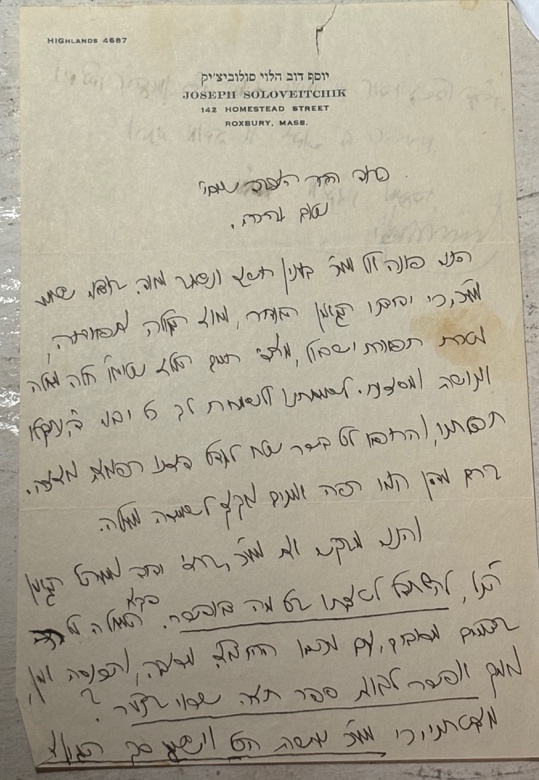
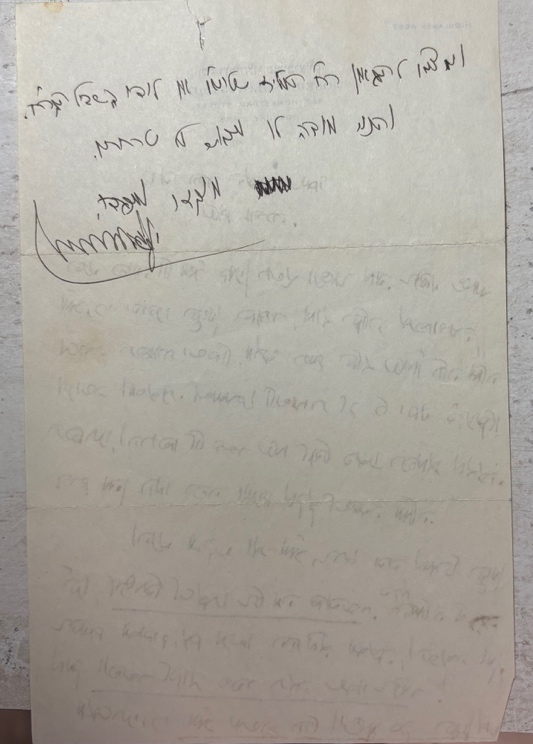
One such document, written by R. Soloveitchik in 1942 at a moment of acute crisis, reads as follows:

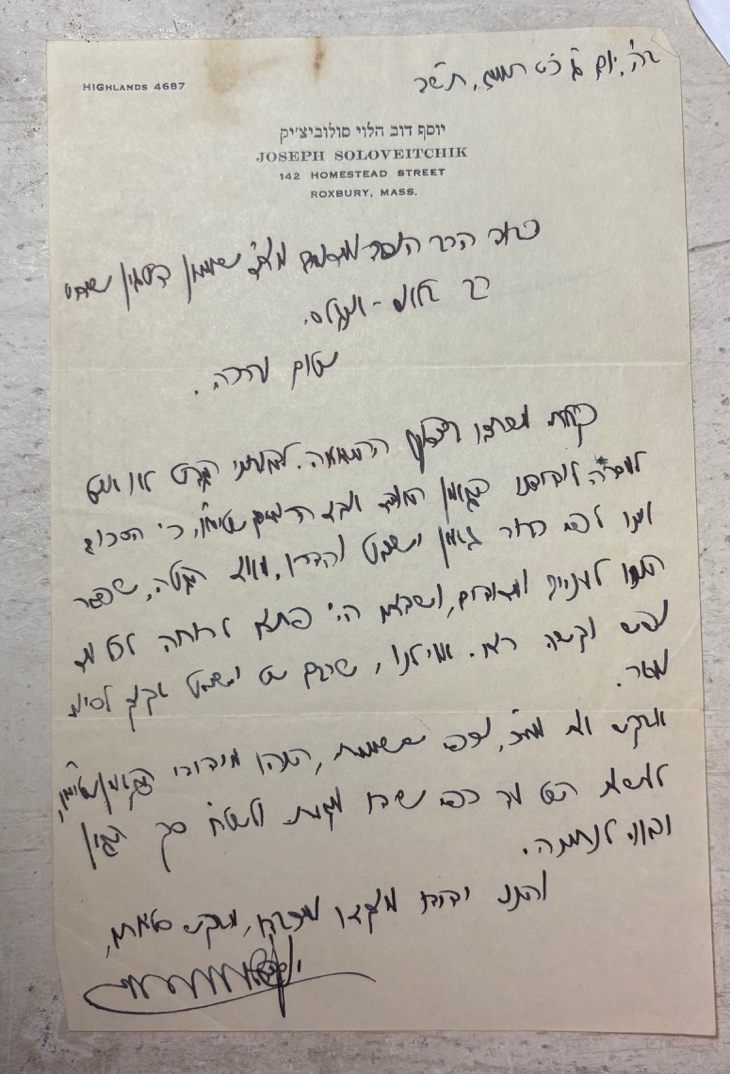
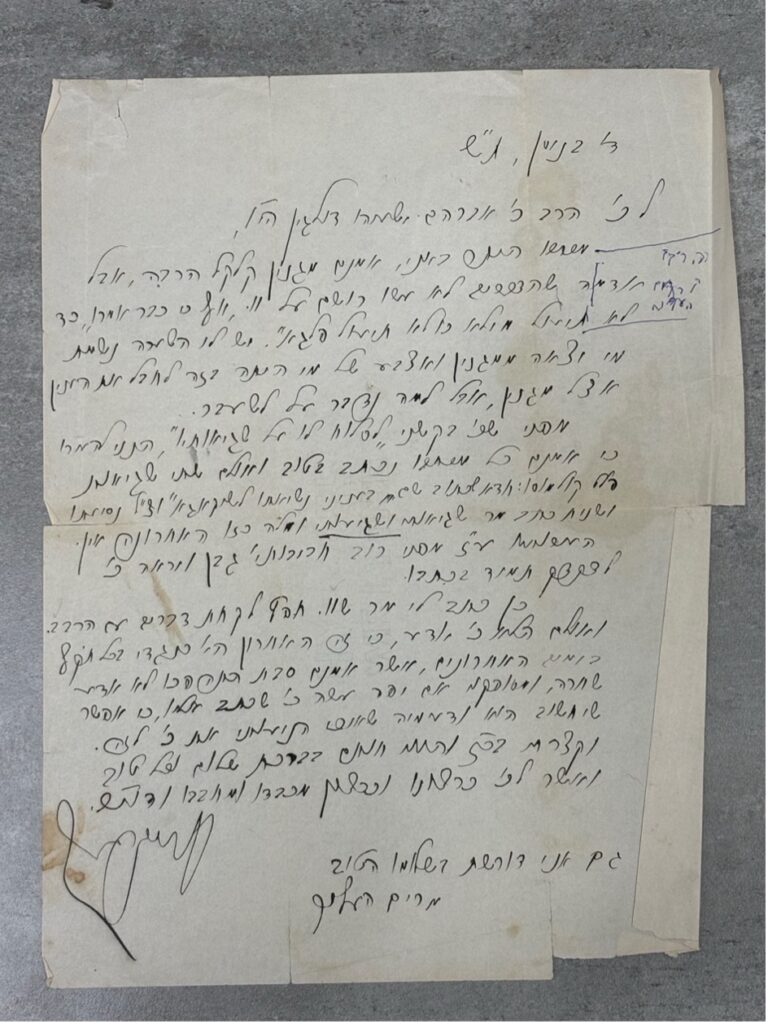
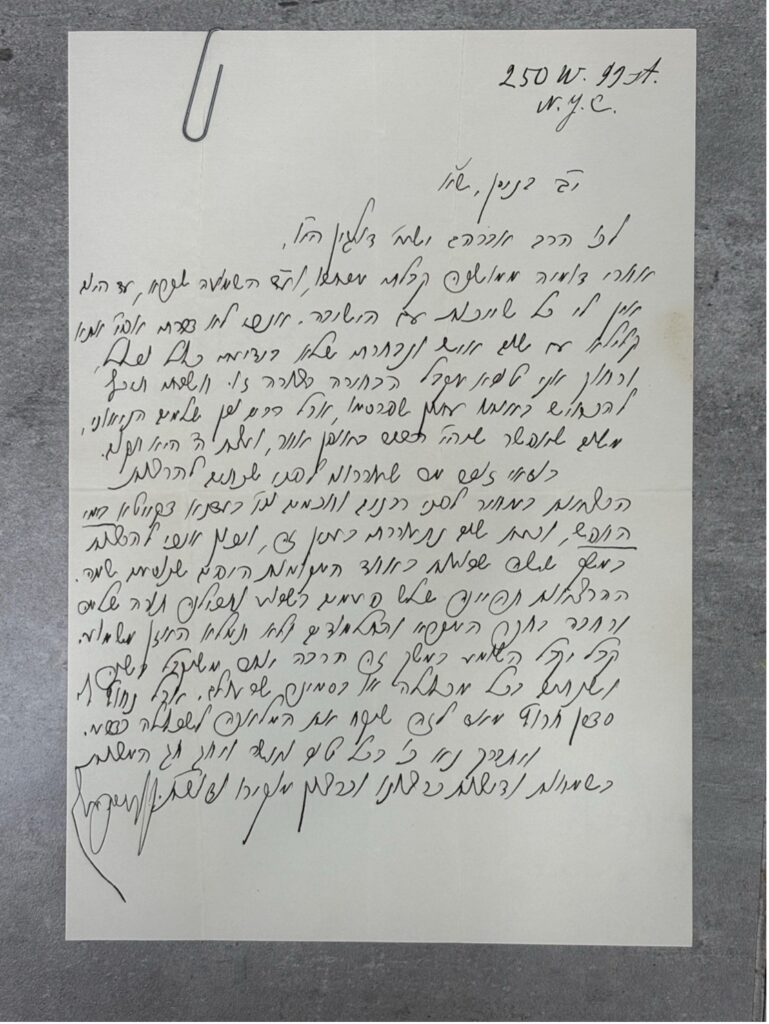
“Your esteemed honor has surely heard that our friend, the great and mighty gaon, luminary of the Diaspora and its glory, the crown of Israel’s splendor, our teacher and master Rabbi Chaim Heller, may he live long, has fallen gravely and dangerously ill. To our joy, and to the joy of all who fear God, our prayers have been accepted, and the Healer of all flesh has sent recovery and healing to the great one of our generation. Yet he remains weak and requires exceptional care. I therefore request of your esteemed honor, as a friend of the aforementioned gaon, to exert yourself on his behalf in every possible way. The supervision of the illness has entailed great expense, and even now the outlay is considerable while there is no income – and how can one behold a Sefer Torah in distress? I am confident that your esteemed honor will do all that is necessary, secure a fitting sum, and deliver it to the gaon R. H. Heller, may he live long, or to the fund ‘For R. H.’ I thank him in advance for his efforts. Your admirer and one who honors you.”[2]

In this letter, Soloveitchik addressed his friend Rabbi Simon (Abraham Yeshayahu) Dolgin,[3] then rabbi of Congregation Beth Jacob in the Beverly Hills neighborhood of Los Angeles, where he would serve for more than three decades and build one of the most significant Orthodox communities on the American West Coast. Upon receiving the appeal, Dolgin promptly sent a contribution; it appears, however, that its amount did not meet Soloveitchik’s expectations.

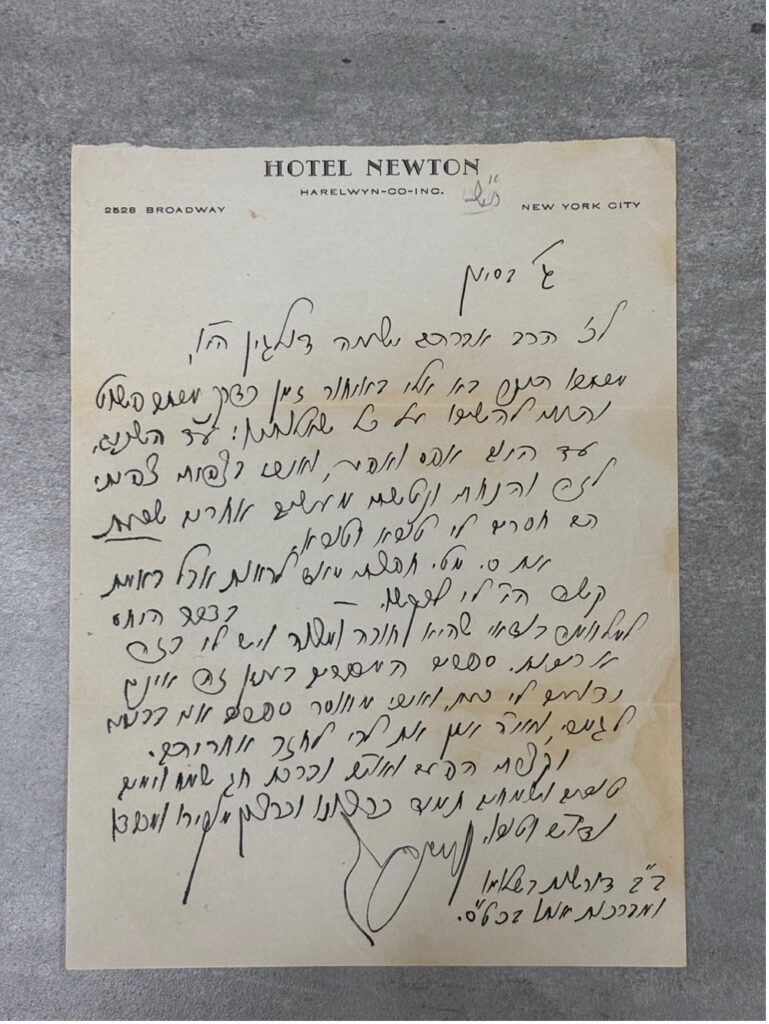
In a subsequent letter of appeal sent to Rabbi Dolgin approximately one month later [=14 July 1942], R. Soloveitchik again wrote:

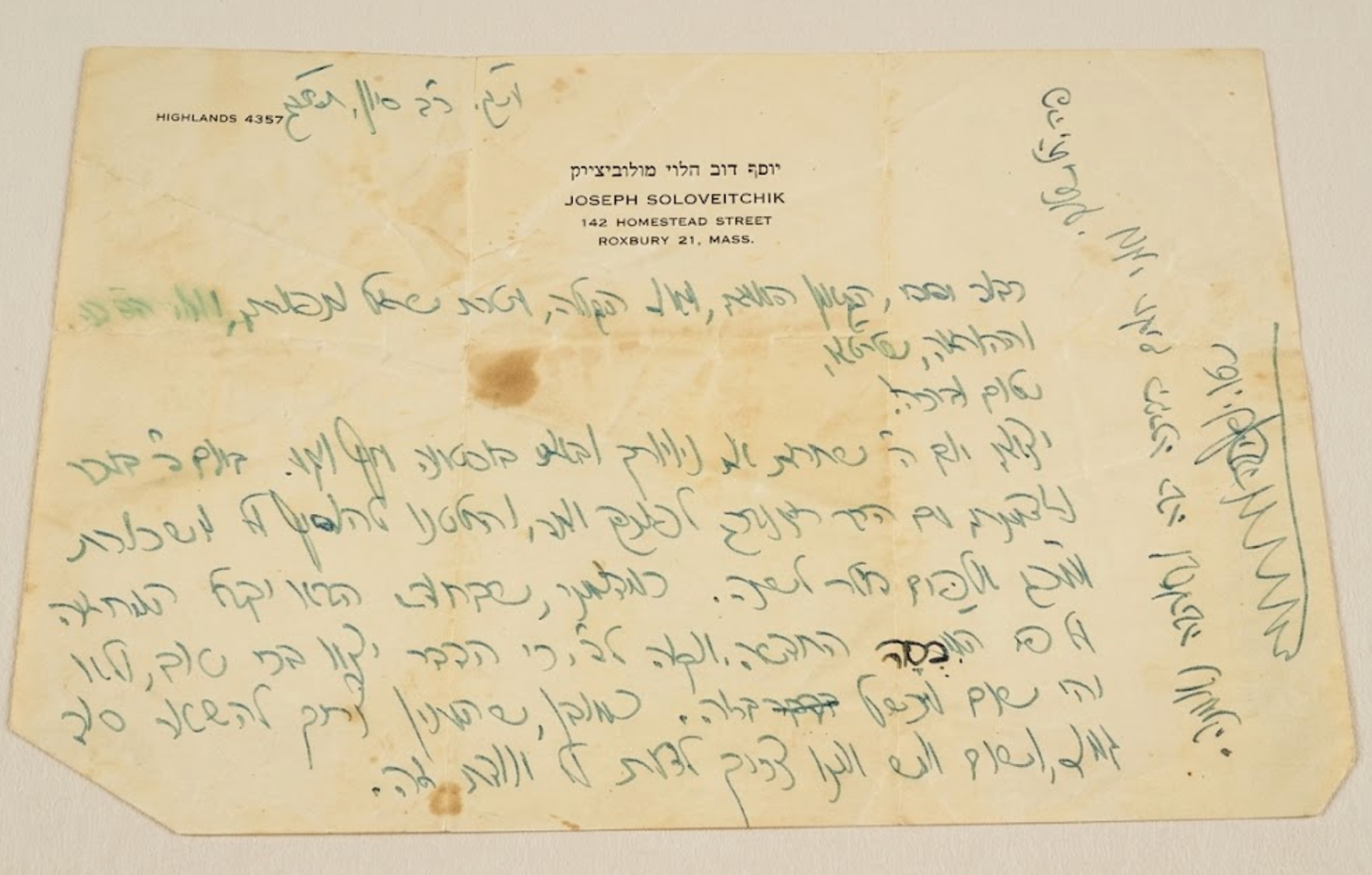
“I received your letter together with the check. To my great regret I cannot deliver it to our friend, the great gaon, the mighty shepherd, may he live long, for the sum is not commensurate with the honor and majesty of a gaon of Israel, a luminary of the Diaspora, who dispersed his wealth to the poor and destitute, and whose home was open wide to all who were embittered and broken in spirit. Woe unto us, that the rabbi of Israel stands in need of aid and assistance. I request of your esteemed honor – who, as I have heard, is among the friends of the aforementioned gaon – to do all that lies within your power and to send a proper and worthy sum.”

The letters published here for the first time provide a rare window into the distinctive relationship, a bond of unusual personal and intellectual intimacy, and the enduring ties that prevailed for decades between two of the leading Torah scholars in the United States in the twentieth century. At the same time, they illuminate the manifold hardships, including acute financial privation, humiliation, and disappointment, that rabbis of that period were compelled to endure as they sought even minimal means of livelihood with which to sustain their households. This fate did not spare even one of the foremost sages of the generation, R. Chaim Heller, who, in order to support his family, was compelled to piece together sporadic and temporary sources of income until he eventually attained, albeit only in relative terms, a measure of stability and a settled position that afforded him and his family a degree of economic security.[4]

Beyond their intrinsic interest, these letters are of particular importance by virtue of the period in which they were written. They date to the years of the Second World War, from which very little of Rabbi Joseph B. Soloveitchik’s correspondence has survived.

Already in these early letters, the literary Hebrew of R. Joseph B. Soloveitchik and his distinctive stylistic register stand out prominently.[5] They attest both to the profound bond between the two scholars and to R. Soloveitchik’s sustained concern for the welfare of his colleague and intimate friend, R. Chaim Heller. Their connection began years earlier in Berlin.

R. Chaim Heller (1879-1960) was among the leading Torah scholars of the early twentieth century. Alongside his greatness in Torah, he was deeply engaged in the scholarly study of Talmudic literature and biblical translation.[6] His work was characterized by a distinctive methodological orientation that sought to challenge the prevailing assumptions of modern biblical criticism through philological rigor grounded in the resources of the rabbinic tradition. In his introduction to On the Jerusalem Targum to the Torah (New York, 1921), R. Heller sharply criticized what he termed the “mechanical method” of comparing ancient translations in order to posit divergent textual recensions. Against this approach, he argued that the multitude of so-called “variants” in translations such as the Peshitta, the Septuagint, and the Samaritan Pentateuch do not reflect alternative Hebrew originals, but rather systematic exegetical practices. In his view, the translators did not render the biblical text literally, but interpreted and expanded it in light of traditions preserved in Hazal. This thesis enabled him simultaneously to undermine the conclusions of contemporary critics and to reaffirm the centrality and antiquity of the Oral Torah as an interpretive matrix for Scripture.[7]

This distinctive synthesis of traditional learning and critical scholarship was already prefigured in the formative trajectory of his early life. Born in Białystok and raised in Warsaw, he was already in his youth known as “the prodigy of Warsaw.” From the age of ten he ceased studying with melammedim; he never attended a yeshiva and acquired his entire Talmudic learning independently, as an autodidact. He married the daughter of a wealthy member of the Łódź community, and in the home of his uncle in Warsaw encountered the leading sages of the generation, engaging them in rigorous dialectical discussion. Among them were R. Yosef Dov Soloveitchik, author of Beit ha-Levi; R. Isaac Elchanan Spektor of Kovno; and the Netziv of Volozhin. During these years he also formed especially close ties with R. Chaim Soloveitchik, his relative by marriage R. Eliyahu Feinstein of Pruzhany, and R. Eliyahu Chaim Meisel of Łódź. In later years, he received a doctoral degree from the University of Würzburg.

Following the death of Rabbi Malkiel Tzvi Tannenbaum, the community of Łomża was left without a rabbi, and its leaders resolved to appoint Rabbi Heller, already known as a sharp and penetrating scholar and a man of broad learning who held a doctoral degree. By that time he had published studies on the Septuagint and on Maimonides, which drew the respect of both rabbinic and academic circles. Yet after only a few months he resigned his post. Various explanations have been offered for his departure: some point to his reluctance to devote extensive time to communal responsibilities, which he regarded as bittul Torah, while R. Joseph B. Soloveitchik recounted that Rabbi Heller himself expressed concern that members of the congregation might pressure him to act against his convictions.

R. Heller soon left for Berlin, where, in 1922 he established the Beit Midrash ha-Elyon, an advanced institution for rabbinic training that drew a small but serious circle of students. Berlin at the time was a meeting ground of worlds, traditional learning and modern scholarship, and Heller moved between them with unusual authority. In R. Heller’s case, this was not merely a sociological juxtaposition but a fully integrated intellectual stance, in which Wissenschaft methods were appropriated and redirected in defense of the integrity of the Masoretic text and the authority of the Oral Torah.[8] It was there that the young R. Soloveitchik spent several formative years. He was not formally enrolled in the institution, but he attended Heller’s lectures and was deeply influenced by them. What impressed him was not only R. Heller’s mastery of Torah and scholarship, but the range of his mind – the sense that he inhabited both disciplines fully, without strain or concession.

In 1929, R. Chaim Heller was appointed as a Visiting Professor of Bible at RIETS,[9] and “for close to ten years Heller taught in New York while occasionally traveling to Berlin and elsewhere before settling in the United States.” More than a decade later, his name was even floated by Rabbi Dr. Leo Jung as a potential successor as Rosh Yeshiva of RIETS following the death of R. Moshe Soloveichik in 1941.[10] A contemporaneous portrait of Heller’s intellectual profile appears in a 1930 article by R. Yerahmiel Elimelekh (Max J.) Wohlgelernter in the ha-Pardes journal, in which R. Heller is presented not merely as a scholar of unusual range, but as a figure who entered directly into confrontation with modern biblical criticism on its own terms, armed with philological expertise yet grounded in the authority of the rabbinic tradition. Against what R. Wohlgelernter characterizes as the “mechanical” methods of contemporary critics, R. Heller is depicted as demonstrating that the multiplicity of textual variants in ancient translations reflects interpretive practice rather than divergent textual recensions, thereby reasserting the integrity of the Masoretic text and the centrality of the Oral Torah as its interpretive matrix.[11]

In 1937, several years after the rise of the Nazis to power and the intensification of anti-democratic measures directed especially against the Jews, R. Chaim Heller emigrated to the United States and settled in New York. That same year, R. Moshe Feinstein likewise arrived in New York. During this period, R. Heller renewed his connection with R. Joseph B. Soloveitchik, who had come to the United States some five years earlier at the urging of his father, R. Moshe, then Rosh Yeshiva of the Rabbi Isaac Elchanan Theological Seminary. In Boston, R. Joseph B. Soloveitchik led his community with distinction and, alongside his teaching, increasingly assumed a position of broader intellectual and religious leadership, establishing himself as a central figure for a growing circle of students and adherents.[12]

Despite this recognition of his intellectual stature, the conditions that Heller encountered upon his arrival in the United States were markedly different. Like many rabbis who fled Germany on the eve of the Second World War and arrived in the United States as refugees,[13] R. Chaim Heller entered a professional landscape that was structurally inhospitable. The lingering effects of the Great Depression continued to constrain both the rabbinic and academic labor markets.[14] Congregational positions, even in smaller and more remote communities, were typically occupied by long-established incumbents, while the few available posts offered only modest remuneration. Universities, for their part, were in a period of contraction, with limited hiring and little institutional appetite for figures whose scholarly profile did not align neatly with existing departmental frameworks. For a scholar of Heller’s unusually wide and interdisciplinary range, no obvious institutional niche presented itself.

In response, Heller adopted a peripatetic mode of intellectual livelihood. Lacking a stable appointment, he supported himself through public lectures, assembling an income that remained precarious and contingent. This required sustained mobility, persistence, and a readiness to engage even relatively small audiences. At one stage, this itinerant circuit took him as far as Los Angeles, a journey that, under the conditions of the time, entailed considerable logistical and physical demands, where he delivered a series of lectures in his areas of expertise. It was likely in the course of this visit that he first encountered Rabbi Dolgin.

The notice of R. Chaim Heller’s arrival in Los Angeles appeared in the Los Angeles Times, March 22, 1940.

It may be assumed that, in the wake of this visit, the relationship between the two was further strengthened. Expression of this is found in three letters written during those years by R. Chaim Heller to R. Dolgin, which are published here for the first time.


The first letter is dated 4 Nisan 5700 [= 12 April 1940], a short time, approximately three weeks, after R. Chaim Heller’s arrival in Los Angeles. It reads as follows:

“To the honorable Rabbi Abraham Isaiah Dolgin, may he live long: Your esteemed letter has reached me. Although Magnin[15] caused considerable damage, it seems to me that his words made no impression upon ploni, notwithstanding the saying, ‘When a word cannot enter in its entirety, it enters in part.’[16]

I have a conjecture as to whose soul spoke through Magnin, and whose finger was involved in undermining the matter there, but why should we speak of what has passed.

Since Your Honor requested of me “to forgive him for his errors,” I hereby note that, indeed, your entire letter was written well; however, two errors slipped from your pen: first, that you wrote also “concerning the matters of his נשיאתו (nesi’ato, ‘his presidency/bearing’) to Chicago,” whereas it should read נסיעתו (nesi‘ato, ‘his travel’); and second, that you wrote שגיאותי ושגיעותי (shegiyotai, ‘my errors’), and such a latter form does not exist.

I have drawn his attention to this out of my great affection for him,[17] and your honor should take care to be precise in his writing. You also wrote to me that Mr. Sh. desires to discuss matters with Rabbi B. [Bernard Revel[18]]; however, your honor knows that the latter has recently opposed me with full force, though I do not know the cause of his reversal,[19] and I am uncertain whether your honor acted wisely in writing to him, for he and those associated with him may think that I prompted your honor to do so. I have been brief in all this, and I conclude with blessings of peace and all good to your honor, according to your will and the will of one who esteems and cherishes you, and who inquires after your welfare.

Chaim Heller”

In the margin of the letter, his wife added a brief greeting of her own: “I too inquire after his welfare. Miriam Heller.”

The second letter was written approximately two months later, on the eve of the festival of Shavuot, in which R. Chaim Heller gives expression to his frustration that promises made to him, apparently concerning the provision of a stable source of livelihood, had not been fulfilled. It reads as follows:

3 Sivan [5700] [9 June 1940]

To the honorable Rabbi Abraham Isaiah Dolgin, may God preserve and sustain him,

Your esteemed letter reached me with delay, as is the way of ordinary post, and I shall respond to all your inquiries: regarding the matter of the years [?], up to this day there is nothing whatsoever, and I had indeed waited and hoped for this, and accordingly set aside and abandoned other undertakings which I now lack greatly – very greatly.

I very much wished to meet with […], but in truth it was difficult for me to request this.

Concerning the attitude toward the war,[20] it is certainly an obligation and a commandment, and I have much to elaborate on this matter. Books addressing this subject are not presently known to me, for I am entirely without books in my home; with God’s help, I shall set my mind to seeking them out.

I shall be brief this time. With blessings for long life, a joyous festival, and days of gladness always, in accordance with your will and the will of one who esteems and honors you, who inquires after your welfare and goodness.

Chaim Heller

[p.s.] My wife and daughters inquire after your welfare, and bless you with every good, selah.

The third letter was written approximately a year later, on the eve of Passover 5701. At that time, reports in the press in the Land of Israel[21] indicated that R. Heller was about to receive a teaching appointment at Yeshiva University alongside his colleague R. Joseph B. Soloveitchik. Having grown accustomed to disappointment, R. Heller feared that this announcement amounted to no more than a “trial balloon” lacking any concrete foundation. This apprehension, together with his distress at both the substance and the tone of the report, found expression in a letter he addressed to R. Dolgin:


“12 Nisan 5701 [9 April 1941]

To the honorable Rabbi Abraham Isaiah Dolgin, may God preserve and sustain him,

After a long period of silence while confined to bed, I received your letter. Concerning the report that you read: to this day I have no connection whatsoever with the yeshiva.[22] I have not spoken even a word – however slight[23] – with any person, and I was selected entirely without my knowledge; indeed, I am far removed from accepting an appointment in such a manner. I immediately considered issuing a denial in the very newspaper that published the report, but many worthy individuals dissuaded me, on the grounds that matters might yet develop otherwise, and that the counsel of the Lord shall prevail.”

In this connection, he related to his friend his deliberations regarding an additional source of livelihood – delivering lectures to vacationers in the Catskill Mountains during the summer months:

“You surely recall that two years ago I was approached to deliver lectures, for remuneration, before rabbis and scholars, etc., during the summer season (be-idna de-qayta), in the vacation period; and now this matter has again been raised, and I am prepared to lecture for six weeks in one of the pleasant locales to which people travel.

The lectures would be held three times a week and would encompass a comprehensive and wide-ranging treatment of biblical scholarship and the Talmuds, such that ‘the ear would not be sated with hearing’.[24] Over this period, the listener would gain far more than he would in a year or two at any college or seminary in the world. However, I require a highly energetic organizer who will undertake to arrange this enterprise properly. May your honor be blessed with all good and prosperity, and may you celebrate the Festival of Unleavened Bread with joy and delight.”

After several years in the United States, during which he lacked a stable source of livelihood, R. Chaim Heller secured a position on the teaching staff of Yeshiva University and served alongside his colleague R. Samuel Belkin, R. Joseph B. Soloveitchik, and R. Moshe Shatzkes on the RIETS Ordination Board.[25]

Screenshot

Yet, as emerges from a letter cited below, his salary conditions remained far from favorable. Efforts were made to improve them and, over time, met with a measure of success. The literary oeuvre of R. Chaim Heller is vast in scope. Yet, as R. Joseph B. Soloveitchik would later describe in his eulogy, what was published only represents only a minute fraction, “mere remnants of remnants,” of the breadth of his orally transmitted Torah. It should also be borne in mind that the overwhelming majority of his writings were composed prior to his arrival in the United States.

Among his works in the field of biblical scholarship, particular note should be taken of his studies on the textual tradition of the Bible and its various translations: his work on the Jerusalem Targum to the Torah (New York, 5681 [1921]); on the Samaritan Pentateuch (Berlin, 5684 [1924]); on the Septuagint in the Concordance Heikhal ha-Qodesh, with appended notes, commentaries, and investigations in biblical studies (New York, 5704 [1944]); and on the Peshitta, the Syriac translation of the Bible (transcribed into Hebrew script, with notes, glosses, and commentaries by Chaim Heller: Genesis, Berlin, 5687 [1927]; Exodus, Berlin, 5689 [1929]). He prepared a revised edition of the Peshitta to Exodus for publication but did not succeed in completing its printing prior to his death. Among his halakhic works, his annotated edition of Maimonides’ Sefer ha-Mitzvot (first edition, Piotrków, 5674 [1914]) is well known. A subsequent edition of this work was published by Mossad HaRav Kook in Jerusalem (5706 [1946]) – and has since appeared in numerous further editions – and for this work he was awarded the Rav Kook Prize in 5707 [1947]. His writings also include Hiqrei Halakhot, analytical investigations of legal rulings and issues in the section Hoshen Mishpat (vol. I, Berlin, 5684 [1924]; vol. II, Piotrków, 5692 [1932]); as well as studies on various topics in Maimonides and the halakhic decisors concerning the laws of lending and borrowing and their ancillary matters (Chicago, 5706 [1946]). In addition, he published, in jubilee and memorial volumes, several qontrasim that functioned as a kind of Masoret ha-Shas for the Jerusalem Talmud.[26]

Even after R. Chaim Heller had joined the faculty of Yeshiva University, R. Joseph B. Soloveitchik continued to seek ways to assist him, inter alia by working to secure an increase in his salary. Expression of this may be found in a brief letter that he wrote to R. Chaim Heller on 23 Sivan 5713 (5 June 1953), which is likewise published here for the first time:

Erev Shabbat, 22 Sivan 5713 [5 June 1953]

To my honored friend, the true gaon, luminary of the Diaspora, crown of Israel and its glory, pillar of halakhah and instruction, may he live long,

Greetings and blessings!

I departed New York on Thursday morning and arrived in Boston utterly exhausted. On the preceding Wednesday I met with Rabbi Rosenberg at a certain inn, and we resolved to add two thousand dollars annually[27] to your honor’s salary. It seems to me that next month you will receive a check in accordance with the new scale. We trust in God that the matter will be brought to a good conclusion and that no obstacle will arise in connection with it. Naturally, the matter must remain in absolute confidence, and no one need be informed of it.

I conclude with abundant blessing and faithful affection,

Joseph Dov HaLevi Soloveitchik[28]

This quiet intervention on Heller’s behalf was not an isolated act, but part of a sustained pattern of concern. In this connection, it is instructive to recall R. Aharon Lichtenstein’s characterization of R. Joseph B. Soloveitchik, in his eulogy. Reflecting on his father-in-law’s own self-understanding, he writes:

“The personal self-conception that characterized the Rav, of blessed memory, with respect to his own functioning was bound up with educational–pedagogical activity, and this across multiple spheres. He would often remark that when he arrived in the World of Truth, and were he to be asked to specify by virtue of what he merited a share in the World to Come, he would indicate three points: (a) that he studied Torah with his children; (b) that he founded the Maimonides School in Boston; (c) that he was concerned, over an extended period, for the honor and welfare of a certain talmid hakham.”[29]

This final point refers to R. Soloveitchik’s sustained and well-documented efforts on behalf of R. Chaim Heller. The depth of this personal concern was not confined to the private sphere, but found parallel expression in a sustained intellectual and institutional collaboration between the two. A further expression of their bond and cooperation is found in their joint letter of response to Israeli Prime Minister David Ben-Gurion, who in 1958 approached them, among other “Sages of Israel,” to solicit their opinion on the question “Who is a Jew?” Although the inquiry was addressed to each of them separately, the two resolved to compose a joint reply. Thus they wrote, inter alia:

“We are indeed perplexed that the State of Israel now seeks to hew down our traditional branches and thereby smear the ancient glory of Israel which has long been sanctified through the spilt blood and sufferings of preceding generations. It is only because of these roots that we preserve our uniqueness as a holy people and that we are inextricably bound to the Holy Land. … Will the present State of Israel be built up by (maintaining a threat of) destruction to its very sanctity?”[30]

The same bond found further expression in another brief letter issued by R. Joseph B. Soloveitchik some two years later, likewise published here for the first time. The occasion for its dispatch was the forthcoming wedding of R. Joseph B. Soloveitchik’s daughter, Tova, to Rabbi Dr. Aharon Lichtenstein, his most distinguished student.

In September 1959, a small notice appeared in the “Announcements” column of The Commentator, the student newspaper of Yeshiva University, reporting the engagement of Dr. Aharon Lichtenstein, a member of the class of 1953, to Tova Soloveitchik. It appeared alongside advertisements for driving instruction and for Barton’s confectionery (under OU supervision).[31]

Approximately a month and a half later, in November 1959, the parents of the couple sent a formal invitation to family members and acquaintances. The Hebrew text was ornate, replete with distinctive idioms, and clearly bore the imprint of R. Joseph B. Soloveitchik’s unique stylistic signature:

“To our friends in all their places of residence – may your peace flourish without end! We hereby inform you that Tova shall be betrothed and married to Aharon, with the grace of God, on the evening preceding the fourth day of the week, on the twenty-second day of the month of Kislev, in the year five thousand seven hundred and twenty from Creation, according to the reckoning we follow here in Boston, the city situated at the approaches of the sea. Pray assemble at six o’clock on that evening in the Dorothy Quincy Hall, in the John Hancock Building (355 Stuart Street), for the celebration of bride and groom, for the festive meal, and for the joy of a commandment. Rejoice with us in the joy of our offspring’s wedding day and in the gladness of our hearts. Joseph Dov HaLevi and Tonya Soloveitchik; Yechiel and Bluma Lichtenstein.”

By contrast, the English version was brief, formulated in a more formal and utilitarian manner. The period during which the invitations were sent was one of particular intensity in the Soloveitchik household. At that time, R. Soloveitchik received an informal invitation to put forward his candidacy for the position of Chief Rabbi of Israel[32]; concurrently, he was engaged in intensive preparation for the major eulogy for his uncle, the Griz, R. Yitzhak Ze’ev Soloveitchik, later known as the discourse “Mah Dodekh mi-Dod.”[33]

תמונה שמכילה טקסט, נייר, מכתב, ספר תוכן בינה מלאכותית גנרטיבית עשוי להיות שגוי.

On account of the mention of his name as a candidate for the office of Chief Rabbi, an extensive journalistic interview with R. Soloveitchik was conducted in Yedioth Ahronoth.[34] The interviewer, Elie Wiesel (later a Nobel laureate), reported that, following the Rav’s annual Teshuvah Derashah several months earlier, the Israeli consul general in New York had sent a telegram to Jerusalem declaring: “Here is the best candidate to replace Rabbi Herzog.”[35] Wiesel asked R. Soloveitchik whether he would agree to assume the position if it were offered to him. R. Soloveitchik replied that no such offer had yet been made, but added in principle: “One does not decline an invitation that comes from the Land of Israel… When I receive it, if indeed it is sent, I shall consider it with utmost seriousness. I shall ask myself whether I am worthy of so exalted an office.” When Wiesel further inquired whether it was true that his uncle, R. Yitzhak Ze’ev Soloveitchik, had instructed him not to accept the position, R. Soloveitchik dismissed the report: “It is difficult to believe such rumors. In our family there is a tradition not to compose wills… perhaps because we fear death and its reality.”[36]

In the course of the interview, R. Soloveitchik spoke with evident pride of the religious and spiritual revival among youth and young adults in America, yet added that talk of their immigration to the Land of Israel was, at most, “a beautiful dream.” He attributed the gap between the intensification of Jewish and religious consciousness and the reluctance to immigrate, inter alia, to Prime Minister David Ben-Gurion, who, in his view, failed to appreciate the potential inherent in religion to draw youth to Israel and to demand sacrifice on its behalf. “In my view,” said the Rav, “Ben-Gurion is a religious Jew, though it is possible that he himself does not know this.” These remarks, whose precise formulation was itself questioned in contemporaneous discussion, elicited sharp criticism from several prominent figures within American Jewry. Among them was Moshe Meisels, editor of ha-Doar, who, in a pointed “open letter,” challenged both the claim that Israel had lost its ‘messianic’ hold on the Jewish imagination and the attribution of this development to deficiencies in the religious posture of the Israeli state.[37] Questioning the very premise of R. Soloveitchik’s formulation, Meisels asked rhetorically whether it could truly be maintained that “the concept of Israel has lost its messianic content,” and whether the responsibility for such a development could plausibly be laid at the feet of the state. The Rav sought to respond, but was exceedingly occupied with the final polishing of the eulogy for his uncle, R. Yitzhak Ze’ev Soloveitchik, which he was to deliver within a matter of days.[38]

Indeed, as the Yiddish adage has it, a mentsh trakht un Got lakht – man plans, and God laughs. Only a few days after the wedding invitations for his daughter and R. Aharon Lichtenstein had been dispatched, R. Joseph B. Soloveitchik was diagnosed with colon cancer and was required to travel urgently to Boston to undergo life-saving surgery. R. Soloveitchik informed his family, including the bride and groom, on the night that he delivered the eulogy for his uncle. On the following day, he departed for Boston. The couple, of course, immediately announced the postponement of the wedding, and all prayed for the Rav’s recovery.

R. Soloveitchik himself, only fifty-seven years old at the time, confided to those close to him: “I suddenly ceased to be immortal; I became a mortal being.” In the nights preceding the operation, he undertook a profound reckoning of his life. In later years, he described something of his experience during those turbulent days:

“My existential awareness was an absolute one. Non-being did not enter into it. I would not sustain my gaze upon nihility. Whenever I started to think of death, my thoughts were dashed back and they returned to their ordinary objective, to life. When I looked upon my grandson, I always tried to think of him as if he were my contemporary. I believed that we would always do things and play together. Then sickness initiated me into the secret of non-being. I suddenly ceased to be immortal; I became a mortal being.

The night preceding my operation I prayed to God and beseeched him to spare me. I did not ask for too much. All I wanted was that he should make it possible for me to attend my daughter’s wedding, which was postponed on account of my illness – a very modest wish in comparison with my insane claims to life prior to my sickness. The fantastic flights of human foolishness and egocentrism were distant from me that night.

However, this ‘fall’ from the heights of an illusory immortality into the valley of finitude was the greatest achievement of the long hours of anxiety and uncertainty. Fundamentally, this change was not an act of falling but one of rising toward a new existential awareness which embraces both man’s tragedy and his glory, in all its ambivalence and paradoxality. I stopped perceiving myself in categories of eternity. When I recite my prayers, I ask God to grant me life in very modest terms.”[39]

Further testimony to R. Soloveitchik’s state of mind during this period is found in a letter he sent to R. Reuven Katz, Chief Rabbi of Petah Tikvah. At its outset, the Rav explains that he had fallen gravely ill and been confined to bed, describing the experience in stark terms:

“Dark days, filled with anxiety, suffering, and silent loneliness, passed over me. My world was suddenly overturned. Yet the merit of my forefathers stood by me in the hour of wrath, and the Holy One, blessed be He, in His abundant mercy redeemed my soul in peace and did not allow me to die… Even now, as I begin to recover, I have not yet shaken off the physical weakness and the psychological dread that overcame me during those bitter and difficult hours of illness and suffering.”[40]

He then turns to the question of the Chief Rabbinate, noting both the changed circumstances and his own unsuitability for the role:

“However, the recent developments concerning the Chief Rabbinate… have cast a new light upon the situation, and I doubt whether I would be able to engage in Torah study with peace of mind… There is compelling reason to assume that I would become entangled in all the convolutions of politics, a matter that is neither to my spirit nor to my desire… Therefore I am compelled to acknowledge that, under the present circumstances, I am not fit for this office. I am a teacher, and I have in my world nothing but the four cubits of halakhah. I do not wish to depart from them, even were I to be offered an entire kingdom.”

These remarks make clear that R. Soloveitchik’s refusal to consider candidacy for the position of Chief Rabbi was shaped both by the lingering effects of illness and by a principled resistance to political entanglement, together with a self-conception rooted in the life of Torah within “the four cubits of halakhah.”[41]

As a result of his illness, R. Soloveitchik remained in Boston for approximately three months, during which he gradually recovered. In the course of this period, he merited to bring his daughter Tova and his son-in-law, R. Aharon Lichtenstein, under the wedding canopy. In consultation with the family, it was decided to postpone the wedding by only one month following the operation, and it was ultimately held on 26 Tevet 5720 (26 January 1960).[42]

A week before the rescheduled wedding, still confined to his bed and not yet recovered from surgery, R. Soloveitchik insisted on writing to his close friend R. Chaim Heller. The letter, published here for the first time, was not written in his own hand. The script shows that he dictated it, most likely to his wife, and, in his weakened state, managed only to sign his name.

“To my honored friend, the gaon of Israel and its glory, luminary of the Diaspora and pillar of halakhah and instruction, may he live long; greetings and blessings! Although the physicians have forbidden me to engage in writing on account of my extreme weakness, I cannot refrain from writing this letter in order once again to extend a heartfelt invitation to your esteemed honor, to your esteemed wife, and to your distinguished daughter, may they live, to participate in the wedding of Tova and Aharon. Their presence on the day of our heart’s rejoicing will lend joy and splendor to the celebration. With great affection, Joseph Dov HaLevi Soloveitchik.”

His wife, Dr. Tonya Soloveitchik, appended a moving appeal of her own in Yiddish:[43]

January 19, 1960

To the honorable and true gaon, R. Chaim Heller, to his esteemed wife, the rebbetzin, and to their refined daughter, may they live – greetings and blessings!

We had hoped that we would have the opportunity to visit you once more and to invite you personally to the wedding of our Tova. To our regret, however, my husband’s illness has altered our plans, and we have no possibility of coming to New York to do so.

What we are unable to do orally, we must now do in writing: we warmly invite you all to the wedding! Your presence will greatly enhance our joy.

I also wish once again to thank you for the friendship you have shown during my husband’s illness. Your good wishes and blessings gave us strength at a critical time.

With regards and respect,

Tonya Soloveitchik

In the end, R. Chaim Heller did not attend the wedding, apparently due to his frail health and the difficulty of traveling from New York to Boston. Within a few months, on the Fourteenth of Nisan 5720 (10 April 1960), the Eve of Passover, he returned his soul to his Creator.[44] Although the constraints of time and the approaching festival precluded extended eulogies, R. Joseph B. Soloveitchik flew from Boston to New York to attend the funeral, delivered brief words of farewell, recited kaddish at the funeral,[45] and returned to Boston before the onset of Passover. The rabbinic journal ha-Pardes would later note that “his close friend and trusted associate, Rabbi Joseph Dov Soloveitchik of Boston, eulogized him in moving words.”[46] Although these remarks were long thought to have been lost, a partial and mediated record preserved in the Yiddish press makes it possible to recover something of their content:

“A visit to Rabbi Chaim Heller was in the nature of a pilgrimage… When I would arrive at the elevator of the building at 210 West 99th Street… I would experience a sensation as though a curtain had descended, separating between the sacred and the profane. The Temple comprised three divisions: the Holy of Holies, the Sanctuary, and the Courtyard. Rabbi Chaim embodied all three. He conducted himself within the Holy of Holies… his occupation was solely with Torah… The entirety of the Torah lay before him as an open book… Yet he also partook of the character of the Courtyard, engaged with the community of Israel as a whole… From him radiated both the light of immense knowledge and the simplicity of humanity.”[47]

Even in this compressed form, the structure of the eulogy is already fully present: Heller is cast simultaneously as a figure of absolute immersion in Torah, of intellectual breadth, and of human accessibility, an integration that would find fuller expression in Soloveitchik’s later memorial address. Several weeks later, he returned to the task in a more formal setting, delivering a powerful and deeply moving eulogy at a memorial gathering at Yeshiva University.

As is well known, and in keeping with the characteristic reserve of the Lithuanian Torah greats, R. Joseph B. Soloveitchik was generally sparing in his expressions of affection, esteem, and praise for fellow scholars, and rarely employed language of overt admiration. In the case of R. Chaim Heller, however, he departed from this pattern and bestowed upon him an exceptional and uncommon measure of appreciation, the like of which he appears to have granted to few, if any, other Torah scholars.

This finds expression in the great and moving eulogy that R. Soloveitchik delivered for R. Chaim Heller nine weeks after his passing, at a public gathering at Yeshiva University on June 13, 1960, which also included eulogies by the institution’s president, Dr. Samuel Belkin. R. Soloveitchik’s eulogy was published the following year on the occasion of the first yahrzeit under the title “Rabbi Chaim Heller: The ‘Shmuel ha-Katan’ of Our Generation,” and opened with the following words:

“Who was this man who departed from us in silence and with gracious humility? What was his stature, and what were his deeds? Who was R. Chaim, who held no public office and had no need for conventional titles – whose entire greatness was encapsulated in two simple words: ‘R. Chaim,’ greater than ‘Rabban’ was his name? Some years ago… when the president of this institution, Rabbi Samuel Belkin, introduced R. Chaim… he employed the following formulation: ‘R. Chaim belongs to that small company of men of virtue for whom we pray each day in the Amidah: for the righteous, for the pious, for the elders of Your people the House of Israel, and for the remnant of their scribes. R. Chaim,’ the rabbi continued, ‘is of the remnant of Israel’s scribes.’ In this utterance he encapsulated all that was singular and wondrous in the man. At the time, I was seated on the platform beside R. Chaim, and as I beheld him – entirely withdrawn, enclosed and self-contained, as though scorched by the gaze of the audience fixed upon him – his lips murmuring, ‘What does he want of me?,’ and the pained embarrassment of a solitary individual, thrust against his will into a bustling and clamorous crowd, spread across his face…”[48]

תמונה שמכילה בחוץ, לבוש, אדם, מכונית תוכן בינה מלאכותית גנרטיבית עשוי להיות שגוי.

R. Chaim Heller and R. Joseph B. Soloveitchik in New York, in the vicinity of Yeshiva University.

Notes

    1. A shorter, and non-annotated, version of this article appeared in Hebrew as Aviad Hacohen and Menachem Butler, “‘A Sefer Torah in Distress’,” Makor Rishon, Pesach Supplement, no. 1495 (1 April 2026): 10-11, 16 (Hebrew), available here.We are grateful to our friend Aaron R. Katz and to the Dolgin family for granting us access to letters sent by Rabbi Joseph B. Soloveitchik and Rabbi Chaim Heller to the family patriarch, Rabbi Simon (Abraham Isaiah) Dolgin, of blessed memory. We thank Shulamith Z. Berger of the Yeshiva University Archives for providing photographs of Rabbi Joseph B. Soloveitchik and Rabbi Chaim Heller. We are also grateful to Rabbi Moshe Dembitzer, author of several landmark biographical studies of Rabbi Chaim Heller, for sharing with us a forthcoming, as yet unpublished essay on Rabbi Soloveitchik’s graveside eulogy for Rabbi Heller.
    2. The letter bears no date; however, the postmark on the envelope indicates that it was sent from Boston to Los Angeles on June 9, 1942.
    3. On Rabbi Simon (Abraham Isaiah) Dolgin (1915-2004) and his extensive activities, see Jubilee Volume Minḥah Le-Ish: Presented to HaRav Simon A. Dolgin on the Occasion of His 75th Birthday, ed. Itamar Warhaftig (Jerusalem: Ariel, 1990). Ordained at the Hebrew Theological College in Skokie, Illinois, Dolgin assumed the rabbinate of Congregation Beth Jacob (later in Beverly Hills) in 1938 and served there for approximately thirty-two years, during which he transformed it into a prominent Orthodox community and developed a broad educational infrastructure, including the Harkham Hillel Hebrew Academy. In 1971 he immigrated to Israel, where he served as rabbi of the Ramat Eshkol neighborhood and later as Director-General of the Ministry of Religious Affairs. On his correspondence with David Ben-Gurion, see On the Character of the State of Israel: Correspondence between Prime Minister David Ben-Gurion and Rabbi Simon (Abraham Isaiah) Dolgin, ed. Yitzhak Goldshlag (Jerusalem, 1973; Hebrew).
    4. By way of comparison with the present, this phenomenon still finds occasional resonance in the lives of rabbis today.
    5. On this point, see the remark of Rabbi Aharon Lichtenstein, at the conclusion of his discussion of “The Rav as Eulogist” (forthcoming):“It is difficult for me to conclude without saying a word about the literary dimension of these eulogies. For all my admiration of the Rav’s Torah greatness, and of the content of these eulogies – which is, of course, primary – it is hard not to be left in astonishment at his literary and linguistic ability. We are speaking of a person who was not educated in the Hebrew language, and whose knowledge in this area was drawn from reading Haskalah literature. Let us recall: the Rav did not live in a Hebrew-speaking environment, nor did he speak Hebrew fluently. Yet the richness of his language is truly astounding. Were one to read these texts for this purpose alone, I have no doubt that he would be amply rewarded.”
    6. On the most recent biography and intellectual profile of R. Chaim Heller, see the now substantial body of recent scholarship, which has significantly advanced our understanding of his life and work, see Moshe Dembitzer, “The Letters of Rav Chaim Heller,” Hitzei Giborim, vol. 9 (2016): 923-952 (Hebrew), which assembles and analyzes a wide corpus of correspondence and reconstructs key aspects of his personal and scholarly networks; Uriel Banner, “Towards a Profile of Rabbi Chaim Heller,” Asif, vol. 8 (2023): 720-766 (Hebrew), offering a synthetic biographical portrait grounded in both contemporary testimony and archival material; and Moshe Dembitzer, “‘To Show My People a New Type’: The Academic Chapter in the Life of Rabbi Chaim Heller,” Mekhilta, vol. 5 (February 2024): 365-382 (Hebrew), which reconstructs in detail his academic formation and intellectual program, particularly his engagement with philology and the Wissenschaft des Judentums milieu.
    7. For earlier biographical and bibliographical information on Heller, see Jacob I. Dienstag, “Ein ha-Mitzvot: Bio-Bibliographical Lexicon of the Scholarship on Maimonides’ Sefer ha-Mitzvot,” Talpiyot, vol. 9, no. 3-4 [=Rabbi Chaim Heller Memorial Volume] (September 1970): 663-759, esp. 697-702 [#20] (Hebrew), available here, which underscores both his expertise in biblical translation and linguistics and his programmatic effort to defend the integrity of the Masoretic text. For a critical assessment of R. Heller’s methodology, see Marc B. Shapiro, Between the Yeshiva World and Modern Orthodoxy: The Life and Works of Rabbi Jehiel Jacob Weinberg, 1884-1966 (Oxford: Littman Library, 1999), 169-171, who characterizes R. Heller’s work as driven by a dogmatic commitment to the integrity of the Masoretic text and questions the scholarly validity of his attempts to account for all textual variants within that framework. On the polemical reception of Heller’s work among contemporaries, especially R. Yehiel Jacob Weinberg and Paul Kahle, see ibid. On the reception of Heller’s halakhic method within the American-yeshiva world, see Mordechai Gifter, “Halakhic Studies in [Rav Chaim Heller’s] ‘Le-Hikrei Halakhot’,” Talpiyot, vol. 9, no. 3-4 [=Rabbi Chaim Heller Memorial Volume] (September 1970): 913-921 (Hebrew). Rabbi Mordechai Gifter, at the time Rosh Yeshiva of the Telshe Yeshiva in Cleveland and a former student of R. Chaim Heller at Yeshiva College/RIETS in the early 1930s (prior to his subsequent entry to the world of Telshe in Lithuania), presents the work as a sustained program of conceptual halakhic analysis, marked by rigorous coordination of the Rishonim. In contrast to the reading of both Professor Jacob I. Dienstag and Professor Marc B. Shapiro, it is in Rabbi Mordechai Gifter’s reading of R. Chaim Heller that there is a reflection of the work’s reception within advanced yeshiva circles as an instance of high-level lomdus rather than as an idiosyncratic or marginal enterprise.
    8. See Moshe Dembitzer, “‘To Show My People a New Type’: The Academic Chapter in the Life of Rabbi Chaim Heller,” Mekhilta, vol. 5 (February 2024): 365-382 (Hebrew).
    9. “To Join Yeshiva Faculty: Dr. Chaim Heller of Berlin Will Be Professor of Bible,” The New York Times (18 September 1929): 24.
    10. Jeffrey S. Gurock, The Men and Women of Yeshiva: Higher Education, Orthodoxy, and American Judaism (New York: Columbia University Press, 1988), 130-131, 275n21. See also “Rabbi Chaim Heller, Yeshiva U. Professor, Dead at 81,” Yeshiva University News (5 April 1960), 6-7; and Gilbert Klaperman, The Story of Yeshiva University: The First Jewish University in America (New York and London: Macmillan, 1969), 152
    11. See Yerahmiel Elimelekh (Max J.) Wohlgelernter, “Rabbi Chaim Heller: Prince of the Torah and Ruler over the Treasures of Knowledge,” ha-Pardes, vol. 4, no. 2 (May 1930): 26-30 (Hebrew); and for a later popular portrayal in the American context, see Aaron Rosmarin, “Reb Chaim Heller – One in Generations,” The Jewish Criterion, vol. 20, no. 104 (15 September 1944): 175-178. Special thanks to Shimon Steinmetz for pointing us to this article by Dr. Aaron Rosmarin.
    12. See Seth Farber, “Reproach, Recognition and Respect: Rabbi Joseph B. Soloveitchik and Orthodoxy’s Mid-Century Attitude Toward Non-Orthodox Denominations,” American Jewish History, vol. 89, no. 2 (June 2001): 193-214; Seth Farber, “Immigrant Orthodoxy’s Last Stand: The Rise of Rabbi Soloveitchik to Rosh Yeshiva,” in Immanuel Etkes, ed., Yeshivot u-Batei Midrashot: Mordechai Breuer Jubilee Volume (Jerusalem: Shazar, 2006), 417-430 (Hebrew); Seth Farber, “Immigrant Orthodoxy’s Last Stand: The Appointment of Rabbi Joseph B. Soloveitchik as Rosh Yeshivah at RIETS and the Coming-of-Age of American Orthodoxy,” in Bentsi Cohen, ed., As a Perennial Spring: A Festschrift Honoring Rabbi Dr. Norman Lamm (New York, 2013), 173-187; and earlier in Seth Farber, An American Orthodox Dreamer: Rabbi Joseph B. Soloveitchik and Boston’s Maimonides School (Hanover, NH: Brandeis University Press, 2004).
    13. See, for example, Michael A. Meyer, “The Refugee Scholars Project of the Hebrew Union College,” in Bertram W. Korn, ed., A Bicentennial Festschrift for Jacob Rader Marcus (Waltham, MA: American Jewish Historical Society, 1976), 359-375; Michoel Zylberman, “Yeshiva’s Response to World War II and Revel’s Rescue of European Refugees,” The Commentator, vol. 69, no. 4 (16 November 2004): 22-23; and most recently, Cornelia Wilhelm, The Last Generation of the German Rabbinate: German Refugee Rabbis in the United States, 1933-2010 (Bloomington: Indiana University Press, 2024).
    14. On the difficulties faced by immigrant rabbis in securing stable positions in the United States during the interwar and Depression years, including the need to obtain congregational contracts as a condition of entry and the scarcity of viable pulpits, see Jonathan D. Sarna and Zev Eleff, “The Immigration Clause that Transformed Orthodox Judaism in the United States,” American Jewish History, vol. 99, no. 3 (July 2017): 357-376.
    15. Rabbi Edgar F. Magnin (1890-1984) was a prominent American Reform rabbi who served for decades as the spiritual leader of Wilshire Boulevard Temple in Los Angeles, one of the most influential Reform congregations in the United States.
    16. Bereshit Rabbah 56:4; that is, a statement containing lashon hara – if it does not enter in its entirety [into the heart of its recipient], at least part of it enters.
    17. “Out of the abundance of my affection for him”; a common idiom found in the sources of Mishpat Ivri.
    18. Yeshiva’s founding president Rabbi Bernard Revel passed away a few months later, on December 2, 1940, in the prime of his life, at the age of fifty-five (!). For a biography from more than a half-century ago, see Aaron Rakeffet-Rothkoff, Bernard Revel: Builder of American Jewish Orthodoxy (Philadelphia: The Jewish Publication Society of America, 1972). See also Sidney B. Hoenig, “Rabbinics and Research: The Scholarship of Dr. Bernard Revel,” in Leon D. Stitskin, ed., Studies in Judaica in Honor of Dr. Samuel Belkin as Scholar and Educator (New York: Yeshiva University Press, 1972), 401-467; Harvey Horowitz and William M. Kramer, “Stamp of Approval: Oklahoma Oilman and Rosh Ha-Yeshiva Bernard Revel,” Western States Jewish History, vol. 18, no. 3 (April 1986): 256-261; Jeffrey S. Gurock, “An Orthodox Conspiracy Theory: The Travis Family, Bernard Revel, and the Jewish Theological Seminary,” Modern Judaism, vol. 19, no. 3 (October 1999): 241-253; and Moses Mescheloff, “As I Knew Him: Memories of Rabbi Dr. Bernard Revel,” in Menachem Butler and Zev Nagel, eds., My Yeshiva College: 75 Years of Memories (New York: Yashar Book, 2006), 76-80; and William L. Lee, “President Bernard Revel’s Triple Program: Inventing Jewish and Semitic Studies for the Original 1928-1929 Yeshiva College Curriculum,” in Hayyim Angel and Yitzchak Blau, eds., Rav Shalom Banayikh: Essays Presented to Rabbi Shalom Carmy by Friends and Students in Celebration of Forty Years of Teaching (Jersey City, NJ: Ktav Publishing House, 2012), 201-224.
    19. This remark (dated 12 April 1940) may plausibly be connected to the negotiations then underway between Rabbi Joseph B. Soloveitchik and Dr. Bernard Revel concerning the proposed affiliation of Heikhal Rabbeinu Haym ha-Levi, the Boston graduate-level yeshiva founded by Rabbi Soloveitchik in 1939, with RIETS and Yeshiva College. Following a period of negotiation, a formal memorandum of agreement was drafted in May 1940, envisioning the Heikhal as a New England branch of the New York institution, with coordinated academic governance and shared institutional interests. In this context, R. Chaim Heller’s reference to Dr. Revel’s sudden opposition might reflect tensions surrounding these negotiations and suggests that Heller was attempting to advocate on Rabbi Soloveitchik’s behalf before Dr. Revel. See Rabbi Joseph B. Soloveitchik, Community, Covenant, and Commitment: Selected Letters and Communications, ed. Nathaniel Helfgot (Jersey City: Ktav Publishing House, 2005), 168-169 (no. 7, “Memorandum of Agreement Between RIETS, Yeshiva College and the Graduate-Level Yeshiva in Boston Opened by Rabbi Soloveitchik”); and Samuel Pardes, “Observations on Sukkot in Boston on the Occasion of Ha-Pardes’ Jubilee,” ha-Pardes, vol. 14, no. 8 (November 1940): 27-29 (Hebrew), who describes the rapid consolidation of Orthodox communal life in Boston under Soloveitchik’s leadership, including the central role of the Heikhal, thereby providing contemporaneous evidence for the institutional significance of the Boston enterprise. See also Menachem Genack, “Rabbi Nota Greenblatt, zt”l,” Jewish Action, vol. 83, no. 2 (Winter 2022): 67-68, who notes that during the six months in which Rabbi Greenblatt studied at Heikhal Rabbeinu Haym ha-Levi, Rabbi Soloveitchik “sat opposite the sole portrait in the room – that of ‘the Zeide, Reb Chaim’.” Although the proposed affiliation with RIETS and Yeshiva College ultimately did not materialize, Rabbi Soloveitchik’s Boston enterprise continued to consolidate locally.As Maimonides School historian Seth Farber notes, on December 31, 1940, the Maimonides Educational Institute merged with Yeshivat Torat Israel and Heikhal Rabbeinu Haym ha-Levi, forming a unified institution soon relocated to a centrally situated campus serving the Orthodox communities of Dorchester, Roxbury, and Mattapan. In 1962, reflecting shifting demographic patterns in Greater Boston, the Maimonides School relocated to Brookline under the leadership of Rabbi Soloveitchik and his wife, Dr. Tonya Soloveitchik, chair of the School Committee. See Seth Farber, An American Orthodox Dreamer: Rabbi Joseph B. Soloveitchik and Boston’s Maimonides School (Hanover, NH: Brandeis University Press, 2004), 56. See also Seth Farber, “Reproach, Recognition and Respect: Rabbi Joseph B. Soloveitchik and Orthodoxy’s Mid-Century Attitude Toward Non-Orthodox Denominations,” American Jewish History, vol. 89, no. 2 (June 2001): 193-214; Seth Farber, “Immigrant Orthodoxy’s Last Stand: The Rise of Rabbi Soloveitchik to Rosh Yeshiva,” in Immanuel Etkes, ed., Yeshivot u-Batei Midrashot: Mordechai Breuer Jubilee Volume (Jerusalem: Shazar, 2006), 417-430 (Hebrew); Seth Farber, “Immigrant Orthodoxy’s Last Stand: The Appointment of Rabbi Joseph B. Soloveitchik as Rosh Yeshivah at RIETS and the Coming-of-Age of American Orthodoxy,” in Bentsi Cohen, ed., As a Perennial Spring: A Festschrift Honoring Rabbi Dr. Norman Lamm (New York, 2013), 173-187; and Tovah Lichtenstein, “Mrs. Soloveitchik: A Biographical Sketch,” Tradition: A Journal of Orthodox Jewish Thought, vol. 55, no. 2 (Spring 2023): 95-112.
    20. The letter was written in the midst of the Second World War.
    21. “Leading Torah Sages Appointed Heads of Yeshivat Rabbeinu Yitzchak Elchanan in New York: Rabbis Dr. Chaim Heller, Rabbi Yitzhak Rubinstein of Vilna, and Rabbi Joseph B. Soloveitchik,” ha-Tsofeh (4 April 1941): 1 (Hebrew).
    22. This is a reference to the Rabbi Isaac Elchanan Theological Seminary.
    23. An expression from Kabbalistic and Hasidic literature, in its fuller form: “ata qalila de-leit beih meshasha,” meaning a slight utterance devoid of substance.
    24. See Ecclesiastes 1:8.
    25. This photo appears in Aaron Rakeffet-Rothkoff, The Rav: The World of Rabbi Joseph B. Soloveitchik, vol. 2 (Jersey City, NJ: Ktav Publishing House, 1999), 216. 
    26. At the time, a rumor circulated that these booklets were composed as part of a commentary on the entire Jerusalem Talmud; if such a work existed, it has not come down to us.
    27. $2,000 in June 1953 is equivalent to approximately $24,386.94 in present-day value, adjusted for inflation based on the U.S. Consumer Price Index.
    28. This letter was made available to us, through the courtesy of the family of R. Chaim Heller, in August 2012.
    29. See Aharon Lichtenstein, “Eulogy for Rabbi Joseph B. Soloveitchik,” Mesorah Journal, vol. 9 (1994): 8-33, esp. 24 (Hebrew).
    30. The letter was printed in English translation in Joseph B. Soloveitchik and Chaim Heller, Jewish Identity: Who Is A Jew?, ed. Baruch Litvin and Sidney B. Hoenig (New York: Feldheim, 1965), 116-117, and reprinted in a slightly different translation in Rabbi Joseph B. Soloveitchik, Community, Covenant, and Commitment: Selected Letters and Communications, ed. Nathaniel Helfgot (Jersey City: Ktav Publishing House, 2005), 168-169 (#27. “On the ‘Who is a Jew?’ Question [a]”).
    31. The Commentator, vol. 50, no. 1 (24 September 1959): 4. See also Jesse Sodden, “A Jewish Ideal Realized on the American Scene (Interview with Stephen Klein),” The Jewish Forum, vol. 34, no. 6 (June 1951): 105-108; and Morris Freedman, “Orthodox Sweets for Heterodox New York: The Story of Barton’s,” Commentary Magazine, vol. 13, no. 5 (May 1952): 472-480.
    32. On this episode, see Jeffrey Saks, “Rabbi Joseph B. Soloveitchik and the Israeli Chief Rabbinate: Biographical Notes (1959–1960),” Bekhol Derakheha DeAhu (BaDaD), no. 17 (September 2006): 45-67. For a detailed account of an earlier, unsuccessful candidacy and its broader implications, see Aviad Hacohen, “‘You May View the Land from a Distance, but You Shall Not Enter It’: Rabbi Joseph B. Soloveitchik’s Candidacy for the Tel Aviv Chief Rabbinate and the Riddle of His Subsequent Refraining from Visiting Israel,” in Dov Schwartz, ed., Religious Zionism: History, Thought, Society, vol. 9 (Ramat Gan: Bar-Ilan University Press, 2023), 153-222 (Hebrew).
    33. See Gerald J. Blidstein, “Rabbi Dr. Soloveitchik Eulogizes Famed Uncle, The Brisker Rav,” The Commentator, vol. 50, no. 5 (17 December 1959): 1,3. The eulogy was later published as Joseph B. Soloveitchik, “Mah Dodekh mi-Dod,” ha-Doar, vol. 43, no. 39 (27 September 1963): 752-759 (Hebrew), and reprinted in Joseph B. Soloveitchik, Besod Hayahid Vehayahad, ed. Pinchas Peli (Jerusalem: Orot, 1976), 191-253 (Hebrew).
    34. Elie Wiesel, “‘The Immigration of Jewish Youth from the United States Is in the Nature of a Beautiful Dream’…: said Rabbi Joseph B. Soloveitchik, who has been mentioned as a candidate for the position of Chief Rabbi of Israel, in a conversation,” Yedioth Ahronoth Sabbath Supplement (13 November 1959): 7 (Hebrew).
    35. See Jeffrey Saks, “Rabbi Joseph B. Soloveitchik and the Israeli Chief Rabbinate: Biographical Notes (1959-1960),” Bekhol Derakheha DeAhu (BaDaD), no. 17 (September 2006): 45-67, esp. 50.
    36. Elie Wiesel, “‘The Immigration of Jewish Youth from the United States Is in the Nature of a Beautiful Dream’…: said Rabbi Joseph B. Soloveitchik, who has been mentioned as a candidate for the position of Chief Rabbi of Israel, in a conversation,” Yedioth Ahronoth Sabbath Supplement (13 November 1959): 7 (Hebrew).
    37. See Moshe Meisels, “The State of Israel and the Land of Israel: A Sort of Open Letter to Rabbi Joseph B. Soloveitchik,” ha-Doar, vol. 40, no. 5 (4 December 1959): 71 (Hebrew).
    38. Gerald J. Blidstein, “Rabbi Dr. Soloveitchik Eulogizes Famed Uncle, The Brisker Rav,” The Commentator, vol. 50, no. 5 (17 December 1959): 1,3.
    39. These reflections were published only decades later, in Joseph B. Soloveitchik, Out of the Whirlwind: Essays on Mourning, Suffering and the Human Condition, eds. David Shatz, Joel B. Wolowelsky, and Reuven Ziegler (Hoboken, N.J: Ktav, 2003), 131-132. On this, see Dov Schwartz, “Finitude and Suffering: ‘Out of the Whirlwind’,” in From Phenomenology to Existentialism: The Philosophy of Rabbi Joseph B. Soloveitchik, vol. 2 (Leiden: Brill, 2013), 227-289.
    40. Published in full in Marc B. Shapiro, “Letters from the Rav,” Hakirah: The Flatbush Journal of Jewish Law and Thought, vol. 32 (2022): 135-168, at 165-166 (Hebrew). An abridged version appeared in “Rabbi Dr. Joseph B. Soloveitchik Refuses to Stand for the Office of Chief Rabbi of Israel [Letters to MK Haim-Moshe Shapira and Rabbi Reuven Katz],” ha-Doar, vo. 40, no. 19 (11 March 1960): 330 (Hebrew), and a partial English translation is found in Rabbi Joseph B. Soloveitchik, Community, Covenant, and Commitment: Selected Letters and Communications, ed. Nathaniel Helfgot (Jersey City: Ktav, 2005), 173-176 (no. 29, “Declining the Offer to Submit His Candidacy for the Position of Chief Rabbi of the State of Israel [a]”).
    41. See also Menashe Unger, “What Disappointed Rabbi Soloveitchik in the Chief Rabbinate?” Tog-Morgen Journal (11 March 1960): 5 (Yiddish); Menashe Unger, “Rabbi Soloveitchik Reflects upon the Great Responsibilities of the Rabbinate,” Tog-Morgen Journal (14 March 1960): 5 (Yiddish); and Menashe Unger, “Conversation with Rabbi Joseph B. Soloveitchik, ‘The Rabbinate and that of the State Are Two Separate Domains’,” ha-Tsofeh Literary Supplement (18 March 1960): 3-4 (Hebrew). An edited translation appears in Rabbi Joseph B. Soloveitchik, Community, Covenant, and Commitment: Selected Letters and Communications, ed. Nathaniel Helfgot (Jersey City: Ktav Publishing House, 2005), 179-185 (no. 31, “On the Chief Rabbinate of Israel [c]”);
    42. For the literary gift from Rabbi Jehiel Jacob Weinberg to the newlyweds, see Shaul Seidler-Feller, “‘Amru Lo HaKadosh Barukh Hu … Yodea Ani Kavanato shel Aharon Heikh Hayetah Le-Tovah’: On a Short Wedding Wish to the Lichtensteins from the Pen of Rabbi Jehiel Jacob Weinberg,” The Seforim Blog (18 June 2015), available here.
    43. Our thanks are extended to Dr. Vicki Shifris and Dr. Nathan Shifris for their assistance in translating the letter.
    44. R. Chaim Heller passed away at the Hospital for Joint Diseases in Manhattan (now NYU Langone Orthopedic Hospital). See “Rabbi Chaim Heller, Yeshiva U. Professor, Dead at 81,” Yeshiva University News (5 April 1960): 6-7.
    45. See Aharon Benzion Shurin, “The Gaon Rabbi Chaim Heller Who Passed Away on the Eve of Passover,” Forverts (15 April 1960): 6 (Yiddish); and the testimony regarding the recitation of Kaddish attributed to Aharon Benzion Shurin’s brother, Rabbi Israel Shurin, in Hershel Schachter, Mi-Peninei ha-Rav (Jerusalem: Flatbush Beth Hamedrosh, 2005), 266 (Hebrew).
    46. Samuel Pardes, “The Gaon Rabbi Chaim Heller,” ha-Pardes, vol. 34, no. 8 (May 1960): 40 (Hebrew).
    47. We thank Rabbi Moshe Dembitzer for sharing an unpublished forthcoming essay on Rabbi Soloveitchik’s eulogy at Rabbi Heller’s graveside. The present English translation is based on a Hebrew rendering of the text in a forthcoming study by Moshe Dembitzer, “Words of Farewell at the Bier of Rabbi Chaim Heller,” and has been checked against the Yiddish original published by Hillel Seidman, “Rabbi Chaim Heller: His Genius in Torah and in Hokhmat Yisrael,” Tog-Morgen Journal (20 April 1960): 5 (Yiddish). See also Hillel Seidman, “The Combatant for the True Meaning of the Torah: After the Passing of Rabbi Chaim Heller,” ha-Doar, vol. 40, no. 23 (29 April 1960): 443 (Hebrew); and Hillel Seidman, “The Gaon Rabbi Chaim Heller: In His Halakhic Rulings and His Practices,” ha-Doar, vol. 40, no. 24 (6 May 1960): 460-461 (Hebrew).
    48. Joseph B. Soloveitchik, “Rabbi Chaim Heller: The ‘Shmuel ha-Katan’ of Our Generation,” ha-Doar, vol. 41, no. 23 (21 April 1961): 400-405 (Hebrew), reprinted in Ohr ha-Mizrach, vol. 9. 1-2 (September 1961): 1-11 (Hebrew); and then republished under a new title in Joseph B. Soloveitchik, “Rabbi Chaim Heller,” Panim El Panim, no. 514-515 (2 April 1969): 20-25 (Hebrew); and Joseph B. Soloveitchik, “Profile of Rabbi Chaim Heller (On the Tenth Anniversary of his Passing — Eve of Passover, 5720),” Shana be-Shana (1970): 197-221 (Hebrew). It was later reprinted under the title “Peletat Sofreihem” (lit. “The Surviving Remnant of Their Scribes”) in Joseph B. Soloveitchik, Besod Hayahid Vehayahad, ed. Pinchas Peli (Jerusalem: Orot, 1976), 254-294 (Hebrew); and Joseph B. Soloveitchik, Divrei Hagut ve-Ha’arakha, ed. Moshe Krone (Jerusalem: World Zionist Organization, 1982), 137-162 (Hebrew). A translation of this essay appears in Joseph B. Soloveitchik, “A Eulogy for R. Hayyim Heller” (trans. Shalom Carmy),” in Joseph Epstein, ed., Shiurei ha-Rav: A Conspectus of the Public Lectures of Rabbi Joseph B. Soloveitchik (Hoboken, NJ: Ktav Publishing House, 1974), 46-65.


Deciphering the Talmud: The First English Edition of the Talmud Revisited. Michael Levi Rodkinson: His Translation of the Talmud, and the Ensuing Controversy

In honor of the publication of Marvin J. Heller’s new
book,
Further Studies in the Making
of the Early Hebrew Book (Leiden, 2013), the Seforim Blog is happy to
present this abridgment of chapter 13.
                                                                                                                   
Deciphering the Talmud: The
First English Edition of the Talmud Revisited.
      Michael Levi Rodkinson: His Translation of
the Talmud, and the Ensuing Controversy     
Marvin J. Heller
The Talmud, the quintessential Jewish book, is a
challenging work.  A source of Bible
interpretation, halakhah, ethical values, and ontology, often described as a
sea, it is a comprehensive work that encompasses all aspects of human endeavor.
 Rabbinic Judaism is inconceivable
without the Talmud.  Jewish students
traditionally followed an educational path beginning in early childhood that
culminated in Talmud study, an activity that continued for the remainder of the
adult male’s life.
That path was never easy.  The Talmud is a complex and demanding work, its complexity
compounded by the fact that it is, to a large extent, written in Aramaic, the
language of the Jews in the Babylonian exile, spoken in the Middle East for a
millennium, and used in the redaction of the Talmud.  Jews living outside of the Middle East, and even there after
Aramaic ceased to be a spoken language, found approaching the Talmud a daunting
task.  Talmud study was, for many,
excepting scholars steeped in Talmudic literature, a difficult undertaking,
made all the more so by its language and structure.  After the Enlightenment, when large numbers of Jews received less
intensive Jewish educations, these impediments to Talmud study became more prevalent.
Elucidation of the text was accomplished through
commentaries, most notably that of R. Solomon ben Isaac (Rashi,
1040-1105).  Within his commentary there
are numerous instances in which Rashi explains a term in medieval French, his
vernacular.  In the modern period,
another solution to the language problem presented itself for those who
required more than the explanation of difficult terms, that is, the translation
of the text of the Talmud into the vernacular.
There have
been several such translations of Mishnayot and parts of or entire tractates
beginning in the sixteenth century.  It was not, however, until 1891 that a complete Talmudic tractate
was translated into English. In that year, the Rev. A. W. Streane, “Fellow and
Divinity and Hebrew Lecturer, of Corpus Christi College, Cambridge, and
Formerly Tyrwhitt’s Hebrew Scholar,” published an English edition of tractate Hagigah.  A
scholarly work, the translation, in 124 pages, is accompanied by marginal
references to biblical passages and, at the bottom of the page, notes. The
volume concludes with a glossary, indexes of biblical quotations, persons and
places, Hebrew words, and a general index.
All that was available in English from the Talmud in
the last decade of the nineteenth century were fragmentary portions of
tractates, Mishnaic treatises, and Streane’s translation of Hagigah.  At that time an effort was begun to
translate a substantial portion of the Talmud into English. The subject of this
paper is that pioneer effort to produce an English edition of the Talmud.  This paper addresses the background of that
translation, the manner in which it was undertaken, and its reception.  It is also concerned with the translator’s
motivation and his qualifications for undertaking such an ambitious
project.  The paper does not, however, critique
the translation, that having been done, and done well, as we shall see, in
contemporary appraisals of  the first
English Talmud.
The effort to provide English speakers with a Talmud
was undertaken by Michael Levi Rodkinson (1845-1904), whose background and
outlook made him an unlikely aspirant for such a project.  Rodkinson, a radical proponent of haskalah,
proposed to translate the entire Talmud, not only to making it accessible to
English speakers, but also to transform that “chaotic” work, through careful
editing, into “a readable, intelligible work.”
Rodkinson is a fascinating figure, albeit a thorough
scoundrel.  He was born to a
distinguished Hasidic family; his father was Sender (Alexander) Frumkin (1799-1876)
of Shklov, his mother, Radka Hayyah Horowitz (1802-47).  Radka died when Rodkinson was an infant, and
he later changed his surname from Frumkin to Rodkinson, that is, Radka’s
son.  Some time after, perhaps in his
early twenties, Rodkinson became a maskil, with the result that his
literary oeuvre encompasses both Hasidic and maskilic works.  Rodkinson’s personal life was disreputable,
his peccadilloes including bigamy and other affairs with women.  Subsequently, Rodkinson worked in St.
Petersburg as a stock broker and speculator, and sold forged documents, such as
military exemptions and travel papers.  For these latter offenses Rodkinson was sentenced to a year in prison,
three years loss of honor, and fined 1,800 rubles.  To avoid these penalties, Rodkinson fled to Königsberg, Prussia.
In Königsberg Rodkinson edited a journal, the Hebrew
weekly, ha-Kol (1876-c.1880), described as representing the “radical and
militant tendency of the Haskalah.”  He
was also the author of a number of monographs on various Jewish subjects,
purporting to explain Jewish religious and ritual practice, although certainly
not from a traditional perspective.  The
antagonism engendered by these monographs was  intensified by his personality, arousing such hostility, that,
together with his ongoing legal entanglements, Rodkinson, in 1889, found it
advisable to emigrate to the United States.
That Rodkinson should have left the Hasidic fold, become
a maskil, and adhered to a radical ideology is not that unusual. The
late nineteenth century was witness to the assimilation or casting off of
tradition by large numbers of Jews. 
However, that someone of Rodkinson’s outlook should undertake to translate
the Talmud into English is certainly unusual and perhaps  even unique.  There is, than, a contradiction between his enlightenment
attitudes and personality, and his attempts, through his abridgement and
translation, to spread Talmudic studies. 
Individual maskilim might, as an intellectual endeavor, continue
to study Talmud, but none devoted any effort or energy to bringing the Talmud
to a public that had largely distanced itself from that repository of Jewish
knowledge. 
Nevertheless, Rodkinson’s goal of translating the
Talmud had been, as we are informed in the introduction to Rosh Hashana (sample
volume), his dream for twelve years.  He
had expressed a “desire to revise and correct the Talmud” as early as 1882 in le-Boker
Mishpat
, and subsequently in Iggorot Petuhot and Iggorot
ha-Talmud
(Pressburg, 1885); and Ha-Kol (nos. 298, 299, and 300).  In Iggorot Petuhot (repeated in the
Hebrew introduction to Rosh Hashana) Rodkinson describes the incredible
multiplicity of rabbinic works since the redaction of the Talmud.  He notes the numerous responsa, which, their
great number notwithstanding, have not resolved anything.  The Talmudic page is confused and unclear,
due to its many commentaries and cross-references.  Rodkinson states that previous exegetes, such as the Vilna Gaon,
R. Akiva Egger, R. Pick, and others, rather than clarifying the page,
proliferated works that were printed with the Talmud, adding to the confusion.
It is Rodkinson’s intent to remove the shame of the Talmud from Israel and
restore the Talmud to its original state. 
Thought of this project gives him no rest.  He thinks of it day and night. 
He writes, towards the end of Iggorot Petuhot that he will “offer
and dedicate the remainder of his days on the altar of this work, it will be
the delight of his nights and with it he will complete the hours of the
day.  . . . it will give purpose to his
life.”
Perhaps Rodkinson’s motivation can be found in the
criticism leveled by his opponents, that intellectually, Rodkinson’s weltanschauung
was bifurcated, that is, he suffered from a conflict between his Hasidic past
and radical present.  Joseph Kohen-Zedek
(1827-1903), author of Sefat Emet, a work harshly critical of Rodkinson,
accused him of being “androgynous,” two-faced, “one time he shows his face as a
Hasid, the next as a heretic, and should therefore be called Sama’el instead of
Michael, for he is a destructive angel.”[1]  More recently, Joseph Dan, writing about
Rodkinson’s Hasidic stories, notes that “Michael Ha-Levi-Frumkin Rodkinson is unique
in that he was neither a real Hasid nor a real Maskil, . . .”[2]  Abridging, editing, translating, and, most
importantly, modernizing the Talmud may have been, for Rodkinson, a means of
reconciling these diverse worlds.  The
rationale for the abridged translation, “a work that cannot prove financially
profitable, and that will probably be productive of much adverse criticism in
certain quarters,” is set forth in the English preamble, “A Few Words to the
English Reader,” to Rosh Hashana
Since the time of Moses Mendelssohn the Jew has made
vast strides forward.  There is to-day
no branch of Human activity in which his influence is not felt.  Interesting himself in the affairs of the
world, he has been enabled to bring a degree of intelligence and industry to
bear upon modern life, that has challenged the admiration of the modern
world.  But with the Talmud, it is not
so.  That vast encyclopedia of Jewish
lore remains as it was.  No improvement
has been possible; no progress has been made with it.  Reprint after reprint has appeared, but it has always been called
the Talmud Babli, as chaotic as when its canon was originally appointed.  Commentary upon commentary has appeared yet
the text of the Talmud has not received that heroic treatment that will alone
enable us to say that the Talmud has been improved.[3]
Despite the “venomous vituperation” of the attacks
upon it, a more intimate knowledge of that work would demonstrate that the
Talmud “is a work of the greatest sympathies, the most liberal impulses, and
the widest humanitarianism.”  Many of
the phrases for which the Talmud is attacked were not part of that work, but
rather “are the latter additions of enemies and ignoramuses.”  How did its present situation come about?
When it is remembered that until it was first printed,
that before the canon of the Talmud was fixed in the sixth century, it had been
growing for more than six hundred years (the Talmud was in manuscript for eight
centuries), that during the whole of that time it was beset by ignorant, unrelenting
and bitter foes, that marginal notes were easily added and in after years
easily embodied in the text by unintelligent printers, such a theory as here
advanced is not at all improbable.[4]
Rodkinson rises to the defense of the Talmud, a work
that he feels will be remembered when the Shulkhan Arukh is forgotten,
concluding that the best defense is to allow it to “plead its own cause in a
modern language.”  Others have attempted
to translate it, for example, Pinner and Rawicz, but their attempts were
neither correct not readable, precisely because they were only translations.
If it were translated from the original text one would
not see the forest for the trees. . . . As it stands in the original it is,
therefore, a tangled mass defying reproductions in a modern tongue.  It has consequently occurred to us that in
order to enable the Talmud to open its mouth, the text must be carefully
edited.  A modern book, constructed on a
supposed scientific plan, we cannot make of it, for that would not be the Talmud;
but a readable, intelligible work it can be made.  We have, therefore, carefully punctuated the Hebrew text with
modern punctuation marks, and have re-edited it by omitting all such irrelevant
matter as interrupted the clear and orderly arrangement of the various
arguments.  In this way disappears those
unnecessary debates within debates, which only serve to confuse and never to
enlighten on the question debated. . . .[5]
In the Hebrew introduction Rodkinson writes that the
task of restoring the original, or core Talmud should properly be done by a
gathering of great sages.  However,
there are none today who wish to undertake such a great and burdensome
task.  If he would seek their
assistance, it would take years to arrive at some unity of purpose, and if this
was accomplished, it would take yet more years before anything was done, for
they are occupied with other matters. 
Furthermore, the rabbinic figures appropriate for this undertaking are a
minority of a minority, for “this work is not a matter of wisdom but of
action.”[6]
 Therefore, the project only
requires men who know the language and style of the Talmud, a sharp eye and
ear, who can distinguish between its various parts and contents.  Such men need not have learned in a bet
medrash
(rabbinic house of study) or have earned the titles of professor or
doctor, nor know Latin or Greek.
Actual publication of “The New Talmud” began in
stages.  In 1895, Tract Rosh Hashana (New
Year) of the New Babylonian Talmud, Edited, Formulated and Punctuated for the
First Time by Michael L. Rodkinson and Translated by Rabbi J. Leonard Levy

. . .” appeared, issued in Philadelphia by Charles Sessler, Publisher.  The initial volume, with Hebrew and English
text, has the names of subscribers, Opinions, and a Few Words to the English
Reader from Rodkinson, all repeated in subsequent parts.
That same year, a sample volume, entitled Tract Rosh
Hashana
, was published. Despite the fact that the title-page describes it as
tract Rosh Hashana, the volume actually consists of sample pages of Rosh
Hashana
(Hebrew), together with sample pages of other tractates, in both
English and Hebrew..
The title-page of the sample volume (1895) notes that
it is being “edited, formulated and punctuated for the first time by Michael L.
Rodkinson, author of Numerous Theological Works, Formerly Editor of the Hebrew
‘CALL.’” The title-page is followed by subscription information, which may be
submitted to any one of eight individuals. 
Next are opinions from prominent personalities and Jewish periodicals,
not all of which can be printed due to space limitations.  In only two of these opinions do the writers
state that they have read the advance sheets. 
They are Drs. Szold and Mielziner. The former writes that the
Rev. M. L. Rodkinson has “laid before me a number of Hebrew proof sheets of the
treatise ‘Berachoth’ and the whole of the treatise ‘Sabbath’ in manuscript,”
requesting the work to be read critically, and, if it found favor, to “testify
to its merit.”  He continues that he has
“very carefully read sixteen chapters of the M.S. of treatise Sabbath and it
affords me the greatest pleasure . . . [that it] is of extraordinary merit and
value. . . .”  Dr. Mielziner writes that
he has “perused some advance sheets . . . and finds his [Rodkinson] work to be
very recommendable.”[7]  The remaining endorsements are for the
“planned edition,” among them the letters of Prof. Lazarus, of Berlin, and Rev.
Friedman, of Vienna, dated July, 1885, written in response to Rodkinson’s Ha-Kol
articles.
The most prominent supporter of the projected translation
was Dr. Isaac Mayer Wise (1819-1900), President of Hebrew Union College (HUC),
and, from 1889 to his death, president of the Central Conference of American
Rabbis.  He writes, in a letter dated
January 14, 1895, to an unnamed potential sponsor, “We have the duty to afford
him the opportunity to publish one volume. . . . If this volume is what he
promises, he will be the man to accomplish the task.”[8]  The “Opinions” are followed by “A Word to
the Public,” which informs us that
We have also after 40 years of study and research,
supported by frequent consultations with other like-students, corrected many
errors, discarded much legendary matter, which we have found, are entirely
foreign to the Talmud and its spirit, but have been introduced and “Talmudized”
so to speak, through innumerable reprints, unintentional and intentional errors
. . . and reduced the Babylonian Talmud from more than 5000 to about 1200
pages.  . . .
The entire cost of publication for the Hebrew and
English editions will amount to $7500.00 A sum of gigantic proportions
considering our humble means.  Yet we
are not the least appalled thereby. . . .[9]
The sample volume concludes with four specimen pages
in English of Sabbath, Chapter I; two pages, in Hebrew, of tractate Kiddushin,
with Rashi; four pages of sample sheets of “New Year” in English, tractate Rosh
Hashana
in Hebrew, with Rashi; a long turgid Hebrew introduction; the
Hebrew opinions; and a second, brief, Hebrew introduction.
The first volumes of “The New Edition of the
Babylonian Talmud” were published in 1896, the last in 1903, followed, that
year, by a supplementary volume on the history of the Talmud.
Rodkinson described his approach to translating the
text of the Talmud in the Hebrew introduction to Rosh Hashana, and
afterwards, in response to criticism, in an article in Ner Ma’aravi, and
yet again, translated and in abbreviated form, in The History.  He claims that “in reality we omit nothing
of importance of the whole text, in the shape given out by its compilers, and
only that which we were certain to have been added by the dislikers of the
Talmud for the purpose of degrading it do we omit.”  Omissions fall into seven categories.  Repetitions in both halakhah and aggadah are omitted, whether occurring
in several tractates or in only one. 
For example, “The discussions in the Gemara are repeated sometimes from
one to fifteen times, some of them without any change at all, and some with
change of little or no importance.  In
our edition we give the discussion only once, in its proper place.”  Long involved discussions, repeated
elsewhere, are deleted, with only the conclusion being presented and, “Questions
which remain undecided and many of them are not at all practical but only
imaginary, and very peculiar too, we omit.”  In some instances Mishnayot are combined.  Concerning aggadic material he repeats his
assertion that “any one with common sense, and without partiality, can be found
who would deny that such things were inserted by the Talmud haters only for the
purpose of ridiculing the Talmud.  It is
self evident that in our edition such and numerous similar legends do not find
place.”
The groundwork for the translation, as described in
the Hebrew introduction to Rosh Hashana, had been done many years
earlier.  Rodkinson, therefore,
concludes that he is able to do “one page of gemara with all of the
commentaries necessary for the work,” without the pilpul, for he has
already read all of it in its entirety, as well as the Jerusalem Talmud, the
Tosefta, and Mishnayot in the winter of 1883-84.  Some pages will not even require a full hour, but a half hour
will be sufficient.  He feels that he is
capable of learning and understanding five pages of gemara daily that will [then]
be ready for the press, with the result that, by working five hours a day, the
entire project will only take about 550 days.[10]
As noted above, Rosh Hashana was translated by
Rabbi J. Leonard Levy (1865-1917), rabbi of the Reform Congregation Keneseth
Israel, Philadelphia.  He had officiated
previously in congregations in England and California, and would later be rabbi
of Congregation Rodeph Shalom, Pittsburgh, Pa. 
Levy was the founder of the Philadelphia Sterilized Milk, Ice and Coal
Society, and the author of several books, among them a ten-volume Sunday
Lectures
The title-page of the initial
printing of Rosh Hashana (1895) credits Rodkinson with only having “edited,
formulated, and punctuated” the tractate and Levy for having “translated for
the first time from the above text.” There are photographs of Levy and
Rodkinson, and a four-page preface by the former.  Levy writes in defense of the Talmud, conservatively and
movingly, without repeating the claims made by Rodkinson.  He informs us that he has done the translation
free of charge, for he agrees with the editor that the best defense for the
Talmud is to allow it to speak for itself. He continues that “From my boyhood,
when I sat at the feet of some of the most learned Talmudists in Europe, I
learned to love this wonderful work, this testimony to the mental and spiritual
activities of my ancestors.”[11]
That Levy was the translator of Rosh Hashana
was well known at the time.  For
example, the entry for Levy in capsule bibliographies of officiating Rabbis and
Cantors in the United States in the American Jewish Year Book for 5664,
1903-1904, includes among his accomplishments, “Translation of Tractate Rosh
Hashana of the Babylonian Talmud.”[12]
 Indeed, Rodkinson thanks Levy in
the Hebrew introduction to Rosh Hashana, acknowledging that the
translator, Levy, not only worked without compensation, but also took the time
to go over each and every word with him before it went to press.  Nevertheless, Rodkinson writes, there is
absolutely nothing in the translation that he has not verified to the original.[13]
Levy also translated a portion of the first chapter of
Berakhot, printed in the Atlantic Coast Jewish Annual.[14]
The title-page states “Tract Berakhoth (‘Benedictions’) of the Unabbreviated
Edition of the Babylonian Talmud Translated into English for the first time by
Rabbi J. Leonard Levy . . . Translator of Tract ‘Rosh Hashana’ of the Talmud
Babylonian, etc. etc.  To appear in
Quarterly Parts. . . .”  Levy’s work
here, apparently, was not meant to be an abridgement, or a restoration of the “original
Talmud.”  The English text, from the
beginning of the tractate to the middle of 6a in standard editions, includes
Hebrew phrases and accompanying footnotes.
The title-pages to the “New Edition of the Talmud”
state that they were translated into English by Michael L. Rodkinson.  No other translator or collaborator is
mentioned, nor is anyone else credited with such a role in the History of
the Talmud
.  We have already seen
that in the sample volume, Rodkinson’s role is defined as editing, formulating
and punctuating.  The Prospectus informs
us that “The Rev. Dr. Grossman of Detroit will undertake ‘Yumah,’ and the Rev.
Dr. Stoltz, of Chicago, ‘Moed Katan,’” and that other tractates will be revised
by “competent authorities of English diction,” and the translation of Rosh Hashana
was done by Rabbi Levy.  However, by the
time that the New Talmud was being sold to the public the only name mentioned,
and as translator at that, is Rodkinson. 
While some commentators mention that other hands are visible in the
work, none of the rabbinic figures associated with the translation seem to have
objected to Rodkinson’s omission of their names.  Perhaps this may be attributed, as we shall see, to the responses
to the New Talmud and, most likely, a wish by the more prominent translators,
to distance themselves from it.
How did Rodkinson justify this?  In the introduction to Rosh Hashana
he remarks that books are not called by the names of multiple authors, but
rather by one writer, for example, the redactors of the Talmud, Ravina and Rav
Ashi.[15]  How then, and by whom was the translation
done?  Morris Vinchevsky, who wrote for ha-Kol
for two years, from 1877 through 1878, and was, during that time, a frequent
guest in the Rodkinson home, describes Rodkinson as being driven to translate
the Talmud into English, even though
he did not know a hundred English expressions.  How did he do the translation? Through
‘exploitation’ of indigent young men, with the help of his son (partially), and
the assistance of others.  The principle
was the translation.  Whether the
translations were good or bad – let the forest judge, as Shakespear says (As
You Like It
).  Rodkinson was never
pedantic.  Whether earlier or later, for
better or worse, between impure or pure, never mattered.  Not because he was undisciplined and
anarchic, but because he was preoccupied all his days and involved with matters
that were not within his power.  For
that reason he was not careful about the cleanliness of his teeth, and perhaps
if he had, in his later years, false teeth, he would have carried them in his
pocket, as did the late Imber, owner of ha-Tikva, in his time.[16]
An example of Rodkinson’s difficulty with English can
be seen from the title-page of the sample volume issued in 1895, which refers
to him as, “Formerly Editor of the Hebrew ‘CALL,’” that is, ha-Kol.  The translation of ha-Kol, correctly
rendered on his German title-pages as Der Stimme, is “The Voice”, not
“CALL.”  The family has confirmed that
Rodkinson was not fluent in English. 
Who then, did translate the Talmud into English for Rodkinson? According
to Vinchevsky, the work was done by the “‘exploitation’ of indigent young men”
whom Deinard reports were paid eight dollars a week for their work.[17]  A fuller description is given by Judah D.
Eisenstein (1854-1956), who writes that, not understanding the English
language, Rodkinson employed Jewish high school students.  He translated the Talmud into Yiddish for
them, and they than translated it into English.  After they had worked for him for a short time, Rodkinson,
claiming their translation was unsatisfactory, dismissed them without
payment.  He then hired more young men,
repeating the process.[18]
A  considerable
part of the work appears to have been done by family members.  Mention is made, in the Prospectus, of
Rodkinson’s son Norbert.  Credit is also
due, based on the family’s oral tradition, to Rosamund, Rodkinson’s daughter
from his first marriage, who was his secretary and researcher.  Yet another family member who assisted him
was his nephew Abraham Frumkin. 
Rodkinson also made use of dictionaries, enabling him to also work on
the translation.  Nahum Sokolow
describes the process in a kinder fashion. 
“He didn’t know English – but his son did.  This would have deterred someone else, but not him.  This elderly man began to learn English, and
translated together with his son.  When
there were errors in the first volumes, they worked further to correct those
errors.  A man such as this is a living
melodrama.”[19]
There is a disquieting note to all of this.  It is clear from the above that many of
Rodkinson’s contemporaries knew that his English was insufficient for the
undertaking.  Nevertheless, Isaac Mayer
Wise, referring to Rodkinson’s proposed translation, wrote “he will be the man
to accomplish the task,” unless he meant in the role of editor, still a
daunting venture for someone not proficient in English.  Afterwards, Rodkinson was credited with
translating a difficult, complex work, written in Hebrew and Aramaic, into a
language that, if not foreign to him, was one in which he lacked literary
competence.  Some reviewers did comment
on the work of translating.  Kaufmann
Kohler, for example, wrote in his review, “there are different hands easily
discerned in the book,” and refers to Rodkinson as the editor.  Nevertheless, most reviewers accepted him as
the translator, and he is remembered for that achievement today.
Rosh Hashana
and Shekalim were quickly followed by Shabbat, in two parts.  Printed with Shabbat is a letter,
dated March 24, 1896, from the revisor, Dr. Wise, to the New Amsterdam Book
Company, and three introductory pieces by Rodkinson.  Wise writes:
I beg leave to testify herewith that I have carefully
read and revised the English translation of this volume of the “Tract Sabbath,”
Rodkinson’s reconstruction of the original text of the Talmud.  The translation is correct, almost literal,
where the English idiom permitted it.[20]
The first of Rodkinson’s pieces, the Editor’s Preface,
is the “A few Words to the English Reader” printed with Rosh Hashana,
slightly modified, with new concluding paragraphs.  Rodkinson writes that he is open to criticism that is objective
and will “gladly avail ourselves of suggestions given to us, but we shall
continue to disregard all personal criticism directed not against our work but
against its author.  This may serve as a
reply to a so-called review which appeared in one of our Western
weeklies.”  He concludes with heartfelt
thanks to Dr. Wise for “several evenings spent in revising this volume and for
many courtesies extended to us in general.” 
This is followed by a “Brief General Introduction to the Babylonian
Talmud,” where Rodkinson restates his opinion as to what has brought the Talmud
to its present condition:
Rabana Jose, president of the last Saburaic College in
Pumbeditha, who foresaw that his college was destined to be the last, owing to
the growing persecution of the Jews from the days of “Firuz.” He also feared
that the Amoraic manuscripts would be lost in the coming dark days or
materially altered, so he summoned all his contemporary associates and hastily
closed up the Talmud, prohibiting any further additions.  This enforced haste caused not only an
improper arrangement and many numerous repetitions and additions, but also led
to the “talmudizing” of articles directly traceable to bitter and relentless
enemies of the Talmud. . . . many theories were surreptitiously added by
its enemies, with the purpose of making it detestable to its adherents. . . .
This closing up of the Talmud did not, however, prevent the importation of
foreign matter into it, and many such have crept in through the agency of the
“Rabanan Saburai” and the Gaonim of every later generation.[21]
The third introduction, to tract Sabbath, includes
such remarks as “It has been proven that the seventh day kept holy by the Jews
was also in ancient times the general day of rest among other nations. . . .”[22]
The text of the remaining tractates are entirely in
English.  Much of the text is, as
Rodkinson had promised, revised, although expurgated might be a more accurate
description; particularly involved discussions or material disapproved of by
Rodkinson being omitted.  For example,
in the beginning of Yoma (2a), nineteen of the first thirty-one lines of
gemarah dealing with the parah adumah (red heifer) are omitted.
The first half of the verso (2b) has a discussion of a gezeirah shavah
(a hermeneutic principle based on like terms) concerning the application of the
term tziva (command) to Yom Kippur, also omitted.  There are no references to the standard
foliation, established with the editio princeps printed by Daniel
Bomberg (1519/20-23), nor, except for biblical references imbedded in the text,
are the indices accompanying the Talmud, prepared by R. Joshua ben Simon Baruch Boaz for the Giustiniani Talmud (1546-51)
either present or utilized. 
There are occasional accompanying brief footnotes.  Rodkinson informs the reader in “A Word to
the Public,” at the beginning of Ta’anit, that Rashi’s commentary has,
wherever practical, been “embodied in the text,” denoted by parentheses.  Where this was not practical, due to the
vagueness of the phraseology, it has been made an integral part of the
text.  When Rash’s commentary is “insufficient
or rather vague” he makes use of another commentary.
The New Talmud does not include all of the treatises
in the Babylonian Talmud.  All the
tractates in Orders Nashim and Kodashim are omitted, as well as
tractates Berakhot and Niddah, the only treatises in Orders Zera’im
and Tohorot, respectively.  The
absence of Berakhot, a popular tractate dealing with prayers and
blessings, is surprising, for sample pages, as noted above, were sent out prior
to the publication of this Talmud.  In
fact, Rodkinson had planned to print Berakhot initially, but, as he
relates in the Hebrew introduction, difficulties with the printer prevented him
from completing that tractate.  The New
Talmud was completed with a supplementary volume, The History of the Talmud
from the time of its formation. . . .
Made up of two volumes in one, it is
much more than a history of the Talmud. 
As we shall see, Rodkinson used this book as a vehicle to discuss the
publication of his Talmud, his opponents, and the deleterious consequences of
their opposition.
The translation received favorable mention in Reform,
secular and even Christian journals. 
These reviews are general in nature, acknowledging the difficulties of
the task undertaken, and the concomitant benefit of opening what was previously
a closed work to a wider public.
Excerpts from these reviews are reprinted in The
History
.  Among them are extracts
from The American Israelite, founded by I. M. Wise, which describes the
translation as a “work which is a credit to American Judaism; a book which
should be in every home . . . a work whose character will rank it with the
first dozen of most important books,” and again, after the appearance of volume
VIII, in 1899, “the English is correct, clear, and idiomatic as any celebrated
English scholar in London or Oxford could make it. We heartily admire also the
energy, the working force of this master mind, the like of which is rare, and
always was. . . .” The Home Library review, printed in its entirety,
concludes, “The reader of Dr. Rodkinson’s own writings easily recognizes in his
mastery of English style, and his high mental and ethical qualifications, ample
assurance of his ability to make his Reconstructed Talmud an adequate text-book
of the learning and the liberal spirit of modern Reformed Judaism.  To Christian scholars, teachers, and
students of liberal spirit, his work must be most welcome.”[23]
In the New York Times – Saturday Review of Books
(June 19, 1897) the unnamed reviewer expresses considerable skepticism
concerning the contemporary worth of the Talmud, but concedes it an antiquarian
value comparable to the Egyptian Book of the Dead.  Nevertheless, “looking at Mr. Michael L.
Rodkinson’s work as literature, it is a production which has required a vast
amount of knowledge and infinite patience. 
The knowledge of the Hebrew has been profound, and the intricacies of
the text are all made clear and plain. . . . An amazing mass of material in
these two volumes will delight the ethnologist, the archaeologist, and the
folklorist, for certainly before the publication of this work, access to the
Talmud has been well-nigh impossible to those who were not of Semitic origin.”  The reviewer finds the strongest endorsement
of the work in the testimony of the Rev. Isaac Wise.
Additional reviews, also positive, were published with
the completion of volume VIII on Seder Moed in 1899.  The New York Times reviewer now writes (November 25, 1899)
that “The importance of Mr. Rodkinson’s work need not be questioned.  The Talmud as he has translated it will take
its place in all theological and well appointed libraries indifferent as to
creed.”  A third review (July 7, 1900),
at the time of the appearance of the volume IX, begins “Mr. Rodkinson must be
admired for the courage, perseverance and untiring industry with which he has
undertaken and continues to present the English speaking public the successive
volumes of the Talmud.”  The review
concludes, however, with a cautionary note suggesting Rodkinson “procure for
the coming volumes a more careful revision of the translation, because,
according to the ‘pains (or care) so much more the reward of appreciation.’”
The American Israelite (August 17, 1899) enthusiastically endorses the work
by “the great Talmudist, Rodkinson” taking “special pride” in his “gigantic
work” and urging support for “this great enterprise.”  To the question as to how Rodkinson came to this “exceptional
clearness” it responds “Mr Rodkinson never frequented any Yeshibah in
Poland or elsewhere; so he never learned that Pilpulistic, scholastic
wrangling and spouting . . . he is entirely free from this corruption, and this
is an important recommendation for his English translation.”  The Independent reviewed the
translation at least five times.  The
second review (April 7, 1898) notes the opposition to Rodkinson’s translation, and
concludes, “If it is not satisfactory let a syndicate of rabbis do better.”  The Evangelist (November 18, 1897),
echoing Rodkinson, remarks that the Talmud was previously “almost inaccessible
to even Hebrew students” due to the fact that its text is “to the last degree
corrupt, marginal notes and glosses having crept in to an unprecedented degree,
owing to the fact that it was kept in manuscript for generations after the
invention of printing.”  Previous
attempts to edit the text were hopeless, a complete revision of the text being
required.  “Rabbi Rodkinson has at last
effected this textual revision . . . a very valuable contribution to
scholarship.”
Several of the later volumes include a reproduction of
the Grand Prize Diploma from the Republique Francaise, Ministere du Commerce
de l’Industrie des Postes et des Telegraphes Exposition Universelle de 1900

for, according to the accompanying description, “the first translation (into a
modern language) of the Babylonian Talmud. 
The name of the translator leads those in Group III, Class 13, of the
American Collection Exhibit.  Presented
by the International Jury of Awards, August 18, 1900.”  Here it is.
Praise in Reform, Christian and secular journals,
awards and faint praise from foreign dignitaries notwithstanding, there was
significant criticism of the New Edition of the Babylonian Talmud.  Skepticism at an English translation of the
Talmud was expressed by no less astute an observer of the Jewish scene than
Abraham Cahan:
I hear they are translating the Talmud into modern
languages.  It cannot be done.  They may render the old Chaldaic or Hebrew
into English, but the spirit which hovers between the lines, which goes out of
the folios spreading over the whole synagogue, and from the synagogues over the
out-of-the-way town, over the dining table of every hovel, over the soul of
every man, woman, or child; that musty, thrilling something which should be
called Talmudism can no more be translated into English or German or French
than the world of Julius Caesar can be shipped . . . to the Brooklyn Bridge.[24]
Less nostalgic, more critical, and certainly more
analytical than the positive reviews, were the negative responses to the “New
Edition of the Babylonian Talmud.” 
These reviews were written by individuals with Talmudic training, as
well as scholarly credentials, for whom the Talmud was not a closed book.  They were, therefore, capable of properly
evaluating Rodkinson’s achievement. 
Among the numerous negative articles are three by individuals whose
endorsements for the projected translation had been printed in the prospectus:
B. Felsenthal, M. Jastrow, and Kaufmann Kohler. All took special exception to
Rodkinson’s claim of having restored the original Talmud, apart from their
criticism of the translation.  Indeed, there
is considerable irony in the fact that these reviews were written by Reform
rabbis who had earlier expressed support for the concept of the New Talmud.
Marcus Jastrow (1829-1903), rabbi of Rodeph Shalom
Congregation from 1866 to 1892, when he became rabbi emeritus, is primarily
remembered today for his monumental A Dictionary of the Targumim, the
Talmud, Babli and Yerushalmi, and the Midrashic Literature
(London and New
York, 1886-1903).  He was also editor of
the Department of Talmud of the Jewish Encyclopedia.  Jastrow reviewed Rosh Hashana, edited
by Rodkinson and translated by Levy, in The Jewish Exponent (June 14,
1895), contrasting their respective endeavors:
Let it be said in the premises that, while the edition
of the original text has not a single redeeming feature which the reviewer
would have been but too glad to welcome, especially as he is one of those that,
misled by the editor’s specious representations, recommended his work, however
guardedly this may have been done: there is a great deal to commend in the
translator’s work, which must be welcomed by every friend of Talmudic
literature as a first and, as a whole, successful attempt to lend a modern
(English) garb to that peculiar mode of thought and logical deduction which the
Talmud represents.
Jastrow continues, that instead of the expected
abridgement useful for beginning students, it “claims to be a critical
edition,” eliminating passages added with the “malicious intention of
discrediting that luckless book.”  Not
only are these premises absurd, but “the editor’s interminable and abstruse
prefaces serve to illustrate his utter incompetency to attack a problem of
purgation. . . .” For example, “What can one expect from one who . . .
believes, in all earnestness, that a Christian hand has succeeded in smuggling
the second Psalm (Lamah Rag’shu) into our canon. . . .”  The reviewer notes that there are fourteen
abbreviations in the first twenty-one lines. 
Passages are rendered unintelligible by the lack of a natural sequence.  Jastrow concludes his discussion of
Rodkinson’s contribution: “We gladly leave this dark production of medieval
scholasticism with the gloss of modern scholarship . . . to enter the sunlit
fields of modern English in the translator’s preface and translation.”  Jastrow congratulates Levy for his efforts,
but notes there are mistakes, which reflect the haste with which the work was
done, and inconsistencies in the translation of technical terms.  Jastrow concludes with the wish that the
translator will “give us the benefit of a translation from an entire,
unabridged and unmutilated text
.”
Kaufman Kohler (1843-1926) was a leader of the radical
branch of Reform Judaism and served, from 1903 to 1921, as president of Hebrew
Union College.  His review of Shabbat,
of the “New Talmud Translation by Rodkinson and Wise,” appeared in The
American Hebrew
(July 17, 1896). 
Kohler, whose endorsement stated that he “indorsed the opinions
expressed by” the others, became, after seeing a printed tractate, a severe
critic of the translation.  He writes
that, to his regret, he “must entirely disagree with the venerable President of
the Cincinnati College,” that is, Dr. Wise. 
After comparing the translated text to standard editions he finds it to
be “utterly defective and unreliable.” 
He remarks that “in almost every uncommon word a degree of ignorance is
displayed which is simply appalling. 
The Palestinian town B’nei B’rak, known to every child that learns the
Pesach Haggada, is translated . . . ‘the children of Barak’. . . R. Isaac the
[black]smith as Isaac of Naphia . . . in the note we are informed by the
reviser that Nap’hia is the city whence R. Isaac came.”  Kohler notes that the translator in not
conversant with either traditional or modern dictionaries of Talmudic
terminology.  Rather, he “transcribes
and translates every foreign word in the crudest possible manner.  And yet he pretends to know.”  For example, a form of locust is translated
as Vineyard bird and described in a note 
as unknown to the commentators.  It
is, however, recorded in the dictionaries and “was no bird but a kind of
locust.  Such proofs of ignorance are
given in many a note.”[25]
Kohler takes issue not only with the translation of
terms but also with the fact that, “There are sins against the very spirit of
Talmudic lore which cannot be forgiven.” 
Indeed, “the vandalism perpetrated against the text is
unparalleled.  He mutilates and murders
the finest passages without the least cause. 
He garbles and spoils the best of sentences. . . . The very first page
of the Gemara is so mutilated, bone and marrow of the passages quoted so cut
and spoiled, that a comprehension of the whole is made impossible.”  Kohler concludes:
What he understands by scholarship is brought to light
in his introduction, about which it is not too much to say that, from beginning
to end, it abounds with false and foolish statements.  In one word, the work is a disgrace to Jewish scholarship in
America, and it is a sin to encourage, or support it.
J. D. Eisenstein, (1855-1956), author and editor of
the Hebrew encyclopedia, Ozar Yisrael (1907-13), and editor of such
anthologies as Ozar Midrashim (1915), Ozar Derushim and Ozar
Dinim u-Minhagim
(1918), had written articles for ha-Sanegor, a
Rodkinson publication.  He wrote reviews
of both Rosh Hashana and Shabbat, first published in Ner
Ma’aravi
.[26]  The first review begins with an appreciation
of the Talmud, recognizing that it is a complex and difficult work.  Efforts were made, therefore, as early as
the time of R. Ahai Gaon, to assist students of the Talmud.  The monumental works of Rambam (Maimonides)
and the Rif (Rav Alfas) were designed to address the complexities of the
Talmud, by selecting halakhic material only.  One result of their efforts was an increase, rather than a diminishment,
of Talmud study.  He is not, therefore,
inherently opposed to an abridgement of the Talmud.  Nevertheless, Eisenstein writes, he is ashamed to include this “dwarf”
with those giants, for it is tantamount to comparing a gnat to the Leviathan,
or a dark candle to the sun.  Where
those giants labored for years, this abridger thinks to learn the entire Torah
while standing on one foot, in a time that is neither day nor night.
Eisenstein enumerates eight categories of errors, each
supported by examples, in his review of Rosh Hashana,.  The first, dealing with errors in the
meaning of the Talmud, begins with “the abridgers” statement that he has not
added even a single letter but only removed unnecessary material.  This is reminiscent of the English Bible in
the museum in London, where the copyists transcribed the Ten Commandments,
omitting one word, “not” before 
“adultery,” adding nothing.[27]
 His final category of errors
deals with the abridgement of Rashi.  Eisenstein
finds misrepresentations in the Hebrew abridgement of that exegete, and in
references to Rashi in the English by the translator, Levy.  He concludes this review by stating that his
purpose was not to “shoot arrows of hate, and envy, nor to diminish the
reputation of the author,” but only to review the book, not the writer, and
therefore invites him to respond with reasons, for “it is Torah and we must
learn.”[28]
            In his review of Shabbat
Eisenstein suggests that the Jewish Publication Society undertake a proper
translation of the Talmud, for which we will bless the author [Rodkinson] for
being the inspiration for such a work. 
Noting that Rodkinson has said, correctly, that he would not respond to
personal attacks, Eisenstein writes that with this review he will refrain as
much as possible from mentioning the author; instead he will take that new
invention, the x-ray machine, to reveal the mistakes and errors in Shabbat,
which, perchance the author will agree to acknowledge and correct.  Eisenstein, instead of referring to
Rodkinson, now limits his references to the author.  He reviews the three introductions to Shabbat, and then
enumerates eighteen categories of errors in the abridged translation, supported
by 125 examples.  Rodkinson is accused
of perverting and misrepresenting the intent of the Talmud, mistranslating,
omitting references necessary to the passage under discussion, and for
referring to material that he has omitted.
The Rev. Dr. Bernard Felsenthal (1822-1908), author of
several books in German and English, among them works to be used in Hebrew
studies, was, at the time the New Talmud was published, Rabbi Emeritus of Zion
Congregation, Chicago, where he had officiated from 1863 to 1887.  Felsenthal wrote three pieces in the Reform
Advocate
, the last a review taking four installments to complete, as well
as an open letter to Rodkinson, printed in the American Israelite and
the Chicago Israelite.  He also
wrote a critical letter to the editor in Ner Ma’aravi, in which he
states that he concurs with Eisenstein’s review.[29]
Felsenthal’s letter of endorsement, dated February 14,
1895, was particularly warm, recognizing the need for an abridgement of the
Talmud for students, and even rabbis, who do not have the time to master the “intricacies
of the dialectics” of the Talmud.  He
too, therefore, recommends the “intended publication.”  Three months later (May 11, 1895), however,
Felsenthal writes that his earlier approval of Mr. R.’s literary project was
not in “in the hope that he would lay before us ‘the Original Babylonian
Talmud,’ or the supposed ‘Talmud Yashan,’” but only in so far as it is,
or will be, “an abridgement of the Talmud, a ‘Talmud katzer.’” He
discusses the difficulty inherent in establishing a corrected text, and the
proper manner of approaching such a task. 
Felsenthal concludes, “I would respectfully suggest that Mr. Rodkinson
may descend from his high horse and that he may modestly restrict himself to
the work of editing merely a Talmud katzer for the use of younger
students and autodidacts.”  One week
later, in “An Additional Word Concerning Rodkinson’s New Talmud Edition,” he
observes that it is “not more than right and proper” to note that another copy
of Rosh Hashana has reached him, in which, on both the Hebrew and
English title-pages, the “words have been eliminated by which the editor had
claimed his work to be a restoration of the original Talmud, as it was,
in his opinion, in its pristine form.” 
That being the case, if Mr. Rodkinson restricts himself to an
abridgement or anthology, Felsenthal writes, much of what he said in the
previous issue “falls to the ground and becomes gegenstandlos.”
Subsequently (September 14 – October 5, 1895),
Felsenthal takes Rodkinson to task for his comments, in response to criticism,
that his purpose is “to purge the Talmud from the many falsifications . . . it
received by the hands of its enemies and thereby to restore the real
Talmud, the original Talmud in its pristine form. . . .”  Felsenthal’s introductory remarks, as harsh
as those of Kohler and Eisenstein, dismiss the abridged translation “as an
absolute failure,” neither useful as a school text-book nor for scholarly
purposes, “manufactured, as the author himself naively informs us, in a
mechanical way by the use of lead pencils and a pair of scissors.  Certain pieces, first marked by a red or
blue pencil, are cut out, and the remaining pieces are then glued together as
well as it may be.  In an average, our
manufacturer thus finishes, as he tells us, five pages in one day.”  The result is “a mutilated Talmud,
aye, it is a falsified Talmud.” 
The omission of intricate pilpul, a main characteristic of the
Talmud, which the Talmud itself repeatedly speaks of, is a falsification of
that work.
Felsenthal takes Rodkinson to task for “throwing
aside” passages which demonstrate intolerance or hostility towards gentiles as
foreign to the spirit of the Talmud, claiming the insertions were
surreptitiously smuggled into the text by enemies of the Talmud.  Felsenthal comments, “How, in heavens name,
did now ‘the enemies of the Talmud’ manage to double and treble the bulk of the
Talmud by inserting clandestinely and unbeknown to the rabbis and students such
enormous additions?” In one example at the beginning of the third installment,
a passage Rodkinson claims “never existed in Talmudical Judaism,” but rather is
a falsification, is found to exist in parallel passages elsewhere, including
the same tractate and in the Jerusalem Talmud. 
In the final installment of his review he suggests that Mr. M. L.
Rodkinson take as his next project the revision of the Hebrew Bible, purging it
from the many interpolations and falsifications Christian enemies “smuggled
stealthily into the Sacred Scriptures of the Jews during some dark night while
the Jews were off their guard!”
Felsenthal notes that passages declared by R. “To be
too difficult to be translated are ill selected.”  For example, “the word tzaphun (treasure), and the word is
taken there in the sense of tzaphon (North).  This agadic method of applying Biblical words and of connecting
with them new ideas, is to be met with on almost every page of Talmudical
literature.”  In relationship to another
example cited by Rodkinson, Felsenthal comments, “It is extremely easy, and a
tyro in Talmudic studies might master it.” 
He notes Rodkinson’s infelicitous transliterations, and writes:
And this man, so unlettered and so uncultured; this
man so without any mental discipline and without any methodical training; this
man to whom even the elementary rules of Nikud [vocalization] are an
unknown country; this man who has not the remotest idea what the words ‘canon
of correct criticism’ mean; this man who even to some extent is a stranger in
his particular field of learning, in talmudical literature and what is
pertaining thereto; – this man undertakes to issue a critical edition of the
Talmud!
Not only did individuals providing endorsements
withdraw their support.  At least one of
Rodkinson’s collaborators, R. Levy, the translater of  Rosh Hashana, also, apparently, dissociated himself from
the project.  Richard Gottheil,
reviewing Levy’s translation of Berakhot, writes in the Jewish
Messenger
(May 22, 1896), “I suppose that the word ‘unabbreviated’ is a
disclaimer of any further connection with Mr. Rodkinson’s pseudo-critical work,
with which Mr. Levy’s name was at one time connected.”  Gottheil then praises Levy’s translation,
which he describes “as readable as such a translation can possibly be, even at
the certain expense of minor inaccuracies.”
The tepid reception of the New Edition of the
Babylonian Talmud was recognized in the press. 
For example, the Independent (September 28, 1899), which
expresses ongoing support for Rodkinson and his translation, observes that “We
regret that this enterprise – tho it might be criticized – is not better
patronized. The work should go into a multitude of libraries of Biblical
students.” Chagrin at the negative reviews of the “New Talmud” are voiced in an
editorial in the American Israelite (September 19, 1901), which restates
their initial support for the project. 
The editor writes:
The complaint voiced through the Jewish press that
Rodkinson’s translation of the Talmud is not receiving the support which its
merits deserve is very much in the nature of self accusation.  The truth is that the great undertaking has
never been able to overcome the onslaught originally made upon it.  Recognizing its great value, the late editor
of this paper [Isaac M. Wise] gave to the work . . . his earnest encouragement
and support, which, instead of being seconded by the Jewish press and rabbinate
was met by a torrent of abuse and misrepresentation.  . . . As soon as unbiased reviewers were made aware of its merits
they changed their unfavorable attitudes, but it was too late to overcome the
prejudice created by the first impression. 
. . . the non-Jewish press depended largely upon Jewish sources for
their information in regard to this work, and therefore reflected the
unfavorable opinion expressed by supposed Jewish authorities.[30]
Rodkinson expressed his disappointment in the second
revised printing of tractates Shabbat and Rosh Hashana in
1901.  The title-pages of these
tractates, unlike those of the other tractates in the second (1916-18) edition,
state, “Second edition, re-edited, revised and enlarged.”  Shabbat has a “Preface to the second
edition” dated June, 1901, which reflects Rodkinson’s disappointment at the
reception to his translation.  He
writes:
The translator of the Talmud, who has now reached the
thirteenth volume of his task, covering twenty one tracts of this great work, certainly
cannot point with any great pride to the fact that this is the second edition
of his translation which first appeared in 1896, for he believes that the
opening and bringing to light of a book so long withheld from the gaze of the
curious, and even the learned, should have attracted more attention and
deserved greater consideration than it has received.  However, he is glad to see that thousands of readers have at last
taken advantage of the opportunity of looking into the ‘sealed book,’ and to
such an extent that second editions have become necessary, both of this volume
and of the tract Rosh Hashana of the fourth volume, which he has enlarged upon,
adding many historical facts and legends, so that they now appear as
practically new works.
This is certainly an encouragement to him to continue
his work, with the hope that it will gain the proper recognition and proper
attention which he thinks this great work of the sixth century should receive
at the hands of all scholars and even laymen.
The modifications between the 1896 edition of Shabbat
and the second edition are insignificant. 
In the prefatory material, the photographs of Rodkinson and Wise have
been omitted, and a dedication to Edwin R. A. Seligman, Professor of Political
Science at Columbia University, dated June 15, 1901, followed by the preface to
the second edition, has been added. 
There are unsubstantial modifications to the editor’s preface.  Part one of Shabbat, that is,
chapters one through ten, is five pages longer.  Part two of Shabbat, chapters eleven through twenty-four,
has not been revised and is identical to the first edition.  An example of these modifications is the
first Mishnah, which concluded “or puts something into it, which is drawn to
the inside by the master, – they are both not guilty,” now reads “or puts
something into it which is drawn to the inside by the master, they are both
free.” The following gemara has been modified to include a cross reference,
thus: “We were taught elsewhere:” to “We were taught (Shebuoth, IV.2):”.
As noted above, the Talmud was completed with a
supplementary volume, The History of the Talmud from the time of its
formation . . .
, comprised of two volumes in one.  This book, we are told in the preface, is to some extent based on
the work of Dr. A. Mielziner; as it “contains essentially all that concerns the
Talmud itself, we resolved to take it as a text for our historical
introduction, adding and abating as we deemed necessary.”  The first volume is a history of the Talmud,
from its inception through the Rholing-Block (sic) affair.[31]  It is followed by an appendix, which
includes material on varied subjects, many not pertinent to the books subject
matter, and a second appendix on the Karaites, Reformed Jews and resurrection.
Publication of the History provided an
opportunity to revisit the translation, which, all the previous, detailed
criticism notwithstanding, continued to find approval, at least in non-Jewish
circles.  The Nation (December
24, 1903) noted the “storm which greeted the first volumes, but which now,
happily, is blowing over. . . . Its causes were evidently in great part
personal and racial.  Dr. Rodkinson’s
work, on the other hand, has now passed to a public beyond all such limitations
and jealousies.”  Rodkinson is described
as “a most learned Talmudist of the ancient type,” whose ability to overcome
his early rabbinic education to be able to translate the Talmud into an “English
most able and nervous at that, is only another proof of the possibilities
inherent in the Jewish race and of the transforming and assimilating power of
our civilization.”  Rodkinson’s original
intent of restoring the original text of the Talmud, is compared to the task “of
editing the Arabic text of ‘The 1,001 Nights,’ a similarly gigantic oral and
floating compilation.”  The reviewer
concludes that “the translation should be heartily welcomed, and the iron
industry of the translator – brazen-bowelled as was ever Greek grammarian –
must be admired and commended.  He is
doing a piece of work of which he may well be proud. . . .”  The reviewer is equally pleased with the History.   The Catholic World (November, 1904)
describes the translation as a “memorable event indeed for both scholarship and
religion.”  It is less pleased with Dr.
Rodkinson’s introductory volume, The History of the Talmud, which is “hardly
so instructive as we should have expected.”
Criticism, or disapproval, was not restricted to
reviews, nor was it always direct. 
Solomon Schecter (1847-1915), 
lecturer in rabbinic theology at Cambridge University and, from 1902,
head of the Jewish Theological Seminary, rejected, as reported in the History,
a request from Rodkinson to attend lectures at that insitution.  Schecter puts Rodkinson off, writing, “I
have not at the moment any copy of the hours of the lectures either, nor do I
really think it would be profitable for you to attend an occasional lecture, as
you suggest. . . .”[32]
Criticism was also expressed by simply ignoring the
New Talmud.  Subsequent translations
into English either ignore or are critical of Rodkinson.  Samuel Malter, who translated Ta’anit
(Philadelphia, 1928), refers in passing to the New Talmud, by writing, “and an
uncritical fragmentary English translation (L. Rodkinson), none of which was
of  any aid to me.[33]
 Dr. J. H. Hertz, Chief Rabbi of
England, writes, in the introduction to the Soncino press translation of the
Talmud, “A reliable English translation of the whole Babylonian Talmud has long
been looked forward to by scholars.” In an address praising the Soncino Talmud,
he remarks that “Super-American hurry in the publication must be avoided,” and
in another address, “The Talmud as a Book,” he notes the Goldschmidt German and
Soncino English translations, but makes no mention of the Rodkinson effort.[34]
Michael Levi Rodkinson died of pneumonia on January 6,
1904.  He was buried in the public, that
is, non-denominational, section of Temple Israel Cemetery (then part of Mount
Hope Cemetery), Hastings On Hudson, New York, next to his second wife, Amalia.  His tombstone states that he is the
translator of the Babylonian Talmud. 
Rodkinson left, according to the publication list at the end of the History
of the Talmud
, a number of manuscripts, among them The Fiftieth Jubilee
(a voluminous book of his autobiography). 
His death was briefly noted in an obituary in the New York Times
(January 8, 1904), which stated: “Rodkinson – Dr. Michael L. Rodkinson, editor
and translator of Babylonian Talmud, died Jan. 6, 1904.  Funeral will take place from his residence
Jan. 8, 1904 at 12 0′ clock noon.”  Brief
obituaries also appeared in The American Jewish Year Book (1904) and the
London Jewish Literary Annual.[35]
By the time of Rodkinson’s death even his supporters
had abandoned him.  In the Year Book
of the Central Conference of American Rabbis
, Gotthard Deutsch (1859-1921),
Reform rabbi and professor of Jewish history at Hebrew Union College,
considered by many of his contemporaries, due to his meticulous attention to
detail, to be the foremost Jewish historian in the United States, writes, “Hesitatingly
I mention the name of Michael Levi Rodkinson, who died in New York, January 6,
1904.  While the result of his literary
activity is subject to severe criticism, we have to recognize both his
indefatigable energy and the shortcomings of our own public which considers the
demand of Jewish science rather a pretext for asking charity than a duty which
they owe themselves.”[36]
 The American Israelite, which
had often strongly defended Rodkinson’s translation, concluded its brief
obituary (January 14, 1904) with the remark that “He was rather an odd
character and had a hard struggle all his life to get means of subsistence
while doing his literary work.” A more informative obituary is in The
American Hebrew
(January 16, 1904), which includes biographical
information, and then concludes, “We understand that the widow and the children
were left unprovided for, except for the proceeds from the sale of the Talmud
and the History of the Talmud.”
In 1926, Koheleth America, Deinard’s catalogue
of Hebrew books printed in America appeared. 
He succinctly describes Rosh Hashana and Shekalim,
observing that the approbations are from reformed rabbis “who concur with the
abridging of the Talmud – after they have all entirely forsaken the Torah of
Moses.”  He then remarks that the
success of Rodkinson’s condensation can be seen in I. D. Eisenstein’s review in
his Ma’amre Bikoret, where it is noted that the Reform rabbis who
initially supported the project subsequently publicly regretted giving that
support.[37]
After all of the criticism, the minor renewed interest
notwithstanding, Rodkinson remained generally neglected.  Where recalled, it was more often
negatively, and, concerning his translation, in a disparaging manner.  Rodkinson is not mentioned in Jewish
Publishing in America
, nor in The Jews in America: A History.[38]  In the latter case, Albert Mordell,
reviewing the book for the Publication of the American Jewish Historical
Society,
wrote, “Another woeful lack is that of mention of translations
from Hebrew classics in whole or part, even though some of these translations
were, like M. L. Rodkinson’s Talmud, not of a high order.”[39]   He is also neglected in Meyer Waxman’s A
History of Jewish Literature
, where mention is made of several translations
in various languages.[40]
 Where the New Talmud is remembered it
is negatively, as in Yehuda Slutsky’s comment, “In his later years he devoted
himself to translating the Talmud.  The
value of this translation, printed in two editions, lies only in the fact that
it is a pioneering effort.”[41]  A biographer of Wise writes that “In 1898 he
gave his name to Michael Rodkinson’s quack translation of the Talmud. . . .”[42]   More
diplomatically, Jacob Rader Marcus, writes, that Rodkinson’s translations “were
anything but felicitous and did little to enhance the understanding of the
Talmud by non-Hebraists.”  Most
recently, R. Adam Mintz concludes that “Rodkinson’s work was rejected because
of its poor quality, and not because of an objection on principle to this type
of abridged translation.”[43]
Rodkinson took great pride in his translation of the
Talmud.  Indeed, his tombstone has an
inscription stating that he was the translator of the Babylonian Talmud, certainly
an attribution of questionable accuracy. 
It is ironic that Rodkinson, who did have other earlier accomplishments,
is credited with and remembered for, and negatively at that, a work for which
he was responsible and did oversee, but was, in truth, performed, either in its
entirety or in part, by others.
There is an epilogue to the New
Talmud story. After all of the above it would seem evident that the New Talmud
has been forgotten, only remembered by students of Jewish literary history.
However, that is not entirely the case, for the New Talmud has been revived,
particularly in non-Jewish circles, on the Internet.  The Internet Sacred Text Archive has posted the entire text
of  the “The Babylonian Talmud
Translated by M.L. Rodkinson [1918].”[44]  Their website is cited by a number of other
Internet sites, including at least one for Jewish studies.  The New Talmud is available on CD from both
the Sacred Text Archive, as one of 500 religious texts ($49.95), and from B
& R Samizdat Express, in the latter instance together with several other
Jewish texts ($29.95).  A number of used
and rare book sites offer individual volumes and entire sets of the New Talmud
at a wide range of prices.
Internet Sacred Text Archive and Samizdat Express
simply reproduce the text and are neutral in outlook. Unfortunately, other Internet
sites, more often than not anti-Semitic, reference and quote from the New Talmud.  This is also the case with a number of
anti-Semitic books.  Most surprisingly,
to conclude on a relatively positive note, the New Talmud reappears on the
reading list for college courses, for example, a lecture on “The Tractate Avot
and Rabbinic Judaism,” in Reed College. 
It seems that Michael Levi Rodkinson’s New Talmud has in fact not been
forgotten.  Whatever its shortcomings, it
has found an audience and is alive today in new and unanticipated formats.

[1] Joseph Kohen-Zedek, Sefat Emet (London, 1879),
pp. 1-2. 
[2] Joseph Dan, “A Bow to Frumkinian Hasidism,” Modern
Judaism
XI (1991), p. 184
[3]  Rosh
Hashana
, pp. xiii-xiv.
[4]  Rosh
Hashana
, p. xv.
[5]  Rosh
Hashana
, p. xvii.
[6]  Rosh
Hashana
(Hebrew Introduction), p. vi.
[7] The opinions (pp. [iii]-vi) in English are from M.
Lazarus, M. Jastrow, M. Mielziner, Isaac M. Wise, B. Szold, K. Kohler, B.
Felsenthal, and M. Friedman. They are reprinted in Hebrew, with additional
opinions from B. Landau, S. Morais, and S. Sonneschein.
[8]  Sample
Volume, p. iv.
[9]  Sample
Volume, pp. vii-viii.
[10]  Rosh
Hashana
(Hebrew Introduction), p. xiv.
[11]  Tract Rosh
Hashana (New Year) of the New Edition of the Babylonian Talmud

(Philadelphia, 1895), p. xx.
[12] “Bibliographical Sketches of Rabbis and Cantors.  Officiating in the United States,” American
Jewish Year Book
(Philadelphia, 1903), p. 75.
[13]  Sample
Volume
, Hebrew introduction, p. xix.
[14] Atlantic Coast Jewish Annual (Philadelphia,
February, 1896), pp. 85-110.
[15]  Sample
Volume
, Hebrew introduction, p. xiii.
[16] M. Vinchevsky, HaToren 10 (Dec. 1923), p. 59.
[17] Deinard, Zichronot Bat Ami, p. 37. (G.
Kressel, Leksikon of Modern Hebrew Literature 2 (Merhavia, 1967), p.
838), also notes that the translation was performed by others.
[18] Judah D. Eisenstein, Ozar Zikhronotai (New
York, 1929), p. 109.
[19] Oved (Nahum Sokolow), ha-Tzefira (January 22,
1904), no. 20 Friday supplement, p. 97.
[20] Wise’s letter is not reprinted in the second edition
of the New Talmud.
[21]  Shabbat,
pp. xviii-xix.
[22]  Shabbat
p. xxiv.
[23]  History
II, supplements entitled “Endorsements” (pp. 9-11) and “Some Press Comments”
(pp. 12-18).
[24] Abraham Cahan, “Talmudism at the Brooklyn Bridge,” New
York Commercial Advertiser
, reprinted in Grandma Never Lived in America.
The New Journalism of Abraham Cahan
, Moses Rischin, ed. (Bloomington,
1985), pp. 54-55. Abraham Cahan (1860-1951) was a journalist, editor and
author. He helped found, and was editor from 1902 to his death, of the Jewish
Daily Forward
. He also wrote for a number of English language newspapers,
chronicling the Jewish immigrant experience in America and was the author of The
Rise of David Levinsky
(New York, 1917), considered an American classic.
[25]  It was noted
above that, “not understanding the English language, Rodkinson employed Jewish
high school students.  He translated the
Talmud into Yiddish for them, and they then translated it into English.”  It is not inconceivable that in some
instances the infelicitous mistranslations, such as “the children of Barak,” were
not Rodkinson’s errors but rather the errors of the high school students, who,
although fluent in Yiddish and English, were likely public school students with
only a rudimentary Jewish education and no Talmudic training.  I would like to thank Mr. Joseph I. Lauer
for bringing this possibility to my attention.
[26] J. D. Eisenstein, Ner Ma’aravi, reprinted as Ma’amre
Bikoret
(New York, 1897) and in Ozar Zikhronotai, pp. 285-301.
[27] Eisenstein, Ma’amre Bikoret, p. 20.   
[28] Eisenstein, p. 28. Rodkinson responded in Ner
Ma’aravi
(reprinted in the History), as noted above.
[29] American Israelite (May 30, 1895); Chicago
Israelite
(June 1, 1895); and Ner Ma’aravi I:6 (New York, 1895), pp.
33-34.
[30] The following anecdote, reported to me by a prominent
southern rabbi, succinctly recapitulates the findings in the negative reviews,
from the perspective of an observant user of the “Rodkinson Talmud.”  This rabbi’s father, a Talmudic scholar,
emigrated to the United States from Warsaw in 1927.  In the early 1930s he was offered a position teaching an evening
Talmud class, with the stipulation that it be in English.  The elderly scholar, solely in order to
polish his English, acquired a Rodkinson Talmud.  His son recalls that “As a small child growing up I remember that
one day I found the Rodkinson in the waste can.”  His father explained that Rodkinson was both “a major kofer
(disbeliever) and such “a major am haaretz (ignoramus) that he did not
want to have his stuff around the house.”
[31] Joseph S. Bloch (1850-1923), editor of the Oesterreichische
Wochenscrift
and member of the Austrian Parliament, distinguished himself
in his defense of Judaism against the charges of the anti-Semite August Rohling
(1839-1931), author of Der Talmudjude (1871) and blood libels.  Bloch was yet another opponent of Rodkinson,
including an entire chapter, entitled “M. L. Rodkinson, the Third in the
League,” pp. 139-51, in his My Reminiscences.
[32] History, I pp. 136-37.
[33] Samuel Malter, The Treatise Ta’anit of the
Babylonian Talmud, Critically Edited on the basis of Manuscripts and Old
Editions and Provided With a Translation and Notes
(Philadelphia, 1928), p.
xlvi.
[34] J. H. Hertz, The Babylonian Talmud, Seder Nezikin
(London, 1935), editor I. Epstein, p. xxvii; idem, Sermons Addresses
and Studies by the Chief Rabbi
(London, 1938), II p. 97, and III p. 258.
[35] The American Jewish Year Book (Philadelphia,
1904), pp. 341 and 373; and Jewish Literary Annual (London, 1904), pp.
132 and 146.
[36] G. Deutsch, “Report of the Committee on
Contemporaneous History” in Year Book of the Central Conference of American
Rabbis
XIV (Baltimore, 1904), p. 142.
[37] Ephraim Deinard, Koheleth America, Catalogue of
Hebrew books printed in America from 1735-1925
II (St. Louis, 1926), p. 138
[Hebrew].
[38] Charles A. Madison, Jewish Publishing in America.
The Impact of Jewish Writing on American Culture
(New York, 1976); Rufus
Learsi, The Jews in America: A History (Cleveland and New York), 1954.
[39] Publication of the American Jewish Historical
Society
XLIV (Philadelphia, 1955), p. 125.
[40] Meyer Waxman, A History of Jewish Literature
(1941; reprint Cranbury, 1960), IV pp. 710-11.
[41] Encyclopedia Judaica, XIV (Jerusalem, 1972),
col. 218.
[42]  Sefton D.
Temkin, Isaac Mayer Wise, Shaping American Judaism (Oxford, 1992), p.
303;  Jacob Rader Marcus, United
States Jewry 1776-1985
, IV (Detroit, 1993), p. 358.  
[43] Mintz, p. 125.


Parshanut in English: Rabbinic Bible Commentary in Translation

Parshanut in English: Rabbinic Bible Commentary in Translation

Revised updated edition

Yisrael Dubitsky

The following revises, expands upon and updates my previous effort on this forum. Originally it was meant as a ten year retrospective, to see not only which works were completed in that time span but also which commentators were first touched upon. Of course, in the course of my research, I found several errors of mine from the earlier edition, and many items I had neglected to include, or was not even aware of before. Technical difficulties have delayed its appearance until now but what better time to present it than at the beginning of a new Torah reading cycle?

In contrast to the first edition, I struggled with the criteria for inclusion. Ideally, and initially, I had wished to include only items which were

1)  Commentary on Tanakh or an individual book within it (but not a supercommentary upon a commentary);

2)  Rabbinic in substance (so, for example, not Samaritan, or Karaite, or based on modern scientific scholarship);

3)  Generally, from the High Middle Ages and later (thus not classical rabbinic midrash or targum; but medieval midrash compilations/anthologies such as: Midrash ha-Gadol; Midrash Lekah Tov; Midrash Sekhel Tov; Yalkut Makhiri; or Yalkut Shimoni would be eligible; and so would slightly earlier work such as Geonic literature if any existed);

4)  Where the work was an intentional and systematic commentary on the biblical book (meaning, not that every verse in a chapter is commented upon, but most are; not simply essays on “themes” or “issues” in the chapters or parshiyot);

5)  Where the translation was complete, not adapted, digested, excerpted, paraphrased, or selected from the original;

6)  Of significant length, meaning (subjective as the choice was) more than a chapter or two long (unless the entire biblical book was only a chapter, such as Obadiah);

7)  Where no matter in what language the original work first appeared, the translation was into English (meaning, original commentary – even in English — was not eligible);

8)  Appears in a separate monograph publication, either entirely devoted to the work, or even just a chapter within the book, but not simply an article in a periodical, which is more difficult for the average reader to access.

Unfortunately as I progressed in my compilation, I realized I could not stand by many of these requirements. There were simply too many less-than-ideal-as-above works, which a learned public would expect and/or require in such a listing. For example, Abarbanel or Hasidic commentary are not precisely verse by verse but are important, and perhaps expected, additions to a listing of rabbinic commentary. I think I retained fully requirements 2, 3 and 7 above, but the other requirements are less than perfectly observed. Thus, among other breaches, there are supercommentaries as well as some journal articles represented.

There were several items (especially theses from HUC or books at British Library) which I couldn’t examine personally. Nevertheless, I added them to the list. If it should turn out that the items were not actually relevant to this list (i.e. they don’t translate a text systematically, etc.), I will delete them in a later edition. In case they were relevant, however, it is important that readers are aware of them.

Clearly, as a delimited compilation, there will be some works that many will believe should not be included, and some that many may think should be included. Every reader may have a different perspective on what should or should not be included. However, a bibliographer must be granted privilege in determining which items to include. I welcome arguments, complaints, suggestions or recommendations and apologize in advance for inadequacies, deficiencies and/or errors in my compilation.  The nature of the beast is such that this is a work in progress (hopefully to be updated in less than 13 years’ time between editions).

Commentaries are arranged chronologically by author, and then by biblical book (standard Hebrew Bible order). For space and simplicity sake, works are identified only by their author’s and translator’s (or publishers’) names but, for fuller bibliographical data, also linked to a bibliographical record in a library catalog database (usually the National Library of Israel [NLI]; where a record didn’t exist there, or I was unsatisfied with it in some way, I linked to OCLC’s public international union catalog database WorldCat. When needed, I linked to other catalogs instead. Sometimes i recorded a newly published volume not yet represented on any of the WorldCat contributor records). This method of linking to a stable URL of a catalog’s bibliographical record could not be done in the previous edition, as JTS at that time had not provided permanent URLs for their records. Thus, clunky as it may have been, the only alternative to reach the bib records at JTSAL was to request readers copy and paste the Call Number I provided. Thankfully, this method is no longer required. I will expand a bit on my linking to library bib records, rather than standard bibliographical citation, below.

Where a title of an author’s work, rather than his name, serves more popularly as his principal identification, the title is used, with the author’s name appearing parenthetically. Otherwise, the author name is the primary identifier. Translations of entire works are listed before only parts of the same, and then by date of publication. As mentioned, links to online library catalog records (generally, NLI or WorldCat) for the item serve as the full bibliographic data. Publication years in parentheses following the link indicate only the first year of the edition. Generally, where possible, the first edition of the work is listed.

As mentioned, generally only significantly lengthy works (covering more than one or two chapters of Bible text) are included. There are several cases of introductions to works that are included here too. Unless delimited otherwise, items cover the entire book, number of volumes notwithstanding (e.g. 4 vols. on the five books of Torah). Items marked “currently…” imply a work in progress.

Again, as mentioned, adaptations, anthologies, digests, excerpts or paraphrases of translations, such as are found in the Hertz, Soncino Press, Judaica Press (except for Rashi), ArtScroll, Living Torah and Living Nach or Etz Hayim bible commentaries, are generally not included. However, this ideal could not always be observed. Perhaps contradicting the above, but condensed versions, as are sometimes found in Munk translations, are in fact included. The JPS Commentators Bible, in addition to its systematic translation of four major commentators, also occasionally includes selections from Bekhor Shor, Radak, Hazekuni, Gersonides, Abarbanel and Sforno. These latter have not been included in the list.

Further, as per requirement 2 above, academic or modern critical commentaries, even those written by rabbis, are excluded.

It is important to emphasize, no implication regarding quality of the translation (or the commentary itself!) should be drawn from inclusion in this list.

I have endeavored, where feasible, to include in addition a link to a digital copy of the work – whether as a simple PDF (from sites such as Hebrewbooks, Internet Archive, Google Books or the like) or via more sophisticated presentations such as on Sefaria or Alhatorah or the like. I only include links to sites that are free for all, not subscription or paid sites which would limit access. In addition, Sefaria or Alhatorah or other websites sometimes host a work before it has reached print status; as such, it is “online-only” or even “born-digital.” These I included by adding the word “online” in parentheses following the author name; if it wasn’t clear to me when the work was added to the site, it appears with a question mark in place of the year of publication. Moreover, Sefaria and Alhatorah are such wonderful sites that they often add new material so that my listing may be incomplete or obsolete very soon after it appears. Yet another reason for this compilation to be considered a work in progress!

Furthermore, I have colored items in red that are new or newly discovered by me since the first edition some 13 years ago. When the commentator’s name is in red, it means all works/translations beneath it are new. When a new work or an added volume of an already published work has appeared in that time period, that detail (e.g. biblical book name, volume number, publication year) is in red. Thus, readers will be able to spot new materials immediately. 

Romanization of Hebrew titles follows Mahler’s Library of Congress authorized system (e.g. no doubling for dagesh, etc.; except for inferior dots). Thus, for example, Hazekuni, and not Chizkuni. Authors’ names are based on the spelling in VIAF, but not always its form (thus, Rashbam, not simply “Samuel ben Meir”; or Joseph Kara, not “Kara, Joseph”). Further, where an added word (or different date) will make the identification more accessible (e.g. Rabenu Hananel and not just Hananel ben…), it is preferred. Bold-face is used to reflect more popular identifications. 

Finally, a brief word as to reasons for a bibliography linking to library catalog records rather than the standard format of a bibliographical index of works: While standard bibliography format represents the known literature of the subject in a very brief form, there is often little way for an average reader to access all the material, or even know where to turn to reach it. In these times, however, where much of the world is a click away, it is important for the average reader – one not necessarily associated with a university library or geographically near a large library – to have easy access to the material and the choice of whether to see further bibliographical data than the absolute minimum. A library catalog record provides the bibliographical data, and holding information for where the item is held; a particular library’s holdings information is an important gauge in evaluating its worth. Furthermore, a database like WorldCat is important for providing many different library possibilities in varying geographical areas. This helps the average reader access the item. A catalog may be a bit unwieldy, inasmuch as different titles on the different volumes of the same work may result in the work spread out over a few records (see the Sifte Hakhamim records as an example) – or even duplicate records for the same item (as happens often in WorldCat). Those varying details, however, are often covered over in a standard bibliography which may “normalize” all variations so as to be contained in one line entry. A more severe disadvantage of such a system is if/when the library catalog changes (permanent) URL details. However, this is a risk that seems to be outweighed by the advantages of such a system. Referring to a book via its library catalog record will prove beneficial to more readers than a standard bibliography.

BIBLIOGRAPHY OF ENGLISH TRANSLATIONS OF RABBINIC BIBLE COMMENTARIES

Medieval

  1. Sa`adia ben Joseph Gaon [882-942]
  2.   Torah

Linetsky [Gen 1-28] (2002)

  1.     Job

Goodman (1988)

  1.     Esther

Wechsler (2015)

         alhatorah.org

  1.   Daniel

Alobaidi (2006)

  1. Rabenu Hananel ben Hushi’el [d. 1055/6]

Torah

Munk (2006) 4 vols.

Sefaria.org

  1. Rashi [Solomon ben Isaac, 1041-1105]

A.  Bible

Judaica Press (Hoenig/Rosenberg):

  1. [All] CD (1998) / Chabad
  2. [Gen] (1993) 3 vols.
  3. [Ex] (1995) 2 vols.
  4. [Nakh] (1969) 20 vols. in 24

    B. Torah

  1. Rosenbaum/Silbermann (1929) 5 vols.

a. Sefaria.org / Sefaria.org / Sefaria.org / Sefaria.org / Sefaria.org

b. Alhatorah.org

  1. Ben-Isaiah/Sharfman (1949) 5 vols.
  2. Metsudah (Kleinkaufman) (1991) 5 vols.

Mnemotrix

  1. Artscroll (Herczeg) (1994) 5 vols.
  2. JPS (Carasik) (2005) 5 vols
  3. Lowe [Gen] (1928)
  4. Doron [Gen 1-6] (1982)
  5. Milstein [currently partial ?] (1993) 9 vols.
  6. “Ariel Chumash” (Feldman et al.) [currently Gen] (1997) 2 vols.
  7. Moore [currently Gen] (2002)

C. Joshua

  1. See above: Judaica Press
  2. Metsudah (Davis) (1997)

a. Sefaria.org

b. alhatorah.org

D. Judges

  1. See above: Judaica Press
  2. Metsudah (Rabinowitz/Davis) (1998)

a. Sefaria.org

b. alhatorah.org

E. Samuel

  1. See above: Judaica Press
  2. Metsudah (Pupko/Davis) (1999) 2 vols.

a. Sefaria.org

b. alhatorah.org

F. Kings

  1. See above: Judaica Press
  2. Metsudah (Pupko/Davis) (2001) 2 vols.

a. Sefaria.org

b. alhatorah.org

G. Isaiah

  1. Turner [Isa 11; 52-53] (1847)

         pdf

  1. See above: Judaica Press

H. Ezekiel

  1. VanGemeren [Chariot chapters and passages] (1974)
  2. See above: Judaica Press

I. Psalms

  1. See above: Judaica Press
  1.     Gruber (2004)
  2. Feldheim (Herczeg) (2009) 2 vols.

J. Five Scrolls

  1. See above: Judaica Press
  1.     Metsudah (Pupko/Davis) (2001)

a. Sefaria.org

b. alhatorah.org

  1. Beattie [Ruth] (1977)
  2. Schwartz [Esther, Song of Songs, Ruth] (1983)
  3. Shute [Lamentations] (1998)
  4. Anderson [Lamentations] (2004)

pdf

  1. Herczeg [Esther] (2016)

K. Daniel

  1. See above: Judaica Press
  2. Shahar/Oratz/Hirshfeld (1994)


  1. Joseph Kara [ca. 1065-1135]

  A. Ezekiel

VanGemeren [Chariot chapters and passages] (1974)

  B. Lamentations

Anderson (2004)

  1. Pdf
  2. alhatorah.org


  1. Rashbam [Samuel ben Meir, ca. 11-12th cens.]

A.  Torah  

  1. Lockshin

           a.   [Gen] (1989)

b.   [Ex] (1997)

c .   [Lev & Num] (2001)

d.  [Deut] (2004)

alhatorah.org

  1. Munk (2006) 4 vols.

Sefaria.org

  1. JPS (Carasik) (2005) 5 vols.

    B. Five Scrolls

  1. Thompson [Song of Songs] (1988)

alhatorah.org

  1. Japhet/Salters [Ecclesiastes] (1985)
  1. Eliezer, of Beaugency [ca. 12th cen.]

Ezekiel

VanGemeren [Chariot chapters and passages] (1974)

  1. Menachem ben Simon, of Posquières [ca. 12th cen.]

Ezekiel

VanGemeren [Chariot chapters and passages] (1974)


  1. Abraham ben Meir Ibn Ezra [1092-1167]

   A. Torah

  1.     Strickman/Silver (1988) 5 vols.
  2.     Benyowitz (2006) 3 vols.
  3.     JPS (Carasik) (2005) 5 vols.
  4.     Oles [Gen] (1958)
  5.     Shachter [Lev, Deut] (1986) 2 vols.

a. Sefaria.org / Sefaria.org

b. alhatorah.org / alhatorah.org

  1.     Linetsky [Gen 1-6] (1998)
  2.     Lancaster [introduction] (2003)

   B.  Isaiah

  1. Friedlander (1873)

Sefaria.org

  1. Turner [Isa 11; 52-53] (1847)

pdf

C. Hosea

Lipshitz (1988)

D.  Haggai, Zecharia, Malakhi

Frazer (2017)

E. Psalms

Strickman (2009) 3 vols.

         alhatorah.org

     F. Five Scrolls

  1. Mathews [Song of Songs] (1874)

a. Pdf

b. Alhatorah.org

  1. Block [Song of Songs] (1982)
  2. Beattie [Ruth] (1977)
  3. Strickman (online) [Ecclesiastes] (2017)

a. Pdf

b. Alhatorah.org

  1. Shute [Lamentations] (1998)

Pdf

  1. Anderson [Lamentations] (2004)

a. Pdf

b. alhatorah.org


  1. Moses ben Sheshet [fl. ca. 1190-1200?]

Jeremiah/Ezekiel

Driver (1871)

pdf

  1. Shmuel ibn Tibbon [1150-1230]

Ecclesiastes

Robinson (2007)

  1. Radak [David ben Joseph Kimhi, ca. 1160-ca. 1235]

  A. Genesis

Munk (2006) 4 vols.

  1. Sefaria.org
  2. alhatorah.org

     B. Isaiah

  1. Turner [Isa 11; 52-53] (1847)

pdf

  1. Cohen [Isa 40-66] (1954)

     C. Ezekiel

VanGemeren [Chariot chapters and passages] (1974)

D.  Hosea

Turner [Hos 1] (1847)

         pdf

    E.  Zechariah

M’Caul (1837)

pdf

   F.  Psalms

  1.     Greenup [Pss 1-8] (1918)
  2.     Finch [Pss 1-10, 15-17, 19, 22, 24] (1919)

Sefaria.org

  1.     Baker/Nicholson [Pss 120-150] (1973)

G.  Ruth

Beattie [Ruth] (1977)

H.  Chronicles

Berger (2007)

  1. Ezra ben Solomon, of Gerona [d. ca. 1238]

Song of Songs

Brody (1999)

  1. Joseph ben Isaac Bekhor Shor, of Orleans [12th cen.]

Genesis

  1.     Thompson (online) [Gen 1-2 :3] ( ?)

alhatorah.org

  1.     Lockshin (online) [Gen 2 :4-9 :13] ( ?)

alhatorah.org


  1. Unknown [Anonymous, late 12th cen]

Song of Songs

Japhet/Walfish (2017)


  1. Ramban [Moses ben Nahman = Nachmanides, ca. 1195-ca. 1270]

  A.  Torah

  1.     Chavel (1971) 5 vols.
  2.     Artscroll (Blinder et al) (2004) 7 vols.
  3.     JPS (Carasik) (2005) 5 vols.
  4. Newman [Gen 1-6] (1960)
  5. Bick [introduction] (online) (?)
  6. Kanter [introduction] (In: Academic Journal of Hebrew Theological College, 1 (2001): 13–35)
  7. Strickman (online) [currently Ex] (?)

alhatorah.org

    B. Ecclesiastes

Chavel (1978): vol. 1


  1. Tanhum ben Joseph ha-Yerushalmi [ca. 1220-1291]

Five Scrolls

  1. Alobaidi [Song of Songs] (2014) 
  2. Wechsler [Ruth/Esther] (2010)
  1. Shem Tov ben Joseph Falaquera [ca. 1225–1295]

(Torah)

Jospe (1988)

  1. Zohar [ca. 1280]

Torah

  1. Soncino (Sperling/Simon) (1931) 5 vols.
  2. Matt (“Pritzker edition”) (2004) 12 vols.
  1. Midrash ha-Ne`elam (Zohar) [ca. 1280]

Ruth

Englander/Basser (1993)

  1. Hazekuni [=Hezekiah ben Manoah, 13th cen.]

Torah

Munk (2013) 4 vols.

  1. Sefaria.org
  2. alhatorah.org


  1. Da`at Zekenim mi-Ba`alei ha-Tosafot [probably compilatory, 13th cen]

Torah

Munk (online) (2015)

  1. Sefaria.org
  2. alhatorah.org


  1. Yalkut Shimoni [=Shim`on ha-Darshan, of Frankfurt?; compilatory, 13th cen]

  A. Jonah

Greenup (1922)

  B.   Nachum

Greenup (1923)

C.    Zecharia

King (1882)

         pdf

D.  Psalms

  1. Narot (1940)
  2. Fischer [Bk 1] (1962)
  3. Waldenberg [Bk 2-3] (1962)


  1. Unknown [Anonymous, probably compilatory, 13th cen]

Job

Hirsch (1905)

         pdf


  1. Ba`al ha-Turim [= Jacob ben Asher, ca. 1269-ca. 1340]

Torah

  1.     Artscroll (Touger) (1999) 5 vols.
  2.     Munk (2005) 4 vols.

a. Sefaria.org

b. alhatorah.org

  1. Ralbag [Levi ben Gershom = Gersonides, 1288-1344]

A.  Job

  1. Lassen (1946)
  2. Stitskin [introduction] (1963) In: Tradition, 6:1 (Fall 1963): 81-85

B.    Song of Songs

  1. Weis (1983)
  2. Kellner (1998)


26. Rabenu Bahya ben Asher ben Hlava [d. 1340]

Torah

Munk (1998) 7 vols.

  1. Sefaria.org
  2. alhatorah.org


  1. Yalkut ha-Makhiri [=Makir ben Aba Mari, ca. 1335-1410]

Jonah

Greenup  (1911)

         pdf / pdf


  1. Abraham ben Isaac ha-Levi Tamakh [d. 1393]

Song of Songs

Feldman (1970)


  1. Midrash ha-Gadol [=Adani, David ben Amram, 14th cen]

Numbers

         Fisch (1940)

                     pdf


  1. Avat Nefesh [Unknown, end of 14th cen]

Genesis

Gartig (1994)


  1. Akedat Yitshak [= Isaac ben Moses Arama, ca. 1420-1494]

Torah

Munk (1986) 2 vols.

Sefaria.org


  1. Isaac Abravanel [1437-1508]

A.  Torah

  1. Tomaschoff [Gen] (2007)
  2. Bar Eitan [currently Gen-Lev] (2012) 5 vols.
  3. Lazar (2015) 5 vols.
  4. Kasnett (2017)

  B.   Jonah

Werner (1979)

  1. Tseror ha-Mor [= Abraham ben Jacob Saba, 1440-1508]

Torah

Munk (2008) 5 vols.


  1. Obadiah ben Jacob Sforno [ca. 1470-ca. 1550]

Torah

  1.     Artscroll (Pelcovitz) (1987) 2 vols.
  2.     Munk (2006) 4 vols.
  1. Sefaria.org
  2. alhatorah.org
  1.     Stahl [Deut] (1975)


(Pre-)Modern

  1. Moses Alshekh [ca. 1520-1593]

A.  Torah

  1. Munk (1988) 2 vols.
  2. Rose [Gen] (2019) 2 vols.

B.    Jonah

  1. Werner (1979)
  2. Shahar (1992)  

C.    Psalms 

Munk (1990) 2 vols.

D.  Proverbs

  1. Munk (1991)
  2. Hirshfeld/Braude (2006) 2 vols.

E.    Job

Shahar (1996) 2 vols.  

F.    Five Scrolls

  1. Shahar [Song of Songs] (1993) 
  2. Shahar/Oschry [Ruth] (1991)
  3. Hirshfeld [Lamentations] (1993)
  4. Shahar [Ecclesiastes] (1992)
  5. Honig [Esther] (1993) 2 vols.   

g.  Daniel

Shahar/Oratz/Hirshfeld (1994)


  1. Eliezer ben Elijah Ashkenazi [1512-1585]

Esther

Brown (2006)


  1. Keli Yakar [= Ephraim Solomon ben Aaron, of Luntshits (Lenczycza), 1550-1619]

Torah

  1.     Levine [currently Gen-Ex] (2002)
  1. Genesis
  2. Exodus 2 vols.
  1.     Kanter [Deut] (2003)


  1. Tse’enah u-Re’enah [= Yaakov ben Yitzchak Ashkenazi, of Janow, 1550-1628]

Torah

  1.     Artscroll (Zakon) (1983) 3 vols.
  2.     Faierstein (2017) 2 vols.
  3.     Hershon [Gen] (1885)

pdf


  1. Shelah [Shene Luhot Ha-berit = Isaiah Horowitz, ca. 1565-1630]

Torah

Munk (1992) 3 vols.

Sefaria.org


  1. Sifte Hakhamim [=Shabbetai ben Joseph Bass, 1641-1718]

Torah

Davis et al.

  1. Genesis (2009) 2 vols.
  2. Exodus (2009) 2 vols.
  3. Leviticus (2012)
  4. Numbers (2013)
  5. Deuteronomy (?)


  1. Me`am Lo`ez [= Jacob Culi, d. 1732, et al.; Shmuel Yerushalmi, d. 1997]

Moznaim (Kaplan et al.) (1977) 43 vols.:

  1.                 Torah (1977) 20 vols.
  2.                 Joshua (1990)
  3.                 Judges (1991)
  4.                 Samuel I (1991) Samuel II (1993)
  5.                 Kings I (1994) Kings II (1997)
  6.                 Isaiah (1999)
  7.                 Jeremiah (1994) 2 vols.
  8.                 Trei Asar (1997) 2 vols.
  9.                   Psalms (1989) 5 vols.
  10.                   Proverbs (1993) 2 vols.
  11.                 Ruth (1985)
  12.                   Song of Songs (1988)
  13.               Ecclesiastes (1986)
  14.                 Lamentations (1986)
  15.                 Esther (1978)


  1. Or ha-Hayim [= Hayyim ben Moses Attar, 1696-1743]

Torah

  1.     Munk (1995) 5 vols.
  1. Sefaria.org
  2. alhatorah.org
  1.     Artscroll (Herzka) (2016) 10 vols.


  1. Moses Mendelssohn [1729-1786]

Ecclesiastes

Preston (1845)

pdf


  1. Hatam Sofer [= Moses Sofer, 1762-1839]

Torah

Stern [currently Gen-Lev] (1996) 3 vols.


  1. Ha-Ketav veha-Kabalah [= Jacob Zevi Meklenburg, 1785-1865] 

Torah

Munk (2001) 7 vols.


  1. Shadal [Samuel David Luzzatto, 1800-1865]

Torah

  1. Munk (2012) 4 vols.
  2. Klein [currently GenEx] 2 vols.
  1. Genesis (1998)

alhatorah.org [only Gen 1-11]

  1. Exodus (2015)

alhatorah.org [only Ex 1-5]

  1. [Leviticus (March 2021)]
  1.     Morais [introduction] (1926)

pdf


  1. Samson Raphael Hirsch [1808-1888]
  1.   Torah
  1.     Levy (1956) 6 vols.
  2.     Haberman (2000) 6 vols.
  3.     Breuer [Gen] (1948) 2 vols.


  1. pdf (v.1)
  2. pdf (v.2)

     B. Psalms

Hirschler (1960) 2 vols.

C.    Proverbs

Paritzky (1976)


  1. Malbim [Malbim, Meir Loeb ben Jehiel Michael Weiser, 1809-1879]

A.  Torah

Faier [GenEx 12] (1978) 5 vols.

         alhatorah.org [currently Ex]

B.    Jonah

Werner (1979)

C.    Proverbs

Wengrov/Zornberg (1982)

D.  Job

Pfeffer (2003)

  E.   Five Scrolls

  1. Kurtz [Ruth] (1999)
  2. Weinbach [Esther] (1990)
  3. Taub [Esther] (1998)


  1. Netsiv [Naphtali Zevi Judah Berlin, 1817-1893]

Song of Songs

Landesman (1993)


  1. Bet ha-Levi [= Joseph Baer Soloveichik, 1820-1892]

Torah

Herczeg [currently Gen-Ex] (1990) 2 vols.


  1. Julius Hirsch [1842-1909]

Isaiah

Breuer (2015)


  1. Joseph Breuer [1882-1980]

  A.  [Torah

See above: Hirsch (Genesis)]

B.    Jeremiah

Hirschler (1988)

C.    Ezekiel

Hirschler (1993)


  1. Da`at Sofrim [= Chaim Dov Rabinowitz, 1911-2001]

Bible

Starrett [currently Jos-Jud; Sam; Kgs; Isa; Jer; Ezk; 12; Ps; Prov; Job; Dan-Neh; Chr]  (2001) 12 vols.


  1. Da`at Mikra [=Mordekhai Zer-Kavod et al., 20th cen.]

  A. Psalms

Berman (2003) 3 vols.

B.    Job

Green (2009)

C.    Proverbs

Kanter & Cohen (2014)

Hasidic:

  1. Levi Isaac ben Meir, of Berdichev [1740-1809]

Torah

Munk [currently Gen-Lev] (2009) 3 vols.


  1. Menahem Mendel, of Rymanov [1745-1815]

Torah  

Levine (1996)


  1. Me ha-Shiloah [= Mordecai Joseph Leiner, 1802-1854]

Torah

Edwards (2001)


  1. Sefat Emet [= Judah Aryeh Leib Alter, 1847-1905]

Torah

Green (1998)