Torah Under Wraps

Torah Under Wraps

by Yoav Sorek

translated by Daniel Tabak

Their publications are not allowed to get out. Their roiling Internet forums are blocked by filters. The articles they publish omit the names of professors considered verboten. A cohort of Haredi scholars [1] challenge the academy and their natural surroundings, unafraid to deal with subjects deemed taboo in the yeshiva world. Few Religious Zionists have penetrated this alternative ivory tower, but one of them—Eitam Henkin, may his blood be avenged—succeeded in breaking down barriers.

*

One needs to strengthen oneself with faith; one should not entertain philosophical questions nor even glance at the books of philosophers,” said Rabbi Nahman of Bratslav already at the end of the eighteenth century. This motto is particularly popular today, in the post-modern era of “religious strengthening,” in which religiosity is perceived as synonymous with simplicity and unsophistication. Yet that very approach also runs counter to the Jewish mind, which is by its nature anything but naive. The legacy of Jewish erudition constitutes part of the DNA not only of the academy, but of even the most Haredi sectors of the yeshiva world, and it finds expression in the spirited Jewish Studies scholarship flourishing under the radar in circles that are presumed to recoil from it.

Israelis distant from the world of Jewish Studies were offered a glimpse of it in the amusing film “Footnote,” but it portrayed only the nerve center of the field’s academic milieu, when in reality a great deal more is out there. In the reading rooms of the National Library, and in many houses in Bnei Brak and Jerusalem, many scholars sit and study the same topics as academics but without academic degree, without traveling to conferences, without aspirations toward an academic appointment. The history of medieval and modern rabbinic authorities, the stories of their compositions, the manuscripts and their provenances, variant customs, disputes both ancient and alive—all of these preoccupy a non-negligible group of yeshiva graduates, Haredi in dress and behavior, who publish articles in “non-academic” journals of Torah scholarship and produce corrected editions of sacred texts, some of which can even be considered quasi-critical editions.

They number Hasidim and Mitnaggedim, the truly God-fearing and those trapped in the Haredi lifestyle who cut corners, those lacking any academic title and others who have earned one—sharp and knowledgeable one and all, still faithful to, and actively participating in, the intra-Haredi discourse. Some of them evidence a dual non-conformism in their lives: on the one hand, they have opted to put distance between themselves and the safe space of the yeshiva, pasturing in the treacherous fields of scholarship; on the other hand, they are Haredim who hail from circles thoroughly suspicious of academia and would not dream of lending credence to its guiding assumptions. Nearly every remarkable personality in the field originates in the circles of Ashkenazi religious zealots, yet the scholarly discussion—which takes place not only on journal pages but in the lively Internet forums of Be-Hadrei Haredim and Otzar HaHochma—is not private, and sometimes a handful of others participate. Rabbi Yoel Catane of Yeshivat Sha‘alvim, editor of the journal HaMa’yan, is one of those others, as his home is in the Religious Zionist world, and his publication represents the enlightened German Zionist Orthodoxy of bygone years. The late Eitam Henkin also was one of them—a Torah scholar and brilliantly wide-ranging scholar who took prominent part in the back and forth of these torani scholars.

In National-Religious society, there are, to be sure, many others involved in Jewish Studies scholarship, but one would be hard-pressed to find the same kind of polemical verve that exists amongst Haredi scholars. According to K., a young Haredi scholar, the passion attests to the fact that the scholarly endeavor is for them an existential need:

The Haredi does his research in order to mask his own crisis of faith in a world that forbids thinking. Those who try to identify the composer of a liturgical poem or the copyist of an unknown manuscript, and those who uncover a forgotten rabbinical position held by R. Joel Sirkes, and those who wade through tomes to reconstruct a partially extant word in an Akkadian inscription, are all really fleeing forbidden thoughts. They release the tension between the silent extinguishment of faith in the Haredi world and the soul aflame with newly forged ideas by running for the hills of manuscripts and book archives.

K.’s criticism begins with the Procrustean bed of Haredi yeshiva education:

The Haredi kollel fellow is force-fed a diet of Torah study characteristic of the Lithuanian yeshivas of the previous century. Should he not be of a mind to rebel completely, the only somewhat legitimate pursuit open to him is Jewish Studies. In that way he can edit the novellae of the Rosh to tractate Nazir without raising too many eyebrows. For that reason Haredi scholars, at least initially, are more involved in editing and less with research or writing articles. And if they are open to producing scholarship, the closer the subject matter is to our time, the better: better on the modern rabbinic authorities than the medieval ones, better on the medievals than the Ge’onim, and God forbid not on the Talmud—don’t even mention the Bible. Preference is given to writing biographical pieces and endless discussions of historical chronology, such as clarifying the years of rabbi X’s rabbinic post in town Y, rather than anything deep about his method of study.

Not everyone agrees with K.’s psychological diagnosis. “Some have ventured into the academic world not out of frustration with the kollel world, but because they were introduced to scholarship in minute doses and became enchanted by it,” says R. Yosef Mordechai Dubovick, a Boyaner Hasid who recently completed his doctorate on Rabbenu Hananel. He says that this field presents something the young prodigy would find difficult to resist.

We have been taught and trained to question, explore, plumb the depths and not be satisfied with a superficial reading or understanding. When the intellectual yeshiva student is exposed to new tools and unfamiliar hermeneutical lenses and modes of understanding, his natural curiosity—nurtured so well—gobbles them up.

It’s ‘spontaneous academia,’” says Rabbi J., who would prefer to avoid equating it with academia. “It develops independently, without institutional bodies to dictate rules and regulations. It is anarchic, autodidactic, and exhilarating. It is a breathtaking demonstration of unfettered intellectual ability.”

A Scholar is Born

Rabbi Dr. Zvi Leshem, Director of the Gershom Scholem Library at the National Library of Israel, has occasionally bumped into scholars from the very heart of the Haredi world. “They are not the typical kollel fellow because the scholarly approach is not that of yeshiva students,” he says. He continues:

Look, when I began working here I met a senior rosh yeshiva from a respected hesder yeshiva, and I told him about those who come from the yeshiva world to do research here. He was at a loss. “What sort of thing do they research?” he asked me, and I responded in turn with the example of Hemdat Yamim.[2] “Why would they research Hemdat Yamim,” the Torah scholar asked me, “when they can buy it in any seforim store?” That is the mainstream approach. Those who embark on scholarship are atypical.

They may be exceptional and individualist, but one unmistakable quality binds them all together: they are autodidacts. This is evident in how they handle material in a foreign language. Some of these scholars have never studied English or German systematically yet refer to non-Hebrew sources in their articles. Each apparently bridged the gap in his own way.

Anyone interested in this phenomenon is invited to open, for example, a volume of Yerushaseinu, an annual tome published by the Institute for German Jewish Heritage (Machon Moreshet Ashkenaz). Some of the articles published therein would be perfectly suitable for any standard academic journal; among the numerous footnotes adorning the pages one finds references to scholarly literature in Hebrew and other languages. Other publications include Yeshurun, Moriah (published by Machon Yerushalayim, which for decades already has been involved in the professional editing of medieval and modern rabbinic literature), the Chabad journal Heikhal Ha-Besht, and others. Torani scholars fondly remember the journal Tzfunot, which met its demise over a decade ago, and in the meantime they publish in Torah supplements to Haredi newspapers, primarily in Kulmos of the newspaper Mishpacha. Likewise, the new scholarly journal Chitzei Gibborim – Pleitas Soferim, published in Lakewood, NJ, is at the moment taking its first steps.

Prominent names in the field include Mordechai Honig, a Hasid from Monsey who is extremely knowledgeable in medieval rabbinic literature; Yaakov Yisrael Stahl, a scholar of Franco-German Jewry forced to lower his profile in connection with academia; Moshe Dovid Chechik, a historian who until recently co-edited Yerushaseinu and currently co-edits Chitzei Gibborim; Yehudah Zeivald, a Boyaner Hasid who is quite busy with philosophy and Hasidism; Yitzchak Rosenblum, who had to move from Kiryat Sefer to Bet Shemesh on account of the library he opened, and currently teaches at the Haredi yeshiva high school Nehora; Yaakov Laufer, a scholar who focuses on linguistics and on the conceptual mode of Torah study; Betzalel Deblitsky, a prodigious zealot from Bnei Brak who runs the forum associated with Otzar HaHochma (the monumental digitization project of the Jewish library); Nachum Grunwald of Lakewood, NJ, a Chabadnik who grew up a Satmar-Pupa Hasid and serves as editor of Heikhal Ha-Besht; Aharon Gabbai, a rising star from Bnei Brak who graduated from a Lithuanian yeshiva, of course; Yechiel Goldhaber, slightly older than the rest, a historian and bibliographer whose scholarship is famous, and for whom the National Library is a second home; and Avraham Shmuel Taflinsky, who has toiled for the past few years in uncovering the sources of the aforementioned Hemdat Yamim.

Once we are mentioning the denizens of the National Library, mention must be made of the all-important tool in their scholarly work—the Internet. The global web of knowledge enables Haredi men from conservative yeshivas, whose library holdings are what you would expect, to come in contact with Jewish Studies scholarship and its historical-critical mindset. Most Haredi scholars have a home Internet connection, but not all. Zvi Leshem relates that some come to the library not to peruse ancient manuscripts or converse with the university’s scholars who use it as their place of study, but simply to work at a place that provides Internet access.

“In the digital age, Jewish Studies scholarship has successfully managed to wiggle its way, however constrainedly, into Haredi and yeshiva circles via databases such as Otzar HaHochma,” Mordechai Honig relates. “Until recently, it was the books. The birth of a Haredi scholar was generally triggered by incidental exposure to academic scholarship that invitingly charmed him. For me, it was Ephraim Urbach’s The Tosaphists, which I purchased at age fifteen.”

No one can deny the love story between digital media and the world of Haredi scholarship, with the latter exercising its acumen also in its use of technology. Along those lines, a weekly Internet journal popped up several years ago which, in the course of a couple years, became an especially favored forum for the group of torani scholars. It bore the name Datshe (ДАЧА), a Russian word that made its way into yeshivish slang, which evokes a leisurely space in which people enjoy life, a kind of rare legitimation of self-indulgence and letting loose a bit. The journal, founded and edited by Yitzchak Baruch Rosenblum, was, according to its subtitle, “where sages of Israel come to relax.” The publication insisted upon respectable discussion and high-caliber argumentation, but one also could find among the directives to its readers and writers the following note of caution, which furnishes an additional explanation to the choice of digital format: “Please preserve the low profile of this publication. One can print it for ease of reading but should not show it to just anyone. Wisdom belongs to the discreet.”[3]


Instead of Polemic, Shock

Along with Internet databases and online journals, forums also have an important place in the discourse of these scholars. After many long years in which the forum Soferim u-Sefarim on the site Be-Hadrei Haredim served as the water cooler for torani scholars, the baton was passed to the forums of Otzar HaHochma. A lengthy, fascinating thread recently began there, for example, whose purpose is to generate a list of “dissenting opinions [made by lone rabbinic scholars],” that is, halakhic positions taken by well-known decisors over the generations when their colleagues were of a different mind. The thread reveals the foundational analytic-halakhic erudition of the discussants, expert not only in bibliography and history but also in a wide range of positions expressed by medieval and modern rabbinic authorities on scores of issues.

The administrator of the Otzar HaHochma forums is, as was said above, Betzalel Deblitsky (under the username “Ish Sefer”). What had been permissible on Be-Hadrei Haredim the fearless zealot Deblitsky bans, censoring discussions and silencing voices he deems unworthy of being heard. But even those who miss the great openness that marked the forum of yore understand that the change is permanent—discussions of relevance within the scholarly community take place principally on the new forum.

Zeal, parenthetically, is a relative matter: the strict filter Netiv, which runs according to the guidance of a confidential rabbinic board, blocks the Otzar HaHochma forum on account of its content being deemed subversive and problematic. To take but one example, the forum has an intense, politically-charged discussion surrounding one of the veteran decisors of the Edah Haredit in Jerusalem—R. Yitzhak Isaac Kahana. A broadside that circulated in Jerusalem against R. Kahana’s book Orhot Tohorah and his lenient rulings on questions regarding menstruation inflamed not only the physical Haredi street but the virtual one as well, engendering scathing posts on the forum in support of each side. A symptom of one of the forum’s pathologies is partially manifest in this case: the deletion of threads by the moderator, who perceived them as deviating from the Haredi party line. Over three pages of posts inexplicably disappeared from the site, only to return the next day, redacted.

Rabbi Eitam Henkin was among those disappointed by the limits set on the forum’s discourse as compared with past fora, but he nevertheless realized that this was the place to be. Under the username “Tokh Kedei Dibbur,” Henkin took part in discussions on the forum, and at the same time carried on extensive personal e-mail correspondence with scholars who were active on it. This became the gateway through which Israeli reality penetrated the Haredi ivory tower—users discovered that the man murdered together with his wife, in front of his children, in the middle of Sukkot, was none other than “their very own” Rabbi Eitam. The forum was filled with emotional threads of eulogy and anguish, memorial initiatives and activities to be done in his merit, and the revelation of the many connections that Henkin had weaved amongst his Internet friends.

It is difficult not to resort to superlatives when speaking about Eitam Henkin. Anyone who had followed his abundant Torah publications — which were marked by eloquent prose, intellectual honesty, and the self-confidence of someone on home turf — had trouble believing the subject of conversation was so young. Even the conversation about him on the forums sketches a fascinating profile. The user known as “Meholat Ha-Mahanayim wrote:

The distinguished victim, may God avenge his blood, was wondrously knowledgeable about the entire history of our people, and specifically the history of Lithuanian Torah scholars and their writings. I merited corresponding with him a bit here, and as much as he was honest, fair, and truth-seeking, he was also intensely and diligently exacting […] None of his responses contained any triviality; his prose was shot through with words of Torah and wisdom, brimming with old wine […] One could discern his constant drive for the truth from his responses. He was never too flustered for a retort, and he always based what he said on the most solid of foundations. Even when he argued for an alternative position, he was a fair and honest opponent, unafraid to admit he was wrong when necessary.”

None other than Deblitsky (“Ish Sofer”), who is so distant from Henkin’s worldview and rarely treats anything with a velvet glove, eulogized Henkin at length. The forum’s moderator wrote:

His statements stood out in their richness, sharpness, and precision—they have no equal. The wide range of people who corresponded with him is astounding. Despite their working in various fields, his correspondents unanimously attested to the immense benefit they gained from him and to the rich sources with which he magnanimously and pleasantly inundated them. Many a time in answering some inconsequential question, he would—as soon as you could say Jack Robinson[4] whip out one of his many lists, chock-full and cornucopian, while noting that he was collecting additional material on the matter and it would have to wait until a future opportunity […]

Many have mentioned honesty and artlessness among his noble qualities. I would like to emphasize one thing that no one like me realized until they fell prey to it: his sharp and resolute style tended to invite polemic, but anyone who responded harshly as a tit-for-tat comeback found himself embarrassed and pathetic upon discovering the affable and unpretentious man behind those words.

Further on, Deblitsky touched on Henkin’s transcendence of the entire sectoral framework. According to him, Henkin noted in a personal communication “that his unique pedigree as a son and grandson of American rabbis who did not fit in with any of the specific groups of Torah-observant Jews enables him to view himself as free of the shackles of sometimes artificial classification and group affiliation. One could say that this feeling largely allowed him to cast a critical eye upon and evaluate phenomena from all sectors without bias.” Deblitsky claimed this to be evident in the independent stance Henkin took in a slew of polemics, in which his misgivings and speculations were spelled out numerous times in private messages, as he took pains to publish in the forum only those things that he could wholeheartedly stand behind.

“I, for one, find exaggeration on both sides,” wrote Henkin to Deblitsky regarding the polemic within the forum surrounding the figure of the late Rabbi Aharon Lichtenstein. “Be it the disparaging vitriol about him […] or, on the other side, those feigning innocence, as if he was just another link in the chain of Torah sages throughout the ages, some of whom have always engaged to some degree in general culture.” Henkin conceded to Deblitsky that even within the National-Religious community opposition to Rabbi Lichtenstein had existed: “It was undoubtedly quite grating for a regular yeshiva student (excluding those from Har Etzion and to “the left”) to see citations from non-Jewish culture and the like in a Torah article. In this case (of criticism within the National-Religious community—Yoav Sorek), however, opposition to that approach was disjoined from ad hominem attacks.”

“We should be very sad that ‘sectoral’ boundaries make no exceptions for Torah giants,” wrote Henkin in another e-mail to Deblitsky.

The definitive assignment of each person into specifically this community or that one is often artificial. It is absurd that the public considers many comedians, musicians, and low-brow entertainers (for purposes of this example) as “Haredi” because they attended heder and wear a hat in the synagogue, while thousands of families who give their all for Torah and are punctilious about every jot and tittle (not to mention that for them television, secular newspapers, and the like are not even up for discussion) are “not Haredi” because they wear a colored shirt and also rejoice on Yom Ha-‘Atzma’ut. Although people can only see externals, they can ascertain what they will have to account for in the Heavenly court, whether they will be asked about Torah study, honesty in business, and hoping for the redemption,[5] or whom they cast their vote for in national elections.

Henkin wrote the following when describing Rabbi Dov Lior’s Torah greatness. “I can say unhesitatingly that we are talking about a serious heavyweight in Torah erudition and jurisprudence who has the entire Talmud and Shulhan Arukh in his head—incredible!” Still, he noted that the Haredim do not respect him simply because his stance on Zionist matters “meant he was to be associated with only one camp and perforce rendered off-limits for the other camp, even if for him the only thing in his world is Torah, pure and simple. (Elements of Western culture or academia, which are accepted in large segments of his camp, he derides at every turn.)”

In these citations of Henkin one can hear the Haredi lilt. As Deblitsky and others in the forum pointed out multiple times, Henkin had the ability to converse with various people in language they were comfortable with. In private communication with another user in the forum, Henkin disclosed that when he would write on Otzar HaHochma, he would adopt the appropriate style and cautiously promote topics close to his heart.

What motive could there be for entering this lion’s den? Henkin had faith that every place has its bright spots, and he was happy to become acquainted with people he would not have otherwise met. He described himself as “attempting to pursue peace, even in a place where they pursue the likes of me.” As he wrote another time under the username “Tekhelet Domah in the somewhat-calmer forum of Be-Hadrei Haredim: “I try my utmost not to hate anyone and not to write off any community that believes itself to be doing God’s will, even those which, in accord with their own aforementioned belief, would write me off and disparage my Rebbe in an unacceptable way.”

Professor in All But Name

After Henkin’s murder, a debate arose between his acquaintances and family over the the respective value he assigned to the two antipodes of academic study and religious study. Not surprisingly, the tension between the two constantly taxes many torani scholars. In the Otzar HaHochma forum and others, it is not uncommon to find a venomous and disparaging treatment of classic academics, who are caricatured as wasting their time on the trivial or unnecessary because they do not know how to study Torah, plain and simple. In the acerbic language of one forum contributor: “they are incapable of studying a page of Talmud without Schottenstein and a dictionary.”

In this way, the methodology of the elderly professor David Halivni, for example, has been pilloried and subject to sharp ridicule, perhaps also on account of his past affiliation with the Conservative movement. Along the lines of the approach with which he is associated (which presumes that most Talmudic passages were edited by a generation of anonymous sages, termed stamma’im, during the Savoraic period), the user “Afarqasta De-‘Anya” writes that he read Halivni’s introductions to two tractates and concluded: “Halivni did not write them himself; rather, he composed specific passages in which even he did not fully understand what he was writing or what he intended. His editor and publisher added stammaitic passages, thereby integrating the scattered pieces into what appears to be a single, unified text.”

This derision may, of course, result from an inferiority complex afflicting those with no proper academic training, or from the ignorance of those whose intellectual horizons do not extend beyond the narrative in which they were raised. In any case, it is far from being the consensus of the community of torani scholars: some have integrated into academia in recent years, others recognize that the yeshiva world’s disdain toward Jewish Studies is outdated. As Dubovick notes, Jewish Studies of this past generation is not what it had been previously, when scholars had no connection to the traditional study hall, and their scholarship at times revealed their ignorance and at other times could not sort the wheat from the chaff. In this generation, the preeminent scholars in the field are also serious Torah scholars.

Yet, anyone who publishes in Haredi journals or seeks legitimacy from the Haredi street cannot write without inhibition. “They must be careful about how they write, whom they cite, and even what titles they bestow,” explains Zvi Leshem. “I recall someone here who wanted to cite Rabbi Saul Lieberman’s Tosefta Ki-Feshutah, but he could not figure out which was the worse option—writing Rabbi Lieberman or Professor Lieberman. In the end he simply omitted his name.”

Though many of them already bear the title Dr., generally the torani scholars are not in the academic race for positions and recognition, and that fact profoundly impacts their lives. “The disconnect from the academic world and all its rivalry makes it easy for a scholar to share his wisdom with his colleagues, without having to worry about material or future scholarship being stolen, as well as to partake of his colleagues’ wisdom,” says R. Yoel Catane. “At the same time, the pressure to publish quality articles in the academic world, and the need to subject one’s research to peer review, occasionally yields excellent results that cannot be achieved in torani scholarship.”

“The fact that we are not part of that competition,” explains G. to me, “grants us peace of mind, intellectual freedom, the freedom to choose our areas of research without the need for prerequisite courses that are not entirely necessary, and the freedom to develop our ideas as we see fit. I see Haredi scholars benefitting from the sort of freedom enjoyed by the first generation of scholars in the Wissenschaft des Judentums movement.”

Between Seclusion and Entrenchment

The heightened awareness of Jewish sages to the development of their tradition preceded by centuries the Wissenschaft des Judentums movement, which set the critical modern gaze upon the Jewish library. Across the generations there were Ge’onim, medievals, and moderns engaging in textual criticism, historicizing customs, unearthing deep-rooted errors, and looking askance at what the ignorant perceived as a “Judaism” that could not be questioned.

Even from the narrower, more modern perspective of relations between the academy and Haredim, the group that forms the subject of this article certainly cannot claim originality. The “Bibliography of the Hebrew Book,” a superb academic project that catalogs all titles printed in Hebrew and other Jewish languages through the ages, is currently led by Yitzchok Yudlov, an erudite Haredi with no academic schooling. Among the founders of the project Rabbi Shmuel Ashkenazy (Deutsch), raised in Batei Ungarin, stands out. Ashkenazi, one of the most famous Haredi scholars of the book, serves today as an honorary member of the Mekize Nirdamim Society, a venerable publisher identified with the Wissenschaft movement. Two Haredi scholars also stand out among the employees of the National Library: Yehoshua Mondshine, an independently-minded Habadnik known for his scholarship on Hasidism, who passed away this past Hanukkah[6] after a terrible illness; and Meir Wunder, may he live a long life, a bibliophile and historian who wrote, among other things, his monumental project Meorei Galitziya (Luminaries of Galicia). A similar undertaking for Hungarian sages was brought into being by the late Haredi scholar Yitzchak Yosef Cohen, who worked within the framework of Machon Yerushalayim, the most famous of the Haredi publishers with a scholarly inclination. Also worthy of note are Yitzchak Yeshaya Weiss and Moshe Alexander Zusha Kinstlicher, both prolific scholars in the field of rabbinic history, who edited the now-defunct Tzfunot.

What, then, distinguishes the members of this young group from all their predecessors? Perhaps it is the fact that the integration that had once seemed so organic has become more complicated as a result of two parallel processes: the seclusion of Haredi society, and the entrenchment of the academy’s formality. The world of the learned, from all walks of life, for whom knowledge and curiosity are essential, has been replaced by the reality of evaluative categories within the halls of the academy, and an inflexible, censorial “hashkafah within the Haredi camp. Few are those who seek to restore the former glory of scholarship, back when its throne did not have to be an academic chair nor its crown a black hat.

—————————

A DUAL DESTINY

The doctoral advisor of Eitam Henkin, may God avenge his blood, was convinced that his student had chosen academia over the halakhic discourse of the yeshiva. Others attest that Henkin viewed halakhic discourse, in fact, as paramount.

*

Although his world was built upon foundations quite different from those of his Haredi interlocutors, Eitam Henkin had no difficulty finding a shared language with torani scholars. An autodidact to the core, he also held fast to the truth, was intellectually curious, loved profound discussion, and was prepared to swim against the tide. And as can be expected from anyone who has an independent love for knowledge, it turns out that he also wrote for—or at least corrected and made changes to—the Hebrew Wikipedia. On his user page, under the username “Shim‘on Ha-Eitan” (which he used in other contexts, such as on the site Mida), he opted for a pithy self-description that speaks volumes: “a Jerusalemite with diasporic roots, whose world is Torah and whose occupation is writing and research.”

Henkin began his doctoral research under Prof. David Assaf of Tel-Aviv University. He dedicated it to the biography of R. Israel Meir Ha-Kohen of Radun, the Hafetz Hayyim (1839-1933), one of the mythic personalities who have exercised incredible influence on contemporary Orthodoxy. Assaf, who deeply admired Henkin, published a eulogy on his blog Oneg Shabbat that aroused immediate contention. He wrote:

Eitam was a wunderkind. I first met him in 2007. At the time he was an avrekh meshi (by his own definition), a fine young yeshiva fellow, all of twenty-three years old. He was a student at Yeshivat Nir in Kiryat Arba, with a long list of publications in Torah journals already trailing him. He contacted me via e-mail, and after a few exchanges I invited him to meet. […] We spoke at length, and I have cared about him ever since. From his articles and our many conversations I discerned right away that he had that certain je ne sais quoi. He had those qualities, the personality, and the capability—elusive, unquantifiable, and indefinable—of someone meant to be a historian, and a good historian at that.

I did not have to press especially hard to convince him that his place—his destiny—did not lie between the walls of the yeshiva, and that he should not squander his talents on the niceties of halakha. He needed to enroll in university and train himself professionally for what truly interested him, for what he truly loved: critical historical scholarship. […]

Eitam, hailing from a world of traditional yeshiva study that is poles apart from the academic world, slid into his university studies effortlessly. He rapidly internalized academic discourse, with its patterns of thinking and writing, and began to taste the distinct savors of that world.

In the continuation, Assaf heaps praise upon his young student. The sharp opposition that he posed between “the niceties of halakha” and critical scholarship, however, engendered grievances on the part of several Oneg Shabbat readers, particularly those familiar with Henkin’s other side. His brother Dr. Yagil Henkin criticized Assaf’s piece relatively delicately. “He believes Eitam saw himself primarily as a scholar, not a rabbi with plans to fill a rabbinic post,” he told Yosef Ehrenfeld in the newspaper Shevi‘i. “I have a different take on the matter […] His first and foremost desire was to be a Torah scholar, but he also wanted to be an academic scholar. In everything that interested him and everything he engaged in, he strove to do his best, to go the extra mile.”

Rabbi Dr. Michael Avraham protested Assaf’s denigration of Torah discourse, leading with the following cynical preface:

I am unable to restrain myself from making the objective academic comparison (apparently the product of systematic methodology and critical-historical scholarship) between “squandering one’s time on the niceties of halakha” and “entering the precincts (heikhalot) of the academy.” I won’t lie: a quiver of holiness washed over me upon reading those words, but I nevertheless summon my courage and dare to murmur something in the heart of the sanctuary (heikhal). May its priests, Levites, and prophets forgive me after kissing their sacred, perfumed feet.”

Offended, Assaf responded with a stinging riposte of his own, explaining that he was not deriding the yeshiva’s methods of study; rather, he was convinced that Eitam, as a young man who had needed to choose his intellectual path, was inclined more towards academic methods of study and writing. This assertion would seem to fit the activity of Eitam’s final years, but it somewhat contradicts the testimony of Deblitsky, according to which Henkin viewed his thoroughly halakhic composition about Sabbath law—a book that has yet to be published[7]—as his most important work.

Translator’s Notes:

This article was first published in Hebrew in Mekor Rishon (30 October 2015), and is translated here with permission of Mekor Rishon and the author. The translator would like to thank Shaul Seidler-Feller for his invaluable assistance. A groysn shkoyekh!

[1] A preliminary terminological distinction in order to forestall confusion:

  • A hoker is someone with the skills to conduct sustained research on a topic of interest and produce noteworthy scholarship. Such a person may have academic training and credentials, but the subjects of this article, for the most part, do not. I translate ‘hoker’ as ‘scholar.’

  • A hoker torani is such a scholar who happens to be firmly ensconced in the world of Torah, and whose research interests center around topics related to that world. Owing to the lack of suitable English adjective, I will leave the adjective in the Hebrew, yielding “torani scholar.”

  • A talmid hakham is someone with measurably significant Torah erudition, but that knowledge does not necessarily have any bearing on his ability to produce scholarship. I will retain the standard translation of ‘Torah scholar.’

[2] A compilation of customs, prayers, and kabbalistic practices printed about 300 years ago that has had tremendous influence ever since. It nevertheless generated controversy regarding its author’s identity and its content due to suspicions of Sabbateanism.

[3] Cf. Prov 11:2.

[4] The closest idiomatic equivalent of tokh kedei dibbur, Henkin’s username.

[5] cf. Shabbat 31a.

[6] Hanukkah 5775 (24 December 2014). A tribute has been published on these pages by Eli Rubin, “Toil of the Mind and Heart: A Meditation in Memory of Rabbi Yehoshua Mondshine,” the Seforim blog (13 December 2015), available here (http://seforim.blogspot.com/2015/12/toil-of-mind-and-heart-meditation-in.html).

[7] The book, Zeh Sefer Esh Tamid, has since been published by Mossad HaRav Kook in April 2016.


Answers to Quiz Questions and Other Comments, part 1

Answers to Quiz Questions and Other Comments, part 1
By Marc B. Shapiro
It is now time to announce the names of those who were able to answer the quiz questions I posed. The only two people to answer both questions correctly were Alex Heppenheimer and Yonason Rosman. I fortunately had two CDs so both of them received the prize.

Question no. 1 was: The word for turkey is תרנגול הדו. There is a dagesh in the dalet. Why? Bring a proof for your answer from Berakhot between page 34a and 38a.

Alex Heppenheimer emailed as follows: “The dagesh represents a missing nun in the word הדו. The Aramaic form, in Berachot 36b, is הנדואי. (There is also similarly הנדויין in Yoma 34b and ר’ יהודה הנדואה in Kiddushin 22b.)”

This is correct. The name India (and thus also Hindu) originates with the Persians and Greeks for the land beyond the Indus River. You can see in the Aramaic terms referred to by Heppenheimer that the nun is part of the word. See also the Targum to Esther 1:1 where הדו is translated as .הנדיא Bava Batra 74b, Avodah Zarah 16a, and Bekhorot 37b have other forms of the word, all including the nun.[1] Berakhot 37b refers to נהמא דהנדקא, i.e., “Indian bread.” Targum Ps. Jonathan to Gen. 2:12 translates translates חוילה as הינדקי.

(As to why turkey was referred to by those in Spain, and later the rest of Europe, as “Indian fowl”, that is because when it was first brought back to Europe it was believed to be coming from the area around India, which is where Columbus himself thought that he had ended up.)

For those who are interested in grammatical matters like how the dagesh is used, let me recommend a new book, Adir Amrutzi’s Dikdukei Aviah (Tel Aviv, 2010). In speaking of nuns that drop off, on p. 13 he calls attention to Kiddushin 70a where the word אתרונגא appears. The nun in this word shows us that the plural of etrog is not etrogim, but etrugim, with a dagesh in the gimel and a kubutz under the resh. The singular word etrog should be written as אתרג (All this follows the pattern of tof-tupim [תף-תפים], dov-dubim [דב-דבים]. When the vav holam is in the word, the holam sound remains: חול-חולות, עוף-עופות).

Returning to India, the passage in Berakhot 36b reads: “The preserved ginger which comes from India (הנדואי) is permitted.” The problem is that when you look at Rashi, for his translation of הנדואי he writes: כושיים.

Cushi’im means “Ethiopians” (Translating “Cush” as “Ethiopia” does not imply that it corresponds to the borders of modern day Ethiopia. Some even prefer “Nubia” to Ethiopia”, as Ethiopians are Semitic while Nubians are “Hamitic” [and Cush was a son of Ham]. It perhaps also can refer generally to black Africa. This can explain Pesahim 94a which states that Egypt is one sixtieth of Cush. Also, the Targum to II Chron. 21:16 translates כושים as אפריקאי.)

So where does Rashi get the idea that Cushites are Indians? Did he not know that הנדואי means India? In his commentary to Kiddushin 22b he writes as follows:


הנדואה: מארץ כושי כוש מתרגמינן הנדואה

We see the same identification by Rashi in Yoma 81b.[2] Since the book of Esther distinguishes between India (הדו) and Cush, and Rashi identifies הנדואה with Cush, one might be tempted to conclude that Rashi didn’t realize that הנדואה is the same as הדו. But is it possible that he wouldn’t know this?

And to confuse matters even more, in Avodah Zarah 16a, where הינדואה is mentioned, Rashi explains that it means ארץ הדו.

So not only do we have the problem of Rashi identifying הנדואה as Cush, but we also have the problem of consistency, because in one instance he identifies the place correctly. To add one more thing to the mix, in his commentary to Sukkah 36a Rashi states that Cush is further from the Land of Israel than it is from Babylonia. This means that Rashi thought that Cush is to the east of Babylonia. In other words, Rashi does not believe that Cush is Ethiopia.[3]

So where does Rashi get this notion? He actually gives us his source in his commentary to Yoma 34b, where he refers to the Targum to Jeremiah 13:23. This verse famously states: “Can the Cushi change his skin, or the leopard his spots?” If you look at the Targum on this verse Cushi is translates as .הנדואה In the Targum to Isaiah 11:11 Cush is also identified as India.

So again, I ask, what is going on here? How could the Targum translate Cushi as “Indian”?

P. S. Alexander writes as follows: “It was a common view in ancient geography, shared by Ptolemy and probably also the author of the book of Jubilees . . . that Ethiopia was joined to India in the east. It is this idea that lies behind the [talmudic] statement that Cush and Hodu are adjacent.”[4] He also notes that the Indians dark skin was one reason for the identification. Furthermore, Alexander tell us, there was an ancient belief that there was a land connection between Ethiopia and India south of the Indian Ocean.

Since we have been speaking of India,[5] let me share with you what I found in R. Hayyim Hirschensohn’s Nimukei Rashi on Bamidbar (a copy of which I will give out to the winner of my next quiz[6]). On p. 81b he suggests that the revolt in India against English rule was a punishment of England for splitting the Land of Israel when it created Transjordan.

Returning to the quiz, my second question was: There is a rabbinic phrase that today is used to praise a Torah scholar, but in talmudic days was used in a negative fashion. What am I referring to?

Megillah 28b speaks of a צנא דמלא סיפרי . Today this expression is used to praise scholars. Yet if you look at the talmudic passage its meaning is the exact opposite. Rashi explains:
אינו אלא כסל שמילאוהו ספרים ואין מבין מה בתוכה אף שונה הלכות ולא שימש ת”ח ללמוד שיבינוהו טעמי משנה ופעמים שדברי משנה סותרין זה את זה וצריך לתרצה כגון הכא במאי עסקינן וכגון הא מני רבי פלוני היא וכגון חסורי מיחסרא אינו יודע מה שונה.

Rashi’s explanation should remind people of a phrase used by R. Bahya Ibn Paquda in Hovot ha-Levavot 3:4. In its medieval Hebrew translation it became famous: חמור נושא ספרים. I first heard this expression in yeshiva. Only later did I realize that it came from R. Bahya, and only some time later did I learn that R. Bahya didn’t invent it. Rather, it originates in the Quran 62:5.[7]

* * *

Since this post is not up to my normal length, let me make some more comments. At least one person thinks that my criticism of Artscroll regarding Kalir is unfair. If you recall, I originally criticized them for identifying Kalir as a tanna. In my last post I mentioned that in the first edition of the Artscroll Machzor this identification is rejected, and only in subsequent editions does the Machzor state that Kalir was a tanna. I also claimed that Artscroll knows the truth but in order to mollify its critics, changed what it originally wrote.

This, incidentally, is not the only time that I assume that Artscroll knows what it is writing is incorrect, but writes so anyway. I have a good example of this in the book I am currently working on, so I don’t want to give it away now. I already noted another example in Limits, where I call attention to the introduction to the Artscroll Chumash which states: “Rambam sets forth at much greater length the unanimously held view that every letter and word was given by God to Moses” (emphasis added). This statement, that the view of the Rambam is unanimously held, is false. Furthermore, Artscroll knows it is false, and in its commentary to Deut. 34:5 it mentions the talmudic view that the last verses were given to Joshua.[8]

Here is another example along these lines that I think readers will find interesting. It comes from the new Artscroll Midrash Rabbah, and was called to my attention by R. Avrohom Lieberman (who already called my attention to the Kalir change in the Machzor).

In explaining Tikun Soferim, Artscroll’s note states that this “cannot, Heaven forbid” be taken literally. Yet the editors of Artscroll, who are learned men, know perfectly well that there are traditional sources that state precisely this (See Limits, pp. 98ff). There is no question that the intent of the words “Heaven forbid” is to make the reader think that Artscroll’s perspective is unanimously held.

Since we are now on the subject of Artscroll (the most important and influential Orthodox publishing venture of all time), and lots of people want me to post more on this topic, let me give one final example.[9] It comes from Ecclesiastes, as I dealt with this book in the last series of posts. The upshot of what I and others have already pointed out is something everyone already knew, namely, that Artscroll has a religious agenda. Much like the New York Times’ agenda can be seen not only in the editorial page, but in the news reports as well, so too Artscroll’s agenda is seen not only in the “overviews,”[10] but in the selection of commentaries also. There is enough material for a very long and detailed article spelling all this out.

Eccl. 2:8 states: .עשיתי לי שרים ושרות
What does this mean? The simple explanation is that the author, traditionally Solomon, is telling us about all the wonderful things he amassed with which to enjoy himself, and among them are “men singers and women singers.” Artscroll translates the passage as “I provided myself with various musical instruments.” Now this might be an apologetic translation, but if so, it is not Artscroll that is to be too criticized, but the Talmud, Gittin 68a, since according to Rashi this is how the Talmud explains the words.[11] Artscroll is obviously within its rights to adopt this understanding, even if one assumes that this explanation is not in accord with the simple sense of the verse.

The problem comes with the next passage in the Artscroll commentary which states: “Rav Yosef Kara, Alshich, Metzudas Zion and others translate ‘singers.’” I will get to Kara and Alshich shortly, but let’s begin with Metzudat Tziyon, since this is easiest for most people to access as it appears in the Mikraot Gedolot. He writes as follows:

שרים: משוררים זכרים. ושרות: משוררות נקבות

So now I ask my fair-minded readers: Is Artscroll’s statement that Metzudat Tziyon translates שרים ושרות as “singers” accurate? I think the answer is clearly “no”. Metzudat Tziyon translates the words in question as “male singers and female singers,” and yet—don’t tell me you are surprised—in Artscroll this morphs into “singers”. Why would Artscroll fudge the translation? The answer is obvious. They don’t want people to think that Solomon would have listened to women singing. I am not sure why this is so problematic for them. After all, if Solomon engaged in idolatry (at least according to the biblical text’s simple meaning),, hearing women sing is not so far-fetched. In fact, in his comment on some other words in the verse, R. Jacob Lorberbaum[12] writes as follows):

רמז על שעבר על לא ירבה נשים שהזהירה התורה

Lorberbaum, therefore, has no difficulty in seeing the verse as pointing to misdeeds of Solomon.

Let us now see what Kara and Alshich say on the verse, since they too were quoted by Artscroll. Kara’s commentary is printed in Otzar Tov, ed., Berliner and Hoffmann (Berlin, 1886-1887), p. 10: עשיתי לי שרים ושרות: תיקנתי לי זכרים ונקיבות לשורר לפניי

Alshich explains the verse to be referring to משוררים ומשוררות

So we see that the commentators Artscroll refers to are explicit that the meaning of the passage is “male and female singers.”

Among other sources that interpret this way are Kohelet Rabbati, ad loc:


שרים ושרות: זמרין וזמרתא

Yalkut Shimoni, Kohelet no. 968:

עשיתי לי שרים ושרות: משוררים זכרים ונקבות.

See also the Targum to Eccl. 2:8, where שרים ושרות is translated as .זמריא וזמריתא

R. Moses Almosnino, Yedei Moshe (Tel Aviv, 1986), Eccl. 2:8 (p. 58), even explains why the female singers were desirable, as they helped create a better harmony:


על כן אמר שהיו לו שרים ושרות שהם המשוררים והמשוררות, אנשים ונשים יחד, שבהתמזגם יהיו הקולות ערובות, שקול האשה דקה וקול האיש הוא קול יותר עב, ובהתמזגם יחד יצא השיר בנועם.

When the Jews returned from Babylonia to the Land of Israel in the days of Ezra and Nehemiah, the Bible (Ezra 2:65, Nehemiah 7:65) states explicitly that they came with משוררים ומשוררות, “male and female singers.”

As for how Solomon could listen to women sing, for those who feel the need to answer this question, perhaps Solomon agreed with those authorities who feel that there is no blanket prohibition on hearing a woman’s singing voice,[13] a viewpoint that has recently been resurrected by Rabbis Moshe Lichtenstein,[14] David Bigman[15] and Avraham Shammah.[16] According to this perspective, only singing that is sexually arousing is forbidden.[17] Let us not forget that the Talmud speaks of a woman’s voice. It is the post-Talmudic authorities who clarify that this refers to a singing voice, but does this mean any singing voice or only one that in the minds of normal men could be arousing?

R. Marc Angel agrees with the rabbis mentioned in the last paragraph. He writes: “When the prohibition of “kol ishah” is applied to all instances of women singing in the presence of men, this is a distortion of the intent of the halakha. . . . Men and women may sing in the presence of those of the other gender, as long as the songs are of a religious nature, or of a general cultural nature (e.g., opera, folk songs, lullabies).”[18]

R. Yonatan Rosenzweig doesn’t go so far as to permit one to attend a concert with a female singer, but he does say that since today many people are used to hearing recordings of women’s voices, that possibly it is even permissible to watch a woman singing on television.[19]

A number of years ago there were ads in New York Jewish papers for a concert by Neshama Carlebach. The ads stated that the concert was open for women, as well as for men for whom the singing was permissible. This was a very strange formulation. Knowing that R. Mordechai Tendler was Neshama’s posek, I asked him about this. He explained to me that the language originated with him and was based on the notion that the prohibition against kol ishah is not a blanket prohibition, but depends on whether the singing is sexually arousing. (This approach can be supported by the view found in some rishonim that kol ishah that is not sexually arousing is only forbidden during keriat shema. Otherwise, there is no prohibition.[20]) Therefore, men who are used to hear women sing and will not be aroused by Neshama are permitted to attend the concert, and this explains the strange language in the ads.[21] Tendler also told me that this view of kol ishah as being what we can call a “situational prohibition” rather than an absolute issur, was held by his grandfather, R. Moshe Feinstein.[22]

This opinion, that whether or not a woman’s singing voice is prohibited depends on how men will react to it, will no doubt strike some as “unorthodox.” This approach is definitely not as widely held today as in years past. Yet many people reading this post can recall a time when kol ishah, as a general prohibition, was simply not an issue for the Modern Orthodox, or even for many of the more right-wing Orthodox. This was no different than the situation in Germany, where pretty much all of the Orthodox, including members of Hirsch’s community, saw no problem in attending the opera.

If you went back to the 1960s, other than the hasidim and the tiny yeshiva world, it would be hard to find an Orthodox Jew in New York City who didn’t see the Broadway performance of “Fiddler on the Roof.” I would even assume that that there were some roshei yeshiva who saw it. Until the 1980s there was no problem with Modern Orthodox synagogues sponsoring trips to Broadway musicals. My own shul even put on a performance of “Fiddler on the Roof” in the early 1980s. That would be unimaginable today at almost all Orthodox shuls.[23] (Yet somehow YU is able to continue its long tradition of a fundraising night at the opera, and I have not heard of any attempt by the roshei yeshiva to end this practice.)

Until the 1980s, girls would also have solo singing roles in the musical productions put on by many Modern Orthodox yeshiva high schools and summer camps. (Was there a Modern Orthodox summer camp where girls did not sing?) Readers can correct me if I am wrong, but as far as I know, only Ramaz, Flatbush, and SAR still have girls singing solos.[24] The other schools that have girls sing have them do so in groups, or at least with one other girl.

To bring us back to the earlier era, where women singing was acceptable in the Modern Orthodox world, let me quote Rabbi Marc Angel:

I was raised in the Sephardic community of Seattle, Washington, and well remember our many family gatherings where romances were sung. Jews of great piety sang right along with those of lesser piety. I do not remember anyone ever objecting to the singing of love songs by men and women. In the early 1980s, Haham Dr. Solomon Gaon, himself a Judeo-Spanish-speaking rabbi, taught classes in Sephardic folklore at my Congregation Shearith Israel in New York City. I well remember him singing love songs, enthusiastically and nostalgically. Both of us participated in a program of Sephardic culture sponsored by the Hebrew College of Boston. A female soloist sang a selection of romances, after which Haham Gaon not only applauded loudly but rose to speak in praise of the singer for her beautiful rendition of the songs. Haham Gaon, who served as chief rabbi of the Spanish and Portuguese Congregations of England and as head of the Sephardic Studies Program of Yeshiva University in New York, was a very prominent Orthodox Sephardic rabbi and a man of impeccable piety.[25]

R. Eliezer Berkovits wrote:


Nowadays, the singing of a woman is not fundamentally different from what the original Halakhah termed “her regular voice.” A woman’s voice, even when she is singing, is nothing unusual today, and it is no more distracting during the Shema prayer than that of a man singing. Only in specific amorous situations as in the Song of Songs, may it have a sensual quality.[26]
In Hirsch’s famous Schiller speech, delivered at his Frankfurt school, a note states that male and female students alternatively sang songs.[27] As I pointed out in my own note to the speech, girls were permitted to sing at Hirsch’s school. Mordechai Breuer, Modernity Within Tradition, p. 411 n. 11, calls attention to a report in Jeschurun 18 (1885), p. 11, of a public function at the school at which a teenage girl sang in the presence of a crowded audience.

In Between the Yeshiva World and Modern Orthodoxy, p. 216, I quote Jacob Rosenheim who attempts to explain why Hirsch permitted girls to sing at public examinations in the higher grades (and I also note that this passage was censored in the Netzah translation). A halakhic justification of hearing unmarried girls sing was actually penned by R. Isaac Unna, the rav of Mannheim. The short responsum appears in his Shoalin ve-Dorshin no. 2.

Unna cites the Ba’er Heitev thatקול פנויה מותר . In context, what this means is exactly what it says, namely, that unlike a married woman’s (singing) voice, which is always prohibited, the singing of an unmarried woman is permitted to be heard. When he says this is permitted, he means if it doesn’t cause sexual thoughts. (Moderate sensual thoughts would be permitted according to Maimonides, as I mention below.) If it does, then of course it is forbidden. But this prohibition is a general prohibition against arousing oneself sexually and has nothing to do with the prohibition of kol ishah, which only refers to married women and is apparently based on the assumption that the voice of a married woman is always sexually arousing.[28]

In recent generations, poskim have all written that the פנויה referred to here is one who does not have the status of a Niddah, that is, a pre-pubescent girl. The first source to adopt this approach seems to be the eighteenth-century Peri Megadim, Orah Hayyim 75:3. As far as I can tell, none of the early poskim who discuss the matter even mention this point, and they all assume that פנויה mean an unmarried woman, of any age. This approach also continued among certain poskim even subsequent to the Peri Megadim.

See for example this page R. Jacob Pardo’s Apei Zutrei (Venice, 1797), Even ha-Ezer 21:8:

Pardo is very clear that פנויה means exactly what it says. He compares the halakhah of kol ishah to that of hair covering, and just like only a married woman has to cover her hair, so too it is only a married woman’s voice that is prohibited, not the voice of a single woman. (As mentioned already, this would only be prohibited if it was sexually arousing.) As for extending the prohibition to unmarried women, he sees this as an excessive stringency and applies the rabbinic phrase kol ha-mosif gorea, noting that the people will not listen to such a ruling and this will turn them into brazen sinners.

This is not to say that Pardo approves of listening to single women sing. He doesn’t, and applies to such singing the rabbinic phrase מוטב שיאכלו ישראל בשר תמותות כשרות, which comes from Kiddushin 22a and is stated with reference to something distasteful. It is distasteful, yet permitted nonetheless. Pardo’s careful distinction between what is preferred behavior and what the halakhah actually requires is seen in this comment as well, where he refers to Job. 31:1: “[I made a covenant with mine eyes;] how then should I look upon a maiden?”[29]


הן אמת דלבטל ההרהור יש להחמיר ע”ד ומה אתבונן על בתולה. אך אינו מן הראוי להשוותה לנשואה לאסור מפאת הדין.

Here is a page from R. Aaron ha-Levi, Mateh Aharon (Salonika, 1820), p. 260b, where we see some more interesting comments, including defending a rabbi who permitted listening to the voice of a single woman.

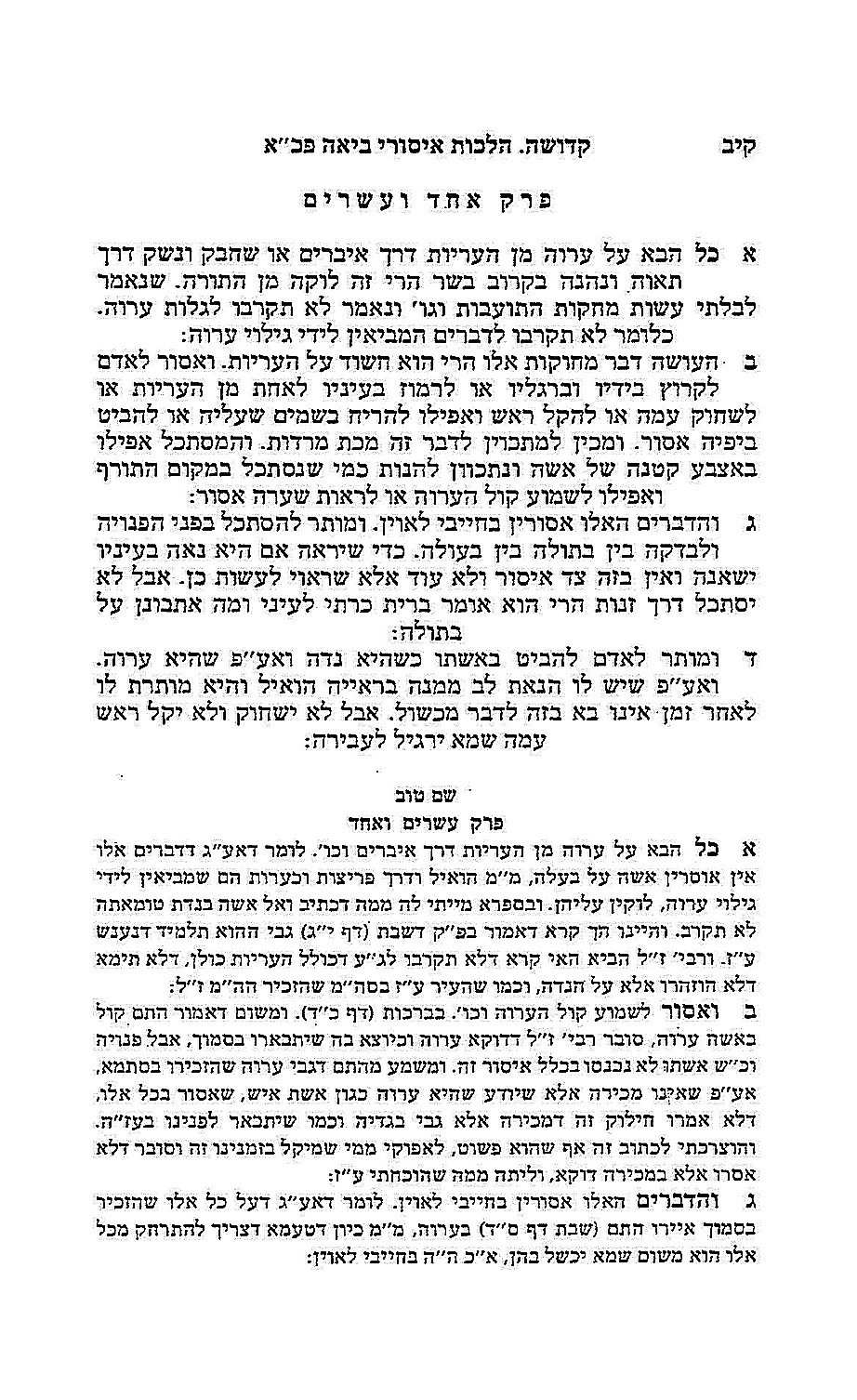
And finally, here is a page from R. Hayyim Kasar’s Shem Tov, a twentieth-century commentary on the Mishneh Torah, Hilkhot Issurei Biah 21:2. While Kasar is quite strict in forbidding a man to hear the voice of an ervah, even if he is not familiar with her, he is also clear that a penuyah means an unmarried woman and that there is no blanket prohibition on hearing her voice, just like there is no blanket prohibition on seeing the hair of an unmarried woman.

I would only add that this makes perfect sense according to Maimonides. If, as Maimonides says, one is permitted to look at an unmarried woman and enjoy her beauty,[30] it stands to reason that one can listen to the singing of an unmarried woman and also enjoy it.[31]

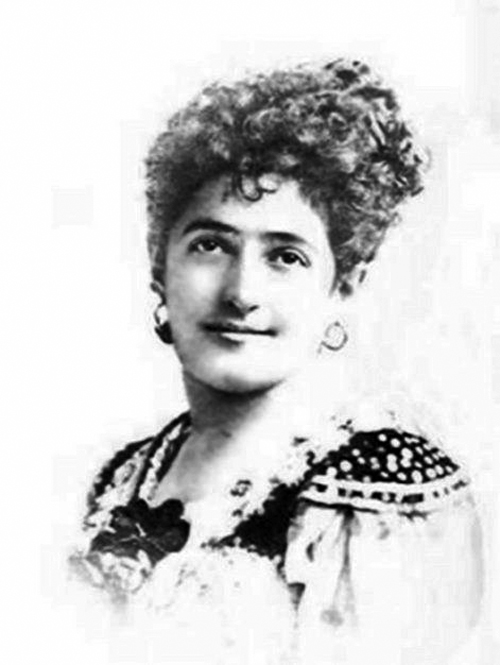
Returning to German Orthodoxy, Der Israelit was the newspaper of the German separatist community. Yet it seems to have had no problem highlighting an Orthodox female opera singer and stressing her commitment to Orthodoxy.[32] Mordechai Breuer called attention to this last point, and I assume that he didn’t have any knowledge of opera or he would have pointed out that the female singer referred to by the paper, Rosa Olitzka (1873-1949), was quite famous in her day. Here is a picture of her.

Right after telling us that Olitzka is the daughter of the hazan of the Berlin Adass Jisroel (i.e., R. Esriel Hildesheimer’s separatist community), Der Israelit mentions her starring as Carmen in the London Opera production. One can find a good deal of material about Olitzka online,[33] and can even purchase recordings of hers.[34] Maybe a reader knows whether she remained observant in her later years.

Breuer also refers to the JüdischePresse’s review of the opera “Samson and Delilah”.[35] While Der Israelit was the paper of the Frankfurt Orthodox, Jüdische Presse was published by the Orthodox of Berlin.[36]

The view that kol ishah is not an absolute prohibition, but depends on whether or not the singing is sensual in nature, was also held by R. Joseph B. Soloveitchik, at least according to R. Aharon Rakeffet.[37] Rakeffet has also reported on a number of occasions that the Rav attended the opera in Berlin.[38] At the Maimonides School first Hanukkah Banquet in 1939, “the program included Betty Brooks, a prominent radio personality singing a variety of Jewish and English songs, Mabel Wingert, a dancer, and Frost and Helene, society dancers.”[39]

R. Ovadiah Yosef’s viewpoint on kol ishah is also worth noting, especially as it has undergone a change. In the first volume of Yabia Omer, published in 1954, R. Ovadiah deals with the following question (Orah Hayyim no. 6):

נשאלתי בדין קול זמר של אשה בגרמפון או ברדיו, אם יש בו משום קול באשה ערוה, וצריך להזהר שלא לשמעו בעת ק”ש ותפלה.
His formulation reflects the notion we have already seen, expressed by some rishonim, that the prohibition of kol ishah is a special prohibition related to shema (and prayer), rather than a general prohibition on hearing women sing (which if sexually arousing would be forbidden on other grounds.)

Here is how he formulates the question and answer in the table of contents:

קול זמר של אשה ברדיו וגרמפון, אין צריך להזהר מלשמעו בשעת ק”ש ותפלה, כשאינו מכיר את המשוררת, ואין בזה משום קול באשה ערוה
We see from here that there is no problem of kol ishah when you are not familiar with the female singer. In other words, you can recite shema and tefillah while hearing this. Again, however, this is not related to the wider issue of sensual songs. If you are “turned on” by hearing a song even if you don’t know the singer, then it is forbidden at all times. But by the same token, since the prohibition of kol ishah is exclusive to shema and tefillah, the implication is that a woman’s voice at other times is not prohibited if it doesn’t arouse sensual feelings.

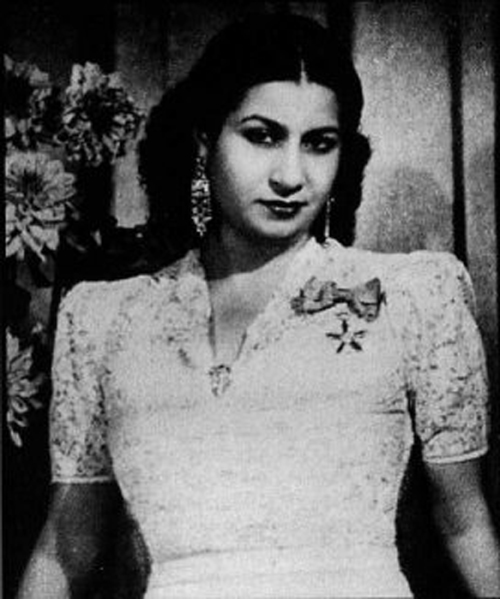
Based on this understanding of R. Ovadiah’s responsum, I don’t think there is a contradiction between this teshuvah and R. Ovadiah’s well known love for the music of the Egyptian singing sensation Umm Kulthum.[40] Here is what Umm Kulthum looked like in her younger years.

If R. Ovadiah’s responsum in Yabia Omer intended a blanket prohibition on hearing the voice of a woman you are familiar with, rather than just confining this prohibition to shema and tefillah, then we would be confronted with a tremendous contradiction between the responsum and how R. Ovadiah lived his own life. It is not like R. Ovadiah wrote something in his responsum and did something else in his private life where people couldn’t see. His love of Umm Kulthum’s music was something everyone knew about, and he listened to it in the company of others. Clearly, therefore, his responsum which prohibits listening to the singing of one you are familiar with only applies during shema and tefillah. At other times, it is only prohibited if one is sexually aroused by the music, and since R. Ovadiah was not, he was permitted to listen to Umm Kulthum. Rabbi J. David Bleich is therefore incorrect when he summarizes R. Ovadiah’s responsum as follows: “Rabbi Yosef concurs in this ruling but adds that it is forbidden to listen to a female vocalist who is known to the listener even if the woman in question is known to him only through photographs.”[41] (I hope no one attempts to argue that R. Ovadiah didn’t know what Umm Kulthum looked like. She was only the most prominent celebrity in Egypt, with her picture everywhere.)

I was also informed by R. Avraham Yosef that his father, R. Ovadiah, later retracted his ruling in this responsum that if you are familiar with the singer that you can’t hear her voice in shema and tefillah. I later saw that R. Ovadiah himself states as much in Yabia Omer, vol. 9 no. 108:43:

ומה שכתבתי שם שאם ראה אותה בתמונה ג”כ, אסור, אינו מוכרח, שיש לומר . . . “ביודעה ומכירה”, זהו רק כשראה אותה בחיים חיותה במלא קומתה

If you hear her voice while you are saying shema or reciting blessings, R. Ovadiah advises וירכז מחשבתו לכוין בברכותיוR. Ovadiah’s words בחיים חיותה במלא קומתה might be taken to imply that even if you know the woman from television, there still is no prohibition of kol ishah.

R. Avraham Yosef states that while it is permitted to hear a woman sing even if you know what she looks like, it is not permitted to attend a live performance or even watch on television. R. Avraham assumes that alllive and television performances are prohibited, not only those that could be sexually arousing.[42] It also needs to be stated that despite how I interpreted R. Ovadiah, that female singing is only prohibited if it is sensual music, the upshot of what R. Ovadiah states throughout his writings is that by definition a live female singer is sexually arousing and thus prohibited. Although I think the evidence shows that R. Ovadiah agrees that theoretically kol ishah is only forbidden if it leads to <>hirhurim >, in practice he assumes that <>alllive female singing falls into this category. (I wonder, however, if he would also forbid the live singing of a very old woman, which would in no way be sensual.)


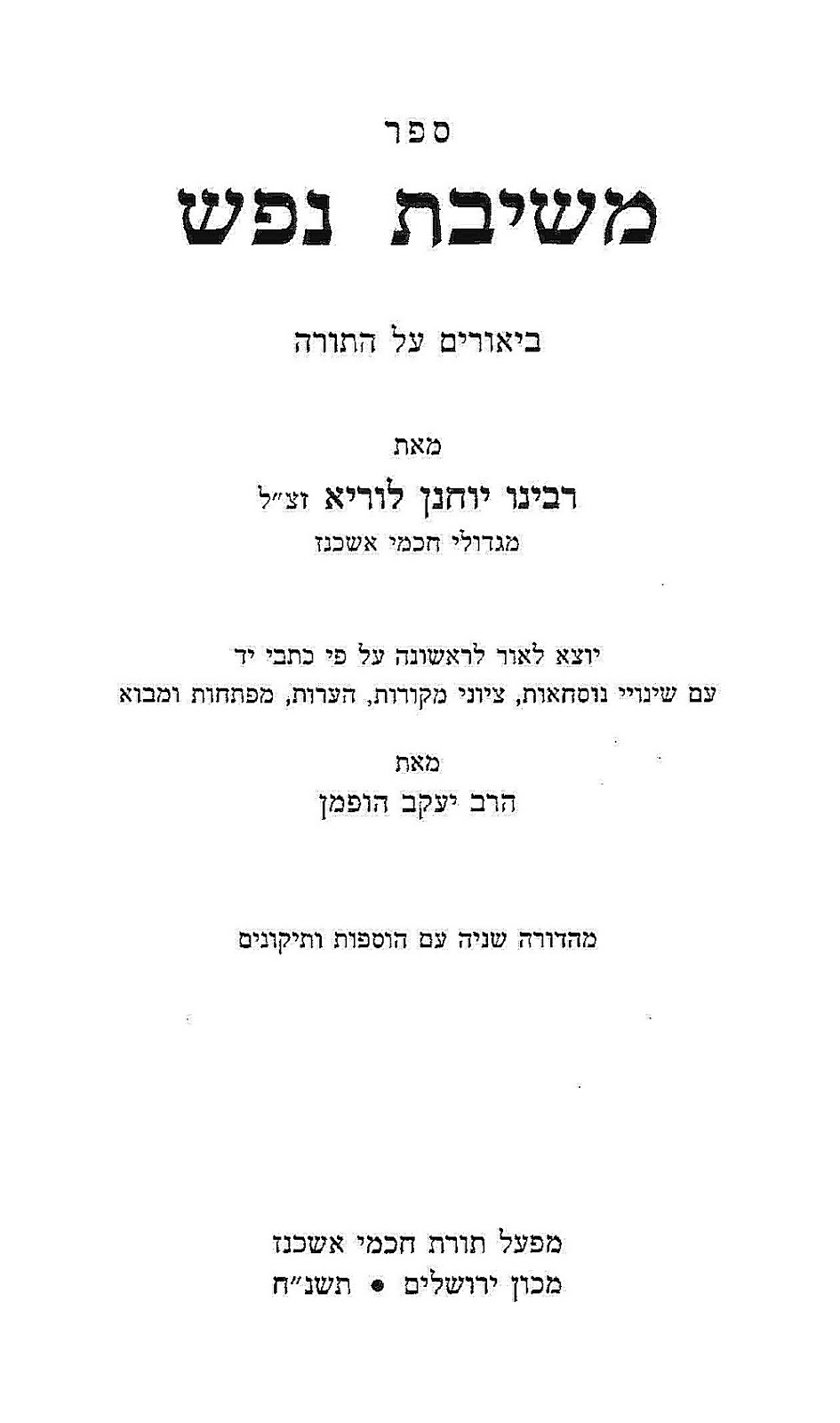
I found another interesting passage regarding kol ishah in the Meshivat Nefesh of R. Yohanan Luria (16th century). On p. 144, after explaining how the women of the desert could sing in front of the men (Ex. 15:21), he writes:

ומזה הטעם ראוי למחות לנשים המשוררות לכלות לפני האנשים רק הבתולות שמותרים בזה כדי לחבב הבחורים לקפוץ עליהם לשם אישות.

He makes the same point on the previous page, and concludes (p. 143):

רק הבתולות ראוי להם שיחבבו עצמם על הבריות לקפוץ אחריהם

What it means is that while married women can’t sing in front of men, unmarried women are permitted to do so in order to attract the attention of the young men, similar to what they did in Temple days when they would dance before the eligible bachelors.

Some might be wondering, how was this permitted since married men will also hear the women sing, and being that they are not in the “market” for a wife, what permission is there for them to listen to and be physically attracted to the young women? I think the answer is obvious, that those men who would have had improper thoughts were not supposed to listen to the women, just as I presume they were not supposed to watch the single women dance in Temple days. Yet the Sages did not ban this dancing because of what some men might be thinking, and similarly, Luria permits the singing by single women and is not concerned that some married men might also be listening. The logic behind Luria’s position is that young men looking for brides are supposed to be attracted to young women. The latter dress up nicely so that the men look at them, they put on makeup for this purpose, and yes, they sing in front of the men, all in order to make themselves attractive.

Here is the title page of Luria’s sefer.

I already mentioned the opera, so before concluding I refer you to S.’s post here.

He points to an early eighteenth-century communal decree in Altona-Hamburg-Wandsbek forbidding attendance at the opera, except for on Hanukkah and Purim when it was permitted. The text is also found in Simhah Assaf, Ha-Onshin Aharei Hatimat ha-Talmud, p. 116.

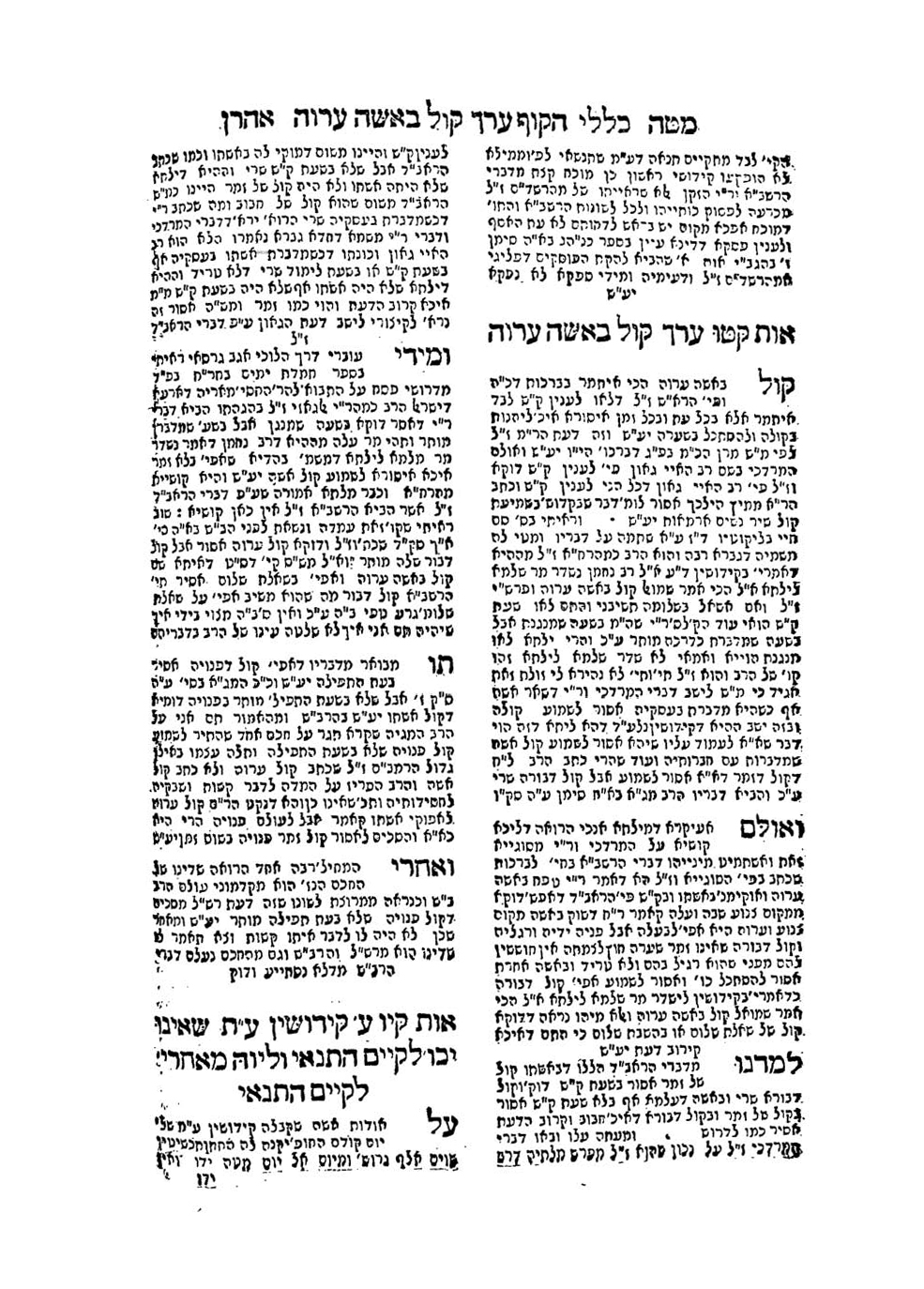
Finally, I would like to point to a very interesting source that as far as I know has never been mentioned in any of the many halakhic articles dealing with kol ishah. I refer to R. Joseph Hayyim’s Imrei Binah, ch. 3, no. 79. Here is the page.

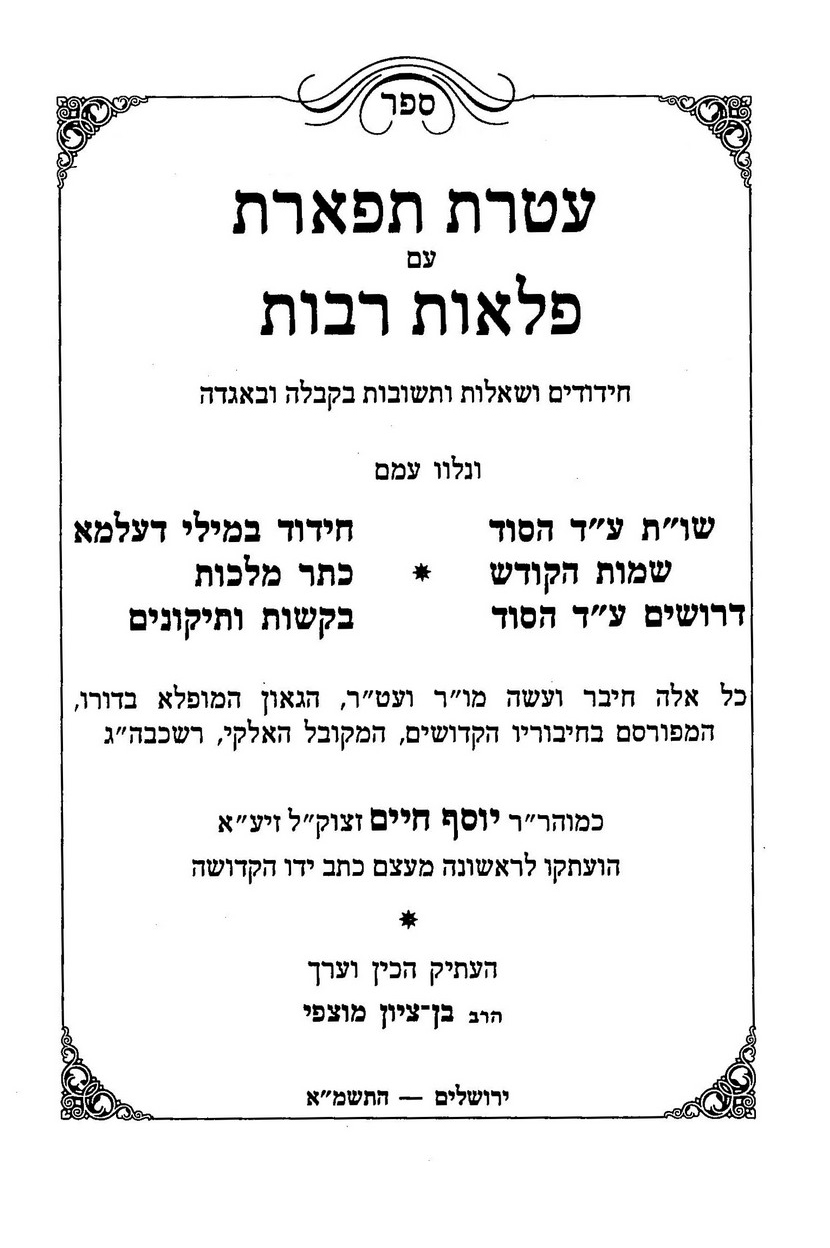
For those who are unclear as to what he means, he explains it himself in his book Ateret Tiferet im Pelaot Rabot. Here is the title page of the book, which for some reason is not on hebrewbooks.org or Otzar ha-Hokhmah. The text that appears in Imrei Binah also appears in this book, and R. Joseph Hayyim’s explanation is found on p. 116 (no. 202).

According to R. Joseph Hayyim, if the singing of an individual woman is accompanied by instruments, meaning that there are “many voices”, then it is permissible. This is an incredible limud zekhut, because pretty much every singer today is accompanied by music.[43]
[1] Referring to the beginning of Esther, where Ahasuerus is said to rule from Hodu to Cush, the Talmud, Megillah 11b, states:
From Hodu to Cush: Rav and Samuel gave different interpretations of this. One said that Hodu is at one end of the world and Cush at the other, and the other said that Hodu and Cush adjoin one another, and that [the meaning is that] as he ruled over Hodu and Cush, so he ruled from one end of the world to the other.
This passage should immediately raise a couple of questions in people’s minds. 1. Since there is no doubt that both amoraim knew where India and Ethiopia were located, why did one of them explain that the two countries are next to each other? How come he didn’t accept the common identification of Cush and Ethiopia? 2. According to the first opinion, that Hodu is at one end of the world and Cush at the other, are we to understand from this that he thought that the world was flat? (I realize that “end of the world” could be used the same way we use it today, but I wonder if that is the peshat.)

[2] See also his commentary to Isaiah 18:1, where he regards Cush as being in the East.

[3] In the last post I spoke a bit about what Rashi regarded as beautiful, based on his commentary to Song of Songs. We also find from other comments of his that he did not regard Cushim as beautiful. Based upon what we have already seen, I assume that for Rashi a Cushi would have an Indian complexion. (See Moed Katan 16b regarding the skin of the Cushites.) In his commentary to Gen. 12:11 he speaks of “black and repulsive people, brothers of the Cushim.” In Num. 12:1 the Torah speaks of the Cushite that Moses married. Rashi does not take this literally and writes: “Because of her beauty she is called Cushite, as one calls his handsome son ‘Cushite’ in order that the evil eye should not have power over him.” (This same passage appears in Midrash Tanhuma 96:13, and see Yitzhak Aviner, Heikhal Rashi [Tel Aviv, 1960], vol. 4, p. 234, that it was inserted from Rashi into the Tanhuma). I think it must be very hard to teach this Rashi in elementary and even high school. One can easily see that if one of the students is a “person of color” or the student’s parent is, that the assumption of this Rashi could be very hurtful to the student. Has any reader had to deal with this?

For the same approach by Rashi, and here too it appears to be his own interpretation (although obviously based on the earlier rabbinic understanding of Cushite), see Sukkah 53a, where it mentions that Solomon had two Cushite servants. Rashi writes:

תרי כושאי: על שם שהיו יפים קרי להו הכי
See Arukh la-Ner, ad loc., who questions Rashi’s explanation, since while the Sages speak of Tziporah as being called Cushite in Num. 12:1 because of her beauty, they never say that a man would be called Cushite if he was handsome. This is precisely why I noted that what Rashi writes here is apparently his own interpretation.

Incidentally, the Artscroll translation to this passage makes as unfortunate error. While the Talmud speaks of “two Cushites”, Artscroll translates תרתי כושאי as “two Cutheans.”


The Vilna Talmud’s version is תרתי כושאי, while Rashi has תרי. Rashi’s text preserves the correct version (see also Arukh ha-Shalem, s. v. כש, p. 348 n. 4) as תרי is masculine while תרתי is feminine. In R. Meir Mazuz’s new book, Darkhei ha-Iyun, p. 5, he deals with these words and calls attention to the common grammatical error when people write תרתי דסתרי. Since דסתרי(=(הסותרים is masculine, the proper formulation is ether תרי דסתרי or תרתי דסתרן.

For more on the identification of Cushite with ugliness, see Jonathan Schorsch, Jews and Blacks in the Early Modern World (Cambridge, 2004), chs. 3-4, and Abraham Melamed, The Image of the Black in Jewish Culture (London, 2003).
[4] “Toponomy of the Targumim,” (unpublished doctoral dissertation, Oxford University, 1974), p. 134.

[5] I think readers will find this document interesting: link (pdf).

It contains the Chief Rabbinate of Israel’s acknowledgment that Hinduism is monotheistic. I don’t even think that one can speak of shituf when it comes to Hinduism. What you have in Hinduism are manifestations of the one God, and this does not appear to violate any Noahide commandment. This is significant since in the Jewish imagination Hinduism has often been seen as a classic example of real idolatry. Thus, right at the beginning of many seforim it states that passages dealing with Gentiles are only referring to idolators in places like India.


Related to the latter point, there is an unbelievable error by the great R. Judah Aszod. In 1833 the Hatam Sofer responded to the following query of a Hungarian rabbi: During Christian religious ceremonies that pass through the city, are Jews permitted to put candles in their windows? The fear was that if the Jews don’t do that, their homes would be attacked on Christian thugs (Hatam Sofer, Yoreh Deah, no. 133 [end]). The Hatam Sofer concluded that while it was permissible to indirectly request a non-Jew to light the candle, it is absolutely forbidden for a Jew to do so.

הישראל אסור לעשות וצריך למסור נפש ע”ז
The same issue is dealt with by the Hatam Sofers’s son in Ketav Sofer, Yoreh Deah no. 84, and a similar issue by his grandson in Da’at Sofer, Yoreh Deah, no. 59. See also R. Eliezer Deutsch, Peri ha-Sadeh, vol. 3 no. 10.

In the Hatam Sofer’s responsum he speaks of the candle lighting that takes place in “India”.

ולענין מה שמסבבים בארץ הודו בע”ז שלהם, וכל הדרים באותו המבוי צריכים להדליק נרות, ויהודים הדרים שם אם אינם מדליקים הם בסכנה מפני ההמונים.
There is no doubt whatsoever that the word “India” is not to be taken literally and that the Hatam Sofer is referring to local Christian practices. After all, he was responding to the question of a Hungarian rabbi! The responsa by his son, grandson, and Deutsch don’t even feel that it is necessary to point this out, as it is so obvious.

It is incredible is that R. Judah Aszod, Yehudah Ya’aleh, Yoreh Deah, no. 170, takes the Hatam Sofer to really be speaking of India, even though as just mentioned, he was responding to a halakhah le-ma’aseh question from Hungary, not from a rabbi in Bombay! This misunderstanding contributes to Aszod’s lenient decision.


לענ”ד הח”ס דוקא קאי על ארץ הודו שמסבבים בע”ז שלהם . . . משא”כ במדינתינו אינו חק המדינה כ”א באיזו מקומות ולא עפ”י המושל אלא מרשעת שונאי ישראל, והדלקת הנרות אצלם נמי רק אין כוונתם להעביר על הדת כ”א שיהודים ישמחו עמהם וזה מותר משום איבה כברמ”א ביו”ד ססי’ קמח . . . וגם בזה”ז לא עובדי ע”ז הן לא מקרי אליל שלהם עכו”ם כמ”ש הש”ך סי’ קנא ס”ק יז.
In this passage he cites two sources. The second one is the Shakh, whom he cites as claiming that the Christian religious item (I assume he means the crucifix) does not have the status of an אליל. However, the Shakh actually says the exact opposite of what Aszod quotes him as saying.

ודוחק לומר דכיון דבזמן הזה לאו עובדי עבודת כוכבים הן לא מיקרי אליל שלהם עבודת כוכבים
The other source he cites is R. Moses Isserles, whose comments are indeed quite significant. I don’t understand why this source is not cited in support of celebrating Thanksgiving even by those who assume that there is some religious component to the holiday.

אם נכנס לעיר ומצאם שמחים ביום חגם ישמח עמהם משום איבה דהוי כמחניף להם ומ”מ בעל נפש ירחיק מלשמוח עמהם אם יוכל לעשות שלא יהיה לו איבה בדבר
Presumably, the opponents of Thanksgiving assume that there is no enmity in not celebrating, so the Rama’s permission doesn’t apply. I wonder though, do the people in Lakewood who require the non-Jewish bus drivers to work on Thanksgiving really think that this insistence doesn’t create enmity?
Returning to the responsum of Aszod, the problems I have pointed to were noted by R. Hayyim Eleazar Shapira, Minhat Eleazar, vol. 1 no. 53:3, and he is dumbfounded. It is precisely with regard to this sort of responsum, where the errors are obvious (misunderstanding the clear meaning of the Hatam Sofer, misquoting the Shakh), and it was published posthumously, that people are often tempted to claim that it is not authentic. I won’t go this far, but is it possible that a student wrote the responsum and Aszod just signed his name without examining it carefully?
[6] As with the other volumes of this series, one can find lots of interesting passages in vol. 4. Here are just a few. P. 56b: Moses opposed the eating of meat, but he could not forbid it because the people would regard this as heresy. P. 98b: Hirschensohn mentions the notion, already expressed by the Vilna Gaon, that sometimes the Talmud’s explanation of the Mishnah is to be understood as a form of derash. In other words, the explanation is not in accord with what the Mishnah really intended. He also refers to Berdyczewski and writes zikhrono li-verakhah after his name. P. 14a: There is no obligation in contemporary times for married women to cover their hair.

וזהוא ההיתר שנוהגים היום ברוב המדינות שהנשים מבנות ישראל הולכות בגלוי הראש, אם שהראשונות שבטלו את המנהג היו נקראות עוברות על דת משה אבל הבאים אחריהם אחרי שכבר נתבטל המנהג אין בזה איסור עוד.
This source has not been mentioned in any of the recent discussions about women’s hair covering. I hope to soon discuss Hirschensohn’s viewpoint at greater length, including his radically new understanding of שער באשה ערוה. I will do so as part of a larger discussion of the issue of women’s hair covering.
[7] See S.’s post here.

[8] R. Moshe Taub reminded me of Artscroll’s commentary to Deut. 34:5, which I neglected to mention in my book.
[9] I had been planning to offer one further example, but I was shown to be wrong. Let me explain: A little while ago R. Natan Slifkin had a post on werewolves, citing R. Efraim ben Shimshon’s strange comments in this regard. See here.

Slifkin earlier had written about this in his Sacred Monsters. None of this was a revelation to me since I had earlier seen the material from R. Efraim in R. Yosef Aryeh Lorincz’ Pelaot Edotekha, vol. 2, pp. 136-137. Not surprisingly, Lorincz takes this all very seriously. Readers might recall that I mentioned Lorincz’ book here. I called attention to his discussion of whether it is permitted to eat the flesh and drink the blood of demons. After this post I had a correspondence with someone who wanted to know what I thought about what Lorincz had written. I told him although I don’t know what the halakhah is in this matter, I nevertheless promise to eat the first demon that Lorincz is able to capture. I further told him that I would even volunteer to shecht it. My correspondent wasn’t seeing the comedy in this, as he thought that this was a very serious issue, that someone whom we are told to respect for his Torah knowledge could actually, in the twenty-first century, be discussing such a matter as a real halakhic problem. He was also adamant that if such a book was published by someone who taught at a Modern Orthodox school, the principal should immediately fire the author. Further correspondence revealed that he also didn’t think that anyone who believed in demons should be allowed to teach at Modern Orthodox schools.

My response to him was that I don’t think we need to get all out of shape about demons. To begin with, and readers can correct me if I am wrong, I don’t think that most people in the American haredi world really believe in demons. Yes, I know they study the talmudic passages that refer to demons, and will mention them as the reason for washing one’s hand three times in the morning, but based on conversations I have had with people in the haredi world (admittedly, most of them from the intellectual elite), I don’t think that they take it seriously. (When I say they don’t “believe” in demons, I mean real belief in the role of demons and how they affect humanity, as expressed in the Talmud and elsewhere.) It is almost like the emperor has no clothes, in that they don’t believe it but continue acting as if they do, afraid of what will happen if they are “outed”. (I have found a similar phenomenon with regard to Daas Torah. I have discussed this issue with many people in the haredi world, and have yet to find even one who accepts the version of Daas Torah advocated by so-called Haredi spokesmen and Yated Neeman.) But even if I am wrong in this, there are lots more important things to keep out of Modern Orthodox schools than an occasional reference to demons. How about the negative comments about non-Jews and even racist statements (sometimes under the guise of Torah) that children are exposed to in Modern Orthodox schools? How about rebbes telling the students that there is such a thing as spontaneous generation, which is akin to telling the students to sign up with Flat Earth society?

Getting back to werewolves, there is someone much better known than R. Efraim who refers to them, namely, Rashi. In his commentary to Job 5:23, Rashi explains that חית השדה means werewolf. (He offers the Old French, for which see Moshe Catane, Otzar ha-Loazim, no. 4208, and Joseph Greenberg, Otzar Loazei Rashi be-Tanakh, p. 211) He further adds that this is also the meaning of אדני השדה (See Kilayim 8:5). I have to admit that I was all set in this post to mention that Artscroll, which always cites Rashi’s interpretation, in this example chose to omit it. Without even examining the commentary, I was sure that Artscroll would choose to avoid mentioning anything about werewolves. Yet when I actually opened up the commentary, prepared by R. Moshe Eisemann, I was pleasantly surprised to see that he indeed tells the truth, and the whole truth, i.e.,, that Rashi was referring to a werewolf. I found something else in this volume that I didn’t expect. In an appendix he discusses whether the commentary attributed to Rashi was actually written by him. Unfortunately, Eisemann did not feel that he should inform the reader which academic sources he used in preparing this appendix.
[10] I don’t understand why Artscroll uses this word. The overviews found at the beginning of their books are actually not overviews. (Look up the word if you are not sure what it means). They should have been called what they are, namely, “introductions.”
[11] The Talmud explains sharim ve-sharot as מיני זמר, and Rashi, Eccl. 2:8, clearly based on the Talmud, explains sharim ve-sharot as מיני כלי זמר. Either Rashi’s text of the Talmud also included the word כלי , or this is how he understood the talmudic expression מיני זמר. (Literally, מיני זמר means “types of music”, and when the word כלי is added it means “various musical instruments.”)
[12] His commentary, Ta’alumot Hokhmah, is found in the standard Mikraot Gedolot.
[13] According to R. Jehiel Jacob Weinberg, the Rambam’s opinion is that kol ishah is only forbidden if one derives sensual pleasure from it. See Seridei Esh, vol. 2 no. 8.
[14] See here.
[15] See here.
[16] See here.
[17] R. Yuval Sherlo does not permit one to attend the opera, but if one is stuck in a situation, such as a soldier at a military event, then he rules that it is permissible to remain even though women are singing. See here.
[18] Conversations 12 (Winter 2012), pp. 43, 47; also available here. At the end of the article, Angel concludes: “Married women need not cover their hair, as long as their hair is maintained in a modest style. The wearing of wigs does not constitute a proper hair-covering for those married women who wish to cover their hair. Rather, such women should wear hats or other head coverings that actually cover their hair.” He also discusses hair covering on YouTube here.
[19] “Kol Ishah Bimeinu,” Tehumin 29 (2009), p. 143.
[20] See Seridei Esh, vol. 2 no. 8, and see also the helpful summary of positions available here.

[21] In support of this view, one can cite Hagahot Maimoniyot, Hilkhot Keriat Shema 3:16:
וקול אע”ג דאינה נראית לעינים הרהור מיהא איכא וכל אלה דוקא שאין רגילות להגלות אבל בתולה הרגילה בגלוי שער לא חיישינן דליכא הרהור וכן בקול לרגיל בו
[22] It seems to me that Tendler’s description of R. Moshe’s opinion is contradicted by Iggerot Moshe, Orah Hayyim 1, no. 26, Orah Hayyim 4, no. 15.

[23] For a contemporary example of an Orthodox synagogue allowing women to sing, see here.

[24] See e.g., here, here, here and here.
[25] Foundations of Sephardic Spirituality (Woodstock, VT, 2006), p. 186.
[26] Jewish Women in Time and Torah (Hoboken, 1990), p. 62. Berkovits also understood the matter of women’s hair covering in the same fashion, and did not regard it as an obligation in contemporary times (heard from Berkovits’ son, Prof. Avraham Berkovits).

[27] See here.
[28] Note the language of the Shulhan Arukh, Even ha-Ezer 21:1: ואסור לשמוע קול ערוה או לראות שערה

I don’t think anyone today assumes that there is a prohibition in seeing the uncovered hair of an ervah, if one is not sexually aroused, the reason being that we see it all the time and are thus used to it. By the same logic, if one is unaffected by hearing a woman sing, even if she is married, there should be no prohibition even according to how I explained the Ba’er Heitev. This is indeed the conclusion of R. Aharon de Toledo, Divrei Hefetz (Salonika, 1795), p. 113a:

עלה בידינו דהא דאמרי’ קול באשה ערוה היינו כשהיא הומיה ושוררת שירי עגבים ומתכווין ליהנות ממנה
However, the subsequent words of Toledo show that he only permits listening to a woman who is singing non-sensual songs on her own. He specifically forbids female songs directed towards men, as in a concert.

[29] The verse from Job is used in an Aggadic sense in Bava Batra 16a and Avot de-Rabbi Nathan, ch. 2, and then used by Maimonides in Hilkhot Issurei Biah 21:3.


ומותר להסתכל בפני הפנויה ולבודקה, בין בתולה בין בעולה, כדי שיראה אם היא נאה בעיניו, יישאנה; ואין בזה צד איסור. ולא עוד, אלא ראוי לעשות כן. אבל לא יסתכל דרך זנות, הרי הוא אומר “ברית, כרתי לעיני; ומה אתבונן, על בתולה”
Since he cites a verse from the book of Job, it appears that looking דרך זנות is only a rabbinic prohibition.
[30] Commentary on Sanhedrin 7:4. What this means is that one can look at a possible future wife and appreciate her beauty, for after all, one is supposed to be attracted to her. As we have seen already, in Hilkhot Issurei Biah 21:3, Maimonides adds a caveat. He states that is forbidden to look at an unmarried woman דרך זנות. What this means is that while one can look at and admire the beauty of a single woman (what I earlier referred to as “moderate sensual thought), one cannot leer at her, i.e., with lascivious intent.
[31] When Maimonides speaks of enjoying an unmarried woman’s beauty, I am certain that he is speaking of a Jewish woman, whom you can marry.
[32] Breuer, Modernity Within Tradition, p. 150. See Der Israelit, April 5, 1894, p. 503. See my post here, where I deal with the unsubstantiated rumor that Hirsch attended the opera. I quote from Prof. Breuer’s email to me where he writes: “When I went to the opera as a boy of 13-14 years my father [Isaac Breuer] did not express his dissatisfaction.”

[33] See e.g. here.
[34] See e.g. here.
[35] Modernity Within Tradition, p. 150.
[36] Since I am speaking about German Orthodoxy, let me use this opportunity to correct something I wrote. In Between the Yeshiva World and Modern Orthodoxy, p. 53, I record the recollection of Judith Grunfeld, “daughter of a learned German rabbi,” that she had never heard of a prohibition against women singing in front of men until she went to Poland (where she taught at the Beth Jacob school). Dr. Yitzchok Levine pointed out to me that Grunfeld’s father, while living in Germany, was actually Hungarian.
[37] Listen to his shiur from Feb. 8, 2010, available here, beginning at 48:20. Rakefet also quotes R. Aharon Lichtenstein that the Rav held that in modern times there is no obligation for married women to cover their hair. Listen to the shiur just mentioned beginning at 62 minutes. I will return to this point in a future post when I deal with R. Michael Broyde’s article on the topic.

[38] See, however, R. Hershel Schachter, Mi-Peninei ha-Rav, p. 269, that the Rav told YU students that due to kol ishah it was forbidden for them to sell tickets to the opera (presumably referring to the annual YU fundraising event). This is not necessarily a contradiction to Rakefet’s point. If the Rav felt that a woman’s singing voice was only prohibited if it was sexually arousing, who can say if that applies to the person you sell the ticket to? Perhaps that is why he told them it was prohibited.
[39] Seth Farber, An American Orthodox Dreamer: Rabbi Joseph B. Soloveitchik and Boston’s Maimonides School (Hanover, NH, 2004), p. 165 n. 19.
[40] See Zvi Alush and Yossi Elituv, Ben Porat Yosef (Or Yehuda, 2004), p. 37. See p. 408 that to this day he listens to her music, and see also the testimony to this in Or Torah, Tevet 5770, pp. 383-384. According to R. Avraham Shammah, cantors used her tunes for various tefillot, a practice that continues to this day. See here, p. 10.
[41] Contemporary Halakhic Problems, vol. 2 p. 151. One could be led to this summary by reading the conclusion of the responsum, which states as follows:

המורם מכל האמור דביודעה ומכירה אפי’ ע”י תמונה אסור לשמוע קולה בגרמפון או ברדיו, אבל אם אינו מכירה מותר, ואין בזה משום קול באשה ערוה.
However, this conclusion needs to be read in conjunction with the question as well as the summary of the answer in the table of contents, both of which are quoted in the text and clearly state that the issue is kol ishah in the context of shema and tefillah.

[42] See here.

[43] For another important limud zekhut by R. Joseph Hayyim, see here. In the newly translated text, we see that R. Joseph Hayyim believed that the practice of European Jewish women to go with uncovered heads can be justified, and is not to be regarded as sinful.


ArtScroll and More

ArtScroll and More
by Marc B. Shapiro
Continued from here.
1. As mentioned, I believe that on occasion ArtScroll is unaware that the text it is explaining is a censored text. Sometimes it might even be an internally censored text (i.e., censored by Jews so as to avoid difficulties with the non-Jewish authorities). This same problem is often found with aharonim. How about with rishonim? For example, was Rashi ever misled by an internally censored text? I would hesitate to say so but this is exactly what is suggested by R. Elijah David Rabinowitz-Teomim (the Aderet), though he piously prefaces his remarks with the words לולי דברי רש”י.
Sanhedrin 58b states:
Resh Lakish said: A heathen who keeps a day of rest, deserves death, for it is written, “And a day and a night they shall not rest” (Gen. 8:22), and a master has said: Their prohibition is their death sentence. Ravina said: Even if he rested on a Monday.
The Aderet sees it as obvious (פשוט) that the original version of Ravina’s statement was “Even if he rested on Sunday,” and this was changed to “Monday” due to fear of the Christians.[1] Rashi, however, offers an explanation as to why “Monday” is mentioned, meaning that if the Aderet is correct then even Rashi was misled by the altered text.[2]
As part of his explanation on this passage, Rashi also writes: אחד בשבת ששובתין בו הנוצרים. This is the authentic version of Rashi which appears in the early Talmud printings. It is also found in Steinsaltz and Oz ve-Hadar. The censored Vilna Talmud, followed by ArtScroll, omit the word הנוצרים.
Even in the censored Vilna Talmud the word הנוצרים appears in Ta’anit 27b where we find the following:

Our Rabbis have taught: The men of the Mishmar prayed over the sacrifice of their brethren that it may be favorably accepted, whilst the men of the Ma’amad assembled in their synagogues and observed four fasts, on Monday, Tuesday, Wednesday and Thursday of that week. On Monday [they fasted] for those that go down to the sea; on Tuesday for those who travel in the deserts; on Wednesday that croup may not attack children; on Thursday for pregnant women and nursing mothers, that pregnant women should not suffer a miscarriage, and that nursing mothers may be able to nurse their infants; on Friday they did not fast out of respect for the Sabbath; and certainly not on the Sabbath. Why did they not fast on Sunday? — R. Johanan said: Because of the Christians (הנוצרים). R. Samuel b. Nahmani said: Because it is the third day after the creation of Man. Resh Lakish said: Because of the additional soul. For Resh Lakish said: Man is given an additional soul on Friday, but at the termination of the Sabbath it is taken away from him, as it is said, “He ceased from work and rested” [shavat va-yinafash], that is to say, once the rest had ceased, woe! that soul is gone.

There is something very strange about this passage, and yet it is not noted in Soncino, ArtScroll, Koren, or by R. Zvi Hirsch Chajes whom I could have expected to pick up on it. I assume that most people read this passage without even realizing the problem, which for the rishonim was not a problem as I will explain. The Sages, in describing what went on in Second Temple days, make clear that the men of the Ma’amad did not fast on Sunday. R. Johanan, who lived in third-century Eretz Yisrael, says that this was because of the Christians. Rashi explains that the Christians “make this day [Sunday] their holiday.”[3] R. Gershom, in his commentary on the passage, writes that the Christians’ “holiday is on Sunday and if the Jews would fast they [the Christians] would be angered.”[4]
The problem with all this is that in the days of the Second Temple there was no significant Christian community for Jews to be concerned with. Furthermore, these early followers of Jesus would not have observed the Sabbath on Sunday.[5] I think the answer to this problem is that the talmudic sages regarded Jesus as a student of R. Joshua ben Perahyah who flourished in the latter part of the second century BCE (i.e., ca. 130-100 BCE). In other words, in the talmudic conception Jesus lived at least a century earlier than the historical record tells us, and the amoraim assumed that the Christianity as they knew it was also practiced centuries before. Robert Travers Herford writes: “R. Johanan transferred to the time of the Temple a feature of the religious life of his own totally different time.”[6] The predating of Jesus’ life was also shared by the rishonim, which explains why the chronological problem did not trouble them.
Ketubot 102b states:

If a man died and left a young son with his mother, [and while] the father’s heirs demand, ‘Let him be brought up with us’, his mother claims, ‘My son should be brought up by me’, [the son] must be left with his mother and may not be left with anyone who is entitled to be his heir. Such a case once occurred and [the heirs] killed him ער”ה.

What does ער”ה mean? The first thing to note is that these letters are not part of the original talmudic text. In talmudic manuscripts, the writings of the rishonim, and also the early printed editions in Pesaro and Venice, the uncensored text reads “killed him on the eve of Passover.”[7] Because this is the authentic reading, this is how it appears in Steinsaltz, Koren, and Soncino. ArtScroll, however, translates the last words of the passage as “They butchered him on the first evening of his stay,” reading ער”ה as ערב הראשון.
ArtScroll’s action is quite strange, as there is absolutely no question what the authentic reading of the text is. Not only does ArtScroll translate the false acronym, but it even offers an explanation of it. “They were so eager for his blood that he did not even last a single night with him. They killed him on the evening of his arrival.” This is wildly incorrect as the acronym ער”ה is simply a printer’s invention.
ArtScroll continues its explanation as follows:

The words ערב הראשון, the first evening, are not actually found in the Baraisa. Rather, the Baraisa contains an acronym – ער”ה – which is read as ערב הראשון (see Rosh; Mesoras HaShas). Another interpretation of this acronym reads it as ערב הפסח, on Pesach eve (Meiri; Hagahos Yavetz)

This note also needs to be corrected as there is no dispute among rishonim about how to how to read the acronym, as the acronym did not exist in the days of the rishonim. It is an invention of one of the printed editions. Thus, contrary to what the note states, Meiri never gave an interpretation of the acronym to mean ערב הפסח. Rather, these words were in his text of the Talmud, and they were also in the Rosh’s text of the Talmud and appear in the manuscripts of the Rosh. The printed version of the Rosh has been “corrected”, just like the text of the Talmud and Rif was “corrected”.[8]
Why did printed editions of the Talmud begin to use the acronym? This talmudic passage was cited by anti-Semites to support the blood libel, namely, that Jews would kill Christian children before Passover to use their blood.[9] Thus, this “correction”, like so many others, was designed to undermine anti-Semitic attacks against the Talmud.[10]       
Seth Leibowitz called my attention to the Stone Chumash, p. 407, where in the introduction to the Ten Commandments it states:

Rambam (Moreh Nevuchim II:32) comments that they only heard the first two [commandments] from God, but they could hear only the sound of the Divine voice, as it were, and could not understand the words He was saying. . . . Thus, the people experienced prophecy, for they heard God’s voice, but their faith in Moses was reinforced, because only he understood what God was saying.

The first thing to note is that the reference should be II:33 not II:32. The passage just quoted states that the people experienced prophecy. Does Maimonides say this? Guide 2:33 is a very difficult chapter and any interpretation given can be challenged with alternative perspectives. (See Yaakov Levinger, Ha-Rambam ke-Filosof u-khe-Fosek, ch. 3.) Yet I think I am on safe ground in saying that Maimonides does not believe that what the people as a whole experienced is to be regarded as prophecy. While Guide 2:33 might be ambiguous in this matter, the previous chapter, 2:32, states explicitly: “As for the Gathering at Mount Sinai, though through a miracle all the people saw the great fire and heard the frightening and terrifying voices, only those who were fit for it achieved the rank of prophecy, and even those in various degrees.”
Shem Tov explains:
ואחר שסלק הרב אלו הטעיות אשר יראה מהם שהשם ינבא כל איש מבני אדם, סלק מעלינו ספק גדול והוא מעמד הר סיני אשר אנשים ונשים סכלים ובלתי ראויים כל היו נביאים וזה יביא לחשוב שהשם ית’ ינבא כל מי שירצה מבלתי שיהיה מוכן, ואמר שאף שכלם היו רואים האש הגדולה ושומעים הקולות הנוראות המפחידות וזה היה על צד הפלא, לא הגיע למדרגת הנבואה אלא הראוי לה והראויים יתחלפו מדרגותיהם ג”כ
Finally, so that all the attention is not on ArtScroll, the following point was called to my attention by Benjamin Apfel. Here is the first page of Jastrow’s introduction to his dictionary. Read the last paragraph.

Here is the first page of Philip Birnbaum’s introduction to his translation of sections of the Mishneh Torah.[11]
The first paragraph is lifted from Jastrow. Would it have been so difficult for Birnbaum to simply add a note indicating that he was adapting Jastrow’s words?
2. In my post here I referred to selections from Rashbam’s commentary on Psalms that were recently printed from manuscript. This should be distinguished from Rashbam’s commentary on Psalms published in Vienna in 1816 by Isaac Satanow. Here is the title page which tells us that the manuscript comes from the royal library in Berlin.
This commentary on Psalms is a forgery. While the volume is attributed to Rashbam it was actually written by Satanow. Regarding this forgery, David Rosin writes as follows:[12]
הכי קרא שמו יצחק ויהי כצחוק בעיניו להתחפש במעטה רבנו שמואל ולעשות מעשהו ולעבוד עבודתו. זר מעשהו ונכריה עבודתו, כל השומע יצחק לו
3. In my post here I quoted R. Moses Isaac Ashkenazi in his Ho’il Moshe that King David is not to be regarded as a prophet as he only had ruah ha-kodesh. One of the commenters wrote:

Rashi Megilla 14a quotes a Halachot Gedolot which names David as [a] prophet. Rashi speaks specifically about prophets as opposed to Ruach Hakodesh, and excludes Daniel based on Megilla 3a.

 Another commenter was more strident:

Wonderful example how modern scholars have no place in the Torah world! As first commenter pointed out, Dovid Hamelech is prominent in the list of 48 neviim, and there are scores of sugyos based on the nevuah of DH. The makom mizbeach, etc. Pure AmHaaRatzus!

I am not sure if I am the am ha-aretz he is referring to, which in any case would be uncalled for since I never said that David only had ruah ha-kodesh and was therefore not a prophet. All I did was point out that R. Moses Isaac Ashkenazi said this. When I called the commenter’s attention to the fact that his strong words were directed against R. Ashkenazi, he wrote:

I wouldn’t start up with Hoil Moshe, but was pointing out the danger of someone reading this post, and then taking it at face value. For anyone fluent in Shas they will find numerous references to DH’s nevua. Ruach HaKodesh wouldn’t work for all the halachos we learn out from DH. . . . I do thoroughly enjoy your posts, but find them quite dangerous. I would prefer my children at least stick to Artscroll and have their basics –DH’s nevua – straight!

Now let me say something that I did not put in the comments because I want the entire audience to see it, not just the tiny group that reads the comments. The commenter just quoted is a perfect example of one who is certain of something, and certain that the opposing position is incorrect, and this leads to very harsh language. Let’s leave aside R. Moses Isaac Ashkenazi who is not an important scholar. All would agree that R. Moses Sofer, the Hatam Sofer, is important and certainly not an am ha’aretz (which is the term the commenter used). Yet the Hatam Sofer is explicit that David was not a prophet and only had ruah ha-kodesh, which is exactly what R. Ashkenazi states and what the commenter so harshly attacks. Here are the Hatam Sofer’s words in Torat Moshe ha-ShalemBa-Midbar, p. 74.

הנה לא מצינו לישראל מלך שיהי’ גם נביא משולח לעם כי אם משה רבינו ע”ה, דכתיב גבי’ (דברים ל”ג ה’) ויהי בישורון מלך, אבל שארי נביאים לא היו מלכים והמלכים לא התנבאו, ודוד המלך ע”ה רה”ק הו”ל ולא נבואה, ולכן אחז”ל (גיטין נ”ט ע”א) מימות משה עד רבי לא מצינו תורה וגדולה במקום אחד, דאלו כל הנביאים היו עליהם בגדולה השופט והמלך שבימיו, וכל המלכים אפי’ דוד ושלמה היו הנביאים שבדורם גדולים מהם בתורה . . . שהרי אין מלך נביא.

This notion, that the kings were not prophets (other than Moses), is also stated in Zohar, Terumah, p. 154a, and this is presumably the Hatam Sofer’s source. I don’t deny that there are other authoritative sources that contradict this, including passages in the Talmud. Some of them are cited by R. Reuven Margaliyot in his note to the Zohar, ad loc., and we can speculate as to why the Hatam Sofer preferred the Zohar over these other sources. I cite this only to show that commenters should be very careful before labeling something as am ha’aratzus, as you never know whom you might be insulting with this comment.

4. The latest book in my series with Academic Studies Press has recently appeared. It is Sara Reguer, My Father’s Journey: A Memoir of Lost Worlds of Jewish Lithuania. (Reguer is the granddaughter of R. Simcha Zelig Reguer, the dayan of Brisk.) Here is the book’s description.

Born into a leading Lithuanian-Jewish rabbinic family, Moshe Aron Reguer initially followed the path of traditional yeshiva education. His adolescence coincided with World War I and its upheavals, pandemics, and pogroms, as well as with new ideas of Haskalah, Zionism, and socialism. His memoir, recently discovered and here translated and published for the first time, discusses his internal struggles and describes the world around him and the people who influenced him. Moshe Aron Reguer wrote his memoir at the age of 23, on the eve of his departure for Eretz Israel in 1926. However, his story did not end there, but continued in British Mandated Palestine and the United States. He kept in touch with the family in Brest-Litovsk until the Nazis destroyed Jewish Lithuania, and some of their correspondence is included within this volume.

Anyone who is interested in Jewish Lithuania and the great yeshivot will find this book of value.

I also want to call attention to the recent publication of Menachem Kellner, Jewish Universalism, edited by Hava Tirosh-Samuelson and Aaron W. Hughes. Kellner’s work has made a great impact, not only in Jewish scholarship but among thinking Jews in general. This small volume is a wonderful read and contains an intellectual portrait of Kellner written by James A. Diamond as well as a lengthy interview with Kellner.

This book is number 12 in Brill’s Library of Contemporary Jewish Philosophers. Here is what has appeared so far and what if forthcoming (taken from the Brill website).

Published Volumes

Vol. 1: Eliezer Schweid: The Responsibility of Jewish Philosophy
Vol. 2: Jonathan Sacks: Universalizing Particularity
Vol. 3: David Novak: Natural Law and Revealed Torah
Vol. 4: Eugene B. Borowitz: Rethinking God and Ethics
Vol. 5: Elliot N. Dorff: In Search of the Good Life
Vol. 6: Judith Plaskow: Feminism, Theology, and Justice
Vol. 7: David R. Blumenthal: Living with God and Humanity
Vol. 8: Moshe Idel: Representing God
Vol. 9: Lenn E. Goodman: Judaism, Humanity, and Nature
Vol. 10: Avi Sagi: Existentialism, Pluralism, and Identity
Vol. 11: Elliot R. Wolfson: Poetic Thinking
Vol. 12: Menachem Kellner: Jewish Universalism

Forthcoming Volumes

Vol. 13: J. David Bleich: Where Halakhah and Philosophy Meet (est. October 2015)
Vol. 14: Michael Fishbane: Jewish Hermeneutical Theology (est. October 2015)
Vol. 15: Norbert M. Samuelson: Reasoned Faith (est. November 2015)
Vol. 16: Arthur Green: Hasidism for Tomorrow (est. January 2016)

5. The issue of truth-telling in halakhic matters, discussed in the last chapter of my new book, has been of interest to many people. I did not want to be too lengthy in my response to Aryeh Frimer here, because it was not my own independent post. So let me now add some more details. DG reminded me of the following source. According to R. Jacob Moellin, when the Talmud states that a law is rabbinic but a verse is brought as an asmachta, this was done so as to mislead the people into thinking that it is a Torah law so that they would observe it more carefully.[13] In other words, the Sages were engaging in falsehood for a higher purpose.

This is exactly the sort of thing that Frimer claimed is not part of mainstream halakhic thought, a point which I disputed. It also is very relevant to my discussion of the dispute between the Hatam Sofer and R. Zvi Hirsch Chajes regarding “raising the prohibition”. Here are the Maharil’s words, as quoted by his student.

כל היכא דאיתמר מדרבנן הוא וקרא אסמכתא בעלמא, הכי פירושו ודאי תקנתא דרבנן הוא והם יצאו ובדקו ומצאו להם סמך מקרא, וסמכו דבריהם עליו כדי להחזיקם שיהיו סבורים דהוא מדאורייתא ויחמירו בו, ולא אתו לזלזל ולהקל בדברי חכמים

In the notes to this text, the editor informs us that one of the manuscripts has a different version. Instead of כדי להחזיקם שיהיו סבורים it reads להטעות הבריות שהם סבורים. This text is even more explicit that the Sages were not being honest with the masses. This manuscript has a handwritten note explaining that instead of reading להטעות הבריות it should say להטעים לבריות because the word להטעות is a דבר מגונה . In other words, the person who made this “correction” was troubled by the explicit statement that the Sages would deceive people, even if it was for a higher cause.

If there is one thing people have learnt from my posts over the years, it is that whenever you find a passage that diverges radically from what others think is appropriate, you will find those who deny the passage’s authenticity. In this case, the most prominent of the deniers is R. Joseph Engel[14]:

לענ”ד לא מיסתברי כלל ולא אאמין כלל שיצאו מפה קדוש המהרי”ל ז”ל

R. Simhah Klein writes[15]:
וכי ישקרו חז”ל לחזק דבריהם שיהיו סבורין דהוא דאורייתא

However, R. Eliyahu Bohbut is not at all bothered by the claim of the Maharil that the Sages engaged in a form of deception vis-à-vis the masses. After quoting the passage he explains matter-of-factly[16]:

כלומר דאסמכתא באה כביכול “להטעות” את העם שיסברו דאיכא איסור דאורייתא “ויחמירו בו”

Regarding one of the other matters I discussed in the book, namely, so-called “Orthodox history”, the folllowing appears in Divrei David (p. 30a), a collection of teachings of R. David Moses Friedman, the first Chortkover Rebbe.

פ”א סיפרו לפניו על איזה מעשה שאדמ”ור מרוזין זי”ע סיפר אותו פעם בסינגון זה ופעם בסיגנון אחר אמר על זה מרן אדמ”ור זי”ע שהסיפורי מעשיות שמספרים הצדיקים הוא לפי מה שצריך באותו שעה

This is an acknowledgment that the stories told by the rebbes are not really history, as they are designed to serve the needs of the present. As I think most people today realize, haredi “historical” writing in general is as much about the present as the past, and it is precisely because of this that authors feel it is legitimate to cover up or even alter the historical record in order to best serve the religious needs of the present.

Finally, a few people have asked about what I wrote on p. 244, that the strand of Jewish tradition that countenances falsehood “deserves to be understood in a sympathetic manner as well”. This does not mean that people need to agree with those who countenance falsehood, and I certainly do not. However, in writing an academic study as opposed to a polemic, it is important to recognize that approaches that today we might regard as unacceptable, were viewed very differently in other times and cultures (and for some, these “other times and cultures” continue into our own day). I am interested in understanding what leads people to diverge so dramatically from a value that I regard as important. In my book I did not set out to judge them, but in a sympathetic manner, i.e, with a sensitivity to their worldview, attempt to understand them. (When I used the word “sympathetic”, I did not mean that I approved of what I was describing, only that I was sensitive to the motivations behind the approach.) By the same token, when I see that great figures from earlier years have written troubling things about non-Jews or women, I also approach this in a sympathetic manner, understanding that for these people, living in a vastly different time and often suffering under terrible anti-Semitism, it made sense that they would express certain thoughts that today pretty much everyone regards as unacceptable. One need not be a complete historicist to acknowledge that all people are influenced by their era, for good and for bad. This is what I mean by understanding in a sympathetic manner.

Coming Soon: R. Ysoscher Katz and Modern Orthodox Halakhah; The Nineteenth- and Early Twentieth-Century Dispute Regarding the Historicity of the Hanukkah Miracle; R. Steinman and the Messianic Belief; R. Mazuz’s Short-Lived Entry into Politics; and a response to R. Aharon Lopiansky’s article in Dialogue.


[1] See his note in Mekabtzi’el 36 (2009), p. 64.
[2] Was Maimonides ever misled by a censored text? According to R. Eliyahu Zini, Eretz Hemdatenu, p. 75, this was indeed the case. Mishneh Torah, Hilkhot Avodah Zarah 9:13 states:
 המוכר ביתו לעבודה זרה דמיו אסורין בהנייה ויוליך אותם לים המלח
As Kesef Mishneh and others point out, the origin of this halakhah is Gittin 44a. Yet the authentic reading there is המוכר ביתו לגוי (the Vilna Talmud has לעובד כוכבים). As Dikdukei Soferim ha-Shalem (Jerusalem, 2001), ad loc., informs us, לגוי is the reading in all surviving manuscripts and early printings. Meiri, ad loc., explains the halakhah as follows:
שהמוכר בית לגוי בארץ ישראל ר”ל לאחד מעובדי האלילים דמיו אסורים מתורת קנס על שנתן לעובדי האלילים חנייה בקרקע
Since Maimonides had the reading לעבודה זרה, R. Zini concludes that the talmudic manuscript he used had been altered. This is much more compelling than the explanation offered by Kesef Mishneh and Lehem Mishneh that Maimonides interpreted לגוי to mean לעבודה זרה.
Yet there is no doubt that R. Zini is incorrect. As has been pointed out by many, one who examines Tosefta, Avodah Zarah 7:2, will see that this, and not Gittin 44a, is the source for Maimonides, and Kesef Mishneh and Lehem Mishneh were simply unaware of this source. It is significant that לעבודה זרה appears even in manuscripts of the Tosefta. 

Regarding Tosefta, Avodah Zarah 7:2 and Gittin 44a, I assume that only one of the versions preserves the authentic text, but I don’t think we can determine which one it is. The only thing that remains to be explained is why Maimonides did not codify the halakhah in Gittin 44a. (It could be that his version of Gittin 44a was indeed the same as that which appears in the Tosefta, but this has nothing to do with censorship.)

[3] Kesef Mishneh, Hilkhot Melakhim 10:9, cites Rashi. You can see the uncensored text of Kesef Mishneh in the Frankel edition. The version of Kesef Mishneh that appears in older editions of the Mishneh Torah is a censored text, and instead of recording Rashi’s statement about Sunday, the following appears: או בע”ש ששובתים בו הישמעלים. For printers in the Christian world there was no problem speaking about Muslim beliefs and practices, so in this case the original statement, made with reference to Christians, was substituted with one referring to Muslims. The printers who made this “correction” had the same misconception as many today, namely, that Friday is a day of rest for Muslims. It is not. Friday is a day of gathering for prayer, but Muslims do not have a sabbath, i.e., a day of rest.
[4] Interestingly, I found an anonymous medieval Italian text that records a “minhag tov” not to eat meat on Sunday. One reason offered is kevod Shabbat, namely, by having meat so soon after Shabbat one lessens the special nature of this day in which meat is the main dish. (Obviously, meat was not regarded as an everyday meal in this author’s time and place.) The second reason is מפני קלון הנוצרים. What this means is that since Sunday is the Christians’ holy day, Jews should avoid eating a special food like meat on that day. See Minhag Tov, ed. Weiss (Budapest, 1929), p. 230, no. 47.
[5] See Reuven Kimelman, “Birkat ha-Minim and the Lack of Evidence for an Anti-Christian Jewish Prayer in Late Antiquity,” in E. P. Sanders, et al., eds., Jewish and Christian Self-Definition (Philadelphia, 1981), vol. 2, p. 242.
[6] Christianity in Talmud and Midrash (London, 1903), p. 172. His first name “Robert” never appears in his works, as he went by “R. Travers Herford”. I supplied the first name in full as I did not want people to assume that we are dealing with “Rabbi Travers Herford”. Herford wrote a number of works about the Pharisees. His positive portrayal of them was in opposition to the standard Christian view. This highly impressed R. Zvi Yehudah Kook, who suggested translating Herford’s works into Hebrew. See his letter here where he writes:
חשבתי אז להעירו ע”ד ספריו החשובים של החכם האנגלי הרפורד, – היודע ואוהב את היהדות באופן נפלא, –  ע”ד תורת היהדות הפרושית וערכה העולמי, כהמשכה האמיתי של הנבואה בחיוניותה הנמשכת עד היום. כדאי וחשוב מאד היה לתרגמם לעברית, בשביל הנוער שלנו המתחשב מאד עם דבריו של גוי, וביחוד לעומת הרבוי של תרגומי דברי תפלות, שזכו ומזכים בהם את ספרותנו החדשה. אולי יואיל כ’ לזכות במצוה זו בהתמחות זריזותו ושקידתו
Herford’s commentary on Pirkei Avot is full of interesting points. To give one example, he argues that the proper vocalization of אמרו  in Avot 1:5: באשתו אמרו קל וחומר באשת חבירו, is amaro, not amru. (R. Mazuz told me that this is definitely incorrect.)
[7] See Dikdukei Soferim ha-Shalem, ad loc., Saul Lieberman, Tosefta ki-Feshutah, Ketubot, p. 365.
[8] See R. Yonatan Binyamin Buchinger in Or Yisrael 46 (Tevet 5767), pp. 237ff., ibid. 48 (Tamuz 5767), pp. 240-241, ibid. 51 (Adar Sheni 5768), p. 246. The authentic text of the Rif, which reads ערב הפסח, is found in the Constantinople 1509 edition. See Hilkhot Rav Alfas, ed. Zaks (Jerusalem, 1969), vol. 2, p. 128.
[9] See Ariel Toaff, Blood Passover (available online) ch. 8 n. 8. (Unfortunately, this book continues to give ammunition to anti-Semites.)
[10] See F. H. Wettstein, Halifat Mikhtavim (Cracow, 1900), p. 97; R. Dovid Cohen, He-Akov le-Mishor (Brooklyn, 1993), to Ketubot 102b (p. 106); Soncino’s note, Ketubot 102b.
[11] Maimonides’ Mishneh Torah (New York, 1967).
[12] Introduction to his edition of Rashbam on the Pentateuch, p. xix. See also Reuven Elitzur, Degel Mahaneh Reuven (n.p., n.d.), pp. 365ff. Not knowing who Satanow was, R. Yisrael Yaakov Fisher of the Edah Haredit refers to him as ר’ יצחק מסטנוב ז”ל. See Even Yisrael, vol. 8, no. 9. I found the same lack of awareness in R. Aryeh Leib Neimark, Even Yaakov (Slutzk, 1910), p. 57b: יפה פירש החכם מהר”י סאטנאב
[13] Sefer Maharil, ed. Spitzer (Jerusalem, 1989), Likutim, no. 70 (p. 629).
[14] Beit ha-Otzar, vol. 1, kelal 190 (p. 118b).
[15] Peleitat Soferim 1 (2012), p. 87 n. 7.
[16] Shoshanat ha-Amakim (Jerusalem, 2008), p. 257.


Haftaros of Vayetze and Vayishlach – A Mistake Rectified

Haftaros of Vayetze and Vayishlach – A Mistake Rectified[1]

By Eli Duker

There had been one practice throughout the Jewish world concerning the Haftara of Vayishlach until the print revolution. The book of Ovadia is the Haftara listed in every Haftara list, including the one in the Rambam’s Seder HaTefillos in the Mishneh Torah, MS Ginsburg Moscow of the Machzor Vitry,[2] Etz Chaim (written in London on the eve of the Edict of Expulsion),[3] Abudarham,[4] and the list of Rabbi Shmuel Hanagid, cited in the Sefer HaEshkol.[5] It is also the Haftara in the “Emes” piyyut written by Rabbi Shmuel Hashelishi[6] and the “Zulas” piyyut written by Rabbi Yehuda B’Rabi Binyamin.[7] This is also the Haftara listed in all chumashim in manuscript[8] and in all Cairo Geniza fragments9 that I have seen.

This was also the practice of those who followed the triennial cycle in Eretz Yisrael,[10] the Haftara for the sidra of Vayishlach Yaakov was from the book of Ovadia. The reason for the Haftara is clearly due to it being a prophecy about Edom, and Edom is discussed in depth in the parasha.

The universal practice in all communities was to read from the book of Hoshea for the Haftara of Vayetze, but not everyone read the same verses. In all Geniza fragments[11] the Haftara begins at 11:7, “Ve’ami seluim.” In the fragments with a clear end to the Haftara I have found 3 that end at 12:14,[12] which is similar to what appears in the list of in the Rambam’s Seder HaTefillos, making it a classic Haftara of exactly twenty-one pesukim. One source has it end at 13:4,[13] which is the “Zulas” piyyut written by Rabbi Yehuda B’Rabi Binyamin for this parasha,[14] as well as in the Sefer HaShulchan, written by a student of the Rashba. The reason for the Haftara is due to the verse “Vayivrach Yaakov ,” which is clearly related to the events of the parsha, as well as, possibly, the mention of “Bes El” in 12:5

There were two different Ashkenazi practices in the pre-printing era. One was to begin at 12:13, “Vayivrach Yaakov ,” and to read until the end of the book. This is the Haftara found in MS Ginsburg Moscow of the Machzor Vitry,[15] Etz Chaim,[16] and in 12 of the 16 Ashkenazi chumashim in manuscripts I checked. Outside of Ashkenaz this was the practice among the Romaniots. It is also found in the “Zulas” piyyut of Rabbi Shmuel Hashlishi,[17] who lived in Eretz Yisrael in the 10-11 centuries and belonged to a community that read the Torah according to the annual cycle (although the Haftara ends there at 13:4, making it a Haftara of just seven verses!). It was also the Haftara for the sedra of “Vayetze Yaakov” in the triennial cycle of Eretz Yisrael.[18]

The secondary practice in Ashkenaz, which I found in three chumashim in manuscript, was to read starting from 11:7. One manuscript has the Haftara ending at 12:14,[19] and the other two end at 13:5.[20] The latter is the practice of the Ashkenazi community of Amsterdam.[21]

The first printed chumash with Ashkenazi Haftaros was the Soncino, printed in Brescia in 1492. It had the Haftara beginning at 12:13, following most other Ashkenazi sources. The 1517 Bomberg chumash, printed in Venice, has printed Haftaros according to both the Ashkenazi and Sephardi practices, and has the Haftara for Vayetze beginning at 11:7. After 13:5, the word “כאן” in written, followed by something that was erased (in the microfilmed copy of the Israel National Library) followed by “ההפטרה לספרדים,” that this is where the Haftara ends according to the Sefardi practice, which is quite normative. But before 12:13, at the front of the page, the words “הפטרת וישלח לאשכנזים” appear. The Haftara of Vayishlach in that chumash is from Ovadia, without any instructions, indicating a discrepancy between the two practices. It is clear that a mistake was made here, as Hoshea 12:13 is an Ashkenazi Haftara for Vayetze, not Vayishlach.

The 1517 chumash did not sell well among Jews, likely because its editor, Felix Pratensis, was a Jewish convert to Christianity.[22] In 1524 Daniel Bomberg published another chumash, this time with Yaakov ben Chayim ibn Adoniya as his editor, and this edition was much more popular among Jews. It is essential an entirely different book, as this editor did not rely on the first edition, yet, the Haftaros were, by and large, copied from the first edition, with only minor changes. Concerning our topic, the Haftara for Vayetze is 11:7, without any indication that there are other practices. Right before 12:13 it is written “כאן מתחילין הפטרת וישלח האשכנזים” with no indication where Sephardim finish the Haftara. Here too, Ovadia is listed as the Haftara for Vayishlach, without any instructions indicating that there is a discrepancy between communities.

The popularity of the chumash (already called “Mikraos Gedolos”) created a situation where a new reality was created. The Ichenhausen chumash, published in 1544, merely copied the Haftaros and their instructions from the second Bomberg chumash.

By contrast, another Venetian publisher, Marco Antonio Giustiani, also in 1544, went even further, and wrote in his chumash concerning the Haftara from Ovadia as “הפטרת וישלח כמנהג בני ספרד”. The instructions in this chumash created three changes:

  • It shortened the Sephardi Haftara for Vayetze and ended it at 12:12, a verse that that discusses the Israelites performing pagan sacrifices and the ramifications of this, an extremely inappropriate way to complete a Haftara.
  • It ignored the widespread Ashkenazi practice to begin the Haftara of Vayetze from 12:13. Instead, it has them all starting at 11:7 (as well as completing the Haftara at 12:12, which was unheard of).
  • It created a new Ashknenazi Haftara for Vayishlach, from Hoshea, which has nothing to do with the parsha at all, and did away with the reading from Ovadia, which had been a universal practice until that time.

Not all chumashim “ruled” in such a manner. In the Lublin chumash of 1517, the original Ashkenazi Haftaros of Hoshea 12:13 for Vayetze and Ovadia for Vayishlach were listed. Likewise, the Levush, published in 1590, listed these Haftaros as well.

Soon after, we begin to see many chumashim following the new practice. For example: Manitoba – 1589, Frankfurt am Main – 1662, Venice – 1684, as well Haftara books published in Frankfurt Oder in 1685 and in 1708. Yet, I found chumashim from this period with the original Ashkenazi Haftaros, but they were both printed in Prague, which is known to have kept the original practice, as will be discussed below.

The first to point out the error of the new chumashim was Rabbi Avraham Gombiner, in his commentary, Magen Avraham, on Orach Chayim of Shulchan Aruch in siman 428:[23]

מה שכתב בחומשי’ ויברח יעקב לפ’ וישלח ט”ס הוא ושייכ’ לפ’ ויצא (לבוש)

Magen Avraham was first published in 1692, after the author’s passing. He does not explicitly mention what the Haftara for Vayishlach is, but as he cites the Levush, it is clear that he meant it is from Ovadia, as with the exception of the new practice of reading Hoshea 12:13 for Vayishlach, which the Magen Avraham clearly rejects, Ovadia was the only known Haftara for Vayishlach. Nevertheless, chumashim printed after the publication of the Magen Avraham continued to list Hoshea 12:13 as the Ashkenazi Haftara for Vayishlach.[24] Even the chumash published by R’ Shabs ai Bass, author of the Sifsei Chachamim and publisher of Magen Avraham, had this as well.

In 1718 the book “Noheg Katzon Yosef” by Rabbi Yosef Yozefa Segal was published, a work on the practices of German communities in general and Frankfurt am Main in particular. He wrote the following concerning parashas Vayetze:[25]

כתב בלבוש החור ס’ תרס”ט שהפטרה של סדר זו הוא ויברח יעקב, והפטרת וישלח הוא ועמי תלואים, עיין שם. והנה באמת במקומות שמחלקים שתי פרשיות אלו מהושע לאמרם לשתי הפטרות משתי שבתות אלו היה הדין עם הלבוש להקדים המאוחר ולאחר המוקדם. דכד נעיין ביה שפיר נראה שכתיב ויברח יעקב “ובאשה שמר” שהוא מלשון ואביו שמר את הדבר, כלומר המתין עד שתנא ראויה לביאה, או ששמר את הצאן בעד האשה, שהוא מעין פרשת ויצא. ובעמי תלואים כתיב וישר אל המלאך ויוכל , שהוא על שם הכתוב כי שרית עם אלקים ועם אנשים ותוכל הכתוב בוישלח. א”כ למה לנו ליתן את של זה בזה ושל זה בזה? ואפשר שיצא משבשתא זו מפני ששתי הפטרות אלו הם סמוכים בקרא, ועמי תלואים מוקדם במקרא, לפיכך שמו המוקדם במקרא לפרשת ויצא המוקדמת, והמאוחר לפרשת וישלח המאוחרת. והמנהג בק”ק פ”פ שמפטירין בויצא מן ועמי תלואים עד סוף הנביא, דהיינו שתי הפטרות אלו ביחד, שמספר מה אירע ליעקב. ועיין מה שכתבתי בפרשת וישלח

It is written in the Levush Hachur siman 769 that the Haftara for this seder is “Vayivrach Yaakov ,” and the Haftara for Vayishlach is “Ve’ami seluim.” In reality, places that divide the Haftara from Hoshea in order to read it as two Haftaros over two Sabbaths should follow this Levush and read the latter part first and the earlier later, as when one looks examines the matter one see it says in “Vayivrach Yaakov ” (the words) “he guarded his wife,”[26] which is similar to, “and his father kept the matter in mind,”[27] meaning [Yaakov] waited until she was fit for marriage, or it means he guarded the sheep in order to marry the woman, which is similar to parshas Vayetze. And in “Ve’ami seluim” it is written “he strove with an angel and prevailed,” which is based on the verse “for you have striven with beings divine and human and prevailed,” which is written in Vayishlach. Therefore, why should we read them in the opposite order? It is possible that this mistake occurred because these Haftaros are adjacent to each other, and “Ve’ami seluim” appears first. Therefore, they put the first Haftara for Vayetze, which is the earlier parsha, and the latter one for the later Vayishlach. But the practice in Frankfurt is to read “Ve’ami seluim” until the end of the book, meaning to read both Haftaros together.

This piece is rather difficult to comprehend.

  • First, the Levush says nothing of the sort. The author proceeds to try to explain the mistake that developed due to the Levush, who did not write what is ascribed to him.
  • He recommends reversing the orders of the Hoshea Haftaras, rather than recommending that Ovadia be read, which he cites later as the practice in Frankfurt.[28]
  • He claims that the Frankfurt practice is to read from 11:7 until the end of Hoshea for Vayetze. All other sources claim that the practice there was to read from 12:13 for Vayetze and to read Ovadia for Vayishlach, and there is no other source for this “double Haftara” anywhere.

The Rav of Frankfurt, Rabbi Yaakov, author of the Shav Yaakov, wrote an approbation for the book “Noheg Katzon Yosef,” but after he found many errors he asked Rabbi Yehuda Miller, the author’s father-in-law, to fix the errors.[29] Some later printings of the book included these corrections in a booklet called “Tzon Nachalos,” where he wrote that the author was indeed mistaken with regard to the practice in Frankfurt.[30]

In 1729, eleven years after the publication of Noheg Katzon Yosef, Rabbi Yitzchak Aizik Mis wrote a commentary on the Haftaros known as Be’er Yitzchak, which was published in Offenbach, a town quite close to Frankfurt. He listed there various halachos and practices connected to Haftaros. He wrote there:[31]

בכל החומשים נפל טעות שציינו להפטורת ויצא ועמי תלואים ולפ’ וישלח ויברח יעקב וצריך להיות לפ’ ויצא ויברח יעקב לפי שבו כתיב ובאשה שמר שהוא מעניינא דפרשה ששמר את הצאן בעד האשה ולפ’ ושילח ועמי תלאים לפי שבו כתיב וישר אל מלאך ויוכל וגו’ שהוא מעניינא דפ’ כי שרית עם א-הים ועם אנשים ותוכל ובק”ק פרנקפורט דמיין אומרים לפ’ ויצא ועמי תלואים וגם ויברח יעקב ולפ’ וישלח חזון עובדיה

All of the chumashim have a mistake, as they cite the Haftara of Veyetze as “Ve’ami seluim” and that of Vayishlach as “Vayivrach Yaakov ,” while the Haftara for Vayetze should be “ Vayivrach Yaakov ,” as is written there “he guarded a wife” which is the matter of the parsha where (Yaakov) guarded the sheep for the wife’s sake, and that of Vayishlach should be “Ve’ami seluim,” as it is written there he strove with an angel and prevailed, which is the matter of “for you have striven with beings divine and human and prevailed.” In Frankfurt am Main they say “Ve’ami seluim” and “Vayivrach Yaakov ” for Vayetze, and “Chazon Ovadia” for Vayishlach.

It is clear that he did not just copy this out of the Noheg Katzon Yosef, as he views what is printed in chumashim as a mistake, while the Noheg Katzon Yosef mistakenly attributed it to the Levush. But it seems likely that his (erroneous) statement concerning the Frankfurtian practice does come from there.[32]

The famous printing press in Amsterdam, Proops, published a chumash in 1712 with similar Haftaros for these parshiyos to the Venice chumashim, but in another chumash, the 1734 edition, in the Haftara for Vayetze before 12:14 it is written כאן מתחילין האשכנזים פרשת ויצא while for Vayishlach, Ovadia is listed as the Haftara for Sephardim, with no mention of the Ashkenazi practice at all. It is likely that the publisher, who published a Shulchan Aruch with Magen Avraham,[33] was aware of the comment there concerning the mistake in the chumashim about the Haftara of Vayetze, but someone along the line did not realize the ramifications of this and just left Ovadia as the Haftara for Sephardim alone.

The 1754 Proops chumash cited the Venteian Haftaros, possibly as the best method to correct the error of the earlier chumash omitting an Ashekenzi Haftara for Vayishlach. But in the chumash they published in 1762, the following appears before the Haftara for Vayetze, Hoshea 11:7:

והמנהג הנכון לאשכנזים להפטרת ויצא ויברח יעקב וכן כתוב באחרונים

Before Hoshea 12:14 the following appears:

כאן מתחילים האשכנזים הפטרת וישלח, והמנהג הנכון לאשכנזי’ זהו הפטר’ ויצא ועמי תלואים שייך להפטר’ וישלח

It seems that the so-called “achraronim” mentioned here are the Be’er Yitzchak and the Noheg Katzon Yosef.

These Haftaros appear in later Proops chumashim in 1767 and 1797, as well as in another Amsterdam chumash, published in 1817 by a doctor named Yochanan Levi.

Other chumashim of the period continue to cite the Haftaros as they were listed in the Venice chumashim.[34]

Rabbi Shlomo Ashkenazi Rappaport of Chelm, in his Shulchan Atzei Shitim, wrote that the Haftara for Vayetze is Hoshea 12:14, and the Haftara for Vayishlach is from Ovadia, and in his Zer Zahav commentary he wrote:[35]

ויברח יעקב – ודלא כמו שנרשם בחומשים בטעות ויברח יעקב לפרשת וישלח דשייך לפ’ ויצא (ס’ תכ”ח)

This is clearly based on Magen Avraham.[36] It seems that his opinion concerning the Hafatros was not accepted in his day.[37]

Eighteenth-century Amsterdam was major center of Hebrew printing, and Proops was quite famous in terms of print quality, and in particular for using new methods for marketing their books.[38] Books from there were shipped to Danzig, from where they made their way into Eastern Europe. [39] Proops’ books were very popular there, which enabled them to raise the necessary funds to print a new edition of the Talmud Bavli[40] Rabbi Avraham Danziger, having grown up in the city, would have likely been exposed to the many sefarim published by Proops, and it is likely that he had their chumashim. The first edition of his Chayei Adam was published anonymously in 1810, and the matter of these Haftaros is not raised there, but in the second edition, published in the author’s lifetime in 1819, is it written:

מה שכ’ בחמשים הפטרת וישלח ויברח יעקב הוא טעות אלא בויצא מפטירין מן ויברח עד ויכשלו בם ובוישלח מפטירין מן ועמי תלואים וגם מקצת ויברח יעקב עד ומושיע אין בלתי (תכ”ח):

What was the source for this statement of the Chayei Adam? It does not seem likely that it is Noheg Katson Yosef, as that book had been published only once, a century earlier.[41] It is also not likely to be the Be’er Yitzchok, which was published in faraway Offenbach. It seems reasonable that he was exposed both to the Proops chumashim (or others with those Haftaros), as well as other chumashim with the Venetian Haftaros, which he saw as mistaken, and when he referred to “what is written in the chumashim,” he did not mean all of them.

The publishers of this of this edition, Menachem Mann and Zimmel, published a chumash for Ashkenazim in 1820 with Hoshea 14:12 as the Haftara for Vayetze and 11:7 for Vayishlach, likely following what was the ruling of the Chayei Adam at the time.

The next edition of the Chayei Adam was published in 1825, several years after the author’s death. As it had the same publisher, it seems unlikely that any changes were made by anyone but him. It is written there:

מה שכ’ בחומשים הפטרת וישלח ויברח יעקב הוא טעות אלא בויצא מפטירין מן ויברח עד סוף הושע (ואח”כ פסוקים מיואל ואכלתם אכול וכו’ וידעתם וכו’ ג”כ מטעם לסיים בטוב( ובוישלח מפטירין מן ועמי תלואים וגם מקצת ויברח יעקב עד ומושיע אין בלתי ועפ”י הגר”א נוהגין להפטיר בפ’ וישלח וישלח חזון עובדי’ (תכ”ח)

We see two changes here.

  • That two verses from Yoel should be added in to the Haftara for Vayetze (which he already pointed out in the previous edition is Hoshea 12:14) which otherwise ends with the mention of sinners stumbling.[42] Evidently, earlier authorities did not think it necessary to avoid such an ending. This is cited by the Mishna Berura,[43] but is not written in any chumashim published before the Holocaust.
  • He mentions that the Vilna Gaon ruled that we read Ovadia as the Haftara for Vayishlach, and those who follow him do so. The author of the Chayei Adam was related to the Vilna Gaon by marriage, and prayed with him in the Vilna Gaon’s Kloyz.

These additions were printed in later editions of the book.[44]

During the same year, 1819, Rabbi Efraim Margolies published the Sha’arei Efraim,45 which sounded similar to what was written in the Chayei Adam published in that same year:[46]

מה שנרשם במקצת חומשים הפטורת ויברח יעקב לפ’ וישלח הוא ט”ס, כי הוא שייך לפ’ ויצא, והפטורת וישלח בהושע ועמי תלואים למשובתי

It is unlikely that he saw the edition of the Chayei Adam that had been published just a few months beforehand. The fact that he writes that reading Hoshea 12:14 as the Haftara for Vayishlach is a mistake that appears in some chumashim indicates that he saw other chumashim with the Haftaros in what he considered the correct order, and is likely agreeing with them.

In the first edition of Shulchan Hakriah and Misgeres Hachulchan by R’ Dov Reifman, published in 1864, the opinion of the Sha’arei Efraim is cited,[47]  but in the second edition[48] it is not.

Later, the above-mentioned publisher of the Chayei Adam, Menachem Mann, changed his name to Romm and began publishing many books in Vilna, including the famous Shas Bavli. The chumashim published there had Hoshea 14:12 as the Haftara for Vayetze, and soon other publishing houses followed suit. Romm themselves continued to follow this approach,[49] even though luchos for Vilna printed in 1826[50] and 1839[51] had Ovadia as the Haftara for Vayishlach. It seems likely that in Vilna itself the publication of the Vilna Gaon’s practice in the Chayei Adam had an immediate effect.[52] Romm published the Toras Elokim chumash in 1874,[53] continuing to list Hoshea 11:7 as the Ashkenazi Haftara for Vayishlach, yet the following note was inserted before the Haftara:

הפטרה זו וגם הפטרת ויברח יעקב היא הפטרת ויצא לספרדים מפני שהם בנביא אחד אבל האשכנזים מפטירין בויצא רק ויברח יעקב ובוישלח חזון עובדיה כמבואר ברמב”ם ובלבוש

It is not clear what it means that both Haftaros are read by Sephardim for Vayetze, and it is rather strange that Hoshea 11:7 is listed for the Ashkenazi Haftara for Vayishlach with instructions that Ashkenazim actually read from Ovadia. Before the Haftara from Ovadia the following appears:

הגם שנמצא בחומשים כתוב שהיא הפטרה רק לספרדים אך מבואר ברמב”ם ובלבוש שהיא הפטרת וישלח בין לספרדים בין לאשכנזים

These instructions appeared in the Mikraos Gedolos chumash they published in 1880, and others used these rather strange instructions as well.[54]

The Mikraos Gedolos chumash published by Kadishson in Piotrkow had the Haftara from Hoshea 11:7 without any instructions, but wrote the following before the Haftara from Ovadia:

“כ”ה דעת הלבוש וראה עוד לזה ג”כ בסי’ תרפ”ד… הפטרת שבת א’ של חנוכה …

The Levush here explains that the reason why Zecharia is the Haftara on the first Sabbath of Chanuka while the fashioning of the menoras in Melachim in read on Chanuka only in the event that there is a second Sabbath is that that a Haftara discussing the future redemption is preferred, and the editor here felt the same applies to preferring Ovadia over Hoshea for parashas Vayishlach. The same instructions appear in the Romm Mikraos Gedolos printed in 1904.

Another Romm Chumash from 1898 had Ovadia as the Haftara for Sephardim only and Hoshea 11:7 for Ashkenazim. This chumash was reprinted in 1938, but that chumash was just a copy of one that was printed in Zhitomer in 1867, which is to this day viewed as the standard “shul chumash.”

The Chayei Adam as printed in 1825 edition onward is cited by the Mishna Berura.[55] It seems that by then many communities were reading Ovadia for Vayishlach.

The practice of returning to the original Ashkenazi Haftara was not limited to Vilna and its environs. Shortly after the publication of Sha’arei Efraim, we find many communities in what became the Austro-Hungarian empire (where Rabbi Efraim was from) who read Ovadia for Vayishlach. This includes Vienna,[56] Tarnow,[57] Pressburg[58] Erlau,[59] and Eperjes.[60] But the practice in Gálszécs[61] was to read Hoshea 11:7 for Vayishlach. This was the practice in Warsaw in Russian Poland as well, according to the luach from there in 1889. By contrast, in Przeworsk[62] they still maintained the Haftaros, based on the Venice chumashim, Hoshea 11:7 for Vayetze and 12:13 for Vayishlach.

Cities that retained the original Ashkenazi practice throughout

It is impossible to know the effect of printed chumashim in various eras on every local practice, but it is clear that there were communities that simply ignored them and continued the old practice from before the era of printing. We have already seen that that was the case in Frankfurt. This was the practice in Worms as well, as seen in “Minhagei K”K Vermeiza” by Rabbi Yosefa Shamash, circa 1648.[63]

Concerning Mainz, in “Minhagei K”K BeSeder HaTefilla Unuschoseha” in the Sefas Emes siddur printed in 1862,[64] Hoshea 12:14 is the Haftara for Vayetze. Although this is a late source, it seems to reflect a very early practice and only Haftaros that are not universal in Ashkenaz[65] are written there, which is why it does not mention the Haftara for Vayishlach, which by then was standard in Ashkenaz.

Concerning Prague (Bohemia), as mentioned earlier, chumashim there retained the original Haftaros of Hosea 13:12 for Vayetze and Ovadia for Vayishlach after they ceased to be printed as the Haftaros elsewhere. One chumash printed there 1697 does not, but it states explicitly that the Hafatros are as they are printed in Amsterdam. In Mendelsohn’s Biur, printed in 1836, the following is written:

‘מנהג פראג ויברח יעקב – והיא הפטרת וישלח כמנהג האשכנזים, ויש מתחילים אותה בהושע י”א פסוק ז

The verses between Hoshea 11:7-12:13 are printed in small letters, indicating they are generally not meant to be read by the intended audience. In a chumash printed in 1893, Ovadia and Hoshea 11:7 appear as Haftaros for Vayishlach, with these instructions before the former:

כמנהג האשכנזים רק בפראג ובמדינת בעהמען מפטירין חזון עובדיה

Before the Haftara from Ovadia the following appears:

כמנהג הספרדים פראג ומדינת בעהמען

In a chumash printed in Budapest in 1898 it is mentioned as a practice of Prague; not as one of all of Bohemia.

Just like there are different sources whether the original Haftaros were maintained in Prague alone or in all of Bohemia, there is a similar matter with regard to Frankfurt. In the chumash printed in Roedelheim in 1818 the Haftara for Vayetze is Hoshea 11:7. The note there states:

בק”ק פפד”מ ורוב אשכנז מפטירין בפ’ ויצא ויברח יעקב ואינם אומרים כלל ועמי תלואים

And for Vayishlach, where the Ashkenazi Haftara is listed as Hoshea 12:14, it is written:

כאן מתחילין האשכנזים הפטרת וישלח אבל בק”ק פפד”ם ורוב אשכנז מפטירין בפ’ וישלח חזון עובדיה דלקמן

The same appears in the 1854 chumash published there, as well as all subsequent printings, including the edition this chumash published in Basel in 1964.[66] The same notes appear in a chumash printed in Konigsberg[67] in 1851 and Vienna in 1864. A chumash printed in Furth in 1901 had Hoshea 11:7 as the Ashkenazi Haftara for Vayishlach, but mentioned that the practice in Frankfurt was to read from Ovadia.

Here there is evidence that the retaining of the original Haftaros spread beyond Frankfurt, as it was the practice in the old communities of Mainz and Worms.

Another community that appeared to have retained the old practice throughout is Posen, from which there is a Pinkas[68] with unique practices and carefully retained customs.

The original practice returned, as it was mentioned in sources and chumashim in the 19th century. It was in the luchos in the Austrio-Hungarian empire mentioned before and it was the practice in Chernowitz as of 1868. Later it was mentioned in the all of the luchos in Eretz Yisrael69] and in that of Ezras Torah in the United States, causing (or reflecting) that the old/new Haftaros became the standard practice for Ashkenazim.

The reacceptance of the two original Haftaros was and is not universal. The Beis Medrash Hayashan in Berlin read Hoshea 11:7 for Vayishlach until its bitter end,[70] while the practice of Kehal Adas Yisrael there was to read Ovadia.[71] The United Synagogue communities in the United Kingdom[72] (and some synagogues in some other Commonwealth countries) still read Hoshea, as it is listed as the Ashkenazi Haftara in the Hertz Chumash.[73] The Chabad[74] practice is similar to the Sephardi practice, and Amsterdam Ashkenazim read Hoshea 11:7 for Vayetze.

Adding verses from Yoel

The Chayei Adam cited this idea, which is then cited by the Mishna Berura. Two other options are mentioned in order to finish with a positive matter. One is to finish the Haftara earlier, at 14:7, and another is to add from Micha 7:18-20.[75]

Luach Eretz Yisrael of Rav Yechiel Michel Tucazinsky cites the practice of adding the two verses from Yoel. Lately, this practice has been cited by the Ezras Torah Luach in the United States.[76] Nonetheless, out of all of the chumashim that list the Haftara from Hoshea 12:13 for either Vayetze or Vayishlach, none mentioned this practice until the Koren Chumash of 1963, which cited that there are those who add the verses, and so is written in subsequent editions until today. By contrast, there are other Israeli chumashim that do not cite this practice.

The first edition of the popular English Stone Chumash, published by ArtScroll in 1993, did not cite this practice, but from the second edition onward the verses from Yoel are there, along with instructions in English that there are those who add them.

Summary

In the pre-printing era most Ashkenazi communities read Hoshea 12:14 for Vayetze and everyone read Ovadia for Vayishlach. This changed due to a mistake in the Venice chumash of 1517, after which most chumashim listed Hoshea 12:14 as the Ashkenazi Haftara for Vayishlach and Hoshea 11:7 for Vayetze. Magen Avraham noted this error, but mentioned only the correct Haftara for Vayetze, leading Noheg Katzon Yosef, Amsterdam chumashim, and after them the Chayei Adam and Sha’arei Efraim, to claim that Hoshea 11:7 is the Ashkenazi Haftara for Vayishlach. As time passed, and possibly due to the influence of the Vilna Gaon, the practice reverted to what it originally had been, to read Ovadia for the Haftara of Vayishlach.

[1] The topic of this article is the development of the Ashkenazic practices regarding these Haftaros. Any mention of other practices is just an aside. I would like to thank R’ Avraham Grossman for editing the original Hebrew and my brother R’ Yehoshua Duker for editing the English translation. I would also like to thank Dr. Gabriel Wasserman, R’ Dr. Eliezer Brodt, R’ Elli Fischer, R’ Mordechai Weintraub, my uncle Dr. Joel Fishman, and the staff of the National Library of Israel for their assistance and input.
[2] Goldshmidt Ed. Vo. 2. Krios Vahaftaros, p. 589
[3] Hilchos Krias Hatorah Ch. 4. P. 53.
[4] Keren Re’em edition, Vol. 3 29:23 (p. 29).
[5] Albeck edition, Hilchos Krias Hatorah p. 181.
[6] The Yotserot of R. Samuel the Third, Vo. 1 227-229
[7] Piyutei R Yehuda BiRabbi Binyamin (Elitzur ed.) pp. 113-114.
[8] See Fried, “Haftarot Alternativiot Befiyuttei Yanai Ush’ar Paytanim Kedumim” Sinai 2. He states one of my main claims there; i.e., that the change of the Haftara began at the onset of the printing era, but he does not mention specifics.
[9] Cambridge T-S A-S10241, B14.22, B14.88, B14.95, B15.5, B16.21, B20.2 B20.4 20.14 Cambridge Lewis-Gibson MISC 25.53.16.
[10] See list by Y. Ofer https://faculty.biu.ac.il/~ofery/papers/haftarot3.pdf
[11] T-S AS19.241, B20.2, 4,14, B14.62c, 125, B15.5
[12]  T-S B15.2, B20.2, 4.
[13] T-S B16.21
[14] Pp. 107-108
[15]  ibid.
[16] ibid.
[17] pp.214-215
[18] See Ofer
[19] Ms. Par. 2168.
[20] Ms. Lon Bl Add. 9408, Kennecott 3 (the last 3 verses are not vowelized),
[21] Hahogas Beis Haknesses DK”K Amsterdam, Proops ed. p. 519 , and Machon Yerushalayim ed. p. 221. It is not clear whether or not the Ashkenazim, who established their community there in 1632, adopted the practice of the Sephardim who had arrived in the city a half century earlier, or whether they had another Ashkenazi source. Concerning Ashkenazi Amsterdam practices in general, see the introduction to the Machon Yerushalayim edition pp 41-42.
[22] Concerning Pratensis and the publication of the chumash in general, see, Penkower, J.  “Mahadurat HaTanach Harishona Bomberg Laor V’Reishit Beit Defuso,” Kiryat Sefer, 1983 pp. 586-604.
[23] Meginei Eretz edition, Dyhernfurth (today Brzeg Dolny), Shabtai Meshorer pub.
[24]  This is the case in the chumashim published by Levy, H. in 1735, Atias J. in 1700, and Antonis A. in 1719, all in Amsterdam, as well as the di Foc. Florence, 1755.
[25] 179:2 pp. 239-240 Machon Shlomo Auman ed.,
[26] שמר in the original.
[27] שמר in the original.
[28]  p. 240
[29] Concerning the errors in the book see the introduction to this edition pp. 17-19, as well as Shorshei Minhag Ashknenaz, Hamburger R.B. vol. 2, pp. 250-251.
[30] Printed in same edition of Noheg Katzon Yosef, p. 441. Besides the chumashim (discussed later on) that discuss the Frankfurt practices, similar to what is cited in the Tzon Nachalos, this practice is also mentioned in Frankfurt by Divrei Kehillos, Geiger, R SZ, p. 369, but this source is later, as it is from 1864.
[31] Halacha 16.
[32] The book has Hoshea 12:13 as its Haftara for Vayetze. He lists Hoshea 11:7 as the Haftara for Vayishlach, followed by Ovadia under the headline “יש מפטרין הפטרה זו”. In a Haftara book with Mendelssohn’s bi’ur published by Shmidt A., in Vienna in 1818, all of the halachos mentioned in the Be’er Yitzhak were quoted, with the exception of the one with regard to Vayetze-Vayishlach. It is possible that the publisher was aware of the error here and did not want to insert it. Moreover, in the luach published by Shmidt for Vienna in 1805, he listed Hoshea 12:13 as the Haftara for Vayetze and Ovadia for the Haftara of Vayishlach, and it could be that he did not want to give the impression that the dominant practice is different from what he wrote there. The guidelines from Be’er Yitzchok, with the omission of this one, were also printed in chumashim published in Feurth by Tzendarf, D. in 1801, and another in Livorno by Prizek, A. in 1809.
[33] Published in 1720.
[34] Salzbach (1802, 1820), Livorno, 1795. Paris 1809.
[35] Siman 6:6:1.
[36] Magen Avraham was added as the source in the Krauss edition of 2013.
[37] See introduction to Krauss edit. p. 6.
[38] See “Hebrew Printing” by Fuks, L. Translated from Dutch in “European Judaism” 5:2 (summer 1971).
[39] See “Hebrew Book Trade in Amsterdam” Fuks-Mansfeld R. G. in Le Magasin de l’univers: the Dutch Republic as the centre of the European book trade: papers presented at the international colloquium, held at Wassenaar, 5-7 July 1990 / edited by C. Berkvens-Stevelinck [et al.].
[40] See Fuchs ibid.
[41] See Auman edition. Intro. p. 16.
[42] This matter is discussed at length in Zera Yaakov, Zaleznik, R.S.Z. S. 138
[43] 28:22
[44] Menachem Mann and Ziml ed. Vilna, 1829, and 1839. Huffer ed. Zhovkva 1837, Wachs Jósefów, 1839. Menachem Mann and Ziml ed. Vilna, 1839. Shklover ed. Warsaw, 1840.
[45] Published in Dubno.
[46] 9:18.
[47] S. 25 at the end
[48] Berlin, 1882.
[49] This is the case in the Mendelssohn Biur they published between 1848-1853, Tikkun Soferim in 1860, and again in 1864.
[50] Publisher unknown.
[51] Published by Menachem and Simcha Zisl, sons of R’ Boruch.
[52] Later luchos from Vilna listed Ovadia as the Haftara for Vayishlach. I was unable to read what it said for Vayetze on the 1880 copy I saw. No Haftara was listed in the 1890 edition, as only Haftaros that had alternative practices were mentioned, and Hoshea 12:13 for Vayetze had become quite widespread among Ashkenazim by them, leaving no need to mention it.
[53] There was an earlier version in 1872 but I have not been able to locate it.
[54] This includes chumashim published in Vilna by Rosenkrantz in 1893 and Metz in 1913, and a chumash published in New York by the Jewish Morning Journal (דער מארגען זשורנאל) in 1914.
[55] Ibid.
[56]  Luach in 1879
[57]  Found in luchos printed there annually through 1887-1890, as well as in 1894 in Vienna by Sturm, D. Luchos are the source for the other practices listed here as well.
[58] Now Bratislava from 1870, 1892, 1893, and 1894. Printed in Vienna by Elinger, M.
[59] Eger in Hungarian  1889.  Printed in Vienna by Engalder.
[60] Today Presov  1887. Printed in Vienna by Ster, D.
[61] Pronounced “Gossach”, the ancestral home of my wife’s family. Today it is called Sečovce. 1888. Printed in Vienna.
[62]  1888. This appears to be the last time there is a record of the Haftaros being read that resulted from the misprinting in the Venice chumashim.
[63]  Machon Yerushayaim ed. Vol II. p. 195.
[64] p. 12
[65] Ashkenaz here refers to western Germany.
[66]  These instructions are found in Haphtoroth / translated & explained by Mendel Hirsch, rendered into English by Isaac Levy. London, 1966. I believe this is the last time they were given.
[67] Now Kaliningrad
[68] See Pinkas Beis Hakneses DK”K Posna, Mirsky S.K. in Brocho l’Menachem: essays contributed in honor of Menachem H. Eichenstein, rabbi of the Vaad Hoeir, United Orthodox Jewish community, St. Louis, Missouri  published by the Vaad Hoeir, United Orthodox Jewish community, 1956. What is written there, that the Haftara for Vayetze is “VVayivrach Yaakov” from S. 11 is clearly a mistake in the numbering.
[69] 1947 onward.
[70] Minhagei Beis Medrash Hayashan DK”k Berlin, 1937.
[71] Minhagei Beis Hakanesses D’Khal Adas Yisrael, Berlin 1938.
[72] Heard orally from Henry Ehreich of London, as well as on the website of the Muswill Hill Synagogue. https://u.pcloud.link/publink/show?code=kZzoTE7ZiRKq7OeCnFVtgCP2qaUuqJtpwP27

A chumash was published by Valentine in the U.K. in 1868 with an English translation that had Ovadia as the main Haftara for Vayishlach, qualifying that some communities read Hoshea 11:7.
[73] First Edition, published in 1929 in both London and New York.
[74] p. XIII, Sefer Haftaros Lifi Minhag Chabad, Kehot, New York.
[75] In “Luach Halalachos Vihamingim LChu”L Lishnas 5779 (Weingarten edition) these practices were cited from Luach Vilna. In R. Tucazinsky’s luach he recommends that those communities that read the Haftara from a scroll that has the entire text of “Trei Asar” refrain from reading from Micha, as it is a violation of the principle not to skip to somewhere when it takes more to time to roll the scroll then for a translator to complete translating the previous verse.
[76] Nothing about this appears in the luach for 1995 and this does appears in 2000 onward.  I was unable to obtain the luchos in the interim. In 2005 it is written “כתוב בחיי אדם” and nothing else, most likely a printer’s error.


A Mild Case of Plagiarism: R. Abraham Kalmankes’ Ma’ayan Ha-Hokhmah

A Mild Case of Plagiarism:  R. Abraham Kalmankes’ Ma’ayan Ha-Hokhmah
by Shnayer Leiman
1.  The Accusation.

Rabbi Joseph Samuel ben R. Zvi (d. 1703) – more popularly known as ר’ שמואל ר’ חיים ר’ ישעיה’ס – served as a member of the rabbinic court in Cracow for some 26 years, after which he was appointed Chief Rabbi of Frankfurt in 1689.1 An avid collector of books and manuscripts, he made good use of them in listing in the margins of his copy of the Talmud variant readings, emendations, and annotations to the text of, and commentaries on, the Babylonian Talmud. These were published posthumously in the Amsterdam and Frankfurt editions of the Talmud, 1714-21. Today, they are incorporated in every edition of the Vilna Talmud, and every student of the Talmud benefits from the efforts of this great rabbinic scholar.2
One of the many tasks of the leading rabbis in the 17th and 18th centuries was to write letters of approbation on behalf of mostly young rabbinic scholars seeking to publish their manuscripts. R. Joseph Samuel wrote some 40 such letters of recommendation during his lifetime, not an insignificant number in those days.3 This, despite the fact that he looked askance at the recommendations that many of his colleagues were writing, and was less than impressed by the quantity and quality of books being published. Indeed, at one point he called for – and apparently instituted – a moratorium on the publication of rabbinic works in Germany, claiming that many of them were superfluous and some were even harmful.4
On January 2, 1701, R. Joseph Samuel wrote a letter of approbation for a kabbalistic work by R. Mordechai Ashkenazi, an otherwise unknown author (then) who was a protégé of the distinguished Italian rabbi and kabbalist, R. Abraham Rovigo (d. 1713).5 The book, entitled אשל אברהם, and the letter of approbation, were published later in 1701 in Fürth. After a lengthy critique of the proliferation of works on Kabbalah in the late 17th century, the letter reads, in part:6
They [the new authors of kabbalistic works] are guilty of two evils. First, they neither know nor understand the deeds of God. Second, they cause the common folk to slight the rabbis expert in the exoteric Torah. The common folk assume that rabbis not expert in Kabbalah are not true scholars. So they cast away their expert rabbis, listening instead to the enchanters, whose wisdom is borrowed from others. I can testify that this is true [i.e., that the enchanters’ wisdom is borrowed from others], for I was involved in such a case. I recall vividly how some fifty years ago I owned a copy of a delightful kabbalistic work entitled התחלת חכמה. Some upstart student, a novice with no knowledge based on accumulated learning, printed the book under his own name. He simply plagiarized the entire book.

2.  The Identity of the Plagiarized Book.
No book entitled התחלת חכמה has ever appeared in print. It therefore could not have been plagiarized by anyone. Moreover, R. Joseph Samuel did not reveal the name of the plagiarist and the title of the book in its plagiarized form. This literary riddle was first raised in print early in 1976 by the noted bibliophile, Abraham Schischa of London.7 The solution was not long in coming. That same year, R. Shmuel Ashkenazi, also a noted bibliophile, solved the riddle.8 He correctly identified התחלת חכמה as the title of a kabbalistic book in manuscript form, still available in a variety of contemporary libraries.9 In book form, it was entitled מעין החכמה and it first appeared in print in Amsterdam in 1652.10 The plagiarist who published מעין החכמה under his own name was R. Abraham Kalmankes of Lublin. Ashkenazi provided other useful information as well, but all that is important for our purposes is that he clearly identified R. Abraham Kalmankes as a plagiarist. As such, he agreed fully with R. Joseph Samuel’s characterization (in his letter of approbation) of the novice upstart student. The  late Professor Gershom Scholem also identified R. Abraham Kalmankes as a plagiarist. He would write:11
והוא [ר’ אברהם קלמנקס] הדפיס ס’ התחלת חכמה הגניבה [כך כתוב] על שמו,
וכבר יש רמז לדבר בהסכמת הרב מפרנקפורט לס’ אשל אברהם.

“He [R. Abraham Kalmankes] published the pirated book entitled Hathalat Hokhmah under his own name. The matter is alluded to in the letter of approbation by the rabbi of Frankfurt to the book entitled  Eshel Avraham.”

It is our contention that R. Abraham Kalmankes has received less than a fair hearing in the court of modern scholarship. If we reopen the investigation, it is because much of the evidence has either been misconstrued or overlooked. The reader will have to decide for himself whether or not Kalmankes was, in fact, a  plagiarist, and whether or not he should be better remembered for his seminal contribution to Jewish teaching and literature.
3. מעין החכמה.
            a) Claims of the Author/Editor
מעין החכמה, the first book to appear under R. Abraham Kalmankes’ name, is a short introduction to Lurianic Kabbalah. Indeed, it was among the earliest such works to appear in print. The title page of the quarto sized volume is followed by a one-and-a-half page introduction (pages 2-3). The introduction is followed by the text (pp. 4-22), which consists of 78 tightly-knit chapters (פרקים), perhaps more properly labeled today as paragraphs. Thus, several of the “chapters” consist of no more than15 lines of print (and, sometimes, even less). Scattered throughout the book are occasional comments in parentheses. These may reflect an educational tool used by the original author to clarify a difficult term by means of a gloss, creating — in effect — what we would call today a footnote. Or, as appears likely, these may reflect a second hand, i.e., material added to the base text by someone other than the author, e.g., a later editor of the original manuscript. Our immediate concern, however, will not be with the book’s content or structure, but rather with its authorship. What are the claims of the title page and the introduction? What do they tell us about the authorship of
מעין החכמה?
The title page basically announces the content of the book.12 It is a kabbalistic manual, we are informed, the likes of which has yet to appear in print. It provides the kabbalistic underpinning upon which all of R. Isaac Luria’s teachings rest. The title page then indicates that the book’s secret teachings are being  brought to press [ Hebrew:תעלומים  הוציא לאור] by “the exceedingly wise and young divine kabbalist, R. Abraham, son of the Gaon, Chief Rabbi and Head of the Yeshiva, R. Aryeh Leib, scion of the Kalmankes family of Lublin.” Note that the phrase “being brought to press by” is ambiguous. It is unclear from the title page whether R. Abraham Kalmankes is being presented as the author, editor, or publisher of מעין החכמה.
We perforce turn to the introduction, which – if read carefully – resolves much of the ambiguity of the title page.13The introduction, written and signed by R. Abraham Kalmankes, begins with a justification for the book’s publication. Briefly, Kalmankes, himself a victim and survivor of the Chmielnitzki massacres, informs the reader that he was puzzled by the seemingly endless exile of the Jews, with redemption nowhere in sight. After much reflection – and deeply influenced by kabbalistic teaching – Kalmankes concluded that it was faulty prayer that was prolonging the exile of the Jewish people. Jewish prayer was not piercing the heavens and reaching God on high. He compared the state of the Jewish people to a ship adrift at sea, with no one on board who knows how to steer the ship to safety. Nothing will change, argued Kalmankes, until kabbalistic teaching spreads throughout the Jewish communities. The seeds of redemption were planted by R. Isaac Luria, the master of proper kabbalistic prayer. Alas, he died before redemption set in, but he left a successor, R. Hayyim Vital, who in turn left “a basket full of manuscripts,” i.e. he reduced to writing the kabbalistic teachings of R. Isaac Luria, especially those relating to prayer. Once these teachings were mastered by Jews the world over, redemption would be at hand.
Unfortunately, “the basket full of manuscripts” was not being made available to the Jewish community at large. Kalmankes explains that those who horde the manuscripts refuse to publish them. This, for two reasons. First, for reasons of vanity. By retaining the manuscripts for themselves, they became the masters of esoteric teaching and the power brokers to whom all had to turn for guidance. Second, for reasons of profit. The owners of the manuscripts charged a hefty price for those who wished to view and copy them. Kalmankes decided to put an end to this scandalous state of affairs by acquiring and publishing one of the manuscripts that preserved some of the key esoteric teachings of R. Isaac Luria. Moreover, he “added a few comments of his own, in order to benefit the many readers,” almost certainly a reference to the comments in parentheses mention above. He gave the manuscript a new title, מעין החכמה [Wellspring  of Knowledge], for “just as a wellspring begins with a narrow opening that ultimately widens as it fills with water, so too this book begins with nuggets of wisdom that broaden and deepen as one grows in wisdom.” Kalmankes concludes the introduction with the following signature: “These are the words of the youngest
member of the group, Abraham, son of my father and teacher Rabbi Aryeh, son of the Gaon, our teacher and rabbi, the honorable R. Joseph Kalmankes Yaffe of Lublin.”
            b) Editions
Some of the confusion surrounding מעין החכמה relates to the multiplicity of published kabbalistic works with the title מעין החכמה, some of which have been mistakenly ascribed to Kalmankes in library catalogues throughout the world.
Confusion surrounding Kalmankes’ alleged plagiarism is also due, in part, to variant readings that appear in the later printed editions of מעין החכמה, for which Kalmankes can hardly be held responsible. After brief mention of some unrelated kabbalistic works with the title מעין החכמה, we will list and describe each of the printed editions of Kalmankes’ מעין החכמה.
An anonymous kabbalistic treatise entitledמעין חכמה  (ascribed in part to Moses) is included in the collection entitled ארזי לבנון (Venice, 1601).14 It is unrelated to Kalmankes’ מעין החכמה. The Ashkenazic printing house of the partners Judah Leib b. Mordecai Gimpel and Samuel b. Moses Ha-Levi published yet another anonymous kabbalistic treatise entitled מעין החכמה (Amsterdam, 1651).15 Frequently reprinted, it too is unrelated to Kalmankes’ מעין החכמה.
Four different editions of Kalmankes’ מעין החכמה have appeared in print. They are:
1. מעין החכמה, Amsterdam, 1652. Printed by the Immanuel Beneviste publishing house during the lifetime of its author/editor Abraham Kalmankes, it is the only reliable edition of Kalmankes’ מעין החכמה. As such, we will claim that Kalmankes can be judged only on the basis of this, and no other, edition of מעין החכמה. For a detailed description of the book, its title page, and introduction, see above.16
2. מעין חכמה, Koretz, 1784. This edition was printed by the Johann Anton Krieger publishing house which, in Koretz, was devoted to the publishing of kabbalistic and hasidic works.17 Although Kalmankes’ title of the book is retained, the title page ascribes the book to R. Isaac Luria and makes no mention of Abraham Kalmankes. More importantly, this edition omits Kalmankes’ introduction to the book. The text is a slightly revised and updated version of the Kalmankes edition. It incorporates most of Kalmankes’ parenthetical notes, with slight revision.18 The text was edited in its present form sometime between 1698 and 1784, i.e. well after Kalmankes’ death.19
3. מעיין חכמה, Polonnoye, 1791. Printed by the Samuel b. Yissokhor Baer Segal publishing house, this edition of מעין החכמה  appears at the end of a collection of kabbalistic works whose title page reads: ספר הר אדני.  מעיין חכמה is accorded no title page of its own. It begins with a skewed version of Kalmankes’ introduction, entitled: הקדמת המחבר ספר מעיין חכמה. No such title is applied to Kalmankes’ introduction in the first edition. We have already indicated (see above) that the introduction is omitted entirely from the second edition, so no such title appears there. The introduction to this, the third edition, closes with the name of the author:  אברהם בן מהו’ ארי’ בן הגאון מה’ משה יוסף קלמן מלובלין. In the first edition, however, Kalmankes’ grandfather’s name is given as: הגאון מורנו ורבנא כמוהר”ר יוסף קלמנקס ייפה מלובלין, with no mention of either משה or קלמן. The text that follows is entitled: התחלת החכמה האלהות כפי דרך האר”י אשכנזי ז”ל הנקרא ספר מעיין החכמה. It differs considerably from the text published in the first two editions. It  mostly lacks Kalmankes’ parenthetical comments strewn throughout the first two editions. It regularly omits readings that appear in the first two editions, and often adds material that is lacking in the first two editions. Indeed, it is a different manuscript version of the Lurianic digest that was first published by Kalmankes in 1652.20
4. מעין החכמה, Lvov, 1875. No publisher’s name is given. This is a hybrid version drawn from two earlier printed editions. Kalmankes’ introduction is drawn from the skewed version that accompanies the Polonnoye, 1791 edition. The text is drawn from the Koretz, 1784 edition.21 As such, this edition has no independent value and requires no further discussion.
            c) Relationship of the Published Editions to the Extant Manuscripts
No one has written more intelligently about the history of Lurianic kabbalistic manuscripts than Yosef Avivi.22 What follows is essentially a brief account of the relationship between the published editions of Kalmankes’מעין החכמה and the extant manuscripts, based largely (but not entirely) upon the results of Avivi’s investigations.
Numerous manuscripts copies of the kabbalistic treatise entitled התחלת החכמה, most of them dating to the 17th and 18th centuries, are extant in libraries throughout Europe, Israel, and the U.S. While they vary slightly from each other, they clearly reflect a single recension of an early 17th century kabbalistic treatise. The anonymous treatise, whose original title is unknown, was written by a disciple of Luria in Damsascus and then sent to Italy. There, the manuscript was copied and circulated under a variety of names such as קונטרס ההיכלות, כללי חכמת שיעור קומה, התחלת החכמה, and התחלת חכמה. It was precisely because a manuscript copy of התחלת חכמה came into the possession of R. Joseph Samuel b. R. Zvi of Cracow sometime prior to 1652, that he was so startled when he saw Kalmankes’ printed edition of מעין החכמה. Even after the printed edition made its debut in 1652, new manuscript copies of the kabbalistic treatise were written and circulated under a variety of titles, now including the title מעין החכמה.
Avivi has shown that the  התחלת החכמה manuscripts formed the first part of a larger Lurianic treatise that originally included a second part as well. Whereas the first part focused entirely on עולם האצילות, the second part focused  on עולם הבריאה — and is extant in manuscript form only. The two parts were separated from each other, and largely due to Kalmankes’ publication, the first part became an independent work entitled מעין החכמה. In sum, Kalmankes’ מעין החכמה is an accurate copy (with the addition of occasional glosses by Kalmankes) of an anonymous early 17th century Lurianic treatise that circulated widely under a variety of titles, including the title התחלת החכמה.
4. R. Abraham Kalmankes.
            a) Family History
The accusation of plagiarism leveled against R. Abraham Kalmankes by R. Joseph Samuel b. R. Zvi, and seconded by both R. Shmuel Ashkenazi and  Gershom Scholem, was not accompanied by any discussion of R. Abraham Kalmankes himself. When and where did he live? How did he make a living? What other books did he author? Was he an inveterate plagiarizer?23 Had such an investigation been conducted, we suspect that the accusation of plagiarism would not have been leveled at all.
In a brief biographical account of Kalmankes published in 1992, the author of the account bemoans the fact that so little is known about Kalmankes’ life history.24 Nonetheless, much more is known about him – and his family — than the meager snippets of information recorded in the 1992 biographical account or in the standard discussions of מעין החכמה. We will take as our point of departure the clear reference in Kalmankes’ introduction to מעין החכמה to his distinguished grandfather, “the Gaon, our Teacher and our Rabbi, R. Joseph Kalmankes Yaffe of Lublin.” For our purposes, what is most important about the grandfather is that after an illustrious rabbinic career in Lublin, he spent his last years in Prague, where he died, and remains buried to this day.25 The elaborate epitaph on his tombstone informs us that he died at the age of 56 on Sunday,13 Tishre, in the year 5397 (= October 12, 1636).26 The significance of this information will become apparent shortly, but first we need to turn elsewhere.
In 1678, at the family owned printing press in Lublin, R. Abraham Kalmankes published the only other work he would publish in his lifetime. Entitled ספר האשל, it is a masterful (and typical seventeenth century) rabbinic commentary on the book of Genesis.27It was the first installment of a planned commentary on the entire Torah, but apparently the rest of the commentary either never materialized or was never published.  The commentary is essentially a midrashic-halakhic work, replete with citations from the Midrash, Talmud, Codes (especially R. Joseph Karo’s שלחן ערוך), and kabbalistic literature. The volume itself is accompanied by a series of letters of recommendations by rabbis from Kremenitz, Lublin, Brisk, Pinsk, Grodno, Vilna,28 and more, all attesting to Kalmankes’ rabbinic scholarship. Once again, Kalmankes prefaced his work with an informative introduction. Kalmankes alludes to the many trials and tribulations that accompanied him through life, including hazardous trips to Egypt and the land of Israel. He was near death on several occasions during his travels, but managed to make his way back safely to Lublin.29 Upon his return, he undertook to publish two works in his lifetime. This, in order to fulfill the talmudic dictum: “Happy is he who arrives here [i.e., on High] with his talmudic teaching in hand.”30 Since according to biblical teaching, a matter is established by “two witnesses,” Kalmankes was determined to author two books and publish them, so that he would have them “in hand” when necessary. The first book, ספר האשל, intended for a more or less popular audience, took the form of a commentary on the book of Genesis. The second book, entitled ברכת אברהם, was intended for talmudic scholars only. Kalmankes informs us that the manuscript copy of ברכת אברהם was completed and that he looked forward to its publication. Sadly, it was never published. What  needs to be noted immediately is that Kalmankes never imagined that his earlier publication of מעין החכמה could count as one of his “two witnesses”! (And this was in 1687, long before R. Joseph Samuel b. R. Zvi leveled his accusation of plagiarism in 1701.) Indeed, מעין החכמה is not mentioned at all in Kalmankes’ introduction to ספר האשל. Clearly, he did not consider it a book that he had authored.
Elsewhere in the introduction, Kalmankes notes that he will make a special effort to cite דברי תורה from his grandfather, R. Joseph Kalmankes, who he describes as: “א”א זקני מ”ו הגאון מוהר”ר יוסף קלמנקס, זצ”ל, אשר מנוחתו כבוד בק”ק פראג.”  Kalmankes adds that upon his grandfather’s death in Prague, all of his writings were lost, and that he – Kalmankes – will therefore record his grandfather’s teachings as he heard them from his disciples. “For,” explains Kalmankes, “I merited to sit at his feet only until the age of ten. Thus, I was a child, and have no real knowledge of his novellae.” We, of course, cannot be certain whether Kalmankes sat at his grandfather’s feet in Lublin or Prague (or both). If only in Prague, and if Kalmankes was ten years old when his grandfather died, we have the latest possible date of birth for Kalmankes, namely 1626, for we have already established that Kalmankes’ grandfather died in 1636. Kalmankes, of course, could have been born earlier than 1626, and we have reason to believe that this was the case.
At the other end of the spectrum, it seems likely that R. Abraham Kalmankes died somewhere between 1678 and 1701. That he was still alive in 1678 is attested by the publication of ספר האשל in that year, and by several of the letters of recommendation dated 1678, all of which describe Kalmankes as alive and well. Since Kalmankes never responded to the devastating accusation of plagiarism made against him in 1701 by a leading rabbinic contemporary, it is probably safe to assume that he died before the accusation appeared in print. Though we cannot pinpoint the year of his death with precision, the most likely candidates are either 1692 or 1693. Kalmankes died in Lvov, where he served on its rabbinic court as דיין.31 The text of the epitaph on his tombstone was copied and published in 1863 and reads:32
שנת תתן אמת ליעקב
                          ביום טוב נהפך כי טוב פעמים ואבל ומספד ונהי בכפלים
ט”ו בחודש ניסן נגנז צנצנת המן המאיר באספקלריא המאירה
כבוד מורינו ורבנו ומאורנו נתבקש בישיבה של מעלה
הגאון האלוף עין הגולה מו”ה אשר יעקב אברהם בן הרב מוהר”ר אריה קלמנקש
צלל במים אדירים של תורה וחיבר ס’ אשל אברהם על שמו נקרא
ובשביל שזיכה את הרבים יבוא שלום וינוח על משכבו בשלום
תנצב”ה
Thus, Kalmankes died on 15 Nisan on a Tuesday.33 But in which year? The text states unequivocally that it was in the year whose numerical value was embedded in the biblical phrase תתן אמת ליעקב.34 But the copyist (in 1863) informed his readers that, due to an erasure, he could no longer determine which letters from the phrase were enlarged or highlighted on the original tombstone. This makes it difficult, but not impossible – as we shall see – to calculate Kalmankes’ approximate year of death. Since Kalmankes died on the first day of Passover which fell on a Tuesday, seven candidates (between the years 1678 and 1701) present themselves: 1679, 1686, 1689, 1692, 1693, 1696, and 1699. The Hebrew equivalents for these years are: [5]439, [5]446, [5]449, [5]452, [5]453, [5]456, and [5]459. Now the numerical value of a combination of letters from the phrase תתן אמת ליעקב must add up exactly to one or more of the above Hebrew dates. Only two solutions are possible: [5]45235 and [5]453.36 These are 1692 and 1693, respectively.37 In sum, if we had to give mostly approximate dates for the three generations of the Kalmankes family mentioned by R. Abraham Kalmankes in both of his publications, they would be:
R. Joseph Kalmankes:    1580-1636
R. Aryeh Kalmankes:      1600-167038
R. Abraham Kalmankes: 1620-169339
b) Citation from מעין החכמה in ספר האשל
Critical for our discussion is the fact that R. Abraham Kalmankes cites מעין החכמה in his ספר האשל!40 It is the only reference to מעין החכמה in ספר האשל.The passage reads:41
       או יאמר מאמר הר”י ז”ל באשר נקדים מאמר מהאר”י לור”י[א] הנזכר בספר מעיין החכמה
אשר הביאותיו לבית הדפוס בפ’ י”ד שבשעת הבריאה…
Or we can explain this by citing a passage from R. Isaac of blessed  memory, i.e., by first introducing a passage by R. Isaac Luria Ashkenazi — which is mentioned in chapter 14 of the book מעיין החכמה, which I brought to press [literally: to the publishing house] — which states that during the period of creation…
If one examines chapter 14 of מעין החכמה, the passage cited by Kalmankes in ספר האשל appears exactly as referenced, but Luria’s name appears nowhere in the text of chapter 14! This is precisely because מעין החכמה was a repository of Lurianic teaching which he – Kalmankes – brought to press. Kalmankes never claimed authorship of the book, and he tells us so in his own words in 1678, long before any accusation was leveled against him.
5. Conclusions.
Ultimately, whether or not Kalmankes is viewed as a plagiarist will depend largely on one’s definition of plagiarism.42 In terms of literary (as distinct from oral) plagiarism, a reasonable definition would seem to be:
Plagiarism is the act of appropriating in print another person’s ideas,          writings, or words, and passing them off as one’s own by not providing proper attribution to their original source.
Even aside from the definition itself, the moral opprobrium attached to any specific act of plagiarism will depend on a variety of factors. Thus, it seems to me, that the more literal and lengthy the borrowing, the more heinous the offense. Motive too will surely play a role in determining the severity of the offense. We turn to the specifics of the Kalmankes case.One can certainly sympathize with R. Joesph Samuel’s outrage when, in the 1650’s, he chanced upon a copy of the recently published מעין החכמה. He leafed through its pages and realized instantaneously that it was virtually word for word a printed copy of a manuscript he owned under the title התחלת חכמה. Worse yet, prominently displayed on the title page of the pirated book was the name of the “divine kabbalist,” R. Abraham Kalmankes, a name otherwise unknown to R.Joseph Samuel. He could only conclude that this was a blatant case of plagiarism that called for condemnation. Indeed, he was still upset about the matter some fifty years later!
But, as we have seen, the title page of מעין החכמה is somewhat ambiguous about Kalmankes’ role in its authorship and publication. It simply states that Kalmankes הוציא לאור the תעלומים, i.e., he published the secret or hidden digest of Lurianic teaching. One suspects that R. Joseph Samuel never examined Kalmankes’ introduction to מעין החכמה. Had he done so, he surely would have noticed that Kalmankes admits openly that he is publishing a manuscript that contains a digest of Lurianic teaching, authored by a disciple of Luria – and not by him. Kalmankes’ states unequivocally that his contribution to the volume is limited to the few comments he added (almost always in parentheses) and to the new title, מעין החכמה, he provided for it. It is only in the third edition of מעין החכמה, published in Polonnoye, 1791 – long after Kalmankes’ death – that a skewed version of Kalmankes’ introduction is labeled: הקדמת המחבר ספר מעיין חכמה, in effect suggesting that Kalmankes was the author of מעין החכמה. Anyone who reads this skewed version of Kalmankes’ introduction, and compares it to the original, will realize at once that it is was created in 1791 in order to harmonize its content with that of a different manuscript version of the Lurianic digest (one that lacked Kalmankes’ comments) that was being attached to it.43
 We have also the clear evidence from Kalmankes’ introduction to ספר האשל, published by him in 1678, that he sought to author and publish two books in his lifetime, so as not to be embarrassed when he was called “on High.” He provides the titles of both books, yet makes no mention of the fact that he had authored and published a book called מעין החכמה. He knew full well that this was a book written by others, which he had brought to press. Indeed, as we have seen, he cited מעין החכמה in his ספר האשל. When doing so, he stated openly that it was a Lurianic work that he had brought to press.
            There doesn’t seem to be much evidence here for plagiarism, as defined above. Kalmankes’ מעין החכמה was based upon a Lurianic manuscript that was anonymous and was circulating under a variety of titles. Kalmankes never claimed authorship of the manuscript, and indicated clearly that all he did was to provide the manuscript with a new title and some brief annotation. This he did for the best of motives, namely to bring about the ultimate redemption of the Jewish people. He did not pass off the work as his own (other than the title and the annotations, which were legitimately his own creation); he withheld no proper attribution.
On the other hand, three distinguished scholars, R. Joseph Samuel of the seventeenth century, and R. Shmuel Ashkenazi and the late Professor Gershom Scholem of the twentieth century, were persuaded that Kalmankes was a plagiarist. Perhaps they felt that the appearance of Kalmankes‘ name on the title page of מעין החכמה,  preceded by the words “אב בחכמה ורך בשנים המקובל האלוהי כמוהר”ר,” with no mention of any manuscript or attribution to others, was sufficiently misleading – and, perhaps, even deliberately intended – to create the impression that Kalmankes was the author of the book. If so, they would argue, he deserves to be listed among the plagiarizers. I am not persuaded that this is the case, but in deference to the three distinguished scholars mentioned above, I have allowed the title of this essay to read as it does. At best (or: worst), it is a mild case of plagiarism, if even that.44
NOTES
1 For biographical studies of R. Joseph Samuel b. R. Zvi, see H.N. Dembitzer,
כלילת יופי (Cracow, 1893), vol. 2, pp. 144b-152b; M. Horovitz, Frankfurter Rabbinen (Jerusalem, 1969), ed. J. Unna, pp. 94-97 and 296-297; and idem,
רבני פרנקפורט (Jerusalem, 1972), ed. J. Unna, pp. 67-69 and 212. For the epitaph on his tombstone, see idem, אבני זכרון (Frankfurt, 1901), p. 151. For legendary accounts of R. Joseph Samuel, see E. Sternhell, “,תולדות יצחק” p. 2b, in Y.I. Billitzer, באר יצחק (Paks, 1898); and Y.L. Maimon, שרי המאה (Jerusalem, 1955), vol. 1, pp. 231-233.
2 For an assessment of R. Joseph Samuel’s contribution to the printed text of the Talmud, see Y. S. Spiegel, עמודים בתולדות הספר העברי: הגהות ומגיהים (Ramat-Gan, 2005), second edition, pp. 404-407.
3 See L. Loewenstein, מפתח ההסכמות (Lakewood, 2008), ed. S. Eidelberg, pp. 99-100.
H.N. Dembitzer, op. cit., vol. 2, p. 150a.
See G. Scholem, חלומותיו של השבתאי ר’ מרדכי אשכנזי (Jerusalem, 1938); and Y. Tishby, נתיבי אמונה ומינות (Jerusalem, 1964), pp. 81-107. Cf. the historical vignette in Rabbi P. Katzenellinbogen, יש מנחילין (Jerusalem, 1986), ed. Y.D. Feld, pp. 74-75.
The original reads:
ושתים רעות עושים כי לא ידעו ולא יבינו אל פעולות השם,  גם גורמים להשניא  בעיני המון את חכמי תורה שבנגלה, כסבורים העם דמאן דלא ידע האי לאו גברא רבה הוא, ומשליכים אחרי גיום חכמים חרשים ושומעים לקול מלחשים, אשר בטליתות שאינן שלהם מלבשים, כאשר בקושטא קא אמינא בדידי הוה עובדא, נהירנא זה חמישים שנה שבידי ספר נחמד כתוב על חכמת הקבלה נקרא תחלת חכמה, והנה קם מאן דהו תלמיד חדש שישן אין בו והדפיסו על שמו, והנה גנוב הוא אתו.
A. Schischa, “שלושה ספרים נעלמים,” עלי ספר 2(1976), pp. 237-240.
S. Ashkenazi, “שתי הערות,” עלי ספר 3(1976), pp. 171-173. For an expanded version of Ashkenazi’s comments in עלי ספר, see his אסופה: ארבעה מאמרים מאוצרות הר”ש אשכנזי שליט”א (Jerusalem, 2014), pp. 49-53. Cf. S.Z. Havlin, “הערת העורך,” עלי ספר 11(1984), p. 134.
These include the National Library in Jerusalem, the Bodleian Library at Oxford, and a host of other libraries in Europe and the United States. For an early description of two such manuscripts in the National Library in Jerusalem, see G. Scholem, כתבי יד בקבלה (Jerusalem, 1930), p. 63, manuscript 2512, and p, 117, manuscript 47. The Bodleian Library lists some 10 manuscript copies of התחלת חכמה in its collection. See A. Neubauer, Catalogue of the Hebrew Manuscripts in the Bodleian Library and in the College Libraries of Oxford (Oxford, 1886), column 1001. Cf. the corrections to these listings in M. Beit-Arie and R.A. May, eds., Catalogue of the Hebrew Manuscript in the Bodleian Library: Supplement of Addenda and Corrigenda (Oxford, 1994), passim. A manuscript copy of התחלת חכמה was in the private library of R. Joseph Solomon Delmedigo in 1631. See his נובלות חכמה (Basel, 1631), p. 195a. The precise title of the book varies in the manuscripts, with the most common titles being התחלת חכמה  and
התחלת החכמה.
10 See L. Fuks and R.G. Fuks-Mansfeld, Hebrew Typography in the Northern Netherlands 1585-1815 (Leiden, 1984), vol. 1, pp. 176-177, entry 233.
11 See the undated loose page, in Scholem’s hand, appended to Scholem’s copy of מעין חכמה at the National Library in Jerusalem. Cf. ספריית גרשם שלום בתורת הסוד היהודית: קטלוג (Jerusalem, 1999), vol. 1, p. 312, entry 4188.

12 See the scan of the title page.


13 See the scan of the introduction.
14 The title is so listed on the pages of the treatise itself in ארזי הלבנון, pp. 46b-47a. On the title page of ארזי הלבנון, it is listed as מעיין החכמה. The frequent and easy interchange between the spellings מעין and מעיין and the spellings חכמה and החכמה characterizes virtually all the printed editions of the various books bearing these titles.
15 L. Fuks and R.G. Fuks-Mansfeld, op. cit., vol. 1, p. 195, entry 270,
16 Only a handful of copies are extant world wide. To the best of my knowledge, the first edition of Kalmankes’ מעין החכמה has not been photo-mechanically reproduced, and it is not available online (as of the date this note was recorded). Nor is it available on any of the standard electronic collections of rabbinic literature, such as HebrewBooks, אוצר החכמה, or אוצרות התורה. I am indebted to the National Library in Jerusalem and the Jewish Theological Seminary in New York for making their copies available to me. The scans of the title page and the introduction are reproduced here courtesy of the Bibliotheca Rosenthalia, now in the Special Collections of the University of Amsterdam (online catalogue: http://permalink.opc.uva.nl/item/001748453).
17 H. D. Friedberg, תולדות הדפוס העברי בפולניא (Antwerp, 1932), p. 61.
18 One key revision appears on p. 1, chapter 2, where ספר ויקהל משה is referenced. The book is not mentioned in the first edition of Kalmankes’ מעין החכמה, nor could it have been, since ספר ויקהל משה was not published until 1698. The reference is to R. Moshe Graf, ויקהל משה (Dessau, 1698). It does not appear likely that Kalmankes saw Graf’s work in manuscript form, since מעין החכמה was published in 1652 and Graf was born in 1650.
19 For the date of Kalmankes’ death, see below. The Koretz, 1784 edition was photo-mechanically reproduced in Jerusalem, 1970.
20 The Polonnoye, 1791 edition of מעיין חכמה was photo-mechanically reproduced in Jerusalem, n.d. (circa 1998), in a thin, dark blue, hardbound volume whose spine and outer cover read צדיק יסוד עולם, and whose title page reads הר אדני. (In other words, when seeking a copy in a bookshop of the reprint of the Polonnoye, 1791 edition of מעיין חכמה, whatever else you do, don’t ask for a copy of מעיין חכמה.)
21 As noted by S. Ashkenazi (see above, note 8), the title page of the Lvov edition indicates that its text is based upon the Koretz edition, and reproduces the very biblical phrase used by the Koretz edition for indicating its original date of publication in 1784. But by highlighting a different set of letters within the same biblical phrase, the Lvov edition announces to the reader that its date of publication is 1875.
22 Y. Avivi, קבלת האר”י (Jerusalem, 2008), 3 volumes, passim. See especially vol. 1, pp. 204-208, 443; and vol. 2, pp. 565-568, 840-841. See also, idem, “כתבי האר”י באיטליה עד שנת ש”פ”,” עלי ספר 11(1984), pp. 91-134; and “הערה,” עלי ספר 12(1986), p. 133.
23 “Plagiarism is something people may do for a variety of reasons but almost always something they do more than once.” So T. Mallon, Stolen Words: Forays into the Origins and Ravages of Plagiarism (New York, 1989), preface, p. xiii.
24 Rabbi M.Y.S. Goldenberg, “פתח דבר,” to the reissue of R. Abraham Kalmankes’ ספר האשל (Brooklyn, 1992).
25 On R. Joseph Kalmankes Yaffe of Lublin, see J. Kohen-Zedek, שבת אחים ( St. Petersburg, 1898), pp. 59-76; S. B. Nissenbaum,  לקורות היהודים בלובלין, (Lublin, 1920), second edition. pp. 36-37; S. Buber, אנשי שם (Cracow, 1895), p. 89, entry 217;  and S. Englard, “צפונות יוחסין (א), “ ישורון 3(1997), p. 680, note 6 and p. 694, note 36a.
26 See K. Lieben, גל עד (Prague, 1856), German section, p. 46; Hebrew section, pp. 34-35.
27 R. Abraham Kalmankes, ספר האשל (Lublin, 1678). Few copies have survived. For the copy at the Bodleian Library, see M. Steinschneider, Catalogus Librorum Hebraeorum in Bibliotheca Bodleiana (Berlin, 1860), vol. 1, column 752, entry 4458:1; and A.E. Cowley, A Concise Catalogue of the Hebrew Printed Books in the Bodleian Library (Oxford, 1929), p. 45. For the copy at the British Library, see J. Zedner, Catalogue of the Hebrew Books in the British Museum (London, 1867), p. 14. For the copy at Yeshiva University’s Mendel Gottesman Library, see B. Strauss, אהל ברוך (London, 1959), p. 31, entry 534. To the best of my knowledge, the first edition of Kalmankes’ ספר האשל has not been photo-mechanically reproduced, and is it not available online (as of the date this note was recorded). Nor is it available on any of the standard electronic collections of rabbinic literature, such as HebrewBooks, אוצר החכמה, or אוצרות התורה. A new edition of this exceedingly rare volume was made available by Rabbi M.Y.S. Goldenberg (Brooklyn, 1992) and we are indebted to him. Nonetheless, one needs to use this new edition with caution; the text has been “improved” for the modern reader. A comparison of the texts of the title page, as they appeared in 1678 and 1992, serves as an indicator of the occasional liberties taken with the text. A seemingly enigmatic woodcut (opposite the opening page of the commentary on Genesis) depicting a Jew (Kalmankes?) drawing water from a well (מעין החכמה?) – and framed in an elaborate frame marked by two angelic beings holding up a crown inscribed with the words כתר תורה – was not reproduced in the 1992 edition. See the attached scans:
 
28 The letter of recommendation from Vilna, dated 1673, was written by its Chief Rabbi, R. Moses b. David Kramer (d. 1687), the paternal great-great-grandfather of the Vilna Gaon.
29 These vicissitudes of life may account for the additional first names of Kalmankes, who in ספר האשל is identified as אשר יעקב אברהם קלמנקס. For the practice of changing names and/or adding additional first names when confronted by difficult circumstances, see R. Judah He-Hasid, ספר חסידים (Jerusalem, 1957), ed. R. Margulies, p. 214, paragraph 245 and notes. Cf. A. Teherani, כתר שם טוב (Jerusalem, 2000), vol. 1, pp. 293-315.
30 B. Pesahim 50a and parallels.
31 S. Buber, op. cit., p. 45, entry 101.
32 G. Suchestow, מצבת קודש (Lemberg, 1863), second edition, vol. 1, no pagination, entry 32.
33 The opening line ביום טוב נהפך כי טוב פעמים signals that Kalmankes died on a holiday that fell on the day when כי טוב was said twice. The next line identifies the holiday as 15 Nisan, i.e., the first day of Passover. The day כי טוב was said twice refers, of course, to the third day of creation, i.e. Tuesday. See Gen. 1:10 and 12.
34 Buber, loc. cit., writes with confidence that the highlighted letters are אמ”ת, which would indicate that Kalmankes died in [5]441 or 1681. But in 1681, the first day of Passover fell on a Thursday, not on a Tuesday. Suchestow was more circumspect, indicating it was no longer possible to determine which of the engraved letters were enlarged or highlighted. He left the problem unresolved. The usual practice for highlighting was the placement of a protruding dot over the engraved letters that were to be used for reckoning the year of death. The problem cannot be resolved by emending the second line to read ט”ז בחודש ניסן instead of ט”ו בחודש ניסן, since the second day of Passover can never fall on a Tuesday. See שלחן ערוך, אורח חיים, סימן תכח: א.
35 By highlighting the letters תתן אמ’ת’ לי’עקב’.
36 By highlighting the letters תתן א’מ’ת’  לי’עקב’.
37 These dates are based upon the assumption that the text of Kalmankes’ epitaph, as copied and published by Suchestow in 1863, is an accurate copy of the original. But this may not be the case. Suchestow’s מצבת קודש is marred by egregious errors. He sometimes copied and published as many as four different versions of the same epitaph! In another instance, he divided an epitaph into two parts, creating two dead persons when only one was called for. See the critiques of Suchestow in S. Buber, op. cit. (above, note 25)pp. vi-viii and in R. Margulies, “”,לתולדות אנשי שם  סיני 26(1949-50), p. 113 ( and throughout the later installments to this essay published in סיני between 1950 and 1952). Given that Kalmankes’ tombstone was close to 200 years old when it was copied in 1863, it is likely that the epitaph could be read only with great difficulty. While any attempt at emending the received text is speculative, a slight emendation of the first lines of the epitaph yields the following text:
שנת תתן אמ”ת ליעקב
ביום טוב נהפך טוב פעמים ואבל ומספד ונהי בכפלים
ט”ו בחודש ניסן נגנז צנצנת המן המאיר באספקלריא המאירה
The sense would be that Kalmankes died on 15 Nisan, on יום טוב, on a day when טוב was twice overturned. It was overturned first, because every day of the week of creation was described as  טוב(with the exception of the second and seventh days); and second, because it was יום טוב, a holiday. This would allow for 15 Nisan to fall on a Thursday, and indeed in 1681 (the numerical equivalent of אמ”ת), the first day of Passover fell on a Thursday. If so, Kalmankes may well have died in 1681.
38 These dates are an approximation. We know only that R. Aryeh Kalmankes died in 1671 or earlier, as his name appears with ברכת המתים in several letters of approbation dated 1671 and appended to ספר האשל.
39 These dates, as well, are an approximation. For possible evidence that R. Abraham Kalmankes died in 1681, see above, note 37. If Kalmankes was born in 1620, he would have been 32 years old when מעין החכמה was published in 1652. This fits well with his description on its title page as a רך בשנים. It also fits well with R. Joseph Samuel’s characterization of him (at the time) as an “upstart student.” It would also mean that he was nearing 60 years of age in 1678, when he published ספר האשל. This fits well with his bemoaning the fact – in the introduction to the volume – that the hair on his head and beard had turned gray and that old age was overtaking him.
40   It is astonishing that the author of the most comprehensive study of the Kalmankes family, J. Kohen-Zedek, שבת אחים (see above, note 25), concluded on pp. 67-68, that the authors of מעין החכמה and ספר האשל were two different people named Kalmankes (cousins, of course)! Among his proofs is the alleged fact that the author of ספר האשל was unaware of the existence of מעין החכמה. Alas, Kohen-Zedek overlooked the passage cited here. So too Gershom Scholem, who wrote: “המחבר [של ספר מעין החכמה] לא הזכיר את הספר בספריו הוא, כגון ספר האשל.” See the loose page in Scholem’s hand and the Scholem Library Catalogue, referred to above, note 11. Scholem, however, did not conclude with Kohen-Zedek that the authors of מעין החכמה and ספר האשל were two different people. Even more astonishing is the fact that the late bibliophile, R. Reuven Margulies, cited Kohen-Zedek’s conclusion approvingly. See R. Margulies, “לתולדות אנשי שם בלבוב,” סיני 26(1949-50), p. 219. It appears likely that Scholem (in part) and Margulies were misled by Kohen-Zedek.
41 ספר האשל (Lublin, 1678), p. 8b. We have printed the text as it appears
  in the first edition. In the 1992 edition, it appears on p. 29 as follows:
או יאמר באשר נקדים מאמר הר”י לוריא הנזכר בספר מעיין החכמה אשר הביאותיו לבית הדפוס בפ’ י”ד, שבשעת הבריאה…
 42 In general, see A. Lindey, Plagiarism and Originality (New York, 1952); T. Mallon, op. cit. (above, note 23); and J. Anderson, Plagiarism, Copyright Violation and Other Thefts of Intellectual Property: An Annotated Bibliography with a Lengthy Introduction (Jefferson, North Carolina, 1998).
43 Thus, in the introduction to the first edition of מעין החכמה, Kalmankes states:
וגם מעט מזער מדעתי הוספתי אך לזכות הרבים היא כוונתי (I added but a few comments of my own; my only intention is to benefit the many). In the Polonnoye, 1791 edition this was radically changed to: וגם מעט מזער מדעתי לא הוספתי אך לזכות הרבים היא כוונתי (I added not even the fewest of comments of my own; my only intention is to benefit the many). This change was made necessary because the kabbalistic manuscript now appended to Kalmankes’ introduction, and being published together with it for the first time, did not contain Kalmankes’ additional comments.   
44 I am deeply grateful to Rabbi Menachem Silber for reading and commenting on an earlier draft of this essay. The errors that remain are entirely mine.


Jews, Medicine and the University of Padua A Behind the Scenes Tour of a New Exhibit at the Jewish Museum of Padua November 2, 2022- December 31, 2022

Jews, Medicine and the University of Padua: A Behind the Scenes Tour of a New Exhibit at the Jewish Museum of Padua
November 2, 2022- December 31, 2022
By Rabbi Edward Reichman, MD

The city of Padua (or Padova), just twenty-five miles southwest of Venice, has a rich and expansive Jewish history, though it is not typically on the itinerary of the Jewish traveler to Italy. One might perhaps recognize the city name as the penultimate stop on the train from Florence to Venice. The likes of Rabbi Yehuda Minz (Mahari Minz- 15th century), Rabbi Meir Katzenellenbogen (Maharam Padua- 16th century), and Rabbi Moshe ayyim Luzzatto (Ramḥal- 18th century) all lived and taught there, as did many other great personalities in Jewish history.

One of the centerpieces of the city is the University of Padua, one of the oldest universities in the world, which is celebrating its 800th anniversary this year. To this day, it remains one of the premier universities in Europe. The Jewish history of this city is very much intertwined with the university. One remarkable connection between the two is geographical. As divine providence would have it, the Ghetto of Padua was established literally meters away from the university campus. A casual stroll from Palazza Bo, the iconic architectural center of the University of Padua, to the Ashkenazi Synagogue in the Ghetto, now home to the Jewish Museum in Padua, takes less than five minutes.

A new exhibit at the Jewish Museum of Padua, in collaboration with the University of Padua, explores the unique relationship between the university and the Jewish community in the pre-modern era, with particular focus on the medical training of Jewish students. The exhibit commemorates a key role the university played in Jewish medical history, beginning in the fifteenth century, as the first university to officially allow Jews to gain formal training in the field of medicine. Since the formation of the earliest universities,[1] Jews were officially barred by papal decree from attending, as the universities were by and large under the auspices of the Catholic Church. In the pages of this blog, we have drawn attention to the role the University of Padua played in Jewish medical education.[2] Most recently we focused on a rare genre of poems written in honor of Jewish medical graduates of this institution from the 16th-18th centuries.[3]

I am now delighted to inform you of a new exhibit at the Jewish Museum of Padua- Jews, Medicine and the University of Padua– which will run through December 31, 2022. The exhibit was inaugurated with an event on November 2, 2022. Introductions by representatives of the museum, the Jewish community of Padua and the University of Padua were followed by a recorded video address by Chief Rabbi Dr. Riccardo Di Segni of Rome, himself a prominent physician, on Judaism and medicine. The program concluded with my presentation about the training of Jewish medical students in Padua.[4]

The archival material occupies a large display case[5] and reflects three centuries of history through rare documents, including community and city archives, which have never been on public display. With the exception of the work of Vesalius, all the items are unica.

In addition, displayed throughout the exhibit hall are portraits of Jewish physicians from Padua from the Benvenesti Collection of the Museo d’Arte of Padua, and a slideshow of diplomas and congratulatory poems appears on the big screen.

Please join me for a behind the scenes virtual tour of some of the highlights of the exhibit.

I. Anatomy, Vesalius, and the Jewish Medical Students of Padua

Andreas Vesalius
De Humani Corporis Fabrica (1543)

Library of the University of Padua

On the lower left shelf of the case, we find an early edition of Andreas Vesalius’ De Humani Corporis Fabrica, open to the frontispiece. It is no exaggeration that the field of modern anatomy was born at the University of Padua under the vision of the famed professor of anatomy, Andreas Vesalius (1514–1564).[6] You may wonder why a copy of this volume, one of the most famous works in the history of medicine and anatomy, is part of an exhibit on Jewish medical history.

This monumental development in the history of medicine interfaced with the Jewish community of Padua in a number of ways. Much like this one anatomy book reveals the structures of the entire body, so too, this one book provides a window into a complex chapter of the experience of the Jewish medical student in Padua with respect to anatomy.

Hebrew Anatomical Terms

The anatomical terms detailed in the works of Vesalius – the Tabulae Anatomicae and De Humani Corporis Fabrica – are presented in multiple languages. One of those languages is Hebrew.[7] The reason for this is not specifically related to the Jewish medical students of Padua per se, but rather to the role the Jews played in the translation of medical works and the transmission of classical medical teaching from antiquity to the Middle Ages and Renaissance.[8]

Exactly who is responsible for the Hebrew translations in the Tabulae Anatomicae is unknown. Vesalius may have attended lectures on the Hebrew language by Joannes van Campen at the Pedagogium Trilingue in Louvain.[9] With the Hebrew terminology for the Fabrica, however, Vesalius duly acknowledges some assistance:

I have decided to give in the index principally a simple list of the names of the bones, first presenting those I use in the text; then the Greek; then, any others in Latin taken from authoritative writers, and all that in such way that it may have value. After these will follow the Hebrew, but also some Arabic, almost all taken from the Hebrew translation of Avicenna[10] through the efforts of Lazarus de Frigeis, a distinguished Jewish physician and close friend with whom I have been accustomed to translate Avicenna.[11]

The reference to Avicenna, the eleventh century Persian physician and polymath, refers to the Canon of Avicenna, one of the more influential medical works of that time. A magnificent, illustrated Hebrew manuscript translation of the Canon, which dates from the mid fifteenth century, is found in the University of Bologna,12] and the work was printed later in the fifteenth century. The Hebrew terminology in Vesalius, and its relationship to the Hebrew medical terminology of the Canon, has been studied by both historian and linguist alike.[13] Some have been less than complimentary.[14]

Vesalius credits Lazarus de Frigeis, “a distinguished Jewish physician and close friend,” with assisting him with the Hebrew translation in the Fabrica.[15] While some evidence has come to light about this friend, his exact identity still eludes scholars.[16] De Frigeis is believed to be depicted in the classic illustration on the frontispiece of the Fabrica, visible in the exhibit showcase, wearing characteristically Jewish garb.[17]

Vesalius and the Jewish Medical Students of Padua

Another relationship between Vesalius and the Jews[18] is inferred from his tenure as a lecturer at the University of Padua.[19] As Padua[20] was one of the only institutions of higher learning in the medieval and Renaissance periods to admit Jews,[21] Jews from across Europe flocked to attend.[22] These students however were not versed in either Italian or Latin, the academic language of discourse. They sometimes required translation for their studies. This is evidenced by the existence of a rare manuscript of the Fabrica in Yiddish dating from the late 1500s.[23]

One could imagine a group of German Jewish medical students sitting in the back of Vesalius’s lecture hall hunched over this very manuscript trying to keep pace with the day’s lesson.

Vesalius’s work also formalized and expanded the teaching of human anatomy at the University of Padua, as well as at medical schools throughout the world. The supply of cadavers was a perennial challenge for the medical school and each community which sent medical students for training at the university was required to provide bodies for the dissection table. This presented a unique problem for the Jewish students, as Jewish law forbids the dissection of the body after death. The Jewish medical students and Jewish community went to great lengths to gain exemption from this requirement. This is reflected in the Jewish community archives of this period.[24] There was also fear of grave robbing from the Jewish cemeteries.[25] Indeed, one scholar has suggested that one of the illustrated letters in the Fabrica depicts a scene of the grave robbing of a body from a Jewish cemetery.[26]

The “o” on the flag held by the putti was the symbol Jews were required to wear on their clothing.

In one case in 1676, a Jewish body was stolen before burial by medical students and brought to the anatomy table for dissection. Riots ensued and a compromise was ultimately reached. Isaac Cantarini wrote about this in his Paad Yitzak (1684). Roth recounts a case where disgruntled students kidnapped an etrog that was being transferred between communities on Sukkot and held it ransom in exchange for providing Jewish bodies for dissection.[27]

II. History of Degree Granting for Jewish Medical Students before 1615- Counts Palatine

Padua City Archives (1469-1470)
ASPd, Notarile, vol. 1946
Archivio di Stato di Padova

The oldest and rarest item of the exhibit (bottom left section- front) is a volume of the Padua city archives from the late 15th century. The pages on display document the medical degree-granting process for Jewish students during this period.

In the early centuries of the University of Padua Medical School, doctoral degrees were granted by the Sacred College of Philosophers and Physicians in a Catholic religious ceremony. As such, this pathway to a medical degree was not a viable option for a religious Jew. However, non-Catholics, including Jews, could obtain medical degrees through a different pathway outside of the university walls, granted by specific individuals known as Counts Palatine, who received their authority from the Holy Roman Emperor. These ceremonies were held privately before a notary and witnesses.[28]

On display is a remarkable archival record from February 21, 1469, reflecting this degree-granting process. The passage recounts that the Holy Roman Emperor Frederick III, while visiting Italy, bestowed upon Judah Messer Leon[29] a double doctorate in medicine and liberal arts, in addition to the title of Counts Palatine, granting him the right to confer doctorates upon other Jews of proven worthiness.

Judah Messer Leon was an accomplished physician, professor, and Torah scholar who later taught at the University of Padua Medical School. His work Nofet Tzufim (Abraham Conat: Mantua, 1475), known to this blog audience as the first Hebrew book to be printed in the lifetime of its author,[31]is a treatise on rhetoric, utilizing the classical literary devices of the ancient discipline of rhetoric applied to the Torah. One of the uses for this work was to prepare the Jewish students who matriculated from foreign countries to the medical schools in Italy. Indeed, Messer Leon is purported to have organized a yeshiva where students could receive a comprehensive Jewish education while training in the secular disciplines necessary for higher studies in the humanities, philosophy, and medicine.[31]

In the same archival record, we learn that it would be just one year later that Messer Leon would exercise his privilege as a Counts Palatine. In Padua, on 27 February 1470, Rabbi Dr. Judah Messer Leon bestowed a medical degree upon the Jew Yoanan Alemanno in a private ceremony at his home. Alemanno was a prominent Italian rabbi, philosopher and Kabbalist who also apparently taught Hebrew to the likes of Pico Mirandola. The nature of the ceremony was similar to the conventional Padua University procedure and included presenting the new doctor with a signed book, placing a gold ring on his finger, a wreath on his head, tying a red silk thread around his waist, and kissing him on the cheek.[32] However, while the invocation to the ceremony for the typical Christian student was “In Christi Nomini,” Messer Leon’s invocation for Alemanno was In Dei omnipotentis nomine amen” (in the name of the Omnipotent God, Amen).[33]

This was the precursor to the invocation which would be used for the formal diplomas of Jewish students in the following centuries, “In Dei Aeterni Nomine Amen.” Messer Leon exercised this extraordinary privilege a number of times during his lifetime.

Messer Leon was involved in a Jewish legal dispute regarding the permissibility of wearing academic robes. Issues relating to these robes included the obligation to wear tzitzit, as well as the concern that they might contain sha’atnez.[34]

In 1615, the Collegio Veneto was established to serve the purpose of granting degrees to non-Catholic students and essentially replaced the Counts Palatine. The diplomas on display in this exhibit are from the period of the Collegio Veneto.

III. Diplomas of Jewish Medical Graduates of the University of Padua

Diplomas of Padua Jewish medical graduates are exceedingly scarce. While there have been a few sold at auction over the last few decades,[35] such diplomas are rarely displayed in public. I have thus far identified a total of nineteen extant diplomas of Jewish Padua medical graduates. Only three examples are found in Italy, and all of them are on display at this exhibit. An additional diploma was reproduced for display,[36] and images of others appear on the screen in the exhibit hall. Below I describe the diplomas on display, accompanied by a brief bio of their (original) bearers.

1) Medical Diploma of Moise di Pellegrino (Moshe ben Gershon) Tilche[37]
University of Padua- 1687
Gross Family Collection (Tel Aviv, Israel)

The invocation for the diploma for the typical Padua graduate was “In Christi Nomini.” For Jewish students, such as Tilche, the invocation was typically amended to “In Dei Aeterni Nomini.” Tilche is identified as “Hebreus” in the diploma, which was common for most Jewish students.

This is one of only a few Jewish medical diplomas from Padua that bear the graduate’s portrait, and the only such example displayed in this exhibit. Below the portrait are putti holding a laurel wreath, a book, a ring, and a hat.

This is a remarkable and unique depiction of the features of the Padua graduation ceremony. In addition to placing the wreath and hat on the graduate, a ring was placed on his finger, and books were symbolically opened and closed to represent the transmission of knowledge. This is similar to the ceremony described above performed by Messer Leon. This is the only known such illustration found on any Padua diploma.

The year is listed as “currente anno” instead of the typical term with Christian reference, such as Anno Domini, Anno a Christi Nativitate, or Anno Christiano.

Witnesses: The two witnesses for Tilche’s diploma were the Jewish physician, and graduate of Padua, Isaac Vita Cantarini (AKA Yitsḥak Ḥayyim Cantarini) and the Jew Samuele Pace. A branch of the Pace family was established in Padua by the 17th century. A member of the family, Solomon, received his medical degree from Padua in 1647.[38] Cantarini was a rabbi as well as a physician and was a prominent figure in the Padua Jewish community.[39] Cantarini was both the author and recipient of poems dedicated in honor of Padua medical graduates.

Moshe ben Gershon Tilche signed a letter published in the Jewish legal responsa of Sanson Morpurgo, another medical Padua graduate (1700),[41] about the custom of donning tefillin on ḥol ha-mo‘ed (intermediate days of the holiday).[41]

2) Medical Diploma of Samuele Coen[42]
University of Padua- 1702
University of Padua Archives Raccolta Diplomi, 33 (n. 3841)

There were sixteen medical graduates from the University of Padua from the seventeenth and eighteenth centuries with the last name of Coen, though they were not all related. Samuele was part of the sphere of Rabbi Moshe ayyim Luzzatto (Ramal). It was a common custom for students’ mentors, fellow Padua students or alumni, or family members to compose congratulatory poems, mostly in Hebrew, to celebrate the student’s graduation. There are three students I have identified for whom we possess an extant copy of both a diploma and a congratulatory poem. Coen is one. Coen’s brother Moise, also a Padua medical alumnus (1675), composed a broadside poem in honor of Samuele’s graduation.[43]

Moise served as a witness for the graduation diploma of another Jewish student, Emanuel Colli, whose diploma is housed in the Magnes Collection in California.

In 1741, Coen’s daughter married another graduate of Padua’s medical school, Jacob ben Moses Alpron.[44] Rabbi Moshe ayyim Luzzatto (Ramal) wrote a poem in honor of Alpron’s graduation.

It was not uncommon for the typical Padua medical diploma to include an illustration of the family coat of arms for the graduate. Coen’s diploma is one of a few examples of coats of arms found in diplomas of Jewish students, and the only example in our exhibit. The coat of arms includes the symbol of the Kohen tribe, two hands in the formation used for the priestly blessing. Above the hands appears a crown, and below it appears a raven.

Samuel Coen was clearly a member of the kohen tribe, as were a number of Padua medical graduates including Tuviyah haKohen Rofeh and Isaac Cantarini, for example. Given the introduction of systematic anatomical dissection into the medical school curriculum in the 16th century, I have long wondered why there is no reference in the halakhic literature of this time to the issue of dissection for a Kohen, let alone for a Yisrael. The first references to dissection are in the late 1700s with the famous responsa of the Nodah biYehuda and Rav Yaakov Emden, though they contain no discussion about Kohanim. This is perhaps because the format of anatomy teaching involved the professor alone performing the dissection and teaching over the body. This is reflected in the design of anatomical theater of Padua. Students did not perform hands-on dissection; thus, the only potential issue would be tumat ohel, which at least according to some authorities is not generated by a non-Jewish corpse. However, as the original theater had a retractable roof to eliminate the foul odors during dissection, perhaps even tumat ohel may have been a non-issue.

Returning to the diploma, there are two sets of books on a table under the medallion, all of them labeled with the names of secular authors who were part of the standard curriculum at that time, including Plato, Aristotle, Hippocrates, Galen, and Avicenna.

I had hoped the name Maimonides might have appeared on the spine of one of the books.

Coen is identified as “Hebreus” in the diploma, which was the norm for Jewish students.

The year is listed as “currente anno” instead of the typical term with Christian reference, such as Anno Domini, Anno a Christi Nativitate, or Anno Christiano.

3) Medical Diploma of Moise Valle[45]
University of Padua – 1713
Biblioteca Statale del Monumento Nazionale di Praglia, Fondo Ebraico, 156

Moshe David Valle (1697-1777), one of the more well-known graduates of Padua, was an Italian Rabbi, physician, and kabbalist. He lectured for the Padua confraternity Mevakshei HaShem (seekers of God). He was a prolific author and teacher, as well as student, of Rabbi Moshe Ḥayyim Luzzatto (known as Ramḥal). He authored commentaries on the Torah and Prophets as well as works on Kabbalah.[46]  He is responsible for disseminating the teachings of Ramḥal. Ephraim Luzzatto, physician, poet and fellow graduate of the University of Padua, authored a poem praising Valle’s lectures.[47]

Ramḥal and the University of Padua

As we are discussing Valle, we would be remiss if we did not at least briefly mention the relationship of Ramḥal to the university and its students. Though not part of this exhibit, the relationship of Ramḥal with the students of the university has been explored.[48] It had long been debated as to whether Ramḥal actually attended the university, as evidence was elusive. Debra Glassberg Gail has recently discovered records of his matriculation,[49] though not graduation. I obtained copies of these records confirming the matriculation of Moise Vita Luzzatto at the universitas artistarum,[50] amongst the students of philosophy and medicine.

Matriculation Records of 1723

Moise Vita Luzzato di Giacob ebreo

Matriculation Records of 1725

Moise Vita Luzato di Giacob ebreo

Matriculation Records of 1726

Moise Vita Luzato di Giac ebreo

The Luzzatto family had a long and productive relationship with the university as described below regarding the diploma of Raffaele, which is on display. Some of Ramḥal’s most cherished students, including Yekutiel Gordon and Moshe David Valle, studied medicine in Padua, and I have identified at least eight medical students for whom Ramḥal wrote congratulatory poems upon their graduation.[51]

Returning to the diploma, Valle, as well as the other students represented in this exhibit, had the invocation amended to “In Dei Aeterni Nomini.” Valle is identified as “Hebreus” as well. The year is listed as “currente anno,” devoid of any Christian reference.

Valle was promoted by Bernardino Ramazzini, who was in contact with some of the Christian Hebraists of that time.[52]Ramazzini is also considered the founder of occupational medicine, and in his classic work on diseases of the tradesman he discusses the increased prevalence of scabies among the Jewish population.[53]

Valle is buried in the Jewish cemetery of Padua.

The Diploma Medallion

The Padua diploma typically contains a medallion on the front page, which was designed and intended for the inclusion of a portrait. However, as this option required an additional fee, it was not exercised by all students. As the basic structure of the diploma was templated, for those who refused the portrait option, the medallion nonetheless remained. In these cases, one thus finds the medallion left bare, or filled with text. The three aforementioned diplomas in our exhibit reflect the three possible options. While Tilche chose the premium package, his fellow graduates did not.

4) Medical Diploma of Raffaele Luzzatto[54]
University of Padua 1797
Centro per la Storia dell’Università di Padova

The latest diploma in our exhibit is likewise noteworthy, though not because of its artistic value. Raffaele was a member of the famous Luzzatto family, many of whom graduated the University of Padua Medical School.[55]Raffaele was from the town of San Daniele in the northeastern region of Italy, Friuli.[56] From the end of the 17th to the early 19th century, numerous members of the San Daniele Luzzatto family graduated from the Padua medical school.[57]In fact, Raffaele was in a direct, unbroken line of what would ultimately be six generations of Luzzatto physicians, many of them named Raffaele.[58]

Samuel David Luzzatto (1800–1865), the great scholar and bibliophile, known as Shadal, reports that on a visit to his uncle Isaac in San Daniele, he was shown the medical diploma of Isaac’s father, Raphael.[59] Shadal then commented, “We learn that the poet Isaac was preceded by a Raphael and an Isaac, and was followed by a Raphael and an Isaac, all of them doctors.” This diploma on display may be the very diploma Shadal saw on his visit.

This is a simple unilluminated diploma comprised solely of calligraphic text. The invocation reads “In Dei Nomine,” similar but not identical to the invocations of the other diplomas in this exhibit.

Close inspection reveals that the word “Dei” is written over erased text of a longer word. There are a few additional erasures, including the words under the granting authority of the degree, which reflect the possibility that this diploma was templated for a Christian student, and originally read, “In Christi Nomine.”

Further proof for this theory is that the invocation for the Jewish student usually read, “In Dei Aeterni Nomine,” with the word “Aeterni” added. This is not the case here, as given the limited space of the templated invocation, it would not have been possible to add the additional word. Of note, Luzzatto’s graduation record in the Padua University Archives actually bears the invocation, “in Christi Nomine.”

There are a number of cases where the archival record for Jewish students bears the standard Christian invocation, while the student diploma does not. The archival scribe may have simply followed the usual formula without much thought, and the student would likely never have known otherwise. The diploma, however, was given to the student to possess in perpetuity and therefore the emendation to “in Dei Aeterni Nomine” would have been preferred for a Jewish student.

Luzzatto is also not identified as a hebreus in either the archives or in the diploma. Furthermore, while the diplomas of Tilche, Coen and Valle amended the format for the date to remove any Christian reference, this diploma retains the conventional Christian dating, “Anno a xti Nativ” (shorthand for Anno a Christi Nativitate).” All the aforementioned observations support the suggestion that this diploma was originally templated for a Christian student.

IV. Benvenisti Collection of Portraits of Physicians

Padua’s Museo d’Arte contains the Benvenisti collection of portraits of physicians. Displayed are reproductions of portraits of some Jewish physicians,[60] some of whom graduated from the University of Padua. I highlight two examples below.

1) Sabbato Vita Marini (1662-1748)

Marini’s famous portrait is used for the museum exhibit advertising.

Shabtai Ḥayyim Marini graduated from Padua in 1685[62] and was a close friend and possible teacher of Rabbi Moshe Ḥayyim Luzzatto (Ramḥal).[62] In addition, he translated into Hebrew the first three books of Ovid’s Metamorphoses from the Italian translation of Giovanni Andrea dell’Anguillara.[63] Joseph Almanzi composed an ode to Marini in his Nezem Zahav:

2) Samuele Medoro (1788-1854)

Samuel Medoro (1788-1854), received his training in the University of Padua, served as surgeon in the La Confraternità Israelitica “Sovvegno” di Padova, which endowed medical assistance to Jews throughout Italy, and published many medical articles. He was an active participant in the debate about the requirement for oral suction as part of the circumcision procedure. His handwritten lectures on cicumcision were sold at auction in 2013 by Kedem Auction House in Jerusalem.[64]

Conclusion

If you happen to be in Italy before the end of the year it may just be worth the detour from Venice to catch a rare glimpse of a little-known chapter at the crossroads of Jewish, Italian, medical and academic history. While there, make sure to book a tour with the museum, which includes the synagogue and cemeteries. In the old cemetery are buried Rabbi Meir Katzenellenbogen, who was a teacher and mentor to the Jewish medical students of Padua;[65] Abraham Catalano, physician and author of the work Olam Hafukh[66] on the 1631 plague (a reproduction of which is on display at the exhibit); and Moshe David Valle, who was a staunch supporter of Ramḥal and whose diploma is on display. If you have even the remotest interest in the history of medicine or anatomy, the University of Padua is home to the first and longest standing permanent anatomical theater in the world, completed in 1595, just steps away from the exhibit. In fact, the theater benches were not only occupied by many Jewish medical students over the centuries, there is also a record of Jews from the community (non-students) attending dissections when the theater was first built.[67] It is thus evident that you do not need to be a doctor (or health care provider) to appreciate this medically related exhibit.

I conclude with the following serious offer (though my wife Sara might describe it otherwise). If you make it to the exhibit in person, feel free to contact me, and I would be delighted to give you a tour while you are there- time and time zone permitting. (I have already done it once.)

Appendix- Jews, Medicine and the University of Padua: The Uncut Version

Below are a number of sections I had hoped to include in the exhibit, but for a variety of reasons did not make the cut.

Seforim/Books related to the Graduates

The original exhibit proposal included a section of first or early edition books/seforim related to or composed by Padua medical graduates. Included in this selective list are:

  • Paad Yitzak by Isaac ayyim Cantarini (Padua- 1664), which includes an account of a Jewish body kidnapped for the purpose of dissection by the non-Jewish medical students of Padua.

  • The ubiquitous Ma’aseh Tuviyah by Tuviyah HaRofeh (Padua-1683), one of the most famous graduates from Padua.[68]

  • Mateh Dan by David Nieto (Padua- 1687), patterned after the Kuzari.

  • Paad Yitzak, the first halakhic encyclopedia, by Isaac Lampronti (Padua- 1696).

  • Shemesh Tzedakah, responsa by Shimshon Morpurgo (Padua- 1700).

I also happened upon an article by Professor Joanna Weinberg about the collection of Hebrew printed works in the Antoniana Library of Padua.[69] A number of the items in this collection, all of which were printed before 1663, would be perfect for an exhibit on Jews and Medicine in Padua:

  • Cannon of Avicenna:[70] One of two Hebrew incunabula in this library, it is the only known Hebrew medical incunabula. Could Lazarus de Frigeis have used this copy when assisting Vesalius with the Hebrew terms of the Fabrica? Speculative to be sure, but certainly not out of the realm of possibility. Perhaps marginalia are present in the copy to shed light.

  • Shiltei ha Gibborim by Abraham Portelone:[71] Though neither medical in content nor written by a Padua graduate, it is nonetheless authored by one of the most famous Jewish medical personilites of that time and would certainly have been known to and possibly owned by the Jewish medical students in Padua. In addition, his son was a medical graduate of Padua and was promoted by none other than Galileo.

  • Pesakim from R. Yehuda Mintz and R. Meir Katzenellenbogen:[72] These two Torah giants were leaders of the Padua Jewish community in their day and certainly interacted and taught the Jewish medical students.[73]

  • Sefer Elim by Yosef Shlomo Delmedigo:[74] Delmedigo is one of the greatest alumni of Padua and amongst other things was known for his relationship with Galileo.[75]

In addition to the content of these books, their provenance was also relevant to our exhibit. Many of the Hebrew books held in the Antoniana Library originally belonged to Paduan Jews, evidenced by the family names inscribed on the title pages. I do not think it unreasonable to imagine that some of these works were actually used by Jewish medical students in Padua. Furthermore, I discovered that Pontificia Biblioteca Antoniana was a mere 750 meters from the Jewish Museum and Ghetto. It seemed too good to be true… and it was. The library requested exorbitant restoration fees for the items prior to transfer and regretfully financial constraints precluded this option. Alas, it was not meant be. I had also hoped to obtain Messer Leon’s Nofet Tzufim from the Vatican Library, but not unsurprisingly, was met with the same response and result.

Congratulatory Poems for the Jewish Medical Graduates of Padua

After having researched and written extensively about the congratulatory poems for the Jewish medical graduates of Padua, you might expect to find at least one hard copy of such a poem as part of the exhibit. However, for financial, legal and insurance reasons, the exhibit was limited to items found in Italy, primarily in the environs of Padua. Remarkably, of the over one hundred Hebrew congratulatory poems I have identified, not one is found in Italy. They are primarily found in Israel, America, England and Hungary. There is one single poem in the university archives written in Italian in honor of Samuele Coen,[76] whose diploma appears in the exhibit. The author is one of the University of Padua staff diploma illustrators, and I have yet to determine the story behind its composition. It does not in any way represent the genre of this poetry. In lieu of the physical poems, a slideshow of examples of congratulatory poems, along with examples of additional diplomas, is projected on the screen of the exhibition hall.

Padua Medical Graduates as Mohelim, Performing Circumcision on the Children of Their Fellow Graduates and Mentors

Identifying physicians of Jewish lineage is of great interest to some historians, but my interest lies at the intersection of medical practice and religious observance. The practice of circumcision by physicians is one such interface, and the physician-Mohel combination is not that common even today (with the exclusion of urologists). While this topic merits its own broader study, I have identified a number of Padua medical graduates who were also mohelim. Remarkably, in two cases, the pinkas mohel, or circumcision registry, is still extant, revealing another “medical” connection.

1) David Loria

Loria graduated Padua in 1623. Upon his graduation, Rabbi Yehuda Aryeh Modena composed a poem in his honor which now resides in the Oxford Bodleian Library.[77]

This poem is unique amongst the medical student poems, as it is one of only two medical student poems written in Aramaic.[78]

Loria and Modena maintained connection long after Loria’s graduation from medical school.[79] Indeed, Modena offered to bestow rabbinic ordination upon David Loria, though the latter declined for unknown reasons.[80] Loria was also a mohel and performed the rite for Modena’s grandson, Avtalion, in March 1636.[81] Though a physician in the Ghetto of Padua, Loria Fled Padua during the plague of 1631. However, he made extensive arrangements to provide for the needy.[82]

2) Salomon Lampronti[83]

Salomon was the son of the famous Isaac Lampronti, physician, rabbi, and author of Paḥad Yitzḥak. Isaac (Padua, 1696) and his son Salomon (Padua, 1734) were alumni of Padua’s medical school. Salomon was a mohel and his pinkas survived the ravages of time. Though I was unable to access the entire work, the passage shown in the Kedem auction catalogue[84] happened to include the record of Lampronti’s circumcision of the son of the physician Solomon Zamorani,[85] a Padua graduate of 1753.[86] Zamorani was also a student of the younger Lampronti. I suspect there are children of other Padua medical graduates included in this ledger.

3) Menahem Navarra[87]

Navarra completed his medical studies in 1740, and the poem below was written in honor of his graduation by Isaiah Romanin.[88]

Navarra was a mohel and, like Lampronti, his pinkas mohel has survived. Among those for whom he performed the rite were the children of Jacob Grassin Basilea and Raffael Ferrarese, both Padua medical graduates.[89] Below are examples of some of the entries:

March 27, 1757, son of Yaakov Gershon Basilea (Padua, 1735)[90] 

On December 2, 1769 Navarra circumcised the second son of Raffael Ferrarese (Padua, 1762), one of twins. The milah was performed one month after birth. Note he is called an “uman” (i.e., rofeh uman), which may possibly refer specifically to a university-trained physician.

There is a pinkas Milah housed in the University of Pennsylvania Library[91] which belonged to a member of the Fermi (or possibly Fermo/Firmo) family,[92] though the specific family member remains unknown. The entries run from 1705 to 1736. Therein are multiple references to Shimshon Morpurgo, a rabbi/physician graduate of Padua (1700).[93]

While the dates of the pinkas would align perfectly with the Padua medical graduate Moshe Yaakov son of David Fermo (Padua, 1701), I have no evidence to support his identification as the work’s author.[94] Furthermore, the spine of the work is stamped in gold with the words, Pinḳas mohel leha-R. Firmo. While the “R” typically refers to Rav, perhaps in this case the “R” stands for rofeh, though I admit this is unlikely.

[1] Bologna, founded in 1088, is considered the oldest university in the world.
[2] E. Reichman, “The ‘Doctored’ Medical Diploma of Samuel, the Son of Menaseh ben Israel: Forgery of ‘For Jewry’,” Seforim Blog (here), March 23, 2021; idem, “The Illustrated Life of an Illustrious Renaissance Jew: Rabbi Dr. Shimshon Morpurgo (1681-1740),” Seforim Blog (here), June 22, 2021.
[3] E. Reichman, “How Jews of Yesteryear Celebrated Graduation from Medical School: Congratulatory Poems for Jewish Medical Graduates in the 17th and 18th Centuries- An Unrecognized Genre,” Seforim Blog (here), May 29, 2022.
[4] Three additional lectures accompany the exhibit. For a list of the lectures, including zoom info and recordings, see here.
[5] The exhibit was limited to items found in Padua and its environs.
[6] On Vesalius, see O’Malley, Andreas Vesalius of Brussels. The classic bibliography of works about Vesalius by Harvey Cushing is continuously updated by Dr. Maurits Biesbrouck, Vesaliana: An Updated Vesalius Bibliography here.
[7] On the use of Hebrew in medical literature throughout history, see the excellent survey of H. Friedenwald, “The Use of the Hebrew Language in Medical Literature,” Bulletin of the History of Medicine 2(1934), pp. 77–111. See also J. J. Barcia Goyanes, “Medieval Hebrew Anatomical Names: A Contribution to Their History,” Koroth 8:11–12 (1985), pp. 192–201; A. Goldstein, “Historical Development of Hebrew Medical Terminology,” Koroth 3:11–12 (May 1966); Goldstein, 4:1–2 (December 1966), p. 122; 4:5–7 (December 1967), p. 452; 4:11–12 (December 1968), p. 773. On the use of Hebrew in universities during this period, see, for example, Z. Y. Flashkas, “The Hebrew Language in the Universities of the Middle Ages,” Koroth 2:910 (May 1961), pp. 494495.
[8] On this topic, see, for example, the works Gerrit Bos, Gad Freudenthal, Resianne Fontaine, Lola Ferre, and Maud Kozody.
[9] O’Malley, Vesalius of Brussels, p. 33. For a list of professors of the Hebrew language at the Collegium Trilingue (University of Leuven) during Vesalius’s stay there, see Valerius Andreas, Fasti Academici Studii Generalis Lovaniensis (List of the Academics of the University of Louvain) (Lovanii, apud Hieronymum Nempaeum, 1650), p. 284. I thank Dr. Maurits Biesbrouck for graciously providing me with a copy of the relevant passage in this reference.
[10] On Avicenna (aka Ibn Sina) in Hebrew, see J. O. Leibowitz, “The Preface of Nathan Ha-Meati to his Hebrew Translation (1279) of Ibn-Sina’s Canon,” Koroth 7:1–2 (April 1976), pp. 1–7; Leibowitz, “Ibn Sina in Hebrew,” Koroth 8:1–2 (June 1981), p. 3; B. Richler, “Manuscripts of Avicenna’s Canon in Hebrew Translation: A Revised and Up-to-Date List,” Koroth 8:3–4 (August 1982), pp. 145–168; S. Kottek, “The Hebrew Manuscript of Avicenna’s Canon” (French), Medicina Nei Secoli 8:1 (1996), pp. 13–29; Gad Freudenthal and Mauro Zonta, “Avicenna Among Medieval Jews: The Reception of Avicenna’s Philosophical, Scientific and Medical Writings in Jewish Cultures, East and West,” Arabic Sciences and Philosophy 22 (2010), 217–287.
[11] De Humani Corporis Fabrica (1543), p. 166, translated in O’Malley, Vesalius of Brussels, p. 120.
[12] Mauro Perani and Giacomo Corazzol, Nuovo Catalogo dei Manoscritti Ebraici della Biblioteca Universitaria di Bologna (Minerva Edizioni, 2013), 35-38.
[13] M. Etziony, “The Hebrew-Aramaic Element in Vesalius’s Tabulae Anatomicae Sex,” Bulletin of the History of Medicine 18(1945), 413–424; Etziony, “The Hebrew-Aramaic Element in Vesalius: A Critical Analysis,” Bulletin of the History of Medicine 20 (1946), pp. 36–57; Jacques Pines, “La nomenclature Hebraique dans le oeuvres anatomiques d’Andre Vesale,” Le Scalpel 118 (1965), 8592; Juan Jose Barcia Goyanes, “Los terminos osteologicos de la ‘Fabrica’ y la evolucion del lenguaje anatomico Hebreo en la Edad Media,” Sefarad 42 (1982), 299–326.
[14] Etziony, “Hebrew-Aramaic Element in Vesalius,” 36.
[15] For unclear reasons, the phrase “distinguished Jewish physician” was omitted from the second edition of the Fabrica. See O’Malley, Vesalius of Brussels, p. 120.
[16] S. Franco, “Ricerche su Lazzaro ebreo de Frigeis, medico insigne ed amico di Andre Vesal,” La Rassegna Mensile di Israel 15 (1949), 495–515; J. Pines, “Lazarus Hebraeus of Frigeis, Collaborator and Close Friend of Andreas Vesalius” (French), Le Scalpel 117(January, 1964), 512; Balazs Bugyi, “Rilievi critici sul medico traduttore di Vesalio, Lazarus de Frigeis,” Acta Medicae Historiae Patavinae 11 (1964–1965), 203–205; B. Bugyi, “Critical Notes about Lazarus de Frigeis: Vesalius’s Advisor in Hebrew Terminology,” Koroth 3:11–12 (May 1966), 613–615; Francesco Piovan, “Nuovo documenti sul medico ebreo Lazzaro ‘De Frigeis’ collaboratore di Andrea Vesalio,” Quaderni per la Storia Dell’Universita di Padova 21 (1988), pp. 67–74; D. Carpi, “Alcune nuove considerazione su Lazzaro di Raphael ‘de Frigiis’,” Quaderni per la Storia Dell’Universita di Padova 30 (1997), pp. 218–226. For more of the identity and history of De Frigies, see M. Nevins, “A Face in the Crowd: Vesalius’ Jewish Friend,” Korot 23(2015-2016), 237-256.
[17] See O’Malley, Vesalius of Brussels, 142.
[18] Vesalius also addresses a midrashic tradition that an indestructible luz bone will be the nidus, or origin, of the resurrection of the body in Messianic times. He attributes this notion to an Arabic or magical tradition. He rejects this belief as neither verifiable nor consistent with anatomical observation. See E. Reichman and F. Rosner, “The Bone Called Luz,” Journal of the History of Medicine and Allied Sciences 51:1 (January, 1996), 52–65.
[19] See O’Malley, Vesalius of Brussels, 73–110.
[20] On the University of Padua in general, see, for example, H. Rashdall, The Universities of Europe in the Middle Ages, 3 vols. (Oxford University Press, reissued 1987); L. Rosetti, The University of Padua: An Outline of Its History, trans. Alice W. Maladorno Hargraves (Edizioni Lint, 1987).
[21] On the Jews and the University of Padua, see A. Ciscato, Gli Ebrei in Padova (13001800) (Arnaldo Forni Editore, 1901); Cecil Roth, “The Medieval University and the Jew,” Menora 9:2 (1930), 128–141; S. Dubnov, “Jewish Students at the University of Padua,” Sefer Hashanah: American Hebrew Yearbook (1931), 216219; Jacob Shatzky, “On Jewish Medical Students of Padua,” Journal of the History of Medicine 5 (1950), 444447; Cecil Roth, “The Qualification of Jewish Physicians in the Middle Ages,” Speculum 28 (1953), 834–843; David B. Ruderman, “The Impact of Science on Jewish Culture and Society in Venice (with Special Reference to Jewish Graduates of Padua’s Medical School),” in Gli Ebrei e Venezia, Secoli xivxviii (Atti del Convegno Internationale Organizzato D’all’lnstituto di Storia della Sociata e della Stato Veneziano dell a Fondatione Giorgio Cini, Venezia, 1983), 417–448, reprinted in Ruderman, Jewish Thought and Scientific Discovery in Early Modern Europe (New Haven, 1995); S. Massry et al., “Jewish Medicine and the University of Padua: Contribution of the Padua Graduate Toviah Cohen to Nephrology,” American Journal of Nephrology 19:2 (1999), 213–221; S. M. Shasha and S. G. Massry, “The Medical School of Padua and Its Jewish Graduates” (Hebrew), Harefuah 141:4 (April 2002), 388394; E. Reichman, “The Valmadonna Trust Broadsides: A Virtual Reunion of the Jewish Medical Students of the University of Padua,” Verapo Yerapei: The Journal of Torah and Medicine of the Albert Einstein College of Medicine Synagogue 7 (2017), 55- 76.
[22] For a list of Jewish graduates from the University of Padua medical school in past centuries, see Abdelkader Modena and Edgardo Morpugo, Medici E Chirurghi Ebrei Dottorati E Licenziati Nell’Universita Di Padova dal 1617 al 1816 (Bologna, 1967); E. V. Ceseracciu, “Ebrei laureate a Padova nel cinquecento,” Quaderni per la storia dell’Universita di Padova 13 (1980), 151–168.
[23] This extremely rare manuscript of a unique and unpublished Yiddish translation of Vesalius’s work on anatomy is one of only fifty surviving Yiddish manuscripts predating 1600, of which only five address medical subjects. The manuscript was gifted to the University of Pennsylvania (Rare Book & Manuscript Library LJS 485) in 2015 and is available in digital format online.
[24] See Daniel Carpi, Minutes Book of the Council of the Jewish Community of Padua Volume Two: 1603-1630 (Israel Academy of Sciences and Humanities, 1979), parti 545 and parti 616.
[25] Carpi, op. cit., parti 616, discusses a request to delay burial during the season of anatomy at the medical school to preclude grave robbing.
[26] Jeffrey Levine, “Jewish History in Vesalius’s Fabrica,” September 17, 2014 (here).
[27] For more on the history of anatomy and graverobbing in rabbinic literature, see Edward Reichman, The Anatomy of Jewish Law (Maggid/OU/YU Press, 2022).
[28] Benjamin Ravid, “In Defense of the Jewish Doctors of Venice, ca. 1670,” in M. Perani, ed., Una Manna Buona per Mantova: Man Tov le-Man Tovah: Studi in onore Vittodire Colorni per il suo 92 compleanno. (Leo S. Olschki: Florence, 2004), 479-506, esp. 480. On the Counts Palatine, see also, Debra Glasberg Gail, Scientific Authority and Jewish Law in Early Modern Italy, Ph.D Dissertation, Columbia University (2016), Chapter 3; Andreas Rehberg, “Le Lauree Conferite dai ContiP di Nomina Papale: Prime Indagini,” in Anna Esposito and Umberto Longo, eds., Lauree Università e Gradi Accademici in Italia nel Mmedioevo e Nella Prima età Moderna (Cooperativa Libraria Universitaria Editrice: Bologna, 2013), 47-76.
[29] On Messer Leon and his work, see Isaac Rabinowitz, The Book of the Honeycomb’s Flow by Judah Messer Leon: A Critical Edition and Translation (Cornell University Press, 1983); Daniel Carpi, “Rabbi Yehuda Messer Leon and his Work as a Physician” (Hebrew), Michael 1 (1972), 276-301; idem, “Notes on the Life of Rabbi Judah Messer Leon,” in E. Toaff, ed., Studi sull’Ebraismo Italiano: In Memoria di Cecil Roth (Rome: Barulli, 1974), 39-62.
[30] Marc Shapiro, “Talmud Batra, R. Yudel Rosenberg, R. Mordechai Elefant, and Sexual Abuse,” The Seforim Blog (March 24, 2022).
[31] Rabinowitz, op. cit., xxiii. For more on this yeshiva and other programs throughout history that combined the study of Torah and medicine, see E. Reichman, “The Yeshiva Medical School: The Evolution of Educational Programs Combining Jewish Studies and Medical Training,” Tradition 51:3 (Summer 2019), 41-56.
[32] Carpi, op. cit., “Notes,” 51-52. See also, E. Reichman, “The Yeshiva Medical School,” op. cit.
[33] Daniel Carpi, “Notes on the Life of Rabbi Judah Messer Leon,” in E. Toaff, ed., Studi sull’Ebraismo Italiano: In Memoria di Cecil Roth (Rome: Barulli, 1974), 39-62, esp. 51 and 56-58.
[34] Responsa Maharik, n. 88. See J. David Bleich, “Clerical Robes: Distinction of Dishonor,” Tradition 50:1 (2017), 9-34. For another halakhic chapter involving Messer Leon, see Elliott Horowitz, “Don’t Mess with Messer Leon: Halakhah and Humanism in Fifteenth Century Italy,” in Richard Cohen, et. al., eds., Jewish Culture in Early Modern Europe, Essays in honor of David B. Ruderman (Hebrew Union College Press: Cincinnati, 2014).
[35] The diploma of Israel Olmo (Padua, 1755) was sold at Sotheby’s Important Judaica Auction (November 24, 2009), lot n. 160, and is now part of the Braginsky Collection in Zurich. The diploma of Emanuel Delmedigo De Dattolis (Padua, 1686) was sold by Kestenbaum Auction House Fine Judaica (July 21, 2020), and is now in a private collection .
[36] The diploma of Moises Tilche (Padua, 1687) was reproduced for the exhibit.
[37] Tilche is listed in the work of Abdelkader Modena and Edgardo Morpurgo, Medici E Chirurghi Ebrei Dottorati E Licenziati Nell Universita Di Padova dal 1617 al 1816 (Bologna, 1967), n. 25, p. 46.
[38] See M and M, n. 50.
[39] For extensive bibliography on Cantarini, see, Asher Salah, La Republique des Lettres: Rabbins, Ecrivains et Medecins, Juifs en Italie au XVIIIe Siecle (Brill: Leiden, 2007), 120-124. See additional bibliography in the poem section.
[40] This letter is appended in Shemesh Tzedaka (Venice, 1743) to n. 14, 28a. The pagination is confusing as the headings of the lengthy responsum n. 14 are sometimes labeled as n. 4 (omitting the yod) and sometimes mislabeled as n. 15. See also Salah, Le Republique des Lettres, 630.
[41] For further discussion of this particular controversy, which involved a number of prominent rabbinic authorities of the time, as well as for broader treatment of the clash of Ashkenazi and Sephardi customs in history, see B. S. Hamburger, Gedole ha-Dorot ‘al Mishmar Minhag Ashkenaz, 2nd ed. (Bnei Brak: Makhon Moreshet Ashkenaz, 5754), esp. 4344.
[42] Coen is listed in the work of Abdelkader Modena and Edgardo Morpurgo, Medici E Chirurghi Ebrei Dottorati E Licenziati Nell Universita Di Padova dal 1617 al 1816 (Bologna, 1967). This diploma is also included in a spectacular volume of reproductions of Padua diplomas from 1504 to 1806 issued by the University of Padua in 1998. See G. Baldissin Molli, L. Sitran Rea, and E. Veronese Ceseracciu, Diplomi di Laurea all’Università di Padova (15041806) (Padova: Università degli studi di Padova, 1998).
[43] Jewish Theological Seminary Library Ms. 9027 V5:7. JTS lists the year as 1700, though Modena and Morpurgo, list his graduation year as 1702. The original diploma confirms the date of 1702.
[44] See Modena and Morpurgo, n. 154, p. 65 and n. 211, p. 81.
[45] Valle is listed in Modena and Morpurgo, n. 184, p. 73.
[46] For a list of his works, see here.
[47] Meir Letteris, ed., Ephraim Luzzatto, Eleh Bene ha-Ne’urim (Druck und Verlag des Franz Edlen von Schmid: Wien, 1839), 69-70, n. 50.
[48] On the relationship between Luzzatto and the medical students of Padua, see, for example, Morris Hoffman, trans., Isaiah Tishby, Messianic Mysticism: Moses Hayim Luzzatto and the Padua School (Oxford: The Littman Library, 2008).
[49] Debra Glasberg Gail, Scientific Authority and Jewish Law in Early Modern Italy, Ph.D Dissertation, Columbia University (2016), 127, n. 56.
[50] ASUPd, ms. 233, f. 168; ASUPd, ms. 233, f. 180; ASUPd, ms. 233, f. 187.
[51] Elia Consigli (1723), Emanuele Calvo (1724), Elia Cesana (1727), Jacob Alpron (1727), Marco Coen (1728), Yekutiel Gordon (1732), Israel Gedalya Cases (1733), and Salomon Lampronti, (1734). Most of these poems are not extant. Some are listed in Y. Zemora, Rabi Moshe Ḥayyim Luzzatto, Sefer HaShirim (Mosad HaRav Kook: Jerusalem, 5710).
[52] See David Malkiel, “Christian Hebraism in a Contemporary Key: The Search for Hebrew Epitaph Poetry in Seventeenth Century Italy,” Jewish Quarterly Review 96:1 (Winter 2006), 123-146.
[53] Bernardino Ramazzini, A Treatise of the Diseases of the Tradesman (Andrew Bell: London, 1705), 196-197, cited in Robert Jutte, The Jewish Body (University of Pennsylvania Press: Philadelphia, 2021), 177.
[54] Luzzatto is listed in Modena and Morpurgo, n. 305, p. 107.
[55] See Modena and Morpurgo, and Reichman, “The Valmadonna Trust Broadsides.”
[56] See the website of the Museo del Territorio on San Daniele del Friuli here. The site lists four of this graduates ancestors but does not mention him. He would be the fifth.
[57] See Modena and Morpurgo, 76. There is a misprint showing Luzzatto graduating in 1794. In a note on his relative, Isacco del Raffael, the authors correctly state the year of graduation as 1797.
[58] Cited in D. Mirsky, The Life and Work of Ephraim Luzzatto (New York: Ktav Publishers, 1987), 8.
[59] See Mirsky, Ephraim Luzzatto, op. cit, 8.
[60] Sabbato Vita Marini (1662-1748), Benedetto Frizzi (1756-1844), Medoro Samuele (1788-1854), Amedeo Conegliano (1767–1851), Donato Benvenisti (1787–1835).
[61] For reference to Marini’s graduation from Padua, see Modena and Morpurgo, 41, n. 100. Modena and Morpurgo confuse the two Marinis and reference Friedenwald’s mention of Marini as witness for Pictor’s diploma in association with Shabtai Aharon instead of Shabtai Ḥayyim.
[62] See here. The author of the On the Main Line blog may have confused Shabtai Aḥaron Ḥayim Marini (1685–1762) with Shabtai Ḥayim Marini (1662–1748). The blog cites a passage from the Ḥida’s Ma‘agal Tov (p. 82) that mentions in passing that Chida attended a lecture/sermon of Marini, after which they shared a meal together. A manuscript draft of one of Marini’s sermons was auctioned in November 26, 2013. See here). In the notes for the auction, it states that “many letters written to him (Marini) are featured in the book ‘Iggrot Ramḥal’. The Ramḥal mentions him tens of times in his letters. He was the one who convinced the Ramḥal to leave Europe and immigrate to Eretz Yisrael.”
[63] This translation was published many times between 1500 and 1700, with the last edition in 1832. Marini also adapted Pirke Avot into verses and composed occasional poems for weddings. See Laura Roumani’s critical edition of Marini’s work, “Le Metamorfosi di Ovidio nella traduzione ebraica di Shabbetay Ḥayyim Marini di Padova” [Ovid’s Metamorphoses translated into Hebrew by Shabtai Ḥayyim Marini from Padua] (PhD diss., University of Turin, 1992). See also L. Roumani, “The Legend of Daphne and Apollo in Ovid’s Metamorphoses Translated into Hebrew by Shabbetay Ḥayyim Marini” [in Italian], Henoch (Turin University) 13 (1991): 319–335. See the small volume by Jacob Goldenthal, Rieti und Marini: Dante und Ovid in Hebräischer Umkleidung (Vienna: Gerold, 1851).
[64] https://www.kedem-auctions.com/en/content/handwritten-lectures-dr-samuel-medoro-circumcision-copy-letters-italian-scholars-and
[65] See Reichman, “Yeshiva Medical School,” op. cit.
[66] A rare Italian version of this work is found in Padua and a page is reproduced for the exhibit. It was added in light of our recent experience with Covid-19. There are a number of extant Hebrew manuscript versions of this work, and it was only published in the 20th century by Cecil Roth. See Cecil Roth, ed., Abraham Catalano, “Olam Hafukh,” Kovetz al Yad 4:14 (1946), 67–101.
[67] Cynthia Klestinec, “A History of Anatomy Theaters in Sixteenth Century Padua,” Journal of the History of Medicine and Allied Sciences 59:3 (2004), n. 74.
[68] Much has been written on Tuviyah. For the most recent contribution, see Kenneth Collins and Samuel Kottek, eds., Ma’ase Tuviya (Venice, 1708): Tuviya Cohen on Medicine and Science (Jerusalem: Muriel and Philip Berman Medical Library of the Hebrew University of Jerusalem, 2021).
[69] Joanna Weinberg, “The Collection of Hebrew Printed Books in the Antoniana Library of Padua,” Il Santo 14:3 (September-December 1974): 271-303.
[70] Weinberg, #134.
[71] #121 Weinberg. I discussed this work briefly in two other Seforim Blog entries, E. Reichman, “The Discovery of a Hidden Treasure in the Vatican and the Correction of a Centuries-Old Error,” Seforim Blog (here), January 11, 2022; idem, “Samuel Vita Della Volta (1772-1853): An Underappreciated Bibliophile and his Medical ‘Diploma’tic Journey,” Seforim Blog (here), November 5, 2021.
 [72] #10 Weinberg
[73] In #15 R. Minz addresses the issue of wearing masks (masquerade?) on Purim for both men and women (masquerade?). Maharam Padua (#86) discusses whether a student has to pay a tutor if the tutor flees during a plague.
[74] #12 Weinberg
[75] See the creative essay by Stefano Gulizia, “The Paduan Rebbi: A Note on Galileo’s Household and Mediterranean Science in the Seventeenth Century,” Philosophical Readings VII:3 (2015), 43-52.
[76] Padua University Archives, Raccolta Diplomi, 33. This poem was found folded in the same file as Coen’s diploma and has gone previously unnoticed. For further discussion, see Edward Reichman, Congratulatory Poems for the Jewish Medical Graduates of the University of Padua (University of Padua Press, forthcoming).
[77] MS. Michael 528, 60 recto, number 341. See Simon Bernstein, Divan of Rabbi Yehuda Arye MiModena (Hebrew) (Philadelphia, 1932), n. 79.
[78] I thank Dr. Susan Einbinder and Dr. Richard Steiner for assistance in interpreting this poem. Bernstein omits a letter in the second word of the third line and it should read “b’ulpana d’asuta” i. e., medical school. The other poem in Aramaic was written for Yehudah Matzliaḥ Padova. See Meir Benayahu, “Poems for the Graduation of the Physician Yehuda Matzliaḥ Padua,” (Hebrew) Koroth 7:1-2 (Nisan, 5736), 39-49.
[79] Modena wrote a poem for the birth of Loria’s son Shimon in August 1633. See Bernstein, Divan, op. cit., n. 80. A copy of this poem is in the British Library, The Oriental and India Office Collections, Shelfmark 1978.f.5.


[80] See S. Simonsohn, Zikne Yehudah (Mosad HaRav Kook: Jerusalem, 5716), 46.
[81] See Mark R. Cohen, trans. and ed., The Autobiography of a Seventeenth-Century Venetian Rabbi: Leon Modena’s Life of Judah (Princeton University Press, 1989), 142.
[82] See E. Reichman, “From Graduation to Contagion: Jewish Physicians Facing Plague in Padua, 1631” The Lehrhaus (here), September 8, 2020.
[83] On Lampronti, see Asher Salah, La République des Lettres: Rabbins, écrivains et medecins, juifs en Italie au XVIIIe siècle (Brill: Leiden, 2007), n. 516.
[84] Kedem Auction #22 Catalogue (May 8, 2012), Lot 217.
[85] Entry n. 169, 1774.
[86] Modena and Morpurgo, 95. Zamorani, from Ferrara, was also a student of Solomon Lampronti. See Nepi Ghirondi, Toldot Gedolei Yisrael, p. 133.
[87] On Navarra, see Cecil Roth, “Rabbi Menahem Navarra: His Life and Time 1717-1777. A Chapter in the History of the Jews of Verona,” Jewish Quarterly Review 15:4 (April, 1925), 427-466.
[88] Kaufmann Collection in the Hungarian Academy of Sciences Library in Budapest, Hungary (580, 20). There is also a copy in the British Library (Oriental and India Office Collections, Shelfmark 1978.f.3).
[89] See Navarra’s circumcision ledger (1745-1783) at NLI system n. 990001857430205171. The original ledger is housed in the University of Leeds in the Cecil Roth Collection (MS Roth/208). The children of Basilea are listed at numbers 41 and 91, and the children of Ferrarese at numbers 116, 130 and 148.
[90] M and M p. 87.
[91] CAJS Rar Ms 503. I thank Chaim Meiselman for bringing this to my attention.
[92] Fermi and Fermo were different family names.
[93] The catalogue notes references to Morpurgo on pages 16r and 24r. There is an additional mention of Morpurgo on page 32v (item 167), which is pictured here. The name Morpurgo spans across two lines. On Morpurgo, see E. Reichman, “The Illustrated Life of an Illustrious Renaissance Jew: Rabbi Dr. Shimshon Morpurgo (1681-1740),” Seforim Blog (here), June 22, 2021.
[94] The catalogue identifies references by the author to his family members, but I was unable to find any corroborated genealogical information elsewhere.