Modena, Gilgul, and an Unpublished Letter

Someone in a comment to a recent post mentioned an article that appears in the latest issue of the journal Ets Hayyim. This journal is published by the “students and hassidim of Bobov.” [Supposedly this journal is a break-off of the excellent journal Kerem Shlomo.]
The journal is comprised of what most torah journals are today, there is a section publishing manuscripts hiddushei torah, general hiddushei torah, some articles on halacha etc. In this fourth and most recent issue there is an article that I think deserves wider dissemination.

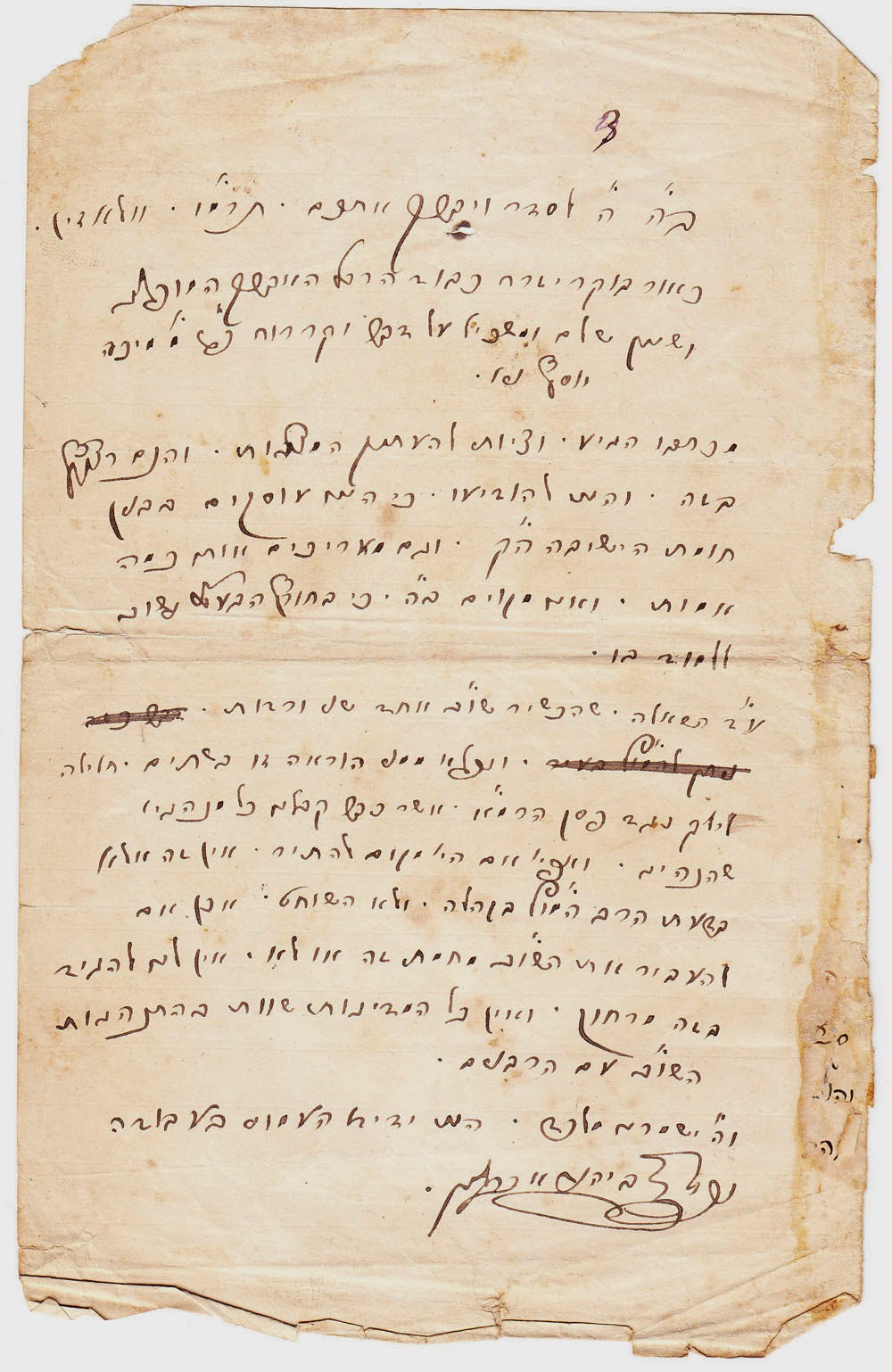
R. Shmuel Aboab (1610-1694), author of the Davar Shmuel (as well as Sefer Zikrohonot, discussed here, and Tavat Dovid) was one of the leading rabbis in Italy and Europe of his day. He corresponded with numerous people, part of that correspondence was published in Davar Shmuel. Davar Shmuel, published posthumously by his son, was a mahdurah kama (first edition -that Spiegel doesn’t mention in his discussion regarding mahdurah kama/tinyana – although it is a printed book and not a manuscript), and does not include all R. Shmuel Aboab’s responsa (something that was not corrected in the latest reprint of the Davar Shmuel). For many years, a collection of R. Abaob’s letters (approximately 300!) were in the Montefiore Library and now they have passed into private hands. (These letters are mentioned in Hartwig Hirschfeld’s Descriptive Cataloue of the Hebrew Manuscripts in the Montefiore Library – but the Google books version is for some reason missing the relevant page.) According to the description provided in Ets Hayyim, many of these letters have never been published or used by scholars (see below for a discussion of this claim). In Ets Hayyim, they have published one of the letters in its entirety. A detailed introduction about the manuscript generally and R. Aboab is included. This was written by R. Betzalel Divlitski. R. Divlitski uses traditional as well as academic sources in his introduction. Also an index of all the letters from the Montefiore collection is provided that includes some important snippets of these letters. For instance, one letter (no. 125) includes information when R. Ya’akov Hagiz came to Italy, something, according to R. Divlitski, that was previously not definitively known (again, see infra for more on this claim). According to the index, this letter tells us R. Hagiz came to Italy in 1659 (see infra note 2 ). Moreover, the letter that is published is in no way pedestrian. Rather, it is about a controversial topic and takes, what can be seen, as a controversial position.

While the above comes from R. Divlitski’s introduction and notes, it is worthwhile pointing out some serious shortcomings in R. Divlitski’s comments. R. Divlitski claims that most of these letters have never been published. This is wrong, and R. Divlitski knows it is wrong. Most of these letters were published by Meir Benayahu in his Dor Echad B’Aretz. R. Divliksi is aware of Benahyahu’s work as he cites it throughout. Divliski also made the claim the letter discussing when R. Hagiz came to Italy [1] was unknown, while again Benayahu has it in his work and discusses its implications (Dor Echad pp. 304-5). [2] Moreover, although R. Divlitski is willing to use the book he is unwilling to say who actually wrote it. Thus, every time R. Divlitski cites Dor Echad he never mentions Benayahu’s name. Lest one think Benayahu is somehow “treif” (whatever that may mean), R. Shlomo Zalman Aurbach seem to have no problem with Benayahu and read Benayahu’s works. (See Benayahu, Yosef Becheiri, Jerusalem, 1991, p. 364, 380). [3]

A bit of history regarding Benayhu’s work – Dor Echad B’Aretz – published in Jerusalem, 1988. A while back Benayahu while traveling the world and discovered this excellent collection of letters of R. Shmuel Aboab. He even writes that he could not believe his luck on finding them – these untapped sources full of this incredible wealth of information.[4] He noted that they were extremely important for multiple areas. Therefore, Benahayu went ahead and started printing them in many different journals. These articles started appearing as early as 1954. He divided the letters into different topics, inter alia, history of Eretz Yisroel, seforim and Sabbatianism. In 1988 Benayahu collected many of these letters from these varied journals and added some more from this collection (over 100) and printed them in one volume – Dor Echad B’Aretz. In this volume he included a comprehensive history of R. Abaob and R. Moshe Zaccuto (as Benayahu is well-known for his comprehensive biographies and works). For some odd reason he did not print all the letters from this collection nor did he even print all the letters he had already published. It could be that he never noted this important letter (now published in Ets Hayyim) perhaps because he planed on coming to it in a future work as it is well known he has over thirty years worth of seforim in manuscript!

Turning back to the article, R. Divlitski is correct that the letter regarding Modena has never been published and is thus important. [It is unclear why Benayahu decided not to publish this letter.] Thus, what Diviltski should have done was prefaced his article stating that although much has been written on R. Aboab and on the letters formerly housed in the Montefiore Library and many were published by Benayahu, for some reason, a very important letter has thus far escaped publication and now to remedy that, the letter is now being published – now on to the actual letter.

The letter in question discusses the belief, or lack thereof, in gilgul (transmitigation of souls). This subject has been a hot topic for centuries and much has been written on it in general and will be the subject of a different post. [For now, see Kol Hanevuah from R. Dovid Hanazir pp. 230-36 for an excellent collection of material on this topic and see R. Reuven Margolis in Sharei Zohar, Bavaeh Metziah, 107a.]

One of the persons to have denied belief in gilgul was R. Yehudah Aryeh Modena in his work Ari Noham. While Modena explicitly denied gilgul, some questioned whether that was truly his position. The Hida, first in Shem HaGedolim and later on in his travelogue, Ma’agel Tov, (pg 113) Hida states that he saw Modena’s then unpublished autobiography and the Hida claimed that Modena wrote that he changed his opinion on gilgul because of an event he witnessed towards the end of his life. Joseph Michael Hayim in Or haHayyim (pg 443) mentions that he never found evidence of Modena’s change of heart in any manuscripts of Modena’s autobiography. [Divlitski alludes to Hayim, but like the other “academics” doesn’t cite to him or mention him explicitly.] Today, we have two printed editions of Modena’s autobiography and neither has any reference to Modena’s alleged change of heart. It is worth noting that the autobiography contains other fascinating material – much of which would not be considered flattering as it portrays Modena in a very human sense. Thus, in the Sefer HaTerumos published by Mechon Yerushalim with the commentary of the Gedulei Terumah, by R. Azariah Figo, a student of Modean, an amazing allegation is made to deal with Modena’s Autobiography. A. Goldschmidt in the introduction claims that because of the content of the Autobiography it is “a forgery.” The reason being “it is unconscionable that a qualified Talmid Hakham such as R. Yehuha Areyeh Modena [would write things] that [even] simple people would not want publicized.” (p. 25 n.8).

The letter now published in Ets Hayyim is not from Modena but instead from R. Aboab to R. Moshe Zacuto about R. Yehuda Areyeh Modena. [5] Specifically, R. Zacuto heard that R. Modena was denying and publicizing that gilgul was not a Jewish belief. R. Zacuto wanted to put Modena in herem or come out against him, and wrote to R. Aboab to get his opinion. As R. Divlitski demonstrates this letter is key to disproving the notion that although Modena initially did not believe in gilgul he changed his mind later. Due to the timing of this letter it appears that either literally at the end of Modena’s life he repudiated his belief on gilgul or, the more likely conclusion is that Modena never did.

In the letter, R. Aboab counsels against disputing Modena. R. Aboab makes a simple argument in that there are sources that dispute the claim of gilgul. Thus, there have been others who don’t believe. How then can we reconcile those positions with R. Aboab’s and R. Zacuto’s idea that gilgul is a central tenet – it must be that only worthy people appreciate and therefore believe in gilgul. It would be pointless to criticize someone for not believing when it is not really their fault.

Basically, this is a great article with important new material but proper credit is not given. Furthermore, as Divlitski notes, and in light of the fact Benayahu clearly has not yet published all these letters, hopefully, with this letter being published in Ets Hayyim someone will finally publish all these letters.

Notes:

This post is the product of the combined efforts of myself and R. Eliezer Brodt.

[1] For some reason it seems E. Carlebach did not use Dor Echad, although she does use Benayahu’s prior articles, and thus was unaware of Benayahu’s discussion of this particular letter. See Carlebach, The Pursuit of Heresy, New York, 1990, p. 21, 284 nn.11-12. Although Benayahu rejects using the dates of R. Hagiz’s works to place Hagiz in Italy, Carlebach does just that. See Benayahu, Dor Echad, pp. 304 and Carlebach, id. Additionally, Carlebach does not mention the letter discussed above that explicitly establishes Hagiz in Italy.

[2] For some reason Divlitski says the letter was written in 1659 while Benayahu says the letter was written in 1657. Additionally, Divlitski says that he can figure out who the recipient of the letter is, although “coincidentally” Benayahu uses the same materials to come to the same conclusion.

[3] This is not the only time Divlitksi leaves out the authors name. He also uses Tishby’s edition of Tzitz Novel Tzvi, but doesn’t mention Tishby.

[4] Divlitski uses similar language when discussing how important the letters are as an untapped resource.

[5] It is worth noting that Modena and Aboab corresponded directly see Benayahu, “Yediyah al Hadfasat Seforim vehafatzasm b’Italia” in Sinai, 34 pp. 157-58, 186-87.


Response to Criticism Part 4; Rabbi Zvi Yehuda and the Hazon Ish

 Response to Criticism Part 4; Rabbi Zvi Yehuda and the Hazon Ish

Marc B. Shapiro

Continued from here.

1. In Limits,p. 14 n. 55, I write

I should call attention to a significant philosophical and halakhic point which appears to have gone unnoticed. The Vilna Gaon (R. Elijah b. Solomon Zalman (1720-97) apparently believed that the First and Second Principles are the only true Principles in Judaism. According to him, one who believes in God’s existence and unity, despite his other sins, is regarded as a Jew in good standing and he is thus able to be included in a minyan (quorum for public prayer). None of the numerous discussions regarding whether a Sabbath violator maybe in included in a minyan seems to have taken note of the Gaon’s comment, which appears in his commentary on Tikunei Zohar, 42a.

Grossman writes:

Apparently, concludes Shapiro, since the Gaon cites only idolatry as invalidating prayer and does not cite the rest of the Thirteen Principles, he is disputing Rambam’s classification of the others as binding fundamentals. However, this source has no bearing on the Principles. The Gaon’s comment refers to counting one for a minyan and to having one’s prayer accepted by God. He is clearly not referring to the Principles, since [in his commentary to Tikunei Zohar] he includes in the metaphor of the scorpion the sin of consorting with gentile women, which is unrelated to any Principle. (p. 48)

The first thing to note is that I never said that the Vilna Gaon disputed “the Rambam’s classification of the others [other Principles] as binding fundamentals.” Of course the Gaon held that people must believe that there is prophecy, that God gave the Torah, that there will be a Messiah, etc. But that is not what I am referring to when I say that for the Gaon the First and Second Principles are the only true Principles in Judaism. As I explain, for the Rambam the Thirteen Principles are special in that if you deny any of them you are to be regarded as having removed yourself from the Jewish people. When the Gaon makes the fascinating comment that belief in the First and Second Principles are enough to be regarded as part of the Jewish people, thus enabling one to be counted in a minyan, this means that as far as he is concerned (in this passage at least), only these beliefs qualify as Principles in the absolute sense that denial of them removes you halakhically from the Jewish people. If I were writing the book today, I would say that the Gaon focuses on three Principles, since he includes belief in the unity of God and an affirmation of God’s corporeality (Principle no. 3) certainly violates God’s unity.

I have to say, however, that while the Gaon’s comment is of great importance when it comes to the issue of Sabbath violation, I am no longer sure about the correctness of my larger point. It could just as well be that when the Gaon derives from the passage in Tikunei Zohar that if you believe in God and His unity, despite your other sins, you are still a Jew in good standing, it does not necessarily mean that these are the only true Principles. It could be that he is merely explicating the meaning of the passage in Tikunei Zohar, which relates to God, but that if it was a different passage he could have spoken about different principles, for example, as long as you believe in the Messiah and the resurrection even if you sin you are still a Jew in good standing. Here is some of what the Gaon writes:

כ”ז שמאמין באחדותו ית’ אפי’ עובר כמה עבירות אינו מומר לכל התורה ואעפ”י שחטא ישראל הוא ומצטרף למנין כמ”ש עבריין כו’ ונכלל תפלתו בכלל ישראל . . . אבל עקרב הוא המודה בעבודת כוכבים ומשתחוה לאל אחר וכן בבת אל נכר אז הקוץ ח”ו מסתלק מצדו וזהו פירוד הגמור וז”ש ואיהו פוסק וברח כו’ ר”ל יוסף במדרגתו ומסתלק הקב”ה ממנו כלל וכלל ואין תפלתו עולה כלל

In the Mishneh Torah, Hilkhot Teshuvah 3:7, the Rambam says that if you believe that God has a physical form you are a heretic, and Rabad famously defends those who did not know any better. According to Rabad, although these people are wrong they are certainly not heretics because of their mistake. Regarding this dispute there is R. Hayyim Soloveitchik’s famous statement in defense of the Rambam’s position that “one who is nebech an epikores is still an epikores.”[1]

In Limits I referred to the Hazon Ish’s opinion that the Rambam actually agrees with Rabad when dealing with a heretic who does not know any better. I further note, in agreement with R. Hayyim, that the Hazon Ish’s suggestion cannot be correct, and the Rambam, Guide 1:36, specifically rejects the Hazon Ish’s point. In fact, R. Kafih thinks that the Rambam saw Rabad’s criticism of what he wrote in the Mishneh Torah, and the end of Guide 1:36 was written in response to Rabad and is the Rambam’s defense of his position that faulty education or simply ignorance is no defense when it comes to belief in God’s corporeality.[2] In truth, even if we did not have this chapter of the Guide, the Hazon Ish’s position cannot be sustained, as it is in opposition to the Rambam’s entire conception of immortality which is a natural process. Thus, there is no room to raise questions about “fairness” or why does God not judge an ignorant person mercifully and grant him a share the World to Come if through no fault of his own he believes that God has a physical form.

Grossman, on the other hand (p. 49), claims that a close reading of the Guide supports the Hazon Ish’s position that someone who does not know any better, and who has no one to teach him, is not to be regarded as a heretic. Suffice it to say all scholars of the philosophy of the Rambam agree with R. Hayyim in this matter. Furthermore, the issue is not whether we regard someone as a heretic or not. There could be societal reasons that determine whether or not one is to be regarded as such. The dispute between the Rambam and Rabad is regarding someone who doesn’t know any better and denies a principle of faith, does such a person have a share in the World to Come? It is clear, as Rabad recognized, that according to the Rambam the answer is no. That is why I wrote that when the Hazon Ish explained the Rambam to really be agreeing with Rabad—that an unwitting heretic has a share in the World to Come—that this approach should be seen as in opposition to the Rambam’s position, even though the Hazon Ish was offering his approach as an interpretation of the Rambam.[3]

Grossman then writes (p. 49 n. 65): “In another example of the same hubris towards a giant of Torah scholarship, Shapiro, on p. 37, asserts that the Chazon Ish’s acceptance of Torah She-be’al Peh as having Divine authority (Iggeros 1:16 [should be 15]) is disputing Rambam. Chazon Ish there is merely emphasizing Rambam’s Eighth Principle, but Shapiro claims that Chazon Ish actually ‘added a new dogma.’”

The reader who turns to my book, p. 37, will find that contrary to what Grossman states, I do not mention anything about Torah she-be’al peh. The issue I was concerned with is the authority of Aggadah. In one of his most often quoted letters (Kovetz Iggerot Hazon Ish, 1:15), the Hazon Ish writes that all aggadot have their origin in the sages’ prophetic power, and one who denies this is a heretic.

משרשי האמונה שכל הנאמר בגמ’ בין במשנה ובין בגמ’ בין בהלכה ובין באגדה, הם הם הדברים שנתגלו לנו ע”י כח נבואי שהוא כח נשיקה של השכל הנאצל, עם השכל המורכב בגוף . . . נרתעים אנחנו לשמוע הטלת ספק בדברי חז”ל בין בהלכה בין באגדה, כשמועה של גידוף ר”ל, והנוטה מזה הוא לפי קבלתנו ככופר בדברי חז”ל, ושחיטתו נבילה, ופסול לעדות, ועוד, ולכן נגעו דבריך בלבי

Incidentally, in the published version of the letter it has

והנוטה מזה הוא לפי קבלתנו ככופר כדברי חז”ל

Here is the section of the actual letter of the Hazon Ish where you can see that it should read ככופר בדברי חז”ל.

Searching on Otzar haChochma, I see that almost everyone who cites this passage corrects the printing error.

It is with regard to this statement about aggadah, and this statement alone, that I spoke of a new dogma—which can perhaps already be seen in the Maharal if not earlier—that is not held by the Rambam who, together with the entire geonic and medieval Sephardic rabbinic tradition, did not have such a view about the binding nature of all aggadot. The reader of Grossman’s article who does not examine my book would think that I claimed that the Rambam did not believe that Torah she-be’al Peh has divine authority. Yet the difference of opinion between the Rambam and the Hazon Ish is over a different matter, namely, what is included in Torah she-be’al Peh. In fact, this is not really a dispute between the Rambam and the Hazon Ish, but a dispute between two traditions regarding how to understand Aggadah.

Incidentally, in the Hazon Ish’s letter just mentioned, in discussing the difference between prophecy and ruah ha-kodesh, he says something directly in opposition to the Rambam’s view.

אבל יש הבדל יסודי בין נבואה לרוה”ק. נבואה, אין השכל המורכב של האדם משתתף בה, אלא אחרי התנאים הסגוליים שנתעלה בהם עד שזכה לזוהר נבואי, אפשר לו להיות לכלי קולט דעת. . . , מבלי עיון ועמל שכלי, אבל רוה”ק היא יגיעת העיון ברב עמל ובמשנה מרץ, עד שמתוסף בו דעת ותבונה בלתי טבעי

In the published version of the letter there are three periods after the word דעת which I have underlined in. Usually when there are three periods it means that something has been removed from the letter, but in this case nothing has been removed. In fact, in the original letter there are only two periods, followed by a comma, and I don’t know why the Hazon Ish used these periods.

Continuing with Grossman, he sees it as obvious that the Hazon Ish’s opinion regarding an unwitting heretic is exactly what the Rambam held, and in support of this he points to Hilkhot Mamrim 3:1-3. Here the Rambam states that Karaites, who were raised with heretical beliefs and don’t know any better, are not to be judged like the original Karaite heretics who consciously rejected the Oral Law. With those who don’t know any better the Rambam counsels “not to rush to kill them,” but to draw them close to Torah with words of peace. (The words “not to rush to kill them” were removed from some printings.)

Does this passage have any relevance to the Rambam’s view of unintentional heresy? The answer is no, as here the Rambam is only counseling tolerance when dealing with Karaites who don’t know any better. He is only concerned with how we should relate to them. Rather than hating them and hoping for their destruction, which is normally the case with regard to heretics, the Rambam tells us that we should relate to the Karaites in a positive way and attempt to convince them to abandon their mistaken path. However, from the theological perspective, a heretic has no share in the World to Come and cannot be exculpated based on the argument that he does not know any better. I make this argument in Limits, p. 12, and it is also affirmed by R. Chaim Rapoport.[4]

Not only is this the peshat in the Rambam, but no other understanding works within the context of his philosophical system. That is, the Rambam’s entire philosophical understanding of the World to Come does not work with the notion that an unwitting heretic can also have a share in the World to Come. Any interpretations that assume otherwise are simply not in line with the Rambam’s approach, an approach that was well understood by both his supporters and opponents who argued at great length about this matter. It was also recognized by R. Hayyim who knew the Guide of the Perplexed well. R. Velvel, in discussing the passage in Hilkhot Mamrim pointed to by Grossman, stated exactly what I have just explained. Here are his words as quoted by R. Moshe Sternbuch[5]:

.הרי מפורש בדבריו [הרמב”ם] דמה שהוא אנוס מועיל רק לענין שראוי להחזירם בתשובה ולמשכם לחזור לאיתן התורה, אבל כל זמן שלא חזרו הם מומרים באונס, ושמם מומרים ואפיקורסים

If I were to argue in the fashion of Grossman, I could say that by asserting that the Hazon Ish is simply following what the Rambam says in Hilkhot Mamrim, that Grossman shows disrespect to R. Hayyim and R. Velvel, by not even seeing their positions as worthy of discussion.

There is a parallel to what we have been discussing elsewhere in the Mishneh Torah. In Hilkhot Avodah Zarah 2:5 the Rambam states that the repentance of heretics (minim) is never accepted. Yet in Hilkhot Teshuvah 3:14 the Rambam states that heretics who repent have a share in the World to Come. The Rambam was asked about this apparent contradiction and he replied that indeed there is no contradiction.[6] In Hilkhot Avodah Zarah he is speaking about how the Jewish community is to relate to heretics. As far as the community is concerned, even if a heretic repents the community is not to accept him, as one can never be sure that his repentance is authentic. However, Hilkhot Teshuvah is referring to the heretic’s relationship with God. As far as God is concerned, a true repentance is always accepted. (I don’t know of anyone today who accepts the Rambam’s opinion in this matter. If, say, a leading atheist philosopher or Reform rabbi decided to become Orthodox, not only would the community accept him, but people would make a very big deal of this and he would become a sought-after speaker at Orthodox synagogues.)

Grossman writes:

In an attempt to list various authorities who took issue with Maimonides, Shapiro tells us that “[i]n Abarbanel’s mind, only limited attention . . . should be paid to Maimonides’ early formulation of dogma, and it would certainly be improper to make conclusions about his theological views on the basis of a text designed for beginners.” (p. 50)

My citing of Abarbanel on p. 7 of my book has nothing to do with authorities who took issue with Maimonides. The mention of Abarbanel is with reference to my discussion about how the Thirteen Principles do not appear as a unit in the Mishneh Torah or the Guide, and in this regard I cited Abarbanel who writes as follows in Rosh Amanah, ch. 23:

This explains why he did not list these principles in the Guide, in which he investigated deeply into the faith of the Torah, but mentioned them rather in his Commentary on the Mishnah, which he wrote in his youth. He postulated the principles for the masses, and for beginners in the study of Mishnah, but not for those individuals who plumbed the knowledge of truth for whom he wrote the Guide.

Following his misunderstanding of my point, Grossman spends the next page explaining that Abarbanel accepts the truth of the Rambam’s Principles, a fact that I never denied. However, Abarbanel also believes that for the most profound understanding of the Rambam’s theological views, one needs to turn to the Guide. As I mention in the book, pp. 32-33, Abarbanel also does not accept the Maimonidean concept of Principles of Faith.

Regarding the Rambam positing Thirteen Principles of Faith, which I claimed is a novelty of the Rambam, let me cite R. Moses Sofer who says exactly this.[7]

י”ג העיקרים המציא הרמב”ם שהוא היה הממציא הראשון בזה, ואשר לפנים לא ידענום

Grossman’s final comment in the first half of his review is as follows (p. 52):

Another example of Shapiro’s proofs that Rambam’s theology differs from one work to another is the following. In his Commentary on the Mishna, Rambam states that “lack of belief in any of the Principles makes one a heretic.” [Quotation from Limits, p. 8] Yet, in his Mishneh Torah, he writes (Shapiro’s translation): “Whoever permits the thought to enter his mind that there is another deity besides God violates a prohibition, as it is said: You shall have no other gods before me . . . and denies the essence of religion – this doctrine being the great principle on which everything depends.”

This proves, says Shapiro, that one is not considered a heretic for such thoughts since the Rambam does not say that one who holds these beliefs is a heretic. However, the very source he adduces clearly says the opposite. The words kofer be-ikar,[8] used by the Rambam in this quotation, are a synonym for “heretic,” even according to Shapiro’s rendition of the words as one who “denies the essence of religion.”

If the Rambam writes that recognition of God as the source of all existence is a Principle upon which all of Judaism stands, it is obviously a Principle of faith.

I don’t think that anyone who reads these paragraphs will have a clue as to what my point was. What I noted is that in the Commentary on the Mishnah, in discussing Principles of Faith, Maimonides speaks of belief (or knowledge, depending on how you translate). This is a mental state. However, in Hilkhot Teshuvah, in discussing what makes someone a heretic, Maimonides writes: “One who says”.[9] In other words, he speaks of verbalizing one’s heresy publicly, not simply belief. If all we had was Hilkhot Teshuvah, one could conclude that even one who has heretical ideas, but conducts himself as a good Jew publicly, does not lose his share in the World to Come.

In the book I then turned to Hilkhot Yesodei ha-Torah 1:6 which speaks about one who imagines that there is another God, and by doing so denies the essence of Judaism. A similar comment can be found in Hilkhot Ishut 8:6 where the Rambam writes: “For the sin of idol worship is so great that even when a person thinks of serving [idols] in his heart [without acting upon it] he is considered wicked.” I noted that while a person who believes something heretical like this has, in his mind, denied the essence of Judaism, as long as his heresy is not publicly voiced he apparently is not to be regarded as a complete heretic with all the communal implications this implies. (For example, if you found someone’s private diary which revealed that he denied certain basic principles of faith, as far as the community is concerned he would apparently remain a Jew in good standing as he never publicized his heresy. But he would still have no share in the World to Come.)

It is clear that the Rambam believes that one who affirms a heretical doctrine loses his share in the World to Come, no matter what the reason he does so. But we need to ask why the Rambam specifically uses the formulation of “one who says”. The easiest answer is that he was simply adopting, and making wider use of, the language found in the Mishnah, Sanhedrin 10:1, which also categorizes two types of heresy by using the expression “one who says.”

It makes sense to assume that only one who publicly verbalizes his heresy is to be treated as a heretic by the larger community, but despite the language in the Mishnah, I think many will still wonder why in Hilkhot Teshuvah, which speaks of losing one’s share in the World to Come, Maimonides also uses the language “One who says.” I don’t have an answer to this question. All I did in the book was note that the Rambam’s formulation in the Mishneh Torah is different than what he writes in the Commentary on the Mishnah. Although I have found some rabbinic discussions of this problem, I am surprised that none of the major commentaries take up the issue of why the Rambam uses the word האומר in defining heresy. It seems that they would agree with R. Uri Tieger[10] who writes:

לאו דוקא האומר אלא אפי’ חושב כן ולא מוציא בפיו

It is noteworthy, though, that immediately following these words R. Tieger offers an alternative approach which speaks to the very point I was discussing

וי”א דאף דכל הני שרשי איסורם הוא במחשבה מ”מ לא נחתם עונם עד כדי שיקראו מינים ואפיקורסים עד שיוציאו הדברים בפיהם

R. Avraham Gottesman also raises the issue, and he too sees the Rambam’s formulation in the Mishneh Torah as possibly significant.[11]

‘האומר . . . הרי שלא הזכיר גם שם ממחשבה. ואולי תנא ושייר או לא רצה להחזיקו לאפיקורס ע”י העדר אמונת מחשבה כי רבות מחשבות בלב איש שאין בהם ממש וגם רוב מחשבות אין הקב”ה מצרפן למעשה חוץ ממחשבות ע”ז כדאיתא בגמ

All this is important and worth exploring. But let us return to Grossman, who again attempts to make me look like a fool. He states: “This proves, says Shapiro, that one is not considered a heretic for such thoughts since the Rambam does not say that one who holds these beliefs is a heretic.” Grossman makes this false statement based on my discussion on pp. 8-9. Yet if he had only turned to page 13, at the end of my discussion of this matter, he would have found that I write as follows:

We must therefore conclude that Maimonides’ use of the words “one who says” in describing a heretic is only in imitation of Mishnah Sanhedrin 10:1 where the same formulation is found, and not too much should be read into this. One who believes in a corporeal God or in the existence of many gods, even without saying so publicly, is indeed a heretic as far as Maimonidean theology is concerned. Such a one will not face any penalties from an earthly court, but he is certainly denied a share in the world to come.

In other words, my conclusion is the exact opposite of what Grossman attacks me for (and is indeed in line with Grossman’s own opinion).

As for the word האומר as opposed to המאמין, R. Nissim of Marseilles writes as follows with reference to the usage of the term האומר in Mishnah, Sanhedrin 10:1.[12]

והאומר אין תורה מן השמים, ולא אמר “המאמין” כי באמירה לבד הוא מזיק לרבים וכופר בתורה ואף אם יאמין כמונו שהיא רבת התועלת כי הוא מחטיא הכונה והופך קערה על פיה . . . ועל זה אמרו ז”ל: “האומר” כי אף אם יפרש ויתקן דבורו באיזה צד מן התקון ‘והפירוש, לא יועיל לו שלא יקרא כופר. כי הוא מביא אחרים להחליש תקותם בתורה, ומחטיא כונת השם ית

This is a very original approach that some might wish to use to explain the Rambam as well. According to R. Nissim, what is important is the public declaration as this has the result of leading others to heresy. In fact, even if you really don’t believe what you are saying, since you are publicly stating a heretical position this is enough for you to be regarded as a heretic.

I have now responded to every comment of Grossman in the first half of his review, where he discusses broad themes. The second half of the review, which we turn to next, discusses specific points about the Principles. For those who have asked why I am taking the trouble to respond to every single point of Grossman, the answer is that it gives me a chance to revisit texts that I spent so much time on years ago. Secondly, it gives me the opportunity to share much new material that I think will be of interest to readers.

Before ending I would like to add a few more points. Earlier I mentioned that R. Hayyim knew the Guide of the Perplexed well. Some might be wondering what the basis for this statement is, because unlike the Rogochover, R. Hayyim does not discuss the Guide in his works. I am relying on R. Joseph B. Soloveitchik who testified that R. Hayyim wanted to write a commentary on the Guide (as well as on the Minhat Hinnukh), but he never had the time.[13] Here is how he is quoted in R. Zvi Yosef Reichman, Reshimot Shiurim: Sukkah, p. 258:

ואמנם כלל גדול אצלנו שאין להקשות על סתירה שבין ספר היד לספר מורה הנבוכים, כי כן קבל רבינו שליט”א מפי זקנו מו”ר הגר”ח זצוק”ל, וזקנו זצ”ל קבע כך כמופלג גדול בספר מורה נבוכים שרצה לכתוב עליו פירוש. גם חשב לכתוב הערות על הספר מנחת חינוך. ברם שתי המחשבות לא יצאו לפועל מפני טרדות בזמן; וחבל

R. Hayyim’s knowledge of the Guide is noteworthy since, as R. Aharon Rakeffet has commented many times, R. Moshe Soloveichik “never held the book in his hands.” While this might be an exaggeration, the underlying point is that R. Moshe had no interest in, or knowledge of, the Guide. I can’t say whether there is any influence of the Guide on R. Hayyim’s commentary on the Mishneh Torah. R. Eliyahu Soloveitchik actually cites the Guide as standing in opposition to R. Hayyim’s famous explanation of the two types of kavanah, found in Hiddushei Rabbenu Hayyim Halevi, Hilkhot Tefillah 4:1.[14]

Another noteworthy difference between R. Hayyim and the Guide is the following: The Rambam in Guide 2:45 explains that the books of the Prophets were produced from a higher level of divine inspiration than the books of the Hagiographa. However, R. Hayyim held that the difference between the Prophets and the Hagiographa is that the divine inspiration in the Prophets was originally intended to be spoken, and only later was written down. On the other hand, the divinely inspired books of the Hagiographa were originally intended to be written down. Thus, the difference between the Prophets and the Hagiographa has nothing to do with levels of prophetic inspiration.

This view of R. Hayyim is recorded in a number of different places, including by his son, R. Velvel.[15] R. Hershel Schachter also quotes this opinion from the Rav, who was passing on what his father, R. Moses, reported. Here is the passage in R. Schachter’s Nefesh ha-Rav, p. 240.

This entire passage is copied, word for word, in R. Gershon Eisenberger’s Otzar ha-Yediot Asifat Gershon, p. 411. But following a “tradition” that has now become somewhat popular in certain circles, Nefesh ha-Rav is not mentioned by name. Instead it is referred to as  ספר אחד [16]

Returning to the passage from R. Soloveitchik quoted by R. Reichman, it is also of interest that R. Hayyim is quoted as saying that there is no point in calling attention to contradictions between the Mishneh Torah and the Guide. No reason is given for this, but no doubt it is because the works had different purposes, and this can explain different, even contradictory, formulations.

Regarding the Hazon Ish, in my book I assumed that he, and a number of other scholars who explained Hilkhot Teshuvah 3:7 similar to him (including R. Ahron Soloveichik, Parah Mateh Aharon, Sefer Mada, p. 194[17]), never saw what Maimonides wrote in Guide 1:36 where he explains why an honest error in matters relating to principles of faith does not change one’s fate. As mentioned already, R. Kafih states that these words were written in response to Rabad’s criticism in Hilkhot Teshuvah 3:7, where he states: “Why has he [Maimonides] called such a person a heretic? There are many people greater than and superior to him who adhere to such a belief on the basis of what they have seen in verses of Scripture and even more in the words of those aggadot which corrupt right opinion about religious matters.”[18]

I now believe that while it is certainly likely that some of the others I mention in my book had not seen the Guide, I would not say this about the Hazon Ish. Benjamin Brown has reasonably claimed that formulations in the Hazon Ish’s writings show that he was influenced by the Guide.[19] R. Yehoshua Enbal has harshly criticized Brown’s assertion that there was significant influence of the Guide on the Hazon Ish, but Enbal does not deny that the Hazon Ish knew the Guide.[20] It is reported that th Hazon Ish cited R. Moses Alashkar that Maimonides expressed regret about having “published” the Guide, and that if the work hadn’t already been spread so far, he would have removed it from circulation.[21] (This statement is not found in R. Alashkar’s works.) It seems to me that only one who had at least some idea of Maimonides’ philosophy, and why it could be viewed as problematic, would feel it necessary to identify with such an idea.

Can we point to any specific examples of influence of the Guide on the Hazon Ish? This is something that needs to be investigated and I am not prepared to offer an opinion on the matter. I would just note that R. Moshe Zuriel claims that a passage in the Hazon Ish about Divine Providence has its origin in Maimonides words in the Guide.[22]

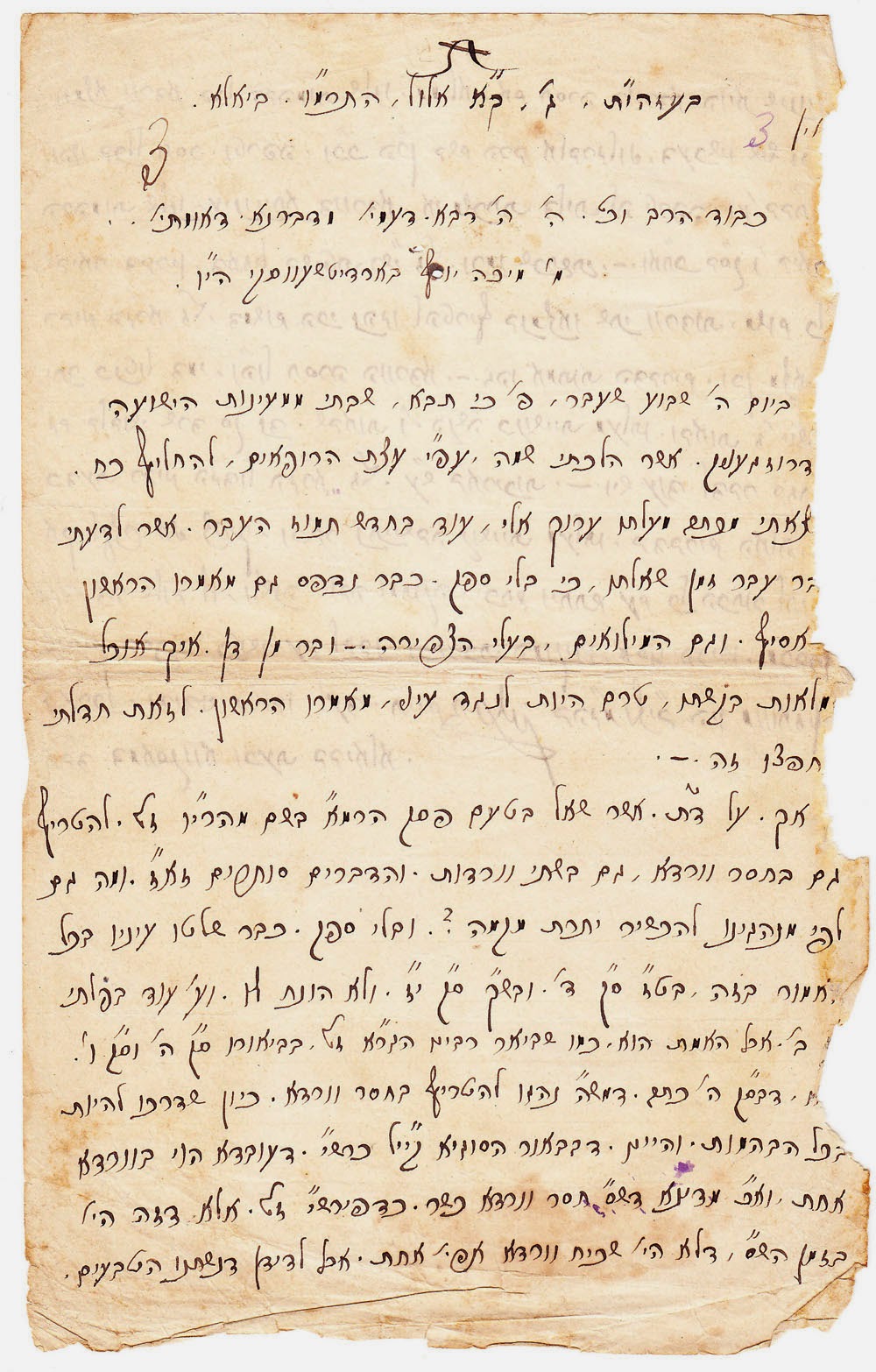
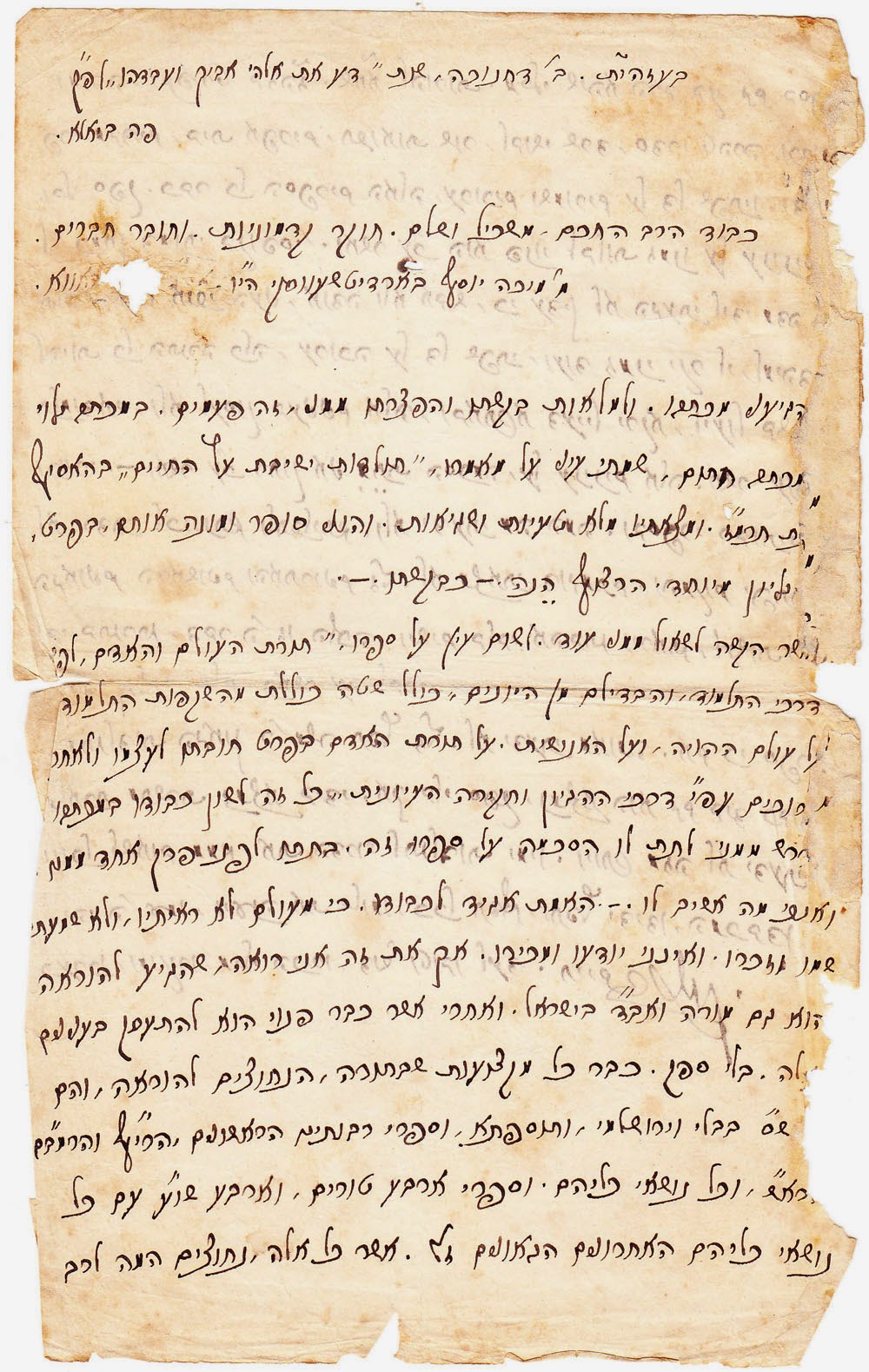
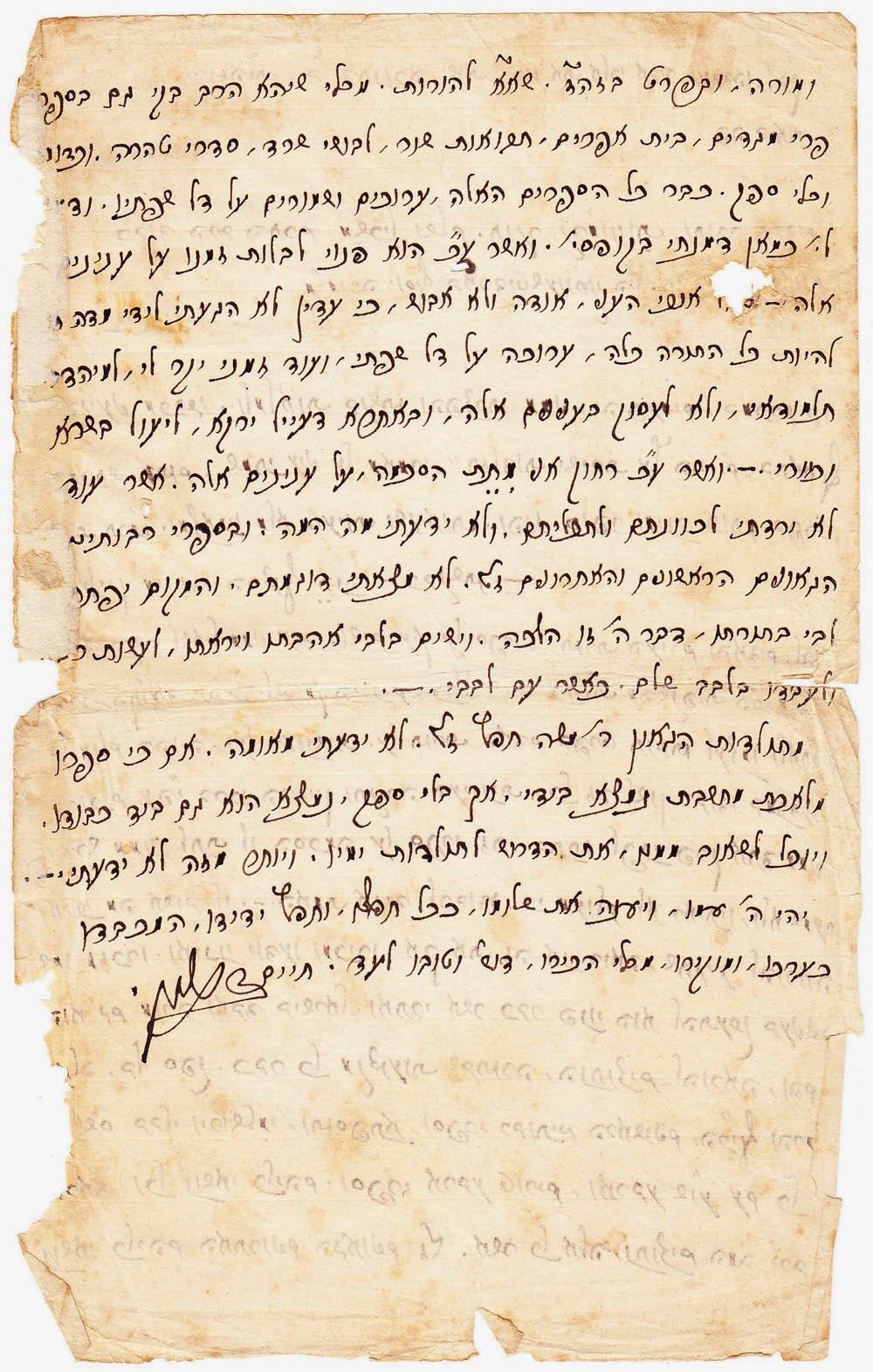
2. Earlier in the post I discuss the Hazon Ish’s letter,Kovetz Iggerot1:15, which may be the most famous of all of the Hazon Ish’s letters. I also provide an image from the actual handwritten letter. For this I thank Mrs. Hassia Yehuda who graciously allowed me to take pictures of this and the other letters I will discuss.

Mrs. Yehuda is the widow of Rabbi Dr. Zvi Yehuda (1926-2014). Yehuda was a very close student of the Hazon Ish from 1941 until the early 1950s. During some periods he learned with him almost every day for 2-3 hours, and the Hazon Ish became a father-like figure to him. The letter in Kovetz Iggerot 1:15 was sent to Yehuda, and this is what Yehuda himself wrote about this letter (published here for the first time).

As with another close student of the Hazon Ish, Chaim Grade, Yehuda chose a different path than what his teacher would have preferred: He enlisted in the IDF, attended university, and became part of the Religious Zionist world.

Here is a picture that you can find on the internet.

From the Hebrew Wikipedia page for the Hazon Ish we learn the picture was taken in Ramat ha-Sharon when the Hazon Ish was visting a yeshiva ketanah there and testing the students. The man to the right of the Hazon Ish is R. Elijah Dessler. The young man to the right of R. Dessler is Yehuda. The man on the far left is R. Shmuel Rozovsky. Here is another picture from the same event where you can see R. Rozovsky clearly.

Here is a picture of Yehuda from much later in life.

The letters of the Hazon Ish to Yehuda are important as they present us with his responses to a curious young man who started to question things. We are not dealing with someone like Chaim Grade who would throw out traditional Judaism entirely. Rather, Yehuda was beginning to open himself to a more liberal type of Orthodoxy, one which valued academic studies and engaging with the outside world. Yehuda later taught Mishnah on Israel Radio and collaborated with Pinhas Kehati in writing the famous Mishnah booklets. In these booklets Yehuda’s role was acknowledged, but when the booklets were later incorporated into Kehati’s published volumes unfortunately there was no longer any acknowledgment. After coming to the United States, Yehuda completed his doctorate at Yeshiva University and his dissertation is titled “The Two Mekhiltot on the Hebrew Slave”.[23]

In Brown’s book on the Hazon Ish, he quotes from a lengthy interview with Yehuda which was included as an appendix to Brown’s doctoral dissertation. With the approval of Brown, I have uploaded Yehuda’s very interesting interview here. You can also listen to Yehuda being interviewed about the Hazon Ish at Torah in Motion here. Yehuda also published two articles about the Hazon Ish in Tradition.[24]

Because the published version of the Hazon Ish’s letters does not reveal who they were sent to, people have no idea that Yehuda was the recipient of a number of important letters that are often cited. The earliest of the letters from the Hazon Ish to Yehuda is 1:41. According to Yehuda (in unpublished comments on the Hazon Ish’s letters to him), this letter is from 1944. Here we get a glimpse of the strong connection between the Hazon Ish and Yehuda, as the Hazon Ish ends the letter with הדו”ש הדבוק באהבתך. The content of the letter is also of interest as the Hazon Ish writes:

רב שלומים, מאד הנני מתענין לדעת משלומך, וחידה סתומה היא בעיני, שלא התראית עמדי טרם עזבך עירנו, ומה קרה אשר הכאיב לבבך הטוב, אשר מנעך משפיכת רוחך? ואשר מהרת לברוח. לא אוכל להאמין שתעזוב את התורה, כי נפשך קשורה בה בחביון נשמתך ואצילות נפשך העדינה, נא אל תכחד ממני דבר, והודיעני הכל

The Hazon Ish had apparently heard that Yehuda was going to abandon full-time Torah study. He was disappointed with this information and asked Yehuda to explain what was going on.

Yehuda replied to the Hazon Ish and this led to the Hazon Ish’s next letter to Yehuda, which is found in Kovetz Iggerot 1:42. In this letter the Hazon Ish offers guidance to Yehuda, designed to keep him on what today we would call the haredi path:

הריני מאחל לך שתהא דעתך נוחה מחכמתך בתורה, ואל יוסף כח מנגד להדריך מנוחתך, ולנדנד איתן מושבך, שים בסלע קנך, ושמה בסתר המדרגה, הוי שקוד ללמוד תורה, וראה חיים שתחת השמש אין לו יתרון אך למעלה מן השמש יש לו יתרון

Kovetz Iggerot 1:19 was also sent to Yehuda, and it was written after the letters already mentioned. In this letter the Hazon Ish deals with Yehuda’s choice to leave the yeshiva world:

באמת לא מצאתי את המסקנא כדרך הנכונה, אך בידעי שאי אפשר לאכף עליך לעשות נגד רצונך הטבעי . . . לא הרהבתי בנפשי להרבות דברים בשבח הישיבה . . . ואולי תבוא שעה מוצלחת ועבר עליך רוח ממרום בבחינת יעבור עלי מה! ותכיר ישיבתך בישיבה להיותר מתאימה לנפשך ולמשאה בחזות הכל

Kovetz Iggerot 1:14 is the last of the fourteen letters the Hazon Ish sent to Yehuda. This was written when Yehuda’s life choice had been made and the Hazon Ish recognized that his pleas to Yehuda to remain in the yeshiva world had gone unanswered. We see in this letter the Hazon Ish’s great love for Yehuda together with his great disappointment that his dear student had chosen a different path for his life. I don’t think there is another published letter from the Hazon Ish where he writes with such emotion. It is a tribute to Yehuda’s memory that the world can see how the Hazon Ish loved him, and I am happy to be able to reveal who the addressee of this letter is, as over the years many people have wondered about this, and sections of this letter have often been reprinted.

Here is some of what the Hazon Ish wrote to Yehuda:

רב הרגלי לערוך את החיים בודאות גמורה של י”ג העיקרים שעם ישראל עליהם נטעו הקנו לי אהבת התורה בלי מצרים. עשיר אני גם באהבת זולתי, וביחוד לצעיר מצוין בכשרונות, ולב מבין. צעיר השוקד על התורה מלבב אותי וצודד את נפשי, וזכרונו ממלא את כל עולמי, ונפשי קשורה בו בעבותות אהבה בל ינתקו

בראותי בך מפנה פתאומי, אשר כפי שתארתיו, מובנו לבכר החיים של השוק על החיים של התורה אשר בישרון מלך, נפגשתי במאורע רציני בלתי רגיל, והייתי צריך להבליג יום יום על גודל הכאב, ולא יכולתי להשתחרר מרב היגון, הבלתי נשכח כל היום. מצד אחד הייתי מתפלל על תשובתך ומצד השני היה מתגבר עלי היאוש, ובאהבת האדם את עצמו הייתי מסתפק אולי צריך להשתדל להשכיח את כל העבר, ולומר וי לי חסרון כיס, ומצד שלישי אהבתי אליך לא נתנני מנוחה. אבל אורך הזמן שעזבתני עזיבה גמורה ואין לך שום חפץ בי, הכריע הכף לפנות אל השכחה שתעמוד בי בעת צוקה, ומה כבד עלי שבאת לעורר אהבה ישנה, אשר תאלצני להאמין בתקוות משעשעות, אבל כח היאוש אינו רוצה להרפות ידו, ועוד נשאר בלבי, כמובן . . . [הנקודות במקור] אבל בערך אולי תבין מצבי. הכותב בכאב לב חפץ באשרו

The letters of the Hazon Ish to Yehuda have recently been donated to the National Library of Israel. See here.

3. In previous posts I discussed how letters from the Rabbi Isaac Unna archive formerly kept at Bar-Ilan University were being sold at auction. The final shoe has now dropped as what appears to be the remaining items in the archive are now up for auction. The lot is described as follows: “Large Archive Of C. 350 Documents And Letters To, And Accumulated By, RABBI ISAK UNNA Concerning The Campaign To Protect Kosher Slaughter (Shechitah) In Germany.” You can see it here. Thus ends this disgraceful saga in which the family donated numerous historically important documents to Bar-Ilan to be preserved in an archive for scholars to use, and instead these items ended up being sold to the highest bidder.

4. For a while I have been fascinated by the over-the-top language in various charity appeals. It is not enough to stress the importance of the cause, but people feel that they need to speak about how the giver will benefit as well. Furthermore, all sorts of phony stories about “yeshuos” are included in these appeals. However, I don’t recall ever seeing such a blatant falsehood as what appeared right before Purim here in an appeal from the Vaad Harabanim fund. This is the text of the appeal.

Group Of Frum Men Travelling To Dangerous Arab Territory

Thursday 25th of February 2021 07:01:23 AM

A hand-selected group of talmidei chachamim arrived in Iran from Israel this morning, sent on an important mission by Rav Chaim Kanievsky himself. Rav Kanievsky sent the emissaries to pray at the tombs of Mordechai & Esther on behalf of all those who donate to Vaad HaRabbanim’s matanos l’evyonim campaign.

The tomb has been preserved against all odds by Iranian Jews for centuries, despite attempts and even threats by the government to destroy it. The group of travellers runs considerable safety risk appearing externally Jewish and carrying Israeli passports through the hostile Arab country. They do it all for the sake of the hundreds of widows, orphans, and talmidei chachamim who are turning to Vaad HaRabbanim for help.

Funds collected will be distributed to poor people on the day of Purim, in keeping with the observance of the mitzvah of matanos l’evyonim.

Names are being accepted for the prayer list at the tomb for the next few days only.

Where to begin? First of all, Iran is not an Arab country. Second, Israeli passport holders are not allowed into Iran. Quite apart from this, think about the idiocy of this appeal. They expect the reader to believe that in the midst of Covid, with Ben Gurion Airport closed, a group of Israeli talmidei chachamim flew to Iran of all places. And we are also expected to believe that R. Chaim Kanievsky sent these talmidei chachamim to Iran. Anyone who did a little research would have also learned that the tomb was closed because of Covid and even Iranian Jews could not go there.

The story is so obviously phony that I wonder how anyone could so brazenly actually post it. And yet, as with all these ridiculous stories, some people appear to have fallen for it. On the page that you donate here it tells us that $7799 was raised for this idiotic appeal. On this page the appeal begins dramatically: “Right now, a plane full of talmidei chachamim is headed to Iran on a special mission from Rav Chaim Kanievsky himself.” It would have been bad enough had the appeal said that one or two people are going to Iran, but a “plane full”! Of course, if there was actually a group of talmidei chachamim traveling to Iran then the cost of this junket would be more than the $7799 raised, so the snake oil salesman who prepares the next phony appeal might consider the fact that people donating to charity would prefer that it actually go to the poor, not to fund a group of people going on a trip.

* * * * * * * *

[1] R. Elhanan Wasserman, Kovetz Ma’amarim (Jerusalem, 2006), p. 11. R. Shimshon Pinkus, Nefesh Shimshon: Be-Inyanei Emunah, p. 99, notes that there are those who have claimed that R. Hayyim’s statement is not to be taken literally, and that he too agrees that one who does not know any better is not to be regarded as a heretic. R. Pinkus responds as follows to this distortion of R. Hayyim’s view:

כפי שקיבלתי את הדברים מבית בריסק – הגר”ח התכוון כפשוטו ממש! יהודי החסר את ידיעת עיקרי האמונה – אף שלא באשמתו – אינו מחובר לאמונת ישראל. וכשאין דבר המחבר אותו לנצחיות הרוחנית, מציאותו מנותקת ואין לו חלק לעולם הבא.

[2] See his edition of the Guide of the Perplexed, 1:36, n. 37.

[3] R. Joseph B. Soloveitchik discusses the unwitting heretic in Shiurei Ha-Grid: Tefillin, ST”M Tzitzit, p. 84 and ibid., note 7:

בשחיטה, שדין פסול מומר מיוסד על ההשוואה לעכו”ם, אין אנו פוסלים את כל אלו שמומרותם לא בקעה ועלתה מתוך מעשה איסור מיוחד. ובנוגע לאיסורים מסוימים הגורמים למומרות, אנו יודעים כי רק שבת, עבודה זרה ואפיקורסות מחדשים פסול כזה. ברם בסת”ם, שלגביהם גם אפיקורס בשוגג פסול משום שאיננו מאמין, אף על פי שלא חטא, מכל מקום אין הפסול תלוי בחטא, כי אם במצב הגברא ובחלות שמו. מאמין בקדושת התורה כשר, ואילו אינו מאמין פסול . . . אמנם, באפיקורס בשוגג לא חל שם רשע כל כך, שהרי איננו כופר במזיד, ומכל מקום נקרא אפיקורס, ומהווה חלות מיוחדת בגברא, אף על פי שאינה מושרשת במעשה עברה זדוני

[4] See his letter in my Iggerot Malkhei Rabbanan, pp. 286-287.
[5] Teshuvot ve-Hanhagot, vol. 4, p. 452.
[6] Teshuvot ha-Rambam, ed. Blau, vol. 2, no. 264. R. Joseph Karo, Kesef Mishneh, Hilkhot Avodah Zarah 2:5 and Hilkhot Teshuvah 3:14, did not have Maimonides’ responsum and thus offered a different suggestion.
[7] She’elot u-Teshuvot Hatam Sofer, Even ha-Ezer, no. 148.
[8] The proper transliteration is kofer ba-ikar (or ikkar) as there is a kamatz under the ב not a sheva.
[9] In his commentary to Hilkhot Teshuvah 3:7, R. Kafih writes:

כל “האומר” שהזכיר רבנו בהלכות הללו אינה סתם אמירה ודבור, אלא מי שהוא בדעה וסברא שכך הוא הדבר

[10] Le-Dofkei Teshuvah, p. 168.
[11] Emunah Shelemah, p. 158. Others who deal with the issue include R. Yitzhak Hecht, Sha’arei Kodesh, vol. 3, pp. 212-213, and R. Mordechai Movshovitz, Shalmei Mordechai, vol. 1, p. 4. R. Movshovitz writes:

וצריך לומר דלאו בדווקא נקט אומר אז חשוב מין, אלא כל שאומר רק במחשבה, הרי הוא עובר דהרי הוא כופר בעיקר

[12] Ma’aseh Nissim, ed Kreisel (Jerusalem, 2000), p. 160.
[13] See also R. Shimon Herschler, Gishmei Berakhah p. 495 (included in Herschler, Seh la-Bayit: Hiddushim u-Derushim al ha-Moadim [London, n.d.], who quotes Zalman Levine, the son of R. Hayyim Avraham Dov Ber Levine, the famous Malach, that his father studied the Guide of the Perplexed with R. Hayyim. Despite his father’s extremism, Zalman attended RIETS and shaved his beard. See Chaim Dalfin, Chabad and Gedolim II (Brooklyn, 2021), p. 155 n. 61. Although it is generally assumed that the title “Malach” was given to the elder R. Levine because of his piety, Dalfin quotes a report that the term was coined “to humiliate those individuals who joined Rabbi Haim Dovber Levine. The sentiment was that they put themselves on a pedestal making themselves ‘holier than thou'”. Habad Portraits (Brooklyn, 2015), vol. 3, p. 54 n. 89.
[14] “Ha-Tefillah be-Aspaklaryat ha-Rambam,” Yeshurun 9 (2001), p. 658. See similarly R. Moshe Yitzhak Roberts in his edition of R. Moses Trani, Beit Elokim: Sha’ar ha-Tefilah (Lakewood, 2008), section Kiryat Moshe, p. 269.
[15] Hiddushei Rabbenu ha-Griz ha-Levi, Menahot 30a.
[16] In the past I have referred to this phenomenon, and another example was recently mentioned by R. Yaacov Sasson in the Seforim Blog here.
[17] On this page R. Soloveichik also points to what he sees as a contradiction between how the Rambam regards unwitting heretics in Hilkhot Teshuvah and his position in Hilkhot Mamrim regarding people brought up in Karaite society, a matter already discussed in this post. He writes

אבל לכאורה זה סותר מה שכתב הרמב”ם בפ”ג מהל’ ממרים ה”ג שהצדוקים והקראים שנתגדלו וחונכו ע”י הוריהם להיות כופרים בתורה שבעל פה יש להם דין של תינוקות שנשבו ויש להם חלק לעולם הבא

In the copy of Parah Mateh Aharon on Otzar haChochma the words I have underlined are also underlined, and the following comment has been added:

פרי המצאת המחבר, ובר”מ שם ליתא (!) ולפי”ז אזדא כל תמיהת הרהמ”ח

The unknown author correctly notes that in Hilkhot Mamrim the Rambam never says that people brought up in Karaite society, who are unwitting heretics, have a share in the World to Come.
[18] Translation in Isadore Twersky, Rabad of Posquières (Cambridge, MA, 1962), p. 282.
[19] Ha-Hazon Ish (Jerusalem, 2010), pp. 171-172.
[20] Yeshurun 29 (2013), p. 938.
[21] Pe’er ha-Dor, vol. 4, p. 150.
[22] Le-Sha’ah u-le-Dorot, vol. 1, p. 283.
[23] The word מכילתא means “a measure”, yet why should the halakhic midrash be given this title? Isaac Baer Levinsohn, Beit Yehudah (Vilna, 1858), vol. 2, p. 48, suggests that the work was actually called מגילתא, but in the popular pronunciation came to be called מכילתא as ג without a dagesh sounded a lot like כ without a dagesh. This pronunciation of ג without a dagesh can still be heard among Middle Eastern Jews. Levinsohn, ibid., who is discussing halakhic midrash, also points out that Wolf Heidenheim, in his machzor for Shavuot in Yetziv Pitgam, vocalizes the words ספרא וספרין as Safra ve-Safrin, instead of Sifra ve-Sifrin. The words are also vocalized this way in Shlomo Tal’s Rinat Yisrael machzor.

Yet as Levinsohn points out, this would mean “writer and writers” –סופר וסופרים. Heidenheim was, of course, a great scholar (and Tal was also quite learned), so it doesn’t make sense that this is simply a mistake. Does anyone know of a source that ספרא should be read as Safra and not Sifra?
[24] “Hazon Ish on the Future of the State of Israel,” Tradition 18 (Summer 1979), pp. 111-117, “Hazon Ish on Textual Criticism and Halakhah,” ibid. (Summer 1980), pp. 172-180.


Tracing the history of eating milchigs on Shavuos

Tracing the history of eating milchigs on Shavuos

by Eliezer Brodt
In this post I would like to deal with tracing the early sources for the minhag of eating milchigs on Shavuos. A version of this article was printed last year in the Ami Magazine (# 119). This post contains a few corrections and additions to that version. A much more expanded version of this article will appear in Hebrew shortly (IY”H). Eating the vast array of customary dairy delicacies on Shavuos including, of course, cheesecake, is a minhag that very few people find very difficult. But what is the source of this minhag? This minhag goes back at least to the times of the Rishonim, and varied explanations for it also do.[1] That the minhag of milchigs on Shavuos was observed widely in recent history is very clear. For example, in an informative nineteenth-century Lithuanian memoir, the author describes the milk-based Yom Tov atmosphere:

“And at home there was again roasting and baking namely, many butter cakes! On this Holiday you especially ate all milk and butter dishes. The traditional cheese blintzes with sour cream, a kind of flinsed, were essential… On the second day of Shavuos… a happy mood prevailed; we drank fine aromatic coffee and ate butter cakes and blintshikes.”[2]

In Yeshivas Volozhin, after staying up the whole night, the whole yeshiva would take part in a milchig kiddush at the Netziv’s house.[3] We find the same thing in the Lomza Yeshiva; they had a kiddush after davening with cheesecakes and the like. [4] The question is, where did this minhag of eating milchigs on Shavuos come from? The Rambam, Tur, and Shulchan Aruch do not make any mention of it. In this article, I will trace some of the earliest known sources that we have for this minhag and discuss some of the reasons that are given. This is not an attempt to cover all aspects of this rich minhag, I hope to return this in the future. [5]One of the earliest mentions of this minhag can be found in a Pesach drasha from the Rokeach (1165-1240), which was printed from a manuscript for the first time just a few years ago. [6] Another one of the earliest sources is found in the very interesting work Malmed Hatalmidim from Rav Yaakov Antoli. Rav Antoli was born around 1194 in Provence, in southern France. He married the daughter of Rav Shmuel Ibn Tibon, the famous translator of the Moreh Nevuchim into Hebrew. The Malmed Hatalmidim was only first printed in 1866, with the haskamos of many gedolim, but the manuscript form had been used before that by many Rishonim, most notably the Avudraham.Rav Antoli writes that the custom is to eat milk and honey on Shavuos. He explains that this is because Torah is compared to milk and honey. Since milk is a very important food, so too, the mitzvos of the Torah are food for the soul, he says.[7]
Another early source for eating milchigs is found in the work Even Bochen from Rav Kalonymos ben Kalonymos (1286-1328)[8], where he describes milchig breads made with honey and formed into the shape of a ladder. (We’ll return to the ladder-shaped breads shortly).
Yet another early source can be found in the works of Rav Aharon Hacohen Miluneil (died around 1330) in his early work Kol Bo and in his later work Orchos Chaim. He writes, like the Malmed Hatalmidim, that on Shavuos people have the custom to eat milk and honey because Torah is compared to milk and honey. Women also bake challos with four heads, he says, as a zecher to the lechem hapanim. He says that others dip matzahs left over from Pesach into the spice known as zefrin since it causes happiness.[9] Rav Avigdor Hatzorfoti (died 1275) brings a remez (hint) from the Torah for the minhag. The passuk about Shavuos says, “Ubyom habikurim bihakriyvchem mincha chadasha lashem beshivuaschem.” The beginning letters of the last three words spell out chalav, milk.[10] This minhag is also found in the following early sefarim: the minhagim of the Maharam Merutenberg (written by a talmid of his)[11], Terumas Hadeshen[12], Maharil[13], Rav Isaac Tirina (born around 1380)[14], Meshivas Nefesh from Rabbi Yochanon Luria (1382)[15], Rama[16], Seder Hayom (printed in 1599)[17], Yosef Ometz (1570-1637)[18], and the Shelah Hakodesh (1570-1635).[19]
Aside from the reasons already mentioned, many additional reasons for this minhag have been given over the years. Recently, close to 150 reasons were collected by Rabbi Moshe Dinin in a small work called Kuntres Matamei Moshe. Here are a few reasons and some interesting points related to them. Rav Elyakyim Horowitz says that we eat milchigs because Dovid Hamelech died on Shavuos. The halacha is that when a king dies, all of the Jews have the status of an onen and are not permitted to eat meat.[20] This same reason can also be found in the work of Rabbi Shimon Falk.[21] Rav Avrohom Hershovitz brings the Mishna at the end of Avos, which says that one of the 48 ways the Torah is acquired is through not indulging oneself. Since meat is considered an indulgence, we eat milk products during the chag of Matan Torah as a reminder that this is the way to acquire Torah.[22] Rav Mordechai Leib Zaks points out that in the parsha of Bikurim it says that Hashem gave us the land of milk and honey. Therefore he suggests that the custom is to eat milchigs on the Yom Habikkurim to give thanks to Hashem for giving us the land of milk and honey and as a reminder of the mitzvah of bikkurim, which only included the fruits of Eretz Yisrael, the land of milk and honey.[23] Rabbi Yeshuyah Singer in Zichron B’sefer (printed in 1900) writes an interesting reason which he had heard. The Torah was given on Shabbos. The meat they had prepared before learning the halachos of shechita was assur to eat. It is not permitted to shecht on Shabbos. Therefore Bnei Yisrael had to eat milchigs, as they could not eat the food that they had prepared beforehand.[24]
The Mishna Berurah mentions a similar reason that he heard in the name of “gadol echad.” Immediately after Bnei Yisrael accepted the Torah, they were unable to eat anything but milchigs. The reason for that is because the preparation of kosher meat is very involved. A kosher knife and kosher utensils are necessary. Since this takes a long time, they just cooked milchigs.[25] Who is the “gadol echad” mentioned here? Rabbi Nachum Greenwald located this idea in the work Toldos Yitzchak, first printed in 1868. This idea is mentioned in the name of Rabbi Levi Yitzchak from Berditchev. It is interesting that the Chofetz Chaim did not say the name of the person he heard this idea from.[26] A similar idea can be found in the work Geulas Yisroel first printed in 1821. Rabbi Kapach says that the Jews in Yemen expressed wonder at those who ate just milchigs on Shavuos. They did not like the reason given (as we mentioned before) that the meat slaughtered prior to Matan Torah would be neveilah afterwards, because they argued that only the Erev Rav were unable to shecht before Matan Torah. The rest of the Jews, they claimed, were shechting before Matan Torah, just as we know that the Gemara says that Avraham Avinu kept all the mitzvos of the Torah before they were given.[27] However this statement is not so simple, because even if they were shechting and doing mitzvos before it is heavily debated what that would be considered, since their status as Jews may have changed during Matan Torah. According to many it would follow that after Matan Torah they would need to kasher the utensils and shecht new animals.[28]
Rav Yissachar Teichtal deals with a related issue. He asks that since the Torah was given on Shabbos and they couldn’t shecht and their prior shechita was not kosher, how did they fulfill the obligation of eating meat on Shabbos?[29] Rav Teichtal first mentions the answer of the Zichron Basefer quoted above, which is that they didn’t eat meat that Shabbos. However, Rav Teichtel disagrees. He has an interesting answer to explain how they did indeed have meat on this Shabbos. Basing himself on various sources, he says that they had meat created through the Sefer Yetzirah. The Gemara relates that there were those who were able to create an animal via the Sefer Yetzirah; Rav Teichtal says that that was done here.[30] The Toldos Yitzchak, quoted above, from Reb Levi Yitzchak Berditichever, gives another answer. There is a concept in halacha called Hoiel v’ishtrei ishtrei, which means that if something was permitted at one time, it remains muttar. It follows that they were permitted to eat anything they had prepared beforehand and did not have to throw out their dishes. Then he says that even though it was permitted, the Yidden were stringent and didn’t eat the meat. Since they were accepting the Torah that day, they wanted to be machmir.
A similar idea is found when Moshe Rabbeinu, as a baby, didn’t nurse from a non-Jew even though it was permissible. It appears that this idea is based on a concept found in numerous sources, called chinuch shanei. It means that the first time we do something, we do it in the best way possible, even if other ways are permitted. Moshe Rabbeinu could have been nursed from a non-Jew, but since he was the one who was going to get the Torah, he was kept from doing it. So too, here, the Yidden were machmir by not eating what was entirely permissible.[31]

Speaking of Moshe Rabbeinu, an original reason for this minhag is given by Rabbi Yitzchak Weiss, who says that Moshe Rabbeinu was found by the daughter of Pharaoh on Shavuos. Since they tried to give him milk from a non-Jew and he refused, we eat dairy to remind us of that.[32]

Cheesecake on the clock

Rav Dunner, in a recent article on the topic, lists many gedolim who ate the milchig seudah at night, including the Chazon Ish, Rav Aharon Kotler, Rav Yechezkel Abramsky, and others.[33] It is questionable whether or not there is an obligation to eat meat at night on Yom Tov.[34] In other sources, we see the opposite. There were people who specifically ate milchigs during the day—for example, the Volozhin and Lomza yeshivas, which I mentioned earlier, where there was a kiddush with cheesecake after davening.[35] This is also what the Darchei Teshuvah suggests one should do to avoid many different halachic issues.[36]
There is much discussion in the poskim whether it is permitted to eat milchigs first during the day, and then wait and eat meat. There’s also discussion about how long to wait. Some wait an hour before eating meat. Other poskim deal with the question of whether there is an obligation to bentch after the milchig kiddush.[37] For example, the Knesses Hagedolah (1603-1673) writes that he ate milchigs and honey, then he benched, and after he waited an hour, he ate fleishigs.[38]
However it’s pretty clear that the Magen Avrohom argues when he writes:
ועבי”ד סי’ פ”ט דא”צ להפסיק בב”ה [בברכת המזון] אם אינו אוכל גבינה קשה (סי’ תצד:ו).[39]
What’s interesting is that certain mekubalim did not eat milk the same day they ate meat products. Rabbi Eliyahu de Vidas, author of the Reishes Chochma (d. 1579), in his work Tosos Chaim writes that one should wait 24 hours(!) after eating meat before eating milk. According to this, it wouldn’t be possible to eat milk after meat on Shavuos![40] The Yosef Ometz quotes the Shelah, who says that he would wait 24 hours after meat to eat milk.[41] But later on (in siman 854), he says that people were lenient about this on Shavuos.
Interestingly enough, the Tzror Hamor even says that one should not eat meat within 24 hours of eating milk, and vice versa.
לפי קבלת קדמונינו בא לאסור בשר בחלב. ואמר לא תבשל. ולא אמר לא תאכל. לרמוז לנו כפי חכמי האמת כי אסור לאכול בשר ואחר כך חלב. וכן אסור לאכול חלב ואחר כך בשר. ואעפ”י שנתנו חכמים שיעורים בזה. כבר כתב רשב”י ז”ל כי כמו שאסור חלב אחר בשר. כך אסור לאכול בשר אחר חלב. ודינם שוה לענין השיעור שהוא עד שיתעכל המזון שבמיעיו. שהם כמו שש שעות שהוא זמן מסעודה לסעודה. כי הבישול האמור כאן על בישול האצטומכא הוא. בענין שלא יתבשלו הבשר והחלב באצטומכא בזמן אחד. ולפי שיש אצטומכא מאחרת העיכול. ליראי ה’ ולחושבי שמו אין לאכול גבינה ובשר ביום אחד. וכל שכן בשר וגבינה. וכן נוהגים המדקדקים במצות ואנשי מעשה. והטעם בזה לפי שאין ראוי לערב הכוחות אלו באלו. כח הדין בכח הרחמים. וכח הרחמים בכח הדין. כי הבשר הוא מדת הדין בסוד קץ כל בשר. כי מנפש ועד בשר יכלה הצר. והחלב הוא סוד הרחמים הגמורים המלבינים עונותיהם של ישראל. כאומרו כשלג ילבינו. והחטא הוא אדום בסוד הלעיטני נא מן האדום האדום הזה. ולכן יש להפרידם זה מזה כל אחד על כנו. ואת כל עורב למינו (צרור המור, משפטים, כג:יט).
According to this there would be appear to be no way to eat both milk and meat on Shavuos. The Toras Chaim is also very concerned with this issue of eating meat after milk; he says not to eat milchigs on Shavuos.[42] However, other rabbanim were to the other extreme. The Rokeach writes that his great uncle used to eat cheese, then wash his mouth out and immediately eat meat.[43] There is also a talmid of the Terumas Hadeshen who writes in his work Leket Yosher that his rebbi did the same[44]

From honey to milk

    It would appear that this minhag of eating milchigs ties in with another minhag of Shavuos and perhaps is derived from there.[45] When the talmid of the Maharam Merutenberg brings among the minhagim of the Maharam the minhag to eat milchigs on Shavuos, he brings it right after he brings another minhag: “Special cakes with pesukim on them are made for children as they begin to learn on Shavuos these are made to help them have an open heart [for learning].” There are numerous sources in Rishonim (such as Rokeach and Machzor Vitri) that on Shavuos when a boy begins to learn an elaborate ceremony is performed in which they eat from specially prepared cakes and dip their fingers in honey while saying certain pesukim.[46] This is done to help the boy’s mind open up and is a special segulah to help him remember what he learns. (Some sources do not mention that this was done on Shavuos; most do.)
    This ceremony was done on Shavuos because it is the day we received the Torah. Interestingly, we find sources for a few hundred years in the Rishonim that this minhag continued, at least in German circles. But it appears to have eventually been forgotten. The Shach cites the Rokeach as having mentioned the minhag but says that now it is not done.[47] Rabbi Dovid Ginsburg writes that he only found out about this minhag later on in life and had he known about it earlier he would have definitely done it for his children.[48]
    Rav Yaakov Emden writes that the reason that in earlier times the children excelled in their Jewish education as opposed to in his times was due to that they stopped doing this ceremony quoted in the Rishonim![48] Recently this minhag has been revived as part of the upsherin ceremony. Be that as it may, it is possible that this minhag of eating honey and sweets on Shavuos actually led to the minhag of eating of milchigs, because honey has always been associated with milchigs. As mentioned earlier, some made special milchig breads in the shapes of ladders. In the work Even Bochen from Rav Kalonymos ben Kalonymos we find an explanation, that the gematria of sulam (ladder) is Sinai. The Yosef Ometz and others bring different reasons connecting a ladder and Shavuos.[49]
     Professor Daniel Sperber suggested that the reason why the bread is shaped in the form of a ladder is that it ties in to the ceremonies for children who begin learning. To get the children to ask what is going on we make the breads in an interesting shape, similar to our methods of getting them to ask at the Pesach seder.[50]


  • [1] There are many collections of material on this issue see for example Rabbi Pinchas Schwartz, Minchas Chadasah, pp. 38-44; Rabbi S. Deblitski, Kuntres Hamoyadim, pp. 37-40; Kovet Eitz Chaim (Bobov) 6 (2008) pp. 239-242; an excellent collection of material in Pardes Eliezer, pp. 227-316; Rabbi Freund, Moadyim Lisimcha 6, pp. 490-505 ; Rabbi Yitzchack Tessler, Pininei Minhag, pp. 292-319; Rabbi Oberlander, Kovetz Or Yisroel, 32:104-120 and later updated in his Minhag Avosenu Beyadneu. See also YehudahAvidah in his work on Yiddish foods, Yiddishe Macholim, pp. 43-44; M.Kosover,Yiddishe Macholim, p. 75, 77, 98.
  • [2] Pauline Wengeroff, Memoirs of a Grandmother, 2010, p.150.
  • [3]Reshumot 1, p. 340.
  • [4] See Pirkei Zichronos, (2004) p. 359
  • [5] I hope to return to many other aspects of the minhag in the near future.
  • [6] Drasha Lepesach, ed. Simcha Emanuel (2006), p. 39, 110. See the important comment on this from my friend M. M. Honig in Pininei Minhag, p. 292.
  • [7] Malmed Hatalmdim, p. 121b. I hope to return to this work in a future article; for now see my article in Yeshurun, 24 (2011), p. 457.
  • [8] Even Bochen, p. 34. Mahratz Chiyos in his Kol Sifrei (p. 236) quotes this as an early source for eating milchigs. Both Matai Moshe (siman 692) and Mekor Chaim quote this work when talking about eating milchigs on Shavuos. On Rav Kalonymus ben Kalonymus much has been written already see: Y. Zinberg, Toldos Safrus Yisroel, vol. 1, pp. 411-427; Uberto Cassuto in the intro of the facsimile edition of Mesechtas Purim printed by A. Haberman in 1978; A. Haberman, Toldos Hapiyut Ve-hashira, vol. 2, pp. 142-149; A. Haberman IyunimBshira Ubpyuit, pg 162-179; C. Shirman, Toldos Ha-shira Haivirit Be-sefard, pp. 514-541.
  • [9] Orchos Chaim, p. 78a, Kol Bo, siman 52. Most are not aware that this work was authored by the same person. There were actually those that thought the Kol Bo was authored by a woman; see my Bein Kesseh L’essur (2010) p. 143.
  • [10] See Rav Avigdor Hatzorfoti, p. 478 See his Pirush Rav Avigdor Cohen Tzedek printed in the Toras Chaim edition of Megillas Rus, 2011, p. 53. On Rav Avigdor Hatzorfoti see Simcha Emanuel, Shivrei Luchos, pp. 173-181; E. Kanarfogel, Peering through the Lattices, pp. 107-109.
  • [11] Minhaghim of Maharham, p. 30.
  • [12] Leket Yosher, p. 103
  • [13] Minhaghim p. 85
  • [14] Sefer Minhaghim, Reb Isaac Tirina (2000) p. 67-68. To be more exact this minhag is in the section which is called Hagahos haminhagim. It is unclear exactly who the author is of that section but it assumed to have been written rather early on. On all of this, see S. Spitzer in his introduction to this edition pp. 17-18.
  • [15] Meshivas Nefesh, p. 185. On the dating of this work see Rabbi Yakov Stahl, Deutsche 84, (2010) p. 6.
  • [16] See Igros Moshe OC 1:160. On this topic see this excellent article by my friend Rabbi Yehudah Spitz here.
  • [17] Seder Hayom Shavuos p.78
  • [18] Siman 854
  • [19] Shelah, Mesechtas Shavuos, p. 30a.
  • [20] Zichron Yerushlayim, p. 153. In Reshumot 1, p. 350 we find that some made a special seudah because of this and finished Sefer Tehillim.
  • [21] Shut Shem Mishomon, OC, 2:4, p.15.
  • [22] R. Avraham Eliezer Hershkowitz, Otzar Kol Minhaghei Yeshrun (St. Louis, 1918),p. 201
  • [23]Zemanim, (1951) p. 53 See also his Mili Demordechai, p. 125. For another connection between bikkurim and eating milchigs see Rabbi Shlomo Schick, Seder Minhaghim 1 (1880)pp. 83b-84a.
  • [24] Zichron Besefer, p. 122. See Emes Leyakov (Shulchan Aruch) p. 215 where Rav Yaakov suggests this reason himself and adds some points.
  • [25] Mishna Berurah 494:12. See also Rav Tzvi Farber, Sefer Moadyim, p. 26 (and see there for some other reasons). See also Rabbi Aron Misnik, Minchas Ahron, pp. 102-106; Pardes Eliezer, pp. 279-282.
  • [26] The Chofetz Chaim did not have a problem quoting chassidic sources; he quotes the Shulchan Aruch Harav numerous times. On the Chofetz Chaim and chassidus see what I wrote in the article “Censorship in the Sefer Chofetz Chaim,” here.
  • [27] Halichos Teiman, p. 31. See also Keser Shem Tov, 4 p. 16 who has a similar issue.
  • [28] The status of the Yidden before Matan Torah and the mitzvos performed then has been discussed in numerous works I hope to return to this topic at a later date. See also Rabbi Oberlander (above, note 1) p. 632- 633.
  • [29] Shut Mishnat Sachir, siman 136.
  • [30] Much has been written on how one creates something based on the Sefer Yetzirah and if one can use what has been created through such a method for a mitzvah or the like. I hope to return to this topic at a future date.
  • [31] A subject I hope to return to in the future.
  • [32] Elef Kesav, 1, p. 64.
  • [33] Kovet Eitz Chaim (Bobov) 6 (2008) p. 240
  • [34] See Eitz Chaim Ibid. See Darchei Tesuvah, 89:19.
  • [35] See Pirkei Zicronos, (2004) p. 359.
  • [36] Darchei Tesuvah, 89:19.
  • [37] See Darchei Tesuvah, 89:14; Dershot Mishnat Sachir, 2, pp. 347-348.
  • [38] Shiurei Kness hagedolah, 494. See Shut Sich Yitzchack, 234. On this topic see this excellent article by my friend Rabbi Yehudah Spitz here.
  • [39] I will deal with this Magen Avrhom at great length in the near future B”n.
  • [40] See Tosas Chaim, 2008 p. 79. In the back of this edition there is a lengthy Peirush Ir Hachaim, pp. 245- 249 and for in-depth discussion of this topic see the Pardes Eliezer pp. 233- 238. I will deal with this at greater length in the near future B”n.
  • [41] See Yosef Ometz, siman 137.
  • [42] Toras Chaim, Chullin 83a. However it is worth pointing out that the Toras Chaim in Bava Metzia 86b, says that the reason for eating milchigs on Shavuos is to show the malachim that we are careful about basar b’cholov and that when we eat milk we are careful to do everything halacha says to do before we eat meat.
  • [43] See Drasha of the Rokeach, p. 39
  • [44] Leket Yosher, p. 103
  • [45] This idea was suggested by my friend M.M. Honig. Rabbi Oberlander (above, note 1) also suggests this point. D. Sperber in his Minhagei Yisroel 3, p. 139 also connects the two.
  • [46] See my article on this in Yerushacheinu, 5 (2011) pp. 337-360 especially pp. 344-347.
  • [47] Shach, 245:8.
  • [48] See my article in Yerushacheinu (ibid), p. 347 note 65.
  • [49] Migdol Oz, p. 32.
  • [50] Others have different shapes and reasons; see Rav Yehoshua Falk, Choshevi Machsvos p. 152. See also M. Gidman , Hatorah Vehachaim 3, 108; H. Pollack, Jewish Folkways in Germanic Lands (1648-1806), p. 102, 277
  • [51] Minhagei Yisroel 3, p. 139.


The Writings of R. Hayyim Dov Ber Gulevsky – Part I

The Writings of R. Hayyim Dov Ber Gulevsky – Part I
By
Marc B. Shapiro
             
In honor of Dan Rabinowitz, in appreciation of his commitment to the free and open exchange of ideas.
In a previous post I mentioned the new writings of R. Kook and also the works of R. Hayyim Dov Ber Gulevsky. I would like to speak about both of them before returning to my discussions of Judaism and Christianity.
 
Let me begin with R. Gulevsky, who obviously is not as well known as R. Kook, although he does have his own important yichus. He was born in Brisk where his grandfather was the famous R. Simcha Zelig Rieger, who served as dayan in the city. (Professor Sara Regeuer of Brooklyn College is also a descendant.) R. Simcha Zelig was descended from R. Hayyim of Volozhin’s brother, R. Simcha, for whom Gulevsky’s grandfather was named. Gulevsky is also descended from R. Hayyim of Volozhin.[1] A picture of the young Gulevsky and R. Simcha Zelig is found in the recently published Iggerot Maran ha-Griz, p. 174.
 
Stories of R. Simcha Zelig’s relationship with R. Hayyim Soloveitchik and R. Velvel are legendary. While R. Hayyim and R. Velvel focused on theoretical Torah study, R. Simcha Zelig was an expert in practical halakhah. It was because of this that R. Hayyim brought him from Volozhin to Brisk. Unfortunately, his many responsa were lost during the Holocaust, in which he was also killed. One interesting point about R. Hayyim and R. Simcha Zelig is that neither of them wore rabbinic garb. Here is a painting of both of them (made from famous pictures) found in Gulevsky’s home.

Gulevsky’s parents were also killed in the Holocaust, as was the rest of the city of Brisk. Fortunately, he was not there when the Nazis arrived, and was able to make it to Japan with R. Aaron Kotler and around fourteen other Kletzk students, where he spent the war years. (Before studying in Kletzk, Gulevsky was in Kaminetz.) On the slow journey by train across the Soviet Union, four people slept in a compartment, and Gulevsky shared one with R. Aaron and his wife and daughter. He is also mentioned in one of the letters R. Aaron sent from America to the Kletzk students in Shanghai.[2] Following the War Gulevsky came to the United States where he studied in Lakewood. One can hear his recollections (in Yiddish) of R. Aaron Kotler here. For his eulogy of R. Aaron, see Ha-Darom (Nisan 5723), pp. 40-42.
Gulevsky taught at Yeshiva University’s Teacher’s Institute for a number of years, as well as at the religious Zionist Bachad (Berit Halutzim Datiyim) school in Jamesburg, N. J. This school existed in the early 1950’s and combined Torah study with preparation for agricultural settlement in the Land of Israel (hachsharah). Incredible as it sounds, Gulevsky might be the only living native of Brisk in the United States who was part of the city’s Torah community. (I am not referring to those who left Brisk as children and have no real memories of it. In Israel some of the children of R. Velvel are still alive, and R. Aharon Leib Steinman was born in Brisk.)
 
Here he is, in a picture that could be used if anyone wants to make a gadol card.

Here he is with the indefatigable Menachem Butler.

Gulevsky’s writings are quite interesting and reveal information not found elsewhere. Before looking at them, however, I should note that some readers might recognize his name, without knowing who he is. He is the rav ha-machshir on two Indian vegetarian restaurants in Manhattan, Madras Mahal and Chennai. I first ate at Madras Mahal not too long ago, at a surprise birthday party for Sharon Flatto. Sharon is a professor at Brooklyn College whose doctoral dissertation on R. Yehezkel Landau, the Noda bi-Yehuda, will soon be published by my favorite press, Littman Library.[3]
 
She is married to my good friend, Rabbi Ysoscher Katz, who teaches at Yeshivat Chovevei Torah. I believe R. Ysoscher has the distinction of being the youngest maggid shiur ever to complete the daf yomi cycle. This happened a number of years ago when he “said the daf” at the Agudas Yisrael shul in Boro Park. This was also the largest daf yomi in the country, with some seventy-five people in attendance. He took over the shiur of R. Simcha Elberg, who taught it for many years. Although R. Ysoscher no longer teaches there, the shiur continues and I am told that it is the longest running daf yomi in the country.
 
Returning to Gulevsky, over the years he has published a good deal, and much of his writings have been collected into two volumes. Here are the title pages of these books.

Although not noted on the title page, included in the Arba’ah Sefarim Niftanim is his Lahat Herev ha-Mithapekhet, first published in 1976. Here is the title page.

This volume is significant as it the first detailed defense of R. Hayyim Soloveitchik against the criticisms of the Chazon Ish. As should be expected from one who grew up in Brisk and whose family is so connected to the Soloveitchiks, Gulevsky views the defense of R. Hayyim as a holy task. However, I wonder if there any truth to the following statement he makes:
והנה בשלהי קיץ שנת תשל”ה, שמוע שמעתי שיצאו אנשים בלתי הגונים, ולא שמעו לקול הורים ומורים, ולמשפחת הגאון החסיד צדיק יסוד עולם בעל החזון איש, והוציאו במרמה נגד רצונם את ההשגות שהחסיד הנ”ל רשם על ספר חדושי רבינו חיים הלוי והדפיסו את זה יחד עם הספר חדושי רבינו חיים הלוי.
Even if it is true that the Chazon Ish never intended to publish his notes, is that any reason for them not to be printed? Didn’t the Netziv tell the Wuerzberger Rav’s son not to pay attention to his father’s wish that his writings not be published, since the Torah thoughts that he developed were not to be regarded as his personal possession to the extent that he could prevent others from studying what he wrote?[4] Furthermore, is there any evidence that the Chazon Ish was opposed to his criticism of R. Hayyim appearing in print? (The selections of the Chazon Ish’s Emunah u-Bitahon that were embargoed for so long are now widely available, and are even included [but not translated] in the new translation of the book that just appeared.)
 
The problem confronting anyone who studies the Chazon Ish’s life is that there are so many contradictory stories about him and what he said that one must be skeptical of much of what is reported. For example, how many different versions are there of the famous meeting between him and Ben Gurion, with some even describing how he never looked directly at Ben Gurion so as not to state at the face of a wicked one? Yet in all the descriptions of the meeting it never mentioned that the only people in attendance were Ben Gurion, Chazon Ish, and Yitzhak Navon. In other words, many of the descriptions of what was said are based on wishful thinking and fantasies, and no doubt there are some intentional falsifications as well. For Navon’s recollection of the meeting, see Binyamin Brown’s doctoral dissertation,[5] appendix, pp. 1-5.
 
In my last post, I mentioned Gulevsky’s negative comments about Samuel Belkin. I have to say that, unfortunately, one also finds passages in his writings that are disrespectful of gedolim. For example, although Gulevsky sometimes refers to R. Kook as a gaon, elsewhere, in his discussion of shemitah, he writes as follows (Shabbat Shabbaton, p. 100):
 
והנה החכם קוק כאשר יצא להוריד קדושת דברי קבלה (כדי שזה יעזור לו להוריד החשיבות של המצוות שקבלו בשטר האמנה, שנאמרו בנחמיה).
R. Goren gets even harsher treatment (Mi-Meged Givot Olam, p. 285):
ההגהה הזאת קץ וסוף לקונטרס מהדורא קמא סתירת ההיתר של הגאון החסיד גדול הקבלה מרן נפתלי הירץ מיפו. תחילה וראש לקונטרס על קדושת הר הבית והמקדש בזמן הזה. ולהבדיל רבבות ומליונים הבדלות בין איש קדוש וטהור מיפו, ובין משוקץ ומתועב נשמה טמאה במ”ט פעם מ”ט שערי טומאה וזוהמא הצנחן והצחנן ר”ל.
R. Moshe Feinstein also does not escape unscathed (Mi-Mekor Yisrael, p. 58):
ומפני שרב ישיש אחד פה במדינה הזאת שגה ברואה ופרץ גדרו של עולם להבדיל בין ישראל לעמים מפני שאינו יודע להבדיל וכו’. ורצה להתיר להזריע זרע נכרים ברחם רחמתים בנותיו של אברהם אבינו ר”ל.
Gulevsky’s writings are full of points of historical interest, especially about the teachings of his grandfather. Just to give some examples, he reports that his grandfather refused to void the herem of R. Gershom even when dealing with a moredet, as long as all that was required to get her to agree to a divorce was a significant monetary payment (Shabbat Shabbaton, p. 294).
 
In Shabbat Shabbaton, p. 307, he tells us that the great rabbis of Brisk, from early days, were supporters of Torah im Derekh Eretz, not of the Hirschian variety, but that people should work for a living. They didn’t like the kollel system in Eretz Yisrael where everyone was supported by charity, as it led to corruption and thievery.
 
In an article on Hasidic shehitah[6] he tells us that that last two shohetim in Brisk (appointed by his grandfather) were hasidim. One was a follower of the Kotzker and the other was a Lubavitcher. Yet they were obligated to follow R. Simcha Zelig’s instructions. He also writes as follows, with reference to an earlier era:
בבריסק דליטא שחטו רק בשני צדדים. וזה היה אחת מהסיבות שחסידי קוצק יצאו במחלוקת נגד בעל בית הלוי. הלכו ועשו סעודה בעיר טערעספוליע מעבר לנהר בוג, ובגאוה וגאון לקחו שוחט מביאלא ששחט עם חלף מצד אחד ועשו סעודה גדולה. וכבר נדפס בהרבה מקומות, ואני בעצמי שמעתי את זה מהגרי”ז רבה האחרון בריסק דליטא, שכאשר התחילו לברך שיר המעלות לפני ברכת המזון, בא רץ מיוחד על סוס שנתחלפו הבשר וזה היתה טריפה.
With regard to hasidim, it is quite unusual that a Litvak like Gulevsky has such knowledge of the hasidic world and its personalities. A number of his articles dealing with the Ruzhin dynasty have appeared in the journal Mesilot. As with most such studies, there is a great deal of oral history (including from R. Abraham Joshua Heschel, the Kapitchenetzer Rebbe,[7] and R. Yohanan Perlow, the Karlin-Stolin Rebbe.[8]).
Gulevsky states that R Simcha Zelig ruled that if a child has a fever of 39 degrees Celsius (which equals 102.2 degrees Fahrenheit) one should immediately violate Shabbat to do whatever needs to be done (Nishmat Hayyim, p. 60). This is very much in line with how R. Hayyim ruled in similar cases. The Rav himself told the following story: As a child he was visiting R. Hayyim and on Friday night there was a problem with his throat. A doctor was summoned and little Joseph Baer opened his mouth. R. Hayyim asked the doctor if he needed more light to see better. The doctor replied “that is not a bad idea.” Immediately R. Hayyim ordered the Rav’s father, R. Moshe, to raise the flame on the light. R. Moshe hesitated. After all, it was Shabbat and the doctor didn’t actually say that he needed more light. R. Hayyim turned to R. Simcha Zelig and said, about R. Moshe, “He is an am ha-aretz.” R. Hayyim asked R. Simcha Zelig to turn up the flame, and he did so without hesitation.[9]
Gulevsky also tells the following story of his grandfather and R. Velvel (Nishmat Hayyim, p. 144):
זכורני שאאזמו”ר הגאון החסיד קדוש ישראל אביר הרועים בכל גלילותינו ועמוד ההראה מרן שמחה זליג זצוק”ל הי”ד היה מספר, שהרופא ומנתח המפורסם דר. אהרן סאלובייציג שאל את רבינו הגדול מרן אור החיים מבריסק דליטא, כיצד מותר לאכול כל הדברים החמוצים כחלב חמוץ וחומץ, הלוא ידוע שתהליך של החמצה, זהו על ידי תולעים שקצים ורמשים שרואים אותם במיקרוסקופ. והשיב לו רבינו הגדול שהתורה אסרה רק שקצים ורמשים שנראים בעינים. ואאזמו”ר זצוק”ל הי”ד הוסיף באותו מעמד, שאסור להתחשב במראות דמים עם המיקרוסקופ, והסכים לזה רבינו הגדול. שוב זכורני שמרן הגרי”ז הלוי הביא מיקרוסקופ עם מודד, שמדדו את הרבוע של תפילין. הגרי”ז שאל את אאזמו”ר זצוק”ל הי”ד מה דעתו על זה. והשיב לו אאזמו”ר זצוק”ל הי”ד שרבוע של תפילין צריך להיות נראה לעינים, ומה שפחות מזה אינו מעלה ואינו מוריד.
Let me quote at length the following, which is also mentioned by the Rav. Interestingly, the Rav is more sympathetic to the gedolim who opposed R. Hayyim. He states that “from a political and practical perspective, and as an emergency measure, no doubt the majority was correct.”[10] Gulevsky completely disagrees with this evaluation. Also, notice how the Habad rabbi responded to R. Hayyim – how times have changed! (Mi-Mekor Yisrael, p. 33):
ושמעתי מאאזמו”ר הגאון החסיד זצוק”ל הי”ד, שבשנת תר”ע באסיפה הגדולה שהיתה בעיר הבירה פטרבורג, שר הפנים הרוסי רצה שהיהודים יתקנו תקנות לעצמם. ועמדה שאלה על הפרק שרצו לתקן מי שלא נמול בין שאביו לא מל אותו ובין שהוא לא מל את עצמו, שאינו שייך לעם ישראל ואסור לקבור אותו בקבר ישראל. והרבה מגדולי ישראל (ואני חושב שהיום פשוט חרפה ובושה להזכיר את שמם, כי זו היתה מזימה מהממשלה הרוסית, ששכבה הקטנה של המתבוללים ביותר, והרבה מהם היו אינטלקטואלים, שפשוט ימירו את דתם כי אין להם בית הקברות בין היהודים. אולם רבינו הגדול שהיה חכם החכמים ונבון הנבונים עמד על זה גם מצד ההלכה וגם מצד פקחות) תמכו בזה. ורבינו הגדול לחם נגדם כארי, ולא נתן בשום אופן לבצע את זה. ואחד מרבני חב”ד טען לרבינו הגדול הלא הערלים רובם דרובם מחללי שבתות בפרהסיא ודינם כנכרים בין כה ובין כה. והשיב לו רבינו הגדול במקרה שמחללי שבתות בפרהסיא רוצים להמיר את דתם או שמסיתים למחללי שבתות להמיר את דתם, אנחנו חייבים למסור את נפשנו כדי למנוע את זה. ודבריו פשוטים שמחלל שבתות בפרהסיא עוד אינו מומר לכל דיני תורה, וכן מין גמור וכופר בעיקר ר”ל.

              והנה לפני מלחמת העולם השניה ראש הבונדיסטים בפולין מר וו. א. שם רשעים ירקב, התחתן עם יהודיה נתינת צרפת ולא רצה למול את בנו והקהילה קדושה בווארשא לחמו בכל כוחותיהם שלא להכיר בבן הערל כחלק מהקהל היהודית, והטעם שפחדו שמאות בונדיסטים חס ושלום יפסיקו למול את בניהו. . . והשיב לו אאזמו”ר זצוק”ל הי”ד, שאנחנו חייבים למסור את נפשנו גם בזה שמינים וכופרים בעיקר לא יפסיקו חס ושלום למול את בניהם.
Here is his description of Shanghai, which I don’t think will appear in any of the popular histories designed to appeal to the haredi world (Perah Shoshanah Adumah, p. 186):
ובשנות ראינו רעה בזמן המלחמה, בני הישיבות נצלו ממות ר”ל, על ידי שהוגלו בדיוטא התחתונה של הטומאה בגלות שאנגחיי ר”ל. עיר הזאת היתה שיא וראש הפסגה של ניאוף וטומאה ר”ל. ובכלל לא היה שם חוקי משפחה, בבחינת איש כל הישר בעיניו יעשה. וזה כפי הנראה היה הגלות מכפרת עלינו ר”ל.
He then describes an unusual case that came up:
פעם אחת מאוחר בליל מוצאי שבת, לפתע פתאום, האמריקאים חדרו יותר מאלף וחמש מאות קילאמטר באויר, וזרקו פצצה חזקה מאד, והפציצו באי מעבר השני של הנהר, ונהרגו הרבה אנשים. אחד מהאברכים, שהיה תלמיד חכם, וזה היה אחרי חצות, היה עם אשתו לקיים מצוה עונה. הפצצה הזאת נפלה לפתע פתאום, והפציצה מחסן נשק עצום באי מעבר הנהר ממולנו. וכבין רגע נשמע התפוצצות איומה. מרוב פחד אשתו נעשית נדה מיד, והבעל התבלבל לגמרי, וכפי הנראה עבר באונס על עשה שבנדה, שפרש באבר מקושה ר”ל. אשתו מרוב פחד ומהרגשת האיסור התעלפה כמה פעמים. מחוגי הליטאים והרב מ”ר[11] שהיה מלפנים אב”ד דסיניי, פסק בפשיטות, שלא עברו על שום נדנוד איסור, כי אונס כזה ברור שרחמנא פטריה. אבל מחוגי הקבלה והחסידים, ראו בזה שירדנו לעומק הקליפה ר”ל בכל המשורים ח”ו.
There are lots of other interesting comments strewn throughout his book. For example, in Shabbat Shabbaton, p. 110, he characterizes R. Ben Zion Sternfeld of Bielsk as הפוסק הזקן בכל מדינת ליטא. I believe that this is an exaggeration, but I call attention to it since I daresay that most people, including those who have learnt for many years in yeshiva, have never even heard of R. Ben Zion. This is a good example of how great figures in one era can become unknowns in a future generation. Rare indeed is the scholar whose books are still studied one hundred years after his death. As to R. Ben Zion, in a German article by R. Jehiel Jacob Weinberg he records a conversation he had with him. This article has not yet appeared in English (or Hebrew) and translating it is one of my future projects. (For another example of how a great scholar can be forgotten, I vividly recall how I once mentioned R. Joseph Zechariah Stern to my havruta, a man who had learnt for many years in Lakewood. He had never heard of Stern, and because he never heard of him, he simply did not believe me when I told him that Stern wasn’t some average rabbi, and not even a “regular” gadol. Rather, he should be regarded as a gadol she-bi-gedolim.)

When reading Gulevsky I often wonder whom he thinks he is writing for when he goes off on his historical tangents. For example, how many people today really care that R. Abraham Bornstein of Sochachev (the Avnei Nezer) שנא בתכלית the rabbi of Radom (Shabbat Shabbaton, p. 136). In Shabbat Shabbaton, pp. 81-82, Gulevsky goes into detail about R. Jonathan Abelman. Abelman was another great scholar yet today who has even heard of him? He was a dayan in Bialystok and author of the responsa work Zikhron Yehonatan (Vilna 1905). Tragically, he died at the age of 49 in 1903. He was also among those who defended the halakhic permissibility of the heter mekhirah. (See his Torat Yehonatan [Vilna, 1889]). Zikhron Yehonatan has a nice introduction where Abelman’s sons describe their father, and from this one would assume that he was a great talmid hakham, like so many similar talmidei hakhamim in Lithuania. (Incidentally, Abelman’s wife was R. Israel Salanter’s niece.) Zikhron Yehonatan was recently reprinted and the publisher informs us that the Chazon Ish “held of it,” as did R. Hayyim Shmulevitz who was an expert in the book.[12] So what could possibly be wrong about this great Torah scholar of a previous generation? Gulevsky tells us.
According to Gulevsky, Abelman served the maskilim and the rich people. Gulevsky even refers to him as השופר הגדול של הסטרא אחרא, and tells us that his house was a center for Haskalah and that daughters studied in Russian schools and even went to Berlin! (As far as I know, Gulevsky is the only source for all this, as well as for many of the other stories he tells, which obviously creates a problem of reliability. [More about this in part 2 of the post.] Yet in terms of Abelman having a “modern” house, this was not unique, even among the great rabbis. To give one example, R. Avraham Shapiro of Kovno also had a “modern” house, and because of this some of the yeshiva world looked upon him as a quasi-Maskil.)
 
Gulevsky then tells us about a Chabad chasid named Shabsai Berman from Bendery, Bessarabia, who was very rich and whose house was “a university in the full sense of the word.” Berman’s daughter married Abelman’s son (this is also mentioned in the introduction to Zikhron Yehonatan.) Another of Berman’s daughters married R. Menahem Mendel Chen, soon to become rav of Nezhin. The future rebbe, R. Joseph Isaac Schneersohn, was the shadchan. Chen is described as being the right-hand man of his rebbe, R. Shalom Dov Baer Schneersohn, and he was also close with R. Chaim Soloveitchik. See Moriah, Sivan-Tamuz 5732, p. 9. Unfortunately, he was killed in 1919 by members of the anti-Soviet White Army. See Bitaon Habad, Tamuz-Elul 5724, pp. 16ff. His grandson is R. David Zvi Hillman, whom we have discussed in the past (and will return to in the future).
 
Although Berman was Chabad, he was also a Zionist, and R. Yehudah Leib Fishman and Eliezer Steinman spent time with him in Bendery. Gulevsky writes:
למרות שרבי שבתי בערמאן היה “חבדנק” ובי”ט כסלו היו משתכרים הרבה, אבל “השלטון של ספרי כפירה היה גובר על התניא וליקוטי תורה”. בנו של רבי שבתי, משה ברמאן, עלה לארץ ישראל. אנשי מזרחי שמו אותו בין הקבלנים לבניני בתים . . . “זכה רבי שבתי ברמאן” שבנו היה ראש וראשון לבניני אוניברסיטה בר אילן. הי’ תומך ביד רחבה כל אנשי התיאטרו, והסופרים והכופרים של הסאראדים, למרות שרבי משה ברמאן היה נוסע לליובאוויץ הרבה פעמים, וגם פה אצל הריי”צ, גם משפחת אשתו מרבנים ואדמורי”ם גדולים. אבל רבי משה ברמאן רצה להיות קבור אצל החכם פ.ח. ושם קברו.
Who is פ.ח.? None other than Pinchas Churgin, first president of Bar-Ilan University. I love this sort of story, which reveals a past that would have remained lost forever, as I don’t think there is anyone else in the world who can tell us the things that Gulevsky’s books are full of. Gulevsky has obviously collected these stories since his youth, and unless I have reason to doubt them, I assume that what he tells us is fairly accurate. But I wonder, isn’t it a lot of “weariness of flesh” (Eccl. 12:12) on Gulevsky’s part to record all this? Other than me and a few others, does anyone really care? Since not many have even heard of Abelman, do even a handful want to hear about his mechutan, or his mechutan’s son and where he was buried. Gulevsky is no doubt reflecting controversies that were still in the air when he was growing up. Yet today when people see Abelman’s seforim they assume that he was just another one of the gedolim (which I am sure he was), without knowing anything about the controversies he was involved in, much like future generations will forget about most of the controversies we know well.
If you read on in Gulevsky you can see what I think is really driving him. When Abelman wrote about the status of shemitah in contemporary times, he disputed with the Beit ha-Levi.  The two of them actually had a back-and-forth on the topic, all of which is reprinted in the new edition of Torat Yehonatan, published in 2007. This, I believe, is Abelman’s great sin, since for Gulevsky Brisk and its rabbis are basically “untouchable.”
 
Despite Gulevsky’s strong criticism, it be must be noted that Abelman’s support for the heter mekhirah was really only theoretical. He made it clear that land in Eretz Yisrael can only be sold to a ger toshav, and Muslims don’t have this status (Torat Yehonatan, ch. 8). It was only after R. Yitzhak Elhanan ruled that the land could be sold to Muslims that Abelman backed off his contrary opinion. (ibid., end of ch. 10).
 
What about the Chazon Ish, who while opposed to the heter mekhirah nevertheless quoted from Abelman’s sefer and held it in high regard? To this, Gulevsky writes (p. 82):
מה עשה בעל חזון איש? הוא בתמימותו ובכנותו שלא ידע מה זה האיש הזה, ואיזה סם המות בסיר שלו ר”ל, שתה בעל חזון איש ממים המרים המאררים מים הרעים האלו. ובענותינו הרבים כמו שנותנים סוכריה או גלידה לתינוק והוא מלקק את זה ונהנה בתכלית ההנאה, כך בעונותינו הרבים נהנה בעל חזון איש “מסברותיו, מידיותיו ומלומדות” שלו, וברך ברכת הנהנין ר”ל. אולם תכלית הספר הזה להתרחק מן האמת . .  ושמעתי שהגאון המובהק רבי חיים הערץ אמר להתרחק ממנו [מאבעלמאן], וכן החסידים שבעירו התרחקו ממנו. ואם בארז הגדול נפלה שלהבת, עד כמה אנחנו צריכים להזהר ולההתרחק מדברי שקר ומאנשי שקר ר”ל.
             
Gulevsky’s allegiance to Brisk is seen in how he relates to the Rav. While Gulevsky can be harsh in his descriptions of Torah scholars with whom he disagrees, he describes the Rav in grandiose terms. See e.g., Du Yovlin, p. 36:
שמעתי מידיד נפשי וידיד אבותי קדישי עליון מרנא ורבנא יוסף דובער הלוי מבאסטאן שליט”א . . . עוד הסביר לי רב הונא ורב יהודה שבדורינו, מרן הגאון האדיר גאון הגאונים מבאסטאן שליט”א . . . רוב רובם של הדברים האלו שמעתי מרב רבנן הגאון המובהק והמופלג בחכמה ותבונה ודעת הגאון שליט”א מבאסטאן.
Let me give another example of the arcane stuff Gulevsky writes about. While reading it, ask yourself who, today, knows enough about the Lithuanian Torah world that he can make sense of the following story that Gulevsky tells in the name of his grandfather? Supposedly, the Netziv said as follows to R. Simcha Zelig (Shabbat Shabbaton, p. 79):
אחד מהתלמידים הקרובים אלי שלחמו במסירת נפש וכו’, היה הרב מהעיר ט. ראיתי עכשיו את הקונטרס שלו בספר עדות ביהוסף בענין תרומות ומעשרות בזמן הזה שהדפיס לפני עשרים שנה, ונעשה לי ממש שחור בעינים, באיזה קלות ראש הוא מביא ראיות שכל הראשונים סוברים כהרמב”ם שתרומות ומעשרות אפילו בזמן עזרא היו מדרבנן. איך שהוא מפרש דברי רבי יוסי וכו’. עיינתי בקונטרסים אחרים, ונעשה לי שחור ר”ל. אחר כן אמר לכן זה לחתן וכו’. השיב לו אאמו”ז החתן שלו בטח יביא כל מיני ראיות על השמיטה בעוד שנה ושליש, שזה היתר גמור.
In this case Gulevsky makes it easier to break his code because he gives us the name of a book. The author is R. Joseph Raisin who was rav of ט, namely, Telz, and the kuntres referred to appears as responsum no. 14. His son-in-law was none other than R. Isaac Jacob Reines. There is something quite strange about speaking in this sort of code about events that happened at least one hundred twenty years ago, and yet throughout Gulevsky’s writings one find similar things, a number of which I haven’t been able to figure out. The only way I could decipher this story was because he gives the name of the book, but he often isn’t so generous in dropping clues.
 
Here is another example from Shabbat Shabbaton, p. 74. In speaking about the first heter mekhirah (and speaking very negatively about it!) Gulevsky describes how the rav of Bialystok (R. Samuel Mohilever) organized it:
ועכשיו נבוא לרב השני שכתבנו לעיל, שנפל בפח בידי הרב מביאליסטאק. הרב ש.ז.ק. היה עילוי עצום, והיה תלמיד מובהק של בעל זית רענן. אחרי זה מטעם הנגידים העשירים נעשה מו”צ בווארשא. ובגלל זה הוא נעשה המנהיג ולא הרבה אחרים שהיו גדולים וטובים ממנו בכל המסורים. . . . הבית של המו”צ ש.ז.ק. היה מודערני מאד, עם העינים אל תרבות פוילן וגם גרמנית, לרבות תרבות הרוסית.
How many people today will know that this refers to R. Samuel Zanvil Klepfish. How many people have even heard of Klepfish? Would it have been so terrible to spell out the name? As for Gulevsky’s criticism of Klepfish for being too “modern,” let me simply remind him to open up the beginning of the Mishneh Berurah, because there one will find a haskamah from Klepfish. If he was good enough for the Chafetz Chaim, I think he should be good enough for all of us.
 
On the same page Gulevsky tells a story he heard from R. Chaim Heller that elaborates on how the heter mekhirah,, later signed by R. Yitzhak Elhanan, came about. One point added by Gulevsky, which I don’t know if it is true, is that R. Yitzchak Elhanan insisted that the heter not be made public until the sages of the Land of Israel were consulted. Yet this condition was not kept, and as soon as the heter was signed by four gedolim, with R. Yitzhak Elhanan the most significant, the heter was publicized. Gulevsky notes that after the heter was made public, R. Yitzhak Elhanan refused to discuss his reasoning with other gedolim or debate his decision. In Gulevsky’s words:
הוא פשוט לא השיב כלום, ולא רצה לדון בזה כלל עם שום אדם בעולם. כמעט אותו הדבר עשה הגאון רשכבה”ג מקוטנא, וזה צועק עד לשמים דורשני.
Gulevsky assumes, and I think he is correct, that two particular points in the reports R. Yitzhak Elhanan got from those who supported the heter moved him. 1) The rabbis in Jerusalem who opposed the heter had little concern with the farmers and the difficulties they faced. 2). These rabbis, who were supported by donations from the Diaspora, felt threatened by the creation of the settlements, and as such were nogea be-davar and could not deal with the halakhic issues of the heter mekhirah in a fair manner.
 
One question that a number of people have asked is why R. Yitzhak Elhanan never published his responsum in support of the heter. (This responsum, referred to as a kuntres by R. Yitzhak Elhanan, is mentioned in his letter to Abelman, Torat Yehonatan, end of ch. 10) The answer is found in a letter from R. Jehiel Jacob Weinberg to R. Yitzhak Unna. This letter deals with R. Hayyim Ozer’s pressure on Weinberg not to publish his lenient opinion regarding stunning animals before shehitah.[13] (The letter appears in my doctoral dissertation, p. 307):
במשך הדברים אמר לי שאין לי להדפיס את קונטרסי הנ”ל כדי שלא ילמדו מתוכו להתיר, וסיפר לי שהגאון ר’ יצחק אלחנן ז”ל כשכתב בשעתו תשובה ארוכה ע”ד ההיתר לחרוש ולזרוע בשביעית בא”י ע”י מכירה לעכו”ם לא הכניס תשובתו זו בספרו שו”ת שפירסם אח”כ בדפוס.
In other words, R. Yitzhak Elhanan’s heter was an emergency measure, designed for that time alone. If he put it in his volume of responsa it would have assumed a more permanent significance, and he wished to avoid this. Along these lines Gulevsky states (p. 75):
חז”ל הקדושים אמרו איזהו חכם הרואה את הנולד. ההיתר הזה, שבפירוש חכמי ירושלים פה אחד התנגדו לזה במסירת נפש, ומהיתר “חד פעמי” משתמשים בהיתר אחרי שממדינת ישראל מוכרים חקלאות תבואות ופירות מאות מיליונים דולרים לשנה. מי יגלה עפר מעיניכם רבינו יצחק אלחנן ורבינו י’ מקוטנא וכו’, מי ראה את הנולד, חכמי ירושלים ובריסק וואלאזשין וכו’ ראו את הנולד.
In discussing the heter mekhirah, Gulevsky apparently believes that he has a form of clairvoyance. Thus, he writes as follows in Shabbat Shabbaton, p. 115:
ואין שום ספק בדבר [!], שבגלל שמיפו פתחה הרעה להתיר חניה לנכרים ר”ל, משם פתחה הרעה עם פוגרומים עצומים ר”ל, “מגרי תושב” של החכם קוק, ומפני שהוציאו קול על בעל שמן המור שהתיר בחברון וכו’, “זכינו בשנת תרפ”ט לשחיטת ‘גרי תושב’ ששחטו יהודים בחברון” ר”ל.
With regard to shemitah and R. Shlomo Zalman Auerbach, there has been a lot written recently, including on this blog, because there is now an attempt to entirely rewrite the history of R. Shlomo Zalman’s relationship to the heter mekhirah. Gulevsky, however, sees matters clearly when he writes, Shabbat Shabbaton, p. 124, that according to R. Shlomo Zalman:
דברי הגאון קוק והגאון פראנק “כמו ששאלו באורים ותומים”.

[1] For more on his genealogy see his “Al Toldot ha-Gaon Ba’al Semikhat Hakhamim,” Beit Aharon ve-Yisrael (Tamuz 5765), p. 168.
[2] A. Bernstein, et al., eds., Yeshivat Mir: ha-Zerihah be-Faʾatei Kedem (Bnei Brak, 1999), vol. 2, p. 609. All information about Gulevsky’s life for which no source is given comes from Gulevsky himself. When he was in Japan, before travelling to Shanghai, Gulevsky followed his grandfather’s pesak and observed Shabbat on Sunday while on Saturday he avoided melakhot de-oraita.
[3] See here.
[4] Meshiv Davar, vol. 1, no. 24.
[5] “Ha-Hazon Ish: Halakhah Emunah ve-Hevrah bi-Pesakav ha-Boltim be-Eretz Yisrael (5693-5714),” (Hebrew University, 2003). The title does not reflect all that is in this work, which will be a real blockbuster when it finally appears in print.
[6] Yagdil Torah (5741), pp. 114-117.
[7] See “Ke-Tzet ha-Shemesh bi-Gevurato,” Mesilot, Nisan 5758, pp. 13ff.
[8] See “Hityahasuto shel ha-Saba Kadisha Me-Ruzhin la-Memshalto shel ha-Czar Nikolai ha-Rishon (2),” Mesilot, Nisan-Iyar 5758), pp. 30ff.
[9] R. Herschel Schachter, Nefesh ha-Rav (Jerusalem, 1994), p. 27.
[10] Halakhic Man, tr. Lawrence Kaplan (Philadelphia, 1983), p. 90.
[11] This is R. Mordechai Rogov, who would later teach in Skokie.
[12] See here
[13] Regarding this issue, R. Herschel Schachter writes as follows (Mi-Peninei ha-Rav [Brooklyn, 2001], p. 151):
בנידון הימים הבהמות קודם השחיטה, אשר האריך בזה טובא בחלק א’ משו”ת שרידי אש, ויש שמה תשובות מכמה מגדולי ישראל, שאלו פעם את רבנו האם דיבר אתו הגרי”י וויינברג, ז”ל, בזה, כי הלא באותה בתקופה היה רבנו בברלין, והשיב רבנו שבודאי דיברו יחד בנושה הזה, ושזאת היתה העצה שלו להגרי”י וויינברג, שהוא צריך לקבל הסכמת גדולי ישראל מכל המקומות בכל מאי דאפשר, כי דבר שכזה אי אפשר להניחו לכל רב עיר ומורה הוראה לפסוק לעצמו לקהילתו, כי השאלה כל כך גדולה היא, היא נוגעת לכלל ישראל כולו בבת אחת (שמעתי)
This type of report (שמעתי) that R. Schachter sometimes depends upon is often very unreliable. In this case, it is absolutely false. The Rav left Berlin before the Nazis came to power and before Weinberg or anyone else could even imagine that shehitah would be banned.


The Netziv, Reading Newspapers on Shabbos & Censorship (Part Two)

The Netziv, Reading Newspapers on Shabbos & Censorship (Part Two)*.
By Eliezer Brodt
  Updates and clarifications

This post is devoted to discuss some of the various comments I have received from many different people regarding part one (here). I will also add in some of the material which I had forgotten to quote for part one [some of which I was reminded of by readers] along with additional material that I have recently uncovered. I apologize for the delay in posting this.  From the outset, I would like to thank all those people who sent in comments regarding the post. I hope to publish the next two parts to this article in the near future.
My email address is eliezerbrodt@gmail.com; feel free to send comments.
Firstly, on the general topic of censorship and especially related to this post, I forgot to mention Professor S. Stampfer’s remarks to me when I discussed with him the general idea of this post: “Those who impose censorship presumably assume that they are wiser than the author whose text they wish to suppress“. [See also his work Lithuanian Yeshivas of the Nineteenth Century, p. 11].[1]
 In the beginning of the first part of this post [and in note two], I wrote that that this is a work in progress. In the future, I hope to write an in-depth article exploring other Heterim for reading newspapers on Shabbos. I forgot to mention Rabbi Eitam Henkin’s article on the subject available here. Rabbi Henkin deals with the Netziv Heter in note 24. [Thanks to J. for reminding me about this source].
Rabbi Henkin shows 1 the similarity of between the Pesak by R’ Moshe Feinstein to that of the Netziv’s.
ושוב שאלתיו איך לנהוג בטילטול איגרת שלום.
תשובה: כיוון דמותר לקראות איגרת שלום בשבת, מותר לטלטלו. דהטעם שאסרו איגרת שלום בטילטול, הוא משום שמא ימחוק (רמב”ם שבת פכ”ג הי”ט, ועי’ או”ח סי’ ש”ז ט”ז ס”ק י”א), וכיוון דאנו נחשבים לגבי האי דינא כחשובים, אין לחשוש שמא ימחוק, כמו דלא חיישינן בחשובים לשמא יטה (סימן ער”ה סעיף ד’). דבאיסור קריאת איגרת נאמרו שני טעמים, אחד משום שמא ימחוק, והשני משום ודבר דבר. ואיסור ודבר דבר הוא רק באופן שקורא בפה, אבל עיון וקריאה שלא בפה מותר. ואיסור קריאה בדרך עיון בעלמא הוא רק משום שמא ימחוק, ועל טעם זה יש בו היתר דאנו נחשבים כחשובים [שו”ת אגרות משה, או”ח, ה, סי’ כב אות ד].
This Teshuvah was purportedly written to Rabbi Y.P. Bodner. However, a check in Rabbi Bodner’s work, The Halachos of Muktza, pp. 7-8, where he publishes the Teshuvot that he received from R’ Moshe Feinstein, nothing of the sort appears regarding this issue. On the other hand, it bears note that in the introduction to this Teshuvah in Igrot Moshe (#21), the editors write that R’ Moshe Feinstein had later added to them comments and corrections. [Thanks to Moshe Kaufman for this source].
In note five I deal with relying on R’ Baruch Halevei Epstein’s Mekor Baruch. I predicted (to myself) that CFP would comment about this [as he has in the past]. Others, as well, have complained to me about relying on this work. I am not going to get into the whole subject at this time; it has been dealt with in the past by many and will probably be dealt with in the future by many more. I plan to write my own thoughts on the topic in the future, B”N. For now, I will quote something related to this [and to some of the other sources I used in this post] from Professor Stampfer’s introduction to his work Lithuanian Yeshivas of the Nineteenth Century, (p. 11) related to all this:

The sources I have used in this book… and memoirs are worthy of note. The last category is the most important, and like every other source it has both advantages and disadvantages. Memoirs sometimes provide a more detailed picture than official documents, but most were written many years after the events described and more than likely in consequence to suffer from only partial recall; they also reflect their authors attitudes at the time of writing rather than at the time of the events they describe. In most cases I have assumed that, although what was written may only be part of the truth, the authors would not have deliberately lied. Moreover, almost all my conclusions are based on several sources, so that if one source proves unreliable it does not usually affect my general conclusions.

In the case of the Netziv reading newspapers, I have provided enough ancillary evidence. As for his having permitted reading them on Shabbas and himself having done so, I believe I have provided enough sources for that as well.
CFP commented:

“I don’t know why you assume that the MB’s fabrications – to the extent that they were such – were “common knowledge”. How would the Netziv’s activities, in the privacy of his house on Shabbos, be “common knowledge”? As an insider, RBE had free reign to claim whatever he wanted. The same applies also to R’ Kook. He may not have known what his rebbe did Shabbos morning in his house. But even if he did, there’s no reason to assume that R’ Kook read the entire MB before giving a haskama on it. When assessing the validity of historical evidence, it can be useful to imagine that we’re assessing this same evidence today. Do insiders make claims about great rabbis’ practices that are of dubious veracity? Do people give haskamos on things that they’ve not read in full? It was probably no different then.”

The reason why I assume it was common knowledge is this: Volozhin itself was a small town. Almost whatever the Netziv did was noted by the hundreds of Bochurim who learnt there; other than learning there was almost nothing else to talk about. In present-day Yeshivas, one of the hot topics which Yeshivah Bochurim enjoy discussing is what their Rebbe said or did; I believe this was no different in those days. The simplest way for everyone knew that the Netziv received newspapers was that they noticed his incoming mail. As for their knowledge of what went on in his house, many bochurim ate in his house on Shabbas and Yom Tov, as is clear from the various memoir literature. Thus, I do not think that R’ Epstein had free reign to claim whatever he wanted about the goings on inside the Netziv’s home.
I agree that I cannot prove that R Kook read the whole work in its entirety; I assume it is reasonable that he read all the parts about his Rebbe. Anyone familiar with how much the Netziv meant to him should be able to understand why I believe this. Conversely, I fully agree that people give haskomos to works they do not read, however that specific point has no direct bearing on my conclusions.
One of the memoir sources I quoted a few times in part one was from the various articles written by Micha Yosef Berdyczewski. Micha came from a chassidic home, learned in Volozhin for a short time, and ended up becoming a famous non-religious writer and thinker.[2] Thus, it begs the question how one could rely on such a source.
Berdyczewski wrote a lengthy article about Volozhin in Volume three of HaAssif (1886), pp. 231-242. This article was recently reprinted in his collected writings volume one (pp. 65-75) However, they did not reprint the five page appendix to the article. See the end of this post for the complete article.
The article is well written and appears to be a very accurate portrayal of Volozhin.[3] Many who wrote on Volozhin used it.
Reading the appendix we find that the Netziv helped Berdyczewski, providing him with some information for this article. Berdyczewski quotes two pieces from the Netziv (p. 239, 240).
I contacted the world-renowned expert on Berdyczewski, Professor Holtzman, to inquire if this letter is still around. He was kind enough to send me a scan of the letter and another letter of the Netziv to Berdyczewski. To the best of my knowledge, these letters have never been printed.[4] Follows are the aforementioned letters, with Professor Holtzman’s kind permission, followed by my transcription.

Letter 1

Letter 2

מכתב א

ב”ה ה’ לסדר ויברך אתכם. תרמ”ו. וולאזין.
כאור בוקר יזרח כבוד הר”ר האברך המופלג ושנון שלם ומשכיל על דבר יקר רוח כ”ש מ’ מיכה יוסף ני”ו.
מכתבו הגיע וציו[י]תי להעתיק המצבות. והנם רצוף בזה. והנני להודיעו. כי היינו עוסקים בבנין חומת הישיבה ה”ק. וגם מאריכים אותו כמה אמות. ואנו מקוים ב”ה, כי בחורף הבעל”ט נשוב ללמוד בו.
ע”ד השאלה שהכשיר שו”ב אחד שני ורדות.[5] ונפלא ממני הוראה זו בשתים. חלילה לילך נגד פסק הרמ”א, אשר כבר קבלנו כל מנהגיו שהנהיג. ואפי’ אם הי’ מקום להתיר, אין זה אלא בדעת הרב המו”ץ בקהלה, ולא השוחט. אכן אם להעביר את השו”ב מחמת זה או לא, אין לנו להגיד בזה מרחוק. ואין כל המדינות שוות בהתנהגות השו”ב עם הרבנים.
וה’ ישמרנו מלכד. הנני ידידו העמוס בעבודה
נפתלי צבי הודא ברלין.
מכתב ב

ב”ה א’ בין כסא לעשור תרמ”ז
ישא ברכת המועד כבוד ידידי החכם המופלג ושלם משכיל על דבר כ”ש מ’ יוסף בארדיטשווסקיא ני”ו
מכתבו הגלוי הגיעני [ו]הנה ספרי מטיב שיר[6] למכירה אין לי כעת כי נשרפו ביום זעם ר”ל. ואלו הי’ לי הייתי שולחו למעל[ת]ו חנם כי מחירו מצער.
ע”ד מבוקשו לספחו לעשרה הנבררים[7] כבר נבררו. ואין עוד מקום. אך אם ירצה מע”כ נ”י להיות שקד בתורה, יכול לבא ולא יחסר לחמו כדרכה של תורה בעת הזאת.
הנני העמוס בעבודה רבה
ידידו נפתלי צביהודא ברלין
In 1888 Berdyczewski printed a journal called Beis Hamedrash which included an article from Rabbi Chaim Berlin [!] where Reb Chaim corrects and adds some important information to Berdyczewski famous article about the History of Yeshivat Volozhin. In this article, which it is obvious Reb Chaim Berlin read, Berdyczewski mentions the Netziv’s reading newspapers and a listing of the many newspapers the Bochurim of Volozhin read in his time.
Rabbi Chaim Berlin’s article was recently reprinted in the Nishmat Hayyim, Mamorim u’Mechtavim, (pp. 329-331) but the name of the person this letter was addressed to, Micha Yosef Berdyczewski, was edited out. [It appears that the commenters on this forum were not aware of this]. See the end of the post for the original article of Rabbi Chaim Berlin.
Professor Holtzman sent me the original letter of Rabbi Chaim Berlin to Berdyczewski and an additional letter of Rabbi Chaim Berlin to him. These letters were not printed before to the best of my knowledge.

Letter 1

Letter 2


מכתב א

בעזהי”ת. ג’, ך”א אלול, התרמ”ו. ביאלא.
כבוד הרב וכו’ ה’ ה’ רבא דעמי’ מדברנא דאומתי’
מ’ מיכה יוסף בארדיטשעווסקי הי”ו
ביום ה’ שבוע שעבר, פ’ כי תבא, שבתי ממעינות הישועה דרוזגעניק. אשר הלכתי שמה, עפ”י עצת הרופאים, להחליף כח [מ]צאתי מכתב מעלתו ערוך אלי, עוד בחדש תמוז העבר. אשר לדעתי [כ]בר עבר זמן שאלתו, כי בלי ספק כבר נדפס גם מאמרו הראשון [בה]אסיף. וגם המילואים, בעלי הצפירה. – ובר מן דן, אין אוכל [ל]מלאות בקשתו, טרם היות לנגד עיני, מאמרו הראשון. לזאת חדלתי [מ]חפצו זה.
אך. על ד”ת. אשר שאל בטעם פסק הרמ”א בשם מהרי”ו ז”ל. להטריף גם בחסר וורדא, גם בשתי וורדות. והדברים סותרים זא”ז. ומה גם לפי מנהגינו להכשיר יתרת מקמה?. ובלי ספק. כבר שלטו עיניו בכל [ה]אמור בזה, בט”ז ס”ק ד’. ובש”ך ס”ק י”ז. ולא הונח לו. וע’ עוד בפלתי [ס”ק] ב’. אבל האמת הוא, כמו שביאר רבינו הגר”א ז”ל, בביאורו ס”ק ה’ וס”ק ו’. [?] דבס”ק ה’ כתב. דמש”ה נהגו להטריף בחסר וורדא. כיון שדרכו להיות בכל הבהמות. והיינו. דבבאור הסוגיא קיי”ל כרש”י. דעובדא הוי בוורדא אחת. וא”כ מדינא דש”ס חסר וורדא כשר. כדפירש”י ז”ל. אלא דזה הי’ בזמן הש”ס, דלא הי’ שכיח וורדא אפי’ אחת. אבל לדידן דנשתנו הטבעים. ונמצא וורדא בכל הבהמות שלנו, ממילא, אם חסרה הוורדא, הויא שינוי והוי בכלל חסר. וטרפה. וכ”כ הר”ן בשם הרב אלברגלוני, דעכשיו שיש [לכל] הבהמות שלנו, עינוניתא דוורדא, אי משכחת דלית לה טרפה. וע’ בב”ח שביאר דבריו, דאזיל בשיטת רש”י ז”ל. וכמו שכתבתי.-. ואח”כ בס”ק ו’ ביאר רבינו הגר”א ז”ל, דמשום הכי נהגו להטריף בנמצאו שתי וורדות. משום כל יתר כנטול דמי, והו”ל חסרה הוורדא.-. זהו אמתות הדברים. וכן מצא[תי] גם בלבושי שרד ס”ק נ”ד. שבאות ו’. הקשה כקושיית מעלתו. ובאות ז’ יישב כדעת רבינו הגדול הגר”א ז”ל. ע”ש באריכות.-. ויש עוד לדבר בזה אך לעצר אני צריך. וכבר נתיישבה קושיית מעלתו, בדברים האלה. והי’ זה שלום לו, ולשנה טובה ומתוקה, יכתב ויחתם עם כל הכתוב לחי[ים] טובים בספר. כאשר עם לבבו. וכברכת המוקירו, מבלי הכירו, ומכבדו כערכו, ידידו”ש וטובו לעד. חיים ברלין בהג”מ נצי”ב הי”ו מוולאזין אב”ד דמאסקווא וכעת בביאלא.
מכתב ב

בעזהי”ת. ב’ דחנוכה, שנת “דע את אלהי אביך ועבדהו” לפ”ק
פה ביאלא.
כבוד הרב החכם, משכיל ושלם. חוקר קדמוניות. וחובר חברים.
מ’ מיכה יוסף באדיטשעווסקי הי”ו [??]
הגיעני מכתבו. ולמלאות בקשתו והפצרתו ממני, זה פעמים. במכתב גלוי [וב]מכתב חתום, שמתי עיני על מאמרו, “תולדות ישיבת עץ החיים” בהאסיף [שנ]ת תרמ”ז. ומצאתיו מלא טעויות ושגיאות. והנני סופר ומונה אותם, בפרט, [ב]גליון מיוחד, הרצוף הֵנה – כבקשתו.-.
ואשר הקשה לשאול ממני עוד. לשום עין על ספרו, “תורת העולם והאדם, לפי דרכי התלמוד, והבדילם מן היונים, כולל שטה כוללת מהשקפות התלמוד על עולם ההויה, ועל האנושות. על תורת האדם בפרט חובתו לעצמו ולאחר [ע]רוכים עפ”י דרכי ההגיון וחקירה העיונית”, כל זה לשון כבודו במכתבו [ש]דרש ממני לתת לו הסכמה על ספרו זה. בתתו לפני מפרק אחד ממנו. ואנכי מה אשיב לו. – האמת אגיד לכבודו. כי מעולם לא ראיתיו, ולא שמתי שמו וזכרו. ואינני יודעו ומכירו. אך את זה אני רואה שהגיע להוראה [ו]הוא גם מורה ואב”ד בישראל. ואחרי אשר כבר פנוי הוא להתעסק בענינים [א]לה. בלי ספק. כבר כל מקצועות שבתורה, הנחוצים להוראה, והם ש”ס בבלי וירושלמי, ותוספתא, וספרי רבותינו הראשונים, הרי”ף והרמב”ם [וה]רא”ש, וכל נושאי כליהם. וספרי ארבע טורים, וארבע שו”ע עם כל נושאי כליהם האחרונים הגאונים ז”ל. אשר כל אלה, נחוצים המה לרב ומורה, ובפרט בזה”ז. שא”א להורות. מבלי שיהא הרב בקי גם בספר פרי מגדים, בית אפרים, תבואות שור, לבושי שרד, סדרי טהרה, וכדו[מה.] ובלי ספק. כבר כל הספרים האלה, ערוכים ושמורים על דל שפתיו וד[מי] לי’ כמאן דמנחי בקופסי’. ואשר ע”כ הוא פנוי לבלות זמנו על ענינים אלה – [אבל] אנכי העני, אודה ולא אבוש, כי עדין לא הגעתי לידי מדה זו להיות כל התורה כלה, ערוכה על דל שפתי, ועוד זמני יקר לי, למיהדר תלמודא, ולא לעסוק בענינים אלה, ובאתרא דעייל ירקא, ליעול בשרא וכוורי.-. ואשר ע”כ רחוק אני מִתֵת הסכמה, על ענינים אלה. אשר עוד לא ירדתי לכוונתם ולתכליתם. ולא ידעתי מה המה. ובספרי רבותינו הגאונים הראשונים והאחרונים ז”ל. לא מצאתי דוגמתם. והמקום יפתח לבי בתורתו, דבר ה’ זו הלכה. וישים בלבי אהבתו ויראתו, לעשות [רצונו] ולעבדו בלבב שלם. כאשר עם לבבי.-.
מתולדות הגאון ר’ משה חפץ ז”ל. לא ידעתי מאומה. אם כי ספרו מלאכת מחשבת נמצא בידי. אך בלי ספק. נמצא הוא גם ביד כבודו. ויוכל לשאוב ממנו, את הדרוש לתולדות ימיו. ויותר מזה לא ידעתי.-.
יהי ה’ עמו, ויענה את שלומו, ככל חפצו, וחפץ ידידו, המכבדו כערכו, ומוקירו, מבלי הכירו, דו”ש וטובו לעד. חיים ברלין
A short time later Berdyczewski published several more articles related to Volozhin, one of which was a five chapter piece about the Yeshivah, titled Olam Ha-Atzeilus, printed in Hakerem in 1888. While this article does contain valuable information, it’s written in a different style than his earlier article. It was reprinted in the excellent collection Yeshivot Lita (pp. 132-151) and in the small Booklet Pirkei Volozhin (1984).
Another series of articles about Volozhin, written at the same time, was called Tzror Mechtavim Me-Eis Bar Be Rav and caused a great commotion. The series was printed in Ha-Melitz, starting from January 1888 and onwards. The series was written under a pen name, and only in the last issue did Berdyczewski sign his name.
In a memoir from someone who learnt in Volozhin at the time Berdyczewski’s articles were printed we find:
בעת ההיא הופיע בהמליץ פיליטון שנתן לדפוס ע”י בערדיצעוסקי… במאמר ההוא ציר הסופר בציורים נאמנים את חייהם של בני הישיבה את ענים ומרודם ואת לחציהם ובשבט עברתו הכה על ימין ועל שמאל את מנהלי הישיבה את חקיהם ומשפטיהם וכמעביר צאנו תחת שבטו כן העביר תחת שבט הבקורת את כל המנהגים מן ראש הישיבה עד השמש. המאמר ההוא עשה רושם גדול על מנהלי הישיבה וביחוד על ראשי הישיבה. בני הישיבה התיחסו אל המאמר ההוא בכובד ראש והעריצו את הסופר… [יהושע ליב ראדוס, זכרונות, עמ’ 68].
Radus continues in his autobiography that they had suspected someone specific in the Yeshiva for having authored these articles and that although Berdyczewski was involved in their writing, he was not the author. Radus writes that while this person was thrown out of Volozhin, he eventually became a renowned Rav. Unfortunately he does not name the person.
Regarding the Mekor Baruch, I wrote: “His work received a glowing haskamah from Rav Kook”.
In volume four of Mekor Baruch, at the end of the volume (pp. 14-15) R’ Epstein prints a letter from Rav Kook about the sefer but he does not print the whole letter. Rav Kook writes:
אבל יחד עם סדרי הזכרונות… וחותם האמת הטבוע עליהן…
For recent discussion about this letter see Eitam Henkin and Shmaria Gershuni, Alonei Mamreih 122 (2009)  (p.186).
Another comment regarding Mekor Baruch’s report was sent to me from Moshe Maimon:

R. Mazuz in his Mekor Ne’eman references the Mekor Baruch’s report twice. On p. 95 he relies on it to be Matir reading newspapers on shabbos and on p. 254 in a letter to Moshe Chavusha he quotes it to defend himself for citing R. Ovadia’s practice of listening to the radio every day.

More on the Netziv and reading newspapers:

In 1881, Rabbi Baruch Epstein wrote an article in Hamelitz about Volozhin defending it from various attacks in the newspapers. He describes Volozhin and the Netziv in depth:
מה אומר ומה אדבר על תכונת נפש נעלה של האיש הדגול מרבבה הגאון הנאור ר’ נצי”ב הי”ו… רוב מכ”ע לב”י ואחד בשפת רוססיא נמצאים בביתו, והוא אחד מן הזריזים הקודמים לקנות ספר חדש היוצא בעברית, יהיה מאיזה רוח ושיטה שהוא…”. [המליץ, יז, יום ב אדר תרמ”א (1881), גליון 3, עמ’ 54].
I am doubtful he would write something like this in a public forum, during the Netziv’s lifetime, if it was not true.
More on the Netziv and reading newspapers

In Shut Meishiv Davar we find a few more times that the Netziv refers to articles he read in newspapers.
ראיתי בכבוד הלבנון (משיב דבר, ב, סי’ קח)

ע”ד מאמר הגירושין בצרפת, הגיע לפה עלה הצפירה נו’ 44 וראיתי מאמר ותרגז בטני… (משיב דבר,ג, סי’ מט).
This last Teshuvah was actually printed in the Ha-Tzefirah before it was printed in the Meishiv Davar. Here is the original article:

But elsewhere in Meishiv Davar we find the Netziv writes:
 ראיתי שהמופלג ומדקדק הר’ אברהם לאנדמאן שי’ דקדק אחרי מש”כ בהעמק דבר… [משיב דבר, ב, סי’ קט].
In Igrot HaNetziv Me-Volozhin (p. 60) this teshuvah was printed with a few more words:
ראיתי בהמליץ נו’ 120 אשר המפולג ומדקדק הר’ אברהם לאנדמאן שי’ דקדק אחרי מש”כ בהעמק דבר…
Even more interesting is this letter was originally printed in the Hameilits. Here is the original:

Rabbi Chanoch Taubes writes about R’ Epstein’s claims of the Netziv Reading newspapers:
‘המגיד’ בטאונם של חוגי ההשכלה. בהעדר חלופה מתאימה היה נכנס גם לבתים כשרים. אם נכונה היא עדותו של ר’ ברוך עפשטיין בזכרונותיו עמ’ 1974 הרי שהמגיד היה דרכו להתקבל בביתו של הנצי”ב מוולוז’ין זצ”ל בכל ערב שבת לפנות ערב, ובלילה לא קרא אותו [הנצי”ב], מפני שליל שבת היה קדוש לו לחזור בעל פה על המשניות ממסכתות שבת… כותב הטורים כשלעצמו, חושד שמפאת נטיותיו המשכיליות של ר’ ברוך עפשטיין ביקש להכשיר את השרץ בעובדות שאינן מדויקות… חיזק להשערה זו תמצא בעמוד שאחריו ביחסו הלעגניי והעוקצני לשבועון המתחרה הלבנון. גם את חיצי הלעג ירה על בסיס עובדות לא מדויקות, בלשון המעטה. הלבנון עיתון כשר היה אשר ביוזמתו של רבי ישראל סלנטר, מחולל תנועת המוסר, קיבל על עצמו רבי מאיר להמן זצ”ל אב”ד מיינץ את מלאכת עריכתו… [סופה וסערה, א, בני ברק תשע”ה, עמ’ 77-78 [=סופה וסערה, א, בני ברק תשס”ח, עמ’ 63-64].
However, it is apparent that based upon further evidence, Rabbi Taubies claim has no basis.
In part one of this article I cited a remarkable story from R’ Eliyahu Milikovsky about a Response that the Netziv wrote to an article in the HaMaggid. One might say that R’ Milikovsky’s memory failed him and he recalled the wrong newspaper. However here is the newspaper article written by the Netziv in the HaMaggid, referred to in this story. [Quoted in Igrot HaNetziv Me-Volozhin, pp. 54-56]

The Netziv was responding to this article.


That aside, as we have shown in part one of this article, the Netziv quotes HaMaggid in his seforim. These quotes and their subsequent censorings were discussed there as well.
Here are some additional articles by the Netziv published in HaMaggid


This is reprinted in Igrot HaNetziv Me-Volozhin, (pp.198-199)

There are more pieces of the Netziv in HaMaggid which will be discussed in a later post.
It bears mention that many other Gedolim also read and wrote in HaMaggid; see for example this piece of the Dikdukei Sofrim (one of many).

R’ Chaim Berlin (more on this shortly) also read the HaMaggid.
New evidence about the Netziv reading newspapers on Shabbas (and Censorship):

At the end of the January 7, 1869 issue of the Ha-Levonon newspaper there appeared an announcement regarding a new sefer that was to be printed soon for the first time from manuscript, namely The Ritva’s work on Nidah and his Sefer Ha-ZechronSefer Ha-Zechron is a defense of the Rambam from the Ramban’s various critiques in his Pirish Al Hatorah. After the announcement, Zalman Stern wrote a comment dealing with the subject of the Rambam’s reasoning for Korbonos.[8]

Less than a month later, in the February 11th issue of the Ha-Levonon newspaper, the Netziv wrote a lengthy response to Stern’s comment. The article is a beautiful essay by the Netziv, related to the reasoning for Korbonos.[9]

The Netziv begins his article with the following sentences:

הגיעני מווילנא על ש”ק שני עלי לבנון משנת ששית. וקראתי לשבת עונג מפרשת העלים ומדברי מע”כ שי’ המפקידים חן ודעת שכל טוב. ובהגיעי לנו 2 בבשורת סי’ הזכרון להריטב”א ז”ל נרגשתי במה שהעיר חכם א’ מעצמו וגם בשם האברבנאל ז”ל השגה…

Here we have, in black and white, the Netziv writing about himself that he read the newspaper on Shabbas![10]


In 1993, this article was reprinted in the previously mentioned new edition of the Meishiv Davar  (5:90). While they do cite that the source of this article is from the Ha-Levonon (but not an exact location) the first three lines I just quoted are missing and the piece begins with the words נרגשתי במה שהעיר חכם א’

Rabbi Chaim Berlin and Reading Newspapers in general:

In a letter[11] to Avraham Eliyhau Harkavy he writes:

האמנם כי מתענג אנכי לעתים, למצוא את דברי חכמת, המאירים כספירים, על דלתי מכה”ע השונים, וגם בספרים מיוחדים, יקרים מפנינים, אבל משנה שמחה הי’ לי הפעם, בשלח ידידי את הספר, לי לשמי, וארא, כי כמוני כמוהו, עודנו זוכרים איש את רעהו, וכי נאמנו דברי המלך החכם, כי כמים הפנים, כן הלבב, ואהבה טהרה ונאמנה לעולם עומדת [שנות דור ודור, א, עמ’ קצט (=נשמת חיים, מאמרים ומכתבים, עמ’ שלט)].

Elsewhere he writes:

הן ראיתי את הרב מי’ שאול הכהן קאצענעלינזאהן, עומד על המצפה, בצופה נומר 30… [אוצר רבי חיים ברלין, נשמת חיים, א, סי’ רח].

הנני להודיע לכבודו את הרשום אצלי… אשר זה מקרוב גמגמו מהבנת לשונו גדולים חקרי לב העומדים על המצפה בצופה להמגיד שנה זו… [נשמת חיים, סי’ קצט].
Although Rabbi Chaim Berlin read newspapers he writes:

את העלה ממכתב העתי ההולאנדי הגיעני, ואם כי עלי להודות לו כי חובב הוא את דברי לפרסמם ברבים בשמי, בכל זה האמת אגיד לו, כי אין דעתי נוחה כל כך מהדפסת דברי תורה במכתב עתי, מטעם המבואר בפ”ק דרה”ש יח ב’ שבטלו חכמים להזכיר שם שמים בשטרות שלמחר נמצא שטר מוטל באשפה. ומי לא ידע, שמכתבי העתים מסוגלים לזה, שלוקחים אותם בחניות לכרוך בהם כל מיני סחורות וכדומה ולמחר מוטלים באשפה ח”ו על כן לא ירד בני בזה [אור המזרח, לה:א (תשמ”ו), עמ’ 44-45 (=ר’ אליעזר ליפמן פרינץ, פרנס לדורו, ירושלים תשנ”ב, עמ’ 326-327 ; נשמת חיים, מאמרים ומכתבים, עמ’ קסט)][12].

The Netziv writes about printing newspaper articles in Torah:

טרם אענה אני אומר, שאין הדבר נוח לי לפלפל בד”ת בעלי עתים, וכבר אמרו חז”ל חמוקי ירכיך נמשלו ד”ת לירך מה ירך בסתר אף ד”ת בסתר, ורק בראותי דבר מפליא שהיה אפשר להרבות ממזרים בישראל ח”ו, ראיתי חובה להודעי במקום רבים כי אין זה הוראה אלא טעות… (אגרות הנצי”ב ממלאזין, עמ’ נז).

Newspaper articles by Rabbi Chaim Berlin:

Although it appears from the above quoted letter that Rabbi Cham Berlin was against writing newspaper articles, we do find that he did write some. For example:

In the June 24, 1868 issue of Ha-Levonon we find an article of Rabbi Chaim Berlin.[13]


A few months later in the August 26, 1868 issue Ha-Levonon we find another article of Rabbi Chaim Berlin.[14]

It could be that he wrote those two articles as they were important issues but in general he did not write articles of Random Torah.

However, in 1863, the Newspaper Ha-Levonon‘s first year, in the ninth issue we find a nice long article from Rabbi Chaim Berlin related to Sefirat Ha’omer. Rabbi Berlin comes to the conclusion if one forgot to count Sefirah one night so although the next night he cannot count the days with a Beracha he may count number of the weeks with a Beracha!  


In the 1993 edition of the Shut Meishiv Davar, after reprinting this piece by Rabbi Chaim Berlin, they print a letter that the Netziv wrote to him on the subject.

בבואי ראיתי ביד חתן גיסי… שי’ עלה לבנון… מכתבך בראש הלבנון עולה על שלחן מלכי רבנן… הוספתי גיל לראות כי מצא בני מחמדי שליט”א להפיץ תורה בישראל, אף כי להגיד בראש הלבנון הוראה למעשה, יוסיף ה’ לאמץ חילך ולבבך בני להגדיל תורה בלי לב ולב עקוב את המאושרה, ואז תעש חיל וגבורה.
אמנם בני שמתי עין העיון בדבריך האוהבים… אחר כל זה תשכיל כי שגגתם בהוראה… ולא יפול לבבך על זה בני יקירי. וכבר אמרו ז”ל והמכשלה הזאת תחת ידך כו’ כידוע… והנני מוסיף בזה דבר… אם אתה נכשל בהוראה אזי הוא תחת ידיך להתבגר על התשוקה לקיימה ולהחזיקה ולעשות סניגורין, אלא אתה מודה על האמת דברים שאמרתי טעות הן בידי או אז ודאי ראוי להוראה בישראל. [משיב דבר, ה, סי’ טז].
Rabbi Rafael Shapiro, brother in law of R’ Chaim,[15] also argues on this Pesak and begins his Teshuvah as follows:

הן הגיעני זה כשתי שבועות עלי הלבנון נו’ ט’ שם ראיתי את חידושיו… ולדעתי לא כן ידמה…

R’ Chaim’s great-uncle, Rabbi Meir Berlin, also has a Teshuvah on the subject. He takes issue with R’ Chaim’s Pesak, begining his teshuva stating:

הובא לפני עלה א’ מלבנון… [אוצר רבי חיים ברלין, שו”ת נשמת חיים, א, עמ’ שיב-שיד].

In his memoirs about Volozhin, a student writes:
בנו הרב הגא’ ר’ חיים ברלין שנתמנה אחר זמן לרב במסקבה היה כותב במ”ע מאמרים על דרך השכלה והיה סופר מצוין בכתב ולשון ארמית שכתב בה מאמרים על טהרת לשונה… [משה יאפעט, רשומות וזכרונת, קובנה תרפ”ד, עמ’ 10]

Rabbi Chaim Berlin and Reading Newspapers on Shabbas:

Printed in Igrot HaNetziv Me-Volozhin is a letter by Rabbi Chaim Berlin, dated Sunday 1892.[16] In the letter he writes as follows:

בשבת אתמול בסעודת ש”ק [=שבת קודש] בחברת מרעים כבדים, אהובים וידידים, רבנים מצוינים, וגבירים אדירים, עלה לפנינו עלה מכה”ע [=מכתב עת] המליץ, מיום ג’ העבר, נו’ 139, ושם נאמר…

Here is an image of the Newspaper that they were reading:


Additions to note six about the Journal ‘Ittur Sofrim’: I should have mentioned that the Netziv was not happy about it at first, as he thought it would take away too much time from Rav Kook’s learning.[17] 

Worth pointing to is Berdyczewski’s quote from the Netziv when he was asked about starting a Torah Journal for the Bochurim to print some of their ideas

דכירנא כד הוינא בהישיבה, התעוררו הרבה תורנים משכילים ליסד מכתב עתי תורני, אשר בו יבואו חידושים כתובים ברוח הגיון, כללים הנמצאים בש”ס, מאמרים העוסקים בחכמת ישראל וספרותו, וכשאר באו להנצי”ב לבקש כי ישתדל בעדם רשיון הממשלה על זה אז גער בהם פן… התעדו קוראים נכבדים מה הוא הפן הזה? לא דבר אשר יכול להורס חלילה את מוסדי הישיבה מהשקידה הגשמית, על ידי עסקם בכתיבה… [הכרם תרמ”ח (=כתבי מיכה יוסף ברדיצ’בסקי, א, עמ’ 97]

As one can see from the Netziv’s Haskamah to Ittur Sofrim here:


Rabbi Aaron Felder writes that he once asked Rav Moshe Feinstein about Rav Kook, to which Rav Moshe responded:

שבצעירותו היה הרב קוק אורך של ירחון תורני, והיו טוענים מכיריו שאין ראוי לאדם גדול שכמותו להיות אורך ירחון ומבחינת שאינו לפי כבודו [רשומי אהרן, א, עמ’ כח].

 Moshe Reines wrote in an article in the journal Beis Hamedrash printed in 1888:

גם חסרון ספ”ע מקדש לתורה ולהגיון לחקירה ולבקרת הוא חסרון מורגש בספרותנו, אולם החסרון הזה ימנה כנראה בקרוב, כי הנה הרה”ג ר’ אברהם יצחק הכהן קוק רב בעיר זימעל… אומר לה”ל מכ”ע חדשים כזה בשם עיטור סופרים, המקדש לתורה ולתועדה, וכבר נתנה החברת הראשונה בדפוס נחכה נא ונראה היצליח ד’ את דרכו אם לא [בית המדרש 1888, עמ’ 86].

See also R. Shmuel Alexandrov, Michtavei Meckar Ubikurut, 1, Vilna 1907, p. 7; R’ Mordechai Gimpel Yoffe’s letter to Rav Kook in Igrot LiRaayah, p. 17; R’ Kluger’s letter Ibid, pp. 26-27; Y. Mirsky, Rav Kook, Mystic in a time of Revolution, pp. 20-21.

Addition to note seven: The new version of ‘Ittur Sofrim’ does not say where their copy of Rav Zev Turbavitz’s letter about the Heter of the Netziv is from.

Rabbi Baruch Oberlander sent me a reference to Rav Zev Turbavitz’s Shut Tifres Ziv (1896), pp. 51-55 where he has a lengthy Teshuvah about reading newspapers on Shabbas in the beginning he writes:

 אמנם כעת יצא לאור ספר אחד ראיתי בו מכתב מאחד מגדולי הזמן שהביא….

In this Teshuvah he does not write the Netziv’s name nor the journal’s name nor does he write as sharply as he does in the letters I quoted from him to the Aderet and Rav Kook. But he does take strong issue with the Netziv’s Heter, going through the Sugyah at great length.

Addition to note eight: Both editions of Rabbi Chaim Berlin’s Teshuvot fail to mention the source of this Teshuvah; it’s printed in the back of the Shut Bikurei Shlomo (1:321). See also Shut Nishmat Chaim, p. 343, where he mentions he printed the Teshuvot found in Shut Bikurei Shlomo but he does not say where he did so.
Addition to note nine: The reference Shut Bikurei Shlomo siman, 3-4 includes a Letter of Rabbi Yehosef Zechariah Stern on this topic. In the new edition of the Shut Zecher Yehosef printed by Mechon Yerushalyim (2014), they reprinted this Teshuvah with many additions (2, pp. 437-440) from the notes of R’ Stern which he wrote on the side of his copy of Shut Bikurei Shlomo.

Who censored the 1894 edition of the Meishiv Davar?
In the Shar of the Sefer of both editions it says it was printed:
בהוצאת אשת הגאון זצלה”ה ובניה
I am not sure how much the sons Meir and Yakov had to do with the printing. Meir was fourteen years old at the time and Yakov was about seventeen[18].

R’ Chaim Berlin wrote to Rabbi Eliezer Lipman Prins:

מכ”י מר אבא הגאון החסיד זצלה”ה נדפס אחר פטירתו, שו”ת משיב דבר ע”י אלמנתו, הדרה בוורשא, ואך ממנה יכול רום מעלתו להשיגו, על פי האדרססא שארשום בשולי מכתבי, ובידי לא נמצא כי אם ספר אחד למעני [אור המזרח, לה:א (תשמ”ו), עמ’ 44-45 (=ר’ אליעזר ליפמן פרינץ, פרנס לדורו, ירושלים תשנ”ב, עמ’ 324; נשמת חיים, מאמרים, עמ’ עח)].

I would say the Netziv’s wife had much more to do with the printing than her sons, however I do not think that Batyah Mirel Berlin[19] was the type to censor such a thing. According to her granddaughter’s description of her:

בשעות הפנאי המעטות שלה עיינה סבתא בעיתונים ובספרי הקודש בחומש ובנביאים, בהם הייתה בקיאה למדי [טובה ברלין פפיש, ספר וולוז’ין, עמ’ 481 (= צלילים שלא נשכחו, עמ’ 55)].

Furthermore her father the author of the Aruch Hashulchan writes:

נ”ל דכתבי העיתים אינם בכלל זה ומותר בחול לקרותן שהרי הם מודיעים מה שנעשה עתה וזה נצרך להרבה בני אדם לדעת הן במה שנוגע לעסק והן במה שנוגע לשארי עניינים אבל עניינים שכבר עברו מן העולם מה לנו לדעת אותם וכן כל דברי הבלים שיש בהם שחוק וקלות ראש וק”ו דברי עגבים עון גדול הוא ובעוה”ר נתפשטו עתה בדפוסים ואין ביכולת למחות בידם  (ערוך השלחן, סי’ שז ס”ק ט).

Here is an advertisement published shortly after the Netziv died, asking for financial assistance for completing the printing of the Meishiv Davar.


Appendix One:


Appendix Two:

*Special thanks goes to my good friend Yisroel Israel for all his time and help in preparing this article. I would also like to thank my friend Rabbi Yosaif M. Dubovick for editing this article.
[1]  See Hama’yan 202 (2012) pp. 41-46, regarding the question if there exists a Heter to censor another’s works.
[2] On Berdyczewski see: Rabbi Yechiel Yaakov Weinberg, Kisvei Hagaon Rabbi Yechiel Yaakov Weinberg, 2, pp. 270-282; Marc Shapiro, Between the Yeshiva World and Modern Orthodoxy, p.74; Avner Holtzman, Micha Yosef Berdyczewski 2011; Avner Holtzman, El Hakerah Sheblev (1995).
[3]  See S. Stampfer’s Lithuanian Yeshivas of the Nineteenth Century, (p. 159) who cites Bialik that everything Berdyczewski wrote in HaAsif about Haskalah was false. However this is a major issue with relying solely upon autobiographical information; each person is referring to the time he was in the Yeshivah.
[4] A facsimile of one of the Netziv’s letter to him was reprinted in volume one of the collection of Berdyczewski writings, Kesavim 1,(1996) p.64.
[5] כאן משפט מחוק: “דיש כ[ת]ב ניתן להמו”ץ בעיר”
[6] Berdyczewski wrote a very positive review of this work. See his collected writings volume one pp. 196-197.
[7] כנראה לכולל ברודסקי. לתקנות הכולל ראה: ר”מ רבינוביץ, ‘תעודות לתולדות הישיבה בוולוזי’ן’, קבץ על יד (תשי”א), עמ’ רלא; ת’ פראנק, תולדות בית ה’ בוואלאזין, ירושלים תשס”א, עמ’ 118 ואילך. על פי התקנות, בכל תקופה נבחרו עשרה אנשים לכולל. שם, עמ’ 121, פורסמה רשימת הנבררים משנת תרמ”ז ואילך, ושם מבואר שכבר היה עשרה אנשים בהכולל [הערת ידידי ר’ שלמה הופמן].
[8] I hope to return to this topic in the future. For now, see: Rabbi Kalman Kahana, Cheker Viyun, 2, pp. 66-78
[9] See also the Netziv’s work on Shir Hashirim (1:8).
[10] After patting myself on the back for this discovery, I found this source, in the name of Dr. Leiman, buried in a footnote in Jacob J. Schacter’s classic article “Haskalah, Secular Studies and the Close of the Yeshiva in Volozhin in 1892“, Torah u-Madda Journal 2 (1990), on page 126, footnote 105. However they do not note the censorship from the 1993 edition of Meishiv Davar, as this article was printed in 1990. 
[11]  I will return to this letter in part four B”n.
[12]  The Chazon Ish wrote a similar thing to Rav Zevin:
הרב זוין שליט”א… לא אמנע מלהעיר כי הערות של בקרת של הרב הנ”ל שיחי’ מקומן הנכבד בחוברת מיחדה מזמן לזמן אבל אין מקומן יפה להן במקום שהוא נותנן והתורה בבחינת שבויה, מלבר שסופן ליעשות תכריך לחמאה.
This letter was first printed without Rav Zevin’s name in Kovetz Igrot Chazon Ish (1:183) and more recently with his name on it in Hashakdan (1:117), including a facsimile of the original letter.
[13] Shut Nishmat Hayyim (2002), pp. 231-233; Otzar Rabbi Chaim BerlinShut Nishmat Hayyim, 3, pp. 375-377.
[14] Shut Nishmat Hayyim (2002), pp. 149-151; Otzar Rabbi Chaim BerlinShut Nishmat Hayyim, 2, pp. 135-136. See also the 1993 edition of the Meishiv Davar where this Teshuvah is printed. All three of these places include an additional teshuvah on the topic of the Netziv which begins with the words:
הגיעני עלה מהלבנון באו בו דבריך…
[15] Torat Refael, 3:37; Otzar Rabbi Chaim BerlinShut Nishmat Hayyim,1, p. 312. The 2002 edition of Shut Nishmat Hayyim (pp. 99-103) only prints Rabbi Chaim Berlin’s piece on the subject and not the Netziv’s letter to him, despite their norm to print the related letters by the Netziv about the subject being discussed.
See R’ Yosef Zecariah Stern, Shut Zecher Yehosef, (#194):
וכבר שמעתי בשם  הרצה”ל ברלין מוואלאזין שחקר לענין ספירת העומר אם לא ספר יומי דמ”מ כשמגיע כלות  השבוע מברך כיון דהוה תרי מצות למימני יומי ושבועי… ומ”מ לא מסתבר לי…”.
Although RYZ”S possessed a phenomenal memory, apparently he confused the Netziv with his son R’ Chaim.
[16]Igrot HaNetziv Me-Volozhin, pp. 148-150; Sefer Nishmat Hayyim, Mamorim u’Mechtavim, p. 119. See Shaul Stampfer, Lithuanian Yeshivas of the Nineteenth Century, p. 231.
[17] Mirsky [Rav Kook, Mystic in a time of Revolution, p. 20] mistakenly attributes this fear to R’ Yitzchak Elchanan.
[18]  For the dating of Yakov Berlin’s birth, see the Netziv’s letter to R’ Shmuel Salant in Igrot HaNetziv Me-Volozhin,p. 207. For more information about R’ Yakov Berlin, see his daughter Tova Papish’s autobiography Tselilim Shel Nishkehu, pp. 58-62. [Thanks to Mr. Y. Israel for pointing me to this book].
[19]  See also what her son Rabbi Meir Bar Ilan writes in Me-Volozhin LeYerushalim, 1, 118-122. 


On the Times Commonly Presented for Birkat HaL’vana: Part 2

On the Times Commonly Presented for Birkat HaL’vana: Part 2

By Avi Grossman

Continued from here

The Truth About The Beth Yosef’s Position

A while ago I received this from a disputant (I have not edited any of his writing):

In the Shulkhan Arukh (chapter 426 paragraph 3) it was ruled that one has to wait till seven days have passed, and the Rema did not override the halachik ruling of the Mechaber (the Shulkhan Arukh). Therefore this is the basic core law for Sepharadim and Ashkenasim alike. However, there is an Ashkenasi minhag to make the Kiddush Levana blessing after only three days. This minhag being based on the Gr”A (the Gaon miVilna) as brought down by the Mishna Brura in se’if katan (clause) 20. This minhag has on what to be based, however less than three days, is not the minhag at all. Nevertheless, if bedi’avad (if someone has not done according to the aforementioned minhag, and already has done otherwise i.e. less than three days), if the person made the blessing of Kiddush Levana, Rav Nevensal writes (in his commentary on the Mishna Brura in the name of Rav Shlomo Zalman Auerbach) that he accomplished the mitzva of Kiddush Levana and his blessing was not a brakha levatala, ( a blessing in vain.) This is also understood from the Shar haTziyun.

I have omitted his subsequent attack on my credentials and character. I also believe, that he has made a number of errors:

1. The Beth Yosef’s actual opinion is not as he represented it. 2. His method of discerning the Rema’s opinion is faulty. 3. He does not allow for the numerous times wherein the halacha and the common practice simply do not follow either the Rema or the Beth Yosef.[1] 4. Especially in Israel, there are many groups, usually those associated with Religious Zionism and inspired by the teachings of the Vilna Gaon, that seek to reintroduce the ancients’ practices as described by Hazal, and do not automatically accept later positions that contradict the classic understanding of Hazal. There are too many aspects of Jewish law that are also not even covered by the rulings of the Beth Yosef and the Rema.

I would now like to attempt to show what the Beth Yosef believed. Rabbi Yosef Karo was aware that the halacha, as stated by the Talmud and understood by the rishonim, was that birkat hal’vana should ideally be recited on the first of the month. In his commentary to Maimonides’s explicit ruling that birkat hal’vana be recited on Rosh Hodesh, he even cites the source for this rule. Moreover, Maimonides formulation is taken verbatim from the Yerushalmi in Berachoth 9:2, which also clearly means that the time for the blessing is Rosh Hodesh. The Beth Yosef then has much to say (a few paragraphs’ worth) about the Tur’s formulation of the relevant halachot, and finishes with one line about a much later, kabbalistic, non-talmudic opinion that the blessing should be delayed until seven days after the molad. It is impossible to properly understand his intent in the Shulhan Aruch before reading his longer dissertations in the Beth Yosef, and when we analyze the style he used to present many other halachot in the Shulhan Aruch, we see that when Rabbi Karo actually subscribes to a (usually kabbalistic) position that was explicated later in history as opposed to an earlier explicated halacha, he simply records that later opinion without mentioning the earlier differing opinions, or he may make mention of them and then dismiss them.

In order to see this most clearly one should read the actual text of the Shulhan Aruch as Rabbi Karo himself wrote it, without the interjections of the Rema. A good example is the laws of t’filln. In Orah Hayim 31:2 he writes straight out that it is forbidden to wear t’fillin on Hol Hamoed. This is the kabbalistic opinion, and he does not mention at all the opinion prevalent among the rishonim that t’fililn are meant to be worn on Hol Hamoed, because he dismissed it, and one cannot claim that he was honestly unaware of such an opinion, because in both his commentary to the Tur and the Mishneh Torah, he wrote about that opinion and its sources in the Talmud, and even explained why he rejected it despite the fact that it had been the near universal practice for centuries before him. (See here for more examples.)

However, with regards to the blessing on the new moon, Orah Hayim 426:1, he first states the straight halacha as recorded by the Talmud and the early commentators that one who sees the moon in its renewal blesses…” and as he wrote in his earlier works, this was always understood to be ideally at the very beginning of the month. It is only in 426:2 that he brings the custom to wait until Saturday night, and in 426:4 he mentions to wait until after seven days. These three rules are all in conflict with each other. Which is it? The first of the month? Saturday night a few days in to the month, or a week after the beginning of the month?

The answer is that he presents the straight law as understood and received by generations, and then alternate practices that each have their own merit, but which do not and cannot trump the original rule. This is made clear when you also read what he wrote in 426:3, before mentioning the seven-day rule: the last time for saying the blessing is the fifteenth of the month. This shows that in 426:1 and 3 he defines the blessing’s set time as ordained by the sages and as to be followed, and only at the end does he mention an optional practice that does not readily fit the enactment. More importantly, if you look even more closely at the exact wording of the Shulhan Aruch you see that 426:2 and 426:4 are not discussing the precise ordained time for the blessing, but rather different issues entirely.

For our reference, here is the full text of Orah Hayim 426 without the Rema and further commentaries:

. א. הרואה לבנה בחדושה מברך אשר במאמרו ברא שחקים וכו‘.

ב. אין מברכין על הירח אלא במוצאי שבת כשהוא מבושם ובגדיו נאים ומיישר רגליו ותולה עיניו ומברך ואומר שלש פעמים סימן טוב תהיה לכל ישראל ברוך יוצרך וכו’.

ג. עד אימתי מברכין עליה עד טז מיום המולד ולא טז בכלל.

ד. אין מברכין עליה עד שיעברו שבעת ימים עליה.

A. One who sees the moon in its renewal blesses, “…Who hast through His speech created the heavens…”

B. We do not recite the blessing upon the moon unless it is the night after the Sabbath, when the reciter is perfumed and his clothes nice. He should raise his eyes high and stand straight, and bless. He should recite three times, a good omen, blessed be, etc.”

C. Until when may he recite the blessing? Up until but not including the 16th day from the molad.

D. We do not recite the blessing upon [the moon] until seven days have passed on it.

And now for a brief point about an expression used here twice, which I emboldened in both the Hebrew and English. Our heroes have said the following, each in its own context:

אין שמחה אלא בבשר ויין

אין שמחה אלא תורה

אין שמחה כהתרת ספקות

אין שמחה גדולה ומפוארת לפני הקב״ה אלא לשמח לב עניים

Literally translated, each of these begins with happiness is nothing but”, and each end differently. Respectively: meat and wine, Torah, resolution of doubts, and gladdening the hearts of the poor. How can these all be true? How can there be four ultimate forms of happiness? The answer is that this is the sages’ way of saying that with regard to a particular situation, there is something that can give someone the best feeling. When it comes to celebrating on a festival, the best way is to have a meal with meat and wine. With regards to achieving a sublime intellectual high, there is nothing like Torah study. With regards to feeling the joy of relief, there is nothing like resolving lingering doubts. With regards to doing something good for others, there is nothing greater than picking up those who are down. There is no contradiction.

Now, we can fully understand how to read the four rules of the Shulhan Aruch: The first rule tells us to say the blessing on the moon, and as we saw before, the running assumption of the rishonim and logic is that the first time is right at the beginning of the month. So too, the fact that the Shulhan Aruch places this chapter within the laws of Rosh Hodesh and then says in the third rule that there is a deadline, the assumption, and the only way the first rule can be understood, is that one may start to do recite birkat hal’vana when the month starts. Also, the Shulhan Aruch uses the same exact language as the Yerushalmi and Maimonides did to describe saying the blessing at the first sighting of the new moon, and the Shulhan Aruch has already shown us elsewhere that he knows the implication of using that language. The first and third rules thus form a pair, defining when to say this blessing. The second rule, which mentions Saturday night, is not contradictory, nor does it modify the objective time for saying the blessing. Rather, from the facts that a. it begins with that rabbinical term of speech einella…” and b. it then explains that it is so that he will be in a proper state of dress, it is telling us the proper mode of reciting this blessing. Dress nicely, smell good, stand straight, and take a good look at the moon. Consider this: Saturday night is not objectively the best time for saying this blessing which should be timed with the new moon regardless of the day of the week, as Rabbeinu Yona pointed out above, but rather it happens to be the time when one is still clean and wearing his Sabbath clothes, implying that if it were Saturday night and he were filthy, he gains nothing by reciting the blessing then, but if it were, say, Thursday night and he has just dressed up in a tuxedo in order to go meet an important personage, he should say the blessing on the moon if the opportunity presents itself. The subsequent gloss of the Rema also shows that this statement of the Beth Yosef is not a hard and fast rule about the timing of blessing. The way the third rule is introduced, it is Rabbi Karo’s way of saying the best way to perform this commandment, the most gevaldikke way, is to do it like this…” More so, we can now understand why for many authorities (including Maimonides and the Vilna Gaon) the entire discussion of birkat hal’vana in Massechet Sof’rim did not enter their halachic calculus. In the context of the chapters preceding it, Massechet Sof’rim is not making a straightforward halachic statement about the halachic timing of the blessing, but rather about the manner in which it was ritually performed. Finally, the fourth rule also begins with that terminology, ein… ad…” (the ad replaces ella because ella is used to describe things not defined by time, like gladdening and eating, whereas ad describes a period of time) because, once again, it is Rabbi Karo’s way of saying, al pi qabbala, the most awesome way to perform this commandment for those who are mystically inclined and on a high enough level is to…”

Therefore, Rabbi Yosef Karo did not rule against saying the blessing on the new moon on Rosh Hodesh, nor did he rule that it may only be recited after seven days from the molad. It is clear that our master’s writings mean that the blessing was meant to be said on Rosh Hodesh, and that there are two conflicting middat-hasidut practices to delay it, and most of the time it is impossible to satisfy both if understood literally, and, as I have shown, the first of those practices is less about when to say the blessing and more about how to say the blessing, and the second is not halacha for the masses. I have written this to defend what he really said, and how his words have been twisted by those who came later, because there is a common claim made that his opinion was to delay the blessing until seven days have passed from the molad under all circumstances, and does not allow for other opinions. The writer above also claimed that this is also the implicit opinion of the Rema (!) and therefore should also be the default practice of all Jews, Ashkenazim and Sephardim alike, to wait until at least a week from the molad in order to recite birkat hal’vana. If our master, the Beth Yosef, had meant as that writer says, he should have written 426:1 thusly:

הרואה הלבנה אחר שעברו עליה שבעה ימים מברך וכו׳

“One who sees the moon after seven days have passed over it blesses…”

thereby combining both 426:1 and 4:26:4 in order to accurately reflect such a purported view, and then we would still be left with the superficial problem of 426:2 adding the practice to wait until Saturday night. But the Beth Yosef did not write the halacha like that because he actually understood the rules as I have presented them here, namely, that he ruled like Maimonides and the sages of old, that the true time for saying birkat hal’vanna is on Rosh Hodesh or as early in the month as possible, and that the seven-day rule is, like he implied in the Beth Yosef, a practice of those who live according to esoteric and uncommon kabbalistic ideas.

Four years after I first wrote this response, I discovered that Rabbi Moshe Elharar of Shlomi in the Northern Galilee has made this point, and has a video online where he declares as much. See here. He maintains that the practice of Moroccan Jewry is and always to recite birkat hal’vana on Rosh Hodesh, if possible.

I also discovered in recent months that there is a school of kabbalistic thought, the Arizal among them, that maintains that al pi qabbala, birkat hal’vana should of course be said on Rosh Hodesh. Indeed, there is a host of modern-day kabbalists and Hasidic rebbes who advocate and maintain this practice. Rabbi Raphael Aharon, a prominent scholar and mekubal from the nearby settlement of Adam has an entire siddur dedicated to birkat hal’vana, Siddur Sim Shalom, and many of these points can be found in his accompanying essays.

Waiting For Exactly Seven 24-Hour Days?

If one were to adopt the mystical practice mentioned by Rabbi Karo, namely to wait seven days to recite birkat hal’vana, Rabbi Karo has already stated that those seven days are a colloquial seven days. This is also the case with regard to many other realms of halacha which deal with groups of days. He dismissed the notion that the final time for the blessing should be calculated me’et l’et, to the second, minute, chelek, or hour. However, just like the Pri M’gadim unilaterally declared that the Rema calculates the first time for the blessing exactly 72 hours after the average molad even though the Rema never even hinted at such a thing (see above), the calendar makers have taken a further step and decided that those seven days mentioned by Rabbi Karo should also be calculated by adding exactly 168 hours from the time of the molad. We can see what may have influenced the Pri M’gadim to make such a claim within the Rema’s opinion, but there is no reason whatsoever for any of us to then extend a possible stringency within the Rema’s opinion to the opinion of the Beth Yosef.

A relevant recent example was Iyar 5775. The announced average molad was early Sunday morning on the 30th of Nisan (April 19, 2015), 1hour, 27 minutes, and 4 chalakim after midnight (6),[2] while the actual molad was a few hours earlier, at 8:57pm Motza’ei Shabbat (April 18, 2015) (7).[3] According to the traditional understanding of the Beth Yosef’s kabbalistic opinions, birkat hal’vana should have been recited the next Motza’ei Shabbat (the night of April 25), the beginning of the 7th of Iyar. Both moladot had occurred on a halachic Sunday, and this Motza’ei Shabbat was already a full week later than both, and it was also a night when many baalei batim would be in attendance at the synagogues, and the moon was clearly at least half full, yet the calendars declared that the it was too early for birkat hal’vana! By their calculations, despite the fact that the moon was already well into its eighth day, the earliest time for birkat hal’vana would only be sometime after midnight, a full 168 hours after the average molad, and at a time shortly after the moon would set that night. Instead, everyone was to have to wait for Sunday night, when attendance in the synagogue would be much less and the chances of cooperative weather would be diminished, thus depriving many unwitting people of the chance to recite the blessing that month.

The calendar makers grossly misrepresent the Beth Yosef’s opinion, and thereby cause many unwitting Jews to miss the proper times for reciting this blessing.

Additional Considerations

In a lecture recently uploaded to yutorah.org, R’ Schachter mentioned the opinion of the P’ri M’gadim (Yoreh Deah 15:2) regarding the eight-day waiting period between an animal’s birth and it becoming fit for sacrifice: the period is calculated as exactly 7 times 24 hours (me’et l’et) after the moment of its birth. R’ Schachter further mentioned that Rabbi Akiva Eiger (ad loc.) takes the P’ri Mgadim to task for this claim, as it contradicts the plain meaning of the relevant Talmudic sources which assume that the eight days are calculated according to the general rule of miqztath hayom k’chullo, that a part of the day is considered the entire day, just like with all the other similar calculations demanded by halacha. This is entirely analogous to he P’ri M’gadim’s opinion regarding birkat hal’vana, which would similarly be rejected by Rabbi Akiva Eiger.

In another lecture, available here, R’ Schachter discussed the issue of two-day Rosh Hodesh in Temple times: On which day of Rosh Hodesh were the additional sacrifices offered? While there is a Talmudic source that assumes that the sacrifices were only brought on one day of Rosh Hodesh, there is also Biblical evidence that even before the Temple was built, Rosh Hodesh was sometimes observed as two days, and even today, it is observed that way about half the time. At about six minutes in, R’ Schachter mentions an answer offered by Rabbi Soloveichik: In Numbers 28, we are bidden to offer the offering of the Sabbath, “olath shabbath b’shabbatto,” which literally means, “the Sabbath burnt offering on its Sabbath,” but which is rendered by Onqelos, “alath shabba tith’aveid b’shabba,” the Sabbath burnt offering should be made on the Sabbath.

Onqelos’s addition clarifies the meaning. However, in the subsequent paragraph describing the Rosh Hodesh offering, we read, “zoth olath hodesh b’hodsho,” literally “this is the [Rosh] Hodesh burnt offering on its Hodesh,” and we would expect Onqelos to render this along the same lines as shabbath b’shabbatto, but he does not. Instead, he abandons a literal translation with a one-word addition, and gives an explanation (which, by the way, is common. Whenever an anthropomorphism is used with regards to God, or whenever the halacha does not fit the literal translation, Onqelos does not translate literally): “da ‘alath reish yarha b’ithkhadathutheh,” which in Hebrew would be “zoth olath rosh yarei’ah b’hiddusho,” or “this is the New Moon burnt offering at the time of [the moon’s] renewal.” Rabbi Soloveichik offered that even if Rosh Hodesh were a two-day event, the special sacrifice of the beginning of the month should only be offered on the day of the renewal, that is, on the day of the two-day Rosh Hodesh that is observed as the renewal of the moon.

Thus, when the Shulhan Aruch (Orah Hayim 426:1) says hal’vana b’hiddusha, “the moon (this time described in the feminine form, l’vana, as opposed to the masculine hodeshyarei’ah, yarha, or molad) in its renewal,” he means it as Rambam and Rashi meant it, on the first day of the month. The hiddush of the moon is by definition Rosh Hodesh.

It should not come as a surprise then that the Hafetz Hayim himself also was aware of this important halacha, and endorsed it. He held that me’iqqar hadin, according to the letter of the law, birkat hal’vana is to be said on Rosh Hodesh, and that although there are other practices to delay the recitation, none of them override the letter of the law. In Mishna B’rura, 426:20, he responds to the Shulhan Aruch’s proposition that we should wait for seven days to pass over the new moon before reciting the blessing, and mentions that “most Aharonim held that it is sufficient for the moon to be three days old for the blessing to be recited,” and for good measure he adds the P’ri M’gadim’s condition that those three days are calculated as exactly three time 24 hours, and then suggests that there is a way to maybe delay the recitation just a little bit more in order to also recite it on Saturday night. But then, he says something that only someone aware of the letter of the law will fully understand: “And some Aharonim, including the Vilna Gaon, are lenient even in this regard, [i.e., waiting about three days for birkat hal’vana], and they hold that it is not worthwhile to delay the commandment in any event, and therefore, one who practices like that certainly has on whom to rely, especially during the winter and the rainy season; certainly someone punctilious and quick to sanctify [the new moon] is praiseworthy.” Here, in no uncertain terms, the Hafetz Hayim champions those who would say birkat hal’vana at the very first opportunity. When, based on all of the available halachic sources, would that be, if not on Rosh Hodesh itself? Indeed, the primary source for this Gloss is the Magen Avraham ad loc., and there the Magen Avraham, explicitly mentions that the primary law is that the blessing is to be recited on Rosh Hodesh.

As an aside, I would like to dispute what R’ Schachter says in the first five minutes, namely why a particular day is Rosh Hodesh. As far as I understood, there are two reasons: when the Sanhedrin is functioning properly, a day is considered Rosh Hodesh when the court declares it to be Rosh Hodesh based on the testimony of valid witnesses who spotted the new moon, and when the Sanhedrin is not functioning, our set calendar considers only the moladoth of each Tishrei to determine days of weeks for Rosh Hashana, and once a particular year’s length is known, the first days of each month are then determined based upon alternating 30-day and 29-day months, with certain exceptions. Most importantly, the moladoth of the months that are not Tishrei have absolutely no bearing on when the individual rashei hodashim are celebrated, and I believe that the misconception was fostered by the new practice of announcing the molad each month, which leads people to believe that it somehow has weight in determining Rosh Hodesh. On the contrary, announcing the molad seems to be a very recent practice,[4] and one that I would argue the Beth Yosef and others would oppose, because it could lead the masses to think that the molad actually matters month to month. For example, many believe (mistakenly) that we announce the molad precisely because it is forbidden to recite birkat hal’vana either 72 or 168 hours have elapsed from that time. Some of the classical decisors may have tolerated this new practice, but they would certainly believe that if, for example, no one had a calendar to reference during the service, the announcing of the molad could be skipped.

* * * * *

Recently, I discovered the life and work of the prolific and tragic Rabbi Moshe Levi, a prize student of Rabbi Meir Mazuz. Lo and behold, in his treatise on the blessings, Birkat Hashem, he lists the prominent authorities, down to the Magen Avraham, who ruled that according to the straight letter of the law, birkat hal’vana should be said on Rosh Hodesh, and he himself rules that way.

This highlights an argument that is applicable elsewhere. It is well-known that the ideal time for the morning prayer is right at sunrise, which is when the morning sacrificial service is supposed to start in the Temple, and this was the practice of the wathiqin of Jerusalem. However, in Orah Hayim 281, the Rema mentions that the practice on Sabbath morning is to arrive at the synagogue later than on weekdays. It cannot mean that people show up later than they would on weekdays just to make sure that the amida prayer still starts at sunrise, because that would entail somehow abridging the recitation of all of the liturgy that precedes the amida, but that is not possible, because the practice is also to recite more psalms before the reading of the sh’ma and to recite a longer version of the blessings that accompany the sh’ma. The Rema is plainly stating that on the Sabbath, the morning service is delayed, and he even cites the explanation that it is based on what sounds like a d’rasha, that the verse that describes the Sabbath offering says that it is offered by day and not by morning. It must be said that the teaching in question is not a true d’rasha. It is not brought by Hazal, it is not followed by the halacha, as even on the Sabbath the morning lamb was offered at sunrise, and even in context, it is referring to the additional lambs brought after the morning lamb. Now, can one reasonably claim that because “the Minhag” is to pray later Sabbath morning, it is therefore wrong for some of us to pray at sunrise? After all, the Rema is fairly clear that that is the minhag. Of course it cannot be, but I dread the day someone will say that. This point was made implicitly by the Mishna B’rura, who pointed out that the assumption of Rashi was that in Talmudic times, the Sabbath morning service was also at sunrise. By giving this veiled reference, he is respectfully disagreeing with the practice endorsed by the Rema. Just because there is a practice to delay the performance of the commandment, it does not mean that the letter of the law may not be followed.

Similarly, there is a practice to delay the evening service the night of Pentecost. Now, it must be said the very idea postdates the Shulhan Aruch and the Rema, but the letter of the law is and always was that any Sabbath or festival can be accepted before the holy day officially starts, and that is considered a very meritorious deed. Can one reasonably claim that because “the Minhag” is to pray later Pentecost evening, it is therefore wrong for some of us to pray before nightfall? After all, the Mishna B’rura is fairly clear that that is “the Minhag.” Of course it cannot be, but I dread the day someone will say that. Just because there is a practice to delay the performance of the commandment, it does not mean that the letter of the law may not be followed. A few years ago I wrote about my surprise that Rav Aviner ruled that it is forbidden for Ashkenazim to begin the prayers before nightfall on Pentecost, thus ruling that that which the Rema did and the rest of the Ashkenazim did for centuries was against halacha.

Lastly, we come to the issue of birkat hal’vana, which, according to the letter of the law, should be on Rosh Hodesh. Can one reasonably claim that because “the Minhag” is to recite it some days later, it is therefore wrong for some us to say it earlier? After all, the printed calendar is fairly clear that that is “the minhag.” Of course it cannot be, but as punishment for my “sins,” I heard many times from those who should have known better that it may not be said earlier, despite the fact that it only takes a few hours of research to find that the letter of the law’s practice is actually endorsed by the sages, and Rashi, and Maimonides, and the Shulhan Aruch, and the Vilna Gaon, and the Mishna B’rura. Just because there is a practice to delay the performance of the commandment, it does not mean that the letter of the law may not be followed. On the contrary, the punctilious seek to perform commandments as soon as possible.

*****

I welcome any further insights on this matter. I hope and pray that reinstitution of the Sanhedrin and the adjustable calendar will lead to many more Jews seeking to find the appearance of the new moon as soon as possible, which in turn will lead to them understanding why the sages ordained a blessing on the phenomenon in the first place.

I would like to thank Rabbi Mordechai Rabinovitch and Rabbi David Bar Hayim for instigating the research that led to this work, Rabbi Herschel Schachter for his feedback on the first draft and Rabbi Moshe Zuriel for his warm encouragement and approbation.

[1] How many of us start to perform forbidden labors after Shabbat but before 72 minutes after sunset? Both the Rema and the Shulhan Aruch summarily prohibit such activity.

[2] Jerusalem Solar Time. According to Jerusalem Daylight Saving Time, it was 2:06am.

[3] 9:57pm according to Daylight Saving Time.

[4] For a comprehensive background to the minhag, see here.