Identifying Achashverosh and Esther in Secular Sources

Identifying Achashverosh and Esther in Secular Sources 
By Mitchell First 

This article is a summary of a longer article which will appear in his forthcoming book Esther Unmasked: Solving Eleven Mysteries of the Jewish Holidays and Liturgy (Kodesh Press), pp. 129-167.

     In this article, we will explain how scholars were finally able to identify Achashverosh in secular sources. We will also show that Esther can be identified in secular sources as well. Finally, we will utilize these sources to shed light on the story of the Megillah.Before we get to these sources, we have to point out that an important clue to the identity of Achashverosh is found in the book of Ezra.
Achashverosh is mentioned at Ezra 4:6 in the context of other Persian kings. The simplest understanding of Ezra 4:6 and its surrounding verses is that Achashverosh is the Persian king who reigned after the Daryavesh who rebuilt the Temple,[1] but before Artachshasta. But what about the secular sources? Was there any Persian king known as Achashverosh or something close to that in these sources?

     Until the 19th century, a search in secular sources for a Persian king named Achashverosh or something close to that would have been an unsuccessful one. Our knowledge of the Persian kings from the Biblical period was coming entirely from the writings of Greek historians, and none of the names that they recorded were close to Achashverosh. The Greek historians (Herodotus, mid-5th cent. BCE, and the others who came after him) described the following Persian kings from the Biblical period: Cyrus, Cambyses, Darius, Xerxes, and Artaxerxes.
    We were thus left to speculate as to the identity of Achashverosh. Was he to be equated with Artaxerxes? This was the position taken by the Septuagint to Esther. Was he to be equated with Cambyses? Or was he, as Ezra 4:6 and its surrounding verses implied, the king between Daryavesh (=Darius I) and Artachshasta (=Artaxerxes I). But why did the Greeks refer to him as Xerxes, a name at first glance seeming to have no relation to the name Achashverosh?
    It was only in the 19th century, as a result of the decipherment of Old Persian cuneiform inscriptions from the ancient Persian palaces, that we were able to answer these questions. It was discovered that the name of the king that the Greeks had been referring to as “Xerxes” was in fact: “Khshayarsha” (written in Old Persian cuneiform). This name is very close to the Hebrew “Achashverosh.” In their consonantal structure, the two names are identical. Both center on the consonantal sounds “ch”, “sh”, “r”, and “sh.” The Hebrew added an initial aleph[2] (a frequent occurrence when foreign words with two initial consonants are recorded in Hebrew), and added two vavs. Interestingly, the Megillah spells Achashverosh several times with only one vav, and one time (10:1) spells the name with no vavs.
     Thereafter, at the beginning of the 20th century, Aramaic documents from Egypt from the 5th century B.C.E. came to light. In these documents, this king’s name was spelled in Aramaic as חשירש, חשיארש and אחשירש. The closeness to the Hebrew אחשורוש is easily seen.
     How did Khshayarsha (consonants: KH, SH, R, SH) come to be referred to by the Greeks as Xerxes?
  • The Greek language does not have a letter to represent the “sh” sound.
  • The initial “KH SH” sounds of the Persian name were collapsed into one Greek letter that makes the “KS” sound. A tendency to parallelism probably led to the second “SH” also becoming “KS,” even though “S” would have been more appropriate.[3] Hence, the consonants became KS, R, KS (=X,R,X).
  • The “es” at the end was just something added by the Greeks to help turn the foreign name into proper Greek grammatical form.[4]
    (It was for this same reason that the Hebrew משה  became “Moses” when the Bible was translated into Greek.)


  Identifying Khshayarsha/Xerxes with Achashverosh thus makes much sense on linguistic grounds. Critically, it is consistent with Ezra 4:6 which had implied that Achashverosh was the king between Daryavesh (=Darius I) and Artachshasta (=Artaxerxes I).[5]
    We have an inscription from Khshayarsha in Persian which lists the countries over which he ruled. Among the countries listed are “Hidush” and “Kushiya,” most likely the Hodu and Kush of the Megillah.[6]
    Now that we have identified Achashverosh in secular sources, we can use these sources to provide some biographical information. Xerxes reigned from 486-465 BCE, when the Temple was already rebuilt. It was rebuilt in the reign of his father Darius I in 516 BCE. According to Herodotus, Xerxes was the son of Darius by Atossa, daughter of Cyrus. Xerxes was also the first son born to Darius after Darius became king. These factors distinguished him from his older half-brother Artabazanes, and merited Xerxes being chosen to succeed Darius. At his accession in 486 BCE, Xerxes could not have been more than 36 years old (since he was born after the accession of Darius in 522 BCE).
    The party in which Vashti rebelled took place in the third year of the reign of Achashverosh (1:3), and Esther was not chosen until the 7th year (2:16). Why did it take Achashverosh so long to choose a replacement? It has been suggested that Xerxes was distracted by his foreign policy. In the early years of his reign, Xerxes ordered a full-scale invasion of Greece. Xerxes went on the invasion himself, which took him out of Persia commencing in the spring or summer of his 5th year and continuing through part of his 7th year.[7] This invasion ended in defeat.
     From the secular sources and a solar eclipse that took place in the battles, it can be calculated that Xerxes did not return to Susa until
the fall of 479 B.C.E.[8] Tevet of Achashverosh’s 7th year, when Esther was chosen, would have been Dec. 479/Jan. 478 B.C.E. Accordingly, Esther was taken to the palace shortly after Xerxes’ return.
    Do we have any evidence in secular sources for the main plot of the Purim story, the threat to destroy the Jews in the 12th year (3:7)? We do not, but this is to be expected. No works from any Persian historians from this period have survived. (Probably, no such works were ever composed.) Our main source for the events of the reign of Xerxes is Herodotus and his narrative ends in the 7th year of Xerxes.[9]
    Interestingly, there is perhaps a reference to Mordechai in a later narrative source. The Greek historian Ctesias,[10] who served as a physician to Artaxerxes II, mentions a “Matacas” who was the most influential of all of Xerxes’ eunuchs. (Probably, “eunuch” was merely a
term used to indicate a holder of a high position in the king’s court.) “Matacas” suggests a Persian name with the consonants MTC, which would be very close to the consonants of the name Mordechai, MRDC.[11]  The information provided by Ctesias bears a significant resemblance to the last verse in the Megillah, which records that by the end of the story, Mordechai was mishneh (=second) to the king.[12]
(Perhaps we do not have to take mishneh literally; the import may merely be “very high official.”)
    Most interesting is what happens when we analyze the secular sources regarding the wife of Xerxes. According to Herodotus, the wife of Xerxes was named Amestris, and she was the daughter of a military commander named Otanes. (In the Megillah, Esther is described as the daughter of Avichail.) Ctesias records that Amestris outlived Xerxes. Moreover, in the further details that Ctesias provides, Amestris is involved in royal affairs even in the reign of her son Artaxerxes.[13] Neither Herodotus nor Ctesias use a term like “queen” for her, but their description of Amestris fits what we would call today the “queen.” Neither gives any indication that Xerxes had any other wife.
    Some postulate that Amestris is Vashti. But this is extremely unlikely since there is nothing in Herodotus or Ctesias to indicate any loss of
status by Amestris. Others postulate (based on verses such as Est. 2:19 and 4:11[14]) that Esther was never the main   wife of Xerxes, but was one of other wives of a lesser status. See, e.g., Chamesh Megillot, Daat Mikra edition (published by Mossad Harav Kook), introduction to Esther, p. 6. The problem with this approach is that the clear impression that one receives from the Megillah is that Esther was the Persian wife of the highest status from the time she was chosen in the 7th year of the reign of Achashverosh through the balance of the years described in the book. See, e.g., verse 2:17 (va-yasem keter malkhut be-roshah va-yamlikheha tachat Vashti).
    The approach that seems to have the least difficulties is to postulate that Amestris is  Esther and that Herodotus simply erred regarding her ancestry. Although Herodotus traveled widely in the 460’s and 450’s B.C.E., he probably never set foot in Persia. His information about Persia is based on what was told to him orally. Every scholar knows that he could not possibly be correct on a large percentage of the details he reports (whether about Persia or any matter). Also, the impression that one receives from the Megillah is that Esther did not disclose her true ancestry for several years. Whatever rumors about her ancestry first came out may be what made their way to Herodotus.[15]
    It is striking that the name Avichayil means military commander.[16] It is not so farfetched to suggest that Avichayil might have had another name which resembled the name Otanes.  The Megillah tells us that Esther had another name, Hadassah.
   Herodotus tells a story depicting the cruelty of Amestris. Amestris takes revenge on another woman by cutting off her body parts and throwing them to the dogs. Ctesias writes that Amestris ordered someone impaled, and had fifty Greeks decapitated. But scholars today know not to believe all the tales told by the Greek historians about their enemies, the Persians. (Herodotus, known as the “Father of History,” is also known as the “Father of Lies.” The reputation of Ctesias as a historian is far worse; he is widely viewed as freely mixing fact and fiction.)
    Although he never says it explicitly, one gets the impression from Herodotus that he believed that Amestris was the wife of Xerxes even in the first seven years of Xerxes’ reign. But it would be understandable that Herodotus might have had such a belief. According to the Megillah, Vashti was gone by the third year of Xerxes. Xerxes reigned 18 years after that. To Herodotus and his informants, Vashti may have been long forgotten.
    We have no Persian sources for the name of the wife of Khshayarsha. But close examination of the name “Amestris” supports its identification with Esther. The “is” at the end was just a suffix added to turn the foreign name into proper Greek grammatical form (just as “es” was added at the end of “Xerxes”). When comparing the remaining consonants, the name of the wife of Xerxes is recorded in the Greek historians as based around the consonants M, S, T, and R, and the name as recorded in the Megillah is based around the consonants S, T, and R. Out of the numerous possible consonants in these languages, three consonants are the same and in the same order! Probability suggests that this is not coincidence and that the two are the same person. Probably her Persian name was composed of the consonants M, S, T, and R, and the M was not preserved in the Hebrew. (One source in Orthodoxy that has suggested the identification of Esther with Amestris, without any discussion, is Trei Asar, Daat Mikra edition, published by Mossad Harav Kook, vol. 2, appendix, p. 3.)

—-   
    Once we realize that Achashverosh is Xerxes, it becomes evident that the asher haglah  of Esther 2:6 cannot be referring to Mordechai. King Yechanyah was exiled in 597 B.C.E. If Mordechai was old enough to have been exiled with King Yechanyah, he would have been over 120 years old when appointed to a high position in the 12th year of Xerxes. Moreover, Esther, his first cousin, would not have been young enough to have been chosen queen a few years earlier. One alternative is to understand verse 2:6 as referring to Mordechai’s great-grandfather Kish.[17] Another alternative is to view the subject of 2:6 as Mordechai, but to read the verse as implying only that Mordechai came from a family that had been exiled.
                                                                     —-
   The identification of Achashverosh with Xerxes does not fit with the view of the Talmud. According to the Talmud (Megillah 11b, based on Seder Olam chap. 29), Achashverosh reigned between Koresh and Daryavesh. In this view, the Temple had not yet been rebuilt at the time of the events of the Megillah. (In the view of Seder Olam and the Talmud, the Persian period spanned the reigns of only three Persian kings. This is much shorter than the conventional chronology. The conventional chronology is set forth in the Table below. For more information about this discrepancy, see my Jewish History in Conflict: A Study of the Major Discrepancy Between Rabbinic and Chronology, Jason Aronson, 1997).
    That the king intended to be depicted in the Megillah was Khshayarsha/Xerxes is accepted by legions of scholars today, even if they question the historicity of the story. Within Orthodoxy, some sources that accept the identification of Achashverosh with Xerxes include: Chamesh Megillot (Daat Mikra edition), R. Isaac Halevy,[18] R. Shelomoh Danziger,[19] R. Avigdor Miller,[20] R. Adin Steinsaltz,[21] R. Yoel Bin-Nun,[22]  R. Yehuda Landy,[23] and R. Menachem Liebtag.[24]
    The Megillah (10:2) implied that we could search outside the Bible for additional information regarding Achashverosh. I trust that this
search has proven an interesting one!
                                                             ——
     Table: The
main Persian kings from this era and their dates (B.C.E.):
Cyrus              539-530
Cambyses [25]   530-522
Darius I         522-486
Xerxes           486-465
Artaxerxes I  465-424[26]
Darius II        423-404
Artaxerxes II 404-358
Artaxerxes III 358-338
Arses             338-336
Darius III      336-332
Mitchell First works as an attorney in Manhattan and lives in New Jersey, and is available to lecture on this topic. He can be reached at MFirstatty@aol.com
[1]
Admittedly, this is an oversimplification, since the Daryavesh who rebuilt the
Temple is mentioned both at Ezra 4:5 and at Ezra 4:24.  See further below, n. 5.
[2]
Both the Elamite and the Akkadian versions of the name Khshayarsha also had an
initial vowel. In Elamite,“i”, and in Akkadian, “a”. See Edwin M. Yamauchi, Persia
and the Bible
(1990), p. 187.
The name of the king is found in Aramaic in
the panels of the Dura-Europos synagogue (3rd century C.E., Syria)
without the initial aleph.
[3]
That the transmission of foreign names is by no means an exact science is shown
by how the name of  the son of Xerxes
was recorded by the Greeks. The Greeks preserved the “Arta” of the first part
of his name, Artakhshaça, but then just tacked on “xerxes,” the name of his
father, as the second part of his name!
[4]
I.e., convert it into the nominative case.
[5] With regard to verse 4:24, the proper understanding of
this verse is as follows. The author of the book of Ezra decided to digress,
and to supplement the reference to accusations made against the Jews in the
reigns of Koresh through Daryavesh with mention of further accusations against
them in the reigns of the subsequent kings, Achashverosh (Xerxes) and
Artachshasta (Artaxerxes I). Verse 4:24 then returns to the main narrative, the
reign of Daryavesh. The role played by verse 4:24 is that of “resumptive
repetition.” This is the interpretation adopted by the Daat Mikra
commentary to Ezra (pp. 27 and 35) and by many modern scholars. See the
references at Richard Steiner, “Bishlam’s Archival Search Report in Nehemiah’s
Archive: Multiple Introductions and Reverse Chronological Order as Clues to the
Origin of the Aramaic Letters in Ezra 4-6,” Journal of Biblical Literature
125 (2006), p. 674, n. 164. This understanding of verse 24 only became evident
in modern times when it was realized that linguistically Achashverosh was to be
identified with Xerxes.
[6]
Roland G. Kent, Old Persian: Grammar, Texts, Lexicon, p. 151 (2d ed.,
1953).
[7]
Many find allusions in the Megillah to the preparation for the invasion and to
the invasion. See, e.g., Esther 1:3 and 10:2.
[8]
See, e.g., William H. Shea, “Esther and History,” Andrews University
Seminary Studies
14 (1976), p. 239. In the Persian system of regnal reckoning,
485 BCE was considered year 1 of Xerxes. 486 B.C.E. was only the accession
year.
[9]
See Pierre Briant, From Cyrus to Alexander (2002), pp. 7 and 516. In his
narrative of events up to the 7th year, Herodotus does make some
tangential references to events after the 7th year. For example, he
refers to Artaxerxes a few times, and he tells a story about something that
Amestris did in her later years. (She had fourteen children of noble Persians
buried alive, as a gift on her behalf to the god of the underworld.) Later ancient sources write about the
assassination of Xerxes.
[10] The Persica of Ctesias only survives in quotations or summaries by others. For this
particular section of Ctesias, what has survived is a summary by Photius (9th cent.)
[11]
Another version of Photius reads “Natacas” here. But this difference is not so significant.
“N” and “M” are related consonants, both being nasal stops; it is not uncommon
for one to transform into the other.
[12]
See also Est. 9:4.
[13]
This means that Artaxerxes I (who empowered Ezra, and later Nechemiah) was
technically Jewish!
[14]
Est. 2:19 refers to a second gathering of maidens, after Esther was
chosen. Est. 4:11 records that Esther had not been called to the king for 30
days.
[15]
It is sometimes claimed that Esther could not have been the wife of Xerxes
because Herodotus (3,84) tells of an agreement between Darius I and his six
co-conspirators that the Persian king would not marry outside their families.
One of the co-conspirators was named Otanes. But Herodotus nowhere states that
the Otanes who was the father of Amestris was the co-conspirator Otanes. Briant
writes that if Amestris had been the daughter of co-conspirator Otanes,
Herodotus would doubtless have pointed this out. See Briant, p. 135. Therefore,
implicit in Herodotus is that Xerxes married outside the seven families.
[16]
I would like to thank Rabbi Richard Wolpoe who first made this observation to me.
[17]
That the name Mordechai may be based on the name of the Babylonian deity Marduk
also suggests that Mordechai was born in exile.
[18]
Dorot ha-Rishonim: Tekufat ha-Mikra (1939), p. 262.
[19]
“Who Was the Real Akhashverosh?,” Jewish Observer, Feb. 1973, pp. 12-15.
[20]
Torah Nation (1971), pp. 40 and 42.
[21]
Talmud Bavli, Taanit-Megillah, p. 47, ha-Hayyim, and p. 50, ha-Hayyim.    .
[22]
Hadassah Hi Esther (1997), p. 49, n. 8. (This work is a collection of
articles by various authors.)
[23] Purim
and the Persian Empire
(2010), pp. 40-42.
[24]
For additional sources in Orthodoxy that accept the identification of
Achashverosh with Xerxes, see Jewish History in Conflict, pp. 178-79.
[25]
Cambyses’ name was discovered to be “Kabujiya” in Persian. His name is recorded
as כנבוזי in Aramaic documents from Egypt from the 5th
cent. B.C.E. He did not reign enough years to be Achashverosh. Nor did he reign
over Hodu. See Jewish History in Conflict, p. 167. Although he is not
mentioned in Tanakh, his reign is alluded to at Ezra 4:5 (in the word ve-ad).
[26]
Another king named Xerxes reigned 45 days after the death of his father
Artaxerxes I.


Who is Buried in the Vilna Gaon’s Tomb? A Contribution Toward the Identification of the Authentic Grave of the Vilna Gaon

Who is Buried in the Vilna Gaon’s Tomb?
A Contribution Toward the Identification of the Authentic Grave of the Vilna Gaon
by 
Shnayer Leiman
1. Prologue
           This essay attempts to identify the authentic grave of the Vilna Gaon (d. 1797).1 As will become apparent, it surely is not the grave that Jewish pilgrims are shown today when they visit Vilna. We shall attempt to identify his authentic grave by applying the biblical rule: על פי שני עדים יקום דבר “a matter is established by the testimony of two witnesses.” We shall cite two different kinds of witnesses. One witness will represent primarily  תורה שבכתב, i.e., literary evidence. The other witness will represent primarily תורה שבעל פה  , i.e., oral history.
2. Introduction
            Three Jewish cemeteries have served the Vilna Jewish community throughout its long history. The first Jewish cemetery, often called by its Yiddish name der alter feld (Hebrew: בית עולם הישן), was north of the early modern Jewish Ghetto of Vilna, and just north of the Vilia River (today called the Neris) in the town of Shnipishok. It served as the main Jewish cemetery until 1830, when, due to lack of space, it was closed by the municipal authorities. The following photograph, taken in 1912, presents an aerial view of the first Jewish cemetery, looking north from Castle Hill in the old city. One can see the Neris River flowing south of the cemetery; portions of the fence surrounding the cemetery; and the house of the Jewish caretaker of the cemetery near the north-western entrance to the cemetery. (Each of the following images may be enlarged and viewed in higher resolution by clicking on them.)
            Such famous rabbis as R. Moshe Rivkes (d. 1671), author of באר הגולה, and R. Avraham Danzig (d. 1820), author of  חיי אדם, were buried in der alter feld. See the following photograph for the grave of the חיי אדם in the old cemetery.
            The second Jewish cemetery, in use from 1831 until 1941, was east of Vilna proper, on a mountain overlooking the nearby neighborhood called Zaretcha. Here were buried famous Maskilim such as Adam Ha-Kohen Lebensohn (d. 1878), and famous rabbinic scholars such as R. Shmuel Strashun (d. 1872), R. Avraham Avele Pasvaler (d. 1836), R. Shlomo Ha-Kohen  (d. 1906), and R. Hayyim Ozer Grodzenski (d. 1940). With 70,000 graves in place in 1940, the second cemetery ran out of space, and a third Jewish cemetery was acquired and dedicated by the Vilna Jewish community shortly before the outbreak of World War II. It lies north-west of central Vilna, in Saltonishkiu in the Sheshkines region, and is still in use today by the Jewish community in Vilna.
            The Vilna Gaon, who died in 1797, was, of course, buried in the first Jewish cemetery. That cemetery was destroyed in the Stalinist period circa 1950, but just before it was destroyed we are informed by the sources that the Gaon was moved, perhaps temporarily to the second cemetery,2 but certainly to the third cemetery, where he rests today.
            Let us enter the third cemetery and stand before the Ohel ha-Gra.
            It is a modest and narrow Ohel. When one enters the Ohel, one sees seven graves laid out from left to right, with five tombstones embedded in the wall at the heads of the graves.
            The tour guides inform the visitors that the Gaon is buried in the fourth grave from the left. Indeed, directly above his grave, embedded in the wall, is a tombstone that clearly identifies the grave as that of the Gaon. One wonders who else is buried in the Ohel. The narrow confines of the Ohel, and the poor lighting in the Ohel, make it almost impossible to read the tombstones. One American publication identifies the others as R. Shlomo Zalman, the father of the Gra (d. 1758); R. Avraham, the son of the Gra (d. 1809); R. Yehoshua Heschel, Chief Rabbi of Vilna (d. 1749); R. Shmuel b. Avigdor, last Chief Rabbi of Vilna (d.1793); R. Avraham Danzig, author of חיי אדם; and Avraham b. Avraham, the legendary Ger Zedek of Vilna.  Another American publication presents a different list that includes R. Moshe Rivkes, author of the באר הגולה , and Traina, the mother of the Gaon. In Israel, several published lists know for a fact that R. Shmuel Strashun was moved together with the Gaon, and now rests in the new Ohel. All these accounts are imaginary.3
            When one reads the accounts of the reinterment of the Gaon, and of those buried in his Ohel today, it becomes apparent than more than bodies were moved. Wherever possible, the original tombstones were moved together with the dead and then reset at the head of the graves. All one has to do is read the tombstone inscriptions in order to identify who was moved. Reading from left to right, buried in the Ohel ha-Gra are:
1. R. Zvi Hirsch Pesseles (d. 1817). A relative of the Gaon, whose grandfather, R. Eliyah Pesseles (d. 1771), helped finance the Gaon’s study activity.
2. R. Yissachar Baer b. R. Shlomo Zalman (d. 1807). A younger brother of the Gaon, he was a master of rabbinic literature who was also adept in the exact sciences.
3. R. Noah Mindes Lipshutz (d. 1797). Distinguished Kabbalist, he was the author of  פרפראות לחכמה and נפלאות חדשות. He married Minda (hence: Mindes), the daughter of R. Eliyahu Pesseles, mentioned above (grave 1). A close associate of the Gaon during his lifetime, he and the Gaon share a single tombstone in death.
4. The Gaon.
5. Minda Lipshutz (date of death unknown).  She was the daughter of R. Eliyah Pesseles and the wife of  R. Noah Mindes Lipshutz.
6. Devorah Pesseles (date of death unknown). She was the wife of R. Dov Baer Pesseles, a son of R. Eliyahu Pesseles, and the mother of R. Zvi Hirsch Pesseles (grave 1).
            The seventh grave is unmarked, that is, it is without a tombstone. The tour guides will tell you that it contains the ashes of Avraham b. Avraham, the legendary Ger Zedek of Vilna.4
            A pattern emerges. Clearly, the original plot in the Shnipishok cemetery belonged to the Pesseles family, one of the wealthiest and most distinguished in Vilna. The Gaon found his resting place here due to the generosity of his relatives and friends in the Pesseles family. More importantly, when a hard decision had to be made in 1950 or so regarding who should be moved from the old cemetery in Shnipishok, it was not the greatest rabbis who were moved and reinterred. It was neither R. Moshe Rivkes, nor R. Yehoshua Heschel, nor R. Shmuel b. Avigdor, nor R. Avraham Danzig, nor R. Shmuel Strashun. Nor was it the Gaon’s father, mother, or son. It was the Gaon and the persons to his immediate right and left; the Gaon saved not only himself, but also those buried in proximity to him.
3. The Problem
            While the identification seems reasonable, the ordering of the graves is problematic. Anyone familiar with traditional Jewish cemeteries will know that some keep men and women separate, while others are mixed. Clearly, the old Jewish cemetery in Shnipishok was mixed. But even when mixed, husbands and wives tended to be buried next to each other. So too mothers and sons. Yet in the Ohel ha-Gra, R. Zvi Hirsch Pesseles is buried at the extreme left, whereas his mother Devora is buried at the extreme right. Neither is buried next to his or her spouse. Even more puzzling is the fact that the Gaon rests in between Rabbi Noah Mindes Lipshutz and his wife Minda Lipshutz. Now it may be that Rabbi and Mrs. Lipshutz were not on speaking terms, but this was hardly the way to decide where the Gaon should be buried.
 
            The problem assumes prodigious proportions when we examine Israel Klausner’s קורות בית-העולמין הישן בוילנה, published in Vilna in 1935. Klausner visited the Shnipishok Jewish cemetery, recorded some of the tombstone inscriptions of its most famous rabbis and, more importantly, drew a precise map of the location of each grave. It is important to note his orientation, as he drew the map. Klausner stood at the northern entrance to the Jewish cemetery, looking southward toward the Vilia River. See the depiction of the Ohel ha-Gra in Klausner’s map.
            The graves in the Ohel ha-Gra, from left to right, are numbered 20-27. Some of those numbers represent two graves of persons buried immediately next to each other. Klausner, in his narrative, identifies the occupants of graves 20-27 as follows:
20. a)  ר’ שלמה זלמן אבי הגר”א
       b)               ר’ אליהו שתדלן
21. a)                ר’ יהודה ב”ר אליעזר (יסו”ד)
       b) חיה אשת ר’ יהודה ב”ר אליעזר (יסו”ד)
22.          ר’ צבי הירש פעסעלעס
23.               דבורה פעסעלעס
24.             מינדה פעסעלעס ליפשיץ
25. a)         ר’ נח מינדעס ליפשיץ
       b)            הגר”א
26.            ר’ ישכר בער אחי הגר”א
27.        ר’ יהושע העשיל ב”ר שאול
            This, then, is a complete list of all those who were buried in the original Ohel ha-Gra in the old Jewish cemetery. That Klausner has the order perfectly right can be seen from the following photograph.
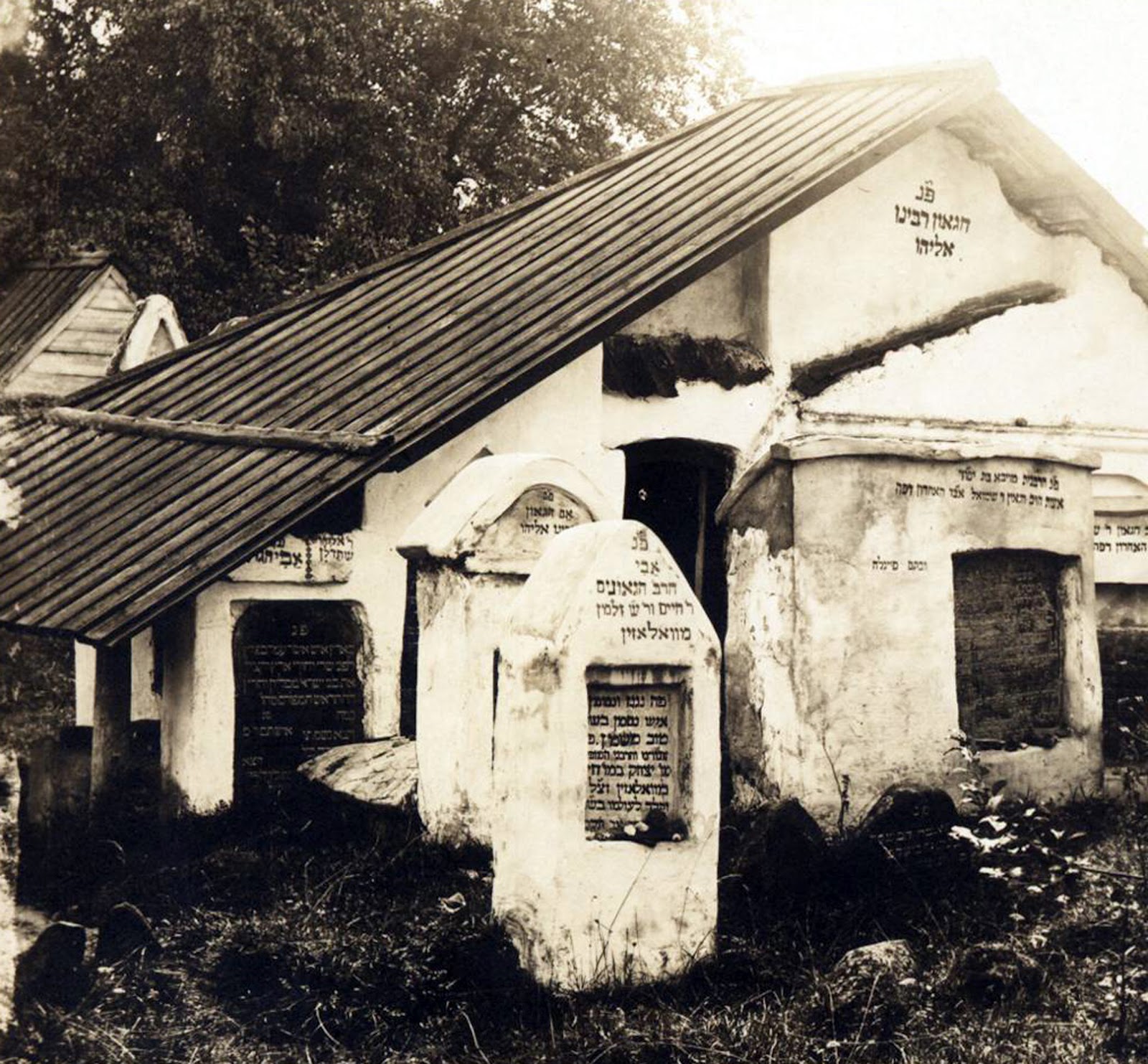
            Notice the inscription פ”נ הגאון רבינו אליהו in the center of the photograph, near the roof-top of the Ohel. Turning to the extreme left of the Ohel, where the roof slopes down almost to the ground, one can see two grave markers above a single tombstone.
            When enlarged, the inscriptions above the tombstone clearly read (from left to right): פ”נ אבי הגר”א and   ר’ אליהו שתדלן, exactly in the order recorded by Klausner (see above, grave number 20).  When we compare Klausner’s list with the present occupants of the Ohel ha-Gra, it becomes clear that those who moved the Gra from the first to the third cemetery, moved the graves numbered 22-26, a total of six persons altogether, from the original Ohel ha-Gra. The seventh grave, unmarked, remains unidentified and could have come from any part of the old cemetery, and not necessarily from the Ohel ha-Gra.
            When we enter the Ohel ha-Gra today, we need to bear in mind that we are entering from the south and looking north. We see the mirror image of what Klausner depicted on his map. Thus the expected order today should be:
            The expected order solves all our problems. On the extreme right, Devorah and her son R. Zvi Hirsch are buried next to each other. In the center, R. Noah and his wife Minda are buried next to each other. And the Gra is second from the left. It is the actual order that creates our problem. Devorah and R. Zvi Hirsch are separated; neither is buried next to his or her spouse. The Gra is buried in between R. Noah Lipshutz and his wife Minda. אין זה אומר אלא דרשני.
            One more piece of evidence needs to be introduced before we attempt to solve the problem. Israel Cohen, British Zionist and world traveler, visited Vilna twice before World War II. Regarding the Shnipishok cemetery, he records the following: Most famous of all is the tomb of the Gaon Elijah, who lies in the company of a few other pietists on a spot covered by a modest mausoleum which is entered by an iron-barred door.
The tombstones, with long eulogistic epitaphs, are not enclosed within the mausoleum, but stand at the back of it, in close juxtaposition and closely protected by a thick growth of shrubs and bushes.
Israel Cohen, Vilna (Philadelphia, 1943), pp. 415-416. Cf. his Travels in Jewry (New York, 1953), pp. 149-150.
4. The Solution
            It seems obvious that those who moved the Gaon to the new Jewish cemetery made one slight adjustment relating to the ordering of the graves. They moved R. Zvi Hirsch from the extreme right to the extreme left. We will never know with certainty why they did so. What was gained, perhaps, is that now all the males were together on the left, and all the females were together on the right. By moving R. Zvi Hirsch to the extreme left, the Gra was now the third grave from the left. But the actual order today appears to have the Gra as the fourth grave from the left, and buried in between R. Noah and his wife Minda.
            We need to remember that in the old Jewish cemetery the tombstones were outside the Ohel ha-Gra, each tombstone opposite the remains of the person it described, with text of the tombstone facing in a northerly direction. Indeed, every tombstone in the old Jewish cemetery was placed opposite the remains of the person it described, with the text of the tombstone facing in a northerly direction.
            We also need to remember that the Gra and R. Noah shared one tombstone.5
            The Gra’s epitaph was on the right side of the tombstone; R. Noah’s epitaph was on the left side of the tombstone. This was in perfect order, since inside the Ohel, the Gra was to the left of R. Noah, and R. Noah was to the left of, and next to, his wife Minda. In the new Jewish cemetery, the six graves were laid out exactly as in the old cemetery, with the exception of R. Zvi Hirsch as indicated. But it was decided to place the original tombstones inside the Ohel, at the head of each of the graves. Instead of facing in a northerly direction, with texts that could be read only by standing outside the Ohel, the tombstones, now reversed, faced in a southerly direction, with texts that could be read only when standing inside the Ohel. Doubtless, this was done in order to protect the historic tombstones from exposure to the elements, from deterioration, and from vandalism. Also, the tombstones now immediately identified who was buried in each grave. Unfortunately, when the single tombstone shared by the Gra and R. Noah was reversed and set up inside the Ohel, it automatically (and wrongly) identified the third grave from the left as R. Noah, and the fourth grave from the left as the Gra, and caused a split between R. Noah and his wife. In fact, the Gra is the third grave from the left, and R. Noah is the fourth grave from the left – and R. Noah is properly buried next to his wife Minda. In other words, all Jews who visit the grave of the Gra today, pray, and leave qvitlach, at the wrong grave (i.e., at the grave of R. Noah Mindes Lipshutz).
            The above solution was based upon an examination of the literary evidence, and upon an examination of photographs preserved mostly in books. I call this עד אחד  (one witness), that is, the testimony of תורה שבכתב  (i.e., the literary evidence). But a matter established by only one witness is precarious at best.6 Intuitively I was persuaded by the one witness, but hesitated to put the solution in print until more evidence was forthcoming. Fortunately, a surprise second witness has come forward בבחינת תורה שבעל פה  (i.e., oral history). Rabbi Yitzhak Zilber (d. 2003) was a courageous Jew who lived most of his life under Soviet repression between the years 1917 and 1972, before ultimately settling  in Israel. He published a riveting autobiography in Russian in 2003. It has since been translated into Hebrew and English. In his autobiography, Zilber describes how in 1970, under Communist rule, he visited the Ohel ha-Gra in Vilna. The Jew who took him to the Ohel had participated in the transfer of the Gra from the first Jewish cemetery in Shnipishok to the third Jewish cemetery in Saltonishkiu. As they stood before the Gaon’s grave, the Jew turned to Zilber and said:7
            Remember the following forever: the Gaon’s tombstone is above the
           fourth grave from the left, but the Gaon’s body is in the third grave [from
           the left].
על פי שני עדים יקום דבר!  “A matter is established by the testimony of two witnesses.”
NOTES
1
  This essay should not be confused with an earlier essay of mine with a similar title, “Who is Buried in the Vilna Gaon’s Tomb? A Mysterious Tale with Seven Plots,” Jewish Action, Winter 1998, pp. 36-41. The primary focus of the earlier essay was on the identification of the six persons buried together with the Vilna Gaon in his mausoleum (the Ohel Ha-Gra). The primary focus of this essay is on the identification of the  grave of the Vilna Gaon himself. A version of this essay was read at a conference in honor of Professor Daniel Sperber, held at Bar-Ilan University on June 13, 2011. It is presented here in honor of the Vilna Gaon’s  215th yahrzeit on 19 Tishre, 5773.
2
  The claim that the Vilna Gaon was moved temporarily from the first to the second Jewish cemetery appears, among many other places,
in Y. Alfasi, ed., וילנא ירושלים דליטא חרבה (Tel-Aviv, 1993), p. 9; Y. Epstein, “,דער יידישער בית-עולם אין ווילנע”   ירושלים דליטא, October-November 1996, pp. 5-6; and N.N. Shneidman, Jerusalem of Lithuania (Oakville, Ontario, 1998), p. 161. An examination of eye-witness accounts of the reburial of the Gaon, and of much other evidence, yields the ineluctable conclusion that the Gaon was moved only once, directly from the first to the third Jewish cemetery.
3
  See the references cited in the Jewish Action essay (above, note 1).
4
  So reads the Hebrew sign above the entrance to the Ohel Ha-Gra. But the Ohel Ha-Gra was constructed over a three-year period between 1956 and 1958. I cannot say with certainty when the sign first went up, but logic dictates it did not go up before there was an Ohel. In all the early photographs of the Ohel I have seen, there was no sign at all. It surely wasn’t there during the period of Soviet domination of Lithuania, which means it first when up sometime after 1991. As such, it is hardly evidence for who is buried in the Ohel Ha-Gra. More importantly, one of the participants in the reinterment of the Vilna Gaon testified that he and his colleagues wanted to move the remains of Avraham ben Avraham, the Ger Zedek of Vilna, but could not locate his ashes in the old Jewish cemetery. See R.Yitzchak Zilber, To Remain a Jew (Jerusalem, 2010), pp. 389-390.
5
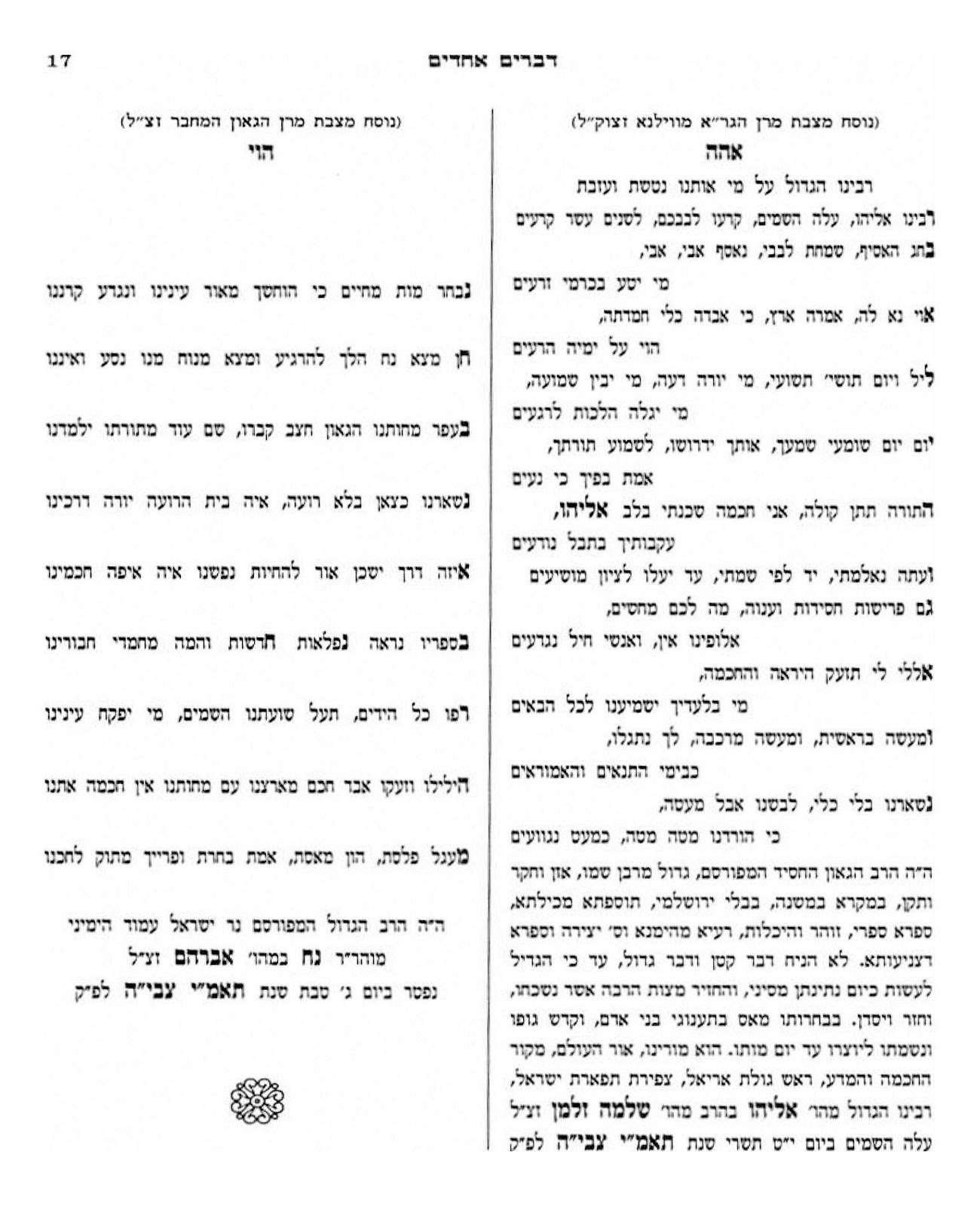
  For side by side transcriptions of the epitaphs on their tombstone, in clear Hebrew font, see R. Noah Mindes Lipshutz, פרפראות לחכמה (Brooklyn, 1995), p. 17.
6
  I was plagued by the remote possibility that the movers, precisely because the shared tombstone required the Gaon to be to the right of R. Noah, switched the remains of the Gaon and R. Noah, and deliberately buried the Gaon in between Minda and R. Noah. (I considered this a remote possibility, because it is highly unlikely that any rabbi would allow such tampering with who was buried to the immediate left and right of the Gaon. As is well known, R. Hayyim Zvi Shifrin [d. 1952] presided over the reinterment of the Gaon. See R. Yaakov Shifrin, קול יעקב [Jerusalem, 1981], pp. 26-30.) If so, all the tombstones are accurately positioned in the Ohel Ha-Gra, even today. Cf. my deliberations in American Jewish Monitor , October 24, 2003, p. 18.
7
  R. Yitzchak Zilber, op. cit. (above, note 4), p. 389.


R. Reuven Margulies I

First, I want to post a bibliography of R. Margulies’s works and then I shall discuss some biogrpahical details in the next post. This bibliography is not a scientific one in that I do not attempt to list every edition. Rather, I am listing just the works and some bibliogrpahical information as I see fit. Most of this information comes from Naftali Ben Menachem’s bibliogprahy of R. Margulies’s books which was printed in Sefer Margolious.

1) Toldot Adam (Lemberg 1912) on R. Shmuel Edels
2) Kav Besamim (Lemberg 1913) 102 notes on Tosefot
3) Drush l’yom ‘alot ‘al kesi moshlim ‘adonanu haKeiser Karal haRishon (Lemberg 1918)
4) Kavi Ohr (Lemberg, 1921) laws pertianing to Israel as well as articles on history, including yesod hamishna among others
5) Yesod HaMishna V’Arikachto (Lemberg, 1933) on the creation of the Mishna
6) Sefer Hassidim with his notes (multiple printings)
7) Tolodot Rabenu Hayyim ben Atar (Lemberg, 1925), biography on the Ohr Hayyim includes the notes of R. Meir Dan Plotzki (Kli Hemdah)
8) Ohr Meir (Lemberg, 1926), biography of R. Meir from Perlmishiya
9) Margenuta d’Reb Meir (Lemberg, 1926), sayings of the above R. Meir
10) Shealot u’Teshuvot min HaShamyim, R. Margulies’s extensive notes on the teshuvot as well as a comprehensive introduction discussing Torah lo’ Bashmyim and other related topics (multiple printings)
11) Yalkut Margolious ([Lemberg], 1927), derashot of R. Margulies
12) Imrei Kodesh haShalem (Lemberg, 1928)
13) Vikuach Rabbanu Yehiel m’Paris (Lemberg, 1928), with biography of R. Yehiel
14) Shemot v’Kinuim B’Talmud, discussing names in the Talmud, including when two names started, (multiple printings)
15) Helulua d’Tzadika (Lemberg 1929), lifespan and death dates of Tzadikim
16) Vikuach HaRamban (Lemberg, 1928)
17) Yalkut Peninim (Lemberg, 1929), derashot
18) Butzna d’Nehora HaShalem (Lemberg, 1930), about R. Barukh of Metzerich
19) Gevurot Ari (Lemberg, 1930), biography of R. Leib Srhson
20) Toldot Rabbenu Avrohom Mimoni, biography of Rambam’s son, (multiple printings)
21) Rishimah (Lemberg, 193-) list of books in his bookstore
22) Mekor Barukh (Lemberg, 1931), biography of R. Barukh of Metzerich and other historical documents
23) Shem Olam, to reveal the anonymous people in hazal (multiple printings)
24) HaModiah journal
25) Nefesh Hayyia, on Shulchan Orakh multiple printings
26) Hagadah shel Pesach (Tel Aviv, 1937)
27) Shichot Chakhamim
28) Mekor haBerakha discussing blessing and why and when before one does something (recently reprinted)
29) Zohar with his extensive notes (multiple printings)
30) Sibah hisnaguto discussing R. Emden/R. Eybeschitz controversy (very controversial Scholem wrote a pamphelet against this) Tel Aviv 1941
31) Reb Saul Levin M’Ziaf haSefer Besamim Rosh, in Aresehet 1944
32) Malechi Elyon on angels in Hazel (multiple printings)
33) Ollalot various articles (multiple printings)
34) Tikunei Zohar notes, multiple printings
35) Sefer haBahir same as above
36) Zohar Hadash same
37) L’Toldot Anshei Shem b’Lvov, Jerusalem 1952
38) Milchmot HaShem (R. Avrohom ben HaRambam) (including the biography on him) (multiple printings)
39) haRambam v’Hazohar now reprinted in Penini Margolios
40) Sha’ari Zohar collecting relvant passages from the Zohar to Hazal (multiple printings)
41) Margolios HaYam on Sanhedrin (multiple printings)
42) Divrarim b’Itam dershot
43) L’Heker haMisparam beTalmud, Sinai 44
44) Tzioyunim Bibliographim a comprehensive biobibliography in Areshet 1-2,4
45) Tziyunim l’Ha’arot l’Seder haDorot, Sinai 46
46) HaMikrah v’Hamesorah multiple printings
47) Mekharim b’Darkei haTalmud v’Hidosov multiple printings


Psalms 117:1-2: Why Are the Goyim Praising God?

Psalms 117:1-2: Why Are the Goyim Praising God?[1]

By Mitchell First
MFirstAtty@aol.com


In Hallel, has only two verses:

1) Praise Hashem all goyim; Laud him all the umim.

2) For his ḥesed is great?[2] עלינו and the emet of Hashem is forever, Halleluyah.

Why are the nations of the world to be praising God? Because his ḥesed is great on the Israelites? Does this make sense? I first read about this interpretive issue in Rabbi Hayyim Angel’s excellent article in Through an Opaque Lens (2006). I am writing this article to collect more sources and expand the discussion. I will also offer a different solution than the various solutions proposed by Rabbi Angel.

Admittedly it is possible to read the two verses as independent of one another. But in the simplest reading they are connected by that explanatory word כי (=for) and the author is asking the nations of his time to praise God because of the extravagant ḥesed that God has provided to the nation of Israel.

A Sage in the Talmud (Pes. 118b) realizes this difficulty and reads the verse as follows: “Praise Hashem all nations”- for the great acts and wonders which God does for the nations; how much more so should we praise Him, for his chesed is great on us…” In other words, this Sage suggests that the second part of the verse refers to Israelites praising God, even though that is not mentioned in the verse.?[3]

How do our commentaries deal with our issue?

Rashi writes that we should reinterpret the word כי so that it instead means “even though.” This drastically changes the meaning of the verse. R. Angel explains: “Rashi intimates that the nations are generally unhappy about God’s distinctive relationship with Israel. The Psalmist…calls to the nations to rise above their initial antagonism.”

It is true that כי has multiple meanings and “even though” is one of them. But this is still far from a plain sense reading of the verse.

Rashbam has an interesting approach to our verse (found in his comm. to Deut. 32:43). The nations are being told to believe in and praise God. If they do, he will give them great ḥesed just like he gave to Israel. This is clever but it does not read well into the verse.

Radak solves the difficulty a different way. The verse is talking about the messianic era. He cites Tzefaniah 3:9: “Then I will turn to the peoples…that they may all call the name of Hashem to worship Him with one shoulder.”?[4] Radak adds that the nations did not believe that God could liberate the Israelites from being subjugated. On seeing that he did, they will praise him.

Malbim suggests a specific context for the psalm. In the late 8th century BCE Sancheriv exiled the Israelites and exiled non-Israelites with them. Eventually, God will return the Israelites together with these non-Israelites. Since God’s rescue of the Israelites will benefit these non-Israelites, they will praise him. There are of course no clues to any of this in these two verses.

The Daat Mikra commentary (composed by Amos Chacham) takes the approach that when Israel is downtrodden, the nations mock the God of Israel. See, e.g., Ps. 115:2: “Why should the nations say now: ‘Where is their God?’.” Conversely, when Israel is succeeding, the nations are impressed and praise him. It cites Ezekiel 36:23: “I will sanctify my great name, which has been profaned among the nations, and which you have profaned among them. And the nations will know that I am Hashem… when I shall be sanctified in you before their eyes.” Thus, Daat MIkra interprets the background to Psalms 117:1-2 to be that the nations have seen that God saved Israel.

Another approach is to deny the legitimacy of the question. It seems that there are many other verses in the book of Psalms where the nations of the world are called upon to praise God for saving Israel. This approach is taken by R. Feivel Meltzer in his Pnei Sefer Tehillim (1982), p. 332.?[5]

For example, at Ps. 98: 2-4, we have: “Hashem has made His salvation known and revealed His righteousness to the nations. He has remembered His love and his faithfulness to Israel. All the ends of the earth have seen the salvation of our God. Shout for joy to Hashem all the earth…”

Also, at Ps. 100:1-3: “Make a joyful sound to Hashem, all the lands.  Serve Hashem with gladness. Come before His presence with singing.  Know that Hashem is God: it is He that made us, we are His,?[6] we are His people, and the sheep of His pasture.”

Finally, there is the approach that the word aleinu in the phrase: “For his ḥesed is great aleinu“ is broad enough to include the ḥesed performed for non-Israelites as well. In the time of the Rishonim, R. Moshe Ibn Gikatilah took this approach.?[7] In more modern times, among those who took this approach are Rav S.R. Hirsch and the Iyun Tefillah commentary in the Siddur Otzar Ha-Tefillot.?[8]

This is a simple way to read the phrase, but is this approach a sensible approach? Here is the weakness with it. If ḥesed is being performed for Israelites and non-Israelites- for example, God provides rain– why would the goyim praise the God of Israel? If the goyim are living in proximity to the Temple, we could understand that they would praise the God of Israel. But if the goyim are living anywhere else, it is hard to imagine that they would think that the God that they are supposed to praise is the God of Israel.?[9] It seems evident that it is only ḥesed performed for Israelites that will trigger the goyim to praise the God of Israel.

I would like to offer a different approach, one that is not mentioned by Rabbi Angel.?[10]

I know from my own extensive writings on the acrostics in the book of Psalms that the fifth book (chaps. 107-150) dates to the early Second Temple period. (Probably the fourth book does too.) See my Esther Unmasked (2015), pp. 207-230.?[11] With this background, we can suggest that the author of chapter 117 viewed the Jewish worship in the Temple as beneficial to all the nations. That is why he may be asking the nations to praise God for his goodness to the people Israel. God let the people of Israel rebuild their Temple.

Something like this approach is mentioned in the Soncino: “If, as the modern commentators hold, it is of post-exilic date, it proves that universalism was strong in the heart of the Jews when they were struggling to rebuild a national life, and that this task was undertaken in no chauvinist spirit.” I am sure that others prior to the Soncino suggested something like this as well.

I have also thought of a way that could help us decide whether “For his ḥesed is great aleinu“ includes ḥesed to non-Israelites and I have not seen the following argument elsewhere.

We can look at the rest of the verse: “and the emet of Hashem is forever…” “Emet” has two possible meanings here: “truth” or “trustworthiness.” Many give it a truth-related meaning here.?[12] But I think that it is more likely that it means “trustworthiness.” Let us look at Psalm 100. Psalm 100 ends: “Ki tov Hashem le-olam ḥasdo ve-ad dor va-dor emunato.” This verse is somewhat similar to 117:2, just that it has the word emunato, instead of emet. This suggests that “trustworthiness” is the meaning of the emet of 117:2.?[13] A reference to God’s trustworthiness seems to me to be more suggestive of keeping promises to Israelites than it is of keeping promises to both Israelites and non-Israelites.

——

I will close with the fascinating (and obviously homiletical) interpretation of R. Isaac of Volozhin (d. 1849). I will present it the way it is summarized in the ArtScroll Tehillim commentary, in the comments to Psalms 117:2: “Once, a Russian prince asked Rav Yitzchak (Reb Itzaleh) of Volozhin to explain why non-Jews instead of Jews, are expected to praise God for his kindness to Israel. Rav Yitzchak replied without hesitation: ’You princes plan countless anti-Semitic schemes with which to destroy us, but our Merciful God always manages to foil your plots. Your secret councils are so well guarded that we Jews don’t even realize all the ways in which you intended to harm us, nor how God has saved us. Only you gentiles see clearly how God’s kindness to us was overwhelming?[14]; therefore only you can praise him adequately!’ ”?[15]

[1] I would like to thank Sam Borodach for reviewing the draft of this article.

[2] The implication of gavar here is that the esed is so great that it is beyond measure. We see this from Psalm 103:11. See the Soncino and Daat Mikra there. I have seen the suggestion that because God’s esed to Israel has been so great and beyond measure, the Psalmist believes that Israel cannot adequately discharge its responsibility to praise God by itself. He therefore invites the rest of the world to praise God as well.

[3] See also Midrash Tehillim 117:2 which splits our two verses into three different voices.

[4] The last two words are a metaphor for “together;” i.e., joined by a single yoke.

[5] He cites the earlier scholar Yechezkel Kaufmann who takes this approach and who laughs at those who think that 117:1-2 is an anomaly.

[6] I am translating according to the kri, not the ketiv.

[7] He is cited in Ibn Ezra. He writes that God’s esed to all is that he keeps us alive and sustains us.

[8] P. 447. I am sure that others took this approach in modern times as well. This approach to verses 117:1-2 is also perhaps implicit at Midrash Tehillim 117:1 in the statement by R. Tanchum about rainfall: “rainfall brings joy to the entire world.” See Rabbi Angel’s article.

[9] A few centuries later, there were Gentiles known as “Godfearers” who lived close and far and who feared and praised the God of Israel. But there is little evidence that the book of Psalms is dated later than the Persian period and there is no evidence for Gentile “Godfearers” as early as the Persian period unless one gives this meaning to the “yirei Hashem” mentioned at Psalms 115:11, 118:4, and 135:19.

The Soncino commentary to 115:11 observes that many modern expositors understand the “yirei Hashem” references to be to “pious Gentiles who come to worship in the Temple.” But the Daat Mikra commentary mentions several possible interpretations: 1) Israelites who took on extra stringencies, 2) another term for all Israelites, 3) converts, and 4) asidei umot ha-olam. Another suggestion is that ”yirei Hashem” are Israelites who serve God out of fear, in contrast to “Beit Aharon,” Israelites who serve God out of love. See The Complete ArtScroll Siddur, p. 635 (citing Maharal). I thank Michael Alweis for pointing out the interpretive issue of “yirei Hashem” to me.

[10] Of course, his article was limited to responses by traditional Orthodox sources.

[11] The title of the article I am referring to here is: “The Pe/Ayin Order In Ancient Israel and Its Implications for the Book of Tehillim.”Earlier than this, I had similar shorter articles in Biblical Archaeology Review (July-Aug. 2012) and in Journal for the Study of the Old Testament 38 (2014). Basically I concluded that the acrostics in the first book of Psalms (chapters 1-41) were composed with the older pe preceding ayin order and that the ayin preceding pe order (reflected in the acrostics of the fifth book) did not begin to be used in ancient Israel until the post-exilic period. (The acrostics in the book of Psalms are only found in the first and fifth books.) See in particular the Daat Mikra commentary to Psalms 34:18, n. 9. (Psalms 34:16-18 makes much better sense assuming an original pe preceding ayin order.)

Although Bava Batra 14b attributes the book of Psalms to David and others who lived earlier than him, Shir Ha-Shirim Rabbah 4:4 preserves the views of both Rav and R. Yochanan that Ezra was one of the ten figures involved in the composition of Psalms. A similar passage is found at Kohelet Rabbah 7:19. Also, the scholar Avi Hurvitz has shown that the Hebrew of the fourth and fifth books of Psalms is later than that of the earlier books. (Note that the word Halleluyah is only found in the fourth and fifth books.) In modern times, Malbim (intro. to Psalms) and Daat Mikra (intro. to Psalms, pp. 13 and 47) are willing to accept that parts of Psalms date to the early Second Temple period. The commentary of Rashbam on most of Psalms (discovered in the 1990’s in a library in Russia, but not yet fully published) takes this position as well. (For the passages, see the 1997 article by I. Ta-Shema in Tarbitz 66, p. 418. When Ta-Shema wrote his article, the identity of the author of this commentary was not yet known.) It bears emphasizing that at Psalms 126:1 we have the phrase “shivat Tziyon” and at 137:1 we have the phrase “al naharot Bavel sham bakhinu.” See also R. Hayyim Angel, Vision from the Prophet and Counsel from the Elders (2013), pp. 210-18.

[12] See, e.g., the 1917 Jewish Publication Society of America translation (included at the top in the Soncino): “And the truth of the Lord endureth forever.”

[13] At Psalms 146:6, we have ha-shomer emet le-olam. Here too emet seems to have a trust-related meaning. See Daat Mikra.

[14]  In their translation in this work, ArtScroll translates the ki gavar phrase as “For His kindness to us was overwhelming.” That is why this phrase is used here. But see n. 2 above.

[15] The commentary is getting this story from iddushei HaGriz HaLevi on the Torah, Yitro 18:10. See similarly the Iyun Tefillah commentary in the Siddur Otzar Ha-Tefillot, p. 447.

—–

Is there any possibility that our two-verse chapter is only the remnant of a larger lost psalm? Daat Mikra rejects this. It points out that that there are three psalms that only have three verses: 131, 133 and 134. It admits that there are some Masoretic texts which join chapter 117 with either 116 or 118. But the texts that are generally more reliable (including the Aleppo Codex) have 117 as a separate chapter. In the Septuagint, it is also a separate chapter. Also, there is a Halleluyah at the end of 116 and another one at the end of 117. These words always indicate either a beginning or end of a chapter. Daat Mikra nevertheless concludes that Psalm 117 serves as an introduction to Psalm 118. This may be another way to determine the meaning of the aleinu of 117:2. But I will leave this potential direction to others.


Towards a Bibliography of Coronavirus-related Articles & Seforim written in the past month

Towards a Bibliography of Coronavirus-related Articles & Seforim written in the past month
By Eliezer Brodt


Many of us have been under lockdown for over a month – some of us for less, some for more. However, this has not silenced the ‘voice of the Torah’; all kinds of Shiurim & classes on a wide range of topics have been made available via various methods. Otzar Hachochmah has made their database available free of charge as have others. Others have chosen to spread Torah by putting digital pen to Digital paper. 

The truth is, like almost every other topic, it’s hard come up with something truly new;  plagues and the like have occurred numerous times throughout our long history. 

The famous bibliographer Avraham Ya’ari devoted a chapter of a book of his to Seforim which were written during plagues.[1]

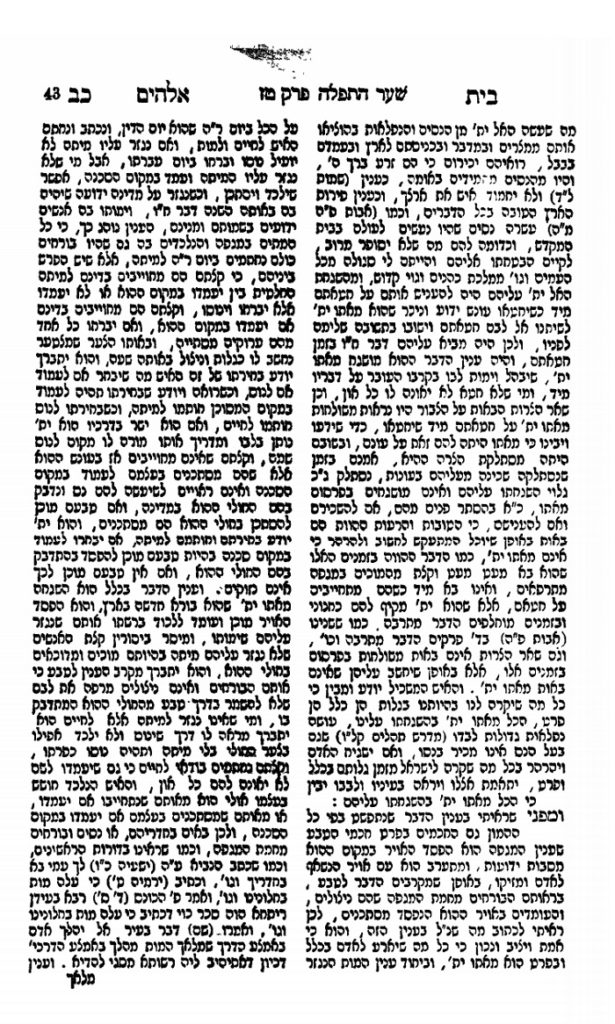
During each of these times many discussions related to aspects of plagues and epidemics arose.[2] The sources range from descriptions of the situation, discussions of what one should do, i.e. stay put or run,[3] tefilot[4] and/or segulot[5] to Halachik rulings regarding observing various Halachos.[6] Right before Pesach, Machon Yerushalayim released a 300 page, digital work collecting hundreds of such sources (item #8).

In the most recent issue of the journal Ha-Ma’ayan (#233) released this past month my good friend R’ Moshe Dovid Chechik wrote an article titled “The Prohibition or the Obligation to Flee the city during an Epidemic” (item #1). Since, others have written about it [see below (#4&5)]. 

Much has been written about R’ Akiva Eiger and the 1831 Cholera outbreak (see below – R’ Elli Fisher and Dr. Eddie Reichman’s articles items 1,2 and 9). [See also Rabbi Pinni Dunner here]. I too am working on an article on the topic and hope to complete it IYH within the next few days.

This terrible time has already seen many Teshuvot written, especially in regard to Pesach. See especially bellow #11-15. Much has been written and will continue to be written about davening with a Minyan (see below #15, see also R’ Avishay Elbaum’s recent post [here]).

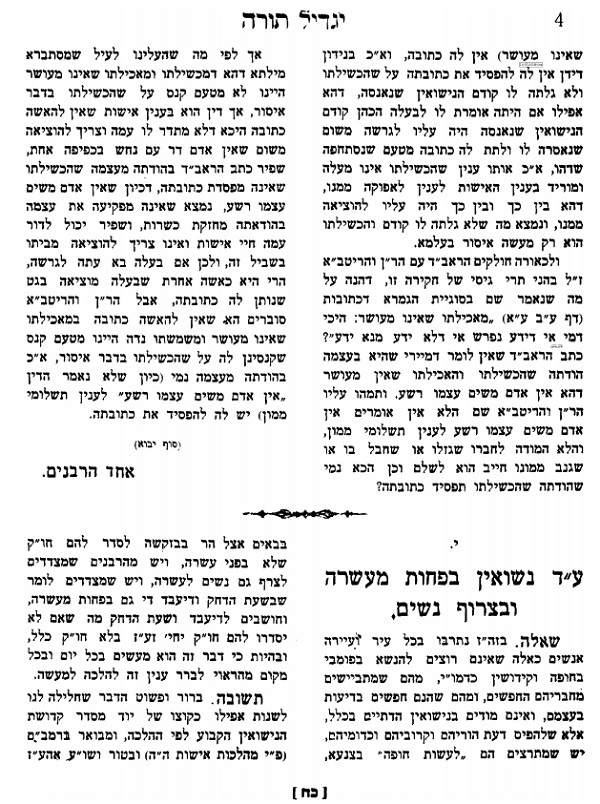
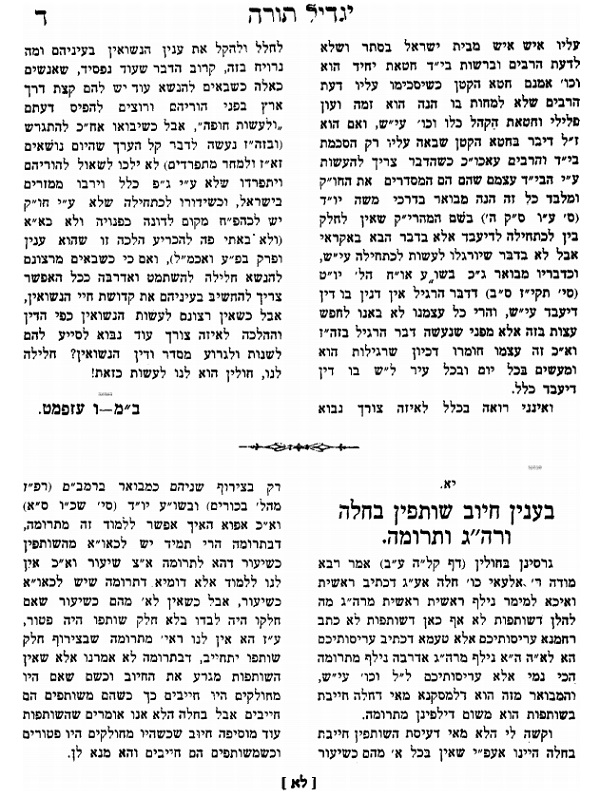
See below (Appendix Three for a Teshuvah I came across recently, about a wedding with less than 10 people for a minyan, published in Russia in 1928 in the Journal Yagdil Torah edited by Rav Zevin and R’ Abramsky.

All of the items mentioned in the Bibliography below are available from me free of charge – just e-mail me at eliezerbrodt@gmail.com.

English 

1. Rabbi Elli Fischer, Rov in a Time of Cholera (here).
2. Dr. Eddie Reichman, From Cholera to Coronavirus: Recurring Pandemics, Recurring Rabbinic Responses (here).
3. Dr. Eddie Reichman, Incensed by Coronavirus: Prayer and Ketoret in Times of Epidemic (here).
4. Rabbi Gil Student, Talmudic Advice on Epidemics (here).
5. Dr. Tamara Morsel-Eisenberg, “Is It Permitted to Flee the City?” (here).

Hebrew

  1.  ר’ משה דוד צ’צ’יק, האיסור או החובה לברוח מן העיר בשעת המגפה, כאן
  2.  ר’ מנחם מענדל רוזנפלד, זמן מגיפה: הורים ילדים ומפחדים, כאן
  3. [נאמנו מאד, עדויות גדולי ישראל על הליכותיהם ומנהגיהם בימי חולי ומגיפה, אשר נאספו ונלקטו מתוך כתביהם וחיבוריהם, מכון ירושלים, [ספר שלם, 300 עמודים
  4. [שמירת הסופר להינצל מחולי ומגפה מתורת החתם סופר [ספר שלם, קמא עמודים
  5. ר’ שמואל ויטל, סדר משמרה לזמן המגפה, מכתב יד, בההדרת ר’ ישראל זאב גוטמאן
  6.  [אוסף של31  תשובות של הרב צבי שכטר שליט”א [בעברית וחלקם גם באנלגיש
  7.  [פסקי קורונה מאת הרב צבי שכטר שליט”א [51 עמודים
  8.  [מנחת אשר, לקט שיעורים תשובות אגרות ומאמרים הנוגעים למגפת הקורונה מאת הרב אשר וייס שליט”א [100 עמודים
  9. קונטרס פסקי הלכות, בשאלות שהזמן גרמן, מתוך כתבי ר’ אברהם יחיאל סגל דויטש שליט”א
  10. ר’ צבי ריזמן, ‘צירוף למנין תפילה בציבור וברכת כהנים ב’בידוד בקורונה’
  11. [קובץ תורני מה טובו אהליך יעקב, גליון י [כל הקובץ] [585 עמודים] [עניני פסח וקורונה
  12. קישור לאוסף מאמרים על חג הפסח והמגיפות בהיסטוריה, בספרות בפיוט ובהגות.  המאמרים פרי עטם של חברי וחברות סגל הפקולטה למדעי היהדות באוניברסיטת בר-אילן, כאן
  13. [קובץ עץ חיים גליון לג [יש כמה מאמרים על קורונה

Appendix One:

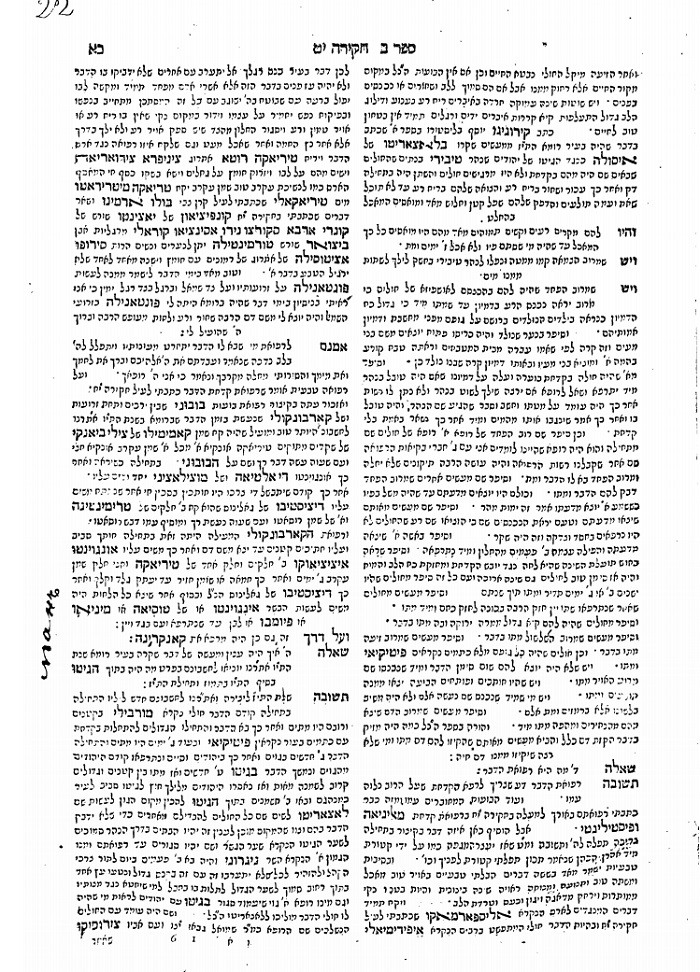
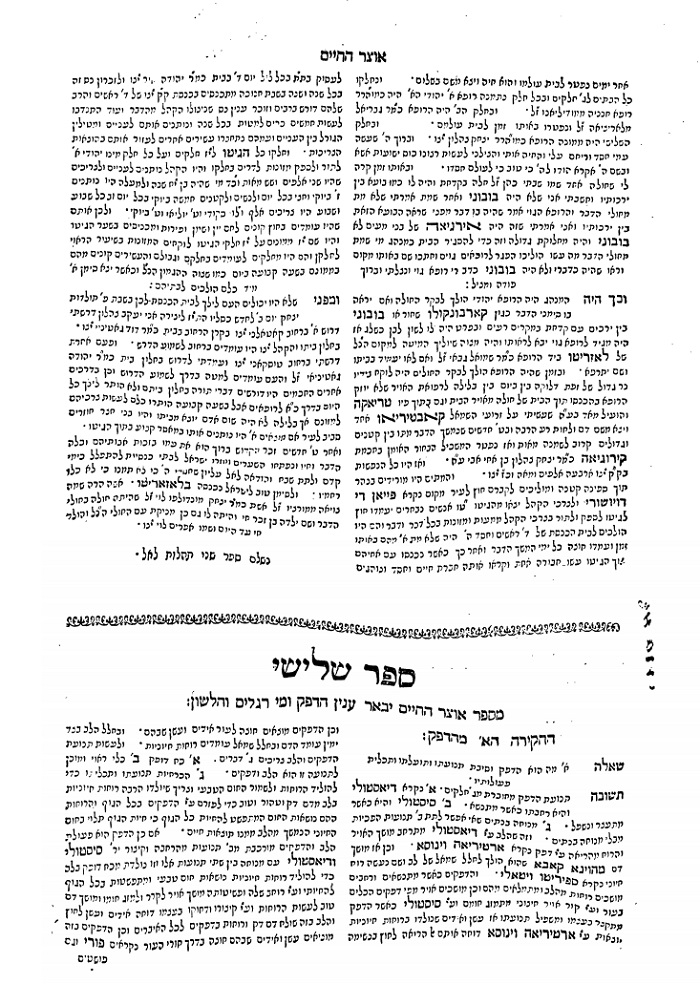
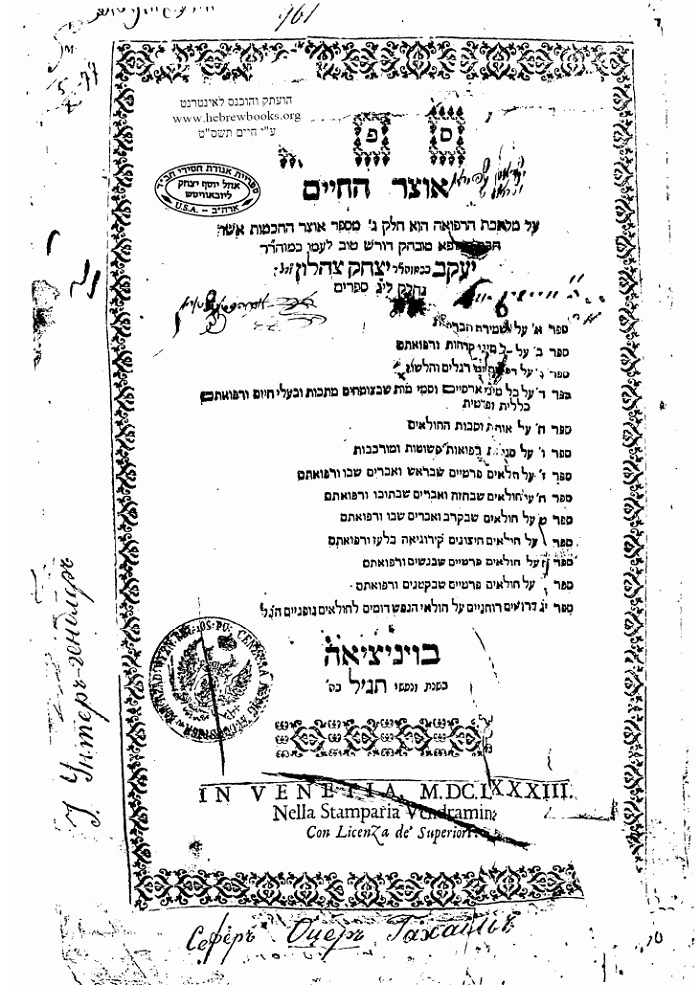
In a post from a few years back I wrote about R’ Yaakov Zahalon (1630-1693), a graduate of medical college in Rome, became a doctor at the age of twenty-six, and for several years, was also a Rav and Baal Darshan in Rome. He was famous for his important medical work, Otzar Ha-Hayyim. I also wrote a little about the work (see here).

He was very involved in the famous plague in the ghetto of Rome in 1656, which he describes at length in his work, Otzar Ha-Hayyim. Here is the very interesting passage about it which has relevance today.

Appendix One:


Appendix Two:


Appendix Three:


[1] Mechkerey Sefer, pp. 90-99. See also Marvin Heller, Further Studies in the making of the early Hebrew Book, pp.79-90. See these recent posts here & here.
[2] See for example about one in Italy 1630-1631: R’ Yehudah Aryeh Modena, The Autobiography of a Seventeenth Century Venetian Rabbi, pp. 134-136; Sefer Olam Hafukh, a History of the Plague in Padua in the Year 1631, by Abraham Catalano, Kovetz Al Yad 4 (XIV) (1946), pp. 65-101 (printed by Cecil Roth).
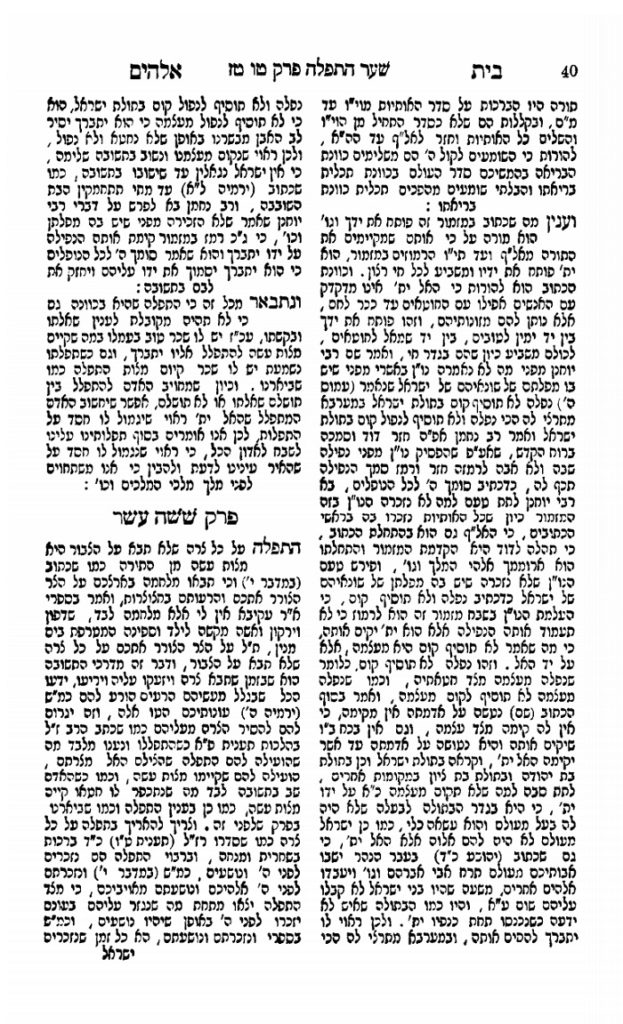
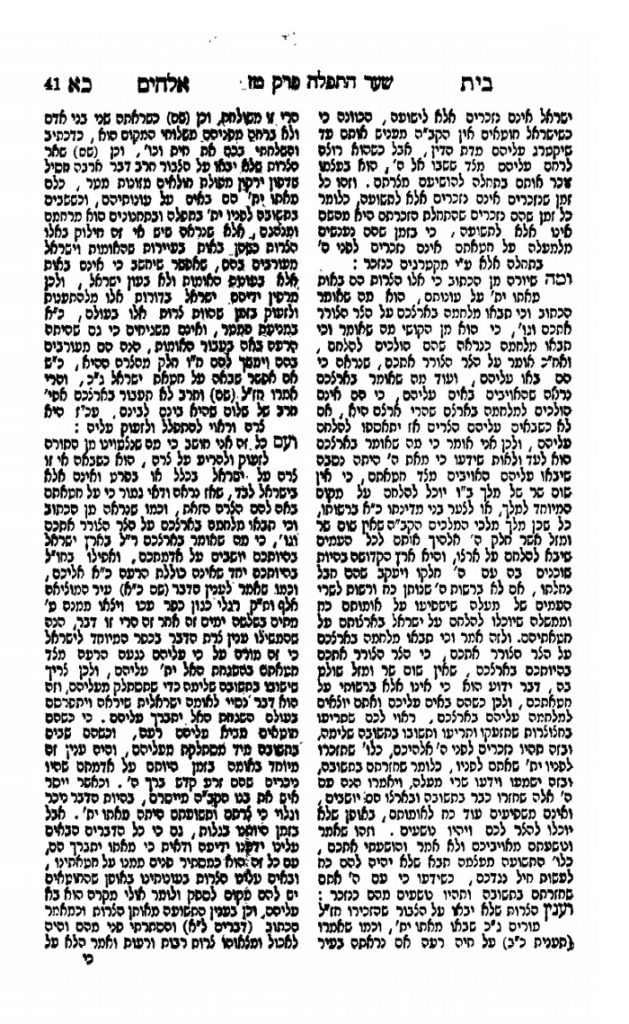
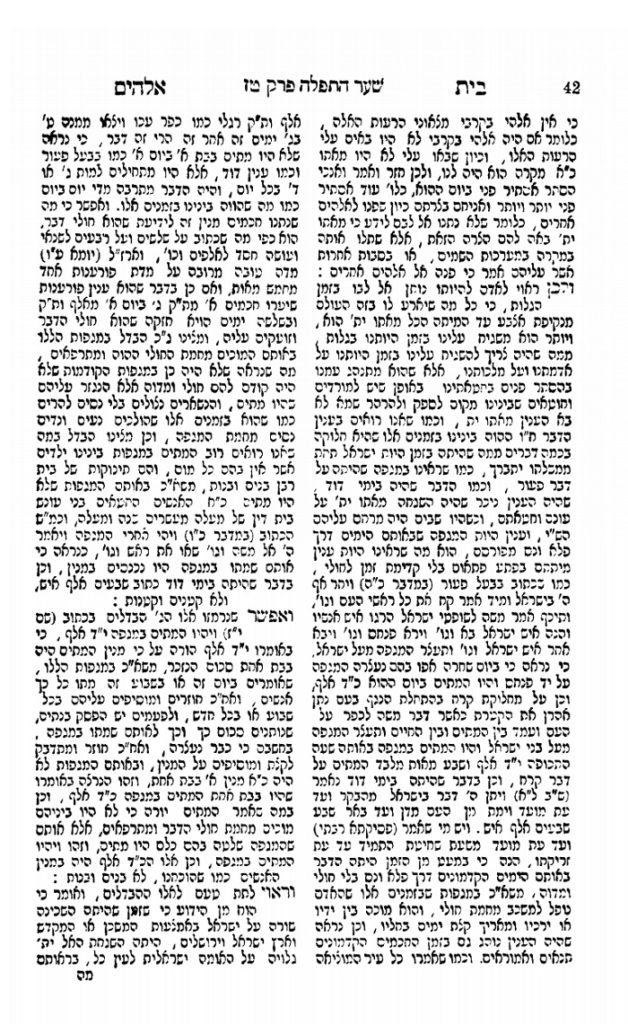
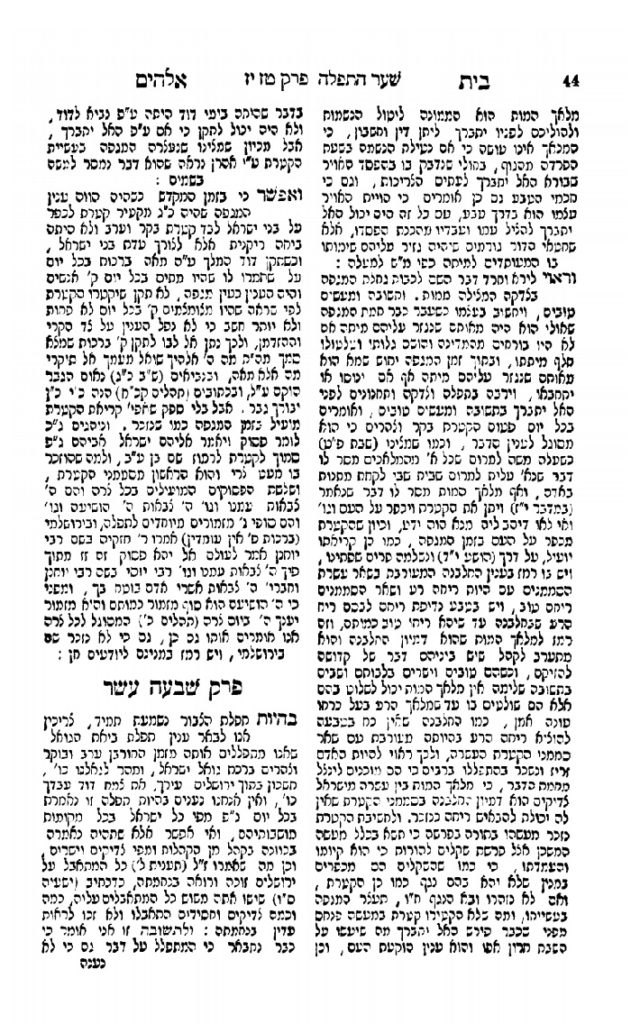
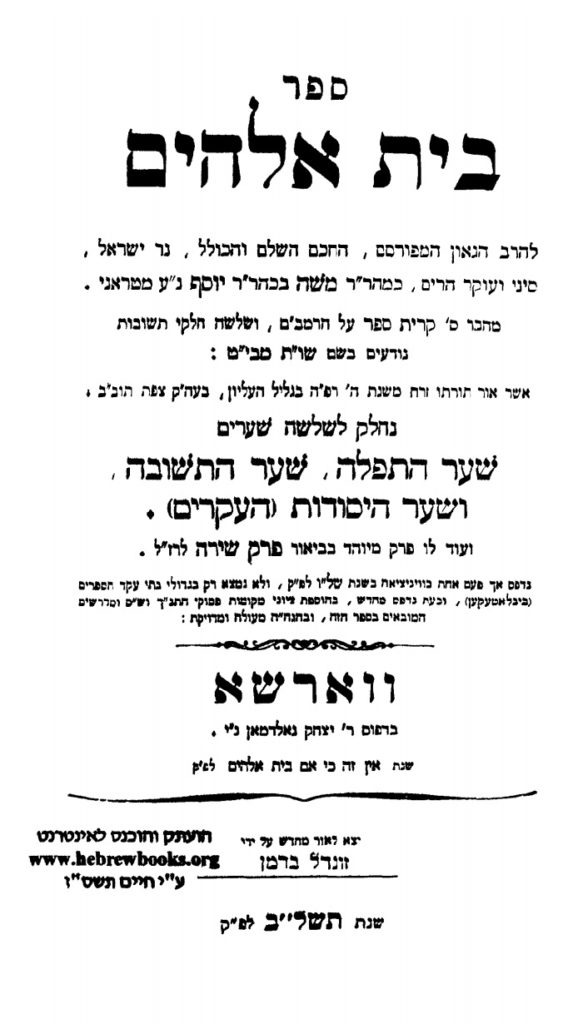
[3] See Asher Ziv, HaRama, pp. 112-116. See Appendix Two for an important chapter from the Mabit’s incredible work Beis Elokiym related to Plagues in Hashkafah. See also, R’ Raphael Mordechai Malchi, Medical Essays, (ed. M. Benayahu), pp, 139-140. See also his Grandson, R’ David De Silva, Pri Megaddim, [Zohar Amar, Ed.], pp. 71-74.
[4] Two weeks, ago Rabbi Guttman released online, a PDF of a manuscript of R’ Shmuel Vital of Seder Tefilos based on Kabbalah, to say during such times (item #11). See also #3, Dr. Eddie Reichman’s article on the topic.

[5] About Fasting, see Omer Ahituv, Fasting in Ashkenaz at the Beginning of the Seventeenth Century, MA thesis, Tel Aviv University 2019, (Heb.) pp. 70-74.
[6] See the very special work by H.J. Zimmels, Magicians, Theologians and Doctors, pp. 99-110, 228-233 who has an excellent collection of material on this.

In middle of a teshuvah about Pidyon Shivyoim the Shvut Yaakov wrote:

אבל עכשיו בעוה שנתרבה עלינו עול הגלות ועלילות שקרימשונאינו שמעלילין עלינו כאלו הדבר בא עי ישראל דוקא וכשהיה הדבר בשנת תעג ברוב מקומות שהיו שמה מבני עמינו היה סוגרים רחוב היהודים באין יוצא ואין בא ממש ובדוחק עפ שתדלנוגדול שהניחו להביא להם צרכי מזונותיהם ובאיזה מקומות הוצרכו לילך ולחבות עצמן ביערים ומערות וישראל שהיו בדרך ועל פני השדה היו ממש מופקרים למות ואשרי מי שלא חמאן בצער ודוחק גדול כזה ואין לך שבי גדול מזו דגרע מכולהן דכולהן איתנהו ביה על כן אין צריך לפנים דמצוה זו הוי ממש פדיון שבוים ואפשר דגדול ממנו ולא הוי שינוי מדעת הנותן כי אין שעת הדחק גדול מזו (שבות יעקב, ב, סיפד).

See also the excellent work, Julius Preuss, Biblical and Talmudic Medicine, (translated by Fred Rosner), pp. 151-160.


Dr. Samuel Vita Della Volta (1772-1853): An Underappreciated Bibliophile and his Medical “Diploma”tic Journey

Dr. Samuel Vita Della Volta (1772-1853): An Underappreciated Bibliophile and his Medical “Diploma”tic Journey

Rabbi Edward Reichman, MD

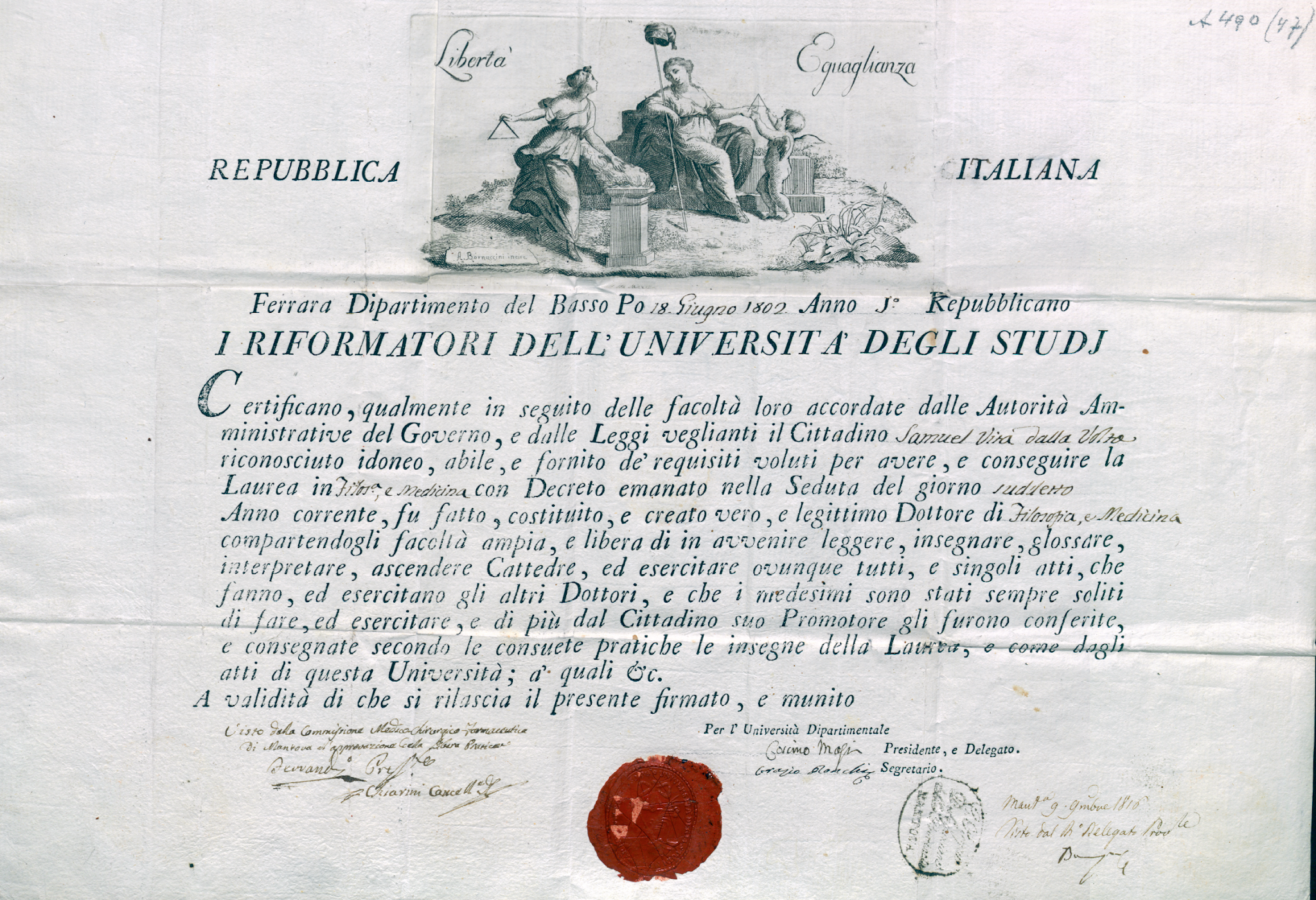
I came upon the name Samuel Vita Della Volta through my usual historical pathway, the world of Jewish medical history, and my continued quest for medical diplomas of Jewish physicians from the premodern era. While the lion’s share of the diplomas I have identified come from the University of Padua,[1] there are some extant Jewish diplomas from other Italian universities, including Siena, Rome, and Ferrara. One of two Jewish diplomas I have procured from the University of Ferrara is that of Samuel Vital Della Volta, a graduate of 1802.

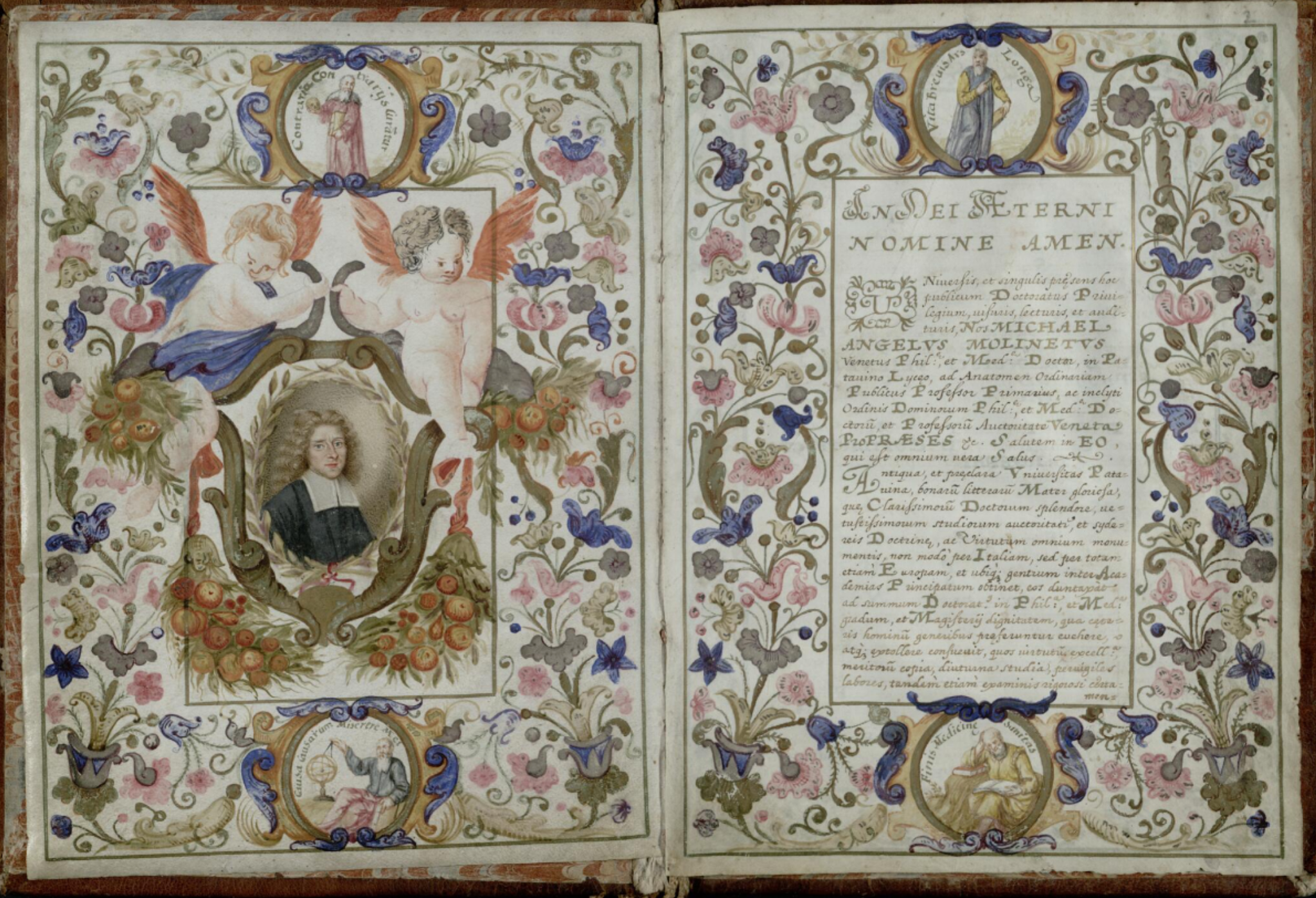
From an artistic perspective, it pales in comparison to the diplomas of his Paduan predecessors. See, for example, the diploma of the 1695 Jewish Padua graduate, Copilius Pictor (AKA Jacob Mehler), below.[2]

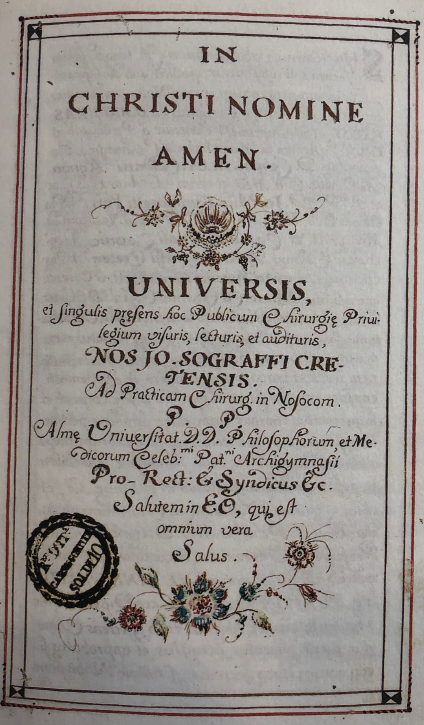
In contrast to this profusely hand illustrated spectacular example of Renaissance art, Della Volta’s is a templated diploma with both text and illustration printed. Only the graduate’s particulars are written, or I dare say squeezed in, by hand. To be fair, by this time not all Padua medical diplomas were as ornate as in the past, as evidenced by the diploma of Andrea di Domenico Rossi (Padua, 1788).[3]

However, the university did not entirely abandon its practice of issuing such diplomas, as evidenced by the diploma of Carlo Tomasini (Padua, 1794).[4]

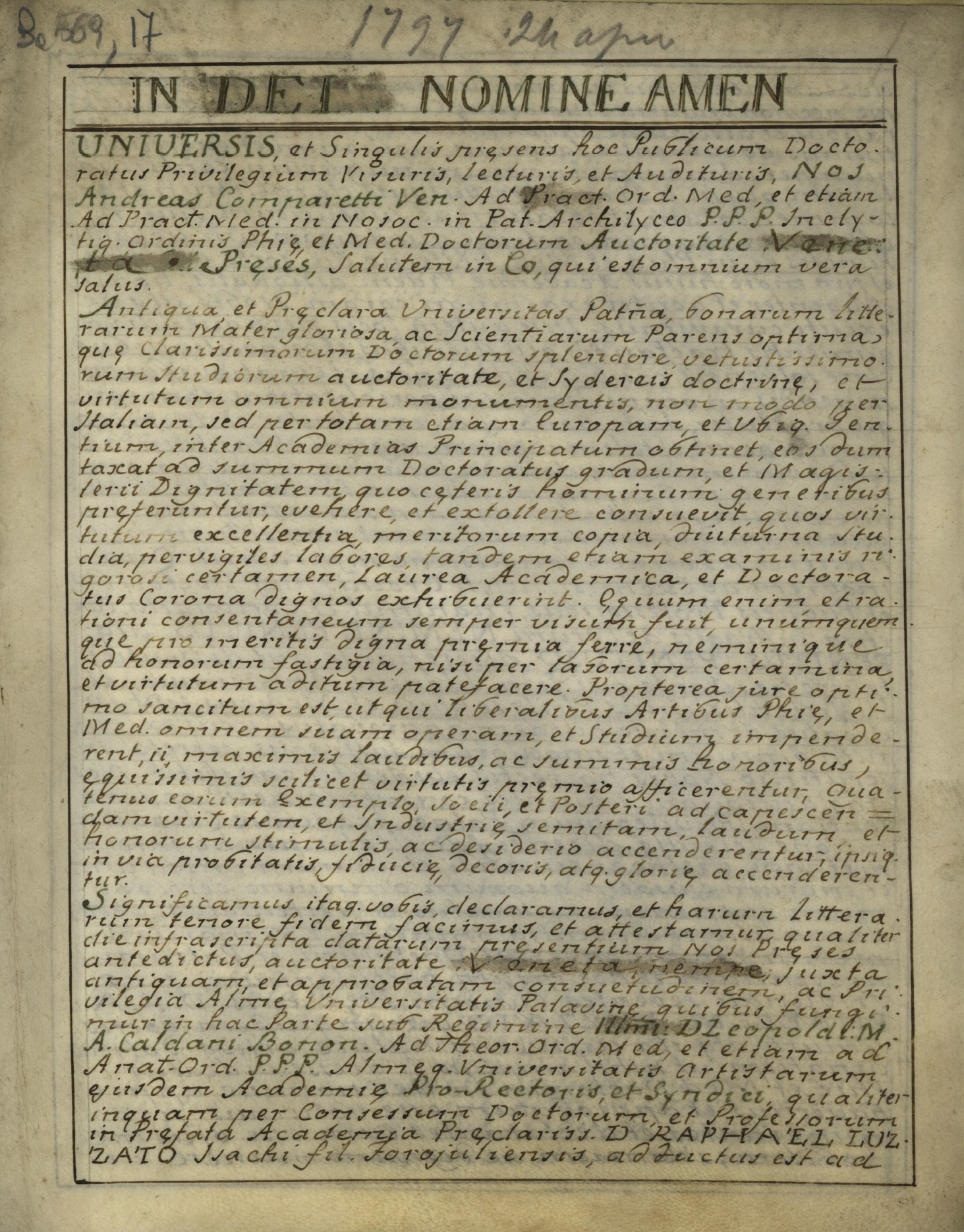
The diploma below of Jewish Padua graduate Rafael Luzzatto from 1797[5] is more in line with Della Volta’s, though at least Luzzatto’s diploma was hand calligraphed.[6]

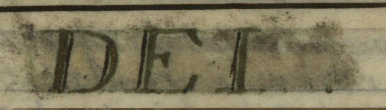
This diploma bears the invocation, “In Dei Nomine Amen” (in the name of God, Amen), typical for the Jewish student, instead of the standard invocation, “In Christi Nomine Amen” (in the name of Christ, Amen), used for the Christian students. Close inspection of this diploma reveals that the word “Dei” was written over an erasure of a longer word.

I have a strong suspicion that this was a standard templated diploma and that the calligrapher erased the word “Christi” and replaced it with “Dei.”

While the medical diplomas of the Jewish students of Padua,[7] as well as those from other universities such as Siena,[8] contained unique emendations, one finds no such alterations in Della Volta’s case.[9]

What caught my attention about Della Volta’s diploma was not its esthetics, or lack thereof, but rather its place of residence. This lackluster diploma currently resides in Budapest, Hungary in the Library of the Hungarian Academy of Sciences. The extant diplomas I have identified can be found mainly in Italy, Israel, and the United States. While each diploma has had its unique journey, these are by and large locations where the physicians lived, or their descendants migrated. For example, the diploma of Isaac Hellen can be found in a library in Germany,[10] but this is where Hellen lived and practiced. Della Volta was a Mantuan physician who lived and died in Italy. There is no record of his descendants migrating to Hungary. By what route then did this document reach such a wayward destination? Tracing the circulation of Jewish books “through time and place” is the laudable goal of the wonderful “Footprints” project.[11] While one may not always be able to track the exact journey of a book or manuscript through time, in this case we possess a passport of sorts with only three stops over some two hundred years that lead us directly to our final destination. The origin of this journey lies in the lifelong pursuits of our graduate.

Samuel Vita Della Volta (שמואל חי מלאוולטא) (1772-1853) was a physician and scholar born in Mantua whose writings include Biblical and Talmudic commentaries, sermons, and responsa. His works remain in manuscript and to my knowledge he has not been the subject of an academic biography.[12]

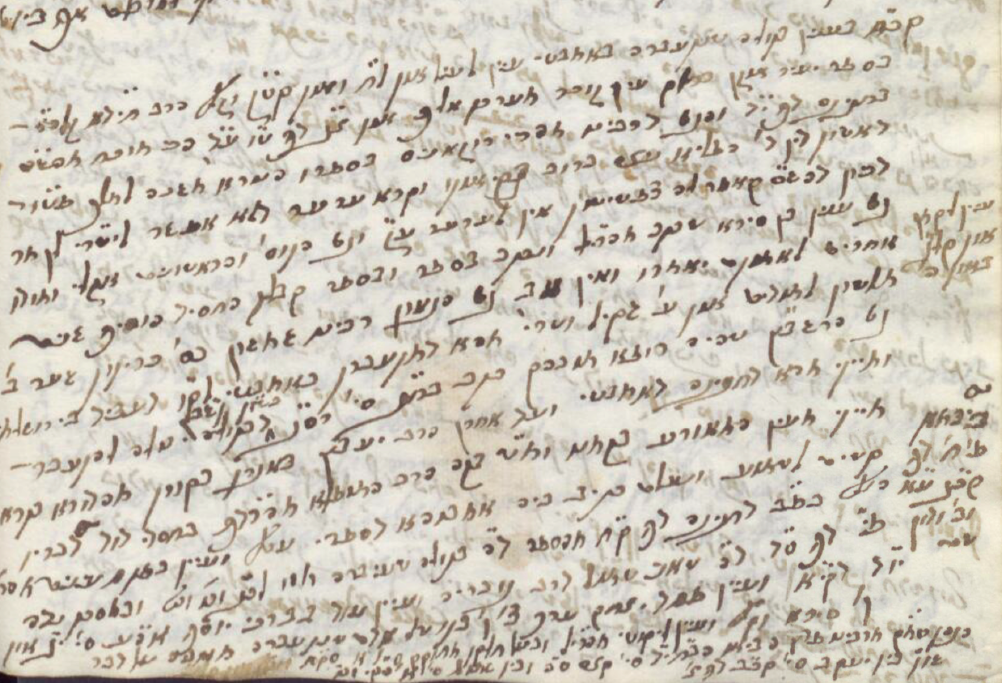
As a modest initiation into his writings, I share with you some observations from a few chapters selected from his unpublished work, Dan Yadin (1797).[13] The work is a miscellany of responsa and halakhic discussions. While the topics I have chosen are medical in nature, this reflects more my interest than the nature of the work.

Chapter 8 – Tefillin and Apoplexy (Stroke)[14]

This chapter takes the form of a classic responsum. The question is about a person who suffers from apoplexy, what today we would call a stroke or cerebrovascular accident (CVA).

While his cognitive function remains intact, he has lost motor function and sensation of his left arm. Is he still obligated to put on his tefillin shel yad, and if so, on which hand?

One of the more remarkable descriptions in Jewish literature of a stroke and its subsequent religious impact appears in the introduction to a work by another Jewish physician, Abraham Portaleone (d. 1612).[15] Portaleone came from a long line of physicians and graduated the University of Pavia in 1563.[16] He served as physician for the Dukes of Mantua, receiving special permission from Pope Gregory XIV to treat Christian patients. While he authored a number of medical works, it is only later in life that he wrote his Shiltei Ha-Gibborim on religious matters. The passage below from the book’s introduction explains why:

In June of 1605, Portaleone, a renowned and accomplished physician, reports how he experienced the sudden loss of function of the left side of his body, incapacitating him for some nine months. While he does not discuss how he observed the mitzvah of tefillin, he does mention his prayer, supplication, repentance, and religious self-reflection, which led him to undertake the writing of his magnum opus. This encyclopedic work was written for his children as a guide to proper religious prayer and observance,[17] focusing on the Temple service. It includes chapters on the musical instruments of the Beit Ha-Mikdash, the composition of the incense, and the details of the daily sacrifices. Della Volta would likely have read, if not owned, this work.

Returning to the halakhic question, Della Volta cites the Shevut Yaakov’s case of one born with only one arm on the right.[18] Rabbi Reischer debates whether such a person would be free of any obligation as he does not possess a yad keihe (non-dominant arm); or whether perhaps since he was born this way, his sole arm has the status of both a dominant and non-dominant arm combined. Rabbi Reischer accepts the latter approach and as such, requires the donning of tefillin. One who sustains a traumatic complete amputation of his non-dominant arm, however, would no longer be required to wear tefillin on that arm. (The obligation to wear tefillin shel rosh remains undisturbed.) Support for this position comes from Rama, the Bach and Mazik Brakhah. Della Volta argues that this would not apply to his case, where the physical arm is completely intact, albeit nonfunctional. With additional support from Rabbi Yeḥezkel Landau’s Dagul MeRevava, he concludes that the one who suffers a stroke with loss of function of his left arm would be required to wear tefillin accompanied by the requisite blessing.

Chapter 25[19] Anatomical Dissection

The topic of discussion for this chapter is anatomical dissection.

This appears to be a narrative bibliography of sorts. Della Volta cites a reference to a passage “at the end of Yoreh De’ah.” The halakha[20] to which he refers is:

אין מפרקין את העצמות ולא מפסיקין את הגידים

One must not separate the bones of the body, nor sever the gidim (however these are to be defined, possibly includes veins, arteries, nerves, and tendons).[21]

This halakha is in the context of a discussion on likut atzamot, collecting the bones for reburial after initial temporary burial, often in caves or kukhin (niches).[22] This halakha is not typically invoked in contemporary halakhic discussions about the prohibition of autopsy. The now famous teshuva of the Noda biYehuda on autopsy (Tinyana Y.D., 210) had already been published in 1776, but Della Volta does not appear to have been familiar with it.

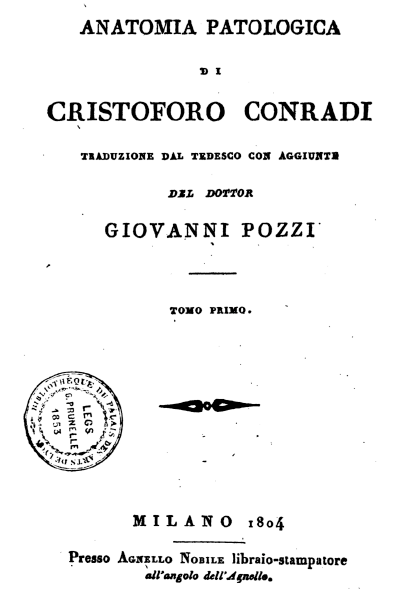
While the Hebrew source seems to oppose dissection, the other sources marshalled appear to be supportive. In his discussion on the use of tefillin in a case of stroke, there is no mention of secular or medical sources, as they would be noncontributory. In a discussion on the value of dissection, such material would certainly be relevant. He cites, for example, the preface to a work on pathology by Christoforo Conradi which lauds the educational benefits of anatomical dissection.[23]

Della Volta cites from a number of additional medical sources, including Biblioteca Medica Browniana Germanica.

Of particular interest is his reference to another Jewish source:

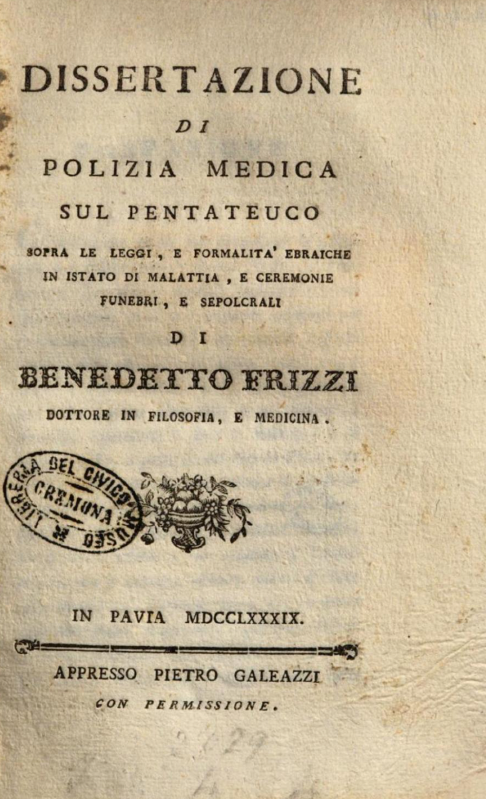
Here he refers to the work of Benzion Raphael Kohen (Benedetto) Frizzi titled, Dissertazione di Polizia Medica sul Pentateuco (Pavia, 1787–1790), which is a thematic analysis of medicine and public health in the Torah and Jewish tradition.[24]

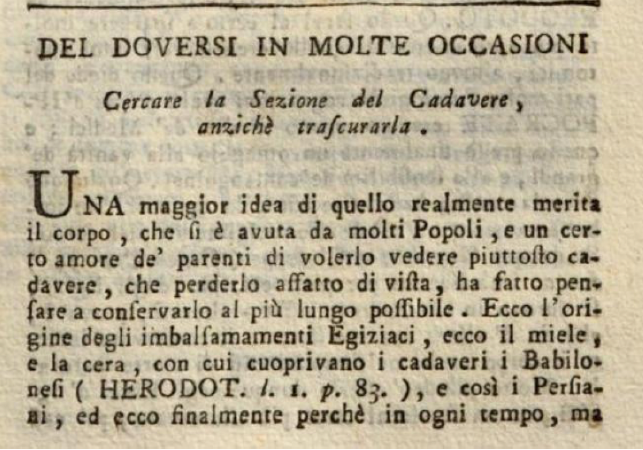
This volume, published in 1789, is one of six such dissertations written by Frizzi over four years. The exact passage referenced by Della Volta begins below:

This may be one of the earliest, if not the earliest, Jewish references to the works of Frizzi.

Frizzi subsequently expanded his research to produce a little-known work in Hebrew of over a thousand pages, P’tah Einayim (Leghorn, 1815–25), addressing the medical and scientific aspects of the Talmud.[25] In a section from this work, not cited by Della Volta, Frizzi addresses another rabbinic passage which is conspicuously omitted from modern halakhic discussions on autopsy.

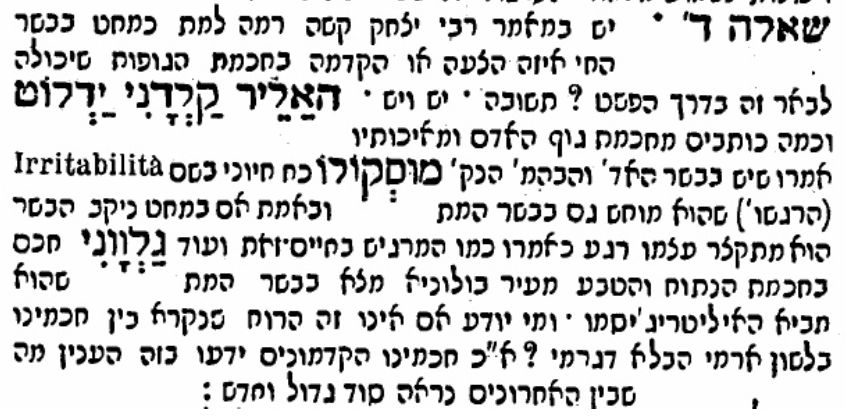
Frizzi focuses on the statement, “Didn’t Rav Yitzḥak say: The gnawing of maggots is as excruciating to the dead as the stab of a needle is to the flesh of the living.”[26] While this passage and its corollary rabbinic passages has received ample treatment,[27] Frizzi’s lesser-known interpretation is exceptional:

Recent medical research, by the likes of Albrecht Haller and Luigi Galvini, who explored bioelectricity (or animal electricity) and muscle irritability, even after death,[28] led him to consider the possibility that this statement was meant literally, i.e., the corpse experiences physiological pain. At least one posek of his day cited Frizzi’s interpretation as a reason to prohibit autopsy.[29]

A most remarkable aspect of this entry is the signature of the author.

הרופא ולא לו הצעיר וזעיר(?) שמואל חי מלאוולטה

I recently completed an article about the various interpretations of a rarely used physician epithet, “A Physician, and Not for Himself,” after serendipitously discovering its use in a manuscript.[30] After an extensive, though not exhaustive, search, I was able to identify only nine physicians throughout history who have used this epithet. As hashgaah would have it, we now know of at least ten.[31] Its use here, however, does not shed any further light on the meaning of this expression.

Chapters 38,[32] 116[33] and 128[34] Bathhouse Insemination

These three chapters discuss one who is born sine concubito, through artificial insemination, or as in the Talmudic case, through bathhouse insemination.[35]

(Chapter 128)

Della Volta is equally versed in both the halakhic and contemporary medical literature. While his then current medical references, such as Commentarii Medici by Brugnatelli and Brera,[36] may be unfamiliar to us, his halakhic sources ring remarkably familiar. Amongst others, he cites from Ḥida,[37] Mishneh LiMelekh, Maharil regarding Ben Sira, Rashbetz, R. Yaakov Emden, R’ Yitzḥak Lampronti’s Paad Yitzak, elkat Meokek, as well as Frizzi, including Peta Einayim.[38] This reads like a contemporary article on artificial insemination by Dr. Rosner or Rabbi Bleich, though for Della Volta this was a purely hypothetical halakhic question. It would only be in the late 19thearly 20th century that this would take on practical halakhic relevance with the development of therapeutic artificial insemination. Indeed, the very same sources can be found in today’s discussions. In my historical discussion of artificial insemination, I discuss all the aforementioned sources, including Frizzi.

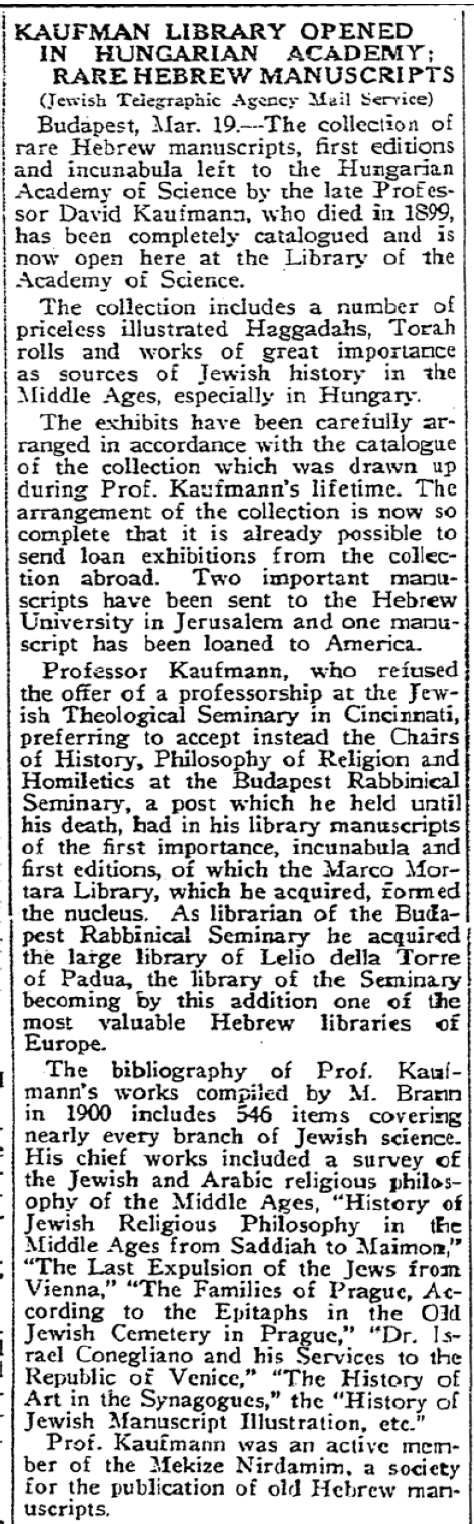
A casual glance at the remainder of Dan Yadin reveals countless detailed references to medical, secular, and Jewish sources, replete with chapter and verse. Della Volta was clearly a doctor of the book. In fact, he wrote for the journal Otzar Nehmad, corresponded with the likes of Shmuel David Luzzatto, Joseph Almanzi and Lelio Della Torre,[39] and contributed an introduction to Shlomo Norzi’s Minhat Shai. But his bibliophilia did not stop at reading and writing; he ventured into the world of book and manuscript acquisition, amassing an impressive library by the end of his life. Della Volta’s name would not appear on a list of prominent Jewish book collectors, nor even as an afterthought for that matter. Names such as Azulai, Oppenheim,[40] Almanzi or Strashun[41] are more likely to come to mind. Yet, his library caught the eye of some of the greatest Jewish scholars of his day, a virtual who’s who of Jewish biobibliographers, including Marco Mortara, Moritz Steinschneider, Shmuel David Luzzatto (Shadal) and Moshe Soave.

Marco Mortara (1815-1894) was one of Shadal’s prize students at the Rabbinical Seminary of Padua and later served as the Chief Rabbi of Mantua.[42] Mortara became a renowned scholar and bibliographer[43] and would go on to collaborate with Steinschneider for decades. Their very first correspondence was about the biographical details of Della Volta. Della Volta’s library was of great interest to Steinschneider, as evidenced by the multiple correspondences to both Shadal and Soave on this matter. It is only from the letters of Shadal to Steinschneider that we learn how Mortara had acquired Della Volta’s library, which by that time contained some 130 unique manuscripts that bibliophiles across Europe had unsuccessfully tried to purchase. How Mortara came to possess such a valuable library, especially given his financial situation, whether by inheritance or monetary acquisition, is a matter of debate.[44] In any case, this represents the first stamp in our passport, but a brief journey for Della Volta’s diploma within the city limits of Mantua. Della Volta’s library and diploma, at least for now, remained in his hometown.

It is in the Summer of 1877 that the second journey of our graduate’s diploma commenced. As librarian of the Budapest Rabbinical Seminary, David Kaufman, a prodigious historian and bibliophile, had acquired the collection of Lelio Della Torre, an Italian Jewish scholar. While in Italy making arrangements for the transfer of the library, he made the acquaintance of Mortara. Kaufmann was well aware of the extent and value of Mortara’s collection, and that it included Della Volta’s library as well.[45] Kaufmann and Mortara would correspond for some time thereafter.

When Mortara died in 1894, you can well imagine the great interest in his collection, which the family was motivated to sell. A number of individuals and institutions, including Kaufmann, were vying for the opportunity, but family and logistical issues delayed the process, not the least of which being the absence of a comprehensive catalogue of the holdings. It would ultimately be David Kaufmann who would walk away with the treasure, his success partially attributed to his earlier visit in 1877, his previous familiarity with the collection, and his continued contact with Mortara and his family.

The transfer of this library from Mantua to Budapest, where it arrived in February 1896, was apparently no small feat, with some of the Mortara collection somehow finding their way into non-Kaufmann hands.[46] Yet, it represents the second entry in our passport and longest journey for our diploma.

Alas, Kaufmann would die only three years after acquiring the Mortara collection. Would Della Volta’s collection now be transferred to the hands of a new scholar in yet another country, perhaps America or Israel? Fortunate for our diploma, its third and final journey would again be only a brief intracity trek, akin to its earlier trip in Mantua. Kaufmann bequeathed his collection to the Hungarian Academy of Science, where it remains to this day.

Fortunate for scholars unable to journey to Hungary, reference, and often digitized copies, of items in the Kaufmann collection can be found on the National Library of Israel website.

I doubt that Della Volta would have envisioned that the final resting place for his collection would be in Budapest, but nor would he have imagined a Jewish doctor in Woodmere writing about, of all the valuable items in his library (including his original compositions), his medical diploma.

[1] See Edward Reichman, “Confessions of a Would-be Forger: The Medical Diploma of Tobias Cohn (Tuvia Ha-Rofeh) and Other Jewish Medical Graduates of the University of Padua,” in Kenneth Collins and Samuel Kottek, eds., Ma’ase Tuviya (Venice, 1708): Tuviya Cohen on Medicine and Science (Jerusalem: Muriel and Philip Berman Medical Library of the Hebrew University of Jerusalem, 2021).
[2] Harry Friedenwald Collection in the National Library in Israel.
[3] G. Baldissin Molli, L. Sitran Rea, and E. Veronese Ceseracciu, Diplomi di Laurea all’Università di Padova (15041806) (Padova: Università degli studi di Padova, 1998), 251.
[4] Baldissin Molli, op. cit., 255.
[5] University of Padua Archives, Ms. V. 106.
[6] This was a period of transitioning away from the smaller diploma booklet to larger size and less illustrated documents. See Baldissin Molli, op. cit.
[7] For further discussion, see E. Reichman, “The ‘Doctored’ Medical Diploma of Samuel, the Son of Menaseh ben Israel: Forgery of ‘For Jewry’,” Seforim Blog, March 23, 2021.
[8] I have only identified one extant diploma from a Jewish medical graduate of the University of Siena. For discussion of this graduate, as well as a picture of his diploma, see E. Reichman, “The Physicians of the Rome Plague of 1656, Yaakov Zahalon and Hananiah Modigliano,” Seforim Blog, February 19, 2021.
[9] The religious references are in any case removed from this standard Ferrara diploma, but neither do we find the often-seen identifier for Jewish students, Hebreus.
[10] Germanisches Nationalmuseum, Studiensaal Archive, HA, Pergamenturkunden, Or. Perg. 1649 Juli 09. On this diploma, see Moritz Stern, “Das Doktordiplom des Frankfurter Judenarztes Isaak Hellen (1650),” Zeitschrift fur die Geschichte der Juden in Deutschland 3 (1889), 252-255.
[11] https://footprints.ctl.columbia.edu.
[12] The most expansive biobibliographical reference I have found is in Asher Salah, La Republique des Lettres: Rabbins, Ecrivains et Medecins, Juifs en Italie au XVIIIe Siecle (Brill: Leiden, 2007), 661-662. See also 428.
[13] NLI 990001918010205171.
[14] Folios 27-28 of the manuscript.
[15] On Portaleone, see H. A. Savitz, “Abraham Portaleone: Italian Physician, Erudite Scholar and Author, 1542-1612,” Panminerva Medica 8:12 (December, 1966), 493-5; S. Kottek, “Abraham Portaleone: Italian Jewish Physician of the Renaissance Period – His Life and His Will, Reflections on Early Burial,” Koroth 8:7-8 (August, 1983), 269-77; idem., “Jews Between Profane and Sacred Science: The Case of Abraham Portaleone,” in J. Helm and A. Winkelmann (eds.), Religious Confessions and the Sciences in the Sixteenth Century (Brill, 2001). For a full text of his will, see D. Kaufman, “Testament of Abraham Sommo Portaleone,” Jewish Quarterly Review 4:2 (January 1892), 333-41; A. Berns, The Bible and Natural Philosophy in Renaissance Italy (Cambridge University Press, 2014). Shadal discovered a remarkable letter by Portaleone recounting his brush with death on February 25, 1576, when he escaped unscathed from a vicious attack. Although his cloak was perforated in sixteen places from the perpetrator’s sword, miraculously no blood was drawn. See Y. Blumenfeld, Otzar Nehmad 3 (Vienna, 1860), 140-1.
[16] For a copy of the text of his diploma, see V. Colorni, Judaica Minora (University of Ferrara Press, 1983), 487-9.
[17] This work has recently been reissued in an expansive, copiously footnoted edition with introductory essays and biography. See Y. Katan and D. Gerber (eds.), Shiltei Ha-Gibborim (Makhon Yerushalayim, 5770).
[18] 1:3.
[19] Folio 78 of the manuscript.
[20] Y. D. 403:6.
[21] For a discussion on the history of anatomical dissection in rabbinic literature, including the identification of the 248 evarim, as well as the gidim, see Edward Reichman, The Anatomy of Jewish Law: A Fresh Dissection of the Relationship Between Medicine, Medical History and Rabbinic Literature (OU Press, YU Press, Maggid Press: Jerusalem, 2021), forthcoming.
[22] For a discussion on the history of Jewish burial practices in antiquity and the use of kukhin, see Patricia Robinson, The Conception of Death in Judaism in the Hellenistic and Early Roman Period (Ph.D. Dissertation: University of Wisconsin-Madison, 1978).
[23] I thank Filippo Valle for his assistance in both translation and research for this passage.
[24] See Ephraim Nissan, Benedetto Frizzi, a Physician, Medical Editor, Jewish Apologist, and Johann Peter Frank’s Pupil, Who Interpreted Moses’ Law as a Sanitary Code in Line with Frank’s Theory of Public Hygiene,” Korot 25 (2019-2020), 259-293.
[25] On Frizzi, see S. Simonsohn, History of the Jews in the Duchy of Mantua (Kiryat Sefer, 1977), 649, n. 226; Friedenwald, op. cit., 115; L. Dubin, “Medicine as Enlightenment Cure: Benedetto Frizzi, Physician to Eighteenth-Century Italian Jewish Society,” Jewish History 26(2012), 201–221. On his work, see B. Dinaburg, “Ben Tzion Hakohen Frizzi and His Work Petaĥ Einayim,” (Hebrew) Tarbitz 20(1948/49), 241–64. For an exchange between Frizzi and Shadal about a work of the latter, see Moshe Shulweiss, “Shmuel Dovid Luzzatto, Pirkei Hayyim,” (Hebrew) Talpiyot 5:1-2 (Tevet, 5711), 41. For a reference to Frizzi dining with Hida, see Aron Freiman, ed., Ma’agal Tov haShalem of Rabbi Hayyim Yosef David Azulai (Mekize Nirdamin: Jerusalem), 94.
[26] Shabbat 13b. Full translation of passage (from Sefaria): Alternatively: The flesh of a dead person does not feel the scalpel [izemel] cutting into him, and we, too, are in such a difficult situation that we no longer feel the pains and troubles. With regard to the last analogy, the Gemara asks: Is that so? Didn’t Rav Yitzḥak say: The gnawing of maggots is as excruciating to the dead as the stab of a needle is to the flesh of the living, as it is stated with regard to the dead: “But his flesh shall hurt him, and his soul mourns over him”(Job 14:22)? Rather, say and explain the matter: The dead flesh in parts of the body of the living person that are insensitive to pain does not feel the scalpel that cuts him.
[27] I am presently working on a more expansive analysis of this passage titled, “On Pain of Death: Postmortem Pain Perception in Rabbinic Literature.”
[28] See, for example, Hubert Steinke, Irritating Experiments: Haller’s Concept and the European Controversy on Irritability and Sensibility, 1750-90, Vol. 76 of Clio Medica, Wellcome Series in the History of Medicine (Amsterdam: Editions Rodopi, 2005); Dominique Boury, “Irritability and Sensibility: Key Concepts in Assessing the Medical Doctrines of Haller and Bordeu,” Science in Context 21:4 (2008), 521-535.
[29] R’ David Zacuto D’Modena (d. 1865). This manuscript responsum by D’Modena on autopsy was published by Yitzhak Raphael, “Two Responsa on Autopsy,” (Hebrew) Sinai 100 (1987), 737-748.
[30] See E. Reichman, “’A Physician, and Not for Himself’: Revisiting a Rare Jewish Physician Epithet That Should So Remain,” forthcoming. For earlier discussions of this expression, see Joshua O. Leibowitz, “‘Physician and Not for Himself,’ An Unusual Hebrew Medical Epithet,” Koroth 7:7-8 (December, 1978), CXXIX- CXXXIII; Meir Benayahu, “Physician and Not for Himself,” Koroth 7:9-10 (November, 1979), 725-725; Abraham Ohry and Amihai Levi, “Physician and Not for Himself,” Koroth 9:3-4 (1986), 82-83 (Hebrew) and 399*-401* (English).
[31] Della Volta does not appear to use this signature elsewhere throughout this manuscript, and I only found it in chapter 25. A review of his other manuscripts, which I did not do, would be instructive.
[32] Folio 89 of the manuscript.
[33] Folio 122 of the manuscript.
[34] Folio 126 of the manuscript.
[35] On bathhouse insemination and the story of Ben Sira in rabbinic literature, see E. Reichman, “The Rabbinic Conception of Conception: An Exercise in Fertility,” Tradition 31:1 (Fall 1996), 33-63, reprinted with additions and revisions in Reichman, The Anatomy of Jewish Law, op. cit.
[36] An eight-volume work published between 1796-1799.
[37] Ya’ir Ozen, En Zokher, ma’areet aleph, n. 93 and Birkei Yosef E.H. 1:14.
[38] Volume 4 (I. Costa: Livorno, 1879), 57b-58a.
[39] See NLI system n. 990001918190205171, pgs. 45, 98, and 116. This is a collection of his letters to Italian maskilim.
[40] See Joshua Teplitsky, Prince of the Press (Yale University Press: New Haven, 2019).
[41] See Dan Rabinowitz, The Lost Library: The Legacy of Vilna’s Strashun Library in the Aftermath of the Holocaust (Tauber Institute Series for the Study of European Jewry, 2018).
[42] On Mortara, see Asher Salah, “The Intellectual Networks of Rabbi Marco Mortara (1815–1894): An Italian “Wissenschaftler des Judentums,” in Paul Mendes-Flohr, et. al. eds, Jewish Historiography Between Past and Present, Studia Judaica, Band 102 (2019), 59-76. On his library, see idem, “La Biblioteca di Marco Mortara,” in Mauro Perani and Ermanno Finzi, eds., Nuovi Studi in Onore di Marco Mortara nel Secondo Centenario della Nascita (Firenze: Giuntina, 2016), 149-168. What follows is drawn primarily from these works.
[43] In addition to countless articles in the periodicals of his day, Mortara is known for his Catalogo della Biblioteca della Communita Ebraica de Montova and Indice Alfabetico dei Rabbini e Scrittori Israeliti di Cose Guidaiche in Italia.
[44] See Salah, “La Biblioteca,” op. cit., 152.
[45] See Salah, “La Biblioteca,” op. cit., 155.
[46] See Salah, “La Biblioteca,” op. cit., 157. Somewhere along the way, Harry Friedenwald acquired a book that was part of the Della Volta library, a prayer book according to the German rite published by the physician and Padua graduate Eliezer Solomon d’Italia. Della Volta added a 9-page manuscript to the copy which includes a history of the d’Italia family chronicles. See H. Friedenwald, Jewish Luminaries in Medical History (Johns Hopkins Press, 1946), 88.