Ha-Osek be-Mitzvah Patur min ha-Mitzvah: The Case of Prayer and Torah Study

Daniel Sperber has just published a new book, On the Relationship of Mitzvot Between Man and His Neighbor and Man and His Maker. The Seforim Blog is happy to present chapter 4 from the book. 
Ha-Osek be-Mitzvah Patur min ha-Mitzvah: The Case of Prayer and Torah Study
Daniel Sperber
We find in Sefer ha-Rokeah, section 369 ad fin., that a person who is sitting in the synagogue, wrapped in his talit and with his tefillin on his head and is reciting liturgical songs, must, nonetheless, rise up before his teacher, since he can carry out both actions and he will receive fine rewards in both worlds. Now there are early authorities who hold that the principle that one who is engaged in one mitzvah is exempt from another is also the case when both could be carried out. (See Shulhan Aruch Orah Hayyim 38:8, and in the Beur Halachah, ibid., and also R. Yaakov Hayyim Sofer, Brit Yaakov [Jerusalem: 1985], section 2, 36; R. Ovadiah Yosef, Hazon Ovadiah: Sukkot [Jerusalem: 2005, 167].) The author of the Rokeah, R. Elazar of Germaiza, was a disciple of R. Yehudah (b. R. Shmuel) he-Hasid, the author of Sefer Hasidim. And it is the view of R. Yehudah he-Hasid that even if one can carry out both mitzvot, one is exempt from doing so, if one is engaged in a prior mitzvah; and this, indeed, is the view of R. Elazar Rokeah himself (Rokeah, Hilchot Sukkah, section 299; see Sofer). Why then should one who is engaged in praising the Lord in the synagogue, have to rise up before his teacher? Surely he is already engaged in a mitzvah, and therefore exempt from others! The answer, I suggest, is because ritual synagogue worship is directed towards God, but respect for one’s teacher is a mitzvah between man and his fellow, and he is therefore not exempt from it. So too the Hida, R. Hayyim Yosef David Azulai, rules, that even in the hour of prayer one rises before a Torah scholar, (Birkei Yosef Orah Hayyim, section 244:1; and see Sofer, note 8 on page 37; and see most recently the discussion of R. Yitzchak Eliyahu Stessman, Kimah ve-Hidur [Jerusalem: 2011, 88–91], with additional references).
Indeed, the severity of not rising before one’s teacher is expressed by R. Eleazar in very extreme terms in BT Kiddushin 33b:
Any scholar who does not rise before his teacher is called a wicked person (רשע), and will not live long and will forget his learning.
(See also R. Yaakov Hezkiyahu Fisch, in his Ve-Haarachta Yamim, ed. Y.M. Sofer, [Jerusalem: 2010, 71–72].)
To this we may add what we are told of the Arizal, by his disciple R. Hayyim Vital, that he was very particular in paying his workers exactly on time and without delay. And if he did not have the money with which to pay these wages, he would delay his afternoon prayer (minhah) until close to sunset in order to search out a loan with which to make the payment. Only afterwards would he hurriedly daven minhah. He would explain himself by saying: “How can I pray to the Lord, may He be blessed . . . , when such an important mitzvah is incumbent upon me, and I have not carried it out?” (See R. Hayyim Vital, Shemonah Shearim: Shaar ha-Mitzvot [Jerusalem: 1872], Parshat Tetzeh; Avraham Tobolsky, Hizaharu be-Memon Haverchem, vol. 2, [Bnei Brak: 1981, 211–212].)
In a somewhat different vein, but with much the same principle as its basis, we read in Niflaot Beit Levi, by A. Kleiman (Pietrokov: 1911, 32, [Yiddish]), cited in Louis I. Newman and Samuel Spitz, The Hasidic Anthology: Tales and Teachings of the Hasidim (New York: 1944, 178:2, 480) as follows:
A teamster (=wagon driver) sought the Berditchover’s (Reb Levi Yitchak of Berditchov’s) advice as to whether he should give up his occupation because it interfered with regular attendance at the synagogue. “Do you carry poor travellers free of charge?” asked the Rabbi. “Yes,” answered the teamster. “Then you serve the Lord in your occupation just as faithfully as you would be frequenting the synagogue.”
(However, see A.Y. Pfoifer, Ishei Yisrael [Jerusalem: 1998, 104, section 11, and notes ad loc].)
And indeed, the Rambam in Hilchot Talmud Torah 3:4, followed by the Shulhan Aruch, Yoreh Deah 246:8, rules:
If there came before him [the choice of performing] a mitzvah and (i.e., or continuing) learning Torah, if that mitzvah could be carried out by another, he should not interrupt his learning; but if not, he should carry out that mitzvah and then return to his study. And when it comes to giving charity, one should always give charity first.[1]
This indeed is the conclusion to be drawn from the sugya in Yerushalmi Pesahim 3:7 (and parallel to JT Hagigah 1:7). There we read that R. Abahu, who lived in Caesarea, sent his son R. Haninah to study in Tiberias, in the Yeshiva of R. Yohanan.
They came and informed him that [his son] was engaged in charitable activities (i.e., in the burial of dead). He sent him a message, saying to him: “Are there no graves in Caesarea that I sent you to Tiberias?” (i.e., for such activities you could have stayed at home).
The Talmud continues that it was already decided at Beit Nitzeh in Lod that “study is greater for it leads to deeds,” (see below). However, the rabbis of Caesarea qualified this by saying:
This is the case when there is someone else to carry out the deeds. But if there is not anyone else to carry them out, the deed comes before [the study], (i.e., has precedence).
We then are told a tale:
R. Hiyya, R. Yosi [and] R. Ami were late coming to R. Eleazar [for their lesson with him]. He asked them, “Where were you?” They replied, “We were involved in charitable activity” (meaning in the burial of someone). “Was there no one else [who could do this?]” he asked of them. They replied, “He was a neighbor [according to the Pnei Moshe, or a proselyte – according to the Korban ha-Edah,” i.e., and there was no one else to deal with his burial.]
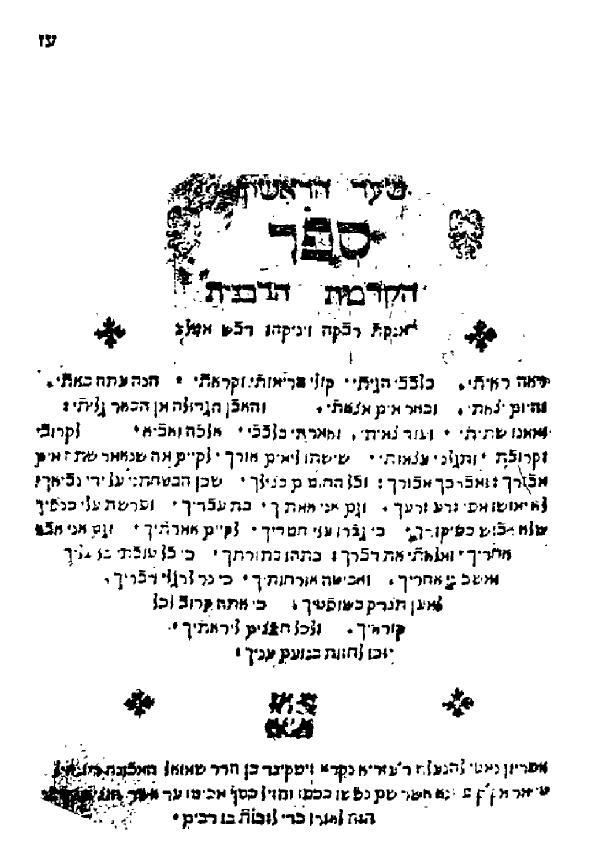
Incidentally, we may add here that the interpretation of the Pnei Moshe is supported by a passage in Sefer Haredim, (by R. Eleazar Azikri, [Safed: 1533–1600]), Mitzvot Aseh . . . ha-Teluyot be-Lev 22, which states that:
A person is obligated to act charitably towards his neighbors and his relations more than to other people, as is clearly stated in the Bavli and the Yerushalmi.
(See S. Lieberman, HaYerushalmi Kiphshuto [Jerusalem: 1934, 426] and his other comments.) And the parallel text in JT Hagigah 1:7., begins with an additional passage, namely:
R. Yehudah, when he would see a dead person (i.e., a burial) or a bride (i.e., a marriage procession), [and people] praising them (i.e., honoring them in the processions), he would turn to his students (נותן עיניו בתלמידים), and say: “The [dealing with] the dead precedes the study of Torah (תלמוד).”
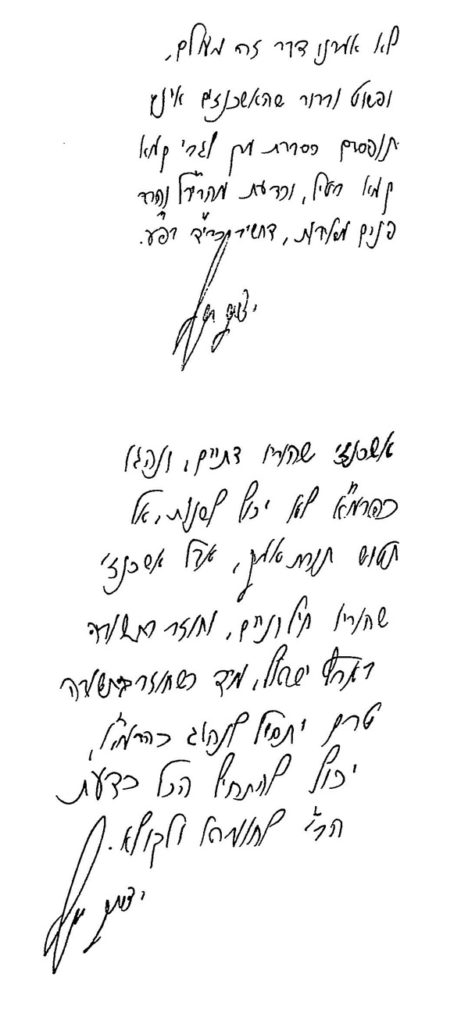
And a somewhat similar notion, but expressed in a Hassidic vein, may be found in a story related in Yehezkel Shraga Fraenkel’s Rabbenu ha-Kaddosh mi-Shinyeve (Ramat Gan: 1992, 256–257). He relates that once the Rabbi of Warsaw came to visit the Divrei Hayyim, R. Hayyim of Sanz. The Sanzer Rebbe asked him, “Do you learn?” “Yes,” the Warsaw Rabbi replied. The Rebbe repeated, “Do you always learn?” The reply was, “When someone who is embittered and needs help comes to me, I close my gemara and deal with him, to help and encourage him.” “This is what I wanted to hear,” said the Sanzer, “whether you have the good sense to close your gemara when someone needs your help,[2] both in word and in deed, and in any case to encourage him and bolster his spirit.”[3]
Here we must make something of a digression, which is not really a digression, as this touches upon a very important point. For the Mishnah in Peah 1:1 states that: “the study of Torah is equal to all of them,” i.e., even to those mitzvot listed in the Mishnah which are social ones, such as honoring one’s parents, doing charitable deeds, bringing peace between rival individuals, etc. The question we ask ourselves is: is the study of Torah (תלמוד תורה) a ritual or a social mitzvah? Into which category does it fall? For if the former, according to our suggestion how can it be superior to those other social mitzvot?
To clarify this issue we must go back to a very ancient discussion that took place in the attic at Beit Nitzeh in Lod, between R. Tarfon and the Elders. For this question was put before them: which is greater, or more important תלמוד או מעשה, learning or deeds? R. Tarfon answered: Deeds are greater. While R. Akiva said study is greater. And they all replied: Study is greater for it leads to deeds (BT Kiddushin 40b).[4] That is to say the importance of study is in that it constitutes the key to the proper execution of the mitzvot. This is also the meaning of R. Shimon the son of Rabban Gamliel’s statement in Avot 1:17: Not the expounding of the law (midrash) is the chief thing, but the doing [of it] (maaseh). And this is amplified by Rabbenu Bachya in his commentary ad loc.: that the aim of man’s labor in Torah is not that he should just learn a lot, but that [his learning] should lead to deeds, as we have learned from the verse [in Deuteronomy 5:1], ‘and ye may learn them [i.e., the statutes and judgments], and keep and do them.’ And this is further amplified in Shulhan Aruch ha-Rav, by R. Shneur Zalman Mi-Ladi, in his Hilchot Talmud Torah 4:2, by telling us that “it is impossible to fulfill all the mitzvot in all their details without intensive study and knowledge of them. And for this reason it is equal to all of them,” i.e., not intrinsically, but as a means to their proper application.[5]
This issue has been analyzed recently by R. Yitzchak Shapiro, in his article in Hakirah 9, (2010), 221–243, entitled “To know the Forbidden and the Permitted: An Analysis of Rambam’s View of the Purpose and Goals of Talmud Study.” He shows that the Rambam’s view, as expressed in his letter to his disciple R. Yosef,[6] is that “learning Torah is a utilitarian endeavor, with extracting halachic conclusions its functional objective” (227).[7] He goes on to show that “the simplicity and obviousness [of this position] might go unnoticed if not for its staggering ramification and total incompatibility with contemporary realities in derech halimud ” (227–228). For as he earlier showed (223–224): “the Aharonim do identify an aspect of Torah study, unrelated to fulfillment of the other mitzvot, based on the verse והגית בו יומם ולילה – ‘but thou shalt meditate therein day and night’ (Joshua 1:8, cf. BT Menachot 99b). This mitzvah of ‘limud ha-Torah’ is distinct from the mitzvah of ‘yediat ha-Torah,’ and can be fulfilled regardless of the subject matter that is learned, whereas the mitzvah of yediat ha-Torah requires a curriculum that is limited to ‘halachah’ (or at least the sharpening of one’s mental acuity, which is necessary for accurate application of halachah). However, one may fulfill both facets of the mitzvah simultaneously only by learning halachic subject matter.”[8]
This is the view of the Meiri, as formulated in his commentary to BT Berachot 7b:
The knowledge of how the Torah actually expresses itself indeed requires serving or observing Torah scholars. While intellectual learning is the cause of wisdom, observing the Sages is the cause of knowing how the Torah manifests itself. This is both true for monetary matters as well as that which is prohibited and permitted.
Hence, we may well understand the statement of Rav in BT Megillah 3b, that Talmud Torah is greater than the sacrifice of the daily offerings (­temidin).
Here we may also call attention to R. Meir Triebitz’s insightful analysis (in his introduction to R. Daniel Eidensohn’s Daas Torah: A Jewish Sourcebook [Jerusalem: 2005, 31–35]). He begins by noting that God commands us twice to study Torah: once in Deuteronomy 11:19, and again in Deuteronomy 4:9–11. He analyzes the differences between these two formulations in all their details – e.g., one in the plural and the other in the singular; one talks of teaching, the other telling; one focuses on parents to children, while the other lists three generations. He concludes that “the two verses which obligate us to learn the Torah actually refer to two types of study. One refers to the study of the legal part of Torah, and the other to the study of Torah’s theology. Each form of study is deemed a separate scholarly enterprise.” He characterizes these two forms of study as “legal” (i.e., halachic) study, and “faith” study, which he states “deals primarily with Aggadic parts of the Torah.” But for our purposes it is important to emphasize that both verses, that is to say both classes of study, require the student also to be a teacher, and to pass on his learning to future generations. Hence, Torah study has a social aspect too.
This is a very broad subject that requires a study in its own right, and we cannot enlarge on it here. But what emerges very clearly is that the mitzvah of Torah study is in a very special category, for without it one would not know how to carry out ritual or social mitzvot correctly. Nonetheless, the Or Zarua and the Rav
Baal ha-Tanya agree that one interrupts learning Torah to fulfill other mitzvot, if both cannot be carried out at the same time, and one is not exempt because one is already involved in a prior mitzvah.[9]
This is clear from the baraita in BT Ketubot 17a (BT Megillah 3b, 29a) that we interrupt our study of Torah (מבטלין תלמוד תורה) not merely for a met mitzvah and to accompany the dead (הוצאת המת), but also for wedding ceremonies (הכנסת כלה) – all supreme social mitzvot.[10] And in this way, we may better understand the passage in Avot de-R. Natan, chapter 41, (ed. Schechter, Vienna: 1887, 133):
It once happened that R. Tarfon was sitting and teaching his disciples, and a bride went past him. He ordered that she be brought into his house, and told his mother and his wife that they should bathe her, anoint her, and decorate her with jewelry, and dance before her until she goes to her husband’s house.
Apparently, he interrupted his teaching in order to carry out the mitzvah of hachnasat kallah.[11] And indeed we read in the letters of the Hafetz Hayyim (Michtevei ha-Hafetz Hayyim he-Hadash, vol. 2, Bnei Brak: 1986) II, 86:
You occasionally see a Jew who [in a praiseworthy way] learns Torah [as much as possible] and values his time [not wasting a minute]. But if he does not set aside part of the day to do deeds of kindness, what a lack of intelligence!
And interestingly enough, this also becomes evidence from the commentary of R. David ha-Nagid, the Rambam’s grandson, to Avot 1:15. There Shammai is cited as saying: “Make thy [study of the] Torah a fixed
habit (קבע); . . . . And receive all men as its cheerful countenance.” And this is explained by the Nagid to mean that even when you are engaged in your fixed period of Torah study, you should not desist from receiving people cheerfully, thinking that in doing so you are “wasting” Torah-study time.[12] So apparently he regarded proper interpersonal relationship of such importance as even to override one’s involvement in Torah learning. And this presumably goes under the category of kevod ha-beriyot, respect for the individual. (Cf. below, sections 15 and 19.)
We are reminded of the statement of Reb Yisrael of Rizhyn (died 1850), who expounded the verse in Psalms 115:16, “the heavens are the heavens of the Lord; but the earth hath He given to the children of men.”
There are two kinds of tzaddikim. Those of the one sort learn and pray the livelong day and hold themselves far from lowly matters in order to attain holiness. While the others do not think of themselves, but only of delivering the holy sparks which are buried in all things back to God, and they make all lowly things their concern. The former, who are always preparing for Heaven, the verse calls “the heavens,” and they have set themselves apart for the Lord. But the others are the earth given to the children of men.
(Martin Buber, Tales of the Hasidim: The Later Masters, New York: 1948, 53–54)
Here, he is contrasting the Lithuanian mitnagdim’s way, (in a double-edged complementary fashion), with that of the Hasidim, while we well know with which way he personally sided.
At the same time we should recollect how Yehudah ha-Levi in his ­Kuzari, begins his definition of the religious man according to Jewish tradition with the negative statement that “in Jewish opinion, the religious man is not to be defined as one who cuts himself off from the world” (Book III, sect. I, ed. Hirschfeld, Leipzig: 1882, 140–141). Perhaps he was combating predominant contemporary Sufi views on extreme asceticism. (See Franz Rosenthal, “A Judaeo-Arabic Work under Sufic Influence,” HUCA XV 1940,
440, and cf. page 465 for an extreme view of this form of asceticism, and note 104.)

[1] See Le-Hair Hilchot Tzedakah be-Or Yekarot (Jerusalem: 2010, 6–7). And see below sect. 16 on the overriding importance of charity, and Appendix.
[2] See, for example, the practice of the Brisker Rav, Reb Hayyim Soloveitchik, as described in Aharon Sorasky, Marbitzei Torah u-Musar bi-Yeshivot Nusah Lita mi-Tekufat Volozin ve-ad Yameinu, vol. 1 (Jerusalem: 1976, 110).
[3] Cf. BT Shabbat 127a: Said R. Yohanan: Great is the hosting of guests as are those rising up early to the House of Study [of Torah], as we have learned: to make room for guests [to avoid] hindrance in the House of Study. But Rav Dimi of Nehardea said: It is greater than rising up early to the House of Study. For we learned: “for guests,” and only afterwards “to avoid hindrance in the House of Study.” And see below sects. 11 and 12 on hosting guests.
[4] On this text see Benedict Thomas Viviano, Study as Worship: Aboth and the New Testament (Leiden: 1978, 105–109). Directly related to this is the text in JT Pesahim 3:7, and JT Hagigah 1:7, cited above, from which the Rabbis learned that if others can carry out these charitable activities, a person should not interrupt his Torah studies. And this seems to be the dominant view among the poskim. See further BT Moed Katan 9a; Shulhan Aruch Yoreh Deah 246:18; Meiri to BT Shabbat 9a and Moed Katan ibid.; Rabbenu Yeruham 22a in the name of the Ravad, etc. See R. Asi ha-Levi Even Yuli, Shulhan Aruch ha-Middot, vol. 2, Halachah u-Musar (Jerusalem: 2009, 243–244).
[5] See R. Mordechai Shmuel Ashkenazi’s magnificent commentary to Hilchot Talmud Torah Mi-Shulhan Aruch Admor ha-Zaken, vol. 5 [= ha-Rav] (Kefar Habad: 2000, 86).
[6] Ed. Y. Shilat, Iggrot ha-Rambam, vol. 1 (Jerusalem: 1987, 254–259); and see editor’s note on 257–258 to line 4).
 [7] At the simplest level, there is, in the Rambam’s view, an obligation upon one who has learned Torah,
also to teach it to others. See Hilchot Talmud Torah 1:2, and so too in the listing of the positive commandments at the beginning of his Mishneh Torah, no. 11. (This list is also that of the Rambam, as attested by the author of the Magid Mishneh in his introduction to Hilchot Eruvin, and the Kesef Mishneh in Hilchot Hannukah 3:6; Responsa Noda bi-Yehudah Kama, Orah Hayyim, sect. 29; Petah ha-Dvir, vol. 2, sect. 194, subsect. A. See R. Yaakov Hayyim Sofer, Drupteki de-Oraita, vol. 1 [Jerusalem: 1987, 45]. And see further his remarks, 68–69, on the need to teach others.) Of related interest is the article of Sarah Pessin, “Maimonides and the Sacred Art of Teaching,” apud Adaptations and Innovations: Studies in the Interaction between Jewish and Islamic Thought and Literature from the Early Middle Ages to the Late Twentieth Century, Dedicated to Professor Joel Kraemer, ed. Y. Tzvi Langermann (Paris & Louvin: 2007, 285–298). See also, most recently, the remarks of R. Aharon Lichtenstein, in H. Sabato and A. Lichtenstein, Mevakshei Panecha (Tel Aviv: 2011, 212–215).
[8] See the material R. Yitzchak Shapiro brings from the letters of R. Yisrael Salanter (no. 27), in this regard. See also Kuntres Aharon shel Shulhan Aruch ha-Rav, Talmud Torah 3:1, ed. Y.A. Lev (Ashdod: 1989, 39 et seq.). And see R. Aharon Lichtenstein’s very comprehensive study entitled “Does Involvement in Torah Study Exempt One from Mitzvot?”, which appeared in Alei Etzion 16 (5769 [2009]), 71–107, which examines this issue in depth, dealing with questions of delaying procreation, Megillah reading, prayer, all mitzvot, etc., and seeks to explain Rambam’s position that “ha-osek be-mitzvah patur min ha-mitzvah” theoretically applies to Torah study too, when “it is studied with the purpose of performing” (91); and cf. ibid., 105, for his suggestive interpretation of the view of the Maharach Or Zarua. His study of this very complex issue is extremely rich and requires intense study. See also Moshe Zvi Polin, Sefer ha-Mitzpeh al ha-Rambam, vol. 1, (on Hilchot Talmud Torah) (Jerusalem: 2005, 11–26), that studying (lilmod ) and teaching (lelamed ) are two interconnected mitzvot. See Ramban Hilchot Talmud Torah 1:1; Hilchot Hagigah 3:1: that anyone who is obligated to study is obligated to teach, and cf. ibid., 1:4. I think this is the meaning of the statement in Seder Eliyahu Rabba, ed. Friedman, p. 63 =Tanna Debe Eliyahu, transl. W.G. Braude & I.J. Kapstein (JPS, 1981, 183) that “one who toils in Torah is like a lamp which provides light for the eyes of many.” And in this connection, it is also worth reading Benjamin Blech’s article “Personal Growth or Communal Responsibility: A Question of Priorities,” The Torah U-Madda Journal 2 (1990), 134–142. However, to give a slightly different point of view, see Hatam Sofer to Nedarim 81a; R. Hayyim Volozin’s Nefesh ha-Hayyim, Shaar Dalet, sect. 3; Ruah Hayyim to Avot 6:1, and the introduction to Eglei Tal.
A very extreme expression of this view is to be found in R. David Baharan’s “Hanhagot u-Piskei Halachah,” in Otzrot Yerushalayim, vol. 13 (Jerusalem: [2010?]), 40, where he insists one must learn halachah every day, and it is not sufficient to learn merely Gemara. He goes on to say that one must learn Shulhan Aruch Orah Hayyim or Hayyei Adam, and he who does not do so will surely have no part in the World to Come. (See also ibid., 41–42.)
See further R.S.Z. Auerbach, Halichot Shlomo . . . al Moadei ha-Shanah, ed. Y. Terner and A. Auerbach (Jerusalem: 2007), 537–539, who also is of the opinion that there are two aspects to Torah study: the one being to study in order to learn how to act properly, and the other as an independent positive commandment which is not just in order to know how to act, but the actual practice of learning as an end in its own right. He expands on this position bringing biblical and rabbinic sources to bear out this point of
view. However, here too he agrees that ultimately this is in order “to purify his body through the light of Torah, in order to cleave to God . . . who orders the world (àùø äìéëåú òåìí ìå), and without which the world cannot subsist (åáìà ÷éåîí – àéï î÷åí ÷éåí ìòåìí)” so that in the final reckoning this non-action-orientated
study is nonetheless direct to úé÷åï òåìí, the betterment of our world, (see ibid., 536).
[9] See Kuntres Aharon ibid., in the editor’s Midrashei ha-Kuntres, 36; and also Kuntres Aharon, Talmud Torah 4:3, that one interrupts
learning for persuading others to give charity, where others are less
persuasive, or helping in burying the dead, etc. See R. Mordechai Shmuel
Ashkenazi, ibid., 87 et seq.
See
further R. Ovadiah Yosef, Hazon Ovadiah: Sukkot
(Jerusalem: 2005, 168), on the special status of Talmud
Torah, because it is mandated at all times (îöåä
úîéãéú), and, hence, cannot exempt from other mitzvot, as this
would free us from all other mitzvot (citing the Birkei
Yosef of the Hida 38:7).
This
subject has most recently been examined in considerable detail, with a wealth
of sources, by R. Asi ha-Levi Even Yuli, in his Shulhan
Aruch ha-Middot, vol. 2, Halachah ve-Musar
(Jerusalem: 2009, 243–247). He shows that there are two opposing views. For the
Yosef Omez, by R. Yosef Juspa Kahn Neurelingen (c.
1639), (Frankfurt am Main: 1908, [reprint, Jerusalem: 1965] 316), writes that
the Rabbis said: Anyone who is involved in Torah learning and not in gemilut hasadim, acts of charity, is as one who has no
God. And therefore he wrote that a Torah scholar should make sure that every
day he should carry out one act of charity. And the Seder
ha-Yom (by R. Moshe ibn Machir [Venice: 1599], and numerous editions)
wrote that one must not interrupt the learning of Torah for any mitzvah which
can be carried out by another, with the exception of acts of charity. And
therefore the enthusiastic should take this to heart and pursue acts of charity
as one pursues life itself. (And see the continuation of this passage.) Even
Yuli further refers us to Responsa Aderet Tiferet
(by R. Avraham Dori, vol. 4, sect. 44), who following on the words of the Seder ha-Yom seeks to find additional support for this
view in the Rambam, citing the gemarot in BT Megillah 3b, 29a; BT Ketubot
17a as further proof, in that one interrupts Torah learning to accompany the
dead to his final resting place. (See below on this subject.) He then refers us
to the Sdei Hemed to which we referred earlier on.
However, this runs counter to the prevailing majority view found in a multitude
of rabbinic sources, to which he referred on 243–244, and therefore very
convincingly he rejects and refutes this argument on 246–247. See there in
detail. However, the above just underscores what we have tried to point out,
namely the complex ambiguity of the status of Torah study.
[10] See Rema, Even ha-Ezer 65:1; Ba”h
ibid., that even the leading Torah authority, Gedol
ha-Dor, does so. And even public learning is so interrupted, (Pnei Yehoshua to BT Ketubot
ibid., on the basis of Tosafot Megillah ibid.). However, see D. Friedman, Piskei Halachot, vol. 3 (Warsaw: 1901, 35), argues that
nowadays, that we are not intimately acquainted with the laws and our studies are directed to their correct understanding, therefore,
we do not interrupt Torah learning for wedding ceremonies. See, in detail, on
all the rules related to this subject, B. Adler, Ha-Nisuim
ke-Hilchatam, 2nd ed., vol. 2 (Jerusalem: 1985, 394–395).
Clearly
hachnasat kallah is related to the mitzvah of procreation,
which is one of the paramount duties of a man, in Jewish halachic thought. See
my Netivot Pesikah (Jerusalem: 2008, 162–163, n.
251). (And cf. below, sect. 30.)
Here
we may add that a communal positive mitzvah always takes precedence and outweighs
a private individual’s positive mitzvah. A teacher sitting shiva is forbidden to learn and teach Torah. However, he
is permitted to do so if the community needs him (Shulhan
Aruch Yoreh Deah 384:1). See Tzvi Marx, Halakha
and Handicap (Jerusalem: 1992–1993, 228).
[11] See Schechter’s note
in his edition of Avot de-R. Natan, n. 24, and p.
131, n. 10.
[12] Midrash
R. David ha-Nagid to Avot, ed. BenTziyyon
Kipnis (Jerusalem: 1944). The Arabic original appeared in Na Amon 1901. However, there are some doubts as to the
attribution of authorship. See Milhamot Ha-Shem by
R. Avraham ben ha-Rambam, ed. M. Margaliot (Jerusalem: 1953, 38, n. 8); A.
Katz, JQR 48
(1957), 140–160; Midrash R. David ha-Nagid to
Genesis, ed. A. Katz (Jerusalem: 1964, 16–18). On R. David ha-Nagid himself,
see A. Strauss (Ashtor), Toldot ha-Yehudim be-Mitzrayim
ve-Suriah tahat Shilton ha-Mamelukim, vol. 1 (Jerusalem: 1944, 117–128).


More on The Rebbe

You might have noticed, and might have even been actively following the very-current and lively-debate about the recent volume by Samuel Heilman & Menachem Friedman, The Rebbe: The Life and Afterlife of Menachem Mendel Schneerson (Princeton: Princeton University Press, 2010) at the Seforim blog, which began with a review essay (“The Afterlife of Scholarship: A Critical Exploration of Samuel Heilman and Menachem Friedman’s Presentation of the Rebbe’s Life”) by frequent contributor to the Seforim blog, Chaim Rapoport, available here, which elicited a response by Samuel Heilman & Menachem Friedman, followed by a rejoinder by Chaim Rapoport, both available here. The exchange continued and following a back-and-forth in the comments section, here, and Samuel Heilman’s & Menachem Friedman’s response here (PDF) at the Seforim blog, followed by a twelve-page response (written in a mere twenty hours) by Chaim Rapoport, available here (PDF).


Marc Shapiro: R. Kook on Sacrifices & Other Assorted Comments

R. Kook on Sacrifices and Other Assorted Comments
by: Marc B. Shapiro

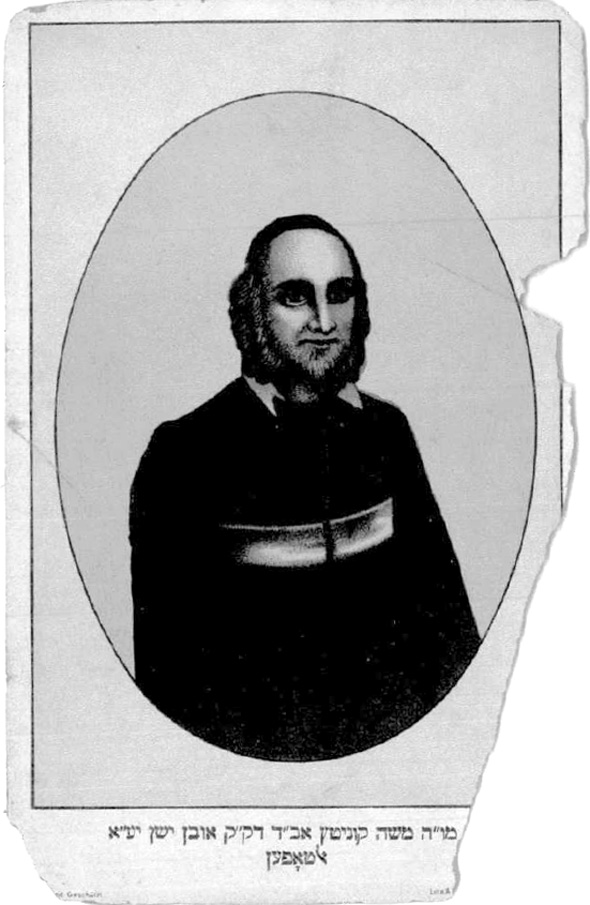
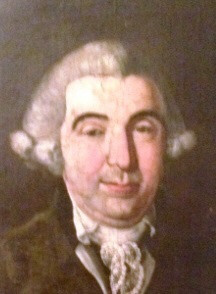
1. At the beginning of my previous post (the Gurock review) I mentioned R. Solomon Isaac Scheinfeld (1860-1943). The source of the comment I quote is his Olam ha-Sheker (Milwaukee, 1936), p. 77.1 Scheinfeld was the unofficial chief rabbi in Milwaukee, arriving there in 1902 and serving until his death in 1943. Here is his picture.

He had a traditional education, having studied for three years in the Kovno Kollel under R. Isaac Elhanan Spektor, from whom he received semikhah.2 He also had a very original mind, and wrote a number of books and essays. One of his most fascinating works is the article he published under the pseudonym Even Shayish. In this article he argued that since sacrifices will never be revived, they are now irrelevant to Judaism and all references to them should be removed from the prayer book.
R. Jehiel Jacob Weinberg has a lengthy essay in which he critiques Scheinfeld’s position. A Hebrew translation of this essay appears in volume 2 of Kitvei R. Weinberg. Yet Weinberg himself leaves open the possibility that there won’t be a return to sacrifices (p. 255):
אין דנים כאן על עצם הרעיון היסודי של הקרבנות. לו היתה היום קיימת אצלנו שאלה כזאת והיא דורשת פתרון דחוף – אין מספר מצומצם של יהודים בארץ אחת בני סמכות להכריע בענין זה, וכל שכן כאשר הם אינם מייצגים את כלל ישראל. שאלה זאת חייבים להביא לפני הבית דין של כלל ישראל. רק לבית דין כזה הרשות לקבוע אם להשאיר טקס מקודש בעם בתוקפו או לבטלו. היום שאין לנו ארץ ולא בית המקדש ולא כהנים הרי זה מגוחך ומצער כאחת להעלות תביעה לבטל עבודת קרבנות!
Weinberg doesn’t mention Maimonides, but this is usually to where people turn when seeking to argue against a revival of sacrifices. According to the Guide 3:32, Maimonides thought that sacrifices were a concession to the masses’ primitive religious notions, developed in an idolatrous society. While Maimonides is explicit in the Mishneh Torah that there will be a return of the sacrificial order, his reason for sacrifices offered in the Guide led some people to assume that his true opinion was that there will not be sacrifices in the future. One example is R. Simhah Paltrovitch, Simhat Avot (New York, 1917), pp. 7-8, who offers a mystical approach:
אמנם מה נעשה במה שדברי מורנו ורבנו הרמב”ם ז”ל שהוא בסברתו מתנגד לאלה הדברים, ואומר כי בימים הבאים עת קץ משיחנו, יבוטל עבודה בקרבנות ולא יהיה עוד . . . להעולם הזה נתנו הפשט והדרוש, ובעולם השני יקויים הרמז והסוד . . .וכן ממש הוא טעם של הרמב”ם ז”ל שיבוטל הקרבנות, כי אז יהי’ התורה על צד הרמז וסוד כמו שארי המצוות המבוארות בתורה, כי יתחלפון מן הפשט לרמז וסוד שמשונים מן הפשט.
R. Joseph Messas also cites Maimonides’ reason for sacrifices and concludes that there will be no return of the sacrificial order (Otzar ha-Mikhtavim, vol. 2, no. 1305).
לפי”ז יתבטלו לעתיד כל הקרבנות כי זה אלפי שנים משנעקרה ע”ז מישראל, וישראל גוי אחד, עובדים רק לאל אחד ועל ידי ישראל בגלותם נעקרה ע”ז גם מכל האומות.
What about the problem that the abolition of sacrifices would mean a change in Torah law, which is a point that R. Kook will also deal with? Messas answers simply:
ואין בזה שנוי בתורה חלילה, דזיל בתר טעמא
What this means, I think, is that from the beginning sacrifices were only intended to be offered in a society in which people were attached to primitive religious notions associated with idolatry, and the animal sacrifices that went along with this. However, once this era has passed from the scene, then there will no longer be any obligation for sacrifices.

A really shocking comment against sacrfices appears in a supposed letter from R. Yaakov of Lissa to R. Zvi Hirsch Kalischer (published in Ha-Posek, Kislev 5712). Responding to Kalischer’s advocacy of renewing sacrifices even before the coming of the Messiah, R. Yaakov claims that to do so would cause Jews to be a subject of mockery by the Gentiles and the non-religious Jews.

לבי נוקף ונפשי מלא רטט ורעד כי אם ישמעו הגויים והקלים בישראל שאנחנו מקריבים קרבנות ימלאו שחוק פיהם ונהיה 
ח”ו ללעג ולקלס וה’ יודע כמה צרות וקלקולים יצמחו מזה

It is very unlikely, to put it mildly, that a gadol be-Yisrael would give this as his reason for not fulfilling a mitzvah. When one realizes that the person who published this letter was the famous forger Chaim Bloch, then all doubts are removed: The letter, like so much else published by Bloch, is a complete forgery. Apparently Bloch had some negative feelings about sacrifices and transferred them to R. Yaakov. Interestingly, when this letter was republished in Dovev Siftei Yeshenim, vol. 1, Bloch made a subtle change in the letter, which as far as I know, no one has yet pointed out. The letter’s authenticity had been attacked by Zvi Harkavy in Kol Torah (Nisan-Iyar 5712), and one of the things he pointed to was this line, and that R. Yaakov could never have written it. So when Bloch republished the letter, in an attempt to bolster its authenticity, he altered it to read as follows (I have underlined the newly added words):

כי אם ישמעו הגויים והקלים בישראל שאנחנו מקריבים קרבנות בזמן הזה לפני ביאת משיח צדקנו ובטרם עומד בית מקדשנו 
על מכונו, ימלאו שחוק פיהם ונהיה ח”ו ללעג ולקלס

Had he been smart enough to have added these extra words in the first edition of his forgery, it would have been more believable. Now R. Yaakov is not speaking of the non-Jews and the non-religious mocking the offering of sacrifices, but only mocking the offering of them before the coming of the Messiah and the building of the Temple.

Michael Friedlaender’s The Jewish Religion (London, 1891), was for many years regarded as a standard work of Orthodox belief. As far as I know, it was the first of its kind in English and can still hold its own against many more recently published books. You can see it here. On pages 162-163, 417-418, he speaks of the return of the sacrificial order in Messianic days, and how we should look forward to this, even if it is contrary to our taste. He says that we should not model Divine Law according to our liking, but rather model our liking according to the will of God. Yet despite these strong statements, he was also sensitive to those who were not comfortable with sacrifices. He writes as follows (p. 452):

References to the Sacrificial Service, and especially prayers for its restoration, are disliked by some, who think such restoration undesirable. Let no one pray for a thing against his will; let him whose heart is not with his fellow-worshippers in any of their supplications silently substitute his own prayers for them; but let him not interfere with the devotion of those to whom “the statues of the Lord are right, rejoicing the heart” . . . and who yearn for the opportunity of fulfilling Divine commandments which they cannot observe at present.

This passage is quoted by British Chief Rabbi Joseph Hertz in his Authorised Daily Prayer Book, p. 532. Upon seeing this, R. Yerucham Leiner, then living in London, wrote a letter to the Jewish Chronicle (Dec. 17, 1943; I learnt of this from Louis Jacobs, Tree of Life, second ed., p. xxix). Before quoting from his letter, let me reproduce what Wikipedia says about this most incredible figure.

Grand Rabbi Yerucham Leiner of Radzin, son of Likutei Divrei Torah, author of Tiferes Yerucham, Zikaron LaRishonim, Mipi Hashmua, Zohar HaRakiya. Moved from Chelm to London to America. Continuation of the Radziner line in America, and one of the last direct descendants of the Leiner family. After the war, he did not reinstitute the wearing of techeiles as other branches of Radzin did, even though his father, Grand Rabbi Avraham Yehoshua Heschel Leiner of Radzin-Chelm, wore them, as he was a chosid of his older brother, the Orchos Chayim, who had reinstituted the wearing of techeiles. Reb Yerucham believed that the original formula of his uncle was lost during the war. This is the reason that his family doesn’t wear techeiles today, only pairs that were left from pre-war Europe. Reb Yerucham was an expert in all areas of Torah and scholarship. There existed very few admorim/tzaddikim since the beginning of Chassidus who were also lamdanim in both the Polish and Lithuanian styles of learning, bibliographers, Jewish historians, very learned in Kabbalah works, philologists, and masters of both the Babylonian and Jerusalem Talmuds. Reb Yerucham was very close with the Satmar Rebbe, Rabbi Yoelish Teitelbaum ZTVK”L. He always made sure to spend a few weeks vacationing with the him, specifically learning Midrashei Chazal, of which they were both masters. He studied and visited with Rabbi Yitzchok Hutner, and they were good friends in later life. They always treated one another with special respect. He established the Radziner shtiebel in Boro Park. Died 20 Av 5724 (1964). Buried in Beth Israel Cemetery, Woodbridge, New Jersey

Responding to the quote from Friedlaender, Leiner wrote: “This opinion was put forward by the founders of Reform Judaism, Holdheim and Geiger. But it is hardly in accord with Orthodox traditions of Judaism.” The editor of the Jewish Chronicle responsed: “The words quoted with regard to the Musaph are those of the great and sainted scholar, Dr. Michael Friedlander, for 42 years Principal of Jews College: and it is certainly strange to class him with Holdheim and Geiger.”

The most famous of our sages to speak of a Messianic era without animal sacrifices is, of course, R. Kook, who envisions vegetable sacrifices. He writes this in his commentary to the siddur, Olat ha-Reiyah, vol. 1, p. 292. In the preface R. Zvi Yehudah tells us that he began writing this commentary during World War I. I don’t need to go into any detail on this, as I have done so already in The Limits of Orthodox Theology, where I also mention passages in R. Kook’s writings that offer a different approach. The notion that there will only be vegetable sacrifices in Messianic days is, of course, a radical position, and many who don’t know R. Kook’s writings find it impossible to accept that he could have said this. This is what happened when R. Yosef Kanefsky of Los Angeles published an essay in which he mentioned R. Kook’s view.3 He was attacked by some prominent rabbis since they found it impossible to believe that R. Kook could say what was attributed to him. Yet it was Kanefsky who was right, not his opponents.

In my book I dealt with R. Kook’s position on sacrifices, because positing that there will be no sacrifices in the future would seem to be in contradiction to Maimonides’ Principle that the commandments of the Torah are eternal. That consideration is precisely what makes his position so radical. A couple of years ago one of R. Kook’s notebooks dating from his time as rabbi in Bausk, which lasted until 1904, was published. We actually have two publications of this, one by Boaz Ofen called Kevatzim mi-Ketav Yad Kodsho, vol. 2 (Jerusalem, 2008), and the other, which comes out of the world of Merkaz ha-Rav, called Pinkesei ha-Reiyah (Jerusalem, 2008).

This is not the first competing publications of the same material by these people, and as I will show in my forthcoming book, the Merkaz editions are tainted by censorship in that “problematic” passages are removed.4 Those who claim to be the greatest adherents of R. Kook have once again taken it upon themselves to save their master from himself, as it were, and decided which writings of R. Kook should appear and which should not. Yet in the passage I am interested in now (no. 8 in the Ofen edition and no. 6 in the Merkaz edition), the two books are identical. The passage is very significant since it shows you that even in his earlier years R. Kook had the same notion later expressed in Olat ha-Reiyah, that the future would only know vegetable sacrifices. (In case people are wondering, R. Kook was not a vegetarian. Yet he did see vegetarianism as part of the eschatological future. His great student, the Nazir, was a vegetarian, as was Nazir’s son-in-law, R. Shlomo Goren, and as is his son, R. Shear Yashuv Cohen.5)

This passage gives us new insight into R. Kook’s view of sacrifices, and how things will change in the future era. He begins by speaking of the abandonment of meat-eating in the Messianic era, since this will not be something that people desire. Recall that in speaking of eating meat, the Torah writes (Deut. 12:6): כי תאוה נפשך לאכל בשר, which means “when thy soul desires to eat meat.” The Messianic era is not a time when people will have this desire, as R. Kook also explains in his famous essay on vegetarianism, “Afikim ba-Negev”.

What about the sacrifices that are required by the Torah? R. Kook offers a few possibilities. One is that sacrifices will still be necessary. Yet he also speculates that perhaps certain animals will be so spiritually advanced that they will on their own offer themselves as sacrifices, in acknowledgment of the great benefit that will come to them and the world through their actions.6 This solves the problem of people deliberately killing animals, which goes against his conception of the eschaton.

What is most interesting for our purpose is another suggestion by R. Kook, namely, that the Sanhedrin will use its power to uproot a matter from the Torah in order to abolish obligatory animal sacrifices. Their reason for doing this will be that the killing of animals will no longer be part of the culture in Messianic days. R. Kook even shows how the Rabbis will be able to find support for this step from the Torah. What he is doing, I think, is imagining himself as part of the future Sanhedrin that abolishes sacrifices, and informing us of the derashah that will be used to support this. This is related to what I wrote in an earlier post, see here, and I repeat it now:

As to the general problem of laws that trouble the ethical sense of people, we find that it is R. Kook who takes the bull by the horns and suggests a radical approach. The issue was much more vexing for R. Kook than for other sages, as in these types of matters he could not simply tell people that their consciences were leading them astray and that they should submerge their inherent feelings of right and wrong. It is R. Kook, after all, who famously says that fear of heaven cannot push aside one’s natural morality (Shemonah Kevatzim 1:75):

אסור ליראת שמים שתדחק את המוסר הטבעי של האדם, כי אז אינה עוד יראת שמים טהורה. סימן ליראת שמים טהורה הוא, כשהמוסר הטבעי, הנטוע בטבע הישר של האדם, הולך ועולה על פיה במעלות יותר גבוהות ממה שהוא עומד מבלעדיה. אבל אם תצוייר יראת שמים בתכונה כזאת, שבלא השפעתה על החיים היו החיים יותר נוטים לפעול טוב, ולהוציא אל הפועל דברים מועילים לפרט ולכלל, ועל פי השפעתה מתמעט כח הפועל ההוא, יראת שמים כזאת היא יראה פסולה.

These are incredible words. R. Kook was also “confident that if a particular moral intuition reflecting the divine will achieves widespread popularity, it will no doubt enable the halakhic authorities to find genuine textual basis for their new understanding.” R. Kook formulates his idea as follows (Iggerot ha-Reiyah, vol. 1, p. 103):

ואם תפול שאלה על איזה משפט שבתורה, שלפי מושגי המוסר יהיה נראה שצריך להיות מובן באופן אחר, אז אם באמת ע”פ ב”ד הגדול יוחלט שזה המשפט לא נאמר כ”א באותם התנאים שכבר אינם, ודאי ימצא ע”ז מקור בתורה.

R. Kook is not speaking about apologetics here, but a revealing of Torah truth that was previously hidden. The truth is latent, and with the development of moral ideas, which is driven by God, the new insight in the Torah becomes apparent.

Ad kan leshoni in the previous post.

In other words, R. Kook sees the Sanhedrin as able to actualize new moral and religious insights that have become apparent. That is why it is important for the Sanhedrin to use derashot when dealing with these matters, as this shows that the idea is not something new that has been developed, but something that was latent in the Torah, and only now has become apparent.

So what derashah can be used to justify an abolishment of animal sacrifices? R. Kook points to Num 28:2: את קרבני לחמי לאשי . This is usually translated as “My food which is presented to Me for offerings made by fire”. Yet the word לחמי actually means “my bread.” Right after this, in discussing the particulars of the sacrifice, the Torah states: “The one lamb thou shalt offer in the morning.” R. Kook’s proposed messianic derashah is: “Whenever animals are killed for personal consumption, you should use them for sacrifices, but when they are not killed for personal use, make sacrifices of bread.”

I don’t think I am exaggerating in saying that this is one of the most provocative and radical texts in R. Kook’s writings. I say this not because of his advocacy of abolishing sacrifices, which I don’t think to be that significant in the larger scheme, but due to how he is envisioning the process by which the Rabbis will actually use derashot to create a Messianic Judaism.

The Rambam, Hilkhot Mamrim 2:1, speaks of laws derived from the hermeneutical principles that can be altered by a future beit din ha-gadol (even one not as great as the one that established the original law). This was the great fear of the opponents of a reconstituted Sanhedrin, that the Mizrachi rabbis would take upon themselves to do precisely this. Since so many of our laws are based on derashot, Judaism as we practice it can be entirely reworked. R. Kook is showing us how this can be done, but he is going further than anything Maimonides envisioned, since sacrifices are not matters that have been established based on a rabbinic derashah but are commanded by explicit biblical verses.
Basically, what R. Kook is doing is recreating the world of the Pharisees, before Judaism was bound to codes (beginning with the Mishnah). It was a time when Jewish law was developing and the biblical verses could be read—some would say “read”— in all sorts of ways. In the days of the Pharisees much of the halakhah as we know it was created, and to a large extent that can be done again in the Messianic era.
Here are R. Kook’s words (note also his exegesis with ריח ניחוח) :

שהסנהדרין אז ימצאו לנכון, ע”פ הכח שיש להם לעקור דבר מה”ת בשוא”ת, לפטור מקרבנות החובה של מין החי, כיון שכבר חדלה הריגת החי מן המנהג של תשמישי הרשות והמקרא מסייע, שקרא הכתוב לקרבן לחם, “את קרבני לחמי לאשי”, ואח”כ אומר “את הכבש אחד”, הא כיצד? כל זמן שבע”ח קרבים לתשמיש הרשות, עשה בע”ח לגבוה, אבל כשבע”ח אינם קרבים לרשות, עשה הקרבנות מלחם, ועל זה רמזו חז”ל: “כל הקרבנות בטלין וקרבן תודה אינה בטלה” שיש בה לחם . . . רק כעת עד זמן ההשלמה תאמר להם שיקריבו כבשים, ומותנה תמיד לריח ניחוח, וכיון שיבורר בזמן ההשלמה שהריגת הבע”ח [אינה ראויה] אי אפשר שתהיה לריח ניחוח.

R. Kook then cites the proof he mentions in Olat ha-Reiyah and in his essay “Afikim ba-Negev” (Otzarot ha-Reiyah [Rishon le-Tziyon, 2002], vol. 2, p. 103), that Malachi 3:4 writes: וערבה לה’ מנחת יהודה וירושלים כימי עולם וכשנים קדמוניות . This verse, in speaking of a sacrificial offering in Messianic days, mentions the minhah sacrifice, which is not an animal offering.

As mentioned, the passage from R. Kook is so interesting because it shows that he was not merely thinking about the Messianic era, but also the actual functioning of the future Sanhedrin. He was imagining the derashot that could be used to “update” Judaism. I am unaware if this aspect of R. Kook’s thought was known before the publication of this latest volume. I also don’t know if any scholars have taken note of it even subsequent to the publication. However, in “Afikim ba-Negev” (Otzarot ha-Reiyah, vol. 2, p. 103), R. Kook also, in an offhand sentence, provides a possible derashah to justify the abolishment of sacrifices. He doesn’t develop the idea, but just puts it out there. Here is the sentence:

והגביל “לרצונכם תזבחהו” (ויקרא יט, ה) שיהיה אפשר וראוי לומר “רוצה אני”. (רש”י על ויקרא א, ג).

The Talmud, Rosh ha-Shanah 6a, which is quoted by Rashi, Lev, 1:3, states that one cannot bring a sacrifice unless it arises from one’s free will. Now the Talmud, which is speaking of one particular sacrifice, actually says that we force him to bring it until he agrees, and this means that he is “willing.” But R. Kook is using this passage to hint at a different matter. In future times, when sacrifices will be so far from human sentiment, it will be impossible to do it willingly. The derashah, לרצונכם תזבחהו , will then come into play. Since this teaches that one can only bring a sacrifice when one is willing, at a time when animal sacrifices are not considered acceptable, and thus not something people “want” to do, animal sacrifices will no longer be a requirement. Remember, R. Kook describes this future era as one in which the animals will be far advanced of what they are now. It is only when the animals are at the low state that they currently are, that we can offer them as sacrifices and eat them. He writes (Otzarot ha-Reiyah, vol. 2, p. 101), in a passage in which animals are compared to one’s children:

מי לא יבין שאי אפשר להעלות על הדעת שיקח האדם את בניו, ברוח אשר יטפחם וירבה אותם להיטיב ולהשכיל, ויזבחם וישפך דמם?

The texts we have seen are important in explaining how his viewpoint of the abolishment of sacrifices relates to the Ninth Principle of Maimonides. As mentioned, in my book I listed R. Kook’s view as being in opposition to the Principle. R. Kook is certainly great enough to disagree with Maimonides in this matter had he chosen to. Yet we see from his newly published writings that he would not have regarded himself in disagreement, because he understands the abolishment of sacrifices to be carried out in a purely halakhic fashion. Since the Rabbis have the exegetical authority to do such things, an authority given to them by the Torah, we are not speaking of a revision of Torah law. This case is then no different than any of the other examples where the Sages interpret Torah law different that the peshat of the verse.

Returning to the newly published text, R. Kook’s imagination continues to run, and he doesn’t stop with sacrifices. In my book I called attention to R. Hayyim Halberstam’s view that in Messianic days the first born will take the place of the kohanim. R. Kook must have been attracted to this view for kabbalistic reasons, and here he provides a possible basis for how this too can be justified by the Rabbis. He also notes that since the change can be justified, “it is not uprooting a Torah matter, but rather fulfilling the Torah.”! In other words, built into the Torah is the notion that the kohanim would only be temporarily in charge of the divine worship. R. Kook argues that since the First Born were removed from their role because of the sin of the Golden Calf, it is impossible for the effects of this sin to last forever, as repentance is a more powerful force. Therefore, when the sin of the Golden Calf is atoned for there will no longer any reason for the First Born to be kept from the Avodah, and it will return to them.

Following this, R. Kook offers another way of explaining why his view of sacrifices should not be seen as a “reform” or as evidence of the Torah changing (he obviously was sensitive to this point). He says ויש לדרוש, in other words, he is once again providing the halakhic justification that can be used by a future Sanhedrin in abolishing sacrifices. His new exegetical reasoning goes as follows: The obligation of animal sacrifices was only intended for an era when the kohanim were in charge of the Avodah. This is how one is to understand the verse (Lev. 11:1) ושחט אותו על ירך המזבח . . . וזרקו בני אהרן הכהנים את דמו. In other words, it is only to the descendants of Aaron that animal sacrifice is commanded,

אבל כשיהיו כשרים ג”כ בכורות, אז מטעם העילוי של בע”ח וכלל המציאות אין הבע”ח נהוגים כ”א לחם ומנחה . . . וכך הוא המדה בכל מקום שנמצא פסוק בתורה וסברא ישרה שיש כח ביד ב”ד הגדול, מכש”כ כבצירוף הנביאים לפסוק הוראת גדולות כאלה.

Note that R. Kook ties together a verse in the Torah with logic. When both are present, then the Beit Din ha-Gadol is able to act in order to make adjustments to Torah law. In this matter, the “sevarah yesharah” is the sense that animal sacrifices will not suitable for the future eschatological era, and the verses in the Torah that he cites give “cover” to the sevarah yesharah. That is, they provide the exegetical justification. (I wonder though, is R. Kook really correct when he implies that the only time the Sages could uproot a commandment was when they also had a biblical verse to justify this?)

R. Kook concludes that all that he is speaking about is a long way off, and it is possible that the Resurrection will come before this and then all sorts of things will change. Yet all his prior ruminations here are about a pre-Resurrection era, when the Beit Din ha-Gadol is functioning and adjusting Torah law by means of derashot and sevarah yesharah. This is not the sort of thing that will be taking place post-Resurrection.7

Finally, lest anyone start using R. Kook’s thoughts in an antinomian fashion, he throws in the following for good measure:

וזה היה מקור תרבות והרע ד”אחר”, שחזי שהמצות יש להן יחש מוגבל ותכליתי, חשב שבאמת אפשר להתעלות למעלה מהמעשים, גם בלא עת, ובאמת הכל אחדות יחיד היה הוה ויהיה, וכל עת וזמן את חובותיה נשמור, בלא נדנוד צל פקפוק.

Earlier in this post, I referred to the implications of R. Kook’s ideas with regard to Jewish law being adjusted because of new moral insights. In fact, I think it is R. Kook who provides the most comprehensive and satisfying approach to this issue. I don’t want to get into that subject at present, as I plan on returning to it, especially as a number of people have written to me about R. Kook’s views. In my future post I will illustrate my point by citing a number of examples of rulings and statements by mainstream halakhists from earlier centuries which could never be made today. The only way to explain this, I will argue, is that there has been a change in societal norms and this has made certain approaches not just practically impossible but simply wrong for our times. (See here where I cite in this regard R. Weinberg and R. Aviner.) However, I promised someone that I would give one example in this post, so here it is. R. Hayyim Benveniste, Keneset ha-Gedolah, Even ha-Ezer 154, Hagahot Beit Yosef no. 59, in discussing when we can force a husband to give a divorce, writes as follows:

ובעל משפט צדק ח”א סי’ נ”ט כתב דאפי’ רודף אחריה בסכין להכותה אין כופין אותו לגרש ואפי’ לו’ לו שחייב להוציא.

Can anyone imagine a posek, from even the most right-wing community, advocating such a viewpoint? I assume the logic behind this position is that even if the man is running after her with the knife, we don’t assume that he will actually kill her. He must just be doing it to scare her, and that is not enough of a reason to force him to divorce her. And if we are wrong, and he really does kill her? I guess the reply would be that this isn’t anything we could have anticipated even if we saw the knife in his hand, sort of like all those who have let pedophiles run loose in the yeshivot, presumably on the assumption that just because a man abused children in the past, that doesn’t mean that he will continue to do so.8

Notes

1 Among other interesting passages in this book, see p. 24, where he objects to people who write “ethical wills.” Quite apart from the frauds who wrote them, in order to show that they were really great people when they were in fact far from it, many tzadikim also wrote these wills. Yet Scheinfeld says that this was a mistake, since many of their children, and even more their grandchildren, assimilated among the Gentiles. He continues by lamenting how much worse things have gotten in his day:

ובימינו אלה בודאי אינו מהראוי לכתוב צוואות, כמעט כל הבנים מתרחקים והולכים מדרכי אביהם, אינם רוצים ואינם יכולים ללכת בדרכיהם: “וכשם שמצוה לאמר דבר הנשמע, כך מצוה שלא לאמר דבר שאינו נשמע.”

On pp. 82-83 he criticizes the “inflation” with regard to rabbinic titles that he saw in his day, and which has increased a great deal more since his time. Here is a very good example of this “inflation,” from responsa written by R. Moshe Malka, Ve-Heshiv Moshe, nos. 34-35. In this case I can guarantee you that the recipient is not deserving of the titles he has been given.


For another example of such exalted titles with regard to a non-rabbinic figure, see R. Michel Shurkin, Meged Givot Olam (Jerusalem, 2005), vol. 2, p. 5, who is speaking of Prof. Samuel Soloveitchik:

כיוצא בזה ראיתי מעשה, כשבשנת תשכ”ז נפטרו במשך תקופה קצרה אחיו של הגרי”ב זצ”ל, הגאון ר’ שמואל זצ”ל . . .

In R. Weinberg’s letter to Samuel Atlas, published in Torah u-Madda Journal 7 (1997), pp. 107-108, he writes: “’Geonim’ sprout up there as grass in the field. Those who were emissaries of the yeshivot and unimportant mashgihim have overnight become outstanding geonim.”

For more on the nonsense of elaborate titles of praise, see the many sources quoted by R. Pinchas Meyers, Nahalat Pinchas (Jerusalem, 1995), vol., 2, no. 41. See also R. Chaim Hirschensohn, Malki ba-Kodesh, vol. 1, p. 90, vol. 6, pp. 198, 200, 237-238.

Returning to Scheinfeld, here is what he has to say on the topic (pp. 82-83):

לרב פשוט מתארים “הרב הגאון”. לרב גדול בתורה באמת מתארים “מאור הגולה, בקי בכל חדרי התורה”. באמעריקא, ארץ החנופה והשקר, מתארים לכל דרשן פטפטן “הרב המטיף הגדול, פה מפיק מרגליות” ועוד. מגוזמים, מגוחכים עוד יותר תוארי-הכבוד של רביי החסידים: “אד”מור, סבא קדישא, בוצינא קדישא, צדיק יסוד עולם, בנן של קדושים, פרי צדיק, גזע ישישים, פטיש החזק, עמוד הימיני” ועוד ועוד. בעולם הקולטורי נוהגים: כשכותבים מכתב לאדם שקבל התואר Ph.D. מאיזה בית מדעים, מתארים אותו בתואר דר. ודי בזה. אפילו כשכותבים לדר. איינשטיין, לא היה שום אדם כותב: “כבוד הדר. החוזה בכוכבים, נהירין לו שבילי דרקיע” ועוד, דברים שהם ראויים לייחס לו באמת.

After seeing what the term “Gaon” has become in our time, it is worth recalling what appears in R. Malachi ha-Kohen, Yad Malachi, Kelalei ha-Geonim 1. If we use the following definition of Gaon, you can count the living geonim on one hand, and perhaps still have some fingers not counted:

ושמעתי אומרים שתנאי הגאון היה לידע ש”ס על פה גמ’ ומשניות.

The Hatam Sofer states (Sheelot u-Teshuvot Hatam Sofer ha-Hadashot, Yoreh Deah no. 33):

ידע מעלתו מיום שהורגלו בני מדינתו בתואר “גאון אמיתי”, גילו ופרסמו שסתם גאון אינו אמיתי, אבל חוששני שגם אמיתי אינו אמת.

The exaggerated titles are most often found in haskamot, and with this in mind see the haskamah published by Jacob Goldman in his book Peret ve-Olelot (Jerusalem, 1930).

This is not the only example of an author giving himself a haskamah (the Aderet comes to mind), but I think it is the only example of an author giving himself a haskamah which tells the world how unqualified he is.
2 See Louis J. Swichkow and Lloyd P. Gartner, The History of the Jews of Milwaukee (Philadelphia, 1963), p. 209.
3 “Willingness to Sacrifice,” Jewish Journal, available here
4 Speaking of editions, I don’t understand why people continue to cite works such as Orot and Orot ha-Kodesh. Now that we are fortunate to have the Shemonah Kevatzim, and can cite R. Kook from the source, why would anyone continue to refer to writings that have been edited, and touched up, by R. Zvi Yehudah and the Nazir?
5 In an earlier post I called attention to Joseph Ibn Caspi’s incredible comments about how we are to treat animals, wherein he notes that “we are very close to them and we both have one father”!

See here.

Elsewhere in Caspi’s writings we see ambivalence towards eating meat. There too he explains that that an animal is אחינו בן אבינו החי

He also writes

עיקר הכוונה שלא נאכל בשר, כי יספיקו לנו הצמחים. ולכן בבראשית לא הותר לנו רק עשב השדה, ואחר המבול נתפשט אכילת בעלי החיים שהוא כאילו נאכל אבינו [!] כי הוא סוגנו [סוג שלנו] הקרוב

Both of these sources, from Caspi’s Gevia Kesef, p. 31, and Metzaref le-Kesef, p. 294, are cited in Hannah Kasher, “‘Eikh Yetzavenu ha-Shem La’asot Toevah ka-Zot:’ Bikoret Akedat Yitzhak al pi R. Yosef Ibn Caspi,” Et ha-Daat 1 (1997), p. 41.

For an opposing viewpoint to that of Caspi, see R. Gershon Ashkenazi, Avodat ha-Gershuni, no. 13:
צער בעלי חיים לא שייך אלא בבעל חיים כשהוא בחיים חיותו . . . מי שנוחר את הבהמה במקום שיוכל לשחטה אין בזה משום צער בעלי חיים, וכי הבהמה אחינו הוא לברור לה מיתה יפה.

R. Zvi Yehudah Kook, Or li-Netivati, pp. 245-246, expresses himself similarly to Caspi:

בהשקפת האחדות השלמה לא נראה את עצמנו בתור דבר פרטי מיוחד בפני עצמו, וכן לא את כל אחד ואחד מכל יצורי עולם, לא את החי, לא את הצומח ולא את הדומם, אלא כולם וכולנו דבר אחד ממש . . . לא זה אוכל את זה כי אם הכל אוכל את הכל.

For the view, expressed by a couple of rishonim as well as the Aderet, that before his sin Adam was permitted to eat meat, see R. Bezalel Naor, Maamar al Yishmael (Spring Valley, 2008), pp. 52ff. (first pagination; there is an enormous amount of learning in this book. In addition, it opens with a Hebrew letter to Naor from Prof. Isadore Twersky.).
.
6 In the following section (no. 9 in the Ofen edition and censored from the Merkaz edition for reasons unclear), he offers another possible reason for the continuation of sacrifices:

יתכן שימשכו הקורבנות גם בזמן התקופה של השלמת הבעלי חיים רק בתור עזר לתקן הנפשות המגולגלות בבהמות, וכפי המעלה הגדולה של הדעת אז תהי’ הדעת ברורה מי יבוחר לקרבן.
7 Regarding the authority of the Court to uproot a mitzvah from the Torah, see the interesting observation of R. Hayyim Hirschensohn, Commentary to Horayot, vol. 1, p. 3b (Hirschensohn’s numbering):

אמר ר’ יוסי לא שהורו מותר לאכל חלב יודעין היו שאסור לאכול חלב והתורה נתנה רשות לב”ד להורות, וזה לא נקרא לדעת הירושלמי עקירת כל הגוף, שטעו שיש כח לב”ד לעקור דבר מן התורה אפילו בקום ועשה, וזה נקרא הגוף קים רק עקירת מקצת, לאמר שאין נצחיות ח”ו לחוקי התורה שיוכל הב”ד לעקרם כרצונם, כדעת רבני הרפארים היום החושבים שמפני צורך הזמן יכולים להתר איסורים מפורשים וקבועים בתורה, ולא נקראים בזה כופרים בעיקר, רק ב”ד טועים ולו הי’ בהם שאר תנאי פר העלם דבר היו חייבים עדת הראפרים בפר העלם דבר.

8 There is another theory as to why the sectarian hasidic world in particular has had so many cases of covering up and defending child sex abusers. It is that they simply do not regard these people as so terrible. The evidence for this appears obvious, in that in case of after case we see that they continue to allow sex abusers to teach and refuse to turn them over to the authorities and warn the parent body. Had they caught the rebbe eating at McDonald’s, you can be sure he would have been fired, but not so when it comes to fooling around with kids. The question is why do they have this outlook, and how come they don’t regard child sex abusers as so terrible? Here is a possible answer (which a wise person suggested). Look at where these societies get their information about human nature, the information that they regard as authentic and true. It does not come from modern psychology, but from Torah sources and folk beliefs. If you look only at traditional rabbinic literature, you won’t conclude that child sex abuse is as terrible as modern society views it. Yes, it is a sin and the person who commits it must repent as he must do with all sins, but there is nothing in the traditional literature that speaks to the great trauma suffered by the victim. How do we know about this trauma? Only from modern psychology and the testimony of the victims. Yet this type of evidence does not have much significance in the insular hasidic world (unless it is your own child who has been abused). Certainly modern psychology, which is often attacked by figures in that community, is not given much credence, especially not when they are confronted with an issur of mesirah. This theory makes a lot of sense to me and I am curious to hear what others have to say.


Hasidism in America

Hasidism in America

Marc B. Shapiro
There is a tape of R. Joseph B. Soloveitchik in the 1950s saying that there is no real Hasidism in the United States. He says that he saw real Hasidism in Warsaw, and America does not have it. When the Rav made this statement, I think most non-hasidim would have agreed that Hasidism did not have any real future in the United States. The 1950s was a time when the focus was on the melting pot. In such an era, Hasidism would have been as out of place in wider American society as Muslim women walking down the streets of New York City or Los Angeles wearing hijabs. How things have changed!
There are many reasons for the great success of Hasidism in the United States, among them the turn to multiculturalism which has made the public square more welcoming of a variety of lifestyles. The coarsening of the wider culture has also pushed religious people to a more inward direction, and those looking to escape from this culture can easily be drawn towards Hasidism. Also important is that for many young hasidim the wider culture does not have the same draw it once did. And for those who do want to be part of the wider culture, in today’s day and age one can be a hasid and live a much more open life, even if only virtually, then people did a generation or two ago. The rise of the welfare state has also been crucial to hasidic growth, as without the welfare state hasidic communities as we know them would be unsustainable.[1] Finally, there is one other element that has been important to hasidic growth, and also to its fracturing, and that is the leadership that has been able to provide guidance in post-war America.

Samuel Heilman’s engrossing new book discusses this very point, that of leadership. Its title is Who Will Lead Us? The Story of Five Hasidic Dynasties in America, and it is required reading for anyone interested in the contemporary hasidic world.

The dynasties Heilman focuses on are Munkács, Boyan, Bobov, Satmar, and Lubavitch. There is also an introductory chapter on succession in Hasidism which itself is an important issue. I do not know if people in the hasidic world give it much thought, but for non-hasidim the whole matter of succession is somewhat strange, since by what right should a son (sometimes even a very young son) or son-in-law be able to take over religious leadership? Very few outsiders will be impressed with the hasidic concept of “holy seed,” as in the non-hasidic world, at least until recent years, it was understood that one rises to greatness based on one’s own achievements, not based on who one’s father was (though that always helps). It is thus interesting to learn that in the early years of Hasidism the concept of family succession did not exist.[2] Yet as we all know, for many years now succession has been based on lineage and in that way the hasidic court is just like the royal court.[3] (I was struck by Heilman’s use of the term “dowager” to describe the widow of the rebbe. I have never seen the term used in this way but is a good usage.) Of course, there have been times when there were disputes as to who should be the rightful successor, and this always had the potential to lead to a split in a hasidic group, a point we will return to.
Heilman was fortunate that he “was helped immensely by several rebbes who graciously consented to be interviewed and who for long hours and over many months and years opened their lives to me” (p. xv). Some readers might find it strange for a rebbe to be so open with an academic researcher, but it shows that at least some rebbes are interested that academic discussions about them be accurate, and that their perspectives be taken into account.[4]
Heilman’s chapter dealing with Munkács is riveting, and never before has the story been told in print. By “story,” I have in mind the life of R. Baruch (Boruchel) Rabinowitz, the rebbe of Munkács, who did what is almost unheard of, namely, giving up his “rebbeship.” Freed from this role, he was able to become more “modern” and publicly abandon the anti-Zionism so much associated with his father-in-law, R. Hayyim Eleazar Shapira, his predecessor as rebbe of Munkács. While living as a rabbi in Brazil (the “chief rabbi” of São Paulo), he even acceded to his new wife’s wishes to get a dog (which he himself walked). He read widely in secular literature, earned a university degree in philosophy and psychology, and taught philosophy at the University of São Paulo. (p. 51).
While some have seen the Holocaust as changing R. Baruch’s outlook, it appears that this is not entirely the case. As Heilman informs us (p. 44), during the Munkácser Rebbe’s famous 1930 trip to the Land of Israel, in which R. Baruch the future son-in-law accompanied him, R. Baruch snuck out at night to meet secretly with R. Yaakov Moshe Charlop, the leading follower of R. Kook. (Heilman refers to R. Charlop as head of Yeshivat Merkaz ha-Rav, but that would only happen after R. Kook’s death.) This shows that already in his youth he had a much broader perspective than his future father-in-law.
By the time his metamorphosis is complete, it appears that R. Baruch should be categorized as a Religious Zionist – or perhaps even a Modern Orthodox – rabbi. There is a picture in the book of him with Ben Gurion. Unfortunately, Heilman does not identify the other rabbi in the picture – R. Shlomo Goren. Here is another picture of R. Baruch in the Sinai desert after the 1967 war.[5]

Because R. Baruch had given up the role of rebbe, this meant that it was to pass to his son. Yet R. Baruch did not seem too happy about this and appears to have never regarded it as a real option, as he did not raise any of his sons to become a rebbe. Heilman does a wonderful job describing how it came to pass that the young Moshe Leib became the rebbe. The story he tells is also one of great sadness, of a deep human tragedy, as in the end there was a complete break between R. Baruch and three of his children from his first marriage (which includes the current Munkácser Rebbe), even to the extent of R. Baruch forbidding them to attend his funeral or to say Kaddish for him. (You can see R. Baruch’s letter here.)  Is there anything more tragic for a family than this?
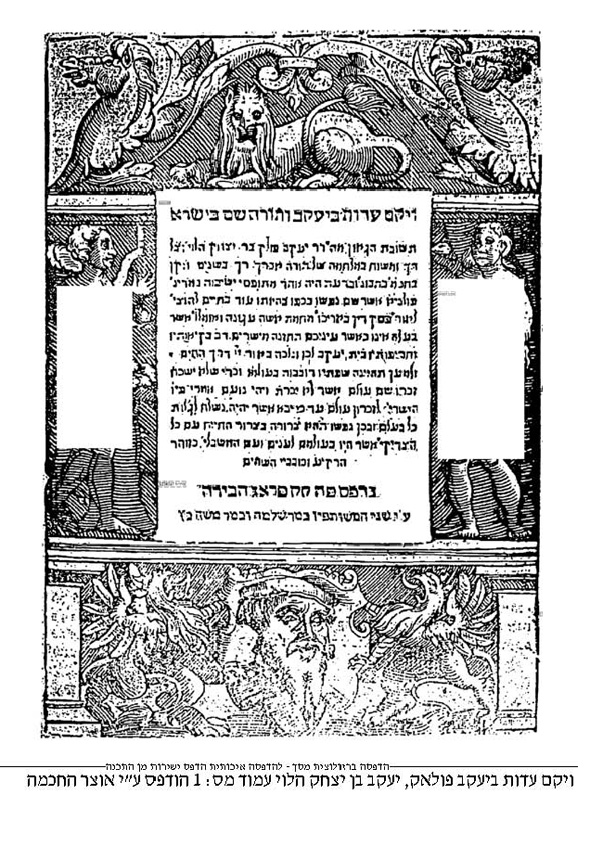
While it is often stated that the hasidim rejected R. Baruch because he became a Zionist, the truth is that he rejected them, in that he chose not to continue as the rebbe. The bitter and public break with his children was a real family tragedy, but it is difficult to read the book and not conclude that the fault for this lay in R. Baruch’s unresolved issues – Heilman speaks of “Oedipal overtones” (p. 63) – seen most vividly in R. Baruch’s shocking behavior at R. Moshe Leib’s wedding. The result of all this is that R. Baruch has been completely erased from Munkács history and has no significance to the movement. When a book with his approbation is reprinted, such as R. Joseph Lustig’s Amudei Esh le-Veit Yosef, it is not surprising that the approbation is removed. Here is the title page of the edition with the approbation removed.

Despite the family tragedy, it must be said that R. Baruch’s son and successor, R. Moshe Leib, has been remarkably successful in leading a revival of the dynasty. He has also played a role in wider Jewish affairs, both publicly and behind the scenes, and is a fine example of what a successful rebbe can be.
Let me add a few more points about R. Baruch that are not mentioned in Heilman’s book. One might have assumed that as R. Baruch became more modern he would distance himself from his father-in-law, a man very much identified with extremism. But that did not happen. Until the end of his life he continued to display awe for R. Hayyim Eleazar Shapira. In Binat Nevonim (2012 ed.) pp. 153-154, he defends R. Shapira against the accusation that he was a “ba’al machloket.” What about his well-known attacks against the Religious Zionists and those non-Zionist Orthodox who wished to go on aliyah intending to work the land?[6] R. Baruch explains, very unconvincingly, that R. Shapira reacted the way he did because he hoped that the Messiah would soon arrive and people would then be able to immigrate to the Land of Israel without confronting any irreligiosity. R. Baruch’s own opinion comes a few pages later, p. 157, where he writes that the ingathering of Jews, including non-religious, to the Land of Israel is a fulfillment of biblical prophecy. Only later will God send His Holy Spirit to purify the people from all of its sins, and then He will send the Messiah. Such a perspective is very much at odds with what R. Shapira advocated.
Interestingly, in dealing with the accusation that his father-in-law was a “ba’al machloket,” R. Baruch says nothing about R. Shapira’s battles against the Agudah and its rabbis,[7] or his battles against non-Agudah rabbis and rebbes, in particular the Spinka Rebbe, R. Isaac Eizik Weiss, and the Belzer Rebbe, R. Yissachar Dov Rokeah. In the latter case, R. Shapira’s actions were very extreme, and it was alleged that he even attempted to get the government to expel the Belzer Rebbe from the city.[8] He attacked the Belzer Rebbe personally and referred to his hasidim as חזירי בעלז.[9] His attacks on Belz did not stop even after the Belzer Rebbe’s death, and the Belzer community of Munkács decided to separate from the wider Orthodox community of the city which was controlled by R. Shapira.[10] Since they were not legally allowed to create another Orthodox community, they officially became the Neolog community of Munkács. Although they were as distant from the Neologs as their persecutor, R. Shapira, declaring themselves as Neolog was the only way for them to create their own community which would be recognized by the government.[11]
In Binat Nevonim, pp 173-174, we see very clearly R. Baruch’s Religious Zionist feelings. He reviews the modern growth of the Land of Israel beginning with the early immigrations, and mentions how Jews hoped that this growth was the beginning of the redemption. He even states that the British did not live up to their expected role when they removed a large part of biblical Israel from the Jewish homeland. Could anything be further from the old Munkács approach than the following words from R. Baruch, after summarizing the various nineteenth-century attempts to build up the Land of Israel (p. 174)?
הארץ השוממה מתחילה לנשום ולהחיות מחדש. היא מתחילה להעלות תקווה בלב יושבי הארץ ובלב העם היהודי כולו, שהנה הגיע הזמן של שיבת ציון של חזון הגאולה לעם ישראל ולחזון הגאולה לכל העמים שעם יהודי נשא בקרבו מאז אברהם אבינו דרך הנביאים עד היום הזה.
He recognizes that we have not yet reached the end of the road, but like any Religious Zionist he is confident that the time is coming when the State of Israel will live up to its promise (p. 176):
עם ישראל, זה הנולד לגדולות ולנצורות, לא בדור הזה שהוא כדורו של דוד המלך ייהפך לאור לגויים, לא בדור הזה יהפוך את מדינתו למדינה לדוגמא. אבל יבוא הדור, דור שיהיה דומה לדורו של שלמה, דור שידע מנוחה, דור שלא יצטרך לנהל מלחמות, דור שידע להעמיד את כח החכמה לפני כח הגבורה – והדור הזה יקים את המדינה לדוגמא, מדינה שבה מדע התורה, המוסר, והצדק, והשוויון ישמשו תשתית לחיי האנושות, ואז יבוא משיח צדקנו, נצר דוד מלכנו ומציון תצא תורה ודבר ה’ מירושלים.
In discussing the Holocaust, R. Baruch states that we cannot ask why God was silent and did not hear the cries of the millions of victims (p. 158). He strongly rejects the notion that the Holocaust, which was an unparalleled national suffering, can be explained as due to any particular sins (p. 198). Regarding the Holocaust, it is also important to mention that R. Baruch was very involved in the efforts to save Hungarian Jewry.[12]
Returning to Heilman, the story of Boyan, which he tells with great skill, did not have the conflict and tragic aspects that were described in the chapter on Munkács. Yet here too we find the same theme, namely, a dynasty without an obvious successor. And again, we see that with the right man, and with proper guidance from the hasidic elders, he can grow into the role. As with Munkács, the Boyaner Rebbe has blossomed into a respected rebbe, either overcoming his more modern background (as some would say), or using this background to allow him to better understand the Jewish people as a whole.
For those interested in conflict in religious life, the chapters on Bobov and Satmar, focusing on the split in these movements, provide plenty of that. In fact, even before the dispute over who would be the current Satmar rebbe, conflict was a basic feature of Satmar life already in Europe. Heilman writes, “For Satmar hasidim conflicts served as a form of socialization and identity formation. . . . [T]his relish for conflict, framed as a steadfast ideological purity, would become the essential identity of Satmar Hasidism.” (pp. 163, 164)
In addition to discussing the conflicts over succession, Heilman also provides the necessary background to understand matters. Thus, in the chapter on Bobov, long before we get to the conflict that led to the split in the movement, Heilman reviews the history of Bobov, its fate during the Holocaust, and its rebirth after the war. Heilman does the same in all of the chapters, allowing readers to appreciate the unique aspects of each of the different Hasidic groups. In his chapter on Satmar, here is how Heilman summarizes what defined this group for its rebbe, R. Joel Teitelbaum.
The struggle to remain apart as well as distinctive and to argue that these positions were the only and authentic way of being Jewish not only made Yoelish’s followers feel that they were part of a great cause and the true defenders of Jewry and Judaism but made Satmarism and its inventor a kind of model for what steadfast Orthodox Judaism was meant to be, a vanguard of contra-acculturation and authenticity. Second, he had to make sure that his educational system did not provide his hasidim with the skills that would make leaving the enclave easy. Third, he had to demonize the world outside so that his followers would either be afraid of entering it or be confident that their own ways were infinitely superior. (p. 173)
I would like to add a few final comments and corrections.
I am not sure why Heilman includes a chapter on Chabad. While obviously the story here is not the fight over succession but the fact that there has not been a succession, for those who read Heilman’s and Menachem Friedman’s biography of the Lubavitcher Rebbe, the material in Who Will Lead Us? focusing on R. Menachem Mendel is not new. The first half of the chapter deals with prior Lubavitcher rebbes, not really the focus of the book which deals with the American scene, but helpful to understanding later events.[13]
It seems that spending so much time among the hasidim has led some of their hagiography to rub off on Heilman. How else to explain his statements that R. Baruch knew Maimonides’ Guide of the Perplexed by heart (p. 42) and R. Joel Teitelbaum “was able to review a folio of Talmud at age five” (p. 156)? Both of these men were scholars, and thus the hagiography focuses on their scholarship. I would be interested to know if in the hagiography about current rebbes, and in particular the ones discussed by Heilman, is scholarship even mentioned. Do current hasidim even assume that their rebbes are great Torah scholars?
In the preface, p. xiv, Heilman tells us that he will look at five different successions. In Munkács and Boyan a successor was lacking. In Bobov and Satmar two individuals claimed the throne. In Habad, the “hasidim denied a need for a successor at all, claiming that their rebbe had never really died.” While it is true that the Habad hasidim have no interest in a successor, there is only a very small number who claim that the Rebbe did not die (and thus they do not go to his grave). The mainstream messianist view is that the Rebbe indeed died and will be resurrected as the Messiah.[14] Even those who do not write זצ”ל or זי”ע do not deny that the Rebbe died and was buried. Yet they assume that his soul is still involved in this world and as such they do not want to treat him as someone who has passed from the scene.
P. 58. Heilman writes that the Lubavitcher Rebbe “claimed to have attended the Sorbonne and other European universities.” (p. 58) I do not understand the use of the word “claimed,” as it appears to cast doubt on what the Rebbe said. Yet in Heilman’s book, The Rebbe, he himself mentions that the Rebbe was a registered student at both the University of Berlin and the Sorbonne.
Pp. 85-86. Heilman states that R. Yerucham Gorelick “came from Slutzk, Belarus, and had studied in the famous non-Hasidic yeshiva there.” This is incorrect as R. Gorelick studied in Lomza, Radin, and also in Brisk, but not in Slutzk. In fact, in 1923 (when R. Gorelick was twelve years old) the Slutzk yeshiva moved to Kletzk.
P. 169. In discussing the Kasztner train and the inclusion in it of the Satmar Rebbe, Heilman writes: “Kasztner was persuaded, after someone paid a ‘huge sum,’ to include Yoelish and some of those connected to him among the 1670 in the train.” Why the leading anti-Zionist, R. Joel Teitelbaum, was included on the Kasztner train is a question that has never been convincingly answered. A popular legend is that Kasztner’s mother appeared to him in a dream and requested that he include the Rebbe. Yet even if this explains why the Rebbe was included, there were also other anti-Zionist rabbis who were on the train, which was a microcosm of larger Hungarian Jewish society.[15]
Before reading Heilman’s book, I had never heard that it was only money that enabled the Rebbe to be rescued. The source Heilman provides for this is a Satmar biography of the Rebbe that relied on an item that appeared in the Satmar paper Der Yid. These are precisely the sorts of sources that have to be used very carefully, and in many cases are simply useless if one is trying to find out the truth. At the very least, Heilman should have written that it is “alleged” that someone paid a huge sum, rather than state it as fact. One of the “problems” of the Satmar Rebbe’s biography is that despite being saved by the Zionist Kasztner, there is no evidence of the Rebbe ever having expressed any gratitude towards Kasztner or the Zionists as a whole for saving his life, something that has often troubled people. However, if the only reason the Rebbe was on the train was because of a simple monetary transaction, then he would have no reason to feel grateful to Kasztner or the Zionists. To put it another way, there is good reason for Satmar writers to portray the event this way in order to burnish the reputation of the Rebbe. As such, the unsubstantiated report Heilman relies on here must be treated with a great deal of suspicion.
The hasidic world is obviously of great significance in Orthodoxy. There are so many different hasidic groups that just when I think I know them all, I see an article about another rebbe whom I have never heard of. In fact, some years ago someone produced a “yellow pages” of all the hasidic rebbes. There are 554 listed, and by now no doubt a few more need to be added. Here is the first page.
There are significantly more rebbes now than a hundred years ago. Marcin Wodzinski has written that “there were approximately three hundred tsaddikim active in 1900.”[16]
What I know from friends in the hasidic world is that there are also people who should be regarded as “independent hasidim.” I first heard this expression a few years ago in Budapest where I became friendly with a visiting American hasid. When I asked him which group he was part of, he replied, “independent.”
Here was a man who looked like a hasid, who considered himself a hasid, who valued the hasidic way of life, and yet he did not have a rebbe. Since then I have met other “independent hasidim,” and their story is pretty much the same. They grew up as hasidim and love Hasidut, but they do not find any of the rebbes appealing. Some of them have also seen things that caused them to be disillusioned with the contemporary rebbes. They do not deny the value of a rebbe, and believe that great rebbes existed in the past. It is just that today they do not see such figures.
I would love to see an article dealing with the phenomenon of the independent hasidim. Is this something that can continue in a family over generations, or is it a one generation event, with the children brought up in such a family generally joining a hasidic group or linking up with the yeshiva world? Interestingly, Wodzinski notes the existence of independent hasidim around the time of World War I, and I wonder when they first appeared. In Wodzinski’s words: “During the war and after it, shtiblekh sprang up, gathering the half-rejects and half-deserts from the Hasidic world, shtiblekh unaffiliated with any court.”[17]
The independent hasidim should be distinguished from what Wodzinski has termed “à la carte Hasidism.” This is a phenomenon that also existed in the early twentieth century, and consisted of “young Hasidim who sampled different courts, picking various festivals with different tsaddikim depending on individual taste or indeed on the way different tsaddikim enacted different elements of Hasidic ritual.”[18]
Another point of interest which has not yet been analyzed is the position of the rebbe when he was still a child and teenager. Heilman’s book discusses this with regard to the current Munkácser Rebbe, but when he was young there was not yet an expectation that he would become the rebbe. What about those who knew that they would become rebbe. What type of childhood did they have? Did they have friends like other children, or were they regarded as too special to mix with the masses? And how about when they were teenagers and realized the significance of their fathers, who served as rebbes? It would be fascinating to hear from current rebbes about how they experienced childhood and young adulthood. People often forget that even the most important figures were once young and enjoyed the same sort of fun that all young people do. I actually have a photo of a young Shlomo Halberstam (1907-2000) in his bathing suit having fun in a lake. Heilman discusses in detail his experiences during the war and how after the war he rebuilt the Bobov dynasty, a task that fell to him as his father, R. Ben Zion, was murdered by the Nazis.[19] Yet the photo I just mentioned reminds us that even future rebbes were able to enjoy themselves like everyone else.
* * * * * *
Since this post deals with Hasidism, it is a good place to call attention to an unfortunate example of censorship in the writings of the Hatam Sofer. Here is the title page of volume 2 of the Derashot of the Hatam Sofer, first published by R. Joseph Naphtali Stern in 1929. R. Stern’s edition is based on the Hatam Sofer’s own manuscripts.

Beginning on p. 371a one can find the eulogy for the Hatam Sofer’s teacher, R. Nathan Adler. On p. 373a, in speaking of the great piety of R. Adler, the Hatam Sofer writes: ולא כחסידי הזמן ח”ו.


Now take a look at the Pressburg 1881 edition of Torat Moshe, Va-Yikra, p. 41b. You can see that the words ולא כחסידי הזמן ח”ו do not appear. It is not known if the publisher was responsible for this censorship, as he informs us in the introduction to volume 1 that some of what appears in the book was copied from the Hatam Sofer’s manuscripts and sent to him.

And while on the topic of censorship, here is another example dealing with a leading student of the Hatam Sofer, R. Moses Schick. Here is Derashot Maharam Schick, p. 30b, published in Cluj around 1936.[20]

You can see that he mentions Wessely’s Yein Levanon. Now take a look at the Derashot Maharam Schick published in Jerusalem, 2003.

As you can see, the reference to Yein Levanon has been removed. R. Moses Schick believed that Yein Levanon was a fine book, worthy of being quoted. However, the publisher thought differently. Ironically, the new edition was published by Makhon Maharam Schick. Here is the title page

So we have a publishing institute named after R. Moses Schick, and the people who run it would no doubt insist that they have the greatest respect for R. Schick. Yet this respect does not include respecting the sanctity of what he actually wrote.

R. Moses Schick refers to Wessely’s comment to Avot 1:1. In the new edition of Yein Levanon (Rishon le-Tzion, 2003), p. 44, the editor points out that R. Samson Raphael Hirsch, in his commentary to Avot 1:1, also cites Wessely by name. While this comment appears uncensored in the English translation of Hirsch’s commentary, in the Hebrew translation Wessely’s name has been replaced by “one of the commentators.” The editor adds: “The translators think that they are wiser  and more understanding than R. Samson Raphael Hirsch.”

* * * * * *
In Changing the Immutable, p. 211, I write that R. Hayyim Vital “records” and “mentions” certain negative information about Israel Najara. Yitzy Weinberg commented to me that I neglected to state a very important point, namely, the source of R Vital’s information. Weinberg feels, and others probably do as well, that knowing the source is important, since if R. Vital recorded information that he had personal knowledge of it would have more significance than if it came from another source.

Before coming to this point, I must note from a modern perspective, it is hard not to conclude that R. Vital was overly credulous. He was ready to believe the most far-fetched tales of angels, demons, magic, spirit possession, and exorcisms, and has no reticence in describing personal experiences with some of these things. He himself was even possessed by a powerful evil spirit. Morris M. Faierstein has recently discussed this episode and reaches the following striking conclusion: “Within the universe of Lurianic Kabbalah and the stories found in Vital’s mystical diary, the Book of Visions [Sefer Hezyonot], it can only be Jesus of Nazareth who was the evil spirit that possessed Hayyim Vital.”[21] 

Knowing all this, I do not believe that the information about Najara quoted by R. Vital should be accepted at face value,[22] especially when the charges made (homosexual behavior and sexual relations with a non-Jewish woman) are so serious. I would say this even if the ultimate source of this information was R. Vital himself.[23] 
Nevertheless, I agree that I should have mentioned that the information recorded by R. Vital came from a spirit that had entered a woman (a phenomenon that only after R. Vital’s time came to be known as a dybbuk[24]). Furthermore, in the book I noted: “Because of this, Vital wrote that ‘the hymns that he has composed are themselves good, but whoever speaks to him and whatever leaves his mouth is forbidden, because he always used foul languages and was a drunkard his whole life.’” This too is a statement from the spirit.
Among the information revealed by the spirit was that “between the fast days,” Najara “prepared a meal at that hour at the house of Jacob Monides, put his hat on the ground, sang songs in a loud voice, ate meat, drank wine, and even became drunk.”[25] R. Vital writes that Najara admitted that this incident occurred, meaning that in this case R. Vital wants us to know that the spirit spoke the truth. R. Vital does not record asking Najara about the spirit’s more serious accusations, and he would have told us if he had.[26]
Despite what I have just written, some seem to assume that everything that appears in R. Vital’s Sefer ha-Hezyonot must be attributed to himself, even if he attributes it to a spirit. Thus, Lawrence Fine writes: “In his dream diary, Vital alleges that Israel Najara engaged in homosexual behavior in his drunkenness, and contends, in connection with Damascus, that ‘there is much homosexuality . . . in this land.’”[27] As you can see, Fine does not mention the spirit but states that “Vital alleges.”
Another example is that Israel Zinberg writes that “Vital declares,” and then cites the passage I quoted in my book, which first appeared in Shivhei R. Hayyim Vital.[28] “The hymns that he has composed are themselves good, but whoever speaks to him and whatever leaves his mouth is forbidden, because he always used foul language and was a drunkard his whole life.” Zinberg does not mention the spirit.
Avraham Amazleg writes as follows (emphasis added)[29]:
שם רח”ו גם בפי הרוח דברי גנאי וביקורת על נג’ארה. רח”ו או הרוח אמנם מודים שהפזמונים שהוא חיבר הם טובים, אבל אסור לאומרם או לדבר עם המחבר, כי פיו דובר נבלה, וממילא הוא שיכור כל ימיו.
Almog Behar writes[30]:
המקובל רבי חיים ויטאל, תלמיד האר”י, בן תקופתו, כתב עליו ב”ספר החזיונות” שלו.
I could bring a number of additional examples where the words of the spirit are attributed to R. Vital, but I think readers get the point.
Although in all texts of Shivhei R. Hayyim Vital Najara’s name was deleted – it first appeared in the 1954 edition of R. Vital’s Sefer ha-Hezyonot – it was not too difficult for Zinberg and others to figure out who was being referred to. R. Moses Sofer appears to have also been aware of the passage in Shivhei R. Hayyim Vital, or perhaps there even was an oral tradition about the more serious charges against Najara that only appeared in print in 1954. I say this because when asked by his son why he did not sing Najara’s spiritually moving Y-ah Ribon, the Hatam Sofer replied: “Rather than telling you why I do not sing it, it is better to sing it.” From that point on he sang Y-ah Ribon.[31]
* * * * * *
R. Yechiel Goldhaber is well known as an outstanding scholar, whose many publications are always enlightening.[32] Not many know that he also offers tours of the Old City of Jerusalem. Having had the pleasure of participating in one of his tours, I highly recommend it to all who are interested in the history of Jerusalem (which I believe includes all Seforim Blog readers).
My own Torah in Motion tours to Europe in summer 2018 have also been announced. You can read about them here.

The young scholars R. Yisachar Dov Hoffman and R. Ovadiah Hoffman are known to many Seforim Blog readers. R. Yisachar has authored Avodat Ovadiah which focuses on practices of R. Ovadiah Yosef. R. Ovadiah Hoffman is a Seforim Blog contributor, and both of them have published three volumes of Ha-Mashbir, dedicated to studies on R. Ovadiah Yosef. I think readers will be interested to know about an event they are organizing to commemorate the yahrzeit of R. Ovadiah Yosef. It is to take place on Sunday, October 22, 2017, from 6:25pm-9pm (refreshments available), followed by maariv. It will be an evening of shiurim dealing with contemporary halakhic issues and reflections on the legacy of R. Ovadiah Yosef. It will be held at Beis Midrash Kerem Shlomo, 1880 East 27th Street (between Ave. R and S), in Brooklyn. The scheduled speakers are R. Herschel Schachter, R. Aryeh Ralbag, R. Yitzchok Yisraeli, and R. Betzalel Rudinsky. It promises to be a fascinating evening.

[1] See Heilman, Who Will Lead Us, p. 193, where he mentions that in 1984, under the leadership of R. Moshe Teitelbaum, the Satmar were officially designated by the government as a “disadvantaged minority, which allowed them access to various government benefits.”
[2] R. Hayyim Halberstam, Divrei Hayyim,vol. 2,  Hoshen Mishpat. no. 32, writes against the practice of family succession when it comes to the Rebbe, and contrasts this with the position of town rav where there is such a concept:
ועל דבר ירושת הכבוד הנה במח”ת כ”ת הבוררים הרבנים וכי רבני החסידים שליטתם בתורת משרה כמו רב שבנו קודם הלא ידוע שהקדוש ר”א ואביו הק’ זלה”ה לא היו רבנים ורק מחמת גודל קדושתם ויראתם נשמעו דבריהם לכל הגליל וינהו אחריהם ללמוד תורה ויראה מהם גם נתנו להם נדבות לכבד יראי השם כמותם ירבו בישראל ושאלו עצות כאשר ישאל איש בדבר אלקים כי היו בעלי רוח הקודש ותפלתם ודיבורם בקדושה עשו פרי ומה נעשה אם הבאים אחריהם אין בהם קדושה זו. מה ירשו לשאול עצה דעת אין בהם. אם להתפלל מי יודע העולה למעלה לא ידעתי שום צד ירושה בזה. והנה מצינו למופת כגון הרב הקדוש איש אלקים רשכבה”ג מו”ה דוב בער זלה”ה ממעזריטש השאיר הגדולה לתלמידיו הרב הק’ מברדישטוב ומאור עינים ואור המאיר זלה”ה, וכן רבו הבעש”ט הניח המשרה זו לתלמידיו לא לבנו שהי’ קדוש ה’ וכן רבינו הקדוש בעהמ”ח נועם אלימלך הניח המשרה לתלמידיו לא לבנו הגם שהיו קדושים למאד כידוע לכן אין בזה שום ירושה ורק מעשיו יקרבוהו ומעשיו ירחקוהו.
[3] In R. Zvi Yehudah Kook’s recently published Sihot R. Zvi Yehudah: Emunah, ed. S. Aviner (Jerusalem, 2017), p. 200, Berdyczewski is quoted explaining what led him to abandon traditional Judaism. In short, it was seeing how his learned grandfather had to humble himself before a young rebbe. While Hasidism and attachment to a (worthy) rebbe are wonderful things, one should always remember what R. Kook states in Orot, p. 146, about the possible dangers:

הדבקות בצדיקים, כדי שיתערב כח המציאות שבנשמתם עם הנשמה הבלתי-נשלמת, היא דבר נכבד מאד במהלך התפתחות הנפשות, אבל צריך שמירה גדולה, שאם יטעה בצדיק אחד, וידבק בו דבקות פנימים הויתית, וידבק ג”כ בחסרונותיו, הם יפעלו לפעמים על הדבק במדה גרועה הרבה ממה שהם פועלים על האיש המקורי. אשריהם ישראל שהם דבקים בנשמת האומה, שהיא טוב מוחלט, לשאוב על ידה אור ד’ הטוב

[4] Heilman never mentions a rebbe by name as his source, but on p. 53, in quoting the recollections of an unnamed family member, it is the Munkácser Rebbe who is being quoted. There were only two family members who were present at the event discussed, the Rebbe (R. Moshe Leib) and his brother, Chaim Elazar. Since Chaim Elazar spoke on the record and on numerous occasions is mentioned by name as the source for information, the “unnamed family member” must be the Rebbe himself. The Rebbe must also be the source for the information on pp. 57-58, where Heilman records what R. Baruch told the young Moshe Leib, including his recommendation that Moshe Leib attend university. Heilman also mentions what Moshe Leib told his father: “Today, if someone puts a college diploma on his wall, his rebistve is finished.”
[5] The picture comes from this article. For a bar mitzvah video made by one of R. Baruch’s grandsons, see here.
[6] See Yitzhak Alfasi, Ha-Hasidut ve-Eretz Yisrael (Jerusalem, 2010), pp. 175-176; Menachem Keren-Kratz, “The Politics of Jewish Orthodoxy: The Case of Hungary 1868-1918,” Modern Judaism 36 (October 2016), 8pp. 232-233.
[7] As part of his battle against the Agudah, he also took on Daf Yomi which in his mind was simply ridiculous:

טפשות וצחוק מכאיב
“For how can one learn a page every day when the pages almost always end in the middle of a subject.” Divrei Torah (Brooklyn, 1998), vol. 6, no. 82. Elsewhere he explained that the great danger in joining a Daf Yomi group is that one might be led to adopt the Agudat Israel ideology, “and Heaven forbid to join with them.” Iggerot Shapirin (Brooklyn, 1983), p. 319. He also accused the Agudah of initiating the Daf Yomi in order to have at its disposal ready-made groups that could be used to colonize the Land of Israel. See Sha’ar Yisaschar (Brooklyn, 1992), p. 382.
For other examples of rabbinic opposition to Daf Yomi, due to its association with Agudat Israel, see Tikun Olam (Munkács, 1936), p. 106; Aharon Rosenberg, ed., Mishkenot ha-Ro’im (New York, 1987), vol. 3, pp. 901-902; Nitzotzei Or 3 (Elul, 5758), pp. 33-41. While I do not think that R. Joseph B. Soloveitchik can be called an opponent of Daf Yomi, I was present at a shiur in the summer of 1985 where he expressed his dismay that due to the growing popularity of Daf Yomi, people were no longer studying all six orders of the Mishnah, much of which has no Talmud and is thus not included in the Daf Yomi cycle. (For reasons that are unclear, Middot and Kinnim are the only tractates of Mishnah included in Daf Yomi.)
[8] See Yeshayahu A. Jelinek, The Carpathian Diaspora: The Jews of Subcarpathian Rus’ and Mukavchevo, 1848-1948 (New York, 2007), p. 172; Shmuel ha-Kohen Weingarten, “Pulmus Munkács-Belz,” in Yehudah Erez, ed., Entziklopedyah shel Galuyot: Karpatoros (Jerusalem-Tel Aviv, 1959), p. 230; and my Changing the Immutable (Oxford, 2015), p. 229.
[9] See Weingarten, “Pulmus Munkács-Belz,” p. 230.
[10] Not surprisingly, this dispute led to violence. The topic of violence, which has been a part of certain hasidic courts, is worthy of a study. Let me offer a few relevant sources. There is a report of hasidim murdering a mitnaged. See Mordechai Wilensky, Hasidim u-Mitnagdim (Jerusalem, 1970), vol. 2, p. 178. This report, contained in the early anti-hasidic text Shever Posh’im, includes names and places and was written not long after the event described. Nevertheless, I would not accept the story as historically accurate without confirmation from other sources, which as far as I know has not been found. See also S.’s post here which discusses another alleged murder by hasidim. (I do not believe there is any truth to this story.)
There are, unfortunately, hasidic stories that present violence as an acceptable option to settle disputes. It is safe to assume that such teachings have an impact on some impressionable minds (think New Square). For example, in Sippurei Niflaot mi-Gedolei Yisrael (Tel Aviv, 1969), p. 279, it reports that R. Menahem Mendel of Kotzk thought that R. Shmelke of Nikolsburg made a mistake when he forced his “enlightened” opponents to leave the city. What he should have done, according to the Kotzker, is have them killed.
Some relevant material is found in the book Zikhron Asher (1980) by R. Asher Edelstein. This book is not found on Otzar ha-Chochmah or hebrewbooks.org. I learnt about it from R. Nahum Abraham, Darkhei ha-Ma’amarim (n.p., 2017), section Peti Ya’amin le-Khol Davar, pp. 113-114 (who cites the stories I mention). Here is the title page.
Here is pp. 14-15 where we are told that the Kosover Rebbe tried to drown the follower of another rebbe. Following this it mentions how each of the rebbes discussed would bring punishments upon the followers of the other rebbe.
Here is pp. 31-32 where it records that the Kosover Rebbe was angry that one of his hasidim went to the Belzer Rebbe, and this anger caused the man’s factory to burn down. It also tells a story of violence that took place at the wedding of one of the Ruzhiner Rebbe’s sons. This story ends with the death of the man who during the wedding had stabbed the Kosover Rebbe with a needle. 
Here is pp. 63-64 where it describes how the rebbe R. Yissoschar Berish Eichenstein once removed a fly from his plate on Shabbat, in violation of the halakhah. When this was mentioned to him by R. Menahem Mendel Stern, the rav of Sighet, R. Eichenstein replied that a man had been reincarnated in this fly, and he had to be metaken it. R. Stern replied that he does not seen any tikunim but only regular Shabbat violation. The story ends that R. Eichenstein’s brother cursed R. Stern and R. Stern returned the curse, leading to the brother’s early death and R. Stern not having any “nachas” from his descendants. 
None of the pages I have reproduced are found in the 2004 edition of Zikhron Asher. Here is the title page.
Yitzhak Even, Mahloket Sanz ve-Sadegura (New York, 1916), has a lot to see about violence between the Sanzer and Sadegura hasidim. On p. 68, he tells how some Sanzer hasidim murdered a Sadegura hasid. On pp. 79-80, he discusses the stabbing of a Sanzer hasid and further violence against Sanzer hasidim. He also mentions a report that in response to being attacked, the Sanzers murdered an elderly Sadegura hasid. See also pp. 83, 86-87. I do not know how reliable Even’s information is.
[11] See here. This action led to R. Shapira issuing the following statement in 1929, declaring that the Belz community is to be regarded as no different than the Reform community:
הן כבר הודענו כי אותן שמחזיקים בבית התפלה של הנעאלאגים דפה – דינם כמו שאר הנעאלאגים האוכלים נבילות וטריפות – ופשוט שאין להם נאמנות וחזקת כשרות כלל.
See Weingarten, “Pulmus Munkács-Belz,” col. 230 n. 2. See also ibid., col. 232, that originally the Belzers wished to be recognized as a Status Quo community. Only when the government did not agree to this, did they then request, and receive, government recognition as a Neolog community. Weingarten’s father was the secretary of the Munkács community. See Weingarten, “Ha-Admor Mi- Munkács, Rabbi Hayyim Eleazar Shapira,” Shanah be-Shanah (1980), p. 447. Even though Weingarten was a Zionist, he still had a very good relationship with R. Shapira. See Weingarten, Perurim mi-Shulhanam shel Gedolei Yisrael (Jerusalem, 2004), pp. 17-37.
[12] Regarding this, see Binat Nevonim.
[13] On p. 216, Heilman mentions that already the Tzemach Tzedek sent out shluchim to the wider Jewish world. Apropos of this, I know that some have wondered why Chabad calls its emissaries שלוחים and not  ,שליחי which any Hebrew dictionary will tell you is the plural of שליח. Yet as R. Meir Mazuz points out, in rabbinic Hebrew the plural is indeed שלוחים. Thus, we find in Rosh ha-Shanah 18a: על ששה חדשים השלוחין יוצאים. Also, Maimonides has a section in the Mishneh Torah that is called הלכות שלוחין ושותפין. See R. Mazuz’s note to Hannah Peretz, Patish he-Hazak (Bnei Brak, 2013), vol. 2, p. 384 n. 26, and his recently published Mi-Gedolei ha-Dor, vol. 3, p. 129 n. 2. R. Mazuz thinks that the term שליחים originates in Christian circles, and that it was perhaps because of this that Jews used the term שלוחים. Yet as far as I know there is no evidence that Christians used the term שליחים in the days of the Mishnah. 

I do not believe that the term  שלוחappears in classic rabbinic literature, but we do have it with a suffix. E.g., Mishnah Berakhot 5:5: ששלוחו של אדם כמותו. See Ben Yehudah’s dictionary, s.v. שלוח, שליח. Ben Yehudah, s.v. שלוח, explains the difference between שלוח and שליח as follows:

[שלוח] זה שנשלח, בהבדל מה מן שליח, שתפקידו הקבוע הוא לשמש כנשלח בשליחות.
In s.v. שליח he writes:
ואפשר שבא שליח בעקר כצורה ארמית שליח, שליחא במק’ שלוח בעבר.
[14] The only time I have ever had contact with a Chabad group that apparently denies the Rebbe’s death was in New Delhi. Here is a picture of the sign in front of the Chabad House and the stamp that is found in its siddurim and seforim.


ללא שינוי דגניזה means that the Rebbe’s soul continues to function in his body as there was no death.
[15] R. Jacob Elimelech Panet, the rav of Dej, Hungary, was on Kasztner’s list as one of the rabbis to be saved. However, R. Panet refused to leave the Dej ghetto and was later murdered in Auschwitz. See Shlomo Spitzer, Kehilot Hungaryah (Jerusalem, 2009), p. 111.
[16] “War and Religion; or, How the First World War Changed Hasidism,” Jewish Quarterly Review 106 (Summer 2016), p. 289 n. 20.
[17] Wodzinski, “War and Religion,” p. 305.
[18] Wodzinski, “War and Religion,” p. 299.
[19] In the recently published English translation of R. Pinchas Hirschprung’s Holocaust memoir, The Vale of Tears, trans. Vivian Felsen (Toronto, 2016), pp. 152-153, he discusses the Shabbat he spent with R. Ben Zion in Lemberg shortly after the start of the war. This memoir originally appeared in Yiddish in 1944. Fortunately, it was not translated by ArtScroll or one of the other haredi publishing houses as I am certain they would have deleted some of R. Hirschprung’s wonderfully honest comments. See e.g., p. 222, where he confesses that he thought of suicide. On p. 156, he writes, “I slept well, woke up past noon and recited the morning prayers far too late.” P. 160: “I was envious of this woman’s profound belief in divine providence.” P. 166: “I stealthily took some water from the town ritual bath.” On p. 221, he writes that R. Chaim Ozer Grodzinski told him that he was not worried about Lithuania losing its independence, a view that was soon shown to be incorrect. On pp. 246-247, he writes about how R. Chaim Ozer told him that he and his yeshiva should not take the visas for Curacao that were available, but should remain in Vilna. Had R. Hirschprung and his colleagues listened to R. Chaim Ozer it would have meant their deaths. I do not think that a haredi publication would ever record such an error in Daas Torah. R. Hirschprung also mentions how a hasid who was with him argued that precisely because R. Chaim Ozer, the misnaged, said not to get the visas, that this was a sign from heaven to do the exact opposite.
Regarding R. Hirschprung, in 1985 I was present at a siyum ha-shas where R. Shlomo Goren said that R. Hirschprung was the only person alive who knew the entire Talmud by heart. I found two talmudic notes published by R. Hirschprung when he was only fourteen years old. See Or Torah )Lvov) 1 (1926), p. 18, Beit Va’ad le-Hakhamim )Satmar), Adar 5686 (1926), p. 67. See also ibid., Kislev 5687 (1927), pp. 37-38. When he was sixteen he began to edit the Cracow Torah journal Ohel Torah. Regarding R. Hirschprung’s book Peri Menahem, which was written when he was apparently only thirteen years old, see Gedulat Pinhas (Brooklyn, 1999), p. 14; Yaakov Shmuel Spiegel, Amudim be-Toldot ha-Sefer ha-Ivri: Be-Sha’arei ha-Defus (Jerusalem, 2014), p. 65.
At a future time I can discuss the rabbis who told people to remain in Europe even after World War II had begun. Since in this post I have discussed the Satmar Rebbe, I will only mention that R. Asher Anshil Yehudah Miller reports that during the Holocaust the Rebbe told his followers to remain in Hungary, which in hindsight was clearly a wrong decision. See Miller, Olamo shel Abba (Jerusalem, 1984), p. 309. R. Miller writes:
בשעה שהיהודים עמדו במבוכה ולא ידעו להחליט האם כדאי לברוח, מכיון שלא הכירו את מזימתם ואכזריותם של הגרמנים, עשו הוראותיו של האדמ”ר מסאטמער רושם עצום על כל יהודי חרדי “לא להבהל ולא להמלט, כי קרובה הישועה לבוא”. לדאבונינו לא כך היו פני הדברים – אלפי נפשות של יהודים טובים עם בני משפחותיהם הגיעו למחנות השמדה, למרות שהתגוררו בקרבות הגבול.
[20] There is no publication date on the title page, but the introduction is dated 1936.
[21] See Faierstein, “The Possession of Rabbi Hayyim Vital by Jesus of Nazareth,” Kabbalah 37 (2017), p. 36.
[22] In his introduction to Jewish Mystical Autobiographies (New York, 1999), p. 12, Morris M. Faierstein writes:
A related question is how are we to deal with Vital’s assertions when he cites the dreams and visions of others that were supposedly told to him, or when he recounts various “omens” that foretold his greatness in his childhood or youth. Similarly, when he ascribes certain thoughts or actions to others, should we assume that he is a reliable reporter or that these are his own invention? Data that cannot be verified from external sources, and this includes most of the contents of the Book of Visions, must be treated as Vital’s perception or belief. It would not be helpful to use judgmental terms like fantasy or invention or say that Vital “alleges” this or that. It is obvious that we are dealing with a “visionary” document and it should be approached from that perspective.

Regarding the larger question of how seriously we should take accusations found in written works, especially when we know that the author had negative feelings about the person he was writing about, I saw something relevant in Pawel Maciejko’s new book, Sabbatian Heresy. This is a very helpful book, which includes translations of a number of important texts. In the introduction, p. xxiv, Maciejko writes as follows:

While Sabbatians did not always display a positive or even tolerant attitude toward non-Jews, they never ignored other religions and traditions. They studied them with an intensity that sometimes bordered on obsession (according to contemporary testimony, Rabbi Jonathan Eibeschuetz developed an “uncontrolled urge to read books of the priests”). 

What is the source for the information about R. Eibeschuetz? None other than R. Jacob Emden, who said all sorts of negative things about R. Eibeschuetz. Thus, I do not feel it is appropriate to refer to such a source as “contemporary testimony.” 
[23] Israel Zinberg, who died before the most serious accusations against Najara were published, wrote as follows:

To be sure, Hayyim Vital is not a completely reliable witness. Apparently, he had some personal scores to settle with the poet. Furthermore, the vain and arrogant Vital envied Najara, because Isaac Luria was so enchanted by his verses. Luria used to say that even among the “family on high” Najara’s hymns are received with great enthusiasm, and that his soul is a “spark” of no less a soul than that of King David, the godly poet of the Psalms. (A History of Jewish Literature, trans. B. Martin [Cincinnati and New York, 1975], vol. 5, p. 95)
It is one thing to say that R. Vital believed in all sorts of superstitions, but Zinberg crosses the scholarly line by casting aspersions on R. Vital’s character. See also Meir Benayahu, “Rabbi Yisrael Najara,” Asupot 4 (1990), pp. 234-235, who defends Najara against the attacks on him, in particular by R. Menahem Lonzano. He writes:
ואולי דווקא משום הדרשות לתשובה שהיה ר’ ישראל נאגארה דורש ורבים חסידים וישרים נלקטו אליו בג’ובאר, שכל מעיינם היה בתיקון עצמם וקירוב זמן הגאולה, קינאו בו וטפלו עליו דברים שלא כן?
In his criticism of Najara, R. Lonzano pointed to what he regarded as the totally inappropriate erotic language used by Najara in describing the loving relationship between man and God. See Benayahu, “Rabbi Yisrael Najara,”, pp. 223ff. One example of such erotic language is found in Najara’s poem ידד שנת עיני  (Shirim, ed. Tova Beeri [Tel Aviv, 2015], pp. 126-127):
לו אהיה יונק ואתה אומני
אינק שדי יופיך צמאי אשברה
דוד נעלה חמדת מהללי . . .
לו אהיה אהל ואתה שוכני
נתעלסה אהב בגיל נתאזרה
דוד נעלה חמדת מהללי
לו אהיה לשון ואתה מעני
אשקיט יקוד חשקך בשיר ואזמרה
דוד נעלה חמדת מהללי
Here is my attempt at a translation:
If I were a suckling infant and You my wet nurse
I would suckle at Your beautiful breasts, quenching my thirst
My beloved, exalted and praiseworthy . . .
If I were a tent and You dwelled within
We would revel in love, gird ourselves in joy
My beloved, exalted and praiseworthy
If I were a tongue and You my response
I would calm my flaming desire for You with song
My beloved, exalted and praiseworthy
The first line of the last stanza is difficult. I have followed Prof. Joseph Yahalom’s suggestion. Prof. Tova Beeri in her note to the passage believes that the translation should be, “If I were a tongue and You the enabler of my speech,” based on Prov. 16:1. See also here s.v. פירוש. At this time, let me thank the incomparable Peter Cole for his e-mails to me discussing some of the problems of translations of poetry.
Najara would no doubt defend himself against R. Lonzano’s criticism by stating that he was following in the path of Song of Songs. Cf. Andreas Tietze and Joseph Yahalom, Ottoman Melodies Hebrew Hymns (Budapest, 1995), p. 19.
[24] See Encyclopaedia Judaica, s.v. Dibbuk.
[25] Faierstein, Jewish Mystical Autobiographies, p. 71.
[26] Sefer ha-Hezyonot, p. 34. Benayahu, “Rabbi Yisrael Najara,” p. 231, quotes all the bad things the spirit said about Najara and writes (emphasis added):
הרח”ו ראה בכך אשמה כבדה ולכן סיפר לנאג’ארה על כל אשר נאמר עליו, והוא כותב: “והודה לי שכן היה”.
Yet this is incorrect. As I indicated in the text, R. Vital did not speak with Najara about the more serious accusations.
[27] Physician of the Soul, Healer of the Cosmos: Isaac Luria and His Kabbalistic Fellowship (Stanford, 2003), p. 176.
[28] A History of Jewish Literature, vol. 5, p. 95.
[29] Ha-Moreshet ha-Musikalit shel Kehilot Yisrael, vols. 7-8 (Tel Aviv, 1986), p. 76.
[30] See here.
[31] Minhagei Ba’al Hatam Sofer, ch. 5:14 n. 1; Zemirot le-Shabbat Beit Soferim (London, 2015), p. 57. See also here.
[32] A recent video of a lecture of his on “Mesoros of Esrogim” can be seen here.


Answers to Quiz Questions and Other Comments, part 2

Answers to Quiz Questions and Other Comments, part 2
 
by Marc B. Shapiro
1. In my previous post, in discussing the words in Ecclesiastes 2:8 עשיתי לי שרים ושרות, I referred to the interpretation in Kohelet Rabbati. This very section of Kohelet Rabbati has an amazing comment, which as far as I know was never referred to in the dispute over Sara Hurwitz’ rabbinical ordination. Commenting on the words שדה ושדות, which appear in the same sentence as שרים ושרות, the Midrash states:

שדה ושדות: דיינים זכרים ודיינות נקבות
In other words, Solomon is portrayed as appointing female dayanim! (See also Ruth Rabbah 1:1 where Deborah and Yael are described as judges.[1]) The standard commentaries find this passage very difficult and offer alternative explanations, sometimes in opposition to the plain sense of the words. Etz Yosef suggests that the job of the women was to judge other women. R. David Luria adopts the lav davka approach, and assumes that דיינות must mean policewomen of sorts.
ודיינות נקבות: לאו דווקא דיינות דאשה פסולה לדון. אלא שופטת להשגיח שלא ישלטו [ישלחו?] הנשים בעולתה איש לרעותה את ידה
His position is rejected by R. Abraham Horowitz, Kinyan Torah ba-Halakhah, vol 1, no. 8:3. Rabbi Horowitz, who was a member of the Edah Haredit beit din, assumed that when the Midrash referred to female dayanim, it didn’t mean that they actually took part in beit din proceedings, but it did mean that they decided halakhic matters, and in that sense they are דיינות. Here are his words, which everyone should examine closely.
ובאמת ל”י [לא ידעתי] מה החרדה הזאת דהא הפת”ש בחו”מ סי’ ז’ סק”ה הביא מספר החינוך מצוה קנ”ח דאשה חכמה ראוי’ להורות . . . אפש”ל דיינות שנתמנו [ע”י שלמה] רק לפסוק הוראה ולא לדון. ועימנ”ח סו”מ ע”ח דפשיטא לי’ דנשים מצטרפות לרוב חכמי הדור אם חולקין באיזו דין . . . מכ”ז נראה דאין לזלזל בסמכות אשה כשירה
I requested that readers examine his words, because in the backlash over Hurwitz’ ordination a number of statements were made the upshot of which was that halakhic decision-making is reserved for men. Ironically, this position is given support by at least some of the women serving as yoatzot, for they are careful to stress that while they provide guidance, they don’t, Heaven forbid, actually decide halakhah. When there is a real halakhic question they turn to the experts, that is, the male rabbis. The message of this is, of course, that women, no matter how learned, are disqualified from deciding halakhah.[2]
Returning to Kohelet Rabbati, R. Yisrael Be’eri accepts that the Midrash means what it says when it refers to dayanim, but suggests that Solomon not only had female courts, but also “co-ed” batei din. See Ha-Midrash ka-Halakhah (Nes Tziyonah, 1960), p. 317:
ולולי מסתפינא אמינא שזה היה הרכב זוגי ז”א אותו דין היה מתברר בפני בי”ד רגיל וכן הוסיף שיתברר בפני דיינות נקבות שאולי יש בהן בינה יתירה וגישה מיוחדת ואחר כך שוקלין זה מול זה ואז היה מתברר הדין בדקדוק ושיקול מיוחד וצ”ע.
It is noteworthy that he sees value in having the female dayanim examine the matter, since they can bring a feminine perspective to bear. If I just presented the text without telling you who the author was and when it was written, I am sure people would assume that only a modern feminist type could have penned these words. Yet we see that this is not the case.
R. Hayyim David Halevi also deals with this Midrash (Aseh Lekha Rav, vol. 8, pp. 247-248). He suggests that the Midrash is indeed operating under the assumption that there is no problem with women dayanim. Alternatively, he suggests that Solomon and his council accepted the authority of the women, and therefore this was permissible. In other words, there is only a halakhic problem when a woman is made a dayan against the will of the community, but if she is accepted by them, then she can serve. And how do we determine if the community accepts her as a dayan? Halevi explains:
וקבלה ודאי שמועילה, והכל כשרים לדון בקבלה, וקבלת גדולי הקהל מספיקה ואין צורך שכל העומדים לדין יקבלו עליהם. וכן מצאנו “דיינות נקבות” כלשון המדרש, ואין סתירה להלכה
What this means is that if the leaders of the community accept women dayanim, then this is sufficient. (I am speaking about in matters of Hoshen Mishpat, not dayanim for Even ha-Ezer.) Therefore, if leaders of the OU or the RCA declare that they accept women, that would open the door to appointing a woman as a dayan on the RCA beit din. Halevi refers to acceptance by גדולי הקהל. In the context of the United States, where there are lots of different kehilot, I would assume that this means that if the leaders of any one community, or even of one synagogue, agree to accept a woman as dayan, then this is sufficient.
R. Ben Zion Uziel also claimed that women can serve as dayanim, and the means of achieving this would be through a takanah. He cites meta-halakhic reasons to explain why this is not a good idea, but from a pure halakhic standpoint, he sees it as entirely acceptable.[3]
Leaving aside the issue of serving as a dayan, it is obvious to me that women rabbis are coming to Modern Orthodoxy, even if the powers that be are standing firmly against it. Yet they have already let the genie out of the bottle. By sanctioning advanced Torah study for women, there is no question that the time will come when there will be women scholars of halakhah who are able to decide issues of Jewish law. The notion that a woman who has the knowledge can “poskin” is not really controversial, and has been acknowledged by many haredi writers as well.[4] Very few rabbis are poskim, but every posek is by definition a “rabbi”, whether he, or she, has received ordination or not.[5] So when we have women who are answering difficult questions of Jewish law, they will be “rabbis”,[6] and no declarations by the RCA or the Agudah will be able to change matters. I am not talking about pulpit rabbis, as this position has its own dynamic and for practical reasons may indeed not be suitable for a woman. Yet as we all know, very few rabbis function in a pulpit setting, and much fewer will ever serve as a dayan on a beit din.
The reason why the issue of ordaining women has been so problematic is because the Orthodox community is simply not ready for it. Yet when women will achieve the level of scholarship that I refer to, and are already deciding matters of halakhah, then their “ordination” will not be regarded as at all controversial in the Modern Orthodox world, and will be seen as a natural progression. People will respond to this no differently than how they responded to the creation of advanced Torah institutes for women. [7] Since women were already being taught Talmud, the creation of these institutes was a natural step.
There is one more thing that needs to be added, and that is that we have not reached the point where there are women halakhic authorities.[8] I hope I won’t be accused of bashing women by pointing out the following fact, that as of 2012 not one traditional sefer, in Hebrew, written by a woman has been published. By traditional sefer I mean a halakhic work or a commentary on a talmudic tractate. I am waiting for this day, which I hope won’t be too long in the future. I also hope that a learned woman is currently working on a commentary to a tractate, even if it is one of the easier tractates such as Megillah. The point is that for women to be recognized as talmudic and halakhic authorities they will have to do exactly what the men do, and that is show the world that they are serious talmidot hakhamim. The major way to do this is through publishing. (Publishing has its own significance, even if no one actually reads the book. Let’s be honest, of the many volumes of commentary on talmudic tractates that are published by people in yeshiva and kollel every year, does anyone read them? With so many great works of rishonim and aharonim on the tractates, as well as the writings of contemporary gedolim, the modern commentaries by unknown talmidei hakhamim are understandably not anyone’s focus. Yet they are of great benefit to the author, in developing his ideas and advancing his learning, and that is reason enough for the works to appear.)
I agree that it isn’t “fair” that while men can be given the title “rabbi” simply by learning sections of Yoreh Deah, the women must do a lot more to be accepted. But that is required any time new developments come into place. I have been assured by people in the know that the day is coming when we will have first-rate women halakhists and talmudists. It will be fascinating to see what insights they bring to matters, and if a woman’s perspective affects how halakhah is decided. But we haven’t reached that day yet, and just as importantly, the Orthodox world as a whole is not yet ready for that day, as they have not yet become comfortable with the idea of a woman poseket.
In note 7 I refer to the recent article by Broyde and Brody in Hakirah 11. While they leave open the possibility of a future with women rabbis, R. Hershel Schachter also has a very short article in that issue, and he is completely opposed. What I think is interesting is that the only recent authority he cites in support of his rejection of women rabbis is “Rabbi Shaul Lieberman.” I guess R. Schachter regards Lieberman as one of the gedolei Yisrael.[9]
Regarding R. Schachter’s opposition to women rabbis, there is one other point worth noting. In an earlier post, available here, I wrote as follows:
R. Hayyim Joseph David Azulai has an entry for “rabbanit” in his Shem ha-Gedolim. He lists there a few learned women. When Azulai uses the term rabbanit, it does not mean “rebbetzin” but “female rabbi”. I am sure that there are those who would object to the Hida that these women were never “ordained”. Yet the Hida also includes many others who were not ordained, but I don’t think anyone would take the title of “rabbi” away from them. One such figure is Moses ben Maimon.
My point in this was to show that women have already been given the title approximating that of rabbi by no less than the Hida (obviously in a pre-feminist context).[10] As far as I know, I was the only one to make this point during the hullabaloo a couple of years ago about the ordination of Sara Hurwitz. I was surprised that no one else picked up on this as I happen to think it would give the pro-ordination side a strong piece of ammunition.
My post went up on June 25, 2010, and someone must have mentioned this to R. Schachter because on July 7, 2010 he responded. You can listen to what he says here (beginning at minute 6). He mentions that the Hida’s use of rabbanit was cited in support of women’s ordination, and concludes that nevertheless this proof is “not so conclusive.” [11]
Flora Sassoon (1859-1936) was an extremely learned woman who lived too late to be included by the Hida.[12] In 2007 the Sassoon family published Nahalat Avot, which is a large collection of letters sent to the Sassoons by great Torah figures. Many of the Torah letters in this book were sent to Flora, and she is addressed in a number of them as “rabbanit”. Her husband held no rabbinic office and I think we can therefore conclude that the term “rabbanit” is being used as a title of respect for her knowledge.[13] Another example of this is seen in how she is introduced by R. Joel Herzog, who published a derashah she delivered in his Imrei Yoel, vol. 3, pp. 204-206. (Are there any other examples of a traditional sefer including something written by a woman?) Herzog too uses the term rabbanit as a title of respect.
Finally, with regard to women’s roles, let me call attention to what I think is a little known fact. Liberal Orthodoxy is very interested in finding ways to expand the opportunities for women to be involved in Jewish rituals. This encompasses everything from reading the Torah and leading Kabbalat Shabbat, to reciting sheva berakhot and reading the ketubah at a wedding. I haven’t yet seen any proposals to have a woman serve as a sandak. This would not be a new practice. R. Meir of Rothenburg writes that in his day in “most places” a woman sat in the synagogue and held the baby during circumcision.[14] In other words, this was the mainstream Ashkenazic minhag. R. Meir opposed this practice and made efforts to uproot it. This opposition was successful and is the background of R. Moses Isserles, Shulhan Arukh, Yoreh Deah 265:11, declaring that a woman cannot be a sandak, because it is peritzut.[15] Yet despite Rama’s comment, my experience is that this is the sort of judgment that the liberal Orthodox are quick to revise. Certainly, the Rama would assume that there is more peritzut in having a woman serve as a hazzan than in holding the baby during a circumcision. Yet for some reason, while the latter has become accepted on the left of Orthodoxy, I haven’t heard anyone speak about instituting female sandakot. (If there are places where women are indeed serving as sandakot, please leave a comment.)
2. In an earlier post I discussed how R. Moses Kunitz’s biography of R. Judah the Prince was censored from a recent printing of the classic Vilna Mishnah. I also included a picture of Kunitz. Here is another, completely unknown, picture of Kunitz.
I found it in the Yeshiva University Archives, call no. 1992.008, and I thank the Archives for permission to publish it here.
In the earlier post dealing with Kunitz, I wrote:
Immediately following Kunitz’ essay, there is another article on the grammar of Mishnaic Hebrew by Solomon Loewisohn.[16] In the very first note he refers to the book of Ecclesiastes, and concludes his comment with והטעם ידוע למשכילי עם. What he is alluding to in this note is that Ecclesiastes is a late biblical book, and thus could not have been written by Solomon. To show this he points to the word חוץ, which in its usage in Ecclesiastes 2:25 is an Aramaism, and thus post-dates the biblical Hebrew of Solomon’s day. To use an expression of the Sages, we live in an olam hafukh. Kunitz’ essay was thought worthy of censorship, and at the same time this note remains in every printing of the Vilna edition of the Mishnah. Yet as I mentioned above, let’s see how long it is before this note, or even the complete essay, is also removed.
What I didn’t realize, and I thank an anonymous commenter for pointing out, is that this note has already been tampered with, and in such an ingenious fashion that there is now no need for it to be deleted. Here is how it appears in the Vilna Mishnah.[17]
And here is the page in the 1999 Zekher Hanokh edition of the Mishnah, published by Wagshal (an edition which also deletes Kunitz’ introduction).
Now, instead of והטעם ידוע למשכילי עם, we have והדבר ידוע למשכילי עם. In the original, Loewisohn is telling the reader that the reason why there is an Aramaism in Ecclesiastes is known to the wise (i.e., the book is post-Solomonic), In the Zekher Hanokh edition all he is saying is that the existence of Aramaisms in Ecclesiastes is known to the wise, with no daring implication as to dating.
I also found something else of interest. Here is the last page of Kunitz’ essay on R. Judah the Prince.
Notice how he mentions Mendelssohn, Rabe’s German translation of the Mishnah, and how in his opinion R. Judah would be happy with such a translation.
This all sounds a little too “maskilish,” and here is what same page looks like as it appears on Otzar ha-Hokhmah.
Look at what has been removed. Is there really such an edition with the removed lines, or did Otzar ha-Hokhmah censor the material itself? (I will return to the censorship of Kunitz in the next post, as new information regarding this has recently come to light.)
There are other examples where I think it is Otzar ha-Hokhmah that is responsible for the censorship. Here is the title page of the book Va-Yakem Edut be-Yaakov (Prague, 1594) as it appears on Otzar ha-Hokhmah
Here is the uncensored page, as is found on hebrewbooks.org
Incidentally, the title page of R. Yitzhak Chajes’ Derashah (Prague, 1589) used the exact same model.
Dan already discussed the Chajes title page here and called attention to how an auction catalog ridiculously suggested, without any evidence whatsoever, that the non-Jewish workers of the Jewish publisher put this immodest picture in.
How were the workers able to get away with this? The catalog has the “religiously correct” answer: it was hol ha-moed and the owner was not around! Since a pious Jew would never have anything to do with such a picture, the non-Jewish workers must have used their own money to buy the plates for this engraving. And why would the non-Jewish workers have spent their own money doing something that would anger the owner and get them fired? It must be that they wanted to cause Jews trouble, which is what non-Jews are always interested in. Knowing that when the owner saw what they did he would never agree to sell a book with such a title page, the non-Jewish workers must have taken all the books from the printing press and, at their own expense, sent them out to all the book sellers. All this could happen without the owner being aware because it was hol ha-moed and during this time the owner of the press wouldn’t dream of dropping by his shop (so much did he trust his workers), just like today none of us know any religious Jews who would ever consider going to work on hol ha-moed.
The title page of Va-Yakem Edut be-Yaakov, published in Prague five years after Chajes’ Derashah appeared, shows us that the non-Jewish workers must have once more, on hol ha-moed of course, surreptitiously inserted the same picture as a title page for a different book. I think everyone has to wonder, why didn’t the publisher learn anything from the first time these non-Jewish trouble makers played around with a Jewish printing press?
Another example of censorship on Otzar ha-Hokhmah is seen with the Venice 1574 edition of the Mishneh Torah. Here is the title page.
Here is how the second page looks, from volume 2 (as seen on hebrewbooks.org). The verse along the edges is from Psalm 45:12: “The king shall desire your beauty.”.
This edition was published in four volumes. In the copy on Otzar ha-Hokhmah, three of the four volumes contain the second page. Two of the pictures are significantly whited out, and in the second picture below you can see that they have whited out enough so that the reader will think he is looking at a man.
There are, to be sure, plenty of examples where the pictures appear without any censorship on Otzar ha-Hokhmah (and even with the examples I have given, it is not clear if Otzar ha-Hokhmah is responsible for the censorship or the book came to them this way). Here, for example, is the famous family crest of R. Abraham Menahem Rapa of Porto, which appears at the end of his Minhah Belulah.
S. has already pointed out that this picture was altered in a recent printing of the sefer.[18] Here is what the altered version looks like.
Michael Silber has noted that in Binyamin Shlomo Hamburger’s recent book Ha-Yeshiva be-Fiorda, the women have been turned into men, complete with beards![19]
Here is what the Encyclopaedia Judaica, s.v. Rapoport, writes:
The name Rapa originated in the German Rabe (Rappe in Middle High German), i.e., a raven. In order to distinguish themselves from other members of the Rapa family, the members of this family added the name of the town of Porto, and thus the name Rapoport was formed . . . The family escutcheon of Abraham Rapa of Porto shows a raven surmounted by two hands raised in blessing (indicating the family’s priestly descent).
Regarding the sefer Minhah Belulah, at the beginning of each book of the Pentateuch the following “immodest” picture also appears.
As far as I know, hebrewbooks.org has not censored any of the books that appear on the site. (We have previously discussed books that it refuses to put up.) A few years ago the Reich collection of reprints was added to hebrewbooks.org and these have all sorts of interesting title pages. Here is the title page of R. Samuel ben David Ha-Levi’s Nahalat Shivah.
The year is expressed as משיח בן דוד בא. This adds up to 427 (i.e., 5427), and is an allusion towards Shabbetai Zvi. The year 5427 corresponded to 1666-1667, and the convention normally would be to write 1667 (and this is the date given in the Harvard catalog). However, in this case I assume it is more accurate to give the date as 1666. We know that Shabbetai Zvi converted on September 15, 1666. By 1667 this information would have reached Amsterdam and the title page would no longer refer to him as the Messiah. Therefore, I think we can conclude that the book appeared after Rosh ha-Shanah of 1666, but before January 1, 1667. Nevertheless, it is noteworthy that if you look at the end of the book there is a comment by the typesetter from which we see that, despite the date on the title page, the book was not actually ready for publication until the beginning of 1668. In other words, the title page was not changed in the interim, despite Shabbetai Zvi’s apostasy.
Among the Reich reprints, here is another fascinating title page (actually the first of two title pages in this book). It is from R. Abraham ben Shabbetai’s Kehunat Avraham (Venice 1719).
Here is the author’s picture, that appears on the second page. He clearly is wearing a wig.
3. In the previous post I mentioned something I was told by R. Avraham Yosef, the son of R. Ovadiah. He is the chief rabbi of Holon and while a great talmid hakham, unlike his brothers R. Yitzhak and R. David he has not published very much. Here is his picture.
Like his father, R. Avraham is known for some controversial statements. He has also surprised people with his viewpoints. See here, for example, where he expressed his support for Livni becoming prime minister. I have found that he is very accessible and will answer any letter written to him. Since we are approaching Passover, let me share with readers the following.
From reading the works of R. Ovadiah Yosef,[20] I have always assumed that in his opinion even Ashkenazim living in Israel are obligated to follow R. Joseph Karo. Despite what R. Yitzhak states in his letter published below, I haven’t seen any convincing explanation as to why the Moroccans and the Yemenites should be obligated in this according to R. Ovadiah, but not the Ashkenazim. And yet R. Ovadiah does not say so openly, perhaps to avoid involving himself in controversy. He also doesn’t say that Ashkenazim should keep their practices in the Land of Israel, except for one issue, namely, kitniyot, where he is explicit that Ashkenazim are obligated to follow their tradition.[21] However, based on my assumptions from reading R. Ovadiah, I assumed that the obligation of kitniyot in the Land of Israel only applied to those who identified as Ashkenazim. If, on the other hand, someone wanted to “convert,” as it were, to Sephardi practice, he would no longer be obligated in kitniyot.
To test my theory, I wrote to three of R. Ovadiah’s sons, R. David, R. Yitzhak, and R. Avraham, asking if it was permissible for an Ashkenazi to adopt Sephardi practices in all areas, meaning that he would no longer have to avoid kitniyot. R. David never replied, but I did receive replies from R. Yitzhak and R. Avraham. Readers might recall how R. David and R. Yitzhak differed about what blessing should be recited over Bamba, and each claimed to have the support of their father. In the kitniyot case as well there is a dispute. R. Yitzhak wrote to me that an Ashkenazi, even in Israel, is bound to his communal practices. The only exception is if he is a baal teshuvah., In this case, he hasn’t yet adopted the Ashkenazic practices, and he can therefore “become Sephardi”. Here is R. Yitzhak’s letter (it was one letter, with two signatures).
However, R. Avraham has a different perspective, believing that he too is properly representing his father’s outlook (and what he writes is what I also assumed based on my own reading of R. Ovadiah). According to R. Avraham, an Ashkenazi in Israel (and only in Israel) is permitted to become Sephardi, בין לטוב ובין למוטב. Here is R. Avraham’s letter.
4. Rabbi Moshe Shamah’s commentary on the Torah has recently appeared. At over one thousand pages, it is titled Recalling the Covenant: A Contemporary Commentary on the Five Books of the Torah. In a future post I hope to deal in more detail with one of Shamah’s essays, but in the meantime I wanted to let readers know about the book’s appearance. Many volumes of Torah commentary appear each year, usually written in the same style. Shamah’s book is different. The sources used and the questions asked will be eye-opening for many. It is not derush and does not psychoanalyze biblical figures. Rather, Shamah’s book is high level Torah scholarship in the tradition of the great peshat commentators, both medieval and modern,. I also found it interesting that the book contains a blurb from the noted biblical scholar Gary Anderson (as well from Yaakov Elman, Barry Eichler, and Jack Sasson).
Just as I was about to send in this post I also received Rabbi Nathaniel Helfgot’s just published Mikra and Meaning: Studies in Bible and Its Interpretation. This is a collection of essays on different themes in Tanakh and is a good example of the Modern Orthodox revolution in the study of Bible. Just as the Rav commented that that it would be impossible today to (successfully) teach Talmud to students who are secularly educated if not for R. Chaim’s approach, something similar can be said regarding Tanakh. For those with a secular education, who have read great books, it is very difficult to connect to Tanakh without the new approach that has been developed in the last forty years or so. As R. Yoel Bin Nun puts in his preface to Helfgot’s book: “It is impossible to study Tanakh in the land of Israel as if we are still residing in Eastern Europe prior to the Holocaust.”[22]
[1] There are, to be sure, opposing passages. See e.g., Bamidbar Rabbah 10:17, where it records that Manoah stated: והנשים אינם בנות הוראה. This text is cited by a number of halakhists to show that women are not to issue halakhic rulings. Both R. Hayyim Hirschensohn, Malki ba-Kodesh, vol. 4 p. 104 and R. Yissachar Tamar, Alei Tamar, Zeraim, p. 151, reject drawing any conclusions from the passage. Both of them claim that one can’t rely on what Manoah said, as he was an am ha-aretz (see Berakhot 61a: מנוח עם הארץ היה). This is an interesting point, but I wonder if it has any validity. It obviously depends on how one is supposed to read Midrash. On the one hand, Manoah may have been an am ha-aretz, but the sage who put this expression in his mouth was not, and neither was the redactor of the text, so perhaps Manoah’s statement should indeed be seen as a rabbinic position. On the other hand, since it was put in the mouth of an am ha’aretz, perhaps it should be regarded as simply that, namely, an uninformed opinion.
It is interesting that the well-known author, R. Aaron Hyman, responded to Hirschensohn in Malki ba-Kodesh, vol. 6, p. 204. He criticized Hirschensohn for writing as if he believed that because the Midrash quoted a statement of Manoah, that the historical Manoah actually said this:
ומה שמביא חתנו הלשון מבמ”ר נשים אינן בנות הוראה, ורוצה אדוני לתלות יען שמנוח ע”ה הי’ אומר דבר זה, חס מלהזכיר שיאמין כבודו שבאמת מנוח אמר דבר זה, האם אמרו חז”ל מדברי נביאות או בקבלה, הלא אך בדרך דרש אמר הדרשן כן וכן והוא דברי הדרשן הי’ מי שהי’ אבל מדרש הוא ואדם גדול קבצם, וכן ידוע כל השקלא וטריא שהיה בין קרח ומשה בענין טלית שכלה תכלת והאלמנה והכבשה, זהו אך מליצה נשגבה אבל לא שבאמת היה כן.
See Hirschensohn’s reply, ibid., p. 209, that his intent was only that the Midrash, בדרך דרש, attributed words to Manoah.
[2] Another irony is that the halakhic textbook written by the most distinguished of these yoatzot turns out to be more stringent, and requires consultation with rabbis more often, than halakhic texts written by men. See Aviad Stollman’s review of Deena R. Zimmerman’s A Lifetime Companion to the Laws of Jewish Family Life in Meorot 6 (2007), p. 5. I can’t imagine that women think that there is an advantage in having halakhic works written by other women if these works actually reduce female autonomy in intimate hilkhot niddah matters and require more consultation with male rabbis.
With regard to calling the women yoatzot and not poskot, Stollman, p. 8, n. 20, believes that “this is merely a tribute to Orthodox political correctness.” Maybe someone who knows the situation better than I can comment on Stollman’s point. That is, are these women really giving halakhic decisions and merely “covering” themselves by using the politically correct term yoatzot?
Regarding Stollman, I should point out that he is an academic scholar, and in addition to articles has published a critical edition and commentary of Eruvin, ch. 10, Ha-Motze Tefillin (Jerusalem, 2008). He has also published a volume of responsa, Pele Yoetz (Jerusalem, 2011). Responsum no. 45 is, I think, unique in responsa literature. Stollman was asked if it is permitted to create Santa Claus dolls that sing Jingle Bells. He rules that it is permissible. If I’m not mistaken, Stollman is the first one since R. Jehiel Jacob Weinberg to combine academic Talmud study with the writing of halakhic responsa.
Returning to yoatzot, I think many will find interesting that in Yemen and in some of the Sephardic world there was never a concept of asking a rabbi intimate niddah questions. This was because the women were embarrassed to do so, seeing it as “untzniusdik”. I mention this only because I have heard rabbis say that in truth there are no tzeniut issues with this, and women shouldn’t be embarrassed. They make it seem that it is only due to modern values that all of a sudden this sort of thing is uncomfortable for women. This is clearly not the case, as we see from what happened in the Yemenite and some of Sephardic worlds, hardly centers of modernity. (I am only speaking of the historical reality, not the wisdom of the Yemenite and Sephardic approaches, which usually meant that any doubt would be assumed to render the woman impure.) R. Yitzhak Shehebar, the Sephardic rav of Buenos Aires, writes as follows in his Yitzhak Yeranen, no. 95 (quoted in Beit Hillel, Tamuz 5769), p. 120:
ואשר לעניין מראות הדמים לא נהגנו בזה כלל, כי מעולם לא ראיתי להרבנים באר”צ [ארם צובה] שטפלו בזה, אך הנהיגו את הנשים שכל מראה הדומה למראית אדמומית שהוא טמא, זולתי אם יהיה כמראה לבן או ירוק שהוא טוהר.
Regarding Yemen, R. Yitzhak Ratsaby writes (Piskei Maharitz, vol. 3, section Be’erot Yitzhak, pp. 339-340):
אצלנו בק”ק תימן יע”א אין שואלין כלל לחכמים בעניין הכרת מראות הדמים, ובכל ספק הנשים מחזיקות עצמן טמאות ויושבות ז’ נקיים [ואפי’ לבעליהן נמנעות מלהראות כדי שלא יתגנו בעיניהן . . .] וכ”ה גם ברב ק”ק ספרדים יע”א . . . האידנא דהשאלה בדרך כלל היא רק לעיתים רחוקות, עי”ז נשתלשל הדבר שנמנעו מלשאול לגמרי מחמת בושתן היתירה וצניעותן המרובה כנודע
Ratsaby points out that this practice developed even though talmudic literature provides plenty of examples showing that in the days of the tannaim and amoraim the Sages did examine ketamim.
Regarding Yemen, see also R. Nachum Eliezer Rabinovitch, Siah Nahum, no. 60. In this responsum, Rabinovitch supports the institution of yoatzot and suggests that this practice, of turning to women in niddah matters, even existed in tannaitic times: כי לפנות לאשה חכמה אין חשש שמא תתגנה
In a note to this responsum, the editor provides further testimony about Yemen.
שמעתי עדות מחכם נאמן, שהיו מקומות בתימן בהם היו זקנות שהיו מוחזקות כבקיאות בעניני מראות, והנשים היו פונות אליהן, ומעולם לא ערער אדם על כך.
R. Moshe Maimon called my attention to the Meam Loez’s discussion of the laws of niddah, addressed to both men and women, and there is no mention there of bringing anything to the rabbi. This omission was rectified by R. Aryeh Kaplan, who in his translation (vol. 1, p. 136) adds: “When in doubt, a competent rabbi should be consulted.”
[3] Mishpetei Uziel, Hoshen Mishpat, no. 5.
[4] For sources on women deciding halakhic questions, see the three responsa in support of Sara Hurwitz’ being ordained as a “Maharat,” authored by Rabbis Yoel Bin-Nun, Daniel Sperber, and Joshua Maroof, available here.
[5] The Hafetz Hayyim, who was a “rabbi” if there ever was one, only received semikhah when he was 85 years old, and that was to satisfy a bureaucratic requirement. See Moshe Meir Yashar, He-Hafetz Hayyim (Tel Aviv, 1958), vol. 1, p. 19. According to R. Isaac Abarbanel, rabbinic ordination as currently practiced arose due to Christian influence. See Nahalat Avot, beginning of ch. 6:
אחרי בואי באיטאליאה מצאתי שנתפשט המנהג לסמוך אלו לאלו. וראיתי התחלתו בין האשכנזים כלם סומכים ונסמכים ורבנים. לא ידעתי מאין בא להם ההתר הזה אם לא שקנאו מדרכי הגוים העושים דוקטורי ויעשו גם הם.
[6] The title “rabbi” is indeed significant. This can be seen by the fact that when Sara Hurwitz was called Maharat there wasn’t any outcry, but when she was given the title “rabba” that is when the controversy really broke out, even though her job description didn’t change in the slightest. Does this mean that there was no objection to a woman functioning as a rabbi as long as she didn’t have the title? Only after she was renamed “rabba” did the RCA adopt a resolution rejecting the “recognition of women as members of the Orthodox rabbinate, regardless of the title.” Yet despite that resolution, there are synagogues where women are still serving, for all intents and purposes, as members of the rabbinate minus the title.
[7] Similar, though not identical, perspectives have recently been offered by Rabbis Norman Lamm, Michael Broyde and Shlomo Brody. See Broyde and Brody, “Orthodox Women Rabbis? Tentative Thoughts that Distinguish Between the Timely and the Timeless,” Hakirah 11 (Spring 2011), pp. 25-58. None of them reject the notion of Orthodox women rabbis at some time in the future. From speaking to many people, my own sense is that a majority of the Modern Orthodox community supports women rabbis (although not necessarily pulpit rabbis). When I say “support,” I mean if asked the question, the reply will be yes. But at the same time, the overwhelming majority of the Modern Orthodox world doesn’t care about this issue at all, and this includes women also. However, I believe that the minority will continue to push this issue, and when women rabbis become a reality, the Modern Orthodox will not reject these women or the congregations that employ them, as we can already see at present with Rabba Hurwitz and other female synagogue rabbis (in everything but name). I think this will happen before the natural development of female poskot who, as already indicated, will by definition be rabbis even without a formal ordination.
One more point that needs to be mentioned with regard to women rabbis is the issue of economic fairness. There are significant tax savings, due to parsonage, that an ordained clergyman receives from the government. While it is true that R. Michael Broyde has written that even women teaching Torah are eligible for this even under current tax laws (see here) and a prominent New York law has firm also expressed this opinion, many yeshiva day schools, acting under the advice of their accountants, have refused to adopt this policy. Some sort of formal ordination for women would settle the parsonage question, and give a financial boost to many of our underpaid teachers.
[8] There are, however, a number of very good articles on halakhah written by women. See e.g., Devorah Koren’s article in the recently published Milin Havivin 5 (2011), available here.
[9] Regarding Lieberman, I would like to call readers’ attention to what appears in the latest Yeshurun, vol. 25. On p. 21 the following footnote appears:
“How Much Greek in Jewish Palestine לגרסאות ופירוש תיבות אלה, ראה דברי הגר”ש ליברמן “
Here Lieberman is given the title due a gadol be-Yisrael. Perhaps this can be seen as making up for the censorship of references to Lieberman (and Louis Ginzberg) in an article by R. Mordechai Gifter that appeared in an earlier Yeshurun. See Saul Lieberman and the Orthodox, p. 32 n. 117. After my book appeared, I was informed by one of the editors of Yeshurun that the censorship of R. Gifter’s piece was carried out by the one who prepared the article for print, and the editors knew nothing about this and were upset when they learnt what had occurred.
On p. 632 of the new Yeshurun there is a letter from R. David Zvi Hillman to Prof. Shlomo Zalman Havlin in which he states the following: In the early volumes of the Encylopedia Talmudit Lieberman was referred to as ר”ש ליברמן, a point I noted in Saul Lieberman and the Orthodox. Yet American rabbis protested and insisted that he not be mentioned. These rabbis are identified with the Rabbinical Council of America: מהסתדרות הרבנים ר”ל המזרחניקים. In response to this, R. Zevin from that point on only mentioned the name of Lieberman’s books but not Lieberman himself. A Bar Ilan search reveals that vol. 13 is the last volume where ר”ש ליברמן is mentioned. (Vol. 15 was the last volume to appear in R. Zevin’s lifetime. See Zevin, Ishim ve-Shitot [Jerusalem, 2007], p. 40 [first pagination]).
Why would R. Zevin agree to this? The answer is obvious: money. The Mizrachi in America was an important source of funds for the Encyclopedia Talmudit.
[10] The term “rabbanit” was primarily used for the wife of a rabbi. See Robert Bonfil, Rabbis and Jewish Communities in Renaissance Italy, p. 77 n. 186. My point is only that it was also used for scholarly women.
[11] The continuation of the shiur is also of great interest, as he explains that if one ends up in a hotel on Shabbat and sees that the lights in the hall go one every time one leaves one’s room, it is still permissible to walk in the hallway and it is not even regarded as a pesik reisha.
[12] See the biography and picture of her here. For pictures of Flora and her family, see also here.
[13] Rivka bat Meir of Prague (died 1605) was another learned woman who was called “rabbanit”, see Frauke von Rohden, ed. Meneket Rivkah (Philadelphia, 2009), pp. 6-7. Rivka authored the Yiddish mussar work Meineket Rivka, published in Prague, 1609. On the title page she is referred to as הרבנית הדרשנית . (In the Altneuschul memorial book it also says that she preached. See Von Rohden, p. 6) Here is the first page of the book, where she is again referred to as “rabbanit”.
Lest anyone misunderstand, I must stress that Rivka only served as a rabbi and preacher for other women, and was therefore not a prototype for twenty-first century women rabbis. My point in referring to her is to highlight the use of the term “rabbanit” as designating a learned woman.
[14] Teshuvot Pesakim u-Minhagim, vol. 2, ed. Kahana, nos. 155-156.
[15] See Daniel Sperber, Minhagei Yisrael, vol. 1, pp. 65-66.
[16] I originally wrote Levinsohn, and thank a helpful reader for the correction. Loewisohn’s essay originally appeared in his posthumously published Mehkerei Lashon (Vilna, 1849).
[17] Incidentally, the note as it appears in the Vilna Mishnah has also been altered from what appears in the original work. In the original it states אשר אינם על טהרת לשון עבר, and in order that people understand what Loewisohn was saying, these words were altered to read: אשר המה כפי תכונת לשון הארמי
[18] See here.
[19] See here. As one of the commenters pointed out to this post, the women appear to be mermaids. He helpfully provided this link.
[20] For my essay on R. Ovadiah, see here.
[21] See Yabia Omer, vol. 5, Orah Hayyim no. 37, Yehaveh Da’at, vol. 1, no. 9, vol. 5 no. 32.
[22] R. Aharon Lichtenstein also has a preface to the book, where his ambivalence about the new approach comes through very clearly. This short essay deserves its own analysis.


An Illustrated Life of an Illustrious Renaissance Jew Rabbi Doctor Shimshon Morpurgo (1681-1740)

An Illustrated Life of an Illustrious Renaissance Jew Rabbi Doctor Shimshon Morpurgo (1681-1740)

By Rabbi Edward Reichman, MD

Shimshon (AKA Samson or Sanson) Morpurgo is a classic Italian Renaissance personality- physician, rabbi, liturgist/poet, author. Born in 1681 in Gradisca d’Isonzo, close to Gorizia, Morpurgo was brought by his father to Venice as a young boy. He spent his entire life in Italy, training to be a rabbi and physician, practicing medicine, composing prayers and poems, engaging in debate and dialogue with some of the generation’s prominent figures, and ultimately serving as the rabbi of the city of Ancona for the last twenty years of his life. While a definitive biography of Morpurgo remains a desideratum, he has been the subject of a number of dedicated essays.[1] Scholars have addressed his medical practice,[2] his philosophical work,[3] and his lengthy correspondence with Moshe Chagiz regarding the controversies involving both Shabtai Tzvi and Rabbi Moshe Chaim Luzzatto.[4] A collection of his halakhic responsa, Shemesh Tzedakah, was published posthumously by his son, Moshe Hayyim Shabtai,[5] and manuscript examples of his personal correspondence, halakhic responsa, and occasional poems can be found in various libraries.[6]

The present contribution is not primarily intended to expand upon Morpurgo’s narrative biography, though it will enhance it, but rather as a visual supplement. Here we bring to light previously unknown or little-known documents from significant chapters of his life, including his medical diploma, his semikhah and his portrait. It is a rarity to possess such a group of documents for any one figure in the pre-modern era.

Medical Diploma

Morpurgo graduated the famed University of Padua Medical School in 1700 at the age of nineteen. Padua was the first university in Europe to officially open its doors to Jewish students,[7] and hundreds of Jewish students studied there between the sixteenth and nineteenth centuries. A number of diplomas of Jewish graduates from this period are extant in libraries, museums and personal collections.[8] The full text of Morpurgo’s diploma is printed in Edgardo Morpurgo’s book on the Morpurgo family history,[9] but he provides neither a picture of the diploma nor any context to compare this diploma to that of other Padua medical graduates. Indeed, based on the question marks in the text and the occasional misspellings, it leads me to wonder if he had access to the original diploma when writing this text.[10] The original medical diploma, a portion of which is pictured below, is housed in the U. Nahon Museum of Italian Jewish Art in Jerusalem.[11]

The diplomas of the Jewish graduates of the University of Padua Medical School possess unique features which are reflected in Morpurgo’s diploma. For example, the invocation for a standard issue medical diploma from Padua in this period, “In Christi Nomine Amen” (in the name of Christ Amen), is replaced with the non-Christian substitution, “In Dei Aeterni Nomine Amen” (in the name of the Eternal God, Amen). Morpurgo is referred to as Hebreus, typically added for the Jewish graduate. Other changes include the writing of the date as “current year,” as opposed to the typical forms of dating which included Christian reference (e.g., Anno Domini), and the location of the graduation ceremony, which was in a nondenominational venue, as opposed to a church. 

While similar to other Jewish diplomas in form, this is not the case with respect to style. In this regard, Morpurgo’s diploma stands apart from his peers. Most of the diplomas we possess of Padua graduates form this period, whether Jewish or not, are ornate elaborate works of art with magnificently illustrated borders, often including a portrait of the graduate and a family coat of arms. Indeed, Padua University hired its own staff of artists and calligraphers for this purpose. The Morpurgo family had a coat of arms- a depiction of the prophet Jonah in the clutches of the jaws of the whale- which appears in documents and tombstones of the family throughout the centuries.[12] Below are some examples:

Morpurgo’s diploma contains no portrait, no coat of arms, no illustration whatsoever. It is a simple calligraphic text.

Below are some example pages from the diplomas of two Jewish students, both of whom graduated within a year or two of Morpurgo. These diplomas were more the norm.[13]

Diploma of Lazarus De Mordis (1699)[14]

Diploma of Samuel Coen (1702)

Rabbinic Ordination (Semikhah)

As recorded in the preface to his responsa Shemesh Tzedakah, Morpurgo received his rabbinic ordination from Rabbi Yehudah Briel in 1709. Meir Benayahu records the text of the semikhah document in his article on Morpurgo.[15] Rabbi Briel was a mentor to other Padua medical graduates, including Yitzhak Lampronti.[16] 

The original document is housed in the National Library of Israel[17] and is reproduced below. The ordination is handwritten on a simple piece of paper (?parchment) with no ornamentation. 

This stands in stark contrast to the semikhah of Rabbi Brill himself, which is quite ornate.[18] 

The unembellished nature of both Morpurgo’s medical and rabbinic certificates, especially in the historical context of Renaissance Italy, may reflect a preference for simplicity or trait of humility.

Papal Privileges

In 1730, during a severe Influenza outbreak, Morpurgo distinguished himself by providing medical services to both Jew and Christian alike. This was particularly remarkable in light of the Papal decrees prohibiting Jews from treating Christians and reciprocally forbidding Christians from being treated by Jews. At the time, this earned him the approbation and commendation of Cardinal Prospero Lambertini.[19] Lambertini would later go on to become Pope Benedict XIV (1740 –1758). In gratitude, Morpurgo and his heirs received rights to act as superintendents of merchandise arriving at the port of Ancona and intended for use in the Apostolic Palace.[20] I have discovered three extant documents issuing privileges to Morpurgo’s heirs. None of the current bearers of these documents notes the existence of the others examples.

  1. 1787

The earliest example of a Papal privilege for the Morpurgo family dates from 1787. The document, a picture of which appears below, was sold by Sotheby’s Auction House on December 22, 2015.[21] The catalogue entry is titled as follows: Privileges Accorded to the Heirs of Samson Morpurgo, Granted by Filippo Lancellotti, Prefect of the Apostolic Palace, Rome: 1787.

  1. 1793

The second example is from the year 1793. This document is not found in any auction house or museum, but rather on the ancestry research website, MyHeritage.com, accompanying a Morpurgo family tree. While it is not as high quality a reproduction, it is clearly of the same origin as the other two issuances, similar to the third example below. These type of ancestry sites, which include elaborate family trees, often with accompanying historical documents (photos, paintings, etc.), represent an untapped resource for historical research. I will leave it to scholars to debate the use of such material, which may be unprovenanced. 

  1. 1794 

The final example comes from the Umberto Nahon Museum (Jerusalem).[22]

Cardinal Lancellotti, the Prefect who issued the first document above, died in 1794. The latter two were issued by Giuseppe Vinci, assumedly another Prefect of the Apostolic Palace. All three of the documents above were issued under the auspices of Pope Pius VI (1775-1799). It is quite possible that more such documents will surface in the future. 

Portrait of Shimshon Morpurgo

As mentioned above, the diploma of Morpurgo bears no illumination, and thus, no portrait, as is found in the diplomas of some other Jewish graduates. Be it for principled or financial reasons, Morpurgo elected not have his portrait adorn his certificate of medical school completion. He did however sit for a portrait later in life,[23] which represents his rabbinic pursuits exclusively, without allusion to his medical practice.[24]

He is pictured at his desk, with his hand on an open Hebrew book. The top line, spanning across both pages is legible, and reads, “ach bi-zelem yithalekh ish,” a phrase from Tehillim (39:7) with kabbalistic overtones. 

The remaining open pages of the book consist of scrawled lines. Inscriptions in Hebrew characters can be found in the works of European artists of the early modern period.[25] Behind Morpurgo are shelves lined with Hebrew books. Some of the titles are legible, including Rambam and Levush, though I cannot make out the others. 

The artist for the Morpurgo portrait is not known, though it is remarkably similar to the portrait of another rabbi physician of this period, Chakham David Nieto (1654- 1728).[26]


There are so many similarities in fact – the curtains, the chair, the bookshelf,[27] the desk, the quill, the book with a legible Hebrew top line- that I am inclined to suggest that they were either drawn by the same artist, or at the very least one was directly inspired by the other.[28]

The book under Nieto’s hand is an accurate representation of his own Mateh Dan, published in 1714, while the book under Morpurgo’s hand does not appear to be that of his own authorship.[29] This may explain why Nieto is holding a quill as if writing the text before him. 

The artist for Nieto’s portrait is David Estevens, a Dutch Jew. Though we do not know the exact date of Nieto’s portrait, Landsberger writes that inasmuch as the portrait shows certain books written by him in 1714 and 1715, it follows that the portrait must have been painted at a time subsequent to then.[30] He does not identify the books to which he refers. A number of books of Nieto’s clearly appear in the portrait. Mateh Dan was published in 1714 and Pascalogia in 1702. Esh Dat was published in 1715, and though not clearly completely visible, the word “Dat” in English appears on a book resting on its side on the bookshelf. Perhaps Landsberger was referring to this. What Landsberger did not know, is that there is a more obtuse reference to another work of Nieto’s which may bring the date of our portrait forward by a few years. On the notebook behind the book Mateh Dan appears the word “Noticias.” Cecil Roth suggests that this one word was used by Nieto to cleverly claim authorship of an anonymously published controversial work beginning with the same word.[31] This work was published in 1722. Thus, this portrait must have been drawn between 1722 and 1728. 

While there is no way to determine the exact year of Morpurgo’s portrait, we can likewise limit it to within a certain time period based on the internal aspects of the portrait. The card sitting on Morpurgo’s desk displays the name of the city Ancona, though unfortunately I cannot make out the other words on the card. It is in Ancona that Morpurgo settled for the later portion of his life, marrying the daughter of Rabbi Fiametta, the rabbi of Ancona, whose position he filled after the latter’s death. Thus, it is fair to assume that the portrait was drawn somewhere between 1710[32] and 1740.

Parenthetically, this portrait depicts Morpurgo without a beard. Recent discussions have addressed the issue of the beardless rabbis of the Renaissance period and have included Morpurgo’s portrait.[33]

Portrait of Morpurgo’s Son

While researching the portrait of Shimshon Morpurgo, I came across a portrait identified as Joseph Leon Morpurgo (d. 1786), the son of Shimshon.[34]

What makes this portrait of particular interest is less its connection to his father than its correlation with Joseph’s ketubah, presently in the Jewish Theological Seminary Library.

This spectacularly ornate renaissance ketubah is unique in that it contains miniature illustrations of a bride and groom. 

Ketubah of Morpurgo’s son Yosef

Ancona 1755[35]

Are these simply generic representations of a bride and groom, or are they actual portraits of the wedding party? A “head” to “head” comparison between the portrait and the ketubah may provide some insight. 

I will leave it to the reader to decide on the extent of the similarities. The Morpurgo coat of arms also appears on the top of the ketubah.[36]

Morpurgo’s Participation in Weddings and Circumcisions

In addition to his scholarly exploits, we have record of Morpurgo’s social activities as well. Like many of his Jewish Italian Renaissance peers, he wrote occasional poetry, including for the wedding of Shabtai Marini, a fellow medical graduate of the University of Padua, though some fifteen years earlier.[37] Marini has also been identified as a rebbe of Ramchal, though evidence is scant,[38] and translated Ovid’s Metamorphosis into Hebrew.[39]

Morpurgo also wrote a wedding poem for another Marini family wedding in 1721, the union of Benjamin ben Matzliach Rava and Elena bat Gemma and Isaac ben Solomon me-Marini.[40]

We also have record of Morpurgo serving as a witness for the Ketubah of two weddings in the year 1722,[41] with one example below.[42]

We can compare Morpurgo’s signature on the ketubah to that found on the inside cover of Morpurgo’s personal copy of Rashba’s commentary on Kiddushin.[43]

A Pinkas Mohel, or circumcizor’s ledger, from his time (1705- 1736) documents his involvement in varying capacities in the circumcisions of the time, including those of his children.[44]

Conclusion

Shimshon Morpurgo is one of the more remarkable figures in Jewish history, a true Renaissance personality. From an archival perspective, he may possibly be the only pre-Modern Jewish figure for whom we possess a copy of his rabbinic ordination, medical diploma and portrait, in addition to the other notable material included here. These visual supplements to Morpurgo’s biography will hopefully further enhance our appreciation of his illustrious life. 

[1] On Morpurgo, see Edgardo Morpurgo, La Famiglia Morpurgo di Gradisca sull’Isonza 1585-1885 (Premiata Societa Cooperativa: Padova, 1909), 32–34, 65–69, 77, 104; Yeshayahu Sonne, “Letter Exchange Between R. Moshe Chagiz and R. Shimshon Morpurgo,” (Hebrew) Kobetz al Yad, 12 (1937), 157–96; M. Wilensky, “On the Rabbis of Ancona,” (Hebrew) Sinai, 25 (1949), 68–75; M. Benayahu, “Rabbi Shimshon Morpurgo,” (Hebrew) Sinai 84 (5739), 134-165; David Ruderman, “Kabbalah, Science and Christian Polemic: The Debate Between Samson Morpurgo and Solomon Aviad Sar Shalom Basilea,” in his Jewish Thought and Scientific Discovery in Early Modern Europe (Yale University Press: New Haven, 1995), 213-228; A. Salah, La Republique des Lettres: Rabbins, Ecrivains et Medecins, Juifs en Italie au XVIIIe Siecle (Brill: Leiden, 2007), 455-460. On his graduation from the University of Padua, see A. Modena and E. Morpurgo, Medici e Chirurghi Ebrei Dottorati e Licenziati nell’Università di Padova dal 1617 al 1816 (Forni Editore: Bologna, 1967), 62, n. 147. In the eighteenth century, the Inquisition in Mantua routinely confiscated Hebrew books for expurgation. Some of Morpurgo’s books were confiscated in 1732, only to be returned six years later. See S. Simonsohn, The History of the Jews in the Duchy of Mantua (Kiryath Sepher: Jerusalem, 1977), 694, n. 398.
[2] Abraham Ofir Shemesh, “Two Responsa of R. Samson Morpurgo on Non-Kosher Medicines: Therapy vs. Jewish Halakhic Principles,” Journal for the Study of Religions and Ideologies 18:52 (Spring 2019), 3-16. In his introduction to his philosophical work Eitz Ha-Da’at (Venice, 1704), 3b, Morpurgo mentions his plans to write a manual on the laws of treifot which would include extensive anatomical discussions and illustrations. We have no record of this idea ever coming to fruition. Chaim Meiselman wrote a brief article for the University of Pennsylvania Library blog (Pennrare.wordpress.com) entitled, “An Illustrated Manuscript for Terefot: CAJS Rar Ms 480,” (February 27, 2019). Here he discusses an anonymous Italian manuscript on treifot with detailed illustrations and anatomical notes. Could this somehow be related to Morpurgo?
[3]
 Ruderman, op. cit.
[4]
See Sonne, op. cit; Yaakov Shmuel Speigel, “The Beginning of the Ramchal Polemic: Four New Letters from the Manuscripts of Rabbi Shimshon Morpurgo,” (Hebrew) HaMa’ayan 231 (Tishrei, 5780), 324-355; idem, “The Ramchal Polemic: The Complete Letter Sent by R’ Moshe Chagiz to R’ Shimshon Morpurgo,” (Hebrew) Da’at 89 (2020), 371-404. I thank Eliezer Brodt for this source.
[5]
 (Vendramin: Venice, 1743).
[6] See the National Library of Israel’s International Collection of Digitized Hebrew Manuscripts, https://web.nli.org.il/sites/nlis/en/manuscript, s. v., “Samson Morpurgo.”
[7] See E. Reichman, “The Valmadonna Trust Broadsides: A Virtual Reunion for the Jewish Medical Students of the University of Padua,” Verapo Yerapei 7 (2017): 55-76.
[8] See E. Reichman, “The ‘Doctored’ Medical Diploma of Samuel, the Son of Menasseh ben Israel: Forgery or ‘For Jewry’,” Seforim Blog (here), March 23, 2021; idem, “Confessions of a Would-Be Forger: The Medical Diploma of Tobias Cohn (Tuvia HaRofeh) and other Jewish Medical Graduates of the University of Padua,” forthcoming in K. Collins and S. Kottek, eds., Ma’ase Tuviya (Venice, 1708): Tuviya Cohen on Medicine and Science (Jerusalem: Muriel and Philip Berman Medical Library of the Hebrew University of Jerusalem, 2019), in press.[9] Morpurgo, op. cit., 65-68.
[10]  For example, the name of one of the witnesses is written in the book as “Sabbetteo. Vith [?] Marini hil.” while it appears clear in the original- Sabbatheo Vita Marini Phil (short for philosophy and medicine degree).
[11] I thank Dr. Andreina Contessa, former Chief Curator of the museum, for kindly providing me with the images of this diploma.
[12] The pictures of stone below appear on the cover of Marjetka Bedrac and Andrea Morpurgo, The Morpurgos, the Descendants of the Maribor Jews (Center Judovske Kulturne Dediscine Sinagoga, 2018). The fourth image appears at the top of a ketubah for the wedding of Zechariah ben Shemariah Morpurgo and Luna bat Isaac ben Shemariah Morpurgo in Venice on Wednesday, 14 Nisan 5472 (April 9, 1712). The item was auctioned by Sotheby’s, Important Judaica (December 19, 2018), item 153. There is an author named Michael Morpurgo who wrote a book titled, “Why the Whales Came.” I wonder if this is more than coincidence.
[13] For further discussion of these students and their diplomas, see Reichman, “Confessions,” op. cit.
[14] If the graduate requested, a portrait would be drawn in the medallion. There was an addition fee for this service
[15] Benayahu, op. cit., 157.
[16] For more on Briel and his circle of medical students, see Reichman, “Valmadonna,” op. cit.
[17] System n. 990001800790205171.
[18] Venice (1677) JTS B (NS) PP489
[19] The text is preserved in Edgardo Morpurgo, op. cit., 69.
[20] Awarding a person and his heirs for exceptional behavior was common practice in Europe at this time. Other Jewish families benefitted from this practice. For example, Benjamin Ravid writes, “In 1616, in accordance with the privilege granted by the Council of Ten 150 years earlier to David Mavrogonato of Crete that in return for his untiring services to Venice he and his heirs were, among other favors, to be exempted from the special Jewish distinguishing sign, the Cattaveri granted the request of Elie Mavrogonato of Crete to be allowed to wear a black capello.” See Benjamin Ravid, “From Yellow to Red: On the Distinguishing Head-Covering of the Jews of Venice,” Jewish History 6:1-2 (1992), 179-210, esp. 196. Ravid mentions other family members who benefitted from these privileges.
[21]  http://www.sothebys.com/en/auctions/ecatalogue/2015/important-judaica-n09447/lot.14.html (accessed April 17, 2021).
[22] Item number: ICMS-EIT-0825.
[23] C. Roth, The History of the Jews in Italy (Jewish Publication Society: Philadelphia, 1946), opposite p. 401. Roth identifies the portrait as an oil painting in the possession of the Morpurgo family. I have as yet been unable to identify the location of the original work. I have consulted museums, libraries and members of the Morpurgo family to no avail. All the copies of this portrait I have identified all seem to be from this one source. I have found no discussion or source detailing the whereabouts of the portrait or the identity of its author.
[24] A copy of this picture is pinned to the inside cover of Morpurgo’s original medical diploma in the U. Nahon Museum.
[25] Pawel Maciejko has recently added to the scholarship on this topic, which has included studies on the works of Rembrandt. See P. Maciejko, “A Portrait of the Kabbalist as a Young Man: Count Joseph Carl Emmanuel Waldstein and His Retinue,” Jewish Quarterly Review 106:4 (Fall 2016), 521-576, esp. 529-537. Maciejko notes that, “While Hebrew inscriptions were commonplace in Western paintings, representations of Hebrew books were rare.”
[26] On Nieto’s portrait, see Macienko, op. cit., 533-536; OntheMainline Blog, “David Nieto, an Art Mystery and the Joys of Digitized Books”  (October 9, 2009) http://onthemainline.blogspot.com/2009/10/david-nieto-art-mystery-and-joys-of.html (accessed April 17, 2021); F. Landsberger, “The Jewish Artist Before the Time of Emancipation,” Hebrew Union College Annual 16 (1941), 321-414, esp. 387-388.
[27]  A few books on the shelf of Nieto’s portrait appear to bear a title, though I cannot decipher them.
[28] The clarity and detail of the Nieto portrait appears far superior, but this may simply be a reflection of the quality of the reproduction.
[29] The phrase from Tehillim does not appear in his work, Eitz ha-Da’at, or in his responsa, Shemesh Tzedakah, published posthumously by his son, Moshe Hayyim Shabtai.
[30] According to Landsberger, op. cit., the reproduction here in mezzotint, done by I. MacArdell, did not appear until 1728, the year of Nieto’s death. The original oil painting upon which this work is based is lost today.
[31] See OntheMainline blog, “David Nieto, an Art Mystery and the Joys of Digitized Books”  (October 9, 2009) http://onthemainline.blogspot.com/2009/10/david-nieto-art-mystery-and-joys-of.html (accessed April 17, 2021); Cecil Roth, “The Marrano Typography in England,” The Library 5:2 (1960), 118-128, esp. 121-122.
[32] According to Benayahu, op. cit., 139, the earliest documentation placing Morpurgo in Ancona dates from July, 1711.
[33]See http://onthemainline.blogspot.com/2011/01/beards-and-beardlessness-in-italian.html (accessed April 17, 2021). Here the author writes, “apparently the native Jews of Salonica were scandalized by the closely trimmed beards of the Francos who lived among them. They demanded that they grow them or be expelled. The situation of the ex-pat Italians came to the attention of the Italian rabbis, including one of the foremost ones,  Samson Morpurgo (Shemesh Tzedakah #61). Morpurgo interceded on their behalf attempting to prevent the Salonica community from expelling those not sporting a full beard. It is pointed out that Morpurgo himself, as per the above portrait, was beardless.”

There is a portrait on myheritage.com which is identified as being that of Dr. Samson Morpurgo. Attempts to contact the curator of the site to learn more about the portrait were unsuccessful.

It depicts an older man with a salt and pepper beard. This man is dressed in garb similar to Morpurgo and is likewise seated at a desk with a feather and quill. I have no additional information to corroborate this identification and have seen no reference to this portrait elsewhere. If indeed verified, this would not only add to our visual history, it would also alter the discussion about Morpurgo’s beardlessness.
[34] The portrait is found on the MyHeritage.com website. Attempts to contact the curator of the site to learn more about the portrait were unsuccessful.
[35] JTS Library Ketubah 5 record # 265985. I thank Sharon Liberman Mintz for bringing this ketubah to my attention.
[36] Apparently as both the bride and groom were members of the Morpurgo family only one coat of arms was included.
[37] David Kaufmann Collection of Medieval Hebrew manuscripts in the Oriental Collection of the Library of the Hungarian Academy of Sciences, n. 580, p. 21. I thank Kinga Devenyi from the Kaufmann Collection in Budapest for providing a copy of this poem. While the poem is unsigned, Benayahu provides definitive proof that Morpurgo is the author. For additional information on Marini and this poem, see M. Benayahu, “Rabbi Avraham Ha-Kohen Mi-Zanti U-Lehakat Ha-Rof ’im Ha-Meshorerim Be-Padova,” Ha-Sifrut 26 (1978): 108-40, esp. 110-111.
[38] See OntheMainline blog (October 20, 2010), http://onthemainline.blogspot.com/2010/10/ramchals-rebbe-rabbi-sabbato-marini-of.html (accessed April 17, 2021). There, the rebbe of Ramchal, as well as the picture below are identified as Rabbi Dr. Shabtai Aharon Chaim Marini (1685-1762).

According to Laura Roumani, whose dissertation is on Shabtai Hayyim Marini, both the picture and rebbe of Ramchal are Shabtai Hayyim Marini (1662-1748). In addition, according to Roumani, “Shabbetay Aharon Hayyim Marini is not the one born in 1685 who died in 1762. That is Shabbetay son of Aharon Marini who got his degree in medicine in 1705. He belongs to another lineage of the family. Shabbetay Aharon Hayyim Marini passed away in 1809 and was a rabbi in the Spanish synagogue of Padua. He was the son of Shelomoh Marini son of Shabbetay Hayyim and the father of Armellina Stella Rahel Marini who married Avraham Sevi HaLevi who inherited all the autographs of Shabbetay Hayyim Marini.” See Laura Roumani, “Le Metamorfosi di Ovidio nella traduzione ebraica di Shabbetay Hayyim Marini di Padova” [Ovid’s Metamorphoses translated into Hebrew by Shabtai Ḥayim Marini from Padua] (PhD diss., University of Turin, 1992). See also L. Roumani, “The Legend of Daphne and Apollo in Ovid’s Metamorphoses Translated into Hebrew by Shabbetay Ḥayyim Marini” [in Italian], Henoch (Turin University) 13 (1991): 319–335.
[39] Joseph Almanzi composed an ode to Marini in his Nezem Zahav:

[40] JTS Ms. 9027 V2:29. The poem is signed זה שמ”י לעלם and the author is not identified in the JTS catalogue. As per correspondence with Laura Roumani, “The author is Shimshon Morpurgo (who used to sign as Shmi, shin mem being the initials of his name). Elena was the daughter of Gemma second wife of Yishaq Marini, Shabbetay Hayyim Marini’s father. The wedding took place after 1721 (Yishaq was deceased). Though Shelomoh Marini is mentioned, he was not Yishaq Marini’s father. Yishaq was the son of Shabbetay Marini the doctor, brother of Shelomoh.”
[41] National Library of Israel, system number 000301332 and system number 004092777.
[42] system number 004092777. The wedding of Shmuel Moshe Hakohen and Diamante Hakohen.
[43] This sefer is part of the Shimeon Brisman Collection in Jewish Studies at Washington University in St. Louis. http://omeka.wustl.edu/omeka/exhibits/show/brisman/item/6997 (accessed April 16, 2021).
[44] See University of Pennsylvania Library, CAJS Rar Ms 503 (https://franklin.library.upenn.edu/catalog/FRANKLIN_9969495443503681). The catalogue notes references to Morpurgo on pages 16r and 24r. There is an additional mention of Morpurgo on page 32v (item 167), which is pictured here. The name Morpurgo spans across two lines.