Kabbala, Halakha and Kugel: The Case of the Two Handed Blessing

Kabbala, Halakha and Kugel:  The Case of the Two Handed Blessing*
          In parshat Vayehi, Yaakov simultaneously blesses his two grandchildren, Ephraim and Menashe by placing one hand upon each of their heads.  Today, there is a widespread custom of blessing one own’s children on Friday night (although some only do it on the eve of Yom Kippur).  This custom most likely originated with the Hasedi Ashkenaz in the 14th century but quickly spread to the rest of Europe, including France, Spain, and Italy.[1]  The exact details of the blessing, however, are subject to some variation. 
            The earliest sources mention only the priestly blessing and not Yaakov’s.[2] It was not until the 18th century, R. Yaakov Emden propose the specific usage of Yaakov’s blessing to his grandsons “God shall make you like Ephraim and Menashe.”   Likewise, even within those sources they are inconsistent as to whether both hands are to be used or only one.  Some provide that one hand should be used because it has 15 joints the same number of words as in the priestly blessing, while others urge two hands because they contain 60 bones which corresponds to the word “סמך” “somekh” “to lay hands” to be read as the letter “סמ״ך” “samach” and correspond to the numerical value of sixty rather than the literal translation equaling the number of letters in Birkat Kohanim. These sources disagree because of the symbolic nature of the hands vis-à-vis the blessing.
The anonymous book, Hemdat Yamim, states that one should only use the right hand to bless.  Likewise, R. Yitzhak Lampronti records that some refrain from using two hands to avoid “mixing hesed with din” corresponding to the right and left hands respectively.  But he rejects that and he used both hands.
R. Emden firmly rejects the idea of singlehanded blessings.  He explains that Moshe and others used two.  Yaakov was but an exception as he wanted to bless both of his grandsons simultaneously because he was already changing the order and wanted to minimize, as much as possible, the differences between the two.  Further blessing the younger before the older would be an unforgivable insult. Thus, this was a special case where he was compelled to use one hand.[3]    But in the late 19th century, a one handed blessing was suggested because of halakhic reasons.
            In 1779, R. Yehezkel Landau was born in Vilna.  In 1793 he married his cousin, the daughter of Tzvi Hirsch and Mushka Zalkind, Haye Sorah.[4]  Unexpectedly, an event surrounding Landau’s wedding would become a touchstone for birkat ha-banim. 
            R. Landau was among those who were privileged to study with the Gaon and received his particular form of learning that eschewed pilpul and focused on peshat.[5]  Additionally, R. Landau considered himself a talmid muvhak of and prayed in the same synagogue as R. Hayyim Volozhin.[6] That synagogue, the Parnes Kloyz, also claimed a number of other important members including R. Avraham Abele Poswoler, R. Landau’s brother-in-law.[7]  With the death of R. Abele in 1806 R. Landau took over the position as Rosh Av bet Din of Vilna.[8]  The position was first offered to R. Akiva Eiger but he turned it down.[9]  R. Landau held that position until his death in 1870.
            Until this point the discussion regarding whether to use two hands or one is limited to symbolic or kabalistic reasons.  But there are those who argue that there is a legal issue with using two hands and they attribute this view to the Gaon.  Determining the Gaon’s practices is a very difficult task, he did not write a book of customs and instead most of what we have is from second hand or third hand sources, many of which are contradictory or unsupportable.[10] 
            Close to one hundred years after the Gaon died, the siddur, Siddur ha-Gaon be-Nigleh u-Nistar, was published by Naftali Hertz, and for the first time it is recorded that the Gaon only used one hand for a blessing.  The source for this practice is unclear.  The “Nigleh” portion is generally taken from Ma’ashe Rav and Likutei Dinim meha-Gra, neither of which records this practice. 
            R. Barukh ha-Levi Epstein, however, records a story about that Gaon that is related to the prohibition of a non-kohen reciting the priestly blessings in the synagogue.  In Epstein’s commentary on the Torah, Torah Temimah, he posits a novel ruling that not only is a non-kohen prohibited from blessing the congregation but is prohibited from ever using two hands – like the priests – to bless anyone.  According to Epstein, such a practice would violate a biblical commandment. But he wanted to address as to why he is the first to raise this issue and rather than concede that he is the source of this innovative ruling he records a story from “a trustworthy source” that “when the Gaon of Vilna blessed R. Yehezkel Landau the Moreh Tzedek of Vilna at his huppa, the Gaon only placed one hand on R. Landau’s head during the blessing.  Those present asked the Gaon to explain his practice and he replied that only the priests in the temple can use two hands.”[11]  Thus, R. Epstein is able to “toleh atsmo be-ilan gadol” (one should hang themselves on a big tree).
            Indeed, R. Epstein’s version of the Gaon’s position is still accepted today. Two siddurim that were recently published based upon the Gaon’s practices both record that it was his opinion that one must only use one hand because “only the priests in the temple were permitted to use two hands.”  Both cite R. Epstein as their source.[12] 
            That R. Landua received the Gaon’s blessing is attested to on his epithet.
 “חן הוצק בשפתיך כי גברה עליך ברכת אליהו גאון ישראל.”
“Grace was placed upon his lips because he was overtaken by the blessing of Eliyahu Gaon of Israel.”[13]  Nonetheless, the exact details of that blessing are not as clear.  Indeed, the details of R. Epstein’s version that was transmitted by a “trustworthy source” seem somewhat suspect. First, R. Landau would not have been referred to as a מו״ץ because he oversaw the entire bet din system in Vilna and controlled all of the moreh tzedeks.  Hence R. Landau was referred to as Rosh Av Bet Din “Ravad” or ראב״ד.[14]  Second, the Gaon was not known for getting out much.  He no longer studied at all in what was known as the Gaon’s kloyz that was located in the Great Synagogue Courtyard (shulhoyf) but studied in the same house he lived in, a location known as the Slutzki building.[15]  While R. Landau was well-regarded none of the other histories of Vilna that discuss R. Landau and mention the he studied with the Gaon or the Gaon’s blessing also include the Gaon’s attendance at the wedding.[16]  Finally, the Gaon’s commentary to Shulchan Orakh does not mention any issue with a non-kohen using two hands, nor does it appear in any of the books collecting the Gaon’s customs.[17] 
While admittedly none of the above issues are dispostive, there is a far better reason to discount R. Epstein’s version because there is a more reliable alternative version of the story that R. Epstein records, and according to this version, there is nothing to suggest that the Gaon deliberately avoided using two hands nor that there is any reason to do so.  Indeed, stories that are attributed to the Gaon are notoriously unreliable. Already with the first “biography” of the Gaon, R. Dovid Luria cautioned that “the greatness of my teacher, Rabbenu ha-Gadol z’l [ha-Gaon] is such that there are many stories and legends attesting to that greatness there are as many variations, embellishments and deficiencies in every story.”  In this instance, however, we have the benefit of hearing the story directly from the protagonist, R. Landau.
R. Ben-Tzion Alfes
Ben-Tzion Alfes was born in Vilna in 1851 and when he was a young boy spent time in the Gaon’s Kloyz and met R. Landau.  Alfes records in his autobiography that “R. Landau recalled that the Shabbat after he was married, his father-in-law brought him to the Gaon to receive a blessing.  When he arrived the Gaon was in the middle of his lunch meal, eating kugel.[18]  R. Landau was wearing the new fur hat he received for his wedding and when the Gaon went to place his hands on R. Landau’s head, he turned away so that the Gaon wouldn’t dirty the fur hat with his greasy hands.  The Gaon ended up just putting one hand on the hat and blessed R. Landau.  R. Landau lived very long, over ninety and never required eyeglasses, and for the rest of his life he was disappointed regarding his small mindedness of valuing the hat more than the hands of the Gaon.”[19] 
כשהייתי בן עשר דרנו בחדר אצל אחד שהיה לו סבא זקן שהיה מכיר את הגאון רבנו אליהו מווילנא זצ”ל, ונהניתי מאד בשעה שאבי ז”ל ישב אצלו לשמוע ספורים מהגר”א, וכאשר אחרי נשואי קבעתי מקומי ללמוד ולהתפלל בקלויז הגר”א, הכרתי שם זקן אחד שהיה חתן הגאון ר’ אברהם (בעל מעלות התורה) אחי הגר”א, וכן הכרתי את הגאון ר’ יחזקאל לנדא אב”ד דווילנא שכאשר נעשה חתן הביא אותו מחותנו בשבת לפני הגר”א שיברך אותו, והגר”א ז”ל ישב בסעודה שניה של שבת ואכל את הקוגל, והחתן היה מלובש בשטריימיל ורצה הגאון להניח ידיו על ראש החתן לברכו ונסוג החתן לאחוריו שלא ישמין הגאון את השטריימיל בידיו השמנות מהפשטידא, והניח הגר”א ידו אחת על השטריימיל וברכו, והאריך ימים ולמד עד יומו האחרון בלי משקפים, והצטער רבי יחזקאל לנדא כל ימיו, על קטנות המוח שלו שהוקיר את השטריימיל יותר מידיו של הגר”א

According to R. Landau it was his own fault that the Gaon only used one hand and it had nothing to do with symbolism, kabbala and certainly not because of a halakhic concern.  It came down to kugel and fur hats.[20] 

* A different version of this article previously appeared in Or HaMizrach in Hebrew. Dan Rabinowitz, “Birkat ha-Banim be-Sheti Yadim:  Mesoret ha-Gra be-Nedon,” Or HaMizrach 51, 3-4 (2006), 181-85.  Additionally, Professor Daniel Sperber modified and added additional materials to it for Bar Ilan’s Shabbat Torah pamphlet.  Daniel Sperber, “Al Birkat ha-Banim,” Daf Shevoei (University Bar Ilan) Parshat Vehi, 2008, no. 735.
[1] See Yecheil Goldhaver, Be’er Sheva, in Bunim Yoel Tevesig, Minhagei ha-Kehilot (Jerusalem:  Le’or, 2005), 186-89.  See also, Shmuel Ashkenazi, Alpa Beta Kadmeta (Jerusalem, 2010), 207-09.
[2] R. Eliyahu Dovid Rabinowich Toemim, however, incorrectly asserts that the priestly blessing was not part of the blessing of the children.  Instead, he suggests that since the inception of the custom on Yaakov’s blessing was used.  Eliyahu Dovid Rabinowich Teomim, Shu”t Ma’aneh Eliyahu (Jerusalem:  Yeshiva Har Etzion, 2003), no. 122, 349.
[3] Hemdat Yamim, (Venice, 1812), Helek Shabbat, chapter 7, 48; Yitzhak Lamporti, Pahad Yitzhak  ha-Shalem (Jerusalem, 1998), ma’arekhet ha”Bet,” 52; Yaakov Emden, Siddur Ya’avetz (Jerusalem, 1992), 564-65. See Goldhaver who provides many of these sources and the additions of Eliezer Brodt in Yerushatanu 2 (2008), 205-206 (Eliezer also kindly provided additional sources for this post).  For an example of a death bed blessing see Michel Hakohen Brever, Zikhronot Av u-Beno (Jerusalem:  Mossad Harav Kook, 1966) 122
[4] The Zalkinds would later establish a kloyz, with a women’s section, that was alternatively referred to by Reb Herschel Zalkinds Kloyz and perhaps more notably by his wife’s name:  Mushke Leybele Zalkinds kloyz.  The kloyz is no longer extant but was located in Vilna’s Old Jewish quarter on what is today Šv. Mikalojaus Street.   Synagogues in Lithuania, N-Z: A Catalogue, eds. Aliza Cohen-Mushlin, Sergey Kravtsov, Vladimir Levin, et.al. (Vilnius:  Vilnius Academy of Arts Press, 2012) 312.
[5] Shmuel Yosef Fuenn, Kenest Yisrael:  Zikhronot le-Toldot Gedolei Yisrael ha-No’adim le-shem be-Torotum, be-Hokhatum, ube-Ma’asehem (Warsaw, 1886), 517.
[6] Hillel Noach Steinschneider, Ir Vilna (Vilna, 1900), 32. 
[7] For a biography of R. Abele, see Ir Vilna, 19-29.  His third wife, Fagie, was R. Landau’s sister. For more about the Kloyz see Cohen-Mushlin, Synagogues in Lithuania N-Z, 308 and for more details on the building and the Parnes see Aelita Ambrulevičiūtė, Houses that Talk:  Sketches of Vokiečiu Street in the Nineteenth Century (Vilnius:  Auko Žuvys, 2015), 91-95.
[8] Ir Vilna, 32. 
[9] Ir Vilna, 30-31.
[10] See the comments of R. David Luria, “the greatness of my teacher, Rabbenu ha-Gadol z’l [ha-Gaon] is such that there are many stories and legends attesting to that there are as many variations, embellishments and deficiencies in every story.”  R. David Luria, “Letter from ha-Gaon ha-Rav RD”L,” in Yeshua Heschel Levin, Aliyot Eliyahu (Vilna, 1857), 4.
[11] Barukh Halevi Epstein, Torah Temimah: Bamidbar 6:33.  
[12] Siddur Aliyot Eliyahu (Machon Ma’dani Asher, 1999); Siddur Ezer Eliyahu (Jerusalem: Kerem Eliyahu, 1998).
[13] Ir Vilna, 35.
[14] See Ir Vilna, 102.
[15] For more on this building and the history of it and the Gaon’s kloyz see Shlomo Zalman Havlin, “ ‘Ha-Kloyz’ shel ha-Gaon me-Vilna Zts”l, Helek shel ‘Pinkas ha-Kloyz,’” in Yeshurun 6 (1999), 678-85; Dan Rabinowitz, The Lost Library:  The Legacy of Vilna’s Strashun Library in the Aftermath of the Holocaust (Waltham:  Brandeis University Press, 2018), 55-58.
[16] See, e.g. Ir Vilna, 32; Keneset Yisrael, 517-18.
[17] Even the siddur that does provide that the Gaon’s custom was to use just one hand there is no mention that the practice was because of potentially violating a biblical commandment. 
[18] Kugel was among the customary foods eaten on Shabbat across Europe.  Herman Pollack, Jewish Folkways in Germanic Lands (1648-1806):  Studies in Aspects of Daily Life (Cambridge:  M.I.T. Press, 1971), 112, 275n39.  
Hasidic thought imbued kugel with special powers and it occupied a lofty place in its rituals. See Allan Nadler, “Holy Kugel:  The Sanctification of Ashkenazic Ethnic Foods in Hasidism,” in Food and Judaism:  A Special Issue of Studies in Jewish Civilization 15 (Lincoln:  University of Nebraska Press, 2005), 193-214 (my thanks to Shaul Stampfer for calling this source to my attention).  See also Joan Nathan, “Kugel Unraveled,” New York Times Sept. 28, 2005, F1.
Kugel was one of the foods that originated in Germany and spread to eastern Europe and both Jews and non-Jews ate it.  See Pollack, Jewish Folkways, 112. Other traditional foods include fish, cholent, tsimes, farfl, kneydlekh, kikhelekh, lokshn and kasha. For fish see Moshe Hallamish, Ha-Kabbalah be-Tefilah be-Halakha, u-be-Minhag (Ramat Gan:  Bar-Ilan University Press, 2000), 486-506; for the others see Pollack, Jewish Folkways, 100-112.
[19] Ben Tzion Alfes, Ma’ashe Alfas:  Tolodah u-Zikhronot (Jerusalem, 1941), 9-10.
[20] Today if one wants to combine the two, there is a recipe for striemel kugel here


Review of a new edition of the Sefer Chasidim

Review of a new edition of the Sefer Chasidimby R. Eliezer Brodt
As recently mentioned on this blog this generation is privileged to have many seforim especially rishonim being reprinted in critical editions based on manuscripts etc. One of the publishing houses which has been involved in publishing such works is Mechon Otzar haPoskim. A few years ago they released a few volumes of a critical edition of the Mahzhor Vitri which to date its still not complete. And now, a few weeks ago they published two volumes (of eventually four volumes) of the Sefer Hassidim. In this post I would like give some background on Mechon Otzar haPoskim, the Sefer Chassidim in general and this recent version in particular. Mechon Otzar haPoskim was founded in the 1950’s by two great gedolim R. Isser Zalman Meltzer and R. Yitzchak Isaac Herzog. R. Herzog explained (introduction to Otzar haPoskim compendium on Even haEzer) the reason for founding of the organization was due to the almost limitless nature of Halacha and thus at times poskim find themselves having to deal with very difficult topics and do not have access to most of the seforim of the many great Gedolim of the past that would help them deal with these difficult topics. Attempts to deal with the vast amount of halacha literature had been previously attempted by the Peschei Teshuva and Darkei Teshuvah. But, today, both of these works are limited as the body of literature has expanded significantly since these earlier works came out. R. Herzog thus had the idea to create a modern compendium using what he had available. He then heard that R. Isser Zalman had the same thoughts so they decided to work together and gather a group of Gedolim to systematically go thru the teshuvot literature, abridge it, and place it in the parallel place in the order of the Shulchan Orach. R. Isser Zalman had an additional reason why he wanted to start this organization. He felt that many talmdei chachamim needed parnasah so this was a great way to help them by employing them to go thru all the seforim (Derech Etz Chaim vol. 2 p. 327).
With the help of Dr. L. Magnes, R. Herzog was able to raise funds to start this organization. Card catalogs were made and the seforim were cataloged according to topics forming the now-famous Otzar haPoskim catalogs. These catalogs are the notes culled from thousands of seforim. A look in the index of earlier volumes of the Otzar haPoskim will show that they in the fifties were going thru more volumes of seforim than the Frankel edition of the Rambam did in their recent, final volume! Interestingly, R. Isser Zalman inherited an excellent library from R. Chaim Berlin which contained thousands of rare seforim which were unknown to most people. R. Isser Zalman made sure these seforim were used and quoted in the Otzar haPoskim (Derech Etz Chaim vol. 2 p. 328). R. Isser Zalman also the one who made the decision which works would make it into Otzar haPoskim and which would not. To date this catalog has helped many seforim such as the many volumes of Mo’adim l’Simcha. Otzar haPoskim’s main work has been the Otzar haPoskim on Even haEzer. Anyone needing sources on topics relating to Even haEzer; this has a tremendous amount of sources. One interesting point about this work is that one finds all kinds of Rabbonim getting along – quoted side by side. A few years ago they mentioned that the volumes of Otzar haPoskim on Orach Chaim are in preparation one only hopes that they will come thru to create such an important necessary work on Orach chaim [This is actually available on the Morgenstern, Otzrot haTorah, hard drive as well as on the Otzar haPoskim on Hoshen Mishpat.] Recently they have expanded their repertoire to include the publication of Rishonim such as the Machzor Vitri and, now, the Sefer Chasidim. The Sefer Chasidim has been reprinted many times ever since it was first printed in Bologna in 1538. R. Saadia Helvona in his introduction to his commentary on the Sefer Chasidim, Mishnat Chasidim, notes that the Sefer Chasidim is encyclopedic in nature as it includes both halacha and aggadah. The Sefer Chasidim is extremely popular and it is quoted by many rishonim and achronim for all kinds of things. Aside from quotations, there seems to be a certain awe about it which is hard to explain especially when it comes to the tzavah (the ethical will) which was printed in many of the editions (first printed in Yesod haTeshuva, Cracow, 1585).
The tzavah itself is the subject of many teshuvot and even some entire seforim. Without going into the whole history of this topic (which R Gutman promises us will be one of the forthcoming volumes) its worth mentioning aside from the well-known teshuva in the Nodah beYehudah (Even haEzer Tinyanah no. 79), where he writes that there are many things in the tzavah which conflict with Chazal and those statements do not need to be followed. There is an additional, lesser known statement from the Noda BeYehudah about the tzavah. R Eleazer Fleckels (most well know for his Teshuvah m’Ahahva), in his Olat haChodesh (vol. 1 p.15) records that the Nodah beYehudah would respond when asked if there is a problem marrying someone if that will cause the future father-in- law and future son-in-law will share the same name (which the tzavah states is a problem) “before you ask me about following the tzavah of R. Yehudah haChasid ask me about the tzavah (or statement) of Chazal which decries marrying the daughter of a am ha’aretz! [This sentiment, however, is disputed in the Teshuvos Matzav haYashar (volume 2 pg 44) where he writes “in his old age that whenever he saw people going against various statements in the tzavah nothing good ever came from it!] The true authorship of the Sefer Chasidim is unclear. Some attribute it to R. Yehudah haChasid (Chida and others) but R Avrohm ben haGra records that his father, the Gra, held R. Eleazer Rokeach wrote it (Yeshurun, vol. 4 p. 250). R Frumkin also records this statement from the Gra– R. Frumkin’s source is a manuscript of R. Yisrael of Shklov’s Pas haShulchan (Toldos Chachmei Yerushalim, vol. 2 p. 102 the end of note 1; see also Chaim Michal, Or haChaim p. 456). Abraham Epstein writes that the Sefer Chasidim doesn’t have a single author but instead it is from three different people – R Shmuel haChassid, his son R Yehudah haChasid, and R. Eleazer Rokeach (Kitvei R. Avrohom Epstein, vol. 1 pp. 258-261). R. Gutman in the introduction to his new edition of the Sefer Chasidim brings many other different sources in regard to the authorship of this sefer. Recently Professor Haym Soloveitchik shows in a beautiful article based on Yakov Reifman that not only are is the work of different authors but there are completely different styles and what one writes completely contradicts what the other does. (JQR XCII no. 3-4 pp. 455-493). Many manuscripts exist of the Sefer Chasidim , however, from the 1538 until 1891 there was basically one version printed based on only one of the manuscripts. In 1891, Yehudah Wistinetzki printed a new edited from another manuscript – the Parma manuscript – published by Chevra Mekitsei Nerdamim.
This Parma manuscript contains a almost double the material of the original edition. Aside from just adding material, the Parma edition is also important for the different versions of the previously published pieces. This edition was recently reprinted by Moznaim publishing house but without the important introduction of Y. Frieman. However, the Kest Leibowitz publishers also recently reprinted this edition and they reprinted the whole sefer including the introduction. Interestingly although the footnotes which appear in this edition are not that extensive as some of the prior editions, there are important notes on this edition albeit they don’t appear in the actual work. Instead, Wistinetzki, prior to printing this edition sent about fifty questions to R. Yosef Zechariah Stern in an attempt to locate sources for different statements of the Sefer Chasidim and the answers are included in R. Stern’s Zecher Yehosef (vol. 1 no. 78).
In 1955, Rabbi Avrahom Price from Toronto with the permission of Mekitsei Nerdamim reprinted the Parma edition in three massive volumes with extensive footnotes. But, one thing which R. Price stays clear from – which he admits in his introduction – is the kabalah aspects of the Sefer Chasidim as he was not familiar with this part of torah. These three volumes are available for free download at seforim online at Hebrewbooks.org.. In 1924, R. Reuven Margolis first published in Lemberg, what would become the most popular version of the Sefer Chasidim, in a critical edition . Subsequently, this was corrected and updated and eventually published by Mossad HaRav Kook. This edition to date is the best job done on the Sefer Chasidim. He has excellent notes, as many are familiar with from his many seforim – he writes straight to the point referencing all kinds of sources from everywhere – showing the sources which form the basis of the Sefer Chasidim. He also shows, with his unbelievable bikyus, whether the various authorities – rishonim and achronim – agree with the statements of the Sefer Chasidim. Besides for all this he has many excellent and original comments on the Sefer Chasidim which he is famous for in all of his works. He also includes notes from nine different people on the Sefer Chasidim. Until now, there was one other worthwhile addition to the Sefer Chasidim. In 1984, R. Moshe Herschler printed in his Kovetz Genuzot (vol. one) some thirty more pieces of the Sefer Chasidim which he found in a different manuscript. We now come to this most recent version published by Otzar HaPoskim and edited by R. Gutman. As mentioned above, thus far, two volumes have been issued of what is supposed to be four volumes of the Sefer Chasidim. The first impression one has when one picks it up is this is a beautiful job as the print is very clear and the layout it very organized. This is keeping with the famous statement of R Akiva Eiger where he writes to his sons in the introduction of his teshuvot that “one should print his sefer on nice paper and ink because one learns much better from such a sefer”. Although this statement is attributed to R. Eiger, in fact, this idea is found much earlier in the famous introduction to the Maeseh Efod (p. 13) of where he writes this concept at great length it’s quoted by R Yakov Emden in his work Migdal Oz (p.50 ) in short. Prior editions of the Sefer Chasidim included the perush of the Chida, Bris Olam, but it seems that many pieces were missing. R Gutman corrects these omissions. In addition to those corrections to that commentary, another common commentary Pirish Kadmon by R. Dovid Greinheit also suffered from lack of completeness and R. Gutman has correct that as well. Besides for all this R. Gutman includes a collection of comments of R Eliezer Papua from his Yalkut Chasidim that relate to the Sefer Chasidim and the Perush Mishnat Chasidim from R Sadiah Chalonah (it is only on the first seven simanim in the sefer).
Rabbi Guttman includes many notes (totaling twenty-nine) from different gedolim on the Sefer Chasidim many of them which he obtained from unpublished manuscripts amongst them from the Adres and R. Y. Palagai. In the back of volume two he includes a sixty page kuntres of notes from R. Chaim Sofer who is famous for his incredible bikyus. In addition to all this he has many lengthy comments on the whole sefer from a wide rang of sources to explain the Sefer Chasidim. He also has a section on each page where he brings down various readings from the different manuscripts on the particular pieces. All the above are the positive things about this reprint, unfortunately, there are notable points of criticism. It is true its is always easier to criticize than to the actual work oneself but here are some points I feel worthy of mentioning. To begin with the entire history and literature of the Chasidei Ashkenaz in general have been the subject of many articles and books. However, even today after all that has been published there is much left unclear. Just to list a few of the people who were and are involved in the study of the Chasidei Ashkenaz, Moritz Gudemann (haTorah v’Hahayim, vol. 1, pp. 119-156), A. Epstein (vol. 1 pp. 245-269), Y Y Frieman (introduction to Sefer Chasidim Meketzei Nerdamim ed.), Gershom Scholem, Y Baer, Ivan Marcus (all in Da’as v’Chevrah b’Mishnat Chasidei Ashkenaz), E. E. Aurbach (Balei haTosfos, vol. 1, pp. 345- 447 and volume four of his edition of Arugot haBosem), Yisroel Ta Shema (Keneses Mechkarim, vol. 1 pp. 181-317), E. Kanarfogel (Peering thru the Lattices), Yosef Dan (in his recent book on R. Yehudah haChasid published by Zalman Shazar), Eric Zimmer, Simcha Emanuel (in his introduction to the recently published Drasha of Rokeach) and Haym Soloveitchik (AJS Review vol. 1 (1976) pp. 311- 357).
Some of what has been found in these manuscripts has been the subject of great controversy causing great people to claim these manuscripts must be forgeries (see Kovetz Minchas haKayitz vol. 6 pp. 251-252). But besides for this there has been a great many manuscripts found in the past twenty-five years and printed such as the Rokeach al haTorah and Megilos or the Rokeach’s work on siddur and many other of his works, R. Efraim al haTorah. Other works by the Chasidei Ashkenaz have been put out in critical editions such as the Sefer Gematriyos of R. Yehudah haChasid and the Amaoros Tehoros (which I hope to return to in later posts) all containing many important explanations about all sorts of topics from the Chasidei Ashkenaz.
To date there is no way to many unknowns (for me at least) to even paint a brief picture of this group of rishonim but one hopes with the help of the recent seforim printed and what will be printed in the future we will be able to get a clearer understanding of these great rishonim. Being aware of the explosion in this genre of literature, any version of the Sefer Chasidim should keep this companion literature in mind and should take it in account as much of the printed torah of the Chasidei Ashkenaz as it relates to this most famous work, Sefer Chasidim, of this school.
Now R. Gutman seemed to be aware of this and he does use some of these new seforim. For example, he quotes the Sefer Gematriyos many times however the rest of this no mention to the many other recent seforim of Chasidei Ashkenaz. [For a comparison see the recent edition of the Sefer Gematriyos where the footnotes are full of such cross-references (although he might of done to much).] The purpose of referencing the other literature of the Chasidei Ashkenaz is many times they can help understand certain comments if one can see all the ways similar ideas are brought down by the different talmdim. In learning Gemara with rishonim this is very important to help one understand the particular shitos and so to here.
For example, the Sefer Chasidim (siman 548) writes if one wants to see if he will live the year light a candle during assert yemih teshuvah if it remains lit you will live the year if not, not. On this R. Gutman references nothing. Where as without going much into this topic I will just give a reference to the Sefer Hashem of the Rokeach (recently printed from manuscript for the first time) where he talks about this (p.140) which complements the statement found in the Sefer Chasidim.
I feel this is a very important part to anyone writing on the Sefer Chasidim and R. Gutman should have put in more work in regard to this part. If he could not do it himself because he is not trained in this sort of work he should of gotten people who are familiar with such this field. R. Reuven Margolis who did know how to do this in general unfortunately could not do this as most of these seforim of Chasidei Ashkenaz were not available in his lifetime. Another point that I would like to highlight is the many times R. Gutman cites to the Sefer Gematriyos he almost never references the exact page (see, e.g, pp. 23, 35, 39) in the Sefer Gematriyos making it very hard to find the piece he is quoting as it’s a massive two volume work. The same failing is apparent when R. Gutman quotes from the Sefer Amoros Tehoros (p. 23) or when R. Gutman cites the Sefer Hashem of the Rokeach (p. 429).
A more glaring omission is when Sefer Chasidim (p. 424) discusses the weird creature called שטריאה R. Gutman references the Sefer Gematriyos again not quoting the page and then R. Gutman writes ובסוף המאמר נשים הליליות ברושאם הנ”ל כתב which is an unintelligible citation. What R. Gutman means to say is that R. Stal in the back of his edition to the Sefer Gematriyos has a whole chapter devoted to this topic, however, this is totally unclear to the reader. Aside from the cryptic citation R. Gutman should have mentioned this is a comprehensive article on the topic. Another point I would like to criticize is the use or lack thereof of R. Reuven Margolis edition. As I have mentioned earlier the Margolis edition is the best work to date on the Sefer Chasidim. It’s quite interesting that there is not a single mention of R. Margolis’s name in the introduction mentioning that R. Gutman used this work. However, it is obvious from hundreds of places throughout this Gutman’s edition that in fact he did use this edition.
What is perhaps even stranger is the many times that R. Gutman says nothing on a very important point and R. Margolis has already discussed it in depth. Some examples are on page 180 -181 where the Sefer Chasidim (siman 158) writes against tefilah בקול רם and the Margolis edition references the famous collection on this topic called Yanenu B’kol there is no reason why R. Gutman could not mention this. Another example is on page 172 where the Sefer Chasidim (siman 155) has a long discussion about stealing torah from someone so R Gutman has a lengthy note of sources about this but once he is on the topic one should quote the Sefer Shem Olem of R. Margolis where he discusses this topic at great length. This omission is even more bizarre as later on R. Gutman does cite this work (p. 744).
One more example is on page 274 the Sefer Chasidim (siman 258) ויום כיפור קרוי כמו כן ראשית דכתיב ביחזקאל בעשרים וחמש שנה לגלותינו בראש השנה בעשור לחדש אלמא בעשור קרוי ראש השנה on this R Margolis references a comment of his from other places (see his Toldos haMahrsha p. 51 and the notes therein and his Nitzozei Or p. 158) proving that sometimes it says Rosh Hashanah and it refers to Yom Kippur affirming the statement in the Sefer Chasidim –again no mention at all on this by R. Gutman. Another such example is where the Sefer Chasidim (siman 822) talks about wiping ones feet off before entering a shul in the R. Margolis edition there are many sources on this topic. But, again R. Gutman mentions nothing about this custom.
Another example is where the Sefer Chasidim (Siman 858) talks about saving seforim from a fire on Shabbos again R. Gutman does not quote the excellent reference of R. Margolis citing in turn the Adres who says that if one has manuscripts of his own that he worked hard on he may save them from the fire first because it’s like pikuach nefesh! Throughout R. Gutman’s edition there are many such examples. Perhaps R. Gutman assumed what whomever purchases his edition already has R. Reuven Margolis edition and R. Gutman was merely adding to that. Even so, he should mention it in the introduction. Another deficiency in this edition is R. Gutman, in the section he includes comments collecting sources etc., his style is difficult as much of what he has could have been done shorter and more to the point. Unfortunately, this is a common weakness that many authors have today as I have previously mentioned on this blog. Besides for that I feel there are many more sources that he could have added to this part making it a true encyclopedic work that it should be.
Just to list a few examples of sources that he missed and on this there for sure is an element of lo alechu hamlacha ligmor. One where R. Gutman talks about the cherem to live in Spain (p. 394) he misses much on the topic amongst the omissions is the famous discussion of the Teruos Melech in Rosh Hashanah (siman 13 sec. 2) (for more on this see the great article of Marc B. Shapiro in Sefarad 49:2(1989) pp. 381-394).
Another such example is both times where the Sefer Chasidim talks about stealing torah from someone (pp. 172 and 774) he could have added the piece of R. Efraim Zalman Margolis in his introduction to the edition of the Maseh Rokeach which he printed. Another such example is where the Sefer Chasidim (siman 822) talks about wiping ones feet off before entering a shul so besides for not mentioning R. Margolis’s comments at all he could of referenced to the excellent discussion in the Minhaghei haKehelos of R. Golhaber (vol 1 pp. 3-8).
Another example is where the Sefer Chasidim (siman 158) writes against tefilah בקול רם he missed the very original discussion of the Matzevh Hayashar (volume 2 pg 28 and onwards). One last example is where the Sefer Chasidim (siman 461) discusses the topic of if something bad happens three times it is a bad sign he could of added the teshuvah of the Avnei Chefetz from R. A. Levine (siman 64). Many more examples could be given but this is not the place. Some minor bibliography points one on page R. Gutman records a statement from the Shach al haTorah which he attributes the Shach (p. 173). But, it is obvious he did not check into this source because the Shach did not write this sefer rather a talmid of talmid of the Ari”zal did which R. Gutman himself quotes correctly later on page 774. Another point is in the introduction R. Gutman speculates that based on the pieces he has included it seems that the Adres wrote an entire work on the Sefer Chasidim called Mishnat Chasidim. There is no need for speculation – this is correct – as the Adres in his autobiography (pg 33) writes “I bought a Sefer Chasidim with wide columns and I learnt it twice and I wrote a biur on it with sources … and I called it the Mishnat Chasidim.” Unfortunately, later in his autobiography the Adres writes (pg 56) that it was burned in a fire that destroyed most of his writings!
Another minor point on page 181-182 where he talks about a story brought down from various sources including the Kav haYashar he should of included the comments of R. Shmuel Askenazi appended to the Kav haYashar (end of volume 2 pg 8). Another example is where the Sefer Chasidim speaks (Siman 768) against singing tunes of non-Jewish origin, R. Gutman (pg 645) includes a number of nice sources on this topic at the end he mentions R. Yisroel Najara that he was a nizutz of Dovid haMelech. He should have at least referenced the Sefer Chizyonos of R. Chaim Vital against R. Najara (and this was actually the person the Shtei Yodos was writing against who R. Gutman quoted earlier in that same piece!) – which was discussed at greater length in an earlier post. In conclusion I feel that although there are some areas which this edition is weak in but there are a great many pluses to owning it the including the many sources that R. Gutman does add and especially the notes of 29 different gedolim. However there is definitely a need for an expert on the Chasidei Ashkenaz to put out a critical edition quoting all the relevant sources from Chasidei Ashkenaz.


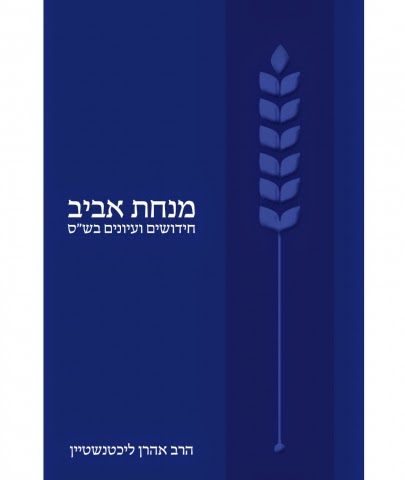
Book Review: Rav Aharon Lichtenstein’s Minchat Aviv

RAV AHARON LICHTENSTEIN’S Minchat Aviv: A REVIEW
Aviad Hacohen
Minchat Aviv: Studies in Talmudic Topics (Hebrew) HaRav Aharon Lichtenstein Editor: Rav Elyakim Krumbein Jerusalem: Maggid Books and Yeshivat Har Etzion, 2014 xvi + 659 pages; source and subject indexes Available here.
A person must exert considerable effort before producing words of Torah and wisdom. Toiling in Torah can be compared to toil in working the land: one must plow and sow, irrigate and fertilize, hoe and aerate, develop and cultivate, harvest and gather. Only after one completes all these tasks and receives God’s blessing does one merit to bring the fruits of one’s labors into one’s home and fulfill with them the mitzva of ingathering. Is it any wonder, then, that of all the Torah’s commandments, and of all the holidays on the Jewish calendar, it is Sukkot, the Festival of Ingathering, that merited the designation of chag – “holiday” par excellence – and the special mitzva of “And you shall rejoice in your holiday”?
Ingathering of the Sheaves
The publication of Minchat Aviv, a collection of “lomdish” and halakhic essays authored by HaRav Aharon Lichtenstein, Rosh Yeshiva of Yeshivat Har Etzion and 2014 Israel Prize laureate for Torah literature, is cause for celebration for all lovers of Torah. For over half a century, HaRav Lichtenstein has been disseminating Torah both in Israel and abroad. Though some of his lectures have been adapted for print by students and are enjoyed by readers across the world, his written work has been relatively limited.
The eight volumes of lectures that have appeared to date under the title Shi’urei HaRav Aharon Lichtenstein testify to HaRav Lichtenstein’s breadth of knowledge and profundity in analysis. But, as is often the case when works of Torah scholarship are recorded not by the master himself, but rather by his disciples, sometimes the author’s particular “spark” is missing, both in substance and in formulation. While the lectures are unquestionably brilliant, and serve to showcase HaRav Lichtenstein’s unique style effectively, the personal electricity that one feels when learning HaRav Lichtenstein’s Torah directly from the source cannot be replicated. It is only natural that the lectures in the 8-volume series are largely limited to the Talmudic tractates that constitute the standard fare of yeshiva study, though here too HaRav Lichtenstein has left his mark. Thus, for example, one of the volumes deals with Taharot (ritual purity), while another deals with Dina De-garmi – an extraordinary phenomenon in itself in the yeshiva world.
Due to his very heavy teaching schedule, HaRav Lichtenstein has never been free to commit his teachings to writing in a systematic and consistent manner. Nevertheless, in free moments, and during the breaks between his classes, he has written on various topics. Over the years, these writings have increased in number and scope. The original articles appeared in a variety of journals, both in Israel and in the US. Only now, when HaRav Lichtenstein has reached his eighties, have these articles been gathered together and published in a single volume.
In their attempt to define the category of work known as immur, gathering, both with regard to the laws of Shabbat and with regard to the commandments relating to the Land of Israel, the halakhic authorities, both medieval and modern, took note of the nature of the labor of gathering. They understood that a sheaf is greater than the sum of its parts. A sheaf is not merely one ear of corn joined to another, but rather a new entity, of a different quality and with a different essence.
This is true in the field and equally true in the house – the house of study. Like the sheaf and like ingathering, so too the teachings of HaRav Lichtenstein. Collecting his articles in a single volume is not merely a technical act of gathering scattered items into one place, but rather a new creation. Studying the volume reveals a profound interplay of Torah and Jewish thought, of Halakha and Aggada, its various parts interconnected in different ways.
Alongside the standard issues found in the Talmudic orders of Mo’ed, Nashim and Nezikin, we find in-depth studies concerning the laws of Zera’im and the commandments relating to the Land of Israel, essays regarding matters discussed in the orders of Kodashim and Taharot and even several practical halakhic analyses. This is a book for experienced travelers in the world of Torah, but anyone who is ready to commit to reading it with the necessary concentration will profit from doing so, both with respect to the reader’s learning skills and through the expansion of the reader’s knowledge.

Cancellation of debts in the shemita Year

            An examination of the various issues dealt with in this volume shows one common characteristic: the attempt to clarify the fundamental principles from which and through which the particulars arise. For this purpose, HaRav Lichtenstein makes use of all the expanses of Halakha, from top to bottom. For example, in discussing the mitzva to cancel debts in the shemita (Sabbatical) year, HaRav Lichtenstein starts with the explicit verse in the Torah, formulated in both positive and negative terms, the meaning of which is rather obscure: “Every lender who lends anything to his neighbor shall release it; he shall not exact of it of his neighbor, or of his brother” (Devarim 15:2). What is the meaning of this mitzva and how is it fulfilled? HaRav Lichtenstein cites a disagreement among the medieval authorities. According to the Yere’im, it is not the date in itself that nullifies the debt, but rather the lender’s declaration: “I release it.” Once the shemita year ends, the lender acquires an obligation to cancel the debt. In contrast, the Or Zaru’a maintains that the passage of time, i.e., the end of the shemita year, is what cancels the debt. This also follows from the words of the Rambam: “When the sun sets on the night of Rosh Ha-shana of the eighth year, the debt is nullified” (Hilkhot Shemita Ve-yovel 9:4). Of course, the practical difference between the two positions expresses itself in a case where the lender, contrary to Torah law, fails to declare: “I release the debt.” The Ittur combines both positions and asserts that the cancellation of debts in the shemita year is governed by two parallel laws: a personal obligation upon the lender and a “Royal cancellation” by heavenly decree.
HaRav Lichtenstein does not stop here after setting each of the various opinions in its place. In light of the Rambam’s opinion, he raises a difficult question: If indeed the cancellation of debts in the shemita year is a “Royal cancellation,” what exactly is the mitzva imposed on the lender?
In typical fashion, HaRav Lichtenstein examines the Tosafot, who try to explain the matter based on the law of a firstborn animal. There is a mitzva to sanctify the animal, even though it is automatically sanctified from birth. HaRav Lichtenstein concludes that the two cases are not similar. In the case of a firstborn, the mitzva to sanctify the animal does not merely dictate a “declaration,” a confirmation of the existing situation, but rather it “necessitates a novel act of sanctification that bestows additional sanctity upon the firstborn.” As for the cancellation of debts, however, if the debt is already cancelled, the lender’s release adds nothing at all. Thus, the question remains: What is the nature of the positive commandment obligating the lender to cancel his debts in the shemita year?
Even according to the opinion that the cancellation of debts is a “Royal cancellation,” this release does not nullify the debt; it merely “freezes” it. This explains the need for the active cancellation of the debt on the part of the lender, which adds force to the borrower’s exemption from repaying his debt, and utterly severs the connection between the lender and the borrower, not just temporarily, but absolutely and forever.
Using his characteristic method of tying together seemingly unconnected areas of Halakha, HaRav Lichtenstein links the laws of a firstborn to the laws of usury, and the laws of repaying a debt to the laws of a gift, and through them and with them he builds his edifice, a tower of scholarship, perfect precision and spectacular analysis. His subtle analysis, which penetrates the very foundations of the law, uproots the common assumption. According to HaRav Lichtenstein, in contrast to the common understanding, the “Royal cancellation” does not absolutely cancel the debt, but merely weakens its force. Thus, we understand why a borrower can repay a loan after the shemita year has passed, and why the Sages are pleased when he does so: The debt was never wiped out, but merely frozen. Based on this understanding, it is clear why the cancellation must be completed by way of an active step on the part of the lender.

Intimacy in prayer

While the book is principally a volume of advanced halakhic analysis, between the lines it allows us a glimpse of HaRav Lichtenstein’s spiritual world. For example, in the chapter discussing the issue of sounding one’s voice in prayer, here and there HaRav Lichtenstein uses characteristic formulations that reflect the “man of prayer” in him: “There is an internal balance between two factors that shape the character and content of prayer, greater concentration on the one hand and a soft voice on the other.”
Although HaRav Lichtenstein generally avoids kabbalistic matters, he cites the Zohar, which states: “If a prayer is overheard by another person, it will not be accepted above,” and emphasizes, on the basis of this passage, “the intimacy and privacy of prayer, in the absence of which prayer is impaired and not accepted above.” While the analysis is strictly halakhic, the spirit of HaRav Lichtenstein’s thought, rife with emotion, penetrates the dry and meticulous preoccupation with Halakha, instilling it with flavor and endowing it with sweet fragrance.
Another example, one of many, appears in the book’s concluding essay, which concerns itself with a “routine question,” as it were, sent to HaRav Lichtenstein by his students serving in the army. The students wanted to know whether an army tent requires a mezuza.
In his usual manner, HaRav Lichtenstein does not content himself with the bottom line, with a halakhic ruling issued, as it were, by way of divine inspiration. He opens with a comprehensive clarification of the plain meaning of the verse that speaks of “the doorposts of your house,” and attempts to define the term “house,” both regarding the prohibition of leavened bread on Pesach and regarding the prohibition, “You shall not bring an abomination into your house” (Devarim 7:26). From here he moves on to the distinction between “house” on the proprietary level and “house” on the geographic and functional level – a “residence,” the place where a person establishes his principal dwelling in actual practice. HaRav Lichtenstein considers the essential distinction between the different halakhic realms: Regarding leavened bread, the “house” is not part of the fulfillment of the mitzva, but merely a circumstantial detail, the place in which the prohibition of leavened bread happens to apply. Regarding a mezuza, on the other hand, the “house” is the cheftza, the object of the mitzva, and that which obligates the mezuza’s very installation.
A practical difference, one that is mentioned already in the Talmud, and afterwards in the words of the later authorities, relates to a renter’s obligation in mezuza. If we are dealing with an obligation of the inhabitant of the house, the question of ownership is irrelevant. But even if the obligation depends on ownership, there is room to consider whether or not renting creates proprietary rights in the property, if only temporarily (see Bava Metzi’a 56b). Characteristically, HaRav Lichtenstein also discusses the different levels of obligation. Even if a
renter is not obligated to affix a mezuza to his doorpost by Torah law, it may be that he is bound to do so by Rabbinic decree.

Restoring Former glory

Here, as usual, HaRav Lichtenstein asks: What precisely was the Rabbis’ innovation? Did they expand the mitzva in such a way that even when there is no “possession,” but only “residence,” there is still an obligation to install a mezuza? Or perhaps they expanded the law of renting and established that even “temporary possession” is considered possession with respect to the Rabbinic obligation of mezuzah? From the words of Tosafot in another passage (Avoda Zara 21a), he determines that it suffices that the house “appear to be his” for one to be obligated in the mitzva of mezuza. That is to say, according to the Tosafot, we are dealing with an expansion of the idea of possession, and that even a residence that only appears to belong to the person in question suffices to obligate him in the mitzva of mezuza on
a Rabbinic level.
Still not satisfied, HaRav Lichtenstein moves on to an analysis of the concept of “residence,” examining the question whether or not a forced dwelling, e.g., a jail, or, in stark contrast, the chamber in which the High Priest resides during the week before Yom Kippur, is considered a “residence” for the purpose of obligation in the mitzva of mezuza. From here, HaRav Lichtenstein shifts gears, taking time to clarify the term “temporary residence,” e.g., living on a boat during an extended journey or in a hotel. In addition to all these considerations, it may be that the obligation to affix a mezuza to the tent does not apply to the soldiers themselves, as they are “temporary guests” in the tent, and certainly not to its owners, but rather to the community or to the army, which owns the tent/house.
In a world where people are especially meticulous about the mitzva of “making many books” (Kohelet 12:12), out of the abundance of books that inundates us, HaRav Lichtenstein’s volume stands out, as its words of Torah are built on the most solid of foundations. Amidst the cacophony of “SMS responsa,” lacking sources and reasoning and presenting their conclusions as a sort of divine fiat, Rav Lichtenstein’s essay sing out with a unique melody, one that is clear and profound, systematic and logical. HaRav Lichtenstein’s work restores the crown
of Torah study to its former glory. Between the lines, it reveals something of the author’s personality, in its moral and emotional dimensions – a personality in which Torah and wisdom, Halakha and Aggada, join together and become one.
(Translated by David Strauss)
Prof. Aviad Hacohen is Dean of Shaarei Mishpat College and author of The Tears of the Oppressed – An Examination of the Agunah Problem: Background and Halakhic Sources (New York, 2004) and Parashiot u-Mishpatim: Mishpat Ivri be-Parashat ha-Shavua (Tel Aviv, 2011).


Eliezer Brodt – A Lively History of Reprinting Rabbeinu Yeruchem

A Lively History of Reprinting Rabbeinu Yeruchem
Rabbi Eliezer Brodt

In recent years, a host of critical editions of works on various rishonim have been published on all topics – some seeing the light of day for the very first time – on topics related to halakha, kabbalah, and chiddushim on the Talmud. These works have been made available via the major printing presses such as Mossad HaRav Kook, Machon Yerushalyim, Machon Talmud Yisraeli, Machon Harry Fischel and others.[1] However, one very important work has noticeably been omitted from being reprinted, except for a photomechanical off-set of the second printing. This work is Sefer Toledot Adam ve-Chava and Sefer Meisharim, the halakhic works of Rabbeinu Yeruchem Meshullam (c. first half of the 14th century) who was a student of R. Asher ben Yechiel (Rosh), R. Shlomo ben Aderet (Rashb”a), and R. Abraham ibn Ismaeil – author of Chiddushei Talmid HaRashb”a on Baba Kamma. In this post I would like to discuss the story behind why it was never retype-set, until a few weeks ago.

Rabbeinu Yeruchem authored his works many years ago, in years of the range of צד (1334). He was a student of the Rosh and his works are quoted extensively by the Beit Yosef throughout Tur and Shulhan Arukh. The Maggid (an angel who learned torah with the Beit Yosef) of the Beit Yosef told him ואוף ירוחם טמירי רחים לך אע”ג דאת סתיר מלוי בגין דמלאכת שמים היא (מגיד משרים פרשת צו).

Rabbeinu Yeruchem’s work contains three parts one called Meisharim and the remaining two parts entitled Toledot Adam ve-Chava. The part Adam contains everything relating to the man from birth until marriage; whereas Chavah contains everything from after marriage until death. This work was first printed in Constantinople in רעו (1517) and is extremely rare; only two complete copies are known to be extant. It was reprinted a second time in שיג (1553) in Venice; this is the version available today in photomechanical off-set editions. But, the Chida already notes that “this edition is full of mistakes.”[2] He also writes that he saw a manuscript of this sefer and was amazed as to the large amount of missing text as well as gross errors in the printed edition. The question remains as to why this work was never retype-set as opposed to the works of other Rishonim?

The answer might be found in the words of the Chid”a[3] where he brings as follows:

שמעתי מרבנן קשישאי בעיר הקודש ירושלים שקבלו מהזקנים דספר העיטור וספר רבינו ירחום הם מבחינת סוד עלמא דאתכסיא וכל מי שעושה באור עליהם או נאבדו הביאור או ח”ו יפטר במבחר ימיו”

I have heard from old Rabbi in the holy city of Jerusalem that they have a tradition that the books, Sefer haIttur and Sefer Rabbeinu Yeruchum, they are a high secret and anyone who writes a commentary on these books either the work will be lost or they will die in the prime of their life.

He than goes on to list a few people who started working on expounding the sefer, and either died in middle or the work was lost. In a different place the Shem Hagedolim brings the words of the Maggid to the Beit Yosef in the Maggid Meisharim (end of parashat Vayakhel) where he writes as follows:

וכן במאי דדחית מילוי דירוחם טמירי שפיר עבדת וכן בכל דוכתא דאת משיג עליה יאות את משיג עליה וקרינא ליה ירוחם טמירי דאיהו טמיר בגינתא דעדן דאית צדיקייא דלא משיג זכותא דילהון למהוי בגינתא דעדן בפרסום אלא בטמירו אבל במדריגה רבא ויקירא איהו

This, says Professor Meir Benayahu, is the reason why there is a curse on retype setting the work. What is not understood is that this is a completely halakhic work, not kabbalistic in any way, so why was there such a curse?[4]

One such work, which the Chida already mentions, is R. Hayyim Algazi’s Netivot Hamishpat.[5] The title page already records with regard to R. Algazi, “תנוח נפשו בעדן” (may his soul rest in heaven) intimating he died in the process of writing this commentary.

Another work in this category is that of R. Reuven Chaim Klein’s Shenot Chaim.[6] Unfortunately, he also died amidst writing the sefer, at the age of 47. The title page also records that the author did not want his name to appear, one can suggest that perhaps he thought if his name did not appear, he would not be subject to the curse. What’s interesting to note is in the haskamah of R. Joseph Shaul Nathenson, author of Shu”t Shoel u-Meshiv, to R. Klein’s work, as he makes no mention of any cherem to this work, but does quote the Maggid Mesharim cited earlier. Additionally, R. Chaim Sanzer, in his haskamah to this sefer, makes no mention of any cherem.

The other work which the Chidah brings was under this curse was the Sefer HaItur. This sefer was privileged to be reprinted with a critical edition by the great R. Meir Yonah, who called the glosses ‘Shar Hachadash and Pessach Hadiveir.’ Dr. Binyamin Levine, author of the Otzar Hagaonim series, writes in his short biography on him – as he used this work in many his own seforim – that he also suffered many tragedies; i.e. he lost many children.[7]

Interestingly enough, I found a nice size work on Rabbeinu Yeruchem and the author did not die young. His name was R. Yehudah Ashkenazi (1780-1849) the work is called Yisa Bracha (available at HebrewBooks.org), printed in Livorno 1822. He authored many famous seforim such as the Geza Yeshai (klallim) (Livorno, 1842), Siddur Beit Oved (Livorno, 1843), Siddur Beit Menucha (Livorno, 1924), Siddur Beit HaBechirah (Livorno, 1875), and Siddur Shomer Shabbat (Livorno, 1892).

In spite of all the above, a portion of the Rabbeinu Yeruchum has now been printed based of the first printing as well as manuscript, by on R. Yair Chazan.

Based on the above, we find ourselves asking the question ‘why did this R. Yair Chazan decide to reprint this work?’

The answer is found in the haskamah to the sefer from R. Ovadiah Yosef, who wrote that the whole curse is only if one is writing a pairush/commentary – expository text – on the work. But if one’s whole intent is to just fix the printing mistakes, which is R. Chazan whole intention here, it’s not a problem. Besides for the haskamah of R. Ovadiah Yosef, there are a few other haskamot; amongst them R. Shmuel Auerbach and R. Chaim Pinchus Scheinberg.

Just to give a brief overview of this work, as mentioned before the earlier editions of the Rabbeinu Yeruchem are full of printing mistakes and is missing many pieces. What R. Chazzan did was to track down the existing manuscripts of the sefer and try to fix the mistakes and put in the missing pieces. He also puts in the sources of Rabbeinu Yeruchem and he brings down where it is quoted in various poskim. He retype-set it beautifully making it a pleasure to read and use in compared to the old print.

So far only the third volume (the חוה section) has been printed I hope to see the rest of R. Yerucham printed soon.

Notes:
[1] See here for Marc B. Shapiro’s appreciation for R. Yosef Buxbaum, founder and director of Machon Yerushalayim, posted at the Seforim blog.
[2] Shem Hagedolim, Mareches Gedolim, letter yud, number 382, quoting the Ralbach, (siman 109); see also R. Chaim Shabtai HaKohen, Shu”t Mahrch”sh, Even HaEzer p. 153,b (“it is already known that the book of Rabbenu Yeruchum has many errors and unnecessary wordage”); R. Y. Sirkes, Bach Y.D. no. 241 s.v. U’mah Sechatav Avor Aviv (“I have already studied this work [Rabbenu Yeruchum] and it is full of error – too many to count”); Y.S. Speigel, Amudim B’Tolodot Sefer HaIvri : Hagahot U’Magimim p. 247 n.121 for additional sources.
[3] idem.
[4] Pirush Sifri, Rabbenu Eliezer Nachum, Meir Benayahu, ed., (Jerusalem, 1993), Introduction.
[5] (Istanbul, 1669; reprinted by Pe’er HaTorah in Yerushalyim, circa 1975)
[6] (Lemberg, 1871; reprinted by Machon Yerushalayim, Jerusalem, 1985)
[7] Binyamin Levin, Mesivos: Talmud Katan leSeder Mo’ed, Nashim, u-Nezikin (Jerusalem, 1973), end of this book.


The Pew Report and the Orthodox Community (and Other Assorted Comments), part 2

The Pew Report and the Orthodox Community (and Other Assorted Comments), part 2
by Marc B. Shapiro
Continued from here.
Returning to the matter of Jewish men and non-Jewish women, it is noteworthy that the Spanish scholar R. Solomon Alami (14th-15th centuries), in his ethical will to his son, specifically warns him to abstain from sexual relations with non-Jewish women.[1] Note how in the following passage he also assumes that Reuben actually had sexual relations with his father’s concubine (an opinion also shared by talmudic sages, though in my experience the alternative view, that he didn’t actually do this, appears to be the standard approach among contemporary darshanim).
בבת אל נכר אל תחלל בריתך. היה גבור כארי למשול בתאוותך, תהי צדיק מושל יראת א-להים להטיבך באחריתך. השמר ממר ממות ופרוש מן הזימה. טמאת השם רבת המהומה. וזכור דבר זמרי ורעתו. וחרפת שבטו ברדוף נשיאם תאוותו. הלא אל אלה חטא שלמה מלך ישראל ונחלקה מלכותו. וזכור צדקת יוסף אשר גבר על יצרו ולא נתן מאוויי גבירתו. ותשב באיתן קשתו. עם גודל יופיו ועדונו והוא בבחרותו. והיה זה סיבה לשום במרום מדרגתו. וכל בית אביו חיו בזכותו. ונתנה לו הבכורה ונדחה ראובן בחללו יצועי אביו מבכורתו. כי לא יאות הכבוד לנקשר בזימה בכחשו.
An Italian list of takkanot from 1418 also speaks about this problem, that Jewish men thought that there was nothing wrong with having sex with non-Jewish women[2]: הנשים הנכריות מותרות בעיניהם. The fact that the various moralists speak about this issue shows that it was a real problem. While suggestions were offered to help men overcome sexual temptations, there was a recognition that, as the Talmud, Hullin 11b, states, “There is no guardian against unchastity,” אין אפוטרופוס לעריות. This principle is quoted by R. Joseph Karo in Shulhan Arukh, Even ha-Ezer 22:15.[3] Yet interestingly enough, in R. Karo’s Magid Meisharim[4] he is told that since he is entirely involved with service of God he cannot be seduced even by a naked woman.
מאחר שלבך תמיד אינו מהרהר אלא בעבודתי אפילו תפגע באשה ערומה לא תבוא לידי חטא
We know that there were some who argued that it was better for men to use Jewish (single) prostitutes so that they not come to having sex with married women or engage in homosexual acts.[5] (I am referring to places where Jews could not avail themselves of non-Jewish prostitutes, as the punishment for this was often execution.) R. Moses Hagiz[6] argues against this position, stating that we do not permit a lesser offense to prevent one from violating a more severe offense. He even calls this approach hukot ha-goyim.
והלכו בחוקת הגיום שזו היא טענת פטור אצלם אכן אנו בני ישראל הקדושים כשהשני איסורים הם מדאורייתא או תרי דרבנן אין לנו להתיר הא’ מחשש שלא יבא לעשות האחר
This passage is quoted by R. Isaac Lampronte, Pahad Yitzhak, s.v. boel aramit. He then adds that he heard from a hakham that sex with a Jewish prostitute is worse than sex with a non-Jew because of the possibility that that one will violate the niddah prohibition.
דיכול לבוא לאיסור נדה שהיא בכרת
Notice how he doesn’t say that one will certainly violate the niddah prohibition, only that it is a possibility. What this means is that even the Jewish prostitutes were expected to go to the mikveh, but that one can’t assume that they would indeed do so, and this explains why sex with a non-Jewish woman is preferable.[7]
But he adds that this should not be said publicly or to an ignorant person as this knowledge could lead men to have sex with non-Jews since they will mistakenly conclude that the prohibition is not so serious.
אין אומרים דבר זה בפרהסיא או בפני עם הארץ, כדי שלא ינהגו פריצות בביאות גויות.
What we are discussing was not simply theoretical since R. Isaac Arama, writing in fifteenth-century Spain, tells us that not only did the Jewish community leaders (שופטי ישראל) not take prostitution seriously, but in a few (קצת)[8] communities Jewish prostitutes were welcomed and even supported with Jewish communal funds (!).[9] This was done as the prostitutes were thought to be performing a public service, since without them it was thought that men would be led to have sex with married women or non-Jewish women (which as mentioned already could lead to execution). From a responsum of R. Judah ben Asher,[10] we see that even in an earlier era this point had been made with regard to “loose women” (and was rejected by R. Judah who thought it was better to have sex with a non-Jewish woman for whom the niddah prohibition did not apply):
ומוטב שיסתכנו הגופים מן הנפשות
Arama tells us that on different occasions he argued with the communal leaders, and also before גדוליהם which I assume means their rabbis, that it is one thing if someone commits a sin in private. In such a case, Arama would probably agree that it would be better for a man to have sex with a Jewish prostitute than with a with a non-Jew. (It must be that these prostitutes went to the mikveh, as Arama doesn’t mention anything about the niddah prohibition.) But Arama is firm that it is absolutely forbidden for the community – and he includes in this בתי דיניהם showing that the rabbis were complicit – to countenance any sin whatsoever, in this case welcoming in Jewish prostitutes, even if this strict stance leads to people committing greater sins or being executed by the non-Jews.[11]
R. Isaac Bar Sheshet (Rivash) had earlier also testified to the fact that the “gedolei ha-dor” had acquiesced to the existence of Jewish prostitutes in order to prevent men from visiting non-Jewish women, with all the dangers this entailed.[12] Contrary to Avraham Grossman,[13] the Rivash is not saying that this is what the “gedolei ha-dor” should do when faced with such a circumstance. Rather, he is decrying what they did. I am curious to hear if readers agree with me. Here are the words of the Rivash:
והרמב”ן ז”ל כתב בפ’ התורה שהיא אזהרה לב”ד שלא יניחו בנות ישראל להפקיר עצמן לישב בעינים על הדרך או בקובה של זונות לזנות לכל יבא. בואו ונצווח על דורנו שאין דומה יפה, וגדולי הדור העלם יעלימו את עינים פן יכשלו בני פריצי עמנו בנכריות ותצא אש ומצאה קוצים ונאכל גדיש
Returning to intermarriage, we see something very interesting in Pirkei de-Rabbi Eliezer, ch. 39. According to this text (which is paralleled by other midrashim[14]), Jacob’s sons married their sisters. The explanation given is that they did so in order not to marry the local inhabitants:
כדי שלא יתחתנו בעמי הארצות
This is quite an incredible assertion, since incest is forbidden under the Noahide code. If there were no eligible marriage partners, one would have expected Jacob’s sons not to marry at all rather than marrying their sisters. R. David Luria, in his commentary on the passage, does not even deal with this problem, instead noting that elsewhere in rabbinic literature one finds that Jacob’s sons did marry the local women. (For some reason, R. Luria’s edition does not include the words כדי שלא יתחנתו בעמי הארצות, which comes right after the text stating that Jacob’s sons married their sisters. This does not appear to be an act of censorship, since the real issue is not the explanation for their marriages, but the incestuous marriages themselves, and this is still found in R. Luria’s edition.)
The Tosafists have a simple response to this problem: Since the Torah had not yet been given Jacob’s sons only observed what they wanted.[15]
מאחר שלא נצטוו על התורה אע”פ שידעוה ברוה”ק מה שהיו רוצין היו מקיימין ומה שלא היו רוצין היו מניחין.
Nahmanides, Commentary to Gen. 38:2, assumes that each of the brothers married one of the twins of the other brothers, but not their own twins. Furthermore, no one actually married a complete sister, i.e., sons of Leah did not marry daughters of Leah. Thus, they did not violate Noahide Law. (I think this is probably also what the Tosafists assumed in the passage mentioned above.) While Nahmanides’ understanding works with some of the midrashim, it cannot be fit into the language of Pirkei de-Rabbi Eliezer, ch. 36, which states explicitly that each son was born together with his future wife:
  וכולן נולדו זווגן עמם חוץ מיוסף שלא נולדה זווגה עמו
Furthermore, Bereshit Rabbah 80 states that Simeon married Dinah, and she was his sister from the same mother. It is precisely in order to answer this problem that a Tosafist cites the Aggadah[16] that Dinah was actually first impregnated in Rachel, and God later transferred her to Leah, meaning that Simeon and Dinah were really not from the same mother.[17] (Many have pointed out that this has implications to the debate about the status of children born from surrogate mothers.[18])
The Maharal explains that the situation of the brothers marrying their sisters was an exceptional case, since if they did not marry them the only available marriage partners would have been pagan women.[19] As the Maharal notes, the parallel is to the sons of Adam who were permitted to marry their sisters since there was no one else for them to marry. This permission to marry their sisters was known to Jacob through ruah ha-kodesh, and the Maharal adds that one should not think that this contradicts the Torah, “for the one who gave the Torah forbade [it] and the one who gave the Torah [also] permitted [it].” In other words, God is the source of the law so he can choose to alter it if he chooses.
This approach can also explain the story of the akedah which troubles so many. If the reason not to murder is because God says so, then God can, if He wishes, permit murder in certain cases. I don’t want to get into the issue of Natural Law and the Euthyphro problem. Suffice it to say that most people would assume that the prohibition against incest is indeed part of Natural Law and not simply because God forbids it. Yet it must be noted that Sanhedrin 58b records a view that the Noahide code does not forbid marriage between brothers and sisters. According to Sanhedrin 58b, and this is followed by pretty much all commentators and halakhists, a non-Jew is permitted to marry his daughter. See also Mishneh TorahHilkhot Melakhim 9:5.[20] That at least some of the prohibitions on incest are not part of Natural Law would also seem to be a necessary conclusion of the Sifrei,[21] which states that the Children of Israel were driven to tears when Moses told them that they could no longer marry their sisters (from their fathers).[22]
וישמע משה את העם בוכה למשפחותיו . . . שהיו ישראל מצטערים בשעה שאמר להם משה לפרוש מן העריות מלמד שהיה אדם נושא את אחותו ואחות אביו ואחות אמו ובשעה שאמר להם משה לפרוש מן העריות היו מצטערים.
R. Ari Chwat has made the following interesting point.[23] The fact that the Sages state that the sons of Jacob married their sisters, something forbidden under Noahide law, illustrates how important it was for them to show that the brothers did not marry Canaanite women. In order to free them from the stain of intermarriage, the Sages were even prepared to claim that they had incestuous marriages. This shows how bad intermarriage was regarded by them.
נראה שכך יש להבין גם את המדרש (פרקי דר’ אליעזר פל”ה [צ”ל ל”ו] וב”ר פ, יא) שבני יעקב נשאו את אחיותיהם, למרות שיש בכך משום האשמתם בגילוי עריות, דבר שאסור אפילו לבני נח מלפני מתן תורה. אלא שרצו חז”ל ללמד זכות על אבותינו עצמם, ולנקותם מעבירת נשואי תערובת, עבירה בעייתית בדורם של חז”ל. כלומר: היות ועבירת נשואי אחיות לא עמדה על סדר יומם של חז”ל, ממילא האשמה זו תפגע בכבודן של אבותינו פחות מאשר להאשימם בנשואי תערובת, מעשה המתאים רק לשפלים ביותר בעם.
Regarding intermarriage, take a look at the following fascinating responsum from R. Meir of Rothenburg that appears in Teshuvot Ba’alei ha-Tosafot, ed. Agus, no. 72 (pp. 152-153). 

It begins by referring to the widow of a man “who was not pure”. What does this mean? From the responsum it would appear that this woman was “married” to a non-Jew. Based on the answer, it seems that she was claiming that she had done nothing wrong with this “marriage”, as she had received rabbinic permission, and therefore she should not suffer any stigma.[24] R. Meir tells us that he knew a woman of whom it was said that the rabbis permitted her to have sexual relations with a non-Jew. He also states that he heard that in France the rabbis permitted this for several women. What this appears to mean is that the rabbis permitted the Jewish women to live with non-Jewish men (since the rabbis were certainly not permitting promiscuous sexual relations). Irving Agus reasonably suggests that the reason these “intermarriages” were permitted is that refusal to allow them would have endangered Jewish lives.[25]
R. Meir does not accept this permission at all, and points out that the talmudic examples of Jewish women having sexual relations with non-Jews were when they were forced. Yael’s sexual encounter with Sisera was intended to weaken him out so she could then kill him. Following R. Meir’s responsum, there is an additional note, apparently from R. Mordechai ben Hillel, stating that it is not certain that had Esther and Yael consulted with halakhic authorities that they would have been given permission for their actions. The copyist rejects this point, noting that since the actions of Esther and Yael were done in order to save the Jewish people, what they did was certainly permitted. Howewver, one cannot use these cases to also permit other women to have sexual relations with non-Jews.
On the general matter of sex, I would like to call readers’ attention to a book that recently appeared. It is called Devar Seter and no author is given. You can see the book here.
This book is, as far I know, the most liberal work on the halakhot of sex ever to appear. I am worried that if I get too explicit and explain what I mean by “liberal” that some readers’ internet protection will prevent them from accessing this post. Therefore, I won’t say any more about the book except than I find it interesting that a number of rabbis who praise it only feel comfortable doing so anonymously.
Another book on sex recently appeared, this time in English, which also has a very liberal perspective, although it is not focused on halakhah but is a self-help book. It is authored by Rabbi David Ribner and Jennie Rosenfeld and is titled The Newlywed’s Guide to Physical Intimacy.[26]
A reader alerted me to an article on the book available here, and asked if I could comment on the following excerpt.
It is widely believed that ultra-Orthodox Jews are so concerned about modesty that they have sex through a hole in a sheet.
But this is a total myth, says Ribner: “There has never been a group of Jews anywhere in the world that has advocated having sex through a hole in a sheet. That has never happened. It doesn’t happen today, it never happened in history. It’s not advocated in any text within the Jewish community.”
I have no idea if there is anyone today who uses a sheet for sexual intercourse. There is certainly no community that insists on this (not even the Gur Hasidim, whose sexual behavior is extremely ascetic). However, it is simply incorrect to say that this action is not advocated in any text. Usually, when you have a widespread rumor like this, there is some basis for it, even if the original source has been distorted.
What is the origin of the idea of sex through a sheet? The Jerusalem Talmud, Yevamot 1:1, states that R. Yose ben Halafta, who performed the levirate marriage with his sister-in-law, had sex in this fashion: דרך סדין בעל. In case the words דרך סדין were not clear to readers, R. Baruch ben Isaac explains in Sefer ha-Terumah, Hilkhot Halitzah (Jerusalem, 1983), p. 46a, that it means that R. Yose ben Halafta made a hole in the sheet[27]: 

נקב עשה בסדין דרך מקום ביאה
This was done so that his personal pleasure be reduced and the focus be on the mitzvah.[28] The Talmud records that he had five children with this woman, and it is not clear if he used the sheet throughout their marriage or only in conceiving the first child (see Korban ha-Edah, ad loc., and also R. Hayyim Kanievsky’s commentary).[29]
If this was all we had, it would not be of great significance. All it would show was that one talmudic sage used the “hole in the sheet” method. There is no implication from the passage that anyone else adopted this approach. Yet based on this text, R. Meir of Rothenburg indeed assumed that when it came to levirate marriage this was the general practice among the pious during tannaitic times.[30]
ואפי’ חסידים הראשונים דור התנאים כשהיו מיבמין היו בועלין דרך סדין כדמשמע בירושלמי (פ”ק דיבמות ה”א) ר’ יוסי בר’ חלפתא הי’ בועל יבמתו דרך סדין
R. Jacob Emden, whose writings include a good deal about sexual matters, assumes that this type of hasidut is only applicable with levirate marriage, but not with one’s wife.[31]
דווקא ביבמה יש מקום לחסידות כזה לא זולת
There is also another significant passage, and it comes from the Vilna Gaon. He comments on the following text from the Shulhan Arukh, Orah Hayyim 240:8:
וי”מ מגלה טפח ומכסה טפח שלא היה ממרק האבר בשעת תשמיש כדי למעט הנאתו
The point of this text is that even during sex one should attempt to lessen the pleasure. In his note on this passage, the Gaon ties R. Joseph Karo’s words to what we have just seen in the Jerusalem Talmud. He then states that although one can say that R. Jose ben Halafta acted this way only because he was performing a religious ritual (levirate marriage), nevertheless, “it is also proper to act this way with one’s wife.” In other words, in contrast to what R. Jacob Emden wrote, the Gaon tells us that the practice of sex through a sheet is according to one opinion a valid and even recommended method of lessening sexual pleasure. A well-known talmid hakham who examined this text at my request wrote to me that since the Gaon does not object it implies acceptance, meaning that the Gaon would have approved of the proverbial hole in the sheet.

Use of a sheet would appear to be contradicted by the following passage in Ketubot 48a:
R. Joseph learnt: Her flesh [שארה] implies close bodily contact, viz., that he must not treat her in the manner of the Persians who perform their conjugal duties in their clothes. This provides support for [a ruling of] R. Huna who laid down that a husband who said, ‘I will not [perform conjugal duties] unless she wears her clothes and I mine’, must divorce her and give her also her ketubah.
Yet this text, which rejects the approach of the Persians, is itself opposed by R. Gamaliel who stated: “For three things do I like the Persians: They are temperate in their eating, modest in the privy, and chaste in another matter [i.e., sexual behavior]” (Berakhot 8b).[32]
Another interesting point related to sex and seforim is the following. Megillah 13b states: “R. Johanan said: Bigthan and Teresh were two Tarseans and conversed in the Tarsean language. They said: From the day this woman came we have been able to get no sleep. Come, let us put poison in the dish so that he [Ahasuerus] will die.”
Bigthan and Teresh couldn’t get any sleep since they could not go to sleep as long as the king was awake. But why was the king not going to sleep? Rashi explains that he found Esther so attractive that he had lots of sex with her, and this was keeping him up at night.
מתוך שהיתה חביבה עליו היה מרבה בתשמיש
R. Baruch Epstein, Torah Temimah, Esther 2:23, offers a different explanation of the Talmud. He claims that Ahasuerus was up at night because he so enjoyed taking walks with and talking to Esther.
כי היה מטייל ומשוחח עמה הרבה
What I can’t figure out is why R. Epstein expects us to prefer his understanding, which turns Ahasuerus into a perfect gentlemen, over that of Rashi.[33]
Finally, let me offer an example of distortion when it comes to sex. R. Israel Yanovski, Taharat Yisrael, vol. 2, p. 100b, no. 33, states:
מי ששם אצבעו בתורף אשה פריצות גדולה היא ויש בו איסור
The source offered for this surprising invasion of the marital bedroom is R. Yerucham, Toledot Adam ve-Havah, vol. 1, netiv 23 (p. 192d in the standard edition). Yet R. Yerucham says something very different.[34]
מי ששם אצבעו בתורף אשת איש פריצות גדולה היא ויש בו איסור ואפילו המסתכל אבל אינו חייב מלקות
The only question is if R. Yanovski’s quotation was a careless error (copied perhaps from R. Dovber Karasik, Pithei Olam, Orah Hayyim 240:16, who uses the same mistaken wording) or an intentional distortion due to puritanical feelings.[35]  R. Moshe Stern, Be’er Moshe, vol. 3 p. 204, assumes the former while I think the latter is also possible. I say this because Taharat Yisrael is quite an extreme work when it comes to sexual matters, which R. Yanovski wants to limit as much as possible. Thus, he praises those tzadikim whose children, we are told, equal exactly the number of times these tzadikim had sexual relations. In other words, if a certain tzaddik only had three children, then in his entire life he only had sex three times.[36]
As for other pious peopleR. Yanovski, based on kabbalistic sources, tells them to avoid sexual relations on Rosh Ha-Shanah (and tavo alav berakhah if one can abstain for the entire Ten Days of Penitence), Hoshana Rabbah, the three days preceding Shavuot and also on Shavuot, from Rosh Hodesh Av until the 11th of Av, the first and second night of Passover, the nights of Shemini Atzeret and Simhat Torah, and hol ha-moed Pesah (unless it falls on Shabbat). If this wasn’t enough, he also assumes that sex is forbidden on Hanukkah and Purim and any day that you don’t recite tahanun (!).[37]
בחנוכה ופורים נראה דאסור וכ”ש שאר ימים שאין נופלין על פניהם בהם דאסור בלי ספק

Finally, let me call attention to Berakhot 57b which states that three things resemble the World to Come, “the Sabbath, sunshine, and tashmish.” What does tashmish mean? Normally you would assume it to mean tashmish ha-mitah, i.e., sexual relations. However, the Talmud explains that it doesn’t mean this but refers to “tashmish of the orifices.”R. Samuel Alexandrov claims that the original rabbinic saying indeed meant what it said, i.e., that sex resembles the pleasure of the World to Come. However, the later sages didn’t want people to focus on sexual matters so they explained the passage in a different way.[38]

Regarding the connection between sex and the World to Come, R. Solomon Alkabetz quotes “the kedoshim” that sexual pleasure is one sixtieth of “the true pleasure”, i.e., the World to Come.[39]

To be continued

* * * * * *
Most of R. Yanovski’s Taharat Yisrael (mentioned in this post) focuses on the laws of niddah and mikveh. It was printed twice in Europe and then was reprinted in the United States in 1952. This latter publication was dedicated to the memory of R. Judah Leib Forer, the rabbi of Holyoke, Massachusetts. This page appears at the beginning of the book.
Here is the page of American haskamot added for this edition. This is one of a handful of haskamot from R. Soloveitchik, and I think is the first to appear in print.

Regarding R. Forer, who was an outstanding student of R. Hayyim Soloveitchik, there is a good deal of information from family members available on a website here. Among the points noted was that R. Shach was a student of his.
Here is the title page of Milei de-Igrot, consisting of Torah letters between R. Forer and R. Mordechai Gifter. There is also one letter from R. Shach to R. Forer. On p. 181 we also see that R. Forer delivered a shiur at RIETS. (There is another volume of Milei de-Igrot and this contains letters between R. Gifter and his teacher R. Moses Aaron Poleyeff. There is a good deal of biographical information about R. Gifter in this latter volume, including his difficult relationship with R. Bernard Revel.) 

The one point I would like to add to all the recollections that appear on the website I have referred to is that R. Forer was unique in that he was the spiritual leader of both the Orthodox and Conservative communities. That is, the membership of the Conservative synagogue liked R. Forer so much that while they wanted a mixed pew congregation, they also wanted him as their rabbi. This information was confirmed to me by elderly members of the Orthodox and Conservative synagogues. What is not known is if R. Forer ever actually attended the Conservative synagogue or if he was ever officially recognized as their rabbi. He was, however, the only spiritual leader in the town, recognized by all, and I don’t know of another example in history where there was one rabbi for both the Orthodox and Conservative congregations.
[1] Iggeret Musar, ed. Haberman (Jerusalem, 1946), p. 33. It is interesting that later in this work, in giving an example of an anti-Semitic decree in Spain, Alami mentions that Jews were forced to grow their beards. See p. 40. This shows that going clean-shaven was common in medieval Spain. Alami sees this as an example of midah ke-neged midah, i.e., since the Jews were improperly cutting off their beards, it was the non-Jewish authorities who forced them to grow the beards.
[2] Jubelschrift zum siebzigen Geburtstag des Prof. Dr. H. Graetz (Breslau, 1887), p. 60 (Hebrew section). Both this source and Alami are cited in Israel Abrahams, Jewish Life in the Middle Ages (New York, 1975), p. 94 (he mistakenly dates the  Italian document as 1413). Louis Finkelstein, Jewish Self-Government in the Middle Ages (New York, 1964), ch. 10, reprints the Italian document (mistakenly dating it as 1416). The passage I have referred to appears in Hebrew on p. 286, but is missing, together with much else, in what is supposed to be the translation on p. 294. Among the other Italian takkanot is one stating that a man can only wear one gold ring. See Jubelschrift, p. 59. I mention this only because some have the mistaken perception that Jewish men never wore rings. See also S’s post here which has a painting of R. Bernard Illowy wearing a ring.
[3] In the days of the Talmud we find that plenty of betrothed, but not yet married, couples were having sex, or at least suspected of it. See Ketubot 9b, 12a.
[4] Parashat Miketz, mahadura kama.
[5] R. Moses Sofer, She’elot u-Teshuvot Hatam Sofer, Even ha-Ezer no. 133, writes:

ועוד דזנות דפנויה קיל לאינשי ולא משמע להו איסורא כל כך אע”ג שהם נדות, ועינינו רואות דרובן פרוצות בפנוייתן ונעשות צנועות אחר נישואי[הן]י

Understood as written, the second part of this sentence is quite incredible, as the Hatam Sofer is stating that most unmarried Jewish women are sexually active. Yet there is no question in my mind that what he is really means is that most of those who are sexually active before marriage, behave properly after marriage. See here.

[6] Leket ha-Kemah (Amsterdam, 1707), p. 29a.
[7] R. Jacob Kamenetsky was adamant that it is worse for a man to marry a non-Jew than to marry a Jew who won’t observe taharat ha-mishpahah. See Emet le-Yaakov, parashat Ve-Yehi, p. 237, translated here.
[8] Perhaps this should be better translated as “some communities”, but I am dan le-kaf zekhut. See also Abraham Neuman, The Jews in Spain (Philadelphia, 1944), vol. 2, p. 279 n. 42.
[9] Jewish prostitutes definitely felt that they were part of the community. See R. Raphael Ankawa, Karnei Re’em (Jerusalem, 1910), no. 225, for a responsum sent to Brazil, regarding whether it was permissible for the synagogue to accept charity from the prostitutes, as well as a parochet they made for the synagogue. See also R. Moses Isserles, Shulhan Arukh, Orah Hayyim 153:21. R. Raphael Aaron ben Shimon, Nehar Mitzrayim (Alexandria, 1908), vol. 1, p. 12a, discusses a case where not only did the prostitute donate a parochet, but she also inscribed her name into it in golden letters. As R. Raphael notes, this is especially problematic since if allowed then people praying in synagogue would see her name staring down upon them and this would invariably lead to improper thoughts. (He adds that this particular prostitute had been with a lot of the young Jewish men.) Therefore, he ruled that the parochet could not be used and any gifts from prostitutes to the synagogue could not have their names on it. He also mentions a prostitute who donated a sefer Torah to the synagogue (!), and this was accepted on the condition that her name not appear on it..
Regarding Jewish prostitutes, see also the documents from the Russian archives recently published in ChaeRan Y. Freeze and Jay M. Harris, Everyday Jewish Life in Imperial Russia (Waltham, 2013), pp. 337ff., and see also Dan’s earlier post here. In 1611 the Prague Jewish community ordered the Jewish prostitutes to leave. See Simhah Assaf, Ha-Onshin Aharei Hatimat ha-Talmud (Jerusalem, 1922) p. 114. Any prostitute found plying her trade after this time would have a mark of shame branded onto her skin!
וזו שתזנה ח”ו מהיום והלאה יתוו עליה תו-קלון על ידי ברזל לוהט
See also Takanot Kandia, eds. Cassuto and Artom (Jerusalem, 1942), no. 31.
Pimps also felt that they were part of the community. See R. Joseph Hayyim, Rav Pealim, vol. 2, Orah Hayyim, no. 18, who rules that it is forbidden to give a pimp an aliyah, even if he only deals with non-Jewish prostitutes and non-Jewish clients. R. Hayyim Palache ruled that pimps must be expelled from the Jewish community. See Masa Hayyim, p. 14a. R. Solomon Kluger discusses Jewish pimps in Ha-Elef Lekha Shlomo, Yoreh Deah, no. 192, and see also R. Hayyim Palache, Hayyim be-Yad, no. 19, and R. Hayyim Hezekiah Medini, Sedei Hemed, Pe’at ha-Sadeh, ma’arekhet alef, no. 152 (s.v. apotropos le-arayot) .
[10] Zikhron Yehudah, no. 17.
[11] Akedat Yitzhak, Bereshitsha’ar 20.
[12] She’elot u-Teshuvot ha-Rivash, no. 425.
[13] Hasidot u-Mordot, p. 240 n. 96:
הוא סבר שעל “גדולי הדור” להעלים עיניהם מקיומן של זונות יהודיות מחשש לתגובה קשה של הסביבה הנוכרית, אם יהודים יקיימו יחסי מין עם נשים נוכריות
[14] See Torah Shelemah, Gen. 37, note 200, and see also Rashi, Gen. 37:35.
[15] See Da’at Zekenim mi-Ba’alei ha-Tosafot, Gen. 37:35
[16] See Berakhot 60a.
[17] Tosafot ha-Shalom, ed. Gellis, to Gen. 46:8.
[18] See R. Avraham S. Avraham, Nishmat Avraham (Jerusalem, 2007), vol. 3, p. 32.
[19] See Gur Aryeh, Gen. 46:10.
[20] The one exception I know of is Meiri, Sanhedrin 58b, who states that a non-Jew cannot marry his daughter. Even though the Talmud rejects this opinion, Meiri does not see this rejection as the Talmud’s final word on the subject. אפשר שדרך דחיה הוא וסוגיא בעלמא. However, just a few lines below this Meiri writes that if a Jew’s daughter (through a non-Jewish woman) converts to Judaism, he can marry her! While R. Abraham Sofer doesn’t comment on this seeming inconsistency, in R. Yitzhak Ralbag’s edition of Meiri on Sanhedrin, published in Sanhedrei Gedolah, vol. 4, he writes:
ק”ק לשיטת רבינו שב”נ אסור בבתו איך מותרת לו אחר הגירות.
Before you reply that the convert is like a “new person” and thus has no connection to her father, recall that in Yevamot 22a it explains that the incest prohibitions that are applicable for a non-Jew remain forbidden (rabbinically) even after conversion. So how then, according to Meiri, can a father marry his converted daughter?
[21] Ba-Midbar 90. See also Shabbat 130a.
[22] See also Maimonides. Hilkhot Melakhim 9:5, that this is permitted for non-Jews. I will return to the matter of incest in a future post.
[23] See his article “Ha-Zakaim be-Mikra ve-Hayavim be-Hazal,” available here.
[24] See Irving Agus, Rabbi Meir of Rothenburg (New York, 1970), vol., 1, p. 279.
[25] Teshuvot Ba’alei ha-Tosafot, p. 33. See also Agus in Jewish Quarterly Review 49 (1959), pp. 217-218.
[26] A number of years ago two of my friends got married. One of them met with his rabbi for “the talk”, and was told that when it comes to sex, pretty much everything is permitted. The other friend attended a “hatan class” in New York City. He called me one night, surprised at being told that in sexual relations only one position is permitted. This was stated as a matter of halakhah and the directly opposing statement of R. Moses Isserles, Shulhan Arukh, Even ha-Ezer 25:2, was never even mentioned. R. Isserles writes:
ויכול לעשות עם אשתו מה שירצה . . . ובא עליה בין כדרכה בין שלא כדרכה או דרך איברים ובלבד שלא יוציא זרע לבטלה. ויש מקילין ואומרים שמותר שלא כדרכה אפילו אם מוציא זרע אם עושה באקראי ואינו רגיל בכך. ואף על פי שמותר בכל אלה כל המקדש עצמו במותר לו קדוש יאמרו לו
Note R. Isserles’ last sentence. In other words, my friend’s hatan teacher decided (without asking his students) that all the future grooms sitting before him were going to be called קדוש.
[27] See also R. Moses of Coucy, Sefer Mitzvot Gadol, pos. no. 52. R. Hayyim Ozer Grodzinski, She’elot u-Teshuvot Ahiezer, vol 3, no. 24:4-5, has a different understanding.
[28] R. Nahman of Bratslav stated that not only does the tzaddik not experience any sexual pleasure, but he suffers during sex, even more than a boy suffers during circumcision. See Arthur Green, Tormented Master (Woodstock, VT, 1992), p. 39. Regarding sexual pleasure, there is an old question as to why one does not recite a blessing over it. R. Zvi Elimelech Shapira of Dinov stated that before sex one should make a shehakol on food or drink and include in thisalso the anticipated sexual pleasure. See his Magid Ta’alumah (Bnei Brak, 2006), to Berakhot 40a, 43a. Recognizing that people will find this suggestion quite strange, especially as no one before him ever had this idea, R. Zvi Elimelech adds:
כתבתי זה מסברתי והמשכיל לא ישליך דברי אחרי גיוו כי דברי טעם הם
Elsewhere, R. Zvi Elimelech writes that optimally one should not have any pleasure from sex. See Igra de-Firka (Jerusalem, 1973), p. 28b (no. 197):
ובאמת עפ”י התורה יותר טוב שלא ליהנות
[29] See also Tosafot, Shabbat 118b, s.v. eima, that R. Yose ben Halafta performed yibbum with five different women.
[30] She’elot u-Teshuvot Maharam be-R. Barukh, ed. Bloch (Budapest, 1895), no. 866.
[31] Mor u-Ketziah 240.
[32] It is also worth noting that R. Isaac Luria held that one’s tallit katan should remain on during marital relations. See R. Hayyim Joseph David Azulai, Birkei Yosef, Orah Hayyim 8:7. See also Magen Avraham, Orah Hayyim 240:22, and R. Avner Afgin, Divrei Shalom, vol. 5, pp. 417ff. R. Mordechai Eliyahu, Darkhei Taharah ha-Shalem, p. 278, writes: 

והמקפידים ללבש טלית טקן כל הזמן חוץ משעת רחצה, יניחו בשעת התשמיש את הטלית על צוארם שלא יחצץ ביניהם


[33] A friend pointed out to me that R. Ovadiah Yosef adopted R. Epstein’s explanation. See Hazon Ovadiah: Purim, p. 279.
[34] R. Yerucham’s formulation is also quoted by R. Moses Isserles, Darkhei Moshe, Even ha-Ezer 21:2.
[35] R. Yanovski’s “revision” of R. Yerucham relates to the matter of female sexual pleasure. There is a good deal to say about this, especially with regard to the approach of the Gur hasidim which forbids any foreplay from the husband. However, for now, let me just note that R. Joseph Hayyim says the exact same thing, and unlike the Gur hasidim who see this as an added stringency, he sees it as an actual prohibition (which for many women would mean that in their entire lives they would never experience any sexual pleasure ומפני הצניעות אקצר.) See Ben Yehoyada, Niddah 13a:
גם הנשים אסורות להשחית הזרע שלהן, כמ”ש רבינו האר”י ז”ל. מיהו נראה גם באשה אם בעלה עושה משמוש ידים באותו מקום דרך שחוק והתעוררות תאוה ודאי גורם לה בזה הזרעה לבטלה, ואיכא איסור של השחתת זרע
(See, however, Torah li-Shmah, no. 504, where he does not regard this as an actual prohibition.)The Lehem Mishneh, Hilkhot Ishut 15:18, says the exact same thing as appears in Ben Yehoyada without using any kabbalistic sources:

כשהבעל ממשמש באותו מקום דודאי מן הדין אסור לעשות כך דאסור למשמש שם
Lehem Mishneh’s view is accepted by R. Isaac Palache. Yafeh la-Lev, Even ha-Ezer 25:8.
R. Yitzhak Abadi, Or Yitzhak, vol. 2, p. 65, is very disturbed by the Lehem Mishneh and states:
הוא תמוה לחדש כן בדברי הרמב”ם מכח קושיא בדבריו . . . ובכלל עצם הענין הזה לחדש דברים כאלה בלי שום ראיה הוא דבר תמוה, ובפרט שרש”י אומר בפירוש שמותר, ועוד שמצוותו בכך
Regarding the talmudic statement, Niddah 13a, נשים לאו בנות הרגשה נינהו, R. Moshe Malka, Mikveh ha-Mayim, vol. 6, p. 57, writes as follows, in surprisingly strong language:
כמה קשה עלי שמועה זו שהיא נגד הטבע, וכי נשים לאו בני הרגשה נינהו? וכי אינן נהנות גם הן מתשמיש כמו הגברים?
I was surprised to see that R. Shlomo Aviner does not regard female sexual pleasure as having any real significance. Here are passages from two separate letters (quoted in Yakir Englander and Avi Sagi, Guf u-Miniyut be-Siah ha-Tziyoni-Dati he-Hadash [Jerusalem, 2013], p. 108).
מה שאין אשתך נהנית בשעת החיבור אין זה אסון, זה קורה לנשים רבות, והעיקר שהיא אינה סובלת מזה. היא נהנית הנאה רגשית פנימית מעצם הקרבה, מעצם האהבה האחווה השלום והרעות, ואינה זקוקה להנאה גופנית
בעניין ההנאה – מה שאינך נהנית, אינו קריטי, ישנן נשים שלא נהנו כל ימי חייהן אפילו פעם אחת ולא הפריע להן, אלא הכול היה באהבה גדול
I hope to return to this very interesting book. But for now I can’t resist citing a passage from R. Eliezer Melamed (quoted ibid., p. 128). Not only could an American Modern Orthodox rabbi never express such sentiments (if he wants to keep his job), but I am convinced that even if such a passage appeared in an American haredi publication, the women would be quite offended.

איזו אישה כשירה? העושה רצון בעלה, זה הסדר. כאשר יש החלטה כזו או אחרת, בנהוג שבעולם שהאיש הוא הקובע, כך מקובל. כאשר זה לך כך, בדרך כלל שני בני הזוג לא מרוצים. אפילו אם האישה שמחה שהיא מחליטה בלבד ומשפיעה על מהלך העניינים, בסוף היא מתמרמרת שהיא לא נשואה לבעל, לא לגבר, אלא לסמרטוט. כמובן שיכולים להיות דברים מסוימים שבהם האישה קובעת, “נו, תחליטי את איזה צבע נבחר לספה”. הבעל ג’נטלמן, בבקשה, תחליטי את. אבל הוא נותן לה את המנדט להחליט, כך מקובל

R. Aryeh Leib Steinman, Ayelet ha-Shahar, Kiddushin 30b, also states that a wife is obligated to obey her husband. It is easy to find plenty of earlier sources that say this, but I wonder how many haredi women today have such an understanding of their position in a marriage.

Regarding R. Melamed’s point that a man has to be a “man”, it reminded me of an interesting Meiri to Kiddushin 82b. The Talmud, ibid., states: “Happy is he whose children are males, and woe to him whose children are females.” Meiri suggests the following explanation: “Woe to him whose sons are like females,” with all the negative implications this implies:


שבניו נקבות שהזכרים פחותים וחסירים, ואשרי מי שבניו זכרים שנמצא בהם השלמות המכוון בהם

R. Yoel Schwartz, Ben Torah vi-Yeshivah (Jerusalem, 1978), p. 143, mentions this Meiri in the course of his discussion of male and female roles in Judaism. Schwartz makes the following very enlightened comment about how men should relate to “women’s work”, i.e., housework.


טיפוח הבית, הוא חלק האשה כמו שביארנו לעיל, מאחר שכאמור שטח זה הוא בתחום האשה, מי שמתעסק בטיפוח הבית מפסיד את כל ערך התועלת של קנין תורה
I shouldn’t mock it, however. If these guys can get their women to go along, who am I to protest? It wasn’t that long ago that pretty much all men had this Archie Bunker-like attitude.
[36] Taharat Yisrael, vol. 2, p. 97b.
[37] Taharat Yisrael, vol. 2, p. 97a.

[38] Mikhtevei Mehkar u-Vikoret (Vilna, 1907), vol. 1, p. 51. See also David Biale, Eros and the Jews (Berkeley, 1997), pp. 42-43, who sees here a conflict between the Sages and popular belief, with the latter assuming that there is a place for sexuality in messianic days. (When the Talmud refers to the World to Come it means the messianic era.)

[39] Shoresh Yishai (Sziget, 1891), to Ruth 3:7 (p. 56a).


Reuven Elitzur, Saul Lieberman, and Response to Criticism, part 2

Reuven Elitzur, Saul Lieberman, and Response to Criticism, part 2

Marc B. Shapiro

Since I mentioned R. Reuven Elitzur in my post here, let me note two other interesting items from his posthumously published book, Degel Mahaneh Reuven. On pp. 304-305 we learn that when Elitzur studied in Ponovezh, one of the students joined the Irgun. When some other students found out about this, they grabbed the Irgun student one night, covered his head with a blanket, and beat him terribly. The result of this was that the student not only left the yeshiva, but abandoned religion entirely. Only many years later, due to Elitzur’s influence, did he begin to again observe Shabbat.

I also found this story, on page 311, of interest.


We see that Elitzur was in the United States at the time of the great fire at the Jewish Theological Seminary library in April 1966. From the passage we see that he would eat his breakfast at JTS.[1] It could mean that he brought his own breakfast with him, or it could also mean that he ate the breakfast in the Seminary cafeteria. If the latter, it could mean that he only ate the cornflakes or that he even ate cooked items. It is interesting that a text with such ambiguity, and thus liable to create “problems,” appeared in a haredi work. I therefore assume that the grandchildren who put the book together did not understand the significance of where the fire had taken place, namely, that it is not an Orthodox institution.[2]

Regarding Orthodox rabbis visiting the Jewish Theological Seminary, in R. Aharon Rakeffet-Rothkoff’s memoir, he tells the following story about R. Moshe Bick:

Meeting such a figure [R. Bick] in the Seminary library made me feel awkward. Utilizing the rabbinic aphorism, I asked the good rabbi: “What is a kohein doing in a cemetery?” . . . With a kindly smile embracing his face, the Bronx spiritual leader immediately responded: “If the Seminary possesses rare and invaluable rabbinic texts, they must also be available to all Torah scholars. The Seminary cannot withhold these treasures from Klal Yisrael.”[3]

In R. Pinchas Lifshitz, Peninei Hen (Monsey, 2000), pp. 99-100, there is a 1929 letter from R. Shimon Shkop to Cyrus Adler, Chancellor of the Jewish Theological Seminary. In this letter, R. Shkop mentions meeting Adler at his Seminary office, at which time he spoke to him about the difficult financial situation of his yeshiva, Sha’ar ha-Torah in Grodna.

Regarding the Seminary, Nochum Shmaryohu Zajac called my attention to this video. In his discussion with Dr. Dov Zlotnick, we see the Lubavitcher Rebbe’s positive attitude towards Saul Lieberman (which I already mentioned in Saul Lieberman and the Orthodox).[4] It appears, however, that the Rebbe was confusing Lieberman and Louis Finkelstein when he referred to Lieberman’s connection to Torat Kohanim, and that he wrote he’arot and mar’eh mekomot to it. Torat Kohanim, otherwise known as the Sifra, was in fact Finkelstein’s great project.[5]

Another teacher at JTS was R. Abraham Sofer, who published the Meiri. A number of letters from the Lubavitcher Rebbe to him are included in Menahem Meshiv Nafshi (Jerusalem, 2012).

Here is vol. 2, p. 608.

I am quite surprised that R. Sofer is described as a “maggid shiur” at בית מדרש לרבנים. Is it possible that the editors did not realize that בית מדרש לרבנים is not an Orthodox institution?

Returning to Lieberman, in my post here I noted that Genazim u-She’elot u-Teshuvot Hazon Ish, vol. 2, published a lengthy letter from Lieberman to the Hazon Ish. Subsequent to that post, volume 3 of this series appeared, and beginning on page 319 we have two lengthy letters from the Hazon Ish responding to what Lieberman wrote. He begins with the following words which present a traditional perspective in opposition to the academic approach of Lieberman.

אם אמנם הבלשנות ותרגום המילים נוטל חלק בתורה שבעפ לאחר שנתנה לכתובאבל הרצים אחריה מדה ואינה מדהואין התורה מצוי‘ בין אלה שעושים את מלאכתם קבע ואת עיון העמוק עראית או אינם מתעמלים בו כללולאלה שעמלים בתורה אין פרי עבודתם של חוקרי הלשון מועיל רק לעיתים רחוקותובדברים קלי ערךומגמת המתעמל להתוכן ולא לתרגום המלה שהוא בבחינת תיק

I think readers will also find interesting a letter in the Lieberman archives at the Jewish Theological Seminary of America. I was alerted to this by Ariel Fuss.[6] Max Rowe represented the Rothschild Trust which awarded four monetary gifts to outstanding rabbinic scholars. Rowe turned to Lieberman for his recommendations on who should receive the awards. Although today everyone knows about the greatness of R. Hayyim Kanievsky, we see that Lieberman was aware of this fifty years ago, and recommended him for the grant. He even regarded R. Hayyim as greater than his father, the Steipler. Of all the significant figures Lieberman could have suggested, it is fascinating to see whom he chose.

I still have a good deal to write about Lieberman, as I have collected a lot of new material since the publication of Saul Lieberman and the Orthodox. For now, here is a picture of a young Lieberman and his wife, Judith, that has never before appeared in print or online. I thank Professor Meir Bar-Ilan for sending it to me.

* * * * * *

Continued from hereLet us resume with Grossman’s review, going page by page. First, I must thank everyone who wrote to me offering support. Many of these people are in the haredi world and have been reading my material for years, and others have listened to my Torah in Motion classes. They all knew that I had never mocked rishonim and aharonim,[7] an accusation I referred to as “slander”.[8] A number of people asked me how to explain why Grossman so mischaracterized my book, as it certainly wasn’t intentional. My response to them was that if you come to a task with a preconceived negative view, on a mission of destruction, then you will not be able to judge a book fairly. You won’t even realize how you are not being fair, and this in turn will lead to all sorts of mistakes. In the introduction to the Guide of the Perplexed, the Rambam addresses readers of his book:

If anything in it [the Guide], according to his way of thinking appears to be in some way harmful, he should interpret it, even if in a far-fetched way, in order to pass a favorable judgment. For as we are enjoined to act in this way toward our vulgar ones, all the more should this be so with respect to our erudite ones and the sages of our Law who are trying to help us to the truth as they apprehend it.

What the Rambam is saying is that readers should give authors the benefit of the doubt, and only if an author is clearly incorrect should one then feel comfortable expressing criticism. He says that we should act this way even “toward our vulgar ones,” the category that I and so many others would best be placed in, rather than in the category of the “erudite” and “sages of our Law.”

Unfortunately, Grossman was not careful in the way he wrote. R. Yair Hayyim Bacharach already warned us about the problems that arise from this, with a nice witticism:[9]

ואפילו בכתבי הדיוט אומרים בעלי הלצה השמר פן [פען הוא בלשון יהודי פולין שם לקולמספעדערוהוא מלשון רומית Penna. הערת המולכי אא לפרש דבריו או להתנצל בהם עי חסר או יתור או חלוף מלה כמו שעשה יעשה באמרי פיו.

Another relevant witticism is mentioned by Samson Bloch [10], that the word מבקר (reviewer or critic) stands for מתכבד בקלון רעהו.  

On pp. 38-39, Grossman quotes me as saying that the Rambam’s conception of Ikkarim was an innovation, and that this is not just something mentioned by academics but is also found in traditional writings. There is nothing controversial in this statement, and as many readers know, Rambam was criticized for having too many Principles (R. Joseph Albo) or for having too few (R. Isaac Abarbanel).

Grossman writes (p. 39):

Shapiro writes this despite the fact that an array of classic scholars, among them Alshich, R. Moshe Chagiz, Beney Yisoschar and Mabit believe otherwise. The latter, in a section of his Beys Elokim devoted to the Principles, begins his discussion with this comment. “All the main Principles of the Torah and its beliefs are either explicit or hinted at in Torah, Prophets, the Hagiographa, and in the words of Chazal received from a tradition; in particular, the three Principles which include them all.”

All this is completely irrelevant to what I have said. The issue is not whether the Rambam’s Principles can find support in the Torah, Prophets, Hagiography, or Chazal. Of course Rambam can find support for his Principles in earlier sources. What I and everyone else (rishonimaharonim, and academic scholars) are speaking about is something entirely different. It is whether the Rambam’s specific conception of Principles of Faith – that belief in the Principles, despite all other sins, are enough to ensure a share in the World to Come, and denial or doubt of a Principle, despite one’s piety and halakhic punctiliousness, will prevent one from having a share in the World to Come  is found in any other source before the Rambam. I also stated that no one before the Rambam had picked thirteen specific Principles as the basis of Judaism. As far as I know, every single rishon who wrote about the Principles agrees with this point. Unfortunately, Grossman once again completely misunderstands what I have stated.

Grossman writes (pp. 39-40):

Nothing shows more clearly that the Rambam based his Principles upon the Talmud than the fact that in Hilchos Teshuvah [3:6-8], he lists the various heretics under three classifications: min, apikores and kofer baTorah, all of whom lose their share in the World to Come. Obviously, each group violates a particular fundamental of faith, or else why would they be listed separately? Shapiro explains this by saying: “For his own conceptual reasons which have no talmudic basis, Maimonides distinguishes between the epikorus, the min and the kofer batorah.” [Limits of Orthodox Theology, p. 8 n. 27] But these terms are not, as Shapiro would have them, the Rambam’s inventions. They are taken from an explicit passage of the Talmud in Rosh ha-Shanah 17a which lists these three classes of heretics as those who lose their portion in the World to Come. They are obviously not a product of Rambam’s ‘conceptual reasons.’”

Every reader should be able to see Grossman’s error. Contrary to what Grossman attributes to me, I did not say that the terms epikorus, min, and kofer ba-Torah are the Rambam’s inventions based on his “conceptual reasons.” (He must think I am really ignorant as he assumes that I do not know that the terms epikorus and min are found in the Talmud.) What I said was that the way the Rambam distinguishes between these categories is based on his own conceptual reasons. In other words, why do certain heresies fall into the category of epikorus, others into the category of min, and others into kofer ba-Torah. For some heresies, we can see that the Talmud refers to the holders of these views as minim, but for others, it is the Rambam who determined the divisions, and we cannot find a talmudic basis. There is also no consistency in the Rambam’s own writings for what is included in the category of min.[11]

R. Nachum Rabinovitch writes as follows in his Yad Peshutah to Hilkhot Teshuvah 3:8, in discussing how the Rambam determined who is placed in the category of epikorus (as opposed to say, kofer ba-Torah). What I have underlined is particularly important. Is Grossman now going to be attacking R. Rabinovitch?

כאן שרצה רבינו לחלק בין כופרים שונים לפי מושגים יסודייםלפיכך השתמש במונח אפיקורוס לא כפי הוראתו הרחבה בדברי חזל שהשווהו למלה ארמית אשר שרשה פקראלא כפי מובנו בתולדות הפילוסופיהדהיינומן הכת של הוגה הדעות היווני אפיקורוס . . . על כן הגביל את המונה אפיקורוס למי שכופר בהשגחהזאת אומרתמכחיש שד‘ יודעוממילא כופר גם באפשרות שה‘ מודיע לבני אדם ובתוכם גם משה רבינונמצא שהמונח מין מיוחד לאמונות כוזבות על הבורא עצמוואפיקורס מיוחד לדעות נפסדות על יחס הבורא לאדם


I refer to R. Rabinovitch’s commentary in Limits, p. 9 n. 27, right after the passage cited by Grossman which he misunderstood and found so objectionable. Had he examined what R. Rabinovitch wrote, he might not have misunderstood what I was saying.

In this note I also refer to Menachem Kellner, Dogma in Medieval Jewish Thought, pp. 20-21. On p. 21, Kellner writes: “Maimonides does not carefully distinguish among the terms sectarian, epikoros, and denier.”

I also refer to R. Yitzhak Shilat, who in his note in Iggerot ha-Rambam, vol. 1, pp. 38-39, after discussing the different ways the Rambam refers to heretics in his various works, writes as follows with reference to the term min:

ונראה שהסבר הדבר הואשבהלכות תשובה נכנס הרמבם לחלוקה תיאורטית של סוגי הכפירה השוניםושם הוא מייחד את המונח מין” לסוג מסוים של כפירהדהיינו לכפירה באחד מעיקרי אמונת האלהותאך במובן יותר מעשי ורחב הוא משתמש במונח מינות” לכל כפירה באחד מיסודי האמונה (ובהפניה מהל‘ שחיטה להל‘ תשובה התכוון לכל סוגי הכופרים המנויים שם)

.ואכןהרחבת מושג המינות” והחלתו על כל כפירה באחד מיסידי האמונהמפורשת בדברי הרמבם במקומות אחדים . . . הרחבה נוספת של השימוש במונח מין” אנו מוצאים בהמשך דברי הרמבם

נמצאנו למדים שהרמבם משתמש במונח מינות” לא פחות מאשר בשלושה מובניםזה רחב מזהאכפירה ביסודי האמונה השייכים למציאות ה‘. בכפירה באחד מכל יסודי האמונהגכפירה בתורה שבעל פה


As the reader can see, R. Shilat explains how when it came to categorizing heresy, the Rambam used “his own conceptual reasons.”

In my note in Limits (p. 9 n. 27) I did not refer to R. Kafih’s commentary to Hilkhot Teshuvah 3:7, but it is also important regarding this matter. After mentioning those who questioned why the Rambam included what he did in the category of epikorus, seeing that various talmudic passages define an epikorus differently, R. Kafih states that this matter is easily explained, namely, the Rambam is not using the term epikorus the way it is used in the Talmud. Rather, he is using the Greek term, and placing into this category those heresies that can be identified with Epicurean philosophy.

ולפיכך כל מה שמקשים על דברי רבנו כאן מאפיקורוסים שונים שנאמרו בשסלקמכי שם מדובר בהטית המלה העברית הפקר בלבושה הארמי אפקירותאוכאן מדובר במלה שמקורה יוני עש אפיקורוס

R. Kafih explains further in his commentary to Mishneh Torah, Sefer Nezikin, p. 594:

שכל שבוש תעיה וכפירה השייכים לאלהות נקרא מיןוכל תעייה שבוש וסטייה השייכים לנבואה נקרא אפיקורוסובנדפס טרפו וערבבום יחד

R. Judah Albotini does not even think that we should pay the distinctions the Rambam gives to the different types of heretics much mind, as the different terms are “lav davka”.[12]

ואפילו הרב זל בעצמו משנה דבריו בהם כי פה כתב שהמינים הם אלו הה‘ שמות (ובס‘) [ובהלכותרוצח שהמין הוא העובד עז או האוכל נבלות להכעיס ובה‘ עירובין קרא לישראל העובד עז שהוא כגוי ולא קראו מין וקרא מינים לצדוק ובייתוס וכל הכופרים בתורה שבעל פה ולאלו קרא בכאן כופרים הרי לך שכל אלה השמות לאו דוקא קאמר אלא עד העברה

The most detailed discussion of how the Rambam categorizes the various types of heretics is found in Hannah Kasher, Al ha-Minim, Ha-Apikorsim, ve-ha-Kofrim be-Mishnat ha-Rambam. This book appeared in 2011, too late to be mentioned in Limits. On p. 15 she writes (emphasis added):

הרמבם לעתים הציע הגדרה מכוננת למונחיםוקבע כיצד לטעמו יש להשתמש בהם מעתה ואילך. . . הרמבם המיר לעתים באופן רדיקלי את משמעותו של המונח המסורתי ויצק לתוכו תוכן שונה.

On pp. 40-42, Grossman deals with my suggestion that the Rambam abandoned his Thirteen Principles of Faith as the summation of Jewish dogma in favor of his more detailed formulation in the Mishneh Torah. In support of this suggestion I point out that not only does the Rambam pretty much ignore the Thirteen Principles in his later works, but in discussing what to teach a convert, he also does not mention the Thirteen Principles. (Regarding converts, he only states that they should be instructed in the oneness of God and the prohibition of idolatry.) I also note that both R. Joseph Schwartz and R. Shlomo Goren argued that in his later years the Rambam no longer felt tied to his early formulation of the Thirteen Principles. Readers should examine Limits for more details. My thoughts in this matter were in the way of a suggestion, not an absolute conclusion, that I thought worthy of bringing to the attention of readers.

In response to my point that when evaluating the significance of the Thirteen Principles for the Rambam it is noteworthy that he does not require a future convert to be taught these Principles, Grossman states that the Rambam derived his ruling, that the convert is instructed in the oneness of God and prohibition of idolatry (but not other Principles), from the talmudic recounting (Yevamot 47b) of the dialogue between Naomi and Ruth: Naomi says that Jews are prohibited to serve idolatry, and Ruth replies “Your God is my God.”

The Rambam understands this discussion as referring to the Principles of idolatry and God’s unity. Apparently, adopting these two Principles is the essence of conversion to Judaism. These might be a mere sample of other laws and ideas that we also mention—as implied by the Rambam’s concluding phrase [Hilkhot Issurei Biah 14:2], “and we elaborate (u-ma’arichin) on this.” The Rambam is codifying that which the Talmud prescribes as integral to the conversion process, thus, one cannot ask why the Rambam did not mention other Principles of faith—which is a different topic entirely.

This is a perfect example of how Grossman’s review could have been written, namely, present my points and then explain why he reads the texts differently and why my reading is forced, inconsistent with what the Rambam says elsewhere or with the Rambam’s sources, or just flat out wrong because I misread a text. In this case, I would only note that I still believe that my point about the Rambam not returning to the Thirteen Principles in his later works, even when he discusses the fundamentals of faith, is more than a little curious and leads to my original suggestion that at the time he wrote the Mishneh Torah he had adopted a more detailed list of required beliefs.

As for the matter of conversion, what about the Third Principle? For the Rambam, belief in divine corporeality is a denial of God’s existence, since a corporeal god is not God. Therefore, according to the Rambam, this is something that everyone, from childhood, needs to be instructed in.[13] Belief in divine corporeality usually turns into a form of idolatry, since one who worships a corporeal god is worshipping something other than God.[14] Thus, it is obvious that according to the Rambam instruction about God’s incorporeality would be part of the instruction about the unity of God. However, Principles 4-13 are not included in a convert’s instruction, even though in his Commentary to the Mishnah, when he lists the Thirteen Principles, the Rambam states that all the Principles are obligatory beliefs. It is these missing Principles of faith that I have wondered about, and asked why the Rambam did not require a convert to be instructed in them. Grossman’s explanation for this is that since the only theological matters the Talmud requires instructing a convert in are God’s unity and the prohibition of idolatry, the Rambam would not add to this on his own.

Grossman continues by stating that I am operating under

a misconception of the structure of the Rambam’s work. The Rambam himself states explicitly in his letters—and so it is axiomatic to Torah scholars—that he never made a statement in his Mishneh Torah which did not have a source in the Talmud. Whenever he records his personal opinion, he prefaces it with the words, yeyra’eh li—“it would appear to me.” Anything in his Mishneh Torah that seems different from the Talmud is due to the Rambam’s unique interpretation of the particular passage of Talmud. Thus, the question, “If the Rambam added to the Talmudic prescription, why did he not add the other Principles?” is not applicable. . . . The Rambam is codifying that which the Talmud prescribes as integral to the conversion process, thus, one cannot ask why the Rambam did not mention other Principles of faith—which is a different subject entirely. (pp. 41-42)

Before getting to Grossman’s major criticism, let’s clear up some inaccuracies. The Rambam does not say in his letter to R. Pinhas ha-Dayan, referred to by Grossman (Iggerot ha-Rambam, ed. Shilat, vol. 2, p. 443), that everything in the Mishneh Torah comes from the Talmud. He mentions the Talmud, but he also mentions halakhic Midrash and Tosefta. He then says that if something comes from the Geonim, he indicates so. Furthermore, and this is a very important point, the Rambam is speaking about halakhic matters, that for these there is always a prior rabbinic source.[15]

To say, as Grossman does without further clarification, that the Rambam “never made a statement in his Mishneh Torah” that has no talmudic source is simply incorrect. There are a number of statements in the Mishneh Torah dealing with science and philosophy for which there are no talmudic sources, a point that has been noted by the traditional commentaries. At the end of Hilkhot Kiddush ha-Hodesh, ch. 17, the Rambam tells us that the astronomical information he provides comes from Greek texts, as the Jewish writings on these matters were lost. Many who have studied this section of the Mishneh Torah have wondered if this is to be regarded as Torah study? R. Hayyim Kanievsky cites the Hazon Ish who is quoted as saying that despite the Greek origin of this information, once the Rambam included it in his book it became Torah.[16]

ואמרו בשם מרן החזוא זצל שאעפ שהרמבם העתיק החשבונות שבפרקים האחרונים של קהח מהגוים כמשכ בספיז ממ אחר שהרמבם כתבם נעשה תורה ממש והלומדם לומד תורה

R. Jacob Kamenetsky states[17] that most of what appears in the first four chapters of Hilkhot Yesodei ha-Torah, which the Rambam viewed as basic to Judaism, is not to be regarded as Torah but as פילוסופיא בעלמא.

ובעל כרחנו אנו צריכין לומר שמה שמסר לנו הרמבם בפרקים אלו אין זה לא מעשה מרכבה ולא מעשה בראשיתאלא כתב כל הד‘ פרקים אלה מדעתו הרחבה מתוך ידיעות בחכמות חיצוניותכלומר שלא מחכמת התורהאלא הרי זה פילוסופיא בעלמא – ונאמר שכבר השיג עליו הגרא ביוד סי‘ קע”ט סקיג שהפילוסופיא הטתו ברוב לקחה ועיישוהרמבם כתב פרקים אלו רק בתור הקדמה לספר יד החזקהועיקר הספר מתחיל מפרק ה‘: כל בית ישראל מצווין על קידוש השם וכו‘, ואין לדמות טעויות בהלכות אלו לטעיות בהלכות שבת וכדומה


R. Tzadok ha-Kohen even states that some of the historical information that the Rambam provides at the beginning of the Mishneh Torah is not based on earlier rabbinic sources, but is the Rambam’s own suppositions.[18]

וראיתי להרמב”ם בהקדמת ספר היד מנה סדר הקבלה ממרע”ה עד עזרא כ”ב דורות . . . ואם קבלה נקבל אבל כמדומני כי מסברא והשערת הלב לבד הוא שאמר זה שהרי בהקדמתו לפירוש המשניות כתב רק עד ירמי’ . . . הנה לא הי’ נודע לו עדיין סדר מבואר רק שבעת שחיבר ספר היד המציא מנפשו לכוין סדר מ’ דור מימות משרע”ה עד רב אשי והמציא סדר קבלה מנפשו וכתבו סתם כאלו קבלה היא בידו, אבל באמת יש להשיב ולטעון הרבה על דבריו

Let us now return to Grossman’s main point, which is to discount my question as to why the Rambam does not mention the Thirteen Principles when it comes to converts. He states that there is no talmudic source requiring this, and that if I understood what the Mishneh Torah is about I never would have had this question.[19]

The problem with the way Grossman writes about this is that although he wants people to see that my question shows that I am an amateur, in so doing he ends up disrespecting many great Torah scholars. When I wrote my book, I did not know of anyone else who raised this question, so it looks like it is original to me (and Grossman can therefore use it as part of his attack). However, subsequent to the book’s publication, I have found a number of others who wonder the same thing I did. While I might not understand how the Mishneh Torah works, is Grossman comfortable saying the same thing about the Torah scholars I shall now mention?

R. Hayyim Sofer writes as follows, with reference to the issue of conversion:[20]

והדבר נפלא הלא יש י”ג עיקרי הדת והי’ לו לב”ד להאריך בכל השרשים

R. Yaakov Nissan Rosenthal, author of the multi-volume commentary on the Mishneh TorahMishnat Yaakov, writes as follows in his comment on Hilkhot Issurei Biah 14:2.

צע למה כתב הרמבם עיקרי הדת שהוא ייחוד השם ואיסור עכוםולמה לא כתב כל היג עיקרים שכתבן בפירוש במשניות בפי דסנהדריןוזלשעיקרי דתנו ויסודותיה שלשה עשר יסודותוראה שם בהמשך הדבריםולמה כתב כאןעיקרי הדת שהוא ייחוד השם ואיסור עכוםוצעג

R. Rosenthal sees it as a real difficulty that the Principles are not mentioned. I am sure he would not be bothered, as I am not, by what the Rambam writes in his letter to R. Pinhas ha-Dayan, for we are not dealing here with a technical halakhic matter, but with the basis of Jewish faith, and it is not at all an ignorant question to wonder why the Rambam did not include the Principles. On the very first page of his commentary to Sefer ha-Madda, R. Rosenthal also notes the point I made, that the Thirteen Principles as a unit are never mentioned in the Mishneh Torah, something that surely cries out for explanation.

ותימא למה לא הביא הרמבם בספרו היד החזקה” את הענין הזה של יג עיקרי האמונהוצע

R. Hayyim Amsalem also feels the need to explain why the Rambam does not require instructing converts in the Thirteen Principles:[21]

ולכן לא הצריך גם הרמבם יג עיקרים כולם שאם מודיעים לו איסור עז ויחוד השם די בהודעה הזו עם מה שבא להסתפח בנחלת ה‘ ובשם ישראל יכנהואין מקום לפשפש יותר מדי בעניינים האלו כמו ענייני האמונה אשר מי יאמר זכיתי לבבי

R. Iddo Pachter writes:[22]

בהלכות איסורי ביאה ידבכשהרמבם מציב את העיקרים כראש וכעיקר הנושאים המלמדים את הגרהוא אומר: “ומודיעין אותו עיקרי הדתשהוא ייחוד השם ואיסורי עכוםומאריכין בדבר הזה.” ואילו את העיקרים אחרים של התורה והגמול אין הרמבם מזכיר כללונשאלת השאלהלמה השמיט במקום מרכזי זה של כניסה לכלל ישראל את שאר הדוגמות המהוות תנאי לכניסה

Grossman can still argue that all of these sources are misguided in even raising the issue of why converts are not instructed in the Thirteen Principles. Yet I think we should all agree that this is a matter that reasonable people can disagree about, and it should not be used an example to show the world that I am clueless about the Mishneh Torah. Grossman might not think it is a big deal, but many readers will agree with me that the fact that the Rambam would allow someone to convert without being taught all Thirteen Principles is quite noteworthy.

R. Yisrael Meir writes:[23]

הרי שבשעת גירות איצ לדעת כל היג עיקריןאבל אחכ אם יכפור הז אין לו חלק לעוהב.

Just as the convert does not know all the halakhot, and on the very first Shabbat might make mistakes, so too, according to the Rambam’s instructions about conversion, he will not know all the Principles of Faith. There are endless halakhot and it is not feasible to have a convert become an expert in every area of halakhah. Yet the Principles of Faith are not that many, and contrary to Grossman, I reject the notion that the Rambam would have needed an explicit talmudic text to require this, as he viewed it as basic to Judaism.[24]

Relevant to what we have been discussing, R. Dovid Cohen writes as follows in the seventh volume of his book of questions, Ve-Im Tomar, p. 14, no. 216.[25]


When the questions are not his own, R. Cohen is always careful to record his source. This is a very admirable trait that we should all take to heart. Here is p. 77 no. 216, where he provides the source of the question.


While I am honored to be mentioned, I think that R. Cohen wrote this from memory. I say this since in the book I ask why the Rambam does not mention anything about teaching a prospective convert the Thirteen Principles. I don’t ask this question about talmudic sages.[26]

Before concluding this section of my reply, I want to return to a point I made in the book (p. 7), that the Rambam’s formulation that a convert be instructed in theological matters is something the Rambam added on his own without a specific talmudic source. Grossman rejects this and notes that the Vilna Gaon and others see the Rambam’s source as Yevamot 47b, where Naomi is recorded as telling Ruth that Jews are prohibited in idolatry, and Ruth responded that “your God is my God”.

The first thing I would say is that I am not certain if in this case the Vilna Gaon sees this as the source for the Rambam, or if he is simply citing a source that can be brought in support of what the Rambam, followed by the Shulhan Arukh, write. Chaim Tchernowitz writes about the Gaon’s commentary:[27]

לפעמים הוא מוצא לדין השוע סמך או רמז בכתוב עצמודבר שלא עלה על דעת שום איש ואף לא על דעת אותו המחבר בעצמואחד מן האחרוניםשהמציא את הדין או המנהג ההוא על דעת עצמועל סמך דיוק בגמרא או באיזה ראשון שהמציא בפלפולווהגרא מראה לדין זה מקור מן התורהמן הנביאים או מן הכתובים או מתרגומים עתיקים על פי רמז דק מן הדק


Let me illustrate this question by one example. If you look at Shulhan Arukh, Orah Hayyim 1:1, R. Moses Isserles is citing the Guide of the Perplexed. The Vilna Gaon, who knew the Guide and thus knew the basis of R. Isserles’ formulation, still cites talmudic passages as the source for R. Isserles, or perhaps we should say, as the the source for the Rambam. Does this mean that the Gaon is telling us that the Rambam’s statement in the Guide is actually based on the talmudic passages the Gaon cites? 

Nevertheless, even if the Gaon is not citing Yevamot 47b as the actual source of the Rambam’s requirement for theological instruction for a convert (and I am not sure about this), there are indeed others who do cite this text, so Grossman’s point is well taken.

My response to this is that there are also authorities who do not identify Yevamot 47b as the Rambam’s source, and who instead see the Rambam’s mention of the necessity of instruction of converts in theological truths as something the Rambam added on his own, and not based on any talmudic text. Rather, they believe that the Rambam regarded the necessity of theological instruction as so basic and implicit that there does not need to be a specific talmudic text as a source. This is a dispute among the commentators, so it makes no sense to criticize me for advocating one side of this debate. Before citing some traditional authorities, let me first mention what my teacher, Professor Isadore Twersky, said about this matter. I realize that Grossman, who is not positively inclined to academic scholars, does not need to accept Twersky’s opinion any more than mine, but at least readers will see that nothing I have said is from left field, as it were.

In his Introduction to the Code of Maimonides, pp. 474-475 (and note 293), Twersky states that the notion that “every phrase and nuance of the MT is explicit in some source” is “misleading. It fails to acknowledge the interpretative-derivative aspects of the MT.

Twersky also rejects the notion that the instructions in theology given to a convert are based on a particular talmudic passage (the very point on which Grossman criticized me):

Maimonides’ description of the procedure of conversion to Judaism vividly reflects his uniform insistence upon the indispensability of knowledge of the theoretical bases and theological premises of religion. A potential convert must be carefully informed about Judaism and instructed in its ritualistic patterns and, most emphatically, its metaphysics, its dogmatic principles—Maimonides emphasizes that the latter must be presented at great length. Now the need to expatiate concerning the theological foundations, in contradistinction to the ritual commandments, is not mentioned in the Talmud. Some scholars were inclined to assume that Maimonides found these details in his text of the tractate Gerim, inasmuch as a few other variants can be traced to this source, but this seems to be a gratuitous assumption. Given the Maimonidean stance, this emphasis is a logical corollary or even a self-evident component of the underlying text, which stipulates that the convert be informed about “some commandments.” . . . As a matter of fact, the entire presentation bristles with suggestive Maimonidean novelties which should not be glossed over and obscured.[28]

It is easy to say that I have a “misconception of the structure of the Rambam’s work.” Will Grossman say the same thing about Twersky?[29]

R. Baruch Rabinovich, Heishev Nevonim, ed. R. Nosson Dovid Rabinowich, pp. 13-14 (emphasis added), explicitly rejects Yevamot 47b as the Rambam’s source, and makes the exact same point I did about the Rambam not needing an explicit talmudic source for his statement that a convert is given theological instruction.

בביאור הגרא (שםמציין כמקור לדברי הרמבם אלו ליבמות (מז: ) לדרשת רבי אלעזר מאי קראה וכו‘ שאמרה נעמי לרות אסיר לן עז” ועל זה השיבה רות ואלוקיך אלקי (רות פא פטז) – אבל אין הכרח לומר שמשם לומד הרמבם דין זה אלא שהרמבם מסברא דנפשי‘ פסק כךכמושכל ראשוןשאין גרות ואין שייכות ליהדותכל עוד אין אמונה בייחוד ה‘, והסתייגות מעזוכן דעת ההמבכל אופן מש ומאריכין עמו דבר הזה“, אין זה המקור [!] אלא מסברא דנפשי.

Grossman can reject R. Rabinovich’s statement, but he cannot say that R. Rabinovich did not understand “the structure of the Rambam’s work.”

A commentary on the Mishneh Torah that I often turn to is R. Asher Feuchtwanger’s Asher la-Melekh. He writes as follows in his comment to Hilkhot Issurei Biah 14:2 (emphasis added):

רוב דברי רבנו בפרק הזה מתחלתו עד הלכה ו‘ ועד בכללמקורן בברייתא המובאת יבמות מזאך הודעת עיקרי היהדות לא הוזכרה כללואכ מנל לרבנו לקבוע כן


R. Feuchtwanger goes on to offer an original solution. Does this mean that he too did not recognize the structure of the Mishneh Torah?

In fact, we don’t need to look at twentieth-century commentaries on the Mishneh Torah to make this point. Right on the page, the Maggid Mishneh states:

ומאריכין בדבר זהבייחוד השם ובאיסור עז שאינו מבואר שם שיאריכו עמו בזה אבל הדבר פשוט שכיון שאלו הם עיקרי הדת והאמונה צריך להודיעם בברור ולהאריך עמם בזה שהוא עיקר היהדות והגירות

On the Rambam’s words, Hilkhot Issurei Biah 14:2, that we instruct the convert in basic theology, R. Masud Hai Rakah, Ma’aseh Rakah, ad loc., writes: זה לא הוזכר בברייתא.

In R. Shlomo Tzadok’s commentary to Hilkhot Issurei Biah 14:2, he writes:

ומודיעין אותו עיקרי הדתאף שהודעה זו לא נזכרה בשסרבינו סבור שיסוד ועיקר זההוא דבר המובן מאליו שצריך להודיעו תחלה

Even after all we have seen, it is possible that Grossman is correct, and all the sources I have cited are mistaken. My only point in citing them is to show that nothing I have said in this matter should be regarded as far-fetched or ignorant, as I offered a reasonable approach to an often-discussed text.

To be continued

Notes

[1] Regarding the Seminary library (or any other Conservative institution), R. Moshe Feinstein was asked if one must return books to them, even if the books will not be used at the institution and the person who has them will learn from them. He replied that “it is forbidden for us to permit gezeilah or geneivah.” See Yad Moshe, p. 86. See, however, R. Menasheh Klein, Mishneh Halakhot 17:155, who writes:

ומיהו היכא דשאל ספר מספריה שהם רשעים ואפיקורסים ויכול עי איזה ערמה לעשות שלא להחזיר יש לעיין בדברדבסדעת זקנים מבעלי התוספות עהת פ‘ תולדות עהפ ויבז עשו את הבכורה כתבו וזלפי‘ מכבר היה מבזה אותה ועל כן לקחה יעקב ממנוונמצא בספר ר‘ יהודה החסיד מכאן אתה למד שאם יש ביד רשע סת או מצוה אחרת דמותר לצדיק לרמותו וליטלו ממנו עכולפז היכא דישנם ספרים ביד רשעים ואפיקורסים מותר לרמאותםולפז כש שאם לוה ולא החזיר בזמנו ויכול לרמותו דלא מיבעיא דלא נפסל לעדות אלא מותר לעשות כן לכתחילהולדינא צע


[2] In the days before hebrewbooks.org and Otzar ha-Hokhmah, I often visited the JTS library. It was common to see Orthodox Jews with impeccable standards of kashrut, who would not eat food served in a Conservative synagogue, eating in the Seminary cafeteria.
[3] From Washington Avenue to Washington Street (Jerusalem, 2011), pp. 67-68. I personally was in the Seminary rare book room together with the late R. Ephraim Fishel Hershkowitz.
[4]  Regarding Lieberman and Chabad, see here p. 38, where we see that in 1982 Lieberman sent a check for $1000 to Chabad’s Merkos Leinyanei Chinuch. On p. 39, a section of his will  is published which shows that he left $10,000 for this same charity. This was called to my attention by Nochum Shmaryohu Zajac.

Zlotnick’s loyalty to his rebbe, Lieberman, was legendary. Unfortunately, this led to a slightly unpleasant experience for me, which I think is worth recording for it shows how sensitive Zlotnick was to the memory of Lieberman. Here is page 23 of Saul Lieberman and the Orthodox; look at note 83.

Not long after the publication of Saul Lieberman and the Orthodox, I was at a wedding and someone came over to me to say that Professor Zlotnick would like to speak to me. I had never before met him and someone had obviously told him that I was there. Upon meeting Zlotnick, and with a few others surrounding us, he very firmly told me that it was a big mistake to include the quotation from Wenger in the book, as it mentions that “many faculty members” have questioned if Lieberman wrote a responsum against women’s ordination. I could not understand what he was talking about. I replied that I cited this passage so as to show that it was mistaken. He did not accept my reply, and insisted that to cite such falsehood, even if to show that it is mistaken, was to give it a legitimacy that it did not deserve. He felt that obviously false statements should simply not be dignified with a refutation. Only after he got this point off his chest, which had obviously been bothering him, were we able to have a nice conversation. For months after the conversation, I occasionally wondered if perhaps Zlotnick was correct.
[5]  In Mesorat Moshe, vol. 3, p. 389, R. Moshe Feinstein is recorded as stating that there is no problem using Lieberman’s edition of the Tosefta. R. Moshe adds that since he is religious: אינו חשוד שיזייף את התוספתא.
[6] Document provided courtesy of the Saul Lieberman Archives (ARC 76/8) of the Jewish Theological Seminary Library.
[7] When R. Hayyim Capusi (died 1631) was accused of speaking improperly about the gedolim, he responded as follows (Mikabtze’el 37 [5771] p. 581):

ומה שהוציא דבה עלי שדברתי נגד הגדוליםחלילה לי מרשעוחס ליה לזרעיה דאבא לבוא בגבורות נגד רבותינו זל


[8] Nachum commented to the last post that “‘slander’ is spoken and ‘libel’ is printed (or news, etc.).” While that is the technical definition, all you have to do is google “slanderous article” and you will see that “slander” is also generally used for printed material. Incidentally, when it comes to the word דִבׇּה, which means “slander” in biblical Hebrew, it has a very different meaning in medieval texts. “As Jacob Klatzkin [in his Thesaurus] notes, dibbah in medieval Hebrew does not mean ‘slander,’ but rather a false claim, nonsense, or absurdity.” Y. Tzvi Langermann, Rabbi Yosef Qafih’s Modern Medieval Translation of the Guide,” in Josef Stern, et al., eds., Maimonides’ Guide of the Perplexed in Translation(Chicago, 2019), p. 268.

In the last post I discussed the use of the word “strange” in describing earlier opinions. On p. 270, Langermann mentions how in translating a particular word from the Arabic, which the Rambam used with reference to certain aggadic opinions, while Pines uses “incongruous” and Ibn Tibbon uses “megunneh”, R. Kafih uses “muzar”. Here is the section from Guide2:30 in R. Kafih’s translation:

אבל מה שתמצא לשונות מקצת החכמים בקביעת זמן מצוי קודם בריאת העולם הוא תמוה מאדכי זוהי השקפת ארסטו אשר בארתי לך שהוא סבור כי אין לתאר לזמן התחלהוזה מוזר . . . אמר רבי יהודה בר סימון מכאן שהיה סדר זמנים קודם לכןאמר ר‘ אבהו מכאן שהיה הקבה בורא עולמות ומחריבןוזה יותר מוזר מן הראשון

R. Kafih himself uses this word in describing views of his predecessors. See his commentary to Hilkhot Shabbat 16:17, note 29, where after mentioning how virtually all prior commentaries understand a passage in the Rambam, he writes:

וזה מוזר ומופלא ביותר

Abarbanel often uses the words זר and even זר מאד when discussing earlier interpretations. He also speaks this way when referring to talmudic and midrashic passages. See e.g., Yeshuot Meshiho, vol. 2, ch. 5 (p. 108 in Oran Golan’s 2018 edition):

ואמנם מה שאמר רבי חנינא . . .  הוא מאמר זר מאד

See also his commentary to Joshua 24:25:

ובדברי חז”ל (מכות פ”ב דף י”א ע”א) בספר תורת הא-להים, ר’ יהודה ור’ נחמיה, חד אמר אלו שמונה פסוקים שבתורה, וחד אמר אלו ערי מקלט, ושניהם דעות זרות מאד

I could cite many more such examples. See also Eric Lawee, Isaac Abarbanel’s Stance Toward Tradition (Albany, 2001), p. 95.
[9] Bikkurim 1 (1864), p. 16.
[10] Introduction to his translation of Leopold Zunz, Toldot Rashi (Lemberg, 1840), p. 12 (unnumbered; the first word on the page is שרשי). In the Jewish Encylopedia entry on Bloch, it says as follows about this work:

Besides the above-mentioned works, Bloch also translated into Hebrew Zunz’s biography of Rashi, to which he wrote an introduction and many notes (Lemberg, 1840). This work bears unmistakable traces of decadence, both in style and virility.

I have no idea what this last sentence is supposed to mean.
[11] Grossman writes that the terms “are taken from an explicit passage of the Talmud in Rosh ha-Shanah 17a which lists these three classes of heretics as those who lose their portion in the World to Come”. Here is the talmudic passage:

אבל המינין והמסורות והאפיקורסים שכפרו בתורה ושכפרו בתחיית המתים . . . יורדין לגיהנם ונידונין בה לדורי דורות

Contrary to Grossman, from the language of the Talmud in the standard Vilna edition it would seem that what we have here are not three categories of theological heretics, but two: מינין and אפיקורסים. The Talmud defines אפיקורסים as those who deny the Torah and the Resurrection. See R. Abraham Abba Hertzl, Siftei Hakhamim, ad loc.

מדנקט השס שכפרו“, ולא נקט ושכפרו” בתורהכמו שנקט באחרינא משמע קצת דבחד מנה להווהאפיקורסים שכפרו בתורה


The Rambam, Hilkhot Teshuvah 3:6, sees אפיקורסים as separate from the two types of kofrim, rather than seeing kofrim as explaining what an epikorus is. Presumably, the Rambam’s version of the Talmud read like the Munich manuscript: והאפיקורסין ושכפרו. In other words, this version explicitly distinguishes between the epikorsim and the kofrim, creating separate categories. This distinction is noted in the Soncino translation of the Talmud. R. Raphael Rabbinovics, Dikdukei Soferim, ad loc., notes that the Munich version is found in Ein Yaakov and all rishonim, and is the correct text. (I wonder if indeed all rishonim have ושכפרו)

The Koren edition, while keeping the standard text of the Talmud – והאפיקורסים שכפרו בתורה – provides this incorrect translation: “But the heretics; and the informers; and the apostates [apikorsim]; and those who denied the Torah; and those who denied the resurrection of the dead.” If Koren is translating in accordance with the Munich manuscript, then this should have been noted, as והאפיקורסים שכפרו בתורה cannot be translated as: “and the apostates; and those who denied the Torah,” as if we are dealing with two separate categories. I also do not like the translation of epikorus as “apostate,” as today, most people understand “apostate” to mean an actual meshumad, but this is not what we are dealing with.

ArtScroll also translates incorrectly: “But the sectarians, the informers, the Apikorsim, those who denied the divinity of the Torah, those who denied the resurrection of the dead.”

Steinsaltz translates the passage properly:

והאפיקורסים המזלזלים בתורה ובחכמיה שכפרו בתורה

[12] Yesod Mishneh Torah, Sefer Madda, p. 242.
[13]  See Guide 1:35.
[14]  See Iggerot ha-Rambam, ed. Shilat, vol 2, p. 578:

ושם אלהים אחרים לא תזכירו וכו‘, כי אשר לו קומה הוא אלהים אחרים בלא ספק

[15] Despite the Rambam’s statement in this letter, we know that even with regard to halakhic matters, the Rambam’s originality far exceeds the numerous instances where he mentions that he is offering his own opinion. See my Studies in Maimonides and His Interpreters (Scranton, 2008), pp. 79ff.
[16] R. Kanievsky, Shekel ha-Kodesh, introduction.

[17] Emet le-Ya’akov al ha-Torah, p. 16. The following appears in a note, ibid., and is designed to soften what R. Kamenetsky wrote:

בשיחה פרטית הסביר רבינו כוונתו שעל פי ידיעותיו בפילוסופיא למד כן בחזל”.

Yet this explanation is entirely at odds with what R. Kamenetsky wrote in Emet le-Ya’akov, that what appears in the first four chapters of Hilkhot Yesodei ha-Torah is not based on Torah sources.
[18] Published in Sinai 11 (Nisan-Elul 5707), pp. 11-12 (called to my attention by R. Chaim Rapoport). In Sefer ha-Zikhronot (Har Bracha, 2003), p. 288, R. Tzadok writes:

ולא היה ראוי לו לקבוע ידיעת עניינים כאלה בהלכות יסודי התורה שלו כללדברים שאינם צריכים למאמיני התורה לידיעתםוכל שכן שהרבה מדבריו אינם אמת כפי דעת חכמיהם היוםוהכללמה לדברי חכמי אומות העולם עם דברי התורה שמן השמיםלעשות דבריהם יסודות לתורהוכל מה שאסף שם הם מדברי חכמי אומות העולם


[19] Even though the Rambam does not mention instructing future converts in the Thirteen Principles, this is what is done nowadays. Yet what happens if someone converted while holding a belief that violates one of the Principles? Is the conversion valid? This interesting question is discussed by R. Eliezer Ben Porat, who claims that when it comes to most of the Principles—the ones not dealing with God’s essence—even the Rambam would regard the conversion as valid ex post facto. See “Ger she-Ta’ah be-Ehad me-Ikarei ha-Emunah,” Kol ha-Torah 67 (Nisan 5769), pp. 313-316.
[20] Mahaneh Hayyim, Yoreh Deah 2, no. 25 (p. 139).
[21]  “Inyanei Gerut,” Or Torah, Adar 5770, p. 540.
[22] “’Ein Lo Helek’: Matarat ha-Rambam bi-Keviat Yud Gimmel Ikarei ha-Emunah,” Masorah le-Yosef 8 (2014), p. 490.
[23] Torat ha-Emek 12 (5764), p. 42. See also Pachter, “Ein Lo Helek,” p. 497:

מטקס קבלת הגר המפורט בהלכות איסורי ביאה, שהבאנו לעיל, שמוכח ממנו שאין צורך בקבלת כל י”ג העיקרים כדי להכנס לכלל ישראל

[24]  Ex post facto, if the future convert was not instructed even in the basic principles required by the Rambam, it seems that the conversion would still be valid. See R. Moshe Feinstein, Iggerot Moshe, Yoreh Deah 3, no. 106:

וגם מצינו עוד יותר שאף שלא ידע הגר שום מצווה הוא גרדהא מפורש בשבת דף סח עב גר שנתגייר בין הנכרים חייב חטאת אחת על כל מלאכות של כל השבתות ועל הדם אחת ועל החלב אחת ועל עבודה זרה אחתהרי נמצא שלא הודיעוהו שום מצווה אף לא עיקרי האמונה ומכל מקום הוא גר

[25]  R. Moshe Maimon called my attention to this.
[26] R. Cohen has also published Ha-Emunah ha-Ne’emanah (Brooklyn, 2012). It is obvious that at times in this book he is responding to what I wrote in Limits (and he also deals with many of the sources I cite). While I am not mentioned by name, I am apparently included among the משמאילים referred to on p. 5 (see Limits, pp. 7-8)
[27] Toldot ha-Poskim, vol. 3, p. 212 (emphasis added).
[28] R. Mayer Twersky, in his discussion of the Hilkhot Issurei Biah 14:2, states that the Rambam’s source is Yevamot 47b, and adds: אם כי הרמבם הרחיב את הדברים. See “Im Benei Noah Nitztavu be-Mitzvat Emunah o Lo,” Beit Yitzhak 37 (5765), p. 529. In the continuation of the article, R. Twersky makes the argument, which he acknowledges that at first glance is מאד מחודש, that for the Rambam non-Jews are also obligated to believe in the Thirteen Principles. In Limits, p. 22, I cited R. Zvi Hirsch Broide as saying the same thing.
[29] Regarding the Rambam’s instructions for a convert, see most recently Menachem Kellner, “The Convert as the Most Jewish of Jews? On the Centrality of Belief (the Opposite of Heresy) in Maimonidean Judaism,” in Jewish Thought 1 (2019), pp. 37ff.