Marc B. Shapiro – Forgery and the Halakhic Process, part 2

Marc B. Shapiro holds the Weinberg Chair in Judaic Studies, Department of Theology and Religious Studies, University of Scranton. He is the author of Between the Yeshiva World and Modern Orthodoxy: The Life and Works of Rabbi Jehiel Jacob Weinberg, 1884-1966 (London: Littman Library, 1999), The Limits of Orthodox Theology: Maimonides’ Thirteen Principles Reappraised (London: Littman Library, 2003) and Saul Lieberman and the Orthodox (University of Scranton Press, 2006).

Prof. Shapiro is a frequent contributor to the Seforim blog and his recent posts include: “Uncensored Books”; a response to Rabbi Zev Leff (with a subsequent exchange with Rabbi Chaim Rapoport); “What Do Adon Olam and ס”ט Mean?,” and obituaries for Rabbi Yosef Buxbaum and Prof. Mordechai Breuer.

This post is a follow-up to his recent “Forgery and the Halakhic Process.”

Forgery and the Halakhic Process, part 2
by Marc B. Shapiro

In this post I would like to finish up with Rabbi Zvi Benjamin Auerbach’s Eshkol. But first, I must clear up another matter about which I was asked, as I discussed it right at the beginning of my first post dealing with the Eshkol. I mentioned that the late fourteenth-early fifteenth-century kabbalist, R. Menahem Zioni, quotes R. Yehudah he-Hasid’s comment that a section of the original Torah was removed by David and placed in the book of Psalms. After being shown this passage, as part of the effort to defend the authenticity of R. Yehudah he-Hasid’s commentary, R. Moshe Feinstein replied that Zioni’s commentary was also forbidden to be used.[1]

R. Moshe also writes that he doesn’t know who R. Menahem Zioni is. Presumably, this is designed to show Zioni’s insignificance, and make it easier for R. Moshe to ban his book. The problem is that Zioni is hardly an unknown figure; his commentary on the Torah is actually quite famous. He was also “one of the few kabbalists in 14th-century Germany.”[2] For R. Moshe to state that he is unfamiliar with Zioni is an acknowledgment that he is not particularly learned in Kabbalah. I don’t think anyone should find this surprising, much like they shouldn’t find it surprising that R. Moshe was not a savant of Jewish philosophy. He was an ish halakhah, and his time was spent focused on Shas and Poskim. Just as the Rav reports that R. Moshe Soloveitchik never held the Rambam’s Guide, we can also say about R. Moshe Feinstein that his interests were in line with the typical Lithuanian gadol, and that meant that Talmud and halakhah were what he devoted himself to.

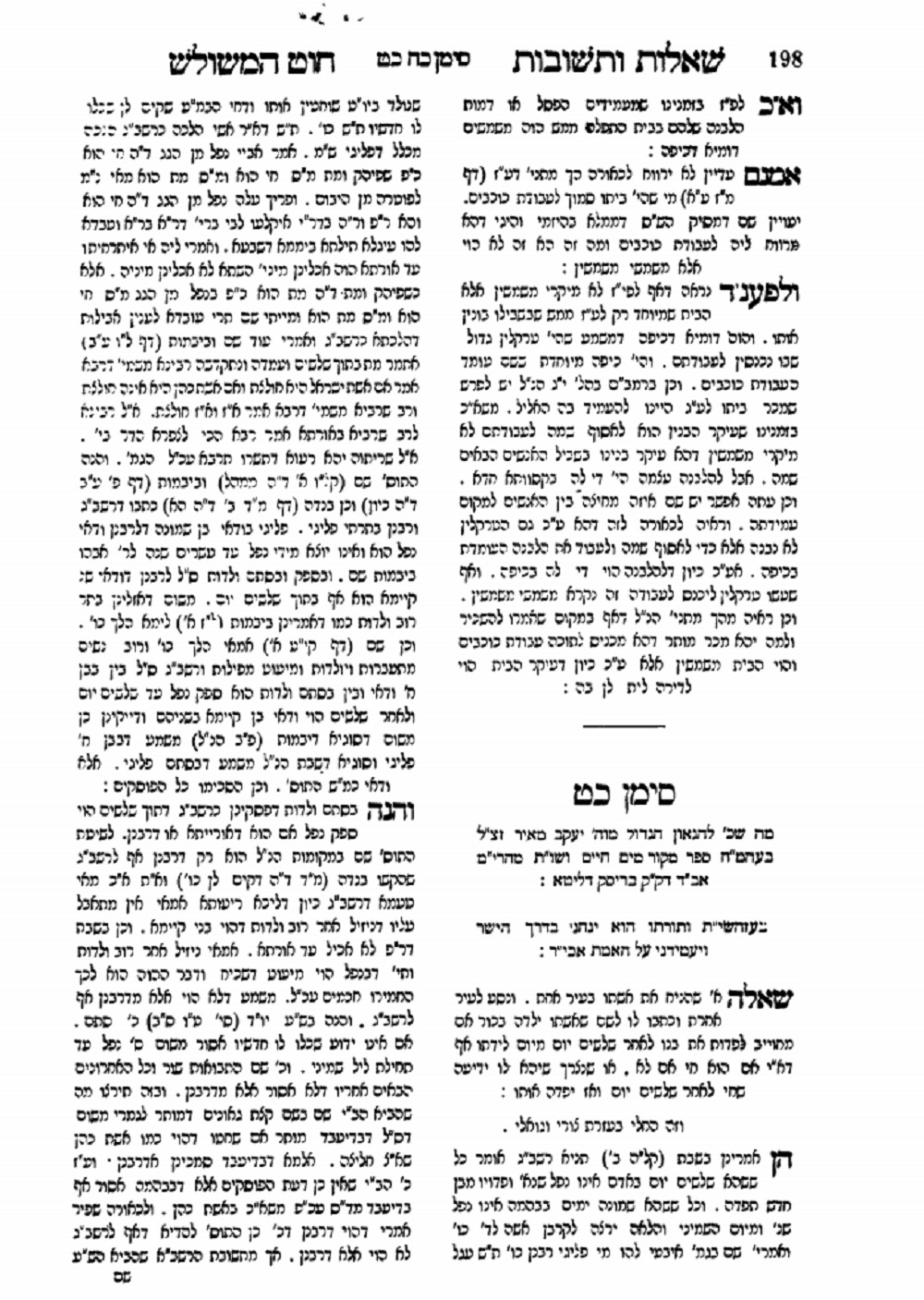
While I don’t find R. Moshe’s lack of knowledge about a medieval kabbalist surprising, not all share this sentiment. After my last post someone wrote to me asking if it is true that R. Menasheh Klein rejected R. Moshe’s disqualification of Zioni. This is indeed true, and Klein’s responsum appears in his Mishneh Halakhot, new series, vol. 2, no. 214. Klein also points out that Zioni is quoted in halakhic sources, including the Magen Avraham, and he adds:

הציוני מקדמוני בעלי המקובלים וגדולי הפוסקים גאון וקדוש ה’ ואשרי מי שזוכה להבינו ולחקרו וללמדו, וח”ו להוציא לע”ז על קדוש ה
As to how R. Moshe could have banned such a work, Klein has his own solution: “I don’t believe that these words came from the Gaon R. Moshe, but in my humble opinion a mistaken student wrote them and placed them among his papers after his death.” He also states that it is impossible for him to believe that R. Moshe never heard of Zioni since he is quoted in the commentaries on the Shulhan Arukh, and R. Moshe knew the Shulhan Arukh backwards and forwards. He concludes that God should forgive the one who is responsible for what appear in Iggerot Moshe, that which is now falsely attributed to R. Moshe.[3]

This is, of course, comical. R. Moshe insists that Zioni’s commentary should be banned, and Klein insists that R. Moshe never wrote this. The fact that the relevant volume of Iggerot Moshe was published in R. Moshe’s lifetime and the letter in which he writes against Zioni was sent to Rabbi Daniel Levy of Zurich and is dated 1976 does not deter Klein is what is surely one of the strangest things to appear in his volumes of responsa (which contain a good many strange things[4]).

As for R. Yehudah he-Hasid’s commentary, which R. Moshe also banned, Klein writes as follows (Mishneh Halakhot, vol. 16, no. 102):

מהעתקת הציוני כת”י של רבינו יהודה החסיד זה הוא עדות נאמנה גם על הכת”י של רבינו יהודה החסיד שהוא קודש קדשים וח”ו לרחקו ולומר שמינים כתבוהו
R. Moshe’s rejection of the commentary of R. Yehudah he-Hasid is not entirely unexpected. In fact, there are about ten different places where R. Moshe denies the authenticity of an earlier text because it does not agree with his preconceptions. In a future post I hope to list all of these examples, which show that R. Moshe could be quite daring (and this led to sharp responses to him by other poskim). Yet, as with R. Yehudah he-Hasid, every one of the texts that R. Moshe rejects is unquestionably authentic. In at least one of the cases we even have the author’s own manuscript.

A number of years ago I was studying R. Mordechai Spielman’s Tiferet Zvi. This is a multi-volume commentary on the Zohar which shows incredible bekiut. In fact, the Zohar is often just a springboard for the learned author to discuss all sorts of Torah matters. His first book, Tziyun le-Nefesh Tzvi, shows the same characteristics, and it is devoted to the issue of whether kohanim can go to the graves of tzadikim. While most poskim rule that they cannot, there is also a tradition, popular among the kabbalistically inclined, that tzadikim are exempted as they do not cause impurity. In one of his final articles, the late Prof. Israel M. Ta-Shma dealt with this issue.[5]

I noticed that Spielman cited Zioni and was curious to hear his reaction to R. Moshe’s teshuvah. In a lengthy letter, dated July 14, 1994, in which he discussed a variety of matters, he wrote:

וכשהייתי לפני כמה שנים בירושלים עה”ק ובקרתי אצל מרן פוסק הדור מו”ה ש”ז אויערבאך הנ”ל הסכים עמי ואמר לי בפירוש במעמד א’ מיקירי רבני ירושלים עה”ק שליט”א שאין הצדק עם הגאון ר’ משה זצ”ל לאסור למכור את הספר הקדוש הזה

[Quite by coincidence, a couple of years later my havruta at the Scranton yeshiva was the great-nephew of Rabbi Spielman. He told me that his uncle, who was a follower of the Munkatcher rebbe, R. Hayyim Elazar Shapira (and also a native of Munkatch), used to celebrate Thanksgsving each year. Such was his feeling of gratitude to be living in the United States.]

Returning to Auerbach’s Eshkol, the controversy really started when R. Shalom Albeck, in an open letter, later followed by his Kofer ha-Eshkol, accused Auerbach of forging the work. (Albeck himself, and his son Hanokh, later published the authentic Eshkol.) Yet it must be noted that Albeck was not the first to accuse Auerbach of this, as right after the work was published there appeared an anonymous article in He-Halutz[6] saying the same thing. There is a widespread assumption that this article was written by the outstanding scholar Raphael Kirchheim. Yet I don’t know how this assumption arose, as I can find no evidence to justify it. I believe that the author was Joshua Heschel Schorr, the publisher of the journal.

I must thank Rabbi Baruch Oberlander of Budapest[7] who called my attention to the fact that in another article in He-Halutz, eleven years later,[8] Schorr once again attacks Auerbach and his edition of the Eshkol. Among his choice words are the following:

וחטא למחבר הספר וחטא לקוראים ההוגים להתלמד, וחטא לאמת ולמי שחותמו אמת וחטא לנפשו, והוא עתיד ודאי ליתן את הדין ומי יודע אם יצא נקי בדין, כי אין מרחמין בדין
Oberlander also called my attention to the following, which is quite interesting. In my previous post I quoted R. Shlomo Yosef Zevin’s assessment that Albeck was correct in judging Auerbach’s Eshkol a forgery. Yet in the Talmudic Encyclopedia, edited by Zevin, Auerbach’s Eshkol is cited! I wouldn’t be surprised if most of the people working on the various entries, who are all great talmidei hakhamim, have never even heard of the dispute over the volume. Unlike the case of Besamim Rosh, the reliability of Auerbach’s Eshkol is almost never mentioned in traditional rabbinic literature, and the great poskim continue to cite it as a rishon. Yet Auerbach’s Eshkol is also cited numerous times in the volumes that appeared while Zevin was still alive. How can one explain this?

Auerbach’s Eshkol was shown to be a forgery in that it contained formulations taken from post-medieval works. In my last post I quoted R. Ratsaby’s comment in his letter to me that the work contains material from the Beit Yosef. Oberlander points out that R. Menahem M. Kasher, Torah Shelemah, 9:140, also raises this possibility.

באשכול הנדפס בכת”י ע”י ר”ש אלבעק דף 46, ליתא קטע זו וצ”ע אם אין זו הוספה ע”פ הב”י
It is in this area, of post-medieval material in the Eshkol, that Prof. S. Z. Havlin has made a fascinating discovery. I refer to his article in Yeshurun 13 (2003), which should satisfy even the final doubters that the work is indeed a forgery.

Havlin quotes a passage from R. Abraham ben ha-Rambam that is found in the Orhot Hayyim of R. Aharon of Lunel and also appears in Auerbach’s Eshkol. The question is obvious: How could the Eshkol, whose author, R. Abraham ben Isaac, died in 1159, quote anything from R. Abraham ben ha-Rambam. Of course, one could say that this is a later addition to the manuscript from someone who used the Orhot Hayyim. But as Havlin notes, this is no help either because where would this person have come across this text, as it is lacking from the standard edition of Orhot Hayyim and is today only found in one Jerusalem manuscript?

The answer is that the Beit Yosef cites this passage in the name of Orhot Hayyim (without noting that the Orhot Hayyim is quoting R. Abraham ben ha-Rambam). R. Joseph Karo had access to a manuscript of Orhot Hayyim which had this text, which, as mentioned, does not appear in the standard version of Orhot Hayyim. Auerbach saw this text in the Beit Yosef and simply incorporated it into his Eshkol, perhaps even assuming that this was another example of Orhot Hayyim quoting the authentic Eshkol, as he often does. Only now, when we have access to the Jerusalem manuscript of this work, do we see that Orhot Hayyim is actually quoting a teaching of R. Abraham ben ha-Rambam. This was information that Auerbach did not have, and explains how he could include it in his edition. R. Abraham ben Isaac was a great scholar (and father-in-law of the Ra’avad). Yet even he was not able to quote from works that would not appear until after his death.

Havlin concludes:

נמצא אפוא שיש בנוסח מהדורת הרב אויערבך הוספות שנבלעו בפנים בלא אות או סימן, שנעשו לא לפני שנת שי”א (1551), שבה הופיע לראשונה ספר בית יוסף
I was asked to explain a bit about the Eshkol, vol. 4, that Bernard Bergman published. First some background: In the introduction to volume 3 of his edition of the Eshkol, Auerbach wrote that the halakhot of the Eshkol found in his manuscript that remained to be published were Hilkhot Yom Tov, Rosh ha-Shanah, Yom Kippur, Orlah, Kilayim, Hallah, Hekdesh, Vows and Oaths, Tzedakah, and Rabbinic laws. In his Kofer ha-Eshkol, Albeck, who insisted that Auerbach had no Eshkol manuscript but created his edition using various other sources (including the authentic Eshkol), challenged Auerbach’s supporters to at least produce Auerbach’s transcribed copy of his manuscript. It was asserted by Auerbach’s defenders that the original manuscript had been lost, presumably put into geniza by Auerbach’s family after the latter’s death, since they didn’t realize its value. But, Albeck claimed, certainly Auerbach must made a copy of the manuscript (if it really existed).

Albeck’s request was never fulfilled, and it is obvious that all of Auerbach’s defenders, who were in close touch with his family, assumed that there was no such copy. Had anyone known of it, its existence would have been a central feature of the defense of Auerbach’s honesty.

In 1986 Bergman published volume 4 of Auerbach’s Eshkol, which contains some of the missing sections. This would appear to show that Albeck was not correct in his assumption, and accusation, that no such text existed. But its existence says nothing about the authenticity of Auerbach’s Eshkol. All it means is that Auerbach had written down certain sections, and added his commentary Nahal Eshkol which he had to do before publication. Even forgers have to present a written text to the printer!

With regard to Bergman’s volume, it is very curious that the reader is given no insight in the introduction as to where this manuscript came from (or even a picture of it). I can’t think of any other publication of a rishon where this information is not provided. I would not be surprised if some think that the new edition is itself a later forgery designed to protect Auerbach’s legacy. After all, how is it that Bergman came to this work when Auerbach’s family and defenders knew nothing about it? Despite these questions, I think that barring new evidence we should give Bergman the benefit of the doubt and assume that the manuscript did originate with Auerbach.

I realize that it was, and remains, hard for people to accept that a gadol be-Yisrael was capable of such an outrage, namely, forging the work of a rishon. I think we should simply assume that he had some sort of schizophrenic personality, and leave it at that. Even great Torah scholars sometimes do weird things.

It is of course understandable that people who knew Auerbach as a pious sage were not able to accept this. Professor Jacob Barth, who taught at both the Rabbinical Seminary of Berlin and the University of Berlin, and was one of the world’s leading Semitic scholars, is a perfect example of this phenomenon. Although he was R. Esriel Hildesheimer’s son-in-law and a leading figure in German Orthodoxy, he also had a critical mind and was not one to be led by convention. It was thus possible for him to argue that Isaiah 40-66 was a later addition, and to reject the talmudic dating of various post-biblical books. He even claimed that the Song of Songs was not originally intended as an allegory, a position that today would probably get him put into herem. Yet even this giant of critical scholarship could not approach the Eshkol problem objectively. Instead, he reflected on how forty years prior he had studied Talmud under Auerbach, and how much he was impressed by him, from both an intellectual and personal standpoint. As he put it, whoever had any contact with Auerbach knows that it is “absolutely impossible that he could have committed the smallest literary dishonesty.”[9] He concludes his essay by stating that the learning and character of Auerbach stand tall, despite the shameful attack of Albeck.

In my first post I noted that R. Hayyim Heller pointed out to the Rav that Auerbach’s Eshkol is a forgery. In this regard, it is interesting to mention something that appears in Shimon Yosef Meller, Uvdot ve-Hanhagot le-Veit Brisk. In recent years there has been great interest in “Brisk.” I am not referring to the Brisker method of Torah study which has been popular for a long time, but rather a great interest in the personal lives of the outstanding figures of Brisk.

As every bit of information is precious, and every book wants to offer new stories, it is important for the authors to look anywhere they can. Unfortunately, at least one such book has plagiarized from R. Herschel Schachter.[10] Another unfortunate element in these books is the lack of respect shown to figures who did not share the Brisker anti-Zionism. This is more understandable, as at times R. Chaim and R. Velvel themselves had negative views of the religious Zionist gedolim.[11] It would be censorship if their attitudes were not recorded properly, but most people reading this will still regard it as unfortunate that these great rabbis were not more tolerant. (The irony, of course, is that they are expected to be tolerant of those who supported what in their mind was bringing great devastation upon the Torah world.)

Speaking personally, I must say that some of the stories recorded in these books are so strange that I wonder if most people in this generation would be led to admire these figures more after hearing the stories, or if the result would be the opposite. For example, what is one to make of the following story, told in order to inspire awe of the Brisker Rav? Once he was served something which, while kosher, did not measure up to his standards. Upon learning of this, he immediately stuck his finger down his throat, causing himself to throw up on the host’s expensive rug. Rather than this upsetting the host, we are told that this further increased his admiration for the Brisker Rav.[12]

Can people today grasp what it means to be a pure ish halakhah of the sort the Rav describes in Halakhic Man, whose behavior can come across as very cold and unfeeling (e.g., R. Moshe Soloveichik’s rebuke of the Baal Tokea, and the story of R. Elya Pruzhener and his dying daughter)?[13] Another such example of this is the report that when one of R. Velvel’s sons died shortly after birth, and the family was crying, he was insistent that they stop their tears, since there is no avelut before thirty days.[14] Whether this type of pan-halakhism is inherently positive or negative I will leave to the judgment of others, but I think that in modern times it is clear that the average person who hears stories like this, even if he is a haredi, will not be spiritually inspired. I think that many times he will even be spiritually turned off, for obvious reasons.

I know that Rabbi Pinchas Teitz, who headed my high school, the Jewish Educational Center, didn’t like the similar sort of stories told about the Rogochover. He felt that people today would hear these stories and the only thing that would stay with them is that the Rogochover was eccentric. Since the point of stories of gedolim is to inspire respect and awe, telling stories that stress his eccentricity would therefore be counterproductive. For example, hearing about how the Rogochover threw a chair at R. Hayyim Ozer, or how he proclaimed that R. Yitzhak Elchanan didn’t know how to learn or that Tosafot is full of errors, are hardly the sort of tales that will inspire awe.

In fact there are many gedolim about whom R. Teitz’ point is applicable. I remember when a high school rebbe of mine got all excited telling the class about his trip to the Steipler, and how while he was there the Steipler chased another fellow out of the house. (Subsequently I learnt that this was not so uncommon). After the rebbe finished his story, no doubt thinking we would be impressed, one of the students blurted out something along the lines of “Do you think that was a nice thing to do?” Now I certainly am not going to judge the Steipler, and it is likely that the man was deserving of being thrown out, but the rebbe didn’t know the details and thought that it would be exciting to tell us high schoolers how the great Steipler lived up to his reputation as one who didn’t suffer fools. Yet the acculturated Modern Orthodox response was to wonder why he wasn’t a nicer person. In other words, Rabbi Teitz was correct about the need to be careful when it comes to telling the masses stories of gedolim.

To give another example, I recently read a hesped where R. Yitzhak Yosef recorded how the deceased talmid hakham, R. Moshe Levi, didn’t miss a moment of Torah study. He described how when R. Levi was at a communal meal he kept a book under the tablecloth, and every free second he could be seen be looking at it. The eulogizer saw that as something positive, whereas in my town, everyone would regard it as very rude. This point illustrates why I find haredi hagiography so fascinating, as it clearly reveals the culture gap between the haredi world and the Modern Orthodox world. Some of the stories that are told, and are part of haredi myth making, would be regarded with horror by the Modern Orthodox world.[15] How better to determine the ethos of a community than by seeing how it chooses to remember and praise its leaders? If anyone thinks that the Rav shared the Modern Orthodox ethos, just look at the stories he tells in Halakhic Man.

Sometimes truly horrible stuff is found in haredi “gedolim books” as well. Let me offer just one example. There is a very helpful book by Dov Ber Schwartz entitled Artzot ha-Hayyim (Brooklyn, 1992). This book contains short biographies of numerous American rabbis, a list of rabbinic books published in the United States, and an essay on Orthodoxy in America. Yet in the midst of the book, on page 52a in the note, one finds the shocking passage which you can see here, and which I am too embarrassed to translate. One can only hope that sentiments such as these are not very common among Schwartz’ fellow Satmar hasidim.

Another real problem with all of the haredi hagiography is that one never knows if the stories are trustworthy. That doesn’t mean that the stories have no value, for even if gadol x never did what is recorded, the fact that this story is told about him reveals the mindset of the generation telling the story. In other words, we can adapt the point Neusner has made about talmudic tales of tannaim really telling us about the amoraim; late twentieth and early twenty-first-century tales of gedolim really reveal what the current haredi ethos is (especially since anything that doesn’t agree with this ethos will be censored.)

While in many cases the stories told are strange and one wonders whether they are accurate, in some cases it can be determined with virtual, or even complete, certainty that they are false. Yehoshua Mondshine has authored a number of articles showing the falsehoods in (mostly) hasidic stories. Among the non-hasidic works he takes aim at is R. Barukh Epstein’s Mekor Barukh.[16] Mondshine’s prime concern is with the famous story recorded by Epstein about his father’s meeting with the Tzemah Tzedek, and Mondshine attempts to show that there is no reason to believe the report.

To this I would only add that, knowing Epstein’s reputation as a plagiarizer and how he manufactured stories, one should not take seriously any of his “recollections.” I know the feminists will be upset with this, but we must assume that the entire dialogue between him and Rayna Batya,[17] which shows her as a proto-feminist, is contrived and has no historical significance other than revealing that Epstein himself wanted to call attention to the sad fate of talented women who are not permitted to study Torah In the unlikely event that he does accurately portray Rayna Batya, all I can say is that the punishment of one who tells tall tales is that even when he tells a true story he is not believed. We must, however, remember that even when it comes to stories that are certainly false (and there are loads of them being invented all the time, and then repeated by the gullible), one should not be discouraged when reading them. Rather, one should keep in mind Saul Lieberman’s famous comment: “Nonsense is nonsense, but the history of nonsense is scholarship.”

What does all this have to do with Auerbach’s Eshkol? In Uvdot ve-Hanhagot le-Veit Brisk, 3:291, we are told in the name of someone who heard it directly from R. Velvel that when Auerbach’s Eshkol was published, “I [R. Velvel] immediately said that this is not the Eshkol.” R. Velvel is also quoted as saying that it was actually written by another rishon. Here is a perfect example of why these sorts of books are so unreliable. I am not saying that the person who reported this story is lying, only that he didn’t understand what R. Velvel said, or perhaps after forty years no longer remembered properly. I say this because R. Velvel never could have said what he is alleged to have said, as he wasn’t even alive when Auerbach’s Eshkol appeared in 1868. The only kernel of truth that can be gleaned from this text is that R. Velvel knew that Auerbach’s Eshkol was not the authentic Eshkol. Seeing how badly the informant messed up, I am not even willing to trust him that R. Velvel said that Auerbach’s Eshkol is the work of another rishon. Perhaps he only said that it contains information from rishonim, without committing himself to it being an authentic medieval work.

The great problem is what to do with pesakim that rely on Auerbach’s Eshkol. For example, the authentic Eshkol does not have hilkhot niddah, but Auerbach’s does. Unlike Saul Berlin, Auerbach was not simply making up pesakim and attributing them to rishonim. He was taking information in the Beit Yosef and other works and putting this in the mouth of the Eshkol. This is, of course, terrible, and in a halakhic sense it gives the authority of an aharon to a rishon. Yet when you have a pesak in one of the aharonim that relies on Auerbach’s Eshkol, I would think that it does not need to be thrown out because there is at least some important authority (e.g., Beit Yosef, Peri Hadash, etc.) who holds this position, even if it wasn’t the Eshkol.

That said, I can only sympathize with those who have written articles or halakhic works and treated Auerbach’s Eshkol as authentic. The forger has all sorts of motivations, but at the very least he is guilty of genevat zeman, i.e., the time that people take in examining that which they think is a rishon, and wouldn’t have done had they known the truth. Time is precious, and the forger causes it to be wasted on falsehoods. Just think how much time was spent on the forged Yerushalmi Kodashim and Besamim Rosh that could have been spent in authentic Torah study. From an issue currently in the scholarly news, imagine how many thousands of hours have been spent on Morton Smith’s Secret Gospel of Mark, by scholars arguing both sides of the issue. If it turns out that Smith is a forger, even after his death he is playing havoc with people and their scholarly direction.

One very unfortunate example of this is Chaim Bloch’s collection of forged anti-Zionist letters, Dovev Siftei Yeshenim (3 vols., 1959-1965). Hermann Greive wrote an entire article based on these letters,[18] and shortly after his article appeared Shmuel Weingarten published his Mikhtavim Mezuyafim Neged ha-Tziyonut (Jerusalem, 1981), showing beyond any doubt that the letters are forgeries.[19] All the time spent by Greive in writing his article was of course never to be recovered, stolen from him by the worst type of scoundrel the scholarly world can produce. Years ago I had wanted to discuss this matter with Greive, but was shocked to learn that he had met an untimely death, killed by a deranged student.[20]

Notes:

[1] Iggerot Moshe, Yoreh Deah III, no. 114.

[2] Encyclopaedia Judaica, vol. 11, col. 1314 (s.v. Zioni, Menahem).

[3] In a later responsum, vol. 16, Yoreh Deah no. 102, he offers a far-fetched explanation of Zioni and R. Yehudah he-Hasid, according to which David never removed anything from the Torah, only from Moses’ chumash, which contained material not found in the Torah.

[4] For example, what other posek has concluded that ethnic foods, e.g., Chinese, Italian, sushi, etc. are forbidden, and that Jews must only eat “Jewish food.” See Mishneh Halakhot, vol. 10, no. 111. It was pesakim like this that gave rise to the yeshiva quip that the title of his book should be pronounced Meshaneh Halakhot. In addition, Klein’s negative views towards baalei teshuvah and women are also very troubling (although with regard to women, a knowledge of some of his difficult personal history adds some necessary context in this regard.) His attitude towards non-Jews is also shocking, so much so that one wonders whether Elie Wiesel, great humanitarian that he is, would be such a supporter of his institutions if he knew what was being taught there (Wiesel and Klein were in Auschwitz and Buchenwald together). In a lecture at an Edah conference some years ago, a well known talmid hakham discussed if it proper for one to make use of poskim like R. Menasheh Klein for certain areas (e.g., hilkhot Shabbat), if one feels that their general worldview, in particular in areas of Jewish-Gentile relations, is diametrically opposed to one’s own values.

[5] Israel M. Ta-Shma, “Holy Men Do Not Defile – Law and Ideology,” Jewish Studies Internet Journal, 1 (2002): 45-53 [Hebrew], available here (PDF).

[6] Vol. 8 (1869): 165-167.

[7] Rabbi Oberlander is the world’s leading expert on the forged Yerushalmi Kodashim. He published numerous articles on the topic in Or Yisrael, which will be part of his forthcoming book. I should also note that he has played an important role in the rebuilding of Jewish life in
Hungary. See e.g., here.

[8] Vol. 11 (1880): 65-67.

[9] “Notwendige Abfertigung,” Jǔdische Presse (February 17, 1911): 65.

[10] Halikhot ha-Grah (Jerusalem, [1996]) takes a good deal of material, often word for word, from R. Hershel Schachter, Nefesh ha-Rav (Jerusalem: Reishit Press, 1994) without acknowledgment.

[11] I don’t know if it is a reliable report, but see R. Ephraim Greenblatt, Rivevot Efraim, 6:41, third introduction, that R. Velvel also expressed himself negatively with regard to the Rav. (R. Greenblatt himself always shows great respect for the Rav and all gedolei Yisrael, whatever their hashkafot; the passage I refer to was written by someone else. Years ago I expressed my surprise to R. Greenblatt that he included this in his work. Since it is part of an article about one of his teachers, he no doubt felt that it was inappropriate to make any changes.)

[12] Shimon Yosef Meller, Ha-Rav mi-Brisk (Jerusalem, 2004), 2:546-547. See also ibid., 1:484, for a story where R. Hayyim Ozer gave R. Velvel some sugar for his tea, and the latter thought it might contain kitniyot. Out of respect for R. Hayyim Ozer, which is a biblical commandment (kavod ha-Torah), R. Velvel used the sugar, but

תיכף עם צאתו את הבית בסיומו של הביקור, התאמץ וניסה בכל דרך לפלוט מפיו את שאריות הסוכר
[13] David Singer and Moshe Sokol advance the radical view that the Rav’s descriptions of his family members is actually designed to show his opposition to their hyper-intellectualism and pan-halakhism. They write

[T]here is something strange about Soloveitchik’s tales of the Litvaks. The behavior he describes is so radical, so extreme, as to make his presumed heroes seem grotesque. Who, for example, wishing to portray Litvak intellectualism in a positive light, would boast that his father and grandfather set aside all human sentiment and refused ever to enter a cemetery, because a stark encounter with death would have distracted them from the contemplation of the law. Or again, who would tell with pride the following macabre story about his maternal grandfather [referring to the story of R. Elya and his dying daughter] . . . Stories like this, while ostensibly presented in order to glorify the Litvak, cannot help but evoke strong disapproval in the reader. And this disapproval, it seems safe to assume, is shared in part by Soloveitchik himself, specifically by that part of him which rebels against the Litvak tradition’s spurning of the emotions. The vein of anger that runs through the anecdotal material in “Halakhic Man” is not to be missed.

David Singer and Moshe Sokol, “Joseph Soloveitchik: Lonely Man of Faith,” Modern Judaism 2:3 (October 1982): 259.

[14] Shimon Yosef Meller, Uvdot ve-Hanhagot le-Veit Brisk, 4:22-23. The eyewitness to this story was R. Simcha Sheps, late Rosh Yeshiva at Torah Vodaas.

[15] The same high school rebbe, mentioned above, also told us how at the Steipler’s wedding he had a sefer with him and was learning throughout the affair. Again, the reaction of the Modern Orthodox youths who heard this story was that the Steipler was definitely not someone to look to as a role model. What might inspire awe in Boro Park and Bnei Brak can often have the opposite effect when told to acculturated, fun-loving, American youngsters. This is the sort of story that will convince them that gedolim don’t value the normal pleasures of life, and why would any young person, brought up in America, want to be part of a religion that holds this up as an ideal?

[16] See here.

[17] See Don Seeman, “The Silence of Rayna Batya: Torah, Suffering, and Rabbi Barukh Epstein’s ‘Wisdom of Women,’” Torah u-Madda Journal 6 (1995-1996): 91-128.

[18] Hermann Greive, “Zionism and Jewish Orthodoxy,” Leo Baeck Institute Year Book 25 (1980): 173-195.

[19] Even before Weingarten’s book, and earlier articles, there was strong reason to suspect Bloch of forgery. From the beginning of the twentieth century he published books and articles containing letters of great rabbis and Hasidic leaders. None of them can be assumed to be authentic. During his great dispute with R. Yosef Elijah Henkin in the 1940’s, the latter repeatedly accused Bloch of dishonesty and pointed out that he would often attribute quotes to rabbis who were no longer alive so that he couldn’t be contradicted.

[20] After learning of the forgeries, Greive also published “Zionism and Jewish Orthodoxy (II),” Leo Baeck Institute Year Book 28 (1983): 241-246, which is a disgraceful and feeble attempt at defending his original article. In truth, it is no more than a justification of the time and effort he put into the original article. The best course would have been to simply acknowledge how he had been hoodwinked. Why do I say that his article is “disgraceful”? Because it is a twisted example of post-modern mumbo-jumbo that would make the editors of Social Text proud (see here). Here are some choice quotations from Greive, which if they ever became the standard of the historian’s craft, would mean the end of knowledge as we know it. He is trying to show that even forgery of texts is not very different than what historians do all the time!

It is precisely because of this awareness that historians tend to be exceedingly sensitive to any departure from the accepted standards, to any instance of “interference” that does not stop at interpreting a text, but – in the case of written sources – presumes to interfere with the very words in order to demonstrate a newly proclaimed truth. It must be borne in mind, however, that what the offender does in such a case is no different in principle from what everybody is doing except that he goes a little too far. It is this proximity of the permissible to the impermissible that accounts for the intensity of the hostile reaction among scholars, which is as it ought to be for the sake of upholding the standards of serious scholarship, for it is that final step across the dividing line that is the decisive one.
The indignation among scholars will be the more vehement, the rejection the more absolute, the more clearly the newly demonstrated “truth” diverges from the established tenets, flies in the face of securely held scientific convictions. Yet, as will be explained later on, such reactions may be over-hasty. For one thing, interference with a text is not in principle different from inadmissible interpretation which does not alter the words but stretches their meaning; for another, the editing of a text touches on the problem of the extent to which a word uttered during a particular period truly reflects a (hypothetical) extra-verbal reality. Of course, such doubly problematical sources must be approached with caution: their usefulness depends on just what wants to demonstrate by their use.

Later on in the article Greive assumes that Bloch did not create the anti-Zionist letters from scratch, but rather altered authentic letters, and he argues that one can “extract” authentic information from them. He concludes: “Admittedly, there is a danger of drawing erroneous conclusions from a distorted text, but this only reinforces the need for a careful and balanced critical approach and is certainly no reason for altogether ignoring the material until some more reliable evidence pointing in the same direction becomes available.”

It is unfortunate that such a fine publication as the Leo Baeck Institute Year Book published this nonsense. Dovev Siftei Yeshenim is completely useless as a historical source.


Apostates and More, Part 2

Apostates and More, Part 2

Marc B. Shapiro

Continued from here

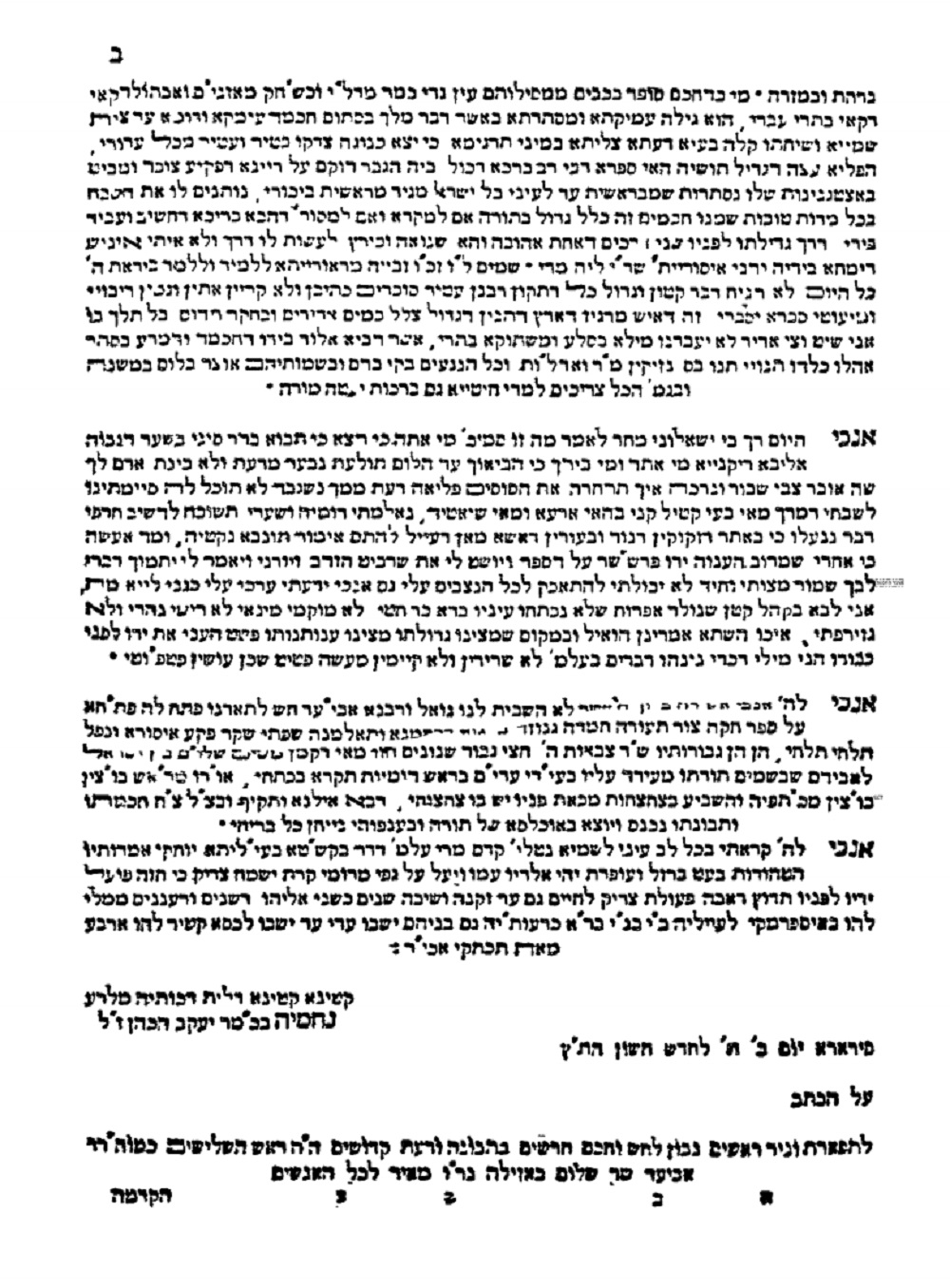
1. Another apostate was Rabbi Nehemiah ben Jacob ha-Kohen of Ferrara, who was an important supporter of R. Moses Hayyim Luzzatto during the controversy about him.[1]Here is the the final page of the haskamah he wrote in 1729 for R. Aviad Sar Shalom Basilea’s Emunat Hakhamim.

R. Isaac Lampronte, in a halakhic discussion in his Pahad Yitzhak, refers to Nehemiah, but not by name.[2] He calls him אחד מן החכמים רך בשנים אשר אחרי כן הבאיש ריחו כנודע. In R. Hananel Nepi and R. Mordechai Samuel Ghirondi, Toldot Gedolei Yisrael (Trieste, 1853), p. 229, they write about Nehemiah: שאח”כ נעשה ישמעאלי. Obviously, “Ishmaelite” is a code word for Christian.[3]

The story reported by Samuel David Luzzatto is that Nehemiah used to go to prostitutes, and when the rabbis found out about this they removed the rabbinate from him. Too embarrassed to remain in the Jewish community, Nehemiah apostatized.[4] Cecil Roth cites another Italian source that Nehemiah converted so he could marry a Christian woman. Unfortunately, his son and three daughters apostatized together with him (his wife had apparently already died).[5] 

Another apostate who should be mentioned is Michael Solomon Alexander (1799-1844), first Anglican bishop in Jerusalem. Before his apostasy, Alexander was a rabbi.[6] 

Rabbi Abraham Romano of Tunis also became an apostate. He converted at the end of the seventeenth century when R. Meir Lombrozo was appointed a dayan in his place. After Romano converted, he became well known as a Islamic preacher, and after his death his tomb was venerated by Muslims. He was known as Sidi Sofiane, and the street in Tunis with this name is named after him.[7] It is reported that in the nineteenth century R. Uziel Alheikh, author of the halakhic work Mishkenot ha-Ro’im, would recite Kaddish at Romano’s grave so God would forgive his sin.[8] 

I am sure many readers have heard of Rabbi Israel Zolli, the chief rabbi of Rome who converted after the Holocaust. Not so well known is Rabbi Daniel Zion, who was the chief rabbi of Bulgaria and after World War II served as a rabbi in Jaffa. When it became known that he was a believer in Jesus, he was forced out of his rabbinic position. There is a good deal online about Zion, and entries in English and Hebrew on Wikipedia.

Rabbi Hayyim Asher Hoffmann was another modern rabbi accused of working with missionaries. He was in Argentina at the beginning of the twentieth century, and wrote a haskamah for R. Menahem Mendel Hirschhorn’s 1904 book Magid le-Yisrael. Here is the title page of the book, followed by the haskamah.

In 1907, R. Mordechai Amram Hirsch of Hamburg informed Jewish leaders in Buenos Aires that Hoffmann had worked in the Christian mission in Hamburg. Not long after this, Hoffmann committed suicide.[9]

Hoffmann is not the only rabbi to have committed suicide. In his recent article in Hakirah, Moshe Ariel Fuss deals with R. Moshe Soloveichik’s great dispute with the Polish Agudat Ha-Rabbanim. He also discusses the suicide of one of the dayanim of Tomashov, which was related to the dayan’s role in the dispute.[10]

There was another rabbi and author of a sefer who committed suicide. Let me preface this story with some other relevant information. In the early 1990s there was a project at the Harvard library to put thousands of rare Hebrew books on microfiche. This would then be sold to major university libraries. It was a wonderful idea and involved considerable expense on the part of the company, K.G. Saur, which was carefully photographing the books. (I used to watch the photographer doing his work.) It was very costly to purchase the more than ten thousand fiches, but for a library that wanted to instantly have access to almost five thousand rare Hebrew books, this was a great solution. You can see a 1994 ad for the project here.

Unfortunately for this project, advancing technology made it obsolete almost immediately upon completion. The ability to access rare books online, on hebrewbooks.org, Otzar ha-Chochma, Google Books, and other sites, meant that microfiche readers went the way of typewriters. (I still haven’t gotten rid of my own microfiche reader, as I never know if it might come in handy).

Harvard put out a catalog advertising the microfiche set, which discussed the different genres of books included. The catalog also had pictures of a few of the title pages of the books. Here is one of the pages in the catalog.[11]


Here is a clearer picture of the title page.

The book is Derekh Yam on Tractate Meilah by Rabbi Mordechai Nahman Stieglitz, published in 1900. At the time (almost thirty years ago), I thought nothing of this, and just assumed that Derekh Yam was a random book that was picked for inclusion in the catalog. However, someone who knows a lot about seforim told me that there is no question that Derekh Yam was not randomly picked. He said that whoever chose to use this title page, when there were so many others that could have been picked, must have done so as an inside joke for the benefit of those who knew the history of Rabbi Stieglitz (which at the time I knew nothing about).

Derekh Yam is a fine commentary on a tractate that not so many have written about. Understandably, then, when people study Meilah this is one of the books they will turn to. And why not, seeing that the book has haskamot from such great figures as R. Isaac Schmelkes, R. Shalom Mordechai Schwadron, and R. Aryeh Leibush Horowitz? It also includes an approbation and a lengthy responsum (pp. 47a-58a) by R. Joshua Horowitz, the Rebbe of Dzikov (Stieglitz’s hasidic group[12]) and author of a number of volumes with the title Ateret Yeshuah.

Shortly following the appearance of Derekh Yam, Stieglitz’s life took a different turn. He not only left Poland but abandoned Torah observance as well. Meir Wunder writes that “he went to study at the University of Berlin (and not Vienna).”[13] Wunder’s information that Stieglitz studied in Berlin presumably came from Yehudah Rubenstein (see below), but I don’t know why he felt the need to correct the error that he studied in Vienna, as I haven’t seen anyone make this claim. 

It could be that Stieglitz did study in Berlin (though I know of no evidence for this), and to be sure one would need to check the archives of the University of Berlin. However, Rubenstein and Wunder were unaware that Switzerland was Stieglitz’s primary academic place of study, and his 1908 doctoral dissertation is from the University of Bern. It deals with Baraitot in Tractate Berakhot in the Bavli and Yerushalmi. You can see it here. As was typical in those days in Germany and Switzerland, the doctoral dissertation is short and insignificant. It never ceases to amaze me how easy it was in those countries to receive a doctorate.

Yehudah Rubenstein says the following about Stieglitz:[14] When his book Derekh Yam appeared it was greatly praised by Torah leaders and had an impact on talmudic scholars. It also included a long responsum from R. Joshua Horowitz. Later, a רוח שטות entered Stieglitz and he abandoned his wife and children and went to Berlin to study, where he abandoned Torah observance and fell in love with the daughter of a banker, whom he married after divorcing his wife. He then went to New York where he went into business and made a lot of money on Wall Street. However, during the Depression Stieglitz lost his money and committed suicide.[15]

Rubenstein also notes that Dzikover hasidim, at the command of their rebbe, collected all the copies of Derekh Yam that they could find, from synagogues and private homes, and destroyed them. He concludes:

.והספר דרך ים הוא יקר המציאות, כי נשארו ממנו טופסים מועטים

What used to be a rare book is now, thanks to modern technology, at everyone’s fingertips. Even if, as a result of this post, the book is removed from hebrewbooks.org and Otzar ha-Chochma, you can still see Harvard’s copy here.

In 1976, the descendants of R. Joshua Horowitz published Ateret Yeshuah: Likutei Teshuvot ve-Haskamot.


In the introduction it states that the book includes all the responsa and approbations of R. Horowitz found in the writings of others. However, they purposely did not include the approbation and responsum found in Derekh Yam.[16]

Returning to apostasy by rabbis who produced seforim, I have previously mentioned R. Profiat Duran, the Efodi (see here), and an article by Joseph Hacker has recently appeared which further complicates matters.[17] Let me first note that in Latin documents his name appears as Perfeyt, so from now on this is how I think we should pronounce it. Second, and here Hacker follows on Maud Kozodoy’s earlier research,[18] we have evidence that not only did Duran convert (this we already knew), but that he remained a Christian for the rest of his life, even when he had left Spain and could have returned to Judaism. If that wasn’t enough, both Kozodoy and Hacker believe that he married a Christian woman, as the wife to whom he left his possessions had a different name than his first wife. Yet this latter point is not conclusive. It could be that the woman he was married to at the end of his life was a Jewish woman who apostatized, either the original wife who changed her name on conversion, or a second wife. How Duran continued to write anti-Christian polemical works while living as a Christian is still a mystery.[19] His famous grammatical work, Ma’aseh Efod, the introduction to which Professor Isadore Twersky loved to study with his graduate students,[20] was also written while he was a Christian.


When the information about his life eventually filters out to the Orthodox world, presumably he will no longer be cited as an authority (although all evidence points to his important commentary on Maimonides’ Guide being written before his conversion so perhaps that can still remain in the canon).[21]

I must also mention R. Levi Ibn Habib (ca. 1480-1541), the great sage of Jerusalem. As a young man in Portugal, he converted (or was converted) to Christianity. We don’t know if at this time he was living with his father, R. Jacob Ibn Habib, who is famous for editing the Ein Yaakov. Later, R. Levi journeyed to Salonika where he was together with his father.

We do not know the precise details of R. Levi’s conversion. Scholars often write about Jews being subjected to “forced conversion.” This can mean that one is told he must convert or he will be killed. In this circumstance, Jewish law requires martyrdom, and Jewish history knows of many who chose this path.[22] Yet people who were not strong enough to accept martyrdom, and converted to Christianity to save their lives, are routinely described as forced converts. 

The other meaning of forced conversion is using actual physical force to baptize someone, as occurred in Portugal. R. Levi was in Portugal in 1497, when Jewish life there came to an end. Many Portuguese Jews converted “willingly”  in addition to the strong Christian pressure to convert, some did so to be freed from slavery or after their children were taken from them, as this was the only way to get them back. There was also the unusual circumstance that the King ordered the Jews not yet baptized to be baptized against their will, literally by physical force. (Mainstream Catholic teaching did not regard this as a valid baptism, unlike the case of one who converted to save his life, as this latter act was taken out of free will).[23] As mentioned, we do not know whether R. Levi converted “willingly” or not, but we do know that he lived as a Christian after this conversion.

In the great dispute over the revival of semikhah between R. Levi and R. Jacob Berab, R. Berab saw fit to allude to R. Levi’s conversion as a means of discrediting him. This is quite surprising, as one is not supposed to remind a ba’al teshuvah of his previous sins. Here are some of R. Berab’s words which are clearly designed to contrast his pure history with R. Levi’s history, which included living as a Christian (and thus having a Christian name).[24]

שת”ל מיום הגרוש והשמד שבספרד לעולם הייתי מורה הוראות בישראל . . . ועם היותי ברעב ובצמא ובחוסר כל לעולם הלכתי בדרכי השם יתברך ונתעסקתי בתורתו . . . ות”ל שמעולם לא נשתנה שמי אי רבי קרו לי השתא רבי הווי קרי לי אז וזה שמי לעולם . . סוף דבר שת”ל לעולם השתדלתי שלא ילך להתרעם עלי שום אות מאלף ועד תי”ו, רצוני לומר שלא נתחלל שם שמים על ידי בשום אחד מהאותיות כדי שלא יעלו לשמים להתרעם עלי

R. Levi was understandably quite offended by R. Berab’s words. He expresses his pain that R. Berab would attempt to publicly humiliate him by bringing up the difficult timein Portugal. He makes it clear that he is speaking for many others who were also in his unfortunate circumstance.[25]

לישנא בישא טובא איכא הכא, ובמקום שהיה לו לחכם להודות על האמת ולהשיב כהלכה גרם לשפוך דמי ולהלבין פנים בהזכירו אלי עונות ראשונים . . . לא לכבודי ח”ו כי אם לכבוד כל אותם שנמצאו באותה הצרה ושמו עצמם בסכנות רבות וברחו ולא ראו בטובה עד שזכו להיות בעלי תשובה ורבים מהם נפטרו לחיי הע”ה

R. Levi also mentions that he was not yet a bar onshin when he converted. The evidence we have shows that he was older than 13 in 1497, so when he says that he was not yet a bar onshin, it must mean that he was under the age of 20. This is in accord with an aggadic statement in Shabbat 89b that God does not punish for transgressions in the first twenty years.[26] The Zohar, Bereishit 118b, also states that while an earthly beit din punishes from age 13, the Heavenly Court does not punish for sins committed before age 20.[27]

R. Levi further states that despite his difficult circumstances, in his mind he remained a Jew, loyal to the one true God. While others changed his name to a Christian name, he himself never changed. He adds that while he did not merit to die al kiddush ha-shem, he hopes to achieve a complete repentance for his past. Here are some of R. Levi words, full of pathos:[28]

ואומר כי אני לא אחלל בריתי ברית התורה להשיב לזה החכם על פי דרכו . . . גם לא אכחיש המובן מדבריו בהגדלת אשמתי ולא אציל עצמי בדברתי לומר שאף אם שנו שמי בעונתי בשעת השמד אני לא שניתי, ובוחן לב וחוקר כליות יודע כי תמיד אותו יראתי, ואם לא זכיתי לקדש שמו לבי יחיל בקרבי מפני זעמו הגם שעדיין לא הייתי בר עונשין בבית דינו כלל, מכל זה לא אומר ח”ו כי שקר התנצלותי, ועוד כי יוסיף פשע על חטאתי, אדרבה אבכה יומי ולילי אוי לי אללי ואודה עלי פשעי ואומר ידעתי יי’ רשעי ופשעי וזדוני כי רבו למעלה ראש משורש פורה רוש, ואשמותי גדלו עד לשמים, אבל בטחתי על רוב חסדיך ונשענתי על רוב רחמיך, וכשם שזכיתני לצאת מן ההפכה והבאתני אל העיר ההוללה בתוך השנה להיות שונה שם בכל יום הלכה עד היום שיש יותר מארבעים שנה, כך תזכני להיות בעל תשובה שלמה, ומה גם עתה בהיותי עולב עלבון גדול אשר כזה על לא חמס בכפי, ואתה אדון הסליחות אלדי הרוחות ראה בדמעות אשר זלגו עיני עתה באנחות ויהיו בבית גנזיך מונחות לעת צאת נפשי, ואולי תזכה בהן לשוב למנוחות

It is one thing for contemporaries to slug it out and attack each other. However, that was hundreds of years ago, and in the intervening centuries both R. Levi and R. Berab have been included in the canon of gedolim. R. Berab has the additional distinction of having given semikhah (the real kind) to R. Joseph Karo. As such, we are dealing with important figures who are each deserving of great respect. This is why I found it so unusual that a twentieth-century rabbi, Benjamin Trachtman, who came to the defense of R. Levi, showed considerable disrespect for R. Berab. 

R. Trachtman was a rabbi in a few different places in the United States and Israel, and author of a number of works. In 1930 he was rabbi in Mishwaka, Indiana (near South Bend) when he published his book, Shevet Binyamin. Here is the title page.

The book comes with a number of “haskamot,” among them from R. Moshe Mordechai Epstein and R. Isaac Sher. From the “haskamot” we learn that R. Trachtman had been a student at the Chevron Yeshiva. I put the word haskamot in quotation marks, since even though that is what the letters at the beginning of the book are called, they are not haskamot at all as they have nothing to do with the book. Rather, they testify to R. Trachtman’s Torah knowledge and most of the letters are semikhah certificates.

I find it hard to believe that R. Trachtman’s teachers, and the others whose letters appear in the book, would have approved of his judgment of R. Berab, found on p. 93 of his book. He states that in looking at the dispute between R. Levi and R. Berab, you can see the difference between a person who has mussar values and one who is “lacking mussar and middot”! He claims that R. Berab is an example of someone who had great Torah knowledge but was lacking in the area of ethics. I find it incomprehensible that a twentieth-century scholar would speak this way about one of the recognized Torah sages of centuries ago.

משם יש לראות את הנפ”מ בין אדם בעל מוסר שכל דבריו שקולים במשורה בחשבון ודעת לאדם חסר המוסר והמדות, והינו[!] כי אחד מהדברים אשר אדם נכר בהם הוא בכעסו, בעת אשר מחלוקת לו עם חבירו, והנה המחלוקת של שני החכמים הנ”ל אם כי המחלוקת היה לש”ש לדינא אבל בכל זאת יש לראות שם גם זה הסוג מחלוקת של אנשים השוטים והמחלוקת מזה הסוג בולט הרבה מדברי הר”י בי רב, כי בדבריו אנו רואים התנפלות עזה בדברים בוטים כמדקרות חרב ועלילות מזויפות על הרלב”ח אשר א”א בשום אופן שמחשבון יצאו הדברים ואדרבה הרלב”ח אף כי גם הוא אינו מחריש לו אבל דבריו בנחת נשמעים במתינות ובישוב כנראה משם . . . ואל תאשימני על בואי לבקר את הר”י בי רב כי נתן לי רשות בדבריו, וסוף סוף אנו רואים בחוש גם עתה כי הוא שני דברים נפרדים כי יש למצוא תלמידי חכמים אשר גאונותם בתלמוד הוא עד למאוד וכשבאים לסוגיא “יכיר יכירנו לאחרים” הם נכשלים באופן פשוט אשר בשום אופן אין לחפות עליהם, אם לא כי יצאו מגדר המוסר

Also worth noting is Jacob Katz’s comment at the end of his classic article on the semikhah controversy.

Nor can we ignore the fact that Berab’s personal attacks on ben Habib, and the recounting of his “old sins,” were not germane. He did not dare to give explicit expression to the serious accusation about ben Habib’s conversion in his youth; instead he couched it in words of self-praise (“I myself never changed my name”). Such a tactic is evidence of an emotional need to pretend that one has done nothing wrong, which is a sign of an uneasy conscience.[29]

I must also mention R. Isaac Bar Sheshet, the great Rivash. Did the Rivash actually convert to Christianity during the anti-Jewish persecution of 1391? There is no mention of this in any Hebrew documents. However, in 1983 Jaume Riera published an article in Sefunot based on documents from the Spanish archives which show that during the 1391 anti-Jewish attacks, the Rivash, who served as rabbi of Valencia, converted to Christianity. This is attested to in three separate documents, two of which refer to the rabbi of Valencia and one of which identifies the Rivash by name. The documents show that while many Jews were killed in Valencia during the attacks, most converted to save their lives and the large synagogue was turned into a Church.[30] 

We do not know the exact circumstances that supposedly led the Rivash to convert, and the only important detail in this regard that we learn from the documents is that the Rivash’s death sentence was revoked after his apostasy. Riera offers a suggestion to explain why Rivash chose to convert, but this is based on nothing other than Riera’s vivid imagination. Yet Riera’s imaginings, which conjured up “false witnesses,” a “disgraceful crime,” and other completely fictional events, are presented in the Wikipedia entry on Rivash as actual fact.

In 1391 there occurred the great persecutions of the Jews of Spain in consequence of the preaching of Fernandes Martinez. On the first day of the persecutions, the younger brother of King John I summoned Isaac on July 9, 1391. He explained that to be able to restrain and cease the bloodshed, it would be necessary to promulgate an organized conversion of the Jews, which should obviously start with the communal leaders. Some of the leaders did relent to the heavy pressure laid upon them; but not Isaac, who held steadfast to his faith. After a couple of days, the officials set up false witnesses to testify against Isaac for a disgraceful crime. Due to this accusation, Isaac was condemned to death, by burning at the stake in the city’s central square. On July 11 Isaac was immersed, donned the robe of a Dominican and received the name Jaume De-Valencia.

Around a year and a half after the supposed conversion the Rivash escaped to Algeria, where he was known as a great posek whose responsa remain among the most important ever written. He died in 1408.

Did the Rivash convert? There were a number of rabbis, admittedly not of the Rivash’s level, who converted to Christianity in Spain, so the idea is not impossible. We also have to remember that the conversion of the Rivash, if it indeed occurred, was also only a temporary event. I do not think it casts aspersions on a great rabbi if we find that when faced with the terrible choice, he did not choose martyrdom. Everyone realizes that this is never an easy choice. This was especially the case in Spain which, unlike Germany, never had a culture extolling Jewish martyrdom (and we know that large numbers of Spanish Jews chose conversion over death).

In analyzing this matter, the real issue that experts should focus on is how reliable are the government documents. R. David Bar Sheshet is a descendant of the Rivash and recently published a biography of his illustrious forefather. Some might be surprised that in an “Orthodox” biography he deals with the matter of the supposed conversion. However, being that this is by now a well-known “fact,” it is basically impossible to ignore. Not surprisingly, Bar Sheshet argues against the claim that the Rivash converted.[31] Yet this is not simply a hagiographic perspective, and I myself am not convinced. If indeed the Rivash converted, the Church would presumably have used this as a propaganda tool, yet we have no evidence that this was ever done. Furthermore, does it make sense that no Jewish sources of the time mention the apostasy of such a prominent rabbi?[32]

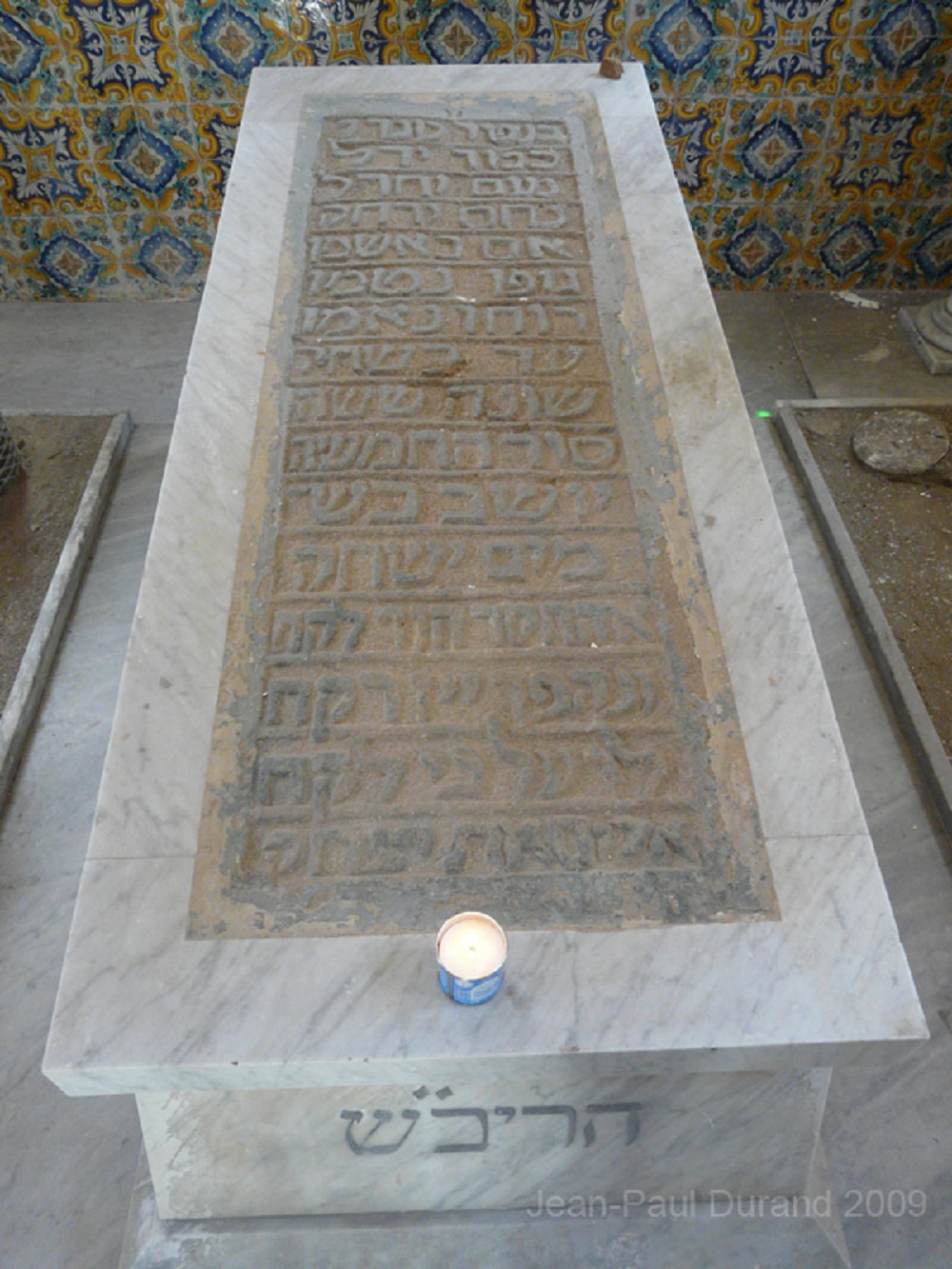
Among my hobbies are visiting the graves of great Torah sages, and this hobby has taken me around the world. What about visiting the graves of the Rivash, and also R. Simeon ben Zemah Duran, the Tashbetz, both of whom are buried in Algiers?[33] Recently, I was in a Paris airport waiting for my flight to Tunisia. At very next gate was a flight to Algiers. Yet despite how easy it would be to travel there, I have yet to go. There is no Jewish community in the city and I don’t know how safe it is to visit Jewish sites. One day when I am convinced it is safe, I will travel there, much like I will travel to Baghdad to visit the grave of the Ben Ish Hai.

Fortunately, one person did make the trek to Algiers. He has put online pictures of the cemetery where the Rivash and R. Simeon ben Zemah Duran are buried, having been moved there from the original cemetery at the end of the nineteenth century. Even before the move they had been given new tombstones.[34] See his website here.

This is the Rivash’s grave. The picture is taken from the just mentioned website.

This is R. Duran’s grave. The picture comes from the same website.

Excursus

Due to the censor, or perhaps even self-censorship, in certain European prayer books negative expressions directed against idolatry, and hence bearing a possible anti-Christian interpretation, were turned into anti-Islamic expressions. See Leopold Zunz, Die Ritus des synagogalen Gottesdienstes (Berlin, 1919), p. 222. Halakhic works were also affected. See, for example, R. Abraham Danzig, Hokhmat Adam 153:1, where some printings have:

ואם שרוי הוא בין ישמעאלים

Every reader should easily grasp that in this passage ישמעאלים does not really mean Muslims.

Mishneh Torah, Hilkhot Avodah Zarah 9:4 reads:

הנוצרים עובדי עבודה זרה הן ויום ראשון יום אידם הוא. לפיכך אסור לשאת ולתת עמהן בארץ ישראל יום חמישי ויום ששי שבכל שבת ושבת. ואין צריך לומר יום ראשון עצמו שהוא אסור בכל מקום

In the textual notes in the Frankel Mishneh Torah, they cite a manuscript that reads:

ישמעלים [!] עובדי ע”ז הן ויום ששי יום אידם . . . ואין צריך לומר יום ששי עצמו

In the Shabbat morning Amidah, we read:

וגם במנוחתו לא ישכנו ערלים

Steinschneider noted that some texts replace arelim with “Ishmaelites.” See Polemische und Apologetische Literatur in arabischer Sprache zwischen Muslimen, Christen und Juden (Leipzig, 1877), p. 374. This change of text was done in Christian countries for obvious reasons and should fool no one. Thus, it is surprising that Salo W. Baron, A Social and Religious History of the Jews, vol. 6, p. 327 n. 15, writes as follows about the version that contains “Ishmaelites”:

This was hardly an invention of later generations of Jews who, living in Christian countries, sought to avoid difficulties with censors. . . . If Maimonides, in his formulation, substitutes arelim (uncircumcised) for “Ishmaelites” (cf. M.T. Seder Tefillot at the end of the second book; here switched to the Musaf prayer), this was merely in line with his general preference for Islam as against Christianity.

This is complete nonsense. Maimonides did not substitute arelim for “Ishmaelites.” The text he had, which is the authentic text of the prayer, included the word arelim.

Here is a responsum of R. Eliezer Isaac Fried, from Hut ha-Meshulash, no. 28. This responsum is cited in many of the discussions dealing Islam and halakhah, in particular with reference to mosques. In my article on the topic from many years ago I too cited this source. See “Islam and the Halakhah,” Judaism 42 (Summer 1993), p. 337.

I recently had occasion to look at this responsum again, and I see that everyone has misunderstood it. It is obvious that R. Fried is not really speaking about building a mosque but a church. When, in the responsum, he speaks of placing the crescent in the mosque, this is really code for crucifix. In fact, the entire responsum assumes that he is speaking about a religion of avodah zarah, which is the obvious sign that he is really speaking about Christianity.

My excuse for misreading the responsum years ago is that I was young and unsophisticated. However, it is very surprising to me that many great talmidei hakhamim have also cited this responsum without realizing that it is not really referring to Islam. See also here where I discuss a mistake by R. Judah Aszod who assumed that in a particular responsum the Hatam Sofer was discussing candle lighting as part of a religious celebration in India, when it is obvious that the Hatam Sofer is really referring to the practice of European Christians.

For an example of self-censorship in the opposite direction, namely, the removal of references to Islam, see this page of a responsum of R. Rahamim Joseph Franco, Sha’arei Rahamim (Jerusalem, 1881), vol. 1, Orah Hayyim, no. 5, p. 8b (look at the paragraph beginning ושוב).


2. I would like to mention some more mistakes I have found in the ArtScroll siddur and machzor. I believe that it is worthwhile to call attention to such mistakes, not only for their own sake, but because ArtScroll has made corrections in the past when these types of errors have been pointed out, and they no doubt will continue to do so in the future.

I myself have noticed a number of corrections that ArtScroll has made, and it could be that the example I will now discuss is an additional one, but I have not personally seen the correction. In response to an earlier post, R. Elazar Meir Teitz informed me that in the prayer recited before taking the Torah out of the Ark on Shabbat morning, in the words היטיבה ברצונך את ציון, ArtScroll mistakenly puts the accent in ברצונך on the penultimate syllable (and when we sing these words with the popular tune the accent is indeed on the penultimate syllable). I checked my ArtScroll siddurim and machzorim and that is indeed where the accent is. However, I have been told that in the new printings of at least one of the various ArtScroll siddurim (but not of the machzorim) this has been corrected and the accent is now on the final syllable. Can any reader confirm that this is indeed the case?

I noticed over Yom Kippur that ArtScroll has a very strange translation in the על חטא prayer. We say:

ועל חטא שחטאנו לפניך ביודעים ובלא יודעים

ArtScroll translates this: “And for the sin that we have sinned before You against those who know and against those who do not know.” I am certain that this is a mistake, and that ביודעים ובלא יודעים means, “with knowledge or without knowledge,” in other words, “wittingly or unwittingly.” I assume ArtScroll was driven to its translation because earlier in the prayer we say בזדון ובשגגה. Thus, if ביודעים ובלא יודעים means “wittingly or unwittingly,” then it is repeating what was earlier said. Furthermore, we also say earlier בבלי דעת and בדעת ובמרמה, so this would seem to be more of the same. Yet I do not think that a prayer with repetitions creates difficulties, and in this case, I think it makes more sense than translating the passage the way ArtScroll does. I am curious to see if readers agree with me.[35]

The final mistake I would like to call attention to is one that is found in most siddurim and collections of zemirot, so ArtScroll is in good company. It is noteworthy that the Koren siddur and the new RCA siddur get it right. The old RCA-De Sola Pool siddur also got it right.

In the Sbbath song ברוך א-ל עליון, it states:

ואשרי כל חוכה
מאת כל סוכה שוכן בערפל

The meaning, as translated by ArtScroll, is:

Praiseworthy is everyone who awaits a double reward
From the One Who sees all but dwells in dense darkness.

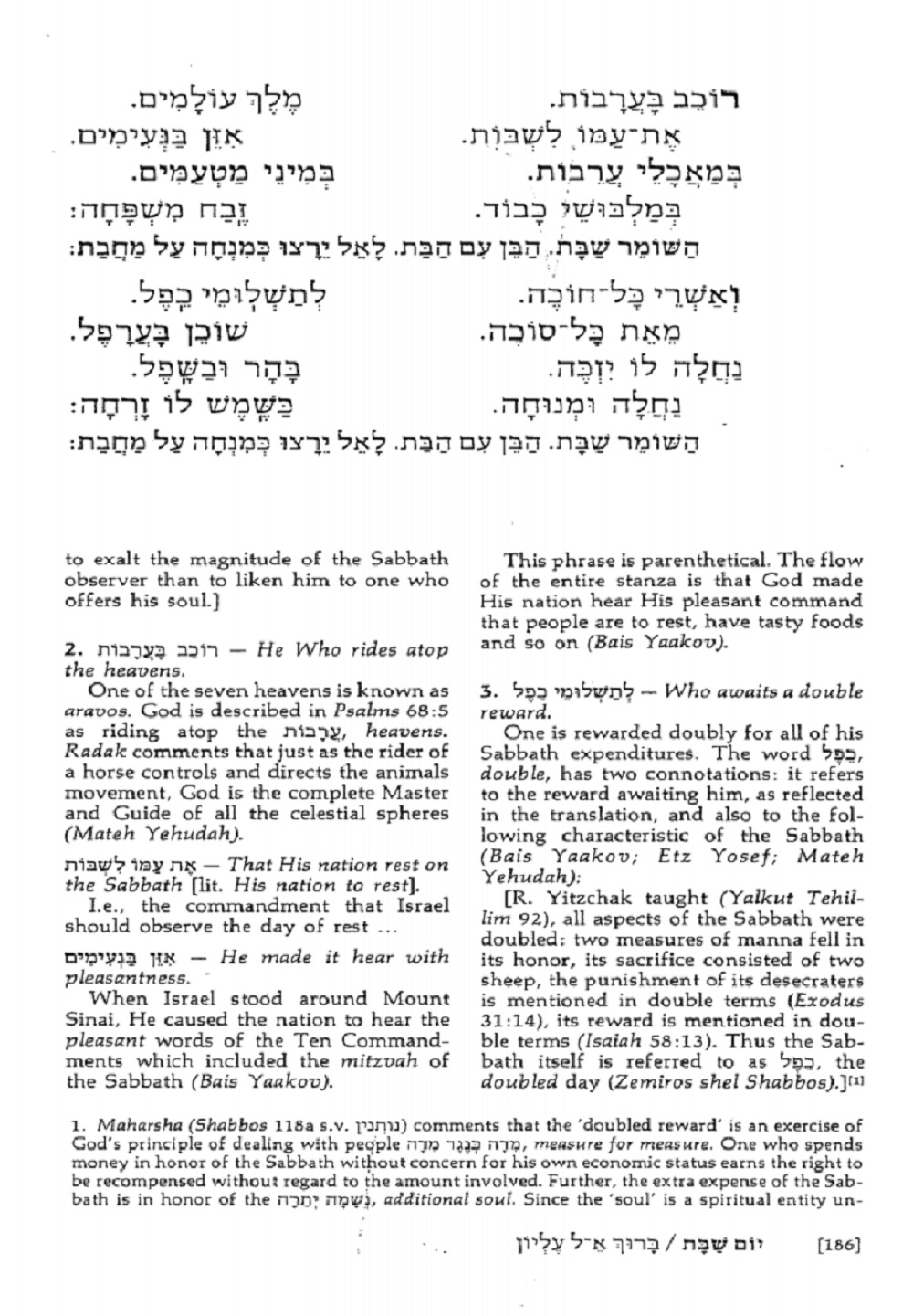
Here is how the Hebrew page appears in the ArtScroll Zemiroth,[36] p. 186.

The problem here is that if you look at the Hebrew you can see that the English has not been translated properly. כל-סוכה does not mean “the One Who sees”, but “everyone who sees.” The word כל has a kamatz which means that it is connected to the following word. In the Zemiroth, ArtScroll puts the makef in, just like almost always in the Masoretic text of Tanakh כל with a kamatz has a makef.[37] But the meaning of the passage is the same even without the makef, and in the siddur ArtScroll does not include it. 

In order for the passage to mean “the One Who sees all,” the word כל must have a holam.[38] This point is actually made by R. Nota Greenblatt, who states that the version found in ArtScroll and many others, where the word כל has a kamatz, is nothing less than heresy since God has been replaced by humans.

3. I want to call readers’ attention to an important volume that has just appeared. Seforim Blog contributor R. Moshe Maimon has published the first volume of his edition of R. Abraham Maimonides’ commentary on Genesis. Maimon’s improvements on the earlier translation from the Arabic make the work a pleasure to read. His explanatory notes are simply fantastic, taking into account all relevant sources, both traditional and academic, that can illuminate the text. This will now become the standard edition of R. Abraham’s commentary, and I can think of no greater honor for Maimon than this. Hopefully, this publication will lead to a surge of interest in the commentary of R. Abraham, much like R. Kafih’s new translation of Maimonides’ Commentary on the Mishnah did for this work. The book is available at Biegeleisen, and can also be purchased online at Mizrahi books here.


[1] See Isaiah Sonne, “Avnei Binyan le-Korot ha-Yehudim be-Italyah,” Horev 6 (1941), pp. 100ff.; Elisheva Carlebach, The Pursuit of Heresy: Rabbi Moses Hagiz and the Sabbatian Controversies (New York, 1990), pp. 237ff.
[2] This is noted by Carlebach, The Pursuit of Heresy, p. 331 n. 18.
[3] See Excursus
[4] Peninei Shadal (Przemysl, 1888), p. 12. See the recent discussion of Nehemiah by Yaakov Spiegel in Hitzei Giborim 11 (2019), pp. 1146ff. Spiegel mentions that Torah writings from Nehemiah remain in manuscript. He also notes that in a recent printing of Basilea, Emunat Hakhamim, Nehemiah’s haskamah was removed (and perhaps surprisingly, the printer acknowledged that it was removed).
[5] Cecil Roth, Studies in Books and Booklore (Farnborough, England, 1972), p. 44 (Hebrew section).
[6] See Alexander’s appendix to John Hatchard, The Predictions and Promises of God Respecting Israel (London, 1825), p. 38. See also Kelvin Crombie, A Jewish Bishop in Jerusalem (Jerusalem, 2006), p. 13, and the entry on him in the Dictionary of National Biography, here.
[7] R. Joseph Tanugi, Toldot Hakhmei Tunis (Bnei Brak, 1988), pp. 233-234; R. Abraham Khalfon, Ma’aseh Tzadikim (Jerusalem, n.d.), p. 309.
[8] L’Univers Israelite, Oct. 7, 1932, available here; André N. Chouraqui, Between East and West: A History of the Jews of North Africa, trans. Michael M. Bernet (Philadelphia, 1968), p. 72.
[9] See Victor A. Mirelman, Jewish Buenos Aires, 1890-1930 (Detroit, 1990), p. 89.
[10] “Ha-Rav Moshe Soloveichik u-Ma’avakav be-‘Moetzet Gedolei ha-Torah’ ve-‘Agudat ha-Rabbanim’ be-Polin,” Hakirah  25 (2018), p. 47.
[11] I thank Menachem Butler for sending me this image.
[12] See Yehoshua Mondshine, Ha-Tzofeh le-Doro (Jerusalem, 1987), p. 37.
[13] Entzyklopedia le-Hakhmei Galizia, vol. 5, col. 154.
[14] Ha-Darom (Tishrei 5723) 16 p. 150.
[15] Another rabbi who met an unfortunate demise was R. Isaiah ha-Levi, author of the first Ba’er Heitev on the Shulhan Arukh (not Ba’er Heitev found in the standard editions). R. Meir Eisenstadt, Meorei Esh, beginning of parashat Shemini, tells us that on his way to Eretz Yisrael, R. Isaiah, his wife, and daughter were killed in a fire in their hotel. Regarding the different commentaries with the name Ba’er Heitev, see R. Yehiel Dov Weller in Yeshurun 17 (2006), pp. 825ff. 

In the old translation of Maimonides’ commentary to Mikvaot 4:4, he writes about a certain rabbi: ונהרג על זה באמה ובזרוע. This led to all sorts of speculations about which rabbi was killed. However, this is a mistaken translation. See R. Kafih’s note in his new translation, and also his commentary to Mishneh Torah, Hilkhot Mikvaot, vol. 2, p. 461. In a future post, I will mention a few rabbis who were killed by Jews, as well as cases of attempted murder. For now, I merely want to call readers’ attention to Prof. Shnayer Leiman’s email published in Chaim Dalfin’s new book, Torah Vodaas and Lubavitch (Brooklyn, 2019), p. 203.

There was a rabbi who allegedly was killed by mobsters. I heard from reliable sources that he was beaten, rolled in the snow and left to die. (Perhaps the goal was to frighten him, not kill him.) He survived the ordeal, but died shortly thereafter from pneumonia. The rabbi was Rabbi Yaakov Eskolsky, famous author and Rabbi of the Bialystocker Shul on the Lower East Side. I’m not aware of any written account that mentions this.

Leiman also mentions that Rabbi Israel Tabak, the son-in-law of R. Eskolsky, in discussing his father-in-law’s death mentions nothing about any foul play. See Tabak, Three Worlds (Jerusalem, 1988), p. 156. 

R. Eskolsky served as a rabbi in Scranton for a few years. See his biography here. I previously wrote a bit about him here. In Tabak’s book, p. 152, it mentions that R. Eskolsky celebrated Thanksgiving, and that at a Thanksgiving dinner Tabak attended, he “emphasized the significance of Thanksgiving Day for our people who came to the United States from Eastern Europe, and especially from Russia. Coming to America, the land of freedom and opportunity, was like emerging from darkness into light and certainly deserved to be marked by thanksgiving, both to G-d and to America that treated its citizens so well.” I believe that for any non-hasidic rabbi in America in the early part of the twentieth century, the notion that there was something religiously problematic with celebrating Thanksgiving would have been incomprehensible.

Shimon Steinmetz sent me this picture from the Forverts, Oct. 23, 1930. I find it fascinating that R. Eskolsky served as a justice on the “Jewish Arbitration Court.” 

[16] See Yehoshua Mondshine, “Aminutan shel Iggerot ha-Hasidim me-Eretz Yisrael,” in Katedra 64 (1992), p. 89 n. 152.
[17] “Perfeyt Duran be-Italyah ve-Goral ha-Sefarim ha-Ivriyim Aharei Meoraot 1391,” Ba-Derekh el ha-Modernah: Shai le-Yosef Kaplan (Jerusalem, 2019), pp. 61-91.
[18] The Secret Faith of Maestre Honoratus (Philadelphia, 2015), pp. 20, 28.
[19] See Kozody’s suggestions to explain this, Secret Faith, pp. 30ff. Regarding when his polemical works were written, see Benzion Netanyahu, The Marranos of Spain (Ithaca, 1999), pp. 221ff.
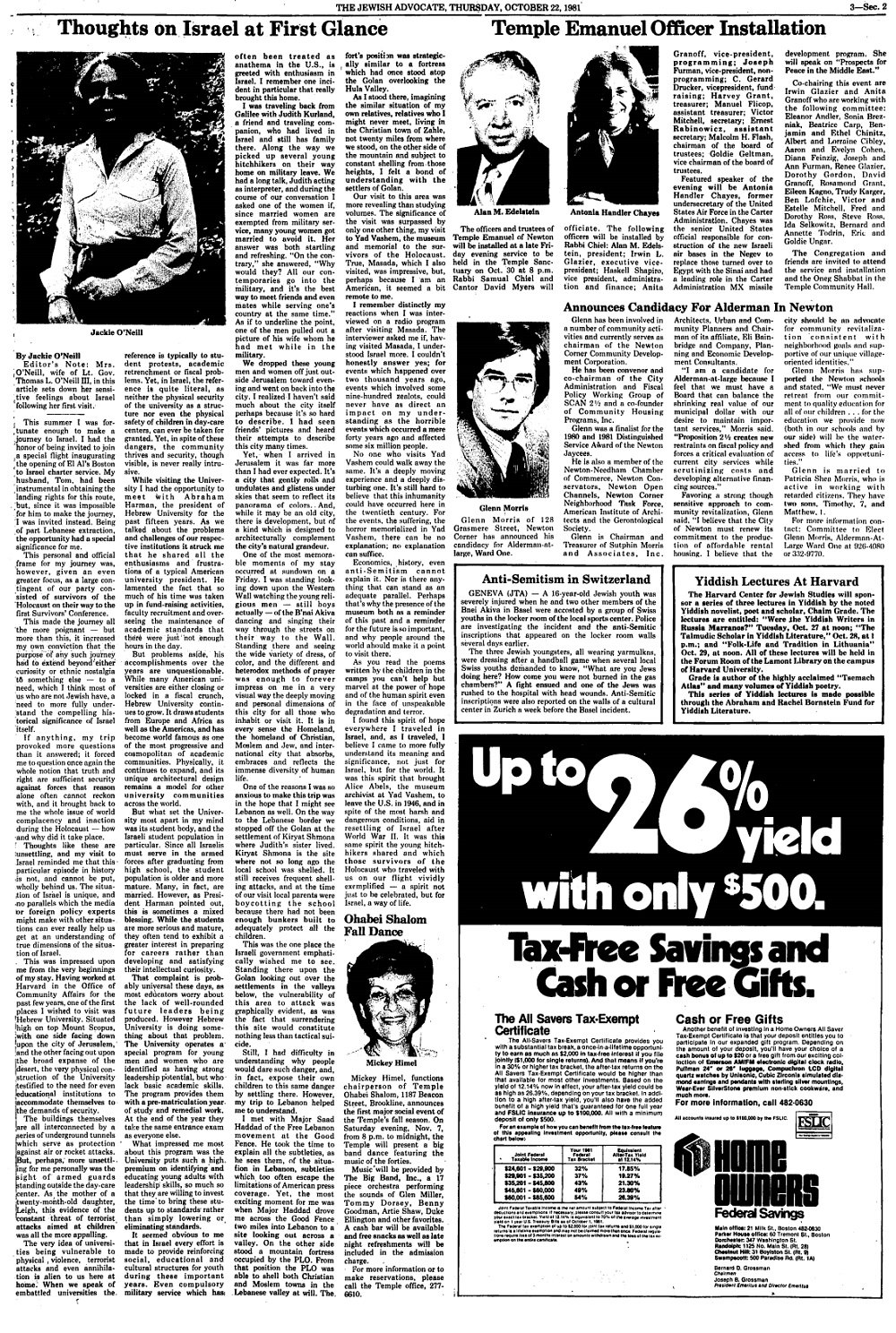
[20] Twersky discusses this text in “Religion and Law” in S.D. Goitein, ed., Religion in a Religious Age (New York, 1974), pp. 69-82. Regarding Twersky, I recently discovered this video of one of Chaim Grade’s lectures at Harvard from October 1981, and Twersky introduces him at the beginning. Unfortunately, only the first part of the lecture appears in the video. If anyone knows if the second part exists, please let me know. Menachem Butler was kind enough to send this page from the Boston Jewish Advocate, Oct. 22, 1981, announcing the Grade lectures.

Grade had earlier lectured at Harvard in 1977. Regarding these lectures, see Allan Nadler’s recollections here.
[21] Here is the first page of an article by Yehudah Hershkowitz that appeared in Yeshurun 9 (2001), p. 572.

Note how Duran is referred to as “Rabbenu”. The author is aware that Duran apostatized, but he, like everyone before him, assumed that Duran later returned to Judaism.
[22] Regarding martyrdom, R. Moshe Feinstein makes an interesting point in Iggerot Moshe, Yoreh Deah III, no. 108 (p. 353). We all know that a convert must accept the mitzvot for the conversion to be valid. What about if a convert honestly states that while he accepts the mitzvot, if confronted with violating a prohibition for which martyrdom is required, he knows that he will not have the courage to be martyred? Is this to be regarded as rejecting a commandment which means that he cannot be converted? R. Moshe says no, as acceptance of the mitzvot means that you intend to fulfill them under normal circumstances, and extreme cases such as those that involve martyrdom do not impact this acceptance.
[23] For R. Elijah Capsali’s report of the forced conversion, by actual physical force, see Abraham Gross, Struggling with Tradition (Leiden, 2004), p. 81. See also the Christian report in E. H. Lindo, The History of the Jews of Spain and Portugal (New York, 1970), p. 330. Another forced convert in Portugal who later became famous was R. Solomon Ibn Verga, author of Shevet Yehudah. R. Joseph Garson, who later escaped to Salonika, also appears to have undergone forced conversion in Portugal. See Joseph Hacker, “Li-Demutam ha-Ruhanit shel Yehudei Sefarad be-Sof ha-Meah ha-Hamesh Esreh,” Sefunot 2, new series (1983), pp. 29ff. As with R. Levi, we do not know the circumstances of the forced conversions of R. Ibn Verga and R. Garson. Since it appears that R. Jacob Ibn Habib was also in Portugal in 1497, then presumably he too was converted, either “willingly” or not. See, however, Marjorie Lehman, The En Yaaqov: Jacob ibn Habib’s Search for Faith in the Talmudic Corpus (Detroit, 2012), pp. 26-27. Regarding whether R. Isaac Karo was in Portugal then, or if he succeeded in leaving prior to the mass conversion, see Karo, Derashot R. Yitzhak Karo, ed. Shaul Regev (Ramat-Gan, 1995), pp. 9-10.
[24] Kuntres ha-Semikhah, in Teshuvot R. Levi Ibn Habib, no. 147, section 4 (p. 39 in the new edition).
[25] Ibid., no. 148 section 5, p. 52.
[26] R. Solomon ben Adret, She’elot u-Teshuvot ha-Rashba, vol. 6, no. 179, explains that this is because a person’s intellect is not sufficiently developed until age 20.
[27] R. Moses Sofer rejects the notion that one is not punished by Heaven for sins committed before age 20. See She’elot u-Teshuvot Hatam Sofer, vol. 2, Yoreh Deah no. 155. For more on this matter, see R. Pinchas Zabihi, Ateret Paz, vol. 3, no. 1, and here.
[28] Teshuvot R. Levi Ibn Habib, no. 148, section 5 (p. 53 in the new edition).
[29] Divine Law in Human Hands (Jerusalem, 1998), p. 170.
[30] Riera, “Le-Toldot ha-Rivash bi-Gezerot 1391,” Sefunot 17 (1983), pp. 11-20.
[31] Rabbi Yitzhak Bar Sheshet (Beitar Ilit, 2017), pp. 83ff.
[32] In this post, I have not dealt with accusations of rabbis’ apostatizing that arose in the contexts of disputes. For an example where hasidim accused one of their mitnagedic opponents, R. Leib Rakowski of Plock, of apostasy and also of marrying a non-Jewish woman, see Marcin Wodzinski, Studying Hasidism (New Brunswick, N.J., 2019), p. 120. This occurred after they tried to beat up the rabbi. See ibid., p. 119.
[33] In rabbinic literature Algiers is written as ארג’יל. This is due to the influence of the Spanish exiles who settled in North Africa, as in Spanish Algiers is pronounced as Argel. I was surprised to see that a generally careful scholar, Tuvia Preschel, Ma’amrei Tuvyah, vol. 1, p. 58, recorded the following false information.   

הם [יהודי אלג’יר] לא רצו לכתוב אלגיר שהיא מלשון אלה וגם “גירא בעיניך השטן” וע”כ הסבו שם העיר לארג’יל, לשון אור וגיל וסימנה טוב


[34] Regarding the transfer of the remains, see Bar Sheshet, Rabbi Yitzhak Bar Sheshet, pp. 83ff.
[35] In his Derashot Kol Ben Levi, p. 130, R. Jehiel Michel Epstein’s explains ביודעים ובלא יודעים as follows:

היודעים המה העבירות שאין להם מבא בהיתר כלל והלא יודעים הם המותרות מההיתר שאין האדם מרגיש בנפשו כלל שזהו חטא וא”כ אין ידוע כלל שחטאנו לפניך

For a homiletic explanation that is found in many different sources, see R. Zvi Hirsch Ferber, Siah Tzvi, p. 162:

וזה שאנו מתודים על חטא שח”ל ביודעים, זה שהגיע להוראה ואינו מורה, ובלא יודעים, שלא הגיע להוראה ומורה

Yisrael Meir Lau,Yahel Yisrael: Avot, ch. 4, p. 246, writes:

בלא יודעים – הכוונה לחטא שחטאנו, מחמת שהיינו במצב של “לא יודעים”, שבאשמתנו לא ידענו את הדין, ועברנו על  העבירה בלא לדעת כלל שיש בכך איסור. חומרתו של מעשה הנעשה “בלא יודעים” היא, ממש כמעשה הנעשה “ביודעים”, ועל שניהם כאחד אנו מתוודים ומבקשים שהקב”ה יסלח לנו ביום הכיפורים

[36] My copy was published in 1979. Later, ArtScroll changed the transliteration to Zemiros.
[37] כל with kamatz is pronounced as kamatz katan. The only exceptions in Tanakh are Psalms 35:10: כל עצמתי, and Proverbs 19:7: כל אחי-רש. In these cases there is no makef after כל and therefore it is pronounced as kamatz gadol.

Isaiah 40:12 is another biblical verse with the word כל without a makef and it too has a kamatz gadol:

וכל בשלש עפר הארץ

Yet the word כל here is completely different than all other appearances of כל in Tanakh. This passage means, “and comprehended the dust of the earth in a shalish-measure.” The word כל we are all familiar with is from the root כלל. The word כל in Isaiah 40:12 is from the root כול.
[38] I found another mistake in ArtScroll’s version of the song, and again, many others, including Koren and the new RCA siddur, make the same mistake. Yet the RCA-De Sola Pool siddur gets it right, as does Birnbaum. In the first stanza it reads עד אנא תוגיון. ArtScroll vocalizes the last word as “tugyon” (shuruk, holam) Yet this is a verse in Job 19:2 and the correct pronunciation is “togyun” (holam, shuruk).

The fifth stanza ends רוחו בם נחה. ArtScroll puts the accent in נחה on the penultimate syllable. However, in the context of the song, where all the other stanzas have the parallel rhyming word with the accent on the last syllable, I don’t think there is any doubt that נחה should also be read with the accent on the last syllable, despite what the grammatical rule may say.


Waiting Six Hours for Dairy- A Rabbanite Response to Qaraism

Waiting Six Hours for Dairy- A Rabbanite
Response to Qaraism
By Tzvi H. Adams
tzviha@gmail.com

Qaraites are a Jewish group that began around 760 CE. They rejected the Talmud
and rabbinic Judaism and insisted that Jews only observe halacha as expressed
in the literal text of the Torah. “Qaraite” means “Scriptualist”. The movement
started in Iraq and Persia by Jews who objected to the authority of the leaders
of the Babylonian Talmud Academies, the Gaonim. The Gaonim and their
successors, the rishonim, are called Rabbanites because of their stance in
defending the Talmud and rabbinic laws. 
Scholars have noted that many minhagim began as a response to the Qaraite
movement. For example, the recital of במה מדליקין
on Friday evening  after davening [1] was
started in the times of the Gaonim to reinforce the rabbinic stance on having
fire prepared before Shabbos, in opposition to the Qaraite view that no fire
may be present in one’s home on Shabbos [2]. There is evidence that the reading
of Pirkei Avos [3] on Shabbos afternoon, which began in Gaonic times, was to
emphasize to the Jewish masses that the Oral Law was passed down since Moshe
Rabbeinu as stated in the first mishna of Pirkei Avos.

Professor Haym Soloveitchik [4] has argued
convincingly that the unique arrangement of Hilchos Shabbos in Rambam’s Mishna
Torah was organized specifically with anti-Qaraite intent. Briefly, Rambam’s
formulation of the Shabbos laws does not follow a chronological order or any
other expected logical order. In his opening chapters, Rambam lays down the
following rules: preserving lifesaving overrides the restrictions of Shabbos;
only work done on Shabbos itself is forbidden (e.g. shehiyah and hatmanah are
allowed); work done by a Gentile upon a Jew’s request is only forbidden by
rabbinic law. These three rulings were denied by Qaraites. Rambam is then
careful to segregate the Torah laws (di’Oraisas) into one group of
chapters (7-12) and all the rabbinic rulings (di’rabbanans) into another
set (21-24), with eight chapters separating the two. Soleveitchik argues that
this was done to “highlight the very existence and legal force of rabbinic
enactments, both of which were denied by the Qaraites”. Finally, Maimonides
concludes the laws of Shabbos with an uplifting positive note: the laws of kibbud
ve’oneg
Shabbos. This further emphasizes the difference between the Qaraite
and Rabbanite Shabbos, because Qaraites treated Shabbos “as a day of ascetic
retreat and allowed only the barest minimum of eating and sleeping.” Rambam
emphasizesאיזה
הוא
עינוג:  זה
שאמרו
חכמים
שצריך
לתקן
תבשיל
שמן
ביותר,
ומשקה
מבושם,
הכול
לשבת  and
 [5] אכילת
בשר
ושתיית
יין
בשבת,
עינוג
הוא
לה. 
With this argument Soloveichik is suggesting that Rambam organized material in
Mishna Torah so that the differences between Qaraite and Rabbanite Shabbos are emphasized
to the reader. However, Soloveitchik takes matters one step further: He notes
that Rambam is the first to define intimacy on Shabbos as oneg Shabbos: תשמיש
המיטה,
מעונג
שבת
הוא.
 The Talmud only states that intimacy on
Shabbos is allowed, but does not elevate this act to the categorization of mitzvas
oneg Shabbos. Here, Soloveitchik argues that Rambam actually redefined
the Talmudic law for polemical reasons [6]. This is a revolutionary proposition
as we are generally under the assumption that the Mishna Torah is a practical
summary of the Talmud – as Rambam tells us in his introduction to Mishna Torah [7]. Professor Soloveitchik has opened the door for the
understanding that within Mishna Torah there may be Talmudic laws which have
been redefined or reformulated for anti-Qaraite reasons.

Waiting After Chicken: Rambam’s Innovation

I would like to suggest that Rambam’s interpretation of meat-milk
separation laws was also based on anti-Qaraite socio-political motivation. While
some earlier rishonim required waiting between eating beheima meat and eating
dairy, Rambam was the first to state that one must wait after eating poultry,
as well. (Beheima meat refers to meat from cows, sheep or goats.):

מִי שֶׁאָכַל בָּשָׂר בַּתְּחִלָּה,
בֵּין בְּשַׂר בְּהֵמָה בֵּין בְּשַׂר עוֹף–לֹא יֹאכַל אַחֲרָיו חָלָב עַד
שֶׁיִּשְׁהֶה בֵּינֵיהֶן כְּדֵי שֵׁעוּר סְעוֹדָה אַחֶרֶת, וְהוּא כְּמוֹ שֵׁשׁ
שָׁעוֹת:  מִפְּנֵי הַבָּשָׂר שֶׁלְּבֵין
הַשִּׁנַּיִם, שְׁאֵינוּ סָר בְּקִנּוּחַ
רמבם
משנה תורה מאכלות אסורות פרק ט’ הלכה כז

This contradicts the simple reading of the Gemara Chullin
104b:
 תנא
אגרא
חמוה
דרבי אבא
עוף
וגבינה
נאכלין
באפיקורן
הוא
תני
לה
והוא
אמר
לה
בלא
נטילת
ידים
ובלא
קינוח
הפה
which states plainly that poultry and cheese (even
in that order) may been eaten באפיקורן (in one kerchief)) or
without concern (לשון הפקר)  even without washing one’s hands or mouth in
between their consumption. See, for example, Ritva (Chullin 104b) [8]:
פירש”י שאם אכל זה ובה לאכול זה
א”צ לקנח פיו ולא ליטול. ונראה מלשונו אפי’ בשאכל בשר עוף בתחילה…
Earlier rishonim who required a long wait between beheima
meat and dairy did not require this waiting between poultry and dairy. R. Chananel
and R. Yitchak Alfasi required a waiting period only between beheima
meat and dairy, but not between poultry and dairy. Rishonim in the years close
after Rambam’s lifetime challenged his innovation.
Here are the core lines of the sugya (Chullin 105a) which are most relevant to
this discussion:

גופא אמר רב חסדא אכל בשר אסור לאכול
גבינה
אמר מר עוקבא אנא להא מלתא חלא בר
חמרא לגבי אבא דאילו אבא כי הוה אכיל בשרא האידנא לא הוה אכל גבינה עד למחר עד
השתא ואילו אנא בהא סעודתא הוא דלא אכילנא לסעודתא אחריתא אכילנא
R. Chananel comments:

וזה
לשון
רבינו
חננאל
ז”ל, ולא
מצינו
מי
שהתיר
לאכול
גבינה
אחר
בשר
בפחות
מעת
לעת
אלא
מר
עוקבא
דאכל
בשר
בסעוד’
אח’
בסעוד’
אחרת
גבינ’
ואמ’
על
עצמו
דבהא
מלתא
חלא
בר
חמרא
אנא
ואי
אפשר
להתיר
בפחו’
מזה…ע”כ הובא
בתוס’
הרא”ש וחי’
הרשב”א חולין
קה
ע”א))
R. Chananel is not cited in regards to poultry and
it can be assumed he is speaking only of red meat. This is more apparent in the
words of his disciple R. Yitchak Alfasi (1013 – 1103) who shares his master’s
view:
הרי”ף פרק
כל
הבשר- תנא
אגרא
חמוה
דרבי אבא
עוף
וגבינה
נאכלין
באפיקורן
וי”א באפיקוליס הוא תני
לה
והוא
אמר
לה
בלא
קינוח
הפה
ובלא נטילת
ידים…
ושמעינן
מהא
דהאי
דא”ר חסדא
אכל
בשר
אסור
לאכול
גבינה
דלא
שרי
למיכל
גבינה
בתר
בשרא
אלא
עד
דשהי
ליה
שיעור
מה
דצריך
לסעודתא
אחריתי
דלא
אשכחינן
מאן
דשרי
למיכל
גבינה
בתר
בישרא
בפחות
מהאי
שיעורא
It is clear from the Rif’s discussion of the
statement of אגרא that his use of the
words בשר
and עוף
denote two separate entities. Rif’s requirement to wait דשהי
ליה
שיעור
מה
דצריך
לסעודתא”
אחריתי”
is only for red meat, not poultry.  Rif
moved from North Africa to Spain in 1088 and was recognized there as the
leading halachic authority. The psak of R. Chananel and Rif became standard
over time in Spain and people waited after red meat before eating dairy; and
evidence suggests that they did not wait after poultry. One source is in the Sefer
Ittur
of R. Yitchak ben Abba Mari (c. 1122 – c. 1193). In his discussion of
the view of R. Chananel, Ittur makes clear that for fowl there is no six
hour waiting requirement:
 ספר
העיטור
שער
ראשון
הל’
הכשר
בשר
דף
יג
ע”ב והלכתא
… אלא
קינוח
הפה
לגבינה
לבשר.
ושהייה
לבשר
וגבינה…
ועוף
וגבינה
אצ
שהייה
לבשר
וגבינה
ולא
קנוח
הפה
ונט”י לגבינה
ובשר.   

Another source is from Meiri (1249-1306) in his Sefer
Magen Avos
written about 100 years after Rambam’s Mishna Torah.
Meiri wrote Magen Avos to defend the customs of Provence against the
ridicule and challenge of Spanish rishonim:
 מגן
אבות
דף
יא’
הקדמה-
ומה
שהביאנו
לסדר
אופני
אלה
הדברים
שכתבנו…הוא,
שאנחנו
בעיר
הזאת
עיר
פרפיאגיאק
והחזקנו
בהרבה
מנהגים
היו
בידינו
בירושה
מאבותינו…
ביד
חכמי
העיר
ברדש
… ורב
גבול
ארץ
פרובינצה.
ועתה
מקרוב
באו
הנה
קצת
חכמים
מארץ
ספרד…
לערער
בקצת
מנהגינו…
וראיתי
לכתוב
על
ספר
מה
שנשאתי
ונתתי
עמהם
באלו
המנהגות…
He records the Spanish custom not to wait at all
between fowl and milk. He describes how in his time a new generation of Spanish
rabbis began to adopt the stringent view of Rambam and begin a new trend:
דף
מו’-מט’
הענין
התשיעי.
עוד
נשאו
ונתנו
אתנו
במה
שהם
נוהגים
לאכול
גבינה
אחר
עוף,
ואנו
מחמירים
עד
שישהא
שש
שעות
או
חמש
כשיעור
שבין
סעודה
לסעודה
כדין
האמור
בבשר
בהמה….ונמצא
כלל
הדברים,
שכל
מאכל
בשר
בין
של
בהמה
בין
של
עוף
אינו
אוכל
גבינה
אח”כ עד
שיעברו
שש
שעות
או
חמש…ויראה
לי
להקל
עוד
שאף
באכל
עוף
תחילה
אע”פ שצריך
שהיה,
אינו
צריך
שש
שעות,
אלא
כל
שסעודה
לסעודה
אפילו
בקירוב
זמן
הואיל
וסילק
, ועקר….אלא
שהדברים
ברורים
כשטתינו
ואף
הם
הודו
שחכמים
האחרונים
שבגלילותיהם
מחמירים
בה
ונוהגים
כמנהגינו
והנאני
הדבר
It is clear that the former norm in Spain was to eat
cheeses/dairy immediately after poultry with no 
kinuach ve’hadacha, like the Ittur indicates was the
accepted halacha in that country.
(Is interesting to note Meiri’s own leniency for poultry: …ויראה
לי
להקל
עוד
שאף
באכל
עוף
תחילה
אע”פ שצריך
שהיה,
אינו
צריך
שש
שעות,
אלא
כל
שסעודה
לסעודה
אפילו
בקירוב
זמן
הואיל
וסילק
, ועקר.)

In the two generations following Rambam, the
greatest rishonim attacked the Rambam’s reform as it reversed the ruling of the
Bavli. Ramban (1194-1270) was the first to challenge Rambam’s alteration:

… אבל הרמב”ן ז”ל כתב דאגרא
אפילו עוף ואחר כך גבינה שרא דלישנא הכי משמע דקאמר עוף וגבינה…(ר”ן על
הרי”ף חולין דף לז’)
R. Aaron Halevi (1230-1300) was next:
…ואפילו הכי שרינן בעוף בלא נטילת ידים
משום דקיל דלא מיתסר אלא מדרבנן, ודאי לא שני לן בין עוף ואחר כך גבינה בין גבינה
ואחר כך עוף… הוא הדין לקנוח הפה דלא בעינן אפי’ בין עוף לגבינה…. ולהוציא קצת
מדברי רבי’ ז”ל (=הרמב”ם) שפרשו דההיא דאגרא דאמר עוף וגבנה נאכלין
באפיקורן דוקא גבינה תחילה ואחר כך עוף… (חידושי רא”ה לחולין דף קד’)
However, as Meiri noted, the trend in Spain began to
change [9]. Creative ways of reinterpreting the words of אגרא
were created to fit this new reform into the Talmud. Tur (1275-1340) YD 89
cites Rambam’s ruling on poultry as if none other exists.
Why did Rambam change the Halacha?  Perhaps it was an anti-Qaraite measure. By extending
the waiting requirement to include poultry, the divide between Rabbanites and Qaraites
became more apparent. Rabbanite Jews who followed Rambam’s ruling could
participate in only a limited way at a multicourse Qaraite meal which included
poultry and dairy.

Waiting 6 Hours- R. Chananel’s Innovation

Until R. Chananel’s time, waiting between meat and milk was not considered
mandatory by halachic authorities. One could choose instead to perform kinuach
ve’hadacha
– clean out one’s mouth and rinse one’s hands, if they were soiled
from meat. The halachic modification of removing the kinuach ve’hadacha option
was likely planned as an anti-Qaraite legislation.

Two primary authorities report on the halacha as it was in pre- R. Chananel
times. One is the Baal Halochos Gedolos (BaHaG) of either R. Yehudai Gaon, head
of the yeshiva in Sura from 757 to 761, and/or Shimon Kayyara (8th
century). (The correct authorship of BaHaG is a matter of scholarly debate, but
its author was a recognized source of halachic tradition from the 8th century.)

הלכות גדולות הלכות ברכות פרק ששי ט’
א’ (הובא גם בטור או”ח קעג’)- אמצעיים רשות אמר רב נחמן לא שנו אלא שבין
תבשיל לתבשיל אבל בין בשר לגבינה חובה והאי דשרו רבנן גבינה בתר בשר
משמעתיה דרב נחמן … אמר רב חסדא אכל בשר אסור לאכול גבינה ודוקא בלא קינוח אבל
מקנח פומיה שרי למיכל
A careful reading of BaHaG shows that the “רבנן” cited in BaHaG refers
to contemporaneous sages, not only earlier “Chazal”.
The second testimony is from R. Hai Gaon (939-1038), as cited by Rashba:

חידושי
הרשב”א חולין
קה
ע”א אבל
הרב
בעל
הלכות
גדולות
ז”ל כתב
בהלכו’
ברכות…
וכן
דעת
רבינו
יעקב
ז”ל וגאון זכרונו לברכה גם כן כתב אכל
בשר מותר
לסעודה אחרת למיכל גבינה וה”מ בחסידי אבל אנן מקנחינ’ ומחוורינן ידן
ופומן ואכלי’
. אכל גבינ’ שרי למיכל בשר בלא קנוח בלא נטילת ידים וה”מ
דחזייה לידיה דלא מטנפא. (הובא גם בספר העיטור שער ראשון הל’ הכשר בשר דף יג
ע”ב)
The Rashba is clearly citing two separate sources, the
BaHaG and the “Gaon” (R’ Hai [10]). R. Hai Gaon speaks in the plural and says “we
rinse hands and wash out our mouths and eat”. Evidently, this was the common
practice amongst the gaonim.
What triggered the halachic transformation which we observe in the leading
North African and Spanish rishonim of the following generation? (R. Chananel
was about 48 years old when R. Hai passed away.) 
Let’s analyze early Qaraite halachic progressions and how they correlate with
inverse developments in Rabbanite halacha. To fully appreciate the reasons for
R. Chananel’s modernization of milk and meat laws, it is necessary to trace Qaraite
geographic, demographic, and halachic developments.

Historical Development of Qaraite
Halacha

Nathan Shur’s Toldoth haKaraim[11]
provides an overview of Qaraite history. Qaraism began gradually in the late
eighth and early ninth centuries CE. Anan Ben David (c. 715 – c. 795), who was later claimed to be the founder of the
Qaraite movement (though not historically accurate), maintained that it is
forbidden to eat meat until the Temple is rebuilt [12]. Benjamin Nahawendi (early 9th century), Sahl ben Matzliah Abu al-Sari (910–990), and Daniel al-Kumisi  (d. 946), all early
prominent Qaraite scholars and philosophers, forbade their followers from eating meat until the restoration of the
sacrifices [13]. The Tustaries
[14], a family of wealthy influential Qaraites with independent philosophic and
halachic views, also forbade eating meat. Qaraite views were not uniform on all matters; Yacob
Qirqisani, a
leading Qaraite scholar of the first half of the tenth century, limited this meat restriction to Jerusalem but
allowed consumption of meat and wine outside Jerusalem. Slowly over the course of the tenth
century the abstinent trend amongst Qaraites loosened and it became acceptable
to allow meat consumption [15].

From the
inception of Qaraism, its scholars read the passuk, “לא
תבשל גדי בחלב אמו” literally (al-Qirqisani, Kitab al-AnWar,
XII, 25:4 “‘in its mother’s milk’ refers only to the milk of its mother”). They
therefore had no hesitations against eating meat and dairy together and did so once
they had relaxed the mourning restriction. Shlomo ben Yehuda Gaon, (Jerusalem, 1025-1051), records that the
Qaraites ate dairy with meat [16].
These Qaraite
developments coincided with corresponding developments in Rabbanite circles. R.
Chananel
was born in the year 990 and passed away in 1053. We don’t know exactly when he
wrote his commentary to Tractate Chullin requiring a six hour wait, but it
probably was early in the eleventh century. Soon after the Qaraites
began breaching the rabbinic meat and milk halachos in the
mid-tenth century, the Rabbanites responded by building a fence to
guard those same halachos.

Qaraite Geography

In beginning of ninth and tenth century Qaraites were concentrated in Iraq and
Persia, but in the middle of the tenth century they began moving westward to
Jerusalem, North Africa, and Spain. During this time period, Qaraites lived throughout
the Jewish-inhabited world. In every important city besides those in France and
Germany, a Qaraite community could be found alongside each Rabbanite community
[17]. Many of the Qaraites were great philosophers, writers, and wealthy
merchants; some were invested with high political power. In Cairo, Qaraites
were so powerful and influential that many Rabbanites left the fold for Qaraism,
until Rambam came to Cairo in 1166 and stopped this drift by improving the
political power of the Rabbanites [18]. It is thus understandable why Rambam
would seek to modify Jewish practices to widen the separation between Rabbanites
and Qaraites. 
R. Chananel (990 – 1053) and R. Yitchak Alfasi (1013 – 1103), the first rishonim to make the six hour wait an
absolute requirement, lived in Fez, Kairouan, and Spain, side by side with Qaraite
communities. As the Qaraites allowed themselves to eat milk and meat together
over the course of the tenth century, they became nicknamed ‘the eaters of milk
and meat’. They surely influenced some from the Rabbanite community. In order
to protect the Halacha, highlight their symbolic differences, and erect a
social barrier between the two camps, these leaders extended the original kinuach
ve’hadacha
obligation to a six hour wait.
Some historians believe that the Qaraites of the early Middle Ages
counted for close to half of the total Jewish population [19]. Furthermore, recent
analysis of Cairo Geniza documents shows that Qaraite and Rabbanite communities
of North Africa and Eretz Yisrael of the tenth through thirteenth centuries
collaborated in legal affairs, political endeavors, and commerce. There were
even frequent mutually respectful Qaraite-Rabbanite marriages [20]. The
two communities were dependent on each other in many ways. An excellent
description of this historical setting is found in Heresy and the Politics
of Community
by Marina Rustow (2008). The need to defend the rabbinic
Halacha is understood better against such an historical backdrop. As the
divide between the communities was sometimes blurred, reinforcement was
necessary. It is understandable why we find a Rabbanite response to Qaraite
leniencies from North African Rabbanite authorities and not from the heirs
of the Gaonate in Iraq. This is because the center of Qaraite activity had
already migrated from Iraq to the Mediterranean Basin over the course
of the tenth century.

During the tenth and
eleventh centuries Rabbanites from all over the Mediterranean
would make yearly pilgrimages to Jerusalem for Sukkos. On Haosha’na Rabba the
custom was for all
to gather on Har ha’Zaisim and amongst other things declare blessings and bans.
In 1029 and 1038, the Rabbanites proclaimed a ban against the Qaraites. It is
the wording of these charamim which is very revealing. The ban was worded
“against the eaters of meat and milk”.
Rustow explains the deeper context and meaning behind the ban:

…the Rabbanites and the
Qaraites in the Fatamid realm conducted regular professional and personal
relations. The ban’s aim was not to correct Qaraite religious behavior, but to
achieve symbolic or ritual separation between the two groups. …. the principle
violation with which the Qaraites stood charged- challenging the rabbinic claim
to exclusive authority in interpreting biblical law …. The ban was couched, by
a synecdoche that stood for an entire theological aberration, in terms of a
specific infringement: eating meat with milk. [21]
The
milk and meat mixing of the Qaraites symbolized the divide between the Qaraite
and Rabbanite camps. It is clear why the leading rabbinic sages of this era
would fortify and tighten this particular area of law.
Precedent in Rabbeinu Tam

This argument for the political origins of the six hour wait may seem novel and
shocking, but in fact, the truth of its background was known from the
beginning. Rabbeinu Tam (1100-1171) of France who lived shortly after the
innovation of R. Channenel and Rif writes exactly this:

ספר
הישר
לרבינו
תם סימן
תעב.
כל
הבשר.
אמ’
רב
נחמן
לא
שנו
…פירש
רב
יהודאי
בשאלתות
שנשאלו
לפניו…
אבל
בין
בשר
בהמה
לגבינה
בעי
קינוח
והדחה.
והא
דאמר
מר
עוקבא
להא
מילתא
(חלא)
בר
חמרא
אנא
כו’
היינו
גבי
שיהוי
בלא
קינוח.
דהא
בעי
ר’
יוחנן
כמה
ישהא
כו’
היינו
היכא
דלא
קינח
אבל
אי
קינח
לא
בעי
שיהוי.
(ובין)
גבינה
לבשר
לא
בעי
קינוח
כלל….ובין
בשר
לגבינה
בעי
קינוח
או
שיהוי…
וכן
מוכיח
בהלכות
גדולות
של
ברכות….
וכן
עיקר.
ואעג
דר
חנינא
פליג
אהאי
פיסקא
לאו
דסמכא.
דהא
דאורי
שאינן
בני
דאורייתא.
ובקעה
מצא
וגדר
בה
גדר.
וכמו
שפסקתי
נר’
מתוך
ההלכה.
ורב
יהודאי
גאון
פירשה.
והיא
דסמכא….ספר
הישר
לרבינו
תם
חלק
החידושים
י”ל ע”י שמעון
ש.
שלזינגר
תשמ”ה 282-283  

(There appears to be printing error in this text: ר’ חנינא should be חננאל ר’.)
R. Avraham HaYarchi (c. 1155-1215) of Provence in his Manhig Olam paraphrases
Rabbeinu Tam’s words (without the printing error) [22]:

ספר המנהיג
הלכות סעודה אות ט’- ובהלכות ה”ר שמעון קיירא … ודאמר רב חסדא אכל בשר אסור
לאכול גבינה היינו בלא קינוח הפה אבל מי שיקנח פומיה וידיה שרי ליה למיכל…, ואפילו
באותו סעודה קאמר וכן כתב ר”י מנוחתו כבוד בספר הישר… פירש רב יהודאי גאון
בשאלתות שנשאלו לפניו… אבל בין בשר לגבינה בעי קינוח הפה והדחה ,,והא
דאמר
מר
עוקבא
אנא
להא
מילת
חלא
בר
חמרא
אנא
וכו’
היינו
גבי
שיהוי
ובלא
קינוח
הפה
דהא
דבעו
מיניה
דר’
יוחנן
כמה
ישהא
וכו’
היינו
בלא
קינוח
הפה
אבל
בקינוח
לא
בעי
שיהוי,
ובשר
שאכל
אחר
גבינה
לא
בעי
קינוח
ושיהוי
כלל…
וכן
מוכח
בהלכות
גדולות
של
ברכות….
ואעפ
שרבינו
חננאל
פליג
אהאי
פיסקא
וכן
הרב
אלפאסי
לאו
דסמכא
נינהו
ולמקום
שאינן
בני
תורה
חששו
ובקעא
מצאו
וגדרו
בה
גדר
וכן
עיקר
… כפר”ת.
What is meant by בקעא
מצאו
וגדרו
בה
גדר? It refers either to the Qaraites or to
the weakening of Rabbanite community values due to Qaraite influence.

Minhag Ashkenaz

What was the accepted Halacha in the Franco-German Jewish communities of the
early Middle Ages? Their custom was to allow eating dairy after meat as long as
a disuniting action was performed in between. Some Ashkenazi
rishonim required only kinuach ve’hadach; others required birkas
hamazon.
Rashi [23] (as cited by Siddur Rashi and Manhig) and Rashbam [24]
required birkas hamazon– the dairy foods must be consumed in a separate meal.
Rabbeinu Tam allowed their consumption in the same meal with an intermediary kinuach
vehadacha
. Consistency exists between the two Franco-German views- a time waiting
intermission as an absolute requirement was foreign to them [25].
R. Zerachiah
HaLevi Baal Ha-Maor of Provence (c. 1125- c. 1186)
concurred independently [26] with the view of R. Tam and reports that this was
the general custom in France:

 המאור הגדול לרבינו זרחיה הלוי
פרק כל הבשר – נקיטינן מהאי עובדא … היכא דאכל בשר מקמי גבינה אי ההוא בשר דאכל
בשר חיה ובהמה הוא צריך נט”י והוא דאכל בלילה וצריך נמי קינוח הפה … ועוף
וגבינה נאכלין באפיקורין
ולא צריכי ולא מידי … אע”פ שהקדים עוף לגבינה ..
והיכא דשהה ליה ו’ שעות שיעור שהייה שבין סעודה לסעודה אע”פ
שאכל בשר בהמה וחיה מותר לאכול גבינה… בלא ובלא קנוח הפה ולא אמר רב חסדא אכל בשר אסור לאכול גבינה אלא באפיקורן
כלומר בלא נט”י”נט”י
ובלא קנוח הפה אבל בנט”י ובקנוח הפה הכל מותר… ועל
זה הדרך מתיישבת כל השמועות כולן וכן פסק בעל ההלכות הראשונות ז”ל ומזה יתבאר
לך מה שפסק הרי”ף בהלכותיו על לא נכון…וטעו בפירושיהם להעמיד מנהגיהם ומה
שכתבנו היא המחוור וכן נהגו כל חכמי צרפת

The custom of the sages of France and Germany reflects the original
Halacha and simplest reading of the Talmud. There were no Qaraite communities
in France and Germany during that time period and hence the Franco-German sages
saw no need to respond with a symbolic and social barrier. The existence of the
original gaonic custom in European communities is in line with Haym Soloveitchik’s recent “Third Yeshiva of Bavel” hypothesis
[27]. Soloveitchik argues that the Ashkenazi scholarly community was
transplanted from Iraq sometime between the years 930 and 960. This emigration occurred
before R. Chananel’s new legislation [28]. They therefore knew only the ancient
Halacha and stuck with it because they had no reason to change [29].
Rabbi David Bar-Hayim of
Machon Shilo delivered a series of
comprehensive shiurim
(2010) explaining all the fine detail of this sugya in Chullin-
how it was originally understood and how it was later re-explained.
Here are two additional
considerations regarding the words of מר
עוקבא:
 אמר
מר עוקבא אנא להא מלתא חלא בר חמרא לגבי אבא דאילו אבא כי הוה אכיל בשרא האידנא לא
הוה אכל גבינה עד למחר עד השתא ואילו אנא בהא סעודתא הוא דלא אכילנא לסעודתא
אחריתא אכילנא
1) Mar Ukva is well-known in the Talmud for
his extreme piety and righteousness. See Kesubos 67b and Rashi Sanhedrin 31b ד”ה לדזיו. Why shouldn’t this statement be
understood as another example of his extreme personal religiosity [30]? 
2) How could R. Chananel  say-לא
מצינו
מי
שהתיר
לאכול
גבינה
אחר
בשר
בפחות
מעת
לעת
אלא
מר
עוקבא? This statement is shocking. If Jews commonly
waited 24 hours before dairy after eating meat wouldn’t there be some hint of
it somewhere in the vast Tannaic, Amoraic or Midrashic literature? The truth is
to the contrary- מר
עוקבאand his father are the only sages we ever hear
of who waited so long. In fact, his words are expressed in a way which
indicates that he speaks of a personal private custom:  .”אנא
להא מלתא…
ואילו אנא…” R. Chananel
himself was surely aware of the shortcomings of his argument.. He may have only
said these words in order to allow for the creation of a new Rabbanite custom
which would aid in segregating the Qaraites from the Rabbanites.  For the sake of launching the new order of
dietary and hence societal and communal limitations, R. Chananel devised a
clever way of manipulating the brief quasi-aggadic words of Mar Ukva.

Conclusion

The Qaraites from the start understood the biblical verses of lo sevashal
literally, in contrast to the Talmudic/rabbinic interpretation. Qaraite law
allowed for cooking and eating meat with milk. However, this Qaraite departure
from the Oral Law did not cause strife between the two factions during the
first two centuries of the movement’s existence because Qaraites adopted an
ascetic mournful lifestyle, abstaining from any meat at all. Practically,
therefore, during these early years, Qaraites were not cooking and/or eating
any meat and milk together. In the middle of the tenth century, Qaraite
lawmakers gradually adopted a more lenient worldly approach, allowing meat
consumption. With authorization to eat meat, Qaraites did so with no
compunctions about preparing the meat with dairy. This Qaraite breach of the
Oral Law earned them the nickname “the eaters of meat with milk”. This transgression
of the Qaraites became symbolic of the entire conflict between the Rabbanite
and Qaraite camps.  Throughout this
period, the two camps were very connected socially, politically, and economically.
There were Rabbanite-Qaraite marriages, joint business ventures, and joint
communities. The lines between the two camps were not as distinct as we may
imagine. At some point in the early eleventh century, the Rabbanite rishonim devised
a way to create greater division and social split between the two camps.
Choosing the very topic which represented the heart of the schism, they
reinterpreted Talmudic passages in a manner which requires waiting six hours
between eating red meat and dairy products, further separating the Rabbanites
from the Qaraites both halachically and socially. However, Rabbanites and Qaraites
could still enjoy a poultry-dairy meal together during community gatherings or
business meetings. It was more difficult to redefine an explicit statement in
the Talmud allowing poultry and dairy together without any separation in
between (אגרא’s statement). Maimonides was the first to
attempt to further widen the gap by including poultry in the six-hour wait
category. He was quickly attacked by other Talmudists such as Nachmanides and
R. Aaron HaLevi for contradicting the Talmud’s legal allowance. However, in
time even Maimonides’ expansion found justification by means of rereading and
re-explaining the simple meaning of the passage תנא
אגרא
חמוה
דרבי
אבא
עוף
וגבינה
נאכלין
באפיקורן
הוא
תני
לה
והוא
אמר
לה
בלא
נטילת
ידים
ובלא
קינוח
הפה [31]. 

I am very grateful to Rabbi Bar-Hayim of Machon
Shilo. Only after hearing his shiur
was I able to fit in the missing puzzle pieces [32]. This paper
repeats his message but also adds by filling in the historical setting which
caused the new strict waiting practice.  Readers will probably enjoy Rabbi
Bar-Hayim’s restorative conclusions
on this sugya.
[1] See Naftali Vieder,  התגבשות נוסח התפילה במזרח
ובמעריב
Volume I (1998), pgs. 323-351

[2]
Friday after davening was the best time for this recital as people returning
from shul would see the Qaraites in their dark homes- the rabbinic
interpretation of the passuk “לא תבערו אש”
needed to be reinforced by discussion in shul. Even the bracha said before
lighting the Shabbos candles was likely initiated to strengthen this practice
in response to the Qaraite custom. See Vieder ibid. pg. 343-346
[3] Vieder ibid. pg. 350
[4] Haym Soloveitchik, Collected Essays, Volume II
(2014), pgs. 378-395

[5]
Many of us are careful to drink some wine during every Shabbos seuda
shlishis
. The source for this custom originally (before kabbalists created
other reasons) is from Rambam (Shabbos 30:9):
 חייב
אדם לאכול שלוש סעודות בשבת–אחת ערבית,
 ואחת
שחרית, ואחת במנחה…
 וצריך לקבוע כל
סעודה משלושתן על היין

I
don’t think there is any source for this in the Talmud. Like Prof. Haym Soloveitchik
has argued about intimacy, Rambam may have created this ‘halacha’ to oppose the
Qaraite custom of abstaining from wine on Shabbos.
[6]
A similar phenomenon is found in ספר העתים
pg. 25:
ובשבת תקנו חכמים לטמנו מבערב כדי שישתמר
המאכל בחמימתו ויהי’ חם בשבת ואיכא בהא מילתא עונג שבת. ורוב מן החיצונים תלמידי
ביתוס יהי’ אהליהם לנתוץ וירקבו עצמותם אשר הטעו… שהחמין אסור בשבת ותיפח
עצמותיהם… והלכך כל שאינו אוכל חמין בשבת בר נידוי הוא ודרך מינות יש בו וצריך
להפרישו מקהל ישראל…
When
studying the third and fourth perakim of Shabbos one sees a long list of
restrictions and limitations. R. Yehuda Barcelona depicts these halachos in a
positive light: Chazal required shehiya and hatmanna for the purpose of oneg
Shabbos.  The beloved Shabbos lunch cholent
may be an anti-Qaraite creation.
[7] Here is the relevant section from Rambam’s Introduction:
…ואין צריך לומר, התלמוד עצמו: 
הבבלי, והירושלמי, וספרא, וספרי, והתוספתות–שהן צריכין דעת רחבה ונפש חכמה וזמן
ארוך…ומפני זה נערתי חוצני, אני משה בירבי מיימון הספרדי, ונשענתי על הצור ברוך
הוא, ובינותי בכל אלו הספרים; וראיתי לחבר דברים המתבררים מכל אלו החיבורין,
בעניין האסור והמותר והטמא והטהור עם שאר דיני תורה:  כולן בלשון ברורה ודרך
קצרה, עד שתהא תורה שבעל פה כולה סדורה בפי הכול–בלא קושיה ולא פירוק, ולא זה
אומר בכה וזה אומר בכה, אלא.. על פי המשפט אשר יתבאר מכל אלו החיבורין והפירושין
הנמצאים מימות רבנו הקדוש ועד עכשיו
[8] Also other early baalei Tosfos in Or Zarua 1:480.
[9] See Ritva and Rashba on Chullin 104-105. A similar trend is seen amongst
Italian rishonim. R. Yeshaya Trani II writes:

אלא שמורי זקני הרב (=ר’ ישעיה דטראני
הזקן) מתיר גבינה אחר בשר עוף. ורבינו משה (=רמב”ם) אוסר. וכך נראה בעיני
שאסור לאכול גבינה אפילו אחר בשר עוף
[10] I am taking the liberty to assume Rashba refers to R. Hai
Gaon. See for example Rashba on Brachos פרק תפלת השחר
where he cites “הגאון ז”ל” several times and is
certainly referring to R. Hai.
[11]
(2003) Bialik Institute Jerusalem
[12] Ibid. pg. 28
[13] Ibid. pg. 65
[14] Ibid. pg. 55
[15] Ibid. pg. 39

[16]
Ibid.
pg. 66
[17] Marina Rustow, Heresy and the Politics of
Community
(2008), pg. 3
[18] Nathan Shur, Toldoth haKaraim
(2003)
pg. 60-61

[19]
Salo Wittmayer Baron
[20] See Elinoar Bareket , “Karaite Communities in the Middle East”, Karaite
Judaism: A Guide to its History and Literary Sources
(2003) pg. 240: “The
Gaon Shelomoh ben Yehuda (gaon between the years 1025-1051) tells in one of
this letters that before his appointment as gaon he served as prayer leader of
the Karaites in Ramle, and would pray one day with the Rabbanites and the next
with the Karaites…. he pointed out that the two communities “complete each
other  as adultery to a bed…”, that is
sinners are to be found in both communities and there is no difference in this
matter.”

[21] pgs. 206-207
[22]
Also Or Zarua 1:480  :
…ופר”ח שלא פסק כך בקעא מצא וגדר בה
גדר.
[23] סידור רש”י סימן תקפז.
See Aviad Stollman, “מהדורה מדעית וביאור מקיף לסוגיות
ההרחקה בין בשר לחלב” Ramat Gan (2001) note 27.
[24] Compare Tosfos ד”ה לא שנו ,חולין דף קה:
with  .ד”ה לסעודתא אחריתא
[25] The idea of a waiting period only became popular in France and Germany
many generations later- probably because of influence of the seferim from the
Sefardic rishonim.

[26]
R. Aaron HaLevi also agrees with R. Tam in peirush to Chullin as well as סימן מח ויטרי מחזור.
[27] Haym Soloveitchik, Collected Essays, Volume II
(2014), pgs. 150-215

[28] As R. Hai (939-1038) still preserved the original kinuach
ve’hadacha
tradition it is reasonable to assume that R. Chananel
(990-1053) was the very first rishon to require six hours. In fact, R. Tam
places the blame on R. Chananel and was not aware of any earlier source.
[29]
Aviad Stollman in his  “מהדורה מדעית וביאור מקיף לסוגיות ההרחקה בין בשר לחלב”  and
התרחבות בהלכה כהיתוך אופקים פרשני: המתנה
בין בשר לחלב כמקרה מבחן”” AJS Review 28/2 (2005), has made a thorough analysis of
this sugya. Some of the more obscure sources on this topic I found in his
articles. He argues that the minhag Ashkenaz here originates from minhag Eretz
Yisroel and that the custom of the Sefardim to wait six hours originates from a
minhag Bavel. To establish that such a minhag Bavel existed he found it
necessary to downplay the words of BahaG (which indicate lack of a
waiting custom in Bavel) by pointing to ambiguities in BahaG’s wording. I believe R. Hai’s
testimony וה”מ בחסידי אבל אנן מקנחינ’
 ומחוורינן ידן ופומן ואכלי’” is
sufficient evidence that even the rabbinic elite in Bavel did not wait between
meat and dairy.

It
seems that Rabbi Stollman’s approach is based on the century old academic view
that minhag Ashkenaz had its origins in minhag Eretz Yisroel. The remainder of
Stollman’s arguments are built upon that model. More recently though, Haym Soloveitchik
in his Collected Essays, has made a very strong case for the
Babylonian origins of minhag  and
chachmei Ashkenaz (besides for the obvious Palestinian liturgical components of
minhag Ashkenaz). Stollman’s assumption that the non-waiting practice of
Ashkenaz originated from Eretz Yisroel should be reevaluated. Rather, the
minhag Ashkenaz here should be seen as pre-Qaraism Halacha.
It is evident from R. Hai that a small
group of pious men in Bavel did indeed have a waiting practice. Though this
cannot be considered “the minhag Bavel”, it may have been a kernel of precedent
which R. Chananel expanded for political reasons.
[30]
See Aviad Stollman, “מהדורה מדעית וביאור מקיף לסוגיות
ההרחקה בין בשר לחלב” (2001) note 40.
[31] Many later rishonim explained that though the order in Agra’s statement
is- poultry then cheese- it means –cheese then poultry!
[32] Rabbi Dr. Israel Drazin’s post on Qaraism here
also inspired this article. His insightful essays on all areas of Jewish
thought are always filled with depth and wisdom. 


The Seven Nations of Canaan

                                     THE SEVEN NATIONS OF CANAAN[1]
By Reuven Kimelman
This study deals with the war and the
seven Canaanite nations.[2] It complements my previous post on Amalek of March 13, 2014, “The Ethics of the Case of Amalek: An
Alternative Reading of the Biblical Data and the Jewish Tradition. “The popular
conception in both cases is that the Bible demands their extermination thereby
providing a precedent for genocide.[3] The popular reading of the Canaanites filters it through the prism of
Deuteronomy. The popular reading of
Amalek filters the Torah material through the prism of Saul’s battle against
Amalek in the Book of Samuel. In actuality, the biblical data is much
more ambiguous making the most destructive comments the exception not the rule as
will be evident from a systematic analysis of the Canaanite material in the
Bible as was previously done with Amalek.  
            This
post will deal with the following seven questions with regard to the nations of
Canaan:
a). What are the different biblical
approaches to the native nations of Canaan?
b). According to the Bible, what
actually happened to them?
c). What is the evidence that the
Bible is sensitive to the moral issues involved?
d). How has the Jewish tradition
removed the category of the seven nations from its ethical agenda?
e). What is the role of the
doctrine of repentance?
f). What is the relevance of the
“Sennacherib principle”?
g). How relevant is the category
“holy war”?
            With
regard to the extermination of the seven nations of Canaan,[4] sometimes called Canaanites sometimes Amorites, the biblical record is also not
of one cloth. The clarification of their status in the Bible requires a
systematic treatment of all the data book by book. 
Genesis (12:6, 15:16) is aware that the
Canaanites were in the land when Abraham arrived and would remain for
generations.  From Genesis 38 and the end
of The Book of Ruth we learn that from the progeny of Abraham’s great grandson
Judah and the Canaanite Tamar will issue King David. Also  Simeon’s son is identified as “Saul the son
of a Cannanite women” (Genesis 46:10, Exodus 6:15) without comment.
Exodus (23)’s position on the
elimination of the Canaanites (v. 23) is a gradual dispossession by God, not by
the Israelites:[5]
27 I will send forth My terror before
you, and I will throw into panic all the people among whom you come, and I will
make all your enemies turn tail before you. 28 I will send a plague ahead of
you, and it shall drive out before you the Hivites, the Canaanites, and the
Hittites.[6] 29 I will not drive them out before you in a single year, lest the land become
desolate and the wild beasts multiply to your hurt. 30 I will drive them out
before you little by little, until you have increased and possess the land.
Leviticus (18) refers to God casting out
of the nations:
24 Do not defile yourselves in any of
those ways, for it is by such that the nations that I am casting out before you
defiled themselves. 25 Thus the land became defiled; and I called it to account
for its iniquity, and the land spewed out its inhabitants.
Here there is a coordination between God
and land.  The land spews out its
inhabitants for defiling it and God expels them.  
Numbers (33) refers to the Israelites
deporting the local inhabitants:
51 Speak to the Israelite people and say
to them:
When you cross the Jordan into the land
of Canaan, 52 you shall dispossess all the inhabitants of the land; you shall
destroy all their figured objects; you shall destroy all their molten images,
and you shall demolish all their cult places. 53 And you shall take possession
of the land and settle in it, for I have assigned the land to you to possess.
It is clear that the issue here is not
ethnic but religio-cultural. The fear is that Israel will be ensnared,
especially through intermarriage, by the local moral and cultic practices
Exodus 34 emphasizes the religious
factor:
12b Beware of making a covenant with the
inhabitants of the land against which you are advancing, lest they be a snare
in your midst. 13 Rather you must tear down their altars, smash their
pillars,and cut down their sacred posts; 14 for you must not worship any other
God, because the Lord, whose name is Impassioned, is an impassioned God. 15 You
must not make a covenant with the inhabitants of the land, for they will lust
after their gods and sacrifice to their gods and invite you, and you will eat
of their sacrifices. 16 And when you take wives from among their daughters for
your sons, their daughters will lust after their gods and will cause your sons
to lust after their gods.[7]
Leviticus 18 emphasizes the moral
factor:
26 But you must keep My laws and My
rules, and you must not do any of those abhorrent things, neither the citizen
nor the stranger who resides among you; 27 for all those abhorrent things were
done by the people who were in the land before you, and the land became
defiled. 28 So let not the land spew you out for defiling it as it spewed out
the nation that came before you. 29 All who do any of those abhorrent
things—such persons shall be cut off from their people. 30 You shall keep My
charge not to engage in any of the abhorrent practices that were carried on
before you, and you shall not defile yourselves through them: I the Lord am
your God.
Numbers 33 warns Israel against
assimilating Canaanite norms lest they share their fate of expulsion. “55 But if
you do not dispossess the inhabitants of the land, those whom you allow to
remain shall be stings in your eyes and thorns in your sides, and they shall
harass you in the land in which you live; 56 so that I will do to you what I
planned to do to them.”

            The exception is Deuteronomy 7
which demands total destruction:
1 When the Lord your God brings you to
the land that you are about to enter and possess, and He dislodges many nations
before you— the Hittites, Girgashites, Amorites, Canaanites, Perizzites,
Hivites, and Jebusites, seven nations much larger than you—2and the Lord your
God delivers them to you and you defeat them, you must doom them to
destruction: grant them no terms and give them no quarter.
Even according to Deuteronomy the fear
is not of their DNA but moral assimilation, for it goes on to say:  “Lest they lead you into doing all the
abhorrent things that they have done for their gods and you stand guilty before
the Lord your God” (20:18). For Deuteronomy (12:31; 18:9-12), the abhorrent
things include child sacrifice.
Strangely, Deuteronomy continues with a
provision against intermarriage:
3 You shall not intermarry with them: do
not give your daughters to their sons or take their daughters for your sons.
4 For they will turn your children away from Me to worship other gods, and the
Lord’s anger will blaze forth against you and He will promptly wipe you out.
5 Instead, this is what you shall do to them: you shall tear down their altars,
smash their pillars, cut down their sacred posts, and consign their images to
the fire.

Apprehension about intermarriage or coming to terms with an eradicated people
is strange unless Deuteronomy is aware that its demand to doom them will not be
(or was not) implemented. And, in fact, as we shall see the evidence from
Judges 3 is that they did intermarry.
 Alternatively, ḥerem does not entail
the elimination of the Canaanites only their isolation, that is, they are to be
quarantined. This understanding follows its Semitic cognates where it means to
separate, to set aside.[8] The goal is to exclude any intercourse with them. Thus verse 5 only refers to
the elimination of their objects of worship not their persons. This opens the
possibility that “What we have is a retention of the … traditional language
of ḥerem, but a shift in the direction of its acquiring significance as
a metaphor … for religious fidelity.”[9]
 Even stranger is the description of the
confrontation with Sihon king of the Amorites. Within the context of
Deuteronomy, one would expect an outright attack when God says to Moses: “See,
I give into your power Sihon the Amorite, king of Heshbon, and his land. Begin
the occupation: engage him in battle” (2:24). Instead, what does Moses do:
26 Then I sent messengers from the
wilderness of Kedemoth to King Sihon of Heshbon with an offer of peace, as
follows, 27 “Let me pass through your country. I will keep strictly to the
highway, turning off neither to the right nor to the left. 28 What food I eat
you will supply for money, and what water I drink you will furnish for money;
just let me pass through.”
Sihon rejects the offer and attacks
Israel. They are destroyed only in the counterattack.
If there is no evidence for the
expulsion of the Canaanites, whence the position of Deuteronomy 7:1-2?
It has been speculated that Deuteronomy took “both the expulsion law of Exodus
23:20-33, directed against the inhabitants of Canaan, and the ḥerem
(total destruction) law of Exodus 22:19 (“Whoever sacrifices to a God other
than the Lord shall be proscribed), directed against the individual Israelite,
and fused them into a new law that applies ḥerem to all idolaters,
Israelites and non-Israelites alike.”[10] In other words, the ḥerem is not against Canaanites as Canaanites, but
idolaters as idolaters. Thus Deuteronomy (13:13-19) imposes the very punishment
on Israelite idolaters. The choice of the word ḥerem also promotes a
sense of quid pro quod, for, according to Numbers 14:45, the Canaanites and the
Amalekites pummeled Israel to Hormah a word which could simply designate a
place or also serve as a toponym since ad haḥormah could be
rendered “to utter destruction.”[11] The point of the paronomasia is that the Canaanites and the Amalekites got as
they gave.
In any case, except for some sources in
Joshua (6:21 and chapters 10-11) the later biblical sources follow the earlier
biblical books from Exodus to Numbers rather than Deuteronomy. Even the Joshua
material raises some questions. According to Joshua 10:33, Joshua totally
destroyed the people of Gezer. Yet Joshua 16:10 (like Judges 1:29) states: “They
failed to dispossess the Canaanites who dwelt in Gezer; so the Canaanites
remained in the midst of Ephraim, as is still the case. But they had to perform
forced labor.” In actuality, they stayed there until the reign of Solomon only
to be killed off by Pharaoh as noted in I Kings 9:16. Apparently, once the
people were defanged by having its army destroyed, they were given quarter.[12] As a subject nation they apparently present no religious threat. In fact, save
for the peculiar case of Judges 3:5, the surrounding nations, not the
Canaanites, are blamed for Israelite apostasy.[13] In fact, according to Joshua 8:29 and 10:27, the bodies of Canaanite kings hung
by Joshua were buried by nightfall just as Deuteronomy 21:23 enjoins.
Apparently, Human dignity is inalienable even for Canaanite kings.
The triumphal picture of Joshua is
undermined by the facts on the ground. For example, Joshua 11:12 gives the
impression that Joshua wiped out all the cities in the area of Hazor and burned
them to the ground. Yet the next verse says: “However, all those towns that are
still standing on their mounds were not burned down by Israel; it was Hazor
alone that Joshua burned down.” In fact, only two other cities were burned —
Jericho and Ai.
Similarly, Joshua 11:23 claims: “Thus
Joshua conquered the whole country, just as the Lord had promised Moses,”
whereas 13:1 concedes “and very much of the land still remains to be taken
possession of.” Even where Israel spread out much of the native population was
allowed to remain in their midst, as it says later in the same chapter: “the
Israelites failed to dispossess the Geshurites and the Maacathites, and Geshur
and Maacath remain among Israel to this day” (13:13). The sparing of the
Canaanite population was common. With regard to southern Israel, Joshua 15:63
says: “But the Judites could not dispossess the Jebusites, the inhabitants of
Jerusalem; so the Judites dwell with the Jebusites in Jerusalem to this day.”
With regard to central Israel, Joshua 16:10 says: “However, they failed to
dispossess the Canaanites who dwelt in Gezer; so the Canaanites remained in the
midst of Ephraim, as is still the case. But they had to perform forced labor.”
And with regard to northern Israel, Joshua 17:12-13 says: “The Manassites could
not dispossess [the inhabitants of] these towns, and the Canaanites stubbornly
remained in this region. When the Israelites became stronger, they imposed
tribute on the Canaanites; but they did not dispossess them.”
Judges 1:27-36 follows suit. It begins:
27 Manasseh did not dispossess [the
inhabitants of] Beth-shean and its dependencies, or [of] Taanach and its
dependencies, or the inhabitants of Dor and its dependencies, or the
inhabitants of Ibleam and its dependencies, or the inhabitants of Megiddo and
its dependencies. The Canaanites persisted in dwelling in this region. 28 And
when Israel gained the upper hand, they subjected the Canaanites to forced
labor; but they did not dispossess them. 29Nor did Ephraim dispossess the
Canaanites who inhabited Gezer; so the Canaanites dwelt in their midst at
Gezer…
All these sources mention the failure to
dispossess the Canaanites, despite the Israelites’ power to do so. No mention
is made of any extermination.[14] Joshua 24:13 does mention the expulsion of two kings but without resorting to
the sword and bow, a point reiterated in Psalm 44:5. Most remarkable is the
story in Judges 4. There it is told that God punished the Israelites by handing
them over to Yabin the king of Canaan and Sisera his general. In the divinely
commanded revolt against them, God promised to deliver them into the hands of
the Israelites not to wipe them out.
Joshua concedes in his farewell address
the failure of his policy. The most he can hope is that “The Lord your God
Himself will thrust them out on your account and drive them out to make way for
you” (Joshua 23:5). In the meantime, they are exhorted to be resolute not “to
intermingle with these nations that are left among you. Do not utter the names
of their gods or swear by them” (23:7). He them mentions the apprehension of
Deuteronomy of intermarriage: “For should you turn away and attach yourselves
to the remnant of those nations — to those that are left among you–and
intermarry with the you joining them and they joining you, know for certain
that the Lord your God will not continue to drive these nations out before you;
they shall become a snare and a trap for you” (23:12-13).
In fact, Judges 3 states that they did
intermarry: “The Israelites settled among the Canaanites, Hittites, Amorites,
Perizzites, Hivites, and Jebusites; they took their daughters to wife and gave
their own daughters to their sons, and they worshiped their gods” (5-6).
Intermarriage was likely a factor in the absence of biblical or extra biblical
evidence for Israel’s expulsion of the Canaanites. 
The archaeological record confirms that
Israel primarily settled in previously unoccupied territory in the central
highlands rather than rebuilt towns on destroyed Canaanite cites. In Judges 2,
they are threatened with the consequences of not dispossessing them:
1 An angel of the Lord came up from
Gilgal to Bochim and said, “I brought you up from Egypt and I took you into the
land which I had promised on oath to your fathers. And I said, ‘I will never
break My covenant with you. 2 And you, for your part, must make no covenant with
the inhabitants of this land; you must tear down their altars.’ But you have
not obeyed Me—look what you have done! 3 Therefore, I have resolved not to drive
them out before you; they shall become your oppressors, and their gods shall be
a snare to you.”
The Israelites not only did not drive out the inhabitants, they concluded
treaties with them. Their expulsion by God was contingent upon Israel’s refusal
to conclude a treaty with them. Neither took place.
Even at the height of ancient Israelite
power under the reign of Solomon there was no move to do away with them only to
subject them to forced labor, as I Kings 9 (= 2 Chronicles 8:7-8) states:
20All the people that were left of the
Amorites, Hittites, Perizzites, Hivites, and Jebusites who were not of the
Israelite stock—21those of their descendants who remained in the land and whom
the Israelites were not able to annihilate—of these Solomon made a slave force,
as is still the case.[15]
Nonetheless, Uriah the Hittite not only
marries Bathsheba but also serves as a trusted officer in David’s army.
            Psalm
106 laments the total failure of the policy. According to it, everything that
Joshua warned against, they did and more. Following Deuteronomy 12:31, it also
provides the moral basis by documenting the abhorrent behavior of the
Canaanites to their own children:
34 They did not destroy the nations as
the Lord had commanded them, 35 but mingled with the nations and learned their
ways. 36 They worshiped their idols, which became a snare for them. 37 Their own
sons and daughters they sacrificed to demons. 38 They shed innocent blood, the
blood of their sons and daughters, whom they sacrificed to the idols of Canaan;
so the land was polluted with bloodguilt. 39 Thus they became defiled by their
acts, debauched through their deeds.[16]
Verses 34-35 attest to the non
implementation of the policy of Deuteronomy 20:17-18.
            Remarkably,
the Rabbis explain the non implementation through the conversion of the
nations: 
R. Samuel bar Nahman began his discourse
with the verse: “But if you will not drive out the inhabitants
of the Land before you, then shall those that remain of them be as thorns in
your eyes and as pricks in your sides” (Numbers 33:55). The Holy One reminded
Israel: I said to you, “You shall utterly destroy them: the
Hittite and the Amorite” (Deuteronomy 20:17). But you did not do so; for “Rahab
the harlot, and her father’s household, and all that she had, did Joshua save
alive” (Joshua 6:25). Behold, Jeremiah will spring from the children’s children
of Rahab the harlot and will thrust such words into you as will be thorns in
your eyes and pricks in your sides.[17]
Irony of ironies, the thorny and prickly
issue is no longer the continuity of pagan practices but the pointed prophetic
barbs from the progeny of converts.
The tendency to blunt the impact of the
seven-nations policy of Deuteronomy is also furthered by two other comments in
rabbinic literature. The first contends that Joshua sent three missives before
embarking on the conquest of the Land of Israel. The first said: “whoever wants
to leave — may leave;” the second: “whoever wants to make peace — make
peace;” and the third: “whoever wants to make war — make war.”[18] War was only conducted against those who opted for war.[19]

That war was not waged against those who did not opt for war may be supported
by the following verse in Joshua:
When all the kings of the Amorites on
the western side of the Jordan, and all the kings of the Canaanites near the
Sea, heard how the Lord had dried up the waters of the Jordan for the sake of
the Israelites until they crossed over, they lost heart, and no spirit was left
in them because of the Israelites (5:1).
No war no killing. Similarly, Joshua 9
mentions that all six nations of Cannaan mobilized for war against Israel as
opposed to the Gibeonites who made peace with them. Even though the peace was
made under false pretenses, Joshua in chapter 10 honored his “treaty to
guarantee their lives” (9:15) by rescuing them from the attack of the five
Amorite kings. The treaty here entails security arrangements in exchange for
submission.  Also in the beginning of
chapter 11 Joshua defeats those nations that had mobilized for war against him.
None of these accounts attribute their destruction to their religious
depravity, only to their initiation of attack on Israel.[20]
The other rabbinic comment rules that by
transplanting and mingling the populations he conquered, the Assyrian king
Sennacherib dissolved the national identity of the Canaanite nations in ancient
times.[21] Accordingly, Maimonides ruled that all trace of them has vanished.[22] Harav Abraham Kook, former chief rabbi, attained the same goal by limiting the
commandment to expel the Canaanites to the generation of Joshua. He writes:
If it were an absolute duty for every
Jewish king to conquer all the seven nations, how would David have refrained
from doing so? Therefore, in my humble opinion, the original duty rested only
on Joshua and his generation. Afterwards, it was only a commandment to realize
the inheritance of the land promised to the patriarchs.[23]
Moreover, non-Canaanites captured along
with a majority of Canaanites were to be spared just as Canaanites caught with
a majority of non-Canaanites were to be spared[24] reducing possibilities of any wholesale slaughter. In fact one commentator
contends that the destruction of a city is predicated upon the unanimous
opposition to submission to the Israelites for “we cannot impose a death
penalty on them (women and children) because of the sin of their fathers and
the guilt of their husbands.”[25] Finally, the Maimonidean ruling that all war must be preceded by an overture of
peace and that only the nations of Canaan that maintained their abhorrent ways
are to be doomed reduced the possibility of any war of total destruction.[26] His position is rooted in the repeated classical rabbinic comment to the verse
“Lest they lead you into doing all the abhorrent things that they have done for
their gods and you stand guilty before the Lord your God” (20:18) — “This
teaches that if they repent they are not killed.”[27] The assumption is that the Canaanites got special attention not only because of
their geography, but also because “they were enmeshed in idolatry more than all
the nations of the world.”[28]
Similarly, The Wisdom of Solomon notes that the
Israelites did not wipe out the Canaanites “at once, but judging them gradually
You gave them space for repentance” (12:10).
The best biblical example of judging
Canaanites by their behavior and not by their genes is the case of Rahab of
Jericho. Since she acknowledged the God of Israel as “the God of heaven and
earth” (Joshua 2:12) and threw her lot in with Israel, she and her household
were not only spared but were welcomed “into the midst of Israel” (Joshua
6:25). Rabbinic tradition extended this welcome to marrying Joshua and becoming
the progenitor of priests and prophets.[29] Moreover, based on the fact that “The young men . . . went in and brought out
Rahab . . . and her brethren . . . all her kindred also” (Joshua 6:23), it was
understood that her immediate relatives, and also their relatives totaling many
hundreds were also spared.[30] The other salutary example is the Canaanite Tamar who not only trumped Judah
morally (see Genesis 38:26), but, according to the genealogy at the end of the
Book of Ruth, became the progenitress of King David. The other progenitress was
Ruth the Moabite who is linked to Tamar in Ruth 4:12. That behavior or
life-style trumps genes explains the permissibility of marrying the captured
woman in Deuteronomy 21:10. Having left her previous ways she no longer
presents a temptation of apostasy. Rabbinic tradition following suit
specifically included a Canaanite as long as she had shed her idolatrous ways.[31]
In the same vein, rabbinic tradition
held that the descendants of the Canaanite general Sisera became Torah teachers
in Jerusalem,[32] and that Abraham’s servant Eliezer was removed from the category of Canaanite
due to his loyalty to Abraham,[33] indeed, deemed his peer in piety,[34] worthy of entering Paradise alive.[35]
In the light of the biblical doctrine of
repentance (“For it is not My desire that anyone shall die—declares the Lord
God. Repent, therefore, and live!” — Ezekiel 18:32), it is hard to contemplate
an alternative. Such a doctrine does not sit well with the possibility of
irredeemable evil. A lesson that Jonah had a hard time learning. According to
The Book of Jonah, even Nineveh, the capital of the empire that brought ruin on
the lost tribes of Israel and annihilated everything in its path (see Isaiah
37:11), could avert destruction by engaging in repentance. Finally, the
evidence that the issue was all along ethical and not ethnic lies in the fact
that Abraham was prevented from taking possession of the land in his day
“because the iniquity of the Amorites was not yet complete” (Genesis 15:16),
whereas his descendants were allowed to take possession because of the
“wickedness of these nations” (Deuteronomy 9:4-5).
The midrashic tradition followed the
biblical categorization of groups through a combination of ethics and
ethnicity. With regard to repentance, the Midrash pointed out that the Torah
was given in the third month whose Zodiac symbol is twins to make the point
that were Jacob’s twin Esau to repent and convert and study Torah God would
accept him.[36] In fact, God looks forward “to  the
nations of the world repenting so that He might bring them nigh beneath His
wings.”[37] Kindness is also a criterion for inclusion; its absence a criterion for
exclusion. The Cannanite Rahab is allowed in for her act of her kindness.[38] Even Egyptians, according to Deuteronomy 23:8b-9, are accepted after
three generations apparently for having initially extended kindness to Israel.[39] The case of the Moabite Ruth is exemplary. According to Deuteronomy 23:4-5,
Moabites are not allowed into the Congregation of the Lord because of their
lack of human decency and hospitality to Israel after the Exodus. In contrast,
Ruth is accepted because of her decency and kindness to her Jewish
mother-in-law.[40] Her example led to the wholesale exemption of women from the Deuteronomic
prohibition.[41]
She in fact is a latter day Tamar. Both Tamar and Ruth are erstwhile barren
foreign widows of Israelite men who insinuate themselves into the messianic
line through linking up with prominent progenitors of David through a
combination of feminine wiles and moral rectitude.
In the same vein, Eliezer’s criterion,
according to Genesis 24:14, for incorporating a woman into Abraham’s family was
precisely kindness and hospitality to strangers. In fact, the midrash lists ten
biblical women of Egyptian, Midianite, Cannanite, Moabite, and Kenite origin
whose kindness accounts for their acceptance as converts.[42] As noted, kindness qualifies one for inclusion as its absence qualifies one for
exclusion, as the Talmud says, “Anyone who has mercy on people, is presumed to
be of our father Abraham’s seed; and anyone who does not have mercy on people,
is presumed not to be of our father Abraham’s seed.”[43]  Maimonides follows suit by defining
charitableness as “the sign of the righteous person, the seed of Abraham our
Father. Indeed if someone is cruel and does not show mercy, there are grounds
to suspect his or her lineage.”[44] Obviously, Abrahamic lineage has also an ethical DNA marker. 

            In sum, there are basically
four strategies for removing the seven-nations ruling from the post-biblical
ethical agenda and vitiating it as a precedent for contemporary practice:

1. The recognition that the mandate for their extermination was a minority
position in the Bible, significantly limited to Deuteronomy 7:1-2, and was only
thought to be partially implemented in parts of the Book of Joshua.
2. The realization that since the threat was posed by their religion and ethics
a change in them brings about a change in their status.
3. The limitation of the jurisdiction of the ruling to the conditions of
ancient Canaan at the time of Joshua.
4. The application of the “Sennacherib principle” that holds that under the
Assyrian empire conquered peoples lost their national identity.

 These four stratagems of the biblical and
post-biblical exegetical tradition mitigate if not undermind the ruling
regarding the destruction of the Canaanites. In both cases, ethics end up
trumping genealogy. This understanding helps account for the absence of any
drive to exterminate or dispossess the seven nations even when Israel was at
the height of its power under the reigns of David and Solomon. 
                                                Postscript
According to John Yoder’s When War Is Unjust, holy wars differ from just
wars in the following five respects:
1. holy wars are validated by a
transcendent cause;
2. the cause is known by revelation;
3. the adversary has no rights;   
4. the criterion of last resort need not
apply;
5. it need not be “winnable.”[45]
This study illustrates how the antidotes
to 3-5 were woven into the ethical fabric of the biblical wars of destruction.
In most cases the resort to war even against the Canaanites was only pursuant
to overtures of peace or in counterattack, and even the chances of success
against Midian were weighed by the Urim and Tumim. It is therefore not
surprising that the expression “holy war” is absent not only from the Bible but
also from the subsequent Jewish ethical and military lexicon.[46]
[1] For a survey of
alternative ways of dealing with the history of the problem outside of Jewish
exegesis, see Ed Noort, “War in the Book of Joshua: History or Theology,”
Deuterocanonical and Cognate Literature Yearbook: Visions of Peace and Tales of
War
(Berlin: Walter de Gruyter, 2010), pp. 69-86, at 72-76. For an
assemblage of material on ḥerem, see P. D. Stern, The Biblical
Herem: A Window on Israel’s Religious Experience
, Brown Judaic Studies 211;
Atlanta: Scholars Press, 1991.
[2] For the whole
subject of  war in the Bible, see Charles
Trimm, “Recent Research on Warfare in the Old Testament,” Currents in
Biblical Research 10 (2012), pp. 171-216.
[3] On the practice
of genocide in antiquity, see Louis Feldman, “Remember Amalek!”: Vengeance,
Zealotry, and Group Destruction in the Bible according to Philo, Pseudo-Philo,
and Josephus
, (Cincinnati: Hebrew Union College Press, 2004), pp. 2-6.
[4] Sources differ
on the number. For seven, see Deuteronomy 7:1, Joshua 3:10, 24:11. For six, see
Exodus 3:8, 17; 23:23, 33:2, etc. For five, see Exodus 13:5, 1 Kings 9:20, 2
Chronicles 8:7. For three, see Exodus 23:28. The most comprehensive list is
Genesis 15:19-20 with ten.
[5] The Septuagint
and PseudoJonathan have, in Exodus 33:2, the angel expelling
them.
[6] This is
apparently behind the historical recollection of Psalm 4:2.
[7] See 23:32, 33:2.
[8] See Baruch
Levine, Numbers 1-20 (AB 4a) (New York: Doubleday, 1993), p. 446f.,with
Leviticus 27:28, and Ezekiel 44:29.
[9]  R. W. L.
Moberly, “Toward an Interpretation of the Shema,” ed. Christopher Seitz and
Kathryn Greene-McCreight, Theological Exegesis: Essays in Honor of Brevard
S. Childs
(Grand Rapids, MI: W.B. Eerdmans, 1999), pp. 124-144, at 136. For
an expansion of this metaphor thesis, see Nathan MacDonald, Deuteronomy and
the Meaning of “Monotheism
”, (Tübingen: Mohr Siebeck, 2003), pp. 108-123.
[10] Jacob Milgrom, Numbers,
The JPS Torah Commentary (Philadelphia: Jewish Publication Society,
1990), p. 429; see idem, Leviticus (AB 3) ( New York: Doubleday,
1991-2001) 3:2419. Alternatively, see Ziony Zevit, “The Search for Violence in
Israelite Culture and in the Bible,”
eds.
David Bernat and Jonathen Klawans, Religion and Violence: The Biblical
Heritage
(Sheffield Phoenix Press, 2007), pp. 16-37, at 25, and 31.
[11] Baruch Levine, Numbers
1-20
(AB 4a) (New York: Doubleday, 1993), p. 372; see Targum Jonathan,
ad loc. Similarly, the last word of Numbers 21:3 can be rendered as Hormah or
“Destruction;” see Milgrom, ibid., Numbers, pp.172, 456-48. According to
Judges1:17, Hormah was destroyed later; see Tigay, Deuteronomy, p. 348,
n. 121.
[12] See Yehezkel
Kaufmann, Sefer Yehoshua (Jerusalem: Kiryat Sefer,1959), pp. 146-47.
[13] See Yehezkel
Kaufmann, The Religion of Israel: From Its Beginnings to the Babylonian
Exile
(New York: Schocken,1960), p. 248. With regard to Judges 3:5-6, see
ibid., n. 4.
14] Judges 11:23,
Psalm 44:3, 80:8b, 2 Chronicles 20:7, Fourth Ezra 1:21, and
The Testament
of Moses 12:8 mention only dispossession.
[15] For the presence
of Canaanites in King David’s administration, see the chapter “King David’s
Scribe and High Officialdom of the United Monarchy of Israel,” in Benjamin
Mazar, The Early Biblical Period: Historical Studies, eds. Shmuel Aḥituv
and Baruch A. Levine, Jerusalem: Israel Exploration Society, 1986.
[16] The prophetic
harangue against Canaanite practices focused on their abhorrent behavior to
their children; see Isaiah 57:5; Jeremiah 
2:23; 3:24; 7:31-32; 19:5-6, 11; 32:35; Ezekiel 16:20-21; 20:25-26,
30-31; 23:36-39. According to Deuteronomy (12:31; 18:9-12) such practices
include child sacrifice. The Wisdom of Solomon
(12:5-6) extends this to slaughtering children and feasting on human flesh and
blood.
[17] Pesiqta de-Rav
Kahana

13.5, ed. Mandelbaum, 1:228f.
[18] Leviticus Rabbah 17.6; see Deuteronomy
Rabbah 5.13-14; P. T. Sheviit 6.1, 36c; and
Maimonides, “Laws of Kings and Their Wars,” 6.5. According to the midrash, the
Girgashites took up Joshua’s offer and settled in Africa. Accordingly, there is
no mention of their defeat in the conquest narratives of Joshua 6-12, albeit
they are listed in Joshua 24:11 among the seven nations handed over to Joshua.
[19] See Sifrei
Deuteronomy 200, ed. Finkelstein, p. 237, l. 10. This refers to the
thirty-one kings of Canaan whose defeat is narrated in Joshua 12
[20] See Lawson
Stone, “Ethical and Apologetic Tendencies in the Redaction of the Book of
Joshua,” CBQ 53 (1991), pp. 25-36.
[21] See M. Yadayim
4:4, T. Yadayim 2:17 (ed. Zuckermandel, p. 683), T. Qiddushin
5:4 B. T. Berakhot 28a, B. T. Yoma 54a, with Oṣar HaPosqim,
Even HaEzer 4.
[22] Mishneh Torah,
“Laws of Kings and Their Wars,” 5.4; “Laws of Prohibited Relations,” 12.25. See
idem, The Book of Commandments #187: “They
[Amalek(?) and the seven nations] were finished off and destroyed in the days
of David. Those that survived were dispersed and assimilated into the nations
so that no root of them remained.”
[23] Abraham Kook, Tov
Ro’i
(Jerusalem 5760), p. 22.
[24] See Sifrei
Deuteronomy 200, ed. Finkelstein, p. 237, with n. 10; and Joseph Babad, Minḥat
Ḥinukh
to Sefer Ha-Ḥinukh, mitzvah #527,
[25] Yaakov Zvi
Mecklenburg, HaKtav VeHaKabbalah (New
York: Om Publishing Co., 1946), p. 52a, to Deuteronomy 20:16.
[26] “Laws of Kings
and Their Wars,” 6.1,4; see Leḥem Mishnah ad loc.; and Shlomoh
Goren, Meishiv Milḥamah, 3 vols. (Jerusalem: Ha-idrah Rabbah,
1986), 3:361-366.
[27] Sifrei Deuteronomy
202, T. Sotah  8:7, B. T.
Sotah 35b with Tosafot, s.v., lerabot
[28] See Sifrei
Deuteronomy 60, ed. Finkelstein, p. 125, lines 11-12, with n. 12.
[29]See Sifrei Numbers 78, ed. Horovitz,
p. 74; Sifrei Zutta, ed. Horovitz, p. 263; Midrash Ruth
Rabbah 2.1; Pesikta DeRav Kahana 13. 5, 12,
ed. Mandelbaum, 1:228, 237; and Yalqut Shimoni, Joshua 9, Nevi’im
Rishonim
, ed. Heyman-Shiloni (Jerusalem: Mossad Harav Kook, 1999), p. 16f.,
n. 4f.,  along with Michael Fishbane, The
JPS Bible Commentary Haftarot
(Philadelphia: The Jewish Publication
Society, 2002), p. 232, n. 11; p. 482, n. 11.
[30] See Ruth
Rabbah
2:1 and parallels.
[31] Sifrei Deuteronomy
211; see B. T. Sotah 35b and Tosafot, s.v. lerabot.
[32] B. T. Gittin
57b, B. T. Sanhedrin 96b, Midrash Psalms
1.18.  Sennacherib got a similar
comeuppance (ibid.), while the Moabite king Balak became the progenitor of
Ruth; see B. T. Sotah 47a with parallels.
[33] See Genesis
Rabbah 60.7, p. 647; and Leviticus Rabbah 17.5, p. 383.
[34] Beit HaMidrash,
ed. Jellinek, 6:79.
[35] Derekh Erets Zutta
1.18, ed. Sperber, p. 20.
[36] Pesikta DeRav
Kahana 12.20, ed. Mandelbaum, 1:218.
[37] Song Rabbah
5.16.5, and Numbers Rabbah 1.10 (middle).
[38] See Joshua 2:2
with Pesikta DeRav Kahana 13.4, ed. Mandelbaum,
1:227.
[39] See Rashi ad
loc., and Philo, On the Virtues, 106-108.
[40] See Ruth
2:11-12, 3:10. R. Zeira (Ruth Rabbah 2:14) attributes the
composition of The Book of Ruth to its acts of kindness.
[41] B. T. Yevamot
77a; See M. Yevamot 9:3; Sifrei Deuteronomy 249,
ed. Finkelstein, p. 277, and parallels.
[42] See Yalqut
Shimoni, Joshua 9, Nevi’im Rishonim, ed. Heyman-Shiloni (Jerusalem:
Mossad Harav Kook, 1999), p. 17, line 15.
[43] B. T. Beṣah
32b.
[44] Mishneh Torah, “Gifts to the
Needy,” 10:1-2.
[45] John Howard
Yoder, When War Is Unjust: Being Honest in Just-war thinking
(Minneapolis: Ausburg Pub. House, 1984), p. 26f.
[46] This point is
even conceded by Reuven Firestone in the Preface to his book titled Holy
War in Judaism, New York: Oxford University Press, 2012.
The biblical “wars of God” (Numbers 21:14; I Samuel 17:47, 18:17, 25:28) are
simply battles fought by the people of God. Although Maimonides (“Laws of Kings
and Their Wars,” 4:10) does take them as wars fought for God in the sense that
they are fought to promote God’s unity or to sanctify the Name, he does not
categorize them as commanded wars; see Gerald Blidstein, “Holy War in Maimonidean
Law,” in Perspectives on Maimonides: Philosophical and
Historical Issues, ed. Joel Kraemer (The Littman Library of
Jewish Civilization, 1991), pp. 209-220, esp. 220, n. 33. Nonetheless, there is
no case in the Bible of a war for spreading the Israelite religion to
foreigners or compelling then to accept it nor is there an example of wars of
conquest being dubbed holy even when booty is dedicated to God. For the
insinuation of “holy war” into Protestant, primarily German, biblical
scholarship based on the model of the Islamic Jihad, see Ben
Ollenburger’s Introduction to Gerhard von Rad, Holy War in Ancient Israel
(Grand Rapids, MI: William B. Eerdman’s Publishing Company, 1991), pp. 1-33;
and John Wood, Perspectives on War in the Bible (Macon, GA: Mercer
University Press, 1998), p. 16 with note. 


Using a Colophon to Find a Shidduch: on Ella the Zetser.

Using a Colophon to Find a Shidduch

by Eli Genauer

There has been much talk lately about the so called Shidduch crisis. Various initiatives have been proposed to address this problem, all of which are well meaning and well thought out. Many might be surprised to learn that an interesting approach was suggested by a 12 year old girl in the town of Frankfurt on Oder way back in 1699. This approach was based on a Pasuk in Yirmiyahu which deals with Messianic times.

We are all familiar with the 31st chapter of Yirmayahu. The first 19 pesukim of this Perek comprise the Haftorah of the second day of Rosh Hashana. The Navi begins, “Koh Amar Hashem, Matzah Chain BaMidbar”. The Haftorah proceeds to lay out a vision of Hashem’s love for the Jewish people and its eventual return to Tziyon, a fitting theme for a day in which we ask Hashem to grant us a good year. The stirring Pasuk of “HaVain Yakir Li Ephraim” concludes the Haftorah, but the Perek continues with Yirmiyahu’s vision of Yemos HaMoshiach.Yirmiyahu speaks of the Jewish people in Galus and after having been there for so long, they return to Hashem. Pasuk 21 states the following:

כא עַד-מָתַי תִּתְחַמָּקִין, הַבַּת הַשּׁוֹבֵבָה: כִּי-בָרָא יְהוָה חֲדָשָׁה בָּאָרֶץ, נְקֵבָה תְּסוֹבֵב גָּבֶר

How long will you hide, O backsliding daughter? For the Lord has created something new on the earth, a woman shall go after a man.

According to the Radak, the Navi is imploring the people to travel on a straight path and to return to Hashem. This will be a time when, as it were, the Bas HaShoveiva, the backsliding daughter, will be the one who seeks out a husband, in this case Hashem. The Navi says that this is something that is radical, but certainly required at that time.

We fast forward a bit to 1696 and we meet an amazing nine year old girl, born in Amsterdam, but now living in Dessau, Germany. Her name is Elle and she is the daughter of a man named Moshe ben Avraham Avinu. Moshe worked for years setting type and printing important Jewish books in various places in northern Europe, the last of which he did under very trying circumstances in Halle.(1) Moshe employed his children to help him in the arduous task of typesetting. We know a bit about his daughter Elle from some crumbs that she left us as she signed her name to the books she helped bring to print. She and her brother worked on setting type of the Siddur Drash Moshe printed in Dessau in 1696. After recording that the book was set to type by Yisroel ben Moshe, someone wrote a poem which tells us that a nine year old girl named Elle (עלה) helped Yisroel in this project:(This scan and those following are all courtesy of the JTS Library)
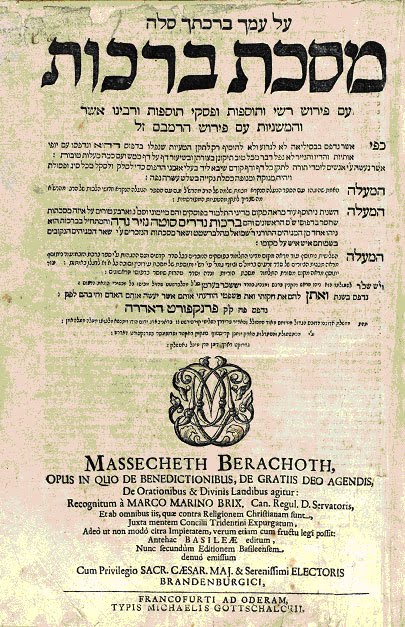
The Yiddish letters I set with my own hand
I am Elle, the daughter of Moses from Holland
a mere nine years old
the sole girl among six children
So when an error you should find
Remember, this was set by one who is but a child (2)

Did she compose the poem herself, or was it composed by her father or brother? Remarkably, we find another case not soon thereafter, of a nine year old setting type, and there we do know whether he could read or not. Nicholas Basbanes, in his book “A Gentle Madness”, records the following:

“Born in poverty, Isaiah Thomas came to know the touch and smell of ink on paper when he was only a child. Only nine years old in 1758….young Thomas was already completing his apprenticeship in the dingy Boston shop of Zechariah Fowle…When he later became the most successful printer and publisher in the United States-Benjamin Franklin dubbed him the Baskerville of America- Isaiah Thomas enjoyed telling friends that he knew how to set type before he was able to read.”(3)

Whether or not she could read at age nine, we do know that this little girl was able to recognize the Judeo Yiddish letters of a manuscript and set to type similar letters from which to print a book. Perhaps she had the potential to become as successful as Isaiah Thomas but for her gender and religion.

We meet Elle again in 1699, this time as a typesetter working on the famous Berman Shas of Frankfurt on Oder. This printed edition of the Talmud ( 1697-1699) was financed by the wealthy court Jew, Yissachar Berman Segal of Halberstadt who gave away half the 5,000 copies printed to needy scholars throughout Europe.(4)The Berman Shas is one of the most respected early printed editions of the Talmud because it contained many additional commentaries which became standard in following editions. It was the first edition since that of Gershom Soncino in the early 16th century to contain most of the diagrams we are familiar in Seder Zeraim, and Masechtos Eiruvin and Sukah. (5) It was also the first to contain Charamos from various Rabbanim prohibiting others in that general area from printing the Talmud for an extended period of time.(6) The following Cherem, recorded in Maseches Brachos, was written by Rav Dovid Oppenheim who lived at that time in Nikolsburg and later became chief Rabbi of Prague:At the end of Maseches Nidah printed in 1699, Elle signs her work a bit more boldly, and leaves us wondering what was going through her mind when she set the letters for the colophon.

“ By the hand of the faithful typesetter in this holy work, Yisroel the son of Reb Moshe. And by the hand of his maiden sister Elle, daughter of Rav Moshe, in the year “N’Kaivah T’Soivev Gaver” ( “a woman shall go after a man”.)

When you add up the letters which are set in large type, you come up with the year 459 according to the Peret Koton ( the abbreviated era ). This is the year 5459 (1699). What intrigues even the casual observer is why she, or her older brother Yisroel chose to record the year 5459 using that unusual Pasuk? One could argue that the Pasuk is tangentially related to some of the topics covered in Maseches Niddah, but there are many other Pesukim which deal more directly with the subject matter that could have been formatted to equal 459.(7) I think it is more logical to relate the Pasuk to the girl typesetter, who we are informed, is still unmarried. In Messianic times, it will be the Kallah, Am Yisroel, who seeks out its Chasan, Hashem. Perhaps Elle thought her circumstances and position necessitated a similar approach to finding a suitable Chasan. We hear the last from her in the next year having worked on a Machzor with her brother Yisroel.(8) We hope that after that, this extraordinary girl found an appropriate Shidduch. We wish the same for all those seeking the wonderful rewards that marriage has to offer.

(1) Marvin J Heller, “Studies in the Making of the Early Hebrew Book”, Boston 2008 pps. 218-228. The entire chapter on Moses ben Avraham Avinu makes for some fascinating reading. I am indebted, as are we all, to Marvin Heller for his research into this field of study.
(2) Ibid: p.222
(3) Nicholas Basbanes, ‘A Gentle Madness” New York, 1995 pps144-145
(4) R.N.N. Rabinowitz “Ma’amar Al Hadfasas HaTalmud”, A.M. Haberman edition, Mosad HaRav Kook 2006, page 96 footnote 1.
(5) Ibid. p. 98
(6) Ibid p.100
(7) Two examples of a more fitting Pasuk to denote the year of publication for Tractate Niddah are:

“B’Mai Nidah Yischatah” which was used in Frankfurt A/M edition of 1720, and

“V’Safrah Lah Shiva Yomim, V’Achar Ti’Taher” which was used in the Dyhernfurth edition of 1816-21 ( although the highlighted letters actually add up to (5)773)

(8) Heller, page 223


Cherubim: Winged Celestial Beings on the Title-Pages of Early Hebrew Books

Cherubim: Winged Celestial Beings on the Title-Pages of Early Hebrew Books
by
Marvin J. Heller[1]


And having driven out the man, He stationed at the east of the Garden of Eden the Cherubim and the flame of the ever-turning sword, to guard the way to the Tree of Life (Genesis 3:24).

You shall make two Cherubim of gold—hammered out shall you make them—from both ends of the cover. You shall make one cherub from the end at one side and one Cherub from the end at the other; from the cover shall you make the Cherubim at its two ends. The Cherubim shall be with wings spread upward, shielding the Cover with their wings with faces toward one another; toward the cover shall be the faces of the Cherubim being turned toward the cover. (Exodus 25: 18-20).

Rav Ketina said: When the Jewish people would ascend for one of the pilgrimage festivals, the priests would roll up the curtain for them and show them the cherubs, which were clinging to one another, and say to them: See how you are beloved before God, like the love of a male and female (B.T. Yoma 54a).

Cherubim (angels) are a frequent presence on the title-pages of early Hebrew imprints in the sixteenth century and afterward, the latter beyond the scope of this article. They are also to be found in incunabula, on the frames of initial pages and head-pieces for text.

How do you define what are cherubim? One definition, that of the Encyclopedia Judaica, is “a winged celestial being which appears in the Bible in several different guises.” It then proceeds to give several descriptions of cherubim. The Jewish Encyclopedia begins with a more detailed description, stating cherubim are “the name of a winged being mentioned frequently in the Bible. The prophet Ezekiel describes the cherubim as a tetrad [set of four] of living creatures, each having four faces—of a lion, an ox, an eagle, and a man—the stature and hands of a man, the feet of a calf, and four wings.”[2]
The use of cherubim is also noted in the 1911 Encyclopædia Britannica where they are described as “imaginary winged animal figures of a sacred character, referred to in the description of Solomon’s temple (1 Kings vi. 23-35, vii. 29, viii. 6, 7), and also in that of the ark of the tabernacle (Ex. xxv. 18-22, xxvi. 1, 31, xxxvii. 7-9). . . . In Gen. iii. 24 the cherubim are the guards of Paradise . . .”[3]
The frequency of the appearance of cherubim in Hebrew literature can be found on Sefaria, a bibliography of Jewish texts, which records fifty-six entries for cherubim under biblical, Mishnah 27, and Talmud 991. Among other entries are Midrash, 590; Halakhah 7947; Kabbalah 747; and yet still others as well as multiples of commentaries on the first works.[4]

These multi-winged creatures are also a feature in general literature. Franz Sales Meyer, under the heading Miscellaneous heads, describes the “Angel faces, youthful heads, with a circular or disc-like halo, are first met-with in the Byzantine style, as the result of ecclesiastic articles,” He continues that in the early Italian Renaissance such renderings were charmingly naïve. They appeared as adornments on friezes and arches, medallions, and in borders. They also are to be found on tombs and are “Much used in Modern ecclesiastical decorations.” The text is accompanied by a page of examples of the cherub head, including one of a skull.[5]

It had been my intention to describe Hebrew title-pages with images of cherubim over a period of two centuries.[6] The numerous instances of such usage, however, has necessitated a considerable limiting of our subject period. Indeed, rather than noting all the examples in our current period, in the sixteenth century, we only describe several exemplars, giving background about the books in which they appear, that is, the publisher, author, and book subject.[7] This article is expansive, that is, in describing cherubim, it discusses the varieties of Hebrew literature, the authors of the subject works, the presses that published them, and even Hebrew book history. The title-pages and infrequent text pages with displays of cherubim addressed here are in chronological order, but from diverse locations and, again, on a variety of books, indicative of how widespread Hebrew publishing was and even more so the depth and nature of Hebrew literature.[8]

1514-18, Hameshei Humshei Torah – Our first work with the appearance of cherubim is a folio (20) edition Hameshei Humshei Torah (Pentateuch) with haftorat and commentary of Rashi printed in 1514-18 in Prague at the press of Gershom ben Solomon ha-Kohen and partners. Gershom later received a royal privilege from King Ferdinand of Bohemia, allowing him, that is Gershom alone, to enjoy a monopoly on Hebrew printing in Prague. His descendants, known as the Gersonides, continued to print in Prague until the mid-seventeenth century.


1514, Hameshei Humshei Torah
Courtesy of the Library of the Jewish Theological Seminary

A magnificent edition, with ornate woodcut frames and large type for the text. Each book has a unique decorative opening page, there is no title page, comprised of four separate pieces, those on the pillared sides with vases, leaves, and cherubim, similar but not identical, the top piece with a concave bottom edge. Genesis has a convex curved piece to fit with this top piece on the upper half of the page, with winged cherubim holding a shield with the spread hands of the Kohen giving the priestly blessing.[9]

Work on the Pentateuch began on 10 Sivan (June 14, 1514) but, perhaps as a result of the success of the prayer book, the partners found they had overextended themselves and found it necessary to suspend work on this project for two years. In 1530 Gershom and his sons reprinted this Pentateuch in an identical format, except for changes to the decorated initial pages.

1527, Dictionarium ChaldaiOur next entry with cherubim is an Aramaic grammar by the Christian-Hebraist scholar Sebastian Muenster (1489-1552). It was printed in Basle in 1527 at the press of Johannes Froben in quarto format (40: [1], 434, [7] pp.). The Froben family was the most significant printers of Hebrew books in Basle. Johannes Froben published as many as 250 titles, among them Hebrew/Latin books of the Bible and grammatical works, primarily works by Muenster.

Sebastian Muenster, a cosmographer, astronomer, and orientalist was, for twenty three years, professor at Basle. Born in Niederingelheim, Hesse, the son of a Spitalmeister (hospital master), Muenster had no university education nor did he ever receive a degree. His education consisted of some private instruction in Latin and later studies at Frieberg and attendance at lectures given by the Franciscans. In 1506, Muenster entered the Minorite order and was sent to study in Rufach under Conrad Pellican (Pellicanus, 1478-1556). The following year he took vows and, in 1512, was ordained a priest. Muenster assisted Pellican in teaching in Pforzheim and, from 1524-29, occupied the chair of Hebrew at the University of Heidelberg. In 1529, Muenster converted to Protestantism and moved to Basle, where he occupied the chair of Hebrew, at a salary of 60 gulden; from 1547/8 he was rector. From about 1525, Muenster was a student of Elijah Levita, translating and editing his grammatical works. Muenster also translated a number of other Hebrew works into Latin and was a prolific author in his own right. By the time of his death more than 100,000 volumes of his works were in circulation. His Jewish oeuvre, more than three-score publications, covers all aspects of Judaica, excepting Kabbalistic studies, which did not interest him. In 1523, Muenster published Dictionarium Hebraicum . . . adiectis Chaldaicis vocabulis, his study of the Aramaic language. The book reads from left to right but the text follows the Hebrew alphabet. Words are given in vocalized Hebrew, followed by their etymology, definition and examples.

The title page of the Dictionarium Chaldai has an architectural frame with cherubim in various positions, as well as additional cherubim below mounted and otherwise. This title page, designed by Hans Holbein, was used as early as 1516 on Basel statutes and into the seventeenth century.[10] [11]

Not long afterwards, from 1540 through 1543, at least five titles were printed in three locations with varied images of cherubim on the title-page, that is Augsburg, Prague, and Bologna. That is not to say these frames were not used on other books, most likely they were, but rather these are examples of cherubim used by the printers of Hebrew books at the time.

Augsburg has an early history related to Hebrew printing. Several early anti-Jewish works beginning with the apostate Johannes Pfefferkorn’s Der Judenfeind (1509) and other anti-Semitic books by apostates were published there. Another early Augsburg publication of note, this certainly more positive, albeit not a Hebrew edition of that popular and much republished work, is the first printing of R. Joseph ben Abraham Gikatilla’s (1248–c. 1325) kabbalistic classic, Sha’arei Orah, which explains and analyzes the ten Sefirot. This edition of Sha’arei Orah is a Latin translation of that work by the apostate Paulus Ricius (Paulus Israelita, 1480-1541) under the title Portae lucis, published in 1516 at the press of Johann Miller.

1527, Dictiorionarim Chaldai
Courtesy of the Fales Library and Special Collections, New York University

Serious Hebrew printing in Augsburg begins when Hayyim ben David Shahor, among the pioneers of Hebrew printing outside of Italy, came to Augsburg in about 1533/34. In Augsburg, Schwarz worked in the print shop of Silvan Otmar (d. 1540), a renowned and highly productive printer, and resided in the home of Bonifacius Wolfhart, a Protestant pastor who also served as the censor of Hebrew books for Augsburg.[12] Shahor printed several works in conjunction with his son, Isaac, and his son-in-law, Joseph ben Yakar, who assisted him at the press, although their names are not mentioned on the title-pages.[13]

Shahor likely joined with a non-Jewish printer, perhaps August Wind, a printer of Hebrew works for Christian clergyman. Hayyim left for Italy, returning to Augsburg in 1540. He then printed three books, Avkat Rokhel, Arba’ah Turim and a prayer book for, according to the Thesaurus of the Hebrew Book, a total of ten works in Augsburg. Due to a lawsuit by an apostate, Paulus Aemilus, with whom Shahor had been associated in Ferrara, resulting from their failed venture, Shahor and his family were forced to cease publication and leave Augsburg. Aemilus, seeing a market in Augsburg for Hebrew/Yiddish books, began to print on his own account. He issued a small number of titles, most notably the Melokhim Bukh (1543) and the Shmuel Bukh (1544), Yiddish poetical renditions of the books of Kings and Samuel, both with images of cherubim (below).[14]

1540, Avkat Rokhel Our first Augsburg title is Avkat Rokhel, an eschatological work on the principles of faith attributed to R. Machir ben Isaac Sar Hasid, a student of R. Judah ben Asher, son of the Rosh. Printed in octavo format (80: 18 ff.), perchance by Shahor. The Thesaurus of the Hebrew Book attributes it, albeit in brackets, to Hayyim Shahor, in contrast to the National Library of Israel that records the printer as unknown.[15]

The text of the title page is set within a decorative frame with nineteen cherubim and a number of animals. The title-page states that it is,

Sefer Avkat Rokhel

Printed by the printers named at the end of the volume. Edited with great care, with all our ability, “the good hand of our [Lord] upon us,” (ref. Ezra 8:18). And it was completed, here Augsburg, the great city, with the help of the Lord and His salvation. In the year, “[Rejoice, O you nations, with his people; for he will avenge the blood of his servants,] and will render vengeance to his adversaries, and will make expiation כפר (300=1540) for the land of his people” (Deuteronomy 32:43).

The names of the printers, Hayyim Shahor, Isaac ben Hayyim, and Joseph ben Yakar, the statement on the title page notwithstanding, are not given at the end of the volume. A brief introduction informs that the work was named Avkat Rokhel (the perfumer’s powders, Song of Songs (3:7)) for as the perfumer’s powders strengthen the soul, so too when one reads this book will he fear and cause his soul to be pure and free from all sin and transgression, thus meriting the good.

1540, Avkat Rokhel
Courtesy of the Dorot Jewish Division New York Public Library

The like title-pages of Avkat Rokhel and Unterricht Wie ain Christenmensch, the latter a non-Hebrew work printed approximately two decades earlier, reflect a relationship between Jewish and Christian printers, that is, Christian printers published Hebrew books in association with Jewish associates. The relationship between the printers was mutually beneficial. For the Christian publisher “the Hebrew books sector, being unique, was attractive to investors, being more limited and not so wildly competitive as the Italian book sector.”[16] In addition to the non-Jewish printer’s access to the Jewish book market, the Jewish publisher was able to not only publish Hebrew books, but he also gained access to the typographical material of his Christian associate. The latter, for example, frequently provided attractive frames to the former after having used them for his market and the Jewish partner also utilized the printer’s other ornamentation. This was of value to the Jewish partner as he did not have to go the expense of having decorative material prepared, at a relatively much greater expense as it would be utilized for a much smaller market. This despite the fact that the frames were often incompatible with traditional Jewish sensibilities.[17]

1521, Unterricht Wie ain Christenmensch [18]

The like title-pages of Avkat Rokhel and Unterricht Wie ain Christenmensch, the latter a non-Hebrew work printed approximately two decades earlier, reflect a relationship between Jewish and Christian printers, that is, Christian printers published Hebrew books in association with Jewish associates. The relationship between the printers was mutually beneficial. For the Christian publisher “the Hebrew books sector, being unique, was attractive to investors, being more limited and not so wildly competitive as the Italian book sector.”[19] In addition to the non-Jewish printer’s access to the Jewish book market, the Jewish publisher was able to not only publish Hebrew books, but he also gained access to the typographical material of his Christian associate. The latter, for example, frequently provided attractive frames to the former after having used them for his market and the Jewish partner also utilized the printer’s other ornamentation. This was of value to the Jewish partner as he did not have to go the expense of having decorative material prepared, at a relatively much greater expense as it would be utilized for a much smaller market. This despite the fact that the frames were often incompatible with traditional Jewish sensibilities.[20]

The title-page of Avkat Rokhel has the largest number of cherubim of our title-pages, nineteen in all, of our title-pages. The cherubim appear on the bottom, sides, and top of the frame, all active, albeit in different activities. The text of Avkat Rokhel is in three parts, each further subdivided. The first section addresses the struggle against one’s evil urge prior to redemption and the birth pangs and advent of the Messiah, and an explanation of the pertinent midrashim; the second part discusses the rewards and punishments of the soul after the resurrection, the nature of the world to come according to Judaism, in contrast to the views of non-Jews, and resurrection; and the third part the laws stated by the sages of the Talmud as halakhah Moshe me-Sinai, the formation of man and the number 248 limbs in a person, the statement of our sages concerning three partners in that process (God, man, and woman) and some gematriot.

This is the third edition of Avkat Rokhel, it having been printed previously in Constantinople (1516) and Rimini (1526). Ch. B. Friedberg records, in his Bet Eked Sepharim, more than twenty-five printed editions of Avkat Rokhel. It was translated into Latin by A. Hulsius and printed in his Theologia Judaica, (Breda, 1653) and a Yiddish edition was prepared by Naphtali Pappenheim (Amsterdam, 1647).[21]

1543, Melokhim Buch Two additional works printed in Augsburg, attributed to Moses (Esrim ve-Arbeh) Ashkenazi, are Yiddish poetical renditions of the books of Kings and Samuel. Moses’ appellation, Esrim ve-Arbeh (24), derives from either his birthplace, Vierundzwanzig Hoefe (24 courts) in Wuerttemberg, or from his extensive knowledge of the 24 books of the Bible. Moses’ accreditation with either authoring or transcribing the Melokhim Bukh is due to its similarity to the Shmuel Bukh, more reliably attributed to him. Nevertheless, sufficient differences exist between the two works that many scholars believe they do not share a common author. It is clear, however, that the author, even if not this Moses, was an Ashkenazi Jew. The Melokhim Bukh was published in quarto format (40: [123] ff.) by, according to the colophon, Paulus Aemilus. A Latin colophon states, Augustae Vindelicorum/ per Paulum Aemilium, Anno/ Domini M. D. XLIII. Meyer Waxman suggests that it is doubtful, the colophon notwithstanding, that the publisher was Aemilus; more likely it was Hayyim Shahor.

We have noted above that the frames on these title-pages were first used by Christian printers and that when that market no longer needed the frames, they were made available to Jewish printers. The cherubim frames noted above were generally acceptable to a contemporary renaissance Jewish public, although some, many, were questionable and would not be used today. In contrast, the title-page of the Melokhim Buch has a border made up of a four-part frame, the top with a representation of a king, the left and right sides respectively with images of Adam and Eve, unclad, the latter with the snake, two small children, and expecting. At the bottom are two cherubim. Use of this frame is surprising, for in contrast to other frames its’ contents appear to be objectionable, more so than other frames, even those with mythological characters. It seems likely that this frame might also be distasteful to Christian sensibilities.[22]

1543, Melokhim Buch
Courtesy of Dr. Moshe Rosenfeld

The title page states that it is “The book Melokhim (Kings) in Taytsher sprach, beautiful and clear and very entertaining to read. Printed in the imperial city of Augsburg in the year 303 (=1543)” [23] The colophon dates the completion of the work to Friday, 14 Av, 303 (July 25, 1543), which was a Sunday in 1543.

The Melokhim Bukh was not written as a sequel to the Shmuel Bukh. It is the older of the two books, originally written as a separate work, possibly as early as the fourteenth century. The format of the Melokhim Bukh, a rhymed paraphrase of the book of Kings, is that of the heroic epic, stylistically modeled after comparable German sagas, such as the Nibelungen. The subject matter is the events in Kings I and II, imaginatively and colorfully enhanced by material from the Talmud and Midrashim, all expressed with a deep piety. Intended as a complete history, it begins with a hymn of praise to God in three strophes followed by nine strophes from the Exodus to the last days of David, the contents of Kings, and as a sequel, the history of the Jews to the end of the second commonwealth in thirty strophes). An example of the text is,

You have frequently performed signs for the children of Israel;

Therefore they are obliged to have You for their Lord.

And to fear Your name-that is useful and good for them.

That man is foolish who acts contrary to Your word.[24]

1544, Shmuel Bukh The Shmuel Bukh was published, also likely by Hayyim Shahor in quarto format (Format 40: [102] ff.). It has an ornate title page made up of figurines above and about pillars with cherubim on the sides. It too is in Vaybertaytsh; among its reprints is a Latin edition (Ingolstadt,(1562). Waxman suggests that the Shmuel Bukh was likely written at least a hundred years earlier, most likely an original production of medieval Jewry. The author reworked the biblical material and incorporated aggadic elements. It was written in “vigorous poetic style” in eight line strophe and was meant to be sung.[25]

1544, Shmuel Bukh
Courtesy of Dr. Moshe Rosenfeld

In contrast to what was written above, “works that many scholars believe they do not share a common author,” Zinberg informs that both the Melokhim Bukh and the Shmuel Bukh are composed in the same verse-meter. Moreover, the title-page states that “Shmuel is the first part of

the book Melokhim, for it is all related.” Nevertheless, Zinberg quotes other sources that “these are two quite different works and were probably written by two different poets.”[26]

1553, Ma’yan GannimA composition book comprised of sample letters from R. Samuel ben Elhanan Jacob Archivolti (c. 1515-1611). Ma’yan Gannim was published in a small sextodecimo format (160: 45, [1] ff.) at the Venice press of Alvise Bragadin. The Bragadin press was active before the papal bull, dated August 22, 1553, by Cardinal Giovanni Pietro Caraffa, the future Pope Paul IV, an extreme reactionary and bitter anti‑Semite, who ordered the confiscation and burning of the Babylonian and Jerusalem Talmuds. This had a chilling effect on Hebrew printing and resulted in a considerable decline if not outright cessation of printing in Venice, and the subsequent expurgation and censorship of Hebrew books. When Hebrew printing resumed in Venice in 1563, among the Christian printers who took up the publication of Hebrew books was Alvise Bragadin. Bragadin died in the mid-1570’s, he was succeeded by his son, and after him by successive members of the family well into the eighteenth century, the last known Bragadin being Alvise III. Throughout that time the press remained a leading printer of Hebrew books in Venice.

1553, Ma’yan Gannim
Courtesy of the Library of Agudas Chassidei Chabad Ohel Yosef Yitzhak

Archivolti, a student of R. Meir Katzenellenbogen (Maharam, 1473-1565), served as rabbi, av bet din, and rosh yeshivah in Padua. Among his students was R. Judah Aryeh (Leon) Modena (1571-1648). Prior to settling in Padua in 1568, Archivolti worked as a corrector for the Hebrew presses in Venice.

In contrast to our preceeding examples of cherubim, this exemplar does not appear on the title-page of the book, which has the Bragadin device, that is, three crowns, but rather at the beginning of each of the book’s five chapters, a woodcut illustration comprised of three cherubim in a cage, surrounded on all four sides by a verse.

The title is from “A fountain of gardens (ma’yan gannim), [a well of living waters, and streams from Lebanon” (Song of Songs 4:15). The text states that there are fifty letters, that is, twenty-five letters with their responses, written by Archivolti. There is a preface and introduction from Archivolti, followed by a table of contents, and, beginning on 7a, the text. Ma’yan Gannim is the first book written by Archivolti, for he describes it as his first fruits, an offering to the Lord. Archivolti also wrote Degel Ahavah (Venice, 1551), an ethical work; He’arot le-Sefer he-Arukh (Venice, 1553), textual references for the Arukh of Nathan ben Jehiel; and, his most important title, Arugat ha-Bosem (Venice, 1602) a grammatical work in 32 chapters.

The sections or chapters, each on a different theme, are correspondence between a father and son; between friends; from an older to a younger man; with government officials; and others, including letters of a romantic, and even sensual nature. Such letters, at the very least inappropriate by modern religious standards, are intermingled with those of a sacred nature, reflecting contemporary mores and addressing current issues, including therefore, information of historical and cultural value. Ma’yan Gannim is designed to teach through example the rules of correspondence. The letters are in metrical form, designed by Archivolti as literary models, many with ethical content, for his students.[27]

1556, She’ilot u’Teshuvot Jacob ben Moses Moellin (Maharil) – Two hundred and five responsa from R. Jacob ben Moses Moellin (Maharil, c. 1360-1447). The She’ilot u’Teshuvot were published in Cremona at the press of Vincenzo Conti in octavo format (80: [7] 79 ff.). After the Talmud was burned in Venice in 1554 there was a precipitous decline, if not a complete cessation, in the number of Hebrew books printed in Venice for several years. The breach was filled by presses in Ferrara, Sabbioneta, Cremona, and Riva di Trento. Vincenzo Conti (d. 1569) printed briefly in Sabbioneta and subsequently in Cremona, where his press was active from 1556 to 1567, issuing more than forty titles.

Maharil was the leading halakhic authority of his time. His most important work is Sefer Maharil (Minhagei Maharil, 1556, Sabbioneta), a popular and influential work on customs and laws. It was composed by his pupil Eleazar ben Jacob (Zalman of St. Goar), from the discourses that he heard from Maharil. She’ilot u’Teshuvot is comprised of Two hundred and five responsa, a small part only of Maharil’s responsa. The subject matter, as in the Sefer Mahril, deals to a great extent with custom, but also includes much personal material. They also reflect Maharil’s considerable humility and compassion.

1556, She’ilot u’Teshuvot Jacob ben Moses Moellin (Maharil)
Courtesy of the Library of Agudas Chassidei Chabad Ohel Yosef Yitzhak

The title-page has an ornamental frame made up of four parts, enabling the printer to use them in other arrangements, although this is the manner in which the parts are most often employed. The top frame has the face of a man and cherubin; on the sides are suits of armor, shrubs, and musical instruments and, in the center of the left vertical frame the letters SPQR, reputedly standing for Senatus Populusque Romanus; and on the bottom a two headed crowned eagle and on the sides the cherubim. This frame was used by Conti on his early imprints, appearing on about ten works.

1558, Sefer Rav Alfas Sefer Rav Alfas, (Hilkhot Rav Alfas, Sefer ha-Halakhot of Alfasi, Rif) was published in Riva di Trento by R. Joseph Ottolenghi and Cardinal Cristoforo Madruzzo in a three volume folio format (20: 288, 268, 302 [8] ff.). The Tyrolese town of Riva di Trento is the source of an unusual episode in the history of the Hebrew book. It was for a short time, from 1558 to 1562, a refuge for the Hebrew book; one in which about forty Hebrew titles were printed. Believed to be the first work printed in Riva di Trento, Hilkhot Rav Alfas was likely selected, in addition to its inherent popularity and value, due to the ban on the Talmud, the Rif, being a halakhic compendium of the Talmud, filling, to some extent, the gap left by the scarcity of that work.

It was in Riva di Trento that Cardinal Cristoforo Madruzzo (1512-78), Cardinal of Trent, a scholar and supporter of learning, who argued at the Council of Trent (1562) for leniency and moderation in condemning books, became the patron and protector of a Hebrew press, which was also a source of revenue for him. Ottolenghi (d. 1570), originally of Ettlingen, in Baden, Germany, reflected in its Italianized form in his name, was rosh yeshivah at Cremona, and under his tutelage Talmudic studies had continued in Cremona after that work had been banned and burned elsewhere. He assisted the press, providing indices and annotations to a number of works and assuring that material offensive to the church had been deleted from those books of value to his yeshiva. and R. Jacob Marcaria, a dayyan on the bet din presided over by Ottolenghi and a physician, recruited by Madruzzo help finance and play a role in the press. Marcaria edited and wrote brief prefaces for most of the books printed in Riva di Trento. The press was located in the house of Antonio Broën.

Sefer Rav Alfas is a halakhic compendium by R. Isaac ben Jacob Alfasi (Rif, 1013-1103). Alfasi, born in the Algerian village of Qal’at Hammad, was a student of the great sages R. Nissim ben Jacob (c, 990-1062) and Hananel ben Hushi’el (d. c. 1055) in Kairouan. After learning with them Alfasi relocated to Fez, from where his surname al-Fasi (Rif) is derived, and became recognized as the leading Talmudic sage of the time. In 1088, at the age of 75, two informers denounced him to the government – the charges are unknown – and he was forced to flee to Spain. Eventually settling in Lucena, Alfasi succeeded R. Isaac ben Judah ibn Ghayyat (c. 1020-89), who had died a few months earlier, as head of the yeshiva.

1558, Sefer Rav Alfas
Courtesy of the National Library of Israel

The text of the title-page of each volume has cherubim at the sides, and below bears the Cardinal’s coat‑of‑arms , a significant statement of the Cardinals’ support and protection of the press at a time when his church was burning and banning Hebrew books. Furthermore, the title pages informs that Sefer Rav Alfas was edited with great care by the gaon R. Joseph Ottolenghi and was printed and financed by him, and that this was done, “in the dominion of” the following in bold letters “Cardinal Cristoforo Madruzzo.”

Sefer Rav Alfas, Alfasi’s major work, is one of the greatest works in halakhic literature. It is extracts all pertinent legal decisions from the Talmud, eliminating non-halakhic material, discussions, and subject matter not applicable today. It covers the following orders of the Talmud, Mo’ed, Nashim, and Nezikim, as well as tractates Berakhot and Hullin. Laws in Kodashim and Tohorot, such as mezuzah and tefillin, are organized as Halakhot Ketannot. Sefer Rav Alfas differs from earlier works, such as Halakhot Gedolot, in that it is more comprehensive, more detailed, and by the inclusion of material from the geonim, although, like them, it follows the order of the tractates.

1559-60, ZoharClassic kabbalistic work of Jewish mysticism, attributed to R. Simeon bar Yohai (second century). This, the second printing of the Zohar, it was published previously in Mantua (1558-60), published in Cremona at the press of Vincenzo Conti in a three volume folio format (20: 132, 122, 146 ff.) by Vincenzo Conti (d. 1569). Conti, who had printed briefly in Sabbioneta, is better known for his activity in Cremona, where his press, active from 1556 to 1567, issued more than forty titles.

The title page of has a decorative architectural frame with an arch, at the top a vignette of Akedat Yizhak (the binding of Isaac), surmounted by an eagle, and accompanying cherubim; below in the bottom squares, figurines, perchance also cherubim. It is dated, “For the Lord will not forsake כי לא יטש (319=1559) his people [for his great name’s sake] (Samuel I 12:22), and it was completed in the year ש”ך ([5]320=1560).” At the bottom of the page is an imprimature from the Inquisition on the title page, the sole Cremona imprint to place it there, as well as a longer permission at the end of the book.

1559-60, Zohar
Courtesy of the Library of the Jewish theological Seminary

Written in Aramaic and Hebrew, Sefer ha-Zohar al ha-Torah is a comprehensive system of kabbalistic theosophy, encompassing cosmology, the soul, and good and evil. It is an esoteric commentary on the Torah, with homilies, midrashic passages, parables, and numerous discursive passages. It is based on the concept that within scriptures is a concealed stratum, deciphered by Kabbalah, expressing the inner meaning of the Torah, with its “splendor, beauty, and greatness.”

The corrector (and expurgator) was the apostate Vittorio Eliano, grandson of the foremost grammarian, Elijah Bahur Ashkenazi Segal. A member of a Dominican commission to review Hebrew books, Eliano was associated with all the books published by Conti from 1558 through 1559. Although begun later than the Mantua edition, noted above, this printing, done in haste, was completed earlier. Nevertheless, it was not immediately released for sale, for when more than 10,000 Hebrew books were burned in Cremona, with the complicity of Eliano, the entire edition was seized. It was just barely saved, in contrast to other works, by the apostate Dominican, Sixtus of Siena. It is known as the Zohar Gadol (large Zohar), in contrast to the smaller Mantua edition (Zohar Katan), and is also referred to, because of Eliano’s involvement, as the “Christian edition.” This notwithstanding, the Cremona edition was the preferred of the two editions by eastern European kabbalists.[28]

1560, Shir ha-Yihud – Shir ha-Yihud (Hymn of Divine Unity) an anonymous piyyut (liturgical poem) written in the mid-twelfth century, most often attributed to Samuel ben Kalonymus he-Hasid (c. 1130-1175), less often to his son, Judah ben Samuel he-Hasid (c. 1150-1217), author of the Sefer Hasidim, both among the foremost representatives of the Hasidei Ashkenaz, and, on occasion, to yet others.

Shir ha-Yihud
Courtesy of the National Library of Israel

Shir ha-Yihud was published at the press of Eliezer and Joseph ben Naphtali Hertz Treves. Active for one year only, in 1560, they issued six books, before being forced to close by a meeting of the leaders, both Protestant and Catholic, of the Swiss Confederation in June, 1560, who feared that they were about to print the Talmud.

The frame, one of several with cherubim employed by the press, also was used on the title-page of Begidat Hazman, an allegoric maqāma (a poetic narrative in rhymed prose) by Mattathias (Mattityah ben Moses), a 15th century Spanish or Provençal Hebrew poet or Mattathias ha-Yiẓhari, a representative of the Jewish communities of Aragon at the Tortosa disputation (1413–14).

1568, Passover Haggadah Passover Haggadah printed in Mantua in folio format (20: 36 ff.) by Joseph Shalit ben Jacob Ashkenazi of Padua. This edition is a reprint of the 1560 Passover Haggadah, also printed in Mantua, but with modifications and the addition of the marginalia of R. Joseph Shalit ben Jacob Ashkenazi of Padua entitled Nimukei Yosef.

1568, Passover Haggadah
Courtesy of the National Library of Israel

The title page frame has representations of the Mars and Minerva followed by the first text page, which has two woodcuts of cherubim along the top. Following text pages have those cherubim image, as well as numerous other cherubim images, including several marginal cherubim images. This Haggadah shares some features with the Prague Haggadah of 1526. Woodcuts are accompanied by captions, given as rhymed couplets, a feature of Ashkenaz manuscript Haggadot. In some instances, for example, by the four questions, the earlier edition was framed by a lush Italian border, without illustrations. Here the types and the top and upper left borders with their vines and cherubs only are alike.[29]


1576, Yosef LekahYosef Lekah is a commentary on Megillat Esther by R. Eliezer ben Elijah Ashkenazi (1513-86). It was published in Cremona in 1576 by Christopher Draconi in octavo format (40: 83, 1 ff.). Draconi, previously associated with Vincenzo Conti, attempted to publish Hebrew books in Cremona. Although he would issue Latin books from 1569 to 1614, he printed one Hebrew book only, Yosef Lekah.

1576, Yosef Lekah
Courtesy of the Fales Library and Special Collections, New York University

R. Eliezer ben Elijah Ashkenazi was a multi-faceted individual, a Talmudist, physician, and well-rounded scholar, who served as rabbi in a number of varied communities. His first rabbinic position, from 1538-61, was in Fostat, Egypt. Forced to leave Fostat, Ashkenazi went to Famagusta, Cyprus, where he was rabbi for two years, and then to Venice. He left for Prague (1561), after a dispute with the Maharam of Padua, and after traveling as far as the Crimea, returned, via Famagusta, to Venice. Ashkenazi was next rabbi in Cremona, where he published Yosef Lekah. Shortly after he left to be rabbi of Posen, and, from 1584, was in Cracow. Ashkenazi experienced difficulties in Poland, disputing over his right to open a yeshiva in close proximity to an existing yeshiva, so that Joseph Solomon Delmedigo (1591-1655) wrote about him, “You have brought a vine from Egypt; you have cast out the nations, and planted it” (Psalms 80:9). Ashkenazi was highly regarded by his contemporaries, corresponding with prominent rabbinic figures such as R. Joseph Caro, R. Joseph Ha-Kohen (Katz), R. Moses Isserles (Rema), and R. Solomon Luria (Maharshal), several mentioning him in their responsa. R. Elijah of Pesaro, in Famagusta in 1563, praised Ashkenazi’s scholarship, noting that he was fluent in twelve languages.

The title-page has four cherubim images, two reclining at the top of the structure, two standing erect by the pillars at the sides. The title-page is dated “Therefore they called these days Purim קראו לימים האלו פורים (336 = 1576)” (Esther 9:26). Yosef Lekah is dedicated to Don Joseph Nasi, Duke of Naxos, whom Ashkenazi, in the introduction, compares to Joseph in Mizraim and Mordecai at the time of Ahasuerus. Ashkenazi, therefore, entitled this work Yosef Lekah. Two, almost identical, editions of Yosef Lekah exist, both dated 1576. Although almost exact copies of the original, it is clear, upon close examination, that the book was reset. Christopher Draconi’s Yosef Lekah was the last Hebrew book printed in Cremona.

Ashkenazi’s most important work is Ma’aseh HaShem (Venice, 1583), on the historical occurrences in the Torah, with a commentary on the Passover Haggadah; selichot; and, not extant today, a super-commentary on the Ramban (Nachmanides) and annotations to R. Caro’s Beit Yosef.[30]

Conclusion – In this article we have described books printed in Augsburg, Basle, Cremona, Mantua, Prague, and Venice. The cherubim imagery on these title-pages, reflecting the influence of Renaissance humanism, their attractiveness notwithstanding, do not appear on the title-pages or accompanying the text in Hebrew books published in more modern times. A review of the title-pages reproduced here, all dissimilar, with their numerous depictions of cherubim, attest to the popularity of that image. Given the strictures on Hebrew printing from the mid-sixteenth century in Italy, the frequent use of cherubim testify to the cooperation of Jewish and non-Jewish printers, their frequency perchance suggesting a positive relationship going beyond mere monetary gain.

We conclude with the Talmudic statement above, which suggests why the image of cherubim was so popular:

Rav Ketina said: When the Jewish people would ascend for one of the pilgrimage festivals, the priests would roll up the curtain for them and show them the cherubs, which were clinging to one another, and say to them: See how you are beloved before God, like the love of a male and female. (Yoma 54a)

Lastly, in conclusion an image of a cherub, both chronologically and, in cherubian activity, quite different from those depicted in this article. It is included as it is unusual and eye catching, an image of a Cherub smoking a pipe. It appears in in at least two Basle imprints published by Israel ben Moses ben Abraham Halle, active in Offenbach, although not continuously, from 1718/19 to c. 1738/43. The works are Anaf Etz Avot, R. Benjamin ben Yekutiel Wulff’s commentary on Pirke Avot, and tractate Sanhedrin (1721).[31]

  1. Once again, I would like to express my gratitude and appreciation to Eli Genauer for reading the article and his insightful comments.
  2. Emil G. Hirsch, W. Muss-Arnolt, J. Frederic McCurdy, Louis Ginzberg, “Cherub ( ; plural, Cherubim)” Jewish Encyclopedia IV (New York, 1901-06), pp. 13-16; Shalom M. Paul, Louis Isaac Rabinowitz, “Cherub” Encyclopedia Judaica IV (Jerusalem, 2007), pp. 600-01.
  3. Thomas Kelly Cheyne, 1911 Encyclopædia Britannica, Volume 6, reproduced in https://en.wikisource.org/wiki/1911_Encyclop%C3%A6dia_Britannica/Cherubim
  4. https://www.sefaria.org/search?q=%D7%9B%D7%A8%D7%95%D7%91%D7%99%D7%9D&tab=text&tvar=1&tsort=relevance&svar=1&ssort=relevance.
  5. Franz Sales Meyer, Handbook of Ornament: a Grammar of Art, Industrial and Architectural Designing in all its Branches for Practical as well as Theoretical use (New York, 1957), pp. 108-09.
  6. Codices and early imprints did not have title-pages, the first leaf normally being left blank to protect the book, that page later becoming a dedicated page. The first book with a detailed title-page was the Calendarium of Johannes Regiomontanus, appearing in 1476 (Venice), being a fifty-five year calendar (1475-1530), printed by Johannes Regiomontanus. The first Hebrew book with a title-page was the Sefer ha‑Roke’ah (Fano, 1505) of R. Eleazar ben Judah of Worms (c. 1165 – c. 1230).
  7. Cherubim also appear on the frames of Hebrew books printed in the incunabular period. For examples of such frames see Marvin J. Heller “Behold, you are beautiful, my love: The Use of Ornamental Frames in Hebrew Incunabula” Printing History NS 10 (New York, July, 2011), pp. 39-55, reprinted in Further Studies in the Making of the Early Hebrew Book (Leiden/Boston, 2013), pp. 3-33.
  8. The following book descriptions are selected, modified from Marvin J. Heller, The Sixteenth Century Hebrew Book: An Abridged Thesaurus ( Brill, Leiden, 2004), var. cit.
  9. Avraham Yaari, Hebrew Printers’ Marks (Jerusalem, 1943), pp. 7 and 126-27 n. 10 [Hebrew].
  10. Jerome Friedman, The Most Ancient Testimony. Sixteenth-Century Christian-Hebraica in the Age of Renaissance Nostalgia (Athens, Ohio, 1983), pp. 44-48, 214-15; A. M. Habermann, Title Pages of Hebrew Books (Tel Aviv, 1969), p. xi [Hebrew with English introduction], pp. 19-20, 125-26 nos. 4-5; Joseph Prijs, Die Basler Hebräischen Drucke (1492-1866) (Olten, 1964), pp. 49-51 n. 26; Frank Rosenthal, “The Rise of Christian Hebraism in the Sixteenth Century,” Historia Judaica II (New York, 1945), (New York, 1945), pp. 182-91; and Richard S.Westfall, “Sebastian Muenster,” http://es.rice.edu/ES/humsoc/Galileo/Catalog/Files/muenster.html
  11. An interesting example of this later usage is R. Moses ben Hanokh Altschul’s (c. 1546–1633) Brant Shpigl, a popular Yiddish work on ethics, correct demeanor, and customs for women, published by Konrad Waldkirch (Basle, 1602), also indicative of the passage of typographic material between printers.
  12. Stephen G. Burnett, “German Jewish Printing in the Reformation Era (1530-1633),” University of Nebraska – LincolnUniversity of Nebraska – Lincoln DigitalCommons@University of Nebraska – LincolnDigitalCommons@University of Nebraska.
  13. Ch. B. Friedberg, History of Hebrew Typography of the following Cities in Central Europe: Altona, Augsberg, Berlin, Cologne, Frankfort M., Frankfort O., Fürth, Hamberg, Hanau, Heddernheim, Homberg, Ichenhausen, Neuwied, Wandsbeck, and Wilhermsdorf. Offenbach, Prague, Sulzbach, Thannhausen from its beginning in the year 1513 (Antwerp, 1935), pp. 29-31 [Hebrew].
  14. A. M. Habermann, “The Printer Hayyim Shahor, his Son Isaac and Son-in-law Joseph Yakar,” in Studies in the History of Hebrew Printers and Books (Jerusalem, 1978), pp. 103-07 [Hebrew].
  15. Yeshayahu Vinograd, Thesaurus of the Hebrew Book. place, and year printed, name of printer, number of pages and format, with annotations and bibliographical references II (Jerusalem, 1993-95), p. 2 no. 10 [Hebrew].
  16. Zipora Baruchson, “Money and Culture: Financing Methods in the Hebrew Printing Shops in Cinquecento Italy,” La Bibliofilia 92 (1990), 25.
  17. For examples of such usage see Marvin J. Heller, “Behold, you are beautiful, my love: The Use of Ornamental Frames in Hebrew Incunabula” Printing History NS 10 (New York, July, 2011), pp. 39-55, reprinted in Further Studies in the Making of the Early Hebrew Book. (Brill, Leiden/Boston, 2013), pp. 3-33; “Mars and Minerva on the Hebrew Title Page,” The Papers of the Bibliographical Society of America 98:3 (New York, N. Y., 2004), pp. 269-92, reprinted in Studies in the Making of the Early Hebrew Book (Brill, Leiden/Boston, 2008), pp. 1-17; and the “The Printer’s Mark of Marc Antonio Giustiniani and the Printing Houses that Utilized It,’ Library Quarterly, 71:3 (Chicago, July, 2001), pp. 383-89, reprinted in Studies, pp. 44-53.
  18. Unterricht Wie ain Christenmensch by Urbanus Rhegiosu (1489-1541), a Protestant Reformer active in Northern and Southern Germany promoting Lutheran unity in the Holy Roman Empire. Unterricht is one of several titles with this frame printed by Silvan Otmar of Augsburg (https://www.flickr.com/photos/58558794@N07/6576279085).
  19. Zipora Baruchson, “Money and Culture: Financing Methods in the Hebrew Printing Shops in Cinquecento Italy,” La Bibliofilia 92 (1990), 25.
  20. For examples of such usage see Marvin J. Heller, “Behold, you are beautiful, my love: The Use of Ornamental Frames in Hebrew Incunabula” Printing History NS 10 (New York, July, 2011), pp. 39-55, reprinted in Further Studies in the Making of the Early Hebrew Book. (Brill, Leiden/Boston, 2013), pp. 3-33; “Mars and Minerva on the Hebrew Title Page,” The Papers of the Bibliographical Society of America 98:3 (New York, N. Y., 2004), pp. 269-92, reprinted in Studies in the Making of the Early Hebrew Book (Brill, Leiden/Boston, 2008), pp. 1-17; and the “The Printer’s Mark of Marc Antonio Giustiniani and the Printing Houses that Utilized It,’ Library Quarterly, 71:3 (Chicago, July, 2001), pp. 383-89, reprinted in Studies, pp. 44-53.
  21. Ch. B. Friedberg, Bet Eked Sepharim, (Israel, n. d), alef 286 [Hebrew].
  22. A later example of an objectionable title-page is the responsa of R. Joel ben Samuel Sirkes’ (Bach, 1561-1640), She’elot u-Teshuvot Bayit Hadash, printed in Frankfurt am Main (1697) by Johann Wust. The title-page had an ornate frame with forms of unclad women which aroused rabbinic opposition, for those authorities considered the title-page inappropriate and offensive to Jewish sensibilities. The quire had to be reprinted with a new title-page, now with two cherubim holding a floral wreath with grapes. A similar situation occurred earlier in Hanau in 1630. Sefer ha-Roke’ah, by R. Eleazer of Worms, was issued in a small format, 12×16 cm., due to the economic restrictions resulting from the Swedish War. On the title-page “Venus rises naked from the waters on a seashell – a common pagan motif” (The book was issued by a press belonging to a non-Jew, Hans Jacob Hena, so that, it has been suggested, no attention was initially given to the title-page. When the book was sold, “many Jewish purchasers tore out the offending page” (Raphael Posner and Israel Ta-Shema, ed. The Hebrew Book: An Historical Survey [Jerusalem: Keter Publishing House, 1975]). There does not appear to have been any opposition to this last title-page in Venice, for the Venus rising from the waters motif appears in Hebrew works printed there, where it was the press mark of Alessandro Gardoni (Venice, 1577-78) and can be found in the Mishneh Torah printed by Meir Parenzo at the press of Alvise Bragadin in 1574.
  23. Taytsher sprach (Vaybertaytsh), is a type generally but not exclusively reserved for Yiddish books, so named because these works were most often read by the less educated and women. Concerning the early use of Vaybertaytsh see Herbert C. Zafren, “Variety in the Typography of Yiddish: 1535-1635,” Hebrew Union College Annual LIII (Cincinnati, 1982), pp. 137-63.
  24. Israel Zinberg, A History of Jewish Literature, translated and edited by Bernard Martin VII (Cleveland, 1973), p. 116.
  25. Meyer Waxman, A History of Jewish Literature (1933, reprint Cranbury, 1960), II pp. 632-33.
  26. Zinberg, p. 106.
  27. Robert Bonfil, Jewish Life in Renaissance Italy (Berkeley, 1994), tr. Anthony Oldcorn, pp. 133, 169; Deror Schwartz, “Samuel Archivolti, his Life and Writings,” Asufot VII, ed. Meir Benayahu (Jerusalem, 1993), pp. 82-83 [Hebrew]; and Zinberg, II p. 130.
  28. Amram, pp. 324-27; Robert Bonfil, “Change in the Cultural Patterns of a Jewish Society in Crisis: Italian Jewry at the Close of the Sixteenth Century,” in Essential Papers on Jewish Culture in Renaissance and Baroque Italy, ed. David B. Ruderman (New York, 1992), p. 418; Rachel Elior, “Messianic Expectations and Spiritualization of Religious Life in the Sixteenth Century,” in Essential Papers . . ., p. 286.
  29. Yaari, Printers’ Marks, pp. 12, 132 n. 19; Yosef Hayim Yerushalmi, Haggadah and History (Philadelphia, 1975), nos. 28-31; and Isaac Yudlov, The Haggadah Thesaurus. Bibliography of Passover Haggadot: From the Beginning of Printing until 1960 (Jerusalem, 1997). p. 4 n. 25 [Hebrew].
  30. David Amram, The Makers of Hebrew Books in Italy (Philadelphia, 1909, reprint London, 1963), p. 319; Meir Benayahu, Hebrew Printing at Cremona: Its History and Bibliography (Jerusalem, 1971), pp. 22-24, 232-34; and Jacob Elbaum, Openness and Insularity. Late Sixteenth Century Jewish Literature in Poland and Ashkenaz (Jerusalem, 1990), p. 47, [Hebrew].
  31. This image appeared in my article “Offenbach Revisited: An enigma Reexamined,” published in the Gutenberg-Jahrbuch (Mainz, 2012), pp. 219-28, and reprinted in Essays on the Making of the Early Hebrew Book (Brill, Leiden/Boston, 2021) pp. 273-92. It was noted there that “in his observations to a draft of this paper, Professor Dr. Hans Schneider observes that he has never seen ‘a cherub smoking a pipe’ and suggests that if the figure is an angel the instrument is a flute. He agrees, however, that the object in question does look like a clay pipe as in the self-portrait of Gerrit Dou. Professor Dr. Schneider suggests that the figure might be an oriental man or boy, as was often painted in the seventeenth and eighteenth century, wearing a turban-like cap with plumes, and that what appears to be an angel’s wings might be a fluttering cape. The reader may draw his or her own conclusions.”