A Conversation with Professor Benjamin Brown on the Publication of ‘Hasidic Leadership in Israel: Past and Present, Spirit and Matter’

A Conversation with Professor Benjamin Brown on the Publication of ‘Hasidic Leadership in Israel: Past and Present, Spirit and Matter’

This article presents an English translation of an insightful interview with Professor Benjamin Brown, conducted by Moshe Shochat for his blog, Sefarim ve-Kitvei Yad. Published online on July 26, 2025, and available here), the interview marks the occasion of Professor Brown’s newly published book, Hasidic Leadership in Israel: Past and Present, Spirit and Matter (Jerusalem: The Israel Democracy Institute and Magnes Press, 2025; Hebrew). This translation appears at the Seforim Blog with the kind permission of both Moshe Shochat and Professor Benjamin Brown.

Professor Benjamin Brown is a full professor in the Department of Jewish Thought at the Hebrew University of Jerusalem. His scholarly output is astonishing, and he stands out particularly for his extensive research on Haredi society and the Hasidic movement. I would not exaggerate to say that he is currently the foremost scholar of Haredi society, just as Professor Menachem Friedman (1936-2020) was in his time. His new book – Hasidic Leadership in Israel: Past and Present, Spirit and Matter – is an exceptionally impressive study of the social and leadership structure of the Hasidic movement. In his book, he examines the Doctrine of the Tzaddik as it was formulated at the inception of the Hasidic movement in the generation of the Baal Shem Tov’s disciples, the transformations this doctrine underwent in subsequent generations, and especially during the movement’s rehabilitation in the Land of Israel from the time of World War II to the present day. I read the book carefully and enjoyed it immensely, but I was left with some open questions. Given my friendship with the author, I chose this time to deviate from the usual review format and sit down for an open conversation with the book’s creator. To my delight, Professor Brown accepted my proposal and dedicated his valuable time to my questions about the book.

Moshe Shochat: Professor Brown, hello. First, I’d like to extend my heartfelt congratulations on the publication of your remarkable new book. Would you like to introduce the book in a few words?

Professor Brown: Hello Moshe. Thank you for the congratulations! The book is called Hasidic Leadership in Israel, and it is precisely that. It deals with the status and perception of the Admorim (Rebbes) in late Hasidism, meaning Hasidism as it exists up to our present day. The book concludes with the COVID-19 crisis. This point does not symbolize an “end of an era,” but rather the time when the book was finalized and went to print. In the book, I seek to examine a changing and evolving perception of the “Tzaddik” and the Admorut (Rebbisteve, Rebbeship) in its very process of formation, or at least within its very recent history of formation. We are accustomed to tracing the doctrine of the Tzaddik from the inception of Hasidism or in the nineteenth and early twentieth centuries. Indeed, there were interesting developments during these periods, and the book surveys at least some of them. But it becomes clear that even here in Israel, the perception of the Tzaddik continues to develop before our eyes in various forms and directions. To examine these developments, one must first and foremost follow the texts of the movement, as to a large extent we are dealing with a doctrine that Hasidism has always championed and given textual expression to throughout the generations. But in addition, one must follow the realization of the idea on the ground, following events that come and complement additional and more vivid angles of the conceptual perception. Therefore, at least the last part of the book contains a lot of politics and many events in Israeli public life and within the Hasidic communities themselves, which, although not conceptual, enrich the insights regarding the Admorim’s and Hasidim’s understanding of the essence of the Tzaddik’s role and the nature of the activity and content included in that role. In this direction, the book contributes its part to the long discussion on the development of the Tzaddik’s doctrine within the Hasidic movement throughout its generations.

Moshe Shochat: So, are all the dramas, conflicts, intrigues, and politics described in the book directly related to the question of the Tzaddik’s status? It seems that every issue in Hasidic society could be connected to the Tzaddik at its apex. What were the boundaries that guided you in choosing your topics?

Professor Brown: The first part of the book deals directly with the doctrine of the Tzaddik. Regarding the later parts of the book, which discuss the State of Israel in recent generations, I felt that all the topics were interconnected, and it was impossible to cut the story short. Therefore, I narrated the story in its full progression, hoping I ultimately succeeded in tying all the threads together. To this end, I included both summary paragraphs in each chapter and a general concluding chapter at the end of the book, aiming to demonstrate the internal connection among all these sections.

Ultimately, all the internal politics within Hasidic communities, the external politics between different Hasidic groups, and even the politics between Hasidic groups and state institutions, are all connected to the very essence of Hasidism. Therefore, when a Hasid ultimately looks at his Rebbe with reverence, today they view him differently than they did fifty years ago, and certainly before the Holocaust. Today, a Hasid reveres their Rebbe not just as a spiritual personality, a dispenser of abundance, a miracle worker, an educator, or one possessing divine inspiration, but also as a competent manager and a strong leader. Part of this strength is his ability to operate at a level that, in any other context, we would term political. The intention isn’t that all Admorim have become politicians or that their traditional roles have been marginalized. These roles are certainly present, but in a certain sense, politics has also become part of their spiritual function. In the Hasid’s consciousness, the figure of the “Tzaddik” has become imbued with a significantly higher proportion of political activity.

From these three levels – the internal, the external Hasidic or Haredi, and the external towards general society and national politics – everything ultimately converges to what I summarized in the final pages: what is perceived in the Hasid’s consciousness, and even in the consciousness of the Admorim themselves, when they contemplate Tzaddikism (or, in Hasidic parlance: Rebbisteve).

This aligns with the method of “indeliberate theology” that I’ve believed in for many years. This refers to a theological understanding that isn’t necessarily explicitly formulated as theology. I wouldn’t be overly presumptuous to extract theology from things that are not textual at all, such as the behavior of Admorim, concrete instructions, or things that don’t reflect profound conceptual depth. However, when I take the texts and construct new concepts from them, and concurrently substantiate this with descriptions of concrete actions, it helps us understand how, even without formulating the Tzaddik’s doctrine in new theological terms, a kind of new theology emerges before us. This is true even when its adherents don’t perceive it as new, and instead emphasize continuity over change.

I will later address “indeliberate theology” and the political connection, but first, I wish to conclude the discussion on the book’s boundaries. I chatted with a friend about your book and jokingly told him that in certain parts of the book, I felt like I was scrolling through the Twitter feed of Moshe Weisberg (a tweeter who extensively covers the courts of Rabbis and Admorim, often in a manner that appears grotesque and embarrassing). It seems to me that this feeling arose because, unlike your other books, the focus here is not on doctrines or the sociology of some obscure European history, but on the near present and the most beleaguered politics of Admorim’s courts that almost no one has heard of. What was the experience like to write “history” about last week’s gossip, and were there any fresh anecdotes you omitted because you felt they were “too much”?

I’ll start from the end. Well, the book certainly delves into small, even petty details, in a comprehensive and highly detailed manner. Since I present these matters as an illustration of the Tzaddik’s doctrine, I also require events that enrich the texts. The use of the word “gossip” is interesting. Perhaps I’ll share something in this context: The first conference where I participated as a lecturer was the Orthodoxy Research Conference at Givat Ram. By its nature, Orthodoxy research convenes scholars from various disciplines, and both historians and scholars of Jewish thought were present. In one of the open discussions, an interesting debate arose, where historians primarily stood against Jewish thought scholars. In summarizing the event, Professor Avi Ravitzky, one of the conference organizers, concluded that historians accuse Jewish thought scholars of dealing with “things in the air,” while Jewish thought scholars accuse historians of dealing with “gossip.” Indeed, we may sometimes feel that historical engagement is gossipy, but the engagement with that gossip has a purpose. Hasidism is not a philosophical system that one formulates at a writing desk or through abstract theoretical thought. In fact, no profound thought is like that, but certainly not thought that does not claim to be systematic, such as that of Hasidism. To forgo the “earthly” material is essentially to turn the discussion into a detached context, “things in the air.” On the other hand, I did not settle for gossip, and I endeavored to complete the picture with the help of texts that seek to formulate the concepts more consciously. It is possible that the balance was sometimes disturbed, but for my part, I aspired to achieve such a balance. The seemingly “low” engagement with “amnion and placenta” is akin to “cooks and confiture-makers for Torah,” meaning for the doctrine that I ultimately wish to reach and understand.

Fortunately, in dealing with the recent history of Haredi Judaism, there is an immense abundance of journalistic material that delves into minute details. This contrasts with the distant past, from which there is little journalism, especially non-Hasidic, and even when there is Hasidic journalism, it deals with specific and narrow aspects of the Admorim’s functions. In contrast, we have quite a bit of internal Hasidic literature, which deals with both stories and teachings. As a researcher, you utilize what is available to you, not what is not. Hasidic scholars of previous centuries would have been delighted to receive such an abundance of journalistic materials and field testimonies, but from those periods, such materials are scarce. Today the situation is different, and in my opinion, it should be leveraged effectively. Therefore, the first part of the book differs from the second, which deals with contemporary Hasidism.

Moshe Shochat: You mentioned at the beginning of the book a debate between Martin Buber and Gershom Scholem. Buber argued that the fundamental sources for understanding the Hasidic movement are the stories, whereas Scholem contended that the most fundamental source is the Admorim’s (Rebbes’) teachings. In the case of the Tzaddik doctrine, do you state that everyone would agree the stories are primary?

Professor Brown: Certainly, there’s no basis to suggest that the Tzaddik’s doctrine hasn’t been discussed in Hasidic literature. It’s been a continuous topic. His spiritual role includes elevating and bringing down from the supernal worlds, bestowing abundance and blessing, education, study, ruach hakodesh, miracles, and more. All these aspects are exhaustively discussed in Hasidic philosophical literature as well. What wasn’t discussed, and this needs qualification by saying it wasn’t extensively discussed until roughly the mid-19th-century, is the “political theology” of the Tzaddik doctrine. That is, the political dimensions of the Tzaddik as a communal leader, an individual with authority, one entrusted with communal public affairs, beyond the spiritual roles I outlined. We glean these aspects more from story literature and from additional complementary sources.

Moshe Shochat: The absence of explicit sources led you to employ a term you coined previously – “indeliberate theology.” Recently, a philosophical book on the Haredi movement, written “from within,” briefly argued that your formulation is presumptuous, as it performs a theological psychologization of individuals who haven’t experienced the language of theology. Would you like to address this critique and perhaps, at this juncture, clarify something regarding the judgmental dimension present in or absent from this term?

Professor Brown: Yes. I believe the method of “indeliberate theology” isn’t my innovation; at most, I formulated it and gave it its name. This method has been applied by scholars of Jewish studies for many years, across generations, concerning numerous non-systematic thought systems, and particularly in the study of Hasidism. No one believes that the Baal Shem Tov created theology in the conventional, institutional sense of the word, not in the Christian sense, nor even in the medieval Jewish sense. When we discuss the Baal Shem Tov’s thought, we collect his sayings and attempt to construct from them ideas that cohere into a slightly more systematic theology. This is “indeliberate theology” in its solid and moderate approach. One could extend “indeliberate theology” to more extreme degrees, creating theology not just from isolated, scattered, and eclectic texts, but even from behaviors, actions, or practical directives. However, here we are treading on far less stable ground, much more perilous, and significantly further from the word “theology,” which principally refers to a conceptual framework. Therefore, I personally refrain from engaging with “indeliberate theology” using these latter tools, treating them at most as a complement to texts. Where texts are absent, we risk descending into psychologization or similar approaches that do not qualify as theology and generally open up significant avenues for speculation.

The book you are referring to is Menachem Nabet’s work, Haredim El Devaro (2025). His comment in the context of the book puzzles me, and I’ve already discussed it with him. In his book, he seeks to counter the excessive focus on the sociology of Haredi society and to engage more with theology, whose fundamental principle, in his view, is total devotion for Torah and the observance of mitzvot. He derives this conceptual framework from behaviors, life patterns, and emotions. In fact, it turns out that he himself applies the method of “indeliberate theology” in the extreme manner I mentioned. I emphasize that he does so correctly and convincingly, in my opinion; his arguments have significant value in scholarly thought. However, precisely in light of his own use of this method, his critique of the softer version of the method I employ strikes me as puzzling.

Moshe Shochat: Let me be a bit more direct. On the surface, you strive to remain “clean” of judgmentalism and personal opinions. Yet, in several places, you chose to include humorous anecdotes from Hasidim or their opponents that cast the institution of Hasidic leadership in a somewhat ludicrous light. For example, the jest that Esau was a rebbe, given that four hundred men followed him, he wore a “peltz” (a thick fur coat), and even wished to kill his brother… Similarly, you have often highlighted behavioral paradoxes, such as the contradiction between the principled and surprising statement of the Divrei Chaim that Admorut is not inherited like rabbinate but rather derives from the Tzaddik’s inherent stature, and his personal practice of bequeathing his position to all his sons, thereby fostering a dynasty where every male child became an Admor. As an author, you can choose what to present and how to guide the reader to the desired conclusions. Is a researcher capable of presenting research without personal opinion, or will their personal opinion inevitably influence the ordering of things and the selection of sources? Or, to rephrase, does your avoidance of direct judgmentalism stem from research considerations, or is it a personal choice, perhaps out of deference?

Professor Brown: That’s a good question. First, one must distinguish between research work in its essence and an ideological or polemical work. As far as research is concerned, I adhere to the conservative, solid view, which I believe most of my colleagues in the field of Jewish studies share. This view holds that a researcher inherently possesses a personal stance, and it is impossible for this stance not to influence their research, whether consciously or unconsciously. However, as a researcher, one must strive for their personal views to influence the work as minimally as possible. Even if complete separation between research and personal stance proves challenging, at least at the foundation of the conclusions, the researcher must be transparent and explicitly state that he is presenting his personal perspective. To the extent that this personal stance is expressed in a manner that does not distort the research or mislead the reader, it is legitimate, and even then, it is advisable for it to appear only in the margins. This is how I have endeavored to conduct myself in my research over the years, and the current study is no different in this regard.

Introducing humorous and even biting anecdotes about the institution of Admorut or the functioning of specific Admorim is not pertinent to this issue. Here, I return to the earlier questions. We are blessed that the Haredi public, in my view, possesses the best sense of humor among the various sectors in Israel, a sense of humor with deep historical roots. The ability to approach the institution of Admorut itself with humor, but even more so the way it is perceived by people – both by Hasidim and Admorim themselves, and by opponents – is an integral part of enriching the content and the feeling accompanying it. That is to say, truly understanding something involves not only grasping its literal text but also comprehending the emotional and experiential depth embedded within that text. Just as we quote fervent expressions of admiration that convey positive emotion, so too irony, sarcasm, and satire are part of understanding the phenomenon. We could not fully grasp the phenomenon of Admorut if we did not read the exaggerated expressions of admiration by Hasidim, but similarly, we would not understand it correctly if we refrained from reading the critiques and irony of the opponents, or even the satires of the Maskilim. If we were to draw only from one side, or disproportionately from one at the expense of the other, then we could indeed argue that there is a bias, and a bias is usually judgmental, leading the reader in the direction the author desires. To the extent that sources from all sides are utilized, including the irony expressed by each side, it becomes an integral part of a richer understanding of the subject text.

Moshe Shochat: A fascinating answer. I also want to note that in at least one place, you explicitly voiced an opinion against absolute judgmentalism and eloquently explained how one’s personal stance influences interpretation. In the book’s summary, you discussed the decentralized nature of the Hasidic movement, for better or worse, concluding: “If you ask a person their opinion on a particular society with many groups and streams, it is likely that their answer will be determined by their normative and emotional attitude towards it: if they love it, they will say there is pluralism, and if they hate it, they will say there is factionalism” (p. 357). I felt it was important to quote these words due to their significance in my eyes.

Professor Brown: Thank you! And there are many more examples of such nuanced phrasing. It’s always worthwhile to be sensitive to them…

Moshe Shochat: Well, we’ve discussed the framework and the question of personal stance in research so far. Now, I’d like to delve a bit into a more substantive point. In several places in your book, you wrote about unique turning points related to Hasidic leadership that occurred in twentieth-century Israel. However, I often felt that these changes weren’t fundamental but rather underwent rephrasing or sharpening in light of external developments – whether “from without,” confronting secular Jewish rule, or “from within,” confronting other Haredi groups that necessitated distinguishing clarification. I’ll start with an example where you did specifically clarify what you meant by “turning point.” You mentioned three Hasidic groups where the value of holiness (in the sense of sexual abstinence in married life) became a “trademark” only in twentieth-century Israel: Gur, Slonim, and Toldos Aharon. You noted that in all three, the foundations of holiness were already rooted in previous generations in Eastern Europe, yet a unique turning point occurred here in the Land. You cited three reasons for this transformation: the need for spiritual revival and the creation of renewed values as a substitute for the mysticism of the first generations; the modern and permissive challenge that elicited a reaction; and the need for these groups to rebuild themselves after the Holocaust and adopt distinctive group features by sharpening existing values. Can one even speak of an ideological turning point based on manifestations and expressions that suddenly appear in Israel against a backdrop of new circumstances?

Professor Brown: The answer is: Yes. Absolutely yes. Traditional societies, characterized by stability and deep commitment to tradition, do not tend to innovate ex nihilo. Every innovation within them is, in fact, “ex materia” (“yesh mi-yesh”) – a return to existing values from their broad cultural and religious reservoir. Even when they present the innovation as novel, it’s typically a revival of past ideas, adapted to current needs. Historically, we know that restoration is almost never an authentic return to the past, but rather a re-processing of it. When Ben-Gurion called for a return to the Bible, he wasn’t asking to live the Bible, but to use it as a foundation for building a modern identity. The same applies to Hasidism: the call to return to the Baal Shem Tov, heard at times, is not a demand for precise replication – no one believes that’s possible – but for the adoption of suitable elements from his legacy, within the context and adaptation to society in the modern era and its needs. In a traditionalist society, where a rich repository of texts, ideas, and norms exists, there’s no need to invent anything new. Innovation occurs through selection, emphasis, or the elevation of a particular value over another, or even just alongside another value that dominates that society. Such a change, even if minor, may be considered revolutionary in the society’s internal consciousness or from the perspective of the examining researcher.

The book does not argue for a comprehensive revolution in the Tzaddik doctrine, but rather points to movements of expansion to new extremes not seen in recent generations. We are witnessing the development of a more individualistic Admorut, both on the part of the spiritual leader (for instance, in the phenomenon of the mashpi’im) and on the part of the Hasid, who gains broader scope and freedom, alongside more authoritarian, centralized, and forceful tendencies. Some Admorim display independence in relation to tradition; some revert the doctrine to spiritual-heavenly patterns, as exemplified by the Amshinover Rebbe, or conversely, to political-earthly patterns, as seen in Gur and similar movements. These changes, even if not dramatic, are significant. They delineate the boundaries of possible renewal within a conservative society and indicate how the institution of the Tzaddik is stretched and reshaped in accordance with the spirit of the times.

Moshe Shochat: I generally accept your points, and yet I’ll clarify my intention with another example. In the summary of the chapter on “The Growth and Development Phase (1966–1994),” you wrote about a change that occurred in the Tzaddik’s doctrine during this period. Although the doctrine itself didn’t show change – meaning, Hasidic texts still discussed Tzaddikim and faith in Tzaddikim in formulations similar to those in Europe – in practice, the Admor’s role underwent a transformation. This included, among other things, the integration of Admorim into politics, both national/municipal and internal Haredi/Hasidic politics. As you rightly noted, this change is hardly reflected in the rebbes’ verter (Torah homilies). Let me put it this way: While an external observer might perceive the entry into politics as a fundamental change, as you know, you place great emphasis on self-consciousness. Is there not a case to give greater weight to the self-consciousness that views this change as circumstantial and “external,” merely an adapted lobbying channel, and therefore doesn’t address it on the ideological level? After all, there’s no doubt that in Haredi eyes, “politics for heavenly purpose” (politika tzorekh gavoha) is a fundamental concept, meaning that all worldly avenues are solely for the purpose of aiding a life of Torah and fear of Heaven.

Professor Brown: Your question essentially presupposes the well-known and familiar distinction between the core and the periphery, between goals and means, between content and framework, or any similar distinction one might choose. According to your argument, at the core level, Hasidism remained in the form it had before the Holocaust or before the establishment of the State of Israel, and only the periphery changed because the means needed to adapt to changing circumstances.

I am quite suspicious of this distinction. We’re dealing with human beings. People are living creatures. The need to change the means almost necessarily, both psychologically and socially, mandates a different perspective on the core, on the content. The lack of expression of this in the philosophical discourse stems, in part, from the fact that this discourse truly reflects consciousness less. It largely continues a current of thought that is, I would almost say, inert – a continuity that is pushed to remain the same, and doesn’t adequately reflect, at least in the discourse of the Admorim themselves, the changes that others, even those in their immediate surroundings, observe. It’s very difficult to dispute that, ultimately, more and more changes in the framework eventually permeate the content as well. Therefore, even if its verbal expression, the official theological expression, remains continuous, it doesn’t mean that no changes have occurred.

Moreover, ultimately, we do see the expression of changes in certain Torah teachings, for example, in those of the Klausenberger Rebbe, or in the writings of certain Hasidim who certainly give expression to things in a way that their forefathers did not. Not to mention what is discussed in the media or other means of expression. Ultimately, there is a change in the doctrine here, even if the formulations often, at least during the transition periods themselves, don’t reflect it.

Moshe Shochat: In the same vein, I want to press you from another angle, and here I connect to another important point you mentioned in your book. In the chapter on “The Doctrine of the Tzaddik” you outlined several circles of identity for the Hasidic Jew: the circle of Halakhah, to which you also connected the encompassing circle of Ashkenazi custom; the circle of Hasidic custom in the narrow sense (various practices related to the performance of mitzvot); the circle of Hasidic custom in the broad sense (practices not related to halakhic life but to the Hasidim’s relationship with the Rebbe and the community); and others. My understanding is that in the reality of our lives in Israeli politics, it would have been appropriate to add another circle – the circle of Haredism, within which Hasidim share common ground with the Litvish and Sephardic publics. The question of involvement in politics while maintaining a conscious distinction from the national idea is, in my view, the prominent expression of this circle (with varying degrees of distinction between Ashkenazim and Sephardim). Involvement in politics is a derivative of the Haredi circle, and according to this, it has no bearing on the Hasidic circle, and it certainly does not influence or is influenced by the doctrine of the Hasidic Tzaddik.

Professor Brown: You raise a very strong point here, and the truth is, I’m somewhat conflicted about it. First, I concede that I should have considered your argument and given it due thought. According to you, and I believe you’re correct, Haredism as a social circle, which encompasses Hasidim, Litvish Jews, and Sephardic Haredim, is undoubtedly a circle with existential identity significance for every Hasid. There are norms that can be defined as general Haredi norms, and it would have been appropriate to address this in the book.

The doubt that still arises for me regarding this matter is whether it truly constitutes a normative religious circle. When I speak of normative circles of a Hasid’s life, I’m referring to religious normative circles. In the context of this circle, we must ask: what would we define as fulfilling a religious ethos in the life of Haredi Judaism that isn’t specific to being a Hasid, Litvish, or Sephardic Jew? Perhaps certain stringencies in choosing kosher certifications, perhaps certain modesty norms, but even these vary from sector to sector. I find it difficult at this moment to pinpoint particular norms that would uniformly unite the entire Haredi public as such. While such norms do exist, generally, even these norms will be carried out in different ways across sectors. I would summarize: it’s challenging to find a universal Haredi ethos that is observed identically across all of Haredi society, without shades of difference between the particular ethoi of individual sectors within the broader Haredi society. Therefore, it is certainly a less sharply defined circle than the circles I delineated in the book.

Moshe Shochat: In the book’s conclusion, you presented the phenomenon of the “Mashpi’im” as a counterpoint to Hasidic involvement in politics, and as a more primordial, purer representation of the Baal Shem Tov’s Hasidism, devoid of politics and worldliness. In my view, every Hasidism begins as a “pure” movement; its expansion in the next stage inevitably leads to institutionalization, and institutionalization brings about economic and political necessities. An example you mentioned in the book but didn’t fully elaborate on is the Mashpia Rabbi Tzvi Meir Zilberberg. For approximately two decades, he operated as a completely “pure” Mashpia, even functioning within a Beis Midrash that wasn’t his own. However, in recent years, he began establishing institutions, building a community, and more. Naturally, he also became involved in fundraising and the institutionalization of a group with solidified rules. To the best of my knowledge, his political outlook tends towards zealotry (kanaut) and an avoidance of entering the political arena (if I recall correctly, he doesn’t have Israeli citizenship and is therefore “exempt” from concerning himself with setting an example regarding electoral participation). But this is merely a coincidental value choice, and I have no doubt that if he weren’t a zealot, he would also operate on the political level to secure state funding. If so, the phenomenon of the Mashpi’im isn’t a phenomenon fundamentally opposed to institutionalized Hasidism, but rather represents Hasidic groups in developmental stages that will also eventually undergo institutionalization.

Professor Brown: The institutionalization of Mashpi’im figures in Hasidism is a fascinating question. There’s a well-known dynamic: any young, fresh, and uninstitutionalized force that seeks to establish itself in reality and ensure its continuity eventually tends to become institutionalized. Even if formal institutions aren’t established in the current generation, the desire for inheritance and continuity in future generations will lead, almost inevitably, to some process of institutionalization.

Rabbi Tzvi Meir Zilberberg is an example of a figure who established institutions, yet there are other Mashpi’im who have not done so. Nevertheless, the very emergence of individuals who operate on the non-institutionalized spiritual plane, while being very careful to avoid involvement in internal-Hasidic and external-Hasidic politics, is a unique phenomenon. Their drawing power largely stems from this very distance. Even if they themselves ultimately become institutionalized, the mere existence of a mechanism that bypasses the traditional Admorut, allowing for the growth of new Mashpi’im, is a significant innovation. This mechanism provides the Hasid or spiritual seeker with a spiritual experience that is personal and non-institutionalized, suited to the needs of their generation. The very possibility of experiencing the spiritual in an unmediated way is of great value. There are also Mashpi’im who choose to avoid institutionalization almost entirely. They don’t aim to accumulate institutional baggage or to create formal continuity, maintaining a modest, non-institutional, and even non-regal character. This, too, represents an important innovation. Once the mechanism for producing leaders of this type exists, their eventual institutionalization doesn’t really matter, because if one becomes institutionalized, two or three who haven’t yet done so will emerge in their place, able to fulfill the spiritual yearning of the less institutionally inclined Hasid.

In my opinion, the phenomenon of the Mashpi’im warrants more in-depth research. Such research should examine the personalities of the prominent Mashpi’im in our generation, but also descend to the field level – to the Mashpi’im who are emerging, or those who operate with a lower profile. There is also scope to examine the dynamics among them, perhaps even internal connections between Mashpi’im. This is a phenomenon that could justify an entire book, perhaps not too extensive, but certainly an interesting one. It’s important for me to emphasize that I didn’t see myself as the one to complete this work. This is a broad phenomenon, which is still on the fringes of the Hasidic camp – important and interesting fringes, but still fringes. Therefore, I chose to grant it a relatively modest place, understanding that it would be incorrect to give it proportions that exceed its current status and thus present a misleading picture of its power. Nevertheless, I definitely commend anyone who chooses to delve into this topic and research it thoroughly and in detail.

Moshe Shochat: In the seventh chapter, you impressively analyzed five Hasidic texts from recent years. Alongside surprising texts that seek to take a step back and express reservations about the extremist Tzaddik doctrine, such as those by Rabbi Shaul Alter or “Kehal Hasidei Yerushalayim,” you also discussed some challenging texts. One of these is the text by the Rebbe of Vizhnitz–Merkaz, which speaks of the “holy method” – “shvantzunes” – that pushes the Tzaddik doctrine to an extreme and even dangerous peak. The second text is by one of the Mashgichim in Gur, offering a principled justification for the use of violence against deviants within the group as part of enforcing the Admor’s authority. These matters seem to speak for themselves. The current public discourse on these two dangerous manifestations views them as a kind of “sect,” even though it’s debatable whether these Hasidic groups meet the clear criteria for defining sects. Sociological research offers several possible definitions for a sect, and as is well known, The Israeli Center for Victims of Sects deals extensively with these questions. First, at the level of the book itself, was there a reason you refrained from mentioning this topic, even implicitly? And moving forward, should we expect to wake up one morning and find that more Hasidic groups have reached an extreme expression that resembles a sect? We know that concerning the examples I mentioned, outsiders, not just from Haredi society, are afraid to intervene, probably mainly for political reasons. In contrast, we are familiar with extreme cases of clear sects that law enforcement agencies have dealt with (for example, Berland Hasidim or the “Lev Tahor” sect, which you didn’t mention, likely because it doesn’t operate in Israel). Do you foresee any external intervention that will put an end to these phenomena?

Professor Brown: This is a difficult question. The question of the boundaries of a “sect” is a complex and volatile issue, not only politically but also at the purely analytical research level. There’s the well-known saying, “religion is a sect that succeeded” – a militant secularist statement, yet it contains a kernel of truth. Even non-religious groups, when they succeed, can evolve into a movement, and sometimes even a full-fledged society. Prior to that, they’re often perceived as marginal, semi-underground, bizarre groups, almost “sects” in a secular sense of the word. In the 18th-century, the Illuminati and the Freemasons were largely perceived as secular “sects.”

The term “sect” carries judgmental connotations, especially in Hebrew, and sometimes it also reflects criteria of success or failure. This complicates the discourse, as it intermingles value judgment with analytical description. In English, for instance, the common phrase used in the media, and sometimes in academia, to describe Hasidic groups is “Hasidic sect.” When I was a member of an international research group that authored the book Hasidism: A New History (2018), we discussed this issue and decided to avoid the use of “sect” as much as possible, preferring terms like “Hasidic groups” due to the negative connotations of the former. Ostensibly, any Hasidic group could be considered a sect, but we don’t wish to define it that way – both because of the judgmental aspect and due to questions of size and influence. Therefore, classifying groups as “sect or not sect” strikes me as an unproductive discussion, and at times, it even diverts the focus from the essential to the trivial. For this reason, I refrained from such a definition in my research.

Nevertheless, there is room for an internal discussion within the Hasidic discourse itself: What are the limits of legitimacy for the Tzaddik doctrine? When does it begin to undermine the internal logic of the Hasidic idiom itself? Berland, for example, was condemned even within the Hasidic camp, albeit with muted language. In contrast, Rabbi Mendele of Vizhnitz-Center is perceived as a legitimate phenomenon within that camp, and some seek to adopt certain aspects of his approach. It’s truly difficult to say when Hasidic society itself begins to worry that certain perceptions of Admorut cross the line. Beyond this, as part of Israeli society, one must also examine the impact of these phenomena on fundamental norms that society is willing to tolerate, and the point at which it chooses to confront them. When the phenomenon infringes upon social norms, as in the cases of Rabbi Berland or Lev Tahor, the state knew how to act, perhaps also because these were groups with limited political power. It took steps, sometimes risking confrontation. In other cases, it refrained from doing so. Therefore, the central question is twofold: what is the degree of dangerousness of the phenomenon, and what is the society’s willingness and capacity to confront it? These questions extend beyond the book’s objectives. They are more suited for position papers by social and political research institutes. While the book provides information that can enrich a discussion on the subject, the practical aspects and public policy are not part of the current research and do not align with its character.

Moshe Shochat: We cannot avoid mentioning current events, and I’ll do so briefly, focusing narrowly on the Tzaddik doctrine. These days, the Haredi parties have stirred a political uproar with their withdrawal from the government. Do you read the news differently in light of your research on Hasidic leadership? Does every political step taken by the Haredi parties, including, of course, the Hasidim, influence or is influenced by the Tzaddik doctrine?

Professor Brown: The short answer is: no. I do not read the news differently, because the political dynamics are familiar and well-known, and the book itself points them out. Politics is politics – a system of internal and external pressures. Admorim, being leaders, are also subject to such pressures. The Tzaddik doctrine is the foundation from which these processes emanate, and it develops through its application, but not every event directly affects it. Current events are mostly an expression of the power structures and dynamics that the Tzaddik doctrine itself has created. When observing them, there is no sense of dramatic novelty, but rather an identification of familiar processes that have already been analyzed in research. My writing aims to describe these dynamics, to view them as everyday political occurrences, a sequence of actions, but not every action is the direct realization of a specific doctrine. At certain points, sometimes even arbitrary ones, there is room to pause and examine the broader picture. It’s important to experience reality “in the small,” but also to know when to observe “in the large,” as the “large” does not change frequently. It accumulates gradually from the small events. Only after a period, a decade or two, does it become clear that a substantive change has occurred, one that warrants analysis, conceptualization, and the naming of a new phenomenon. It is then necessary to rise above the current daily reality and view it with a broader perspective.

The book aims to do this at a contemporary juncture, understanding that the process will continue into the future. In a few decades, perhaps even less, there will be a need for new analyses and further conceptualizations. These too will require a descent into the field, a deep observation of details, but without getting bogged down in them. There is a need to combine particular observation with a comprehensive outlook – to ascend to the “hilltop” and survey the broad picture, while creating general conceptualizations that will allow for a profound understanding of the processes.

Moshe Shochat: Having discussed your new book, it only remains to ask, with your permission, where you are headed after this book? Does your workbench hold another surprising book for us?

Professor Brown: Thank you for the question. My workbench is laden with future plans and research, and I hope, with God’s help, that I will succeed in realizing as many of them as possible. As of now, two central projects occupy me, both very different from each other and also different from the current book. I’ll just mention that the book you read is, in all likelihood, my last research for the foreseeable future in the field of Israeli Haredi Judaism. I have dealt with this topic over the years, mainly within the framework of the Israel Democracy Institute, and I am now setting it aside.

The first project I am engaged in belongs to the field of general philosophy; a field less known to the broader public as an area of my work, yet one that has accompanied me throughout my years. Alongside my work in Jewish studies, I have also extensively engaged with philosophy: I have read, taught, written, and even published two books in English. The first, Thoughts and Ways of Thinking: Source Theory and Its Applications, was published in London in 2017, and the second, The Foundations of Rational Metaphysics, was recently published in Munich. Both deal with complex and professional philosophical topics that are not related to Jewish studies. Many, even those who know me well, are unaware of their existence, as I am generally identified with Jewish studies research. But these fields are very central in my life, and no less important to me than Jewish studies research, even if I built my professional career in this area. The last book particularly excited me, as I worked on it for 16 years. It includes, in my opinion, important innovations in the field, even if they are technical and not popular topics. I am very happy with it, and I intend to continue to engage in general philosophy. However, the book I am currently working on is in a completely different direction.

The next book in philosophy will address more accessible topics, ones that may interest a broader readership than the previous two. It focuses on the historical and intellectual roots of critical theories in the social sciences and humanities in the Western world. Critical theories represent a broad family – ranging from the Frankfurt School, through post-structuralism, feminism, critical race theories, intersectionality, and more. These theories are the intellectual, academic, and theoretical engine of progressive movements and “woke” movements today. The book does not deal with them per se, but with their roots, from the 18th century until their maturation in the 20th century: how they emerged, what were their historical, social, and political circumstances, and what granted them the immense cultural and social power they possess today. I apply a critical method to them – not their own, but a different method – with the aim of understanding their ascent and the power they have accumulated. This is a topic that fascinates me greatly, and I am in the midst of working on it, hoping to complete it in the foreseeable future.

The second project is indeed related to the field of Jewish studies, and it focuses on the circle of the Baal Shem Tov. This deals with 18th-century Hasidism, not that of the 19th and 20th centuries, which I have addressed until now. I have already written two articles on the subject that were published in the journal Zion, and their expanded versions will form part of the book, alongside additional expansions. My goal is not only to research the figure of the Baal Shem Tov, who has already been the subject of rich scholarly inquiry, but also the members of his circle who have often remained underexamined in existing scholarship. I seek to illuminate their figures and examine the politics of early Hasidism. This politics includes spiritual disagreements over paths of divine service, but also personal tensions, diverse temperaments, and group power dynamics. It’s difficult to determine which precedes what – personal relationships or ideological differences – but it doesn’t really matter, as there are almost always correlations between them. I examine this phenomenon also through new sources that have not been recognized or have been somewhat neglected in existing research.

These are the two books on my desk. I move between them according to time and capacity, alongside the routine demands of academic work. Both occupy me, excite me, and with God’s help, I hope to make progress on them in the near future.

Moshe Shochat: Professor Brown, I thank you very much for the considerable time you dedicated to me. I wish you – and us, your readership – that you continue to produce more important and fascinating works as we have been privileged to receive so far.

Professor Brown: With pleasure. Thank you too for your profound reading and insightful discussion.


Hayyim ben Benjamin Ze’ev Bochner: Kabbalist, Talmudist, and Grammarian

Hayyim ben Benjamin Ze’ev Bochner: Kabbalist, Talmudist, and Grammarian

by Marvin J. Heller[1]

Hayyim ben Benjamin Ze’ev Bochner (c. 1610–84), a multi-faceted individual, was the author of varied works reflecting diverse contemporary intellectual interests. His books are both independent works and commentaries on earlier titles. A Kabbalist, Talmudist, and grammarian, Bochner wrote on these subjects as well as annotating numerous other works.

Born in Cracow, Bochner’s family was one of that city’s wealthiest Jewish families, owners of a stone mansion and two adjoining stores on Casimir place, a street otherwise without Jews. A student of R. Israel Seligman Ganz (1541-1613) in nigleh (revealed Torah) and of R. Jacob Temerls (Jacob Ashkenazi, d. 1666) in nistar (concealed Torah – Kabbalah), Bochner married the former’s daughter. Upon his father’s death in 1647, Bochner inherited a share in the family business and property. He elected, however, in order to further pursue his studies, to forgo his portion of the business and the properties in lieu of a life-long weekly allowance, selling his share to his three brothers a a sister. Initially, Bochner opened a free rabbinical school and associated with several renowned scholars, among them R. Lipmann Heller. Bochner, however, was subsequently called to serve as rabbi and head of the bet din in Ebenfurth and afterwards in Lackenbach in Austria, maintaining a yeshiva in both locations. He later relocated to Vienna, remaining there until the expulsion of the Jews from that city in 1670. His final residence was in in Fürth, Bavaria, where he passed away on Feb. 2, 1684.[2][3]

Bochner was a Talmudic scholar, reflected in his works. His primary lifetime occupation was writing, editing, and publishing books.[4] In this article we first address books which Bochner authored or seriously annotated, followed by other titles which he edited or annotated to a lesser extent. We begin with Orhot Hayyim published in 1654.

I

Orhot Hayyim – Bochner based his first composition of consequence, Orhot Hayyim, on the Minhagim of R. Isaac Tyrnau (1c. 1380/85-1439/52); it is an abridgment and annotation of that popular work. Orhot Hayyim was published in Cracow in 1654 at the press of Menahem Nahum ben Moses Meisels. It is a small book, a quarto in format (40: [10] ff.). The Meisels’ press was established in 1630, acquiring the typographical equipment that had previously belonged to the Prostitz press. In addition to that acquisition, Meisels had new letters cast in Venice. Meisels’ publications reflect the Prague style, likely due to the influence of his manager, Judah ha-Kohen of Prague. Meisels received a privilege from King Sigismund III Vasa, later reconfirmed by King Ladislaus IV Vasa and the town authorities.[5]

Isaac Tyrnau’s Minhagim was very popular at its time and remains so today. In the Bet Eked Sepharim, Ch. B. 2Friedberg records thirty-two editions of that work, beginning with a 1566 Venice printing though an 1880-88 Munkatch edition, including commentaries and Yiddish translations.[6] Minhagim, a compilation of customs written in the mid-fifteenth century, records the religious conventions and practices of central European Jewry for the entire year.[7]

Tyrnau was born in the Hungarian city of Tyrnau (now in Slovakia) or in Vienna, but later resided in Tyrnau, Austria. He was a student of R. Abraham Klausner, R. Shalom ben Isaac of Neustadt (Sar Shalom), and R. Aaron of Neustadt (Blumlein). Tyrnau later served as rabbi in Pressburg. An interesting digression. It is reported that Tyrnau’s beautiful daughter was kidnaped by the crown prince of Hungary who fell in love with her and subsequently renounced the crown and converted to Judaism. The prince went to study Judaism with Sephardic rabbis, returned to Hungary and had a clandestine marriage with Tyrnau’s daughter. He continued to study, with Tyrnau. Catholic priests, however, accidentally became aware of the prince’s situation, and demanded that he return to Catholicism. Upon his refusal, he was burned at the stake and the Jews were expelled from Tyrnau.[8]

The title page of Orhot Hayyim notes the inclusion of material from the Zohar and is dated, in the year, quiet השקט in the month Menahem (Av) (414 = July/August, 1654). Bochner’s abridgment of Tyrnau’s Minhagim is described on the title page as:

Abridged Minhagim of the gaon R. Eizek Tyrnau with the annotations and many laws collected from the work of the great gaon R. Moses Isserles (Rema, Shulhan Arukh) of which the eyes of all Israel behold and from whose waters they drink and according to whom the halakhah is determined everywhere in these lands and by whom we live and from other poskim who have gathered in their hands the spirit of God. . . . All the customs and laws of the entire year done and mentioned, all the order of prayers and [birkat ha-mazon], piyyutim and yozerot (liturgical poetry), reading of the parashiot and haftarot, all explained. This book includes only that which every man does not know well. . . .

On the verso of the title page is Bochner’s introduction, where he writes that he has written this work because he has seen that the hearts of people are much troubled due to the many hardships and bitterness that have befallen us in our exile, harsh and bitter, in which we have forgotten many customs which are not so frequent. Bochner continues that the gaon [R. Isaac Tyrnau] ז”ל arranged them correctly albeit in a new order, found in most siddurim (prayer books). Nevertheless, it appears to him that they are not understood by all due to their length and errors occur in many matters. Bochner remarks that many entries are not arranged in order but rather are scattered here and there so that it is not easy to locate them. Also, in some instances, they are located in a new entry, others in the applicable laws. With the result that many people, of varying stature, lesser and greater “are astray in the land” (cf. Exodus 14:3) and in doubt about many customs and laws, as Tyrnau brings different opinions that are inconsistent with each other. Furthermore, the gaon, the Rema (R. Moses Isserles, 1530-72) who came after Tyrnau, made great effort as to “search Jerusalem with lamps” (cf. Zephania 1:12) for all the customs related to Ashkenazim. Many customs are found in the Shulhan Arukh that are not among the customs of Tyrnau. Bochner notes that the world is accustomed to follow the decisions of Tyrnau when in truth they should follow the Rema whose rulings they have “ordained and taken upon” (Esther 9:27) themselves to follow. So that there should not be two Torahs he has therefore arranged it with that in mind. He has entitled the book Orhot Hayyim so that one should know the way of life (Orhot Hayyim).

1654, Orhot Hayyim, Cracow

Courtesy of the Jewish National and University Library

There are approbations from R. Gershon Saul Yom Tov, called Lippman ben Nathan ha-Levi Heller, and R. Isaac ben Abraham Moses Israel Eilenberg, a listing of the contents, and the text in two columns in rabbinic type, excepting 7a-b which are primarily in one column. Pages have the heading dinei from the book Orhot Hayyim. Isaac Yudlov observes that the text, as suggested above, is an abridgement of Isaac Tyrnau’s Minhagim with annotations and additions from the Rema’s Shulhan Aruk.[9]

There is only one incomplete edition that survives. It was part of Mehlman and now in NLI. Thus, all of the reprints are also incomplete. It was also republished in 2003, (Zikhron Aaron, Jerusalem), with Or Hadash. It is preceeded by a of part of Yudolov’s article that appeared in Moriah discussing the unicum and Bochner. Apparently Orhot Hayyim was not reprinted for several hundred years. the Jewish National and University Library catalogue records two later editions, that is Jerusalem 1994 and Brooklyn 2006. The former is incomplete, that is, selected portions of Orhot Hayyim, the second not seen.

Luah ha-HayyimOur next Bochner title is Luah ha-Ha-Hayyim, a popular medical work on dietetics. Published in 1669 in Prague by Judah ben Jacob Bak. It too is a small work, quarto in format (40: 4 ff.). The Bak press was a printing house of note, founded by Jacob ben Gershom Bak (d. 1618) in 1605; eight generations of the Bak family printed Hebrew books in Prague until the beginning of the nineteenth century. Jacob Bak was succeeded by his sons Joseph and Judah who, from 1623, printed under the name Benei (sons of) Jacob Bak. After Joseph left the firm in 1660, Judah printed alone until August, 1669, when a libel suit caused a temporary cessation in printing. Two years after Judah’s death (1671), in October, 1673, his sons Jacob and Joseph were permitted to restart the press, afterwards publishing books with Hebrew letters until 1696 under the name Benei Judah Bak.

1669, Luah ha-Hayyim, Prague

Courtesy of the Jewish National and University Library

The first text page has a heading and introductory paragraph in place of a title page, stating that:

It shall be health to your navel” (proverbs 3:8), etc. For to the Lord, “For they are life to those who find them, and health to all their flesh” (Proverbs 4:22).

Concise rules of behavior for a person for medical purposes, to maintain bodily health. This is a great principle in the service of the Rock, may His name be blessed. For the public good it is being published anew by R. Hayyim Bochner of Cracow. And it is ישקיט (429 = 1669). “For this was the custom in former times in Israel” (Ruth 4:7) and it has received approbations from the leading physicians. All these things are correct, “and right to those who find knowledge” (Proverbs 8:9) and thereby merit.

Below this brief header are approbations of two doctors, Dr. Solomon and Dr. Mattathias, both of Lublin, followed by the text, in two columns in rabbinic type with enlarged initial words in square letters. Luah ha-Hayyim, brought to press by Bochner, is frequently attributed to a R. Raphael by distinguished bibliographers such as Isaac Benjacob and Moritz 4Steinschneider, who note that Raphael’s name is formed by an acrostic of the initial letters of the first line, רבות פעמים אשר לקטתי .[10]

Luah ha-Hayyim provides dietary advice, such as not eating or drinking until one is hungry or thirsty; nor immediately after exertion; recommends wheat bread and pure sweet white wine, but in limited measure; strong drink made from wheat is also good but should be aged, pure, and clear, that being a sign that it has been properly and sufficiently cooked. One should eat more in the winter and in those long nights additional sleep is beneficial. It warns against harmful foods, among them fruit from trees, limiting those that are dried and especially those that are more juicy, which if eaten when not ripe are like a two-edged sword; and lists foods that are diarrheic. An example of the text is:

It is beneficial to let blood in the first three hours of the day, for the blood prevails over a person during the first three hours of the day. In the winter bloodletting should be done from the left arm, in the summer from the right arm, indicated by, “Length of days is in her right hand” (Proverbs 3:16). Bloodletting should not be done on a day when one returns from traveling nor on a day when one is intending to leave, nor should one go to the bathhouse that day. Also, on the day before and after one should refrain from marital relations.

At the end of the volume is the following tail-piece.

Luah ha-Hayyim was a popular work. It was also printed in Cracow in 1669 and reprinted by Johann Wagenseil in Altdorf, 1687, is one of four Hebrew translations in Exercitationes sex varii agumenti. [It appears on pp. 78-98.], accompanied by a Latin translation entitled Tabulae vitae…brevis introductio hominis, in viam sanitatis. In that edition the Hebrew text and Latin translation are set in parallel columns. In Prague in1688, Altdorf in 1697, and Berlin in 1699, as well as several later editions.[11] is Menorat Zahav Tohor (4 ff.), a kabbalistic commentary on Psalm 67 attributed to R. Solomon ben Jehiel Luria (Maharshal, c. 1510-64). The Berlin edition is printed together with R. Ze’ev Wolf ben Judah Leib of Rosienie’s Gefen Yehidit, an ethical work based on the memorial prayer El Malei Rahamim, and that commemorates what befell the Jews of Podhajce (Podgaitsy), Ukraine in 1677 during a Tartar incursion and massacre of the Jews.

Parenthetically, Bochner is also credited with a Luah Hayyim, extant as a 12ff. unicum in manuscript only. Written in 1684, shortly before his death, it is in the National Library of Israel, as a 12 ff. The subject matter of Luah Hayyim, in contrast to Luah ha-Hayyim described above, is the calendar.[12]

Or Hadash – Our next Bochner title, Or Hadash, was published in Amsterdam at the press of Uri Phoebus ben Aaron ha-Levi in c. 1671-75 in quarto format (40: [6], 53, [3] ff.). Uri Phoebus ben Aaron Witmund ha-Levi, who had previously worked for Immanuel Benveniste, established his own print-shop in 1658. He would print about one hundred titles, from 1658 to 1689, the period he was active in Amsterdam, generally traditional works for the Jewish community, encompassing Bibles, prayer-books, halakhic works, haggadot, aggadot, and historical treatises (Yosippon). In 1689, Uri Phoebus ceased printing in Amsterdam, in order to relocate to Poland. He established a Hebrew press in Zolkiew in 1691. His descendants continued to operate Hebrew printing-presses in Poland into the twentieth century.

The title page of Or Hadash has an architectural frame. The text notes that it is a very small volume:

“full with the blessing of the Lord” (Deuteronomy 33:23) specifically birkat ha-mitzvot and birkat ha-nehenin, as “men of renown” (Genesis 6:4) testify. Therefore, we said it should be printed, perhaps it will be a refuge in time of trouble for us, “to be enlightened with the light of the living Or ha-Hayyim” (Job 33:30), “and he shall plant the tents of his palace” (Daniel 11:45) . . .

The title-page is dated בו יגדל שלום (in which peace will grow, 431 =1661). The colophon is dated, Monday, Rosh Hodesh Shevat תל”ה (435 = January 28, 1675). It has been suggested that the colophon is a typesetter’s error and should read תל”א (431 = January 12, 1671), both days are Mondays, which would be consistent not only with the title page but also with the dates of the approbations, which were given in 1671 or earlier. The title-page is followed by Bochner’s preface with a border of verses, the first line is from the prayer book “Shine a new light (Or Hadash) upon Zion, and may we all soon be privileged to [enjoy] its brightness.” In the center is an acrostic of Bochner’s name, חיים באכנור Hayyim Bochner (above).[13] This is followed by twenty-six approbations from prominent Ashkenaz and Sephardic rabbis, among them among them R. Yom Tov Lipmann Heller (1579-1654) and R. Jacob Temerls (d. c. 1667).[14] The approbations are followed by a note of appreciation from Bochner (5b), his introduction (1a-6b), and then the text (7a-52b).


c. 1671-75, Or Hadash, Amsterdam

Courtesy of Hebrewbooks.org

The text of Or Hadash encompasses all the blessings of birkat ha-mitzvot and birkat ha-nehenin, excepting those pertaining to prayer. Or Hadash incorporates Or Yisrael, by Bochner’s teacher R. Israel Ganz, as well as his Birkat ha-Nehenin, which is from Bochner’s Orhot Hayyim (Cracow, 1654) on R. Isaac Tyrnau’s Minhagim, as well as other small works.[15]Among its contents, in addition to the blessings over food, are benedictions for a talit katan, tefillin, talit gadol, fixing a mezuzah, lulav, Hanukkah lights, dam betulah, sanctification of God’s name, visiting the ill, comforting mourners, and accompanying a body to its burial. As alluded to on the title-page there is an appendix entitled Or ha-Hayyim, also on dietary issues.

There are copies of Or Hadash in which the title page has a variant arrangement of the text. The text of Or Hadash is set in two columns in rabbinic type, excepting headers and initial words. There are several attractive woodcut tail-pieces, among them one, appearing several times, with a hand pouring water from a lave and two fish on each side, all symbols of a Levi, which here would be the printer, Uri Phoebus.[16] Reprinted and re-typeset in the 2003 Zikhron Aaron edition discussed above.

Or Hadash is recorded in Shabbetai ben Joseph Bass’s (1641-1718) Siftei Yeshenim (Amsterdam, 1680), the first bibliography of Hebrew books by a Jewish author, the only one of the above works so noted.[17]

Tozot Ḥayyim – This is the only edition of Tozot Ḥayyim (the Issues of Life), an abridged grammatical work on the popular Perek Shira by the renowned grammarian R. Elijah Levita (Bahur, 1468-1549). Published together with Perek Shira is Bochner’s Ma’amar al Shimoneh Beninim im ha-cenu’im ha-peshutim ve-ha-Mercovim (Essay on the construction of simple and complex pronouns). Tozot Ḥayyim was published in Hamburg at the press of Isaac Hezekiah di Cordova, one of the first publications of that press, established in 1710-11. Tozot Ḥayyim was issued in duodecimo format (120: 20 ff.).

1710, Tozot Ḥayyim

Courtesy of the Jewish National and University Library

The title-page dates beginning of the work to Tuesday, 23 Adar in the year “In an hour of favor I answer you בעת רצון עניתיך (470 = 23 February, 1710)” (Isaiah 49:8).[18] The text begins that Tozot Ḥayyim is an abbreviated essence of Perek Shira, divided into thirteen stanzas and with the addition of Ma’amar al Shimoneh Beninim im ha-cenu’im ha-peshutim ve-ha-Mercovim.

Perek Shira, the first of four parts of a larger work by Levitas entitled Pirke Eliyahu, was first published in Pesaro in 1520. It discusses in thirteen stanzas the laws of letters, vowel-points, and accents.[19] Ma’amar al Shemoneh Beninim, Bochner’s contribution to Tozot Ḥayyim is a small work, beginning on 12b. The text is bi-lingual, comprised of both Hebrew and Yiddish (Judeo-German) entries, the former in a square vocalized font, the later in rabbinic (Rashi) letters, explaining the rules of Hebrew grammar.

II

Midrash Konen – Our first Bochner title which he edited or annotated to a lesser extent than in the above works is Midrash Konen, printed in 1648 in Cracow at the press of Menahem Nahum Meisels, noted above. It as a small 20 cent. work (8, 5, 4 ff.) published together with Ma’in Hochmah, at the end of the volume.


1648, Midrash Konen

Courtesy of the Jewish National and University Library

Midrash Konen deals with creation, heavens, paradise, and hell. It reflects apocalyptic sources of the Second Temple period and mystic literature of the beginning of the Middle Ages. It was composed in about the 11th century and first published in Venice in 1601.[20] The title-page begins that Midrash Konen is based on the verse “He established the heavens by understanding” Proverbs 3:19). The title-page notes that it was edited by Bochner,

Sefer ha-Nikud vi-Sod ha-HashmalAlso printed in 1648 is Sefer ha-Nikud vi-Sod ha-Hashmal, also in Cracow, also by the Meisels press, in octavo format (80: 13ff.). These are kabbalistic works. Sefer ha-Nikud is a mystical explanation of the vocalization and deeper meaning of the twenty-two letters of the Hebrew alphabet; Sod ha-Hashmal is on the vision of Ezekiel. Both titles, written by R. Joseph ben Abraham Gikatilla (1248–c. 1325), were first published in Venice at the press of Giovanni di Gara in Arzei Levanon, a compendium of seven small independent works.21

1648, Sefer ha-Nikud vi-Sod ha-Hashmal

Courtesy of the Jewish National and University Library

Additional works that Bochner contributed to are Tikkunei Shabbat (Cracow, 1660) based on R. Isaiah Horowitz’s (Shelah ha-Kodesh, 1555-1630) Shenei Luḥot ha-Berit. It was published in octavo format (80: [25] ff.), the press is uncertain. At the conclusion of Tikkunei Shabbat are prayers to be recited at the conclusion of Shabbat. Another small title that Bochner added to is R. Ḥayyim Rashpitz’s (Raschwitz) Iyyun Tefillah (Amsterdam, 1671) on meditation in prayer based on the persecutions and the martyrdoms of Prague. Yet other titles to which Bochner is credited [he lists these, and others at the beginning of Or Hadash as written but yet unpublished] with having contributed to but not seen by this writer include Mayim Ḥayyim, containing homilies on Bible and Talmud according to the peshat, remez, derush, and sod; Beit Tefillah (Arba’ah Roshim), a grammatical and mystical commentary on the prayer-book, the laws concerning prayers; and Patora di Dahaba, a compendium of the Shulḥan Aruk unpublished [a portion (or whole?) was published on circumcision in 2003 as part of Sefer HaBrit].[22]

III

R. Hayyim ben Benjamin Ze’ev Bochner was, as noted above, a multi-faceted individual. He was the author of varied works reflecting diverse contemporary intellectual interests. His books are both independent works and commentaries on earlier titles. A Kabbalist, Talmudist, and grammarian, reflected in the titles he wrote and annotated. In summary, the works addressed in this article, all relatively small, are Orhot Hayyim on minhagim; Luah ha- Hayyim, a medical work; Or Hadash on the blessings birkat ha-mitzvot and birkat ha-nehenin; Tozot Ḥayyim, an abridged grammatical work; Midrash Konen dealing with Creation, heavens, paradise, and hell; and Sefer ha-Nikud vi-Sod ha-Hashmal, kabbalistic works a mystical explanation of the vocalization and deeper meaning of the twenty-two letters of the Hebrew alphabet and on the vision of Ezekiel as well as additional works.

These works were written while Bochner was occupied with communal issues and Torah, for which he gave up his share in a successful family business. Not well remembered today, Bochner led a meaningful and fruitful life, and should be recalled for his lifestyle and personal achievements.

[1] Once again, I would like to express my appreciation to Eli Genauer for reading the article and his constructive comments. I would also like to thank Dan Rabinowitz for his review and additive annotations.
[2] Kaufmann Kohler, S. Roubin, “Bochner, Hayyim b. Benjamin Ze’eb,” ”Jewish Encyclopedia vol. 3 (New York, 1901-06), p. 280; Mordechai Margalioth, ed., Encyclopedia of Great Men in Israel II (Tel Aviv, 1986), col. 492 [Hebrew].
[3] The order of expulsion was issued on Monday, March 1, 1670. By August 1 no Jews remained in Vienna. Soon after there was a reported deficit amounting to 40,000 florins a year in the state tax as well as a loss of 20,000 florins reported in the Landstände due to the departure of the Jews. The citizens of Vienna had agreed to pay the annual Jews’ tax of 14,000 florins but were now unable to pay their own taxes. On Sept. 26, 1673, in a conference in Wischaw, Moravia between government and Jewish representatives, it was agreed that upon payment of 300,000 florins and the former yearly tax of 10,000 florins 250 Jewish families could return to Vienna and occupy fifty business places in the inner city. (Joseph Jacobs, Meyer Kayserling, Gotthard Deutsch, Theodor Lieben, “Vienna,” Jewish Encyclopedia vol. 2 pp. 430-32).
[4] Hayyim Michael, Or ha-Hayyim (Frankfurt am Main, 1891, reprint, Jerusalem, 1965), p. 385 no. 861 [Hebrew].
[5] Krzysztof Pilarczyk, “Hebrew Printing Houses in Poland against the Background of their History in the World,” Studia Judaica 7:2 (Cracow, 2004), pp. 210-11.
[6] Ch. B. 3Friedberg, Bet Eked Sepharim, (Israel, n.d.), mem 2174 [Hebrew].
[7] Chaim Tchernowitz, Toledoth ha-Poskim, II (New York, 1946), pp. 260-61 [Hebrew].
[8] Shmuel Ashkenazi, “Tyrnau, Issac” vol. 20, Encyclopedia Judaica (Jerusalem, 2007), pp. 219-20). Another somewhat similar affair, is that the ruler of Poland, King Casimir the Great (1333-70) fell in love with Esterka, the Jewess daughter of a tailor from a small town. Later generations took this as the reason for Casimir’s noteworthy friendship for his Jewish subjects. However, when the clergy became aware of Casimir’s very close friendship towards Jews, they incited the population against them, resulting in several riotous anti-Jewish outbreaks (Moses A. Shulvass, Jewish Culture in Eastern Europe: The Classical Period (New York, 1975, pp. 4, 6).
[9] Isaac Yudlov, Ginzei Yisrael, The Israel Mehlman Collection in the Jewish National and University Library (Jerusalem, 1984), pp. 135-36, no. 808 [Hebrew].
[10] Isaac Benjacob, Otzar ha-Sefarim (Vilna, 1880), p. 257 no. 92 [Hebrew] and Moritz 5Steinschneider, Catalogus Liborium Hebraeorum in Bibliotheca Bodleiana (CB, Berlin, 1852-60), cols. 825-26 no. 4679.
[11] Yeshayahu Vinograd, Thesaurus of the Hebrew Book. Listing of Books Printed in Hebrew Letters Since the Beginning of Printing circa 1469 through 1863 I (Jerusalem, 1993-95), p. 203 [Hebrew].
[12] I would like to thank R. Eliezer Brodt for bringing it to my attention. Concerning this see the National Library of Israel Jerusalem Israel Ms. Heb. 6678=28 Hekhal Shlomo Jerusalem Israel Ms. Goldschmidt 28
[13] Bochner’s name in the works described here as well as on the title-page of Midrash Konen (below) is spelled באכנור, that is, with an א. For reasons that are not clear, several bibliographic works, including some descriptive entries in the JNL catalogue, spell it בוכנר, that is with a ו.Yet another spelling באכנער is in Isaac Benjacob, Otzar ha-Sefarim, p. 24 no. 487 [Hebrew].
[14] For a complete list of the approbations see L. Fuks and R. G. FuksMansfeld, Hebrew Typography in the Northern Netherlands 1585 – 1815 II (Leiden, 1984-87), pp. 264-65 no. 325.
[15] Benjacob, op cit.; Michael, op cit.
[16] Concerning the fish motif in Hebrew books see Marvin J. Heller “The Fish Motif on Early Hebrew Title-Pages and as Pressmarks” http://seforim.blogspot.com/, September 25, 2019, reprinted in Essays on the Making of the Early Hebrew Book (Brill, Leiden/Boston, 2021), pp. 62-84.
[17] Shabbetai Bass, Siftei Yeshenim (Amsterdam, 1680), p. 5 no. 93 [Hebrew].
[18] Problematically, 23 February, 1710 was a Sunday.
[19] Joseph Jacobs, Isaac Broydé, “Levita, Elijah,” Jewish Encyclopedia vol. 8, pp. 46-49.
[20] Moshe David Herr, “Midrashim, Smaller,” vol. 14 Encyclopedia Judaica (Jerusalem, 2007), p. 189.
[21] Concerning R. Joseph Gikatilla see Marvin J. Heller, “R. Joseph ben Abraham Gikatilla: A Medieval Sephardi Kabbalist,” Sephardic Horizons (Forthcoming). The other titles in Arzei Levanon are Midrash Konen, on the origin of the world, the heavens, paradise, and hell; Ha-Emunah ve-ha-Bittahon, a kabbalistic work generally attributed to R. Moses ben Nahman (Ramban, 1194–1270) but now believed to have been written by R. Jacob ben Sheshet Gerondi (13th century); Pirkei Heikhalot of R. Ishma’el Kohen Gadol, on Merkavah mysticism; Ma’ayin ha-Hokhmah, attributed to R. Jacob ben Sheshet Gerondi; and Klalei Midrash Rabbah, an abridged form of the methodological treatise on the Midrash Rabbah by R. Abraham ben Solomon ibn Akra.
[22] Kaufmann Kohler, S. Roubin, op. cit.


Everything is Illuminated: Mining the Art of Illustrated Haggadah Manuscripts for Meaning

Everything is Illuminated: Mining the Art of Illustrated Haggadah Manuscripts for Meaning
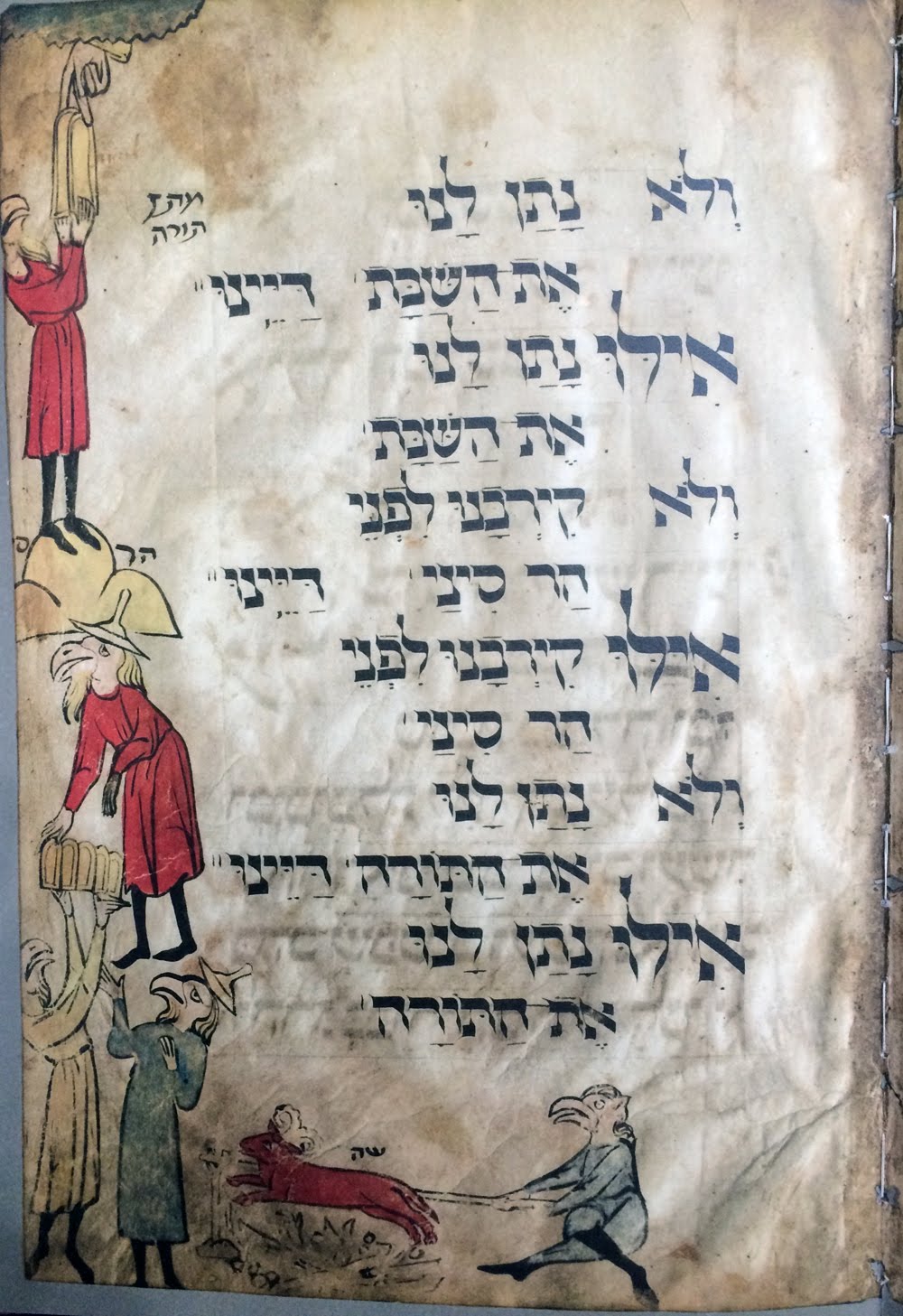
            We have discussed haggadah illustrations in the past (see the links at the end of this post) and we wanted to expand and update upon that discussion for this year. In this post we focus on Hebrew illuminated haggadah manuscripts, and in the follow-up post will turn our attention to printed illustrated haggadot.
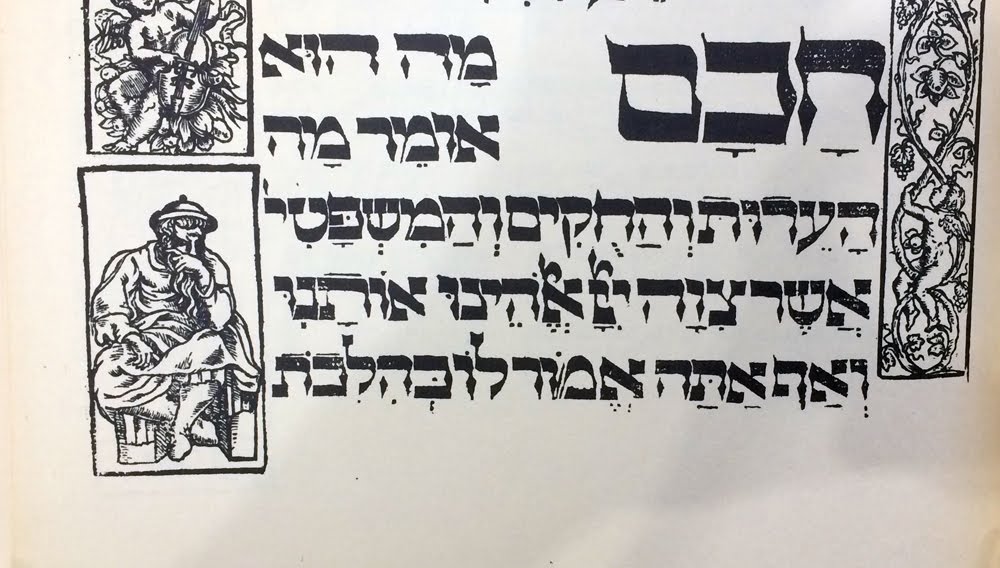
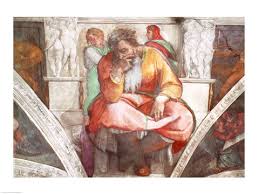
            While there is not as large of a body of Jewish art as that of art in general, historically Jews have appreciated the visual arts early in their evolution into a nation.  Aside from the biblical forms, we have evidence of art dating to the second century of the common era in the well-known frescos at the Dura-Europos synagogue.[1] But, such appreciation was not limited to second century Palestinian Jews, as evidenced from the discussion below, this appreciation continued, almost unabated, until the modern period.  It was not just the artist class or wealthy acculturated Jews that were exposed to and admired this medium.  For example, in the 1560 Mantua haggadah, one of the more important printed illustrated haggadot, the wise son appears to be modeled after Michelangelo’s Jeremiah in the Sistine Chapel (view it here: link). 
            

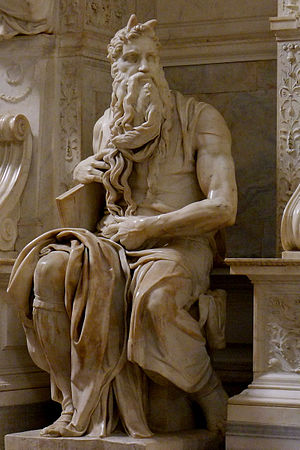
Lest one think that it is highly unlikely that a 16th century Italian Jew would have even entered the chapel, let alone been familiar with this painting, a contemporaneous account of Jewish art appreciation disabuses those assumptions.  Specifically, Giorgi Vasari, the 16th century artist and art historian, in his Lives of Excellent Painters (first published in 1560), records regarding Michelangelo’s statute of Moses – that is a full statute depicting the human form and was placed in the church of San Pietro in Rome – that “the Jews [go] in crowds, both men and women, every Saturday, like flocks of starlings, to visit and adore the statue.” That is, the Sabbath afternoon activity was to go to church to admire the statute of Moses, that is more famous for having horns than its Jewish visitors.[2]

Hebrew Manuscripts Background  
A brief background regarding Hebrew manuscripts before delving into the illuminated haggadah manuscripts. Details regarding manuscripts, the name of the copyist, the date, and the place where the manuscript was written, were supplied not at the beginning of the book – as is the convention with printed books and title pages –  instead in manuscripts this information is provided at the end. For this reason, the scribe’s note containing the information was called a colophon – from the Greek word kolofon, meaning “summit” or “final point.”[3]
Number of Hebrew mss.

A cautious guess of the number of extant Hebrew manuscripts in existence is between 60,000 -70,000 “but no more than 30-40 thousand of them predate the middle of the sixteenth century.”[4] Of the 2-3 hundred thousand Hebrew manuscripts presumed in existence in Europe at the beginning of the fourteenth century, probably no more than four to five thousand are extant today, possibly even less. “From the tenth century (before which information is very scarce) to 1490 (when the influence of printing books began to be felt)” there are an estimated one million manuscripts, meaning, “that 95 per cent of manuscripts have disappeared.”[5]  In addition, the early printed books – incunabula – had similar survival rates.

            The dearth of manuscripts has left a significant hole in our knowledge of major Jewish texts.  For example, there is only one complete manuscript of the Palestinian Talmud (1289) and two partial manuscripts. The Babylonian Talmud fared slightly better, with one complete manuscript (1342) and 63 partial manuscripts in libraries, with only 14 dating from the 12th & 13th centuries.[6] 
One of the partial TPs is known as the Vatican Codex 133 – and worth mentioning is the Vatican and its role regarding Hebrew manuscripts.  While there is no doubt that the Church had a significant hand in reducing the number of manuscripts – in reality the destruction of Hebrew manuscripts was the work of the Jesuits and not the Roman Catholic Church. Indeed, the Church confiscated and, thus in some instances preserved Hebrew manuscripts.  Consequently, we have a number of important Jewish texts that survive in the Vatican library.  Today, many of these manuscripts have been published.  The incomplete manuscript of the TP is but one example.  Additionally, regarding the use of (rather than just reprinting) the Vatican library, for at least late 19th century, Jews had access to the library.  For example, R. Raphael Nathan Rabinowitz, who authored a monumental work on Talmudic variants provides that “I prayed to God to permit me entrance to the Vatican library to record variant readings” his prayer was answered, and he received permission not only to use it during regular hours but “even on days that it was closed due to Christian holidays, when the library was closed to all, and even more so Jews.”[7] In total he spent close to 9 months in the library. In addition, Rabbi Rabinowitz’s presence and special status at the Vatican library was instrumental for the editing of the Vilna Talmud, where he secured permission for the Romm-employed copyists to work with manuscripts of the commentary of Rabbenu Hananel, even though they arrived in Rome during the summer season when the library was closed.
            Of the estimated one million Hebrew manuscripts from the 10th century until 1490, approximately 5% have survived.  As mentioned, religious persecution was one reason, but the main reasons are (1) deterioration from use, (2) accidents, and (3) reuse.  The first two are self-explanatory, the third requires a bit of explanation.  From the times that manuscripts were written on papyrus, unwanted manuscripts were scraped or washed and then reused.  (This papyrus recycling was not confined to reusing for books, papyrus was used from wrapping mummies, burned for its aroma, and used, according to Apices, to wrap meat for cooking). Similarly, leather and parchment were recycled, in the more egregious examples for shoe leather but in many cases for book bindings.  The latter reuse would be critical to the survival of numerous Hebrew manuscripts which have now been reclaimed from bindings.  It is estimated that there are 85,000 such binding fragments.  “The commonest use of written folios, however, was in bindings, whether for binding strips, end papers, or covers.”[8]   
Illuminated Hebrew Manuscripts

            The “earliest examples of Jewish book illumination are tenth-and eleventh-century Bible codices written in the Orient or Near East.  The illuminations are not figurative but consist of a number of decorative carpet pages adorned with abstract geometric or micrographic designs preceding or following the Biblical text.”[9] While these early illuminated manuscripts did not contain human figures, they did contain the first iterations of something unique to Jewish manuscripts, “one form of manuscript depiction unique to Jewish manuscripts is micrography with the earliest examples of this art may be found in the tenth-century Bibles written in the Orient.”[10]  A beautiful example of this art can be seen in the carpet pages for the Leningrad Codex. 


Similar non-representational geometric art was incorporated into Islamic art to avoid graphic representation.  Consequently, symmetrical forms were created which required advances in math theory to accommodate the ever more complex art.
Hebrew manuscripts did not adopt the Islamic convention – for the most part – and the earliest illustrations of human figures appear in Franco-Ashkenazic manuscripts – bibles – of the thirteenth century.
The earliest extant illustrated haggadah[11] is what is known as the Birds’ Head Haggadah dated to the early 1300s. The moniker “Birds’ Head” comes from the fact that the illustrator used birds heads/griffins in place of human heads. This manuscript is not the only Jewish manuscript to use zoophilic (the combination of man and beast) images. Zoophilic images can be found in a variety of contexts in Jewish manuscripts. For example, in the manuscript known as Tripartite Machzor, men are drawn normally while the women are drawn with animal heads.[12]  The name of this Machzor comes from the random fact that the manuscript was split up into three.  At times manuscripts are titled by location (Leipzig Mahzor), history (tripartite) or owner.  In one example, the “Murphy Haggadah” “ suffered a fate all too common to many Hebrew texts.  Before the Second World War the manuscript belonged to Baron Edmond de Rothschild.  During the war it was stolen and sold to an American, F.T. Murphy, who bequeathed it to Yale University, his alma matter.  For years it was known as the “Murphy Haggadah” until, in 1980, a Yale scholar, Prof. J. Marrow, identified as belonging to the Rothschilds.  The manuscript was returned to the Rothschild family and presented by the Baroness Dorothy to the Jewish National Library.[13]
            When it comes to the Birds’ Head manuscript, a variety of reasons have been offered for its imagery, running the gamut from halachik concerns to the rather incredible notion that the images are actually anti-Semitic with a bird’s beak standing in for the Jewish nose trope and the claim that the ears on the “birds” are reminiscent of pigs’ ears. Generally, those claiming halackhic, or more particular pietistic reasons, do so because they are unable “to conceive of such a bizarre and fanciful treatment of the human image as emerging from anywhere other than the twisted and febrile imagination of religious fanatics.”[14] But, in reality the use of bird’s head in lieu of human “reflects a liberal halakhic position rather than an extreme one.”[15]  The camp of Yehuda ha–Hassid would ban all human, animal and celestial depictions, a more liberal position from this perspective permits animal images.  And, while that position doesn’t explicitly permit a depiction half-animal half-human, the zoophilic images appear to show they were allowed, as the illuminator and owner of the Birds Head Haggadah agreed with that position.
            Aside from halakha, and the meaning or lack thereof behind “birds”, a close examination how the illuminator used this convention yields surprising nuance and commentary.      
While most of the images carry a bird’s head, there are a few exceptions. Most notably, non-Jews, both corporeal and spiritual do not. Instead, non-Jewish humans as well as angels have blank circles instead of faces. But, there is one scene that poses a problem. One illustration shows the Jews fleeing Egypt (all with birds’ heads), being pursued by Pharaoh and his army. Pharaoh and his army are depicted faceless.

  But, unlike the rest of the figures in Pharaoh’s army, two figures appear with birds’ heads. Some write this off to carelessness on the illustrator’s part. Epstein, who credits his (then) ten-year old son for a novel explanation, offers that these two figures are Datan and Aviram, two prominent members of the erev rav, those Jews who elected to remain behind. Indeed, they are brandishing whips indicative of their role as nogsim (Jewish taskmasters, or the precursor to Jewish Sonderkommando). While the illustrator included them with the Egyptians, he still allowed them to remain with their “Jewish” bird’s head.  This is a powerful idea regarding the idea of sin, and specifically, the Jewish view that even when a Jew sins, they still retain their Jewish identity – their “birds head.”   Sin, and including sinners as Jews, are motifs that are highlighted on Pesach with the mention of the wicked son and perhaps is also indicated with this illustration. The illustrator could have left Datan and Aviram out entirely or decided to mark them some other way rather than the Birds’ head. Thus, utilizing this explanation allows for the illustrator to enable a broader discussion about not only the exodus and the Egyptian army’s chase, but expands the discussion to sin, repentance, Jewish identity, inclusiveness and exclusiveness and other related themes.[16]

            Once we have identified the Jews within the haggadah, we need to discuss another nuance in their depiction.  The full dress of the adult male bird is one with a beard and a “Jewish hat,” pieus conutus – a peaked hat, or the Judenhut.  Children and young servants are bareheaded.  But, there are three other instances of bareheadness that are worthy of discussion.  (1) Joseph in Egypt, (2) the Jews in Egypt and (3) Datan and Aviram.  The similarity between all three is that each depicts a distance from god or Jewish identity.  Joseph, unrecognizable to his brothers, a stranger in a strange land, and while inwardly a Jew, externally that was not the case.

            The Jews in Egypt had sunk to the deepest depths on impurity, far from God. Finally, as we discussed previously, Datan and Aviram are also removed from god and the Jewish people.  Again, the illustrator is depicting Jews – they all have the griffin heads – but they are distinct in their interaction with god and the Jewish people.[17]  

Using this interpretation of the griffin images, yields yet another subtle point regarding inclusion, and also injects some humor into the haggadah.  The dayenu panel has splitting of the sea, the manna and the giving of the Torah.  The middle panel is less clear. Some posit that it is the Jews celebrating at the sea, but there is no indication of that because in most manuscripts, that includes Miriam, and the Egyptians drowning, not just five random images.

   
Instead, it appears that the person to the left is speaking (his hand is over his heart a medieval convention to indicate speech), and they are approaching the older figure on the left.  All are griffin headed and Judenhut attired – so Jews and regular ones. Between the splitting of the sea and the manna and quails the Jews complained to Moses.  Its possible that this is what is being depicted here, the complaining Jews, and the illustration serves as a testament to God’s patience and divine plan, the theme of dayenu, that even though we complained and did X, God still brought the manna, quail and Torah.[18] 

            If these are in fact the complainers, we can theorize about another detail of the image.  Above the figure at the left and the right, is faint cursive (enhanced here for visibility as much as possible) that reads: “Dass ist der Meirer (this is Meir) Dass ist der Eisik (this is Issac).”[19]  Thus Meir and Issac are being chided – but not kicked out – for complaining too much (rather than representing an unclear image of the Jews celebrating at the sea or just evidencing poor dancing). 


            Continuing through the dayenu we get to the giving of the Torah, and again, the nuance of the illustrator is apparent

.

            Two tablets were given at Sinai, but the actual Pentateuch is comprised of 5 books.  Thus, to capture that the 5 are a continuity of the two, as they are transmitted down, they transform into five tablets.  What about the ram/lamb at the bottom?  Some have suggested that it is the Golden Calf. But it is unlikely that such a negative incident would be included.  Instead, assuming that continuity or tradition is the theme, this lamb is representative of pesah dorot that is an unbroken tradition back to Sinai and unconnected with the Christian idea of Jesus as a stand in for the lamb.  Immediately prior to dayenu we have the Pesach mitzrayim with the figure’s cloak blowing back due to the haste.

       Thus, the dayenu is bracketed by the historic Pesach and the modern one – all part of the same tradition. [20]  

            It is worth mentioning that the Birds’ Head Haggadah is currently in the news. An item recently appeared about how the heirs of Ludwig Marum and his wife Johanna Benedikt, the owners of the haggadah prior to the Nazi era, are pressing the Israel Museum to recognize their family’s title, and pay them a large sum of money (but only a fraction of its estimated value). The Israel Museum acquired the haggadah for $600 from a German Jewish refugee in 1946.  (link).

            Turning to Spain, one of the most beautiful illuminated haggadot is the “Golden Haggadah.”  Just as the Ashkenazi Bird’s Head has depth to the illustrations, the Golden Haggadah can be mined for similar purpose.  Each folio is comprised of four panels.  And while they appear to simply depict the biblical narrative, they are so much more. 

            In an early panel we have Nimrod throwing Abraham into the fire and later Pharaoh throwing the males in the Nile, both Nimrod and Pharaoh are similarly depicted, on the throne, with a pointed finger indicating their equivalence in denying god. 

            The folio showing the Joseph story has the brothers pointing in the same manner as Pharaoh and Nimrod – the illustrator showing his disdain for the mistreatment and betrayal and equating it with the others.

            But, that is not all.  Counting the panels there are 9 between Nimrod and Joseph and 9 between Joseph and Pharaoh.  Taken together, these illustrations “renders an implicit critique of the attitude of that Jewish history is nothing but an endless stream of persecution of innocent Israel by the bloodthirsty gentiles.  Yes, it is acknowledged, these gentile kinds might behave villainously in their persecution of Jews.  But groundless hatred between brother and brother is on par with such terrible deeds, and sometimes sinat hinam can precipitated treachery as destructive as persecution by inveterate enemies.”[21]

            One other striking feature of the Golden Haggadah is the inclusion of women. There are no fewer than 46 prominent depictions of women in the haggadah.  Indeed, one reading of the exodus scene has a woman with a baby at the forefront leading the Jews out of Egypt behind Moses.

            This may be a reference to the midrash that “in the merit of the righteous women the Jews were redeemed.”[22]  The difference in the exodus scene is particularly striking if one compares it to the Ashkenaz Haggadah – Moses clearly at the front, and the most prominent woman in the back.


Of course, it is completely appropriate for the inclusion of women in the haggadah as women and men are equally obligated to participate in the seder. Another example of the prominence that woman play in the Golden Haggadah iconography is the scene of Miriam singing includes the largest images in the haggadah, the women occupying the full panel.  We don’t know why the illustrator chose to highlight women – was it for a patron or at a specific request.[23] 
The Golden Haggadah is not the only manuscript that includes women in a prominent role in the illustrations.  The Darmstadt Haggadah includes two well-known illuminations that place woman at the center.  The illuminations adoring other Darmstadt serve a different purpose than the Golden or Birds’ Head, they are purely aesthetic.[24]  Thus, the inclusion of women may not be linked to anything in particular.  At the same time, it is important to note that in terms of reception, that is, how the reader viewed it, the focus on women was not cause for consternation. One other note regarding the haggadah, the last panel is a depiction fountain of youth.  Note that men and woman are bathing – nude – together, which seems odd to a modern viewer (and, again, apparently did not to the then contemporary reader).  And, while admittedly not exactly the same, the 14th century R. Samuel ben Baruch of Bamberg (a teacher of R. Meir of Rothenberg) permitted a non-Jewish woman to bath a man so long as it was in public to reduce the likelihood of anything untoward occurring.[25] 

Before we leave the Darmstadt Haggadah, we need to examine the panel facing the Fountain of Youth. This panel depicts a deer hunt.

 As mentioned above, this image is not connected to the text and instead is solely for aesthetic purposes.  The hunting motif is common in many medieval manuscripts, and in some a unicorn is substituted for a deer.  While the unicorn has Christological meaning, on some occasions it also appears in Hebrew manuscripts.[26]

While the use of the hunting scene in the Darmstadt Haggadah was unconnected to the haggadah, in others it was deployed for substantive purpose.[27] [As an aside, it is possible that Jews participated, possibly Rabbenu Tam, in hunting, or at least its falconry form.[28]] As is well-known, the inclusion of the hare hunt is to conjure the Talmudic mnemonic regarding the appropriate sequence over the wine, candle, and the other required blessings, or YaKeNHaZ.  “To Ashkenazic Jews, YaKeNHaZ sounded like the German Jagen-has, ‘hare hunt,’ which thereby came to be illustrated as such in the Haggadah.”[29]

 Generally, Jews seem to have issues with botany.  We struggle to identify which of the handful of fruits and vegetables mention in the Bible and Talmud. But on Passover, the marror an undefined term, proves particularly illusory. Today, there is no consistency regarding what is used for marror with it running the gamut from iceberg lettuce to horseradish root. While we may not be able to identify it with specificity, we know what its supposed to taste like – bitter.  Manuscripts may provide some direction here.  There are two depictions in illuminated haggadot.  One of a leafy green, found in numerous examples, from a fragment from the Cairo Geniza to the Birds’ Head, and that of an artichoke.[30]  If it is a leafy green, it must be a bitter one – and that changes based upon time, place and palate.  For example, 30 years ago romaine lettuce was only the bitter lettuce widely available. But, among lettuces, it is far from bitter, and today, there are a variety of truly bitter lettuces available, arugula, mustard greens, dandelion, mesclun, etc.  Another leafy and very bitter option that is found in illuminated haggadot is the artichoke.  The artichoke is extremely bitter without proper preparation.  Indeed, from just touching the leaves and putting them in your mouth you can taste the bitterness.  The Sarajevo Haggadah and brother to the Rylands both have artichokes.

            The association of the artichoke with Passover is more obvious when one accounts for Italian culinary history.  Specifically, artichokes are associated with Jews and Passover. Carcoifi alla giudia – literally Jewish style artichokes “is among the best known dishes of Roman Jewish cuisine.” Artichokes are a spring thistle and traditionally served at Passover in Italy.  Whether or not from a culinary history this dish sprung from the use of raw artichoke for marror is not known, but we can say with certainty that artichokes have a considerable history when it comes to Passover. 

Horseradish only became popular, in all likelihood, because an early Pesach, would be too soon for any greens and thus they were left with horseradish – which is not bitter at all, instead it is spicy or more particularly hot.  In Galicia in the 19th century the use of horseradish was so ingrained that  permission was even granted and affirmed for people to use less than a kezayit  and still recite the blessing. In light of this, the custom yields the possibility that all sort of other spicy items be used for marror including very hot jalapeño peppers, for example.[31] Since we are discussing herbs, it is also worth noting that recently rulings regarding the use of marijuana and Pesach have been issued both in Israel and the United States (here), for our discussion on marijuana and Pesach please see here.

            One manuscript captures the uncertain identification of marror.  In the Tubingen Haggadah, the place where the illustration for marror is left blank, presumably to permit the owner to fill in what they are accustomed to use.

            Marror is not the only vegetable that is eaten during the seder, another difficult to identify is the karpas.  Today there are a variety of items used, and in reality, any dip-able vegetable will suffice, historically, it seems that lettuce or celery was used. The Birds Head provides that “lattich (lettuce) and eppich (celery) should be used. These are traditional salad foods, which, in the normal course of things, would be dipped or tossed with a dressing.  A dressing can be a simple as vinegar, and indeed, in many medieval haggadot, hometz or vinegar is used to dip.  We can trace the change from the more obviously salad oriented vinegar to saltwater where in the Darmstadt Haggadah, a later hand wrote on top of hometz – mei melekh.  While it appears nearly universal that hometz was used, its disfavor may be connected to a rule unrelated to Passover.  Since the Middle Ages, there is a dispute whether or not vinegar falls under the ambit of stam yenam.  Thus, the change to saltwater may be more of a reflection about views on what constitutes stam yenam and less to do with tears.

            One final food item is the haroset preparation.  Apples are familiar and linked to the midrash regarding birthing under an apple tree, in the Rothschild Machzor and the 2nd Nuremburg haggadah, cinnamon is called for because “it resembles straw.”  It also concludes that “some incorporate clay into the haroset to remind them of the mortar. For those wanting to replicate this addition, edible clay, kaolin, is now easily procured, and there is even a preparation that creates stone-like potatoes, perfect for the seder.
            To be continued… but until then see these posts Halakha & Haggadah, and regarding some illustrations in the iconic Prague 1526 Haggadah, here and also Elliot Horowitz’s discussion.
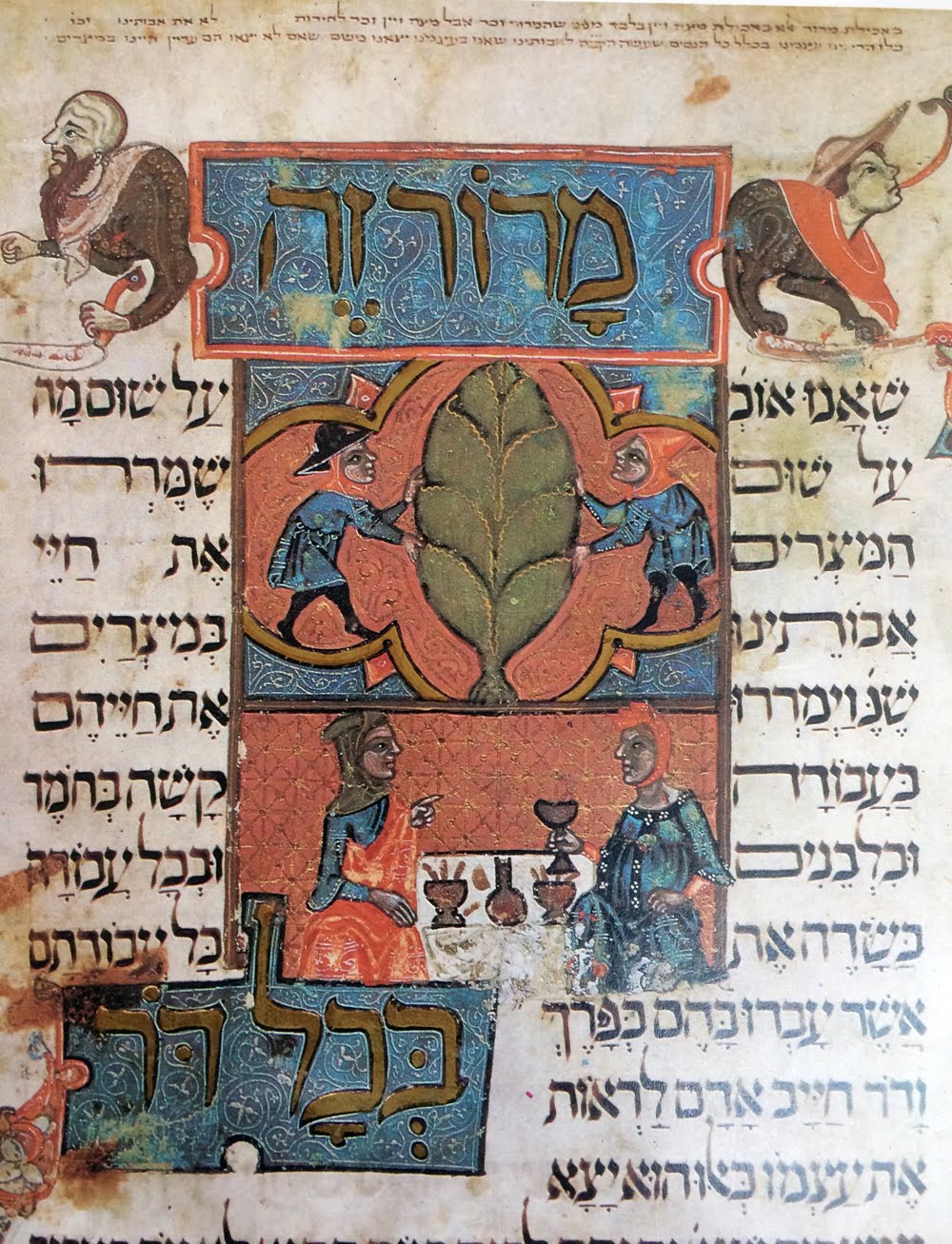
[1] E.L. Sukenik, The Dura-Europa Synagogue and its Art, Bialik Press, Jerusalem:1947. See also, Gabrielle Sed-Rajna, Jewish Art, transl. Sara Friedman & Mira Reich, Harry N. Abrams, Inc., New York: 1997, 9-13; 20-29;114-39.
[2] Two Prague Haggadahs, Valmadonna Trust Library, Italy:1978, 16 n.16 (the citation should read p. 435, not p. 345)
[3] Binyamin Richler, Hebrew Manuscripts: A Treasured Legacy, Cleveland/Jerusalem: Ofeq Institute, 1990, 20.
[4] Id. at 58.
[5] Colette Sirat, Hebrew Manuscripts of the Middle Ages, ed. & transl. Nicholas de Lange, New York: Cambridge University Press, 2002, 234.
[6] Id. 242-43.
[7] R. N. Rabinowitz, Dikdukei Soferim, Munich: E. Hovner, 1881, vol. 11, Tractate Baba Bathera, 7. 
[8] Sirat, Hebrew Manuscripts, 235-38.
[9] Richler, Hebrew Manuscripts, 45.
[10] Id. 48.
[11] Interestingly, illuminated haggadot did not end with the introduction of printing, there are a number from the 18th century and beyond.
[12] See B. Narkiss, Hebrew Illuminated Manuscripts, Jerusalem: Keter Publishing House, 1969, 106.
[13] Richler, Hebrew Manuscripts, 47.
[14] Marc Michael Epstein, The Medieval Haggadah: Art, Narrative, and Religious Imagination, New Haven & London: Yale University Press, 2011, 50-51. See the other discussions of this book, here.
[15] Id. 51.
[16] Id. 51-53, 71-72.  Much of the discussion regarding this haggadah and the Golden Haggadah is reliant upon Epstein’s thorough analysis of these manuscripts.
[17] Id. 65-68, 71-72.
[18] Id. 87-90.
[19] M. Spitzer & B. Narkiss, “General Description of the Manuscript,” in The Bird’s Head Haggada of the Bezalel National Art Museum in Jerusalem, ed. by M. Spitzer, Tarshish Books: Jerusalem, 1967, 23.
[20] Epstein, The Medieval Haggadah, 90-91.
[21] Id. 162.
[22] Id. 178.
[23] Id. 185-86.
[24] Narkiss, Hebrew Illuminated Manuscripts, 126.
[25] Elliot Horowitz, “Between Cleanliness and Godliness,” in Tov Elem: Memory, Community & Gender in Medieval & Early Modern Jewish Societies, ed. E. Baumgarten, et al., Bialik Institute, Jerusalem:2011, *38-*39.
[26] Piet van Boxel, “The Virgin & the Unicorn: A Christian Symbol in a Hebrew Prayer Manuscript,” in Crossing Borders, Hebrew Manuscripts as a Meeting-place of Cultures, ed. Piet van Boxel & Sabine Arndt, Bodleian Library, University of Oxford:2009, 57-68.
[27] The hare hunt image appears in Seder Zimerot u-Birkat ha-Mazon, Prague 1514, in the Shevuot portion.  Of course, the mnemonic applies to any holiday that potentially falls on a Saturday night.  See B. Roth, “Printed Illustrated Hebrew Haggadot,” Areshet, vol. 3 (1961), 8.  
[28] See Leor Jacobi, “Jewish Hawking in Medieval France: Falconry, Rabbenu Tam, and the Tosefists,” in Oqimta 1 (2013) 421-504, available here.
[29] Y. Yerushalmi, Haggadah & History, The Jewish Publication Society, United States:1997, plate 15.
[30] The various manuscript depictions of marror are collected in Mendel Metzger, La Haggada Enluminee, Brill, Leiden:1973, figs. 242-65.
[31]  Levi Cooper, “Bitter Herb in Hasidic Galicia,” Jewish Studies, an Internet Journal, vol. 12, 2013 (available here). 


Tarnopol: A short-lived early 19th century Hebrew press

Tarnopol: A short-lived early 19th century Hebrew press
by Marvin J. Heller[1]

The blossoms have appeared in the land, The time of your song has arrived,
and the voice of the turtledove Is heard in our land.
The green figs form on the fig tree. The vines in blossom give off fragrance.
Arise, my darling; My fair one, come away!
“O my dove, in the cranny of the rocks. Hidden by the cliff.
Let me see your face, Let me hear your voice; For your voice is sweet And your face is comely.”
Catch us the foxes, The little foxes
That ruin the vineyards— For our vineyard is in blossom. (Song of Songs 2:12-15).

Tarnopol (Ternopol), a city with an established Jewish community, dates its founding to the mid-sixteenth century. The community had many positive aspects (blossoms have appeared in the land, The time of your song has arrived), and was home to a Hebrew printing press (The green figs form on the fig tree. The vines in blossom give off fragrance) for a brief time only in the early nineteenth century. Due, however, to the contentious relationship between conflicting segments of the community, that press, after publishing a variety of valuable works, was short lived and closed prematurely (The little foxes that ruin the vineyards).

Tarnopol is in Galicia, in the western Ukraine, approximately 227 miles (365 km.) from Kiev (Kyiv) and 73 miles (117 km,) from Lvov. Although there had been earlier residences in the area, credit for founding the city as a private town in 1540 is given to the Polish hetman, Jan Amor Tarnowski. Tarnowski permitted Jewish settlement almost immediately afterwards in what was his personal domain. The city charter permitted Jews to reside throughout the city, excluding the market place. Initially, the Jewish population was small, comprised of only a few dozen Jews, this based on the head tax paid, the revenues from it being, in 1564, 20 zlotys, rising to 23 the following year. Jews quickly became a majority of the population, with as many as 300 families resident there in the sixteenth and seventeenth centuries.[2] By 1765, the Jewish population of Tarnopol had increased to 1,246 Jews.[3]

In 1548, Tarnopol was granted the privilege of the Magdeburgian Laws, regulations concerning internal autonomy within cities and villages granted by the local ruler, developed by Otto I, Holy Roman Emperor (936–973). In 1566, Tarnopol received the Emporium Right, the duty of storing the merchandise of the merchants passing through the town, and the privilege of the residents of the town to be the first to purchase the merchandise. Tarnopol was fortified and strengthened during the Tartar invasions in 1575 and 1589. In 1621, it became the property of Chancellor Tomash Zamoiski.[4]

A fire in 1623 caused significant damage to the homes in the city, but Zamoiski allowed the Jews to rebuild their homes as well as a new synagogue, this constructed in citadel style, to replace the one destroyed in the fire. Jews could buy and sell goods, excepting some leather merchandise, this to protect the monopoly of Christian shoemakers. Jews could be butchers, but had to provide the owners of the city annually with ten milk stones.

Tarnopol suffered, as did Jewish communities throughout Eastern Europe, from the Chmielnicki massacres of 1648-49 (tah ve-tat) and again in 1653 from the Tartar invasions. Until the ravages of the former occurred, the Jewish community was prosperous. At that time, however, most Jews fled, those remaining being massacred. Jews participated in the defense of the city in the Cossack and Swedish wars. The city, now the property of Alexander Konyetspolski, was reconstructed, but suffered yet again in 1672 when the town’s castles and citadels were bombarded by the Turks. Towards the end of the century the community began to revive, Jewish merchants being dominant in the grain and cattle trades.[5] In 1690, Tarnopol became the private property of the Polish royal family, Subiesky, and subsequently was transferred to the noble Polish family, Pototski, remaining in their possession until 1841 when private ownership of cities was abolished.

An early rabbi in Tarnopol was R. Gershom Nahum R. Meir ben Isaac Tarnopoler, who stated that “Our community is the capital (i.e it was important).” The rabbis active in Tarnopol in the eighteenth century included R. Joshua Heschel Babad, followed by R. Jacob Isaac ben Isaac Landau. Joshua Heschel Babad’s (Babad is an acronym of Benei Av Bet Din, “children of the av bet din,” 1754-1838) itapprobations appear in several of the titles described in this article and served as rabbi of Budzanow and, from 1801, of Tarnopol. He opposed the growing circle of maskilim in Tarnopol and polemicized against their patron, Joseph Perl (below), and, in 1813, of the teaching system in the school founded by Perl where secular studies were taught.[6]

Tarnopol suffered from an outbreak of the Black Plague in 1770, suffering many deaths. Finally, in 1772, Tarnopol was annexed to Austria and from 1809 to1815 was in the possession of the Russians, returning to Austrian rule until it became part of the Western Ukrainian Republic. Its status changed yet again at the end of 1918 when it became part of independent Poland.

In the early eighteenth century Tarnopol was largely Hassidic. Nevertheless, among the significant figures in Tarnopol was Joseph Perl, a prominent Maskil, active in that movement and an opponent of Hassidus.

A Hebrew press was established in Tarnopol in 1812. At that time Nahman Pineles and Jacob Auerbach, accomplished printers, obtained permission from the Russian authorities to establish a Hebrew press, this with the condition that the books to be printed would be approved by the censor. They acquired typographical equipment from the printer Benjamin ben Avigdor and employed two workers, Mordecai ben Zevi Hirsch and Aryeh Leib ben David. Ch. Friedberg informs that this was not an auspicious time to establish a press due to the Napoleonic wars. Nevertheless, it was established with the support of Joseph Perl, who not only provided financial assistance, but also space in his school for the press. He did so in the belief that the books published by the press would be in support of the Haskalah.[7]

The Thesaurus of the Hebrew Book records twenty-two entries, from 1812-13 through 1817.[8] These works are varied. We will describe a portion of them, several in some detail, others in passing, giving a sense of the press’ output.

I

Yeshu’ot Meshiho – Printing is reported to have begun with Don Isaac ben Judah Abrabanel’s (1437-1508) Yeshu’ot Meshiho (the Salvation of His Anointed) in 1812-13.[9] Abrabanel, a noted statesman, biblical exegete, and philosopher, traced his lineage to King David. He was the grandson of Samuel and the son of Judah Abrabanel, the former an advisor to three Kings of Castile, the latter to the King of Portugal. Don Isaac Abrabanel received a thorough Jewish education, studying Talmud under R. Joseph Hayyun (d. 1497), as well as instruction in philosophy, classics, and even Christian theology, this last useful in his defense of Judaism. Abrabanel succeeded his father as treasurer to King Alfonso V of Portugal, during which time he was instrumental in redeeming Jewish captives brought to Portugal. Upon the death of Alfonso in 1481, João II (1481-95) became king of Portugal. In 1483, João accused Abrabanel of participating in a conspiracy. Forewarned, Abrabanel fled to Spain, where he served as an official in the court of Ferdinand and Isabella. In 1492, they offered him the opportunity to remain in Spain as a Jew, but he chose to go into exile and left with other Jews.[10]

A prolific author Abrabanel wrote extensive and highly regarded commentaries on books of the Bible, philosophical works, and a three-part trilogy of consolation on resurrection and redemption. Yeshu’ot Meshiho is the third part of the trilogy. The first parts are Ma’yenei ha-Yeshu’ah (Wells of Salvation), first printed in Ferrara (1551) on the book of Daniel, followed by Mashmi’a ha-Yeshu’ah (Announcing Salvation), first edition published in Salonika (1526); the trilogy is completed with Yeshu’ot Meshiho. The text addresses redemption, the Messiah, and the end of days.[11] This is recorded as the first edition of Yeshu’ot Meshiho in bibliographies, but is extremely rare and was not seen by this writer. It is recorded as an octavo.

Rosh Amanah – Our second work by the Abrabanel, also printed in 1813, is Rosh Amanah, on the principles of faith. First published in Constantinople (1505) this edition was printed in the year “[From Lebanon, my bride, with me!] Trip [look] down from Amana’s peak תשורי מראש אמנה (573 = 1813)” (Song of Songs 4:8), a reference to the principles of faith (Emunah). It was printed in quarto format (40: 30 ff.). Abrabanel completed Rosh Amanah “in Naples at the end of Marheshvan, in the year, ‘The voice of rejoicing רנה (255=November, 1494) and salvation’” (Psalms 118:15), that is, two years after the expulsion of the Jews from Spain. The verso of the title-page has an approbation from R. Joshua Heschel Babad, av bet din of Tarnopol, immediately below it is verses from Judah Abrabanel, the author’s son, and below that a statement that wherever the phrases akum or goi appears it refers to ancient idol worshippers, not to contemporary non-Jews who are upright people.

1813, Rosh Amanah

Next is Abrabanel’s introduction, in which he explains that his purpose in writing the book is twofold, to clarify the confusion resulting from the many lists on the principles of faith and to defend Maimonides from his critics, most importantly R. Hasdai Crescas (c. 1340–c. 1410–11, Or HaShem), and Joseph Albo (15th century, Ikkarim). Stylistically, Rosh Amanah follows the same format as Abrabanel’s other works, that is, he poses a series of questions which he then resolves.

There are twenty-four chapters. In the first twenty-two Abrabanel enumerates twenty-eight objections to Maimonides thirteen principles of faith, twenty taken from Crescas and Albo. Abrabanel subsequently resolves these objections, defending Maimonides from his critics, although he too, in chapter twenty-three, rejects Maimonides’ formulation of a dogma for Judaism. Rosh Amanah begins with a discussion of the thirteen principles, followed (ch. 2-5) with Crescas and Albo’s objections; then nine necessary propositions for the ensuing discussion (6-11); the refutation of the objections (12-21); criticism of Crescas’ and Albo’s formulation (22); Abrabanel’s contention that Judaism has no dogmas (23); and lastly, a discussion of the Mishnah in Sanhedrin (90a), “All Israel has a share in the world to come,” which might seem to posit a dogma for Judaism.[12]

Despite Abrabanel’s contention that Judaism has no dogmas he writes (ch 22) that if he were to, “choose principles to posit for the divine Torah I would lay down one only, the creation of the world. It is the root and foundation . . . and includes the creation at the beginning, the narratives about the Patriarchs, and the miracles and wonders which cannot be believed without belief in creation.”

Rosh Amanah has been published at least nine times to the present, excluding a questionable 1547 Sabbioneta edition, and translated into Latin by Guilielmum Vorstium (Liber de capite fidei, Amsterdam, 1638 and 1684), French by B. Mossé (Le princips de la foi, Avignon, 1884), and English twice, that is, the first five chapters by Isaac Mayer Wise (The Book on the Cardinal Points of Religion), serialized in The Israelite (Cincinnati, 1862), and more recently in its entirety as by M. Kellner (Principles of Faith, Rutherford, 1982).

Hamishah Homshei Torah – Among the other works published at this time were a Hamishah Homshei Torah, that is, a small rabbinic Bible (Mikra’ot Gedolot) with commentaries. Four volumes were published in 1813 and one volume, Bamidbar (Numbers) was published in 1814. The text of Hamishah Homshei Torah, on facing pages, is comprised of the biblical text in square vocalized letters on the right page, and below it in rabbinic letters, R. Aaron of Pesaro’s (d. 1563) Toledot Aharon, a concordance, brief citations to the places where each word or phrase in the Biblical text appear; the commentaries of Rashi; and Siftei Ḥakhamim (R. Shabbetai ben Joseph Bass, 1641-1718), a super-commentary on Rashi. On the facing page is Onkelos in square vocalized letters, the Ba’al ha-Turim (R. Jacob ben Asher, c. 1270-1340) and the continuation of Rashi and Siftei Ḥakhamim, all in rabbinic letters.

Likkuttei Shoshanah – Another very different work, published in 1813/14 is R. Samson Ostropoler of Polonnoye’s (Volhynia, (d. 1648) Likkuttei Shoshanah. Ostropoler, a kabbalist of repute, died on July 22, 1648, at the head of his community in the Chmielnicki massacres. At that time, Ostropoler assembled 300 members of his community into the synagogue and, dressed in shrouds and prayer-shawls, said selihot and prayers until they were slaughtered. R. Nathan Hannover, in Yeven Metsulah on the Chmielnicki massacres, informs that a magid (heavenly teacher) who frequently instructed Ostropoler in the secrets of the Kabbalah, warned him of the impending catastrophe, advising Ostropoler to call the community to repent, which he did but to no avail.[13] Likkuttei Shoshanah, a kabbalistic work, was published in a small format, 20 cm. (8 ff.).

II

Pa’ne’ah RazaR. Isaac ben Judah ha-Levi’s commentary on the Torah, Pa’ne’ah Raza, built upon literal interpretations (peshaṭ) intermingled with gematriot and notarikon (numerical and abbreviated letters of words) is also an 1813 publication. Isaac ben Judah ha-Levi (13th cent.) was one of the Tosafot of Sens, and a student of R. Hayyim (Paltiel) of Falaise. Printed previously in Prague (1607), this edition was published as an octavo (80: 142, [2] ff.).

1813, Pa’ne’ah Raza

The title-page informs that the contents include, in addition to Isaac ben Judah ha-Levi’s commentary the insights of many other rishonim (early sages) who are then noted, and that Pa’ne’ah Raza, is novellae on Hamishah Homshei Torah and Megillah in veiled ways. Among the many virtues that the title-page lists are insightful forms of elucidation, all desirable, sharp, sweet peshat (literal interpretations), queries and responses, and much more. Also included are words of the sages through gematriot, as given at Sinai with sound and flame.

The title-page is followed by R. Joshua Heschel Babad’s approbation and then Isaac ben Judah’s introduction. He begins that “I am the youth of my mother’s house and of my people, ‘a worm and a maggot’ (Avot 3”1), I know my place . . . ‘I am but dust and ashes’ (Genesis 18:27).” The title alludes to his name Pa’ne’ah פענח and Raza רזא, both have a numerical value of 208, the numerical value of his name, Isaac יצחק (208). He has included what he has heard from his teachers, among them Ran, R. [Joseph] of Orleans, R. Joseph Bekhor-Shor, and some sayings of R. Judah he-Hasid, in gematriot and peshat. He also names R. Eliezer of Worms and others, stating that he has noted the name of every contributor where possible; for he does not, heaven forbid, wish to take someone else’s adornment. Where he does not know the name, it is left unspecified.

R. Hayyim Joseph David Azulai (Hida, 1724-1806), notes the wonder (miracle) and foreknowledge in the heart of the author, that Pa’ne’ah Raza, the name given so many years before, standing for Isaac twice, represents both the author and, after many centuries, the editor.[14]

Although Pa’ne’ah Raza is noted for its gematriot and notarikon much of the text is literal explanations. An example is the following, from Exodus 40:35:

“And Moses was not able to enter [into the Tent of Meeting, because the cloud abode on it]. Rashi explains, “the cloud was removed and he entered and He spoke with him.” A difficulty, how if so did He speak with him. For all the days of their encampment the cloud was over it? Furthermore, if so, Aaron and his sons could not enter, in which case, how did they burn the incense, light the menorah, and arrange the lehem ha-Panim? It is possible to say that this was one (another) cloud and during the days of their encampment they were able to enter . . . and R. Eliezer of Worms explains that for one hour the cloud was on it and afterwards removed so that they could enter.

As noted above, Pa’ne’ah Raza was first published in Amsterdam in 1607. This is the third edition, followed, according to the Bet Eked Sefarim, by two additional editions, the last being Warsaw (1928). The National Library of Israel records more recent printings, the latest being Ann Arbor, Michigan (1974) and Jerusalem (2019) editions.[15]

Torat ha-Adam – A work, undated and lacking the place of printing attributed to Tarnopol, although that is uncertain, is R. Samuel ben Shalom’s Torat ha-Adam, an ethical work with kabbalistic content. It was published in c. 1813; measures 23 cm. and comprised of 28 ff.[16] At the top of the title-page is the statement, “Happy is the man who has not forgotten you, and the son of man who finds his strength in You.” The text of the title-page states that it was written by the holy man of God. All who will look into it with open eyes will see how a person has to serve the Lord with a complete and perfect service in order to acquire true completion, for this is why man was created in this world. It further informs that the author, R. Samuel ben Shalom, is a grandson of R. Moses of Ostrog, author of Arugat ha-Bosum on the Song of Songs. The title page is followed by R. Samuel’s introduction, where he writes that he entitled the book Torat ha-Adam because it is how a person should conduct himself all the days of his life in this world. Much of the text is taken from or influenced by the Mishnat Hasidim of R. Emanuel Hai Ricci.[17]

Imrei Binyamin R. Benjamin ben Meir ha-Levi of Brody’s Imrei Binyamin, discourses on the weekly Torah readings, was printed in the year “Of Benjamin he said: Beloved of the LORD, He rests securely beside Him ולבנימין[אמר] ידיד ה ישכן לבטח(574 = 1814)” (Deuteronomy 33:12). Imrei Binyamin was published as an octavo (80: [3], 92 ff.). Although the title-page describes Imrei Binyamin as being on all the weekly Torah readings the text is actually only from the beginning of Bereshit (Genesis) through be-Hukkotai (Leviticus). The title-page informs that these discourses were delivered on Shabbat by Benjamin when he was the maggid mesharim in Berdichev for seventeen years and afterwards in Brody. Imrei Binyamin was brought to press by R. Meir Eliezer ben Pinhas, the author’s grandson. He sadly begins the introduction, “I am the builder of the house of Benjamin, the father of my father.” Benjamin ben Meir had one son only, who predeceased him. In several instances, inserted between the columns of R. Benjamin’s commentary are annotations of Meir Eliezer. He hoped to publish other parts of this work but that, unfortunately, did not happen.[18]

III

Mishlei Shelomo – In 1814, the press published Menahem Mendel Lefin’s (Levin, 1749-1826) Mishlei Shelomo, a bi-lingual octavo format (80: [2], 91 ff.) Hebrew-Yiddish commentary on Proverbs. Lefin, born in Satonov, Podolia, was therefore known as Satonover, and was also referred to as Mikolayev, as he also resided in Mikolayev for an extensive amount of time; spending his last years in Brody and Tarnopol. Lefin received a traditional Jewish education, studying Talmud and rabbinic codes, but early in his life, reportedly by accident, came across and was influenced by Joseph Solomon Delmedigo’s (1591–1655) Elim, dealing with mathematics and physics, motivating him to study those subjects. Lefin subsequently went to Berlin for medical treatment where he was also influence by Moses Mendelssohn (1729–1786), becoming a strong advocate of the Haskalah.

Lefin was a prolific author, his titles including a Hebrew translation of Dr. Samuel-Auguste Tissot’s popular book on medicine; and encouraged by a friendship with Prince Czartoryski, Essai d’un plan de reforme, avant pour objet déclairerhis la Nation Juive en Pologne et de la rdresser par s4es moeurs (An essay upon a Plan of Reform with the Object to Enlighten the Jewish Nation in Poland and to Improve it in Accordance with its Customs); . Lefin’s Hebrew works include Iggrot ha-Hokkmah, Refuot ha-Am, Heshbon ha-Nefesh, which, among other ethical topics, also elaborates on Benjamin Franklin’s Poor Richard’s Almanac, which R. Israel Salanter (1810-83), founder of the Mussar movement, considered an excellent handbook for moral development and had reprinted; a new translation of Maimonides’ More Nevuchim, this in Mishnaic Hebrew, and Alon More, Lefin’s only original work, this an introduction to the philosophy of Maimonides, and Mishlei Shelomo, all in “a delightful prose”.[19]

The brief text of the title-page of Mishlei Shelomo states that it includes a concise new commentary in Ashkenaz (Yiddish) for the benefit of our brothers Beit Yisrael in the lands of Poland. Below that is that it was printed with the permission of the censors. There are two approbations, the first from R. Joshua Heschel Babad, the second from R. Mordecai ben Eliezer Sender Margolious, av bet din, Satonov. Below the approbations is Lefin’s introduction, in which he notes that so Torah should not be forgotten from Israel, he has included commentators and transcribed books of the Bible into different languages. He notes that in later generations with the movements of Jews and forgetfulness, older commentaries are not always understood, particularly in the lands of Ashenaz. Therefore, he has undertaken to bring out a concise commentary for our brothers in those lands, beginning with Proverbs (Mishlei).

1814, Mishlei Shelomo

The text follows, comprised, on facing pages, of the text of Proverbs in vocalized square letters, below it Lefin’s commentary in rabbinic letters, on the recto page. On the verso is Lewin’s translation in square vocalized letters and below it the continuation of the commentary. Zinberg writes that Lefin disregarded the distinction between the spoken and written language, and that Ecclesiastes and Proverbs should not be translated “in the language that the market-Jewess speaks to her customer in the street.” Zinberg describes Lefin’s purpose in the translation, putting an end to the standard style of the translations of the Bible that had been dominant for hundreds of years and according to which the children in the schools had the Biblical text taught and translated to them. He wishes to give ordinary Jews , worn out with toil, the “holy books” without embroidered covers, but in the simple, weekday garment of the colloquial language, with its homely concepts and images, including its Slavisms, as it is spoken at home and in the market place. . . .Mendel Levin-Satanow did not print his translation of Proverbs in the special “women’s type” customary for Judeo-German books, but in square Hebrew letters and with vowels. Levin’s spelling is also characteristic of his translation: he writes the words mainly according to their phonetic sound. Thus we find in his work rufikh, not ruf ikh: nemtzakh, instead of nemt es aykh . . .[20]

Mishlei Shelomo was part of Lefin’s translation of the Bible into Yiddish, of which only the volumes on Proverbs and Ecclesiastes were published. He was able to publish Mishlei Shelomo with the financial aid of Joseph Perl. As noted above, Mishlei Shelomo has approbation from two av bet din. It is rare, indeed unusual, for rabbis to give approbations to books by Maskilim, especially in this case where a sponsor was Joseph Perl, who was opposed to the orthodox establishment.

Waxman observes that Lefin’s translation into the Yiddish vernacular raised the objection, “a hue and cry” among Maskilim who regarded Yiddish as a jargon and wished to reduce its use as much as possible. Tobias Gutman, another maskil, even wrote a pamphlet against Lefin, branding him a traitor to the cause of Hebrew. Leaders of the Galician Maskilim intervened and the pamphlet was not published during Lefin or Gutman’s lifetime. All of this notwithstanding, Lefin’s books were generally popular.

IV

Luach (Calendar) – Three calendars are recorded for the Tarnopol press, that is, 1813,1814, and 1815, all credited to Joseph Perl. Each calendar is octavo in format, the 1814 calendar, our subject calendar, is (80: [9], [4], 1, 11, [1] ff).

Joseph Perl (1773–1839), already noted several times in passing, was a person of import in the Haskalah. He was born in Tarnopol to Todros. a wealthy wine merchant and for a time holder of the communal concession for the tax on meat. As a young man, Perl was attracted to Hassidism, but while a partner in his father’s business he travelled to various locations where he met Maskilim, among them, in Brody, Menahem Mendel Lefin, who inspired Perl. He was deeply involved throughout his life in education, founding a moderate Haskalah school in Tarnopol, one that continued to exist until World War II. Perl served as principal of the school, which initially gave lessons in Perl’s mansion taught in German, boys learning for eight years, girls for five. An opponent of the educational system established by Perl was Joshua Heschel Babad, av bet din of Tarnopol.

1814, Luach (Calendar)

Among his activities in Tarnopol, from 1813 to 1815, was the publication of these calendars, which cited rabbinic sources and popular science. Perl became an opponent of Hassidis, which he felt had left the path of tradition, authoring several anti-Hasidic satires, beginning with Über das Wesen der sekte Chassidim (On the Essence of the Hasidic Sect), written between 1814 and 1816. Next was a Hebrew-Yiddish parody of R. Naḥman of Bratslav, entitled “The Story of the Loss of the Prince,” which mocked Hasidism. His most important work was Megaleh temirin (The Revealer of Secrets; 1819), published under the pseudonym Ovadyah ben Petaḥyah, “harshly critical of Hasidic society, its leaders, and its customs its leaders, and its customs.” Perl wrote yet additional works in the same vein.[21] The activities of Perl and his fellow Maskilim resulted in a ban on the Maskilim by the admorim R. Jacob Orenshtein of Lvov in 1816 and by R. Zevi Hirsch Eichenstein in 1822, and R. T. Israel from Rejin, nicknaming “Joseph Perl ‘the second son of Miriam’” referring to the founder of Christianity.[22]

The cover of the calendar succinctly states that it is a calendar for the year 1814 and on the verso lists the contents, that is, the calendars and other material included within the publication. This is followed by a more detailed title-page that states that it is from the year five thousand תקע”ד ([5] 574 = 1814) from the creation of the world according to the accounting of the people of Israel, followed by its contents, which include the Roman (secular) calendar, other calendars as well as other virtues such as the eastern calendar, sunset, the days (history) of the Roman state, locations where places of justice are closed, concluding that added is a luah ha-lev (heart rest) in which all who read it will find calm for his soul, and, de rigeur, with the permission of the censor.

The verso of the title-page has a list of pertinent contractions for the year 1814 and below the order of Hoshanas (prayers said on Hoshana Rabbah, the seventh day of Sukkot). This is followed by several charts for the molad (appearance of the new moon), chronology of historical events, additional calendars, customs, and customs pertaining to the year 1814, and then luah ha-lev which encompasses such subjects as hospitality, loving thy neighbor, loving Torah and wisdom, charity, honoring one’s parents, and much more. Next is a section entitled examining nature, with subheadings, encompassing such subjects as five things are said about a mad dog (Yoma 88), and concerning products such as grapes and olives. At the end are ethical parables and eleven riddles, for example. who is it that is born a few days after his mother; what is the easiest of all things to do, concluding that the answers will be given in the next calendar.

Shevah Tefillot – Another prayer book, attributed by some to Joseph Perl. It is a small work (15 cm., [40\] pp.), designed for the use of students. The title-page informs that it is “Shevah Tefillot: for the seven days of the week, as the young boys pray daily immediately when they come to learn in the Beit ha-Sefer (yeshivah) which exists to educate the Benei Yisrael (Jewish children) of Tarnopol). Immediately below it is like text in Yiddish. The following page has the verse “He who turns a deaf ear to instruction. His prayer is an abomination” (Proverbs 28:29). The text is comprised of facing pages of prayers for each of the seven days of the week in square vocalized Hebrew letters and in Yiddish in square unvocalized Hebrew. The National Library of Israel (NLI) attributes Shevah Tefillot to the Beit Sefer ha-Hinukh Na’arei Benei Yisrael (Tarnopol), that is the school faculty. The Thesaurus attributes Shevah Tefillot to both the Beit Sefer and Joseph Perl, in contrast to the NLI description which states that the author compiler is unknow. However, given Perl’s involvement with education in Tarnopol the attribution to Perl appears reasonable.

V

Sha’arei Ziyyon – A very different type of work, in contrast to the works of Maskilim, is R. Nathan Nata ben Moses Hannover’s (d. 1683) Sha’arei Ziyyon, a collection of Lurianic kabbalistic prayers, particularly for Tikkun Hazot (midnight prayers in remembrance of the destruction of the Temple and for the restoration to the Land of Israel). Hannover’s birthplace and early background are uncertain. His residence in Zaslav, Volhynia, was apparently peaceful and untroubled, but came to an end with the Chmielnicki massacres of 1648-49 (tah ve-tat), witnessed and recorded by him in Yeven Mezulah. He is reported to have learned Kabbalah with R. Samson Ostropoler of Polonnoye (Volhynia) who died in those massacres (above). In 1683, Hannover, then dayyan in Ungarisch Brod, was murdered while at prayers by a stray bullet fired by raiding Turkish troops.[23]

Hannover was the author of several other important works, among them Yeven Mezulah, which chronicles the experiences of Polish Jewry during the Chmielnicki massacres, based on first person accounts, first edition published in Venice (1653) and Safah Berurah, a popular four language, Hebrew-German-Latin-Italian,, glossary for conversation and as a guidebook for travelers consisting of 2,000 words (Prague, 1660). Another work, Ta’amei Sukkah (Amsterdam, 1652) is a discourse on the festival of Sukkot. Based on a sermon delivered in Cracow in 1646; the work is incomplete. Lack of funds prevented Hannover from publishing the entire work; therefore, he writes, he is publishing one discourse only. No other parts were ever published.[24]

Turning to Sha’arei Ziyyon, it was published in 1815 in a small format, as a 14 cm. sextodecimo (160: 132 ff.). The title is from “The Lord loves the gates of Zion (sha’arei Ziyyon) more than all the dwellings of Jacob” (Psalms 87:2). The title-page informs that Hannover relied on the works of R. Hayyim Vital (1542–1620), the foremost student or R. Isaac Luria (ha-Ari ha-Kodesh, 1534–1572), whose teachings were based on R. Shimon bar Yohai (mid-second century C.E.). The title-page is followed by a description of the seven sha’arim (seven gates) comprising Sha’arei Ziyyon. They are Tikkun Hazot based on Etz ha-Hayyim; Tikkun ha-Nefesh, to be said after Tikkun Hazot with Yedid Nefesh; Tikkun ha-Tefillah according to Kabbalah; Tikkun Kriat ha-Torah; Tikkun Kriat Shema with the appropriate kavvanot; Tikkun shel Erev Rosh Hodesh; and Tikkun Malkhut on Rosh Ha-Shanah and Yom ha-Kippurim. Omitted are the approbations and Hannover’s introduction that appeared in the first edition (Prague, 1682).

Text is generally in a single column in square vocalized letters, occasionally accompanied by commentary in rabbinic letters. This too is in contrast to the first edition which was in a single column in rabbinic type with occasional headers, and some limited text in square letters. Sha’arei Ziyyon is primarily a compilation of existing prayers assembled into one work. Prayers currently recited on special festival days, such as Ribbono shel Olam, said prior to the removal of the Torah from the Ark and the Yehi Ratzon after the priestly blessing are taken from Sha’arei Ziyyon

1815, Sha’arei Ziyyon

Gershom Scholem, in describing the influence of Kabbalah on Jewish life, writes that one of the areas in which it had the greatest influence was prayer. Sha’arei Ziyyon is among the most influential books in this sphere, expressing Lurianic doctrines “of man’s mission on earth, his connections with the power of the upper worlds, the transmigrations of his soul, and his striving to achieve tikkun were woven into prayers that could be appreciated and understood by everyone, or that at least could arouse everyone’s imagination and emotion.”[25] Sylvie-Anne Goldberg describes as Sha’arei Ziyyon “one of the most widely read books in the Jewish world.”[26] The Bet Eked Sefarim enumerates fifty-four editions through 1917.[27] The National Library of Israel records an additional twelve editions through 2019.

Likkutei Zevi – Another liturgical work is R . Zevi Hirsch ben Hayyim Wilhermsdorfer’s Likkutei Zevi, a varied prayer book. Published in 1815 it too is a 14 cm. sextodecimo (160: 102 ff.). Zevi Hirsch was a scholar and printer in Wilhemsdorf, active there for almost three decades, beginning to print in 1712 at the age of twenty-nine. He was the was the author of annotations to a Selihot (1714), Darkei No’am (1724) and Likkutei Zevi (1738) published by him in Wilhemsdorf, as well as Likkutei Naftali (Fuerth, 1769).[28]

The title-page notes that Likkutei Zevi has been printed numerous times and has added prayers for the shelosh regalim, on teshuvah. Likkutei Zevi begins with prayers in large square vocalized letters, followed by prayers in smaller square unvocalized Hebrew and includes material in rabbinic letters. The text is comprised of selections form Psalms, to be said on different occasions and times of the year, such as Hodesh Elul (hafares Nedarim), Rosh HaShanah, and Yom Kippur, Mishnayot for tractates Yoma and Sukkah with the commentary of R. Obadiah Bertinoro, brief halakhot for Sukkah, material on Pesah, Iggerot Teshuvah and Rabbenah Yonah’s Yesod ha-Teshuuvah. Likkutei Zevi has proved to be a popular work, Friedberg records this as the twenty-sixth edition of fifty-eight entries for that work in the Bet Eked Sepharim through 1875, and notes further editions with supplementary material.[29]

VI

We began by noting that the Tarnopol press of Naḥman Pineles and Jacob Auerbach published a variety of valuable works “blossoms have appeared in the land, The time of your song has arrived, and the voice of the turtledove, is heard in our land. The green figs form on the fig tree. The vines in blossom give off fragrance,” this despite being “short lived and closed prematurely.” The examples of the titles issued by the press encompass philosophic, Hassidic (Kabbalistic), and Maskilic works, many clearly designed to be of communal value, such as prayer books, calendars, Hamishah Homshei Torah, and Mishlei Shelomo, others reflecting the diverse composition of the community. The varied works include books by Don Isaac ben Judah Abrabanel, Samson Ostropoler of Polonnoye, Nathan Hannover, and Menahem Mendel Lefin, and Joseph Perl.

Pineles and Auerbach were partners in the press until 1814. After that Friedberg informs that Pineles was the sole printer. He suggests that as Tarnopol was part of the Russian domain the press omitted the place of printing from some title-pages in order to mislead the Austrian censor, citing Yeshu’ot Meshiho, Hamishah Homshei Torah, Imrei Binyamin, Torat ha-Adam, Pa’ne’ah Raza, and others as examples. With the exception of Torat ha-Adam and Likkuttei Shoshanah (below) all of the titles seen and reproduced here give Tarnopol as the place of printing, which supports Friedberg that Pineles printed copies with variant title-pages for different markets. The only problem with Friedberg’s examples is that Friedberg stated that he did not see the title-page of Yeshu’ot Meshiho but included it as an example of work with variant title-pages.[30]


The press ceased printing in Tarnopol in 1817 due to a boycott of the press publications by the Orthodox community for supporting the Haskalah.[31] Prior to that, according to Friedberg, on July 6, (1 Sivan) 1816, after Tarnopol had returned to Austrian rule the press published Mekor Haim (1816) as well as educational works in German. The National Library of Israel lists a small a small number of later works, such as Ibacharta Bachaim (komentarz do Szulchana Arucha) by Hayyim ben Pinchas Schachter (1838) and Ma’aseh Ninveh (Prophezeiung Obadia’s, 1848), the latter also listed by the Thesaurus. The short-lived life of the Tarnopol press and the controversy over the nature of several of its works notwithstanding, in retrospect it can be said that the Tarnopol did press publish a variety of valuable works. Given the brief life of the press and its unfortunate end we might conclude “The little foxes. that ruin the vineyards— For our vineyard is in blossom.”

1813/14 Likkuttei Shoshanah

[1] Once again, I would like to express my appreciation and gratitude to Eli Genauer for reading this article and for his general editorial suggestions. All images in this article are courtesy of the National Library of Israel excepting Likkuttei Shoshanah, which is courtesy of the Library of Agudas Chassidei Chabad Ohel Yosef Yitzhak.

[2] Nathan Michael Gelber and Aharon Weiss. “Tarnopol,” Encyclopaedia Judaica, vol. 19, pp. 516-518; Joseph Jacobs, Schulim Ochser, Jewish Encyclopaedia, vol. 12 pp. 63-64

[3] Jonathon Meir, “”Ternopil,” YIVO Encyclopedia of Jews in Eastern Europe 2 (New Haven & London, 2008), 855-56.

[4] Francine Shapiro,  Project Coordinator, “Tarnopol,” Encyclopedia of Jewish Communities in Poland, Volume II (Ternopil, Ukraine), Translation of “Tarnopol” chapter from Pinkas Hakehillot Polin by translated by Shlomo Sneh with the assistance of Francine Shapiro, pp. 234-51, published by Yad Vashem, Jerusalem. https://www.jewishgen.org/yizkor/pinkas_poland/pol2_00234.html. The following description of Tarnopol is based on this Pinkas.

[5] “Tarnopol,” The Encyclopedia of Jewish life Before and During the Holocaust, editor in chief, Shmuel Spector; consulting editor, Geoffrey Wigoder; foreword by Elie Wiesel II (New York, 2001), III pp. 1291-93.

[6] Joshua Heschel Babad subsequently served briefly in Lublin (1828), but was compelled to leave the city because of his dispute with the Mitnaggedim there. He returned to Tarnopol serving there for almost forty years, until 1837. In 1830, Babad became ill and, in 1838, was replaced as rabbi, by the Maskil Shelomoh Yehudah Rapoport (Shir). Babad’s responsa, Sefer Yehoshu’a (Zolkiew, 1829), on Shulḥan Arukh, was considered a basic halakhic work. (Josef Horovitz, “Babad,” Encyclopedia Judaica, vol. III: vol. 3: pp. 14-15; Haim Gertner, “Babad Family,”; Yivo Encyclopedia, vol. I: pp. 102-03

[7] Ch. Friedberg: History of Hebrew Typography in Poland from its beginning in the year1534 and its development to the present. . . . Second Edition Enlarged, improved and revised from the sources (Tel Aviv, 1950), 148-49 [Hebrew].

[8] Yeshayahu Vinograd, Thesaurus of the Hebrew Book. Listing of Books Printed in Hebrew Letters Since the Beginning of Printing circa 1469 through 1863 II.(Jerusalem, 1993–95), 340-41 {Hebrew].

[9] Friedberg, History of Hebrew Typography, reports that the copy he saw lacked a title-page. He attributes this to the conditions described above.

[10] Benzion, Netanyahu, Don Isaac Abravanel: Statesman & Philosopher, (Philadelphia, 1972), var. cit.

[11] Ch. B. Friedberg, Bet Eked Sepharim, (Israel, n.d.), yod 1061 [Hebrew].

[12] M. Gaster, “Abravanel’s Literary Work,” in Isaac Abravanel. Six Lectures, ed. J. B. Trend and H. Loewe (Cambridge, 1937), pp. 48-49; and Menachem Marc Kellner, ed. and tr. Principles of Faith (Rosh Amanah) (Rutherford, 1982), pp. 11-50.

[13] Ada Rapoport-Albert, “Shimshon ben Pesaḥ of Ostropolye,” YIVO Encyclopedia 2: 1710.

[14] Hayyim Joseph David Azulai, Shem ha-Gedolim haShalem with additions by Menachem Mendel Krengel II (Jerusalem, 1979), p. 134 pe no. 123 [Hebrew].

[15] Ch. Friedberg, Bet Eked Sefarim, (Israel n.d.), pe 575 [Hebrew].

[16] National Library of Israel; Vinograd, Thesaurus of the Hebrew Book, II, 340: 7. In contrast to the two previous citations Friedberg, Bet Eked Sefarim tav records Torat ha-Adam as Tarnopol, 1812

[17] Courtesy of Virtual Judaica.

[18] Bidspirit, Winners lot 102 (January 18, 2021). Imrei Binyamin had an estimated auction price of $300-500, price realized $130. Another copy, Moreshet lot 032 (August 26, 2020), was placed on auction, estimate $350. Not sold. Virtual Judaica (September 19, 2017), estimate $200-500, price realized $100.

[19] Meyer Waxman, A History of Jewish Literature (Cranbury, 1960), vol. III pp. 142-44; Israel Zinberg, A History of Jewish Literature translated by Bernard Martin, VI (Cleveland, 1972-78), pp. 275-280

[20] Zinberg, vol. IX, p.216.

[21] Jonatan Meir, “Perl, Yosef,” YIVO Encyclopedia, vol. 1342-44.

[22] Francine Shapiro, Project Coordinator, “Tarnopol,” Encyclopedia of Jewish Communities in Poland, p.5.

[23] Concerning Hannover see Marvin J. Heller, “R. Nathan Nata ben Moses Hannover: The Life and Works of an Illustrious and Tragic Figure,” Seforim.blogspot.com, December 28, 2018, reprinted in Essays on the Making of the Early Hebrew Book, (Brill, Leiden/Boston, 2021) pp. 256-72.

[24] Concerning other such small books published as a prospective for larger unpublished see Marvin J. Heller, “Books not Printed, Dreams not Realized,” in Further Studies in the Making of the Early Hebrew Book (Brill, Leiden/Boston, 2013), pp. 285-303.

[25] Gershom Scholem, Kabbalah (NewYork, 1973), p. 193.

[26] Sylvie-Anne Goldberg, Crossing the Jabbok: Illness and death in Ashkenazi Judaism in Sixteenth through Ninteenth-Century Prague (Berkeley, 1996), p. 88.

[27] Friedberg, Bet Eked Sefarim, shin 2148. Given all of those editions it should be noted that the Bet Eked Sefarim does not include the Tarnopol edition, which, if it did, would be the thirty-ninth printing or Sha’arei Ziyyon.

[28] Concerning Zevi Hirsch ben Hayyim and his press in Wilhermsdorf see Marvin J. Heller, Printing the Talmud: A History of the Individual Treatises Printed from 1700 to 1750 (Brill, Leiden, 1999), pp. 118-52; Moshe N. Rosenfeld, Jewish Printing in Wilhermsdorf. A Concise Bibliography of Hebrew and Yiddish Publications, Printed in Wilhermsdorf between 1670 and 1739, Showing Aspects of Jewish Life Also seen Mittelfranken Three Centuries Ago Based on Public and Private Collections and Genizah Discoveries. With an Appendix ‘Archival Notes’ by Ralf Rossmeissl (London, 1995), var. cit.

[29] Friedberg, Bet Eked Sefarim, lamed 645.

[30] Friedberg, History of Hebrew Typography, op. cit.

[31] Gelber and Weiss, EJ, op. cit.


Moshe Idel — Kabbalistic Manuscripts in the Vatican Library

Professor Moshe Idel is Max Cooper Professor in Jewish Thought, Department of Jewish Thought at Hebrew University, Jerusalem, and Senior Researcher at the Shalom Hartman Institute.

This post at the Seforim blog by Prof. Moshe Idel, about Kabbalah manuscripts kept in the Biblioteca Apostolica Vaticana (Vatican Library), is an expansion of remarks delivered at the February 2009 symposium hosted at the National Library of Israel, in Jerusalem, to honor the publication of the catalog by Benjamin Richler, ed., Hebrew Manuscripts in the Vatican Library (Città del Vaticano, Biblioteca Apostolica Vaticana, 2008); 791 pages, available here.

This is his first contribution to the Seforim blog.


On Some Unique Kabbalistic Manuscripts in the Vatican Library and Their Contribution to the Scholarship of Kabbalah in Jerusalem

Prof. Moshe Idel
The Hebrew University, Jerusalem

I. The Beginnings of Christian Kabbalah and the Vatican Library

In the summer of 1280, Abraham Abulafia (1240- c. 1291), a Kabbalist who founded the special prophetic or ecstatic version of the Kabbalah, attempted to meet Pope Nicholaus III in Rome. This special effort came as the result of a revelation he had ten years earlier in Barcelona, which presumably consisted in a command to go to Rome at the eve of the Jewish New Year, in a mission reminiscent of Moses’ encounter with Pharaoh: namely to discuss issues related to redemption. From the scant information we have, it seems that though Abulafia was not shy to compare himself to Moses, he was more interested in discussing his belief about the nature of authentic Judaism with the Pope, than in the national rescue of the Jews from the burden of Christendom, or in an attempt to convert the Pope, as some scholars have claimed.  He believed Judaism to be a mystical religiosity based on pronouncing divine names in order to reach a mystical experience, understood in spiritual redemptive terms. He took a spiritualized Judaism — constituted by inner experiences which are achieved by a mystical technique – to be a higher form of religion than any of the three monotheistic religions. The Pope was reluctant to see the Kabbalist and retreated for a rest to the beautiful family castle of Soriano nel Cimini, north of Rome. The stubborn Abulafia, who was informed he would be burned if he insisted on following the Pope, nevertheless arrived at the castle, only to learn that the Pope had died of apoplexy that same day.     This non-encounter of a Kabbalist actually eager to see the Pope, and a Pope who otherwise took a keen interest in the spiritual Franciscan faction known as the Minorites, is however not the end of this story. After two weeks of arrest in the house of the Minorites in Rome, Abulafia was released and made his way to Messina, Sicily, then part of the kingdom of Aragon. There he remained active for more than a decade, writing a variety of Kabbalistic books and teaching several Jewish intellectuals, and probably also some Christians, his Kabbalah. This openness by a Kabbalist, who deliberately ignored the interdiction against revealing the Kabbalah even to most Jews, is an important development that should be taken seriously when discussing Jewish esotericism and its vicissitudes. The prophetic Kabbalistic trend remained part and parcel of the Jewish mystical literature in Italy, and a significant component of the nascent Christian Kabbalah in late 15th century Florence.       The translation of some of Abulafia’s writings from Hebrew to Latin by Flavius Mithridates was one of the most important factors in the impact of ecstatic Kabbalah on the Italian Renaissance. Mithridates, who called himself inter alia also Guillelmus Raimundo Moncada, was a convert to Christianity, who delivered a lecture in the presence of Pope Sixtus IV. Of Sicilian extraction, Mithridates, the son of a Syrian Jew called Nissim Abul- Faraj, presumably studied Abulafia’s Kabbalah in his youth in the island. The special place the ecstatic Kabbalah enjoys in his Latin translations must have something to do with his ability to fathom the rather difficult Hebrew treatises he so skillfully translated. However, his concentration on Latin translations of books of Kabbalah started in a later period of his life — in 1486 in Florence, years after he left Rome — and after his visit to the Holy See. Those translations are the fountainhead of the first most important piece of Christian Kabbalah, Giovanni Pico della Mirandola’s Conclusiones, which include dozens of theses based on Kabbalistic views. Those 900 Conclusiones were condemned immediately by the Pope, and the young count had to flee Italy.  He returned to Florence only when the next Pope, related to the Medici family, was elected. However, most of Flavius Mithridates’s Latin manuscripts, which played such an important role in the emergence of Christian Kabbalah, and thus Abulafia’s Kabbalistic treatises (in Latin and in a slightly Christianized form)  have found their way to the Vatican Library, arriving more than two centuries after their composition. Today they are catalogued as MSS 189-191, together with the Hebrew manuscripts, and a fourth one, as Vatican, Cod. Chigi A. VI.190.      Those are unique manuscripts, autographs of Mithridates. They testify to his sophisticated translations, mistranslations and deliberate glosses and interventions which sometimes change the intention of the Hebrew original, in order to look closer at Christian tenets. They remained there for more than four centuries, before a serious study of their content and an analysis of their impact on Giovanni Pico was undertaken by Prof. Chaim Wirszubski, of the Hebrew University in Jerusalem. His groundbreaking inquiry, Pico della Mirandola’s Encounter with Jewish Mysticism (Harvard University Press  1987), opens the way for a much more profound understanding of the precise sources of some important aspects of Pico’s thought. Wirszubski’s fine scholarship (done in Jerusalem under the auspices of the Israeli Academy for Sciences and Humanities) brought some of Abulafia’s Kabbalistic visions as mediated by Mitridathes to the attention of the scholarly community. In fact he discovered in the Latin translation an Abulafia work, that had been preserved only in a poor and quite fragmentary form in the original Hebrew.     Let me point out that in addition to the rich material belonging to Mithridates’s Latin translations from Abraham Abulafia and his circle, the Vatican collection contains several important treatises of this Kabbalist in their original Hebrew (e.g., Sefer ’Or ha-Sekhel, Sefer ha-’Ot, Sefer Hayyei ha-‘Olam ha-Ba’). Even more importantly, the collection houses the lengthiest extant part of one of Abulafia’s earliest books, Sefer Mafteah ha-Re‘ayon, (Heb. 291), a book not found in this form in any other manuscript. This fragment, written originally in 1273, is quite important for understanding the earliest phase of the thought of this ecstatic Kabbalist.  In this sense it is similar to the above-mentioned Latin translation that preserved another book of Abulafia’s written in the same year.  If we add to the presence of these manuscripts in the Vatican Library the fact that Abulafia’s prophetic books, (some containing quite enigmatic forms of spiritual apocalypses, found in very few manuscripts) are found in the Angelica library – which is outside the scope of Benjamin Richler, ed., Hebrew Manuscripts of the Vatican Library (Città del Vaticano: Biblioteca Apostolica Vaticana, 2008) – it seems that the written voice of Abulafia’s Kabbalah found its way to the Vatican libraries in quite an impressive manner. The recent project of a critical edition of those translations, undertaken by Giulio Busi and Saverio Campanini among others, brings scholarly attention to the basic sources of early Christian Kabbalah.

II. Vatican MS Heb. 202 and the Beginning of Jewish Kabbalah

The Vatican collection contains an important and unique manuscript compiled sometime in the 14th century and copied in a Spanish hand. This manuscript contains a variety of Kabbalistic material stemming from several schools: Provencal, Catalonian, and Castilian forms of Kabbalah. Some of the traditions found there are related to the beginnings of some historical phases of Kabbalah (especially in early decades of the thirteenth century) and served as building stones for the scholarly edifice regarding this period by Prof. Gershom Scholem of the Hebrew University, the famed pioneer of the study of Kabbalah. In this codex Scholem discovered quite early in his career an epistle that was the most important single document supporting his reconstruction of the relations between the Provencal school as represented by Rabbi Isaac Sagi-Nahor, the so-called “father of Kabbalah,” and two important younger Rabbis, active in the Catalan city of Gerona, Rabbi Moses ben Nahman (Nahmanides) and his cousin Rabbi Jonah Gerondi. The exchanges between these rabbis concern the disclosure of Kabbalistic issues by other Kabbalists; and the scant data found in the epistle are indispensable testimonies in any attempt to describe the dissemination of Kabbalah from Provence to Catalonia and from there to Castile. This epistle exists in a unique manuscript, and since its publication by Scholem in the thirties and its more detailed analyses in the forties and sixties —  especially in his Origins of the Kabbalah, trans. R.J. Zwi Werblowsky (Princeton University Press, 1989) — no other similar manuscript of this epistle has been identified. As in the case of the beginning of Christian Kabbalah, here too our understanding of the beginning of the Jewish Kabbalah owes much to unique Vatican manuscripts.

III. Rabbi David ben Yehudah he-Hasid’s Hebrew Translations of the Zohar

The most important documents of Kabbalistic literature are indubitably the Zoharic literature. The Zoharic literature, which was written between the late seventies of the 13th century and the early decades of the 14th century in Castile, mostly in Aramaic, was immediately canonized and became the cornerstone for a variety of Kabbalistic schools, especially the mid-16th century Kabbalists who were active in Safed. The processes involved in the emergence of this literature, its authors, its canonization and its various kinds of reception still need extensive research. The Hebrew manuscripts found in the Vatican library may help illuminate some aspects of those processes. Let me offer a major example in this direction.     Two anonymous manuscripts in the Vatican collection, Heb. 62 and 168, contain a Hebrew translation of some Aramaic parts of the Zoharic commentaries on the Pentateuch.  Though similar in many ways, each the two manuscripts is also unique. An analysis of the style of the translation and a comparison to segments of other Hebrew translations of Zoharic passages found in the Hebrew writings of Rabbi David ben Yehudah he-Hasid, led me to identify the anonymous translator as this Kabbalist. A late 13th or early 14th century Kabbalist, Rabbi David may well be not only one of the first commentators on this book, but quite plausibly its first translator ever. This means that these two codices can aid us to conjecture about the Aramaic versions underlying the translation. We thus have here the earliest extensive testimonies about the nature of the text of the third most important book in Judaism. Moreover, in some cases in those two manuscripts, the version of the Hebrew translation is accompanied by lengthy Aramaic passages, which may constitute the earliest extensive excerpts from the Zoharic literature to have reached us in the original language. Though some short quotes from this Hebrew translation are found in 16th century Kabbalists, it is only in the two above-mentioned manuscripts that dozens of pages are found.     However, let me point out that there are also other codices in the Vatican collection which may turn into a mine of important information related to the history of the text of the Zohar. Two examples are the anonymous Hebrew translation of the Zohar in Heb. 226 and the texts found in the first part of MS Heb. 203.  Both of these deserve special attention by the scholars of the Zohar.

IV. The Byzantine Kabbalah in the Vatican Library      

We mentioned above the main Kabbalistic codices in the Vatican that represent developments that in Sicily, Italy, and the Western Europe. However, several important manuscripts found in this library, may contribute to a future history of a rather neglected center of Kabbalistic literature, the Byzantine one. Compared to the Provencal and the Spanish centers, the Byzantine Empire was a relatively late center; and, from the mid-14th century a different form of Kabbalah emerged there.. Its precise conceptual contours, as well as the treatises that were written there, slowly emerge as the scholarship of Kabbalah is advancing. It has become more and more plausible in the last decades that important Kabbalistic treatises were written in the Empire, rather than in Spain or Italy as scholars previously believed. This is the case of some classics of Kabbalah like Sefer ha-Temunah, Sefer ha-Peliyah and Sefer ha-Qanah but there is a plethora of related smaller treatises that were also written in the Byzantine Empire. The Vatican holds several important manuscripts that may fruitfully serve as the starting point for a study of this Kabbalistic center. MSS Heb. 188, 194, 195, 218, 220, 223, are outstanding examples of the arrival of all the major pieces of Byzantine Kabbalah to Italy and the impact this arrival on the nature of Italian Kabbalah during the late 15th century, and also of the Christian Kabbalah since the beginning of the 16th century.      In this context, let me mention two other unique Kabbalistic manuscripts. These relate to a dispute regarding the belief in metempsychosis that took place in the city of Candia, in Crete in the second part of the 15th century. Two lengthy codices, MSS 105 and 254, contain the documents listing the pros and cons of this belief and against it, as reflecting the views of, respectively, Rabbi Michael ha-Kohen Balbo and Rabbi Moshe Ashkenazi. The vast majority of the arguments in this sharp controversy are unknown from any other manuscript. Thus only the Vatican manuscripts may enable a reconstruction of the various debates related to this important type of Kabbalistic belief. This reconstruction was done by a third important Hebrew University scholar, Prof. Efraim Gottlieb. It has been continued more recently in a Ph. D. thesis of Dr. Brian Ogren at The Hebrew University of Jerusalem.

We may conclude that the variety of the various manuscripts found in the Vatican collections reflects the variety of Kabbalistic literature since its inception up to its peak in the mid-16th century. In short, I offered above several examples for the indisputable contributions the Kabbalistic manuscripts found in the Vatican collection did contribute in the past for understanding major phases in the history of Kabbalah. The present Catalogue, an excellent example of what a catalogue of Hebrew manuscripts should be, will certainly facilitate the study of additional manuscripts and will enrich our understanding of the evolution of the various forms of this vast literature. We may hope, in an era less interested in philological studies than earlier, that the tradition of close reading of manuscripts in a serious manner, which was a vital part of scholarship at the Hebrew University, will remain a vital component of the future studies of Kabbalah; and the Vatican codices will continue to yield new findings for a better understanding of a vital aspect of medieval Judaism.

V. Thanks for the Free Access  

Let me turn to another dimension of the Vatican collection, which is not related to the content of manuscripts but with the politics of access to the Hebrew manuscripts found in this library. When the Institute of Hebrew Manuscripts — whose researchers were the main contributors to the Catalogue that is celebrated here — was founded at the Jewish National and University Library in Jerusalem, many libraries over the world agreed to have their manuscripts microfilmed and consulted free by scholars. However, most of them required researchers to request permission in writing before allowing their manuscripts to be copies or published. Only three libraries out of dozens — the Vatican in Rome, the Escorial in Spain, and the Cambridge University Library in England — were ready to give scholars free automatic permission to microfilm, photocopy or publish their manuscripts. For persons acquainted with the inevitable vicissitudes involved in correspondence with libraries in general, (including to be sure the Italian ones), this automatic permission constituted a special act of encouragement to engage these manuscripts. This kind renouncement of the legitimate rights of these libraries facilitated a much easier access to some Kabbalistic manuscripts.  That in turn was especially helpful for scholars who — like myself in the initial stages of my study of Kabbalistic manuscripts — did not live in Jerusalem,. This explains why in some of my writings I relied upon Vatican manuscripts, even when there are also other manuscripts containing a certain Kabbalistic treatise. Abulafia’s major treatise Sefer ’Or ha-Sekhel, found in the Vatican Library Heb. 233 is one case in point. I take this opportunity to thank the Vatican Library, late as these thanks may be, for the generosity that contributed not only my modest studies of the Kabbalistic material, but also of many other scholars, who also benefited from the liberal approach of the directors of the that Library.


Jews, Medicine and the University of Padua A Behind the Scenes Tour of a New Exhibit at the Jewish Museum of Padua November 2, 2022- December 31, 2022

Jews, Medicine and the University of Padua: A Behind the Scenes Tour of a New Exhibit at the Jewish Museum of Padua
November 2, 2022- December 31, 2022
By Rabbi Edward Reichman, MD

The city of Padua (or Padova), just twenty-five miles southwest of Venice, has a rich and expansive Jewish history, though it is not typically on the itinerary of the Jewish traveler to Italy. One might perhaps recognize the city name as the penultimate stop on the train from Florence to Venice. The likes of Rabbi Yehuda Minz (Mahari Minz- 15th century), Rabbi Meir Katzenellenbogen (Maharam Padua- 16th century), and Rabbi Moshe ayyim Luzzatto (Ramḥal- 18th century) all lived and taught there, as did many other great personalities in Jewish history.

One of the centerpieces of the city is the University of Padua, one of the oldest universities in the world, which is celebrating its 800th anniversary this year. To this day, it remains one of the premier universities in Europe. The Jewish history of this city is very much intertwined with the university. One remarkable connection between the two is geographical. As divine providence would have it, the Ghetto of Padua was established literally meters away from the university campus. A casual stroll from Palazza Bo, the iconic architectural center of the University of Padua, to the Ashkenazi Synagogue in the Ghetto, now home to the Jewish Museum in Padua, takes less than five minutes.

A new exhibit at the Jewish Museum of Padua, in collaboration with the University of Padua, explores the unique relationship between the university and the Jewish community in the pre-modern era, with particular focus on the medical training of Jewish students. The exhibit commemorates a key role the university played in Jewish medical history, beginning in the fifteenth century, as the first university to officially allow Jews to gain formal training in the field of medicine. Since the formation of the earliest universities,[1] Jews were officially barred by papal decree from attending, as the universities were by and large under the auspices of the Catholic Church. In the pages of this blog, we have drawn attention to the role the University of Padua played in Jewish medical education.[2] Most recently we focused on a rare genre of poems written in honor of Jewish medical graduates of this institution from the 16th-18th centuries.[3]

I am now delighted to inform you of a new exhibit at the Jewish Museum of Padua- Jews, Medicine and the University of Padua– which will run through December 31, 2022. The exhibit was inaugurated with an event on November 2, 2022. Introductions by representatives of the museum, the Jewish community of Padua and the University of Padua were followed by a recorded video address by Chief Rabbi Dr. Riccardo Di Segni of Rome, himself a prominent physician, on Judaism and medicine. The program concluded with my presentation about the training of Jewish medical students in Padua.[4]

The archival material occupies a large display case[5] and reflects three centuries of history through rare documents, including community and city archives, which have never been on public display. With the exception of the work of Vesalius, all the items are unica.

In addition, displayed throughout the exhibit hall are portraits of Jewish physicians from Padua from the Benvenesti Collection of the Museo d’Arte of Padua, and a slideshow of diplomas and congratulatory poems appears on the big screen.

Please join me for a behind the scenes virtual tour of some of the highlights of the exhibit.

I. Anatomy, Vesalius, and the Jewish Medical Students of Padua

Andreas Vesalius
De Humani Corporis Fabrica (1543)

Library of the University of Padua

On the lower left shelf of the case, we find an early edition of Andreas Vesalius’ De Humani Corporis Fabrica, open to the frontispiece. It is no exaggeration that the field of modern anatomy was born at the University of Padua under the vision of the famed professor of anatomy, Andreas Vesalius (1514–1564).[6] You may wonder why a copy of this volume, one of the most famous works in the history of medicine and anatomy, is part of an exhibit on Jewish medical history.

This monumental development in the history of medicine interfaced with the Jewish community of Padua in a number of ways. Much like this one anatomy book reveals the structures of the entire body, so too, this one book provides a window into a complex chapter of the experience of the Jewish medical student in Padua with respect to anatomy.

Hebrew Anatomical Terms

The anatomical terms detailed in the works of Vesalius – the Tabulae Anatomicae and De Humani Corporis Fabrica – are presented in multiple languages. One of those languages is Hebrew.[7] The reason for this is not specifically related to the Jewish medical students of Padua per se, but rather to the role the Jews played in the translation of medical works and the transmission of classical medical teaching from antiquity to the Middle Ages and Renaissance.[8]

Exactly who is responsible for the Hebrew translations in the Tabulae Anatomicae is unknown. Vesalius may have attended lectures on the Hebrew language by Joannes van Campen at the Pedagogium Trilingue in Louvain.[9] With the Hebrew terminology for the Fabrica, however, Vesalius duly acknowledges some assistance:

I have decided to give in the index principally a simple list of the names of the bones, first presenting those I use in the text; then the Greek; then, any others in Latin taken from authoritative writers, and all that in such way that it may have value. After these will follow the Hebrew, but also some Arabic, almost all taken from the Hebrew translation of Avicenna[10] through the efforts of Lazarus de Frigeis, a distinguished Jewish physician and close friend with whom I have been accustomed to translate Avicenna.[11]

The reference to Avicenna, the eleventh century Persian physician and polymath, refers to the Canon of Avicenna, one of the more influential medical works of that time. A magnificent, illustrated Hebrew manuscript translation of the Canon, which dates from the mid fifteenth century, is found in the University of Bologna,12] and the work was printed later in the fifteenth century. The Hebrew terminology in Vesalius, and its relationship to the Hebrew medical terminology of the Canon, has been studied by both historian and linguist alike.[13] Some have been less than complimentary.[14]

Vesalius credits Lazarus de Frigeis, “a distinguished Jewish physician and close friend,” with assisting him with the Hebrew translation in the Fabrica.[15] While some evidence has come to light about this friend, his exact identity still eludes scholars.[16] De Frigeis is believed to be depicted in the classic illustration on the frontispiece of the Fabrica, visible in the exhibit showcase, wearing characteristically Jewish garb.[17]

Vesalius and the Jewish Medical Students of Padua

Another relationship between Vesalius and the Jews[18] is inferred from his tenure as a lecturer at the University of Padua.[19] As Padua[20] was one of the only institutions of higher learning in the medieval and Renaissance periods to admit Jews,[21] Jews from across Europe flocked to attend.[22] These students however were not versed in either Italian or Latin, the academic language of discourse. They sometimes required translation for their studies. This is evidenced by the existence of a rare manuscript of the Fabrica in Yiddish dating from the late 1500s.[23]

One could imagine a group of German Jewish medical students sitting in the back of Vesalius’s lecture hall hunched over this very manuscript trying to keep pace with the day’s lesson.

Vesalius’s work also formalized and expanded the teaching of human anatomy at the University of Padua, as well as at medical schools throughout the world. The supply of cadavers was a perennial challenge for the medical school and each community which sent medical students for training at the university was required to provide bodies for the dissection table. This presented a unique problem for the Jewish students, as Jewish law forbids the dissection of the body after death. The Jewish medical students and Jewish community went to great lengths to gain exemption from this requirement. This is reflected in the Jewish community archives of this period.[24] There was also fear of grave robbing from the Jewish cemeteries.[25] Indeed, one scholar has suggested that one of the illustrated letters in the Fabrica depicts a scene of the grave robbing of a body from a Jewish cemetery.[26]

The “o” on the flag held by the putti was the symbol Jews were required to wear on their clothing.

In one case in 1676, a Jewish body was stolen before burial by medical students and brought to the anatomy table for dissection. Riots ensued and a compromise was ultimately reached. Isaac Cantarini wrote about this in his Paad Yitzak (1684). Roth recounts a case where disgruntled students kidnapped an etrog that was being transferred between communities on Sukkot and held it ransom in exchange for providing Jewish bodies for dissection.[27]

II. History of Degree Granting for Jewish Medical Students before 1615- Counts Palatine

Padua City Archives (1469-1470)
ASPd, Notarile, vol. 1946
Archivio di Stato di Padova

The oldest and rarest item of the exhibit (bottom left section- front) is a volume of the Padua city archives from the late 15th century. The pages on display document the medical degree-granting process for Jewish students during this period.

In the early centuries of the University of Padua Medical School, doctoral degrees were granted by the Sacred College of Philosophers and Physicians in a Catholic religious ceremony. As such, this pathway to a medical degree was not a viable option for a religious Jew. However, non-Catholics, including Jews, could obtain medical degrees through a different pathway outside of the university walls, granted by specific individuals known as Counts Palatine, who received their authority from the Holy Roman Emperor. These ceremonies were held privately before a notary and witnesses.[28]

On display is a remarkable archival record from February 21, 1469, reflecting this degree-granting process. The passage recounts that the Holy Roman Emperor Frederick III, while visiting Italy, bestowed upon Judah Messer Leon[29] a double doctorate in medicine and liberal arts, in addition to the title of Counts Palatine, granting him the right to confer doctorates upon other Jews of proven worthiness.

Judah Messer Leon was an accomplished physician, professor, and Torah scholar who later taught at the University of Padua Medical School. His work Nofet Tzufim (Abraham Conat: Mantua, 1475), known to this blog audience as the first Hebrew book to be printed in the lifetime of its author,[31]is a treatise on rhetoric, utilizing the classical literary devices of the ancient discipline of rhetoric applied to the Torah. One of the uses for this work was to prepare the Jewish students who matriculated from foreign countries to the medical schools in Italy. Indeed, Messer Leon is purported to have organized a yeshiva where students could receive a comprehensive Jewish education while training in the secular disciplines necessary for higher studies in the humanities, philosophy, and medicine.[31]

In the same archival record, we learn that it would be just one year later that Messer Leon would exercise his privilege as a Counts Palatine. In Padua, on 27 February 1470, Rabbi Dr. Judah Messer Leon bestowed a medical degree upon the Jew Yoanan Alemanno in a private ceremony at his home. Alemanno was a prominent Italian rabbi, philosopher and Kabbalist who also apparently taught Hebrew to the likes of Pico Mirandola. The nature of the ceremony was similar to the conventional Padua University procedure and included presenting the new doctor with a signed book, placing a gold ring on his finger, a wreath on his head, tying a red silk thread around his waist, and kissing him on the cheek.[32] However, while the invocation to the ceremony for the typical Christian student was “In Christi Nomini,” Messer Leon’s invocation for Alemanno was In Dei omnipotentis nomine amen” (in the name of the Omnipotent God, Amen).[33]

This was the precursor to the invocation which would be used for the formal diplomas of Jewish students in the following centuries, “In Dei Aeterni Nomine Amen.” Messer Leon exercised this extraordinary privilege a number of times during his lifetime.

Messer Leon was involved in a Jewish legal dispute regarding the permissibility of wearing academic robes. Issues relating to these robes included the obligation to wear tzitzit, as well as the concern that they might contain sha’atnez.[34]

In 1615, the Collegio Veneto was established to serve the purpose of granting degrees to non-Catholic students and essentially replaced the Counts Palatine. The diplomas on display in this exhibit are from the period of the Collegio Veneto.

III. Diplomas of Jewish Medical Graduates of the University of Padua

Diplomas of Padua Jewish medical graduates are exceedingly scarce. While there have been a few sold at auction over the last few decades,[35] such diplomas are rarely displayed in public. I have thus far identified a total of nineteen extant diplomas of Jewish Padua medical graduates. Only three examples are found in Italy, and all of them are on display at this exhibit. An additional diploma was reproduced for display,[36] and images of others appear on the screen in the exhibit hall. Below I describe the diplomas on display, accompanied by a brief bio of their (original) bearers.

1) Medical Diploma of Moise di Pellegrino (Moshe ben Gershon) Tilche[37]
University of Padua- 1687
Gross Family Collection (Tel Aviv, Israel)

The invocation for the diploma for the typical Padua graduate was “In Christi Nomini.” For Jewish students, such as Tilche, the invocation was typically amended to “In Dei Aeterni Nomini.” Tilche is identified as “Hebreus” in the diploma, which was common for most Jewish students.

This is one of only a few Jewish medical diplomas from Padua that bear the graduate’s portrait, and the only such example displayed in this exhibit. Below the portrait are putti holding a laurel wreath, a book, a ring, and a hat.

This is a remarkable and unique depiction of the features of the Padua graduation ceremony. In addition to placing the wreath and hat on the graduate, a ring was placed on his finger, and books were symbolically opened and closed to represent the transmission of knowledge. This is similar to the ceremony described above performed by Messer Leon. This is the only known such illustration found on any Padua diploma.

The year is listed as “currente anno” instead of the typical term with Christian reference, such as Anno Domini, Anno a Christi Nativitate, or Anno Christiano.

Witnesses: The two witnesses for Tilche’s diploma were the Jewish physician, and graduate of Padua, Isaac Vita Cantarini (AKA Yitsḥak Ḥayyim Cantarini) and the Jew Samuele Pace. A branch of the Pace family was established in Padua by the 17th century. A member of the family, Solomon, received his medical degree from Padua in 1647.[38] Cantarini was a rabbi as well as a physician and was a prominent figure in the Padua Jewish community.[39] Cantarini was both the author and recipient of poems dedicated in honor of Padua medical graduates.

Moshe ben Gershon Tilche signed a letter published in the Jewish legal responsa of Sanson Morpurgo, another medical Padua graduate (1700),[41] about the custom of donning tefillin on ḥol ha-mo‘ed (intermediate days of the holiday).[41]

2) Medical Diploma of Samuele Coen[42]
University of Padua- 1702
University of Padua Archives Raccolta Diplomi, 33 (n. 3841)

There were sixteen medical graduates from the University of Padua from the seventeenth and eighteenth centuries with the last name of Coen, though they were not all related. Samuele was part of the sphere of Rabbi Moshe ayyim Luzzatto (Ramal). It was a common custom for students’ mentors, fellow Padua students or alumni, or family members to compose congratulatory poems, mostly in Hebrew, to celebrate the student’s graduation. There are three students I have identified for whom we possess an extant copy of both a diploma and a congratulatory poem. Coen is one. Coen’s brother Moise, also a Padua medical alumnus (1675), composed a broadside poem in honor of Samuele’s graduation.[43]

Moise served as a witness for the graduation diploma of another Jewish student, Emanuel Colli, whose diploma is housed in the Magnes Collection in California.

In 1741, Coen’s daughter married another graduate of Padua’s medical school, Jacob ben Moses Alpron.[44] Rabbi Moshe ayyim Luzzatto (Ramal) wrote a poem in honor of Alpron’s graduation.

It was not uncommon for the typical Padua medical diploma to include an illustration of the family coat of arms for the graduate. Coen’s diploma is one of a few examples of coats of arms found in diplomas of Jewish students, and the only example in our exhibit. The coat of arms includes the symbol of the Kohen tribe, two hands in the formation used for the priestly blessing. Above the hands appears a crown, and below it appears a raven.

Samuel Coen was clearly a member of the kohen tribe, as were a number of Padua medical graduates including Tuviyah haKohen Rofeh and Isaac Cantarini, for example. Given the introduction of systematic anatomical dissection into the medical school curriculum in the 16th century, I have long wondered why there is no reference in the halakhic literature of this time to the issue of dissection for a Kohen, let alone for a Yisrael. The first references to dissection are in the late 1700s with the famous responsa of the Nodah biYehuda and Rav Yaakov Emden, though they contain no discussion about Kohanim. This is perhaps because the format of anatomy teaching involved the professor alone performing the dissection and teaching over the body. This is reflected in the design of anatomical theater of Padua. Students did not perform hands-on dissection; thus, the only potential issue would be tumat ohel, which at least according to some authorities is not generated by a non-Jewish corpse. However, as the original theater had a retractable roof to eliminate the foul odors during dissection, perhaps even tumat ohel may have been a non-issue.

Returning to the diploma, there are two sets of books on a table under the medallion, all of them labeled with the names of secular authors who were part of the standard curriculum at that time, including Plato, Aristotle, Hippocrates, Galen, and Avicenna.

I had hoped the name Maimonides might have appeared on the spine of one of the books.

Coen is identified as “Hebreus” in the diploma, which was the norm for Jewish students.

The year is listed as “currente anno” instead of the typical term with Christian reference, such as Anno Domini, Anno a Christi Nativitate, or Anno Christiano.

3) Medical Diploma of Moise Valle[45]
University of Padua – 1713
Biblioteca Statale del Monumento Nazionale di Praglia, Fondo Ebraico, 156

Moshe David Valle (1697-1777), one of the more well-known graduates of Padua, was an Italian Rabbi, physician, and kabbalist. He lectured for the Padua confraternity Mevakshei HaShem (seekers of God). He was a prolific author and teacher, as well as student, of Rabbi Moshe Ḥayyim Luzzatto (known as Ramḥal). He authored commentaries on the Torah and Prophets as well as works on Kabbalah.[46]  He is responsible for disseminating the teachings of Ramḥal. Ephraim Luzzatto, physician, poet and fellow graduate of the University of Padua, authored a poem praising Valle’s lectures.[47]

Ramḥal and the University of Padua

As we are discussing Valle, we would be remiss if we did not at least briefly mention the relationship of Ramḥal to the university and its students. Though not part of this exhibit, the relationship of Ramḥal with the students of the university has been explored.[48] It had long been debated as to whether Ramḥal actually attended the university, as evidence was elusive. Debra Glassberg Gail has recently discovered records of his matriculation,[49] though not graduation. I obtained copies of these records confirming the matriculation of Moise Vita Luzzatto at the universitas artistarum,[50] amongst the students of philosophy and medicine.

Matriculation Records of 1723

Moise Vita Luzzato di Giacob ebreo

Matriculation Records of 1725

Moise Vita Luzato di Giacob ebreo

Matriculation Records of 1726

Moise Vita Luzato di Giac ebreo

The Luzzatto family had a long and productive relationship with the university as described below regarding the diploma of Raffaele, which is on display. Some of Ramḥal’s most cherished students, including Yekutiel Gordon and Moshe David Valle, studied medicine in Padua, and I have identified at least eight medical students for whom Ramḥal wrote congratulatory poems upon their graduation.[51]

Returning to the diploma, Valle, as well as the other students represented in this exhibit, had the invocation amended to “In Dei Aeterni Nomini.” Valle is identified as “Hebreus” as well. The year is listed as “currente anno,” devoid of any Christian reference.

Valle was promoted by Bernardino Ramazzini, who was in contact with some of the Christian Hebraists of that time.[52]Ramazzini is also considered the founder of occupational medicine, and in his classic work on diseases of the tradesman he discusses the increased prevalence of scabies among the Jewish population.[53]

Valle is buried in the Jewish cemetery of Padua.

The Diploma Medallion

The Padua diploma typically contains a medallion on the front page, which was designed and intended for the inclusion of a portrait. However, as this option required an additional fee, it was not exercised by all students. As the basic structure of the diploma was templated, for those who refused the portrait option, the medallion nonetheless remained. In these cases, one thus finds the medallion left bare, or filled with text. The three aforementioned diplomas in our exhibit reflect the three possible options. While Tilche chose the premium package, his fellow graduates did not.

4) Medical Diploma of Raffaele Luzzatto[54]
University of Padua 1797
Centro per la Storia dell’Università di Padova

The latest diploma in our exhibit is likewise noteworthy, though not because of its artistic value. Raffaele was a member of the famous Luzzatto family, many of whom graduated the University of Padua Medical School.[55]Raffaele was from the town of San Daniele in the northeastern region of Italy, Friuli.[56] From the end of the 17th to the early 19th century, numerous members of the San Daniele Luzzatto family graduated from the Padua medical school.[57]In fact, Raffaele was in a direct, unbroken line of what would ultimately be six generations of Luzzatto physicians, many of them named Raffaele.[58]

Samuel David Luzzatto (1800–1865), the great scholar and bibliophile, known as Shadal, reports that on a visit to his uncle Isaac in San Daniele, he was shown the medical diploma of Isaac’s father, Raphael.[59] Shadal then commented, “We learn that the poet Isaac was preceded by a Raphael and an Isaac, and was followed by a Raphael and an Isaac, all of them doctors.” This diploma on display may be the very diploma Shadal saw on his visit.

This is a simple unilluminated diploma comprised solely of calligraphic text. The invocation reads “In Dei Nomine,” similar but not identical to the invocations of the other diplomas in this exhibit.

Close inspection reveals that the word “Dei” is written over erased text of a longer word. There are a few additional erasures, including the words under the granting authority of the degree, which reflect the possibility that this diploma was templated for a Christian student, and originally read, “In Christi Nomine.”

Further proof for this theory is that the invocation for the Jewish student usually read, “In Dei Aeterni Nomine,” with the word “Aeterni” added. This is not the case here, as given the limited space of the templated invocation, it would not have been possible to add the additional word. Of note, Luzzatto’s graduation record in the Padua University Archives actually bears the invocation, “in Christi Nomine.”

There are a number of cases where the archival record for Jewish students bears the standard Christian invocation, while the student diploma does not. The archival scribe may have simply followed the usual formula without much thought, and the student would likely never have known otherwise. The diploma, however, was given to the student to possess in perpetuity and therefore the emendation to “in Dei Aeterni Nomine” would have been preferred for a Jewish student.

Luzzatto is also not identified as a hebreus in either the archives or in the diploma. Furthermore, while the diplomas of Tilche, Coen and Valle amended the format for the date to remove any Christian reference, this diploma retains the conventional Christian dating, “Anno a xti Nativ” (shorthand for Anno a Christi Nativitate).” All the aforementioned observations support the suggestion that this diploma was originally templated for a Christian student.

IV. Benvenisti Collection of Portraits of Physicians

Padua’s Museo d’Arte contains the Benvenisti collection of portraits of physicians. Displayed are reproductions of portraits of some Jewish physicians,[60] some of whom graduated from the University of Padua. I highlight two examples below.

1) Sabbato Vita Marini (1662-1748)

Marini’s famous portrait is used for the museum exhibit advertising.

Shabtai Ḥayyim Marini graduated from Padua in 1685[62] and was a close friend and possible teacher of Rabbi Moshe Ḥayyim Luzzatto (Ramḥal).[62] In addition, he translated into Hebrew the first three books of Ovid’s Metamorphoses from the Italian translation of Giovanni Andrea dell’Anguillara.[63] Joseph Almanzi composed an ode to Marini in his Nezem Zahav:

2) Samuele Medoro (1788-1854)

Samuel Medoro (1788-1854), received his training in the University of Padua, served as surgeon in the La Confraternità Israelitica “Sovvegno” di Padova, which endowed medical assistance to Jews throughout Italy, and published many medical articles. He was an active participant in the debate about the requirement for oral suction as part of the circumcision procedure. His handwritten lectures on cicumcision were sold at auction in 2013 by Kedem Auction House in Jerusalem.[64]

Conclusion

If you happen to be in Italy before the end of the year it may just be worth the detour from Venice to catch a rare glimpse of a little-known chapter at the crossroads of Jewish, Italian, medical and academic history. While there, make sure to book a tour with the museum, which includes the synagogue and cemeteries. In the old cemetery are buried Rabbi Meir Katzenellenbogen, who was a teacher and mentor to the Jewish medical students of Padua;[65] Abraham Catalano, physician and author of the work Olam Hafukh[66] on the 1631 plague (a reproduction of which is on display at the exhibit); and Moshe David Valle, who was a staunch supporter of Ramḥal and whose diploma is on display. If you have even the remotest interest in the history of medicine or anatomy, the University of Padua is home to the first and longest standing permanent anatomical theater in the world, completed in 1595, just steps away from the exhibit. In fact, the theater benches were not only occupied by many Jewish medical students over the centuries, there is also a record of Jews from the community (non-students) attending dissections when the theater was first built.[67] It is thus evident that you do not need to be a doctor (or health care provider) to appreciate this medically related exhibit.

I conclude with the following serious offer (though my wife Sara might describe it otherwise). If you make it to the exhibit in person, feel free to contact me, and I would be delighted to give you a tour while you are there- time and time zone permitting. (I have already done it once.)

Appendix- Jews, Medicine and the University of Padua: The Uncut Version

Below are a number of sections I had hoped to include in the exhibit, but for a variety of reasons did not make the cut.

Seforim/Books related to the Graduates

The original exhibit proposal included a section of first or early edition books/seforim related to or composed by Padua medical graduates. Included in this selective list are:

  • Paad Yitzak by Isaac ayyim Cantarini (Padua- 1664), which includes an account of a Jewish body kidnapped for the purpose of dissection by the non-Jewish medical students of Padua.

  • The ubiquitous Ma’aseh Tuviyah by Tuviyah HaRofeh (Padua-1683), one of the most famous graduates from Padua.[68]

  • Mateh Dan by David Nieto (Padua- 1687), patterned after the Kuzari.

  • Paad Yitzak, the first halakhic encyclopedia, by Isaac Lampronti (Padua- 1696).

  • Shemesh Tzedakah, responsa by Shimshon Morpurgo (Padua- 1700).

I also happened upon an article by Professor Joanna Weinberg about the collection of Hebrew printed works in the Antoniana Library of Padua.[69] A number of the items in this collection, all of which were printed before 1663, would be perfect for an exhibit on Jews and Medicine in Padua:

  • Cannon of Avicenna:[70] One of two Hebrew incunabula in this library, it is the only known Hebrew medical incunabula. Could Lazarus de Frigeis have used this copy when assisting Vesalius with the Hebrew terms of the Fabrica? Speculative to be sure, but certainly not out of the realm of possibility. Perhaps marginalia are present in the copy to shed light.

  • Shiltei ha Gibborim by Abraham Portelone:[71] Though neither medical in content nor written by a Padua graduate, it is nonetheless authored by one of the most famous Jewish medical personilites of that time and would certainly have been known to and possibly owned by the Jewish medical students in Padua. In addition, his son was a medical graduate of Padua and was promoted by none other than Galileo.

  • Pesakim from R. Yehuda Mintz and R. Meir Katzenellenbogen:[72] These two Torah giants were leaders of the Padua Jewish community in their day and certainly interacted and taught the Jewish medical students.[73]

  • Sefer Elim by Yosef Shlomo Delmedigo:[74] Delmedigo is one of the greatest alumni of Padua and amongst other things was known for his relationship with Galileo.[75]

In addition to the content of these books, their provenance was also relevant to our exhibit. Many of the Hebrew books held in the Antoniana Library originally belonged to Paduan Jews, evidenced by the family names inscribed on the title pages. I do not think it unreasonable to imagine that some of these works were actually used by Jewish medical students in Padua. Furthermore, I discovered that Pontificia Biblioteca Antoniana was a mere 750 meters from the Jewish Museum and Ghetto. It seemed too good to be true… and it was. The library requested exorbitant restoration fees for the items prior to transfer and regretfully financial constraints precluded this option. Alas, it was not meant be. I had also hoped to obtain Messer Leon’s Nofet Tzufim from the Vatican Library, but not unsurprisingly, was met with the same response and result.

Congratulatory Poems for the Jewish Medical Graduates of Padua

After having researched and written extensively about the congratulatory poems for the Jewish medical graduates of Padua, you might expect to find at least one hard copy of such a poem as part of the exhibit. However, for financial, legal and insurance reasons, the exhibit was limited to items found in Italy, primarily in the environs of Padua. Remarkably, of the over one hundred Hebrew congratulatory poems I have identified, not one is found in Italy. They are primarily found in Israel, America, England and Hungary. There is one single poem in the university archives written in Italian in honor of Samuele Coen,[76] whose diploma appears in the exhibit. The author is one of the University of Padua staff diploma illustrators, and I have yet to determine the story behind its composition. It does not in any way represent the genre of this poetry. In lieu of the physical poems, a slideshow of examples of congratulatory poems, along with examples of additional diplomas, is projected on the screen of the exhibition hall.

Padua Medical Graduates as Mohelim, Performing Circumcision on the Children of Their Fellow Graduates and Mentors

Identifying physicians of Jewish lineage is of great interest to some historians, but my interest lies at the intersection of medical practice and religious observance. The practice of circumcision by physicians is one such interface, and the physician-Mohel combination is not that common even today (with the exclusion of urologists). While this topic merits its own broader study, I have identified a number of Padua medical graduates who were also mohelim. Remarkably, in two cases, the pinkas mohel, or circumcision registry, is still extant, revealing another “medical” connection.

1) David Loria

Loria graduated Padua in 1623. Upon his graduation, Rabbi Yehuda Aryeh Modena composed a poem in his honor which now resides in the Oxford Bodleian Library.[77]

This poem is unique amongst the medical student poems, as it is one of only two medical student poems written in Aramaic.[78]

Loria and Modena maintained connection long after Loria’s graduation from medical school.[79] Indeed, Modena offered to bestow rabbinic ordination upon David Loria, though the latter declined for unknown reasons.[80] Loria was also a mohel and performed the rite for Modena’s grandson, Avtalion, in March 1636.[81] Though a physician in the Ghetto of Padua, Loria Fled Padua during the plague of 1631. However, he made extensive arrangements to provide for the needy.[82]

2) Salomon Lampronti[83]

Salomon was the son of the famous Isaac Lampronti, physician, rabbi, and author of Paḥad Yitzḥak. Isaac (Padua, 1696) and his son Salomon (Padua, 1734) were alumni of Padua’s medical school. Salomon was a mohel and his pinkas survived the ravages of time. Though I was unable to access the entire work, the passage shown in the Kedem auction catalogue[84] happened to include the record of Lampronti’s circumcision of the son of the physician Solomon Zamorani,[85] a Padua graduate of 1753.[86] Zamorani was also a student of the younger Lampronti. I suspect there are children of other Padua medical graduates included in this ledger.

3) Menahem Navarra[87]

Navarra completed his medical studies in 1740, and the poem below was written in honor of his graduation by Isaiah Romanin.[88]

Navarra was a mohel and, like Lampronti, his pinkas mohel has survived. Among those for whom he performed the rite were the children of Jacob Grassin Basilea and Raffael Ferrarese, both Padua medical graduates.[89] Below are examples of some of the entries:

March 27, 1757, son of Yaakov Gershon Basilea (Padua, 1735)[90] 

On December 2, 1769 Navarra circumcised the second son of Raffael Ferrarese (Padua, 1762), one of twins. The milah was performed one month after birth. Note he is called an “uman” (i.e., rofeh uman), which may possibly refer specifically to a university-trained physician.

There is a pinkas Milah housed in the University of Pennsylvania Library[91] which belonged to a member of the Fermi (or possibly Fermo/Firmo) family,[92] though the specific family member remains unknown. The entries run from 1705 to 1736. Therein are multiple references to Shimshon Morpurgo, a rabbi/physician graduate of Padua (1700).[93]

While the dates of the pinkas would align perfectly with the Padua medical graduate Moshe Yaakov son of David Fermo (Padua, 1701), I have no evidence to support his identification as the work’s author.[94] Furthermore, the spine of the work is stamped in gold with the words, Pinḳas mohel leha-R. Firmo. While the “R” typically refers to Rav, perhaps in this case the “R” stands for rofeh, though I admit this is unlikely.

[1] Bologna, founded in 1088, is considered the oldest university in the world.
[2] E. Reichman, “The ‘Doctored’ Medical Diploma of Samuel, the Son of Menaseh ben Israel: Forgery of ‘For Jewry’,” Seforim Blog (here), March 23, 2021; idem, “The Illustrated Life of an Illustrious Renaissance Jew: Rabbi Dr. Shimshon Morpurgo (1681-1740),” Seforim Blog (here), June 22, 2021.
[3] E. Reichman, “How Jews of Yesteryear Celebrated Graduation from Medical School: Congratulatory Poems for Jewish Medical Graduates in the 17th and 18th Centuries- An Unrecognized Genre,” Seforim Blog (here), May 29, 2022.
[4] Three additional lectures accompany the exhibit. For a list of the lectures, including zoom info and recordings, see here.
[5] The exhibit was limited to items found in Padua and its environs.
[6] On Vesalius, see O’Malley, Andreas Vesalius of Brussels. The classic bibliography of works about Vesalius by Harvey Cushing is continuously updated by Dr. Maurits Biesbrouck, Vesaliana: An Updated Vesalius Bibliography here.
[7] On the use of Hebrew in medical literature throughout history, see the excellent survey of H. Friedenwald, “The Use of the Hebrew Language in Medical Literature,” Bulletin of the History of Medicine 2(1934), pp. 77–111. See also J. J. Barcia Goyanes, “Medieval Hebrew Anatomical Names: A Contribution to Their History,” Koroth 8:11–12 (1985), pp. 192–201; A. Goldstein, “Historical Development of Hebrew Medical Terminology,” Koroth 3:11–12 (May 1966); Goldstein, 4:1–2 (December 1966), p. 122; 4:5–7 (December 1967), p. 452; 4:11–12 (December 1968), p. 773. On the use of Hebrew in universities during this period, see, for example, Z. Y. Flashkas, “The Hebrew Language in the Universities of the Middle Ages,” Koroth 2:910 (May 1961), pp. 494495.
[8] On this topic, see, for example, the works Gerrit Bos, Gad Freudenthal, Resianne Fontaine, Lola Ferre, and Maud Kozody.
[9] O’Malley, Vesalius of Brussels, p. 33. For a list of professors of the Hebrew language at the Collegium Trilingue (University of Leuven) during Vesalius’s stay there, see Valerius Andreas, Fasti Academici Studii Generalis Lovaniensis (List of the Academics of the University of Louvain) (Lovanii, apud Hieronymum Nempaeum, 1650), p. 284. I thank Dr. Maurits Biesbrouck for graciously providing me with a copy of the relevant passage in this reference.
[10] On Avicenna (aka Ibn Sina) in Hebrew, see J. O. Leibowitz, “The Preface of Nathan Ha-Meati to his Hebrew Translation (1279) of Ibn-Sina’s Canon,” Koroth 7:1–2 (April 1976), pp. 1–7; Leibowitz, “Ibn Sina in Hebrew,” Koroth 8:1–2 (June 1981), p. 3; B. Richler, “Manuscripts of Avicenna’s Canon in Hebrew Translation: A Revised and Up-to-Date List,” Koroth 8:3–4 (August 1982), pp. 145–168; S. Kottek, “The Hebrew Manuscript of Avicenna’s Canon” (French), Medicina Nei Secoli 8:1 (1996), pp. 13–29; Gad Freudenthal and Mauro Zonta, “Avicenna Among Medieval Jews: The Reception of Avicenna’s Philosophical, Scientific and Medical Writings in Jewish Cultures, East and West,” Arabic Sciences and Philosophy 22 (2010), 217–287.
[11] De Humani Corporis Fabrica (1543), p. 166, translated in O’Malley, Vesalius of Brussels, p. 120.
[12] Mauro Perani and Giacomo Corazzol, Nuovo Catalogo dei Manoscritti Ebraici della Biblioteca Universitaria di Bologna (Minerva Edizioni, 2013), 35-38.
[13] M. Etziony, “The Hebrew-Aramaic Element in Vesalius’s Tabulae Anatomicae Sex,” Bulletin of the History of Medicine 18(1945), 413–424; Etziony, “The Hebrew-Aramaic Element in Vesalius: A Critical Analysis,” Bulletin of the History of Medicine 20 (1946), pp. 36–57; Jacques Pines, “La nomenclature Hebraique dans le oeuvres anatomiques d’Andre Vesale,” Le Scalpel 118 (1965), 8592; Juan Jose Barcia Goyanes, “Los terminos osteologicos de la ‘Fabrica’ y la evolucion del lenguaje anatomico Hebreo en la Edad Media,” Sefarad 42 (1982), 299–326.
[14] Etziony, “Hebrew-Aramaic Element in Vesalius,” 36.
[15] For unclear reasons, the phrase “distinguished Jewish physician” was omitted from the second edition of the Fabrica. See O’Malley, Vesalius of Brussels, p. 120.
[16] S. Franco, “Ricerche su Lazzaro ebreo de Frigeis, medico insigne ed amico di Andre Vesal,” La Rassegna Mensile di Israel 15 (1949), 495–515; J. Pines, “Lazarus Hebraeus of Frigeis, Collaborator and Close Friend of Andreas Vesalius” (French), Le Scalpel 117(January, 1964), 512; Balazs Bugyi, “Rilievi critici sul medico traduttore di Vesalio, Lazarus de Frigeis,” Acta Medicae Historiae Patavinae 11 (1964–1965), 203–205; B. Bugyi, “Critical Notes about Lazarus de Frigeis: Vesalius’s Advisor in Hebrew Terminology,” Koroth 3:11–12 (May 1966), 613–615; Francesco Piovan, “Nuovo documenti sul medico ebreo Lazzaro ‘De Frigeis’ collaboratore di Andrea Vesalio,” Quaderni per la Storia Dell’Universita di Padova 21 (1988), pp. 67–74; D. Carpi, “Alcune nuove considerazione su Lazzaro di Raphael ‘de Frigiis’,” Quaderni per la Storia Dell’Universita di Padova 30 (1997), pp. 218–226. For more of the identity and history of De Frigies, see M. Nevins, “A Face in the Crowd: Vesalius’ Jewish Friend,” Korot 23(2015-2016), 237-256.
[17] See O’Malley, Vesalius of Brussels, 142.
[18] Vesalius also addresses a midrashic tradition that an indestructible luz bone will be the nidus, or origin, of the resurrection of the body in Messianic times. He attributes this notion to an Arabic or magical tradition. He rejects this belief as neither verifiable nor consistent with anatomical observation. See E. Reichman and F. Rosner, “The Bone Called Luz,” Journal of the History of Medicine and Allied Sciences 51:1 (January, 1996), 52–65.
[19] See O’Malley, Vesalius of Brussels, 73–110.
[20] On the University of Padua in general, see, for example, H. Rashdall, The Universities of Europe in the Middle Ages, 3 vols. (Oxford University Press, reissued 1987); L. Rosetti, The University of Padua: An Outline of Its History, trans. Alice W. Maladorno Hargraves (Edizioni Lint, 1987).
[21] On the Jews and the University of Padua, see A. Ciscato, Gli Ebrei in Padova (13001800) (Arnaldo Forni Editore, 1901); Cecil Roth, “The Medieval University and the Jew,” Menora 9:2 (1930), 128–141; S. Dubnov, “Jewish Students at the University of Padua,” Sefer Hashanah: American Hebrew Yearbook (1931), 216219; Jacob Shatzky, “On Jewish Medical Students of Padua,” Journal of the History of Medicine 5 (1950), 444447; Cecil Roth, “The Qualification of Jewish Physicians in the Middle Ages,” Speculum 28 (1953), 834–843; David B. Ruderman, “The Impact of Science on Jewish Culture and Society in Venice (with Special Reference to Jewish Graduates of Padua’s Medical School),” in Gli Ebrei e Venezia, Secoli xivxviii (Atti del Convegno Internationale Organizzato D’all’lnstituto di Storia della Sociata e della Stato Veneziano dell a Fondatione Giorgio Cini, Venezia, 1983), 417–448, reprinted in Ruderman, Jewish Thought and Scientific Discovery in Early Modern Europe (New Haven, 1995); S. Massry et al., “Jewish Medicine and the University of Padua: Contribution of the Padua Graduate Toviah Cohen to Nephrology,” American Journal of Nephrology 19:2 (1999), 213–221; S. M. Shasha and S. G. Massry, “The Medical School of Padua and Its Jewish Graduates” (Hebrew), Harefuah 141:4 (April 2002), 388394; E. Reichman, “The Valmadonna Trust Broadsides: A Virtual Reunion of the Jewish Medical Students of the University of Padua,” Verapo Yerapei: The Journal of Torah and Medicine of the Albert Einstein College of Medicine Synagogue 7 (2017), 55- 76.
[22] For a list of Jewish graduates from the University of Padua medical school in past centuries, see Abdelkader Modena and Edgardo Morpugo, Medici E Chirurghi Ebrei Dottorati E Licenziati Nell’Universita Di Padova dal 1617 al 1816 (Bologna, 1967); E. V. Ceseracciu, “Ebrei laureate a Padova nel cinquecento,” Quaderni per la storia dell’Universita di Padova 13 (1980), 151–168.
[23] This extremely rare manuscript of a unique and unpublished Yiddish translation of Vesalius’s work on anatomy is one of only fifty surviving Yiddish manuscripts predating 1600, of which only five address medical subjects. The manuscript was gifted to the University of Pennsylvania (Rare Book & Manuscript Library LJS 485) in 2015 and is available in digital format online.
[24] See Daniel Carpi, Minutes Book of the Council of the Jewish Community of Padua Volume Two: 1603-1630 (Israel Academy of Sciences and Humanities, 1979), parti 545 and parti 616.
[25] Carpi, op. cit., parti 616, discusses a request to delay burial during the season of anatomy at the medical school to preclude grave robbing.
[26] Jeffrey Levine, “Jewish History in Vesalius’s Fabrica,” September 17, 2014 (here).
[27] For more on the history of anatomy and graverobbing in rabbinic literature, see Edward Reichman, The Anatomy of Jewish Law (Maggid/OU/YU Press, 2022).
[28] Benjamin Ravid, “In Defense of the Jewish Doctors of Venice, ca. 1670,” in M. Perani, ed., Una Manna Buona per Mantova: Man Tov le-Man Tovah: Studi in onore Vittodire Colorni per il suo 92 compleanno. (Leo S. Olschki: Florence, 2004), 479-506, esp. 480. On the Counts Palatine, see also, Debra Glasberg Gail, Scientific Authority and Jewish Law in Early Modern Italy, Ph.D Dissertation, Columbia University (2016), Chapter 3; Andreas Rehberg, “Le Lauree Conferite dai ContiP di Nomina Papale: Prime Indagini,” in Anna Esposito and Umberto Longo, eds., Lauree Università e Gradi Accademici in Italia nel Mmedioevo e Nella Prima età Moderna (Cooperativa Libraria Universitaria Editrice: Bologna, 2013), 47-76.
[29] On Messer Leon and his work, see Isaac Rabinowitz, The Book of the Honeycomb’s Flow by Judah Messer Leon: A Critical Edition and Translation (Cornell University Press, 1983); Daniel Carpi, “Rabbi Yehuda Messer Leon and his Work as a Physician” (Hebrew), Michael 1 (1972), 276-301; idem, “Notes on the Life of Rabbi Judah Messer Leon,” in E. Toaff, ed., Studi sull’Ebraismo Italiano: In Memoria di Cecil Roth (Rome: Barulli, 1974), 39-62.
[30] Marc Shapiro, “Talmud Batra, R. Yudel Rosenberg, R. Mordechai Elefant, and Sexual Abuse,” The Seforim Blog (March 24, 2022).
[31] Rabinowitz, op. cit., xxiii. For more on this yeshiva and other programs throughout history that combined the study of Torah and medicine, see E. Reichman, “The Yeshiva Medical School: The Evolution of Educational Programs Combining Jewish Studies and Medical Training,” Tradition 51:3 (Summer 2019), 41-56.
[32] Carpi, op. cit., “Notes,” 51-52. See also, E. Reichman, “The Yeshiva Medical School,” op. cit.
[33] Daniel Carpi, “Notes on the Life of Rabbi Judah Messer Leon,” in E. Toaff, ed., Studi sull’Ebraismo Italiano: In Memoria di Cecil Roth (Rome: Barulli, 1974), 39-62, esp. 51 and 56-58.
[34] Responsa Maharik, n. 88. See J. David Bleich, “Clerical Robes: Distinction of Dishonor,” Tradition 50:1 (2017), 9-34. For another halakhic chapter involving Messer Leon, see Elliott Horowitz, “Don’t Mess with Messer Leon: Halakhah and Humanism in Fifteenth Century Italy,” in Richard Cohen, et. al., eds., Jewish Culture in Early Modern Europe, Essays in honor of David B. Ruderman (Hebrew Union College Press: Cincinnati, 2014).
[35] The diploma of Israel Olmo (Padua, 1755) was sold at Sotheby’s Important Judaica Auction (November 24, 2009), lot n. 160, and is now part of the Braginsky Collection in Zurich. The diploma of Emanuel Delmedigo De Dattolis (Padua, 1686) was sold by Kestenbaum Auction House Fine Judaica (July 21, 2020), and is now in a private collection .
[36] The diploma of Moises Tilche (Padua, 1687) was reproduced for the exhibit.
[37] Tilche is listed in the work of Abdelkader Modena and Edgardo Morpurgo, Medici E Chirurghi Ebrei Dottorati E Licenziati Nell Universita Di Padova dal 1617 al 1816 (Bologna, 1967), n. 25, p. 46.
[38] See M and M, n. 50.
[39] For extensive bibliography on Cantarini, see, Asher Salah, La Republique des Lettres: Rabbins, Ecrivains et Medecins, Juifs en Italie au XVIIIe Siecle (Brill: Leiden, 2007), 120-124. See additional bibliography in the poem section.
[40] This letter is appended in Shemesh Tzedaka (Venice, 1743) to n. 14, 28a. The pagination is confusing as the headings of the lengthy responsum n. 14 are sometimes labeled as n. 4 (omitting the yod) and sometimes mislabeled as n. 15. See also Salah, Le Republique des Lettres, 630.
[41] For further discussion of this particular controversy, which involved a number of prominent rabbinic authorities of the time, as well as for broader treatment of the clash of Ashkenazi and Sephardi customs in history, see B. S. Hamburger, Gedole ha-Dorot ‘al Mishmar Minhag Ashkenaz, 2nd ed. (Bnei Brak: Makhon Moreshet Ashkenaz, 5754), esp. 4344.
[42] Coen is listed in the work of Abdelkader Modena and Edgardo Morpurgo, Medici E Chirurghi Ebrei Dottorati E Licenziati Nell Universita Di Padova dal 1617 al 1816 (Bologna, 1967). This diploma is also included in a spectacular volume of reproductions of Padua diplomas from 1504 to 1806 issued by the University of Padua in 1998. See G. Baldissin Molli, L. Sitran Rea, and E. Veronese Ceseracciu, Diplomi di Laurea all’Università di Padova (15041806) (Padova: Università degli studi di Padova, 1998).
[43] Jewish Theological Seminary Library Ms. 9027 V5:7. JTS lists the year as 1700, though Modena and Morpurgo, list his graduation year as 1702. The original diploma confirms the date of 1702.
[44] See Modena and Morpurgo, n. 154, p. 65 and n. 211, p. 81.
[45] Valle is listed in Modena and Morpurgo, n. 184, p. 73.
[46] For a list of his works, see here.
[47] Meir Letteris, ed., Ephraim Luzzatto, Eleh Bene ha-Ne’urim (Druck und Verlag des Franz Edlen von Schmid: Wien, 1839), 69-70, n. 50.
[48] On the relationship between Luzzatto and the medical students of Padua, see, for example, Morris Hoffman, trans., Isaiah Tishby, Messianic Mysticism: Moses Hayim Luzzatto and the Padua School (Oxford: The Littman Library, 2008).
[49] Debra Glasberg Gail, Scientific Authority and Jewish Law in Early Modern Italy, Ph.D Dissertation, Columbia University (2016), 127, n. 56.
[50] ASUPd, ms. 233, f. 168; ASUPd, ms. 233, f. 180; ASUPd, ms. 233, f. 187.
[51] Elia Consigli (1723), Emanuele Calvo (1724), Elia Cesana (1727), Jacob Alpron (1727), Marco Coen (1728), Yekutiel Gordon (1732), Israel Gedalya Cases (1733), and Salomon Lampronti, (1734). Most of these poems are not extant. Some are listed in Y. Zemora, Rabi Moshe Ḥayyim Luzzatto, Sefer HaShirim (Mosad HaRav Kook: Jerusalem, 5710).
[52] See David Malkiel, “Christian Hebraism in a Contemporary Key: The Search for Hebrew Epitaph Poetry in Seventeenth Century Italy,” Jewish Quarterly Review 96:1 (Winter 2006), 123-146.
[53] Bernardino Ramazzini, A Treatise of the Diseases of the Tradesman (Andrew Bell: London, 1705), 196-197, cited in Robert Jutte, The Jewish Body (University of Pennsylvania Press: Philadelphia, 2021), 177.
[54] Luzzatto is listed in Modena and Morpurgo, n. 305, p. 107.
[55] See Modena and Morpurgo, and Reichman, “The Valmadonna Trust Broadsides.”
[56] See the website of the Museo del Territorio on San Daniele del Friuli here. The site lists four of this graduates ancestors but does not mention him. He would be the fifth.
[57] See Modena and Morpurgo, 76. There is a misprint showing Luzzatto graduating in 1794. In a note on his relative, Isacco del Raffael, the authors correctly state the year of graduation as 1797.
[58] Cited in D. Mirsky, The Life and Work of Ephraim Luzzatto (New York: Ktav Publishers, 1987), 8.
[59] See Mirsky, Ephraim Luzzatto, op. cit, 8.
[60] Sabbato Vita Marini (1662-1748), Benedetto Frizzi (1756-1844), Medoro Samuele (1788-1854), Amedeo Conegliano (1767–1851), Donato Benvenisti (1787–1835).
[61] For reference to Marini’s graduation from Padua, see Modena and Morpurgo, 41, n. 100. Modena and Morpurgo confuse the two Marinis and reference Friedenwald’s mention of Marini as witness for Pictor’s diploma in association with Shabtai Aharon instead of Shabtai Ḥayyim.
[62] See here. The author of the On the Main Line blog may have confused Shabtai Aḥaron Ḥayim Marini (1685–1762) with Shabtai Ḥayim Marini (1662–1748). The blog cites a passage from the Ḥida’s Ma‘agal Tov (p. 82) that mentions in passing that Chida attended a lecture/sermon of Marini, after which they shared a meal together. A manuscript draft of one of Marini’s sermons was auctioned in November 26, 2013. See here). In the notes for the auction, it states that “many letters written to him (Marini) are featured in the book ‘Iggrot Ramḥal’. The Ramḥal mentions him tens of times in his letters. He was the one who convinced the Ramḥal to leave Europe and immigrate to Eretz Yisrael.”
[63] This translation was published many times between 1500 and 1700, with the last edition in 1832. Marini also adapted Pirke Avot into verses and composed occasional poems for weddings. See Laura Roumani’s critical edition of Marini’s work, “Le Metamorfosi di Ovidio nella traduzione ebraica di Shabbetay Ḥayyim Marini di Padova” [Ovid’s Metamorphoses translated into Hebrew by Shabtai Ḥayyim Marini from Padua] (PhD diss., University of Turin, 1992). See also L. Roumani, “The Legend of Daphne and Apollo in Ovid’s Metamorphoses Translated into Hebrew by Shabbetay Ḥayyim Marini” [in Italian], Henoch (Turin University) 13 (1991): 319–335. See the small volume by Jacob Goldenthal, Rieti und Marini: Dante und Ovid in Hebräischer Umkleidung (Vienna: Gerold, 1851).
[64] https://www.kedem-auctions.com/en/content/handwritten-lectures-dr-samuel-medoro-circumcision-copy-letters-italian-scholars-and
[65] See Reichman, “Yeshiva Medical School,” op. cit.
[66] A rare Italian version of this work is found in Padua and a page is reproduced for the exhibit. It was added in light of our recent experience with Covid-19. There are a number of extant Hebrew manuscript versions of this work, and it was only published in the 20th century by Cecil Roth. See Cecil Roth, ed., Abraham Catalano, “Olam Hafukh,” Kovetz al Yad 4:14 (1946), 67–101.
[67] Cynthia Klestinec, “A History of Anatomy Theaters in Sixteenth Century Padua,” Journal of the History of Medicine and Allied Sciences 59:3 (2004), n. 74.
[68] Much has been written on Tuviyah. For the most recent contribution, see Kenneth Collins and Samuel Kottek, eds., Ma’ase Tuviya (Venice, 1708): Tuviya Cohen on Medicine and Science (Jerusalem: Muriel and Philip Berman Medical Library of the Hebrew University of Jerusalem, 2021).
[69] Joanna Weinberg, “The Collection of Hebrew Printed Books in the Antoniana Library of Padua,” Il Santo 14:3 (September-December 1974): 271-303.
[70] Weinberg, #134.
[71] #121 Weinberg. I discussed this work briefly in two other Seforim Blog entries, E. Reichman, “The Discovery of a Hidden Treasure in the Vatican and the Correction of a Centuries-Old Error,” Seforim Blog (here), January 11, 2022; idem, “Samuel Vita Della Volta (1772-1853): An Underappreciated Bibliophile and his Medical ‘Diploma’tic Journey,” Seforim Blog (here), November 5, 2021.
 [72] #10 Weinberg
[73] In #15 R. Minz addresses the issue of wearing masks (masquerade?) on Purim for both men and women (masquerade?). Maharam Padua (#86) discusses whether a student has to pay a tutor if the tutor flees during a plague.
[74] #12 Weinberg
[75] See the creative essay by Stefano Gulizia, “The Paduan Rebbi: A Note on Galileo’s Household and Mediterranean Science in the Seventeenth Century,” Philosophical Readings VII:3 (2015), 43-52.
[76] Padua University Archives, Raccolta Diplomi, 33. This poem was found folded in the same file as Coen’s diploma and has gone previously unnoticed. For further discussion, see Edward Reichman, Congratulatory Poems for the Jewish Medical Graduates of the University of Padua (University of Padua Press, forthcoming).
[77] MS. Michael 528, 60 recto, number 341. See Simon Bernstein, Divan of Rabbi Yehuda Arye MiModena (Hebrew) (Philadelphia, 1932), n. 79.
[78] I thank Dr. Susan Einbinder and Dr. Richard Steiner for assistance in interpreting this poem. Bernstein omits a letter in the second word of the third line and it should read “b’ulpana d’asuta” i. e., medical school. The other poem in Aramaic was written for Yehudah Matzliaḥ Padova. See Meir Benayahu, “Poems for the Graduation of the Physician Yehuda Matzliaḥ Padua,” (Hebrew) Koroth 7:1-2 (Nisan, 5736), 39-49.
[79] Modena wrote a poem for the birth of Loria’s son Shimon in August 1633. See Bernstein, Divan, op. cit., n. 80. A copy of this poem is in the British Library, The Oriental and India Office Collections, Shelfmark 1978.f.5.


[80] See S. Simonsohn, Zikne Yehudah (Mosad HaRav Kook: Jerusalem, 5716), 46.
[81] See Mark R. Cohen, trans. and ed., The Autobiography of a Seventeenth-Century Venetian Rabbi: Leon Modena’s Life of Judah (Princeton University Press, 1989), 142.
[82] See E. Reichman, “From Graduation to Contagion: Jewish Physicians Facing Plague in Padua, 1631” The Lehrhaus (here), September 8, 2020.
[83] On Lampronti, see Asher Salah, La République des Lettres: Rabbins, écrivains et medecins, juifs en Italie au XVIIIe siècle (Brill: Leiden, 2007), n. 516.
[84] Kedem Auction #22 Catalogue (May 8, 2012), Lot 217.
[85] Entry n. 169, 1774.
[86] Modena and Morpurgo, 95. Zamorani, from Ferrara, was also a student of Solomon Lampronti. See Nepi Ghirondi, Toldot Gedolei Yisrael, p. 133.
[87] On Navarra, see Cecil Roth, “Rabbi Menahem Navarra: His Life and Time 1717-1777. A Chapter in the History of the Jews of Verona,” Jewish Quarterly Review 15:4 (April, 1925), 427-466.
[88] Kaufmann Collection in the Hungarian Academy of Sciences Library in Budapest, Hungary (580, 20). There is also a copy in the British Library (Oriental and India Office Collections, Shelfmark 1978.f.3).
[89] See Navarra’s circumcision ledger (1745-1783) at NLI system n. 990001857430205171. The original ledger is housed in the University of Leeds in the Cecil Roth Collection (MS Roth/208). The children of Basilea are listed at numbers 41 and 91, and the children of Ferrarese at numbers 116, 130 and 148.
[90] M and M p. 87.
[91] CAJS Rar Ms 503. I thank Chaim Meiselman for bringing this to my attention.
[92] Fermi and Fermo were different family names.
[93] The catalogue notes references to Morpurgo on pages 16r and 24r. There is an additional mention of Morpurgo on page 32v (item 167), which is pictured here. The name Morpurgo spans across two lines. On Morpurgo, see E. Reichman, “The Illustrated Life of an Illustrious Renaissance Jew: Rabbi Dr. Shimshon Morpurgo (1681-1740),” Seforim Blog (here), June 22, 2021.
[94] The catalogue identifies references by the author to his family members, but I was unable to find any corroborated genealogical information elsewhere.