Hebrew Printing in Lissa (Leszno), A Brief (Perchance) Transitory Moment

Hebrew Printing in Lissa (Leszno), A Brief (Perchance) Transitory Moment

 By Marvin J. Heller[1]

Jewish history is replete with cities, locations, that in their time were centers of Jewish life, replete with communal activities and prominent sages, but sadly, are poorly recalled today, if at all, except in academic and historical circles. One such location is Lissa, Leszno in Polish. Given its relative prominence, Lissa is unusual in that, unlike many similar locations, it was not home to a prominent Hebrew press. Lissa did, perchance, host a printing press for a brief period of time, and that press, together with the books it is credited with publishing, is the subject of this article.

Lissa (Leszno) is located in the Poznan district of Prussia, or, depending on one’s perspective, in the Wielkopolska province of Poland.[2] Previously a village, Lissa was incorporated as a town in 1534, granted a charter by Count Andreas Lescynski, whose descendants include Stanislas Leszczynski, King of Poland (1704-1709). Jewish settlement followed soon after, the settlers likely coming from Germany, having such names as Auerbach and Oldenburg, and several decades later from Silesia. There were Jews prior to that time, however, as communal records record a coronation tax in 1507.

There are contradictory reports as to Jewish settlement, one noting that the Jewish community was granted a charter in 1580, and at about that time a synagogue and a cemetery were established. Another recounting informs that the privilege granted to the Jewish community is dated March 10, 1626, and the earliest preserved tombstone dates to 1662/67. The Jewish population of Lissa consisted of approximately 5,000 Jews in 1765 (about 15% of the town’s population); one of the largest Jewish communities in the Polish–Lithuanian Commonwealth.

The Lissa (Leszno) community had business relations with Breslau as early as 1650. By 1740 Jewish merchants outnumbered non-Jews; by 1793, 40 of the 53 merchants were Jewish, as were 200 of the 201 brokers. Similarly, by 1800, 32 of the 51 tailors were Jews, while others were smelters, tanners, furriers, and embroiderers. Products such as woven goods, furs, and hides reached Moscow and the Turkish borders. After the second partition of Poland and the absorption of Lissa into Prussia in 1793, the community, deprived of its markets in Poland and Russia, began to decline, falling as low as 804 in 1913.

Jewish life was not entirely pacific. The Jewish community of Lissa suffered during tah-ve-tat (the Chmielnicki massacres of 1648-49) and during the second Swedish war which forced the Jews to temporarily flee in 1659. In the Northern War (1706–07), the community underwent extra exactions from both sides, suffering plunder and rape from Russian soldiers, the entire Jewish quarter being burned. In 1709, there was a plague and Jews were accused, by bringing the corpse of a Jew to be buried, of infecting the town with the plague. There were several subsequent events, including devastating fires in which Jewish homes and synagogues were destroyed.

All this notwithstanding, Lissa became a center of Jewish life in Greater Poland in the mid-eighteenth century, renowned throughout Europe for its rabbinic sages and yeshivot. Among the prominent rabbinic sages who served in Lissa are R. Isaac Eilenburg, R. Jacob Isaac ben Shalom; Isaac ben Moses Gershon; R. Ephraim Kalisch; Mordecai ben Ẓevi Hirsch; the latter’s brother, R. Abraham Abusch Lissa; R. David Tevele; R. Jacob Lorbeerbaum, and from 1864 to 1912 R. Samuel Baeck. Also associated with Lissa is R. Akiva Eger, who studied in Lissa from 1780 to 1790.

Given the above, it would be surprising if there was not a Hebrew press in Lissa. Nevertheless, Lissa’s subsequent history, would suggest that locating a press there in the early decades of the nineteenth century is also, perchance, surprising, as will be addressed later. Concerning the Lissa press, Yeshayahu Vinograd records eight entries for it in his Thesaurus of the Hebrew Book.[3] Those works are all small, in octavo format, generally booklets at best. One additional work, not recorded in the Thesaurus as a Lissa imprint, but so listed by the National Library of Israel, is R. Joseph Yuspa Hirschfeld’s Yad Yosef.

We come now as why the Hebrew press in Lissa is referred to in the article title as “Brief (Perchance) and Transitory.” In contrast to the above record of Lissa imprints, Ch. Friedberg, in his History of Hebrew Typography, does not have an entry for Lissa, but rather subsumes the publications credited to that city to his entry for Dyhernfurt (Dyhernfurth) writing concisely in a footnote, that “the printers intentionally give the place of printing on several title-pages as Lissa in place of Dyhernfurth for reasons that are unclear. There is no doubt that these books were printed in their entirety in Dyhernfurth.”[4] That location is in Lower Silesia, a community approximately 50 miles (80 km.) distant from Lissa. It had, at times, been under Austrian (Hapsburg) rule, subsequently considered part of Poland and of Prussia.

Dyhernfurth was home to a press that had previously been very successful, beginning with Shabbetai Bass (1641-1718) who established a Hebrew press there in 1689. In the more than ensuing century, Hebrew presses in Dyhernfurth printed numerous titles including individual tractates from the Talmud, as well as two complete editions of the Talmud. However, the second edition of the Talmud, printed from 1816 through 1824, was not successful.[5] The then current Hebrew press, that of David Sklower and Naphtali Zevi ben Moses David Hochmavitz, was forced to close. Part of the typographical equipment fell to Sklower who relocated to Breslau and afterwards to Warsaw. The remaining typographical equipment went, in 1821, to R. Zevi Hirsch ben Meir Katz, known as Warschauer.

It is Warschauer who is credited as the Hebrew printer in Lissa (Leszno). It is his name that appears on the title-pages of several of the books that give Lissa as the place of publication. Friedberg, as noted above, writes that these books were actually Dyhernfurth imprints. Friedberg references an article in the Soncino-Blãtter by Dr. Louis Lewin who writes, in considerably greater detail, that it has escaped notice that the Lissa type is consistently Dyhernfurth type and “dass sie durchgangig Dyhernfurther Typen aufweisen, eilweise nur Fortfetzung eines Dyhernfurther Druckes sind . . . (that it is partially only a continuation of the Dyhernfurth press)”. Furthermore, a Lissa ליסא press being concealed, only alluded to by the phrase Gedruckt in der hebrãischen “Buchdruckerei.”

Lewin continues that works such as the Mahzor are either a reprint of the popular and much reprinted Heidenheim Machzorim or a plagiarism of an author whose authorship is disputed. He is also dismissive of the women’s prayer books, not consequential works. Lewin also observes that no mention is made of the press in the Lissa commuity news or in other contenporary Lissa docments. concluding that “all these prints must be “Es mńssen darum alle diese Drucke als Pseudo-Lissaer”not noted in Jewish literature. But ratherליססא , the names of the print shop owners and staff echte Dyhernfurther bezeichnet werden, deren Druckherren die Brūder Hirsch und Markus Warschauer waren (described as pseudo-Lissaer and actually Dyhernfurth imprints, the printers being the brothers Hirsch and Markus Warsawer).[6]

Interestingly. Friedberg, in his bibliographical lexicon, Beit Eked Sefarim, records these Lissa imprints without modifying notation.[7] Other bibliographers also record Lissa imprints without qualifications. For example, Aron Freiman, in A Gazetteer of Hebrew printing, records Joseph Hirschfeld’s Lekitat Yosef as the first Lissa imprint.[8]

At this time, that is the early nineteenth century, there was a prohibition in Austria on the publication of several categories of Hebrew books, particularly Hasidic and kabbalistic books as well as Yiddish works. Lissa, however, although previously part of the Habsburg domain, appears to have been apart from that realm at this time. When those prohibitions were in effect, Hebrew printers attempted to circumvent them by either by backdating books to a period prior to its imposition of the prohibition or giving a false publication place on the title-page. However, the books credited to the Lissa press, with a rare exception, do not appear to fall into the prohibited categories and should not, therefore, have required any prevarication.[9]

As noted above, only a small number of titles are credited to the Lissa press. The titles described are indicative of the market to which this small press directed its publications. It did not publish large works, such as Talmudic tractates or major halakhic treatises. Rather its publications are small books addressed and of value to the general population.

La-Yesharim Tehillah – Among the first titles published by the press is La-Yesharim Tehillah, a drama by the renowned kabbalist R. Moses Hayyim Luzzatto’s (Ramhal, 1707–1746). Ramhal is best known today for his Mesillat Yesharim, a popular and much studied ethical masterpiece. La-Yesharim Tehillah (Praise to the Upright), a very different composition, is one of Ramhal’s last works. It is an allegory, expressing the feelings of persecution he experienced due to controversy about him, and reflecting his belief in the ultimate victory of the just. This edition was published in octavo format (80: 72 pp.).

1824, La-Yesharim Tehillah

The title-page, which has no ornamentation, neither decorative borders nor a printer’s mark, states:

La-Yesharim Tehillah
Shir Yididos

On the day of the wedding of the sage, the wise, כהר”ר [the honorable rabbi]
Jacob Di-Gais יצו [may his Rock and Redeemer watch over him]
With the bride, the virgin, the modest
Lady Rachel De Vega Enriques יצו [may her Rock and Redeemer watch over her]

I, the young
Moses Hayyim ben Jacob Hayyin Luzzatto, have written it.
First printed in Amsterdam in 1740
And printed a second and third time in Berlin in 1780
And in the year
[5]584 (1824) לבע [From the creation of the World].
LISSA
At the press of the partners, Gabridor Warschauer, and Company.
At the expense of the exalted R. Lipman of Koenigsberg.

The title, La-Yesharim Tehillah, is from the verse “[Sing forth, O you righteous, to the Lord; it is fit that] the upright [acclaim, praise] Him” (Psalms 33:1); the subtitle, is from “For the leader; on the shoshannim by the son of the Korah, A maskil, a song of endearment (A Love Song, Shir Yididos (Psalms 45:1).

The title-page is followed by prefatory material set in rabbinic letters, among them introductions, one from R. Solomon ben Joel of Duvno, descriptions of the allusions in the play, a list of the characters, and the play. The text is in square vocalized Hebrew. La-Yesharim Tehillah, Ramhal’s third and last play, was written in Amsterdam and represents the climax of his dramatic art. The play is an allegory in three acts of four, five and six scenes. [10] An example of the text,

Understanding: O Uprightness, Beloved of my soul, let thy heart take courage; like a girdle gird on strength! For when assistance seems far away, relief comes suddenly to us. When in the blazing heat, in summer drought, the sky is covered with thick darkness of the clouds whose thunder roaring makes the earth beneath to quake; when lightning flashes like an arrow; when the wind rends the mounts, as thought they were earthen pitchers . . . then the beasts of the forest all together take refuge, and all the young doves flee into the clefts of rocks. . . .

Uprightness: O understanding, of joy of my heart, thy comforting has surely enlarged my heart. For now it seems as though from the words of thy mouth I behold an opening for my hope. But be so kind, if thou hast good tidings. Withhold it not from me.[11]

A popular and much reprinted work, the Bet Eked Sepharim records twenty-six editions through 1949. According to the Bet Eked Sepharim this is the eighth edition, not the fourth printing of La-Yesharim Tehillah.[12]

Likitat Yosef – Also printed in 1824 and, reportedly, again in 1826 is R. Joseph Yuspa ben Tzvi Hirsch Hirschfeld’s Likitat Yosef, a linguistic work, a Hebrew-Yiddish Dictionary with references to Biblical verse for instructing children.[13] This too is an octavo ([6], 61, [1] ff.). The publishers are given as Medihernfort and Kamp. Hirschfeld (d. 1848), a pedagogue, is credited with three additional works, Yad Yosef (below), Middot ha-Derashot Halakah (Berlin, 1840), and Shir ha-Yahid (Berlin, 1833), on prayer and zemirot.[14] Another work, recorded by William Zeitlin is Bechinath Olam (Berlin, 1838), “Reflections on the world and its inhabitants by R. Jedaya Penini. …”[15]

The title-page of Likitat Yosef is formatted in the same manner as La-Yesharim Tehillah, that is, without ornamentation. However, unlike the preceeding work, which is dated in a straight forward manner, Likitat Yosef is dated with a chronogram, “‘Accursed is the one who moves the boundary of his fellow ארור מסיג גבול רעהו (584 = 1824)’ (Deuteronomy 27:17) for fifteen years.” The restriction on reprinting Likitat Yosef is highly unusual, not because it states the time limit for reprinting the work, but due to its mention on the title-page rather than in an approbation, which is the customary way of restricting unauthorized republication, and that it is used as the dating chronogram. The title-page states that it is:

Sefer
Likitat Yosef
A key
To finding pleasing items,
One language and other things[16]
Hebrew . . . words from
Yuspa Hirschfeld
Preschool teacher . . .
Printed
Here, in the crowned city
LISSA
“Accursed is the one who moves the boundary of his fellow” (584 = 1824) for fifteen years.
At the press of the partners from Dyhernfurth, Medihernfort and Kamp

The title-page is followed by the introduction which begins “‘A wise man has his eyes in his head’ (Ecclesiastes (2:14), an understanding scale in his hand, and the roots of understanding branch out in his eyes. He will see that ‘My heart overflows with a goodly theme’ (Psalms 45:2): to teach the young of the children of Israel ‘a clear language’ (Zephaniah 3:9).” Hirschfeld continues on the importance and value of the youth of Israel learning the language well, on a daily basis. The heart of the wise person values this in contrast to the fool who has no appreciation. Hirschfeld states that due to his love of brevity he has not expounded on words at length

There is a brief postscript in which Hirschfeld references his father, R. Tzvi Hirsch, followed by a brief statement from the printer who states that it is not as leket shikhhah, the forgotten gleanings from the field, but rather is selections all pure. Below is an acronym, the first letter of each line spelling Joseph Yuspa. Next is a list of sixty-three contributors (sponsors) arranged by city in German (Fraktur), that is, Breslau (22), Posen (17), Lissa (14), Krotoschin (6), Wortenborg (2), and D. Ostrowo (2).

1824, Likitat Yosef

The text is set in two columns, arranged alphabetically. Within each column words are given in Hebrew in square vocalized letters with their explanation in Yiddish set in a smaller font comprised of a mixture of Vaybertaytsh and rabbinic letters. Synonyms are given in order and words are organized by letters of the alphabet and vowels, for example, ayin patach, ayin segol, for example

Likitat Yosef has been reprinted several times, beginning, as noted above, with a reported second Lissa edition (1826), Vienna (1825), and again in Vienna (1835).[17]

Tehinat Imahot; Techina Shlosha She’arim – Our next Lissa titles are two small octavo tehinot, that is, Tehinat Imahot ([8] ff.) by Hadas, the wife of the late R. Yudel of Hadzish and Techina Shlosha She’arim ([16] ff.), no author given. Both were printed, respectively, in 1824 and 1825, by the Hebraisher Buchdruckerei (Hebrew book printers) with the same title-page format as noted above.

Tehinnot are described by A. Idelsohen as private devotions, often the source for later public prayers. They are a personal, spontaneous and inspired form of expression representing the craving of the soul. They may be understood as in keeping with Berakhot (28b), which states, “do not make your prayer routine, but rather free supplications and petitions before God.” Tehinnot were written through the ages by men of piety; they have been described as a “rivulet of that warm and soulful outpouring [that] never ran dry in Israel.” They have been written through the generations to express plights, needs, wishes, and aspirations which move the heart. Originally in Hebrew, they have been written in all languages spoken by Jews. Tehinnot in Yiddish were mainly for women and those unfamiliar with Hebrew. In many cases tehinnot were published in book form.[18]

Similarly, Meyer Waxman writes that “Tehinoth were the special medium of devotion of the women of Israel and were adapted . . . both in form and content to their needs. Generation after generation of pious souls had poured forth their hearts before their Maker and pleaded for the health and welfare of their near and dear ones in the semi-lyrical language of these supplication prayers.” He notes their varied nature, describing them as heterogenous, addressing all phases of life, supplications in an intimate tone.[19]

The text of both or our tehinot are set in Vaybertaytsh, a semi-cursive type generally but not exclusively, reserved for Yiddish books, so named because these works were most often read by the less educated and women. They were clearly meant for an Ashkenazi audience, for books in Vaybertaytsh were certainly not directed or intelligible to a market outside that community, but also evidence that that market was sufficiently large enough to justify the publication of works for a particular element of rather than for the entire Jewish community.[20]

The title-page of Tehinat Imahot (mother’s supplications) states that it is a collection of prayers of life, continuing in Yiddish that it is with the merit of our fathers and mothers and the Lord who has given us years of life through honorable deeds. The text is in a single column, set in Vaybertaytsh.

Techina Shlosha She’arim is in three parts, as noted on the title-page, that is, hallah, niddah, and lighting Sabbath candles; Shabbat and Rosh Hodesh; and the Yamim Nora’im. The text, set in a single column in Vaybertaytsh, excepting headings and introductory lines, is comprised of both prayers and brief halakhic notes. The references to hallah, niddah, and lighting Sabbath candles concerns the taking of a portion of bread for an offering; niddah, the monthly menstrual separation; and hadlaka, lighting the Friday evening Sabbath candles. The importance of these activities is based on Shabbat 31a, which states “For three transgressions woman die in childbirth. Because they are not observant [of the laws] of Niddah, Hallah, and lighting of Sabbath candles.”


1825, Techina Shlosha She’arim


This is the only edition of Tehinat Imahot. This is the first edition of Techina Shlosha She’arim; it has been reprinted numerous times, the Thesaurus records twenty-one editions.[21]

Yad Yosef – Our second R. Joseph Yuspa Hirschfeld title is Yad Yosef. This, the first edition, is not, as noted above, recorded in the Thesaurus as a Lissa imprint but rather as having been printed in Vienna at the press of Anton Schmidt in 1826. Friedberg, in the Bet Eked, does record this edition as a Lissa imprint.[22] It was published as a duodecimo (120: [2], III-VI, [VII-XII], 216, [2] pp.). The title-page, which does not name Lissa as the place of publication, follows the style of the other Lissa imprints, that is, with a simple title-page devoid of ornamentation. It describes Yad Yosef as the names of the persecuted שמות הנרדפים for which there are references. It is dated “And we will rejoice in the words of your Torah ונשמח בדברי תורתך (588 = 1828).” The colophon dates completion of the work to Wednesday, Rosh Hodesh Heshvan, in the year “Happy is the one who waits אשרי המחכה (589 = October 8, 1828)” (Daniel 12:12).

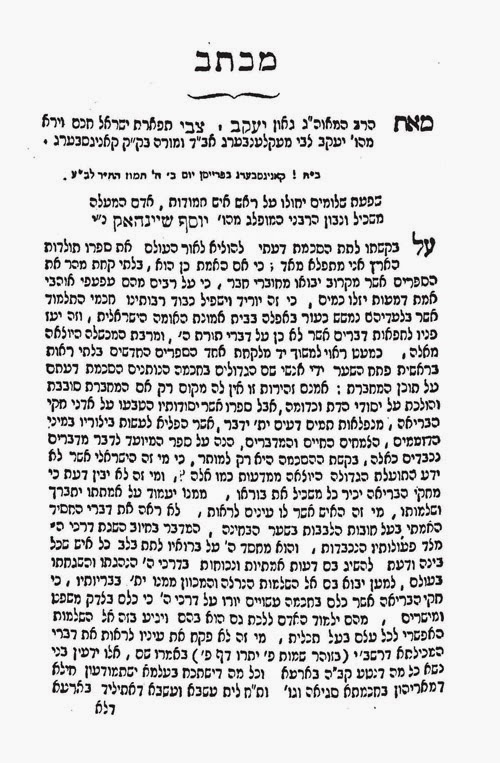
Yad Yosef reads from left to right, like a German book. Nevertheless, it begins with a Hebrew title-page followed a multi-page vorrede (preface) in German followed by a second lengthy preface in Hebrew. The former has an image of justice, sitting blindfolded with a sword in one hand, scales in the other. Below it is Hebrew text that states,

“See for yourselves how my eyes
lit up when I tasted that bit of honey” (I Samuel 14:29)
“If my anguish were weighed” )Job 6:2) on the matter.
“My full calamity laid on the scales” )Job 6:2) and for my heart suffices.

Repeated below it are those verses in German. The Hebrew introduction begins in a light manner that might perchance be meant to be humorous or sarcastic, stating that “it is well known, especially to those who love words of acumen אמרי בינה that it is the custom for a work, small or large, to have a have a brief summary of the book’s topic – to place words in the mouth of the reader, his eyes to see, his eyelids discern the apology, and quickly find the object of his desire.” He then continues, begins, in a more serious vein,

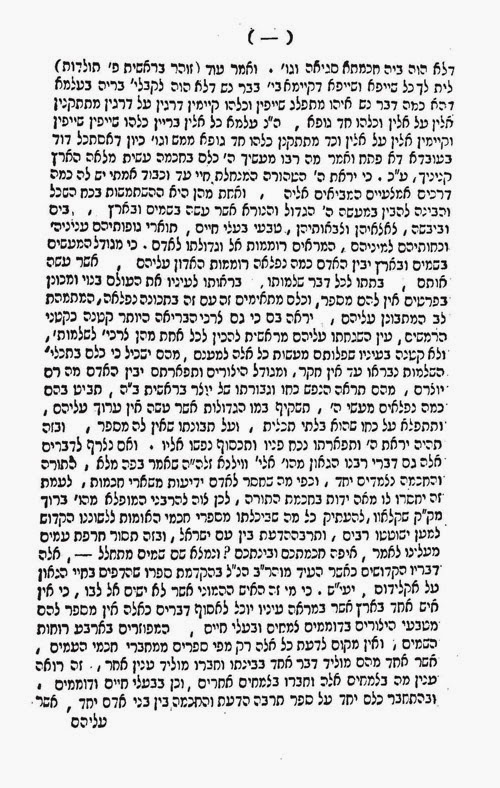
that he “has walked in their footsteps and prepared a lexicon, also I – and this work (letter) I gathered with great diligence, nights as days, with exertion for the honor of the Torah and those who study it: who love and cherish it the beloved! “The teaching of the LORD is perfect” (Psalms 19:8), in it are written and I have found the reasons of DIFFERENT WORDS IN EXPRESSION AND TOUGHT – I have arranged them alphabetically . . .

1828, Yad Yosef

The introduction is followed by the text, set from left to right, comprised of Hebrew works and concise bi-lingual references. Entries are brief, the Hebrew word in the center in square vocalized letters, to the left a source of the term in rabbinic letters, and to the right a translation in German and biblical source. Three examples of the text, one only with a reference, that to Rashi, from the above image, are:

כביר ע’ רש’י ובאור – Matratze. 1. Sam 19. 13.

ענג Lust, Wohlleben. Jes. 58. 13

תענוג Vergnūgen. Sprūch. 19. 10.

כביר Matratze. 1. Sam 19. 13. which refers to the verse “Michal then took mannequins and placed them in the bed, and she put a כביר goat-skin at its head and covered it with a cloth.” (I Samuel 19:13).

ענג Lust, Wohlleben. Jes. 58. 13 (If you restrain your foot because it is the Sabbath, refrain from accomplishing your own needs on My holy day; if you proclaim the Sabbath ענג ‘a delight’ and the holy [day] of the Lord ‘honored’ and you honor it by not engaging in your own affairs, from or discussing the forbidden: seeking your own needs.” (Isaiah 58:13)

תענוג Vergnūgen. Sprūch. 19. 10. תענוג Pleasure does not befit a fool; surely [it is not fitting for] a servant over dignitaries. (Proverbs 19:10).

Yad Yosef concludes with a multi-page bi-lingual Hebrew-German Oeffentliche Danksagung (public thanksgiving) addressed to Tobias Marcus and L. Mende, an example below:

Let your home be wide open, and let the poor be members of your household. (Avot 1:5)
Dein Haus sei offen, Fremde aufaunehmen, um Gastfreiheit an ihnen su üben; achte sie wie deine Hausgebornrn.”

Open your hand to the poor and needy kin in your land (Deuteronomy 15:11)
Thue deine Hand auf gegen deinen Bruder, de Arman und Dürftigen in deinem Lande.

Yad Yosef has been reprinted twice, in Frankfurt on the Oder (1828) and in Berlin (1830).[23]

A final word on Joseph Yuspa Hirschfeld. Moritz Steinschneider has an entry for Joseph Hirschfeld, which begins “Privatlehrer in Schweria a. d. Warte. [Postena Berol. etc. Mrt. mense Decmbr. A1848. – Autor suspectus,” that is he describes Hirschfeld as a private tutor and concludes that the authorship is suspect.[24] No reason is given for that suspicion and in the absence of any supporting or contradictory evidence Steinschneider’s position remains open, unresolved.

Also attributed to the Lissa press is a Mahzor, dated 1824, not seen by the author. Perchance, this is the Heidenheim Mahzor referred to by Lewin. Another work credited to the press, although its date distances it from the general period of activity of the subject press, is R. Saul Isaac ben Ahron Jacob Kaempf’s Toldot Rabbi Akiva Eger, dated 1838. Also noted is another undated edition of Techina Shlosha She’arim.

We now return to the subject of perchance, that is, whether there was a press in Lissa or, as Dr. Lewin suggests, the books attributed to Lissa were actually printed in Dyhernfurth. Lewin was a respected scholar and his reservations need be taken seriously. However, upon inspection, his contention does not appear to be convincing.

Among his arguments for a Dyhernfurth publication site for the books attributed to Lissa are the likeness of the fonts in the books printed in both locations. However, likeness of fonts is not a strong argument: not only is type available to more than one press from a foundry, but more likely Warschauer took typographical equipment with him when relocating to Lissa, as did Sklower when he relocated to Breslau. Similarly, there is no reason why the worker’s names, not noted in the colophons, is any more suggestive of Dyhernfurth than Lissa, nor does the insufficient description of the press seem sufficient evidence to question its location. That the women’s prayer books appear to be inconsequential to Lewin does not detract from their communal value or suggest that they were printed elsewhere. That the press is not mentioned in communal news or documents may be because the press was not consequential. It might be well asked, if the Lissa press was in Dyhernfurth, why is it not mentioned in their communal records, or, finally, what was to be gained by concealing the press’s location.

On the other hand, just as Sklower left Dyhernfurth for Breslau so did Warschauer leave Dyhernfurth for Lissa. That the press appears to have done poorly there actually supports a Lissa location. A small press, it did not publish “consequential” works such as the Talmud, large halakhic titles, or responsa. The books that it did publish were of value to a, perchance, less educated community, addressing their needs, including women’s prayer books.

A likely reason for the presses’ difficulties and brief existence may actually be its location, that is, in Lissa. That location, as noted above, at one time a city of import, had begun to decline after the partition of Poland and its annexation by Prussia in 1793. No longer an important commercial center nor a location with a history as a center of printing. Lissa had no prior press, nor was it well situated for a press. The books it published were small, of value to a local population, consisting of ethical, linguistic and liturgical works, but did not address the needs of a more sophisticated population with leading yeshivot, as Lissa had been so earlier. It was not set up for book distribution, a basic requirement for a successful press. Several of the books that it did publish, were quickly reissued in Vienna, republished at the press of Anton Schmidt, a publisher of consequence.[25]

Given the restrictions on reprinting stated on the title-page of Likitat Yosef it would appear that the almost immediate reprinting of that title and other works were at the initiative of the author. Given the poor distribution of Lissa imprints Hirschfeld likely sought a larger and more successful press, an objective filled by the press of Anton Schmidt. Perchance, no, in this instance certainly not perchance, but more likely, indeed assuredly, if the books had been printed in Dyhernfurth, with its history of printing and successful book distribution, there would not have been a need to reprint these titles in Vienna.

All of the above notwithstanding, the books that were published in Lissa, albeit small in number and in size, were worthy titles. Lissa was, as noted at the beginning of this article, one of many presses, small in size and output, which are poorly recalled today. Nevertheless, this does not detract from the fact that these presses published valuable works, serving the needs of the local population. Here too, the Lissa press, despite being short lived, published books of value to its community and deserves to be remembered and well regarded.

[1] I would like to express my appreciation to Eli Genauer for reading the article and his comments. All images in this article are Courtesy of the National Library of Israel.

[2] The background information on the history of Lissa (Leszno) is a composite of the following articles on that city, namely Jacob Rothschild and Danuta Dombrowska, “Leszno,” Encyclopaedia Judaica, vol. 12, p. 667; Gotthard Deutsch and Samuel Baeck, “Lissa (called formerly Polnisch Lissa),” Jewish Encyclopedia, vol. 8, pp. 107-08; “Leszno (I),” The Encyclopedia of Jewish Life Before and During the Holocaust, vol. 2, pp. 74-74; and Hanna Węgrzynek, “Leszno,” YIVO Encyclopedia of Jews in Eastern Europe, translated from Polish by Joanna Nalewajo-Kulikov, vol. 1, p. 107.

[3] Yeshayahu Vinograd, Thesaurus of the Hebrew Book. Listing of Books Printed in Hebrew Letters Since the Beginning of Printing circa 1469 through 1863 II (Jerusalem, 1993-95), p. 407 [Hebrew].

[4] Ch. Friedberg: History of Hebrew Typography of the Following Cities in Europe: Amsterdam . . .Dyhernfurt . . . From its Beginning in the year1516 . . (Antwerp, 1937), p. 72 [Hebrew].

[5] Concerning the printing of the Talmud in Dyhernfurth see Marvin J. Heller, Printing the Talmud: A History of the Individual Treatises Printed from 1700 to 1750. (Brill, Leiden, 1999), pp. 219-43.

[6] Louis Lewin, “Hebrãische Drucke und Drucker aus Grosspolen,” Soncino-Blãtter (Berlin, 1925-26), pp. 173-74. R. Louis Lewin (1868–1941), was a German rabbi and historian. He served as rabbi in several communities prior to settling in 1937 he settled in Palestine. Among his several works is Geschichte der Juden in Lissa (1904). Israel Halpern, “Lewin, Louis,” EJ 12, p. 761.

[7] Ch. B. Friedberg, Bet Eked Sepharim, (Israel, n.d), var. cit. [Hebrew].

[8] Aron Freiman, A Gazetteer of Hebrew printing, reprinted in Hebrew Printing and Bibliography (New York, 1976), p.298.

[9] Concerning the intentional misdating of Hebrew books or giving a different location see Marvin J. Heller, “Who can discern his errors? Misdates, Errors, and Deceptions, in and about Hebrew Books, Intentional and Otherwise,” in Further Studies in the Making of the Early Hebrew Book (Brill, Leiden/Boston, 2013), pp. 395-420.

[10] Meyer Waxman, A History of Jewish Literature III (New York, London, 1960), pp. 101-04.

[11] Benzion Halper, “Dispute Between Understanding and Uprightness” in Post – Biblical Hebrew Literature: an Anthology (Philadelphia, 1921), pp. 243-246

[12] Friedberg, Bet Eked Sepharim, lamed 422. The eight printings recorded by the Bet Eked Sepharim, in contrast to the first editions cited on the title-page of this edition are 1) Amsterdam,1743; 2) Berlin, 1780; 3) Lvov, 1790; 4) Lvov, 1799; 5) Berlin, 1799; 6) Lvov, 1803; 7) Lvov, 1823; and (8) Lissa, 1824.

[13] Both the Thesaurus and the Beit Eked Sefarim have entries for a 1826 edition of Likitat Yosef. However, none the library catalogues checked, admittedly a small number, nor World Cat, he world’s largest network of library content and services, record an 1826 edition of Likitat Yosef.

[14] Vinograd, Thesaurus I, p. 221.

[15] William Zeitlin, Biblotheca hebraica post-Mendelssohniana (Leipzig, 1983). p. 144.

[16] This phrase appears, with a single letter variation, in Genesis 11:1 as “[The whole earth was of] one language and of common purpose .שפה אחת ודברים אחדים.” Perhaps this form of the verse on the title-page is more appropriate for Likitat Yosef, as it appears in halakhic and midrashic works as well as commentaries, and one kabbalistic work, Sefer Milḥamot Hato Likitat Yosef’ as “The whole earth was of one language and other purposes שפה אחת ודברים אחרים,” suggesting Likitat Yosef’s linguistic purpose, that is, it is a bi-lingual dictionary.

[17] Friedberg, Beit Eked Sefarim, lamed 788; Vinograd, Thesaurus, I, p. 221. Concerning the 1825 Vienna edition of Likitat Yosef. There is no question of misdating or incorrect labeling. The 1825 Vienna was seen and a comparison of the two editions show that it is as described, a separate, independent, and apparently slightly expanded printing of the Lissa edition of Hirschfeld’s Likitat Yosef, this at the press of Anton Schmidt.

[18] A. Idelsohen, Jewish Liturgy and its development (New York, 1932), pp. 257-58, 264-65;

[19] Waxman, p. 641.

[20] Concerning the early use of Vaybertaytsh see Herbert C. Zafren, “Variety in the Typography of Yiddish: 1535-1635,” Hebrew Union College Annual LIII (Cincinnati, 1982), pp. 137-63; idem, “Early Yiddish Typography,” Jewish Book Annual 44 (New York, 1986-87), pp. 106-119. In the former article, Zafren informs that the first book in which Yiddish was a segment was major was Mirkevet ha-Mishneh (Sefer shel R. Anshel), a concordance and glossary of the Bible (Cracow, 1534/35). In the latter article he suggests that the origin of Vaybertaytsh, which he refers to as Yiddish type, was the Ashkenaz rabbinic fonts, supplanted by the more widespread Sephardic rabbinic type which prevailed in Italy (p. 112).

[21] Vinograd, Thesaurus II, p. 165.

[22] Friedberg, Bet Eked Sepharim, yod 119; Vinograd, Thesaurus II, p. 230.

[23] Friedberg, Bet Eked Sepharim, yod 119.

[24] Moritz Steinschneider, Catalogus Liborium Hebraeorum in Bibliotheca Bodleiana (Berlin, 1852-60), col. 1043, no. 5233.

[25] Anton Schmidt was sufficiently sucessesful and the quality of his books highly regarded with the result that he was ennobled in 1823 by the Austrian Emperor, so that he now was Anton Von Schmid.


The Greatest Story in the Annals of Jewish Book Collecting

The Greatest Story in the Annals of Jewish Book Collecting
 By Jeremy Brown

Jeremy Brown is the author of New Heavens and a New Earth; The Jewish Reception of Copernican Thought. He writes on science, medicine and the Talmud at Talmudology.com 

As we approach the end of Masechet Yevamot in the Daf Yomi cycle, it seems appropriate to reflect on a legendary story in the annals of Jewish bibliography. This story involves King Henry VIII, the laws of Yevamot, and the greatest private Jewish library in the world.
About thirty years ago, while a medical student in London, I had the good fortune of visiting the Valmadonna Trust Library, that greatest of private Jewish libraries. (How I got there is another story for another time). And while there, I held the Talmud that certainly once belonged to Westminster Abbey. It may also have been owned by Henry VIII, who had brought a Bomberg Talmud from Venice in order to help him end his marriage to Catherineof Aragon, the first of his many wives. The story of Henry VIII’s purchase of the Bomberg Talmud – the first complete printed Talmud – actually hinges on Yevamot, and whether the rules of levirate marriage, or yibum, applied to him. 
Catherine of Aragon was actually a widow, having first been married to Henry’s younger brother Arthur. About six months after Catherine married Arthur he died childless, and in 1509 his older brother Prince Henry married his widow.  One more thing to know: Catherine claimed that her marriage to Arthur had never been consummated; this is important later in the story. (And here is an interesting historic footnote: it was Catherine’s parents, Ferdinand and Isabella who had expelled the Jews from Spain.)
By 1525, Prince Henry had become King Henry VIII, and has had one daughter with Catherine. He wanted a son, and now wished to marry Ann Boleyn. There was, however, a problem:  what was he to do with Catherine, his existing wife?  Divorce, remember, was tricky for this Catholic King. And here is where the Talmud comes in.  
Henry argued that his marriage to Catherine should be dissolved since it was biblically forbidden for a man to marry his sister-in-law. (Henry claimed years earlier that he could marry her because the marriage to his brother had not been consummated. See, I told you that was important information…)
But as we from Masechet Yevamot, the Bible commands a man to marry his widowed sister-in-law if his brother died without children. Since Arthur died childless, it could be argued that Henry was now fulfilling the biblical requirement of levirate marriage – known as yibum. If that was the case, the marriage was kosher and could not be dissolved
How was this conundrum to be resolved? Let’s have Jack Lunzer, the custodian of the library, tell the story. (You can also see the video here. Sorry about the ads. They are beyond our control.) 
As Lunzer tells us, the Talmud was obtained from Venice to help King Henry VIII find a way to divorce his wife (and former sister-in-law) Catherine, and so be free to marry Ann Boleyn. In fact, it’s a little bit more complicated than that. Behind the scenes were Christian scholars who struggled to reconcile the injunction against a man marrying his sister-in-law found in one part of the Bible, with the command to do so under specific circumstances, found in another. In fact the legality of Henry’s marriage had been in doubt for many years, which is why Henry had obtained the Pope’s special permission to marry.
John Stokesley, who later became Bishop of London, argued that the Pope had no authority to override the word of God that forbade a man from marrying his brother’s wife. As a result the dispensation the Pope had given was meaningless, and Henry’s marriage was null and void. In this way, Henry was free to marry.  But what did Stokesley do with the passages in Deuteronomy that require yibum?  He differentiated between them.  The laws in Leviticus, he claimed, were both the word of God and founded on natural reason. In this way they were moral laws; hence they applied to both Jew and Christian.  In contrast, the laws found in Deuteronomy, were judicial laws, which were ordained by God to govern (and punish) the Jews – and the Jews alone. They were never intended to apply to any other people, and so Henry’s Christian levirate marriage to Catherine was of no legal standing. There was therefore no impediment for Henry to marry Ann. As you can imagine, this rather pleased the king.
It remains unclear whether the Valmadonna Library Bomberg Talmud is indeed the very same one that Henry had imported from Venice. According to Sotheby’s and at least one academic, it actually came from the library of an Oxford professor of Hebrew, who bequeathed it to the Abbey. In any event, a Bomberg Talmud lay undisturbed at Westminster Abbey for the next four hundred years.  How Lunzer obtained it for his library is possibly the greatest story in the annals of Jewish book collecting. In the 1950s there was an exhibition in London to commemorate the readmission of the Jews to England under Cromwell. Lunzer noted that one of the books on display, from the collection of Westminster Abbey, was improperly labeled, and was in fact a volume of a Bomberg Talmud. Lunzer called the Abbey the next day, told them of his discovery, and suggested that he send some workers to clean the rest of the undisturbed volumes.  They discovered a complete Bomberg Talmud in pristine condition, and Lunzer wanted it. But despite years of negotiations with the Abbey, Lunzer’s attempts to buy the Talmud were rebuffed.  
Then in April 1980, Lunzer’s luck changed. He read in a brief newspaper article that the original 1065 Charter of Westminster Abbey had been purchased by an American at auction, but because of its cultural significance the British Government was refusing to grant an export license. Lunzer called the Abbey, was invited for tea, and a gentleman’s agreement was reached. He purchased the Charter from the American, presented it to the Abbey, and at a ceremony in the Jerusalem Chamber of Westminster Abbey the nine volumes of Bomberg’s Babylonian Talmud were presented to the Valmadonna Trust. It’s a glorious story, and it’s so much better when Lunzer himself tells it, as he does here: (You can also see the video here,and end it at 14.35. We continue to apologize for those ads.)

The Valmadonna Trust Library – all of its 13,000 books and manuscripts, including the Westminster Abbey Talmud, is now on sale at Sotheby’s in New York. It can be yours for about $35 million.  But if you buy it, you must agree to two conditions set by Lunzer: that the Library remain whole, and that it be made available to scholars. In that way, just as I once held that magical Talmud, others may continue to do so. 


More on Chaim Bloch

More on Chaim Bloch
By Marc B. Shapiro
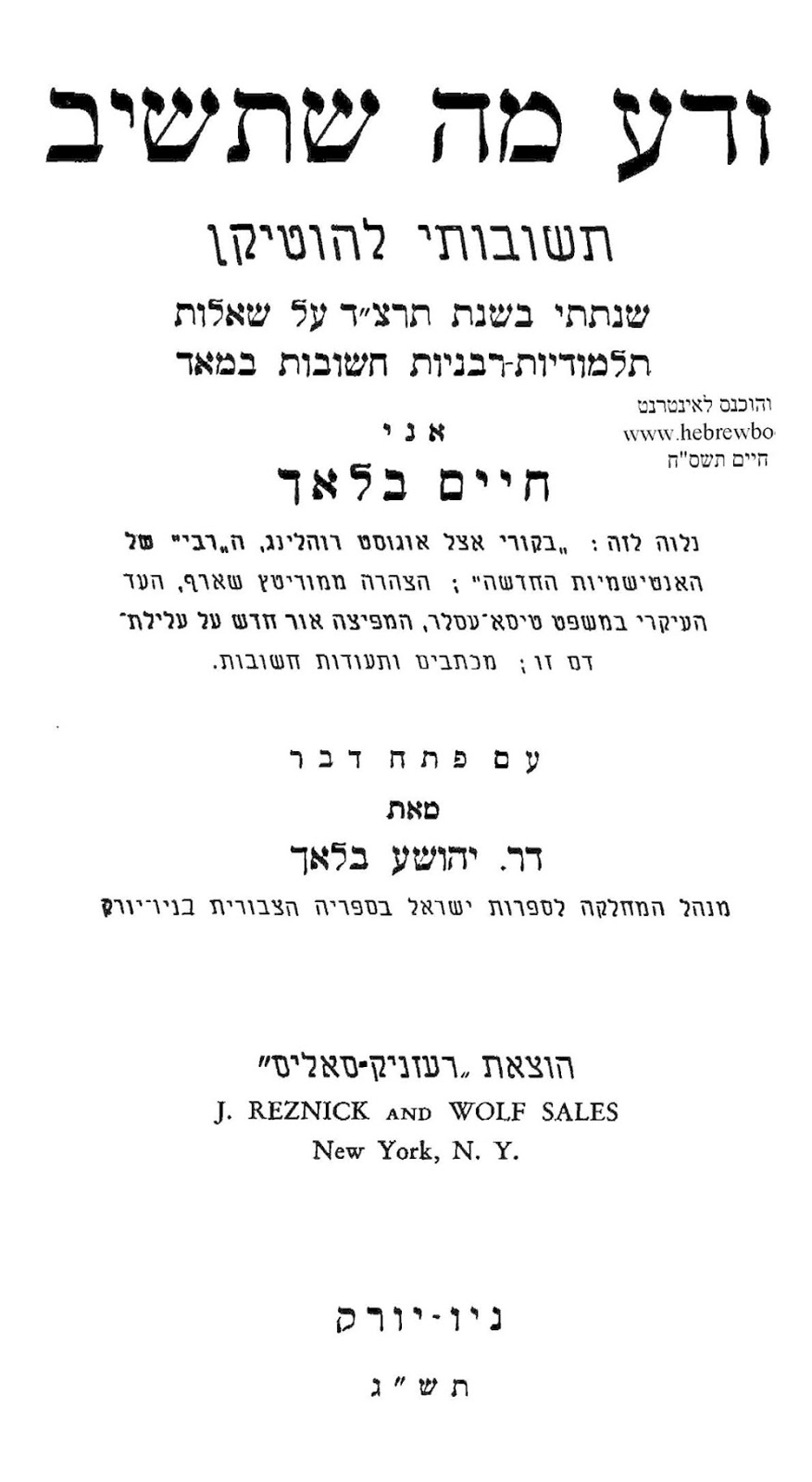
In a previous post I mentioned how the non-Jewish Austrian minister Leon Bilinski was descended from the rav of Posen, R. Samuel ben Moses Falkenfeld, the Beit Shmuel Aharon. More information about Bilinski’s Jewish roots is found in Chaim Bloch’s Ve-Da Mah she-Tashiv (New York, 1943), p. 74 n. 1. In general, I have found that when Bloch is reporting about other people’s biographies and history in general, he is very reliable. It is only when he is somehow involved in the story that he is full of lies.1 His Ve-Da Mah she-Tashiv is a good example. Here is the title page.
In this book he makes up an entire story that he was asked by an important Catholic figure to answer questions from the Vatican dealing with Judaism. The whole story is a fiction, as is so much else he writes about himself. As for Bilinski, Bloch tells us that he is in possession of Bilinski’s 1146 page (!) unpublished diary. As Bloch himself notes, he provided various scholars (e.g.., N. M. Gelber) with selections of this diary which they then used in their own works, thus misleading the world. In these selections, Bilinski comes off as a strong anti-Zionist, who even warns Herzl about how the Arabs will never accept a Jewish state in Palestine.2 In an article in the Herzl Year Book, Bloch published what he claimed was an 1893 letter from Herzl and uses this to prove that Herzl was interested in the Jewish problem already in 1893, a year before the 1894 Dreyfus trial which is usually cited as having turned Herzl to Jewish matters.3 Various scholars have cited this letter, as they understandably regard it as significant in understanding Herzl, but of course it is a forgery. Another way Bloch misled scholars, in particular Gelber, is with regard to an anonymous booklet that speaks of a return of the Jews to the Land of Israel and the establishment of a state.4 According to Billinski’s diary, so Bloch tells us, the author of this booklet was Benjamin Disraeli. Bilinski would certainly have been in a position to know this information, and therefore a number of people have been misled by this, thinking the diary authentic
Look how Bloch’s forgeries were able to have such an impact. I think, in the end, this is what gives the forger satisfaction, watching everyone taken in by his creation. In 1948 no one would have believed that Bloch was capable of this. In fact, if not for his blatant forgeries in Dovev Siftei Yeshenim, some people today would still assume that he is reliable. As the Talmud tells us, tafasta merubah lo tafasta! Bloch should have stuck with his smaller forgeries, because when he decided to publish complete volumes of forged material, that’s when people really began to take notice. It is therefore very surprising that no less a scholar than Robert S. Wistrich, who is aware of the accusations of forgery against Bloch, nevertheless cites material from Bloch’s Mi Natan li-Meshisah and states that in his opinion at least some of the material must be considered authentic. Why he thinks this he doesn’t tell us. The truth is that this book, like Dovev Siftei Yeshenim, is full of Bloch’s forgeries, and not only of rabbis but also of political leaders (including summaries of supposed letters from Bismark about Zionism!)5

Just to illustrate that you can’t judge people by appearances, here is a picture of Bloch, which previously appeared in Dr. Shnayer Leiman’s post on the Seforim Blog.6

Throughout Bloch’s various books, he quotes numerous letters from gedolim who were no longer alive, and none of these letters are found in his archives, currently kept at YIVO and the Leo Baeck Institute. In other words, he simply made up these letters, as he did with the entire volumes of anti-Zionist letters of gedolim that he published. The rule is that whenever Bloch cites a previously unpublished letter from someone, either addressed to himself or to another, and the author of the letter is no longer alive, you can assume that the letter is forged. We know this now, after Shmuel Weingarten’s exposé of Dovev Siftei Yeshenim.7 Yet the evidence was there all along, had people paid attention. But people had no reason to assumed that Bloch was not reliable. R. Joseph Elijah Henkin, however, who was involved in a terrible dispute with Bloch, did accuse Bloch of dishonesty, and pointed out that he would attribute quotes to rabbis who were no longer alive so that he couldn’t be contradicted. In the late 1930’s Bloch published a letter from R. Kook. R. Zvi Yehudah Kook was very skeptical of its authenticity and requested that Bloch send him a copy of it. Bloch replied that he was unable to do so since he had lost the original.8 This was Bloch’s pattern, and I assume that all of the many letters he published from leading rabbis and hasidic leaders, beginning in the early part of the twentieth century, are forgeries.9

Here is another example of Bloch’s tendency to fabricate things. It comes from his Heikhal le-Divrei Chazal u-Fitgameihem (New York, 1948), p. 9. Everything he reports here is a fantasy. As with some of his other forgeries, Bloch is obviously motivated here by good intentions, but it is all complete nonsense.

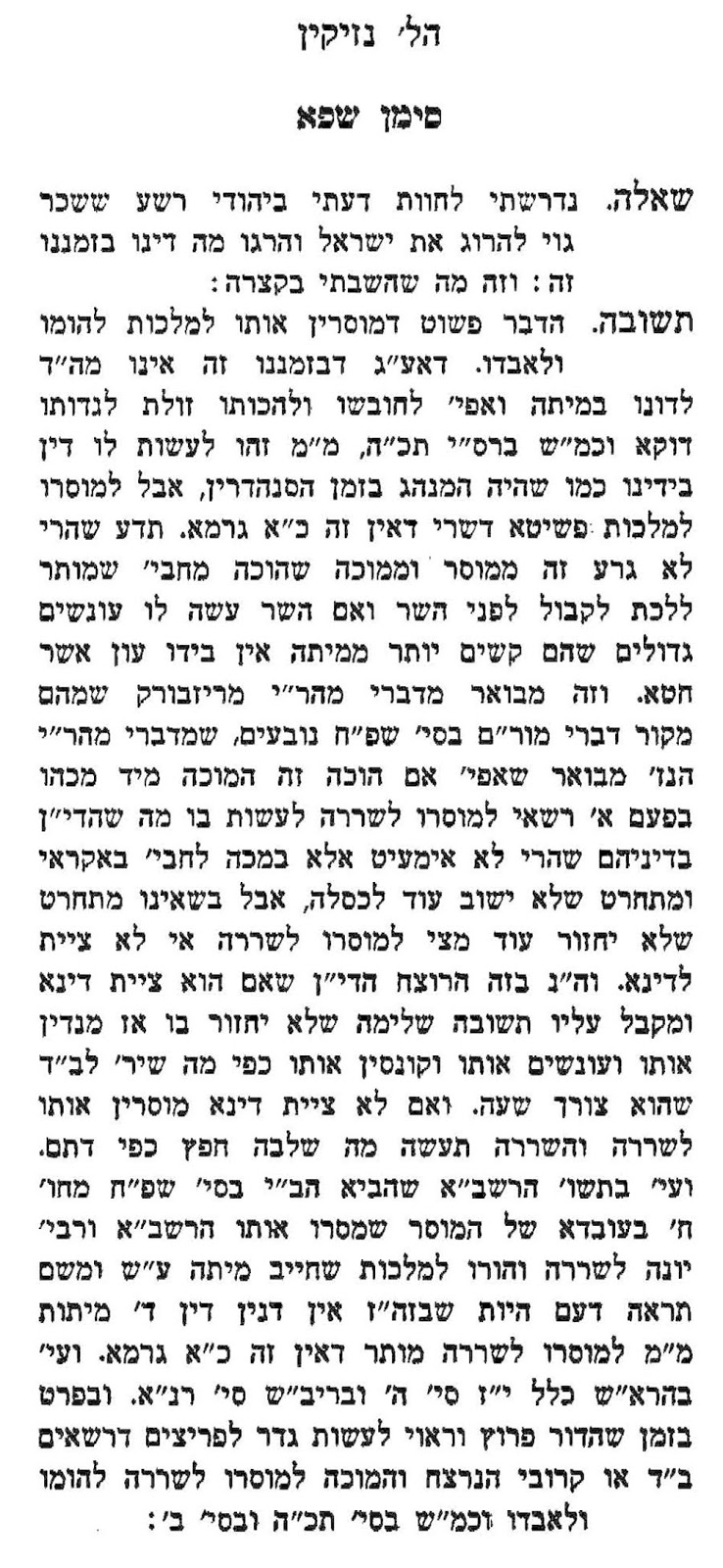
Ve-Da Ma she-Tashiv also contains forged letters. I am certain that the letter of R. Chaim Ozer Grodzinski on pp. 52-53 is an example of this. Anyone can look at the style of R. Chaim Ozer’s many letters and see how he consistently used certain formulas in concluding his letters. Nowhere does R. Chaim Ozer conclude a letter with
ונזכה כולנו לראות בישועת עמנו במהרה
He does use the expression
ועיניהם תחזינה בישועת עמנו במהרה

and this is found in a letter that Bloch would have had access to, the letter of R. Chaim Ozer to Agudat ha-Rabbanim about the Louis Epstein proposal.10 I assume he used the concluding portion of this letter to help him create his forgery. But in other areas he wasn’t so careful. For example, in the supposed letter of R. Chaim Ozer to Bloch, he refers to the latter as a צנא מלא ספרא , yet this expression does not appear in R. Chaim Ozer’s other letters (based on Otzar ha-Hokhmah’s database, which only has the first edition of R. Chaim Ozer’s letters, not the expanded Iggerot R. Chaim Ozer.)
We should assume the same for all of the other letters in this book from people who were not alive when the book was written. It is fascinating that on p. 44 n. 1 Bloch refers to the anti-Zionist letters he would later publish in Dovev Siftei Yeshenim. Ve-Da Mah she-Tashiv was published in 1943 and the first volume of Dovev Siftei Yeshenim didn’t appear until 1959, meaning that this forgery was very long in the making, and Bloch was setting the stage for it many years prior.
There is more to say about this book, in particular his argument that there are passages in the Talmud that were inserted by heretics – a viewpoint earlier mentioned by R. Joseph Zvi Duenner, as I have pointed out elsewhere, see here.

I will leave that for another time, but to give you an example of what I am referring to, here is a passage from p. 39 (emphasis in the original):
אופינית היא “המעשיה” בר’ שמעון בן גמליאל “שהיה על גב מעלה בהר הבית וראה נכרית אחת נאה ביותר. אמר: מה רבו מעשיך ד'” (ע”ז כ ע”א) המאמר הזה זיוף  . . . לא יעלה בדעתנו, שר’ שמעון בן גמליאל הביט על אשה, היינו הך, נכרית או ישראלי – לשם יפיה. ומצאתי עוד מאמר בשם רב, שזיופו עומד מחוץ לכל ספק: “בשעה שבקש נבוכדנצר לעשות לאותו צדיק (צדקיהו) כך, נמשכה ערלתו ש’ אמה והיתה מחזרת על כל המסבה כולה שנאמר: שבעת קלון מכבוד, שתה גם אתה והערל” (שבת קמט ע”ב). מלבד הנבול שבמאמר זה, הוא חסר טעם, ולא יתכן, שמפי רב יצאו הדברים.
I don’t know which position is “frummer”? To defend the honor of the sages and therefore deny that these “obscene” passages are authentic, or to defend the Talmud as we have it and thus have to deal with these passages.
Yet whatever the answer to this is, if Bloch were alive today, the haredi world would put him in herem for another reason. Here is what he writes on p. 38, with regard to how to view Aggadah in contrast to the halakhic sections of the Talmud. (What he says is nothing other than the Geonic and Spanish tradition, which is largely unknown in today’s yeshiva world.):
היא אינה נחשבת ליסוד קיומה של היהדות ויש לה אופי של ספר עם . . . לחלק האגדה נכנסו דברי מוסר ודרך ארץ, מליצות ובדיחות, סגולות ורפואות, אזהרות ועצות, פתרון חלומות ואגדות, שלהרבה מהם יש ערך גם מחוץ להיהדות. יתכן שהרבה הושפעו בעלי התלמוד בזה מהעמים שכניהם.
Also interesting is that in Ve-Da Mah she-Tashiv, p. 44 n. 1,  he refers very positively to R. Henkin, something that would later change when their great battle began.
Bloch claimed that he had a close relationship with the great R. Judah Leib Zirelson of Kishinev (Speaking for myself, Zirelson’s greatest achievement had to have been standing up to the extreme anti-Zionist elements in Agudat Israel, led by R. Elhanan Wasserman and R. Aaron Kotler. They wanted the Agudah to officially oppose the creation of a Jewish state. Zirelson, as president of the 1937 Kenesiah Ha-Gedolah in Marienbad, was able to convince the Moetzet Gedolei ha-Torah to agree with his own position, which was not to oppose a state but to attempt to bring Torah values into it. See Ha-Pardes, Oct. 1937, p. 8). In this book, Bloch cites a number of things from Zirelson of which, again, I have no doubt that he has made them up. For example, can anyone imagine that Zirelson would offer the following Haskalah-Reformist interpretation that Bloch puts in his mouth (p. 34)?
יתכן שהיתה כוונתו של ר’ שמעון בן יוחאי, בחפשו יסוד במקרא שהנכרים אינם מטמאים באוהל, כדי שלא ימצאו הרומיים תואנות ואמתלאות חדשות על ישראל, ומאימת המלכות הורה כן.
Although I can’t go into it in any detail now, the truth is that we do on occasion find Haskalah-Reformist types of interpretation even in traditional sources,11 but since these are very rare and we have no evidence that Zirelson ever said what is attributed to him, I assume it is another of Bloch’s forgeries. In other words, as he did so often, Bloch attributed his own understanding to one of the great Torah sages.
In chapter fourteen of Ve-Da Mah She-Tashiv, where he stresses the need for honesty in one’s dealings with non-Jews, he claims that Zirelson told him about a Zoharic passage in parashat Lekh Lekha that states:
כל מאן דמשקר בהאי עלמא בערל כמאן דמשקר בשמיה דקוב”ה
This is a beautiful thought. The only problem is that it doesn’t exist anywhere in the Zohar. I am certain that Zirelson would never have misquoted the Zohar and that the mistake is Bloch’s. I assume that the mistake is unintentional, perhaps quoting from memory, since a great forger like Bloch would never have dared falsely attribute anything to the Zohar, the accuracy of which could easily be checked.
Here is the actual Zohar text (vol. 1, p. 93a):
דכל מאן דמשקר בהאי כמאן דמשקר בשמיה דקב”ה
If you examine the entire passage you will find that it has nothing to do with being honest, and the word משקר here does not mean “to lie”, but “to betray”. The text is actually speaking about berit milah and how one is obligated to treat it properly, especially דלא עייל ליה ברשותא אחרא, which certainly refers to refraining from having sex with non-Jewish women. What the text is saying is that if you have illicit sex you betray the mark of the circumcision, and this is like betraying God’s name.
Since I mentioned Haskalah-Reformist interpretations in traditional texts, let me note one of the most famous of these. In Shabbat 140b, R. Papa’s states that if one can drink beer but instead drinks wine, he violates the prohibition on baal tashchit. Maharsha explains that R. Papa said this because he was a beer salesman! What this apparently means is that R. Papa lied about the halakhah in order to drum up more business for himself. How else to interpret Maharsha’s explanation?
ורב פפא לטובת עצמו אמרה שהוא הי’ עושה שכר.
This explanation is, to be sure, quite shocking. If you want to stretch things a bit you can say that according to Maharsha, R. Papa didn’t consciously alter the halakhah to benefit himself, but since he was a beer maker he was unconsciously led to this position, as it would benefit him. This explanation – which could easily have been offered by Jacob Katz – is suggested by the noted Yemenite posek, R. Yitzhak Ratsaby12:
והנה כל העובר ישום וישרוק, היתכן כדבר הזה שרב פפא יפסוק הלכה משום ריוח ממונו?! . . . ובודאי גם לדעת מהרש”א לא יתכן שרב פפא יאמר פסקי הלכה רק מתוך נגיעה, חלילה לו. אלא היה זה כעין “שוחד סמוי”, שלא הרגיש בו הוא עצמו, שמתוך כך בא לידי טעות בהלכה זו. כמו שהכתוב צווח ואומר (שמות כג, ח): “כי השוחד יעוור פקחים ויסלף דברי צדיקים”, ועל דרך שמצינו בכתובות (קט, ב) בגדולי עולם שאמרו על עצמם שהשוחד היטה את ליבם.
I think most people will tell you that this sort of explanation, which points to unconscious factors influencing halakhic decisions, was not how people thought in the days of the Maharsha. I myself do not see this as an anachronistic explanation, as the Talmud, Ketubot 105b, already discusses precisely this sort of unconscious influence.13  I believe that this is also how we are to understand all the discussions about נוגע בדבר, and how it applies even to the greatest tzadikim. It is not that these people will consciously twist the truth, but that unconsciously this is what can happen. Presumably, this is also the meaning of Hullin 49a:  ישמעאל כהנא מסייע כהני

I think this is also how we are to understand R. Moses Isserles, Yoreh Deah 242:36:
תלמיד חכם שאמר דבר הלכה בדבר השייך לדידיה . . . אין שומעין לדידיה דלמא מדמי דברים להדדי שאינן דומים
See also Ritva, Yevamot 77a:
דחיישינן שמא מתוך שנושא ונותן בהלכה כדי לקיים את דבריו אמר בדדמי כסבור שקיבל מרבו
I am not going to analyze the Maharsha in any depth, because either way you explain him, this is the exact sort of explanation that according to the Rav is heretical as it falls under the Rambam’s category of מכחיש מגידה.14 And it is not just the Rav who would be shocked by what Maharsha wrote. R. Yehoshua Heschel of Monistritch15 states:
ועל מאמר המהרש”א הזה צווחי קמאי 
R. Abraham Vengrober16 says concerning the standard explanation of Maharsha (before offering a different understanding of his words):
ופריצי עמנו מצאנו בקעה לדבר סרה על רז”ל . . . גם רבינו המהרש”א ז”ל לא כיוון בזה ח”ו להכוונה אשר העולם סוברים שבשביל זה שהי’ מסחרו שבח את הדבר לטובת עצמו.
R. Samuel Strashun in his commentary to the passage takes strong issue with Maharsha, and R. Hayyim Hezekiah Medini17 is astounded by what Maharsha wrote:
הדבר תמוה לפרש דנחשד רב פפא לדבר שקר חלילה לטובת עצמו.
I assume it is only a matter of time before this explanation of Maharsha is deleted from a future printing.
Here is another example (Taanit 14a-14b):
In the time of R. Judah the Prince there was distress. He ordained thirteen fast days and their prayer was not answered. He thought of ordaining additional fasts but R. Ammi said to him, “Did not [the Sages] declare we should not trouble the community unduly.” Said R. Abba the son of R. Hiyya b. Abba, “R. Ammi [in saying this] was studying his own interests.”
  
Rashi explains R. Abba’s declaration:
לעצמו דרש: דלא אמר אלא לפי שהוא לא היה רוצה להתענות
If anyone other than Rashi wrote this, wouldn’t it be regarded as an example of מכחיש מגידה?
Here is another example, from the Jerusalem Talmud, Shabbat 6:1:
R. Abbahu in the name of R. Yohanan, “It is permitted for a man to teach Greek to his daughter, because such learning is an ornament for her” Simeon bar Ba heard and said, “It is because R. Abbahu wants to teach his daughter such that he has assigned the teaching to R. Yohanan.”
R. Abbahu responded quite sharply to Simeon bar Ba, proclaiming: “May a curse come upon me, if I did not hear it from R Yohanan.” But I am more interested in Simeon bar Ba’s accusation. He assumed that the great R. Abbahu would falsely attribute a halakhic ruling to an earlier sage in order that his daughter would benefit. When Geiger and Graetz said things like this, no one was surprised, and the Orthodox condemned them for these type of interpretations. Yet here you have a Haskalah-Reformist type of interpretation offered by one of the Sages.
Returning to Bloch, another example where he deceived the world is found in his Heikhal le-Divrei Hazal u-Fitgemeihem, pp. 591-592. In line with his apologetic approach to Jewish sources, he claims that he saw an old version of the Passover prayer Shefokh Hamotkha, that went as follows:

שפוך אהבתך על הגוים אשר ידעוך

Even a great scholar such as Naftali Ben-Menachem was taken in by Bloch (and if you search online you will find a number of others who assume that Shefokh Ahavatkha is a real text, rather than another Bloch forgery18). Ben Menachem’s article appears in Mahanayim 80 (1963), and here is the page where he refers to Bloch’s version.

Incidentally, in Heikhal le-Divrei Hazal Bloch claims that he wrote about this version at length in his 1935 book Der Judenhass im Spiegel der Jahrtausende, and also printed a copy of the manuscript there. (In 1935 Bloch was living in Vienna.) Although he mentions this book in a couple of his other writings, there is no evidence that any such book ever appeared. Now we have the internet which allows us to check all the greatest libraries in a minute, yet in a prior era, simply mentioning that he had published such a book and that it contained a copy of the manuscript would have been enough to convince everyone. After all, it was not like people in the United States, England, or Palestine/Israel could easily check the holdings of libraries in Austria and Germany.
Meir Hershkovitz, in his fine book on R. Zvi Hirsch Chajes, also quotes Bloch a number of times. Bloch claimed to have seen unpublished material from Chajes and he included some of it in his Heikhal, but everything he mentions is fraudulent, and some of the comments are really outrageous. For example, on p. 565 he quotes Chajes as saying as follows about Rabbi Akiva19:

ר”ע מבני בניו של סיסרא היה ולמרות קדושת התורה ששלטה בו נשאר בו משהו מאופיו של סיסרא
(Some are probably wondering why I didn’t underline the first part as well, which states that R. Akiva was descended from Sisera. After all, in a few weeks Daf Yomi will reach Sanhedrin 96b and there you find the following, with no mention of R. Akiva: “Descendants of Sisera studied20 Torah in Jerusalem; descendants of Sennacherib taught Torah to the multitude. Who were these? Shemaya and Avtalion. Descendants of Haman studied Torah in Bnei Brak.” Yet numerous texts21 record a version of this passage that identifies R. Akiva as among the descendants of Sisera.)

What motivated Bloch to invent this negative comment about R. Akiva? I think that this too can be attributed to anti-Zionist motivations (an anonymous commenter on Soferim u-Seforim offered a similar explanation; see the link in n. 1). R. Akiva was associated with Bar Kokhba’s rebellion, and in the popular mind at least, this was a matter of pride for twentieth-century Jews. The thrust of the comment attributed to Chajes is to see this “warlike” aspect of R. Akiva as a throwback to Sisera. In other words, this is not something good. We see another example of Bloch’s anti-Zionism in his attempts to argue that a passage in Maimonides’ Letter on Astrology is not authentic. In this passage, Maimonides states that the Temple was destroyed and the Jews exiled because instead of focusing on “the art of military training and conquering lands,” they involved themselves with astrology, thinking it would help them. (Iggerot ha-Rambam, ed. Sheilat, vol. 2, p. 480) This passage was too “Zionistic” for Bloch, and not surprisingly he argues that it is a forged interpolation. See his article in Ha-Pardes 34 (April 1960), pp. 39-42, where once again it is Bloch who is the forger, citing a supposed letter from a Christian scholar to Dr. [Daviid?] Kaufmann and also telling us about the support he supposedly received from the Tchortkover Rebbe. (This Rebbe, incidentally, happened to be a one of the leading Agudah supporters of settlement in the Land of Israel.) One of Bloch’s major proofs that Maimonides could not have written this passage is his assumption that Maimonides was not impressed with R. Akiva’s support of Bar Kokhba. He bases this argument on Mishneh Torah, Hilkhot Melakhim 11:3. Yet Maimonides’ viewpoint in this matter is not enough for Bloch, and to achieve his purpose he has to actually find fault with R. Akiva’s character, something Maimonides would never do. Bloch even attacks some modern writers (such as Aaron Zeitlin and Hillel Seidman) who had stressed the contemporary significance of Maimonides’ words. In Bloch’s mind, by doing so they were showing the non-Jews that the Protocols of Elders of Zion were correct, namely, that Jews really did want to conquer the world! Bloch’s Neturei Karta side comes out very well in this article.

As a way of covering himself, so that people will believe the manuscripts of Chajes are authentic, Bloch states that he assumes that the material he is quoting from has survived in Israel, either with the family or at the National Library (Heikhal, pp. 520, 560). Yet in Hershkovitz, this supposition is stated as fact (Rabbi Zvi Hirsch Chajes, p. 438). It is quite surprising that Hershkowitz, who wrote such a comprehensive biography of Chajes, didn’t attempt to track down these manuscripts. Had he done so, he would have realized that they don’t exist.
*    *    *
This is a blog about seforim, but with Dan’s permission, in a future post I am going to write about the various blogs and news sites, both haredi and Modern Orthodox, that focus on Jewish matters (halakhah, hashkafah, etc.). In the last six months I have visited them a good deal, left a number of comments (some quite provocative and opposed to my own outlook [e.g., dealing with sexual abuse, Zionism, Daas Torah, Torah mi-Sinai, etc.], and always under a pseudonym) and gathered the reactions. I also corresponded with people I met on the sites and with various anonymous baalei ha-blogs. I tried to be a bit of a reporter, gathering information, and just like a reporter sometimes has to hide his identify, I felt that in this circumstance it was permissible, especially as almost everyone I was dealing with was also anonymous. We all know that the ability to be anonymous is basic to the internet (and there has been a good deal of discussion recently about whether this is a good idea). I also felt that if I got involved in a debate on a haredi or Modern Orthodox site, my name would be recognizable to some of the people and they might respond differently than if I was some anonymous person.

Most of the information is publicly available (as are my comments), but I won’t cite any names, as I am not interested in individuals but in some of the thought processes that I observed. As always, I will tie this in with seforim, especially the phenomenon of anonymous and pseudonymous (as opposed to pseudepigraphal) seforim and articles, and also discuss the modern anonymous halakhic questions that R. Yuval Sherlow has written about. (He has also published a couple of volumes of his answers to these questions.) How is Judaism perceived and portrayed when people can live in two worlds, the public one and the private anonymous world of the internet? What does it mean when most people who comment about controversial topics choose to do so under a pseudonym? I think that what I found also has implications to an issue I have been concerned with for a long time, namely, the value of private letters and conversations vs. published word in seeking to evaluate the personality of an individual. This directly relates to David Holzer’s book on the Rav and was also a topic that became a dispute between the late Prof. Twersky and myself when writing my dissertation on R. Weinberg–more on that to come.

I mention all this because I have a request: If anyone is aware of a similar study with regard to Christian or political blogs and websites, please let me know. As a friend commented to me when I told him about my project, “we all know that there are registered Democrats on the Upper West Side who secretly vote Republican, but in order not to scandalize their friends, will only post their true opinions anonymously.” Yet has anyone written about this? There are serious methodological issues that must be dealt with in any such inquiry.
*    *    *

My new Torah in Motion class begins this Monday. I invite all who are free on Monday nights at 9PM Eastern to join us. This semester we are covering R. Eliezer Berkovits, R. Chaim Ozer Grodzinski, R. Elijah Benamozegh and R. Joseph Messas. You can sign up for it here
If you want to watch or listen to previous classes, to get a sense of how they work, you can download them here.
Notes
1 For a recent discussion of Bloch, see here which contains a number of informative comments.
2 See Bloch, Mi Natan li-Meshisah Yaakov ve-Yisrael le-Vozezim (Bronx, n.d.), pp. 54ff.
3 “Herzl’s First Years of Struggle: Unknown Episodes and Personal Recollections” Herzl Year Book 3 (1960), pp. 77-90.
4 The booklet is found in N. M. Gelber, Tokhnit ha-Medinah ha-Yehudit le-Lord Beaconsfield (Tel Aviv, 1947),  pp. 35ff. Gelber’s book is devoted to this booklet.
5 “Zionism and its Religious Critics in Fin-de-Siècle Vienna,” in S. Almog, et al., eds., Zionism and Religion (Hanover, 1998), pp. 150, 157 n. 45.
6 See here.
7 Mikhtavim Mezuyafim Neged ha-Tziyonut (Jerusalem, 1981).
8 See Weingarten, Mikhtavim, pp. 164-165. In Ha-Posek 11 (1950), p. 802, Bloch published another letter from R. Kook. It is also found in Heikhal le-Divrei Hazal u-Fitgamehem, p. 614. Again he tells us that he only has a copy of the letter, as the original was lost, and here too the letter in unquestionably a forgery. Bloch had R. Kook sign the letter עבד לעם קדוש , which he knew is found in numerous authentic letters. But the letter also contains the phrase כל יקר ראתה עיני , and this does not appear in any of the almost 2000 letters and responsa of R. Kook, as can be determined from the new database of R. Kook’s writings
9 I don’t know whether this also applies to halakhic writings, e.g., the supposed manuscript from R. Shalom Schwadron that came from Bloch and is published in R. Isaac Liebes, Beit Avi, vol. 3 no. 157. Incidentally, a few responsa after this, in no. 161, Liebes discusses whether a rabbinic organization could publicly advocate the institution of the death penalty, since it might happen that a Jew would also be sentenced to death (sound familiar?). Liebes begins his reply:
לא רק שמותר להתריע בכיוון זה רק מצוה לעורר את דעת העם את חומר הסכנה המרחפת על תושבי הארץ.
During the discussions about the Grossman execution, I looked at some of the haredi websites (until the comments made me sick). What I found interesting was the incredible level of ignorance of most of the writers, all of whom had been in yeshiva and many of whom had studied there for years. They were able to declare that a murderer can’t be executed unless he was observed by two kosher witnesses and was given warning, which they thought settled matters. Had these people known a bit of responsa literature, there would have understood how things worked in the real world, and especially what was done in the days of the rishonim. Do these people think that if a guy stood up in shul and opened fire with a machine gun, killing 20 people, that a Jewish court couldn’t execute him because he was never given a warning? Let’s continue with R. Liebes:
יש כח להבי”ד בזמן שרואין צורך השעה לענוש עונש מות אפילו בכל יום אפילו אם מן התורה פטורין הם כדי שעל ידי זה כל העם ישמעו וייראו ולא יזידון עוד.
As for the possibility that a Jewish man will be executed:
מצוה וחיוב לעורר את דעת הקהל להתריע את בתי המשפט שיראו להעביר בכל המדינה משפט מות ולענוש בכל החומר הרוצחים והפושעים ואת מדינתינו ארצות הברית אשר מאמינה בתנ”ך יכולים לשכנע אותה ולהראות לה עד היכן תוה”ק מקפידה לבער את רשעי הארץ בתור חיוב ומצוה. ומש”כ כת”ר לחשוש דלפעמים ימצא רוצח יהודי א”כ אנחנו נהיה אשמים במיתתו זה אינו כלום . . . מוכח מזה דהמחוייב מיתה עפי דין המלכות מותר למסרו להם מטעם דינא דמלכותא. מובן ממילא שכל דברינו מוסבים רק על המדינות שיש להם שוויון הזכויות לכל אזרחיה בלי שום אנטישמיות ושנאת ישראל ולכן אם ח”ו יהודי נתפס באיזה עון ופשע הרי הוא נידון כמו כל אזרחי המדינה.
Many who commented on the various sites were people who never opposed the death penalty before and do not oppose it now, yet they were anti-death penalty in this case because, quite simply, they think the death penalty is just fine except when it is a Jew being executed. They vote for all the right wing candidates and then have the chutzpah to complain when their man actually follows through on his support of capital punishment and doesn’t share their view that a supposed baal teshuvah (whose last meal on earth was a non-kosher chicken sandwich bought from the prison canteen) should not be executed. Some of them cited Sanhedrin 17a, סנהדרי שראו כולן לחובה פוטרין אותו , as if this had any relevance. First of all, this passage only means that he is not executed in the normal fashion, but he can certainly be executed as an emergency measure. In addition, some understand this passage to mean that if on the first day of deliberations all conclude that he is guilty, he is not condemned to death immediately but the case is revisited on the next day. If then, all find him guilty, he is executed. None of the commenters who mentioned this law quoted the view of R. Meir ha-Levi Abulafia (cited in many sources) and the Tosafot Hakhmei Anglia that the meaning of פוטרין אותו is ממהרין אותו להורגו .  This understanding is praised by the Reisher Rav, R. Aharon Lewin, Ha-Derash ve-ha-Iyun, Deut. no. 119:5, and R. Baruch Epstein, Torah Temimah, Ex. 23:2. Epstein is convinced that this understanding is correct because otherwise היש לך חוטא גדול ונשכר מזה .  For more on the subject, see Zorach Warhaftig, “Rov u-Miut be-Veit ha-Din,” in Itamar Warhaftig, ed., Minhah le-Ish (Jerusalem, 2001), pp. 100ff. See also R. Reuven Margaliot, Margaliyot ha-Yam, Sanhedrin 17a, no. 19, who cites the Tashbetz:
שהם ז”ל לא אמרו ב”ד שהסכימו כולם לחובה פטור, חלילה להם שיאמרו ככה, ואם על פי הרוב הורגים כל שכן ע”פ כולם ויותר טוב ויותר משובח הוא שיהיה הפסק דין מוסכם מהכל ולא שיהיה שום חולק.
There is a good deal more to say on this topic, but in the interests of space I will leave it for another time. Suffice it to say that as in all such matters one can find a variety of viewpoints. See e.g., R. Yair Hayyim Bacharach, Havot Yair, no. 146. Some poskim have even ruled that when a murderer has been sentenced to death it is forbidden to try and save him. See R. Nathan Leiter, Tziyun le-Nefesh Hayah, no. 121. (Others disagree, see e.g., Teshuvot Hatam Sofer, vol. 6, no. 14.) Obviously, such a ruling has no relevance to people who oppose the death penalty on principle, but it does speak directly to those who normally support it—as I daresay includes most, if not virtually all of the people who were commenting so outrageously on the haredi sites. Let me close by citing a responsum of R. Meir Zak in Teshuvot Eitan ha-Ezrahi, no. 45. What he said in the seventeenth century, in a case involving a Jewish murderer, is just as relevant today, and it is incredible how this responsum speaks to the Grossman case (he even uses the term “hillul ha-shem”!). Notice how he also includes the manhigei ha-dor in his criticism.
מאחר שניתן ביד גוים ערכאות הם יעשו בו משפט וידינו לא תהיה בו . . . ואפשר שעל נדון דידן נאמר מורידין מאחר שכתב הרב מהר”ד ה”ל האב”ד דק”ק ה”ל שדעתו לעשות כפרה והיה כל ימיו חוטא גדול ופושע, נאמר לישרי’ ביה גודא רבא ואף אם יאמר שרוצה לעשות תשובה ולפי דעתי על אלו אמרו חז”ל אין נחת רוח בתשובתן של רשעים להקב”ה כי ראה עצמו ביד גוים רוצה לרמות אותנו, אבל להפריז ממון לפדות אותו בשביל שאומר שרוצה לעשות תשובה זה הוא חילול השם שיאמרו אין עונש שפיכות דמים אצל יהודים נחשב חטא והיה אם גוי יהרוג ח”ו ליהודי ג”כ לא ידונו לעשות נקמה. ותמיד אני צועק ככרוכיא על מנהיגי הדור שכל גנב או חוטא שבא למאסר עושין השתדלות לפדות אותו ע”י שחדים דבר זה בעו”ה מרבה פשעים וגניבות כל א’ עושה מה שלבו חפץ ורבו פריצי הדור כאלו אנחנו רואים בעו”ה רוב גנבי ישראל ע”כ שלא לתת פרוטה לפוטרו ממות.
Isn’t it amazing that hundreds of years ago he was condemning the leaders who think that every thief or sinner who goes to jail should be the focus of pidyon shevuyim? From this responsum we learn that the warped values we have seen these last few years go back a long time. And what is one to make about his statement that the majority of thieves are Jewish? (using the language of Avodah Zarah 70a). I pray we never reach this point, although we probably have to do keriah over the fact that the Agudah spokesmen have been insistent in letters to the editor and in interviews that Orthodox Jews are not more dishonest than anyone else. In other words, no one, neither Jew nor non-Jew, even assumes anymore that being an Orthodox Jew means that you hold yourself to a high ethical standard. Their goal now is to convince the public that when it comes to obeying the law, Orthodox Jews (and their institutions) are simply no worse than everyone else. If that is not an indictment of our entire educational system, I don’t know what is.
For those interested in pursuing further the topic of Jewish murderers, here is a nineteenth-century responsum by the Moroccan R. Joseph Berdugo (Divrei Yosef no. 381).

10 Le-Dor Aharon (Brooklyn, 1937), p. 36. In this letter R. Chaim Ozer uses the expression והנני חותם בברכה , and this also appears in his supposed letter to Bloch.
11 In my Studies in Maimonides, I tried to show that “academic” interpretations of Maimonides can also be found in the most traditional sources. The same thing can be done with regard to the Talmud, and Prof. Halivni has cited many examples of traditionalists who offered explanations of the sort he focuses on (Higher Criticism). When “academic” explanations are found in rishonim, even the most conservative will be hesitant to attack them. But that was not always the case a few hundred years ago. For example, R. Nissim writes as follows in his commentary on the Rif, Megillah 26a, s.v. zo divrei R. Menahem:
ודאמרינן במעמדות לאו דוקא ומשום אשגרת לישן נקטיה
(This same view is actually advocated by Ramban, as noted in Gilyon ha-Shas, Megillah 26a.) This was too much for R. David Pardo, Mikhtam le-David, Orah Hayyim no. 14:
מלבד הלחץ זה הדחק שסובל הדבר בעצמו לומר דהש”ס וכל הפוס’ מעתיקי הש”ס נקטו באשגרת לישן מלתא דשקרא ממש דבר זר ורחוק.
12 Paamei Yaakov, Adar II 5768, p. 108.
13 The Talmud deals there with how even the desire of one of the parties in a dispute to give a gift to a rabbi who will rule on the case impairs his objectivity. This talmudic passage provides all the explanation one needs to understand how so many learned rabbis remained silent as the Tropper scandal played out. If amoraim admitted that they couldn’t properly judge a matter if they had only been offered a gift, certainly one in our day who actually received such a gift is not capable of judging the case of his benefactor. The Steipler refused to take as much as a cigarette from one of his admirers whose case he was to judge, and continued to refuse gifts from this person even after the case was concluded. See Avraham Yeshayahu Kanievsky, Toldot Yaakov (Bnei Brak, 1995), p. 208.
With regard to the more troubling (and I believe rare) circumstance of rabbis who will actually lie to benefit themselves, I have a number of sources on this. For now, let me just cite the words of the Shulhan Arukh, Yoreh Deah 314:1:
הכהנים חשודים להטיל מום בבכור אפילו אם הוא חכם ויושב בישיבה
As for the sordid details of the Tropper scandal itself, and those who refused at first to believe what they heard with their own ears (not to mention the Elon scandal as well as others), here is what the hasidic master, R. Meshulam Feivish Heller (died 1794), had to say in an earlier era, a presumably holier era as yet uncontaminated by television and the internet (Yosher Divrei Emet [Jerusalem, 1974]), p. 113:
והלא ידוע ומפורסם שיש בעוה”ר כמה לומדים שהם בעלי ניאוף רח”ל, ובעלי עבירות ידועים.
R. Hayyim Eleazar Shapira, Divrei Torah 5:82, writes about
הרבנים ובפרט האדמורי”ם הגונבים דעת ולבות הבריות, וכל כונתם אך לטובתם, בעצמם בגופם ובשרם וממונם ותאותם.
This is what the Ropshitzer is reported to have said:
דעו כי קודם ביאת המשיח יתרבה כ”כ השקר בעולם עד שרב העיר יסע יחדו עם אשה נכריה בעגלה אחת, ורבים מבני העיר יאמרו אחריו אין קדוש כמוהו.
R. Isaiah Asher Zelig Margulies, Ashrei ha-Ish (Jerusalem, 1927), p. 49, who records the saying, assumes that the Gentile woman spoken of really means “heresy”, but I don’t know why it should not be understood literally. It is not like the Ropshitzer was confronted with many secularly educated rabbis that he would need to make such a statement. (I assume that Margulies was led to his assumption by Maimonides’ famous letter to R. Jonathan of Lunel, where he speaks of non-Torah studies—which for Margulies equals heresy—as being נשים נכריות . See Iggerot ha-Rambam, ed. Sheilat, vol. 2, p. 502.)
Since a concern with kavod is also so often present in the various scandals, the following comment by R. Elimelech of Lizhensk is noteworthy (quoted in Or Elimelekh [Jerusalem, 2003], no. 75):
מצוה עם כבוד גרוע יותר מעבירות ניאוף רח”ל.
14 See the text of the Rav’s lecture here.
15 See R. Aharon Perlow, Margaliyot ha-Shas al Masekhet Shabbat (Jerusalem, 2005), p. 471.
16 Likutei Avraham (Jerusalem, 1976), p. 319.
17 Sedei Hemed, maarekhet lamed, kelal 108.
18 See also Alan Brill’s recent post here.
19 For an example of genealogy in the reverse direction – i.e., from righteous to wicked, see Rashi to I Kings 10:1, where it very strangely states that Nebuchanezar was the son of Solomon and the Queen of Sheba. This only appears in the later printed editions of Rashi, and is cited in the name of R. Isaac Luria. It is difficult to know what to make of this. I find it hard to believe that the passage ever could have been meant literally, since Solomon lived some three hundred years before Nebuchadnezar. Even legends, if understood literally, have to make chronological sense. Perhaps it means that the origin of the later disaster involving Nebuchadnezar can be traced to Solomon involving himself with foreign women such as the Queen of Sheba. In other words, not that Solomon is the literal father of Nebuchadnezar, but rather he is his “ultimate cause”.
As for the ultimate origin of the notion that Solomon was Nebuchadnezar’s father, I have been unable to find any other source that records that this was stated by R. Isaac Luria. R. Menahem Azariah de Fano (1548-1620), Asarah Maamarot (Jerusalem, 2005), pp. 412-413 (Maamar Eim Kol Hai 2:23), states that Nebuchadnezar descended from Solomon. Two points are significant here. First, he does not say that Solomon is his father, and second, he does not attribute this to any source, which presumably means that it was a well-known kabbalistic idea. R. Jehiel ben Solomon Heilprin, Seder ha-Dorot, year 2935, states that according to a Midrash, Solomon fathered a daughter with the Queen, and Nebuchadnezar was her son. R. Hayyim Joseph David Azulai, Midbar Kedemot, maarekhet yod, no. 47, claims that Nebuchadnezar was descended from this daughter. See also R. Joseph Palache, Yosef et Ehav (n.p., 2005), maarekhet bet, no. 17.
20 למדו תורה . This should probably be read as לימדו תורה , “taught Torah”, since in the parallel text in Gittin 57b it has למדו תינוקות, which means “taught children”. See also Dikdukei Soferim, Sanhedrin 96b.
21 To give just one, here is a page from R. Nissim Gaon’s Sefer ha-Mafteah to Berakhot 27b.


Note how Jacob Goldenthal, the editor, assumes that it is actually Haman from whom R. Akiva is descended! Jacob Reifman agreed with this. See Iggeret Bikoret, ed. Ben Menahem (Jerusalem, 1969), p. 17. Louis Finkelstein, Akiba, p. 321 speaks of the R. Akiva-Sisera connection as a “legend widely repeated in medieval works.” He doesn’t seem to realize that the medieval works were citing from their texts of the Talmud. See also Dikdukei Soferim, Sanhedrin 96b, which cites one such manuscript.


Visiting Zoos in Halacha

Visiting Zoos in Halacha
By Eliezer Brodt
This article originally appeared in Ami Magazine (2012) Issue #88. This version has a few updates. I hope to return to this subject shortly. For a more expanded version of this article see my article in Yeshurun 26 (2012), pp. 853–874 (PDF available upon request).
Zoos are hotspots on Chol Hamoed. Standing together with the rest of Brooklyn or Yerushalayim, trying to give your children a glimpse of a penguin or seal or elephant, is always a pleasant way to spend a day. But what do the poskim have to say about visiting the zoo? [1]
 The Gemara in Berachos (58b) notes that if one sees a monkey or an elephant he should make the brachah M’shaneh habriyos.”This halachah is brought in the Tur and Shulchan Aruch. [2] There are a few questions to ask about this brachah. How often should the brachah be made? That is actually a machlokes Rishonim. The Ravi, known as the second Raavad, says that one makes this brachah of “M’shaneh habriyos” only once in 30 days on any specific animal, i.e., a particular elephant. However, if you see another animal, that is, a second elephant, you can make another M’shaneh Habriyos even within 30 days of the first brachah. [3] The Radvaz quotes this Ravi. [4] However, the Tur quotes a Raavad that one only makes such a brachah once in a lifetime, as the effect that seeing this animal has on a person is a onetime thing. The Tur himself argues and says that, as the Ravi said, after 30 days one can make a brachah on the same animal again. The Mechaber paskens like the Raavad, and the Rema paskens like the Tur. The Shulchan Aruch Harav says when we say that this brachah is made only once in a lifetime, that refers to each kind of animal. [5] This is the opinion in Rabbi Aaron Eichorn’s Mishnah Berurah [6] as well
as that of Rav Elyashiv,[7] among others. However, the Shulchan Shlomo [8] and Aruch Hashulchan argue and are of the opinion that one can make the brachah again on this same animal after 30 days. [9] This is also the opinion of the Chazon Ish. [10]
Is this brachah limited to the elephant and monkey, which are mentioned in the Gemara?
From many Rishonim, it would seem that there is something special about an elephant and a monkey, since that is all they list. [11] The Meiri writes that it’s because these animals are similar to humans. From the Preisha it appears that it is specifically a brachah on the monkey and elephant because they are very different from other animals. [12] Rabbi Aaron Eichorn also says this brachah is only on elephants and monkeys. [13] Rabbi Yaakov Emden writes that this brachah is specifically for the elephant and monkey, because the monkey has some features similar to man, and the elephant is very strong and smart as well as large.[14] Maharash Serlio writes that he heard from Reb Meshulam that the reason why we only make a brachah of “M’shaneh habriyos” on monkeys and elephants is that after the mabul G-d punished mankind and turned many into elephants and monkeys. He says that is the reason monkeys look similar to humans and elephants understand humans. [15] The Chazon Tov, a work devoted to explaining all the dreams listed at the end of Maseches Berachos, notes that based on this Reb Meshulam, we can understand the Gemara in Berachos which says that if someone sees a monkey or elephant in a dream it’s not a good sign. That is because they were originally humans who were turned into animals. [16]
However, Rabbi Yair Chaim Bacharach says that someone brought to his town a strange-looking cow with two heads and he allowed people to make “M’shaneh habriyos” on this creature. [17] It would appear from him that this brachah is not limited to these specific animals, but he is unclear which others one can make a brachah on.[18] Rav Shlomo Zalman Auerbach also says that one can make a “M’shaneh Habriyos” on any peculiar animal, not only on an elephant or monkey, but he doesn’t specify which.[19]
From what the Chida records in his travels (more on this shortly), it appears he held that this brachah is made only on an elephant, since he records that he saw many different animals at different times and yet he only made a “M’shaneh habriyos” on an elephant. He writes, for example, that he saw lions at least two different times but did not make a brachah on them. In the Leket Yosher, written by a student of the Rabbi Yisrael Isserlein, author of the Terumas Hadeshen, it is explained that Rav Isserlein once went on Shabbos to see two lions, because he had never seen a lion. [20] He did not make a brachah M’shaneh Habriyos,” and it would appear that he too held that one only makes such a brachah on elephants and monkeys.
Are there any problems with going to a zoo? Is it important to go to the zoo to make a brachah M’shaneh habriyos,” or even just to see animals?
Rabbi Moshe Greenwald, in Shut Arugos Habosem, writes very clearly that it is not permitted to go to the circus to view animals to make a brachah M’shaneh habriyos.” [21] Rabbi Eliezer Deutsch writes the same in his Shut Prei Hasadeh. [22] According to these Acharonim, one can ask whether it would be permitted to go to a zoo.
Rabbi Avraham Lipshitz says that one may go to a zoo to make a brachah of “M’shaneh Habriyos.” He writes that if it was not permissible, how would one ever make such a brachah? However, he says one is not obligated to go to the zoo in order to do it. [23] According to this, would it be permissible to go to the zoo to see animals that one does not make a brachah M’shaneh Habriyos” on?
One of the most fascinating figures of Jewish history in the past few hundred years was the Chida. He was born in 1724 in Jerusalem and died in 1807 in Livorno. One of the most prolific writers, he wrote on an extremely wide range of subjects, covering all areas of Jewish studies. He wrote on Chumash, Nach, Shas, halachah, derush, kabbalah, mussar, klalim, and bibliography. He authored over 60 works, but not all were printed in his lifetime and some still only exist unpublished in manuscript form. What is even more fascinating is that he did much of his writing while traveling. For a good part of his life, he traveled as a messenger, raising money for the community of Chevron. One work of the Chida that is less known is his travel diary, Maagel Tov. This work, which records his travels in Europe and elsewhere, was only published in full for the first time in 1934 by Aaron Freiman. Part of this work was printed in 1879, and another part was printed in 1910. In addition, some sections were published in journals, including a partial French translation. More recently it was translated into English. [24]
As you might expect, it is fascinating on many fronts. It provides numerous observations of many different Jewish communities of the time. In addition to being enlightening in the area of history, these documents are also very rich for those interested in the world of Jewish sefarim. To me it is clear that he never intended for this work to be printed, as it includes personal information about himself and the people he visited. In general, such works are very important because they give us a rare glimpse into the mind of the author, and this work certainly
does that. [25]
The Chida records a few times that he visited a zoo (or other place with animals) during his travels. [26] In one place (mentioned earlier) the Chida, after describing at length the exact details of an elephant, writes that he made the brachah M’shaneh habriyos.” [27] Various works on halachah quote this to point out that the Chida visited the zoo. But there are other important things to learn from his diaries. One is that it is completely permissible to go to a zoo, since he writes that he did so numerous times. [28] Two, I would say that from the fact that the Chida went to see animals numerous times during his travels, one must be obligated at least at some point in one’s lifetime to see animals to make a “M’shaneh habriyos”—not like Rabbi Avraham Lipshitz. Three, if one looks at the list of the animals that the Chida says he saw, there are many on which one does not make a brachah—and yet he went to see them. There must therefore be something significant about going to see animals besides the brachah. Rabbi Ovadia Yosef concludes, based on the Chida and Rabbi Isserlin, that it is certainly permissible to go to a zoo to see the animals. [29] Other gedolim who went to the zoo and made “M’shaneh habriyos” on these animals were the Divrei Chaim, [30] the Munkatcher Rebbe,[31] Rabbi Yaakov Shalom Sofer [32] and the Steipler.[33]
But the question remains: Why did the Chida go to see animals more than once? It was not to make a “M’shaneh habriyos,” since he records that he did so only on an elephant. Why did the Terumas Hadeshen go see a lion, on Shabbos, if he was not making a brachah?
Meir Benayhu merely says that the Chida was a curious person who wanted to investigate all sorts of phenomena. We find that he examined plants and other items during his travels. [34]
 Rabbi Kinreti writes that the Terumas Hadeshen specifically went on Shabbos because on Shabbos a talmid chacham can be mevatel Torah for oneg Shabbos. [35]
However, I will demonstrate that there is much more involved in going to the zoo. A first point: In 1841, Yosef Schoenhack began printing his work Toldot Haaretz, which deals with natural sciences. One volume is all about zoology, dealing with the different animals mentioned in Chazal. He received a haskamah [approbation] from Rabbi Yaakov Zvi Mecklenburg, author of Hakesav V’hakaballah. In this lengthy but beautiful haskamah, Rabbi Mecklenburg writes about the importance of such a work, explaining that listing all the animals helps one realize the greatness of G-d and the greatness of the creation of the World. He cites the statement in Chovos Halevavos, that when a person sees the
wisdom of the world and its workings, a person will want to emulate the Creator. Further, by studying all the animals that exist, many areas of Chazal can be properly understood, especially in Aggadah. I would suggest that if this is what Rabbi Mecklenburg says about reading about animals, how much more does it apply to actually seeing them. We know the famous rule Eino domeh shemiah leriah: Seeing is much better than just hearing.


I would like to elaborate a bit more on both aspects mentioned by Rabbi Mecklenburg about the benefits of learning about animals. Similar to the Chovos Halevavos quoted by Rabbi Mecklenburg, the Rambam writes that the way to attain love for G-d is to analyze His actions and creations to see the great wisdom in how they work.[36]
The Sefer Habris also mentions that this is the importance of studying animals. [37] Rabbi Hillel Posek actually permits one to go to a zoo for this reason. [38]
Another similar aspect of studying animals can be understood via a manuscript of Rabbeinu Yehudah Hachasid, printed for the first time a few years ago, which was based on the theme of zecher asah linifle’osov—He made a remembrance for His wonders. [39]  This work uses various mysteries of creation and aspects of animal nature to show that G-d intentionally created the world in an amazing way that is beyond human comprehension and logic to clearly show that it was He who created it. Thus, going to a zoo to observe and study animals can help a person reach a better appreciation of G-d and His creations, by seeing that there are things beyond our comprehension. [40]
As an aside, it could be that this theme of Rabbeinu Yehudah Hachassid, of zecher asah linifle’osov, could explain why the brachah of “M’shaneh Habriyos” is said specifically on the elephant. In Perek Shirah, the elephant says, “How great are Your actions, G-d! Your thoughts are deep.” Rabbi Shmuel Kimchi writes in his commentary to explain this passage that an elephant is an incredible creation, and only G-d knows why it is made in that way; His exact intentions are beyond us. [41] This idea is very similar to the idea of Rabbeinu Yehudah Hachasid in his work.
Another similar concept is alluded to in the famous quote attributed to Rav Samson Raphael Hirsch upon returning from a visit to the Swiss Alps. “Now I can answer properly when Hashem asks me in the world of truth, ‘Did you see my Alps?’”[42]
 Rav Hirsch also writes:
“I almost believe that all you homebodies will one day have to atone for having stayed indoors, and when you seek entrance to see the marvels of Heaven they will ask you, ‘Did you see the marvels of G-d on earth?’ Then, ashamed, you will mumble, ‘We missed that opportunity.’ “How different were our rabbis in this respect. How they breathed, felt, thought and lived in G-d’s marvelous nature. How they wanted to awaken our senses for all that is sublime and beautiful in Creation. How they wanted to teach us to fashion a wreath of adoration for G-d out of the morning’s rays and the evening blush, out of the daylight and the night shadows, out of the star’s glimmer and the flower’s scent, out of the roar of the sea and the rumble of the thunder, the flash of the lightning. How they wanted to demonstrate to us that every creature was a preacher of His power [emphasis added], a monitor of our duties; what a Divine revelation they made of the book of nature.”[43]
Another great person who made similar observations was Rabbi Menachem Friedman. In 1929 Rabbi Friedman who was the Chassdic Rebbe of Itzkan, printed his work Al Yoffee which was incredible work all about the Torah’s attitude to beauty. The work concludes with an autobiographical chapter all about his visits to Switzerland and Italy and how he from time to time looking and observing everything around him the he would think how amazing and wonderful Gods creations are. [44]
 The truth is that all this can possibly be tied to a Yerushalmi brought down by numerous Rishonim [45] and even brought down l’halachah
by the Magen Avraham. [46] Reb Moshe Hakohen, a nephew of the Rosh, in his work Sefer Hamaskil, writes that every year a person should make sure to buy each kind of fruit so he can make a brachah on each of them, since the Yerushalmi says that everyone will have to give an account of what he saw and did not eat. One is supposed to enjoy the creations of G-d, and if he does not, he will have to give an account of why not. [47]
I think this explains why the Chida made the effort numerous times to see animals. This could also be the reason why the Terumos Hadeshen went to see the lions. It could also explain why the Chida visited many gardens during his travels. [48]
Rabbi Mecklenburg, in the abovementioned haskamah, points out that observing animals helps us understand many things. The truth is that
this knowledge is also necessary in order to understand the many chapters in Chumash that list which animals are kosher and which are not. Rabbi Yosef Fried authored a work on hilchos shechitah and treifos that had illustrations of every part of the animal’s body. In his haskamah to this work, the Aderes wrote that such a volume is extremely beneficial for both student and teacher, in that it increases one’s understanding of the halachos. [49] The commentary of Rabbi Dovid Zvi Hoffman on Vayikra demonstrates how a proper understanding of animals helps us comprehend the Chumash. [50] It is also needed to help one understand Perek Shirah. Rabbi Hillel Posek writes a similar reason permitting one to visit a zoo, [51] as does Rabbi Nosson Gestetner. [52]
 Interestingly, Rabbi Gedaliah Nadel traveled outside Eretz Yisrael in order to visit a large collection of birds and animals, which he studied in great detail to understand which are kosher and which are not. [53]
One can perhaps go even further and say that Chazal derived a real understanding of animals from actually seeing them, as is obvious from the lists compiled by Rabbi Yehoshua Heller [54] and Rabbi Yekusiel Kemelhar [55] and others.[56] This, too, could perhaps explain the Chida’s visits, which were to enrich his understanding of the Torah.
There is another point that we can learn from the Chida: Rabbi Tzvi Hirsch Koidenover writes in his work Kav Hayashar that although one is supposed to make a “M’shaneh habriyos” when seeing certain animals, one should not stare at them but rather just look at them quickly and make the brachah. He writes that looking at “impure” (i.e., not kosher) animals can cause spiritual problems.[57] One could claim that both the Chida [58] and Rabbi Yisrael Isserlin did indeed see non-kosher animals—lions and elephants— but that they looked at them quickly just to make the brachah. But the Chida’s description of the elephant shows that he definitely did not just look at it for a second, make a brachah, and leave, but rather that he observed it for some time.
There is much to gain from going to the zoo.
Notes
 
1. For more on all this see my recent article in Yeshurun 26 (2012), pp. 853–874. See also: Rav Ovadiah Yosef, Chazon Ovadiah (Tu Beshevat), Jerusalem 2007, pp. 453–456; Rabbi Betzalel Stern, Ohalecha B’amitecha, Jerusalem 2005, pp. 173–174; Rabbi Shlomo Schneider, Shut Divrei Shlomo 4, Brooklyn 2009, Siman 532; Rabbi Yitzchak Eshkoli, Tzaar Balei Chaim, Ofakyim 2002, pp. 211-216; Rabbi Dovid Yosef, Halacha Berurah, 11, Jerusalem 2010, Siman 225; Rabbi Ari Zivotofsky, “Praising God at the Zoo”, Journal of Halacha and Contemporary Society, LXII, Fall 2011, pp. 43–53; Ten Da’at: A Journal of Jewish Education, Vol. XVI, Rabbi Moshe Bleich, “The Halakhah Corner: Visiting the Zoo,” pp. 10–22 [thanks to Rabbi Ari Zivotofsky for this source]; Rabbi Eliyahu Ariel, Sefer Shaar ha-Ayin (Modiin Illit, 2008; Hebrew), pp. 118–125, 350–356; Rabbi Shmuel Shtitzburg, Sharei Halacha, Beit Shemesh 2003, p. 471. Another other important source on this topic worth mentioning is the beautifully written chapter ‘Jews, Zoos and Teddy Bears’, in Rabbi Natan Slifkin, Man And Beast, Brooklyn 2006, pp. 13-38.
2. Aruch Chaim, siman 225. In general, any reference in this article to which I do not give a citation can be found in this siman.
3. Shut Ravi, siman 33. He only says Kushi, not elephant, but it would appear the same applies, because one makes the same brachah on both ”M’shaneh habriyos.
4. Shut Radvaz, 1:296.
5. Seder Bircat Hanenin, 13:13.
6. Bircat Habayis, Munkacz 1893, Shaar 29:12.
7. Ibid., 29.
8. Shulchan Shlomo, ad loc.
9. Aruch Hashulchan, ad loc.
10.  Rabbi Eliyahu Ariel, Sefer Shaar ha-Ayin, p. 417.
11.  See my Yeshurun article (above note 1), pp. 861–864.
12.  Ibid.
13.  Bircat Habayis, Munkacz 1893, op. cit., Shaar 29:13.
14.  Meor U’ketziah, ad loc.
15. Meleches Shlomo, Kelayim
8:6.This issue is not simple, because Chazal in Sanhedrin say that
after the Dor Haflagah, not the Dor Hamabul, was when they became
monkeys. There is also no mention of anyone becoming elephants. See Rav Yaakov
Kaminetsky in his Emes Le-Yaakov on Shulchan Aruch, ad loc., p.
107. See also the important sources collected by Rabbi Dovid Weiss, Megadim
Chadashim
, Berchos, Jerusalem 2008, p. 502–504; idem, Megadim Chadashim,
Bereishis, Jerusalem 2010, pp. 212–214. See also the Shevet Mussar,
ch. 47; Rabbi Eliyahu Ariel, Sefer Shaar ha-Ayin (Modiin Illit, 2008;
Hebrew), pp. 410–411. For more on all this see my recent article in Yeshurun
26 (2012), p. 863. Worth mentioning related to all this is the story I heard
from Rabbi Nosson Kaminetsky about his father, Rav Yaakov Kaminetsky, who was
flying business class from Israel to the States and was seated near Yerucham
Meshel, chairman of the Histadrut at the time. The two were shmoozing.
Meshel saw that Rav Yaakov’s son and granddaughter kept coming in from the
economy section to check if they could be helpful to him. He marveled that
there was such kibbud av, and compared it to his own situation where his
children and granchildren hardly visited him. Rav Yaakov answered that since
he, Meshel, believes in Darwin, that man evolved from the monkey, there is no
reason for them to respect him. They are another generation farther from the
monkey; he should be respecting them. He, Rav Yaakov, believed that Adam was
G-d’s handiwork and our children are another generation removed from that
glory. They therefore respect someone closer to Creation.
16. Chazon Tov, Jerusalem 1998, pp. 173–175.
17. Mekor Chaim, ad loc.
18. Yalkut Avraham, ad loc., writes that his father made such a brachah on a twoheaded human being that he saw in Vienna.
19.  Halichos Shlomo, Tefilah, p. 290.
20.  Leket Yosher, Jerusalem 1964, p. 66.
21.  O. C. siman 39.
22.  Volume 3, siman 173.
23. Yalkut Avraham, New York
2002, pp. 64–67.
24.  Benjamin Cymerman, The Diaries of Rabbi Ha’im Yosef David Azulai,
Jerusalem 1997. 25 This work has been explored very carefully in a few recent
works, most notably in Meir Benayahu’s masterpiece on the Chida entitled Ha-Chida,
first printed in 1959. This work was also used in the articles of various
scholars in the important work Sefer Ha-Chida, which Meir Benayahu
edited that same year. In 2006 a collection of Letters and history about the
Chida was printed by Shlomo Vankin called Igrot V’haskomot Rabbenu HaChida.
This work contains lots of useful information about the Chida and makes use of
these travels in his work. More recent work on these travels was done in an
article by Matthias B. Lehmann, “Levantinos and Other Jews: Reading H. Y. D.
Azulai’s Travel Diary,” Jewish Social Studies [n.s.] 13:3
(Spring/Summer 2007): 1-34. In 2010, a very good M.A. was written about these
travels by Oded Cohen: Ma’agel Tov of R. Hayyim Yosef David Azulai
(HIDA)—Meeting Between Tradition and Modernity
, MA, Tel-Aviv University,
2010, Hebrew. More recently, my articles in Yeshurun 26 (2012), pp.
853-874; Yeshurun 26 (2012), pp. 907–939; Hapamon 4 (2012), pp.
81–86. See also Yaacob Dweck, ‘A Jew from the east meets books from the west’, Jewish
Culture in Early Modern Europe
, Essays in honor of David B. Ruderman,
Edited by Richard Cohen and others,
Pittsburg 2014, pp. 239-249.
26. Ma’agel Tov, [will be
quoted as M.T.], Jerusalem 1934, p. 5, 68, 32, 68, 69. For fish,
see p. 82. For a peacock, see p. 92, 93. He also visited many different
gardens; see p. 5, 81-82, 91-92, 98, 105, 150–151, 154, 155–156. See also his Midbor
Kademos, beis: 22.
27. M.T. pp. 69-70.
28. M.T., p. 5, 32, 68, 69.
29. Yabiah Omer, 4, O.C. 20. See also his Chazon Ovadiah (Tu B’Shvat), pp. 453–455.
30. Tehillat Chaim, 2, Bnei Brak 1995, pp. 183–184.
31. Nimikei Aruch Chaim, 225; Rabbi Shabtzvi Liphshitz, Sefer Ha-Eshel, erech Baalei Chaim, 24.
32. Toras Chaim, 225:16.
33. Orchos Rabbeinu, 1. p. 94
34. Ha-Chida, Jerusalem 1959, p. 88, 161.
35. Leket Yosher, Jerusalem 2010, p. 142. I will hopefully return to this topic in a future article.
36. Yesodei Hatorah, 2:2.
37. Sefer Habris, 1, end of Maamar 14, Ch. 8. I heard from Rav Don Segal at a hesped for Rav Shach that Rav Shach used to study the Sefer Habris specifically for this reason, to gain a deeper appreciation for G-d and his world.
38. Shut Hillel Omer, O.C.
144.
39. This work was first printed by
Israel Ta-Shma, See his Studies in Medieval Rabbinic Literature, vol. 1,
Jerusalem 2004, pp. 181–207. A more recent critical edition was printed
by Yaakov Yisroel Stal, Amoros Tehoros Chizonis Upinemis, Jerusalem
2006.
40. This is based on the
introduction of Y. Stal to the previously mentioned edition. For more on this
work see Joseph Dan, History of Jewish Mysticism and Esotericism: The Middle
Ages
, vol. V, Jerusalem 2011 [Hebrew], pp. 393–423.
41. Perek Shirah, Jerusalem
2005, p. 39. Chazon Tov, (Jerusalem 1998, p. 65), adds that the reason
why the word pelah is used in relation to the elephant (besides being
related to its name) is because it is a true wonder. It is huge, and all its
features are large, but at the same time it can move very fast.
42. Rabbi Eliyahu Klugeman, Rabbi
Samson Raphael Hirsch
, New York 1996, p. 320.
43.
Collected Writings of Rabbi Samson Raphael Hirsch 8, 1995, p.
259.
44. Al Yoffee, p. 45. On this
fascinating person see David Assaf, Caught in the Thicket (heb.),
Jerusalem 2006, pp. 283-316; on this work see ibid, pp. 299-300.
45. For an impressive listing of Rishonim
who quote this Yerushalmi, see M.M. Honig, “On the New Edition of Sefer
Hamaskil of R. Moshe Ben R. Eliezer Hacohen,” Yerushaseinu (2006), pp.
218–220.
46. Magen Avraham, ad loc.,
14.
47. Sefer Hamaskil, Jerusalem
2004, pp. 48–49.
48. M.T., p. 5, 81–82, 91–92, 98,
105, 150–151, 154, 155–156.
49. The sefer was
unfortunately never printed but the haskamah was, in the introduction to
Rav Fried’s Shut Ohel Yosef, New York 1903.
50. See also Rabbi Avraham Mi-shayer
Aryeh, Shiltei Giborim, Jerusalem 2010, pp. 228-251.
51. Shut Lehoros Nosson, 4, Bnei
Brak 1985, Siman 68.
52. Shut Hillel Omer, O.C.
144.
53. Mili De-Hespeidah, Bnei
Brak 2005, p. 80.
54. Moaz Hadas, Jerusalem
1903, pp. 35a–36a.
55. Ha-Talmud U-maddah Ha-tevel,
Jerusalem 1984, pp. 78–79.
56. See Rabbi Dr. Isaac Herzog, Judaism
Law and Ethics
, London 1974, pp. 161– 165.
57. Kav Hayashar, Jerusalem
1993, p. 8. See also Rabbi Yitzchak Eshkoli, Tzaar
Balei Chaim, Ofakyim 2002,
pp. 217-218.


58.
The Chida saw other non-kosher animals see M.T. p. 5, 32, 68, 69.


Kosher Tube: TV Series on the 13 Principles

TV Series on the Thirteen Principles
by: Marc B. Shapiro
My next post will, God willing, appear after Pesah (in three parts). In the meantime, I wanted to let readers know about the thirteen episodes of a show focusing on the Thirteen Principles. It is called Credo 13 and you can find it here.
It appeared on Canadian television and “stars” myself, David Novak. Benjamin Hecht, Shalom Carmy, Eliezer Breitowitz, Mayer Schiller, and Leib Tropper. (If you can’t tolerate, or figure out, the game played by the girls in the show, just fast-forward through that section. Also, for some reason the quality of parts 10-13 is not perfect).
I was very impressed with the speakers, in particular Rabbi Breitowitz. Unlike the others, I had never heard of him, and found him to be a very insightful and really wonderful member of the “team”. The one weak link, in my opinion, was Leib Tropper, and I say this without any connection to recent events. Apart from the fact that he speaks as if he is talking to yeshiva bochurim rather than the larger community, there are times when he is simply wrong. For example, what he says in part 8 about the text of the Torah is based on a misunderstanding, and contrast what he says with the perceptive comments of Schiller and Hecht.
On this topic, in my book I cited a number of examples of authors who have no knowledge of the history of the Torah text[1] (or perhaps they do have knowledge, but are consciously engaged in the creation of a religious myth). A recent example of this is R. Ezriel Tauber, Pirkei Mahashavah al Yod Gimel Ikarei ha-Emunah (Jerusalem, 2008). This is what he says regarding the text of the Torah (p. 206):
עינינו הרואות כי מסורת זו נשמרה בישראל עד לימינו. ואף על פי שכלל ישראל התפזרו לארבע כנפות הארץ, בכל אופן כל ספרי התורה של כל העדות בכל התקופות ובכל המקומות הם בנוסח אחיד, והם זהים. זוהי תופעה מופלאה מאד שלאחר העתקות כה רבות וטלטולים נותרו כל ספרי התורה באותו נוסח.
What is one to make of such a statement? Can it be that Tauber really knows so little about this matter? Is he ignorant of a number of famous talmudic passages, of numerous teshuvot of rishonim and aharonim that deal with differences in Torah texts, of the famous comment of R. Akiva Eger? Does he not know anything about the Masoretes, and the work of Rambam, R. Meir ha-Levi Abulafia, R. Menahem Lonzano, and R. Yedidiah Solomon Norzi to establish a correct text? Does he not know that as we speak, the Yemenite text is not identical to the Ashkenazic and Sephardic texts?
I don’t for a minute think that Tauber, who is a very learned man, is ignorant of any of this. In fact, elsewhere in his book one finds a different perspective (p. 215):
בכל תפוצות ישראל אין הבדל משמעותי בין ספרי התורה
Is there any way to explain what Tauber is doing other than assuming that in the first passage I cite he is creating a religious myth, but his true opinion is reflected in the second passage?
Perhaps another example of his creation of a religious myth is the following comment, which is designed to illustrate the universal nature of Jewish observance despite the myriad of details in halakhah (p. 216):
אם באנו למנות את כל הדינים וההלכות הכלולים בזוג תפילין, נגיע לכשלושים אלף הלכות!
Correct me if I’m wrong, but it seems to me that this can only be read as לשון גוזמא , in other words, designed to impress and inspire, rather than being factual. Rashbam states (Pesahim 119a):
משוי שלש מאות: לאו דוקא וכן כל שלש מאות שבש”ס
R. Zvi Hirsch Chajes brings a bunch of other talmudic examples where the number 300 is used in an exaggerated fashion.[2] I think we can say the same thing about the number 30,000 in Rabbi Tauber’s book.
With regard to the text of the Torah, in Limits, p. 97 n. 41, I discussed the different readings of the word דכא vs. דכה in Deut. 23:2. I stated that Ashkenazim and Sephardim read it with a heh and Yemenites read it with an aleph. This is also how the matter is described in the responsum of R. Ovadiah Yosef that I refer to in this note. Yet matters are actually more complicated than this. R. Chaim Rapoport informs me that the Chabad practice is to write with an aleph. Furthermore, there was also an old Ashkenazic minhag to write it with an aleph.[3]
Right before I was going to post this, S. of On the Main Line asked me if I could make sense of a sentence that appeared in a Yated Neeman article entitled “Letter by Letter: The Story of the Romm Publishing House and the Vilna Shas”, available here.
The strange sentence reads: “The first manuscript that the Romm family obtained was Rabbenu Chananel’s commentary which now appears alongside the gemora on many masechtos. The manuscript was kept in the Vatican archives but it had not been well preserved. The pages were very worn and were marked by rust stains, while the edges of the sheets had been eaten away. Moreover, the commentary was written in Latin characters, which made deciphering and copying it much harder.”
One doesn’t need to be an expert in Hebrew manuscripts to realize that this is real howler. But S. wondered where they got got the idea that R. Hananel’s commentary was written in Latin characters. Before I was able to examine the matter carefully, Dan replied with the answer. The whole article is taken (and censored) from an earlier article by Shmuel Shraga Feigensohn,[4] as Dan has already shown. See here. As for the information about the Latin characters, Dan points to this passage
בראשית שמנו לבנו להעתיק כתב יד פירושו של רבנו חננאל בר חושיאל ז”ל (מימי המאה השמינית לאלף החמישי) על מסכתות רבות מתלמוד בבלי שנמצאו באוצר הספרים שבוואטיקאן ברומי והכתב הוא באותיות רש”י בצורות איטאליאניות [נוסח איטלקי] אשר רוב ישראל בזמננו לא כהלין כתבא דא למקריה
What this mean is that the manuscript was written in the Hebrew script popular in Italy, which was not easy for non-Italians read. The anonymous person who wrote this article thought that this referred to Latin characters! (Rashi letters in Latin characters!)
When reading this passage I was reminded of another error, this time not by an anonymous Yated writer, but, bi-mehilat kevodo, by Rabban shel Yisrael, R. Moses Isserles. In his responsa, no. 128, he suggests that Rashi’s commentary to the Torah was written in the vernacular, which I assume means French, and only later translated into Hebrew. It is a mystery how he came up with this bizarre idea. R. Asher Siev, in his edition of the responsa, writes about Rama’s suggestion:
השערה תמוהה ומיוסדת על סברת עצמו ולא על שום בסיס היסטורי או עובדתי
In the subsequent responsum, no. 129, R. Samuel Katzenellenbogen writes to Rama:
והס שלא להזכיר שפירוש רש”י לא נעשה בלשון הקדש כאשר כתב אדוני
As I noted in an earlier post, it is possible to find at least one strange idea in even the greatest of our sages.

Notes
[1] I neglected to cite Yosef Reinman, who writes as follows in One People, Two Worlds, p. 119:

[A]n examination of Torah scrolls from all over the world, from Ireland to Siberia to isolated Yemen, all handwritten by scribes, yielded just nine instances of one-letter spelling discrepancies. Nine! And none of them affect the meaning of the text. Why is this so? Because every week we take out the scrolls and read them in public. The people follow the reading closely and if something is wrong, they are quick to point it out.

Unfortunately, Reinman doesn’t realize that it was the invention of printing that unified Torah texts by creating a standard version that soferim could have access to and be guided from. Printed humashim also enabled people listening to the reading to point out errors. Yet let us not forget that most of the differences in Torah scrolls have concerned male and haser. Contrary to Reinman’s implication in his last sentence, there is no way for the people following the reading to catch such an error.
I also must point out that Reinman’s first sentence is an egregious error, and one doesn’t need to go to Ireland or Siberia to prove this (and, of course, no one has ever performed such an examination). If one simply takes fifty Torah scrolls from Lakewood one will find all sorts of discrepancies. I know this because the people who check sifrei Torah by computer claim that the overwhelming majority of scrolls they check, including those that have been in use for decades, have contained at least one error. In other words, contrary to what Reinman is statng, the truth of Torah does not rise or fall because of scribal errors. If it did, then we would be in big trouble because as I just mentioned, almost every Torah scroll in the world has discrepancies. What Reinman doesn’t seem to get is that while contemporary halakhic authorities are in dispute about only nine letters, this has nothing to do with the quality of actual Torah scrolls, which are obviously subject to human errors by scribes.
For the information on errors in Torah scrolls, including eye-opening pictures, see Kolmos, Elul 5748. Here is part of R. Shmuel Wosner’s letter quoted on p. 7
עכשיו שנכנס עבודת הקאמפיוטער בזה למסלולו, ונתברר על ידו לתמהון לבב כולנו, שמבערך ששים ספרים, ס”ת שהיו בחזקת בדוקים יצאו רק תשע ספרים נקיים מכל שגיאה וברובא דמינכר מאד נמצאו שגיאות פוסלות לרוב. וכן בדידן הוי עובדא בס”ת שנכתב ע”ש תלמידים גדולים וצדיקים שנספו בעו”ה, נמצאו ה’ טעיות ממש בחסר ויתר
[2] Mavo ha-Talmud, ch. 30 and his comment to Sotah 34a. For more on rabbinic exaggerations when it comes to numbers, see R. David Yoel Weiss, Megadim Hadashim (Jerusalem, 2008), Berakhot 51b.
[3] For details, see R. Yaakov Hayim Sofer in Mekabtziel 35 (Tishrei 5769), p. 124; R. Avihai Yitzhak, Masoret Teman be-Of (Zichron Yaakov, 2009), pp. 188ff.
[4] Yahadut Lita (Tel Aviv, 1959), vol. 1, pp. 268-296. See also Feigensohn’s Aharit Davar, at the end of the Romm ed. of Nidda.

Update from Dr.Ezra Chwat of the Giluy Milta B’alma blog:
R’ Hananel in the Vilna edition employed three manuscripts. Vatican 126/128 covers all of Moe’d. The missing pages at the beginning of 126 (Yoma 2-8) are also missing in print. This is in a clear, undamaged Ashkenazic square hand, perfectly legible even to laymen. More on Vatican 126/128 here: http://nli.org.il/imhm/vaticanhebmss.pdf Pages 91-92. Bava Qama and Bava Metzia are from London BL Add. 27194 (cat. 408), as both include only BQ 2-37 and BM 2-51. This is manuscript slightly less legible. The rest of Neziqin is from Rome, Angelica (not Vatican) 83. The censor’s erasure of 4 lines on fol. 100 (on Sanhedrin 43b), is described in respective daf in Vilna, in the editors footnote. Had the Vilna editors used the BL copy mentioned above, which continues to the end of Nezikin (except for Horiyot), they would not have omitted the page on Sanhedrin 18, which is missing from Angelica (between fols. 81-82), nor the missing line on Sanhedrin 43a, both are copied in BL. This is in Italian semi-cursive hand, slightly more difficult than the others. More on the uncensored Talmud and R’ Hananel on Sanhedrin 43 (of particular interest to Daf yomi participants, coming up, how hauntingly appropriate, this Shabbat Hagadol)Here: http://imhm.blogspot.com/2010/03/blog-post.html


Response to Criticism Part 4; Rabbi Zvi Yehuda and the Hazon Ish

 Response to Criticism Part 4; Rabbi Zvi Yehuda and the Hazon Ish

Marc B. Shapiro

Continued from here.

1. In Limits,p. 14 n. 55, I write

I should call attention to a significant philosophical and halakhic point which appears to have gone unnoticed. The Vilna Gaon (R. Elijah b. Solomon Zalman (1720-97) apparently believed that the First and Second Principles are the only true Principles in Judaism. According to him, one who believes in God’s existence and unity, despite his other sins, is regarded as a Jew in good standing and he is thus able to be included in a minyan (quorum for public prayer). None of the numerous discussions regarding whether a Sabbath violator maybe in included in a minyan seems to have taken note of the Gaon’s comment, which appears in his commentary on Tikunei Zohar, 42a.

Grossman writes:

Apparently, concludes Shapiro, since the Gaon cites only idolatry as invalidating prayer and does not cite the rest of the Thirteen Principles, he is disputing Rambam’s classification of the others as binding fundamentals. However, this source has no bearing on the Principles. The Gaon’s comment refers to counting one for a minyan and to having one’s prayer accepted by God. He is clearly not referring to the Principles, since [in his commentary to Tikunei Zohar] he includes in the metaphor of the scorpion the sin of consorting with gentile women, which is unrelated to any Principle. (p. 48)

The first thing to note is that I never said that the Vilna Gaon disputed “the Rambam’s classification of the others [other Principles] as binding fundamentals.” Of course the Gaon held that people must believe that there is prophecy, that God gave the Torah, that there will be a Messiah, etc. But that is not what I am referring to when I say that for the Gaon the First and Second Principles are the only true Principles in Judaism. As I explain, for the Rambam the Thirteen Principles are special in that if you deny any of them you are to be regarded as having removed yourself from the Jewish people. When the Gaon makes the fascinating comment that belief in the First and Second Principles are enough to be regarded as part of the Jewish people, thus enabling one to be counted in a minyan, this means that as far as he is concerned (in this passage at least), only these beliefs qualify as Principles in the absolute sense that denial of them removes you halakhically from the Jewish people. If I were writing the book today, I would say that the Gaon focuses on three Principles, since he includes belief in the unity of God and an affirmation of God’s corporeality (Principle no. 3) certainly violates God’s unity.

I have to say, however, that while the Gaon’s comment is of great importance when it comes to the issue of Sabbath violation, I am no longer sure about the correctness of my larger point. It could just as well be that when the Gaon derives from the passage in Tikunei Zohar that if you believe in God and His unity, despite your other sins, you are still a Jew in good standing, it does not necessarily mean that these are the only true Principles. It could be that he is merely explicating the meaning of the passage in Tikunei Zohar, which relates to God, but that if it was a different passage he could have spoken about different principles, for example, as long as you believe in the Messiah and the resurrection even if you sin you are still a Jew in good standing. Here is some of what the Gaon writes:

כ”ז שמאמין באחדותו ית’ אפי’ עובר כמה עבירות אינו מומר לכל התורה ואעפ”י שחטא ישראל הוא ומצטרף למנין כמ”ש עבריין כו’ ונכלל תפלתו בכלל ישראל . . . אבל עקרב הוא המודה בעבודת כוכבים ומשתחוה לאל אחר וכן בבת אל נכר אז הקוץ ח”ו מסתלק מצדו וזהו פירוד הגמור וז”ש ואיהו פוסק וברח כו’ ר”ל יוסף במדרגתו ומסתלק הקב”ה ממנו כלל וכלל ואין תפלתו עולה כלל

In the Mishneh Torah, Hilkhot Teshuvah 3:7, the Rambam says that if you believe that God has a physical form you are a heretic, and Rabad famously defends those who did not know any better. According to Rabad, although these people are wrong they are certainly not heretics because of their mistake. Regarding this dispute there is R. Hayyim Soloveitchik’s famous statement in defense of the Rambam’s position that “one who is nebech an epikores is still an epikores.”[1]

In Limits I referred to the Hazon Ish’s opinion that the Rambam actually agrees with Rabad when dealing with a heretic who does not know any better. I further note, in agreement with R. Hayyim, that the Hazon Ish’s suggestion cannot be correct, and the Rambam, Guide 1:36, specifically rejects the Hazon Ish’s point. In fact, R. Kafih thinks that the Rambam saw Rabad’s criticism of what he wrote in the Mishneh Torah, and the end of Guide 1:36 was written in response to Rabad and is the Rambam’s defense of his position that faulty education or simply ignorance is no defense when it comes to belief in God’s corporeality.[2] In truth, even if we did not have this chapter of the Guide, the Hazon Ish’s position cannot be sustained, as it is in opposition to the Rambam’s entire conception of immortality which is a natural process. Thus, there is no room to raise questions about “fairness” or why does God not judge an ignorant person mercifully and grant him a share the World to Come if through no fault of his own he believes that God has a physical form.

Grossman, on the other hand (p. 49), claims that a close reading of the Guide supports the Hazon Ish’s position that someone who does not know any better, and who has no one to teach him, is not to be regarded as a heretic. Suffice it to say all scholars of the philosophy of the Rambam agree with R. Hayyim in this matter. Furthermore, the issue is not whether we regard someone as a heretic or not. There could be societal reasons that determine whether or not one is to be regarded as such. The dispute between the Rambam and Rabad is regarding someone who doesn’t know any better and denies a principle of faith, does such a person have a share in the World to Come? It is clear, as Rabad recognized, that according to the Rambam the answer is no. That is why I wrote that when the Hazon Ish explained the Rambam to really be agreeing with Rabad—that an unwitting heretic has a share in the World to Come—that this approach should be seen as in opposition to the Rambam’s position, even though the Hazon Ish was offering his approach as an interpretation of the Rambam.[3]

Grossman then writes (p. 49 n. 65): “In another example of the same hubris towards a giant of Torah scholarship, Shapiro, on p. 37, asserts that the Chazon Ish’s acceptance of Torah She-be’al Peh as having Divine authority (Iggeros 1:16 [should be 15]) is disputing Rambam. Chazon Ish there is merely emphasizing Rambam’s Eighth Principle, but Shapiro claims that Chazon Ish actually ‘added a new dogma.’”

The reader who turns to my book, p. 37, will find that contrary to what Grossman states, I do not mention anything about Torah she-be’al peh. The issue I was concerned with is the authority of Aggadah. In one of his most often quoted letters (Kovetz Iggerot Hazon Ish, 1:15), the Hazon Ish writes that all aggadot have their origin in the sages’ prophetic power, and one who denies this is a heretic.

משרשי האמונה שכל הנאמר בגמ’ בין במשנה ובין בגמ’ בין בהלכה ובין באגדה, הם הם הדברים שנתגלו לנו ע”י כח נבואי שהוא כח נשיקה של השכל הנאצל, עם השכל המורכב בגוף . . . נרתעים אנחנו לשמוע הטלת ספק בדברי חז”ל בין בהלכה בין באגדה, כשמועה של גידוף ר”ל, והנוטה מזה הוא לפי קבלתנו ככופר בדברי חז”ל, ושחיטתו נבילה, ופסול לעדות, ועוד, ולכן נגעו דבריך בלבי

Incidentally, in the published version of the letter it has

והנוטה מזה הוא לפי קבלתנו ככופר כדברי חז”ל

Here is the section of the actual letter of the Hazon Ish where you can see that it should read ככופר בדברי חז”ל.

Searching on Otzar haChochma, I see that almost everyone who cites this passage corrects the printing error.

It is with regard to this statement about aggadah, and this statement alone, that I spoke of a new dogma—which can perhaps already be seen in the Maharal if not earlier—that is not held by the Rambam who, together with the entire geonic and medieval Sephardic rabbinic tradition, did not have such a view about the binding nature of all aggadot. The reader of Grossman’s article who does not examine my book would think that I claimed that the Rambam did not believe that Torah she-be’al Peh has divine authority. Yet the difference of opinion between the Rambam and the Hazon Ish is over a different matter, namely, what is included in Torah she-be’al Peh. In fact, this is not really a dispute between the Rambam and the Hazon Ish, but a dispute between two traditions regarding how to understand Aggadah.

Incidentally, in the Hazon Ish’s letter just mentioned, in discussing the difference between prophecy and ruah ha-kodesh, he says something directly in opposition to the Rambam’s view.

אבל יש הבדל יסודי בין נבואה לרוה”ק. נבואה, אין השכל המורכב של האדם משתתף בה, אלא אחרי התנאים הסגוליים שנתעלה בהם עד שזכה לזוהר נבואי, אפשר לו להיות לכלי קולט דעת. . . , מבלי עיון ועמל שכלי, אבל רוה”ק היא יגיעת העיון ברב עמל ובמשנה מרץ, עד שמתוסף בו דעת ותבונה בלתי טבעי

In the published version of the letter there are three periods after the word דעת which I have underlined in. Usually when there are three periods it means that something has been removed from the letter, but in this case nothing has been removed. In fact, in the original letter there are only two periods, followed by a comma, and I don’t know why the Hazon Ish used these periods.

Continuing with Grossman, he sees it as obvious that the Hazon Ish’s opinion regarding an unwitting heretic is exactly what the Rambam held, and in support of this he points to Hilkhot Mamrim 3:1-3. Here the Rambam states that Karaites, who were raised with heretical beliefs and don’t know any better, are not to be judged like the original Karaite heretics who consciously rejected the Oral Law. With those who don’t know any better the Rambam counsels “not to rush to kill them,” but to draw them close to Torah with words of peace. (The words “not to rush to kill them” were removed from some printings.)

Does this passage have any relevance to the Rambam’s view of unintentional heresy? The answer is no, as here the Rambam is only counseling tolerance when dealing with Karaites who don’t know any better. He is only concerned with how we should relate to them. Rather than hating them and hoping for their destruction, which is normally the case with regard to heretics, the Rambam tells us that we should relate to the Karaites in a positive way and attempt to convince them to abandon their mistaken path. However, from the theological perspective, a heretic has no share in the World to Come and cannot be exculpated based on the argument that he does not know any better. I make this argument in Limits, p. 12, and it is also affirmed by R. Chaim Rapoport.[4]

Not only is this the peshat in the Rambam, but no other understanding works within the context of his philosophical system. That is, the Rambam’s entire philosophical understanding of the World to Come does not work with the notion that an unwitting heretic can also have a share in the World to Come. Any interpretations that assume otherwise are simply not in line with the Rambam’s approach, an approach that was well understood by both his supporters and opponents who argued at great length about this matter. It was also recognized by R. Hayyim who knew the Guide of the Perplexed well. R. Velvel, in discussing the passage in Hilkhot Mamrim pointed to by Grossman, stated exactly what I have just explained. Here are his words as quoted by R. Moshe Sternbuch[5]:

.הרי מפורש בדבריו [הרמב”ם] דמה שהוא אנוס מועיל רק לענין שראוי להחזירם בתשובה ולמשכם לחזור לאיתן התורה, אבל כל זמן שלא חזרו הם מומרים באונס, ושמם מומרים ואפיקורסים

If I were to argue in the fashion of Grossman, I could say that by asserting that the Hazon Ish is simply following what the Rambam says in Hilkhot Mamrim, that Grossman shows disrespect to R. Hayyim and R. Velvel, by not even seeing their positions as worthy of discussion.

There is a parallel to what we have been discussing elsewhere in the Mishneh Torah. In Hilkhot Avodah Zarah 2:5 the Rambam states that the repentance of heretics (minim) is never accepted. Yet in Hilkhot Teshuvah 3:14 the Rambam states that heretics who repent have a share in the World to Come. The Rambam was asked about this apparent contradiction and he replied that indeed there is no contradiction.[6] In Hilkhot Avodah Zarah he is speaking about how the Jewish community is to relate to heretics. As far as the community is concerned, even if a heretic repents the community is not to accept him, as one can never be sure that his repentance is authentic. However, Hilkhot Teshuvah is referring to the heretic’s relationship with God. As far as God is concerned, a true repentance is always accepted. (I don’t know of anyone today who accepts the Rambam’s opinion in this matter. If, say, a leading atheist philosopher or Reform rabbi decided to become Orthodox, not only would the community accept him, but people would make a very big deal of this and he would become a sought-after speaker at Orthodox synagogues.)

Grossman writes:

In an attempt to list various authorities who took issue with Maimonides, Shapiro tells us that “[i]n Abarbanel’s mind, only limited attention . . . should be paid to Maimonides’ early formulation of dogma, and it would certainly be improper to make conclusions about his theological views on the basis of a text designed for beginners.” (p. 50)

My citing of Abarbanel on p. 7 of my book has nothing to do with authorities who took issue with Maimonides. The mention of Abarbanel is with reference to my discussion about how the Thirteen Principles do not appear as a unit in the Mishneh Torah or the Guide, and in this regard I cited Abarbanel who writes as follows in Rosh Amanah, ch. 23:

This explains why he did not list these principles in the Guide, in which he investigated deeply into the faith of the Torah, but mentioned them rather in his Commentary on the Mishnah, which he wrote in his youth. He postulated the principles for the masses, and for beginners in the study of Mishnah, but not for those individuals who plumbed the knowledge of truth for whom he wrote the Guide.

Following his misunderstanding of my point, Grossman spends the next page explaining that Abarbanel accepts the truth of the Rambam’s Principles, a fact that I never denied. However, Abarbanel also believes that for the most profound understanding of the Rambam’s theological views, one needs to turn to the Guide. As I mention in the book, pp. 32-33, Abarbanel also does not accept the Maimonidean concept of Principles of Faith.

Regarding the Rambam positing Thirteen Principles of Faith, which I claimed is a novelty of the Rambam, let me cite R. Moses Sofer who says exactly this.[7]

י”ג העיקרים המציא הרמב”ם שהוא היה הממציא הראשון בזה, ואשר לפנים לא ידענום

Grossman’s final comment in the first half of his review is as follows (p. 52):

Another example of Shapiro’s proofs that Rambam’s theology differs from one work to another is the following. In his Commentary on the Mishna, Rambam states that “lack of belief in any of the Principles makes one a heretic.” [Quotation from Limits, p. 8] Yet, in his Mishneh Torah, he writes (Shapiro’s translation): “Whoever permits the thought to enter his mind that there is another deity besides God violates a prohibition, as it is said: You shall have no other gods before me . . . and denies the essence of religion – this doctrine being the great principle on which everything depends.”

This proves, says Shapiro, that one is not considered a heretic for such thoughts since the Rambam does not say that one who holds these beliefs is a heretic. However, the very source he adduces clearly says the opposite. The words kofer be-ikar,[8] used by the Rambam in this quotation, are a synonym for “heretic,” even according to Shapiro’s rendition of the words as one who “denies the essence of religion.”

If the Rambam writes that recognition of God as the source of all existence is a Principle upon which all of Judaism stands, it is obviously a Principle of faith.

I don’t think that anyone who reads these paragraphs will have a clue as to what my point was. What I noted is that in the Commentary on the Mishnah, in discussing Principles of Faith, Maimonides speaks of belief (or knowledge, depending on how you translate). This is a mental state. However, in Hilkhot Teshuvah, in discussing what makes someone a heretic, Maimonides writes: “One who says”.[9] In other words, he speaks of verbalizing one’s heresy publicly, not simply belief. If all we had was Hilkhot Teshuvah, one could conclude that even one who has heretical ideas, but conducts himself as a good Jew publicly, does not lose his share in the World to Come.

In the book I then turned to Hilkhot Yesodei ha-Torah 1:6 which speaks about one who imagines that there is another God, and by doing so denies the essence of Judaism. A similar comment can be found in Hilkhot Ishut 8:6 where the Rambam writes: “For the sin of idol worship is so great that even when a person thinks of serving [idols] in his heart [without acting upon it] he is considered wicked.” I noted that while a person who believes something heretical like this has, in his mind, denied the essence of Judaism, as long as his heresy is not publicly voiced he apparently is not to be regarded as a complete heretic with all the communal implications this implies. (For example, if you found someone’s private diary which revealed that he denied certain basic principles of faith, as far as the community is concerned he would apparently remain a Jew in good standing as he never publicized his heresy. But he would still have no share in the World to Come.)

It is clear that the Rambam believes that one who affirms a heretical doctrine loses his share in the World to Come, no matter what the reason he does so. But we need to ask why the Rambam specifically uses the formulation of “one who says”. The easiest answer is that he was simply adopting, and making wider use of, the language found in the Mishnah, Sanhedrin 10:1, which also categorizes two types of heresy by using the expression “one who says.”

It makes sense to assume that only one who publicly verbalizes his heresy is to be treated as a heretic by the larger community, but despite the language in the Mishnah, I think many will still wonder why in Hilkhot Teshuvah, which speaks of losing one’s share in the World to Come, Maimonides also uses the language “One who says.” I don’t have an answer to this question. All I did in the book was note that the Rambam’s formulation in the Mishneh Torah is different than what he writes in the Commentary on the Mishnah. Although I have found some rabbinic discussions of this problem, I am surprised that none of the major commentaries take up the issue of why the Rambam uses the word האומר in defining heresy. It seems that they would agree with R. Uri Tieger[10] who writes:

לאו דוקא האומר אלא אפי’ חושב כן ולא מוציא בפיו

It is noteworthy, though, that immediately following these words R. Tieger offers an alternative approach which speaks to the very point I was discussing

וי”א דאף דכל הני שרשי איסורם הוא במחשבה מ”מ לא נחתם עונם עד כדי שיקראו מינים ואפיקורסים עד שיוציאו הדברים בפיהם

R. Avraham Gottesman also raises the issue, and he too sees the Rambam’s formulation in the Mishneh Torah as possibly significant.[11]

‘האומר . . . הרי שלא הזכיר גם שם ממחשבה. ואולי תנא ושייר או לא רצה להחזיקו לאפיקורס ע”י העדר אמונת מחשבה כי רבות מחשבות בלב איש שאין בהם ממש וגם רוב מחשבות אין הקב”ה מצרפן למעשה חוץ ממחשבות ע”ז כדאיתא בגמ

All this is important and worth exploring. But let us return to Grossman, who again attempts to make me look like a fool. He states: “This proves, says Shapiro, that one is not considered a heretic for such thoughts since the Rambam does not say that one who holds these beliefs is a heretic.” Grossman makes this false statement based on my discussion on pp. 8-9. Yet if he had only turned to page 13, at the end of my discussion of this matter, he would have found that I write as follows:

We must therefore conclude that Maimonides’ use of the words “one who says” in describing a heretic is only in imitation of Mishnah Sanhedrin 10:1 where the same formulation is found, and not too much should be read into this. One who believes in a corporeal God or in the existence of many gods, even without saying so publicly, is indeed a heretic as far as Maimonidean theology is concerned. Such a one will not face any penalties from an earthly court, but he is certainly denied a share in the world to come.

In other words, my conclusion is the exact opposite of what Grossman attacks me for (and is indeed in line with Grossman’s own opinion).

As for the word האומר as opposed to המאמין, R. Nissim of Marseilles writes as follows with reference to the usage of the term האומר in Mishnah, Sanhedrin 10:1.[12]

והאומר אין תורה מן השמים, ולא אמר “המאמין” כי באמירה לבד הוא מזיק לרבים וכופר בתורה ואף אם יאמין כמונו שהיא רבת התועלת כי הוא מחטיא הכונה והופך קערה על פיה . . . ועל זה אמרו ז”ל: “האומר” כי אף אם יפרש ויתקן דבורו באיזה צד מן התקון ‘והפירוש, לא יועיל לו שלא יקרא כופר. כי הוא מביא אחרים להחליש תקותם בתורה, ומחטיא כונת השם ית

This is a very original approach that some might wish to use to explain the Rambam as well. According to R. Nissim, what is important is the public declaration as this has the result of leading others to heresy. In fact, even if you really don’t believe what you are saying, since you are publicly stating a heretical position this is enough for you to be regarded as a heretic.

I have now responded to every comment of Grossman in the first half of his review, where he discusses broad themes. The second half of the review, which we turn to next, discusses specific points about the Principles. For those who have asked why I am taking the trouble to respond to every single point of Grossman, the answer is that it gives me a chance to revisit texts that I spent so much time on years ago. Secondly, it gives me the opportunity to share much new material that I think will be of interest to readers.

Before ending I would like to add a few more points. Earlier I mentioned that R. Hayyim knew the Guide of the Perplexed well. Some might be wondering what the basis for this statement is, because unlike the Rogochover, R. Hayyim does not discuss the Guide in his works. I am relying on R. Joseph B. Soloveitchik who testified that R. Hayyim wanted to write a commentary on the Guide (as well as on the Minhat Hinnukh), but he never had the time.[13] Here is how he is quoted in R. Zvi Yosef Reichman, Reshimot Shiurim: Sukkah, p. 258:

ואמנם כלל גדול אצלנו שאין להקשות על סתירה שבין ספר היד לספר מורה הנבוכים, כי כן קבל רבינו שליט”א מפי זקנו מו”ר הגר”ח זצוק”ל, וזקנו זצ”ל קבע כך כמופלג גדול בספר מורה נבוכים שרצה לכתוב עליו פירוש. גם חשב לכתוב הערות על הספר מנחת חינוך. ברם שתי המחשבות לא יצאו לפועל מפני טרדות בזמן; וחבל

R. Hayyim’s knowledge of the Guide is noteworthy since, as R. Aharon Rakeffet has commented many times, R. Moshe Soloveichik “never held the book in his hands.” While this might be an exaggeration, the underlying point is that R. Moshe had no interest in, or knowledge of, the Guide. I can’t say whether there is any influence of the Guide on R. Hayyim’s commentary on the Mishneh Torah. R. Eliyahu Soloveitchik actually cites the Guide as standing in opposition to R. Hayyim’s famous explanation of the two types of kavanah, found in Hiddushei Rabbenu Hayyim Halevi, Hilkhot Tefillah 4:1.[14]

Another noteworthy difference between R. Hayyim and the Guide is the following: The Rambam in Guide 2:45 explains that the books of the Prophets were produced from a higher level of divine inspiration than the books of the Hagiographa. However, R. Hayyim held that the difference between the Prophets and the Hagiographa is that the divine inspiration in the Prophets was originally intended to be spoken, and only later was written down. On the other hand, the divinely inspired books of the Hagiographa were originally intended to be written down. Thus, the difference between the Prophets and the Hagiographa has nothing to do with levels of prophetic inspiration.

This view of R. Hayyim is recorded in a number of different places, including by his son, R. Velvel.[15] R. Hershel Schachter also quotes this opinion from the Rav, who was passing on what his father, R. Moses, reported. Here is the passage in R. Schachter’s Nefesh ha-Rav, p. 240.

This entire passage is copied, word for word, in R. Gershon Eisenberger’s Otzar ha-Yediot Asifat Gershon, p. 411. But following a “tradition” that has now become somewhat popular in certain circles, Nefesh ha-Rav is not mentioned by name. Instead it is referred to as  ספר אחד [16]

Returning to the passage from R. Soloveitchik quoted by R. Reichman, it is also of interest that R. Hayyim is quoted as saying that there is no point in calling attention to contradictions between the Mishneh Torah and the Guide. No reason is given for this, but no doubt it is because the works had different purposes, and this can explain different, even contradictory, formulations.

Regarding the Hazon Ish, in my book I assumed that he, and a number of other scholars who explained Hilkhot Teshuvah 3:7 similar to him (including R. Ahron Soloveichik, Parah Mateh Aharon, Sefer Mada, p. 194[17]), never saw what Maimonides wrote in Guide 1:36 where he explains why an honest error in matters relating to principles of faith does not change one’s fate. As mentioned already, R. Kafih states that these words were written in response to Rabad’s criticism in Hilkhot Teshuvah 3:7, where he states: “Why has he [Maimonides] called such a person a heretic? There are many people greater than and superior to him who adhere to such a belief on the basis of what they have seen in verses of Scripture and even more in the words of those aggadot which corrupt right opinion about religious matters.”[18]

I now believe that while it is certainly likely that some of the others I mention in my book had not seen the Guide, I would not say this about the Hazon Ish. Benjamin Brown has reasonably claimed that formulations in the Hazon Ish’s writings show that he was influenced by the Guide.[19] R. Yehoshua Enbal has harshly criticized Brown’s assertion that there was significant influence of the Guide on the Hazon Ish, but Enbal does not deny that the Hazon Ish knew the Guide.[20] It is reported that th Hazon Ish cited R. Moses Alashkar that Maimonides expressed regret about having “published” the Guide, and that if the work hadn’t already been spread so far, he would have removed it from circulation.[21] (This statement is not found in R. Alashkar’s works.) It seems to me that only one who had at least some idea of Maimonides’ philosophy, and why it could be viewed as problematic, would feel it necessary to identify with such an idea.

Can we point to any specific examples of influence of the Guide on the Hazon Ish? This is something that needs to be investigated and I am not prepared to offer an opinion on the matter. I would just note that R. Moshe Zuriel claims that a passage in the Hazon Ish about Divine Providence has its origin in Maimonides words in the Guide.[22]

2. Earlier in the post I discuss the Hazon Ish’s letter,Kovetz Iggerot1:15, which may be the most famous of all of the Hazon Ish’s letters. I also provide an image from the actual handwritten letter. For this I thank Mrs. Hassia Yehuda who graciously allowed me to take pictures of this and the other letters I will discuss.

Mrs. Yehuda is the widow of Rabbi Dr. Zvi Yehuda (1926-2014). Yehuda was a very close student of the Hazon Ish from 1941 until the early 1950s. During some periods he learned with him almost every day for 2-3 hours, and the Hazon Ish became a father-like figure to him. The letter in Kovetz Iggerot 1:15 was sent to Yehuda, and this is what Yehuda himself wrote about this letter (published here for the first time).

As with another close student of the Hazon Ish, Chaim Grade, Yehuda chose a different path than what his teacher would have preferred: He enlisted in the IDF, attended university, and became part of the Religious Zionist world.

Here is a picture that you can find on the internet.

From the Hebrew Wikipedia page for the Hazon Ish we learn the picture was taken in Ramat ha-Sharon when the Hazon Ish was visting a yeshiva ketanah there and testing the students. The man to the right of the Hazon Ish is R. Elijah Dessler. The young man to the right of R. Dessler is Yehuda. The man on the far left is R. Shmuel Rozovsky. Here is another picture from the same event where you can see R. Rozovsky clearly.

Here is a picture of Yehuda from much later in life.

The letters of the Hazon Ish to Yehuda are important as they present us with his responses to a curious young man who started to question things. We are not dealing with someone like Chaim Grade who would throw out traditional Judaism entirely. Rather, Yehuda was beginning to open himself to a more liberal type of Orthodoxy, one which valued academic studies and engaging with the outside world. Yehuda later taught Mishnah on Israel Radio and collaborated with Pinhas Kehati in writing the famous Mishnah booklets. In these booklets Yehuda’s role was acknowledged, but when the booklets were later incorporated into Kehati’s published volumes unfortunately there was no longer any acknowledgment. After coming to the United States, Yehuda completed his doctorate at Yeshiva University and his dissertation is titled “The Two Mekhiltot on the Hebrew Slave”.[23]

In Brown’s book on the Hazon Ish, he quotes from a lengthy interview with Yehuda which was included as an appendix to Brown’s doctoral dissertation. With the approval of Brown, I have uploaded Yehuda’s very interesting interview here. You can also listen to Yehuda being interviewed about the Hazon Ish at Torah in Motion here. Yehuda also published two articles about the Hazon Ish in Tradition.[24]

Because the published version of the Hazon Ish’s letters does not reveal who they were sent to, people have no idea that Yehuda was the recipient of a number of important letters that are often cited. The earliest of the letters from the Hazon Ish to Yehuda is 1:41. According to Yehuda (in unpublished comments on the Hazon Ish’s letters to him), this letter is from 1944. Here we get a glimpse of the strong connection between the Hazon Ish and Yehuda, as the Hazon Ish ends the letter with הדו”ש הדבוק באהבתך. The content of the letter is also of interest as the Hazon Ish writes:

רב שלומים, מאד הנני מתענין לדעת משלומך, וחידה סתומה היא בעיני, שלא התראית עמדי טרם עזבך עירנו, ומה קרה אשר הכאיב לבבך הטוב, אשר מנעך משפיכת רוחך? ואשר מהרת לברוח. לא אוכל להאמין שתעזוב את התורה, כי נפשך קשורה בה בחביון נשמתך ואצילות נפשך העדינה, נא אל תכחד ממני דבר, והודיעני הכל

The Hazon Ish had apparently heard that Yehuda was going to abandon full-time Torah study. He was disappointed with this information and asked Yehuda to explain what was going on.

Yehuda replied to the Hazon Ish and this led to the Hazon Ish’s next letter to Yehuda, which is found in Kovetz Iggerot 1:42. In this letter the Hazon Ish offers guidance to Yehuda, designed to keep him on what today we would call the haredi path:

הריני מאחל לך שתהא דעתך נוחה מחכמתך בתורה, ואל יוסף כח מנגד להדריך מנוחתך, ולנדנד איתן מושבך, שים בסלע קנך, ושמה בסתר המדרגה, הוי שקוד ללמוד תורה, וראה חיים שתחת השמש אין לו יתרון אך למעלה מן השמש יש לו יתרון

Kovetz Iggerot 1:19 was also sent to Yehuda, and it was written after the letters already mentioned. In this letter the Hazon Ish deals with Yehuda’s choice to leave the yeshiva world:

באמת לא מצאתי את המסקנא כדרך הנכונה, אך בידעי שאי אפשר לאכף עליך לעשות נגד רצונך הטבעי . . . לא הרהבתי בנפשי להרבות דברים בשבח הישיבה . . . ואולי תבוא שעה מוצלחת ועבר עליך רוח ממרום בבחינת יעבור עלי מה! ותכיר ישיבתך בישיבה להיותר מתאימה לנפשך ולמשאה בחזות הכל

Kovetz Iggerot 1:14 is the last of the fourteen letters the Hazon Ish sent to Yehuda. This was written when Yehuda’s life choice had been made and the Hazon Ish recognized that his pleas to Yehuda to remain in the yeshiva world had gone unanswered. We see in this letter the Hazon Ish’s great love for Yehuda together with his great disappointment that his dear student had chosen a different path for his life. I don’t think there is another published letter from the Hazon Ish where he writes with such emotion. It is a tribute to Yehuda’s memory that the world can see how the Hazon Ish loved him, and I am happy to be able to reveal who the addressee of this letter is, as over the years many people have wondered about this, and sections of this letter have often been reprinted.

Here is some of what the Hazon Ish wrote to Yehuda:

רב הרגלי לערוך את החיים בודאות גמורה של י”ג העיקרים שעם ישראל עליהם נטעו הקנו לי אהבת התורה בלי מצרים. עשיר אני גם באהבת זולתי, וביחוד לצעיר מצוין בכשרונות, ולב מבין. צעיר השוקד על התורה מלבב אותי וצודד את נפשי, וזכרונו ממלא את כל עולמי, ונפשי קשורה בו בעבותות אהבה בל ינתקו

בראותי בך מפנה פתאומי, אשר כפי שתארתיו, מובנו לבכר החיים של השוק על החיים של התורה אשר בישרון מלך, נפגשתי במאורע רציני בלתי רגיל, והייתי צריך להבליג יום יום על גודל הכאב, ולא יכולתי להשתחרר מרב היגון, הבלתי נשכח כל היום. מצד אחד הייתי מתפלל על תשובתך ומצד השני היה מתגבר עלי היאוש, ובאהבת האדם את עצמו הייתי מסתפק אולי צריך להשתדל להשכיח את כל העבר, ולומר וי לי חסרון כיס, ומצד שלישי אהבתי אליך לא נתנני מנוחה. אבל אורך הזמן שעזבתני עזיבה גמורה ואין לך שום חפץ בי, הכריע הכף לפנות אל השכחה שתעמוד בי בעת צוקה, ומה כבד עלי שבאת לעורר אהבה ישנה, אשר תאלצני להאמין בתקוות משעשעות, אבל כח היאוש אינו רוצה להרפות ידו, ועוד נשאר בלבי, כמובן . . . [הנקודות במקור] אבל בערך אולי תבין מצבי. הכותב בכאב לב חפץ באשרו

The letters of the Hazon Ish to Yehuda have recently been donated to the National Library of Israel. See here.

3. In previous posts I discussed how letters from the Rabbi Isaac Unna archive formerly kept at Bar-Ilan University were being sold at auction. The final shoe has now dropped as what appears to be the remaining items in the archive are now up for auction. The lot is described as follows: “Large Archive Of C. 350 Documents And Letters To, And Accumulated By, RABBI ISAK UNNA Concerning The Campaign To Protect Kosher Slaughter (Shechitah) In Germany.” You can see it here. Thus ends this disgraceful saga in which the family donated numerous historically important documents to Bar-Ilan to be preserved in an archive for scholars to use, and instead these items ended up being sold to the highest bidder.

4. For a while I have been fascinated by the over-the-top language in various charity appeals. It is not enough to stress the importance of the cause, but people feel that they need to speak about how the giver will benefit as well. Furthermore, all sorts of phony stories about “yeshuos” are included in these appeals. However, I don’t recall ever seeing such a blatant falsehood as what appeared right before Purim here in an appeal from the Vaad Harabanim fund. This is the text of the appeal.

Group Of Frum Men Travelling To Dangerous Arab Territory

Thursday 25th of February 2021 07:01:23 AM

A hand-selected group of talmidei chachamim arrived in Iran from Israel this morning, sent on an important mission by Rav Chaim Kanievsky himself. Rav Kanievsky sent the emissaries to pray at the tombs of Mordechai & Esther on behalf of all those who donate to Vaad HaRabbanim’s matanos l’evyonim campaign.

The tomb has been preserved against all odds by Iranian Jews for centuries, despite attempts and even threats by the government to destroy it. The group of travellers runs considerable safety risk appearing externally Jewish and carrying Israeli passports through the hostile Arab country. They do it all for the sake of the hundreds of widows, orphans, and talmidei chachamim who are turning to Vaad HaRabbanim for help.

Funds collected will be distributed to poor people on the day of Purim, in keeping with the observance of the mitzvah of matanos l’evyonim.

Names are being accepted for the prayer list at the tomb for the next few days only.

Where to begin? First of all, Iran is not an Arab country. Second, Israeli passport holders are not allowed into Iran. Quite apart from this, think about the idiocy of this appeal. They expect the reader to believe that in the midst of Covid, with Ben Gurion Airport closed, a group of Israeli talmidei chachamim flew to Iran of all places. And we are also expected to believe that R. Chaim Kanievsky sent these talmidei chachamim to Iran. Anyone who did a little research would have also learned that the tomb was closed because of Covid and even Iranian Jews could not go there.

The story is so obviously phony that I wonder how anyone could so brazenly actually post it. And yet, as with all these ridiculous stories, some people appear to have fallen for it. On the page that you donate here it tells us that $7799 was raised for this idiotic appeal. On this page the appeal begins dramatically: “Right now, a plane full of talmidei chachamim is headed to Iran on a special mission from Rav Chaim Kanievsky himself.” It would have been bad enough had the appeal said that one or two people are going to Iran, but a “plane full”! Of course, if there was actually a group of talmidei chachamim traveling to Iran then the cost of this junket would be more than the $7799 raised, so the snake oil salesman who prepares the next phony appeal might consider the fact that people donating to charity would prefer that it actually go to the poor, not to fund a group of people going on a trip.

* * * * * * * *

[1] R. Elhanan Wasserman, Kovetz Ma’amarim (Jerusalem, 2006), p. 11. R. Shimshon Pinkus, Nefesh Shimshon: Be-Inyanei Emunah, p. 99, notes that there are those who have claimed that R. Hayyim’s statement is not to be taken literally, and that he too agrees that one who does not know any better is not to be regarded as a heretic. R. Pinkus responds as follows to this distortion of R. Hayyim’s view:

כפי שקיבלתי את הדברים מבית בריסק – הגר”ח התכוון כפשוטו ממש! יהודי החסר את ידיעת עיקרי האמונה – אף שלא באשמתו – אינו מחובר לאמונת ישראל. וכשאין דבר המחבר אותו לנצחיות הרוחנית, מציאותו מנותקת ואין לו חלק לעולם הבא.

[2] See his edition of the Guide of the Perplexed, 1:36, n. 37.

[3] R. Joseph B. Soloveitchik discusses the unwitting heretic in Shiurei Ha-Grid: Tefillin, ST”M Tzitzit, p. 84 and ibid., note 7:

בשחיטה, שדין פסול מומר מיוסד על ההשוואה לעכו”ם, אין אנו פוסלים את כל אלו שמומרותם לא בקעה ועלתה מתוך מעשה איסור מיוחד. ובנוגע לאיסורים מסוימים הגורמים למומרות, אנו יודעים כי רק שבת, עבודה זרה ואפיקורסות מחדשים פסול כזה. ברם בסת”ם, שלגביהם גם אפיקורס בשוגג פסול משום שאיננו מאמין, אף על פי שלא חטא, מכל מקום אין הפסול תלוי בחטא, כי אם במצב הגברא ובחלות שמו. מאמין בקדושת התורה כשר, ואילו אינו מאמין פסול . . . אמנם, באפיקורס בשוגג לא חל שם רשע כל כך, שהרי איננו כופר במזיד, ומכל מקום נקרא אפיקורס, ומהווה חלות מיוחדת בגברא, אף על פי שאינה מושרשת במעשה עברה זדוני

[4] See his letter in my Iggerot Malkhei Rabbanan, pp. 286-287.
[5] Teshuvot ve-Hanhagot, vol. 4, p. 452.
[6] Teshuvot ha-Rambam, ed. Blau, vol. 2, no. 264. R. Joseph Karo, Kesef Mishneh, Hilkhot Avodah Zarah 2:5 and Hilkhot Teshuvah 3:14, did not have Maimonides’ responsum and thus offered a different suggestion.
[7] She’elot u-Teshuvot Hatam Sofer, Even ha-Ezer, no. 148.
[8] The proper transliteration is kofer ba-ikar (or ikkar) as there is a kamatz under the ב not a sheva.
[9] In his commentary to Hilkhot Teshuvah 3:7, R. Kafih writes:

כל “האומר” שהזכיר רבנו בהלכות הללו אינה סתם אמירה ודבור, אלא מי שהוא בדעה וסברא שכך הוא הדבר

[10] Le-Dofkei Teshuvah, p. 168.
[11] Emunah Shelemah, p. 158. Others who deal with the issue include R. Yitzhak Hecht, Sha’arei Kodesh, vol. 3, pp. 212-213, and R. Mordechai Movshovitz, Shalmei Mordechai, vol. 1, p. 4. R. Movshovitz writes:

וצריך לומר דלאו בדווקא נקט אומר אז חשוב מין, אלא כל שאומר רק במחשבה, הרי הוא עובר דהרי הוא כופר בעיקר

[12] Ma’aseh Nissim, ed Kreisel (Jerusalem, 2000), p. 160.
[13] See also R. Shimon Herschler, Gishmei Berakhah p. 495 (included in Herschler, Seh la-Bayit: Hiddushim u-Derushim al ha-Moadim [London, n.d.], who quotes Zalman Levine, the son of R. Hayyim Avraham Dov Ber Levine, the famous Malach, that his father studied the Guide of the Perplexed with R. Hayyim. Despite his father’s extremism, Zalman attended RIETS and shaved his beard. See Chaim Dalfin, Chabad and Gedolim II (Brooklyn, 2021), p. 155 n. 61. Although it is generally assumed that the title “Malach” was given to the elder R. Levine because of his piety, Dalfin quotes a report that the term was coined “to humiliate those individuals who joined Rabbi Haim Dovber Levine. The sentiment was that they put themselves on a pedestal making themselves ‘holier than thou'”. Habad Portraits (Brooklyn, 2015), vol. 3, p. 54 n. 89.
[14] “Ha-Tefillah be-Aspaklaryat ha-Rambam,” Yeshurun 9 (2001), p. 658. See similarly R. Moshe Yitzhak Roberts in his edition of R. Moses Trani, Beit Elokim: Sha’ar ha-Tefilah (Lakewood, 2008), section Kiryat Moshe, p. 269.
[15] Hiddushei Rabbenu ha-Griz ha-Levi, Menahot 30a.
[16] In the past I have referred to this phenomenon, and another example was recently mentioned by R. Yaacov Sasson in the Seforim Blog here.
[17] On this page R. Soloveichik also points to what he sees as a contradiction between how the Rambam regards unwitting heretics in Hilkhot Teshuvah and his position in Hilkhot Mamrim regarding people brought up in Karaite society, a matter already discussed in this post. He writes

אבל לכאורה זה סותר מה שכתב הרמב”ם בפ”ג מהל’ ממרים ה”ג שהצדוקים והקראים שנתגדלו וחונכו ע”י הוריהם להיות כופרים בתורה שבעל פה יש להם דין של תינוקות שנשבו ויש להם חלק לעולם הבא

In the copy of Parah Mateh Aharon on Otzar haChochma the words I have underlined are also underlined, and the following comment has been added:

פרי המצאת המחבר, ובר”מ שם ליתא (!) ולפי”ז אזדא כל תמיהת הרהמ”ח

The unknown author correctly notes that in Hilkhot Mamrim the Rambam never says that people brought up in Karaite society, who are unwitting heretics, have a share in the World to Come.
[18] Translation in Isadore Twersky, Rabad of Posquières (Cambridge, MA, 1962), p. 282.
[19] Ha-Hazon Ish (Jerusalem, 2010), pp. 171-172.
[20] Yeshurun 29 (2013), p. 938.
[21] Pe’er ha-Dor, vol. 4, p. 150.
[22] Le-Sha’ah u-le-Dorot, vol. 1, p. 283.
[23] The word מכילתא means “a measure”, yet why should the halakhic midrash be given this title? Isaac Baer Levinsohn, Beit Yehudah (Vilna, 1858), vol. 2, p. 48, suggests that the work was actually called מגילתא, but in the popular pronunciation came to be called מכילתא as ג without a dagesh sounded a lot like כ without a dagesh. This pronunciation of ג without a dagesh can still be heard among Middle Eastern Jews. Levinsohn, ibid., who is discussing halakhic midrash, also points out that Wolf Heidenheim, in his machzor for Shavuot in Yetziv Pitgam, vocalizes the words ספרא וספרין as Safra ve-Safrin, instead of Sifra ve-Sifrin. The words are also vocalized this way in Shlomo Tal’s Rinat Yisrael machzor.

Yet as Levinsohn points out, this would mean “writer and writers” –סופר וסופרים. Heidenheim was, of course, a great scholar (and Tal was also quite learned), so it doesn’t make sense that this is simply a mistake. Does anyone know of a source that ספרא should be read as Safra and not Sifra?
[24] “Hazon Ish on the Future of the State of Israel,” Tradition 18 (Summer 1979), pp. 111-117, “Hazon Ish on Textual Criticism and Halakhah,” ibid. (Summer 1980), pp. 172-180.