The Gaon’s Impact on the Interpretation of both Primary Sugyot in Zemanim

The Gaon’s Impact on the Interpretation of both Primary Sugyot in Zemanim

By William Gewirtz

Unquestionably, almost all iddushim in the understanding of the vast literature on zemanim have halakhic implications. My intent is not to influence what has become minhag Yisroel; my focus is on establishing more precise halakhic definitions and theoretical innovations in sugyot that are central to the study of zemanim. Competent poskim can implement any changes in halakhic practice, which they determine that these innovations support.[1]

Two areas dominate the study of zemanim:

  • How to determine precise delimiters for the day of the week, which concludes at the end of the period of bein ha-shemashot.[2]
  • How to calculate the hours of the daytime period, which according to all opinions begins at alot hashaar.

Interestingly, in both Hebrew and English, the words yom and day denote both the daytime period and the day of the week. Our focus is on:

  • the Gaon’s impact on the interpretation of two key aspects of Shabbat 34a-35b, which examines the transition between days of the week, and
  • a key aspect of the Gaon’s clarification of Pesaim 94a focused on the daytime period.

The approach to the above sugyot were radically changed by the Gaon’s observations.[3] However, only the impact on the former sugyah in Pesaim is usually recognized.

As I strongly indicated in a paper on errors in halakhic reasoning, I do not believe that attempts to deal with the critique of Rabbeinu Tam’s position by the Gaon have ever been fully effective. In this paper, however, the focus is not on the extensive halakhic literature written primarily in the period of the aaronim, but on the text of the gemara itself and its interpretation by rishonim. The conclusions reached are very different.[4]

The first two sections address areas in the gemara beginning on Shabbat 34a where a significant modification to an earlier reading of the gemara, often associated with rishonim aligned with Rabbeinu Tam, is strongly preferred, but only when assuming a slight modification to the presumed opinion of the geonim / Gaon.[5] In a similar vein we suggest a modification to how the bein hashemashot interval is to be used, something I believe to be independent of the positions of Rabbeinu Tam and the Gaon.

The third section addresses the Gaon’s innovative reading of the gemara in Pesaim 94a, a reading that is strongly supported by both elementary logic and astronomy. Included in the Gaon’s reading is a concept that was never made explicit in rabbinic literature prior to the Gaon, to the best of my knowledge. As will become clear, that observation forms the basis for the Gaon’s challenge to the opinion of Rabbeinu Tam.

My observations are not intended to be judged as controversial, although concluding a sugyah may not have been correctly understood (or at the very least properly explained) until the 18th century might be jarring.  It is beyond my focus or competence to deal with the implications of that observation; observations addressing that point would be welcomed.

Section 1: The endpoints of the period of bein ha-shemashot

The dispute between the geonim / Gaon and Rabbeinu Tam revolves around the placement of the interval of bein ha-shemashot, within the interval between sunset and tzait (kol) ha-kokhavim, whose length is (almost always) assumed to be the time needed to walk 4 milin.[6] The length of the bein ha-shemashot period is universally assumed to be the time needed to walk ¾ of a mil. It is normally assumed that

  • the opinion of the geonim / Gaon places the bein ha-shemashot period at the start of that interval, while
  • Rabbeinu Tam places it at its end.

Those two alternatives represent opposite extremes.  Two adjustments seem reasonable.

  • First, separate the dispute between the geonim / Gaon and Rabbeinu Tam into two distinct components:
    • The first concerns the beginning and the second the end of the bein ha-shemashot period, subject to a constraint that the length of the bein ha-shemashot interval must equal the time to walk ¾ of a mil.
  • Second, assume that there are multiple hybrid / intermediate positions, situated between the two generally assumed alternatives.[7]

This allows for

  • an interpretation of the gemara in Shabbat similar (or according to some identical) to the overwhelmingly compelling position of the geonim / Gaon relative to the end of the bein ha-shemashot period,
  • while defining the beginning of the bein ha-shemashot period using the textual approaches of many rishonim, albeit employing a significantly earlier point in time, much closer to sunset.

While I have not seen this conceptualization explicitly formulated[8] in the classic halakhic literature, practice and several pragmatic opinions are supportive of this approach.  More importantly, the challenges raised to the opinions of both Rabbeinu Tam and the Gaon are, without exception, directed at the late ending of the Shabbat according to the opinion of Rabbeinu Tam and at the early beginning of the Shabbat according to the opinion of the Gaon.[9] This approach sidesteps the challenges to both opinions. Additionally, this approach absolutely disputes the view that

  • Anyone who rejects the start of Shabbat precisely at or even a few minutes after sunset must embrace the approach of Rabbeinu Tam,

an assumption that does not follow logically, though it is occasionally found in the halakhic literature.[10]

There are numerous arguments in support for this position. We cite several of the strongest:

  1. The term mi-she-tishkeh ha-amah: Ramban in Torat Ha-Adam[11] and the many akhemai sforad who adopted his position stress that the meaning of the term mi-she-tishkehha-amah unquestionably implies not sunset but a point after A simpler phrase shikiat haamah would denote precisely sunset. Of course, mi-she-tishkehha-amah does not imply any specific time but only that the time follows sunset by some number of minutes. The only change required is to assume that mi-she-tishkeh ha-amah is referring to a point much closer to sunset, something that appears more reasonable than a point over 50 minutes later according to the (theoretical) view of Rabbeinu Tam. In other respects, the gemara is read like the numerous rishonim who assumed that mi-she-tishkeh ha-amah cannot refer to sunset proper.
  2. Tosefet Shabbat:[12] Ramban argues that tosefet Shabbat could only begin after sunset during an interval that is still a part of the daytime period. Ramban does not consider tosefet Shabbat prior to sunset as meaningful, equating it to the value of illumination from a candle during daylight.
  3. The sugyah in Shabbat applies year-round, not only during a specific season or seasons: The gemara in Pesaim 94a, which equates the time needed to walk 40 milin with the daytime period, must assume an average day around either the spring or the fall equinox. In the Middle East, during a winter day of approximately 10 hours or a summer day of approximately 14 hours, the distance covered in one day would vary considerably. However, unlike the gemara in Pesaim 94a that can only apply to a 12-hour daytime period, the gemara in Shabbat, defines the end of Shabbat using terms like ashekhah, hisif ha-elyon ve-hishveh le-taton and the appearance of three stars, all of which apply (nearly) uniformly throughout the year.[13]

At both the fall and spring equinox, the sun appears in the same place over the equator and you might expect Shabbat to begin and end at the identical time.  Certainly, regardless of how one measures darkness, it is equivalently dark any number of minutes after sunset at those two times.  However, in Jerusalem and other parts of the Middle East, unrelated to the degree of darkness, stars first appear a number of minutes later (after sunset) in the fall than they do in the spring.[14]Advantaged by the early appearance of Sirius and Canopus in the spring but not the fall, the Gaon restricts the focus of the gemara to the spring only.

Note that:

  1. All rishonim who choose to comment on the sugyah in Pesaim 94a state that the day in question occurs only around the spring (or fall) equinox.
  2. Not a single rishon makes an analogous comment, restricting the gemara beginning on Shabbat 34b to any specific time of year.
  1. Shmuel’s unchallenged statement:[15]With Prof. Levi’s table (provided in the appendix) as background, examine Shmuel’s unchallenged statement on Shabbat 35a, according to the position of the geonim / Gaon.[16] After discussing the appearance of the horizon and the length of the bein ha-shemashot period, the gemara states the opinion of R. Yehudah in the name of Shmuel who asserts: “one star – daytime, two stars – bein ha-shemashot, and three stars – night.”[17] This is followed by the opinion of Yosi (bar Adin) asserting that the stars in question are neither stars that appear in the day (i. e., large stars[18] or planets) nor small stars that only appear well after the time of tzait ha-kokhavim, but medium stars. How might Shmuel’s statement be reconciled with the previous discussion in the gemara?
  • First, exclude the implausible suggestion that R. Yosi bar Adin’s assertion that Shmuel’s statement is referring to medium stars applies only to the third part (or second and third parts) of the text. Under this interpretation, the first part of Shmuel’s statement concerning one star, includes not only medium stars but also large stars or planets that are on occasion visible before sunset.  Were that the case, the statement would be informing us that the appearance of a planet before sunset does not indicate that the bein ha-shemashot period has begun. In addition to being forced to argue that the different parts of Shmuel’s statement refer to different types of stars, such an assertion would hardly be necessary; the gemara gives no hint that the bein ha-shemashot period begins before sunset.[19]
  • Second, because R. Yosef begins bein ha-shemashot at the time walk 1/12th of a mil later than R. Yehudah, some[20] align Shmuel’s statement and even pasken like R. Yosef, assuming that R. Yehudah start to bein ha-shemashot precisely at sunset, cannot be reconciled with Shmuel’s statement. Prof. Levi’s chart challenges that approach, since a delay of at most 2 minutes[21] (after sunset) provides no benefit; the first medium star cannot be seen until at least 6 minutes after sunset.
  • Third, there are other (implausible) solutions that align Shmuel with Rabi Yosi only, some going so far as identifying the amora Yosi (bar Adin) as the tanna Rabi Yosi. To follow a sugyah focused on Rabi Yehudah, with an uncontested statement that accords only with Rabi Yosi is dubious, at best. Furthermore, Shmuel’s statement, which refers to the non-instantaneous, successive appearance of stars, is difficult to align with an opinion that the bein ha-shemashot interval is instantaneous.

The most plausible suggestion, like the view of R. Ḥaim Volozhin below, is that the bein hashemashot begins at least 6 minutes after sunset.[22]

  1. Seeing stars so early (even if only in the spring) is practically impossible:

If the start of the period of bein ha-shemashot for the geonim / Gaon is precisely sunset, there has been considerable effort[23] to align the appearance of three stars within the time it takes to walk ¾ of a mil after sunset. The only solution provided is to assume that the time needed to walk ¾ of a mil applies only around the spring equinox[24] [25] and, even then, to make yet further assumptions to arrive at so short an interval.  Particularly if the time needed to walk ¾ of a mil is 13.5 minutes and even if it is a bit under 17 minutes, three stars can rarely be seen so soon after sunset and then

  • only with great difficulty,
  • by experts, perhaps aided by telescopes, and
  • in a pristine environment absent urban sources of light, like the Judean desert.

Under no circumstances, is 13.5 minutes possible, and 16.85 minutes is almost equally unreasonable.[26]

  1. Multiple opinions that begin bein ha-shemashot slightly after sunset:
  • 4 to 5 minutes: The minimum time reported as the custom of Jerusalem[27] as well as the opinion of R. Shneur Zalman of Liadi,[28] the point when the sun is no longer visible even from the highest elevations around Jerusalem.[29]
  • Greater than 6 minutes: The opinion of R. Ḥaim Volozhin based on Shmuel’s statement concerning the appearance of a single star that is visible in the spring to an expert observer at that time.[30] The fact that R. Ḥaim Volozhin disagrees with his Rebbe, strongly suggests that the Gaon’s position that Shabbat starts at precisely sunset was only promulgated le’migdar miltah.
  • 7 to 15 minutes: These views are supported by a variety of sources mentioned previously including R. Kapach’s view of Rambam and R. Posen’s view of the opinion of the geonim. A time around 10 minutes is implied by many Sephardi poskim who mention that until the call of the Moslem mugrab for their fourth prayer service, it is still day thus allowing for the performance of a brit on that day for a baby born in those few minutes after sunset on that same day one week earlier.

When linked to the times given in Prof. Levi’s charts, various alternatives from 6 – 16 minutes after sunset can be plausibly suggested.  The next section on how the bein hashemashot interval was intended to be used will shed further light in determining how many minutes after sunset might still be considered daytime.

Section 2.  Before or after

One aspect of the Gaon’s interpretation of Shabbat 34b, often assumed without further examination, is that bein hashemashot is calculated by adding its length to the beginning of the beginning of bein hashemashot period.  That assumption will now be challenged.  Though not conclusive as to how the sugyah should be read, some seforim of near contemporaries[31] of the Gaon assume the opposite approach, subtracting the length of the bein hashemashot interval from the end of Shabbat. The arguments below attempt to demonstrate that this approach may have been standard before the writings of the Gaon proliferated years later in the middle of the 19th century.[32] While some may argue that counting forward from sunset versus backward from nightfall is somehow tied to the fundamental makhloket of the geonim / Gaon and Rabbeinu Tam, there does not appear to be any logical, textual or halakhic basis for such an assertion.

The fundamental question is:

What possible value could there be in introducing (especially in an era before clocks) a time-based approximation that is a lower bound, season dependent, rarely applicable, and then only under rare, idealized conditions, at best? In what context would such information be useful?

Thus, I propose that the time needed to walk ¾ of a mil should be interpreted differently than the Gaon proposed and instead we will attempt to demonstrate that

  • The time to walk ¾ of a mil is to be subtracted from the end of the bein ha-shemashot period as opposed to being added to its beginning.
  • The period is not a minimum (that occurs only around the spring equinox), but a maximum (that occurs around the summer solstice). Thus, the entire sugyah is applicable year-round providing a conservative upper-bound to the length of the bein ha-shemashot

The arguments for both assertions are interrelated and are presented concurrently.[33]

  1. The gemara in Shabbat is primarily focused on Friday night and determining when the bein ha-shemashot period begins, as opposed to when it ends. The gemara assumes that the end to the period of bein ha-shemashot is known; each of the disputants are addressing when the period of bein ha-shemashot begins on Friday night. However, if the time needed to walk ¾ of a mil were meant to be added to the time of sunset, it would be addressing the end of the bein ha-shemashot period and not the beginning.
  2. The three fractions (each expressed as the time needed to walk a part (1/2, 2/3 and ¾) of a mil,) given as alternatives for the length of the period of bein ha-shemashot would then all have identical semantics; each of the three fractions (of the time to walk a mil) is counting back from the assumed point of ashekhah, to calculate the beginning of the bein ha-shemashot Given Prof. Levi’s chart, under no circumstances could anyone imagine that the time to walk either ½ of a mil after sunset could be the point at which Shabbat ends. The amoraim, R. Yehudah and R. Yosi, are quantifying the opinion of Rabi Yehudah in contrast to Rabi Nehemiah’s interval, whose period of bein ha-shemashot is only the time needed to walk ½ of a mil.
  3. If someone were countering the position of Rabi Yosi, who says the period of bein ha-shemashot is instantaneous, it is more likely that he would say that it can be “as long as” opposed to “as short
  4. The significant issue raised previously of never seeing stars as early as at the time needed to walk ¾ of a mil after sunset becomes entirely moot.
  5. The period of bein ha-shemashot has some practical consequence providing a potentially useable, conservative upper bound as opposed to a purely theoretical lower bound, which is of limited to no use.
  1. As noted earlier, rishonim, who limit the gemara in Pesaim to the equinox periods in the fall and spring, make no such assertion with respect to the gemara in Shabbat. One might presume from the lack of commentary that rishonim assumed that the sugyah applies year-round.

Treating the gemara in Shabbat like the gemara in Pesaim as referring only to days around the spring (but not the fall) equinox[34] is unnecessary when thinking of the interval as a practical upper bound.  All the other descriptions in the gemara, either the appearance of the sky / horizon or the visibility of three stars, apply year-round.

Now examine the three elements in combination:

  • The various opinions of rishonim on the time to walk ¾ of a mil – 13.5, 16.85 and 18 minutes.
  • Levi’s chart indicating that 3 stars are visible to a careful observer 30[35] minutes after sunset in the summer.
  • The two suggested interpretations that
  • delay the beginning of bein hashemashot to a point slightly after sunset, and
  • view the sugyah as subtracting the length of bein hashemashot from its end to find its beginning.

We can then assume that Shabbat begins from 12 (subtracting 18 from 30) to 16.5 (subtracting 13.5 from 30) minutes after sunset.[36]  However, given

  • very natural and expected stringency that occurs even today but certainly are to expected in an era before (widely available and accurate) clocks, and
  • the need for tosefet Shabbat

practiced times for starting Shabbat between 5 and 10 minutes after sunset ought not be surprising.

Section 3. The Gaon’s approach to Pesaim 94a.

The Gaon’s approach to Pesaim 94a is premised on an incontrovertible astronomic and logical fact. Assuming that alot hashaar approximates the first light of the day, then its evening counterpart, tzait ha-kokhavim, must occur when the sun’s illumination has (next to) no remaining effect.[37]  At both of those times, all stars that are in position to be seen are not obscured by illumination from the sun. As a result, the Gaon adds the word kol to differentiate tzait ha-kokhavim, which throughout the Talmudic literature refers to the appearance of 3 stars, from tzait kol ha-kokhavim, the appearance of “all the (potentially visible) stars.” Of course, this point demolishes[38] Rabbeinu Tam’s interpretation that is predicated on the assumption that the meaning of the term tzait ha-kokhavim occurring in both Pesaim 94a and Shabbat 35a is the same. Slightly reformulated the Gaon asks how could the time of the appearance of only three stars and the time of alot hashaar, when (almost) all the stars are still visible, be separated by intervals of identical length from sunset and sunrise respectively?  The pre-dawn counter point to the time after sunset when (only) three stars are first visible cannot be alot hashaar when (almost) all stars are still visible.[39]

This iddush is not unexpected, even though the gemara in Pesaim is the primary sugyah used throughout halakhic history to provide a source for determining the time of alot hashaar.  Despite that halakhic application, the sugyah is focused primarily on geography and astronomy. Thus, harmonious use of the term tzait ha-kokhavim with its use elsewhere in Talmudic literature, which Rabbeinu Tam assumed, need not be presumed.

Since the notion of tzait kol ha-kokhavim is new, it is also not surprising that the Gaon did not specify, to the best of my knowledge, any halakhic uses for the notion of tzait kol ha-kokhavim. Of course, those who followed Rabbeinu Tam’s position had no reason to even consider a point in the evening after tzait ha-kokhavim.

However, that changed with the arrival of what we colloquially call the Brisker methodology. Talmudists of that school have produced potential halakhic implications. For example, it is not difficult to differentiate between:

  • halakhot tied to a specific day or those that are to be performed every day,
  • from those that have no connection to any specific day but are restricted to being performed only during the daytime period.

Presumably, the construction of the Beit HaMikdash is a straightforward example. While there is a daytime requirement,[40] there is no constraint on which day of the week that construction should take place. Another example, which does not comport with the above iluk, has been proposed by R. Moshe Soloveitchik. He suggested the use of tzait kol ha-kokhavim as a delimiter for tosefet Shabbat according to those following the Gaon.  While Shabbat ends at the time of tzait ha-kokhavim, R. Soloveitchik proposed that tosefet Shabbat is meaningful only until tzait kol ha-kokhavim.

While these examples[41] are noteworthy, the lomdus of a yartzeit shiur by R. Joseph Soloveitchik was astonishing. Effectively, but not explicitly, R. Soloveitchik disregarded both historic interpretation and practice when he transformed Rabbeinu Tam into an early supporter of the notion of tzait kol ha-kokhavim.[42]  As presented in that shiur, though expressed slightly differently, the dispute between the Gaon and Rabbeinu Tam revolves around whether Shabbat ends at tzait ha-kokhavim or tzait kol ha-kokhavim.[43]

In R. Soloveitchik’s formulation, the Gaon defined a critical point along a continuum beginning at the point of sunset, when there is almost complete exposure to the sun’s illumination, and ending at the point of tzait kol ha-kokhavim when no noticeable impact from the sun’s illumination can still be detected. That critical point occurs roughly when 3 medium stars first become visible and marks the transition point between days of the week according to the geonim / Gaon.  Rabbeinu Tam, however, according to R. Soloveitchik’s formulation, defined the transition between days of the week at the point when the sun’s impact has ended entirely, a point corresponding to the end of the continuum, at tzait kol ha-kokhavim.[44]

A possible approach that R. Soloveitchik did not employ is that the Gaon and Rabbeinu Tam decided differently based on two conflicting sugyot in Shabbat and Pesaim, respectively. Of course, that would be at variance with Rabbeinu Tam’s normal methodology for resolving conflicting sugyot.  Rabbeinu Tam tends to distinguish between sugyot, something he does explicitly with respect to these sugyot, as opposed to declaring sugyot in conflict and deciding between them. The principal motivation for even raising such a possibility is R. Soloveitchik’s complete avoidance of any mention of the challenges to Rabbeinu Tam’s position from the sugyah in Shabbat. This leads me to wonder if in R. Soloveitchik’s ahistorical reformulation of Rabbeinu Tam, and for reasons entirely unstated, R. Soloveitchik gave the sugyah in Pesaim prominence and preference over the sugyah in Shabbat according to Rabbeinu Tam.

Conclusions:

It is not at all usual to treat a ruling of the Gaon as le’migdar miltah.  However, three things increase my confidence that I am correct in this instance.

  1. The reality as described in the epistle of the Ba’al ha’Tanya referenced earlier, who lived at the same time and in the same general area, clearly describes people working beyond 30 minutes after sunset, something that the Gaon would be motivated to prevent as resolutely as possible.
  2. The opinion of R. Ḥaim Volozhin, in open disagreement with the Gaon’s stated position, demands a reconciliation of views.
  3. The textual arguments made by rishonim, the halakhic writings and positions of noted aaronim, and the various arguments that I have formulated appear convincing.

What should be noted is the Gaon’s interesting ability to impact not just pesak, but the way we (perhaps even unconsciously) approach the study of sugyot.

Appendix
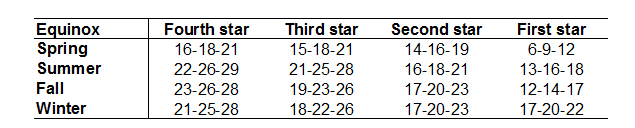
                     

Prof. Levi’s Table

The three times listed in each cell of the table correspond to how difficult it is to see a star.

  • The shortest time noted is when an expert who knows exactly where to look can observe a star.
  • The intermediate time noted is when a star can be seen with great difficulty.
  • The third time noted is when a careful observer can see a star.

The time when stars are visible to a casual observer, is yet later.

[1] My assumption is that poskim may find the innovations useful in exceptional situations as opposed to more typical ones.
[2] According to the vast majority of rishonim, the day ends when bein ha-shemashot ends or at most 2 minutes later.
[3] Familiarity with both sugyot is assumed to fully assess this essay.
[4] See my article in Hakirah spring 2019 for more detail on the Gaon’s convincing attack on Rabbeinu Tam’s position.
[5] A version of that reading is presented in Ohr Meir as the opinion of the geonim, who R. Posen seeks to demonstrate conflict with that of the Gaon.  What the Gaon felt mei ikar ha’din can be disputed as will be illustrated.  Even if one were to reject any variation of the Gaon’s stated position, this paper can also be considered to apply to the less specific view of the geonim.
[6] Both 72 or 90 minutes are increasingly assumed to apply only in the Middle East around both equinoxes and require adjustment (using depression angles) to account for variation by season and latitude.
[7] These positions are more properly characterized as variants of the position of the geonim / Gaon as they are all much closer to their normally assumed period of bein ha-shemashot.
[8] Throughout R. Kapach’s commentary on Mishnah Torah, however, he asserts that this is the position of Rambam. See R. Posen’s view as well, mentioned in footnote 5.
[9] This seminal point was made explicitly by R. Chaim Sonnenfeld in teshuvah 33 (an approbation to a sefer on zemanim) in a recently published volume of his teshuvot.  His reaction, as might be expected, was to be mamir, and fulfill the stringencies of both opinions. I argue that the strengths of both opinions lead to the opposite and more probable conceptual position, adopting the leniencies of both positions.
[10] See Vol. 2 of HaZemanim BeHalakha by R. Ḥaim Benish, page 360, especially footnote 58.
[11] Pages 251 – 252, Chavel edition, Mossad Ha-Rav Kook.
[12] This argument is included due to its ancient provenance; it is easily challenged given that it is normally assumed that tosefet Shabbat can begin at plag ha’minah, which precedes sunset.
[13] Note as well, that the gemara in Pesaim 94a applies to

  • a day of average length,
  • which occurs around both the spring and fall equinox.

However, the days that would be referred to in Shabbat 34b would be

  • a minimum, as opposed to an average, and
  • restricted to those days when the appearance of three stars occurs within the time needed to walk ¾ of a mil after sunset. For astronomic reasons such days occur only in the spring and not in the fall.

While neither of these two differences is itself convincing, both lend further support to the thesis developed.
[14] See the chart by Prof. Levi provided in the attachment.
[15] A more extensive analysis of Shmuel’s statement will appear in a future issue of the Torah u’Maddah journal.
[16] This section assumes detailed familiarity with the sugyah on Shabbat 34b-35b.
[17] Prepositions have been omitted from the statement in order not to bias the semantics.
[18] Large stars are defined as kokhavei lekhet, moving stars, currently called planets. Other approaches to dividing stars into categories are much less likely and not considered.
[19] The isolated opinion of R. Eliezer mi’Mitz, who begins the bein ha-shemashot period before sunset, is difficult to reconcile with Shmuel’s statement, in any case.
[20] See the last two paragraphs on page 358 and especially footnote 50 in Vol. 2 of HaZemanim BeHalakha.
[21] The time to walk 1/12 of a mil is between 1.5 and 2 minutes.
[22] While normally I would assume Prof. Levi’s third entry matches Shmuel’s assertion, since this statement might mean seeing a star does not mean bein ha-shemashot has necessarily begun, it might mean just an accidental sighting, which may occur at the earliest time possible when normally only an expert, knowing exactly where to look, can locate a star.
[23] R. Benish, R. Willig, Prof. Levi among many others struggle with this issue.
[24] In the spring Sirius and Canopus can both be seen around 15 minutes after sunset.
[25] Having seen no earlier discussion of this issue anywhere in the halakhic literature, I believe this interpretation originated with the Gaon in O. . 261. The alternative under discussion, delaying the start of bein ha-shemashot by some small number of minutes after sunset, eliminating the hypothesis that bein ha-shemashot begins precisely at sunset, which leads to such questions.
[26] Perhaps one can assume some worsening of atmospheric conditions, as a result of pollution, slightly decreasing visibility.  I spoke with a chemist in my synagogue, Dr. Irwin Goldblatt, who verified this as a possibility.  I have no basis to determine how accurate this observation might be, but it is hard to imagine that it is consequential.
[27] See Minhagei Eretz Yisrael by R. Gliss, pages 102 and 282.
[28] Seder Hakhnosat Shabbat, found towards the end of every abad siddur, specifies 4 minutes. He reverses the position he took in Shulan Arukh HaRav, which supported Rabbeinu Tam.
[29]See Zemanim Ke’hilkhatam by R. Boorstyn, chapter 2, section 3, where he summarizes different 19th and 20th century posekim in the Middle East who supported times beyond 4 to 5 minutes and up to approximately 10 minutes after sunset.  The rationale he and many of these posekim used is varied often relying on the notion of sea level and / or visibility from higher elevations, a topic of continued debate.
[30] See the addition to Maaseh Rav section 19.  Six minutes is expressed as 1/10th of an hour to be applied in both the morning and evening, although Shmuel’s assertion of “one star – daytime” is given as the reason for the slight delay after sunset. How R. aim Volozhin determined this precise time that equals the time at which an expert can see Sirius remains a mystery.
[31] R. Adler, R. Loerberbaum, and R. Sofer all subtract the length of the bein hashemashot interval from the end of Shabbat, see my article, Zemannim: On the Introduction of New Concepts in Halakhah, in the TuMJ 2013.
[32] It goes without saying that the instantaneous communication that characterizes of our current environment cannot be anachronistically assumed in a prior period. This impacts the assumptions made about when some of these sources are read / known, a topic not pursued further.
[33] A set of arguments based on the statement of Shmuel about 1, 2 and 3 stars are not included and will be incorporated in a future paper examining both Shmuel statement and Rambam in multiple sections of Mishnah Torah, based on their mastery of astronomy as it was known in their times.
[34] First suggested by the Gaon in O. . 261, this approach is widely assumed in recent halakhic literature. Note that the gemara in Pesaim assumes an average day, which occurs in both the spring and fall around the equinox.  However, the Gaon’s argument assumes, not an average interval, but a minimum interval and one that occurs only in the spring, but not in the fall; stars are not visible as early in the fall as in the spring.  On the other hand, as suggested, a maximum would apply year-round.
[35] Prof. Levi uses a depression angle normalization to spring, which we will not explain.  His use of 28 is in fact closer to 30 minutes, as normally defined by clock-time.
[36] 12 – 13 minutes is consistent with the many rishonim supporting a time to walk a mil of 22.5 minutes.
[37] There is no reason to debate whether the underlying science favors either of the two most common halakhic definitions, which sandwich current technology’s identification of the point at which the first light of the sun is visible. Expressed as depression angles the 72- and 90-minute intervals equate to depression angles of approximately 16 and 20 degrees, respectively. With the best available equipment, light from the sun can be observed at a depression angle of approximately 18 degrees. One can then argue that 16 degrees is when the amount of light is visible to humans, while 20 degrees is when one arises in anticipation of emerging light. Both are reasonable positions for defining alot hashaar.
[38] So strong a word is intentional given the “bombe” kasha of the Gaon; see immediately below.
[39] R. Moshe Sofer might be trying to deal with this point about a symmetric point to the appearance of three stars in his commentary on Shabbat 34.
[40] See Rambam, Hilkhot Beit Ha’Beirah (1:12). Rambam’s formulation is originally stated in the negative, which raises possible questions that might be analyzed in this context.
[41] Other possible examples include the operation of a beit din, the laws of aveilut, particularly the first day, etc.
[42] The philosophical underpinnings that would enable such ahistorical iddushim is beyond the scope of this article. Despite an accusation of partiality, one cannot dismiss the assumption that R. Soloveitchik was aware of the various challenges to his iddush. Despite bringing support from the period of the rishonim, I believe the Rav was establishing what he knew to be a restatement of Rabbeinu Tam’s position, based on the undeniable accuracy and correctness of the Gaon’s notion of tzait kol ha-kokhavim. In my own mind, I have played out a long and imagined conversation with R. Soloveitchik on this subject.
[43] For any number of reasons, it is difficult to imagine the perspective presented was that of Rabbeinu Tam. Rather, it might represent Rabbeinu Tam’s position updated and enhanced by what is now known scientifically.
[44] What I also do not understand is why R. Soloveitchik referred to the mathematical notion of continuity as opposed to any astronomical knowledge, which I think would have been more relevant.


The Anatomy of an Auction: A Previously Undissected Body of Literature on the History of the Jews and Postmortem Dissection

The Anatomy of an Auction: A Previously Undissected Body of Literature on the History of the Jews and Postmortem Dissection

 Rabbi Edward Reichman, MD 

The issue of autopsy and postmortem dissection has been exhaustively explored in halakhic literature.[1] If I were to ask where and when we find the first halakhic discussion about this topic, the immediate response would invariably be the teshuva of the Noda biYehuda, from the late eighteenth century.[2] It may be time to rewrite the medical halakhah history books. On Sunday, May 21 Genazym Auction House held its fifteenth auction. Lot #133 was a work entitled Pachad Yitzchak.

There are multiple works throughout history that bear the title Pachad Yitzchak. The modern reader will surely think of the work of Rav Yitzchak Hutner. The reader of this blog may also think of the first multi-volume halakhic encyclopedia, authored by Rabbi Dr. Yitzchak Lampronti (1679-1756). The volume offered for auction by Genazym is an earlier lesser-known composition of the same name by Yitzchak Hayyim Kohen me-haHazzanim (AKA Isaac Vita Cantarini)[3] published in 1685. 

Buried in Cantarini’s obscure work, in a section peripheral to the main theme of the book, we find a vivid and poetic description of a tragic incident relating to anatomical dissection.[4] Viewed in isolation, this incident merits historical attention due to its gravity. Yet, it merely reflects a much larger historical chapter about the Jews and postmortem dissection which long preceded the time of the Noda biYehuda and has remained largely undissected until now. But first a word about this work, its provenance and its author. 

The Work- Pachad Yitzchak (Amsterdam, 1685)[5]

The main subject of this work is the tale, told in poetic fashion, of the miraculous salvation of the Jewish congregation of Padua during the Austrian-Ottoman War in the year 1684. War erupted between the Austrian and Ottoman Empires in the year 1684 over the city of Buda (today part of Budapest). The virulently anti-Semitic Christian ruler of Padua spread a libel accusing the Jews of supporting the Muslim Turks in their battle against the Austrian Empire. His incitement caused an enraged crowd to break into the Padua Ghetto, yet the Jews miraculously persuaded the Venetian government to subdue the outburst. The Jews of Padua declared the 10th day of Elul as their Second Purim in gratitude for their miraculous salvation. This holiday was celebrated for many generations thereafter. 

However, the work also includes many additional unknown details of the history of the Jewish community and its rabbis. It is from this aspect of the book that we draw our discussion. 

Provenance

Regarding the item’s provenance, it was previously part of the William Gross Family Collection,[6] a significant portion of which has been recently sold at auction by both Kedem[7] and Genazym auction houses. Gross is a well-known prominent collector of Judaica and Hebraica and the selling of his collection is of historic significance. To see the collection of precious items united under one roof now become redistributed and disseminated across the world necessitates a moment of pause and reflection. Yet, this is the life cycle in the world of bibliophilia.[8] For centuries, passionate bibliophiles spent lifetimes amassing extraordinary and unique collections, only to have them subsequently sold piecemeal (for a variety of reasons) while still alive, or by less passionate heirs after death. Sometimes, however, collections are sold en bloc. An allusion to one such example is the image which appears on the bottom of the title page of the copy of Pachad Yitzchak sold at auction.  

This stamp, which is not mentioned in the catalogue description, indicates that this volume was previously part of the collection of Professor Lelio Della Torre. Della Torre was an Italian Jewish scholar of the nineteenth century, and prolific author, who served as a professor of Talmud and rabbinics at the rabbinical seminary in Padua, where Shadal also taught, from 1829 until his death in 1871. During this time, he was an avid collector of Hebraica. David Kaufmann, himself a renowned scholar and bibliophile, sought to procure Delle Torre’s collection upon the latter’s death. Kaufmann not only acquired Della Torre’s collection, but also that of Marco Mortara, a student of Shadal, and later Chief Rabbi of Mantua. Mortara’s collection in turn contained the library of Samuel Della Volta, whose life, work and library we discussed in this blog.[9]  All of these collections are now housed in the Hungarian Academy of Sciences Library in Budapest, to which Kaufmann bequeathed his library. This volume from Della Torre’s library somehow escaped the grasp of Kaufmann and traversed a different path, ultimately landing instead in the Gross Family Collection.[10]

The Author- Yitzchak Hayyim Cantarini (1644-1723)[11]

The Cantorini family were a prominent family of Kohanim who were also associated with the cantorial profession – hence the name Cantarini, or MinHaHazanim, as their Hebrew name reflects. Isaac Cantarini graduated from the University of Padua Medical School on February 11, 1664, one of many Cantarinis who earned their medical degrees from the university.[12] He authored a number of congratulatory poems in honor of Padua medical graduates.

After graduated from Padua, Cantarini went on to become a leading figure in Italian Jewry. He is considered one of the greatest Torah sages of his time, and his responsa have been published in both Yitzhak Lampronti’s Pachad Yitzhak and Samson Morpurgho’s Shemesh Tzedakah.[13] Cantarini wrote halakhic, historical, and homiletic works, as well as medical treatises in Latin. He was a poet, author, physician, and consummate orator; non-Jewish clergy and lay people attended his Shabbat sermons. In the year 5460 there were so many non-Jewish visitors in synagogue when he spoke that the regulars had to ascend to the women’s section (ezrat nashim) to pray.[14] He was a teacher of both Rabbi Moshe Hayyim Luzzatto (Ramchal),[15] as well as Rabbi Yitzchak Lampronti.

Non-Jews sought Cantarini’s sage advice as well, as evidenced by his correspondence with the Christian intellectual Theophilio Ungar.[16]

Cantarini was known by his initials יחכם. He was also quite adept at word play, and Shadal mentions but one small example of his utilizing the acronym of his name in the introduction to a kinah he composed upon the passing of Rabbi Yehuda Briel:[17]

Shadal takes a stab at solving the riddle.

A Fearful Story in Pachad Yitzchak

The following story appears in the pages of Pachad Yitzchak.[18] On the 17th of Shevat 5440 (שנת מ”ת as per Cantarini), a young man by the name of Hananel (AKA Graziadio) Levi[19] died in the Ghetto. His body was prepared for burial, but in the interim, a band of raucous students from the University of Padua stormed the Ghetto, kidnapped the body, and whisked it away to the anatomy room in preparation for dissection and medical student instruction. The Jewish community was in an uproar, riots ensued, and all political channels were pursued to secure the return of the body. When initial efforts failed, some members of the Jewish community on their own initiative attempted unsuccessfully to enter the anatomy lecture hall under cover of night to procure the body. Ultimately, after one week, negotiations succeeded, and the Jews were promised by the University that they needn’t worry about similar infractions in the future, and that the bodies of the Jewish community would no longer be forcefully taken for anatomical dissection. 

Anatomy, the Jews, and the University of Padua- An Undissected Body of Literature

This frightening incident recounted in Pachad Yitzchak is significant in its own right, but here we situate it as part of a much larger narrative of anatomy, the Jews and the University of Padua, which began over a century earlier.

Since the Middle Ages, individual Jewish students experienced numerous hurdles to the completion of their medical training, many rooted in discrimination and antisemitism. It was sometime around the 16thcentury, however, as the result of the synchroneity of two major historical developments, that Jews, as a group, first encountered a new major challenge to their medical education. This challenge, unlike any previous, did not originate with their non-Jewish colleagues or institutions, but was self-imposed by the Jews. Its consequences however were no less severe.

In the beginning of the fifteenth century, the University of Padua became the first European university to officially allow admission of Jewish students for medical training.[20] This policy led to a gradual influx of Jewish students and the creation for the first time in history of a significant Jewish presence and recognizable entity in a consistent fashion on a university campus.[21] This positive development for the broader Jewish community[22] unwittingly evoked unanticipated consequences.

Simultaneous with the expansion of the Jewish community in Padua, a young professor on campus was quietly revolutionizing the study of anatomy. Andreas Vesalius, who arrived in Padua in 1537, began to hold frequent public and private anatomical displays and approached the study of human anatomical dissection in a systematic fashion not previously attempted.[23] He would later come to be known as the founder of modern anatomy. With his innovations came the expansion of the anatomy course in Padua. Anatomy became identified from then on as the most essential course in medical training, and Vesalius, along with the University of Padua, were leading the revolution. 

The Ramifications of Vesalius’ Contribution for the Jewish Community

Vesalius’s work formalized and expanded the teaching of human anatomy at the University of Padua, as well as at medical schools throughout the world. With the expansion of the course came the necessity to supply more cadavers for the dissection tables. To procure cadavers for the anatomy course, the university turned to both the judicial system as well as its students and their communities. Executed criminals served as one steady source of cadavers, but this did not suffice. 

Grave robbing became commonplace in order to supplement the source of bodies. The practice was even encouraged by Vesalius and, though technically illegal, was unofficially tolerated by the government. A ducal document from 1549, during Vesalius’s tenure in Padua, condemns grave robbing,[24] but the ever-present fear and reality of the practice also affecting the Jewish cemeteries.[25] Indeed, one scholar has suggested that one of the historiated letters in the Fabrica specifically depicts a scene of the grave robbing of a body from a Jewish cemetery.[26]

The scene depicts putti (cherubic figures common in Renaissance art) removing a body from a grave. The “o” on the flag held by one of the putti was the symbol Jews were required to wear on their clothing and may reflect that this was a Jewish cemetery depicted.

The emphasis on anatomy begun by Vesalius would continue long into the future. Soon the university would further invest in this venture by building the first example in the world of a permanent anatomical theater, completed in 1595 (after the death of Vesalius), created for teaching anatomy through the dissection of corpses. The theater still stands to this day. 

The supply of cadavers was a perennial challenge for the medical school, and as a result, the university sought additional creative ways to address the issue. At some stage they instituted each community which sent medical students for training at the university would be required to provide a certain number of bodies for the dissection table.[27] The Jewish community, like others on campus, was expected to provide cadavers for the yearly anatomy course. However, the Jewish students and community took issue with this expectation. As elated as Jews were to walk the halls of a premier university for the first time in history, this privilege would not compel the abrogation of ancient Torah principles. Jewish law forbids the dissection of the human body after death absent mitigating circumstances yielding direct and immediate life-saving benefit from the procedure.[28] The prohibitions of desecrating and deriving benefit from the corpse, as well as the obligation to bury the body preclude routine dissection or autopsy. 

This refusal of the Jews to provide bodies sparked outcry from both the university and its students. The tension created from this conflict would play out over centuries. It is reflected, for example, in multiple recorded incidents of Padua medical students attempting to kidnap Jewish bodies to provide for the anatomy course.[29] Although we have no starting date, already in the earliest Vesalian and post-Vesalian days in Padua a compromise was struck with the Jewish community providing a hefty financial compensation to absolve them from the cadaver obligation. However, this was not a one-time incident, and the anatomy issue persisted, with frequent renegotiation of terms over the years and increased tension resurfacing periodically. Despite the Senate’s repeated pronouncements, frequently the graves in the Jewish cemetery were violated. It was not uncommon for gravely ill patients to be transported out of Padua for fear of being dissected upon their death.[30] The Jews were compelled to construct secret hiding places in the Ghetto where the bodies could be concealed until the funeral. Often, they buried the dead under the cover of night to avoid the dissection table.[31]

One would have expected to find halakhic responsa from 16th and 17th century Italy discussing this topic, but the extant halakhic literature is silent. The first cases discussing autopsy only surface in the late 18th century. We do however find reference to this ongoing issue in the Padua Jewish community archives as well as in the administrative records of the city and University of Padua. We share these documents here, many for the first time. While not enshrined in the extant responsa literature, this community response to anatomical dissection surely reflects the considered rabbinic opinion and halakhic analyses of the local Padua rabbinate, to whom the community deferred on such matters. Prominent rabbis who served the Padua community, or were connected with the medical students during the period under discussion include Maharam Padua (1482-1565), Rabbi Yehuda Arye de Modena (1571-1648) and Rabbi Yehuda Briel (1643-1722), Rabbi Dr. Isaac Hayyim Cantarini (1644-1723), Rabbi Dr. Isaac Lampronti (1679-1756), and Rabbi Dr. Shimshon Morpurgo (1681-174), among others, and it is more than likely that they were involved, to some extent, in the discussions of the Jewish community regarding the provision of bodies to the medical school. 

The Padua Jewish Community Archives[32] 1624-1626

The Jewish community archives of Padua contain at least five entries from 1624 to 1626, discussed below, which directly address the anatomy issue. Daniel Carpi, the scholar of Italian Jewish history who transcribed and edited the archives, noted that since the Jews first settled in Padua the medical students requested from the Jewish community to provide to the university a specific percentage of Jewish bodies for use in the teaching of anatomy. The Jews refused and arranged a compromise to pay an annual ransom to absolve them from this obligation. However, the tension related to this matter never ceased, be it because the university continually raised the fee, or because they sometimes would only suffice with the supply of actual corpses for dissection. 

It is in this context that a tragic incident occurred in 1624 which frightened even the non-Jewish community. A group of students, led by a young anatomy professor, interrupted a Jewish funeral procession and attempted to kidnap the body. The agreement discussed in the first archival entry below appears to come on the heels of this incident in the hopes of preventing similar occurrences in the future.

April 19, 1624 (entry #545) compromise with the students during the season/days of dissection

In that the spirit of God has enlightened the esteemed philosopher Senior Cesare Cremonin to declare freedom (from dissection) for our deceased, through the continued annual designated payment to the students of the College of Arts, generation after generation. As a result, they are obligated to allow us to properly bury our dead during the season of dissection, lest anyone fear. Any violators will be fined, and they have coordinated with us to obtain from the government permission for a required fine for all who violate this agreement in a way amenable and sufficient for our needs. The aforementioned master Cesare and Yehudah Katz have already spoken on this matter and have begun discussion regarding the amount the Jewish community is willing to pay for this privilege. Therefore, to facilitate successful completion of these dealings, which will result in a salvation for our community, we present a parti to designate two members of our community,[33] even though they are not members of the committee, to negotiate directly with the aforementioned esteemed philosopher a sum which will then be presented to the community and the committee for a majority vote. 

Subsequent entries reflect the lengthy process of negotiation, implementation, and enforcement. A follow up entry from July 15, 1624 (entry # 554) states that the negotiations had been completed and a sum had been agreed upon with the government representative. The request is to approve the amount and facilitate payment. 

 An entry in the Padua University Archives from December 28, 1624 (pictured below) sheds a slightly different light on the negotiations, which may not have been officially ratified by the university.[34]

Here the university confirms an earlier privilege granted to the Jewish community by which those Jews studying medicine were granted free access to the anatomical theater, and the corpses of deceased Jews were to be left untouched by anatomical dissections due to strong religious objections to the procedure. For this privilege the Jews paid an annual sum of 100 Venetian pounds. The entry concludes, “the final decision on this proposal was delayed until the arrival of the “perillustris domini syndic.”[35] Parenthetically, this reveals that the agreements between the Jewish community and the university regarding Jewish cadavers date back to an earlier time.

An entry in the Jewish community archives some three weeks later (Entry # 566- January 21, 1625) corroborates the delayed decision of the university. It reiterates the need to arrive at an agreement between the Jewish community and the university to prevent the taking of Jewish bodies. A maximum fee of ten Ducat is set. This may have been a counteroffer to the much higher request of 100 ducats and explains why a specific number is mentioned here but not previously. 

May 17, 1626 (Entry #616)
Yet another entry reveals a creative solution to prevent grave robbing during the semester of anatomy.

Regarding designating two community representatives with the power to negotiate with Aharon Altarini to allow temporary burial[36] on his property (for community members) during anatomy season. They are granted permission to spend as much as necessary to appease those who oppose this practice.

While grave robbing was typically done secretly under the cover of night, some claims for Jewish bodies were more brazen. The entry of November 15, 1626 (Entry # 627) mentions a disturbing incident (mikre bilti tahor) of the interference of the medical students of Padua with the Jewish funeral procession of the wife of Moshe Fano (miPano). The incident, reminiscent of earlier similar episodes, appears to have been minor and fortunately did not escalate. Nonetheless, it precipitated another plea to find a long-term compromise with the university regarding the anatomy issue.

The Decree of 1672[37]

 On November 23, 1672, there was a decree reaffirming the Jews’ exemption from providing bodies for dissection and warning those who attempt to disturb the funerals or graves of members of the Jewish community. This decree appears in Jewish and governmental documents discussed below. It is unknown to me if or whether a specific historical event precipitated this reaffirmation.

The Case of Graziadio Levi and the Riots of 1679 

Here we position the story from Cantarini’s Pachad Yitzchak, occurring over a century after Vesalius’ expansion of the field of human anatomy with its subsequent creation of major halakhic and social problems for the Jewish community and its medical students. The event described by Cantarini which transpired in 1679[38] may have been the tipping point which led to a more serious and sustained response from the university. Following the death of a young Jew, Graziadio Levi, armed students stormed the Jewish ghetto in great numbers, kidnapped the corpse and brought it to the medical school in preparation for dissection. Riots ensued[39] and much effort was marshaled to rescue the body and provide a proper Jewish burial. The incident led to the issuance of a ducal letter dated February 27 of that year which rued the incident and emphatically reaffirmed the commitment by the university to protect Jewish corpses.[40]  As we have discussed, the events surrounding that fateful night in 1679 were recorded for posterity by Isaac Hayyim Cantarini in his Pachad Yitzchak. In the context of his recounting of the Levi affair, Cantarini mentions the earlier decree from November 23, 1672, protecting the bodies of the community from dissection. 

A record of the full 1679 decree is found in the Padua Civic Archives,[41] a copy of which I procured and present below. The name of Graziadio Levi is explicitly mentioned in the decree.

Ciscato transcribed the full text of the decree.[42]

The Central Archives of the History of the Jewish People possesses yet another record of the anatomy decrees. This unadorned document is a certified “copia” of the two decrees of 1672 and 1679.[43]

This was perhaps intended for archival records as opposed to public display. 

University (Governmental) Decrees Regarding Jewish Cadavers from 1672 to 1721

The Central Archives of the History of the Jewish People possesses yet another document, even more remarkable, related to the Padua anatomy decrees.[44] It includes not only one or even two decrees, but appears to be a summary or record of multiple decrees on the subject of cadavers, anatomy training at the medical school of Padua, and the Jewish community, spanning from 1672-1721. It includes the decrees of November 23, 1672, and February 27, 1679, as well as others. Furthermore, the presentation of these decrees, as an attractive broadside with calligraphy and illustrated header, indicates that it was likely intended for public display.[45]

Conclusion

In an obscure work published in 1685, recently offered for auction, appears an account of a tragic event involving the Jewish community and the dissection of human cadavers at the University of Padua. We have placed this seemingly isolated incident into a much broader historical context, fleshing out this chapter with new supportive archival material. For hundreds of years, beginning in the late sixteenth century, the Jewish community negotiated with the university for the right not to have Jewish bodies used for the anatomy course. There is no question that the local rabbinate of Padua must have been involved in these discussions and negotiations, though to what extent remains unknown. Refusal of the Jewish community to provide cadavers for dissection created major problems for both the many Jewish medical students who attended the university as well as for the Jewish community at large. The Jewish community’s restrictive position was premised entirely on halakhic grounds and would not have been sustainable throughout this lengthy period without significant rabbinic backing and support. Thus, while the extant published literature on autopsy begins with the Noda biYehudah in the late eighteenth century, there is little doubt that the halakhic discourse on the topic of anatomical dissection began long before.[46]

[1] For general discussions on anatomy and autopsy in Jewish law, see Kalman Kahana, “The Dissection of the Dead in Jewish Law: A Bibliography,” (Hebrew) haMa’ayan 7 (Tevet, 5727), 45-72; Avraham Steinberg, HaRefuah KiHalakhah 6 (Jerusalem, 2017), 512-550; Zev Farber and Irving Greenberg, “Autopsies I: A Survey of the Debate,” in Zev Farber, ed., Halakhic Realities (Maggid Books: Jerusalem, 2017), 323-417.
[2] For a discussion of the historical context of this teshuva, see Edward Reichman, “A Tale of Two Stones,” in The Anatomy of Halakha (Maggid/OU/YU Presses, 2022),
[3] Cantarini and Lampronti share at least one thing in common. They are both graduates of the University of Padua Medical School. Indeed, the passage in Cantarini’s work upon which I draw relates directly to the medical training at the university.
[4] This incident we describe transpired years before the so-called Purim of Buda (or Padua).
[5] The description of the work is drawn from the William Gross Collection Item Description, which is reproduced in the Genazym catalogue. See also M. Heller, The Seventeenth Century Hebrew Book (Brill, 2011), 1077.
[6] On Gross and his collection, see Shalom Sabar, Emile Schrijver, and Falk Wiesemann, Windows on Jewish Worlds: Essays in Honor of William Gross, Collector of Judaica on the Occasion of his Eightieth Birthday (Zutphen: Walburg Pers bv., 2019).
[7] In Kedem’s recent auction of items from the Gross Family Collection (Auction 92, May 2, 2023) we find two items of medical historical interest, one less obvious than the other. The first item is Mikne Avram (Venice, 1523), a Hebrew grammar work written by Avraham de Balmes (Auction 92, Part 1, Lot 4). De Balmes was a physician and his medical diploma from Naples, from the auspicious year of 1492, is the oldest extant Jewish medical diploma, now housed in the Braginsky Collection. On this diploma see, Giancarlo Lacerenza and Vera Schwarz-Ricci, “Il Diploma di Dottorato in Medicina di Avraham ben Me’ir de Balmes (Naploli 1492),” Sefer Yuhasin 2(2014), 163-193. De Balmes was also a student of Yehuda Messer Leon, who has been mentioned numerous times on this blog. Less known is that De Balmes is considered to be the first physician in history to perform a human-to-human blood transfusion. His patient was none other than Pope Innocent VIII. De Balmes transfused blood from three young boys, each of whom was paid a ducat, and infused the blood into the veins of the Pope. According to different reports, the Pontiff “either died or recovered.” See H. M. Brown, “Beginning of Intravenous Medication,” Annals of Medical History 1:2 (1917). Shortly thereafter we find him working in the printing press of Daniel Bomberg.  De Balmes was an expert in Hebrew language and grammar and was sought after by Christians for instruction. Mikne Avramwas published posthumously. A scholarly edition of this work was recently published placing it in the context of contemporaneous linguistic scholarship. See Dror Ben Arye, Mikneh Avram by Avraham de Balmes (Hebrew) (Ramat Gan, Bar Ilan University Press, 2022).

The second item (Auction 92, Part 2, Lot 115) is the spectacular medical diploma of Moshe ben Gershon Tilche from the University of Padua Medical School (1687), which we discussed in Edward Reichman, “Jews, Medicine and the University of Padua: A Behind the Scenes Tour of a New Exhibit at the Jewish Museum of Padua (November 2, 2022- December 31, 2022),” Seforim Blog (https://seforimblog.com), December 1, 2022.
[8] For a lament about the sale and loss of access to great Jewish book collections, see E. Reichman, “The Lost Library by Dan Rabinowitz and the ‘Burial of Souls’ by Yehuda Leib Katznelson: Different Expressions of the Same Sentiment,” The Seforim Blog (April 3, 2019), available at https://seforimblog.com/2019/04/the-lost-library-by-dan-rabinowitz-and-the-burial-of-souls-by-yehuda-leib-katznelson-different-expressions-of-the-same-sentiment/.
[9] E. Reichman, “Samuel Vita Della Volta (1772-1853): An Underappreciated Bibliophile and his Medical ‘Diploma’tic Journey,” Seforim Blog (https://seforimblog.com), November 5, 2021.
[10] When Kaufmann transferred Mortara’s library from Italy to Budapest a number of volumes were also “lost” on the way. See Asher Salah, “La Biblioteca di Marco Mortara,” in Mauro Perani and Ermanno Finzi, eds., Nuovi Studi in Onore di Marco Mortara nel Secondo Centenario della Nascita (Firenze: Giuntina, 2016), 149-168, esp. 157.
[11] On Cantarini, see, Harry A. Savitz, Profiles of Erudite Jewish Physicians and Scholars (Spertus College of Judaica Press, 1973), 25-28; C. Facchini, “Icone in sinagoga: emblemi e imprese nella predicazione barocca di I.H. Cantarini”, in Materia Giudaica, 7 (2002), 124–144. I thank Professor David Ruderman for this last reference. Cantarini’s Jewish legal responsa were published in both Yitzḥak Lampronti’s Paḥad Yitzḥak and Samson Morpurgo’s Shemesh Tzedakah. For his correspondence with the Christian intellectual Theophilo Ungar, see Y. Blumenfeld, Otzar Nehmad 3 (Vienna, 1860), 128-50.  For the definitive work on the Cantarini family, see Marco Osimo, Narrazione della Strage Compiuta nel 1547 Contro gli Ebrei d’Asolo e Cenni Biografici della Famiglia Koen-Cantarini (Casale-Monferrato, 1875). For a comprehensive bibliography on Cantarini, see Asher Salah, La Republique des Lettres: Rabbins, Ecrivains et Medecins, Juifs en Italie au XVIIIe Siecle (Brill: Leiden, 2007), 120-124.
[12] Modena and Morpurgo, Medici, 118; see D. Ruderman, Jewish Though and Scientific Discovery in Early Modern Europe (Yale University Press, 1995), 113-114, regarding families with multiple graduates from the university.
[13] On Morpurgo, See Edward Reichman, “The Illustrated Life of an Illustrious Renaissance Jew: Rabbi Dr. Shimshon Morpurgo (1681-1740),” Seforim Blog (https://seforimblog.com), June 22, 2021.
[14] S. Y. Glicksberg, Ha-Derashah Be-Yisrael (Mosad HaRav Kook, 5700), 203-20.
[15] Ramhal wrote a eulogy for Cantarini. See R. Moshe Hayim Luzzatto, Sefer Ha-Shirim, ed. Y. Zemora (Mosad HaRav Kook, 5710), 4.
[16] This correspondence was published by Shadal. See Y. Blumenfeld, Otzar Nehmad 3 (Vienna, 1860), 128-50.
[17] Ibid.
[18] 45a- 46a.
[19] I discovered a wedding poem written a number of years earlier Graziadio (Hananel) Levi, assumedly the same person, for the wedding of Saul Lustro and Allegra Barukh in 1676. See JTS Library B (NS)CR2.
[20] The university admitted non-Catholics, which included, for example, both Protestants and Jews. On the history of the Jews and the University of Padua, see Edward Reichman, “How Jews of Yesteryear Celebrated Graduation from Medical School: Congratulatory Poems for Jewish Medical Graduates in the 17th and 18th Centuries- An Unrecognized Genre,” Seforim Blog (https://seforimblog.com), May 29, 2022; idem, “Jews, Medicine and the University of Padua: A Behind the Scenes Tour of a New Exhibit at the Jewish Museum of Padua (November 2, 2022- December 31, 2022),” Seforim Blog (https://seforimblog.com), December 1, 2022.
[21] The University of Montpellier was sporadically frequented by Jews in the Middle Ages, but does not compare to Padua, where Jews attended in far greater numbers and had their own student organizations.
[22] To be sure there were residual discriminatory practices towards the Jews at the university. In addition, while the Italian Jewish community viewed this development in a positive light, the Jewish communities in Poland and Germany were more concerned about the possible assimilation of the Jewish students and dilution and diminution of Torah study.
[23] We discuss the relationship of Vesalius to the Jews in Edward Reichman, The Anatomy of Jewish Law (Maggid/OU/YU Press, 2022).
[24] See Ciscato, Gli Ebrei in Padova, p. 297. Later documents, as discussed below, address body snatching in the Jewish community specifically.
[25] Carpi, op. cit., parti 616, discusses a request to delay burial during the season of anatomy at the medical school to preclude grave robbing.
[26] Jeffrey Levine, “Jewish History in Vesalius’s Fabrica,” September 17, 2014 (https://jmlevinemd.com/jewish-history-vesalius-fabrica/).
[27] Paul Grendler, The Universities of the Italian Renaissance (Johns Hopkins University Press, 2004).
[28] See Steinberg, Avraham Steinberg, HaRefuah KiHalakhah 6 (Jerusalem, 2017), 512-550. I realize it may be anachronistic to mention these specific halakhic concerns or formulation, as these were developed later in history starting with Rabbi Yechezkel Landau. Nonetheless, they are halakhic prohibitions and obligations that apply to dissection.
[29] For more on the history of anatomy and graverobbing in rabbinic literature, see Edward Reichman, The Anatomy of Jewish Law (Maggid/OU/YU Press, 2022).
[30] This practice might have violated the prohibition of moving a goses, the halachic equivalent to a “dying person.” A similar question was posed to Rabbi Moshe Stern: Could one move a critically ill patient out of the hospital for fear that, upon his death, his body would be taken for autopsy and dissection without family consent? Rabbi Stern ruled in the negative. See his Be’er Moshe 8, nos. 239, 240, 241, 243. Likewise, Rabbi Moshe Lemberger was asked whether a Kohen physician could expose himself to tum’ah in order to establish cause of death and prevent a likely autopsy. Rabbi Lemberger argues that the Kohen must do so, as this case is akin to a met mitzvah (one who dies without family or friends to bury him). See Lemberger, Ateret Moshe, Yoreh De’ah 2:244.
[31] Hebraische Bibliographie 16 (1876), p. 37.
[32] See Daniel Carpi, Minutes Book of the Council of the Jewish Community of Padua Volume Two: 1603-1630 (Israel Academy of Sciences and Humanities, 1979). All references to the Padua Jewish community archives are from this source. I thank Pia Settimi for kindly bringing these documents to my attention. See also Ciscato, 209-212.
[33] According to Pia Settimi, one of these was Avraham Catalano, who would later coordinate the community response to the plague in Padua in 1631 and author the diary Olam Hafukh about the experience.
[34] ASUPd, ms. 655, f. 13r. I thank Francesco Piovan, Chief Archivist of the University of Padua Archives, for procuring a copy of this document for me.
[35] I am unsure to whom this refers.
[36] The idea of temporary burial was suggested and debated by some prominent rabbinic authorities in the nineteenth century regarding the situation in Cincinnati, OH where graverobbing was rampant. See Reichman, Anatomy of Jewish Law, op. cit., 223-226.
[37] See below for discussion of this decree.
[38] Cantarini lists the Hebrew date of the event as 17 Shevat, 5440. Standard Hebrew date converters place this in 1680, but the Italian decrees all clearly place the year at 1679.
[39] There were broader political issues at play during these riots which are discussed by Cantarini.
[40] See Ciscato, Gli Ebrei in Padova, pp. 299–300; Hebraische Bibliographie 16 (1876), 37. The latter reference discusses an unpublished manuscript by Chaim (Vital) Moshe ben Elisha Cantarini that details this incident. I have been unsuccessful in locating this manuscript. Cantarini, member of an illustrious Italian family comprising many rabbi/physicians, graduated from the medical school in Padua and apparently taught in a yeshiva there as well. As discussed in this essay, this incident is described in great detail by his relative Isaac Chaim Cantarini in the latter’s Pachad Yitzchak.
[41] Archivio civico antico Ducali volume 13 carta 3r. I thank Antonella Ortis for her assistance in procuring this document.
[42] Ciscato, 299. The date of this decree is February 27, 1679. He lists the location as Ducali, Reg. N. N. 123 c. I r.
[43] Ducale: Che sia conservata agli ebrei la facoltà di eseguire le sepolture secondo il loro rito (Emessa in seguito alle proteste degli ebrei contro gli studenti di Anatomia). IT-Pa-47-ovs, Padova – Jewish Community 1679. I thank Ariel Viterbo of the National Library of Israel for bringing this document, as well as the others from the Central Archives, to my attention, and I thank Yochai ben Ghedalia, Yael Franklin and Tami from the Central Archives of the History of the Jewish People for so kindly providing copies of these documents.
[44] 206 Pergamena interessantissima concernente le violazioni di cadaveri degli israeliti che si permettevano gli studenti col pretesto  degli studi anatomici ” =IT-Pa 126 ovs. This broadside does not appear to have been mentioned by Ciscato or Roth, though the decrees were known to them. The Central Archives has another catalogue entry on the dissection of Jewish cadavers in Padua- Sulle violazioni dei cadaveri degli israeliti che si permettevano gli studenti col pretesto degli studi anatomici.  Archivio della Comunità di Padova, n. 206. 8 frames. HM-5157. This is a (poor) microfilm copy of the above broadside, thought the Archives does not identify it as such.
[45] Though he had not seen this document before, Francesco Piovan, the Chief Archivist of the University of Padua remarked, “As far as I can tell from the image, it’s just a summary of laws and decrees. Such summaries (even in print) of private documents and legal norms were quite normal: they can be found, for example, in processual documents. The interesting fact is that your document looks like a kind of ‘manifesto’ (placard), written in beautiful handwriting, and perhaps to be displayed, hung in a frame or fixed on a wooden tablet. In short, it seems destined for public viewing.”
[46] As a postscript, despite the religious limitation of providing bodies for dissection, there was at least some evidence of the interest and fascination amongst the Jews with the new discipline of human anatomy. When Padua’s anatomical theater was first built in 1595, the benches were not only occupied by the registered Jewish medical students, there is record of Jews from the community (non-students) attending dissections. See Cynthia Klestinec, “A History of Anatomy Theaters in Sixteenth Century Padua,” Journal of the History of Medicine and Allied Sciences 59:3 (2004), n. 74. Furthermore, years after the publication of Pachad Yitzchak, when a young Abraham Levi was visiting Padua on his travels, his guide, our very same Rabbi Dr. Isaac Cantarini, as part of showcasing the highlights of the community, included a visit to an anatomy lesson where a cadaver was dissected. Shmuel Feiner, The Jewish Eighteenth Century: A Jewish Biography, 1700-1750 (Indiana University Press, 2020), 242.


How Jews of Yesteryear Celebrated Graduation from Medical School: Congratulatory Poems for Jewish Medical Graduates in the 17th and 18th Centuries: An Unrecognized Genre

How Jews of Yesteryear Celebrated Graduation from Medical School:
Congratulatory Poems for Jewish Medical Graduates in the 17th and 18th Centuries:
An Unrecognized Genre

Rabbi Edward Reichman, MD

Edward Reichman, Professor of Emergency Medicine at the Albert Einstein College of Medicine, is the author of The Anatomy of Jewish Law: A Fresh Dissection of the Relationship Between Medicine, Medical History and Rabbinic Literature (Published by Koren Publishers/OU Press/YU Press, 2022), as well as the forthcoming, Pondering Pre-Modern(a) Pandemics in Jewish History: Essays Inspired by and Written during the Covid-19 Pandemic by an Emergency Medicine Physician (Shikey Press).

Prelude

    As the season of graduation is upon us, I thought to look for a copy of the Hebrew poem I received upon my graduation from medical school. My search however was in vain, as I ultimately realized that no such sonnet was ever composed. When I graduated medical school some years ago, my parents, a”h, were overjoyed. They purchased me a copy of the Physician’s Prayer of Maimonides [1] (which still hangs on my wall) from the then-popular olive wood factory on the bustling Meah Shearim Street in Jerusalem. My extended family, friends, classmates, and mentors shared in my accomplishment, but no tangible expression of their happiness was forthcoming (nor did I expect one). At that time, the notion of someone authoring a poem in honor of my graduation, was, suffice it to say, nowhere to be found in the gyri of my cerebral cortex, with which I had become intimately familiar from my neuroanatomy lectures.

    My transient memory, or more aptly, history lapse may perhaps be forgiven, as I currently spend a portion of my life in Early Modern Europe, immersed in the world of Jewish medical history. It is in this period where we will find the origins of my (only partially misguided) poetic yearnings.

Introduction

    This year I discovered an account of a poem in honor of the graduation of an 18th century Jewish medical student. It appeared some fifty years ago in the pages of Koroth, a journal of Jewish medical history.[2] The poem is housed in the Bibliotheca Rosenthaliana in the Netherlands, part of the Library of the University of Amsterdam. The article, written by the late Professor Joshua Leibowitz, grandfather of the academic field of Jewish medical history, and founding editor of Koroth, discusses the poem’s author, Isaac Belinfante, a poet, bibliophile, and preacher at the Ets Haim Synagogue in Amsterdam, and provides a transcription and commentary of the poem.

    As to the date of the poem, Leibowitz suggests around 1770.[3] About the recipient, whose name appears in the text of the poem, Leibowitz was unable to identify additional biographical information.

    Leibowitz’s most astonishing observation, however, was that “what we have before us is an occasional poem dedicated to a topic not found in Hebrew literature, the graduation of a physician.” This was the first and only poem of this type Leibowitz had encountered.[4]

    Here we revisit this poem and reclaim the lost identity of its recipient, solving one seemingly insignificant historical mystery. In the process, however, we discover that Leibowitz’s observation was profoundly mistaken, though by no fault of his own. This poem is in fact part of a much larger story in Jewish literary and medical history, one that can only now be adequately explored. We reveal an entire genre of literature in Jewish history that has gone largely unrecognized and underappreciated.

Section 1- Solving a 150-year-old Mystery

    Isaac Belinfante was a prominent personality and prolific poet in eighteenth century Amsterdam. He penned poems for friends, preachers, fellow poets, and as far as we know, only one poem for a graduating physician, Moses Rodrigues.

    Until today, the identity of Rodrigues and his medical institution has remained unknown.

The Date of the Poem

    Leibowitz writes that, “The external evidence would favour a date round about the year 1770, as most of the printed poems of Isaac Belinfante appeared at this time.” In fact, we needn’t seek external sources. An examination of the original manuscript reveals the date at the very bottom of the page.[5]


    The “A” is assumedly for annum, and the Hebrew year 5529 corresponds to 1768 or 1769. As we shall see, it refers to the latter. Leibowitz was off by only one year. I suspect he viewed a reproduction of the document, and the bottom of the page, which included the date, was simply left off the copy. Had he viewed the original, this notation would have surely not escaped his keen eye.

The Institution and Identity of the Graduate

    The text of the poem does not explicitly mention the institution. The physical presence of the poem in the Bibliotheca Rosenthaliana in Amsterdam might reflect that the recipient was Dutch or that he graduated from a Dutch university. The author of the poem lived in Amsterdam and the last name of the recipient, Rodrigues, was common in 18th century Amsterdam. However, based on the description of the graduation ceremony in the text of the poem, as well as other factors, Leibowitz writes that “we are inclined to suppose that Dr. Rodrigues obtained his degree abroad, possibly in Padua, as most of the Dutch Jewish physicians in the 17th and 18th centuries bore foreign diplomas.”[6]

Below is the relevant verse:

    The mention of the student’s rejoicing upon exiting the “house of the argument” is clearly a reference to the room where the graduation dissertation/disputation was held. The verse concludes with a description of the placing of a hat (biretta) on the graduate’s head and a ring on his finger. These are known features of the graduation ceremony from the University of Padua,[7] with which Leibowitz was quite familiar.[8]

    There is a spectacular illustration of this ceremony, which has gone unnoticed, found in the diploma of a Jewish medical graduate of Padua from 1687, Moses Tilche.[9]

    However, these elements were not necessarily unique to Padua. Indeed, while disputations were a prominent feature of most European universities, starting from the late fifteenth century (at least), the disputationes before obtaining a doctorate had fallen into disuse in Padua.[10] Leibowitz was not aware of this. The other graduation features were also not unique to Padua and were found in the commencement ceremonies of other European universities. Leibowitz believed this poem to be a unicum, and as such, he had no basis for comparison, or reference points to identify the institution.

    As for the graduate himself, Rodrigues is found nowhere in Friedenwald’s classic work,[11] nor in Nathan Koren’s expansive biographical index of Jewish physicians.[12] Moreover, despite the proliferation of online resources and databases, a Google search yields no results.

    Let us consider Leibowitz’s suggestion that Rodrigues was a graduate of a foreign medical school, such as Padua. Modena and Morpurgo compiled a comprehensive list, based on extensive archival research, of the Jewish students who attended the University of Padua from 1617-1816.[13] There is no Rodrigues listed among the students who either matriculated or graduated from the University of Padua.

    If Rodrigues did not attend Padua, perhaps he trained in Germany, as by this time Jews were widely accepted into German universities.[14] A review of these records again reveals no Moses Rodrigues. He is likewise not found amongst the of Jewish physicians in Poland at the time.[15]

    Having ruled out a foreign institution, we return to the land of the poem’s origin. Komorowski lists the graduation and dissertation of a Moses Rodrigues from Leiden in 1788,[16] but this is some twenty years after our poem was written. Perhaps a relative.

    This brings us to the work of Hindle Hes, who authored a monograph focusing exclusively on the Jewish physicians in the Netherlands.[17] Indeed, it is Professor Leibowitz who suggested to Hes the subject of her study.[18] (Perhaps he had hoped to resolve Rodrigues’ identity.) Hes lists a Mozes Rodrigues who graduated the University of Utrecht July 7, 1769,[19] the year of Belinfante’s poem. This aligns with the recipient of our poem. Rodrigues’ dissertation is pictured below.

    Moses Rodrigues hailed from Madrid and trained and practiced as a surgeon in Paris prior to his stay in Amsterdam. He later completed a medical degree in the University of Utrecht.20 In the University of Utrecht student registry,[21] he is listed as Moseh Rodrigues, Hyspanus, Chirurgus Amstelodamensis (surgeon from Amsterdam), reflecting that he had already been a practicing surgeon. The other students in the registry have no such descriptor, only their names appearing.

    In the four-page introduction to his Latin dissertation,[22] Rodriguez notes that he had been a practicing surgeon for twenty-seven years prior to obtaining his medical degree. Unfortunately, he provides little other personal biographical information. What would compel a practicing surgeon to obtain an additional medical degree later in life? The content of the introduction provides possible insight. At this stage of history, surgery and medicine were unique disciplines with very different training and focus. Surgeons rarely attended universities. Rodrigues strongly advocates for the synthesis and unity of surgical and medical training.

It is one thing, moreover, that I thought it best to advise publicly in this work, namely, that twin arts are by the worst design and custom and are descended from the same father from the intimacy by which they are tied together. I am pointing to the medical and surgical art, which they distinguish with differences in various places, so that the first is concerned with curing internal diseases, the second in curing external diseases. What a distinction, since I see it extended beyond what is equal, as if these parts of medicine were to be separated rather than to be joined together! I wish to subject this work to this admonition, and to prove my endeavors in promoting both arts to good and fair readers, because, when I shall have attained it, I shall seem to have rendered to me the most beautiful fruit of design or of labor.[23]

    Formal university training in medicine would surely advance this objective. It is also possible that despite his years of experience, Rodrigues needed a formal degree to procure a higher-level position in the Netherlands.[24]

    The content of Belinfante’s poem further corroborates our identification.[25]

    In describing the medical practice of Rodrigues, Belinfante invokes distinctly surgical practices. The graduate is described as healing every “netah,” traumatic injury (from the word nituah, anatomy, or in today’s usage, surgery), as well as “one struck from a flying arrow.”[26] He seals the “mouth” of every wound and closes every opening. There are references to his treatment of afflictions of the skin and bone, as well as punctured, mauled or amputated limbs, all the domain of the barber-surgeon. This description would not have been applicable to a typical medical graduate or practitioner of medicine, but was clearly relevant to Moses Rodrigues, a practitioner of surgery. As mentioned above, Rodrigues was identified as a practicing surgeon in his matriculation record. He is also so identified on the cover page of his dissertation.

    While Hes makes no mention of any poem, it is unlikely she would have come across this lone leaflet buried in the archives of the Bibliotheca Rosenthaliana.

    In sum, we have conclusively proven that Moseh Rodrigues, graduate of Utrecht in 1769, is the recipient of Belinfante’s ode. While there is satisfaction in the historical restoration of this one obscure poem, it pales in comparison to the discovery revealed in the next section.

Section 2- An Update to Leibowitz’s Observation- Congratulatory Poems in Honor of Jewish Medical Graduates

    In 1971, Leibowitz was compelled to write an article on the Rodrigues poem owing to his belief in the utter novelty of a sonnet for a Jewish medical graduate in the 18th century. How novel indeed was such an enterprise?

    In the last fifty years, a number of similar poems have come to light. Experts in Jewish Renaissance poetry have written about them;[27] bibliophiles, collectors and libraries own them; Jewish medical historians have footnoted them,[28] but I suspect none of them appreciates the extent of the proverbial forest.

    In the course of my research in the field of Jewish medical history, I have taken note of these poems, the majority of which were written for graduates of the University of Padua.

    Italian Hebrew poetry from the Renaissance and Early Modern Period, often in broadside form, has been and remains an eminently collectible category. These poems, written for a variety of occasions including weddings and funerals, are often part of larger manuscript and book collections of bibliophiles, and while some remain in private hands, many have landed in major institutions.[29] Among these collections, we find poems written for medical graduates of Padua.[30] Thus far, I have identified a record of one hundred poems,[31] mostly in Hebrew, written for sixty five medical graduates, all from the University of Padua during the 17th to early 19th centuries.[32]

    Similar poems can also be found for Jewish graduates in the Netherlands and Germany, though in smaller numbers.[33] The timeline of their appearance mirrors the transition of Jewish medical training from Padua to the Netherlands to Germany.[34]

    Though Leibowitz had no access to other poems, his conjecture was Padua as the student’s place of graduation.[35] While the recipient of that particular poem happened to be a Dutch university graduate, Leibowitz’s instincts were essentially correct. We now know that this genre of poetry for the Jewish medical student, in particular in Padua, was quite common.

Below I provide some observations of the congratulatory poetry for Jewish medical graduates.

Graduates of the University of Padua[36]

    Padua was the first university to allow Jews to formally train in medicine, and for a number of centuries, it was the only one. It is thus in association with the University of Padua that we find the earliest and most plentiful examples of our genre of poetry.

Chronological Span

    The poems range primarily from the 1620’s to the 1780’s, with some outliers expanding the dates from 1600 to 1836. One of the earliest examples is a poem written by Rabbi Yehuda Aryeh De Modena for the graduate David Loria.[37] The original, likely in the author’s hand, resides in the Bodleian Library.[38]

Format

    While the majority of the Padua poems are found in broadside format, some are found in book form, and others in manuscript. The broadside below, in honor of the graduate Jacob Coen (1691), is a typical example.[39]

Authors

    The authors include mentors, fellow students or recent graduates, family members, and poets (e.g., Simha Calimani and Isaiah Romanin). Some of the prominent personalities included among the authors are Rabbi Yehuda Arye de Modena, Rabbi Moshe Hayyim Luzzatto (Ramal), Rabbi Solomon Marini, and Rabbi Isaac Hayyim Cantarini. The example below, written by Ramal in honor of the graduation of Emanuele Calvo (1724),[40] is one of at least eight poems he authored for Padua graduates.[41]

Recipients

    For most of the graduates for whom we possess poems, we have only one example. A number of students however received multiple poems. For example, Joseph Hamitz (Padua, 1623) received eleven poems; Salomon Lustro (Padua, 1697)- eight; Shemarya (Marco) Morpurgo (Padua- 1747)- four. Below is a manuscript copy of a poem by Shabbetai Marini[42] in honor of Lustro. Marini, a fellow alumnus of Padua from 1685, and author of a number of graduate poems, also translated Ovid’s Metamorphosis into Hebrew.[43]

Numbers and Percentage of Students

    What percentage of medical graduates received congratulatory poems? Modena and Morpurgo list a total of 325 Jewish medical graduates from 1617-1816. We have a record of poems for sixty students in this period. We thus have poems for around 20% of the medical graduates from over a 200-year period. These are only the poems of which we are aware. As these poems were typically produced as ephemeral broadsides, there are certainly poems that have not survived. The actual percentage of student poems is thus likely higher.

Location

    The poems and broadsides derive primarily from the following institutions- the National Library of Israel (NLI),[44] the Library of the Jewish Theological Seminary (JTS), the Valmadonna Trust,[45] the British Library, the Bodleian Library, and the Kaufmann Collection at the Hungarian Academy of Sciences in Hungary.[46] In a number of cases, a copy of the same poem is found in more than one library. There are likely poems in both private and public hands that have not yet surfaced.

Congratulatory Poems from Netherlands and Germany

    While the lion’s share of congratulatory poems are connected to Padua, there are examples from other countries as well. In the mid-seventeenth century, universities in the Netherlands (Utrecht, Franeker, Leiden) began accepting Jewish medical students. I have begun exploring the dissertations of Jewish medical graduates of the Netherlands and their value for the study of Jewish medical history. A comprehensive study remains a desideratum. The poems from the Netherlands, and from Germany as well, are not found in broadside form, but rather appended to the medical student dissertations. In Padua there were no dissertations within which to append poems, thus the poems were issued as broadsides. The broadside form was also used for other types of poetry in Italy at this time. Below is an example of a poem for a graduate of the University of Leiden, one of the premier medical schools in the world at this time. Salomon Gumpertz graduated Leiden in 1684 with the following dissertation.

    Appended to the dissertation is a poem written by his relative and fellow graduate, Phillip Levi (AKA Yehoshua Feibelman).

    While there is no poem at the end of Levi’s own dissertation, there is a short prayer in Hebrew composed by Levi himself to celebrate the completion of his medical studies.[47]


Blessed is the Lord who has not withheld his kindness from me and has bestowed upon me kindness and wisdom to learn the discipline of medicine. I hope that God will grant me blessing and success in my efforts and the scattered people of Israel from the four corners of the earth should be gathered, our exile should come to a speedy end, and God should send us to our land through the aegis of our Messiah speedily in our days, Amen.

    The Leiden University Senate was less than enamored by Levi’s addition and despite his graduation with honors censured him for concluding with a prayer insulting Christianity. The prayer ends with a plea to God to hasten the end of the exile by bringing “our Messiah” speedily in our days. The Senate added a warning as well for any future Jewish students to abstain from similar expressions.[48]

    We also find poems attached to medical dissertations of Jewish students in 18th century Germany. However, while in the Netherlands there were only three of four major universities where Jews attended, with Leiden being the most common, in Germany, there were many universities that opened their doors to Jews in the 18th century and onwards.[49] A proper study of the congratulatory poetry for Jewish medical graduates in Germany would be more challenging. Below is one example, a poem in honor of the graduation of Jonas Jeitteles[50] by Avraham HaKohen Halberstadt.

    Jonas was the Chief Physician of the Jewish community of Prague. In 1784, Joseph II granted Jonas and “his successors” the right to treat patients “without consideration of their religion.” He is best remembered for his campaign supporting Edward Jenner’s smallpox vaccination, for which he received the approbation of Rabbi Mordechai Banet.

Congratulatory Poems for Jewish Medical Graduates- A Genre Whose Time has Come

    Even today, manuscripts or books hidden for centuries are occasionally discovered and brought to light.[51] In this case however, it is not one item, nor even one genizah or repository that we have revealed, rather, recently discovered and previously unidentified items in collections across the world that constitute, in their aggregate, a unique genre of poetry. Imagine that just fifty years ago the founder of the field of Jewish medical history was aware of only one example.

    The collection of Jewish medical graduate poems as a whole merits recognition as a unique entity and awaits comprehensive cataloging and research.[52] To be sure, the concept of congratulatory poetry written upon completion of academic study, including medical education,[53] was not limited to Padua, nor was it limited to Jewish students. There was a broader practice of writing congratulatory poems, often in Greek or Latin, at the end of academic dissertations.[54] Nor was the use of the Hebrew language for this poetic expression restricted to the Jewish community. There was even a practice by non-Jews, typically Christian Hebraists, to write congratulatory poems in Hebrew.[55] Comparison of these different bodies of literature will surely be the substance of future dissertations, but there is no doubt that our genre will have a unique place in history.

    Jews throughout history were often restricted in their choice of professions, limited to money lending or medicine. Though allowed to become physicians, Jews were barred by papal decree from obtaining a university education. It was around the 16th century that the first academic institution, the University of Padua officially accepted Jewish students. Next would be universities in the Netherlands, starting in the mid-17th century, followed by Germany in the early 18th century and others. It is in this historical context that the congratulatory poems for Jewish medical students evolved. The collective community elation at the newly allowed entrance into the world’s leading academic institutions is reflected in these sonnets.

Conclusion

    Writing in 1971 about a manuscript of a poem he had recently discovered, Leibowitz claimed that the congratulatory poem for Jewish medical graduates was “a topic not found in Hebrew literature.” We now know just how untrue this statement is. It is not only “found in Hebrew literature,” but it was a common practice spanning over two hundred years and multiple countries. More examples will surely be discovered. While extensive research has been done for the Paduan poems, more work is needed to explore and identify the poems from graduates of the Netherlands, Germany,[56] and other countries.[57]

    For a variety of reasons, the unique genre of poetry for the Jewish medical graduate has all but disappeared in the modern era. This at least partially reflects the dissipation of the novelty of the concept of the university-trained Jewish physician. While arguably a positive trend, it nonetheless behooves us to restore this underappreciated genre to its rightful glory. Though I hesitate to call for a resurrection of the enterprise, partially due to my personal literary ineptitude, at the very least a recollection of the practice would serve to imbue today’s Jewish medical graduates with a renewed sense of pride and historical perspective.


[1] This prayer of a “renowned Jewish physician in Egypt from the 12th century” was first published anonymously in German in 1783 in Deutches Museum 1 (January-June, 1783), 43-45. On the history of the dissemination, attribution and authorship of this prayer, see J. O. Leibowtz, Dapim Refuiim 1:13 (March, 1954), 77-81; Fred Rosner, “The Physician’s Prayer Attributed to Moses Maimonides,” Bulletin of the History of Medicine 41:5 (1967), 440-457. Below is a picture (taken by the author) of a letter written by the Chief Rabbi of England, Rabbi J. H. Hertz, to Sir William Osler about the prayer.


[2] J. O. Leibowitz, “An 18th Century Manuscript Poem by I. Belinfante Honouring a Medical Graduate,” Koroth 5:7-8 (February, 1971), 427-434 (Hebrew) and LI-LIV (English).

[3] My summary of Leibowitz’s assessments is a composite of both the Hebrew and English versions of the article, which contain different information.

[4] As a footnote, he adds that he later discovered one additional poem of this type by Ephraim Luzzatto in honor of Barukh Ḥefetz (AKA Benedetto Gentili). This poem is published in Luzzatto’s collection of poetry. See Meir Letteris, ed., Ephraim Luzzatto, Eleh Bene ha-Ne’urim, (Druck und Verlag des Franz Edlen von Schmid: Wien, 1839), 43-44 (poem no. 27).

[5] Hs. Ros. Pl. B-23;L. Fuks, Catalogue of the Manuscripts of the Biblioteca Rosenthaliana University Library (Leiden, 1973), no. 317. I thank Rachel Boertjens, Curator of the Bibliotheca Rosenthaliana, for kindly providing me a copy of the poem.

[6] For a discussion about a physician from Amsterdam who obtained a foreign diploma, see E. Reichman, “The ‘Doctored’ Medical Diploma of Samuel, the Son of Menaseh ben Israel: Forgery of ‘For Jewry’,” Seforim Blog (link), March 23, 2021. Since the publication of this article, I discovered a record of Samuel’s matriculation at the University of Leiden Medical School on July 1, 1653 (along with his cousin Josephus Abarbanel), thus further buttressing my theory that his Oxford diploma is genuine and that he had received medical training elsewhere prior to obtaining his diploma from Oxford in 1655.

[7] The ceremony also included the symbolic opening and closing of a book to reflect the transmission of knowledge, as well as the placement of a wreath, and a kiss on the graduate’s cheek.

[8] Joshua Leibowitz, “William Harvey’s Diploma from Padua, 1602,” Journal of the History of Medicine and Allied Sciences 12 (1957), 395.

[9] Gross Family Collection, Israel. I thank William Gross for graciously providing me a copy of the diploma. On the diplomas of the Jewish graduates of the University of Padua, see E. Reichman, “Confessions of a Would-be Forger: The Medical Diploma of Tobias Cohn (Tuvia Ha-Rofeh) and Other Jewish Medical Graduates of the University of Padua,”in Kenneth Collins and Samuel Kottek, eds., Ma’ase Tuviya (Venice, 1708): Tuviya Cohen on Medicine and Science (Jerusalem: Muriel and Philip Berman Medical Library of the Hebrew University of Jerusalem, 2021), 79-127.

[10]  Personal correspondence with Francesco Piovan, Chief Archivist, University of Padua (March 18, 2022). The rare disputationes that were offered were only oral, and these were for Paduan citizens who wished to be admitted into a Collegium after their doctorate.

[11] Harry Friedenwald, Jews and Medicine (Johns Hopkins University Press: Baltimore, 1944).

[12] Nathan Koren, Jewish Physicians: A Biographical Index (Israel Universities Press: Jerusalem, 1973).

[13] Abdelkader Modena and Edgardo Morpurgo (with editing and additions done posthumously by Aldo Luzzatto, Ladislao Munster and Vittore Colorni), Medici E Chirurghi Ebrei Dottorati E Licenziati Nell Universita Di Padova dal 1617 al 1816 (Bologna, 1967). While there have been some subsequent additions, this work, based on extensive archival research, remains the definitive reference on the Jewish medical students of Padua. It was published in Italy just four years before Leibowitz’s article was released, and he may not have yet been familiar with it.

[14] On the Jews in German medical schools, see Louis Lewin, “Die Judischen Studenten an der Universitat Frankfurtan der Oder,” Jahrbuch der Judisch Literarischen Gesellschaft 14 (1921), 217-238; Idem, “Die Judischen Studentenan der Universitat Frankfurt an der Oder,” Jahrbuch der Judisch Literarischen Gesellschaft 15 (1923), 59-96; Idem, “Die Judischen Studenten an der Universitat Frankfurt an der Oder,” Jahrbuch der Judisch Literarischen Gesellschaft 16 (1924), 43-87; Adolf Kober, “Rheinische Judendoktoren,Vornehmlich des 17 und 18 Jahrhunderts, ”Festschriftzum 75 Jährigen Bestehen des Jüdisch-Theologischen Seminars Fraenckelscher Stiftung, Volume II, (Breslau: Verlag M. & H. Marcus, 1929), 173-236; Idem, “Judische Studenten und Doktoranden der Universitat Duisberg im 18 Jahrhundert,” Monatsschrift für Geschichte und Wissenschaft des Judentums Jahrg. 75 (N. F. 39), H. 3/4 (March/April 1931), 118-127; Monika Richarz, Der Eintritt der Juden in die akademischen Berufe: Judische Studenten Und Akademiker in Deutschland 1678-1848 (Schriftenreihe Wissenschaftlicher Abhandlungen Des Leo Baeck: Tubingen, 1974); Wolfram Kaiser and Arina Volker, Judaica Medica des 18 und des Fruhen 19 Jahrhundertsin den Bestanden des Halleschen Universitatsarchivs (Wissenschaftliche Beitrage der Martin Luther Universitat Halle-Wittenberg: Halle, 1979); M. Komorowski, Bio-bibliographisches Verzeichnisjüdischer Doktoren im 17. und 18. Jahrhundert (K. G. Saur Verlag: Munchen, 1991); Eberhard Wolff, “Between Jewish and Professional identity: Jewish Physicians in Early 19th Century Germany-The Case of Phoebus Philippson,” Jewish Studies 39 (5759), 23-34.John Efron, Medicine and the German Jews (Yale University Press: New Haven, 2001); Wolfram Kaiser,“ L’Enseignement Medical et les Juifs a L’Universite de Halle au XVIII Siecle” in Gad Freudenthal and Samuel Kottek, Melanges d’Histoire de la Medicine Hebraique (Brill: Leiden, 2003), 347-370; Petra Schaffrodt, Heidelberg-Juden ander Universitat Heidelberg: Dokumente aus Sieben Jahrhunderten (Ruprecht Karls Universitat Heidelberg Universitatsbibliothek, August, 2012); Steffi Katschke, “Jüdische Studenten an der Universität Rostock im 18. Jahrhun-dert. Ein Beitrag zur jüdischen Bildungs-und Sozialgeschichte,” in Gisela Boeck und Hans-Uwe Lammel, eds., Jüdische kulturelle und religiöse Einflüsse auf die Stadt Rostock und ihre Universität (Jewish cultural and religious influences on the city of Rostock and its university) (Rostocker Studien zur Universitätsgeschichte, Band 28: Rostock 2014), 29-40; Malgorzata Anna Maksymiak and Hans-Uwe Lammel, “Die Bützower Jüdischen Doctores Medicinae und der Orientalist O. G. Tychsen,” in Rafael Arnold, et. al., eds., Der Rostocker Gelehrte Oluf Gerhard Tychsen (1734-1815) und seine Internationalen Netzwerke (Wehrhahn Verlag, 2019), 115-133.

[15] N. M. Gelber, “History of Jewish Physicians in Poland in the 18th Century,” (Hebrew) in Y. Tirosh, ed., Shai li-Yesha‘yahu, (Tel Aviv: Ha-Merkaz le-Tarbut shel ha-Po‘el ha-Mizraḥi, 5716), 347–37.

[16]  Komorowski, op.cit., 68.

[17] Hindle Hes, Jewish Physicians in the Netherlands (Van Gorcum: Assen, 1980), 140.

[18] Hes, op.cit., XI.

[19] Hes gleaned her information from an article by David Ezechial Cohen, the Dutch physician and medical historian.

De Amsterdamasche Joodsche Chirurgijns” N.T.v.G. 74 I. (May 3, 1930), 2234-2256, esp. 2252. On Cohen, see Hes, op.cit., 26. Cohen authored a number of articles in the Netherlands Journal of Medicine on the history of Jewish surgeons and physicians in Amsterdam.

[20] Album studiosorum Academiae rheno-traiectinae MDCXXXVI-MDCCCLXXXVI. Accedunt nomina curatorum etprofessorum per eadem secula (Rijksuniversiteit te Utrecht, 1886), 164.

[21] This is not noted by either Hes or Cohen.

[22] De Indicationibus pro re Nata Mutandis, University of Utrecht (July 7, 1769).

[23] Translation by Demetrios Paraschos.

[24] “Although Jews with foreign degrees were permitted to engage in medicine as general practitioners, tolerance was not extended to tertiary education.” George Weisz and William Albury, “Rembrandt’s Jewish Physician Dr. Ephraim Beuno (1599-1665): A Brief Medical History,” Rambam Maimonides Medical Journal 4:2 (April 2013), 1-4.

[25] The second and third stanzas from the original alongside Leibowitz’s transcription.

[26] Line 3 of stanza 2 is an allusion to Tehillim, Chap. 91.

[27] See, for example, Devora Bregman Tzror Zehuvim(Ben Gurion University: Be’er Sheva, 1997), 200 and idem,Shevil haZahav (Ben Gurion University: Be’er Sheva, 1997), 186.

[28] See Abdelkader Modena and Edgardo Morpurgo, Medici E Chirurghi Ebrei Dottorati E Licenziati Nell Universita Di Padova dal 1617 al 1816 (Bologna, 1967).

[29] The institutions include the National Library of Israel (NLI), the Library of the Jewish Theological Seminary (JTS),the Valmadonna Trust, the British Libraryand the Kaufmann Collection at the Hungarian Academy of Sciences in Hungary. The Valmadonna Trust poems were recently integrated into the NLI, and a number of medical poems are featured in S. Liberman Mintz, S. Seidler-Feller, and D. Wachtel (eds.), The Writing on the Wall: A Catalogue of Judaica Broadsides from the Valmadonna Trust Library (London, 2015).

[30] The medical poems are sometimes found hidden and unidentified, together with other Italian occasional poems written for weddings, memorials, or other assorted events. See, for example, the previously unidentified poem written in honor of Abram Macchioro’s graduation from Padua in 1698, which is buried in a large collection of miscellaneous poems (NLI, system n. 990001920200205171, folio 19r).

[31] In book, manuscript and broadside form.

[32] Edward Reichman, “Congratulatory Poems for the Jewish Medical Graduates of the University of Padua,” forthcoming. Only a few of these poems are not extant.

[33] These are not found in broadside form.

[34] See Edward Reichman, “The Mystery of the Medical Training of the Many Isaac Wallichs: Amsterdam (1675),Leiden (1675), Padua (1683) and Halle (1703),” Hakirah 31 (Winter 2022), 313-330.

[35] Returning to the poem briefly, despite being the beneficiaries of a database of sorts, we would not be in any better position today to identify Rodrigues’ institution from internal evidence of the poem alone. While many of the Padua poems share a similar form, they come in many different varieties of size and style. While this poem has certain similar features and conforms to the general style of some of the extant poems of Padua, this alone is not dispositive. Several of the Padua poems mention the university explicitly, but inconsistently; thus, absence of its mention does not preclude the poem’s association with Padua. See, for example, the poem written by Isaiah Roman in in honor of the graduation of Yisrael Gedaliah Cases in 1733 (JTS Library Ms. 9027 V5:26). As to whether the poem’s location in the Netherlands presents a challenge for positing a Paduan origin, suffice it to say that of all extant Padua poems for Jewish medical students, a sum total of one is found in Italy (the poem for Samuele Coen 1702). The others can be found in libraries in Israel, America, England, and Hungary, though I have yet to locate as ingle Padua poem in the Netherlands. Leibowitz’s instincts however were correct, and by pure statistics alone, not knowing the identity of the student, the odds would certainly favor a Paduan source. Fortunately, this entire exercise is rendered moot once the identity of the student has been revealed.

[36] What follows is drawn from my forthcoming work on the congratulatory poems from Padua.

[37] On Loria, see Edward Reichman, “From Graduation to Contagion: Jewish Physicians Facing Plague in Padua, 1631” The Lehrhaus (link), September 8, 2020.

[38] MS. Michael 528, 60 recto, number 341.This poem was published in Simon Bernstein, Divan of Rabbi Yehuda Arye MiModena (Hebrew) (Philadelphia, 1932), n. 79.I thank Sam Sales, Superintendent, Special Collections Reading Rooms, Bodleian Library for his assistance and graciousness in locating and providing copies of this manuscript.

[39] This copy is from the JTS Library, Ms. 9027 V5:5. Another copy is found in the British Library, The Oriental and India Office Collections, Shelfmark 1978.f.3.

[40] JTS Library, Ms. 9027 V5:8. See Y. Zemora, Rabi Moshe Ḥayyim Luzzatto, Sefer HaShirim (Mosad HaRav Kook: Jerusalem, 5710), 10-11.

[41] The other graduates are Elia Consigli (1723), Elia Cesana (1727), Jacob Alpron (1727), Marco Coen (1728), Yekutiel Gordon (1732), Israel Gedalya Cases (1733), and Salomon Lampronti, (1734). On the relationship between Luzzatto and the medical students of Padua, see, for example, Morris Hoffman, trans., Isaiah Tishby, Messianic Mysticism: Moses Hayim Luzzatto and the Padua School (Oxford: The Littman Library, 2008).

[42]  On Marini, see M. Benayahu,“Rabbi Avraham Ha-Kohen Mi-Zanti U-Lehakat Ha-Rof ’im Ha-Meshorerim Be-Padova,”Ha-Sifrut26 (1978): 108-40, esp. 110-111.

[43] See Jacob Goldenthal, Rieti und Marini: Dante und Ovid in Hebräischer Umkleidung (Vienna: Gerold, 1851); Laura Roumani,“Le Metamorfosidi Ovidio nella traduzione ebraica di Shabbetay Hayyim Marini di Padova” [Ovid’s Metamorphoses translated into Hebrew by Shabtai Ḥayim Marini from Padua] (PhD diss., University of Turin, 1992); idem, “The Legend of Daphne and Apollo in Ovid’s Metamorphoses Translated into Hebrew by Shabbetay Ḥayyim Marini” [in Italian], Henoch (Turin University) 13 (1991): 319–335.

[44] The NLI also has reference and reproductions of many of the poems found in the other collections.

[45] See S. Liberman Mintz, S. Seidler-Feller, and D. Wachtel (eds.), The Writing on the Wall: A Catalogue of Judaica Broadsides from the Valmadonna Trust Library (London, 2015).

[46] Prior to their landing in these major libraries and institutions, many of these poems belonged to private collectors including Moses Soave, David Kaufmann and Meir Beneyahu.

[47] See Hes, op.cit., 95.

[48] Philip Christiaan Molhuysen, Bronnen tot de geschiedenis der Leidsche Universiteit 1574-1811 (s-Gravenhage: M. Nijhoff, 1916-1923), vol. 4, p. *194, entry for June 5, 1684.

[49] Examples include Heidelberg, Geissen, Berlin,Duisberg, Halle, Butzow, Rostack, Gottingen, Frankfurt, and Erlangen.

[50] See the biography of Jonas Jeitteles by his son, Yehuda ben Jona Jeitteles, Bnei haNe’urim (Prague 1821).

[51] See David Israel, “Newly Discovered Jewish Genizah in Cairo Grabbed by Egyptian Government” Jewish Press Online (March 24, 2022). Time will tell what hidden gems this cache will reveal. See also, for example, Edward Reichman, “The Discovery of a Hidden Treasure in the Vatican and the Correction of a Centuries-Old Error,” the Seforim Blog (link), January 11, 2022.

[52] The Valmadonna Trust Library, now incorporated into the National Library of Israel, began the process, and identified a separate category of broadside poems honoring Jewish medical graduates. See The Writing on the Wall, op.cit., 166-169.

[53] See Jaap Harskamp, Disertatio Medica Inauguralis… Leyden Medical Dissertations in the British Library 1593-1746 (Catalogue of a Sloane-inspired Collection) (London: Wellcome Institute for the History of Medicine, 1997), 270, where the author lists all the medical dissertations from the University of Leiden housed in the British Library collection that contain congratulatory poetry. There are hundreds on this list alone, and this does not include other Dutch universities.

[54] Bernhard Schirg, Bernd Roling, and Stefan Heinrich Bauhaus, eds., Apotheosis of the North: The Swedish Appropriation of Classical Antiquity around the Baltic Sea and Beyond (1650 to 1800) (De Gruyter: Berlin, 2017),64ff. As dissertations were not typically required for graduation at the University of Padua, the congratulatory poems were usually produced as separately published broadsides. However, I have as yet to find poetry written for non-Jewish medical graduates of the University of Padua.

[55] Andrea Gotz, “A Corpus of Hebrew-Language Congratulatory Poems by 17th-Century Hungarian Peregrine Students: Introducing the Hebrew Carmina Gratulatoria (HCG) Corpus and its Research Potentials,” Acta Universitatis Sapientiae, Philologica 11:3 (2019), 17-32; Jozsef Zsengeller, “Hebrew Carmina Gratulatoria from Franeker by Georg Martonfalvi and His Students,” Reformatus Szemle 114:2 (2021), 125-158.We rarely find these for medical dissertations. One example is the poem by György Magnus, found in the dissertation of Sámuel Kochmeister, “De Apoplexia,” from 1668, submitted at Wittenberg. I thank Andrea Gotz for this reference.

[56] As opposed to the case of Padua, where the poetry was published as ephemeral broadsides, and one can never know how many poems did not survive the test of time, poems found in association with dissertations are more likely to endure. Copies of student dissertations, wherein the poetry would be found, are typically preserved in university archives. We can therefore get a better idea of the true prevalence of this genre of poetry in the Netherlands and Germany. From a comprehensive review of the Jewish student dissertations, we will learn the percentage of Jewish students for whom poems were written, the language and quality of the poetry, and the identification of the authors. Moreover, these dissertations also often contain introductions, acknowledgments, and other appended material, which represent an untapped source of historical and genealogical information.

[57] Other universities opened to Jewish students in the 18thcentury, including Jagalonian University, and the universities of Pest, Lemberg, Prague, Vienna, and Warsaw, for example. Universities in Odessa and Kiev were only established in the mid to late 19thcentury. I have yet to find poems for graduates of these institutions.


Israel ben Shabtai [Hapstein]. ‘Avodat Yisrael – Book review by Bezalel Naor

Israel ben Shabtai [Hapstein]. ‘Avodat Yisrael (B’nei Berak: Pe’er mi-Kedoshim, 5773 / 2013). 66, 738 pages. 
Reviewed by Bezalel Naor 
Rabbi Israel ben Shabtai Hapstein, the Maggid of Kozienice (or more commonly, the “Kozhnitser Maggid”) (d. 1814) was a major figure in the third generation of East-European Hasidism founded by Rabbi Israel Ba’al Shem Tov, and specifically, a towering luminary within Polish Hasidism. Like his contemporary Rabbi Shneur Zalman of Liozhno (and later Liadi), Rabbi Israel studied under Rabbi Dov Baer, the Maggid of Mezritch (who led the Hasidic movement after the death of the founder, Ba’al Shem Tov). Unlike Rabbi Shneur Zalman, whose school of Hasidism, Habad, continues to this very day, Rabbi Israel founded no school and has no hasidim, no followers to speak of, today. 
The same goes for Rabbi Israel’s book. Whereas Rabbi Shneur Zalman’s most famous work, Tanya, has earned the sobriquet (at least among Habad Hasidim) “the written Torah of Hasidism” (“torah she-biketav shel hasidut”), relatively few have studied Rabbi Israel’s magnum opus, ‘Avodat Yisrael (Service of Israel), a commentary on the Pentateuch. Indicative of neglect in this respect, until today the book has been an example of poor typography. First published in 1842, ‘Avodat Yisrael has been reissued periodically with pitifully broken letters of “Rashi” script (today unfamiliar to Hebrew readers without rabbinic training). About now the cognoscenti will chime in, “Afilu sefer torah she-be-heikhal tsarikh mazal” (“Even a Torah scroll in the ark requires luck”) and “Habent sua fata libelli” (“Books have their fates”). 
Thankfully, this horrendous situation has now been remedied. Enter Pe’er mi-Kedoshim, a publishing concern headed by Rabbi Israel Menachem Alter, son of the present Rebbe of Gur. Pe’er mi-Kedoshim has committed itself to re-issuing the classic texts of Hasidic thought in deluxe, state-of-the-art editions. The Kozhnitser Maggid’s ‘Avodat Yisrael is the premier volume in a series envisioned to include: Degel Mahaneh Efraim by Ba’al Shem Tov’s grandson, Rabbi Moses Hayyim Ephraim of Sudylkow (next on the agenda); No’am Elimelekh by Rabbi Elimelekh of Lizhensk; Zot Zikaron by Rabbi Jacob Isaac Horowitz (the “Seer of Lublin”), et cetera. 
The book displays all the benefits that the modern age of Hebrew printing has brought to the sacred realm. The cursive “Rashi” script has been replaced by the square characters familiar to every Hebrew reader, which have then been provided with vowel points and modern punctuation. Sidebars caption the highlights of the Maggid’s comments. Footnotes reference sources in rabbinic and kabbalistic literature, as well as cross-referencing to parallel passages in the Maggid’s own works. As is customary, the book is preceded by “Toledot” (Biography) of the Author, and followed by “Maftehot” (Indices). (At present these indices are purely topical. It is hoped that in the future there will be included an index of the works cited by the Maggid, which will allow students of his thought a glimpse of his library, and the horizon of his intellectual and spiritual world.) 
Quoting the Psalmist, “Who can understand errors?” (Psalms 19:12), the Editors have encouraged readers to offer constructive criticism, including pointing out errata in the present printing. Let us take them up on their kind offer. 
In Parashat Bereshit, end s.v. vayyasem H’ le-Kayin ‘ot (6a), the Maggid observes “that there are times when miracles are performed by the Other Side, as we find in the Gemara, and in the Midrash, Parashat Toledot, that through Arginiton miracles were performed for Rabbi Judah the Prince and his companions, and the Omnipresent has many emissaries.” Where the Maggid alludes to an unspecified “Gemara,” the Editors have supplied within the text itself, within parentheses, “Me’ilah 17b.” If one consults the text of that passage in the Talmud Bavli, one discovers that it concerns miracles wrought by Ben Temalyon (name of a demon) for Rabbi Shim’on ben Yohai during his mission to Rome. When offered the demon’s help, rather than rebuffing him, Rabbi Shim’on resigned himself to accepting his intervention by saying: “Yavo’ ha-ness mi-kol makom.” (“Let the miracle come from any place.”) This statement of Rabbi Shim’on is similar in tenor to the Maggid’s conclusion: “Harbeh sheluhim la-Makom.” (“The Omnipresent has many emissaries.”) 
Clearly, the Editors have read the text of ‘Avodat Yisrael in a disjointed fashion, interpreting that the “Gemara” and the “Midrash, Parashat Toledot” refer to two different stories. My own reading of the situation is that the “Gemara” and the “Midrash, Parashat Toledot” refer to the identical story whereby Rabbi Judah the Prince and his companions were spared the imperial wrath of Diocletian through the intervention of the demon Arginiton (or in the version of the Yerushalmi, “Antigris”). The “Gemara” of course is not the Gemara Bavlit, but rather the Gemara Yerushalmit, and the reference is to the Talmud Yerushalmi at the end of the eighth chapter of Terumot. I rather like my suggested reading for two reasons. First, we are told in the biographical introduction to the book that Rabbi Hayyim of Volozhin attested that the Kozhnitser Maggid was “familiar with Talmud Yerushalmi” (“baki be-Shas Yerushalmi”) (p. 30). Second, in recent years, the Hasidic court of Gur has expended great energy in promoting the study of the hitherto neglected Talmud Yerushalmi, so I believe it especially appropriate that the edition of ’Avodat Yisrael under the guidance of Rabbi Israel Menachem Alter shelit”a offer this alternate solution to deciphering the Maggid’s cryptic reference to “the Gemara.” 
In Parashat Shemot, beginning s.v. ve-sham’u le-kolekha (91a), the Maggid writes that Moses was confronted with a conundrum. On the one hand, he was pressing for some kind of divine assurance that his mission to Egypt be crowned with success and that the Hebrews indeed hearken to his voice. On the other hand, he was concerned that by its very nature a divine guarantee would rob the Hebrews of their free will, forcing them into belief. The assumption is that the Hebrews were redeemed from Egypt in the merit of their faith or emunah. (See Exodus Rabbah, Beshalah [parashah 23] playing on the words “tashuri me-rosh Amanah” [Song of Songs 4:8].) It is a tribute to the originality of the Kozhnitser Maggid that while most Biblical commentators busied themselves with the philosophic problem of God’s hardening the heart of Pharaoh, thereby depriving him of the free will to respond affirmatively to the divine demands, the Maggid explored in the opposite direction the problem of preserving the Hebrews’ free will to disbelieve. The Maggid’s solution to the problem involves some rather esoteric doctrines of Kabbalah, namely “hanhagat gadlut” (“governance of greatness”) versus “hanhagat katnut” (“governance of smallness”), best left for the adept in Jewish mysticism. I would just point out for the record that the Editors missed a cue here. When the Maggid writes “’Ve-hen’ she-hu ahat,” he is clearly referencing the Talmud Bavli, Shabbat 31b: “She-ken bi-leshon yevani korin la-ahat ‘hen’.” (“Hen in Greek is one.”) 
In the section for the festival of Shavu’ot, s.v. u-Moshe ‘alah el ha-Elohim (200a), the Maggid writes: “Since all Israel prepared themselves for the sanctity of the Lord, and a leader is commensurate to his generation, therefore Moses was able to ascend above.” Now the crucial words, the key to understanding this thought, “u-parnas lefi doro” (“and a leader is commensurate to his generation”), have been emended by the Editors to: “kol ehad le-fi koho” (“each according to his ability”). Granted that in the old edition there was some fuzziness concerning these words (“u-parush lefi doro”), but they could still be made out simply by correcting “u-parush lefi doro” to “u-parnas lefi doro,” a well-known Hebrew adage. In the present version, one is at a loss to glean the Maggid’s meaning. (I see now that the wording “kol ehad lefi koho” does occur in the Warsaw 1878 edition of ‘Avodat Yisrael. Unfortunately, the edition I possess is without place or date. Unable to locate a copy of the editio princeps of 1842, I have no way of knowing which version occurs there.) 
In Parashat Mas’ei, end s.v. eleh mas’ei b’nei yisrael (240a), in regard to Tish’ah be-Av, the Maggid discusses the difference between the “batei gava’ei” (“inner chambers”) and the “batei bara’ei” (“outer chambers”), alluded to by the Rabbis in TB, Hagigah 5b. The Maggid’s remarks in this passage are consonant with what he wrote elsewhere in Ner Israel, his commentary to the Likkutim me-Rav Hai Gaon (2a): “In the outer chambers there is sadness and mourning, but for one who is able to ascend to the inner chambers, to the will of the Creator, blessed be He, certainly there is happiness.” (By the way, the kabbalists’ reading of the passage in Hagigah, while opposite Rashi’s, coincides with the version of Rabbenu Hananel. See Rabbi Solomon Elyashev, Hakdamot u-She’arim [Piotrkow, 1909], sha’ar 6, chap. 6, “avnei milu’im” [24b-27b].) 
In Parashat Devarim, end s.v. eleh ha-devarim (246a) there is a quote from Rabbi Isaac Luria’s commentary to the Idra Zuta. The Maggid supplies the exact page number: folio 120. The problem is that the passage does not occur there. The Editors have left the reference in the text untouched. At least in a footnote we should be told that the quote may be found in Rabbi Jacob Zemah, Kol ba-Ramah (Korets, 1785), 122a. (I am indebted to my dear friend Prof. Menachem Kallus for the correct address.) See also Rabbi Hayyim Vital, Sefer ha-Derushim (Jerusalem, 5756 /1996), 214 (left column); and Rabbi Shalom Buzaglo, Hadrat Melekh, 139a. 
In the section for Tu be-Av, s.v. meyuhasot she-bahen (256b-257a), the Maggid writes that there are times that ki-ve-yakhol (as it were), God so delights in Israel that He becomes as a young man (bahur). The Maggid writes that he has dealt with this in his commentary to the line in Avot (beginning Chap. 6), “Barukh she-bahar bahem u-be-mishnatam.” As the Editors point out, the comment is not to be found in the Maggid’s remarks on Avot. Instead, they refer us to a parallel passage in Re’eh, s.v. ve-hineh ha-Midrash (270a). By the same token, they might have referred us to Ner Israel (commentary to Likkutim me-Rav Hai Gaon), 4b: “Ve-nikra bahur ka-arazim…” 
In the section for Rosh ha-Shanah, there is a lengthy kabbalistic homily, the thrust of which is that on that day we ask the Holy One, blessed be He, to reinvest himself in the particular role of “Elohei Yisrael” (“God of Israel”). “The God of these [Jews] is asleep.” Which is to say, [the nations] were not foolish enough to assert that the Sibat Kol ha-Sibbot (Cause of All Causes) is in a state of slumber, only “the God of these [Jews],” in other words, this particular hanhagah (governance) referred to as “Elohei Yisrael” (the God of Israel) is in a state of sleep…and unconsciousness, and there is but “Elaha de-Elahaya” (the God of Gods). Based on this, you will understand the kavvanot (mystical meditations) of Rabbi Isaac Luria for Rosh Hashanah. We awaken Him with the shofar (ram’s horn). (‘Avodat Yisrael, 290b) The Editors duly noted the reference to Rabbi Hayyim Vital, Peri ‘Ets Hayyim, Sha’ar ha-Shofar, chap. 1. But what they should have noted is the following reference which would have been even more instructive: “Now in the days of Mordecai was the mystery of the time of dormita of Zeir Anpin, and the mystery that Haman said ‘There is (yeshno) one people spread and separated among the peoples’ [Esther 3:8]. The Rabbis, of blessed memory, commented on the word ‘yeshno,’ that Haman alleged ‘their God is asleep.’” (Rabbi Hayyim Vital, Sha’ar ha-Purim, beginning chap. 5) The Holy Maggid loaded the kavvanot of Purim on to the kavvanot of Rosh Ha-Shanah
The Kozhnitser Maggid was a preeminent halakhist (specializing in heter ‘agunot, permitting wives of missing husbands to remarry), kabbalist, thinker (penning commentaries to the works of Maharal of Prague), and statesman. With all that, the following anecdote sent a shiver down my spine: The Kozhnitser Maggid was on friendly terms with several prominent members of the Polish nobility. In the eighteenth century, Poland, dismembered and subjected to a tripartite division—whereby Prussia annexed the western portion of Poland; Austro-Hungary annexed Galicia in the south; and Russia annexed the east—simply ceased to exist. A certain Polish nobleman importuned the Maggid to intercede with Heaven on behalf of the Polish nation. The gentleman would not leave the Maggid’s home until promised Polish independence. Finally, the Maggid foretold that at a time in the future Poland would once again be a sovereign nation—for a span of “three shemitin” (three sabbatical cycles or 21 years). When the Jews of Warsaw were being subjected to aerial bombardment by the Luftwaffe in September of 1939, they recalled the Maggid’s prediction. In the aftermath of World War I, in 1918 to be precise, Poland once again declared its independence. Three shemitin had passed from 1918 until 1939. Warsaw capitulated to the Nazis on the eve of Sukkot, the yahrzeit of the Kozhnitser Maggid! This anecdote was told by a witness to Warsaw’s destruction, Rabbi Joseph Friedenson, editor of Dos Yiddishe Vort, the Yiddish magazine of Agudath Israel of America (“Toledot,” p. 37).


Book Review: The Koren Sacks Bilingual Edition of the Siddur

Book Review: The Koren Sacks Siddurby Elli Fischer         Rabbi Elli Fischer is a freelance translator living in Modiin, Israel.  He maintains the "On the Contrary: Judasim with Comments Enabled " blog.  This is his first contribution to the TraditionOnline Seforim blog. I was recently given the opportunity to preview The Koren Sacks Siddur. This work, due to be released in 2009, is the first major bilingual Orthodox synagogue prayer book to be released since the ArtScroll Siddur in 1984. It goes without saying that this siddur will present the first serious challenge to ArtScroll's steadily increasing hegemony over the bilingual siddur market, and, as such, this review will often note differences between the two siddurim. The present volume features a translation and commentary by Sir Jonathan Sacks, Chief Rabbi of the British Commonwealth (based on his 2006 Authorised Daily Prayer Book). His comments tend to be thematic and introductory, and do not explain or comment on the meaning of individual phrases. Taken together, Rabbi Sacks' comments would constitute a monograph on the basic structure, function, and themes of Jewish prayer. He does not anthologize from various commentaries on the siddur, rarely citing any sources later than the Talmud. The issue of translation is near and dear to my heart, as a professional translator. Translating the siddur is no easy task. It is fraught with the same tensions that characterize regimented prayer in general – the tension between spontaneity and regularity, the difficulty in giving expression to the longings of the human heart through a formal and formulaic recitation. Rabbi Sacks manages to capture the poetry and power of the prayers without sounding overbearing, highfalutin, archaic, or mechanical. Below I will compare the original Hebrew with the ArtScroll and Koren translations for several passages (The lines are broken up as they are broken up in the Koren siddur; the ArtScroll does not break lines up based on phrasing): 

Original Koren ArtScroll
את צמח דוד עבדך מהרה תצמיח וקרנו תרום בישועתך May the offshoot of Your servant David soon flower, and may his pride be raised high by Your salvation, The offspring of Your servant David may you speedily cause to flourish, and enhance his pride through Your salvation
כי לישועתך קווינו כל היום For we wait for Your salvation all day. For we hope for your salvation all day long.


Original Koren ArtScroll
שים שלום טובה וברכה Grant peace, goodness, and blessing Establish peace, goodness, blessing
חן וחסד ורחמים עלינו ועל כל ישראל עמך Grace, loving-kindness and compassionTo us and all Israel your people.  Graciousness, kindness, and compassion upon us and upon all of Your people Israel
ברכנו אבינו כלנו כאחד באור פניך Bless us, our Father, all as one, with the light of Your face  Bless us, our Father, all of us as one, with the light of Your countenance
כי באור פניך נתת לנו ה' אלוקינו  For by the light of your face You have given us, LORD our God For with the light of Your countenance You gave us, HASHEM, our God
תורת חיים ואהבת חסד  The Torah of life and love of kindness, The Torah of life and a love of kindness
וצדקה וברכבה ורחמים וחיים ושלום Righteousness, blessing, compassion, life and peace. Righteousness, blessing, compassion, life, and peace.
וטוב בעיניך לברך את עמך ישראל   May it be good in your eyes to bless Your people Israel And may it be good in Your eyes to bless Your people Israel,
בכל עת ובכל שעה בשלומך At every time, in every hour, with Your peace. In every season and in every hour with Your peace

 Another, blatant example comes from the first line of the second blessing of the morning Shema, which begins with the words "Ahava Rabba". ArtScroll renders it: "With abundant love you have loved us, HASHEM, our God; with exceedingly great pity have you pitied us." Koren, on the other hand, translates: "You have loved us with great love, LORD our God, and with surpassing compassion have You had compassion on us." These examples should suffice to bear out my contention that the Koren translation has a much more intuitive feel – that it is formulated as an English rendition of the Hebrew prayer and not simply as a mechanical translation. It is hard to quantify why "surpassing compassion" resonates better than "exceedingly great pity", but the eye and ear notice the difference all the same (as Prof. Moshe J. Bernstein is fond of noting: "My toilet overflows; my cup runneth over"). The layout of The Koren Siddur is innovative in several respects. Contrary to the convention of nearly all bilingual siddurim, the Hebrew appears on the left page and the English on the right. This format can be a bit disconcerting at first, but the adjustment period can be counted in minutes. The advantage of this innovation is both aesthetic and functional. From the aesthetic perspective, both languages seem to have a common "origin" in the binding instead of facing each other jaggedly. Functionally, this layout makes it easier to locate corresponding words and phrases. As I alluded earlier, Koren characteristically breaks lines up thematically, as in poetic verse. This results in an abundance of white space, but makes the prayers more intelligible. This convention is characteristic of Koren's all-Hebrew siddurim as well, and its efficacy transfers to the bilingual edition. Koren's liturgical publications (siddurim, machzorim, and chumashim) have long been known for their precise typesetting, and the present volume is no exception. In this siddur, there is a subtle distinction between the Hebrew fonts used for biblical passages and later liturgical compositions. The "dikduk-geeks" will be happy that the shva na is distinguished from the shva nach and the kamatz gadol from the kamatz katan. Its transliteration conventions are much more precise, making extensive use of apostrophes, hyphens, and underdots. Its transliterations of the various Kaddishin do not use awkward phonetic representations (e.g., "rabbaw"). In addition to the translation and commentary, the Koren Siddur includes italicized English instructions on both sides of the page. In general, they are longer at critical turning points of the service (beginning of the Amida, before Barkhu at Shacharit) but otherwise fairly concise. In general, these instructions contain more background and are less preachy than ArtScroll's instructions. For example, compare the following instructions that appear prior to the silent Shemoneh Esrei

ArtScroll:Moses advanced through three levels of holiness when he went up to Sinai. Therefore we take three steps forward as we 'approach' God in the Shemoneh Esrei prayer.Remain standing with the feet together while reciting Shemoneh Esrei. Recite it with quiet devotion and without any interruption, verbal or otherwise. Although it should not be audible to others, one must pray loudly enough to hear himself, See Laws #61-90 for a brief summary of its laws, including how to rectify the omission of phrases or paragraphs that are added at particular times of the year. Koren:The following prayer, until "in former years," on page 134, is said standing with feet together in imitation of the angels in Ezekiel's vision (Ezek. 1:7). The Amida is said silently, following the precedent of Hanna when she prayed for a child (I Sam. 1:13). If there is a minyan, it is repeated aloud by the Leader. Take three steps forward, as if formally entering the place of Divine Presence. At the points indicated by ^, bend the knees at the first word, bow at the second, and stand straight before saying God's name.

 The Koren Siddur, presumably because it is a bilingual edition of an Israeli siddur, is much more Israel-conscious than the ArtScroll. I refer not only to the fact that the Koren contains prayer services and laws for Yom ha-Zikaron, Yom ha-Atzma'ut, and Yom Yerushalayim and that it transliterates using generic Israeli pronunciation. I also refer to halakhic and liturgical differences that pertain to the Land of Israel, for example: adding the word "kadisha" in the Kaddish de-Rabbanan, differences regarding when one begins reciting "ve-ten tal u-matar", the procedures for Birkat Kohanim in the daily prayer, the inclusion of a note to omit "Barukh Hashem le-Olam" from Ma'ariv in the Land of Israel, and even the inclusion of the special prayer for rain in the Land of Israel as a footnote to the regular prayer. Although this siddur was produced specifically for American congregations, its inclusion of the laws and customs of the Land of Israel seems entirely right. The absence of these latter elements from the ArtScroll Siddur, for whatever reason, seems like an egregious omission. The Koren Siddur is more inclusive of women both in terms of its content and in terms of its instructions. The content includes the liturgy (imported from the Sephardic rite and increasingly prevalent in Israel) of the "Zeved ha-Bat" celebration upon the birth of a daughter (it appears in the excellent "Life Cycle" section of the siddur). It furthermore includes the thanksgiving prayer recited by a women after childbirth, which includes "Birkat ha-Gomel". The ArtScroll Siddur makes no mention of this obligation (and the practice is even discouraged in the ArtScroll Women's Siddur, which follows the minority opinion of the Mishna Berura on this matter without recording dissent). With regard to zimmun, the ArtScroll Siddur applies the practice to "three or more males, aged thirteen or older". The Koren Siddur, on the other hand, states that "when three or more women say Birkat ha-Mazon with no men present, then substitute "Friends" for Gentlemen". A final element of the Koren Siddur's treatment of women pertains to the commentary on the brakha of "she-asani kirtzono". As noted, this siddur does not generally comment on specific phrases and lines from individual prayers. The brakhot that use the "who has not made me" formula, as well as "she-asani kirtzono", are an exception to that rule. Here, Rabbi Sacks goes out of his way to explain these ostensibly problematic benedictions. Methinks he doth protest too much. His apology does little more than call attention to the problematicity of these passages. The present edition includes several introductions and appendices. The original preface to the Hebrew edition, from 1981, has been translated into English, and has been joined by prefaces written by the publisher and by Rabbi Dr. Tzvi Hersh Weinreb, Executive Vice President of the Orthodox Union (the OU is a sponsor of this publication). There is also a guide to pronunciation and transliteration penned by the editor of the volume. The most extensive introductory essay, however, is Rabbi Sacks' 42-page introduction to Jewish prayer. A perusal of it shows that it addresses elements of the history, philosophy, language, and structure of Jewish prayer, on the macro- and micro- levels. He characteristically weaves together Jewish sources from ancient to modern, as well as a sprinkling of references to British poets and critics. I have not read all 487 paragraphs of the halakhic section, but it goes well beyond the laws of prayer narrowly defined and includes discussions of the laws of tefillin and tzitzit, an overview of the entire Jewish year, and more. It even includes a section on issues that arise when traveling back and forth between Israel and the Diaspora. It also resurrects the very handy "Table of Permitted Responses", which provides an easy reference guide to what types of interruptions are permitted during the various parts of the prayer. The Talmud (Brakhot 32b) asks rhetorically: "Without knowledge, whence prayer?" Thus, understanding prayer – the simple meaning of the words and the underlying structure of how it all fits together – is a prerequisite for true prayer. The Koren Sacks Siddur has succeeded, through its nearly 1300 pages, in being informative and erudite without losing sight of the forest for the trees. It is, quite simply, a comprehensive guide book for Jewish prayer, introducing its users to the full gamut of experiences necessary to truly enter into the world of tefilla. It has set a new standard for English-language siddurim.  


Dean of Historians of Jewish Philosophy: Necrology for Professor Arthur Hyman (1921-2017)

Dean of
Historians of Jewish Philosophy:
Necrology for
Professor Arthur Hyman (1921-2017).
By
Warren Zev Harvey
Warren Zev Harvey is Professor
Emeritus in the Department of Jewish Thought at the Hebrew University of
Jerusalem where he has taught since 1977. He studied philosophy at Columbia
University, writing his PhD dissertation under Arthur Hyman. He has written prolifically
on medieval and modern Jewish philosophers, e.g. Maimonides, Crescas, and
Spinoza. Among his publications is Physics
and Metaphysics in Hasdai Crescas
(1998). He is an EMET Prize laureate in
the Humanities (2009).
This is his first contribution to
the Seforim Blog.
Arthur
Hyman, 1921-2017
 
Photo
courtesy of Yeshiva University
Arthur
(Aharon) Hyman was born on April 10, 1921 (2 Nisan 5681), in Schwäbisch
Hall, Baden-Württemberg, Germany, the son of Isaac and Rosa (Weil) Hyman.
In 1935, at the age of 14, three years before Kristallnacht, he immigrated with
his family to the United States. He pursued undergraduate studies at St. John’s
College, Annapolis, which had recently adopted its Great Books curriculum
(B.A., 1944). He did graduate studies at Harvard University, studying there
under the renowned historian of Jewish philosophy, Harry Austryn Wolfson (M.A.,
1947; Ph.D., 1953). He concurrently studied rabbinics at the Jewish Theological
Seminary under the preeminent Talmudist, Saul Lieberman (ordination and M.H.L.,
1955). He taught at the Jewish Theological Seminary (1950-1955), Dropsie
College (1955-1961), and Columbia University (1956-1991). His main academic affiliation,
however, was with Yeshiva University, where he taught from 1961 until last
year, was Distinguished Service Professor of Philosophy, and Dean of the
Bernard Revel Graduate School of Jewish Studies (1992-2008). He also held
visiting positions at Yale University, the University of California at San
Diego, the Catholic University of America, the Hebrew University of Jerusalem,
and Bar-Ilan University. I had the privilege of studying with him at Columbia
University in the 1960s and early 1970s, and wrote my dissertation under his wise
supervision. Among Hyman’s other doctoral students are David Geffen and Charles
Manekin (at Columbia University), and Basil Herring and Shira Weiss (at Yeshiva
University). Hyman received wide recognition for his scholarly accomplishments.
He was granted honorary doctorates by the Jewish Theological Seminary (1987)
and Hebrew Union College (1994). He served as president of both the Société Internationale pour l’Étude de la Philosophie Médiévale
(1978-1980) and the American Academy for Jewish Research (1992-1996)
.
He was married to Ruth Link-Salinger from 1951 until her death in 1998, and
they had three sons: Jeremy Saul, Michael Samuel, and Joseph Isaiah. From 2000
until his death he was married to Batya Kahane. He died in New York City on
February 8, 2017 (12 Shevat 5777).
Hyman
was a scholar’s scholar. He was an outstanding historian of philosophy, thoroughly
at home reading recondite philosophical texts in Greek, Latin, Hebrew, Arabic,
German, French, or English. He masterfully taught classical, medieval, and
modern philosophy. However, his great love and the main focus of his research
was medieval Jewish philosophy. He is the author of more than fifty scholarly
studies on diverse philosophical subjects. He was the editor, together with
James J. Walsh, of the popular anthology of medieval philosophy, Philosophy in the Middle Ages: The
Christian, Islamic, and Jewish Traditions
(1967), a volume that did much to
shape the study of medieval philosophy over the past four decades (a revised
third edition appeared in 2010 with the collaboration of Thomas Williams). He
edited and annotated the medieval Hebrew translation of Averroes’ Arabic
treatise On the Substance of the Orbs
(1986). He founded and edited the scholarly journal Maimonidean Studies (1989-), which became an important venue for interdisciplinary
research on the Great Eagle. His book Eschatological
Themes in Medieval Jewish Philosophy
(2002) was his Aquinas Lecture,
delivered at Marquette University. In addition, he wrote pioneering studies on
Averroes, Maimonides, Spinoza, and other philosophers.
Hyman
was staunchly committed to the teaching of Jewish philosophy as philosophy.
He was not interested in appropriating it as a means to foster Jewish identity
or religiosity. Similarly, he was not enamored of academic approaches that put
too much emphasis on “esotericism” or “the art of writing,” which, in his view,
served to distract one from the hard nitty-gritty work of analyzing the
philosophic arguments. Medieval philosophy, he argued, is an integral part of
the history of philosophy, and Jewish philosophy is an integral part of
medieval philosophy. Thus, medieval Jewish philosophy should be taught in departments
of philosophy. Hyman, in practice, did teach medieval Jewish philosophy in philosophy
departments at Yeshiva University, Columbia University, and elsewhere. He also
believed that modern Jewish philosophy should be taught in philosophy
departments, but was less unequivocal about it. He thought that it is difficult
to discern a “continuous tradition” of modern Jewish philosophy, and elusive to
define the philosophic problems and methods common to it. He often noted that
in most universities modern Jewish philosophy is not taught in philosophy
departments, but in departments of Jewish studies or religion.
Hyman
and Walsh’s Philosophy in the Middle Ages
presents medieval philosophy as a tradition common to Jews, Christians, and
Muslims. Of 769 pages (in the 2nd edition), 114 are devoted to Jewish
philosophers (Saadiah, Ibn Gabirol, Maimonides, Gersonides, and Hasdai
Crescas), 134 pages to Muslims, and the remainder to Christians. As a general
textbook in medieval philosophy that included philosophers from all three
Abrahamic religions, Philosophy in the
Middle Ages
was downright revolutionary.
In
his essay “Medieval Jewish Philosophy as Philosophy, as Exegesis, and as
Polemic,” published in 1998 (Miscellanea Mediaevalia 26, pp. 245-256),
Hyman observed that medieval Jewish philosophy was originally of interest to
historians of philosophy only as “a kind of footnote to medieval Christian
philosophy.” This situation, he continued, began to change in the 1930s with
the work of scholars like Julius Guttmann, Leo Strauss, and Harry Austryn
Wolfson, and later Alexander Altmann, Shlomo Pines, and Georges Vajda. Owing to
their pioneering work, he concluded, “Jewish philosophy…has taken its rightful
place as an integral part of the history of Western philosophy” and “[i]n
universities in the United States it is now [in 1998] taught regularly in
courses on medieval philosophy.” Hyman, always modest, did not add that the
anthology he edited with Walsh, Philosophy
in the Middle Ages
, was in no small measure responsible for enabling Jewish
and Islamic philosophy to enter the curricula of courses in medieval philosophy
in universities throughout North America. Hyman was mild-mannered and courteous
in his personal relations, but as a scholar he was a revolutionary who helped
redefine the academic field of medieval philosophy.
Writing
on “The Task of Jewish Philosophy” in 1962 (Judaism 11, pp. 199-205),
Hyman bemoaned the alienation in the modern world: “though the means for
communication have increased immensely, communication itself has all but become
impossible.” He argued that the cause of this alienation was the loss of
Reason. Jewish philosophy, he urged, has a role to play in “the rediscovery of
Reason.” He defined its task as “the application of Reason to the
interpretation of our Biblical and Rabbinic traditions.”
More
than three decades later, in a 1994 essay, “What is Jewish Philosophy?” (Jewish
Studies
34, pp. 9-12), Hyman sought to clarify who is a Jewish philosopher.
“One minimal condition for being considered a Jewish philosopher,” he suggested,
“is that a given thinker (a) must have some account of Judaism, be it religious
or secular; and (b) must have some existential commitment to this account.” Given
his requirement of “existential commitment,” he unhesitatingly excluded Spinoza,
Marx, and Freud. A second condition for being considered a Jewish philosopher,
according to him, is simply that a given thinker must be a philosopher; that
is, his or her account of Judaism must be interpreted “by means of philosophic
concepts and arguments rather than in aggadic, mystic, literary, or some other
fashion.”
The
notion of “existential commitment” provides a key that enables Hyman to distinguish
the historian of Jewish philosophy from the Jewish philosopher, that is, the scholar
from the thinker or practitioner. The Jewish philosopher has an existential
commitment to a particular account of Judaism, while the historian of Jewish
philosophy must analyze the various accounts of different Jewish philosophers,
without preferring one account over another. The historian qua historian
remains uncommitted existentially, that is, he or she remains impartial and objective.
“It should be clear,” Hyman concludes, “that for the historian of Jewish
philosophy there is not one, but a variety of Jewish philosophies.”
Although
Hyman excluded Spinoza from the category of Jewish philosophers, he wrote two of
the most important studies on his debt to medieval Jewish philosophy, namely,
his “Spinoza’s Dogmas of Universal Faith in the Light of their Medieval Jewish
Backgrounds” (1963) and his “Spinoza on Possibility and Contingency” (1998). In
these essays, he showed how critical arguments in Spinoza’s Theologico-Political Treatise and Ethics reflected arguments found in the
Jewish and Muslim medieval philosophers, particularly Maimonides. In uncovering
Spinoza’s covert debt to medieval philosophy, Hyman continued the line of research
of his mentor, Wolfson. Hyman’s Spinoza was formatively influenced by
Maimonides and other Jewish philosophers in his ethics, politics, and
metaphysics, but he nonetheless was not a “Jewish philosopher” because he
lacked an existential commitment to some account Judaism, whether religious or
secular. Hyman’s insistence on an existential commitment is crucial. For a
philosopher, according to him, to be considered a Jewish philosopher, it was not sufficient for him or her to be ethnically
or culturally Jewish, or even to be well-educated in Jewish law and lore. An
existential commitment was required.
In
the introduction to the Jewish Philosophy section of Philosophy in the Middle Ages, Hyman gave a simple definition of
medieval Jewish philosophy. “Medieval Jewish philosophy,” he wrote, “may be
described as the explication of Jewish beliefs and practices by means of
philosophical concepts and norms.” It is an explication,
not a defense or apology. One might say that, according to Hyman, Jewish
philosophy is a philosophic explication of a Jew’s existential commitment.
The
medieval Jewish philosopher who stands in the center of Hyman’s research is Maimonides.
He wrote important technical studies on Maimonides’ psychology, epistemology, ethics,
and metaphysics. He always emphasized the difficulties involved in understanding
Maimonides. As he put it felicitously in his 1976 essay, “Interpreting
Maimonides”: “[The] Guide of the Perplexed is a difficult and
enigmatic work which many times perplexed the very reader it was supposed to
guide” (Gesher 5, pp. 46-59). The only way to understand Maimonides, he
insisted, is by carefully analyzing his philosophic arguments, and comparing
them with those of the philosophers who influenced him, e.g., Aristotle, Alfarabi,
Avicenna, and Algazali. In Philosophy in
the Middle Ages
, he describes the purpose of the Guide of the Perplexed: “The proper subject of the Guide may…be said to be the
philosophical exegesis of the Law.” Hyman quotes Maimonides’ statement that the
goal of the book is to expound “the science of the Law in its true sense.” In
other words, the purpose of the Guide
is to give a philosophic account of Judaism. “Maimonides,” writes Hyman,
“investigated how the Aristotelian teachings can be related to the beliefs and
practices of Jewish tradition.” He sought, if you will, to explicate
philosophically his existential commitments as a Jew.
Perhaps
Hyman’s most well-known essay on Maimonides is his 1967 exposition of
“Maimonides’ Thirteen Principles” (in A. Altmann, ed., Jewish Medieval and Renaissance Studies, pp. 119-144). Presuming
the unity of Maimonides’ thought, Hyman shows that the famous passage on the
“Thirteen Principles” in his early Commentary
on the Mishnah
coheres well with his later discussions in his Book of the Commandments, Mishneh Torah, Guide of the Perplexed, and Letter on Resurrection. He rejects the view
that the Thirteen Principles were intended as a polemic against Christianity
and Islam, and also rejects the view that they were intended only for the
non-philosophic masses. He argues for a “metaphysical” interpretation according
to which the Thirteen Principles are intended to foster true knowledge among all
Israelites, thus making immortality of the soul possible for them all, as it is
written in the Mishnah, “All Israel has a place in the world-to-come” (Sanhedrin 10:1).
A
word should be said here about Hyman’s excellent edition of the Hebrew translation
of On the Substance of the Orbs,
written by Averroes, the great 12th-century Muslim philosopher who
was Maimonides’ fellow Cordovan and elder contemporary. Averroes’ book contains
profound speculative investigations into the nature and matter of the heavens. It
is lost in the original Arabic, but was extremely popular in the Middle Ages
and the Renaissance in its Hebrew and Latin translations, and several important
commentaries were written on it by Jewish and Christian philosophers. Hyman
offers a critical annotated edition of the anonymous medieval Hebrew
translation accompanied by his own new English translation. His lucid English translation
is based on the Hebrew translation but also uses the Latin translation. His erudite
and instructive notes clarify the meaning of the text, and discuss the
development of technical philosophic terms from Greek and Arabic to Hebrew and
Latin.
In
his eulogy for his revered teacher, Harry Austryn Wolfson, printed in the Jewish Book Annual 5736 (1975-1976),
Hyman wrote as follows: “[He] showed himself the master of analysis who could
bring to bear the whole range of the history of philosophy on his
investigations. This scholarly erudition was combined with clarity of thought felicity of style, and conciseness of expression.” I think it would not be
amiss if I now conclude my remarks by applying these very same words to Professor
Arthur Hyman, my own revered teacher.
Yehi
zikhro barukh