Was Avraham a Lamdan?

Was Avraham a Lamdan?
By Ezra Brand

I would like to thank Eliezer Brodt for reviewing this article and discussing it with me, and my father for editing this article.

Some time ago there was a discussion in cyberspace regarding whether the Avos kept all of the mitzvos. The discussion was started when a video on Youtube made fun of the idea, and a response to the video was published on the Hirhurim blog (here), as well as counter-response (here). I’d like to discuss some of the basic issues involved.

The Mishnah at the end of Kiddushin says that Avraham kept the whole Torah.[1] The Rambam (Hil. Melachim 9:1) brings down the mitzvos that each of the Avos innovated. Many laws are learned from the stories in Bereishis even though they happened before the giving of the Torah.[2]

However, Chazal do not discuss any of the questions arising from the statement that the Avos “kept the Torah.”[3] Here and there, the commentators discussed some of the more obvious questions. For example, the Ramban in his commentary on the Torah (Gen. 26:5) famously asks how Ya’akov could have married two sisters, something prohibited by the Torah. This question in particular seemed to have intrigued many commentators.

The later commentators discussed whether the Avos and their children had the status of Jews or non-Jews, since they lived before Matan Torah. This question is discussed extensively by the author of the Mishneh L’melech in his sefer P’rashas D’rachim. Later, this was discussed at length by R’ Yosef Engel in the first volume of the encyclopedia he started to write, called Beis Ha’otzar, under the entry “Avos.” An interesting question that was first posed by R’ Pinchas Horowitz, one of the rebbeim of the Chasam Sofer, in his commentary on the Torah, Panim Yafos, is the following: According to the opinion that the Avos were inherently non-Jews, how could they keep the whole Torah, which includes keeping Shabbos? We know that a non-Jew is prohibited from keeping Shabbos, so what did they do? Many ingenious answers are given to this question.[4]

A few hundred years ago, a popular method of learning was the “pilpul” method. In short, this method consisted of explaining difficult passages in the Gemara by connecting the passage under discussion with other seemingly unconnected passages of Gemara in other places. This style was not limited to Gemara, but was also used when explaining the Chumash. This method was attacked by R’ Yair Chaim Bachrach, author of the Chavos Yair, as well as by others.[5] In any case, in these seforim pilpul was used to answer questions on the Avos’s actions.[6] To quote the Encyclopedia Judaica (1st edition, Volume 13, entry “Pilpul,” pg. 527): “Criticism was much more lenient regarding the application of pilpul to the exposition of the Bible and the homiletic literature, since this was considered irrelevant to a true understanding of halakhah. Consequentially, popular preachers used to strain their imagination by adducing the most complicated talmudic passages and controversies in order to throw new light on a story from the Bible or the Midrash.”

In the past 150 years, literature on the attempted synthesis of the Torah Shebichsav (Written Torah) and the Torah Shebal Peh (Oral Torah) has exploded. This literature was meant to show that the explanations of Chazal, Torah Shebaal Peh, are in truth hinted to in the Torah Shebichsav itself. Originally, the reason for this was the attacks of the maskilim on the tradition of Torah Shebaal Peh. This led to the commentaries of R’ Shamshon Rephael Hirsch, the Malbim, the sefer Haksav V’Hakabbalah, and the sefer Meshech Chochma. In addition, many anthologies of the words of Chazal regarding the written Torah were collected and put in the order of the Torah. Examples of this include the sefer Torah Temimah, as well as the still-incomplete Torah Shleimah. [7]

However, these commentaries, in their comments on Sefer Bereishis, do not systematically try to harmonize the actions of the Avos with the accepted halachah.[8] This is somewhat surprising, since the point of their commentaries is to harmonize the Torah Shebichsav with the Torah Shebaal Peh, and this would seem to be a part of that job description.

With the contemporary stress in the yeshivos on the learning of Gemara to the exclusion of almost everything else (excluding perhaps mussar seforim), and the great stress on “lomdus”, some recent seforim have followed the trend of harmonizing Torah Shebichsav with Torah Shebaal Peh to the extreme. (Lomdus is an expression used in yeshivos to refer to the Brisk analytic-style of identifying and analyzing concepts. The Yiddish term reid is also used to mean the same thing.) These modern seforim will treat the possuk like a piece of Gemara, ignoring possible theological or philological explanations, and only answer using lomdus. This lomdus can be taken to such extremes that it is often very similar to the pilpul commentaries on the Torah of the 17th century. These seforim basically spend a long time trying to answer a question in any possible way, without trying to actually fit the explanation into the passuk in any way.

The sefer Chavatzeles Hasharon by R’ Mordechai Carlebach (on Bereishis, Yerushalayim 5765) is the most popular of this genre. This sefer essentially contains essays of lomdus based on the parshah, including many questions on the halachic acceptability of the Avos’s actions. Even more recently, the sefer Arugas Habosem by R’ Menachem Ben Yakov (on Bereishis and Shemos, Yerushalayim 5772) is almost an exact copy of Chavatzeles Hasharon, not only in content but also in the physical layout. A sefer by a nephew of R’ Shlomo Zalman Auerbach, R’ Baruch Rakovski, called Birchas Avos (Yerushalayim 5750), is completely devoted to questions on the Avos’s actions, as is the sefer Mili D’Avos (by R’ Shmuel Yaffah, Lakewood 5770).

Recently, seforim which collect divrei torah on the parshah from different sources have gained popularity.[9] One of the first of this genre is the Pardes Yosef (by R’ Yosef Pazanavski, incomplete, Bereishis, Piotrkow 5690, Shmos and Vayikra, Lodz 5697).[10] This was followed many years later by R’ Yisachar Rubin’s very popular Talelei Oros (10 volumes, Bnei Brak 5753-5757). Another sefer of this genre is K’motzei Shallal Rav, which collects divrei torah on the parshah from places one would normally not expect to find them, such as in introductions to a halachic works. Since these divrei torah are in the context of a halachic work, many times they are very halachically oriented. Hence, these divrei torah also fall into the category of trying to synthesize. Pilpula Charifta, by R’ Natan Margolis (on Bereshis, volume 1, Yerushalayim 5755, volume 2, Yerushalayim 5750), also collects divrei torah in the same manner.

Are these kinds of explanations part of the “Seventy Faces of Torah”? Do the authors of these explanations themselves think there is any truth to the explanations they are presenting? The author of the Klei Chemda writes in his introduction that much of what he wrote in the sefer is “לחדודי בעלמא”, to sharpen the mind. This idea comes from the Gemara, which says that sometimes teachers who say a false din in order to get their students thinking, and ultimately to correct them.[11]

I think that a similar question has to be asked on many Chassidic explanations, as well as the common “vort.” Did the authors of these explanations really think this was a possible explanation of the text? I think not. In fact, many times authors will write that their explanation is “בדרך צחות”. So why do they bother writing them? There are two possible explanations. First of all, even if the explanation is not true, the parts leading up to it are. (Assuming there is more than one part to the explanation.) The vort is a fun way to teach people the intermediate parts. In addition, they will be able to remember the intermediate parts more easily, since they are logically connected to an interesting end.[12] A second possible explanation for why the authors wrote such explanations is that there is an underlying moral message (assuming there is an underlying moral message). As with the first explanation, the vort is an enjoyable, and therefore effective, way of getting across a moral lesson.

Would a Chassidic Rebbe admit that his “Toyreh” is not the true explanation of the verse? That is a question that I cannot answer.[13]

[1] also Yoma 28b; Yerushalmi Kiddushin Perek 2 Halacha 12; Vayikra Rabbah 50:10; Tanchuma Lech L’cha 11; and many more places. See Encylopedia Talmudit, Volume 1, entry “אבות”, pg. 36-37.

[2] See Encylopedia Talmudit, Volume 1, entry “אין למדין מקודם מתן תורה”, pg. 635ff. However, see the Encyclopedia Talmudit ibid. that quotes the Yerushalmi that says that we don’t learn laws from stories of events that happened before the giving of the Torah. See Encyclopedia Talmudit ibid. for various attempted explanations.

[3] See Sanhedrin 58b where the Gemara discusses some of the marriages of the Avos in the context of discussing the laws of incest for b’nei no’ach. However, the laws of b’nei no’ach are far less than what a Jew must keep. The Gemara in Yoma (referenced in note 1) says that Avraham even kept rabbinically mandated laws.

[4] Regarding all this see Encyclopedia Talmudit referenced in note 1. See also Maharatz Chayes in Toras Hanevi’im, Chapter 11, pg. 63-72; Nefesh Hachaim, Sha’ar 1, Chapter 21; Leket Yosef (available here); Steven Wilf, The Law Before The Law, Lexington Books, 2008 (here).

[5] R’ Bachrach attacked the pilpul method in Shu”t Chavos Ya’ir, siman 123, and at length in an unpublished sefer of his called Ya’ir Nesiv. Parts of it were published by Jellenik in the journal Bikurim, Vienna 5624, pg. 4. Pilpul was also attacked by the Maharal and the Shelah. See also the ostensibly anonymous K’sav Yosher, published in 5544, pg. 9b, (here). It’s author was Saul Berlin of Besomim Rosh infamy.

[6] I’d like to point out at this point that much of what I will write also applies to the Jews after matan torah. There are many questions on how their actions fit with the commonly accepted halacha. However, I am mainly focusing here on the actions of the Avos. As for the actions of the Bnei Yisroel after matan torah, the Gemara discusses these questions in many places. Many times the answer of the Gemara is that the action was a hora’as sha’ah, i.e. a temporary waiver of the prohibition. See at length Encyclopedia Talmudit, Volume 8, entry “הוראת שעה”. R’ Yitzchok Halevy in his monumental Doros Harishonim, in the volume discussing Tanach and aimed at refuting the Bible Critics, tries to answer many of the questions of the maskilim on the Torah Shebaal Peh based on Tanach. Another sefer that I am aware of that discusses these questions is the commentary Mussar Hanevi’im, on Nevi’im Rishonim (by R’ Yehuda Leib Ginzburg, Volume 1, St. Louis 5705, Volume 2, Yerushalayim 5736, available here and here).

[7] Interestingly, a hundred years before the publishing of the Torah Temimah, R’ Dov Ber Treves, who was on the beis din of Vilna at the time of the Gra, also wrote a commentary on the Torah bringing down many of the saying of the Gemara in order of the Torah. In fact, the Torah Temimah was accused of plagiarizing from the Revid Hazahav. Another little known work of this sort is the Be’er Heiteiv (Vayikra, Vilna 5627), available here. The Chazon Ish writes on this workוראיתי להגאון האדיר ר’ אריה ממינסק בספרו באר היטב… (חזון איש, קדשים ס’ כו אות טז).

[8] They do, however, discuss these questions in many places, especially the Meshech Chochma. The Netziv in his commentary on the Torah, Ha’amek Davar, also incorporates much from Torah Sheba’al Peh, and answers questions on the Avos’s actions.

[9] There is a similar phenomenon of seforim collecting the different explanations of the commentators on the Talmud, such as Machon Yerushalayim’s Otzar Mefarshei HaTalmud, Frankel’s Mafte’ach, and many others.

[10] For a description of the Pardes Yosef, see an earlier post on the Seforim Blog here.

[11] Eiruvin 13a, and other places. This is one of the contexts in which it is permitted to lie. See R’ Yosef Chaim, Shu”t Torah Lishmah, siman 364, Yerushalayim 5736, pg. 250 s.v. ובגמרא דעירובין. R’ Yosef Chaim in that response collects all the places in which it is permitted to lie. Contrary to popular belief, it permitted to lie in far more than the three places the Gemara in Bava Metzia 23b says. One of the most surprising cases in which it is permitted to lie, is the following: If a person knows that a certain halacha is true, but because of his low standing in people’s eyes, when he says it, it will not be accepted, he is permitted to say that a certain gadol said that halacha, even if that gadol never said such a thing! See at least four examples of this in Torah Lishmah there (pg. 250, s.v. ובגמרא דשבת; ibid. s.v. עוד שם בדף נא; pg. 251. s.v. ובגמרא דפסחים; pg. 252, s.v. עוד שם בדף כ. This would seem to cause problems for the mesorah of Torah Shebaal Peh, and was in fact one of the maskilim’s questions on the veracity of the mesorah. See I.H. Weiss, Dor Dor V’Dorshov, Part 1, Chapter 1, pg. 4.

[12] This is similar to what the Rambam writes in the introduction to his Peirush Hamishnah (Mossad HaRav Kook edition pg. 10) regarding asmachtos. He writes that the Gemara never intended to to say that asmachtos are true explanations of the verse. Rather, the asmachta is a formula to help people remember the halacha, as in the times of Chazal it was prohibited to write Torah Shebaal Peh. This view is atacked harshly by the Ritva, Rosh Hashonoh 17a. See Encyclopedia Talmudit, Volume 2, entry “אסמכתא”, pg. 106, footnote 16 and 28.

[13] A possible nafkah minah (halachic ramification) is whether it is permitted to learn the explanation in the bathroom, where learning Torah is generally prohibited. However, this nafkah minah is mostly theoretical, because, as was pointed out, even if the explanation itself is not true, many times the constituent steps are Torah. See Yisroel Bazenson, Messilat Hak’sharim (Tel Aviv 5766), (this sefer is written by a follower of Breslov and attempts to formulate “rules” for learning Likutei Moharan) pg. 153, where the author asks this question regarding the teachings of R’ Nachman of Breslov; he points out that many times R’ Nachman’s explanations even go so far as to contradict the simple meaning of the phrase he is coming to explain. Bazenson answers:

ברוב הפסוקים ומאמרי חז”ל שהוא שהוא מפרש על פי דרכו הפנימית , לאף שנראה כמשנה או אפילו כסותר הפירוש הרגיל , אם יזגה המעיין ישיג את המקום שבו שני הפירושים מתחברים ועולים בקנה אחד. ואז הפירוש הרגיל יקבל, כתוצאה מחיבור זה, תוספת בהירות שמעולם לא היתה לו.

Bazenson then goes on to bring three examples of such places in Likutei Moharan, and attempts to show how in fact the nistar complements the nigleh. (I would like to thank Eliezer Shore for pointing out this source to me.) I have not studied his explanations in depth to see if they are convincing.


Hidden Treasures in Jewish Medical History at the British Library: A Post Cyber-Attack Homage

Hidden Treasures in Jewish Medical History at the British Library: A Post Cyber-Attack Homage

Rabbi Edward Reichman, MD

On October 28, 2023, the British Library (BL) fell victim to one of the worst cyber-attacks in British History.[1] Though its precious holdings thankfully remained physically unperturbed, access by scholars across the globe to the online catalog of its massive and formidable collection, some 170 million items, was disrupted. This incident shook the world’s bibliophiles to the core, and its impact on the academic community is both inestimable and ongoing. From a Jewish perspective, the BL houses one of the world’s greatest Judaica/Hebraica collections, and these unprecedented events remind us not to take for granted the value of this hallowed institution for Jewish scholarship. As of this writing, attempts to access the British Library’s Hebrew Collection online yielded the following results:[2]

In the light of this event, I feel compelled to share the lesser known, though not insignificant, contribution of the BL to the study of Jewish medical history. I explore some exceedingly rare and important items which reflect on the education of Jewish medical students in Early Modern Europe. Most are unica, found only in the BL, and all have previously escaped notice of Jewish medical historians.

I. Congratulatory Poems for Jewish Medical Graduates of the University of Padua

From the Middle Ages through much of the Early Modern period Jews were barred by Papal decree from medical training at European universities. The University of Padua in northern Italy was the first university to officially admit Jewish students for formal medical training, and its role in Jewish medical history has been well-studied. In the early seventeenth century there evolved a practice of writing congratulatory poetry for the Jewish medical graduates of the university. This poetry, which I have discussed previously in this blog,[3] appears in broadside, printed and manuscript form. The BL has unique examples in both broadside and manuscript.

A. Broadsides

The majority of the extant broadsides of this genre are found in the National Library of Israel and the Library of the Jewish Theological Seminary in New York, but the BL’s collection is substantial and contains the very earliest known examples. The BL broadsides, which took me some years to locate, are found in three miscellaneous folders and are not itemized or described in the BL catalog. A scholar of Italian Jewish history[4] directed me to an old shadow NLI catalog, still accessible online until recently, that had skeletal information about a few of these poems in the BL, but no shelfmarks were noted.[5] The librarians of the BL were unaware of these broadsides. After some years, I incidentally came across a reference to a folder of miscellaneous Hebrew broadsides in the BL and hoped that the medical poems would be among them. With the assistance of a young scholar in London,[6] who manually investigated the files on my behalf, I was ultimately able to identify all the poems.

I have identified a total of 57 different printed congratulatory broadsides for Jewish Padua medical graduates, copies of some of which can be found in multiple libraries. The BL holds a total of fourteen different broadside medical poems, nine of which are not found elsewhere.[7] Some of the personalities who are either authors or recipients of these poems include Salomon Conegliano,[8] Isaac Hayyim Cantarini,[9] and Shmuel David Ottolenghi.[10]

While the earliest poem in the JTS Library is from 1643, and in the NLI from 1664, the BL holds two broadsides from the year 1625, the earliest known examples of this genre. Below is an example of one of the 1625 poems:

Year: 1625
Graduate: COLLI, Marchio di Salomon (Machir ben Shlomo)[11]
Author: KOHEN (Katz), Shabtai ben Meir

The following, also only found in the BL, is a rare example of a congratulatory medical broadside for which the author provides a cipher for his name.

Year: 1643
Graduate: BINGEN, Salomon di Abram (Shlomo ben Avraham)[12]
Author: Only the first name is provided, and even this is done through a cipher. No last name is provided.
Location: British Library[13]

Below is the cipher for author’s first name, which I invite the reader to decipher.[14]

(While I am aware of the answer for this cipher, there is another author’s cipher whose solution remains unknown:[15]

Any assistance would be greatly appreciated.)

These early examples are important not only for assessing the beginnings and duration of the congratulatory medical broadsides but for evaluating their artistic elements as well. For example, there are stylistic aspects of the two earliest broadsides in the BL that are not found in any subsequent broadsides.[16]

B) Congratulatory Poems in Manuscript

I have identified dozens of congratulatory poems for Padua graduates that are found only in manuscript. Some are written as if templated for publication as a broadside. There is one manuscript congratulatory poem in the BL that solves a mystery which plagued the great Jewish scholar Meir Benayahu. In an article about a group of physician-poets in Early Modern Italy,[17] Benayahu published a transcription of a lengthy poem[18]written in honor of the graduation of Salomon Lustro from Padua in 1697.[19] Below are a few stanzas at the end of the poem as published by Benayahu.

Since the authorship is not explicit, Benayahu, through creative analysis of assumed allusions in the final lines, suggests Isaac Hayyim Cantarini as the likely author.

Unbeknownst to Benayahu, another manuscript copy of the same poem is found in the BL.[20] The same final verses appear below, though with a different layout:

There is also another key difference, an additional line.

The last line provides the name of the author, one Yitzḥak the son of Yedidia Zecharia meUrbino. As described in the introduction to the manuscript, after Urbino died, his son, Yedidia Binyamin, collected his father’s poetic writings into an untitled manuscript volume, now housed in the BL. This volume contains two poems for Lustro.

II. Training of Jewish Medical Students in the Netherlands and the Sloane Dissertation Collection

In the early to mid-seventeenth century, medical schools in the Netherlands began allowing Jewish medical students to matriculate. Scholars have explored this chapter of Jewish medical history.

Isaac Van Esso[21] and Hindle Hes[22] have produced lists of the Jewish physicians who trained and practiced in the Netherlands; Yosef Kaplan has written extensively about many of these physicians;[23] Manfred Komorowski has amassed an invaluable biobibliographical index of Jewish physicians in the 17th-18th centuries,[24] which includes those from the Netherlands; and Kenneth Collins has addressed the transition of the training of Jewish medical students from Padua to the Netherlands.[25]

The most famous of these Dutch medical schools was the University of Leiden. As opposed to Padua, Leiden routinely required the writing and presentation of dissertations as part of its curriculum. These dissertations are an invaluable source for the history of Jewish medical education, and while the aforementioned scholars have included them in their works to varying degrees, there is more to be learned from them.

Here I distinguish between two categories of dissertations, something not typically noted by Jewish medical historians. While some dissertations were written as part of curricular course work, much like today’s term paper, there was a separate requirement for every student to complete a comprehensive dissertation as a prerequisite for graduation. These graduation dissertations are invariably headlined with the specific phrase “Dissertatio (or Disputatio) Medica Inauguralis.” I shall refer to the non-graduation dissertations as curricular dissertations. The curricular dissertations where generally not preserved by the universities and were thought to be of less significance. Historians often are unaware of the distinction between the two.

This example is the graduation dissertation of Josephus Abarbanel, nephew of Menaseh ben Israel and cousin of Samuel ben Israel, who also trained at (but did not graduate from) Leiden.[26] Note the Jewish or Hebrew date for the year, 5415, something unique to the dissertations of Leiden Jewish graduates.

While the University of Leiden holds many of these dissertations, its collection is not complete. According to librarians and historians, with respect to student dissertations, there is a major gap, or “black hole” in the holdings of the Library of the University of Leiden for the years 1610-1654.[27] It is precisely this period that comprises the cradle of Dutch Jewish medical student training.

Fortunately, there is another major repository of Leiden dissertations, found ironically outside of the Netherlands, that partially fills this lacuna. The physician/scientist Sir Hans Sloane (1660-1753) amassed an impressive collection of plants, minerals, anatomical specimens, printed works, and manuscripts, mostly relating to the fields of medicine and natural history. This collection now resides in the BL. Sloane’s printed book collection includes a large number of medical dissertations submitted at Dutch universities (Amsterdam, Utrecht, Harlingen, but primarily Leiden), in particular a magnificent set of Leiden medical dissertations covering the period of 1593-1746. There are 53 volumes all bound in white vellum, with each volume holding some 20 to 75 dissertations,[28] including exceedingly rare curricular dissertations. In 1997, Jaap Harskamp produced a comprehensive catalog of the dissertations in the British Library based on the Sloane collection.[29]

Many of these works found are not found in any of the major libraries or universities in the Netherlands. Among these handsome volumes we find the dissertations of the earliest Jewish students to study at Leiden, allowing us to gain a window into the nature of their training. Abarbanel’s dissertation pictured above is part of this collection.

Here I highlight the value of this collection for the study of Jewish medical history. In particular, two of the curricular dissertations, authored by Jewish medical students, have been previously overlooked. They both represent “firsts” in the field. We also explore the importance of this collection as an untapped resource for a Padua-esque practice in the Netherlands.

A) Benedict De Castro- the First Jewish Student to Matriculate at the University of Leiden and his Newly Discovered Dissertation

The de Castro Family is an illustrious Sephardic Jewish family of Spanish and Portuguese origin that produced many prominent physicians over the centuries.[30] After the onset of the Inquisition, members of the family emigrated to Bordeaux, Hamburg, and to cities in the Netherlands.

Rodrigo de Castro was a Portuguese physician who escaped the inquisition to Hamburg. He authored a landmark work on gynecology, De Universa Mulierum Medicina, and was held in great esteem by both the medical and Jewish communities. His youngest son was Benedict (also known as Benedictus a Castro, Baruch Nahmias or Benito).[31]

Benedict was a physician to nobles and royalty, including Christina, Queen of Sweden, to whom he dedicated a medical work in 1647.[32] Due to his success, he was the victim of attacks by Christian doctors and Lutheran clergy. One particularly virulent diatribe precipitated his publication of a pseudonymous polemical defense entitled Flagellum Calumniantium.[33] In this work, famous among the apologetic works of Jewish physicians, he counters the lies and slanders and enumerates the great achievements of Jewish physicians.

There is no consensus among scholars as to the medical education of de Castro, something we clarify here for the first time. Friedenwald simply assumes, not unreasonably, that he was a graduate of Padua, though he adds a question mark in the text.[34] Koren writes, “graduated in Leyden,”[35] while Komorowski[36] lists him as a graduate of the University of Franeker (Netherlands). Ruderman acknowledges that “it is not clear from what university he graduated.”[37]

There is no record of Benedict de Castro ever attending Padua, though his brother Daniel graduated in 1633.[38] The university records from this period are generally complete[39] and have also been specifically examined for Jewish graduates.[40]

On November 16, 1620, at the age of 23, we have record of Benedict matriculating to the University of Leiden Medical School,[41] making him the first Jewish student to attend this prestigious institution.


Our next record of Benedict’s medical training is a dissertation he composed in Leiden in 1621, which is part of the Sloane Collection at the BL.

This document has previously escaped notice of Jewish historians. Does this mean that Benedict graduated from Leiden? This dissertation is headlined as a “Disputatio Medica,” sans the word “inauguralis.” It is thus a rare curricular dissertation, confirming Benedict’s continued education at Leiden, though not his graduation. Its historical significance lies in the fact that it is both a dissertation of the first Jewish medical student to attend the University of Leiden (and possibly any Dutch university), as well as the earliest extant dissertation written by any Jewish medical student.

According to the Archivist at the University of Leiden, students had to re-enroll before the secretary every year. However, there are large gaps in these re-enrollment records for this period.[42] From this specific period, only the records of 1622 survived (the previous re-enrollment record is from 1607, and the next is from 1650). De Castro was indeed registered in February, 1622,[43] but there is no record of his ever graduating from Leiden.

There is however a record of Benedict’s matriculating and graduated from another Dutch institution, the University of Franeker.[44] He matriculated on August 3, 1624:

We have a record of his graduation just one month later, on September 3, 1624.[45] A copy of the original archival record of his graduation is below.

As opposed to today, when a student must attend a certain number of years in a university as a prerequisite to obtaining a degree, universities of this period, and in particular in the Netherlands, often gave exams and imprimatur to those who studied elsewhere, either formally or not, but passed the required examination demonstrating the required knowledge and competence.[46] It is thus not inconceivable that Benedict’s previous study at Leiden essentially prepared him for his graduation exams at Franeker. He would not be the only one to take this path. Some decades later, Isaac Rocamora, on the recommendation of Menaseh ben Israel, matriculated at the University of Franeker on March 29, 1647, and received his degree just two days later, on April 1, 1647.[47] Rocamora had also studied previously in Leiden. While we can conjecture as to the reason de Castro elected to complete his studies at Franeker, the basis for Rocamora’s decision is revealed in a letter by Gerhard Johann Voss to Anthony van der Linden, Rector at the University of Franeker, written at the behest of Menaseh ben Israel.[48] Below is a translation of the relevant section followed by a copy of the original letter:

Yesterday, Rabbi Menaseh ben Israel came to see me, accompanied by Isaac Rocamora, a Portuguese Jew. The latter has been studying medicine for the last two years and has made such progress that he is confident that his standard is such as to qualify him for the highest degree in the subject. Owing to his slender means, he prefers that Academy (i.e., University of Franeker) where the fees of graduation are least. This Rocamora has been warmly recommended to me by your friend, Menaseh…

I suspect de Castro’s motivation for transfer may have also been financially motivated.

De Castro was well respected in the Jewish community and at least one subsequent Leiden graduate, David Pina, dedicated his dissertation to him in 1678:

Pina highlights that de Castro served as physician to Queen Christina of Sweden.

B) David de Haro- The First Jewish Medical Graduate of the University of Leiden and his Newly Discovered Dissertation

While Benedict de Castro may have been the first Jewish medical student to attend Leiden, he did not have the distinction of being its first Jewish medical graduate. That would fall to David de Haro. I have elsewhere explored de Haro’s medical education and his challenges as a Jewish student at Leiden, unearthing some remarkable archival documents.[49] One of these documents is de Haro’s 1631 medical dissertation from Leiden.

As with de Castro, this is not de Haro’s graduation dissertation, or “Dissertatio Medico Inauguralis,” and was written for Professor Franco Burgersdijck’s course at the university. This dissertation is also housed in the BL,[50] though inexplicably not part of the Sloane collection. [51] De Haro graduated in 1633 as the first Jewish medical graduate of the University of Leiden.

In March of 1637, shortly after de Haro’s untimely death, we find that his personal library was put up for auction, and a catalog of the holdings was published.[52] According to one scholar, this may be the first printed sales catalog of a book collection of a Jewish owner.[53] Among the offerings, which include medical and Hebrew religious works, we find a copy of Benedict de Castro’s apologetic work (see #23 in the list below)

De Haro’s library also contained a copy of Benedict’s father’s classic work, De Morbis Mulier.[54]

Below is a list of the Hebrew books of de Haro’s collection that were offered for auction, many of which would be found in a Jewish library today.

One of the offerings is of a somewhat medical nature, Shevilei Emunah (#12). This work, written by Meir ben Isaac Aldabi (1310–1360), the grandson of R. Asher ben Yeĥiel, is a compilation of theories in philosophy, theology, psychology, and medicine. The material was culled from the existing literature of that time,[55] as stated by Aldabi in his introduction, but unfortunately there are no references, for which R. Aldabi apologizes. Many rabbinic authorities throughout the centuries turned to this work as a reference for medical knowledge.

C) Congratulatory Poetry for Jewish Medical Graduates in the Netherlands

The congratulatory poetry for the Jewish medical graduates of Padua was most often published as broadsides. Though underappreciated for their medical historical value, these attractive ephemera of Hebrew poems, as well as broadsides of other kinds, have long been prized by collectors for their general Jewish historical and artistic value. As such, they are primarily found in Jewish libraries. Little-known to even those in the field of Early Modern Jewish poetry, the custom of writing congratulatory poetry for Jewish medical graduates continued in the Netherlands (17th-18th centuries) and Germany (18th-19th centuries). However, instead of being published as free-standing broadsides, the poems were appended to medical dissertations with less visibility and circulation. (Padua students were not required to complete graduation dissertations, necessitating the publication of the poems independently.) Furthermore, medical dissertations are not typically found in Jewish collections. While comprehensive treatment of this second chapter of congratulatory poetry remains a desideratum, the BL’s Sloane Dissertation Collection has some rare examples of these “hidden” poems. One example is below:

Graduate: Jehosua Worms (Leiden-1687)
Author: Shlomo (AKA Zalman) ben Yehuda Levi Pikart

There were later physicians named Worms, a father and son, Asher Anshel Worms and Simon Wolf Worms. Perhaps Joshua was the father of Asher Anshel, though I have as yet found no evidence of such. Asher Anshel wrote Seyag Le Torah, a masoretic commentary on the Torah. The work was published posthumously by his son Simon. It was circulated in manuscript prior to publication and was apparently plagiarized by Joseph Heilbronn,[56] a fact alluded to in the book’s introduction. Asher Anshel also wrote also wrote a commentary on the song from the Hagaddah, Chad Gadya,[57] as well as books on algebra and chess. Simon Wolf graduated Geissen in 1768 with a dissertation on the topic of the impurity of the male reproductive seed (tumat zera). This is one of the more unique dissertation topics of a Jewish student I have come across.[58]

III. A Correction to the BL Catalog

While acknowledging the BL’s immense contributions to Jewish scholarship, including Jewish medical history, I humbly submit one very minor correction which might possibly lead scholars to an erroneous conclusion. Above we briefly discuss David de Haro and identify him as the first Jewish medical graduate of the University of Leiden, in 1633. However, perusal of the Sloan Leiden dissertation collection reveals an entry for a dissertation for Jahacobus de Paz from 1631.[59] This dissertation is not found in the University of Leiden Library.

Below is the catalog entry:

A careful analysis of the actual dissertation[60] below reveals that de Paz was Jewish, as he is identified as “Hebraeus,” and that this is a copy of his graduation dissertation, titled “Disputatio Medica Inauguralis.” Perhaps we were in error, and in fact de Paz is the first Jewish medical graduate of Leiden, completing his studies in 1631?[61]

Examination of both the cover and content of the dissertation provides an answer to this question. The bottom of the dissertation’s front cover, which typically lists the date, seems have been torn off the bottom of this copy. The BL catalog lists the publication date as 1631. This date is most certainly derived from the faint penciled numbers on the front cover to the right of the emblem:

How and when these numbers came to be written, and whether they were even meant to refer to the year of publication, I suspect we will never know. But a closer inspection of the dissertation contents reveals that the date of 1631 is decidedly in error. While not found ubiquitously in all of Leiden’s student dissertations, it was common for the students to include a dedication page. Dedicatees included mentors, family members, religious leaders and medical colleagues. Below is a copy of de Paz’s dedication page.

At the bottom of the list, we find the Jewish physicians Isaac Naar[62]  and Josephus Abrabanel (with the variant spelling, adding to the age-old debate, though Josephus himself spelled it Abarbanel).[63] Both Abrabanel, whose dissertation is pictured above, and Naar, graduated Leiden in 1655. Below is Naar’s dissertation:

Indeed, university records clearly list the graduation date of Jahacobus de Paz as July 4, 1658.[64] Here is a dissertation from the same year of another Jewish student, side by side with de Paz.

(Parenthetically, the students Abarbanel, Naar, Moreno, and likely de Paz used the Jewish version of the calendar year on the cover of their dissertations.) Thus, David de Haro still retains his distinction as the first Jewish medical graduate of the University of Leiden.

Conclusion

We have shared just a few of the British Library’s treasures that relate to Jewish medical history. Our picture of the training of Jewish medical students in Early Modern Europe, from the earliest Italian congratulatory poems to the earliest Jewish medical dissertations in the Netherlands, would be wholly incomplete without the library’s contributions. Yet, this is but one epithelial cell to an entire human body with respect to the library’s broader impact.

While I will of course completely overlook the British Library’s trivial and largely inconsequential misdating of de Paz’s dissertation, it behooves us all not to overlook nor take for granted their outsized contribution to the Jewish community’s and the world’s knowledge and scholarship.

[1] See the British Library’s incident report, “Learning Lessons from the Cyber-Attack: British Library Incident Review” (March 8, 2024), https://www.bl.uk/home/british-library-cyber-incident-review-8-march-2024.pdf.
[2]
Many of the Hebrew manuscripts have been digitized. One can find a description of some of these treasures at https://blogs.bl.uk/asian-and-african/2014/11/digital-hebrew-treasures-from-the-british-library-collections.html, though the manuscripts themselves have not been accessible since the cyber-attack.
[3] See Edward Reichman, “How Jews of Yesteryear Celebrated Graduation from Medical School: Congratulatory Poems for Jewish Medical Graduates in the 17th and 18th Centuries- An Unrecognized Genre,” Seforim Blog (https://seforimblog.com), May 29, 2022.
[4] Angelo Piatelli.
[5] The links to this shadow catalog are no longer valid and it appears that the NLI recently incorporated the items into the current online catalog. The BL poems are not cataloged together with, or as part of, all the other Padua congratulatory broadsides, but rather as general poems or posters, and the original sparse information has not been yet significantly updated. They would be difficult to find unless one was looking for them specifically, which I was. These are the only entries in the NLI catalog I could find thus far for British Library congratulatory poems for Jewish medical graduates: system numbers 997009117587405171, 997011007060405171, 997011007064105171, 997009117587905171, 997011007058805171. None of these entries include images.
[6] Hadassah Katharina Wendl.
[7] These poems are all found in three folders in the Oriental and India Office Collections with the shelfmarks, 1978.f.3, 1978.f.4, and 1978.f.5. An annotated list of all these poems, with accompanying images, will appear in a forthcoming volume.
[8] Conegliano established a form of preparatory school to help acclimate the foreign students and to provide a religious environment to serve their needs. On Conegliano, see David Ruderman, Jewish Thought and Scientific Discovery in Early Modern Europe (New Haven, 1995), 111-113.
[9] On Cantarini, see, for example, H. A. Savitz, Profiles of Erudite Jewish Physicians and Scholars (Spertus College of Judaica Press, 1973), 25-28; C. Facchini, “Icone in sinagoga: emblemi e imprese nella predicazione barocca di I.H. Cantarini”, in Materia Giudaica, 7 (2002), 124–144. I thank Professor David Ruderman for this last reference. Cantarini’s Jewish legal responsa were published in both Yitzḥak Lampronti’s Paad Yitzak and Samson Morpurgo’s Shemesh Tzedakah. For his correspondence with the Christian intellectual Theophilo Ungar, see Y. Blumenfeld, Otzar Nehmad 3 (Vienna, 1860), 128-50. For the definitive work on the Cantarini family, see Marco Osimo, Narrazione della Strage Compiuta nel 1547 Contro gli Ebrei d’Asolo e Cenni Biografici della Famiglia Koen-Cantarini (Casale-Monferrato, 1875). For a comprehensive bibliography on Cantarini, see Asher Salah, La République des Lettres: Rabbins, écrivains et medecins juifs en Italie au 18th siècle (Leiden: Brill, 2007), 120-124.
[10] On Ottolenghi, see Asher Salah, op. cit., 493-495.
[11] Abdelkader Modena and Edgardo Morpurgo, Medici E Chirurghi Ebrei Dottorati E Licenziati Nell’Universita di Padova dal 1617 al 1816 (Italian) (Forni Editore, 1967), n. 18. (heretofore, M and M).
[12] M and M, n. 39.
[13] The Oriental and India Office Collections, Shelfmark 1978.f.5.
[14] Feel free to contact me for clues or guesses: ereichma@montefiore.org.
[15] This poem was written for Azriel ben Gershon Canterini, who graduated in 1706. It is housed in the JTS Library Ms. 9027 V6:19.
[16] See Edward Reichman, “Congratulatory Poetry for the Jewish Medical Graduates of the University of Padua (17th -19th centuries),” forthcoming.
[17] Meir Benayahu, “Avraham HaKohen of Zante and the Group of Physician-Poets in Padua” (Hebrew), Ha-Sifrut 26 (1978), 108-140, esp. 127.
[18] Benayahu does not seem to reference the location of the original manuscript.
[19] M and M, n. 133. On Lustro obtaining a Ḥaver degree on the same day as his medical graduation, see Edward Reichman, “The Physician-Ḥaver in Early Modern Italy: A Reunion of Long Forgotten ‘Friends,'” Seforim Blog (https://seforimblog.com), December 4, 2023. See also my forthcoming, “Restoring the Luster to HaRofeh HeHaver Solomon Lustro: The Discovery of his Haver Diploma and Numerous Previously Unknown Congratulatory Poems in his Honor.”
[20] Or 9166, 41v-43r. I thank Ahuvia Goren for bringing this poem to my attention.
[21]See, for example, Isaac Van Esso, “Het Aandeel der Joodsche Artsen in de Natuurwetenschappen in de Nederlanden,” in H. Brugmans and A. Frank, Geschiedenis der Joden in Nederland 1 (Amsterdam: Holkema & Warendorf, 1940), 643-679; idem, “Survey on Jewish Physicians in the Netherlands,” (Hebrew) Koroth 2:5-6 (October, 1959), 201-208.
[22]
Hindle S. Hes, Jewish Physicians in the Netherlands (Assen: Van Gorcum, 1980).
[23]
Yosef Kaplan, “Jewish Students at Leiden University in the Seventeenth Century,” (Hebrew) in Jozeph Michman, ed., Studies on the History of Dutch Jewry Vol. 2 (Jerusalem: Magnes Press, 1979), 65-75; idem, An Alternative Path to Modernity: The Sephardi Diaspora in Western Europe (Leiden: Brill Academic Pub, 2000).
[24]
M. Komorowski, Bio-bibliographisches Verzeichnis jüdischer Doktoren im 17. und 18. Jahrhundert (Munchen: K. G. Saur Verlag, 1991). See also F. A. Stemvers, “Promoties van Amsterdamse Joodse artsen aan Nederlandse Universiteiten Gedurende de 17e en 18e eeuw,” Aere Perennius 34 (October, 1979), 70-77. Stemvers lists the Jewish graduates of the universities of Leiden, Utrecht, Harderwijk and Franeker spanning from 1641-1798, along with the titles of their dissertations.
[25]
Kenneth Collins, “Jewish Medical Students and Graduates at the Universities of Padua and Leiden: 1617-1740,” Rambam Maimonides Medical Journal 4:1 (January, 2013), 1-8.
[26]
On the training of Samuel and his suspected forged diploma from the University of Oxford, see Edward Reichman, “The ‘Doctored’ Medical Diploma of Samuel, the Son of Menaseh ben Israel: Forgery of ‘For Jewry’,” Seforim Blog (https://seforimblog.com), March 23, 2021.
[27] Jaap Harskamp, Disertatio Medica Inauguralis… Leyden Medical Dissertations in the British Library 1593-1746 (Catalogue of a Sloane-inspired Collection) (London: Wellcome Institute for the History of medicine, 1997), preface by R. Breugelmans, Keeper of Western Printed Books, University Library Leiden. Even after this period, the Library of the University of Leiden preserved only the graduation dissertations, as it considered the curricular dissertations of little significance.
[28]
Harskamp, introduction.
[29]
Harskamp, op. cit.
[30] Harry Friedenwald, The Doctors De Castro,” in his The Jews and Medicine 3 v. (Johns Hopkins Press: Baltimore, 1944), 448-459.
[31]
On Benedict de Castro, see Friedenwald, op. cit., and David Ruderman, Jewish Thought and Scientific Discovery in Early Modern Europe (Yale University Press: New Haven, 1995), 299-307.
[32]
Monomachia sive certamen medicum (Hamburg, 1647).
[33]
or an expansive discussion of this work in the context of other apologetic compositions, see Harry Friedenwald, “Apologetic Works of Jewish Physicians,” op. cit., 31-68.
[34]
Friedenwald offers no reference and his ambivalence is reflected in his addition of a question mark, “after his graduation from Padua (?)….”
[35]
Nathan Koren, Jewish Physicians: A Biographical Index (Israel Universities Press: Jerusalem, 1973), 33. See also Hindle S. Hes, Jewish Physicians in the Netherlands 1600-1940 (Van Gorcum: Assen, 1980), 25.
[36]
Op. cit., 33.
[37]
David Ruderman, Jewish Thought and Scientific Discovery in Early Modern Europe (Yale University Press: New Haven, 1995), 299.
[38]
M and M, n. 30.
[39]
Dennj Solera has compiled a comprehensive online database of all Padua students of this period. See https://www.mobilityandhumanities.it/bo2022/banca-dati/.
[40]
For a list of the Jewish medical graduates, see Modena and Morpurgo, op. cit. Friedenwald did not have the benefit of this work.
[41]
For the printed version of the record, as seen here, see Album Studiosorum Lugduno Batavae (Martinus Nijhof: Den Haag, 1875), column 150. The original manuscript is in the Volumina inscriptionum , shelf mark ASF 8. As the digitization department of the Library of the University of Leiden is presently undergoing renovation, I was unable to procure the original. This is the registry where students’ primary enrollment was recorded. In this record it states that de Castro resided in the home of Jacobus Ijsbrandi. I thank Nicolien Karskens, archivist for the University of Leiden Special Collections, for this information.
[42]
See https://collectionguides.universiteitleiden.nl/archival_objects/aspace_c01124_2. These are different records than the initial matriculation records above, which do not have gaps.
[43]
Recensielijst of 1622 , ASF 30, The record notes that he was still residing in the home of Jacobus Ijsbrandi at this time. I thank Nicolien Karskens, archivist for the University of Leiden Special Collections, for this information.
[44]
The University of Franeker is no longer in existence. I thank Martha Kist, archivist at the Tresoar Archive and Library in Leeuwarden, Netherlands for providing copies from the Franeker archives.
[45]
Tresoar, Literature Museum, Archive and Library, Archive nr. 181, University of Franeker, inventory number 104.
[46]
 This practice was particularly common in Dutch universities, and frequently practiced by the Jewish students. See See Wolfgang Treue, “Lebensbedingungen Judischer Arzte in Frankfurt am Main wahrend des Spatmittelalters und der Fruhen Neuzeit,” Medizin, Geschichte und Gesellschaft 17 (1998), 9-55, esp. 48; Kaplan, op. cit, 202.
[47]
Kaplan, 200.
[48]
Bodleian Shelfmark: Rawl. 84 C, fol. 231r (Vossii Epistolae, Col. I, 536) March 28, 1647.
[49]
See Edward Reichman, “A ‘Haro’ing Tale of a Jewish Medical Student: Notes on David de Haro (1611-1636): The First Jewish Medical Graduate of the University of Leiden,” Bibliotheca Rosenthaliana 48:1 (2022), 30-52. The material in this section is largely drawn from this article.
[50]
Shelfmark: General Reference Collection 536.h.29; System number 001598018. The dissertation date is listed as 1632, though the cover page lists 1631 as the publication date. I use the latter. I thank Hadassah Katharina Wendl for her research assistance and in procuring copies of de Haro’s disputation.
[51]
It is not listed in Jaap Harskamp’s list of Leiden dissertation in the BL. The Sloan Collection shelf marks all begin with 1185.g, 1185.h, or 1185.i. The de Haro disputation has an entirely different shelf mark.
[52]
Catalogvs librorvm medicorum, philosophicorum, et Hebraicorum, sapientissimi, atque eruditissimi viri. (Amsterdam: Jan Fredricksz Stam, 1637). A copy of the catalog is held in the Merton College Library in Oxford, Shelfmark 66.G.7(12) (Provenance: ‘Griffin Higgs’). I thank Verity Parkinson of the Merton College Library for her assistance in procuring a copy of the catalog.
[53]
 See Anna E. de Wilde, “Sales Catalogues of Jewish-Owned Private Libraries in the Dutch Republic during the Long Eighteenth Century: A Preliminary Overview,” in Arthur der Weduwen, et. al., eds., Book Trade Catalogues in Early Modern Europe (Brill, 2021), 212-248.
[54]
p. 9 n. 17 in the de Haro catalog.
[55]
See D. Schwartz, “Towards the Study of the Sources of R. Meir Aldabi’s Shevilei Emunah,” (Hebrew) Sinai 114 (1994), 72–77. Schwartz focuses mainly on the philosophical sources, noting that R. Aldabi borrowed from Gershon ben Shlomo’s Sha’ar HaShamayim, as well as from Arabic sources. He does not discuss the origin of R. Aldabi’s medical information.
[56]
Meivin Chiddot (Amsterdam, 1765). Heilbronn attempted to defend himself in a pamphlet, Merivat Kodesh (Amsterdam, 1766), to which, according to C. B. Friedberg, in his classic bibliographical index Beit Eked Sefarim, letter “peh” n. 643, Simon Wolf Worms replied, defending his father, in a pamphlet called Prodogma Chadashah (Amsterdam, 1767). I was unable to find this pamphlet, though I did discover that the last page of Heilbronn’s Meivin Chidot contains a letter written by Heilbronn in his own defense with the identical title, Prodogma Chadashah. I do not know if there is another letter of Simon Wolf Worms of the same title, or if Friedberg erred and misattributed the letter to Worms instead of Heilbronn.
[57] Biur Maspik Chad Gadya (London, 1785).
[58]
See Edward Reichman, “The History of the Jewish Medical Student Dissertation: An Evolving Jewish Tradition,” in J. Karp and M. Schaikewitz, eds., Sacred Training: A Halakhic Guidebook for Medical Students and Residents (Ammud Press: New York, 2018), xvii- xxxvii.
[59]
Shelfmark: General Reference Collection 1185.g.3.(7.); System number: 002801820
[60]
This dissertation is not online. I thank Haddasah Wendl for assistance in procuring a copy.
[61]
De Castro did not graduate from Leiden, and David De Haro graduated in 1633. See Komorowski, 33 and Reichman, “David de Haro,” op. cit.
[62]
Hes, 115-116; Komorowski, 34.
[63]
Hes, 3; Komorowski, 33.
[64]
Hes, 120; Komorowski, 34.


The Haftarot for Behar and Behukkotai

The Haftarot for Behar and Behukkotai[1]

By Eli Duker

The old Babylonian practice was to read Jeremiah 16:19 as the haftara for Parashat Behar and  Ezekiel 34 for Parashat Behukkotai, and this is attested to in most of the relevant Cairo Geniza fragments. One of them, Cambridge T-S B15.4, aside from also indicating this, is written in the Oriental Hebrew script and vocalized with the Babylonian supralinear system, indicating its antiquity.  Moreover, these haftarot are listed by R’ Shlomo ben Natan,[2] and their verses are the basis for the Zulatot in the Piyutim of  R’ Shmuel  ben Hoshana[3] written for these Parshiyot.[4] 

It would seem that Jeremiah 16:19 was chosen for Behar because the prophet’s pronouncements of  “Cursed is the man who relies on people” and “Blessed is the man who relies on Hashem” echo the blessing, mentioned in Parashat Behar, that is given to the sixth year of the Sabbatical cycle in anticipation of the Sabbatical year.

It is not clear to me why Ezekiel 34 was chosen as the haftara for Behukkotai, but it may be that its metaphor of a shepherd tending his flock (34:12) brought up immediate associations with the commandment to tithe the flocks and herds elaborated on in the Parsha.[5]

However, in Europe a new haftara beginning with Jeremiah 32:6 appears for Behar quite early on. Meanwhile, the original haftara for that parasha was “moved” to Behukkotai. These haftarot appear in R’ Shmuel Hanagid’s haftara list that is brought in Sefer Ha’eshkol,[6] and in R’ Elazar of Worms’s book on haftarot.[7] They are also listed by R’ Ya’akov Hazan in Etz Haim,[8] which serves as an account of the practices of Anglo Jewry on the eve of the Expulsion.

Abudarham lists only these haftarot for these two parashiyot,[9] and they are also the only haftarot in all of the Ashkenazic Humashim and haftara books in manuscript that I have come across,[10] excepting one[11] that reversed the two haftarot, placing Jeremiah 16:19 with Behar and Jeremiah 32:6 with Behukkotai. Moreover, they are the haftarot in the only humash[12] in our possession that is beyond a doubt from pre-expulsion Spain,[13] and all subsequent humashim that follow the Ashkenazic and Sephardic practices.

It is impossible to determine exactly why communities chose to change the practice regarding the haftarot for Behar and Behukkotai, or when and where this began to take place.

Nonetheless, Jeremiah 32:6 is an exceptionally appropriate haftara for Parshat Behar, as it describes how Jeremiah performed the commandment of redeeming the land formerly owned by a relative, a central part of the parasha.

As it is such an obvious fit, why did the Babylonians not choose it themselves? I believe that this is due to the fact that the old Babylonian practice was to read Jeremiah 32 as the haftara for Va’ethannan, beginning with 32:16. Later on, when communities that read the Torah according to the Babylonian annual cycle adopted the practice of reading “Nahamu”[14] (Isaiah 40:1) on the Sabbath following Tish’a B’av, when Parshat Va’ethannan is always read, Va’ethannan’s original haftara became “available” and thus was deemed very appropriate for Behar, while Behar’s original haftara was “moved” to Behukkotai.[15] The new haftarah for Behar – and the moving of its old one to Behukkotai – were accepted more than any other “new” haftara practice.[16] Only the Italian and Yemenite rites, most conservative regarding  retention of Babylonian haftarot, read the two hafarot as they were originally read.[17]

The practice in Poznań, interestingly enough, was to retain Jeremiah 32:6 as the haftara of Behar, while retaining the old Ezekiel 34 as the haftara for Behukkotai.[18]

Bibliography of Printed Works

 Avraham ben Yitzhak of Narbonne. ”Sefer Ha’eshkol”  Eds. Shalom and Hanokh Albeck.  Jerusalem: Wagshal, 1984.

Azulai,  Menahem. “Lifuyutam shel Yehudei Bavel -Kit’ei Geniza)” (Azulai, Ada. trans.)  Jerusalem: Azulai, 2010.

 Beukum, Walter Jaques van.  “Hebrew Poetry from Late Antiquity – liturgical poems from Yehudah” Leiden: Brill, 1998.

Biton, Eliyahu. “Or Yahudut Luv”  Biriah: Yeshivat Beit Yosef, 1982.

“Sefer Nahalat Avot -Minhagei Yehudei Luv”  Biria: Biton, 2007.

“B’rocho L’Mnachem – essays contributed in honor of Rabbi Menachem H. Eichenstein”   Ed.  Norman Paris. St Louis: United Orthodox Jewish Community – Vaad Hoeir of St. Louis, 1955

David Berabi Yosef Berabi David Ben Abduraham. “Abduraham Hashalem” Jerusalem: Osha, 1963.

Elazar of Worms. “Peirush Al Hahaftarot”  Warsaw: Zisberg, 1875.

Ginzburg, Christian D. “The Massorah”  Jerusalem: Makor, 1971.

“Hamisha Humshei Torah: Im haftarot Vihamesh Megilot” Eliezer ben Avraham Alaatansi, 1486.

“Humash Lima’an Shmo Be’ahava”  publisher and date of publication unknown.

 “Sefer Vayikra, Hamisha Humshei Torah Im Peirush Rashi,” V’im Da’at Mikra” Ed. Menahem Bula. Jerusalem: Mosad Harav Kook, 1991.

Jacob ben Jehuda Hazan of London. “The Etz Chaim” ed. Israel Brodie. Jerusalem: Mosad Harav Kook, 1962

“Machzor LiYamim Noraim” ed. Daniel Goldschmidt. Jerusalem: Koren, 1970.

Shlomo ben Natan. “Shlomo Ben Nattan Siddur Al Pi Hage’onim- Chibro Rabbenu Shlomo B’rabi Nattan.” Ed. Shmuel Chagai. Jerusalem: 1995.

Shmuel ben Hoshana, “The Yostserot of R Samuel the Third.” Edited by Joseph Yahalom and Noaya Katsumata. Jerusalem: Yad Itzhak Ben-Zvi,  2014.

Simha of Vitry. “Mahzor Vitry.” Edited by Arye Goldschmidt. Jerusalem: Makhon Otzar Haposkim, 2009.

Talmudic Encyclopedia, Edited by Meyer Berlin (Bar-Ilan) and Shlolmo Yosef Zevin. Jerusalem: Talmudic Encyclopedia Publishing, 1961.

Zeruk, Refael. “Luah Dinim Uminhagim Kehilot Yotzei Luv”  Bat-Yam: Ginzei Refael, 2008

[1] I would like to thank Rabbi Avi Grossman for editing both the original Hebrew version article as well as my English translation. I would also like to thank my son Moshe Duker for assisting me in looking up haftarot in printed humashim.

[2] Shlomo Ben Nattan, Siddur Al Pi Hageonim, p. 201.

[3] “The Yotserot of R Samuel the Third.” Vol. 1, pp. 519, 528-259.

[4] In Fried’s list of haftarot that appears as an appendix to Volume X of the Talmudic Encyclopedia, Isaiah 1:19 is brought as an alternate haftara for Parashat Behukkotai.This was based on Zulay’s understanding in Zur Liturgie der babylonischen Juden, regarding a piyut  composed by “Yehuda” for “Im Behukotai” with verses beginning with Isaiah 1:21 Zulay believed Yehuda to be Babylonian,  that that was the haftara for this Parsha. However, evidence brought by van Bekkum in his introduction to “Hebrew Poetry from Late Antiquity: Liturgical Poems of Yehudah” shows that Yehuda was a Palestinian Paytan. In addition, Isaiah 1:24 was the haftara for Sedra “Im Behukkotai” in the Palestinian triennial cycle of Torah readings. See Ofer,  “Hahatfarot Al Pi Haminhag Hatlat -Shenati” (here). I would like to thank Prof. Yosef Yahalom for directing me to van Bekkum’s work.

[5] See Daat Mikra,  Vayikra Vol. 1, pp. 323-324. The other reasons given there seem less convincing, as this is not a haftara of rebuke.

[6] Albeck Edition, p. 181.

[7] “Peirush Al Hahaftarot”. p. 8.  The haftara for Behar  is missing in the Ginsburg-Moscow Ms.of Mahzor Vitry while it lists Jeremiah 16:19 as the haftara for Behokkotai. See Goldschhmidt edition, Vol.2, p. 579.

[8] Vol. 1, p. 54.

[9] P. 303.

[10] Mss. Breslau 9: Cambridge St. Johns A1: Vatican EBR 13 14 15 16:  Parma 1885 2046 2148 2818: 3083 3085:  British Library 9401 9403:

[11]  Ms. Vatican EBR 20.

[12] Printed in Hijar in 1486. Another humash with the same haftarot for these parashiyot is believed to have been printed in Spain as well. See the National Library of Israel website: here.

[13] The practice in Saragosa was to read the original Babylonian haftarot. See “The Massorah,” Vol. 2b, p. 486.

[14] The practice of reading Nahamu on the Sabbath following Tisha B’Av was much more prevalent than the practice of reading special haftarot in subsequent weeks. Rambam (Tefilla 13:19) writes that Nahamu was the “practice of the people,’ (Nahagu Haam) while he describes the practice of reading the other six haftarot of Consolation as a local custom.The Italian practice is to only read haftarot of Consolation for the remainder of Av, but this is not directly related to my main thesis, as Italians read Jeremiah 16:19 for Behar.

[15] Parshat Behar plays a unique role in the Ashkenazic liturgy for the Omer period. In the Western rite, R. Baruch of Mainz’s “Aharei Nimkar Geula Tihyeh Lo” is the zulat for that Sabbath, while in Eastern Ashkenaz the GeulaYakush Ma’yano” is said. Both of these piyutim beseech Hashem, as our “close relative”, to perform the “commandment”of redeeming us. No other piyutim from the Omer liturgy are connected to the weekly parashiyot. However, in spite of the strong connection that Ashkenazic Jewry felt to the redemption commandments listed in Behar, is is unlikely that it is the reason for their choice of haftara, which appeared on the scene quite early, before the composition of these piyutim.

It is also worth noting that there has been a historical trend to eliminate haftarot of rebuke from the book  of Ezekiel,  but that doesn’t seem to be relevant to the haftara of Behukkotai as it is not a haftara of rebuke. See note 4.

[16] Unlike the old haftarot for Shemot (Ezekiel 16)and Bo (Isaiah 19) that were retained in some Spanish and Babylonian communities up to the present day. See the list in TE,  pp. 703-706.

[17] Humash L’maan Sh’mo B’Ahava claims that Libyan communities read Jeremiah 16:19 for Parashat Behar. No other sources back up this claim, and Luah Dinim U’Minhagim Yotzei Luv (2008, pp. 137-138) lists the “standard” haftarot for these parashiyot.

[18] See Mirsky, Shmuel K, in “Pinkas Bet Haknesset D’K”K Pozna” in “B’rcho L’Menachem”  p 262. The Poznan community preserved various customs with an Italian connection that either disappeared from the rest of Ashkenaz, or never got there in the first place.

For instance, they read Dirshu (Isaiah 55:6) as the haftara for the Sabbath between Rosh Hashana and Yom Kippur in years when there was a Sabbath between Yom Kippur and Sukkot long after that practice disappeared from the rest of Ashkenaz. See Mirsky, p. 264.
Moreover, during Minha of Yom Kippur they recited the kiklars of “Emunat Om Noteret” and “Efa’er L’Malki Bakodesh. The Kiklars come from the Kalirian kedushta “Odecha Bekol Areiv”, which is recited as the kedushta for Yom Kippur Minha in the Roman community. In Poznan they were inserted into the non-Kalirian Kedushta “Eitan Hikkir Emunatekha” which was recited in all Ashkenaz. (In Nusach Polin   only the  Koteret is inserted.) See Mirsky, p. 270, and Goldschmidt in the introduction to Mahzor L’yamim Nora’im, Vol. 2, pp. 45-46. I would like to thank Dr. Gabriel Wasserman for pointing this out to me.


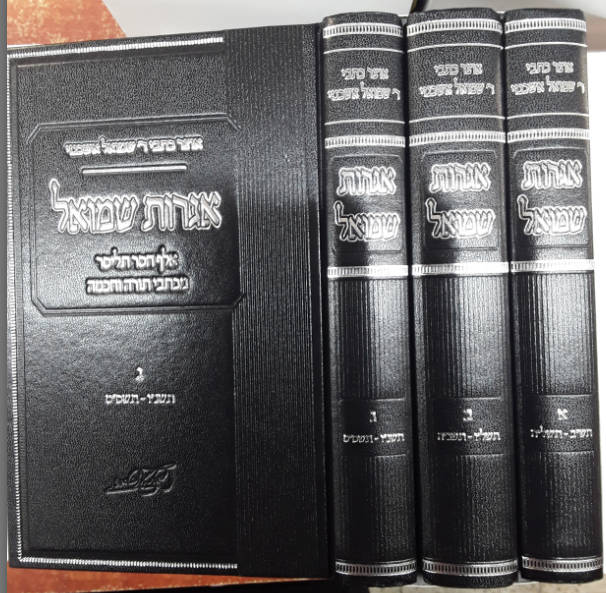
Book Announcement-Sale: Iggrot Shmuel, by Rabbi Shmuel Ashkenazi

Book Announcement-Sale: Iggrot Shmuel, by Rabbi Shmuel Ashkenazi

By Eliezer Brodt

אוצר כתבי רשמואל אשכנזי, אגרות שמואל, אלף חסר תליסר מכתבי תורה וחכמה, א, תשבתשלה; ב, תשלותשנה; ג, תשנותשסט, 1781 עמודים, הובא לדפוס בתוספות מפתחות מפורטים על ידי ריעקב ישראל סטל

A few months ago, right after Rabbi Shmuel Ashkenazi was niftar I, along with my friend Menachem Butler, initiated a campaign to raise funds to publish R. Ashkenazi’s letters. Baruch HaShem, and thanks to the help of some readers, enough money was raised to go to print and late last Wednesday night the copies of the book, coming in at over 1,700 pages, arrived.

Previously, I provided the following description of R. Ashkenazi’s letters:

The collection is comprised of almost one thousand letters from R. Ashkenazi to correspondents all over the world. Beginning in 1942 and continues until his death. The letters cover a wide-range of topics, from tracing Hebrew expressions to their sources, providing hereto unknown citations for hundreds of Rabbinic statements, exploring the history and language of piyuttim, discussion of minhagim, tracing the evolution of well-known Jewish stories and legends, bibliography, and the list goes on.

It’s a work that anyone interested in the Jewish Book will find many things to enjoy. The work is not a light read but contains so much valuable information on a wide range of topics.

Just to quote one testimony regarding R. Ashkenazi’s letter, from Professor Shnayer Leiman, (for others, collected by Menachem Butler, see here).

Professor Shnayer Leiman wrote:

Reb Shmuel was “bibliographer, bibliophile, and book collector, and his encyclopedic knowledge of all of Hebrew and Yiddish literature remains unparalleled in our time.” His collected writings are an intellectual treasure trove, “covering a wide range of topics in the field of Jewish Studies. Aside from his scholarly distinction, R. Shmuel Ashkenazi wrote in an elegant Hebrew with its own special charm. Not only did he advance discussion, but he did so in an aesthetically pleasing manner. For those of us who knew him personally, he evinced the same charm in his personal relationships that he did in his writings… Let it be said openly: this three-volume set will enlighten every reader and will significantly advance scholarship. Anyone concerned with advancing the cause of quality Jewish scholarship will take special delight in the publication of these volumes.”

During his lifetime [Ashkenazi] corresponded with the greatest Jewish scholars and bibliographers the world over. They wrote to him, for only he could solve the countless historical and literary problems that stumped them. Suffice to list among those who consulted him: Gershom Scholem (distinguished Jewish historian); S.Y. Agnon (Nobel Prize laureate); Judah Leib Maimon Fishman (Minister of Religions, Israel); and a stellar list of prominent Jewish historians, rabbinic scholars, and bibliographers, much too long to list here (e.g., Simha Assaf; Israel Ta-Shma; Meir Benayahu; A.M. Habermann; Avraham Yaari; and Naftali Ben Menahem).

The letters have been printed in a three-volume set, 1781 pp. including an excellent index of eighty-seven pages.

There are less than two hundred copies for sale. It will not be going into a second printing.

To reserve a copy contact me at eliezerbrodt@gmail.com

For a PDF of the introduction (which includes a nice biography about him) sample letters, and the indexes send me an email at eliezerbrodt@gmail.com

In the near future I hope to describe forthcoming plans for the printing of more of Rabbi Shmuel Ashkenazi’s writings.


Avunculate Marriage in the Bible

Avunculate Marriage in the Bible

By Reuven Chaim (Rudolph) Klein
Rabbi Reuven Chaim Klein is the author of the Lashon HaKodesh: History, Holiness, & Hebrew [available here]. His book is available online and in bookstores throughout the world. Rabbi Klein published articles in various journals including Jewish Bible Quarterly, Kovetz Hamaor, Kovetz Chitzei Gibborim, and Kovetz Kol HaTorah. He studied at premier Yeshivas including the Mir in Jerusalem and BMG in Lakewood. He was most recently a fellow at the Tikvah Institute for Yeshiva Men (Summer 2015) and lives with his wife and children in Beitar Illit, Israel.
Anyone who has a copy of the first edition of his book on Lashon HaKodesh is eligible to receive a PDF of the “Additions and Corrections” section of the new edition. Please send requests directly to the author at: historyofhebrew@gmail.com

The term “avunculate marriage” refers to marriage between a man and his niece. In this paper, we will explore the Bible’s view on the permissibility of such unions, and discuss several examples of such marriages in the Bible. Not only does rabbinic literature generally presume that such marriages are permitted, the Talmud even encourages it. On the other hand, other sources ban these relationships. The Sadducees believe that the Bible forbids such marriages. While various Tosafists believe that such marriages are Biblically permitted, they still prohibit marrying one’s niece (at least in some cases) for other reasons.

Abraham & Nahor marry their nieces

Upon close examination, one will find that at least six Biblical personalities married their nieces. Each of these cases can and are interpreted in various ways; calling into question their relevance to our discussion. However, the mere fact that tradition allows for these sorts of interpretations shows that avunculate marriage is compatible with Biblical tradition, and constitutes a legitimate building block in the institution of the Jewish family.

The first two examples of avunculate marriages in the Bible are those between Abraham and Nahor and their respective nieces. The Torah says:

And Terah lived seventy years, and begot Abram, Nahor, and Haran. Now these are the generations of Terah: Terah begot Abram, Nahor, and Haran; and Haran begot Lot. And Haran died in the presence of his father Terah in the land of his nativity, in Ur of the Chaldees. And Abram and Nahor took them wives: the name of Abram’s wife was Sarai; and the name of Nahor’s wife, Milcah, the daughter of Haran, the father of Milcah, and the father of Iscah. (Gen. 11:26–29)

This passage records that Abram (i.e. Abraham), Nahor, and Haran were brothers. Nahor married Milcah, the daughter of Haran; and Abraham married Sarai. According to an ancient tradition preserved in rabbinic sources (Seder Olam Ch. 2; TB Megillah 14a; and TB Sanhedrin 69b) and by Josephus (Antiquities of the Jews Book I, Ch. 6), another name for Sarai is Iscah. The assertion that Sarai is the same person as Iscah is supported by the fact that the Torah provides the paternity of Nahor’s wife Milcah, yet does not mention the paternity of Abraham’s wife Sarai. Given that the Torah delineates one wife’s father, we would have expected it to mention the father of the other wife as well. This difficulty can be resolved if we assume that Sarai is Iscah, since the Torah states that Haran was the father of Iscah.[1]

If we assume that the Haran who is mentioned as Abraham and Nahor’s father-in-law is the same person as their brother Haran, and that Sarai is Iscah, then this passage records two instances of avunculate marriages: Nahor married his niece Milcah and Abraham married his niece Iscah/Sarai. However, it is debatable whether Nahor and Abraham’s marriages to Milcah and Sarai were truly avunculate marriages. In order to claim that they were, one must rely on two assumptions, both of which are subject to dispute. Firstly, Ibn Ezra (to Gen. 11:29) expresses skepticism regarding the identification of Iscah with Sarai.[2] Secondly, even if Iscah is Sarai, some commentators (including Abarbanel(Gen. 11) and the Medieval work Moshav Zeqenim[3]) understand that the Bible refers to two different men named Haran. One was a brother to Abraham and Nahor (and father of Lot); while the other was the father of Iscah/Sarai and Milcah.[4] Accordingly, there is no clear consensus on whether Abraham and Nahor married their nieces.

Dinah’s daughter

Later in Genesis, the Bible relates that when Joseph was the Egyptian viceroy, he married Osnath daughter of Poti-Phera (Gen. 41:45). According to many Midrashic sources (Pirkei D’Rabbi Eliezer Ch. 38; Masekhet Sofrim 21:9; and Targum Pseudo-Jonathan to Gen. 41:45(, Osnath was none other than the daughter of Dinah (Jacob’s daughter) and her rapist, Shechem. This “illegitimate” child was initially shunned by Jacob’s family, but eventually found her way back in by marrying Joseph. Thus, Joseph’s wife Osnath was his niece, the daughter of his sister Dinah. Although others understand that Osnath was actually an Egyptian woman,[5] the Midrashic sources above reject the notion that Joseph would marry a non-Israelite woman.
Similarly, Rabbeinu Hayyim Paltiel quotes a Midrash[6] which says that Simeon married the daughter of Dinah who was born by rape through Shechem.[7] According to this Midrash (which is probably mutually exclusive with the above mentioned sources), Simeon married his niece, the daughter of his sister Dinah.
These examples differ from the others under consideration because these are the only explicit examples of a man marrying his sororal niece (i.e. his sister’s daughter). All the other examples involve a man marrying his fraternal niece (i.e. his brother’s daughter).

Uziel and Miriam

Amram had three children: Miriam, Aaron, and Moses. The Bible records the marriages of both of Amram’s sons: Moses married Zippora daughter of Jethro (Ex. 2:21), and Aaron married Eliseba daughter of Amminadab (Ex. 6:23). However, the Bible does not tell us about the family of Amram’s daughter Miriam.

Rabbinic literature states that she married Caleb (Exodus Rabbah §1:17; Sifrei, Beha’alothkha §78; and TB Sotah 11b–12a). However, according to the apocryphal work The Testament of Amram found amongst the Dead Sea Scrolls at Qumran (4Q543, 4Q549), Amram gave his daughter Miriam to his younger brother Uzziel to wed. That work understands that the sons of Uzziel listed in the Bible (Ex. 6:22) were born to his wife Miriam. Thus, that work believed that Uzziel married his brother’s daughter Miriam.

Othniel and Achsa

As related in the book of Joshua (15:16–17) and in the opening chapter of Judges (1:12–13), Caleb offered his daughter Achsa to whoever could conquer the Canaanite stronghold at Kiriath Sepher: “And Othniel the son of Kenaz, Caleb’s younger brother, took it; and he [Caleb] gave him [Othniel] Achsah his daughter to wife.” Othniel succeeded in conquering the city and thus won the hand of his brother’s daughter Achsa in marriage. Most assume that Othniel was Caleb’s full brother, although some explain that they shared only a mother, not a father.[8]
R. Ishtori ha-Parhi (1280-1366), the foremost Rabbinic topographer of the Medieval period, writes (Kaftor Va-Fereh Ch. 5) that the Sadducees consider themselves more pious than Rabbinic Jews because they forbid one to marry his brother’s daughter. Then, ha-Parhi cites this case as a Biblical precedent for allowing such marriages. Nonetheless, ha-Parhi notes that the case of Othniel only proves that one may marry the daughter of his maternal brother but does not necessarily prove that one can marry the daughter of his paternal siblings.

Elimelech and Naomi

There is a Talmudic discussion (TB Bava Bathra 91a) regarding the Book of Ruth which explains the relationships between its major players. It asserts that Elimelech (Naomi’s husband), Salmon (Boaz’s father), the anonymous relative who refused to redeem Naomi’s field, and Naomi’s father were all sons of Nahshon ben Amminadab. According to this understanding, Elimelech married his brother’s daughter—Naomi.

However, the Midrash (Ruth Rabbah §6:3) presents a dissenting view that Elimelech was a son of Salmon (and brother to Boaz). According to this understanding, Naomi was not Elimelech’s niece but his first cousin.

Mordecai and Esther

The Talmud (TB Megillah 13a) relates that Mordecai not only raised the orphaned Esther, but he also married her. Furthermore, some sources, including Josephus in Antiquities (Book XI, Ch. 6), Targum Rishon (to Est. 7:6),[9] and the Vulgate (Est. 2:7) explain that Esther was Mordecai’s niece. Ibn Ezra (to Est. 8:1) and Maimonides (there)[10] also repeat that claim. Together, these two ideas indicate that Mordecai married his niece. Nonetheless, this understanding is simply mistaken as the Bible quite explicitly states that she was his first cousin, not his niece: And he brought up Hadassah, that is, Esther, his uncle’s daughter… (Est. 2:7) and Now when the turn of Esther, the daughter of Abihail the uncle of Mordecai… (Est. 2:15).

The Talmud encourages marrying one’s niece

The prophet Isaiah tells of several acts of kindness that a man can perform that would prompt God to answer his prayers. He says:
Is it not to deal thy bread to the hungry, and that thou bring the
poor that are cast out to thy house? when thou seest the naked, that thou cover
him, and that thou hide not thyself from thine own flesh? Then shall thy light
break forth as the morning, and thy healing shall spring forth speedily; and
thy righteousness shall go before thee, the glory of the LORD shall be thy
reward. Then shalt thou call, and the LORD will answer; thou shalt cry, and He
will say: ‘Here I am.’…
(Is. 58:7–9)
When explaining these “good deeds” in practical terms, the Talmud (TB Yevamot 62b–63a) notes that and that thou hide not thyself from thine own flesh refers to a man who marries his sister’s daughter. While there is a controversy among the commentators concerning whether the Talmud only means one’s sororal niece or even his fraternal niece, it is clear that the Talmud encourages a man to marry his niece. Similarly, the Tosefta (Kiddushin 1:2) teaches, “A man should not marry a woman until his sororal niece comes of age [so that he can marry her], or until he finds [another woman equally fitting for him.”

Only Sororal niece, or even fraternal niece?

There are two approaches among the earlier commentators in how to understand the Talmud’s endorsement of marrying one’s niece. Rashi understands that the Talmud only endorses marrying one’s sororal niece. He explains that this act is considered particularly kind, because a man has a certain longing for his sister (more so than for his brother). Thus, by marrying her daughter, he will insure that his wife will be especially cherished.

However, the Tosafists (Tosafot to TB Yevamot 62b) quote in the name of Rashi’s grandson Rashbam that the Talmud’s endorsement also applies to one’s fraternal niece, not just to a sororal niece. He explains that the Talmud specifically mentions marrying a sororal niece simply because it is more common that a man’s sister will convince him to marry her daughter than it is for his brother to do so.

Nonetheless, Rabbeinu Tam disagrees with this assertion and instead maintains that the Talmud only means that one should marry his sororal niece. There are two modes of justifications given for this approach: Firstly, one’s sororal niece is similar to her uncle, as the Rabbis say, “Most children are similar to the brothers of their mother” (TB Baba Bathra 110a, Sofrim 15:10). This similarity between the two will ensure a stronger marriage, and that is precisely what the Talmud means to endorse.

Furthermore, the Tosafists quote in the name of Rivan (a son-in-law of Rashi and uncle to Rabbeinu Tam and Rashbam) that it is actually forbidden to marry one’s fraternal niece, so the Talmud must only have endorsed marrying one’s sororal niece. They explain that according to the rules of the Levirate marriage (mentioned in Deut. 25:5–10), a man (A) is commanded to marry the widow of his brother (B), if B dies childless. However, the Mishnah teaches (Yevamot 1:1) that if the widow is A’s daughter, then A is exempt from that commandment, because a man may not marry his own daughter. Thus, the Rabbis forbid a man (B) from marrying his niece (A’s daughter) so as to prevent a situation where the commandment of Levirate marriage will be abolished. This rabbinic ban on marrying one’s fraternal niece proves that the Talmud’s endorsement of marrying one’s niece only applies to a sororal niece.[11]
Nonetheless, this proof is incomplete because there are situations where there is no clash with the rules of the Levirate marriage. For example, if A is already deceased (and therefore anyways unable to perform the Levirate marriage), then B should be allowed to marry his daughter. Or if A is only B’s maternal brother, but not paternal brother (and therefore is not allowed to marry B’s widow even if she was not his daughter see TB Yevamot 17b), then he should be allowed to marry A’s daughter. Accordingly, one can argue that in these situations, the Talmud endorses marrying even one’s fraternal niece. This is especially compelling in light of ha-Parhi’s above mentioned proof-text from Othniel, which shows that one is allowed to marry his maternal brother’s daughter.
In short, Rabbeinu Tam—in agreement with his grandfather Rashi—understands that the Talmud only endorses marrying one’s sororal niece, but actually forbids marrying one’s fraternal niece. Rabbi Betzalel Ashkenazi (1520–1592) testifies that this is also the opinion[12] of the non-yet-extant Tosafot Shantz to the Talmudic Tractate Gittin.[13]In his commentary to the Bible, the ‎Alsatian sage R. Yohanan Luria (1440–1514) also follows Rabbeinu Tam’s view.[14]
However, Maimonides (in his commentary to the Mishnah Nedarim 8:5 and in his Laws of Sexual Prohibitions, end of ch. 2) understands that the Talmud does not mention one’s sororal niece to the exclusion of his fraternal niece. He thus rules that is considered a Mitzvah for a man to marry either his sororal or fraternal niece.[15] R. Meir Abulafia (1170–1244) writes (Yad Ramah to TB Sanhedrin 76b) that marrying one’s niece is considered commendable because she is the closest relative that a man is allowed to marry. He thus follows his older contemporary Maimonides in offering no distinction between a sororal niece and fraternal niece (because the degree of kinship to both is the same). Nonetheless, he notes that the Talmud mentioned one’s sister’s daughter in specific simply because marrying her is even more commendable. By doing so, he is performing an act of kindness towards his sister, who might otherwise have difficulty marrying off her daughter.[16]
R. Moses Isserles (1520–1572) settles the matter by ruling in accordance with the view of Maimonides and Rashbam that one should marry his sororal or fraternal niece (see his glosses to the Shulhan Aruch, Even Ha’Ezer §2:6; 15:25).

The Rabbinic View regarding Forbidden Relationships

Rabbinic Judaism extends the meanings of the Biblical passages (Lev. 18 and 20) which delineate forbidden relationships. They note that the Torah spoke of the incest laws from the man’s point of reference, but the laws apply equally to a woman. Thus, the Rabbis understand that all incestuous relationships mentioned in the Bible are forbidden to both the man and the woman involved (TB Yevamot 84b). However, the Rabbis do not add more forbidden relationships than those listed by the Bible; they only say that both parties are culpable. The Sadducees, on the other hand, add cases to the Bible’s list and forbid more cases of the same types of relationship. In this, the Rabbis understand the Bible’s meaning differently than the Sadducees and remain more faithful to the text of the Torah than did they.

The Sadducee View Regarding Forbidden Relationships

A Sadducean work found by Solomon Schechter at the Cairo Geniza criticizes those who marry their brother or sister’s daughter. This work reasons that since according to Mosaic law, a man is not allowed to marry his mother’s sister because she is his mother’s flesh (Lev. 18:13), a woman is also not allowed to marry her parents’ brother. The rationale for such an extension of the Biblical law is that the Torah does not simply list forbidden cases of incest, it lists forbidden categories of relationships. These relationships are determined by degree of kinship, without regard for gender. Thus, if a man is forbidden to his parents’ sister, the same prohibition says that a woman is forbidden to her parents’ brother because the degree of kinship—in this case, parent’s sibling—is the same.[17]
A copy of this document, now known as the Damascus Document, was also found among the Dead Sea Scrolls at Qumran (4Q270). It contains a condemnation of those men who marry their brothers’ daughters (although that particular source omits the prohibition of one’s sister’s daughter). A legal scroll found at Qumran known as Midrash Mishpatim (4Q251) contains a list of the Biblical prohibitions of incest, and includes a man marrying his brother’s or sister’s daughter. Another important document from Qumran known as the Temple Scroll (11Q19) [18] also forbids marrying one’s brother’s or sister’s daughter.[19]
Case
#:
The Bible
(Lev. 18 and 20) forbids a man from marrying his…
The Rabbis
say that this also means that a woman maynot marry her…
The Sadducees
would say that this also means that one maynot marry his/her…
Sadducean
approach is redundant because it is already included in case #/New case:
1
Mother
Son
Daughter/Father
(13)
2
Sister
Brother
n/a
n/a
3
Father’s wife
Husband’s son
Wife’s
daughter/Mother’s husband
9
4
Granddaughter
Grandfather
Grandmother/Grandson
NEW
5
Parent’s
sister
Siblings’ son
Niece/Parent’s
brother
NEW
6
Father’s
paternal-brother’s wife
Husband’s
paternal-brother’s son
Wife’s
paternal-sister’s daughter/Parent’s paternal-sister’s husband, Mother’s paternal-brother’s
wife/Husband’s paternal-brother’s son
NEW (2
scenarios)
7
Daughter-in-law
Father-in-law
Mother-in-law/Son-in-law
12
8
Brother’s
wife
Husband’s
brother
Wife’s
sister/Sister’s husband
11
9
Wife’s
daughter
Mother’s
husband
Father’s
wife/Husband’s son
3
10
Wife’s
granddaughter
Grandmother’s
husband
Grandfather’s
wife/Husband’s grandson
NEW
11
Wife’s sister
Sister’s
husband
Brother’s
wife/Husband’s brother
8
12
Mother-in-law
Son-in-law
Daughter-in-law/Father-in-law
7
13
Daughter (see
fn. 22)
Father
n/a
n/a

The Sadducean method of interpretation creates three pairs of redundancies in the Bible’s list (Cases 3, 7, 8, 9, 11, and 12) and also creates four new cases of incest which are not mentioned in the Bible, in addition to marrying one’s niece (Cases 4, 6, two scenarios, 10).

These two points demonstrate the weakness of the Sadducean approach. The method of interpretation used to justify including one’s niece in the Biblical prohibition against marrying one’s aunt would create a series of redundancies in the other listed cases of incest. Furthermore, according to the Sadducean methodology of Biblical interpretation, four other relationships should be classified as incestuous (in addition to marrying one’s niece). However, the Sadducees are inconsistent in that they explicitly mention their added prohibition against marrying one’s niece but fail to account for the other new cases of incest which their methodology creates.[20]

In fact, Saul Lieberman argues that the Rabbis classified marrying one’s niece as a positive deed specifically in order to counter the Sadducean view that marrying one’s niece is Biblically forbidden. He notes it is the Rabbis’ way to take things which are simply “allowed” by the Bible and encourage people to do them in order to undermine sectarian heretical views.[21]
Interestingly, in his abovementioned work, ha-Parhi notes that the Sadducees were not innovators in banning marriage to a niece: They adopted the prohibition from the Samaritans, who took the idea from the Arabs.[22] Later, the Karaites also followed suit and outlawed uncle-niece marriage.[23]

R. Yehuda Ha-Hassid’s view

The 12th century German leader of the Hassidei Ashkenaz movement, R. Judah Ha-Hassid, declares that one should not marry his niece, neither sororal nor fraternal (in his ethical will §22 and in Sefer Hassidim §477). However, his understanding of this prohibition clearly differs from the Sadducean approach. The Sadducees understood that the Bible itself prohibits marrying one’s niece, while Ha-Hassid does not. As a follower of Rabbinic tradition, Ha-Hassid must comply with Talmudic law, yet his mention of a prohibition against marrying one’s niece is clearly at odds with the Rabbinic approach which not only allows for such marriage but even encourages it.

R. Ezekiel Landau of Prague (1713–1793), in his halachik responsa (Noda B’Yehuda, Even HaEzer Tinyana §79), offers an innovative solution. He proves that R. Judah Ha-Hassid only wrote the prohibitions in his will and Sefer Hassidim for his descendants—not for all Jews—because otherwise his prohibition would contradict an explicit Talmudic passage that not only allows but even applauds a man marrying his niece. [24] Others interpret Ha-Hassid’s warning in accordance with contemporary science, which warns of the genetic dangers to children born to an uncle and niece.

Nonetheless, Ha-Hassid himself explains his true intent. He writes (Sefer Hassidim §488) that only a pious individual is allowed to marry his niece in order that his children be similar to himself (per the rabbinic dictum mentioned above). However, a wicked man who only intends to fulfill his own pleasures should not marry his niece, so that his children will not be like him. Thus, Ha-Hassid actually allows for avunculate marriage in the right circumstances, yet elsewhere he writes blankly that it is forbidden so that the not-necessarily-pious masses would refrain from such unions.[25]

Conclusion

There are essentially two general views regarding avunculate marriage in the Bible. The Rabbinic position is that avunculate marriage is permitted by Biblical law. In fact, according to Rabbinic tradition, there are even Biblical precedents for allowing such marriages. Nonetheless, the Rabbis do limit the circumstances under which one may marry his niece. They forbid marrying one’s fraternal niece, since this might interfere with the commandment of the Levirate marriage. There is also the pietistic view of the Hassidei Ashkenaz, who rule that only a pious man may marry his niece (because he will have pure intentions), while the masses should not engage in such unions.

By contrast, the Sadducean approach outlaws avunculate marriage entirely, and attributes this prohibition to the Bible. Even according to Rabbinic tradition, the aforementioned Biblical cases are not unanimously viewed as actually consisting of avunculate marriages. The Sadducees would likely interpret these cases such that they do not serve as precedents for legitimately marrying one’s niece.

[1] L.
A. Feldman (ed.), Pirush HaRan Al HaTorah (Jerusalem: Machon Shalem,
1968) pg. 149.
[2]
While Ibn Ezra does not explicitly note his objections to this identification,
other sources quote a question in his name which implies a reject of this
tradition. Ibn Ezra asks that if we assume that the Bible lists Terah’s sons in
order of their birth, then Abraham was at least two years older than Haran.
Furthermore, it is evident from the Bible that Abraham was ten years older than
his wife Sarah (Sarai), as it says Then Abraham fell upon his face, and
laughed, and said in his heart: ‘Shall a child be born unto him that is a
hundred years old? and shall Sarah, that is ninety years old, bear?’
(Gen.
17:17). This would mean that Haran fathered Iscah/Sarai at the extremely
unlikely age of eight. Rabbeinu Hayyim Paltiel answers this objection by
noting that the Talmud (TB Sanhedrin 69b) itself already raised this
point. In fact, it uses this calculation to prove that in early generations men
fathered offspring from as early as the age of eight. See I. S. Lange
(ed.), Pirushei HaTorah L’Rabbeinu Hayyim Paltiel (Jerusalem,
1981) pp. 26–27 and S. Sasson (ed.), Moshav Zeqenim (London,
1959) pg. 15.
[3] S.
Sasson (ed.), Moshav Zeqenim (London, 1959) pg. 15.
[4] The
commentators propose this distinction because of the fact that the Bible splits
the genealogy of Haran’s descendants into two verses. The first verse only
mentions Lot, while the second says that he was the father of Milcah and Iscah.
However, Kimhi explains these verses in the exact opposite way: He
argues that the Torah sought to clarify that Haran was not only the father of
Lot, but also of Milcah and Iscah (which follows the view that this passage
only discusses one Haran).
[5]
Josephus (in Antiquities of the Jews Book II, Ch. 6) also understood
that Joseph’s wife was literally the daughter of Potiphar. However, see Midrash
Sekhel Tov
(to Gen. 39:1) and Midrash Tadshe (Ch. 21), printed in J.
D. Eisenstein (ed.), Otzar Midrashim (New York, 1915) pg. 486 and also
cited by Yalkut Shimoni (Joshua §9), which say that Osnath was among
several righteous female converts.
[6]
This Midrash appears nowhere else, save for Rabbeinu Hayyim Paltiel’s
commentary. However, there is a similar tradition (Genesis Rabbah
§80:11) which says that Dinah refused to leave the house of Shechem until
Simeon promised to marry her. According to that Midrash, Simeon married his
sister
Dinah, not her daughter.
[7] I.
S. Lange (ed.), Pirushei HaTorah L’Rabbeinu Hayyim Paltiel (Jerusalem,
1981) pg. 166.
[8] The
Talmud (TB Temurah 16a), followed by Rashi (to Jos. 15:17 and Jud.
1:13), writes that Othniel was only Caleb’s maternal brother, not full brother.
The rationale for this statement is that Caleb’s father is always given in the
Bible as Jephunah (Num. 13:6; 14:30; 26:65; 32:12; 34:19; Deut. 1:36′; Josh.
14:6; 14:14; I Chron. 4:15), while Othniel is always mentioned as a son of
Kenaz (Josh. 15:17; Jud. 1:13; 3:9; 3:11; I Chron. 4:13). According to this
approach, after Caleb was born, his mother married someone named Kenaz, and
bore Othniel to him. Rashi remains consistent with this view when he writes (in
his commentary to TB Sukkah 27b) that he is unsure of Othniel’s tribe,
because his relationship to Caleb was only through their mother, and
matrilineal descent does not impart tribal affiliation.
Kimhi
(to Josh. 15:17) adds that in the instances that Caleb also is referred to as a
Kenizzite (Num. 32:12; Josh. 14:6; 14:14), this term is a reference to his
step-father. Kimhi then suggests that Caleb and Othniel were actually
full brothers and that their father had two names: Jephunah and Kenaz (which is
why Caleb is also called a Kenizzite). Ultimately, Kimhi rejects this
approach and argues that the appellation “Kenizzite” refers to the family
of Kenaz, a common ancestor of both Caleb and Othniel. Ha-Parhi (cited
below) and Abarbanel (to Josh. 15:16 and in his introduction to Judges) concur
with Kimhi’s conclusion. [It has yet to be explored whether the term
Kenizzite used in connection with Caleb is related to the Kenizzites, a
Canaanite tribe which God promised Abraham will be conquered by the Israelites
(Gen. 15:19).]
[9]
Although, see Targum Rishon earlier (to Esther 2:7 and 2:15) who
explicitly writes that Esther was the daughter of Mordecai’s uncle, making them
first-cousins, not niece and uncle.
[10] Y.
Rivlin (ed.), Pirush Megillat Esther L’Rambam (Jerusalem, 1952)
pg. 60.
[11] See
Tosafot (TB Yevamot 99a) and Tosafot Yeshanim (ibid. 62b).
The same point is made earlier by Rav Sherira Gaon (who predated Rabbeinu Tam)
in a responsum printed by M. Grossberg (ed.), Gvul Menashe (Frankfurt,
1899) pg. 15.
[12] R.
Abraham Haim Schor (d. 1632) writes (Torat Haim to TB Sanhedrin
76b) that marrying one’s sororal niece is especially praiseworthy because
according to Biblical law, a daughter does not inherit her deceased father’s
property unless he has no sons. Accordingly, there is likely animosity between
a man and his sister, for the former will inherit their father’s property and
the latter will not. Therefore, it is especially praiseworthy for a man to
marry his sister’s daughter in order to alleviate this animosity and show his
sister that even she will derive benefit from their deceased father’s estate. Tosafot
Shantz
, as quoted by Ashkenazi, offers a very similar approach and adds
that marrying one’s brother’s daughter does not achieve the same effect because
one’s paternal brother will in any case inherit his father’s property. In this,
Tosafot Shantz offers another strong argument for Rabbeinu Tam’s position.
[13] M.
Y. Blau (ed.), Shitah Mekubetzet Yevamot (New York: Shitat HaKadmonim,
1986) pg. 302. See also Shitah Mekubetzet (to TB Nedarim 63b) who
also seems so inclined.
[14] Y.
Hoffman (ed.), Meshivat Nefesh (Jerusalem: Machon Yerushalayim, 1998)
pg. 18.
[15] See
also Meiri (to TB Yevamot 62b) who seems to agree with Maimonides.
[16] In
a similar explanation, R. Todros HaLevi ben Joseph Abulafia (1225–1285), a
nephew of R. Meir Abulafia, writes that marrying one’s sister’s daughter is
especially meritous because his sister likely has financial difficulties in
marrying off her daughter. Hida (Birkei Yosef to Even HaEzer
§2:6) quotes this unpublished explanation of R. Todros and adds that according
to this, there is no difference between a sororal niece and a fraternal niece,
the difference is only in whether the groom’s sibling has financial
difficulties.
[17] S.
Schechter (ed.), Documents of Jewish Sectaries Vol. 1, Fragments of a
Zadokite Work (Cambridge, 1910) pg. 5.
[18]
Interestingly, Midrash Mishpatim lists the prohibition of marrying one’s
niece before it lists one’s aunt, while the Temple Scroll lists
marrying one’s niece afterwards.
[19] See
E. Eshel, “The Proper Marriage according to the Genesis Apocryphon and Related
Texts,” Meghillot: Studies in the Dead Sea Scrolls Vol. 8–9 (Jerusalem:
Bialik Institute, 2010) pp. 29–51, who discusses numerous examples of the DSS
embellishing Biblical passages by adding marriages between first cousins. She
explains that the authors of those scrolls added cases of marriage between
first cousins and not between man and his niece precisely because the Qumranic
sect believed the latter to be forbidden.
[20] It
should be noted that three out of four of those cases (i.e. grandmother,
mother’s paternal brother’s wife, and grandfather’s wife) are explicitly banned
by Rabbinic decree, even though according to Rabbinic interpretation they are
permitted by Biblical law (see TB Yevamot 21a).
[21] S.
Lieberman, Tosefta Ki-fshutah (New York: JTS, 1973) pg. 915. Cf. E.
Segal, “Sarah and Iscah: Method and Message in Midrashic Tradition”, JQR,
vol. 82:4, pp. 417–429 who seems content to similarly explain the Midrashic
identification of Sarah with Iscah (mentioned above).
[22]
Ha-Parhi, in his abovementioned polemic against Sadducees, writes that
should one meet a Sadducee, one should tell him that according to Sadducean
religion one is allowed to marry his daughter because the Bible does not
explicitly forbid it and the Sadducees do not recognize the hermeneutical
arguments set forth by the Rabbis (TB Sanhedrin 76a) for its
prohibition. However, in light of the above, Ha-Parhi’s polemic is no
longer applicable because according to the Sadducees’ internal logic, marrying
one’s daughter is included in the prohibition of marrying one’s mother because
both are a violation of the child-parent relationship. That is, the Torah
forbids a man to lie with his mother and both Rabbinic and Sadducean
interpretation extend this prohibition to a woman who is forbidden from lying
with her son. However, Sadducean interpretation would also argue that included
in this prohibition is a man lying with his daughter because the Torah’s intent
is not simply to forbid a man and his mother, but to declare incestuous any
fornication between the child-parent line. The Rabbis, on the other hand,
understood that this is not the intent of the Torah and instead offer their own
source for the prohibition of marrying one’s daughter.
[23] N.A.
Stillman (ed.), “Malik al-Ramlī.” Encyclopedia of Jews in the
Islamic World
(Brill Online, 2013).
[24] For
an extensive survey of various authorities who agree or disagree with Landau’s
characterization of the prohibition cited by R. Yehuda Ha-Hassid, see Sdei
Hemed
Vol. 7 (Brooklyn: Kohath Publishing, 1950) pp. 2483ff.
[25] See
S. Guttman (ed.), Sefer Tzava’at Rabbi Yehuda HaHassid HaMefoar
(Jerusalem: Otzar HaPoskim, 2011) pp. 177–188 for an in-depth analysis of Ha-Hassid’s
stance on the topic.


The Religious-Zionist Manifesto of Rabbi Yehudah Leib Don Yahya

The Religious-Zionist Manifesto of Rabbi Yehudah Leib Don Yahya

by Bezalel Naor

In 1901 there appeared in Vilna a 32-page booklet entitled, Ha-Tsiyoniyut mi-nekudat hashkafat ha-dat (Zionism from the Viewpoint of Religion). The author was Yehudah Don Yahya.[1] The final eight pages of the work contain a supplement (Milu’im) by one Ben-Zion Vilner, criticizing the anti-Zionism of the Rebbe of Lubavitch. (One ventures that “Ben-Zion Vilner” is a pseudonym.)

What is remarkable about this manifesto that argues that Zionism is totally compatible with traditional Judaism, is that the author, Rabbi Yehudah Leib Don Yahya, was an intimate student of Rabbi Hayyim Soloveitchik, a most outspoken opponent of the Zionist movement.[2]

To add to the intrigue, Don Yahya’s grandfather, Rabbi Shabtai Don Yahya of Drissa, had been an ardent Hasid of Rabbi Menahem Mendel of Lubavitch (known by his work of Halakhic responsa as “Tsemah Tsedek”).[3] Yehudah Leib himself would go on to serve as rabbi of the Habad Hasidic community of Shklov.[4] Although, as we shall see, within the Habad community, there were differing responses to Zionism along the fault line of the Kopyst—Lubavitch dispute.

Today, students who immerse themselves in the Torah novellae of Rabbi Hayyim Soloveitchik may come across the name of Rabbi Yehudah Leib Don Yahya, but they have no idea who this disciple was. Appended to Hiddushei ha-GRaH he-Hadash ‘al ha-Shas (issued upon the ninetieth anniversary of Rabbi Hayyim’s passing in 2008) are Don Yahya’s memoirs of his beloved mentor in the Volozhin Yeshivah. In 2018 (coincidentally a century since Rabbi Hayyim’s passing) there appeared in print a Tagbuch or diary, in which Rabbi Hayyim jotted down his insights on Talmud and Maimonides’ code.[5] In his introduction to the volume, the editor, Rabbi Yitshak Abba Lichtenstein, notes that Rabbi Hayyim would allow some scholars to copy down entries from the journal. Indeed, one such scholar was Rabbi Yehudah Leib Don Yahya. Two novellae that appear in the Tagbuch were previously published in Don Yahya’s Bikkurei Yehudah (1939).[6]

One asks: What would prompt such a devoted disciple to break from his master’s ideology concerning Zionism?

To understand how such a phenomenon as Yehudah Leib Don Yahya was possible, one needs to trace his membership in Nes Ziyonah, the underground proto-Zionist movement that existed in the Volozhin Yeshivah from 1885 until its disbandment in 1890.let

This was the era of Hovevei Zion (Lovers of Zion), a Russian Jewish movement to settle the Land of Israel that predated Herzlian political Zionism. Nes Ziyonah, which blossomed independently within the ranks of the student body of the famed Volozhin Yeshivah, interfaced with Hovevei Zion, presided over by Rabbi Samuel Mohilever of Bialystok. Members of Nes Ziyonah were sworn to secrecy. The membership included such illustrious scholars as Moshe Mordechai Epstein of Bakst,[7] Menahem Krakovsky,[8] and Isser Zalman Meltzer. Moshe Mordechai Epstein would eventually become Rosh Yeshivah of Slabodka. Menahem Krakowsky would one day assume the position of “Shtodt Maggid” of Vilna. Finally, Isser Zalman Meltzer would become Rosh Yeshivah of Slutzk and later ‘Ets Hayyim of Jerusalem.[9]  It was through the last-mentioned disciple, who was especially close to Rabbi Hayyim Soloveitchik, that Rabbi Hayyim was able to discover the identities of the students who belonged to Nes Ziyonah.[10]

Nes Ziyonah had sprung up without the knowledge of the elder dean of the Yeshivah, Rabbi Naftali Tsevi Yehudah Berlin (NeTsIV). In fact, according to Israel Kausner, who wrote a history of Nes Ziyonah, the members of the secret society prided themselves that they had been able to prevail upon Rabbi Berlin to join the greater Hovevei Zion movement and to assume a role of leadership alongside Rabbis Samuel Mohilever and Mordechai Eliasberg of Bausk.[11] In 1890, somehow Nes Ziyonah came to the attention of the Russian government authorities. One of its leaders (Yosef Rothstein) was arrested but subsequently released. When Rabbi Berlin learned that such a society had sprung up in the Yeshivah under his very nose, he was aghast. He feared that Nes Ziyonah might jeopardize the existence of the Yeshivah, which was under constant government scrutiny.[12] Leaving aside pragmatic considerations, in principle, Volozhin had always been a bastion of pure Torah learning; there was no room in it for Zionist activism.[13] Nes Ziyonah ceased to exist. (Hovevei Zion, with its office in Odessa, was legalized by the Tsarist government in 1890.)[14]

The idealistic young men who had formed Nes Ziyonah were not ones to easily give up. Nes Ziyonah morphed into Netsah Yisrael, whose express goal was to advocate on behalf of Zionism and religion. (Nes Ziyonah had restricted its activities to settling the Land of Israel.) Most prominent in this reincarnation of Netsah Yisrael was—Yehudah Leib Don Yahya.[15]

It is against this backdrop—the publicistic activity of Netsah Yisrael—that one must view Don Yahya’s tract, Zionism from the Viewpoint of Religion.

Let us briefly sum up some of the more salient points of the booklet.

Don Yahya begins by clarifying that the return of the nation to its land can in no way be viewed as the complete redemption prophesied in Scripture. The prophets’ vision, while including the ingathering of exiles, extends beyond that to global mankind’s acknowledging God and embracing His Torah.[16]

On the other hand, Don Yahya is flummoxed by various rabbis who adopt an all-or-nothing attitude to the Zionist organization’s striving to secure from the Ottomans a safe haven for Jews in the Holy Land. Just because the Zionist dream does not encompass the comprehensive vision of our prophets of old, is no reason to reject Zionism. Granted that the Zionist goals are much more modest in scope; that still does not justify opposing the movement. Don Yahya’s own reading of the sources—Biblical and Rabbinic—is gradualist. He anticipates a phased redemption. The Jews’ return to the Land is certainly the beginning, the first installment in a protracted process which will eventually—upon completion of “the full and encompassing redemption” (“ha-ge’ulah ha-sheleimah ve-ha-kelalit”)—culminate in the restoration of the Davidic dynasty in the person of King Messiah and the rebuilding of the Temple.[17]

The author adopts as his paradigm the Second Temple period. Taking issue with those who construe the return from Babylonian captivity as a “temporary remembrance” (“pekidah li-zeman mugbal”), Don Yahya maintains that the Second Commonwealth had the potential to develop into full-blown redemption. With that model in mind, he writes that return from exile and settling the Land can evolve beyond that to greater spiritual dimensions.[18]

After having made his case for the compatibility of the nascent Zionist movement and Judaism, Don Yahya tackles the painful question why some of the great Torah geniuses oppose Zionism.[19]

Don Yahya has a couple of explanations. First, knowledge of Torah is divided into Halakhah and pilpul, on the one hand, and matters of belief and opinion, on the other. Contemporary ge’onim (unlike their medieval predecessors Maimonides and Nahmanides) have devoted their lives to Halakhah, to the exclusion of emunot ve-de‘ot (beliefs and opinions). “In regard to the portion of Torah which is beliefs and opinions, their view does not exceed the view of an average Jew.”[20]

Rather conveniently, Don Yahya holds up as examples of recent Torah authorities who plumbed the depths of the beliefs contained in the Aggadah, and who concluded that the redemption shall begin with the Jews receiving permission to settle the Land of Israel—Rabbis Naftali Tsevi Yehudah Berlin and Mordechai Eliasberg—two rabbis who stood at the helm of Hovevei Zion.[21]

A second reason for the opposition of some ge’onim to Zionism is that they have been fed misinformation (or disinformation) by those of lesser stature who surround them. As the great men eschew reading newspapers, they must rely for information on extremists (kana’im) who skew their perception. They are told that the leaders of the Zionist movement are men who are not simply unobservant in their private lives, but furthermore, intent on uprooting Judaism.[22]

According to Don Yahya, the Zionist leaders profess no proficiency in matters of religion and are amenable to working with the great rabbis in matters pertaining to religion. He cites the example of a responsum from one of the great halakhic decisors of the generation to accommodate the Colonial Bank so that the prohibition of charging interest (ribit) be not transgressed. Don Yahya personally witnessed both the question from Zionist officialdom and the responsum issued by the elderly ga’on.[23] (Undoubtedly, “the elderly ga’on” [“ha-ga’on ha-yashish”] was Don Yahya’s own father-in-law, Rabbi Shelomo Hakohen, the dayyan or chief justice of Vilna.)[24]

Don Yahya points out the democratic character of the Zionist congresses. If more religious Jews would join the ranks of the Zionist movement, they would be able to turn the tide and steer the movement in a more religious direction.[25]

The author chides those religious elements opposed to Zionism not to gloat and say, “We told you so.” In the event that Zionism deviates from Judaism, this will be a self-fulfilling prophecy of doom; the anti-Zionist agitators will then be held responsible for bringing about that outcome by instructing observant Jews to stay clear of the movement.[26]

II.

As stated above, the Milu’im or Excursus of the pamphlet is a harshly worded rejoinder to the Rebbe of Lubavitch, Rabbi Shalom Dov Baer Schneersohn (1860-1920), who had made public his vehement opposition to Zionism on religious grounds.[27]

Again, one asks: How is possible that a staunch Habad Hasid such as Rabbi Yehudah Leib Don Yahya appended such an excursus to his work? From a remove of more than a century this seems inconceivable.

We need once more to place this pamphlet within the context of the times. Today, Habad has assumed a monolithic character, but at the turn of the twentieth century there existed a great divide between two competing “courts” within Habad Hasidism: Kopyst and Lubavitch. When Rabbi Menahem Mendel Schneersohn of Lubavitch (author of the responsa Tsemah Tsedek) passed in 1866, a dispute erupted over succession to the throne. The youngest son, Shmuel (Maharash), remained in Lubavitch and inherited control of that city. An older son, Yehudah Leib (Maharil), moved to the city of Kopyst, taking some of the Hasidim with him.[28] When within a year of the Tsemah Tsedek’s passing, Yehudah Leib passed, his son Shelomo Zalman (author of the Hasidic work Magen Avot) became the Kopyster Rebbe. And when in 1900 the Kopyster Rebbe passed, he was succeeded by his younger brother Rabbi Shemaryah Noah Schneerson (author of the Hasidic work Shemen la-Ma’or). Though there was a brief attempt on the part of Rabbi Shemaryah Noah Schneerson to establish himself in the city of Kopyst, eventually he returned to his rabbinate in Bobroisk, which then became the center of this branch of Habad Hasidism.[29] With the passing of the Rebbe of Bobroisk in 1923, this branch ceased to exist, leaving only the Lubavitch faction. At that point, remnants of the Bobroisker Hasidim transferred their allegiance to the Lubavitcher Rebbe.

In the early years of the twentieth century there erupted a major financial dispute between Bobroisk and Lubavitch regarding control of the purse strings of Kollel Habad in Erets Yisrael. (One may find evidence of the dispute in letters of Rav Kook from this period, when as Rabbi of Jaffa he offered guidance how to come to a compromise.)[30] The tension arose because each Rebbe wanted his representative in Erets Yisrael to be responsible for disbursement of the funds raised by the Hasidim in Russia for the support of their brethren in the Holy Land.

Thus, there are historians who would explain the tension between Bobroisk and Lubavitch as being purely financial.[31] Truth be known, there were ideological issues dividing the two cousins, Rabbi Shemariah Noah of Bobroisk and Rabbi Shalom Dov Baer of Lubavitch. In general, it may be said that the Bobroisker was more progressive, more forward-looking. The Lubavitcher was more old-school, more conservative in outlook. These different Weltanschauungen found expression on many fronts.

When the Russian government sought to demand of the rabbis proficiency in the Russian language, the Bobroisker (as Rabbi Meir Simhah Cohen of Dvinsk) found this a reasonable demand; the Lubavitcher (as Rabbi Hayyim Soloveitchik of Brisk and Rabbi Israel Meir Kagan [a.k.a. Hafets Hayyim]) fought against this proposal tooth and nail.[32]

When it came to deciding which city should serve as the center of Habad Hasidism in Erets Yisrael—Hebron or Jerusalem—Rabbi Shalom Dov Baer militated to retain the center in the provincial town of Hebron rather than allow the center to shift to Jerusalem.[33] In this way, the Lubavitcher Rebbe believed he could shield the Hasidim from the distractions of urban civilization. The Bobroisker did not think it realistic to keep the Hasidim “down on the farm.” Willy-nilly, establishment of a lending library in Hebron would bring secular literature to the curious eyes of Hasidic youth.[34]

And finally, we arrive at the issue with which we began: Zionism. While Lubavitch would have no truck with Zionism, out of the “Kibbutz” (study-hall for advanced rabbinic students) of Bobroisk there would emerge prominent rabbis of the Mizrahi or Religious Zionist movement.[35]

The answer to the question how Rabbi Yehudah Leib Don Yahya, a fervent Habad Hasid, could oppose the Rebbe of Lubavitch is simple: Don Yahya was a Kopyster Hasid,[36] not a Lubavitcher Hasid.

Epitaph on Tombstone of Rabbi Eliezer Don Yahya in Ludza (Lutzin)

צנא מלא ספרא

כלו ספרא מבעל —-

מגזע רבני —-

מחבר אבן שתיה

הרב הגאון ר’ אליעזר

בהרב ר’ שבתי

דון יחייא

ויאסף אל עמיו

ד’ ימים לחדש תמוז

שנת תרפו

[1] Yehudah Leib Don Yahya was born in Drissa (today Verkhnyadzvinsk, Belarus) in 1869 and passed in Tel-Aviv in 1941. Besides this Zionist manifesto, Rabbi Don Yahya published two volumes of Halakha and essays and sermons: Bikkurei Yehudah, vol. 1 (Lutzin, 1930); vol. 2 (Tel-Aviv, 1939).

Volume One of Bikkurei Yehudah was published in Lutzin (Ludza) by the author’s cousin, Rabbi Benzion Don Yahya, Rabbi of Lutzin. At that time Rabbi Yehudah Leib served as Rabbi of Chernigov, Soviet Russia. In his preface to the work, Benzion Don Yahya explains that the manuscript was sent to him for publication because there is no longer a Hebrew press in Russia. On pages 36-38, the Editor traces the lineage of the Don Yahya family. We learn that his paternal grandfather was Rabbi Shabtai Don Yahya, Rabbi of Drissa for sixty years until his death at approximately age 90 in 1907. One of Rabbi Shabtai’s sons, Rabbi Eliezer, became Rabbi of Lutzin (Ludza), a rabbinate inherited by his son, the Editor (Rabbi Benzion). In 1840, there were born to Rabbi Shabtai twins: Menahem Mendel and Hayyim. Menahem Mendel served as Rabbi of Kopyst for some years, passing there in 1920. Hayyim served as Rabbi of Shklov, and after his father Shabtai’s passing, as Rabbi of Drissa, until his own passing in 1913. Hayyim’s son, Yehudah Leib, served as Rabbi in Shklov and Vietka, until he inherited from his father the Rabbinate of Drissa in 1913. (In Bikkurei Yehudah, vol. 2, f. 159, there is a letter dated 5673 [i.e. 1913] from Rabbi Meir Simhah of Dvinsk to Rabbi Don Yahya congratulating him on assuming the rabbinate of his father and grandfather in Drissa.) In 1925, Yehudah Leib was accepted as Rabbi of Chernigov.

In Shklov, Rabbi Yehudah Leib Don Yahya ministered to the “Kehal Hasidim” (exclusive of the Mitnagdim, who would have had their own Rav). (See below note 4.) However, it should be mentioned that the communities of Vietka and Chernigov as well figure prominently in the annals of Habad Hasidism.

The Rabbi of Vietka, Rabbi Dov Baer Lifshitz, author of an important commentary on Tractate Mikva’ot, Golot ‘Iliyot (Warsaw, 1887), refers to Rabbi Shneur Zalman of Liadi as “dodi zekeini” (“my great uncle”). See ibid., Addendum to Introduction, and 7c.

The man who immediately preceded Rabbi Don Yahya as Rabbi of Chernigov, Rabbi David Tsevi (Hirsch) Hen (referred to by the Hasidim as “RaDaTs”) was acknowledged as one of the greatest of Habad Halakhists in his day. In 1925, through the intervention of Chief Rabbi Kook, he was able to emigrate from the Soviet Union to Erets Yisrael together with his daughter Rahel, son-in-law Rabbi Shalom Shelomo Schneerson (brother of Rabbi Levi Isaac Schneerson, Rabbi of Yekaterinaslav, today Dnieperpetrovsk, and uncle of Rabbi Menahem Mendel Schneerson, Lubavitcher Rebbe of Brooklyn), and granddaughter Zelda, who would later achieve fame as a Hebrew poet. See Igrot Re’iyah, vol. 4 (Jerusalem, 1984), Letter 1330 (p. 251), in which Rav Kook attempts to install the recently arrived Rabbi S.S. Schneerson as Rav of Haderah. Rav Kook’s involvement in bringing RaDaTs and family to Erets Israel is discussed in the recently published annals of the Hen Family, Avnei Hen, ed. Eliezer Laine and S.Z. Berger (Brooklyn, NY: Kehot, 2015).

Reviewing the second volume of Bikkurei Yehudah, Rabbi Zevin wrote an especially insightful appreciation of Rabbi Yehudah Leib Don Yahya. Rabbi Zevin, himself a Habad Hasid, noted how rare it was to find in the twentieth century a Habad Hasid who combined both persona of the maskil (intellectual) and the ‘oved (master of contemplative prayer). (In the latter connection, Rabbi Zevin observed that Rabbi Don Yahya wore daily three pairs of tefillin: Rashi, Rabbenu Tam, and Shimusha Rabbah.) Beyond Habad Hasidism, Don Yahya mastered Rabbi Hayyim Soloveitchik’s method of Talmudic analysis and the process of pesikah (Halakhic decision) of Don Yahya’s father-in-law, Rabbi Shleimeleh Hakohen, the Dayyan of Vilna. See Rabbi Shelomo Yosef Zevin, Soferim u-Sefarim (Tel-Aviv: Abraham Ziyoni, 1959), pp. 296-300.

It is noteworthy that the volume contains a responsum to Rabbi Mordechai Shmuel Kroll, the Rav of Kefar Hasidim in Erets Yisrael, and a Halakhic novella of Rabbi Kroll. See Bikkurei Yehudah, vol. 2, ff. 121-129, 160-162. Rabbi Kroll was the eminent disciple of Rabbi Don Yahya.

[2] Rabbi Hayyim Soloveitchik’s opposition to Zionism is well known. One particular statement should illustrate how extreme was Rabbi Hayyim’s opposition to the new movement. The following incident took place in Minsk in 1915 (when many Jews were forced to flee their homes before the German invasion and seek refuge in the large city located farther east).

Young Raphael Zalman Levine was walking down the street with his father, Rabbi Abraham Dov Baer Levine (known as the “Mal’akh,” the “Angel”). Pinned to the adolescent’s lapel was an insignia of the Keren Kayemet le-Yisrael (Jewish National Fund), to which he had recently donated. The elder Levine was adamantly opposed to the Zionist enterprise and demanded that his son remove the pin, which he found offensive. Father and son were in the midst of an intense argument when, lo and behold, they saw approaching them from the opposite direction none other than the great Rabbi Hayyim Soloveitchik.

Rabbi Levine said to Rabbi Soloveitchik: “My son wants to ask you a she’elah (question).”

Rabbi Soloveitchik turned to Raphael Zalman: “You can ask your father.” (Rabbi Levine and Rabbi Soloveitchik were friends.)

Rabbi Levine persisted: “My son wants to ask you a she’elah in emunah (a matter of faith).”

“Emunah?” Rabbi Soloveitchik’s face now assumed a serious expression.

Young Raphael Zalman was put on the spot and forced to ask Rabbi Hayyim what he thought of his donation to the Jewish National Fund.

It just so happened that across the street was a church.

Rabbi Hayyim responded to his young questioner: “If you have a few spare kopecks in your pocket, you can place them there rather than in the pushke of the Keren Kayemes.”

(Reported by RYYL and by Prof. Richard Sugarman who both heard this anecdote from the mouth of Rabbi Raphael Zalman Levine of Albany, New York, on two separate occasions.)

The episode is also reported in Rabbi Raphael Zalman Levine’s name in Rabbi C.S. Glickman, Mi-Pihem u-mi-Pi Ketavam (Brooklyn, NY, 2008), pp. 119-120.

Though the sharpness of Rabbi Hayyim Soloveitchik’s statement is shocking, Halakhic opposition to donating to the Zionist cause was shared by several East European rabbinic leaders. A decade later in 1925, four distinguished leaders of Polish Jewry, the Hasidic Rebbes of Gur, Ostrovtsa, Radzyn, and Novominsk, addressed a letter to Rav Kook adjuring him to curtail his support of Keren Kayemet le-Yisrael and Keren ha-Yesod. See Igrot la-Rayah, ed. B.Z. Shapiro (Jerusalem, 1990), Letter 199 (pp. 303-304); facsimile on p. 590.

Rav Kook, unlike the Polish Rebbes, differentiated between the two funds, lending his support to Keren Kayemet le-Yisrael, which directed funds to the physical reclamation of the land, but not to Keren ha-Yesod, which funded secular (and perhaps anti-religious) culture. See Rabbi Tsevi Yehudah Hakohen Kook, Li-Sheloshah be-Ellul, vol. 1 (1938), par. 44 (p. 22); Igrot ha-Rayah, vol. 5: 5682, ed. Ze’ev Neuman (Jerusalem, 2019), pp. 407-413.

[3] According to his namesake and great-grandson, journalist Shabtai Don Yahya (who wrote under the pen name of “Sh. Daniel”), the Rabbi of Drissa was known in Lubavitch as “Reb Shebsel Drisser.” Sh. Don Yahya wrote that it was said that the Rabbi of Drissa might have become one of the great men of the generation in terms of Talmudic learning, but his Hasidic exuberance stunted his academic growth. See Shabtai Don Yahya, Rabbi Eliezer Don Yahya (Jerusalem, 1932), pp. 10-11.

(The title-page makes the point that the book bears the encomium of Chief Rabbi Kook. Shabtai Don Yahya was one of the first students of Merkaz Harav and a devoted disciple of Rav Kook. Rabbi Eliezer Don Yahya is a biography of the author’s paternal grandfather, the Rabbi of Lutzin, son of Rabbi Shabtai Don Yahya. As a youth, Avraham Yitshak Hakohen Kook studied under Rabbi Eliezer Don Yahya in Lutzin. Rabbi Eliezer Don Yahya was born 4 Tammuz 5598 [i.e. 1838] and passed on his birthday, 4 Tammuz 5686 [i.e. 1926]. See the epitaph on his tombstone at the conclusion of this article. A photograph of the funeral of Rabbi Eliezer Don Yahya in Lutzin in 1926 may be found in Rabbi Yitzhak Zilber’s autobiography, To Remain a Jew. Zilber’s original surname was “Ziyoni.” Rabbi Eliezer Don Yahya inherited the rabbinate of Lutzin from his illustrious father-in-law Rabbi Aharon Zelig Ziyoni.)

Rabbi Yehudah Leib Don Yahya often quotes the Tsemah Tsedek in his Halakhic responsa.

[4] In the biography of Rabbi Yehudah Leib Don Yahya in Shmuel Noah Gottlieb’s Ohalei Shem (Pinsk, 1912), p. 207, s.v. Shklov, it states that Don Yahya assumed the rabbinate of Shklov in 1906. However, as early as Friday, 17 Menahem Av [5]664,” i.e. 1904, Rabbi Shelomo Hakohen addressed his son-in-law as “Rav Av-Beit-Din of the congregation of Hasidim of Shklov.” See Bikkurei Yehudah, vol. 2 (Tel-Aviv, 1939), 145a.

In Shklover Yidden (1929) and Feter Zhoma (1930), the Yiddish and Hebrew poet and writer Zalman Shneur portrayed the Hasidim of his birthplace.

Earlier, Rabbi Yehudah Leib’s father, Rabbi Hayyim Don Yahya, had served as Rabbi of Shklov. A halakhic responsum of Rabbi Hayyim Don Yahya (datelined “5653 [i.e. 1893], Shklov”) was published in the journal of the Skvere Kollel, Zera‘ Ya‘akov 26 (Shevat 5766 [i.e. 2006]), pp. 17-21. On p. 20, Rabbi Hayyim mentions the learned opinion of his brother from Kopyst [i.e. Rabbi Menahem Mendel Don Yahya].

[5] Rabbi Yitshak Lichtenstein writes in the introduction to the volume that there were many such Tagbikher that were lost to posterity. This particular journal was inherited by Rabbi Hayyim’s son, Rabbi Moshe Soloveitchik. (Behind the scenes, the Tagbuch was made available to Rabbi Lichtenstein by his maternal uncle, Prof. Haym Soloveitchik of Riverdale, son of Rabbi J.B. Soloveitchik of Boston, son of Rabbi Moshe Soloveitchik.)

[6] See Bikkurei Yehudah, vol. 2 (Tel-Aviv, 1939), 142a-144b. The volume was edited by the author’s son-in-law Rabbi Yitshak Neiman. Rabbi Zevin explains that though the volume was submitted for publication in 1939, it was not issued until 1941, a few weeks before the author’s passing. See S.Y. Zevin, Soferim u-Sefarim (Tel-Aviv: Abraham Ziyoni, 1959), p. 297. The two novellae of Rabbi Hayyim Soloveitchik (to Bava Kama 13a and Ketubot 21a) were reprinted in the memorial volume for Rabbi Neiman, Zikhron Yitshak (Jerusalem, 1999), along with several novellae of his father-in-law, Rabbi Don Yahya.

[7] See Israel Klausner, Toledot “Nes Ziyonah” be-Volozhin (Jerusalem: Mossad Harav Kook, 1954), pp. 25, 65, 113. Moshe Mordechai Epstein appears in a group photo on p. 26.

[8] Ibid. p. 24.

[9] Rabbis Epstein and Meltzer would eventually become brothers-in-law by their marriage to two sisters, daughters of the Maecenas Shraga Feivel Frank of Kovno.

[10] Heard from Rabbi Yosef Soloveichik of Jerusalem (son of Rabbi Ahron Soloveichik of Chicago), a great-grandson of Rabbi Hayyim Soloveitchik. Rabbi Yosef Soloveichik explained the exact halakhic reasoning whereby his ancestor was able to release young Isser Zalman Meltzer from his solemn oath.

This Soloveichik family tradition, which reflects Rabbi Hayyim’s disapproval of Nes Ziyonah, seems to fly in the face of Yosef Rothstein’s memoir, whereby Rabbi Hayyim rejoiced at Rothstein’s release after he had been arrested by the Russian police:

Also the Gaon Rabbi Hayyim of Brisk, of blessed memory, greatly rejoiced over me. He received me with joy and brought me before the NeTsIV, of blessed memory, who was pleased by my return, though he did say to me that this is not the place [for activism]. “A mitsvah that can be performed by others, we do not cancel for it the study of Torah” [MT, Hil. Talmud Torah 3:4]…Evidently, the NeTsIV too was content but had to act as if he disapproved…

(Yosef Rothstein, in Israel Klausner, Toledot “Nes Ziyonah” be-Volozhin, p. 123)

See earlier on p. 13 the NeTsIV’s opposition to students taking time out from their Torah study for activism—even on behalf of a cause as dear to NeTsIV’s heart as Yishuv Erets Yisrael.

[11] Ibid. p. 14.

[12] Ibid. p. 19.

[13] See above note 10.

[14] Klausner, Toledot “Nes Ziyonah” be-Volozhin, p. 21.

[15] Ibid. pp. 22-24. The members of Netsah Yisrael were also sworn to secrecy. Netsah Yisrael lasted until the closing of the Volozhin Yeshivah by the Russian authorities in 1892.

[16] Ha-Tsiyoniyut mi-nekudat hashkafat ha-dat, pp. 5-6.

[17] Ibid. pp. 6-7.

[18] Ibid. pp. 7-10.

[19] Ibid. p. 15.

[20] Ibid.

[21] Ibid. p. 16.

[22] Ibid.

[23] Ibid. pp. 16-17. Don Yahya does not go into Halakhic details. Usually, the way to circumvent the problem of ribit (interest) is by drafting a “heter ‘iska.” Rabbi Tsevi Yehudah Hakohen Kook relates that when the Zionist Colonial Bank was founded, his father, Rabbi Avraham Yitshak Hakohen Kook, entered into negotiations with the Zionist officials and rabbis, which resulted in a “shtar heter ‘iska.” See Rabbi Tsevi Yehudah Hakohen Kook, Li-Sheloshah be-Ellul, vol. 1 (1938), par. 17 (pp. 11-12).

[24] The elderly Dayyan of Vilna, Rabbi Shelomo Hakohen (author of Heshek Shelomo) was exceptionally respectful of Theodor Herzl when the latter visited Vilna, extending to him the priestly benediction at a reception in Herzl’s honor. See Israel Cohen, History of Jews in Vilna (Philadelphia: Jewish Publication Society of America, 1943), p. 350; and Israel Klausner, Vilna: “Jerusalem of Vilna,” 1881-1939, vol. 2 (Hebrew) (Israel: Ghetto Fighters’ House, 1983), p. 339.

Another son-in-law of Rabbi Shelomo Hakohen, Rabbi Nahum Greenhaus of Trok (Lithuanian, Trakai), a suburb of Vilna, was, like Don Yahya, an outspoken advocate of Zionism. Because of their support of the movement, both Rabbi Shelomo Hakohen and Rabbi Nahum Greenhaus suffered persecution by anti-Zionist elements in Lithuanian Jewry. See Klausner, ibid. pp. 330-333.

Rabbi Nahum Greenhaus’ namesake was Rabbi Nahum Partzovitz (known in his youth as “Nahum Troker”), who would one day become the illustrious Rosh Yeshivah of the Mirrer Yeshiva in Jerusalem. Rabbi Nahum Partzovitz’s father, Rabbi Aryeh Tsevi Partzovitz, inherited the rabbinate of Trok from his father-in-law, Rabbi Nahum Greenhaus.

A third son-in-law of Rabbi Shelomo Hakohen of Vilna was Rabbi Meir Karelitz, older brother of Rabbi Abraham Isaiah Karelitz (author of Hazon Ish), who was prominent in Agudah circles, both in Vilna and later in Erets Yisrael.

[25] Ha-Tsiyoniyut mi-nekudat hashkafat ha-dat, p. 17.

[26] Ibid.

This modern disagreement sounds vaguely reminiscent of the disagreement between Resh Lakish and Rabbi Yohanan in Talmud Bavli, Yoma 9b-10a. Resh Lakish said of Babylonian Jewry: “God hates you. If you had gone up to the Land of Israel en masse in the days of Ezra, the divine presence would have rested in the Second Temple and there would have been a resumption of full-blown prophecy. Now that you have gone up in pitifully small numbers (dalei dalot), but a remnant of prophecy remains, the bat kol (heavenly voice).” Rabbi Yohanan responded: “Even if all of Babylonian Jewry would have gone up to the Land in the days of Ezra, the divine presence would not have rested in the Second Temple, for it is written: ‘God will broaden Japheth and dwell in the tents of Shem’ [Genesis 9:27]. Though God will broaden Japheth, the divine presence rests only in the tents of Shem.” Rashi explains that the divine presence was prevented from resting in the Second Temple because it was built by the Persians; the divine presence rested only in the First Temple which was built by Solomon of the seed of Shem.

Evidently, Rabbi Don Yahya (like Resh Lakish) was convinced that that what was crucial to effecting a spiritual revolution in Erets Yisrael was a critical mass. His opponents (like Rabbi Yohanan) could not be swayed that it was merely a matter of numbers. To their thinking, non-Jewish influence at the very inception of the Zionist movement would preclude it from bringing about the hoped for spiritual renascence so woefully lacking in the Jewish collective.

[27] See ’Or la-Yesharim (Warsaw, 1900), pp. 57-61. For other (later) recordings of Rabbi Shalom Baer Schneersohn’s anti-Zionist stance, see Bezalel Naor, When God Becomes History: Historical Essays of Rabbi Abraham Isaac Hakohen Kook (New York, NY: Kodesh Press, 2016), p. 168, n. 10.

[28] In his autobiography, Chaim Tchernowitz (“Rav Tsa‘ir”) revealed some of the intrigue in the aftermath of the Tsemah Tsedek’s passing that led to the Kopyst-Lubavitch schism. See Ch. Tchernowitz, Pirkei Hayyim (New York, 1954), pp. 104-106.

[29] See Hayyim Meir Heilman, Beit Rabbi (Berdichev, 1902), vol. 3, chap. 9.

[30] See Igrot ha-Rayah, vol. 1 (1962), Letter 39 (pp. 34-36), to Rav Kook’s maternal uncle, Rabbi Yehudah Leib Felman of Riga, a Kopyster Hasid. The letter is datelined, “Jaffa, 3 Marheshvan, [5]667,” i.e. 1906.

[31] Roughly thirty years ago I heard this monetary explanation from Rabbi Chaim Liberman, who had served as personal secretary and librarian of Rabbi Joseph Isaac Schneersohn of Lubavitch.

Interestingly enough, in the 1880s there emerged a theological dispute between the Rebbes of Kopyst and Lubavitch. The way it came about was in the following manner. After the passing of Rabbi Samuel (Maharash) of Lubavitch in 1882, his sons published an edition of their ancestor Rabbi Shneur Zalman of Liadi’s Torah ’Or on the first three parshiyot or pericopes (Bereshit, Noah, Lekh Lekha). Entitled Likkutei Torah, it was brought out in Vilna in 1884. The publishers took the liberty of incorporating into the text comments of the recently deceased Rabbi Samuel Schneersohn. The Kopyster Rebbe, Rabbi Shelomo Zalman Schneerson (author of Magen Avot) was outraged and penned a public letter of protest.

One comment of his uncle Rabbi Samuel (to Parashat Noah) in particular provoked the Kopyster Rebbe, this touching on the proper way to understand Rabbi Isaac Luria’s metaphor of Tsimtsum. In three letters to Rabbi Dan Tumarkin of Roghatchov (a Lubavitcher Hasid), the Kopyster Rebbe clarified his position on Tsimtsum and how it differed from that of Rabbi Samuel Schneersohn. The correspondence is briefly alluded to in H.M. Heilman, Beit Rabbi, vol. 3, chap. 10, s.v. Rabbi Dan Tumarkin. The entire exchange is available in Rabbi Mordechai Menashe Laufer, Ha-Melekh bi-Mesibo, vol. 2 [Kfar Habad, 1993], pp. 283-293. (This truly fascinating correspondence was brought to my attention a generation ago by Baruch Thaler.)

Regarding the publication of Likkutei Torah (Vilna, 1884), see further Hayyim Meir Heilman, Beit Rabbi, vol. 1, 87a; vol. 3, 16a, 28a; Rabbi Yehoshua Mondshine, “‘Likkutei Torah’ le-Shalosh Parshiyot,” Kfar Habad, nos. 931, 933. Available online at http://www.shturem.net/index.php?section=blog_new&article_id=29

[32] This issue was raised at the rabbinical conference held in St. Petersburg in 1910. The decisions reached by the delegates were relayed to Stolypin, Minister of the Interior. Some of the heated exchange between the Bobroisker and the Lubavitcher behind closed doors has been preserved in the memoirs of Isaac Schneersohn, one of the delegates to the conference; see I. Schneersohn, Leben un kamf fun Yiden in Tsarishen Rusland 1905-1917 (Paris, 1968). The chapters concerning the 1910 conference were translated from Yiddish into Hebrew by Rabbi Yehoshua Mondshine, “Asifat ha-Rabbanim be-Rusya bi-Shenat ‘Atar,” Kfar Habad, no. 898. Availble online at: http://www.shturem.net/index.php?section=blog_new&article_id=24

According to Isaac Schneersohn, it was none other than he (Crown Rabbi of Chernigov) who proposed abolishing the position of Kazyonny Ravin (in Hebrew, “Rav mi-Ta‘am,” or Crown Rabbi), thus wresting authority from the secular-trained, modern “Rabbiner” and consolidating communal power in the hands of the Talmudically-trained traditional Rav—provided he be proficient in the Russian language.

[33] Historically, the Habad community in Hebron preceded that of Jerusalem. In 1823, Rabbi Dov Baer Shneuri of Lubavitch (“Mitteler Rebbe”), the second-generation leader of the Habad movement, founded a Habad community in Hebron. Later, in 1847, a group of Habad families from Hebron relocated to Jerusalem.

[34] See Kuntres me-Admo”r shelit”a mi-Bobroisk: Teshuvot nitshiyot va-amitiyot ‘al Kuntres Admo”r shelit”a de-Libavitz (1907).

[35] Two names come to mind: Rabbi Nissan Telushkin in the United States and Rabbi Shelomo Yosef Zevin in Erets Yisrael. Both studied in the “Kibbutz” of the Bobroisker Rebbe and received ordination from him. Eventually, with the extinction of Bobroisker Hasidism, both Telushkin and Zevin would transfer their allegiance to Lubavitch. However, their affiliation with the Religious Zionist movement could at times place them in an unenviable position. Particularly Rabbi Zevin oftentimes found himself between a rock and a hard place. Rabbi Menachem Mendel Schneerson, the Lubavitcher Rebbe residing in Brooklyn, would on occasion expect of Rabbi Zevin to promote positions at variance with his Mizrahi colleagues in Erets Yisrael (such as Chief Rabbi Isaac Halevi Herzog). See Marc B. Shapiro, Changing the Immutable: How Orthodox Judaism Rewrites Its History (Oxford: Littman, 2015), pp. 235; 238, n. 87.

A brief autobiographical sketch of Rabbi Telushkin (a native of Bobroisk) is found at the conclusion of his Halakhic work on mikva’ot (ritual baths), Tohorat Mayim (Brooklyn, NY: Kehot, 1990), pp. 355-356 (“Le-Zikaron”).

[36]In Rabbi Don Yahya’s letter to Rabbi Shelomo Yosef Zevin concerning the counterintuitive thought process that informed Rabbi Hayyim Soloveitchik’s Halakhic decisions, Rabbi Don Yahya refers to himself as a “Hasid [of] Kopyst.” The context is Rabbi Hayyim’s desire to procure a “Yanover esrog” (citron from Genoa, Italy) to fulfill the commandment, in compliance with the tradition of Habad, and earlier the Hatam Sofer, Orah Hayyim, no. 207. See Hiddushei ha-GRaH he-Hadash ‘al ha-Shas (B’nei Berak: Mishor, 2008), p. 586.

However, in Zikhron Yitshak (Memorial Volume for Rabbi Yitshak Neiman) (Jerusalem, 1999), p. 141 (which is the source of Hiddushei ha-GRaH), Rabbi Don Yahya refers to himself as a “Hasid (Habad).” It would be interesting to see the original of the letter, which may yet be in the hands of the heirs of Rabbi Zevin. From the fact that the word “Habad” is placed in parentheses, one is inclined to assume that this is an addition on the part of an editor (Rabbi Zevin?). According to the Introduction (“Petah Davar”) to Zikhron Yitshak, this is the first publication of the letter from Rabbi Don Yahya to Rabbi Zevin.

Klausner, Toledot “Nes Ziyonah” be-Volozhin, p. 17, records that in 1889, the members of Nes Ziyonah were able to elicit letters of support for the conception of Yishuv Erets Yisrael from the Hasidic Rebbes of Kopyst and Bohush (a branch of Ruzhin).