The Animals

“A man enters synagogue on Yom Kippur with his dog and tells the gabbai this is a very smart dog, he can talk. “If he will talk for you,” says the man, “will you let him sit next to me?” The gabbai says “let’s hear him.” Man turns to dog and says what is on top of this building which keeps the rain out? the dog says ruf ruf. The guy says see he said it was a roof. But if you are not satisfied with that, I will have him answer another question. He says to the dog, who was the most famous baseball player of all time? Dog says ruf ruf. Man says see he said Babe Ruth. The gabbai throws man and dog out. Dog looks up at the man and says, “Should I have said Willie Mays?”
— Jewish Joke

I thought it may be instructive to examine what Judaism says about animals. In the course, I hope to highlight some lesser known bibliographical items. The Torah appears to place significant obligation on people vis-à-vis animals. For instance, we are commanded to remove an overburdened animal (Deut. 22:4), we are told to feed one’s animals prior to one eating themselves (TB, Berachot, 40a), and finally there is a general injunction against mistreating animals. It is from this final prohibition – tzar ba’alei hayyim – that we continue with the remainder of our discussion.

Although we are commanded to treat animals well, Jews are also not prohibited from eating animals. The combination of these two ideas were for some rishonim an understanding of how and why shehita is the obligatory process for eating meat. They explain that purpose of shehita is to minimize pain to the animal even when we do kill it.[1] They point to law of a smooth knife as well as cutting specifically on the neck as trying to minimize pain. The issue of animal pain, was raised on numerous occasions for some to argue that shehita should be prohibited. In the defense of shehita the idea that it is the least painful method of killing was usually marshaled. In at least one instance, at the turn of the 20th century, this defense “caused even non-Jews to only use Jewish shehita and the Society for [the prevention] of Cruelty to Animals in America attempted to obligate this in all places.”[2]

In America as well there was a question of the legitimacy of shehita as a humane method. A book was published, originally in Hebrew and subsequently to English, which bore the title Tub Taam, or Vindication of the Israelitisch Way of Killing Animals by R. Aaron Zev Friedman (downloadable here). According to a family legend, this book convinced Ulysses S. Grant to eat only kosher meat.[3]

While all the above is true, there appears to be an opposite view of animals, one which places less respect to the animal world. R. Moshe Isserles, in his commentary on Shulhan Arukh, states “Anything that is necessary for health, or for anything else there is no prohibition against inflicting pain on animals; therefore, it is permissible to pluck quills from live duck and there is no consideration of causing pain to the animal. But, it is best to avoid all this as it is heartless.”[4] Thus, according to Rama, whenever there is any need, there is no prohibition of causing pain. According to this understanding, one need not understand the commandment of shehita to have anything to do with minimizing pain, as there is no need to minimize pain as the meat will be used.[5]

The view of Rama was applied by R. Yaakov Reischer when he asked [in an undated responsum] whether it is permissible to use an animal to test the efficacy of a drug.[6] He responded that based upon this Rama, animal testing is permitted. He explained that the caveat of Rama, that “it is heartless” and therefore should be avoided, is inapplicable to this case; as in the case of animal testing, the animal may not feel pain immediately, and as a result, according to R. Reischer, poses less of an issue of tzar ba’alei hayyim.

R. Ezekiel Landau, in his Noda BeYehudah[7] similarly applies Rama to a different question. He was asked whether it is permissible for a Jew to hunt animals. R. Landau says based upon Rama, there is no issue of tzar ba’alei hayyim. While he counsels against this practice for other reasons[8] these reasons are not out of concern for animals. R. Naftali Tzvi Yehuda Berlin, in Haamek Davar, places Noah as the first to own pets. R. Berlin explains that the raven and dove were Noah’s own pets and not part of the animals he collected into the ark. R. Berlin alleges that the dove was actually trained similarly to a homing pigeon. (Haamek Davar, vol. 1, 8:7)

In discussing animals and Judaism there is a related discussion concerning the propriety of dog ownership and dogs in particular in Jewish thought. R. Jacob Emden rails against dog ownership.[9] He decries dog ownership solely for pleasure or as a companion and goes so far to claim that dog owners are suspect of engaging in bestiality.[10]

On the other hand, historically, the dog specifically, has actually been used as a positive icon. For instance, in the Hamburg Miscellany, there is a depiction of a wedding scene with a dog at the feet of the groom.[11] Similarly, the Washington Haggadah contains a depiction of a dog (see here).

The Sefer Hasidim claims that all animals can teach humans positive traits.[12] He singles out the dog for teaching loyalty, which is easily what the depiction in the Hamburg Miscellany could be depicting in the wedding scene – a scene which describes what is essentially a loyalty ceremony.

While the positive aspect of a dog can be found in some illustrations, the negative view of animals and specifically dogs can also be found in illustrations. In the Prague 1526 haggadah we find a depiction of a hare hunt being used for the mnemonic YaKNeHaZ (the order the blessing are recited when Pesach night falls on a Saturday night). The usage of the hare hunt is in German, the term for hare hunt or Jagen-has sounds like YakNeHaZ. In Augsburg, 1534 haggadah, Yosef Hayim Yerushalmi notes it not only shows a hare hunt, but the hare escaping.[13] He says the hare is representative of the Jewish people and the dogs their enemies and therefore, “it is plausible to conclude that hate two successive representation of the Jagen-has are not only an innovation in themselves, but together comprise an allegory of the persecution and salvation of the Jewish people.”[14] In this depiction the dogs are actually the enemies of the Jews conforming with the prior negative views of dogs.

Finally, in the apocryphal work Tobit, in many versions there is a positive mention of a dog. In some editions, however, the dog is missing. One scholar posits the removal was deliberate in that, according to him — and as we have seen above this is not universal — Jews (and other Eastern cultures) do not depict dogs positively.[15] Thus, the dog had to go. Again, this follows the negative view of dogs.

In conclusion, there appears to be two schools of thought regarding animals and specifically dogs. Some view them and animals positively and is borne out in practice, while there is another tradition inapposite.

Notes:
I wanted to thank Eliezer Brodt and Menachem Butler for their additional insights and sources which added significantly to this post.

[1] See Sefer haHinuch, commandment 451; see also Eshkoli, Tzaar Baalei Hayyim, [], 2002, 79-80 (collecting sources).
[2] See Greenwald, ha-Shohet ve-haShehita be-Safrut ha-Rabbunut (New York, 1955), p. 19.
[3] For the source and a description of this book in general see Yosef Goldman, Hebrew Printing in America (New York, 2006), 2:1092. See also, Shnayer Z. Leiman, “Montague Lawrence Marks: In a Jewish Bookstore,” Tradition 25:1 (Fall, 1989): 66, 69, nn.12-13.
For more on the German attempt to ban shehita and R. Y.Y. Weinberg’s response, see Hirsh Jakob Zimmels, The Echo of the Nazi Holocaust in Rabbinic Literature (New York, 1977), 181-193 and Marc B. Shapiro, Between the Yeshiva World and Modern Orthodoxy (Littman Library, 1999), 117-129; and regarding the highly controversial nature of R. Weinberg’s responsum, Chief Rabbi Isaac Herzog hesitated to allow it in print at all, see p. 192. Shapiro also cites a letter where it is suggested that “Herzog later agreed that publishing the responsum would not create difficulties” (ibid., n.86).
[4] Rama, Even haEzer, 5:14; see generally Eshkoli, supra n.1, chapter 12.
[5] R. Yosef Toemim, in his introduction to Pri Megadim discussing shehita cautions against applying rationales generally for commandments, and specifically for shehita. Pri Megadim, Peshiha Kollelet l’Hilchot Shehita.
[6] R. Yaakov Reischer, Shevut Ya’akov, vol. 3, no. 71.
[7] R. Ezekiel Landau, Noda b’Yehuda, Mahdurah Tinyana, Yoreh Deah, no. 10.
[8] He offers that Biblically, the only hunters were Esau and Nimrod thus hunting is not a “Jewish pastime.” Further, he argues that one is prohibited from putting himself in danger. He goes so far to claim that the simple reading of Esau’s statement “I am going to die” as an expression that Esau was aware that he was involved in a dangerous profession.
David Katz recently noted that R. Ezekiel Landau “laughingly applied” to R. Jacob Emden the Talmudic dictum (BT, Yoma, 30b) concerning mad dogs: “They bark and bark but no one hears!” David Katz, “A Case Study in the Formation of a Super-Rabbi: The Early Years of Rabbi Ezekiel Landau, 1713-1754” (University of Maryland, 2004), 17, 420-421.
[9] R. Jacob Emden, She’elat Ya’avetz, vol. 1 no. 17; Eshkoli, supra n.1, pp. 221-224; id. 225-28 (discussing cats).
[10] There is a related discussion about the Antisemitic use of the dog to depict Jews. See Ruth Mellinkoff, Antisemitic Hate Signs in Hebrew Illuminated Manuscripts from Medieval Germany (Jerusalem, 1999), pp. 38-9; now, see generally, Kenneth Stow, Jewish Dogs: An Image and Its Interpreters (Stanford, California, 2006), 28-32 and passim. Additionally, it is worth noting that there is actually a Jewish explanation as to why non-Jews have called Jews dogs. See R. Y.Y. Stahl, ed., Sefer Kushiyot (Jerusalem, 2007), no. 128 p. 100 (finding scriptural basis for the dog epithet!).
[11] Bezalel Narkiss, Hebrew Illuminated Manuscripts (Israel, 1984) plate 59 p. 185; this illumination also appears in Encyclopaedia Judaica (Jerusalem, 1967), vol. 16, opp. col. 616. Sperber notes other instances of dogs in Jewish items but attributes it to Christian ideology. See Daniel Sperber, Minhagei Yisrael, vol. 4 pp. 84-5, n.12. But, as is shown above from the Sefer Hasidim, the use of a dog to display loyalty has Jewish roots as well.
[12] Margoliyot ed., no. 47, p. 106. See also, Sefer Hasidim (Sefer HaMaskil) p. 12 “at all times one should have in their home animals or birds, at the very least a rooster or duck. One should then feed the animal first to fulfill the obligation to feed animals prior to one eating themselves.” For a discussion regarding this Sefer Hasidim vis-a-vis the Sefer HaMaskil, see R. M.M. Honig, in “al Mahduroso haHadasha shel Sefer HaMaskil (Sefer Hasidim) l’R’ Moshe Bar Eliezer HaKohen,” Yerushashanu, vol. 1 (2007): 196-240.
[13] Both of these are available in their entirety from the JNUL site.
[14] Yosef Hayim Yerushalmi, Haggadah and History (Jewish Publication Society 1997), plate 15. For a fuller discussion of this imagery, see Elliott Horowitz, “Odd Couples: The Eagle and the Hare, the Lion and the Unicorn,” Jewish Studies Quarterly 11:3 (August 2004): 243-258, and idem., “The People of the Image,” The New Republic 223:13 (September 25, 2000): 41-49.
[15] Israel Abrahams, “Tobit’s Dog,” Jewish Quarterly Review (old series), I, 3 (1888/1889): 288.


Apostates and More, Part 2

Apostates and More, Part 2

Marc B. Shapiro

Continued from here

1. Another apostate was Rabbi Nehemiah ben Jacob ha-Kohen of Ferrara, who was an important supporter of R. Moses Hayyim Luzzatto during the controversy about him.[1]Here is the the final page of the haskamah he wrote in 1729 for R. Aviad Sar Shalom Basilea’s Emunat Hakhamim.

R. Isaac Lampronte, in a halakhic discussion in his Pahad Yitzhak, refers to Nehemiah, but not by name.[2] He calls him אחד מן החכמים רך בשנים אשר אחרי כן הבאיש ריחו כנודע. In R. Hananel Nepi and R. Mordechai Samuel Ghirondi, Toldot Gedolei Yisrael (Trieste, 1853), p. 229, they write about Nehemiah: שאח”כ נעשה ישמעאלי. Obviously, “Ishmaelite” is a code word for Christian.[3]

The story reported by Samuel David Luzzatto is that Nehemiah used to go to prostitutes, and when the rabbis found out about this they removed the rabbinate from him. Too embarrassed to remain in the Jewish community, Nehemiah apostatized.[4] Cecil Roth cites another Italian source that Nehemiah converted so he could marry a Christian woman. Unfortunately, his son and three daughters apostatized together with him (his wife had apparently already died).[5] 

Another apostate who should be mentioned is Michael Solomon Alexander (1799-1844), first Anglican bishop in Jerusalem. Before his apostasy, Alexander was a rabbi.[6] 

Rabbi Abraham Romano of Tunis also became an apostate. He converted at the end of the seventeenth century when R. Meir Lombrozo was appointed a dayan in his place. After Romano converted, he became well known as a Islamic preacher, and after his death his tomb was venerated by Muslims. He was known as Sidi Sofiane, and the street in Tunis with this name is named after him.[7] It is reported that in the nineteenth century R. Uziel Alheikh, author of the halakhic work Mishkenot ha-Ro’im, would recite Kaddish at Romano’s grave so God would forgive his sin.[8] 

I am sure many readers have heard of Rabbi Israel Zolli, the chief rabbi of Rome who converted after the Holocaust. Not so well known is Rabbi Daniel Zion, who was the chief rabbi of Bulgaria and after World War II served as a rabbi in Jaffa. When it became known that he was a believer in Jesus, he was forced out of his rabbinic position. There is a good deal online about Zion, and entries in English and Hebrew on Wikipedia.

Rabbi Hayyim Asher Hoffmann was another modern rabbi accused of working with missionaries. He was in Argentina at the beginning of the twentieth century, and wrote a haskamah for R. Menahem Mendel Hirschhorn’s 1904 book Magid le-Yisrael. Here is the title page of the book, followed by the haskamah.

In 1907, R. Mordechai Amram Hirsch of Hamburg informed Jewish leaders in Buenos Aires that Hoffmann had worked in the Christian mission in Hamburg. Not long after this, Hoffmann committed suicide.[9]

Hoffmann is not the only rabbi to have committed suicide. In his recent article in Hakirah, Moshe Ariel Fuss deals with R. Moshe Soloveichik’s great dispute with the Polish Agudat Ha-Rabbanim. He also discusses the suicide of one of the dayanim of Tomashov, which was related to the dayan’s role in the dispute.[10]

There was another rabbi and author of a sefer who committed suicide. Let me preface this story with some other relevant information. In the early 1990s there was a project at the Harvard library to put thousands of rare Hebrew books on microfiche. This would then be sold to major university libraries. It was a wonderful idea and involved considerable expense on the part of the company, K.G. Saur, which was carefully photographing the books. (I used to watch the photographer doing his work.) It was very costly to purchase the more than ten thousand fiches, but for a library that wanted to instantly have access to almost five thousand rare Hebrew books, this was a great solution. You can see a 1994 ad for the project here.

Unfortunately for this project, advancing technology made it obsolete almost immediately upon completion. The ability to access rare books online, on hebrewbooks.org, Otzar ha-Chochma, Google Books, and other sites, meant that microfiche readers went the way of typewriters. (I still haven’t gotten rid of my own microfiche reader, as I never know if it might come in handy).

Harvard put out a catalog advertising the microfiche set, which discussed the different genres of books included. The catalog also had pictures of a few of the title pages of the books. Here is one of the pages in the catalog.[11]


Here is a clearer picture of the title page.

The book is Derekh Yam on Tractate Meilah by Rabbi Mordechai Nahman Stieglitz, published in 1900. At the time (almost thirty years ago), I thought nothing of this, and just assumed that Derekh Yam was a random book that was picked for inclusion in the catalog. However, someone who knows a lot about seforim told me that there is no question that Derekh Yam was not randomly picked. He said that whoever chose to use this title page, when there were so many others that could have been picked, must have done so as an inside joke for the benefit of those who knew the history of Rabbi Stieglitz (which at the time I knew nothing about).

Derekh Yam is a fine commentary on a tractate that not so many have written about. Understandably, then, when people study Meilah this is one of the books they will turn to. And why not, seeing that the book has haskamot from such great figures as R. Isaac Schmelkes, R. Shalom Mordechai Schwadron, and R. Aryeh Leibush Horowitz? It also includes an approbation and a lengthy responsum (pp. 47a-58a) by R. Joshua Horowitz, the Rebbe of Dzikov (Stieglitz’s hasidic group[12]) and author of a number of volumes with the title Ateret Yeshuah.

Shortly following the appearance of Derekh Yam, Stieglitz’s life took a different turn. He not only left Poland but abandoned Torah observance as well. Meir Wunder writes that “he went to study at the University of Berlin (and not Vienna).”[13] Wunder’s information that Stieglitz studied in Berlin presumably came from Yehudah Rubenstein (see below), but I don’t know why he felt the need to correct the error that he studied in Vienna, as I haven’t seen anyone make this claim. 

It could be that Stieglitz did study in Berlin (though I know of no evidence for this), and to be sure one would need to check the archives of the University of Berlin. However, Rubenstein and Wunder were unaware that Switzerland was Stieglitz’s primary academic place of study, and his 1908 doctoral dissertation is from the University of Bern. It deals with Baraitot in Tractate Berakhot in the Bavli and Yerushalmi. You can see it here. As was typical in those days in Germany and Switzerland, the doctoral dissertation is short and insignificant. It never ceases to amaze me how easy it was in those countries to receive a doctorate.

Yehudah Rubenstein says the following about Stieglitz:[14] When his book Derekh Yam appeared it was greatly praised by Torah leaders and had an impact on talmudic scholars. It also included a long responsum from R. Joshua Horowitz. Later, a רוח שטות entered Stieglitz and he abandoned his wife and children and went to Berlin to study, where he abandoned Torah observance and fell in love with the daughter of a banker, whom he married after divorcing his wife. He then went to New York where he went into business and made a lot of money on Wall Street. However, during the Depression Stieglitz lost his money and committed suicide.[15]

Rubenstein also notes that Dzikover hasidim, at the command of their rebbe, collected all the copies of Derekh Yam that they could find, from synagogues and private homes, and destroyed them. He concludes:

.והספר דרך ים הוא יקר המציאות, כי נשארו ממנו טופסים מועטים

What used to be a rare book is now, thanks to modern technology, at everyone’s fingertips. Even if, as a result of this post, the book is removed from hebrewbooks.org and Otzar ha-Chochma, you can still see Harvard’s copy here.

In 1976, the descendants of R. Joshua Horowitz published Ateret Yeshuah: Likutei Teshuvot ve-Haskamot.


In the introduction it states that the book includes all the responsa and approbations of R. Horowitz found in the writings of others. However, they purposely did not include the approbation and responsum found in Derekh Yam.[16]

Returning to apostasy by rabbis who produced seforim, I have previously mentioned R. Profiat Duran, the Efodi (see here), and an article by Joseph Hacker has recently appeared which further complicates matters.[17] Let me first note that in Latin documents his name appears as Perfeyt, so from now on this is how I think we should pronounce it. Second, and here Hacker follows on Maud Kozodoy’s earlier research,[18] we have evidence that not only did Duran convert (this we already knew), but that he remained a Christian for the rest of his life, even when he had left Spain and could have returned to Judaism. If that wasn’t enough, both Kozodoy and Hacker believe that he married a Christian woman, as the wife to whom he left his possessions had a different name than his first wife. Yet this latter point is not conclusive. It could be that the woman he was married to at the end of his life was a Jewish woman who apostatized, either the original wife who changed her name on conversion, or a second wife. How Duran continued to write anti-Christian polemical works while living as a Christian is still a mystery.[19] His famous grammatical work, Ma’aseh Efod, the introduction to which Professor Isadore Twersky loved to study with his graduate students,[20] was also written while he was a Christian.


When the information about his life eventually filters out to the Orthodox world, presumably he will no longer be cited as an authority (although all evidence points to his important commentary on Maimonides’ Guide being written before his conversion so perhaps that can still remain in the canon).[21]

I must also mention R. Levi Ibn Habib (ca. 1480-1541), the great sage of Jerusalem. As a young man in Portugal, he converted (or was converted) to Christianity. We don’t know if at this time he was living with his father, R. Jacob Ibn Habib, who is famous for editing the Ein Yaakov. Later, R. Levi journeyed to Salonika where he was together with his father.

We do not know the precise details of R. Levi’s conversion. Scholars often write about Jews being subjected to “forced conversion.” This can mean that one is told he must convert or he will be killed. In this circumstance, Jewish law requires martyrdom, and Jewish history knows of many who chose this path.[22] Yet people who were not strong enough to accept martyrdom, and converted to Christianity to save their lives, are routinely described as forced converts. 

The other meaning of forced conversion is using actual physical force to baptize someone, as occurred in Portugal. R. Levi was in Portugal in 1497, when Jewish life there came to an end. Many Portuguese Jews converted “willingly”  in addition to the strong Christian pressure to convert, some did so to be freed from slavery or after their children were taken from them, as this was the only way to get them back. There was also the unusual circumstance that the King ordered the Jews not yet baptized to be baptized against their will, literally by physical force. (Mainstream Catholic teaching did not regard this as a valid baptism, unlike the case of one who converted to save his life, as this latter act was taken out of free will).[23] As mentioned, we do not know whether R. Levi converted “willingly” or not, but we do know that he lived as a Christian after this conversion.

In the great dispute over the revival of semikhah between R. Levi and R. Jacob Berab, R. Berab saw fit to allude to R. Levi’s conversion as a means of discrediting him. This is quite surprising, as one is not supposed to remind a ba’al teshuvah of his previous sins. Here are some of R. Berab’s words which are clearly designed to contrast his pure history with R. Levi’s history, which included living as a Christian (and thus having a Christian name).[24]

שת”ל מיום הגרוש והשמד שבספרד לעולם הייתי מורה הוראות בישראל . . . ועם היותי ברעב ובצמא ובחוסר כל לעולם הלכתי בדרכי השם יתברך ונתעסקתי בתורתו . . . ות”ל שמעולם לא נשתנה שמי אי רבי קרו לי השתא רבי הווי קרי לי אז וזה שמי לעולם . . סוף דבר שת”ל לעולם השתדלתי שלא ילך להתרעם עלי שום אות מאלף ועד תי”ו, רצוני לומר שלא נתחלל שם שמים על ידי בשום אחד מהאותיות כדי שלא יעלו לשמים להתרעם עלי

R. Levi was understandably quite offended by R. Berab’s words. He expresses his pain that R. Berab would attempt to publicly humiliate him by bringing up the difficult timein Portugal. He makes it clear that he is speaking for many others who were also in his unfortunate circumstance.[25]

לישנא בישא טובא איכא הכא, ובמקום שהיה לו לחכם להודות על האמת ולהשיב כהלכה גרם לשפוך דמי ולהלבין פנים בהזכירו אלי עונות ראשונים . . . לא לכבודי ח”ו כי אם לכבוד כל אותם שנמצאו באותה הצרה ושמו עצמם בסכנות רבות וברחו ולא ראו בטובה עד שזכו להיות בעלי תשובה ורבים מהם נפטרו לחיי הע”ה

R. Levi also mentions that he was not yet a bar onshin when he converted. The evidence we have shows that he was older than 13 in 1497, so when he says that he was not yet a bar onshin, it must mean that he was under the age of 20. This is in accord with an aggadic statement in Shabbat 89b that God does not punish for transgressions in the first twenty years.[26] The Zohar, Bereishit 118b, also states that while an earthly beit din punishes from age 13, the Heavenly Court does not punish for sins committed before age 20.[27]

R. Levi further states that despite his difficult circumstances, in his mind he remained a Jew, loyal to the one true God. While others changed his name to a Christian name, he himself never changed. He adds that while he did not merit to die al kiddush ha-shem, he hopes to achieve a complete repentance for his past. Here are some of R. Levi words, full of pathos:[28]

ואומר כי אני לא אחלל בריתי ברית התורה להשיב לזה החכם על פי דרכו . . . גם לא אכחיש המובן מדבריו בהגדלת אשמתי ולא אציל עצמי בדברתי לומר שאף אם שנו שמי בעונתי בשעת השמד אני לא שניתי, ובוחן לב וחוקר כליות יודע כי תמיד אותו יראתי, ואם לא זכיתי לקדש שמו לבי יחיל בקרבי מפני זעמו הגם שעדיין לא הייתי בר עונשין בבית דינו כלל, מכל זה לא אומר ח”ו כי שקר התנצלותי, ועוד כי יוסיף פשע על חטאתי, אדרבה אבכה יומי ולילי אוי לי אללי ואודה עלי פשעי ואומר ידעתי יי’ רשעי ופשעי וזדוני כי רבו למעלה ראש משורש פורה רוש, ואשמותי גדלו עד לשמים, אבל בטחתי על רוב חסדיך ונשענתי על רוב רחמיך, וכשם שזכיתני לצאת מן ההפכה והבאתני אל העיר ההוללה בתוך השנה להיות שונה שם בכל יום הלכה עד היום שיש יותר מארבעים שנה, כך תזכני להיות בעל תשובה שלמה, ומה גם עתה בהיותי עולב עלבון גדול אשר כזה על לא חמס בכפי, ואתה אדון הסליחות אלדי הרוחות ראה בדמעות אשר זלגו עיני עתה באנחות ויהיו בבית גנזיך מונחות לעת צאת נפשי, ואולי תזכה בהן לשוב למנוחות

It is one thing for contemporaries to slug it out and attack each other. However, that was hundreds of years ago, and in the intervening centuries both R. Levi and R. Berab have been included in the canon of gedolim. R. Berab has the additional distinction of having given semikhah (the real kind) to R. Joseph Karo. As such, we are dealing with important figures who are each deserving of great respect. This is why I found it so unusual that a twentieth-century rabbi, Benjamin Trachtman, who came to the defense of R. Levi, showed considerable disrespect for R. Berab. 

R. Trachtman was a rabbi in a few different places in the United States and Israel, and author of a number of works. In 1930 he was rabbi in Mishwaka, Indiana (near South Bend) when he published his book, Shevet Binyamin. Here is the title page.

The book comes with a number of “haskamot,” among them from R. Moshe Mordechai Epstein and R. Isaac Sher. From the “haskamot” we learn that R. Trachtman had been a student at the Chevron Yeshiva. I put the word haskamot in quotation marks, since even though that is what the letters at the beginning of the book are called, they are not haskamot at all as they have nothing to do with the book. Rather, they testify to R. Trachtman’s Torah knowledge and most of the letters are semikhah certificates.

I find it hard to believe that R. Trachtman’s teachers, and the others whose letters appear in the book, would have approved of his judgment of R. Berab, found on p. 93 of his book. He states that in looking at the dispute between R. Levi and R. Berab, you can see the difference between a person who has mussar values and one who is “lacking mussar and middot”! He claims that R. Berab is an example of someone who had great Torah knowledge but was lacking in the area of ethics. I find it incomprehensible that a twentieth-century scholar would speak this way about one of the recognized Torah sages of centuries ago.

משם יש לראות את הנפ”מ בין אדם בעל מוסר שכל דבריו שקולים במשורה בחשבון ודעת לאדם חסר המוסר והמדות, והינו[!] כי אחד מהדברים אשר אדם נכר בהם הוא בכעסו, בעת אשר מחלוקת לו עם חבירו, והנה המחלוקת של שני החכמים הנ”ל אם כי המחלוקת היה לש”ש לדינא אבל בכל זאת יש לראות שם גם זה הסוג מחלוקת של אנשים השוטים והמחלוקת מזה הסוג בולט הרבה מדברי הר”י בי רב, כי בדבריו אנו רואים התנפלות עזה בדברים בוטים כמדקרות חרב ועלילות מזויפות על הרלב”ח אשר א”א בשום אופן שמחשבון יצאו הדברים ואדרבה הרלב”ח אף כי גם הוא אינו מחריש לו אבל דבריו בנחת נשמעים במתינות ובישוב כנראה משם . . . ואל תאשימני על בואי לבקר את הר”י בי רב כי נתן לי רשות בדבריו, וסוף סוף אנו רואים בחוש גם עתה כי הוא שני דברים נפרדים כי יש למצוא תלמידי חכמים אשר גאונותם בתלמוד הוא עד למאוד וכשבאים לסוגיא “יכיר יכירנו לאחרים” הם נכשלים באופן פשוט אשר בשום אופן אין לחפות עליהם, אם לא כי יצאו מגדר המוסר

Also worth noting is Jacob Katz’s comment at the end of his classic article on the semikhah controversy.

Nor can we ignore the fact that Berab’s personal attacks on ben Habib, and the recounting of his “old sins,” were not germane. He did not dare to give explicit expression to the serious accusation about ben Habib’s conversion in his youth; instead he couched it in words of self-praise (“I myself never changed my name”). Such a tactic is evidence of an emotional need to pretend that one has done nothing wrong, which is a sign of an uneasy conscience.[29]

I must also mention R. Isaac Bar Sheshet, the great Rivash. Did the Rivash actually convert to Christianity during the anti-Jewish persecution of 1391? There is no mention of this in any Hebrew documents. However, in 1983 Jaume Riera published an article in Sefunot based on documents from the Spanish archives which show that during the 1391 anti-Jewish attacks, the Rivash, who served as rabbi of Valencia, converted to Christianity. This is attested to in three separate documents, two of which refer to the rabbi of Valencia and one of which identifies the Rivash by name. The documents show that while many Jews were killed in Valencia during the attacks, most converted to save their lives and the large synagogue was turned into a Church.[30] 

We do not know the exact circumstances that supposedly led the Rivash to convert, and the only important detail in this regard that we learn from the documents is that the Rivash’s death sentence was revoked after his apostasy. Riera offers a suggestion to explain why Rivash chose to convert, but this is based on nothing other than Riera’s vivid imagination. Yet Riera’s imaginings, which conjured up “false witnesses,” a “disgraceful crime,” and other completely fictional events, are presented in the Wikipedia entry on Rivash as actual fact.

In 1391 there occurred the great persecutions of the Jews of Spain in consequence of the preaching of Fernandes Martinez. On the first day of the persecutions, the younger brother of King John I summoned Isaac on July 9, 1391. He explained that to be able to restrain and cease the bloodshed, it would be necessary to promulgate an organized conversion of the Jews, which should obviously start with the communal leaders. Some of the leaders did relent to the heavy pressure laid upon them; but not Isaac, who held steadfast to his faith. After a couple of days, the officials set up false witnesses to testify against Isaac for a disgraceful crime. Due to this accusation, Isaac was condemned to death, by burning at the stake in the city’s central square. On July 11 Isaac was immersed, donned the robe of a Dominican and received the name Jaume De-Valencia.

Around a year and a half after the supposed conversion the Rivash escaped to Algeria, where he was known as a great posek whose responsa remain among the most important ever written. He died in 1408.

Did the Rivash convert? There were a number of rabbis, admittedly not of the Rivash’s level, who converted to Christianity in Spain, so the idea is not impossible. We also have to remember that the conversion of the Rivash, if it indeed occurred, was also only a temporary event. I do not think it casts aspersions on a great rabbi if we find that when faced with the terrible choice, he did not choose martyrdom. Everyone realizes that this is never an easy choice. This was especially the case in Spain which, unlike Germany, never had a culture extolling Jewish martyrdom (and we know that large numbers of Spanish Jews chose conversion over death).

In analyzing this matter, the real issue that experts should focus on is how reliable are the government documents. R. David Bar Sheshet is a descendant of the Rivash and recently published a biography of his illustrious forefather. Some might be surprised that in an “Orthodox” biography he deals with the matter of the supposed conversion. However, being that this is by now a well-known “fact,” it is basically impossible to ignore. Not surprisingly, Bar Sheshet argues against the claim that the Rivash converted.[31] Yet this is not simply a hagiographic perspective, and I myself am not convinced. If indeed the Rivash converted, the Church would presumably have used this as a propaganda tool, yet we have no evidence that this was ever done. Furthermore, does it make sense that no Jewish sources of the time mention the apostasy of such a prominent rabbi?[32]

Among my hobbies are visiting the graves of great Torah sages, and this hobby has taken me around the world. What about visiting the graves of the Rivash, and also R. Simeon ben Zemah Duran, the Tashbetz, both of whom are buried in Algiers?[33] Recently, I was in a Paris airport waiting for my flight to Tunisia. At very next gate was a flight to Algiers. Yet despite how easy it would be to travel there, I have yet to go. There is no Jewish community in the city and I don’t know how safe it is to visit Jewish sites. One day when I am convinced it is safe, I will travel there, much like I will travel to Baghdad to visit the grave of the Ben Ish Hai.

Fortunately, one person did make the trek to Algiers. He has put online pictures of the cemetery where the Rivash and R. Simeon ben Zemah Duran are buried, having been moved there from the original cemetery at the end of the nineteenth century. Even before the move they had been given new tombstones.[34] See his website here.

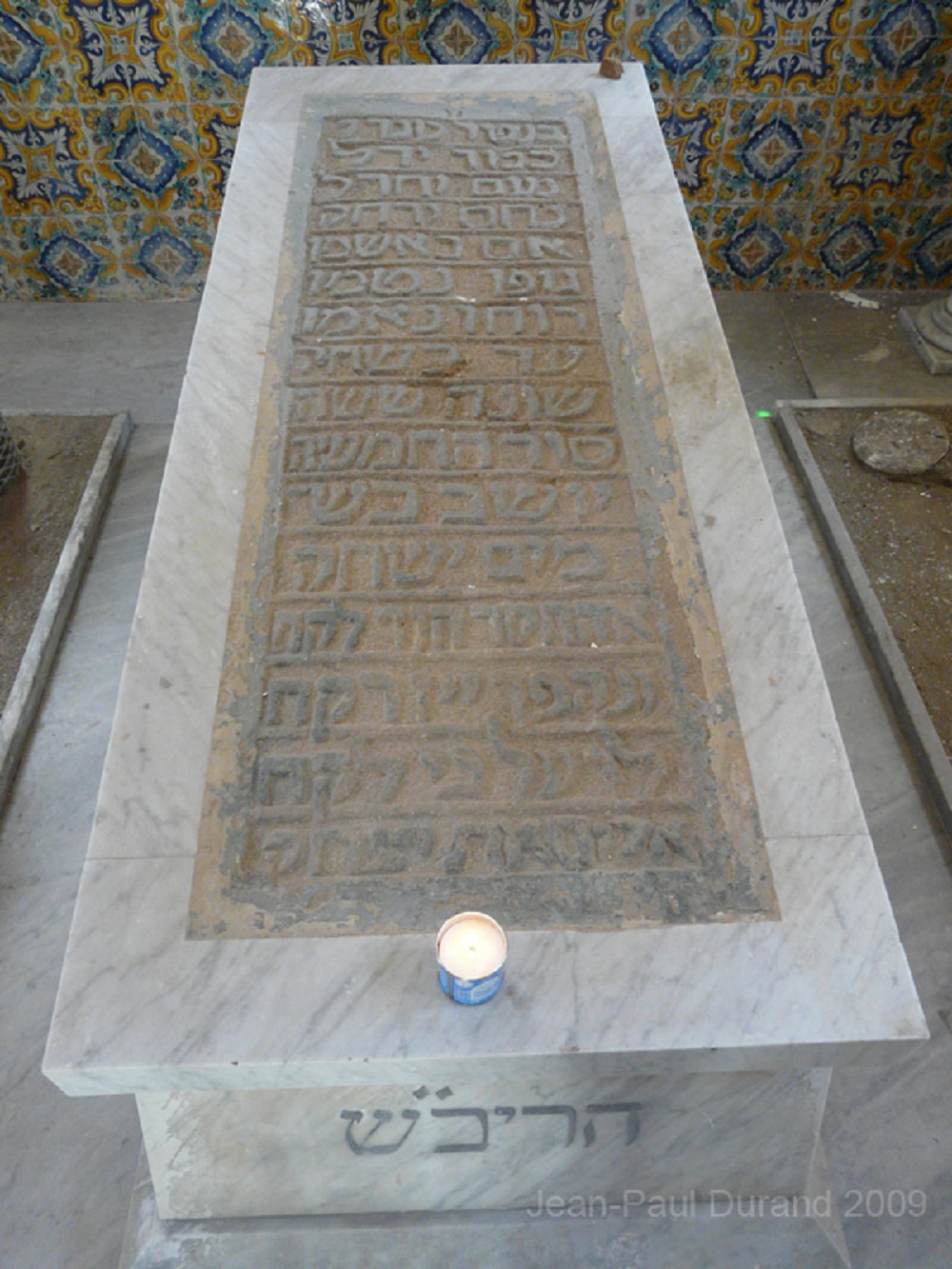
This is the Rivash’s grave. The picture is taken from the just mentioned website.

This is R. Duran’s grave. The picture comes from the same website.

Excursus

Due to the censor, or perhaps even self-censorship, in certain European prayer books negative expressions directed against idolatry, and hence bearing a possible anti-Christian interpretation, were turned into anti-Islamic expressions. See Leopold Zunz, Die Ritus des synagogalen Gottesdienstes (Berlin, 1919), p. 222. Halakhic works were also affected. See, for example, R. Abraham Danzig, Hokhmat Adam 153:1, where some printings have:

ואם שרוי הוא בין ישמעאלים

Every reader should easily grasp that in this passage ישמעאלים does not really mean Muslims.

Mishneh Torah, Hilkhot Avodah Zarah 9:4 reads:

הנוצרים עובדי עבודה זרה הן ויום ראשון יום אידם הוא. לפיכך אסור לשאת ולתת עמהן בארץ ישראל יום חמישי ויום ששי שבכל שבת ושבת. ואין צריך לומר יום ראשון עצמו שהוא אסור בכל מקום

In the textual notes in the Frankel Mishneh Torah, they cite a manuscript that reads:

ישמעלים [!] עובדי ע”ז הן ויום ששי יום אידם . . . ואין צריך לומר יום ששי עצמו

In the Shabbat morning Amidah, we read:

וגם במנוחתו לא ישכנו ערלים

Steinschneider noted that some texts replace arelim with “Ishmaelites.” See Polemische und Apologetische Literatur in arabischer Sprache zwischen Muslimen, Christen und Juden (Leipzig, 1877), p. 374. This change of text was done in Christian countries for obvious reasons and should fool no one. Thus, it is surprising that Salo W. Baron, A Social and Religious History of the Jews, vol. 6, p. 327 n. 15, writes as follows about the version that contains “Ishmaelites”:

This was hardly an invention of later generations of Jews who, living in Christian countries, sought to avoid difficulties with censors. . . . If Maimonides, in his formulation, substitutes arelim (uncircumcised) for “Ishmaelites” (cf. M.T. Seder Tefillot at the end of the second book; here switched to the Musaf prayer), this was merely in line with his general preference for Islam as against Christianity.

This is complete nonsense. Maimonides did not substitute arelim for “Ishmaelites.” The text he had, which is the authentic text of the prayer, included the word arelim.

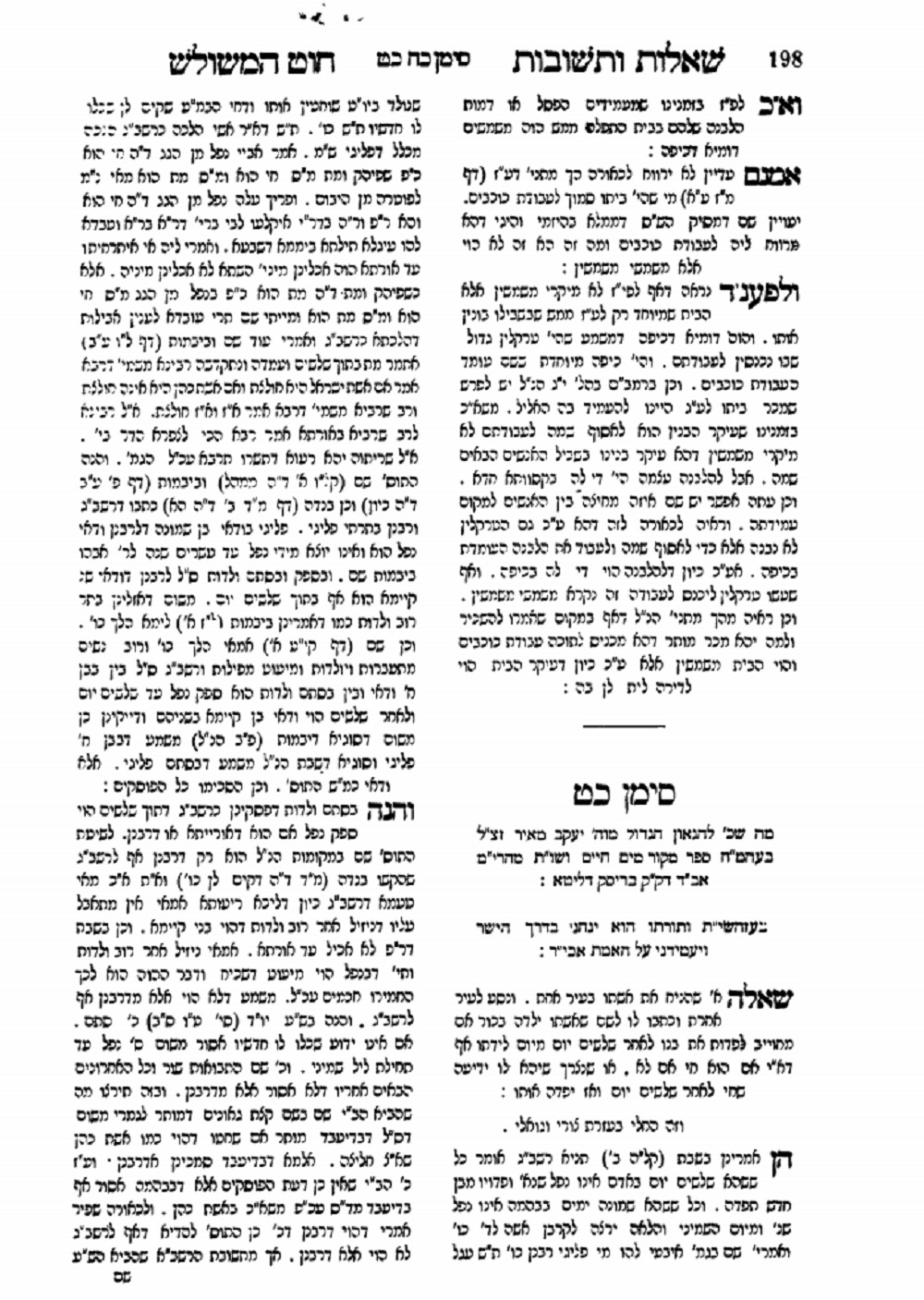
Here is a responsum of R. Eliezer Isaac Fried, from Hut ha-Meshulash, no. 28. This responsum is cited in many of the discussions dealing Islam and halakhah, in particular with reference to mosques. In my article on the topic from many years ago I too cited this source. See “Islam and the Halakhah,” Judaism 42 (Summer 1993), p. 337.

I recently had occasion to look at this responsum again, and I see that everyone has misunderstood it. It is obvious that R. Fried is not really speaking about building a mosque but a church. When, in the responsum, he speaks of placing the crescent in the mosque, this is really code for crucifix. In fact, the entire responsum assumes that he is speaking about a religion of avodah zarah, which is the obvious sign that he is really speaking about Christianity.

My excuse for misreading the responsum years ago is that I was young and unsophisticated. However, it is very surprising to me that many great talmidei hakhamim have also cited this responsum without realizing that it is not really referring to Islam. See also here where I discuss a mistake by R. Judah Aszod who assumed that in a particular responsum the Hatam Sofer was discussing candle lighting as part of a religious celebration in India, when it is obvious that the Hatam Sofer is really referring to the practice of European Christians.

For an example of self-censorship in the opposite direction, namely, the removal of references to Islam, see this page of a responsum of R. Rahamim Joseph Franco, Sha’arei Rahamim (Jerusalem, 1881), vol. 1, Orah Hayyim, no. 5, p. 8b (look at the paragraph beginning ושוב).


2. I would like to mention some more mistakes I have found in the ArtScroll siddur and machzor. I believe that it is worthwhile to call attention to such mistakes, not only for their own sake, but because ArtScroll has made corrections in the past when these types of errors have been pointed out, and they no doubt will continue to do so in the future.

I myself have noticed a number of corrections that ArtScroll has made, and it could be that the example I will now discuss is an additional one, but I have not personally seen the correction. In response to an earlier post, R. Elazar Meir Teitz informed me that in the prayer recited before taking the Torah out of the Ark on Shabbat morning, in the words היטיבה ברצונך את ציון, ArtScroll mistakenly puts the accent in ברצונך on the penultimate syllable (and when we sing these words with the popular tune the accent is indeed on the penultimate syllable). I checked my ArtScroll siddurim and machzorim and that is indeed where the accent is. However, I have been told that in the new printings of at least one of the various ArtScroll siddurim (but not of the machzorim) this has been corrected and the accent is now on the final syllable. Can any reader confirm that this is indeed the case?

I noticed over Yom Kippur that ArtScroll has a very strange translation in the על חטא prayer. We say:

ועל חטא שחטאנו לפניך ביודעים ובלא יודעים

ArtScroll translates this: “And for the sin that we have sinned before You against those who know and against those who do not know.” I am certain that this is a mistake, and that ביודעים ובלא יודעים means, “with knowledge or without knowledge,” in other words, “wittingly or unwittingly.” I assume ArtScroll was driven to its translation because earlier in the prayer we say בזדון ובשגגה. Thus, if ביודעים ובלא יודעים means “wittingly or unwittingly,” then it is repeating what was earlier said. Furthermore, we also say earlier בבלי דעת and בדעת ובמרמה, so this would seem to be more of the same. Yet I do not think that a prayer with repetitions creates difficulties, and in this case, I think it makes more sense than translating the passage the way ArtScroll does. I am curious to see if readers agree with me.[35]

The final mistake I would like to call attention to is one that is found in most siddurim and collections of zemirot, so ArtScroll is in good company. It is noteworthy that the Koren siddur and the new RCA siddur get it right. The old RCA-De Sola Pool siddur also got it right.

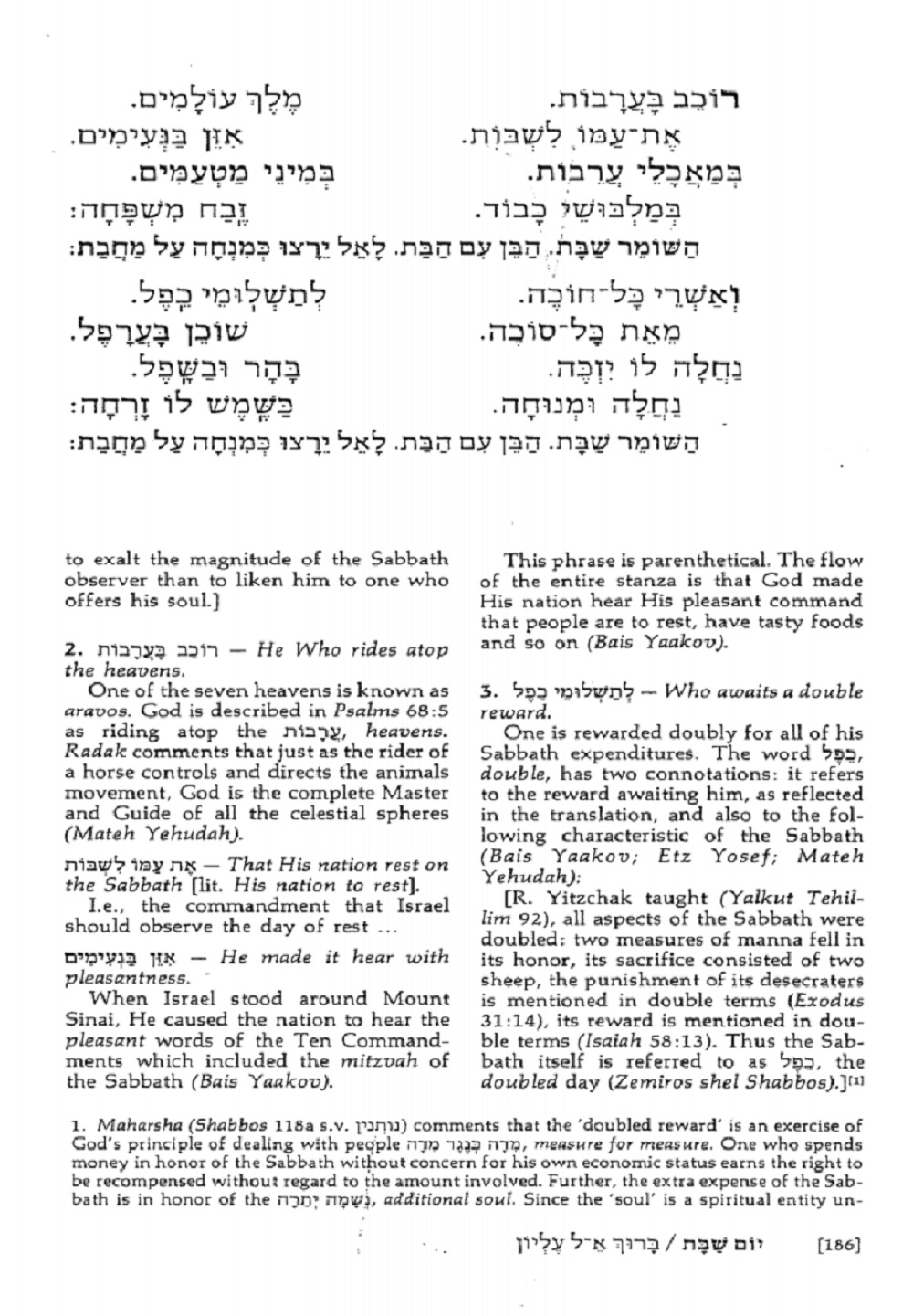
In the Sbbath song ברוך א-ל עליון, it states:

ואשרי כל חוכה
מאת כל סוכה שוכן בערפל

The meaning, as translated by ArtScroll, is:

Praiseworthy is everyone who awaits a double reward
From the One Who sees all but dwells in dense darkness.

Here is how the Hebrew page appears in the ArtScroll Zemiroth,[36] p. 186.

The problem here is that if you look at the Hebrew you can see that the English has not been translated properly. כל-סוכה does not mean “the One Who sees”, but “everyone who sees.” The word כל has a kamatz which means that it is connected to the following word. In the Zemiroth, ArtScroll puts the makef in, just like almost always in the Masoretic text of Tanakh כל with a kamatz has a makef.[37] But the meaning of the passage is the same even without the makef, and in the siddur ArtScroll does not include it. 

In order for the passage to mean “the One Who sees all,” the word כל must have a holam.[38] This point is actually made by R. Nota Greenblatt, who states that the version found in ArtScroll and many others, where the word כל has a kamatz, is nothing less than heresy since God has been replaced by humans.

3. I want to call readers’ attention to an important volume that has just appeared. Seforim Blog contributor R. Moshe Maimon has published the first volume of his edition of R. Abraham Maimonides’ commentary on Genesis. Maimon’s improvements on the earlier translation from the Arabic make the work a pleasure to read. His explanatory notes are simply fantastic, taking into account all relevant sources, both traditional and academic, that can illuminate the text. This will now become the standard edition of R. Abraham’s commentary, and I can think of no greater honor for Maimon than this. Hopefully, this publication will lead to a surge of interest in the commentary of R. Abraham, much like R. Kafih’s new translation of Maimonides’ Commentary on the Mishnah did for this work. The book is available at Biegeleisen, and can also be purchased online at Mizrahi books here.


[1] See Isaiah Sonne, “Avnei Binyan le-Korot ha-Yehudim be-Italyah,” Horev 6 (1941), pp. 100ff.; Elisheva Carlebach, The Pursuit of Heresy: Rabbi Moses Hagiz and the Sabbatian Controversies (New York, 1990), pp. 237ff.
[2] This is noted by Carlebach, The Pursuit of Heresy, p. 331 n. 18.
[3] See Excursus
[4] Peninei Shadal (Przemysl, 1888), p. 12. See the recent discussion of Nehemiah by Yaakov Spiegel in Hitzei Giborim 11 (2019), pp. 1146ff. Spiegel mentions that Torah writings from Nehemiah remain in manuscript. He also notes that in a recent printing of Basilea, Emunat Hakhamim, Nehemiah’s haskamah was removed (and perhaps surprisingly, the printer acknowledged that it was removed).
[5] Cecil Roth, Studies in Books and Booklore (Farnborough, England, 1972), p. 44 (Hebrew section).
[6] See Alexander’s appendix to John Hatchard, The Predictions and Promises of God Respecting Israel (London, 1825), p. 38. See also Kelvin Crombie, A Jewish Bishop in Jerusalem (Jerusalem, 2006), p. 13, and the entry on him in the Dictionary of National Biography, here.
[7] R. Joseph Tanugi, Toldot Hakhmei Tunis (Bnei Brak, 1988), pp. 233-234; R. Abraham Khalfon, Ma’aseh Tzadikim (Jerusalem, n.d.), p. 309.
[8] L’Univers Israelite, Oct. 7, 1932, available here; André N. Chouraqui, Between East and West: A History of the Jews of North Africa, trans. Michael M. Bernet (Philadelphia, 1968), p. 72.
[9] See Victor A. Mirelman, Jewish Buenos Aires, 1890-1930 (Detroit, 1990), p. 89.
[10] “Ha-Rav Moshe Soloveichik u-Ma’avakav be-‘Moetzet Gedolei ha-Torah’ ve-‘Agudat ha-Rabbanim’ be-Polin,” Hakirah  25 (2018), p. 47.
[11] I thank Menachem Butler for sending me this image.
[12] See Yehoshua Mondshine, Ha-Tzofeh le-Doro (Jerusalem, 1987), p. 37.
[13] Entzyklopedia le-Hakhmei Galizia, vol. 5, col. 154.
[14] Ha-Darom (Tishrei 5723) 16 p. 150.
[15] Another rabbi who met an unfortunate demise was R. Isaiah ha-Levi, author of the first Ba’er Heitev on the Shulhan Arukh (not Ba’er Heitev found in the standard editions). R. Meir Eisenstadt, Meorei Esh, beginning of parashat Shemini, tells us that on his way to Eretz Yisrael, R. Isaiah, his wife, and daughter were killed in a fire in their hotel. Regarding the different commentaries with the name Ba’er Heitev, see R. Yehiel Dov Weller in Yeshurun 17 (2006), pp. 825ff. 

In the old translation of Maimonides’ commentary to Mikvaot 4:4, he writes about a certain rabbi: ונהרג על זה באמה ובזרוע. This led to all sorts of speculations about which rabbi was killed. However, this is a mistaken translation. See R. Kafih’s note in his new translation, and also his commentary to Mishneh Torah, Hilkhot Mikvaot, vol. 2, p. 461. In a future post, I will mention a few rabbis who were killed by Jews, as well as cases of attempted murder. For now, I merely want to call readers’ attention to Prof. Shnayer Leiman’s email published in Chaim Dalfin’s new book, Torah Vodaas and Lubavitch (Brooklyn, 2019), p. 203.

There was a rabbi who allegedly was killed by mobsters. I heard from reliable sources that he was beaten, rolled in the snow and left to die. (Perhaps the goal was to frighten him, not kill him.) He survived the ordeal, but died shortly thereafter from pneumonia. The rabbi was Rabbi Yaakov Eskolsky, famous author and Rabbi of the Bialystocker Shul on the Lower East Side. I’m not aware of any written account that mentions this.

Leiman also mentions that Rabbi Israel Tabak, the son-in-law of R. Eskolsky, in discussing his father-in-law’s death mentions nothing about any foul play. See Tabak, Three Worlds (Jerusalem, 1988), p. 156. 

R. Eskolsky served as a rabbi in Scranton for a few years. See his biography here. I previously wrote a bit about him here. In Tabak’s book, p. 152, it mentions that R. Eskolsky celebrated Thanksgiving, and that at a Thanksgiving dinner Tabak attended, he “emphasized the significance of Thanksgiving Day for our people who came to the United States from Eastern Europe, and especially from Russia. Coming to America, the land of freedom and opportunity, was like emerging from darkness into light and certainly deserved to be marked by thanksgiving, both to G-d and to America that treated its citizens so well.” I believe that for any non-hasidic rabbi in America in the early part of the twentieth century, the notion that there was something religiously problematic with celebrating Thanksgiving would have been incomprehensible.

Shimon Steinmetz sent me this picture from the Forverts, Oct. 23, 1930. I find it fascinating that R. Eskolsky served as a justice on the “Jewish Arbitration Court.” 

[16] See Yehoshua Mondshine, “Aminutan shel Iggerot ha-Hasidim me-Eretz Yisrael,” in Katedra 64 (1992), p. 89 n. 152.
[17] “Perfeyt Duran be-Italyah ve-Goral ha-Sefarim ha-Ivriyim Aharei Meoraot 1391,” Ba-Derekh el ha-Modernah: Shai le-Yosef Kaplan (Jerusalem, 2019), pp. 61-91.
[18] The Secret Faith of Maestre Honoratus (Philadelphia, 2015), pp. 20, 28.
[19] See Kozody’s suggestions to explain this, Secret Faith, pp. 30ff. Regarding when his polemical works were written, see Benzion Netanyahu, The Marranos of Spain (Ithaca, 1999), pp. 221ff.
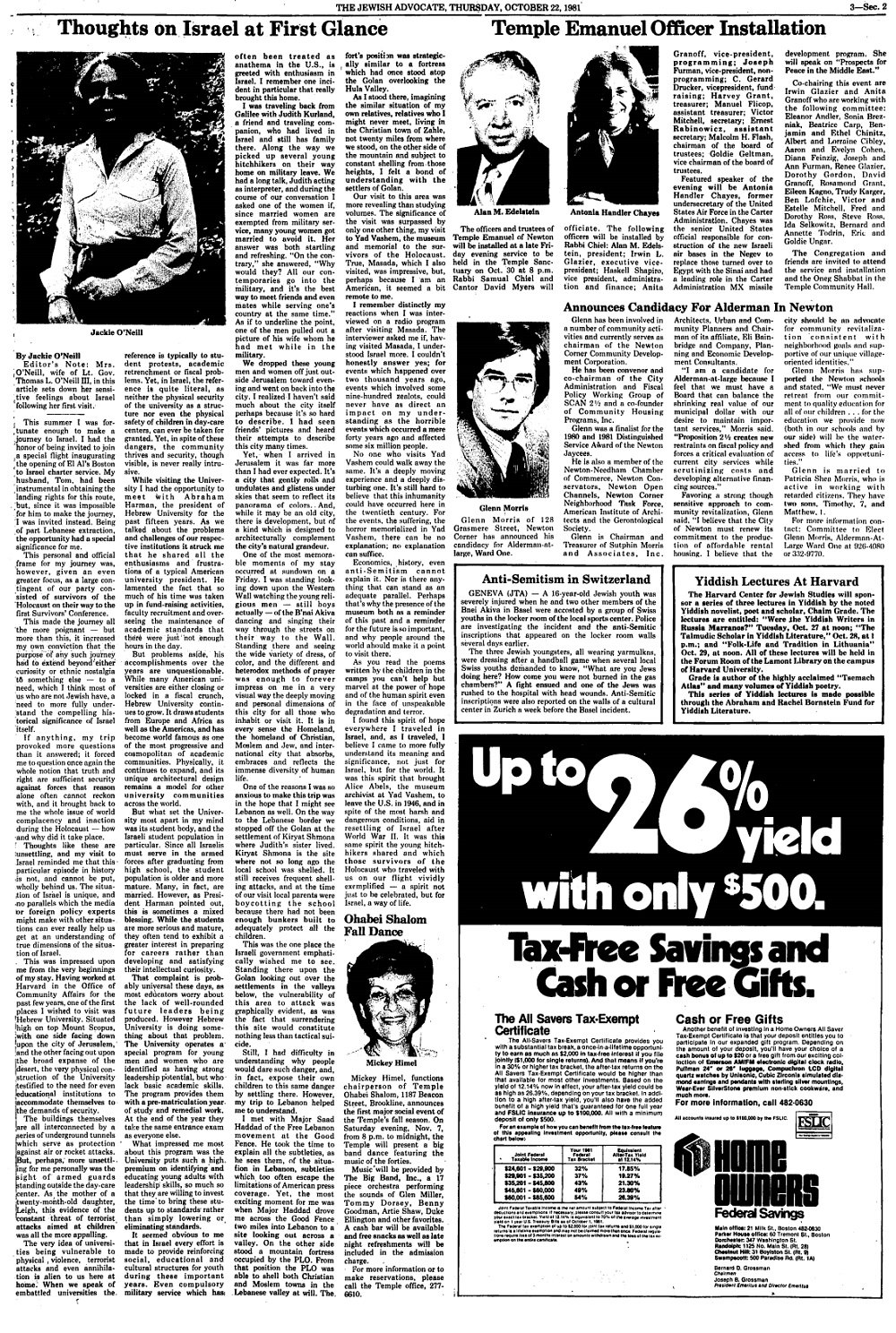
[20] Twersky discusses this text in “Religion and Law” in S.D. Goitein, ed., Religion in a Religious Age (New York, 1974), pp. 69-82. Regarding Twersky, I recently discovered this video of one of Chaim Grade’s lectures at Harvard from October 1981, and Twersky introduces him at the beginning. Unfortunately, only the first part of the lecture appears in the video. If anyone knows if the second part exists, please let me know. Menachem Butler was kind enough to send this page from the Boston Jewish Advocate, Oct. 22, 1981, announcing the Grade lectures.

Grade had earlier lectured at Harvard in 1977. Regarding these lectures, see Allan Nadler’s recollections here.
[21] Here is the first page of an article by Yehudah Hershkowitz that appeared in Yeshurun 9 (2001), p. 572.

Note how Duran is referred to as “Rabbenu”. The author is aware that Duran apostatized, but he, like everyone before him, assumed that Duran later returned to Judaism.
[22] Regarding martyrdom, R. Moshe Feinstein makes an interesting point in Iggerot Moshe, Yoreh Deah III, no. 108 (p. 353). We all know that a convert must accept the mitzvot for the conversion to be valid. What about if a convert honestly states that while he accepts the mitzvot, if confronted with violating a prohibition for which martyrdom is required, he knows that he will not have the courage to be martyred? Is this to be regarded as rejecting a commandment which means that he cannot be converted? R. Moshe says no, as acceptance of the mitzvot means that you intend to fulfill them under normal circumstances, and extreme cases such as those that involve martyrdom do not impact this acceptance.
[23] For R. Elijah Capsali’s report of the forced conversion, by actual physical force, see Abraham Gross, Struggling with Tradition (Leiden, 2004), p. 81. See also the Christian report in E. H. Lindo, The History of the Jews of Spain and Portugal (New York, 1970), p. 330. Another forced convert in Portugal who later became famous was R. Solomon Ibn Verga, author of Shevet Yehudah. R. Joseph Garson, who later escaped to Salonika, also appears to have undergone forced conversion in Portugal. See Joseph Hacker, “Li-Demutam ha-Ruhanit shel Yehudei Sefarad be-Sof ha-Meah ha-Hamesh Esreh,” Sefunot 2, new series (1983), pp. 29ff. As with R. Levi, we do not know the circumstances of the forced conversions of R. Ibn Verga and R. Garson. Since it appears that R. Jacob Ibn Habib was also in Portugal in 1497, then presumably he too was converted, either “willingly” or not. See, however, Marjorie Lehman, The En Yaaqov: Jacob ibn Habib’s Search for Faith in the Talmudic Corpus (Detroit, 2012), pp. 26-27. Regarding whether R. Isaac Karo was in Portugal then, or if he succeeded in leaving prior to the mass conversion, see Karo, Derashot R. Yitzhak Karo, ed. Shaul Regev (Ramat-Gan, 1995), pp. 9-10.
[24] Kuntres ha-Semikhah, in Teshuvot R. Levi Ibn Habib, no. 147, section 4 (p. 39 in the new edition).
[25] Ibid., no. 148 section 5, p. 52.
[26] R. Solomon ben Adret, She’elot u-Teshuvot ha-Rashba, vol. 6, no. 179, explains that this is because a person’s intellect is not sufficiently developed until age 20.
[27] R. Moses Sofer rejects the notion that one is not punished by Heaven for sins committed before age 20. See She’elot u-Teshuvot Hatam Sofer, vol. 2, Yoreh Deah no. 155. For more on this matter, see R. Pinchas Zabihi, Ateret Paz, vol. 3, no. 1, and here.
[28] Teshuvot R. Levi Ibn Habib, no. 148, section 5 (p. 53 in the new edition).
[29] Divine Law in Human Hands (Jerusalem, 1998), p. 170.
[30] Riera, “Le-Toldot ha-Rivash bi-Gezerot 1391,” Sefunot 17 (1983), pp. 11-20.
[31] Rabbi Yitzhak Bar Sheshet (Beitar Ilit, 2017), pp. 83ff.
[32] In this post, I have not dealt with accusations of rabbis’ apostatizing that arose in the contexts of disputes. For an example where hasidim accused one of their mitnagedic opponents, R. Leib Rakowski of Plock, of apostasy and also of marrying a non-Jewish woman, see Marcin Wodzinski, Studying Hasidism (New Brunswick, N.J., 2019), p. 120. This occurred after they tried to beat up the rabbi. See ibid., p. 119.
[33] In rabbinic literature Algiers is written as ארג’יל. This is due to the influence of the Spanish exiles who settled in North Africa, as in Spanish Algiers is pronounced as Argel. I was surprised to see that a generally careful scholar, Tuvia Preschel, Ma’amrei Tuvyah, vol. 1, p. 58, recorded the following false information.   

הם [יהודי אלג’יר] לא רצו לכתוב אלגיר שהיא מלשון אלה וגם “גירא בעיניך השטן” וע”כ הסבו שם העיר לארג’יל, לשון אור וגיל וסימנה טוב


[34] Regarding the transfer of the remains, see Bar Sheshet, Rabbi Yitzhak Bar Sheshet, pp. 83ff.
[35] In his Derashot Kol Ben Levi, p. 130, R. Jehiel Michel Epstein’s explains ביודעים ובלא יודעים as follows:

היודעים המה העבירות שאין להם מבא בהיתר כלל והלא יודעים הם המותרות מההיתר שאין האדם מרגיש בנפשו כלל שזהו חטא וא”כ אין ידוע כלל שחטאנו לפניך

For a homiletic explanation that is found in many different sources, see R. Zvi Hirsch Ferber, Siah Tzvi, p. 162:

וזה שאנו מתודים על חטא שח”ל ביודעים, זה שהגיע להוראה ואינו מורה, ובלא יודעים, שלא הגיע להוראה ומורה

Yisrael Meir Lau,Yahel Yisrael: Avot, ch. 4, p. 246, writes:

בלא יודעים – הכוונה לחטא שחטאנו, מחמת שהיינו במצב של “לא יודעים”, שבאשמתנו לא ידענו את הדין, ועברנו על  העבירה בלא לדעת כלל שיש בכך איסור. חומרתו של מעשה הנעשה “בלא יודעים” היא, ממש כמעשה הנעשה “ביודעים”, ועל שניהם כאחד אנו מתוודים ומבקשים שהקב”ה יסלח לנו ביום הכיפורים

[36] My copy was published in 1979. Later, ArtScroll changed the transliteration to Zemiros.
[37] כל with kamatz is pronounced as kamatz katan. The only exceptions in Tanakh are Psalms 35:10: כל עצמתי, and Proverbs 19:7: כל אחי-רש. In these cases there is no makef after כל and therefore it is pronounced as kamatz gadol.

Isaiah 40:12 is another biblical verse with the word כל without a makef and it too has a kamatz gadol:

וכל בשלש עפר הארץ

Yet the word כל here is completely different than all other appearances of כל in Tanakh. This passage means, “and comprehended the dust of the earth in a shalish-measure.” The word כל we are all familiar with is from the root כלל. The word כל in Isaiah 40:12 is from the root כול.
[38] I found another mistake in ArtScroll’s version of the song, and again, many others, including Koren and the new RCA siddur, make the same mistake. Yet the RCA-De Sola Pool siddur gets it right, as does Birnbaum. In the first stanza it reads עד אנא תוגיון. ArtScroll vocalizes the last word as “tugyon” (shuruk, holam) Yet this is a verse in Job 19:2 and the correct pronunciation is “togyun” (holam, shuruk).

The fifth stanza ends רוחו בם נחה. ArtScroll puts the accent in נחה on the penultimate syllable. However, in the context of the song, where all the other stanzas have the parallel rhyming word with the accent on the last syllable, I don’t think there is any doubt that נחה should also be read with the accent on the last syllable, despite what the grammatical rule may say.


Lighting Shabbat Candles in Jerusalem 40 Minutes Before Sunset

Lighting
Shabbat Candles in Jerusalem 40 Minutes Before
Sunset
By William Gewirtz

Introduction

There is a story,
perhaps apocryphal, of a visit to Jerusalem by R. Yoel Teitelbaum in
which he is driven to the Kotel on Friday afternoon well after
the customary time to light Shabbat candles in Jerusalem, 40
minutes before sunset. As his car was being stoned, he suggested that
instead of adding 40 minutes to the Friday night pre-Shabbat
period, it would be more appropriate that 40 minutes be added to
the time at which the calendar of Jerusalem announces that Shabbat
ends. That he had little regard for the ancient customs of
Jerusalem is probably not surprising; finding a compelling rationale
for the zemanim practiced in Jerusalem is a wholly other
matter. In terms of Saturday evening, Jerusalem has always followed
the opinion of the geonim, which is now most often attributed
to the Gaon of Vilna. For the entire period of recorded
history, even prior to the era of the Gaon, with isolated
exceptions, Shabbat ended in Jerusalem at most 36 to 42
minutes after sunset, depending on the season.
[1] However, some returning from Europe brought back with them to Israel
the European practice that extended
Shabbat to 72 minutes
after sunset or even further in accordance with the opinion of
Rabbeinu Tam.

However,
lighting candles 40 minutes before sunset Friday night remains
baffling despite several theories that have attempted to provide a
rationale,
[2] all of whom I find questionable. Why 40 minutes instead of 18, 20,
30, 36 or 45 minutes? What follows are
halakhic positions from
authorities going back over 800 years, and perhaps even supported by
a source in the
yerushalmi, which provides a theory that is
consistent with practices rarely encountered in recent times. As we
will see, many of these practices must contend with issues that
cannot be defended in their entirety without some minor modification
/ correction. Ironically, the standard alternative often observed,
based on Ramban and many subsequent
akhmai sforad,
also faces a major issue that I cannot effectively address.


What follows are an
organized sequence of ten propositions that provides clear support
for the practice of lighting candles 40 minutes before sunset; I
succinctly demonstrate clear support for each proposition from major
sources and / or figures in halakhic history. Despite its
formal organization, this essay presents an educated guess as opposed
to a definitive conclusion. In other contexts, I have warned against
being overwhelmed by numerical coincidences; though I strongly doubt
it, one cannot rule out that this is just another example of one as
well.
Deriving
40 minutes before sunset

Proposition
1
. The hours of the day were separately estimated from a
morning start point to midday and from midday to an evening endpoint.
It is highly unlikely that calculating the length of time between a
morning start point until an evening endpoint and dividing by 12 was
used in that manner to determine the length of a halakhic hour
prior to the existence of clocks.

Support:
While calculating from a point in the morning to a point in the
evening and dividing by twelve is the theoretical method implied in
the Talmud, it seems rather unlikely to have been used in practice
prior to the benefit of a clock. In fact, in describing his method of
estimation of the time by which to finish the consumption of ḥametz
on erev pesa, Ravyah explicitly describes his method
for estimating the morning hours between a morning start point and
ḥatzot. This assumption about separately calculating
from ḥatzot to both a morning and evening endpoint is
critical to what is proposed in this essay.


Proposition 2.
The morning start point used in the Middle East was alot
ha’sha
ar, not sunrise,
[3] despite the influence of the talmidei ha’gra. In addition,
in Jerusalem, 90 versus 72 minutes before sunrise was often, but not
always, the time used for
alot ha’shaḥar around the fall
and spring equinox.


Support:
Using alot ha’shaḥar as the morning start point is rooted
in the opinions of Ramban, R. Israel Isserlein and many other
rishonim. Clearly, the Ben Ish Ḥai and the calendar of
Jerusalem, among many others, calculated using alot ha’shaḥar
versus sunrise. The use of 90 versus 72 minutes before sunrise as the
time of alot ha’shaḥar occured at various times in history
in Eretz Yisroel and other parts of the Middle East as well,
particularly in Jerusalem. Whether the Gaon supported 90 or 72
minutes is strongly disputed.
[4] 


Proposition 3.
The evening endpoint is either the symmetric counterpoint to alot
ha’shaḥar
, as is clearly derivable from Ramban and his
school, or an asymmetric point in the evening occurring significantly
earlier at the point of transition between days of the week according
to the geonim. Finding support from R. Israel Isserlein for
such asymmetric endpoints is a complicated and debatable task that
is, in any case, arduous to demonstrate.
[5] Instead, we reference explicit support from multiple significant
a
aronim.


Support:
Clearly Ramban and his school who assert that plag ha’minḥa
occurs only 3.75
[6] minutes before sunset were calculating from a point as far after
sunset as
alot ha’shaḥar is before sunrise.[7] Astounding as it might seem, numerous important aḥaronim
calculated to an asymmetric earlier endpoint, approximately 20-40
minutes after sunset. Among
aḥaronim who maintain such a
viewpoint are R. Nosson Adler,
[8] R. Yaacov Lorberbaum, the Ben Ish Chai, R. Yosef Chaim Sonnenfeld,
among many others. While the endpoint of Ramban is the point at which
Shabbat ends according to Rabbeinu Tam, the earlier point is
the end of
Shabbat according to the geonim.

Support
for such asymmetry can also be derived from a lengthy (and disputed)
discussion beginning in yerushalmi Berakhot 2b,
[9] that considers the verse in Nehemiah 4:15,
  • Ve’anaḥnu
    osim be’melaḥah…. Mei’alot ha’shaḥar ad tzait
    ha’kokhavim
    as
    defining an asymmetric daytime period from alot ha-shaḥar
    until the appearance of three stars.
    [10] 

Proposition 4.
With clocks in common use, each of the aḥaronim mentioned
counted the length of time from alot ha’shaḥar to an
earlier evening endpoint and divided by 12 to derive the length of a
halakhic hour. This method of calculation resulted in the
miscalculation of atzot.


Support: Their
method is an unarguable fact that appears in their writings and / or
calendars. One can also easily verify the miscalculation of ḥatzot
by calculating a halakhic hour using alot ha’shaḥar
and end of Shabbat according to the geonim as
endpoints. That calculated point of ḥatzot is typically
20-30 minutes earlier than the indisputable point of ḥatzot
that can be observed directly.
[11]


Proposition 5.
Because of a miscalculated ḥatzot, some wanted to
throw out the baby with the bathwater and claimed the absolute
necessity of using Ramban’s later endpoint that is symmetric with
alot ha’shaḥar. Use of any symmetric endpoints around
sunrise and sunset calculates the point of ḥatzot correctly.


Support: The
most complete account of this issue and its ramifications come from
various documents recording the debate that took place over several
years in Jerusalem more than 110 years ago between R. Yosef Chaim
Sonnenfeld and R. Yeḥiel Miḥel Tukatzinsky.
[12] The calendar originally in use, strongly supported by R. Sonnenfeld,
miscalculated
ḥatzot. Multiple insignificantly different
accounts of the debate all agree that in the end a changed calendar
that calculated
ḥatzot accurately resulted. By moving ḥatzot
forward by about 20 minutes, the new calendar also set
sof zeman
keriat shema
about 10 minutes later, which was the primary
motivation for R. Sonnenfeld’s objection. The changed calendar,
like the current calendar (still) in use today, calculates using a
depression angle of approximately 20 degrees, equivalent to 90
minutes around both the spring and fall equinox, identical to what
Ramban proposed.

Proposition
6
. Unfortunately, Ramban’s endpoints, 90 minutes from sunrise
and sunset when used around the winter solstice, results in plag
ha’min
a occurring around 10 minutes after
sunset, an inelegant and disqualifying occurrence. The fact that
this has not been recognized would imply that this version of the
opinion of Magen Avraham using 90 minutes, with either a fixed or a
depression angle implied number of minutes, was not in widespread
use.


Support: This
is indisputable if we examine dates near the winter solstice. On
December 21 in Jerusalem, sunset is at 6:39 PM and plag ha’minḥa
occurs between 7 and 13 minutes after sunset depending if you
calculate with a fixed 90 minutes (strongly opposed but resulting in
8 minutes) or depression angles (strongly supported and resulting in
13 minutes.)
[14]Note that 72 minutes does not have this problem; plag ha’minḥa
occurs very slightly before sunset on December 21 when 72 minutes is
used.
[15]


Proposition 7.
Fixing the alternative that miscalculates ḥatzot is
straightforward; just calculate like we assume occurred before the
use of clocks – from a known point of ḥatzot to alot
ha’shaḥar
and from ḥatzot to an earlier evening
endpoint. Note that ḥatzot is not calculated but observed
and occurs at midday.


Support: The
morning hours present no issues;
[15] find the length of time between alot ha’shaḥar and ḥatzot
and divide by six. Afternoon hours are a bit stickier. There are
multiple options for the precise time to use for the evening
endpoint, depending on one’s best estimate of the point of
transition between days of the week on a biblical level. One could
advance arguments for any depression angle that associates with a
time between 20 – 28 minutes after sunset around the spring and fall
equinox. Given the preference for 90 minutes over 72 in Jerusalem,
use of such an earlier endpoint, which avoids the (unreported and)
anomalous occurrence of
plag ha’minḥa after sunset,
appears to be reasonable.

Proposition
8
. Those who note that morning hours are longer than afternoon
hours need not be concerned; in an unexplained position, one of last
century’s greatest poskim claimed that unequal morning and
afternoon hours is not an anomaly but what should be expected.

Support:
In a position that neither I nor the many who I have asked can fully
explain, R. Moshe Feinstein insisted that halakhic hours
differ between the afternoon and the morning. Unfortunately, R.
Feinstein states that either the morning or afternoon
hours can be longer; this approach can only explain the morning hours
being longer. While I cannot claim that this approach provides the
definitive explanation, I have never found another approach that
provides any more cogent (albeit partial) rationale.
[16]


Proposition 9.
Using this approach or even the errored one that miscalculates
ḥatzot, find the time of the year when plag
ha’min
a comes closest to sunset.


Support: The
time for plag ha’minḥa comes closest to sunset around
December 21st when the daytime period and hence halakhic
hours are shortest. There are multiple opinions that differ slightly
with respect to the biblical point after sunset that marks the
transition between days of the week. Using a depression angle of 6
degrees, a reasonable choice for that point of transition, on
December 21st plag ha’minḥa occurs 42
minutes before sunset.
Throughout the rest of the year plag
ha’minḥa
occurs more than 42 minutes before sunset.
Examining the issue in detail and using December 21st:

  • ḥatzot at
    11:37 AM,
  • sunset
    at 4:39 PM, and
  • a
    depression angle of 6 degrees as the day’s approximate end, 27
    minutes after sunset at 5:06 PM,
we
derive:
  • a
    halakhic hour of ((ḥatzot to sunset) + 27 minutes) /
    6 = (302 minutes + 27 minutes) / 6 = 54.833 minutes,
    resulting in

  • plag ha’minḥa
    (the end of the day) – (54.833 * 1.25) minutes = 5:06 PM – 68.54
    minutes = 3:57 PM, 42 minutes before sunset.
It
is unimaginable that such a precise calculation that results in plag
ha’minḥa
42 minutes before sunset was used to initially
establish the custom of lighting 40 minutes before sunset.
Additionally, many potential changes including:
  • calculating
    (incorrectly) from alot ha’shaḥar,
  • choosing
    a slightly earlier (or even (incorrectly) a later) evening endpoint,
  • not
    using depression angles (an absolute certainty), and
  • disagreements
    about how shekiah is to be calculated given Jerusalem’s
    altitude
will
move the time of plag ha’minḥa, most often several minutes
earlier.

However,
it is critical to appreciate that we are attempting based on
(halakhically inspired) religious
[17] instincts to light candles as early as is possible without
violating an explicit
halakhic boundary that demands
that we light candles after
plag ha’minḥa. Any attempt to
light earlier than 40 minutes before sunset would likely face
halakhic resistance, particularly at a time when estimation
and approximation were still in common use.

Proposition
10
. Lighting candles 40 minutes before sunset guarantees we are
lighting at:
  • a
    uniform time all year,
  • as
    early as possible, but
  • always
    at a time that is after
    plag ha’minḥa.
Support:
40 minutes is the largest round number that simultaneously meets
all three proposed objectives. Q.E.D.

Conclusions:

To
again be clear, I do not claim that the original basis was derived as
I have outlined. Undoubtedly, the original custom resulted from
accurate approximation as opposed to precise calculation.
Nonetheless, proposition 10 likely captures the original intent of
those who started this unique practice. Knowing more of the early
history surrounding this well establish custom would add
significantly to our understanding. For now, it remains a conjecture
on which comments would be appreciated.

[1]  Even Hazon Ish waited only 45 minutes before ending Shabbat.
[2]  See Minhagei Yisrael
(page 102, footnote 18) by R. Yaacov Gliss and
Ha’zemanim
Ka’halakha
(chapter 60, footnote 18) by R.
Chaim Benish for proposed theories.
[3]  While most currently follow the method of the Gaon
of Vilna and calculate from sunrise to sunset, surprisingly, this
method has no uncontested support prior to the 16
th
century when it was suggested by R. Mordechai Yaffe. Both R. Yaffe
and the
Gaon cited no
prior halakhic support; instead they claimed that the hours of the
day are naturally defined by the period between sunrise and sunset.
This contentious topic is not pursued further.
[4]  Multiple comments on different sections of the Shulḥan
Arukh
strongly imply support for 90 minutes;
some comments in
midrashic settings
explicitly support 72 minutes.
[5]  A student of R. Yisroel Isserlein, R. Yaacov ben Moshe in his sefer
Leket Yosher

sheds light on this issue, (assuming knowledge of the operation of
the diverse clocks in use during the 15
th
century.) In the first mention of clocks in
halakhic
literature around the turn of the 16
th
century,

R.
Yaacov ben Moshe specifies that the time that R. Isserlein permitted
a person having difficulty fasting on
Taanit
Esther

to read the
Megillah
as slightly before 5 PM. What R. Isserlein described
halakhically
as
plag
ha’minḥa

was quantified by R. Yaacov ben Moshe as occurring a few minutes
before 5 PM.
[6] The perhaps unfamiliar 3.75 minutes is 1/6th
of the time to walk a
mil
of 22.5 minutes.
[7] Ramban in Torat ha’Adam
states that
plag ha’minḥa
occurs at the time it takes to walk 1/6
th
of a
mil before
sunset. From that statement three conclusions can be drawn:
  1. The
    time to walk a mil is 22.5 minutes, not the normally assumed
    18 minutes.
  2. The
    hours of the day are calculated between alot ha’shaḥar
    and an evening equivalent, following what is referred to currently
    as the position of Magen Avraham.
  3. Alot
    ha’shaḥar
    and its evening equivalent are separated from
    sunrise and sunset respectively by 90 (not 72) minutes around the
    spring and fall equinox.
[8]  R. Adler’s practice is still followed in Zurich.
[9] An abbreviated discussion also occurs in multiple places in the
bavli.
[10] Three stars appear after sunset in the Middle East before 30 minutes
after sunset. The
Gaon of
Vilna succinctly and accurately describes his view of the point of
transition between days of the week as the appearance of 3 stars
versus Rabbeinu Tam’s view that he equates to the appearance of
“all the (millions of) stars.
[11] As traditional a posek
as R. Yitzchok Weiss, the author of
Minhat
Yitzhak
(vol 4:53), invalidates any approach
that results in a miscalculation of
hatzot.
[12] A young man at the time, R. Tukatzinsky was married to the
granddaughter of the venerable R. Shmuel Salant, the last undisputed
chief rabbi of Jerusalem in whose court the dispute was adjudicated.
[13] The length of the day on December 21st
is 10 hours and 4 minutes. Using fixed minutes thus adding 180
minutes, dividing by 12 and multiplying by 1.25, (604 + 180)/12*1.25
= ~ 82 minutes, which puts
plag ha’minḥa
8 minutes after
sunset. Adding 192 versus 180 minutes results in
plag
ha’minḥa
occurring another 5 minutes
later, 13 minutes
after sunset.
[14] Using depression angles plag ha’minḥa is
only one minute before sunset; with fixed minutes it is about 6
minutes before sunset.
[15] All the morning hours, including sof zeman
krait shema
are identical to the hours
calculated by any symmetric calculation based of the Magen Avraham’s
opinion, as should be obvious and, in any case, easily verified.
[16] Related perhaps, but in ways that are unclear, both of last
century’s most noted

poskim,
R.
Shlomo Zalman Auerbach as well as R. Feinstein issued rulings about

ḥatzot ha’lailah
and
ḥatzot
ha’yom
,
respectively, that are incredulous. R. Feinstein writes based on
tradition, but with no additional justification, that
ḥatzot
is not calculated and at the same time all years long. That
ḥatzot
is not calculated comports with the ancient practice illustrated by
Ravyah that the determination of
ḥatzot
does not involve calculation but only observation; the latter, that

ḥatzot
occurs at same time all year long, remains unexplained. R.
Auerbach’s ruling, which calculates
ḥatzot
ha’lailah

for purposes of the
pesaḥ
seder
,
is
yet more perplexing. That both
poskim
have baffling positions in approximately the same area, both of
which have not been definitively explained, is intriguing.
[17] I am distinguishing religious from halakhic
similarly to their different meanings as
occur in the writings of both R. Joseph Soloveitchik and Prof. Jacob
Katz.


The Medical Training and Yet Another (Previously Unknown) Legacy of Rabbi Dr. Abraham J. Twerski, zt”l

The Medical Training and
Yet Another (Previously Unknown) Legacy
of Rabbi Dr. Abraham J. Twerski, zt”l

by Edward Reichman and Menachem Butler

Rabbi Dr. Edward Reichman is a Professor of Emergency Medicine and Professor in the Division of Education and Bioethics at the Albert Einstein College of Medicine. He writes and lectures widely in the field of Jewish medical ethics.

Mr. Menachem Butler is Program Fellow for Jewish Legal Studies at The Julis-Rabinowitz Program on Jewish and Israeli Law at Harvard Law School. He is an Editor at Tablet Magazine and a Co-Editor at the Seforim Blog.

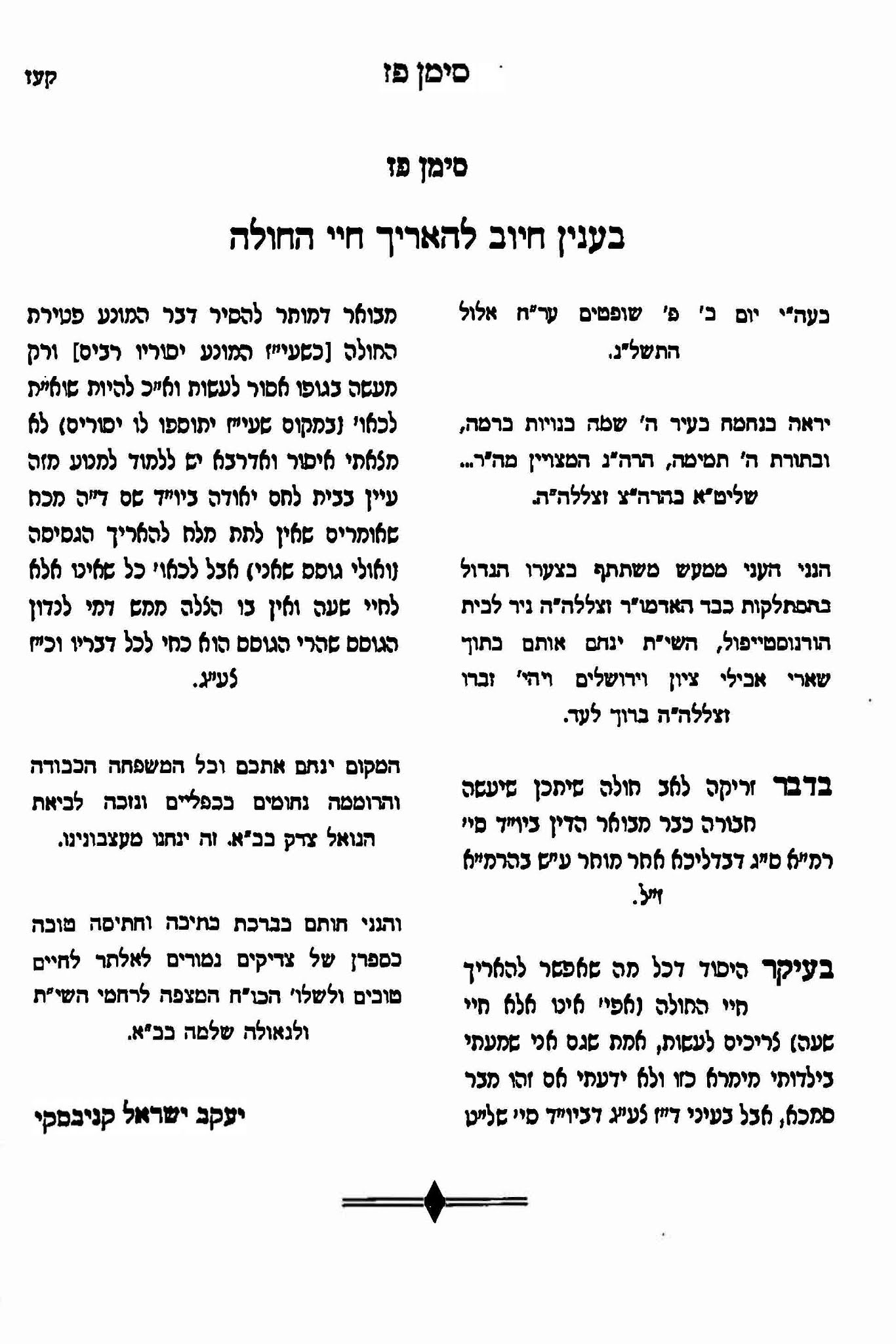
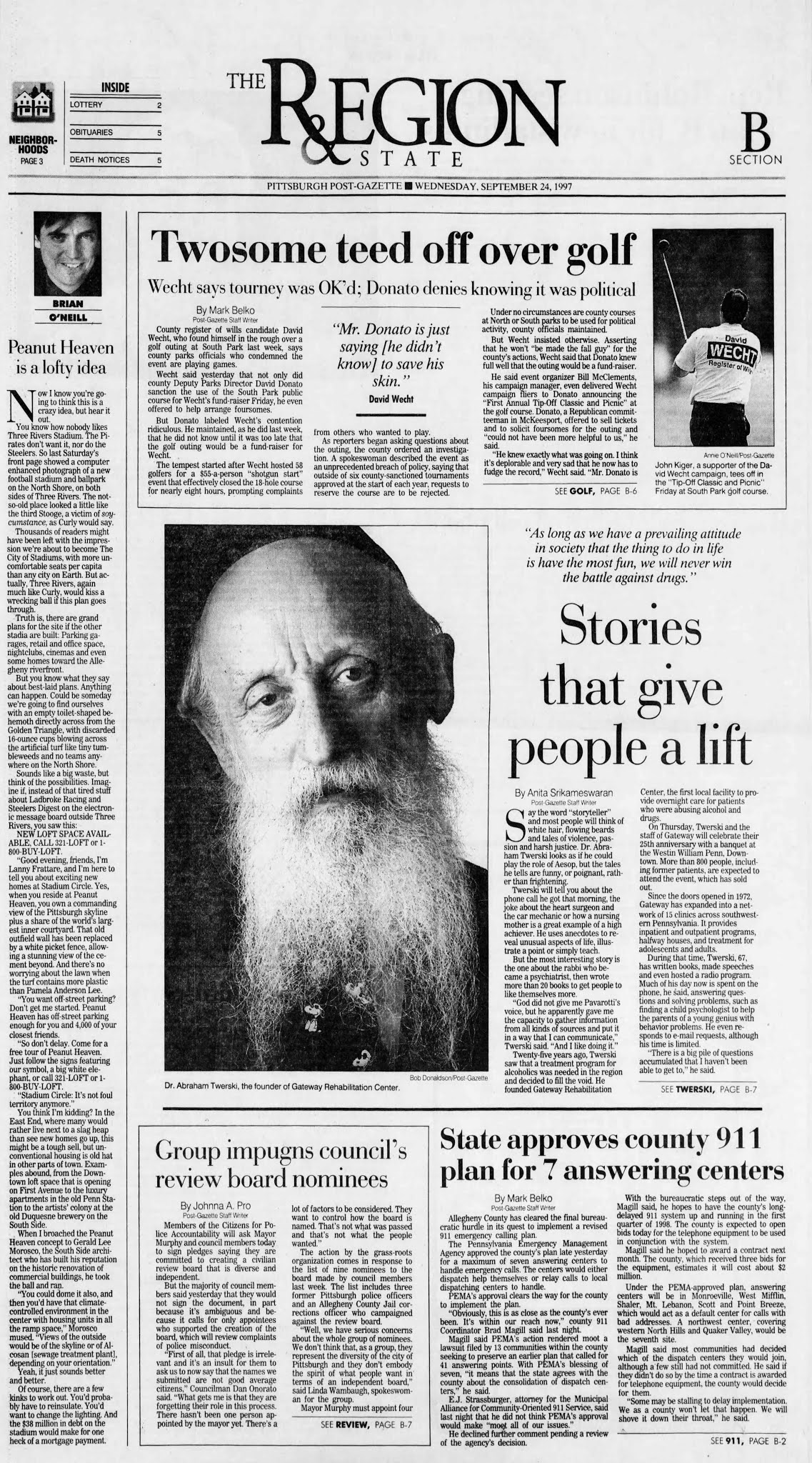
On erev Shabbat Shira last week, in the course of a typically wide-ranging conversation between the authors of this article, Menachem mentioned that unfortunately Rabbi Dr. Abraham J. Twerski was critically ill. As hashgachah would have it, Menachem had happened upon a little-known precious work from 1997, entitled Sefer Ye’omar le-Yaakov u-le-Yisrael, compiled by Rabbi Dr. Abraham J. Twerski and comprised of letters written to him by Rabbi Yaakov Yisrael Kanievsky, zt”l (1899-1985), known as the Steipler Gaon and author of the multi-volume work Kehillot Yaakov.[1]

Scion of prominent Hasidic dynasties and related to the current Rebbes of Bobov, Karlin, Klausenberg, Talner, and Skver, Abraham J. Twerski was born in Milwaukee in 1930 to Rabbi Yaakov Yisrael Twerski and his wife Devorah Leah (née Halberstam), where he attended public school as a child.[2] After he received his rabbinic ordination from the Hebrew Theological College in Chicago, he began to serve as an assistant rabbi in his father’s congregation in Milwaukee in the 1950s, as Aaron Katz described in his 2015 profile of Rabbi Dr. Abraham J. Twerski (“The Wisdom of Peanuts”) at Tablet Magazine. He married Goldie (née Flusberg) in March 1952; and starting that summer, directed the Hebrew School at his father’s congregation Beth Jehudah, as well as officiated religious lifecycle events in his father’s community in Milwaukee. However, as he would later reflect in an interview “after I had practiced as a rabbi for a number of years, I felt I was not fulfilled in my work and — after consultation with the Steipler Gaon — I went to medical school to become a psychiatrist.”

Abraham J. Twerski wrote to the Steipler Gaon and expressed concerns about the propriety of attending medical school as an Orthodox Jew. He would regularly visit Rav Kanievsky at his home in Bnei Brak and corresponded with him by mail, maintaining an ongoing relationship with him until the Steipler’s passing in 1985. That year, a volume of collection of letters entitled Karyana de-Igarta was published, and included, for the first time, two letters that the Steipler Gaon had sent some thirty years earlier to a young Abraham J. Twerski in Milwaukee, who was then seeking his advice regarding his career choice.

The first letter was written at the end of the Summer of 1955 by a twenty-four-year-old Abraham J. Twerski and in this letter the Steipler Gaon addresses the value of making one’s livelihood through a non-rabbinic profession. As to the specific profession, he adds that medicine may be a preferred choice, as it is a mitzvah to learn, and additionally, excluded from the ban on secular knowledge of the Rashba.[3] However, this is on the proviso that the education is provided by proper teachers and in an environment conducive to Torah observance. As this is clearly not the case in a modern university, he offers some general guidelines, culled from the seforim hakedoshim, if not to guarantee, at least to enhance the chances of success: 1) kove’a itim – learn in-depth at least two hours daily; 2) recite all tefillos with a minyan; 3) regular mikva immersion; 4) meticulous Shabbat observance; and 5) a daily musar seder.[4]

The second question Abraham J. Twerski posed, the following year, was more specific to his situation. He inquired whether it was preferrable for him to be a rabbi in a largely non-observant community (he was serving as an assistant rabbi to his father in Milwaukee at that time), which would involve immersion in an irreligious environment with potential negative impact on the Jewish education of his children; or should he choose a medical career, which would allow him to remain in an environment of Torah observance.

Suffice it say, the Steipler Gaon’s tone in this letter is less than supportive of a career in medicine than its predecessor. His written response is unequivocal, “the rabbinate is much preferred” (adifa yoter viyoter). He lists no less than five reasons not to become a physician, relating to the challenges in maintaining Torah observance and modesty, as well as the time commitment, which would preclude Torah study. He adds on a personal note that given his estimation of the exceptional talents of the young Rabbi Twerski, the latter would likely become a highly successful and sought-after physician. As such, he would find no rest from those constantly “knocking on his door” and seeking his consultation. He was particularly concerned about what would happen to his Torah learning and observance in such a case.[5]

Notwithstanding the serious concerns expressed by the Steipler Gaon, and perhaps now better informed of the potential pitfalls, Abraham J. Twerski proceeded to pursue his medical education, as he wrote, “I went to medical school with the Steipler’s blessing and continued an ongoing relationship with him for years.”[6] Their fathers both grew up as friends in Hornsteipel, “and spent their boyhood years together and were on first name terms,” reminisced Rabbi Dr. Abraham J. Twerski many years later in a biographical memoir of his Hasidic ancestors.[7]

However, several years into his studies at Marquette University’s medical school, Abraham J. Twerski could no longer afford the tuition.[8] His assistance would come from a most unlikely source, as he would later describe in an interview with the Pittsburgh Quarterly:[9]

By that time, I had several children, so my dad and some members of the congregation helped me to pay for school. I applied for a scholarship through a foundation, but it didn’t come through, so in my third year, I fell two trimesters behind on tuition. One day, I called my wife at lunch as always, and she asked, “What would you do if you had $4,000?” I said, “I’m too busy to talk about fantasies.” She said, “But you really do have $4,000!” I said, “From where?” She said, “From Danny Thomas.” “Who’s Danny Thomas?” She said, “The TV star.” Then she read me an article from The Chicago Sun. Local officials had told Mr. Thomas about a young rabbi who was struggling to get through medical school. Thomas asked, “How much does your rabbi need?” They said, “Four thousand dollars.” He said, “Tell your rabbi he’s got it.”[10] So, I did my internship in general medicine, went to the University of Pittsburgh Psychiatric Institute for three years, and then worked two more years for a state hospital.

While the Steipler Gaon’s assessment of the success of Rabbi Dr. Abraham J. Twerski’s medical career was prophetic, his concerns about Torah observance and learning, at least for Dr. Twerski, would turn out to be unfounded. Upon his graduation from medical school several years later, Time Magazine (June 15, 1959) published a brief article about him entitled “Rabbi in White.” It is worth reprinting in its entirety:

Abraham Joshua Twerski, 28, graduated from medical school this week. It was no mean feat, for Twerski is a Jewish rabbi like his father, two uncles, father-in-law, two older brothers and (when they finish their studies) two younger twin brothers. And to keep the Torah as an Orthodox Jew for six years of studies in Milwaukee’s Roman Catholic Marquette University was something like running a sack race, an egg race and an army obstacle course at the same time.

First there was the problem of keeping his religion from growing rusty: he rose each day at 5:30am, put in an hour’s study of the Talmud before early service at Milwaukee’s Beth Jehuda Synagogue, where he is assistant rabbi. Medical school classes began at 8am, and here real complications set in. His full black beard was a sanitary problem in surgery, requiring special snood-like surgical masks. His tallith katan, a small prayer shawl worn by many Orthodox Jews under their shirts, had to be made of cotton instead of wool – which might set off a static spark and ignite the anesthetic in an operating room.

Lectures on Saturday.[11] Religious holidays sometimes required months of advance planning. The nine-day Feast of Tabernacles, for instance, with four days when work is forbidden, fell during a series of lectures before a make-or-break exam in pathology. Abe, as students and professors call him, met the situation by studying by himself all the preceding summer, put himself so far ahead of his class that he could afford to miss the lectures. “I hated like heck to miss them,” he explains, “but I creamed that exam.”

When lectures came on Saturdays – during which Orthodox Jews are forbidden to work, ride in a vehicle or talk on the phone – Abe would have a friend put a sheet of carbon paper under his lecture notes and hope he remembered to use a ballpoint pen. Sabbath restrictions begin on Friday night, just before sundown, and on occasion Fridays only a lucky break in the traffic has saved him from having to abandon his 1952 De Soto and walk the rest of the way home. On Saturdays Abe was not on duty, but sometimes, to follow up on one of the cases he had been observing, he would leave his car in the garage and walk five miles to the hospital and back.

Work on Tishah Be’ab. Abe brought his own kosher food to school every day and ate it in the student lounge, where he also said his midday prayers in a corner, surrounded by chattering fellow students. Hospital duty during the 24-hour fast without food and water at Tishah Be’ab (commemorating the destruction of the Second Temple in 70 A.D.) Dr. Twerski describes as “murder,” and the last six years have left him hollow-eyed and slightly sallow.[12] But he is eagerly looking forward to the next stage: a year of internship in Milwaukee’s Mount Sinai Hospital, followed by a three-year residency in psychiatry.

“Psychiatric training was the motivation for my going into medicine,” he says. “I felt I could be a better adviser to my people and more help to them with their problems.”

The Time Magazine profile of Abraham J. Twerski included just one photograph (wearing “a snood for surgery” over his yarmulke), but members of the Twerski family have shared in recent years nearly a dozen of the other photographs that were taken by George P. Koshollek Jr., a local photographer with The Milwaukee Journal, and later deposited in the LIFE Photo Archive. The following are two photographs of newly-minted physician Abraham J. Twerski, together with his philanthropic patron who supported his medical school studies, the comedian Danny Thomas:

Upon his 1959 graduation from Marquette University Medical School, Rabbi Dr. Abraham J. Twerski left his pulpit in Milwaukee and moved with his family to Pittsburgh, where he completed his psychiatric training at the University of Pittsburgh’s Western Psychiatric Institute four years later, and was then named clinical director of the Department of Psychiatry at St. Francis General Hospital in Pittsburgh, supervised by Sisters of the Third Order of St. Francis, where he advanced his expertise for treating addiction. In 1972, Rabbi Dr. Abraham J. Twerski founded the Gateway Rehabilitation Center with the Sisters of St. Francis.[13]

Returning to our pre-Shabbat conversation, Menachem suggested that perhaps it might be appropriate for us to study through the 1997 volume of Rabbi Dr. Abraham J. Twerski, Sefer Ye’omar le-Yaakov u-le-Yisrael – one of his only Hebrew-language books of more than his eighty-authored volumes published over the past half-century – as a merit for Rabbi Dr. Abraham J. Twerski’s complete recovery. Menachem further asked if I would perhaps identify any medically related material that might be significant or previously unknown. Before Shabbat, I identified one particular letter, the final one in the book, which was of medical relevance, and I printed it out for learning, with Rabbi Twerski in mind. The topic: the obligation to prolong the life of a critically ill patient.

Just two days after our conversation, we read of the tragic passing of Rabbi Dr. Abraham J. Twerski, whose passing took place on Sunday, Chai Shvat 5781 (January 31, 2021). The nature of the letter from the Steipler Gaon to Rabbi Dr. Abraham J. Twerski, and its heretofore unknown origins, compels us to write this brief note l’zecher nishmato (in honor of his memory) and to add yet an additional item to his legacy.

Rabbi Dr. Abraham J. Twerski’s astonishing accomplishments, known to the Jewish community worldwide, are primarily in the fields of mental health, self-esteem, and addiction medicine.[14] We will leave it those with expertise in these areas to recall and recount his manifold contributions, including his voluminous literary output.[15] Here we note a contribution, which though indirect, may be on par with respect to its Jewish communal impact as those more widely known.

The Letter

In the introduction to this 230-page-work, Sefer Ye’omar le-Yaakov u-le-Yisrael, published in 1997 by the Kollel Bais Yitzchok on Bartlett Street in Pittsburgh (and with an effusive approbation from Rav Chaim Kanievsky, son of the Steipler Gaon), Rabbi Dr. Abraham J. Twerski recounts his unique connection to Rav Yaakov Yisrael Kanievsky, the Steipler Gaon. It stemmed back to the city in present-day Ukraine called Hornsteipel, to which they both trace their roots.[16] Rav Kanievsky had lived there in his youth and the appellation “the Steipler” is derived from the name of the town. Rabbi Dr. Abraham J. Twerski, though born in Milwaukee, Wisconsin is a direct descendant of Rebbe Yaakov Yisrael Twerski of Cherkas, the founder of the Hornsteipel Hasidic dynasty, which originated in that city.[17] His father was named Rabbi Yaakov Yisrael Twerski and was known both as the Hornsteipler Rebbe, and as the Milwaukee Rebbe.[18]

The last letter of this volume presents a medical halakhic query Rabbi Dr. Abraham J. Twerski posed to the Steipler Gaon in the Summer of 1973 about his ailing father. “May a son administer an injection to his ill father?” Despite the fact that Rabbi Dr. Abraham J. Twerski was a physician, and injections were part of his clinical scope of practice, he was acutely aware of the potential halakhic ramification of something as simple as an injection. An injection may cause bodily injury, and it is Biblically prohibited for a son to cause a wound to his father.[19] Rav Kanievsky answered that it would be permitted as long as there are no other options: “On the matter of delivering an injection to one’s father, as it may cause a wound, the law is found in Yoreh De’ah #241:3, that when no one else is available, it is permitted … .”[20]

It appears however that between the sending of the query and the completion of the response, Rabbi Dr. Abraham J. Twerski’s father passed away, as Rav Kanievsky offers condolences: “Behold, I who am bereft of good deeds [an allusion to the introduction to the High Holiday Musaf prayer recited by the chazzan] join in your great sorrow upon the passing of the honorable, great rabbi of the Hornsteipel dynasty. May God comfort you among the mourners of Zion and Jerusalem, and may his memory be a blessing for eternity.”[21]

It is the following paragraph, which includes a general comment about end-of-life issues, to which we draw your attention:

“Regarding the principle that one should do everything possible to prolong the life of the ill patient [even if he is in a terminal state (chayei sha’ah)]. In truth I also heard such a notion in my youth, and I do not know if this derives from a ‘bar samcha’ (authoritative source). In my opinion, this requires serious analysis…”

As I [ER] read these words, they were familiar to me. This letter appears in the Steipler Gaon’s collection of letters entitled Karyana de-Igarta,[22] though the questioner is not identified. It is only from this work of their correspondences that we learn that Rabbi Dr. Abraham J. Twerski is the author of the query!

It is not a lengthy halakhic analysis. In fact, the Steipler Gaon goes on to cite only two sources. The citations relate to the passage in Shulhan Arukh, Yoreh De’ah #339 regarding the treatment of a ‘gosses’, one whose death is imminent. Yet this pronouncement of Rav Kanievsky’s on the approach to the patient at the end of life may possibly be his most cited reference on any medical halakhic topic. Moreover, it is one of the more frequently cited sources in contemporary halakhic discussions on the end of life.

In the Modern era, with the likes of respirators and antibiotics, we now have the ability to prolong life to an extent not imaginable in the past. Must we utilize the entire armamentarium of medicine to prolong life in every circumstance, despite any associated suffering? There are some, such as Rav Eliezer Waldenberg, zt”l, who would answer in the affirmative.[23] Others, like Rav Moshe Feinstein, zt”l, allow for circumstances to refrain from aggressive care.[24] This debate has been the substance of halakhic discussions on end-of-life care in our generation.[25]

For someone of the stature of Rav Kanievsky’s to write that the notion to prolong life in all circumstances and at all costs may not derive from a “bar samcha” (authoritative source) is nothing short of revelational. This statement has guided many a rabbinic authority in their general approach to the treatment of the patient at the end-of-life and has certainly been part of the thought process of countless practical halakhic decisions.

It appears that this noteworthy contribution of Rabbi Dr. Abraham J. Twerski, zt”l to medical halakhic discourse, albeit indirect, has gone largely unnoticed. He is not only to be credited for his legendary contributions to broadening the possibilities of mental health in the Jewish community and beyond,[26] but he is also responsible for eliciting this letter of Rav Yaakov Yisrael Kanievsky, which has informed and guided halakhic-decision-making at the ‘end-of-life’ in the Modern era.

Sadly, we now invoke the same sentiment that the Steipler Gaon expressed above about the loss of another great rabbinic leader and member of the Hornsteipler dynasty:

May his memory be a blessing for eternity.

Notes:

[1] See Marc B. Shapiro, “The Tamim: Rabbi Yaakov Yisrael Kanievsky (‘The Steipler’),” in Benjamin Brown and Nissim Leon, eds., The Gedolim: Leaders Who Shaped the Israeli Haredi Jewry (Jerusalem: Magnes, 2017), 663-674 (Hebrew). A full biographical treatise on The Steipler Gaon along the lines of the magisterial scholarly work of The Hazon Ish, in Benjamin Brown, The Hazon Ish: Halakhist, Believer and Leader of the Haredi Revolution (Jerusalem: Magnes, 2011; Hebrew) remains a scholarly desideratum.
[2] In a December 25, 2020 email to Menachem Butler, Rabbi Dr. Abraham J. Twerski clarified some important details of an anecdote from when he participated in the Christmas play at his Milwaukee public school in his childhood. He wrote here:

That’s not quite the way it was. The week after the play, my mother called the teacher, to meet her. The teacher said, ‘I knew that Mrs. Twerski would reprimand me for putting Abraham in the Xmas play. But all she wanted to know was whether Abraham was self-conscious because he was shorter than the other children.’ I said, ‘I thought you were going to reprimand me for putting Abraham in the Xmas play.’ Mrs. Twerski said ‘If what we have given him at home is not enough to prevent an effect of a Xmas play, then we have failed completely.’

[3] For an overview of the controversy, see David Berger, “Judaism and General Culture in Medieval and Early Modern Times,” in Cultures in Collision and Conversation: Essays in the Intellectual History of the Jews (Boston: Academic Studies Press, 2011), 21-116, esp. 70-78. See also Joseph Shatzmiller, “Between Abba Mari and Rashba: The Negotiations That Preceded the Ban of Barcelona (1303-1305),” Studies in the History of the Jewish People and the Land of Israel, vol. 3 (1973): 121-137 (Hebrew); David Horwitz, “The Role of Philosophy and Kabbalah in the Works of Rashba,” (unpublished MA thesis, Yeshiva University, 1986); David Horwitz, “Rashba’s Attitude Towards Science and Its Limits,” Torah u-Madda Journal, vol. 3 (1991-1992): 52-81; and Marc Saperstein, “The Conflict over the Ban on Philosophical Study, 1305: A Political Perspective,” in Leadership and Conflict: Tensions in Medieval and Early Modern Jewish History and Culture (Oxford: Littman Library, 2014), 94-112.
[4] Avraham Yeshaya Kanievsky, Karyana de-Igarta: Letters of Rabbi Yaakov Yisrael Kanievsky, vol. 1 (Bnei Brak: privately published, 1985), 101-103, no. 86 (Hebrew), dated August 31, 1955.
[5] Avraham Yeshaya Kanievsky, Karyana de-Igarta: Letters of Rabbi Yaakov Yisrael Kanievsky, vol. 1 (Bnei Brak: privately published, 1985), 72-74, no. 66 (Hebrew), dated April 5, 1956.
[6] Rabbi Dr. Abraham J. Twerski, “Who is Honored? He Who Honors Others” (Pirkei Avos 4:1) at TorahWeb.org.
[7] See Abraham J. Twerski, The Zeide Reb Motele: The Life of the Tzaddik Reb Mordechai Dov of Hornosteipel (Brooklyn: Mesorah Publications, 2002), 11.

In 1965, Rabbi Dr. Abraham J. Twerski visited Bnei Brak and requested that he be permitted to take a photograph of Rav Kanievsky. After sharing a story about how Rav Meir Shapiro of Lublin convinced Rav Joseph Rosen, the Rogatchover Gaon, to allow him to take a photograph so that future generations would know what “a true Jew should look like,” the Steipler consented to a photograph to be taken.
[8] Financial difficulties for Jewish medical students are certainly not a new phenomenon. Indeed precisely four hundred years before Rabbi Twerski’s financial woes, in 1658, Chayim Palacco, another rabbi training as a physician in the University of Padua Medical School petitioned the Jewish community of Padua for assistance in paying his medical school tuition. The request, the only one of its kind in the archival records, was granted. See Daniel Carpi, “II Rabbino Chayim Polacco, Alias Vital Felix Montalto da Lublino, Dottore in Filosofia e Medicina a Padova (1658),” Quaderni per la Storia dell’ Universita di Padova, vol. 34 (2001): 351-352.

[9] Jeff Sewald, “Abraham J. Twerski, Psychiatrist and Rabbi: The Psychiatrist and Rabbi in His Own Words,” Pittsburgh Quarterly (Winter 2008), available here.

[10] For further details, see “Catholic Danny Thomas to Help Rabbi Become Doctor,” The Wisconsin Jewish Chronicle (27 June 1958): 1 and 3.

[11] The medical student Judah Gonzago, who trained in Rome in the early 1700s, recounts how one of his final (oral) exams was on Rosh Hashana. He recalls how he left the synagogue after the shacharit (morning) service and returned in time to hear the blowing of the shofar. His other trials and tribulations are reminiscent of those of Rabbi Dr. Twerski, though reflect a different historical reality. Though not a rabbi, Gonzago taught Torah in the local Jewish school. See Abraham Berliner, “Memoirs of a Roman Ghetto Youth,” Jahrbuch für Jüdische Geschichte und Literatur, vol. 7 (1904): 110-132 (German), of which excerpts are summarized and translated in Harry Friedenwald, “The Jews and the Old Universities,” in Harry Friedenwald, ed., The Jews and Medicine: Essays, vol. 1 (Baltimore: John Hopkins University, 1944), 221-240.
[12] How Rabbi Dr. Abraham J. Twerski navigated medical school while simultaneously maintaining meticulous religious observance, not to mention finding time for Torah learning, is truly exceptional. It reflects the challenges that every religious Jew faces in pursuing a medical education. These challenges have existed throughout history, though they have evolved over time. See Edward Reichman, “From Maimonides the Physician to the Physician at Maimonides Medical Center: The Training of the Jewish Medical Student throughout the Ages,” Verapo Yerape: The Journal of Torah and Medicine of the Albert Einstein College of Medicine, vol. 3 (2011): 1-25; Edward Reichman, “The Yeshiva Medical School: The Evolution of Educational Programs Combining Jewish Studies and Medical Training,” Tradition: A Journal of Orthodox Jewish Thought, vol. 51, no. 3 (Summer 2019): 41-56. See also Edward Reichman, “The History of the Jewish Medical Student Dissertation: An Evolving Jewish Tradition,” in Jerry Karp and Matthew Schaikewitz, eds., Sacred Training: A Halakhic Guidebook for Medical Students and Residents (New York: Amud Press, 2018), xvii-xxxvii.
[13] See Abraham J. Twerski, The Rabbi & the Nuns: The Inside Story of a Rabbi’s Therapeutic Work With the Sisters of St. Francis (Brooklyn: Mekor Press, 2013).

On his appointment to this position in August 1965, Sister Mary Adele announced: “The addition of Dr. Twerski to our staff is another important move toward our goal of making complete, comprehensive mental health care and treatment available to all the people of the community.” The following month, both Sister Mary Adele and Rabbi Dr. Abraham J. Twerski rejected the suggestion that his appointment embodies any aspect of the ecumenical movement, and she told The Pittsburgh Press: “The appointment came at an opportune time to fit into the spirit… but it was accidental.” See “St. Francis Ecumenical Movement? Rabbi, Catholic Hospital Team Up In Psychiatry: Mental Ward on the Move,” The Pittsburgh Press (26 September 1965): 11
[14] Rabbi Dr. Abraham J. Twerski’s contributions also extend to the sphere of music. A noted composer of Hasidic melodies (and also of musical grammen that he composed to be delivered at celebratory occasions, such as weddings and sheva brachot), one of his best-known (although often unattributed) compositions is “Hoshia Es Amecha,” which he composed more than six decades ago on the occasion of his brother’s wedding, and set to the words from Tehillim 28:9. The song is often chanted on Simchat Torah following each of the hakkafot in the synagogue, and has become a helpful tune to count the minyan-members ahead of starting prayer services. His story of the song’s composition is recorded here. At his request, there were no eulogies delivered at his funeral. Instead, he requested that his family sing “Hoshia Es Amecha,” which he had once described as his “ticket to Gan Eden…because people dance with it.” See the video of the funeral march here.
[15] For example, see Andrew R. Heinze, “The Americanization of Mussar: Abraham Twerski’s Twelve Steps,” Judaism: A Journal of Jewish Life & Thought, vol. 48, no. 4 (Fall 1999): 450-469.
[16] For the geographic map of the Hasidic dynasties that emerged from Hornsteipel, see Marcin Wodziński, Historical Atlas of Hasidism (Princeton: Princeton University Press, 2018), 159,162.
[17] See his book-length tribute to Reb Motele, the father of Rebbe Yaakov Yisrael Twerski of Cherkas ancestor, see Abraham J. Twerski, The Zeide Reb Motele: The Life of the Tzaddik Reb Mordechai Dov of Hornosteipel (Brooklyn: Mesorah Publications, 2002).
[18] See Israel Shenker, “The Twerski Tradition: 10 Generations of Rabbis in the Family,” The New York Times (23 July 1978): 38, which includes a photo of Rabbi Yaakov Yisrael and Devorah Leah Twerski, with their children and their spouses at a family wedding in 1958.

Peter Leo, “He Defies Melting Pot Tradition,” Pittsburgh Post-Gazette (4 September 1978): 15:

Anita Srikameswaran, “Stories That Give People A Lift,” Pittsburgh Post-Gazette (24 September 1997): B2,B7
[19] For treatise on the topic of providing medical care to one’s parent, see Avraham Yaakov Goldmintz, Chen Moshe (Jerusalem: privately published, 2002; Hebrew), available here.
[20] Abraham J. Twerski, Sefer Ye’omar le-Yaakov u-le-Yisrael (Pittsburgh: Kollel Bais Yitzchok, 1997), 177 (no. 86) (Hebrew), dated August 27, 1973.
[21] Grand Rebbe Yaakov Yisrael Twerski passed away on August 7, 1973.
[22] Avraham Yeshaya Kanievsky, Karyana de-Igarta: Letters of Rabbi Yaakov Yisrael Kanievsky, vol. 1 (Bnei Brak: privately published, 1985), 201, no. 190 (Hebrew)
[23] Alan Jotkowitz, “The Intersection of Halakhah and Science in Medical Ethics: The Approach of Rabbi Eliezer Waldenberg,” Hakirah, vol. 19 (2015): 91-115.
[24] See Moshe Dovid Tendler, Responsa of Rav Moshe Feinstein, vol. 1: Care of the Critically Ill (Hoboken, NJ: Ktav Publishing House, 1996). See also Daniel Sinclair, “Autonomy in Matters of Life and Death and the Withdrawel of Life-Support in the Responsa of Rabbi Moses Feinstein,” Jewish Law Association, vol. 23 (2012): 231-245; and Alan Jotkowitz, “Death as Implacable Enemy – Or Welcome Friend in the Theology and Halakhic Decision Making of Rabbis Moshe Feinstein, Eliezer Waldenberg, and Haim David Halevy,” in Kenneth Collins, Edward Reichman, and Avraham Steinberg, eds., In the Pathway of Maimonides: Festschrift on the Eightieth Birthday of Dr. Fred Rosner (Haifa: Maimonides Research Institute, 2016), 73-99.
[25] For a comprehensive review of the halakhic issues at the end of life – well beyond the scope of this brief essay – see, most recently, Avraham Steinberg, Ha-Refuah ka-Halakhah, vol. 6: The Laws of the Sick, the Physician, and Medicine (Jerusalem: privately published, 2017), 338-388 (section 10) (Hebrew).
[26] See, for example, his books in Abraham J. Twerski, Let Us Make Man: Self Esteem Through Jewishness (Brooklyn: Traditional Press, 1987); Abraham J. Twerski, The Shame Borne in Silence: Spouse Abuse in the Jewish Community (Pittsburgh: Mirkov Publications, 1996); Abraham J. Twerski, Addictive Thinking: Understanding Self-Deception (Center City, MN: Hazelden, 1997); Yisrael N. Levitz and Abraham J. Twerski, eds., A Practical Guide to Rabbinic Counseling (Jerusalem: Feldheim, 2005), and his dozens of other works published over the past half-century, including more than fifty works at the catalog of ArtScroll/Mesorah Publications.
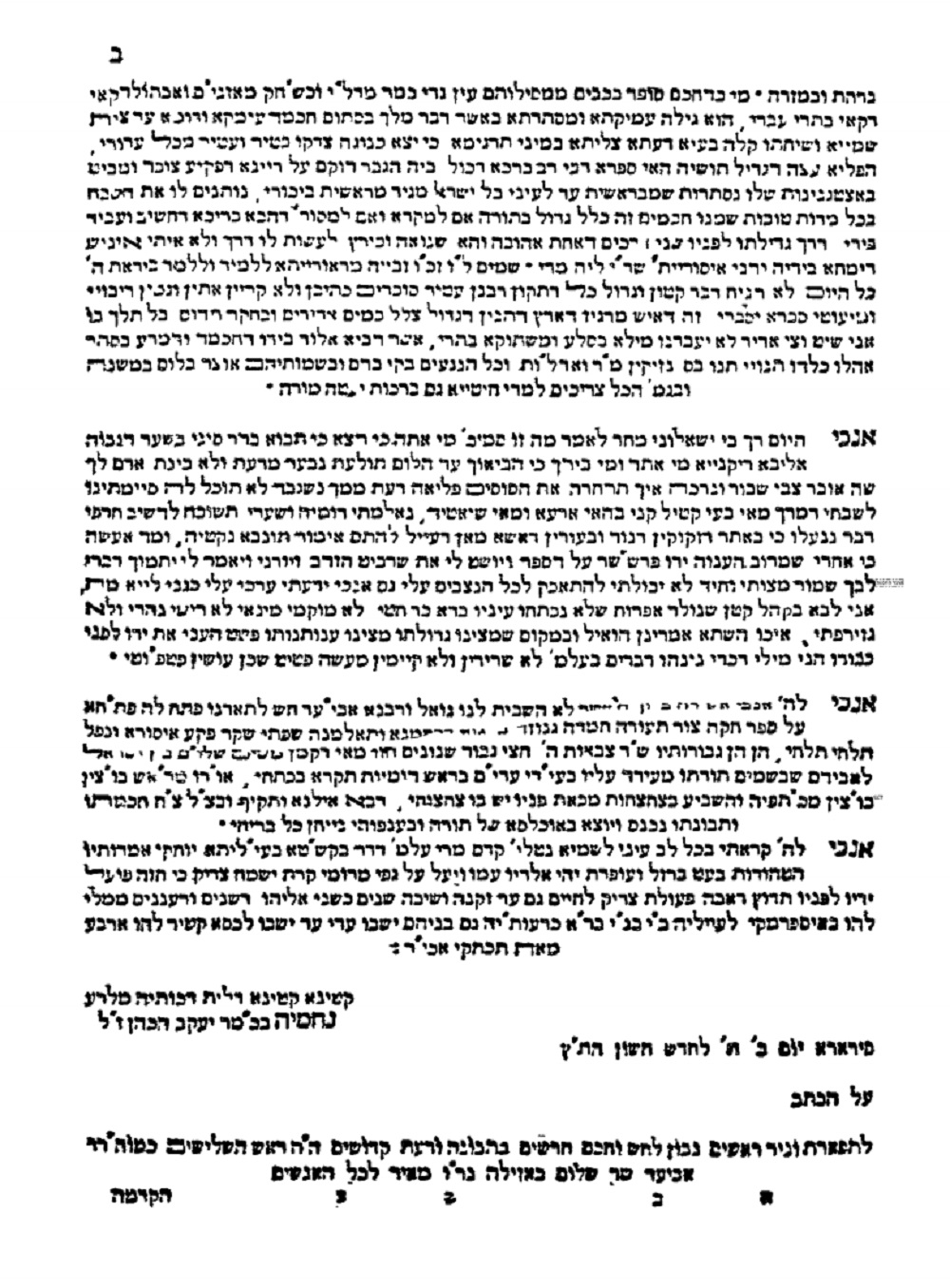


A New Book Collecting Commentaries on Targum Yonason

The Targum Yonason is a fairly standard commentary on the Torah (we are only discussing the Torah one). Now, as most are aware, in fact this is not from Yonason but instead is more correctly called Targum Yerushalmi (Jerusalem Targum). In academic circles it is referred to as Pseudo-Jonathon. In all likelihood, the original name was in fact Targum Yerushalmi but was abbreviated as ת”י and thus mistakenly expanded to be תרגום יונתן and not the correct תרגום ירושלמי. Various editions of this commentary have been published and you can find a listing in Kasher’s Sa’arei HaElef. (you can see a bibliography of translations here and more stuff here.)

Be that as it may, there is much discussion about the content of this Targum. For instance, perhaps most famously, this Targum “translates” the prohibition against cross-dressing as prohibiting women from donning Tallit and Teffilin. While there are some complete works on the Targum (see the lists in Kasher, supra, as well as Kasher’s discussion on the Targum generally in Torah Shelemah, and Kressel, Ma’ada haMikrah), most of the discussion which touches on this Targum appears in books which are not directly related to this Targum. This makes it difficult to locate but now this has been remedied with a new edition (thus far on Berashis, Shemos, and most recently Devarim) which collects just about everything on this Targum.

The work is titled Sa’resi Ba’Midinah and is edited by R. Henoch Levine.* As mentioned above, a major difficulty is locating the discussions on this Targum, this edition has uses hundreds of books and collected the relevant material for the reader. Additionally, an especially nice touch and one lacking (if you are sensitive don’t read the rest of the sentence) in many seforim today, it includes a bibliography of all the works used. This bibliography is not just a list of titles but even provides which edition was used to make it easy for the reader to check the source themselves. Further, the author as well as the topic (many books have the same name) are included to further insure ease of location of the sources. The breadth of sources is astounding. Further, a index which includes Tanakh, Shas, Midrash, and Shulhan Arukh, is included as well. All of this is printed on nice paper in clear text. The Targum is included as well as the text of the Torah, Onkelos, Rashi, and Toldot Aaron.

As for the Targum itself, according to the introduction (which appears in the Shemot volume) the editor attempted to correct the text. But, it is unclear how or what he did on that front. There are critical editions of this work (see the sources supra) but I can not tell if he used them.

The one shortcoming appears in the introduction. There, the editor, using the book Yanchanu which is devoted to defending the notion that this targum is in fact from R. Yonason, attempts to show that this work is truly from R. Yonason b. Uzzeil the Tanna. He spends the bulk of the introduction on this task. As we know this has been shown to be wrong. Additionally, what is particuarly disturbing is one manner in which the editor (recounting as it appears in Yanchanu) “proves” his point. The editor marshalls R. Tzvi Hirsch Chayes (Maharetz Hiyot), the editor alleges, the Maharetz in a footnote also allows the author is in fact the Tanna. The citation is to a footnote in Minhat Kinot, Mahritz’s defense of Orthodox Judaism against Reform Judaism. (there is no pagination in the introduction but it appears in the second page of the introduction) The footnote in fact is not really on point. But setting that aside, Maharetz wrote an entire work discussing the various Targumim, and specifically discusses the Targum Yonason. Maharetz says explictly the commentary on the torah is NOT from the Tanna. (See Imrei Binah no. 4). Maharetz is not the only “traditional” scholar to argue this, a bit earlier, R. Shlomo Chelm, author of the Merkevet HaMishna (a fascinating character in his own right) also says this Targum is not from the Tanna. (Merkevet HaMishna, Ma’chelet Assurot, 1:8). Thus, while a quote in isolation may support the notion Yonason was in fact the author, the R. Chayes himself was clearly of the opinion this Targum was not from Yonason.

In the US, the books are available at Beigeleisen and possibly others and in Israel try Girsa.

*[To make this clearer, as there seems to be some confusion, I will first discuss the positive points of this work and then discuss some drawbacks. Perhaps this format will enable anyone who doesn’t want to know about the drawbacks to stop reading or, if need be, cover over the final paragraph.]


Midrash Lekah Tov, part Deux

In a follow-up to Professor Carmi Horowitz’s recent post at the Seforim blog, I wanted to discuss, in a bit more detail, the new reprint of the Midrash Lekah Tov and further bolster Prof. Horowitz’s conclusion that this new reprint falls short of expectations as well as the Makhon who did this. In the world of Hebrew books there are many books published almost daily, while there is much quantity should not be mistaken for quality. In truth this is not a new phenomenon, rather R. Jacob Emden in the 18th century decries the mass amount of poor Hebrew literature and that although there is much published not much is that good. R. Yitzchak Satanow, R. Emden’s contemporary, also points out the dearth of quality literature and, perhaps more importantly, the masses willingness to accept this literature. He claims that he was thus forced to publish his own works under pseudonyms attributing the works to persons much earlier than was actually the case. With these comments we can turn to what will be the first part of a two part post discussing a particular publishing house as well as their most recent publication, the Midrash Lekah Tov. First, the “new” edition of this Midrash. This Midrash which was authored by R. Tuvia b. Eliezer who lived in the 11th century in the Byzantian Empire. Bibliographically, this Midrash has somewhat of a storied history. It was first published from an incomplete manuscript in 1546 in Venice and titled Pisketa Zutra. Only the portions on Vayikra through Devarim were published.

It was not until 1880 was the full edition on the Torah published by Dr. Solomon Buber. I have used the Dr. appellation as he had a doctorate but I am unsure if he had semikha, this however, is not a bar to the use of the Rabbi appellation, as in the Vilna Shas in the Achrit Davar at the end of Mesekhet Niddah, he is referred to as R. Solomon Buber. Dr. Solomon Buber dedicated this work to the memory of his father, R. Yeshaiah Avraham Halevi. Additionally, the portions on the five Meggilot were published around that time for the first time as well, Esther 1886, Ruth in 1887, Eicha in 1895 (there was an edition published the next year in Calford, England, which was touted as the first edition, in actuality it was the second edition), Kohelet in 1904, Shir haShirim in 1909. Now, as Prof. Horowitz has noted, Makhon Zikhron Ahron has republished the section on the Torah and five Meggilot with Buber’s comments as well as a few notes from R. Yerucham Fishel Perla.

Although they neglect to mention where they located that R. Perla’s notes, appeared 50 years ago in the journal Hadarom which they most probably found in Sa’rei haElef. Aside from the above they reset the type. Importantly, however, the text remains the same as it was in 1880. A simple search of the Jewish National and University Library (JNUL) catalog reveals that there are at least sixty some manuscripts available, most were neither available nor used by Buber in his edition, but nor are they used in this edition.

Instead, our edition is frozen in the late nineteenth-century. These manuscripts contain much additional information as was already pointed out by Prof. Yisrael Ta-Shema in his article on this work. Now, lest one think that Buber’s edition the type was unreadable, rather it was a highly readable edition, further, it was not unavailable, but instead reprinted on many occasions in photomechanical offsets, and in fact, as Prof. Horowitz noted, this new edition the Greek is almost unreadable as they did it by hand or via cut and paste. Why then this work was republished in this “special” edition but remained as it was is rather unclear.

This is not the only time this Makhon has failed to use important manuscripts when reprinting something. Additionally, this same Makhon reprinted the Perkei D’Reb Eliezer. What is shocking about this is that there are very important manuscripts, manuscripts which this Makhon did not bother using, which one doesn’t have to even go to a library, they are online! There is an entire project devoted to the correct text of the Perkei D’Reb Eliezer. Instead, as they did here, they merely reset the type and reprinted the Perkei D’Reb Eliezer. Of course, no one is obligated to use every manuscript, but when as is the case both here and in the case of the Perkei D’Reb Eliezer, the prior editions are available, what is the point in merely resetting the type and reprinting the books? A good example of a reprint where it was valuable was the case, by this same Makhon where they reprinted and reset the type of some important unavailable works on the Shulhan Arukh, including R. Chaim Buchner’s Or Chadash, Nachlat Tzvi, and Olat Shabbat (which the Magen Avraham refers to by the abbreviation O.S. on many occasions). This as an excellent reprint as the earlier editions were difficult to come by and difficult to read. Or, again the same Makhon, reprinted the Levush. This edition is beautiful. They reset the type included, in the proper place both the Eliyahu Rabba and Zuta, the commentary of the Hida’s grandfather from manuscript, as well as notes and other commentaries. This is excellent and has now been reprinted in a smaller format. The Makhon also printed an edition of Perek Shira which has three commentaries from manuscript one being from R. Dovid Oppenheim, that was also very good. Thus, I want to make clear, that while the books such as Lekah Tov are disappointing, this Makhon has published some excellent works.

Now, however, it is worthwhile noting that this Makhon is set up as a public service and as such is not out to make money. And, it is highly laudable to reprint seforim, my point here, is to merely point out some areas where the Makhon can improve.

It may be instructive to discuss how we know what we already do about this work, and I apologize to those readers who already know this. First, as mentioned above, for bibliographical information on this sort of work, R. Menachem M. Kasher’s Sa’arei HaElef is irreplaceable. As noted above, he records that R. Y. Perla’s comments had been printed. Additionally, he provides the location of reviews on Buber’s edition. As this work was updated by Kasher’s student, Mandelbaum he also adds to this information as well. Recently, Prof. Simcha Emmanuel has updated Sa’arei HaElef as well but only the poskim portion, hopefully a full update will happen soon.

Setting aside the more general tutorial, wWe can turn to the work itself. Prof. Ta-Shema wrote an article which he intended to publish in Sidra, however, he died before he was able to submit the final version for publication. Nevertheless, in the posthumously published Keneset Mechkarim vol. 3 (pp. 259-94) we have this article, “Midrash ‘Lekah Tov’ – Its Historic Place and Purpose.” Prof. Ta-Shema reviews the work and points out important details. He discusses the various laws and customs gleaned from this work.

Particularly timely is the appearance, in this work, of the custom to blow the shofar during the month of Elul.[1] this work contains much in the way of explicating the law, one of the purposes is to demonstrate the close connection between the written and oral Torah and thus much is devoted to showing how the laws are derived from the Torah. This focus was in part to disprove the Karaites. And, as Ta-Shema notes, it was not only strictly legal questions which the Lekah Tov disputes with the Karaites, rather substative theory is addressed as well. This is one of the many times the various available manuscripts come into play. (See Ta-Shema pp. 269-71). There are numerous examples where Lekah Tov takes issue with the Karaites, including lights on Shabbat, Yemi Taharah, an established calendar, and Shavuot.

Ta-Shema notes that the style of this work is to explicate the verses in a fairly peshat oriented manner similar, although not the same, as Rashi. In fact, they were contemporaries. This fact is particularly important for understanding Rashi. Specifically, there is a question whether Rashi’s commentary on the Torah as we have it today is all from Rashi or have there been additions. Obviously, whether we can say all which is attributed to Rashi is in fact from him is rather important. The question with the Lekah Tov is that there appear quotes from the Lekah Tov in Rashi. Well then we must decide when the Lekah Tov was disseminated. As if it was not until after Rashi then it is clear that there must be at least some later additions to Rashi’s commentary, if Lekah Tov significantly predates Rashi then this poses no problem. But, this is all complicated by the fact the Lekah Tov seems to have used Rashi and visa versa. One possibility which would explain this is that both these works went through more than one edition, thus in the very first edition of Rashi he did not include the Lekah Tov, but after he got a hold of it and Rashi was revising his commentary he included those comments and the same for the Lekah Tov’s use of Rashi. According to this explanation the fidelity of Rashi is not questioned.[2] But, as is apparent this is a very important question, one which could have been explored had an attempt to reconstruct when and how many editions the Lekah Tov was originally written in and when.

As should be apparent, Prof. Horowitz’s criticism of this edition are well-founded. It is especially unfortunate that today when it is so easy due in part to the advances in technology that it seems at times we have not progressed at all.

Notes
[1] For more on this topic see, among others, Pardes Eliezer, Chap. 1, 29-88; Yehiel Goldhaber, Minhagei HaKehilot, pp. 5-8; Oberlander, Minhag Avoteinu, Vol. 1, chap. 1, 3-23; Daniel Sperber, Minhagi Yisrael, vol. 2 pp. 204-14.

[2] For more and additional sources discussing this question see Yisrael Ta-Shema pp. 266-7 n. 25; on the various edition of Rashi’s commentary to the Talmud see Y. S. Speigel, Amudim B’Tolodot Sefer HaIvri Kitva V’Hataka, pp. 113-22. The claim that a work attributed to an author is not fully from him is used by many to explain various perceived inconsistencies. As Prof. Marc B. Shapiro pointed out, in his recent post at the Seforim blog, R. Moshe used this to explain controversial comments of R. Yehuda HaHassid. See Speigel, id. pp. 271-75 and generally id. chapter 6 discussing responsa literature. For an example of this in the case of a Torah commentary see the comments of R. M.M. Kasher Torah Shelmah where he claims that a particularly controversial passage of the Ibn Ezra’s commentary where he seems to imply Moshe did not write various portions of the Torah was inserted later.