ArtScroll and More

ArtScroll and More
Marc B. Shapiro
In an earlier post here I discussed ArtScroll’s use of a censored talmudic text.[1] This happens quite a bit and it is not always clear if the translators were aware that they were working with an inauthentic text. However, for many passages there is no question that they realize that what they are translating is not authentic but was added because of fear of non-Jewish reaction. Here is a chart someone drew up showing how the various new Talmud editions deal with the matter of censorship.

It is significant that even in the Hebrew ArtScroll the text that is used is censored. ArtScroll has never publicly explained why they have adopted this approach, but I think it is obvious that unlike other publishers, ArtScroll is still worried about creating anti-Semitism and thus continues to print a censored Talmud. While I think everyone agrees that the ArtScroll Talmud translation is a masterpiece, opinions will obviously differ as to whether ArtScroll made a mistake in not restoring the Talmud to its pre-censorship state.[2]
ArtScroll’s approach is different than that of other publishers who are very happy that they can now include the complete uncensored words of the Talmud. Ezra Chwat’s words express the feeling of every publisher other than ArtScroll.[3]
אין צורך להדגיש את החשיבות של הנגשת הסוגיה המקורית לעשרות אלפי הלומדים את הגמרא כפי שיצא מפיהם הקדושים של האמוראים, ושלא יסתפקו ב”גירסא” שאושרה על ידי הכנסייה.
Yet R. Leopold Greenwald had the exact opposite approach, and he was upset when he heard that a new Talmud was being printed that reinserted the censored texts. His words reflect the approach later adopted by ArtScroll [4]:
ומה מאד דאבה נפשנו בראותנו, כי מכריזים גם עכשיו על “המציאה הגדולה”, כי בירושלים מדפיסים כעת תלמוד עם כל ההשמטות שהשמיטו הצנזורים במשך מאות שנים. ועל זה אנו קוראים: שקול טובתך! בני ישראל לא ישבעו עונג מהטובה הזאת, לא ספרותנו ולא חכמתנו יתעשרו מהשמטות הללו, לא בזמננו ולא בהדורות שאחרינו. כבר שבענו צרות ומכאובות. ולהיות בפי כל מחבל בודאי אסון הוא. איפוא הם חכמי ירושלים? האם אינם רואים כי מזה לא תושע יהודה וכי צוררי ישראל ישיגו חומר מסוכן חדש?
For those who are unaware of the details, let me just mention that I am not referring to a word here or there that was censored and has not been restored by ArtScroll. Sanhedrin 43a has a number of lines dealing with the execution of Jesus and his disciples. While the entire section is found in Soncino (in translation), Steinsaltz, Wagshal and Oz ve-Hadar, it is not to be found in ArtScroll. Both the English and Hebrew editions of ArtScroll tell the reader that a section has been deleted from the Vilna Shas. However, in Sanhedrin 67a, where another section has been deleted and is found in the other editions just mentioned, ArtScroll does not inform the reader of the deletion.
An allusion to the Sanhedrin 67a text is found in Va-Avo ha-Yom el ha-Ayin, attributed to R. Jonathan Eybeschuetz. This explosive text, which remained in manuscript for almost three hundred years, has just appeared in print, edited by Pawel Maciejko.[5] Va-Avo ha-Yom el ha-Ayin is very important to understanding the controversy over R. Eybeschuetz. (I hope that the manuscript Gahalei Esh, a treasure trove of documents dealing with eighteenth-century Sabbatianism, will also soon appear in a scholarly edition.) Quite apart from the radical theological notions found in Va-Avo ha-Yom el ha-Ayin, Maciejko describes the work as follows: “[I]t is blatantly pornographic (in fact, it is possibly the only truly pornographic text ever written in the rabbinic idiom.)”[6]
Speaking of pornography let me add the following. Not long ago I was visiting a certain synagogue for Shabbat. When it came time for Torah reading I took out the chumash that was near me. It happened to be the one published by R. Aryeh Kaplan. I actually am not a fan of this chumash for use in synagogue as its focus is entirely philological, and doesn’t deal with any of the issues that a typical person would want explained in reviewing the Torah portion. But this was what I had so I used it. In Exodus 35:22 an unusual word appears: כומז. It means some sort of golden bodily ornament. The word also appears in Numbers 31:50. According to the Exodus passage, this was one of the items the Israelites in the desert donated at the time of the building of the Tabernacle. The passage is Numbers refers to booty taken from the Midianites. Among the different interpretations Kaplan offers for כומז is “a pornographic sculpture.” This is quoted in the name of R. Aaron Alrabi (fifteenth century). I was quite shocked when I saw this and later saw that this interpretation is also quoted by R. Kasher in Torah Shelemah, which must have been where Kaplan saw it.
Alrabi wrote a commentary on Rashi which was published in Constantinople in 1525. In this work, on Exodus 35:22, Alrabi writes:
יראה לי שהוא תכשיט מצוייר צורת רחם האשה כדי שישתוקק רואהו לפועל המשגל והצנועות היו מביאות אותו עליהן בחדריהם לתת תשוקה לבעליהן העין רואה והלב חומד בו, והיה זה לכונה טובה לכן הותרו לשרת בקדש
What this means is that the item in question had a picture of a woman’s private parts. The Israelite women would have their husbands look at it in order to sexually excite them before they had marital relations. Since this pornographic viewing was for a good purpose, it was permitted for these items to be donated for use in building the Tabernacle. Here is the original text.
Those who want to see the book in its entirety can view it here.
I find this explanation quite strange. I don’t know what led Alrabi to his original understanding and why he did not find any of the prior explanations compelling.
Incidentally, one of the other explanations cited by Kaplan is that כומז means a chastity belt. R. Ephraim ben Shimshon (12th-13th centuries) writes[7]:
הכומז היה כלי כמנעול שקושרת האשה פתחה שלא יודעו להם שם אדם, כי אם בעלה לבד, והוא גודר הערוה.
This is how he understands Shabbat 64a which states that כומז means דפוס של בית הרחם. Soncino translates this as “cast of the womb” and ArtScroll translates it the exact same way. Koren translates “a mold [in the shape] of the womb.” In general I would say that disagreeing with these three translations is not a smart thing to do, yet in this case I must do just that. The translations I have cited are incorrect as they do not reflect what the Talmud is saying. בית הרחם in Shabbat 64a does not mean “womb” but rather something else. In order not to cause problems for those with internet filters I won’t spell it out completely, but I think the reader already understands.[8]
Rashi, Exodus 35:22, in summarizing the Talmud leaves no doubt in this matter:
כלי זהב הוא נתון כנגד אותו מקום לאשה
The very text in Shabbat 64a also lets us know that this matter has nothing to do with a “womb”, as immediately following the explanation of דפוס של בית הרחם the Talmud explains that the wordכומז  is an acronym of כאן מקום זימה “here is the place of lewdness”, and there is no issue of lewdness with the womb. ArtScroll itself, in its note on this latter passage, explains the matter well: “The place encased by this ornament is the part of the body which is the focus of lewdness.” In other words, in its commentary ArtScroll tells us that we are not dealing with the womb at all, but with another part of a woman’s anatomy. As such, it was a mistake for ArtScroll in its translation to adopt Soncino’s rendering of כומז as “cast of the womb”.
In his commentary to Berakhot 24a s.v. תכשיטין שבפנים, Rashi explains that a כומז is a chastity belt. From the context of this talmudic passage we see that it also had ornamental significance:
כומז דפוס של בית הרחם שהיו עושין לבנותיהן ונוקבין כותלי בית הרחם כדרך שנוקבין את האזנים ותוחבין אותו כדי שלא יזדקקו להן זכרים
In its commentary, ibid., ArtScroll summarizes Rashi as follows: “The kumaz was an ornament that covered a woman’s private parts.”
Let me return to Shabbat 64a where כומז is explained as being an acronym for כאן מקום זימה. The Maharal, Gur Aryeh, Ex. 35:11, writes:
מפני שהוקשה להם לרז”ל שאין דרך לשון הקודש לקרא שם מיוחד לדברים שהם ערוה . . . כל דבר ערוה אין הכתוב נותן לו שם מיוחד . . . וכאן למה קרא כומז שם מיוחד אל הכלי הזה שהוא דפוס בית רחם, ולכך דרשו רז”ל שהוא כאן מקום זימה והשתא אין שם מיוחד לכלי זה רק כאילו נקרא כאן זימה.
I don’t understand the Maharal’s point. Just because there are no words in leshon ha-kodesh for sexual organs, why should we assume that there is no name for an item designed to cover a sexual organ?
Returning to the matter of “pornographic viewing” as described by Alrabi, I wonder if this could also have halakhic significance. I mention this only because of the controversy some years ago by an answer given by R. Shlomo Aviner that in a she’at ha-dehak (i.e., there are serious marital sexual issues) it would be permitted for a husband and wife to together view explicit pictures in a book. See here.
The entire conversation with R. Aviner was a set-up, and the anti-Aviner website used it to attack R. Aviner, and portray him as permitting viewing of pornography. Yet it is obvious that he was referring to sexual self-help books (which would have explicit pictures) since he refers to books found in Steimatzky. R. Moses Feinstein had earlier permitted a soon-to-be-married man to read sexual self-help books.[9] There is no indication in R. Feinstein’s responsum that he is also including the viewing of pictures in such books, but I do not know if he would regard this as a problem if the pictures are not of real people but are drawings.
Let us return to the subject of chastity belts. In the Wikipedia entry for “Chastity Belt” one finds the following:
Gregory the Great, Alcuin of York, Bernard of Clairvaux and Nicholas Gorranus all made passing references to ‘chastity belts’ within their exhortatory and public discourses, but meant this in a figurative or metaphorical sense within their historical context.
The first detailed actual mention of what could be interpreted as “chastity belts” in the West is in Konrad Kyeser von Eichstätt’s Bellifortis (1405), which describes the military technology of the era.
As we have seen, Rashi and R. Ephraim are not referring to chastity belts in a metaphorical sense. Thus, their mention of the item is of general historical significance, and Rashi (1040-1105) might be the earliest recorded example of someone referring to a chastity belt. Eric John Dingwall wrote an entire book on the subject of chastity belts entitled The Girdle of Chastity (Scranton, 1959). On p. 14 he writes: “There can be little doubt that the idea of such a device, at least in a somewhat modified form, was current at least as early as the second half of the twelfth century.” He then cites the late twelfth-century Guigemar Epic, written by Marie de France, as a source of this. Yet Rashi’s mention of the chastity belt predates this source by around a century.
See also here where as part of a museum exhibition on chastity belts it states:
Until the 12th century, there are no textual memories related to chastity belts at all (not even any allusions without actually using the term) where the reference is not in a theological or mythological context.
This sentence is incorrect, for as we have seen Rashi referred to chastity belts many decades before Marie de France, who is also cited in the museum exhibition as the first one to refer to the item. What we have here is a good example where scholars make judgments based exclusively on their knowledge of medieval Latin, Romance and Germanic literature. Exposure to what appears in medieval Hebrew texts would have caused them to alter these judgments.
Returning to ArtScroll, here is an example where I believe that ArtScroll has printed something that they know is incorrect, but did so in the interest of good Jewish-Gentile relations. I think it is a noteworthy example as it has nothing to do with a censored text, but focuses on the explanation of the Talmud. Avodah Zarah 6a states that according to R. Yishmael it is forbidden to do business with idolaters because of Sunday. Rashi explains that this means that one can never do business with idolaters since one cannot do business with them three days before and three days after their holiday, and this includes the entire seven-day week.
It doesn’t take much imagination to realize what the Talmud is referring to by “Sunday”, and in the uncensored text it actually has  נוצרי, נוצרים or  יום הנוצרי instead of “Sunday”. Yet ArtScroll in its translation states that the Talmud is referring to “Babylonian pagans who observe a sun-worshiping festival every Sunday.” It is true that Meiri states as much.[10] Meiri also claims that when the Talmud uses the word נוצרים it does not mean followers of ישו הנוצרי, but refers to the use of the term in Jeremiah 4:16, which Meiri claims is derived from the word נבוכדנצר.[11] While it is true that R. David Kimhi also sees the word in Jeremiah 4:16 as related to נבוכדנצר, it is Meiri alone who claims that this is also intended when the Talmud refers to נוצרים.
It is certainly appropriate that ArtScroll cited Meiri’s explanation in a note, but how is it that this is the only explanation cited, when other than Meiri everyone else has assumed, with good reason, that נוצרים refers to Christians? This can only be an example of ArtScroll shading the truth for apologetic reasons. People can debate the appropriateness of this, but there can be no doubt that ArtScroll is not being frank in its presentation here.
In the ArtScroll Hebrew edition it also quotes Meiri and states the that Talmud is not referring to Christians. Yet unlike in the English edition, in the Hebrew ArtScroll there is a note which states: “See Rambam, Hilkhot Avodat Kokhavim 9:4”. If you open up the Mishneh Torah what you find is that the Rambam states:
הנוצרים עובדי עבודה זרה הן ויום ראשון יום אידם הוא
In other words, by referring to the Mishneh Torah after mentioning Meiri, ArtScroll is alerting readers to the fact that the Rambam does not agree with Meiri and believes that the passage in Avodah Zarah 6a indeed refers to Christians. Yet this is never spelled out in ArtScroll, and you need to take their suggestion to consult the Mishneh Torah in order to learn that not everyone agrees that when the Talmud mentions those who make Sunday their holiday that it is referring to Babylonian pagans. (In fact, as already mentioned, only Meiri advocates this position.) Does the average person who learns daf yomi realize this?
In case anyone has any doubts as to what I am saying, please note the following. After referring to Maimonides, the note in the Hebrew ArtScroll calls attention to the Venice edition of the Talmud with Rashi, and to Dikdukei Soferim. Again, only one who examines these sources will learn that they offer an interpretation at odds with Meiri. If you look at the Venice Talmud or Dikdukei Soferim (or even Steinsaltz) you will find that in Avodah Zarah 6a Rashi explains:
נוצרי, ההולך בטעותו של אותו איש שצוה להם לעשות להם יום איד בא’ בשבת
In other words, Rashi tells us, just like Maimonides, that when the Talmud refers to those who celebrate נוצרי יום it means the Christians who follow Jesus.I find it significant that even in the Hebrew edition ArtScroll feels the need to only allude to the explanation of Rashi and Maimonides, while presenting Meiri’s explanation as the standard understanding of the text. ArtScroll certainly knows that this is not the standard understanding, and ArtScroll itself cannot believe that Meiri’s understanding is what the Talmud really means. After all, every other medieval commentator agrees with Rashi and Maimonides. In this case, the only explanation is that ArtScroll is following a long apologetic tradition, which was based on fear of what the non-Jews would say if they knew the true meaning of certain talmudic passages.

Another example of this tendency was called to my attention by R. Moshe Maimon. Ketubot 15a discusses the case of A killing B, when A actually intended to kill another person. In its discussion the Talmud refers to “Canaanites”, which in the current context simply means non-Jews. In fact, in all manuscripts and early printings what appears is not “Canaanites” but “goyim”.[12] “Canaanites” is simply a “correction” of the censor. Yet ArtScroll has a note explaining that “The Canaanites were the pagan people who lived in Eretz Yisrael before the Israelites entered the land.” The implication of this comment is that the halakhah stated in the Talmud was only applicable with the ancient Canaanites but not with regard to other non-Jews. This is false and ArtScroll knows it is false, but it is no different than the “note to reader” found in many seforim that all the halakhot about non-Jews only refer to the pagans in faraway places. In the latter case everyone knew (and knows) that these words are not to be taken seriously, but I would assume that the typical user of the ArtScroll English Talmud does not realize this. It is noteworthy that the ArtScroll Hebrew Talmud does not include the note about the Canaanites.[13]
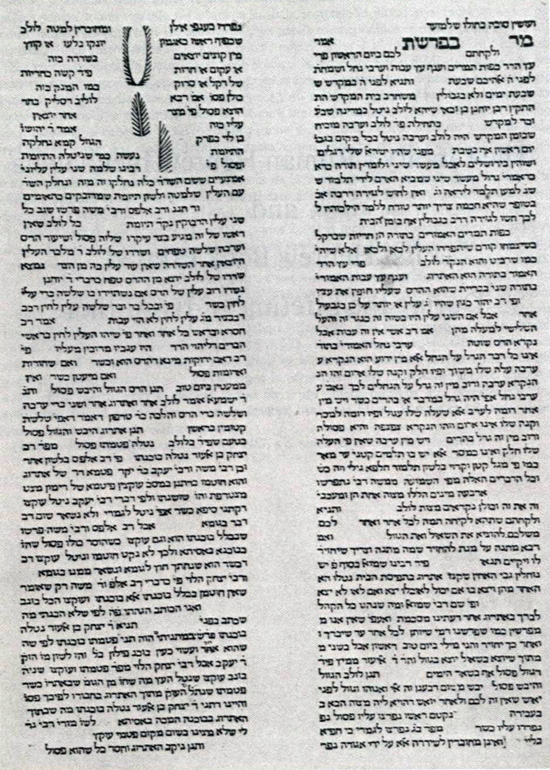
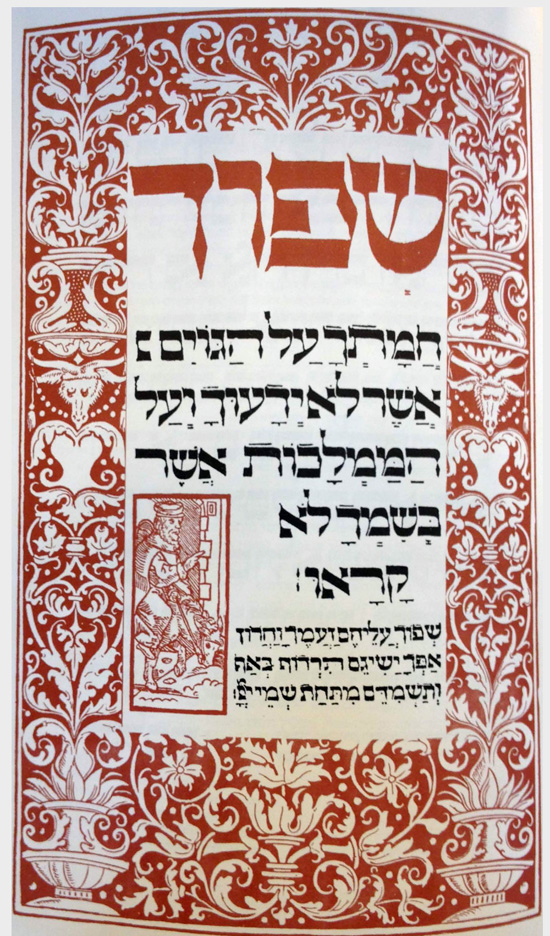
In 1728, an era in which Jewish-Gentile relations were not the best, R. Jonathan Eybeschuetz printed Tractate Berakhot with many deletions, as this was the only way he was given permission to publish the volume. Here is the title page.
The volume can be found at hebrewbooks.org here. True to form, R. Jacob Emden accused R. Eybeschuetz of being in league with the bishop of Prague and intent only on making money from his new printing.[14] There was also a lot of controversy about this edition, not only because of the many deletions but even more so because of the instances where the talmudic text was rewritten. While non-Jewish censorship has a long history, this latter practice, of Jews agreeing to rewrite sections of the talmudic text, was a new and more dangerous phenomenon. Other tractates were later printed, but R. Eybeschuetz had nothing to do with them, and in any event the controversy focused on Berakhot as the other tractates simply printed the censored text from the earlier Basel edition, but did not add anything new.[15]
In his recent outstanding study of this episode, which makes use of manuscript sources, Pawel Maciejko writes:
In both academic scholarship and Jewish collective memory, the best-known controversies concerning Rabbi Jonathan Eibeschütz (1690-1764) are those about his kabbalistic tract Va-avo ha-yom el ha-‘ayin . . . and about the allegedly Sabbatean amulets that he distributed to the members of the communities of Metz and Altona, Hamburg, and Wandsbeck in the 1750s. However, during his early years, the most important controversy concerning Eibeschütz was not the dispute surrounding his suspected Sabbateanism and the heterodox writings attributed to him but rather the outrage engendered by his friendly relations with the local Catholic clergy and his alleged involvement in the publication of heavily censored editions of the Pentateuch, the Talmud, and the prayer book. In the eyes of many contemporaries, the damage caused by the appearance of these latter publications vastly overshadowed any harm stemming from the heretical views expressed in Eibeschütz’s kabbalistic works and amulets.[16]
Maciejko notes that R. Moses Hagiz was so outraged by R. Eybeschuetz’s Talmud that he asked other rabbis to issue a ruling that it be burnt!
Shortly after the publication of R. Eybeschuetz’s Talmud someone wrote a defense of it, explaining why it was necessary to print a censored Talmud.[17] Raphael Kirchheim, who published this document, cites another who states that its author was none other than R. Eybeschuetz, since the author refers to R. Abraham Broda as his teacher.[18] R. Broda had served as rosh yeshiva in Prague, and later rav of Metz and Frankfurt.
While Maciejko also accepts this view,[19] the reference to R. Broda as the author’s teacher, מורי ורבי, would appear to show that R. Eybeschuetz could not have written the letter, since he was not a student of R. Broda.
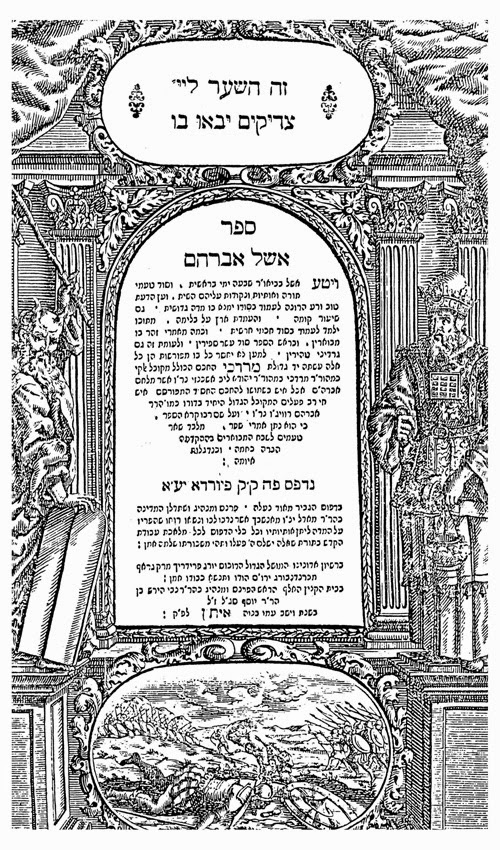
We have good information about R. Eybeschuetz’s life, but there still is a lot we don’t know. Even though R. Eybeschuetz is not recorded as R. Broda’s student in the standard biographies, one could claim that it is possible that he studied for a short time under him, and for some reason this fact was not known to the biographers.[20] Yet in this case we can indeed make the definitive statement that R. Eybeschuetz did not study with R. Broda since R. Eybeschuetz tells us this himself. Some thirty years after R. Broda’s death in 1717 his Eshel Avraham was published (Frankfurt, 1747). Here is the title page.
Among those who provided an approbation was R. Eybeschuetz, who at that time was in Metz. His respect for R. Broda is great, but he leaves no doubt that he never studied with him:
ממש רובי חכמי ישראל בדור הזה השלימי’ המה שותי מימיו ואף אני אם לא זכיתי לאורו לחזות לרבי מקמא כי בבואי לפראג שנת תע”ל כבר חמק דודי ופנה הודו לכאן ק”ק מיץ היא העיר אשר כעת אני יושב בה בתוך עמי, מ”מ נפתולי נפתלתי עם גדולי תלמידיו הרבני’ וחכמי’ מובהקים ושלימים במדע אשר נשארו שם ושמעתי’ תמיד בבי מדרשי’ בדיבוק חברי’
Returning to the document published by Kirchheim, it describes the history of the banning of the Talmud in the years before R. Eybeschuetz printed his volume. Interestingly, it tells about the confiscation of Jewish books from the Jews of Prague, which were then handed over to the Jesuits to be examined for anything against Christianity. From other sources we know that the Jesuits burnt the copies of the Talmud they confiscated, and “[i]n the 10 years from 1715 to 1725, very few copies (according to some sources, none) of the Talmud existed in Bohemia.”[21]
This need for copies of the Talmud explains why R. Eybeschuetz had to take the step he did. The document also tells of the punishment of a man from Nikolsburg who was caught smuggling Talmuds into the Prague ghetto. He was forced, in chains, to clean the streets for a year. The smuggled Talmuds were supposed to be burnt, but this was somehow prevented (probably with a good bribe).
The only way to print a Talmud in Prague was to remove everything the Jesuits viewed as offensive to Christianity. They also viewed certain aggadot as objectionable, such as the description of God wearing tefillin in Berakhot 6a, and these too had to be removed.[22] The document tells us that having the Church agree to publication of the Talmud, even with these restrictions, was regarded as a great achievement. It also tells us that all the important rabbis in Prague permitted the publication of the bowdlerized Talmud.[23]
וכאשר הגיעו לידינו רשימה אספנו להגאון מורנו ורבנו האב”ד ור”י נר”ו בצירוף כל חכמי רבינו [!] עירנו אשר ת”ל המה גדולים בחכמה ובמנין וטבעם יצא בכל ארץ לעיון במילין אם כשר ונאות לעשות כן אם לא ואחר הלנת דין פעמים ושלש ומשא ומתן עלתה הסכמה להדפיס מס’ ברכות הנודע הגהתן וסדר זרעים אשר לא יחסר בו דבר, אך ממסכת שבת והלאה לא עבר הסכמתן כי לא נודע עדיין טיב הגהות נוצרים בו אם מעט אם רב
The document then quotes a statement issued by the scholars of Prague defending their decision, a statement that was only intended to be viewed by other learned Jews. In justifying their decision to publish a censored Talmud – since this was all they were permitted and it was a censored Talmud or nothing – we find the following very interesting passage:[24]
ודאי שנכון הדבר לעשות לבלי כושל ועיכוב כלל כי ודאי שניתן הש”ס להצילו באחד מאיבריו ולא יהיה הש”ס חמור מג”ע וש”ד אשר ק”ל יהרג ואל יעבר קימו לן אם מיחדים על אחד ימסר להם ואל יהרגו וכ”ש הדבר בש”ס שבזמן שמיחדים לומר השמיטו דא מאתכם שיהא הנשאר לפליטה שישמיטו זאת ולא יצאו כולם לבית השריפה מבלי שריד באהלינו אהל תורה ובפרט כי חז”ל שיסדו התלמוד לא על זה יסדו להיותו בדפוס גלוי לכל עמים כי אם כתבוהו בכתיבה תמה ומסרו זאת לזרע אמונים להנחיל לבניהם אחריהם לחלקם ביעקב ולהפיץ בישראל.
The last sentence is making the point that there are certain things in the Talmud that should not be published for all to see, as these are the sorts of things that could create great problems with non-Jews. The Prague scholars then state that it is actually a good thing to cut out certain passages from the Talmud. In other words, they are acknowledging that even without Christian demands, it would be best in internally censor certain passages so as to prevent problems from arising. This is exactly what ArtScroll is doing today. No one is forcing them to self-censor, but they see matters as the sages of Prague who wrote (emphasis added)[25]:
וזה לערך ר’ שנה שהחל להתפשט ספרינו בדפוס לתקנות אחינו למען יהיו להם הספרים בנקל ומצוי, אמנם בדברים כאלו תקנתם קלקלתם שגורמים סכנה לכל ספריהם ומטילים איבת הנוצרים עלינו ודאי ראוים שדברים אלו יהיו חוזרים לאיתנם הראשון מבלי לחוקקם בעט ברזל ועופרת.
They are not saying that the censored matters should be forgotten about. Rather, they should be only be passed on in a non-published form (“Torah she-Ba’al Peh”) to advanced students who study the Talmud; they should not be put down in print for all to see and thus create a Christian backlash. The sages of Prague make the same point about strange Aggadot that are not to be taken literally and can only be understood by a few, and which have become subject to Christian mockery. These too should be omitted[26] להציל דברי חז”ל. When possible, the Prague sages state, one should not delete an entire passage but simply change certain words. In this way the sense of the passage is not changed for any learned person, but problematic words are removed thus helping to blunt anti-Semitic attacks:[27]
ומכ”ש לשנות הלשון במילות ושמות נרדפים באופן שלא ישתנה הענין פשיטא שמותר
The Prague sages then state that if necessary it is even permitted to alter (i.e., falsify) halakhic rulings that appear in the Talmud in order to prevent anti-Semitism (which obviously could lead to real danger). They note that R. Solomon Luria disagrees but that the accepted practice is not in accord with what he wrote, a point that was later made by R. Moses Feinstein:[28]
דעת מהרש”ל להחמיר אף במקום סכנה. אמנם מעשים בכל יום שמהפכין הדין ומשנין מדרכי השלום בהפקעת הלואה וכדומה ולא שמענו פוצה פה לעולם וכן נראה היפוכו בדברי מהר”ם רבק”ש בש”ע ח”מ סי תכ”ה ודברים המה מועתקים בספרים רבים.
It is interesting that the Prague sages quoted the famous words of R. Moses Rivkes in his commentary to Shulhan Arukh, Hoshen Mishpat 425:5, who responds to a particular anti-Gentile law as follows:
The Rabbis said this in relation to the pagans of their own times only, who worshipped stars and the constellations and did not believe in the Exodus or in creatio ex nihilo. But the people in whose shade we, the people of Israel, are exiled and amongst whom we are dispersed do in fact believe in creatio ex nihilo and in the Exodus and in the main principles of religion, and their whole aim and intent is to the Maker of heaven and earth, as the codifiers have written. .  . . So far, then from our not being forbidden to save them, we are on the contrary obliged to pray for their welfare.[29]
Some, such as Jacob Katz,[30] have seen R. Rivkes’ words as reflecting a new tolerant approach. However, the sages of Prague, who were closer to the time R. Rivkes lived, saw his words as merely designed for non-Jewish eyes and not to be taken seriously by Jews. R. Rivkes’ comment would therefore be no different than the declarations found at the beginning of many seforim that all negative statements about non-Jews are only directed towards pagans but have nothing to do with the Christians of Europe who worship God and allow the Jews to dwell among them.
Unlike what has been described by the Prague sages, Maciejko does not view the “corrections” in R. Eybeschuetz’s Talmud as simply defensive. He writes:
Eibeschütz believed that there was no final, fixed, and canonized text of the Talmud. . . . Eibeschütz put himself in the shoes of the ancient sages and saw himself not as expurgating but rather as creating the text of the Talmud.[31]
Maciejko further writes:
Eibeschütz seems to have been the only early modern Jewish author who believed that the talmudic sages needed to be edited for style. For themselves, such changes were only possible thanks to the editorial freedom Eibeschütz granted himself in his “Apology and Answer of the Rabbis Prague”: Eibeschütz considered the talmudic text open and unfinished and therefore felt free to “correct” it even in instances in which he experienced no external pressure from the church or from any other powerbrokers. As for the character of these changes, one thing can be said with certainty: most of them aimed to create a neater and simpler text of the Talmud, one that avoids intricate grammatical constructions or potentially misleading expressions.[32]
It is hard for me to accept that R. Eybeschuetz could have viewed himself as “updating” the Talmud. Yet Maciejko is correct that we are confronted with the fact that R. Eybeschuetz’s Talmud contains linguistic and stylistic changes that were not required by the censor. Unlike Maciejko, I would explain matters in the following way: Since the Talmud was already being published in a censored fashion, with numerous passages deleted or rewritten, R. Eybeschuetz saw no reason not to make other changes that would create a more user-friendly text. However, this has nothing to do with the talmudic text being “open and unfinished” as Maciejko puts it. It wasn’t that he was improving on the original Talmud or seeking to replace it, but since the Talmud he was publishing was already “damaged”, as it were, he did not see a problem making other changes if these changes could be of assistance to the reader. Furthermore, everyone who bought this Talmud knew that it was a she’at ha-dehak publication and that it was only to be used if one had no access to an uncensored text. I have no doubt that R. Eybeschuetz felt the exact same way, and thus I would need more evidence before accepting Maciejko’s theory.
Maciejko makes a further claim that R. Eybeschuetz’s “editing” of the Talmud hints to his secret universalist religious views that are also found in Va-Avo ha-Yom el ha-Ayin. This is a much more provocative claim than what I discussed in the previous paragraph, and I am curious as to what other scholars will have to say about it.
In addition to being given permission to print an expurgated Talmud, the non-Jewish authorities also permitted “strange” aggadic passages to remain if a good explanation could be provided for them. In R. Eybeschuetz’s edition of Berakhot such explanations are found at the back of the volume, and the reader is alerted to them by a note on the talmudic page.[33]
Until Hebrewbooks.org put the Prague edition of Berakhot online, it was a very rare book, and Maciejko knows of only three copies in existence.[34] In 1981 Professor Shnayer Leiman republished R. Eybeschuetz’s explanations to Berakhot.[35]
To be continued


[1] See also Jeremy Brown’s post here and regarding Brown’s post see David Zilberberg’s earlier post here.
[2] Only in the last year or so have I started to examine the ArtScroll Talmud on a regular basis and I am continuously impressed. This has to be one of the most significant Torah publications of the twentieth century. Since that is the case, I don’t see why such effort is being put into producing the new Koren Talmud. While it sometimes has points that do not appear in ArtScroll, I don’t know why anyone would prefer it over ArtScroll. I have had a chance to use both ArtScroll and Koren in reviewing some sugyot in Berakhot with my son, and in my mind ArtScroll always comes out on top. I even found one place where Soncino is to be preferred to Koren (although generally this is not the case). In Berakhot 29a it states: “Corresponding to what were these twenty-four blessings of the Amida prayer of the fast days instituted?” Unlike Soncino, Koren provides no note to this sentence and most people who read it will have no clue what it is talking about since when they look in the siddur they will not find twenty-four blessings in the Amidah on fast days (as they will assume that the fast days referred to are Yom Kippur, Tisha be-Av, etc.). ArtScroll helpfully explains as follows: “On certain public fast days decreed in times of drought, an additional six blessings, enumerated in the Mishnah in Taanis 15a, are added to the eighteen regular blessings of the Shemoneh Esrei, for a total of twenty-four blessings.” I would only add that the proper transliteration of עשרה is esreh, not esrei.
[3] See here where Chwat also posts a page of R. Hananel from the censored Sanhedrin 43a.
[4] See his letter in Moshe Chaim Ephraim Bloch, Heikhal le-Divrei Hazal u-Fitgameihem (New York, 1948), p. 8. For more opposition to publishing the censored talmudic texts, see Eliezer Zvi Zweifel, Saneigor (Warsaw, 1885), pp. 265-266
[5] (Los Angeles, 2014). Regarding the Sanhedrin 67a text, see Maciejko’s English introduction, pp. xlviii-xlix.
[6] P. xix.
[7] Perush ha-Torah (Johannesburg, 1950), p. 69.
[8] David Brodsky also discusses בית הרחם as a synonym for “va–na”. See A Bride Without a Blessing (Tübingen, 2006), pp. 55, 65, 84. In Alcalay’s English-Hebrew dictionary, s.v. va–na, it gives three Hebrew definitions, one of which is .בית הרחם
[9] Iggerot Moshe, Even ha-Ezer 1, no. 102. This appears in the second to last paragraph of the responsum. The last paragraph is where R. Moshe presents his famous view that living in the Land of Israel is not an obligatory mitzvah, a mitzvah hiyuvit, but rather a mitzvah kiyumit.Here is a good time to cite an email I received from a Lakewood scholar which I think is quite insightful, and relates to the “immodest” title pages I discuss in my recent book. This scholar writes:

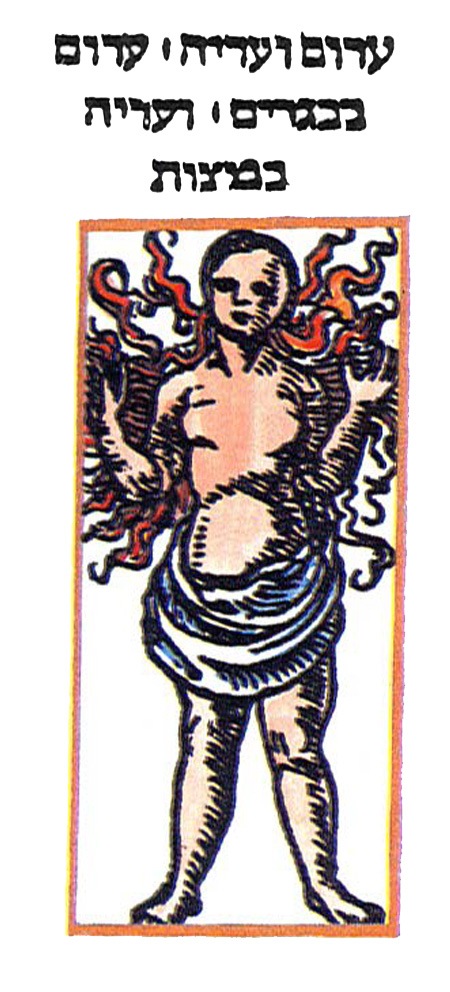
There is one comment that I want to make right now regarding the pictures of the topless women that appeared and then disappeared in seforim. In addition to a point that I already once made that perhaps in earlier times the breasts were associated more with breastfeeding than with romance (it certainly was associated with that as well as can be seen from the Song of Songs, but not exclusively as today; perhaps it was more like a woman’s hair which can be seen in pictures), I would like to add a stronger point regarding these pictures.

It would seem to me that before photography when it wasn’t possible to produce real live looking pictures, people would be inclined to consider drawing an ערוה. But after the advent of real photographs, one gets the feeling that he is looking at a real image of a woman. It is for this reason, perhaps, that pictures of topless women became taboo. Once photographs began to be associated with ערוה, paintings and drawings followed since they are so similar to photographs. In other words, they became guilty by association.

If there is any merit to this argument (or speculation) then one can go a step further and say that the advent of color motion pictures which is more alive caused further stringency in this area. A picture of a woman is not that “problematic”, but to watch her video is already more like “mingling without a mechitza”. Once the women are struck from the videos, it is natural that they should be expunged from the magazines as well. It is worth noting that both the laws outlawing pornography and the invention of photography coincided with one another. It would seem that it wasn’t outlawed as long as it was only in the form of a drawing, painting, or sculpture.

While it is true that earlier sources do speak of the sexual nature of breasts (see my post here note 19), I think that my correspondent has put his finger on a very important point. It would appear that breasts were more commonly associated with breastfeeding which meant that it was not problematic to show them in pictures. We even find such a portrayal on two tombstones in the old Sephardic cemetery in Altona. Here are the pictures as they appear in Michael Studemund-Halevy and Gaby Zuern, Zerstoert die Erinnerung Nicht. Der Juedische Friedhof Koenigstrasse in Hamburg (Munich, 2002), p. 109.

There are also a whole series of paintings and sculptures showing the Virgin Mary breastfeeding, obviously showing that this was not regarded as immodest in Christian circles.

The non-sexual nature of breasts also explains Shabbat 13a:

 עולא כי הוי אתי מבי רב הוה מנשק להו לאחוותיה אבי חדייהו
(Perhaps because he found this text so strange, the Hatam Sofer interpreted it allegorically: היה מנשק החכמה. See Hiddushei Hatam Sofer, ad loc.)In response to the email from the Lakewood scholar, S. commented as follows

Another point which I think needs to be brought up about nude art is just how ubiquitous it was in Europe, statues, frescoes, and title pages in books, etc., very much influenced by Classical culture, which was of utmost importance in European learning and culture. If you’re in Venice or Prague or any major city in Europe you can’t avoid seeing it. The style of title pages may have changed, as styles do, so it is not surprising that Jewish printing culture changed as well. And eventually these seforim became one, two, and three centuries old and were only seen by individuals. Nudity in art was not ubiquitous in Eretz Yisrael and America, and it is not surprising that we woke up in the 20th century in American and EY and found these things surprising. My point is that it doesn’t necessarily have to do with them seeing breasts as sexual or not (what about thighs and bare midriffs? And seforim even depicted nude women bathing in the mikveh.) It is also important to note that in the writing of many great people they refer to specific editions they used, and it is clear that they saw it and neither defaced or said anything about it. So attitudes might be a European city vs. non-European city thing as well.

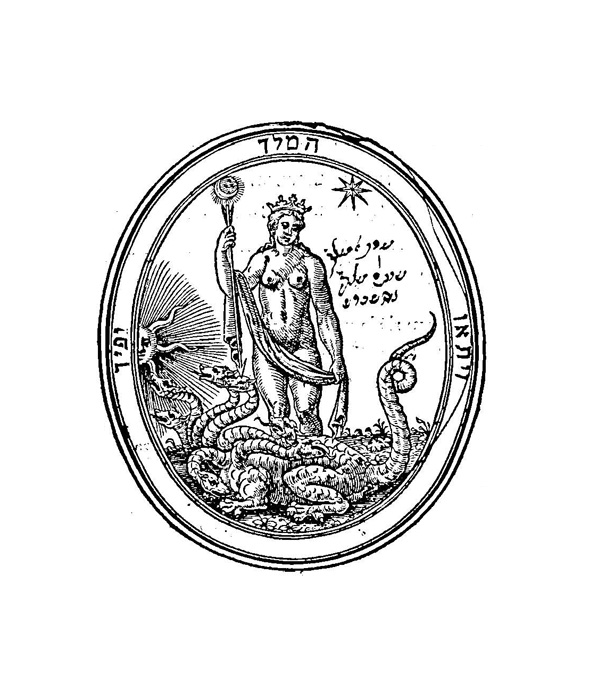
In an earlier post here I dealt with this picture which appears in the Venice 1574 edition of the Mishneh Torah.

Jacob D. called my attention to Shlomo Zalman Havlin’s comment in Yeshurun 29 (2013), p. 791 n. 7. Here Havlin states that when he attended the Chevron yeshiva its library had the Venice 1574 Mishneh Torah, but the yeshiva attempted to keep this edition from students due to the “immodest” picture reproduced above. Havlin also notes that some great rabbis were involved in the publication of this edition of the Mishneh Torah, including R. Menahem Azariah of Fano and R. Moses Provencal.

[10] Meiri to Avodah Zarah p. 4.

[11] Meiri to Avodah Zarah p. 4, Ta’anit 27b (p. 97). Regarding Meiri’s claim, see Lawrence Zalcman, “Christians, Noserim, and Nebuchadnezzar’s Daughter,” JQR 81 (1991), pp. 411-426. Zalcman argues that Meiri did not just make up his interpretation for apologetic reasons, but was aware of Mandaeans who were known as natzurai and were linked to Nebuchadnezzar.
[12] See Dikdukei Soferim ha-Shalem, ad loc.
[13] The Talmud pages used by ArtScroll in its most recent printings are taken from Oz ve-Hadar’s edition (minus certain notes that appear only in the Oz ve-Hadar Talmuds). This means that ArtScroll omits the Shitah Mekubetzet, citing Meiri’s and R. Jonathan of Lunel’s tolerant comments, which appears in the standard Vilna edition, Bava Kamma 38a and 113a.
[14] Hit’avkut, p. 2a.
[15] See R. Raphael Rabbinovics, Ma’amar al Hadpasat ha-Talmud, ed. Haberman (Jerusalem, 1952), pp.112ff.; David Leib Zuenz, Gedulat Yehonatan (Petrokov, 1930), vol. 1, pp. 12ff.
[16] “The Rabbi and the Jesuit” On Rabbi Jonathan Eibeschütz and Father Franciscus Haselbauer Editing the Talmud,” Jewish Social Studies 10 (Winter 2014), pp. 147-148.
[17] The defense was published in installments in Ha-Magid, May 9, 16, 23, 30, 1877. Sections of the document appear in  Zweifel, Saneigor, pp. 264-265, and in Saul Pinchas Rabinowitz’s edition of H. Graetz, Divrei Yemei Yisrael, vol. 8, p. 464 in the note. The complete document was published in Zuenz, Gedulat Yehonatan, pp. 135ff., but he does not identify its source, leading the reader to assume that he is quoting from a manuscript.
[18] See Ha-Magid, May 9, 1877, pp. 170-171. (The reference to R. Broda as his teacher appears on p. 171.) As we shall see, R. Eybeschuetz had a great deal of respect for R. Broda. Yet R. Jacob Emden’s father, the Hakham Zvi, had a different perspective. See Yehezkel Duckesz, Ivah le-Moshav (Cracow, 1903), p. 14.
[19] “The Rabbi and the Jesuit,” p. 166.
[20] S. points out an interesting source which gives an unknown, but presumably true, biographical detail of R. Eybeschuetz’s life in the spiritual autobiography of an apostate Jew named Salomon Duitsch, A Short Account of the Wonderful Conversion to Christianity of Solomon Duitsch … Extracted from the Original Published in the Dutch Language (London 1771).S. wrote to me as follows:

Prone to mystical visions and ascetic practices like fasting, he was regarded locally as a tzadik, but he eventually became convinced of Christianity. When this became known was forced to divorce his wife. After a period of wandering he ended up in Altona. He still looked Jewish and his issues were unknown there. He writes of meeting and staying the night at R. Eybeschuetz, who was very delighted to host him on account that R. Eybeschuetz was educated and taken care of as an orphan in the house of his great-grandfather in Nikolsburg. This information about a Nikolsburg period in R. Eybeschuetz’s life, and who this great-grandfather might be, is not mentioned in the biographies, and is a reminder that much information about people’s lives is not necessarily in books.

[21] Maciejko, p. 150.
[22] For details see ibid., pp. 169ff.
[23] Ha-Magid, May 16, 1874, p. 180.
[24] Ibid., May 23, p. 188.
[25] Ibid.
[26] Ibid., May 30, 1877, p. 199.
[27] Ibid. In my post here I discussed how R. Jehiel Michel Epstein engaged in self-censorship in the Arukh ha-Shulhan in order not to have problems with the non-Jewish authorities. Rabbi Shalom Baum called my attention to Arukh ha Shulhan, Orah Hayyim 480:1, for another example of this. I have underlined the words which any educated reader would understand were not to be taken seriously (since how could contemporary Jews ask God to pour out his wrath on the Babylonians who departed the historical stage over two thousand years ago?):
ואחר ששתו הכוס השלישי נוהגין לומר שפוך חמתך וגו’ ולפתוח הדלת כדי לזכור שהוא ליל שמורים ובזכות אמונה זו יבא משיח וישפוך חמתו על הבבליים שחרבו בהמק
[28] Ha-Magid, May 30, 1877, p. 199. Regarding the views of R. Luria and R. Feinstein, see my Changing the Immutable, p. 42.
[29] I have used the translation in Jacob Katz, Exclusiveness and Tolerance (Oxford, 1961), p. 165.
[30] Ibid., pp. 164ff.
[31] “The Rabbi and the Jesuit,” p. 167.
[32] Ibid., pp. 173-174.
[33] I don’t know why this procedure was not required for the other tractates published in Prague.
[34] “The Rabbi and the Jesuit,” p. 179
[35] Or ha-Mizrah 29 (1981), pp. 418-428. Leiman’s publication remains valuable because of his introduction and notes.


Pets on Shabbat, Rabbi Morenu, and Epidemics

Pets on Shabbat, Rabbi Morenu, and Epidemics

Marc B. Shapiro

1. In my last post here I wrote as follows:

R. Yitzhak Nahman Eshkoli calls attention to what he sees as another mistake made by those who published R. Moshe Feinstein’s works.[1] Here is Iggerot Moshe,Orah Hayyim 5, 22:21.

According to the text of R. Moshe’s responsum, animals are muktzeh, even those that children play with. This means that R. Moshe held that pets are also muktzeh. Yet in the small print the editor added that pets are permitted, even though this completely contradicts the first part of the sentence. See also Iggerot Moshe, Orah Hayyim 4, no. 16 (end), where R. Moshe forbids moving a fish tank on Shabbat and Yom Tov: דבע”ח מוקצין.

If you search online you will find a number of people who deal with R. Moshe’s view of pets on Shabbat. R. Chaim Jachter, referring only to Iggerot Moshe, Orah Hayyim 4, no. 16, states that R. Moshe held that pets are muktzeh. See here. Rabbi Dov Lev writes:

See Orach Chaim 308:39 that all animals are considered muktzeh. However, see Shu”t Igros Moshe (Orach Chaim 5:22:21) that rules that designated pets are exceptional and are not muktzeh. On the other hand, Rabbi Y. P. Bodner writes (Halachos of Muktzeh, Feldheim, p. 118) that he heard from Rabbi Feinstein that pets are indeed muktzeh. This is supported by Rabbi Feinstein’s responsum (#24) at the end of the book as well as by Shu”t Igros Moshe (Orach Chaim 4:16).

There are two interesting things here. The first is that R. Lev cites the most recent responsum in Iggerot Moshe that pets are not muktzeh without taking note of what many have seen as a contradiction between what R. Moshe wrote and the small print added by the editors. Also of significance is that R. Pinchas Bodner, who wrote a book on muktzeh and consulted with R. Moshe, claims that R. Moshe told him that pets are muktzeh. See also R. Natan Slifkin, Man and Beast: Our Relationships with Animals in Jewish Law and Thought, p. 237 n. 1.

R. Yonason Rosman, Petihat ha-Iggerot, p. 314, quotes R. Moshe Kaufman, a son-in-law of R. Mordechai Tendler, that after R Moshe gave his stringent answer to R. Bodner, he then reconsidered and came to a lenient opinion. R. Kaufman adds that  R. Moshe permitted his son-in-law, R. Moshe Tendler, to handle his cat on Shabbat.

R. Doniel Yehuda Neustadt, The Daily Halacha Discussion, p. 115, n. 108, writes that “there are conflicting sources regarding Harav M. Feinstein’s opinion on this subject.”

R. Anthony Manning writes:

In the 8th volume of Iggrot Moshe (published posthumously) (O.C. 5:22:21) Rav Moshe again rules that animals are muktza. However Rav Moshe’s grandson, R. Mordechai Tendler, adds afterwards – (אלא א”כ הם מיוחדים לשעשועים (פעטס. It is not clear if Rav Moshe agreed with this addition. Rabbi Pinchas Bodner writes (Halachos of Muktza p. 119 footnote 6) that he heard directly from Rav Moshe that pets are muktza.

R. Zvi Ryzman was also troubled by the apparent contradiction inIggerot Moshe,Orah Hayyim 5, 22:21. He wrote to R. Shabbetai Rapoport, as it was R. Rapoport and R. Mordechai Tendler who were the editors of this posthumous Iggerot Moshe volume and the ones responsible for the small print. Ryzman published his correspondence with R. Rapoport in Moriah 36 (Nisan 5778), pp. 358-359.[2]


I think that for most people R. Rapoport’s letter will settle the matter that R. Moshe did not regard pets as muktzeh. It would thus be permissible to handle your own cat that lives in your home, but not to do so with a stray cat or with an animal on a farm, as they are not pets. While we must be grateful to R. Rapoport for explaining matters, there is no question that this should have been properly explained in Iggerot Moshe, as the poor editing job there has created an enormous amount of confusion.[3]

Ryzman provides a number of sources in traditional texts that express a negative view of having dogs as pets. Chronologically, the first on his list is R. Jacob Emden in She’elat Ya’avetz, vol. 1, no. 17.[4] It is worth noting that R. Emden also discusses this matter in Birat Migdal Oz (Warsaw, 1912), p. 127a (5:16):

.ולגדל לשחוק בהן אית ביה איסור מוסיף אחד אנשים ואחד נשים ביחוד אותן המשתעשעים ומגעגעים בכלבים חלקים מעשה עכו”ם הוא ר”ל

R. Emden had another issue with dogs, in that he tells us that one of the leading members of the Ashkenazic community of Amsterdam named his dog after R. Emden’s father, as a way of showing how he despised him. This matter greatly upset R. Emden, and all he can write is:[5]

‘שהיה מגדל כלב וקורא לו שם כו
‘הוא גידל כלב וקרא שמו כו

We thus don’t know what exactly he called the dog. Azriel Shohet writes that he called it “Hakham Zvi,”[6] but that is not in the text, and he could have just as easily called the dog simply “Zvi” or some other form of the name.

Regarding dogs, the Shulhan Arukh, Even ha-Ezer 22:18, states:

אלמנה אסורה לגדל כלב מפני החשד

“A widow is forbidden to raise a dog, because of suspicion [people will suspect her of bestiality].”

As far as I can tell, there is agreement among the aharonim that this law also applies to a divorced woman, but there is no consensus about a single woman. There also seems to be agreement that there is no problem with a female dog.

Despite the fact that this halakhah is found in the Shulhan Arukh, there is no question that it is ignored in the Modern Orthodox world, either because people don’t know about it or because they find it far-fetched or even offensive. The Taz, Even ha-Ezer 22:10, brings a limud zekhut for ignoring this law from Tosafot, Bava Metzia 71a, s.v. lo, who understood the matter as being in the realm of humra, but that there is no actual prohibition as Jews are not suspected of bestiality:

לא תרבי כלבא: משום לזות שפתים בעלמא לפי שהולך אחריה שלא נחשדו ישראל על הזכור ועל הבהמה וגם אין אסור להתייחד

(The Taz’s words should be examined in the Machon Yerushalayim or Rosh Pinah editions which are corrected based on manuscripts.)

R. Isaac Lampronte (1679-1756) testifies that in eighteenth-century Italy theShulhan Arukh‘s ruling was ignored and the rabbis did not protest.[7]

אלמנה לא תגדל כלב בתוך ביתה . . . והאידנא לא ראיתי מוחים באלמנה מלגדל כלב אולי דעתה לא נחשדו ישראל על כך

In general, dogs don’t come out looking too well in rabbinic literature, something which must be distressing for all of us dog lovers. In a future post I will give examples of what I am talking about. However, there are a few positive things said about dogs as well. For example, Yalkut Shimoni, Shemot ch. 11 (no. 187), tells us that the dogs were rewarded for not whetting their tongues against the Israelites (Ex. 11:7):

שזכו לעבד עורות מצואתן לכתוב בהן ספר תורה תפילין ומזוזות

In this same section of Yalkut Shimoni there is the following passage about dogs, but I don’t think you can regard it as saying anything positive about them:

כת’ לכלב תשליכון אותו (שמות כב, ל) ללמדך שהכלב מכובד מן הגוי שהרי טריפה לכלב ונבילה לגוי

Let me make one final point about dogs. In Louis Jacob’s autobiography, Helping With Inquiries, pp. 54-55, he writes:

Before leaving my account of the Gateshead Kolel, I feel it would be incomplete unless I said something more about Rabbi Dessler, one of the most remarkable men I have ever met. Until he became the spiritual guide of the Ponievezh Yeshivah in B’nai B’rak, near Tel Aviv, Rabbi Dessler was the moving spirit behind the Kolel and his wise counsel was sought by its members even when he had moved to Israel. He was physically small and had a full but neatly trimmed beard until he went to Ponievezh, when he allowed it to grow long. He had studied in his youth at the famed Musar School in Kelm, presided over by the foremost disciple of Reb Israel Salanter, R. Simhah Züssel. He married the daughter of Reb Nahum Zeev, son of Reb Simhah Züssel. Reb Nahum Zeev was also an outstanding Musar teacher. He earned his living as a merchant in Koenigsberg, where he dressed and conducted his life in Western style. His wife and daughters dressed in the latest fashion. He even had a dog. Rabbi Dessler told us of the occasion when a Polish rabbi, in Koenigsberg to consult a physician, was invited by Reb Nahum Zeev to be a guest in his home. Witnessing the Western style in which the home was conducted, the rabbi was careful to eat very little, suspecting that the food was not completely kosher. Late at night, the Polish rabbi was awakened from his sleep by the sound of bitter weeping from a nearby room. Thinking someone needed help, the rabbi went on tiptoe to the room from which the sobs were coming only to hear the “Westernised gentleman” sobbing his heart out as he chanted the verse from Ecclesiastes: “Vanity of vanity; all is vanity.” Needless to say, after this experience, the rabbi had no further qualms about eating at Reb Nahum Zeev’s table.[8]

I cite this passage because it reports that that R. Ziv had a dog, and this information must have come from R. Dessler.

R. Ziv was a very great man and there is a lot more that can be said about him. R. Jehiel Jacob Weinberg reports that when he lived in Germany, not only did he dress in a modern fashion, but he also trimmed his beard and shook the hands of women. R. Yosef Yozel Horowitz of Novardok was very upset about these things and asked the young R. Weinberg, at this time serving as a rabbi in Pilwishki, to rebuke R. Ziv. R. Ziv told R. Weinberg, “What does he want from a Jew in Germany? I am just a simple Jew and I do not wish to cause ahillul ha-Shem. I behave like the other German Orthodox Jews.”[9] R. Weinberg added that all of R. Ziv’s actions were infused with Mussar ideals, and when he had a question, he traveled to the Hafetz Hayyim to consult with him.[10]

2. In my last post here I gave an example where the people who put together Mesorat Moshe from R. Mordechai Tendler’s notes did not understand what was being discussed. Here is another example from Mesorat Moshe, vol. 3, p. 343, no. 1.

It begins by saying that R. Moshe Feinstein receive a letter from רב מורינו. The editor explains that this refers to Jacob Rosenheim. When I read this I immediately knew it was a mistake. This volume of Mesorat Moshe covers Tevet 5735-Tevet 5736, and Rosenheim died ten years prior to this, in 1965.

Leaving this aside, the editors were led to think that the story concerned Rosenheim as he was given the honorary title “Morenu ha-Rav” by the Agudat Israel organization.[11] Yet even if he was alive at the time of the story, no one would have referred to him as “Rabbi Morenu.” In fact, he was not a rabbi even though subsequent to his death and continuing until now he is constantly given this title,[12] much like today every askan or writer associated with the Agudah is referred to as “Rabbi”. (R. Jehiel Jacob Weinberg commented that for the Agudah every rabbi who joins them is treated like a great gaon,[13] to which we can add that every askan is treated like a rabbi. For the haredi critics of the Agudah, it is not only that the askanim are treated like rabbis, but that they are often treated like gedolim. A recurring theme in haredi criticism of the Agudah, since the beginning and continuing until today, is that many of the important decisions taken by Agudat Israel in the past century were made by the askanim without consultation with the Torah leaders who are supposed to be in charge.[14])

Although I knew that Mesorat Moshe could not be referring to Rosenheim, I had no idea who רב מורינו was, and assumed that there was some problem in the transcription. It never occurred to me that מורינו here was actually a name. I have to thank R. Mordechai Berger who pointed out to me that the letter is referring to R. Zev Moreno (Morejno in Polish), who served as rabbi in Lodz until 1973 when he came to New York. R. Moreno has a Wikipedia page devoted to him here.

Even after leaving Lodz, R. Moreno continued to be regarded as the chief rabbi not only of this city but of the entire country of Poland. R. Moshe Feinstein even ruled that in all matters dealing with religious life in Poland, such as appointing rabbis or shochetim, R. Morenu had to give his approval. See here and here. When R. Menahem Joskowitz arrived in Warsaw in 1989 and started functioning as the Chief Rabbi of Poland, this caused a big dispute with R. Morenu who travelled to Warsaw to confront the new rabbi. See here.

R. Morenu was clearly somewhat of a character, as only such a person would have written letters to President Ephraim Katzir, Prime Minister Menachem Begin, and Foreign Minister Moshe Dayan with the following “genius” suggestions, in which great rabbis are placed in the highest political offices as figureheads, while the politicians do all the real work: The president of the State of Israel should be the Satmar Rebbe, three vice presidents (a position that Israel does not even have) should be R. Moshe Feinstein, the Gerrer Rebbe, and the Lubavitcher Rebbe, who will serve together with Katzir. R. Zvi Yehudah Kook should be appointed prime minister, while the real work of the prime minister’s office should be conducted by Begin. The foreign minister should be R. Yosef Shalom Elyashiv while Dayan carries out the actual duties of the foreign ministry. You can read all about his political suggestionshere.

R. Berger also called my attention to another source relevant to my last post where I discussed R. Abraham Sofer. In 2018 Minhagei Yeshivat Torah va-Da’at (Torah Vodaath)[15] was published. On p. 23 n. 45, the following story about Sofer appears. Particularly interesting is the report that the Satmar Rebbe told the young man who refused to allow Sofer to get an Aliyah and publicly embarrassed him to ask Sofer for forgiveness.

פעם נכנס לישיבת ביהמ”ד עליון תלמיד חכם נכבד נכד החת”ס, אשר מחמת דוחק הפרנסה עבד במוסד של קאנסרבטיבים. כאשר כבדו הגבאי בעליה, קפץ אחד מתלמידי הישיבה ועלה במקומו לס”ת, והוכיח את החכם הנכבד האיך יכול הוא לעבוד אצל פוקרים בעוד שסבו נלחם במסי”נ נגד הניאולוגים, וביישו ברבים עד שההוא יצא מביהמ”ד מבוייש. כאשר סיפרו זאת להרב ראובן גרוזובסקי זצ”ל, אמר שהוא בבחינת הלכה ואין מורין כן, וכשסיפור זה הגיע לאזניו של האדמו”ר מסאטמאר זצ”ל הגיב שהבחור עשה כהוגן, אך משום כבודו של החת”ס שהוא זקנו של הלה .הורה לבקש ממנו מחילה.

3. Since so many have recently discussed rabbinic responses to epidemics, let me add the following. In years past there were two understandings of how diseases were spread. One is known as the Miasma Theory, and I can do no better than to quote the opening lines of the Wikipedia entry on the topic: “The miasma theory (also called the miasmatic theory) is an obsolete medical theory that held diseases—such as cholera, chlamydia, or the Black Death—were caused by a miasma (μίασμα, ancient Greek: ‘pollution’), a noxious form of ‘bad air’, also known as night air. The theory held that the origin of epidemics was due to a miasma, emanating from rotting organic matter.”

The other theory is Germ Theory, which in non-scientific language must be regarded as a fact. Germ theory explains the spread of disease as coming about through the spread of living organisms. Until the second half of the nineteenth century, both the Miasma Theory and Germ Theory (in earlier versions) found supporters in the scientific community.

In an article published in 1851,[16] Joseph Loewy claims that the amora Samuel accepted the Miasma Theory. He calls attention to Bava Metzia 107b: “And the Lord shall take away from thee all sickness (Deut. 7:15). . . . Samuel said: This refers to the wind. Samuel follows his views, for he said: All [illness] is caused by the wind.”

Loewy also cites Ta’anit 21b:

Once Samuel was informed that pestilence was raging amongst the inhabitants of Be Hozae, and he ordained a fast. The people said to him: surely [Be Hozae] is a long distance away from here. He replied: Would then a crossing prevent it from spreading?

4. In my last post I discussed letters from R. Hayyim Ozer Grodzinski and R. Jehiel Jacob Weinberg to R. Isaac Unna that were sold by two auction houses. I mentioned how these letters came from the Unna archive at Bar Ilan University which had disappeared. A third auction house has also gotten into the act, and on June 30, 2020 the following letter from R. Grodzinksi to R. Unna is being auctioned. See here.

I refer to this letter in Between the Yeshiva World and Modern Orthodoxy, p. 126 n. 69.

Obviously, the person who acquired the Unna archive has decided to unload it, and as mentioned in my last post, Bar-Ilan University could not care less that documents that it agreed to watch over are now being sold at public auctions. In the previous post I showed how the Bar-Ilan manuscript numbers are clearly visible on the letters that were sold. Take a look at the letter above from R. Hayyim Ozer to R. Unna. There is no manuscript number visible. Yet this is how the letter really looks (ignore my handwriting at the top of the page).

The manuscript number appears right above the name “Grodzienski,” but has been removed from the image used by the auction house (yet presumably is still found on the actual letter).

Excursus

The general practice is to transliterate יעבץ in שאילת יעבץ as Ya’avetz. Yet in I Chron. 4:9-10, the Bible mentions a righteous man named יעְבּץ, and his name is spelled with a sheva under the ע and a dagesh in the ב. When speaking of R. Jacob Emden, יעבץ stands for יעקב בן צבי. Yet in the introduction to שאילת יעבץ, R. Emden tells us that the title also alludes to the righteous man named יעבץ in I Chron. 4:9-10, as both of their births came with pain. On the title page of his responsa, in giving the publication date, R. Emden also cites I Chron. 4:10 with the name of יעבץ.

I assume, therefore, that R. Emden intended us to pronounce the word in the title as Ya’betz. This is also grammatically correct, as there is a sheva under the ע. Regarding the title, also note that the word is written as יעבץ and not יעב”ץ.

In the introduction to שאילת יעבץ, R. Emden mentions that the mother of Othniel ben Kenaz named him Ya’betz because of her painful childbirth. It is true, as Jacob J. Schacter points out, that there is nothing in Chronicles “to support Emden’s assertion that Yavez and Athniel were the same person.” See Schacter, “Rabbi Jacob Emden: Life and Major Works” (unpublished doctoral dissertation, Harvard University, 1988), p. 70 n. 18. However, when R. Emden writes

קראתי בשם ספרי זה שאילת יעבץ, נסמך הכתוב בד”ה שאמו של עתניאל בן קנז קראתו יעבץ לאמר כי ילדה בעוצב

he has in mind Temurah 16a: “A tanna taught: Othniel is the same as Ya’betz. . . . He was called Othniel because God answered him, and Ya’betz because he counselled and fostered Torah in Israel.”

In I Chron. 2:55 it mentions “the families of scribes that dwelt at יעבץ.” Does this city have anything to do with the person Ya’betz mentioned in I Chron. 4:9-10? We have no evidence, but Radak, I Chron. 2:55, suggests that perhaps Ya’betz built the city and it was named after him. Rashi, ibid., connects יעבץ with the city אבץ in Josh. 19:10.

There is another noteworthy point about the name יעבץ. We find the following in Derekh Eretz Zuta, ch. 1:

ט’ נכנסו בחייהם בג”ע ואלו הן חנוך בן ירד ואליהו ומשיח ואליעזר עבד אברהם וחירם מלך צור ועבד מלך הכושי ויעבץ בנו של רבי יהודה הנשיא ובתיה בת פרעה וסרח בת אשר ויש אומרים אף ר’ יהושע בן לוי

This is a list of those who entered Paradise during their lifetimes. A few of the names are not what we would expect and need to be explained. There is also a textual issue, as another version has R. Joshua ben Levi replacing Hiram of Tyre rather than being added. Why Hiram should be on the list in the first place is something I can take up on another occasion. For now, I just want to note that the son of R. Judah ha-Nasi (other versions read בן בנו) was also named Ya’betz, and that he is reported to have entered Paradise alive.

There is another version that lists Ya’betz separately from the son of R. Judah ha-Nasi. See R. Matityahu Strashun, Mivhar Ketavim, pp. 90-91. Alfa Beita de-Ben Sira (Warsaw, 1927), p. 23, has both עבדו של רבי יהודה and Ya’betz.

The Jerusalem Talmud, Hagigah 2:1, refers to an amora named Ya’betz. For a list of post-talmudic figures named יעבץ, see R. Zev Aharon Teller in Beit Va’ad le-Hakhamim (Tishrei 5769), p. 504 n. 88. See also Asher Weiser, “Ya’betz,” Sinai 78 (1975), pp. 6-8. Masoretic scholars know of Ya’betz ben Shlomo. See e.g., Shlomo Zalman Havlin, Masoret Torah she-Be’al Peh (Jerusalem, 2012), p. 611.

For others who referred to themselves as יעבץ, including Judah Leib Gordon, see Saul Chajes, Otzar Beduyei ha-Shem (Vienna, 1933), pp. 162-163.

A very important figure called יעבץ is R. Emden’s contemporary, R. Jacob Ibn Tzur (Abensur; 1673-1753) of Fez, author of the responsa work Mishpat u-Tzedakah be-Ya’akov. For generations, all Moroccan Jews knew R. Ibn Tzur, who was also a poet, yet he is pretty much unknown in the Ashkenazic world. Menachem Elon recalls how he learned about R. Ibn Tzur. He was doing research on a topic and יעבץ was mentioned, but he could see that it did not refer to R. Emden. He investigated the matter and learned that there was another great halakhic authority who also is known as יעבץ. He writes:

גאון מופלג זה, שיותר ויותר התודעתי לתורתו ולאישיותו, היה זמן ניכר בבחינת נעלם בעולם התורה והישיבות הגדולות שבפולין, ליטא ואשכנז, וכמעט לא היה ידוע בין החוקרים, ומאד חוששני שכך הוא הדבר, עד עיצומם של ימים אלה

See Elon, “Yihudah shel Halakhah ve-Hevrah be-Yahadut Tzafon Afrika mi-le-Ahar Gerush Sefarad ve-Ad Yamenu,” in Moshe Bar-Yuda, ed., Halakhah u-Fetihut: Hakhmei Morocco ke-Foskim le-Dorenu (Tel Aviv, 1985), p. 24.

After R. Emden, the most famous יעבץ is R. Joseph Jabez of Spain, author of Or ha-Hayyim among other works. His name is often written as Yavetz or even Yaavetz, but I don’t know how he himself pronounced the first three letters. The one thing I can say is that he did not pronounce the final letter of his name as “tz”, as that is an Ashkenazic (inauthentic) pronunciation which never would have been heard in Spain and won’t even be heard today among Sephardim who have had a traditional Sephardic upbringing. See R. Benzion Cohen, Sefat Emet (Jerusalem, 1997), pp. 114ff. This explains why, for instance, in Hebrew Barcelona is written as ברצלונה and Safed is written as צפת.

With regard to צפת, the modern pronunciation is Tzefat. However, R. Meir Mazuz notes that the correct pronunciation is indeed Safed (using “s” for צ and the accent on the first syllable), and this is in line with the Arabic pronunciation. See his introduction to R. Hayyim Joseph David Azulai, He’lem Davar (Bnei Brak, 2006), p. 27. See also R. Jacob Saphir, Even Sapir (Lyck, 1866), p. 1a. In previous generations, this is how the Sephardim in Eretz Yisrael would pronounce it. See R. Elijah Hazan, Ta’alumot Lev, vol. 3, no. 19 (p. 38b). In the page on Otzar HaChochma the vowels are not clear, but you can see them clearly here.

R. Ovadiah Bartenura, in a letter sent from Eretz Yisrael, refers to the city as ספיתה. It should be vocalized as סׇפֵיתׇה as this is how the locals pronounced it, non-Jews and Jews alike. See Avraham Yaari, Iggerot Eretz Yisrael(Ramat-Gan, n.d.), p. 151.

It is true that there is a city צְפֵת (Tzefat) mentioned in Judges 1:17, yet this is a city in the south and has nothing to do with the northern city of Safed we all know so well. צְפֵת is never again mentioned in the Bible, which is understandable as Judges 1:17 tells us that the city was destroyed and its name was changed to Hormah.

As for the original pronunciation of צפת, R. Mazuz does not note that R. Elazar Kalir indeed pronounced the name of the city as Tzefat. Look at the first two lines below, which come from Kalir’s kinah איכה ישבה חבצלת השרון (from the Goldschmidt edition of Kinot, p. 50).

As you can see, the final word צפת can only be read as צְפַת. It thus seems that the pronunciation as Safed only dates from the medieval period. See Encyclopaedia Judaica, s.v Safed: “Between the talmudic period and the Crusades the history of Safed is not known. The town reappears in 1140 under the name Saphet.”

* * * * * *

[1] Tza’ar Ba’alei Hayyim be-Halakhah ve-Aggadah, p. 514 n. 1171
[2] This was called to my attention by Yonatan Emett. R. Rapoport mistakenly refers to R. Shimon Eider as the recipient of R. Moshe’s responsum instead of R. Pinchas Bodner. He also refers to R. Eider as shlita, even though he passed away in 2007.
[3] From the various quotations, you can see that there are different ways people have transliterated the first word of R. Moshe’s responsa, אגרות. There is a dagesh in the gimel perhaps because of a nun that dropped off. Regarding the word, see R. Solomon Judah Rapoport, Toldot Rabbenu Natan Ish Romi (Warsaw, 1913), p. 24; R. Matityahu Strashun, Mivhar Ketavim (Jerusalem, 1969), p. 82 n. 9.
[4] See Excursus regarding the word יעבץ.
[5] Megilat Sefer, ed. Bombach (Jerusalem, 2012), pp. 41, 64.
[6] Im Hilufei Tekufot (Jerusalem, 1960), p. 104.
[7] Pahad Yitzhak, s.v. almanah.
[8] The same story, with slight variations, is found in Kitvei ha-Saba ve-Talmidav mi-Kelm, vol. 2, p. 649.
[9] That German Orthodox Jews shook hands with women is mentioned by R. Solomon Carlebach, who states that he also does so if the woman puts her hand out and to not shake it would embarrass her. See Meir Hildesheimer, et al., eds. Le-David Tzvi (Berlin, 1914), p. 218 (Hebrew section).
[10] From an unpublished letter of R. Weinberg.
[11] At the beginning of the Hebrew section of the Festschrift fuer Jacob Rosenheim (Frankfurt, 1931), the Agudah declaration is printed.

[12] For R. Zvi Yehudah Kook, the “original sin,” as it were, of Agudat Israel is precisely that it was founded by a layperson (Rosenheim), and R. Zvi Yehudah contrasts this to Mizrachi which was founded by a great Torah scholar, R. Isaac Jacob Reines. See Be-Ma’arakhah ha-Tziburit (Jerusalem, 1986), p. 76. In his eulogy for Rosenheim, R. Jehiel Jacob Weinberg, Li-Frakim (2016 edition), p.  607, also refers to him as the founder of Agudat Israel. Yet it is more correct to say that Rosenheim was the major force in the founding of Agudat Israel, as he cannot be identified as the organization’s sole founder.
[13] “Scholars and Friends: Rabbi Jehiel Jacob Weinberg and Professor Samuel Atlas,” Torah u-Madda Journal 7 (1997), p. 111.
[14] See here for a recent example of the Agudah rabbinic leadership responding to such a claim (regarding synagogue closures and coronavirus). See here regarding Yaakov Litzman serving as minister in the current Israeli government, which was never approved by the rabbinic leadership of Yahadut ha-Torah. See also here.

In R. Jehiel Jacob Weinberg’s letter to R. Moshe Soloveitchik, dated Oct. 20, 1949, and published here for the first time, R. Weinberg writes (ellipsis in original):

.וצדק הרבי ממונקאטש ז”ל שאמר לי כי עתידה האגודה להעביר את מרכז היהדות מביה”מ לאולם האספות ושם ימחאו הרבנים מחיאות כף לנאומים והאדמורי”ם יתכבדו באמירת ברכות . . . חכם עדיף מנביא

[15] On its hundredth anniversary in 2019, Torah Vodaath put out a beautifully produced book, America’s Yeshiva: Celebrating a Century of Torah Leadership in America. The pictures are wonderful and the story of the yeshiva’s beginning and growth are told in an honest way. Also noteworthy is that the yeshiva has a website with a lot of historical information, including most of the high school yearbooks that were produced. See here. Just going through the yearbooks, looking at the pictures, and reading the entries on each of the graduating students makes history come alive. The following yearbooks are missing from the website: 1944, 1947, 1948, 1951, If anyone has these yearbooks, please reach out to the yeshiva so they can be uploaded. The last yearbook on the website is 1978, which I assume means that the students did not publish any more yearbooks.

I do have two comments about the Torah Vodaath website and book. On the website herethere are biographies of the roshei yeshiva. However, there is no biography for R. Dovid Leibowitz, even though the book, pp. 150-152, devotes three pages to him, as well as mentioning him elsewhere. I hope that the omission from the website is not an intentional slight because of the dispute between R. Leibowitz and R. Shraga Feivel Mendlowitz that led to R. Leibowitz leaving Torah Vodaath and founding his own yeshiva. See Moshe D. Sherman, Orthodox Judaism in America (Westport, CT, 1996), p. 129.

While I think the book as a whole is great, there is a real blemish on p. 630 when the newest rosh yeshiva is discussed. I think most will understand why this is a terrible bizayon ha-Torah (a double bizayon ha-Torah, i.e., omitting mention of grandfather and father).

We are grateful that in 2018, just as Torah Vodaath began to mark its milestone centennial year, the Yeshiva welcomed Rav Yitzchok Lichtenstein, a descendant of Rav Chaim Soloveitchik and a grandson through marriage of Rav Reuven Grozovsky, to lead the Yeshiva. Rav Lichtenstein was a talmid of Rav Dovid Soloveitchik in Yerushalayim.

On p. 628 the other rosh yeshiva, R. Yosef Savitsky, is introduced as follows: “Rav Yosef Savitsky was raised in Boston by his father Rav Mordechai, a highly-respected Rav.”

If R. Lichtenstein had distanced himself from his family, I could understand the omissions (not that it would be right, but I could understand it). Yet not only has R. Lichtenstein not done so, but he himself has contributed to the legacy of his grandfather, with his most popular contribution undoubtedly this edition of R. Soloveitchik’s insights on the Haggadah.

[16] “Toldot Shmuel,” Kokhvei Yitzhak 15 (1851), p. 31.


A Mild Case of Plagiarism: R. Abraham Kalmankes’ Ma’ayan Ha-Hokhmah

A Mild Case of Plagiarism:  R. Abraham Kalmankes’ Ma’ayan Ha-Hokhmah
by Shnayer Leiman
1.  The Accusation.

Rabbi Joseph Samuel ben R. Zvi (d. 1703) – more popularly known as ר’ שמואל ר’ חיים ר’ ישעיה’ס – served as a member of the rabbinic court in Cracow for some 26 years, after which he was appointed Chief Rabbi of Frankfurt in 1689.1 An avid collector of books and manuscripts, he made good use of them in listing in the margins of his copy of the Talmud variant readings, emendations, and annotations to the text of, and commentaries on, the Babylonian Talmud. These were published posthumously in the Amsterdam and Frankfurt editions of the Talmud, 1714-21. Today, they are incorporated in every edition of the Vilna Talmud, and every student of the Talmud benefits from the efforts of this great rabbinic scholar.2
One of the many tasks of the leading rabbis in the 17th and 18th centuries was to write letters of approbation on behalf of mostly young rabbinic scholars seeking to publish their manuscripts. R. Joseph Samuel wrote some 40 such letters of recommendation during his lifetime, not an insignificant number in those days.3 This, despite the fact that he looked askance at the recommendations that many of his colleagues were writing, and was less than impressed by the quantity and quality of books being published. Indeed, at one point he called for – and apparently instituted – a moratorium on the publication of rabbinic works in Germany, claiming that many of them were superfluous and some were even harmful.4
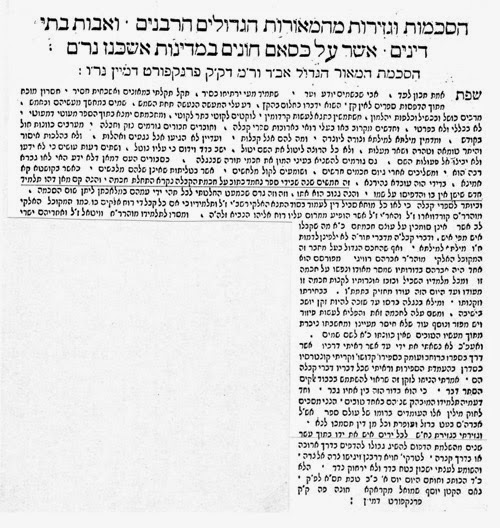
On January 2, 1701, R. Joseph Samuel wrote a letter of approbation for a kabbalistic work by R. Mordechai Ashkenazi, an otherwise unknown author (then) who was a protégé of the distinguished Italian rabbi and kabbalist, R. Abraham Rovigo (d. 1713).5 The book, entitled אשל אברהם, and the letter of approbation, were published later in 1701 in Fürth. After a lengthy critique of the proliferation of works on Kabbalah in the late 17th century, the letter reads, in part:6
They [the new authors of kabbalistic works] are guilty of two evils. First, they neither know nor understand the deeds of God. Second, they cause the common folk to slight the rabbis expert in the exoteric Torah. The common folk assume that rabbis not expert in Kabbalah are not true scholars. So they cast away their expert rabbis, listening instead to the enchanters, whose wisdom is borrowed from others. I can testify that this is true [i.e., that the enchanters’ wisdom is borrowed from others], for I was involved in such a case. I recall vividly how some fifty years ago I owned a copy of a delightful kabbalistic work entitled התחלת חכמה. Some upstart student, a novice with no knowledge based on accumulated learning, printed the book under his own name. He simply plagiarized the entire book.
2.  The Identity of the Plagiarized Book.
No book entitled התחלת חכמה has ever appeared in print. It therefore could not have been plagiarized by anyone. Moreover, R. Joseph Samuel did not reveal the name of the plagiarist and the title of the book in its plagiarized form. This literary riddle was first raised in print early in 1976 by the noted bibliophile, Abraham Schischa of London.7 The solution was not long in coming. That same year, R. Shmuel Ashkenazi, also a noted bibliophile, solved the riddle.8 He correctly identified התחלת חכמה as the title of a kabbalistic book in manuscript form, still available in a variety of contemporary libraries.9 In book form, it was entitled מעין החכמה and it first appeared in print in Amsterdam in 1652.10 The plagiarist who published מעין החכמה under his own name was R. Abraham Kalmankes of Lublin. Ashkenazi provided other useful information as well, but all that is important for our purposes is that he clearly identified R. Abraham Kalmankes as a plagiarist. As such, he agreed fully with R. Joseph Samuel’s characterization (in his letter of approbation) of the novice upstart student. The  late Professor Gershom Scholem also identified R. Abraham Kalmankes as a plagiarist. He would write:11
והוא [ר’ אברהם קלמנקס] הדפיס ס’ התחלת חכמה הגניבה [כך כתוב] על שמו,
וכבר יש רמז לדבר בהסכמת הרב מפרנקפורט לס’ אשל אברהם.

“He [R. Abraham Kalmankes] published the pirated book entitled Hathalat Hokhmah under his own name. The matter is alluded to in the letter of approbation by the rabbi of Frankfurt to the book entitled  Eshel Avraham.”

It is our contention that R. Abraham Kalmankes has received less than a fair hearing in the court of modern scholarship. If we reopen the investigation, it is because much of the evidence has either been misconstrued or overlooked. The reader will have to decide for himself whether or not Kalmankes was, in fact, a  plagiarist, and whether or not he should be better remembered for his seminal contribution to Jewish teaching and literature.
3. מעין החכמה.
            a) Claims of the Author/Editor
מעין החכמה, the first book to appear under R. Abraham Kalmankes’ name, is a short introduction to Lurianic Kabbalah. Indeed, it was among the earliest such works to appear in print. The title page of the quarto sized volume is followed by a one-and-a-half page introduction (pages 2-3). The introduction is followed by the text (pp. 4-22), which consists of 78 tightly-knit chapters (פרקים), perhaps more properly labeled today as paragraphs. Thus, several of the “chapters” consist of no more than15 lines of print (and, sometimes, even less). Scattered throughout the book are occasional comments in parentheses. These may reflect an educational tool used by the original author to clarify a difficult term by means of a gloss, creating — in effect — what we would call today a footnote. Or, as appears likely, these may reflect a second hand, i.e., material added to the base text by someone other than the author, e.g., a later editor of the original manuscript. Our immediate concern, however, will not be with the book’s content or structure, but rather with its authorship. What are the claims of the title page and the introduction? What do they tell us about the authorship of
מעין החכמה?
The title page basically announces the content of the book.12 It is a kabbalistic manual, we are informed, the likes of which has yet to appear in print. It provides the kabbalistic underpinning upon which all of R. Isaac Luria’s teachings rest. The title page then indicates that the book’s secret teachings are being  brought to press [ Hebrew:תעלומים  הוציא לאור] by “the exceedingly wise and young divine kabbalist, R. Abraham, son of the Gaon, Chief Rabbi and Head of the Yeshiva, R. Aryeh Leib, scion of the Kalmankes family of Lublin.” Note that the phrase “being brought to press by” is ambiguous. It is unclear from the title page whether R. Abraham Kalmankes is being presented as the author, editor, or publisher of מעין החכמה.
We perforce turn to the introduction, which – if read carefully – resolves much of the ambiguity of the title page.13The introduction, written and signed by R. Abraham Kalmankes, begins with a justification for the book’s publication. Briefly, Kalmankes, himself a victim and survivor of the Chmielnitzki massacres, informs the reader that he was puzzled by the seemingly endless exile of the Jews, with redemption nowhere in sight. After much reflection – and deeply influenced by kabbalistic teaching – Kalmankes concluded that it was faulty prayer that was prolonging the exile of the Jewish people. Jewish prayer was not piercing the heavens and reaching God on high. He compared the state of the Jewish people to a ship adrift at sea, with no one on board who knows how to steer the ship to safety. Nothing will change, argued Kalmankes, until kabbalistic teaching spreads throughout the Jewish communities. The seeds of redemption were planted by R. Isaac Luria, the master of proper kabbalistic prayer. Alas, he died before redemption set in, but he left a successor, R. Hayyim Vital, who in turn left “a basket full of manuscripts,” i.e. he reduced to writing the kabbalistic teachings of R. Isaac Luria, especially those relating to prayer. Once these teachings were mastered by Jews the world over, redemption would be at hand.
Unfortunately, “the basket full of manuscripts” was not being made available to the Jewish community at large. Kalmankes explains that those who horde the manuscripts refuse to publish them. This, for two reasons. First, for reasons of vanity. By retaining the manuscripts for themselves, they became the masters of esoteric teaching and the power brokers to whom all had to turn for guidance. Second, for reasons of profit. The owners of the manuscripts charged a hefty price for those who wished to view and copy them. Kalmankes decided to put an end to this scandalous state of affairs by acquiring and publishing one of the manuscripts that preserved some of the key esoteric teachings of R. Isaac Luria. Moreover, he “added a few comments of his own, in order to benefit the many readers,” almost certainly a reference to the comments in parentheses mention above. He gave the manuscript a new title, מעין החכמה [Wellspring  of Knowledge], for “just as a wellspring begins with a narrow opening that ultimately widens as it fills with water, so too this book begins with nuggets of wisdom that broaden and deepen as one grows in wisdom.” Kalmankes concludes the introduction with the following signature: “These are the words of the youngest
member of the group, Abraham, son of my father and teacher Rabbi Aryeh, son of the Gaon, our teacher and rabbi, the honorable R. Joseph Kalmankes Yaffe of Lublin.”
            b) Editions
Some of the confusion surrounding מעין החכמה relates to the multiplicity of published kabbalistic works with the title מעין החכמה, some of which have been mistakenly ascribed to Kalmankes in library catalogues throughout the world.
Confusion surrounding Kalmankes’ alleged plagiarism is also due, in part, to variant readings that appear in the later printed editions of מעין החכמה, for which Kalmankes can hardly be held responsible. After brief mention of some unrelated kabbalistic works with the title מעין החכמה, we will list and describe each of the printed editions of Kalmankes’ מעין החכמה.
An anonymous kabbalistic treatise entitledמעין חכמה  (ascribed in part to Moses) is included in the collection entitled ארזי לבנון (Venice, 1601).14 It is unrelated to Kalmankes’ מעין החכמה. The Ashkenazic printing house of the partners Judah Leib b. Mordecai Gimpel and Samuel b. Moses Ha-Levi published yet another anonymous kabbalistic treatise entitled מעין החכמה (Amsterdam, 1651).15 Frequently reprinted, it too is unrelated to Kalmankes’ מעין החכמה.
Four different editions of Kalmankes’ מעין החכמה have appeared in print. They are:
1. מעין החכמה, Amsterdam, 1652. Printed by the Immanuel Beneviste publishing house during the lifetime of its author/editor Abraham Kalmankes, it is the only reliable edition of Kalmankes’ מעין החכמה. As such, we will claim that Kalmankes can be judged only on the basis of this, and no other, edition of מעין החכמה. For a detailed description of the book, its title page, and introduction, see above.16
2. מעין חכמה, Koretz, 1784. This edition was printed by the Johann Anton Krieger publishing house which, in Koretz, was devoted to the publishing of kabbalistic and hasidic works.17 Although Kalmankes’ title of the book is retained, the title page ascribes the book to R. Isaac Luria and makes no mention of Abraham Kalmankes. More importantly, this edition omits Kalmankes’ introduction to the book. The text is a slightly revised and updated version of the Kalmankes edition. It incorporates most of Kalmankes’ parenthetical notes, with slight revision.18 The text was edited in its present form sometime between 1698 and 1784, i.e. well after Kalmankes’ death.19
3. מעיין חכמה, Polonnoye, 1791. Printed by the Samuel b. Yissokhor Baer Segal publishing house, this edition of מעין החכמה  appears at the end of a collection of kabbalistic works whose title page reads: ספר הר אדני.  מעיין חכמה is accorded no title page of its own. It begins with a skewed version of Kalmankes’ introduction, entitled: הקדמת המחבר ספר מעיין חכמה. No such title is applied to Kalmankes’ introduction in the first edition. We have already indicated (see above) that the introduction is omitted entirely from the second edition, so no such title appears there. The introduction to this, the third edition, closes with the name of the author:  אברהם בן מהו’ ארי’ בן הגאון מה’ משה יוסף קלמן מלובלין. In the first edition, however, Kalmankes’ grandfather’s name is given as: הגאון מורנו ורבנא כמוהר”ר יוסף קלמנקס ייפה מלובלין, with no mention of either משה or קלמן. The text that follows is entitled: התחלת החכמה האלהות כפי דרך האר”י אשכנזי ז”ל הנקרא ספר מעיין החכמה. It differs considerably from the text published in the first two editions. It  mostly lacks Kalmankes’ parenthetical comments strewn throughout the first two editions. It regularly omits readings that appear in the first two editions, and often adds material that is lacking in the first two editions. Indeed, it is a different manuscript version of the Lurianic digest that was first published by Kalmankes in 1652.20
4. מעין החכמה, Lvov, 1875. No publisher’s name is given. This is a hybrid version drawn from two earlier printed editions. Kalmankes’ introduction is drawn from the skewed version that accompanies the Polonnoye, 1791 edition. The text is drawn from the Koretz, 1784 edition.21 As such, this edition has no independent value and requires no further discussion.
            c) Relationship of the Published Editions to the Extant Manuscripts
No one has written more intelligently about the history of Lurianic kabbalistic manuscripts than Yosef Avivi.22 What follows is essentially a brief account of the relationship between the published editions of Kalmankes’מעין החכמה and the extant manuscripts, based largely (but not entirely) upon the results of Avivi’s investigations.
Numerous manuscripts copies of the kabbalistic treatise entitled התחלת החכמה, most of them dating to the 17th and 18th centuries, are extant in libraries throughout Europe, Israel, and the U.S. While they vary slightly from each other, they clearly reflect a single recension of an early 17th century kabbalistic treatise. The anonymous treatise, whose original title is unknown, was written by a disciple of Luria in Damsascus and then sent to Italy. There, the manuscript was copied and circulated under a variety of names such as קונטרס ההיכלות, כללי חכמת שיעור קומה, התחלת החכמה, and התחלת חכמה. It was precisely because a manuscript copy of התחלת חכמה came into the possession of R. Joseph Samuel b. R. Zvi of Cracow sometime prior to 1652, that he was so startled when he saw Kalmankes’ printed edition of מעין החכמה. Even after the printed edition made its debut in 1652, new manuscript copies of the kabbalistic treatise were written and circulated under a variety of titles, now including the title מעין החכמה.
Avivi has shown that the  התחלת החכמה manuscripts formed the first part of a larger Lurianic treatise that originally included a second part as well. Whereas the first part focused entirely on עולם האצילות, the second part focused  on עולם הבריאה — and is extant in manuscript form only. The two parts were separated from each other, and largely due to Kalmankes’ publication, the first part became an independent work entitled מעין החכמה. In sum, Kalmankes’ מעין החכמה is an accurate copy (with the addition of occasional glosses by Kalmankes) of an anonymous early 17th century Lurianic treatise that circulated widely under a variety of titles, including the title התחלת החכמה.
4. R. Abraham Kalmankes.
            a) Family History
The accusation of plagiarism leveled against R. Abraham Kalmankes by R. Joseph Samuel b. R. Zvi, and seconded by both R. Shmuel Ashkenazi and  Gershom Scholem, was not accompanied by any discussion of R. Abraham Kalmankes himself. When and where did he live? How did he make a living? What other books did he author? Was he an inveterate plagiarizer?23 Had such an investigation been conducted, we suspect that the accusation of plagiarism would not have been leveled at all.
In a brief biographical account of Kalmankes published in 1992, the author of the account bemoans the fact that so little is known about Kalmankes’ life history.24 Nonetheless, much more is known about him – and his family — than the meager snippets of information recorded in the 1992 biographical account or in the standard discussions of מעין החכמה. We will take as our point of departure the clear reference in Kalmankes’ introduction to מעין החכמה to his distinguished grandfather, “the Gaon, our Teacher and our Rabbi, R. Joseph Kalmankes Yaffe of Lublin.” For our purposes, what is most important about the grandfather is that after an illustrious rabbinic career in Lublin, he spent his last years in Prague, where he died, and remains buried to this day.25 The elaborate epitaph on his tombstone informs us that he died at the age of 56 on Sunday,13 Tishre, in the year 5397 (= October 12, 1636).26 The significance of this information will become apparent shortly, but first we need to turn elsewhere.
In 1678, at the family owned printing press in Lublin, R. Abraham Kalmankes published the only other work he would publish in his lifetime. Entitled ספר האשל, it is a masterful (and typical seventeenth century) rabbinic commentary on the book of Genesis.27It was the first installment of a planned commentary on the entire Torah, but apparently the rest of the commentary either never materialized or was never published.  The commentary is essentially a midrashic-halakhic work, replete with citations from the Midrash, Talmud, Codes (especially R. Joseph Karo’s שלחן ערוך), and kabbalistic literature. The volume itself is accompanied by a series of letters of recommendations by rabbis from Kremenitz, Lublin, Brisk, Pinsk, Grodno, Vilna,28 and more, all attesting to Kalmankes’ rabbinic scholarship. Once again, Kalmankes prefaced his work with an informative introduction. Kalmankes alludes to the many trials and tribulations that accompanied him through life, including hazardous trips to Egypt and the land of Israel. He was near death on several occasions during his travels, but managed to make his way back safely to Lublin.29 Upon his return, he undertook to publish two works in his lifetime. This, in order to fulfill the talmudic dictum: “Happy is he who arrives here [i.e., on High] with his talmudic teaching in hand.”30 Since according to biblical teaching, a matter is established by “two witnesses,” Kalmankes was determined to author two books and publish them, so that he would have them “in hand” when necessary. The first book, ספר האשל, intended for a more or less popular audience, took the form of a commentary on the book of Genesis. The second book, entitled ברכת אברהם, was intended for talmudic scholars only. Kalmankes informs us that the manuscript copy of ברכת אברהם was completed and that he looked forward to its publication. Sadly, it was never published. What  needs to be noted immediately is that Kalmankes never imagined that his earlier publication of מעין החכמה could count as one of his “two witnesses”! (And this was in 1687, long before R. Joseph Samuel b. R. Zvi leveled his accusation of plagiarism in 1701.) Indeed, מעין החכמה is not mentioned at all in Kalmankes’ introduction to ספר האשל. Clearly, he did not consider it a book that he had authored.
Elsewhere in the introduction, Kalmankes notes that he will make a special effort to cite דברי תורה from his grandfather, R. Joseph Kalmankes, who he describes as: “א”א זקני מ”ו הגאון מוהר”ר יוסף קלמנקס, זצ”ל, אשר מנוחתו כבוד בק”ק פראג.”  Kalmankes adds that upon his grandfather’s death in Prague, all of his writings were lost, and that he – Kalmankes – will therefore record his grandfather’s teachings as he heard them from his disciples. “For,” explains Kalmankes, “I merited to sit at his feet only until the age of ten. Thus, I was a child, and have no real knowledge of his novellae.” We, of course, cannot be certain whether Kalmankes sat at his grandfather’s feet in Lublin or Prague (or both). If only in Prague, and if Kalmankes was ten years old when his grandfather died, we have the latest possible date of birth for Kalmankes, namely 1626, for we have already established that Kalmankes’ grandfather died in 1636. Kalmankes, of course, could have been born earlier than 1626, and we have reason to believe that this was the case.
At the other end of the spectrum, it seems likely that R. Abraham Kalmankes died somewhere between 1678 and 1701. That he was still alive in 1678 is attested by the publication of ספר האשל in that year, and by several of the letters of recommendation dated 1678, all of which describe Kalmankes as alive and well. Since Kalmankes never responded to the devastating accusation of plagiarism made against him in 1701 by a leading rabbinic contemporary, it is probably safe to assume that he died before the accusation appeared in print. Though we cannot pinpoint the year of his death with precision, the most likely candidates are either 1692 or 1693. Kalmankes died in Lvov, where he served on its rabbinic court as דיין.31 The text of the epitaph on his tombstone was copied and published in 1863 and reads:32
שנת תתן אמת ליעקב
                          ביום טוב נהפך כי טוב פעמים ואבל ומספד ונהי בכפלים
ט”ו בחודש ניסן נגנז צנצנת המן המאיר באספקלריא המאירה
כבוד מורינו ורבנו ומאורנו נתבקש בישיבה של מעלה
הגאון האלוף עין הגולה מו”ה אשר יעקב אברהם בן הרב מוהר”ר אריה קלמנקש
צלל במים אדירים של תורה וחיבר ס’ אשל אברהם על שמו נקרא
ובשביל שזיכה את הרבים יבוא שלום וינוח על משכבו בשלום
תנצב”ה
Thus, Kalmankes died on 15 Nisan on a Tuesday.33 But in which year? The text states unequivocally that it was in the year whose numerical value was embedded in the biblical phrase תתן אמת ליעקב.34 But the copyist (in 1863) informed his readers that, due to an erasure, he could no longer determine which letters from the phrase were enlarged or highlighted on the original tombstone. This makes it difficult, but not impossible – as we shall see – to calculate Kalmankes’ approximate year of death. Since Kalmankes died on the first day of Passover which fell on a Tuesday, seven candidates (between the years 1678 and 1701) present themselves: 1679, 1686, 1689, 1692, 1693, 1696, and 1699. The Hebrew equivalents for these years are: [5]439, [5]446, [5]449, [5]452, [5]453, [5]456, and [5]459. Now the numerical value of a combination of letters from the phrase תתן אמת ליעקב must add up exactly to one or more of the above Hebrew dates. Only two solutions are possible: [5]45235 and [5]453.36 These are 1692 and 1693, respectively.37 In sum, if we had to give mostly approximate dates for the three generations of the Kalmankes family mentioned by R. Abraham Kalmankes in both of his publications, they would be:
R. Joseph Kalmankes:    1580-1636
R. Aryeh Kalmankes:      1600-167038
R. Abraham Kalmankes: 1620-169339
b) Citation from מעין החכמה in ספר האשל
Critical for our discussion is the fact that R. Abraham Kalmankes cites מעין החכמה in his ספר האשל!40 It is the only reference to מעין החכמה in ספר האשל.The passage reads:41
       או יאמר מאמר הר”י ז”ל באשר נקדים מאמר מהאר”י לור”י[א] הנזכר בספר מעיין החכמה
אשר הביאותיו לבית הדפוס בפ’ י”ד שבשעת הבריאה…
Or we can explain this by citing a passage from R. Isaac of blessed  memory, i.e., by first introducing a passage by R. Isaac Luria Ashkenazi — which is mentioned in chapter 14 of the book מעיין החכמה, which I brought to press [literally: to the publishing house] — which states that during the period of creation…
If one examines chapter 14 of מעין החכמה, the passage cited by Kalmankes in ספר האשל appears exactly as referenced, but Luria’s name appears nowhere in the text of chapter 14! This is precisely because מעין החכמה was a repository of Lurianic teaching which he – Kalmankes – brought to press. Kalmankes never claimed authorship of the book, and he tells us so in his own words in 1678, long before any accusation was leveled against him.
5. Conclusions.
Ultimately, whether or not Kalmankes is viewed as a plagiarist will depend largely on one’s definition of plagiarism.42 In terms of literary (as distinct from oral) plagiarism, a reasonable definition would seem to be:
Plagiarism is the act of appropriating in print another person’s ideas,          writings, or words, and passing them off as one’s own by not providing proper attribution to their original source.
Even aside from the definition itself, the moral opprobrium attached to any specific act of plagiarism will depend on a variety of factors. Thus, it seems to me, that the more literal and lengthy the borrowing, the more heinous the offense. Motive too will surely play a role in determining the severity of the offense. We turn to the specifics of the Kalmankes case.One can certainly sympathize with R. Joesph Samuel’s outrage when, in the 1650’s, he chanced upon a copy of the recently published מעין החכמה. He leafed through its pages and realized instantaneously that it was virtually word for word a printed copy of a manuscript he owned under the title התחלת חכמה. Worse yet, prominently displayed on the title page of the pirated book was the name of the “divine kabbalist,” R. Abraham Kalmankes, a name otherwise unknown to R.Joseph Samuel. He could only conclude that this was a blatant case of plagiarism that called for condemnation. Indeed, he was still upset about the matter some fifty years later!
But, as we have seen, the title page of מעין החכמה is somewhat ambiguous about Kalmankes’ role in its authorship and publication. It simply states that Kalmankes הוציא לאור the תעלומים, i.e., he published the secret or hidden digest of Lurianic teaching. One suspects that R. Joseph Samuel never examined Kalmankes’ introduction to מעין החכמה. Had he done so, he surely would have noticed that Kalmankes admits openly that he is publishing a manuscript that contains a digest of Lurianic teaching, authored by a disciple of Luria – and not by him. Kalmankes’ states unequivocally that his contribution to the volume is limited to the few comments he added (almost always in parentheses) and to the new title, מעין החכמה, he provided for it. It is only in the third edition of מעין החכמה, published in Polonnoye, 1791 – long after Kalmankes’ death – that a skewed version of Kalmankes’ introduction is labeled: הקדמת המחבר ספר מעיין חכמה, in effect suggesting that Kalmankes was the author of מעין החכמה. Anyone who reads this skewed version of Kalmankes’ introduction, and compares it to the original, will realize at once that it is was created in 1791 in order to harmonize its content with that of a different manuscript version of the Lurianic digest (one that lacked Kalmankes’ comments) that was being attached to it.43
 We have also the clear evidence from Kalmankes’ introduction to ספר האשל, published by him in 1678, that he sought to author and publish two books in his lifetime, so as not to be embarrassed when he was called “on High.” He provides the titles of both books, yet makes no mention of the fact that he had authored and published a book called מעין החכמה. He knew full well that this was a book written by others, which he had brought to press. Indeed, as we have seen, he cited מעין החכמה in his ספר האשל. When doing so, he stated openly that it was a Lurianic work that he had brought to press.
            There doesn’t seem to be much evidence here for plagiarism, as defined above. Kalmankes’ מעין החכמה was based upon a Lurianic manuscript that was anonymous and was circulating under a variety of titles. Kalmankes never claimed authorship of the manuscript, and indicated clearly that all he did was to provide the manuscript with a new title and some brief annotation. This he did for the best of motives, namely to bring about the ultimate redemption of the Jewish people. He did not pass off the work as his own (other than the title and the annotations, which were legitimately his own creation); he withheld no proper attribution.
On the other hand, three distinguished scholars, R. Joseph Samuel of the seventeenth century, and R. Shmuel Ashkenazi and the late Professor Gershom Scholem of the twentieth century, were persuaded that Kalmankes was a plagiarist. Perhaps they felt that the appearance of Kalmankes‘ name on the title page of מעין החכמה,  preceded by the words “אב בחכמה ורך בשנים המקובל האלוהי כמוהר”ר,” with no mention of any manuscript or attribution to others, was sufficiently misleading – and, perhaps, even deliberately intended – to create the impression that Kalmankes was the author of the book. If so, they would argue, he deserves to be listed among the plagiarizers. I am not persuaded that this is the case, but in deference to the three distinguished scholars mentioned above, I have allowed the title of this essay to read as it does. At best (or: worst), it is a mild case of plagiarism, if even that.44
NOTES
1 For biographical studies of R. Joseph Samuel b. R. Zvi, see H.N. Dembitzer,
כלילת יופי (Cracow, 1893), vol. 2, pp. 144b-152b; M. Horovitz, Frankfurter Rabbinen (Jerusalem, 1969), ed. J. Unna, pp. 94-97 and 296-297; and idem,
רבני פרנקפורט (Jerusalem, 1972), ed. J. Unna, pp. 67-69 and 212. For the epitaph on his tombstone, see idem, אבני זכרון (Frankfurt, 1901), p. 151. For legendary accounts of R. Joseph Samuel, see E. Sternhell, “,תולדות יצחק” p. 2b, in Y.I. Billitzer, באר יצחק (Paks, 1898); and Y.L. Maimon, שרי המאה (Jerusalem, 1955), vol. 1, pp. 231-233.
2 For an assessment of R. Joseph Samuel’s contribution to the printed text of the Talmud, see Y. S. Spiegel, עמודים בתולדות הספר העברי: הגהות ומגיהים (Ramat-Gan, 2005), second edition, pp. 404-407.
3 See L. Loewenstein, מפתח ההסכמות (Lakewood, 2008), ed. S. Eidelberg, pp. 99-100.
H.N. Dembitzer, op. cit., vol. 2, p. 150a.
See G. Scholem, חלומותיו של השבתאי ר’ מרדכי אשכנזי (Jerusalem, 1938); and Y. Tishby, נתיבי אמונה ומינות (Jerusalem, 1964), pp. 81-107. Cf. the historical vignette in Rabbi P. Katzenellinbogen, יש מנחילין (Jerusalem, 1986), ed. Y.D. Feld, pp. 74-75.
The original reads:
ושתים רעות עושים כי לא ידעו ולא יבינו אל פעולות השם,  גם גורמים להשניא  בעיני המון את חכמי תורה שבנגלה, כסבורים העם דמאן דלא ידע האי לאו גברא רבה הוא, ומשליכים אחרי גיום חכמים חרשים ושומעים לקול מלחשים, אשר בטליתות שאינן שלהם מלבשים, כאשר בקושטא קא אמינא בדידי הוה עובדא, נהירנא זה חמישים שנה שבידי ספר נחמד כתוב על חכמת הקבלה נקרא תחלת חכמה, והנה קם מאן דהו תלמיד חדש שישן אין בו והדפיסו על שמו, והנה גנוב הוא אתו.
A. Schischa, “שלושה ספרים נעלמים,” עלי ספר 2(1976), pp. 237-240.
S. Ashkenazi, “שתי הערות,” עלי ספר 3(1976), pp. 171-173. For an expanded version of Ashkenazi’s comments in עלי ספר, see his אסופה: ארבעה מאמרים מאוצרות הר”ש אשכנזי שליט”א (Jerusalem, 2014), pp. 49-53. Cf. S.Z. Havlin, “הערת העורך,” עלי ספר 11(1984), p. 134.
These include the National Library in Jerusalem, the Bodleian Library at Oxford, and a host of other libraries in Europe and the United States. For an early description of two such manuscripts in the National Library in Jerusalem, see G. Scholem, כתבי יד בקבלה (Jerusalem, 1930), p. 63, manuscript 2512, and p, 117, manuscript 47. The Bodleian Library lists some 10 manuscript copies of התחלת חכמה in its collection. See A. Neubauer, Catalogue of the Hebrew Manuscripts in the Bodleian Library and in the College Libraries of Oxford (Oxford, 1886), column 1001. Cf. the corrections to these listings in M. Beit-Arie and R.A. May, eds., Catalogue of the Hebrew Manuscript in the Bodleian Library: Supplement of Addenda and Corrigenda (Oxford, 1994), passim. A manuscript copy of התחלת חכמה was in the private library of R. Joseph Solomon Delmedigo in 1631. See his נובלות חכמה (Basel, 1631), p. 195a. The precise title of the book varies in the manuscripts, with the most common titles being התחלת חכמה  and
התחלת החכמה.
10 See L. Fuks and R.G. Fuks-Mansfeld, Hebrew Typography in the Northern Netherlands 1585-1815 (Leiden, 1984), vol. 1, pp. 176-177, entry 233.
11 See the undated loose page, in Scholem’s hand, appended to Scholem’s copy of מעין חכמה at the National Library in Jerusalem. Cf. ספריית גרשם שלום בתורת הסוד היהודית: קטלוג (Jerusalem, 1999), vol. 1, p. 312, entry 4188.

12 See the scan of the title page.
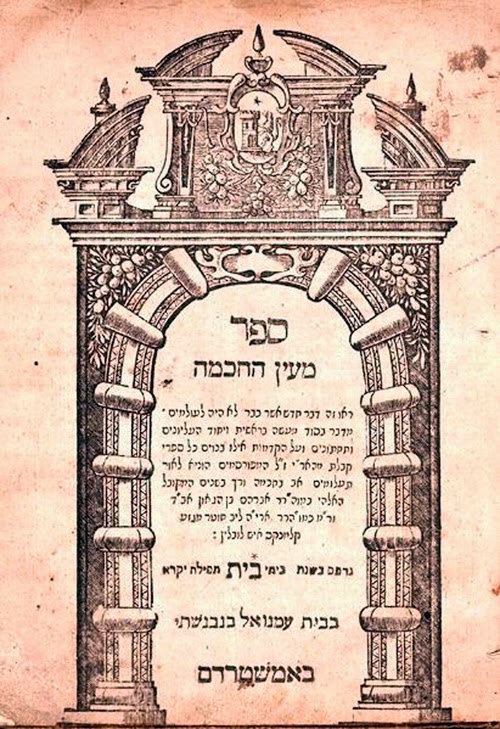
 

13 See the scan of the introduction.
14 The title is so listed on the pages of the treatise itself in ארזי הלבנון, pp. 46b-47a. On the title page of ארזי הלבנון, it is listed as מעיין החכמה. The frequent and easy interchange between the spellings מעין and מעיין and the spellings חכמה and החכמה characterizes virtually all the printed editions of the various books bearing these titles.
15 L. Fuks and R.G. Fuks-Mansfeld, op. cit., vol. 1, p. 195, entry 270,
16 Only a handful of copies are extant world wide. To the best of my knowledge, the first edition of Kalmankes’ מעין החכמה has not been photo-mechanically reproduced, and it is not available online (as of the date this note was recorded). Nor is it available on any of the standard electronic collections of rabbinic literature, such as HebrewBooks, אוצר החכמה, or אוצרות התורה. I am indebted to the National Library in Jerusalem and the Jewish Theological Seminary in New York for making their copies available to me. The scans of the title page and the introduction are reproduced here courtesy of the Bibliotheca Rosenthalia, now in the Special Collections of the University of Amsterdam (online catalogue: http://permalink.opc.uva.nl/item/001748453).
17 H. D. Friedberg, תולדות הדפוס העברי בפולניא (Antwerp, 1932), p. 61.
18 One key revision appears on p. 1, chapter 2, where ספר ויקהל משה is referenced. The book is not mentioned in the first edition of Kalmankes’ מעין החכמה, nor could it have been, since ספר ויקהל משה was not published until 1698. The reference is to R. Moshe Graf, ויקהל משה (Dessau, 1698). It does not appear likely that Kalmankes saw Graf’s work in manuscript form, since מעין החכמה was published in 1652 and Graf was born in 1650.
19 For the date of Kalmankes’ death, see below. The Koretz, 1784 edition was photo-mechanically reproduced in Jerusalem, 1970.
20 The Polonnoye, 1791 edition of מעיין חכמה was photo-mechanically reproduced in Jerusalem, n.d. (circa 1998), in a thin, dark blue, hardbound volume whose spine and outer cover read צדיק יסוד עולם, and whose title page reads הר אדני. (In other words, when seeking a copy in a bookshop of the reprint of the Polonnoye, 1791 edition of מעיין חכמה, whatever else you do, don’t ask for a copy of מעיין חכמה.)
21 As noted by S. Ashkenazi (see above, note 8), the title page of the Lvov edition indicates that its text is based upon the Koretz edition, and reproduces the very biblical phrase used by the Koretz edition for indicating its original date of publication in 1784. But by highlighting a different set of letters within the same biblical phrase, the Lvov edition announces to the reader that its date of publication is 1875.
22 Y. Avivi, קבלת האר”י (Jerusalem, 2008), 3 volumes, passim. See especially vol. 1, pp. 204-208, 443; and vol. 2, pp. 565-568, 840-841. See also, idem, “כתבי האר”י באיטליה עד שנת ש”פ”,” עלי ספר 11(1984), pp. 91-134; and “הערה,” עלי ספר 12(1986), p. 133.
23 “Plagiarism is something people may do for a variety of reasons but almost always something they do more than once.” So T. Mallon, Stolen Words: Forays into the Origins and Ravages of Plagiarism (New York, 1989), preface, p. xiii.
24 Rabbi M.Y.S. Goldenberg, “פתח דבר,” to the reissue of R. Abraham Kalmankes’ ספר האשל (Brooklyn, 1992).
25 On R. Joseph Kalmankes Yaffe of Lublin, see J. Kohen-Zedek, שבת אחים ( St. Petersburg, 1898), pp. 59-76; S. B. Nissenbaum,  לקורות היהודים בלובלין, (Lublin, 1920), second edition. pp. 36-37; S. Buber, אנשי שם (Cracow, 1895), p. 89, entry 217;  and S. Englard, “צפונות יוחסין (א), “ ישורון 3(1997), p. 680, note 6 and p. 694, note 36a.
26 See K. Lieben, גל עד (Prague, 1856), German section, p. 46; Hebrew section, pp. 34-35.
27 R. Abraham Kalmankes, ספר האשל (Lublin, 1678). Few copies have survived. For the copy at the Bodleian Library, see M. Steinschneider, Catalogus Librorum Hebraeorum in Bibliotheca Bodleiana (Berlin, 1860), vol. 1, column 752, entry 4458:1; and A.E. Cowley, A Concise Catalogue of the Hebrew Printed Books in the Bodleian Library (Oxford, 1929), p. 45. For the copy at the British Library, see J. Zedner, Catalogue of the Hebrew Books in the British Museum (London, 1867), p. 14. For the copy at Yeshiva University’s Mendel Gottesman Library, see B. Strauss, אהל ברוך (London, 1959), p. 31, entry 534. To the best of my knowledge, the first edition of Kalmankes’ ספר האשל has not been photo-mechanically reproduced, and is it not available online (as of the date this note was recorded). Nor is it available on any of the standard electronic collections of rabbinic literature, such as HebrewBooks, אוצר החכמה, or אוצרות התורה. A new edition of this exceedingly rare volume was made available by Rabbi M.Y.S. Goldenberg (Brooklyn, 1992) and we are indebted to him. Nonetheless, one needs to use this new edition with caution; the text has been “improved” for the modern reader. A comparison of the texts of the title page, as they appeared in 1678 and 1992, serves as an indicator of the occasional liberties taken with the text. A seemingly enigmatic woodcut (opposite the opening page of the commentary on Genesis) depicting a Jew (Kalmankes?) drawing water from a well (מעין החכמה?) – and framed in an elaborate frame marked by two angelic beings holding up a crown inscribed with the words כתר תורה – was not reproduced in the 1992 edition. See the attached scans:
 
28 The letter of recommendation from Vilna, dated 1673, was written by its Chief Rabbi, R. Moses b. David Kramer (d. 1687), the paternal great-great-grandfather of the Vilna Gaon.
29 These vicissitudes of life may account for the additional first names of Kalmankes, who in ספר האשל is identified as אשר יעקב אברהם קלמנקס. For the practice of changing names and/or adding additional first names when confronted by difficult circumstances, see R. Judah He-Hasid, ספר חסידים (Jerusalem, 1957), ed. R. Margulies, p. 214, paragraph 245 and notes. Cf. A. Teherani, כתר שם טוב (Jerusalem, 2000), vol. 1, pp. 293-315.
30 B. Pesahim 50a and parallels.
31 S. Buber, op. cit., p. 45, entry 101.
32 G. Suchestow, מצבת קודש (Lemberg, 1863), second edition, vol. 1, no pagination, entry 32.
33 The opening line ביום טוב נהפך כי טוב פעמים signals that Kalmankes died on a holiday that fell on the day when כי טוב was said twice. The next line identifies the holiday as 15 Nisan, i.e., the first day of Passover. The day כי טוב was said twice refers, of course, to the third day of creation, i.e. Tuesday. See Gen. 1:10 and 12.
34 Buber, loc. cit., writes with confidence that the highlighted letters are אמ”ת, which would indicate that Kalmankes died in [5]441 or 1681. But in 1681, the first day of Passover fell on a Thursday, not on a Tuesday. Suchestow was more circumspect, indicating it was no longer possible to determine which of the engraved letters were enlarged or highlighted. He left the problem unresolved. The usual practice for highlighting was the placement of a protruding dot over the engraved letters that were to be used for reckoning the year of death. The problem cannot be resolved by emending the second line to read ט”ז בחודש ניסן instead of ט”ו בחודש ניסן, since the second day of Passover can never fall on a Tuesday. See שלחן ערוך, אורח חיים, סימן תכח: א.
35 By highlighting the letters תתן אמ’ת’ לי’עקב’.
36 By highlighting the letters תתן א’מ’ת’  לי’עקב’.
37 These dates are based upon the assumption that the text of Kalmankes’ epitaph, as copied and published by Suchestow in 1863, is an accurate copy of the original. But this may not be the case. Suchestow’s מצבת קודש is marred by egregious errors. He sometimes copied and published as many as four different versions of the same epitaph! In another instance, he divided an epitaph into two parts, creating two dead persons when only one was called for. See the critiques of Suchestow in S. Buber, op. cit. (above, note 25)pp. vi-viii and in R. Margulies, “”,לתולדות אנשי שם  סיני 26(1949-50), p. 113 ( and throughout the later installments to this essay published in סיני between 1950 and 1952). Given that Kalmankes’ tombstone was close to 200 years old when it was copied in 1863, it is likely that the epitaph could be read only with great difficulty. While any attempt at emending the received text is speculative, a slight emendation of the first lines of the epitaph yields the following text:
שנת תתן אמ”ת ליעקב
ביום טוב נהפך טוב פעמים ואבל ומספד ונהי בכפלים
ט”ו בחודש ניסן נגנז צנצנת המן המאיר באספקלריא המאירה
The sense would be that Kalmankes died on 15 Nisan, on יום טוב, on a day when טוב was twice overturned. It was overturned first, because every day of the week of creation was described as  טוב(with the exception of the second and seventh days); and second, because it was יום טוב, a holiday. This would allow for 15 Nisan to fall on a Thursday, and indeed in 1681 (the numerical equivalent of אמ”ת), the first day of Passover fell on a Thursday. If so, Kalmankes may well have died in 1681.
38 These dates are an approximation. We know only that R. Aryeh Kalmankes died in 1671 or earlier, as his name appears with ברכת המתים in several letters of approbation dated 1671 and appended to ספר האשל.
39 These dates, as well, are an approximation. For possible evidence that R. Abraham Kalmankes died in 1681, see above, note 37. If Kalmankes was born in 1620, he would have been 32 years old when מעין החכמה was published in 1652. This fits well with his description on its title page as a רך בשנים. It also fits well with R. Joseph Samuel’s characterization of him (at the time) as an “upstart student.” It would also mean that he was nearing 60 years of age in 1678, when he published ספר האשל. This fits well with his bemoaning the fact – in the introduction to the volume – that the hair on his head and beard had turned gray and that old age was overtaking him.
40   It is astonishing that the author of the most comprehensive study of the Kalmankes family, J. Kohen-Zedek, שבת אחים (see above, note 25), concluded on pp. 67-68, that the authors of מעין החכמה and ספר האשל were two different people named Kalmankes (cousins, of course)! Among his proofs is the alleged fact that the author of ספר האשל was unaware of the existence of מעין החכמה. Alas, Kohen-Zedek overlooked the passage cited here. So too Gershom Scholem, who wrote: “המחבר [של ספר מעין החכמה] לא הזכיר את הספר בספריו הוא, כגון ספר האשל.” See the loose page in Scholem’s hand and the Scholem Library Catalogue, referred to above, note 11. Scholem, however, did not conclude with Kohen-Zedek that the authors of מעין החכמה and ספר האשל were two different people. Even more astonishing is the fact that the late bibliophile, R. Reuven Margulies, cited Kohen-Zedek’s conclusion approvingly. See R. Margulies, “לתולדות אנשי שם בלבוב,” סיני 26(1949-50), p. 219. It appears likely that Scholem (in part) and Margulies were misled by Kohen-Zedek.
41 ספר האשל (Lublin, 1678), p. 8b. We have printed the text as it appears
  in the first edition. In the 1992 edition, it appears on p. 29 as follows:
או יאמר באשר נקדים מאמר הר”י לוריא הנזכר בספר מעיין החכמה אשר הביאותיו לבית הדפוס בפ’ י”ד, שבשעת הבריאה…
 42 In general, see A. Lindey, Plagiarism and Originality (New York, 1952); T. Mallon, op. cit. (above, note 23); and J. Anderson, Plagiarism, Copyright Violation and Other Thefts of Intellectual Property: An Annotated Bibliography with a Lengthy Introduction (Jefferson, North Carolina, 1998).
43 Thus, in the introduction to the first edition of מעין החכמה, Kalmankes states:
וגם מעט מזער מדעתי הוספתי אך לזכות הרבים היא כוונתי (I added but a few comments of my own; my only intention is to benefit the many). In the Polonnoye, 1791 edition this was radically changed to: וגם מעט מזער מדעתי לא הוספתי אך לזכות הרבים היא כוונתי (I added not even the fewest of comments of my own; my only intention is to benefit the many). This change was made necessary because the kabbalistic manuscript now appended to Kalmankes’ introduction, and being published together with it for the first time, did not contain Kalmankes’ additional comments.   
44 I am deeply grateful to Rabbi Menachem Silber for reading and commenting on an earlier draft of this essay. The errors that remain are entirely mine.


Jews, Medicine and the University of Padua A Behind the Scenes Tour of a New Exhibit at the Jewish Museum of Padua November 2, 2022- December 31, 2022

Jews, Medicine and the University of Padua: A Behind the Scenes Tour of a New Exhibit at the Jewish Museum of Padua
November 2, 2022- December 31, 2022
By Rabbi Edward Reichman, MD

The city of Padua (or Padova), just twenty-five miles southwest of Venice, has a rich and expansive Jewish history, though it is not typically on the itinerary of the Jewish traveler to Italy. One might perhaps recognize the city name as the penultimate stop on the train from Florence to Venice. The likes of Rabbi Yehuda Minz (Mahari Minz- 15th century), Rabbi Meir Katzenellenbogen (Maharam Padua- 16th century), and Rabbi Moshe ayyim Luzzatto (Ramḥal- 18th century) all lived and taught there, as did many other great personalities in Jewish history.
One of the centerpieces of the city is the University of Padua, one of the oldest universities in the world, which is celebrating its 800th anniversary this year. To this day, it remains one of the premier universities in Europe. The Jewish history of this city is very much intertwined with the university. One remarkable connection between the two is geographical. As divine providence would have it, the Ghetto of Padua was established literally meters away from the university campus. A casual stroll from Palazza Bo, the iconic architectural center of the University of Padua, to the Ashkenazi Synagogue in the Ghetto, now home to the Jewish Museum in Padua, takes less than five minutes.

A new exhibit at the Jewish Museum of Padua, in collaboration with the University of Padua, explores the unique relationship between the university and the Jewish community in the pre-modern era, with particular focus on the medical training of Jewish students. The exhibit commemorates a key role the university played in Jewish medical history, beginning in the fifteenth century, as the first university to officially allow Jews to gain formal training in the field of medicine. Since the formation of the earliest universities,[1] Jews were officially barred by papal decree from attending, as the universities were by and large under the auspices of the Catholic Church. In the pages of this blog, we have drawn attention to the role the University of Padua played in Jewish medical education.[2] Most recently we focused on a rare genre of poems written in honor of Jewish medical graduates of this institution from the 16th-18th centuries.[3]

I am now delighted to inform you of a new exhibit at the Jewish Museum of Padua- Jews, Medicine and the University of Padua– which will run through December 31, 2022. The exhibit was inaugurated with an event on November 2, 2022. Introductions by representatives of the museum, the Jewish community of Padua and the University of Padua were followed by a recorded video address by Chief Rabbi Dr. Riccardo Di Segni of Rome, himself a prominent physician, on Judaism and medicine. The program concluded with my presentation about the training of Jewish medical students in Padua.[4]

The archival material occupies a large display case[5] and reflects three centuries of history through rare documents, including community and city archives, which have never been on public display. With the exception of the work of Vesalius, all the items are unica.

In addition, displayed throughout the exhibit hall are portraits of Jewish physicians from Padua from the Benvenesti Collection of the Museo d’Arte of Padua, and a slideshow of diplomas and congratulatory poems appears on the big screen.

Please join me for a behind the scenes virtual tour of some of the highlights of the exhibit.

I. Anatomy, Vesalius, and the Jewish Medical Students of Padua

Andreas Vesalius
De Humani Corporis Fabrica (1543)

Library of the University of Padua

On the lower left shelf of the case, we find an early edition of Andreas Vesalius’ De Humani Corporis Fabrica, open to the frontispiece. It is no exaggeration that the field of modern anatomy was born at the University of Padua under the vision of the famed professor of anatomy, Andreas Vesalius (1514–1564).[6] You may wonder why a copy of this volume, one of the most famous works in the history of medicine and anatomy, is part of an exhibit on Jewish medical history.

This monumental development in the history of medicine interfaced with the Jewish community of Padua in a number of ways. Much like this one anatomy book reveals the structures of the entire body, so too, this one book provides a window into a complex chapter of the experience of the Jewish medical student in Padua with respect to anatomy.

Hebrew Anatomical Terms

The anatomical terms detailed in the works of Vesalius – the Tabulae Anatomicae and De Humani Corporis Fabrica – are presented in multiple languages. One of those languages is Hebrew.[7] The reason for this is not specifically related to the Jewish medical students of Padua per se, but rather to the role the Jews played in the translation of medical works and the transmission of classical medical teaching from antiquity to the Middle Ages and Renaissance.[8]

Exactly who is responsible for the Hebrew translations in the Tabulae Anatomicae is unknown. Vesalius may have attended lectures on the Hebrew language by Joannes van Campen at the Pedagogium Trilingue in Louvain.[9] With the Hebrew terminology for the Fabrica, however, Vesalius duly acknowledges some assistance:

I have decided to give in the index principally a simple list of the names of the bones, first presenting those I use in the text; then the Greek; then, any others in Latin taken from authoritative writers, and all that in such way that it may have value. After these will follow the Hebrew, but also some Arabic, almost all taken from the Hebrew translation of Avicenna[10] through the efforts of Lazarus de Frigeis, a distinguished Jewish physician and close friend with whom I have been accustomed to translate Avicenna.[11]

The reference to Avicenna, the eleventh century Persian physician and polymath, refers to the Canon of Avicenna, one of the more influential medical works of that time. A magnificent, illustrated Hebrew manuscript translation of the Canon, which dates from the mid fifteenth century, is found in the University of Bologna,12] and the work was printed later in the fifteenth century. The Hebrew terminology in Vesalius, and its relationship to the Hebrew medical terminology of the Canon, has been studied by both historian and linguist alike.[13] Some have been less than complimentary.[14]

Vesalius credits Lazarus de Frigeis, “a distinguished Jewish physician and close friend,” with assisting him with the Hebrew translation in the Fabrica.[15] While some evidence has come to light about this friend, his exact identity still eludes scholars.[16] De Frigeis is believed to be depicted in the classic illustration on the frontispiece of the Fabrica, visible in the exhibit showcase, wearing characteristically Jewish garb.[17]

Vesalius and the Jewish Medical Students of Padua

Another relationship between Vesalius and the Jews[18] is inferred from his tenure as a lecturer at the University of Padua.[19] As Padua[20] was one of the only institutions of higher learning in the medieval and Renaissance periods to admit Jews,[21] Jews from across Europe flocked to attend.[22] These students however were not versed in either Italian or Latin, the academic language of discourse. They sometimes required translation for their studies. This is evidenced by the existence of a rare manuscript of the Fabrica in Yiddish dating from the late 1500s.[23]

One could imagine a group of German Jewish medical students sitting in the back of Vesalius’s lecture hall hunched over this very manuscript trying to keep pace with the day’s lesson.

Vesalius’s work also formalized and expanded the teaching of human anatomy at the University of Padua, as well as at medical schools throughout the world. The supply of cadavers was a perennial challenge for the medical school and each community which sent medical students for training at the university was required to provide bodies for the dissection table. This presented a unique problem for the Jewish students, as Jewish law forbids the dissection of the body after death. The Jewish medical students and Jewish community went to great lengths to gain exemption from this requirement. This is reflected in the Jewish community archives of this period.[24] There was also fear of grave robbing from the Jewish cemeteries.[25] Indeed, one scholar has suggested that one of the illustrated letters in the Fabrica depicts a scene of the grave robbing of a body from a Jewish cemetery.[26]

The “o” on the flag held by the putti was the symbol Jews were required to wear on their clothing.

In one case in 1676, a Jewish body was stolen before burial by medical students and brought to the anatomy table for dissection. Riots ensued and a compromise was ultimately reached. Isaac Cantarini wrote about this in his Paad Yitzak (1684). Roth recounts a case where disgruntled students kidnapped an etrog that was being transferred between communities on Sukkot and held it ransom in exchange for providing Jewish bodies for dissection.[27]

II. History of Degree Granting for Jewish Medical Students before 1615- Counts Palatine

Padua City Archives (1469-1470)
ASPd, Notarile, vol. 1946
Archivio di Stato di Padova

The oldest and rarest item of the exhibit (bottom left section- front) is a volume of the Padua city archives from the late 15th century. The pages on display document the medical degree-granting process for Jewish students during this period.

In the early centuries of the University of Padua Medical School, doctoral degrees were granted by the Sacred College of Philosophers and Physicians in a Catholic religious ceremony. As such, this pathway to a medical degree was not a viable option for a religious Jew. However, non-Catholics, including Jews, could obtain medical degrees through a different pathway outside of the university walls, granted by specific individuals known as Counts Palatine, who received their authority from the Holy Roman Emperor. These ceremonies were held privately before a notary and witnesses.[28]

On display is a remarkable archival record from February 21, 1469, reflecting this degree-granting process. The passage recounts that the Holy Roman Emperor Frederick III, while visiting Italy, bestowed upon Judah Messer Leon[29] a double doctorate in medicine and liberal arts, in addition to the title of Counts Palatine, granting him the right to confer doctorates upon other Jews of proven worthiness.

Judah Messer Leon was an accomplished physician, professor, and Torah scholar who later taught at the University of Padua Medical School. His work Nofet Tzufim (Abraham Conat: Mantua, 1475), known to this blog audience as the first Hebrew book to be printed in the lifetime of its author,[31]is a treatise on rhetoric, utilizing the classical literary devices of the ancient discipline of rhetoric applied to the Torah. One of the uses for this work was to prepare the Jewish students who matriculated from foreign countries to the medical schools in Italy. Indeed, Messer Leon is purported to have organized a yeshiva where students could receive a comprehensive Jewish education while training in the secular disciplines necessary for higher studies in the humanities, philosophy, and medicine.[31]

In the same archival record, we learn that it would be just one year later that Messer Leon would exercise his privilege as a Counts Palatine. In Padua, on 27 February 1470, Rabbi Dr. Judah Messer Leon bestowed a medical degree upon the Jew Yoanan Alemanno in a private ceremony at his home. Alemanno was a prominent Italian rabbi, philosopher and Kabbalist who also apparently taught Hebrew to the likes of Pico Mirandola. The nature of the ceremony was similar to the conventional Padua University procedure and included presenting the new doctor with a signed book, placing a gold ring on his finger, a wreath on his head, tying a red silk thread around his waist, and kissing him on the cheek.[32] However, while the invocation to the ceremony for the typical Christian student was “In Christi Nomini,” Messer Leon’s invocation for Alemanno was In Dei omnipotentis nomine amen” (in the name of the Omnipotent God, Amen).[33]

This was the precursor to the invocation which would be used for the formal diplomas of Jewish students in the following centuries, “In Dei Aeterni Nomine Amen.” Messer Leon exercised this extraordinary privilege a number of times during his lifetime.

Messer Leon was involved in a Jewish legal dispute regarding the permissibility of wearing academic robes. Issues relating to these robes included the obligation to wear tzitzit, as well as the concern that they might contain sha’atnez.[34]

In 1615, the Collegio Veneto was established to serve the purpose of granting degrees to non-Catholic students and essentially replaced the Counts Palatine. The diplomas on display in this exhibit are from the period of the Collegio Veneto.

III. Diplomas of Jewish Medical Graduates of the University of Padua

Diplomas of Padua Jewish medical graduates are exceedingly scarce. While there have been a few sold at auction over the last few decades,[35] such diplomas are rarely displayed in public. I have thus far identified a total of nineteen extant diplomas of Jewish Padua medical graduates. Only three examples are found in Italy, and all of them are on display at this exhibit. An additional diploma was reproduced for display,[36] and images of others appear on the screen in the exhibit hall. Below I describe the diplomas on display, accompanied by a brief bio of their (original) bearers.

1) Medical Diploma of Moise di Pellegrino (Moshe ben Gershon) Tilche[37]
University of Padua- 1687
Gross Family Collection (Tel Aviv, Israel)

The invocation for the diploma for the typical Padua graduate was “In Christi Nomini.” For Jewish students, such as Tilche, the invocation was typically amended to “In Dei Aeterni Nomini.” Tilche is identified as “Hebreus” in the diploma, which was common for most Jewish students.

This is one of only a few Jewish medical diplomas from Padua that bear the graduate’s portrait, and the only such example displayed in this exhibit. Below the portrait are putti holding a laurel wreath, a book, a ring, and a hat.

This is a remarkable and unique depiction of the features of the Padua graduation ceremony. In addition to placing the wreath and hat on the graduate, a ring was placed on his finger, and books were symbolically opened and closed to represent the transmission of knowledge. This is similar to the ceremony described above performed by Messer Leon. This is the only known such illustration found on any Padua diploma.

The year is listed as “currente anno” instead of the typical term with Christian reference, such as Anno Domini, Anno a Christi Nativitate, or Anno Christiano.

Witnesses: The two witnesses for Tilche’s diploma were the Jewish physician, and graduate of Padua, Isaac Vita Cantarini (AKA Yitsḥak Ḥayyim Cantarini) and the Jew Samuele Pace. A branch of the Pace family was established in Padua by the 17th century. A member of the family, Solomon, received his medical degree from Padua in 1647.[38] Cantarini was a rabbi as well as a physician and was a prominent figure in the Padua Jewish community.[39] Cantarini was both the author and recipient of poems dedicated in honor of Padua medical graduates.

Moshe ben Gershon Tilche signed a letter published in the Jewish legal responsa of Sanson Morpurgo, another medical Padua graduate (1700),[41] about the custom of donning tefillin on ḥol ha-mo‘ed (intermediate days of the holiday).[41]

2) Medical Diploma of Samuele Coen[42]
University of Padua- 1702
University of Padua Archives Raccolta Diplomi, 33 (n. 3841)

There were sixteen medical graduates from the University of Padua from the seventeenth and eighteenth centuries with the last name of Coen, though they were not all related. Samuele was part of the sphere of Rabbi Moshe ayyim Luzzatto (Ramal). It was a common custom for students’ mentors, fellow Padua students or alumni, or family members to compose congratulatory poems, mostly in Hebrew, to celebrate the student’s graduation. There are three students I have identified for whom we possess an extant copy of both a diploma and a congratulatory poem. Coen is one. Coen’s brother Moise, also a Padua medical alumnus (1675), composed a broadside poem in honor of Samuele’s graduation.[43]

Moise served as a witness for the graduation diploma of another Jewish student, Emanuel Colli, whose diploma is housed in the Magnes Collection in California.

In 1741, Coen’s daughter married another graduate of Padua’s medical school, Jacob ben Moses Alpron.[44] Rabbi Moshe ayyim Luzzatto (Ramal) wrote a poem in honor of Alpron’s graduation.

It was not uncommon for the typical Padua medical diploma to include an illustration of the family coat of arms for the graduate. Coen’s diploma is one of a few examples of coats of arms found in diplomas of Jewish students, and the only example in our exhibit. The coat of arms includes the symbol of the Kohen tribe, two hands in the formation used for the priestly blessing. Above the hands appears a crown, and below it appears a raven.

Samuel Coen was clearly a member of the kohen tribe, as were a number of Padua medical graduates including Tuviyah haKohen Rofeh and Isaac Cantarini, for example. Given the introduction of systematic anatomical dissection into the medical school curriculum in the 16th century, I have long wondered why there is no reference in the halakhic literature of this time to the issue of dissection for a Kohen, let alone for a Yisrael. The first references to dissection are in the late 1700s with the famous responsa of the Nodah biYehuda and Rav Yaakov Emden, though they contain no discussion about Kohanim. This is perhaps because the format of anatomy teaching involved the professor alone performing the dissection and teaching over the body. This is reflected in the design of anatomical theater of Padua. Students did not perform hands-on dissection; thus, the only potential issue would be tumat ohel, which at least according to some authorities is not generated by a non-Jewish corpse. However, as the original theater had a retractable roof to eliminate the foul odors during dissection, perhaps even tumat ohel may have been a non-issue.

Returning to the diploma, there are two sets of books on a table under the medallion, all of them labeled with the names of secular authors who were part of the standard curriculum at that time, including Plato, Aristotle, Hippocrates, Galen, and Avicenna.

I had hoped the name Maimonides might have appeared on the spine of one of the books.

Coen is identified as “Hebreus” in the diploma, which was the norm for Jewish students.

The year is listed as “currente anno” instead of the typical term with Christian reference, such as Anno Domini, Anno a Christi Nativitate, or Anno Christiano.

3) Medical Diploma of Moise Valle[45]
University of Padua – 1713
Biblioteca Statale del Monumento Nazionale di Praglia, Fondo Ebraico, 156

Moshe David Valle (1697-1777), one of the more well-known graduates of Padua, was an Italian Rabbi, physician, and kabbalist. He lectured for the Padua confraternity Mevakshei HaShem (seekers of God). He was a prolific author and teacher, as well as student, of Rabbi Moshe Ḥayyim Luzzatto (known as Ramḥal). He authored commentaries on the Torah and Prophets as well as works on Kabbalah.[46]  He is responsible for disseminating the teachings of Ramḥal. Ephraim Luzzatto, physician, poet and fellow graduate of the University of Padua, authored a poem praising Valle’s lectures.[47]

Ramḥal and the University of Padua

As we are discussing Valle, we would be remiss if we did not at least briefly mention the relationship of Ramḥal to the university and its students. Though not part of this exhibit, the relationship of Ramḥal with the students of the university has been explored.[48] It had long been debated as to whether Ramḥal actually attended the university, as evidence was elusive. Debra Glassberg Gail has recently discovered records of his matriculation,[49] though not graduation. I obtained copies of these records confirming the matriculation of Moise Vita Luzzatto at the universitas artistarum,[50] amongst the students of philosophy and medicine.

Matriculation Records of 1723

Moise Vita Luzzato di Giacob ebreo

Matriculation Records of 1725

Moise Vita Luzato di Giacob ebreo

Matriculation Records of 1726

Moise Vita Luzato di Giac ebreo

The Luzzatto family had a long and productive relationship with the university as described below regarding the diploma of Raffaele, which is on display. Some of Ramḥal’s most cherished students, including Yekutiel Gordon and Moshe David Valle, studied medicine in Padua, and I have identified at least eight medical students for whom Ramḥal wrote congratulatory poems upon their graduation.[51]

Returning to the diploma, Valle, as well as the other students represented in this exhibit, had the invocation amended to “In Dei Aeterni Nomini.” Valle is identified as “Hebreus” as well. The year is listed as “currente anno,” devoid of any Christian reference.

Valle was promoted by Bernardino Ramazzini, who was in contact with some of the Christian Hebraists of that time.[52]Ramazzini is also considered the founder of occupational medicine, and in his classic work on diseases of the tradesman he discusses the increased prevalence of scabies among the Jewish population.[53]

Valle is buried in the Jewish cemetery of Padua.

The Diploma Medallion

The Padua diploma typically contains a medallion on the front page, which was designed and intended for the inclusion of a portrait. However, as this option required an additional fee, it was not exercised by all students. As the basic structure of the diploma was templated, for those who refused the portrait option, the medallion nonetheless remained. In these cases, one thus finds the medallion left bare, or filled with text. The three aforementioned diplomas in our exhibit reflect the three possible options. While Tilche chose the premium package, his fellow graduates did not.

4) Medical Diploma of Raffaele Luzzatto[54]
University of Padua 1797
Centro per la Storia dell’Università di Padova

The latest diploma in our exhibit is likewise noteworthy, though not because of its artistic value. Raffaele was a member of the famous Luzzatto family, many of whom graduated the University of Padua Medical School.[55]Raffaele was from the town of San Daniele in the northeastern region of Italy, Friuli.[56] From the end of the 17th to the early 19th century, numerous members of the San Daniele Luzzatto family graduated from the Padua medical school.[57]In fact, Raffaele was in a direct, unbroken line of what would ultimately be six generations of Luzzatto physicians, many of them named Raffaele.[58]

Samuel David Luzzatto (1800–1865), the great scholar and bibliophile, known as Shadal, reports that on a visit to his uncle Isaac in San Daniele, he was shown the medical diploma of Isaac’s father, Raphael.[59] Shadal then commented, “We learn that the poet Isaac was preceded by a Raphael and an Isaac, and was followed by a Raphael and an Isaac, all of them doctors.” This diploma on display may be the very diploma Shadal saw on his visit.

This is a simple unilluminated diploma comprised solely of calligraphic text. The invocation reads “In Dei Nomine,” similar but not identical to the invocations of the other diplomas in this exhibit.

Close inspection reveals that the word “Dei” is written over erased text of a longer word. There are a few additional erasures, including the words under the granting authority of the degree, which reflect the possibility that this diploma was templated for a Christian student, and originally read, “In Christi Nomine.”

Further proof for this theory is that the invocation for the Jewish student usually read, “In Dei Aeterni Nomine,” with the word “Aeterni” added. This is not the case here, as given the limited space of the templated invocation, it would not have been possible to add the additional word. Of note, Luzzatto’s graduation record in the Padua University Archives actually bears the invocation, “in Christi Nomine.”

There are a number of cases where the archival record for Jewish students bears the standard Christian invocation, while the student diploma does not. The archival scribe may have simply followed the usual formula without much thought, and the student would likely never have known otherwise. The diploma, however, was given to the student to possess in perpetuity and therefore the emendation to “in Dei Aeterni Nomine” would have been preferred for a Jewish student.

Luzzatto is also not identified as a hebreus in either the archives or in the diploma. Furthermore, while the diplomas of Tilche, Coen and Valle amended the format for the date to remove any Christian reference, this diploma retains the conventional Christian dating, “Anno a xti Nativ” (shorthand for Anno a Christi Nativitate).” All the aforementioned observations support the suggestion that this diploma was originally templated for a Christian student.

IV. Benvenisti Collection of Portraits of Physicians

Padua’s Museo d’Arte contains the Benvenisti collection of portraits of physicians. Displayed are reproductions of portraits of some Jewish physicians,[60] some of whom graduated from the University of Padua. I highlight two examples below.

1) Sabbato Vita Marini (1662-1748)

Marini’s famous portrait is used for the museum exhibit advertising.

Shabtai Ḥayyim Marini graduated from Padua in 1685[62] and was a close friend and possible teacher of Rabbi Moshe Ḥayyim Luzzatto (Ramḥal).[62] In addition, he translated into Hebrew the first three books of Ovid’s Metamorphoses from the Italian translation of Giovanni Andrea dell’Anguillara.[63] Joseph Almanzi composed an ode to Marini in his Nezem Zahav:

2) Samuele Medoro (1788-1854)

Samuel Medoro (1788-1854), received his training in the University of Padua, served as surgeon in the La Confraternità Israelitica “Sovvegno” di Padova, which endowed medical assistance to Jews throughout Italy, and published many medical articles. He was an active participant in the debate about the requirement for oral suction as part of the circumcision procedure. His handwritten lectures on cicumcision were sold at auction in 2013 by Kedem Auction House in Jerusalem.[64]

Conclusion

If you happen to be in Italy before the end of the year it may just be worth the detour from Venice to catch a rare glimpse of a little-known chapter at the crossroads of Jewish, Italian, medical and academic history. While there, make sure to book a tour with the museum, which includes the synagogue and cemeteries. In the old cemetery are buried Rabbi Meir Katzenellenbogen, who was a teacher and mentor to the Jewish medical students of Padua;[65] Abraham Catalano, physician and author of the work Olam Hafukh[66] on the 1631 plague (a reproduction of which is on display at the exhibit); and Moshe David Valle, who was a staunch supporter of Ramḥal and whose diploma is on display. If you have even the remotest interest in the history of medicine or anatomy, the University of Padua is home to the first and longest standing permanent anatomical theater in the world, completed in 1595, just steps away from the exhibit. In fact, the theater benches were not only occupied by many Jewish medical students over the centuries, there is also a record of Jews from the community (non-students) attending dissections when the theater was first built.[67] It is thus evident that you do not need to be a doctor (or health care provider) to appreciate this medically related exhibit.

I conclude with the following serious offer (though my wife Sara might describe it otherwise). If you make it to the exhibit in person, feel free to contact me, and I would be delighted to give you a tour while you are there- time and time zone permitting. (I have already done it once.)

Appendix- Jews, Medicine and the University of Padua: The Uncut Version

Below are a number of sections I had hoped to include in the exhibit, but for a variety of reasons did not make the cut.

Seforim/Books related to the Graduates

The original exhibit proposal included a section of first or early edition books/seforim related to or composed by Padua medical graduates. Included in this selective list are:

  • Paad Yitzak by Isaac ayyim Cantarini (Padua- 1664), which includes an account of a Jewish body kidnapped for the purpose of dissection by the non-Jewish medical students of Padua.

  • The ubiquitous Ma’aseh Tuviyah by Tuviyah HaRofeh (Padua-1683), one of the most famous graduates from Padua.[68]

  • Mateh Dan by David Nieto (Padua- 1687), patterned after the Kuzari.

  • Paad Yitzak, the first halakhic encyclopedia, by Isaac Lampronti (Padua- 1696).

  • Shemesh Tzedakah, responsa by Shimshon Morpurgo (Padua- 1700).

I also happened upon an article by Professor Joanna Weinberg about the collection of Hebrew printed works in the Antoniana Library of Padua.[69] A number of the items in this collection, all of which were printed before 1663, would be perfect for an exhibit on Jews and Medicine in Padua:

  • Cannon of Avicenna:[70] One of two Hebrew incunabula in this library, it is the only known Hebrew medical incunabula. Could Lazarus de Frigeis have used this copy when assisting Vesalius with the Hebrew terms of the Fabrica? Speculative to be sure, but certainly not out of the realm of possibility. Perhaps marginalia are present in the copy to shed light.

  • Shiltei ha Gibborim by Abraham Portelone:[71] Though neither medical in content nor written by a Padua graduate, it is nonetheless authored by one of the most famous Jewish medical personilites of that time and would certainly have been known to and possibly owned by the Jewish medical students in Padua. In addition, his son was a medical graduate of Padua and was promoted by none other than Galileo.

  • Pesakim from R. Yehuda Mintz and R. Meir Katzenellenbogen:[72] These two Torah giants were leaders of the Padua Jewish community in their day and certainly interacted and taught the Jewish medical students.[73]

  • Sefer Elim by Yosef Shlomo Delmedigo:[74] Delmedigo is one of the greatest alumni of Padua and amongst other things was known for his relationship with Galileo.[75]

In addition to the content of these books, their provenance was also relevant to our exhibit. Many of the Hebrew books held in the Antoniana Library originally belonged to Paduan Jews, evidenced by the family names inscribed on the title pages. I do not think it unreasonable to imagine that some of these works were actually used by Jewish medical students in Padua. Furthermore, I discovered that Pontificia Biblioteca Antoniana was a mere 750 meters from the Jewish Museum and Ghetto. It seemed too good to be true… and it was. The library requested exorbitant restoration fees for the items prior to transfer and regretfully financial constraints precluded this option. Alas, it was not meant be. I had also hoped to obtain Messer Leon’s Nofet Tzufim from the Vatican Library, but not unsurprisingly, was met with the same response and result.

Congratulatory Poems for the Jewish Medical Graduates of Padua

After having researched and written extensively about the congratulatory poems for the Jewish medical graduates of Padua, you might expect to find at least one hard copy of such a poem as part of the exhibit. However, for financial, legal and insurance reasons, the exhibit was limited to items found in Italy, primarily in the environs of Padua. Remarkably, of the over one hundred Hebrew congratulatory poems I have identified, not one is found in Italy. They are primarily found in Israel, America, England and Hungary. There is one single poem in the university archives written in Italian in honor of Samuele Coen,[76] whose diploma appears in the exhibit. The author is one of the University of Padua staff diploma illustrators, and I have yet to determine the story behind its composition. It does not in any way represent the genre of this poetry. In lieu of the physical poems, a slideshow of examples of congratulatory poems, along with examples of additional diplomas, is projected on the screen of the exhibition hall.

Padua Medical Graduates as Mohelim, Performing Circumcision on the Children of Their Fellow Graduates and Mentors

Identifying physicians of Jewish lineage is of great interest to some historians, but my interest lies at the intersection of medical practice and religious observance. The practice of circumcision by physicians is one such interface, and the physician-Mohel combination is not that common even today (with the exclusion of urologists). While this topic merits its own broader study, I have identified a number of Padua medical graduates who were also mohelim. Remarkably, in two cases, the pinkas mohel, or circumcision registry, is still extant, revealing another “medical” connection.

1) David Loria

Loria graduated Padua in 1623. Upon his graduation, Rabbi Yehuda Aryeh Modena composed a poem in his honor which now resides in the Oxford Bodleian Library.[77]

This poem is unique amongst the medical student poems, as it is one of only two medical student poems written in Aramaic.[78]

Loria and Modena maintained connection long after Loria’s graduation from medical school.[79] Indeed, Modena offered to bestow rabbinic ordination upon David Loria, though the latter declined for unknown reasons.[80] Loria was also a mohel and performed the rite for Modena’s grandson, Avtalion, in March 1636.[81] Though a physician in the Ghetto of Padua, Loria Fled Padua during the plague of 1631. However, he made extensive arrangements to provide for the needy.[82]

2) Salomon Lampronti[83]

Salomon was the son of the famous Isaac Lampronti, physician, rabbi, and author of Paḥad Yitzḥak. Isaac (Padua, 1696) and his son Salomon (Padua, 1734) were alumni of Padua’s medical school. Salomon was a mohel and his pinkas survived the ravages of time. Though I was unable to access the entire work, the passage shown in the Kedem auction catalogue[84] happened to include the record of Lampronti’s circumcision of the son of the physician Solomon Zamorani,[85] a Padua graduate of 1753.[86] Zamorani was also a student of the younger Lampronti. I suspect there are children of other Padua medical graduates included in this ledger.

3) Menahem Navarra[87]

Navarra completed his medical studies in 1740, and the poem below was written in honor of his graduation by Isaiah Romanin.[88]

Navarra was a mohel and, like Lampronti, his pinkas mohel has survived. Among those for whom he performed the rite were the children of Jacob Grassin Basilea and Raffael Ferrarese, both Padua medical graduates.[89] Below are examples of some of the entries:

March 27, 1757, son of Yaakov Gershon Basilea (Padua, 1735)[90] 

On December 2, 1769 Navarra circumcised the second son of Raffael Ferrarese (Padua, 1762), one of twins. The milah was performed one month after birth. Note he is called an “uman” (i.e., rofeh uman), which may possibly refer specifically to a university-trained physician.

There is a pinkas Milah housed in the University of Pennsylvania Library[91] which belonged to a member of the Fermi (or possibly Fermo/Firmo) family,[92] though the specific family member remains unknown. The entries run from 1705 to 1736. Therein are multiple references to Shimshon Morpurgo, a rabbi/physician graduate of Padua (1700).[93]

While the dates of the pinkas would align perfectly with the Padua medical graduate Moshe Yaakov son of David Fermo (Padua, 1701), I have no evidence to support his identification as the work’s author.[94] Furthermore, the spine of the work is stamped in gold with the words, Pinḳas mohel leha-R. Firmo. While the “R” typically refers to Rav, perhaps in this case the “R” stands for rofeh, though I admit this is unlikely.

[1] Bologna, founded in 1088, is considered the oldest university in the world.
[2] E. Reichman, “The ‘Doctored’ Medical Diploma of Samuel, the Son of Menaseh ben Israel: Forgery of ‘For Jewry’,” Seforim Blog (here), March 23, 2021; idem, “The Illustrated Life of an Illustrious Renaissance Jew: Rabbi Dr. Shimshon Morpurgo (1681-1740),” Seforim Blog (here), June 22, 2021.
[3] E. Reichman, “How Jews of Yesteryear Celebrated Graduation from Medical School: Congratulatory Poems for Jewish Medical Graduates in the 17th and 18th Centuries- An Unrecognized Genre,” Seforim Blog (here), May 29, 2022.
[4] Three additional lectures accompany the exhibit. For a list of the lectures, including zoom info and recordings, see here.
[5] The exhibit was limited to items found in Padua and its environs.
[6] On Vesalius, see O’Malley, Andreas Vesalius of Brussels. The classic bibliography of works about Vesalius by Harvey Cushing is continuously updated by Dr. Maurits Biesbrouck, Vesaliana: An Updated Vesalius Bibliography here.
[7] On the use of Hebrew in medical literature throughout history, see the excellent survey of H. Friedenwald, “The Use of the Hebrew Language in Medical Literature,” Bulletin of the History of Medicine 2(1934), pp. 77–111. See also J. J. Barcia Goyanes, “Medieval Hebrew Anatomical Names: A Contribution to Their History,” Koroth 8:11–12 (1985), pp. 192–201; A. Goldstein, “Historical Development of Hebrew Medical Terminology,” Koroth 3:11–12 (May 1966); Goldstein, 4:1–2 (December 1966), p. 122; 4:5–7 (December 1967), p. 452; 4:11–12 (December 1968), p. 773. On the use of Hebrew in universities during this period, see, for example, Z. Y. Flashkas, “The Hebrew Language in the Universities of the Middle Ages,” Koroth 2:910 (May 1961), pp. 494495.
[8] On this topic, see, for example, the works Gerrit Bos, Gad Freudenthal, Resianne Fontaine, Lola Ferre, and Maud Kozody.
[9] O’Malley, Vesalius of Brussels, p. 33. For a list of professors of the Hebrew language at the Collegium Trilingue (University of Leuven) during Vesalius’s stay there, see Valerius Andreas, Fasti Academici Studii Generalis Lovaniensis (List of the Academics of the University of Louvain) (Lovanii, apud Hieronymum Nempaeum, 1650), p. 284. I thank Dr. Maurits Biesbrouck for graciously providing me with a copy of the relevant passage in this reference.
[10] On Avicenna (aka Ibn Sina) in Hebrew, see J. O. Leibowitz, “The Preface of Nathan Ha-Meati to his Hebrew Translation (1279) of Ibn-Sina’s Canon,” Koroth 7:1–2 (April 1976), pp. 1–7; Leibowitz, “Ibn Sina in Hebrew,” Koroth 8:1–2 (June 1981), p. 3; B. Richler, “Manuscripts of Avicenna’s Canon in Hebrew Translation: A Revised and Up-to-Date List,” Koroth 8:3–4 (August 1982), pp. 145–168; S. Kottek, “The Hebrew Manuscript of Avicenna’s Canon” (French), Medicina Nei Secoli 8:1 (1996), pp. 13–29; Gad Freudenthal and Mauro Zonta, “Avicenna Among Medieval Jews: The Reception of Avicenna’s Philosophical, Scientific and Medical Writings in Jewish Cultures, East and West,” Arabic Sciences and Philosophy 22 (2010), 217–287.
[11] De Humani Corporis Fabrica (1543), p. 166, translated in O’Malley, Vesalius of Brussels, p. 120.
[12] Mauro Perani and Giacomo Corazzol, Nuovo Catalogo dei Manoscritti Ebraici della Biblioteca Universitaria di Bologna (Minerva Edizioni, 2013), 35-38.
[13] M. Etziony, “The Hebrew-Aramaic Element in Vesalius’s Tabulae Anatomicae Sex,” Bulletin of the History of Medicine 18(1945), 413–424; Etziony, “The Hebrew-Aramaic Element in Vesalius: A Critical Analysis,” Bulletin of the History of Medicine 20 (1946), pp. 36–57; Jacques Pines, “La nomenclature Hebraique dans le oeuvres anatomiques d’Andre Vesale,” Le Scalpel 118 (1965), 8592; Juan Jose Barcia Goyanes, “Los terminos osteologicos de la ‘Fabrica’ y la evolucion del lenguaje anatomico Hebreo en la Edad Media,” Sefarad 42 (1982), 299–326.
[14] Etziony, “Hebrew-Aramaic Element in Vesalius,” 36.
[15] For unclear reasons, the phrase “distinguished Jewish physician” was omitted from the second edition of the Fabrica. See O’Malley, Vesalius of Brussels, p. 120.
[16] S. Franco, “Ricerche su Lazzaro ebreo de Frigeis, medico insigne ed amico di Andre Vesal,” La Rassegna Mensile di Israel 15 (1949), 495–515; J. Pines, “Lazarus Hebraeus of Frigeis, Collaborator and Close Friend of Andreas Vesalius” (French), Le Scalpel 117(January, 1964), 512; Balazs Bugyi, “Rilievi critici sul medico traduttore di Vesalio, Lazarus de Frigeis,” Acta Medicae Historiae Patavinae 11 (1964–1965), 203–205; B. Bugyi, “Critical Notes about Lazarus de Frigeis: Vesalius’s Advisor in Hebrew Terminology,” Koroth 3:11–12 (May 1966), 613–615; Francesco Piovan, “Nuovo documenti sul medico ebreo Lazzaro ‘De Frigeis’ collaboratore di Andrea Vesalio,” Quaderni per la Storia Dell’Universita di Padova 21 (1988), pp. 67–74; D. Carpi, “Alcune nuove considerazione su Lazzaro di Raphael ‘de Frigiis’,” Quaderni per la Storia Dell’Universita di Padova 30 (1997), pp. 218–226. For more of the identity and history of De Frigies, see M. Nevins, “A Face in the Crowd: Vesalius’ Jewish Friend,” Korot 23(2015-2016), 237-256.
[17] See O’Malley, Vesalius of Brussels, 142.
[18] Vesalius also addresses a midrashic tradition that an indestructible luz bone will be the nidus, or origin, of the resurrection of the body in Messianic times. He attributes this notion to an Arabic or magical tradition. He rejects this belief as neither verifiable nor consistent with anatomical observation. See E. Reichman and F. Rosner, “The Bone Called Luz,” Journal of the History of Medicine and Allied Sciences 51:1 (January, 1996), 52–65.
[19] See O’Malley, Vesalius of Brussels, 73–110.
[20] On the University of Padua in general, see, for example, H. Rashdall, The Universities of Europe in the Middle Ages, 3 vols. (Oxford University Press, reissued 1987); L. Rosetti, The University of Padua: An Outline of Its History, trans. Alice W. Maladorno Hargraves (Edizioni Lint, 1987).
[21] On the Jews and the University of Padua, see A. Ciscato, Gli Ebrei in Padova (13001800) (Arnaldo Forni Editore, 1901); Cecil Roth, “The Medieval University and the Jew,” Menora 9:2 (1930), 128–141; S. Dubnov, “Jewish Students at the University of Padua,” Sefer Hashanah: American Hebrew Yearbook (1931), 216219; Jacob Shatzky, “On Jewish Medical Students of Padua,” Journal of the History of Medicine 5 (1950), 444447; Cecil Roth, “The Qualification of Jewish Physicians in the Middle Ages,” Speculum 28 (1953), 834–843; David B. Ruderman, “The Impact of Science on Jewish Culture and Society in Venice (with Special Reference to Jewish Graduates of Padua’s Medical School),” in Gli Ebrei e Venezia, Secoli xivxviii (Atti del Convegno Internationale Organizzato D’all’lnstituto di Storia della Sociata e della Stato Veneziano dell a Fondatione Giorgio Cini, Venezia, 1983), 417–448, reprinted in Ruderman, Jewish Thought and Scientific Discovery in Early Modern Europe (New Haven, 1995); S. Massry et al., “Jewish Medicine and the University of Padua: Contribution of the Padua Graduate Toviah Cohen to Nephrology,” American Journal of Nephrology 19:2 (1999), 213–221; S. M. Shasha and S. G. Massry, “The Medical School of Padua and Its Jewish Graduates” (Hebrew), Harefuah 141:4 (April 2002), 388394; E. Reichman, “The Valmadonna Trust Broadsides: A Virtual Reunion of the Jewish Medical Students of the University of Padua,” Verapo Yerapei: The Journal of Torah and Medicine of the Albert Einstein College of Medicine Synagogue 7 (2017), 55- 76.
[22] For a list of Jewish graduates from the University of Padua medical school in past centuries, see Abdelkader Modena and Edgardo Morpugo, Medici E Chirurghi Ebrei Dottorati E Licenziati Nell’Universita Di Padova dal 1617 al 1816 (Bologna, 1967); E. V. Ceseracciu, “Ebrei laureate a Padova nel cinquecento,” Quaderni per la storia dell’Universita di Padova 13 (1980), 151–168.
[23] This extremely rare manuscript of a unique and unpublished Yiddish translation of Vesalius’s work on anatomy is one of only fifty surviving Yiddish manuscripts predating 1600, of which only five address medical subjects. The manuscript was gifted to the University of Pennsylvania (Rare Book & Manuscript Library LJS 485) in 2015 and is available in digital format online.
[24] See Daniel Carpi, Minutes Book of the Council of the Jewish Community of Padua Volume Two: 1603-1630 (Israel Academy of Sciences and Humanities, 1979), parti 545 and parti 616.
[25] Carpi, op. cit., parti 616, discusses a request to delay burial during the season of anatomy at the medical school to preclude grave robbing.
[26] Jeffrey Levine, “Jewish History in Vesalius’s Fabrica,” September 17, 2014 (here).
[27] For more on the history of anatomy and graverobbing in rabbinic literature, see Edward Reichman, The Anatomy of Jewish Law (Maggid/OU/YU Press, 2022).
[28] Benjamin Ravid, “In Defense of the Jewish Doctors of Venice, ca. 1670,” in M. Perani, ed., Una Manna Buona per Mantova: Man Tov le-Man Tovah: Studi in onore Vittodire Colorni per il suo 92 compleanno. (Leo S. Olschki: Florence, 2004), 479-506, esp. 480. On the Counts Palatine, see also, Debra Glasberg Gail, Scientific Authority and Jewish Law in Early Modern Italy, Ph.D Dissertation, Columbia University (2016), Chapter 3; Andreas Rehberg, “Le Lauree Conferite dai ContiP di Nomina Papale: Prime Indagini,” in Anna Esposito and Umberto Longo, eds., Lauree Università e Gradi Accademici in Italia nel Mmedioevo e Nella Prima età Moderna (Cooperativa Libraria Universitaria Editrice: Bologna, 2013), 47-76.
[29] On Messer Leon and his work, see Isaac Rabinowitz, The Book of the Honeycomb’s Flow by Judah Messer Leon: A Critical Edition and Translation (Cornell University Press, 1983); Daniel Carpi, “Rabbi Yehuda Messer Leon and his Work as a Physician” (Hebrew), Michael 1 (1972), 276-301; idem, “Notes on the Life of Rabbi Judah Messer Leon,” in E. Toaff, ed., Studi sull’Ebraismo Italiano: In Memoria di Cecil Roth (Rome: Barulli, 1974), 39-62.
[30] Marc Shapiro, “Talmud Batra, R. Yudel Rosenberg, R. Mordechai Elefant, and Sexual Abuse,” The Seforim Blog (March 24, 2022).
[31] Rabinowitz, op. cit., xxiii. For more on this yeshiva and other programs throughout history that combined the study of Torah and medicine, see E. Reichman, “The Yeshiva Medical School: The Evolution of Educational Programs Combining Jewish Studies and Medical Training,” Tradition 51:3 (Summer 2019), 41-56.
[32] Carpi, op. cit., “Notes,” 51-52. See also, E. Reichman, “The Yeshiva Medical School,” op. cit.
[33] Daniel Carpi, “Notes on the Life of Rabbi Judah Messer Leon,” in E. Toaff, ed., Studi sull’Ebraismo Italiano: In Memoria di Cecil Roth (Rome: Barulli, 1974), 39-62, esp. 51 and 56-58.
[34] Responsa Maharik, n. 88. See J. David Bleich, “Clerical Robes: Distinction of Dishonor,” Tradition 50:1 (2017), 9-34. For another halakhic chapter involving Messer Leon, see Elliott Horowitz, “Don’t Mess with Messer Leon: Halakhah and Humanism in Fifteenth Century Italy,” in Richard Cohen, et. al., eds., Jewish Culture in Early Modern Europe, Essays in honor of David B. Ruderman (Hebrew Union College Press: Cincinnati, 2014).
[35] The diploma of Israel Olmo (Padua, 1755) was sold at Sotheby’s Important Judaica Auction (November 24, 2009), lot n. 160, and is now part of the Braginsky Collection in Zurich. The diploma of Emanuel Delmedigo De Dattolis (Padua, 1686) was sold by Kestenbaum Auction House Fine Judaica (July 21, 2020), and is now in a private collection .
[36] The diploma of Moises Tilche (Padua, 1687) was reproduced for the exhibit.
[37] Tilche is listed in the work of Abdelkader Modena and Edgardo Morpurgo, Medici E Chirurghi Ebrei Dottorati E Licenziati Nell Universita Di Padova dal 1617 al 1816 (Bologna, 1967), n. 25, p. 46.
[38] See M and M, n. 50.
[39] For extensive bibliography on Cantarini, see, Asher Salah, La Republique des Lettres: Rabbins, Ecrivains et Medecins, Juifs en Italie au XVIIIe Siecle (Brill: Leiden, 2007), 120-124. See additional bibliography in the poem section.
[40] This letter is appended in Shemesh Tzedaka (Venice, 1743) to n. 14, 28a. The pagination is confusing as the headings of the lengthy responsum n. 14 are sometimes labeled as n. 4 (omitting the yod) and sometimes mislabeled as n. 15. See also Salah, Le Republique des Lettres, 630.
[41] For further discussion of this particular controversy, which involved a number of prominent rabbinic authorities of the time, as well as for broader treatment of the clash of Ashkenazi and Sephardi customs in history, see B. S. Hamburger, Gedole ha-Dorot ‘al Mishmar Minhag Ashkenaz, 2nd ed. (Bnei Brak: Makhon Moreshet Ashkenaz, 5754), esp. 4344.
[42] Coen is listed in the work of Abdelkader Modena and Edgardo Morpurgo, Medici E Chirurghi Ebrei Dottorati E Licenziati Nell Universita Di Padova dal 1617 al 1816 (Bologna, 1967). This diploma is also included in a spectacular volume of reproductions of Padua diplomas from 1504 to 1806 issued by the University of Padua in 1998. See G. Baldissin Molli, L. Sitran Rea, and E. Veronese Ceseracciu, Diplomi di Laurea all’Università di Padova (15041806) (Padova: Università degli studi di Padova, 1998).
[43] Jewish Theological Seminary Library Ms. 9027 V5:7. JTS lists the year as 1700, though Modena and Morpurgo, list his graduation year as 1702. The original diploma confirms the date of 1702.
[44] See Modena and Morpurgo, n. 154, p. 65 and n. 211, p. 81.
[45] Valle is listed in Modena and Morpurgo, n. 184, p. 73.
[46] For a list of his works, see here.
[47] Meir Letteris, ed., Ephraim Luzzatto, Eleh Bene ha-Ne’urim (Druck und Verlag des Franz Edlen von Schmid: Wien, 1839), 69-70, n. 50.
[48] On the relationship between Luzzatto and the medical students of Padua, see, for example, Morris Hoffman, trans., Isaiah Tishby, Messianic Mysticism: Moses Hayim Luzzatto and the Padua School (Oxford: The Littman Library, 2008).
[49] Debra Glasberg Gail, Scientific Authority and Jewish Law in Early Modern Italy, Ph.D Dissertation, Columbia University (2016), 127, n. 56.
[50] ASUPd, ms. 233, f. 168; ASUPd, ms. 233, f. 180; ASUPd, ms. 233, f. 187.
[51] Elia Consigli (1723), Emanuele Calvo (1724), Elia Cesana (1727), Jacob Alpron (1727), Marco Coen (1728), Yekutiel Gordon (1732), Israel Gedalya Cases (1733), and Salomon Lampronti, (1734). Most of these poems are not extant. Some are listed in Y. Zemora, Rabi Moshe Ḥayyim Luzzatto, Sefer HaShirim (Mosad HaRav Kook: Jerusalem, 5710).
[52] See David Malkiel, “Christian Hebraism in a Contemporary Key: The Search for Hebrew Epitaph Poetry in Seventeenth Century Italy,” Jewish Quarterly Review 96:1 (Winter 2006), 123-146.
[53] Bernardino Ramazzini, A Treatise of the Diseases of the Tradesman (Andrew Bell: London, 1705), 196-197, cited in Robert Jutte, The Jewish Body (University of Pennsylvania Press: Philadelphia, 2021), 177.
[54] Luzzatto is listed in Modena and Morpurgo, n. 305, p. 107.
[55] See Modena and Morpurgo, and Reichman, “The Valmadonna Trust Broadsides.”
[56] See the website of the Museo del Territorio on San Daniele del Friuli here. The site lists four of this graduates ancestors but does not mention him. He would be the fifth.
[57] See Modena and Morpurgo, 76. There is a misprint showing Luzzatto graduating in 1794. In a note on his relative, Isacco del Raffael, the authors correctly state the year of graduation as 1797.
[58] Cited in D. Mirsky, The Life and Work of Ephraim Luzzatto (New York: Ktav Publishers, 1987), 8.
[59] See Mirsky, Ephraim Luzzatto, op. cit, 8.
[60] Sabbato Vita Marini (1662-1748), Benedetto Frizzi (1756-1844), Medoro Samuele (1788-1854), Amedeo Conegliano (1767–1851), Donato Benvenisti (1787–1835).
[61] For reference to Marini’s graduation from Padua, see Modena and Morpurgo, 41, n. 100. Modena and Morpurgo confuse the two Marinis and reference Friedenwald’s mention of Marini as witness for Pictor’s diploma in association with Shabtai Aharon instead of Shabtai Ḥayyim.
[62] See here. The author of the On the Main Line blog may have confused Shabtai Aḥaron Ḥayim Marini (1685–1762) with Shabtai Ḥayim Marini (1662–1748). The blog cites a passage from the Ḥida’s Ma‘agal Tov (p. 82) that mentions in passing that Chida attended a lecture/sermon of Marini, after which they shared a meal together. A manuscript draft of one of Marini’s sermons was auctioned in November 26, 2013. See here). In the notes for the auction, it states that “many letters written to him (Marini) are featured in the book ‘Iggrot Ramḥal’. The Ramḥal mentions him tens of times in his letters. He was the one who convinced the Ramḥal to leave Europe and immigrate to Eretz Yisrael.”
[63] This translation was published many times between 1500 and 1700, with the last edition in 1832. Marini also adapted Pirke Avot into verses and composed occasional poems for weddings. See Laura Roumani’s critical edition of Marini’s work, “Le Metamorfosi di Ovidio nella traduzione ebraica di Shabbetay Ḥayyim Marini di Padova” [Ovid’s Metamorphoses translated into Hebrew by Shabtai Ḥayyim Marini from Padua] (PhD diss., University of Turin, 1992). See also L. Roumani, “The Legend of Daphne and Apollo in Ovid’s Metamorphoses Translated into Hebrew by Shabbetay Ḥayyim Marini” [in Italian], Henoch (Turin University) 13 (1991): 319–335. See the small volume by Jacob Goldenthal, Rieti und Marini: Dante und Ovid in Hebräischer Umkleidung (Vienna: Gerold, 1851).
[64] https://www.kedem-auctions.com/en/content/handwritten-lectures-dr-samuel-medoro-circumcision-copy-letters-italian-scholars-and
[65] See Reichman, “Yeshiva Medical School,” op. cit.
[66] A rare Italian version of this work is found in Padua and a page is reproduced for the exhibit. It was added in light of our recent experience with Covid-19. There are a number of extant Hebrew manuscript versions of this work, and it was only published in the 20th century by Cecil Roth. See Cecil Roth, ed., Abraham Catalano, “Olam Hafukh,” Kovetz al Yad 4:14 (1946), 67–101.
[67] Cynthia Klestinec, “A History of Anatomy Theaters in Sixteenth Century Padua,” Journal of the History of Medicine and Allied Sciences 59:3 (2004), n. 74.
[68] Much has been written on Tuviyah. For the most recent contribution, see Kenneth Collins and Samuel Kottek, eds., Ma’ase Tuviya (Venice, 1708): Tuviya Cohen on Medicine and Science (Jerusalem: Muriel and Philip Berman Medical Library of the Hebrew University of Jerusalem, 2021).
[69] Joanna Weinberg, “The Collection of Hebrew Printed Books in the Antoniana Library of Padua,” Il Santo 14:3 (September-December 1974): 271-303.
[70] Weinberg, #134.
[71] #121 Weinberg. I discussed this work briefly in two other Seforim Blog entries, E. Reichman, “The Discovery of a Hidden Treasure in the Vatican and the Correction of a Centuries-Old Error,” Seforim Blog (here), January 11, 2022; idem, “Samuel Vita Della Volta (1772-1853): An Underappreciated Bibliophile and his Medical ‘Diploma’tic Journey,” Seforim Blog (here), November 5, 2021.
 [72] #10 Weinberg
[73] In #15 R. Minz addresses the issue of wearing masks (masquerade?) on Purim for both men and women (masquerade?). Maharam Padua (#86) discusses whether a student has to pay a tutor if the tutor flees during a plague.
[74] #12 Weinberg
[75] See the creative essay by Stefano Gulizia, “The Paduan Rebbi: A Note on Galileo’s Household and Mediterranean Science in the Seventeenth Century,” Philosophical Readings VII:3 (2015), 43-52.
[76] Padua University Archives, Raccolta Diplomi, 33. This poem was found folded in the same file as Coen’s diploma and has gone previously unnoticed. For further discussion, see Edward Reichman, Congratulatory Poems for the Jewish Medical Graduates of the University of Padua (University of Padua Press, forthcoming).
[77] MS. Michael 528, 60 recto, number 341. See Simon Bernstein, Divan of Rabbi Yehuda Arye MiModena (Hebrew) (Philadelphia, 1932), n. 79.
[78] I thank Dr. Susan Einbinder and Dr. Richard Steiner for assistance in interpreting this poem. Bernstein omits a letter in the second word of the third line and it should read “b’ulpana d’asuta” i. e., medical school. The other poem in Aramaic was written for Yehudah Matzliaḥ Padova. See Meir Benayahu, “Poems for the Graduation of the Physician Yehuda Matzliaḥ Padua,” (Hebrew) Koroth 7:1-2 (Nisan, 5736), 39-49.
[79] Modena wrote a poem for the birth of Loria’s son Shimon in August 1633. See Bernstein, Divan, op. cit., n. 80. A copy of this poem is in the British Library, The Oriental and India Office Collections, Shelfmark 1978.f.5.


[80] See S. Simonsohn, Zikne Yehudah (Mosad HaRav Kook: Jerusalem, 5716), 46.
[81] See Mark R. Cohen, trans. and ed., The Autobiography of a Seventeenth-Century Venetian Rabbi: Leon Modena’s Life of Judah (Princeton University Press, 1989), 142.
[82] See E. Reichman, “From Graduation to Contagion: Jewish Physicians Facing Plague in Padua, 1631” The Lehrhaus (here), September 8, 2020.
[83] On Lampronti, see Asher Salah, La République des Lettres: Rabbins, écrivains et medecins, juifs en Italie au XVIIIe siècle (Brill: Leiden, 2007), n. 516.
[84] Kedem Auction #22 Catalogue (May 8, 2012), Lot 217.
[85] Entry n. 169, 1774.
[86] Modena and Morpurgo, 95. Zamorani, from Ferrara, was also a student of Solomon Lampronti. See Nepi Ghirondi, Toldot Gedolei Yisrael, p. 133.
[87] On Navarra, see Cecil Roth, “Rabbi Menahem Navarra: His Life and Time 1717-1777. A Chapter in the History of the Jews of Verona,” Jewish Quarterly Review 15:4 (April, 1925), 427-466.
[88] Kaufmann Collection in the Hungarian Academy of Sciences Library in Budapest, Hungary (580, 20). There is also a copy in the British Library (Oriental and India Office Collections, Shelfmark 1978.f.3).
[89] See Navarra’s circumcision ledger (1745-1783) at NLI system n. 990001857430205171. The original ledger is housed in the University of Leeds in the Cecil Roth Collection (MS Roth/208). The children of Basilea are listed at numbers 41 and 91, and the children of Ferrarese at numbers 116, 130 and 148.
[90] M and M p. 87.
[91] CAJS Rar Ms 503. I thank Chaim Meiselman for bringing this to my attention.
[92] Fermi and Fermo were different family names.
[93] The catalogue notes references to Morpurgo on pages 16r and 24r. There is an additional mention of Morpurgo on page 32v (item 167), which is pictured here. The name Morpurgo spans across two lines. On Morpurgo, see E. Reichman, “The Illustrated Life of an Illustrious Renaissance Jew: Rabbi Dr. Shimshon Morpurgo (1681-1740),” Seforim Blog (here), June 22, 2021.
[94] The catalogue identifies references by the author to his family members, but I was unable to find any corroborated genealogical information elsewhere.


A Few Comments Regarding The First Woodcut Border Accompanying The Prague 1526 Haggadah

A Few Comments Regarding The First Woodcut Border Accompanying The Prague 1526 Haggadah

The Prague 1526 edition of the Haggadah is one of the most important illustrated haggadot ever published.  It is perhaps the earliest printed illustrated haggadah for a Jewish audience and served as a model for many subsequent illustrated haggadot.[1] The earliest printed haggadah with illustration was published in 1512 in Latin and for a non-Jewish audience. That haggadah contains six woodcuts, and was intended as a response to the infamous anti-Semite Pfefferkorn’s screeds against Judaism.[2]The woodcut accompanying the first page shows three Jews around the seder who have four cups in front of them.  Although the Talmud explicitly states that one is not required to have four distinct cups of wine, presumably the image is a crude method of indicating the four-fold nature of the wine during the seder rather than prescribing custom.

The Prague 1526 edition was published by Gershom and his brother Gronom Katz on Sunday, 26th of Tevet 5287 or December 30, 1526.[3] This detailed publication information does not appear on the title page, rather it appears at the end of the book and is  referred to as a colophon.  The colophon is a manuscript convention that was incorporated into earlier printed books. The Prague 1526 edition does not have a title page at all.  At that time, the usage of the title page was only in its early stages.[4]

  1.          The Earliest Hebrew Title Pages

As with non-Hebrew titles, the title page developed over time, both in terms of content as well as usage.[5]   The first Hebrew title page is that of the Sefer Rokeah published in Fano in 1505.[6] But that title page is really one of the more basic forms of the title page, known as a “label title page” providing only the title and author and no other ornamentation or information.[7] In that same year, an edition of Abarbanel’s Zevah Pesach was published in Constantinople.  This edition was the first to contain a border with the title and author, but no place or date of publication.[8] The first Hebrew book containing all the elements of a traditional title page, border, title, author, place and date is likely the 1511 Pesaro edition of the Talmud published by Soncino.[9]

Traditionally, the Hebrew title page is referred to as a “sha’ar” or gate.  The theory behind this description is that many title page borders are comprised of “gates,” the most common are the pillars that adorn many Hebrew books and are assumed to be those at Saint Peter’s Basillica in Rome.  Their inclusion in Hebrew books is perhaps linked to the (discredited) notion that the Catholic Church maintains certain portions of the Jewish Temple, and these pillars were actually in the Temple.  The first Hebrew book to use an architectural border is Daniel Bomberg’s edition of the Jerusalem Talmud published in 1522.[10]

  1. Illustrations in Hebrew Books

Returning to the Prague 1526 haggadah, as mentioned previously, this edition was copiously illustrated, including the first page of the book. This is not the first example of Hebrew printed illustrations.  The earliest illustration to appear in a Hebrew book is that of a lulav and a handful of other explanatory images accompanying the Rome edition of the Sefer Mitzvot Gedolot dated to before 1480.[11]


The first fully illustrated Hebrew book was published in the incunabula period as well, it is Isaac ben Solomon Ibn Sahula’s Meshal ha-Qadmoni, printed in Italy, circa 1491, by Gershom Soncino.[12]

The border surrounding the first page of the Prague 1526 incorporates both Jewish as well as non-Jewish elements.  First, it is obvious that a Jew had a hand in the border as, in the inset, it displays someone performing bedikat hametz (searching for the bread) where he is using the traditional implements of a candle and chicken feather.  The outside border is less Jewish, and as many have noted, appears to be a copy of Italian/German renaissance borders.  The two most likely candidates for models for Prague are the border first used in the 1518 edition of Sacri Doctoris by Raymond Lulli (available here) or a border first used in 1519 for Paolo Ricci’s, Lepida et litere in Augsburg and reused in an Augsburg 1522 edition of Erasmus, Ad reverendum (available here).  Although we cannot pinpoint exactly which of these, if any, served as a model, what is clear is that among the images included in this border are bare-breasted women.

The use of bare breasted women to illustrate the haggadah is not limited to Prague. Both Charles Wengrov and Elliot Horowitz have pointed to earlier manuscript antecedents for Prague’s usage of such illustrations.[13] Aside from the printed example of the Prague 1526 Haggadah, this convention continued in manuscripts as well illuminated after 1526.  There are at least four such 16th century examples.[14] Additionally, and contrary to Horwitz’s contention that Spanish Jews were less accepting of such displays,[15] the Sarajevo Haggadah, which originated in Spain around 1350, includes two panels of Adam and Eve both depicting a bare-breasted Eve.


Likewise, the Golden Haggadah, 1320 Spanish manuscript includes the same form of illustration of the Adam and Eve scene.  Additionally, the Golden Haggadah includes images of nude bathers when it depicts Miriam standing from afar to see what will become of baby Moses.[16]

III.            Censorship in Modern Reprints of Prague 1526

            These historical antecedents notwithstanding, recent reprints of Prague 1526 have not been as accepting.  This initial border has been altered to airbrush and removes the bare breasts.  In 1989, a facsimile edition of Prague 1526 was published with the commentary of the Prague rabbi, Rabbi Yehuda Loew (Maharal). This border has been “touched up.”

Similarly, in 1998, a colorized facsimile edition of Prague 1526 was published.  Although the publishers took great pains to provide color where before there was black and white, they also altered this border.

Oddly enough, although they found this image offensive, they decided to reproduce it in two other places in this reprint even though this image only appears once in the original. Here is the original:

Not only is the first border altered, but other instances of bare breasts have been removed; most notably the image accompanying the verse from Ezekiel 16:7 “I made you grow like a plant of the field. You grew up and developed and became the most beautiful of jewels. Your breasts were formed and your hair grew, you who were naked and bare.”

(As discussed previously here a later, Venice 1609, edition also altered this page.)  Again in 2001, a facsimile of Prague 1526 “published by the Religious Council of Efrat in honor of the settlement’s twentieth anniversary . . . . two illustrations are surreptitiously deleted: the bare breasted woman” accompanying the verse from Ezekiel.[17] Most recently, in 2009, the airbrushed image of this woman was reproduced in The Schechter Haggadah: art, history; commentary.[18]

[1] There may be an earlier illustrated print haggadah, however, only 12 leaves of this haggadah are extant making it difficult to date (or identify the country of origin).  For a bibliography regarding this fragment haggadah see Y. Yudlov, Otzar haHaggadot, Magnes Press, Jerusalem:1997, entry 9; and most recently, Eva Frojmovic, “From Naples to Constantinople: The Aesop Workshop’s Woodcuts in the Oldest Illustration Printed Haggadah,” in The Library, Sixth Series, Vol. XVIII, No. 2, June:1996, pp. 87-109.

[2]  See R. Cohen, Jewish Icons: Art & Society in Modern Europe, University of California Press, CA:1998, pp. 21-22; see also Y.H. Yerushalmi, Haggadah; History: A Panorama in Facsimile, Philidelphia:1978, plates 6-8.

[3] Aside from the edition discussed herein, there is at least one copy of another haggadah that is also published by Cohen in Prague that same year.  While both versions are substantially similar, some of the images and borders have been changed.  Relevant for our purposes, is that the image accompanying “Sefokh” which is a full
page border with images of bare breasted women, has been replaced with a more innocuous border found elsewhere in the haggadah.  See Yudlov, Otzar, entry 8; A. Ya’ari, Bibliography of the Passover Haggadah,
Bamberg & Wahrman, Jerusalem:1960, entry 7; Rabbi Charles Wengrov, Haggadah & Woodcut: an Introduction to the Passover Haggadah Completed by Gershom Cohen in Prague, Shulsinger Bros., New York:1967, pp. 78-9.

[4] The first Prague imprint to include a separate title page is in a 1526 edition of Yotzrot published by Cohen.  See Wengrov, Haggadah & Woodcut, p. 82 n.238.

[5] Although, with regard to the adoption of the title page, Jews appear to adopt this convention at or near the time as society at large, that was not the case with other literary advances.  While the majority of the western world adopted the codex and discarded the scroll some time in the third century, the first recorded Jewish reference to the codex does not occur until the late
eighth or the early ninth centuries.  See Anthony Grafton, “From Roll to Codex: A Christian Initiative,” in Crossing Borders, Hebrew Manuscripts as a Meeting-place of Cultures, ed. Piet van Boxel & Sabine Arndt, Bodleian Library:2012, pp. 15-20.

[6] A.M. Habermann, Title Pages of Hebrew Books, Museum of Printing Art, Safed:1969, pp. 8-9.

[7] For a discussion of the development of the title page as well as the different types, i.e., label, border, end-title, see M.M. Smith, The Title-Page its early development 1460-1510, The British Library & Oak Knoll Press, London & Deleware:2000.

[8] See M.J. Heller, The Sixteenth Century Hebrew Book: An Abridged Thesaurus, Brill, Leiden & Boston:2004, vol. I, pp. 6-7.

[9] The border used for the Pesaro Talmuds first appeared in Decachordum Christianum (The Christian Ten String Harpsichord) published in Fano, 1507 by Gershom Soncino.  See M.J. Heller, Printing the Talmud, pp. 104-117  Additionally, see Heller’s discussion, id. p. 113, regarding Soncino’s reuse of the Dechachaordum‘s frames.  In reality, although the frames were originally cut for Decachordum, they were first used on Gershom’s edition of Bahya ibn Pakua’s commentary on the Torah, published four months prior to Decachordum.  See M.J. Heller, The Sixteenth Century Hebrew Book: An Abridged Thesaurus, Brill, Leiden & Boston:2004, vol. I, p. 41; Smith, The Title-Page, supra, pp. 47-59 (discussing the use of the blank title page).

[10]  See A.M. Habermann, “The Jewish Art of the Printed Book,” in Jewish Art, An Illustrated History, ed. Cecil Roth [revised ed. by B. Narkiss], New York Graphic Society Ltd., Connecticut:1971, pp. 167-68.  In Habermann’s earlier work, Title Pages of Hebrew Books, p. 9, he erroneously asserts that the earliest works to include architectural title pages were Soncino’s Melitza le-Maskil and Bomberg’s Tanach, both published in 1524/25.

[11]  See Joshua Bloch, “The Library’s Roman Hebrew Incunabula,” in Hebrew Printing & Bibliography, ed. Charles Berlin, New York:1976, p. 140.  For a description of this work see S. Iakerson, Catalogue of Hebrew Incunabula from the Collection of the Library of the Jewish Theological Seminary of America, JTS, New York & Jerusalem:2005, entry 7.

[12] See A.M. Habermann, “The Jewish Art of the Printed Book,” supra, at 169.  Habermann appears to argue that this is first printed Hebrew book containing illustrations, is incorrect. As discussed above, the first was the Rome edition of Sefer Mitzvot Gedolot. He is not alone in this error.  Ursula Schubert makes the same error.  See Ursula Schubert, Jewish Book Art, From the Renaissance until Emancipation, [Hebrew], Kibbutz hami-Uchad, Tel Aviv:1994, p. 27.  Habermann, id., notes that the great Hebrew bibliographer, Mortiz Steinschneider, was tricked with regard to one of the illustrations contained in Meshal
ha-Qadmoni
.  Steinschneider, in a discussion about the alleged Christian origins of these illustrations, called attention to the fact that in one of them contains a monk wearing a crucifix. But, in the interim we have learned “that this last embellishment was a
practical joke played by a Christian scholar. . . [the crucifix] having been added by [a later] hand!”  Regarding the history and origins of the images included in Meshal ha-Qadmoni, see César Merchán-Hamann, “Fables from East to West,” in Crossing Borders, pp. 35-44; Ursula Schubert, Jewish Book Art, pp. 27-8.

[13]  Rabbi Charles Wengrov, Haggadah & Woodcut, p. 47 nn.112-13;Elliot Horowitz, “Between Cleanliness and Godliness,” in Tov Elem: Memory, Community & Gender in Medieval & Early Modern Jewish Societies, ed. E. Baumgarten, et al., Bialik Institute, Jerusalem:2011, *38-*39.

[14] Mendel Metzger, La Haggada Enluminée, E.J. Brill:1973, plate LIV, nos. 303-305; Chantily Haggadah, Musée Condé, Ms.
732, fol. 13, reproduced in Index of Jewish Art, eds. B. Narkiss & G. Sed-Rajna, Jerusalem-Paris:1976, vol. I, card no. 36.

[15] Horowitz, “Between Cleanliness,” at *38, (“One suspects that a Spanish Jew coming to Germany in the early 15th century would have been equally surprised to see an image of a naked woman” in a Hebrew manuscript.).

[16]  The Golden Haggadah, ed. Bezalel Narkiss, Pomegranate Artbooks, California:1997, figs. 17 & 24.

[17]  Id. n.37.  Horowitz only notes the 2001 example of censorship of Prague 1526, and apparently is unaware of the earlier
examples.  Additionally, he chastises the Efrat reproduction for erroneously indicating a 1527 publication date.  Efrat is not only in erring regarding the secular date.  The first facsimile edition (Berlin:1925), which includes a scholarly introduction, full title
is:  “Die Pessach Haggadah Des Gerschom Kohen Gedruckt Zu Prag 5287/1527.” Perhaps one can excuse the error as, in reality, it was completed on the eve of 1527, December 30, 1526.

[18] The Schechter Haggadah: Art, History & Commentary, [illustrations selected and annotated by David Golinkin], Schechter Institute of Jewish Studies, Jerusalem:2009, p. 36, fig. 16.1.


Who was Reb Shlomo?

Who was Reb Shlomo? by Natan Ophir (Offenbacher)
 
Natan Ophir’s book, Rabbi Shlomo Carlebach: Life, Mission, and Legacy, has just appeared. This is a complete biography of Carlebach’s life (not a hagiography) and is essential for anyone with an interest in Carlebach. The Seforim Blog is happy to include this excerpt from the book, pp. 413-419.
1.      Who was Reb Shlomo?
Who was Reb Shlomo Carlebach? This question was deliberated in the obituaries after his death. Elli Wohlgelernter of The Jerusalem Post tried to describe Shlomo’s elusive uniqueness:
The obituaries referred to Rabbi Shlomo Carlebach as the “Singing Rabbi,” but that’s like describing Yankee Stadium as just some ballpark in the Bronx…. To have spent any time with Shlomo – that’s all he was called, never Rabbi Carlebach – was to understand this: he was his own kind of rabbi and they were his own songs, and they will be sung for as long as Jews gather to sing and dance….He was part hippie, part yippie, part beatnik, and part New Age. He was Dylan, Elvis, Arlo and Seeger all rolled into one, with a touch of Sholem Aleichem and Mark Twain.[1]
Indeed, Shlomo just didn’t seem to fit into any restrictive defining label. Menachem Daum, in a video report for Religion News and Ethics, labeled Rabbi Carlebach as the “most unorthodox Orthodox rabbi.” Moshe Stern, the internationally renowned cantor, characterized Carlebach as a combination of “a prodigal tzaddik, a musical genius, perhaps a religious exegete, a hippie in religious-ultra-orthodox garb.” Stern highlighted the all-encompassing nature of Reb Shlomo’s personality which defied categorization:
His greatest strength was and remains chiefly his ability to be all encompassing, a kind of prototype for felling the divides, for blurring the borders. This, it seems, is what the ears and souls of many in that younger generation latched onto, seeking as they did an escape path from the rigid categorizing enforced on them by the split reality of Israeli life.[2]
Similarly, Robert L. Cohen asks: Was there ever such an “embodied paradox, a bundle of contradictions?”[3] Cohen enumerates some of the seemingly contradictory aspects of Shlomo’s life. For example:
A thoroughgoing traditionalist, with Orthodox yeshiva education and rabbinical ordination, he outraged the Orthodox; a man for whom “pluralism” was an alien, ill-fitting concept, he was an implicit pluralist – teaching and singing everywhere, honoring rabbis of every denomination and encouraging others’ unorthodox paths.[4]
Shlomo was equally at home with the Admor of Amshinov, the homeless in Riverside Park, and Hadassah women. But there were subtle differences in how he presented himself. It was a different type of Shlomo comforting soldiers in hospitals during the Yom Kippur War, and another Shlomo singing for Christians in Poland and Germany.
A 1994 obituary by Yossi Klein Halevi in The Jerusalem Report used the term “Pied Piper of Judaism” to describe how Shlomo “taught an orphaned generation numbed by the Holocaust and assimilation how to return to joy.” Halevi captured the uniqueness of Shlomo’s concerts:
A Shlomo concert was part 60s-style happening, part Hasidic revival…. Shlomo always appeared with an entourage – strung-out street people, rebellious yeshivah boys, spiritual seekers, groupies… The only constant was Shlomo himself: his beautiful melodies; his deep, sure voice; his at-once profound and hokey rap ranging from Hasidic stories to exhortations for people to love each other, to mocking and very funny critiques of both ultra-Orthodoxy and Reform Judaism.[5]
The question of who was Reb Shlomo was often a reflection of how people related to him. Sometimes, it was Rabbi Shlomo Carlebach officiating in rabbinical functions such as weddings. Most disciples preferred the appellation “Reb Shlomo” to indicate a Hasidic closeness and warmth.[6] But for many followers, it was simply “Shlomo,” the best friend, informal confidant, eschewing titles or other artificial barriers. He was the rabbi poised at the entrance to his shul on West 79th St. to welcome all with a bear hug. In the setting of Manhattan’s street corners, he was a “holy brother” to many a “holy beggar.”
With a natural ease, Reb Shlomo also assumed the role of a charismatic prayer leader. For example, on Hoshana Rabbah services at West 79th St., wearing a white kittel and black gartel, he was like a choirmaster orchestrating the musical accompaniment of trumpet, violin and
singing congregation. In the full hour-long video dated September 26, 1994 at the Carlebach Shul, one can see the epitome of the new religious structure invented by Reb Shlomo: integrating a selection of his songs for the Hallel, each setting a different mood and spiritual direction; the symbolic waving of the lulav and arava with joyful dancing, and interjections in English creating a thoughtful direction.[7]
This is the Shlomo leading a new form of religious experience specifically adapted to the Orthodox community.
Shlomo was able to blend in to so many different types of communities because he reflected sundry images to diverse audiences. Prof. Shaul Magid uses the metaphor of a mirror:
Most remember him as a mirror: They saw in him what they wanted him to be, or what they imagined themselves to be…. each of his followers heard what he or she wanted and constructed him in their image. The Orthodox offer one reading, the neo-Hasidim another, Diaspora Jews another, Israeli Jews another; leftists read him one way, Jewish militants another. The point is none of them really know… He bequeathed a “Judaism of uncertainty” (“what do we know?” was his catchphrase) so that everything could be reviewed and revised, in the spirit of love and not separation, on compassion and not exclusion.[8]
Nonetheless, of all the images of Shlomo, the most well-known is that of the Singing Rabbi, the father of modern Hasidic music.
2. The Foremost Songwriter in Judaism?
Ari Goldman, in The New York Times obituary in 1994, designated Shlomo Carlebach “the foremost songwriter in contemporary Judaism.”[9] Recently, Goldman reiterated this statement, adding that it has never been disputed.[10] In 1997, music historian, Robert L. Cohen, referred to Shlomo as “the most prolific composer of liturgical folk melodies in this, perhaps any, century.”[11] In a later article, Cohen explained that Carlebach “opened the gates for a new generation of niggun makers” by creating music with a Hasidic flavor that could be accessible to young Americans:
Shlomo Carlebach had a phenomenal gift for melodies that conveyed yearning and joy, sweetness and exultation all at once… His
example inspired an entire generation to set traditional, and some original, verses to their own new melodies… The result has been a garland of new Jewish music – of new wings for our prayers.[12]
This type of recognition recurs in various Jewish encyclopedias and year books. Mark K. Bauman in the 2011 Jewish American Chronology, recognized Shlomo as “the twentieth century’s most prolific and influential composer of Jewish music and a key ambassador of spirituality,
especially to Jewish youth.”[13] Judah M. Cohen, in the Encyclopaedia Judaica entry, defined Carlebach’s extraordinary influence:
At the time of his death, Shlomo Carlebach had become a legend of sorts, having recorded over 25 albums, composed up to 5,000 songs, performed on five continents, released two official songbooks, amassed a broad following, granted semikhah to both male and female students, and given away nearly all his earnings. Several of his songs, moreover, had become “traditional” during Jewish events; revelers would sing such songs as “Esa Einai,” “David Melekh Yisrael,” “Am Yisrael Chai,” and “Od Yeshoma.”[14]
Mark Kligman, professor of Jewish Musicology at Hebrew Union College in New York, in his survey of contemporary Jewish music in the American Jewish Year Book (2001) stated: “Jewish musical artists of today consider Shlomo Carlebach the father of contemporary Jewish music.”[15] Kligman explains that the most innovative part of Shlomo’s musical success was “the blending of Hassidic song with folk music”:
Combining the participatory ease of folk music, the energy of the newly created music from Israel, and the religious fervor of the Hassidic niggun, he succeeded in moving liturgical music out of the synagogue and into a wide range of other settings, including concert halls and night clubs, and used his music to educate and inspire Jews to renew their Jewish identity and discover the beauty of Jewish life.[16]
Nonetheless, not all Jewish musicologists have recognized Shlomo’s importance. Cantor Macy Nulman in his 1975 comprehensive encyclopedia of Jewish music does not have an entry for Shlomo Carlebach.[17] Similarly, in his 1992 masterful survey of Jewish musical traditions, Hebrew University Professor of Musicology, Amnon Shiloah, does not mention Shlomo.[18] Presumably, part of the reason is that popular Hasidic folk songs are not on the same level as professional music. Indeed, Shlomo’s musical success is remarkable considering that he never really trained as a professional musician, and apart from a few voice lessons in Manhattan, was not an expert cantor. Or as Shlomo self-effacingly explained in an interview to Elli Wohlgelenter:
I don’t think I have a good voice. I think my voice is just good enough to inspire people to sing with me. If I would have a gevalt voice like, let’s say, Moshe Koussevitzky, then nobody would want to sing with me, because then they’ll think they don’t want to miss my voice, but my voice is just good enough to make them sing.[19]
Shlomo’s self-comparison to the renowned cantor Moshe Koussevitzky highlights a key ingredient of his musical success. Rather than impress an audience by a beautiful recital, Shlomo led a sing-along of catchy tunes. A typical Carlebach tune is easy to follow.[20] At Shlomo events, participants quickly learned his new songs thus furthering their popularity.
Musicologist Velvel Pasternak explained that if judged by objective musical standards, Shlomo was not the most outstanding composer, singer or guitarist, but his success was due to an uncanny ability to strike an immediate responsive chord in the ears of his listeners:
Even a seemingly banal sounding melody became a hypnotic and mesmerizing chant. The simplicity of his melody line, the intensity of his performances, the charisma of his personality, served to create a worldwide musical following.[21]
Furthermore, by adapting the form and fervor of a Hasidic farbrengen (see above, Chapter 6), Shlomo constructed a new hybrid of folk singing and semi-prayer. To quote the insightful appraisal of Motti Regev and Edwin Seroussi:
Armed with a guitar, dressed like an “orthodox hippie,” and using the most basic harmonies and short, repetitive melodies, Carlebach appeared at concerts that became a kind of unorthodox prayer that recalled the traditional Hassidic tish, an assembly of Hassidim around the table of the rebbe, held on special dates, and characterized by singing and dancing.[22]
In sum, the amalgamation of a Hasidic tish, inspirational storytelling, emotional insights, and ethical exhortations created the innovative Carlebachian musical experience. Samuel C. Heilman, professor of Sociology at Queens College CUNY, describes Shlomo Carlebach as a product of a synergy between Hasidic, Israeli, and American trends:
He attached himself to Hasidic prayer styles from which he took the idea of expressive enthusiasms in prayer and devotional ecstasy as part of Jewish outreach. From American new folk idioms, he took the guitar, rhythms, the practice of sing-alongs, the “talking blues,” concertizing, and the idea of making recordings. From Israeli culture, he borrowed the idea of shirah b’tzibbur, i.e., choral singing as a tool of social solidarity. All these he mixed syncretistically to develop his particular style.[23]
Indeed, this description sums up the secret of the appeal to Reb Shlomo’s music. He was able to bring together the popular folk music of the 1960s and the fervor of Hasidic niggunim to create a new genre of music. But Heilman goes further and explains:
Contemporary Carlebach minyanim have elevated him and his approach to a kind of mythic status. Reb Shlomo, as devotees refer to him these days, is the modern Jew’s counterpart to the Hasidic rebbes and other immortals that the Haredi world has enshrined. Like these rebbes, he is frequently resurrected in stories, songs, aphorisms, and teachings that are meant to shape the attitudes and religious character of those who invoke his memory.[24]
.
[1] Elli Wohlgelernter, “Simply Shlomo,” The Jerusalem Post, April 20, 1995.
[2] Ronit Tzach in Yediot Aharonot, Seven Day Magazine, Feb. 4, 2005, 34. Cited in Shmuel Barzilai, Chassidic Ecstasy in Music (Frankfurt am Main: 2009), 152.
[3] This witty aphorism is a quote from Charles Caleb Colton (1780–1832), Lacon or Many things in Few Words: Addressed to Those Who Think,vol.1, books?id=6AclAAAAMAAJ&pg=PA180&img=1&pgis=1&dq=paradox&sig=ACfU3U0aMhUVF-mTU8guK4hy2jQQRHDH4A&edge=0CCCCVII, p. 1980.
[4] Robert L. Cohen, “Jewish Soul Man.” Moment, August 1997, 59–64, 83.
[5] Yossi Klein Halevi, “The Pied Piper of Judaism,” The Jerusalem Report, Nov. 17, 1994, 45.
[6] Shlomo explained the advantages of using the designation “Reb” rather than “Rabbi” by playfully distinguishing the letters. “Rabbi” is a combination of Ra (Hebrew for “bad”) and Bi (“he gets by”), whereas “Reb” is a shortened form of “Rebbe,” and in Hebrew means “Rabbi” with the letter yod, signifying the Divine Presence – “God is so tremendous inside” – God’s Light in you. Shlomo’s explanation can be heard on segment 4:53–5:11 in part 4 of “Rabbi Shlomo In Concert”, YouTube, http://bit.ly/1bq3rE0. This is from his concert in Feb. 1994 in Miami Beach.
[7] For an hour long program of Reb Shlomo leading the singing for the Hoshana Rabbah service at the Carlebach Shul on 79th St., see Kikarhashabat.co.il; http://bit.ly/16CTaBM. Compare http://bit.ly/1dbGmHj; http://bit.ly/18pI96e. A record was produced entitled R. Shlomo Carlebach – The Last Hoshana Raba, http://bit.ly/HjJRAv, http://bit.ly/1g44CyH; http://bit.ly/18pHZMk.
[8] Shaul Magid, “Carlebach’s Broken Mirror,” Tablet Magazine, Nov. 1, 2012, TabletMag.com, http://www.tabletmag.com; http://bit.ly/1ac2Yc6.
[9] Ari L. Goldman, “Rabbi Shlomo Carlebach,” New York Times, Oct. 22, 1994.
[10] Ari L. Goldman, “Why Carlebach Matters,” The Jewish Week, May 8, 2009.
[11] Cohen, “Jewish Soul Man,” 59.
[12] Robert Cohen, “New Wings for Our Prayers: On American Jewish Music,” Open the Gates!, vol. 1, 2005, excerpted in Tikkun, March 27, 2008, Tikkun.org, http://bit.ly/17Qyw1k. Cohen’s essay accompanies the CD American-Jewish Music for Prayer and describes Jewish religious folk music, its inspiration in the Hasidic movement and its cultural roots in American folk music. The CD includes 18 different composers and performers of prayerful melodies and #17 is “Ein Keilokeinu” of Shlomo Carlebach.
[13] Mark K. Bauman, Jewish American Chronology: Chronologies of the American Mosaic (Santa Barbara, California: 2011), 119.
[14] Judah M. Cohen, “Carlebach, Shlomo,” Encyclopaedia Judaica, 2nd ed., vol. 4, 481–482.
[15] Mark Kligman, “Contemporary Jewish Music in America,” in David Singer and Lawrence Grossman (eds.), American Jewish Year Book. New York: 2001, vol. 101, 88–140.
[16] Kligman, “Contemporary Jewish Music.”
[17] Macy Nulman, The Concise Encyclopedia of Jewish
Music
(New Zealand: 1975).
[18] Amnon Shiloah, Jewish Musical Traditions (Detroit: 1992). His book is based on a course in Hebrew that Shiloah prepared for the Open University in the years 1985–1987.
[19] Wohlgelernter, “Simply Shlomo.”
[20] A typical Carlebach tune has two contrasting sections of only eight bars each, with the second one in a higher register, melodic sequences, and constant syncopation (with the rhythm accenting a normally weak beat) – see Motti Regev and Edwin Seroussi, Popular Music and National Culture in Israel (Berkeley–Los Angeles–London: 2004), 129.
[21] Velvel Pasternak, “A Musical Legacy,” Aquarian Minyan Newsletter, Autumn–Winter, 1995, reprinted in David Wolfe-Blank (ed.), The Aquarian Minyan KhaZak! Khazak!, 388–389.
[22] Regev and Seroussi, Popular Music, 127–128.
[23] Adapted from Samuel C. Heilman, Sliding to the Right: The Contest for the Future of American Jewish Orthodoxy (Berkeley and Los Angeles: 2006), 291.
[24] Ibid.