The Aderet (part 2); Sonya Diskin and R. Yitzhak Yeruham Diskin; Zvi Glatt; and a New Letter from R. Herzog

The Aderet (part 2); Sonya Diskin and R. Yitzhak Yeruham Diskin; Zvi Glatt; and a New Letter from R. Herzog

Marc B. Shapiro

Continued from here

1. Regarding R. Kook and the Aderet (R. Eliyahu Rabinowitz-Teomim), we find that R. Kook omitted something that the Aderet wrote. I don’t know if, strictly speaking, we can call this censorship, but R. Kook definitely omitted something that he was not comfortable with. Here is the Aderet speaking about himself in Nefesh David, p. 113, published by a leading student of R. Kook, R. Moshe Zvi Neriah (and printed together with the Aderet’s autobiography, Seder Eliyahu.[1a]).

Look at the second paragraph of section 5 and section 6. The Aderet first speaks of his great love for Torah scholars. In the next paragraph, the first one of section 6, he speaks of his hatred for sinners. Finally, in the second paragraph of section 6, he says that he has no ill feelings toward non-Jews who do not hate Jews, and that he only hates those whom the Sages commanded us to hate.

Now, look at R. Kook’s Eder ha-Yekar, published in 1906, beginning with the last line on p. 71 and continuing to the end of the paragraph on p. 72.


If you compare this to Nefesh David, sections 5-6, you will find that R. Kook leaves out the three paragraphs I mention above. I can see why he would leave out the second paragraph, about sinners, as it would not be in line with his own understanding of the irreligious in the Land of Israel. But why also leave out the first and third paragraphs? The only explanation I can think of is that he figured that by removing the entire section—where the Aderet speaks of his love for Torah scholars, hatred for sinners, and his lack of negative feelings toward non-Jews—this would not be regarded as censorship, as he is removing the whole section, even the non-objectionable parts. If anyone has a better idea, I would love to hear it.

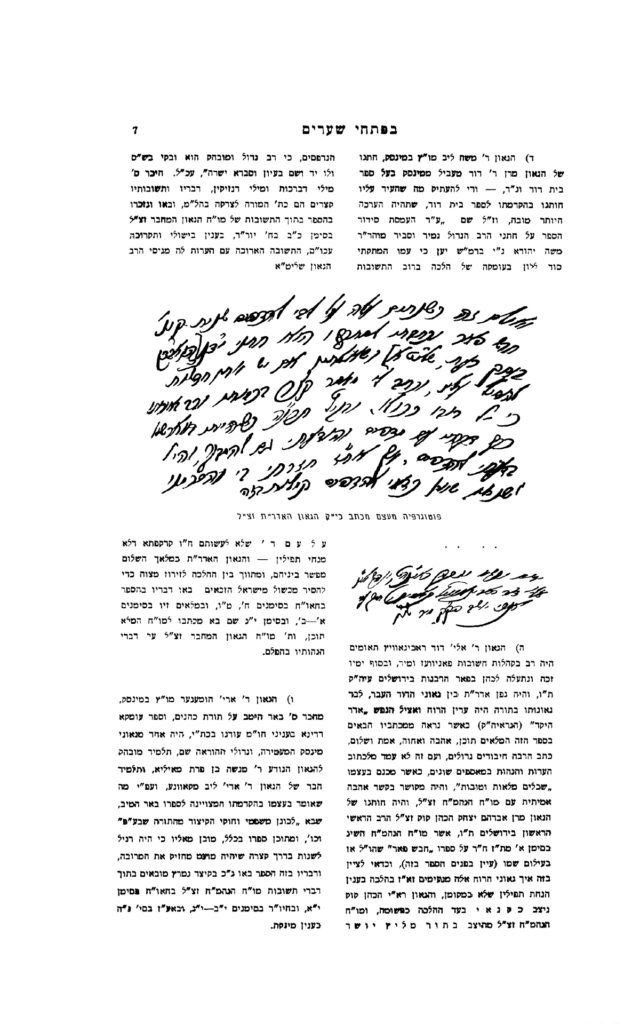
Speaking of the Aderet and censorship, see the article by Yaakov Fuchs here which shows how the Aderet’s strong criticism of the Rogochover was censored. Fuchs has also found that when the Aderet’s book Shema Eliyahu was published (under the title Over Orah [Jerusalem, 2003]) there was also censorship of the Aderet’s negative judgment of the Rogochover, whom he saw as disrespecting great sages of the past. The original manuscript of the Aderet can be seen here, and below is a transcription of the missing passages as prepared by Fuchs, which can be compared with the censored version that appears in Over Orah, pp. 43-44.

The Aderet’s words are very sharp and align with how he spoke about other rabbis whom, for one reason or another, he had a negative view of. Regarding the Rogochover, while recognizing his unbelievable knowledge, the Aderet could not accept what he saw as the Rogochover’s disregard for the accepted conventions of halakhic procedure and his disrespect for prior sages. He goes so far as to state that if we lived in a time of great rabbis—rabbis who had real authority—they would not allow the Rogochover to issue halakhic rulings.

Eliezer Brodt called my attention to another sharp comment by the Aderet against the Rogochover, found in Shmuel Kol, Ehad be-Doro, vol. 1, p. 202. Brodt also noted that this was censored when reprinted in a footnote in the Mossad ha-Rav Kook edition of the Aderet’s Seder Eliyahu, p. 122, and the Rogochover’s name was omitted when the passage was included in an article in Etz Hayyim 19 (5773), p. 55.

The Aderet, who was older than the Rogochover, can be forgiven for speaking the way he did, and he was not the only contemporary of the Rogochover who had these feelings.[1b] But just as we can find negative statements by great rabbis about other rabbis who were their contemporaries, and now we can see how misguided these negative statements were,[2] I think it is the same with regard to the Aderet and the Rogochover. The rabbis of the generation after the Aderet all related to the Rogochover with enormous respect, even if they did not accept his halakhic rulings.

Regarding the Aderet’s book Shema Eliyahu, one thing that was not censored when it was published appears on p. 223, and I thank Yosef Ginsberg for calling it to my attention.

We see that the Aderet and his interlocutor, R. Getzel Horowitz, assumed that the concept of Tikkunei Soferim is to be taken literally, meaning that the text of the Torah was changed from its original version given to Moses. The Aderet suggests that the Tikkunei Soferim are actually halakhah le-Moshe mi-Sinai.

For more concerning the Aderet and censorship, or rather non-censorship, I must recall my very first post on the Seforim Blog, from January 25, 2007, found here. It is titled “Uncensored Books”. I provide two examples where I state that had the publishers known who was being spoken of, they would have censored the text. Regarding the Aderet, I wrote as follows:

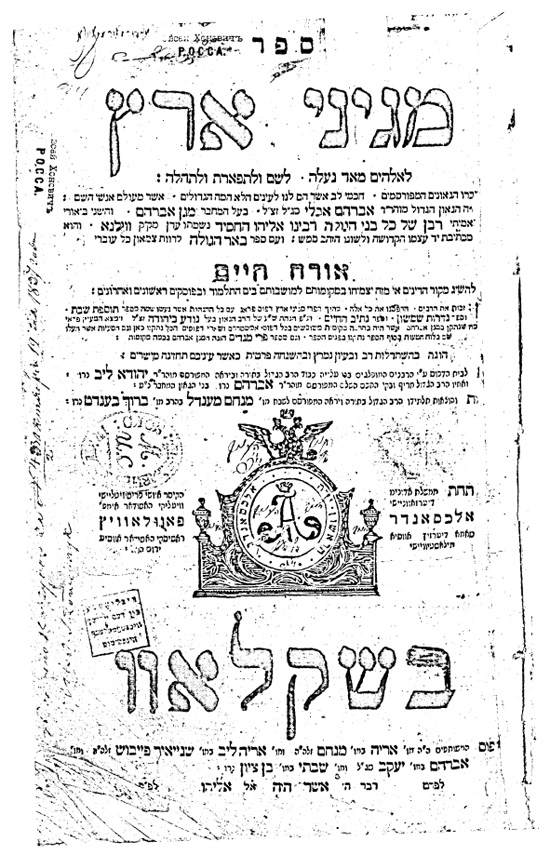
Recently many books by the Gaon R. Eliyahu Rabinowitz-Teomim (the Aderet) have appeared, by publishers with very different hashkafot. The volume of teshuvotMa’aneh Eliyahu, was published by Yeshivat Or Etzion in Israel, whose Rosh Yeshivah is R. Hayyim Druckman. It is obvious that the editors have no knowledge of American Jewish history, otherwise, the words I quote (from p. 352) would never have been allowed to appear. The editors no doubt assumed that the Aderet was attacking some phony. The name Jacob Joseph [called Jacob Harif by the Aderet] means nothing to them.

וידענו היטב היטב את האיש ואת שיחו תהלוכותוי ותחבולותיו מתחילה ועד סוף . . . ואותו הרב ה’ יעקב, שלא שמש תלמידי, חכמים ומלך מעצמו, ע”פ תבונתו כי פקח גדול הוא אינו מגיע לקרסולי תלמידי תלמידיו של הגאון חתם סופר ז”ל, לא בתורה ולא במעשים טובים, והרי לפנינו שעזב עיר ווילנא תפארת ליטא, והלך לנוע אל ארצות אמעריקא להיות שם רב ראשון בנויארק כחלומו אשר חלם. והרואה דברי הר”מ פ”ו ה”א מדיעות, יעוי’ שם היטב בלשונו, יראה עד כמה מלאה לבו יראת שמים לעשות כן

He goes on demeaning the Chief Rabbi of New York, but you get the picture.[3]

Ad kan what I wrote in the post. After the post’s appearance it was pointed out to me that the index to Ma’aneh Eliyahu properly identifies R. Jacob Joseph (Harif). So perhaps I was mistaken, or it is also possible that the people who put the sefer together did not know who R. Jacob Joseph was, and the person who put together the index was someone else entirely.

Returning to haskamot, let me mention another interesting point. Someone recently sent me a picture of a haskamah to the newly published book by the late R. Dov Yaffe, Ha-Va’adim shel Motzaei Shabbat.

What makes the haskamah (mikhtav berakhah) so significant is that it is by a woman, namely, his widow. I was also surprised that she is identified by her first name, something not always seen in haredi circles in Israel.

This is actually not the first published letter of this sort by a woman. R. Yehoshua Zev Zissenwein’s Tzir Ne’eman was published in Jerusalem at the end of the nineteenth century.[4]

After a group of haskamot from a wide range of rabbis whom he got to know in his work as a meshulah (including R. Jacob Joseph and R. Hillel Klein of New York and R. Abraham Abba Werner of London), comes what is called Mikhtevei Tehillah. This is a list of people who signed up to receive the book and positive comments they made. On the last page the names of three women are given, including Sonya (Sarah) Diskin,[5] the widow of R. Joshua Leib Diskin.[6]

Sonya Diskin was a very influential person in the Old Yishuv community of Jerusalem, because she had a great deal of influence on her husband. After her passing, the following letter appeared in Eliezer Ben Yehuda’s newspaper Hashkafah,[7] signed by someone who called himself a student of the Brisker Rebbetzin (i.e., Sonya Diskin, whose husband was rav of Brisk before moving to Jerusalem).[8]

There is a lengthy and fascinating Wikipedia entry on Sonya Diskin here, from which I learned that her marriage to R. Diskin, which was a second marriage for both and did not produce any children, even made its way into an Agnon story. For other stories told about her, see Yitzchak’s Seforim Blog post here, and the כבר היה לעולמים blog here. You can definitely say she “made it”, as she had a pashkevil directed against her in Jerusalem, which I am certain makes her the first woman to be given this honor. Also of note is that the pashkevil dates from when her husband was still alive. (In later years, Golda Meir and Aliza Bloch, the mayor of Beit Shemesh, also had paskevilim directed at them.)

The pashkevil is found in Binyamin Kluger, Min ha-Makor, vol. 3, p. 46, and in what it regards as fake piety, it refers to how Sonya Diskin wore tzitzit and that she put socks on her cat, so that the cat would not move crumbs of hametz from room to room. (Elsewhere it is reported that she did this on Passover and her fear was that the cat would bring in hametz from the street on its feet.[9] According to Pesahim 9a we need not be concerned for this.) Regarding Passover, it is also reported that Sonya Diskin told her husband, after he scolded her for her humrot, “If I rely on you and your Shulhan Arukh, we’ll be eating chametz on Passover.”[10]

The latter story is very similar to a story told about Mrs. Tonya Soloveitchik, the wife of R. Joseph B. Soloveitchik. The way I heard the story, in the name of Prof. Haym Soloveitchik, is that when Mrs. Soloveitchik came home from the hospital and saw milk and meat plates in the sink, she started rebuking her husband. The Rav defended himself: “According to the Shulhan Arukh, this is OK.” To this, Mrs. Soloveitchik replied: “Your Shulhan Arukh is going to treif up my kitchen.”

After seeing what Sonya Diskin told her husband, I found it too much of a coincidence that two great rebbitzens would have expressed themselves in the same fashion. I turned to Prof. Soloveitchik, presented him the story with his mother as I heard it, and asked if it is true. He replied as follows: “The story is half-true. My mother said: ‘You are making my kitchen treif.’ My father said nothing and neither did I. People have prettied-up the story by fusing it with the well-known story of Sonya the rebbetzin, the wife of R. Yehoshua Leib Diskin.”

There is another Passover story told about Sonya and her husband: R. Diskin saw Sonya working very hard to clean the house of hametz. Exasperated, he jokingly said to her that the only hametz in the house is her. To this, she replied bitingly: “Don’t worry about me. A long time ago my father sold me to a goy [i.e., R. Diskin].”[11] This is actually an old Yiddish joke, see here, that was apocryphally connected to Sonya.

Returning to Zissenwein’s book, the introduction is noteworthy as it reveals that Zissenwein was one of the founders of the early settlement Yesud ha-Ma’ala, and that this was done at the direction of R. Diskin.

Regarding R. Diskin, it is notable that R. Jacob Moses Harlap wrote to R. Kook about a dream he had in which R. Diskin requested that R. Harlap ask R. Kook not to hold anything against his son, R. Yitzhak Yeruham, and not to degrade him. R. Diskin explained that his son is his only child, and his mistake did not come from a bad place.[12] What this alludes to is that R. Yitzhak Yeruham was opposed to R. Kook being appointed rav of Jerusalem. In fact, there is a letter from R. Zvi Pesah Frank to R. Kook explaining that R. Yitzhak Yeruham wanted to be appointed rav himself, and he was upset with R. Frank for not supporting him in this matter.[13] (R. Frank was a big backer of R. Kook.[14])

Innocent mistake or not, in later years, R. Yitzhak Yeruham, together with R. Joseph Hayyim Sonnefeld, would give cover to those who continuously degraded R. Kook in the most objectionable ways imaginable. Yet for the sake of the Yishuv in Eretz Yisrael, R. Kook told R. Diskin and R. Sonnenfeld that he forgave everyone who attacked him and wanted to work together with R. Diskin and R. Sonnenfeld. Here is his open letter in Iggerot ha-Re’iyah, vol. 4, no. 274, where he is very direct in telling R. Yitzhak Yeruham and R. Sonnenfeld that they have not behaved in a manner befitting Torah scholars.


See also this letter in Iggerot ha-Re’iyah, vol. 4, no. 201, where R. Kook mentions that R. Yitzhak wanted to be appointed rav of Jerusalem, and that out of respect for him and his late father, R. Diskin, R. Kook delayed accepting the offer to become rav of Jerusalem.


Regarding R. Yitzhak Yeruham, it is worth noting that when he was still in Europe, he was regarded as a very modern person who dressed in European fashion, knew French, and valued secular studies. It is even reported that he identified as a Zionist. This all changed when he came to Eretz Yisrael.[15]

Since this post has dealt with the Aderet as well as various women, it is a good place to note that R. Baruch Epstein mentions that the sister of the Aderet was quite learned and that a comment of hers was published in the Odessa Torah journal Yagdil Torah.[16] I searched Yagdil Torah on Otzar ha-Hokhmah but could not find what Epstein referenced. I thank Eliezer Brodt for solving this mystery, as he called my attention to where the Aderet mentions his sister, in Yagdil Torah, vol. 9, no. 128. This issue is not found on Otzar ha-Hokhmah, and must be what Epstein was referring to.

Brodt also mentioned to me that in his Zekhor le-David, pp. 69-71, the Aderet has a list of learned women mentioned in rabbinic literature.

2. In the prior post I mentioned that, while studying in Israel, the first sefer I read was written by R. Moshe Zuriel. Not that anyone is wondering, but the second book I read was Zvi Glatt’s posthumously published Me-Afar Kumi.

This book focuses on the importance of living in Eretz Yisrael and is divided into halakhic and aggadic sections. For those who don’t know, Glatt, who was a student at Merkaz ha-Rav, was killed in a terrorist attack in Chevron. Of particular interest is the chapter where Glatt takes issue with R. Moshe Feinstein’s position that living in Israel is a mitzvah kiyumit rather than an obligatory mitzvah. R. Moshe wrote a haskamah to Me-Afar Kumi and responds to Glatt’s discussion, stating that he thinks that Glatt went too far (הפריז על המדה) and that he sees no reason to retract his view.

Also of note are the approbations from R. Avraham Shapiro and R. Shaul Yisraeli, roshei yeshiva at Merkaz ha-Rav. R. Yisraeli notes that Glatt, who could have studied at great yeshivot in the U.S., chose to come to Israel. Glatt could not understand why religious Jews in the Diaspora, by and large, choose to ignore the very important mitzvah of settling the Land of Israel, and it was this focus on Eretz Yisrael that led him to write the sefer.

From a halakhic perspective, the most important aspect of the sefer is the appendix by R. Avraham Shapiro, in which he takes issue with R. Moshe’s opinion. According to R. Shapiro, when it comes to mitzvot mentioned in the Torah, there is no concept of a mitzvah kiyumit as advocated by R. Moshe (namely, that there is no obligation to live in Eretz Yisrael, but if you do, you fulfill a mitzvah and receive reward). Some have compared R. Moshe’s view to the wearing of tzitzit, where there is no obligation to wear them unless you choose to wear a four-cornered garment. Yet R. Shapiro states that tzitzit is absolutely a mitzvah hiyuvit (an obligatory mitzvah). True, one can choose whether to wear a four-cornered garment, but once one puts it on, tzitzit is now an obligation. My question to the learned readers is: Is R. Shapiro correct in saying that there is no concept of a mitzvah kiyumit about one of the 613 mitzvot? Isn’t shehitah an example of a mitzvah kiyumit? You don’t have to eat meat, but if you choose to, you can fulfill the mitzvah of shehitah. Furthermore, in criticizing R. Moshe’s position, R. Shapiro refers to the mitzvah of living in Eretz Yisrael as one of the 613 mitzvot, which makes the concept of it being a mitzvah kiyumit problematic. Yet there is no reason to think that R. Moshe regarded living in Eretz Yisrael as one of the 613 mitzvot, and that is precisely why it could be regarded as a mitzvah kiyumit.

It appears that the Vilna Gaon has the concept of mitzvah kiyumit in mind when he speaks of eating matzah on all days of Passover as a mitzvah but not an obligation, as only on the first night is there an obligation. It seems that he regards the eating of matzah after the first night as a mitzvah kiyumit. Here is how his view is described in Ma’aseh Rav, no. 185:

“שבעת ימים תאכל מצות”, כל שבעה מצוה, ואינו קורא לה רשות אלא לגבי לילה ראשונה שהיא חובה, ומצוה לגבי חובה רשות קרי לה. אעפ”כ מצוה מדאורייתא הוא

Hizkuni makes a similar point in his commentary to Ex. 12:18:

יש לך דברים שמקבלין שכר בעשייתן ועונש כשאין עושין אותן, כגון מצה בלילה הראשון, ויש לך דברים שאין מקבלין שכר בעשייתן ועונש כשאין עושין אותן, כגון מצה מליל ראשון ואילך, ומ”מ מצות תאכלו שבעת ימים כתיב, כלומר אם אכל מצה כל שבעת הימים מכל מקום קיים הוא הפסוק זה של: שבעת ימים מצות תאכלו

3. In my new book on Rav Kook, available here, I discuss how R. Isaac Herzog struggles with the conflict between the biblical record of how long humanity has been on earth and the historical record accepted in the academic world. I cite several of his letters on this topic, in which he suggests that it could be that the Torah’s “history” at the beginning of Genesis is not meant to be regarded as factual.

Only after the book was already near publication did I find another letter from R. Herzog on this very issue, which I share with you now.[17]

The original letter, which R. Herzog would have signed, was sent to R. Zev Gold and is dated December 30, 1952. R. Herzog made copies of the letter, which he must have also distributed, and that is how it made its way to R. Moshe Zvi Neriah, where I found it among his papers.

R. Herzog focuses on his often-discussed—but never realized—plan to write a modernGuide of the Perplexed, addressing new intellectual problems that have arisen for traditional Jews. Without a proper response to these issues, people might be led to deny the doctrine of Torah from heaven. R. Herzog tells R. Gold that his approach in dealing with conflicts between what appears in the Torah and the historical record as established in the academic world is based on two principles:

  1. The Torah speaks in the language of man. What this means is that the Torah can describe matters in the way they were generally understood by people at the time the Torah was given, even if this is not strictly factual. In Renewing the Old, Sanctifying the New, I cite a letter from R. Herzog to Aron Barth where he makes the same point.
  2. Maimonides’ statement in Guide for the Perplexed 2:25, where he asserts that he would be able to explain the Torah in accord with the doctrine of the eternity of the world, should this idea be proven.[18] In other words, if there is a proven fact in contradiction to the Torah’s simple meaning, then the Torah needs to be reinterpreted.

R. Herzog tells us that the most pressing intellectual challenge to Jewish traditional faith comes from archaeology. So, for instance, if we know from archaeology that there were communities of humans 10,000 or 100,000 years ago, and this is a fact—not just a theory—then, in line with Maimonides’ guidance, we would have to reinterpret the Torah’s chronology which puts humanity on earth for under 6000 years. While in R. Herzog’s time, people in the religious world were focused on the scientific view of a universe billions of years old versus the Torah’s record of when creation occurred, or what to do with dinosaurs that predate the Torah’s account of creation, R. Herzog was focused on a more problematic matter which, for some reason, did not get the same attention: If the historical record shows that people have been living continuously all over the world for a lot longer than 6000 years, what are we to do with the biblical record that places humanity in the world for less than 6000 years? What are we to make of the biblical idea that everyone is descended from Adam and Eve, and also descended from Noah? How are we to understand the stories of the Flood and Tower of Babel?

These are issues that cannot be answered with the famous Midrash that God created worlds and destroyed them, because R. Herzog is concerned with the current world and how long humanity has been part of it. He recognizes that there are passages in the Torah that might need to be reinterpreted in a non-literal fashion. What he is struggling with is what the religious boundaries are, beyond which one cannot go. In other words, when can you interpret the Torah in a non-literal fashion, and when not? Or, to put the matter differently, beginning with which chapter in Genesis must we assume that the Torah is speaking historically and, therefore, non-literal interpretation is not permitted? This was to be a major focus in R. Herzog’s planned work, which, to our great misfortune, was never authored.

He adds that philosophy will also have to be a part of this book. Knowing that this was not one of his many areas of specialty, he points to R. Joseph B. Soloveitchik as the only person in the generation who could make a vital contribution to his project from the philosophical side. While R. Herzog would focus on the historical problems I have just mentioned, R. Soloveitchik would provide a Jewish response to philosophical challenges.

2. In the last post I noted how the Chafetz Chaim wondered how he could eat at inns if the owners did not tovel their dishes. He did not question the kashrut of the food, and we see both then, and today, that one can be regarded as strict in matters of kashrut while not toveling one’s dishes, which for some reason has not always been regarded by all as an important halakhah.[19] We also find regarding other halakhic matters that people who are strict in one sphere do not necessarily lose their halakhic reliability if in a different area their halakhic observance leaves something to be desired.[20]

Based on this notion, we can understand the following 1955 letter from R. David Grunwald, rav of Santiago, to R. Jehiel Jacob Weinberg.[21]

R. Grunwald wanted to know whether one can rely on the kashrut of the owner of an inn if the man also serves non-kosher wine to the guests. Today, people would find the question incomprehensible, but it wasn’t that long ago when many otherwise observant Jews were not careful about kosher wine.[22] It is also important to note that R. Grunwald was referring to the old type of inns where people ate there because they trusted the kashrut of the owner. These establishments did not have any official hashgachah.

R. Grunwald refers to a famous responsum of R. Akiva Eiger, no. 96, where R. Eiger notes that Jews who shave with a razor are still able to be accepted as witnesses in a beit din. This is because shaving with a razor was so common in the Orthodox world, that people who did so did not realize how serious the prohibition is.

י”ל דהשחתה בתער דנתפשט בעו”ה אצל הרבה לא חשב שזהו איסור כ”כ דלא משמע להו לאינשי דאסור, וכאשר באמת נזכר בג”ע דהשיב להמוכיח שהרבה אנשים חשובים עושים כן, וכיון דבאמת פשתה המספחת בזמנינו גם לאותן הנזהרים בשאר דברים נדמה להם דאינו איסור כ”כ

If R. Eiger adopted this approach with the Torah prohibition of shaving with a razor, all the more so, R. Grunwald suggests, that it should apply to the rabbinic prohibition of non-kosher wine. This would mean that religious Jews could stay at the inn in question, enjoy the food, and simply avoid the non-kosher wine. Yet not willing to make this decision on his own. R. Grunwald turned to R. Weinberg, and unfortunately we do not know if R. Weinberg replied.[23]

Related to R. Grunwald’s question, I was told that in its final years, Grossinger’s hotel offered non-kosher wine in the dining room. I don’t know if this was after R. Chavel’s passing in 1982. (The hotel continued until 1986). There used to be a restaurant in a major European city that was kosher, but the bar in the restaurant served non-kosher wine. The philosophy of the hashgachah (which was not a weak hashgachah) was that they are giving a hashgachah on the food. What happens at the bar is not their concern, and if someone brings a glass of non-kosher wine to the table that also is not their concern. This is not something that would ever be allowed by mainstream hashgachot in America, but in places without large observant Jewish populations, sometimes the rabbis feel they have to adopt a different approach in order to enable a kosher restaurant to be viable. Some years ago, there was a kosher Indian restaurant under the hashgachah of the late R. Yaakov Spivak. This restaurant allowed people to bring their own bottles of wine (maybe because it didn’t have a liquor license and thus couldn’t provide kosher wine). I asked R. Spivak why he allowed this, and he replied simply that there is no halakhic issue if people bring their own non-kosher wine. Again, this is not something that a mainstream U.S. hashgachah would allow.

Returning to the Aderet’s report of the Chafetz Chaim asking about eating in kosher inns where the dishes were not toveled, when I read that I thought of something similar. In the past, I have written about various kosher establishments that were not under hashgachah, but people ate there because they trusted the owners. Perhaps the most famous of these places was Sam Schechter’s and Leo Gartenberg’s Pioneer Country Club in Greenfield, N.Y. The kashrut there was trusted by all, and Agudath Israel held its annual conventions there. Here is a picture I published some years ago.[24]

The picture was taken at the wedding of R. Moshe Dovid Tendler’s daughter, Rivka, to R. Shabtai Rappaport. The man on the left is R. Isaac Tendler, R. Moshe Dovid’s father. The wedding took place at the Pioneer on June 17, 1971. I thank Jack Prince who was at the wedding for allowing me to make a copy of the picture in his possession.

Regarding the Pioneer Country Club, I think the younger readers will have a hard time understanding not only how even the most religious would stay at a hotel without a hashgachah, but the Pioneer also had mixed swimming and evening entertainment, including mixed dancing and women singers. (I wonder if out of respect, these things did not take place during the Agudah conventions.) It was a different era and people of different religious levels were happy to stay together in one resort.[25] I am sure many readers from my generation and older remember Grossinger’s which was the same sort of place, although, as mentioned, Grossinger’s was under R. Chavel’s hashgachah.

I bring all this up because of a fascinating tape of R. Fabian Schonfeld discussing R. Aharon Kotler available here. At minute 22:25 he tells how R. Aharon was at the Torah u-Mesorah convention which was held at the Pioneer. R. Aharon learned that the kitchen was not careful with having a Jew light the pilot light. R. Aharon explained to Gartenberg what the halakhah required in this matter. and he trusted Gartenberg that from that point on there would be no bishul akum issues. Today, such a scene would be unimaginable, as the mashgiach would be careful about this matter, but as mentioned already, we are talking about a different era.

I wonder if the general practice among Orthodox Jews in America in those days was to rely on either the view of R. Abraham ben David that there is no bishul akum when a non-Jew cooks in a Jew’s home, or the view held by others that there is no bishul akum with hired help.[26] According to R. Moses Isserles, although the halakhah is not in accord with R. Abraham ben David’s view, bediavad, food cooked by a non-Jew in a Jew’s home can be eaten. He then adds the following which might explain how a more lenient approach to bishul akum developed than what is standard today:

ואפילו לכתחלה נוהגין להקל בבית ישראל שהשפחות והעבדים מבשלים בבית ישראל כי אי אפשר שלא יחתה אחד מבני הבית מעט

See also here where R. Schonfeld recollects about the early history of Jewish Kew Gardens Hills. He recounts that the only halakhically reliable kosher butcher was the Main Street Kosher Meat Market owned by Mr. Herman. This was not under hashgachah, but since, R. Schonfeld tells us, Mr. Herman was known as a pious Jew, “this was the only one [butcher] at that time that we could tell people you can buy [from]”

* * * * * * *

[1a] Regarding censorship of Seder Eliyahu, see Dan’s earlier post here and also the discussion here.
[1b] See R. Raphael Mordechai Barishansky, Mikhtavim Mehutavim, pp. 167ff., where he responds to the Rogochover’s demeaning comment about the Vilna Gaon. I published the Rogochover’s interview, which so upset Barishansky, in the Jewish Review of Books, Summer 2017, available here.
[2] Readers will probably be thinking about how great rabbis spoke of the early hasidic leaders, R. Moses Hayyim Luzzatto, and R. Jonathan Eybschuetz. Another example is how great rabbis spoke about the leaders of the Mussar movement. My 19-part series on the Mussar Dispute is available on youtube here.
[3] Interestingly, in R. Jacob Joseph’s haskamah to R. Shalom Israelson, Neveh Shalom (Chicago, 1905), he refers to the Aderet as his friend. This point is also mentioned here.
[4] The first title page has the year 1897, but the second title page has 1898. Rabbi Mendel Moinster’s haskamah is dated Nov. 28, 1898, so it is possible that the book was only published in 1899.
[5] Regarding her, see most recently Menachem Keren-Kratz and Motti Inbari, “The Sociological Model of Haredi Rebbetzins: ‘Two-Person Single Career’ vs. ‘Parallel-Life Family,’” AJS Review 46 (2022), pp. 270-290.
[6] I have not been able to determine when the name “Moses” was added to his first names.
[7] Nov. 2, 1906, p. 3 (Issue 8:10). See also the eulogy for her in Hashkafah, Oct. 19, 1906, pp. 2-3 (Issue 8:6). There is something very unusual about this paper. Here is the first page of the November 2, 1906, issue.

Look at the date: 14 Heshvan 1838. Rather than using the date from Creation, Ben Yehuda used the years since the destruction of the Temple, which he assumed to be the year 68.
[8] In this regard, I would like to call attention to another interesting reference to a woman that I learned about from R. Dov Katz, Tenuat ha-Mussar, vol. 2, pp. 107–108. In 1938, R. Moshe Rosenstein, the mashgiach of the Lomza Yeshiva, published the second volume of his work Yesodei ha-Da’at. In the introduction, he mentions three teachers to whom he owes so much: R. Zvi Braude, R. Yerucham Levovitz, and R. Shimon Shkop. He then refers to his fourth “teacher,” Nechama Liba, the daughter of R. Simhah Zissel of Kelm, describing her as a great student of her father and emphasizing how much he learned from her.

Such a description would never appear in haredi literature today. First of all, the very notion that a yeshiva leader mentions learning so many things from a woman—והרבה הרבה למדנו ממנה— would not be allowed to appear in print. Also, look at his description of how he observed her wisdom and piety:

והיה לי ההזדמנות להתבונן על דרכיה ומנהגיה ותהלוכתיה בחכמה ויראת ה’ ומעשיה הטובים

I believe that today such a description would be regarded as lacking in tzeniut, as it showed that he paid attention to the actions of a woman.
[9] See Margalit Shilo, Princess or Prisoner, trans. David Louvish (Waltham, 2005), p. 78, and here.
[10] Elimelekh Weissblum, Havai Tzefat (Tel Aviv, 1969), p. 34, translated in Shilo, Princess or Prisoner, p. 78. See also here.
[11] See R. Michael Abraham’s post here. Regarding women cleaning for Passover, in a comment to Abraham’s post, a reader referred to the following fascinating passages in R. Moses Sofer’s responsa.

She’elot u-Teshuvot Hatam Sofer, vol. 1, Orah Hayyim, no. 136:

והיותי חוץ לחדר לימודי כי גרשוני נשים צדקניות המכבדים ליום טוב של פסח על כן לא יכולתי להאריך ככל הצורך

She’elot u-Teshuvot Hatam Sofer, vol. 6, no. 30:

יקרת מכתבו הגיעני בימים האלו ימי טלטולא דגברא דהני נשי דידן מפנים חפצים מזוית לזוית אפילו ספרים אינם מוכנים לי לעיין

[12] Harlap, Hed Harim (Elon Moreh, 1997), pp. 94-95.
[13] Kook, Iggerot ha-Re’iyah, vol. 3, p. 306.
[14] See R. Frank’s letter in R. Hayyim Hirschensohn, Malki ba-Kodesh, vol. 4, pp. 22-23, where he explains the situation in Jerusalem, and how the extremists controlled Rabbis Sonnenfeld and Yitzhak Yeruham Diskin.
[15] See Menahem Mendel Porush, Be-Tokh ha-Homot (Jerusalem, 1948), pp. 199ff., Or Hadash 17 (2012), pp. 68ff. R. Yitzhak Yeruham’s father, R. Diskin, was also more open-minded before he moved to Eretz Yisrael. See the valuable post by Zerachya Licht here and his earlier post here.
[16] Mekor Barukh, vol. 4, pp. 1957-1958.
[17] The letter is found in the Moshe Zvi Neriah Archive, Israel National Library, ARC.4*21300411.
[18] For my understanding of Maimonides, which diverges from that of R. Herzog and what seems to be the standard approach, see my Seforim Blog post here. I argue that Maimonides was only prepared to accept Plato’s view of eternal matter, but not Aristotle’s view of the eternity of the universe, though Maimonides acknowledges that the biblical verses can be read in accord with Aristotle’s approach.
[19] Perhaps there is a limud zekhut for these people in that the Rogochover held that utensils produced by non-Jews for commercial purposes do not require tevilah. See Tzafnat Paneah, Ma’akhalot Asurot 17:3 (called to my attention by Rabbi Sholom Berger). R. Abraham Price reacted with shock at this radical ruling which completely abolishes the whole concept of tevilat kelim in the modern world. See his edition of the Sefer Mitzvot Gadol, vol. 2, p. 444:

ונדהמתי לראות דברים כאלו כתובים מידי גאון אדיר, כי לפי דבריו בזמנינו בטל כל דין של טבילת כלים, שיש הרבה ראשונים הסוברים שהוא דאורייתא כדלעיל. שהרי כמעט כולנו קונים רק כלים הנעשים בבית תוצרות של נכרים ואין אחד מן רבבה שיקנה כלים ממה שהנכרי עשה בשביל עצמו. ודברים הנ”ל של הצ”פ הם כנגד דברי הש”ע וכנגד כל הראשונים

R. Price says that the Rogochover’s view is against “all therishonim.” Yet see R. Yehoshua Ben-Meir,Mi-Pekudekha Etbonen, pp. 276-277, who argues that the Rogochover’s view is also held by Rashi, Rashba, and Ritva.

See also R. Menasheh Klein, Mishneh Halakhot, vol 5, no. 110 (end), who mentions the Rogochover’s view and is not prepared to accept it. However, he raises the question about utensils that are produced by machine, and all the non-Jew does it touch a button. R. Klein think that it is possible that in such a case tevilah is not required, although he does not rule this way in practice.

Even as we continue to tovel dishes produced by non-Jews for commercial purposes and also by use of machine, I wonder if the doubts that have been raised mean that all toveling should be done without a berakhah. I have not seen any posek make this point.
[20] See R. Shmuel Khoshkerman’s responsum in Sefer Zikaron Penei Moshe, pp. 289ff., where he permits a man who is careful about Shabbat, kashrut and tefillah, but does not observe taharat ha-mishpahah, to serve as a kashrut mashgiach. Among the sources he cites is Shulhan Arukh, Yoreh Deah 2:7: מומר לערלות דינו כמומר לעבירה אחת

He also cites Yoreh Deah 119:7:

מי שהוא מפורסם בא’ מעבירות שבתורה חוץ מעבודת כוכבים וחלול שבת בפרהסיא או שאינו מאמין בדברי רבותינו ז”ל נאמן בשאר איסורים ובשל אחרים נאמן אפילו על אותו דבר לומר מותר הוא

He further cites R. Yitzhak Zilberstein, Hashukei Hemed, Bekhorot 30b, who thinks that someone who does not wash before eating bread is not to be disqualified from serving as a mashgiach. This is because his personal sins do not affect his feeling of responsibility to the community, and there is no reason to think that he would allow others to eat non-kosher just because he is not careful with netilat yadayim. R. Zilberstein does, however, cite his brother-in-law R. Chaim Kanievsky, who disagreed.

R. Khoshkerman explains his own lenient view:

והנה עינינו הרואות שהרבה אנשים זהירים בכשרות יותר מטהרת המשפחה, כיון שהוא יודע שאם הוא לא יהיה זהיר בכשרות הוא חוטא ומחטיא את הרבים, אבל בדיני טהרת המשפחה רק הוא חוטא. לפיכך נראה שיכולים לסמוך עליו. ועוד שאינם יודעים גודל חומרת האיסור של טהרת המשפחה, אבל על כשרות המטבח הם מקפידים, וכן על מצוות אחרות כגון שבת טלית ותפילין

R. Khoshkerman concludes:

המורם מכל האמור: שאדם שחשוד על טהרת המשפחה, אינו חשוד על כשרות, ולכן יכולים לסמוך עליו בתור משגיח כשרות. אבל רק בתנאי שהוא שומר מצוות אחרות כמו תפלה, טלית ותפילין ושבת, ורק על ענין טהרת המשפחה הוא עובר, או מפני שאינו יודע שזה דבר חמור, או מסיבות אחרות

R. Shalom Mordechai Schwadron, She’elot u-Teshuvot Maharsham, vol. 2, no. 62, already wrote as follows (and R. Khoshkerman will no doubt see this as support for his conclusion):

 די”ל שמ”מ לאינשי חמיר טפי איסורי מאכלות ועינינו רואות בכמה נשים שאין טובלות לנדתן ועוד כהנה ובכ”ז נזהרין מאיסורי מאכלות

I would also add that R. Moses Isserles’s words in Yoreh Deah 119:7 are relevant:

מי שהוא חשוד בדבר דלא משמע לאינשי שהוא עבירה לא מקרי חשוד

[21] The letter is found in Ganzach Kiddush ha-Shem in Bnei Brak.
[22] R. Aharon Rakeffet has often told about his shock in discovering, soon after being hired in 1961, that congregants at the Lower Merion Synagogue, his first rabbinic pulpit, drank non-kosher wine. He would have found the same thing at Modern Orthodox synagogues across the country. Rakeffet has also recorded his story in From Washington Avenue to Washington Street (Jerusalem, 2011), pp. 167-168. I discuss Jews drinking non-kosher wine in Changing the Immutable, and will return to it in a future post
[23] Jews shaving with a razor is also mentioned by R. Ezekiel Landau, Noda bi-Yehudah, Orah Hayyim Tinyana, no. 101, and R. Moses Sofer, She’elot u-Teshuvot Hatam Sofer, Orah Hayyim, no. 154: בעו”ה רבו המשחיתים בעם בתער

This was a such a problem among otherwise observant Jews in early twentieth-century America that R. Hayyim Hirschensohn tried to come up with a heter for shaving with the modern T-shaped razors. See Hiddushei Ha-Rav Hayyim Hirschensohn, vol. 3, no. 12. R. Hirschensohn’s position is discussed by R. Nachum Rabinovitch, Melumdei Milhamah, pp. 283-284.
[24] For stories of R. Moshe Feinstein and the Pioneer Country Club, see R. Yaakov Heftler (Leo Gartenberg’s son-in-law), “Zikhronot,” Kol ha-Torah 54 (2003), pp. 67ff. One story Hetfler describes is how his father passed away on the Shabbat of his aufruf, which took place at the Pioneer with some 250 guests in attendance. The wedding was supposed to be on Sunday. However, R. Moshe Feinstein, who was at the hotel in honor of the simhah, ruled that the funeral should be postponed to Monday and the wedding should take place on Sunday, when Heftler was an onen.

Here is the report about the wedding in Ha-Pardes, Tishrei 5720, p. 47.

[25] There was a well-known askan named Julius Steinfeld. You can read about him here. He did amazing things during the Holocaust and was responsible for saving thousands of Jews. I mention him here because he was very upset that the Agudah had their convention at the Pioneer and wrote a very sharp letter of protest. He even rejects the entire concept of a convention in which both men and women are in attendance.

[26] See Tosafot, Avodah Zarah 38a, s.v. Ela mi-de-Rabbanan, and the wide discussion of R. Ovadiah Yosef, Yehaveh Da’at, vol. 5, no. 54.



Kaddish – His Will

Kaddish – His Will
Leor Jacobi

Note: I wrote the following essay outline several years ago, but shelved it upon discovering that most of its novelty and much more had already been published by David de Sola Pool over a hundred years ago.[1] On the sad occasion of the recent passing of my beloved mother I offer it now in her memory. Prayer and divinity were close to her heart. May our prayers be deepened by their study.

The Kaddish is one of the most familiar and repeated prayers in the liturgy. In various forms, it concludes both the main body of the prayer and smaller sections. It is also recited by mourners and upon the conclusion of learning a tractate or a sermon.
Despite, or perhaps due to its familiarity, few are aware of an alternate interpretation and syntax at the beginning of the Kaddish, accompanied by altering the pronunciation of one word slightly, but significantly. This study will describe and analyze these two interpretations and propose a third.
1. The “Standard” interpretation. R. Yehudah ben Yakar (Ramban’s teacher), Rokeah, and Avudraham all followed the standard interpretation. See R. Shmuel Eliezer Stern’s concise compilation of their perspectives.
2. The GRA’s interpretation
3. Alternate interpretation

1. The Standard Interpretation

…יִתְגַּדַּל וְיִתְקַדַּשׁ שְׁמֵהּ רַבָּא בְּעָלְמָא דִּי בְרָא כִרְעוּתֵהּ, וְיַמְלִיךְ מַלְכוּתֵהּ

May his great name be exalted and sanctified in the world which he created according to his will. And may his kingship reign …

The deity is not referred to directly, but his great name is to be exalted and sanctified in the very world which he himself created, according to his own will and volition. The fact that the world was created according to the will of the deity seems rather obvious, pshita. However, in the liturgy of the evening prayers, we find the divine will associated with the maintenance of the celestial bodies:


ברוך אתה … אשר בדברו מעריב ערבים בחכמה פותח שערים ובתבונה משנה עתים ומחליף את הזמנים ומסדר את הכוכבים במשמרותיהם ברקיע כרצונו

This may be referred to in the Kaddish. Perhaps the divine will is mentioned in the Kaddish to emphasize that the details of the physical world were planned by the creator, not happenstance, hence it is fitting to exalt and praise his great name.
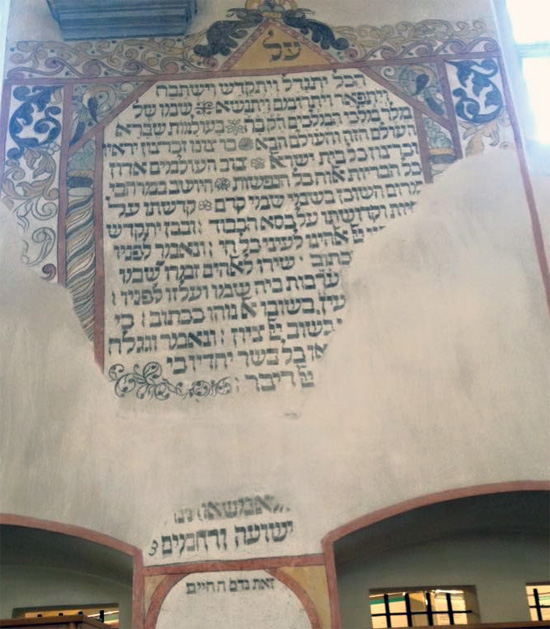
A more serious difficulty with this standard interpretation is found in the prayer על הכל based on the Kaddish which is recited upon removing the Sefer Torah from the Aron Ha-Kodesh. In modern prayerbooks it is found among the Sabbath prayers. In surviving synagogues of Tikocyn (טיקטין) and Krakow and in in other Polish synagogues the text was painted on the wall along with other “extra” prayers and sayings.[2] This prayer clearly parallels the Kaddish, but does not follow the standard interpretation, as will be explained in the next section. R. Yehudah ben Yakar (Ramban’s teacher), Rokeah, and Avudraham all followed the standard interpretation. See R. Shmuel Eliezer Stern’s concise compilation of their perspectives.

2. The GRA’s Interpretation
…יִתְגַּדַּל וְיִתְקַדַּשׁ שְׁמֵהּ רַבָּא בְּעָלְמָא דִּי בְרָא, כִּרְעוּתֵהּ, וְיַמְלִיךְ מַלְכוּתֵהּ

May his great name be exalted and sanctified, according to his will, in the world which he created. And may his kingship become regnant…

Notice the additional comma and the concomitant hard vocalization of the כּ with a dagesh in the following word: כִּרְעוּתֵהּ. Here the phrase “according to his will” refers back to the first clause of the preceding phrase, the exaltation and sanctification. It does not refer to the immediately preceding clause as per the standard interpretation.
The minor conceptual difficulty of the standard interpretation is now transformed into a deep and compelling concept. The purpose of the creation of the world was so that the creator’s name be exalted and sanctified within it.
This interpretation can be attributed to the Gaon, R. Elijah of Vilna, GRA in Ma’ase Rav 54, where it is noted that he was particular about the pronunciation of the hard כּ. GRA’s Diyyuqim b’nusḥey ha-tefilah v’ha-berakhot were first printed in the first edition of Shulhan Arukh with Biyur ha-GRA, Shklov 1803, and appear at the bottom of the first page of Priy Chodosh in later editions.

There, the concept it is explained more fully, with a proof is presented in the aforementioned על הכל prayer recited upon removing the Torah from the Ark:
עַל הַכּל יִתְגַּדַּל וְיִתְקַדַּשׁ וְיִשְׁתַּבַּח וְיִתְפָּאַר וְיִתְרומַם וְיִתְנַשּא שְׁמו שֶׁל מֶלֶךְ מַלְכֵי הַמְּלָכִים הַקָּדושׁ בָּרוּךְ הוּא. בָּעולָמות שֶׁבָּרָא הָעולָם הַזֶּה וְהָעולָם הַבָּא. כִּרְצונו וְכִרְצון יְרֵאָיו וְכִרְצון כָּל בֵּית יִשרָאֵל. צוּר הָעולָמִים אֲדון כָּל הַבְּרִיּות אֱלוהַּ כָּל הַנְּפָשׁות. הַיּושֵׁב בְּמֶרְחֲבֵי מָרום הַשּׁוכֵן בִּשְׁמֵי שְׁמֵי קֶדֶם. קְדֻשָּׁתו עַל הַחַיּות וּקְדֻשָּׁתו עַל כִּסֵּא הַכָּבוד
Note that this Hebrew prayer generally follows the structure of the Kaddish. However, the phrase “According to his will” is accompanied by “the will of those who fear him” and “the will of all of the house of Israel.” This cannot refer to the creation of the world, for mortals were not party to that event. Perhaps it refers to the post-facto consent of men. If so, it would differ conceptually with כרצונו, the will of the creator at the time of the creation. Also, stressing this point runs counter to the thrust of the prayer, exalting and praising the creator.

Wall of Tykocin synagogue, Poland, Leor Jacobi
This source suggests that an ancient tradition does not follow the standard interpretation. Furthermore, we find an association of the words כרצונו and יתגדל in Daniel 11:36, applied to an earthly king:

…וְעָשָׂה כִרְצוֹנוֹ הַמֶּלֶךְ וְיִתְרוֹמֵם וְיִתְגַּדֵּל עַל כָּל אֵל וְעַל אֵל אֵלִים יְדַבֵּר נִפְלָאוֹת

Some medieval prayer books do contain a hard כּ in כרעותיה. In the National Library of Israel there are examples from Provence, Italy, and Ashkenaz on microfilm. I refer to this interpretation as the GRA’s, although it probably preceded him by hundreds of years, because he related to the issue and is understood to have favored this interpretation. It should be noted that many early siddurim were not precise in following grammatical rules so the mere presence or absence of a dagesh should not in and of itself be taken as an indicator of syntax or interpretation.
GRA’s interpretation, while not well known, was endorsed somewhat in Arukh haShulhan 56 (where much of the previous discussion is found). GRA-oriented prayerbooks also reflect this interpretation via the punctuation, such as Siddur Vilna and Ezor Eliahu. However, Siddur Tefilat Yosef features the hard כִּ but without a comma before it, possibly a compromise approach: have it both ways or either way.
I now raise a couple of difficulties. The most striking aspect of this approach is its awkward word order. A much more straightforward formulation of GRA’s interpretation would be:

…יִתְגַּדַּל וְיִתְקַדַּשׁ שְׁמֵהּ רַבָּא. כִרְעוּתֵהּ, בְּעָלְמָא דִּי בְרָא, וְיַמְלִיךְ מַלְכוּתֵהּ

Perhaps the word כִּרְעוּתֵהּ was a later addition, hence not deemed proper to insert in the middle of the first phrase. In any case, GRA’s interpretation does not fit the text as well as the standard interpretation, where no re-ordering is required.
A minor difficulty with the GRA’s interpretation emerges upon comparison with the “Great Kaddish” recited upon the completion of a Tractate or Seder. The word כִּרְעוּתֵהּ does not appear in that text at all. This is explainable, and perhaps even necessary, according to the first interpretation, because the Great Kaddish does not refer to the creation of the world at all, but rather to the future redemption:
יִתְגַּדַּל וְיִתְקַדַּשׁ שְׁמֵהּ רַבָּא בְּעָלְמָא דִּי הוּא עָתִיד לְאִתְחַדְתָּא, וּלְאַחֲיָאה מֵתַיָּא, וּלְאַסָּקָא יַתְּהוֹן לְחַיֵּי עָלְמָא, וּלְמִבְנָא קַרְתָּא דִּי יְרוּשְלֵם, וּלְשַׁכְלְלָא הֵיכָלֵהּ בְּגַוָּהּ, וּלְמֶעֱקַר פּוּלְחָנָא נוּכְרָאָה מִן אַרְעָא, וּלְאָתָבָא פּוּלְחָנָא דִּי שְׁמַיָּא לְאַתְרָהּ, וְיַמְלִיך קוּדְשָׁא בְּרִיךְ הוּא בּמַלְכוּתֵה וִיקָרֵהּ בְּחַיֵּיכוֹן וּבְיוֹמֵיכוֹן וּבְחַיֵּי דְכָל בֵּית יִשְׂרָאֵל
However, if כִּרְעוּתֵהּ refers back to יִתְגַּדַּל וְיִתְקַדַּשׁ, as per GRA’s interpretation, the absence of the word in the Great Kaddish version is puzzling, or at least conspicuous. This suggests that כִּרְעוּתֵהּ refers back to בְּעָלְמָא דִּי בְרָא and hence, disappears in the Great Kaddish along with it.
To summarize so far, we have seen two competing interpretations of the same (orthographic) text of the Kaddish. Some evidence contradicts each of the two, with no clear tilt of the scales in favor of either. It seems to me more likely that the GRA’s interpretation would develop into the standard one in order to “correct the syntax” than the reverse direction. Lectio dificilior potior. This situation suggests exploring other alternatives.[3]

3. An Alternate Interpretation

…יִתְגַּדַּל וְיִתְקַדַּשׁ שְׁמֵהּ רַבָּא בְּעָלְמָא דִּי בְרָא, כִּרְעוּתֵהּ יַמְלִיךְ מַלְכוּתֵהּ

May his great name be exalted and sanctified in the world which he created. May his kingship become regnant according to his will …

Rather than throwing the word כִּרְעוּתֵהּ back to one clause or another of the previous phrase, in this interpretation the word applies to the text that follows, a prayer for the establishment of the divine kingdom.
This interpretation is aided by the omission of the ו in the word ימלך following the word כרעותיה. The emendation is minor, and we do find an early textual example from a manuscript in the Cairo Geniza, JTS ENA 1983.2:

The absence of the ו assists this interpretation but it does not in and of itself negate the others. However, the interpretation is also suggested by another rabbinic source. The על הכל prayer discussed previously appears to be a later adaptation, an earlier version of which appears in Masekhet Sofrim 14:6:

ועוד צריך לומר, על הכל יתגדל ויתקדש וישתבח ויתפאר ויתרומם ויתנשא ויתהדר ויתעלה ויתהלל ויתקלס שמו של מלך מלכי המלכים הקדוש ברוך הוא הנכבד והנורא בעולמות שברא בעולם הזה ובעולם הבא. כרצונו וכרצון יראיו וכרצון כל עמו בית ישראל תגלה ותראה מלכותו עלינו במהרה ובזמן קרוב, והוא יבנה ביתו בימינו ויחון פליטתינו ופליטת כל עמו בית ישראל בהמון רחמיו וברוב חסדיו לחן ולחסד ולרחמים לחיים ולשלום והוא ירחם עלינו ועל כל עמו בית ישראל בעבור שמו הגדול ואמרו אמן

I added some punctuation above and would translate part of the prayer literally as follows:

… in the worlds that he has created, this world and the next one. According to his will, the will of those in awe of him, and the will of his entire people, the house of Israel, his kingship shall be revealed and appear to us speedily and soon. He shall rebuild …

One may argue that, here too, the phrase: “According to his will…” refers back to the previous clause. In the adapted form that appears in prayer books, the phrase must be understood as referring back to the previous phrase, since the following phrase simply doesn’t appear. However, in this expanded and seemingly earlier form in Masekhet Sofrim, we would expect a connecting ו to follow the phrase, even more so than in the Kaddish itself, yet we do not find one. When על הכל was adapted from this prayer, the syntax was adjusted or corrupted.
The difficulty noted above in reconciling the GRA’s interpretation with the Great Kaddish is relieved via this approach, if not eliminated. The absent word כרעותיה is explained if the substantial additions in the Great Kaddish are an expansion[4] of כרעותיה.
May his great name be sanctified and exalted by the reign of his kingdom in the world he created, according to his will.
[1] David de Sola Pool, The Kaddish, Leipzig 1909, pp. 28, 33-35, 111-112. Among issues not covered here, see especially parallels in various verses and to the Christian Lord’s Prayer (Paternoster).
[2] In the “Isaac Shul” of Krakow על הכל was written in three different locations which have been restored and are all visible today. It may have moved from location to location at different periods and different layers were restored. Alternatively, it may have been painted in different locations for the convenience of the worshippers, so that they would not have to strain or move to another location during the procession after removing the Torah scroll from the Ark.
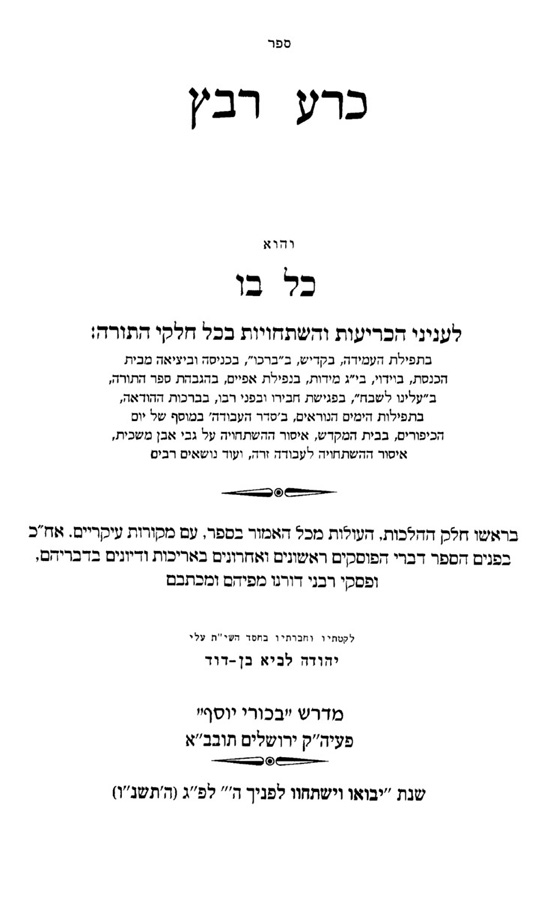
[3] My first attempt was to propose that the word כִּרְעוּתֵהּ is itself an erroneous later scribal addition. An ancient tradition maintains that one should bow during the Kaddish at several places. Sefer Kra’ Ravaṣ, by Rabbi Yehuda Lavi Ben-David is an excellent modern halakhic compendium of the various laws of bowing, accompanied with much original analysis.

The book lists no fewer than seventeen different opinions as to where exactly to do the bowing. Some medieval prayer books have a Hebrew instruction to bow written in the margin: כרע. These might have been misinterpreted as Aramaic and incorporated into the text of the Kaddish itself. However, since I have not located any significant textual evidence to support this theory, I mention it here solely for the reader’s edification and entertainment.
[4] If the third alternative is a genuine interpretation of the text of the Kaddish, and an early one, it could hypothetically have developed into the other interpretations.

First, the standard interpretation developed. The word כרעותיה was understood as referring back to the immediately preceding creation of the world and in tandem a ו was introduced verbally in וימלך. Alternatively, the Great Kaddish may have been composed or edited in accordance with the first, standard interpretation. This development may have been the result of a growing influence of the written texts, without vocalization and punctuation, as opposed to earlier oral forms which would have preserved the original interpretation.

Next, this new interpretation collided with the original, possibly in written form, with the ו in וימלך being introduced where the original interpretation was preserved orally along with the hard כּ of כרעותיה. This friction would have been resolved by artificially throwing back כרעותיה to the beginning of the first phrase, giving birth to the GRA’s interpretation.

Or כרעותיה originally went in both directions, following both GRA and the alternate interpretation, as De Sola Pool proposed (see note above).


Comments on recent books by R. Benji Levy and R. Eitam Henkin; R. Joseph B. Soloveitchik; and the first color photographs of R. Jehiel Jacob Weinberg.

Comments on recent books by R. Benji Levy and R. Eitam Henkin; R. Joseph B. Soloveitchik; and the first color photographs of R. Jehiel Jacob Weinberg

Marc B. Shapiro

1. Benji Levy, Covenant and the Jewish Conversion Question: Extending the Thought of Rabbi Joseph B. Soloveitchik (Cham, Switzerland, 2021)

The last few decades have seen a lot of discussion regarding conversion, and what is and is not required before someone is accepted into the Jewish community. This is obviously a halakhic matter, as conversion is a halakhic procedure and the rabbis supervise it and are the ones to decide who is to be accepted for conversion. The issue also has a sociological component and in the State of Israel it has national and political significance as well. The fact that halakhic conversion standards in the last generation have become stricter, and conversions have even been revoked, shows that we are dealing with a matter that is far from simple. As most are aware, this has led to a good deal of tension in Orthodoxy.

Rabbi Joseph B. Soloveitchik (1903-1993) was the leading Orthodox thinker in the post-World War II era. Combine this with his standing as a great talmudist and it is obvious that he will have important insights in the matter of conversion. It is to this that R. Benji Levy turns his attention in this valuable new book which analyzes the Rav’s halakhic thinking together with his philosophical perspectives. It is a book which all students of the Rav’s thought will want to examine.

Before his discussion of the Rav’s position, Levy deals extensively with earlier rabbinic views on the status of an apostate. This is helpful in and of itself, but also in terms of seeing the novelty of the approach advocated by the Rav. Bringing the Rav’s notions of Covenant of Fate and Covenant of Destiny into the halakhic arena, Levy argues the Rav arrived at his position by positing that holiness is not inherent, something one is born into. As such, one can lose this holiness. For the Rav, this is not only stated with regard to people, as he also that he felt that there is no such thing as holiness “inherent in an object.” Rather, holiness is “born out of man’s actions and experiences” (Levy, pp. 58-59, quoting from the Rav, Family Redeemed, p. 64). As is well known, R. Meir Simcha of Dvinsk had the same perspective. The Rav also offers this perspective when it comes to niddah. See Nathaniel Helfgot, ed., Community, Covenant and Commitment, pp. 325-326: “The entire concept of tum’at niddah, ritual impurity of the menstruant, is not an inherent description, but rather a relational one, for the niddah herself is not ritually impure at all. The ritual impurity expresses itself only in relation to the other.” This is definitely not the mainstream perspective in rabbinic literature.

In chapter 5, Levy gives us a good summary of the different halakhic positions regarding conversion. In the popular mind, this is often reduced to strict or lenient positions. But this is not really accurate, as the fundamental issue under dispute is what exactly does kabbalat ha-mitzvot means. It is often unclear which side is lenient and which is strict. For instance, if a rabbi voids a conversion because someone is thought to have converted without proper acceptance of mitzvot, this can be seen as strict when it comes to conversion. But the voiding of the conversion means that this individual does not need to fast on Yom Kippur, and if he is married he can leave his wife without giving her a get. So from this perspective, the voiding of the conversion is “lenient.”

Levy also calls attention to a fascinating “hiddush” of the Rav when it comes to conversion. According to the Rav, not only does a convert need to accept all the mitzvot, but he must also commit to a life of study of Torah. “A convert who wants to enter the congregation and accept upon himself the yoke of mitsvot, but is unprepared to toil in Torah, this is lacking in their conversion” (pp. 134-135). As Levy notes, this position is in line with the Rav’s stress on serious learning as opposed to the “sentimentality of ceremonialism” (p. 135). Levy adds that this stress on study “achieves a radicalization of the overall conversion process” (p. 135). I wonder, though, is this something that the Rav actually insisted on, or was this simply a point he mentioned in shiur like so many other ideas that sound appealing but are without practical significance? In fact, do we have any evidence that the Rav ever supervised conversions? If so, it would be fascinating to know what he required from future converts and how he guided them.[1]

Levy claims that R. Aharon Lichtenstein’s position in his famous article, “Brother Daniel and the Jewish Fraternity,” is not identical with the Rav’s outlook. This was surprising to me, as it is generally understood that R. Lichtenstein’s 1963 article was an attempt to explain the Rav’s approach in the wake of the Brother Daniel episode. Levy, p. 84, quotes the Rav as saying that “however much an irreligious Jew attempts to cast off his faith, he is fated to be unsuccessful.”[2] He contrasts this with R. Lichtenstein’s statement that there is “a point beyond which the apostate cannot go and yet remain a Jew” (p. 84). Yet these statements are not in opposition. The Rav is referring to an irreligious Jew, not an apostate. A document I recently published which quotes the Rav’s explanation of his position makes this very clear.[3] It also shows that R. Lichtenstein’s points are directly in line with those of the Rav, and knowing their relationship, the article itself must have been written under the close guidance of the Rav.

Usually people think of Jewish identity as an inherent part of someone, an inheritance that cannot be given up. Yet the Rav departs from the usual approach and considers Jewish identity as something that can be lost, but only in extreme circumstances. One who is not religious does not lose his halakhic standing as a Jew. However, one who actually converts to another religion is regarded by the Rav as having severed his connection to the Jewish people, and for most intents and purposes would no longer be regarded as Jewish. (I do not know how he would regard the child of an apostate woman.)

As such, I must also reject Levy’s conclusion that for the Rav a Jew may lose his individual holiness, but his “holiness qua member of the Jewish collective is unshakeable.” It is this point that I believe to be mistaken, and as noted already, I assume that the Rav’s settled position is as explained by R. Lichtenstein. I also believe that we need not be concerned that in shiur the Rav offered a different reading of a text, as what he said in shiur was often provisional, an exploration of different possibilities.[4] In the case at hand we have more than one testimony that R. Lichtenstein’s description, that in many ways an apostate is not to be regarded as Jewish, is exactly in line with the Rav’s position. With this in mind, we also need to review Levy’s discussion of the Brother Daniel controversy (pp. 186f.). To say that the Rav supported the ruling of the Israel Supreme Court and leave it at that creates a misinterpretation. Yes, the Rav agreed with the Supreme Court that Brother Daniel was not to be regarded as Jewish. Yet the Court’s assumption was that halakhah would regard him as Jewish. However, since the Law of Return is a secular law, the Court had to decide based on how the law was understood by “the ordinary simple Jew,” and such a Jew would never regard a Catholic religious figure as being part of the Jewish people. The Rav could not be more adamant that the Court was in error, as in his view, even from a purely halakhic perspective, Brother Daniel could not be regarded as Jewish.[5]

One final point: Levy deals with authorities who have seen circumcision or immersion as conveying what can be termed “limited sanctity” or “partial conversion.” There is another source that should be added to this discussion. R. Hershel Schachter records the Rav’s understanding that the Patriarchs had moved beyond the status of benei Noah, but had not yet achieved the full status of kedushat Yisrael. Nevertheless, they still had some kedushat Yisrael.[6] This puts them somewhere between non-Jews and Jews, a “partial Jew” if one might use the term.

2. Eitam Henkin, Studies in Halakhah and Rabbinic History (Jerusalem, 2021).

It has been eight years since the murder of R. Eitam Henkin, and the deep sadness over what was taken from us remains. A glance at what Henkin was able to accomplish in his short life— three books and numerous articles, all of the highest caliber—shows us what the future would have held for him in both rabbinic and academic scholarship. As Eliezer Brodt puts it in his introduction to Henkin’s Studies in Halakhah and Rabbinic History: “He was a unique combination of an outstanding talmid hakham and historian who was also blessed with exceptional research and writing skills.” Fortunately, in his short years R. Eitam left us with much to treasure.

Studies in Halakhah and Rabbinic History, published through the great efforts of Seforim Blog editor Eliezer Brodt, is a treat for anyone who values Torah and Jewish scholarship. All of us are in great debt to Brodt for this labor of love, which began immediately after Henkin’s murder, when Brodt was the prime mover behind the publication of Ta’arokh Lefanai Shulhan, Henkin’s posthumously published book on R. Jehiel Mikhel Epstein and the Arukh ha-Shulhan. The essays in the current volume are translations of many of Henkin’s important Hebrew articles, and the translators, volunteers all, also deserve our great thanks.

The first section of the book focuses on halakhah. R. Eitam deals with the kosher status of strawberries, modern utensils and absorption of taste, the sale of land in Eretz Yisrael to non-Jews, and other topics. The second section, which has more than 250 pages, deals with the girls’ dance on the 15th of Av, the famous (or infamous) Bruriah story, the Shemitah controversy, the Novardok yeshiva, haredi revisionism when it comes to Rav Kook, and a number of other topics. The final section focuses on R. Joseph Elijah Henkin, offering a general survey of his life and significance, and a second article dealing with his statements about R. Shlomo Goren and the Langer Affair.

There is so much that can be said about this this rich book, but in the interests of space I will only offer a few comments. I am certain that in future posts I will have the opportunity to come back to it.

In chapter 2, Henkin discusses the fascinating issue of absorption of taste in modern utensils. If the halakhic concept of beliah is based on actual absorption, then when dealing with stainless steel, which does not absorb, the halakhic issues should disappear. Following this line of thinking, it could still be appropriate, for a variety of reasons, to have separate meat and dairy stainless steel utensils. But if one mistakenly cooked dairy in a meat stainless steel pot that had been used with meat in the last day, bediavad the food should be OK to eat and the pot should not need to be kashered. If one were to follow this approach, stainless steel would be treated just as Sephardim treat glass, which can be used for milk and meat as the glass does not absorb.

In response to such a claim about stainless steel, Henkin puts forth the original argument that the real issue is not the new type of materials we use for utensils, but that our ability to perceive taste is not what it used to be. In other words, if our taste buds have deteriorated, then we can no longer use them as the basis of determining if there are beliot.

To prove that our sense of taste has weakened compared to the days of the Sages, Henkin did an experiment:

I took a wooden spoon (an old one, like utensils in the average kitchen) and for about half a minute I used it to stir milk that had been boiled in a glass cup. I then washed the spoon well, and then stirred with it, also for a half minute, about half a cup of tea which had been boiled in a small metal pot (a cezve). At the same time, I stirred the same amount of tea using a new metal spoon. I tasted it myself and gave it to my family to taste (as mesihim lefi tumam, without knowledge of the experiment) and no one could discern any difference in taste between the cups. Even when the family members were asked to guess which of the two cups was “dairy,” the success of the guesses wavered as expected at around 50% (pp. 25-26).

The results he obtained led Henkin to conclude that our sense of taste has weakened. This is because it is clear from the talmudic sages that milk leaves a taste in wooden spoons, and yet in reality we see that this is not the case.

This is a very interesting point that I will leave to scientists to discuss, but I do not think it fundamentally changes the problem. Even if our sense of taste has weakened, and we cannot taste what in previous generations we would have been able to, the fact is that stainless steel by definition does not absorb taste. So even if in the days of the Sages they could sense the flavors absorbed in wood, they would not have been able to taste anything had they used stainless steel. Thus, we return to the question of whether there should be a halakhic concept of beliot when it comes to stainless steel.

I must also mention that Henkin’s teacher, R. Dov Lior, specifically states that one can use stainless steel for both meat and dairy (although in practice he requests that two other poskim agree with this position). [7] I find it hard to believe that this will ever become an accepted practice, but is there any halakhic reason why not, or is it only be a matter of continuing what we have done in the past even if there is no strict halakhic reason to do so? Must we assume, as stated by R. Yaakov Ariel, that the entire concept of beliah is a halakhic notion, which like other halakhot operates according to its own rules that are not tied to scientific facts?[8]

Finally, I must note that unfortunately when the essays were translated no attention was paid to Henkin’s website here. On occasion, Henkin corrected his essays, and when the essays were translated R. Eitam’s corrections should have been included. For example, in chapter 24 he discusses R. Shlomo Goren and the Langer affair. On p. 413 n. 17, he mentions various rabbis who were identified as having been on R. Goren’s special beit din that concluded that the Langer children were not mamzerim. Yet on his website here he notes that two of the names he mentioned are not correct. There are other articles of his where he added more material on the website, so readers who want the most up-to-date scholarship of Henkin are recommended to check there.

3. At the end of my last post I mentioned that the next post would include an unknown article by R. Joseph B. Soloveitchik. I was mistaken, for not only is the article not unknown, but it is also included in R. Nathaniel Helfgot’s collection of the Rav’s letters and public statements, Community, Covenant and Commitment, pp. 263-265. Helfgot tells us that the article appeared in the Rabbinical Council Record (no date is given). I thought it was unknown because I found it in Jewish Horizon, Sep.-Oct. 1964, and didn’t at first realize that it was also reprinted in Helfgot’s book. What accompanies the Rav’s article is another article that is pretty much unknown. Although it is recorded in the bibliography of R. Lichtenstein’s writings found hereI have never seen anyone refer to it. While new material from the Rav is obviously very exciting, the same can be said for anything from R. Lichtenstein’s pen.

Since I promised something new from the Rav, how about the following which I believe is the first time that the Rav’s name ever appeared in print. It is from the German Orthodox paper Der Israelit, February 7, 1929, and mentions the shiurim for advanced students that the Rav delivered at an Ezra youth movement gathering in Berlin.

In my Torah in Motion classes on the Rav’s letters, available here, I also discussed the Rav’s reason for rejecting numerous pleas that he put forth his candidacy for the Israeli Chief Rabbinate after the 1959 death of R. Isaac Herzog. A lot has been written about this episode.[9] However, we also have the Rav’s testimony from the 1970s that he was again approached about becoming Chief Rabbi.[10] And there is even one other testimony about the Rav and the Chief Rabbinate, but this time I am referring to the Chief Rabbinate of the United Kingdom. Bernard Homa, Footprints on the Sands of Time (Gloucester, 1990), p. 127, writes as follows about the discussion of who would succeed Chief Rabbi Joseph Hertz:

I was one of the representatives of the Federation on the London Board for Shehita, where I served as Vice-President from 1946 to 1948. I also represented the Federation in 1947 on the committee, under the Chairmanship of Sir Robert Waley Cohen, dealing with the appointment of a successor to Dr. Hertz, who had passed away in 1946. I recall two items worthy of mention. Among the several names that came up was that of the famous Rabbi Joseph Ber Soloveitchik of Boston. There was no discussion as to his merits but he was quickly excluded from consideration for a very silly reason. The Chairman reported that he had been informed that he did not know how to use a knife and fork properly.[11] His informant was clearly unaware that in the U.S.A. table customs are different from those in this country and the allegation against him was thus not only trivial, but entirely without foundation.[12]

In my article in Hakirah 32 (2022), I published a number of letters from the Rav. Let me share an additional letter, to R. Irwin Haut, which was originally supposed to be included in my article. Unfortunately, I only have the first page. (The family also only has the first page. If any reader has the complete letter, please be in touch.) I thank Professor Haym Soloveitchik for granting me permission to publish it.

יג אדר השניתשיט
March 23, 1959

Dear Rabbi Haut:

Acknowledge receipt of your letter. 

1. Liquids which were cooked or boiled before the Sabbath and remained on the covered gas range during the בין השמשות period may be put back, after being removed for the night to the refrigerator, on the covered flame on Saturday morning, provided that the liquid foods do not reach the temperature of יד סולדת. If, however, the liquids are kept near the flame so that their temperature remains above the house temperature, we do not have to concern ourselves with the aspect of יד סולדת

2. I would advise you to put a a [!] tin or tin-foil cover on the [next page missing]

The issue here is heating up liquids on Shabbat, and the position of the Rav is more liberal than the standard Orthodox approach today which is not to allow any reheating of liquids (other than Yemenite Jews who follow Maimonides’ opinion). To understand the Rav’s position, we must first note that this was actually the opinion of his mother, Rebbetzin Pesha, who was a scholar in her own right. In this case, I think we can say that the Rav was simply following his family tradition.

This is what appears in Yeled Sha’ashuim, p. 30, a book devoted to R. Ahron Soloveichik[13]:

Rebbitzen Pesha would place cold soup on the hot Shabbos blech and be careful to remove the soup before it became יד סולדת בו. She was not concerned about the איסור חזרה because the psak of the Rama is that if the food was on the Shabbos blech for the duration of בין השמשות on Friday night and was later removed from the Shabbos blech, then there is no איסור חזרה. The only question then is whether there it is forbidden from the standpoint of the איסור בישול. Rebbitzen Pesha reasoned that it is permitted to do this on the basis of ספק ספיקא. First of all, there is a מחלוקת ראשונים as to whether in דבר לח we say אין בישול אחר בישול. The view of חכמי ספרד is that even in דבר לח we say אין בישול אחר בישול. But, in this case, one removes the soup from the Shabbos blech before it reaches the heat of בישול. The soup becomes only lukewarm. There is a מחלוקת רשי ותוספות whether this is permitted or it is אסור מדרבנן גזירה שמא ישכח וזה יגיע לידי בישול. The question in this case revolves only around an איסור דרבנן. Rebbitzen Pesha, therefore, reasoned that it is permitted on the basis of ספק ספיקא.  

Quite apart from the specific issue of liquids, the Rav’s position allowing food on the blech or even in the oven during bein ha-shemashot to be placed in the refrigerator and returned to the blech or oven the next morning is well known and has been discussed by many. This leniency can be traced to R. Nissim of Gerona who derives it from the Jerusalem Talmud.[14] Let me, however, me add two points. The first is that R. Ahron Soloveichik told me that I could adopt this position in practice. (I only asked about food, not liquids). The second point is that the Rav’s position has been portrayed as only referring to foods, not liquids. Yet we see from his letter to Haut that he, together with his mother, also held this position with regard to liquids.

Having said this, I think people will find the Rav’s instructions to caterers at the Maimonides school of interest. I thank Steven DuBois for calling my attention to this document, which is found here.

In one of these instructions I think it is obvious that the Rav was adopting a more stringent approach because he was dealing with caterers, who will not be as careful in these matters as individuals at home.  As you can see, the Rav only mentions removing solid foods from the refrigerator, but nothing about liquids. I think the reason is clear. An individual at home can be careful that liquids not reach the level of yad soledet bo, but this is not something the Rav was willing to entrust to a caterer who while busily preparing the Shabbat meal will often not be so careful to make sure that the liquid does not reach yad soledet bo.

We only have the first page of the Rav’s letter to Haut, but it is clear that the Rav’s second point is his advice to put a tin or tin foil cover over the stove knobs in addition to the blech. He does not state this as an absolute requirement but as a preferable procedure. However, in his instructions to caterers, this is listed as a requirement.

Let me share some more things related to the Rav, the first one of which comes courtesy of Ovadya Hoffman. In 1993 R. Yitzhak Hershkowitz published the first volume of his responsa Divrei Or. The second section of this volume includes responsa from the sixteenth-century scholar R. Abraham Shtang. In the introduction we find the following sentence:

אחדים מתשובות אלו נדפס ביובל עי ר‘ יצחק זימער

This is a very strange sentence, because what does נדפס ביובל mean? It actually refers to the 1984 Sefer Yovel for R. Joseph B. Soloveitchik where Yitzhak (Eric) Zimmer’s article appears (and Zimmer himself spells his name זימר). As Hoffman notes, this is a sort of “the wise will understand” reference. The editor did not feel that his readership could “handle” the actual title of the book, so instead he refers to it in code.

Growing up, maybe the first thing I knew about practices of the Rav was that he stood up with his feet together for the entire repetition of the Amidah. I recall how certain YU students would imitate this practice of the Rav, which sometimes created problems when people would try to exit the row while the students were standing with their feet together. Regarding the Rav’s practice, see R. Schachter, Nefesh ha-Rav, pp. 123-124, and here.

Maimonides, Mishneh Torah, Hilkhot Tefillah 9:3, actually explicitly states: “Everyone – both those who did not fulfill their obligation [to pray] and those who fulfilled their obligation – stands, listens, and recites ‘Amen’ after each and every blessing.” You cannot be much clearer than this, but nevertheless, there are those who offer a different interpretation of Maimonides. According to them, when Maimonides writes והכל עומדין ושומעין it does not mean literally to stand. Rather, עומדין ושומעין means to be quiet and listen. This argument is made by R. Ovadyah Hadaya[15] and R. Isaac Liebes,[16] and they both make the same point in support of their position. R. Moses Isserles, Shulhan ArukhOrah Hayyim 124:4, writes: “There are those who say that the entire congregation should stand when the prayer leader repeats the prayer. (Hagahot Minhagim).” Both R. Hadaya and R. Liebes note that R. Isserles could have cited Maimonides to support the view that the congregation should stand for the repetition of the Amidah. The fact that he instead cites Hagahot Minhagim shows that R. Isserles also did not understand Maimonides to literally mean that the congregation stands.

The problem with this is that R. Hadaya and R. Liebes were unaware that the reference to Hagahot Minhagim, and all similar references to books in parenthesis, does not originate with R. Isserles. It was added by a later editor, and thus the point made by R. Hadaya and R. Liebes has no relevance to R. Isserles’ opinion.

Two more points about the Rav: I do not think it is widely known that one of the first publications of the Rav—based on notes of a listener—appeared in a Habad publication in 1942. Here is the title page which on Otzar haChochma is called מאמרי קודש פון כק אדמור שליטא.

Here is the first page of the Rav’s article.

In a few of my online classes I dealt with the Rav’s opinion that even in contemporary times the hazakah of tav le-meitav tan du mi-le-meitav armelu (that a woman prefers almost any husband to being single) remains applicable. Here is what appears in R. Elyashiv’s Kovetz Teshuvot, vol. 4, no. 117. It sure seems like R. Elyashiv is rejecting the approach of the Rav.

4. In my post here I stated that Saul Lieberman began his studies at the Hebrew University in 1928. This information is based on Elijah J. Schochet and Solomon Spiro, Saul Lieberman: The Man and His Work, p. 8. However, a reader points out that in the August 16, 1927 entry of the unpublished diary of R. Mitchel Eskolsky, who was studying in Jerusalem at Yeshivat Merkaz ha-Rav, he speaks of meeting Saul Lieberman who was at that time a student at Hebrew University.

Regarding Lieberman, I thank Aron Rowe who called my attention to the fact that JTS has put some talks of Lieberman online. Before this, I had never heard Lieberman’s voice. See herehere, and here.

For those interested in Lieberman, I recently did eighteen classes on him. You can find them on Youtube here, and they are also currently being turned into podcasts which are on Spotify and other platforms. One interesting point about Lieberman which I did not mention is found in his letter to Gershom Scholem, dated July 10, 1967. (Lieberman’s letters to Scholem are found at the National Library of Israel.) Here he states that he was upset that he was not in Israel during the Six Day War, which would have enabled him to suffer together with Israel’s inhabitants. He comforted himself with the knowledge that he was able to have more of a positive impact in the U.S. than his presence would have had in Israel. He tells us what he has in mind, namely, that he permitted collecting money for Israel on the holiday. As Dr. Aviad Hacohen has pointed out to me, this must be referring to Passover, when tensions between Israel and its neighbors were already at a high level, rather than Shavuot, which came out after the war was over. Here are Lieberman’s words:

הצטערתי מאד שלא הייתי בארץ לפני פרוץ המלחמה ובפריצתה ולא זכיתי להצטער עם הציבור במקום הדאגה והצערונֶחׇׇמׇתי היא שהבאתי תועלת כאן הרבה יותר מאשר מציאותי בארץהתרתי כאן לאסוף כספים ביוטוהרבנים שלנו פחדו לעשות כן בפומביופסקתי להם שיטילו את כל האחריות עלימעניין שהרבנים האורטודוקסיים שהתנגדו לכך לא פצו אחז את פיהם למחות נגדיאני מכיר יפה את אמריקה ואת ההתלהבות הגדולה שהיא גם עלול להצטנן קצת במשך שעות

We see that his pesak was for the Conservative movement, and when he says “our rabbis,” he means the Conservative rabbis, which he distinguishes from the Orthodox rabbis.

When people think of Lieberman they often think about another instructor in Talmud at JTS, namely, Rabbi David Halivni. I think readers will enjoy two recent publication by Zvi Leshem that record all sorts of interesting stories about Halivni, much like similar collections have been put together about so many great rabbis. See here and here.

Regarding Halivni, the following is also of interest. In 2006 a two-volume book about R. Menahem Mendel Hager of Visheva was published, Ha-Gaon ha-Kadosh mi-Visheva. Here is the title page.

R. Menahem Mendel was the grandfather of Halivni’s wife, and in the second volume there is a dedication from Halivni and his sons in memory of her. Notice how Halivni is referred to as Ha-Gaon and shlita.

5. Unlike today where there are thousands of color pictures of the current gedolim, in the past pictures of great rabbis were uncommon. Just think of the few that are available of for each gadol who lived before the Second World War. When it comes to R. Jehiel Jacob Weinberg, who died in 1966, we have a good number of pictures of him. However, until now no color pictures of R. Weinberg have ever appeared. I am happy to present the only color pictures of R. Weinberg that I have ever seen. They were taken by R. Weinberg’s nephew, Dr. David Corn, on a visit to Montreux in 1958 or 1959. I thank the Corn family for granting me permission to publish these pictures. The originals are now kept at Ganzach Kiddush Hashem in Bnei Brak.

In this picture we see a young R. Yitzhak Scheiner and a young R. Aviezer Wolfson on the right. Thanks to R. Jeremy Rosen for the identification of R. Wolfson.

Here is Dr. Corn with R. Weinberg.

Here are the remaining pictures he took.

6. In July 2023 I led what I was told was the first ever kosher tour to Tunisia, courtesy of Torah in Motion. Seeing this unique Jewish community up close was an amazing experience for all. 

Here is a beautiful picture from last summer’s trip to Tunisia. The photographer is Alan Messner and it was taken in Djerba. (I encourage everyone who studies Talmud Yerushalmi to check out Alan’s valuable index here.)

Quiz

Please identify the following and email me your answers:

1. There are two se’ifim in the Shulhan Arukh that only contain two words.

2. There is one siman in the Shulhan Arukh whose number is the gematria of the subject of the siman.

Coming next: More on Saul Lieberman, and R. Moshe Zuriel: A Great Teacher in Israel

* * * * * * *

[1] Regarding the Rav and converts, in R. Chaim Jachter’s fascinating new book, Gray Matter, vol. 5, p. 163, he mentions that in a 1985 shiur the Rav stated that non-Jews have a “right to convert.” R. Jachter elaborates on the halakhic implications of this notion.
[2] David Holzer, ed., The Rav Thinking Aloud (Miami Beach, 2009), p. 319.
[3] “Letters from the Rav,” Hakirah 32 (2022), p. 152. Here the Rav is quoted as attributing his position to his father, R. Moses. However, in Reshimot Shiurim: Yevamot (ed. Reichman), p. 211 (to Yevamot 17a), it is attributed to his grandfather, R. Hayyim. After mentioning R. Hayyim’s position that descendants of Jews in Spain who identify as Christians are to be regarded as non-Jews both le-humra and le-kula (meaning their children are also not halakhically Jewish), he adds: והוא חידוש נורא. Levy, p. 82, refers to this page in Reshimot Shiurim, but he focuses on the first possible explanation that the Rav offers, rather than the explanation of R. Hayyim which in practice was what the Rav adopted.

I have to say, however, that the Rav seems to have contradicted himself in a 1965 interview with Ha-Aretz (printed in Community, Covenant and Commitment, pp. 220-221). He stated:

During the “Brother Daniel” episode, I wrote to the Chief Rabbis urging that they should stop attempting to decide this issue according to [formal] Halakhah and decide it based on their emotions. Acccording to [formal] Halakhah, Brother Daniel is a Jew. . . . I prayed that the Justices would not follow the Halakhah.

I must also note that during the Brother Daniel episode in the early 1960s there was only one chief rabbi, R. Isaac Nissim.
[4] It might be an interesting project for someone who listened to many of the Rav’s online shiurim to put together a list of ideas he expressed that are not found in his writings or that are in contradiction to what he wrote. I am sure that there are plenty of examples where the Rav offers an idea that he is not sure about and never would have included in a published work. This is obviously relevant to how much weight we give passages in the series of books The Rav Thinking Aloud.

I thought of this when I read the summary of the Rav’s YU graduate school lecture from the late 1940s published in Hakirah 27 (2019), p. 51:

The commandment of lo tirtzah was not [meant to be] self-evident to the intellect. It is also a hok, as is the eating of hazir. The only difference is that it fits into our moral concept of thinking, whereas hazir doesn’t. [It is not obvious] reasoning that I should not murder someone who stands in my way.

Was this really the Rav’s settled opinion, or was he just trying to be provocative with the students, in order to bring out a point? I do not see how the Rav could have really thought that lo tirzah is a hok, and I do not know of anyone who has made such a claim. After all, the prohibition of murder is one of the Noahide Laws, none of which are hukkim

In Community, Covenant and Commitment, p. 333, the Rav accepts that there are “rational laws.” He adds that when the Jews were commanded about rational laws, “an internal-natural instinct was transformed into a Divinely revealed command.” Furthermore, “the normative field of operation was expanded and deepened and reached the depths and farthest boundaries of idealism, which are unknown to the psychological instincts and predilections.”

In Shiurei Harav, ed. Joseph Epstein (Hoboken, 1974), p. 114, the Rav includes lo tirtzah among the mishpatim, but here too he seems to be denying what we can call a natural law prohibition against murder according to R. Akiva. If one were to follow this approach, I do not see how the prohibition against murder can be regarded as a mishpat.

R. Akiva is saying that since you said “Do not murder,” we don’t murder; but if you did not say it, we might do it. R. Ishmael says that even without God, man would know better. For R. Akiva, a man is capable of murder and is stopped only because of God.

Today, not much proof is needed of R. Akiva’s point of view. There is some devil in man; some satan who can suddenly come to the fore. To prevent this, we need the word of God. For R. Akiva, the mishpatim, those rules for which we think we know the reason should be done on the same basis as the hukim, for which we do not know the reason.

Some might wish to bring proof that the prohibition against murder can be seen as natural law since God judged Cain guilty of murder and this was before the giving of the Torah. Yet this is not a strong point because according to Bereishit Rabbah 16:6, and see also Mishneh Torah, Hilkhot Melakhim 9:1, Adam was already commanded against murder. Yet the fact remains that non-Jews are forbidden to murder, and are called to account for violation of this command. This applies even if they had never heard of God’s revelation to Noah or Moses. Doesn’t this mean that this law is in principle knowable by reason?

Marvin Fox has a different approach.

Ye shall keep my statutes (Lev., 18:5). This refers to those commandments which if they had not been written in Scripture, should by right have been written. These include the prohibitions against idolatry, adultery, bloodshed, robbery and blasphemy [Yoma 67b].” There is no suggestion here that human reason could have known by itself that these acts are evil, nor is it suggested that they are not consistent with man’s nature. What is asserted is only that, having been commanded to avoid these prohibited acts, we can now see, after the fact, that these prohibitions are useful and desirable.

Fox. Interpreting Maimonides (Chicago and London), p. 127. When it comes to Maimonides, the crux of the problem revolves around Guide 2:33 where he categorizes murder (and the other final seven commandments of the Ten Commandments) as belonging to the “class of generally accepted opinions,” as opposed to the first two commandments which are rational, “knowable by human speculation alone.” For the most recent discussion of Maimonides and Natural Law, see Shalom Sadik, Maimonides: A Radical Religious Philosopher (Piscataway, N.J., 2023), ch. 4.

In the Hakirah article mentioned earlier in this note, the Rav also states as follows:

Those who possess greater knowledge and skill possess also the higher ranks in society. Yet Judaism tried to equate the dignity of every individual regardless of his possession of knowledge. [It differentiated] only in regard to his intellectual drive. Where Judaism gave preference to the hakham over the am ha’aretz, it was not with regard to his accumulation of wisdom but simply because he was engaged in this great ethical drive. If a man tries and fails, he is not condemned. [Rather] he receives equal respect [to that] of the hakham.

These are nice sentiments, but the Rav knew full well that this was never how Jewish society functioned. The am ha’aretz, even one who tried, and failed, to become learned in Torah, was never given equal respect to the hakham.

In reading over this note, I see that I have another point to add. I wrote: “After all, the prohibition of murder is one of the Noahide Laws, none of which are hukkim.” I do, however, know of one source that disagrees with my statement. R. David Kimhi, Commentary to Gen. 26:5, writes:

גם יש בשבע מצות שנצטוו בני נח שאין טעמם נגלה אלא לחכמים והם הרבעת בהמה והרכבת האילן ואבר מן החי לפיכך אמרחקותיואמרמצותיכלל לכל המצות השכליות בין בלבבין ביד ובין בפה מצות עשה ולא תעשה

This is a problematic passage. Leaving aside his assumption that ever min ha-hai is a hok, the other two examples he gives, mixed breeding of animals and grafting of trees, are not included in the Seven Noahide Laws. There is a dispute among the rishonim if these actions are forbidden for non-Jews. Those who hold they are forbidden see these as additional prohibitions separate from the Seven Noahide Laws.

In a future post I will deal with the issue of positive commandments that non-Jews might be obligated in. These are also not included in the Seven Noahide Laws which are only negative commandments.
[5] See my “Letters from the Rav,” p. 151.
[6] Eretz ha-Tzvi, p. 140. This is noted by R. Chaim Jachter, Gray Matter, vol. 5, p. 188.
[7] See p. 25 n. 7, where Henkin tells us that after presenting his approach to R. Lior the latter agreed that one should also perform a comparative analysis with stainless steel and other materials. It does not appear that this would have any impact on his halakhic decision, and he has not publicized a retraction. I would say to R. Eitam, and I regret that I did not have the opportunity to do so in his lifetime, that if scientifically it has been shown that there is no absorption in stainless steel, then as I mentioned in the text, I do not see why the comparative study he suggests accomplishes anything.
[8] See his letter in Ha-Ma’yan 53 (Tevet 5773), pp. 90-93. See also the discussion in Nadav Shnerb, Keren Zavit (Tel Aviv, 2014), pp. 314-322.
[9] See Jeffrey Saks, “Rabbi Joseph B. Soloveitchik and the Israeli Chief Rabbinate,” B.D.D 17 (2006), pp. 45-67. See also the lengthy new article by Aviad Hacohen which focuses on the 1935 candidacy of the Rav for chief rabbi of Tel Aviv, but also discusses the period after R. Herzog’s death, “Ki mi-Neged Tir’eh et ha-Aretz ve-Eleha lo Tavo,” in Dov Schwartz, ed., Tziyonut Datit 9 (2023), pp. 153-222.
[10] See David Holzer, ed., The Rav Thinking Aloud (n.p., 2009), p. 143.
[11] R. Meir Mazuz, Mi-Gedolei Yisrael, vol. 1, pp. 197-198, points out that in the first printing of R. Hayyim Joseph David Azulai (Hida), Ma’agal Tov (Livorno, 1879), the printer omitted the details that the Hida recorded about the way Jews in Tunis ate, which their coreligionists in Europe would have viewed as distasteful. This was restored in the Freimann edition, Ma’agal Tov ha-Shalem (Jerusalem, 1934). One of the things the Hida mentions is that in Tunis they ate with their hands, and you can see how uncomfortable it made him (p. 56):

ואוכלים בידיהם ורגליהם וכל שמנונית מלא חפניהם והיה מגביה הגביר חתיכת שומן בעודה בכפו יבלענה ומנקה ידו במטפחת שעל ברכיו והמטפחת נעשה כבית המטבחיים

And they eat with their hands and with their feet, and with all the fat are their hands filled: the g’vir would lift up a piece of fatty meat and, while holding it in his hand, would he swallow it and then wipe his hands on a towel on his knees; and this towel would become like a butcher’s shop.”

The Diary of Rabbi Ha’im Yosef David Azulai, trans. Benjamin Cymerman (Jerusalem, 2006), Part 2, p. 20.

R. Yisrael Dandrovitz has a fascinating article devoted to the issue of eating with silverware, including the dispute over whether the sages of the Talmud ate with silverware or with their hands. He also deals with the practice of many hasidic rebbes to eat with their hands (some only eat fish with their hands). See “Al Ketzeh ha-Mazleg” Etz Hayyim 21 (5774), pp. 238-269.
[12] I was skeptical about this report of the Rav being considered, and wondered if Homa had remembered correctly. But R. Abraham Lieberman called my attention to Meir Persoff, Hats in the Ring: Choosing Britain’s Chief Rabbis from Adler to Sacks (Boston, 2013), p. 116, where we see that the Rav was indeed one of proposed candidates. The documentary evidence provided by Persoff contains nothing about the Rav’s table manners as a reason for him not being invited to interview for the position of Chief Rabbi.
[13] See also R. Bezalel Naor’s letter in Or ha-Mizrah, Nisan 5766, p. 192 n. 1. R. Naor, who is nothing less than a treasure in the world of Jewish scholarship, continues to amaze with his many contributions. His most recent book is Souls of the World of Chaos, which while focused on Rav Kook also encompasses the entire range of Jewish thinkers.
[14] Shabbat 17b in the Rif pages, s.v. u-mihu.
[15] Yaskil Avdi, vol. 2, no. 2.
[16] Beit Avi, vol. 3, no. 115:6.


When Rav Kook Was the Kana’i (Zealot) and His Opponent the Melits Yosher (Advocate)

When Rav Kook Was the Kana’i (Zealot) and His Opponent the Melits Yosher (Advocate)[1]

By Bezalel Naor

In 1891, there appeared in Warsaw an anonymous work[2] entitled Hevesh Pe’er,[3] whose sole objective was to clarify for the masses the proper place on the head to don the tefillah shel rosh or head-phylactery. According to halakhah, the tefillah must be placed no lower than the hairline and no higher than the soft spot on a baby’s head (i.e. the anterior fontanelle).[4] In ancient times, there were sectarian Jews who deliberately placed the tefillah on the forehead, as attested to by the Mishnah: “If one placed it [i.e. the tefillah] on his forehead, or on his hand, this is the way of sectarianism (minut).”[5] These Jews interpreted literally the verse, “You shall bind them for a sign upon your hand, and they shall be for frontlets between your eyes.”[6] Adherents to Rabbinic Judaism are punctilious about placing the hand-phylactery on the biceps of the forearm opposite the heart,[7] and the head-phylactery above the hairline. East European Jews who placed their phylacteries on the forehead did so not out of conviction, as the Sadducees of old, but rather out of sheer ignorance of the law. The slim book (all of 24 leaves or 48 pages) was thus an elaborate educational vehicle to educate the masses how to properly observe the law.[8]

According to the approbation to Hevesh Pe’er by Rabbi Elijah David Rabinowitz-Te’omim (ADeReT) of Ponevezh, the book was published [but not authored] by his former son-in-law (presently his brother’s son-in-law), Rabbi Abraham Isaac Hakohen Kook of Zeimel.[9]

Wares in hand, the young rabbi of Zeimel (aged twenty-six) assumed the role of an itinerant bookseller, travelling from town to town in Lithuania. Wherever he went, he preached concerning the importance of fulfilling the commandment of tefillin. Historically, there was precedent for a rabbi promoting that specific mitsvah. In the thirteenth century, Rabbi Jacob of Coucy (author of Sefer Mitsvot Gadol or SeMaG), circulating in the communities of France and Spain, was able to turn the tide and convince Jews, hitherto lax in their observance of the commandment, to don tefillin.[10] As for an author posing as an itinerant bookseller, Rav Kook’s older contemporary, Rabbi Israel Meir Kagan of Radin, had done exactly that, thus earning himself the sobriquet Hafets Hayyim, after the book by that name that he peddled. (Hafets Hayyim tackles the problem, halakhic and otherwise, of malicious gossip.)

It is recorded that Rav Kook’s sermons had such a positive influence upon his audience that the Rebbe of Slonim, Rabbi Shmuel Weinberg, offered to support him if he would devote himself fulltime to acting as a maggid or peripatetic preacher.[11]

One would never have imagined that this halakhic work would meet with any rabbinic opposition.[12] The point it makes that wearing the head-phylactery below the hairline on the forehead invalidates the performance of the commandment, seems rather clear-cut in the sources. (In fact, but a few years earlier, in 1884, Rabbi Israel Meir Kagan in his work Mishnah Berurah had advised wearing the phylactery higher on the head, at a remove from the hairline, just to be on the safe side.)[13]

However, five years later, Rabbi Ze’ev Wolf Turbowitz of Kraz (Lithuanian, Kražiai; Yiddish, Krozh)[14] devoted the very first of his collected responsa to pummeling the anonymous work Hevesh Pe’er.[15] Rabbi Turbowitz prefaces his remarks by saying: “The intention of this author [i.e. the author of Hevesh Pe’er] is for [the sake of] heaven, but nonetheless he has spoken shabbily of the people of the Lord. May the Lord forgive him. For Israel, ‘if they are not prophets, they are the children of prophets.’”[16] Rabbi Turbowitz goes on to argue that the commandment is invalidated only if the majority of the phylactery is placed below the hairline. If, on the other hand, the majority is situated above the hairline and only a minority below, then the halakhic principle of “rubo ke-khulo” (“the majority as the whole”) applies, and the commandment is fulfilled.[17] One of the rabbi’s supposed proofs is that one must recite the blessing once again only in a case where the entire phylactery or the majority thereof has slipped down, but if only a minority of the phylactery has been displaced, with the majority still within the prescribed area, one does not recite another blessing upon readjusting the phylactery.[18]

Rav Kook (now outed as the author of Hevesh Pe’er) responded to the onslaught of Tif’eret Ziv. His lengthy rejoinder, entitled “Kelil Tif’eret,” appeared in the periodical Torah mi-Zion (Jerusalem, 1900).

Rav Kook dismantles Rabbi Turbowitz’s supposed proof from the fact that another blessing is unwarranted as long as the majority of the phylactery is still in its proper place. Rav Kook reasons that we must distinguish between the essential commandment (“‘etsem ha-mitsvah”) and the action of the commandment (“ma‘aseh ha-mitsvah”). The fact that one does not recite an additional blessing does not necessarily mean that the commandment (“‘etsem ha-mitsvah”) is still being fulfilled. What it does imply, is that the action of the commandment (“ma‘aseh ha-mitsvah”) is ongoing. The blessing addresses renewed action (“ma‘aseh ha-mitsvah”). In a case where only a minority of the phylactery has been displaced, the action required to readjust it does not warrant a blessing. “And the Turei Zahav[19] holds that since in the entire Torah, ‘rubo ke-khulo,’[20] once most of the action has been nullified, the action as a whole is nullified, but if most of the action remains, even though the commandment has been nullified, still the action exists…”[21]

As is typical for Rav Kook, he signs himself, “Abraham Isaac Hakohen Kook, servant to the servants of the Lord…Bausk.”[22]

Evidently, Rabbi Turbowitz was not one to take something lying down. He came back at Rav Kook with a stinging reply, integrated into Ziv Mishneh, his commentary to Maimonides’ Mishneh Torah.[23] There, in Hilkhot Tefillin (4:1), he maintains that since “rubo ke-khulo is a universal principle in the entire Torah”[24]—this applies to tefillin as well. He reiterates once again his proof from the TaZ, who ruled that the blessing is recited once again only in a scenario where the tefillin are totally displaced. He mentions the opinion of “one wise man” (“hakham ehad”) who wrote that even the slightest deviation disqualifies the mitsvah, and disagrees. According to Rabbi Turbowitz, lekhathilah (to begin with), the entire phylactery should be above the hairline with none of it extending down to the forehead, but be-di‘avad (ex post facto), if a minority of the phylactery is below the hairline, one has nonetheless fulfilled the commandment. And therefore, the anonymous sage was wrong to badmouth the masses, who are remiss in this respect, and their spiritual leaders, who look the other way and do not protest. “He spoke shabbily of the people of the Lord and will in the future be called to judgment!” After summing up rather concisely the position he took earlier in Tif’eret Ziv, Rabbi Turbowitz now lambastes Rav Kook for what he wrote in Torah mi-Zion (Jerusalem, 1900), no. 4, chap. 4, accusing Rav Kook of deliberately misquoting him.

In 1925, two disciples of Rav Kook, Rabbi Yitshak Arieli[25] and Rabbi Uri Segal Hamburger,[26] reissued Hevesh Pe’er in Jerusalem with Rav Kook’s permission.[27] Appended to the work was Rav Kook’s rebuttal “Kelil Tif’eret.” (In addition, this edition was graced by the comments of Rav Kook’s deceased father-in-law, ADeReT, and of Rav Kook’s admirers in Jerusalem: Rabbis Tsevi Pesah Frank, Ya‘akov Moshe Harlap, and Yehiel Mikhel Tukachinsky. Finally, there are the substantial “Comments upon Comments” [“He‘arot le-He‘arot”] of the editor, Rabbi Yitshak Arieli.)[28]

In 1939, Rabbi Yosef Avigdor Kesler of Rockaway (Arverne to be precise)[29] published a second collection of his deceased father-in-law, Rabbi Ze’ev Turbowitz’s numerous responsa. Whereas the first collection of Tif’eret Ziv covered only Orah Hayyim, this collection covered all four sections of Shulhan ‘Arukh.[30] In addition, it contained a supplement (Kuntres Aharon) entitled “Mele’im Ziv.” In the supplement, Rabbi Kesler published a letter from ADeReT to Rabbi Turbowitz that turned up in the latter’s papers.

ADeReT’s letter is datelined “Monday, Vayyetse, 5657 [i.e. 1896].” In the letter, ADeReT gratefully acknowledges receipt of the recently published book Tif’eret Ziv. Regretting that he is unable to send monetary payment for the book because he is presently inundated with works of various authors, ADeReT nonetheless wishes to at least offer some comment on the contents of the book.[31]

Referring to the very first responsum in Tif’eret Ziv, ADeReT rejoices that Rabbi Turbowitz sought to advocate on behalf of the Jewish People regarding the commandment of tefillin. He is especially overjoyed that Rabbi Turbowicz was not cowed, but dared to differ. ADeReT holds up as role models Rabbi Zerahyah Halevi (Ba‘al ha-Ma’or) who critiqued Rabbi Isaac Alfasi (Rif), only to be attacked himself by Rabad of Posquières; Rabad of Posquières who critiqued Maimonides; et al. Since this is the “way of Torah” (darkah shel Torah), why should he harbor any resentment toward Rabbi Turbowitz for disagreeing with him?[32] (ADeReT, though not the author of Hevesh Pe’er, had wholeheartedly endorsed it.)

The sterling character of ADeReT is best summed up in these lines:

God forbid, I am not deluded to think that truth resides with me. I wholeheartedly acknowledge the truth. I have not a thousandth part of resentment towards one who differs with me. And the opposite, I love him with all my soul when he points out to me the truth.[33]

Since Rabbi Turbowitz acted as a true talmid hakham (Torah scholar) who uninhibitedly speaks truth, ADeReT wonders why he failed to mention the name of the work he critiqued, Hevesh Pe’er. This would have provoked neither the author nor ADeReT.[34]

In this vein of truth-seeking, ADeReT proceeds to explain why the argument presented in Tif’eret Ziv failed to dissuade him from the position adopted both by him and the author of Hevesh Pe’er. Since the shi’ur or measurement of the area on the head where the phylactery is to be placed is Halakhah le-Moshe mi-Sinai (a law to Moses from Sinai), the principle of “rubo ke-kulo” is of no consequence in this regard.[35]

Realizing the historic importance of the contents of the letter, Rabbi Kesler provided a photograph of the crucial passage in the letter, which reads as follows:

About two years ago, the thought occurred to me to reprint the booklet Hevesh Pe’er. I wrote to its author, my son-in-law, my soul-friend (today the Rabbi of Bausk, may he live) and asked him if he has anything new to add to it. He wrote me an article, brief in quantity but great in quality, that it is possible to say ‘rubo ke-khulo.’ In the summer of 5655 [i.e. 1895] when I was in Warsaw, I already spoke with a printer and also notified the [government] censor, and I was thinking to print. But after this, I reversed myself, and the two of us [i.e. ADeReT and Rav Kook] agreed that it is not worthwhile to print leniencies (kulot) in this.[36]

ADeReT explains that if we show any leniency, it will prove a slippery slope. He reveals to Rabbi Turbowitz his unusual experience with Hasidim in particular: “From this, there came about in places where the Hasidim reside [the custom] to wear large tefillin.[37] Not one in a thousand bears most of the tefillah within the hairline. In most cases, but a small fraction (mi‘uta de-mi‘uta) [is within the hairline]. I have seen with my own eyes the entirety upon the forehead. They laughed at my rebuke, saying: ‘Thus is the mitsvah.’ ‘So we saw our fathers doing.’ etc. etc.”[38]

The letter concludes with this salutation:

His friend who is honored by his love, appreciates his genius and his Torah, and blesses him with all good,

Elijah David Rabinowitz Te’omim

…Mir[39]

[1] These are the exact words of Rabbi Joseph Avigdor Kesler in the introduction to his father-in-law Rabbi Ze’ev Wolf Turbowitz’s work of responsa, Tif’eret Ziv (Brooklyn: Moinester Publishing Company, 1939), p. 7, par. 5.

By the time of his passing in 1935, Rav Kook would be immortalized as a twentieth-century Rabbi Levi Isaac of Berdichev, the great advocate of the Jewish People, forever defending their practices in the heavenly tribunal. Today, Rav Kook is famous for his leniency concerning the Shemitah or Sabbatical year, the heter mekhirah, which allows sale of the land to a non-Jew for the duration, whereby agriculture, or at least some forms thereof, may take place. The model for this contract is the prevalent mekhirat hamets or sale of leaven to a non-Jew before Passover, so that it need not be removed from the home of the Jew.

However, in general, if one studies the teshuvot (responsa) of Rav Kook, he does not come across as extraordinarily lenient in his pesakim or halakhic decisions. Par contre, someone whose work is chock-full of startling leniencies is Rabbi Aryeh Tsevi Fromer of Kozhiglov (1884-1943), Rosh Yeshivah of Yeshivat Hakhmei Lublin and a disciple of Rabbi Abraham Bornstein (author of responsa Avnei Nezer). Rabbi Fromer designed his work of responsa, Erets Tsevi (Lublin, 1938), to be melamed zekhut, to find some halakhic justification (however farfetched) for certain otherwise anomalous practices within the Jewish community. This is apparent from the very first responsum, where the author attempts to justify the prevalent practice of wearing a tallit katan that fails to meet the prescribed shi‘ur or measurement.

[2] The title page credits as author: “KDY (Kohen Da‘ato Yafah).” The expression “kohen she-da‘ato yafah” comes out of the Mishnah, ‘Avodah Zarah 2:5. Thus, the title alludes to the author being a Kohen or member of the priestly caste.

The thought occurs to this writer (BN) that “Yafah” might be an allusion to Rav Kook’s descent from Rabbi Mordechai Yaffe (author of the Levush[im]). Rav Kook was immensely proud of his pedigree which reached back to the Levush. The pedigree to the Levush was something that Rav Kook had in common with his father-in-law ADeReT. In the letter written by Rav Kook’s paternal great-uncle, Rabbi Mordechai Gimpel Yaffe of Rozhinoy, to the Trisker Maggid, Rabbi Abraham Twersky, Rabbi Yaffe mentions their remote common ancestor, the Levush.

[3] The title is taken from the verse in Ezekiel 24:17: “Pe’erkha havosh ‘alekha” (“Bind your head-tire upon you”). The Rabbis interpreted the head-tire as a reference to the head-tefillah; see b. Mo‘ed Katan 15a.

[4] y. ‘Eruvin 10:1; b. Menahot 37a; Maimonides, MT, Hil. Tefillin 4:1; Rabbi Joseph Karo, Shulhan ‘Arukh, Orah Hayyim 27:9.

[5] m. Megillah 4:8.

[6] Deuteronomy 6:8.

[7] Shulhan ‘Arukh, Orah Hayyim 27:1.

[8] In Hevesh Pe’er, chap. 2, the author points out that there already appeared in print a small booklet with diagrams, “Tikkun ‘Olam ‘im tsiyurim,” but writes that the error persists depite that.

[9] Rav Kook’s first wife, Alta Batsheva, daughter of ADeReT, died at a young age, leaving him to raise their infant daughter, Freida Hannah. ADeReT suggested to Rav Kook that he marry Reiza Rivkah, ADeReT’s niece, daughter of his deceased twin brother, Tsevi Yehudah, Rabbi of Ragola. ADeReT had raised Reiza Rivkah in his home after her father’s death.

[10] Rabbi Jacob of Coucy, Sefer Mitsvot Gadol, positive commandment 3; Hevesh Pe’er, chap. 2. At the end of positive commandment 3, Rabbi Jacob gives the exact year of his campaign in Spain: 4996 anno mundi or 1236 C.E.

Urbach writes that this role of the itinerant preacher, or darshan, is without precedent among the French Tosafists; he conjectures that in this respect, Rabbi Moses of Coucy came under the influence of Hasidei Ashkenaz. See E.E. Urbach, Ba‘alei ha-Tosafot (Jerusalem: Bialik Institute, 1995), pp. 466-470. Concerning specifically French Jewry’s laxity when it came to observing the commandment of tefillin, see ibid. p. 469, n. 13 (citing Tosafot, Shabbat 49a, s.v. ke-Elisha Ba‘al Kenafayim, and Rosh Hashanah 17a, s.v. karkafta de-lo manah tefillin). The SeMaG refutes Rabbenu Tam’s understanding of “karkafta de-lo manah tefillin.”

[11] Rabbi Ya‘akov Moshe Harlap, quoted in Rabbi Moshe Tsevi Neriyah, Sihot ha-Rayah (Tel-Aviv, 1979), p. 191, and idem, Tal ha-Re’iyah (Tel-Aviv, 1993), p. 116. According to Rabbi Harlap, the Slonimer Rebbe reached out to ADeReT, hoping that he could prevail upon his former son-in-law (and present nephew by marriage) to accept this magnaminous offer.

[12] Rav Kook’s erstwhile mentor in the Volozhin Yeshivah, Rabbi Naphtali Tsevi Yehudah Berlin (NeTsIV), was so enamored of Hevesh Pe’er that he kept it in his tallit bag. See the Introduction of Rabbis Yitshak Arieli and Rabbi Uri Segal Hamburger to the Jerusalem 1925 edition of Hevesh Pe’er, p. 2.

[13] See Rabbi Israel Meir Kagan, Mishnah Berurah (Warsaw, 1884) to OH 27:9. In the Be’ur Halakhah, Rabbi Kagan sought support for this prescription in the manuscript glosses of “the Gaon Rabbi El‘azar Harlap” to Ma‘aseh Rav (a collection of the practices of the Vilna Gaon). If I am not mistaken, these notes would have been penned by the Gaon (and Mekubal) Rabbi Ephraim Eliezer Tsevi Harlap of Mezritch.

[14] Rabbi Ze’ev Wolf Turbowitz was born Rosh Hodesh Iyar, 1840 in Baboina near Kletsk and was known in his youth as the “Ilui of Baboina.” His first wife was from Izilian. After his marriage, he devoted himself exclusively to study of Torah, whereby he was then known as the “Porush of Izilian.” At a tender age he began to study Kabbalah. (Among his writings was found a work on Zohar.) In 1863, he was appointed as a rosh metivta in Minsk. In 1866, he received his first rabbinical position in Swislowitz. In 1875, he assumed the rabbinate of Kletsk. Afterward, he served a stint in Wolpa. And finally in 1889, he was elected rabbi of Kraz, where he served until his death on the 14th of Kislev, 5682 [i.e. 1921]. These biographical details were gleaned from his son-in-law Rabbi Yosef Kesler’s introduction to the Brooklyn 1939 edition of Tif’eret Ziv, p. 4.

Rabbi Eitam Henkin hy”d wrote of the interface between Rabbi Turbowitz and Rabbi Eliyahu Goldberg, mentor of Rabbi Yehiel Mikhel Epstein (author of ‘Arukh ha-Shulhan). Besides corresponding with Rabbi Goldberg in halakhic matters, Rabbi Turbowitz delivered a moving hesped (eulogy) for Rabbi Goldberg in 1875 in the town of Kletsk, Rabbi Goldberg’s birthplace. See Rabbi Eitam Henkin, Ta‘arokh Lefanai Shulhan (Israel: Maggid, 2018), pp. 359-360, 363.

[15] See Rabbi Ze’ev Wolf Turbowitz, Tif‘eret Ziv (Warsaw, 1896), no. 1. Ziv is an acronym for Ze’ev Yekhuneh Volf.

The responsum is datelined “Wednesday, 16 Tamuz, 5651 [1891],” which means that it was penned the same year that Hevesh Pe’er was published. Rabbi Turbowitz does not mention the book by name, referring to it as “a new book that has appeared” (“sefer ehad hadash she-yatsa la-’or”).

By the same token, in responsum 12 of Tif’eret Ziv, where Rabbi Turbowitz engages with another early work of Rav Kook (in fact, his first), ‘Ittur Soferim, he refers to that work obliquely as “sefer ehad katan” (“a small book”). Rabbi Abraham Joshua of Pokroi had raised the question whether one who becomes bar mitsvah at night must recite once again the blessing for studying Torah (birkat ha-Torah), though he already recited it that morning. The editor, Rav Kook, devoted a few pages to resolving this problem. See ‘Ittur Soferim, Part Two (Vilna, 1888), 9a-10b. Rabbi Turbowitz made short shrift of the question. At the same time, he tackled the Vilna dayan, Rabbi Shelomo Hakohen, who had also raised the question in his work, Binyan Shelomo. In the Brooklyn 1939 edition of Tif’eret Ziv, the first two responsa are to Rabbi Shelomo Hakohen, who had defended his position to Rabbi Turbowitz.

According to Rabbi Turbowitz’s son-in-law, Rabbi Yosef Avigdor Kesler, the famous “Gadol of Minsk” (i.e. Rabbi Yeruham Yehudah Perlman) read Rabbi Turbowitz’s responsum concerning the placement of the head-phylactery before it went to print and approved its contents. See the supplement to the Brooklyn 1939 edition of Tif’eret Ziv, Kuntres Aharon, “Mele’im Ziv,” 2d-3a, footnote.

[16] Tif’eret Ziv, 6a. The quote is from b. Pesahim 66b: “Leave Israel alone! If they are not prophets, they are the children of prophets.” Rabbi Turbowitz’s remark is quoted in Yehudah Mirsky, Rav Kook: Mystic in a Time of Revolution (New Haven: Yale University Press, 2014), p. 23.

[17] Tif’eret Ziv 1:3 (6c).

[18] Tif’eret Ziv 1:16-21 (8c-9b). See Rabbi David Halevi (TaZ), Magen David to OH 8:15; cited in Mishnah Berurah to OH 25:12.

[19] See previous note.

[20] It may strike the reader as ironic that Rav Kook introduced at this point in the discussion the concept of rubo ke-khulo when he had earlier rejected its application. But from Rav Kook’s standpoint (and that of his father-in-law Aderet, see below note 35), that principle simply could not be applied to the area of the phylactery with its precise dimensions. “Shi‘urim halakhah le-Moshe mi-Sinai,” “Measurements are a law to Moses from Sinai” (y. Pe’ah 1:1, Hagigah 1:2; b. ‘Eruvin 4a, Yoma 80a, Sukkah 5b).

[21] Rabbi Abraham Isaac Hakohen Kook, “Kelil Tif’eret” in Hevesh Pe’er, ed. Rabbis Y. Arieli and Uri Segal-Hamburger (Jerusalem: Mossad Harav Kook, 1985), p. 46. Of course, the element of hesah ha-da‘at, i.e. whether one has “removed one’s awareness,” plays a crucial part in determining whether one must recite the blessing on the tefillin once again. See ibid.

Rav Kook’s hiluk (differentiation) between “‘etsem ha-mitsvah” and “ma‘aseh ha-mitsvah” (especially the terminology) is somewhat remarkable, issuing as it did from the pen of Rav Kook, who studiously avoided the school of Hasbarah with its abstract constructs and neologisms, then in vogue in the Lithuanian yeshivah world. The most famous proponent of Hasbarah was Rabbi Hayyim Soloveitchik (who would one day inherit his father Rabbi Yosef Dov Soloveitchik’s rabbinate in Brisk, whereupon he would be known as “Reb Hayyim Brisker”). The latter’s methodology of Talmudic analysis came to be known as the “Brisker derekh [ha-limud],” “the Brisker way.”

Rav Kook’s biographers have duly noted that his first mentor back in Dvinsk (since Rav Kook’s bar mitsvah), Rabbi Reuven Halevi Levin (known as “Reb Ruvaleh Denaburger”) had, so to speak, “immunized” Rav Kook against the trend of “sevarot” or newfangled “concepts.” Rabbi Reuven Levin was highly suspicious of sevarot that had not been enuciated already by the rishonim, the medieval authorities. (See Rabbi Kesler’s introduction to Tiferet Ziv, Brooklyn 1939, p. 8, par. 9, quoting Rabbi Reuven Levin, and ibid. sec. Hoshen Mishpat, responsum 46:6 [116c]: “It is not my way to say sevarot of my own cognizance.”)

And thus, when later Avraham Yitshak Kook arrived at Volozhin, “the mother of yeshivot,” he gravitated to the elder Rosh Yeshivah, Rabbi Naphtali Tsevi Yehudah Berlin (NeTsIV), known as a pashtan, a champion of the simple understanding of the text, rather than to his grandson-in-law, Rabbi Hayyim Soloveitchik, who was surrounded by budding scholars attracted to the exciting new method of Talmudic analysis that he was developing.

Although Rav Kook was never so outspoken as Ridbaz Wilovsky (“Reb Yankel Dovid Slutsker”) who satirized the new method as “chemistry,” Rav Kook was clearly on the other side of the great divide between Lithuanian Talmudists. This aversion of Rav Kook to the method of “hasbarah” was given eloquent testimony in recently unearthed correspondence concerning the unsuccessful attempt of Rabbi Shim‘on Shkop (a rosh yeshivah in Telz and later head of his own yeshivah in Grodna) to be accepted as Rosh Yeshivah of Merkaz Harav in Jerusalem. Speaking in Rav Kook’s name, his devoted disciple Rabbi Ya‘akov Moshe Harlap conveyed to Rabbi Hizkiyahu Yosef Mishkovski of Krinik (who had interceded on Rabbi Shim‘on Shkop’s behalf) the following laconic response:

Regarding the proposal concerning the Gaon Rabbi Shim‘on Shkop, may he live, to accept him as Rosh Yeshivah of Merkaz Harav, there is certainly nothing to discuss, for since the founding of the Yeshivah, this position is reserved for Maran [our master, i.e. Rav Kook], may he live, who plans to fill it himself. For Maran, may he live, wishes—and this is a strong desire—that the main method of learning of the Yeshivah be according to the order and method of the Gra [i.e. the Gaon Rabbi Elijah of Vilna], of blessed memory. Though he [i.e. Rav Kook] knows and feels also the great necessity of developing the methods of “hasbarot” (conceptualizations) and “havanot hegyoniyot” (logical understandings), he wants the main spirit of the Yeshivah to be based on his method, etc. Today I showed Maran, may he live, his honor’s letter, and what I wrote here is his response.

Rabbi Harlap’s letter is datelined “Monday, 2nd day of Rosh Hodesh Adar, 5686 [i.e. 1926], Jerusalem.” It was published in a Festschrift for his grandson, Rabbi Zevulun Charlop, Zeved Tov, ed. Ari S. Zahtz (New York: Yeshiva University Press, 2008), p. 103.

Inter alia, “Z. Wein” mentioned in the letter from Rabbi Shkop to Rabbi Tobolsky, expressing his desire to settle in the Holy Land (ibid. p. 101), is none other than [Rabbi] Ze’ev Wein a”h, father of Rabbi Berel Wein shelit”a. Rabbi Ze’ev Wein (1906-2004), a disciple of Rabbi Shkop, went on to study in Rav Kook’s Merkaz Harav in Jerusalem. He served for many years as a distinguished rabbi in Chicago.

Rabbi Shim‘on Shkop was famous for his method of “higayon” (logic), displayed in his magnum opus, Sha‘arei Yosher. (Rabbi Hershel Shachter shelit”a revealed to this writer [BN] that his father-in-law, Rabbi Yeshayah Shapiro, a rosh yeshivah at Torah Vodaath in Brooklyn, was instrumental in writing that work.)

This is not the place to discuss in any depth the differences between Rabbi Shim’on Shkop’s method and that of Rabbi Hayyim Brisker and his heirs. Two anecdotes should suffice. The Briskers quipped that Rabbi Shim‘on “had looked at the world and created the Torah” (“Istakel be-‘alma u-vara ’oraita”), a reversal of the Zohar’s adage, “[God] looked at the Torah and created the world” (“istakel be-’oraita u-vara ‘alma”). On one occasion, Rabbi Yitshak Ze’ev Soloveitchik (“Reb Velvel,” known as the “Brisker Rov,” for he inherited from his father Rabbi Hayyim the rabbinate of Brisk) met Rabbi Shim‘on Shkop and told him: “I removed from your student Rabbi Leib Malin the last sinew (gid) left from your teaching.” (The imagery is that of deveining or nikkur. Reb Velvel used the Yiddish verb, “treiberen.”) Both anecdotes were heard from Rabbi Shelomo Fisher shelit”a of Jerusalem.

[22] In 1895, Rav Kook left the town of Zeimel for the large city of Bausk, Latvia.

[23] Rabbi Ze’ev Wolf Turbowitz, Ziv Mishneh (Warsaw, 1904). The author has the rather unique distinction of viewing Maimonides as a kabbalist and finding kabalistic “sources” for his rulings. (Similarly, the introduction to the Warsaw 1896 edition of Tif’eret Ziv demonstrates the author’s proficiency in Lurianic kabbalah.) Though not unique in this respect, Rabbi Turbowitz is perhaps the most outspoken proponent of this peculiar methodology of studying Maimonides’ Mishneh Torah. Another Maimonidean commentator who occasionally resorts to this method of sourcing is Rabbi Joseph Rosen (the Rogatchover Gaon). See his Tsafnat Pa‘neah, Hil. ‘Avodah Zarah 12:6. Nowadays, Rabbi Hayyim Kanievsky’s Kiryat Melekh is replete with references to Zohar.

[24] b. Horayot 3b; and Rashi, Zevahim 26a, s.v. hikhnis rosho ve-rubo. Both are referenced by Rabbi Turbowitz.

[25] Rabbi Yitshak Arieli was one of the founders of Yeshivat Merkaz Harav and acted in the official capacity of “Mashgiah” of the Yeshivah. He is most famous for his work on the Talmud, ‘Eynayim le-Mishpat. Recently, Aharon Ilan, a great-grandson of Rabbi Yitshak Arieli, brought out his biography, ‘Eynei Yitshak (Jerusalem, 2018).

[26] Rabbi Uri Segal Hamburger was a descendant of Rabbi Moshe Yehudah Segal Hamburger of Novemeste (a disciple of the Hatam Sofer) who came to Erets Yisrael in 1857. Rabbi Uri Segal Hamburger resided in the Old City of Jerusalem until its conquest by the Jordanians in 1948. He penned a memoir of that tragic event, “Be-Tseiti mi-Yerushalayim.” One may find a short biography and a photograph of Rabbi Hamburger in ‘Eynei Yitshak, pp. 136-137.

[27] Rav Kook’s biographer and disciple, Rabbi Moshe Tsevi Neriyah, records that Rav Kook wrote in his haskamah (letter of approbation) to the publishers the following disclaimer: “In our holy land, which thank God, is full of Torah and fear of heaven, the admonition (azharah) is not so necessary. Nevertheless, I have not prevented re-issuing the book, for the benefit of our brothers in the diaspora, in areas where the matter is yet in need of correction” (Sihot ha-Rayah, pp. 189-190). This disclaimer does not appear in the printed version of the haskamah. Where did Rabbi Neriyah obtain it? The mystery was cleared up in the new edition of Sihot ha-Rayah (2015) published after Rabbi Neriyah’s passing. Rabbi Arieli’s son, Prof. Nahum Arieli, wrote to Rabbi Neriyah that he has in his possession much material that went into the making of the Jerusalem edition of Hevesh Pe’er edited by his father, including a “petek” (note) with those exact words. Rabbi Neriyah’s daughter, Tsilah Bar-Eli, granted Aharon Ilan permission to include a facsimile of Nahum Arieli’s letter to her father (on stationery of Bar-Ilan University) in the biography of Rabbi Arieli, ‘Eynei Yitshak, p. 139.

[28] Rabbi Arieli’s promised “Kuntres Aharon” was never published. Remnants of the manuscript are in the possession of his heirs. Rabbi Neriyah speculated that financial considerations prevented its publication in Hevesh Pe’er. See ‘Eynei Yitshak, p. 138, n. 102.

[29] On the inside of the book, Rabbi J. Kesler’s address is given as: “146 Beach 74th Street, A[r]verne, Long Island.”

[30] It is important to note that the two collections do not overlap. The responsa on Orah Hayyim that appeared in the Warsaw 1896 edition of Tif’eret Ziv, were not included in the Brooklyn 1939 edition. In their stead, appear more recent responsa on Orah Hayyim. In terms of sheer quantity, the second collection by far outstrips the first. The first Warsaw edition has 122 pages; the second Brooklyn edition, 488 pages.

[31] “Mele’im Ziv,” 2a-b.

[32] “Mele’im Ziv,” 2b-2c.

[33] “Mele’im Ziv,” 2d.

[34] “Mele’im Ziv,” 3a.

[35] “Mele’im Ziv,” 3a-b.

[36] The facsimile occurs in Rabbi Kesler’s introduction to the book on p. 7. It is transcribed in “Mele’im Ziv,” 3b.

If not for the evidence of the facsimile, it would indeed be difficult to accept that Rav Kook once entertained even the remote possibility of invoking the principle of rubo ke-khulo in this regard.

[37] To this day, Lubavitcher Hasidim wear very large tefillin.

[38] “Mele’im Ziv,” 3b-c.

[39] “Mele’im Ziv,” 3d.

In 1893, ADeReT left the community of Ponevezh to assume the rabbinate of Mir.


Young Rabbis and All About Olives

Young Rabbis and All About Olives

Marc B. Shapiro
I am currently working on a book focused on the thought of R. Kook, in particular his newly released publications. A book recently appeared titled Siah ha-Re’iyah, by R. David Gavrieli and R. Menahem Weitzman. It discusses a number of important letters of R. Kook. In addition to the analysis of the letters, each of the letters is printed with explanatory words that make them easier to understand. We are also given biographical details about the recipients of R. Kook’s letters. Here is the title page.
In reading the book, I once again found myself asking the question, how can intelligent people sometimes say nonsensical things? On p. 252 the book states that R. Menahem Mendel Cohen studied in yeshivot in Tiberias and Safed, and was appointed as chief rabbi of the Ashkenazic community of Cairo in 1896 when he was only ten years old!

How is it possible for anyone to write such a sentence, that a ten-year-old was appointed as a communal rabbi? Let me explain what happened here, but first, I must note that the name of the man we are referring to is not R. Menahem Mendel Cohen, but R. Aaron Mendel Cohen. Here is his picture, which comes from a very nice Hebrew Wikipedia article on him.

As for R. Cohen being appointed rabbi at age ten, whoever prepared the biographical introduction must have had a source which mistakenly stated that R. Cohen was born in 1886. Since this source also said that he became rabbi in Cairo in 1896, this means that he was ten years old was he was appointed rabbi. Yet we can only wonder how the authors did not see the obvious impossibility of a ten-year-old being appointed rabbi of Cairo, which should have led them to investigate a little further. Simply by googling R. Cohen’s name in Hebrew, the Wikipedia article will come up, and it tells us that R. Cohen was born not in 1886 but in 1866. Thus, instead of a ten-year-old rabbi he is now thirty years old.

With regard to young rabbis, let me repeat, with some slight edits, something I wrote in an earlier post here.

In terms of young achievers in the Lithuanian Torah world, I wonder how many have ever heard of R. Meir Shafit. He lived in the nineteenth century and wrote Sefer Nir, a commentary on the Jerusalem Talmud, when not many were studying it. Here is the title page of one of the volumes, where it tells us that he became rav of a community at the age of fifteen.

The Hazon Ish once remarked that the young Rabbi Shafit would mischievously throw pillows at his gabbaim![1]

Regarding R. Jacob Schorr [mentioned earlier in the original post] being a childhood genius, this letter from him to R. Shlomo Kluger appeared in Moriah, Av 5767.

As you can see, the letter was written in 1860 (although I can’t make out what the handwriting says after תר”ך). We are informed, correctly, that R. Schorr was born in 1853, which would mean that he was seven years old when he wrote the letter. This, I believe, would make him the greatest child genius in Jewish history, as I don’t think the Vilna Gaon could even write like this at age seven. Furthermore, if you read the letter you see that two years prior to this R. Schorr had also written to R. Kluger. Are there any other examples of a five-year-old writing Torah letters to one of the gedolei ha-dor? From the letter we also see that the seven-year-old Schorr was also the rav of the town of Mariampol! (The Mariampol in Galicia, not Lithuania.) I would have thought that this merited some mention by the person publishing this letter. After all, R. Schorr would be the only seven-year-old communal rav in history, and this letter would be the only evidence that he ever served as rav in this town. Unfortunately, the man who published this document and the editor of the journal are entirely oblivious to what, on the face of things, must be one of the most fascinating letters in all of Jewish history.

Yet all that I have written assumes that the letter was actually written by R. Schorr. Once again, we must thank R. Yaakov Hayyim Sofer for setting the record straight. In his recently published Shuvi ha-Shulamit (Jerusalem, 2009), vol. 7, p. 101, he calls attention to the error and points out, citing Wunder, Meorei Galicia, that the rav of Mariampol, Galicia was another man entirely, who was also named Jacob Schorr.

This is what I wrote in the prior post. Let me now add some additional information about R. Shafit, the fifteen-year-old communal rav. The first thing I want to point out relates to the city in which R. Shafit became rav at age fifteen. If you look at the title page you can see that its name is מיצד. This is actually an alternate way of spelling the city which is better known as מייצ’ט. Anyone who knows their Lithuanian rabbinic history will recognize this city as Meitchet (Molchad in English), made famous by the great R. Solomon Polachek, known as the Meitcheter Iluy. (R. Polachek was not actually born in Meitchet, but in a small town nearby.) There is so much to say about R. Polachek, but it will have to wait for a future post.

Returning to R. Shafit, although he is hardly a household name, in his day he was actually quite a well-known rabbi. He contributed to R. Israel Salanter’s journal Tevunah,[2] and those who study the Jerusalem Talmud know that his commentary is a very important work.[3] R. Adin Steinsaltz, who is from R. Shafit’s family, even took time away from his own work on the Talmud to publish from manuscript a commentary of R. Shafit on the Jerusalem Talmud. Here is the volume that appeared in 1979.


In the preface, R. Steinsaltz writes:

כל החכמים הלומדים בירושלמי בכל השיטות, למן חכמי בית המדרש נוסח ליטא העתיקה עד לאנשי המדע המובהקים, כולם כאחד הודו שפירוש “הניר” הוא מחשובי הפירושים שנכתבו אי פעם על התלמוד הירושלמי
I do not need go into more detail on R. Shafit since in 2014 Hillel Rotenberg published an entire book on him.[4] And while it is true that, as mentioned already, R. Shafit is not a household name, there are today people who celebrate his hillula. See here. In case you are wondering what a Lithuanian rabbi is doing with a hillula, R. Shafit was actually a Slonimer Hasid.

In response to my earlier comments about the young R. Shafit, Seforim Blog contributor R. Ovadiah Hoffman sent me another example of a young rabbi: Avigdor Aptowitzer. Aptowitzer, who was one of the twentieth-century’s leading academic scholars of rabbinic literature, is best known as the editor of R. Eliezer ben Joel Halevi’s halakhic work Ra’avyah, concerning which he published another important volume as an introduction to the Ra’avyah, and a book called Hosafot ve-Tikunim le-Sefer Ra’avyah (Jerusalem, 1936). 

According to Abraham Meir Habermann, when Aptowitzer was around seven years old his father, the rabbi of Tarnopol, became ill. Young Avigdor took the place of his father as rabbi. During the week he taught students and on Shabbat people carried him to the synagogue so that he could deliver the derashah.[5] As far as I know, this makes Aptowitzer the youngest person ever to serve as a communal rabbi, even though he was never officially appointed to the position.

It is also reported that R. Shimon Sofer, the son of R. Abraham Samuel Sofer (the Ketav Sofer), was so learned as a child that he received the title חבר from R. Judah Aszod when he was only nine years old.[6]

In speaking about young rabbis, it is also important to mention a passage in R. David Abudarham’s[7] commentary on the Haggadah, s.v. אמר רבי אלעזר הרי אני כבן שבעים שנה. Abudarham cites the Jerusalem Talmud, Berakhot 4:1, that R. Elazar ben Azariah was appointed nasi of the Sanhedrin at age 13. Our version of the Jerusalem Talmud has “age 16”, but the version cited by Abudarham appears in other early sources.[8]

Regarding age 16, R. Solomon Ibn Gabirol wrote his azharot for Shavuot when he was that old. At the beginning of the azharot he wrote (with great self-confidence, I might add):[9]

והנני בשש עשרה שנותי ובי שכל כמו בן השמונים
Avodah Zarah 56b tells about a child who learned Tractate Avodah Zarah when he was six years old. The Talmud describes how he was asked halakhic questions on the tractate, and his replies apparently signify that he was deciding halakhic matters at the age of six.

He was asked, ‘May [an Israelite] tread grapes together with a heathen in a press?’ He replied, ‘It is lawful to tread grapes together with a heathen in a press.’ [To the objection] ‘But he renders it yein nesekh [10] by [the touch of] his hands!’ [he answered], ‘We tie his hands up.’ [To the further objection] ‘But he renders it yein nesekh by [the touch of] his feet!’ [he answered], ‘Wine touched by the feet is not called nesekh.’  

Although not an example of a child rabbi, I think it is worthwhile to mention R. Jacob Berab’s statement that when he was only eighteen years old, and did not yet have a beard, he was the rabbi and halakhic authority for a community of 5000 families in Fez.[11]

Returning to Aptowitzer, R. Meir Mazuz directs a comment at him in a recent issue of his weekly Bayit Ne’eman.[12] In discussing the proper size of a kezayit, R. Mazuz notes that the Ashkenazic rishonim did not have any personal knowledge of olives, and thus did not know how big they were.[13] He cites R. Eliezer ben Joel Halevi, the Ra’avyah, who writes as follows:[14]

וכל היכא שצריך כזית צריך שיהיה מאכל בהרווחה, לפי שאין אנו בקיאין בשיעור זית כדי, שלא תהיה ברכה לבטלה
You cannot get any clearer than this that R. Eliezer, who lived throughout Germany, had no idea how big an olive was.[15] Yet in Aptowitzer’s note to the words לפי שאין אנו בקיאין בשיעור זית, he writes:

כלו’ אלא ע”י מדידה וחשבון, וכאן שבברכה אחרונה אנו עסוקין וכבר אכל ואי אפשר לחשוב ולמדוד, לכן יזהר שיאכל מתחילה שיעור גדול שאין להסתפק בו שהוא כזית
He explains the Ra’avyah to be saying that we do not know how large our portion of food is without measuring it. Since we are dealing with the final blessing and the food is already eaten and thus can no longer be measured, people should eat enough so that there is no doubt that they ate an olive’s worth and thus no problem with a berakhah le-vatalah.

It is hard to understand how Aptowitzer could have written something so obviously incorrect, as there is no doubt as to the passage’s meaning. R. Mazuz writes:

איזה “חכם”, שנכון שאחרי שכבר אכל את הזית לא יכול למדוד, אבל לפני שאכל הוא רואה את הגודל אז למה צריך לאכול בהרווחה?! אלא לא היו מכירים את הזיתים
Here is something else relevant to Aptowitzer. Nahmanides, Commentary to Genesis 31:35, writes (Chavel translation):

The correct interpretation appears to me to be that in ancient days menstruants kept very isolated for they were ever referred to as niddoth on account of their isolation since they did not approach people and did not speak to them. For the ancients in their wisdom knew that their breath is harmful, their gaze is detrimental and makes a bad impression, as the philosophers have explained. I will yet mention their experiences in this matter. And the menstruants dwelled isolated in tents where no one entered, just as our Rabbis have mentioned in the Beraitha of Tractate Niddah: “A learned man is forbidden to greet a menstruant. Rabbi Nechemyah says, ‘even the utterance of her mouth is unclean.’ Said Rabbi Yochanan: ‘One is forbidden to walk after a menstruant and tread upon her footsteps, which are as unclean as a corpse; so is the dust upon which the menstruant stepped unclean, and it is forbidden to derive any benefit from her work.’”

Baraita de-Masekhet Niddah is a strange work, with all sorts of extreme statements not found in mainstream rabbinic literature. This is not the place to review in any detail the various scholarly views about the text’s origin.[16] Suffice it to say that Saul Lieberman thought that the author was a sectarian, but not a Karaite.[17] Aptowitzer, however, took issue with Lieberman and argued that Baraita de-Masekhet Niddah is a Karaite forgery designed to insert Karaite views into the Rabbanite community, and also to make the Sages look like fools. As an example of the latter, Aptowitzer quoted the “halakhah” recorded in Baraita de-Masekhet Niddah that a kohen whose family member – by which it means one he lives with – is a niddah cannot offer a sacrifice or perform birkat kohanim.[18] Aptowitzer concluded that it is “very unfortunate” that some rishonim were misled by this forgery, thinking it an authentic work.[19]

Aptowitzer’s work, Mehkarim be-Sifrut ha-Geonim, in which he expressed this judgment, was published by Mossad ha-Rav Kook. R. Hayyim Dov Chavel also published his commentary on Nahmanides with Mossad ha-Rav Kook, and on the just-mentioned passage of Nahmanides to Genesis 31:35, R. Chavel quotes Aptowitzer’s view.

It is easy to see why, from a traditional perspective, what Aptowitzer said is problematic. After all, he posits that Nahmanides, one of the greatest of the medieval sages, was taken in by a heretic’s forgery. His apology, as it were, that Nahmanides and other medieval sages were not critical scholars, and thus it is not a cause for wonder that they were fooled in this matter, is not the sort of thing that will be seen as respectful in traditional circles. It is one thing to write about more recent sages being fooled by Besamim Rosh and the Yerushalmi on Kodashim, but when dealing with a figure like Nahmanides such a position is bound to be more controversial.

This is exactly what happened, and R. Chavel must have been subjected to criticism for citing Aptowitzer in this matter. In the second edition of his commentary, vol. 1, p. 554, R. Chavel backtracks from what he wrote. Had he been able to reset the type and delete the entire note from the text of the commentary I am sure he would have done so. However, he had to settle for a comment in the hashmatot u-miluim, which most people never bother to look at. He writes as follows:

על דעת בקורתית זו יש להוסיף: אף כי חכם גדול היה ר’ אביגדור אפטוביצר, ונאמן רוח לתורה ולחכמה, נתפס כאן לסברה בעלמא, שלא שזפה עינו החדה כי הברייתא הזאת (ברייתא דמסכת נידה) היא עדות מוכחת עד כמה גידרו קדמונינו עצמם להתרחק מטומאת הנדה. כטומאת הנדה היתה דרכם לפני (יחזקאל לו, יח). ואף שלא היו הדורות נוהגים למעשה בכל החומרות הנזכרות בברייתא זו, הלא כבר כתב ה”חתם סופר” [או”ח  סי’ כג] שאולי נשתנו הטבעים והמקומות, או כיון שדשו בה רבים שומר פתאים ה
As readers can see, R. Chavel’s point is completely dogmatic without any scholarly argument. 

Returning to Nahmanides’ comment to Genesis 31:35, he tells us that he will have more to say on this matter. This is found in his commentary to Leviticus 18:19, where he writes that the blood of menstruation “is deadly poisonous, capable of causing the death of any creature that drinks or eats it.” He further states:

If a menstruant woman at the beginning of her issue were to concentrate her gaze for some time upon a polished iron mirror, there would appear in the mirror red spots resembling drops of blood, for the bad part therein [i.e., in the issue] that is by its nature harmful, causes a certain odium, and the unhealthy condition of the air attaches to the mirror, just as a viper kills with its gaze.

I find it noteworthy that such a great figure as Nahmanides, who was also a doctor, was able to be taken in by these fairy tales. He certainly had never seen any red spots showing up on a mirror so why did he believe such a story without attempting to confirm its accuracy himself? I realize that in medieval times people were much more credulous, and repeated all sorts of far-fetched things that they heard.[20] Nahmanides himself repeats that people in Germany would make use of demons, and he had no reason to doubt this report.[21]

שמעתי בבירור שמנהג אלמניי”ו לעסוק בדברי השדים ומשביעים אותם, ומשלחים אותם ומשתמשים בהם בכמה ענינים
He also believed a report that travelers to the east had discovered the Garden of Eden, but were then killed by the flaming sword that guards the Garden.[22]

 ובספרי הרפואות היונים הקדמונים, וכן בספר אסף היהודי סיפרו כי אספלקינוס חכם מקדוני וארבעים איש מן החרטומים מלומדי הספרים הלכו הלוך בארץ ועברו מעבר להודו קדמת עדן למצוא קצת עלי הרפואות ועץ החיים למען תגדל תפארתם על כל חכמי הארץ, ובבואם אל המקום ההוא ויברק עליהם להט החרב המתהפכת, ויתלהטו כלם בשביבי הברק, ולא נמלט מהם איש
However, when dealing with red spots on a mirror this was something that Nahmanides could have easily confirmed, and yet instead he relied on what he heard, or perhaps read. In seeking to understand how Nahmanides could have been misled in this matter, it helps to be reminded of Bertrand Russell’s famous comment made with reference to Aristotle’s assertion that men have more teeth than women.

To modern educated people, it seems obvious that matters of fact are to be ascertained by observation, not by consulting ancient authorities. But this is an entirely modern conception, which hardly existed before the seventeenth century. Aristotle maintained that women have fewer teeth than men; although he was twice married, it never occurred to him to verify this statement by examining his wives’ mouths.[23]

Returning to the matter of olives, it is noteworthy that the halakhic authorities, including those in the twentieth and twenty-first centuries, who argued that olives have shrunk since the days of the Sages did not actually seek to prove this with historical evidence. Had they done so they would have found that the size of olives has not changed. However, concerning another measurement we find that the Steipler was indeed interested in what the historical record revealed. R. Avrohom Marmorstein and Jacob Djmal both called my attention to a letter of the Steipler that was recently up for auction. Here is the item from Kedem’s January 2018 auction catalog (catalog no. 59), pp. 269-270 (item no. 298).

This letter already appeared in Aleh Yonah (Jerusalem-Bnei Brak, 1989), p. 134.

We see that in trying to determine the size of a cubit, the Steipler actually wrote to the archaeology department at “the university” (i.e., Hebrew University). This sort of effort is exactly what is required when trying to investigate a matter such as this. Yet look what happened when this letter was published in the Steipler’s Karyana de-Igarta, vol. 2, no. 402. The section showing that the Steipler reached out to the academic world was simply deleted, with no indication given that anything has been removed from the letter.

Finally, it is worth mentioning the Hazon Ish’s position that although the various measurements go back to Sinai, the actual size of the measurements required in order to fulfill an obligation was established by the Sages. In other words, while the measurement of a kezayit is mi-deoraita, how big this olive is – as there are different size olives – was given to the Sages to be determined.[24]

וכשנאמרו שיעורין בסיני נאמרו על האומד ומה שנראה לו לאדם זהו שיעורו, ואמנם הדבר מסור לחכמים לקבוע גדרי השיעור לכל ישראל וכמו שאמרו חכמים כזית שנאמרו זה אגורי כשעורה זו מדברית כעדשה זו מצרית לא שנאמרה למשה כך אלא נאמרה סתם והיא הבינונית אלא חכמים עיינו בדבר וקבעו לכל ישראל שכזית אגורי ושעורה מדברית ועדשה מצרית הם הבינונים, וכשם שמסור לדעתו של רואה להכריע על הבינוני של הפרי בין חביריו הגדולים והקטנים כן מסור לחכמים לקבוע את המדידה שיש להגיד עליה שפירותיה הם הבינונים בהגלילים והארצות השונות
Regarding the kezayit measurement, there is one other point worth mentioning. Everyone knows that one is required to eat a kezayit of maror at the Seder. Nevertheless, the practice of the Ropshitz hasidim used to be precisely the opposite, as they were careful not to eat a kezayit of maror. This strange practice goes back to the founder of the Ropshitz dynasty, R. Naphtali Zvi Horowitz (1760-1827). (I don’t know if the practice continues today.) Not only is the lack of a kezayit problematic, but there is the other issue regarding whether one can even say a blessing on the maror with less than a kezayit

R. Aryeh Zvi Frommer deals with Ropshitz practice, and also mentions that he heard that R. Shalom of Belz and R. Ezekiel of Shinova also told people to eat less than a kezayit of maror and to make the blessing on it.[25] R. Frommer attempts to justify this practice halakhically, and he states explicitly that he is doing so in order that the actions of these hasidic masters not be in contradiction to the Mishnah, Pesahim 2:6, the meaning of which appears to be that a kezayit is the minimum amount required for maror.[26] He also notes that he wants to justify the practice of “most of Israel” who use horseradish for maror and also do not eat a kezayit. His justification is only of eating less than a kezayit of horseradish, so it does not seem that this will be of any help with regard to the view of the Ropshitzer, as his avoidance of a kezayit of maror apparently applied to all types of maror, even lettuce. 

Many people probably remember their grandparents telling them that in Europe they used horseradish for maror, but that unlike today there was no concept of being careful to eat a kezayit. If you had any doubts about what your grandparents reported, R. Frommer tells us the exact same thing. Are we to say that most Jews in Europe did not fulfill the mitzvah of maror? This is a conclusion that no rabbi wants to reach, and that is why R. Frommer is motivated to find some justification for the practice.

כנלע”ד ליישב דברי הצדיקים ז”ל שלא יסתרו למשנה מפורשת הנ”ל וליישב מנהג רוב ישראל שאוכלין למרור חריין פחות מכזית ומברכין עליו על אכילת מרור
R. Frommer was obviously concerned that what he wrote would be regarded as too radical. Thus, on the very last page of the book, where one finds the corrections, he stressed that his words were only a limud zekhut because most people do not eat a kezayit, but le-khathilah one cannot rule this way.

כ”ז כתבתי רק דרך למוד זכות מחמת שרוב ההמון ונשים נוהגין כן אבל לכתחלה אין להורות כן וכ”מ באבני נזר סי’ שפ”ג

R. Frommer has another relevant comment on this matter:[27]

ביום ג’ שמות חלם לי, שהגידו לי בשם הרה”צ ר’ פינשע ז”ל מפילץ דאף מי שמגיע לו יסורים ר”ל, סגי ביסורים כ”ש [כל שהוא], דלא עדיף ממרור דלא בעי כזית, ומה”ת סגי במשהו כמ”ש הרא”ש פ”י דפסחים סי’ כ”ה, כמו בזה סגי במשהו
There is no need for me to go into this matter in any detail, as it has been comprehensively analyzed in a wonderful article by Levi Cooper.[28] I would just like to call attention to some sources not mentioned by Cooper. 

1. R. Mordechai Shabetai Eisenberger, Berurei Halakhot (Netanya, 2006), no. 51, offers a halakhic justification for the Ropshitzer, and claims that it is only applicable to horseradish.

2. The following story, quoting R. Aaron Rokeach, the Belzer Rebbe, appears in Aharon Pollak, ed., Beito Na’avah Kodesh (2007), vol. 2, p. 482:

פ”א, בליל הסדר שנת תש”ט, נכח דודי הר”ר יוסף צבי וועבער ז”ל (לאחר שניצל מגיא ההריגה במלחמה  באירופה, וזכה לעלות ארצה אחר החורבן שם), והנה כ”ק מרן זי”ע נתן לו בידו מעט מאוד מה”מרור”. אחד מן הנוכחים שם, הרהיב עוז והעיר למרן זי”ע, ש”זה רק כל שהוא”. נענה מרן זי”ע והתבטא בלשונו “ער האט  שוין געהאט גענוג מרירות”! – (בשם בעל העובדא
3. The following story, that R. Joel Teitelbaum of Satmar refused to follow his father-in-law’s practice of eating less than a kezayit of maror, appears in Aharon Perlow, Otzroteihem shel Tzadikim al ha-Torah ve-ha-Moadim (2006 edition), p. 323, quoting Moshian shel Yisrael, vol. 4, p. 17:

בליל התקדש חג הפסח בעריכת הסדר היה המנהג בבית דזיקוב לברך על אכילת מרור בשיעור פחות מכזית, וכן נהגו גם בפלאנטש. אולם רבינו (כ”ק מרן אדמו”ר מסאטמאר) ז”ל נהג כפשטות לשון הפוסקים וכנהוג בבית אבותיו הק’ לאכול שיעור מרור כזית כדאיפסקא הילכתא. וכשהיה רבינו ז”ל סמוך על שולחן חותנו (מזיוו”ר – הרה”ק רבי אברהם חיים הורביץ מפלאנטש זצוק”ל) לא נתנו לו שיעור מרור כראוי. ורק פחות מכזית – כמנהגם – ולא רצו שרבינו ז”ל יתנהג אחרת ממנהגם. אבל רבינו ז”ל השכיל להכין ולהצניע מראש מקדם בכיס הגלימא שלו שיעור כזית לאכילת מרור, ובעת עריכת הסדר כשהגיע לקיים מצות אכילת מרור אכל רבינו כשיעור
  
4. Matityahu Gutman, Belz (Tel Aviv, 1912), p. 31, states:

רבי יהושע מבלז אמר: אבי היה פוסק, והוא אמר שאין צריך לאכול כזית מרור, ובתשובות הנדפסות בסו”ס אמרי נועם למועדים כותב שמקובל כך מזקנו הק’ מרופשיץ וכן היו נוהגין כל בני ביתו, מחמת אי בריאות

The words I have underlined are how later generations mistakenly attempted to reconcile the practice of the Ropshitzer and his descendants with the halakhah.

Excursus

Another proof that the medieval German sages never actually saw olives is provided by R. Hayyim Benish – the expert in all matters of halakhic measurements and times – in what is still probably the best discussion of the history and halakhah of the kezayit measurement (and he did not need an entire book to make his points). See Benish, “Shiur Kezayit: Berur Da’at ha-Rishonim ve-ha-Aharonim,” Beit Aharon ve-Yisrael 50 (Kislev-Tevet, 5754), pp. 107-116. 

R. Benish calls attention to a medieval Ashkenazic series of halakhic rulings published by Shlomo Spitzer in Moriah 8 (Sivan 5738). On p. 4, in discussing the size of an olive and the problem created by the medieval Ashkenazic assumption that two olives equal one egg, the unknown author writes:

ולי הכותב אינו קשה כי ראיתי זיתים בא”י ובירושלים אפילו ששה אינם גדולים כביצה
From this we see that the medieval Ashkenazic sages did not know what an olive looked like, and because of this they were mistaken in their assumption that two olives equal one egg. The author himself, who had journeyed to Eretz Yisrael and had seen actual olives, was able to correct his Ashkenazic contemporaries. Yet his statement that an olive is not even one sixth the size of an egg is not in line with the Rashba, Torat ha-BayitMishmeret ha-Bayit, Mossad ha-Rav Kook ed., vol. 2, col. 52 (bayit revi’i, sha’ar rishon), who had olives at his disposal and describes them as less than one fourth the size of an olive. (See R. Benish, p. 109, for the common view that according to Maimonides an olive is one third of an egg.) See also R. Jacob Moelin, Sefer Maharil, ed. Spitzer (Jerusalem, 1989), Likutim, no. 55, that whereas two olives equal one egg, three dried figs also equal an egg. In other words, he believed that a fig is smaller than an olive, which could only be said by someone who never saw an olive. Perhaps he never saw a fig either, but the measurement of three figs equaling one egg is held by the geonim and Maimonides. See R. Eliyahu Zini, Etz Erez, vol. 3, pp. 201-202.
There are, of course, different types of olives, and R. Benish, p. 114, has a chart with the different measurements. Regarding the anonymous medieval Ashkenazic author, who stated that an olive is not even a sixth the size of an egg, it is possible that when he returned to Germany he forgot the exact size, and recalled them as being smaller than they actually were.
The editor of Torat ha-Bayit, R. Moshe Brun, finds the Rashba’s statement that an olive is not even a quarter of an egg so significant that he remarks:

חדוש גדול חידש לנו רבינו בהלכות שיעורין, דיותר מד’ זיתים בכביצה
R. Benish concludes that the size of a kezayit is 7.5 square centimeters. Recognizing that this is a good deal smaller than what people are told today, he concludes with the following important words which explain why a kezayit by definition must be a really small size.[29] What he says would appear to be basic to all of the Sages’ measurements, but for some reason I was never taught this in yeshiva:

רבים יתמהו ודאי, האם בשיעור זעיר כל כך מקיימים מצוות אכילה הכתובה בתורה. תמיה זו יסודה בחוסר הבנה במושג שיעורי תורה בכלל, ובשיעור אכילה בפרט. בסיס השיעורים בכל מקום ומקום הוא השיעור המזערי ביותר שעליו ניתן לומר שיש לו מהות. וכמו שיעור רוחב אגודל במדות האורך – מדה מחייבת בענינים התלויים במדות אורך (כמו לאו דהשגת גבול. ראה רמב”ם הל’ גנבה פ”ז הי”א), ושיעור פרוטה, שיעור מתחייב בממון, למרות שהוא שיעור זעיר ביותר . . , ואם יקדש אשה בשיעורי ממון זה – מקודשת. וכן הוא ה”כזית” – שיעור אכילה: השיעור המיזערי ביותר שיצא מכלל פירור ויש בו חשיבות אוכל . . . ואין תנאי במצות אכילה שיהיה בו שיעור מיתבא דעתא או שביעה
See also Beit Aharon ve-Yisrael 53 (Sivan-Tamuz 5754), pp. 91ff., where R. Benish responds to criticisms of his article. On p. 96 he mentions that one person criticized him by saying that the information he wrote about should not be made public!

והנה אמר לי חכם אחד: לא חידשת במאמרך מאומה, הדברים הינם ידועים, אלא שנאמרו, אפילו ע”י גדולי הפוסקים, מפה לאוזן, ואתה הוצאת זאת שלא כדין ושלא לצורך לרשות הרבים
Finally, no mention of the size of an olive would be complete without referring to R. Natan Slifkin’s essay on the topic available here.
One complicating factor in any discussion of the kezayit is that R. Joseph Karo, Shulhan ArukhOrah Hayyim 586:1, writes:

שיעור כזית יש אומרים דהוי כחצי ביצה
R. Karo knew what an olive looked like, so why in his codification of the Passover laws would he record the view that it is the size of half an egg? Furthermore, why does he ignore the views of R. Isaac Alfasi, Maimonides, and R. Asher who held that a kezayit is less than this? And finally, how come in Orah Hayyim 210 when he discusses the kezayit he does not define it as half an egg? 

These points are all raised by R. Hadar Yehudah Margolin in support of R. Benish’s position that when, in the laws of Passover, R. Karo mentions the view that a kezayit is half an egg, this is only to be regarded as a humra. However, R. Karo himself holds that the basic law is that a kezayit is really the actual size of an olive (which is certainly smaller than half an egg). See Beit Aharon ve-Yisrael 51 (Shevat-Adar 5754), p. 119.

In the recently published De-Haziteih le-Rabbi Meir (Jerusalem, 2018), vol. 1, p. 399, we see that R. Meir Soloveitchik did not like the suggestion that medieval Ashkenazic sages did not know how big an olive was.

אמר על כך הגר”מ שהרי ההגהות מיימוניות (פרק א’ ממאכלות אסורות אות מ’) מביאים שרבינו תם נתקשה בסימני עוף טהור, ואז עף אל שולחנו עוף טהור, ועל ידי זה ידע את הסימנים. ומזה רואים כמה סייעתא דשמיא היה להם שלא יטעו לומר דבר שאינו נכון, וא”כ איך אפשר לומר שכיון שלא ראו זיתים לכן לא ידעו מה שיעור כזית
* * * *

My Torah in Motion 2019 summer trips will be to Morocco, Central Europe, and Greece. Information about them will soon be up on the Torah in Motion website.

Notes

[1] A. Horowitz, Orhot Rabbenu (Bnei Brak, 1991), vol. 1, p. 364. Horowitz adds that he asked the Steipler how they could appoint a fifteen-year-old rabbi when it says in Shulhan Arukh, Hoshen Mishpat that a dayan has to be eighteen-years-old. The Steipler replied that a rabbi is not a dayan, as he only decides halakhic questions and is not on a beit din. Horowitz also asked the Steipler about what appears in the Beit Yosef, that semikhah should not be given to anyone under eighteen. The Steipler replied that this is only a general rule, but there are exceptions.

Regarding eighteen as the minimum age of a dayan, contrary to what Horowitz states, this is actually not recorded as halakhah in the Shulhan Arukh. R. Karo writes as follows inHoshen Mishpat 7:3:

יש אומרים שאינו ראוי לדון אלא מבן י”ח ומעלה והביא שתי שערות. וי”א דמבן י”ג ומעלה כשר ואפילו לא הביא שתי שערות
This is actually a case of יש אומרים ויש אומרים, and according to R. Yitzhak Yosef the general rule in such a case is that the second opinion is the one we accept. See Ein Yitzhak, vol. 3, pp. 438ff. (Kelalim be-Da’at ha-Shulhan Arukh, no. 28).

Sefer Meirat Einayim explains the position that allows a thirteen-year-old dayan as due to the fact that being a dayan is only dependent on חריפותו ובקיאותו .
R. Kook refused to give semikhah to a young man as he believed that semikhah should only be given to one who was knowledgeable in the entire Torah (!). See his responsum published in Peri ha-Aretz 5 (1982), pp. 6-9.
[2] Tevunah (1861), nos. 39, 40.
[3] Sections of this commentary that have not yet appeared in print were recently offered for sale at an auction. See here.
[4] Ha-Gaon ha-Hasid Rabbi Meir Marim Shafit. See also the very nice story about R. Shafit recorded here.
[5] Habermann, Anshei Sefer ve-Anshei Ma’aseh (Jerusalem, 1974), p. 139.
[6] R. Asher Anshel Yehudah Miller, Olamo shel Abba (Jerusalem, 1984), p. 181.
[7] The common pronunciation of his name as “Abudraham” is a mistake. See here.
[8] See R. Menahem Kasher, Haggadah Shelemah, p. 17 n. 141.
[9] Israel Davidson, Otzar ha-Shirah ve-ha-Piyut (New York, 1924), vol. 1, p. 303. As Davidson notes, this is the correct version of the text.
[10] This is how the words are pronounced, not yayin nesekh.
[11] See R. Levi Ibn Habib, Teshuvot, no. 147 (Kuntres ha-Semikhah, no. 4), s.v. ומתחלה. R. Baruch Rabinovich, about whom I have written a good deal in recent posts (and more is to come) was appointed גאב”ד of Munkatch immediately upon his marriage, when he was only eighteen years old. See R. Nathan David Rabinowich, ed., Hashav Nevonim (N.Y.-Jerusalem, 2016), p. 9.

This post deals with young rabbis, not precocious children. However, regarding children wise beyond their years, I just came across the following from R. Hayyim ben Bezalel, Be’er Mayim Hayim (London, 1964), vol. 1, p. 165:

ואני בעודי נער כמו בן ז’ שנים פעם אחת בליל שבת של פרשה זו הסיבו יחד זקנים בעלי הוראה ונתנו ונשאו בזאת הקושיא והייתי מקשיב לקולם לאחר דבריהם אמרתי לחוות דעי גם אני ברשותם . . . והודי לי רבותיי והנהתי להם מאד

[11] No. 99 (18 Shevat 5778), p. 6 n. 35. Regarding R. Mazuz, I think readers will enjoy the song devoted to him that recently appeared.


Here are other songs devoted to him


Here is Lipa Schmeltzer on Sukkot 2018 singing before R. Mazuz and R. Shlomo Amar. The first song he sings is a poem that R. Mazuz wrote about Maimonides.

[13] R. Mazuz also shows that the medieval French sages never saw a date, and this explains why they describe it incorrectly. See Bayit Ne’eman, Orah Hayyim, no. 25 (pp. 135, 137-138).

[14] Berakhot no. 107.
[15] See Excursus.
[16] Interested readers can consult the numerous sources listed by R. Eliezer Brodt, Likutei Eliezer, pp. 38ff.
[17] Sheki’in (Jerusalem, 1939), p. 22.
[18] See R. Moses Sofer, She’elot u-Teshuvot Hatam Sofer, Orah Hayyim, no. 23, who discusses the matter of birkat kohanim, as it is also quoted by Rabad in his commentary to Tamid 33b from Sefer ha-Mikzto’ot. R. Efraim Zalman Margulies, Beit Efrayim, Orah Hayyim no. 6, explains the Ashkenazic practice of not reciting birkat kohanim every day as due to the concern that there might be a niddah in a kohen’s house. With reference to the notion that a kohen does not recite birkat kohanim if there is a niddah in his house, which as just noted is quoted by Rabad from Sefer ha-Miktzo’ot, R. Joseph Kafih writes (commentary to Moreh Nevukhim 3:47, n. 31):

והדעות הללו חדרו גם לשכבות מסוימות של היהדות והחלו להתנהג במנהגותיהם, ראה לדוגמא פירוש הראב”ד למסכת תמיד הפרק האחרון בשם ספר המקצעות
In other words, R. Kafih is in agreement with Aptowitzer that this is an example of sectarian ideas finding their way into the writings of rishonim

The late Yaakov Elman even saw Zoroastrian influence in a practice that would become part of the Niddah laws. He wrote the following here:

As to the non-elitist Babylonian Jews, we have a report regarding the ordinary Babylonian Jewish women. Rabbi Zera reports that the “daughters of Israel had undertaken to be so strict with themselves as to wait for seven [clean] days [after the appearance] of a drop of blood the size of a mustard seed [although biblically they are required only to separate for seven days from the onset of menstruation]” (Berakhot, fol. 31a; Megillah, fol. 28b; Niddah, fol. 66a). It is clear from Niddah (fol. 66a) that this stringency was a popular practice and not a rabbinic prohibition, probably in response to a “holier than thou” attitude perceived by the populace as emanating from their Persian neighbors. It seems that Babylonian Jewish women had internalized their Zoroastrian neighbors’ critique of Rabbinic Judaism’s relatively “easy-going” ways in this regard.
[19] Mehkarim be-Sifrut ha-Geonim (Jerusalem, 1941), pp. 166-168.
[20] Of course, in modern times people can also be quite credulous. Since we are discussing menstruation, here is another myth repeated by R. Hayyim David Halevi, Mekor Hayyim, vol. 5, p. 70:

וכבר הוכח שאחיזת יד האשה הנדה בפרחים ממהרת נבילתם
[21] Kitvei Ramban, ed. Chavel, vol. 1, p. 381. See also ibid., p. 149, that he believed it is possible for necromancers to raise the spirits of the dead.
[22] Kitvei Ramban, vol. 2, p. 296. Nahmanides wrote this in the thirteenth century when all sorts of tall tales were believed. Yet I still recall how surprised I was when told by a high school rebbe in the 1980s that he believed that the Ten Tribes were hidden somewhere on earth, waiting to be discovered. Perhaps relevant to this, R. Aharon Leib Steinman writes that the reason we cannot find the Sambatyon river is because of hester panim. See Ayelet ha-Shahar, Devarim, p. 190.
In general, it never ceases to amaze me how even very great figures have been taken in by phony stories. For one example (and I could provide a very long list of similar examples), here is a story about the power of the evil eye that R. Joseph Zechariah Stern records inZekher Yehosef, vol. 4, Tahalukhot ha-Agaddot, p. 13a. It actually upset me when I saw this, as I am a big admirer of R. Stern and was disappointed that he, too, readily accepted a phony story as fact.

ובענין עין הרע שנמצא באגדות הנה גם אנשים שאין להם חלק בתלמוד מחכמיהם ענו אמן על התאמתם וכנודע ע”פ מ”ע [מכתבי עת] כי הרופאים בע”מ פ”ב [בעיר מלוכה פטרבורג] עשו נסיון מבחינה שעשו שהניחו ככר לחם לפני אחד מחייבי מיתות ושהרעיבו אותו שלש ימים מקודם, ואותו חלק מהלחם שהניחו לפניו מבלי ליתן אותו לנגוע בו רק במבטי עיניו נהפך אח”כ לסם המות
This source, and the one from R. Steinman mentioned earlier in this note, are referred to in the recently published Otzar Hemdah (n.p., 2018), pp. 81, 150. See also ibid., p. 219, which cites R. Elijah David Rabinowitz-Teomim, Over Orah (Jerusalem, 2003), p. 237:

כבר נודע שבעת פריחת הגפנים אז גם היין שכבר הוא מכמה שנים במרתפים תוסס, (וכן אנו רואים בעת פריחת התבואות אז העיסה תוססת), ודבר זה נעלם מחכמי הטבע, אבל הכל רואים דבר זה בחוש, וא”כ ודאי שגם מה שכשאומרים דבר שמועה בשמו גורם ששפתותיו דובבות בקבר אין להתפלא כלל, אף שאין אנו מבינים דבר
How is it that R. Rabinowitz-Teomim can write that everyone sees the phenomenon with grapes and wheat he describes when the entire description is completely without basis? Otzar Hemdah, p. 219, cites a similar passage from R. Hayyim Joseph David Azulai,Homat Anakh (Jerusalem, 1986), parashat Matot (p. 67a):

הלא תראה היין שהוא במרתף ומונח בחבית סתומה בעת שדורכים הענבים אף שהוא רחוק מאד היין שבחבית מתנועע והוא פלא
Again, we have to ask, how is it that so many people believed that they saw something which never occurred?
[23] The Impact of Science on Society (London and New York, 2016), p. 6.
[24] Hazon Ish, Hilkhot Shabbat 39:1 (Kuntres ha-Shiurim).
[25] Eretz Tzvi, vol. 1, no. 85.
[26] I say the meaning “appears to be,” as there is a famous comment of R. Asher ben Jehiel, Pesahim, ch. 10, no. 25, which some understand to be suggesting a different approach to maror and the obligation of kezayit. See R. Aryeh Leib Gunzberg, Sha’agat Aryeh, no. 100; R. Mordechai Shabbetai Eisenberger, Berurei Halakhot (Netanya, 2006), no. 51; R. Samuel Pardes, Avnei Shmuel (Jerusalem, 1993), no. 13; R. Asher Weiss, Minhat Asher: Haggadah shel Pesah (Jerusalem, 2004), pp. 203ff.
[27]  Eretz Tzvi, vol. 2, p. 401.
[28] “Bitter Herbs in Hasidic Galicia,” Jewish Studies Internet Journal 12 (2013), pp. 1-40.
[29] See also R. Naphtali Zvi Judah Berlin, Meromei Sadeh, Pesahim 39a, who states that a kezayit is very small:
וזה ברור דשיעור כזית המבואר בשו”ע הוא שיעור קטן מאד


Shnayer Leiman on “A Puzzling Passage in a Book Intended for Jewish Children”

A Puzzling Passage in a Book Intended for Jewish Children, with a Tentative Bibliography of ספרי קודש that Treat the Mitzvah of Answering “Amen”
Shnayer Leiman


In 2004, an anonymous book entitled Serenade the King appeared in print.[1] Addressed primarily to a young audience, it is an anthology of inspirational stories that focus on one teaching only: the importance of answering “Amen.” The stories are accompanied by photographs of the great Jewish sages mentioned in them, and by short inserts, mostly quotations from famous rabbis emphasizing the significance of answering “Amen.” Letters of approbation (in Hebrew) from distinguished rabbis appear at the beginning of the book, encouraging prospective buyers to acquire the book.

On p. 240, the following short insert appears:

Failure to Answer Amen Desecrates Hashem’s Name

Failure to respond Amen to a beracha that one hears is equivalent to actually cursing Hashem, and the punishment for one who is guilty of this sin is equal to the punishment that one who curses Hashem receives.

There is no greater desecration of Hashem’s Name than the desecration caused by not answering Amen to a beracha, particularly if the beracha was recited in public. In fact, if it was recited before ten men, the hearer is obligated to sacrifice his life rather than not answer Amen!

Whereas Serenade the King prints mostly inspiring stories, here we have a halakhic ruling — and an astounding one at that. Ordinarily, there are only three instances where a Jew is obligated to lay down his life (i.e., allow himself to be killed) rather than commit a violation of Jewish law. These are: idolatry, murder, and sexual immorality. Thus, if a Jew is ordered to kill an innocent person, or be killed, he must refuse the order and allow himself to be killed, if no other options present themselves. The above rule applies primarily when the violation of Jewish law is in the private domain. But if the violation takes place in the public domain, i.e., in the presence of ten or more Jews, then one needs to examine the motivation of the person issuing the illegal order. If the purpose is to force the Jew to abandon his faith, then the Jew must be prepared to lay down his life rather than violate any mitzvah of the Torah. If the purpose is for the personal pleasure of the person issuing the illegal order, then the Jew is obligated to violate the law and stay alive, except in the cases of idolatry, murder, and sexual immorality. In a period of general persecution of the Jews, one is obligated to lay down his life even if ordered to violate a mere customary practice of the Jews. Even in those instances where a Jew is obligated halakhically to violate the law and stay alive, there are some halakhic authorities who rule otherwise. They allow a Jew the option to lay down his life (rather than violate a Jewish law and remain alive) in instances other than the three exceptions listed above. All halakhic authorities agree, however, that the Jew — in those instances — is not obligated to lay down his life. Thus, a Jew who is ordered at gun-point to eat non-kosher food or be killed, must violate Jewish law and remain alive (according to some halakhic authorities), or may refuse to do so and die (according to other halakhic authorities), but he is not obligated to refuse to eat the non-kosher food. In instances where the Jew is ordered by the enemy to take no action (e.g., not to recite the obligatory prayers or not to wear tefillin), the obligation to lay down one’s life is virtually non-existent.

Thus, R. Moshe Isserles rules:[2]

The rules apply only if they order him to violate a negative commandment. But if they issue a decree against observing a positive commandment, he need not observe it and be killed. But if the circumstances require it, and he wishes to observe it — knowing that he will be killed — it is permissible for him to do so.

Similarly, R. Mordechai Jaffe rules:[3]

All the above applies only when they order him to violate a negative commandment, so that when he violates it he must engage in an act that violates the Torah. But if they decreed in a persecution that one may not fulfill a positive commandment, one is not obligated to fulfill it and be killed. This is because complying with the decree does not require an act of violation of the Torah; one can simply cease and desist and comply with the decree. Moreover, the enemy can force him to violate the law against his will, by either imprisoning him so that he will be unable to perform any of the commandments, or by depriving him of his tzitzit or tefillin so that the specific mitzvah cannot be performed. Therefore, let it go unperformed and let him not be killed. Nonetheless, even in this case, if he chooses to be stringent and to observe the commandment — even though he knows that he will be killed — he may do so. He is not considered as one who brings injury upon himself, for this too is an act of piety and fear of G-d, and a sanctification of G-d’s Name.

In the light of the above, it is astonishing indeed that Serenade the King rules that it is obligatory to lay down one’s life when ordered not to answer “Amen” to a blessing recited before ten men. At best, it may be permissible to lay down one’s life in such a case; it is certainly not obligatory according to the Shulhan Arukh.[4]

To the best of our knowledge, no such ruling appears in the Babylonian or Jerusalem Talmud, or in any of the halakhic codes, whether Rif, Rambam, Tur, or Shulhan Arukh. Indeed, the ruling appears to contradict the Shulhan Arukh, i.e. the R. Moshe Isserles passage cited above. So we were curious as to the source of this ruling in Serenade the King. One did not have to look very far. At the bottom of the insert, the source is clearly given as: Keser Melucha, page 284. It turns out that Serenade the King is simply an English version of an earlier work in Hebrew entitled שירו למלך, Jerusalem, 2002, also addressed primarily to a young audience.[5] The anonymous author of both books, apparently a reputable rabbinic scholar in Jerusalem, drew most of his material from an earlier work of his entitled כתר מלוכה, Jerusalem, 2000.[6] It is a comprehensive anthology in Hebrew of talmudic, midrashic, medieval, and modern sources relating to the mitzvah of answering “Amen” — and it is addressed to adults. [There is a rich literature, especially in Hebrew, on this topic. Since we have not seen a bibliographical listing of such books, we have appended to this essay a tentative bibliography of books in Hebrew that treat the mitzvah of answering “Amen.”]

Turning to page 284 of כתר מלוכה, one discovers that the source of the insert is: מנח”א י”א ב. Since neither Serenade the King nor כתר מלוכה contain bibliographies or lists of abbreviations, some readers will experience difficulty deciphering the abbreviation.

Amateurs attempting to decipher the abbreviation will doubtless suggest that it stands for מנחת אלעזר, the classic collection of responsa by the late Munkatcher Rebbe, Rabbi Hayyim Eleazar Shapira (d. 1937). But the responsa in that collection are always referred to by volume and by the number of the responsum (e,g., IV:19), never by page number (e.g., 11b). More importantly, our passage does not occur on p. 11b (or anywhere else) in any of the printed volumes of מנחת אלעזר.

While leafing through the pages of כתר מלוכה, it became apparent to me that מנח”א (cited throughout the volume) was itself an anthology of sources on the significance of answering “Amen.” It was a simple matter to peruse the titles of all previous anthologies on the significance of answering “Amen,” and to see which one had a title that matched the abbreviation in כתר מלוכה. The only volume to do so was R. Yehudah Leib Rogalin’s מנחיל אמונה, Poltava, 1913.[7] And sure enough on p. 11b, there appears the full text of the passage summarized in כתר מלוכה.

The passage reads:

וכמו ששכרו של העונה אמן כמה דאצטריך אין ערך ושיעור וכמובא במדרשי חז”ל, כמו כן להיפוך חלילה עונש של האינו עונה אמן, וכמובא גם כן שבאמת הוא ניאוץ וחירוף וגידוף כלפי מעלה, אלא שזה בשב ואל תעשה, אבל עונשו שוה למגדף בפועל שזה בזיון למלך הכבוד דמי שלא חש לכבד את המלך בעת שנותנין לו כבוד הוא בזיון גדול אין דגמתו, ואינו דומה מי שאינו נותן כבוד למלך למבזה ברכת המלך, וברבים הוא חילול שם שמים בפרהסיא, ובעשרה מישראל מחוייב למסור נפשו על זה מקל וחומר, שאם הוא מחוייב למסור נפשו לקדש שם שמים בפרהסיא, כל שכן שמחוייב למסור נפשו שלא לחללו, ואין לך חילול שם שמים גדול מזה שלא חש לאמן ברכותיו של המברכו וגורם שברכת המברך יהיה חלילה כברכת שוא, עיין מכילתא (משפטים ס’ כ”ג) משום ר’ אלעזר וכו’. ומכאן אזהרה למי שרואה את חבירו שאינו עונה אמן אחר השליח ציבור שמחוייב לגעור בו בנזיפה יהיה מי שיהיה, דבמקום שיש חילול השם אין חולקין כבוד.

The claim, while certainly interesting, will hardly persuade most halakhists.[8] In any event, this is surely a matter for Gedolei Ha-Poskim to decide, and not the authors of treatises on the importance of answering “Amen.” One wonders whether such a halakhic decision — of life and death import — should appear in a children’s book. Heaven forbid that a child be put to the test, and instead of consulting a posek, he will rely on the ruling of Serenade the King that “the hearer is obligated to sacrifice his life rather than not answer Amen.” One wonders whether the rabbis who wrote letters of approbation for Serenade the King also gave their approval to this ruling. If not, perhaps we need to rethink what a letter of approbation really means.

Notes:

1] Serenade the King, Jerusalem: Vehagisa, 2004. The book’s spine bears the imprint of Feldheim’s Books.

2] Shulhan Arukh: Yoreh De’ah 157:1.

3] Levush Ateret Zahav 157:1.

4] For possible support for the halakhic ruling in Serenade the King, see the sources cited in R. Hayyyim Yosef David Azulai, Birkei Yosef, Yoreh De’ah 157, paragraph 2, ד”ה הגהה

5] See שירו למלך, Jerusalem: Vehagisa, 2002.

6] כתר מלוכה, Jerusalem: Makhon Mayim Hayyim, 2000. An earlier and much abridged preliminary version of כתר מלוכה appeared in print with no place and no date on the title pages. It appears to have been published in Jerusalem, circa 1998.

7] The volume was published without הסכמות. On Rogalin, an accomplished rabbinic scholar who served as rabbi of Alexandrovsk in the Yekaterinoslav province from circa 1888 until 1913, see S.N. Gottlieb, אהלי שם, Pinsk, 1912, p. 9.

8] It will not persuade most halakhists for a variety of reasons, including the fact that the קל וחומר suffers from a serious פירכא. Indeed, a person may be obligated to lay down his life rather than actively commit a violation of Jewish law (under the right set of circumstances, as outlined above). But this cannot obligate a person to lay down his life rather than passively violate a Jewish law – by not answering “Amen.” Moreover, the halakhic source (Mekhilta to Exodus 23:1; ed. Horovitz-Rabin, p. 322) cited by Rabbi Rogalin does not treat the issue of laying down one’s life at all.

A claim similar to that of Rabbi Rogalin appears in a much earlier work: R. Moshe Kahana, דרך משה, Amsterdam, 1699. I am indebted to R. Eliezer Brodt for calling this claim to my attention (via Dan Rabinowitz). On p. 41 (of the Jerusalem, 1983 edition of דרך משה), the text reads:

על כן כל איש מישראל ששומע הברכה מישראל מחוייב לענות אמן אפילו שומע מאשה או מקטן, ואם שומע ואינו עונה חייב מיתה. וסימן אמ”ן נוטריקון א’ני מ’וסר נ’פשי, שכל אחד מישראל מחוייב למסור נפשו על עניית אמן

No halakhic source is cited for this פסק הלכה, (that not answering “Amen” is a capital offense; and that a person must lay down his life for the sake of answering “Amen”), either from the Talmud, Rishonim, or Aharonim. And while a famous story about R. Mordechai Jaffe, author of the לבושים, suggests that not answering “Amen” under normal circumstances is a capital offense (בדיני שמים), it does not suggest that a person must lay down his life if forced not to answer “Amen” (see דרך משה, loc. cit.; cf. R. Mordechai Jaffe, לבוש החור, Jerusalem, 2000, vol. 2, pp. 579-580).

Bibliography:

The tentative bibliography that follows lists ספרי קדש that treat the mitzvah of answering “Amen.” The list does not include books that treat a variety of mitzvot, including the mitzvah of answering “Amen.” Thus, for example, the list does not include R. Aharon Avraham b. R. Barukh Ha-Levi, אגרת הטעמים (Mantua, 1582), even though pp. 12b-15a of that treatise treat the mitzvah of answering “Amen.” For similar reasons, we have not listed R. Aharon Roth, שומר אמונים (Jerusalem, 1942), though see item 8 on the list. Books in foreign languages are not listed, though many exist. R. Menahem Nahum Bochner’s ספר עניית אמן (Tchernovitz, 1913) is also omitted from the list; it does not treat the mitzvah of answering “Amen.” The list certainly needs to be expanded. I’ve included only the titles of books I have held in my hand.

רשימת ספרים העוסקים במצוות עניית אמן

1] ואמרו אמן, לר’ יהושע אלטר ווילדמאן, ב’ כרכים, ירושלים, תרפ”ז-תרפ”ט

2] ונאמר אמן: יצחק לשוח, לר’ שלום יודא גראס, ברוקלין, תשמ”א

3] חוברת לימוד בנושא מעלת עניית אמן יהא שמיה רבא, בלי שם מחבר, ב’ כרכים, ירושלים, תש”ס-תשס”ב

4] חובת עניית אמן, לר’ הלל דוד ליטוואק, ברוקלין, תשנ”ט

5] כתר מלוכה, בלי שם מחבר, ירושלים, בלי שנת דפוס (לפני שנת תש”ס), והיא הוצאה ראשונה וצנומה של ספר כתר מלוכה דלהלן

6] כתר מלוכה, בלי שם מחבר, ירושלים, תש”ס

7] לקוטי תורת אמן, לר’ נחום זק”ש, ווילנא, תרס”ז

8] מאמר פתחו שערים מספר שומר אמונים, לר’ אהרן ראטה, בית שמש, תשנ”ה

9] מדריך לעניית אמן, לר’ שלום יודא גראס, ברוקלין, תשמ”א

10] מנחיל אמונה, לר’ יהודה ליב ראגאלין, פאלטאווא, תרע”ג

11] נוטרי אמן, לר’ אברהם קסלר, ב’ כרכים, בני ברק, תש”ס-תשס”ד

12] עניית אמן כהלכתה, לר’ ישכר דוב רומפלער, מאנסי, תש”ס

13] קובץ ונאמר אמן, בלי שם מחבר, בת-ים, תשס”ד

14] קונטרס הבו לה’ כבוד: התעוררות וסיפורים…בעניני…עניית אמן, בלי שם מחבר, ירושלים, תשנ”ג

15] קונטרס מהלכות עניית אמן, לר’ אברהם דוד בלאך, ווילנא, תרס”ט. נלוה לספרו ציצית הכנף, ווילנא, תרס”ט

16] קונטרס עניית אמן כהלכתה, לר’ שלום יודא גראס, ברוקלין, תש”ם

17] קונטרס שומר אמונים, בלי שם מחבר, ברוקלין, תשי”ג

18] שומר אמונים, לר’ אליהו וויגאדזקי, פיעטרקוב, תרס”ו

19] שירו למלך, בלי שם מחבר, ירושלים, תשס”ב

20] תשובת נפש תיקון אמן תשובת תענית, בלי שם מחבר, לובלין, תל”ז