Announcement: Musings of a Book Collector podcast

Announcement: Musings of a Book Collector podcast

Eliezer Brodt

As a curator of knowledge, I enjoy sharing content for people to read, learn, and enjoy. A few years ago, I was privileged to explore another avenue for sharing information by recording an experimental podcast with Rabbi Moshe Schwed on the All-Daf platform. I have come to realize that the podcast format helps me immensely, as it requires me to compile and organize my research, and it enables me to “test it out” before publication—a” Pilpul Chaverim” of sorts.

I would like to continue with this experiment and record additional episodes on various topics for my new podcast, Musings of a Book Collector. Below is a link to my recently launched website, which contains all the information about the Musings of a Book Collector podcast and the various subscription options. Please check out the website and feel free to share your thoughts with me:

https://eliezerbrodt.com/

The first free episode is available here, here and here. It is dedicated to R’ Shlomo Zalman Auerbach and his Halachic work on electricity, Meorei Eish

The second free episode, on new and old Seforim related to Chanukah, titled Sefer Makabi’im, Sdei Chemed and other Chanukah related seforim was just recorded and is available for listening here and here and here.

For information on how to sign up for the longer series about the Meorei Eish and more, please see the website. If you choose to subscribe, kindly send me an email so I can thank you personally and keep you updated with improvements. (Apple/Podbean do not provide me with this information.)

With immense gratitude, 

Eliezer


How the “Songs of the Day” Were Chosen

How the “Songs of the Day” Were Chosen

By David Farkas*

The morning prayer service concludes with the Song of the Day, the שיר של יום. All of them are taken from Tehillim, the Psalms. The question is, why were these particular Psalms selected for the different days of the week?

This question is squarely addressed by the Gemara. For this reason, understandably, most commentaries to the Siddur that address it simply refer to the relevant passage, and proceed no further. Yet, as we shall see, the matter does not quite end there alone.

The Custom

During the Temple period, when the daily Tamid offering was brought by the Kohanim, the Levites would accompany the service with song while the drink offerings were poured. Which songs? The Mishna in Tamid (7:4) tells us:

הַשִּׁיר שֶׁהָיוּ הַלְוִיִּם אוֹמְרִים בַּמִּקְדָּשׁ, בַּיּוֹם הָרִאשׁוֹן הָיוּ אוֹמְרִים (תהילים כד:א) לַה’ הָאָרֶץ וּמְלוֹאָהּ תֵּבֵל וְיֹשְׁבֵי בָהּ. בַּשֵּׁנִי הָיוּ אוֹמְרִים (מח:ב) גָּדוֹל ה’ וּמְהֻלָּל מְאֹד בְּעִיר אֱלֹקינוּ הַר קָדְשׁוֹ. בַּשְּׁלִישִׁי הָיוּ אוֹמְרִים (פב:א) אֱלֹקים נִצָּב בַּעֲדַת-קל בְּקֶרֶב אֱלֹקים יִשְׁפֹּט. בָּרְבִיעִי הָיוּ אוֹמְרִים (צד:א), קל נְקָמוֹת ה’ קל נְקָמוֹת הוֹפִיעַ וְגוֹ’. בַּחֲמִישִׁי הָיוּ אוֹמְרִים (פא:ב) הַרְנִינוּ לֵאלֹהִים עוּזֵּנוּ, הָרִיעוּ לֵאלֹקי יַעֲקֹב. בַּשִּׁשִּׁי הָיוּ אוֹמְרִים (צג:א) ה’ מָלָךְ גֵּאוּת לָבֵשׁ לָבֵשׁ ה’ֹ’. בְּשַׁבָּת הָיוּ אוֹמְרִים (צב:א) מִזְמוֹר שִׁיר לְיוֹם הַשַּׁבָּת, וכו’.

As one can see, each day a different Psalm was sung, including, in order, Psalms 24, 48, 82, 94, 81, and 93. On Shabbos the Levites would recite Psalm 92, מזמור שיר ליום השבת. This was the custom of the Levites during the times of the Temple.[1]

The selection of Psalm 92 for Shabbos appears relatively straightforward. Though the tannaim debate whether the “Shabbos” refers to Saturday or a future world to come, the connection of the Psalm to some kind of “Shabbos” is apparent on the surface and will not concern us here. But what about the remaining six weekdays? What connection do these Psalms have with the various days of the week?

The Gemara in Rosh Hashana 31a addresses the question head-on:

תניא רבי יהודה אומר משום ר”ע, בראשון מה היו אומרים, לה’ הארץ ומלואה, על שם שקנה והקנה ושליט בעולמו. בשני וכו’ – על שם שחילק מעשיו ומלך עליהן. בשלישי וכו’ – על שם שגילה ארץ בחכמתו והכין תבל לעדתו. ברביעי וכו’ – על שם שברא חמה ולבנה ועתיד ליפרע מעובדיהן. בחמישי וכו’ – על שם שברא עופות ודגים לשבח לשמו. בששי וכו’ – על שם שגמר מלאכתו ומלך עליהן. בשביעי היו אומרים (צב) מזמור שיר ליום השבת ליום שכולו שבת.

It is far from clear what these interpretations mean. Rashi gives an explanation for most of them. Other Rishonim, like Rabbeinu Chananel and Rabbeinu Bechaye (Exodus 29:40) offer additional explanations of the passage, or various nuanced differences of Rashi’s explanations. All, however, base their words on the sparse language of the Gemara.

And yet, an intellectually honest reader must admit, if only to himself, that these explanations seem, upon review, very forced. For example, Rashi explains that the Tuesday Psalm, which opens with the words
אֱלֹקים נִצָּב בַּעֲדַת קל,
was chosen because on this day God exposed the land masses, paving the way for animal and vegetative life and ultimately, for God’s assembly, Israel, which is situated on land. Thursday was selected because when Man sees the myriad species of birds that were created this day, his soul is uplifted, causing him to sing the words הַרְנִינוּ לֵאלֹקים עוּזֵּנוּ.

Can these ideas really be called the theme of the Psalm? Do these Psalms focus on the concepts mentioned by the Gemara, or are the phrases merely mentioned among the other verses? Could not one employ similar methods of drush to read the same concepts into almost any other Psalm?

While not exactly common, commentators will occasionally explain a Mishna differently from the Gemara, if it does not affect practical halacha.[2] Thus, the question must be asked: Is this passage in Rosh Hashana the last word on the subject?

Suggested Explanations – The Traditional Approach

As a matter of fact, it is not. Several attempts have been made to explain the connection between the days and the Psalms, independently of the Gemara. The following is a brief survey of these explanations, the first two of which can be found in a comprehensive book on the subject of the Song of the Day, by R. Peretz Shmuel HaLevi Mantel, entitled שירת שמואל – על אמרת שיר של יום (Bnei Brak 2003).[3]

The Chasam Sofer (R. Moshe Sofer, 1762–1839) in his collected Drashos (Vol. I, p. 12) references the Gemara’s explanations, and finds them “very forced”. ( הנה טעמים שאמר התנא דחוק מאד לכוון דבר יום ביומו). Instead, the Chasam Sofer posits that the seven days represent seven distinct periods of history. The first period was a time when God’s glory filled the earth, hence the Sunday Psalm speaks of לה’ הארץ ומלואה. In the second period wickedness began to prevail, and so God restricted His glory to Jerusalem and the Temple; hence, the Monday Psalm speaks of גדול ה’ ומהולל מאד בעיר אלוקינו הר קדשו . In the third period wickedness extended further and so God restricted his presence to the 4 cubits of halacha, or stated otherwise, to Judges; thus, the Tuesday Psalm speaks of אלוקים נצב בעתת אל בקרב אלוהים ישפוט. In a similar fashion the Chasam Sofer explains the ensuing days of the week – with no attempt to conform to the words of the Gemara.

The Vilna Gaon (1720 – 1797)) in his commentary to Tamid also offers an independent explanation, citing a statement in the Zohar to the effect that each Song of the Day corresponds to a thousand years of the eventual six thousand years the world is destined to endure, the final day of Shabbos referring to a time to come after the initial 6,000 year period. Having established this background, the Gaon adopts a similar approach as the Chasam Sofer in characterizing each thousand-year period, and then finding a reference in the Psalms to that period. Thus, for example, in the third thousand the Torah was given and holiness descended unto the world, hence the reference in the Tuesday Psalm to אלוקים נצב בעדת קל. In the fourth thousand the Temple was destroyed, prompting God to promise revenge, and hence the Wednesday reference to God as קל נקמות.

A problem with this approach, as noted by the aforementioned R. Mantel, is that there is actually no such passage in the Zohar. (In fact, as will be shown presently, the Zohar offers a completely different explanation, at least for the Monday Psalm.) The 6000-year duration of the world is well-known from various Talmudic passages, but there is no known statement connecting the Song of the Day to this tradition. Presumably, R. Mantel suggests, the Gaon was referring to Rashi’s statement in Avoda Zara 9a that “the six thousand years correspond to the days of the week, and Shabbos refers to the calm that will befall the world in the seventh thousand.” This statement, however, makes no connection whatsoever to the Songs of the Day.

In addition to the foregoing explanations, one can also find other suggestions that do not truly accord with the passage in Rosh Hashana. Some, like R. Tzadok HaKohen of Lublin (1823 – 1900) ostensibly make efforts to work their suggestions into the words of the Gemara, but it is quite apparent that they are really offering their own interpretations. The unique style of R. Tzadok makes his words sometimes difficult to understand, and almost impossible to translate, without copious explanatory notes. The interested reader is referred to the article שיר של יום בתורת ר’ צדוק הכהן by R. Yishayahu Hadari (סיני # נג, תשכ”ג עמודים עה-צא).

Finally, there are also individual explanations that, although structured to appear merely as commentary to the above Gemara, a close reading shows they are really the commentator’s own explanations. The Ben Ish Chai, for example, states that the Sunday Psalm is auspicious (a סגולה) for one’s livelihood, which is why it is recited communally after the evening prayers on Rosh Hashana and Yom Kippur. Thus, the first day of the working week is appropriate for its recitation. The Zohar (Vayikra 56b Margolios ed.) states that the Monday Psalm was selected for the second day because the sons of Korach who authored it sing for their brothers doomed to sit by the entrance of hell, which was created on the second day.[4] Rabbeinu Bechaye (Ibid.) asserts that the Thursday Psalm was selected because it speaks of God redeeming us from Egypt, and we find Biblical comparison of Pharoah to a crocodile; hence, the Psalm is recited on Thursday, the day such creatures were created.[5] As one can see, none of these explanations are actually founded on the words of the Gemara.[6]

From the foregoing, it is apparent that the passage in Rosh Hashana, though it looms large over all discussion on the topic, is not necessarily the last word. Even the greatest of Rishonim and Achronim have offered alternative explanations. Yet, while they are not based on the Gemara that actually addresses the question, all these explanations are still based on other Gemaras or Midrashim that seem to bear on the topic. However, there is another approach that must be explored as well.

The Non-Traditional Approach

The Bar Ilan University publishes a weekly D’var Torah, under the auspices of the official campus Rabbi. In a short, 2-page article for the 2008 edition of פרשת בחוקתי, Dr. Rachel Reich observes the following: In each of the Psalms for the week, the name of God appears in the numbered word associated with the day.

That is, the brief note of introduction to the Psalm (the כותרת, i.e, לדוד מזמור, מזמור לאסף, etc.) should be set aside, focusing only on the actual Psalm itself. On Sunday, the opening phrase is לה’ הארץ ומלואה – the name of God for the first day appears as the first word. On Monday, the Psalm begins גָּדוֹל ה’ וּמְהֻלָּל מְאֹד – again, the name of God for the second day appears as the second word. On Tuesday the phrase is אֱלֹהִים נִצָּב בַּעֲדַת-קל, the name of God again appears as the hyphenated third word for the third day. On Wednesday אֵל נְקָמוֹת ה’ קל נְקָמוֹת הוֹפִיעַ it appears as the fourth word for the fourth day. On Thursday it is הַרְנִינוּ לֵאלֹהִים עוּזֵּנוּ, הָרִיעוּ לֵאלֹקֵי יַעֲקֹב, the fifth word for the fifth day, and on Friday we have ה’ מָלָךְ גֵּאוּת לָבֵשׁ לָבֵשׁ ה’ֹ again, the name of God appears as the sixth word, on the sixth day.

This explanation is so simple and straightforward that one might perhaps doubt it for that reason alone. It can’t be that simple! And indeed, Dr. Reich herself acknowledges several problems with this solution. For one, these are not the only Psalms that have God’s name in the right spaces. For example, in Psalms 3 and 8 God’s name appears as the first word. In Psalm 9 it is the second word. Why, then, should these particular Psalms have been chosen among the others? It might also be noted that in some of these Psalms, the name of God also appears prior to the appearance under the word corresponding to the correct day. These indeed represent problems with the proposed solution.[7]

In an article I came upon years after writing this article, Rabbi Dr. Raymond Apple also cites Dr. Reich’s explanation.[8] While acknowledging the suggestion to be ingenious, Dr. ApplDe finds the suggestion too mechanical, and thinks it doubtful that the priests and poets of the First and Second Temples favored such “artificial devices.” Dr. Apple concludes, “There is no clear reason why particular psalms were designated to be recited on different days of the week” and “the reason why they were originally chosen remains a mystery.”[9]

Nevertheless, I believe Dr. Reich has hit upon the truth. Some might say that the very simplicity of the solution is itself the best indication of its truth.[10] Certainly, this explanation is not radically different from other Mishnayos that are explained by the Gemara by way of numerical explanations, such as gematriyos. The Mishna in Nazir (1:3) for example, positing thirty days as the default length of Nezirus, or Shekalim (1:3), requiring Kohanim to also contribute the annual half-shekel, are each explained by the Bavli and Yerushalmi respectively to be based on Gematrias of the word יהיה and זה. Thus, methodologically speaking, attributing an ancient practice to a numeric basis, even when the source Mishna doesn’t say so explicitly, is perfectly sound.

However, I also believe Dr. Reich is correct because there are other Talmudic passages that I think take the matter beyond doubt. Further, I do not think the questions she herself asks are problematic, and to the contrary, I think they work hand in glove together with the passage in Rosh Hashana to give us the complete picture we need.

Synthesis

A clue to the ultimate resolution lies, I believe, in how the Psalms are identified both in the Mishna and in the Gemara. Notice that each Psalm is identified only by the first line in the Psalm. Psalms are not always so identified in Rabbinic literature. In fact, they are often referred to by their nicknames: Thus, for example:

  • Psalm 91 is referred to as שיר של פגעים, ויש אומרים שיר של נגעים (Shavuos 15a).
  • Psalm 136 is referred to as הלל הגדול. (Taanis 19a).
  • 145 is referred to as אשרי, a word not actually part of the Psalm. (Brachos 4a)

In other words, Psalms are sometimes referred to by nicknames that reflect their character. By marked contrast, then, in the Mishna of Tamid and the Gemara of Rosh Hashana, where no character-defining name is given, and where the Psalm is identified only by the first line, we can infer that it is indeed only the opening line of the Song that is significant, because of the placement therein of God’s name.[11]

The clincher, though, I believe, comes from a passage at the end of Sukka (55a). There we find as follows:

תניא בחולו של מועד בראשון מה היו אומרים (תהלים כט:א) הבו לה’ בני אלים בשני מה היו אומרים (נ:טז) ולרשע אמר אלהים בשלישי מה היו אומרים (צד:טז) מי יקום לי עם מרעים ברביעי מה היו אומרים (צד:ח) בינו בוערים בעם בחמישי מה היו אומרים (פא:ז) הסירותי מסבל שכמו בששי מה היו אומרים (פב:ה) ימוטו כל מוסדי ארץ ואם חל שבת באחד מהם ימוטו ידחה.

In this passage the Gemara details the Psalms the Levites would sing during the Chol HaMoed service. But when referring to the relevant Psalm, the Gemara identifies it specifically by the verse within the Psalm that is alluded to. Again, contrast this with our Mishna and Gemara, which both only identify the Psalm by the first verse. This is especially apparent in the Thursday and Friday Psalms (81 and 82) which are mentioned both in this Chol HaMoed passage, and in the Song of the Day passage with which we began. They thus make for a clear contrast: For purposes of Chol HaMoed, they are identified by specific verses within the Psalm; but for the Song of the Day, they are identified only by their first verse. Thus, it is apparent that the Song of the Day was selected because of something in, and only in, the first sentence. Thus, one may be justified in thinking that the placement of the name of God in the first sentence is indeed the reason these Psalms were selected.[12]

The sole remaining question then, is why were these particular Psalms chosen, when there are other Psalms that also have God’s name appearing on the first or second or third word? It is here where the Gemara’s explanation comes in. If we are correct, then R. Akiva, the author of the passage in Rosh Hashana, almost certainly understood that the reason these Psalms were chosen was for the simple and easily-grasped reason that God’s name was said at the right point, exactly as posited by Dr. Reich. (There may even have been some kind of musical way of underscoring this point to the pilgrims gathered in the Temple.) But why those Psalms more than any other Psalm in which the name appears on the right word? It is because of the underlying reasons explained in the passage. Because, asכתבי קדש , the Psalms contain layers of inspired meaning, and R. Akiva saw the connection between these Psalms and the items created on the days in which they were to be read.

In short, what emerges from all this is that R. Akiva’s explanation in the Gemara is drush to the halacha embodied in the Mishna. The halacha of what song to sing is based on the simple and straightforward reason of where the name of God appears in the Psalm. Stated otherwise, perhaps, the halacha looks at the exterior form and format of the Psalm. The drush behind it, by contrast, explains why these Psalms were selected out of a number of other possibilities. By focusing on the character of the day, as reflected in the items created on the various workdays, it looks to the inner meaning, rather than the exterior. The halacha and the drasha come together, like the voices of the Levites themselves, in perfect harmony.[13]

*David Farkas is an attorney in Cleveland. His notes on the Talmud Bavli were recently published by Machon Aleh Zayis as HaDoresh Vi-HaMivakesh.

  1. Even today the custom continues, see Rambam סדר תפלות כל שנה (Warsaw-Vilna Ed.) stating: נהגו מקצת העם לקרוא בכל יום אחר תחנונים אלו שיר מזמור שהיו הלוים אומרים בבית המקדש באותו היום.The custom of the formal declaration preceding the actual Psalm, היום יום פלוני של שבת, entered the Siddur, like certain other customs, by way of the Kitzur Shla, and appears to be based on the comments of the Ramban in Shemos (20:7) urging the daily mention of Shabbos. See סדור עליית אליהו.
  2. See the comments of Tosfos Yom Tov to Nazir 5:5 אף על פי שבגמרא לא פירשו כן, הואיל לענין דינא לא נפקא מינה ולא מידי, הרשות נתונה לפרש וכו’.. The comments of Tosfos Yom Tov are actually based on the interpretation of Rambam there, and both are cited approvingly by Rashash to Pesachim 74a, who states “וכבר הרשנו הרמב”ם בפרק ה’ דנזיר משנה ה’ לפרש משנה נגד הגמרא היכא דליכא נפקותא לדינא, עיין שם בתוי”ט ועיין מה שכתבנו בברכות מ”ט ב במשנה שגם הגר”א ז”ל עשה כן.”
  3. This book was also cited by Eliezer Brodt on Seforim Blog here, https://seforimblog.com/2009/09/source-for-recitation-of-ledovid/ and see also Dan Rabinowitz’s article here https://seforimblog.com/2006/09/custom-of-reciting-ldovid-hashem-ori.
  4. See Shemos Rabbah (15:22)
  5. See Ezekiel 29:3 הִנְנִי עָלֶיךָ פַּרְעֹה מֶלֶךְ מִצְרַיִם הַתַּנִּים הַגָּדוֹל הָרֹבֵץ בְּתוֹךְ יְאֹרָיו. (I have translated תנים הגדול as “crocodile”. It might also be translated as serpent or sea monster.)
  6. The alternative explanations cited in this paragraph are all mentioned by R. Mantel in his comprehensive book mentioned above.With brilliant insight, R. Yechezkel Katzenelbogen (1667-1749) in שו”ת כנסת יחזקאל ס’ קט posits that the Tannaitic debate in the Gemara alluded to above over the meaning of the Song for Shabbos hinges upon whether or not King David, as the author of the Psalms, intended the selected Psalms to be associated with the various days of the week, or the Levites merely selected them based on their own interpretation of them. R. Yechezkel’s understanding is based on a very fine reading of the text, which, unfortunately, would require background well beyond the scope of this inquiry.
  7. Dr. Reich, after acknowledging these difficulties, concludes her article with a sincere request, “אם ידע מישהו להציע הסבר אחר לבחירת מזמורים המכונים שיר של יום, תבא עליו ברכה.” And indeed, the Dvar Torah drew a response several weeks later, in the פרשת נשא edition of the Bar Ilan weekly, from Dr. Gavriel Cohen. In addition to pointing out the significant flaw that Dr. Reich failed to mention the Gemara in Rosh Hashana, Dr. Cohen also notes that others had addressed the issue as well. It is from Dr. Cohen’s letter that I learned of Rabbi Mantel’s sefer, as well as the above-mentioned article of Rabbi Hadari. Dr. Cohen’s letter also references an explanation of Meir Hillel Ben Shammai, in a 91-page monograph entitled שיר של יום בעבודת התמיד. Ben Shammai claims, based on a reading of I Chronicles (16:7-36) that the Psalms mentioned in the Mishna were not exclusive, and in fact, the Levites would often change them to whatever they felt was appropriate This monograph, however, also fails to cite the Gemara (or any other commentator) on the topic, and I found it speculative and unconvincing.
  8. Jewish Bible Quarterly, Vol. 42, no. 2, April-June 2014.
  9. Id. Interestingly, Dr. Appel also cites the explanation of the Zohar, but without a source. As mentioned above, there actually isn’t any source for this Zohar. He does, however, cite secondary sources, Biurei Ha-Gra and Kehati to the Mishna in Tamid we began with.
  10. See various encyclopedia entries for the logical principle known as Occam’s Razor.
  11. To be sure, Rashi’s explanation of the passage too, perhaps based precisely on the above point, also focuses on the first line. However, the forced nature of Rashi’s interpretation still exists, and it is clear from other commentators cited above (including Maharsha on the passage) that they felt the explanation of the Gemara rests also upon other verses later in the Psalm.
  12. In a passage just before the passage we opened with in Rosh Hashana, the Gemara also refers to the Thursday Psalm (81) as הסירותי מסבל שכמו and not by citing the first verse. However, the Gemara there is referring to the second half of the Psalm, and thus the point is not as strong as the Chol HaMoed passage in Sukkah.
  13. I thank Dr. Eliezer Brodt for his review of this article and all the Torah I have learned from home over the years. Dr. Brodt drew my attention to the sources in fn.3, and also adds the following: על הנושא כולו ראה: יעקב שפיגל, ‘דרך קצרה בלשון תנאים ועל פשט ודרש במשנה’, אסופות ד (תש”ן) עמ’ ט-כו; חנן גפני, ‘פשט ודרש במשנה: לגלגוליה של מסורת מבית מדרשו של הגר”א’, סידרא כב (תשס”ז), עמ’ 5-19; הנ”ל, פשוטה של משנה


A Survey of Contemporary Electronic Resources: Two Hard Drives of Hebraica

Aside from purchasing a hard copy of a book, there are currently many other methods are available in obtaining seforim. The easiest and cheapest is the Shapell Family Digitization Project of the Jewish National & University Library, where many rare and expensive books are available for free. While this is a terrific resource if the particular book and/or edition is available, this digital project is far from comprehensive, and its purpose is not to have every (or even close to) every book online. To fill that demand, there are two external hard drives which contain about 18,000 – 20,000 seforim, both of which are around the same price of $1,400 (estimated). I have been using both for the last few months and wanted to give my impressions.

The two hard drives are Otzrot haTorah and Otzar HaChochmah. I have the hard drive of the first, and have been using an online version of the second.

The first, Otzrot haTorah was originally the vision of R. Morgenstern, who has unfortunately since passed away. This edition includes the collection of thousands of seforim, as well as Otzar haPoskim (widely known as Otzrot haShu”t). This program allows for one to search responsa works and also classifies responsa based upon their relevance to section in Shulhan Arukh. Thus, you can click and see what the responsa has to say about Siman Gimmel in Orah Hayyim etc. Additionally you can do a text search of the responsa which appear on this program. This program, however, only covers 3 of the 4 volumes of Shulhan Arukh – Orah Hayyim, Even haEzer, and Hoshen Mishpat. I found the interface and the ease of locating material to be very good. Once you know which chapter in Shulhan Arukh you need they have the material.

The more important portion of the hard drive is the collection of the 18,000+ seforim. This section is not text searchable. So if you are just hoping to use this to find material via a word search this is not the hard drive for you. But, this hard drive still has tremendous value. This is so, as it contains a terrific amount of material. Additionally, this material was systematically collected so you are less likely to find gaps on this then on the other hard drive. Whoever made the decision what to copy chose very well. Further, the seforim are divided topically (if you want) which if you are doing research let’s say on siddur is invaluable. You can in two clicks call up all the editions of the siddur they have. Or if you want to find about a town you would go to the History section then pick the section on communities etc.

Generally, you will find what you are looking for, however, as with almost any library or hard drive, this does not have every sefer printed, but if it is important or good, they probably do have it. If desired, you can print out the entire book, or convert it to a PDF to save to your hard drive. When you print it prints a water mark with their name in the middle, which is not a big deal (the other hard drive does the same). Aside from books, the hard drive also contains many journals as well.

The other hard drive, Otzar HaChochmah, is text searchable. But, not every book which is on the drive is nor is it 100% accurate. Additionally, on the online version it tells you if found a hit in a book, but then there is no get more than the first hit in the book (there may be a way but it is not readily apparent or obvious). This is rather frustrating if the first hit is not the one you need. The reason this is not perfect as this drive uses OCR technology as opposed to typing in all the books. This means it searches the actual books as they appear with Rashi script etc., and at time all OCR makes some mistakes. But, the sheer number of books does make this feature valuable.

One must state that this hard drive is much less comprehensive than the first one. It does not seem that the person who decided what to put on this has any rhyme or reason at times a basic book is missing while a useless one is included. There are serious gaps when it comes to some areas. Furthermore, with the online version, you can only print and there is no way to save the material. Otzar HaChochmah is constantly adding books, so they may eventually correct this. But it seems that are focusing on contemporary works rather than fixing the items in their catalog.

If I had to summarize who would benefit from each of these I would say a person who is just looking to come across something they were not aware of and doesn’t need access to seforim should go with Otzar HaChochmah. But, if you are looking for something to complement other research and you need access to seforim that are otherwise too expensive or impractical to own I would go with the Otzarot haTorah.

Otzar HaChochmah is available here; and you can email kidosheypolin-at-bezeqint.net for more on Otzarot haTorah


An Illustrated Life of an Illustrious Renaissance Jew Rabbi Doctor Shimshon Morpurgo (1681-1740)

An Illustrated Life of an Illustrious Renaissance Jew Rabbi Doctor Shimshon Morpurgo (1681-1740)

By Rabbi Edward Reichman, MD

Shimshon (AKA Samson or Sanson) Morpurgo is a classic Italian Renaissance personality- physician, rabbi, liturgist/poet, author. Born in 1681 in Gradisca d’Isonzo, close to Gorizia, Morpurgo was brought by his father to Venice as a young boy. He spent his entire life in Italy, training to be a rabbi and physician, practicing medicine, composing prayers and poems, engaging in debate and dialogue with some of the generation’s prominent figures, and ultimately serving as the rabbi of the city of Ancona for the last twenty years of his life. While a definitive biography of Morpurgo remains a desideratum, he has been the subject of a number of dedicated essays.[1] Scholars have addressed his medical practice,[2] his philosophical work,[3] and his lengthy correspondence with Moshe Chagiz regarding the controversies involving both Shabtai Tzvi and Rabbi Moshe Chaim Luzzatto.[4] A collection of his halakhic responsa, Shemesh Tzedakah, was published posthumously by his son, Moshe Hayyim Shabtai,[5] and manuscript examples of his personal correspondence, halakhic responsa, and occasional poems can be found in various libraries.[6]

The present contribution is not primarily intended to expand upon Morpurgo’s narrative biography, though it will enhance it, but rather as a visual supplement. Here we bring to light previously unknown or little-known documents from significant chapters of his life, including his medical diploma, his semikhah and his portrait. It is a rarity to possess such a group of documents for any one figure in the pre-modern era.

Medical Diploma

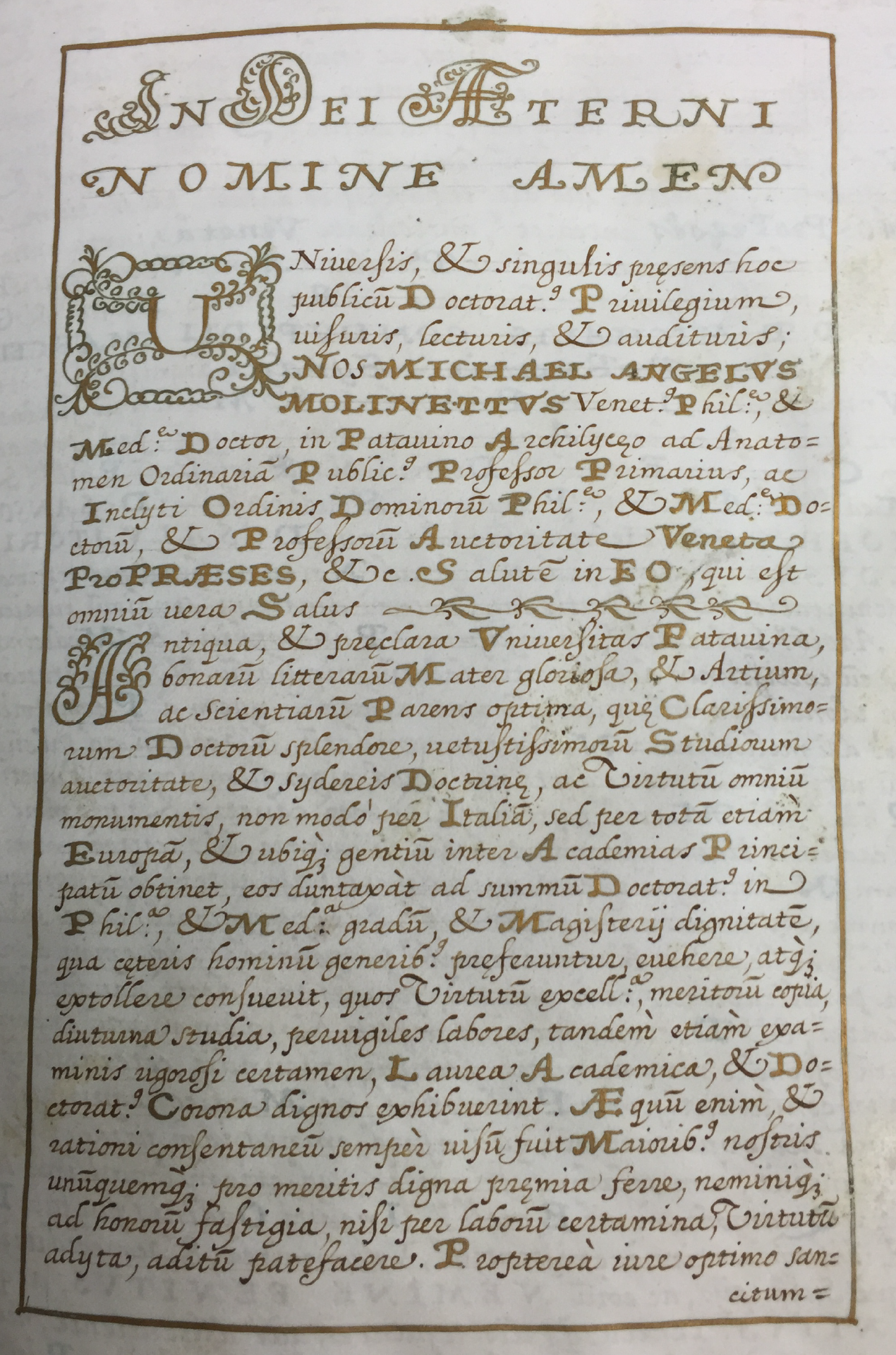
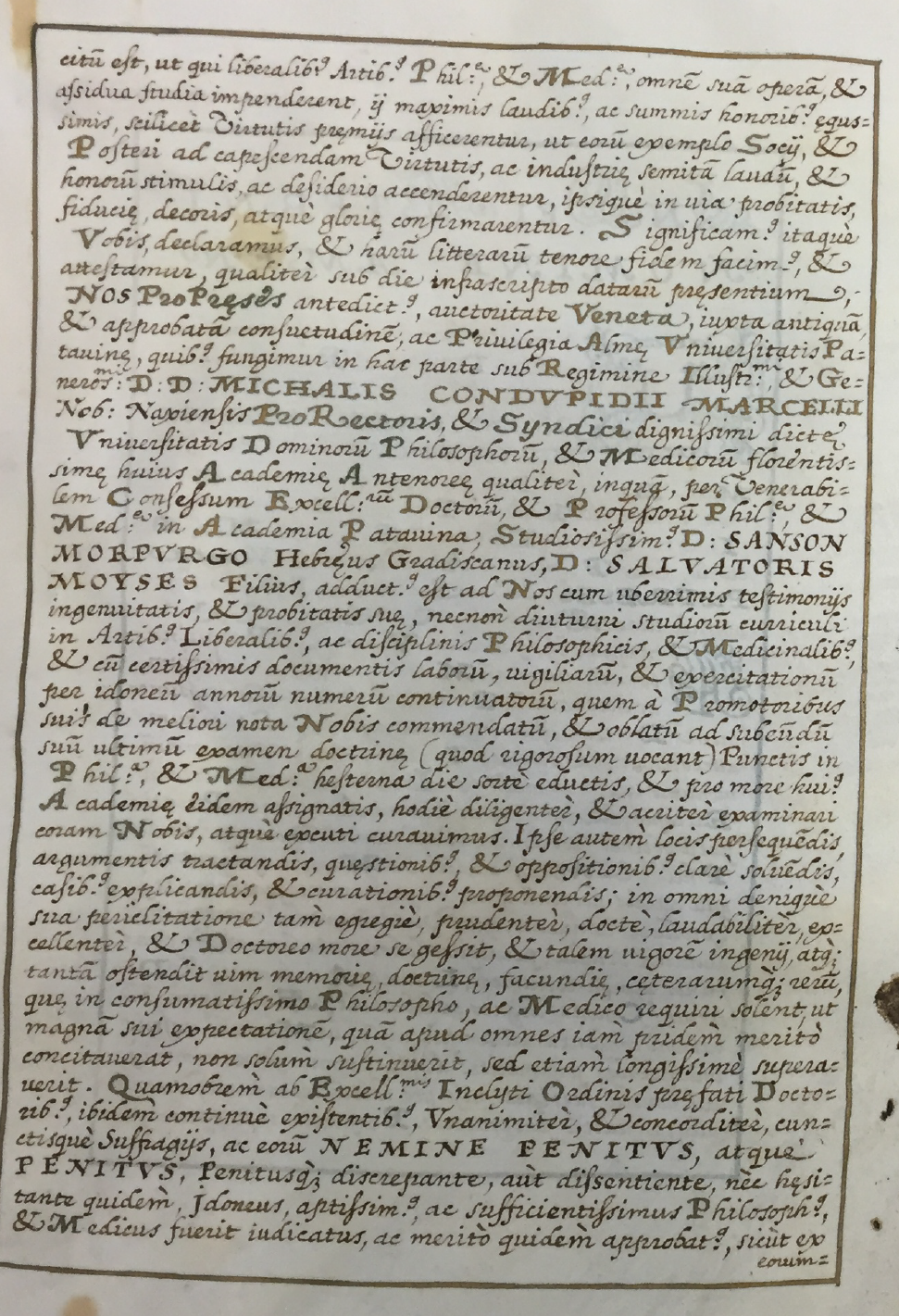
Morpurgo graduated the famed University of Padua Medical School in 1700 at the age of nineteen. Padua was the first university in Europe to officially open its doors to Jewish students,[7] and hundreds of Jewish students studied there between the sixteenth and nineteenth centuries. A number of diplomas of Jewish graduates from this period are extant in libraries, museums and personal collections.[8] The full text of Morpurgo’s diploma is printed in Edgardo Morpurgo’s book on the Morpurgo family history,[9] but he provides neither a picture of the diploma nor any context to compare this diploma to that of other Padua medical graduates. Indeed, based on the question marks in the text and the occasional misspellings, it leads me to wonder if he had access to the original diploma when writing this text.[10] The original medical diploma, a portion of which is pictured below, is housed in the U. Nahon Museum of Italian Jewish Art in Jerusalem.[11]
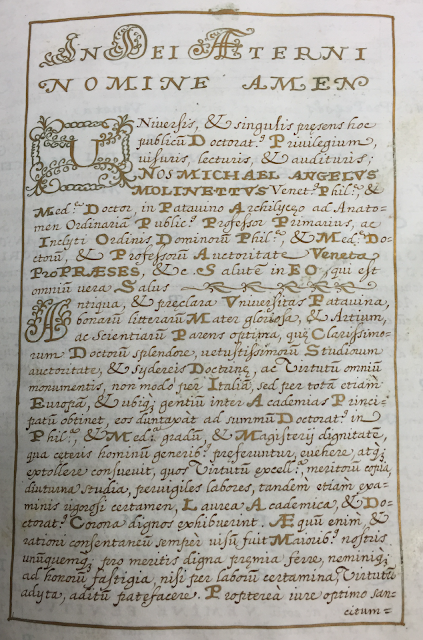
The diplomas of the Jewish graduates of the University of Padua Medical School possess unique features which are reflected in Morpurgo’s diploma. For example, the invocation for a standard issue medical diploma from Padua in this period, “In Christi Nomine Amen” (in the name of Christ Amen), is replaced with the non-Christian substitution, “In Dei Aeterni Nomine Amen” (in the name of the Eternal God, Amen). Morpurgo is referred to as Hebreus, typically added for the Jewish graduate. Other changes include the writing of the date as “current year,” as opposed to the typical forms of dating which included Christian reference (e.g., Anno Domini), and the location of the graduation ceremony, which was in a nondenominational venue, as opposed to a church. 

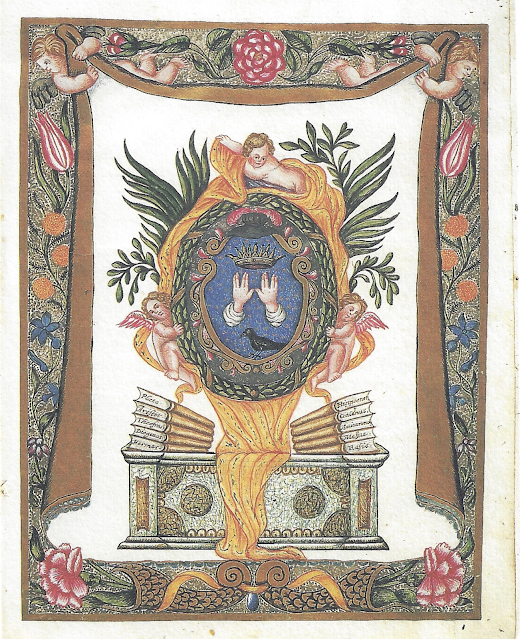
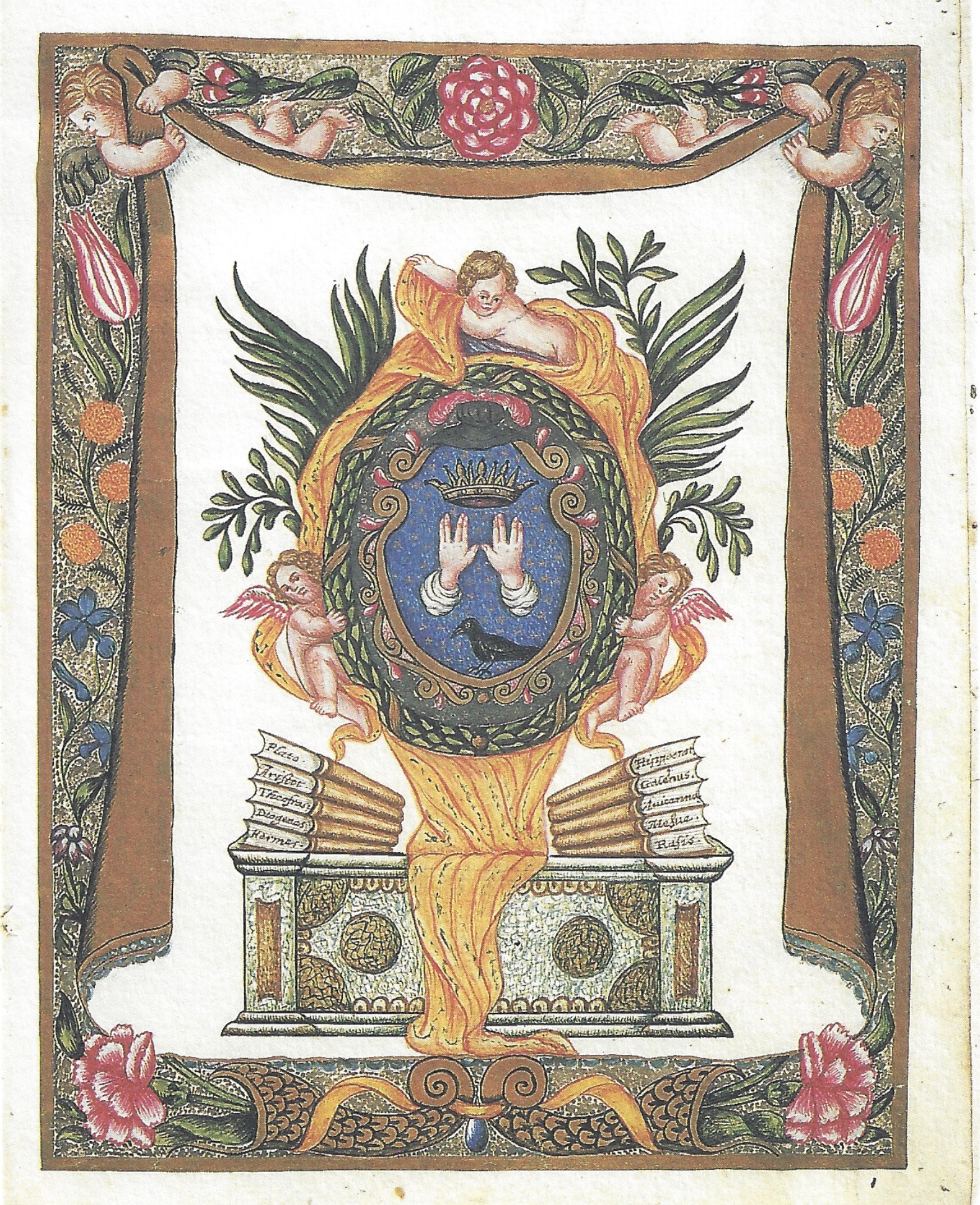
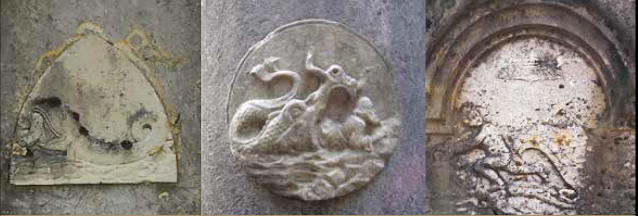
While similar to other Jewish diplomas in form, this is not the case with respect to style. In this regard, Morpurgo’s diploma stands apart from his peers. Most of the diplomas we possess of Padua graduates form this period, whether Jewish or not, are ornate elaborate works of art with magnificently illustrated borders, often including a portrait of the graduate and a family coat of arms. Indeed, Padua University hired its own staff of artists and calligraphers for this purpose. The Morpurgo family had a coat of arms- a depiction of the prophet Jonah in the clutches of the jaws of the whale- which appears in documents and tombstones of the family throughout the centuries.[12] Below are some examples:
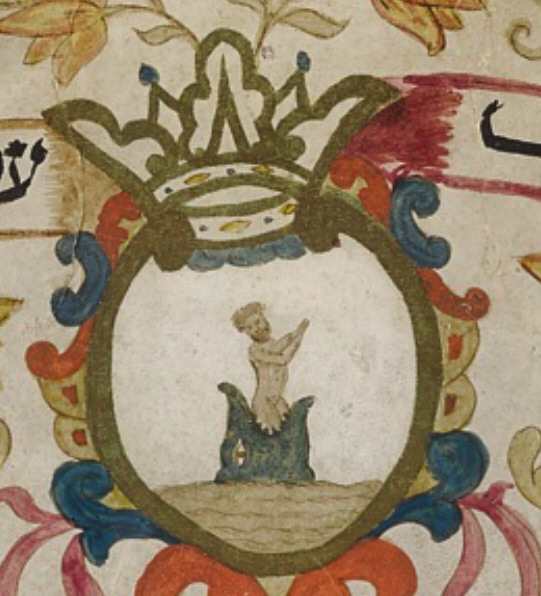
Morpurgo’s diploma contains no portrait, no coat of arms, no illustration whatsoever. It is a simple calligraphic text.

Below are some example pages from the diplomas of two Jewish students, both of whom graduated within a year or two of Morpurgo. These diplomas were more the norm.[13]

Diploma of Lazarus De Mordis (1699)[14]

Diploma of Samuel Coen (1702)

Rabbinic Ordination (Semikhah)

As recorded in the preface to his responsa Shemesh Tzedakah, Morpurgo received his rabbinic ordination from Rabbi Yehudah Briel in 1709. Meir Benayahu records the text of the semikhah document in his article on Morpurgo.[15] Rabbi Briel was a mentor to other Padua medical graduates, including Yitzhak Lampronti.[16] 

The original document is housed in the National Library of Israel[17] and is reproduced below. The ordination is handwritten on a simple piece of paper (?parchment) with no ornamentation. 

This stands in stark contrast to the semikhah of Rabbi Brill himself, which is quite ornate.[18] 
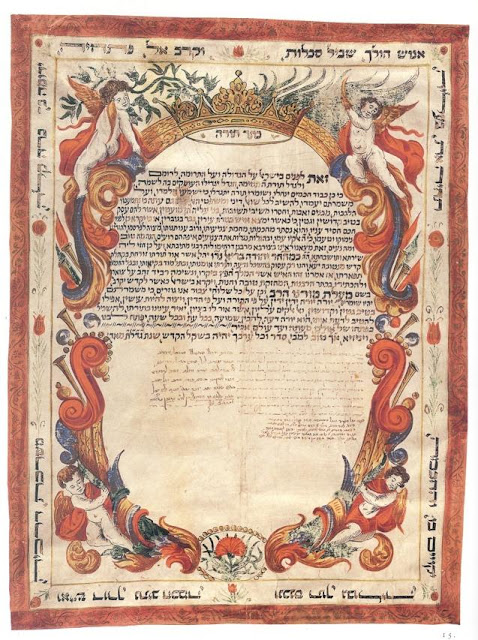
The unembellished nature of both Morpurgo’s medical and rabbinic certificates, especially in the historical context of Renaissance Italy, may reflect a preference for simplicity or trait of humility.

Papal Privileges

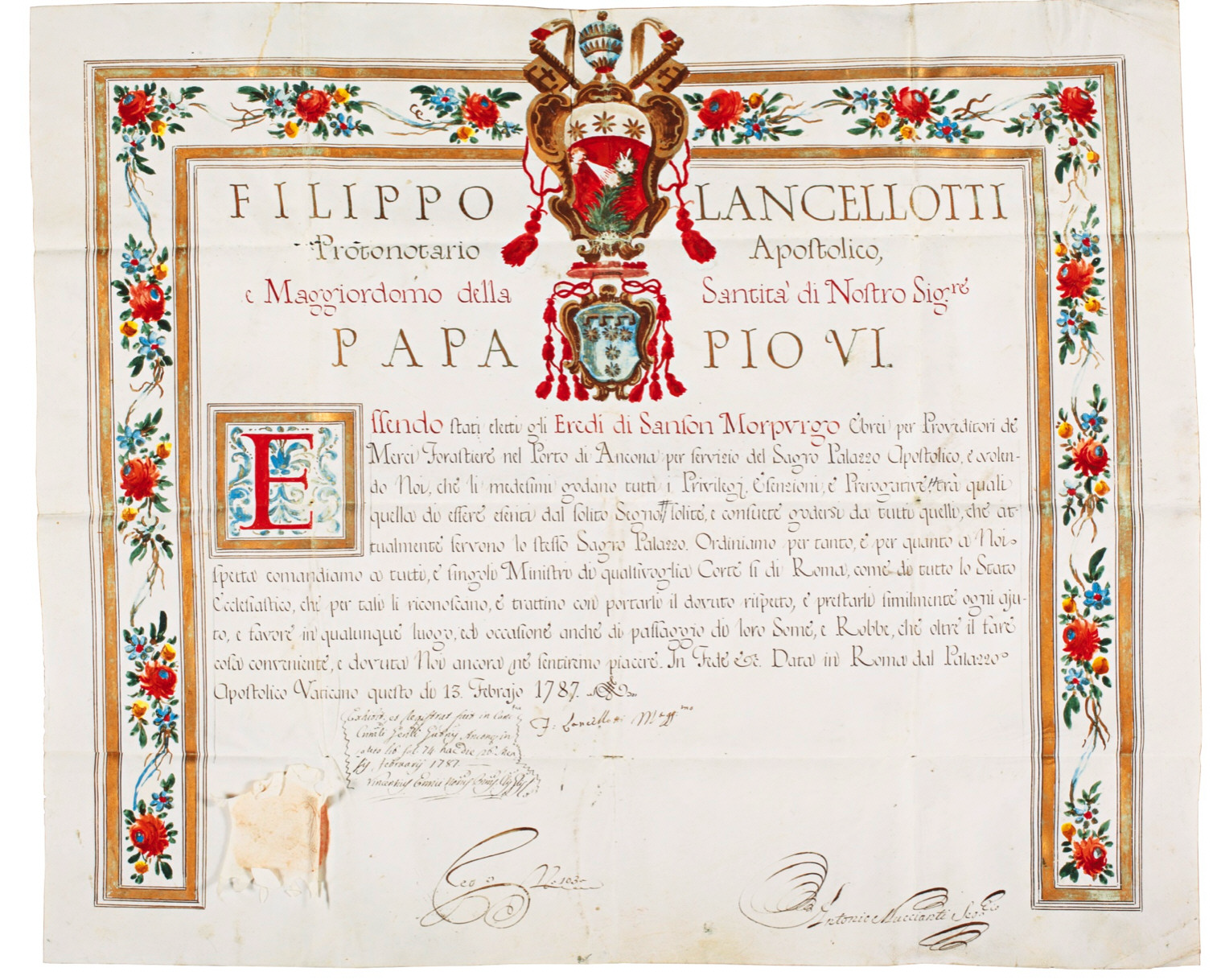
In 1730, during a severe Influenza outbreak, Morpurgo distinguished himself by providing medical services to both Jew and Christian alike. This was particularly remarkable in light of the Papal decrees prohibiting Jews from treating Christians and reciprocally forbidding Christians from being treated by Jews. At the time, this earned him the approbation and commendation of Cardinal Prospero Lambertini.[19] Lambertini would later go on to become Pope Benedict XIV (1740 –1758). In gratitude, Morpurgo and his heirs received rights to act as superintendents of merchandise arriving at the port of Ancona and intended for use in the Apostolic Palace.[20] I have discovered three extant documents issuing privileges to Morpurgo’s heirs. None of the current bearers of these documents notes the existence of the others examples.

  1. 1787

The earliest example of a Papal privilege for the Morpurgo family dates from 1787. The document, a picture of which appears below, was sold by Sotheby’s Auction House on December 22, 2015.[21] The catalogue entry is titled as follows: Privileges Accorded to the Heirs of Samson Morpurgo, Granted by Filippo Lancellotti, Prefect of the Apostolic Palace, Rome: 1787.

  1. 1793

The second example is from the year 1793. This document is not found in any auction house or museum, but rather on the ancestry research website, MyHeritage.com, accompanying a Morpurgo family tree. While it is not as high quality a reproduction, it is clearly of the same origin as the other two issuances, similar to the third example below. These type of ancestry sites, which include elaborate family trees, often with accompanying historical documents (photos, paintings, etc.), represent an untapped resource for historical research. I will leave it to scholars to debate the use of such material, which may be unprovenanced. 

  1. 1794 

The final example comes from the Umberto Nahon Museum (Jerusalem).[22]

Cardinal Lancellotti, the Prefect who issued the first document above, died in 1794. The latter two were issued by Giuseppe Vinci, assumedly another Prefect of the Apostolic Palace. All three of the documents above were issued under the auspices of Pope Pius VI (1775-1799). It is quite possible that more such documents will surface in the future. 

Portrait of Shimshon Morpurgo

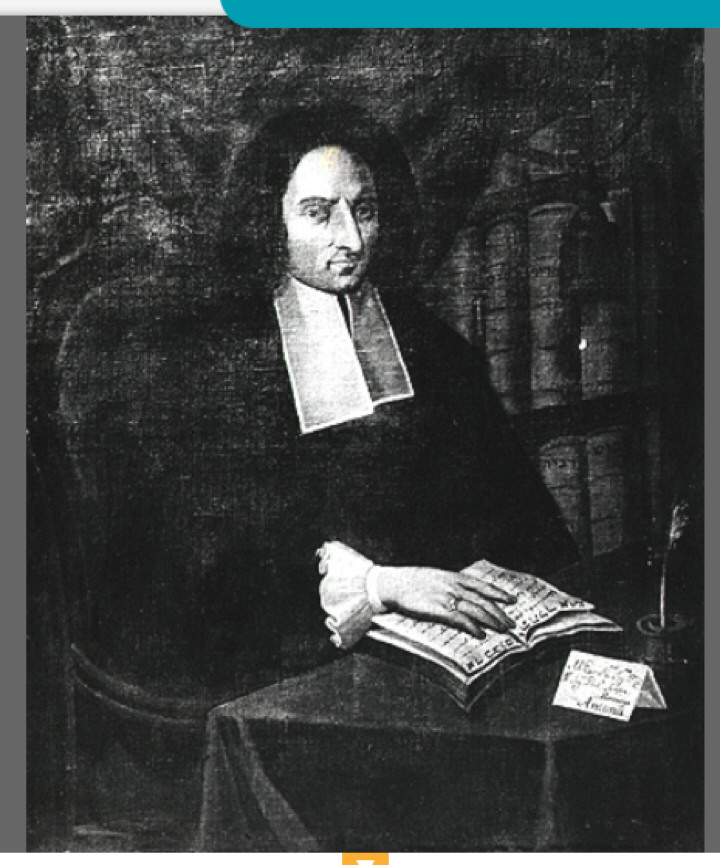
As mentioned above, the diploma of Morpurgo bears no illumination, and thus, no portrait, as is found in the diplomas of some other Jewish graduates. Be it for principled or financial reasons, Morpurgo elected not have his portrait adorn his certificate of medical school completion. He did however sit for a portrait later in life,[23] which represents his rabbinic pursuits exclusively, without allusion to his medical practice.[24]

He is pictured at his desk, with his hand on an open Hebrew book. The top line, spanning across both pages is legible, and reads, “ach bi-zelem yithalekh ish,” a phrase from Tehillim (39:7) with kabbalistic overtones. 

The remaining open pages of the book consist of scrawled lines. Inscriptions in Hebrew characters can be found in the works of European artists of the early modern period.[25] Behind Morpurgo are shelves lined with Hebrew books. Some of the titles are legible, including Rambam and Levush, though I cannot make out the others. 

The artist for the Morpurgo portrait is not known, though it is remarkably similar to the portrait of another rabbi physician of this period, Chakham David Nieto (1654- 1728).[26]


There are so many similarities in fact – the curtains, the chair, the bookshelf,[27] the desk, the quill, the book with a legible Hebrew top line- that I am inclined to suggest that they were either drawn by the same artist, or at the very least one was directly inspired by the other.[28]

The book under Nieto’s hand is an accurate representation of his own Mateh Dan, published in 1714, while the book under Morpurgo’s hand does not appear to be that of his own authorship.[29] This may explain why Nieto is holding a quill as if writing the text before him. 

The artist for Nieto’s portrait is David Estevens, a Dutch Jew. Though we do not know the exact date of Nieto’s portrait, Landsberger writes that inasmuch as the portrait shows certain books written by him in 1714 and 1715, it follows that the portrait must have been painted at a time subsequent to then.[30] He does not identify the books to which he refers. A number of books of Nieto’s clearly appear in the portrait. Mateh Dan was published in 1714 and Pascalogia in 1702. Esh Dat was published in 1715, and though not clearly completely visible, the word “Dat” in English appears on a book resting on its side on the bookshelf. Perhaps Landsberger was referring to this. What Landsberger did not know, is that there is a more obtuse reference to another work of Nieto’s which may bring the date of our portrait forward by a few years. On the notebook behind the book Mateh Dan appears the word “Noticias.” Cecil Roth suggests that this one word was used by Nieto to cleverly claim authorship of an anonymously published controversial work beginning with the same word.[31] This work was published in 1722. Thus, this portrait must have been drawn between 1722 and 1728. 

While there is no way to determine the exact year of Morpurgo’s portrait, we can likewise limit it to within a certain time period based on the internal aspects of the portrait. The card sitting on Morpurgo’s desk displays the name of the city Ancona, though unfortunately I cannot make out the other words on the card. It is in Ancona that Morpurgo settled for the later portion of his life, marrying the daughter of Rabbi Fiametta, the rabbi of Ancona, whose position he filled after the latter’s death. Thus, it is fair to assume that the portrait was drawn somewhere between 1710[32] and 1740.

Parenthetically, this portrait depicts Morpurgo without a beard. Recent discussions have addressed the issue of the beardless rabbis of the Renaissance period and have included Morpurgo’s portrait.[33]

Portrait of Morpurgo’s Son

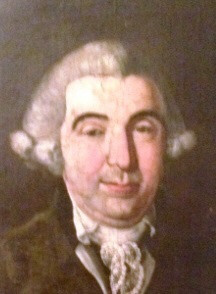
While researching the portrait of Shimshon Morpurgo, I came across a portrait identified as Joseph Leon Morpurgo (d. 1786), the son of Shimshon.[34]

What makes this portrait of particular interest is less its connection to his father than its correlation with Joseph’s ketubah, presently in the Jewish Theological Seminary Library.

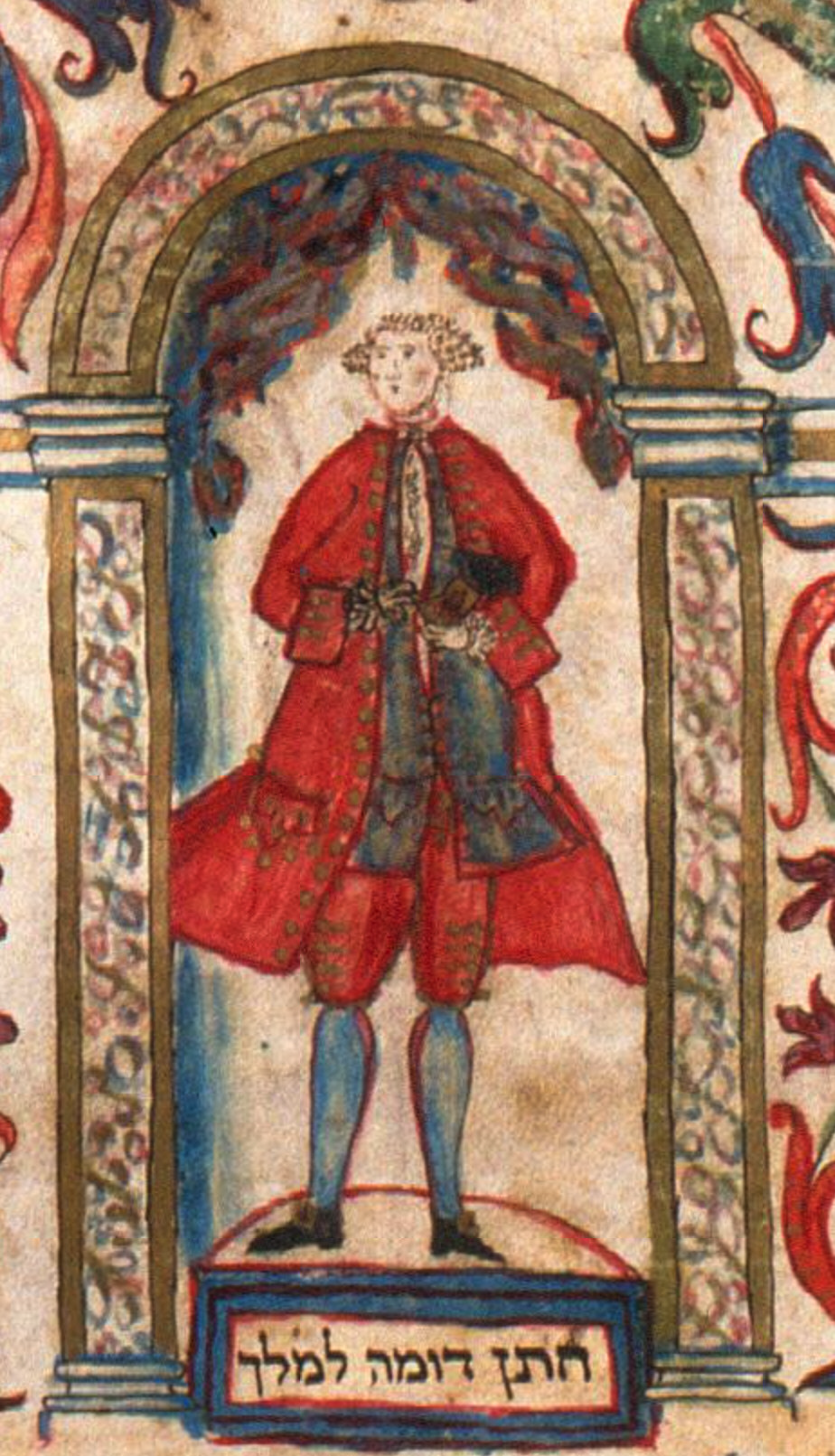
This spectacularly ornate renaissance ketubah is unique in that it contains miniature illustrations of a bride and groom. 

Ketubah of Morpurgo’s son Yosef

Ancona 1755[35]

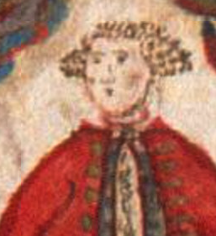
Are these simply generic representations of a bride and groom, or are they actual portraits of the wedding party? A “head” to “head” comparison between the portrait and the ketubah may provide some insight. 

I will leave it to the reader to decide on the extent of the similarities. The Morpurgo coat of arms also appears on the top of the ketubah.[36]

Morpurgo’s Participation in Weddings and Circumcisions

In addition to his scholarly exploits, we have record of Morpurgo’s social activities as well. Like many of his Jewish Italian Renaissance peers, he wrote occasional poetry, including for the wedding of Shabtai Marini, a fellow medical graduate of the University of Padua, though some fifteen years earlier.[37] Marini has also been identified as a rebbe of Ramchal, though evidence is scant,[38] and translated Ovid’s Metamorphosis into Hebrew.[39]

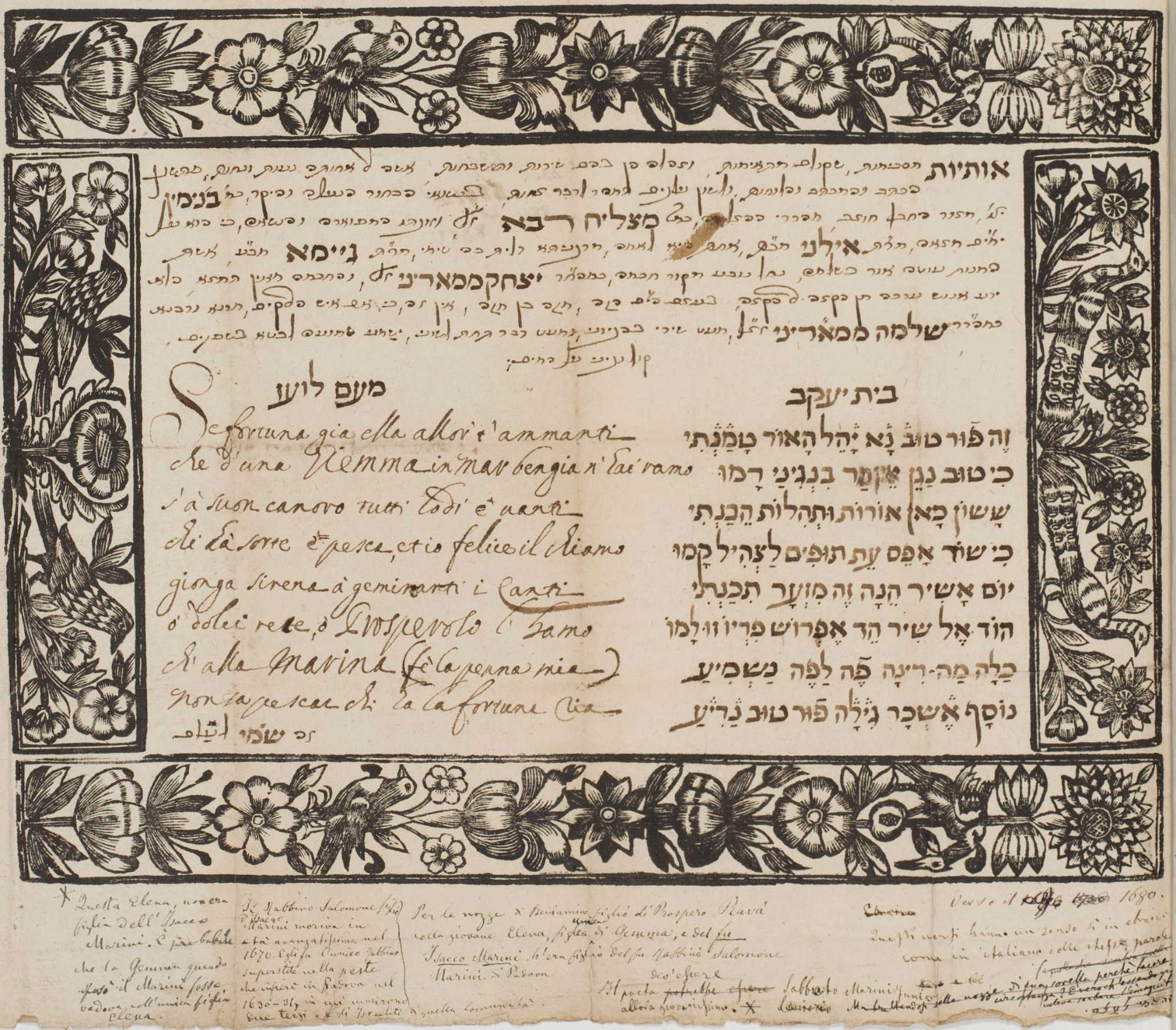
Morpurgo also wrote a wedding poem for another Marini family wedding in 1721, the union of Benjamin ben Matzliach Rava and Elena bat Gemma and Isaac ben Solomon me-Marini.[40]

We also have record of Morpurgo serving as a witness for the Ketubah of two weddings in the year 1722,[41] with one example below.[42]

We can compare Morpurgo’s signature on the ketubah to that found on the inside cover of Morpurgo’s personal copy of Rashba’s commentary on Kiddushin.[43]

A Pinkas Mohel, or circumcizor’s ledger, from his time (1705- 1736) documents his involvement in varying capacities in the circumcisions of the time, including those of his children.[44]

Conclusion

Shimshon Morpurgo is one of the more remarkable figures in Jewish history, a true Renaissance personality. From an archival perspective, he may possibly be the only pre-Modern Jewish figure for whom we possess a copy of his rabbinic ordination, medical diploma and portrait, in addition to the other notable material included here. These visual supplements to Morpurgo’s biography will hopefully further enhance our appreciation of his illustrious life. 

[1] On Morpurgo, see Edgardo Morpurgo, La Famiglia Morpurgo di Gradisca sull’Isonza 1585-1885 (Premiata Societa Cooperativa: Padova, 1909), 32–34, 65–69, 77, 104; Yeshayahu Sonne, “Letter Exchange Between R. Moshe Chagiz and R. Shimshon Morpurgo,” (Hebrew) Kobetz al Yad, 12 (1937), 157–96; M. Wilensky, “On the Rabbis of Ancona,” (Hebrew) Sinai, 25 (1949), 68–75; M. Benayahu, “Rabbi Shimshon Morpurgo,” (Hebrew) Sinai 84 (5739), 134-165; David Ruderman, “Kabbalah, Science and Christian Polemic: The Debate Between Samson Morpurgo and Solomon Aviad Sar Shalom Basilea,” in his Jewish Thought and Scientific Discovery in Early Modern Europe (Yale University Press: New Haven, 1995), 213-228; A. Salah, La Republique des Lettres: Rabbins, Ecrivains et Medecins, Juifs en Italie au XVIIIe Siecle (Brill: Leiden, 2007), 455-460. On his graduation from the University of Padua, see A. Modena and E. Morpurgo, Medici e Chirurghi Ebrei Dottorati e Licenziati nell’Università di Padova dal 1617 al 1816 (Forni Editore: Bologna, 1967), 62, n. 147. In the eighteenth century, the Inquisition in Mantua routinely confiscated Hebrew books for expurgation. Some of Morpurgo’s books were confiscated in 1732, only to be returned six years later. See S. Simonsohn, The History of the Jews in the Duchy of Mantua (Kiryath Sepher: Jerusalem, 1977), 694, n. 398.
[2] Abraham Ofir Shemesh, “Two Responsa of R. Samson Morpurgo on Non-Kosher Medicines: Therapy vs. Jewish Halakhic Principles,” Journal for the Study of Religions and Ideologies 18:52 (Spring 2019), 3-16. In his introduction to his philosophical work Eitz Ha-Da’at (Venice, 1704), 3b, Morpurgo mentions his plans to write a manual on the laws of treifot which would include extensive anatomical discussions and illustrations. We have no record of this idea ever coming to fruition. Chaim Meiselman wrote a brief article for the University of Pennsylvania Library blog (Pennrare.wordpress.com) entitled, “An Illustrated Manuscript for Terefot: CAJS Rar Ms 480,” (February 27, 2019). Here he discusses an anonymous Italian manuscript on treifot with detailed illustrations and anatomical notes. Could this somehow be related to Morpurgo?
[3]
 Ruderman, op. cit.
[4]
See Sonne, op. cit; Yaakov Shmuel Speigel, “The Beginning of the Ramchal Polemic: Four New Letters from the Manuscripts of Rabbi Shimshon Morpurgo,” (Hebrew) HaMa’ayan 231 (Tishrei, 5780), 324-355; idem, “The Ramchal Polemic: The Complete Letter Sent by R’ Moshe Chagiz to R’ Shimshon Morpurgo,” (Hebrew) Da’at 89 (2020), 371-404. I thank Eliezer Brodt for this source.
[5]
 (Vendramin: Venice, 1743).
[6] See the National Library of Israel’s International Collection of Digitized Hebrew Manuscripts, https://web.nli.org.il/sites/nlis/en/manuscript, s. v., “Samson Morpurgo.”
[7] See E. Reichman, “The Valmadonna Trust Broadsides: A Virtual Reunion for the Jewish Medical Students of the University of Padua,” Verapo Yerapei 7 (2017): 55-76.
[8] See E. Reichman, “The ‘Doctored’ Medical Diploma of Samuel, the Son of Menasseh ben Israel: Forgery or ‘For Jewry’,” Seforim Blog (here), March 23, 2021; idem, “Confessions of a Would-Be Forger: The Medical Diploma of Tobias Cohn (Tuvia HaRofeh) and other Jewish Medical Graduates of the University of Padua,” forthcoming in K. Collins and S. Kottek, eds., Ma’ase Tuviya (Venice, 1708): Tuviya Cohen on Medicine and Science (Jerusalem: Muriel and Philip Berman Medical Library of the Hebrew University of Jerusalem, 2019), in press.[9] Morpurgo, op. cit., 65-68.
[10]  For example, the name of one of the witnesses is written in the book as “Sabbetteo. Vith [?] Marini hil.” while it appears clear in the original- Sabbatheo Vita Marini Phil (short for philosophy and medicine degree).
[11] I thank Dr. Andreina Contessa, former Chief Curator of the museum, for kindly providing me with the images of this diploma.
[12] The pictures of stone below appear on the cover of Marjetka Bedrac and Andrea Morpurgo, The Morpurgos, the Descendants of the Maribor Jews (Center Judovske Kulturne Dediscine Sinagoga, 2018). The fourth image appears at the top of a ketubah for the wedding of Zechariah ben Shemariah Morpurgo and Luna bat Isaac ben Shemariah Morpurgo in Venice on Wednesday, 14 Nisan 5472 (April 9, 1712). The item was auctioned by Sotheby’s, Important Judaica (December 19, 2018), item 153. There is an author named Michael Morpurgo who wrote a book titled, “Why the Whales Came.” I wonder if this is more than coincidence.
[13] For further discussion of these students and their diplomas, see Reichman, “Confessions,” op. cit.
[14] If the graduate requested, a portrait would be drawn in the medallion. There was an addition fee for this service
[15] Benayahu, op. cit., 157.
[16] For more on Briel and his circle of medical students, see Reichman, “Valmadonna,” op. cit.
[17] System n. 990001800790205171.
[18] Venice (1677) JTS B (NS) PP489
[19] The text is preserved in Edgardo Morpurgo, op. cit., 69.
[20] Awarding a person and his heirs for exceptional behavior was common practice in Europe at this time. Other Jewish families benefitted from this practice. For example, Benjamin Ravid writes, “In 1616, in accordance with the privilege granted by the Council of Ten 150 years earlier to David Mavrogonato of Crete that in return for his untiring services to Venice he and his heirs were, among other favors, to be exempted from the special Jewish distinguishing sign, the Cattaveri granted the request of Elie Mavrogonato of Crete to be allowed to wear a black capello.” See Benjamin Ravid, “From Yellow to Red: On the Distinguishing Head-Covering of the Jews of Venice,” Jewish History 6:1-2 (1992), 179-210, esp. 196. Ravid mentions other family members who benefitted from these privileges.
[21]  http://www.sothebys.com/en/auctions/ecatalogue/2015/important-judaica-n09447/lot.14.html (accessed April 17, 2021).
[22] Item number: ICMS-EIT-0825.
[23] C. Roth, The History of the Jews in Italy (Jewish Publication Society: Philadelphia, 1946), opposite p. 401. Roth identifies the portrait as an oil painting in the possession of the Morpurgo family. I have as yet been unable to identify the location of the original work. I have consulted museums, libraries and members of the Morpurgo family to no avail. All the copies of this portrait I have identified all seem to be from this one source. I have found no discussion or source detailing the whereabouts of the portrait or the identity of its author.
[24] A copy of this picture is pinned to the inside cover of Morpurgo’s original medical diploma in the U. Nahon Museum.
[25] Pawel Maciejko has recently added to the scholarship on this topic, which has included studies on the works of Rembrandt. See P. Maciejko, “A Portrait of the Kabbalist as a Young Man: Count Joseph Carl Emmanuel Waldstein and His Retinue,” Jewish Quarterly Review 106:4 (Fall 2016), 521-576, esp. 529-537. Maciejko notes that, “While Hebrew inscriptions were commonplace in Western paintings, representations of Hebrew books were rare.”
[26] On Nieto’s portrait, see Macienko, op. cit., 533-536; OntheMainline Blog, “David Nieto, an Art Mystery and the Joys of Digitized Books”  (October 9, 2009) http://onthemainline.blogspot.com/2009/10/david-nieto-art-mystery-and-joys-of.html (accessed April 17, 2021); F. Landsberger, “The Jewish Artist Before the Time of Emancipation,” Hebrew Union College Annual 16 (1941), 321-414, esp. 387-388.
[27]  A few books on the shelf of Nieto’s portrait appear to bear a title, though I cannot decipher them.
[28] The clarity and detail of the Nieto portrait appears far superior, but this may simply be a reflection of the quality of the reproduction.
[29] The phrase from Tehillim does not appear in his work, Eitz ha-Da’at, or in his responsa, Shemesh Tzedakah, published posthumously by his son, Moshe Hayyim Shabtai.
[30] According to Landsberger, op. cit., the reproduction here in mezzotint, done by I. MacArdell, did not appear until 1728, the year of Nieto’s death. The original oil painting upon which this work is based is lost today.
[31] See OntheMainline blog, “David Nieto, an Art Mystery and the Joys of Digitized Books”  (October 9, 2009) http://onthemainline.blogspot.com/2009/10/david-nieto-art-mystery-and-joys-of.html (accessed April 17, 2021); Cecil Roth, “The Marrano Typography in England,” The Library 5:2 (1960), 118-128, esp. 121-122.
[32] According to Benayahu, op. cit., 139, the earliest documentation placing Morpurgo in Ancona dates from July, 1711.
[33]See http://onthemainline.blogspot.com/2011/01/beards-and-beardlessness-in-italian.html (accessed April 17, 2021). Here the author writes, “apparently the native Jews of Salonica were scandalized by the closely trimmed beards of the Francos who lived among them. They demanded that they grow them or be expelled. The situation of the ex-pat Italians came to the attention of the Italian rabbis, including one of the foremost ones,  Samson Morpurgo (Shemesh Tzedakah #61). Morpurgo interceded on their behalf attempting to prevent the Salonica community from expelling those not sporting a full beard. It is pointed out that Morpurgo himself, as per the above portrait, was beardless.”

There is a portrait on myheritage.com which is identified as being that of Dr. Samson Morpurgo. Attempts to contact the curator of the site to learn more about the portrait were unsuccessful.

It depicts an older man with a salt and pepper beard. This man is dressed in garb similar to Morpurgo and is likewise seated at a desk with a feather and quill. I have no additional information to corroborate this identification and have seen no reference to this portrait elsewhere. If indeed verified, this would not only add to our visual history, it would also alter the discussion about Morpurgo’s beardlessness.
[34] The portrait is found on the MyHeritage.com website. Attempts to contact the curator of the site to learn more about the portrait were unsuccessful.
[35] JTS Library Ketubah 5 record # 265985. I thank Sharon Liberman Mintz for bringing this ketubah to my attention.
[36] Apparently as both the bride and groom were members of the Morpurgo family only one coat of arms was included.
[37] David Kaufmann Collection of Medieval Hebrew manuscripts in the Oriental Collection of the Library of the Hungarian Academy of Sciences, n. 580, p. 21. I thank Kinga Devenyi from the Kaufmann Collection in Budapest for providing a copy of this poem. While the poem is unsigned, Benayahu provides definitive proof that Morpurgo is the author. For additional information on Marini and this poem, see M. Benayahu, “Rabbi Avraham Ha-Kohen Mi-Zanti U-Lehakat Ha-Rof ’im Ha-Meshorerim Be-Padova,” Ha-Sifrut 26 (1978): 108-40, esp. 110-111.
[38] See OntheMainline blog (October 20, 2010), http://onthemainline.blogspot.com/2010/10/ramchals-rebbe-rabbi-sabbato-marini-of.html (accessed April 17, 2021). There, the rebbe of Ramchal, as well as the picture below are identified as Rabbi Dr. Shabtai Aharon Chaim Marini (1685-1762).

According to Laura Roumani, whose dissertation is on Shabtai Hayyim Marini, both the picture and rebbe of Ramchal are Shabtai Hayyim Marini (1662-1748). In addition, according to Roumani, “Shabbetay Aharon Hayyim Marini is not the one born in 1685 who died in 1762. That is Shabbetay son of Aharon Marini who got his degree in medicine in 1705. He belongs to another lineage of the family. Shabbetay Aharon Hayyim Marini passed away in 1809 and was a rabbi in the Spanish synagogue of Padua. He was the son of Shelomoh Marini son of Shabbetay Hayyim and the father of Armellina Stella Rahel Marini who married Avraham Sevi HaLevi who inherited all the autographs of Shabbetay Hayyim Marini.” See Laura Roumani, “Le Metamorfosi di Ovidio nella traduzione ebraica di Shabbetay Hayyim Marini di Padova” [Ovid’s Metamorphoses translated into Hebrew by Shabtai Ḥayim Marini from Padua] (PhD diss., University of Turin, 1992). See also L. Roumani, “The Legend of Daphne and Apollo in Ovid’s Metamorphoses Translated into Hebrew by Shabbetay Ḥayyim Marini” [in Italian], Henoch (Turin University) 13 (1991): 319–335.
[39] Joseph Almanzi composed an ode to Marini in his Nezem Zahav:

[40] JTS Ms. 9027 V2:29. The poem is signed זה שמ”י לעלם and the author is not identified in the JTS catalogue. As per correspondence with Laura Roumani, “The author is Shimshon Morpurgo (who used to sign as Shmi, shin mem being the initials of his name). Elena was the daughter of Gemma second wife of Yishaq Marini, Shabbetay Hayyim Marini’s father. The wedding took place after 1721 (Yishaq was deceased). Though Shelomoh Marini is mentioned, he was not Yishaq Marini’s father. Yishaq was the son of Shabbetay Marini the doctor, brother of Shelomoh.”
[41] National Library of Israel, system number 000301332 and system number 004092777.
[42] system number 004092777. The wedding of Shmuel Moshe Hakohen and Diamante Hakohen.
[43] This sefer is part of the Shimeon Brisman Collection in Jewish Studies at Washington University in St. Louis. http://omeka.wustl.edu/omeka/exhibits/show/brisman/item/6997 (accessed April 16, 2021).
[44] See University of Pennsylvania Library, CAJS Rar Ms 503 (https://franklin.library.upenn.edu/catalog/FRANKLIN_9969495443503681). The catalogue notes references to Morpurgo on pages 16r and 24r. There is an additional mention of Morpurgo on page 32v (item 167), which is pictured here. The name Morpurgo spans across two lines.


The Chief Rabbi of Amsterdam: A Jewish Convert

Converts have been involved with seforim in many capacities. But, there is one book which was actually authored by a convert – Zera Yitzhak, Amsterdam 1789. This book is on Pirkei Avot and was written by R. Yitzhak (b. Avraham) Graanboom. R. Yitzhak was born in Sweden a non-Jew. His father Jacob moved his family to Amsterdam in 1749. At age 69, after moving to Amsterdam, Jacob and his wife Leah converted to Judaism. At the time, Jacob took the name Avraham. His youngest son Mattis, also converted and became Yitzhak (his full name appears to be Aharon Moshe Yitzhak, however, in his book both on the title page and the approbation he is referred to only as Yitzhak, perhaps these names were added later, or he didn’t use them).

R. Yitzhak was extremely successful in his studies and was widely respected within the Amsterdam community; so much so, that when he attempted to move to Israel, R. Saul (ben Aryeh Löb) Löwenstamm (1717-1790) – then Chief Rabbi of Amsterdam – convinced him not to for the sake of the Amsterdam community. R. Yitzhak was for a short period of time a gem cutter, after which he moved to full time study and working. After R. Löwenstamm died, R. Yitzhak became the interim chief Rabbi of Amsterdam. Later, he became the Chief Rabbi of a new synagogue in Amsterdam, Adat Yeshurun. As this was a new synagogue, there were some from his old synagogue who were upset with the move. R. Yitzhak was known as “Yitzhak the Ger” (Yitzhak the Convert), some members of the old synagogue began referring to him instead as “Yitzhak Getz” (Yitzhak the Fool).

R. Yitzhak died in 1807 and his epitaph reads as follows:

זאת מצבת קבורת אדונינו מורנו ורבינו אב”ד ור”מ דקהלתנו, הנודע שמו בישראל בשם הגאון הצדיק החסיד מוהר”ר אהרן משה יצחק בן כ”ה אברהם זצוק”ל. רועה צאן עדת ישרון, גאה וגאון השליך נגדו, הצנע היה לכתו, רק לאמונה גבר בארץ, להורות עם ה’ את הדרך ישכון אור, להטות לבבם ליראת ה’ כל הימים, ולגלות למסור אזנם, ויקם עדות ביעקב ותורה שם בישראל, אף אם הציון הלז יכסה את גויתו, אהבתו תשאר תקועה
בלבנו, כי בזרע יצחק עוד יאיר שמשו ואור חכמתו ותורתו לעד בעולם

This is the monument of our master, our teacher, our Rabbi, the Chief Rabbi and Teacher of our community, who is known as the great one, pious, and righteous Rabbi Aharon Moshe Yitzhak son of the wise on Avraham ztsuk”l. The leader of Congregation Adat Yeshurun, the great and high one, who was humble in his ways, his relied upon faith, and taught the path to light, to lead their hearts to fear God all their days, and to reveal the ethical path to their ears, and he upheld the congregation and gave Torah to Israel, even though this monument covers his body, our love for him remains in our hearts, with the seed of Yitzhak will still guide by his light, and his light of wisdom and Torah will remain forever.
After he died, there were some who questioned some of his minor innovations and his son, Yisrael printed Melitz Yosher, to defend these practices.


There appears to be but one depiction of R. Yitzhak, a statue of him which unfortunately disappeared during the Holocaust. The statute is reproduced on the side and as you can see his book, Zera Yitzhak, is also included next to the statute.

Sources: For biographical information see: Shmuel Yosef Fuenn, Kenesset Yisrael (Warsaw, 1886), entry R. (Ahron Moshe) Yitzhak b”r Avraham Graanboom; A. Ya’ari, “R’ Yitzhak ben Avraham haGer” in Mizrach u’Ma’ariv 5 (1931), 323-325. On converts who were involved in other aspects of Hebrew books, see A. Ya’ari, Mehkere Sefer (Jerusalem 1958), 245-255. The picture of R. Yitzhak as well as some biographical information is taken from Mozes Heiman Gans, Memorbook: History of Dutch Jewry from the Renaissance to 1940 (Netherlands, 1977), 291. Aside from R. Yitzhak’s Zera Yitzhak, he also composed a song for the inauguration of the Synagogue of Adat Yeshurun which was published in 1797 and is titled Zot Hanukat HaBayit.Appendix:
Zera Yitzhak (Amsterdam, 1789)


The Gaon’s Impact on the Interpretation of both Primary Sugyot in Zemanim

The Gaon’s Impact on the Interpretation of both Primary Sugyot in Zemanim

By William Gewirtz

Unquestionably, almost all iddushim in the understanding of the vast literature on zemanim have halakhic implications. My intent is not to influence what has become minhag Yisroel; my focus is on establishing more precise halakhic definitions and theoretical innovations in sugyot that are central to the study of zemanim. Competent poskim can implement any changes in halakhic practice, which they determine that these innovations support.[1]

Two areas dominate the study of zemanim:

  • How to determine precise delimiters for the day of the week, which concludes at the end of the period of bein ha-shemashot.[2]
  • How to calculate the hours of the daytime period, which according to all opinions begins at alot hashaar.

Interestingly, in both Hebrew and English, the words yom and day denote both the daytime period and the day of the week. Our focus is on:

  • the Gaon’s impact on the interpretation of two key aspects of Shabbat 34a-35b, which examines the transition between days of the week, and
  • a key aspect of the Gaon’s clarification of Pesaim 94a focused on the daytime period.

The approach to the above sugyot were radically changed by the Gaon’s observations.[3] However, only the impact on the former sugyah in Pesaim is usually recognized.

As I strongly indicated in a paper on errors in halakhic reasoning, I do not believe that attempts to deal with the critique of Rabbeinu Tam’s position by the Gaon have ever been fully effective. In this paper, however, the focus is not on the extensive halakhic literature written primarily in the period of the aaronim, but on the text of the gemara itself and its interpretation by rishonim. The conclusions reached are very different.[4]

The first two sections address areas in the gemara beginning on Shabbat 34a where a significant modification to an earlier reading of the gemara, often associated with rishonim aligned with Rabbeinu Tam, is strongly preferred, but only when assuming a slight modification to the presumed opinion of the geonim / Gaon.[5] In a similar vein we suggest a modification to how the bein hashemashot interval is to be used, something I believe to be independent of the positions of Rabbeinu Tam and the Gaon.

The third section addresses the Gaon’s innovative reading of the gemara in Pesaim 94a, a reading that is strongly supported by both elementary logic and astronomy. Included in the Gaon’s reading is a concept that was never made explicit in rabbinic literature prior to the Gaon, to the best of my knowledge. As will become clear, that observation forms the basis for the Gaon’s challenge to the opinion of Rabbeinu Tam.

My observations are not intended to be judged as controversial, although concluding a sugyah may not have been correctly understood (or at the very least properly explained) until the 18th century might be jarring.  It is beyond my focus or competence to deal with the implications of that observation; observations addressing that point would be welcomed.

Section 1: The endpoints of the period of bein ha-shemashot

The dispute between the geonim / Gaon and Rabbeinu Tam revolves around the placement of the interval of bein ha-shemashot, within the interval between sunset and tzait (kol) ha-kokhavim, whose length is (almost always) assumed to be the time needed to walk 4 milin.[6] The length of the bein ha-shemashot period is universally assumed to be the time needed to walk ¾ of a mil. It is normally assumed that

  • the opinion of the geonim / Gaon places the bein ha-shemashot period at the start of that interval, while
  • Rabbeinu Tam places it at its end.

Those two alternatives represent opposite extremes.  Two adjustments seem reasonable.

  • First, separate the dispute between the geonim / Gaon and Rabbeinu Tam into two distinct components:
    • The first concerns the beginning and the second the end of the bein ha-shemashot period, subject to a constraint that the length of the bein ha-shemashot interval must equal the time to walk ¾ of a mil.
  • Second, assume that there are multiple hybrid / intermediate positions, situated between the two generally assumed alternatives.[7]

This allows for

  • an interpretation of the gemara in Shabbat similar (or according to some identical) to the overwhelmingly compelling position of the geonim / Gaon relative to the end of the bein ha-shemashot period,
  • while defining the beginning of the bein ha-shemashot period using the textual approaches of many rishonim, albeit employing a significantly earlier point in time, much closer to sunset.

While I have not seen this conceptualization explicitly formulated[8] in the classic halakhic literature, practice and several pragmatic opinions are supportive of this approach.  More importantly, the challenges raised to the opinions of both Rabbeinu Tam and the Gaon are, without exception, directed at the late ending of the Shabbat according to the opinion of Rabbeinu Tam and at the early beginning of the Shabbat according to the opinion of the Gaon.[9] This approach sidesteps the challenges to both opinions. Additionally, this approach absolutely disputes the view that

  • Anyone who rejects the start of Shabbat precisely at or even a few minutes after sunset must embrace the approach of Rabbeinu Tam,

an assumption that does not follow logically, though it is occasionally found in the halakhic literature.[10]

There are numerous arguments in support for this position. We cite several of the strongest:

  1. The term mi-she-tishkeh ha-amah: Ramban in Torat Ha-Adam[11] and the many akhemai sforad who adopted his position stress that the meaning of the term mi-she-tishkehha-amah unquestionably implies not sunset but a point after A simpler phrase shikiat haamah would denote precisely sunset. Of course, mi-she-tishkehha-amah does not imply any specific time but only that the time follows sunset by some number of minutes. The only change required is to assume that mi-she-tishkeh ha-amah is referring to a point much closer to sunset, something that appears more reasonable than a point over 50 minutes later according to the (theoretical) view of Rabbeinu Tam. In other respects, the gemara is read like the numerous rishonim who assumed that mi-she-tishkeh ha-amah cannot refer to sunset proper.
  2. Tosefet Shabbat:[12] Ramban argues that tosefet Shabbat could only begin after sunset during an interval that is still a part of the daytime period. Ramban does not consider tosefet Shabbat prior to sunset as meaningful, equating it to the value of illumination from a candle during daylight.
  3. The sugyah in Shabbat applies year-round, not only during a specific season or seasons: The gemara in Pesaim 94a, which equates the time needed to walk 40 milin with the daytime period, must assume an average day around either the spring or the fall equinox. In the Middle East, during a winter day of approximately 10 hours or a summer day of approximately 14 hours, the distance covered in one day would vary considerably. However, unlike the gemara in Pesaim 94a that can only apply to a 12-hour daytime period, the gemara in Shabbat, defines the end of Shabbat using terms like ashekhah, hisif ha-elyon ve-hishveh le-taton and the appearance of three stars, all of which apply (nearly) uniformly throughout the year.[13]

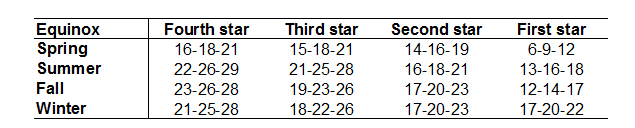
At both the fall and spring equinox, the sun appears in the same place over the equator and you might expect Shabbat to begin and end at the identical time.  Certainly, regardless of how one measures darkness, it is equivalently dark any number of minutes after sunset at those two times.  However, in Jerusalem and other parts of the Middle East, unrelated to the degree of darkness, stars first appear a number of minutes later (after sunset) in the fall than they do in the spring.[14]Advantaged by the early appearance of Sirius and Canopus in the spring but not the fall, the Gaon restricts the focus of the gemara to the spring only.

Note that:

  1. All rishonim who choose to comment on the sugyah in Pesaim 94a state that the day in question occurs only around the spring (or fall) equinox.
  2. Not a single rishon makes an analogous comment, restricting the gemara beginning on Shabbat 34b to any specific time of year.
  1. Shmuel’s unchallenged statement:[15]With Prof. Levi’s table (provided in the appendix) as background, examine Shmuel’s unchallenged statement on Shabbat 35a, according to the position of the geonim / Gaon.[16] After discussing the appearance of the horizon and the length of the bein ha-shemashot period, the gemara states the opinion of R. Yehudah in the name of Shmuel who asserts: “one star – daytime, two stars – bein ha-shemashot, and three stars – night.”[17] This is followed by the opinion of Yosi (bar Adin) asserting that the stars in question are neither stars that appear in the day (i. e., large stars[18] or planets) nor small stars that only appear well after the time of tzait ha-kokhavim, but medium stars. How might Shmuel’s statement be reconciled with the previous discussion in the gemara?
  • First, exclude the implausible suggestion that R. Yosi bar Adin’s assertion that Shmuel’s statement is referring to medium stars applies only to the third part (or second and third parts) of the text. Under this interpretation, the first part of Shmuel’s statement concerning one star, includes not only medium stars but also large stars or planets that are on occasion visible before sunset.  Were that the case, the statement would be informing us that the appearance of a planet before sunset does not indicate that the bein ha-shemashot period has begun. In addition to being forced to argue that the different parts of Shmuel’s statement refer to different types of stars, such an assertion would hardly be necessary; the gemara gives no hint that the bein ha-shemashot period begins before sunset.[19]
  • Second, because R. Yosef begins bein ha-shemashot at the time walk 1/12th of a mil later than R. Yehudah, some[20] align Shmuel’s statement and even pasken like R. Yosef, assuming that R. Yehudah start to bein ha-shemashot precisely at sunset, cannot be reconciled with Shmuel’s statement. Prof. Levi’s chart challenges that approach, since a delay of at most 2 minutes[21] (after sunset) provides no benefit; the first medium star cannot be seen until at least 6 minutes after sunset.
  • Third, there are other (implausible) solutions that align Shmuel with Rabi Yosi only, some going so far as identifying the amora Yosi (bar Adin) as the tanna Rabi Yosi. To follow a sugyah focused on Rabi Yehudah, with an uncontested statement that accords only with Rabi Yosi is dubious, at best. Furthermore, Shmuel’s statement, which refers to the non-instantaneous, successive appearance of stars, is difficult to align with an opinion that the bein ha-shemashot interval is instantaneous.

The most plausible suggestion, like the view of R. Ḥaim Volozhin below, is that the bein hashemashot begins at least 6 minutes after sunset.[22]

  1. Seeing stars so early (even if only in the spring) is practically impossible:

If the start of the period of bein ha-shemashot for the geonim / Gaon is precisely sunset, there has been considerable effort[23] to align the appearance of three stars within the time it takes to walk ¾ of a mil after sunset. The only solution provided is to assume that the time needed to walk ¾ of a mil applies only around the spring equinox[24] [25] and, even then, to make yet further assumptions to arrive at so short an interval.  Particularly if the time needed to walk ¾ of a mil is 13.5 minutes and even if it is a bit under 17 minutes, three stars can rarely be seen so soon after sunset and then

  • only with great difficulty,
  • by experts, perhaps aided by telescopes, and
  • in a pristine environment absent urban sources of light, like the Judean desert.

Under no circumstances, is 13.5 minutes possible, and 16.85 minutes is almost equally unreasonable.[26]

  1. Multiple opinions that begin bein ha-shemashot slightly after sunset:
  • 4 to 5 minutes: The minimum time reported as the custom of Jerusalem[27] as well as the opinion of R. Shneur Zalman of Liadi,[28] the point when the sun is no longer visible even from the highest elevations around Jerusalem.[29]
  • Greater than 6 minutes: The opinion of R. Ḥaim Volozhin based on Shmuel’s statement concerning the appearance of a single star that is visible in the spring to an expert observer at that time.[30] The fact that R. Ḥaim Volozhin disagrees with his Rebbe, strongly suggests that the Gaon’s position that Shabbat starts at precisely sunset was only promulgated le’migdar miltah.
  • 7 to 15 minutes: These views are supported by a variety of sources mentioned previously including R. Kapach’s view of Rambam and R. Posen’s view of the opinion of the geonim. A time around 10 minutes is implied by many Sephardi poskim who mention that until the call of the Moslem mugrab for their fourth prayer service, it is still day thus allowing for the performance of a brit on that day for a baby born in those few minutes after sunset on that same day one week earlier.

When linked to the times given in Prof. Levi’s charts, various alternatives from 6 – 16 minutes after sunset can be plausibly suggested.  The next section on how the bein hashemashot interval was intended to be used will shed further light in determining how many minutes after sunset might still be considered daytime.

Section 2.  Before or after

One aspect of the Gaon’s interpretation of Shabbat 34b, often assumed without further examination, is that bein hashemashot is calculated by adding its length to the beginning of the beginning of bein hashemashot period.  That assumption will now be challenged.  Though not conclusive as to how the sugyah should be read, some seforim of near contemporaries[31] of the Gaon assume the opposite approach, subtracting the length of the bein hashemashot interval from the end of Shabbat. The arguments below attempt to demonstrate that this approach may have been standard before the writings of the Gaon proliferated years later in the middle of the 19th century.[32] While some may argue that counting forward from sunset versus backward from nightfall is somehow tied to the fundamental makhloket of the geonim / Gaon and Rabbeinu Tam, there does not appear to be any logical, textual or halakhic basis for such an assertion.

The fundamental question is:

What possible value could there be in introducing (especially in an era before clocks) a time-based approximation that is a lower bound, season dependent, rarely applicable, and then only under rare, idealized conditions, at best? In what context would such information be useful?

Thus, I propose that the time needed to walk ¾ of a mil should be interpreted differently than the Gaon proposed and instead we will attempt to demonstrate that

  • The time to walk ¾ of a mil is to be subtracted from the end of the bein ha-shemashot period as opposed to being added to its beginning.
  • The period is not a minimum (that occurs only around the spring equinox), but a maximum (that occurs around the summer solstice). Thus, the entire sugyah is applicable year-round providing a conservative upper-bound to the length of the bein ha-shemashot

The arguments for both assertions are interrelated and are presented concurrently.[33]

  1. The gemara in Shabbat is primarily focused on Friday night and determining when the bein ha-shemashot period begins, as opposed to when it ends. The gemara assumes that the end to the period of bein ha-shemashot is known; each of the disputants are addressing when the period of bein ha-shemashot begins on Friday night. However, if the time needed to walk ¾ of a mil were meant to be added to the time of sunset, it would be addressing the end of the bein ha-shemashot period and not the beginning.
  2. The three fractions (each expressed as the time needed to walk a part (1/2, 2/3 and ¾) of a mil,) given as alternatives for the length of the period of bein ha-shemashot would then all have identical semantics; each of the three fractions (of the time to walk a mil) is counting back from the assumed point of ashekhah, to calculate the beginning of the bein ha-shemashot Given Prof. Levi’s chart, under no circumstances could anyone imagine that the time to walk either ½ of a mil after sunset could be the point at which Shabbat ends. The amoraim, R. Yehudah and R. Yosi, are quantifying the opinion of Rabi Yehudah in contrast to Rabi Nehemiah’s interval, whose period of bein ha-shemashot is only the time needed to walk ½ of a mil.
  3. If someone were countering the position of Rabi Yosi, who says the period of bein ha-shemashot is instantaneous, it is more likely that he would say that it can be “as long as” opposed to “as short
  4. The significant issue raised previously of never seeing stars as early as at the time needed to walk ¾ of a mil after sunset becomes entirely moot.
  5. The period of bein ha-shemashot has some practical consequence providing a potentially useable, conservative upper bound as opposed to a purely theoretical lower bound, which is of limited to no use.
  1. As noted earlier, rishonim, who limit the gemara in Pesaim to the equinox periods in the fall and spring, make no such assertion with respect to the gemara in Shabbat. One might presume from the lack of commentary that rishonim assumed that the sugyah applies year-round.

Treating the gemara in Shabbat like the gemara in Pesaim as referring only to days around the spring (but not the fall) equinox[34] is unnecessary when thinking of the interval as a practical upper bound.  All the other descriptions in the gemara, either the appearance of the sky / horizon or the visibility of three stars, apply year-round.

Now examine the three elements in combination:

  • The various opinions of rishonim on the time to walk ¾ of a mil – 13.5, 16.85 and 18 minutes.
  • Levi’s chart indicating that 3 stars are visible to a careful observer 30[35] minutes after sunset in the summer.
  • The two suggested interpretations that
  • delay the beginning of bein hashemashot to a point slightly after sunset, and
  • view the sugyah as subtracting the length of bein hashemashot from its end to find its beginning.

We can then assume that Shabbat begins from 12 (subtracting 18 from 30) to 16.5 (subtracting 13.5 from 30) minutes after sunset.[36]  However, given

  • very natural and expected stringency that occurs even today but certainly are to expected in an era before (widely available and accurate) clocks, and
  • the need for tosefet Shabbat

practiced times for starting Shabbat between 5 and 10 minutes after sunset ought not be surprising.

Section 3. The Gaon’s approach to Pesaim 94a.

The Gaon’s approach to Pesaim 94a is premised on an incontrovertible astronomic and logical fact. Assuming that alot hashaar approximates the first light of the day, then its evening counterpart, tzait ha-kokhavim, must occur when the sun’s illumination has (next to) no remaining effect.[37]  At both of those times, all stars that are in position to be seen are not obscured by illumination from the sun. As a result, the Gaon adds the word kol to differentiate tzait ha-kokhavim, which throughout the Talmudic literature refers to the appearance of 3 stars, from tzait kol ha-kokhavim, the appearance of “all the (potentially visible) stars.” Of course, this point demolishes[38] Rabbeinu Tam’s interpretation that is predicated on the assumption that the meaning of the term tzait ha-kokhavim occurring in both Pesaim 94a and Shabbat 35a is the same. Slightly reformulated the Gaon asks how could the time of the appearance of only three stars and the time of alot hashaar, when (almost) all the stars are still visible, be separated by intervals of identical length from sunset and sunrise respectively?  The pre-dawn counter point to the time after sunset when (only) three stars are first visible cannot be alot hashaar when (almost) all stars are still visible.[39]

This iddush is not unexpected, even though the gemara in Pesaim is the primary sugyah used throughout halakhic history to provide a source for determining the time of alot hashaar.  Despite that halakhic application, the sugyah is focused primarily on geography and astronomy. Thus, harmonious use of the term tzait ha-kokhavim with its use elsewhere in Talmudic literature, which Rabbeinu Tam assumed, need not be presumed.

Since the notion of tzait kol ha-kokhavim is new, it is also not surprising that the Gaon did not specify, to the best of my knowledge, any halakhic uses for the notion of tzait kol ha-kokhavim. Of course, those who followed Rabbeinu Tam’s position had no reason to even consider a point in the evening after tzait ha-kokhavim.

However, that changed with the arrival of what we colloquially call the Brisker methodology. Talmudists of that school have produced potential halakhic implications. For example, it is not difficult to differentiate between:

  • halakhot tied to a specific day or those that are to be performed every day,
  • from those that have no connection to any specific day but are restricted to being performed only during the daytime period.

Presumably, the construction of the Beit HaMikdash is a straightforward example. While there is a daytime requirement,[40] there is no constraint on which day of the week that construction should take place. Another example, which does not comport with the above iluk, has been proposed by R. Moshe Soloveitchik. He suggested the use of tzait kol ha-kokhavim as a delimiter for tosefet Shabbat according to those following the Gaon.  While Shabbat ends at the time of tzait ha-kokhavim, R. Soloveitchik proposed that tosefet Shabbat is meaningful only until tzait kol ha-kokhavim.

While these examples[41] are noteworthy, the lomdus of a yartzeit shiur by R. Joseph Soloveitchik was astonishing. Effectively, but not explicitly, R. Soloveitchik disregarded both historic interpretation and practice when he transformed Rabbeinu Tam into an early supporter of the notion of tzait kol ha-kokhavim.[42]  As presented in that shiur, though expressed slightly differently, the dispute between the Gaon and Rabbeinu Tam revolves around whether Shabbat ends at tzait ha-kokhavim or tzait kol ha-kokhavim.[43]

In R. Soloveitchik’s formulation, the Gaon defined a critical point along a continuum beginning at the point of sunset, when there is almost complete exposure to the sun’s illumination, and ending at the point of tzait kol ha-kokhavim when no noticeable impact from the sun’s illumination can still be detected. That critical point occurs roughly when 3 medium stars first become visible and marks the transition point between days of the week according to the geonim / Gaon.  Rabbeinu Tam, however, according to R. Soloveitchik’s formulation, defined the transition between days of the week at the point when the sun’s impact has ended entirely, a point corresponding to the end of the continuum, at tzait kol ha-kokhavim.[44]

A possible approach that R. Soloveitchik did not employ is that the Gaon and Rabbeinu Tam decided differently based on two conflicting sugyot in Shabbat and Pesaim, respectively. Of course, that would be at variance with Rabbeinu Tam’s normal methodology for resolving conflicting sugyot.  Rabbeinu Tam tends to distinguish between sugyot, something he does explicitly with respect to these sugyot, as opposed to declaring sugyot in conflict and deciding between them. The principal motivation for even raising such a possibility is R. Soloveitchik’s complete avoidance of any mention of the challenges to Rabbeinu Tam’s position from the sugyah in Shabbat. This leads me to wonder if in R. Soloveitchik’s ahistorical reformulation of Rabbeinu Tam, and for reasons entirely unstated, R. Soloveitchik gave the sugyah in Pesaim prominence and preference over the sugyah in Shabbat according to Rabbeinu Tam.

Conclusions:

It is not at all usual to treat a ruling of the Gaon as le’migdar miltah.  However, three things increase my confidence that I am correct in this instance.

  1. The reality as described in the epistle of the Ba’al ha’Tanya referenced earlier, who lived at the same time and in the same general area, clearly describes people working beyond 30 minutes after sunset, something that the Gaon would be motivated to prevent as resolutely as possible.
  2. The opinion of R. Ḥaim Volozhin, in open disagreement with the Gaon’s stated position, demands a reconciliation of views.
  3. The textual arguments made by rishonim, the halakhic writings and positions of noted aaronim, and the various arguments that I have formulated appear convincing.

What should be noted is the Gaon’s interesting ability to impact not just pesak, but the way we (perhaps even unconsciously) approach the study of sugyot.

Appendix


Prof. Levi’s Table

The three times listed in each cell of the table correspond to how difficult it is to see a star.

  • The shortest time noted is when an expert who knows exactly where to look can observe a star.
  • The intermediate time noted is when a star can be seen with great difficulty.
  • The third time noted is when a careful observer can see a star.

The time when stars are visible to a casual observer, is yet later.

[1] My assumption is that poskim may find the innovations useful in exceptional situations as opposed to more typical ones.
[2] According to the vast majority of rishonim, the day ends when bein ha-shemashot ends or at most 2 minutes later.
[3] Familiarity with both sugyot is assumed to fully assess this essay.
[4] See my article in Hakirah spring 2019 for more detail on the Gaon’s convincing attack on Rabbeinu Tam’s position.
[5] A version of that reading is presented in Ohr Meir as the opinion of the geonim, who R. Posen seeks to demonstrate conflict with that of the Gaon.  What the Gaon felt mei ikar ha’din can be disputed as will be illustrated.  Even if one were to reject any variation of the Gaon’s stated position, this paper can also be considered to apply to the less specific view of the geonim.
[6] Both 72 or 90 minutes are increasingly assumed to apply only in the Middle East around both equinoxes and require adjustment (using depression angles) to account for variation by season and latitude.
[7] These positions are more properly characterized as variants of the position of the geonim / Gaon as they are all much closer to their normally assumed period of bein ha-shemashot.
[8] Throughout R. Kapach’s commentary on Mishnah Torah, however, he asserts that this is the position of Rambam. See R. Posen’s view as well, mentioned in footnote 5.
[9] This seminal point was made explicitly by R. Chaim Sonnenfeld in teshuvah 33 (an approbation to a sefer on zemanim) in a recently published volume of his teshuvot.  His reaction, as might be expected, was to be mamir, and fulfill the stringencies of both opinions. I argue that the strengths of both opinions lead to the opposite and more probable conceptual position, adopting the leniencies of both positions.
[10] See Vol. 2 of HaZemanim BeHalakha by R. Ḥaim Benish, page 360, especially footnote 58.
[11] Pages 251 – 252, Chavel edition, Mossad Ha-Rav Kook.
[12] This argument is included due to its ancient provenance; it is easily challenged given that it is normally assumed that tosefet Shabbat can begin at plag ha’minah, which precedes sunset.
[13] Note as well, that the gemara in Pesaim 94a applies to

  • a day of average length,
  • which occurs around both the spring and fall equinox.

However, the days that would be referred to in Shabbat 34b would be

  • a minimum, as opposed to an average, and
  • restricted to those days when the appearance of three stars occurs within the time needed to walk ¾ of a mil after sunset. For astronomic reasons such days occur only in the spring and not in the fall.

While neither of these two differences is itself convincing, both lend further support to the thesis developed.
[14] See the chart by Prof. Levi provided in the attachment.
[15] A more extensive analysis of Shmuel’s statement will appear in a future issue of the Torah u’Maddah journal.
[16] This section assumes detailed familiarity with the sugyah on Shabbat 34b-35b.
[17] Prepositions have been omitted from the statement in order not to bias the semantics.
[18] Large stars are defined as kokhavei lekhet, moving stars, currently called planets. Other approaches to dividing stars into categories are much less likely and not considered.
[19] The isolated opinion of R. Eliezer mi’Mitz, who begins the bein ha-shemashot period before sunset, is difficult to reconcile with Shmuel’s statement, in any case.
[20] See the last two paragraphs on page 358 and especially footnote 50 in Vol. 2 of HaZemanim BeHalakha.
[21] The time to walk 1/12 of a mil is between 1.5 and 2 minutes.
[22] While normally I would assume Prof. Levi’s third entry matches Shmuel’s assertion, since this statement might mean seeing a star does not mean bein ha-shemashot has necessarily begun, it might mean just an accidental sighting, which may occur at the earliest time possible when normally only an expert, knowing exactly where to look, can locate a star.
[23] R. Benish, R. Willig, Prof. Levi among many others struggle with this issue.
[24] In the spring Sirius and Canopus can both be seen around 15 minutes after sunset.
[25] Having seen no earlier discussion of this issue anywhere in the halakhic literature, I believe this interpretation originated with the Gaon in O. . 261. The alternative under discussion, delaying the start of bein ha-shemashot by some small number of minutes after sunset, eliminating the hypothesis that bein ha-shemashot begins precisely at sunset, which leads to such questions.
[26] Perhaps one can assume some worsening of atmospheric conditions, as a result of pollution, slightly decreasing visibility.  I spoke with a chemist in my synagogue, Dr. Irwin Goldblatt, who verified this as a possibility.  I have no basis to determine how accurate this observation might be, but it is hard to imagine that it is consequential.
[27] See Minhagei Eretz Yisrael by R. Gliss, pages 102 and 282.
[28] Seder Hakhnosat Shabbat, found towards the end of every abad siddur, specifies 4 minutes. He reverses the position he took in Shulan Arukh HaRav, which supported Rabbeinu Tam.
[29]See Zemanim Ke’hilkhatam by R. Boorstyn, chapter 2, section 3, where he summarizes different 19th and 20th century posekim in the Middle East who supported times beyond 4 to 5 minutes and up to approximately 10 minutes after sunset.  The rationale he and many of these posekim used is varied often relying on the notion of sea level and / or visibility from higher elevations, a topic of continued debate.
[30] See the addition to Maaseh Rav section 19.  Six minutes is expressed as 1/10th of an hour to be applied in both the morning and evening, although Shmuel’s assertion of “one star – daytime” is given as the reason for the slight delay after sunset. How R. aim Volozhin determined this precise time that equals the time at which an expert can see Sirius remains a mystery.
[31] R. Adler, R. Loerberbaum, and R. Sofer all subtract the length of the bein hashemashot interval from the end of Shabbat, see my article, Zemannim: On the Introduction of New Concepts in Halakhah, in the TuMJ 2013.
[32] It goes without saying that the instantaneous communication that characterizes of our current environment cannot be anachronistically assumed in a prior period. This impacts the assumptions made about when some of these sources are read / known, a topic not pursued further.
[33] A set of arguments based on the statement of Shmuel about 1, 2 and 3 stars are not included and will be incorporated in a future paper examining both Shmuel statement and Rambam in multiple sections of Mishnah Torah, based on their mastery of astronomy as it was known in their times.
[34] First suggested by the Gaon in O. . 261, this approach is widely assumed in recent halakhic literature. Note that the gemara in Pesaim assumes an average day, which occurs in both the spring and fall around the equinox.  However, the Gaon’s argument assumes, not an average interval, but a minimum interval and one that occurs only in the spring, but not in the fall; stars are not visible as early in the fall as in the spring.  On the other hand, as suggested, a maximum would apply year-round.
[35] Prof. Levi uses a depression angle normalization to spring, which we will not explain.  His use of 28 is in fact closer to 30 minutes, as normally defined by clock-time.
[36] 12 – 13 minutes is consistent with the many rishonim supporting a time to walk a mil of 22.5 minutes.
[37] There is no reason to debate whether the underlying science favors either of the two most common halakhic definitions, which sandwich current technology’s identification of the point at which the first light of the sun is visible. Expressed as depression angles the 72- and 90-minute intervals equate to depression angles of approximately 16 and 20 degrees, respectively. With the best available equipment, light from the sun can be observed at a depression angle of approximately 18 degrees. One can then argue that 16 degrees is when the amount of light is visible to humans, while 20 degrees is when one arises in anticipation of emerging light. Both are reasonable positions for defining alot hashaar.
[38] So strong a word is intentional given the “bombe” kasha of the Gaon; see immediately below.
[39] R. Moshe Sofer might be trying to deal with this point about a symmetric point to the appearance of three stars in his commentary on Shabbat 34.
[40] See Rambam, Hilkhot Beit Ha’Beirah (1:12). Rambam’s formulation is originally stated in the negative, which raises possible questions that might be analyzed in this context.
[41] Other possible examples include the operation of a beit din, the laws of aveilut, particularly the first day, etc.
[42] The philosophical underpinnings that would enable such ahistorical iddushim is beyond the scope of this article. Despite an accusation of partiality, one cannot dismiss the assumption that R. Soloveitchik was aware of the various challenges to his iddush. Despite bringing support from the period of the rishonim, I believe the Rav was establishing what he knew to be a restatement of Rabbeinu Tam’s position, based on the undeniable accuracy and correctness of the Gaon’s notion of tzait kol ha-kokhavim. In my own mind, I have played out a long and imagined conversation with R. Soloveitchik on this subject.
[43] For any number of reasons, it is difficult to imagine the perspective presented was that of Rabbeinu Tam. Rather, it might represent Rabbeinu Tam’s position updated and enhanced by what is now known scientifically.
[44] What I also do not understand is why R. Soloveitchik referred to the mathematical notion of continuity as opposed to any astronomical knowledge, which I think would have been more relevant.