Response to Criticism Part 4; Rabbi Zvi Yehuda and the Hazon Ish

 Response to Criticism Part 4; Rabbi Zvi Yehuda and the Hazon Ish

Marc B. Shapiro

Continued from here.

1. In Limits,p. 14 n. 55, I write

I should call attention to a significant philosophical and halakhic point which appears to have gone unnoticed. The Vilna Gaon (R. Elijah b. Solomon Zalman (1720-97) apparently believed that the First and Second Principles are the only true Principles in Judaism. According to him, one who believes in God’s existence and unity, despite his other sins, is regarded as a Jew in good standing and he is thus able to be included in a minyan (quorum for public prayer). None of the numerous discussions regarding whether a Sabbath violator maybe in included in a minyan seems to have taken note of the Gaon’s comment, which appears in his commentary on Tikunei Zohar, 42a.

Grossman writes:

Apparently, concludes Shapiro, since the Gaon cites only idolatry as invalidating prayer and does not cite the rest of the Thirteen Principles, he is disputing Rambam’s classification of the others as binding fundamentals. However, this source has no bearing on the Principles. The Gaon’s comment refers to counting one for a minyan and to having one’s prayer accepted by God. He is clearly not referring to the Principles, since [in his commentary to Tikunei Zohar] he includes in the metaphor of the scorpion the sin of consorting with gentile women, which is unrelated to any Principle. (p. 48)

The first thing to note is that I never said that the Vilna Gaon disputed “the Rambam’s classification of the others [other Principles] as binding fundamentals.” Of course the Gaon held that people must believe that there is prophecy, that God gave the Torah, that there will be a Messiah, etc. But that is not what I am referring to when I say that for the Gaon the First and Second Principles are the only true Principles in Judaism. As I explain, for the Rambam the Thirteen Principles are special in that if you deny any of them you are to be regarded as having removed yourself from the Jewish people. When the Gaon makes the fascinating comment that belief in the First and Second Principles are enough to be regarded as part of the Jewish people, thus enabling one to be counted in a minyan, this means that as far as he is concerned (in this passage at least), only these beliefs qualify as Principles in the absolute sense that denial of them removes you halakhically from the Jewish people. If I were writing the book today, I would say that the Gaon focuses on three Principles, since he includes belief in the unity of God and an affirmation of God’s corporeality (Principle no. 3) certainly violates God’s unity.

I have to say, however, that while the Gaon’s comment is of great importance when it comes to the issue of Sabbath violation, I am no longer sure about the correctness of my larger point. It could just as well be that when the Gaon derives from the passage in Tikunei Zohar that if you believe in God and His unity, despite your other sins, you are still a Jew in good standing, it does not necessarily mean that these are the only true Principles. It could be that he is merely explicating the meaning of the passage in Tikunei Zohar, which relates to God, but that if it was a different passage he could have spoken about different principles, for example, as long as you believe in the Messiah and the resurrection even if you sin you are still a Jew in good standing. Here is some of what the Gaon writes:

כ”ז שמאמין באחדותו ית’ אפי’ עובר כמה עבירות אינו מומר לכל התורה ואעפ”י שחטא ישראל הוא ומצטרף למנין כמ”ש עבריין כו’ ונכלל תפלתו בכלל ישראל . . . אבל עקרב הוא המודה בעבודת כוכבים ומשתחוה לאל אחר וכן בבת אל נכר אז הקוץ ח”ו מסתלק מצדו וזהו פירוד הגמור וז”ש ואיהו פוסק וברח כו’ ר”ל יוסף במדרגתו ומסתלק הקב”ה ממנו כלל וכלל ואין תפלתו עולה כלל

In the Mishneh Torah, Hilkhot Teshuvah 3:7, the Rambam says that if you believe that God has a physical form you are a heretic, and Rabad famously defends those who did not know any better. According to Rabad, although these people are wrong they are certainly not heretics because of their mistake. Regarding this dispute there is R. Hayyim Soloveitchik’s famous statement in defense of the Rambam’s position that “one who is nebech an epikores is still an epikores.”[1]

In Limits I referred to the Hazon Ish’s opinion that the Rambam actually agrees with Rabad when dealing with a heretic who does not know any better. I further note, in agreement with R. Hayyim, that the Hazon Ish’s suggestion cannot be correct, and the Rambam, Guide 1:36, specifically rejects the Hazon Ish’s point. In fact, R. Kafih thinks that the Rambam saw Rabad’s criticism of what he wrote in the Mishneh Torah, and the end of Guide 1:36 was written in response to Rabad and is the Rambam’s defense of his position that faulty education or simply ignorance is no defense when it comes to belief in God’s corporeality.[2] In truth, even if we did not have this chapter of the Guide, the Hazon Ish’s position cannot be sustained, as it is in opposition to the Rambam’s entire conception of immortality which is a natural process. Thus, there is no room to raise questions about “fairness” or why does God not judge an ignorant person mercifully and grant him a share the World to Come if through no fault of his own he believes that God has a physical form.

Grossman, on the other hand (p. 49), claims that a close reading of the Guide supports the Hazon Ish’s position that someone who does not know any better, and who has no one to teach him, is not to be regarded as a heretic. Suffice it to say all scholars of the philosophy of the Rambam agree with R. Hayyim in this matter. Furthermore, the issue is not whether we regard someone as a heretic or not. There could be societal reasons that determine whether or not one is to be regarded as such. The dispute between the Rambam and Rabad is regarding someone who doesn’t know any better and denies a principle of faith, does such a person have a share in the World to Come? It is clear, as Rabad recognized, that according to the Rambam the answer is no. That is why I wrote that when the Hazon Ish explained the Rambam to really be agreeing with Rabad—that an unwitting heretic has a share in the World to Come—that this approach should be seen as in opposition to the Rambam’s position, even though the Hazon Ish was offering his approach as an interpretation of the Rambam.[3]

Grossman then writes (p. 49 n. 65): “In another example of the same hubris towards a giant of Torah scholarship, Shapiro, on p. 37, asserts that the Chazon Ish’s acceptance of Torah She-be’al Peh as having Divine authority (Iggeros 1:16 [should be 15]) is disputing Rambam. Chazon Ish there is merely emphasizing Rambam’s Eighth Principle, but Shapiro claims that Chazon Ish actually ‘added a new dogma.’”

The reader who turns to my book, p. 37, will find that contrary to what Grossman states, I do not mention anything about Torah she-be’al peh. The issue I was concerned with is the authority of Aggadah. In one of his most often quoted letters (Kovetz Iggerot Hazon Ish, 1:15), the Hazon Ish writes that all aggadot have their origin in the sages’ prophetic power, and one who denies this is a heretic.

משרשי האמונה שכל הנאמר בגמ’ בין במשנה ובין בגמ’ בין בהלכה ובין באגדה, הם הם הדברים שנתגלו לנו ע”י כח נבואי שהוא כח נשיקה של השכל הנאצל, עם השכל המורכב בגוף . . . נרתעים אנחנו לשמוע הטלת ספק בדברי חז”ל בין בהלכה בין באגדה, כשמועה של גידוף ר”ל, והנוטה מזה הוא לפי קבלתנו ככופר בדברי חז”ל, ושחיטתו נבילה, ופסול לעדות, ועוד, ולכן נגעו דבריך בלבי

Incidentally, in the published version of the letter it has

והנוטה מזה הוא לפי קבלתנו ככופר כדברי חז”ל

Here is the section of the actual letter of the Hazon Ish where you can see that it should read ככופר בדברי חז”ל.

Searching on Otzar haChochma, I see that almost everyone who cites this passage corrects the printing error.

It is with regard to this statement about aggadah, and this statement alone, that I spoke of a new dogma—which can perhaps already be seen in the Maharal if not earlier—that is not held by the Rambam who, together with the entire geonic and medieval Sephardic rabbinic tradition, did not have such a view about the binding nature of all aggadot. The reader of Grossman’s article who does not examine my book would think that I claimed that the Rambam did not believe that Torah she-be’al Peh has divine authority. Yet the difference of opinion between the Rambam and the Hazon Ish is over a different matter, namely, what is included in Torah she-be’al Peh. In fact, this is not really a dispute between the Rambam and the Hazon Ish, but a dispute between two traditions regarding how to understand Aggadah.

Incidentally, in the Hazon Ish’s letter just mentioned, in discussing the difference between prophecy and ruah ha-kodesh, he says something directly in opposition to the Rambam’s view.

אבל יש הבדל יסודי בין נבואה לרוה”ק. נבואה, אין השכל המורכב של האדם משתתף בה, אלא אחרי התנאים הסגוליים שנתעלה בהם עד שזכה לזוהר נבואי, אפשר לו להיות לכלי קולט דעת. . . , מבלי עיון ועמל שכלי, אבל רוה”ק היא יגיעת העיון ברב עמל ובמשנה מרץ, עד שמתוסף בו דעת ותבונה בלתי טבעי

In the published version of the letter there are three periods after the word דעת which I have underlined in. Usually when there are three periods it means that something has been removed from the letter, but in this case nothing has been removed. In fact, in the original letter there are only two periods, followed by a comma, and I don’t know why the Hazon Ish used these periods.

Continuing with Grossman, he sees it as obvious that the Hazon Ish’s opinion regarding an unwitting heretic is exactly what the Rambam held, and in support of this he points to Hilkhot Mamrim 3:1-3. Here the Rambam states that Karaites, who were raised with heretical beliefs and don’t know any better, are not to be judged like the original Karaite heretics who consciously rejected the Oral Law. With those who don’t know any better the Rambam counsels “not to rush to kill them,” but to draw them close to Torah with words of peace. (The words “not to rush to kill them” were removed from some printings.)

Does this passage have any relevance to the Rambam’s view of unintentional heresy? The answer is no, as here the Rambam is only counseling tolerance when dealing with Karaites who don’t know any better. He is only concerned with how we should relate to them. Rather than hating them and hoping for their destruction, which is normally the case with regard to heretics, the Rambam tells us that we should relate to the Karaites in a positive way and attempt to convince them to abandon their mistaken path. However, from the theological perspective, a heretic has no share in the World to Come and cannot be exculpated based on the argument that he does not know any better. I make this argument in Limits, p. 12, and it is also affirmed by R. Chaim Rapoport.[4]

Not only is this the peshat in the Rambam, but no other understanding works within the context of his philosophical system. That is, the Rambam’s entire philosophical understanding of the World to Come does not work with the notion that an unwitting heretic can also have a share in the World to Come. Any interpretations that assume otherwise are simply not in line with the Rambam’s approach, an approach that was well understood by both his supporters and opponents who argued at great length about this matter. It was also recognized by R. Hayyim who knew the Guide of the Perplexed well. R. Velvel, in discussing the passage in Hilkhot Mamrim pointed to by Grossman, stated exactly what I have just explained. Here are his words as quoted by R. Moshe Sternbuch[5]:

.הרי מפורש בדבריו [הרמב”ם] דמה שהוא אנוס מועיל רק לענין שראוי להחזירם בתשובה ולמשכם לחזור לאיתן התורה, אבל כל זמן שלא חזרו הם מומרים באונס, ושמם מומרים ואפיקורסים

If I were to argue in the fashion of Grossman, I could say that by asserting that the Hazon Ish is simply following what the Rambam says in Hilkhot Mamrim, that Grossman shows disrespect to R. Hayyim and R. Velvel, by not even seeing their positions as worthy of discussion.

There is a parallel to what we have been discussing elsewhere in the Mishneh Torah. In Hilkhot Avodah Zarah 2:5 the Rambam states that the repentance of heretics (minim) is never accepted. Yet in Hilkhot Teshuvah 3:14 the Rambam states that heretics who repent have a share in the World to Come. The Rambam was asked about this apparent contradiction and he replied that indeed there is no contradiction.[6] In Hilkhot Avodah Zarah he is speaking about how the Jewish community is to relate to heretics. As far as the community is concerned, even if a heretic repents the community is not to accept him, as one can never be sure that his repentance is authentic. However, Hilkhot Teshuvah is referring to the heretic’s relationship with God. As far as God is concerned, a true repentance is always accepted. (I don’t know of anyone today who accepts the Rambam’s opinion in this matter. If, say, a leading atheist philosopher or Reform rabbi decided to become Orthodox, not only would the community accept him, but people would make a very big deal of this and he would become a sought-after speaker at Orthodox synagogues.)

Grossman writes:

In an attempt to list various authorities who took issue with Maimonides, Shapiro tells us that “[i]n Abarbanel’s mind, only limited attention . . . should be paid to Maimonides’ early formulation of dogma, and it would certainly be improper to make conclusions about his theological views on the basis of a text designed for beginners.” (p. 50)

My citing of Abarbanel on p. 7 of my book has nothing to do with authorities who took issue with Maimonides. The mention of Abarbanel is with reference to my discussion about how the Thirteen Principles do not appear as a unit in the Mishneh Torah or the Guide, and in this regard I cited Abarbanel who writes as follows in Rosh Amanah, ch. 23:

This explains why he did not list these principles in the Guide, in which he investigated deeply into the faith of the Torah, but mentioned them rather in his Commentary on the Mishnah, which he wrote in his youth. He postulated the principles for the masses, and for beginners in the study of Mishnah, but not for those individuals who plumbed the knowledge of truth for whom he wrote the Guide.

Following his misunderstanding of my point, Grossman spends the next page explaining that Abarbanel accepts the truth of the Rambam’s Principles, a fact that I never denied. However, Abarbanel also believes that for the most profound understanding of the Rambam’s theological views, one needs to turn to the Guide. As I mention in the book, pp. 32-33, Abarbanel also does not accept the Maimonidean concept of Principles of Faith.

Regarding the Rambam positing Thirteen Principles of Faith, which I claimed is a novelty of the Rambam, let me cite R. Moses Sofer who says exactly this.[7]

י”ג העיקרים המציא הרמב”ם שהוא היה הממציא הראשון בזה, ואשר לפנים לא ידענום

Grossman’s final comment in the first half of his review is as follows (p. 52):

Another example of Shapiro’s proofs that Rambam’s theology differs from one work to another is the following. In his Commentary on the Mishna, Rambam states that “lack of belief in any of the Principles makes one a heretic.” [Quotation from Limits, p. 8] Yet, in his Mishneh Torah, he writes (Shapiro’s translation): “Whoever permits the thought to enter his mind that there is another deity besides God violates a prohibition, as it is said: You shall have no other gods before me . . . and denies the essence of religion – this doctrine being the great principle on which everything depends.”

This proves, says Shapiro, that one is not considered a heretic for such thoughts since the Rambam does not say that one who holds these beliefs is a heretic. However, the very source he adduces clearly says the opposite. The words kofer be-ikar,[8] used by the Rambam in this quotation, are a synonym for “heretic,” even according to Shapiro’s rendition of the words as one who “denies the essence of religion.”

If the Rambam writes that recognition of God as the source of all existence is a Principle upon which all of Judaism stands, it is obviously a Principle of faith.

I don’t think that anyone who reads these paragraphs will have a clue as to what my point was. What I noted is that in the Commentary on the Mishnah, in discussing Principles of Faith, Maimonides speaks of belief (or knowledge, depending on how you translate). This is a mental state. However, in Hilkhot Teshuvah, in discussing what makes someone a heretic, Maimonides writes: “One who says”.[9] In other words, he speaks of verbalizing one’s heresy publicly, not simply belief. If all we had was Hilkhot Teshuvah, one could conclude that even one who has heretical ideas, but conducts himself as a good Jew publicly, does not lose his share in the World to Come.

In the book I then turned to Hilkhot Yesodei ha-Torah 1:6 which speaks about one who imagines that there is another God, and by doing so denies the essence of Judaism. A similar comment can be found in Hilkhot Ishut 8:6 where the Rambam writes: “For the sin of idol worship is so great that even when a person thinks of serving [idols] in his heart [without acting upon it] he is considered wicked.” I noted that while a person who believes something heretical like this has, in his mind, denied the essence of Judaism, as long as his heresy is not publicly voiced he apparently is not to be regarded as a complete heretic with all the communal implications this implies. (For example, if you found someone’s private diary which revealed that he denied certain basic principles of faith, as far as the community is concerned he would apparently remain a Jew in good standing as he never publicized his heresy. But he would still have no share in the World to Come.)

It is clear that the Rambam believes that one who affirms a heretical doctrine loses his share in the World to Come, no matter what the reason he does so. But we need to ask why the Rambam specifically uses the formulation of “one who says”. The easiest answer is that he was simply adopting, and making wider use of, the language found in the Mishnah, Sanhedrin 10:1, which also categorizes two types of heresy by using the expression “one who says.”

It makes sense to assume that only one who publicly verbalizes his heresy is to be treated as a heretic by the larger community, but despite the language in the Mishnah, I think many will still wonder why in Hilkhot Teshuvah, which speaks of losing one’s share in the World to Come, Maimonides also uses the language “One who says.” I don’t have an answer to this question. All I did in the book was note that the Rambam’s formulation in the Mishneh Torah is different than what he writes in the Commentary on the Mishnah. Although I have found some rabbinic discussions of this problem, I am surprised that none of the major commentaries take up the issue of why the Rambam uses the word האומר in defining heresy. It seems that they would agree with R. Uri Tieger[10] who writes:

לאו דוקא האומר אלא אפי’ חושב כן ולא מוציא בפיו

It is noteworthy, though, that immediately following these words R. Tieger offers an alternative approach which speaks to the very point I was discussing

וי”א דאף דכל הני שרשי איסורם הוא במחשבה מ”מ לא נחתם עונם עד כדי שיקראו מינים ואפיקורסים עד שיוציאו הדברים בפיהם

R. Avraham Gottesman also raises the issue, and he too sees the Rambam’s formulation in the Mishneh Torah as possibly significant.[11]

‘האומר . . . הרי שלא הזכיר גם שם ממחשבה. ואולי תנא ושייר או לא רצה להחזיקו לאפיקורס ע”י העדר אמונת מחשבה כי רבות מחשבות בלב איש שאין בהם ממש וגם רוב מחשבות אין הקב”ה מצרפן למעשה חוץ ממחשבות ע”ז כדאיתא בגמ

All this is important and worth exploring. But let us return to Grossman, who again attempts to make me look like a fool. He states: “This proves, says Shapiro, that one is not considered a heretic for such thoughts since the Rambam does not say that one who holds these beliefs is a heretic.” Grossman makes this false statement based on my discussion on pp. 8-9. Yet if he had only turned to page 13, at the end of my discussion of this matter, he would have found that I write as follows:

We must therefore conclude that Maimonides’ use of the words “one who says” in describing a heretic is only in imitation of Mishnah Sanhedrin 10:1 where the same formulation is found, and not too much should be read into this. One who believes in a corporeal God or in the existence of many gods, even without saying so publicly, is indeed a heretic as far as Maimonidean theology is concerned. Such a one will not face any penalties from an earthly court, but he is certainly denied a share in the world to come.

In other words, my conclusion is the exact opposite of what Grossman attacks me for (and is indeed in line with Grossman’s own opinion).

As for the word האומר as opposed to המאמין, R. Nissim of Marseilles writes as follows with reference to the usage of the term האומר in Mishnah, Sanhedrin 10:1.[12]

והאומר אין תורה מן השמים, ולא אמר “המאמין” כי באמירה לבד הוא מזיק לרבים וכופר בתורה ואף אם יאמין כמונו שהיא רבת התועלת כי הוא מחטיא הכונה והופך קערה על פיה . . . ועל זה אמרו ז”ל: “האומר” כי אף אם יפרש ויתקן דבורו באיזה צד מן התקון ‘והפירוש, לא יועיל לו שלא יקרא כופר. כי הוא מביא אחרים להחליש תקותם בתורה, ומחטיא כונת השם ית

This is a very original approach that some might wish to use to explain the Rambam as well. According to R. Nissim, what is important is the public declaration as this has the result of leading others to heresy. In fact, even if you really don’t believe what you are saying, since you are publicly stating a heretical position this is enough for you to be regarded as a heretic.

I have now responded to every comment of Grossman in the first half of his review, where he discusses broad themes. The second half of the review, which we turn to next, discusses specific points about the Principles. For those who have asked why I am taking the trouble to respond to every single point of Grossman, the answer is that it gives me a chance to revisit texts that I spent so much time on years ago. Secondly, it gives me the opportunity to share much new material that I think will be of interest to readers.

Before ending I would like to add a few more points. Earlier I mentioned that R. Hayyim knew the Guide of the Perplexed well. Some might be wondering what the basis for this statement is, because unlike the Rogochover, R. Hayyim does not discuss the Guide in his works. I am relying on R. Joseph B. Soloveitchik who testified that R. Hayyim wanted to write a commentary on the Guide (as well as on the Minhat Hinnukh), but he never had the time.[13] Here is how he is quoted in R. Zvi Yosef Reichman, Reshimot Shiurim: Sukkah, p. 258:

ואמנם כלל גדול אצלנו שאין להקשות על סתירה שבין ספר היד לספר מורה הנבוכים, כי כן קבל רבינו שליט”א מפי זקנו מו”ר הגר”ח זצוק”ל, וזקנו זצ”ל קבע כך כמופלג גדול בספר מורה נבוכים שרצה לכתוב עליו פירוש. גם חשב לכתוב הערות על הספר מנחת חינוך. ברם שתי המחשבות לא יצאו לפועל מפני טרדות בזמן; וחבל

R. Hayyim’s knowledge of the Guide is noteworthy since, as R. Aharon Rakeffet has commented many times, R. Moshe Soloveichik “never held the book in his hands.” While this might be an exaggeration, the underlying point is that R. Moshe had no interest in, or knowledge of, the Guide. I can’t say whether there is any influence of the Guide on R. Hayyim’s commentary on the Mishneh Torah. R. Eliyahu Soloveitchik actually cites the Guide as standing in opposition to R. Hayyim’s famous explanation of the two types of kavanah, found in Hiddushei Rabbenu Hayyim Halevi, Hilkhot Tefillah 4:1.[14]

Another noteworthy difference between R. Hayyim and the Guide is the following: The Rambam in Guide 2:45 explains that the books of the Prophets were produced from a higher level of divine inspiration than the books of the Hagiographa. However, R. Hayyim held that the difference between the Prophets and the Hagiographa is that the divine inspiration in the Prophets was originally intended to be spoken, and only later was written down. On the other hand, the divinely inspired books of the Hagiographa were originally intended to be written down. Thus, the difference between the Prophets and the Hagiographa has nothing to do with levels of prophetic inspiration.

This view of R. Hayyim is recorded in a number of different places, including by his son, R. Velvel.[15] R. Hershel Schachter also quotes this opinion from the Rav, who was passing on what his father, R. Moses, reported. Here is the passage in R. Schachter’s Nefesh ha-Rav, p. 240.

This entire passage is copied, word for word, in R. Gershon Eisenberger’s Otzar ha-Yediot Asifat Gershon, p. 411. But following a “tradition” that has now become somewhat popular in certain circles, Nefesh ha-Rav is not mentioned by name. Instead it is referred to as  ספר אחד [16]

Returning to the passage from R. Soloveitchik quoted by R. Reichman, it is also of interest that R. Hayyim is quoted as saying that there is no point in calling attention to contradictions between the Mishneh Torah and the Guide. No reason is given for this, but no doubt it is because the works had different purposes, and this can explain different, even contradictory, formulations.

Regarding the Hazon Ish, in my book I assumed that he, and a number of other scholars who explained Hilkhot Teshuvah 3:7 similar to him (including R. Ahron Soloveichik, Parah Mateh Aharon, Sefer Mada, p. 194[17]), never saw what Maimonides wrote in Guide 1:36 where he explains why an honest error in matters relating to principles of faith does not change one’s fate. As mentioned already, R. Kafih states that these words were written in response to Rabad’s criticism in Hilkhot Teshuvah 3:7, where he states: “Why has he [Maimonides] called such a person a heretic? There are many people greater than and superior to him who adhere to such a belief on the basis of what they have seen in verses of Scripture and even more in the words of those aggadot which corrupt right opinion about religious matters.”[18]

I now believe that while it is certainly likely that some of the others I mention in my book had not seen the Guide, I would not say this about the Hazon Ish. Benjamin Brown has reasonably claimed that formulations in the Hazon Ish’s writings show that he was influenced by the Guide.[19] R. Yehoshua Enbal has harshly criticized Brown’s assertion that there was significant influence of the Guide on the Hazon Ish, but Enbal does not deny that the Hazon Ish knew the Guide.[20] It is reported that th Hazon Ish cited R. Moses Alashkar that Maimonides expressed regret about having “published” the Guide, and that if the work hadn’t already been spread so far, he would have removed it from circulation.[21] (This statement is not found in R. Alashkar’s works.) It seems to me that only one who had at least some idea of Maimonides’ philosophy, and why it could be viewed as problematic, would feel it necessary to identify with such an idea.

Can we point to any specific examples of influence of the Guide on the Hazon Ish? This is something that needs to be investigated and I am not prepared to offer an opinion on the matter. I would just note that R. Moshe Zuriel claims that a passage in the Hazon Ish about Divine Providence has its origin in Maimonides words in the Guide.[22]

2. Earlier in the post I discuss the Hazon Ish’s letter,Kovetz Iggerot1:15, which may be the most famous of all of the Hazon Ish’s letters. I also provide an image from the actual handwritten letter. For this I thank Mrs. Hassia Yehuda who graciously allowed me to take pictures of this and the other letters I will discuss.

Mrs. Yehuda is the widow of Rabbi Dr. Zvi Yehuda (1926-2014). Yehuda was a very close student of the Hazon Ish from 1941 until the early 1950s. During some periods he learned with him almost every day for 2-3 hours, and the Hazon Ish became a father-like figure to him. The letter in Kovetz Iggerot 1:15 was sent to Yehuda, and this is what Yehuda himself wrote about this letter (published here for the first time).

As with another close student of the Hazon Ish, Chaim Grade, Yehuda chose a different path than what his teacher would have preferred: He enlisted in the IDF, attended university, and became part of the Religious Zionist world.

Here is a picture that you can find on the internet.

From the Hebrew Wikipedia page for the Hazon Ish we learn the picture was taken in Ramat ha-Sharon when the Hazon Ish was visting a yeshiva ketanah there and testing the students. The man to the right of the Hazon Ish is R. Elijah Dessler. The young man to the right of R. Dessler is Yehuda. The man on the far left is R. Shmuel Rozovsky. Here is another picture from the same event where you can see R. Rozovsky clearly.

Here is a picture of Yehuda from much later in life.

The letters of the Hazon Ish to Yehuda are important as they present us with his responses to a curious young man who started to question things. We are not dealing with someone like Chaim Grade who would throw out traditional Judaism entirely. Rather, Yehuda was beginning to open himself to a more liberal type of Orthodoxy, one which valued academic studies and engaging with the outside world. Yehuda later taught Mishnah on Israel Radio and collaborated with Pinhas Kehati in writing the famous Mishnah booklets. In these booklets Yehuda’s role was acknowledged, but when the booklets were later incorporated into Kehati’s published volumes unfortunately there was no longer any acknowledgment. After coming to the United States, Yehuda completed his doctorate at Yeshiva University and his dissertation is titled “The Two Mekhiltot on the Hebrew Slave”.[23]

In Brown’s book on the Hazon Ish, he quotes from a lengthy interview with Yehuda which was included as an appendix to Brown’s doctoral dissertation. With the approval of Brown, I have uploaded Yehuda’s very interesting interview here. You can also listen to Yehuda being interviewed about the Hazon Ish at Torah in Motion here. Yehuda also published two articles about the Hazon Ish in Tradition.[24]

Because the published version of the Hazon Ish’s letters does not reveal who they were sent to, people have no idea that Yehuda was the recipient of a number of important letters that are often cited. The earliest of the letters from the Hazon Ish to Yehuda is 1:41. According to Yehuda (in unpublished comments on the Hazon Ish’s letters to him), this letter is from 1944. Here we get a glimpse of the strong connection between the Hazon Ish and Yehuda, as the Hazon Ish ends the letter with הדו”ש הדבוק באהבתך. The content of the letter is also of interest as the Hazon Ish writes:

רב שלומים, מאד הנני מתענין לדעת משלומך, וחידה סתומה היא בעיני, שלא התראית עמדי טרם עזבך עירנו, ומה קרה אשר הכאיב לבבך הטוב, אשר מנעך משפיכת רוחך? ואשר מהרת לברוח. לא אוכל להאמין שתעזוב את התורה, כי נפשך קשורה בה בחביון נשמתך ואצילות נפשך העדינה, נא אל תכחד ממני דבר, והודיעני הכל

The Hazon Ish had apparently heard that Yehuda was going to abandon full-time Torah study. He was disappointed with this information and asked Yehuda to explain what was going on.

Yehuda replied to the Hazon Ish and this led to the Hazon Ish’s next letter to Yehuda, which is found in Kovetz Iggerot 1:42. In this letter the Hazon Ish offers guidance to Yehuda, designed to keep him on what today we would call the haredi path:

הריני מאחל לך שתהא דעתך נוחה מחכמתך בתורה, ואל יוסף כח מנגד להדריך מנוחתך, ולנדנד איתן מושבך, שים בסלע קנך, ושמה בסתר המדרגה, הוי שקוד ללמוד תורה, וראה חיים שתחת השמש אין לו יתרון אך למעלה מן השמש יש לו יתרון

Kovetz Iggerot 1:19 was also sent to Yehuda, and it was written after the letters already mentioned. In this letter the Hazon Ish deals with Yehuda’s choice to leave the yeshiva world:

באמת לא מצאתי את המסקנא כדרך הנכונה, אך בידעי שאי אפשר לאכף עליך לעשות נגד רצונך הטבעי . . . לא הרהבתי בנפשי להרבות דברים בשבח הישיבה . . . ואולי תבוא שעה מוצלחת ועבר עליך רוח ממרום בבחינת יעבור עלי מה! ותכיר ישיבתך בישיבה להיותר מתאימה לנפשך ולמשאה בחזות הכל

Kovetz Iggerot 1:14 is the last of the fourteen letters the Hazon Ish sent to Yehuda. This was written when Yehuda’s life choice had been made and the Hazon Ish recognized that his pleas to Yehuda to remain in the yeshiva world had gone unanswered. We see in this letter the Hazon Ish’s great love for Yehuda together with his great disappointment that his dear student had chosen a different path for his life. I don’t think there is another published letter from the Hazon Ish where he writes with such emotion. It is a tribute to Yehuda’s memory that the world can see how the Hazon Ish loved him, and I am happy to be able to reveal who the addressee of this letter is, as over the years many people have wondered about this, and sections of this letter have often been reprinted.

Here is some of what the Hazon Ish wrote to Yehuda:

רב הרגלי לערוך את החיים בודאות גמורה של י”ג העיקרים שעם ישראל עליהם נטעו הקנו לי אהבת התורה בלי מצרים. עשיר אני גם באהבת זולתי, וביחוד לצעיר מצוין בכשרונות, ולב מבין. צעיר השוקד על התורה מלבב אותי וצודד את נפשי, וזכרונו ממלא את כל עולמי, ונפשי קשורה בו בעבותות אהבה בל ינתקו

בראותי בך מפנה פתאומי, אשר כפי שתארתיו, מובנו לבכר החיים של השוק על החיים של התורה אשר בישרון מלך, נפגשתי במאורע רציני בלתי רגיל, והייתי צריך להבליג יום יום על גודל הכאב, ולא יכולתי להשתחרר מרב היגון, הבלתי נשכח כל היום. מצד אחד הייתי מתפלל על תשובתך ומצד השני היה מתגבר עלי היאוש, ובאהבת האדם את עצמו הייתי מסתפק אולי צריך להשתדל להשכיח את כל העבר, ולומר וי לי חסרון כיס, ומצד שלישי אהבתי אליך לא נתנני מנוחה. אבל אורך הזמן שעזבתני עזיבה גמורה ואין לך שום חפץ בי, הכריע הכף לפנות אל השכחה שתעמוד בי בעת צוקה, ומה כבד עלי שבאת לעורר אהבה ישנה, אשר תאלצני להאמין בתקוות משעשעות, אבל כח היאוש אינו רוצה להרפות ידו, ועוד נשאר בלבי, כמובן . . . [הנקודות במקור] אבל בערך אולי תבין מצבי. הכותב בכאב לב חפץ באשרו

The letters of the Hazon Ish to Yehuda have recently been donated to the National Library of Israel. See here.

3. In previous posts I discussed how letters from the Rabbi Isaac Unna archive formerly kept at Bar-Ilan University were being sold at auction. The final shoe has now dropped as what appears to be the remaining items in the archive are now up for auction. The lot is described as follows: “Large Archive Of C. 350 Documents And Letters To, And Accumulated By, RABBI ISAK UNNA Concerning The Campaign To Protect Kosher Slaughter (Shechitah) In Germany.” You can see it here. Thus ends this disgraceful saga in which the family donated numerous historically important documents to Bar-Ilan to be preserved in an archive for scholars to use, and instead these items ended up being sold to the highest bidder.

4. For a while I have been fascinated by the over-the-top language in various charity appeals. It is not enough to stress the importance of the cause, but people feel that they need to speak about how the giver will benefit as well. Furthermore, all sorts of phony stories about “yeshuos” are included in these appeals. However, I don’t recall ever seeing such a blatant falsehood as what appeared right before Purim here in an appeal from the Vaad Harabanim fund. This is the text of the appeal.

Group Of Frum Men Travelling To Dangerous Arab Territory

Thursday 25th of February 2021 07:01:23 AM

A hand-selected group of talmidei chachamim arrived in Iran from Israel this morning, sent on an important mission by Rav Chaim Kanievsky himself. Rav Kanievsky sent the emissaries to pray at the tombs of Mordechai & Esther on behalf of all those who donate to Vaad HaRabbanim’s matanos l’evyonim campaign.

The tomb has been preserved against all odds by Iranian Jews for centuries, despite attempts and even threats by the government to destroy it. The group of travellers runs considerable safety risk appearing externally Jewish and carrying Israeli passports through the hostile Arab country. They do it all for the sake of the hundreds of widows, orphans, and talmidei chachamim who are turning to Vaad HaRabbanim for help.

Funds collected will be distributed to poor people on the day of Purim, in keeping with the observance of the mitzvah of matanos l’evyonim.

Names are being accepted for the prayer list at the tomb for the next few days only.

Where to begin? First of all, Iran is not an Arab country. Second, Israeli passport holders are not allowed into Iran. Quite apart from this, think about the idiocy of this appeal. They expect the reader to believe that in the midst of Covid, with Ben Gurion Airport closed, a group of Israeli talmidei chachamim flew to Iran of all places. And we are also expected to believe that R. Chaim Kanievsky sent these talmidei chachamim to Iran. Anyone who did a little research would have also learned that the tomb was closed because of Covid and even Iranian Jews could not go there.

The story is so obviously phony that I wonder how anyone could so brazenly actually post it. And yet, as with all these ridiculous stories, some people appear to have fallen for it. On the page that you donate here it tells us that $7799 was raised for this idiotic appeal. On this page the appeal begins dramatically: “Right now, a plane full of talmidei chachamim is headed to Iran on a special mission from Rav Chaim Kanievsky himself.” It would have been bad enough had the appeal said that one or two people are going to Iran, but a “plane full”! Of course, if there was actually a group of talmidei chachamim traveling to Iran then the cost of this junket would be more than the $7799 raised, so the snake oil salesman who prepares the next phony appeal might consider the fact that people donating to charity would prefer that it actually go to the poor, not to fund a group of people going on a trip.

* * * * * * * *

[1] R. Elhanan Wasserman, Kovetz Ma’amarim (Jerusalem, 2006), p. 11. R. Shimshon Pinkus, Nefesh Shimshon: Be-Inyanei Emunah, p. 99, notes that there are those who have claimed that R. Hayyim’s statement is not to be taken literally, and that he too agrees that one who does not know any better is not to be regarded as a heretic. R. Pinkus responds as follows to this distortion of R. Hayyim’s view:

כפי שקיבלתי את הדברים מבית בריסק – הגר”ח התכוון כפשוטו ממש! יהודי החסר את ידיעת עיקרי האמונה – אף שלא באשמתו – אינו מחובר לאמונת ישראל. וכשאין דבר המחבר אותו לנצחיות הרוחנית, מציאותו מנותקת ואין לו חלק לעולם הבא.

[2] See his edition of the Guide of the Perplexed, 1:36, n. 37.

[3] R. Joseph B. Soloveitchik discusses the unwitting heretic in Shiurei Ha-Grid: Tefillin, ST”M Tzitzit, p. 84 and ibid., note 7:

בשחיטה, שדין פסול מומר מיוסד על ההשוואה לעכו”ם, אין אנו פוסלים את כל אלו שמומרותם לא בקעה ועלתה מתוך מעשה איסור מיוחד. ובנוגע לאיסורים מסוימים הגורמים למומרות, אנו יודעים כי רק שבת, עבודה זרה ואפיקורסות מחדשים פסול כזה. ברם בסת”ם, שלגביהם גם אפיקורס בשוגג פסול משום שאיננו מאמין, אף על פי שלא חטא, מכל מקום אין הפסול תלוי בחטא, כי אם במצב הגברא ובחלות שמו. מאמין בקדושת התורה כשר, ואילו אינו מאמין פסול . . . אמנם, באפיקורס בשוגג לא חל שם רשע כל כך, שהרי איננו כופר במזיד, ומכל מקום נקרא אפיקורס, ומהווה חלות מיוחדת בגברא, אף על פי שאינה מושרשת במעשה עברה זדוני

[4] See his letter in my Iggerot Malkhei Rabbanan, pp. 286-287.
[5] Teshuvot ve-Hanhagot, vol. 4, p. 452.
[6] Teshuvot ha-Rambam, ed. Blau, vol. 2, no. 264. R. Joseph Karo, Kesef Mishneh, Hilkhot Avodah Zarah 2:5 and Hilkhot Teshuvah 3:14, did not have Maimonides’ responsum and thus offered a different suggestion.
[7] She’elot u-Teshuvot Hatam Sofer, Even ha-Ezer, no. 148.
[8] The proper transliteration is kofer ba-ikar (or ikkar) as there is a kamatz under the ב not a sheva.
[9] In his commentary to Hilkhot Teshuvah 3:7, R. Kafih writes:

כל “האומר” שהזכיר רבנו בהלכות הללו אינה סתם אמירה ודבור, אלא מי שהוא בדעה וסברא שכך הוא הדבר

[10] Le-Dofkei Teshuvah, p. 168.
[11] Emunah Shelemah, p. 158. Others who deal with the issue include R. Yitzhak Hecht, Sha’arei Kodesh, vol. 3, pp. 212-213, and R. Mordechai Movshovitz, Shalmei Mordechai, vol. 1, p. 4. R. Movshovitz writes:

וצריך לומר דלאו בדווקא נקט אומר אז חשוב מין, אלא כל שאומר רק במחשבה, הרי הוא עובר דהרי הוא כופר בעיקר

[12] Ma’aseh Nissim, ed Kreisel (Jerusalem, 2000), p. 160.
[13] See also R. Shimon Herschler, Gishmei Berakhah p. 495 (included in Herschler, Seh la-Bayit: Hiddushim u-Derushim al ha-Moadim [London, n.d.], who quotes Zalman Levine, the son of R. Hayyim Avraham Dov Ber Levine, the famous Malach, that his father studied the Guide of the Perplexed with R. Hayyim. Despite his father’s extremism, Zalman attended RIETS and shaved his beard. See Chaim Dalfin, Chabad and Gedolim II (Brooklyn, 2021), p. 155 n. 61. Although it is generally assumed that the title “Malach” was given to the elder R. Levine because of his piety, Dalfin quotes a report that the term was coined “to humiliate those individuals who joined Rabbi Haim Dovber Levine. The sentiment was that they put themselves on a pedestal making themselves ‘holier than thou'”. Habad Portraits (Brooklyn, 2015), vol. 3, p. 54 n. 89.
[14] “Ha-Tefillah be-Aspaklaryat ha-Rambam,” Yeshurun 9 (2001), p. 658. See similarly R. Moshe Yitzhak Roberts in his edition of R. Moses Trani, Beit Elokim: Sha’ar ha-Tefilah (Lakewood, 2008), section Kiryat Moshe, p. 269.
[15] Hiddushei Rabbenu ha-Griz ha-Levi, Menahot 30a.
[16] In the past I have referred to this phenomenon, and another example was recently mentioned by R. Yaacov Sasson in the Seforim Blog here.
[17] On this page R. Soloveichik also points to what he sees as a contradiction between how the Rambam regards unwitting heretics in Hilkhot Teshuvah and his position in Hilkhot Mamrim regarding people brought up in Karaite society, a matter already discussed in this post. He writes

אבל לכאורה זה סותר מה שכתב הרמב”ם בפ”ג מהל’ ממרים ה”ג שהצדוקים והקראים שנתגדלו וחונכו ע”י הוריהם להיות כופרים בתורה שבעל פה יש להם דין של תינוקות שנשבו ויש להם חלק לעולם הבא

In the copy of Parah Mateh Aharon on Otzar haChochma the words I have underlined are also underlined, and the following comment has been added:

פרי המצאת המחבר, ובר”מ שם ליתא (!) ולפי”ז אזדא כל תמיהת הרהמ”ח

The unknown author correctly notes that in Hilkhot Mamrim the Rambam never says that people brought up in Karaite society, who are unwitting heretics, have a share in the World to Come.
[18] Translation in Isadore Twersky, Rabad of Posquières (Cambridge, MA, 1962), p. 282.
[19] Ha-Hazon Ish (Jerusalem, 2010), pp. 171-172.
[20] Yeshurun 29 (2013), p. 938.
[21] Pe’er ha-Dor, vol. 4, p. 150.
[22] Le-Sha’ah u-le-Dorot, vol. 1, p. 283.
[23] The word מכילתא means “a measure”, yet why should the halakhic midrash be given this title? Isaac Baer Levinsohn, Beit Yehudah (Vilna, 1858), vol. 2, p. 48, suggests that the work was actually called מגילתא, but in the popular pronunciation came to be called מכילתא as ג without a dagesh sounded a lot like כ without a dagesh. This pronunciation of ג without a dagesh can still be heard among Middle Eastern Jews. Levinsohn, ibid., who is discussing halakhic midrash, also points out that Wolf Heidenheim, in his machzor for Shavuot in Yetziv Pitgam, vocalizes the words ספרא וספרין as Safra ve-Safrin, instead of Sifra ve-Sifrin. The words are also vocalized this way in Shlomo Tal’s Rinat Yisrael machzor.

Yet as Levinsohn points out, this would mean “writer and writers” –סופר וסופרים. Heidenheim was, of course, a great scholar (and Tal was also quite learned), so it doesn’t make sense that this is simply a mistake. Does anyone know of a source that ספרא should be read as Safra and not Sifra?
[24] “Hazon Ish on the Future of the State of Israel,” Tradition 18 (Summer 1979), pp. 111-117, “Hazon Ish on Textual Criticism and Halakhah,” ibid. (Summer 1980), pp. 172-180.


Legacy Judaica Auction, Cremation, R. Kook, and Other Items

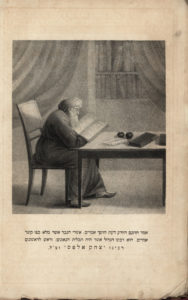
Legacy Judaica is holding an auction on Monday, September 23rd, and a few items of note.  The Viennese Schmidt press produced two books with rather striking portraits.  One of R. Shmuel Eidels, Maharsha, and other of R. Yitzkah Alfasi, Rif, which is at lot 54.  Rif is depicted wearing robes and a turban with a long white beard.  Of course, there are no contemporaneous portraits of Rif, and this is a 19th century creation.  (For more on rabbinic portraits see Cohen, Jewish Icons, 114-153).


The first edition of R. Yitzhak Hutner’s, Torat ha-Nazir, contains three approbations from R. Chaim Ozer, R. Avraham Shapiro (Dvar Avraham), and R. Kook.  The next edition omits all three, presumably to avoid including R. Kook’s.  Although later reprints include just R. Chaim Ozer’s, leaving out the page that contains the Dvar Avraham’s and R. Kook’s letters (for example, the copy on Hebrewbooks). (See Marc Shapiro, Changing the Immutable, 157-160, and Eitam Henkin, “Historical Revisionism by the families of R. Kook’s Disciples:  Three Case Studies,” in Hakirah.)’


The polemical offerings include the Berlin 1905 book, Hayyei Olam, (lot 74) that opposes cremation of Jewish bodies.  At the turn of the twentieth century the issue of cremation was debated among Jews, with the rabbis of Hamburg and Altona having opposing views.  Hayei Olam, written by R. Lerner, the rabbi of Altona was against the practice and collects numerous other letters from sympathetic rabbis.  On the other side, R. Arentreu, in Or ha-Emet, and R. Shimon Tzvi Deutsch, in Heker Halakha, defended the practice.  (For more on the issue, see the entries for these works in Shmuel Glick’s Kuntres ha-Teshuvot ha-Hadash and Michael Heiger’s article in Halakhot ve-Aggadadot).


For a more recent controversial book, lot 80 is Making of a Godol, of the recently passed R. Nosson Kamenetsky.  We have discussed this book and its editions and the book, Anatomy of a Ban, which documents the controversy here

For those interested in bibliomancy, the edition of Tanakh recommended for the goral ha-Gra is at lot 123.  Of note is that this edition has two title pages in Hebrew and Latin, and likely not intended for a Jewish audience.

For one of the more bizarre travelogues, it is hard to surpass Sefer ha-Brit ha-Hadasha im ha-Nehar Sambatyyon be-Medinat China (lot 141).  After receiving permission from President McKinley, Uziel Haga accompanied US military forces in China for purposes of surveying the customs and life of Chinese Jews. Another lot of American Judaica, lot 138, is a collection of 10 works from R. Yekusiel Yehuda Greenwald.  R. Greenwald was a prolific author who wrote on many diverse topics. He is perhaps most well known for his book on the laws of mourning, Kol Bo Aveilut, but also wrote books on R. Yonathan Eiybschitz, the reform movement, and the Palestinian Talmud, and was a rabbi in Columbus, Ohio after emigrating from Hungary.

There is a well-known if an inaccurate story that on Yom Kippur, during a cholera epidemic, R. Yisrael Salanter wanted to ensure that those who needed to would eat.  So he got up on the bimah in the Great Synagogue of Vilna and made Kiddush and ate cake.  Although the veracity of the story has been questioned, with an eyewitness reporting that R. Yisrael announced from the bimah that those who needed to eat could do so without first asking their doctor but he ate nothing.  (See Yaakov Mark, Be-Mihitzatam shel Gedolim 68).  Lot 197 is a document from R. Yaakov Tzvi Mecklenburg, author of Kitav veha-Kabbalah, instructing women to remain at home and not attend synagogue for fear of spreading communicable diseases. For more on cholera, Yom Kippur, and R. Yisrael Salanter, see Eliezer Marmalstein, “Eating on Yom Kippur during Epidemics — Cholera — R. Yisrael Salanter’s Permissive Stance and those who Opposed Him,” Kovets Ets Hayyim, (Bobov), vol. 7, 273-294 (Hebrew).


Breaching the Walls of History with Postscript

Breaching the Walls of History

By Dan Rabinowitz

This essay first appeared in the Jewish Review of Books (Spring 2026) and is republished here. Its postscript appeared in the magazine’s Substack newsletter, which you can subscribe to here.

Last December, on the eighth day of Hanukkah, the American haredi newspaper of record Yated Ne’eman published a long, impassioned article titled “Ufortzu Chomos Migdolai Vetimu Kol Hashmanim,” by Rabbi Michoel Sorotzkin. The Hebrew title is from the fifth stanza of the famous Hanukkah standard Maoz tzur, which many of us never get to: “They breached the walls of my towers and defiled all the oils.” That is to say, the Greeks (and their Hellenized Jewish allies) broke through the defenses of the holy Temple in Jerusalem, leaving, seemingly, all its oils polluted and unusable. One might have expected that such a headline would announce a discussion of, say, the closure of haredi yeshiva day schools in New York City, or the Israeli government’s attempts to draft haredim into the military, or, perhaps, the rampant antisemitism threatening European Jewry.

But Sorotzkin’s article addressed none of these very real challenges to haredi life. The breach he identified, the defilement requiring an elaborate polemic couched in apocalyptic language, was a brief mention I had made of the Brisker Rov’s visit to a library in Vilna, in an article I published in these pages last summer (“Golden Ledgers,” Summer 2025, and republished on the Seforim blog).

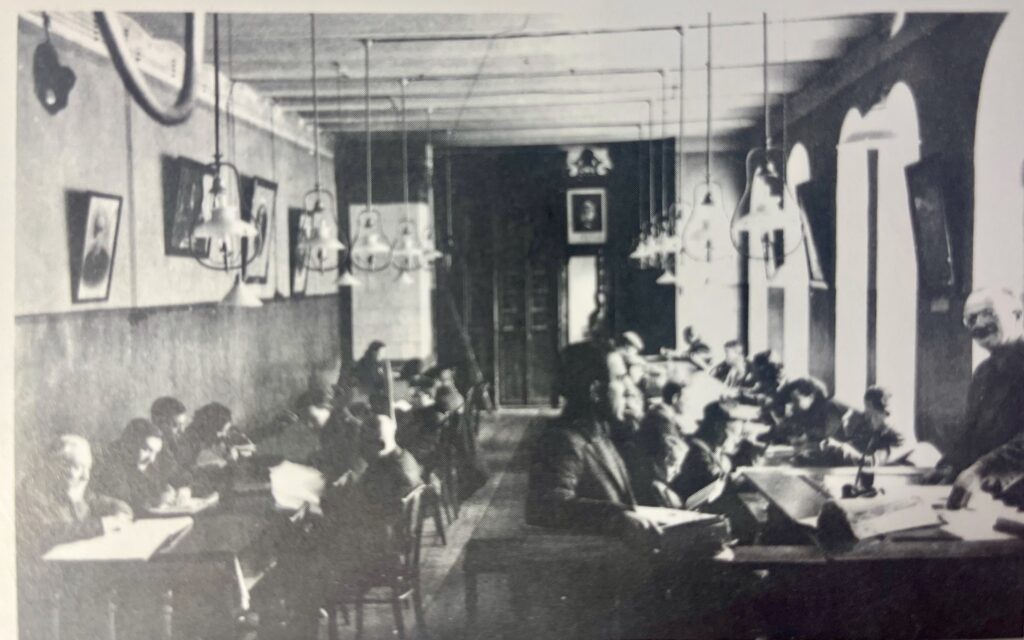
The Strashun Library of Vilna was the first Jewish public library; it admitted both male and female patrons and included secular as well as religious books (sifrei kodesh). The historical question at issue itself is trivial—in fact it isn’t really a question. Rabbi Yitzhak Ze’ev Soloveitchik, who was commonly known as Reb Velvel or the Brisker Rov, visited the Strashun Library with at least one, but almost certainly two, of his sons on October 1, 1940, and they checked out the books to read in its famous reading room that the library ledger lists them as checking out.

Strashun Library Reading Room. Layzer Ran, Jerusalem of Lithuania, vol. 2, 346.

This is demonstrable beyond any remotely reasonable historical doubt. The interesting question is: Why was it so important to Sorotzkin, a prominent member of the haredi world, to tie himself up in speculative knots denying it not once but twice in one of that world’s leading newspapers? Before answering that question, I should explain how I came to write an article that breached the walls and defiled the oils, when what I was trying to do (if you’ll allow me to mix biblical metaphors) was pluck a brand from the fire.

I go to Vilna at least three times a year. Sometimes I stay at a hotel at the epicenter of the three main streets that formed the Jewish district; other times I stay near German Street where Mattityahu Strashun once lived. My mornings begin with a thirty-minute walk to Lithuania’s National Library. The route passes through streets that once hummed with Yiddish, past buildings that housed yeshivas and Jewish publishers, through spaces that sustained centuries of Jewish intellectual life before the Nazis destroyed it. My afternoons are spent walking those streets comparing what I’ve found in the archives against what I expected to find, evenings reviewing notes and planning the next day’s research. What I’m trying to do is reconstruct the ordinary moments that illuminate the extraordinary history of Jewish Vilna.

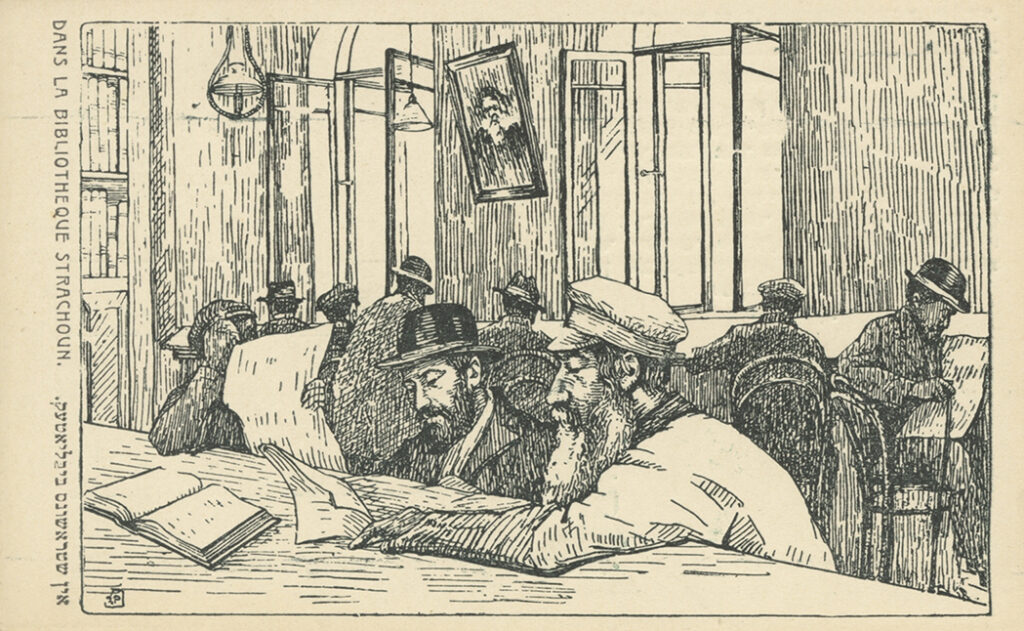
“In the Strashun Library”: a postcard from the “Vilner yidishe geto” (Vilnius Jewish Ghetto) series with illustrations by Ber Zalkind. (Ber Zalkind, Khaykl Lunski/Wikimedia Commons.)

During these walks, I often run into tour groups gathered at one of the few plaques marking the place of Jews in the city’s history. Usually, it’s the plaque noting the line of demarcation where the Nazis established the Vilna Ghetto. This is the tours’ inevitable focus: the annihilation of the Jews. What preceded the destruction—the institutions of learning and publishing, the literary circles and research institutes, the daily life that made Vilna the “Jerusalem of Lithuania”—receives far less attention. There used to be a sign marking where the Great Synagogue complex, the architectural and spiritual center of Jewish Vilna for centuries, stood. That sign is gone now. What remains are markers of death and destruction; all the complexity of Jewish intellectual life before World War II gets compressed into a prelude to catastrophe.

Those of us who study prewar Jewish culture are trying, each in our own way, to reconstruct and understand the life that preceded the catastrophe. That’s how I came to write a book on the Strashun Library several years ago. It’s why I continue to research its workings and the vibrant world of which it and its patrons, including great rabbinic leaders like Yitzhak Ze’ev Soloveitchik and ordinary Jewish readers, were a part.

The Strashun Library opened in 1902 as the first Jewish public library, built from Mattityahu Strashun’s private collection of rare books and manuscripts. From its opening, it became central to Vilna’s intellectual ecosystem. Its reading rooms welcomed everyone: rabbis and historians, secular scholars and traditional students, men and women, those seeking Yiddish literature and those researching Jewish law. By the time it was shuttered in 1940, it held roughly fifty thousand volumes and served a public that spanned the full spectrum of Jewish life.

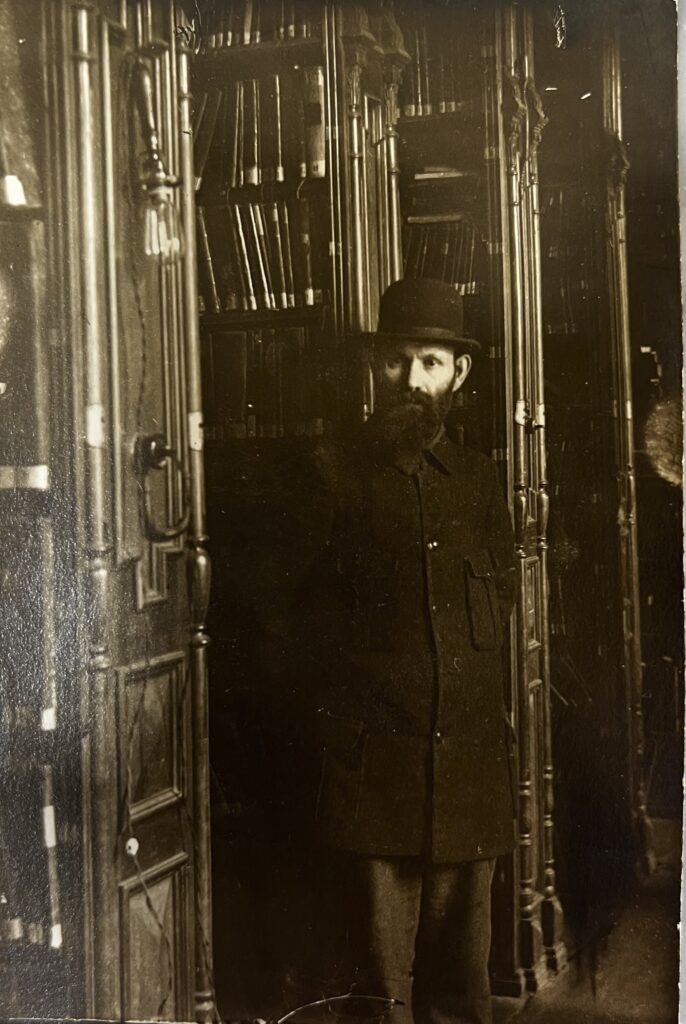
Khaykl Lunski, Librarian of the Strashun Library in the book stacks. Postcard (undated), Private Collection.

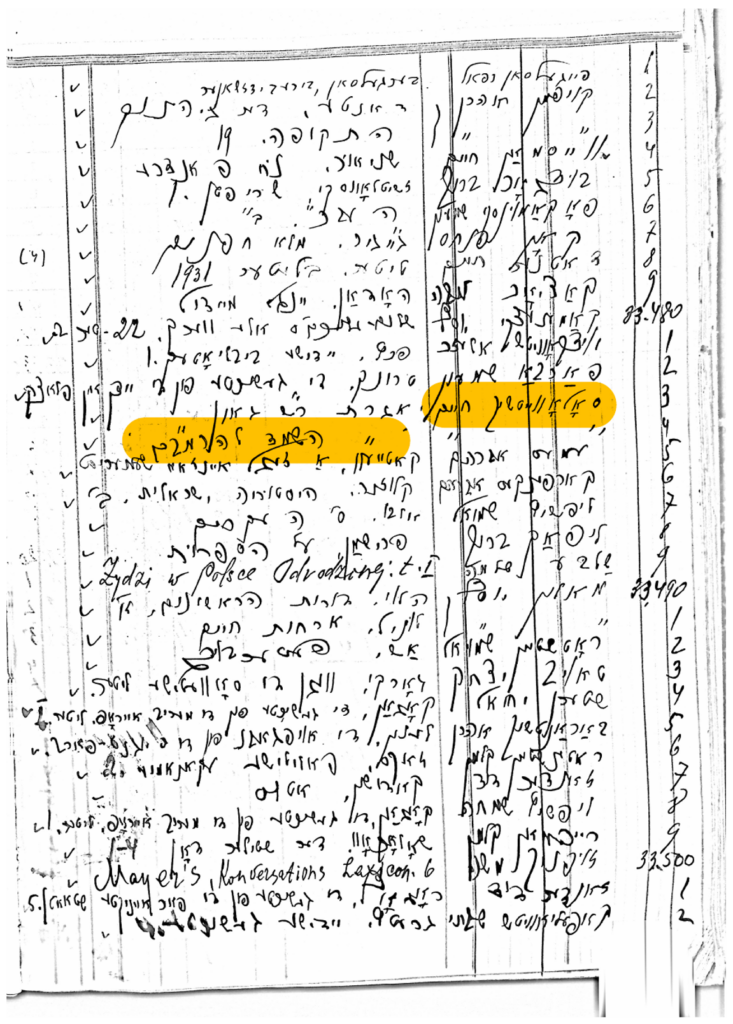
When I discovered the library’s checkout ledgers in the National Library of Lithuania archives in 2024, I realized that their spare entries allowed us to reconstruct the day-to-day life of the library: who used it, which books they read, and how it served different strata of Jewish society.

As the first step in a project to digitize and make the ledgers publicly available to other researchers, I spent four very full days scanning thousands of pages, each holding about fifty handwritten entries. As I worked, I browsed the names and tried to quickly register patterns in the data. One of the names that jumped out at me was “Yitzchok Soloveitchik,” who requested a collection of I. L. Peretz’s Hasidic stories, Khasidish. Could this be Rabbi Yitzhak Ze’ev Soloveitchik, the son of Rabbi Chaim Soloveitchik, who founded the famous Brisker approach to talmudic study?

Yitzhak Ze’ev inherited and extended his father’s analytic method and later became one of the most uncompromising voices in Israeli haredi leadership, where he was known as the Brisker Rov. I knew that he and his family had been in Vilna at the time, because I’d found him listed among prominent rabbis in Vaad ha-yeshivos refugee housing records that show, yeshiva by yeshiva, where students, teachers, and refugees were staying. Nonetheless, it could have been another Yitzchok Soloveitchik. Then I looked more carefully at the same ledger page and saw another entry: a Raphael Soloveitchik had requested Maimonides’s Iggeret ha-shemad just a few lines above Yitzchok’s request for Peretz. Now it was clear. The Brisker Rov had a son named Raphael, and although Peretz’s short stories was a surprising choice for his father, the choice of Maimonides’s famous letter on persecution by the scion of a family fleeing persecution and famously devoted to Maimonides made perfect sense.

In short, the ledger documented that the Soloveitchiks had used the library just weeks before the Soviets would permanently close it, which is what I wrote, in passing, in my article. All that I thought I had documented in doing so was that the library served the rabbinic elite alongside ordinary Jews of all kinds, who were reading everything from talmudic commentaries to Yiddish translations of Tolstoy. But merely documenting a prewar Jewish world that was different than is generally imagined in haredi publications like Yated turned out to be an act of desecration.

Rabbi Sorotzkin’s first attack began by quoting the offending lines—or part of them at any rate—from my article: “On the afternoon of October 1, 1940, Reb Velvel came to the Strashun Library with his teenage son . . . His father’s reading for the day was more surprising: I. L. Peretz’s short stories about Hasidim.” (Sorotzkin’s ellipses will turn out to be doing a lot of work here.)

“With this passage,” Sorotzkin wrote, “Mr. Dan Rabinowitz does more than recount an archival curiosity. He stages a tableau.” He went on:

The Brisker Rov, Rav Yitzchok Zev Soloveitchik, appears before us not as generations of talmidim knew him, but as a character in a modern morality play: seated calmly in the Strashun Library of Vilna, immersed in the ironic fiction of I. L. Peretz, surrounded by secular readers, students, men and women alike.

The effect is unmistakable. The reader is invited to marvel at the distance between the “real” man and the image preserved by Torah memory. Hagiography, we are told implicitly, has concealed a richer, more complex inner life—one now revealed by the cold honesty of a library ledger.

It is an elegant narrative. It is also an edifice built on sand. What we encounter here is not historical reconstruction, but a breach—peritzas geder—in the most basic disciplines of historical inference. And once the wall is breached, all the oil may be rendered impure.

Beyond the rhetoric of righteous indignation, Sorotzkin’s argument was simple: The Brisker Rov would never have entered a “mixed, open, modern” library because his “entire being recoiled from even the faintest rei’ach [whiff] of ideological modernity.” Therefore, someone else named Yitzchok Soloveitchik must have. And here Sorotzkin had a candidate:

The Vilna region was saturated with Soloveitchiks. . . . Among them appears a Yitzchok Soloveitchik, a timber merchant, a vald-socher [from Švenčionys]—precisely the kind of educated townsman who would frequent the Strashun Library and read Peretz.

There are just three problems with this line of argument—actually there are more than that, but let’s restrict ourselves to three for the moment:

a. The same ledgers that documented the visit of a “Yitzchok Soloveitchik” also recorded several visits by Rav Pinchas Hirschprung, who would later serve as chief rabbi of Montreal. Rav Chaim Ozer Grodzinski, the preeminent Torah authority in Vilna, held special borrowing privileges at the library, and Rabbi Yisrael Meir Kagan, the renowned Chafetz Chaim, visited and signed the library’s VIP “Golden Book.” If such colleagues could visit the library, can Sorotzkin really be so certain that the Brisker Rov’s “entire being” would have prevented him from doing so?

b. Švenčionys is over eighty kilometers from Vilna, and we have no evidence this timber merchant traveled to Vilna in October 1940. Not to speak of the fact that neither Rabbi Sorotzkin nor I know anything about the reading habits of Jewish timber merchants in the area.

c. The ledger records two Soloveitchiks visiting the library on October 1, 1940. Are we to suppose that this other Yitzchok Soloveitchik also had a son named Raphael, who was also a deep Maimonidean?

This last problem—call it the “Zvei Soloveitchiks problem”—returns us to Rabbi Sorotzkin’s creative use of ellipses. When he quoted my offending lines about Reb Velvel, he elided Raphael—whom I mentioned in those sentences—right out of the picture and never acknowledged that he appeared in the ledger a few lines above his father.

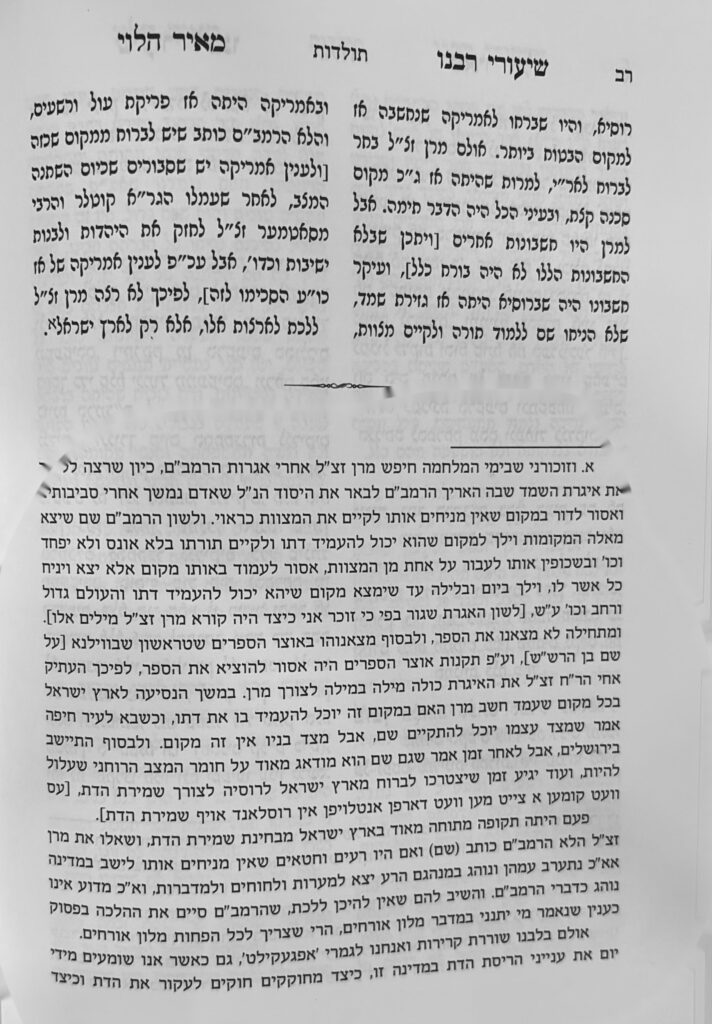
Actually, unlike Sorotzkin’s conjectural Peretz-reading ironist timber merchant, the Brisker Rov had good reason to visit the Strashun Library. He was in the midst of a life-and-death halakhic controversy with his colleague Rav Aharon Kotler about whether refugees should try to flee to Eretz Yisrael or America. To support his position that they should not go to America because of the spiritual danger, the Brisker Rov turned to a passage he remembered from Maimonides’s Iggeret ha-shemad, which he wanted to quote verbatim.

Soloveitchik family memory confirms this. In a footnote to Shiurei Rabbeinu Meir ha-Levi, a collection of the Brisker Rov’s son, he is quoted as saying:

I recall that during the war years, Maran [the Brisker Rov] sought a copy of the letters from the Rambam, because he wanted to study Iggeret he-shemad, in which the Rambam has a lengthy discussion to explain the fundamental idea that a person acclimates to his surroundings and it is prohibited to live in a place which doesn’t allow one to fulfill the mitzvot properly. . . . Initially, however, he was unable to find a copy, and, in the end, he located one in the Strashun Library in Vilna. According to the library’s rules, one was not permitted to remove books from the building. And therefore his son R. Chaim copied it word for word for him.

The library ledger records Raphael as the borrower of Iggeret ha-shemad while the family testimony remembers Chaim as the copyist. Perhaps both brothers participated, or Raphael handled the checkout while Chaim copied the passage. Or perhaps the family misremembered which brother accompanied his father to the library. At any rate, there were at least two, and quite possibly three, Soloveitchiks at the Strashun Library on that day. And they were there precisely because the Brisker Rov took his obligations as a halakhic scholar and leader of Torah Jewry so seriously.

When I wrote to Yated Ne’eman to explain all this, the editors—to their credit—published my letter, but they did so alongside a reply from the unflappable Rabbi Sorotzkin. Sorotzkin not only blithely failed to acknowledge his errors of omission and commission but went on to a new and truly gobsmacking theory, titling his response “Veha’emes Vehashalom Ehavu” (Love truth and peace).

The entry for a “Yitzchok Soloveitchik” must, he now admits, refer to one of the famous Soloveitchiks rather than a random timber merchant from Švenčionys. Still, it couldn’t possibly be the Brisker Rov. So, who was it? Here I must quote Rabbi Sorotzkin at length to convey just how far he is willing to go to save Reb Velvel from having gone to a public library:

The presence of a ledger entry bearing the name “Yitzchok Soloveitchik” is taken to indicate the Brisker Rov himself, seated in the reading hall and borrowing secular literature. Yet there exists a far more coherent and internally consistent explanation, one that aligns with the testimony, the ledger itself, the halachic framework governing names and conduct, and the lived reality of the Brisker household.

According to this reading, it was the Brisker Rov’s son, Rav Chaim who entered the Strashun Library as the responsible emissary. Anyone familiar with the family dynamic knows that his keen intelligence, composure, and practical capability marked him as the natural choice for such a mission. His younger brother, Rav Rafael, accompanied him and formally requested the Iggeres HaShemad, which then had to be copied in full—a task of approximately 3,500 words, requiring a prolonged stay. Such an extended presence in a public institution would naturally invite scrutiny. To avoid unnecessary attention, it would have been prudent, even expected, to request an additional book, a routine borrowing that raised no eyebrows and normalized the time spent at the table.

Here the ledger entries themselves become illuminating rather than sensational. Immediately preceding the Soloveitchik entry, two patrons are recorded borrowing works by I. L. Peretz. . . . When Rav Chaim was offered titles by the same author, the specific work recorded — Chassidish — was accepted not as an ideological choice but as a convenient placeholder, a book taken to cover the duration required for copying the Iggeres. . . .

The use of the name “Yitzchok” in the ledger is likewise neither mysterious nor incriminating. Rav Chaim could not identify himself by his own well-known name without drawing attention, particularly given that the sefer of his grandfather, Rabbeinu Chaim Halevi, was already catalogued in that very library. Nor could he identify himself by his father’s full name. Halacha is explicit that one may not refer to one’s father by name, even after death, without alteration. . . . The use of the shortened form “Yitzchok” . . . would have satisfied both the halachic requirement and the practical need for discretion, without uttering an outright falsehood.

It is difficult to imagine anyone believing that a scholarly household in the midst of the “lived reality” of a desperate flight to safety from both the Soviets and the Nazis would strategize over the impossible “mission” of going to a library frequented by other pious Jews to copy a passage from Maimonides. And further, to think that they needed an elaborate cover story involving false names and phony book checkouts so that the Jewish librarians did not penetrate their cover (and what?—inform Rav Kotler about the killer prooftext from Maimonides?). The tradition has a term for such groundless theorizing, pilpul shel hevel, and it is a hallmark of the Brisker tradition to oppose it.

Sorotzkin closes his response on an extraordinary—and, one presumes, unconscious—note of chutzpah. “When suggestive narratives arise from thin evidentiary reeds,” he writes, “methodological restraint becomes not a courtesy but an obligation.” But perhaps I am being unfair, as George Orwell once remarked, “We are all capable of believing things which we know to be untrue, and then, when we are finally proved wrong, impudently twisting the facts so as to show that we were right.”

Sorotzkin’s initial response characterized my work as “peritzas geder,” a breach of protective walls. But what did he think needed to be protected? Not the Brisker Rov’s actual stature or commitment. That he wanted to verify the exact wording of Maimonides’s Iggeret ha-shemad from the richest collection of sifrei kodesh in Eastern Europe to guide his thinking on the refugee crisis illuminates the rigor of his approach to unprecedented questions. What Sorotzkin needed to protect was rather a nostalgic fantasy: one in which the great sages (gedolim) of that generation never entered mixed public spaces, relied on secular institutions, or read fiction. But the infrastructure of Jewish life in places like Vilna was not neatly divided into “Torah” and “secular” categories, and gedolim and their students checked out books from the Strashun Library alongside maskilim, socialists, and ordinary Jews looking for something to read.

I go back to Vilna regularly to identify, amid the destruction and absence, what can be found to resurrect, contextualize, and enrich our understanding of the astounding Jewish culture of prewar Vilna. The Jews of this city—rabbis and students, traditionalists and modernists, Hebraists and Yiddishists—created institutions, filled libraries, published journals, founded schools and research institutes, and argued about everything.

The Brisker Rov spent an afternoon in the Strashun Library in October 1940 with his sons to obtain a text he desperately needed. While his sons diligently copied Maimonides’s text, he requested Peretz’s collection of Hasidic stories. I don’t know why and, of course, it doesn’t matter—only Sorotzkin and his more credulous readers would think that it does. But there is a plausible answer. It turns out that among Peretz’s Hasidic tales is the story “Between Two Mountains,” in which a fiercely strict and intellectual rosh yeshiva called “the Brisker Rov” is taught a lesson in humanism by a former student who has become a Hasidic rebbe. Might not the Brisker Rov have been simply curious to read about his fictional counterpart?

The Holocaust destroyed the Strashun Library and most of the Jewish world of which it was a part. The Soviets shuttered its reading room; the Nazis looted its collections; after the war, the building was destroyed. Yet, the few surviving Strashun Library ledgers reveal precious little moments in the lost history of Jewish intellectual life in Vilna. The final volume documents the last gasp of Eastern European Jewry, not only the local Jewish inhabitants but also the thousands of refugees like the Soloveitchiks who, fleeing Hitler and Stalin, briefly sought safety in Vilna.

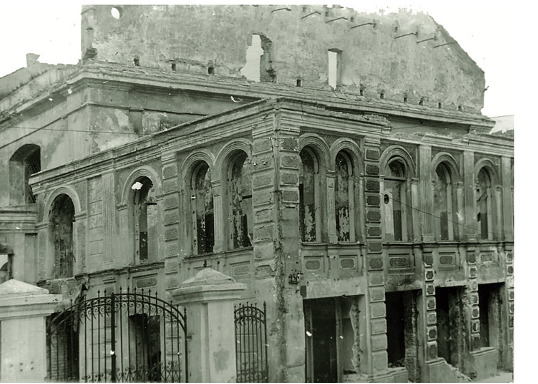
Strashun Library Building in 1945. Vilna Gaon Museum of Jewish History Archive, 1829-1

It seems to me that what we, their descendants, owe them is to see their lives, at least in glimpses, as they were, even if it is through the entries of a humble library ledger. That is a history worth recovering, even when—especially when—it complicates what we thought we knew. Such complication is not desecration; on the contrary, it honors their memories.

Postscript

After writing this response to Rabbi Sorotzkin’s pilpul shel hagiografia, I continued to return to the 1940 ledger, which hasn’t been digitized yet. As I described above, Sorotzkin’s new, and equally implausible, claim was that Chaim Soloveitchik used his father’s name rather than his own, to avoid the commotion of being recognized as the grandson and namesake of the author of one of the library’s own seforim, and to escape the notice of the authorities. In fact, it turns out Chaim checked out books under his own name at least five times in September 1940.

The first entry was on September 6, 1940, weeks before his father and Rafael appear in the ledger together. He checked out the Iggeret ha-shemad twice, on September 12 and September 14. These are, undoubtedly, the visits to transcribe Maimonides’s text, as described in the family testimony recorded in Shiurei Rabbenu Meir HaLevi. Rafael’s borrowing of the same text on October 1, when he visited the library with his father, was probably to check his brother’s transcription against the source.

That September, Chaim also read the tenth-century grammarian Dunash ben Labrat, the letters of Sa’adia Gaon and Ramban, the Abudraham’s commentary on the siddur, Samuel David Luzzatto’s essays collected in Bet ha-otzar, and a run of midrashic works, several in modern critical editions such as those of Solomon Buber. This is not the reading of a man sent on an undercover mission to copy one text. It is, rather, the reading of a wide, curious, and learned mind, and the ledger records it without comment or apology.

Of course, this isn’t surprising. As I wrote above, many well-known rabbinic figures used the library without incident. What is surprising is the pseudo-pious lengths to which Sorotzkin went to deny that the Brisker Rov and his sons simply used the Strashun Library, a fact that the family itself had no qualms about memorializing. What the ledgers allow us to do is to see, in a reader’s own name and hand, what he read in one of the great libraries of his world.

The Strashun Library Ledger Project, which is digitizing and making the ledgers publicly available, is a collaboration between the Martynas Mažvydas National Library of Lithuania, the e-Lijah Lab at the University of Haifa, Yale University’s Jewish Studies Department and Library, the Fortunoff Video Archive, and Litvak SIG.


Gems from Rav Herzog’s Archive (Part 2): Sanhedrin, Dateline, the Rav on Kahane, and More

Gems from Rav Herzog’s Archive (Part 2):
Sanhedrin, Dateline, the Rav on Kahane, and More
By Yaacov Sasson
EDIT Please see this post for a crucial correction – it is the conclusion of the Rav’s family that the letter  in the Herzog Archive about Kahane is a forgery.
This post continues from Part 1, here.
V Renewal of Sanhedrin
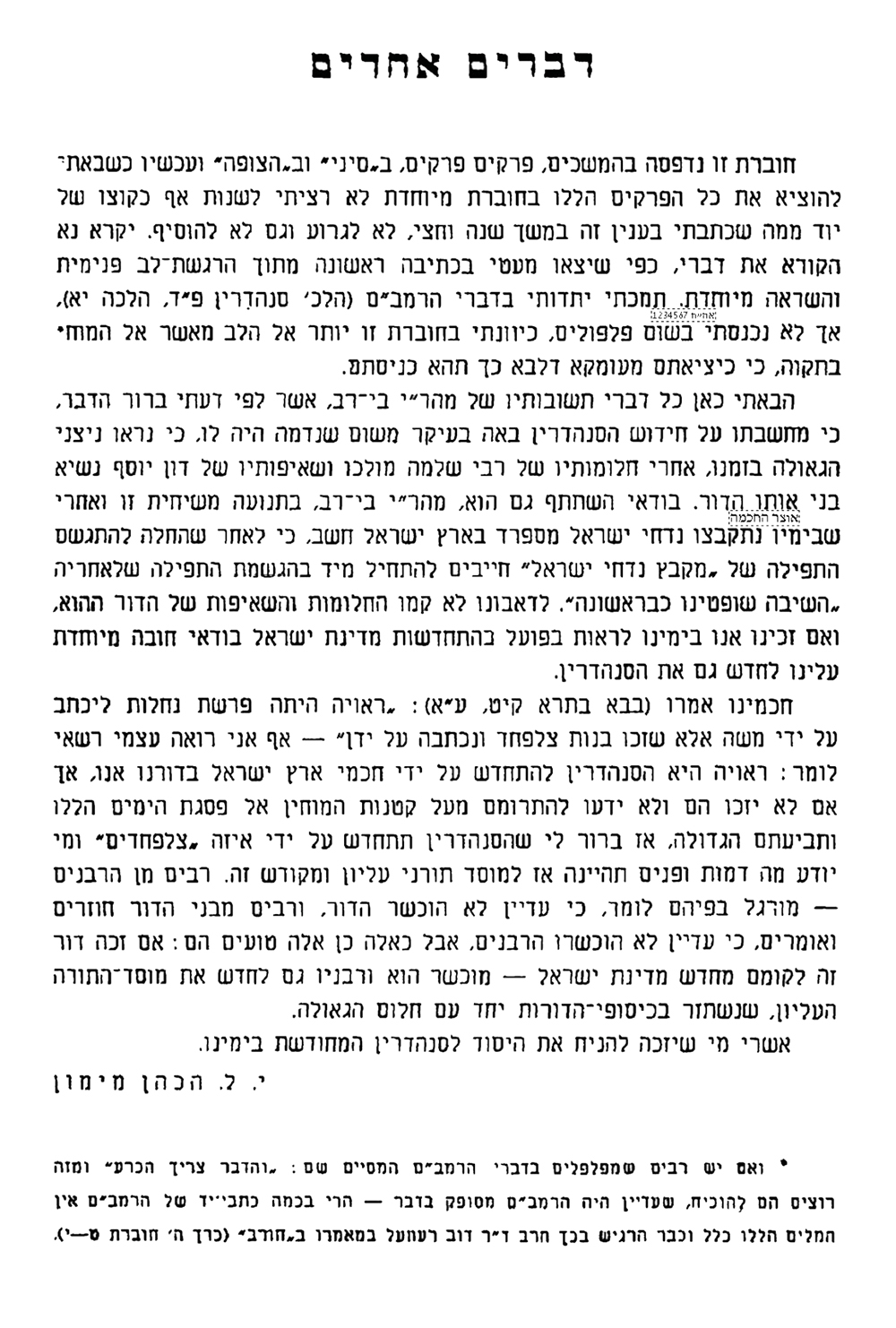
Another important file in Rav Herzog’s archive is his file on the renewal of Semicha and the Sanhedrin.[1] Among other letters, the file contains an unpublished letter from Rav Herzog to R’ Yehuda Leib Maimon regarding the issue. R’ Maimon was a well-known Mizrachi leader, the first Minister of Religion of the State of Israel, and the most vocal advocate of renewing the Sanhedrin. To that end, he wrote a series of articles on the topic in Ha-Tzofeh and Sinai, which he collected into a book in 1950, entitled Chidush Ha-Sanhedrin BeMedinateinu Hamechudeshet. Renewal of Semicha and Sanhedrin was of course not without opponents. Rav Herzog instructs R’ Maimon to proceed slowly and with caution, as there are a number of unresolved issues regarding renewal of Semicha which require great care and deliberation.
There were two main halachic objections to the renewal of Semicha. The first (not mentioned here by Rav Herzog) is based on the language of the Rambam in Sanhedrin 4:11, the very same halacha in which he suggests the possibility of the renewal of Semicha. The Rambam writes there:
נראין לי הדברים שאם הסכימו כל החכמים שבארץ ישראל למנות דיינין ולסמוך אותן הרי אלו סמוכין ויש להן לדון דיני קנסות ויש להן לסמוך לאחרים אם כן למה היו החכמים מצטערין על הסמיכה כדי שלא ייבטלו דיני קנסות מישראל לפי שישראל מפוזרין ואי אפשר שיסכימו כולן ואם היה שם סמוך מפי סמוך אינו צריך דעת כולן אלא דן דיני קנסות לכל שהרי נסמך מפי בית דין והדבר צריך הכרע.
The intention of the Rambam in his concluding words, Ve-hadavar tzarich hechrea, has been the subject of dispute for hundreds of years, going back to the dispute of the Mahari Beirav and the Ralbach, with some authorities believing that the Rambam was mesupak whether Semicha could in fact be renewed. A novel approach to the issue was suggested by Dr. Bernard Revel in an article in Chorev, Volume 5 (1939). Dr. Revel suggested the possibility that the final three words, Ve-hadavar tzarich hechrea, are not be the words of the Rambam himself, but were added later by another person who disagreed with the Rambam’s innovation.[2] Dr. Revel cited statements of other rishonim which he believed supported his theory. R’ Maimon addressed this issue in the introduction to his book, in the footnote, writing that the three words, Ve-hadavar tzarich hechrea, do not appear in “kama kitvei yad” (several manuscripts), thus supporting Dr. Revel’s hypothesis.
 
However, there is no evidence that any such manuscripts actually exist. The Frankel edition of the Rambam does not cite any alternate nusach that excludes these three words. Additionally, Professor Eliav Schochetman[3] wrote nearly 30 years ago that he found no evidence of any such manuscript in the numerous manuscripts that he consulted from across the world.


There are two potential explanations to what happened here. One potential explanation is that R’ Maimon simply lied about the existence of these kitvei yad in order to advance his agenda of renewing the Sanhedrin. Alternatively, Rabbi Eliyahu Krakowski has suggested a limud zchut – perhaps R’ Maimon forgot what Dr. Revel had written and mistakenly believed that Dr. Revel had uncovered manuscripts supporting his thesis[4], or he never saw it himself and was misinformed as to what Dr. Revel wrote, in which case R’ Maimon would be guilty of carelessness rather than dishonesty.
The second major halachic objection to the renewal of Semicha is the issue of the Samuch’s qualifications. The Rambam in Sanhedrin 4:8 writes that a Samuch must be rauy lehorot be-chol hatorah kula, capable of ruling on the entire Torah. Rav Herzog mentions in this letter to R’ Maimon that the Ralbach objected to renewal of Semicha on the grounds that no one is rauy lehorot be-chol hatorah kula. (This was also the position of the Radvaz, in his commentary on Sanhedrin 4:11.) Rav Herzog adds that if he said so in his generation, anan aniyey de-aniyey mah na’ane abatrei? Rav Herzog then makes a somewhat novel suggestion, one with halachic ramifications for the issue of renewal of Semicha. Rav Herzog suggests that rauy lehorot be-chol hatorah kula does not mean that the Samuch must literally know by heart all the relevant halachic sources. A similar approach was also suggested by the Rav[5] and the Steipler.[6] In the language of the Rav, the Samuch need not possess “universal knowledge”, rather a “universal orientation.” While this approach would certainly remove this barrier to renewal of Semicha, Rav Herzog concludes, however, that the matter requires extensive clarification and discussion, and as long as this point has not been clarified, there can be no possibility of renewing the Sanhedrin.


There are a number of talmidei chachamim in the last century who have deemed others to be rauy lehorot be-chol hatorah kula, in contrast to the position of the Ralbach and the RadvazFor example, in his 1935 recommendation letter for the Rav regarding the Chief Rabbinate in Tel Aviv, publicized by Dr. Manfred Lehmann[7], Rav Moshe Soloveichik wrote that the Rav is rauy lehorot veladun be-chol dinei hatorah like the mufla on the Sanhedrin. In Rav Moshe Mordechai, the biography of Rav Moshe Mordechai Shulsinger (page 275), it is related that the Chazon Ish listed to his student Rav Shlomo Cohen (Rav Shulsinger’s father-in-law) the names of 32 Rabbis whom he believed to be rauy lehorot be-chol hatorah kula and worthy of sitting in the Sanhedrin, among them the Chafetz Chaim and Rav Meir Simcha. It would appear that Rav Moshe Soloveichik and the Chazon Ish also assumed the more lenient definition of rauy lehorot be-chol hatorah kula, in line with the position of Rav Herzog, the Rav and the Steipler.
VI Halachic Dateline
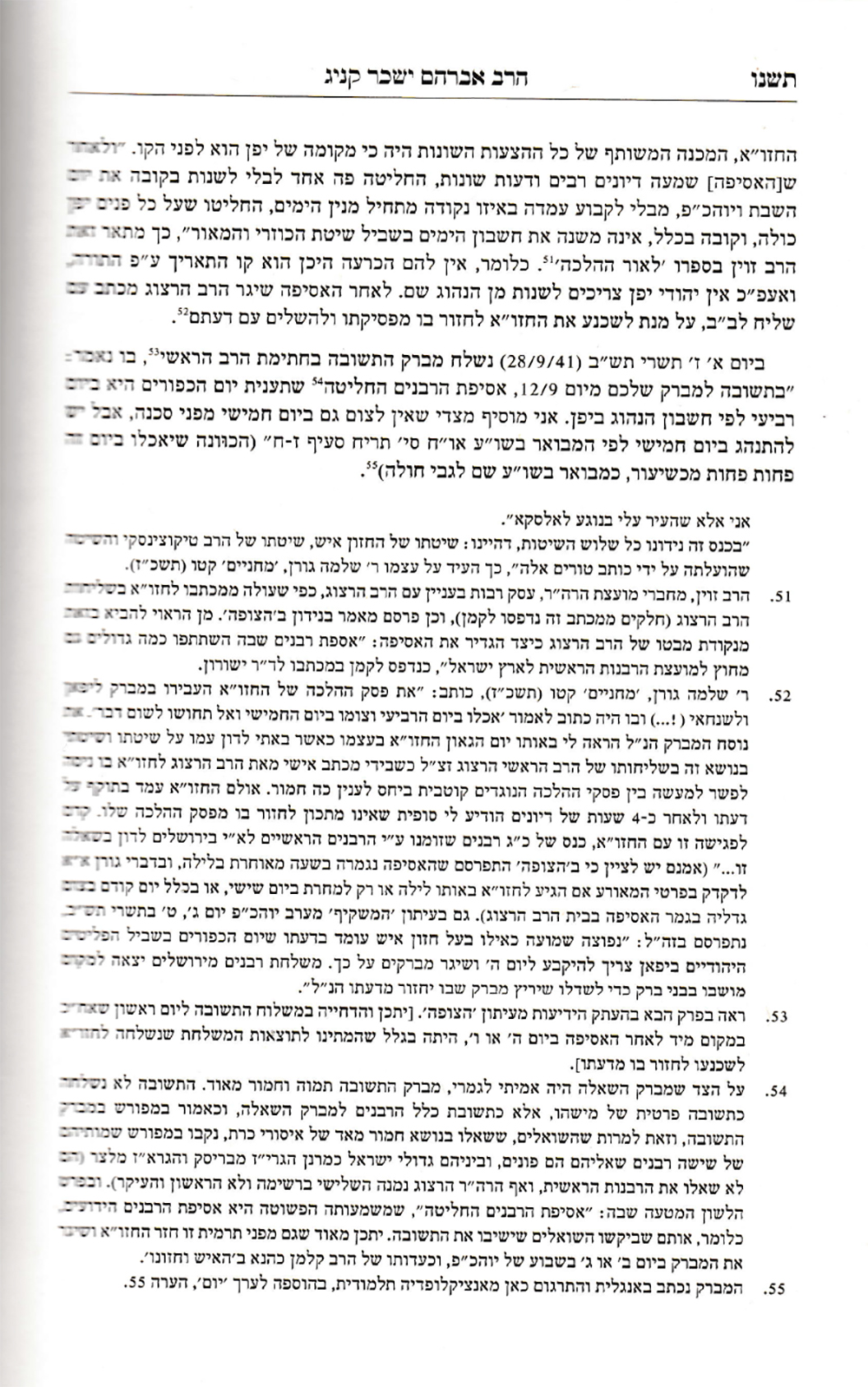
The archive contains an entire file dedicated to the question of the Halachic Dateline.[8] Rav Herzog was of course involved in the Dateline controversy in 1941. At that time, some members of the Mir Yeshiva, among other Jews, were located in Japan for Yom Kippur and they sent a telegram to Rabbis Mishkovsky, Alter, Herzog, Soloveichik, Finkel and Meltzer asking for guidance. Rav Herzog convened a meeting of a number of Rabbis to decide how to proceed, and sent a telegram back to Japan with their instructions. The file contains copies of the telegrams, much of Rav Herzog’s correspondence on the issue, as well as a kuntres on the topic prepared by Rav Tukachinsky that was distributed in advance of the meeting. Most of the significant material in this file has already been published in Kovetz Chitzei Giborim – Pleitat Sofrim Volume 8, in an extensive article by Rav Avraham Yissachar Konig, which was previously reviewed on the Seforim Blog by Dr. Marc Shapiro.[9]
Rav Konig’s most significant contribution is showing that Rav Herzog’s letter as published in Rav Menachem Kasher’s Kav Ha-taarich Ha-yisraeli has been altered from Rav Herzog’s actual letter. Here is Rav Herzog’s letter to Rav Kasher as it appears in the archive:
And this is the letter as printed at the beginning of Rav Kasher’s Kav Ha-taarich Ha-yisraeli:
 
There are three sentences that have been omitted from Rav Herzog’s letter as presented at the beginning of Rav Kasher’s volume. (I would add the following point that Rav Konig failed to mention – Rav Kasher wrote explicitly on page 248 that he presented the letters at the beginning of the volume in full.) The following sentences have been omitted from Rav Herzog’s letter:
הנני להודיע עכשיו שבדיעה זו אני ממשיך ומחזיק היום. אני תפלה שיזכני הקב”ה לעיין בעצם שאלת קו התאריך ולבדוק את כל הדיעות ולהגיע לידי דיעה עצמית. אולם לעת עתה אינני נוקט שום עמדה בהן.
This omission creates the impression that Rav Herzog had a definitive position on the question of the Dateline. However, this is obviously not the case; Rav Herzog never came to any conclusion on the issue of the Dateline, as is clear from the omitted sentences, as well as from a number of other letters in the file. In fact, Rav Konig has shown that in Rav Kasher’s response to this letter, he actually complained to Rav Herzog about these specific sentences for this reason. From Rav Herzog’s original letters, it appears that his position on the question of Japan was one of hanhaga bemakom safek (i.e. instruction on how to act in absence of a clear conclusion on the location of the Dateline) not a definitive hachraa. (Rav Konig elaborates on Rav Herzog’s position at length.) The first sentence above, that Rav Herzog stands by the position of the Rabbinic meeting, in conjunction with Rav Herzog’s statement that he has no definitive opinion on the matter of the Dateline, also implies that the position of the Rabbinic meeting convened by Rav Herzog was also one of hanhaga bemakom safek. (This point is also clear from Rav Herzog’s letter to Dr. Yishurun, also in the file, that the Dateline matter remained unresolved, and the meeting of Rabbis came to no definitive conclusion on the location of the Dateline. They issued their instructions to Japan based on the majority of opinions regarding location of the Dateline, with no consensus on the issue itself.) The altered version of Rav Herzog’s letter creates the false impression that Rav Herzog had a definitive opinion on the Dateline question.
However, I must take issue with one point made by Rav Konig. In his footnote 54, he criticizes Rav Herzog for his language in the telegram sent to Japan. Rav Konig writes that the language of the telegram is misleading, and creates the false impression that the telegram represents the position of the six rabbis (Rabbis Mishkovsky, Alter, Herzog, Soloveichik, Finkel and Meltzer) to whom the telegram from Japan was addressed. This is Rav Konig’s critique, in footnote 54:
Unfortunately, Rav Konig has been misled by an inaccurate translation of Rav Herzog’s telegram. Rav Herzog’s original telegram was written in English, and Rav Konig tells us (footnote 55) that he has relied on the translation to Hebrew as it appears in the Encyclopeida Talmudit, in the addendum to the entry on “Yom”, (coincidentally also in footnote 55.) That translation is taken from Rav Kasher’s Kav Ha-taarich Ha-yisraeli on page 246. This is the telegram sent by Rav Herzog, as it appears in the archive:
An accurate translation to Hebrew would be as follows:
בתשובה למברק שלכם מיום 12.9, אספת רבנים בנשיאותי החליטה שתצומו ליום כיפור ביום רביעי לפי חשבון הנהוג ביפן וכו’
This is the mistranslation in Rav Kasher’s Kav Ha-taarich Ha-yisraeli:
Translated accurately, Rav Herzog’s telegram does not imply that the six Rabbis to whom the question was addressed are providing the answer. The main difference is a subtle, but significant one. Rav Herzog wrote “meeting rabbis my presidency”, which Rav Kasher mistranslated to Asifat Ha-rabbanim, “meeting of the rabbis”, and he neglected to translate “my presidency” at all. As noted by Rav Konig, Asifat Ha-rabbanim (with the hey ha-yedia) implies the known Rabbis, i.e. the Rabbis to whom the question was addressed. Correctly translated, however, Asifat Rabbanim be-nesiuti, “a meeting of Rabbis under my presidency” (without the hey ha-yedia) does not imply that Rabbis Mishkovsky, Alter, Soloveichik, Finkel and Meltzer were involved in the decision. Rav Konig was unfortunately misled by Rav Kasher’s mistranslation, which was also repeated by Encyclopeida Talmudit. The attack on Rav Herzog’s integrity is entirely unwarranted.
There appears to be a second very subtle error in Rav Kasher’s translation. Rav Kasher’s translation states flatly that the Taanit of Yom Kippur is on Wednesday, implying a definitive hachraa. Rav Herzog’s telegram actually says that the decision was that they should fast on Wednesday for Yom Kippur, language which is consistent with a hanhaga bemakom safek. This would also fit with Rav Herzog’s personal addendum, that the Jews in Japan ought to keep Thursday as a fast day as well while eating leshiurim. Given Rav Kasher’s apparently less-than-honest presentation of Rav Herzog’s letter, as noted above, one might surmise that this “error” was also a willfull misrepresentation of the contents of the telegram, intended to advance Rav Kasher’s preferred narrative of a definitive hachraa, in accordance with his own position.
VII Yibum B’zman Hazeh
In addition to the documents related to Rav Herzog’s tenure as Chief Rabbi of Israel, there are also a number of files from his tenure as Chief Rabbi of Ireland. Among his correspondence from his time is Ireland is a fascinating teshuva, written by Rav Kasher in 1936, regarding the issue of Yibum B’zman Hazeh.[10] The background to the question: an Ashkenazi Yavam and Yevama living in Israel want to marry via Yibum, rather than doing Chalitza. Must the beit din protest, or can the beit din allow the Yibum? This teshuva was printed by Rav Kasher in the inaugural volume of Talpiot[11] (1944), and also appears in his Divrei Menachem Volume 1, Teshuva 31. Interestingly, Rav Kasher’s conclusion in the original teshuva differs significantly from the conclusion in the teshuva that he eventually published in Talpiot and Divrei Menachem.
Here is the conclusion of the teshuva as it appears in Rav Herzog’s archive, at the end of page 11 continuing to page 12:


Here is the conclusion of the teshuva as it appears in Divrei Menachem:
 
Originally, Rav Kasher concluded that the beit din should try to convince the couple to do chalitza, but if beit din is unsuccessful, and if the couple is religious, then beit din should teach them to have kavana l’shem mitzvah and need not protest the yibum. The concluding sentences were removed from Rav Kasher’s published teshuva, and the ending simply states that beit din try to convince them to do chalitza. (The teshuva as published is actually quite awkward, as it is clearly building towards the conclusion that they may do yibum, yet ends abruptly without stating this conclusion.) Apparently, Rav Kasher censored his own conclusion. He does stipulate at the end of the original teshuva that he is writing le-halacha ve-lo le-maase until the Gedolei Ha-Rabbanim in Israel agree to permit the yibum. It is possible that Rav Kasher did not receive such approval, and subsequently decided to censor his own conclusion when he published the teshuva.
VIII The Rav on Rabbi Meir Kahane
In addition to the archives of Chief Rabbi Herzog, the archives of his son, President Chaim Herzog, have also been scanned and are available. A very intriguing file in his archive is the file dedicated to Rabbi Meir Kahane.[12] A fascinating document in that file is a letter about Kahane written to Herzog by the Rav in the summer of 1984. The background to the letter: in 1984, Kahane became a member of the Knesset, representing the Kach party. Traditionally, during the process of building a coalition, the president would invite every party to take part in coalition negotiations. Herzog, however, snubbed Kahane and refused to invite him.[13] It was in response to this snub that the Rav wrote the letter below to Herzog, which is surprisingly supportive of Kahane:
 
The Rav starts by mentioning his close relationship with Rav Herzog, and that Chaim Herzog was actually named for his grandfather, the great Rav Chaim Soloveichik of Brisk.[14] The Rav says that he cannot understand how Herzog could invite the representatives of Arafat, but did not invite Kahane. The Rav adds that Kahane is “ktzat talmid chacham” despite his shigonot, and that he is a yarei shamayim who fights for the Torah and kvod shamayim. The Rav says that someone as energetic as Kahane should be moderated and he could contribute.
(Other sources have portrayed the Rav’s view of Kahane far more negatively, claiming that the Rav regarded Kahane’s “selective citation of Jewish sources as a distortion and desecration of Torah.”[15] Additionally, it is related that, at some point in the 1980s[16], the Rav told others that Kahane should not be given a platform to speak at YU.[17] I am not sure how to reconcile this portrayal of the Rav’s view of Kahane with the Rav’s own letter to Herzog that was rather supportive and praising of Kahane.)
The Rav then gives Herzog some gentle mussar for being irreligious and encourages him to keep mitzvot while in public as a Kiddush Hashem. Herzog’s response to the Rav also appears in the same file.
Kahane and Herzog had quite a contentious (non-)relationship, extending far beyond the coalition snub, as is evidenced by the rest of Herzog’s file on Kahane. This is a scathing column that Kahane wrote for the Jewish Press, also found in Herzog’s archive, in which Kahane dubs Herzog “vinegar son of wine”, among other insults:
 
Additionally, Kahane’s Kach party presented Herzog with the inaugural Pras Idud Ha-hitbolelut – “Award for the Encouragement of Assimilation” 5745, as appears below:
 
The above is a sampling of the important and interesting documents contained in the archives. As mentioned, there is certainly much more fascinating material to be found. In the meanwhile, אנו יושבים ומצפים לגאולה שלמה, ייתי ונחמיניה.
[2] http://www.hebrewbooks.org/pdfpager.aspx?req=23218&st=&pgnum=16. See also Rav Chaim David Regensburg’s criticism of this thesis in Kerem Volume 1, pages 93-94 (also reprinted in his Mishmeret Chaim), and the comments of Rav Hershel Schachter brought in Shiurei Ha-rav (Sanhedrin), page 37, footnote 35.
[3] Shenaton Ha-Mishpat Ha-Ivri 14-15, page 235, footnote 77
[4] Dr. Revel did cite statements of other rishonim that he believed supported his view. Perhaps R’ Maimon mistakenly thought that Dr. Revel had supported his view with manuscripts of the Rambam, rather than other rishonim.
[5]  Nefesh Ha-rav page 18 footnote 22 , Shiurei Ha-rav (Sanhedrin) page 27. See also Leaves of Faith (volume 1) pages 121 and 134, where Rav Lichtenstein attributes this approach to Rav Moshe Soloveichik. From the other sources, it would seem that this approach was the Rav’s own. However, the recommendation letter that Rav Moshe wrote might imply that Rav Moshe also followed this approach.
[6] Kitvei Kehillot Yaakov Ha-chadashim, Sanhedrin, page 187.
[7] Sefer Yovel for Rav Yosef Dov Soloveitchik, jointly published by Mosad HaRav Kook and Yeshiva University, at the end of Volume 1 (unpaginated). The transcription, along with an image, is also available here.
Lehmann’s transcription of Rav Moshe’s letter appears to be mostly accurate, with one exception. Towards the end of the letter, Lehmann’s transcription reads as follows:
וגם הם בדור עשירי לעזרא איכא בי’ מכל צד וצד…
This meaningless sentence is obviously an error in transcription. The transcription should read:
וגם הך דדור עשירי לעזרא איכא בי’ מכל צד וצד…
meaning that the Rav has illustrious lineage and zchut avot on both his father’s and mother’s side. (See Brachot 27b for the source of this expression.) It is also clear from Lehmann’s translation that he misunderstood this line entirely and did not realize that it was referring to the Rav and his lineage. See the translation here.
[13] “Rabbi Kahane was the only party leader in the Parliament whom President Herzog refused to see in the consultations that led to the President’s asking Shimon Peres, the Labor Party leader, to form a government.” (New York Times, August 14, 1984)
[14] Herzog himself mentions this in his memoir, Derech Chaim, although it does not appear in the English translation, Living History. Rav Chaim passed away on July 30, 1918, and Herzog was born on September 17, 1918.
[16] The Rav’s last shiur at YU/RIETS was in 1985 (The Rav, Volume 1, page 43), at which point he withdrew from public life due to his illness. Presumably, this incident must have occurred at some point before then.


The First Artichoke Controversy of 2012

The First Artichoke Controversy of 2012
By Leor Jacobi
Recently a kashrut controversy surrounding traditional Italian fried artichokes has received major media coverage in the New York Times and the Seforim Blog (twice, in chronological order, not order of importance).  In order to prove the antiquity of Jewish artichoke consumption, depictions of artichokes in medieval illuminated haggadot have been adduced. These were the topic of a lesser-known artichoke controversy in 2012 here in the comments section of the Seforim Blog, which can be as nasty and difficult to find as artichoke bugs.
The Controversy: Do Catalonian medieval Haggadot portray maror as an artichoke? Were artichokes actually consumed in fulfillment of the rabbinic requirement to consume bitter herbs found in the Mishnah and Tosefta?
“Brother Haggadah”, BL Oriental 1404, f. 18
Here’s the story behind the scenes as it occurred in real time, during the Pessah season of 2012. I was scheduled to deliver a talk on chrayn at a rabbinic conference on the Hebrew language organized by Yitzhak Frank on April 10, Chol ha-Moed Pessah. In the course of some late preparatory research (= Googling) on April 5 (13 Nissan, the day of bedikat chametz) I came across a fascinating responsum on maror by David Golinkin that had just been published on April 2, 2012.  Struck by the reliance on visual evidence from illustrated manuscripts in establishing a medieval custom to consume artichokes as maror, I sent the post to Marc Michael Epstein of Vassar College for comment. Within an hour he replied:
I don’t believe the Sephardic mss show an artichoke, rather they depict an entire head of romaine lettuce. The way to prove or disprove this would be to compare contemporary or roughly contemporary botanical mss.
I immediately began “intensive research” (= more Googling) and discovered that the artichoke question was (probably first) posed by Yoel Finkelman and his parents in 2005. Significantly, they already collected the three examples cited by Golinkin: the RylandsBrother, and Sarajevo Haggadot. Finkelman states that his father circulated the query widely.
Rylands Haggadah, 1988 facsimile edition, f. 31v
The next day, April 6, Erev Pessah, I emailed Golinkin directly, requesting sources for his identifications. He replied on the same day that artichokes are definitely depicted in the three illuminated haggadot and that artichokes were probably identified as one of the five plant species mentioned in the Mishnah (Pesahim 2:6). Indeed, in Golinkin’s own post of April 2:
Rabbi Natan ben Yehiel of Rome (1035-ca. 1110) says in his Talmudic dictionary  (ed. Kohut, Vol. 8, p. 245) that tamkha is cardo, which is cardoon. Prof. Feliks says that this is carduus argentatus or silver thistle, while Dr. Schaffer says that it is cynara cardunculus or artichoke thistle.
Cardoon Artichoke Thistle. a painting by Elizabeth H Tudor
So, textual and visual evidence interlock to support the conclusion that artichokes were used as Maror. However, the textual evidence is weak. Sefer Ha’arukh is a dictionary, not a responsum, a legal code or a gloss to one, like Hagahot Maimoniyot which identifies tamkha as horseradish – chrayn, associated with an actual custom. The definition of Ha’arukh is not a singular, definitive identification  (yesh ‘omrimmarrobio, another species, also Rashi’s identification), and according to Prof. Jehudah Feliks cardo does not describe artichokes at all.
Opposite this scanty textual evidence stands a mountain of Rabbinic silence. As far as I am aware, nowhere in any codes, Haggadas, commentaries, or anywhere else do we find even a hint that artichokes were ever used as maror. There are limits to what can be learned ex silentio but we are discussing thousands of sources. If artichokes were used, we would expect a mention somewhere.
As for the visual information, we have “two witnesses and three witnesses”: The Rylands and Brother Haggadahs should be considered one witness because one is copied from the other. Bezalel Narkiss designated the name “The Brother Haggadah” (along with a lot of other names of Haggadah, most of which have stuck, for better or worse) because it is the “brother” copied from the Rylands Haggadah. According to Katrin Kogman-Appel, the Brother was more likely the original from which the Rylands was copied. For our purposes, the direction of the copying makes no difference. Just as the Rosh and Tur can’t really be counted as two legal authorities, these two sources are reflections of one another. What about the other witness, the Sarajevo Haggadah?
I do not think that there is even a remote possibility that the Sarajevo Haggadah depicts an artichoke:
The leaves are ridged but all species of artichoke leaves are smooth save for the thorn in the middle. An artist whose intention was to depict artichokes would not draw them in this manner. Moreover, Epstein, (in personal correspondence) adds that the “artichoke” leaves are “veined” like lettuce leaves, and bound together with a cord at the base.
Israeli Artichoke, Photo: Leor Jacobi, April 20, 2012
The same day, April 6, Erev Pessah, I communicated my skepticism back to Golinkin, especially regarding the depiction in the Sarajevo Haggadah.  Golinkin’s April 2 post had already inspired creative contemporary midrash by April 9 (the truth of which in revealing hidden aspects of the divine plan should be judged independently of the historical claims.) Clearly these progressive folk placed artichokes on their seder plate on seder night, April 6 or 7, 2012, and were already expounding homiletically on the custom they had only learned about on April 2 at the earliest. Epstein notes that this an excellent example in “real time” of a minhag in development thanks to what he calls “the heter of the Internet.”
I gave the Chrayn talk on April 10 and the very next day, April 11, a long and fascinating Seforim blog post by Dan Rabinowitz was published, wherein, inter alia, he stated:
In the Brother to the Rylands Haggadah, marror is depicted as an artichoke, as is in the case with the Sarajevo Haggadah.
Golinkin wasn’t cited but it’s doubtful that his April 2 post is the source —  perhaps serendipity. After some discussion in the comments, Marc Epstein wrote:
Rabbosai (and Marasai): A manuscript is NOT a mirror. Jews depict themselves in their art (or commission art that depicts them) not as they were, but as they desired to be seen. Please please please do not engage in the typical Wissenschaft strategy of looking at illuminated manuscripts for “clues to Jewish life in the Middle Ages” or even to Jewish history. What we can learn from them is histoire des Mentalites, but even that takes a lot of work to get to.
Re: the “artichoke”: I don’t believe the Sephardic mss show an artichoke, rather they depict an entire head of romaine lettuce. The way to prove or disprove this would be to compare contemporary or roughly contemporary botanical mss. It may have been “misunderstood” by some illuminators as an artichoke, but not corrected by the recipients of the manuscript because if you are not looking for an artichoke it seems totally absurd that an artichoke would be used as maror, You don’t SEE an artichoke, but a head of Romaine lettuce, no matter how “artichoke-like” it seems to us in 5772.
Also, because a head of Romaine is SHOWN in the haggadah it doesn’t mean that there a head of (possible unchecked-for-bugs) Romaine on the table. Every image is not a snapshot, but a representation — a combination of the real, the general, the ideal and the symbolic. Showing the head is a way of REPRESENTING Romaine — it says, “We use a type of lettuce that grows with leaves together in a head like this.” It does NOT necessarily mean “We use complete heads of Romaine at the Seder, like this.” Do you see the difference? A representation must shorthand its descriptions for clarity: If you showed individual artichoke leaves, for instance, it would be difficult to ascertain that the plant was an artichoke. Artichoke leaves are shaped like baby spinach leaves, though baby spinach is more pliable. If a leaf of that shape was shown, what would distinguish the artichoke leaves? Showing an artichoke in its entire, thistly configuration makes it indisputable that it is an artichoke.
Epstein’s points are compelling. How does one portray lettuce in an illustration? For example, this modern lettuce clip-art isn’t much more lettuce-like than the illustration in the Brother Haggadah:
After Pessah, on April 22, I received an additional reply from Golinkin with more sources. The entry for maror in the first edition of Encyclopedia Judaica was written by Jehudah Feliks (pp. 1014-5). The entry includes an image of the maror depiction from the Sarajevo Haggadah with a caption:
According to this astounding caption, lettuce is depicted in the Sarajevo Haggadah but the claim is that it can still be supposed that the artichoke-like shape of the lettuce reflects an old custom of eating artichokes as maror. This custom had already been lost in the 14th century, but was preserved in the form of illustrations of maror in haggadot! (We find something similar in the illustrations of maror in the Prague Haggadah. According to Rav Peles, the custom of pointing at the wife when stating “this bitter[ness/Bitter Herb]” had already disappeared, but was preserved in the caption to themaror illustration in the Haggadah; see also here). However, note that above, in Golinkin’s post, Feliks did not identify the Arukh’s cardo as artichokes. It is not entirely clear that Feliks composed this caption. Bezalel Narkiss served as IIlustrations Consultant on the first edition (sadly most illustrations were cut from the second edition, including this one and the caption).
As Narkiss was then the acknowledged expert in medieval illuminated manuscripts, it stands to reason that he may have either selected the illustration or wrote the caption, either alone or in consultaion with Feliks. In any case, the author(s) of the caption maintain that lettuce is depicted even if the rest of their proposal is extremely speculative.
For the Rylands Haggadah, Golinkin cited the Raphael Loewe facsimile, Steimatzky, 1988: “The bitter herb is intended to be lettuce, despite its artichoke-like compactness.”  This pithy source contradicts Golinkin’s identification, and suggests a practical explanation for this lettuce design.
As for the Brother Haggadah, Golinkin wrote that he learned about this from an expert on Jewish art. However, as far as I can tell this expert does not deal primarily with interpretation of medieval art. Theories are tested by evidence. Thus, it remains that if someone wishes to argue that these images depict artichokes the best way to advance the thesis would be by means of comparisons with contemporary illustrations of artichokes, as Marc Epstein advises.
Finally, an image of maror from the Barcelona Haggadah, folio 62, illustrates how creative illustrations of lettuce (?) could get and how dangerous it would be to try to learn history from them as if they were snapshots.
Adapted from Evelyn Cohen’s description in the facsimile volume:
Verso, The scribe left almost the whole of the page for a depiction of the bitter herbs, but the crude illustration we now see was not executed in the Middle Ages, although it may have been based on models from the fourteenth century. The vegetable, commonly portrayed in a highly stylized manner, was no longer understandable to the later artist, and the red holder with which it is sometimes shown seems to have been misunderstood by the artist, who interpreted it as a red crescent.
The post-medieval illustrator here may have utilized haggadah depictions of artichoky lettuce as a model and was probably as bewildered by them as we are.  In note 39 Cohen lists the Hispano-Moresque, Graziano, Golden, and Sister Haggadas as displaying maror holders. The matzot in these haggadot look nothing like real matzot, with elaborate color and geometric designs. The entire maror holder could be a design element in this vein, so that the maror is grounded and not floating in space.
Graziano Haggadah
Sister Haggadah
‘Hispano-Moresque’ Haggadah
Golden Haggadah
Epstein adds (personal correspondence) that we should be wary of concluding on the basis of these images that Jews of Medieval Spain had actual red maror holders. They may have developed from an earlier model like the Golden Haggadah, which only meant to portray a reddish-yellow color which develops towards the base:
I certainly hope enterprising Judaica forgers, the creators of “Marrano cups” and such don’t get wind of this, or appraisers, experts and curators will have a whole new wave of fake “authentic” pre-Expulsion Sephardi ritual items to deal with. Indeed Romaine lettuce is most suitable for maror because it generates increasing bitterness the longer one chews the leaves, and the closer one gets to that all-important base. Romaine is appropriate for maror in metaphoric terms: like the servitude in Egypt, which started out as a “public works” project with the full participation even of Pharaoh, and ended up as the most abject of slavery, a torture inflicted exclusively upon the Israelites. When one first begins to chew the leaves Romaine lettuce, one could think one was eating a lovely salad. More chewing, and getting eventually to the lower “spine,” however, makes the experience increasingly bitter. The rabbis understood that unlike the consistent blast of heat one experiences with horseradish and other truly bitter plants, it is in the initially non-bitter, even pleasant, but then the increasing nature of the bitterness of Romaine that the precise metaphor for the Egyptian servitude is experienced.
It is notable that per Kogman Appel’s dating, the Golden Haggadah is earlier (c. 1320) than some of the examples brought above (c. 1350-), and may have served as their model in some sense, including the fact that whatever we are seeing, (whether the “veins” in a single lettuce leaf, or the ruffled leaves in the head when cut open and depicted laterally, like the Chinese cabbage shown below,) gives the leaf/leaves a  “spiky” appearance. (If there is a lateral view here, the question, of course, is why such a view was taken. Most authorities prefer whole Romaine leaves for maror, so a view “cutting through” the head might be confusing, although some advocate the consumption of only, or primarily the spines.)
The more I think about it, although links and distinctions have been made between the opening sequence of biblical narrative illuminations in the Golden, Sister and Sarajevo Haggadot and the Rylands/Brother Haggadot, the TEXT illustrations (matzahmaror etc.) may have more mutual influence and cross-influence, and relate also to those in the Barcelona Haggadah and others. Since the GH was earlier than the Sarajevo, Rylands/Brother Haggadot, the image of the maror there, clearly— though stylized—Romaine may have influenced, been misunderstood by the artists of the later ms. In other words, the veiny (or the lateral, or side-viewed, rippling) leaves of Romaine could have been mistaken for the “spiky” leaves of an artichoke and thus been illustrated. (The Sarajevo artist, for instance, depicted the “artichoke” leaves not only as serrated but with “veins” more typical of lettuce.)
The Sarajevo, Rylands/Brother ARTISTS  misunderstanding the [veined single lettuce leaf or laterally viewed or cut head of] lettuce in the Golden Haggadah or a similar model, might have thought they were illustrating an artichoke. The PATRONS did not “correct” this because OBVIOUSLY the vegetable could not have been an artichoke as there was no massoret of the use of that vegetable for maror. There for they accepted the “artichoke” of the artists as the “lettuce” of halakhah.
While we can never recover the actual conversation that precipitated the visual result, both consideration of the near-instantaneous creation via “the heter of the Internet” of the minhag of placing artichokes on the seder plate, and the spinning of homiletics around that minhag;  and the invention of the “maror holder”are reflections—within our present conversation!—of the kinds of transmission problems ever present in such conversations in any time or place. This whole adventure has, for me, been very important in thinking about artist-patron relationships.
Cohen adds an interesting point (personal correspondence):
I found other manuscripts where there was a blank space where the image of the maror should have been placed, while all the other areas left blank by the scribe contained illustrations. This lead me to believe that the appearance of the maror was sometimes customized based on the minhag of the patron, who for whatever reason never had it added.
These are fascinating questions. The goal of the artists was to produce art which resonated with their patrons symbolically and aesthetically. By misinterpreting these images as snapshots of historical reality, we can invent artichokes and maror holders. One could just as well conclude that it was customary to only sit on one side of the Seder table!
Fast forward to May, 2018, we find ourselves embroiled in a new artichoke controversy and the Seforim Blog is back with artichokes in the Haggadah. This is a fascinating little post on kashrut and custom, but nothing about ancient or medieval practices can be proven from these sources. A follow-up post based on textual sources by Susan Weingarten, an expert on foods in antiquity (and incidentally, the sister of Elihu Shanun, who also spoke at the rabbinic conference on April 10, 2012 which started us off) provides a much more reliable textual path towards establishing the antiquity of artichoke consumption.
In summary, there is no evidence that Jews ever ate artichokes to fulfill the obligation of consuming maror on the Passover Eve. Maybe b’shas hadahak, but who knows? The textual evidence and visual evidence don’t support each other to advance a radical historical claim. However, artichokes are delicious and, if clean, Kosher for Pessah. Jews very likely did consume them historically wherever they were found.
Thanks to: Marc Epstein, David Golinkin, Evelyn Cohen, Sara Offenberg, Moshe Glass, and Jean Guetta. I also wish to acknowledge the Memorial Foundation for Jewish Culture for their support.


Demythologising the Rabbinic Aggadah: Menahem Meiri

The Seforim Blog thanks Ivor Jacobs for sending us this unpublished article by his father.
Demythologising the Rabbinic Aggadah: Menahem Meiri
by Louis Jacobs

Many of the mediaeval Jewish teachers, partly in defence of the Talmud against attack by the Karaites, partly because of their own rationalistic stance, engaged in what Marc Saperstein in a fine study [1] has called ‘decoding the Rabbis’. That is to say, passages, especially in the Talmudic Aggadah, which seemed to them offensive to reason and general religious sensibilities, these teachers interpreted in the light of their own philosophical views, treating the Talmudic Aggadah as if it were a code requiring to be deciphered. Whether or not the ancient Rabbis could have intended to say what these thinkers understood them to have said, whether the Talmudic literature does ever partake of a code, is, of course, quite another matter. Rabbinic thought, whatever else it is, is hardly in the philosophical and systematic vein [2].

This kind of allegorical interpretation of the Talmudic Aggadah, this demythologisation, is found among the Geonim [3], in Maimonides, [4) and even, on occasion, in Rashi [5]. the great French commentator usually indifferent to the philosophical approach. As Solomon Schechter said of the mediaeval French and German schools, they nether neither understood nor misunderstood Aristotle. It is not always appreciated, however, that Menahem Meiri of Perpignan (1249-1316) [6] employs this method throughout his voluminous commentaries to the Talmud as this essay seeks to demonstrate. (The page references are not to the numbers in the various editions of Meiri’s Bet Ha-Behirah but to the pagination of the Talmudic tractates on which he comments).

Without stating it explicitly, Meiri usually allows his readers to see for themselves that his interpretations are intended to avoid attributing to the Talmudic Sages perverse, superstitious or ridiculous notions even though a surface reading of the tests might seem to imply that such notions are acceptable. The following provide examples of Meiri at work in this connection. They are arranged under a number of headings but these are not to be taken too categorically since there is considerable overlapping and do not appear in Meiri’s own writings. Meiri’s chief aim is to explain the Talmudic texts as these appear in the order of the tractates. His methodology has to be assessed by implication.

Anthropomorphism

On the statement (Bava Batra 25a) that the Shekhinah is in the West. Meiri remarks that this in no way implies that God has any spatial location (‘Heaven forbid,’ Meiri adds) but only to indicate that it is preferable not to face East in prayer in order to protest against worshippers of the sun which rises in the East. Nowadays, we do face East in our prayers, adds Meiri, but that is in order to face Jerusalem.

The passage (Berakhot 6a) in which it is stated that the Shekhinah is present when ten assemble in the synagogue for prayer, is interpreted psychologically by Meiri: ‘Whenever a man is able to offer his prayers in the synagogue he should do so since there proper concentration of the heart is possible. They [the Rabbis] have laid down a great principle that communal prayer is desirable and that those who offer their prayers in the synagogue where ten are present the Shekhinah is with them’, This means, presumably, that the ability to concentrate adequately on the prayers is for the worshippers to be nearer to the Shekhinah and hence the Shekhinah is with them.

In the same Talmudic passage it is stated that where three judges sit together judging a case the Shekhinah is with them and when two scholars study the Torah together, instead of each one on his own, their words are recorded in ‘the book of remembrance’ (Malachi 3:16). Evidently, in order to avoid ascribing a spatial location to the Shekhinah and in order to avoid the suggestion that there is a book ‘up there’, Meiri paraphrases:
Let a man take care not to judge a case on his own and should always be one of
three judges. For wherever there are three judges, two of them will argue it
out while the third one will clarify the matter and weigh it up. In this way they
will avoid error and it will be said of them that the Shekhinah is with them.
And so it is with regard to the study of the Torah. Even though this is
desirable and praiseworthy whenever it occurs, where there are two who study
together it is far better for as a result there will be a greeter clarification
of the truth. Furthermore, since each one debates the subject with the other,
the subjects studied become more firmly fixed in their memory. This is what the
author of the saying meant when he said that where two are present their words
are recorded in the book of remembrance.
Meiri has a similar comment of the passage (Berakhot 6b) that when God comes to the synagogue and does not find the quorum of ten present there at the time of communal prayer He is immediately angry. Meiri remarks:
Let the members of a community be energetic in arriving at the synagogue as soon as
the time of prayer has begins. For when time of prayer has come and there is no
quorum in the synagogue it is most disgraceful, demonstrating that the hearts
of people in that city are distant from God and such distance constitutes the
greatest anger and the worst form of wrath. This is what they [the Rabbis]
intended when they said God is immediately angry.
Meiri is evidently bothered not only by the notion of God coming to the synagogue, another spatial location, but also by the gross anthropomorphism that God becomes immediately angry. Meiri hence understands God’s coming to the synagogue to mean that when the members of the community fail to arrive in the proper time their failure to ‘come’ nearer to God represents His coming to the synagogue, as if to say, He is ever ready to hearken to their prayer but they have missed the opportunity and such lack of care constitutes divine wrath.
Again, Meiri is bothered by the Talmudic statement (Berakhot 32a) in which God is made to say to Moses: ‘You have revived Me with your words.’ In the Introduction to his Commentary to tractate Avot, Meiri states that the meaning is, by Moses’ demonstration that God’s existence is necessary rather than contingent God became a living reality for them.
A particularly interesting interpretation by Meiri is given to the passage (Shabbat 12b) in which it is stated that, except when praying on behalf of a sick person, prayers should not be recited in Aramaic, a language the ministering angels do not understand. Prayers for the sick can be recited in this language since the Shekhinah is already present when a person is sick. On a surface reading, the passage means that the ministering angels who do not understand Aramaic cannot bring the prayers to the Throne of God when the prayers are in Aramaic but, where the prayers are on behalf of the sick the mediation of the angels can be dispensed with since the Shekhinah is already there. Meiri’s interpretation relies on the passage (Berakhot 6a), in which it is stated that the Shekhinah is present when prayers are offered in the synagogue. Thus Meiri writes:
Let not a man ever offer supplication for his needs in Aramaic since this language
is not fluent in the mouths of people and they will fail to concentrate
adequately in prayers offered in a language they do not sufficiently
understand. Nevertheless since with regard to a sick person there is a greater
degree on concentration there is nothing to fear. And so do the Geonim write
with regard to communal prayers that these can be recited in any language since
the Shekhinah is with the community, meaning that the Shekhinah is with them.
Meiri here seems to understand the saying about the ministering angels as it were ironic. The Aramaic language is foreign even to the ministering angels who are good at languages. All the more is it foreign to ordinary folk. Thus Meiri neatly side-steps the notion of the angels having to bring the prayers to God. Just as in communal prayer the Shekhinah is there, namely, the type of concentration expressed by the presence of the Shekhinah (as above) so, too, where prayers are offered for the sick, the degree of concentration is sufficiently intense for it to denote the presence of the Shekhinah. There is adequate concentration even when the prayers are offered in a foreign language
Magic and Superstition

In his commentary to the verse: ‘The simpleton believes everything’ (Proverbs 14:15) Meiri observes that the question whether demons exist is a matter not of faith but of investigation. [7] There is no categorical denial of the existence of demons. Nevertheless, throughout his commentaries Meiri prefers to understand Talmudic references to demons in a non-literal fashion.

In tractate Avot (5:8) an opinion is stated that mazikin were created at twilight of the first Sabbath of Creation. The word mazikin (the ‘harmful ones’) is usually understood as the malevolent demons. But Meiri renders it as ‘things not normally found in the natural order’ and he puts forward a further idea that the term denotes the yetzer ha-ra (evil inclination). This inclination is undoubtedly harmful but also beneficial to human life since it provides humans with life’s driving force. Hence it is a twilight thing, belonging and yet not belonging to the beneficent aspect of creation.

The statement in tractate Eruvin (43a) regarding the vast distances covered on the Sabbath by one Joseph the Demon by flying in the air seems to be understood by Meiri as denoting a skilful acrobat performing devil dare acts flying through the air (on stilts?).[9] On the statement (Berakhot 3a) that one of the reasons why it is forbidden to enter a ruin is because of mazikin, Meiri paraphrases this as ‘anything that may cause harm’. On the statement (Berakhot 4b) regarding the recital of the Shema before retiring to sleep, Meiri quotes the Jerusalem Talmud (Berakhot 1:1, 2d) that the purpose of this recital is to drive away the mazikin. Meiri notes that the definite article is used, ha-mazikin, ‘the mazikin’ which, he says, refers to the known harmful ones, namely, thoughts of unbelief which tend to invade the mind when man is on his bed and against which the recital of the Shema is the antidote. This is why the Talmud exempts a scholar from the recital since such a person is immune, in any event, to heretical or idolatrous thoughts [10].

A well-known Talmudic passage (Bava Kama 21a), dealing with the question of whether a squatter has to pay rent, proved embarrassing to Meiri since the law seems to depend on a belief in demons. The teacher Rav is reported as saying, one who occupies a neighbour’s premises without having an agreement so to do is under no obligation to pay rent. This is because Scripture (Isaiah 24:12) says: ‘Through Sheiyyah even the gate gets smitten’. The usual translation of Sheiyyah is ‘emptiness’ or ‘desolation’. But the Talmud seems to understand Sheiyyah as a demon i.e. the squatter benefits the owner of the premises since by living in the premises he keeps away the demon Sheiyyah who haunts uninhabited houses. The Talmud adds that Mar son of Rav Ashi said: ‘I saw him myself and he resembled a goring ox’. Meiri simply writes that the squatter benefits the owner since an empty house becomes desolate there being no one to take care of it properly, understanding Sheiyyah as ‘desolation’. Meiri ignores the report of Mar son of Rav Ashi, unless he understands this teacher to be saying that the effect of leaving as house empty and desolate is as if a wild ox had been let loose there.

On the famous Talmudic passage (Sukkah 28a), where it is said that Rabban Johanan ben Zakkai knew ‘the speech of the demons, the speech of palm trees, and the speech of the ministering angels’, Meiri offers the explanation that he knew how to talk about these creatures, not that he understood what these creatures were saying. Among some of the Geonim there was a tradition according to which if a sheet was spread between two palm trees it could serve as a means of divination and this is ‘the speech of the palm trees’ which Rabban Johanan ben Zakkai
knew. Meiri prefers to understand the passage in a non-magical way, paraphrasing the whole as: ‘matters of great wisdom regarding the natural order of the universe and the supernatural’.
Meiri is certainly not unaware that there are passages in the Talmud based on superstitious beliefs. Unwilling to accuse the Talmudic Rabbis of really entertaining such beliefs, Meiri has recourse to the idea that, while the Rabbis themselves did not believe in the superstitions, they were prepared to tolerate them as a sop to the ignorant masses for whom certain ideas has become so firmly fixed in their minds that nothing could be done to eradicate them. A good example of this attitude is Meiri’s comment to the Talmudic passage (Pesahim 109b-110b) on the avoidance of zuggot (‘pairs’), things that come in even numbers. Here the Talmud states that one should not eat an even number of items of food or drink an even number of cups of wine at the same meal. In that case, the Talmud asks, why do we drink four cups of wine on Passover at the Seder? The reply is that Scripture says of this night: ‘It is a night of guarding’ (Exodus 12:42), which verse is taken to mean: ‘lt is a night of guarding from the mazikin’.
Here Meiri could hardly ignore the fact that the Rabbis must mean understand the term mazikin as harmful spirits who attack those who eat or drink by ‘pairs’ who are powerless to carry out their nefarious designs on this single night. Meiri’s comment should be quoted in full as indicative of his opposition to superstition while acknowledging that superstitions are found frequently, especially in the Babylonian Talmud.
We have often explained that in those times people were attracted to vulgar things
such as incantations, divinations, and other such base practices. For as these
did not partake of the ways of the Amorites [the Talmudic term for illegal;
practices with pagan associations] the Sages did not bother to eradicate them,
still less those which had become too deeply fixed in their [the masses’] minds
whether their belief be strong or weak. As this very passage attests: ‘One who
takes it seriously it has an effect. One who refuses to take it seriously it
has no effect’ Belonging to these topics is that which comes in pairs. Now when
the Sages ordained the drinking of the four cups and refused to tolerate either
diminution nor addition because of such ridiculous notions, they were obliged
to state a reason for a departure from that to which they [the masses] had
become accustomed. So they gave the reason that this night is one of protection
from the demons.
Meiri adopts a similar line in many of his commentaries.
Another striking example of Meiri avoiding a too stark and crude invocation of the supernatural is his comment to the passage (Kiddushin 70a) that when a man marries a woman unfit for him ‘Elijah binds him and the Holy One, blessed be He, flagellates him.’ Meiri understands this to refer to a woman unfit to be married to the man because she is of base ancestry, though her actual legal status is uncertain. Since she comes from a disreputable family this might be an indication that she is legally unfit. Meiri continues:
lt is with this in mind that they [the Rabbis] say that Elijah binds him. That is
to say, philologically and in popular usage Elijah denotes the clarification of
doubtful cases [11] so that her doubtful status will cause him constant
anxiety, this being expressed by him being bound, until he will eventually come
to realise that he will never enjoy any blessing from her and he will come to
appreciate that she is really legally unfit for him. This is the meaning of
‘the Holy One, blessed be He, flagellates him’. This is a parable for the
punishment he deserves.
Dreams

Meiri, in his major extant work, the Bet Ha-Behirah, generally confines his detailed comments to the Halakhic passages, though he frequently quotes the Aggadah where this has practical consequences and thus becomes Halakhah in a sense. He does not explore in any depth lengthy Aggadic passages which have no practical application.

It is, consequently, not surprising that he has only one comment on the famous passage on dreams in tractate Berakhot (55a-57b). The passage contains the formula for ‘making good’ a bad dream (Berakhot 55b). If a man has had a bad dream he should assemble three men and say to them: ‘l have had a good dream’ and they should say to him: ‘Good it is and let it be good. May the All-Merciful turn it to good: seven times may it be decreed concerning thee from Heaven that it be good and may it be good.’ They should then recite three Scriptural verses in which the word ‘turn’ occurs; three verses in which the word ‘redeem’ occurs; and three verses in which the word ‘peace’ occurs. The passage continues that if as man has had a dream the true nature of which he does not know, he should stand in front of the priests when they recite the Priestly Blessing and offer a prayer, given in the passage and later incorporated into various liturgies that his dream be turned to good (i.e. if it is really a bad omen).

All this, obviously partaking of the magical, proved extremely puzzling to the philosophical mind. Meiri does, in fact, refer to the formula as a lahash (‘incantation’) but proceeds to soften the starker magical elements in the procedure, by, as his wont, understanding the procedure more for the psychological than the magical effect. Meiri writes: ‘Whenever a man is troubled, even by a very minor thing, he should scrutinise his deeds and allow it to bring him to repentance. Even when all that happens to him is no more than the fright caused by a bad dream, he should examine [his deeds] and should worry about it so that it moves him to repentance. If it [the dream] has made him very anxious he should go to three men and say to them . . .’ Meiri continues with the formula given in the Talmudic passage.

Interestingly he reads the ‘incantation’ as actually saying: ‘seven times may it be decreed’ and he rejects the version according to which the formula be recited seven times, presumably because a sevenfold repetition would smack too much of the magical. Meiri also seeks to avoid the magical element in the resort to the Priestly Blessing: ‘If he saw a dream the nature of which he cannot fathom, not knowing whether it is good or bad so that his soul is disturbed, he should arrange [to present his special prayer] for the time when the congregation has particularly strong intention, namely at the time of prayer, and certainly at the time when the priests raise their hands and the congregation responds with Amen with special concentration, and he should then offer his own prayer.’ Meiri is obviously concerned lest the Priestly Blessing itself be used as a form of incantation.

The time of the Priestly Blessing is a time when the congregation is especially attuned to concentration and this will help the individual to concentrate on his plight causing him to repent. Here, again, Meiri’s stress on the psychological benefits, on the subjective rather than the objective. lt is not a question of a man removing his anxieties by the utterance of certain words but by removing his anxieties by improving his character. As Evelyn Underhill has put it, the difference between magic and mysticism is that magic takes while mysticism gives.

Figurative Explanation
Meiri frequently states explicitly that, in his opinion, the Rabbis say this or that only as a parable or a hint at some good practice and that they never intended that what they say be taken literally. On the statement in the Talmud (Kiddushin 50b) that God created the Torah as an antidote to the yetzer ha-ra (‘evil inclination’) just as a human king who has wounded his son will provide the son with a plaster to keep on the would to prevent it festering, Meiri comments: ‘Whosoever is diligent in his study of the Torah, even if he has sinned because of the power over him of the evil inclination and he has grown up with evil defects of character, the Torah will shield him. That is to say, it is impossible for the Torah not to train him to overcome them [the evil defects of character] and not to prevent him from becoming submerged in them.’ Meiri them quotes the parable of the king and his son and says: ‘They said ‘by way of note.’” Clearly, Meiri is anxious, as always, to avoid attributing quasi-magical powers to the study of the Torah. The study of the Torah enables the student himself to become a better person.
A similar interpretation by Meiri is of the Talmudic passage (Rosh Ha-Shanah 16b) which states that when a man is in trouble he should change the place where he resides and change his name. A surface reading might convey the thought, totally unacceptable to a thinker like Meiri, that a man can prevent God’s judgment by escaping to another place where God cannot find him (reminiscent of Jonah) or by changing his name. Meiri sees in the change of place and of name as no more than devices through which a man becomes another person i.e. by causing him to give up his former bad ways, repenting and making a new start in life [12].
Similarly, on the statement (Berakhot 7b) that when a man has a fixed place in which to offer his prayers, his enemies fall before him, Meiri (evidently having the reading ‘fixed place for his studies’, not ‘for his prayers’ as in the current edition) paraphrases it as:
Even if a man finds himself broad of heart, with a quick grasp and a good memory, he
should not be soft on himself by failing to have a fixed place [a permanent
place in which to study]. Whoever does have a fixed place will be successful in
his studies and obtain the victory over those who disagree with him. This is
the meaning of ‘his enemies will fall before him’.
Again Meiri is anxious to avoid any suggestion that the Torah is a magical weapon by means of which the student’s foes are vanquished. The ‘enemies’ are colleagues of whom the student will get the better when thy argue things out since, as a result of him having a fixed place for his studies, he has become more proficient in learning.
Meiri takes in a non-literal fashion [13] the teachings about the neshamah yeterah (‘additional soul’) with which man is endowed on the Sabbath (Beitzah 15a). This has to be understood not that a man has more than one soul on the Sabbath but that his soul is enlarged. Free from material concerns on the Sabbath, man devotes himself to spiritual things in a manner of which he incapable on the ordinary days of the week The neshamah yeterah refers to greater soulfulness, a more powerful experience of the spiritual life.
Meiri. in his commentary [14] to tractate Avot, quotes the Midrash (Genesis Rabbah, chapter 1) in which it is stated that the Holy One, blessed be He, looked into the Torah and then created the world. The surface meaning of this is that God used the Torah as an architect uses his blueprint! This is how the Midrash is conventionally and undoubtedly correctly understood. But Meiri finds it more in line with philosophical thinking to understand the saying to mean that God foresaw that He was to give the Torah that would keep mankind on the right path and He therefore created the world. Similarly, in his comment on the statement (Avot 2:1) ‘All thy deeds are written in a book.’ Meiri refuses to treat this as a kind of divine book-keeping but understands it to mean that a man should see his sins as if they were written in a book and which therefore cannot be erased except by resentence.
On the statement (Avot 2:14) ‘Warm thyself by the fire of the sages; but beware of their glowing coals’, Meiri is at pains to point out that this does not mean that the sages have a kind of death ray with which they harm those who come too near to them. According to Meiri the meaning is that one should be warmed through the nearness of the sages but should not become too familiar with them. The saying expresses the need to draw a balance between the familiarity that breeds contempt and the remoteness that is conducive to respect.
Meiri belongs firmly in both the Halakhic and the philosophical traditions, with the emphasis on the former. Or rather he explains both the Halakhah and the Aggadah of the Talmud in such a way as to satisfy both the Halakhic and the philosophical mind. Yet every student of this master’s works knows that his style is all his own, a skillful and harmonious blend of the various trends of thought in his age which has a not inconsiderable attractiveness to modernists as well. This explains why, though the majority of his works have only seen the light of publication in comparatively recent times, they have been republished many times and have won such popularity that they now take their place beside Rashi and the Tosafists as essential guides to the Talmud.
Notes

[1] Marc Saperstein, Decoding the Rabbis: A Thirteenth Century Commentary on the Aggadah, Harvard University Press, 1980. The ‘Thirteenth Century Commentary’ is that of the hitherto unknown, Provencal scholar, Isaac ben Yedaiah, a contemporary of Meiri.

[2] On the problem of the Rabbinic Aggadah see Krochmal, Moreh Nevukhey Ha-Zeman, chapter 14, in The Writings of Nachman Krochmal, ed. S. Rawidowicz, London, 1961, pp. 238-256. On Rabbinic thinking as ‘organic’ rather than systematic, see Max Kadushin, The Rabbinic Mind. New York, 1965.

[3] See e.g. Otzar Ha-Geonim, ed. B.M. Lewin, vol. I, Berakhot, Haifa, 1928, pp. 2-3, on Elijah’s conversation with R. Jose, and pp. 130-132 on earth rumblings. See my Theology in the Responsa, London, 1975, pp. 6-10.

[4] See Maimonides’ Commentary to the Mishnah, Shabbat 2:5. that the ‘evil spirit’ mentioned in the Mishnah means a form of melancholia and Maimonides’ strong approval (Guide, III, 22) of the saying of R. Simeon ben Lakish (Bava Batra 16a): ‘Satan, the evil inclination and the angel of death are one and the same.’

[5] See Rashi’s comment on the story of the Rabbi who challenged Satan (Sukkah 38a) which Rashi understands as a challenge to man’s own evil inclination rather an external force. Cf R. Nissim of Gerona, the Ran, to Rosh Ha-Shanah 16b that blowing the shofar to confuse Satan means to confuse the evil inclination.

[6] For the little known about the life of Meiri see the article by I. Ta-Shema in the Encyclopedia Judaica, vol. 11, pp. 1257-1260 and Saperstein. op. cit., index ‘Menahem Meiri’.

[7] This reference is given in Sefer Ha-Middot Le-Ha-Meiri, ed. M. M. Meshi-Zahav, Jerusalem, 1967, p. 100, based on a Vatican manuscript of Meiri’s Commentary to Proverbs. There is a comprehensive examination of Meiri’s view on superstition in Marc Shapiro, ‘Maimonidean Halakhah and Supersition,’ in Maimonidean Studies, ed. Arthur Hyman, vol. 4, New York, 2000, pp. 61-108.

[8] Cf. Meiri to Makkot 6b on a warning given by a demon (shed) which Meiri understands as pure hyperbole (derekh mashal) and Meiri on the statement (Hullin 91a) that a scholar should not go out alone at night because the mazikin might harm him, paraphrased by Meiri as: ‘people may be envious of him and harm him’. In his comment to Taanit 22b Meiri understands a man afflicted by an evil spirit to be a man suffering from hallucinations.

[9] Meiri adds that the report in the passage about Elijah travelling vast distances refers to a skilful acrobat who, like Elijah, covers huge distance at one go and that Joseph the Demon was such an acrobat.

[10] In all probability Meiri is hinting here at Christian doctrines.
[11] Elijah is associated with the resolving of doubt in the Mishnah (Eduyot 8:7) and see my TEYKU: The Unsolved Problem in the Babylonian Talmud, London, New York, 1981, p. 235.
[12] This comment of Meiri is based on Maimonides. Yad, Teshuvah 2:4 but Meiri stresses the psychological effect to a greater degree.
 [13] Hibbur Ha-Teshuvah, ed. Abraham Schreiber, Jerusalem, 1976, II, 12, p. 531.
[14] ed. B. Z. Prag, Jerusalem, 1964, Avot 1:1, ed. Prag p. 5.