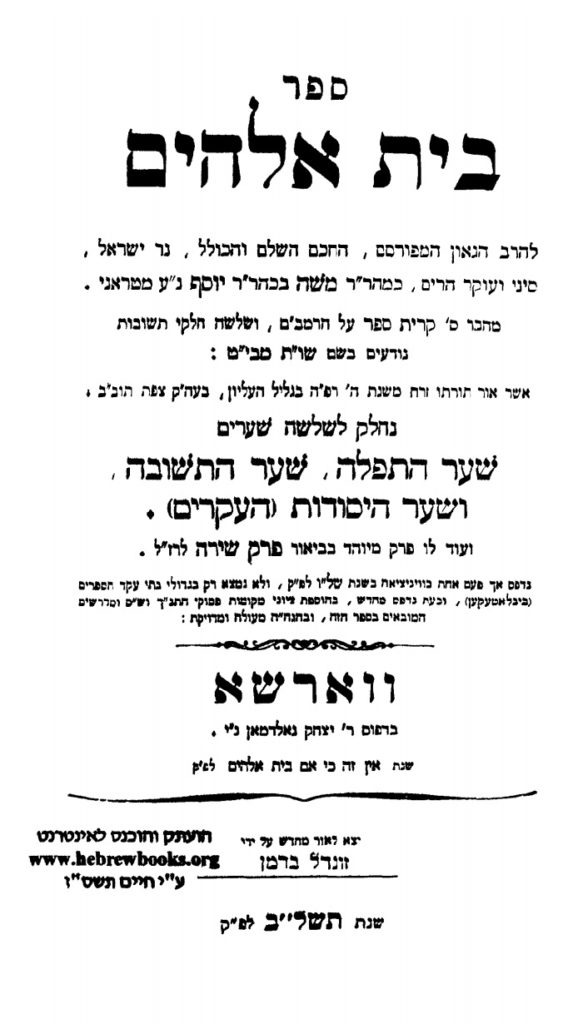
Interview with Rabbi Moshe Maimon About his Edition of R. Avraham b. HaRambam’s Peirush on Chumash
By Eliezer Brodt
Last year I wrote:
The second volume of R. Avraham b. HaRambam’s peirush on Chumash Shemot was released (832 pp.). This new edition was edited by Rabbi Moshe Maimon and was published in a beautiful edition by Machon Aleh Zayis. Last year, Rabbi Maimon published the first volume (678 pp.) I hope to publish very shortly, on the Seforim Blog, an interview with the author where he describes in greater depth his work on R. Avraham b. HaRambam, and his new edition of the Peirush.
The following interview with Rabbi Maimon is the fulfillment of the that promise. I would like to note that from time to time, I hope to include interviews of this nature with authors and publishers of books on the Seforim Blog.
A few weeks ago, the second slightly updated version of R. Avraham b. HaRambam’s Peirush on Chumash Bereishis was published. [If you want a PDF of the updates, email me at Eliezerbrodt@gmail.co]
Eliezer: Rabbi Maimon, can you briefly tell us a bit about yourself?
Rabbi Maimon : I was born in Monsey to a rabbinic family with Turkish-Sephardic roots that claims ancestry to the Rambam. After marriage to my wife Dena (nee Elbaz) of Cleveland OH, I settled in Lakewood where I learned and taught in BMG for many years. I currently reside with my wife and children in Jackson NJ, which may be the fastest growing Jewish community outside of Lakewood. I’m employed as the eleventh grade Rebbi in Yeshiva High School of Monsey, NY. Being a lifelong bibliophile drew me into professions such as teaching Holocaust and Jewish history classes in different yeshivahs, and consulting auction houses on antique sefarim and manuscripts. I also spend many hours a week editing and publishing various of works of Torah scholarship.
Eliezer: Can you give readers a brief profile of R. Avraham b. HaRambam?
Rabbi Maimon: Rabbenu Avraham was the Rambam’s only son, and the Rambam took great pride in him, extolling his virtues and predicting that one day R. Avraham would take his place among the Torah greats of the nation. R. Avraham was only 19 years old when his father passed away, yet his father’s careful tutelage had already prepared him to assume the Rambam’s mantle of leadership. He was immediately recognized as his father’s able successor in every endeavor – including holding the position of senior physician to the Sultan. By the time of his untimely passing at the age of 51, R. Avraham had left behind a number of original works, as well as various works dedicated to elucidating his father’s legacy.
Eliezer: What makes this peirush unique?
Rabbi Maimon: The Rambam wrote many works, covering all aspects of Torah sheba’al peh. Yet, he never wrote on Torah shebichtav (the work attributed to him on Megillat Esther is more than likely spurious; it is reminiscent of other Judeo-Arabic Midrashic compendiums that were popularly, if falsely, attributed to the Rambam’s school). True, his voluminous writings contain many rich insights from which various commentarial compendiums have been culled. But scholars have long recognized the dearth of a systematic exposition of the Chumash according to the Geonic pshat system informed by the Rambam’s sparkling ethical and philosophical system. Rabbenu Avraham’s peirush, hewn from the almost forgotten Geonic and Andalusian sources and permeated entirely with the spirit of the Rambam’s original thought, fills this void perfectly.
Eliezer: What was his Relationship with His father, the Rambam?
Rabbi Maimon: The Rambam’s influence on the Peirush is readily apparent from even a cursory acquaintance with it. Besides for the various peirushim that R. Avraham cites in his father’s name, and the many references to his father’s works, numerous individual peirushim are presented in obvious accordance with the Rambam’s shittah (such as the assertion that Yaakov’s encounter with the malach occurred in a dream). Yet, a closer look at the Peirush reveals that the Rambam’s influence on the Peirush is actually all encompassing. It is present in the way R. Avraham references various pesukim in Tanach, in his penchant for citing ma’amarei Chazal, his usage of Hebrew, as well as Judeo-Arabic phrases, and even his distinctive spelling of various words (such as ירושלם). Throughout R. Avraham’s works, the influence of his father is always present.
Eliezer: Any favorite pieces or themes to which you would like to draw readers’ attention?
Rabbi Maimon: One of the very unique features of R. Avraham peirush, which has almost no parallel in the writings of Rishonim, and was only popularized in recent generation through the Alter of Slabodka, is the view that the various individuals in Tanach whom we view as evil in accordance with their depiction in Midrashim, were actually not entirely wicked. According to this opinion, Eisav, Yishmael, Lot, Lavan, and even Korach and his cadre, all possessed higher spiritual capacities and inclinations that at times straddled the boundaries between good and evil. In line with this approach, R. Avraham asserts that the generation that left Egypt, with all their seeming lapses in the midbar, was a generation of tzadikim, whose spiritual level we can hardly conceive of. They alone are referred to as tzivot Hashem by the Torah; no other generation was ever given this appellation, no other compares to them.
In addition, Rabbenu Avraham’s sefarim opened a window for me to a fascinating but little-known world. I found them to be both illuminating and inspirational, full of his original insights and interpretations, and packed with penetrating mussar and exhortations to embrace a rational, yet mystical, form of chassidus.
Rabbenu Avraham’s oeuvre is also a thoroughly Maimonidean work, and through him one can gain a deep and comprehensive appreciation for the Rambam’s weltanschauung.
Eliezer: Are there any Halacha pieces in this work?
Rabbi Maimon: Many insights into R. Avraham’s halachic approach can be gleaned from the peirush, and this is even true of peirushim on the non-legal aspects of Chumash. Parshat Mishpatim in particular is replete with examples of R. Avraham’s pshat-based understanding of the Halacha, whereby he insists that the simple reading of a passuk be understood as binding to the extent that the rabbinic interpretation can accommodate it. As such, R. Avraham understands that the verse, “thou shall stay far away from falsehood,” is not merely an injunction about perjury in court, as it has been codified by the basic commentators, but also contains a basic admonition for anyone not to lie. There are many examples of this unique approach; I have expanded on this topic in the introduction to volume one.
Eliezer: As is evident from your work and notes, you compared him to other Rishonim, so how would you characterize R. Avraham’s peirush in terms of his comparison to other mefarshim?
Rabbi Maimon: In many respects, R. Avraham is certainly from the rodfei hapshat, to use a term the Ramban coined for the likes of the Ibn Ezra who always prefer the pshat of passuk over the allegorical commentaries proffered by midrashim and preferred by Rashi. Yet, R. Avraham also places a strong emphasis on the underlying intent of Torah’s narrative sections that teach moral and ethical imperatives, as well as the underlying intent of the legalistic sections, often couched in the rational basis for these sections (more on this introduction to the current volume). This synthesis can be found to some extent among other mefarshim like the Ralbag, and even the Ramban on some level, though the commentary of Radak to Bereshit is probably the most similar to that of R. Avraham.
Eliezer: Would you call him a mechadesh? What makes him unique?
Rabbi Maimon: Rabbenu Avraham’s close read and extreme common sense leads him to ask many original questions, and to offer many original interpretations. In some cases he anticipated explanations only offered centuries later by the acharonim, such as the Malbim and the Netziv, and in some cases he is the only source for his original explanations. A good sample of his original interpretations can be found in R. Sholom Spitz’ index of original peirushim appended at the end of each volume.
It must also be noted that the peirush is an invaluable repository for interpretations from his predecessors that would otherwise be lost to posterity. These include many peirushim from R. Saadia and R. Shmuel b. Chofni Gaon and a good number of peirushim quoted by R. Avraham in the name of his Grandfather, R. Maimon ha-Dayyan.
Eliezer: In light of your extensive seven plus years “immersed” in the world of RABH, do you have any thoughts or comments on his famous essay on Aggadah, especially in regard to his views about Chazal and science. More specifically, do you think that it’s a forgery as some have claimed, at the height of some controversies a few years back? Or you think the views expressed in this essay on Aggadah are consistent with his work on Torah?
Rabbi Maimon: In my separate work on that Essay on Aggadah, I endeavored to demonstrate conclusively that Rabbenu Avraham’s statements in the Essay are perfectly in line with the views of the Geonic-Andalasuian Beit Medrash. This is the school of thought espoused by R. Saadia Gaon and his followers through the era of the Kadmonim, who thrived in Muslim Spain until the middle of the 12th century when the Rambam and his family were force to flee. Rabbenu Avraham is a prominent example of this school of thought, and we find ample expression in the works of the Rambam and R. Saadia Gaon among others as well. The claim that some of these statements constitute a Maskilic forgery is ill-informed in my opinion. It is based on the notion that the ideas expressed in the essay are controversial and were created by Maskilim. However, once we realize that these ideas were the accepted norm in the Beit Medrash in which R. Avraham was reared, it becomes quite clear that there is nothing particularly controversial in R. Avraham’s presentation.
The decline of the Judeo-Arabic world caused much of the important works of the Geonic-Andalusian school to go lost. Additionally, the spread of Kabbalah and the influence of the Arizal were very influential in giving rise to a perspective contrary to the one expressed by R. Avraham, with the result that many people today are not aware that R. Avraham’s viewpoint ever held sway.
Yet, even if today we follow a different perspective, that should not mean that we must deny that previously it was Rabbenu Avraham’s perspective that ruled the day. I feel, and this is how I was taught by my rebbis, that our awe of the Rishonim and our fealty to them requires that we study their words and endeavor to understand them, even if we do not subscribe to aspects of their particular viewpoints. As my father writes in his beautiful introduction to the volume on Shemot, this was the way of Beit Hillel who would ponder the opposing views of Beis Shammai before declaring their own, and in fact, this is the very reason why we follow Beit Hillel.
The views in the essay are evident in the Peirush as well, even if they are not prominently featured due to the different nature of the work. For example, in Bereishit, R. Avraham speaks of the sciences as a body of accumulated knowledge, amassed over the generations. This fits well with his stated view in the Essay that the scientific knowledge of Chazal was of the sort that was available to savants at that time, and was not a separate branch of wisdom received by oral tradition from on High.
More importantly, throughout the Peirush, it is clear that R. Avraham’s approach to Aggadah is consistent with his statements in the Essay that Aggadic statements of individual members of Chazal were their own stated opinions and were not part of the authoritative oral tradition of Torah shebaal peh.
Eliezer: How long ago did you begin working on this project?
Rabbi Maimon: Already as a teenager, I was drawn to the Peirush of Rabbenu Avraham and began studying it then to the best of my abilities, though many times I found the Peirush too much to handle and I could not make much sense of it. The impetus to undertake the project of re-issuing it in a new edition came during a moment of inspiration one Rosh Hashanah, about seven years ago.
Eliezer: How did you, a Yeshivish-trained scholar get into this field of study in the first place?
Rabbi Maimon: At first, I thought I would just re-issue the Peirush, newly typeset and punctuated with little intrusion into the text and accompanied only by small marginal commentary. Yet, the more I got into the project, the more invested I became, and each subsequent recension saw the Peirush growing exponentially in terms of elucidation of the text in the notes, and also in terms of improving the translation, where I felt that doing so would enhance readability and comprehensibility.
Eliezer: Were you able to use Friedberg genizah in the course of your work?
Rabbi Maimon: The Friedberg Jewish Manuscript Society (https://fjms.genizah.org/) has been an indispensable resource for me. I have made frequent use of all its resources, and I feel my work has been immeasurably enhanced as a result. The Genizah portal was key in locating as of yet unpublished fragments of Sefer Hamaspik which were useful in elucidating corresponding passages in the Peirush, and the Judeo-Arabic corpus portal was especially crucial in establishing accurate translations for many of R. Avraham’s unique usages of Judeo-Arabic phrases.
Eliezer: Did you find any new passages of the Peirush?
Rabbi Maimon: To date, no corresponding fragments to the Peirush have been found in the Genizah, which lends credence to my contention in the foreword to Volume One that the Peirush was never disseminated. It appears that a lone manuscript (likely an autograph) made its way to Aleppo with R. David Ha-Naggid II, a fifth-generation descendant of R. Avraham, where it was copied over into what is today the sole surviving manuscript of the Peirush. Yet, in two instances I have located fragments of Hamaspik which contain references to the Peirush (incidentally, this was significant on its own because it helped shed light on the ongoing editing process of Hamaspik, which I detailed in the introduction to Volume One). In one of these instances, the reference pertains to a portion of Parshat Bereshit that is missing from our manuscript. I translated this piece and appended it to my addition. Other genizah fragments that were significant are transcribed in the notes where relevant. I shared my discovery of another one of the relevant Genizah fragment from Sefer Hamaspik with Prof. Friedman who was able to use it for an article of his that was recently published (see here).
Eliezer: What challenges were involved in translating the work from Arabic?
Rabbi Maimon: First, it was mostly troubleshooting. Anytime I felt that the language was cumbersome or obscure, I would attempt to re-translate key phrases to improve the flow and make it more understandable. At the same time, I would mine the publications of key Judeo-Arabic experts such as Professors Blau Friedman and Ilan for their observations regarding R. Avraham’s use of difference phrases. As I developed an appreciation and understanding of R. Avraham’s individual “flavor” in his language and syntax, I began to highlight his consistency in the usage of various terms and phrases in specific contexts, which was sometimes lost in the original translation. In all these cases I carefully noted the correction in the notes, typically with a brief explanation for the change.
Eliezer: Can you describe in short, your goal in your comments to the work?
Rabbi Maimon: My notes focus on all the aforementioned qualities for the Peirush. Basic sources have been incorporated into the text, but where some expansion was needed, I moved the discussion to the footnotes. <The rest of this response is detailed at length in the Overview>
Eliezer: Who did you consult while working on this project?
Rabbi Maimon: In the course of my work, I reached out to talmidei chachamim and experts from across the spectrum, and I have been careful to credit them all wherever appropriate. Professors Mordechai Akiva Freidman and Nahem Ilan, both of whom have spent years of research into the writings of Rabbenu Avraham, were particularly helpful in assisting with specific issues related to various translations I was working on. Rabbis Yaakov Wincelberg of Miami and Yehuda Zevald of Bnei Braq, both talmidei chachamim with ample experience in the Judeo-Arabic writings of the Rambam and Rabbenu Avraham, were helpful in this regard as well.
Rav Sholom Spitz, Rosh Yeshivah of Sha’ar HaTorah of Queens was quite gracious in sharing his personal notes on the Peirush and elucidating them when necessary, and I have incorporated these into my own notes with proper attribution.
In general, I have consulted a wide variety of published scholarship pertaining to research into Rabbenu Avraham’s writings, and I have referenced their contribution to my work, in accordance with the Rambam’s own dictum to accept truth regardless of its source.
Readers may also find Rabbi Maimon’s interview on The Seforim Chatter Podcast (here) interesting, and a nice review of Rabbi Maimon’s edition has recently appeared in the Fall issue of Jewish Review of Books here.
Purchasing information:
Email me at Eliezerbrodt@gmail.com for parts of the introduction and some sample pages of this special new work.
Copies are available for purchase at Biegeleisen (Brooklyn), Judaica Plaza (Lakewood), Tuvia’s (Monsey) as well as through many other fine retailers.
On can also purchase it online (or in person) through Mizrahi Book Store at this link.
To purchase a copy in Eretz Yisrael, contact me at Eliezerbrodt@gmail.com
The Book of Disputes between East and West
and West
additional items are added, some of them never before published. Also included
is a translated summary of major sections of Margaliot’s introduction, along
with comments and updates.
Hebrew manuscripts as indicated by Margulies in his
Hebrew edition.
translator.
People of the East sit while reading the Sh’ma. The
residents of the Land of Israel stand.
People of the East do not mourn for a baby [who has died]
unless he has reached 30 days [of life]. The residents of the Land of Israel
[mourn] even if he is only a day old. (He is like a fully-grown groom
[=man])
People of the East will allow a nursing mother to marry within
twenty-four months of the death of her baby. Residents of the Land of Israel
require her to wait twenty-four months, lest she come to kill her son.
People of the East redeem the
firstborn with twenty-eight (and a half) royal pieces of silver. Residents of
the Land of Israel use five shekels, which are equivalent to seven (and a
third) royal pieces of silver.
People of the East exempt a mourner [from observing laws and
customs of mourning, if the relation expired just] before a festival, even a
moment [before]. Residents of the Land of Israel only exempt a mourner from the
decree of seven days [of mourning] if at least three days have elapsed before
the festival.
People of the East forbid a bride
from [having relations with] her husband for the full seven [days] for she is
considered to be a menstruating as a result of the relations. The residents of
the Land of Israel (say) that since his removing of her hymen is painful [it is
an external wound and] she is permitted immediately.
The marriage contract of the
People of the East consists of twenty-five pieces of silver (and their dowry).
The residents of the Land of Israel (say) that anyone who [obligates himself]
to less than two hundred for a maiden or one hundred for a widow, is effecting
a promiscuous relationship.
People of the East permit [the
use of] an oven (during Passover), based on the source: “[We may] roll the
Passover [lamb] in the oven at sundown.” (Mishnah Shabbat 1:11) Residents of
the Land of Israel (say): “Disregard the Passover [lamb] since it is a
sacrifice, and we [even] desecrate the Sabbath on account of it.”
People of the East do not wash [=
ritual immersion] after experiencing a seminal emission or after relations
(since they reason that “we are in an impure land”). Residents of the Land of
Israel (do wash after a seminal emission or relations, and) even on the Day of
Atonement (for they maintain that those who have seen emissions should wash in
secret on the Sabbath and on the Day of Atonement) as a matter of course,
[which they learn] from the example of Rabbi Yosi bar Halafta, who was seen
immersing himself on the Day of Atonement.
People of the East permit gentile
butter [alternatively: cheese], (saying) that it cannot become impure.
Residents of the Land of Israel forbid it on account of (three things: because
of) milk which was expressed by a gentile (without a Jew observing him, because
of gentile cooking) and because of impure fat (which it might be mixed
with).
People of the East say that a
menstruating woman may perform all types of household duties except for three
things: mixing drinks, making the bed, and washing his face, hands, and legs.
According to the residents of the land of Israel, she may not touch anything
moist or household utensils. Only reluctantly was she permitted to even nurse
her child.
People of the East do not say
recite eulogies [alternatively: the prayer “tsidduk ha-din”] in
the presence of the dead (during the in-between days of the festival).
Residents of the Land of Israel do recite these before him.
People of the East do not rip up
a divorce contract. Residents of the Land of Israel rip it up. [Acc. to Lewin,
this may have originally referred to whether a mourner rips his garment during
the intermediate days of a festival.]
People of the East have mourners
come to the synagogue each day. Residents of the Land of Israel do not allow
him to enter, with the sole exception of the Sabbath.
People of the East do not clean
their posteriors with water. Residents of the Land of Israel do cleanse
themselves [with water], (based on the source:) A generation which considers
itself pure … [but has not cleaned itself from its excrement.] (Proverbs
30:12)
People of the East [permit one
to] weigh meat on intermediate days of the festival. Residents of the Land of
Israel forbid hanging it on a scale, even just to keep it away from rodents,
(based on the source: “One may not operate a scale at all.” – Mishna Beitza 6,
3)
People of the East circumcise
[babies] over water and then dab [the water] onto their faces, (from here: “and
I will wash you with water, [rinse your blood off of you, and anoint you with
oil]” – Ezekiel 16:9) Residents of the
Land of Israel circumcise over dust, from here: “Also, due to the blood of your
covenant have I sent your prisoners free from a pit with no water in it.”
(Zechariah 9:11)
People of the East (only) check
the lungs. Residents of the Land of Israel (check) eighteen types of disqualifications.
People of the East only recite a
blessing [= grace
after meals] over [a cup of] diluted wine.
Residents of the Land of Israel (will recite a blessing) when it is fully
potent.
When thurmusin [beans] and
tree-fruit are served to People of the East simultaneously, they recite the
blessing for fruit of the tree and set aside the beans. Residents of the Land
of Israel recite a blessing on the thurmusin, since everything is
included in “[the fruits of] the earth.”
On the Sabbath, people of the
East break bread on two loaves, for they expound: “a double portion of bread”
(Exodous 16:21) [which fell on the Eve of the Sabbath]. Residents of the Land
of Israel break bread exclusively on a single loaf, so that the [lesser] honor
of the Eve of the Sabbath will not intrude upon [the honor of] the Sabbath.
People of the East spread their
hands [= recite the priestly blessing] during fasts and on the on the ninth of
Av as part of the evening benedictions. Residents of the Land of Israel only
spread their hands during the morning services, with the sole exception of the
Day of Atonement.
People of the East will not
slaughter a newly-born animal until the eighth day. Residents of the Land of
Israel will slaughter even a newborn, for [they maintain that] the prohibition
of the eighth day applies only to sacrifices.
People of the East do mention the
word mazon [=nourishment] in the blessings of grace after dining.
Residents of the Land of Israel consider mazon to be [the] central
[component of the blessings] (for everything else is peripheral to mazon].
A ring does not sanctify marriage
according to people of the East. Residents of the Land of Israel consider it
[sufficient to] fully sanctify a marriage.
People of the East individually
redeem the second tithe and the planting of the fourth year. Residents of the
Land of Israel only redeem them in [the presence of] three [men].
The divorce contracts of people
of the East contain two ten-letter words [‘dytyhwyyyn’ and ‘ditiṣbyyyn’]. Those of the residents of the Land of Israel contain
three ten-letter words [the third is not known].
People of the East bless the
[bride and] groom with seven blessing. Residents of the Land of Israel recite
three [blessings, which have been forgotten].
According to people of the East,
the prayer leader recites the priestly blessing (before the congregation) [in
the absence of Kohanim]. Residents of the Land of Israel do not (allow the
prayer leader to recite the priestly blessing, for they expound [from the
verse]: “So they shall put my name” (Numbers 6:27) that it is strictly
forbidden for anyone to “put” the holy name), unless they are Kohanim.
People of the East forbid bread
baked by a gentile, but will consume gentile bread if a Jew threw a piece of
wood into the fire. Residents of the Land of Israel forbid it (even with the
wood, for the wood neither forbids nor permits. When are they lenient? In cases
when there is nothing [else] to eat, and already a day or two have passed
without consuming anything. It was thus permitted to revive his soul so that
his soul should be maintained, but only from a [gentile] baker who has never
brought meat into his bakery, even though it considered a [separate] cooked
dish.)
People of the East carry coins
from place to place on the Sabbath. Residents of the Land of Israel (say) that
it is forbidden to even touch them. Why? Because all types of work are done
with them.
People of the East recite: “meqadesh
ha-shabbat,” [who sanctifies the Sabbath]. Residents of the Land of Israel
recite: “meqadesh Yisrael v’yom ha-shabbat” [who sanctifies Israel and
the Sabbath day].
Among people of the East, a
disciple does not greet his master with: “shalom”. Among residents of
the Land of Israel a disciple greets his master [by saying]: “shalom
unto you, rabbi.”
According to People of the East,
if a yevama [=a woman automatically betrothed to the brother of her
deceased husband] should marry [another man] without halitza [=a legal
procedure which frees her from this betrothal] and her yavam [=the
brother] should return from overseas, he performs the halitza (to her)
and she remains with her (second) husband. Residents of the Land of Israel
remove [=forbid] her from both of them.
People of the East exempt a yevama
from halitza [only] once the baby is thirty days old. According to
residents of the Land of Israel, even if only the head and most of the body
emerged alive, and even for only a moment (before the father died), she is
fully exempt from halitza and from yivum [and may remarry
freely], (for they expound: “If he has left seed, she is exempt.”)
People of the East turn their
faces (towards the congregation) and their backs towards the aron
[=closet containing the Torah scroll]. Residents of the Land of Israel [are
positioned with] their faces towards the aron.
According to people of the East,
one [scribe] writes the divorce contract and another signs along with the
writer. Among residents of the Land of Israel, one writes and two [others]
sign.
People of the East marry the
[bride and] groom on Thursday. Residents of the Land of Israel [marry] on
Wednesday, (according to the law: “a maiden marries on Wednesday.” – Mishnah
Ketubot 1:1)
People of the East perform labors
on the intermediate days of the festivals. Residents of the Land of Israel do
not do them at all. Rather, they eat and drink and exert their [energies in
learning] Torah, (for the sages have taught that: “it is forbidden to perform
labors on the intermediate days of the festivals.”)
People of the East begin [the
initial act of] intercourse with genital insertion in the natural manner.
Residents of the Land of Israel use a finger [to break the hymen and enable
conception through the first act of intercourse. Alternatively, to verify
virginity.]
People of the East observe two
festival days. Residents of the Land of Israel observe one, (as per the
commandment of the Torah.)
People of the East forbid the
Kohanim from blessing the congregation if they have long, unkempt hair.
[Alternatively: with their heads uncovered]. Among residents of the Land of
Israel Kohanim do () [in fact bless the congregation with long, unkempt hair.]
People of the East whisper the
eighteen benedictions while praying. Residents of the Land of Israel [pray] out
loud, in order that people should become familiar with them.
People of the East count the Omer
only at night. Residents of the Land of Israel count during the day and at
night.
People of the East circumcise
with a razor. Residents of the Land of Israel use a knife.
(People of the East mix a remedy
for circumcision from donkey dung and cumin. The residents of the Land of
Israel do not do this.)
According to people of the East,
the prayer leader and the congregation read the weekly [Torah] portion [of the
annual cycle] together. Among residents of the Land of Israel, the congregation
reads the weekly portion and the prayer leader [reads] the weekly [triennial]
orders.
People of the East celebrate Simhat
Torah [the festival of the completion of the Pentateuch] every year.
Residents of the Land of Israel celebrate it once every three-and-a-half years.
People of the East bless the
Torah while it is being [re-]inserted [into the Aron]. Residents of the
Land of Israel bless both while it is being inserted and while being removed,
(according to scripture and law, as per the verse: “and upon its opening the
entire nation stood.” – Nehemia 8:5)
(According to people of the East,
a Kohen may not bless the congregation until he has married. Residents of the
Land of Israel [allow him to] bless even before he has married a woman.)
People of the East do not carry a
palm branch [when the first day of the festival of Tabernacles falls] on the
Sabbath. Rather they take a myrtle branch. Residents of the Land of Israel
(carry both the palm and the myrtle on the first day of the festival which
falls on the Sabbath, according to the verse:) “And you should take for
yourselves” (Leviticus 23:40) [which is expounded to include:] “on the
Sabbath.” (Bavli Sukkah 43a)
(Residents of the Land of Israel
permit the consumption of daytra fats. Residents of Babylon forbid it.)
People of the East permit [the
consumption of] broad beans which a gentile has boiled, and also locusts.
Residents of the Land of Israel forbid it, (since they mix their boiled meat
with their boiled fruits [= produce].)
People of the East do not blow
sirens before the onset of the Sabbath. Residents of the Land of Israel sound
three sirens.
According to people of the East,
Kohanim lift their hands [to bless the people] three times on the Day of
Atonement. Residents of the Land of Israel [bless] four times on that day: shaharit,
musaf, minha, and neila.
(*). Residents of Babylon permit
[the consumption of] milk [from a cow] which a gentile has milked, [even]
without a Jew having watched him, provided that there are no unclean animals in
his flock. Residents of the Land of Israel forbid its’ consumption. (This item
is found in only one manuscript. Thus, Margulies doubts whether it is included
in the original collection; however, he maintains that it is historically authentic
and thus included it in the commentary section.)
important to distinguish between them.
list collections, the main body of the present work.
manuscript versions of the list after its “publication,” during the Geonic
period or shortly thereafter. This includes items 46, 50, and 56, and possibly
others. Since they may actually be remnants of the original list and do appear
in the manuscripts, Margulies and Lewin did include them in attempting to
produce a critical version of this text itself. [Elkin’s 1998 Tarbiz article
hints that the original work may have been smaller than Margulies supposed and
hence more of the text translated above would fall into this category.]
and provide direct testimonial evidence for the historical validity of these
distinctions. They could conceivably have been included in the original list,
but for one reason or another were not. This describes Lewin’s additions, and
the first section of Miller’s additions.
literature. Kaftor w’Ferah seems to have pioneered this field, picked up
and extended by Miller and others. It should be noted that these items should
all be evaluated separately, as they do not necessarily constitute testimonial
evidence and rather, in some cases, may be merely theoretical.]
(1878)
Masekhet Sofrim:
People of the East recite kaddish and borkhu
with ten men. People of the Land of Israel [recite] with seven (10:7)
People of the East
respond “Steadfast are you” after the reading of the prophets while sitting.
Residents of the Land of Israel [respond] while standing. (13:10)
People of the East
fast before Purim. People of the Land of Israel [fast] after Purim, based on
Nikanor. (17:4, from Tosefta)
People of the East recite Kedusha each day. People of
the Land of Israel only recite it on the Sabbath and Festival days. (Tosafot
Sanhedrin 37b ad. Loc. Mknp, citing Geonim
by Miller from Kaftor w’Ferah of Rabbi Ashtori HaParḥi (Isaac HaKohen ben
Moses, 1280-1366), deduced from talmudic sources:
People of the East do not ordain judges. People of the Land of
Israel do ordain. (Sanhedrin Chapter 1)
People of the East conclude [the threefold benediction]: “for
the land and the fruit.” People of the Land of Israel [conclude]: “for the land
and its fruit” (Berakhot, 6th chapter)
People of the East first plow and then sow seeds. People of
the Land of Israel first sow and then plow. (Sabbath, 7th chapter)
People of the East do not chase after idol worship [in order
to destroy it]. People of the Land of Israel do chase after it. (Sifre Devarim
Re’eh 61)
People of the East do not collect fines. People of the Land of
Israel do collect in court. (end of Ketuvot ch. 3…)
People of the East permit a brown citron [for use among the
four species]. People of the Land of Israel forbid it. (Sukkah, ch. 3)
People of the East grind with a small mortar on a
festival day. People of the Land of Israel forbid it (Beitza, ch. 1)
People of the East [formally] begin the meal [and apply its laws]
once the belt has been released. People of the Land of Israel [begin] once the
hands have been washed. (Shabbat, ch. 1)
People of the East maintain that one who purchases a slave from a
gentile, who does not wish to become circumcised [immediately], may postpone
and continue deliberations up to twelve months. People of the Land of Israel do
not allow any delay lest sanctified food become defiled through contact with
him. (Yevamot 48b)
People of the East do not transfer bones of the dead from little
caves to small holes in caves [where presumably whole cadavers could not fit,]
in order to bury other dead. People of the Land of Israel do transfer [bones].
(Rav Hai Gaon, as cited by Ramban, in Torat
ha-adam)
People of the East first marry and then learn Torah. People of the
Land of Israel learn Torah first and then marry. (Kiddushin 29b)
People of the East recite nineteen blessings. People of the Land
of Israel recite eighteen blessings. (Rabbenu Yeshaya ha-Zaqen,
RID, in
his commentary to Ta’anit, cited here)
People of the East do not mention “dew” during the summer. People
of the Land of Israel do mention it. (PT Ta’anit ch. 1, Berakhot ch. 5)
People of the East are not concerned with “pairs.” People of the
Land of Israel are concerned. (Pesahim 110) [in all manuscript and printed
versions of the Talmud known to me it appears in reverse and was apparently
copied by mistake here.]
like to present some very special additions of Rabbi Benjamin Wolf Singer
(1855-1930). R. Daniel Sperber published a
volume of his hiddushim/novella. See his biography of the author
here and here. Much more about him later. I hope to devote a future
post to Rabbi Singer and his brother.
have never before been published, and were found in the form of his handwritten
notes in the back of his personal copy of Miller’s edition of the work, now
housed in the Bar Ilan University central library. The notes follow the extra
hiluqim of Kaftor v’Ferah, ShIR, and Miller which we have just translated
above. Apparently, they inspired Rabbi Singer to continue their work on the
very same page! His notes look like this:
What follows is the best I
could do for a transcription. All of the main points are clear, but not all of
the references. Even this I couldn’t have done without a lot of assistance from
my friend R. Yehezkel Druk, who is responsible in no small part for the many
corrections and additions in Moreshet L’Hanhil’s volumes of the new Friedman
Shulhan Arukh.
readers viewing at home can decipher some more of this. If you can, please
comment! A translation and more follows.
של ר’ בנימין זאב זינגער
מנהגים?] דבבבל לא קפדו אטבילת קרי עיין ברכות כ”ב. ובא”י קפדו. ע’ ירושלמי
שם פ”ג ה”ב, תמן נהגין כו’ ע”ש.
מריעין, שבת לד: מנהג אבותיהן בידיהן. ע”ש.
ובא”י לא. תענית כח: מנהג אבותיהן בידיהן. ע”ש.
(חולין) פסחים צג: וצ. ולהיפך בא”י קרו רק ד’ מילין. עי’ ירושלמי ברכות פ”א
ה”א ושם נסמן [וירושלמי שבת סוף פרק קמא עד ד’ מיל ועיין יומא כ:] ואותה ?הכחיי?
עצמה דרבי יהודה דאיתא בפסחים פרסא היא בירושלמי במילין. והא דבחולין קכב: עד ד’ מיל
דאמר בשם רבי ינאי ורשל”ק [ריש לקיש] בני ארץ ישראל. ועי’ ברכות טו ע”א [אבל
לאחוריה אפילו מיל אינו חוזר [ומינה] מיל הוא דאינו חוזר הא פחות ממיל חוזר] סוטה
מו: [וכמה א”ר ששת עד פרסה ולא אמרן אלא רבו שאינו מובהק אבל רבו מובהק שלשה
פרסאות] סנה’ ה: [ותניא תלמיד אל יורה הלכה במקום רבו אלא אם כן היה רחוק ממנו שלש
פרסאות כנגד מחנה ישראל] סוכה מד: [אמר אייבו משום רבי אלעזר בר צדוק אל יהלך אדם
בערבי שבתות יותר משלש פרסאות] ושם נראה דראב”ץ [=רבי אלעזר בר צדוק] בבלי
היה מדאמר בלשון פרסי ועי’ תו'[ספתא] ב”ק פ”ח מ”ט [אין פורסין
נשבין ליונין אלא אם כן היה רחוק מן היישוב שלשים ריס] ל’ ריס (והיינו ד’ פרסי) ועי’ נדה כד: תניא אבא שאול אומר ואי תימא
רבי יוחנן כו’ ורצתי אחריו ג’ פרסאות
ד’ מפתחות ביד הקב”ו ולדעת הבבלי ג’ עיין ריש תענית ומאיר עיני חכמים דף מב: וכיוצא
בזה ברכו’ ג’ ע”ב רבי אומר ד’ משמרות רבי נתן ג’ ונראה שבא”י קיימו מספר
ד’ ובבל ג’
דראש השנה תמן חשן [תמן חשין לצומא רבה תרין יומין] ? יומא רבה ב’ יומי’ ועי’ סה”ד [סוף הלכה ד’] שאבוה… בשמת ע”י
זה [פני משה מסכת ראש השנה פרק א: “תמן חשין לצומא רבא תרין יומין. בבבל היו
אנשים שחששו לעשות מספק ב’ ימים יה”כ ולהתענות ואמר להן רב חסדא למה לכם
להכניס עצמיכם למספק הזה שתוכלו להסתכן מחמת כך הלא חזקה היא שאין הב”ד
מתעצלין בו מלשלוח שלוחים להודיע לכל הגולה אם עיברו אלול ואם אין שלוחין באין
תסמכו על הרוב שאין אלול מעובר. ומייתי להאי עובדא דאבוה דר’ שמואל בר רב יצחק
והוא רב יצחק גופיה שחשש ע”ע וצם תרין יומין ואפסק כרוכה ודמיך. כשהפסיק מן
התענית ורצה לכרוך ולאכול נתחלש ונפטר. ועל שהכניס עצמו לסכנה מספק לא הזכירו שמו
להדיא ואמרו אבוה דר’ שמואל בר רב יצחק”.]
ה”א כך אינון (בבלאי) נהגין גביהון זעירא לא שאל בשלמיה דרבה
פ”ד ה”א ושביעית פ”א ה”ז ועיין שם פ”ד ה”א או’ רבי
יוחנן לרבי חייה בר בא בבלייא תרין מילין סלקון בידיכון מפשיטותא דתעניתא וערובתא
דיומא שביעייא. ורבנן דקיסרין אמרין אף הדא מקזתה ועי’ בבלי סוכה מד. ??
בירושלמי עי’ ?יבמות? קג ע”א
ירו’ אמר אר”י ב”ר נהיגין תמן במקום שאין יין ש”צ עובר לפני התיבה
ואומר ברכה אחת מעין שבע וחותם במקדש ישראל ואת יום השבת. ועי’ ?רא”ש? ?? י”ב
שלא מצאנו כן בבבלי
נהגי כרבי ישמעאל ברכו א”ה המבורך – וירושלמי פ”ז דברכות ה”ד [נדצ”ל:
ה”ג] נראה דבא”י כר”ע
ה”ד [נדצ”ל: ה”ג] נראה דבא”י כשקראו כהן במקום לוי לא בירך
שנית ובבבל מברך. עיין שם. תוס’ גיטין נט: [ד”ה כי קאמרינן באותו כהן, והשווה
תוספת לוין סו’ י”ג וי”ד]
נו: בענין ברוך שכמל”ו [שם כבוד מלכותו לעולם ועד] דבא”י אומרין אותו
בקול רם מפני המינין ובנהרדעא בחשאי שאין שם מינין מב.. לר.. גבי ר’ אבהו ב’. [אולי
הכוונה לצטט ויכוח של מין עם ר’ אבהו.]
- In Babylon they were lax regarding the requirement
for one who experienced seminal emissions [Ba’al Qeri] to immerse
himself in a mikva. In the Land of Israel they were stringent. - In Babylonia they commence the Sabbath in the midst
of the blowing of the shofar teru’ah — They retain their fathers’
practice. (Sabbath 35b) - In Babylon, they read the hallel on the day of
the New Moon. In the land of Israel they did not (Ta’anit 28b, “They
retain their fathers’ practice”). - In Babylon [a large unit of length] is referred to as
a “parsa.” On the other hand, in the land of Israel, it is referred
to as “four mil.” [miles] - According to the understanding of the sages of the
Land of Israel there are four keys in the hands of the holy one, blessed
be he. According to the understanding of the sages of Babylon, there are
three. - In Babylon there were sages who fasted two Days of
Atonement due to uncertainty as to on which day the new month begins. - The Babylonians do not greet [rabbinic authorities],
so Z’eira [respected their custom and] did not greet Rabbah when he
visited. - Rabbi Yohanan said to Rav Hiyya bar Bo: “The
Babylonians have brought two [customs] up with them: full prostration on
the fast days and the taking of the willow on the seventh day [of Sukkot].
The Rabbis of Caesarea added bloodletting [to the list] as well. - In the Babylonian Talmud we find: “Yosef.” In
the Jerusalem Talmud: “Yosi.” - (7) “There, in Babylon, when there is no wine, the
prayer leader descends to the bima and recites the one blessing in
place of seven and concludes with meqadesh Israel v’et yom hashabbat.”
However, in the Babylonian Talmud we do not find this. - (8) In Babylon the custom followed Rabbi Ishmael in
reciting “borkhu et hashem hamevorakh.” It appears that in the Land
of Israel they followed Rabbi Akiva [instead]. - (9) Is seems that in the Land of Israel, when a Kohen
was called to the Torah reading in the absence of a Levite, he would not
recite a second blessing. In Babylon he recites the benediction. - (10) In the Land of Israel they recite “Barukh
shem kavod malkhuto l’olam va’ed” out loud because of the heretics. In
Nehardea they whisper it since there are no heretics there.
Latin after tet. This is probably because the tet resembles a
six, so he followed it up with seven. Remember, these were just personal notes,
not intended for publication, obviously. Rabbi Singer’s mind was on more
important things, as the erudition of his notes speaks for itself. Anyway, who was Rabbi Singer? We’ll return to that at the end of
this post. Here in the middle of the work there is a citation apparently to a
Yalkut in Parshat VaYeshev, but I can’t make heads or tails of it.
Appendix to
Lewin’s edition. The articles originally appeared in Sinai 10 and 11.
Zinger, Lewin also noted the additional Hiluqim in Miller’s volume and
decided to add more. Instead of adding exclusively from Talmudic sources, Lewin
leaned more on Geonic sources, of which he was the great master. Some of these additions are quotations, and
some Lewin formulated himself.
After completion [of the section from the public reading], the
reader blesses: “Blessed are you … ruler of the world, rock of ages, righteous
of all generations, the steadfast deity …” Then the congregation promptly
rise and say: “Steadfast are you, he, the Lord, our G-d, and steadfast is your
word. Steadfast, living, and lasting is your name and it’s utterance. Always
will you rule over us forever and ever.” This is one of the disputes between
the sons of the East and the sons of the West, for the sons of the East respond
while sitting whereas the sons of the West [respond] while standing.
In Zoan, Egypt, which is called Fustat [today part of old
Cairo], there are two synagogues: one for the people of the Land of Israel, the
al-Shamiyin congregation [=the “Yerushalmi”, this name is
still used today to refer to a Jewish Yemenite branch] (It is named after
Elijah, of blessed memory [?, see below]). The other is the congregation of the
people of Babylon, the al-Iraqiyn congregation. They do not observe the
same customs. (Selections from Yosef Sambari, Seder HaHakhamim, Neubauer
I, p. 118. On page 137 it states that the congregational synagogue then still
in use was built before the destruction of the second temple in Jerusalem.)
One, (the people of the Land of Israel) stands during kedusha, while the
other, (that of the residents of Babylon) sit during kedusha. (Rabbi Avraham
ben HaGra, Maspiq l’ovdei hashem. In
the 1989 edition published by Nissim Dana, page 180, the opinions appear in
reverse order)
It is written in the responsa of the Geonim that the residents
of the Land of Israel recite kedusha only on the Sabbath, since it is written
[in Isaiah 6:2] that the Hayot have six wings. Each wing sings praises
corresponding to the days of the week. When the Sabbath arrives, the Hayot say
to the holy one, blessed be he: “We do not have another wing!” He replies to
them: “I have another wing which sings praises to me, as in (Isaiah 24:16):
“From the end [literally: wing] of the world we have heard song.” (Tosafot
Sanhedrin 37b, ad. loc. Mikanap, Miller 59)
We do not recite kadish or borkhu with
any less than ten [men]. Our sages in the west recite it [in the presence] of
[even] seven [men]. They explain themselves according to the verse: “bifroa
p’raot …” (Judges 5:2) according to the number of words [in the verse = seven.
See also verse 5:9.] Some recite it with even six [men] since [the word] borkhu
is the sixth [word in the verse]. (Some base this opinion on Psalms 68:27,
which contains six words – Avudraham)
R.
Joseph said: How fine was the statement which was brought by R. Samuel b. Judah
when he reported that in the West [Israel] they say [in the evening], “Speak
unto the children of Israel and thou shalt say unto them, I am the Lord your
God, True.” (Berakhot 14b, Soncino translation). Still now, several cities [alternatively:
regions] in the Land of Israel observe this custon in the evening. They reason
that shema and v’haya im shamoa, [the first two paragraphs], are
observed both day and night, whereas va’yomer is only observed during
the day [as per Mishna Berakhot 2:2]. (Hilkhot Gedolot 1, Hilkhot Berakhot 2,
p. 37, second Hildesheimer edition)
The
sages of the Land of Israel behave as follows: they recite the evening prayers
and later they read the Shema in its proper time. They are not concerned
about connecting [the blessing ending with] geula to the evening
prayers. (Sha’arei Teshuva 76, See Otzar HaGeonim for a list of numerous
rishonim and collections who cite this responsum.)
Conserving
a festival which begins after the Sabbath, it is still maintained in the Land
of Israel that a fourth blessing is recited separately… but as for us, Rab
and Samuel instituted for us a precious pearl in Babylon: “Just judgements and
true Torah.” (attributed to Rav Hai Gaon, Otzar HaGeonim Berakhot, Perushim p.
46)
On
the final day of the festival miṣwot
u’ḥuqim and bekhor are read (Megilah 31a, acc. to mss.
Munich and rishonim). Rav Hai Gaon explains this passage as a mnemonic sign: 1.
There are those who read “for this miṣwa” (Deut. 30:11) and this is
still read in the Land of Israel. 2. There are those who read from “im be’ḥuqotai
until “qomemiut.” (Lev. 26:3-13) 3. There are those who read: “kol
ha’bekhor” (Deut 15:19). We read “kol ha’bekhor.” (various
sources, Otzar HaGeonim Megillah, p. 62, no. 230)
Upon
the conclusion of the Day of Atonement, residents of the Land of Israel blow qashraq
[=tashrat, a serious of various tones]. Residents of Babylon only
sound one plain blow in remembrance of the jubilee. [From here until the end,
Lewin composed most of the statements himself based on the sources he
provides.]
The
three fast days – Ta’anit Esther – are not observed consecutively, but
rather, separately: Monday, Thursday, and Monday. Our sages in the Land of
Israel were accustomed to fast after the days of Purim, on account of Nicanor
and his company. Also, we delay [unpleasant] payment and do not predicate it.
(Masekhet Sofrim 17)
Residents
of the Land of Israel would not actually fully prostrate themselves on fast
days. Residents of Babylon would actually fully prostrate themselves.
Residents
of the Land of Israel did not read Hallel at all on the day of the New
Moon. Residents of Babylon read it while skipping sections [an abbreviated
version].
Among
residents of the Land of Israel, the first reader from the Torah recites the
beginning blessing, and the last reader recites the final blessing. According
to the residents of Babylonian, each and every reader blesses before and after
the reading, since [members of the congregation may be] coming and going
[during the readings and thus miss one or the other].
In
the absence of a Levite, residents of the Land of Israel would call a second
Kohen to read from the Torah in his place. Residents of Babylon would call up
the very same Kohen again who just read the first portion.
Residents
of the Land of Israel permitted writing [Torah] scrolls on the skins of pure
animals even if they were not slaughtered according to specifications of
dietary laws. Residents of Babylon forbade this since they were not
slaughtered.
introduction
translated. However, only a summary of chapter 2 and the text of the original
work itself have been translated here.]
close of the Talmudic period until the close of the Geonic period
The end of the Talmudic Period
The Geonic period
Attitudes towards divergent
customs until the Geonic period
Attitudes of Babylonian Geonim to
the customs of the Land of Israel
the work and its use by Rabbinic and Karaite Jews.
The name of the work
The author, his period, and
locale
Purpose of the work
Characteristics and scope of the
book
Language and sources
Legal sources and historical
development of the disputes
Use of the book by Geonim
Use of the book by Rabbinic legal
authorities
Use of the book by Karaites
Scholars who have studied the
work
the Book of Disputes, Printed Editions and Manuscripts
Text versions, families and
formation
The first group
The second group
The third group
This edition’s presentation and
stemmatic diagram of source relationships
The varying order of the disputes
in all of the versions
The text
[Systematic Commentary]
work and is not translated at this time
The name of the work
cited by various Rishonim. Virtually every single one has a different title for
the work – all variations on the same descriptive theme. [Both the variation in
titles and the descriptive nature suggest that the work may have been not only
anonymous, but also untitled. It was simply a list drawn up by a sage, copied
and possibly added to.]
in the title, including the
first printed edition (1616, starts at middle of page)
included at the end of Bava Kamma in Yam shel Shelomo, by the
great Ashkenazi sage Rabbi
Solomon Luria, better known as Maharshal (1510-1573).
Maharshal’s edition, it led some to believe that the Maharshal himself
collected it, a point justly disputed by Rav Avraham ben HaGra [see below].
based on the root ḥlp, which only appears in a few secondary sources like
Ravya, Rosh, and Tur.
the selection of this root was designed to minimize the controversial nature of
the work. As Lewin stresses in his introduction, this is a work of divergent
customs, not disputes regarding actual Torah law. The reader can evaluate both
titles, which have themselves both been translated here as “alternates”. In
this writer’s opinion, both of the roots may be “alternate” variations of one
original word (probably from the root ḥlq) as the letters peh
and qof are graphically similar. A supporting example of variation
between these very same words is found in The Epistle of Rav Sherira Gaon in
the “French” manuscript branch. See Lewin’s
edition, page 22, left column, note 19. There you will find a manuscript with
precisely such an alternate reading.
records divergent legal opinions is referred to as kḥilaf. See
here, beginning of intro. On the other hand, an 11th
century Karaite work is entitled Ḥilluq ha-qara’im we-ha-rabbanim]
identity.
Rabbi
Abraham ben Elijah of Vilna, the son of the famous GRA, in
his work Rav
P’alim, p. 126. He was uncertain as to whether
the work was authored by amoraim or in a later period. [His chief concern here
is disproving the erroneous theory that the Maharshal himself collected
the work from various rabbinic sources.] Miller was able to hone in closer,
from the savoraim at the close of the Talmudic period to the beginning
of the Geonic period. Margulies provides considerable evidence that the work
was composed around the year 700. That is, after the Arab conquest and before Rav Yehudai Gaon.
with Babylonian customs through travel to Babylon. Western Aramaic and Western Hebrew forms abound. In fact, the very
composition in Hebrew suggests composition in the land of Israel, the language
of the “Minor”
Talmudic tractates produced there during the Geonic
period, as well as Hebrew translations of Eastern Aramaic Babylonian Geonic works themselves. Margulies points out
that since Miller’s publication, new evidence has emerged from the Cairo geniza
which shows that after the Arab conquest, Babylonian Jews migrated to the Land
of Israel and formed their own separate congregations in Tiberias, Ramla, and Mivtzar Dan (Panias-Banias), with the most likely speculative location for our
author being Tiberias, which was a native Torah center that may have already
boasted a Babylonian community during the Talmudic period.
Babylonian side in the dispute between the two great Torah centers. He points
out that many more explanations are offered in support of the
“Yerushalmi” side than the Babylonian. Later, Miller appears to
backtrack and seems to conclude that the work is simply meant to impartially
catalog the various discrepancies.
orientation, but understands the purpose more subtly. Rather than taking a
confrontational stance, the work merely seeks to explain and rationalize the
local customs and decisions to the new Babylonian immigrants who were not aware
or respectful of the locals. No attempt is made per se to reject the validity
of the Babylonian customs themselves and at times the author troubles himself
to explain them only.
the book
in cataloging all of the items of dispute. According to Miller, the complete
version of the work has not yet been transmitted to us. [This understanding may
underly many efforts to expand on this list, discussed in the Appendix.]
Margulies disagrees, on the basis of the numerous manuscript examples at his
disposal. According to him, the author never meant to compile an exhaustive
list.
composed in “Yerushalmi” Hebrew. A list of words and phrases is
provided by Margulies along with parallel examples from Talmudic and Geonic
“Yerushalmi” literature. He supposes that many more parallels would
be found in halakhic works from the period and region which are no longer
extant.
considerable philological interest especially regarding Geonic material in
Hebrew which may be of uncertain provenance.]
development of the disputes
documented partially in other Talmudic and Geonic literature. As would be
expected, there is a high level of correspondence between the
“Yerushalmi” side and the Jerusalem Talmud; also, between the
Babylonian side and the Babylonian Talmud.
transmitted unresolved to both regions and eventually decided differently in
each locale in a purely internal manner. Conversely, sometimes entirely
external factors may drive the discrepancies in later periods as well.
Geonic period until the end of the period of the Rishomin signified by the publication of the Shulhan Arukh. In
general, the Babylonian side prevailed as their hegemony increased, but in a
number of cases, the position native to the Land of Israel in fact dominated,
especially when it did not contradict any explicit statements in the Babylonian
Talmud. This tradition was especially strong in Tsarfat and Ashkenaz (France
and Germany) as opposed to Sepharad (Spain), which historically remained tied
to the Babylonian Geonim. The influence of the Land of Israel side is
especially noticed in the house of study of the great Rashi and his students (items 2, 3, 6, 7, 10, 13, 14, 18, 19, 25, and more).
since to a large extent geographic boundaries were erased by the free transfer
of books from one region to another and a great amount of cross-fertilization
occurred. Nevertheless, it is noted that a number of disputes remain with us to
this very day between Ashkenazi and Sepharadi communities.
disputes are addressed, but apparently not through direct exposure to the work.
It is more likely that the inquirers from the Land of Israel or North Africa
might have been motivated in their queries by exposure to concepts from the
work.
gather material from this work into their nets. The collection known as Sha’are Tsedeq includes no fewer than eleven items culled from the
disputes.
to Babylonain Geonim themselves, but it is difficult to rely on any of these
attributions and most were clearly added by the later compiler.
by Rabbinic legal authorities
never cite it or it’s contents. Others who do cite it generally cite only
sections known to them through second or third-hand rabbinic sources.
much more pronounced than in Spain. The work seems to have reached different
locations at different times. By the 14th century the work seems to
have been lost for the most part, as only citations from by previous
authorities are ever quoted.
it’s brevity. [For example, the usual explanation for the grouping of the
twelve prophets in one scroll, and today in one volume, is so that the small
books would not become lost.] However, a more compelling reason appears to be
the negative impression that the work made on certain authorities, most
notably, Nahmanides, Ramban (Avodah Zara 35b). It was (correctly) perceived
that the work contains material which contradicts the Babylonian Talmud,
already considered supremely authoritative. Methods of study which stressed a
proper historical understanding of all legal points of view would become common
in rabbinic circles well before the modern period, but at the time they were
not yet developed. If an opinion could not be utilized for determining the
halakha, it was not deemed worthy of further inquiry. Nahmanides is the only
early Spanish sage who even mentions the work, so it is not at all surprising
that he considers it outside the pale of legal precedent.
Karaites received from it and quoted from it. They may have suspected the work
of being a Karaite forgery.
include: Rabbi Abraham ben Isaac of Narbonne (Eshkol), Rabbi Isaac ben
Abba Mari of Marseilles (Ittur), and Rabbi Abraham ben Nathan of Lunel (Manhig).
The textual versions cited by the Provencal sages are similar to those
found in the Geonic Responsa collections which appear to be most original.
citations indicate that they were generally quoting secondary and tertiary
rabbinic sources rather than the work directly. The sages include: Rabbi
Eliezer bar Nathan of Mainz (Ra’avan, Even Ha-Ezer), Ravya, Tosafot, Rabbi
Eliezer of Metz (Yereim), Sha’arei Dura, Machzor Vitry.
virtually disappear. A most notable exception is Rabbi Ashtori HaParḥi (Isaac
HaKohen ben Moses, 1280-1366) in his Kaftor w-Ferah, who traveled from
France to the Land of Israel, on which his work focuses. He cites the work
according to versions not attested to otherwise among French sages.
[Furthermore, he took an interest in expanding upon the principle of the work
as seen in the additions which Miller culled from it. See below after the main
body of the translation.]
and Rabbenu Asher ben Yehiel (Rosh) mention the work haphazardly.
Other sages who cite the work include Rikanati, Tashbatz, Agur, Or Zarua, and
Shiltei Giborim. None of the early or later sages undertook an
elucidation of the entire work – they left this important work for us to do!
Rabbanites. This is not at all surprising. The
Rabbanites claimed to possess an
authoritative Talmudic tradition handed down from the earlier sages. Every
known dispute amongst the Talmudic sages themselves was utilized in order to
argue against these claims. From Beit Hillel and Beit Shammai to disputes
amongst the Babylonian Geonim themselves, the Karaites seized upon the disputes
between East and West eagerly.
an overtly apologetic manner (read: missionary), he was wont to exaggerate and
even forge sections of the work. Thus, it goes without saying that his work
cannot be utilized uncritically. Nevertheless, despite this cautionary note,
his early explanations can at times be very useful in understanding the nature
of the disputes themselves.
According to him, the disputes between East and West were more extensive than
the disputes between the
Rabbanites and the Karaites, but nevertheless, claims
of heresy were never leveled and a spirit of tolerance reigned between the
communities. So too, the Karaites should be accepted by the
Rabbanites . This
stance led him to exaggerate at times the extent of the disputes which were
considered normative. Thus, even though the majority of the disputes concern
extra-legal customs, he would attempt to thrust them into the body of the legal
arena as exemplars of radical opinions. If at times he may have honestly
misunderstood the disputes, in some of them it appears that he was making a
cynical attempt misrepresent them and create confusion to advance his
rhetorical purposes.
invented out of whole cloth, an out and our forgery not attested to in any
other versions of the work:
with [the fruit of] the seventh year. People of the Land of Israel permit this.
Therefore, the betrothals of that year in the Land of Israel are not considered
by the Babylonians to effect marriage, and their children are not valid.”
to shevi’it resulting from graphic similarity between the letters tet
and shin led item 25 to be misconstrued by Qirqisani in this manner. If
Lewin did not mention this possibility, at the very least, he noticed the
similarities and listed them together in his collection.]
utilize the work in their own disputations with Rabbanites. As we saw earlier,
this may have led to the work’s falling out of favor among Rabbanites in
regions where Karaites were active.
the work
1871 (Heft 8), p. 352-363 (available through compactmemory)
Rabbi Gershon Hanoch
Leiner, the Admor of Radzin,
in his commentary to Orchot Hayyim, mentions that he has composed commentaries
on 50 disputes from the work. This has not been published and according to
Margulies may no longer be extant.
R.
Ezra Altshuler, Tosefta, 1899. According to Lewin and
Margulies, he plagiarized Miller (3 above) without mentioning him at all, even
copying his printing errors. Someone should do a study on this work and figure
out if the accusations are justified. Both Eliezer Brodt and I suspect that R.
Ezra did, in fact, add plenty of his own material and didn’t see anything wrong
with copying transcriptions from a previous edition. This version of the Hiluqim
has
been republished
with additional notes from the Aderes.
R.
Ya’akov Shor, Ner
Ma’aravi in HaMe’asef, 1910 [for a complete listing of
all issues containing this serial column, see Simha Emanuel’s index, entry 98]. These were
reprinted in כתבי וחדושי הגאון רבי יעקב שור זצ”ל.
R.
Dr. Benjamin Menashe Lewin, Otzar HaGeonim, [Otzar Hiluf Minhagim, 1942. Lewin’s edition was prepared
more or less simultaneously as Margulies’ edition. Forthcoming from R. Yosaif
Mordechai Dubovick
is a study on the various versions of Lewin’s publication.]
[After
over a Jubilee of reliance on the two critical editions of Marulies and Lewin,
without further critical study, Ze’ev Elkin re-opened the field with his
1997 Tarbiz article focusing on the earliest
manuscripts of the work, which are all of Karaite origin. He questioned several
of Margulies conjectures. Elkin later became a member of the Knesset.
R.
Dr. Uzi Fuchs, Netuim
2003. An
examination of the Rothschild manuscript and its role in the development of the
various textual variants.]
this related work in passing. This is a new revised version of his 1987
master’s thesis
(Hebrew University).
sources of the Book of Disputes, Printed Editions and Manuscripts
for the last section, the text itself, found at the beginning of this article.
According to Elkin’s 1997 article the textual analysis may be in need of an
update and revision.]
return to the question about who Rabbi Benjamin Zev Singer was. Rabbi Singer
published Hamadrich, a Talmudic anthology, in collaboration with his brother, Rabbi Abraham Singer
of Varpalota in 1882 and Das Buch der Jubiläen (Die Leptogenesis) in 1898
as “Wilhelm Singer.” Also, Neue Lehrmethode
für den hebräischen Lese- und Sprachunerricht in der ersten Klas in 1867, with an additional Hebrew subtitle, אור חדש. This is a slim German Sefer Mesores
for learning the Hebrew alphabet, davvening, handwriting, and selected phrases
in Judeo-German.Singer is identified as a hauptschullehrer, a
schoolteacher.
novella/hiddushim on Tractate Shabbat in 1986 and included a biography of him:
of his many unpublished Hebrew works still in
manuscript which are housed in boxes at Bar Ilan. Apparently University of
Toronto houses manuscripts of his writing in German (maybe Hungarian, too, but
he wrote both of his books in German. I noticed that at least one of the items
Singer listed above (four mil) is apparently given fuller treatment in these
manuscripts. Given the sheer quantity of his output, I suspect that many more
items in the list are as well.
learned review articles in German of the Miller volume. See it here:
One review appears in Graetz’s Monatsschrift,
1879, pp. 87-91 (Heinrich Graetz took over as editor after Zecharias Frankel);
the other is in Brüll’s Jahrbuecher,
vol. 4, pp. 169-173. (Both are available at www.compactmemory.de.) A couple of
other articles are listed here as well, after the fact. At the top, the
aforementioned 1871 Monatsschrift article of Dr. P. P. Frankl (listed by
Marguleis), p. 357. At the bottom, an additional Brüll Jahrbuecher article
from the first volume of the series, p. 44, where Talmudic customs of the Galil
and Judah are discussed.
interesting to see that the Rabbi Singer brothers, the authors of HaMadrich,
featuring haskamot of R. Yitzchak Elchanan Spector, the Netziv, and (over a
hundred!) gedolim, had an openness to modern scholarship which accommodated
Graetz and even Brüll, a reform rabbi who for a time headed the congregation in
Frankfurt opposite R. Shimshon Raphael Hirsch. This openness is also manifest
in the very existence of R. Singer’s volume on the book of Jubilees, Seforim
Hitzoni’im.
mentioning is that HaMadrich is essentially a collection of chapters to
be learned by beginning and intermediate students all in one volume with an
eclectic running commentary. That work was briefly touched on in
this forum previously, but it would be more
interesting to explore in greater detail exactly how eclectic it was once we
have a clearer picture of the depth of lomdus and of academic scholarship
displayed by the authors of this first “Artscroll.”
everyone. R.
Yehoshua Monsdhein’s article on HaMadrich details the controversy surrounding the work. It is difficult
to piece together exactly to what extent the opposition was to any change
whatsoever in the education process, and to what extent it was towards
entrusting the enlightened Singer brothers to this task.
were these haskamot procured (many of them probably after the controversy
already developed!) any more successful than the ones in Rabinowitz’s Dikdukei
Sofrim? How many lomdim actually learned with HaMadrich? It was only
reprinted once and then again twenty years ago.
that except for the first Monatsschrift
review, the additional three references were added in pencil by
another hand, perhaps R. Singer’s brother R. Abraham, who worked closely with
him on HaMadrich. But probably
not the other way around. I consulted with R.
Yechiel Goldhaber – he thinks that these notes are
in the same style as the published hiddushim on Shabbat, and that seems quite
reasonable.
Raspe for deciphering these journal references, and to Sara
Zfatman for the assist.
note: Thanks to Avi Kessner for suggesting and sponsoring this project, also
for proofreading and valuable comments. I am indebted to Sander Kolatch and the
Kolatch Foundation for general assistance during the year. Eliezer Brodt
provided several useful references, without which this post would have been
much poorer. The Guetta, Jacobi, and Peled families who continue with their
unfailing support, especially my wife Dana, who makes it all possible. This translation
is dedicated to my father, Nathan ben Tzipporah, in the hope that he should
enjoy a complete and speedy recovery.
Rav Kook’s Attitude towards Keren Hayesod – United Israel Appeal
Kook’s Attitude towards Keren Hayesod – United Israel Appeal
Today is the yahrzeit of the Rav Eitam and Naama Henkin, who were cruelly murdered one year ago. May Rav Eitam’s important writings, surely with us only thanks to Naama’s support, be an aliyat neshama for both. Hy”d.
“It is well known that the person
who heads the above [body]” supports Keren Hayesod
What is the difference between Keren
Kayemet Le-Yisrael – the Jewish National Fund – and Keren Hayesod — the United
Israel Appeal?
The forgery in the 1926 public letter
The significance of supporting Keren
Hayesod
The halakhic letter of 1928
The joint declaration with Rav Isser
Zalman Meltzer
Conclusion
is well known that the person who heads the above [body]” supports Keren
Hayesod
philosophy of Rav Elĥanan Bunem
Wasserman, follower of the Ĥafetz
Chaim and Rosh Yeshiva of the Baranovich Yeshiva (Lithuania), and among the
most extreme of eastern European Torah leaders between the world wars in his
anti-Zionist approach, is still considered today as having significant
influence on the ideology concerning Zionism and the State of Israel prevalent
in the Hareidi community. In this respect he constitutes almost an antithesis
to the Chief Rabbi of Eretz Yisrael, Rav Avraham Yitzchak HaKohen Kook, in
whose philosophy religious Zionism found its main ideological support for its approach
and outlook.[1]
rare statement made by Rav Wasserman, aimed apparently at Rav Kook, has found
resonance with part of the Haredi public, and is used by them as justification
for rejecting Rav Kook and his teachings. In fact, we are not talking of a
direct reference, but of words that appear in a letter sent to Rav Yosef Tzvi
Dushinski, who took over Rav Yosef Ĥaim Zonnenfeld’s position as head of the Eidah Ĥareidit, on June
25, 1924:
Din with the Chief Rabbinate. It is well known that he who heads [the Chief
Rabbinate] has written and signed on a declaration calling on Jews to
contribute to Keren Hayesod. It is also known that the funds of Keren Hayesod
go towards educating intentional heretics. If that is the case, he who
encourages supporting this organization causes the public to sin on a most
terrible level. Rabbeinu Yona in Sha’arei
Teshuva explains the verse “The
refining pot is for silver, and the furnace for gold, and a man is tried by his
praise” (Prov. 27:21) as
meaning that in order to examine a person one must look at what he praises. If
we see that he praises the wicked, we know that he is an utterly wicked person,
and it is clear that it is forbidden to associate with such a person.[2]
far as Rav Wasserman was concerned, because the head of the Chief Rabbinate
publicized statements in which he called to support Keren Hayesod, which among
other activities, funded a secular-Zionist education system, he was causing the
public to sin and it was forbidden to be associated with him.[3]
it seems that Rav Wasserman’s sharp assertion is based on a factual error.[4]
According to Rav Kook’s son, Rav Z.Y. Kook, his father supported Keren Kayemet
Le-Yisrael, and called on others to support them, but his attitude towards Keren
Hayesod was completely different.
their behavior concerning religion and Judaism, [Rav Kook] later delayed giving
words of support to Keren Hayesod, and none of the entreaties and efforts of
Keren Hayesod’s activists could move him. In contrast, even though he continued
to constantly protest concerning those claims and complaints, he never
hesitated giving words of support to Keren Kayemet. None of the entreaties and
efforts of those who opposed Keren Kayemet could change this. On the contrary, with
his sacred fire, he increased his support and encouragement for Keren Kayemet, [considering
its projects as] a mitzvah of redeeming and conquering the Land.[5]
these words are correct, Rav Wasserman’s protest loses ground. In light of the
above we would have to say that Rav Wasserman’s sharp statement about Rav Kook
relies on the shaky basis (“It is well known…”) of rumors that were
widespread in certain localities in East Europe.[6]
However, precise research shows that despite Rav Z. Y. Kook’s clear testimony, for
which we will bring below explicit references from Rav Kook himself, Rav
Wasserman’s words were not just based on vague rumors alone. It turns out that
even while Rav Kook was alive, propaganda attempts were made to attribute to
him support for Keren Hayesod. In one case, at least, it was intentional fraud,
upon which it seems Rav Wasserman unwittingly based himself.
is the difference between Keren Kayemet LeYisrael – the Jewish National Fund –
and Keren Hayesod – the United Israel Appeal?
the case may be, the reader will ask: what is the difference between the Keren
Kayemet and the Keren Hayesod? Perhaps in Rav Wasserman’s opinion they both
were “abominations,” since both organizations were headed by “heretics”;
and even though Keren Kayemet did not deal with education, nevertheless it
enabled heretics to settle on its land. If that was the case even supporting Keren
Kayemet falls into the category of lauding the wicked, etc.! However, one
cannot ignore the fact that R. Wasserman was talking about Keren Hayesod in
particular, on the grounds that its funds were “going towards raising
intentional heretics” in the educational institutions – something not
relevant to the activity of Keren Kayemet. The Keren Kayemet was a veteran
institution, founded at the beginning of the century for very specific,
accepted goals – redeeming land from the hands of gentiles, whereas Keren
Hayesod was established at the beginning of the twenties in a very different
political reality, and its fields of activity were much broader. Rav Kook
himself, in a response from winter 1925 to the famous letter from four Hasidic
rebbes (Ger, Sokolov, Ostrovtza, and Radzhin) who had heard that “your
Honor is indignant over our opposition to giving aid to the Keren Kayemet and
Keren Hayesod,” and in which they explained their opposition, gave his
reasons in full for supporting the Keren Kayemet, and only the Keren Kayemet.[7] In an
earlier draft of his response, in his handwriting, preserved in his archive, he
explicitly notes the difference in his approach to the two organizations:
Keren Kayemet alone […] which is busy transferring land from the hands of
gentiles to Jewish possession, […] and for that I gave Keren Kayemet’s activists
a recommendation over the course of several years. This is not the case with
Keren Hayesod, which does not deal in redeeming land, but rather in settling it
and in matters of education. I have never yet given them a recommendation [and
will not do so] until the matter will, please God, be put right, and at least a
significant part of the funds will be assigned to settling Eretz Yisrael in the
way of our holy Torah.[8]
is indeed a large amount of information about the extensive relations that Rav
Kook had with Keren Kayemet, most of which involved continuous support for its tremendous
project of redeeming land, together with constantly keeping his eye on, and immediately objecting to, any deviation
from the way of the Torah that was perpetrated on its grounds.[9] On
the other hand, in all the writings of Rav Kook published till now, there are
only a few mentions of Keren Hayesod, and they show reservations in principle
from the organization.[10] Whoever
is fed by rumors and presents Rav Kook as one who “lends his hand to
evil-doers” without reservations, will anyway assume, “as it is
known,” that he similarly called for support of Keren Hayesod. In
contrast, for someone who knows about Rav Kook’s life story, his work, and his
letters, the idea that he would be capable of calling for support for an
organization which directly causes ĥilul Shabbat, secular education, and
so on, is utterly baseless. Even his support for Keren Kayemet was not
complete, but with conditions, restrictions, and even warnings attached. The
following are some salient examples that are sufficient to prove that if Keren
Kayemet had been involved in projects opposed to the spirit of the Torah — as
was the case with Keren Hayesod — Rav Kook would not have agreed to support it
either:
a letter to the chairman of Keren Kayemet, Menahem Ussishkin, from February 4,
1927, concerning violations of Shabbat in the Borokhov neighborhood located on
Keren Kayemet land (by the residents, not by Keren Kayemet itself), Rav Kook
warned them “that if they do not take the necessary steps to correct these
wrongdoings that have gone beyond all limits, I will be forced to publicize the
matter in an open letter, loud and clearly, to the whole Jewish People.”[11]
a letter to Tnuva from March 2, 1932, that was sent following a report
concerning ĥilul Shabbat on Kibbutz Mizra, Rav Kook announced that so
long as the kibbutz members did not mend their ways, their milk would be
considered as ĥalav akum (milked by a non-Jew) and Tnuva would be
forbidden from using it.[12]
a letter to Ussishkin from April 3, 1929, Rav Kook complained about the fact
that Keren Kayemet had started to publish literary pamphlets, “which are
not its subject matter. Money dedicated to the redemption of the Land was not
for literary purposes. Moreover, the essence of this literature damages its
image in public, spreading false views in direct opposition to the sanctity of our
pure faith […] I hope that these few words will have the correct effect, and
that the obstacle will be removed without delay, so that we will all together,
as one, be able to carry out the sacred work of redeeming the Land with the
help of Keren Kayemet Le-Yisrael.”[13]
forgery in the 1926 public letter
significant weight that Rav Kook’s position bore, over the years many attempts
were made by the supporters of Keren Hayesod to ascribe to him outright support
of the fund. The most prominent case occurred in the winter of 1926 (about a
year after the above-mentioned letter to the hasidic rebbes). Several months
previously the yishuv in Eretz Yisrael entered a severe economic crisis which
seriously hindered its development, causing unemployment of a third of the work
force, a decrease in the number of immigrants, and a steady flow of emigrants
from the country.[14] This
crisis, considered the worst experienced by the yishuv during the
British Mandate, was the first time that the impetus of the yishuv‘s
development, which had been increasing since the end of the First World War, was
brought to a standstill. Against the backdrop of this situation, the Zionist
leadership initiated a “special aid project of Keren Hayesod for the
benefit of the unemployed in Eretz Yisrael.” Because of the severity of
the situation, Rav Kook also volunteered to encourage contributions to improve
the economic situation in Eretz Yisrael, and when R. Moshe Ostrovsky (Hameiri)
left for Poland to help with the appeal, Rav Kook gave him a general letter of
encouragement for the Jews in eastern Europe.[15] At
the same time, on November 8, 1926, Rav Kook wrote a public letter calling for
support of the Zionist leadership’s initiative, in which he wrote, inter alia:
Diaspora, whose hearts and souls yearn for the building of Zion and all its
assemblies; beloved brethren! The hard times which our beloved yishuv in
the Land of our fathers is experiencing, brings me to raise my voice with the
call, “Help us, now.” Our holy edifice, the national home for which
the heart of every Jew holds great hopes, is now facing a temporary crisis
which requires the help of brothers to their fellow sufferers in order to
endure […] Therefore I am convinced that the great declaration which the
Zionist leadership is proclaiming throughout the borders of Israel, to make
every effort to come to the aid and relief of this crisis, will be heard with
great attention; and that, besides all the frequent donations for all the
general matters of holiness which our brothers wherever they live will give for
the sake of Zion and Jerusalem, all the sacred institutions will raise their
hands for the sake of God, His people, and His Land, to give willingly to the appeal
to relieve the present crisis, until the required sum will be quickly
collected.
the appeal was made through the organization of Keren Hayesod, Rav Kook avoided
mentioning the name of the fund because of his principled refusal to publicize
support for it (as he explained in the letter to the hasidic rebbes). The
version quoted above is what was published in the newspapers of Eretz Yisrael,
under the title “For the Relief of the Crisis.”[16]
However, amazingly, it becomes apparent that in the version published some
weeks later in Warsaw’s newspapers, the words “the Zionist
leadership” were changed in favor of the words “the head office of
Keren Hayesod,” and accordingly, the words were presented as nothing
less than “Rav Kook’s public letter in favor of Keren Hayesod“![17]
if we didn’t have any information other than the two versions of this public
letter, there is no doubt that the authentic version is the one published by
his acquaintances, the editors of Ha-Hed and Ha-Tor in Eretz
Yisrael, close to, and seen by Rav Kook. In contrast, when members of Keren
Hayesod circulated Rav Kook’s public letter among Poland’s newspapers, they were
not concerned that the author would come across the version they had published
in a remote location. They even had a clear interest to insert into Rav Kook’s
words a precedential reference to Keren Hayesod. Even if we only had before us
the east-European version of the letter, we could determine that foreign hands
had touched it. This is not only because of Rav Kook’s words in his letter to
the hasidic rebbes sent about a year earlier, but because of a letter that Rav
Kook sent to the heads of Keren Hayesod a few weeks prior to writing the public
letter. In this letter to Keren Hayesod he informs them in brief that he is
prevented from cooperating with the management of the fund or even visiting its
offices (!) until the list of demands that he presented them with, in the field
of how they conduct religious affairs, would be met. The background to this
letter is a request sent to Rav Kook on December 7, 1926, after the
inauguration of Keren Hayesod’s new building on the site of “the national
institutions” in Jerusalem. The directors of the head office of Keren
Hayesod wrote: “It would give us great joy, and would be a great honor if
our master would be so good as to visit our office – the office of the global
management of Keren Hayesod.”[18] In
reply to this request, Rav Kook wrote a letter – which is published here for
the first time – to the heads of Keren Hayesod, (Arye) Leib Yaffe and Arthur
Menaĥem Hentke:
office. I hereby inform you that I will be able to cooperate for the benefit of
Keren Hayesod, and I will, bli neder, also visit Keren Hayesod’s main
office, after Keren Hayesod’s management and the Zionist leadership will
fulfill my minimal demands concerning religious issues in the kibbutzim and in
education.
the course of the years there were, nevertheless, several opportunities when
Rav Kook came into contact with members of Keren Hayesod, mainly in connection
with matters of budgets for religious needs.[20]
However, as this letter illustrates, even such limited cooperation was
dependent, from Rav Kook’s point of view, on the demand to change the way the
fund conducted its matters with respect to religion.[21] What
were Rav Kook’s exact demands of Keren Hayesod, in order for it to be
considered as having “put things right” (as he wrote in his letter to
the hasidic rebbes), and to benefit from his support and cooperation? We can
clarify this from a document which is also being published here for the first
time. This document, whose heading is “Rav Kook’s answers” to Keren
Hayesod, was apparently written after the previous letter, in reply to a
question addressed to him by Keren Hayesod concerning his attitude towards
them. It was probably written against the backdrop of rumors that Rav Kook
forbade (!) support of Keren Hayesod.[22] We only
have a copy of the document in our possession, but it is written in first
person, meaning that Rav Kook wrote it himself, and the person who copied it
apparently chose to copy just the body of the letter without the opening and
end signature:
1. I
have never expressed any prohibition, God forbid, against Keren Hayesod. On the
contrary – I am very displeased with those who do so.
2. Concerning
my attitude towards the Zionist funds: my reply was that I willingly support
Keren Kayemet at every opportunity without any reservations. However,
concerning Keren Hayesod, at the moment I am withholding my letter in its
benefit until the Zionist management corrects major shortcomings that I demand
be put right, as follows:
a.
That nowhere in Eretz Yisrael will
education be without religious instruction, not just as literature, but as the
sacred basis of Jewish faith.
b.
That all the general religious needs be
immediately taken care of in every moshav and kibbutz. For example, shoĥet,
synagogue, ritual bath, and where a rabbi is necessary – also a rabbi.
c.
That there will be no public profanation
of that which is sacred in any of the places supported by Keren Hayesod, such
as ĥilul Shabbat and ĥag in public.
d.
That the kitchens, at least the general
ones, will be particular about kashrut.
e. That
all the details here which concern the residents of Keren Hayesod’s locations,
will be listed in the contract as matters hindering use of the property by the
resident, and which will give him benefit of the land only on condition that he
fulfills these basic principles.
And because I strongly hope that the management will
finally obey these demands, I therefore am postponing my support of Keren
Hayesod until they are fulfilled. I hope that my endeavors for the benefit of
settling and building our Holy Land will then be complete.
should be noted that these conditions are similar in essence to those that Rav
Kook set with Keren Kayemet. However, the latter’s dealings were with redeeming
the Land, in contrast to Keren Hayesod where the areas referred to in Rav
Kook’s demands were at the center of its activity. Therefore, as far as the
Keren Kayemet was concerned, Rav Kook did not give the fulfillment of his
demands as a basic condition for his cooperation and call for support; but he
certainly did so with regard to Keren Hayesod.[23]
the case may be, if R. Wasserman did indeed see the public letter of 1926,
without doubt he saw the falsified version published in the Polish newspapers,
and therefore he held on to the opinion that: “It is well known that he
who heads [the Chief Rabbinate] has written and signed on a declaration calling
on Jews to contribute to Keren Hayesod.”[24]
However, as has been clarified, these words have no basis.
significance of supporting Keren Hayesod
has been said Rav Kook was not prepared to support Keren Hayesod, which dealt
in education and such matters “until the matter will … be put right, and
at least a significant part” of the funds activities will be directed to
settling the Land according to the Torah. The words “at least a
significant part …” seem to give the impression that if a significant part
of the fund’s activity were directed to activity in the spirit of the Torah,
then Rav Kook would give his support even if another part were still directed
to secular education. However, in practice, there is no doubt that Rav Kook’s
demand was much stricter. In Keren Hayesod’s regulations it was determined that
only about 20% of its resources would be directed to education[25] (and
only a certain amount of that budget would be allocated to
“problematic” education) — and despite this fact Rav Kook refused to
call for its support. It must be emphasized that this policy in Keren Hayesod’s
regulations was strictly applied. An inclusive summary of the fund’s activity
between the years 1921-1930, indicates that 61.4% of its resources were
invested in aliya and settlement (aliya training, aid for refugees,
agricultural and urban settlement, housing, trade, and industry), 19.6% in
public and national services (security, health, administration), and only 19.0%
in education and culture – from which a certain part was allocated for
religious needs: education; salaries for rabbis, shoĥtim, and kashrut
supervisors; maintenance of ritual baths, eruvim, and religious
articles; aid for the settlements of Bnei Brak, Kfar Ĥasidim, etc.[26] In
light of this data, it seems that R. Wasserman’s claim against those who call
for support of Keren Hayesod, and his defining them as “utterly
wicked” people, is not essentially different from the parallel claim
against those who demand the paying of required taxes to the State – a claim
heard today only by extreme marginal groups within the Ĥaredi sector.
not surprisingly, it transpires that there were in fact some well-known rabbis
of that generation who did call to contribute to Keren Hayesod, despite the
problematic issues of some of its activity.[27] Just
several months before the publication of Rav Kook’s afore-mentioned public
letter, another declaration was published, explicitly calling for support of
Keren Hayesod, signed by more than eighty rabbis from Poland and Russia. Among
them were well-known personalities such as R. Ĥanokh Henikh Eigash, author of Marĥeshet;
R. Meshulam Rothe; R. Reuven Katz, and more.[28]
Moreover, in several locations, particularly in America, support of Keren
Hayesod was considered as consensus among the rabbis,[29] and
even Rav Kook’s colleague in the Chief Rabbinate, R. Ya’akov Meir, called for
support of Keren Hayesod.[30]
Would R. Wasserman have defined all of these scores of rabbis as evil ones
“who cause the public to sin on the most terrible level”?[31] Whatever
the case may be, it transpires that it was specifically Rav Kook who stands out
as being the most stringent among them, and he consistently agreed to publicize
support only for Keren Hakayemet. In the light of all the data detailed here,
one wonders whether R. Wasserman’s extreme words to R. Dushinski[32] were
only written in order to deter him from cooperating with the Chief Rabbinate
(which he strongly opposed), and perhaps this is the reason that he avoided
mentioning Rav Kook explicitly by name.[33]
halakhic letter of 1928
public letter of 1926 was indeed the only one in which Rav Kook’s words were
falsified in order to create support for Keren Hayesod. However, in the
following years, too, attempts were made to present what he had written as an
expression of direct support of Keren Hayesod. The element the two cases have
in common is that they were both published far from Rav Kook’s location. In 1928,
an announcement from the “Secretariat for Propaganda among the
Ĥaredim” was published in the Torah monthly journal Degel Yisrael,
published in New York and edited by R. Ya’akov Iskolsky. This secretariat
published a special letter from Rav Kook in Degel Yisrael, emphasizing
that the letter had not yet been publicized anywhere else. According to the
secretariat, the context in which the words were written was the following:
An
occurrence in a town in Europe, where the community demanded that all its
members contribute towards Keren Hayesod, and the opponents disputed
this before the government, and took the matter to court. The judges demanded
that the community leaders prove to them that the matter was done in accordance
to Jewish law, and on the basis of the above responsum (of Rav Kook) the
members of the community were acquitted.[34]
other words, according to those who publicized the Rav Kook’s letter, it was
written in order to help the heads of one European community to force all its
members to donate to Keren Hayesod. The problem is that examination of the
letter (see below) raises different conclusions. Similar to what appears above
(note 27) concerning the letter written by R. Meir Simĥa Ha-Kohen of Dvinsk,
here there is also no mention at all of Keren Hayesod. The explanations in the
letter are not relevant to the majority of Keren Hayesod’s projects, and the
letter only deals with clarifying the general virtue of settling Eretz Yisrael
and the obligation to support its inhabitants. Even the title prefacing the
letter only talks about “one community that agreed to impose a tax on its
members for the settlement and building of Eretz Yisrael,” without
mentioning that this was a tax specifically for Keren Hayesod. Towards the end
of the letter it is mentioned only that “the Zionist leadership in Eretz
Yisrael deals with many issues concerning settling the Land,” without any
specific reference to Keren Hayesod, even if the fund was the organization that
managed the appeal for the Zionist Organization. Thus, we again find that
whereas according to those that publicized the letter — the concerned parties —
the letter constitutes declared support for Keren Hayesod, in Rav Kook’s actual
words there is no mention of that.
letter, which as far as I know was never printed a second time, is brought here
in full:
on an individual the obligation to give charity for maintaining the settlement
of Eretz Yisrael, I hereby reply that there is no doubt in the matter, considering
that the halakha is that one forces a person to give charity, and makes
him pawn his property for that purpose even before Shabbat, as explained in Bava
Batra 8b, and as Rambam wrote in Hilkhot Matnot Aniyim 7:10:
concerning someone who does not want to give charity, or who gives less than
what is fitting for him, the court forces him until he gives the amount they
estimated he should give, and one makes him pawn his property for charity even
before Shabbat. The same is written in Shulĥan
Arukh, Yore Dei’a, 248:1-2. If
this is the case in all charities, all the more so is it the case concerning
charity for strengthening Eretz Yisrael, for this is explicit in Sifrei, and quoted in Beit Yosef, Yore
Dei’a, §251, that the poor of Eretz Yisrael have priority over
the poor outside the Land. And because one forces a person to give charity for
the poor outside the Land, it is clearly even more the case concerning charity
for strengthening the Land and its poor. The obligation to settle in Eretz
Yisrael is very great, as it says in the Talmud Ketubot 110b, and is brought by Rambam as a halakhic
ruling in Hilkhot Melakhim 5:12: A person should always live in Eretz
Yisrael, and even in a town where the majority are idol worshippers, rather
than live outside the Land, even in a town where the majority are Jews. In Sefer Ha-Mitzvot (mitzvah 4) Nachmanides wrote: that we were
commanded to inhabit the Land; “and this is a positive mitzvah for all
generations, and every one of us is obligated,” and even during the period
of exile, as is known from the Talmud in many places.
A great Torah principle is that all Jews are responsible for one another.
Therefore, those who are unable themselves to keep the mitzvah of living in
Eretz Yisrael, are obligated to help and support those who live there, and it
will be considered as though they themselves are living in Eretz Yisrael so
long as they do not have the possibility of keeping this big mitzvah
themselves. It is therefore obvious that any Jewish community can require an
individual to give charity for the benefit of settling Eretz Yisrael and
supporting its inhabitants; and G-d forbid that an individual will separate
himself from the community. Someone who separates himself from the ways of the
community is considered one of the worst types of sinners, as Rambam writes in Hilkhot
Teshuva 3:11. Just as the community must guide the individuals towards all
things good and beneficial, and any general mitzvah, thus must it ensure that
no individual separates himself from the community concerning matters of
charity in general, and all the more so concerning matters of charity relating
to Eretz Yisrael and support of its inhabitants, as I have written. No one can
deny that which is revealed to all, that the Zionist leadership in Eretz
Yisrael deals with al lot of matters concerning settling Eretz Yisrael, hence
it is clear that its income is included in the principle of charity for Eretz
Yisrael.
And as a sign of truth and justice, I hereby sign … Avraham Yitzĥak HaKohen
Kook
joint declaration with Rav Isser Zalman Meltzer
as the public letter of 1926 (in the version published in Poland) quickly came
to the notice of the zealots of Jerusalem, who rushed to claim that Rav Kook
supports “a baseless fund,” the same thing happened with the 1928
letter: following its publication under the above headline, the zealots rushed
to upgrade their accusations and to claim that Rav Kook ruled that one may
“force a person to give charity to Keren Hayesod” (see below).
fact brings us to yet another claim, raised only recently, that Rav Kook did
indeed sign on a declaration in support of Keren Hayesod. A few years ago,
Professor Menaĥem Friedman wrote about an event that occurred in winter 1930,
when the zealots of the Jerusalem faction of Agudath Israel, with Reb Amram
Blau at their head, came out with a particularly sharp street poster against
Rav Kook. The background to the attack was the joint declaration of Rav Kook,
R. Isser Zalman Meltzer, and R. Abba Yaakov Borokhov, that was published before
the convening of the 17th Zionist Congress in Basel, calling to the
attendants of the convention and its supporters to exert their influence to
prevent ĥilul Shabbat, etc; at the side of this request, writes Prof.
Friedman, was a “call to donate to Keren Hayesod.”[35]
in fact matters are not so clear at all. Prof. Friedman brings no support at
all for his words, and the only source that he brings concerning the event is
that same street poster that the zealots published. It seems that Prof.
Friedman never actually saw the said declaration, but rather assumed its
contents from the information that appears in parallel sources, such as the opposing
street poster, in which there is the claim that Rav Kook ruled that one may
“force people to give charity to Keren Hayesod,” but of course that
does not constitute an acceptable historical source.[36]
addition to this affair appears in a manuscript of R. Isser Zalman Meltzer,
which was published several years ago. This is a draft of a public announcement
from 1921, which shows that indeed there were those who understood that the
signature on the declaration meant support of Keren Hayesod (and other such
organizations) — but R. Meltzer clarifies that this was not the case:
Zionist funds, demanding that they do not support with their money those who
profane the Shabbat, and those who eat non-kosher food, I therefore declare
that my opinion is like it always has been: that so long as schools in Eretz
Yisrael that instill heretical ideas are supported by these funds, it is
forbidden to support them or give them aid in any way whatsoever. Those who
support and help them are destroying our holy Torah, and are ruining the yishuv.
I added my signature only to ask those who support those funds that at least
they should make every effort to influence those funds not to feed Jewish
people in kitchens that provide non-kosher food, and not to support those that
profane the Shabbat, etc.[37]
clarification was apparently written after reactions of amazement among some of
the Jerusalem public were voiced in the wake of the publication of the joint
declaration of R. Meltzer, Rav Kook, and R. Borokhov. From R. Meltzer’s words
it becomes clear that the joint declaration was not a call to support Keren
Hayesod, but a call to the supporters of the fund and to the attendants of the
Zionist Congress that they should anyway insist that their money should not be
used for unfitting purposes.[38]
Kook’s path was falsified many times, both during his lifetime and after his
death, sometimes unintentionally and sometimes intentionally. In what we have
written here, it is proven beyond all doubt that R. Elĥanan Wasserman’s claim
that Rav Kook called for the support of Keren Hayesod — a claim through which
he explained his opposition to cooperation between the Eidah Ĥareidit and the
Chief Rabbinate — is based on a mistake. The historical truth is that Rav Kook,
in his dealings with the institutions of the yishuv, more than once took
a more aggressive and stringent stand than did other rabbis of his generation,
as is expressed in the issue at hand.
light of this contrast, it is interesting that Rabbi Wasserman, as a youth, was
privileged to learn from Rav Kook for a while. In 1890 Rabbi Wasserman’s family
moved to Bauska (Boisk),
and five years later Rav Kook was appointed as rabbi of the town. At the time
Rabbi Wasserman was a student in the Telz Yeshiva, and when he returned home
during vacation, he would participate in the classes given by Rav Kook (See R.
Ze’ev Arye Rabbiner, “Shalosh Kehilot Kodesh,” Yahadut Latvia:
Sefer Zikaron [Tel Aviv, 1953], 268; Aharon Surasky, Ohr Elĥanan I [Jerusalem,
1978], 30).
Ma’amarim Ve-Igrot
I (Jerusalem, 2001), 153; previously in Kuntres Be-Ein Ĥazon (Jerusalem,
1969), 92. Concerning R. Wasserman’s dealings with the issues of the Jews in
Eretz Yisrael, we bring the words of R. Ĥaim Ozer Grodzensky, R. Wasserman’s
brother-in-law, which he wrote less than two months later in a reply to R.
Reuven Katz’s complaint regarding the open letter published by R. Wasserman to
Poalei Agudath Israel in Eretz Yisrael, calling on them not to accept help from
Zionist organizations: “I, too, am surprised at what [R. Wasserman] saw
that he publicized his personal opinion without consulting us, and I did not
know of it. He also exaggerated. The matters of the yishuv in Eretz
Yisrael cannot be compared to private matters in the Diaspora for several reasons,
and certainly it is impossible to give a ruling on such a serious matter from
afar without knowing the details…” (Aĥiezer – Kovetz Igrot [Bnei Brak, 1970], 1:299; see ibid., 200-1, a letter to Histadrut
Pagi, where the words are repeated. For R. Wasserman’s open letter and more
material on this subject, see Kovetz Ma’amarim Ve-Igrot I, 133-152).
statement is based on the words of Rabeinu Yonah Gerondi (Sha’arei Teshuva,
3:148), and R. Wasserman’s interpretation of them elsewhere (“Ikvete De-Meshiĥa,
§ 36, translated into Hebrew from the Yiddish by R. Moshe Schonfeld and
printed as a pamphlet in 1942, and in Kovetz Ma’amarim [Jerusalem 1963],
127-28). However, it seems that there is an essential difference between the
actual words of Rabeinu Yona and R. Wasserman’s interpretation (compare with a
parallel commentary of Rabeinu Yona to m. Avot 4:6, and the way his
words were interpreted by Rashbatz, “Magen Avot” 4:8, and R. Yisrael Elnekave,
Menorat Ha-Ma’or, Enlau edition, 310-11), and let this suffice. For an
example of a diametrically opposed position, see: R. Tzadok Ha-Kohen, Pri
Tzadik, Vayikra (Lublin 1922), 221.
Dadon, Imrei Shefer (Jerusalem, 2008), 273.
be-Elul” (Jerusalem, 1938) §24
(p.22). See also Siĥot Ha-Rav Tzvi Yehuda – Eretz Yisrael (Jerusalem,
2005), 84. On the other hand, R. Shmuel HaKohen Weingarten, who also heard from
Rav Tzvi Yehuda about his father’s refusal to call for support of Keren Hayesod,
pointed out an item in the newspaper Dos Idishe Licht (May 23, 1924),
according to which Rav Kook refused to support a proposal raised at the
American Union of Rabbis to boycott Keren Hayesod (Halikhot 33 [Tel
Aviv, Tishrei 1966], 27). Compare Rav Kook’s reasons for not waging a public
war against the Gymnasia Ha-Ivrit high school, despite his intense opposition
to the school (Igrot Ha-Re’iya II, 160-61).
of false rumors concerning Rav Kook was mentioned already in 1921 by the Gerrer
Rebbe, R. Avraham Mordechai Alter, in his well-known letter written on the
boat: “Outside Eretz Yisrael what is thought and imagined is different
from the reality. For according to the information heard, the Gaon Rav Kook was
considered to be an enlightened rabbi who ran after bribes. He was attacked
with excommunication and curses. Even the newspapers Yud and Ha-Derekh
sometimes published these one-sided reports. But this is not the correct way of
behavior – to listen to one side, no matter who it is…” (Osef
Mikhtavim U-Devarim [Warsaw, 1937], 68). R. Moshe Tzvi Neriya’s description
is typical: “…these news items even made their way into sealed Russia.
They said: “He’s close to the high echelons, and he has an official
position. This opinion excluded him from the usual description of a great Rav.
And then again it was said, ‘He’s close to the Zionists,’ and he was imagined
to be an ‘enlightened’ rabbi […] however, all those description and imaginations
completely melted away on seeing him.” (Likutei Ha-Re’iya [Kefar
Haro’eh, 1991], 1:13-14). An amazingly similar description was written by R.
Yitzchak Gerstenkorn, founder of Bnei Brak: “I imagined Rav Kook, of
blessed memory, as a modern rabbi […] and how amazed I was, on my first visit
to Rav Kook, when I saw before me a sacred, pious person, few of whom live in
our generation…” (Zikhronotai al Bnei Brak I [Jerusalem, 1942],
74).
la-Re’iya, 303-306. See also his 1923 declaration in support of Keren
Kayemet in which he emphasizes that “it is intended only for redemption of
the Land” (Raz, Malakhim ki-Venei Adam [Jerusalem, 1994], 238) —
meaning, not for educational and other such purposes as those of Keren Hayesod.
In this connection it should be noted that there was sometimes tension between
Keren Kayemet and Keren Hayesod because of the impression created that the
latter also dealt in redeeming lands (see Protokolim shel Yeshivot Ha-Keren
Kayemet Le-Yisrael, Central Zionist Archives, Jerusalem, 4:109, 498/33 —
protocols from March 31 and July 7, 1922. See also the joint agreement of the
two funds, Ha-Olam 10:14 [January 27, 1921], 16). In order to illustrate
the Keren Kayemet’s well-established status among substantial sections of the
rabbinical world, we will refer to the 32nd annual convention of the
Union of Orthodox Rabbis of the United States and Canada, 1937. In the second
section of the convention’s resolutions it states: “The Union of Rabbis
imposes a sacred debt on all Orthodox Jews who will lend generous support to
Keren Kayemet Leyisrael.” It should be noted that the majority of
America’s great rabbis of the time participated in this convention (see Ha-Yehudi
2:10 [New York, Iyar 1927], 195. A similar resolution was made in previous
conventions; see, for example, HaPardes 5:3 [Sivan 1931], p. 31, § 7; HaPardes 6:3 [Sivan 1932], p.
25, § 5-8).
quoted by R. Yaakov Filber, Kokhav Ohr (Jerusalem, 1993), 21-22 (Slight
changes in style have been made according to a photocopy in my possession).
Negatives statements about Keren Hayesod were omitted from the response that
was actually sent, and only the positive statements about Keren Kayemet were
included. R. Filber posits that, based on the letter that Rav Kook sent to his
son, Rav Z. Y. Kook, about a week later (ibid.), the reason for the omission
was Rav Kook’s concern that the negative sentences might be used as a means to
attack the Zionist funds in general. In my opinion, taking into account Rav
Kook’s style, it is unlikely that he had such a concern, but rather the omission
is probably connected to his wish not to take part in a public boycott of Keren
Hayesod (see above, note 5).
Goutel, “Hilkhot Ve-Halikhot Ha-Keren Ha-Kayemet Le-Yisrael Ve-Haĥug Ha-Hityashvuti
Be-Ma’arekhet Hitkatvuyotav shel Ha-Rav Kook,” Sinai 121 (1998),
103-115; Ĥaim Peles, “Teguvotav shel Ha-Rav A. Y. Kook al Ĥilulei Ha-Shabat
al Admat Ha-Keren Ha-Kayemet Le-Yisrael,” Sinai 115 (1995),
180-186; see also Rav Kook, Ĥazon Ha-Geula (Jerusalem, 1937), 220-230;
ibid., 33-34, et seq. (I have expanded on the topic of Rav Kook’s relationship
with the Keren Kayemet elsewhere).
from winter 1924 to R. Dov Arye Leventhal of the Union of Rabbis, about his
trip to America, Rav Kook writes that one of the questions that his trip
depends upon is “whether there will not be a tendency to confuse his
support for this [the Union of Rabbis] with Keren Hayesod” (Igrot Ha-Re’iya
IV (Jerusalem 1984), 177. In a letter from winter 1925 to R. Akiva Glasner of Klausenburg,
he calls on him to make use of “the Zionist funds of Keren Hayesod”
for purposes such as sheĥita and ritual baths in a settlement of
Transylvanian immigrants in Eretz Yisrael. He comments that when all is said
and done, in most places the donors are religious Jews; but of course he should
ensure that everything is done according to the Torah (ibid., 216).
115 (1995), 181; the full letter was printed in Mikhtavim Ve-Igrot Kodesh
(ed. R. David Avraham Mandelbaum, New York, 2003), 588. Here, as in the third
example (see below), Rav Kook hints that if they do not take the necessary
steps, he will stop supporting the Keren Kayemet, and will even publicize the
matter.
115 (1995), 183
Zuriel, Otzarot Ha-Re’iya I (Rishon Lezion, 2002), 487.
Dan Giladi, Ha-Yishuv Bi-Tekufat Ha-Aliya Ha-Revi’it: Beĥina Kalkalit U-Politit
(Tel Aviv, 1973), 171-192. The cause of the crisis was twofold: on the one
hand, the especially large amount of new immigrants in the two years prior to
the crisis, for which the economy was unprepared; on the other hand, the severe
limitations that the Polish government enforced on taking money out of the
country (in an attempt to fight the hyperinflation of the value of the zloty),
which harmed both the donations to Eretz Yisrael, and the capability of the new
immigrants to bring their possessions with them to Eretz Yisrael.
R. Ostrovsky’s trip see Ha-Zefira 66:30 (February 4, 1927), 8. For the
blessings for success that he received from R. Yeĥiel Moshe Segalovitz, head of
the Mława rabbinical court, see ibid. 66:34 (February 9, 1927), 3. Rav
Kook’s letter to Polish Jewry was published in Ha-Olam on March 4, 1927,
and again in Zuriel, Otzarot Ha-Re’iya II (1998 edition), 1075.
Ha-Hed, Kislev 1926, p.12, and the weekly Ha-Tor 7:16 (November
19, 1926), front page. This version was printed later in Ĥazon Ha-Geula,
180. The version quoted here is based on minor corrections of mistakes that
appeared in one of the sources. In the description attached to the public
letter in Ha-Hed the following was written: “In honor of Keren
Hayesod’s special aid program for the benefit of the unemployed in Eretz
Yisrael, Rav Kook published a special public letter….”
65:50 (Warsaw, November 29, 1926), 3. In the description attached to the public
letter it said: “On 2 Kislev [November 8, 1926), the Chief Rabbi of Eretz
Yisrael, Rav A.Y. Ha-Kohen Kook sent the following public letter to the head
office of Keren Hayesod….” A few days later the letter was also published
in Ha-Olam 14:50 (London, December 3, 1926), 944, with the same headline
and description as in Ha-Zefira, but without the insertion of
“Keren Hayesod” in the body of the letter; see also Ha-Olam
14:48 (December 19), 906, where it was reported that “Rav Kook published a
public letter to world Jewry to aid Keren Hayesod, thereby easing the crisis in
Eretz Yisrael.”
Archives, KH421036. As is explained in this file, Rav Kook’s colleague, R. Y.
Meir, visited the offices of Keren Hayesod.
the letter in the possession of R. Ze’ev Neuman, to whom I am most grateful. It
should be noted that Leib Yaffe was a relative of Rav Kook: his paternal
grandfather, R. Mordechai Gimpel Yaffe, was Rav Kook’s paternal grandmother’s
brother. Nevertheless, at the opening of the letter, Rav Kook does not show any
family sentiment, but starts with a completely neutral tone.
before the above letter, in 1925, Rav Kook, together with other rabbis,
participated in a meeting with Keren Hayesod where sums allocated for religious
needs, and other allocation options, were decided upon (Yehoshua Radler-Feldman
[R. Binyamin], Otzar Ha-aretz [Jerusalem, 1926], 72-73; see also note 10
above).
should note the letter of both the chief rabbis from March 27, 1927 – about two
months after the above letter – which was sent, among others, to the secretary
of Keren Hayesod, Mordechai Helfman, with the demand to prevent the profanation
of Shabbat and kashrut in settlements located on the land of Keren Kayemet, or
that are supported by Keren Hayesod. In his reply from March 30 (quoted in
Motti Ze’ira, Keru’im Anu [Jerusalem, 2002], 172), Helfman justified
himself saying: “The management of Keren Hayesod is only a mechanism for
collecting money […] We are, of course, ready to help in [attempting to] have
moral influence, and we hereby promise his honor, that we will use our
influence at every opportunity to emphasize that which is wrong.”
can be found in the Central Zionist Archive KH1/220/2. I am grateful to Mr.
Yitzĥak Dadon, who made me aware of the document’s existence and gave me a
photocopy. Most of the demands in this document were repeated, with different
emphases, in a declaration publicized by Rav Kook in the spring of 1931 (see
note 37 below).
Kook repeated in this letter that he was not prohibiting support of Keren
Hayesod, later, when in 1932 the Jewish Agency did not fulfill its promise to
transfer an allocated sum for religious matters, Rav Kook protested the matter
in a sharp letter in which he warned that if at least part of the promised sum
was not transferred, he would be forced to turn to the rabbis in America and to
members of Mizrachi in Poland, with the demand to prevent support of the Keren
Hayesod appeal (letter from April 6, 1932, Central Zionist Archive
S255894-419).
about Rav Kook’s supposed support of Keren Hayesod, based on the east-European
version of the public letter, quickly reached Rav Kook’s opponents in Eretz
Yisrael and even in America. In a letter from December 29, 1926, Meir
Heller-Semnitzer, one of the most extreme zealots in Jerusalem (around whom,
that same summer, a major scandal erupted, concerning a harsh declaration that
he published against the Gerrer Rebbe and Rav Kook), informed Reb Zvi Hirsch
Friedman of New York (a distinguished zealot himself who, a year previously, had
been expelled from the Union of Rabbis in America because of attacks against
Rav Kook that he had published in one of his books), that Rav Kook issued a
proclamation calling for support of “the baseless fund” [play on words:
yesod means base]. See Friedman, Zvi Ĥemed – Mishpati im
Dayanei Medinat Yisrael (Brooklyn, 1960), 67.
Trunk pointed out already in 1921 (see note 27 below).
Hayesod Be-mivĥan Ha-zeman” in Luaĥ Yerushalayim – 5706 (Jerusalem,
1945), 259-268; see also Otzar Ha-aretz, 70-76.
connection it is customary to mention R. Meir Simĥa Ha-Kohen of Dvinsk, author
of Ohr Same’aĥ, who acceded to the request of an emissary of the World
Zionist Organization in preparation for the appeal of Keren Hayesod in Latvia,
and wrote his famous letter calling for support of the yishuv in Eretz
Yisrael (printed in Ha-Tor, 3, 1922, and also in R. Ze’ev Arye Rabiner, Rabeinu
Meir Same’aĥ Kohen [Tel Aviv, 1967], 163-165, et al.). However, even
though the historical context involves the Keren Hayesod, the letter itself
deals with general support of settling Eretz Yisrael, and contains no explicit
mention of Keren Hayesod or any other Zionist organization. Hence it is
difficult to see in the letter a ruling concerning the fundamental question of
whether to support Keren Hayesod despite the fact that part of its budget goes
towards secular education. The same applies to a similar letter written in the
same year and in the same connection by R. Eliezer Dan Yiĥye of Lucyn (See Otzar
Ha-aretz, 84-86). In contrast, R. Yitzĥak Yehuda Trunk of Kotnya, the
grandson of the author of Yeshu’ot Malko and one of the rabbis of the
Mizrachi movement in Poland, wrote a detailed letter in the same year,
explicitly calling for support of Keren Hayesod. He wrote at length rejecting
the arguments against contributing to the fund (See Sinai 85 [Nisan-Elul 1979],
95-96). See also in the following footnotes.
Ha-aretz, 78-82. It should be added that the Chief Rabbi of Tel Aviv (later
the Rishon le-Tziyon), R. Ben-Tziyon Ĥai Uziel, participated, himself, in the
activity of Keren Hayesod (see his books, Mikhmanei Uziel IV (Jerusalem,
2007) 31-32, 283-284, and in vol. VI, 297-299, et al.), as did R. Ostrovsky (as
mentioned above), and others.
Ha-Olam (18:46 [London, November 11, 1930], 911) in honor of Keren
Hayesod’s tenth anniversary, “the declaration of Eretz Yisrael’s rabbis
concerning Keren Hayesod” from September 1930, was published. Hundreds of
rabbis signed the declaration, the majority from America, and others from Eretz
Yisrael, Europe, and Eastern countries. The declaration included an explicit
call to strengthen Keren Hayesod, “which for the last ten years has borne
on its shoulders the elevated task of building our sacred inheritance, and
faithfully supporting all projects that bring us close to that great aim.”
It seems that there is not one well-known rabbi who was active in the Union of
Orthodox Rabbis of the United States and Canada who did not sign this
declaration: R. Yehuda Leib Graubart, R. Elazar Preil, R. Ĥaim Fischel Epstein,
R. Yosef Kanowitz, R. Yosef Eliyahu Henkin, R. Eliezer Silver, R. Ze’ev Wolf
Leiter, R. Ĥaim Yitzĥak Bloch, R. Yehuda Leib Salzer, etc., etc. (nevertheless,
in light of the scope and rare variety of the signatories, one wonders whether
this was a declaration approved by majority vote at the conference of the Union
of Rabbis, such that the weight of the opponents was not reflected, and
therefore the names of all the Union’s members were given as signatories).
Ha-aretz, 77, his letter from December 8, 1925 calling for support of Keren
Hayesod. See note 18, and more below.
interesting fact in this connection is that R. Wasserman’s relative by marriage
from 1929 (the father-in-law of his son R. Elazar Simĥa), R. Meir Abowitz, head
of the rabbinical court of Novardok and author of Pnei Meir on Talmud
Yerushalmi, not only was an avowed member of the Mizrachi movement, and in
1923 even signed a call to join the movement (see Encyclopedia of Religious
Zionism I [Jerusalem, 1958], columns 1-2), but also was one of the
signatories on the aforementioned declaration in favor of Keren Hayesod! (Otzar
Ha-aretz, 81). The fact that R. Wasserman was involved in R. Abowitz’s
younger daughter’s marriage, is testimony to the good relationship between the
families (see R. Wasserman’s daughter-in-law’s testimony in the photocopied
edition of Pnei Meir on the tractate Shabbat [USA, 1944], at the end of
the introduction. R. Abowitz’s letters to his son-in-law are published at the
end of R. Wasserman’s Kovetz Shiurim II [Tel Aviv, 1989], 117-119).
worthwhile comparing these words with R. Yosef Ĥaim Zonnenfeld’s moderate
language in a letter to his brother written in 1921, in which he gives the
benefit of the doubt to the donors of Keren Hayesod: “Those naïve ones,
who contribute to Keren Hayesod out of pure love in order to aid in the
establishment of the settlement in our holy Land, certainly have a mitzvah. I
do not know to what purpose they will actually put the money of Keren Hayesod,
but if it is given into faithful hands, who will use it honestly for settling
the Land, this is anyway a big mitzvah. However, as has been said, it must be
in such hands that will use it for building and not for destruction […] ‘and
because of our sins we were exiled from our Land'” (translated from
Yiddish, S.Z. Zonnenfeld, Ha-ish al Ha-ĥoma III [Jerusalem, 1975], 436).
Ya’akov Meir, who explicitly supported Keren Hayesod, was also one ” who
heads the above [i.e. the Chief Rabbinate],” nevertheless, R. Wasserman’s
words are taken to be addressed specifically to Rav Kook. On the other hand, it
is interesting that in a letter that R. Wasserman wrote to his brother on July
30, 1935, the following sentence appears: “What is Rav Kook’s malady, and
how is he feeling now?” (Kovetz Ma’amarim Ve-igrot II, 124).
Yisrael 2:11 (New York, December 1928), 12-13 (the emphasis is mine). The date
of the secretariat’s letter is April 26, 1928.
“Pashkevilim U-moda’ot kir Ba-ĥevra Ha-Ĥareidit,” in Pashkevilim
(Tel Aviv, 2005), 20. See also his book Ĥevra Va-dat (Jerusalem, 1978),
337.
year, October 1930, in an issue devoted to the tenth anniversary of Keren
Hayesod, a declaration from Rav Kook was printed under the heading
“Mi-ma’amakei Ha-kodesh,” in which a process of awakening in the
country among the people and the new yishuv is described, together with
a call to base activities on sanctity and to unite (Ha-Olam 18:45
[November 2, 1930], 900). Here, too, there is no explicit mention of Keren
Hayesod or any other organization, even though explicit calls by other
personalities for support of the fund were published close to his declaration
(See also an additional article by Rav Kook, (Ha-Olam 18:47 [November
18, 1930], 926).
Ve-Igrot Kodesh, 624. The date of R. Meltzer’s signature on the declaration
is February 18, 1921. He writes using the plural form: “schools … are
supported by these funds,” but in fact only Keren Hayesod referred funds
to educational institutions, such that his main opposition was actually
directed against it in particular, and not against Keren Hakayemet (see next
note). For the moment I have been unable to locate the call mentioned in his
words, which Prof. Friedman dealt with, however it is probably a very similar
declaration to the one published in Ha-Hed, April 1931 (and again in Otzarot
Ha-Re’iya II, 426), in which Rav Kook calls, in preparation for the
“coming Zionist Congress” to present a series of demands in the field
of religion, which have to come together with “material fundraising”
and aid to build up the country. It is superfluous to note that there is no
mention of Keren Hayesod in the declaration, as well as to no other official
institution.
see a similar public letter that the three rabbis, Rav Kook, R. Meltzer, and R.
Borokhov, together with R. Yaakov Meir, published in 1929, calling to the heads
of the Zionist organizations “to immediately send a last warning to the
kibbutzim and moshavot supported by you, that if they do not stop
profaning our religion, and everything sacred, you will stop your support of
them altogether. If our words are not obeyed by you, we will unfortunately be
forced to wage a defensive war against these destroyers of our People and our
Land […] even though this will harm the funds which support the new yishuv”
(printed in Ha-Tor 9:37 [August 9, 1929], and again in Keruzei
Ha-Re’iya [Jerusalem, 2000], 90)
Haggadah, First Hebrew Map, and Forgery
One of the most beautifully done haggadot is that of the Amsterdam, 1695. This haggadah for the first time used copperplate instead of woodcuts to produce the illustrations. Consequently, the illustrations are sharper and more intricate. The illustrator, Avrohom bar Ya’akov mimispchto shel Avrohom avenu, as is apparent from his name, was a convert. Before converting he was a preacher.
His edition of the haggadah was special not only for the copperplate and the illustrations, but for a specific illustration, one of the earliest Hebrew maps of Israel (the map on top, you can click to see a zoomable view). This haggadah included a fold out map (it was rather large) of the travels of the Jews through the desert and into Israel. Many (Yerushalmi and Yaari) incorrectly assert this was actually the first Hebrew map, however, as we will see in a moment that is wrong. But this map and the haggadah was rather popular and was reprinted four times in a little over one hundred years. [It was reprinted this year, however, the reprint is terrible. It seems they photocopied it and then had a three-year-old add color. The map is included in this reprint, not a fold out page, but as the end papers of the binding.]
The map itself has north on the right and east on the right as was common for maps of that time a compass is supplied in the bottom middle of the map. The legend on the top reads “This will allow every person to see the route of the forty year journey . . . ” And in keeping with previous Jewish books there is a nude in the lower right hand corner perhaps representing an Egyptian(?).
This was not the first Hebrew map of Israel. Instead, that milestone goes to a book with its own interesting history. The Biurim on Rashi was published in 1593 in Venice and attributed to R. Nathan Shapiro. This work includes two illustrations. The first is of the menorah (reprinted many times to this day) and the second is a map of Israel. This is the first Hebrew map. However, although on the title page this book is supposedly written by R. Shapiro, this was not the case. Instead, R. Shapiro’s son published his fathers comments on Rashi in 1697 in a work titled Imrei Shefer. In the introduction he explains why there are two books from his father both on the same topic.
ואתם קדושי עליון אל תתמהו על החפץ שזה שתנים ימים יצא בדפוס איזה ביאורים הנקראים על שם הגאון אדוני אבי ז”ל, כי המציאוהו אנשים, אנשי בלי עול מלכות שמים, חיבור אשר מצאו, ומי יודע המחבר אם נער כתבו ורצו לתלותו באילן גדול אדני אבי ז”ל, חלילה לפה קדוש להוציא מפיו דברים אשר אין בהם ממש, כי הכל תוהו ובוהו ומזויף מתוכו, כלו עלו קמשונים כסו פניו חרולים. וכאשר הגיעו הספרים ההם בגלילות אלו הכרוז בהסכמת כל רבני ורשאי המדינות שלא ומכרו ויהיו בבל יראה ובבבל ימצא בכל ארצות אלו. ואשר קנו מהם יחזר להם המעות ולא ימצא בביתך עולה
[“Do not wonder why I am publishing what was published just two years ago, the Biurim, in my father’s name. As wicked people, people who found a book, a book which may have been written by a child. However, they wanted to use my father’s good name to publish their work. But, my father would never say such stupidities which appear in that book, their book is worthless and a forgery. When this was discovered all the Rabbis agreed that this book [Biurim] should be under a ban, no one should be allowed to keep it. Whomever purchased it should have their money returned, they should not allow a stumbling block into their home.”]
So this book was actually a forgery and not really from R. Shapiro however, it still did provide the first map, albeit a crude one. In the Imrei Shefer there is no map.
His son was not the only one to question the authenticity of the Biurim. R. Yissachar Bear Ellenburg in his Be’er Sheva and in his Tzedah L’Derekh states unequivocally that R. Shapiro did not write the Biurim.
Sources: A. Yaari Maps of Israel in the Haggadah, Machanyim, 55 (1971) 152-159; (for more on converts in printing see Yaari, Mehker Sefer, 245-55); Introduction Imrei Sefer, Lublin 1697 (on differences in the printings of the Imrei Shefer see Yudolov, Areshet, 6 (1981) 102 no. 7); Biurim, Venice 1693; R. E. Katzman, “Rabbi Nathan Nata Shapiro – Ha-Megaleh Amukot” in Yeshurun 13 (Elul 2002) 677-700; Introduction [R. E. Katzman]Seder Birkat HaMazon im pirush shel R. Noson Shapiro, 2000 Renaissance Hebraica, 1-10; Yeushalmi, Haggadah and History, plate 69.
Towards a Bibliography of Coronavirus-related Articles & Seforim written in the past month
By Eliezer Brodt
Many of us have been under lockdown for over a month – some of us for less, some for more. However, this has not silenced the ‘voice of the Torah’; all kinds of Shiurim & classes on a wide range of topics have been made available via various methods. Otzar Hachochmah has made their database available free of charge as have others. Others have chosen to spread Torah by putting digital pen to Digital paper.
The truth is, like almost every other topic, it’s hard come up with something truly new; plagues and the like have occurred numerous times throughout our long history.
The famous bibliographer Avraham Ya’ari devoted a chapter of a book of his to Seforim which were written during plagues.[1]
During each of these times many discussions related to aspects of plagues and epidemics arose.[2] The sources range from descriptions of the situation, discussions of what one should do, i.e. stay put or run,[3] tefilot[4] and/or segulot[5] to Halachik rulings regarding observing various Halachos.[6] Right before Pesach, Machon Yerushalayim released a 300 page, digital work collecting hundreds of such sources (item #8).
In the most recent issue of the journal Ha-Ma’ayan (#233) released this past month my good friend R’ Moshe Dovid Chechik wrote an article titled “The Prohibition or the Obligation to Flee the city during an Epidemic” (item #1). Since, others have written about it [see below (#4&5)].
Much has been written about R’ Akiva Eiger and the 1831 Cholera outbreak (see below – R’ Elli Fisher and Dr. Eddie Reichman’s articles items 1,2 and 9). [See also Rabbi Pinni Dunner here]. I too am working on an article on the topic and hope to complete it IYH within the next few days.
This terrible time has already seen many Teshuvot written, especially in regard to Pesach. See especially bellow #11-15. Much has been written and will continue to be written about davening with a Minyan (see below #15, see also R’ Avishay Elbaum’s recent post [here]).
See below (Appendix Three for a Teshuvah I came across recently, about a wedding with less than 10 people for a minyan, published in Russia in 1928 in the Journal Yagdil Torah edited by Rav Zevin and R’ Abramsky.
All of the items mentioned in the Bibliography below are available from me free of charge – just e-mail me at eliezerbrodt@gmail.com.
English
1. Rabbi Elli Fischer, Rov in a Time of Cholera (here).
2. Dr. Eddie Reichman, From Cholera to Coronavirus: Recurring Pandemics, Recurring Rabbinic Responses (here).
3. Dr. Eddie Reichman, Incensed by Coronavirus: Prayer and Ketoret in Times of Epidemic (here).
4. Rabbi Gil Student, Talmudic Advice on Epidemics (here).
5. Dr. Tamara Morsel-Eisenberg, “Is It Permitted to Flee the City?” (here).
Hebrew
- ר’ משה דוד צ’צ’יק, האיסור או החובה לברוח מן העיר בשעת המגפה, כאן
- ר’ מנחם מענדל רוזנפלד, זמן מגיפה: הורים ילדים ומפחדים, כאן
- [נאמנו מאד, עדויות גדולי ישראל על הליכותיהם ומנהגיהם בימי חולי ומגיפה, אשר נאספו ונלקטו מתוך כתביהם וחיבוריהם, מכון ירושלים, [ספר שלם, 300 עמודים
- [שמירת הסופר להינצל מחולי ומגפה מתורת החתם סופר [ספר שלם, קמא עמודים
- ר’ שמואל ויטל, סדר משמרה לזמן המגפה, מכתב יד, בההדרת ר’ ישראל זאב גוטמאן
- [אוסף של31 תשובות של הרב צבי שכטר שליט”א [בעברית וחלקם גם באנלגיש
- [פסקי קורונה מאת הרב צבי שכטר שליט”א [51 עמודים
- [מנחת אשר, לקט שיעורים תשובות אגרות ומאמרים הנוגעים למגפת הקורונה מאת הרב אשר וייס שליט”א [100 עמודים
- קונטרס פסקי הלכות, בשאלות שהזמן גרמן, מתוך כתבי ר’ אברהם יחיאל סגל דויטש שליט”א
- ר’ צבי ריזמן, ‘צירוף למנין תפילה בציבור וברכת כהנים ב’בידוד בקורונה’
- [קובץ תורני מה טובו אהליך יעקב, גליון י [כל הקובץ] [585 עמודים] [עניני פסח וקורונה
- קישור לאוסף מאמרים על חג הפסח והמגיפות בהיסטוריה, בספרות בפיוט ובהגות. המאמרים פרי עטם של חברי וחברות סגל הפקולטה למדעי היהדות באוניברסיטת בר-אילן, כאן
- [קובץ עץ חיים גליון לג [יש כמה מאמרים על קורונה
Appendix One:
In a post from a few years back I wrote about R’ Yaakov Zahalon (1630-1693), a graduate of medical college in Rome, became a doctor at the age of twenty-six, and for several years, was also a Rav and Baal Darshan in Rome. He was famous for his important medical work, Otzar Ha-Hayyim. I also wrote a little about the work (see here).
He was very involved in the famous plague in the ghetto of Rome in 1656, which he describes at length in his work, Otzar Ha-Hayyim. Here is the very interesting passage about it which has relevance today.
Appendix One:


Appendix Two:


Appendix Three:


[1] Mechkerey Sefer, pp. 90-99. See also Marvin Heller, Further Studies in the making of the early Hebrew Book, pp.79-90. See these recent posts here & here.
[2] See for example about one in Italy 1630-1631: R’ Yehudah Aryeh Modena, The Autobiography of a Seventeenth Century Venetian Rabbi, pp. 134-136; Sefer Olam Hafukh, a History of the Plague in Padua in the Year 1631, by Abraham Catalano, Kovetz Al Yad 4 (XIV) (1946), pp. 65-101 (printed by Cecil Roth).
[3] See Asher Ziv, HaRama, pp. 112-116. See Appendix Two for an important chapter from the Mabit’s incredible work Beis Elokiym related to Plagues in Hashkafah. See also, R’ Raphael Mordechai Malchi, Medical Essays, (ed. M. Benayahu), pp, 139-140. See also his Grandson, R’ David De Silva, Pri Megaddim, [Zohar Amar, Ed.], pp. 71-74.
[4] Two weeks, ago Rabbi Guttman released online, a PDF of a manuscript of R’ Shmuel Vital of Seder Tefilos based on Kabbalah, to say during such times (item #11). See also #3, Dr. Eddie Reichman’s article on the topic.
[5] About Fasting, see Omer Ahituv, Fasting in Ashkenaz at the Beginning of the Seventeenth Century, MA thesis, Tel Aviv University 2019, (Heb.) pp. 70-74.
[6] See the very special work by H.J. Zimmels, Magicians, Theologians and Doctors, pp. 99-110, 228-233 who has an excellent collection of material on this.
In middle of a teshuvah about Pidyon Shivyoim the Shvut Yaakov wrote:
אבל עכשיו בעו“ה שנתרבה עלינו עול הגלות ועלילות שקרי‘ משונאינו שמעלילין עלינו כאלו הדבר בא ע“י ישראל דוקא וכשהיה הדבר בשנת תע“ג ברוב מקומות שהיו שמה מבני עמינו היה סוגרים רחוב היהודים באין יוצא ואין בא ממש ובדוחק ע“פ שתדלנו‘ גדול שהניחו להביא להם צרכי מזונותיהם ובאיזה מקומות הוצרכו לילך ולחבות עצמן ביערים ומערות וישראל שהיו בדרך ועל פני השדה היו ממש מופקרים למות ואשרי מי שלא חמאן בצער ודוחק גדול כזה ואין לך שבי גדול מזו דגרע מכולהן דכולהן איתנהו ביה על כן אין צריך לפנים דמצוה זו הוי ממש פדיון שבוים ואפשר דגדול ממנו ולא הוי שינוי מדעת הנותן כי אין שעת הדחק גדול מזו (שבות יעקב, ב, סי‘ פד).
See also the excellent work, Julius Preuss, Biblical and Talmudic Medicine, (translated by Fred Rosner), pp. 151-160.