Birkat Ha-Hammah in the Old Jewish Cemetary of Frankfurt

Birkat Ha-Hammah in the Old Jewish Cemetery of Frankfurt
by Shnayer Leiman
On Wednesday, April 5, 1617 (= 29 Adar Sheni, 5377), birkat ha-hammah was recited throughout the Jewish world. Two witnesses – both were present in Frankfurt on that day – left accounts of the ceremony as it was commemorated in Frankfurt.[1] The first witness is R. Yosef Yuzpa Hahn (1570-1637), in his Yosef Ometz[2] (Frankfurt, 1723):[3] לסוף כל מחזור גדול ביום ד’ הראשון בחודש ניסן שבו התקופה נופלת בשנת ראשונה במחזור גדול מקדשין החמה. ומנהג פה שכל הקהל הולכים תיכף אחר בית הכנסת לחצר בית עלמין ואומרים ברוך אתה ה’ אלקינו מלך העולם עושה מעשה בראשית, והשמש מכריז בשחרית בבית הכנסת שילכו כל הקהל לקדש החמה. The second witness is R. Asher b. R. Eliezer Ha-Levi (circa 1598-1660), an Ashkenazic merchant and rabbinic scholar who lived most of his life in Alsace. In his Sefer Zikhronot (Berlin, 1913), he writes:[4] כ”ט ואדר שע”ז בהיותי בק’ ורנקבורט נתחדש החמה כי כן נעשה כל כ”ח שנה מחזור החמה, ולא נעשה כזאת עוד עד ער”ח ניסן ארבע מאות וחמשה, אשרי המחכה ויגיע לימים אלו, והלכו כל הקהל בשעה ג’ על היום על בית הקברות, ויום מעונן היה, ועמדתי בתוכם ואמרנו פה אחד: ברוך עושה מעשה בראשית. The plain sense of the texts is that the blessing was recited just outside the old Jewish cemetery of Frankfurt. R. Yosef Yuzpa Hahn’s “חצר בית עלמין“ is certainly not to be confused with “בבית עלמין.” Similarly, R. Asher b. R. Eliezer Ha-Levi’s “על בית הקברות” means “adjacent to” or “by” and is not to be confused with “בבית הקברות.”[5] Readers of the testimony of these two witnesses were puzzled as to why in Frankfurt birkat ha-hammah was recited adjacent to the Jewish cemetery. No such practice is recorded elsewhere in Jewish literature. The puzzlement was compounded by some later authorities (see below) who understood the witnesses as testifying that in Frankfurt birkat ha-hammah was recited in the Jewish cemetery. This surely demanded explanation! Given the recent proliferation of halakhic anthologies on birkat ha-hammah,[6] we decide to investigate some of them in order to see how this problem was addressed.[7] R. Mordechai Genut, summarizing the previous birkat ha-hammah literature, writes:[8] מנהג פרנקפורט דמיין היה לברך ברכה זו בבית-הקברות. It is difficult, of course, to imagine the Kohanim of Frankfurt marching into the cemetery and reciting birkat ha-hammah![9] One wonders too why the concept of לועג לרש, which does not allow for the public performance of mitzvoth in a cemetery (e.g., wearing of tallit or tefillin or recital of the fixed prayers)[10], seems not to apply to birkat ha-hammah![11] Surprisingly, R. Genut did not address these specific issues, but he did wonder why in Frankfurt they insisted on reciting birkat ha-hammah in the cemetery. In a footnote, he cites several solutions. Here, we shall focus only on the first two (of the three solutions he proffers). The first solution is that Jewish cemeteries provide a conducive setting for repentance. (And one should not perform any mitzvah – and certainly not one that can be performed only once in 28 years – without first engaging in an act of repentance.) Even conceding all the “givens” of R. Genut’s first solution, the fact remains that this practice was unique to Frankfurt. Surely it is strange that no other Jewish community saw the need to recite birkat ha-hammah in the cemetery. The second solution is that the Jewish cemetery in Frankfurt was on elevated ground. Presumably, R. Genut means that the cemetery grounds were more elevated than the ground upon which the Jews actually resided in Frankfurt. But this, in fact, is not true. From the Jewish quarter, one walked downhill in order to reach the cemetery. These solutions are hardly persuasive. More importantly, as the witnesses cited at the start of this essay make abundantly clear, the Jews of Frankfurt recited birkat ha-hammah adjacent to the Jewish cemetery, not in it. R. Genut missed an important reference[12] that makes this very distinction – a comment published by R. Yissakhar Tamar in 1979. We present the full comment here, because – as we shall see –it left an indelible imprint on other recent halakhic anthologies on birkat ha-hammah.[13] ואגב הרני מעיר שמביא [הרב צבי מושקוביץ, ברכת החמה, ירושלים, תשי”ג] בשם ספר יוסף אומץ שמנהג פפד”מ הוא לברך ברכת החמה בבית עלמין, והנה דבר זה זר מאד, ברם יצאה שגיאה מלפניו מתוך חוסר ידיעה, וז”ל היוסף אומץ בסימן שע”ח: לסוף כל מחזור גדול מקדשין החמה, ומנהג פה שכל הקהל הולכים תיכף אחר (יציאת)[14] בית הכנסת לחצר בית העולמין ואומרים וכו’ עכ”ל. ומי שהיה בפפד”מ, ואני הייתי שם בשנת תרפ”א, יודע שביהכנ”ס הישן הוא מלוכד יחד עם בית העולמין, כי לא נתנו להם בזמן הקודם חלקת שדה לבית עלמין אלא דווקא בגיטו וע”י בהכנ”ס, ודרך חלונות ביהכנ”ס רואים את בית העולמין והמצבות. ומי שיודע זה קורא את דברי יוסף אומץ בלי כל הפתעה, רק באופן טבעי כן הוא שבזמן שהקהל מתאסף יחד כשיוצאין מביהכנ”ס יוצאין לחצר בית עלמין, ומברכין שם ברכת החמה. ולא התאספו ברחוב לפני ביהכנ”ס כדי שלא יעוררו ענין ותשומת לב אצל הגוים כשמתאסף קהל גדול, אבל לא שיהיה איזה מנהג שיברכו ברכת החמה דוקא בבית העלמין, שזה דבר מוזר מאד, ור”צ מושקוביץ מתוך חוסר ידיעה זו שגה בזה וגם העתיק “בית עלמין” במקום “חצר בית עלמין”. R. Tamar is to be congratulated for being the first to lay to rest (alas, without success) the claim that the Jews of Frankfurt recited birkat ha-hammah in the Jewish cemetery. Sadly, however, much of his comment is mistaken, and – in fact – would mislead those who came after him. We do not doubt for a moment that he was, as he claims, in Frankfurt in 1921. Nor do we doubt that he saw a synagogue adjacent to the Jewish cemetery, from whose windows one could see the tombstone inscriptions. But this was not the בית כנסת הישן of Frankfurt, as Tamar calls it, nor was it the synagogue that the Jews of Frankfurt prayed in during the 17th century, when R. Joseph Yuzpa Hahn and R. Asher b. R. Eliezer Ha-Levi wrote their accounts of birkat ha-hammah. (Fig. 1) Briefly, when R. Samson Raphael Hirsch succeeded in creating a thriving separatist Orthodox Jewish community in Frankfurt in the 19th century (after the majority of the official Jewish community had joined the Reform movement), it became apparent to the official Jewish community that the best way to counter Hirsch’s success was by finding a place for Orthodoxy within the official Jewish community. The communal authorities agreed in 1878 to appoint an Orthodox rabbi, Rabbi Markus Horovitz (author of שו”ת מטה לוי), aside from the Reform rabbis already in their employ. As a precondition to his appointment, Rabbi Horovitz demanded that a new Orthodox synagogue be built for his community in Frankfurt. It was constructed in 1882 – a magnificent structure – and was known as the Börneplatz Synagogue (figure 1) until its destruction by the Nazis on November 10, 1938.[15] Indeed, it was built adjacent to the Jewish cemetery, and its windows overlooked the tombstones in the cemetery. It displaced the old Jewish hospital, not a synagogue. No other synagogue in the history of Frankfurt was built overlooking the Jewish cemetery. This, then, was the synagogue that R. Tamar saw in 1921. But, of course, it didn’t exist in 1617 and therefore cannot be used to explain the accounts of R. Joseph Yuzpa Hahn and R. Asher b. Eliezer Ha-Levi.[16] Tamar’s confused account misled at least two of the recent halakhic anthologies on birkat ha-hammah, R. Gavriel Zinner, נטעי גבריאל: קידוש החמה וברכתה (Jerusalem, 2009)[17] and R. Yonah Buxbaum, קידוש החמה (Jerusalem, 2009).[18] Both cite Tamar’s account as authoritative, without further comment. In the case of R. Buxbaum (prior to his citation of Tamar), two reasons are suggested for the recitation of birkat ha-hammah adjacent to the Jewish cemetery: it provided greater space for the entire Jewish community to gather and recite the blessing together, and it provided a better view of the sun. At last, a breath of fresh air! We shall devote the remainder of this essay to an analysis of these two suggestions, to see whether or not they are likely explanations of what happened in Frankfurt. An organized Jewish community existed in Frankfurt from as early as 1150. Christian persecution of the Jews in Frankfurt was rampant throughout the medieval period and took a variety of forms. In 1462, it took the form of a decree issued by the Frankfurt Council which forced the Jews to live in a newly created ghetto. It was basically one long street, called the Judengasse, ultimately with four and five story wooden row-houses on both sides of the street (figures 2, 3, and 4).[19] Initially, walls 30 feet high were constructed around the ghetto to keep the Jews out of Christian Frankfurt. The gates that allowed entry in and exit from the ghetto were kept locked at night. Jews could not leave the ghetto on Sundays and Christian holidays (until 1798, when this restriction was rescinded). These were the basic conditions of Jewish life on Frankfurt until the 19th century, when in the aftermath of the French Revolution and Emancipation, the ghetto walls came crumpling down and Jews were permitted to live outside the ghetto.[20] (Fig. 2) (Fig. 3) (Fig. 4) A wonderful account of the Judengasse is preserved in the writings of R. Jacob Joshua Falk (author of פני יהושע), who described what he saw when he moved to Frankfurt in 1742 in order to serve as Chief Rabbi:[21] בבאי לכאן ק”ק פפד”מ עיר הגדולה לאלקים, רבתי עם, רבתי בדעות, ראיתי שערוריה גדולה בין כהני ה’, בהיות הדבר ידוע שאין ליהודים פה כי אם רחבה אחת קטנה, ארוכה כמות שהיא מצפון לדרום ונחלקה לשתי שכונות, אחת מצד מזרח ושכנגדה למולה מצד מערב, ואין הפסק בין הבתים, כל שכונה ושכונה, כי אם במקומות מעט מזעיר. והיה כי ימות מת באחד מבתי השכונה, הוצרכו הכהנים להיות נעים ונדים ולזוז ממקום ולילך משכונה לשכונה שכנגדה. ואם ח”ו גם באותה שכונה ימות המת, אזי לא ימצא מנוח לכף רגלם, ללון לינה אחת ברחוב היהודים כלל, כי אם במקומות מעט מזעיר. Lest anyone assume that the פני יהושע’s description of the Judengasse applies only to the 18th century, and not earlier, a map of Frankfurt – drawn in 1628 – indicates otherwise (see figure 5).[22] The map, contemporary with R. Joseph Juzpa Hahn and R. Asher b. R. Eliezer Ha-Levi, depicts the Judengasse exactly as described by the פני יהושע.
(Fig. 5) One other point needs to be addressed in order for this analysis to continue. What time in the morning did davening begin in Frankfurt, and when did they recite the birkat ha-hammah? Regarding the latter question, the two witnesses cited at the start of the essay seem to contradict each other. R. Joseph Yuzpa Hahn indicates that the blessing was recited immediately after davening, adjacent to the cemetery. R. Asher b. R. Eliezer Ha-Levi indicates that it was recited “in the third hour,” adjacent to the cemetery. In fact, we know that on April 5, 1617, sunrise (more specifically: נץ החמה) in Frankfurt was at 5:53 A.M. and sunset was at 7:03 P.M.[23] If one counted hours from 6:00 A.M., the third hour was between 8:00 and 9:00 A.M. If one counted שעות זמניות, the third hour from sunrise was approximately between 8:05 and 9:11 A.M. We also know exactly what time davening ordinarily began, thanks to Johann Jacob Schudt, who testifies that services began every weekday morning in Frankfurt at 6:00 A.M.[24] Assuming that davening took not more than an hour, according to R. Hahn the blessing was recited shortly after 7:00 A.M. According to R. Ha-Levi it was recited shortly after 8:00 A.M.[25] At that hour, on the Judengasse, due to the row-houses, the sun could not be seen at all! This was because the Judengasse was a crescent shaped street on a North-South axis, more or less perpendicular to the Main River. In order to see the sun – rising in the East and setting in the West – it was necessary to leave the ghetto and walk to the nearest open space, so that the blessing could be properly recited. The nearest open space, just beyond the southern gate of the ghetto, was the Jewish cemetery and its surrounding fields (see figure 6).[26] (Fig. 6) Returning to the two suggestions of R. Buxbaum, the first was that the land adjacent to the cemetery provided greater space for the entire Jewish community to gather and recite the blessing together. Doubtless this is true, but it does not seem likely that this was the key factor for the decision to walk out to the cemetery area. There was one place in the Jewish ghetto where large crowds could gather, if the only concern was ברוב עם הדרת מלך. Weddings in Jewish Frankfurt were performed just outside the doors of the main synagogue[27] precisely because there was sufficient room for all the invited guests to attend the ceremony (see figure 7).[28] In 1617, there were some 454 Jewish families living in Frankfurt.[29] These could easily gather in front of the main synagogue, if necessary in shifts. If they walked to the cemetery area nonetheless, it was because only there could the sun be sighted and the blessing recited. R. Buxbaum’s second suggestion was that the cemetery area provided “a better view” of the sun. We would suggest that it provided the only view of the sun – at an early hour – in Jewish Frankfurt from the 15th through the 19th centuries.
(Fig. 7) It is noteworthy that some 30,000 Jews lived in Frankfurt in 1925, a year in which birkat ha-hammah was recited. There are no reports that Jews went to the cemetery area in order to recite the blessing. It was no longer necessary.

[1] A third witness from Frankfurt, R. Joseph Koshmann, נהג כצאן יוסף (Hanau, 1718; cf. the Tel-Aviv, 1969 edition, p. 145), also discusses birkat ha-hammah. Since he makes no reference to the Jewish cemetery in Frankfurt, the focus of discussion of this essay, his account will not be addressed.[2] The correct name of the sefer is יוסיף אומץ. The printer misread the manuscript copy (still extant at the Bodleian Library in Oxford), and it is by the mistaken title that the book is read and cited. See R. Yissachar Tamar,עלי תמר: ירושלמי סדר זרעים (Tel-Aviv, 1979), vol. 1, p. 294. [3] . §378. Cf. יוסף אומץ (Frankfurt, 1928), p. 80, §378. R. Hahn’s testimony is not necessarily confined to the 1617 recital of the birkat ha-hammah, as he may also have witnessed the 1589 recital when he was 19 years old. [4]. P. 7 of the Hebrew section of M. Ginsburger, ed., Die Memoiren des Ascher Levy (Berlin, 1913). Cf. E. Kallmann, ed., Les Mémoirs d’Ascher Levy de Reichshoffen (Paris, 2003), p. 21, interlinear addition 2. [5] Cf. Psalm 137:1 על נהרות בבל, which can only mean “at the side of; by.” See also Rashi to Gen. 14:6. [6] See, e.g., E. Brodt and Ish Sefer, “A Preliminary Bibliography of the Recent Works on Birkat ha-Chamah,” Tradition Seforim Blog, March 27, 2009; and Akavya Shemesh, “על ספר קידוש החמה לר’ יונה בר”י בוקסבוים,” Tradition Seforim Blog, March 30, 2009. [7] We have examined the following 6 works only: R. J. David Bleich, Bircas HaChammah (Brooklyn, 2009); R. Yonah Buxbaum, קידוש החמה (Shikun Square, 2009); R. Mordechai Genut, ברכת החמה בתקופתה (Bnei Brak, 2009); R. Menachem Mendel Gerlitz, ברכת החמה כהלכתה (Jerusalem, 2009); R. Yehuda Herskowitz,The Sun Cycle (Monsey, 2009); and R. Gavriel Zinner, נטעי גבריאל: הלכות ברכות החמה (Brooklyn, 2009). [8] Genut, p. 290. [9] Had there been any validity to this presumption, it surely would have been adduced by the late R. Mordechai Spielman in his ציון לנפש צבי (Brooklyn, 1976), an anthology of all passages in rabbinic literature that allow a Kohen to enter a cemetery.[10] See שולחן ערוך: יורה דעה §367:2-4 and commentaries. [11] Gerlitz, p. 232 was the only work (of the 6 I consulted) to raise this issue (in a footnote). He resolves it by suggesting that the blessing was actually recited just outside the cemetery. Nonetheless, in the body of his work he writes unequivocally that: יש שנהגו לברך ברכה זו בבית הקברות.[12] So too Gerlitz, pp. 231-232.[13] See above, note 2. [14] For this emendation, see already R. Liepman Philip Prins (d. 1915), פרנס לדורות (Jerusalem, 1999), p. 292. [15] See Rachel Heuberger and Salomon Korn, The Synagogue at Frankfurt’s Börneplatz (Frankfurt, 1996). Figure 1, a photograph of the Börneplatz Synagogue taken in 1887, is drawn from p. 11 of this booklet. [16] Moreover, the Börneplatz Synagogue was outside the Jewish ghetto, whereas during the ghetto period (15th -19th centuries), all the synagogues in Frankfurt were inside the ghetto. [17] Pages 105-106.[18] Pages 160-161.[19] Figure 2 is a 19th century lithograph of the Judengasse (from the Leiman Library). Figure 3 is a photograph of the Judengasse from circa 1860 and is drawn from Georg Heuberger, Ludwig Börne – A Frankfurt Jew Who Fought For Freedom (Frankfurt, 1996), p. 9. Figure 4 is a photograph of the eastern side of the Judengasse, taken circa 1875 after much of the western side was demolished. The main Reform Synagogue, constructed in 1860 at the exact site where the main synagogue of the traditional community once stood, can be seen at the extreme left of the photograph (from the Leiman Library). [20] In general, see A. Freimann and F. Kracauer, Frankfort (Philadelphia, 1929). [21] See R. Mordechai Halberstadt, שו”ת מאמר מרדכי (Brünn, 1790), §56. [22] The map is drawn from Rachel Heuberger and Helga Krohn, Hinaus aus dem Ghetto: Juden in Frankfurt am Main 1800-1950 (Frankfurt, 1988), p. 13. [23] See R. Meir Posen, אור מאיר (London, 1973), p. 330 and table 86. [24] Johann Jacob Schudt, Jüdische Merkwürdigkeiten (Frankfurt, 1714), vol. 2, p. 218. [25] It is possible that in order to recite birkat ha-hammah together as a community specifically during the third hour, davening in Frankfurt on this day began at 7:00 A.M., rather than at 6:00 A.M. Thus, there would be no conflict between the reports of R. Hahn and R. Ha-Levi, both agreeing that the blessing was recited shortly after 8:00 A.M. Interestingly, a לוח published in Frankfurt in 1757 – a year in which birkat ha-hammah was recited – seems to state that the proper time for the recital of the blessing was between 8:00 and 10:00 A.M (if I am reading it correctly). I am indebted to Dan Rabinowitz for bringing the לוח to my attention. [26] Figure 6 is a portion of a map of Frankfurt from 1864. It is drawn from Heuberger and Krohn, op. cit., p. 93. At the upper left of the map is the Judengasse. One can see the newly constructed Reform Synagogue on the eastern side of the Judengasse.. The row-houses lead into the Judenmarkt, east of which is the old Jewish cemetery. Doubtless, it was in and around the Judenmarkt that the Jews gathered to recite birkat ha-hammah between the 15th and 19th centuries. [27] See סדר והנהגה של נשואין (Frankfurt, 1701), pp. 4-5, §4. Cf. יוסף אומץ (Frankfurt, 1928), p. 332.[28] Figure 7 (drawn from Heuberger and Krohn, op. cit., p. 49) depicts the Old Synagogue (on the Judengasse) of Frankfurt, after it was rebuilt in 1711 [and prior to its demolition in 1860] following a fire that destroyed almost all the dwellings in the Jewish ghetto. There appears to be ample space in the foreground for the communal recitation of birkat ha-hammah. [29] See Jewish Encyclopedia, vol. 5, p. 486.


Zvi Hirsch Masliansky: Memoirs from the Hebrew Periodical Ha-Doar

Zvi Hirsch Masliansky: 
Memoirs from the 
Hebrew Periodical Ha-Doar 
By Zviah Nardi
Introduction.

Zvi
Hirsch Masliansky, known as “The National Preacher” (1856-l943), was a member of
the Hibbat Zion movement in Russia from the time of its inception in l882, and served
as its itinerant preacher in the early 1890s. After his expulsion from Russia
in 1895, he went to the United States, where he became a leading figure in the
integration of the mass immigration of Eastern European Jews to American life.
 He wrote memoirs of those two
periods of his life in the l920s. Published in Yiddish in 1924, they were followed
by a Hebrew version, for which the author was also responsible, in l929. The
family has recently published an English translation: Memoirs; an account of
my life and travels,
Jerusalem, Ariel, 2009, which has been distributed to
family and friends, as well as to leading libraries.
 In the l930s Masliansky wrote
another memoir, which was published in installments in the Hebrew periodical
Ha-Doar, mostly in vols. 13-14, 1933-5; four segments in vol. 15 and one, which
has been translated into English and incorporated into the English 2009 book,
in vol. 16 (1937).
 The focus of these memoirs is far
more personal then that of the book. Here Masliansky describes his childhood,
his education, the early stages of his career and his marriage. Other segments
focus on various people he knew and loved back in Russia, including some great
Rabbis and important public figures.
 Despite their literary quality
and importance to social history, these memoirs, hidden in the large bound
volumes of Ha-Doar, are even less known to the public than those published in
the book. A number of excerpts from the Ha-Doar memoirs have been translated by
Zviah Nardi (co-translator of the 2009 English book) for the benefit of family
members. To the best of our knowledge, this is their first English version. The
unpublished continuation of these memoirs in Masliansky’s handwriting is in
possession of the family.
 We are most thankful to Eliezer
Brodt of the Seforim blog for putting this partial translation on the web, and
thus making it accessible to all interested in Zvi Hirsch Masliansky and in the
life of the Jews in the Pale of Settlement in the late 19th century.
We are also thankful to Moshe Maimon for bringing us together, and reviewing
the excerpts. We hope to continue the translation of both the published and the
hand written material in the future, and propagate them in the same fashion as
the work continues.
 Finally, I would like to conclude
with a personal note: In 2006, four of our progeintor’s descendants made the
decision to publish his memoirs in an English version:  his grandsons James and Marshall Weinberg of
New York and his great- granddaughters Zviah Nardi and Meira Nardi Bossem of
Jerusalem. As these excerpts of his second memoir from Ha-Doar appear on the
web, only two of us remain. My dear cousin-once-removed James Weinberg, a
businessman and prominent Jewish leader, passed away in October 2013; my dear
sister, Meira, just a year ago (on kaf-gimmel Tamuz). Meira was the first
reader of both memoirs as the work progressed — a wonderful first reader and
advisor.  We would appreciate the
willingness of our readers to join us for a moment of thought about our dear
departed.
 Zviah Nardi, Marshall Weinberg.
 
For further details contact znardi@bezeqint.net.

Excerpts from Masliansky‘s
Second Set of Memoirs,
Ha-Doar, 1933-1935.
Ha-Doar vol. 13, 1933-4,
no. 38, p. 724
Tachlith” – In search for
a purpose in life.
(A Chapter from my Memoirs)
My days as a “Yeshivah Bochur  [student at a religious academy], those
“days” devoid of goal and practical purpose, have come to an end.  I felt a growing aspiration to study at the
modern, government-authorized Teachers’ Seminary in Zhitomir. I walked from
Novogrudok to Pinsk, where I planned to board a ship headed for Kiev on the
river Dnieper, and then walk from Kiev to Zhitomir.
Tachlith, Tachlith
[purpose, purpose] – this word sounded in my ears day and night, as I walked
and as I sat, as I ‘lay down and as I got up’. What will be my purpose in life,
what will become of me? I do not want Rabbi Yosel the Dayan [judge
according to religious law] as a role model, nor do I want Rabbi Eliezer the
preacher or the fanatical ascetic who tore the [modern Hebrew] novel “Ashmat
Shomron
” [by Avraham Mapu] to shreds. This problem gave me no rest and kept
buzzing in my mind like the proverbial mosquito in the head of Titus. I had
dwelled long enough among fanatic savages. I am a grown boy, fifteen years old,
and back in my native town of Slutsk my mother, the elderly widow, is suffering
hunger, and she and my orphaned brother of eleven years, are expecting my help.
And what is my purpose in life? Tachlith! Tahclith!  –  the
cry was echoing inside me at that time as I walked along the road.
I became weaker by the hour, and
when I reached Mir, I felt that I should give my weak body and my swollen feet
a rest; I shall rest and then continue my quest for a purpose.
I was drawn to visit the Yesivah,
I so loved and adored, once more. I found this “molder of the nation’s spirit”
in fine order. Hundreds of students were chanting their gemorrah lessons
in loud voices. I found my cousin Avraham Yitzhak Masliansky[1] son of my
uncle Arieh Leib there (I used to call him ABIM in my letters). Our meeting was
one of loving excitement, as we had not seen each other since I had left
Slutsk. He told me that my younger brother Avraham was in Mir as well, studying
at the Talmud Torah [elementary school.] I was excited and moved to hear
this, and soon hugged and kissed my brother, and yet I said to myself with a
broken heart: “my miserable mother, you have lacked twice – a widow who is now
also bereaved of her children; left behind by both your sons.”
My cousin ABIM and I went to
visit our teacher Rabbi Chaim Leib[2]. He received
me cordially and discussed various issues with me. I did not tell him my
destination, as I did not wish to aggravate him. He suggested I return to the Yeshivah
and promised to provide for all my needs. My heart was indeed inclined to
accept his offer, but my mind reminded me “Tachlith!” I thanked him, he
blessed me, and I left the Yeshivah, with a heart full of longing.
After two days of rest I took my
wandering staff in my hand and put my sack on my back; my relatives escorted me
to the main road where we kissed each other and parted in tears.
– – – – – – – – – – – – – – – –
Ha-Doar, vol. 14, 1934-5,
no.1, pp. 8 – 9.
Pinsk
(a Chapter from “My Life.”)
Two Yeshivah students
seeking a purpose in life are walking along the main road leading from Kapulya
to Pinsk. They walked for six days and ‘in the seventh day’ they arrived in
Pinsk; they came to this foreign city, where they had neither a relative nor ‘a
redeeming kinsman,’ with sore feet but with courageous spirits and high hopes.  The city of Pinsk at the time excelled in its
commerce more than any other city in Lithuania. Along the river Pina, a
tributary of the Dnieper, its ships sailed to Kiev, Kremenchuk, Yekaterinoslav
and Odessa. We immediately noticed the difference between Pinsk and the surrounding
cities. The city was full of life and tumult, being the center of commerce for
grain and lumber shipped to the south of Russia by boats and rafts.  Thousands of peasants bringing their
commodities filled its streets causing this turmoil.
At that time there were a number
of rich families living in Pinsk that were renowned throughout Russia. I am
referring to the Luria, Zeitlin, Eisenberg and Greenberg families, all had
among them learned men skilled in Torah and wisdom [secular studies]. The most
illustrious family were the Lurias, descendants of Rabbi Shlomo Luria (the
MaHaRSHaL) or of the Holy Ari [the mystic Rabbi Yitzhak Luria Ashkenazi.] They
excelled in both looks and character, in their skills and in their communal
work for charitable institutions, hospitals, Talmud Torah schools,
orphanages and homes for the elderly. The head of the family at that time was
the generous lady Haya’le Luria with her sons Moshe and David, and their sons
Aharon and Isar and sons-in- law Moshe Haim Eliasberg and Jonah Simchovitch of
Slutsk, all of them renowned Talmidei Chachamim [famous for their Jewish
knowledge.]
Pinsk is divided into two cities
– Pinsk and Karlin… 
– – – – – – – – – – – – – – – –
Suddenly I received a letter from
Slutsk, informing me that my abandoned, widowed mother and my orphaned brother
are suffering cold and hunger. And so, what was I to do?!
This was an awful quandary and I
was totally hopeless. There were no Yeshivoth in Pinsk, and its
residents were unfamiliar with the practice of “eating by days” [having Yesivah
students eat in a different resident’s home each day], a practice I myself was
sick and tired of. Traveling any longer without documents had become impossible
[as the authorities were kidnapping men and boys for prolonged military service
in the area.] My friend Benyamin bid me goodbye and returned to his native town
of Poltava. Our parting was a heart wrenching sight. Little Jews, almost
children, deserted and alone, hugging and kissing each other, weeping and
sobbing on each other’s necks, separating from one another, devoid of hope to
find their purpose in life…
Absentmindedly I entered a Jewish
inn on the bank of the Pina River. The innkeeper, a man by the name of
Katchinovsky, was educated and respected students of the Torah. He took one
look at me and instantly liked what he saw. The inn served the rural Jews, the
tavern leasers and operators, living in the countryside around Pinsk. One of
the guests, a man of stature, had asked the inn keeper whether he knew of a
young man, a Torah student, who would agree to travel to the village with him
to be a melamed [teacher] for his children. It was summer, the first day
of the month of Tamuz, with three months left for the school year; He
was ready to pay thirty rubles for this period and to raise the salary for the
next year, provided he was satisfied with the man’s performance as instructor
and teacher for his children. The innkeeper turned to me and asked me if I
would agree to go with the man? I agreed.
Two days later the villager Eliezer
Rubinstein took me to his village of Harinich. He was a kind and honest man by
nature, and regarded me as a son from the very first day, treating me in a
loving and friendly manner: it was as though his heart foretold that in two
years time I would be his son-in-law.
The trip from Pinsk to Harinich
lasted for about four hours. On the way he started couching me in his own
manner. He clarified that country life was simpler and healthier than life in
the city. He proved ‘with signs and marvels’ that country people are healthier
physically and of a more honest spirit than city folk. He advised me to get
slightly more accustomed to physical work, to take long walks, gain strength
and ride a horse. ‘He said and acted’[3].
A horse he had bought in Pinsk was running behind the carriage; he put me on
the horse and I rode behind the wagon.
My heart was pounding rapidly for
the first ten minutes – the heart of a Yeshivah student who had never
touched a horse, and was suddenly studying the theoretical Talmudic issue of
‘the rider and leader’[4] in practice.
But I made the effort, straightened my neck, raised my head and rode like a
cossack in the regiment. He was surprised that I sat on the horse and rode
securely, as though accustomed to doing so, and expressed his feeling with the
Jewish proverb: “wer Torah, dort ist chochmeh!” [“Where there is Torah there is
wisdom!”]
As we were traveling I started to
understand what the world famous “Marshes of Pinsk” were. I had searched for
them in Pinsk without success, for Pinsk itself is a fine and dry city – no
swamps to be found in its streets, which stone-pavements are superior to those
of the neighboring towns.  En route,
however, I learnt the nature of the terrifying swamps of Pinsk.
These swamps have gained their
widespread reputation for a good reason. They were large broad and deep,
extending for hundreds of miles… The roads, covered with branches of Birch and
Oak trees, were called “grebliyes’, and woe to the man or horse who took
one slanted step and got their leg into the ‘grebilyeh’ branches.
I rode my horse with the utmost
care and after a number of hours we reached a wonderful and beautiful place in
the wilderness of the swamp – thick forests, green fields, planted gardens,
pastures with sheep and cows grazing. Suddenly I saw a windmill far away, its
large, broad wings spinning fast.
Reb Eliezer Rubinstein turned to
me most happily and said: “Do you see, Hirsch’le, the mill, the house next to
it and all these fields till the distant mountain? – All this is mine. We are
now in our home in the village of Harinich.”
Ha-Doar, vol. l4, 1934-5,
no. 4, pp. 61-62
In the Country
(A Chapter from “my Life”.)
It was evening. The sun was
setting in the west, earth and sky kissed each other in a sea of molted gold;
the mill and the small hills around it were glowing in red. The air was full of
the delicate sounds of bells, the bells of herds returning from pasture. The
farmers’ wives were waiting for the herds, pails in hand, while the dogs, who
had spent the entire day with the flocks, were running and jumping towards
them, barking happily as their work day had ended and the time for rest had
come. Farmers, large and small, men and woman, all dressed in thick cotton
shirts, barefoot and tired, were returning, group by group, from their labor in
the fields to their small low houses covered with straw, there they were met by
their virtually naked toddlers and children, who rushed into the arms of their
mothers they had missed so.
“Good Evening!” called the head
of the family, as he opened the door of his dwelling wide.
The mistress of the house with
her children, who were waiting for their father and for the new teacher,
surrounded me. Six pairs of lovely eyes measured me with their glances from
head to toe.
Mrs. Devorah Rubinstein, a pretty
and graceful woman of about thirty, stood by her husband and looked at me with
a mother’s eye…
“Children!” – the head of the
household turned to his sons and daughters, two boys and three girls, the
oldest among them twelve years old, “say hello to your new teacher, he will
instruct you and you are obliged to obey him and follow his orders.”
The children approached me
respectfully and handed me their little hands, Yetta, the oldest, lowered her
glance as she came to me, as though her heart told her that it would not be
long  – in three years time[5] – before
relationship would far exceed that of teacher and pupil…
I enjoyed my first meal and ate
it with zest. For the first time in my life I felt that I was eating my own
food. I then slept peacefully through the night. The next morning I examined my
pupils and saw that the two boys had studied a bit, but the girls did not even
know the [Hebrew] A-B-C. I started to work and within a number of weeks my
pupils were doing well in their studies.
The rural Jews living near
Harinich heard my praise from Reb Eliezer and came to see me. Some of them
brought their small children who joined my pupils, so that my salary doubled. I
was ever so happy when, for the first time, I sent my poor mother ten rubles.
That was a holy and festive day for me and I shall never forget it.
And yet the question of “tachlith
remained unsolved – what will my life purpose be, what will my future hold? I
am living here, in a remote and deserted village, far from the rapid pace of
life, surrounded by peasants with whom I have no spiritual bond. They regard me
as worthless, an idle person who does not really work for a living, and I –
living here I shall forget everything I have learnt. I am but fifteen years
old, what will my purpose in life be? I will grow and develop in body but when
will I see to my soul and spirit…?
A Jewish tavern leaser in one of
the villages not far from Harinich had a small library. His name was Reb
Yitzhak Rutzky. He was a Torah scholar and knew Hebrew. After we got to know
each other he was pleased with me and opened up his library so I could take
whatever I needed. This encouraged me to continue my studies of the Talmud with
great desire. But a complete Jew does not live by Talmud alone. I felt, that
with all my proficiency in the Holy Writings my knowledge of Hebrew grammar and
medieval literature, which I knew only by name, was lacking. I searched through
the small library and found “The Guide to the Perplexed” and “The Principles”
[by Maimonides], “The Kuzari” [by Yehudah ha-Levi] and “Chovot Ha-Levavot
[ by Behya ibn Pequda]. I fell upon these profound books overzealously and
enjoyed their study. I asked Mr. Rubinstein to bring me three books I wanted
from Pinsk: “Talmud Leshon Ivri” [a grammar of the Hebrew language by Judah Leib Ben Zeev], the
Biblical book of Isaiah, translated into Russian by Yehoshua Steinberg, and “Sefer
Ha-Brith.”
[6] These books
occupied much of my time and I did not go idle.[7]
I studied the “Talmud Leshon
Ivri
” most diligently from beginning to end, including the appendix by the
poet Adam HaCohen Lebensohn, and became quite a grammarian writing notes on the
margins of the book. The book of Isaiah in its Russian translation was
extremely useful: I imitated the first generation of Maskilim [adherents
of modern Jewish learning, Haskalah or Enlightenment] who learnt the
German language from Mendelsohn’s translation and commentary of the Bible [Bi-ur],
till I was able to read Russian with the help of a dictionary and thus read the
great works of Russian literature in the original.
Sefer Ha-Brith“ (“The
Book of the Covenant” which includes tenuous information in all the branches of
science known at its time, carried me off to another world. Later on, however,
I learnt that the author of the book was a Yeshivah student like me, who
had never studied the natural sciences he was interested in, and yet wrote
modestly: “And I shall now confront Master Copernicus.”
And yet, I am grateful to the
author of this book. He was extremely important to me, a rural melamed,
with no school, no guidance. He opened my eyes to see that there are sciences
and important topics in this world that are worth learning.
My employer’s affection towards
me grew daily. He would sit at the table while I taught my students and audit
the lessons most eagerly; he secretly repeated the verses till he knew them by
heart. He especially liked the sayings from the Book of Proverbs about
“jealousy”, “hatred”, “lust”, and “honor”, but his favorite theme was
“idleness”, for he detested the lazy with all his heart, and so he always liked
to recited the 24th chapter of Proverbs out loud: ‘I passed by the
field of a lazy man, by the vineyard of a man lacking sense. It was all
overgrown with thorns; Its surface was covered with chickweed. And its stone
fence in ruins. I observed and took it to heart; I saw it and learned a lesson.
A bit more sleep, a bit more slumber, a bit more hugging yourself in bed, and
poverty will come calling upon you, and want, like a man with a shield.’
When he finished reciting the
original Hebrew he started translating it to Yiddish with the same chant and
intonation I used with the students. He continued to “recite” these verses till
we arrived at his mill, where he took me nearly every day after the lessons. He
taught me how to adjust the wings towards the wind and how to help him
inside.  I especially liked sitting in
the mill during the evening hours, a highly suitable time and place to engage
in thought and to recite the declinations of Hebrew verbs to the rhythm of the
large grinding stones. And so I worked as a teacher by day and as assistant
miller by evening.
Some evenings I would stay long
hours at the mill, keeping the miller company till midnight. He was an elderly
Catholic peasant, very loyal to his faith. He loved me and felt sorry for me,
not being member to his religion. He told me as a fact that the Pope is
immortal and that old age has no power over him. He is like the moon, born
again every single month, and will never die.
The hours I spent with this innocent
old man were amazing and mysterious. The silvery moon, the rustle of the wings
of the mill, the noise of the large grinding stones as the aged man related his
stories, his nonsensical, imaginative stories enveloped in secrets and
mysteries. We pitied one another – he pitied me for my heresy and I him for the
figments of his hallucinating spirit, which he believed in with all his heart.
Ha-Doar, vol. 14,
1934-1935, no. 5, p. 79
A groom living in his
father-in-law’s home
(A chapter from “My Life”)
It was a bright pure spring day –
the third day of the third month of the year 5734 (1874), my birthday – I am
seventeen years old!  I finished teaching
my pupils at noon. The sun stood high in the sky blessing the entire universe
with majestic splendor.  My employer, Reb
Eliezer Rubinstein, stretched out his strong warm hand, kissed me and
congratulated me in honor of my birthday. He then took me by the arm and walked
with me down the narrow path leading to the hay fields he had been leasing from
the Pravoslave priests for more than twenty years. We reached a small lovely
hill; the grown hay gave a pleasant scent; the grass was sparkled with blue and
yellow flowers that seemed like little stars in the green sky beneath us.
We were walking very slowly when suddenly
Mr. Rubinstein halted and started to recite his favorite verses from the Book
of Proverbs: ‘I passed by the field of a lazy man, by the vineyard of a man
lacking sense’ etc.  When he completed
reciting the verses he held me by my right arm and looked at me lovingly for
several minutes, then spoke as a man restraining his emotions.
“You know, Hirsch’le, that I love
you very much, and so my words will come from a pure and loyal heart. You are
seventeen years old today, may you live to a hundred and twenty, it is time for
you to find “tachlith”, to seek a purpose in life. You, with all your
talents, have not been destined from birth to be a melamed. And so I
have a wonderful proposition for you, if God helps me to accomplish it: You
should get engaged to be married to a kind hearted and pretty girl, daughter of
honest and wealthy parents and become betrothed this very day. And next year,
when you will be eighteen years old, you will marry at the very age established
by our sages of blessed memory. If you take my advice I shall congratulate you
on this very day and say ‘Mazal tov’ upon your engagement.”
He then was silent, looked me in
the eye and awaited my answer. His innocent and kindhearted monologue made a
great impression on me. Some minutes later I said: “Reb Eliezer, two sides are
needed for a shiduch [match] and I’m but one. Where is the other side?”
“Quite so, my son!” he answered,
“The other side is standing before you, and I am ready, and my eldest daughter,
Yetta, agrees full heartedly, because she loves you. I shall not sing her
praises in your ears, for I am her father, but I believe that you have eyes to
see and a mind and brain to understand. You can see her beauty and understand
that she shall be a ‘woman of valor’ and a ‘splendid crown’ on her husband’s
head. She is fourteen years old, as lovely as an eighteen year old and as wise
as a twenty year old. What then have you to say as it is the shadchen
[match maker] who is speaking to you.”
“Yes, Reb Eliezer, you mentioned
the word ‘tachlith’. Do you know that it was ‘tachlith’ that
uprooted me, that tore me away from my studies and from city life and brought
here to seek my livelihood?  The question
of ‘tachlith’ is to become even more difficult now: what ‘tachlith’
will we have now if I marry and have a family?”
“Yes, my son,” he answered, “you
are right, but with God’s help I will find a solution to the problem. Open your
eyes and see this entire plain that brings me a yearly profit that could easily
support two families. I have leased all these fields for many years,we will
both live and work together. You will no longer be a ‘melamed’, and I
will build you a little house near mine and you will lack for nothing.”
Absentmindedly I put my small
hand into his large one, and our eyes filled with tears of joy.
Overjoyed, my schadchan
[match maker] and father-in-law returned home with me and with a cry of “Mazal
Tov
” that echoed through the entire house approached his wife, my
mother-in-law, and said: “I congratulate you, Devorah’le.  Mazal Tov, our eldest daughter Yetta’le,
has become a bride today and Hirsch’le is her betrothed for years to come.”
The sound of greeting and kisses
filled the house. Tears of joy streamed from everyone’s eyes, for the entire
family loved me and they all fell on my neck, kissed me and hugged me. The
young couple, the seventeen year old youth and the fourteen year old girl,
hugged each other[8] and cried,
but they did not kiss, ‘for they were ashamed…’[9]
My days as a melamed came
to an end, and the family members treated me as a master of the house from that
day on. One day the door opened suddenly and my little brother appeared. He had
walked from Slutsk to Pinsk to see his older brother who had almost reached his
tachlith.” He brought with him the kisses of my widowed mother and
described her miserable situation. My brother and I were different – he was of
a courageous spirit, hated to complain and was always satisfied, contented with
his lot. He stayed with me for about ten days and then I sent him to our mother
in Slutsk with considerable help, according to what my situation at the time
enabled me.
*
The Days of Awe had come – the
most exciting days of the year for the Jews of the villages. The leaseholders
and innkeepers started the preparations for the journey in the month of Elul.
This journey was to take them to the cities and towns [stetalach] to
pray on Rosh Ha-Shana [the New Year] and Yom Kippur [the Day of
Atonement], that is to say, to hold proper services in a synagogue with a legal
quorum [a minimum of ten adult men]. 
They would take their gentile maids, who were acquainted with all the
Jewish customs, with them.  They were
also equipped with a sufficient number of chicks and white chickens enabling
them to perform the custom of “Kapparot” for the entire family[10]. Traditional
pastries for these days were also prepared…. Indeed, it was a time when even
the fish in the rivers were terrified. In addition the country people would
take small sacks of ‘the choice products of the land’, the crops of the earth and
of the fruit of the trees, various types of beans and grits, oats and spelt, as
gifts for the home owners in the towns, who were to be their hosts for the
holidays.[11]
The town closest to our village
was Navliyah, which numbered about forty Jewish families. There were a few
affluent families, but most were impoverished and beggars; they waited all year
for the gifts their rural brethren would bring them for the Days of Awe. All
the rural Jews, the leaseholders and innkeepers, from the neighboring villages…with
their children and maids, their chicken and roosters, their sacks and
belongings would gather in the village of Womit on the shore of the pond, where
small boats awaited to lead them to the river that flowed to a spot near our
destination – the town of Navliyah.
The boats rowed on the lake, full
to capacity with young and old, men and woman, happy healthy youngsters, pretty
and shy maidens in full bloom. Christian maids, watching over the children,
were seated on sacks full of grain, foodstuffs and chicken coops carrying
roosters and chickens, future victims of “Kapparot” to atone for the
passengers’ sins. The boats sailed heavily on the pond towards the town to
celebrate the Days of Awe there.
Ha-Doar, 1934-5, no. 7, p
123
My First Sermon
As in the gathering of the exiles
the convoy of pilgrims descended from their boats to Navliyah, and the small
town was suddenly filled with a multitude of people. All the leaseholders and
innkeepers also brought their children’s teachers. Most of them were old and
feeble, men who had spent themselves as teachers [melamdim] in the
cities; their strength gone, they resorted to teaching in the villages where
they hoped to find a remedy for their ailments, sickness of the heart or
weakness of sight. Most of them were ignoramuses, all they knew was to read the
prayer book and hold the whip in hand to flog the “naughty” children, who
indulged in pure childhood mischief, refusing to listen to the teachers whom
they did not understand.
I went to see the local Rabbi, a young
man recently arrived from the Volozhin Yeshivah [religious academy]
equipped with an authorization. He understood Hebrew. When I came to the
synagogue he honored me, seated me at his side and introduced me to the leader
of the community who gave me the honor of delivering the sermon before the
prayer of “Kol Nidrei” [at the outset of the Yom Kippur Eve
prayers.]
For the first time in my life I
was to stand by the Holy Ark, wrapped in a Talith [prayer shawl] and
preach to an audience.  True, I had already
tried to conduct a study of the Pentateuch with Abarbanel’s commentary in
public, and to explain a chapter of the prophets to my friends at the Mir Yeshivah,
but I never dreamt of preaching in a synagogue before Kol Nidrei. How
could anyone imagine that this sermon would be the first of thousands I would
deliver in my lifetime? While at the time my mind was occupied with the issues
concerning the mill and the harvesting of my father-in-law’s hay in the heart
of the famous marshes of Pinsk…
I gathered my courage and
ascended towards the Holy Ark. I felt my blood burning like a divine flame in
the heat of the large wax candles that lit the small synagogue. I remember that
a few minutes into the sermon the entire crowd was sobbing with me and terrible
shrieks were heard from the women’s gallery. I spoke for close to an hour about
the situation of our brethren in dark Russia, about our murky sources of
livelihood – the war between Turkey and Russia broke out that year [sic],[12] and I quoted
the verse: ‘The snorting of their horses was heard from Dan’ [Jeremiah 8,16),
and interpreted it in homiletically: the war had started from the river
“Donau”, Esau [Christendom] is fighting with his father-in-law Ishmael
[Islam].  I concluded with a prayer:
“Lord of the Universe, remove the goat [=Se’ir = the land of Esau, Edom] and
his father-in-law, ’for liberators shall march up to Zion!’”[13]
There was a drunken and evil man
in the audience, known as “Benjamin the Factor”. His livelihood was to supply
“Pan Lapitzki”, who was single all his life, with girls, farmers’ daughters,
and he served as the Pan’s [Polish landlord] matchmaker every single day. My
sermon about our “murky sources of livelihood” must have insulted him, and
immediately after the prayer of “Kol Nidrei”, he went to the Christian
priest and informed on me, reporting that I had cursed the government, the
Christian faith and first and foremost the Russian Czar…
Imagine the fear that seized the
Rabbi and the leader of the community when, on the next day, the town policeman
burst into the synagogue during the prayers and led the three of us to the
government official. He brought us into the official’s bureau, where we found
the priest and the informer, waiting for the three of us.
“Tell me, young Jew, what did you
speak about in the synagogue yesterday? For if what I was told is true, I shall
arrest you and send you to the district capital in chains.”
   
I answered him calmly: “Yes, Sir,
I spoke yesterday to a large audience, and they can all testify that what I
shall tell you is true. I talked about interest, saying it is a great sin, and
that my Jewish brethren should stop taking interest. They should work and
engage in various sustaining livelihoods. I spoke about the ‘factors’ that
disgrace their people. I hope that this sermon brings me the thanks and praise
of the government, rather than arrest and being led off in chains.”
The official looked at the
priest, gave me his hand and asked the three of us to forgive him for
interrupting our prayers on this holy day. The snitch left the bureau ‘his head
covered in mourning.’[14]
This event, that took place
during my first sermon, was ominous of my future fate – to be ready always to
confront the government officials, high and low, from without and our informers
and enemies from within, until I was exiled from the country, much to my
happiness and to the happiness of my family.
The last winter before my wedding
was also the last of my days as a melamed. I thought I had reached my
goal and found my tachlith (my purpose in life). From time to time I
sent money to support my widowed mother and orphaned brother. My brother was
happy for me. But deep down in my subconscious I felt I was not meant to be a
country man; that the meaning of my life was not to be found in the mill and
the fields, that my rightful place was in the city, and that my work should be
of a spiritual nature. I continued my study of the Talmud, persevered in
learning Hebrew grammar, and in reading our modern literature, and Russian
literature as well. 
On the third day of the month of
Adar 5635 [March 10th, l875], I celebrated my wedding with the child bride,
Yetta Rubinstein, who was fifteen years old, while I was eighteen. The reader
nowadays may regard this marriage of young children, who know nothing of life,
appalling, a legacy of the middle ages. Yet he who reacts so knows nothing and
understands nothing of the pleasure of fathers as they look at forty- two
beautiful and fresh images of boys and girls, their descendants, grandchildren
and great grandchildren of the third and forth generations. He will not feel
what our predecessors felt, namely, that timely marriage leads to a beautiful
life, a life of morality and health, that leaves an eternal legacy for many
generations to come.
*
I am no longer a single man. God
has entrusted me with the responsibility for my family’s livelihood. I girded
my loins in leather and rose early in the morning to assist my father-in-law
with his work. I tried to engage in commerce as well, and was full of hope to soon
become my father-in-law’s partner in his fields and in the rest of his
endeavors as he had promised me.
One morning, as we were all
sitting at the table for breakfast, joyous, happy and eating heartily, the door
opened suddenly and the district policeman appeared bearing a government
document for Eliezer Rubinstein. It proclaimed that all his rights in the
fields and gardens belonging to Christian churches were ‘annulled and made
void’ from that day on, since the government had issued a new law prohibiting
Jews from buying or leasing landed property from Christians. The policeman
handed him the document and ordered him to sign it. My father-in-law was
terribly upset, his face became pale and he signed the order with a trembling
hand.
The policeman left and all of us
remained mute and dumbfound – staring at each other with horrific astonishment…
Tachlith” – practical
purpose and livelihood – had evaporated in thin air. The oil had spilled from
the pitcher, and what was to be done with an empty pitcher now?
My kind and generous
father-in-law made the utmost effort to gather his courage so as to console and
encourage us.  He said that this evil
decree affected the public at large, it was directed against all the Jewish leasers
and tavern operators, and a general disaster is, as the proverb says, half a
consolation. But what is there to be done with the other half, for which there
is no consolation at all?
For a year I tried my best to
become a “wheeler dealer”, but I was not destined for commerce. I could not
adjust myself to petty trade and to the deceitful cheating talk it always
involved.
At that time my child-wife gave
birth to our eldest son – Chaim who was named for my father. The question of
our “tachlith” – our practical purpose in life – became even more acute.
Ha-Doar, vol. 14, 1934-5,
no. 9, p.158
Thanks to a Poem.
(A chapter from “My Life.”)
In time of trouble one never
knows ‘from where will… help come.’ In the midst of despair help suddenly comes
and restores you.
In my pitiful state I was saved
by one of the poems I had written while teaching in the country, though I had
never been a poet.  My library consisted
of three books at the time: [the Hebrew grammar book] “Talmud Leshon
Ha-Ivri”, “Sefer Ha-Brith”
[on basic sciences] and the Russian translation
of the Book of Isaiah. These three books supplied my spiritual nourishment.
Thank to the first I became a grammarian, the second introduced me to “The
Seven Wisdoms,” and the through the third I came to understand Russian, as did
the Maskilim in the early days of the Haskalah [the early
adherents of modern Jewish learning, Haskalah or Enlightenment] who
studied German with the aid of Mendelssohn’s[15]
translation of the Bible.
The poem mentioned was one of six
stanzas, which I wrote on the title page of Steinberg’s Russian translation [of
Isaiah]. In the first three stanzas I praised and lauded Steinberg for his
translation, and in the last three I cautioned him, saying he was not of the
same stature as Ben Menachem [Mendelssohn]. I had no idea whether there was any
poetry in that poem, but it did have some sensible ideas. I wrote it, left it
in the book, and forgot about it.
One day, one of my rural pupils
wished to enroll in the Hebrew School in town to complete his education. He
traveled to Pinsk, where the government-appointed Rabbi, Avraham Chaim
Rosenberg, had established a Hebrew School. The boy and his father reported to
the principal of the school; the youngster happened to be holding Steinberg’s
translation in his hand, for I had given it to him as a gift for his Bar
Mitzvah
. Rabbi Rosenberg took the book in his hand and when he opened it
saw the poem on the title page. He immediately asked the boy’s father:
“Could you tell me who wrote this
poem?”
“ Yes, Rabbi, the poet was my
son’s teacher for three years.”
“Could I perhaps see him today?”
“He is in Pinsk now, at the
Katchinovsky Inn. He came to sell his merchandise, for he left teaching and is
trading in fish and hides, though with little success. If you wish to see him,
send for him and he shall come here,” answered the boy’s father.
That day as I was eating my lunch
at the inn, a man came forth and asked: “Is the son-in-law of Eliezer
Rubinstein from the village of Harinich here?” The innkeeper pointed to me, and
the man turned to me and said: “I have been sent by the Rabbi of the
congregation; he wishes you come with me to see him.”
All the people present were very
surprised: “What does the government-appointed Rabbi have to do with this young
villager?” for I was dressed in rural clothes.
I followed the man to the Rabbi
and found him in his school. For the first time in my life I saw a modern
school – a hall, large and broad, rows of benches with their desks. In the
center of the hall was a wooden black board. The teacher stood next to it,
chalk in hand, writing Hebrew words. He would call one of the pupils by name
and instruct him to read the words, add the proper vowels and explain them to
him. When the pupil erred he ordered him to return to his place and called upon
another pupil. The order and regime pleased me.
Rabbi Rosenberg handed his work
to another teacher and took me to his office. He was a tall man with a large
and handsome head, big black eyes and a round black beard. He looked at me,
observing my rural attire, the leather loincloth on my waist, and a slight
smile crossed his lips. He gave me his hand and asked that I sit next to him.
On the desk I saw Yehoshua
Steinberg’s translation. The book was open with my poem on the title page. I
was surprised – how did this book get here? The entire scene seemed like a
dream to me. He understood my confusion and did not keep me waiting. He then
asked me smilingly: “Is your name Zvi Hirsch Masliansky?”
“It is, Sir.”
“Did you write this poem?” he
asked again pointing at the title page.
“Obviously, my signature is on
it.”
“Kindly read it to me, young
man.”
I read the poem out loud,
emphasizing a certain place in a way that clarified my intention he had not
formerly understood.
He looked at my strange clothes
again, and addressed me affectionately: “And what are you doing? Where do you
live? What are your plans for the future?” I answered all his questions, from
the first to the last.
He got up, held me by the lapel,
and said: “Listen to me, young man, and take my advice. You are not destined
for country life, wheeling and dealing among the peasants. You should settle in
the city among your fellow Jews who will understand and cherish your talents,
and with time you will develop and become one of the great men of your nation.  I advise you to become a Hebrew teacher.
Divide the day into hours, and spend each hour teaching in a different home.
But be aware of the melamdim and their Hadarim [traditional
teachers and schools] for they are in a very bad state. Teaching by the hours
will give you a status and provide you with a livelihood.”
He continued talking as he walked
me to the hall of the school, and said to me: “I shall be the first and give
you an hour or two of teaching in my school for the same salary I pay all the
other teachers.”
I looked at him with both
gratitude and amazement. “I do thank you, Sir, for your generous spirit, taking
interest in the fate of a desperate and lonely person like me. I am ready to do
anything you instruct me, but I don’t know if I can fulfill your wish as far as
teaching goes. This is the first time I have had the merit of seeing a modern
school. Till now all I saw were the old fashioned Hadarim devoid of any
order and regime.”
“This ‘lack’ can ‘be made good.’
I will spend a few days with you and instruct you in the modern methods of
teaching,” was his relaxed answer.
That very moment he brought me to
the best class in the school. The room was full of pupils and the great teacher
Feitelsohn stood next to the black board explaining the difference between the
definite particle and the interrogative particle in both meaning and vowels.
The teacher too looked at my clothes with surprise. The principal introduced me
to the teacher and asked him to allow me to take over for half an hour.
The teacher handed me the chalk;
On the black board I wrote several sentences that included the two articles
without vowels. The pupils added the vowels and seemed satisfied with my work.
The Rabbi then told me to ask the
pupils a grammatical question about verbs. I did as he wished, asked them about
the passive tense, and explained the answer to them. Rosenberg and Feigelsohn[16] approved of
my answer.
“And now, young man, return to
your home,” the Rabbi said as he bid me goodbye, “Cast off ‘the filthy
clothes…and… be clothed in [priestly] robes… and I will permit you to move
about among these attendants.’” [Zachariah 3; 4,7]
Ha-Doar, vol. 14, 1934-5,
no. 11, p. 194
Teacher and Preacher
(A Chapter from “My Life.”)
I succeeded in my first trial,
and immediately after the test was appointed as teacher in the school run by
the government-appointed Rabbi, Rabbi A. Rosenberg, in Pinsk.
With little delay I took my small
family, my sixteen-year-old wife and my half-year-old eldest child Chaim, and
brought them with me to Pinsk. I shouldered my burden – the burden of a Hebrew
teacher. I divided the day to twelve periods and spent each hour in a different
house with a different pupil.
I became known in the town thanks
to my teaching and when I would teach a chapter of the prophets [in the school]
with the windows open, men and woman, young and old, would gather in the yard
to listen. A few weeks later the wealthy families of Pinsk and Karlin, the
families of Luria, Zeitlin, Greenberg and Eisenberg invited me to teach their
children.[17]
And so I was burdened with work
every day from eight o’clock in the morning till eleven o’clock at night. I got
to see my only son only on Saturdays and Holidays. My kind father-in-law was
very disappointed that I could not spend any time talking to him when he came
to visit, for I was terribly busy.
With all that I devoted a few
hours a week to study science with Rabbi Rosenberg, the principal of the
school. Later in his life he wrote the ten-volume book “Otzar Ha-Shemot.”
I was not satisfied with teaching
the young. I felt I had sufficient talent to propagate my teaching and views
among adults as well. Much to my joy I became acquainted with the Rabbi of
Pinsk, the great and renowned Rabbi Elazer Moshe Ish Horovitz, one of the
greatest luminaries of his generation, a man of clear and broadminded ideas
about life in general and Jewish life in particular. The fanatic ultra-Orthodox
and the pious Hasidim were displeased with him and regarded him with suspicion.
But his vast knowledge of the Talmud and his righteous deeds protected him, and
they could do him no harm. At that time he came out publicly against various
customs [preceding the Day of Atonement] like “Kaparoth” and “Tashlich.”
He was especially irritated with a prayer [recited prior to blowing the Shofar
– ram’s horn – on the Days of Awe], which was full of weird named angels, and
ordered it to be eliminated from the prayer service in all the synagogues…
I became acquainted with this
wonderful Rabbi, and was considered as a member of his household and family. He
was a wonderful mathematician and excellent grammarian[18].
He spent many hours with me discussing Hebrew grammar and clarifying difficult
passages in the Bible using the methods of the modern commentators.
It was to him that I divulged my
desire to speak to [adult] audiences and he fulfilled it instantly. He sent for
the Gabai [synagogue director] of the Heckelman Schul and ordered
the synagogue to be opened every Friday night. I started delivering lectures on
the Psalms that very week for a large audience that filled the house
completely.
I recall these sacred evenings
with joy and glee, for they laid the foundation for my sixty-year-long carrier
as a preacher, addressing the people of Israel from the pulpit. I gave these
lectures for three years, performing this sacred duty for a hundred and fifty
evenings and reached chapter 50 of the Psalms. The audience was so enthusiastic
that a new institution was formed: “Masliansky’s Tehilim Sagen” [The
Masliansky Reciting of Psalms].
But there were some benighted
fanatics who started to persecute me, seeking evidence to support various
religious suspicions and allegations. Tudros the enthusiastic Hasid swore
solemnly that he had seen me carrying a handkerchief in my pocket on the
Sabbath and Moshe Itzel the bum watched me as I prayed and swore that I did not
rise for the prayer “Va-Yevarech David” [and David Blessed] and did not
spit during the prayer of Aleinu… But all this was to no avail – they
could not disgrace my name or humiliate me in the eyes of the people, who were
always ready to protect me in the face of any trouble, may it not befall us.
Once in my speech I reached the
verse in Psalm 31 [verse 7]: ‘I detest those who rely on empty folly, but I
trust in the Lord.’ I then poured my wrath on the superstitions, amulets,
incantations, demons and notes placed in graves addressed to the living and the
dead.
This speech affected all the
Hasidim, especially the “confedrazim”, those who have no Rabbi and
belong to all the courts. Their fanaticism is ‘unfathomable’ and their wrath is
as a ‘spider’s venom.’ They incited groups of little Hasidim, naughty and
mischievous, who ran after me in the streets ‘crying after me as a mob’ in
strange voices: “wil Gut ist einer, und weiterer keiner” [God is one and
there is none beside Him] – the words [of the famous Passover song] with which
I ended my speech. My adult persecutors sent a committee to the rich Hasidim
whose children I taught, telling them to banish me from their homes, but they
were unable to accomplish that, because the great Rabbi Ish Horowitz, learning
of their escapades, summoned the chief persecutor, Rabbi “Tudros the Hasid” and
reprimanded him and his friends. He ordered them to stop persecuting me, for he
knew me well and found no fault in me. The persecutors were frightened and left
me alone.
*****
[1] Grandfather of Joseph Masliansky.
[2] R. Chaim Leib Tikitinsky (1823-1899), Rabbi of Mir and head of its legendary yeshiva. (M.M.)
[3] Reference to the daily prayer service: ברוך אומר ועושה .(M.M.)
[4] Reference to T.B. Bava Metzia 8b. (M.M.)
[5] Earlier he was referring to his engagement when he said “it was as though his heart foretold that in two years time I would be his son-in-law”; the current statement factors in a year-long engagement after which he married his wife. (M.M.)
[6] “The Book of the Covenant“, an early 19th century attempt to harmonize natural sciences with Jewish religion and especially mysticism by Rabbi Pinchas Eliahu of Vilna, popular in ultra-Orthodox circles till this day.
[7] These three books indicate three ways contemporary Jews would follow in the quest for Haskalah, for broader horizons, beyond the confines of Yeshivah: Systematic study of Hebrew (especially Biblical Hebrew) and grammatically correct usage, leading to proper understanding of the Bible (as against the disorderly treatment of the language in the Rabbinical Responsa of the time); the study of a foreign language to gain access to European Culture (German in early Haskalah, and later, in Russia, Russian as well); the study of natural sciences.
[8] This behavior is quite liberal, as the prohibition against touching still applies even to engaged couples in ultra-Orthodox circles till this day.
[9] Reference to Gen. 2:25. (M.M.)
[10] According to this custom a person’s sins are supposedly transferred to a chicken, which is circled around his or her head. The chicken is later ritually slaughtered and the meat donated to charity.  Nowadays this controversial ceremony is often substituted by a monetary donation, yet it is still performed in (mostly Ashkenazi) ultra-Orthodox circles
[11] The roots of the sociological structure described here are to be found in the Polish rule over these areas that lasted till the end of the 18th century. The Polish nobility owned vast tracts of land, comprised of rural areas and towns. To manage their rural estates they would hire managers (mostly Jews) who would pay a yearly advance for the operation of the estate or parts of it (such as a mill, an inn with a tavern). The leasers would charge the peasants for the services of the estate and keep the profit at the end of the year. The leaser (called ‘Yeshuvnik’ in Yiddish) and his family were often the only Jews for miles around. Hence the need to hire teachers for their children (as Masliansky was hired by the Rubinstein family) and to gather together for the High Holidays (The Days of Awe). The Russian authorities disapproved of this structure and during the 19th century tried, time and again, to have the Jews expelled from the villages. This effort culminated in the notorious “May Laws” of 1882; This expulsion and resulting lose of livelihood was one of main causes for the emigration to the United States and other countries, as were the actual pogroms that took place sporadically, mostly in southern Ukraine, following the murder of Czar Alexander II by revolutionaries in March 1881.
[12] The unrest in the Balkans started in the mid 1870s, but massive Russian intervention on behalf of the Slavic nations and a full scale war between Russia and Turkey did not occur till 1877. The events described here, on the other hand, relate to autumn l874, when Masliansky, born in l856, was eighteen years old. His wedding with Yetta Rubinstein took place in spring l875. When he wrote the memoirs he must have remembered quoting this biblical phrase and explaining it as referring to the tension between Russia and Turkey in the Balkans. This probably led him to assume that the war had already broken out at the time.
[13] The complete verse in Obadiah verse 21 reads: “For liberators shall march up on Mount Zion to wreak judgment on Mount Esau; and dominion shall be the Lord’s.”  (JPS translation, l978) Masliansky was confident that his audience knew the end of the verse well and could understand his intention.
[14] A description of Haman in the book of Esther, 6,12.
[15] Moses Mendelssohn (1729-1789), German Jewish philosopher, considered as founder of the movement of Jewish Enlightenment (Haskalah.)
[16]Unclear if it is Feigelsohn or Feitelsohn. (M.M.)
[17] The Hebrew writer, Yehuda Karni, then a child in Pinsk, gives a vivid description of the excitement   and admiration the new teacher arose in the city, see (in Hebrew):  N. Tamir-Mirsky, ed., Pinsk, a book of witness and memory of the Pinsk-Karlin community, vol. 2, Tel Aviv, Pinsk Organization in Israel, l966. We thank Prof. Zvi Gitelman of The University of Michigan for this information.
[18] Cf. the biographical elegy on him penned by his son in law, R. Boruch Halevi Epstein, נחל דמעה. (M.M.)


What Became of Tychsen?: The Non-Jewish ‘Rabbi’ and his “Congregation” of Jewish Medical Students

What Became of Tychsen?: The Non-Jewish ‘Rabbi’ and his “Congregation” of Jewish Medical Students

By Dr. Edward Reichman, MD

This essay was inspired by two recent Seforim blog posts, one on Professor Shnayer Leiman’s contributions,[1] and the other on a topic related to R’ Yonasan Eybeshutz.[2]


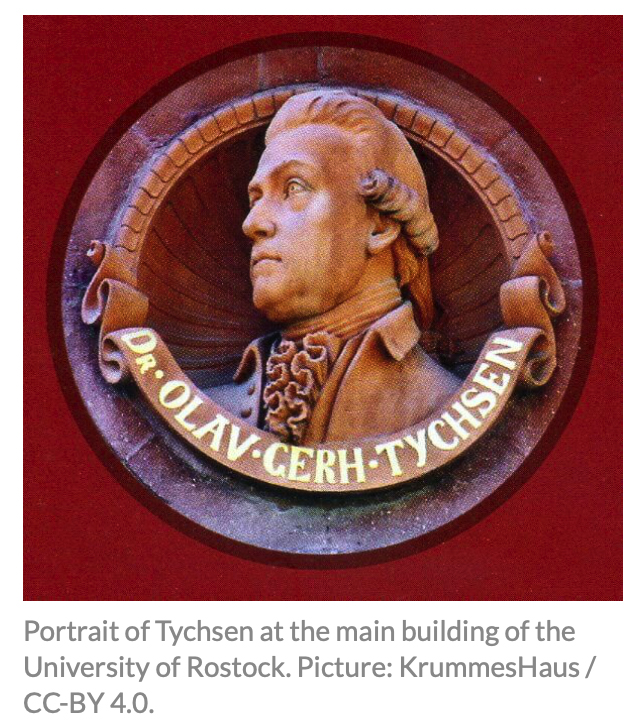
In November 16, 2006 an article by Dr. Shnayer Leiman appeared in the newly formed Seforim Blog entitled, “Two Cases of Non-Jews with Rabbinic Ordination: One Real and One Imaginary.” The “real” ordination was bestowed upon Olaf Gerhard Tychsen (1734-1815). In 1759, Tychsen received the title of Haver, a lower form of rabbinic ordination, by Moses the son of Rabbi Zvi Hirsch Lifshuetz. Tychsen is perhaps the only known case in Jewish history of a non-Jew receiving such an honor or degree.[3]

Leiman provides a biography of Tychsen. He pursued studies in Hindustani, Ethiopic and Arabic, as well as Hebrew and Yiddish and became an Orientalist of international renown making significant contributions to cuneiform studies and numismatics as well.[4] During his early years he also pursued various missionary activities in the Jewish community, largely unsuccessful by his own account. 

As Leiman notes, in 1752, while a student at the Christian Academy in Altona, Tychsen attended the lectures of R. Yonasan Eybeschutz. Leiman essentially leaves us at the point of Tychsen’s ordination, with brief mention of his subsequent academic career. What became of Tychsen’s “rabbinic” career after he received this singular distinction? Did he apply for a rabbinic position? Did he maintain any connection with the Jewish community? 

In fact, Tychsen did continue to maintain a strong connection to both rabbinic literature and the Jewish community in varying degrees throughout his life. He is perhaps best known for his involvement in the premature burial controversy, which would earn him a place of infamy in Jewish history. Tychsen taught at the university in Butzow, the residence of the Duke of Mecklenberg. During this period there was concern that physicians were misdiagnosing death, and as a result, people were being buried prematurely.[5] On February 19, 1772 Tychsen sent a letter to the Duke of Mecklenberg regarding the Jews’ burial practice, interring after waiting only three hours, where it is known that there can sometimes be misdiagnosis of death. Tychsen detailed the Jewish origins of hastening burial in general, reflecting familiarity with rabbinic literature. He claimed that the need to bury quickly was established in countries with hot climates, where the body would decompose quickly, not applicable to a country like Germany. He also reported cases of people who were supposedly buried alive.[6] On April 30, 1772, Duke Friedrich of Mecklenburg-Schwerin, in response to Tychsen’s letter, issued an order prohibiting the Jews in his realm from immediately burying their dead and requiring that they rather wait for three days after death before interment. This began what would become a worldwide halakhic debate about the halakhic definition of death and the time of burial.[7]

Tychsen was also peripherally involved with one of Jewish history’s greatest seforim collections. Rabbi David Oppenheim amassed an extraordinary collection of books and manuscripts which languished in storage for years after his death.[8] Tychsen visited the collection for three weeks, reporting on its manuscripts to the Italian Christian Hebraist Giovanni Bernardo De Rossi. He attempted to arouse the interest of potential buyers, including Catherine the Great, Empress of Russia, Duke Karl Eugen of Wurtemberg, and Archduke Frederick Francis I of Mecklenberg. His efforts were to no avail and the collection ultimately found its home in Oxford, where it remains to this day.[9]

Here we highlight a little-known, though more substantive, connection of Tychsen with the Jewish community. One year after his ordination, toward the end of 1760, Tychsen was appointed Professor of Oriental Languages at the newly established University of Bützow in Mecklenburg. It is in this capacity that Tychsen exercised a rabbinic role, becoming a university campus rabbi of sorts for a select group of Jews at the university. Though he may not actually have had a “minyan” of students, nonetheless, his impact on this select group was profound and long lasting, akin to that of a rebbe.[10]

The interactions of Tychsen with the Jewish community must be viewed through a particular lens. Tychsen was a devout Lutheran Protestant and trained and engaged in proselytizing activities in his early life. This fact remains at least in the background of all his interactions with the Jewish students at Butzow and has been evaluated elsewhere. Whether his relationships with the Jewish medical students were primarily or partially motivated by his proselytizing tendencies, or whether his proselytizing endeavors had ceased by then, is a matter of historical speculation.[11] This is not the focus of the present essay.[12]

In his capacity as a faculty member of the University of Butzow Tychsen encountered a number of Jewish students attending the university’s medical school. Though an Orientalist and not a physician or scientist, he nonetheless served as a mentor for these students to whom he was drawn by shared interests and possibly proselytizing intentions. Tychen served this role for all the Jewish medical students who attended the University of Butzow during its twenty-nine years of existence. 

The first Jewish student of the Butzow Medical School, and the first with whom Tychsen developed a relationship was Markus Moses. This relationship has been the subject of a number of dedicated essays.[13] Markus Moses was the son of Moshe ben Meir Harif Lemberger (Lvov), Chief Rabbi of Pressburg and head of its yeshiva. Lemberger, as well as his son Markus, were apparently involved in the Emden- Eybeshutz controversy.[14] Markus (Mordechai) was born in Pressburg in 1729, received a traditional Jewish education, and married. Shortly thereafter, his wife and two young children died. In 1758, after the death of his father, Markus began the study of secular subjects. Over the next few years he traveled to Germany and continued study in various cities, including the field of medicine, ultimately ending up in Butzow in 1763. Aron Isak, the leader of the Jewish community, took him under his wing and orchestrated his admission to the recently founded Butzow Medical School,[15] thus waiving the high taxes imposed upon the Jewish community for new town visitors. The faculty were impressed with Moses’ great intelligence and facility with multiple languages and accepted him, with the approval of the Duke and Professor George Detharding, the head of the faculty, with free tuition. Below is a letter in Hebrew from Paul Theodore Carpov, an Orientalist and Christian Hebraist at Butzow, supporting Moses’ acceptance to the medical school at Butzow and advocating for his financial support as well.[16]

As per the letter, Moses brought with him impressive letters of recommendation not only from the great scholars of “his nation,” but also from those of “our nation.” Carpov also notes the Duke’s approval, as well as the financial issues relating to his application. Carpov was clearly taken by the young Jewish student. 

Below is the record of matriculation of Markus Moses in 1764.

Moses clearly had a predisposition for the field of medicine and was soon relied upon by Detharding to see the latter’s private patients.[17]

Tychsen had a working academic relationship with Moses as evidenced by the multiple research papers Moses wrote under his mentorship. It is remarkable that all of the papers were on Jewish topics. I have found a number of cases, though relatively few in number, of Jewish medical students throughout the centuries who wrote their medical school dissertations on a Jewish related topic,[18] but I have never encountered any student who authored so many Jewish related papers as part of their medical training. The topics included the Samaritan Bible, a discussion of the kosher and non-kosher animals based on the work of Rambam, and an essay on the diseases of the old as reflected in Kohelet (chapter 12).[19] Moses’ graduation dissertation, discussed below, was also on a Jewish topic and was supervised by Tychsen.

Disputatio de Pentateucho Ebraeo-Samaritano, 1765[20]

Essay on kosher and non-kosher animals based on Rambam.[21]

The nature of the relationship Tychsen had with Moses, as well as with other Jewish medical students in Butzow, went far beyond the usual Professor-student model. There wrote each other dozens of letters and continued correspondence for years after graduation.[22] In one letter dated March 16, 1765[23] Moses apologizes for not responding promptly to Tychsen’s previous letter. Moses continues that soon he will either write again, or will see Tychsen in person. Moses signs the letter, hamitavek biafar raglekha.

גבר(א) דכולי() בי החכ(ם) הכולל המפורס(ם) שמו נודע בכל השערי(ם) הפרעפעסאר טיקסן

מרוב טרדות היום אין אוכל לתואר בתואר כראוי לגבר(א) כמותו ובאתי בלישנא קלילא אל תשים עלי חטאת שעדיין לא השיבני על כתב ידו הטהור מה שקבלתי ע”י ערל הבוח(ן) לבות יודע שהזמן גרמ(ה) לי רק זאת יהי(ה) לבו בטוח שהשבוע הבע” (?הא עלינו לטובה) או אכתוב לו או בנשיקת פא”פ (פה אל פה) אדבר בו[24] גם יקבל במתנה צורה של ר’ יהונת(ן) זצ”ל יותר אין לחדש כה המתאבק בעפר רגליו מרדכי מפב (?מפרשברג)ג


In the last line, Moses writes that Tychsen will also receive from him a gift of a portrait of Rav Yehonatan zt”l. Moses was obviously aware of the connection between Tychsen and Eybeshutz and believed this would be a meaningful gift. Eybeshutz died in 1764,[25] and his portrait was disseminated shortly thereafter. This is likely the portrait Moses purchased for Tychsen.[26]

As part of the requirements for the completion of a doctorate in medicine at most German universities, the student was required to engage in a public disputation on the topic of their dissertation. [27] The topic of Markus’ disputation was the analysis of a verse in Yehezkel which, according to Moses, reflects an ancient Jewish practice of placing salt of the skin of an infant as a prophylactic against disease. 

Moses engages in an expansive philological and grammatical analysis of the verse then posits that the Jews practiced this procedure and that it protected them from diseases like smallpox. The reason smallpox was prevalent during his time, Moses argues, is because people no longer routinely applied salt to the skin of infants. Moses is the only one of the Jewish medical students at Butzow who wrote his dissertation on a Jewish topic. 

Moses’ disputation was held on January 22, 1766 (11 Shevat, 5526). The event was held in a church, though Tychsen apparently noted that it was primarily a venue for non-ecclesiastic events. This may have been in deference to the halakhic concern about entering a church.[28] A number of Jewish families attended the event. Copies of the dissertation were sent to those invited to the public discourse, and additional copies were provided for the audience on the day of the event. The ceremony began with a Latin oration by the presiding professor, in Moses’ case, Professor Detharding, and was followed by the student’s reading of his dissertation. Upon completion of the reading, designated opponents presented their arguments and criticisms against the substance of the dissertation, with audience members occasionally allowed to participate. This was then followed by the candidate’s rebuttal. Tychsen served as one of the designated opponents for Moses’ disputation. 

On oath was also part of the graduation ceremony, and it typically involved avowing one’s belief in Christianity. Tychsen intervened with the Duke of Mecklenberg on Moses’ behalf to allow him to take his graduation oath invoking the name of the God of Israel as opposed to the Christian deity. He even publicly conversed with Moses in Yiddish at the graduation.[29] 

Below is the approbation of Tychsen appended to the published dissertation of Moses.

Tychsen’s freely inserts throughout allusions to rabbinic literature. He also uses a chronogram for the Hebrew year, typically done in Hebrew publications, and something Tychsen used frequently, as seen in his letters below. 

At the end of the approbation, Tychsen mentions the upcoming (second) wedding of Moses. Below is the handwritten wedding invitation of Moses to Tychsen.[30]

Both the title and signature of the invitation reflect the type of relationship they had. Moses also adds the clever pun of “hazmanah lav milsa,” assuming that Tychsen will appreciate it. 

The other letters appended to Moses’ published dissertation are also of great interest. In addition to Tychsen, another opponent at the disputation contributed a letter. Karl Leopold Carpov,[31] son of the Orientalist and professor at Butzow, Paul Theodore Carpov, who had written Moses’ letter of recommendation for admission (above). The older Carpov had died the previous year. The younger Carpov describes how beloved Markus was to his father, who considered him as another son, and, impressed by his brilliance, spent days and nights studying with him. Karl himself calls Markus his brother. While many focus on Markus’s close relationship with Tychsen, no mention has been made of his relationship with the other Orientalist, Carpov. 

The remaining letters were written by Judah Levi Strelitz,[32] the brother in law of Moses, and Meier (no other name is written), a fellow medical student. 

Moses was not the only Jewish student Tychsen took under his wings. Over the span of decades, throughout the short existence of the Butzow medical school, he endeared himself to a number of Jewish medical students.[33] He taught them, mentored them, and even financially supported them. They in turn sought his personal advice and recommendations, aided him in his intellectual quests, and invited him to their weddings.

Two Jewish medical students who matriculated in 1783 were also close with Tychsen, Isaac Salomonsen and Wulf Levinson. 

Matriculation record from University of Butzow November 24, 1783
Wulf Levinson and Isaacus Salomonsen[34]

Below is Tychsen’s letter to Levinsohn upon his graduation.[35]

Tychsen includes that the Butzow anatomist August Schaarschmidt and Professor Detharding, who had accepted Markus Moses some twenty years earlier, attest to the student’s qualifications.[36]

Below is the letter of Isaac Salomonsen presenting his dissertation to Tychsen.[37]

Below is Tychsen’s letter of approbation for Salomonsen’s dissertation in 1784. He mentions Isaac’s work in botany, which is in some form a continuation of the work of another Butzow medical student Tzadik de Meza, who died at the age of twenty-three.[38]

In another letter,[39] Salomonsen complained bitterly to Tychsen about his classmate Levinson, who had apparently been slandering him. He adds that the great personalities in the history of medicine, Aesculapius, Hygea and Hippocrates would be mourning and turning over in their graves if they knew how Levinson was misrepresenting and dishonoring them and the University of Butzow.

In the letter below dated 1784 from Salomonsen to Tychsen[40] we find a number of the elements common in Tychsen’s relationship with all the Jewish medical students. 

Salomonsen mentions the money he owes Tychsen and explains and apologizes for the delay in repayment. Tychsen routinely loaned money to the Jewish students. Salomonsen then reports that he was unable to obtain the sefer (shu”t Rabbi Moshe Alshikh) and Arabic coins Tychsen had requested. Tychsen was an avid bibliophile and his magnificent and important library was ultimately bequeathed to the University of Rostock, which absorbed the University of Butzow after its demise. It remains there to this day. Tychsen also collected Arabic coins and is considered the founding father of Islamic numismatics.[41] Salomonsen also mentions his acquaintance with a man named Mussafia[42] and his children, and how he enjoys spending time with them. Mussafia praised Tychsen and recalled something he had written on Tychsen’s behalf. He also possessed a work of Tychsen. Tychsen delighted in his name and reputation being spread throughout the Jewish community.

In sum, “Rabbi” Tychsen appears to have put his rabbinic degree to good use, at least from his perspective, cultivating an extremely devoted, loyal, and admiring, not to mention highly educated congregation. On the surface, he would be the envy of any modern rabbi, though much complexity lies beneath. While we did not focus on his proselytizing endeavors in this essay, perhaps this is one reason why Tychsen still remains to this day the only non-Jew to have received a form of rabbinic ordination. While Tychsen’s contributions to academia are vast, his tenure at the University of Butzow and his relationship with the Jewish students there represents one of the most unique, if lesser known, chapters in Jewish medical history. With the opening of the Rostock digital archives treasure trove we will certainly see further exploration of this topic. 

Edward Reichman

שנת וַתֵּעָצַ֖ר הַמַּגֵּפָֽה לפ”ק  

[1] Yitzhak Berger and Chaim Milikowsky, “Shnayer Leiman: In Appreciation,” (September 11, 2020).

[2] Moshe Haberman, “The Twice-Told Tale of R. Yonasan Eybeshutz and the Porger,” (September 15, 2020).

[3] For additional information on the semicha of Tychsen, see On the Main Line Blog, “On Non-Jews with Rabbinic Ordination, Real and Imagined: Some Notes on Dr. Leiman’s Post on Tychsen,” (September 20, 2011), http://onthemainline.blogspot.com/2011/09/on-non-jews-with-rabbinic-ordination.html.

[4] David Wilk, “Markus Moses’ Doctoral Dissertation or Who Remembers Butzow,” Koroth 9:3-4 (1986), 408-426, esp. 413.

[5] For an overview of this chapter in medical history, see Jan Bondeson, Buried Alive (Norton Publishers, 2001).

[6] For the text of the letter, see Siegfried Silberstein, “Mendelssohn und Mecklenburg,” Zeitschrift fur die geschichte der Juden Heft 4 (1930), 275-290, esp. 278-279. For reference to Tychsen as a key player in the issue of delayed burial, see for example, Rabbi Dr. Jacob J. Schacter’s doctoral dissertation, Rabbi Jacob Emden: Life and Major Works (Harvard University, 1988), 669, 723-724.

[7] For a comprehensive review of this historical chapter, see Moshe Samet, “Delaying Burial: The History of the Polemic on the Determination of the Time of Death,” (Hebrew) Asufot 3 (1989/1990), 613-665.

[8] For what follows see the comprehensive review of Oppenheim and his library by Joshua Teplitsky, Prince of the Press (Yale University Press: New Haven, 2019), 198.

[9] See Rebecca Abrams and Cesar Merchan-Hamann, eds., Jewish Treasures from Oxford Libraries (Bodleian Library, University of Oxford, 2020), and review of Paul Shaviv, Seforim Blog (July 14, 2020).

[10] The University of Butzow was an offshoot of the University of Rostock and later recombined with Rostock upon its demise. In addition, in 1817, Rostock University acquired the private library, including the manuscript legacy, of Tychsen, which included his significant Judaica and Hebraica collection. Over the last few years, the University of Rostock has devoted research efforts to explore the history of the Jewish students at the university with particular focus on their relationship with Tychsen. See Gisela Boeck und Hans-Uwe Lammel, eds., Jüdische kulturelle und religiöse Einflüsse auf die Stadt Rostock und ihre Universität (Jewish cultural and religious influences on the city of Rostock and its university) (Rostocker Studien zur Universitätsgeschichte, Band 28: Rostock 2014); Rafael Arnold, et. al., eds., Der Rostocker Gelehrte Oluf Gerhard Tychsen (1734-1815) und seine Internationalen Netzwerke (Wehrhahn Verlag, 2019). In the latter volume, see especially, Malgorzata Anna Maksymiak and Hans-Uwe Lammel, “Die Bützower Jüdischen Doctores Medicinae und der Orientalist O. G. Tychsen,” 115-133. I thank Malgorzata Maksymiak for her assistance and for providing me access to the Tychsen archives.

[11] See Wilk, op. cit. and Maksymiak, op. cit.

[12] Nimrod Zinger notes that the universities under Protestant auspices, in particular those affiliated with the Pietistic Movement, were more inclined to admit Jews, as they were interested in the possibility of converting them. He mentions as examples Yitzhak Isaac Wallich and his close relationship with Professor Hoffman at Halle, and that the student Avraham Hyman was admitted to Geissen with the intervention of the head of faculty, who was a Pietist. See his Ba’al Shem vihaRofeh (Haifa University, 2017), 263. Tychsen would certainly align with this theory.

[13] Bernhard Mandl, “Egy Magyar Zsido Orvos Nemet- Orszagban (1763-1782): Dr. Markus Moses, a Pozsonyi forabbi fia,” Evkőnyv Kiadja Az Izr. Magyar Irodalmi Tarsulat (1913), 145-165; Idem, Med. Dr. Markus Moses, Sohn der Pressburger Oberrabbiners R. Mosche Charif, praktischer Arzt in Deutschland von 1776 bis 1786: eine Lebensskizze (J. Pollak: Vienna, 1928); Wilk, op. cit.

[14] Die Juden und Judengemeinde Bratislava in Vergangen heit und Gegenwart (Brunn, 1932), 17-18, 85, cited in N. M. Gelber, “History of Jewish Physicians in Poland in the Eighteenth Century,” (Hebrew) in Y. Tirosh, ed., Shai LeYeshayahu: Sefer Yovel LeRav Yehoshua Wolfsberg (HaMercaz LeTarbut shel HaPoel HaMizrachi; Tel Aviv, 5716), 347-371, esp. 360.

[15] By this time, Jews were able to attend medical schools in Germany. Other German universities with Jewish graduates included Frankfurt on Oder, Duisberg, Halle, Geisen and Heidelberg. On the Jews in German medical schools, see Louis Lewin, “Die Judischen Studenten an der Universitat Frankfurt an der Oder,” Jahrbuch der Judisch Literarischen Gesellschaft 14 (1921), 217-238; Idem, “Die Judischen Studenten an der Universitat Frankfurt an der Oder,” Jahrbuch der Judisch Literarischen Gesellschaft 15 (1923), 59-96; Idem, “Die Judischen Studenten an der Universitat Frankfurt an der Oder,” Jahrbuch der Judisch Literarischen Gesellschaft 16 (1924), 43-87; Adolf Kober, “Rheinische Judendoktoren, Vornehmlich des 17 und 18 Jahrhunderts,” Festschrift zum 75 Jährigen Bestehen des Jüdisch-Theologischen Seminars Fraenckelscher Stiftung, Volume II, (Breslau: Verlag M. & H. Marcus, 1929), 173-236; Idem, “Judische Studenten und Doktoranden der Universitat Duisberg im 18 Jahrhundert,” Monatsschrift für Geschichte und Wissenschaft des Judentums Jahrg. 75 (N. F. 39), H. 3/4 (March/April 1931), 118-127; Monika Richarz, Der Eintritt der Juden in die akademischen Berufe: Judische Studenten Und Akademiker in Deutschland 1678-1848 (Schriftenreihe Wissenschaftlicher Abhandlungen Des Leo Baeck: Tubingen, 1974); Wolfram Kaiser and Arina Volker, Judaica Medica des 18 und des Fruhen 19 Jahrhunderts in den Bestanden des Halleschen Universitatsarchivs (Wissenschaftliche Beitrage der Martin Luther Universitat Halle-Wittenberg: Halle, 1979); M. Komorowski, Bio-bibliographisches Verzeichnis jüdischer Doktoren im 17. und 18. Jahrhundert (K. G. Saur Verlag: Munchen, 1991); Eberhard Wolff, “Between Jewish and Professional identity: Jewish Physicians in Early 19th Century Germany- The Case of Phoebus Philippson,” Jewish Studies 39 (5759), 23-34. John Efron, Medicine and the German Jews (Yale University Press: New Haven, 2001); Wolfram Kaiser, “L’Enseignement Medical et les Juifs a L’Universite de Halle au XVIII Siecle” in Gad Freudenthal and Samuel Kottek, Melanges d’Histoire de la Medicine Hebraique (Brill: Leiden, 2003), 347-370; ) Petra Schaffrodt, Heidelberg- Juden an der Universitat Heidelberg: Dokumente aus Sieben Jahrhunderten (Ruprecht Karls Universitat Heidelberg Universitatsbibliothek, August, 2012).

Below is a chart from Richarz of Jewish medical students in Germany at this time. The University of Butzow is not on this list.

[16] http://rosdok.uni-rostock.de/mcrviewer/recordIdentifier/rosdok_ppn859752100/iview2/phys_0007.iview2.

[17] For the history of Moses prior to attending Butzow, see Mandl, op. cit., and Wilk, op. cit.

[18] E. Reichman, “The History of the Jewish Medical Student Dissertation: An Evolving Jewish Tradition,” in J. Karp and M. Schaikewitz, eds., Sacred Training: A Halakhic Guidebook for Medical Students and Residents (Ammud Press: New York, 2018), xvii- xxxvii.

[19] While the first two essays are housed in the Rostock Library, I have not found a copy of this essay.

[20] http://opac.lbs-rostock.gbv.de/DB=1/XMLPRS=N/PPN?PPN=720262623.

[21] http://opac.lbs-rostock.gbv.de/DB=1/XMLPRS=N/PPN?PPN=304865346.

[22] For the letters in the archive just between Markus Moses and Tychsen, see here.

[23] http://purl.uni-rostock.de/rosdok/ppn860182010/phys_0027.

[24] This is an expression of endearment. See another example of a letter to Tychsen, from a Yehoshua Lifshutz of Apta, where the same expressions, peh el peh acronym and nishikat pihu, are used. http://rosdok.uni-rostock.de/mcrviewer/recordIdentifier/rosdok_ppn859752100/iview2/phys_0019.iview2.

[25] While we have no record of R. Eybeshutz himself communicating with Tychsen at the University of Butzow Medical School, he did send a letter to the faculty of medicine at another German medical school, the University of Halle. This letter related to the famous “heartless” chicken question initially posed to Hakham Tzvi. For more on this letter, its record in the Halle University archives, and its impact on the Emden Eybeschutz controversy, see E. Reichman, “A Letter from a Torah Sage of the 18th Century to the Medical Faculty of the University of Halle (January, 1763): The Selective Deference of Rabbi Yonatan Eybeschutz to Medical Expertise,”Verapo Yerapei: Journal of Torah and Medicine of the Albert Einstein College of Medicine Synagogue 6 (2015), 89-112.

[26] National Library of Israel, NLI 997003186660405171. See also Richard I. Cohen, “’And Your Eyes Shall See Your Teachers’: The Rabbi as Icon,” (Hebrew) Zion (1993), 407-452, esp. 418. The artist is Elimelech Polta ben Shimshon. I have as yet been unable to identify this physician. His name is not found among the Jewish medical students in German universities mentioned above.

[27] T. Broman, The Transformation of German Academic Medicine 1750-1820 (Cambridge University Press, 1996), 32ff.

[28] See Maksymiak, op. cit.

[29] See Wilk, op.cit., 417.

[30] http://purl.uni-rostock.de/rosdok/ppn859752100/phys_0081.

[31] Carpov trained at the University of Rostock before the formation of the University of Butzow. See his matriculation record, here.

[32] Strelitz, also known as Levin Hirsch Levi, lived in Altstrelitz and authored a treatise on resurrection (http://rosdok.uni-rostock.de/resolve/id/rosdok_document_0000014475) which was translated into German by Tychsen under the title,”Die Auferstehung der Todten aus dem Gesetze Mosis Bewiesen,” (1766) (http://rosdok.uni-rostock.de/resolve/id/rosdok_document_0000014215). Strelitz later became rabbi of Birnbaum, and then the first rabbi of Stockholm and Chief Rabbi of Sweden. The Jewish community of Stockholm had been founded only a few years before his arrival by Aron Isak, the sponsor of Markus Moses, Levi’s brother-in-law, and the shadchan for Moses and Levi’s sister. See Wilk, 419-420.

[33] Markus Moses (1764), Israel Joseph Meyer (1765), Justus Zadig de Meza, Isaac Heinrich Salomonsen (1783),Wolff Levinsohn (1783), Abraham Levin Spira (? Benjamin Levin, 1773), Simon Marcus (1771) and Moses Marcus(1785, son of Markus Moses). All of them-with one exception-received their doctorate in medicine in the twenty-nine years of existence of the University of Bützow.See Maksymiak,op.cit., which also addresses the emotional aspect of the ties of Tychsen with his students.

[34] http://dfg-viewer.de/show?set%5bmets%5d=http%3A%2F%2Frosdok.uni-rostock.de%2Ffile%2Frosdok_document_0000000177%2Frosdok_derivate_0000004407%2Fmatrikel1760ws-1788ws-Buetzow.mets.xml&set%5bimage%5d=54. Note that word “Judeus” appears after both of their names. It was common to identify students as Jews in university archives. For example, starting in the 1500s, Jewish students at the University of Padua were identified as“Hebrei.” There does not appear to have been any anti-Semitic associations with this identifier.

[35] http://rosdok.uni-rostock.de/mcrviewer/recordIdentifier/rosdok_ppn835297578/iview2/phys_0168.iview2. For Levinsohn’s dissertation, see http://rosdok.uni-rostock.de/resolve/id/rosdok_document_0000016729?_search=23e52c72-2882-421d-bfd5-16b218d11ae3&_hit=0. The letter was not published with the dissertation.

[36] Tychsen appears to make disparaging remarks against the work Shevilei Emunah, by Meir Aldabi. This work,written in the fourteenth century, was a primary reference on medicine in rabbinic literature for many centuries.

[37] http://rosdok.uni-rostock.de/mcrviewer/recordIdentifier/rosdok_ppn835297578/iview2/phys_0166.iview2.

[38] The Rostock archives contains a number of letters between Tychsen and de Meza.

[39] http://rosdok.uni-rostock.de/mcrviewer/recordIdentifier/rosdok_ppn835297578/iview2/phys_0176.iview2.

[40] http://rosdok.uni-rostock.de/mcrviewer/recordIdentifier/rosdok_ppn835297578/iview2/phys_0180.iview2.

[41] Rafael Arnold, et. al., eds., Der Rostocker Gelehrte  Oluf Gerhard Tychsen (1734-1815) und seine Internationalen Netzwerke (Wehrhahn Verlag, 2019); Ursula Kampmann, Maike Mebmann, trans., “Oluf Gerhard Tychsen (1734-1815), https://coinsweekly.com/oluf-gerhard-tychsen-1734-1815/(July 18, 2019).

[42] This was perhaps a relative of Binyamin Mussafia, a famous graduate of the University of Padua in 1625, and author of Musaf HaArukh, a commentary of the Sefer HaArukh.


Apostates and More, Part 1

Apostates and More, Part 1

Marc B. Shapiro

Continued from here

  1. I am aware of two seforim found on both Otzar haHochma and Hebrewbooks.org which were written by men who later apostatized (there are probably more). There are also two seforim on Hebrewbooks.org which were written by someone afterhe apostatized. I realize that after this post appears it is possible that the books mentioned will be removed from Otzar haHochma and Hebrewbooks.org (as has happened in the past with problematic books that I called attention to). I am therefore providing links so that readers can access the books even if they are removed.

The first book by someone who later apostatized is Solomon Florentin’s Doresh Mishpat, published in Salonika in 1655. As mentioned, appears on both hebrewbooks.org and Otzar haHochma.

Here is the title page.


You can view the entire book here here.

Florentin was a follower of Shabbetai Zvi and was one of the group of Salonikan Jews who converted to Islam following Shabbetai Zvi’s own conversion.[1]

The second future apostate whose book appears on Hebrewbooks.org and Otzar haHochma is Aaron Israel Briman. He wrote Avnei Zikaron, which was published in Amsterdam around 1880.[2] Here is the title page.


You can view the entire book here here.

Briman, who appears to have been an ordained rabbi, was a real scoundrel. After his apostasy, which seems to have been done completely for monetary reasons, he wrote the infamous anti-Semitic work Der Judenspiegel and assisted the anti-Semite August Rohling in his attacks against the Talmud and Judaism in general.[3]  He also abandoned his wife and two small children, leaving his wife an agunah. After becoming a Christian, he engaged in various monetary frauds which landed him in prison. According to the article here in the Jewish Encyclopedia, he studied in the Rabbinical Seminary of Berlin, a point confirmed by Gotthard Deutsch.[4]

As for seforim written by someone after he converted, this brings us to Jehiel Zvi Lichtenstein (1827-1912; in his earlier years the last name he used was Hirschensohn, and I don’t know why he changed it). Detailed biographical information about Lichtenstein can be found in a good article by Samuel Leib Zitron included in volume 2 of his Me-Ahorei ha-Pargod: Mumarim, Bogdim, Mitkaḥashim that fortunately is also found online here. There is, however, no scholarly article on the writings of Lichtenstein, and although he was infamous in his day, today he is almost entirely forgotten.[5]

Lichtenstein was born in Bessarabia and was already an accomplished scholar as a young man. He was married at 18 to the daughter of a wealthy man, and he could have entered the rabbinate like so many others in his position. Yet as described by Zitron (and it appears that his description has been livened up, so it is not always clear if the facts are correct), various circumstances led him to divorce his wife, abandon his home, and convert to Christianity and become an enthusiastic missionary. Incredibly, even after converting to Christianity he continued to live as a Jew, moving to the town of Lubavitch where by all outward appearances he was a hasid of the Lubavitcher Rebbe.

Following this he went to Berlin where he was an open missionary. He then returned to Russia where he married the sister of the well-known Jewish-Christian missionary, Joseph Rabinowitz. In 1995 Kai Kjaer-Hansen published the English version of his book on Rabinowitz,[6] referring to him on the book’s cover and title page as the “Herzl of Jewish Christianity.”[7]

In 1872, after his apostasy, Lichtenstein published his book Derekh ha-Kodesh. The book was published in Berlin. I don’t know why the title page says it was printed in Russia, though this probably has something to do with taxes or customs for books sent to foreign countries.

As you can see, this is the second printing and Lichtenstein gave himself a fancy rabbinic title. I have never seen a copy of the first printing, but Ephraim Deinard states that Lichtenstein’s name did not appear on the title page of this edition.[8]

Zitron tells us that Lichtenstein returned to his hometown where he distributed Derekh ha-Kodesh among the local Hasidim. The book reads like a real rabbinic text, and on the very first page he cites both the Baal Shem Tov and R. Shneur Zalman of Liady, and he continues to cite R. Shneur Zalman constantly in the book. It is obvious from what he writes elsewhere that he pretended to be a Chabad hasid. Thus, in his self-defense published in Ha-Magid [9], when he was still pretending to be a faithful Jew, he mentions that he had lived in the town of Lubavitch. In seeking to defend Derekh ha-Kodesh from the accusation that it had Christian elements, he calls for it to be examined by leading Chabad rabbis to see if there is anything problematic in the book.

.ואקרא לשופטי צדק את רבני חב”ד הגדולים אשר ירדו לעמקי הלכה של הקבלה והחסידות הדבקים באלהים חיים המה יאמרו אם עולתה בו

His call was taken up by Jacob Solomon Alschwang who claimed to have a lot of knowledge in Kabbalah and hasidic thought, “like one of the great Chabad rabbis.”[10]  I am sure that this self-judgment contains a good deal of exaggeration, yet Alschwang did come from a Chabad background and received a traditional Chabad education before leaving that world for the world of Haskalah.[11]

Alschwang identifies a number of passages in the book which he thinks are evidence of the author’s Christian sentiments.[12] Experts in Kabbalah and Hasidism can weigh in on whether Alschwang is correct or if the passages he points to can also be supported by classic kabbalistic or hasidic texts.

One of the passages Alschwang points to is on p. 68, which according to Alschwang means that Lichtenstein is speaking of God taking physical form on earth.

וע”ז נא’ עיני ה’ המה משוטטים בכל הארץ (זכריה ד, י) שענין משוטטים היינו שמתפשטים ומתלבשים בכל הארץ, והש”י משגיח בארץ ע”י שמתלבש בהם כי המה הם כלים רוחניים שהאציל וברא להשתמש בהם, והם מתפשטים ומתלבשים בתחתונים, והמה כמו העינים אל [של] האדם שהאדם יביט בהם והשכל מתלבש בהם לראות, וכן הוא הענין באזני ה

So, what do readers think? Does this passage speak of God literally assuming some bodily form? Furthermore, can we find similar passages in standard kabbalistic texts?

Alschwang also calls attention to Derekh ha-Kodesh, p. 42, where Lichtenstein states that God will appear to prophets in a physical form. Although Lichtenstein adds that God does not really take physical form, but only appears this way, Alschwang sees this as an example of Lichtenstein is trying to push a Christian notion. I guess the idea would be to first get Jews used to the notion that God can be imagined looking like a human, and the next step is to identify a real flesh and blood human as God. Here are Lichtenstein’s words:

כי העולם הזה בכללו הוא אלהות גמור מצד שאינו נראה לנו, אך לעינינו עשה האלהים על עצמו גילוי וצורה ויתחפש בדמות גשמי (זיך זעלבסט ענטשטעלט) אשר הנבראים ישיגו בחושיהם הגשמיים (אשר גם הם רק לעיניהם) דמות וצורה גשמית ארבע יסודות ומורכביהם, דומם צומח חי מדבר וכו’, אולם לעומת הש”י הכל אלהות גמור ואין פה גילוי ודמות גשמי ומהות כלל

Alschwang also notes that on page 7 Lichtenstein makes use of the famous expression from Matthew 19:24, “It is easier for a camel to go through the eye of a needle,” which is not what one would expect to find in a rabbinic text.

At one time in his strange life, Lichtenstein actually began serving as a hasidic rebbe of sorts, praying for people and handing out amulets. Ephraim Deinard, who knew Lichtenstein from the latter’s missionary days in Berlin in the 1870s,[13] claims that it was he who exposed Lichtenstein as a fraud. He happened to be in Lichtenstein’s town on a business trip in 1879, and that is how the townspeople learned that the supposedly pious rebbe was actually a Christian missionary.[14] Even after being exposed Lichtenstein did not give up, and a few years later he was in Podolia serving as a rabbi![15]

Derekh ha-Kodesh is only found on hebrewbooks.org, not on Otzar haHochma. You can view it here. The copy on hebrewbooks.org is missing the second half of the book. It appears that not all printings of the book contained the second part which includes a commentary on various biblical passages. (Alschwang mentions that his copy only had 84 pages, which means that it also was missing the second half.). Here is the copy which is found at Harvard, which is almost twice as long as the copy on hebrewbooks.org.[16] Interestingly, in the copy found on hebrewbooks.org (and also in the complete Harvard copy), on the second page, there are corrections applicable to the missing second half of the book. Also of note is at the bottom of this page of corrections it states that the haskamot for the book were published in the first printing. As far as I can determine, no copies of this first printing have survived.

Zitron tells us that in 1882 Lichtenstein came to Odessa with the manuscript of his book, Sheva Hokhmot. He received haskamot for the book from rabbis and maskilim. Here is the title page of the London 1912 edition of Sheva Hokhmot and you can view the book here.[17]

This is a very helpful work which in alphabetical fashion discusses all the geographical sites mentioned in the Talmud and Midrash.[18] The book previously appeared in Lemberg in 1883 and can be viewed here. The title page of the Lemberg edition mentions that Lichtenstein wrote the responsa volume Keren ha-Tzvi and the book Megaleh Sod. While Keren ha-Tzvi never appeared, Megaleh Sod, which is a commentary on the Bible, was published in Budapest in 1906 and can be viewed here. It is incredible that an apostate would write such a commentary which on its face looks like any other traditional commentary. (I haven’t read it carefully to see if he also inserts Christian interpretations.)

The actual text of both editions of Sheva Hokhmot is the same, but there are some differences between the prefaces of the two volumes. In the first edition the preface is longer, contains some notes, and also includes a list of the rabbis and scholars who prepaid for the book. In the London edition, Lichtenstein included a passage from R. Aaron Hyman’s Toledot Tannaim ve-Amoraim (London, 1910), vol. 1, p. 15, which greatly praises the book and the author, with Hyman saying that Lichtenstein is “wise in the wisdom of the Torah.” Hyman obviously must have been unaware of who Lichtenstein was.

That people did not realize who Lichtenstein was explains how a copy of Derekh ha-Kodesh was bound with regular traditional seforim (including R. Moses Cordovero’s Tomer Devorah), as seen in a recent auction here.[19]

As you can see from the title pages of Derekh ha-Kodesh and Sheva Hokhmot, both of these books, now found on hebrewbooks.org, came from the Library of Agudas Chassidei Chabad.[20] You can also see from the title page of Sheva Hokhmot that, before it was acquired by the Library of Agudas Chassidei Chabad, it belonged to the great scholar Jacob Zallel Lauterbach.

With reference to Lichtenstein, Steven J. Zipperstein writes as follows:

His Sheva Hokhmot [The Seven Wisdoms] was introduced by letters of praise from important scholars such as Mattityahu Strashun, Samuel Joseph Fuenn, and others, though the book appeared three years after Lichtenstein was first denounced as a missionary (by the rather mercurial and widely disliked Ephraim Deinard) in the newspaper Ha-Maggid.[21]

Zipperstein’s information about the letters in Sheva Hokhmot comes from Zitron, who also claims that these haskamot were forged by Lichtenstein. Yet there are no such haskamot from these figures, forged or otherwise. In the 1883 edition of the book, p. 6, we are given a list of people who wrote haskamot and letters of praise (including R. Joseph Dov Soloveitchik, the Beit ha-Levi), but these were never published, not even in the 1912 edition. I have no reason to doubt that these haskamot and letters of praise were authentic, otherwise how could he have publicly announced in the various authors’ lifetimes that he received letters from them? However, these letters were also written before news of his apostasy was known.

What makes Derekh ha-Kodesh and Sheva Hokhmot so interesting is that they were both written after Lichtenstein had become a Christian, something you would never know from the title pages. I don’t know of any other such books, namely, seforim written in a rabbinic style by someone who had already converted to Christianity.

This is a picture of Lichtenstein that I found on a Messianic Jewish website here.


Here is the title page of Lichtenstein’s Hizuk Emunat Emet bi-Yeshua Mashiah ben ha-Elohim.[22]


You can find the entire book here. The author is listed as אבן צהר, which is simply the Hebrew translation of the name Lichtenstein. Also, צהר is the abbreviation of צבי הירשנזון, the birth name of the author.[23]

Lichtenstein also wrote a multi-volume Hebrew commentary on the New Testament, which you can see here. The commentary is preceded by a helpful article on Lichtenstein by Jorge Quiñónez. Lichtenstein’s revised commentary on Matthew can be seen here.[24]

There is an entry on Lichtenstein in Zalmen Reyzen’s Yiddish Lexicon.[25] Yet one of the sources in the bibliography is about Isaac Lichtenstein. This Lichtenstein is often confused with Jehiel Zvi Lichtenstein whom we have been discussing. However, they were two separate people, and Isaac Lichtenstein (1824-1908), who was actually a rabbi, was also a believer in Jesus (although it is reported that he never actually converted to Christianity).

This is his picture taken from here.

The following picture comes from here

There was another Chabad hasid, Israel Landau, who converted to Christianity and became the chief Russian censor. In Ruth Bachi-Kolodny’s article about him, entitled “The Chabadnik Who Became Czarist Russia’s Chief Censor for Jewish Writings,” available here, he is even referred to as a rabbi, but this is certainly not correct, and the description of him as a rabbi does not appear in the original Hebrew version of the article here. The article states:

Although he became an apostate Jew, he remained, deep in his heart, a devoutly religious Hasid and continued to look the part with his short trimmed beard, earlocks, skullcap and long, broad kapota ‏(the long black jacket of members of Chabad‏); he would eat only in kosher restaurants. In fact, Landau sent his wife and only daughter, Menuha, to Switzerland so they could live as Jews without any external hindrances.[26]

Ben Zion Dinur, who was from a Chabad family, mentions that it was jokingly said about Landau that even after apostatizing he still kept the holiday of 19 Kislev.[27] As for Landau’s wife and daughter, Ephraim Deinard, who knew Landau, states that they left Russia because they did not want to convert, not because Landau sent them out.[28]

My experience has been that as soon as I publish something, I find more relevant material and wish I could go back in time to include it in the publication. Fortunately, with the Seforim Blog I am able to update my writings. Not long ago I published Iggerot Malkhei Rabbanan. On pp. 300-301, R. Meir Mazuz writes that he read in Yated Ne’eman that the apostate Russian censor removed two lines from Bialik’s poem about the Kishinev pogrom of 1903, “In the City of Slaughter,” because he found them heretical and did not want to lose his share in the World to Come! I was not aware of this story but I looked at the poem and immediately identified what these two lines must be. In fact, as I only learned after the book was published, it was actually the following four lines that were deleted, and the censor who was responsible for this was none other than Landau.[29]

,סִלְחוּ לִי, עֲלוּבֵי עוֹלָם, אֱלֹהֵיכֶם עָנִי כְמוֹתְכֶם
עָנִי הוּא בְחַיֵּיכֶם וְקַל וָחֹמֶר בְּמוֹתְכֶם
–כִּי תָבֹאוּ מָחָר עַל-שְׂכַרְכֶם וּדְפַקְתֶּם עַל-דְּלָתָי
!אֶפְתְּחָה לָכֶם, בֹּאוּ וּרְאוּ: יָרַדְתִּי מִנְּכָסָי

Forgive me, beggars of the world, your God is as poor as you,
Poor he is in your living and so much more so in your deaths.
And if you come tomorrow for your due and knock on my doors—
I’ll open for you, come and look: I’ve gone down in the world.[30]

The story of the censorship is told by Benzion Katz in his memoir, in a chapter that deserves to be translated into English.[31] Katz was the founder and editor of the newspaper Ha-Zeman, where Bialik’s poem appeared. If you look in Ha-Zeman you will find that the title of the poem was changed to “Masa Nemirov”, and a note informs the reader of the infamous 1648 massacre in Nemirov. As Katz explains, this new title was suggested by Landau, who was willing to look the other way if Bialik and Katz would pretend that the words were not about the 1903 Kishinev pogrom but about another event 250 years prior.

As for the censorship of the lines mentioned above, Katz writes as follows (p. 135):

כשהיה הכל מוכן נתתי לו לקרוא את השירה. הכל נראה לו כשר, חוץ מנקודות אחדות, שלדעתו התריס שם ביאליק נגד א-לוהים. אין הוא יכול להרשות זאת – אמר הצנזור המומר. – בשביל הממשלה ימצא תמיד תירוץ אבל לא בשביל רבונו של עולם. “אינני צעיר ואצטרך לתת דין וחשבון בעולם הבא. אינני רוצה להפסיד את חלקי בעולם הבא”

Landau would not permit some lines to appear in the poem as he did not want to lose his share in the World to Come. Bialik wrote to the censor to defend himself and the censor replied as follows (as summarized by Katz, p. 135), pointing out among other things that Bialik had misunderstood the Zohar :

הוא הצעיר, אף על פי שהוא משורר גדול, מביא לי ראיות מן הזוהר הקדוש, שבו יש ביטויים שהם כביכול גם כן עלבון לקדוש ברוך הוא, אבל אלה אינם עלבונות אלא ביטויי צער וזעם. אני בקי בזוהר. אני לומד אותו יותר ממנו. אני הרשיתי להדפיס את הזוהר מה שלא הרשו הצנזורים הקודמים. היו מביאים את הספר בגניבה מחוץ לארץ. נגד א-לוהים אי אפשר לעשות כלום

All this goes to show that while you can take the Jew out of the shtetl, often (even with apostates) you can’t take the shtetl out of the Jew.

To be continued

  1. I want to call attention to four recent valuable books. The first is Mitchell First, Roots and Rituals: Insights into Hebrew, Holidays, andHistory. This book is full of interesting chapters on liturgy, history, holidays, and the Hebrew language. If, like me, you have enjoyed First’s posts on the Seforim Blog, then his latest book will be a treat.

The second book is Bezalel Naor’s translation of R. Kook’s Commentary to the Legends of Rabbah bar Hannah. This book only further solidifies Naor’s standing as the leading interpreter of R. Kook in the English language. In addition to extensive notes, Naor also includes 11 appendices which include such topics such as R. Kook’s critique of the Mussar Movement and R. Kook and the Dybbuk in Jaffa.

The third book is a joint effort by the eminent scholars Menachem Kellner and James Diamond. Its title is Reinventing Maimonides in Contemporary Jewish Thought, published by my favorite press, Littman Library. This is a collection of articles by Kellner and Diamond which focus on various important Torah scholars and their understanding of Maimonides.

Here is the table of contents.

Anyone interested in nineteenth- and twentieth-century rabbinic thinkers will find this work of value.

The fourth book is Yitz Greenberg and Modern Orthodoxy: The Road Not Taken, edited by Adam Ferziger, Miri Freud-Kandel, Steven Bayme. This book, which is full of great essays, is available in paperback here, and this is the table of contents.


  1. R. Yissachar Dov Hoffman was kind enough to send me this picture of R. Joseph B. Soloveitchik and R. Ovadiah Yosef from April 25, 1974.[32]

My question to readers is, can anyone identify the three young men standing behind the rabbis?

  1. Anyone interested in my summer 2020 trips with Torah in Motion can find details here.
  2. For those in the New York area, I will be speaking at Young Israel-Beth El of Boro Park (4802 15thAvenue, Brooklyn) on Saturday night, December 21 at 8pm. The title of my talk is “Judaism and Islam: Some Halakhic and Historical Perspectives”.

[1] See Meir Benayahu, Ha-Tenuah ha-Shabta’it be-Yavan (Jerusalem, 1971-1978), pp. 35-36.
[2] Regarding Briman and his book, which is actually a complete plagiarism – the entire book lifted word for word from R. Abraham Wallerstein, Mahazeh Avraham, found in Wallerstein’s Ma’amar Avraham (Fuerth, 1757) – see Shmuel Ashkenazi, Asufah (Jerusalem, 2014), pp 53-55.
[3] See Joseph Samuel Bloch, Zikhronot Mimei Hayai, trans. S. Shalom, (Tel Aviv, n. d), vol. 1, pp. 84ff.
[4] See his letter in the Jewish Chronicle, June 26, 1914, conveniently posted in On the Main Line here. See also On the Main Line here for a fascinating post dealing with another apostate who appears to have been a rabbi.

For detailed discussions of Briman, see Samuel Leib Zitron’s article from volume 2 of his Me-Ahorei ha-Pargod: Mumarim, Bogdim, Mitkaḥashim, available here; Joseph Samuel Bloch, Zikhronot mimei Hayai (Tel Aviv, n.d.), vol. 1, pp 81ff.; Ha-Melitz, April 24, 1885, cols. 440-441. For numerous contemporary references to Briman, see Jonatan Meir, Literary Hasidism: The Life and Works of Michael Levi Rodkinson, trans. Jeffrey G. Amshalem (Syracuse, 2016), p. 167 n. 201. Unfortunately, Meir, p. 169 n. 214, cites Chaim Bloch – about whom I have a written a good deal on this blog – without realizing that none of the unpublished material Bloch claimed to possess can be assumed to be authentic. Regarding Bloch, see also Tesla Lee’s 2016 honors thesis at the University of North Carolina at Chapel Hill, “Sigmund Freud and Chajim Bloch: Exploring the Role of the Jewish Joke in European Jewish Identity,” available here. On pp. 5-6, Lee mentions another fabrication by Bloch. Bloch describes how he offered Freud his criticisms of Moses and Monotheism, yet we know that Freud did not begin working on this book until years after Bloch’s supposed conversation with him. For a recent discussion of Bloch and his role in popularizing the Golem story, see Samuel Jacob Spinner, “Jews behind Glass: The Ethnographic Impulse in German-Jewish and Yiddish Literature, 1900-1948” (unpublished doctoral dissertation, Columbia University, 2012) pp. 89ff.
[5] The biographical information I provide about Lichtenstein comes from Zitron. Here is what the Encyclopaedia Judaica, s.v. Hirschensohn-Lichtenstein, Jehiel Zevi Hermann, writes:

Born in Russia, he converted to Christianity in 1855 in Jassy, Rumania, but keeping this secret he spent some time among the Hasidim of Lubavitch and worked on his Derekh ha-Kodesh (“The Way of Holiness,” 1872), which deals with the fundamentals of the Jewish faith, but betrays the authors Christianizing tendencies. From 1868-1878 he worked, under the name of Hermann Lichtenstein, for the Protestant mission in Berlin. He then returned to Russia where, disguised as a hasidic rabbi, he distributed his book. He married in Kishinev, Moldavia, a sister of Joseph Rabinovich, who later, probably under Hirschensohn’s influence, founded the sect called Community of Evangelian Jews. His true character discovered, he had to leave Russia and became lecturer at Franz Delitzsch’s Institutum Judaicaum at Leipzig.

[6] Joseph Rabinowitz and the Messianic Movement (Edinburgh, 1995).
[7] This title was earlier given to Rabinowitz by Hugh J. Schonfield, The History of Jewish Christianity p. 5, available here.
[8] Zikhronot Bat Ami (St. Louis, 1920), vol. 2, p. 134.
[9] Ha-Magid, May 7, 1885, p. 144.
[10] Ha-Magid, June 25, 1885, pp. 208-209.
[11] See his autobiography in Sefer Zikaron le-Sofrei Yisrael ha-Hayyim Itanu ka-Yom (Warsaw, 1889), pp. 203ff, available here. He wrote under the pseudonym ישביאל. See Saul Chajes, Otzar Beduyei ha-Shem (Vienna, 1933), p. 173. The title of the book mentioned at the beginning of this note is of interest, as it is a “memorial volume” for living writers. Today I think we would only use the words “Sefer Zikaron” for people who are deceased. It is also of interest that in the past there were writers who used ז”ל either as זכרונו לברכה or זכור לטוב for living people. See Tovia Preschel, Ma’amrei Tuvyah, vol. 1, pp. 35, 324-325, vol. 4, p. 418.

In 1878, R. Isaac Moses Abulafia published his Lev Nishbar. Here is the title page.

This book is a defense of his halakhic rulings in his responsa Penei Yitzhak against the blistering criticisms of R. Solomon Moses Gaguine in his Yismah Levav. Of interest at present is Lev Nishbar, no. 3 (p. 12b). R. Abulafia notes that R. Gaguine refers to him with ז”ל after his name, and he is certain that this was not done in accord with the view mentioned above that ז”ל can be used even with living people. Rather, he sees this as an intentional insult, and as he puts it, כונתו לרעה. This might mean that he believes that R. Gaguine, by using ז”ל after his name, is hoping for his death.

והן עתה הביאני חדריו וכתב עלי תיבת ז”ל כנז”ל וה’ יודע ועד עליו אם כונתו לרעה עלי והלב יודע אם לעקל וכו’ ועכ”פ מדקפיד בכל דוכתא ודוכתא אך בחלקות ישית להבדיל בין המתים ובין החיים בתיבת ז”ל ונר”ו כנז”ל ומדשינה עתה הפעם לכתוב עלי ז”ל במקום נר”ו הא ודאי דקפידה הוי וכונתו לרעה ב”מ

See also what R. Abulafia writes in his introduction and the first page of the opening responsum, where you can see that he is not inclined to be generous in his interpretation of R. Gaguine’s intent.

Regarding the dispute between Rabbis Abulafia and Gaguin, see Yaron Haarel, “Hashpa’atam shel ha-Sefarim Penei Yitzhak, Yismah Lev ve-Lev Nishbar al ha-Ma’avak Saviv ha-Rabanut be-Damesek,” Asuput 11 (1998), pp. 211-243.
[12] That the book contains hints to Lichtenstein’s belief in Jesus is also stated by Samuel Shraga Feigensohn, Elbonah Shel Torah (Berlin, 1929), p. 28b.
[13] Deinard, Zikhronot Bat Ami (New Orleans, 1920), vol. 2, p. 133.
[14] Ha-Magid, April 9, 1885, p. 112. See here that in his later years, Lichtenstein’s Christian missionary students would call him “Rebbe”. This source describes Lichtenstein as serving as a hasidic rebbe before adopting Christianity, but that is not correct.
[15] Deinard in Ha-Magid, April 9, 1885, p. 112. Deinard, Zikhronot Bat Ami, vol. 2, p. 137, reports that Lichtenstein served as a rabbi in Hungary. In Tzelem ba-Heikhal (New Orleans, n.d.), p. 143, Deinard writes that he was a rabbi for a short time in a town in the Austrian empire. Feigensohn, Elbonah Shel Torah, p. 28b, states that he served as the rabbi in a town in Volhynia for eight years, but there is no evidence to support this statement
[16] See Jacob Solomon Alschwang, Ha-Magid, June 25, 1885, p. 209, that David Kahana had additional pages from the book which are missing from the Harvard copy. These pages, from a section entitled Even Bohan, are explicitly Christian, as they cite Jesus and Paul, and this is no doubt why they were removed. In what looks like a defense of Even Bohan, Lichtenstein, Derekh ha-Kodesh, p. 83 in the note, states that this section was written for Christians and Muslims and deals with the Noahide laws. This is, of course, not believable, as Christians and Muslims would not be reading his Hebrew work.
[17] Deinard, Zikhronot Bat Ami, vol. 2, p. 137, claims that it was actually printed in Eastern Europe, but R. Mazin in London bought the entire printing and put a new title page on the book.
[18] The title “Seven Wisdoms” is strange as it is really not relevant to the subject of the book. Regarding the “Seven Wisdoms,” see Harry Austryn Wolfson, Studies in the History of Philosophy and Religion (Cambridge, MA, 1973), vol. 1, pp. 507ff. Abarbanel, Commentary to Exodus, ch. 25, p. 253, writes:

שבעת הנרות שבמנורה רומזים אל שבע החכמות שכלם ימצאו בתורת הא-להים

[19] In my post here, I briefly discussed the apostate Paul Levertoff. I neglected to mention that before he converted, Levertoff, whose Jewish first name was Feivel, was one of the future historian Ben Zion Dinur’s teachers in heder. See Dinur, Be-Olam she-Shaka (Jerusalem, 1958), p. 26.
[20] This library has a number of heretical books, and R. Joseph Isaac Schneersohn’s earlier collection also contained books of this sort. R. Menachem Mendel Schneerson stated:

When I came to Leningrad, I was surprised to find various [anti-religious] books in my father-in-law’s library. . . . The reason, obviously, was . . . the library attracted non-religious Jews, and even Gentiles. In the meantime, they saw what Lubavitch was and that it shares knowledge, and were drawn to it as a result. This created the opportunity to speak with non-Jews about justice, honesty, and humanity, the Seven Noahide Laws, etc. The benefit was quite evident.

On another occasion, the Rebbe explained that his father-in-law needed such books, for “such things are also necessary for good purposes, as the Mishnah [Avot 2:14] states, ‘Know what to answer a heretic.’” Both of these passages appear in R. Baruch Oberlander’s and R. Elchanan Shmotkin’s beautifully produced work on the Rebbe, Early Years (Brooklyn, 2016), pp. 167, 168.

Ephraim Deinard, Zikhronot Bat Ami, vol. 2, p. 7, reports, as an eye-witness, that R. Shmuel Schneersohn read Haskalah works before he became rebbe of Lubavitch. It is hard to know whether Deinard is to be regarded as reliable in this matter as his antipathy to Chabad is apparent throughout his writings. See especially ibid., p. 16, where among other things he states:

.החסידים היותר רעים ומסוכנים לתורת ישראל, המה חסידי חב”ד

Deinard even falsely claims, ibid., p. 8, that the responsa of R. Menahem Mendel Schneersohn, the Tzemah Tzedek, were really written by R. Hayyim Jacob Widerwitz. In Chabad texts, R. Widerwitz is referred to as the editor of the Tzemah Tzedek’s responsa. See R. Shalom Duber Levin, Toldot Habad be-Artzot ha-Berit (Brooklyn, 1988), p. 3.
[21] “Heresy, Apostasy, and the Transformation of Joseph Rabinovich,” in Todd M. Endelman, ed., Jewish Apostasy in the Modern World (New York, 1987), p. 213. Contrary to what Zipperstein states, Sheva Hokhmot was published in 1883, and only in 1885 did Deinard denounce Lichtenstein. This information appears correctly in Zitron.
[22] The book can be seen here, along with two other Christian works by Lichtenstein and an obituary of him.
[23] See Zitron here.
[24] For more on Lichtenstein, see Ephraim Deinard, Ha-Magid, April 9, 1885, p. 112; Isaac Jacob Weissberg, Ha-Melitz, May 11, 1885, pp. 515-516; Deinard, Ha-Melitz, May 29, 1885, cols. 580-581; S. Mandelkern, Ha-Magid, June 11, 1885, pp. 190-192. See also David Assaf, Hetzitz ve-Lo Nifga (Haifa, 2012), pp. 75-76.
[25] Leḳsiḳon fun der Yidisher liṭeraṭur, prese un filologye (Vilna, 1927), vol. 2, cols. 151-154, available here. An abridged entry is found in the later edition of Reyzen’s lexicon, and you can see an English translation here.
[26] I should note that not everything Bachi-Kolodny cites from Benzion Katz’s memoir, Zikhronot (Tel Aviv, 1963), actually appears there. She also writes: “Interior Minister Vyacheslav Konstantinovich von Plehve issued orders that a pogrom be carried out in Kishinev ‏(now Chisinau, Moldova‏) in April 1903, on Passover, to expedite the Jews’ exit.” This is incorrect, as no such orders were ever issued by the unquestionably anti-Semitic Plehve. See Steven J. Zipperstein, Pogrom: Kishinev and the Tilt of History (New York, 2018), 94ff.
[27] Be-Olam she-Shaka, p. 13. Incidentally, Dinur tells us, pp. 17-18, that in his Chabad home in Russia they drank milk that came from non-Jews, rather than halav yisrael. This is what he writes about his father, who was a real Torah scholar.

זכורני, פעם אחת בא הביתה ואמר לאמא: היתה לי היום עגמת נפש מזה שאת משתמשת בחלב של לא-יהודים. תמהה אמא ושאלה: מאין יודעים? אמר אבא: אני סיפרתי את הדבר. התפלאה אמא: מה ראית להודיע ברבים? אמר: פשוט, התקיפו בבית-המדרש את דוד המלמד, שהוא משתמש בחלב נכרים, והלבינו את פניו. קמתי ואמרתי: מה אתם רוצים ממנו, גם אצלי נוהגים כך! ך

This is significant testimony, as it is well known how seriously Chabad hasidim regard this matter. There is even a story about how a big scholar who came to R. Shneur Zalman of Lyady was suffering from religious doubts. R. Shneur Zalman recognized that these doubts came about because the man had inadvertently drunk non-halav Yisrael milk. See R. Joseph Isaac Schneersohn, Sefer ha-Ma’amarim 5701-5705 (Brooklyn, 2012), Hebrew version, pp. 76-77.
[28] Deinard, Tzelem ba-Heikhal, p. 169. See also Deinard, Shibolim Bodedot (Jerusalem, 1915), pp. 58ff, for Deinard’s letter to Landau which among other things urges him to return to Judaism. See ibid., pp. 176-177, for Landau’s revealing letter to Deinard. As far as I know, neither of these letters have been mentioned by scholars who have discussed Landau. They are, however, mentioned here.

Shimon Steinmetz called my attention to a memoir by another former Chabad hasid who became a missionary. See Elieser Bassin, The Modern Hebrew and the Hebrew Christian (London, 1882), available here.
[29] A reproduction of the original publication from Ha-Zeman (July-Sep. 1904), is found in Michael Gluzan, Hannan Hever, and Dan Miron, Be-Ir ha-Haregah – Bikur Meuhar (Tel Aviv, 2005), pp. 158-168.
[30] Songs from Bialik, translated by Atar Hadari (Syracuse, 2000), p. 5.
[31] Zikhronot, ch. 37.
[32] R. Aharon Rakeffet provides another picture from this particular visit of R. Ovadiah. See The Rav: The World of Rabbi Joseph B. Soloveitchik, vol. 2, in the pictures that begin after p. 135, available here. I thank R. Yissachar Dov Hoffman for providing this information as well. He also called my attention to the following additional picture of the Rav and R. Ovadiah from this visit, taken from here.


New seforim, books and some random comments

 New seforim, books and some random comments
[Updated]
By: Eliezer
Brodt
Here is a list of some new seforim and books printed in the past few months.
1.
מערכת האלקות כולל פירוש מנחת יהודה להר’ יהודה חייט ופ’ פ”ז השלם [על פי כת”י], 301 עמודים, + מפתחות ועוד 25 עמודים
2.
רבנו שמעיה השושני, [מגדולי דורו של רש”י], סוד מעשה המשכן עם מ”מ והערות ע”י ר’ גור אריה הרציג, 20 עמודים
3.
ספר הכוונת [ישן] להר’ חיים ויטל עם הגהות הרמ”ז, תרסו עמודים
4.
אגרת הגר”א השלם, עלים לתרופה, עם מקורות ליקוטי הגר”א ביאורים והערות, כתבי יד, כולל שיעורים של רבי מיכל ליפקוביץ ורבי אהרן ליב שטינמן על הספר.
I am enjoying this edition so far and think it is full of very useful information. It has a few parts including an in-depth running commentary of the entire work and a collection of material from other places where the Gaon writes similar ideas. It also includes a photocopy of one of the earlier manuscripts of the work. Just to point out some minor issues with the sefer. It does not say who put it out, I am not sure the point in this modesty it’s well known what the Chida writes about such a practice. In the beginning of the work where he talks about the various editions of the sefer a reference should have been made to Yeshayahu Vinograd’s Otzar Sifrei Hagra where he lists over hundred editions of the letter of the Gra.
Of interest to bibliographers on the subject is what R’ Moshe Sternbuch writes:
ובמשפחתו יש דעה גם שכתבו באידיש ותורגם
He has a few pages about the Gra’s trip to Eretz Yisroel and why he did not end up going. I do not expect him to quote the discussion of Aryeh Morgenstern in his various works such as in The Goan of Vilna and his Messianic Vision. However I would have thought he would quote some of the sources found in Eliach’s Hagaon.
The ‘author’ writes (p. 205):
והנה מפורסם דהגר”א לא לקח יותר מכדי פרנסתו ופרנסת אנשי ביתו, ואדרבה אפילו לבני ביתו  לא היה כל צרכם… כידוע חי הגר”א בדחקות עצומה… (שם, עמ’ קכז)
I am not sure where he gets this from but Shaul Stampfer in his work Families, Rabbis and Education (pp. 327-328) and more recently Eliyah Stern in his work The Genius (pp. 30-31) based on manuscripts printed by Yisroel Klausner and other sources prove that this is not true at all.
Stamfer writes: “The Gaon certainly did not live in poverty… the Gaon did not have the highest income of the individuals on the Vilna community payroll. However his income was near the top and it was several times the salary of minor communal functionaries…”
Another interesting discussion of his is about how the Gra writes about dealing with children:
ועל הקללה ושבועה וכזב תכי אותם במכות אכזריות… (עמ’ קח) שתכי את בנינו מכות אכזריות (עמ’ רכב)
 The last two words are only found in some versions of the manuscripts. The Author collects some sources on this subject of hitting children and even points to the Gra elsewhere which appears to contradict this. In an appendix he quotes at length the opinion of Rabbi Chaim Kanievsky pro such methods. I think he should have included many more sources on such an important topic [I hope to return to this in the future] especially what R’ Wolbe writes in his letters (Igrot Ukesavim, p. 121) against such methods. Another important source he should have quoted is from the Menucha Ukedusha (from a talmid of R’ Chaim Volzhiner, which he quotes elsewhere) who writes that one should certainly not hit children after the age of thirteen (p.136). See here.
One last point related to this edition where the Gra writes about learning tanach
ושילמדו מקדם כל החומש שיהיו רגילים כמעט בעל פה…
The author brings a Teshuvah from R’ Wosner which I do not think is like the Gra at all. The author has an appendix about this, much can be added to this but here to he should have quoted the previously quoted work Menucha Ukedusha.
 
5.
ר’ חיים פאלאג’י, כף החיים, תשמח עמודים, מכון שובי נפשי כולל הערות
6.
ר’ חיים פאלאג’י, תנא דבי אליהו עם פירוש לוח ארז, מכון שובי נפש, תתכו עמודים
7.
מכילתא עם פירוש ברכת הנצי”ב [פורמט קטן], שמא עמודים + פירוש ברכת הנצי”ב על תורת כהנים, מ’ עמודים
8.
דרשות וחידושי רבי אליהו גוטמאכר מגריידיץ על התורה, שמות, שסד עמודים
9.
ר’ חיים סופר, קול סופר, על משניות ג’ חלקים
10.
ר’ יוסף צבי הכהן, קב ונקי על הלכות תפילין, נדפס לראשונה בברדיטשוב תרנ”ח, 20 עמודים
11.
ר’ חיים הירשנזון, מלכי בקודש, חלק שני, בעריכת דוד זוהר, מכון שכטר,
12.
ר’ אריה לוין, משנת אריה, על משניות נזיקין, ב’ חלקים  [כולל מסכת אבות]
13.
גנזים ושו”ת חזון איש, חלק שלישי, שפז עמודים
14.
ר’ חיים פרידלנדר, שפתי חיים, רינת חיים, ביאורי תפילה: ברכות השחר, פסוקי דזמרא, קראית שמע ועוד, שצו עמודים
15.
ר’ אהרן פעלדער, רשומי אהרן, כולל פסקי הלכה מו”ר הרב משה פיינשטיין זצ”ל, מה עמודים+ שאילת אהרן ח”ג, לב עמודים ועוד
16.
תשובות הרב קאפח, נערך ע”י ר’ שלום נגר, חלק א תשל”ד-תשלו, תסז עמודים
17.
תאות דוד בענין כתיבת סת”ם, על הספר הזכרונות לר’ שמואל אבוהב אם ק’ אמירה נעימה, רמ עמודים
18.
ר’ אליהו זייני, בין השמשות דר”ת, וזמן הדלת נרות חנוכה, 110 עמודים
19.
ר’ דוד דבליצקי, ברכות לראש צדיק, כל עניני כוס של ברכה, נט עמודים
20.
ר’ יהושע ברוננער, קונטרס איש על העדה, הליכות והנהגות של רבינו הגרי”ש אלישיב זצוק”ל, נח עמודים
21.
ר’ יהודה שושנה, קונטרס נהג בחכמה, הלכות ומנהגי בית הכנסת הנוהגים בישיבת בית מדרש גבוה לייקוואוד במעגל השנה, כולל הלכות נחוצות לסדר התפלה וקריאת התורה, מנהגי הישבות, מקורות המנהגים, ק’ עמודים
22.
ר’ שמואל אוסטערליץ, ילקוט חלוקא דרבנן עניני לבוש במשנת רבוה”ק מסקווירא, עם ליקוטים יקרים מפי ספרים וספרים, קכב עמודים
23.
אגן הסהר, על רבי אברהם גנחובסקי זצ”ל, 247 עמודים
24.
יום אידם ניטל, ילקוט מקורות אמרות ועובדות, ריב עמודים
25.
בדחנא דמלכא, מתולדותיהם ונועם שיחתם של משמחי הצדיקים, רנא עמודים
26.
ר’ דוד קאהן, האמונה הנאמנה, על יג עקרים של הרמב”ם, 308 עמודים, ארטסקרל
27.
ר’ דוד קאהן, השקפה הנכונה, הערות והארות על הקדמת הרמב”ם לפירוש המשניות, 168 עמודים, ארטסקרל
28.
ר’ דוד קאהן, ממשה עד משה, הערות על יד שרשים של הרמב”ם לספר המצוות והשגות הרמב”ן, 372 עמודים, ארטסקרל
29.
ר’ קלמן קרון, הרחק מעליה דרכך, על האיסור החמור של קריאת ספרי מינות ואפיקורסות וחובת ההתרחקות מהם, [ארבעה שערים], רסא עמודים
30.
ר’ אברהם מנדלבוים, דרשות לבר מצוה, מאות דרשות שנשאו גדלי ישראל לכבוד יום הבר מצוה, ב’ חלקים
31.
קובץ מוריה שבט, ראה שם, מאמר מיוחד מידידי ר’ יעקב ישראל סטל, ‘הוראות והנהגות לרבינו יהודה החסיד’ ונספח: מנהג השלכת עפר ותלישת עשבים בבית הקברות’.
A PDF of this article is available upon request.
32.
קובץ אור ישראל, גליון סו, שפד עמודים
33.
קונטרס כי רחק ממני מנחם, על ר’ בנימין מנחם פלס, קלג עמודים
34.
ר’ ישראל מורגנשטרן, מכירים אלקטרוניים בשבת, קכח עמודים
35.
ר’ מרדכי טנדלר, מסורת משה, הוראות והנהגות שנשמעו מאת רבן של כל בני הגולה ופוסק הדור הגאון האדיר רבי משה פיינשטיין זצוק”ל, תרכא עמודים.
Of course there is much to say about such a sefer as it’s full of hundreds upon hundreds of pesakim. It appears to be the first of a few volumes. The haskamah of R’ Dovid Cohen is nice where he writes
ספר זה נדיר הוא ככמעט מיוחד במינו, אע”פ שמצינו יומן מהגאון האדר”ת זצ”ל, וגם אוטו-ביגרפיה (שיש מערערים אם הו מזויף מתוכו) של הגאון רב יעקב עמדין זצ”ל במסורת משה נמצאים חידושים נפלאים להלכה וגם מצר מתוכו כו”כ השקפות של מרן זצ”ל… ומודה להם על התענוג הרוחני שהרגשתי שקשה לתאר הטעם להזולת ורק יכולים לומר לו טעם וראה…
Just to point out a few things of interest: he has a lengthy piece where Rav Moshe said a certain piece in the Ramban’s work on chumash has additions not from him, that are kefirah [Korach, 17:6] (pp. 522-523), another piece of Rav Moshe about the manuscript of R’ Yehudah Hachassid Al Hatorah (p. 552), that R’ Reuven Margolis came to hear Rav Moshe Say a shiur in Yerushlayim (p. 501). Anyone reading this work is sure to find many more things of great interest.
ספרים על פורים
36.
ר’ יוסף ניזר, פורים סראגוסא, בהלכה ואגדה, 77 עמודים
This work is well done and collects a nice amount of material on Purim of Saragossa. Just to add two important sources on this subject not quoted in this work, most likely because they do not know English, Elliot Horowitz, Reckless Rites, pp. 279-286 and Yosef Yerushalmi, Zakhor, pp. 46-48.
37.
ר’ רחמים טוויג, המאיר לארץ, חקירות ומערכות בעניני מחיית עמלק, תסג עמודים
38.
ר’ יהודה זולדן, מגילה במוקפות חומה, מקרא מגילה בערים מוקופות חמה מימות יהושע בן נון, 470 עמודים [יסוד של הספר הוא עבודה לשם קבלת תואר שלישי מהמחלקה לתלמוד באוניברסיטת בר אילן]
39.
ר’ עמרם טיגרמן, מחייב איניש לבסומי בפוריא, ליקוט ובירור דעת הפוסקים בדין זה, ובענין חמר מדינה בזמנינו ומיץ ענבים לארבע כוסות,שיא עמודים
40.
ר’ יוסף יונה, ספר מיני מעדנים, בירורי הלכה במצות משלוח מנות, קעה עמודים מחקר ועוד
1.
שלום יהלום, בין גירודנה לנרבונה, אבני בנייין ליצירת הרמב”ן, יצחק בן צבי, 414 עמודים [מצוין]
2.
משנת ארץ ישראל, שמואל וזאב ספראי, מסכת כתובות, ב’ חלקים, 677 עמודים
3.
חיים גרטנר, הרב והעיר הגדולה, הרבנות בגליציה ומפגשה עם המודרנה 1815-1867, מרכז זלמן שזר, 448 עמודים [ספר מצוין]
4.
בד”ד 27 הוצאת בר אילן
5.
רון קליינמן, דרכי קנין ומנהגי מסחר במשפט העברי, הוצאת בר אילן
6.
יהושע פישל שניאורסון, חיים גראביצר סיפרו של נופל, ידעות ספרים 583 עמודים
After being out of print for years this classic is back in print.
7.
קתרסיס, גילון 18 כולל מאמר ביקורות של ר’ שלמה זלמן הבלין על בנימין בראון ‘החזון איש’ [61 עמודים!]
A PDF of this article is available upon request.
English
 
The Challenge of Received Tradition: Dilemmas of Interpretation in Radak’s Biblical Commentaries, by Naomi Grunhaus, Oxford University Press, 2012. Dialogue, volume 3
Rabbi Chaim Rapoport, The Afterlife of Scholarship, A critical review of The Life and Afterlife of Menachem Mendel Schneerson Samuel Heilman and Menachem Friedman


Talmudic Humor and Its Discontents

Talmudic Humor and Its Discontents
by Ezra Brand
In honor of Purim, I’d like to discuss a few aspects of humor in the Talmud[1]. But first, a short overview of topic of Jewish humor in general.
A lot has been written about Jewish humor[2]. A very good overview of Jewish humor, in general, is that of Avner Ziv in the second edition of Encyclopedia Judaica, under the entry “Humor”[3]. However, most of the piece is about Jewish humor from the eighteenth century and on, with only a little bit at the beginning about humor in Tanach, the Talmud, and the time of the Rishonim. He writes a fascinating few lines in the beginning of the entry:
What is generally identified in the professional literature as Jewish humor originated in the 19th century, mainly, but not
exclusively, in Eastern Europe. Today in the U.S., Jewish humor is considered as one of the mainstreams of American humor.
At the beginning of the 19th century, sense of humor was not associated with Jewishness. Herman Adler, the chief rabbi of
London, felt impelled to write an article in 1893 in which he argued against the view that Jews have no sense of humor. It is perhaps interesting to note that not only Jews but non-Jews as well consider today “a good sense of humor” as one of the noble characteristics of Jews.
Even H.N. Bialik had a similar sentiment about the lack of humor in earlier Jewish sources[4]:
“To our great distress, there is very little humor in our literature. It is hard to find five continuous lines in Tanach with humor.” The above-mentioned Avner Ziv writes elsewhere: “Even in the Talmud there appear references (though few) to humor, but in total there is not a “treasury” of humor […] not until the end of the 19th century did there appear anything but a few references to Jewish humor.”
However, David Lifshitz begs to differ. In 1995, he wrote an entire doctorate on the topic of humor in the  Talmud[5]. He wasn’t the first to collect pieces of humor from the Gemara. Israel Davidson collected humorous pieces from throughout Jewish literature in chronological order, starting from Tanach and ending with Modern Hebrew literature[6].
A few articles discuss different aspects of humor in the Talmud, and there are some seforim that collect humorous pieces from the Gemara[7].  However, by far the most comprehensive discussion is that of Horowitz.
As mentioned, Lifshitz wrote an entire dissertation on the topic, running to 312 pages. He writes that the view that there isn’t a substantial amount of humor in earlier sources is mistaken. He feels that this mistake stems from the fact that there has been little research done on the subject of humor in the Gemara, which in turn stems from the fact that humor is looked at as lowly “leitzanus.” Therefore, the great amount of humor in the Gemara was ignored.
Critical Humor
One specific aspect of humor in the Gemara is critical humor[8]. Although not necessarily the best example of humor in the Gemara, this genre of humor caused some uncomfortableness[9], which I will also discuss.
Here are some Gemaras where critical humor is used, taken at random. (Translations are from Soncino, with slight changes[10].)
1  Kiddushin 79b[11]:
R’ Yosef son of R’ Menasia of Davil gave a practical ruling in accordance with Rav, whereupon Shmuel was offended and exclaimed, “For everyone [wisdom] is meted out in small measure, but for this scholar it was meted out in large measure!”
2) Yoma 76a[12]:
And it long ago happened that R’ Tarfon, R’ Yishmael and the elders were seated and occupied with the portion referring to the manna, and also R’ Eleazar of Modi’in commenced [to expound] and said: “The manna which came down unto Israel was sixty cubits high.” R’ Tarfon said to him: “Modite! How long will you rake words together to bring them up against us?” –He answered: “My master! I am expounding a Scriptural verse.”
Beitza 24a[13]:
3
R’ Yosef said in the name of R’ Yehuda in the name of Shmuel: “The halacha is as Rabban Shimon ben Gamaliel”. Abbaye said to him: “The halacha is [etc.], from which it would follow that they [the Sages] dispute it!” –He said to him: “What practical difference does it make to you?” –He replied to him: “It should be for you as a song” [Rashi: “This is a parable of fools […] ‘Study!’ the student says to the fool: learn both truth and mistakes, and it will be for you as a song!”].
A famous responsum of the Chavos Yair, R’ Yair Chaim Bachrach, discusses the harsh language sometimes used by one Amora against another[14]. This tshuva was made famous by the Chafetz Chaim, who printed it at the beginning of his Chafetz Chaim.[15] The Chavos Yair is at great pains to show how each “insult” is in fact a subtle compliment. For example, he says that when R’ Sheshes says, as he often does, on a saying of Rav, “I say, Rav said this statement when he was sleeping,” that this is fact a display of R’ Sheshes’ great respect for Rav that he never could haved erred so easily. A more difficult kind of attack to explain is the “ad
hominem” attack, where one Amora attacks another Amora personally.
Interestingly, some want to say that these kinds of attacks are much more frequent in the Bavli than in the Yerushalmi. In a Hebrew article by Yisrael Ben-Shalom, “ואקח לי שני מקלות לאחד קראתי נעם ולאחד קראתי חבלים”[16], the author shows many instances of negative criticism by Chachamim in the Bavli that don’t appear in their parallels in the Yerushalmi. Recently, R’ Achikam Kashet has drawn up a long list of 82 basic differences between the Bavli and the Yerushalmi in his very impressive אמרי במערבא (n.p. 2010). This difference is number 53 (page 889)[17].
Later, the Ra’avad was one of the more harsh attackers. When he disagreed, he did so in very strong terms. In general, he was most harsh in his hassagos on the Razah. The following is one of the harsher attacks[18]:
הנה שם השם שקר בפיו וזאת עדות על כל שקריו ופחיזותיו אשר אסף רוח בחנפיו להנבא שקרים ולהתעות הפתיים והסכלים בעדיי אחרים אשר נתעטר בהם ספרי הסירוס אשר חיבר.
Closer to our own time, R’ Yitzchak Isaac Halevy, author of Dorot Harishonim, is famous for his harsh language he used against people he disagreed with. While in his magnum opus, Dorot Harishonim, this language is generally used against maskilim and non-Jews, his harshness was not limited to them. R’ Halevy’s biographer notes[19]:
While Halevy had his reasons which led him almost singlehandedly into battle against the foremost historians, he, in turn, became the target of a formidable list of critics […] Undoubtedly, Halevy’s sharp pen was an added factor that irked many to retaliate in kind. Halevy’s inordinate style of writing might have been a carryover from a number of classic rabbinical works […] Thus Halevy’s correspondence relating to his own followers at times was penned in a tone which was similar to that reserved for the targets of his ire in the Dorot Harishonim.
After discussing many sources in Chazal of negativity, Efrayim Elimelech Urbach writes that although in the Beis Medrash the Chachamim could be very harsh with each other, in the “real world” a big stress was put on talmidei chachamim looking out for each other, and on the respect that a talmid chacham deserves.[20]It seems clear that although internally there were strong disagreements, towards the outside, there was strong cohesiveness, and the less disagreement and strife exhibited in public, the better[21].  In other words, what goes on the Beis Midrash, stays in the Beis Midrash! In our own time, one of the controversial passages in R’ Natan Kamenetski’s Making of A Godol was the story of R’ Aharon Kotler calling a red-headed student who interrupted his shiur with a question “parah adumah.” Marc Shapiro, in one
of his recent posts
(paragraph 3), makes the same point: that certain off the cuff remarks were never meant to be publicized.
To end off on a
not-so-Purim-like note, I’d like to note a word of caution. In our own time, where recording devices are ubiquitous, talmidei chachamim must be far more careful about what they say and how they say it. Even if a talmid chacham says something in a setting where it is perfectly acceptable, such as in a “Beis Medrash”-like setting, with a recorder the statement can easily be spread outside these “walls.” We have reached a point where עין רואה ואזן שומעת, וכל מעשיך בספר נכתבין (Avos 2:1) is not
just true in Shamayim, but on Earth also.
[1] In a previous post on the Seforim Blog, Eliezer Brodt discussed some parodies from medieval times and on. Another previous
post
discussed some modern Purim parodies. Some of my favorite modern parodies are those by Moshe Koppel, a Professor of Computer Science in Bar-Ilan University, who has contributed to the Seforim Blog. Professor Kopple has produced a number of parodies of “pashkevillim.” (“Pashkevillim”—“broadsides” in English—are large notices stuck on walls in Chareidi neighborhoods,
especially in Meah Shearim. They are often polemical, and written in a flowery
Hebrew.) (For a review of the Valmadonna’s collection of broadsides see here). A sampling of these parodies, as well as an interview with Koppel, can be seen here. A parody of his about fundamentalist anti-science is a favorite of R’ Natan Slifkin.
[2] See the bibliography in Eli Yassif, The Hebrew Folktale, Bloomington 1999,  pg. 500 n. 96; see also the bibliography of the Encyclopedia Judaica article in the next footnote.
[3] Volume 9, pg. 590-599. It first appeared in the 1986-1987 Yearbook, one of the many yearbooks that were published as a supplement to the first edition of Encyclopedia Judaica.  I remember reading that the reason that there wasn’t an entry on “Humor” in the first edition of the Encyclopedia is because the editors couldn’t find someone someone qualified to write it. I could not find the source for this recently.
[4] ח”נ ביאליק, דברים שבעל פה, ספר ראשון, דביר, תל אביב תרצ”ה, עמ’ קמד. This quote and the next are taken from Lifshitz, Humor (see next footnote), pg. 11.
[5] דוד ליפשיץ, איפיונו ותיפקודו שההומור בתלמוד, חיבור לשם קבלת התואר דוקטור לפילוסופיה, רמת גן תשנ”ה. I have not read enough of the doctorate to get a feel for how good of a job he did. One major lack in this work is an index, especially since such a large amount of texts from the Talmud are quoted.  It is often difficult to find where a source is discussed.
[6] אפרים דוידזון, שחוק פינו, חולון תשל”ב. The layout is very similar to that of Bialik’s “Sefer Ha’agadah,” which Davidson was clearly influenced by. Many translations of passages from Aramaic to Hebrew are taken from Sefer Ha’agadah (with ascription).
[7] See, for example, בנימין יוסף פארקאש, עת לשחוק, הוסיאטין תרע”ד.
[8] These sources in the Gemara are brought by Lifshitz, Humor, pg. 158-183. See also a wide variety of sources in this vein which are brought and discussed by E.E Urbach in his Sages (Hebrew ed.), pg. 557- 564.
[9] R’ Yitzchak
Blau, at the beginning of a lecture entitled “Does the Talmud have a Sense of
Humor?” (available on YU Torah) only
mentions the following categories “play on words”; “slapstick”; “sharp lines”.
He does not mention critical humor, even though it is fairly common in the
Gemara, for obvious reasons. As an aside most of the lecture is not about the
Talmud and humor, but how someone should spend his free time. R’ Blau’s opinion
on the matter has caused some controversy, see Hirhurim blog here
and here.
[10] The Soncino translation is now available in the public domain, see Torah Musings blog here.
[11] Lifshitz, Humor, pg. 160.
[12] Lifshitz, Humor, pg. 165
[13] Lifshitz, Humor, pg. 172.
[14] Siman 152.
[15] In later editions of Chafetz Chaim, this addition is generally printed at the end.
[16] In דור לדור: משלהי תקופת
המקרא ועד חתימית התלמוד, ירושלים תשנ”ה, עמ’ 235-250.
[17] R’ Kashet made a similar list of basic characteristics (in Hebrew “לשיטתם”), this time with specific Tannaim and Amoraim, in his earlier, \just as impressive, קובץ יסודות וחקירות (Yerushalayim 2004). The issue of “Leshitasam” is a fascinating topic in its own right. Research into this topic only began in the mid-eighteenth century, especially with the publishing of R’ D.Z. Hoffman’s (German) Mar Samuel. This sefer/book caused a small storm \in its time.
[18] Quoted by
Twersky, Rabad of Posquierres, Cambridge 1962, pg. 121 n. 24. See
Twersky there for more such examples. For a list of hassagos of this sort in
the Ra’avad’s hassagos on Mishneh Torah, see Davidson, Moses Maimonides: The
Man and His Works,
Oxford 2005, in the chapter on Mishneh Torah.
[19] R’ Asher
Reichel, Isaac Halevy, New York 1969, pg. 64-65.
[20] Pg. 564
(idem, footnote 10).
[21] The Gemara
itself seems to say so explicitly. See the story in Sanhedrin 31a, where the
Gemara first brings a halacha regarding a member of a beis din that has just paskened:
תנו רבנן מניין לכשיצא לא יאמר הריני מזכה וחבירי מחייבין אבל מה אעשה שחבירי רבו עלי תלמוד לומר (ויקרא יט, טז) לא תלך רכיל בעמך ואומר (משלי יא, יג) הולך רכיל מגלה סוד
The Gemara then goes on to bring the following story:
ההוא תלמידא דנפיק עליה קלא דגלי מילתא דאיתמר בי מדרשא בתר עשרין ותרתין שנין אפקיה רב אמי מבי מדרשא אמר דין גלי רזיא:
It is not clear what the nature of the “secret” thing that had happened in the beis medrash was. Rashi simply says that the talmid
spoke lashon hara. It is possible that in the heated discussion in the beis medrash, someone had made an off the cuff remark that was not meant to be heard outside the walls of the beis medrash. When the talmid revealed what was said 22(!) years later, he was expelled from the beis medrash for his impropriety. Alternatively, it is possible that he had revealed some internal disagreement about a halacha that the Chachamim wanted to appear unanimous, similar to the case of the psak of a beis din brought before. Either way, the story proves our point.